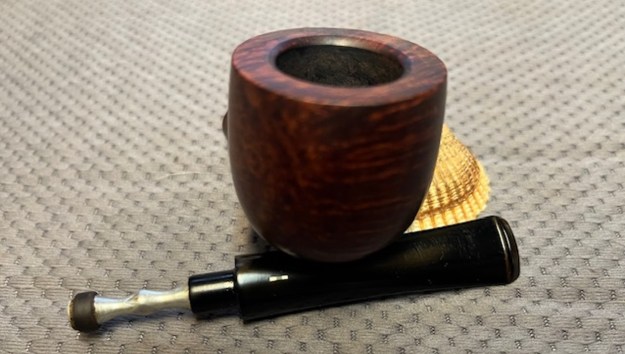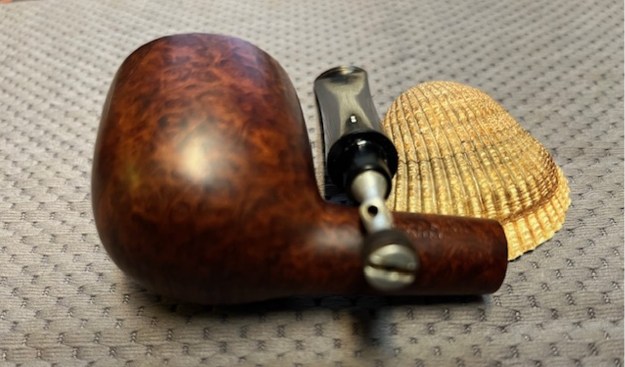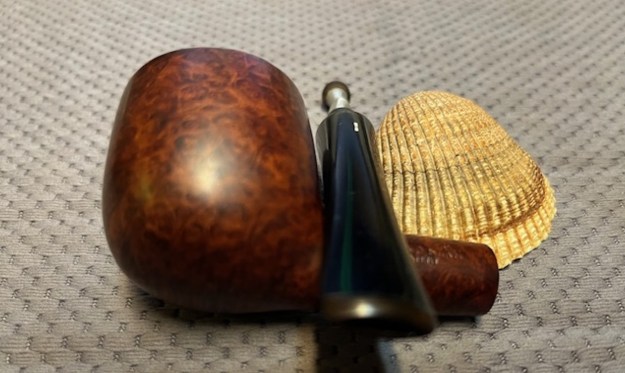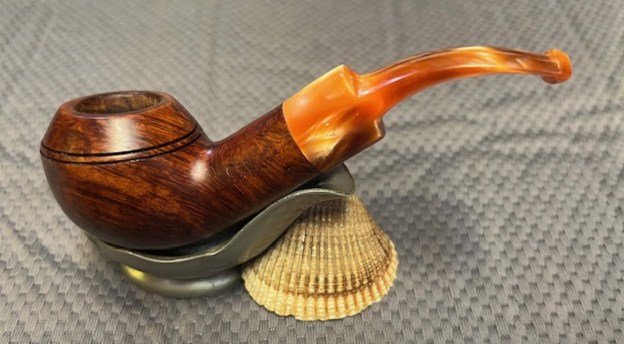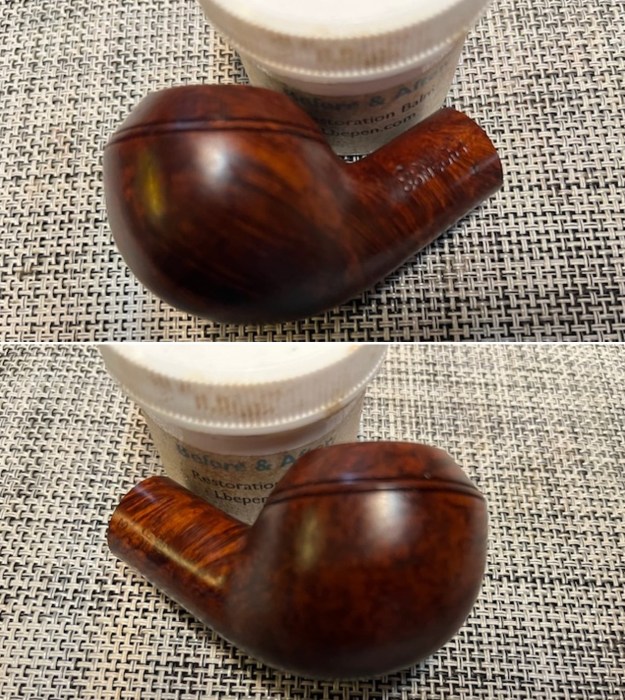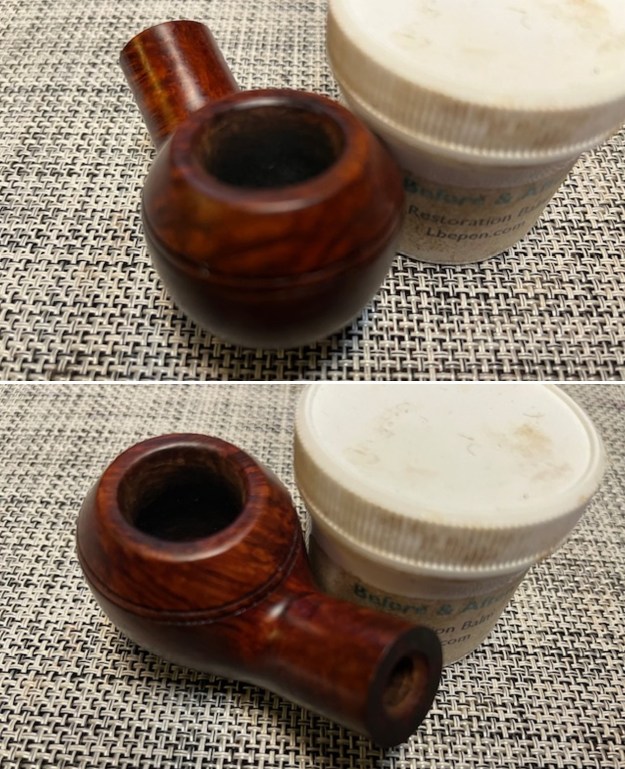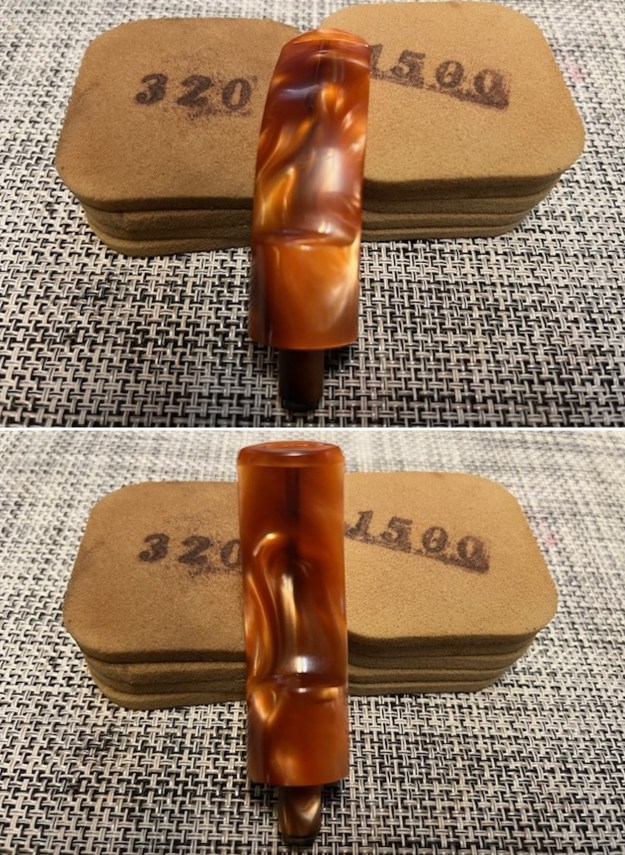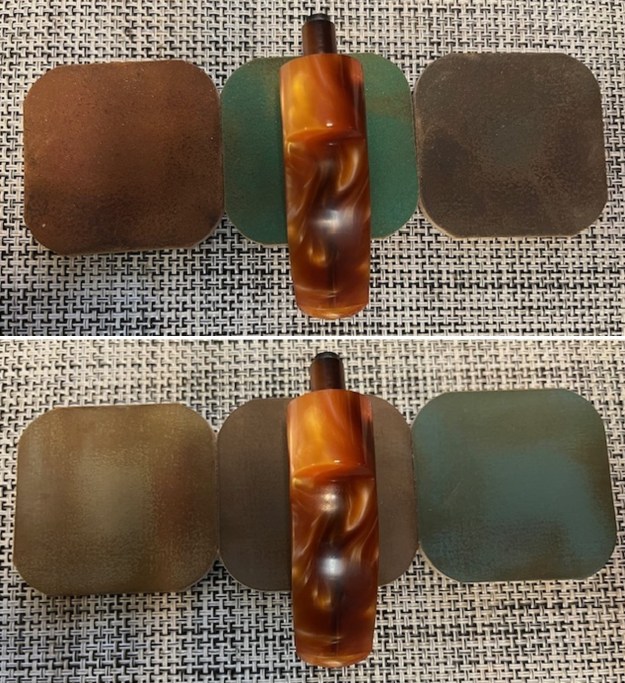
Tag Archives: Comoy’s pipes

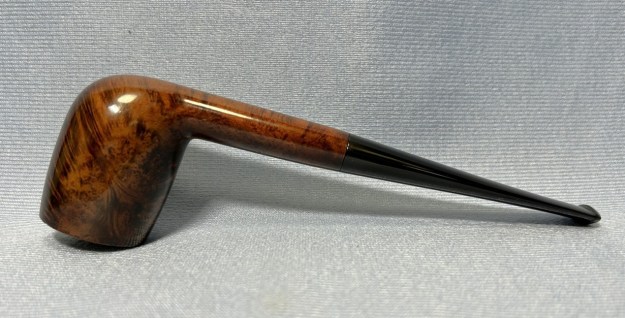
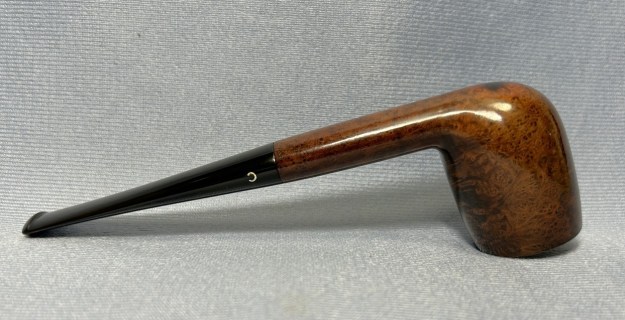
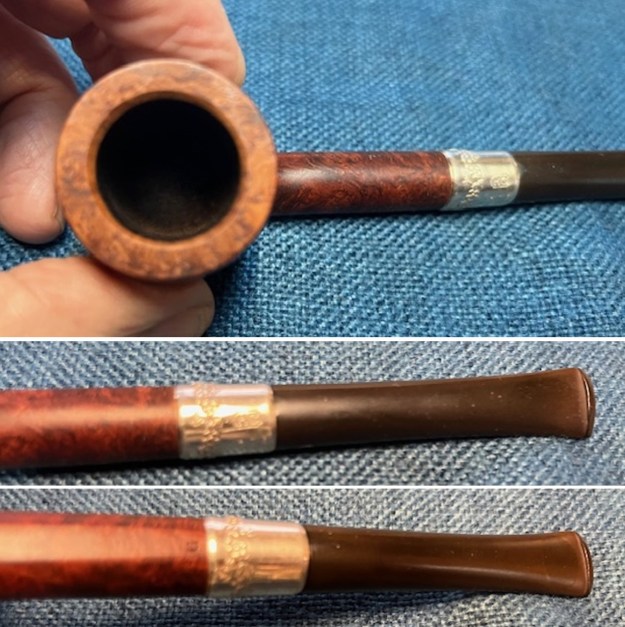
Restoring a Comoy’s Tradition 203 Cutty


by Kenneth Lieblich

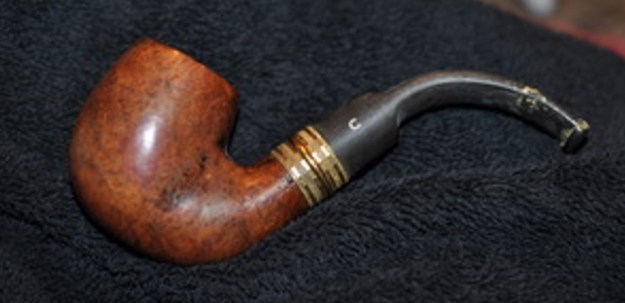
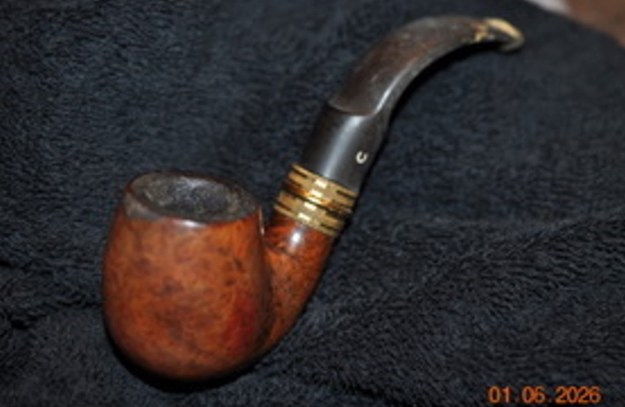
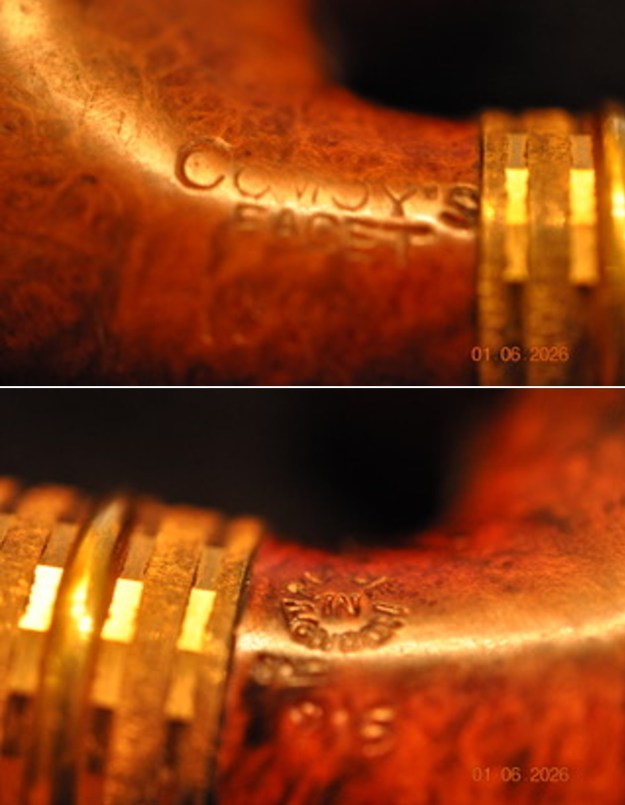
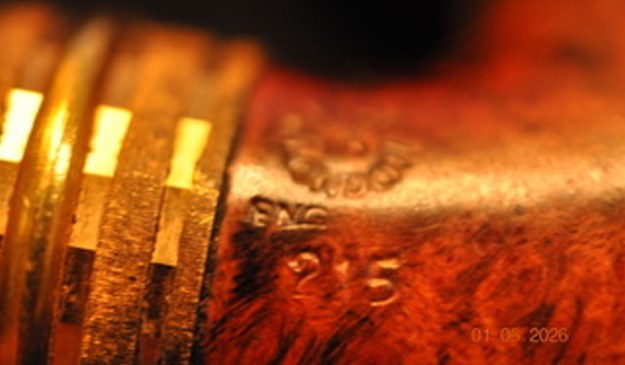
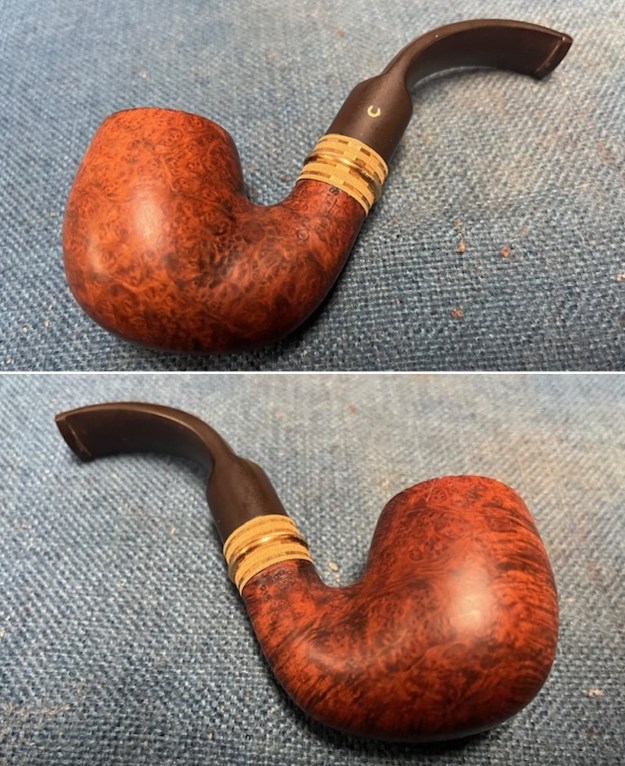
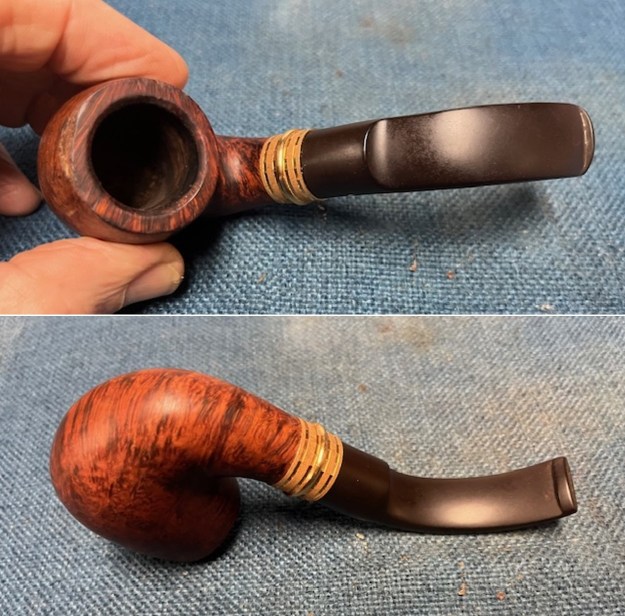
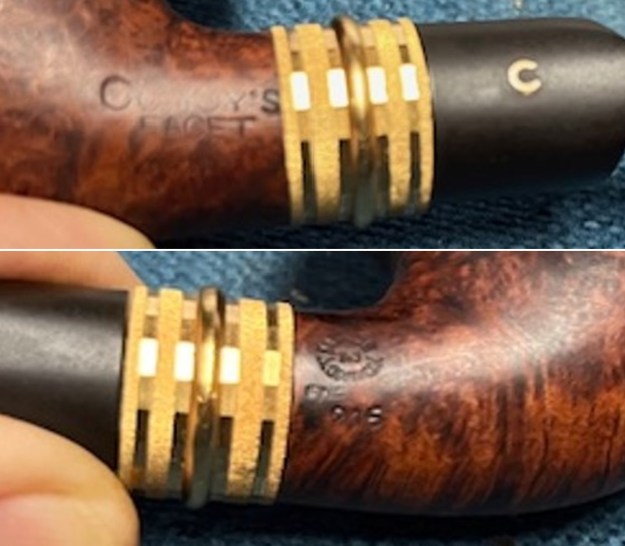
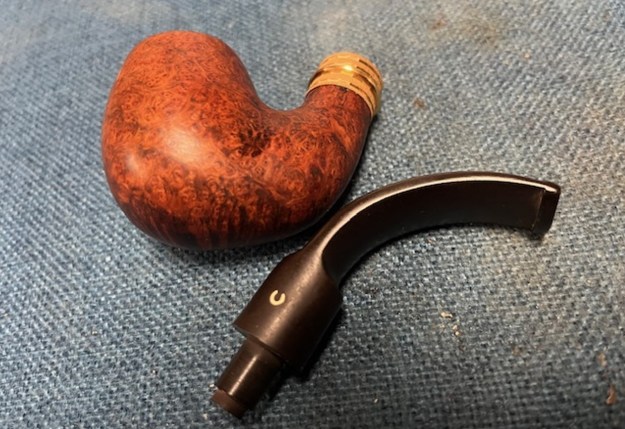
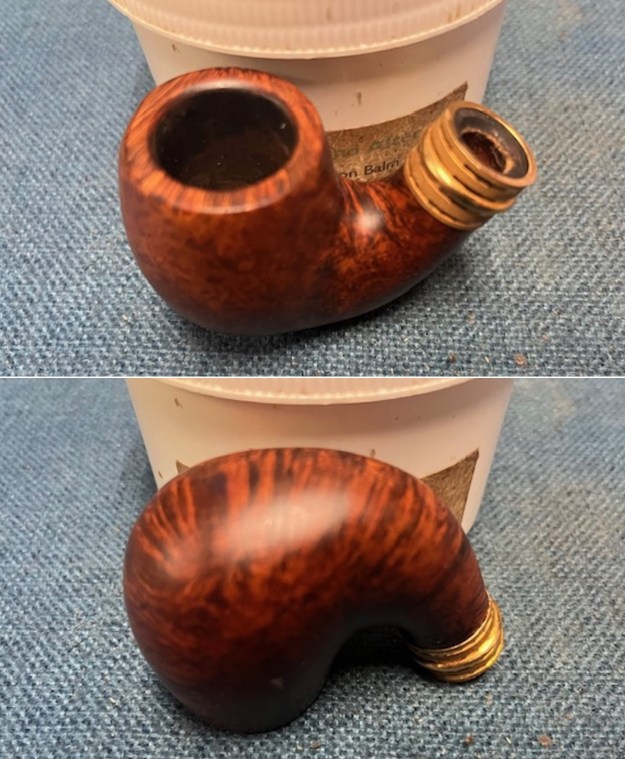
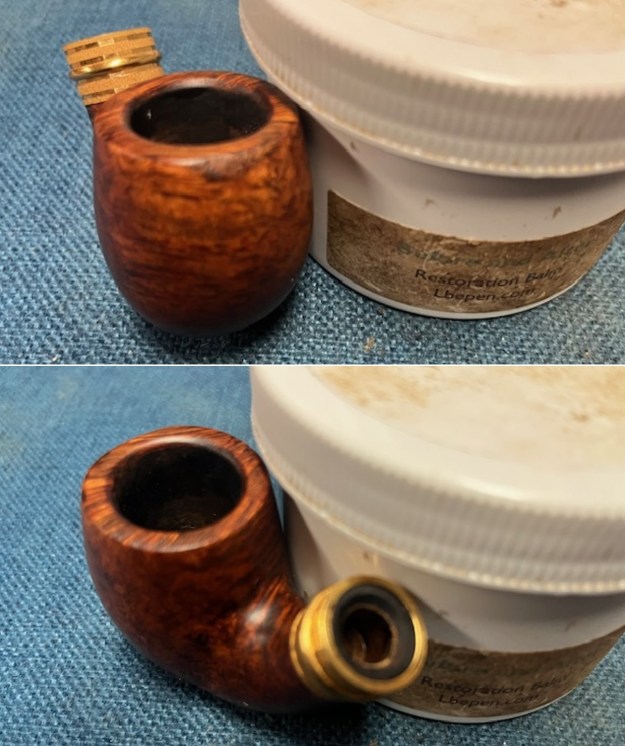
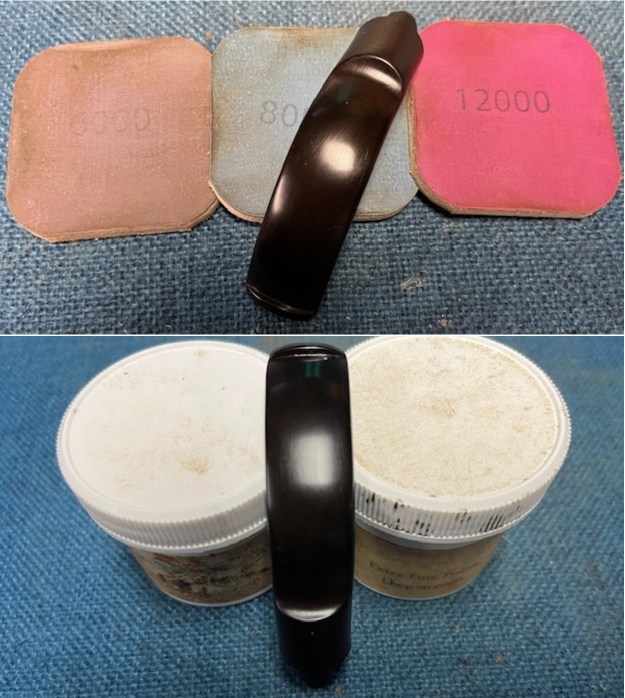
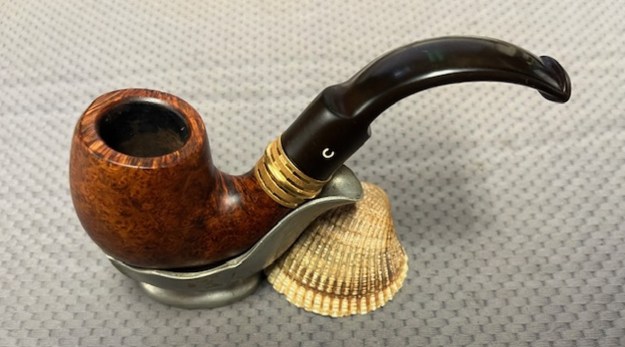
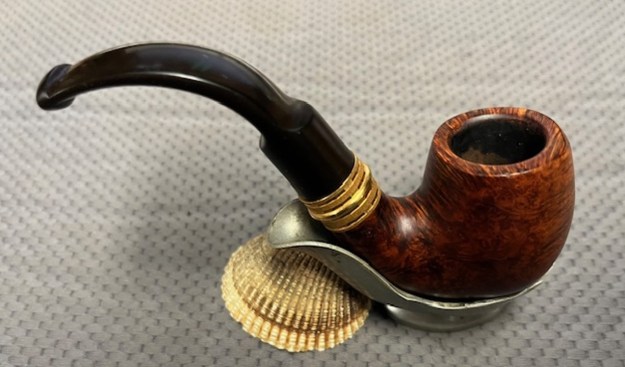
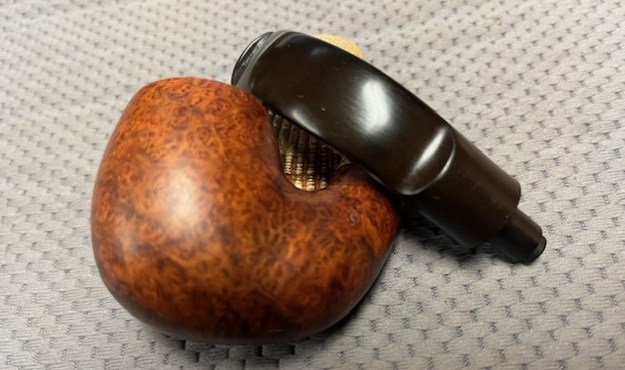
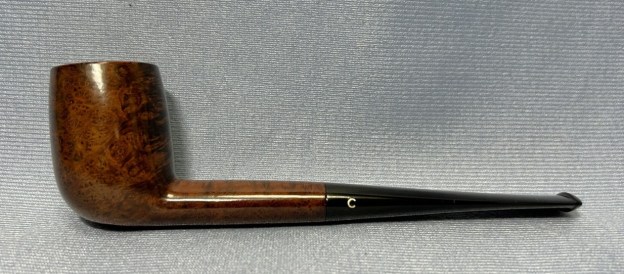
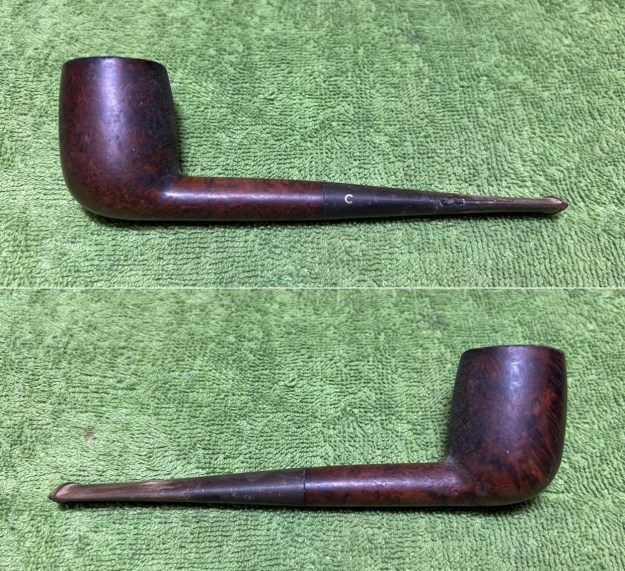
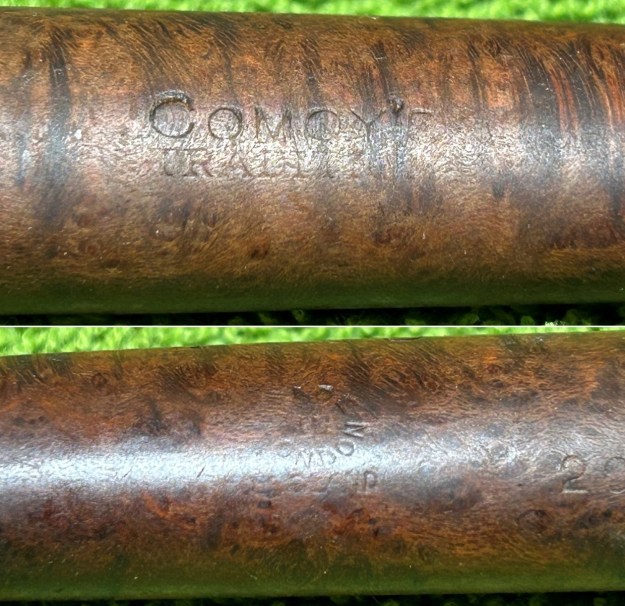
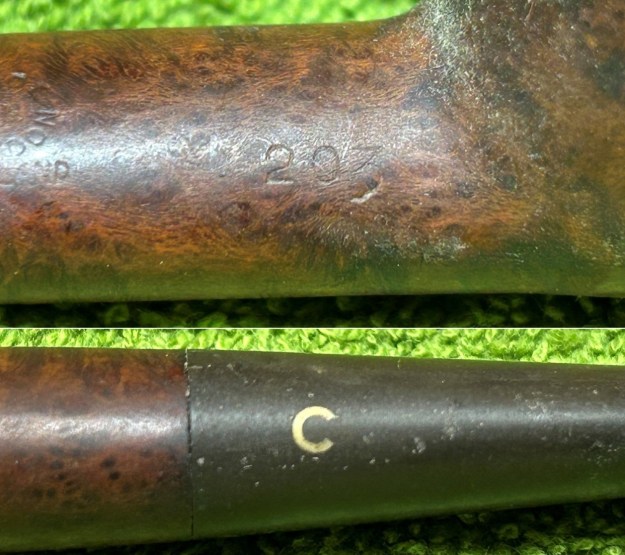
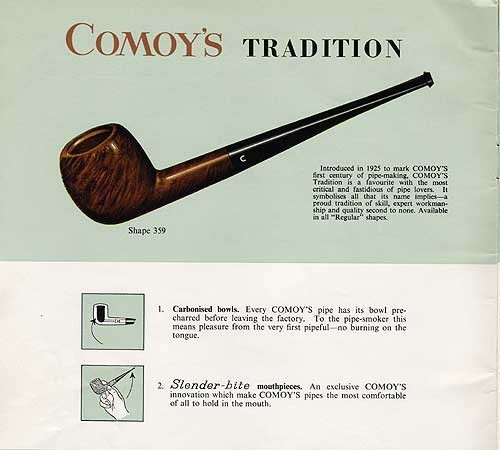
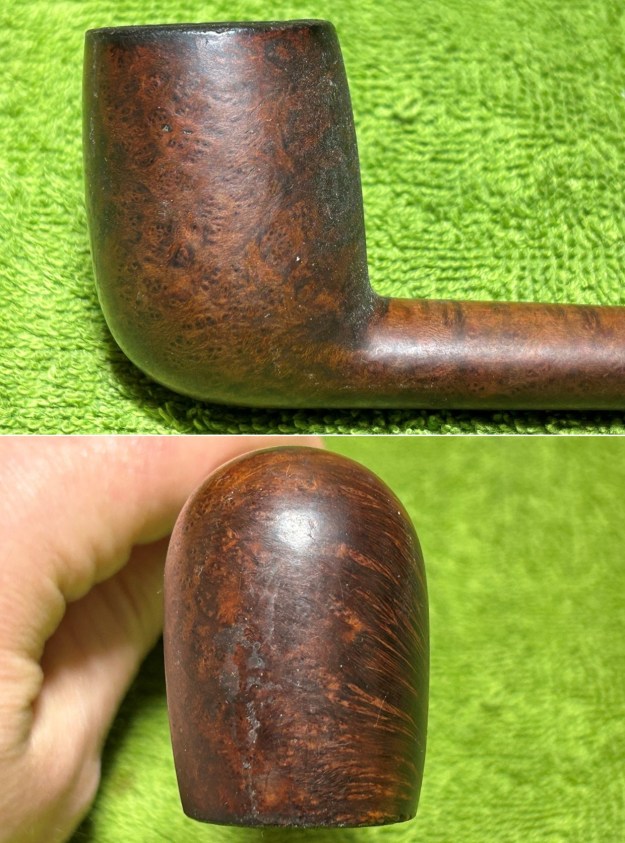
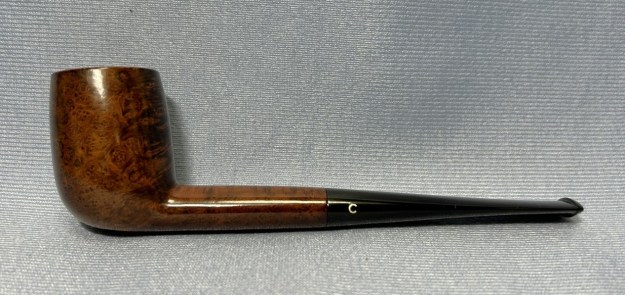
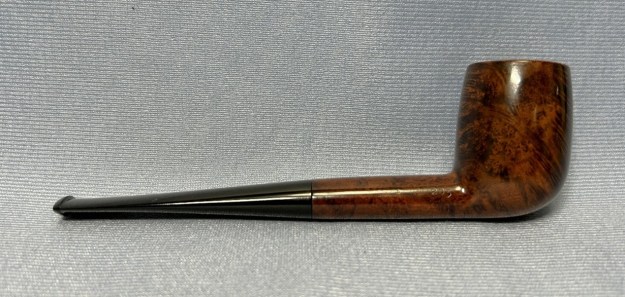
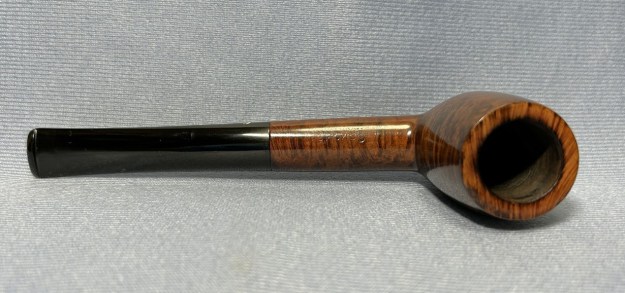
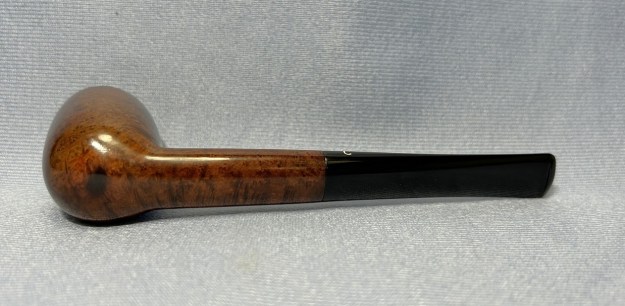
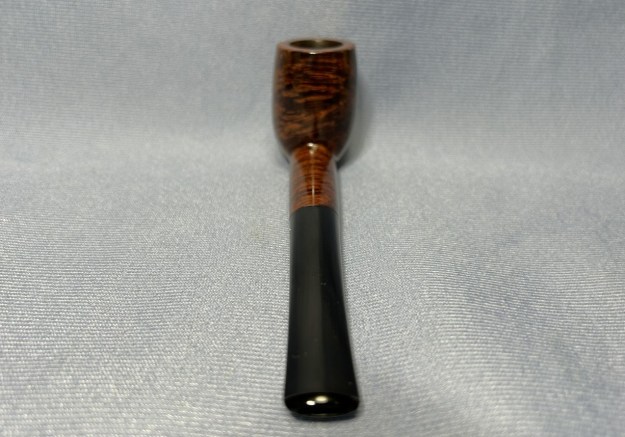
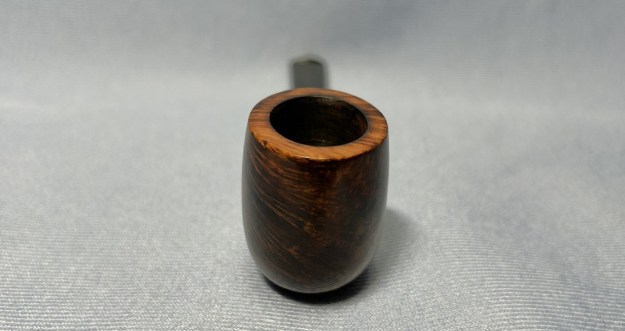
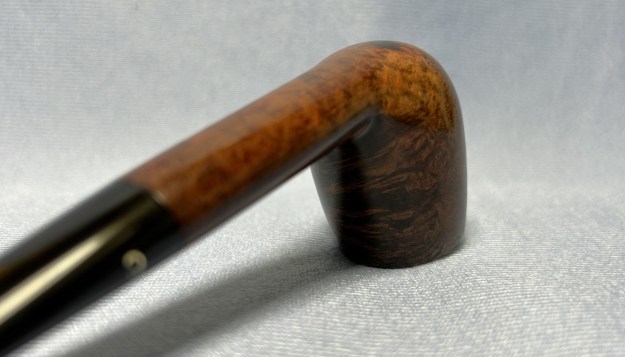
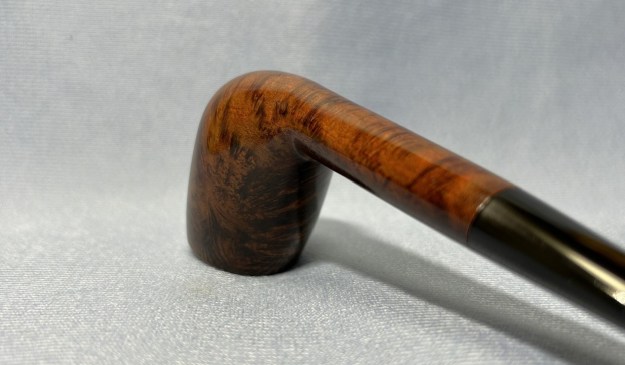
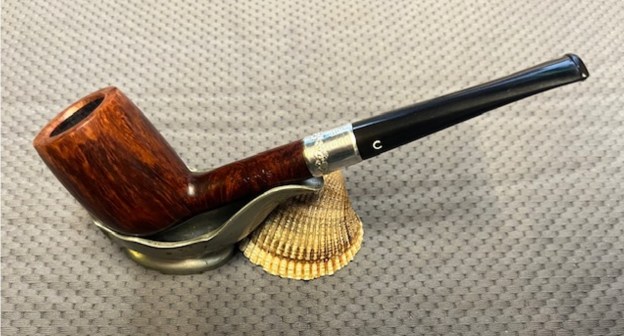
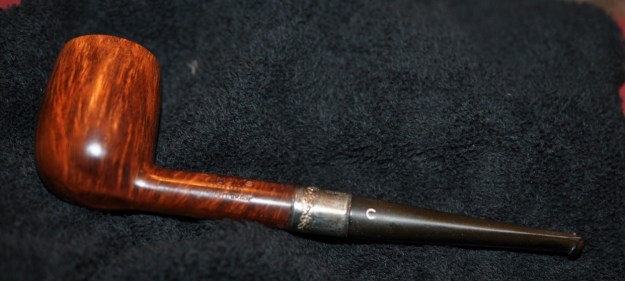
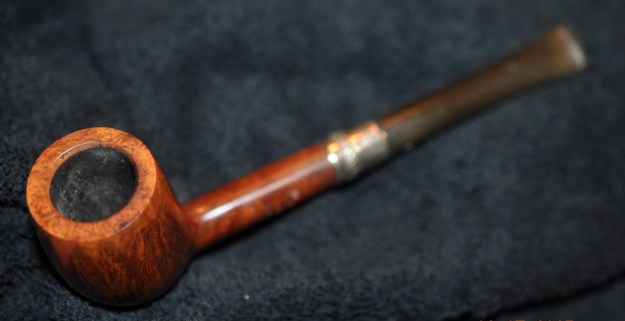
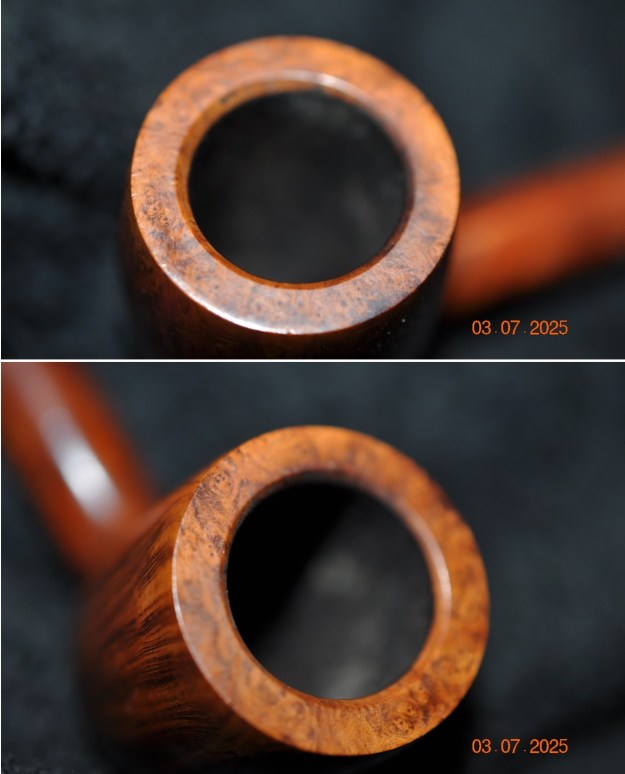
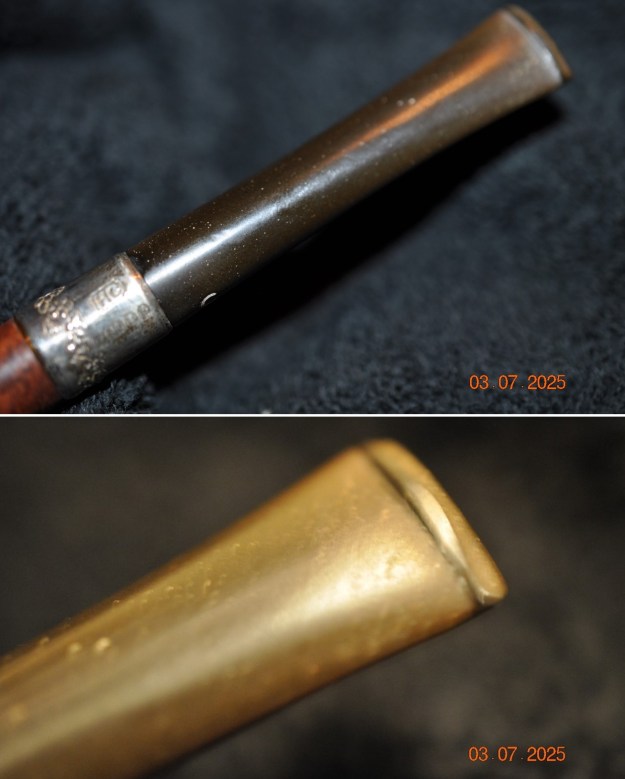
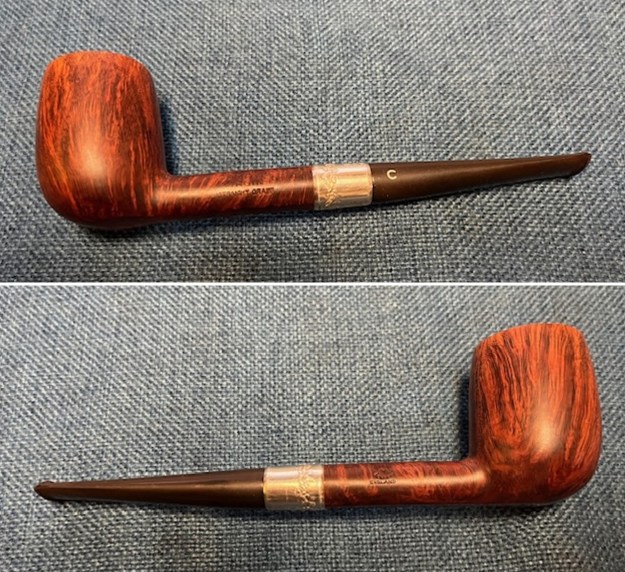
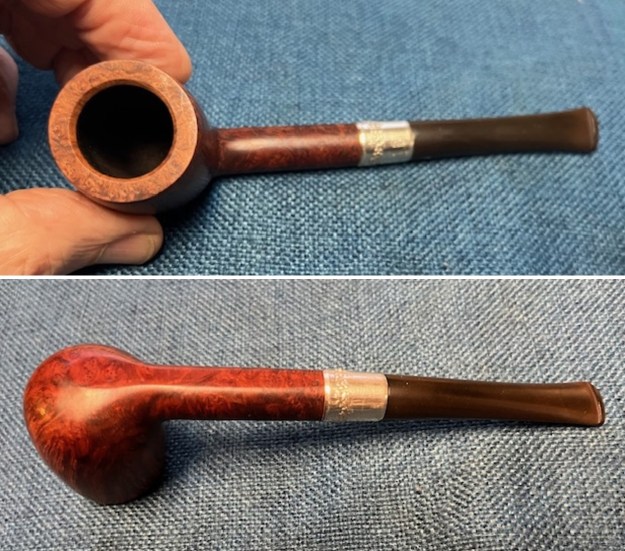
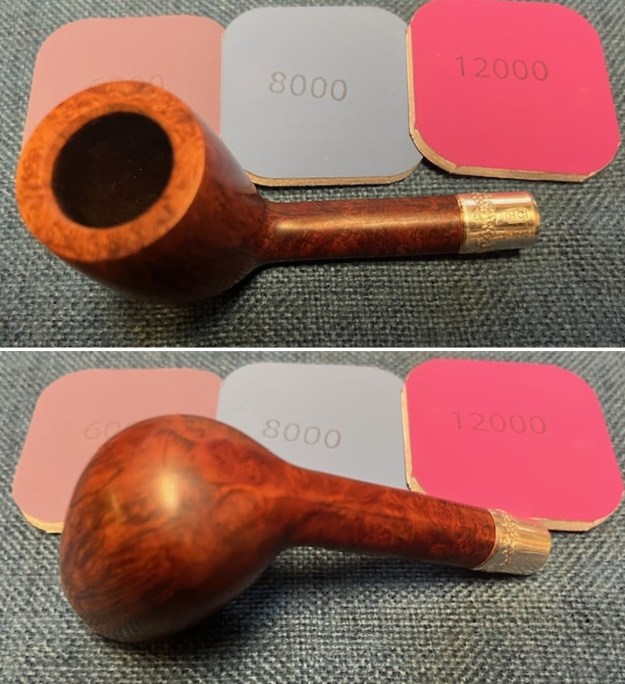
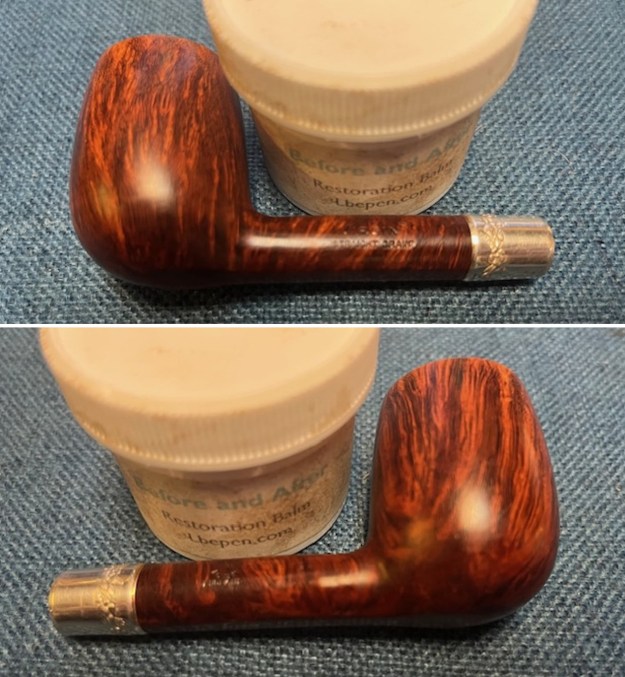
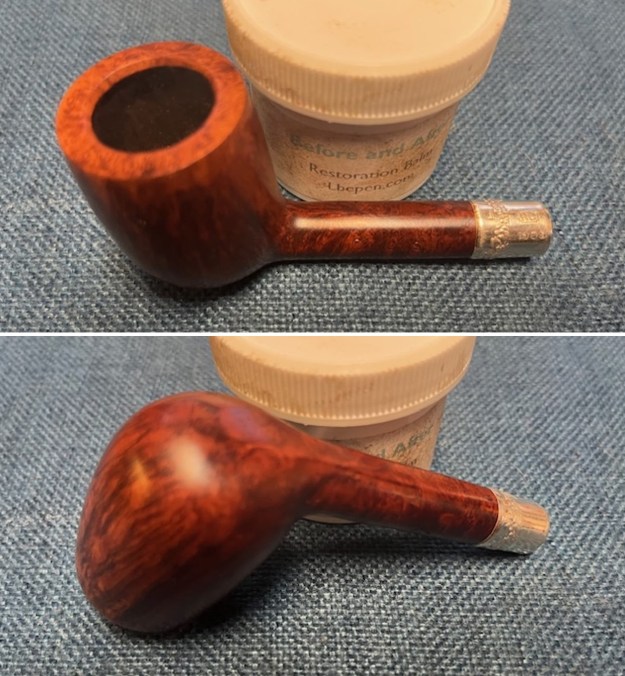
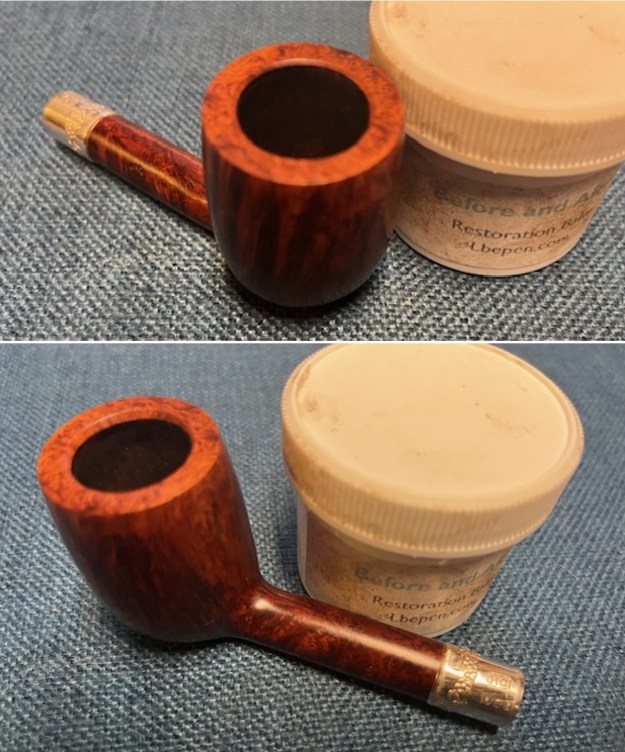
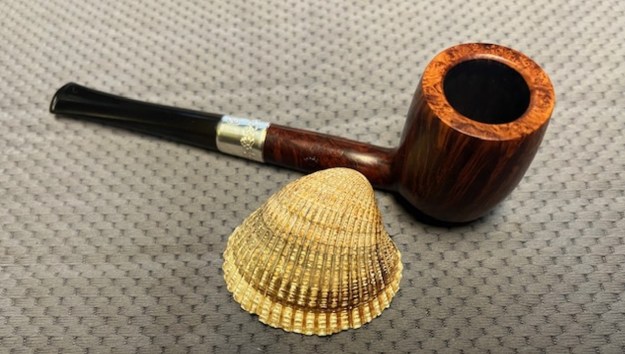
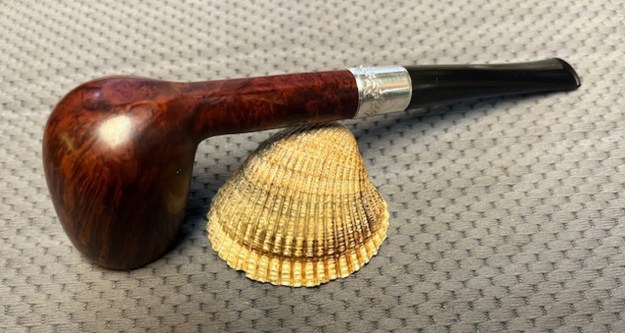
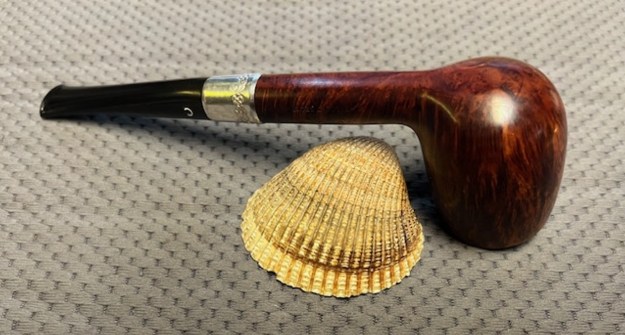
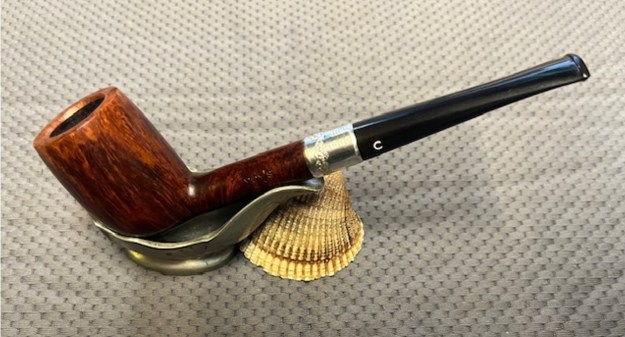
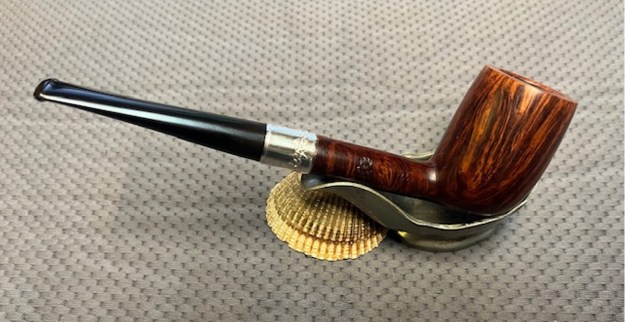
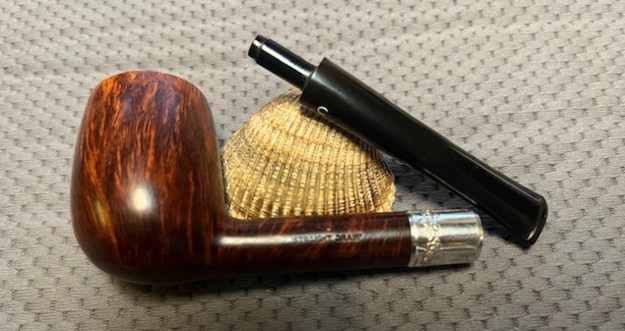
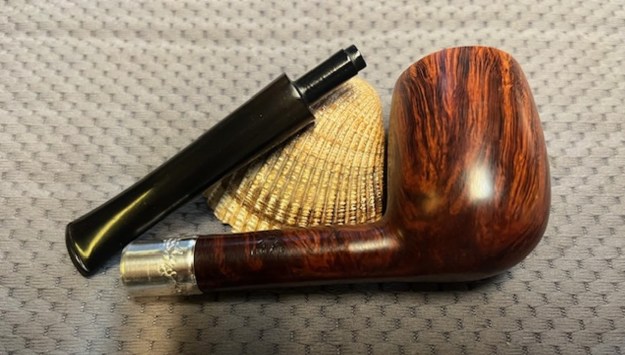
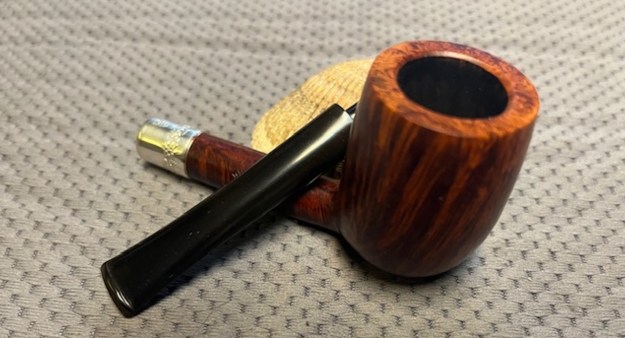
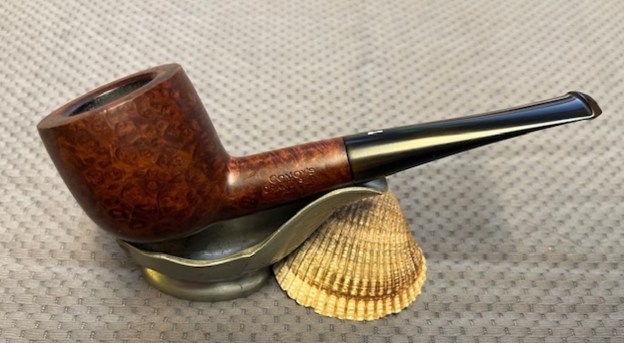
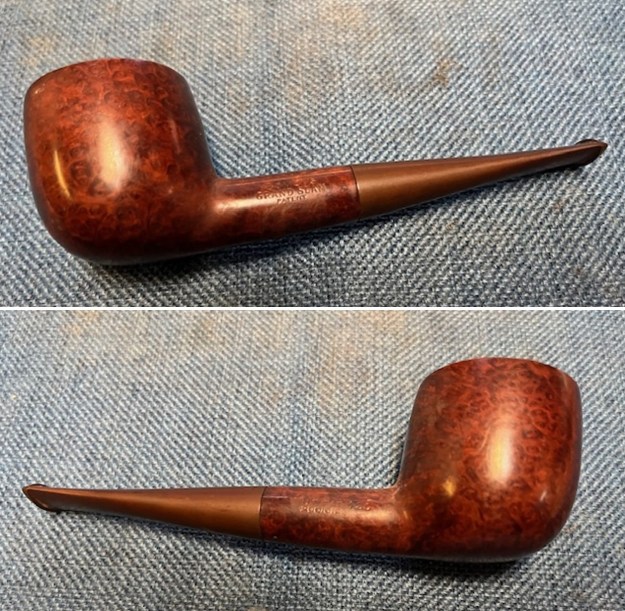
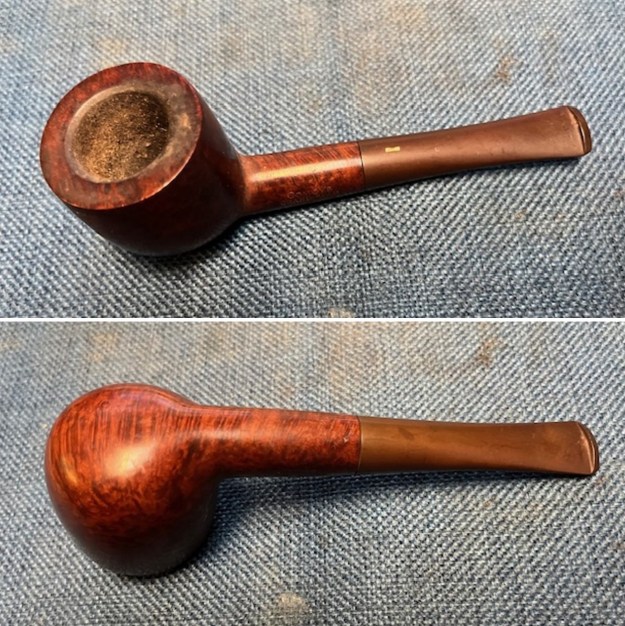
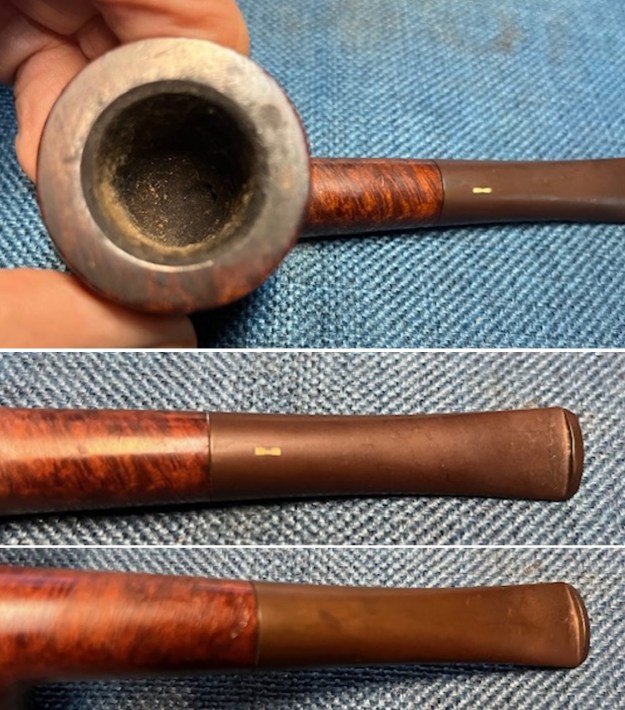
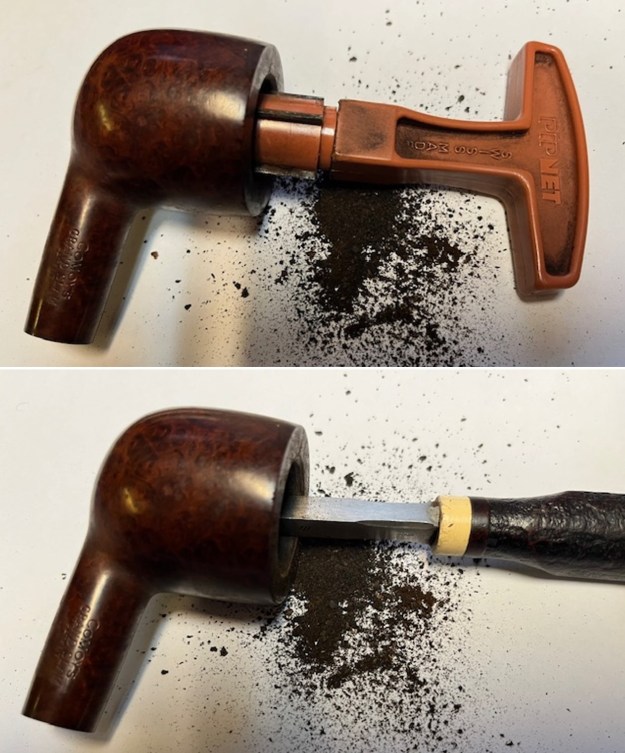
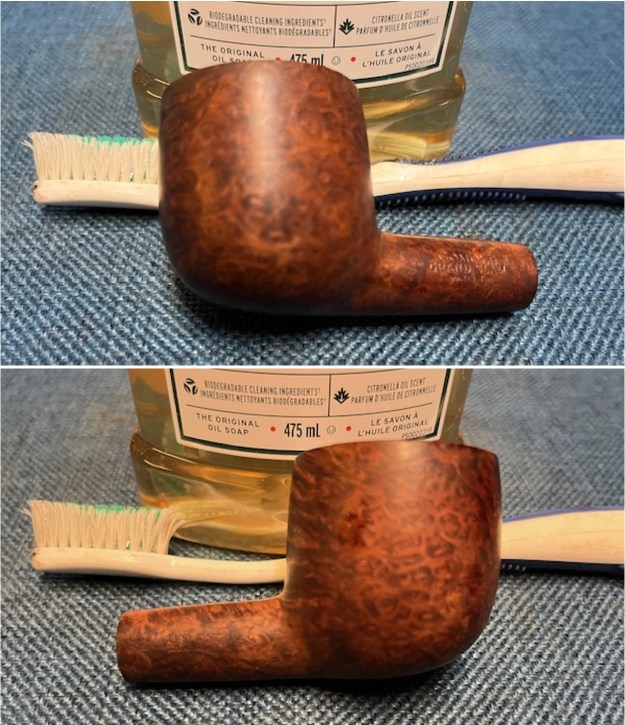
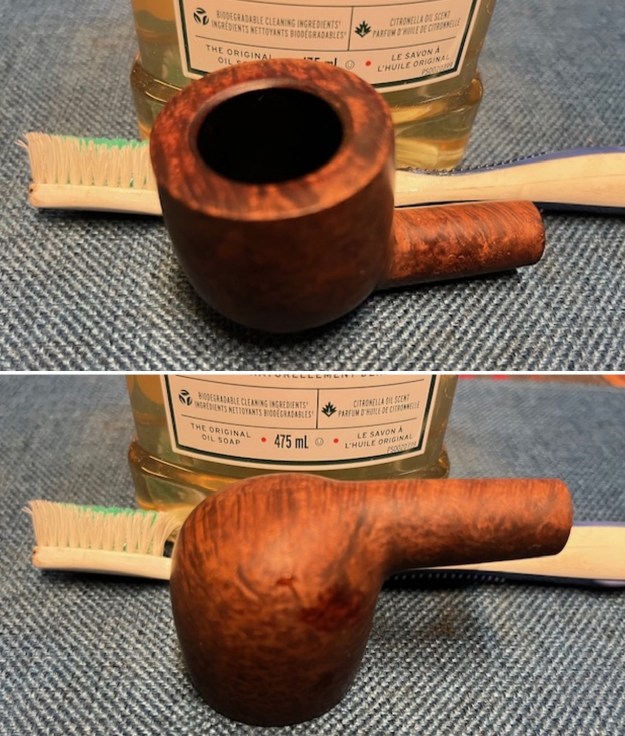
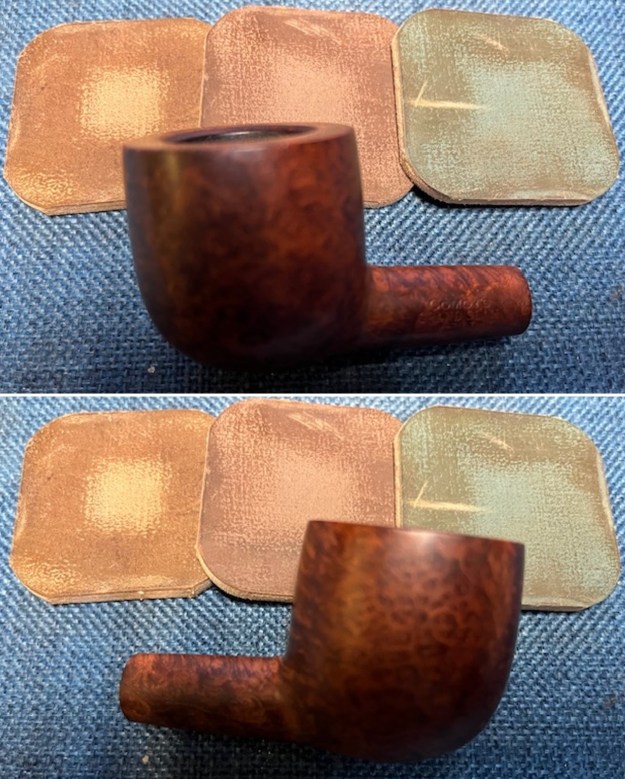
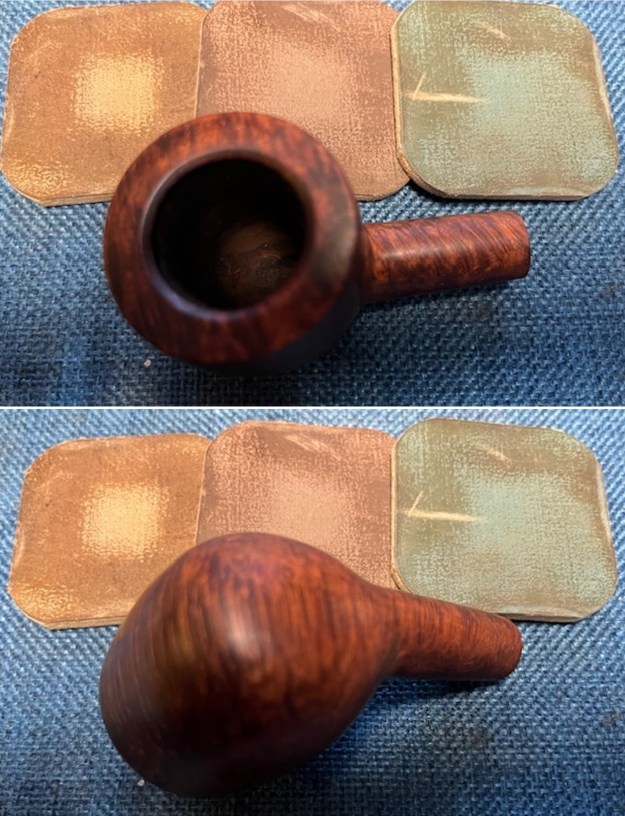
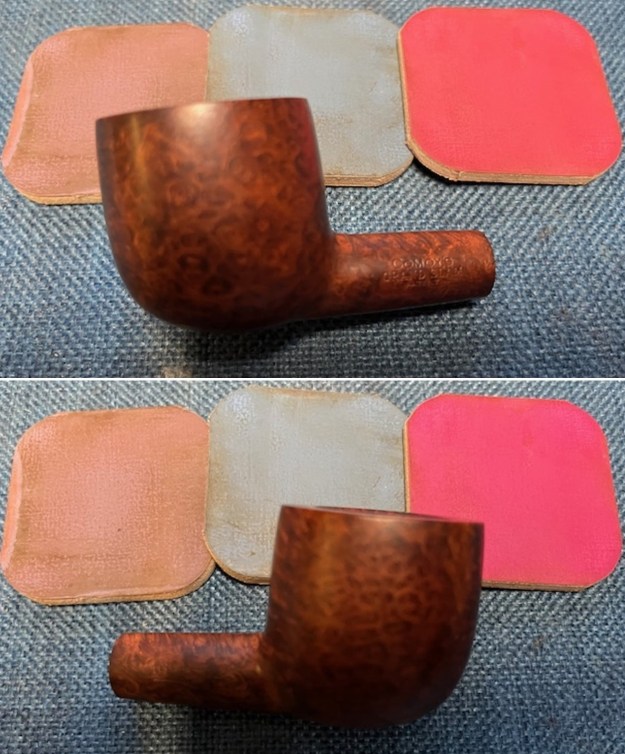
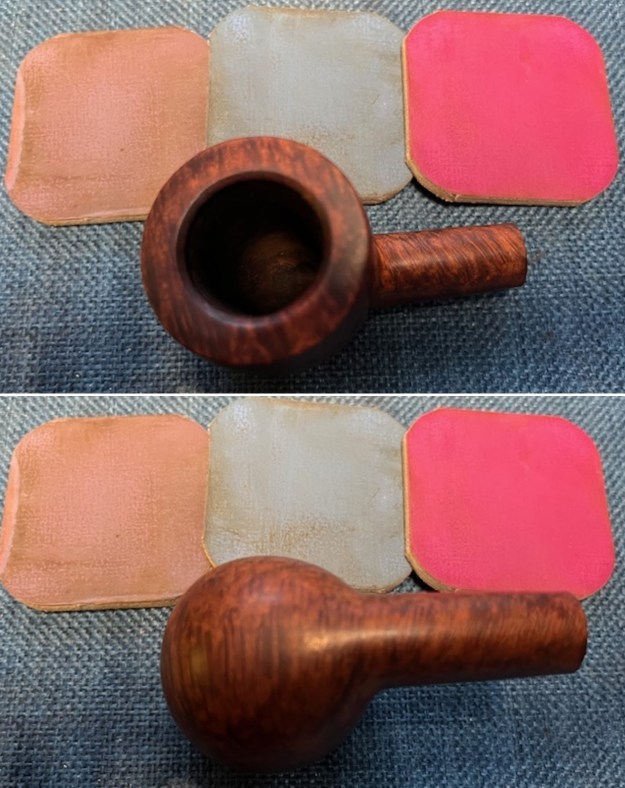
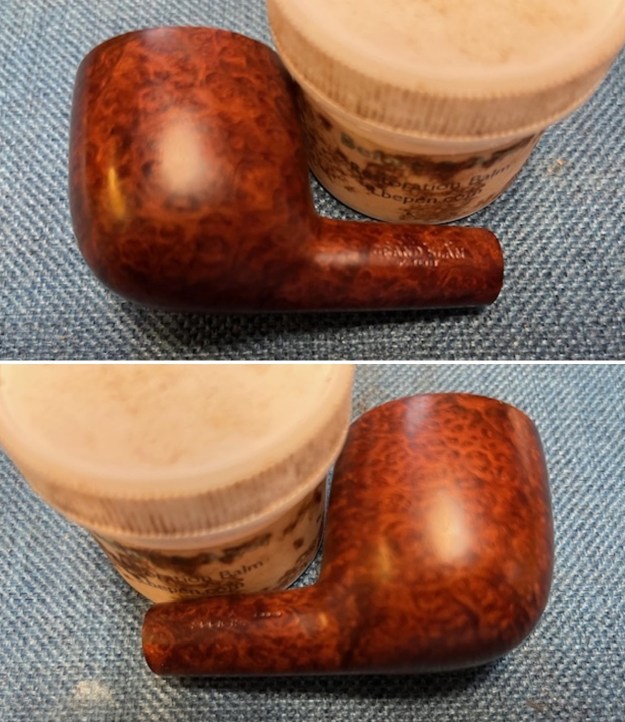
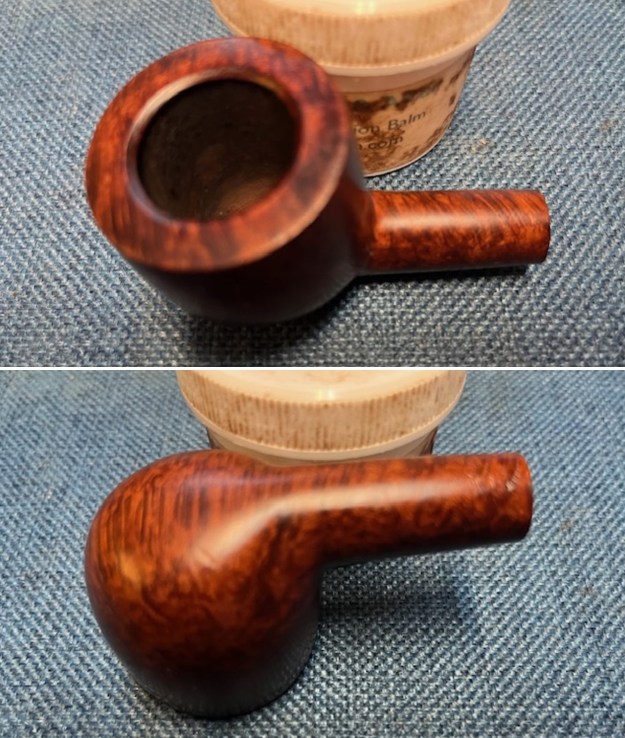
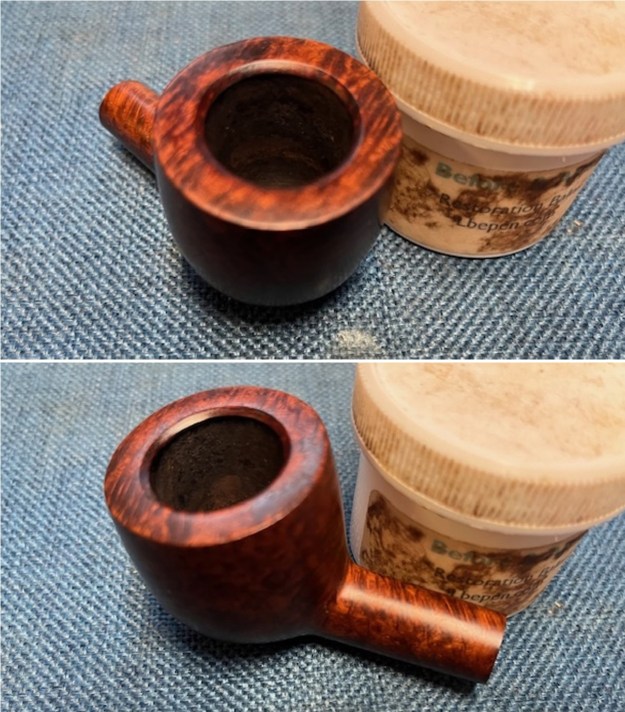
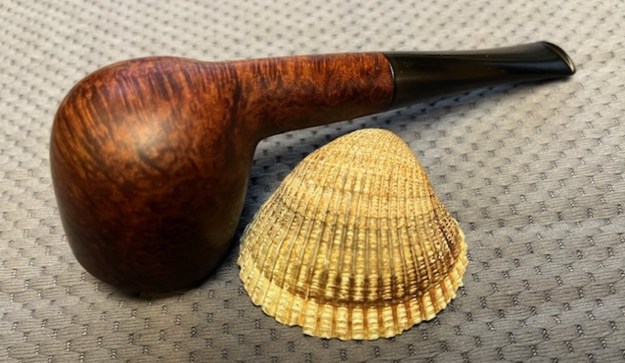
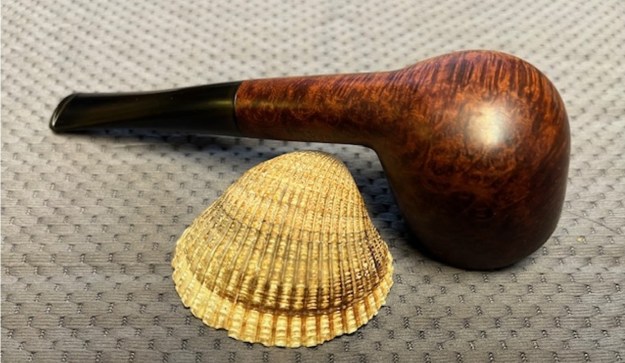
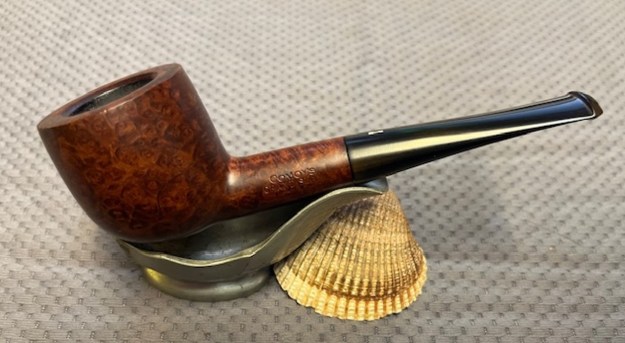
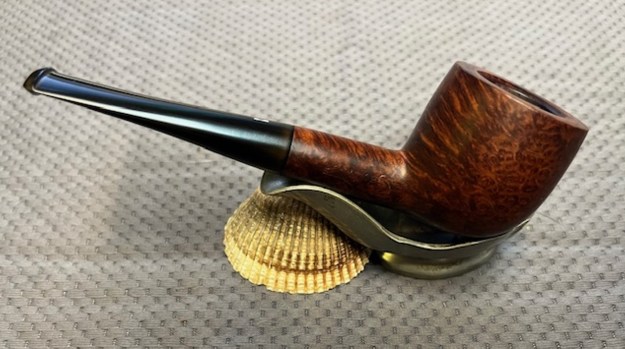
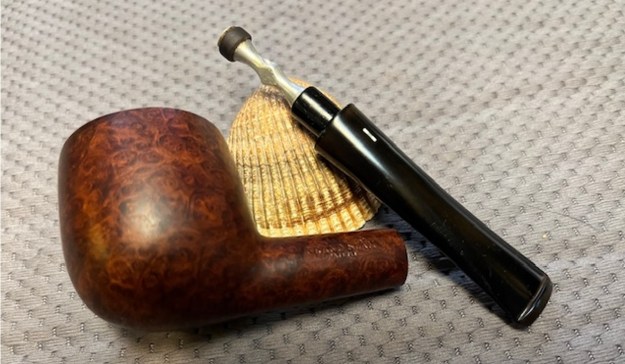
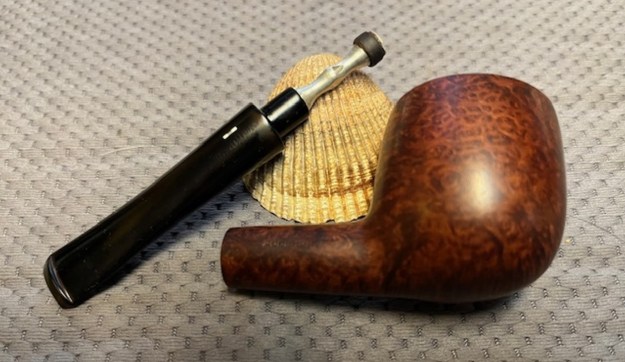
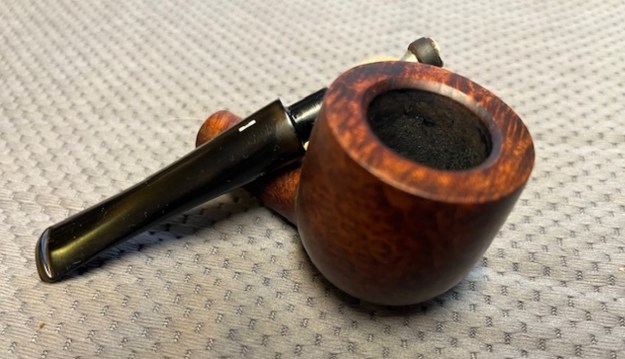
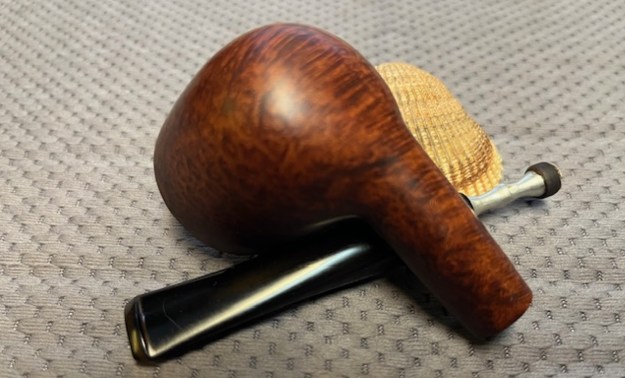
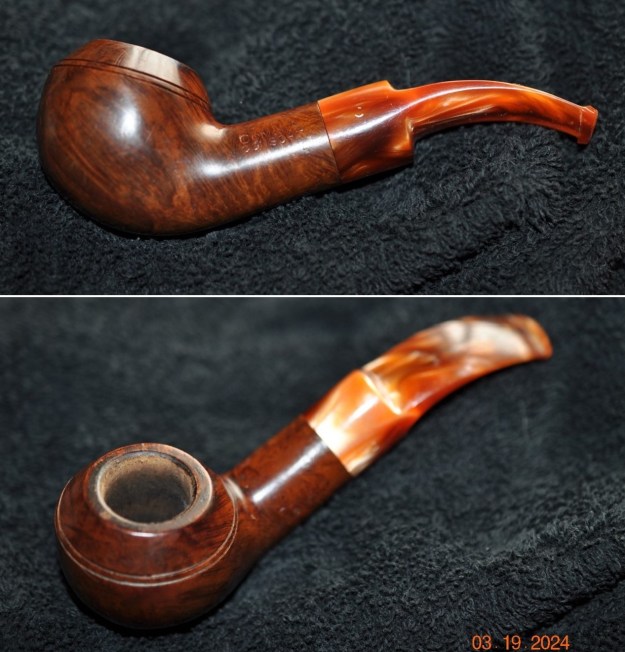
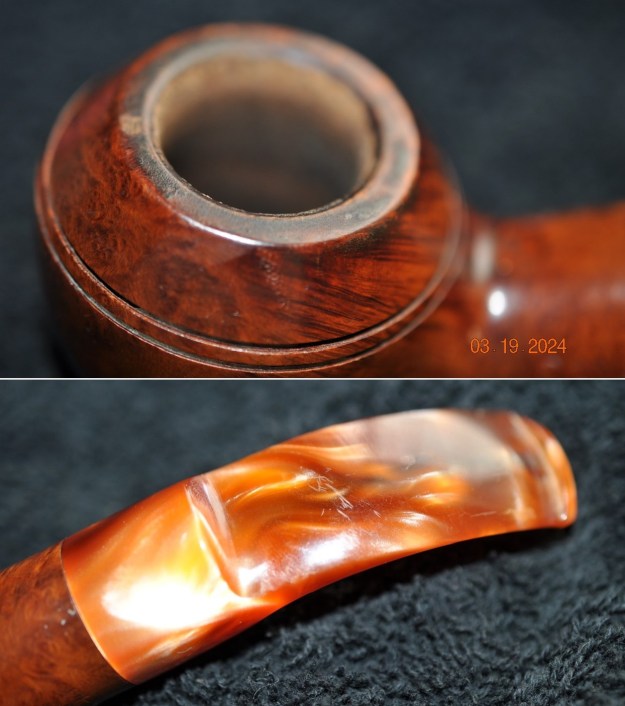
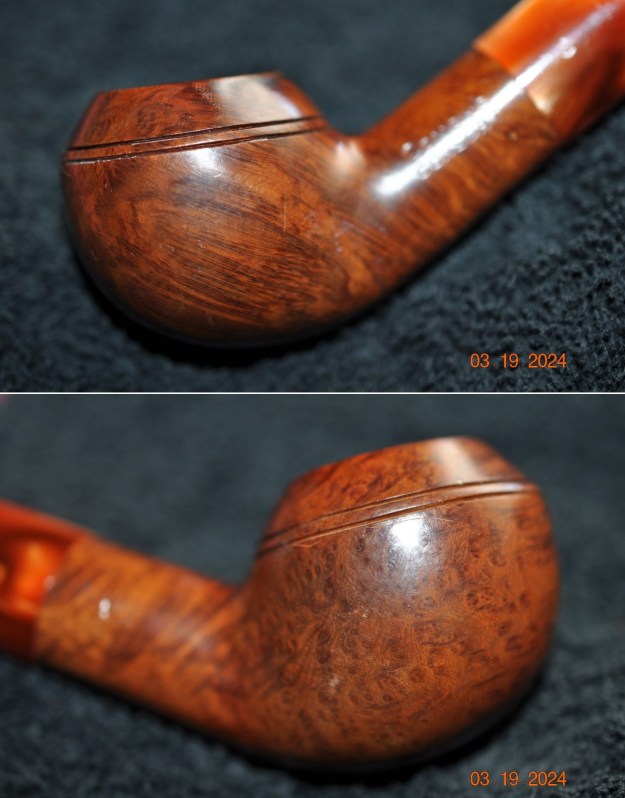
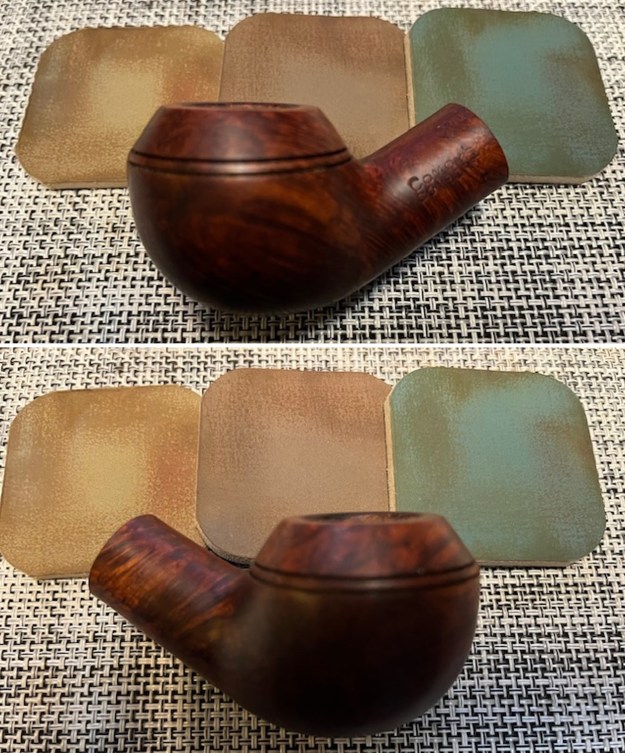
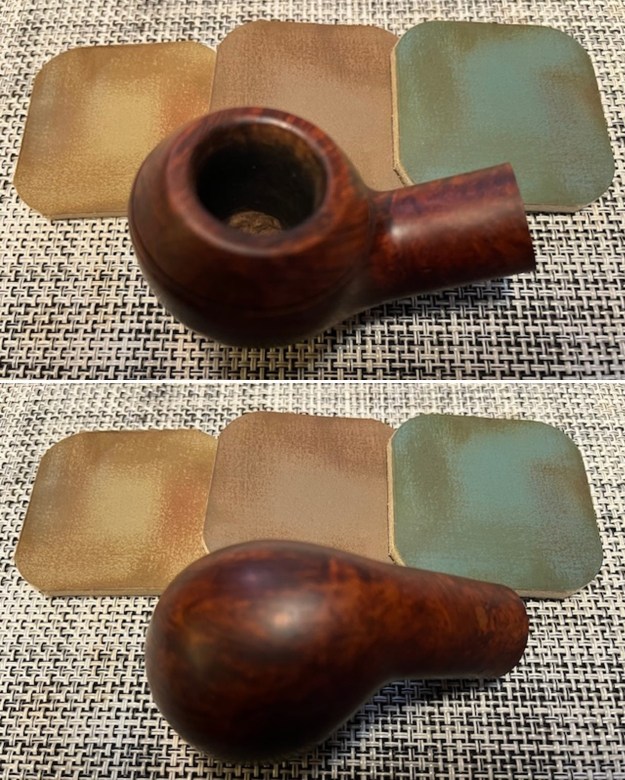
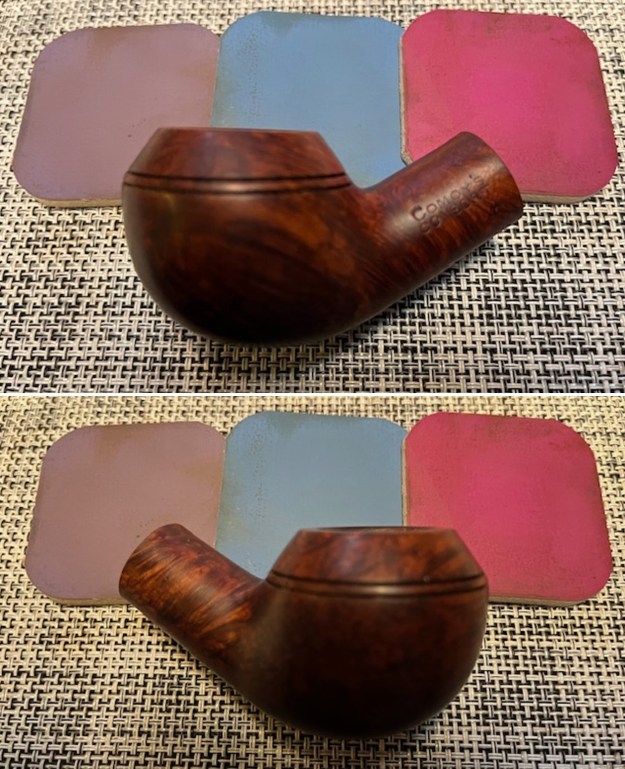
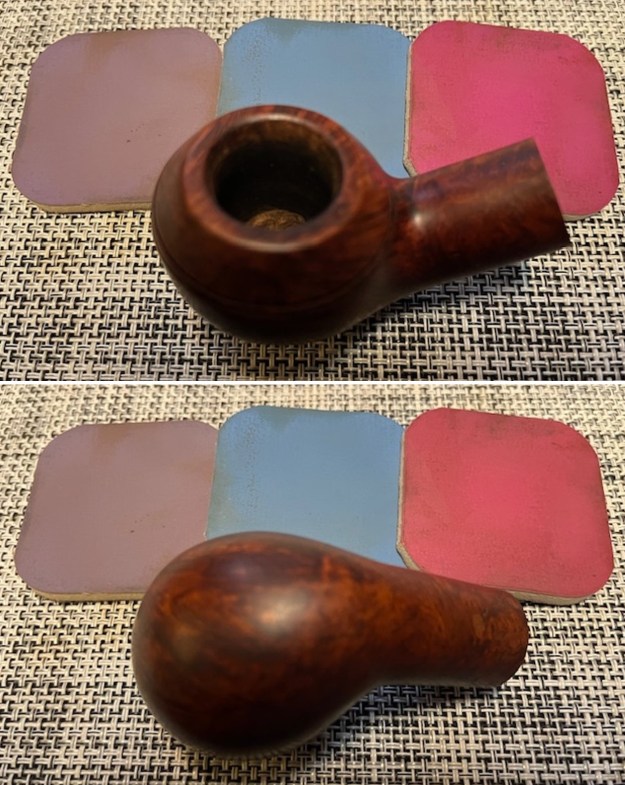
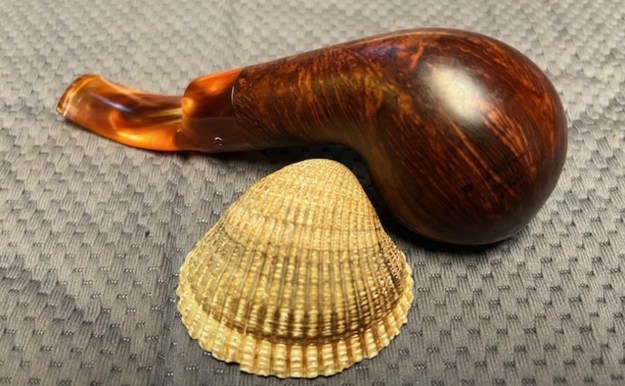
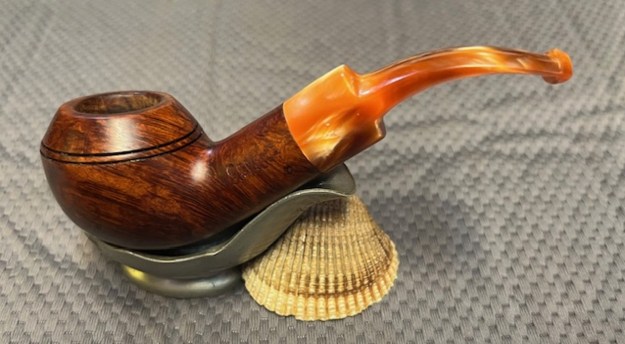
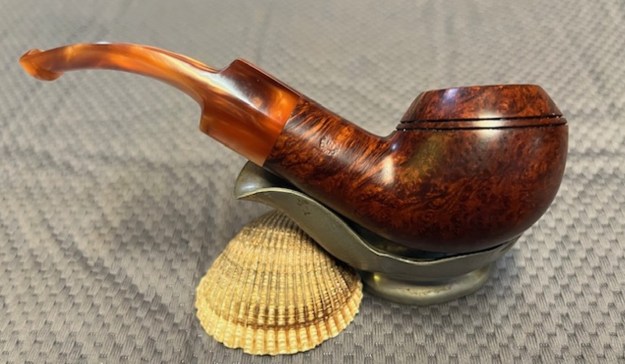
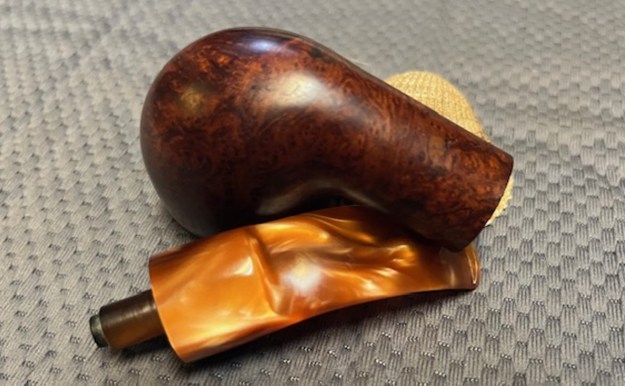
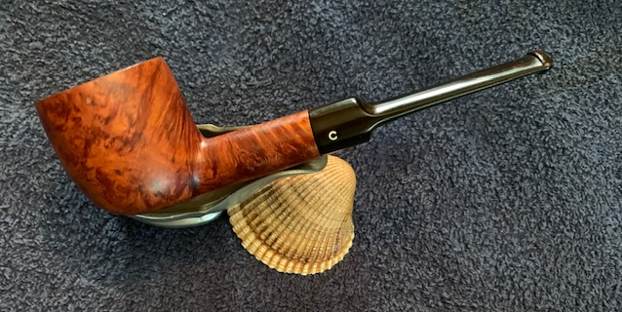
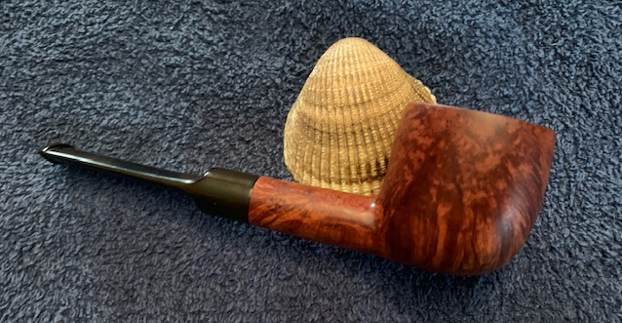
Oh, I really love the look of this pipe! This older Comoy’s came to me in an auction lot and, although it was filthy, I was immediately charmed by its shape. This is a beautiful cutty shape, from the Tradition line, and marked with the 203-shape number. The briar has some very attractive grain hidden away. The pipe has a nice, long shank and a nice, long, oval, vulcanite, taper stem. It has endured a hard life, but must have been well loved over the years. Many of the marks of its hardship still remain, but they are an important part of this pipe’s story. This pipe is actually a bit of a stunner, and it’s light and comfortable to hold. Let’s look at the markings. They are slightly worn, but still very readable. On the top of the shank (but towards the left side), we see Comoy’s [over] Tradition. On the top of the shank (but towards the right side), we see the circular logo showing Made [over] in [over] London. Then below the circle is the word England. Further along the shank, we see the shape number, 203. In addition, the left side of the stem has the so-called three-piece “C”. Comoy’s shape number chart lists the number 203 as being a straight cutty with an oval stem, and that describes exactly what we’ve got. I consulted with the dating guide on Pipedia to narrow down the date of this pipe. If you want to read along, please have a look at https://pipedia.org/wiki/Comoy%27s_Dating_Guide in order to see what I’m talking about. This pipe dates from the 1950s onwards and corresponds to the first variant of Comoy’s stamp during this period, which is

(1) A simple block-letter style without serifs but with the C larger than the other letters and the apostrophe before the “S”.

You can see that this matches my markings. Next, the Tradition line is also referenced in this article. It provides some further information:

Tradition. This grade was introduced in 1925 to mark 100 years of pipe making and continued in production until the 1970s. In 1965, it was priced at $20.In addition, the “Made in” stamp also corresponds to the same time period as above. The same article mentions the following:

This is again stamped in a circle with “Made” at the top, “In” in the middle, and “London” at the bottom, with “England in a straight line beneath the F/B. I believe this stamp was first used in the export drive in the early 1950s, and I have not seen any pre-WW II Comoy’s stamped in this way.

The three-piece “C” on the stem also dates from the 1950s onwards and was discontinued in the early 1980s, when Cadogan took over. So we know this pipe is before the Cadogan era. We are left with a date range of the 1950s to the 1970s. I am making an assumption that because this pipe corresponds to the first stamping variant listed in the guide, it is of an earlier part of that range. However, I have reason to make that assumption. I looked at Greg Pease’s writeup on Comoy’s and his dating information is basically the same as the Pipedia stuff above. Pease, however, adds this important tidbit:

Sometime in the 60’s, the serifs were returned to the “COMOY’S” lettering, though, as mentioned above, the typeface is not as fancy as the earlier one. It appears that some grades carried different stamps or at least that the stamping changed in different years for some grades. At this point, this is highly speculative, as my sample size is too small to verify it.

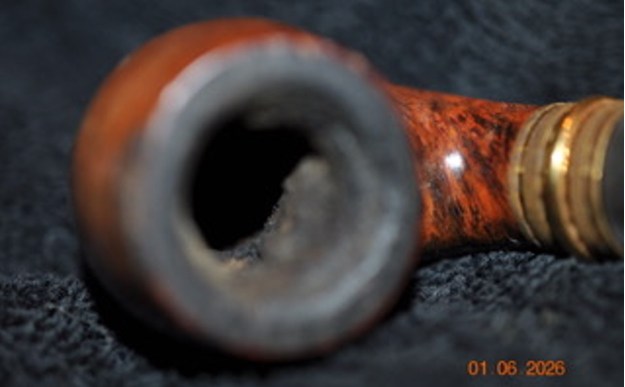
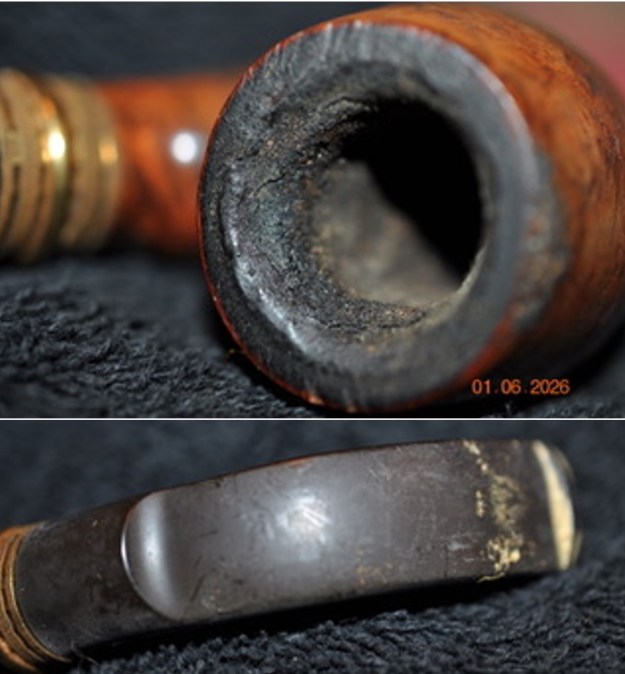
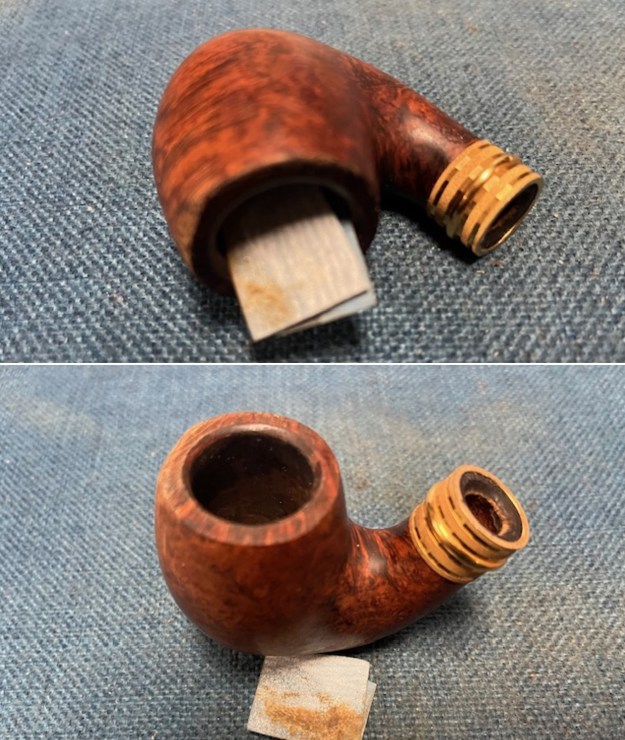
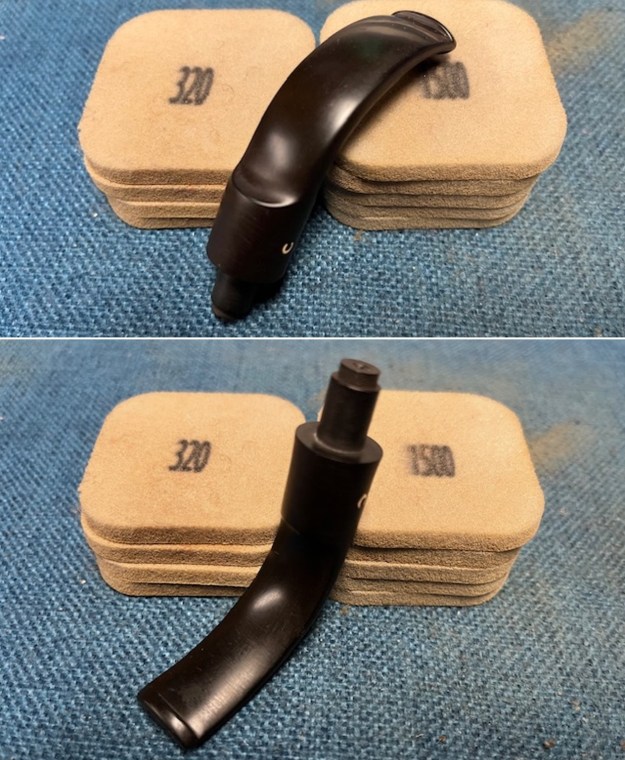
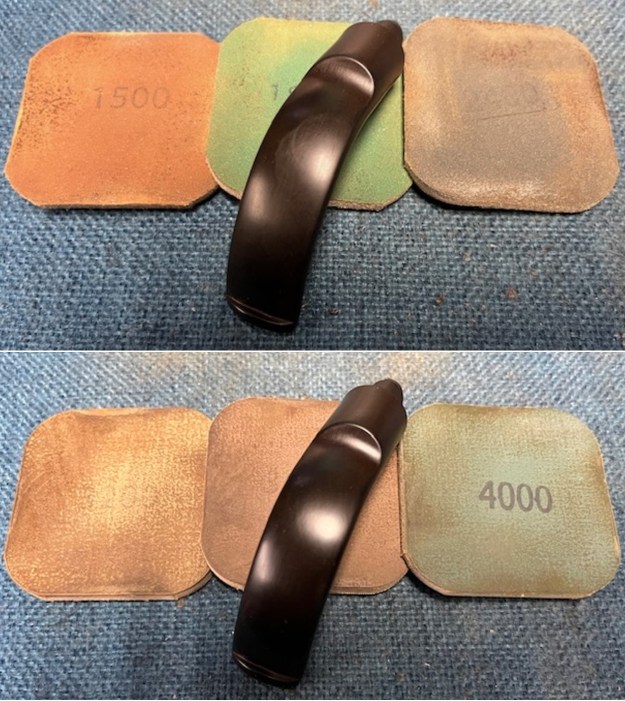
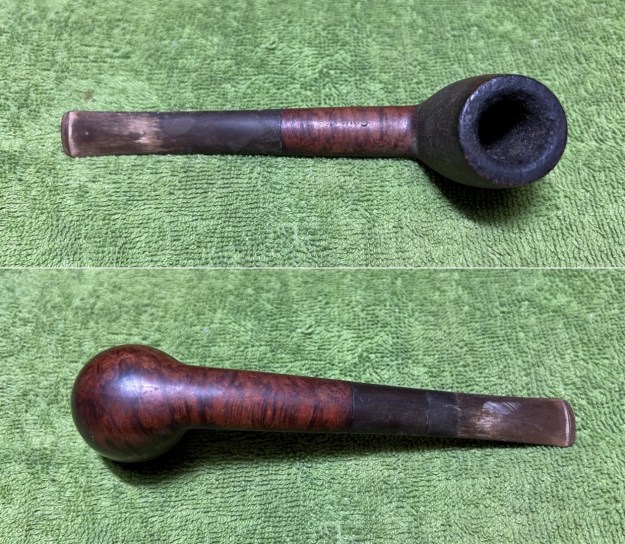
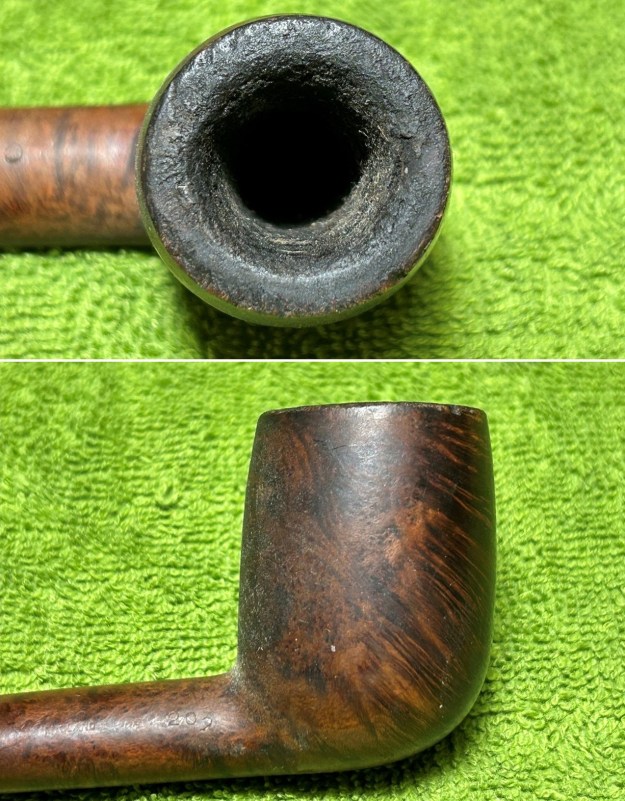
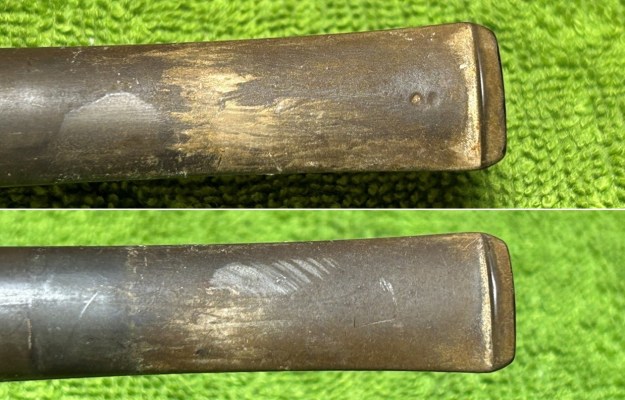
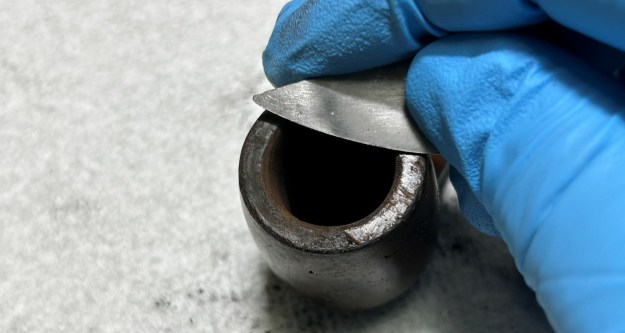
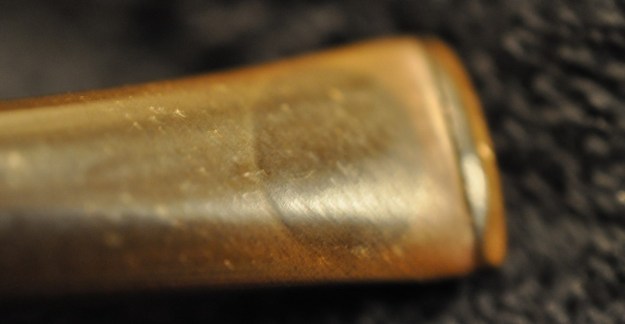
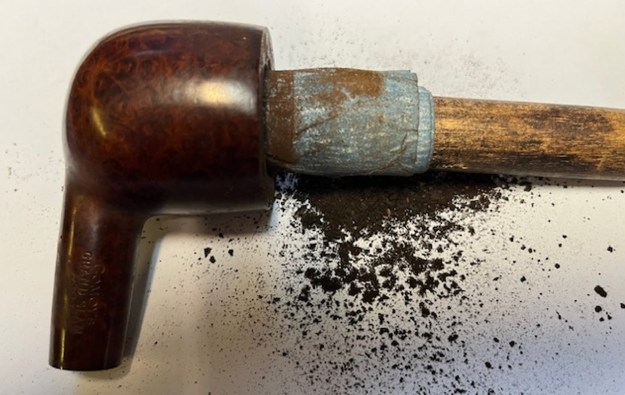
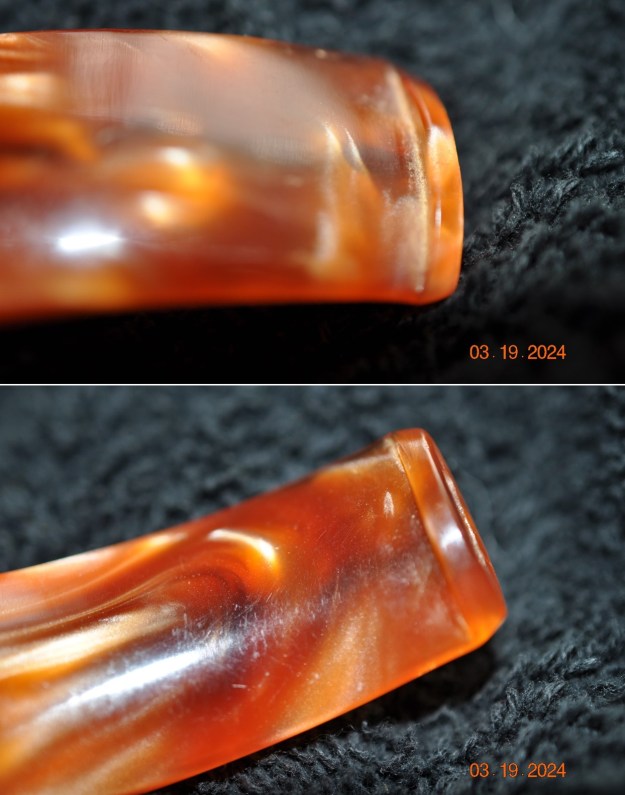
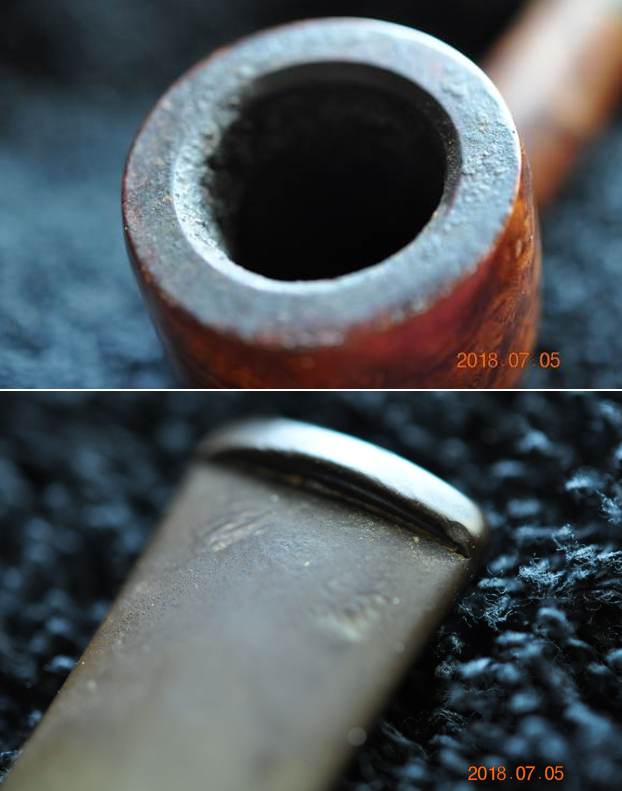
Based on this, I am going to suggest that this pipe probably (but not definitely) dates from the 1950s. If you can shed some light on this, please do so in the comments below.This was one dirty, harried pipe. The stem was thoroughly oxidized and had much calcification on it. This would take some work! There were a couple of small tooth marks, but nothing serious. The stummel was coated in grime and needed rejuvenating. The bowl was choked with cake and the rim had lava everywhere. Who knows what I would find under there? I could see that the edge of the rim had several small nicks, but nothing that disturbed my peace. Let’s get to work! I used a disposable lighter and ‘painted’ the stem with its flame. The gentle heat of the flame can cause the dents in the vulcanite of the stem to expand back into shape. In this case, next-to-nothing happened. Alas. The stem’s calcification was quite substantial. I used an old butter knife and gently scraped some of the thicker accretion off. Doing this now helps later in removing the oxidation. I used alcohol on a few cotton rounds and wiped down the stem to provide an initial cleaning of filth before moving on to the next steps.

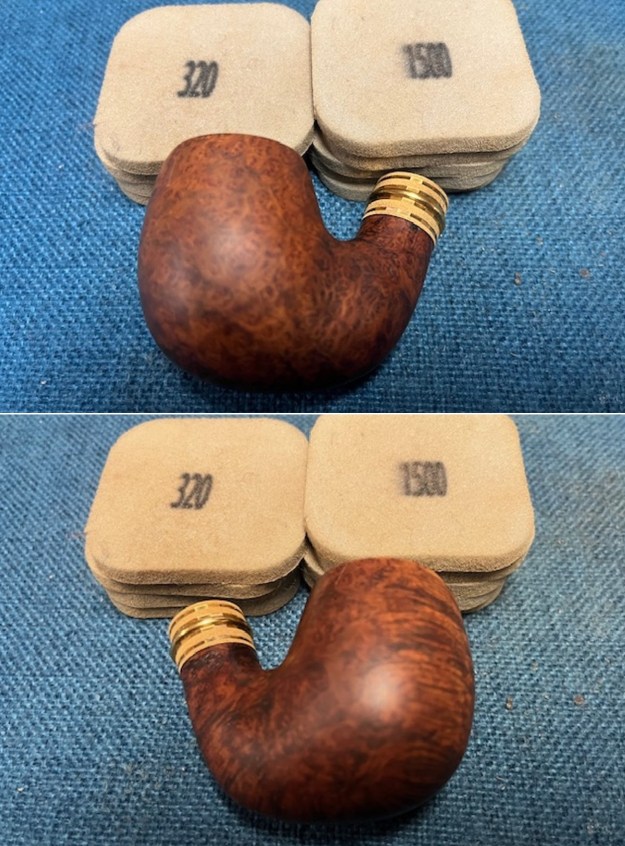
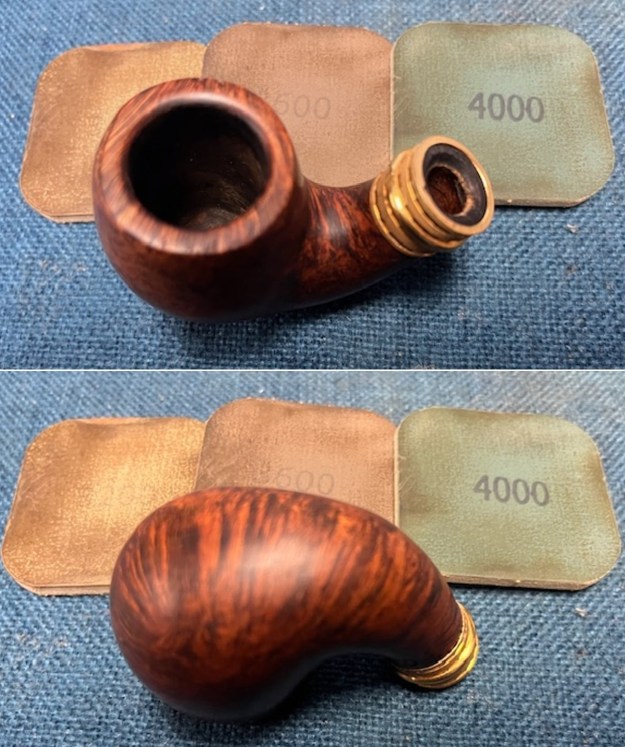
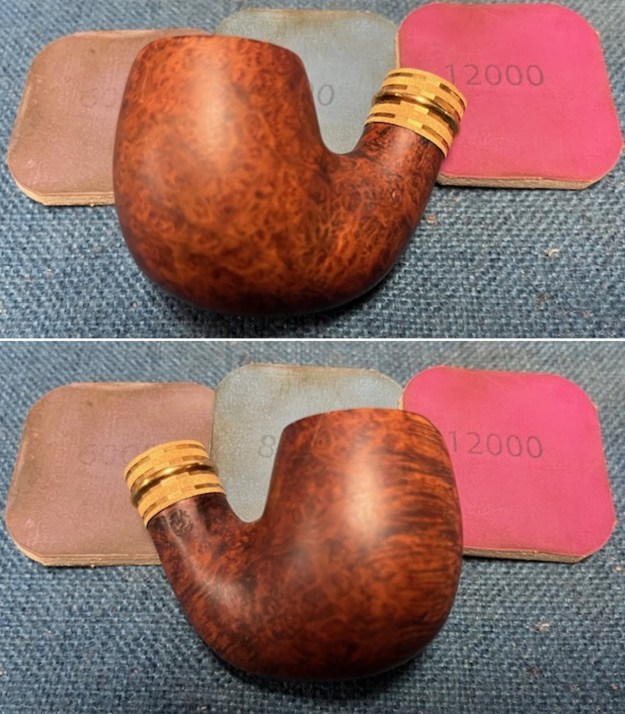
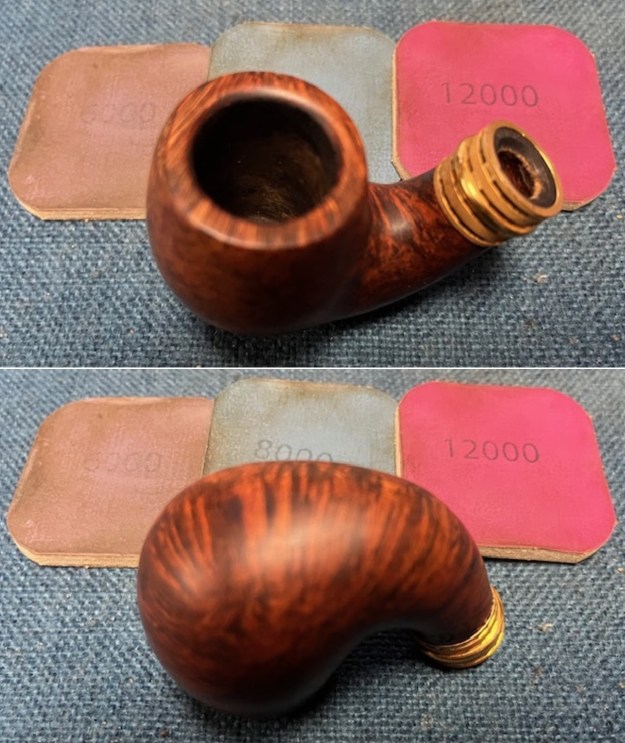
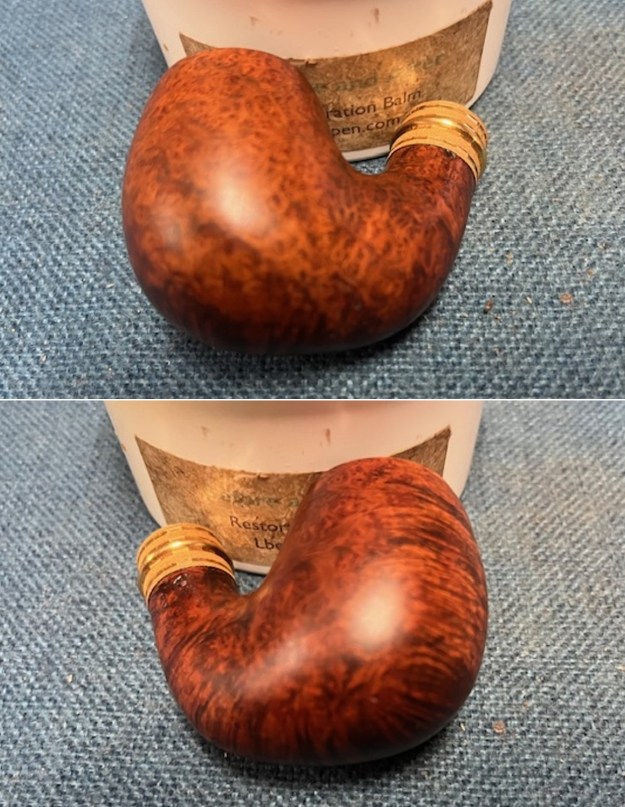
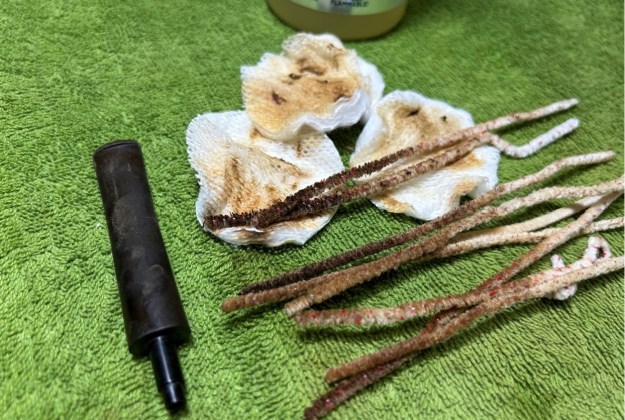
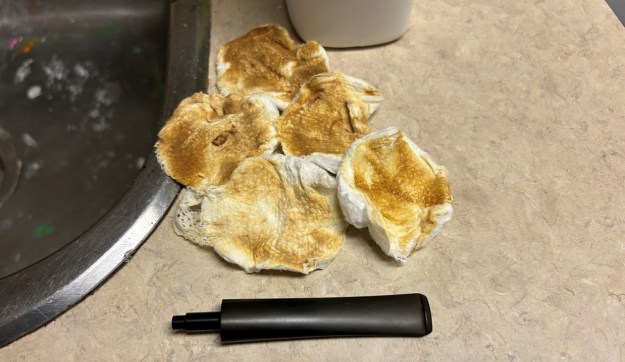
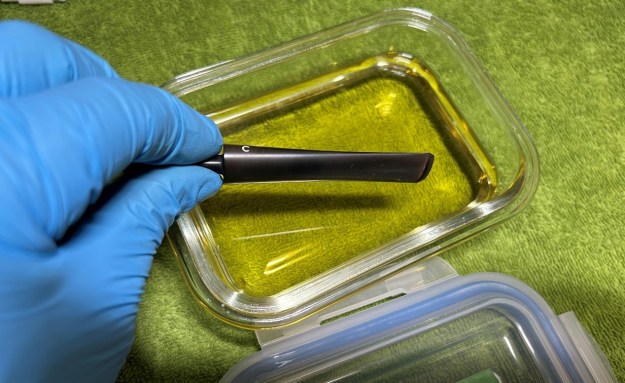
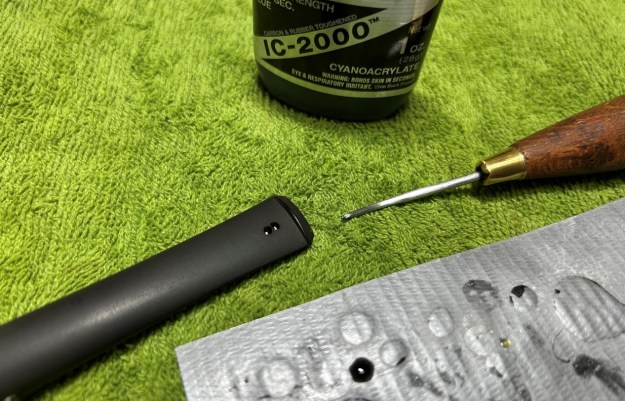
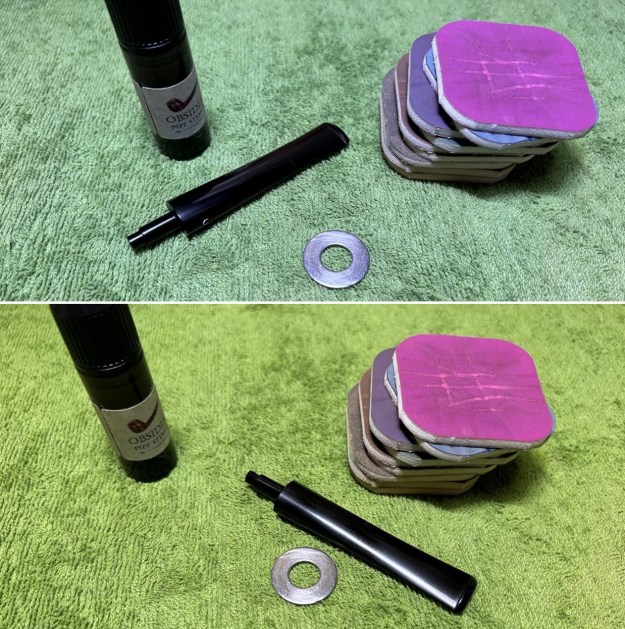
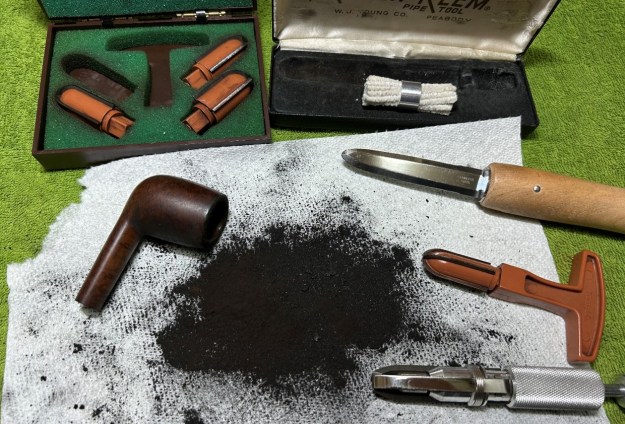
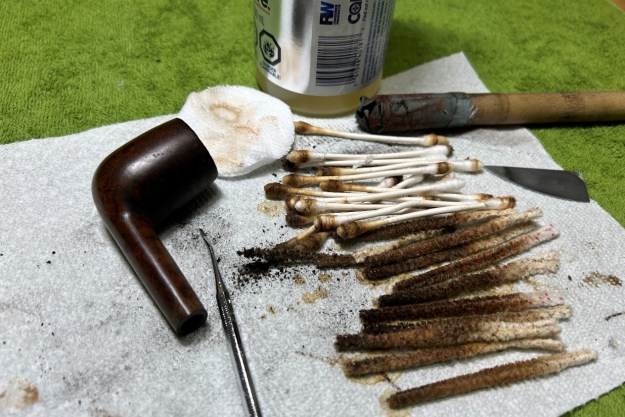
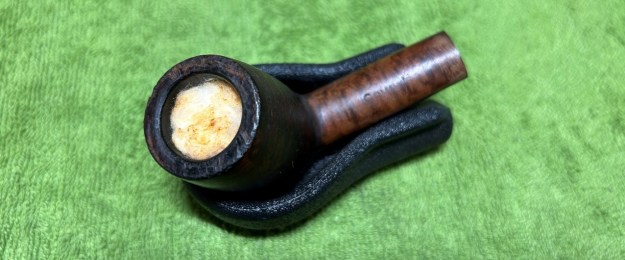
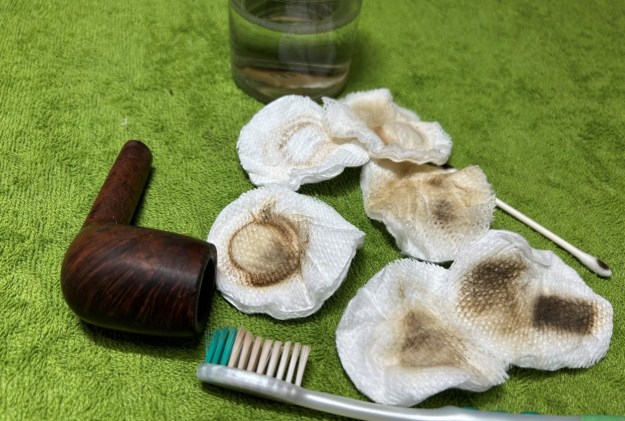
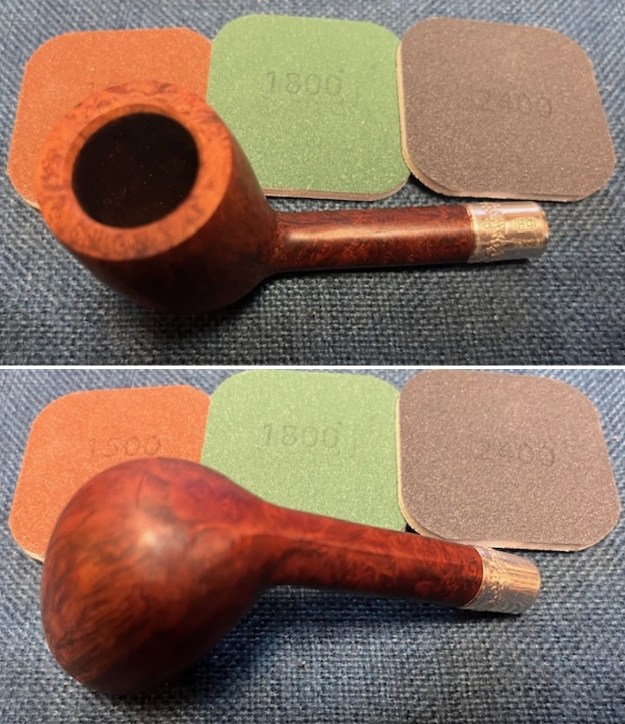
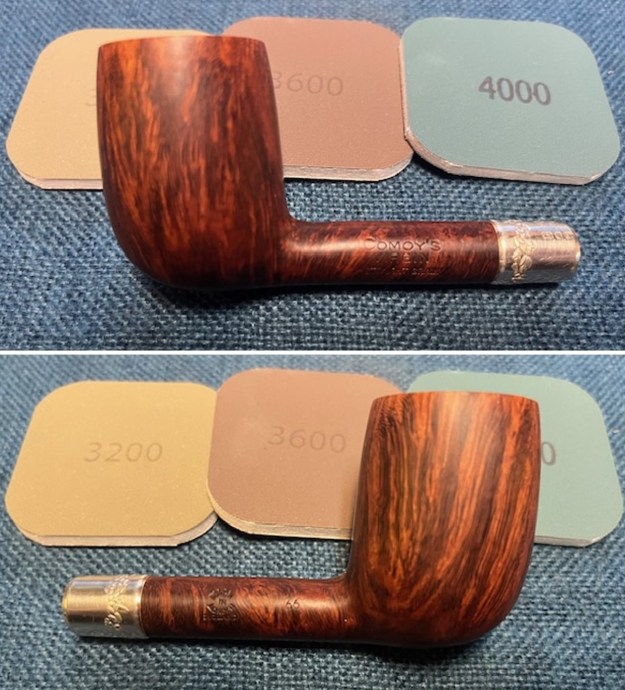
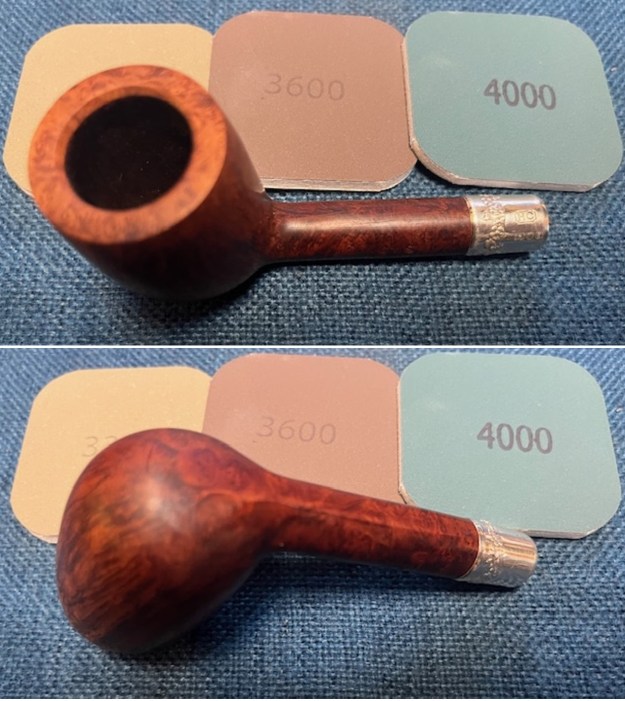
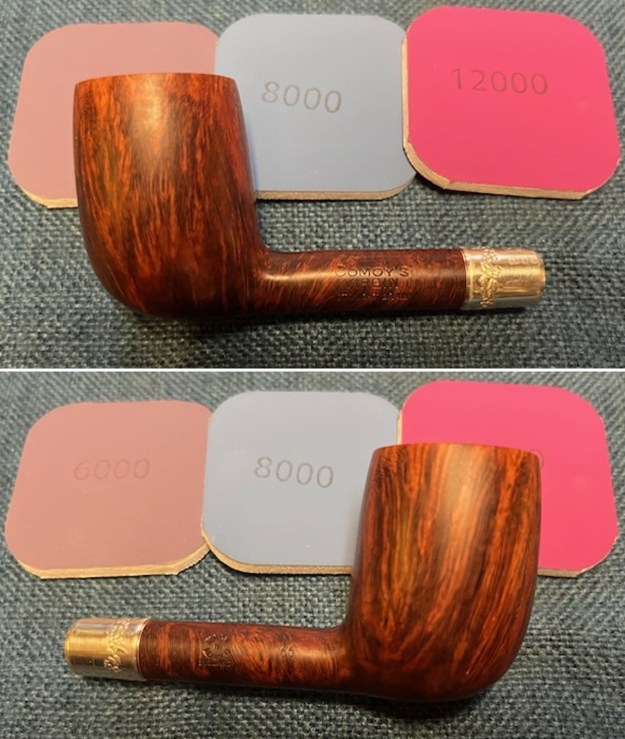
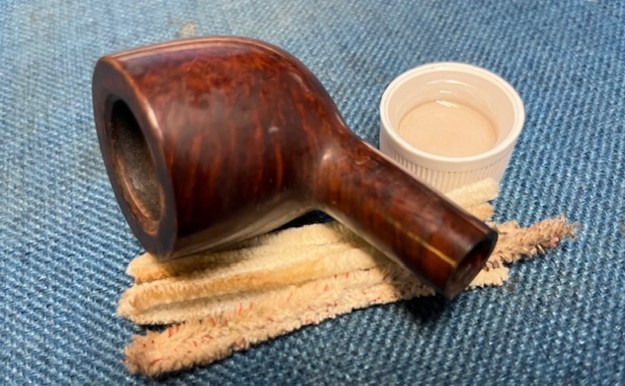
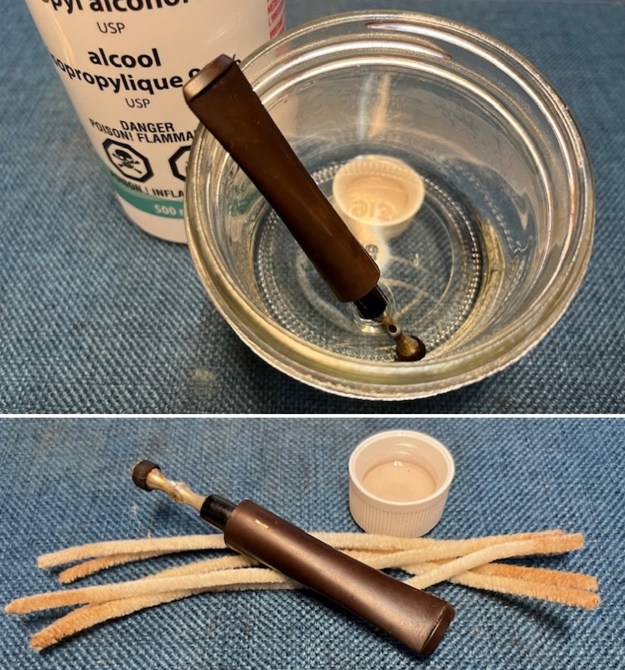
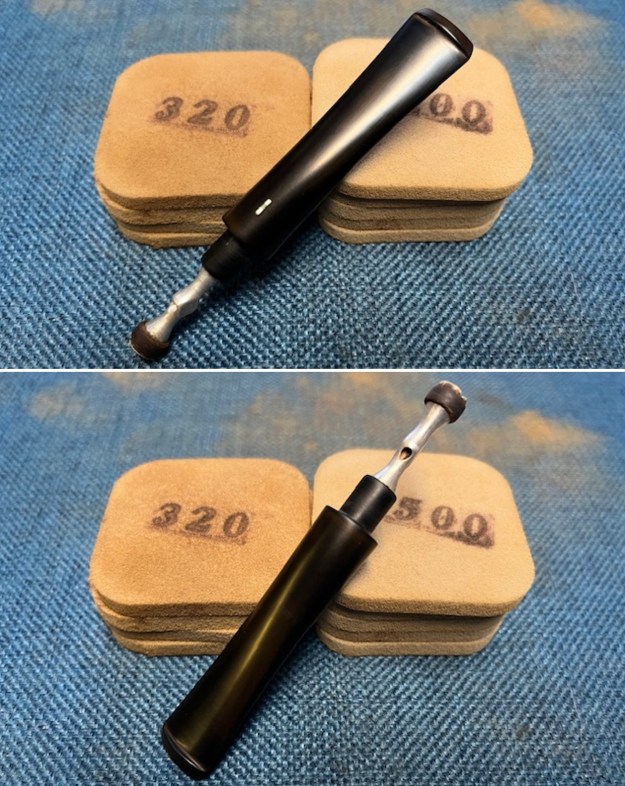
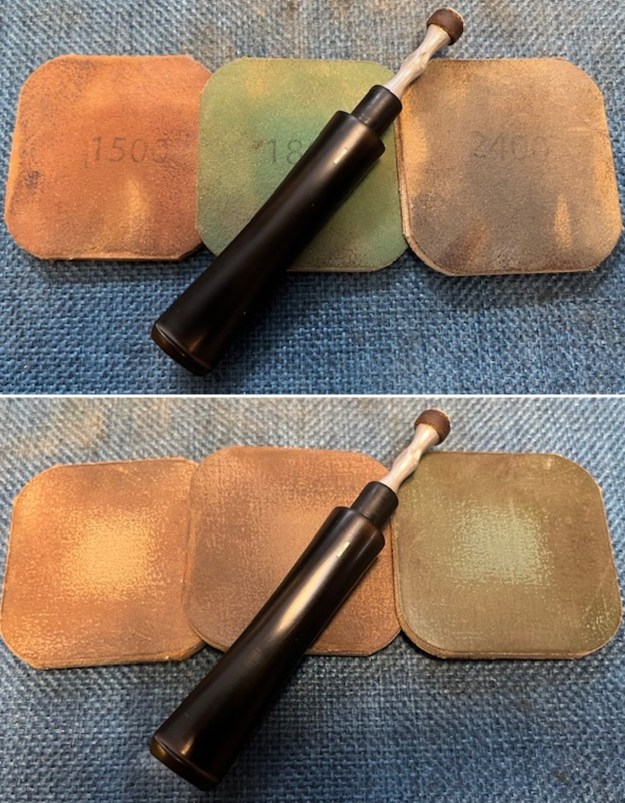
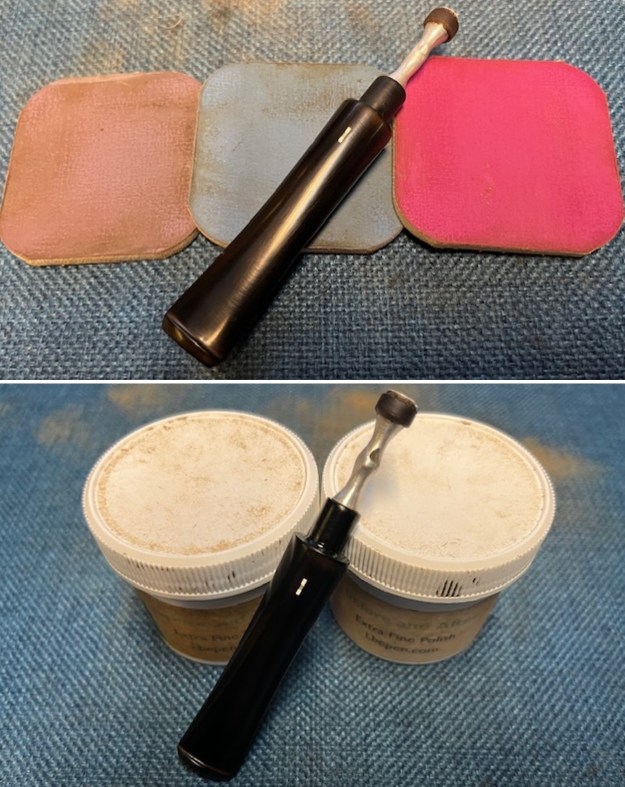
The primary cleaning came next. I disinfected the inside of the stem with both pipe cleaners and cotton swabs dipped in lemon-infused 99% isopropyl alcohol. I scrubbed thoroughly to make sure the interior was very clean. Boy, was it dirty! I used many pipe cleaners and cotton swabs.The goal of the next step is the removal (or minimization) of oxidation. Going to my sink, I used cream cleanser, cotton rounds, and a toothbrush, and scoured the stem to remove as much surface oxidation as possible. As the photos show, the result was a hideous, brownish mess – but better off the stem than on it.Once the stem was reasonably clean, I soaked it overnight in some Briarville Stem Oxidation Remover. This solution works to draw oxidation in the stem to the surface of the vulcanite. This is a major aid and an important step in ensuring a clean stem. The following day, I drew out the stem from its bath and scrubbed the lingering fluid with a toothbrush. Due to the severity of the oxidation, I then repeated the scrubbing with the cream cleanser for maximum effect.As the stem was now clean and dry, I set about fixing the marks and dents in the vulcanite. This was done by filling those divots with black cyanoacrylate adhesive, impregnated with carbon and rubber. I left this to cure and moved on.The penultimate step for the stem is sanding. First, with my set of needle files, I reduced the bulk of the cyanoacrylate repairs. I removed the excess adhesive as near to the surface as possible, without cutting into the vulcanite. Following that, I used all nine of the micromesh sanding pads (1,500 through 12,000 grit) to sand out flaws, even out the vulcanite, and provide gentle polishing of the finished surface. I also applied pipe-stem oil while using the last five micromesh pads. There was a wonderful, deep black shine to the stem when I was done.As the stem was (nearly) complete, I moved on to the stummel. The first step was to ream out the bowl – that is to say, remove all the cake inside the bowl. This accomplished a couple of things. First (and most obviously), it cleaned the bowl and provided a refurbished chamber for future smoking. Second, when the old cake was removed, I could inspect the interior walls of the bowl and determine if there was damage or not. I used a couple of reamers, a pipe knife, and a piece of sandpaper taped to a wooden dowel. Collectively, these ensured that all the debris was removed. Humorously, the cake in the bowl was so hard, that I actually got a blister on my hand from cranking the reamer.My next step was to remove the lava on the rim. For this, I took a piece of machine steel and gently scraped the lava away. The metal’s edge is sharp enough to remove what I need, but not so sharp that it damages the rim. This work revealed that there was some notably burn marks and a few more nicks. Too bad, but no problem to restore. Similar to the stem, I then cleaned the stummel with both pipe cleaners and cotton swabs dipped in lemon-infused 99% isopropyl alcohol. With a pipe this dirty, it took quite a while and much cotton to get clean. Oh, it was so filthy! The previous owner must never have heard of pipe cleaners.I then decided to ‘de-ghost’ the pipe – that is to say, exorcize the remaining filth from the briar. I filled the bowl and the shank with cotton balls, then saturated them with 99% isopropyl alcohol. I let the stummel sit overnight. This caused the remaining oils, tars and smells to leach out into the cotton.To tidy up the briar, I wiped down the outside, using a solution of a pH-neutral detergent and distilled water, with cotton rounds. This did a good job of cleaning any latent dirt on the surface of the briar. However, it also revealed a mild burn on the underside of the bowl. We’ll come back to that in a moment.The last step of the cleaning process was to scour the inside of the stummel with some detergent and tube brushes. This was the culmination of a lot of hard work in getting the pipe clean.To deal with the burn, I took some crystalized oxalic acid and dissolved it in warm water. I used some cotton swaps, dipped in the solution, and rubbed the burned spot vigorously. The weak acid works very nicely to alleviate superficial burns (burns where the integrity of the wood is still sound). The burn is quite superficial and the solution did work a bit, but the burn will remain as part of the pipe’s history.The damage to the rim was significant. In order to lessen the burns and nicks on the rim, I ‘topped’ the pipe – that is to say, I gently and evenly sanded the rim on a piece of 400-grit sandpaper. This effectively minimized the damage, without altering the look of the pipe.I used all nine micromesh pads (1,500 through 12,000 grit) to sand the outside of the stummel and finish it off. This sanding minimizes flaws in the briar and provides a beautiful smoothness to the wood. I rubbed some LBE Before & After Restoration Balm into the briar and let it sit for 30 minutes or so. The balm moisturizes the wood and gives a beautiful depth to the briar. I then buffed the stummel with a microfibre cloth. For the final step, I took the pipe to my bench polisher and carefully buffed it – first with a blue diamond compound, then with three coats of carnauba wax. This procedure makes the pipe look its best – the stummel sings and the stem glows.This Comoy’s Tradition 203 Cutty looks fantastic again and is ready to be enjoyed by its next owner. I am pleased to announce that this pipe is for sale! If you are interested in acquiring it for your collection, please have a look in the ‘British’ pipe section of the store here on Steve’s website. You can also email me directly at kenneth@knightsofthepipe.com. The approximate dimensions of the pipe are as follows: length 5⅞ in. (150 mm); height 1¾ in. (46 mm); bowl diameter 1¼ in. (32 mm); chamber diameter ¾ in. (19 mm). The weight of the pipe is 1 oz. (32 g). I hope you enjoyed reading the story of this pipe’s restoration as much as I did restoring it. If you are interested in more of my work, please follow me here on Steve’s website or send me an email. Thank you very much for reading and, as always, I welcome and encourage your comments.

Restoring a 1979 Comoy’s Virgin Straight Grain 66 Large Liverpool with a silver band


by Steve Laug

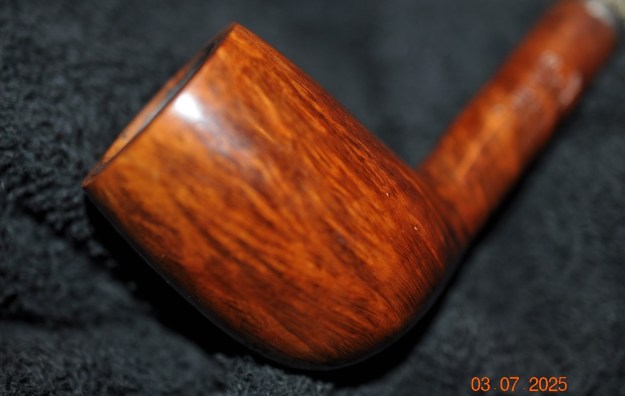
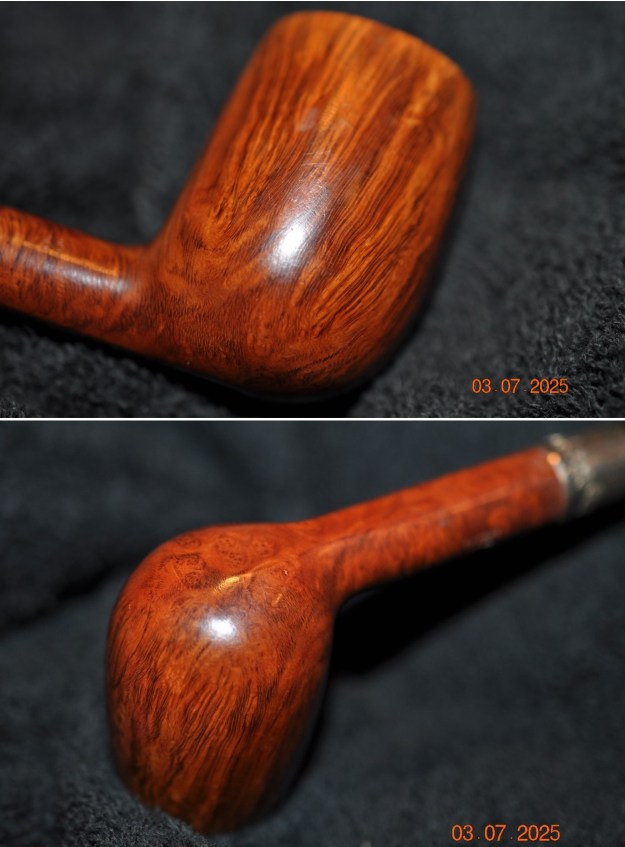
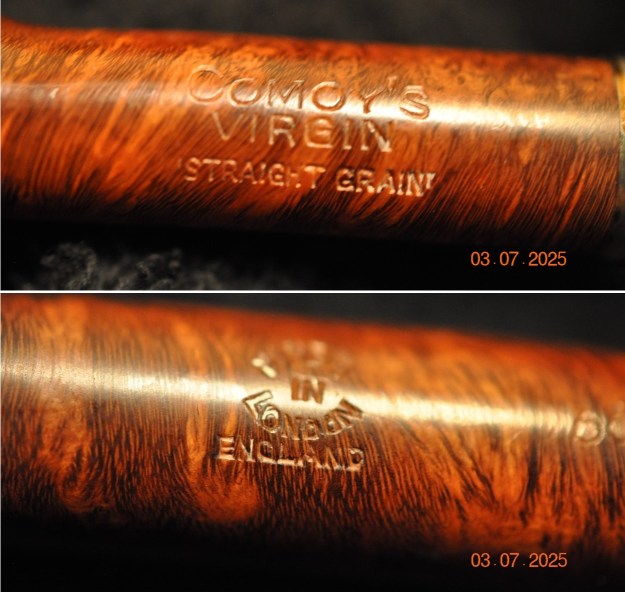
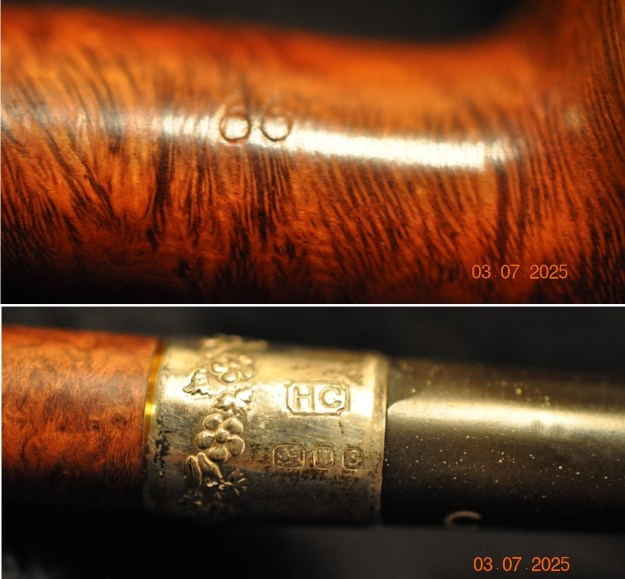
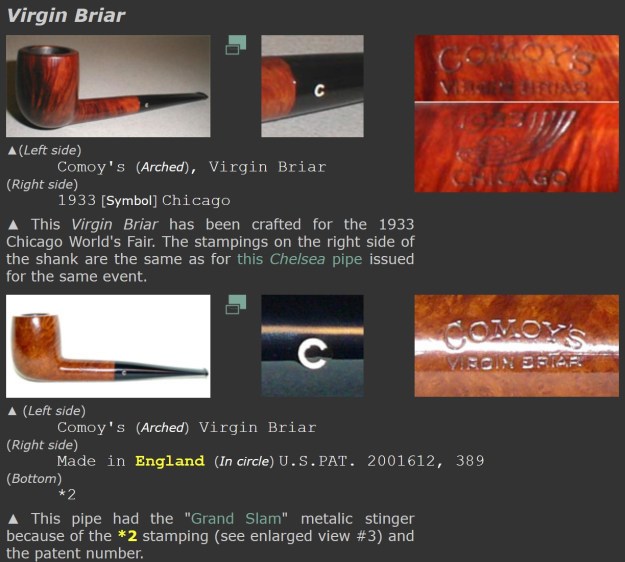
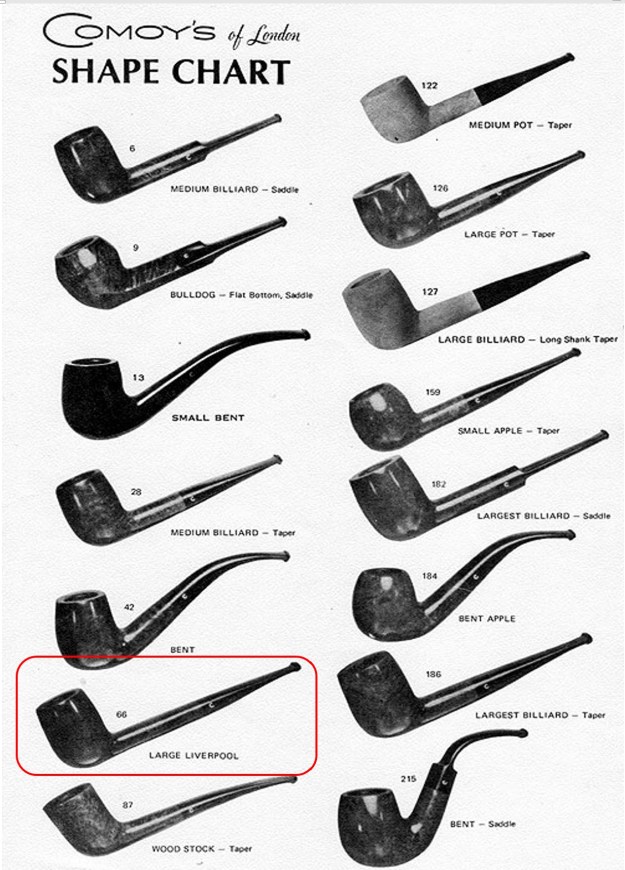
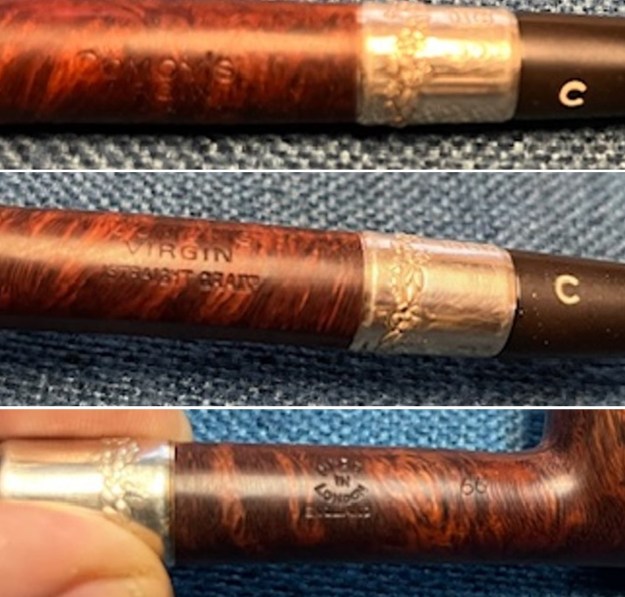
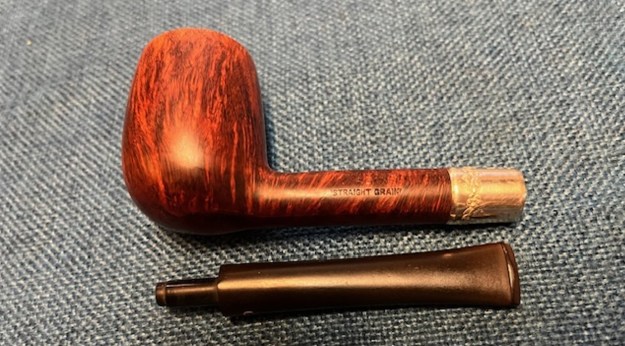
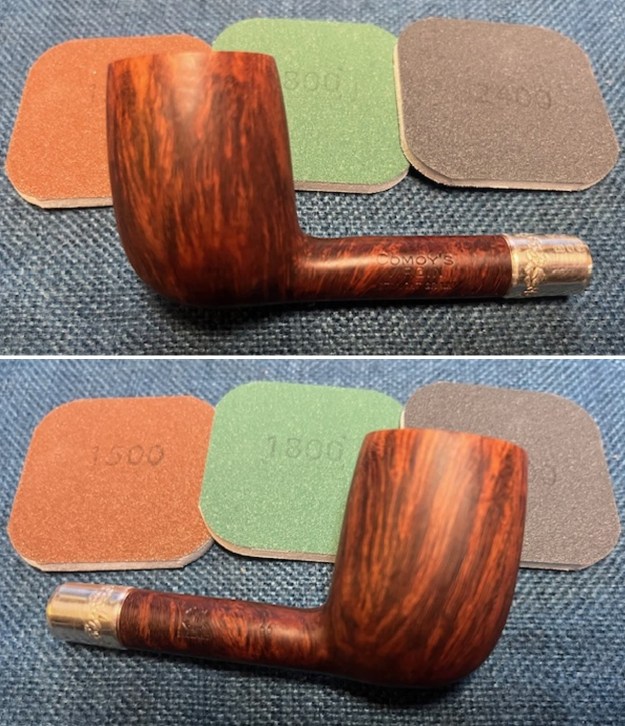
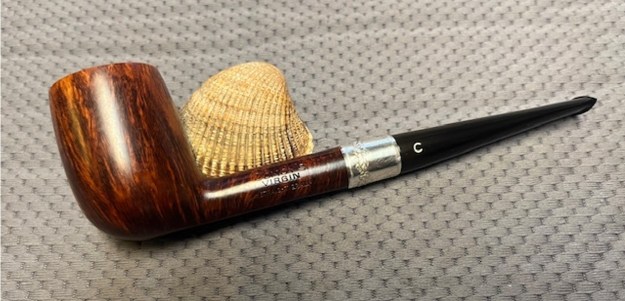
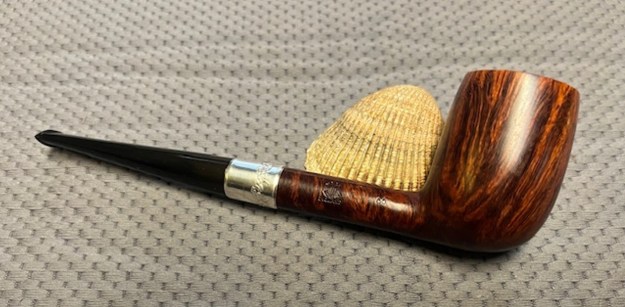
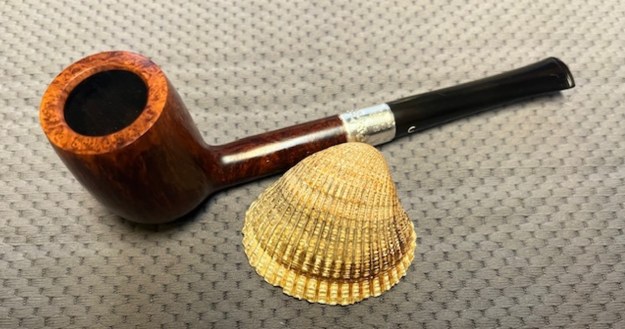
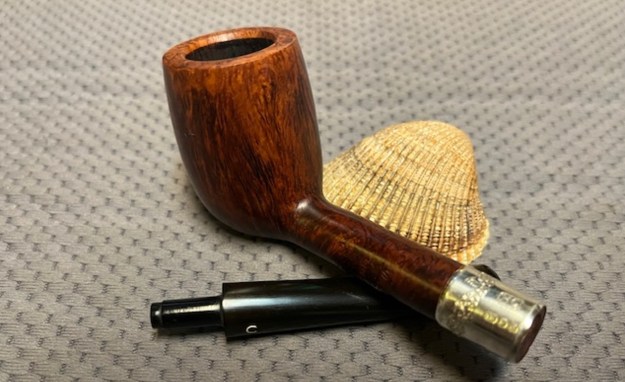
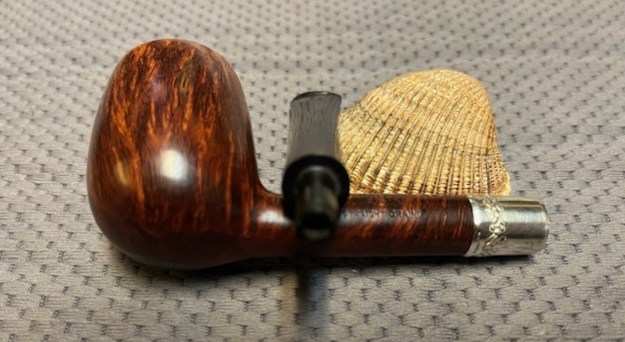
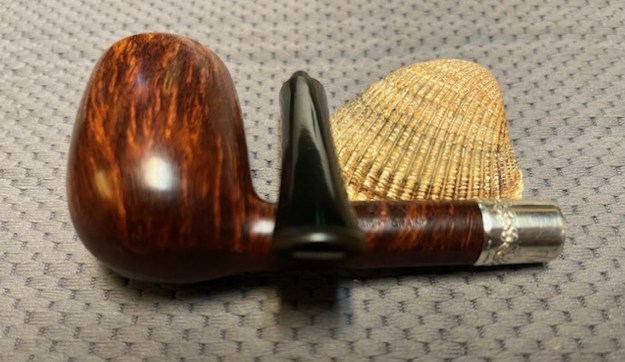
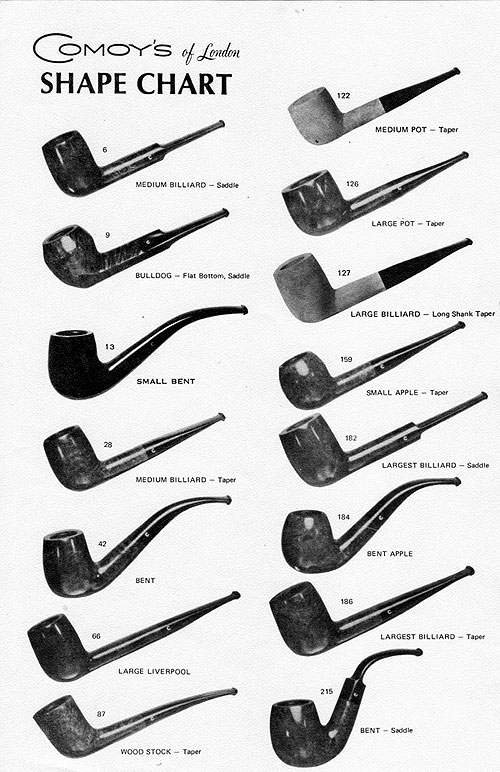
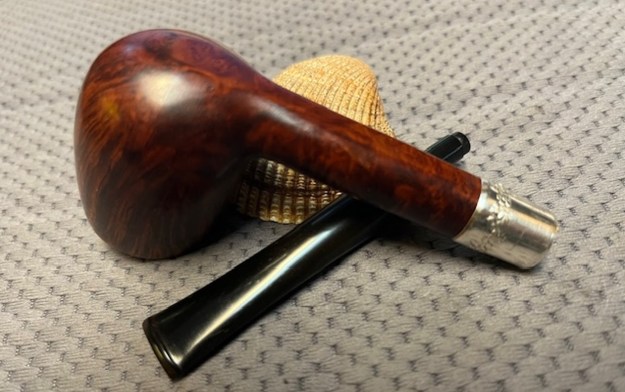
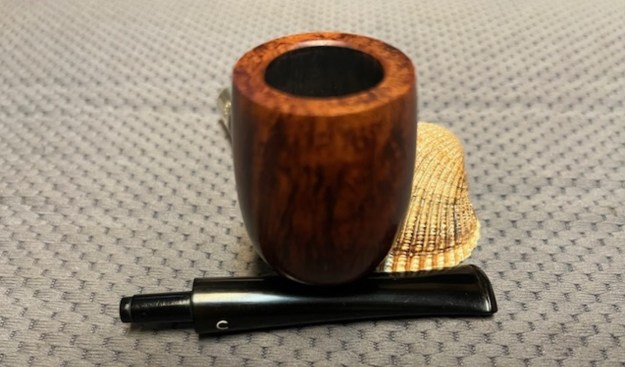
The next pipe on the table is one that we picked up in the lot from a good friend in Barrington, Rhode Island, USA on 08/22/2024. The smooth finish on this English made pipe and the Comoy’s stamping are what caught our eye. It is stamped on the left side of the shank and reads Comoy’s [over] Virgin [over] Straight Grain. On the right side it is Made in London in a circle [over] England. It is stamped with the shape number 66 near the bowl shank joint. There is an uppercase G on the underside of the shank ahead of the silver band. It has a classic Walnut Brown stain on the smooth finish that is a stark contrast to ornate silver band and vulcanite stem. The silver band gives the shank a length that added to the taper stem makes for a Liverpool shaped pipe. The bowl was lightly caked, though it also seems to have been recently reamed. The inner edge and the top look good though there is some darkening and some spots of lava on the top. The stem was lightly oxidized and had tooth chatter on both sides ahead of the button. The Comoy’s C logo looks to be one piece and was inset on the left side of the stem and looks to be in good condition. Jeff took some photos of the pipe to show the general condition of the pipe before he started his clean up. He took some photos of the rim top and bowl from various angles to give me a clear picture of the condition of the rim top and bowl. It is quite clean and the inside of the bowl is lightly caked. He included photos that show the top and underside of the stem. It is as described above. Jeff took some photos of the sides and heel of the bowl to show the condition of the finish on the pipe. The photos showed some great grain around the bowl and shank even with the grime in the finish. It is a great looking piece of briar. He took photos of the stamping on the sides of the shank. It was clear and readable as noted above. He did not capture a photo of the G stamp on the underside of the shank. He also captured the stamping on the silver band on the shank end. It is also clear. The silver is hallmarked which should help with dating this pipe. I looked on Pipephil’s site for information on the Comoy’s Virgin Straight Grain line and found the following information on pipes stamped Virgin Briar. I have included a screen capture below (http://www.pipephil.eu/logos/en/logo-comoy.html). It is interesting that the Virgin Briar originally came out in 1933 and by 1965 was no longer listed in the Comoy’s catalogues. It is different from the one I have as it is not stamped Virgin Briar and the Comoy’s is not arched but the C on the stem is similar in terms of thinness.I also went to the the Comoy’s article on Pipedia and found nothing in the great historical article that was pertinent. I did find a shape chart that listed the 66 as a Large Liverpool. I have included a screen capture of the page that included that shape number. I have outlined it in red in the photo included below(https://pipedia.org/images/d/d7/Shape_Chart_1975_1.jpg).I turned to the article on Pipedia about dating Comoy’s pipes but the style of the stamping (https://pipedia.org/index.php?title=Comoy%27s_Dating_Guide#1917_to_the_end_of_the_1930.27s_.28at_least_1938.29). I have included the section in the screen capture below that date this pipe to the 1930s.
From the 1950s – Now the Comoy’s stamp can be found in three variants:

  1. A simple block-letter style without serifs but with the C larger than the other letters and the apostrophe before the “S”.
  2. A return to the slightly more fancy block letters with serifs and the apostrophe. (It seems that some grades carried different stamps, or at least that the stamping changed in different years for some grades.)
  3. A simple block-letter style without serifs and without the apostrophe and with the “C” the same size as the rest of the letters. This stamp was probably not used very long.
  4. A simple block-letter style without serifs but with the apostrophe before the “S” and with the “C” the same size as the rest of the letter

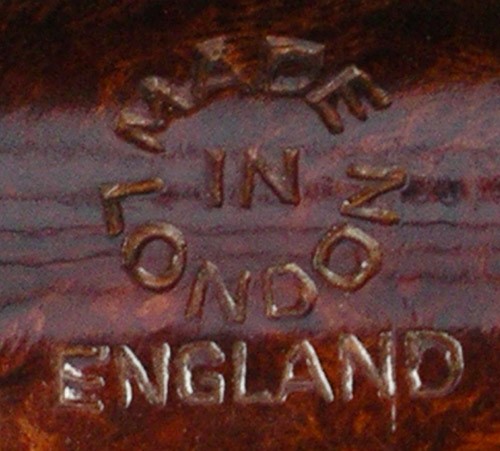
Made in London England

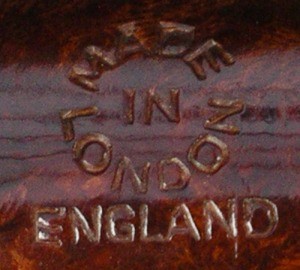
Appears in two versions. This is again stamped in a circle with “MADE” at the top, “IN” in the middle, and “LONDON” at the bottom, with “ENGLAND” in a straight line beneath. It can be assumed that this stamp was first used in the export drive in the early 1950s. On a Bulldog Sandblast from the early 50s the Comoy name no. 2 above was used together with “MADE IN LONDON” over “ENGLAND”. There are no known examples of pre-WW II Comoy’s stamped in this way. The second version is the same as above but in a “rugby ball ” shape. This shape is verified on Comoy´s “Extraordinaire” pipes.

 That article gave me some helpful information. I knew that the pipe the stamping on the shank of the pipe dated as post 1950. The 1950s stamping of the Comoy’s stamp was as noted above. The 66 shape number was tied to a Large Liverpool with a taper stem. I still needed to check on the Silver hallmarks but so far I had some progress.

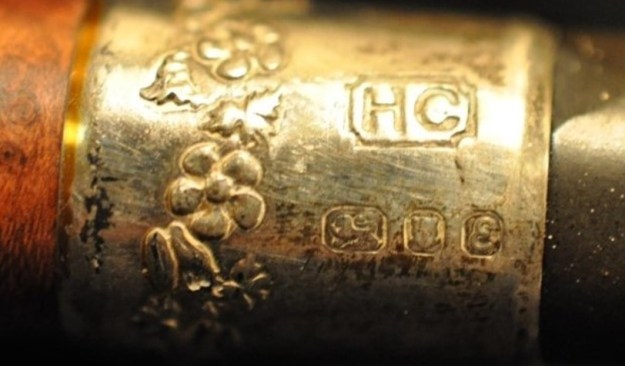
Now to look at the silver hallmarks. The hallmarking system in England comprises a series of symbols and numbers, including letters, numbers, and symbols that indicate the silver’s purity, the date of manufacture, and the location where the item was hallmarked. Each hallmark includes several symbols, such as the maker’s mark, standard mark, assay office mark, and date letter. The first on this silver band is the Rampant Lion which signifies the quality of the Sterling Silver in the band. The second is a leopard’s head which signifies the city of London, England as the location of the assay office. The third hallmark is the letter E in an italicized cursive style script that helps establish the date of the silver. The HC in the box above the hallmarks is the silversmith’s initials and in this case are those of Henri Comoy.

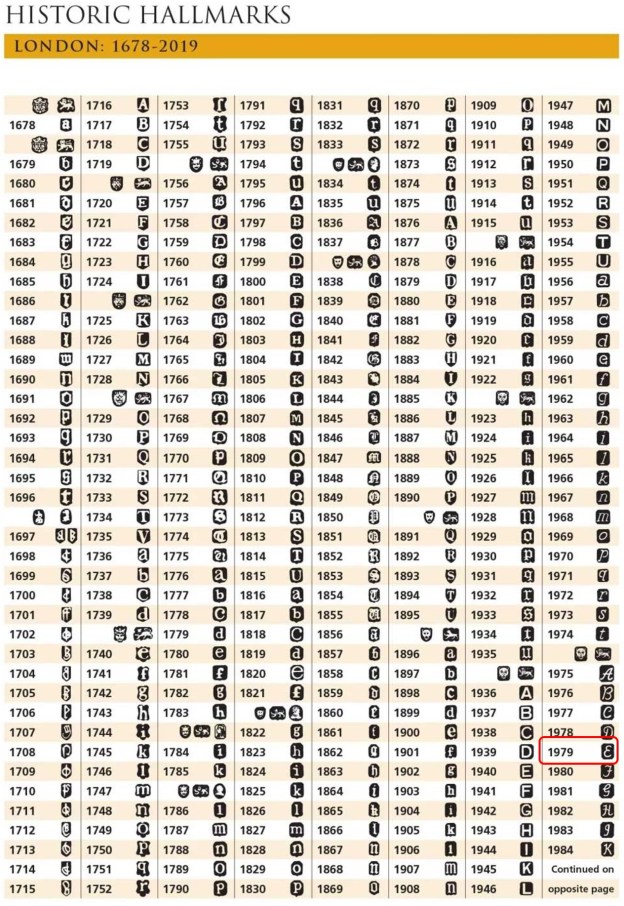
I turned to a blog on Historic Hallmarks – London 1678-2019 to determine the date of this pipe (https://huntvintage.co/blog/how-to-identify-silver-marks). I drew a red box around the date on this one – it is from 1979 as the hallmark matches the style of the E below.Since Jeff always follows the same pattern of work in his cleanup we do not include photos but rather just a simple summary. Jeff reamed the bowl with a PipNet pipe reamer and followed up with a Savinelli Fitsall pipe knife to remove the cake. He scrubbed out the mortise and the airway in the shank and the stem with alcohol, cotton swabs and pipe cleaners. He scrubbed the exterior of the bowl, rim, shank and stem with a tooth brush and Murphy’s Oil Soap to remove the oils and tars on the rim and the grime on the finish of the bowl. He rinsed it under running water. He dried it off with a soft cloth. He was able to remove the lava build up on the rim top and you could see the damages to the top and edges of the rim. I think this pipe may well been before we worked with Mark Hoover’s Before & After Deoxidizer so he cleaned the internals and externals. The stem was clean but lightly oxidized. I took photos of what the pipe looked like when I brought to my worktable. I took close up photos of the bowl, rim top and stem to show how clean the pipe was. The bowl was clean and the rim top and the inner edge look beautiful. The stem was clean and the tooth marks on the topside are visible. The chatter is light and hardly visible.I took photos of the stamping on the sides of the shank. It is very clear and readable and read as noted above. I also removed the stem from the shank and took photos of the pipe to show the look of the parts.I polished the bowl and shank with 1500-12000 grit micromesh sanding pad – dry sanding it with the pads. I wiped the bowl down with a damp cloth after each pad. It began to take on a deep shine. The exterior of the bowl look better after sanding. I worked some Before & After Restoration Balm into the briar with my finger tips. I let it sit on the bowl for 10 minutes and then buffed it off with a paper towel and soft cloth. The product is a great addition to the restoration work. It enlivens, enriches and protects the briar while giving it a deep glow. It is a product I use on every pipe I restore. I polished the silver band with a jeweller’s cloth to remove the tarnish and protect the silver from further tarnishing. It really took on a rich shine. I set the bowl aside and turned to the stem. I sanded the it with 320-3500 grit sanding pads and wiped the stem down after each pad with some Obsidian Oil on a cloth. The shine is coming back beautifully.I polished it with micromesh sanding pads – dry sanding with 1500-12000 grit pads and wiping the surface down with Obsidian Oil after each sanding pad. It is really shining. I polished it further with Before & After Stem Polish – both Fine and Extra Fine. I gave it another coat of Obsidian Oil to finish this step. This Comoy’s Virgin Straight Grain 66 Liverpool with a vulcanite taper stem is a great looking pipe now that it has been restored. The beautifully grained finish really works well with the shape and the polished finish is stunning. I put the stem back on the bowl and carefully buffed the bowl and the stem with Blue Diamond on the buffing wheel. I gave the bowl and the stem multiple coats of carnauba wax on the buffing wheel and followed that by buffing the entire pipe with a clean buffing pad. I hand buffed the pipe with a microfiber cloth to deepen the shine. I wiped down the Sterling Silver band with a jeweller’s cloth to protect and polish it. The finished 1979 Comoy’s Virgin Straight Grain Liverpool fits nicely in the hand and feels great. Give the finished pipe a look in the photos below. The dimensions of the pipe are Length: 6 inches, Height: 1 ¾ inches, Outside diameter of the bowl: 1 ¼ inches, Chamber diameter: ¾ of an inch. The weight of the pipe is 36 grams /1.23 ounces. I will be putting it on the rebornpipes store in the British Pipe Makers Section shortly. Let me know via email or a message if you are interested in adding this pipe to your collection.

As always, I encourage your questions and comments as you read the blog. Thanks to each of you who are reading this blog. Remember we are not pipe owners; we are pipe men and women who hold our pipes in trust until they pass on into the trust of those who follow us.
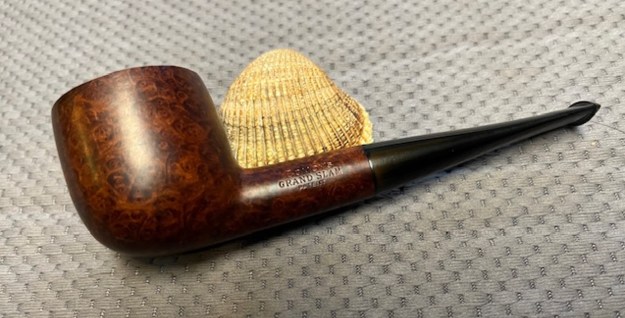
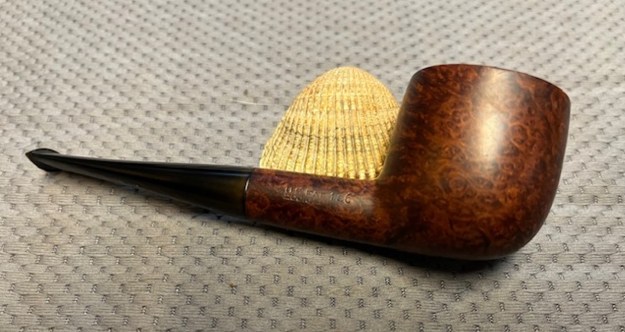
The last of the threesome – an older Comoy’ Grand Slam 126 Pot


By Steve Laug

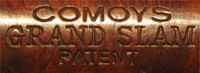
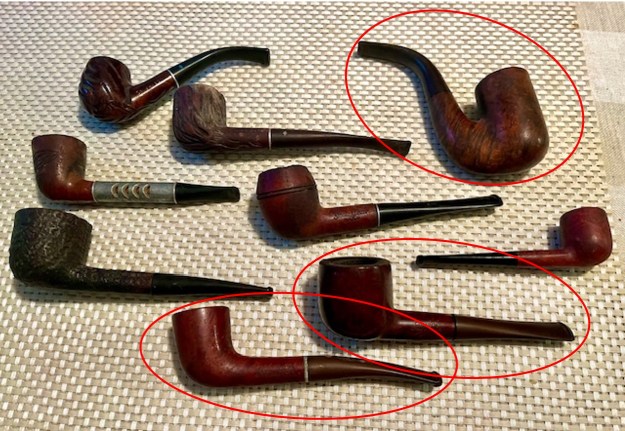
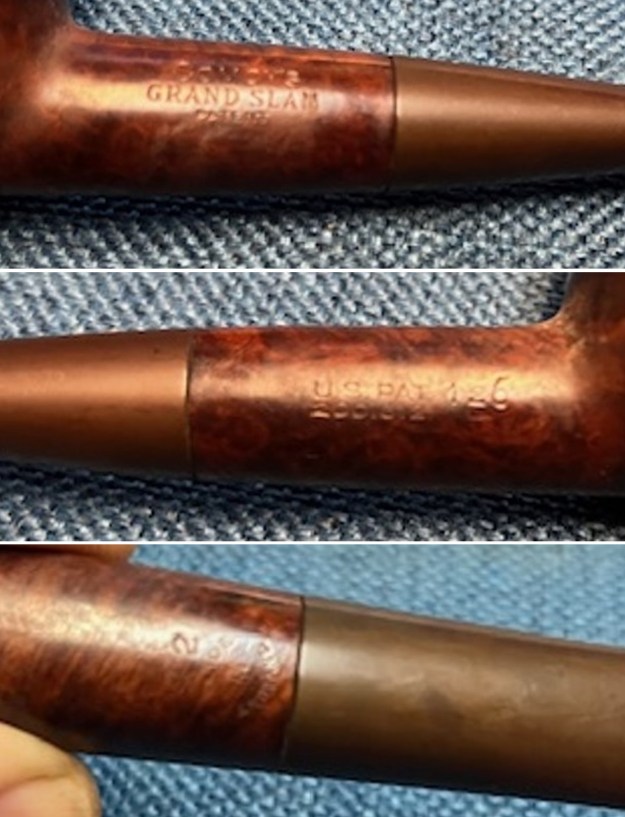
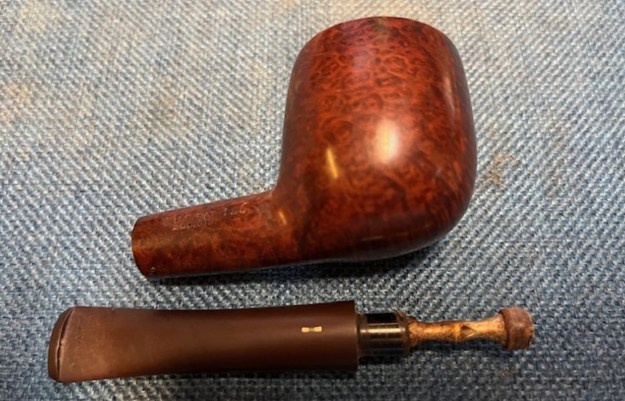
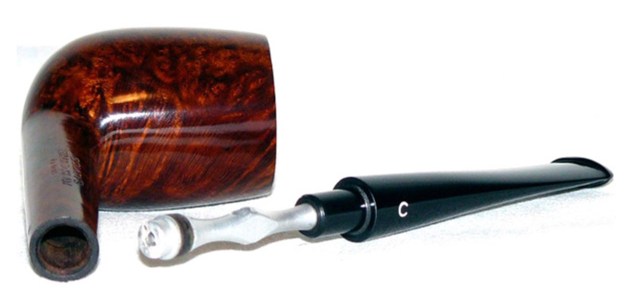
The next pipe on the table is one of three that was dropped off at my house on Saturday for clean up and restoration. Robert stopped by with a bag of pipes that his brother had picked up for him while hunting for pipes in New York. The lot included a Medico Ventilator, a couple of Grabows, a small salesman’s pipe, a Smokemaster, an unmarked sandblast pot, an Oom Paul Natural Grain Algerian Briar France, a Comoy’s Grand Slam Patent Pot, and an interesting KBB Yello-Bole Zulu/Yacht with a unique biteproof stem. We went through the lot and chose the three pipes that he wanted to work on. I have circled them in the photo below.All I had left to work on was the Comoy’s and I was looking forward to it. The finish was very dirty but the amazing grain could not be hidden by the grime. The pipe is stamped on the left side and reads Comoy’s [over] Grand Slam [over] Patent. On the right side of the shank it is stamped US Pat. [over] 2001612 followed by the shape number 126. On the underside of the shank was the Made in England in a Rugby ball shape. Above that the number *2 was stamped which gave the size of the leather washers on the metal apparatus in the shank. The bowl had a moderate cake on the walls with a light lava overflow and darkening on the rim top and edges. The finish was dirty but there was no varnish coat on the pipe. It had a vulcanite push stem with the Grand Slam metal apparatus in the tenon. The stem was oxidized but otherwise quite clean. The top of the taper stem had an inset white line – white on each end of the line and a turquoise space between them. I took some photos of the pipe before I started my clean up work. The photos of the rim top show the cake in the bowl, the light lava build up and the darkening on the bevelled inner edge of the bowl. The photos of the stem show the deep oxidation on both sides. It is an older narrow style straight stem with no flair at the button end.The next series of photos show the stamping on the shank sides. The stamping is clear and readable as noted above. I removed the stem from the shank and took a photo of the parts of the pipe. There Comoy’s Grand Slam apparatus is shown in the third photo. The pipe looks quite beautiful. I have worked on quite a few Comoy’s Grand Slam pipes in the past and knew they had a unique stinger apparatus. Some came with and some without the leather washers in place on the apparatus. Some of them have been Patent pipes like this one. I turned to a link to one of the Grand Slams I had restored and reread it (https://rebornpipes.com/2020/09/05/a-tale-of-the-rebirth-of-3-pipes-pipe-3-a-comoys-grand-slam-pipe-484b-billiard/). Parts of the history I included there were really helpful. I have included some of the information here as well as some new information.

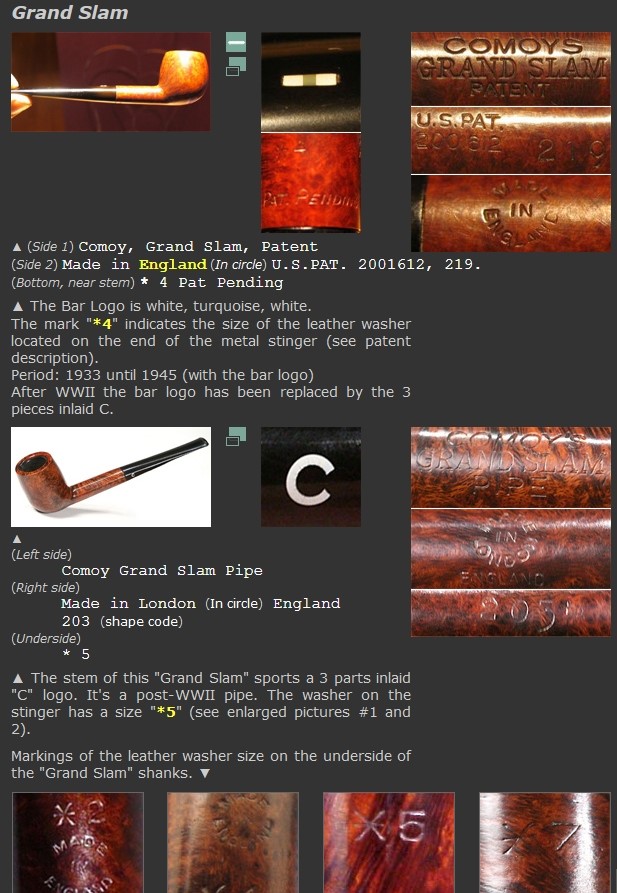
Pipephil’s site had a section on the Comoy’s Grand Slam Pipe and the information was quite helpful (http://www.pipephil.eu/logos/en/logo-comoy.html). I have included a screen capture of the section on the Grand Slam. The pipe I am working on now is like the first one in the screen capture below. It has the original stem with the single bar logo on the stem top like the one in the first photo below. The stamping on the shank is the same as the one I am working on. The US Patent Number in the photo is identical to the one in hand.From that read I learned that because the stem has a Bar Logo – white, turquoise, white it is an older pipe made between 1933 and 1945. After WWII the bar logo was replaced with the 3 part inlaid C. The mark on the underside above the COM stamp is a “2” indicating the size of the leather washer on the end of the metal stinger.

There was a box in the first photo to the right of the photo that took me to another page with the patent information (http://www.pipephil.eu/logos/en/infos/comoy1.html) and some advertising and photos that made the apparatus and washers very clear. I am including those below.

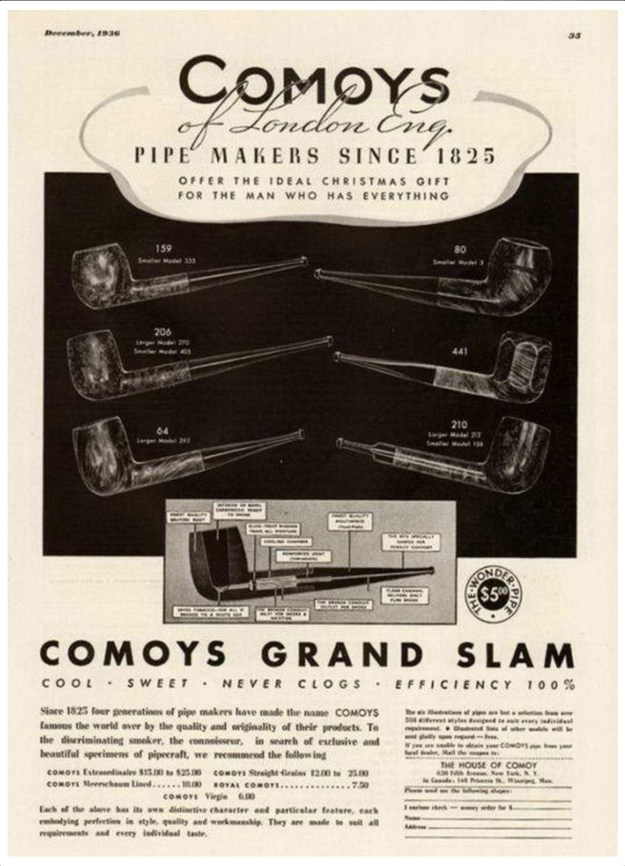
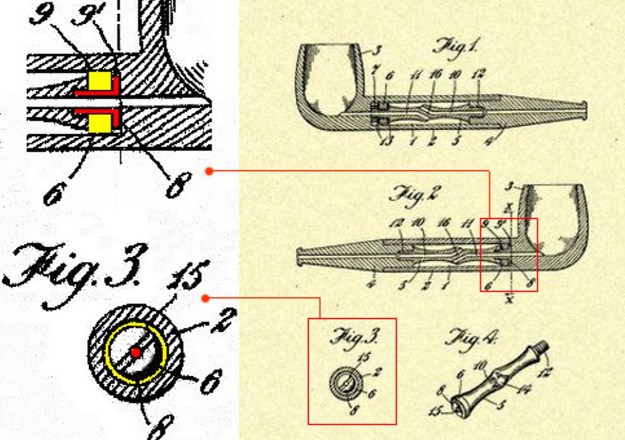
I have included a copy of the Comoy’s 1936 Ad that describes the Grand Slam and the Patented stinger apparatus. The metal filter system forces the air stream through a go-between space before entering the stem and the smokers mouth.I also included the drawings from the original patent document that were on the site. They have been re-colored for Pipephil to illustrate the intention. Numbers 8 and 6 are also shown.

8 (red): hollow screw

6 (yellow): leather washerI also am including the Patent information for the US and Canada. It also includes the name of the inventor Marcel CH Jacquemin.

Patent Number 2001612 (USA)

Patent Number 341422 (Canada)

Inventor: Marcel C. H. Jacquemin (see also: Newhaven)

System patent granted in 1933 (Montreal, Canada)

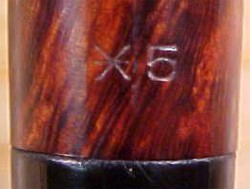
I have also included some photos of the pipe taken apart so you can see the clean and unused apparatus and the stamping of the leather washer size below.Grand Slam pipes have a “*” followed by a number on the underside (*5 in the picture opposite).

The number refers to the size of the leather washer that fits on the end of the stinger.

The pipe I am working on has a *2 that tells me the leather washer size on the pipe is a size 2.

I turned to the article on Pipedia about dating Comoy’s pipes but the style of the stamping (https://pipedia.org/index.php?title=Comoy%27s_Dating_Guide#1917_to_the_end_of_the_1930.27s_.28at_least_1938.29). I have included the section and the screen capture below that date this pipe to the 1950s. I have highlighted the pertinent portions in red.

Now the Comoy’s stamp can be found in three variants in the 1950s

  1. A simple block-letter style without serifs but with the C larger than the other letters and the apostrophe before the “S”.
  2. A return to the slightly more fancy block letters with serifs and the apostrophe. (It seems that some grades carried different stamps, or at least that the stamping changed in different years for some grades.)
  3. A simple block-letter style without serifs and without the apostrophe and with the “C” the same size as the rest of the letters. This stamp was probably not used very long.
  4. A simple block-letter style without serifs but with the apostrophe before the “S” and with the “C” the same size as the rest of the letters.

Made in London England

Appears in two versions. This is again stamped in a circle with “MADE” at the top, “IN” in the middle, and “LONDON” at the bottom, with “ENGLAND” in a straight line beneath. It can be assumed that this stamp was first used in the export drive in the early 1950s. On a Bulldog Sandblast from the early 50s the Comoy name no. 2 above was used together with “MADE IN LONDON” over “ENGLAND”. There are no known examples of pre-WW II Comoy’s stamped in this way. The second version is the same as above but in a “rugby ball ” shape. This shape is verified on Comoy´s “Extraordinaire” pipes.

That article gave me some helpful information regarding the pipe that I was working on. I knew that the stamping and logos identified the pipe as having been made in following WW2 and from what I can see from the above information it is a 1950s era pipe.

Now to work on the pipe itself. I started by reaming it with a PipNet Pipe Reamer. The bowl was large enough that I used the second and third cutting heads. I took the cake back to bare briar. I cleaned up the reaming with a Savinelli Fitsall Pipe Knife. I also scraped off the lava build up on the rim top with the knife. I sanded the bowl walls with 220 grit sandpaper wrapped around a dowel. I took it back to smooth walls. The walls looked very good with no sign of checking or burning. I worked on the rim top with spit and a cotton pad to remove the lava and darkening around the rim top and the bevelled edge of the bowl. It cleaned up quite nicely.I cleaned out the shank, mortise and the airway in the bowl with pipe cleaners (both smooth and bristle), cotton swabs and 99% isopropyl alcohol. I was quite surprised how clean the shank was. While I worked on the bowl and shank I let the stem and apparatus sit in a bath of alcohol to clean up the tars and oils and try to loosen it in the tenon. I removed it and cleaned out the airway in the stem and the stinger with pipe cleaners and alcohol. I wiped down the stinger with a cotton pad and alcohol to remove the tars. The pipe looks much cleaner and also smells fresh now! I set the stem aside and turned my attention to the bowl. I scrubbed the exterior of the bowl with undiluted Murphy’s Oil Soap and a tooth brush. With the grime removed from the briar – both the top and sides of the bowl, it is truly a beautiful piece of briar. I polished the briar with micromesh sanding pads – dry sanding with 1500-12000 grit pads. I wiped it down after each sanding pad with a damp cloth to remove the sanding debris on the surface. I rubbed the bowl down with Before & After Restoration Balm. I worked it into the surface of the briar with my fingertips to clean, enliven and protect it. I let the balm sit for a little while and then buffed with a cotton cloth and shoe brush to raise the shine. I set the bowl aside and turned my attention to the stem. I polished the stem with 320-3500 grit sanding pads. I wiped the stem down after each sanding pad with an Obsidian Oil impregnated cloth. It removes the dust and also gives the sanding pads some bite. By the final pad it was looking quite good. Following my usual process in restoration I polished the stem with micromesh sanding pads – dry sanding with 1500-12000 grit sanding pads. I wiped it down after each sanding pad with Obsidian Oil. I polished it further with Before & After Stem Polish – both Fine and Extra Fine. I gave it a final coat of Obsidian Oil and set it aside to absorb the oil. I rubbed down the leather washer at the end of the aluminum stinger apparatus with a coat of Vaseline. I worked it into the leather and repeated the process. The Comoy’s Grand Slam Patent 126 Pot is finished other than the final waxing and buffing. I polished the bowl and stem with Blue Diamond to polish out the remaining small scratches and gave it several coats of carnauba. I buffed the pipe with a clean buffing pad on the buffer to raise the shine. I hand buffed it with a microfiber cloth to deepen the shine. The pipe polished up pretty nicely. The finished pipe is shown in the photos below. The dimensions are Length: 5 ½ inches, Height: 1 ½ inches, Outside diameter of the bowl: 1 ½ inches, Chamber diameter: 1 inch. The weight of the pipe is 39 grams/1.38 ounces. It is a great looking pipe now that it is restored. It feels great in the hand and as it warms up it as smoked it should be even better. This is the last of Robert’s pipes that I needed to work on so they are ready for him to pick them up. I look forward to hearing what he thinks of it once he has them in hand. If the condition was any indicator it is a good smoker. Thanks for walking through the restoration with me as I worked over this Comoy’s Grand Slam 126 Pot.

Restoring a Comoy’s Consort 1057 Rhodesian with an Acrylic Saddle Stem


Blog by Steve Laug

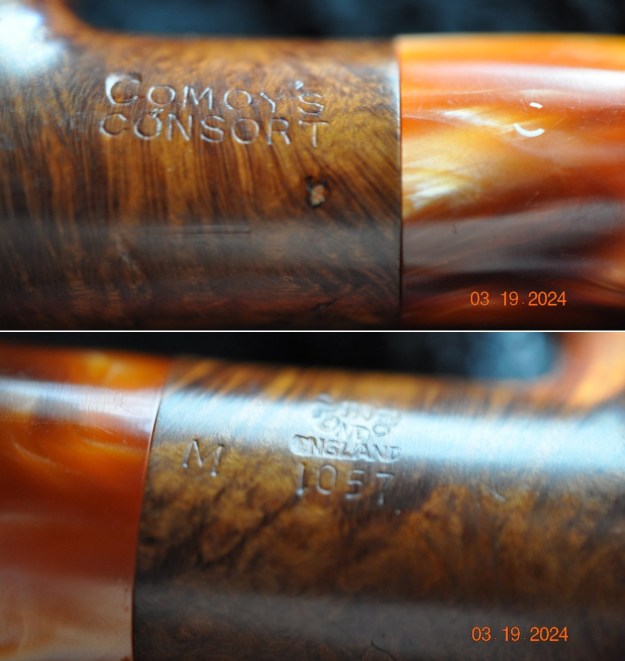
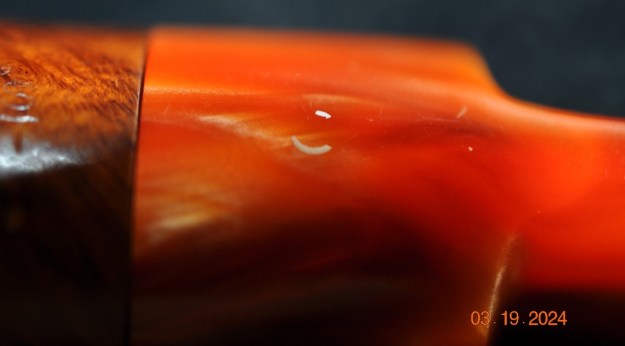
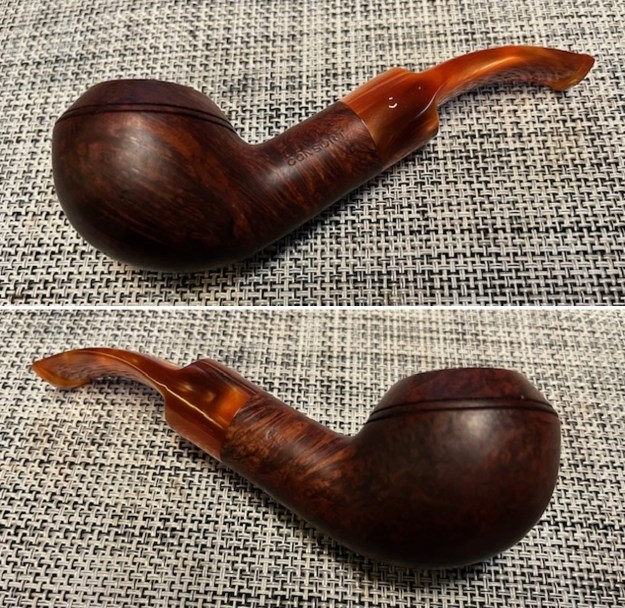
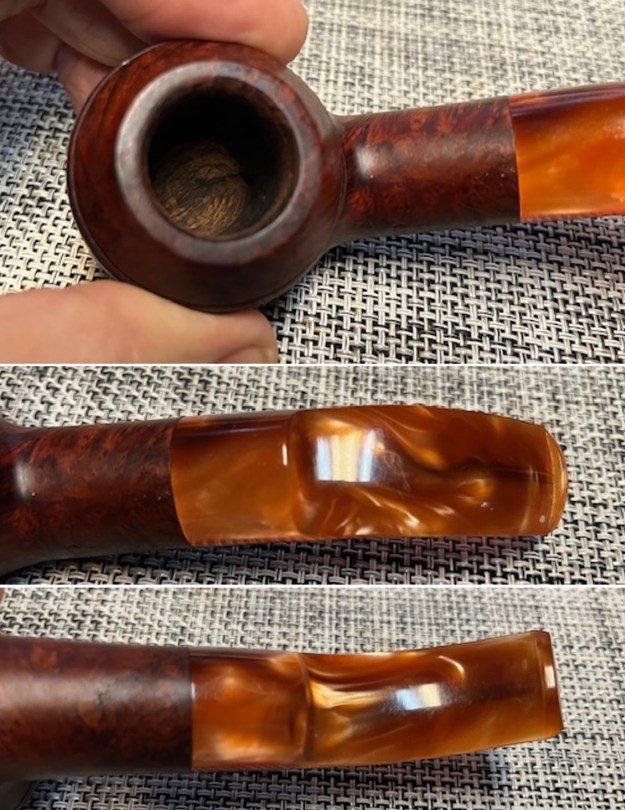
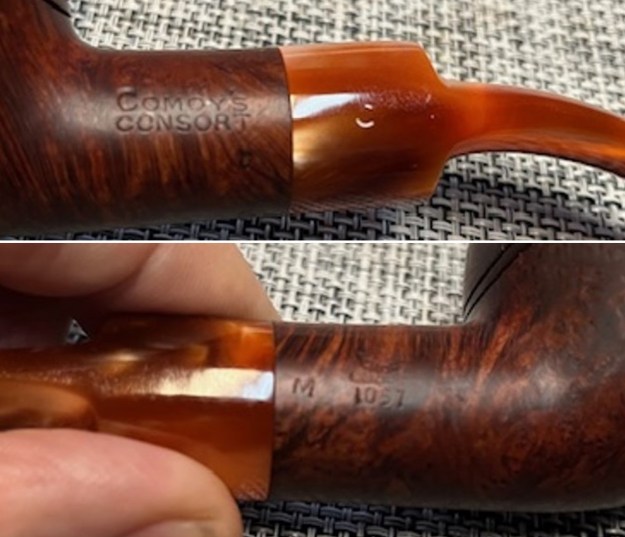
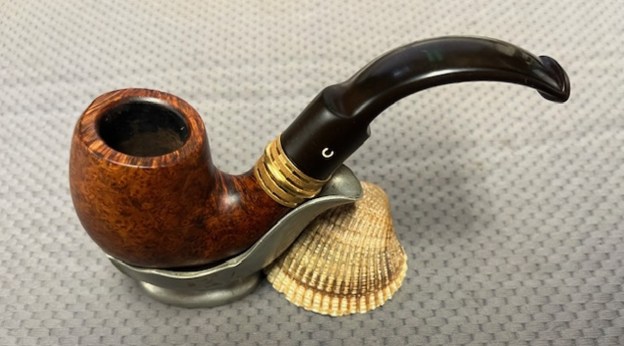
The next pipe on the table is a great looking Bent Rhodesian with great grain around the bowl. It has a well shaped variegated acrylic stem. We purchased it from an estate sale in Spring Branch. Texas, USA on 02/29/2024. I have included the photos below that the seller sent to me so I could see what the pipe looked like. When the pipe arrived Jeff took photos of it before cleaning it up. Here is what we saw. The pipe is stamped on the left side of the shank and reads Comoy’s [over] Consort. On the right side it is stamped Made in London in a circle [over] England. Underneath the COM stamp is the shape number 1057. To the left of that next to the stem shank junction it is stamped with a letter M. The acrylic stem has the newer Comoy’s C logo worn decal on the left side of the saddle. The bowl had been reamed recently and the inner edge of the bowl looked very good. The rim top has some grime and some lava on the surface. There were oils and grime ground into the bowl sides gives the finish a flat look though there is some great grain. The shank has a slight curve to it giving the pipe a Bent Rhodesian shape. The bend of the saddle stem matches the curves of the bowl and shank. The variegated rose acrylic stem is a dirty and has some light tooth chatter on both the top and underside of the stem just ahead of the button.He took photos of the pipe’s bowl and rim top to show the reamed bowl and the spotty lava coat overflowing onto the top. He also took photos of the stem to capture its condition before clean up. He took photos of the sides and heel of the bowl to show the rich grain around the bowl and the amount of grime ground into the surface of the briar.   He took photos of the stamping on the sided of the shank. It is clear and quite readable. It reads as noted above. You can also see the decal of the Comoy’s logo on the side of the stem. It is worn off in places but still identifiable. I knew the pipe was probably newer and a Cadogan period pipe by the style of the stamping, the line and the acrylic stem but I wanted to see if I could get a cleared date on the pipe. I turned to Pipedia’s guide for dating Comoy’s pipes and have included what I found below (https://pipedia.org/wiki/Comoy%27s_Dating_Guide#%E2%80%9CMade_In%E2%80%9D_Stamp). I quote the pertinent section –

Made in London England

Appears in two versions. This is again stamped in a circle with “MADE” at the top, “IN” in the middle, and “LONDON” at the bottom, with “ENGLAND” in a straight line beneath. It can be assumed that this stamp was first used in the export drive in the early 1950s. On a Bulldog Sandblast from the early 50s the Comoy name no. 2 above was used together with “MADE IN LONDON” over “ENGLAND”. There are no known examples of pre-WW II Comoy’s stamped in this way. The second version is the same as above but in a “rugby ball ” shape…

I was correct in assuming it is Cadogan produced the English line. The Rhodesian I am working is a Comoy’s shape 1057. It is a real beauty and the variegated stem looks very good with it. Now it was time to work on it.

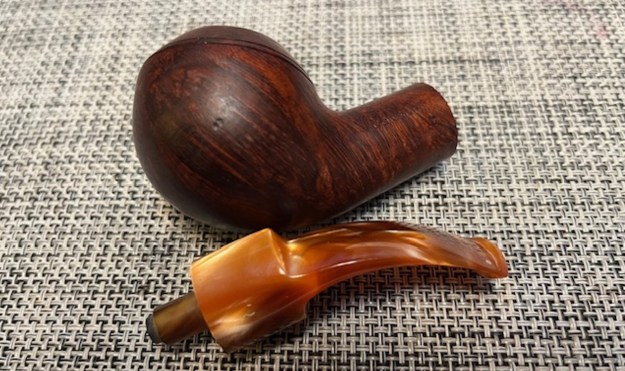
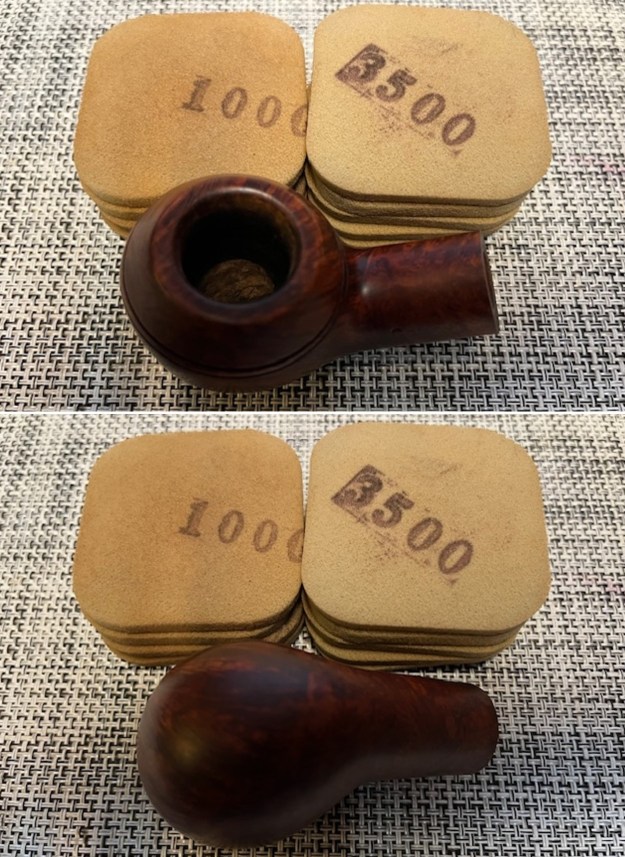
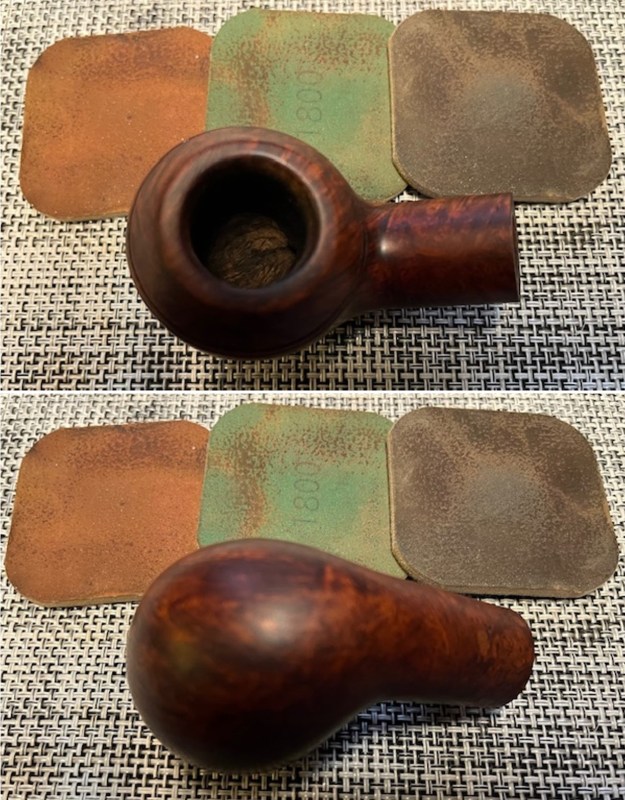
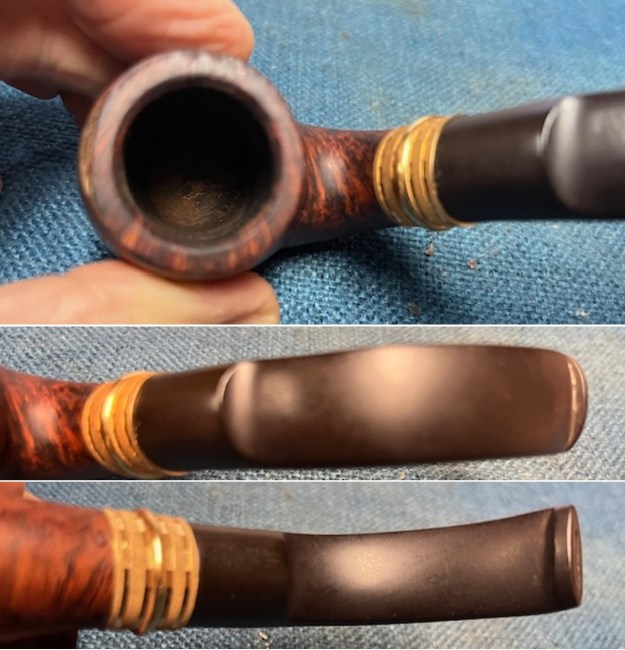
 Jeff had done a great job cleaning up the pipe as usual. He cleaned up the inside of the bowl with a PipNet reamer and a Savinelli Fitsall Pipe Knife. The bowl walls looked very good. He scrubbed the interior of the bowl and shank with shank brushes, pipe cleaners, cotton swabs and alcohol to remove the tars and oils. He scrubbed the exterior of the pipe with Murphy’s Oil Soap and a tooth brush to remove the grime from the finish. He worked on the rim top lava and darkening with the soap and tooth brush. He scrubbed the inside of the stem with alcohol and pipe cleaners. He scrubbed the exterior with Soft Scrub and rinsed it with warm water to remove the soap and debris. The pipe looked far better. I took photos of the pipe when I received it before I started working on it. I took photos of the bowl and rim top to show how clean it was. The top and the inner edge of the rim look quite good with just some small scratches. The stem looks clean of debris and grime. There are light tooth marks and chatter on both sides of the stem.I took photos of the stamping on the sides of shank. The stamping is clear and readable (much clearer in person than the photos show). I took a photo of the pipe with the stem removed to show the overall look of stem, tenon and profile of the pipe. I started polishing the bowl by sanding it with 320-3500 grit sanding pads. I wiped the briar down with a damp cloth after each pad to remove the sanding dust. It looked better and the scratches disappeared. I polished the briar bowl and shank with micromesh sanding pads – dry sanding with 1500-12000 grit sanding pads. I wiped it down with a damp cloth after each pad to remove the debris. The bowl took on a rich glow. I rubbed the bowl down with Before & After Restoration Balm. I worked it into the surface of the briar with my fingertips to clean, enliven and protect it. I let the balm sit for 10 minutes and then buffed with a cotton cloth to raise the shine. Mark Hoover’s Balm is a product that I have come to appreciate and one I use on every pipe I have been working on. I set aside the bowl and turned my attention to the stem. I sanded the stem with 320-3500 grit sanding pads to smooth out the chatter on the surface of the stem.I polished the acrylic with micromesh sanding pads – 1500-12000 grit pads. I wiped it down with a damp cloth after each sanding pad. I used Before & After Pipe Polish – both Fine and Extra Fine to further polish the stem. I put the stem back on the Comoy’s Consort 1057 Rhodesian and took it to the buffer. I worked over the bowl and stem with Blue Diamond to polish out the remaining small scratches. I gave the bowl and the stem several coats of carnauba wax on the wheel and buffed the pipe with a clean buffing pad to raise the shine. I hand buffed it with a microfiber cloth to deepen the shine. The pipe polished up really well and the rim top and edge looked good. I was happy with the look of the finished pipe. The photos below show what the pipe looks like after the restoration. The rich reddish, brown bent Rhodesian is a beautiful take on a classic shape. The polished acrylic saddle stem looks really good with the rich reds of the briar. The dimensions of the pipe are Length: 5 ½ inches, Height: 1 ½ inches, Outside diameter of the bowl: 1 1/8 inches, Chamber diameter: ¾ of an inch. The weight of the pipe is 1.76 ounces/50 grams. I will be putting it on the rebornpipes store in the British Pipe Makers and Companies Section shortly, if you are interested in adding it to your collection. This Bent Rhodesian looks and feels great in the hand. This one should be a great smoker. Thanks for walking through the restoration with me on this beauty!

Restemming and Restoring a Comoy’s Vanguard 296 Canadian


Blog by Steve Laug

A few weeks ago, I received an email from a customer, Ted about some pipe work for him. He had three pipes that he said needed different things and offered to send some photos. He also sent a second email with a description of what each pipe needed. I have included that email and the photos he sent below.

Peterson 309 needs stem restoration and bowl cleaned out. Rhodesian needs full restoration – my English teacher from high school gave it to me a little over two years ago. The Comoy’s Canadian needs a new bit I broke it… The box of pipes arrived on Tuesday here in Vancouver. I decided to work on the Comoy’s restem and cleanup first. The pipe is stamped on the top of the shank and reads Comoy’s [over] Vanguard. On the underside of the shank it is stamped with a shape number 296 mid-shank. That is followed by the COM stamp MADE IN LONDON in a circle with IN in the centre. Underneath the circle it is stamped ENGLAND in a straight line. There was a light/moderate cake in the bowl with lava on the rim top. The shank had the broken tenon inside that would need to be pulled. The finish was in decent condition. There was dirt and debris ground into the finish and there was spotty varnish/shellac finish on the surface of the briar. I always check a shank for cracks when the pipe has been dropped and a tenon snapped. There were several spidering cracks along the top of the shank on the pipe. I took photos of the pipe before I started work on it. I took a close-up photo of the bowl and rim top to show the cake in the bowl. The rim top shows some lava on the smooth finish. The inner and outer edges of the bowl looked good. I took photos of the stamping on the pipe. It is stamped on the top of the shank and on the underside. It was clear and readable as noted above.I took a close-up photo of the top of the shank to show the crack. You can see it mid shank. From top end of the crack it spread to the left and the right from the end. It looked as if it had been dropped and the crack spread.I put the bowl in the freezer for ten minutes to try to loosen the broken tenon. The change in temperature and the different expansion rates for briar and stem material would loosen it. I took it out and used a screw to turn into the airway in the tenon. I wiggled it free of the shank with very little problem.I decided to deal with the cracks in the shank first. I repaired each one with a small spot of glue on a tooth pick then heated the band and pressed it in place on the shank. I took photos of the newly banded shank to show what it looked like. I reamed the bowl with a PipNet pipe reamer using the third cutting head to take the cake back to bare briar. I cleaned up the reaming with a Savinelli Fitsall Pipe Knife. I sanded the walls with a piece of 180 grit sandpaper wrapped around a dowel to smooth them out. I cleaned up the rim top with a worn piece of 1500 grit micromesh and a piece of 6000 grit wet dry sandpaper. It looked much better once it was finished. I scrubbed the exterior of the briar with a tooth brush and undiluted Murphy’s Oil Soap. I rinsed it off with warm water to remove the grime and soap. It looked much better and the dust and debris was gone. I dried it with a cotton towel. I wiped the bowl down with acetone to remove the spotty varnish coat on the wood. It looked much better. I scrubbed out the internals of the pipe with 99% isopropyl alcohol, pipe cleaners and cotton swabs. I cleaned out the airway in the stem as well. I worked on these areas repeatedly until the shank and the airway in all the parts was clean.I polished the smooth briar with micromesh sanding pads – wet sanding with 1500-12000 grit sanding pads. I wiped it down with a damp cloth after each pad. The bowl began to take on a rich shine. I worked some Before & After Restoration Balm into the surface of the briar with my fingertips to clean, enliven and protect the briar. I let the balm sit for 15 minutes and then buffed with a cotton cloth to raise the shine. The photos show the bowl at this point in the restoration process. With that done, the bowl was finished other than the final buffing. I set it aside and turned my attention to the stem. I wiped it down with some Soft Scrub to remove the oxidation and calcification. I sanded out the light tooth marks and chatter along with the remaining oxidation with 220 grit sandpaper and started polishing the stem with 600 grit wet dry sandpaper.I polished the stem with micromesh sanding pads – wet sanding with 1500-12000 grit sanding pads. I wiped it down after each sanding pad with Obsidian Oil.I finished polishing the stem with Before & After Pipe Stem polish (both Fine and Extra Fine) then wiped the stem down with another coat of Obsidian Oil. I am excited to finish restemming and restoration of this Comoy’s Vanguard 296 Canadian. I put the pipe back together and buffed it with Blue Diamond on the buffing wheel. I gave the bowl and the stem multiple coats of carnauba wax. I buffed the pipe with a clean buffing pad to raise the shine and hand buffed it with microfiber cloth to deepen the shine. It is fun to see what the polished bowl with the nickel band looks like with the new, polished black, vulcanite stem was beautiful. This Comoy’s Vanguard 296 Canadian is nice looking and the pipe feels great in my hand. It is light and well balanced. Have a look at it with the photos below. The dimensions are Length: 6  inches, Height: 1 ¾ inches, Outside diameter of the bowl: 1 ¼ inches, Chamber diameter: ¾ of an inch. The weight of the pipe is 1.09 ounces/31 grams. It is a beautiful pipe and after I finish Ted’s other two pipes I will be sending it back to him to enjoy. Thanks for walking through the cleanup with me as I worked over this pipe.

As always, I encourage your questions and comments as you read the blog. Thanks to each of you who are reading this blog. Remember we are not pipe owners; we are pipe men and women who hold our pipes in trust until they pass on into the trust of those who follow us.
New Life for a Comoy’s Sandblast Squat Straight Bulldog


Blog by Steve Laug

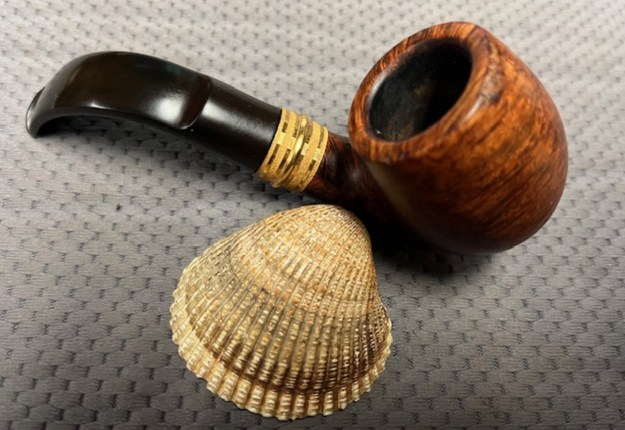
This Comoy’s Sandblast on my work table has a rugged, swirling sandblast finish with lots of nooks and crannies in the briar. It is a beauty! The straight Bulldog is clearly stamped on a smooth panel on the left underside of the diamond shank and reads Comoy’s [over] Sandblast. Underneath that it is stamped Made in London [over] England in two lines. There is no shape number stamped visibly though it could possibly be underneath the gold band. I received an email a few weeks ago from Alec,  a reader of the blog about the pipe. Here is what he wrote…

I have an old Comoy’s straight, sandblasted, squat bulldog pipe which I got from an antique store. From what I can tell, it is from the 60s or 70s, pre-Cadogan. The stem is vulcanite and has some deoxidization [sp]. I was wondering if you would be able to do some restoration work for me? I am not looking to sell it, but don’t have the time to go about doing it myself.

We wrote back and forth and he sent the pipe to me. It came yesterday and when I looked at it this morning this is what I saw. The valleys and ridges of the sandblasted grain showing through the grime and dirt are a mixture that leaves a rich texture. It had a rich dark and medium contrasting brown stain that does not look too bad. There was a moderate cake in the bowl with remnants of tobacco stuck on the walls. There was a light lava overflow in the blast on the rim. The edges of the rim and top are dirty but look pretty pristine under the grime. There was a scratched gold band on the shank end that upon examination showed a crack on the lower right underside. It was a beautiful pipe that was dirty and tired looking. The stem was oxidized and calcified with what appeared to be marks from a rubber Softee Bit toward the end. It had some tooth marks on the top and underside of the button. I took photos of the pipe before I started my cleanup work on it. I took photos of the bowl and rim top to show the cake in the bowl and the lava build up on the edges of the bowl. It was thick and hard but hopefully it had protected the rim and edges from damage. The edges look pretty good.I took a photo of the stamping on the smooth panel on the underside of the shank. The stamping was readable as you can see from the photo below. It read Comoy’s [over] Sandblast and underneath Made in London [over] England.  The second photo shows the C logo on the left side of the saddle stem is formed by three circles working to make the C.  I removed the stem from the shank and took a photo of the pipe to give a sense of proportion. Before my work on the pipe began, I wanted to see where it fit in the Comoy’s timeline. I looked on Pipedia to pin down a date for the pipe. Since the pipe is stamped Made in London England I decided to use that to see what I could find. Pipedia has a great article on dating these pipes (https://pipedia.org/index.php?title=Comoy%27s_Dating_Guide#Made_in_London_England). I found the information below. I have highlighted the pertinent portion in red in the paragraph below. The stamping matches the pipe I am working on.

Appears in two versions. This is again stamped in two straight lines “MADE IN LONDON” on the top and “ENGLAND” beneath. It can be assumed that this stamp was first used in the export drive in the early 1950s. On a Bulldog Sandblast from the early 50s the Comoy name has slightly more fancy block letters with serifs and the apostrophe. (It seems that some grades carried different stamps, or at least that the stamping changed in different years for some grades.)] was used together with “MADE IN LONDON” over “ENGLAND”. There are no known examples of pre-WW II Comoy’s stamped in this way. The second version is the same as above but in a “rugby ball” shape. This shape is verified on Comoy´s “Extraordinaire” pipes.

From that I knew that I was working a Comoy’s Sandblast Bulldog Made in London England from the early 1950’s.

I have also included two catalogue pages from Pipedia as well to show the line for sale at several time periods in Comoy’s history (https://pipedia.org/wiki/Comoy%27s). The first page is from the 1922 Catalogue and the second one is from a later date. Read the description that highlights how they did their sandblasting combining heat and sand to bring out the grain. I started my work on the pipe by reaming the bowl. I reamed it back with a PipNet pipe reamer using the first two cutting heads to take off all of the cake back to bare briar. I cleaned up the reaming with a Savinelli Fitsall Pipe Knife and then sanded the bowl walls with 220 grit sandpaper wrapped around a piece of dowel. I cleaned out the interior of the pipe with pipe cleaners, cotton swabs and alcohol. It was not as dirty as I expected. I was able to remove all of the grime and tars that were in the mortise, shank and airway in the stem.I scrubbed the exterior of the bowl and shank with a tooth brush and undiluted Murphy’s Oil Soap. It looked surprisingly better and the dust and lava filling in the sandblast was gone. The pipe had a strong aromatic smell remaining in the bowl and shank even after cleaning thoroughly so I filled the bowl with cotton bolls and a cotton plug in the shank. I used an ear syringe to fill the bowl with 99% isopropyl alcohol to deghost it and remove the smell of the aromatic. I let it sit overnight. In the morning the cotton was dark with tars and oils. I removed it from the bowl and ran pipe cleaners and alcohol through it. I used some alcohol thinned light brown aniline stain as a wash on the briar. I applied it to the briar with a wood dauber and flamed it with a Bic lighter to set the stain in the wood. I set it aside to let the wash dry. I rubbed Before & After Restoration Balm on the pipe, working it into the grooves and deeper areas of the sandblast. The balm enlivens, cleans and protects the briar was it is worked into the finish. I let it sit for a short time and then buffed it off with a soft cloth. I took photos of the bowl to show the condition at this point. I set the bowl aside and turned my attention to the stem. I scrubbed the surface with Soft Scrub and cotton pads to remove some of the oxidation on the surface. While it worked it left behind some very deep oxidation. I “painted” the stem surface with a lighter flame and was able to raise them quite a bit. I cleaned up the stem end with 220 grit sandpaper and then filled in the remaining marks on the button edge and the surface with black CA glue. Once it cured, I used a file to shape the button edge and also smooth out the fill. I sanded the remaining marks with 220 grit sandpaper to blend them into the surface of the surrounding vulcanite. I started polishing the stem surface with 600 grit wet dry sandpaper. I polished the stem surface with micromesh sanding pads – wet sanding with 1500-2400 grit pads and dry sanding with 3200-12000 grit pads. I wiped it down with Obsidian Oil after each sanding pad. I finished polishing it with Before & After Pipe Stem Polish – both Fine and Extra Fine and buffed it off with a cotton cloth. I gave it a coat of Obsidian Oil to preserve and protect the stem.  I put the stem back on the bowl and worked the pipe over on the buffing wheel using Blue Diamond to lightly polish both the bowl and the stem. I buffed the bowl and stem to raise the gloss on the briar and the vulcanite. I gave the bowl a lighter buff than I did on the stem to keep the polishing material from clogging the deep grooves of the blast. There is a little remaining oxidation around the C logo which I am leaving as I do not want to damage it. There was also some water damage (lightening) just ahead of the button on both sides that remains after much work! I gave the bowl multiple coats of Conservator’s Wax and gave the stem multiple coats of carnauba wax. I buffed the entire pipe with a clean buffing pad to raise the shine. I hand buffed it with a microfiber cloth to deepen the shine. The finished pipe is shown in the photos below. The contrasting brown stain – both medium and dark brown goes well with the rich black of the vulcanite stem. The dimensions of the pipe are: Length: 5 1/2 inches, Height: 1 3/4 inches, Outside Diameter: 1 1/4 inches, Diameter of the chamber: 3/4 inches. Now that the pipe is finished I will soon pack it up and mail it back to Alec. I know he is looking forward to loading it up and smoking it. Thanks for walking with me through the restoration.

As always, I encourage your questions and comments as you read the blog. Thanks to each of you who are reading this blog. Remember we are not pipe owners; we are pipe men and women who hold our pipes in trust until they pass on into the trust of those who follow us.
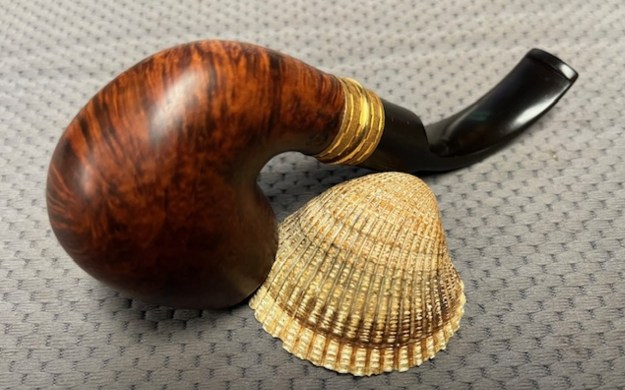
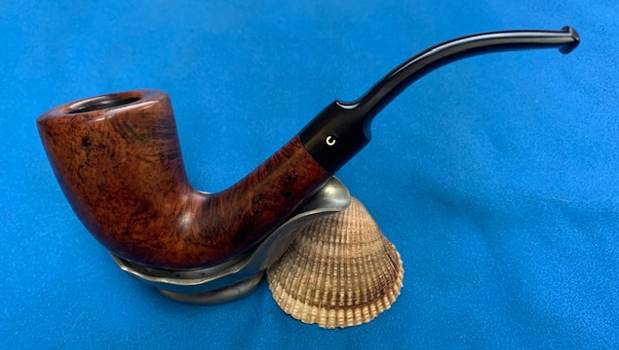
Restoring a newer Comoy’s Christmas 1990 Bent Calabash


Blog by Steve Laug

I thought I would continue with the same tack I took on the Wenhall and take you through my process of working on each pipe that we purchase. Jeff has set up a spread sheet to track where the pipe came from, the date of purchase and what we paid for it so that we know what we have invested in the pipe before we even work on it. This takes a lot of the guess work out of the process. This particular pipe was purchased on 01/23/2023 from a seller in Cincinnati, Ohio, USA. I also want you to understand why we take the photos we do. It is not accidental or chance as the photos have been taken to help me make an assessment of the pipe Jeff sees before he starts his clean up work. We do this to record the condition that the pipe was in when received it and to assess what kind of work will need to be done on. When I look at these photos this is what I see.

  1. The finish is dirty with dark streaks around the bowl and shank. I am not sure if they are stain or just grim. Underneath there appears to be some excellent grain. The finish is also dull and quite lifeless looking.
  2. The rim top is crowned and dirty. There is some lava overflow from the cake in the bowl on the top as well as some of the dark streaks. There also appears to be some scratching on the right top of the rim.
  3. The bowl has a thick cake in it but the inner edge of the bowl actually looks to be undamaged from what I can see at this point. There does not appear to be any burning or reaming damage to the edges of the bowl.
  4. The stem is vulcanite and has a single piece C inserted logo on the left side of the saddle portion.
  5. The stem had some oxidation and tooth marks and chatter that are visible in the photos below. Nothing to deep but nonetheless present.

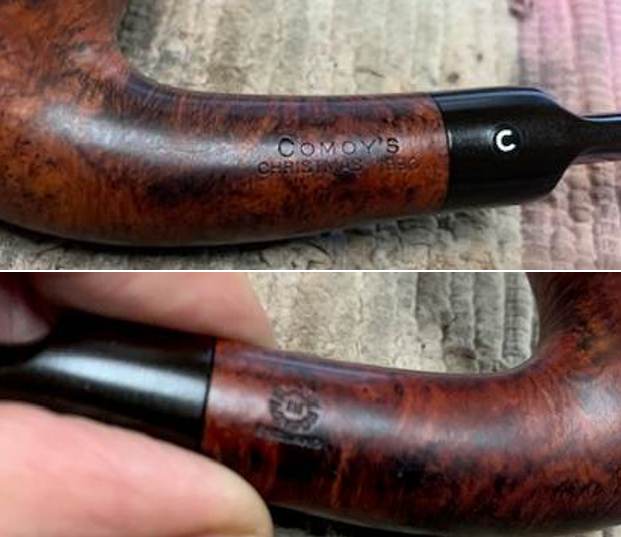
Overall my impressions of this Calabash shaped pipe is that it is a beauty that once cleaned up will look pretty amazing. The cake does not seem to hide any burns or checking and the exterior of the bowl does not show any hot spots or darkening. The fact that it is a Christmas pipe from Comoy’s with a date in the stamp is a plus. The photos below confirm the assessment above.Jeff took close up photos so that I could have a clearer picture of the condition of the bowl and rim edges and top. The rim top photos confirm my assessment above. The cake in the bowl is quite thick and the rim top has light lava and debris on it as well as some kind of film that will need to come off. You can also see the condition of the inner and outer edges of the rim. This is what I look for when assessing a pipe. While there is lava and darkening there is no visible burn damage at this point and the previous reaming has not left damage either. The bowl is still fairly round. There are some scratches in the surface of the crowned rim top. His photos of the stem surface confirmed and heightened my assessment of the condition. You can see the oxidation and scratches in the middle top of the stem surface. Note also the tooth marks on the edge of the button on both sides. I always ask Jeff to take photos of the sides and heel of the bowl. While this definitely shows the grain patterns around a bowl it also allows me to do a more thorough assessment of the condition of the briar and the finish. In this case I look at the finish around the dark streaks around the bowl sides to confirm it was not just the stain on the bowl to highlight grain. It seems to be dark grime on the surface but the cleaning would further clarify what I was seeing. There were no cracks or splits following the grain or coming down from the rim edges. I also look for flaws in the grain as those can also hide cracks or damage. In this case the bowl exterior is sound and should clean up very well. I love the grain patterns that appear to have birdseye on the sides and cross grain on the front and back of the bowl. I also ask him to take photos of the stamping so I can see if it is faint in any spots or double stamped or unclear. It often takes several photos to capture what I am looking for. The stamping on the left and right sides of the shank are relatively clear in the pictures below. On the left it reads COMOY’S [over] CHRISTMAS 1990. The stamping on the right side shows the COM (Country of Manufacture). It is a circular stamp with Made in London on the top and bottom side with “IN” placed in the centre. Underneath it is stamped London. There is no shape number on the pipe. The stamping on both side is readable and clear. It is slightly fainter next to the stem/shank joint. Jeff also included a photo of the inset stem logo – C. It is one piece C rather than the older 3 piece one which fits the date of the pipe. I was concerned that the C logo on the stem may have been a decal rather than an inlay but it appears to be inlaid.I did not take time to do work on the brand as it is a well known brand and the Christmas 1990 dates the pipe and the logo and stamping match that time period. If you would like to do some reading on it you can check both Pipephil’s site and Pipedia for a great write up on the history of the brand. I decided instead to just get to work on the pipe.

I am sure many of you skip my paragraph on the work Jeff has done before the pipe gets here in my many blogs but it is quite detailed in its brevity. I know some laugh at my opening line Jeff did a thorough cleaning of this pipe. However, I want you to know the details of the work. Back in 2020 Jeff wrote a blog about his cleaning process. I am including a link to that now so you can see what I mean about his process. Do not skip it! Give it a read (https://rebornpipes.com/2020/01/20/got-a-filthy-estate-pipe-that-you-need-to-clean/). Here is the introduction to that blog and it is very true even to this day.

Several have asked about Jeff’s cleaning regimen as I generally summarize it in the blogs that I post rather than give a detailed procedure. I have had the question asked enough that I asked Jeff to put together this blog so that you can get a clear picture of the process he uses. Like everything else in our hobby, people have different methods they swear by. Some may question the method and that is fine. But it works very well for us and has for many years. Some of his steps may surprise you but I know that when I get the pipes from him for my part of the restoration they are impeccably clean and sanitized. I have come to appreciate the thoroughness of the process he has developed because I really like working on clean pipe!

For the benefit of some of you who may be unfamiliar with some of the products he uses I have included photos of three of the items that Jeff mentions in his list. This will make it easier for recognition. These three are definitely North American Products so you will need to find suitable replacements or order these directly on Amazon. The makeup pads are fairly universal as we were able to pick some up in India when we were with Paresh and his family.

In the blog itself he breaks his process down into two parts – cleaning the stem and cleaning the bowl. Each one has a large number of steps that he methodically does every time. I know because I have watched him do the work and I have seen the pipes after his work on them. He followed this process step by step and when the pipe got to me it was spotlessly clean and ready for my work. The inside of the stem, shank and bowl were clean and to me that is an amazing gift as it means that my work on this end is with a clean pipe! I cannot tell you how much difference that makes for my work.

When the pipe arrives here in Vancouver I have a clean pipe and I go over it keeping in mind my assessment shared in the opening paragraph above. I am looking for any significant structural changes in the bowl and finish as I go over it.

  1. The dark streaks around the bowl and shank seemed to have been removed by Jeff’s scrubbing of the bowl and shank. He did not remove the dark stain that highlights the grain around the bowl but the clean finish is much better in displaying the grain. Polishing it will take care of the dullness and bring the briar back to life.
  2. The crowned rim top is clean and looks much better. Jeff was able to remove both the lava and dark streaks on the surface. There are some scratches on the right top of the rim toward the front of the bowl.
  3. The bowl was very clean and smelled clean. The clean walls did not show evidence of checking or cracking. There were no hot spots or damage on the walls or around the entrance of the airway into the bowl. It was clean and smooth which is great news for me. The inner edge of the bowl was undamaged and did not show any sign of burning or reaming damage to the edges of the bowl. Both the shank and the bowl were very clean showing no debris on a clean pipe clean run through them. I would need to give it a final cleaning with pipe cleaners and alcohol once I had finished with the external work to remove the debris that may have collected there in the process.
  4. The stem is vulcanite and has a single piece C inserted logo on the left side of the saddle portion. It is clearly inset in the stem not a decal.
  5. The oxidation was gone from the stem after Jeff’s work on it. The tooth marks and chatter will need to be dealt with once I finish the bowl.

Hopefully the steps above show you both what I look for when I go over the pipe when I bring it to the work table and also what I see when I look at the pipe in my hands. They also clearly spell out a restoration plan in short form. My work is clear and addressing it will be the next steps. I took photos of the whole pipe to give you a picture of what I see when I have it on the table. This is important to me in that it also shows that there was no damage done during the clean up work or the transit of the pipe from Idaho to here in Vancouver. I then spent some time going over the bowl and rim top to get a sense of what is happening there. The bowl looked very good and the walls were smooth. There was no damage internally. The rim top was clean but there was darkening on the inner edge – particularly the right front. It looks to be burned but is not. There is also some scratching that I noted earlier that is also very visible on the entire right side. I also went over the stem carefully. There were dents in the stem that are visible in the photos. But the good news is that the tooth marks were not deep and did not seem to puncture the airway. They would clean up well. I examined the button edge and was happy to see that the marks there were not too bad and should be able to be sanded out. I took photos of the rim top and stem sides to show as best as I can what I see when I look at them.I always check to make sure that the clean up work did not damage the stamping on the shank in any way. I know Jeff is cognizant of this but I do it anyway and take a photo to show what I see when I examine it. In this case it has not changed at all from the pictures I included above. I also remove the stem from the shank and check the tenon and lay the parts of the pipe out to get a sense of the proportion that was in the mind of the pipe maker when he crafted the pipe. It is a beauty in flow and shape. As I pointed out in a previous blog, the question of where to begin the restoration work is always a matter of personal preference. If you read this blog much you will see that each of the restorers who post here all start at different points. Kenneth always starts with the stems, others as well do that. I personally like to start with the bowl because it gives me hope that this pipe is really a beauty. I said previously that I truly do not like the tedious work of stem repairs and stem polishing. I have been thinking about that and I think it is more it takes longer for slower results. I think that is why I always leave that until last even though I know that it needs to be done. So if you are restoring your pipes choose where you want to start and go from there. Just know that it all will need to be done by the end but for me the encouragement of seeing a rejuvenated bowl is the impetus I need to attack the stem work.

Knowing that about me you can guess that I started working on this pipe by turning to the bowl. I chose to deal with the damage to the rim top and inner edge of the bowl. For this work I use a folded piece of 220 grit sandpaper to attack the inner edge and slight bevel. I work on it until it looks better and as much of the darkening and damage are removed as much as can be done without changing the profile of the crowned rim top. Remember to work all the way around the inner edge or you will cause the bowl to be out of round. You can see from the photos that the rim edges and top look better already. Polishing the briar will come next and that will smooth out these areas further.With the rim top looking better I turned to polishing the briar with micromesh sanding pads. I choose to dry sand the briar rather than wet sand it. Again it is a matter of personal preference. I prefer to use the pads dry and find they work very well on the briar. I sand with each pad (9 in total) and group them by threes for ease of reference. I wipe the bowl down with a damp cloth after each pad to remove the sanding debris and check the briar. I love seeing the developing shine on the briar as I move through the pads. I include the many photos of various angles of the bowl so you can see the change. Pay attention to the changes in the briar in these photos as you work through them. When I get the bowl to this point in the process I use a product developed by Mark Hoover called Before & After Restoration Balm. It is a paste/balm that is rubbed into the surface of the briar. The product works to deep clean the finish, enliven and protect the briar. I worked it into the briar with my finger tips to make sure that it covers every square inch of the pipe. I set it aside for 10 minutes to let it do its work. Once the time has passed I wiped it off with a soft cloth then buffed it with a cotton cloth. The briar really began to have a deep shine. The photos I took of the bowl at this point mark the progress in the restoration. You see the shine that the briar has taken on and the way the grain just pops. It is a gorgeous pipe. Now it was time to address the part of the restoration I leave until last. I set the bowl aside and turned my attention to the stem. The stem was in quite good shape. Jeff had been able to remove the oxidation so that when it came it looked pretty good. It was time to address the tooth marks. When the damage is quite shallow and not imposing I flatten it out with 220 grit sandpaper and start polishing it with 600 grit wet dry sandpaper to remove the scratches. This process makes the repairs almost invisible when polished and also takes care of scratching in the surface of the vulcanite. That is what I did in this case and it worked well. This stem was quite painless so I guess I could have started with it but ah well old habits are hard to change. Here are photos of the stem after the sandpaper work.It was the time now to polish the stem and bring back a shine. Over the years I have developed my own process for this. It is all preparation for the buffing that will come last. I use micromesh sanding pads and water to wet sand the stem with 1500-12000 grit sanding pads. I wiped it down after each sanding pad with Obsidian Oil on a cotton rag after each sanding pad as I find it does two things – first it protects the vulcanite and second it give the sanding pads bite in the polishing process. After finishing with the micromesh pads I always rub the stem down with Before & After Fine and Extra Fine stem polish as it seems to really remove the fine scratches in the vulcanite. I rub the Fine Polish on the stem and wipe it off with a paper towel and then repeat the process with the Extra Fine polish. I finish the polishing of the stem by wiping it down with a final coat of Obsidian Oil and set the stem aside to let the oil absorb. This process gives the stem a shine and also a bit of protection from oxidizing quickly.The final steps in my process involve using the buffer. I first buff the stem and the briar with Blue Diamond on the buffing wheel. Blue Diamond is a plastic polish but I find that it works very well to polish out the light scratches in the vulcanite and the briar. I work the pipe over on the wheel with my finger or thumb in the bowl to keep it from becoming airborne. It works well and I am able to carefully move forward with the buffing. I lightly buff the plateau on the rim top and shank end at the same time making sure to keep the product from building up in the grooves of the finish. I finished with the Blue Diamond and moved on to buffing with carnauba wax. Once I have a good shine in the briar and vulcanite I always give the bowl and the stem multiple coats of carnauba wax. I have found that I can get a deeper shine if I following up the wax buff with a clean buffing pad. It works to raise the shine and then I follow that up with a hand buff with a microfiber cloth to deepen the shine. It is always fun for me to see what the polished bowl looks like with the polished vulcanite stem. It really is a beautiful pipe. The smooth finish around the bowl sides and shank show the grain shining through the rich brown stains of this Comoy’s Christmas 1990 Bent Calabash and the polished vulcanite stem is a great addition. The finished pipe feels great in my hand. It is light and well balanced. Have a look at it with the photos below. The dimensions are Length: 6 inches, Height: 2 ¼ inches, Outside diameter of the bowl: 1 ½ inches, Chamber diameter: 7/8 of an inch. The weight of the pipe is 1.83 ounces/52 grams. It is a beautiful pipe and one that I will be putting on the rebornpipes store in the British Pipe Maker section.

Hopefully this tack of writing this blog is helpful to you in some way. In it I show both what I am looking for and how I move forward in addressing what I see when work on a pipe has been helpful to you. It is probably the most straightforward detailed description of my work process. As always I encourage your questions and comments as you read the blog. Thanks to each of you who are reading this blog. Remember we are not pipe owners; we are pipemen and women who hold our pipes in trust until they pass on into the trust of those who follow us.
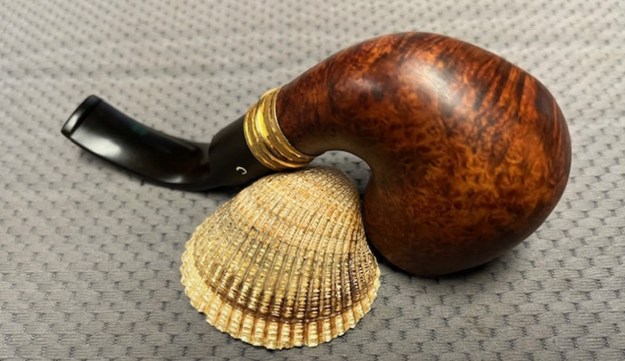
Restoring a 1950s Era Comoy’s Patina 495 Pot


Blog by Steve Laug

This nice looking Comoy’s Pot shaped pipe has some nice grain around the bowl. We purchased it on 04/20/18 from an estate pipe collection in Sterling Heights, Michigan, USA. It was a filthy pipe with a lot of grime ground into the surface of the briar. The stamping on the shank was clear and readable. On the left side it reads Comoy’s [over] Patina. On the right side it is stamped 495 next to the joint of the shank and bowl. Near the stem joint it is stamped with the characteristic Made in London in a circle over England. The C on the saddle side of the stem is a three part C so that helps date it as an older pipe. There was a thick cake in the bowl that overflows as thick lava on the rim top. The bevel on the inner edge of the rim looked to be in good condition but had some thick lava on it. The outer edge actually appeared to be in good condition. The stem was oxidized and has some deep tooth marks and chatter on both sides ahead of the button. There was a lot of promise in the pipe but it was going to take some work. Jeff took the following photos before he started his clean up work on the pipe. He captured the thick cake in the bowl and the heavy lava cake on the rim top. It really was a mess. I thought the rim top would be okay under the lava. There inner bevel on the rim top looked pretty good under the grime. The photos of the stem show the oxidation and the tooth marks and chatter on the top and underside ahead of the button. He took a photo of the briar from the heel and right side of the bowl. The grain is quite nice.He took photos of the stamping on the shank sides. It is clear and readable as noted above. You can also see the 3 part C in the photo of the stem side.   I decided to do a bit of research on the Comoy’s Patina line before I worked on it. I could not find any listing for the Comoy’s Patina line on either Pipephil’s site or Pipedia. I decided however to move forward and try to pin down the shape number and the date of the pipe. I found a shape list on Pipedia (https://pipedia.org/wiki/Comoy%27s_Shape_Number_Chart). I did a screen capture of the shape 495-496 and included it below.I then turned to another shape number chart that had pictures of the various shapes that made up the Comoy’s lines (https://pipedia.org/wiki/Comoy%27s_Shape_Number_Chart/en). I have included a chart below and drawn a red box around the shape of the pipe I am working on.From there I turned to look for information on the stamping on the pipe that would help nail down a date for this pipe. I turned to Pipedia’s article “A Guide Toward Dating the Pipes –  https://pipedia.org/wiki/A_History_Of_Comoy%27s_and_A_Guide_Toward_Dating_the_Pipes. I quote from the article below. I have highlighted the pertinent sections in red for ease of reference.
Comoy’s Name

1900 to about 1919. Normally, the Comoy’s name will be found in a joined flowing script canted forward, with a long tail running backwards from under the “S” to below the “C.” There are, however, 2 pipes in the 1909 catalogue where Comoy’s does not have a tail at all. I also have examples between 1913 to 1919 where the Comoy’s name is still in the same joined flowing script, canted forward but with a short tail running forwards from the bottom of the “Y” to under the “S.”

From about 1917 to the end of the 1930s, the slightly fancy “Comoy’s” can be found stamped in a curve, in upper case script with serifs, apostrophe before the “S,” and the “C” larger than the other letters. The arched Comoy’s with serifs and apostrophe may have been continued for a short time after the war. I have an “Old Bruyere” stamped this way that is just post-war. Pipes can also be found with the name stamped across the top of the stem as apposed to along the side.

During the 1940s, not many pipes were made, but just after WW II, in 1945 or slightly later, the “Comoy’s” stamp was changed from the curve to a straight line.

From the 1950s, the Comoy’s stamp can be found in three variants: (1) A simple block-letter style without serifs but with the C larger than the other letters and the apostrophe before the “s.” (2) A return to the slightly more fancy block letters with serifs and the apostrophe. My 1959/60 gold-banded example falls into this category. (3) A simple block-letter style without serifs and without the apostrophe and with the “C” the same size as the rest of the letters. I don’t think that this stamp was used for very long.

“Made In” Stamp

London Made. Comoy’s were the first London pipe maker to use this phrase. It is the earliest stamp to be used and can be found from 1902 or perhaps earlier and on into the 1930s . At this time, it can appear as “London” over “Made” or in a straight line.

Made in London. I have only seen this stamp on two Old Bruyere pipes dated 1921, and it appears in a straight line under the arched “Comoy’s.”

Made in England. This is stamped in a circle with “Made” at the top, “in” in the middle, and “England” forming the bottom of the circle. I call this the football shape or F/B for short. I have seen this stamp on a Cecil dated as early as 1910 and on an Old Bruyere of 1921 and then only on pipes from the 1930s.

Made in London England. This is again stamped in a circle with “Made” at the top, “In” in the middle, and “London” at the bottom, with “England in a straight line beneath the F/B. I believe this stamp was first used in the export drive in the early 1950s, and I have not seen any pre-WW II Comoy’s stamped in this way.

Inlaid “C”

“C” was first inlaid in the side of the mouthpiece around 1919. This was a complex inlay needing three drillings. First, a round white inlay was inserted, then the centre of the white was drilled out, and a smaller round black inlay was inserted. Finally, another drilling was made to remove the open part of the “C,” and an even smaller black inlay was inserted. This inlaid “C,” known as the “three-piece C,” was continued until the Cadogan era in the 1980s. However, the “C” in the 1920s and early 30s is much thinner and more delicate than the one post-war. Cadogan first changed the “C” to a single drilling with an inlay that had the “C” in the centre, and more recently it became a laser imprint. I have a cased pair of early 1920’ “Par Excellence” where the “C” is on top of the mouthpiece. Finish

Now it was time to work on the pipe itself. Jeff reamed the bowl with a PipNet pipe reamer and followed up with a Savinelli Fitsall pipe knife to remove the cake. He scrubbed out the mortise and the airway in the shank and the stem with alcohol, cotton swabs and pipe cleaners. He scrubbed the exterior of the bowl, rim, shank and stem with a tooth brush and undiluted Murphy’s Oil Soap to remove the lava, oils and tars on the rim and the grime on the finish of the bowl. He rinsed it under running water. He dried it off with a soft cloth. He was able to remove lava build up on the rim top and you could see the great condition of the bowl top and edges of the rim. There was still some darkening to the rim top toward the back of the bowl. He soaked the stem in Before & After Deoxidizer to remove the oxidation. I took photos of the pipe before I started my work on it.  I took a close up photo of the rim top to show the condition of the bowl and rim after Jeff had cleaned up the grime and lava. The beveled rim edge and top looked very good. The stem photos show light oxidation and the tooth marks and chatter on the stem and the button surface. I took photos of the stamping on the shank sides and the C logo on the stem. The stamping was clear and read as noted above.   I removed the stem from the shank and took a photo. You can see the small fill toward the top of the left side.The bowl was in good condition so I did not need to do any extra work on the rim or edges. It looked great so I polished the bowl and rim top with micromesh sanding pads – dry sanding it with 1500-12000 grit pads. I wiped the bowl down with a damp cloth after each pad to remove the sanding debris. After the final sanding pad I hand buffed it with a cotton cloth to raise a shine. I worked some Before & After Restoration Balm into finish of the briar with my fingertips to clean, enliven and protect it. I let the balm sit for a little while and then buffed with a cotton cloth to raise the shine. The Restoration Balm really makes the grain stands out beautifully.   I set the bowl aside and turned my attention to the stem. I “painted” the tooth marks with the flame of a Bic lighter. I was able to lift them a lot. The small spots that remained I filled in with clear CA glue.   I used a folded piece of 220 grit sandpaper to blend the repairs into the surface of the stem. I started polishing the stem with a folded piece of 400 grit sandpaper. I wiped the stem down with Obsidian Oil.    I polished the stem with micromesh sanding pads – dry sanding it with 1500-12000 grit pads. I wiped the stem down with Obsidian Oil after each pad. I polished it with Before & After Pipe Polish – both Fine and Extra Fine and gave it a final coat and set it aside to dry.     I put the stem back on the Comoy’s Patina  Made in London England 495 Pot and buffed the pipe with Blue Diamond on the buffing wheel. I polished the briar and the vulcanite of the stem until there was a rich shine. This classic Comoy’s Pot shape and finish really highlights some amazing grain on a proportionally well carved pipe. Once I buffed the pipe the briar came alive and the mixture of grain – straight, flame and birdseye – popped with polishing. The repaired black vulcanite stem had a rich glow. This Comoy’s Patina 495 Pot fits well in the hand and sits right in the mouth. Have a look at it with the photos below. The dimensions are Length: 5 ½ inches, Height: 1 ¾ inches, Outside diameter of the bowl: 1 ½ inch, Chamber diameter: 1 inch. The weight of the pipe is 1.48 ounces/41 grams. This beauty will be going on the rebornpipes online store in the English Pipemakers Section. If you are interested let me know. Thanks for walking through the restoration with me as it was a pleasure to work on.

Breathing Life into a Tired and Worn Comoy’s Tradition Pot


Blog by Steve Laug

Jeff and I know longer remember where or when we purchased this pipe. It is a small pipe with nice grain and a saddle stem. It is stamped on the left side of the shank and reads COMOY’S [over] TRADITION. The right side is very faintly stamped Made in England. The rest of the stamp was unclear as was the shape number. It had a flat bottom on the shank and heal of the bowl that made it a sitter. We don’t have any photos of the pipe before Jeff cleaned it. But Jeff did his usual cleanup. The bowl was reamed with a PipNet reamer. He cleaned it up with a Savinelli Fitsall Pipe Knife. He scrubbed the internals with alcohol, pipe cleaners and cotton swabs. He did the same with the airway in the stem. The rim top and the beveled inner rim edge were damaged and showed burn marks on the front and back of the bowl. The outer edge of the bowl was damaged on the front side. The bowl was also out of round and damaged. The vulcanite saddle stem is clean but has some tooth marks on the top and underside ahead of the button. The stem has a 3 part C on the left side of the saddle. I took some photos of the pipe before I started my work on it.  I took photos of the bowl and rim top to show the condition of both. The bowl is very clean but you can see the burn damage on the top front and rear of the bowl and on the beveled inner edge. There was some darkening all over the rim top. It really was quite a mess. I took photos of the stem as well to show the tooth dents on the top and underside ahead of the button and on the button surface as well. There was three part C logo on the left side of the saddle. I took a photo of the stamping on the left side of the shank. The stamping on the right is very faint and I could not capture the Made in England stamp that was faint. There was no shape number on the shank.I removed the stem from the shank and took a photo of the pipe. It is proportionally pleasing and quite an eye catching pipe. I looked on Pipephil’s site for information on the Comoy’s Tradition and found the following information I have included a screen capture (http://www.pipephil.eu/logos/en/logo-comoy.html). It has the three part C which dated it to 1946 and following. The stamping is the same as the one I am working on. I turned to the article on Pipedia about dating Comoy’s pipes but the style of the stamping (https://pipedia.org/index.php?title=Comoy%27s_Dating_Guide#1917_to_the_end_of_the_1930.27s_.28at_least_1938.29). I have include the section in the screen capture below that date this pipe to the 1950s.

Now the Comoy’s stamp can be found in three variants in the 1950s

  1. A simple block-letter style without serifs but with the C larger than the other letters and the apostrophe before the “S”.
  2. A return to the slightly more fancy block letters with serifs and the apostrophe. (It seems that some grades carried different stamps, or at least that the stamping changed in different years for some grades.)
  3. A simple block-letter style without serifs and without the apostrophe and with the “C” the same size as the rest of the letters. This stamp was probably not used very long.
  4. A simple block-letter style without serifs but with the apostrophe before the “S” and with the “C” the same size as the rest of the letters.

Inlaid “C” on the stem

C” was first inlaid in the side of the mouthpiece around 1919. This was a complex inlay needing three drillings. First, a round white inlay was inserted, then the centre of the white was drilled out, and a smaller round black inlay was inserted. Finally, another drilling was made to remove the open part of the “C,” and an even smaller black inlay was inserted. This inlaid “C,” known as the “three-piece C,” was continued until the Cadogan era in the 1980s. However, the “C” in the 1920s and early 30s is much thinner and more delicate than the one post-WW II.

That article gave me some helpful information regarding the pipe that I was working on. I knew that the stamping and logos identified the pipe as having been made in following WW2 and from what I can see from the above information it is a 1950s era pipe.

I started my work on the pipe by addressing the damage on the rim top, outer edge and the inner beveled edge of the bowl. I topped the bowl on a topping board with 220 grit sandpaper. I filled in the deep damage on the outer edge and rim top with clear super glue and briar dust. I used a wooden ball and 220 grit sandpaper to give the rim top and inner edge a bevel and minimize the burn damage to the top and edges. I stained the rim top with an Oak Stain Pen to match the colour around the sides of the bowl. It took several coats but it matched quite well.I polished the briar on the rim top and the rest of the bowl with micromesh sanding pads – dry sanding it with 1500-12000 grit pads. I wiped the briar down with a damp cloth to remove the sanding dust. The briar really took on a rich shine with the polishing. I rubbed the bowl down with some Before & After Restoration Balm. I worked it into the briar with my finger tips to clean, revive and preserve the wood. It really brings the grain alive once again. I let it sit for 15 minutes then buffed it off with a soft cloth. The grain really pops at this point in the process. I set the bowl aside and turned my attention to the stem. I “painted” the surface of the stem with the flame of a Bic lighter and was able to lift the tooth marks and chatter significantly. I sanded out those that remained with 220 grit sandpaper and started polishing it with 400 grit wet dry sandpaper. It was starting to look very good.     I polished the stem with micromesh sanding pads – 1500-12000 grit pads. I wiped the stem down after each pad with a cloth impregnated with Obsidian Oil. I finished the polishing with some Before & After Pipe Stem Polish – both Fine and Extra Fine. The stem looked very good.   As always I am excited to finish a pipe that I am working on. I put the Comoy’s Tradition Pot back together and buffed it with Blue Diamond on the buffing wheel. I gave the bowl and the stem multiple coats of carnauba wax. I buffed the pipe with a clean buffing pad and hand buffed it to raise the shine. It is fun to see what the polished bowl looks like with the grain popping around the bowl and shank. Added to that the polished vulcanite saddle stem was a beautiful touch. It is light and well balanced. Have a look at it with the photos below. The dimensions are Length: 5 inches, Height: 1 ½ inches, Outside diameter of the bowl: 1 ¼ inches, Chamber diameter: ¾ of an inch. The weight of the pipe is 34 grams/1.20 ounces. It is a beautiful pipe and one that will be on the rebornpipes store in the British Pipe Makers section. If you are interested in adding it to your collection let me know. Thanks for walking through the restoration with me as I worked over this pipe. Thanks to each of you who are reading this blog. I want to keep reminding us of the fact that we are not pipe owners; we are pipemen and women who hold our pipes in trust until they pass on into the trust of the next trustee.

Restemming & Restoring a Comoy’s Christmas 1987 Shape 42 Bent Billiard


Blog by Steve Laug

This morning I went through my box of stummels (bowls) again and picked out a Bent Billiard bowl that had some promise. I went through my can of stems and found a taper stem that needed some work but was a good fit. The pipe I chose to work on is an interesting Comoy’s Bent Billiard with a mixture grain around the sides. The rim top was had some darkening and some roughness on the front outer edge of the bowl. The inner edge of the bowl looked good. The interior of the bowl was clean without chips, cracks or checking on the walls. The finish was dirty and tired but still quite redeemable. The stamping on the pipe was clear and readable. On the left side it read COMOY’s [over] Christmas [over] 1987. On the right side it had the normal circular Comoy’s COM stamp Made in London in a circle [over] England below that was the shape number 42. I took some photos of the bowl before I started to work on it. I took a photo of the stamping on the left and right sides of the shank. It reads as noted above and is clear and readable.I went through some of stems and found a taper vulcanite stem that had been used previously. It had some calcification and oxidation on the surface and had tooth marks on both sides near the button.The tenon would need to be shortened slightly but I put it on the shank and took some photos of what it looked like at this point.I started my work on the bowl by dealing with the damage to the rim top and outer edge of the bowl. I lightly topped the rim on a topping board with 220 grit sandpaper. I worked over the inner beveled edge of the rim with a folded piece of sandpaper to remove some of the darkening. It was definitely an improvement. I polished the rim top and the bowl with micromesh sanding pads – dry sanding with 1500-12000 grit pads. I wiped the bowl down with a damp cloth between each pad. The bowl began to take on a shine as I went through the various pads. I stained the top of the bowl with a Cherry stain pen to blend in better with the rest of the bowl colour. It will definitely blend well once the pipe is buffed and polished.I rubbed the bowl and shank down with Before & After Restoration Balm. I worked it into the surface of the bowl sides and shank with my fingertips to clean, enliven and protect the briar. I let the balm sit for 10 minutes and then buffed with a cotton cloth to raise the shine. The grain really came alive. It looks better than when I began. With the bowl finished it was time to focus on the stem. I took out the stem and worked on the fit in the tenon. I shortened the length with a Dremel and sanding drum and it fit very well. I used a heat gun to soften the vulcanite enough to give it the proper bend.While I was bending the stem I also heated the bite marks in the stem. I was able to lift many of the tooth mark. I filled in the remaining tooth marks on the button surface and just ahead of it on the underside with clear super glue and set the stems aside to let the repairs cure.    Once the repairs cured I smoothed them out with a small file and started blending them into the surface of the stem. I sanded the repairs with 220 grit sandpaper to further blend it into the stem surface. I started polishing it with 400 grit wet dry sandpaper. I don’t know if this ever happens to you but I was so busy fitting and shaping the stem that I forgot to clean out the inside!! I paused now to do that. I scrubbed out the airway with 99% isopropyl alcohol and pipe cleaners. It was really dirty! Not any more.I polished the stem with micromesh sanding pads – dry sanding with 1500-12000 grit pads. I wiped the stem down after each pad with a cloth and Obsidian Oil. I finished the polishing with Before & After Pipe Stem Polish – both Fine and Extra Fine. I gave it a final coat of Obsidian Oil. I put the pipe back together – the bowl with its new stem. This restemmed and restored Comoy’s Christmas 1987 Shape 42 Bent Billiard is a real beauty and I think that the chosen stem works well with it. The grain on the bowl came alive with the buffing. I used Blue Diamond on the buffing wheel on both the bowl and stem. I gave both multiple coats of carnauba wax on the wheel then buffed it with a clean buffing pad to raise the shine. I hand buffed it with a microfibre cloth to deepen the shine. The Comoy’s Bent Billiard feels great in the hand. It is lightweight and the contrast in the browns of the briar, the Silver band and the polished vulcanite stem with the popping grain on the mixed brown stained bowl is quite amazing. The dimensions of the pipe are Length: 5 inches, Height: 1 ¾ inches, Outer diameter of the bowl: 1 1/8 inches, Chamber diameter: ¾ of an inch. The weight of the pipe is 1.41 ounces/40 grams. It really is a beauty. I will be putting it on the rebornpipes store in the  British Pipe Makers section shortly if you are interested in adding it to your collection. Thanks for walking through the restemming and the restoration with me. Cheers.