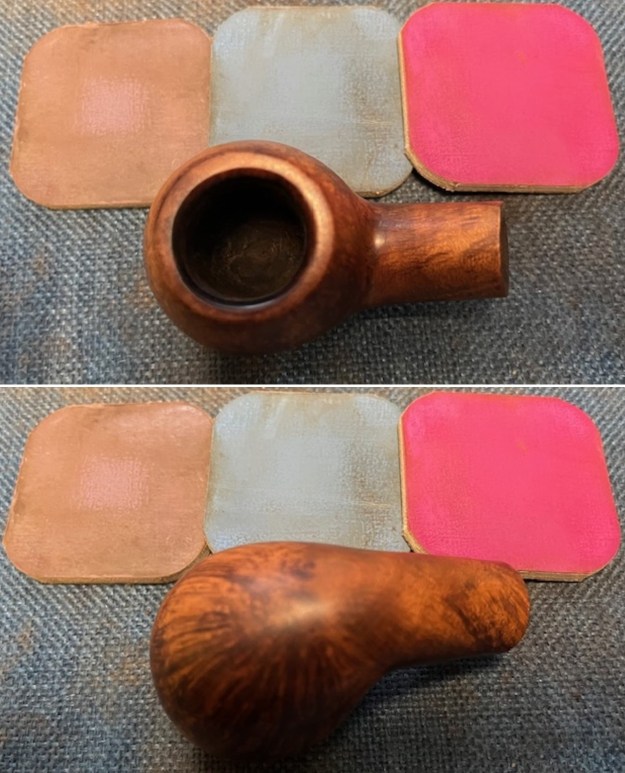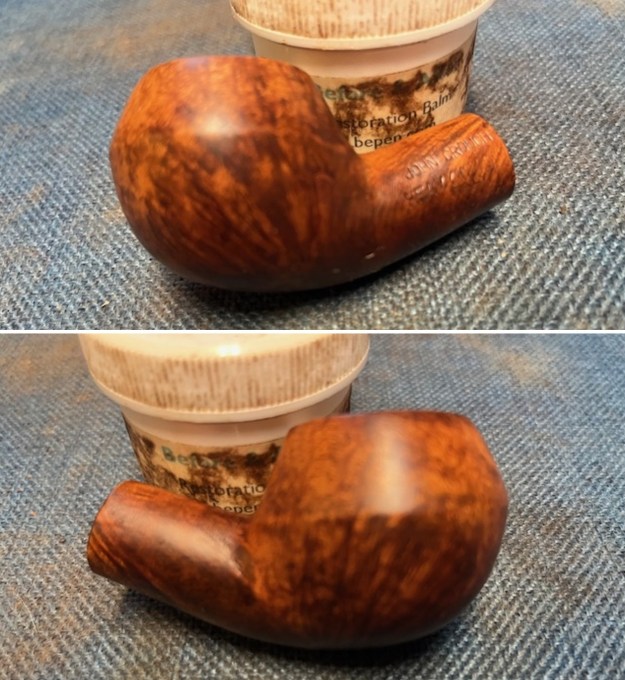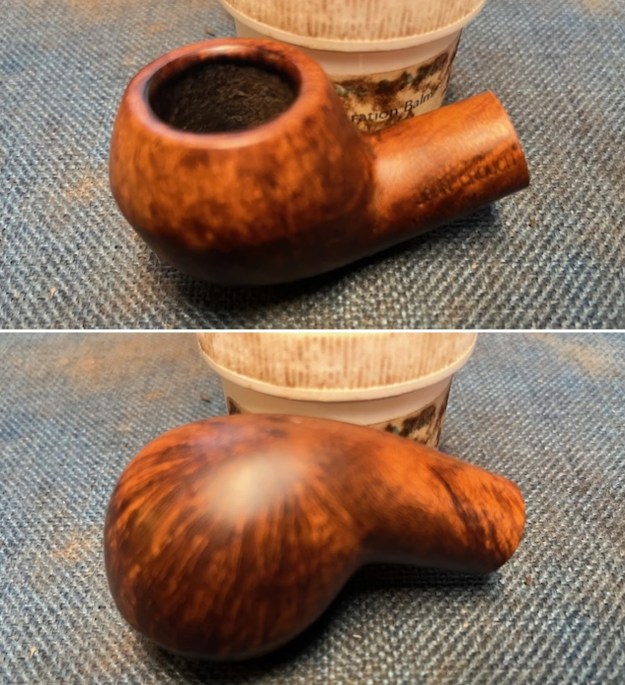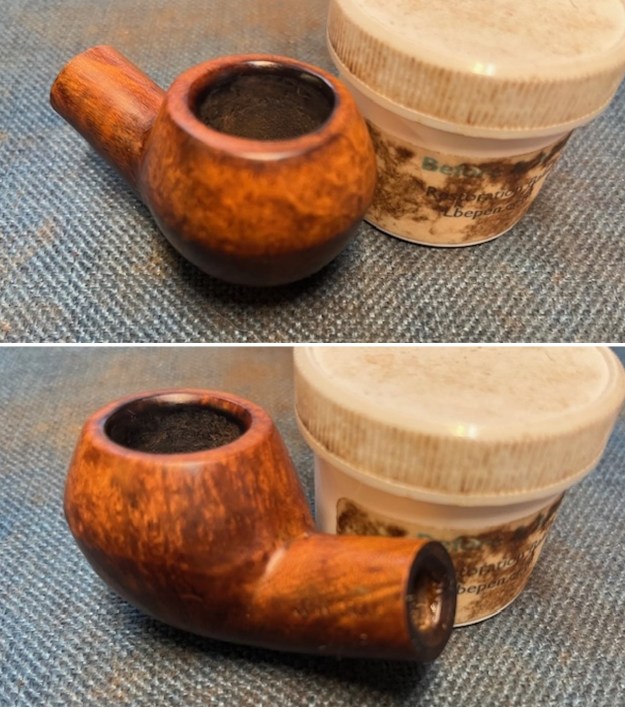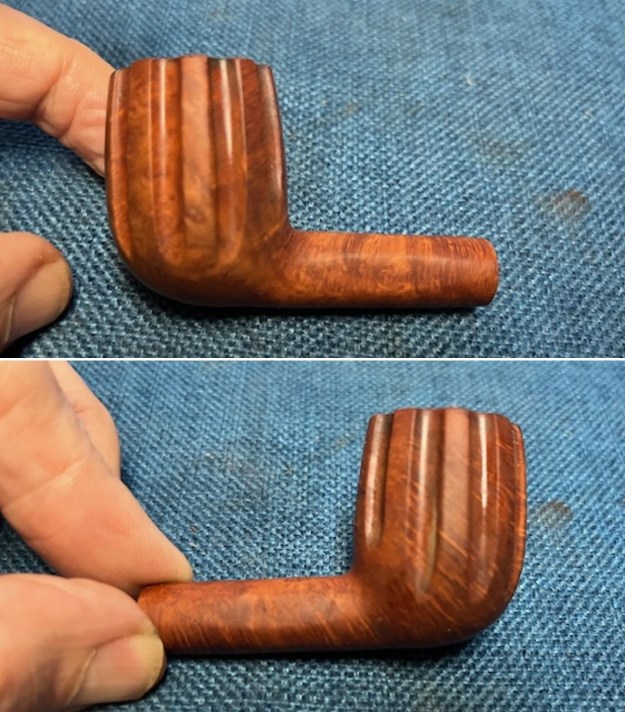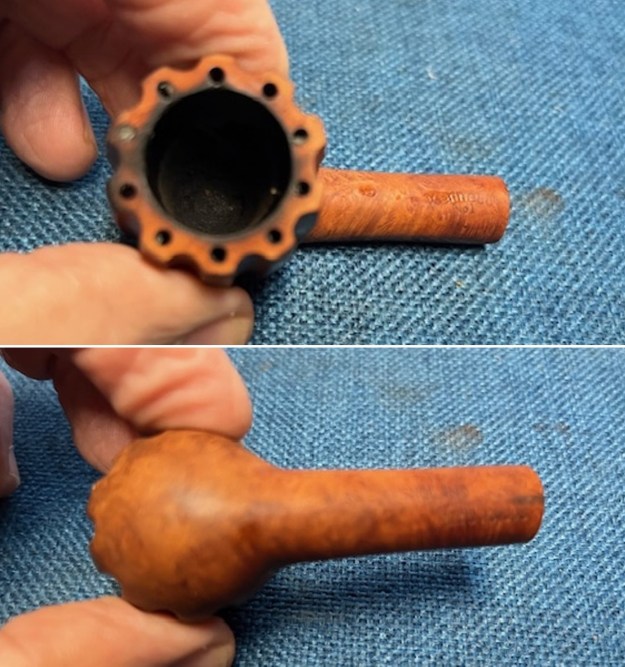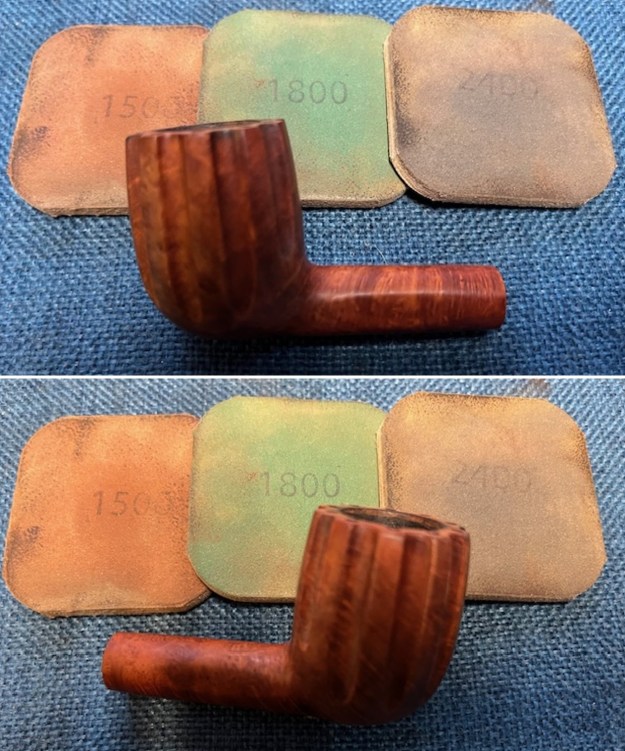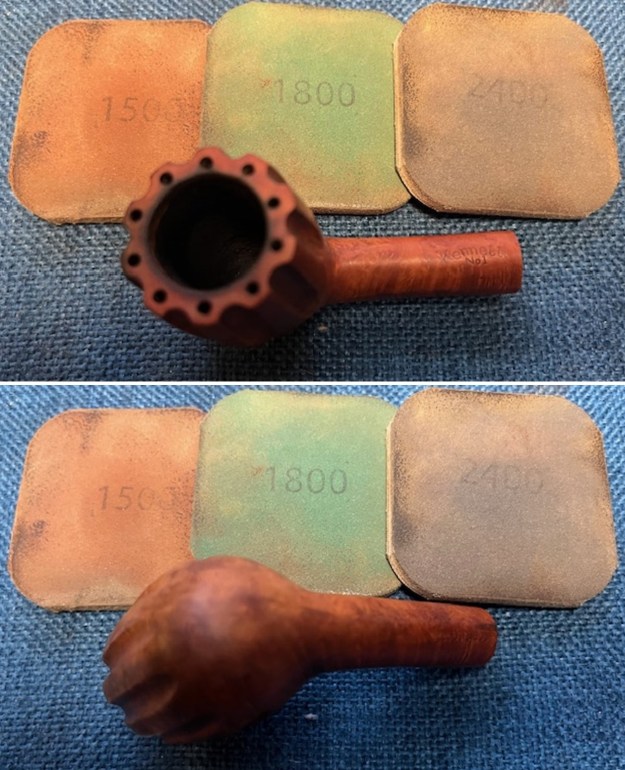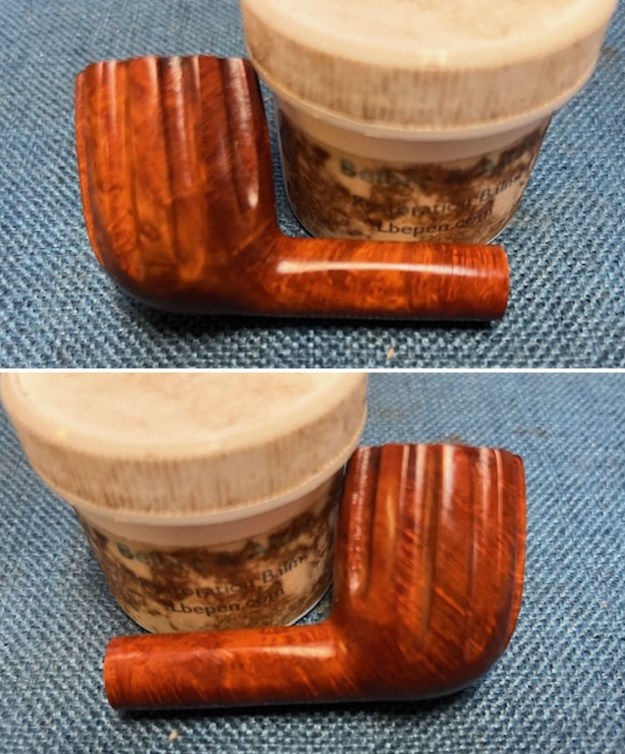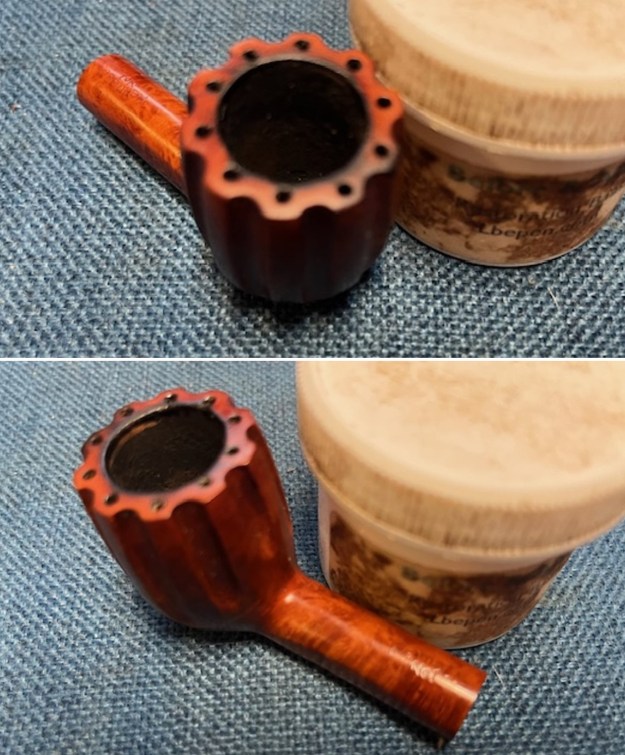
Tag Archives: Bowl – finishing

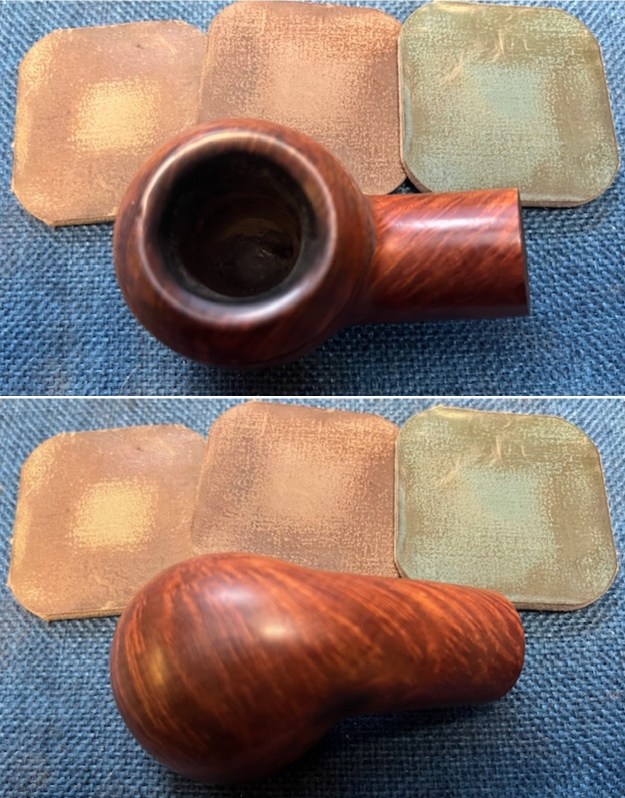
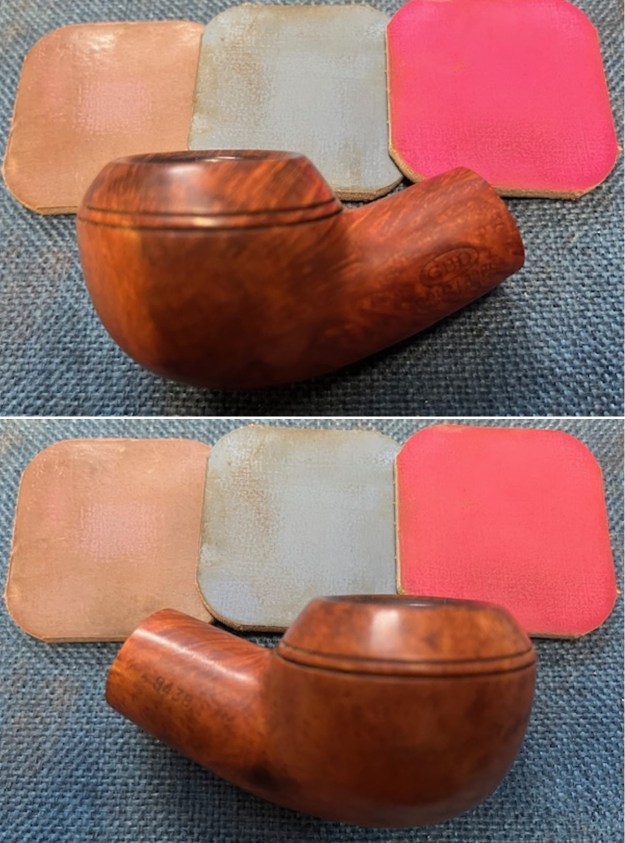
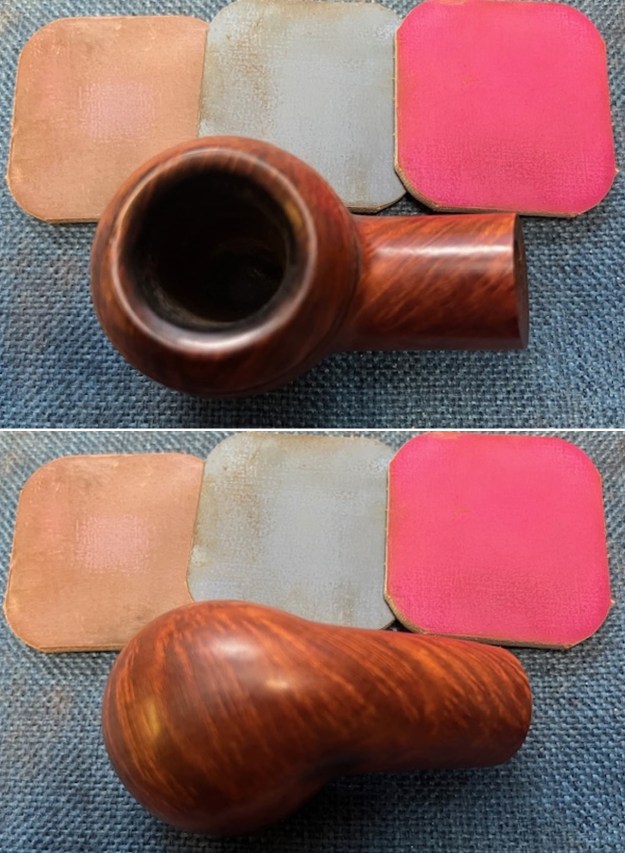
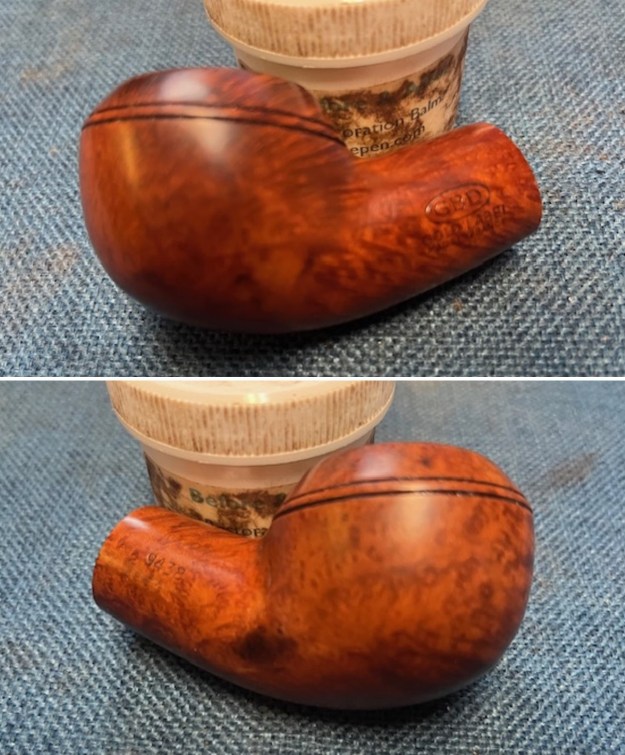
Restoring a Huge Cellini Original Pickaxe Freehand


Blog by Steve Laug

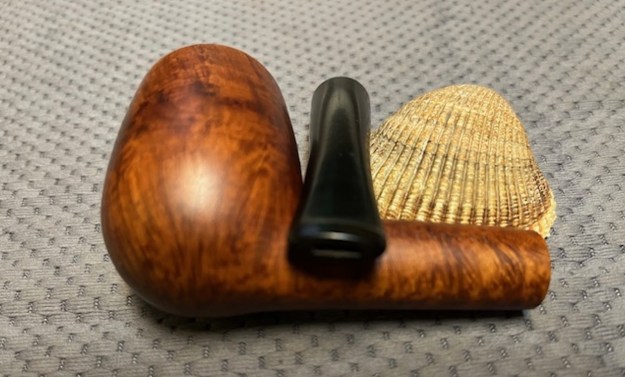
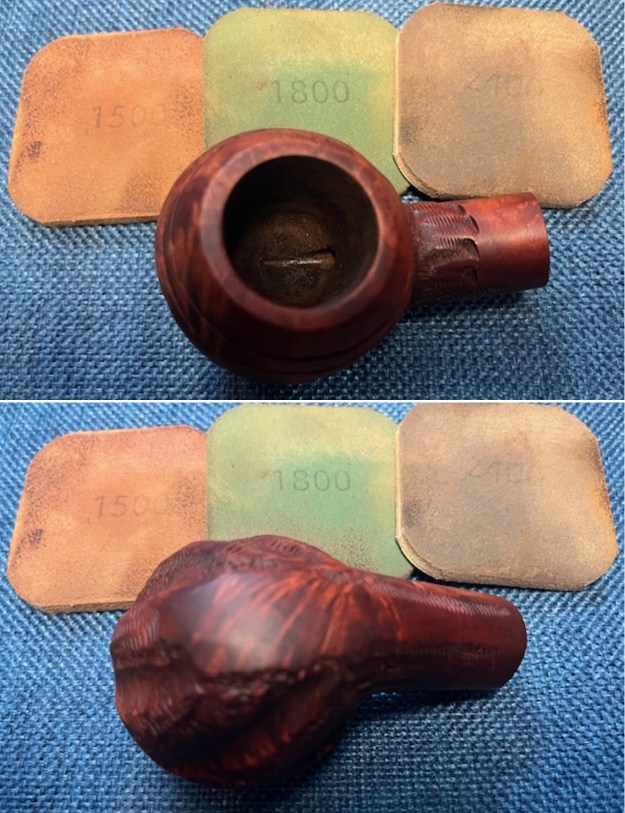
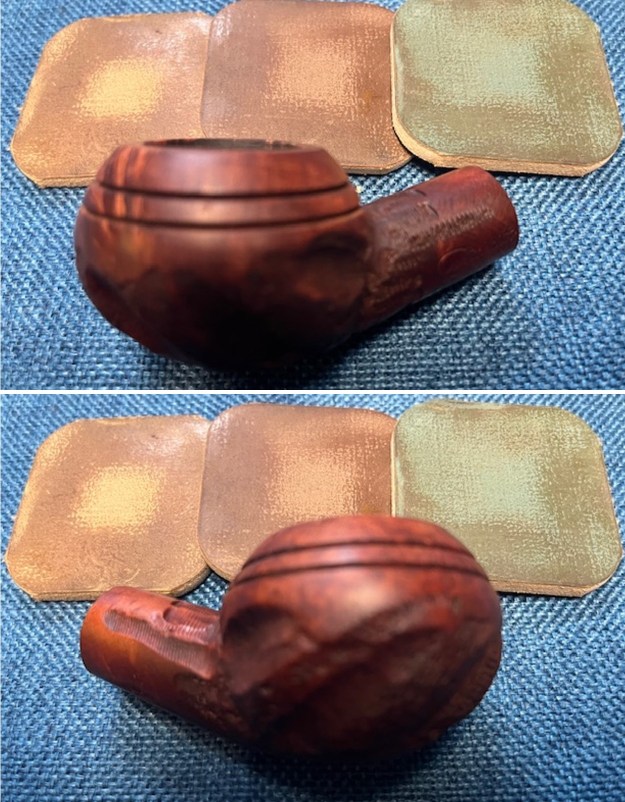
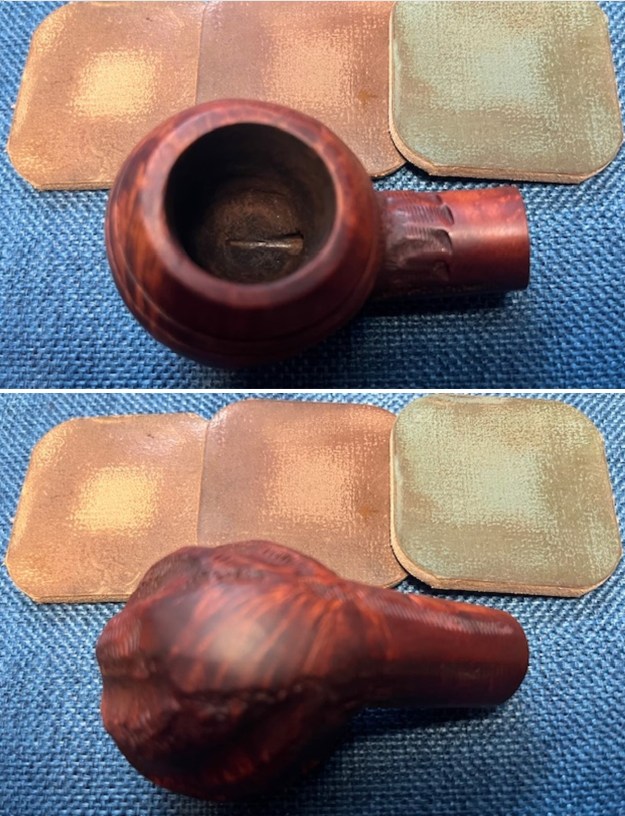
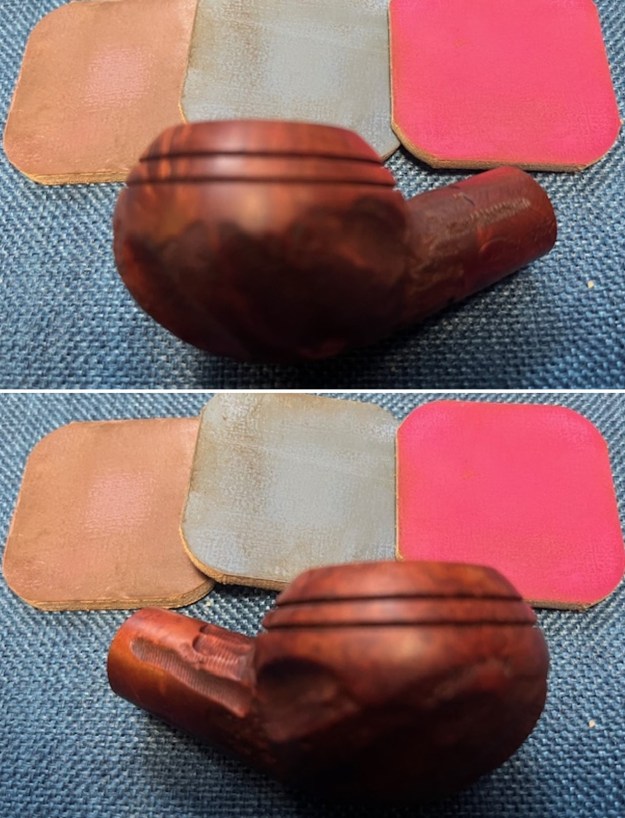
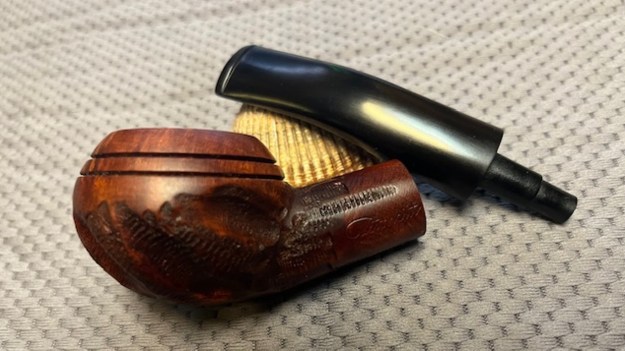
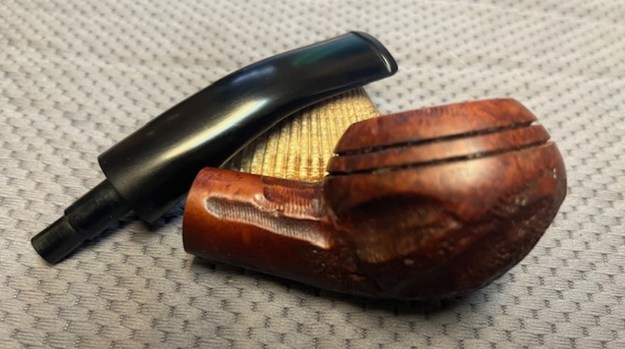
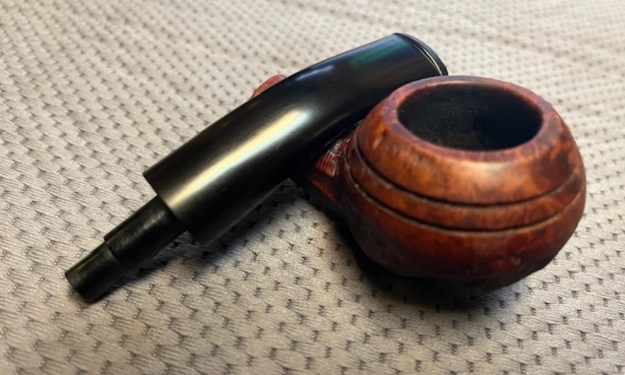
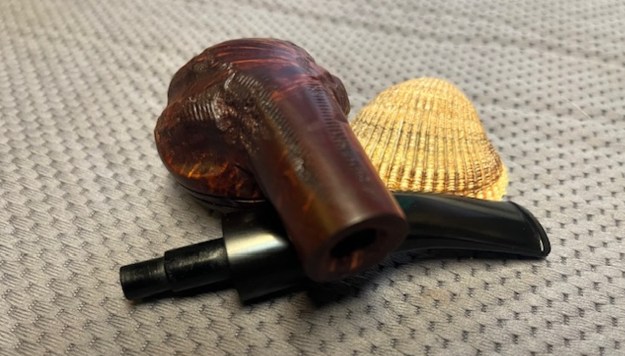
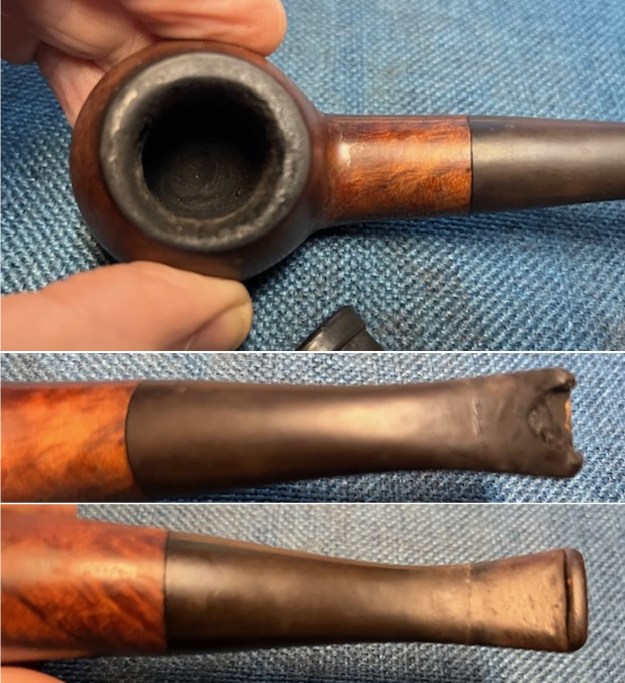
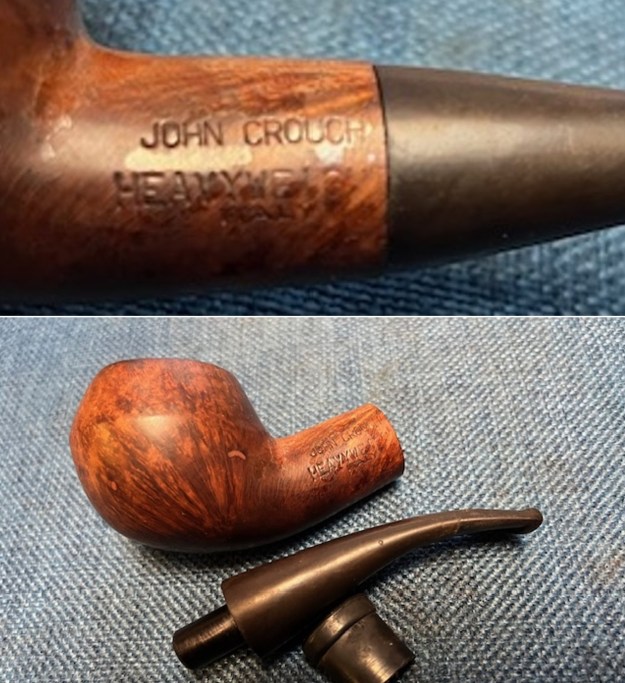
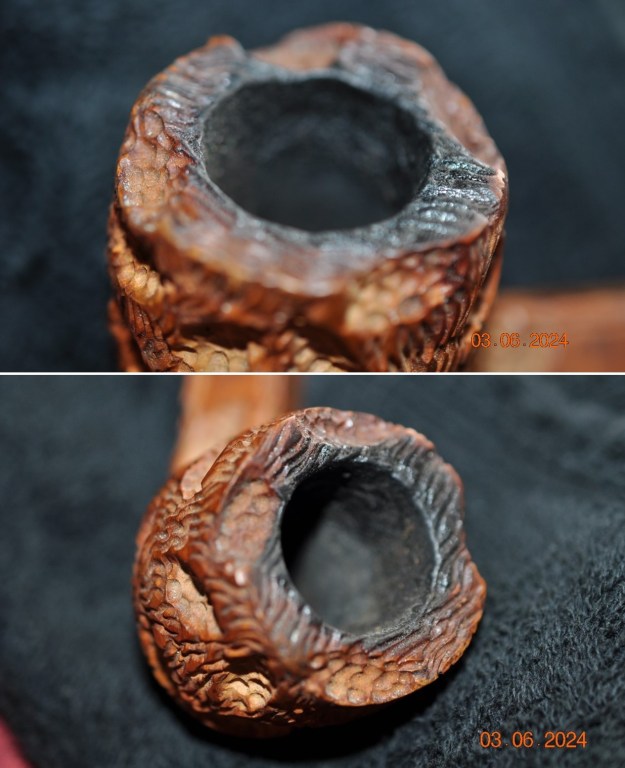
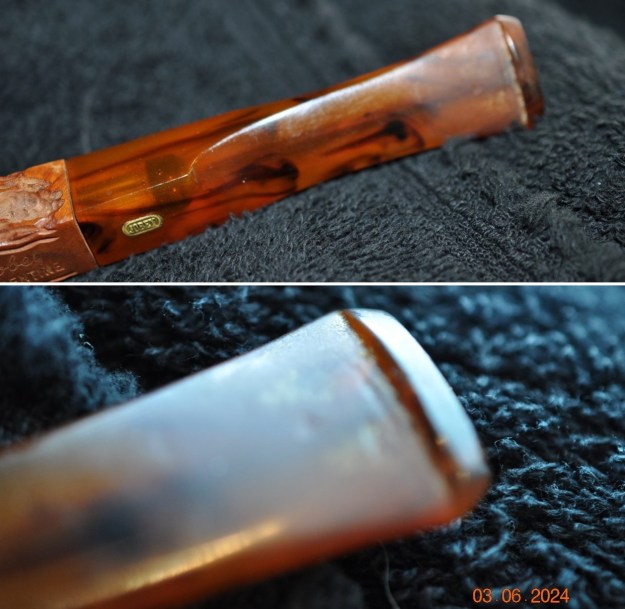
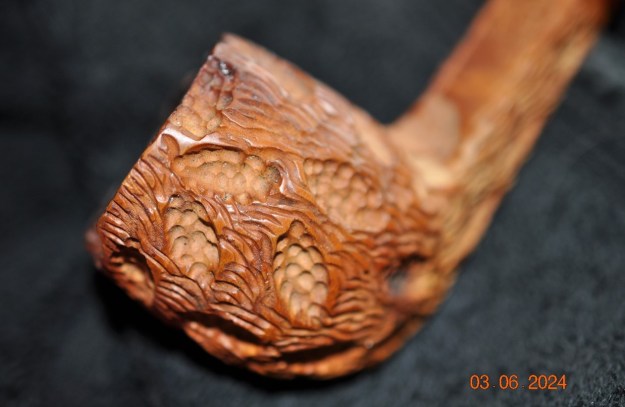
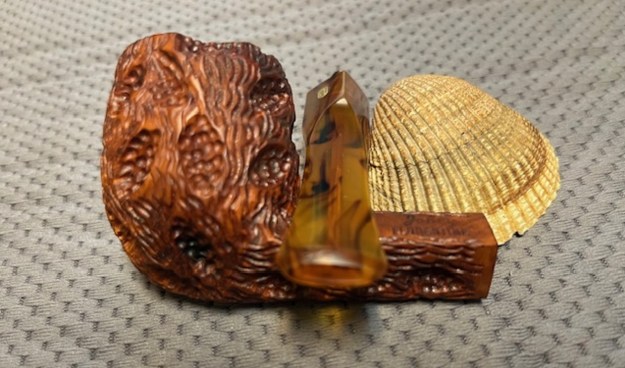
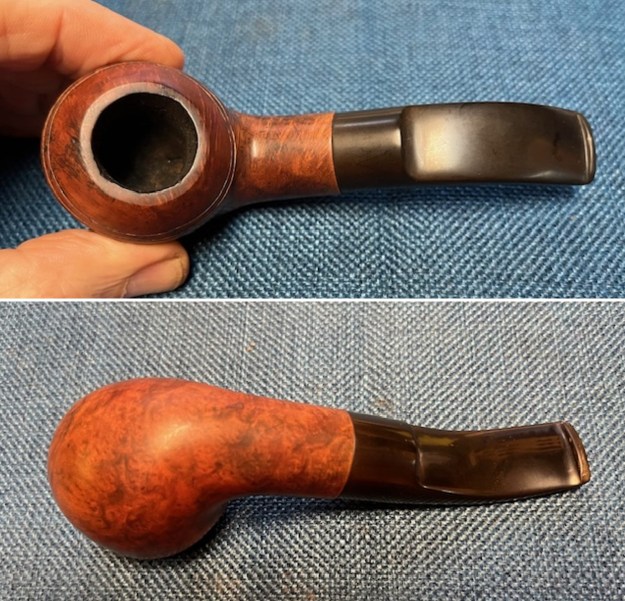
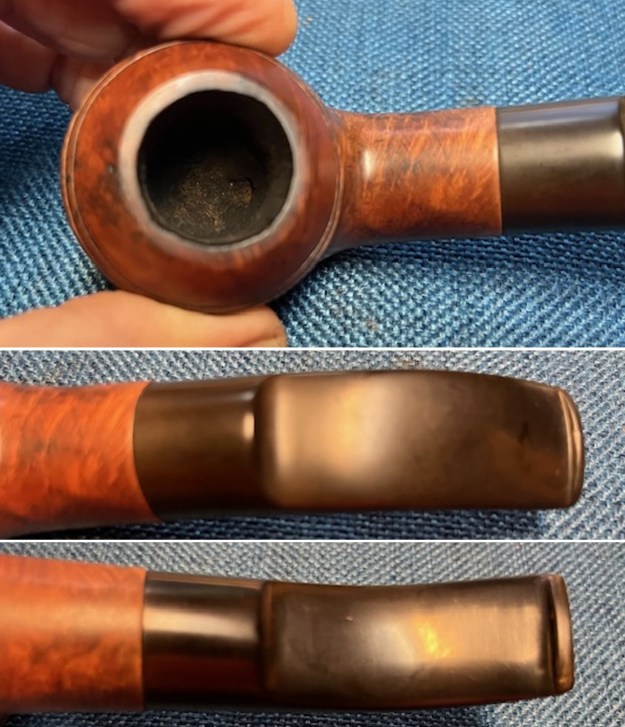
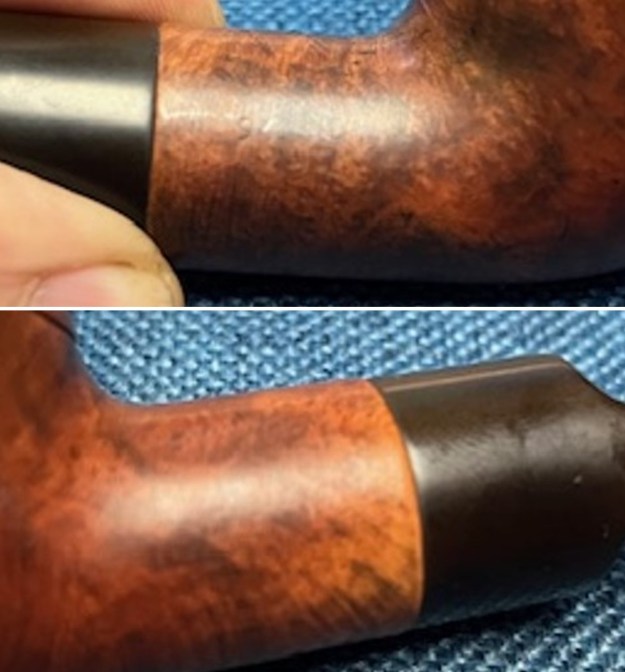
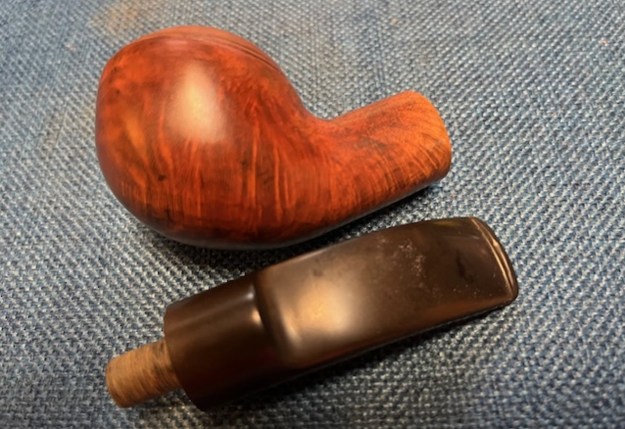
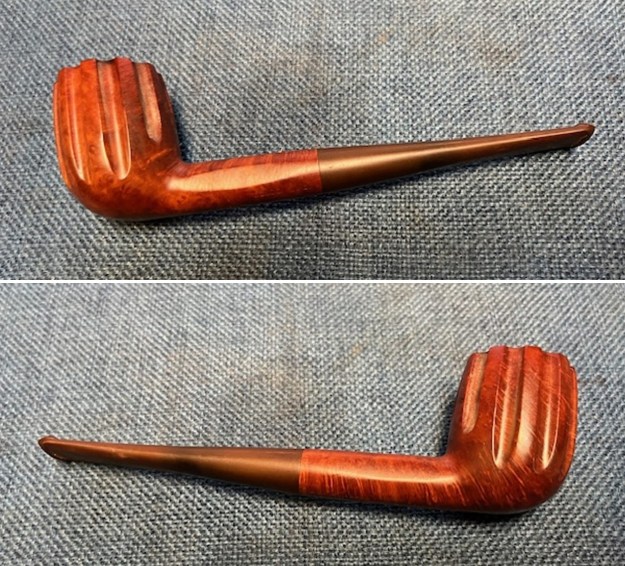
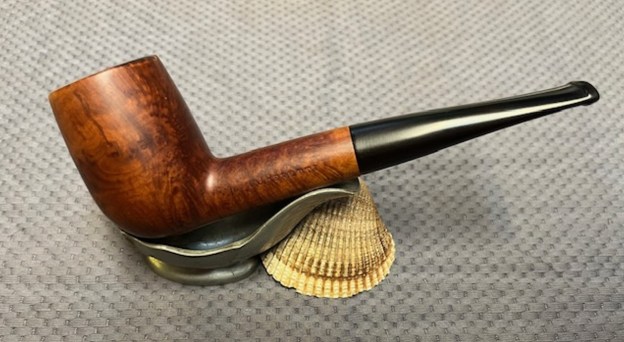
The next pipe on the table is a Freehand with some rustication at the shank/bowl joint and plateau on the rim top.  It has a well shaped thick vulcanite taper stem. We purchased it from an estate sale in Idaho Falls, Idaho, USA on 09/16/2023. The pipe is stamped on the left side of the shank and reads Cellini [over] Original. There is no other stamping on the bowl or shank. There was a thick cake in the bowl and some darkening and lava on the inner edge of the bowl and the first part of the plateau rim top. It was hard to know for certain the condition of the inner edge though it appeared to be in good condition. There were oils and grime ground into the bowl sides gives the finish a flat look though there is some great grain. The shank is thick and has a slight curve to it giving the pipe the appearance of a pick axe. The shape of the taper stem also matches the curves of the bowl and shank. It is a dirty stem with calcification, oxidation, grime and grit on the surface. There were also light tooth marks on both the top and underside of the stem just ahead of the button. Jeff took photos of the pipe before he started his clean up work. I have included them below.He took photos of the pipe’s bowl and rim top to show the cake in the bowl, the darkening on the inner edge and the lava coat overflowing onto the top. There are some oil stains on the rim top in various spots among the plateau finish. It is another dirty pipe. He also took photos to capture the oxidation, calcification and the light tooth marks on the top and underside of the stem near the button. He took photos of the sides and heel of the bowl to show the grain around the bowl and the amount of grime ground into the surface of the briar. He took a photo of the stamping on the left side of the shank. It is clear and quite readable. I turned to Pipephil’s site (http://pipephil.eu/logos/en/logo-c3.html) for a summary of the information he had gathered on the brand and perhaps some photos. I have included both the information from the sidebar as well as a screen capture of some photos. I quote:

The shop in Chicago, Illinois, USA (opening: April 27, 1929)  was exclusively devoted to pipes. These generally were imported and Brebbia was the most important supplier. The shop closed down on February 28, 1991.From there I turned to Pipedia where as usual there was a great history of the brand to read about (https://pipedia.org/wiki/Cellini). I quote several pertinent paragraphs to whet your interested. Make sure to go to the site and read it in its entirety.

Cellini, or better, the Cellini Pipe Shop as it became known for its brand “Cellini” from its company name, Victory Pipe Craftsmen, was located in the heart of downtown Chicago, Illinois: 170 N. Franklin St, Chicago IL, 60606. Ideally for those who liked short ways, one of Cellini’s locations was across the street from Zimmerman’s Liquor Store. The company got it’s start in 1927 aided by a friendship between Arthur (Art) Silber and Tracy Mincer(??) who went for Custom-Bilt fame in 1934.

Art Silber (also known as the “Art” of pipe smoking) made Cellini a full service Pipe and Tobacco Shop offering tobacco blends and a complete line of accessories as well as an extensive and varied line of pipes ranging from Indian Peace Pipes to porcelain, cherrywoods, meerschaums and hefty sculptured freehands. The Catalogues were nearly 100 pages long – including some cigars, but absolutely NO cigarettes! – primarily pipes and pipe-related products! Cellini Pipes have Good Collectible value of their own commanding good prices on auctions today, developing somewhat of a Cult Following among Collectors.

Art was joined by his wife Ruth, daughter Bobbe (short for Barbara, also an established artist) and his 2 sons Stuart (who created the Cigar Pipe, crafted various Cellini pipes and freehands, became a cigar aficionado, was an antique and Meerschaum repair expert and more),and Elliot (who also worked as a physicist and an organic chemist).

Victory Pipe Craftsmen became the largest pipe repair shop in the country (probably in the world), repairing up to 2000 pipes per week for some 1200 pipe shops in the U.S., from replacing and customizing stems (mouthpieces) to Meerschaum and antique repair. Art Silber innovated many developments in the pipe industry. He invented a keyless 4-jaw chuck for nearly instant mounting of almost every shape mouthpiece. The result was finely crafted, custom-fitted complete stem replacement (including sanding with 3 grades of sandpaper, proprietary custom staining to match, bending if needed, and polishing on 2 different polishing wheels) in 8 1/2 minutes!! Cellini was famous for while-u-wait pipe repairs, which of course allowed the customer to browse the thousands of Cellini pipes on display…

…Although Cellini offered a very small variety of brands by other makers, their primary business was selling their own pipes made in their Chicago factory. Art Silber (also known as the “Art of pipe smoking”), who made pipes himself once upon a time, employed his own pipemakers (with “Primo Polidori”, former factory supervisor of the Chicago Dr. Grabow/Linkman factory, being the most recognizable name). The company was Victory Pipe Craftsmen, (Victory Pipe Craftsmen Inc. was the actual corporate name for “Cellini of Chicago”) The most experienced pipemaker there was Primo Polidori

After the death of it’s founder Art Silber, The Cellini Pipe Shop survived until the late 1980’s, run by Art’s oldest son Stuart, Bobbe and Elliot, ending a significant chapter in American pipemaking history. Art Silber’s sons Stuart (sometimes called “The Legend”) and Elliot are still liquidating the residue of the shop’s inventory. The charismatic Bobbe and their mother Ruth Silber have since passed on. All those interested should be aware that some of the Cellini Pipes seen on today’s online auctions may be flawed or rejected pipes that were not offered for sale while the company was in operation. Be sure to ask the seller to distinguish their pipes. Cellini specialized in natural finish, no lacquer, no varnish, no fills or wood putty. If flaws were found, the shape was changed, carving was done, or the pieces were used for repair of broken pipes…

From that information I knew that the pipe that I was working on was carved by one of the in house carvers at Cellini Pipe Shop in Chicago. I also knew that it was made before their closing in 1991. I had no idea how old it was as the shop started in 1929. Now it was time to work on the pipe on my end.

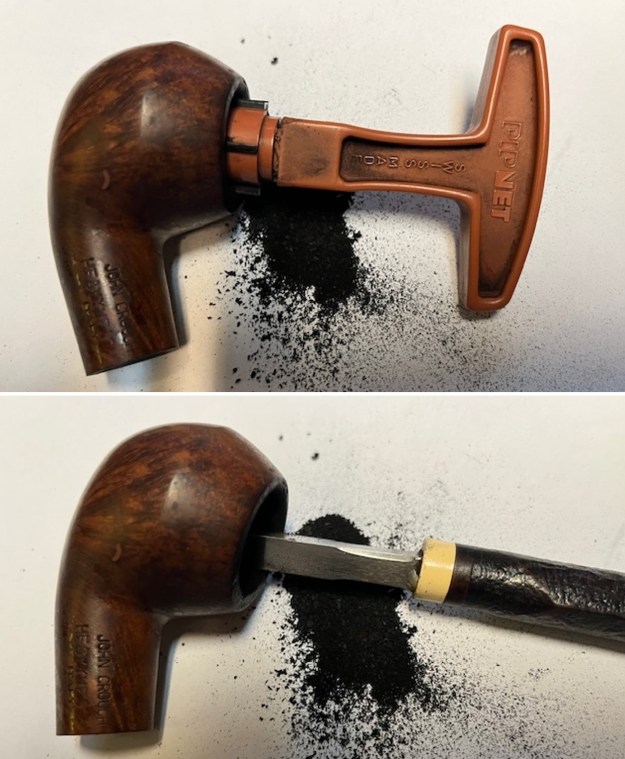
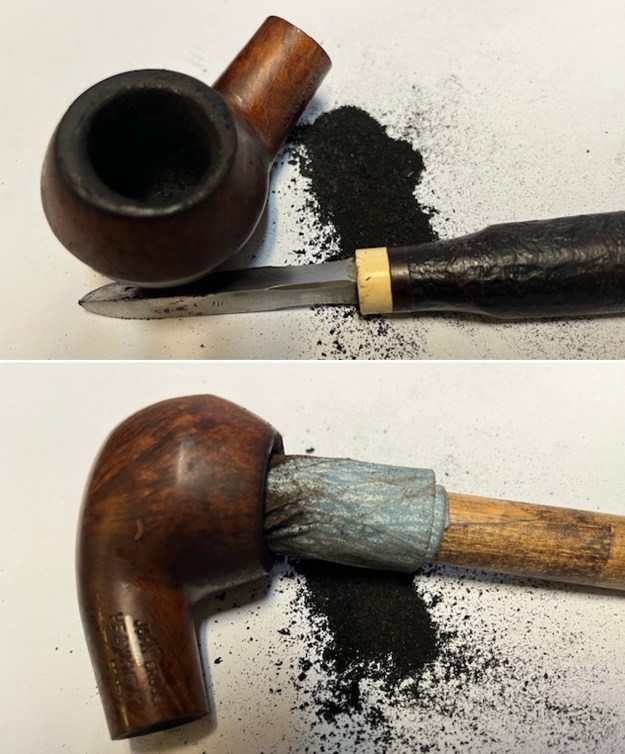
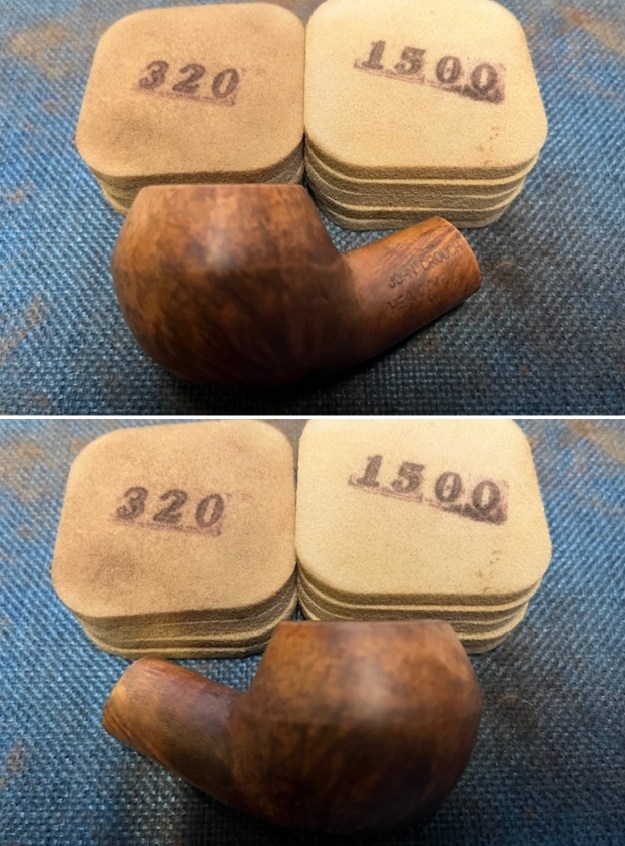
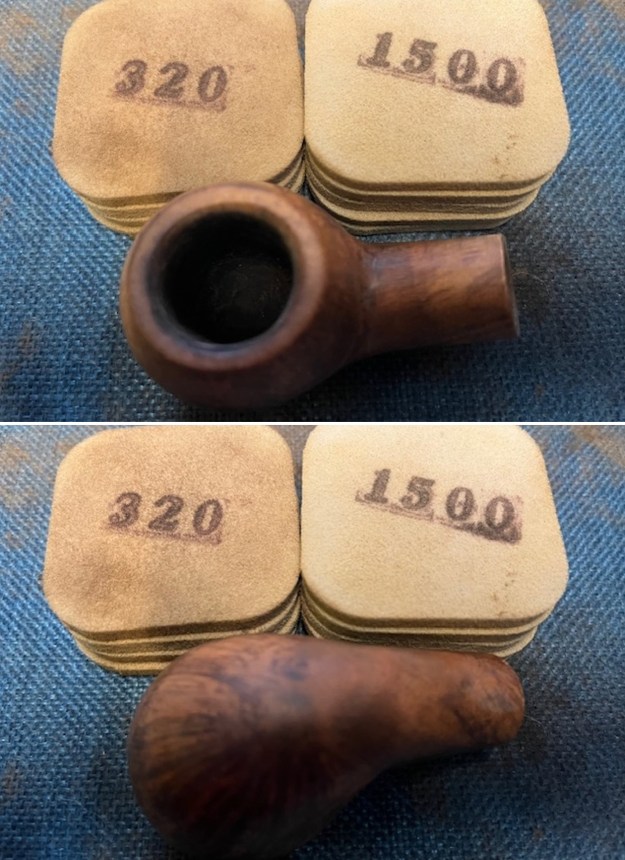
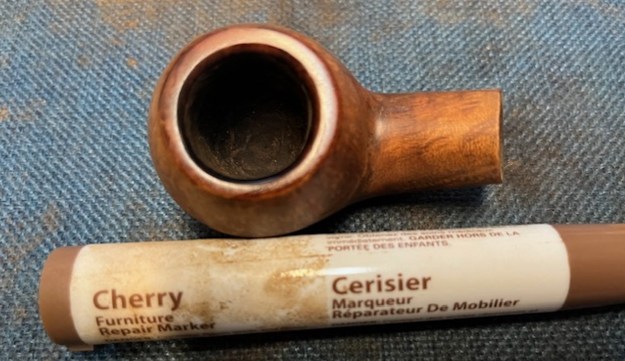
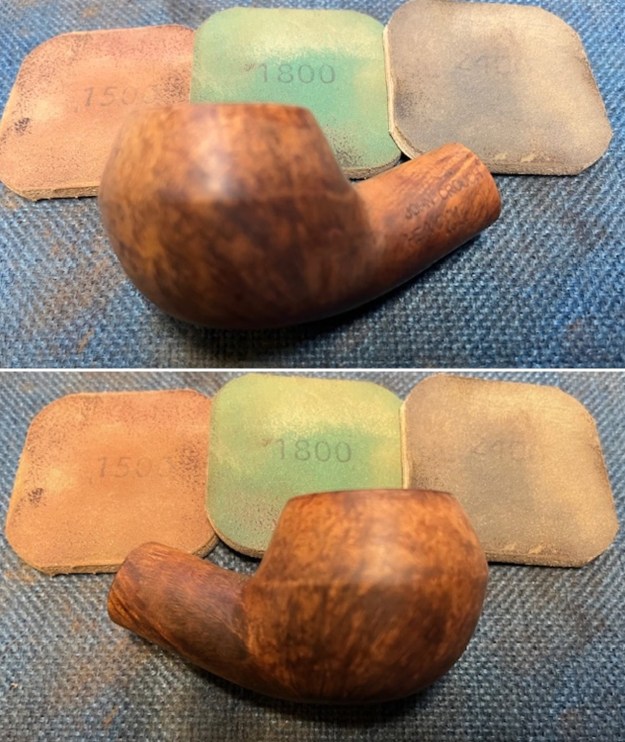
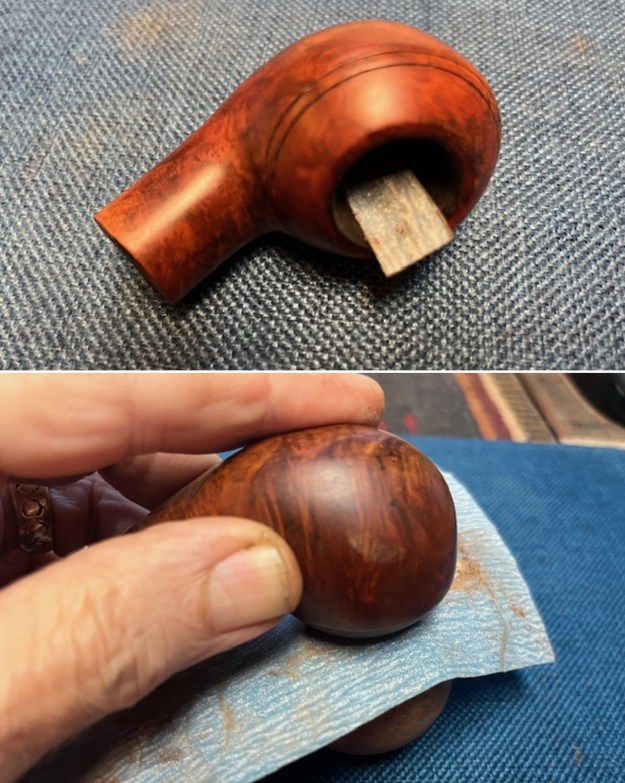
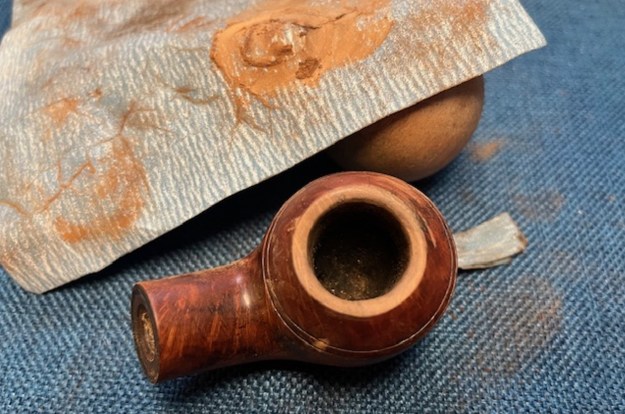
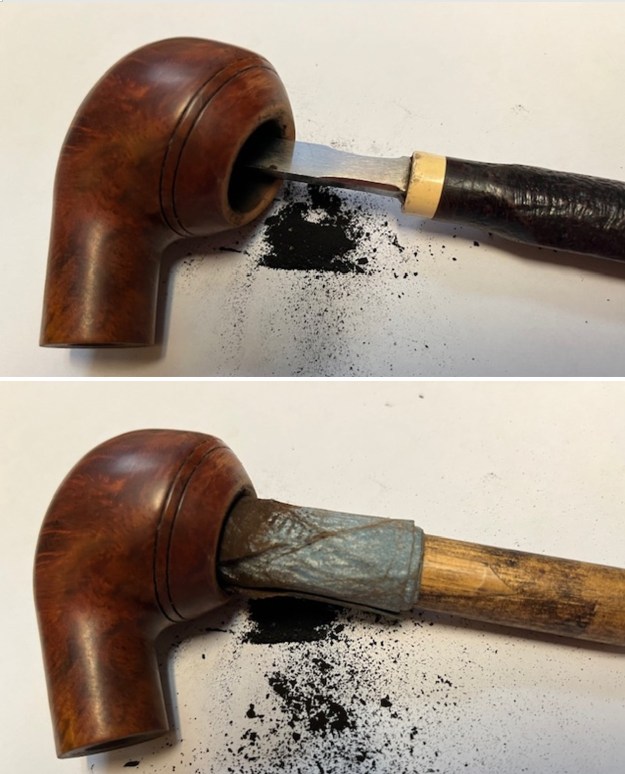
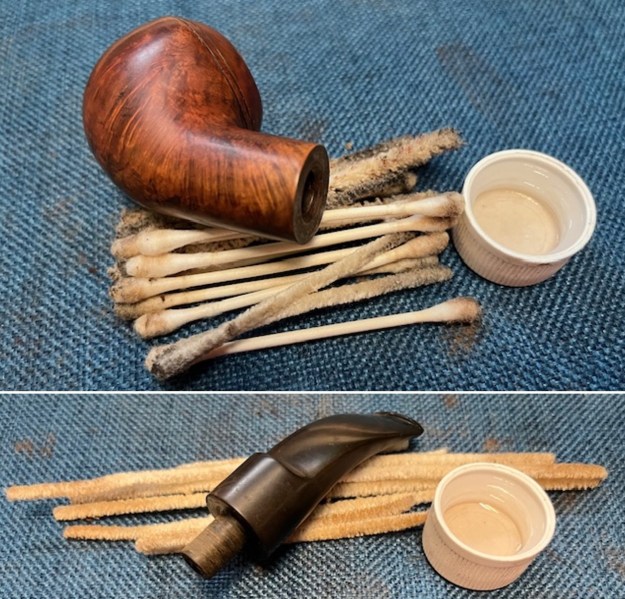
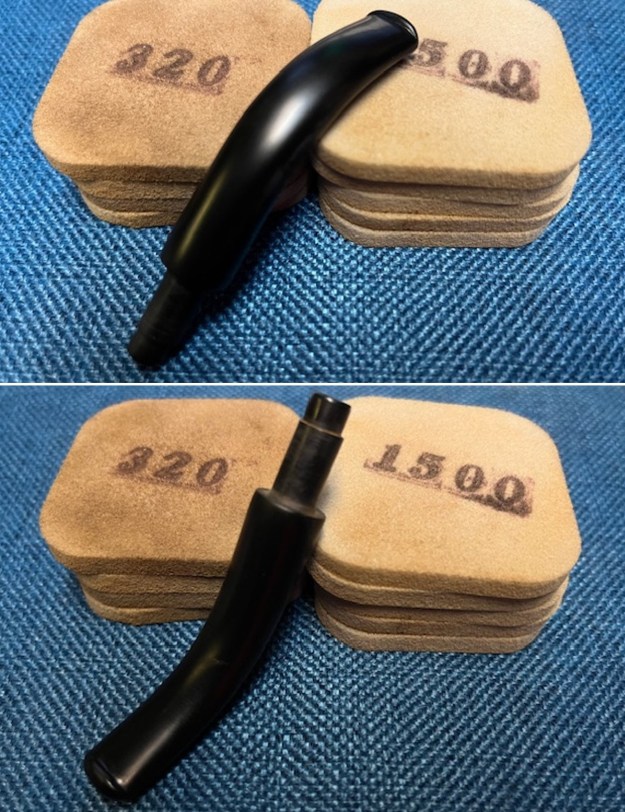
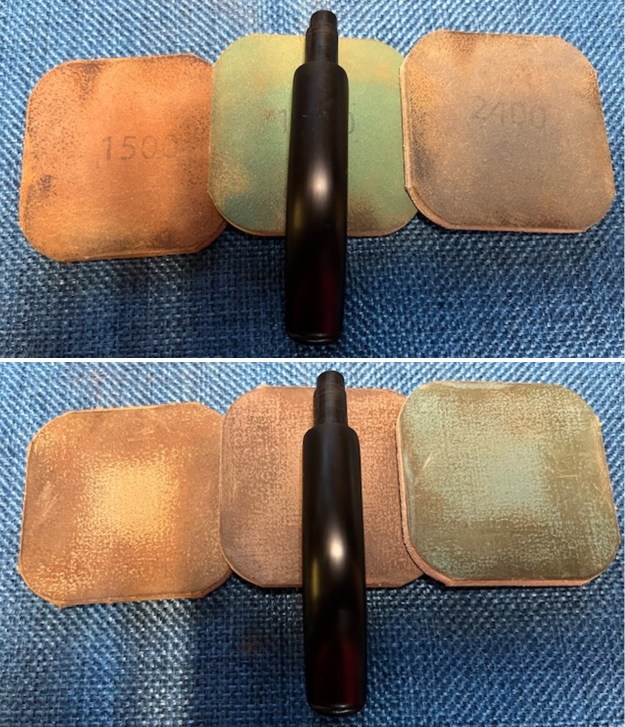
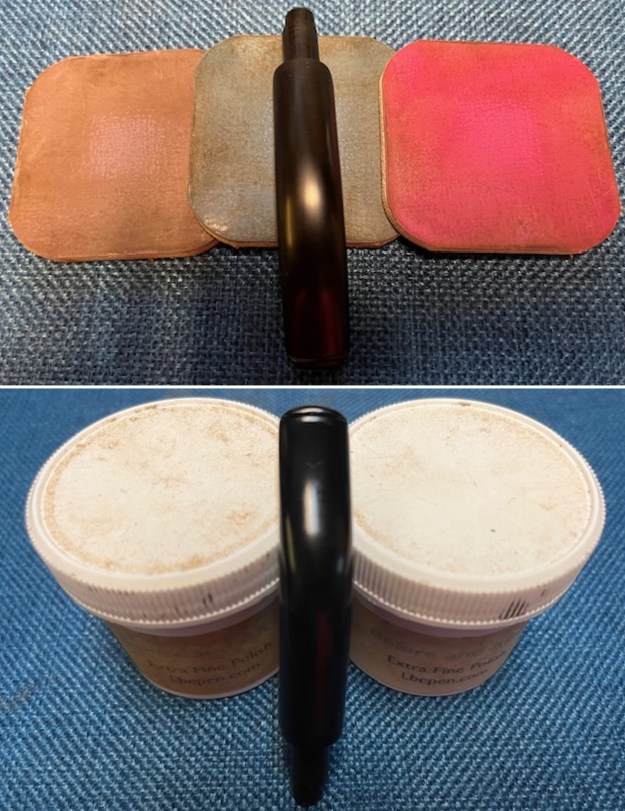
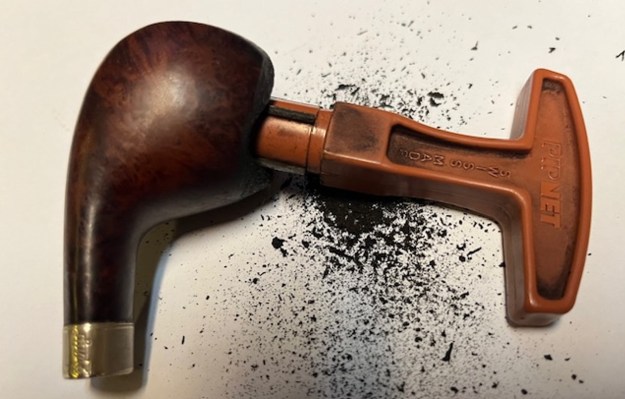
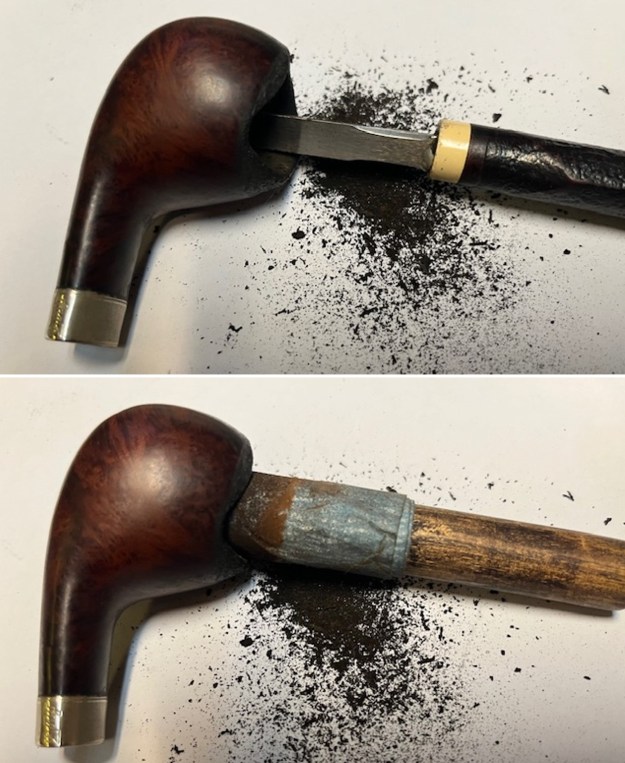
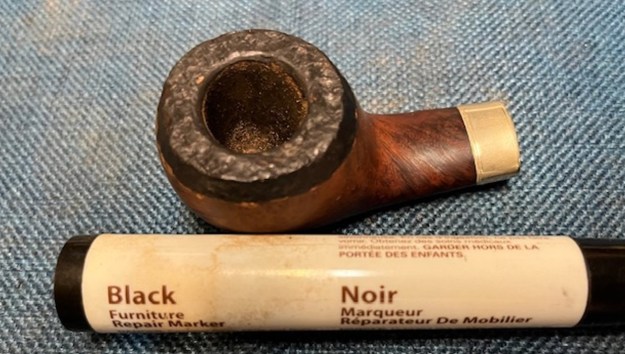
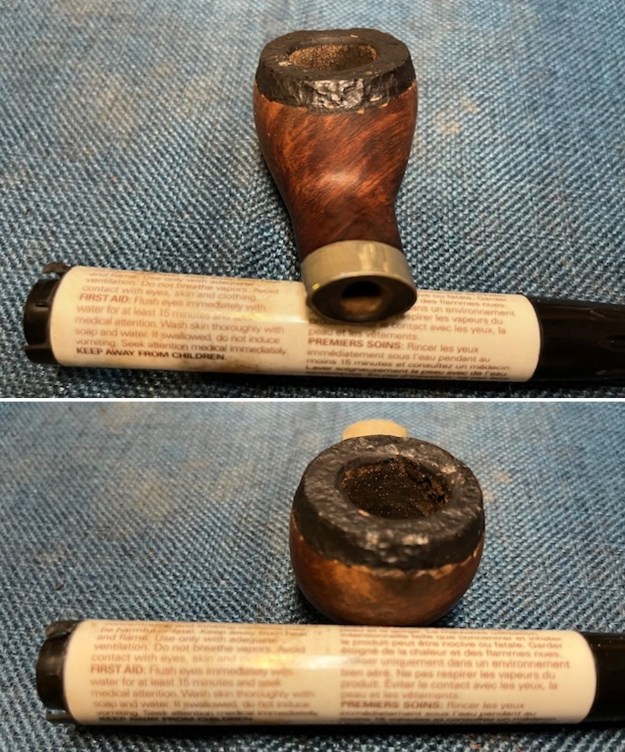
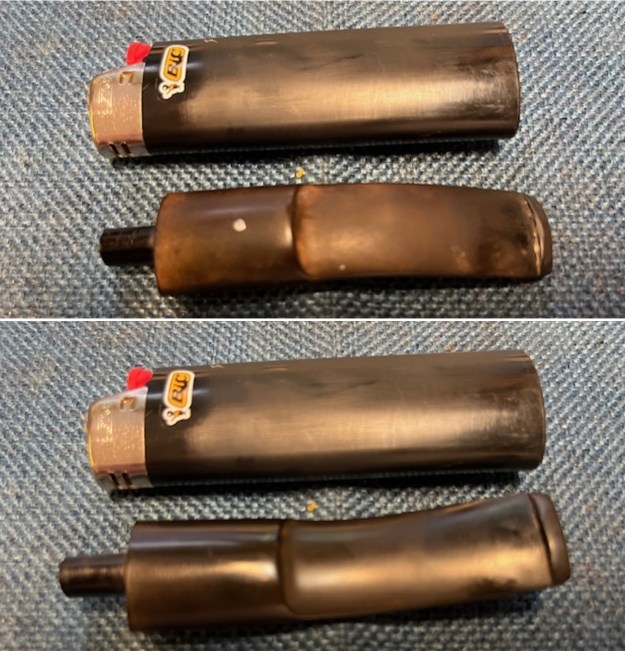
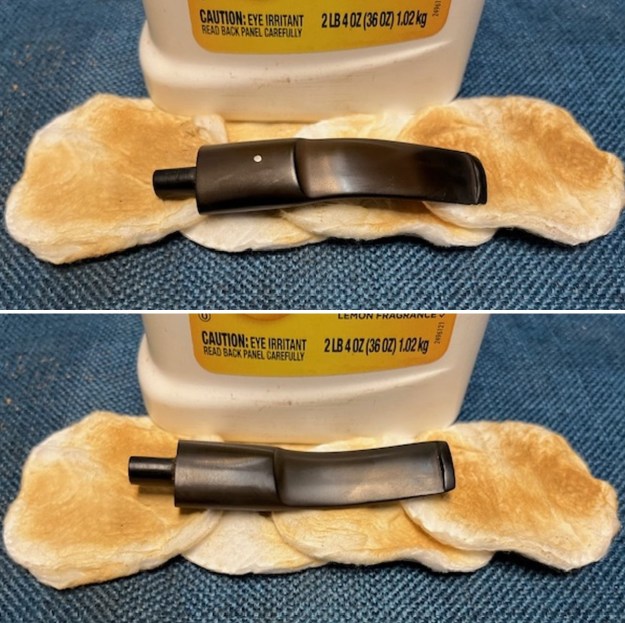
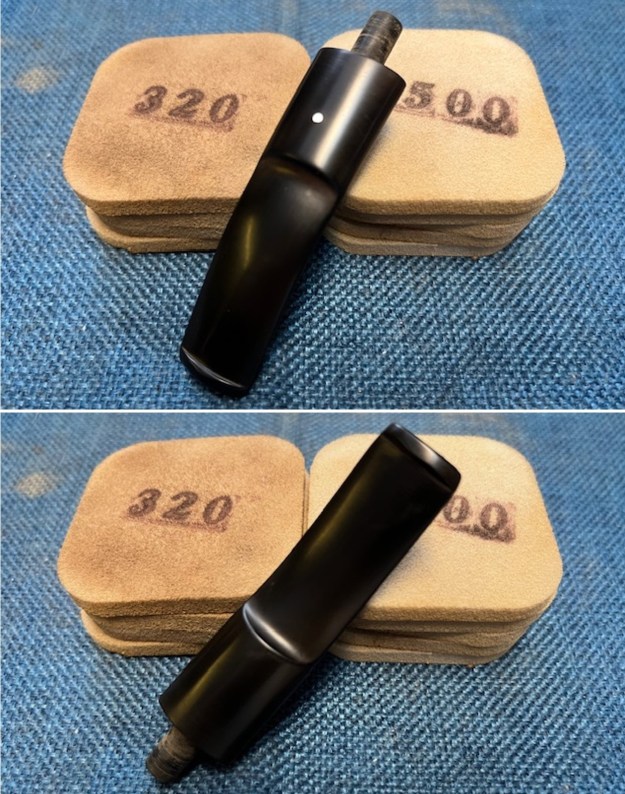
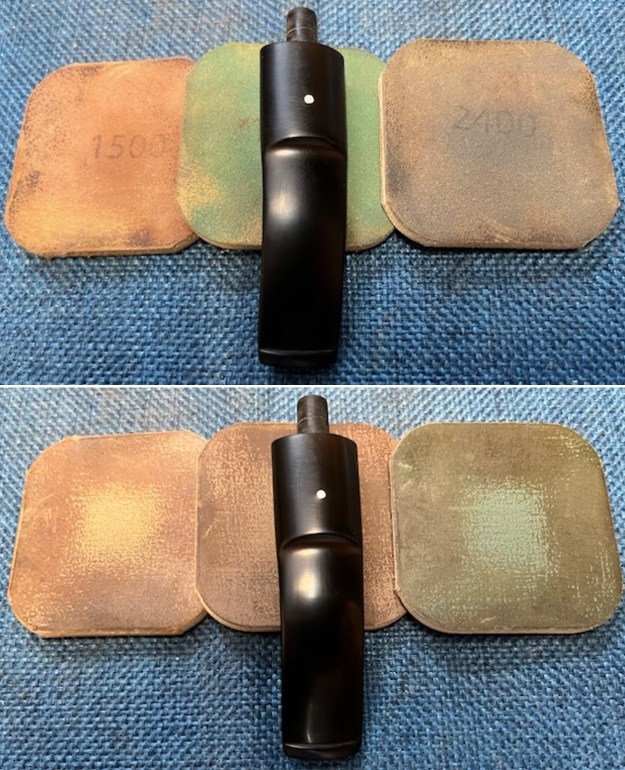
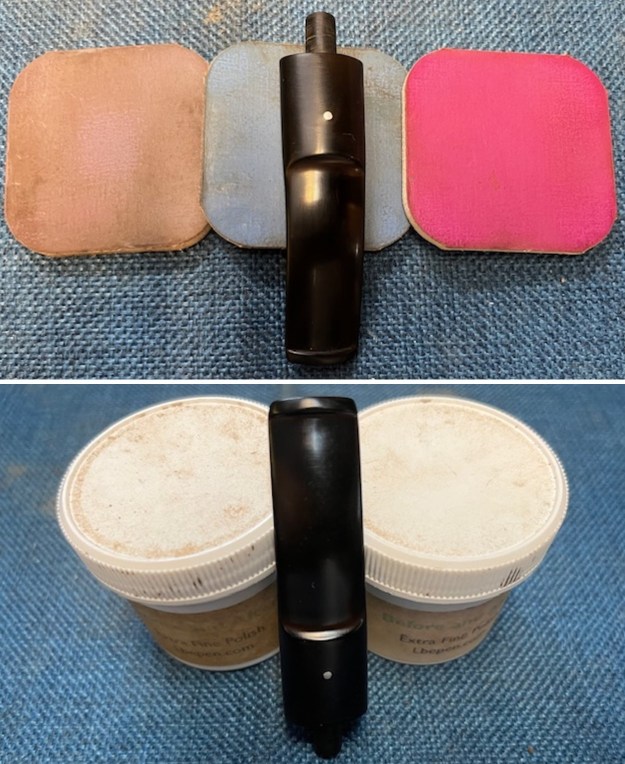
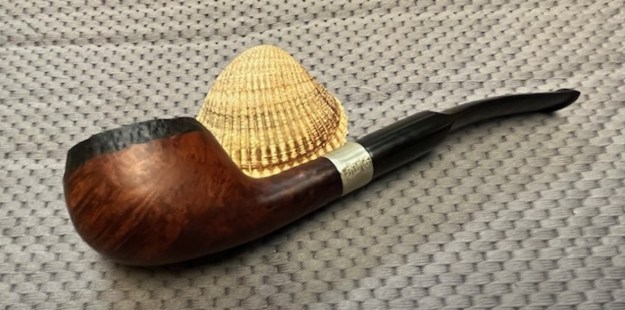
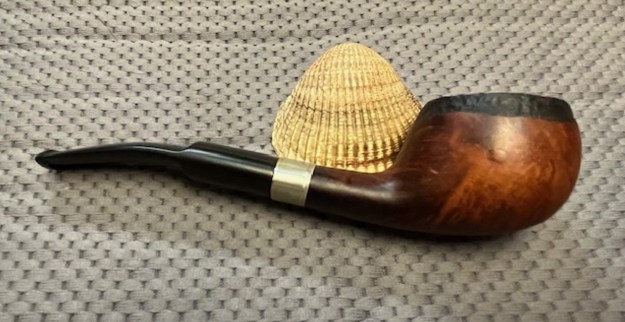
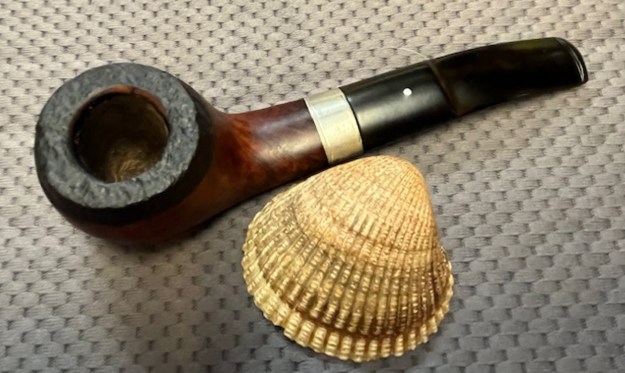
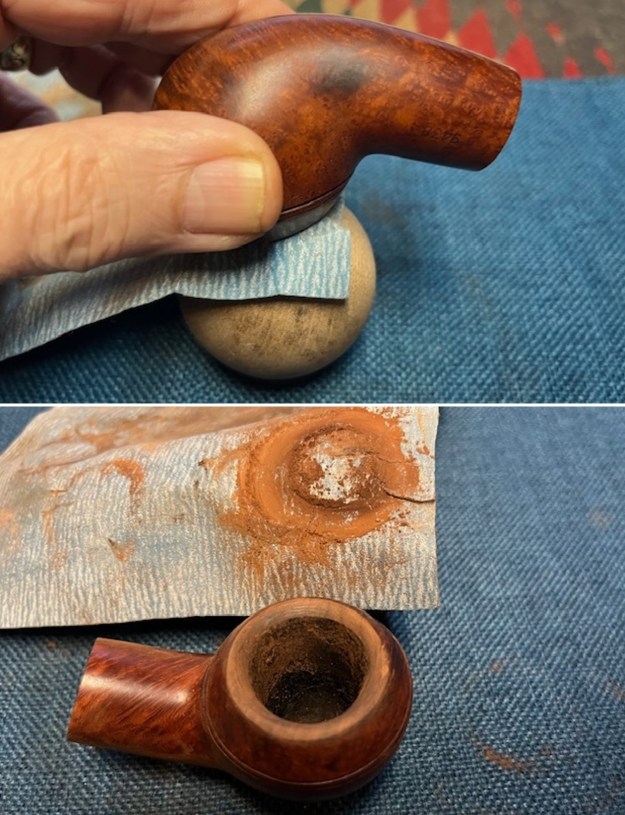
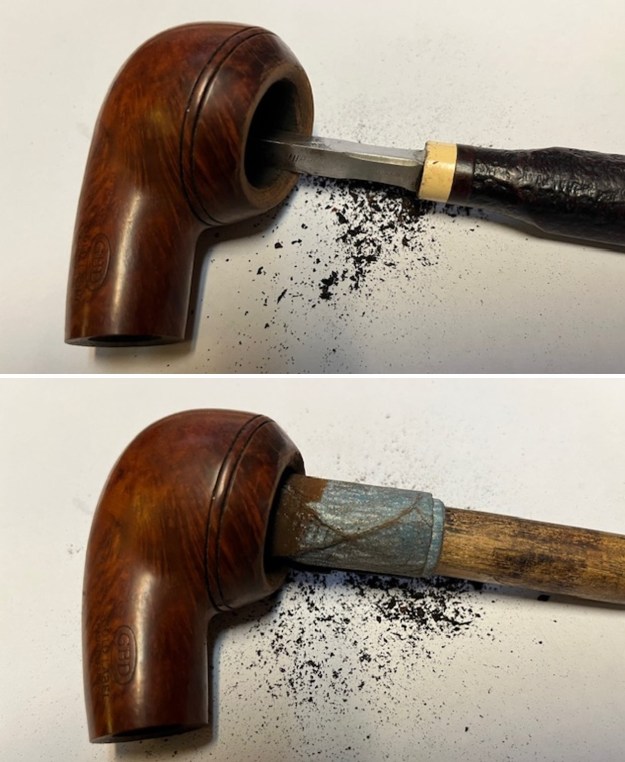
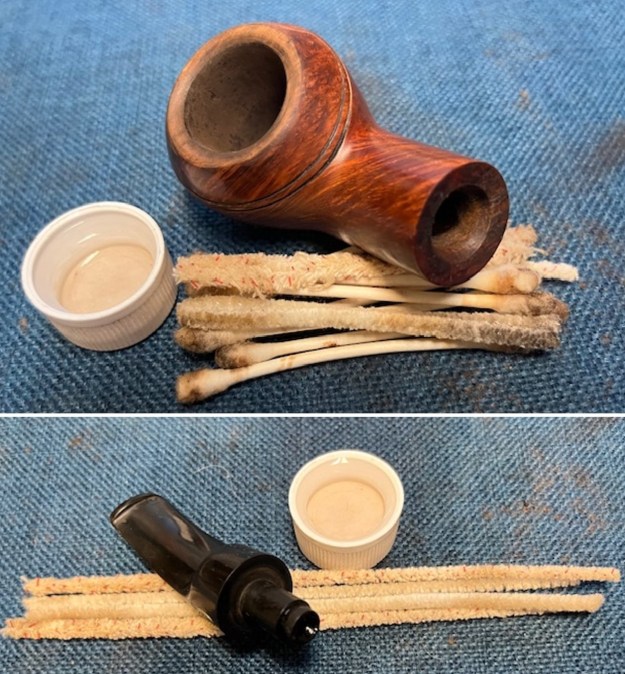
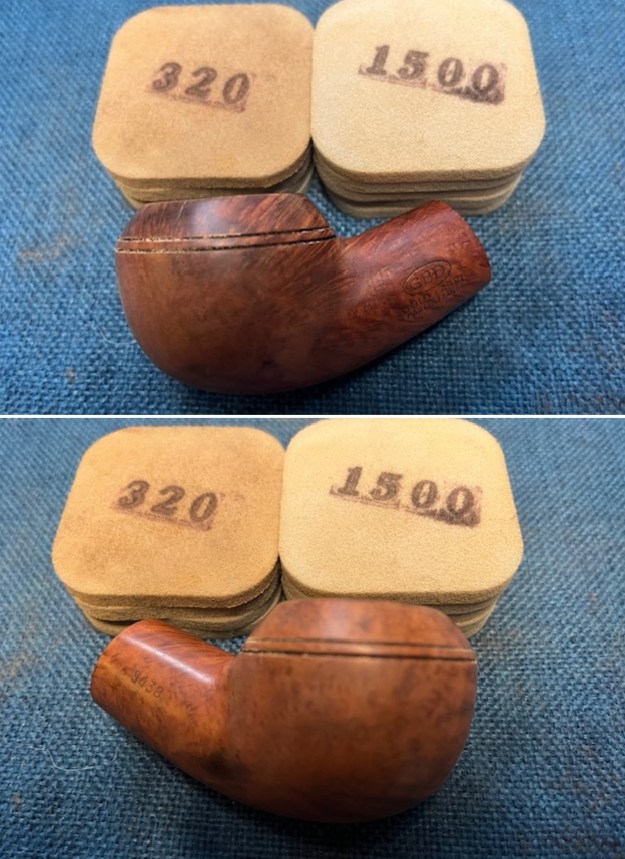
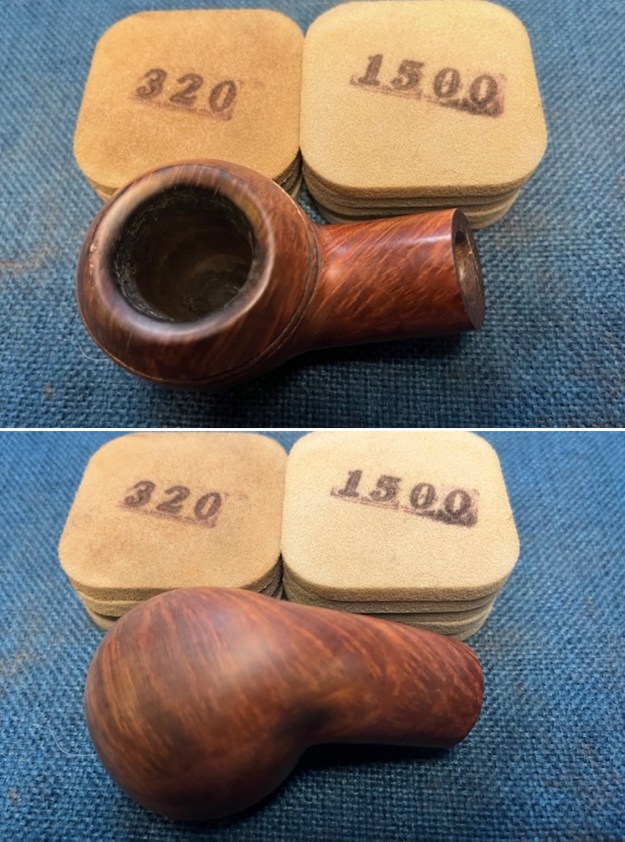
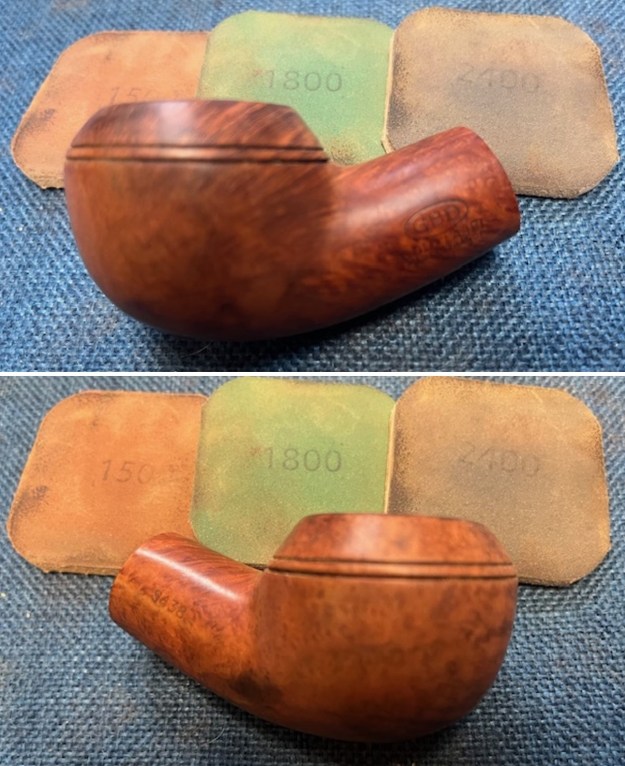
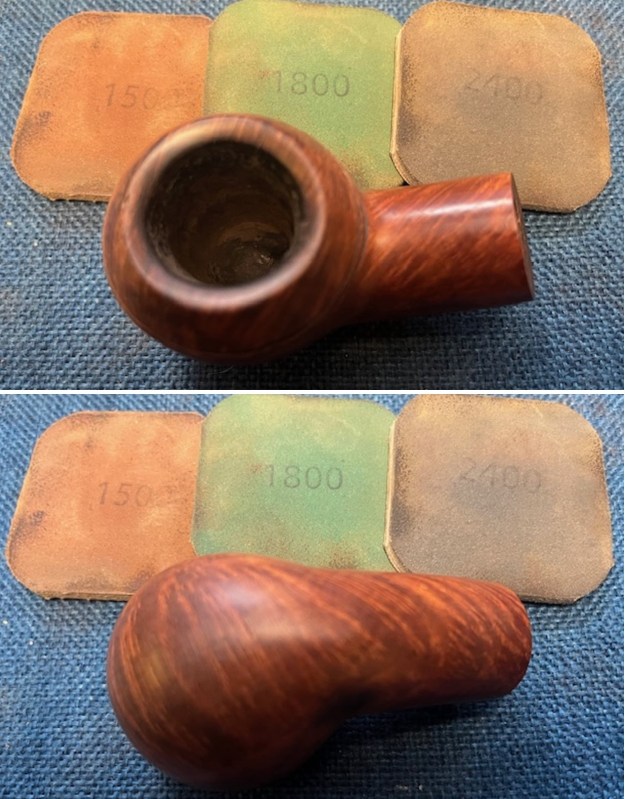
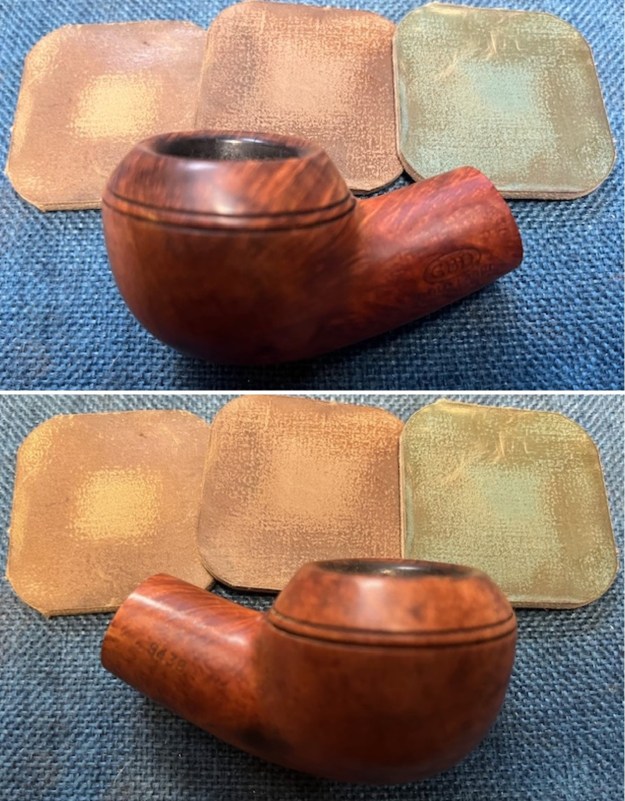
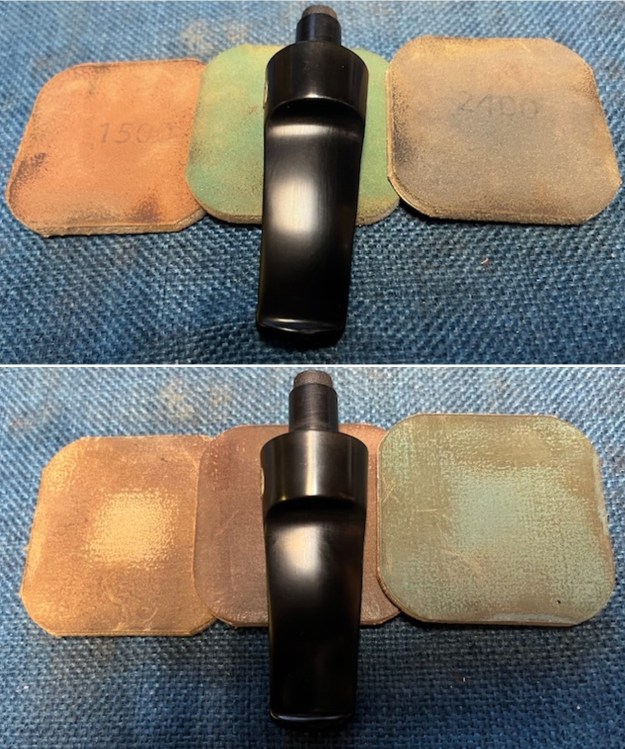
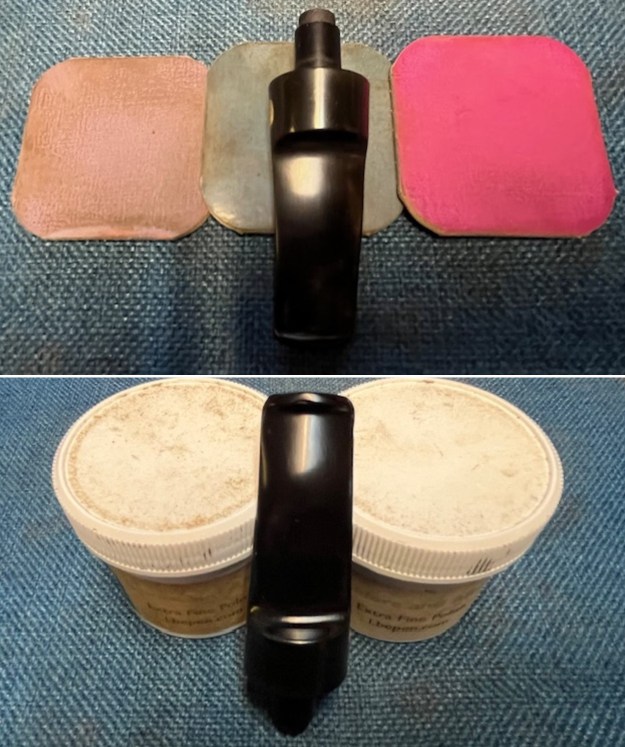
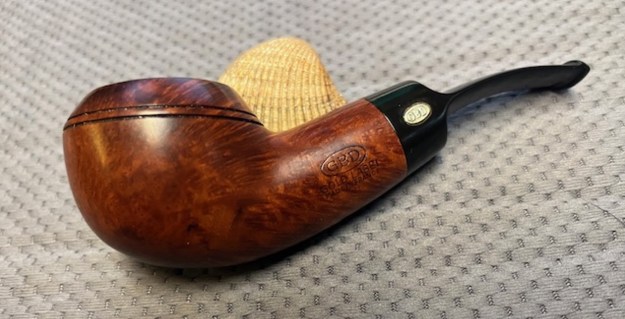
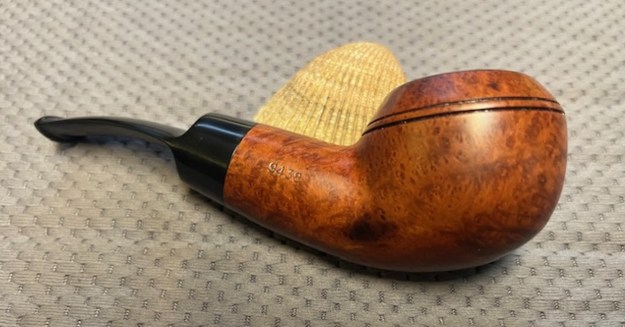
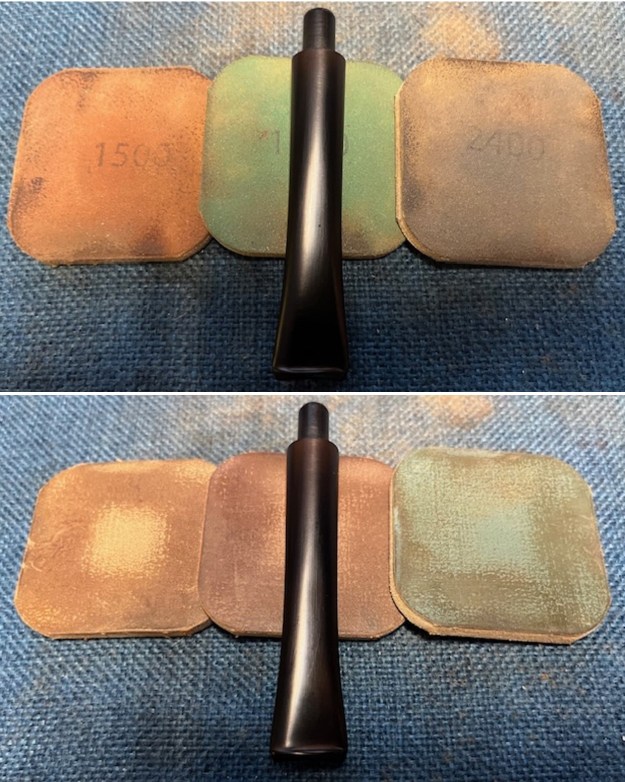
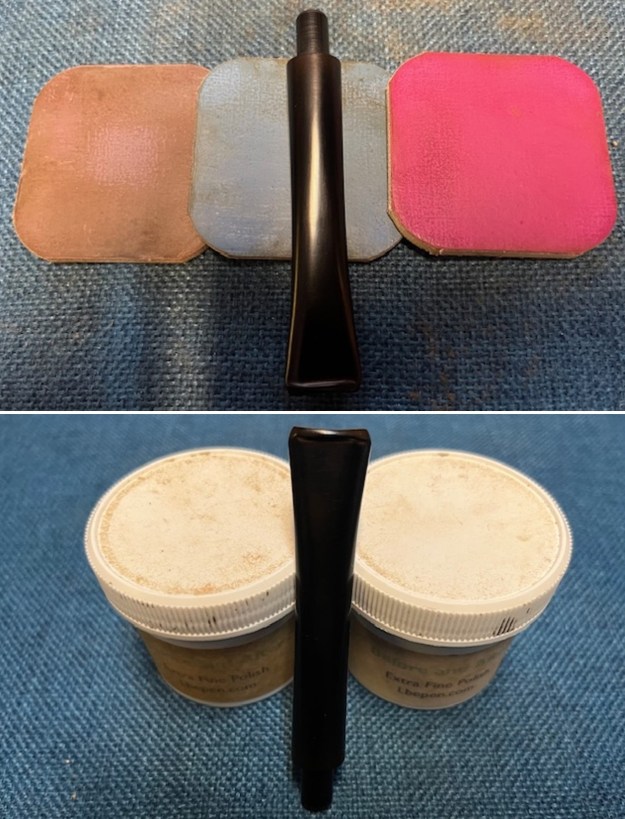
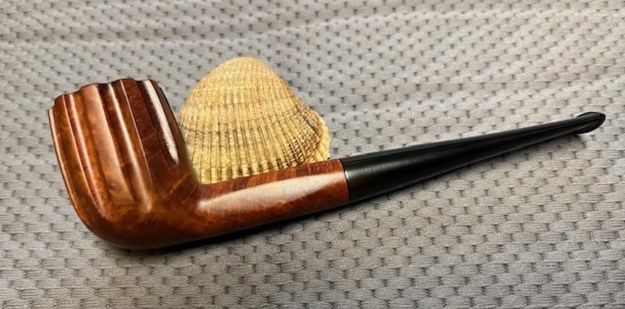
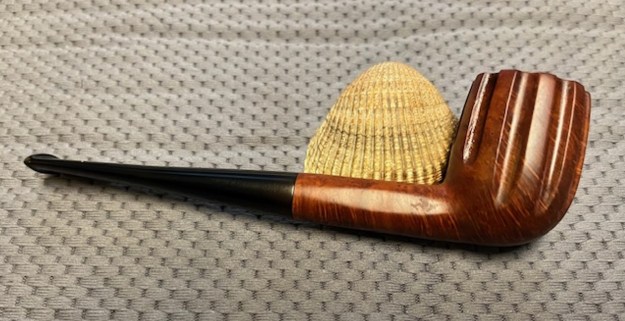
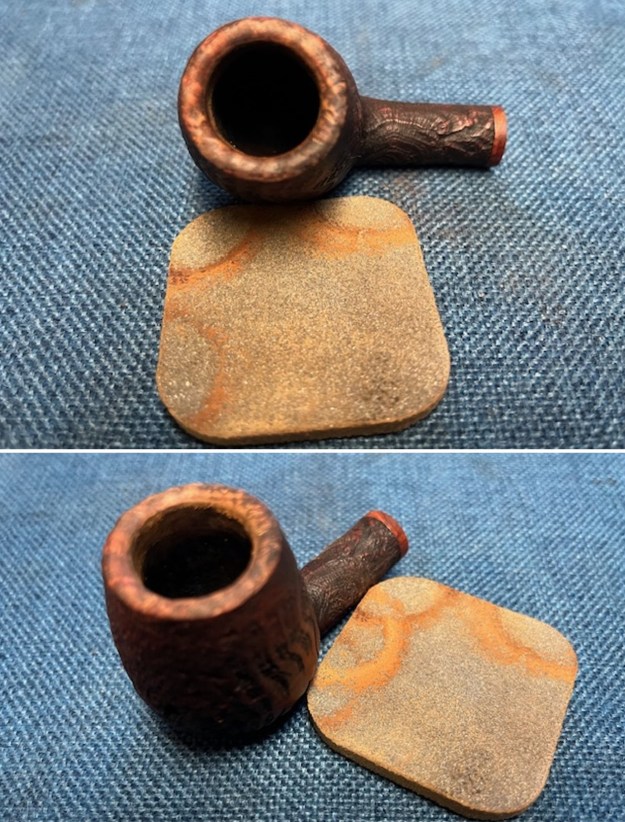
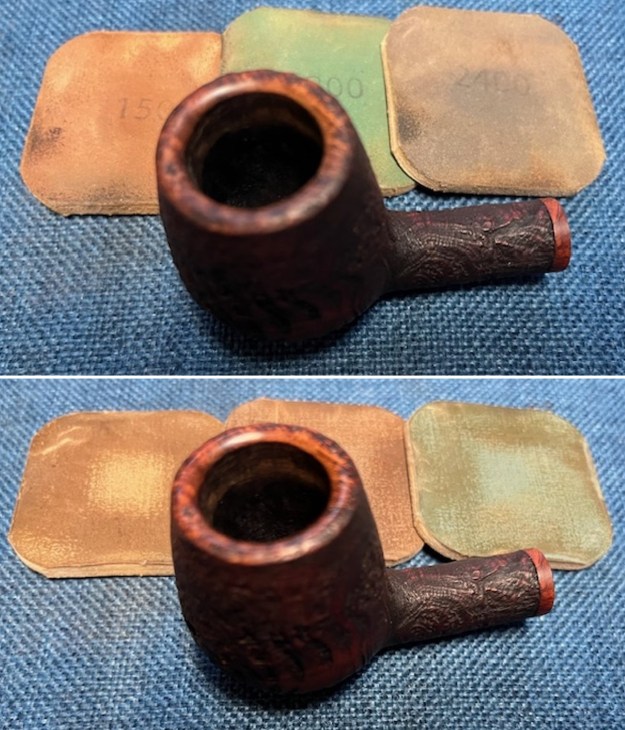
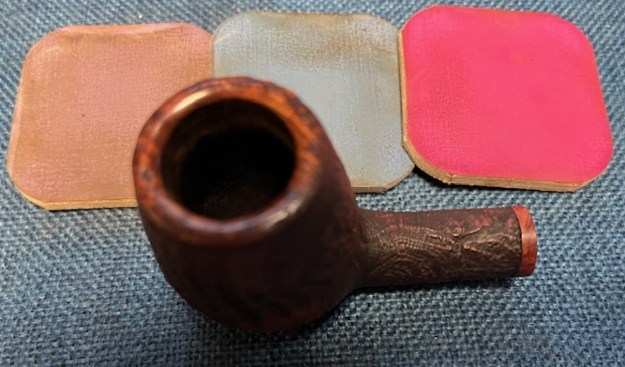
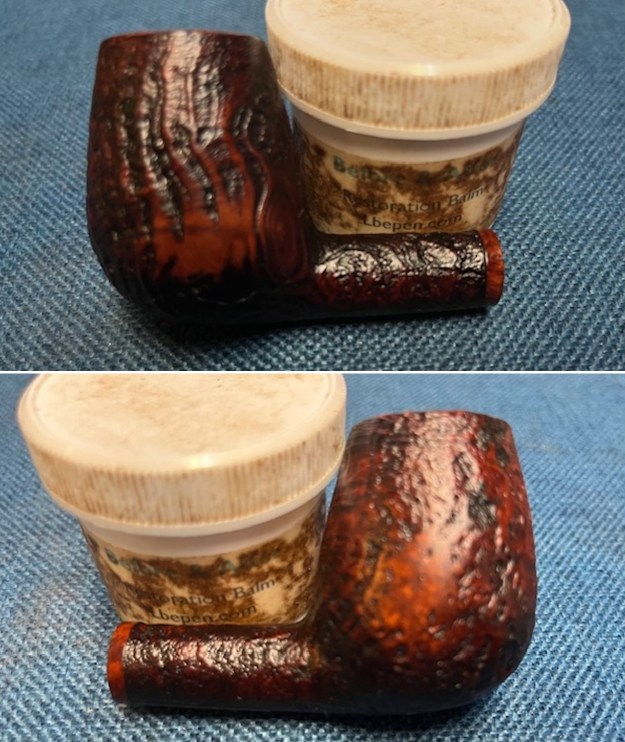
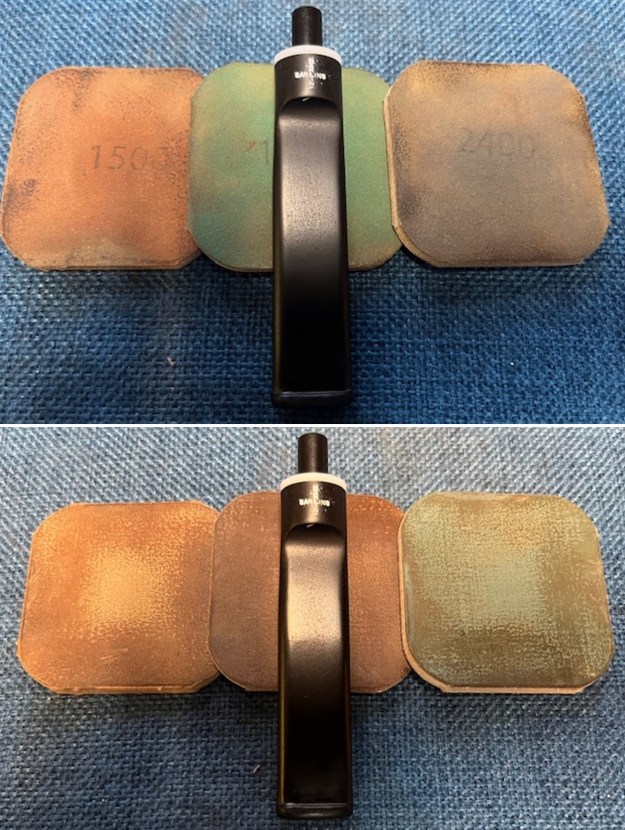
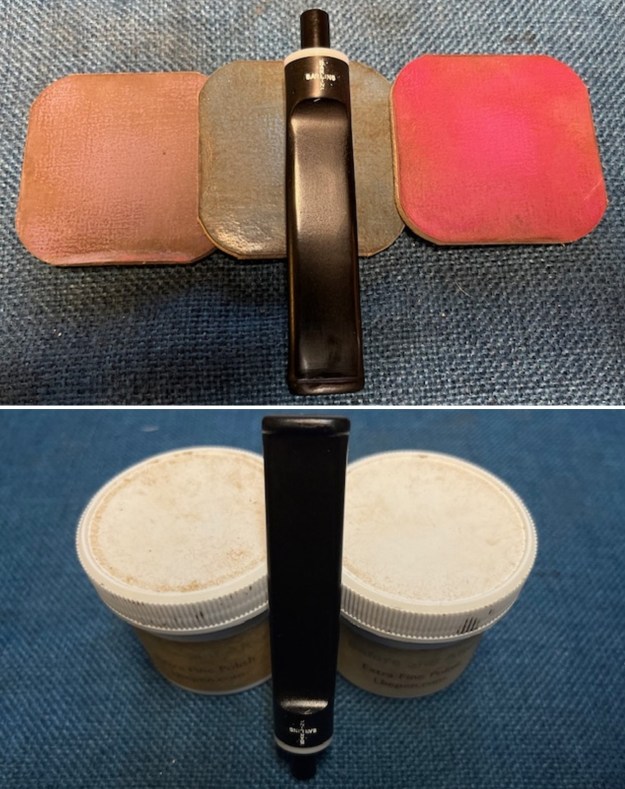
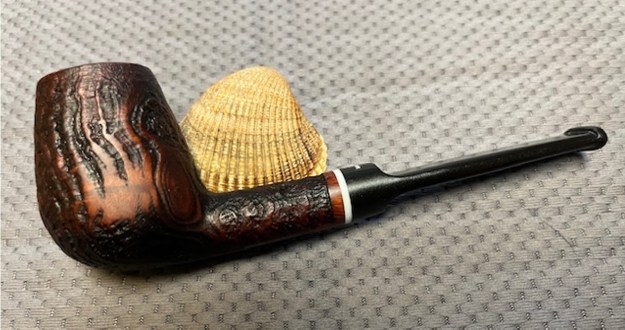
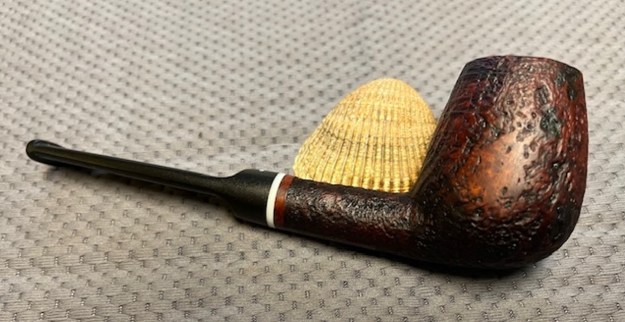
When I received it from Jeff this past week it did not look like the same pipe. It was clean and the finish had life. He reamed it with a PipNet pipe reamer and got rid of the cake. He cleaned up the reaming with a Savinelli Fitsall Pipe Knife so that we could see the walls of the bowl and assess for damage. It was in good condition. He cleaned the internals of the shank and stem with cotton swabs, pipe cleaners and alcohol. He scrubbed the exterior with undiluted Murphy’s Oil Soap and a tooth brush. He rinsed the pipe under warm water. He dried it off with a cloth and then let it air dry. The stem was scrubbed with Soft Scrub and soaked in Briarville’s Stem Deoxidizer. It came out looking very good. The finish on the bowl and the rim top cleaned up nicely. I took pictures of the pipe to show how it looked when I unpacked it.  I took some photos of the rim top and stem to show the condition of them both when the pipe arrived. Overall it looked good. There is some darkening and damage to the inner edge of the bowl. The stem had some light tooth chatter and marks ahead of the button and on the button surface on both sides.I took a photo of the stamping on the left side of the shank. It is readable and in great condition. I removed the stem from the shank and took a photo of the pipe to show the look of the pipe.I started my work on the pipe by addressing the stain spots and darkening on the rim top. I decided to stain the rim top with a black stain pen. I worked the stain into the valleys of the plateau as much as possible. Once it dried I would sand off the stain on the high spots giving a real sense of contrast.I polished the briar on the bowl as well as the high spots on the plateau top with the 320-3500 grit sanding pads. I worked over the rim top and bowl with each pad and then wiped it down with a damp cloth. The pipe really began to take on a shine and the rim top began to match the rest of the briar. I polished the bowl with micromesh sanding pads – dry sanding with 1500-12000 grit pads. I wiped the briar down after each pad with a damp cloth. The bowl is starting to look very good. I worked some Before & After Restoration Balm into the surface of the briar with my fingertips to clean, enliven and protect it. I let the balm sit for a little while and then buffed with a cotton cloth to raise the shine. The photos show the bowl at this point in the restoration process. I “painted” the stem surface with the flame of a lighter to lift the tooth marks. I was able to lift the majority of the marks but there was a deep one that remained on the to on the right side of the bit ahead of the button and on the underside. I filled them in with clear CA glue and set it aside to cure. I flattened the repairs with a small needle file and then sanded the stem with 220 grit sandpaper to blend them into the surface of the stem. I sanded it with 320-3500 grit sanding pads. I wiped it down after each sanding pad with a damp cloth. By the final 3500 grit sanding pad the rim top had a shine.I polished the stem with micromesh sanding pads – wet sanding with 1500-12000 grit sanding pads. I wiped it down after each sanding pad with some Obsidian Oil. I finished polishing it with Before & After Pipe Stem Polish – both Fine and Extra Fine and buffed it off with a cotton cloth. This is a large hand made Cellini Original Freehand Pickaxe with a plateau rim top made by the Cellini Pipe Company with a bent vulcanite stem. It has a great look and feel. The shape fits well in the hand with the curve of the bowl and shank junction a perfect fit for the thumb around the bowl when held. I polished stem and the bowl with Blue Diamond polish on the buffing wheel. I gave the bowl and the stem multiple coats of carnauba wax. I buffed the pipe with a clean buffing pad to raise the shine. I hand buffed it with a microfiber cloth to deepen the shine. The pipe polished up pretty nicely. The rich combination of browns in the smooth finish and the black and brown of the plateau rim top and rusticated patches on the shank bowl union took on life with the buffing. The rich colour of the briar works well with the polished hard rubber stem. I like the grain and finished look of this Cellini Bent Plateau Freehand. Have a look at it with the photos below. The shape, finish and flow of the pipe and stem are very well done. The dimensions are Length: 7 ½ inches, Height: 3 ½ inches, Outside diameter of the bowl: 2 ¼ wide, Chamber diameter: 1 inch. The weight of the pipe is 86 grams/ 3.03 ounces. This Danish style Freehand is a real beauty. Thanks for walking through the restoration with me as I worked over another beautiful pipe. This one will be going on the rebornpipes store in the American Pipe Making Section shortly if you would like to add it to your collection. Thanks for your time.

Restoring a Classic Peterson System 359


Blog by Kenneth Lieblich

What a handsome pipe! I found this PRE-republic-period Peterson System 359 at a local antique shop and I was charmed by it right away. It’s a handsome devil and the look of it gives one a feeling of comfort. It is satisfying and comfortable in the hand – like a mug of tea. There was a lovely patina on this old timer and I really wanted to get this into the hands of Peterson lover. Let’s have a closer look. This Peterson 359 pipe has the classic “System” look: bent shape, nickel mount, and tapered, army-style stem. Of course, it also had the traditional Peterson P-lip stem. The markings on the left side of the shank are Peterson’s [over] System [over] ③ [over] 359. The underside of the shank showed Made in Ireland in a circle. The nickel mount on the shank had K&P (in shields) [over] Peterson [over] Dublin. There were no markings on the stem. The Peterson System pipes are well-storied among Peterson collectors/admirers. I took the opportunity to read the article on Pipedia, specifically about the System pipes, by Jim Lilley. There is lots of good information there and I encourage you to read it: https://pipedia.org/wiki/A_closer_look_at_the_famous_Peterson_Standard_System_Pipe.Having seen that the words “Made in Ireland” were in a circle, I knew that I was dealing with an older pipe. Precisely how old would require some elementary research. The main Pipedia article on Peterson included a few interesting lines:

“Charles Peterson applied for a patent for an improved tobacco pipe on the 8th of August 1890. He was awarded patent number 12393 on the 16th of June 1891 for Great Britain and Ireland. This came to be known as the famous ‘System Pipe’ patent.”

“Later they stamped their pipes with “Made in Ireland” in a circle format 1945-1947…”

This is awfully helpful in dating this pipe. I can comfortably say that this pipe dates from 1945 through 1947, that is to say, just short of 80 years (at the time of writing).

As usual, I also owe a debt of gratitude to Mark Irwin of Peterson Pipe Notes. He has a very interesting article on the various System shapes and I highly recommend having a look: https://petersonpipenotes.org/146-a-guide-to-system-shapes-1896-2019-part-1-the-300-shape-group/. Here is a screenshot of the relevant bit:In addition, Mark has an article on an older 359 that he picked up: https://petersonpipenotes.org/tag/peterson-359-system/.

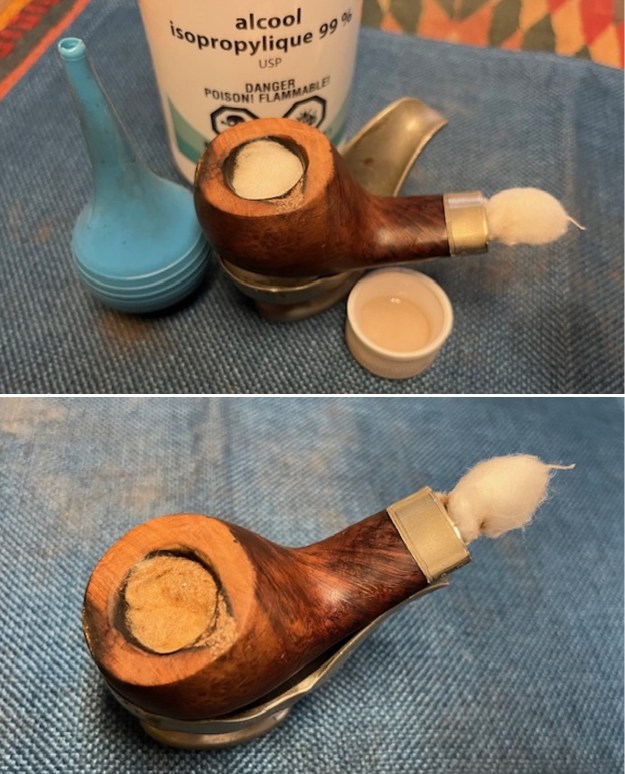
On to the pipe itself: the stem was in average condition – not especially dirty, but it had been well used. It had a few dents. The bowl was moderately dirty and had quite a bit of lava and plenty of cake. Aside from some small fills, the outside of the bowl was very nice. The nickel mount was in good shape – only some very slight dents. To work! The stem was first on my list – and I couldn’t get it out of the mortise! I grabbed the heat gun and gently warmed up the goo inside until it had softened enough to let go of the stem. I wiped the outside down with Murphy’s Oil Soap on some cotton pads. I also took a BIC lighter and ‘painted’ the stem with its flame to lift the few bite marks and dents. Sadly, however, this did not do much. Then I cleaned out the inside with pipe cleaners and isopropyl alcohol. I used some SoftScrub on the outside of the stem to remove some oxidation. Then, the stem went for an overnight soak in the Pipe Stem Oxidation Remover. The following day, I cleaned the de-oxidizing mess off with alcohol, pipe cleaners, et cetera. The oxidation had migrated to the surface and would be fairly straightforward to remove. I scrubbed again with SoftScrub on some cotton pads to remove the leftover oxidation. I built up the dents on the stem with black cyanoacrylate adhesive and let them cure. I then sanded the adhesive down with some sandpaper to level out with the stem. I then used all nine Micromesh pads (1,500 through 12,000 grit) to polish it and highlight the black lustre. I also used Obsidian Pipe Stem Oil in between each pad scrubbing. Moving on to the stummel, I first decided to ream out the bowl. I used the PipNet Reamer to remove the built-up cake and followed that with 220-grit sandpaper taped to a dowel to eliminate as much as possible. I took the chamber down to bare briar to ensure there were no hidden flaws in the wall. Fortunately, there were none.I used cotton rounds and some Murphy’s Oil Soap to scrub the outside of the stummel and a toothbrush with Murphy’s for the lava on the pipe’s rim. I took a close look at the rim. In order to save as much of the rim as possible, I used a piece of machine metal to very delicately scrape away as much lava as I could. I do this before automatically jumping to my topping board. This worked well.I then proceeded to clean out the insides of the shank with Q-tips, pipe cleaners, and lemon-infused isopropyl alcohol. There was quite a bit of filth inside this stummel, and it took a fair amount of cotton to get it clean. I followed that up by cleaning the insides with some dish soap and tube brushes. I decided to de-ghost the pipe in order to remove any lingering smells of the past. I thrust cotton balls into the bowl and the shank and saturated them with 99% isopropyl alcohol. I let the stummel sit overnight. This caused any remaining oils, tars and smells to leach out into the cotton. The bowl was nice and clean after this.There were a couple small fills and nicks around the bowl. I opted to leave them as they are – they are minor and are part of the history of this pipe. I felt that I had interfered enough and didn’t want to interfere anymore. Then, I used most (but not all) of my Micromesh pads on the stummel to finish it off. This included buffing up the nickel mount to a beautiful shine with my jewelry cloth. I also applied some Before & After Restoration Balm and let it sit for 20 minutes to do its magic. It adds that certain je ne sais quoi to the wood. Then it was off to the bench polisher! A dose of White Diamond and a few coats of carnauba wax were just what this pipe needed. Boy-oh-boy, this is one good-looking pipe! I’m pleased with the results. This Peterson Standard System 359 looks fantastic again and is ready to be enjoyed by its next owner. I am pleased to announce that this pipe is for sale! If you are interested in acquiring it for your collection, please have a look in the Ireland pipe section of the store here on Steve’s website. You can also email me directly at kenneth@knightsofthepipe.com. The approximate dimensions of the pipe are as follows: length 5⅞ in. (149 mm); height 4⅛ in. (105 mm); bowl diameter 1⅓ in. (33 mm); chamber diameter ¾ in. (19 mm). The weight of the pipe is 1⅞ oz. (55 g). I hope you enjoyed reading the story of this pipe’s restoration as much as I did restoring it. If you are interested in more of my work, please follow me here on Steve’s website or send me an email. Thank you very much for reading and, as always, I welcome and encourage your comments.

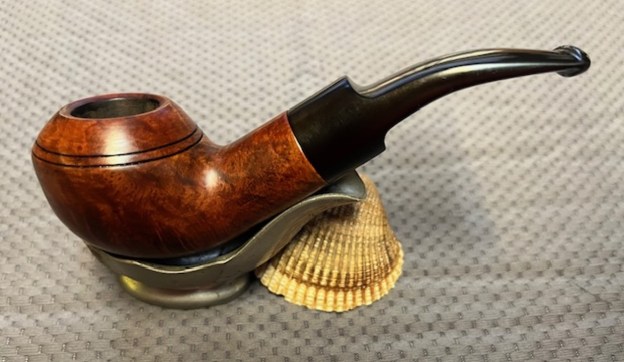
Restoring an Erickson 69 Diamond Shank Canadian


Blog by Steve Laug

The next pipe on the table is a smooth finished diamond shank Canadian with a vulcanite diamond taper stem. We purchased it from a seller on eBay from Jordan, Minnesota, USA on 01/22/2024. The pipe is etched in script on the heel of the bowl Erickson 69. There is no other stamping on the bowl or shank. There was a lot of lava overflowing from the thick cake in the bowl onto the smooth rim top. It was hard to know for certain the condition of the inner edge though it appeared that there was some burn damage on the front edge of the bowl and some darkening on the back rim top. There were oils and grime ground into the bowl sides gives the finish a flat look though there is some great grain. The shank is a diamond shaped. The shape of the taper stem also matches the diamond shank shape. It is a dirty stem with calcification, oxidation, grime and grit on the surface. There were also light tooth marks on both the top and underside of the stem just ahead of the button. Jeff took photos of the pipe before he started his clean up work. I have included them below. He took photos of the pipe’s bowl and rim top to show the cake in the bowl and the lava coat overflowing onto the top. There is also potential burn damage visible on the front inner edge in the photos below. It is another dirty pipe. He also took photos to capture the light tooth marks on the top and underside of the stem near the button. He took photos of the sides and heel of the bowl to show the grain around the bowl and the amount of grime ground into the surface of the briar.   He took a photo of the stamping on the heel of the bowl. It is clear and quite readable. There is no other stamping on the pipe.  I turned to Pipephil’s site (http://www.pipephil.eu/logos/en/logo-k1.html#kenerickson) to see what I could learn about the brand. There was a listing there and I did a screen capture of it. The etching on the heel of the bowl on the Canadian I am working on looks like this one though the two digit stamp is 67. I have included a screen capture of the section below.Knowing that I was dealing with a Ken Erickson made pipe I wanted to know more so I turned to Pipedia (https://pipedia.org/wiki/Erickson). There I found out a lot about the maker and the brand. It is a brief article so I am quoting it in full below. The last paragraph had some helpful information on the two digit stamp.

Ken Erickson, freehand pipemaker from Sunland, California remained almost unknown outside the United States and even there his name is familiar to a small number of insiders only. Quite astonishing, because knowledgeable connoisseurs agree that Erickson was an absolute whiz, whose elegant pipes belong to the best, which were ever made in America.

Ken Erickson began to create pipes by the end of the 1960’s and died in January of 2003. Posthumously he was honored as “Outstanding American Pipe Maker” at the West Coast Pipe and Cigar Expo in March of 2003.

He started his career in Minnesota, but soon transferred his workshop to Sunland in California. It is reported, that back in the times of the “pipe mailers”, when notable pipe dealers in the USA used to instruct their customers by hectographed circulars about new available pipes – among other things – Erickson’s pipes sold even faster and at higher prices than those of such icons like Mike Butera or Rick Lewis. Unfortunately, on the climax of demand for his pipes Erickson, yet at a relatively young age, suffered a heavy heart attack. He abandoned pipemaking instantly. Many years later, appr. since 2000, he returned to his craft and finished some few more pipes from old supplies until his death.

Erickson used no grading. The pipes are engraved with his name (in script) and two digits indicating the year of production.

This particular pipe is engraved with his name and the two digits 67 making it a pipe made in 1967.

Armed with that information I turned to work on the pipe itself. Jeff had done a great job cleaning up the pipe as usual. He cleaned up the inside of the bowl with a PipNet reamer and a Savinelli Fitsall Pipe Knife. The bowl walls looked very good. He scrubbed the interior of the bowl and shank with pipe cleaners, cotton swabs and alcohol to remove the tars and oils. He scrubbed the exterior of the pipe with Murphy’s Oil Soap and a tooth brush to remove the grime from the finish. He worked on the rim top lava and darkening with the soap and tooth brush. He scrubbed the inside of the stem with alcohol and pipe cleaners. He scrubbed the exterior with Soft Scrub and then soaked it in Briarville’s Pipe Stem Deoxidizer. He washed it off with warm water to remove the deoxidizer. The pipe looked far better. I took photos of the pipe when I received it before I started working on it. I took photos of the bowl and rim top to show how clean it was. The top and the inner edge of the rim show darkening and some nicks and scratches. The stem looks clean of debris and grime. There are light tooth marks and chatter on both sides.I took photos of the stamping on the left and right sides of the shank. The stamping is clear and readable. I took a photo of the pipe with the stem removed to show the overall look of stem, tenon and profile of the pipe.I started my work on the pipe by addressing the damage on the inner edge of the rim. I used a folded piece of 220 grit sandpaper to smooth out the roughness. I then used 220 grit sandpaper and a wooden ball to give the inner edge of the bowl a slight bevel. It looked much better at this point in the process. I polished the briar with the 320-3500 grit sanding pads. I worked over the rim top and bowl with each pad and then wiped it down with a damp cloth. The pipe really began to take on a shine and the rim top began to match the rest of the briar. I polished the briar bowl with micromesh sanding pads – dry sanding with 1500-12000 grit sanding pads. I wiped it down with a damp cloth after each pad to remove the debris. The bowl took on a rich glow. I rubbed the bowl down with Before & After Restoration Balm. I worked it into the surface of the briar with my fingertips to clean, enliven and protect it. I let the balm sit for 10 minutes and then buffed with a cotton cloth to raise the shine. Mark Hoover’s Balm is a product that I have come to appreciate and one I use on every pipe I have been working on. I set the bowl aside and turned my attention to the stem. I sanded out the small tooth marks with 220 grit sandpaper and was able to remove them.I polished the vulcanite with micromesh sanding pads – 1500-12000 grit pads. I wiped it down with a damp cloth after each sanding pad. I used Before & After Pipe Polish – both Fine and Extra Fine to further polish the stem. I put the stem back on the Ken Erickson 1969 Long Diamond Shank Canadian and took it to the buffer. I worked it over with Blue Diamond to polish out the remaining small scratches. I gave the bowl and the stem several coats of carnauba wax and buffed the pipe with a clean buffing pad to raise the shine. I hand buffed it with a microfiber cloth to deepen the shine. The pipe polished up really well and the bevelled rim top looked good. I was happy with the look of the finished pipe. The photos below show what the pipe looks like after the restoration. The long diamond shank Canadian is a beautiful and unique take on a classic shape. The polished Black vulcanite stem looks really good with the browns of the briar. The dimensions of the pipe are Length: 7 inches, Height: 1 ¾ inches, Outside diameter of the bowl: 1 ¼ inches, Chamber diameter: 7/8 of an inch. The weight of the pipe is 1.27 ounces/36 grams. This is another pipe that I will be putting it on the rebornpipes store in the American Pipe Makers Section shortly, if you are interested in adding it to your collection. The long shank and tall bowl look and feel great in the hand. This one should be a great smoker. Thanks for walking through the restoration with me on this beauty!

Repairing a Broken Tenon and Cracked shank on a Rusticated Kriswill Bernadotte Design 1210


Blog by Steve Laug

I decided to put my hand to something different this afternoon. I have been working on a lot of pipes that Jeff and I have purchased. The one on the table this after was a pipe that I received for repair from a fellow in Toronto. We had been chatting via email and phone about a nice Kriswill Handmade Bernadotte that he had purchased. When it arrived in Toronto the stem was stuck in the shank and in trying to remove it he had managed to snap the tenon in the shank. He wanted me to repair the tenon for him so I told him to ship it my way. He did a thorough cleaning of the bowl, shank and stem so it was in good condition. It arrived this week and I brought it to the work table and looked it over and put it back in the box. Today, Sunday afternoon I was ready to tackle the task. I took some photos of the bowl and the stem to give a sense my first impression as I looked at quickly.

Here are my thoughts as I turned it over in my hands. The pipe has a conical shaped bowl that is pretty clean. There was little or no cake on the walls. The rim top was rusticated and quite clean. There was an inward bevel on the rim edge that was also clean and excellent condition. The shank was triangular with a smooth band on the shank end. There was a smooth panel on the underside of the shank that was stamped Kriswill [over] Handmade [over] in Denmark. That is followed by Bernadotte in script [over] Design in block letters. There is the shape number 1210 stamped on the end of the shank right along the edge. The tenon was snapped evenly in the shank leaving just a little bit of debris on the stem end. The tenon was stuck and I would need to do the freezer trick to remove it. The stem was lightly oxidized and there was debris and sticky marks from price tags on the stem surface. There were light tooth marks on both sides just ahead of the button. It really is a beautiful little pipe. I took a photo of the stamping on the smooth panel on the underside of the shank. It is clear and really readable as noted above.To start my work on the pipe I decided to pull the broken tenon from the shank. I used a screw and tuned it into the airway and it was very tight. I put the bowl in the freezer for 30 minutes and when I took it out the screw easily removed the broken tenon from the shank. I took photos of the process. Before I went any further in the process I decided to do a bit of background work on the pipe. I turned to Pipephil’s site first (http://www.pipephil.eu/logos/en/logo-k3.html). I did a screen capture of the section on the Kriswill Bernadotte Handmade in Denmark pipe. I have included it below and the pertinent sidebar information below that.Kriswill is a brand of Kriswork Briar Trading, in Kolding (Denmark) established about 1955.

Some of Kriswill pipes were designed by Sigvard Bernadotte, Swedish prince and brother to the late Queen Ingrid of Denmark. He collaborated with his Danish partner Acton Bjørn.

At the end of the quote above there was a link to the photo below. It is a series of portraits of Sigvard Bernadotte the designer of the pipe that I am working on.

I turned to Pipedia (https://pipedia.org/wiki/Kriswill) for more detailed information. There is a great writeup there on the history of the brand that is fascinating. I have quoted the pertinent section below. I have also highlighted the connection to Sigvard Bernadotte in red in the last paragraph. He is one who designed his own series of pipes for Kriswill.

Kriswill began immediately after World War II. Karl Robert Kris, an engineer for the shipping company AP Møller at the time, was in port (undoubtedly in the Mediterranean) when he encountered a shipment of briar. The briar blocks awakened his curiosity and he took some home. About this time the the shipping trade become difficult due to the war, causing Kris to consider other business opportunities. In 1947, Kris (then 47 years old) established himself as a pipe maker in his hometown of Kolding.

Kriss started his pipe making operation in a house located at Haderslevvej 115 in Kolding, and was soon joined by 3-4 employees. The pipes were sold under the name Rocky and supplied the domestic market. Within 6 months the company had grown, more employees hired, and their sales expanded to markets abroad.

Due to increasing production and marketing, Karl Robert Kris decided in the mid-1950s to expand. An entirely new factory was built at Sdr. Ring road on the outskirts of Kolding. At that time the pipes were branded Kriswell. That name did not last long, however, as Stanwell believed that name was too close to theirs. The compromise was to change the name to Kriswill. Kriswill soon grew to become a serious competitor to Stanwell, especially in the export markets. The Kriswill factory logo, stamped on the stem, became the stylized compass rose – as a reference to the manufacturer’s maritime background.

Kriswill pipes excelled in design and craftsmanship. Karl Robert Kris was not afraid of new designs and had a good eye on the US market, where larger and more innovative designs were increasingly popular. Craftsmanship was given top priority throughout Kriswill’s production. A local designer / architect had designed the first models. Later, the famous architects Sigvard Bernadotte (Swedish prince and brother of Queen Ingrid) and Acton Bjørn designed their own series, which were known as Bernadotte designed.

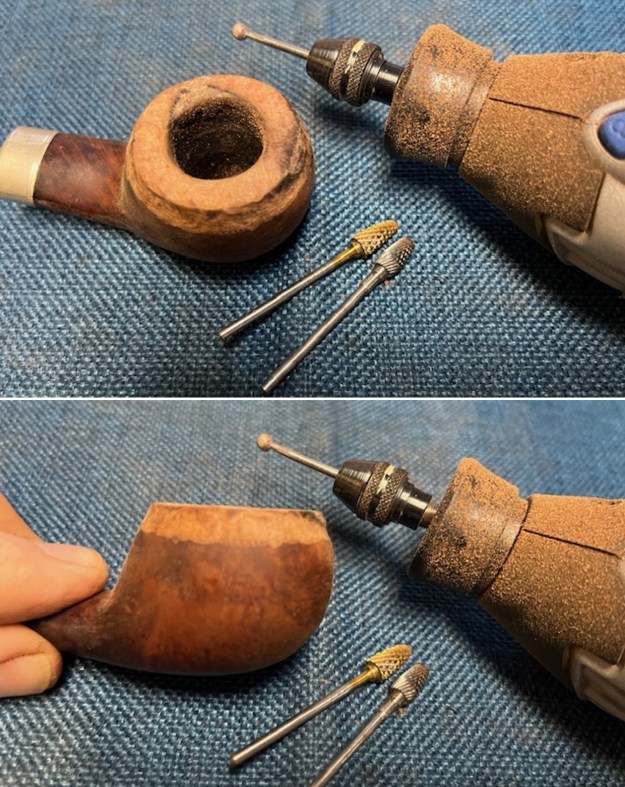
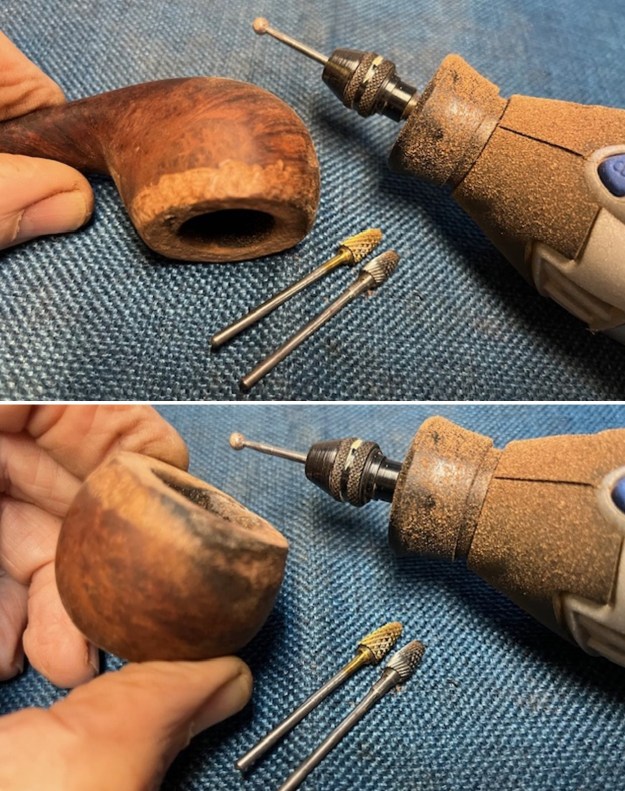
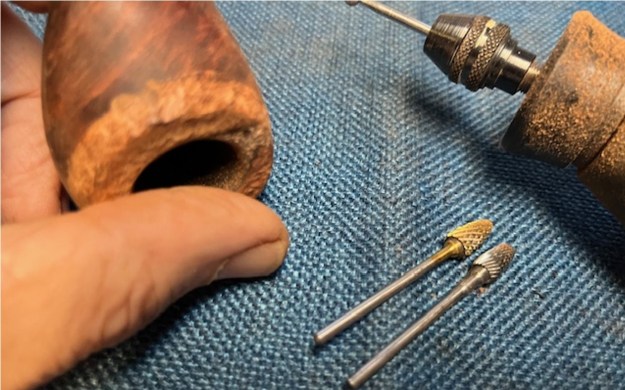
There was also a catalogue page on the Bernadotte Design line that shows the various pipes in the line. The second pipe down is the Hand carved 1210 which was made in black and in brown.I repaired chip and crack in the underside of the triangle shape stem with black CA glue. I wanted to do this prior to drilling the airway and opening it up for the new tenon end. I set the stem aside to let the repair cure.While I waited for the stem repair to cure I went through my tenons and found one that was very close in diameter to the shank. I reduced the diameter of the portion that would go into the stem with a Dremel and sanding drum. I repeated the process on the end of the tenon that would go in the shank. It was ready for the fit once the repair on the stem had cured and I was able to drill out the airway.I was a bit nervous drilling out the thin walled stem with the repair on the underside. I envisioned it splitting and ruining everything. I used a thin pen knife to begin the process of opening up the airway. I opened it to be large enough to take the first of the drill bits. I put the drill bit in my cordless drill and slowly turned it into the airway. I opened it up with several drill bit until the new tenon end fit in the stem. I cleaned up the airway with a set of needle files to make the airway the same diameter the depth of the drill. The fit in the stem was perfect. I painted the end of the tenon with black CA glue and pushed it in place in the airway. I set it aside to let the glue cure.I set the stem aside to allow the glue to cure. I wanted the tenon to be set in the stem so that once I put it in the shank it would not come out of the stem. I turned my attention to the bowl and shank. The shank had two small hairline cracks in in on the right side of the triangle. It would need to be glued and banded to accomplish a tight repair. I shaped a round brass band into a triangle and sanded it against a sanding board to thin the depth of the repair band. I fitted on the shank and put the stem in place to get a sense of what it would look like. I sent a few picks to the trustee in Toronto to show him what was going on. He approved of the repair.
I glued the band on the shank with some all purpose white glue. I painted the surface of the shank with the glue making sure to get into the cracks. I pressed the band on the shank and wiped off the excess glue with a damp cloth.I rubbed the briar down with Before & After Restoration Balm. I worked it into the briar with my fingertips and a horsehair shoe brush to work it into the nooks and crannies of the rusticated finish. The product works to clean, enliven and preserve the briar. I let it sit for 10 minutes then I buffed it with a cotton cloth to deepen the shine. The briar really comes alive with the balm. I set the bowl aside and turned to finish the stem. To address the scratches and marks in the surface of the vulcanite I sanded it with 320-3500 grit sanding pads. I wiped it down after each sanding pad with a damp cloth. By the final 3500 grit sanding pad the rim top had a shine.I polished the vulcanite with micromesh sanding pads – 1500-12000 grit pads. I wiped it down with Obsidian Oil after each sanding pad. I used Before & After Pipe Polish – both Fine and Extra Fine to further polish the stem. I always look forward to this part of the restoration when all the pieces are put back together. I put the Kriswill Bernadotte 1210 pipe back together and buffed it with Blue Diamond on the buffing wheel. I gave the bowl multiple coats of Conservator’s Wax and the stem multiple coats of carnauba wax. I hand buffed the pipe with a clean buffing pad to raise the shine. It is fun to see what the polished bowl looks like with the new brass band on the shank end. The combination of grain and the thin band add some elegance to the pipe when combined with the polished black vulcanite stem. This royalty designed Kriswill Bernadotte 1210 Skater is nice looking and feels great in my hand. The pipe is another light weight that could be clenched and smoked while doing other things as it is very well balanced. Have a look at it with the photos below. The dimensions are Length: 5 ¾ inches, Height: 2 inches, Outside diameter of the bowl: 1 ¼ inches, Chamber diameter: ¾ of an inch. The weight of the pipe is 1.06 ounces/30 grams. This one will be heading back to Toronto soon. I am looking forward to what the pipeman who sent it thinks of this restoration. Lots more to do in this lot! Thanks to each of you who are reading this blog. Remember we are not pipe owners; we are pipemen and women who hold our pipes in trust until they pass on into the trust of the next pipeman or woman.

Breathing New Life into a Dunhill Cumberland Prince 44071 Made in England 23


Blog by Steve Laug

The next pipe on the table is a sandblast Dunhill Prince with a smooth crowned rim. It had a taper, Cumberland stem with a white spot. We purchased it from a seller who was selling an estate in Oregon City, Oregon, USA on 03/21/2024. The seller said that the pipe came from his father in Indiana, a long-time pipe dealer who had retired many years earlier. His father had originally purchased it from a friend of his who also was also a pipe dealer. The pipe is stamped on the heel of the bowl and on the underside of the shank. On the heel of the bowl it is stamped with the shape number 44071. That is followed with stamping on the shank that clearly reads Dunhill Cumberland[over] Made in England23. The rim was in good condition other than lava overflowing from the thick cake in the bowl onto the smooth rim top It is hard to assess the condition of the inner edge of the rim due to the cake and lava overflow. There may be some darkening or damage at the top and rim edge but I cannot be sure. There were oils and grime ground into the bowl sides gives the finish a flat look. The Cumberland stem is oxidized, calcified, and dirty with grime and grit on the surface. There were also scratches and tooth marks on both the top and underside of the stem just ahead of the button. Jeff took photos of the pipe before he started his clean up work. I have included them below. He took photos of the pipe’s bowl and rim top to show the cake in the bowl and the lava coat overflowing onto the top. It is another dirty pipe. He also took photos to capture the tooth marks on the top and underside of the stem near the button. He took photos of the sides and heel of the bowl to show the grain around the bowl and the amount of grime ground into the surface of the briar.   He took photos of the stamping on the underside of the shank. It is clear and very readable as noted above. I wanted to unpack the Dunhill stamping on the shank and work to understand each element of the stamp. I generally use the Pipephil site to gather as much initial information as possible (http://pipephil.eu/logos/en/dunhill/cumber1.html). The stamping is interpreted as follows: The number 44071 is the shape number that unpacks as follows: the 4 is the bowl size, 1 is the identifier for a taper stem, 07 is the shape designation – a Prince. The additional 4 does not have any clear information though I wonder if it could be a designation for a Cumberland stem. The Cumberland stamp refers to the finish. The superscript 23 following the D of England would give the date the pipe.Pipephil also has some helpful dating keys on the site that are basically flow charts that you can walk through to date your pipe (http://pipephil.eu/logos/en/dunhill/cledat-en1.html). I turned to Part 1 of the Dating Key and followed the chart. This pipe has a superscript 23 following the D in England. There was no patent number so that took me to the section on the chart below (column one) which instructed me that the pipe could be dated as being made “posterior to 1954”. I followed the link under “Your pipe is posterior to 1954. Narrow down your dating”. That took me to Page 2 of the dating key (http://pipephil.eu/logos/en/dunhill/cledat-en1a.html). The second column (suffix 1…4) or (11…39) led me to the section with a 23 after the D in England. There was a directive for dating the pipe spelled out as follows: 1960 + suffix which gives the pipe a date of 1983 (last digit hidden by the band). From that I knew that the pipe was made in the 1983.I then turned to Pipedia’s section on Dunhill Cumberland to get a bit of background on the Dunhill finishes (https://pipedia.org/wiki/Dunhill#Root_Briar). I quote:

Cumberland

Introduced in 1979. Cumberland is another sandblast with a brown stain and a brindle stem (the material is more commonly called ‘Cumberland’ these days, thanks to Dunhill’s influence and the success of the finish over the past quarter-century). Originally, the Cumberland always featured a smooth brown rim, but in the current production the rim is sometimes smooth, sometimes sandblasted. Occasionally, a straight grain blast is finished with a Cumberland stain and a “Shilling Grain,” similar to the “Ring Grain,” resulting in a new variation on the traditional sandblast. The Shilling series is named for the British coin: the sandblast looks like a stack of shillings. Named after the warehouse on Cumberland Road. The old pipes that inspired this finish were found there.

I have also included a chart from the site from Dunhill spelling out the Standard Pipe Finishes and giving short information and a timeline. You can see that the Cumberland Finish was introduced in 1980 so this is definitely from the early releases of that finish from the factory.I turned to work on the pipe itself. Jeff had done an amazing cleanup of the pipe. He reamed the light cake with a PipNet reamer and cleaned up that with a Savinelli Fitsall Pipe Knife. He scrubbed the internals of the bowl and stem with alcohol, cotton swabs and pipe cleaners. He scrubbed the externals with undiluted Murphy’s Oil Soap and rinsed the bowl off with running water. He soaked the stem in Briarville’s Pipe stem Deoxidizer and once it had soaked rinsed it off with warm water to remove the residual solution. He dried it off and rubbed it down to remove any oxidation that was still on the stem. The pipe looked very good when I received it. I took a photo of the rim top to show the condition. It looks pretty good with the tars and oils removed from the rim top. You can see the clean bowl. The stem came out looking quite good. There are some scratches, light tooth marks and chatter on both sides ahead of the button. I took a photo of the underside of the shank to show the stamping. The photo shows the stamping and is actually more readable in person. I removed the stem from the shank and took a photo of the pipe parts to show what I was working with. It is a nice looking pipe. I sanded the rim top and edges with 320-3500 grit sanding pads. I wiped it down after each sanding pad with a damp cloth. By the final 3500 grit sanding pad the rim top had a shine.I polished the cleaned up rim top and edges with micromesh sanding pads – dry sanding with 1500-12000 grit pads and wiping the bowl down with a damp cloth to remove the dust. The rim top came out looking very good. I rubbed the briar down with Before & After Restoration Balm. I worked it into the briar with my fingertips and a horsehair shoe brush to work it into the nooks and crannies of the sandblast finish. The product works to clean, enliven and preserve the briar. I let it sit for 10 minutes then I buffed it with a cotton cloth to deepen the shine. The briar really comes alive with the balm. I set the bowl aside and turned to address the stem issues. To address the scratches and marks in the surface of the Cumberland I sanded it with 320-3500 grit sanding pads. I wiped it down after each sanding pad with a damp cloth. By the final 3500 grit sanding pad the rim top had a shine.I polished the Cumberland with micromesh sanding pads – 1500-12000 grit pads. I wiped it down with Obsidian Oil after each sanding pad. I used Before & After Pipe Polish – both Fine and Extra Fine to further polish the stem. This 1980s Era Dunhill Cumberland 44071 Prince with a Cumberland taper stem has a beautiful, unique Dunhill Sandblast finish that is very deep and craggy. The rim top is smooth and crowned. The Cumberland reddish brown finish highlights some great grain around the bowl and shank. It has a unique sandblast that Dunhill specialized in making. The polished Cumberland taper stem adds to the mix. I put the stem back on the bowl and buffed the pipe with Blue Diamond on the buffing wheel being careful to not buff the stamping. I gave the bowl multiple coats of Conservator’s Wax and the stem multiple coats of carnauba wax on the buffing wheel and followed that by buffing it with a clean buffing pad. I hand buffed the pipe with a microfiber cloth to deepen the shine. The finished Dunhill Cumberland 44071 Prince is quite nice and feels great in the hand. Give the finished pipe a look in the photos below. The dimensions of the pipe are Length: 6 ½ inches, Height: 1 ¼ inches, Outside diameter of the bowl: 1 ½ inches, Chamber diameter: 7/8 of an inch. The weight of the pipe is 1.27 ounces/36 grams. Thanks for walking through the restoration with me as I worked over another beautiful pipe. This one is already sold and it will soon go out to the new steward in Illinois. Thanks for your time.
Restoring a Lovely Frasorteret Hand Made in Denmark Freehand


Blog by Steve Laug

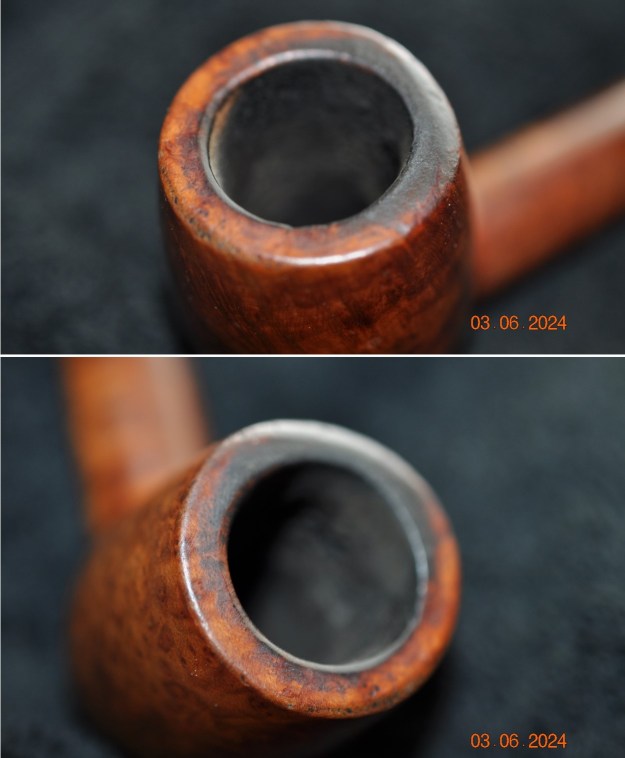
The next pipe on the table is a rugged, sandblast Freehand with a smooth rim and plateau shank end. It had a fancy, turned saddle vulcanite stem. We purchased it from a seller on eBay from Jordan, Minnesota, USA on 01/22/2024. The pipe is stamped on the underside of the shank and reads Frasorteret [over] Hand Made [over] In [over] Denmark. The rim was in good condition other than lava overflowing from the thick cake in the bowl onto the smooth rim top. It is hard to assess the condition of the inner edge of the rim due to the cake and lava overflow. There may be some darkening or damage at the back of the bowl but I cannot be sure. There were oils and grime ground into the bowl sides gives the finish a flat look. The fancy saddle stem is dirty, with grime and grit on the surface. There were also tooth marks on both the top and underside of the stem just ahead of the button. Jeff took photos of the pipe before he started his clean up work. I have included them below. He took photos of the pipe’s bowl and rim top to show the cake in the bowl and the lava coat overflowing onto the top. It is another dirty pipe. He also took photos to capture the tooth marks on the top and underside of the stem near the button. He took photos of the sides and heel of the bowl to show the grain around the bowl and the amount of grime ground into the surface of the briar.   He took photos of the stamping on the underside of the shank. It is faint but still quite readable. I had a memory that Frasorteret pipes came from the creative carving of Preben Holm so I wanted to do some checking. I turned to Pipephil’s site (http://www.pipephil.eu/logos/en/logo-f4.html). It tied the line to Preben Holm but there was not too much more information at this point.I turned to Pipedia (https://pipedia.org/wiki/Frasorteret) to gather further information. There the information was a bit clearer about the tie. Here is the information.

The Frasorteret line of pipes were made by Preben Holm and were nearly identical to his normal line of pipes but for fills and pits and the like. The pipes were stamped Frasorteret Made in Denmark. I took a photo of the rim top to show the condition. You can see the clean bowl. The bowl is in excellent condition and is clean. The rim top and the inner edge shows a lot of damage and burn marking on the bowl. The stem came out looking clean. There were definitely deep tooth marks and chatter on both sides. I took photos of the stamping on the shank. It is faint but still very readable. I removed the stem from the shank and took a photo of the pipe parts to show what I was working with.I started my work on the pipe by addressing the damage on the inner edge of the rim. I used a folded piece of 220 grit sandpaper to smooth out the roughness. I then used 220 grit sandpaper and a wooden ball to give the inner edge of the bowl a slight bevel. It looked much better at this point in the process. I sanded the briar rim top and the sides of the bowl with 320-3500 grit sanding pads. I wiped the bowl down with a damp cloth after each pad. By the time I finished with the 3500 grit pad the briar had taken on a rich glow.I went over the sandblast finish on the bowl and shank with a brass bristle wire brush to knock off the debris in the grain. Once finished it looked much better. It was ready for the next work on the rim and shank end. I worked over the plateau shank end with the wire brush to prepare it for the traditional black stain. I touched it up with a black stain pen making sure that all the grooves and surfaces were evenly stained. Once the stain cured I sanded it with a 320 grit sanding pad to knock the stain off the high spots on the plateau to give a sense of contrast to the plateau. It looked very good once I had finished doing that. I polished the smooth rim top with micromesh sanding pads – dry sanding with 1500-12000 grit sanding pads. I wiped it down with a damp cloth after each pad to remove the debris. The crowned rim top took on a rich glow. I rubbed the bowl down with Before & After Restoration Balm. I worked it into the surface of the briar with my fingertips and a horsehair shoe brush to clean, enliven and protect it. I let the balm sit for 10 minutes and then buffed with a cotton cloth and shoe brush to raise the shine. Mark Hoover’s Balm is a product that I have come to appreciate and one I use on every pipe I have been working on. I set aside the bowl and turned my attention to the stem. I “painted” the stem surface with the flame of a lighter. I was able to lift the tooth marks significantly. There were still some deep marks. I filled them in with a coat of clear CA glue and spread it across the surface with a dental spatula.Once the repairs cured I flattened them with a small file. I started the process of blending them into the surface of the surrounding vulcanite. I sanded it with 220 grit sandpaper to clean up the file marks and smooth out the surface of the stem. I moved on to further smooth out the surface of the vulcanite. I sanded it smooth with 320-3500 grit sanding pads to further blend them into the surface of the stem.I polished the vulcanite with micromesh sanding pads – 1500-12000 grit pads. I wiped it down with Obsidian Oil after each sanding pad. I used Before & After Pipe Polish – both Fine and Extra Fine to further polish the stem. It really took on a shine and I knew that once it was buffed it would look amazing. I put the stem back on the Preben Holm Hand Made in Denmark Frasorteret Sandblast Freehand and took it to the buffer. I worked it over with Blue Diamond to polish out the remaining small scratches. I gave the bowl and the stem several coats of carnauba wax and buffed the pipe with a clean buffing pad to raise the shine. I hand buffed it with a microfiber cloth to deepen the shine. The pipe polished up really well and the rim top looked good. I was happy with the look of the finished pipe. The photos below show what the pipe looks like after the restoration. The Frasorteret Sandblast Smooth Rim Top Freehand is a beautiful and very Preben Holm take on a Freehand shape. The polished vulcanite fancy saddle stem looks really good with the browns of the briar. The dimensions of the pipe are Length: 7 inches, Height: 2 inches, Outside diameter of the bowl: 1¾ inches x 2 inches, Chamber diameter: 1 inch. The weight of the pipe is 2.26 ounces/64 grams. This is another pipe that I will be putting it on the rebornpipes store in the Danish Pipe Makers Section shortly, if you are interested in adding it to your collection. The long shank and tall bowl look and feel great in the hand. This one should be a great smoker. Thanks for walking through the restoration with me on this beauty!
Revisiting an Iconic American Pipe Carver John Bessai and Restoring One Of His Creations.


Blog by Paresh Deshpande

Just last year, while surfing etsy.fr, I came across a pipe lot that contained some interesting pipes and included this John Bessai Zulu shaped sandblasted pipe. I had worked on a John Bessai pipe about six years ago and had also studied its history. In order to refresh my memory and reacquaint myself with John Bessai and his work, I browsed through rebornpipes.com. Given below is the link to the write up that I had done on John Bessai pipe about 6 years ago.

https://rebornpipes.com/2018/12/09/a-fresh-breath-of-life-for-a-unique-creation-by-john-bessai/

This and other article on John Bessai make for an interesting read. I now recollect that he was a pipe maker, repairman and tobacconist from Cleveland, Ohio, USA who opened his shop in 1898. He died before 1969.

All John Bessai pipes were stamped with large letters “JB” either on shank or stem or both. The pipe on my work table is stamped as above on the stem.Pipes made by John were stamped on the shank or on the stummel with small “JB” since 1950 and the same is missing on this piece. However, “JOHN BESSAI” in full in block capital letters is stamped over the flat smooth surface on the bottom of the shank.The bull’s-eye stamping was abandoned since pre-1960s whereas the same can be clearly seen on the pipe that I am working on in the above picture.

Thus, based on the above information, with an amount of certitude, I can place this John Bessai creation to be from pre- 1950s.

Initial Visual Inspection
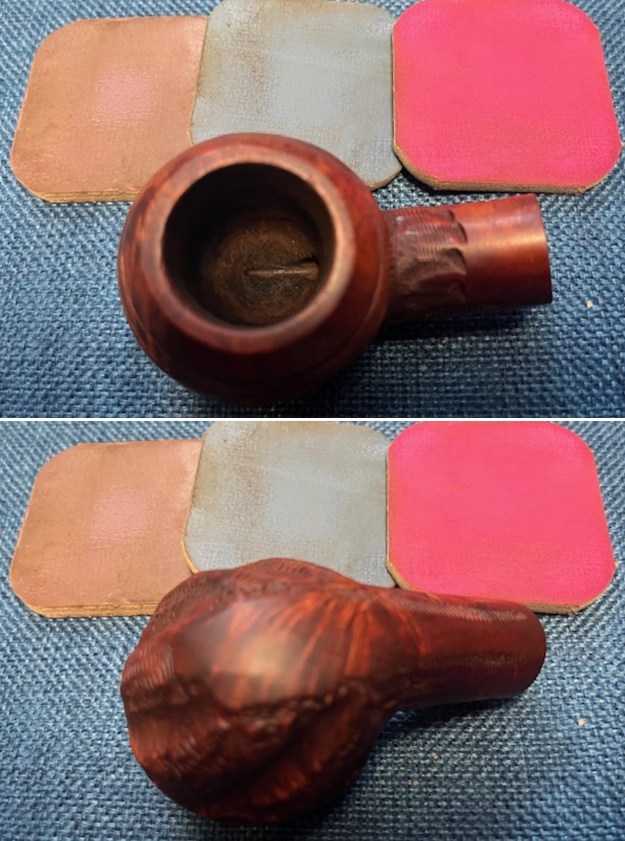
The shallow sandblasted Zulu shaped pipe looks clean and solid with no outwardly apparent damage/ issues. There is a thick layer of even cake in the chamber. The rim top surface appears darkened with small amounts of ash and oils accumulated in the 6 ‘O’ clock direction. The stummel surface is dull and dirty with hand oils and dust ground in to the shallow sandblast. The stem has minor tooth chatter in the bite zone with a couple of tooth indentation/ bite marks to both the button edges. Pictures of the pipe, as it sits on the work table, are shown below: Detailed Inspection
There are few pipes that I get to work on that are in such a decent condition and well looked after by the previous pipe man/ woman and this is one such pipe. There is a thick layer of cake in the chamber and it appears that it has been reamed to maintain it at the thickness of a dime. The rim surface flows inwards ever so slightly with a bevel to the inner rim edge and shows minor accumulation of lava overflow and darkening at 6 o’clock direction (encircled in yellow). The damage to the inner bevel here will be ascertained when the cake and rim surface is all cleaned up. The rim top is smooth and even with no signs of mishandling. The outer rim edge is also in good condition with a couple of very minor dents that were probably caused during the course of handling of the pipe. Presence or absence of heat fissures/ lines will be evident once the chamber walls are rid of all the cake.The stummel has some beautiful shallow sandblast with mixed grains visible over the surface. The stummel appears dull and lackluster as the hand oils had attracted some dust and grime that has accumulated over the surface and in to the grooves of the shallow blast. The stummel surface is solid to the touch and hence I do not anticipate any damage to the chamber walls. The mortise shows traces of accumulation of old oils and tars and would need to be cleaned. The smells from the shank and chamber are very strong and pungent. The high quality vulcanite stem has minor tooth chatter in the bite zone on either surface. Also a few tooth indentations (encircled in red) over the button edges on either side are discernible and would need to be rebuilt. Some dried gunk is seen over the tenon and in the horizontal slot. All in all, this is a clean stem with no major issues.The Restoration Process
I started the restoration with cleaning of the stummel as I was keen to know the condition of the walls of the chamber. I worked on the stummel by first reaming the chamber with size 1 PipNet reamer head. With my fabricated knife, I further scraped the chamber walls to remove the remaining carbon deposits and also from areas inaccessible by the reamer head. I also scraped out the lava overflow from the rim top surface. Once the cake was reamed back to the bare briar, I used a 150 grit sand paper followed by 220 grit sand paper to remove all the traces of remaining cake and also to smoothen out the inner walls of the chamber surface. Finally, to remove the residual carbon dust, I wiped the chamber with a cotton pad wetted with 99.9% pure isopropyl alcohol. As expected the chamber walls are solid with no damage whatsoever.Next, I cleaned out the internals of the shank and mortise. Using my dental tool, I scraped out all the dried oils, tars and gunk that had accumulated in the draught hole and on the walls of the mortise. I finished the cleaning by running a few pipe cleaners dipped in isopropyl alcohol through the mortise. I shall continue with further cleaning of the shank internals using the cotton and alcohol bath. I had expected that after this initial cleaning of the chamber and shank internals, the ghost smells would have been greatly reduced, but that was not so. I decided to subject the chamber and mortise to cotton and alcohol bath. I packed the chamber with cotton and drew out a wick from the cotton and along with a folded regular pipe cleaner, inserted it into the mortise and through the draught hole into the chamber. I tightly packed cotton balls in to the remaining portion of the mortise. Thereafter, I soaked the cotton balls with isopropyl alcohol up to the brim. About half an hour later, the level of alcohol had gone down, having being absorbed by the cotton. I topped it up once again and set it aside overnight. By next afternoon, the cotton and alcohol had drawn out all the remaining oils and tars from the chamber and mortise. I ran pipe cleaners through the mortise and draught hole to clean out all the loosened tars and gunk that was lodged in the draught hole and mortise. The chamber and mortise now smelled clean, fresh and looked it too. I set the stummel to dry out naturally.With the bowl internals clean, I moved to clean the exterior of the stummel. I used a hard bristled tooth brush and Murphy’s Oil soap to scrub the stummel and rim top. I rinsed the stummel under running warm water with anti oil dish washing detergent till the stummel surface was clean and dried it using paper towels and soft cotton cloth. The surface is now clean but appears bone dry.I simultaneously cleaned the shank internals with the detergent and hard bristled shank brush and set the stummel aside to dry out naturally. The strong ghost smells are history and the stummel now smells clean and fresh.While the stummel was drying out, I worked on the stem. I began the refurbishing process by scraping out the dried gunk from the tenon end using a thin sharp knife and dental tool. I then ran a couple of pipe cleaners dipped in alcohol through the stem airway to clean it up. I shall be continuing the cleaning of the airway subsequently. This cleaning has revealed remnants (indicated by blue arrows) of an aluminum stinger that was cut during it’s time with the previous owner. I fail to understand the reason for this as the previous owner could have completely removed this stinger instead of cutting it at the tenon end. Well, there is no way that I can remove the remaining embedded portion of the stinger and since it does not interfere with either the smooth and effortless passage of a pipe cleaner or airflow through the airway, I let it be. However, I did open up and smooth out the cut face of the stinger with a round needle file.Next, I cleaned the stem airway using thin nylon shank brushes and anti oil soap. This helps in conserving pipe cleaners which are hard to come by here in India. I further scrubbed the stem surface with a Scotch Brit pad and soap to remove superficial oxidation from the surface. I rinsed the stem airway and surface under running tap water.I continued with external cleaning of the stem surface by dunking the stem into “Before and After Deoxidizer” solution developed by my friend Mark Hoover. The solution helps to draw out heavy oxidation to the surface making its further removal a breeze, while the minor oxidation is eliminated to a very great extent. I usually dunk stems of couple of pipes that are in-line for restoration and the Bessai is marked in green arrow. I generally allow the stems to soak in this solution overnight for the solution to do its work.With stem soaking in the deoxidizer solution, I turned my attention back to the stummel refurbishment. I lightly topped the rim surface on a piece of 220 grit sandpaper. This helped to address the few minor dents over the rim outer edges, address the darkened rim top in 6 o’clock direction as well as further define the inner edges and bevel edges.Using a folded piece of 220 grit sandpaper pinched between my fingers, I sand the inner rim edge to remove the slight darkening seen in the 6 o’clock direction.I rubbed a small quantity of “Before and After Restoration Balm” into the briar with my finger tips and let it rest for a few minutes. The balm almost immediately works it’s magic and the briar now has a nice vibrant appearance with the beautiful sandblast patterns on full display. I have been using this balm ever since I embarked on this journey and it is this part of restoration that I always look forward to. I further buffed it with a horse hair shoe brush. This pipe really oozes of a very high quality. Now that the stummel refurbishing was nearly done and also the stem had now been soaking for more than 24 hours, I removed the stem from the solution. I first scrubbed the stem surface with a Scotch Brite pad, always being mindful of the stem logo on the left side. I followed this scrubbing with a nice cleaning of the surface using a 0000 grade steel wool. I rinsed the stem under running water to rid the stem of the thick solution. I ran a couple of pipe cleaners to remove the deoxidizer solution from the airway.In order to address the tooth chatter in the bite zone on either surface, I flame the bite zone with a Bic lighter. The heat helps the vulcanite to expand and raise the chatter to the surface. Thereafter, through the sanding process, the surfaces will be matched with the rest of the stem surface. This step was able to address 90% of the tooth chatter and those that are not addressed here will need to be rebuilt.Continuing with the stem repair, I mixed superglue and activated charcoal powder and generously applied it over the bite zone on either side, including over the buttons and set it aside to cure.Using a flat head needle file, I reshaped the button and roughly matched the fills in the bite zone with the rest of the stem surface. I sand the bite zone in the stem surface with a piece of folded 220 grit sandpaper to even out the fills as well as remove the oxidation from the stem surface.I wet sand the stem progressing through 400, 600, 800, 1000, 1500 and 2000 grit sand paper. I wiped the stem after each grade of sandpaper to view the progress being made and also identify areas on the stem surface that were still covered with traces of oxidation. I wiped the stem with EVO at the end of 2000 grit sanding and set the stem aside.Using a soft white graphite pencil, I freshened up the stem logo of JB.A polish by wet sanding using all 9 micromesh pads (1500 to 12000 grit pads) brought out the deep black shine of the vulcanite. I rubbed a small quantity of EVO to hydrate the stem and deepen the shine.I have reached that stage in this project which can be considered as the home run. I polished the rim top and the entire stem with blue diamond using a cotton wheel mounted on to my hand held rotary tool. The blue diamond compound helps to eliminate the minor scratches that remain after the use of micromesh pads.I completed this project by hand polishing the stummel with Halcyon II wax. I rubbed this polish deep into the rustications and after a couple of minutes, vigorously hand buffed the stummel with a microfiber cloth to a deep shine. I polished the stem with carnauba wax using my hand held rotary tool. This is a gorgeous classic looking Zulu and I consider myself fortunate to have the opportunity to work on this beauty and, as my Guru Steve says, carry forward the trust in this pipe till it is time to pass it on to the next pipe man or pipe woman. Here are a few pictures of the completed pipe for you to appreciate while I take the opportunity to thank you each of you for sparing your valuable time in joining me on this journey.

Restoring a Stanwell Sandblast 1993 POY Huber Nobleman Billiard


Blog by Steve Laug

The next pipe on the table is a sandblast finish Billiard with a silver rim cap, band on the shank and a vulcanite stem. We purchased it from a seller on eBay from Jordan, Minnesota, USA on 01/22/2024. The pipe has a silver plaque identifying it as a 1993 pipe. It is stamped below that plaque and reads Huber [over] Nobleman. The shank has a silver, decorative band on it. The rim was in good condition other than a lot of lava overflowing from the thick cake in the bowl onto the smooth rim top It is hard to assess the condition of the inner edge of the rim due to the cake and lava overflow. There may be some darkening or damage at the back of the bowl but I cannot be sure. There were oils and grime ground into the beautiful sandblast on the bowl sides gives the dull, flat look. The vulcanite taper stem is a dirty stem with grime and grit on the surface. There were also tooth marks on both the top and underside of the stem just ahead of the button. It appears that there may be some small pin hole bite through marks on the underside ahead of the button. Jeff took photos of the pipe before he started his clean up work. I have included them below. He took photos of the pipe’s bowl and rim top to show the cake in the bowl and the lava coat overflowing onto the top. The silver rim cap/edge is also oxidized and dirty. This really is another dirty pipe. He also took photos to capture the tooth marks on the top and underside of the stem near the button. The stem is also oxidized and calcified. He took photos of the sides and heel of the bowl to show the interesting sandblast grain around the bowl and the amount of grime ground into the surface of the briar.   He took photos of the stamping on the silver plague and the stamping below that on the left side of the shank. It is clear and quite readable. I knew from other pipes that I have worked on with the HUBER stamp (Peterson’s, Oldenkott and other) that the pipe was made for the Pfeifen Huber 1863 pipe shop in Munich, Germany. I found a great photo of the shop on Yelp. I have included that below. It is definitely a shop that I want to visit soon (https://www.yelp.ca/biz_photos/pfeifen-huber-m%C3%BCnchen-2?select=Fs5BlKOLDYfhjIM-3lhiAw).I turned to the Pfeifen Huber website (https://www.pfeifen-huber.de/pfeifen-ratgeber/chronik-pfeifen-huber-jahrespfeifen-teil-1). On the site was a section, written in German, regarding the annual pipe, made for Huber by various pipe making companies. I translated it with Google and have included it below.

The idea of an annual pipe in limited quantities was not really new in 1988. Dunhill was considered a pioneer, followed by Stanwell and Georg Huber in Munich at the end of the eighties. The idea came to him to produce a small, fine series of pipes in limited quantities, only in “First Quality”. The problem was finding a suitable manufacturer who was prepared to implement the high quality requirements in the desired quantities. This idea began to take shape with the German importer for Peterson and Savinelli, Detlef Seiffert. They hit it off straight away and at the end of 1988 the first annual pipe saw the light of day in Tal 22 in Munich. At that time it was a Hungarian from Peterson, with a silver top and ribbon on the handle. The edition of 300 copies was quickly sold out and the idea became reality. In order to be able to offer something for smaller budgets, Huber also launched a second series, the Nobleman. This series continues to this day. It is priced below the annual pipe and has no consecutive numbering, but is also limited. While the first models were still available with a normal bore, the 9mm filter bore became popular over the years. Today’s Nobleman are consistently designed for 9mm filters; an adapter for filterless smoking can be used if desired.

The portion in red above is very pertinent to the pipe I am working on. It is part of the second series by Huber designed for smaller budgets and was priced at less than the annual one. It is also a limited edition pipe issued in 1993. It has a stem made for a 9mm filter and is also fitted with an adapter making it a normal bore. It can be smoked either way.

Smokingpipes   has several Stanwell pipes made for the Georg Huber Pipe Shop in Munich, Germany on their webstore. Here is a link if you would like to have a look at a similar pipe (https://www.smokingpipes.com/pipes/estate/denmark/moreinfo.cfm?product_id=602399).

There was also an interesting post on Facebook made by a fellow using the handle Pipe & Lighter in Hanoi, Vietnam. He posted this in 2019 and it is in Vietnamese. I translated it on Facebook and quote that below.

Huber München : Is an old pharmaceutical company in Munchen, Germany founded by Georg Huber in 1863 and is a major supplier of Pharmaceuticals & Cigars in Germany. Every year to celebrate, Huber München has hired some of the famous brands on TG exclusively for limited and finest products. In companies that were hired like Paul Winslow. Peterson…. Stanwell

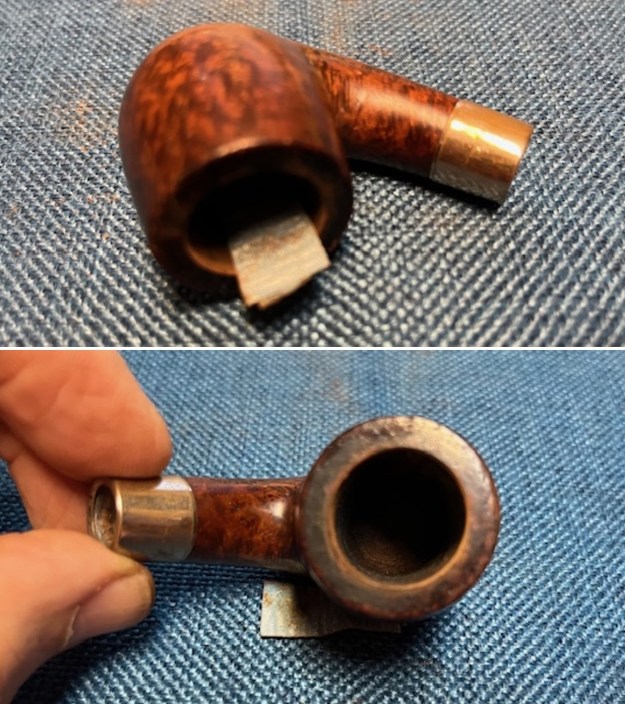
The pipe featured today is a Huber München model that made by Stanwell’s finest workers as a commemorative edition in 1996. The shank with 9mm airway diameter is typical of the German market…. Armed with that information I turned to work on the pipe itself. Jeff had done a great job cleaning up the pipe as usual. He cleaned up the inside of the bowl with a PipNet reamer and a Savinelli Fitsall Pipe Knife. The bowl walls looked very good. He scrubbed the interior of the bowl and shank with pipe cleaners, cotton swabs and alcohol to remove the tars and oils. He scrubbed the exterior of the pipe with Murphy’s Oil Soap and a tooth brush to remove the grime from the finish. He worked on the rim top lava and darkening with the soap and tooth brush. He scrubbed the inside of the stem with alcohol and pipe cleaners. He scrubbed the exterior with Soft Scrub and then soaked it in Briarville’s Pipe Stem Deoxidizer. He washed it off with warm water to remove the deoxidizer. The pipe looked far better. I took photos of the pipe when I received it before I started working on it. I took photos of the bowl and rim top to show how clean it was. The top and the inner edge of the rim show some darkening, nicks and scratches. The inner edge of the bowl is thinner toward the front. There was some debris in the gap between the silver rim edge and the briar. The stem looks clean of debris and grime. There are tooth marks and chatter on both sides. There are also tooth marks on the underside of the stem.I took photos of the stamping on the left side of shank. The stamping is clear and readable (much clearer in person than the photos show). I took two photos of the pipe with the stem removed to show the overall look of stem, tenon and profile of the pipe. The first photo shows the stem with the adapter removed and the second photo with it in place in the tenon. I started my work on the pipe by addressing the damage on the inner edge of the rim. I used a folded piece of 220 grit sandpaper to smooth out the roughness. I then used 220 grit sandpaper smooth out the damage to the rim top of the bowl.I polished the smooth rim top and the smooth parts of the briar bowl and shank with micromesh sanding pads – dry sanding with 1500-12000 grit sanding pads. I wiped it down with a damp cloth after each pad to remove the debris. The smooth portions of the bowl took on a rich glow. I rubbed the bowl down with Before & After Restoration Balm. I worked it into the surface of the briar with my fingertips and a horsehair shoe brush to clean, enliven and protect it. I let the balm sit for 10 minutes and then buffed with a cotton cloth and shoe brush to raise the shine. Mark Hoover’s Balm is a product that I have come to appreciate and one I use on every pipe I have been working on. I set aside the bowl and turned my attention to the stem issues. I painted the surface of the stem with the flame of a Bic lighter to lift the tooth marks. I was able to lift them significantly. I filled in the remaining one with clear CA glue. Once the repairs cured I smooth them out with a small to start blending them into the surface. I sanded the file marks and smoothed out the surface with 220 grit sand paper. I sanded the stem with 320-3500 grit sanding pads to further blend them in and smooth out the surface of the stem.I polished the vulcanite with micromesh sanding pads – 1500-12000 grit pads. I wiped it down with a damp cloth after each sanding pad. I used Before & After Pipe Polish – both Fine and Extra Fine to further polish the stem. I put the stem back on the Stanwell 1993 Huber Nobleman Billiard and took it to the buffer. I worked over the smooth portions with Blue Diamond to polish out the remaining small scratches. I gave the bowl several coats of Conservator’s Wax and the stem several coats of carnauba wax on the wheeland buffed the pipe with a clean buffing pad to raise the shine. I hand buffed it with a microfiber cloth to deepen the shine. The pipe polished up really well and the rim top and silver rim edge looked good. I was happy with the look of the finished pipe. The photos below show what the pipe looks like after the restoration. The long shank tall Canadian is a beautiful and unique take on a classic shape. The polished vulcanite taper stem looks really good with the browns of the briar. The dimensions of the pipe are Length: 5 ½ inches, Height: 1 ¾ inches, Outside diameter of the bowl: 1 ¼ inches, Chamber diameter: 7/8 of an inch. The weight of the pipe is 1.83 ounces/52 grams. This is another pipe that I will be putting it on the rebornpipes store in the Danish Pipe Making Companies Section shortly, if you are interested in adding it to your collection. This sandblast billiard looks and feels great in the hand. This one should be a great smoker. Thanks for walking through the restoration with me on this beauty!
Restoring one of Gene’s Favourite Pipes – A Savinelli Made Bings Favorite Italy


Blog by Steve Laug

In January Jeff found out about an estate sale in Pocatello, Idaho, USA. It turned out that the sale was for a fellow Jeff and I had purchased pipes from in the past, Gene. He had been the owner of Outwest Tobacco in Pocatello (long closed now) and I bought tobacco and other smoking items from him in the past. As I think about it now, it seems that I had known Gene for over 30 years Jeff and I had been to his home and enjoyed coffee and a few pipes together. I have no idea how many pipes we bought on those visits as well as to the antique shop of his daughter. I know that there were many pipes. When we heard that it was Gene’s personal collection that was for sale and that he had passed away we decided for Jeff to go to the house and have a look. He went on January 25, 2024 to scope it out as we had seen his personal collection of pipes and there were definitely some among those well smoked old warriors that would be great to pick up. Perhaps there would even be one that could join my own collection in memory of Gene.

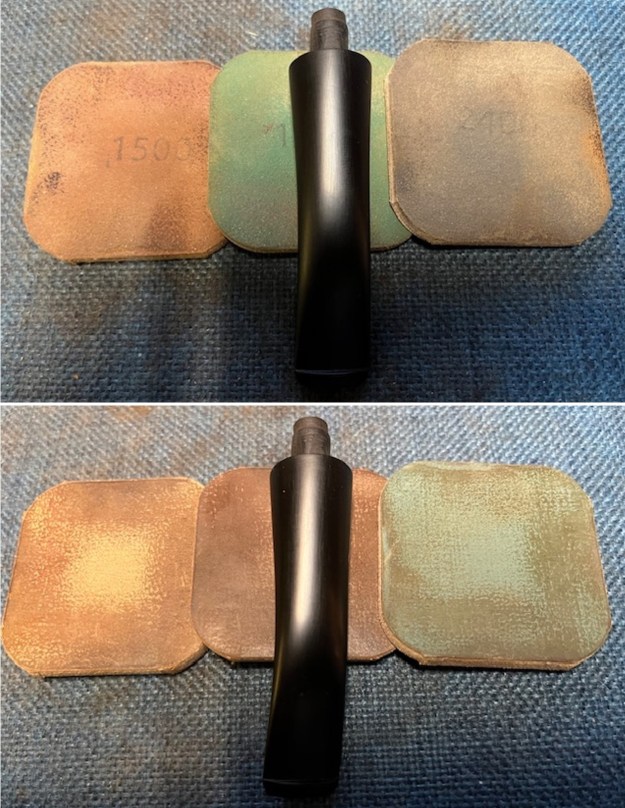
Jeff went to the house and looked through the racks, pipe bags, tobacco both bulk and tinned as well as a variety of pipes. All the pipes were well smoked and needed serious cleaning. Another one of the pipes he picked up was this Savinelli Made Bings Favorite pipes with a poorly fit replacement black vulcanite taper stem. It was very dirty and was a reddish, brown coloured pipe when it started. The smooth finish around the bowl was dirty and had hand oils ground into the grooves. The bowl had a thick cake that overflowed in lava onto the rim edge and top of the bowl. The bottom of the bowl was flattened so the pipe could be set on a desktop. The stem was vulcanite that was very dirty and had the marks of a rubber Softee Bit on the end. It had become discoloured and there was a line where the debris from smoking had accumulated along the edge and under the bit protector. The good news was that there were some deep tooth marks and chatter under the calcification and grime. The rest of the stem was dirty and had lost the characteristic shine. The pipe was stamped on the left side of the shank and read Bings Favorite. On the right side of the shank it is stamped Italy. On the underside of the shank it was stamped Savinelli Product. Jeff took photos of the pipe so I could have a sense of what it looked like before he started his work on it.Jeff took photos of the stem surfaces and the bowl and rim to give a sense of condition of the pipe. You can see the thick cake in bowl and the spots of lava overflow on the edges and rim top of the bowl. It is had to know if there is any damage as the cake and lava is quite thick. The stem surface is very dirty and you can see the area on the end of the stem where the Softee Bit had protected it from chewing though there were some previous deep tooth marks covered by the dirt and debris. I am pretty sure the stem was a replacement and it did not fit the diameter of the shank properly. It was larger than the shank and would need to be fitted. He also took photos of the sides of the bowl and the heel to show the interesting grain that went around the bowl. The grain is beautiful and you can see the oils and debris in the surface of the briar.  He took photos of the stamping on the sides of the shank. It is clear and readable on all the shank sides as noted above. I turned to Pipephil’s site (http://www.pipephil.eu/logos/en/logo-savinelli1.html) to get a sense of the Bing’s Favorite. It is a Savinelli Product and it is listed in the Savinelli pipe section. I did a screen capture of the section and included it below. The stamping on the stem confirms that the stem I have is a replacement.I turned to Pipedia (https://pipedia.org/wiki/Savinelli) and after reading through the history I focused on a section entitled Editions in the “Favorite” line. I have included that section below.

We are compiling a sub-list of known editions in the “Favorite” line of Savanelli pipes, starting with those in Fred Huening’s collection. If you know of others, or have additional information about this line of pipes, please add it here, or send them to sethile.pipes@gmail.com and we can add them for you:

  • Bing’s Favorite
  • Byron’s Favorite
  • Clark’s Favorite
  • Ginger’s Favorite
  • Achille’s Favorite (apparently, I, II, and III)

Now it was my turn to work on the pipe. Jeff had done an amazing cleanup of the pipe. He reamed the cake with a PipNet reamer and cleaned up that with a Savinelli Fitsall Pipe Knife. He scrubbed the internals of the bowl and stem with alcohol, cotton swabs and pipe cleaners. He scrubbed the externals with undiluted Murphy’s Oil Soap and rinsed the bowl off with running water. He soaked the stem in Briarville’s Pipe stem Deoxidizer and once it had soaked, rinsed it off with warm water to remove the residual solution. He dried it off and rubbed it down to remove any oxidation that was still on the stem. The pipe looked very good when I received it. I took a photo of the rim top to show the condition. You can see the clean bowl. The bowl is in excellent condition and is clean. The rim top and the front inner edge was in great condition. The stem came out looking clean. There were definitely deep tooth marks and chatter on both sides. I took photos of the stamping on the shank. It is faint but still very readable. I removed the stem from the shank and took a photo of the pipe parts to show what I was working with. The pipe had cleaned up so well that I turned to polish the briar with micromesh sanding pads. I dry sanded it with 1500-12000 grit sanding pads and wiped the bowl down after each pad with a damp cloth. By the final pads the briar really had a shine. I rubbed the briar down with Before & After Restoration Balm. I worked it into the briar with my fingertips. The product works to clean, enliven and preserve the briar. I let it sit for 10 minutes then I buffed it with a cotton cloth to deepen the shine. The briar really comes alive with the balm. I set aside the bowl and turned my attention to the stem. I “painted” the stem surface with the flame of a lighter. I was able to lift the tooth marks significantly. There were still some deep marks. I filled them in with a coat of clear CA glue and spread it across the surface with a dental spatula. Once the repairs cured I flattened them with a small file. I started the process of blending them into the surface of the surrounding vulcanite.Once I finished that work I addressed the diameter of the stem. I needed to take off the excess so that the flow between the shank and the stem were smooth. I used a flat rasp to quickly remove the excess then sanded it with 220 grit sandpaper to clean up the file marks and smooth out the surface of the stem. I moved on to further smooth out the surface of the vulcanite. I sanded it smooth with 320-3500 grit sanding pads to further blend them into the surface of the stem.I polished the vulcanite with micromesh sanding pads – 1500-12000 grit pads. I wiped it down with Obsidian Oil after each sanding pad. I used Before & After Pipe Polish – both Fine and Extra Fine to further polish the stem. It really took on a shine and I knew that once it was buffed it would look amazing. I put the stem back on the Bings Favorite ¼ Bent Vulcanite Stem Long Billiard and took it to the buffer. I worked it over with Blue Diamond to polish out the remaining small scratches. I gave the bowl and the stem several coats of carnauba wax and buffed the pipe with a clean buffing pad to raise the shine. I hand buffed it with a microfiber cloth to deepen the shine. The pipe polished up really well and the rim top looked good. I was happy with the look of the finished pipe. The photos below show what the pipe looks like after the restoration. The Bings Favorite Savinelli Product is a beautiful and unique take on a classic shape. The polished, reshaped vulcanite taper stem looks really good with the browns of the briar. The dimensions of the pipe are Length: 6 ½ inches, Height: 1 ¾ inches, Outside diameter of the bowl: 1 ¼ inches, Chamber diameter: ¾ of an inch. The weight of the pipe is 1.23 ounces/35 grams. This is another pipe that I will be putting it on the rebornpipes store in the Italian Pipe Makers Section shortly, if you are interested in adding it to your collection. The long shank and tall bowl look and feel great in the hand. This one should be a great smoker. Thanks for walking through the restoration with me on this beauty!

An Interesting Project : Resurrection Of a Pre-1920 KB&B Pembroke


Blog by Paresh Deshpande

The next pipe is stamped as “PEMBROKE” over KB & B” on the left shank surface and came to me as part of inherited pipes that predominantly constituted pipes from various English brands, most notably LOEWE, BBB, COMOY’S, PETERSON’S, BARLING’S etcetera. However, this lot did also contain many pipes from American pipe makers like WDC, KB & B/ KAYWOODIE and others. I have researched and worked on a few of the KAYWOODIE pipes from this collection and recollect that KB & B changed their name to KAYWOODIE in 1920s to promote their Kaywoodie line of pipes or was it for some other reason? For clarification and recollection of history of this renowned brand from USA, I re-read the history from https://pipedia.org/wiki/Kaufmann_Bros._%26_Bondy#Brands and have only reproduced that information that helps to date the pipe:-

Early History

Kaufmann Bros. & Bondy (KB&B), Kaywoodie has been making pipes since well before the Civil War – around 1851. They peaked in the late 1950’s along with most American Briar works. In the early 20th century, their pipes were the standard others were measured by, along with SasieniCharatan and Comoy’s. There were few other world-class American pipe-crafters (William Demuth Company, early L & H Stern). Their pipes were as good as any of the renowned British firms. Kaywoodie just did not merely produce quantity, they provided quality: in the 1920’s they bought the exclusive rights to some of the choicest briar fields in history, hauling out 250 year-old roots the size of 27″ TVs and fashioning masterpieces out of this spectacular-grained ancient briar.

Early KB&B (non Kaywoodie)

Kaywoodie was the name a pipe offered by Kaufmann Bros. & Bondy Company (KB&B), first appearing in February of 1919.

The origin of the name Kaywoodie is a combination of the K from Kaufmann and wood, as in briar. Not much is known of the original KB&B company other than it was started in 1851 by the German born Kaufmann brothers when they opened a small pipe shop in the Bowery section of New York City.

When one of the men from the New York office got “gold fever” he carried a large supply of pipes with him to California that he sold along the way. This early “national distribution” did much to build the reputation of KB&B. By the late 1800’s, branches of KB&B were opened in Chicago, Atlanta, San Francisco and St. Louis with family and friends acting as agents. The trademarks, for the inlaid cloverleaf and the cloverleaf with the KB&B initials inside, were issued in 1881.

Pre-Kaywoodie KB&B

According to Hackert, the firm of Kaufmann Bros. & Bondy (KB&B) began producing the Kaywoodie Pipe in 1915.

Business thrived and in 1854 the Kaufmanns took in a partner named Bondy. … The three partners retired in 1898, but their relatives continued on with the firm, which had begun to manufacture their own briar pipes under the KB&B trademark. In 1915 the Kaywoodie brand was created as a marketing umbrella for a new briar pipe which the KB&B Company introduced. …”

Hacker concludes his history of Kaywoodie Pipes by noting that: “The KB&B briar pipe brand existed from 1900 until just after World War I (with some overlapping with the Kaywoodie from 1915 — 1917), and collectors refer to the KB&B as a Kaywoodie transition pipe.

The pre-Kaywoodie KB&B pipes were marked on the shank with a cloverleaf around KB&B. 

In March of 1955, when S.M. Frank & Co. Inc. bought Kaufmann Bros. & Bondy, The Kaywoodie Company, Reiss-Premier Corp., The New England Briar Pipe Co. and – of course – Yello-Bole.

Thus, comparing literature notes with the stampings as seen on the pipe that I am working on, I am certain that it dates as to being pre- 1920. Another pointer is the orific slot which was gradually replaced by more elliptical slot from 1920 and progressed further to the horizontal slot that we see on pipes today.

Here are the pictures of the stampings as seen on the PEMBROKE: Initial Visual Inspection
The PEMBROKE, currently on my worktable, is a medium sized classic bent billiards with a decent sized bowl in dark reddish brown color. The well seasoned briar is covered in dirt, dust and grime from decades of use. There are a couple of deep scratches on the stummel surface. There is a thick cake in the chamber with heavy overflow of cake, oils and tars over the rim top surface. The inner rim edge is uneven and charred. The outer rim edge, likewise, is peppered with dents and dings. The high quality hard rubber stem is oxidized with flattened bite zone on either surfaces of the stem. The tenon has a narrow extension at the end and is covered in dried oils and tars. The round orifice slot is similarly clogged with dried gunk. The stem does sit flush with the shank face and the seating is too damn tight within the mortise. Following pictures will give the readers a general idea of the condition of the pipe before I start to work on the pipe. Detailed Inspection
The chamber has a thick hard cake that has spilled over the rim top surface. The cake is thicker around the upper half of the chamber. The outer rim edge has dents and dings all around but is most severely damaged along the front half portion (encircled in yellow), a damage that can result only due to repeated strikes against a hard edged surface. The inner rim edge, prime facie, is sans any damage. The condition of the inner walls of the chamber can be commented upon after the cake has been taken down to the bare briar. There is a strong ghost smell in the chamber which is all pervading. There are remnants of un-burnt tobacco at the bottom of the chamber.The stummel surface is covered in dust, dirt and grime giving a dull, lifeless and lackluster appearance to the pipe. However, the briar has taken on a nice dark patina which has been a result of more than 100 years of usage and would be worth preserving. However, eliminating/ addressing the deep scratches (encircled in green) on both side of the stummel and the few dents and dings would entail sacrificing the patina. This is a call that I would need to take at some stage in the restoration process. The mortise is chock-a-block with old oils, tars, ashes and grime making for a laboured draw. The thick cake and blocked mortise hides the draught hole from the view. These issues need to be addressed. The high quality hard rubber stem is deeply oxidized. The unique feature of the stem is that the stem surface is flattened in the bite zone on either surface with defined cut edges. Now, the question that came to my mind was if these flattened surfaces were original to the stem or carved out by the piper who owned it, probably for ease of clenching? Well, to me it appears that this unique carving of the bite zone is machined and not handmade since the edges are too well defined and sharp to be handmade using home tools. But that the flattening of the bite zone makes it comfortable for clenching is unquestionable. There are no significant bite marks or chatter in the bite zone or over the button edges. The orifice slot shows dried accumulated oils and tars that would need to be cleaned. The tenon has a stepped hard rubber (?) extension similar in shape to the ones seen on Peterson’s Deluxe line of pipes. The tenon and extension too is covered in a thick layer of dried crud. The stem does not seat flush in the mortise and is fit is very tight. I think the seating issues would address itself once the tenon and mortise is cleaned.The Process
I began the repair and refurbishing process with reaming of the chamber. I reamed the chamber with head sizes 1 and 2 of the PipNet pipe reamer. I removed the carbon from the areas where the reamer head could not reach with my fabricated knife. To completely remove the residual carbon from the walls of the chamber and smooth out the walls, I sanded the chamber walls with a folded piece of 220 grit sandpaper followed by cleaning the chamber with a cotton swab wetted with isopropyl alcohol. The chamber walls are in pristine condition. I gently scrapped off the lava build up over the rim top using a sharp knife to avoid damage to the surface. I cleaned the mortise and shank walls of the pipe using dental tool. I scraped out the dried oils and tars from the walls of mortise and shank walls. The pile of crud that was scraped out is indicative to the amount of gunk that was lodged in the mortise and shank internal. At the end of this step, I still was not able to pass a pipe cleaner through the mortise. Out came one of the many modified tools in my arsenal and after some deft use of this poker, I was able to dislodge the blockage from within the mortise. I ran a bristled pipe cleaner and q-tip dipped in alcohol through the mortise and out through the draught hole further clearing the passage. I will continue this further cleaning during the course of refurbishing of this pipe.Next, I decided to subject the chamber and mortise to cotton and alcohol bath. I packed the chamber with cotton and drew out a wick from the cotton and along with a folded regular pipe cleaner, inserted it into the mortise and through the draught hole into the chamber. I tightly packed cotton balls into the remaining portion of the mortise. Thereafter, I soaked the cotton balls with isopropyl alcohol up to the brim. About half an hour later, the level of alcohol had gone down, having being absorbed by the cotton. I topped it up once again and set it aside overnight. By next afternoon, the cotton and alcohol had drawn out all the remaining oils and tars from the chamber and mortise. I removed the cotton balls and the dirt can be gauged by the appearance and coloration of the cotton balls and the pipe cleaner. I ran pipe cleaners through the mortise and draught hole to clean out all the loosened tars and gunk that was lodged in the draught hole and mortise. The chamber and mortise now smelled clean, fresh and looked it too. I set the stummel to dry out naturally.Once the internals of the chamber and shank were cleaned, I cleaned the external surface of the stummel with Murphy’s Oil soap and cotton swabs followed by scrubbing the surface with a toothbrush and dish washing soap. This rid the stummel surface of all the accumulated dust, dirt and grime. Using a piece of Scotch Brite scrub, I deliberately cleaned the rim top and removed the crud from the surface. The damage to the rim edges is now amply evident.Simultaneously, I also cleaned the shank internals with dish washing soap and a shank brush. I set the stummel aside to dry out naturally while I worked the stem.I began the process of refurbishing the stem by first scraping off the dried gunk from the tenon and tenon end extension using a sharp thin knife. I was careful not to damage or break the extension or the stem face. I cleaned the tenon extension with a cotton swab moistened with alcohol and ran a pipe cleaner through the airway to check if the airway was clear of any blockage. Fortunately, it was.Using thin shank brushes and anti-oil dish washing soap, I cleaned the stem airway. I have modified this process of cleaning the stem airway by doing away with pipe cleaners and alcohol as it saves me a ton of pipe cleaners, which is a precious commodity for me here in India. I continued this cleaning till only white clean foam came out of the stem airway, indicating that the airway was nice and clean. I ran a couple of pipe cleaners dipped in alcohol through the airway to dry it out and make sure that there are no traces of soap and gunk hidden in the airway. I also scrubbed the stem surface to remove surface oxidation and rubbed a small quantity of EVO in to the stem surface. Since there were no damages to the stem, I set it aside and shall return to polishing the stem after I am done with the stummel repairs.Next, I got around to addressing the rim top damage. The extent of the damage to the outer edge, caused due to banging against a hard surface, would necessitate heavy topping off of the rim surface, and I for one, absolutely wish to avoid any loss of briar. Also topping to the extent that was required to eliminate the dents/ dings and chipped areas would completely alter the original shape and symmetry of this pipe.  So, I planned on first filling up these dents and dings on the rim edge using briar dust and superglue to roughly match the surrounding intact rim surface and some more and then topping it to achieve a smooth even surface. Theoretically, this sounds logical.

I resorted to the layering method again; first I layered superglue along the damaged surfaces of the rim followed by sprinkling of briar dust, another layer of superglue followed by a final layer of briar dust. This final layer of briar dust reduces the probability of air pockets (or so I thought). In the second picture, you can see that the layering has not been done to the level of the rim surface but above the surrounding intact rim surface as I would be sanding the rim subsequently. I set the stummel aside to cure. I revisit the stummel the next evening after the repairs are completely cured and hard. Using flat needle files, I sand the repairs to achieve a rough match with the surrounding briar surface. Once I had achieved a rough match, I top the rim surface over a 220 grit sandpaper to even out the surface and achieve a perfectly even rim top surface. The inner and outer rim edges are still slightly uneven and shall be addressed next.To get the inner and out rim edges back to round, I created a bevel over the edges with a folded piece of 220 grit sand paper. I am pretty pleased with the progress being made thus far. It was now that I decided to address the numerous scratches over the stummel surface and the process of steaming these out is the best way forward. I assembled the items that are essential to this process; a wet Turkish towel, a knife and a candle. I heated my fabricated knife over the flame of the candle till it was really hot. I covered the scratched surface with the wet towel and placed the hot knife over it. The steam that is generated expands the briar raising the scratches to the surface. I repeated the process over the areas till the issue of scratches was addressed over the entire stummel surface. Though these scratches were pulled to the surface, I would still need to sand the stummel to eliminate them.Using a folded piece of 220 grit sandpaper, I sand the scratched surfaces till these were completely eliminated. I followed the 220 grit sandpaper by sanding the surface with a piece of 800 grit sandpaper. However, here I also realized that this also resulted in losing the patina that I so dearly wanted to preserve. You win some and lose some, that’s how it always is!To further clean and highlight the grains, I sand the stummel with micromesh pads, wet sanding with 1500 to 12000 grit pads. I wiped the stummel after each wet pad with a moist cloth to remove the resulting dust and note the progress being made. I rub a small quantity of “Before and After Restoration Balm” in to briar and let it rest for a few minutes. The balm almost immediately works its magic and the briar now has a nice vibrant appearance. I further buff it with a horse hair shoe brush. I set the bowl aside and took to working on the stem. I once again cleaned the stem surface using the Scotch Brite sponge and followed it up by a scrub with 0000 grade steel wool. This helps in further removing the oxidation from the surface. I also ran a thin shank brush through the stem airway to ensure that it was clean and clear of all the soap deposits. I rubbed the stem with some EVO to hydrate the surface.To impart a deep black shine to the stem while getting rid of the oxidation from the stem surface, I wet sand the stem surface with 400, 600, 800, 1000, 1500 and 2000 grit sand papers. I again rub the surface with some EVO to hydrate the stem and prevent oxidation from again creeping over the surface due to exposure to natural elements and set the stem aside.To bring a deep shine to the hard rubber stem, I polished the stem, wet sanding with 1500 to 12000 grit micromesh pads. I rubbed it down with Extra Virgin Olive oil to rejuvenate the hard rubber. The finished stem is shown below.With the stem refurbishing nearly completed, I took a long hard look at the stummel now bereft of the patina and the original dark reddish brown stain. I discussed with Abha about the difference in the appearance of the stummel at this stage in restoration from the way it appeared at the start. The unanimous decision was to stain the stummel to its original color or as close to it as possible and with the decision made; I decided to stain wash the stummel using Feibing’s Cordovan leather dye.

Using a heat gun, I warm the stummel to open the pores in the surface to accept the stain. I mix a small amount of alcohol with the dye to dilute it and apply it over the heated surface with a folded pipe cleaner. I set the stain by flaming it with the flame of a lighter as I went ahead to different self designated zones of the surface. This helps in the setting of the stain into the grain of the briar and set the stummel aside. The next evening, approximately 18 hours later, as Dal describes, I began to unwrap the stain in the hope to see beautiful grains. I mount a felt cloth buffing wheel on my hand held rotary tool and setting the tool at its slowest speed, I began to peel off the stain from the stummel surface first using Red compound. The stain was peeled out gradually revealing a nice shining surface and grains underneath the stain.Next, I mount a fresh felt cloth buffing wheel and polish the stummel with White Diamond compound. This further lightens the stain, highlighting the grains while imparting a nice shine to the stummel surface. The similar coloration achieved at this stage to the original color, uplifted my spirits sky high. I shall continue the polishing regime further using Blue diamond and finish off with carnauba wax polish.I have now reached the homestretch in this restoration project. To complete the restoration, I mount a cotton cloth buffing wheel on to my hand held rotary tool and polished the stummel and stem with Blue Diamond compound. This compound helps to remove the minor scratch marks that remain from the sanding while further highlighting the grain and lightening the stain. I mount another cotton buffing wheel that I have earmarked for carnauba wax and applied several coats of the wax. I finished the restoration by giving the entire pipe a rigorous hand buffing using a microfiber cloth to raise the shine further. The finished pipe looks amazingly beautiful and with the Cordovan stain, as good as original. In fact, the pipe looks much more endearing and beautiful in person than it does in the pictures below. It shall find a place of pride in my “American pipe makers” section of my personal collection. P.S. – This then is one project which has given me greatest of satisfaction that I have experienced after it’s completion.

I am not too concerned with successes or failures of any project. What matters to me is the journey.