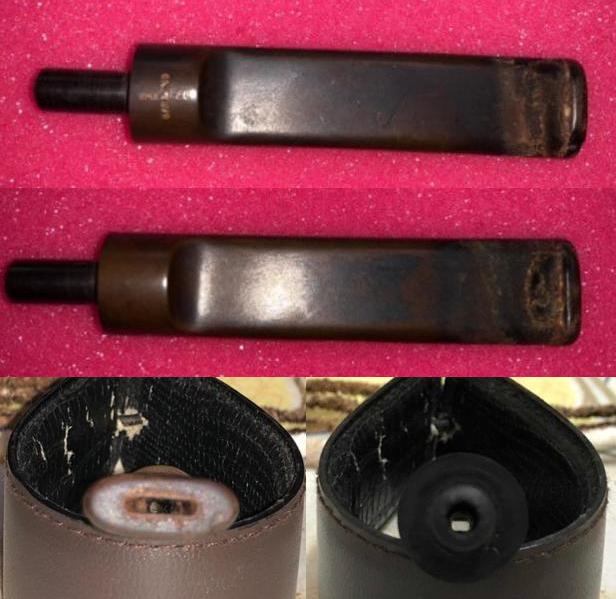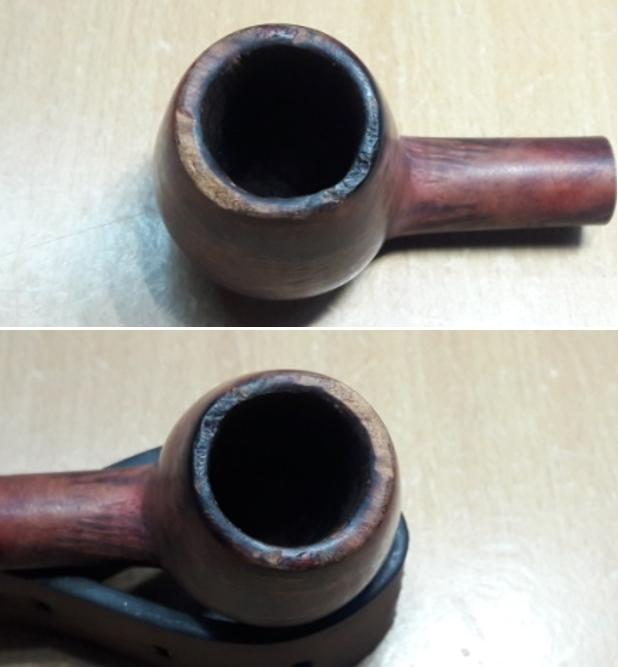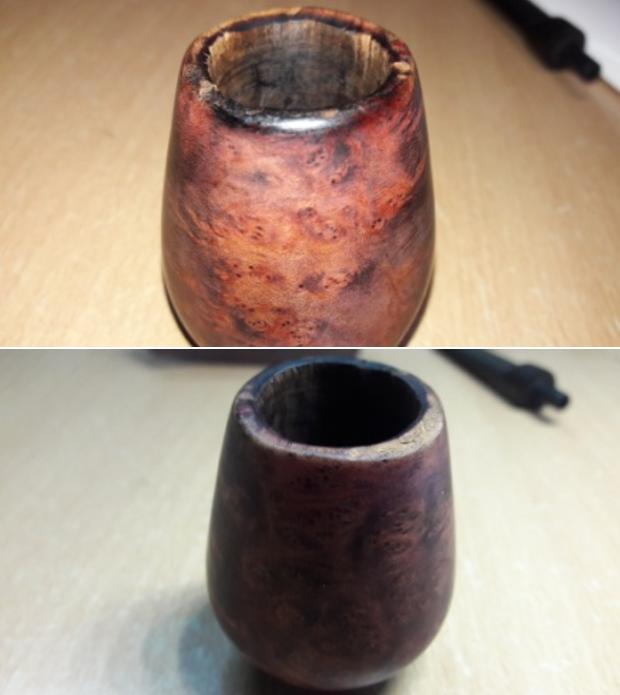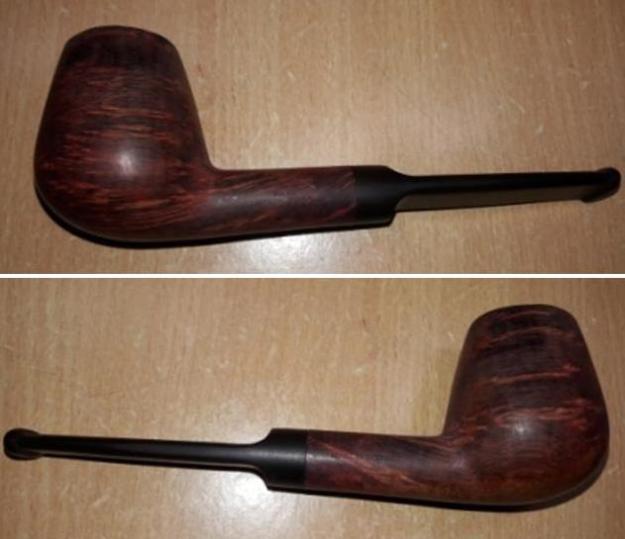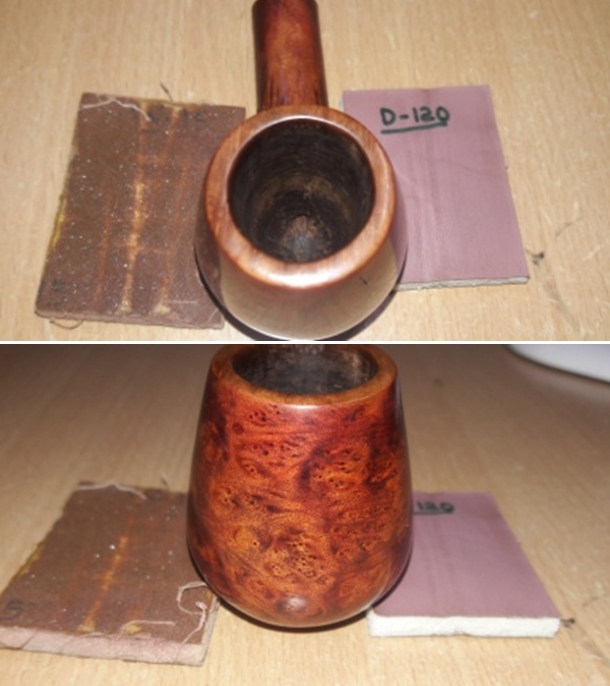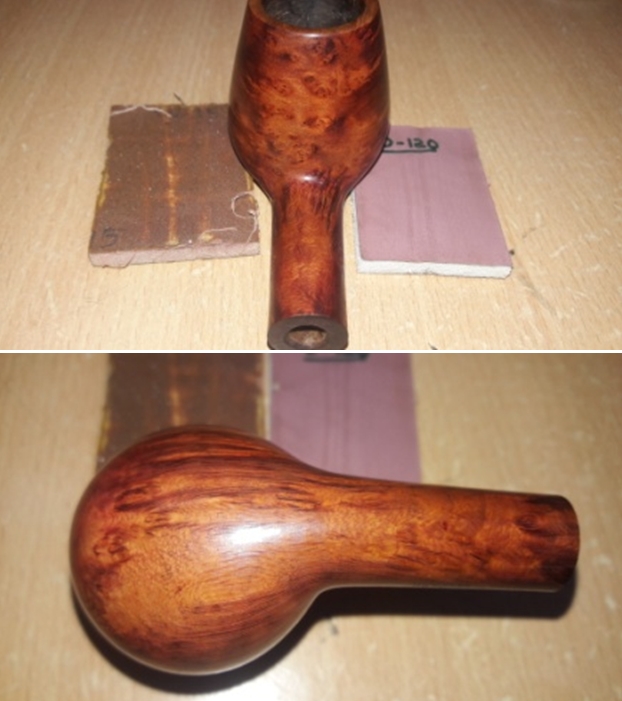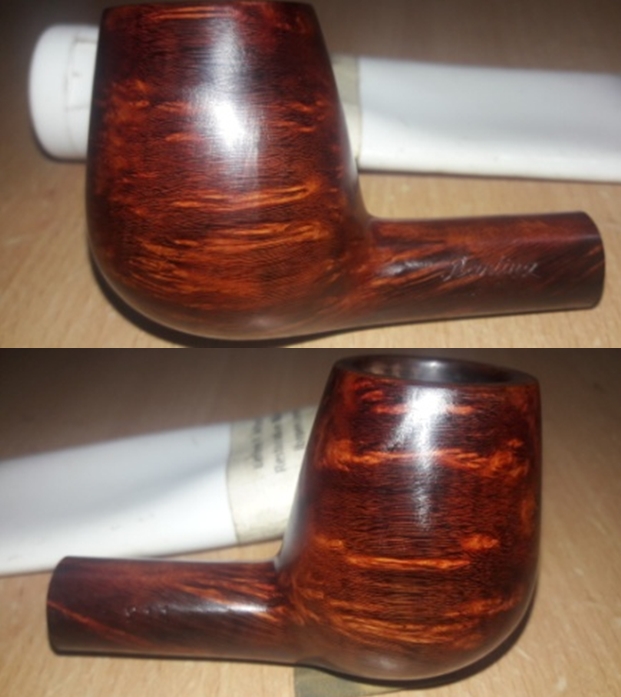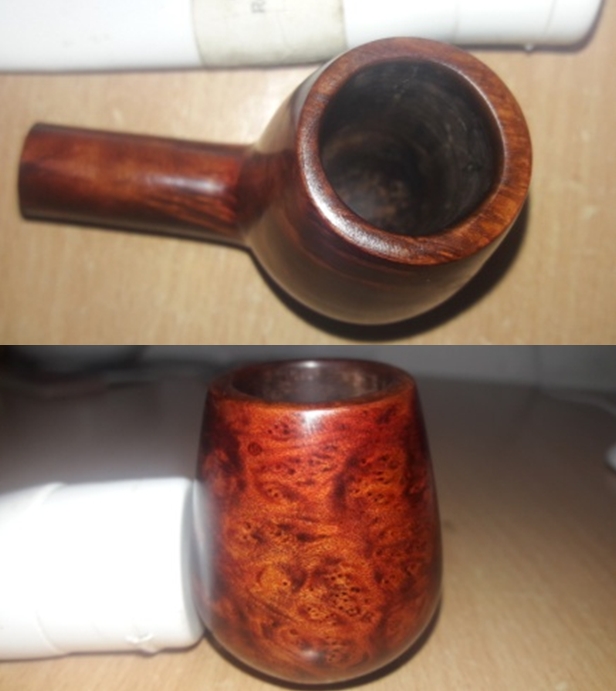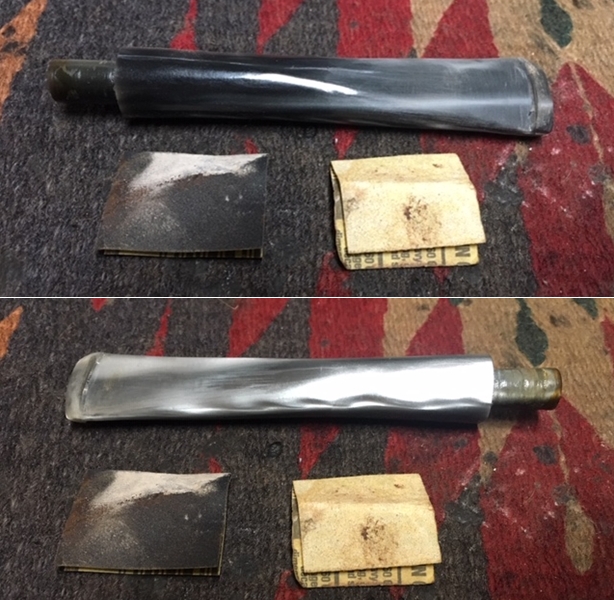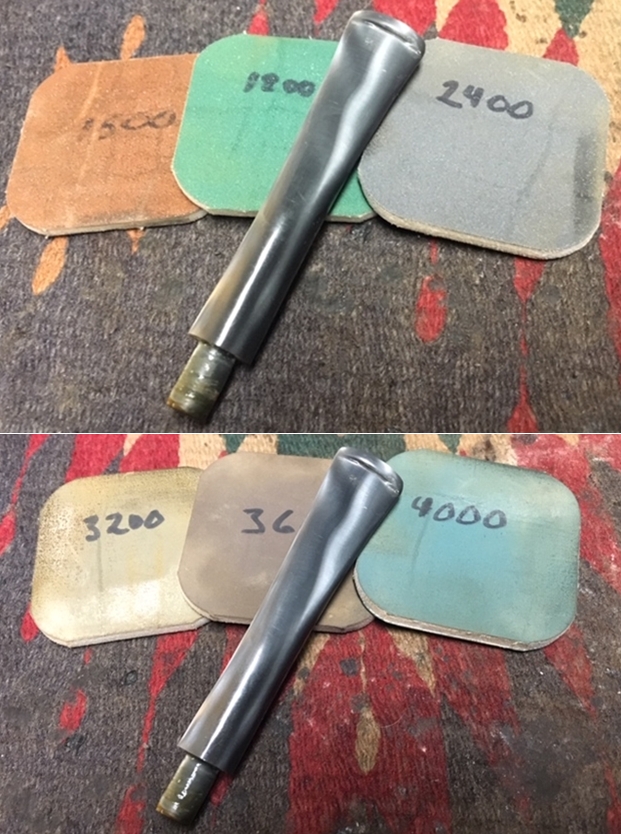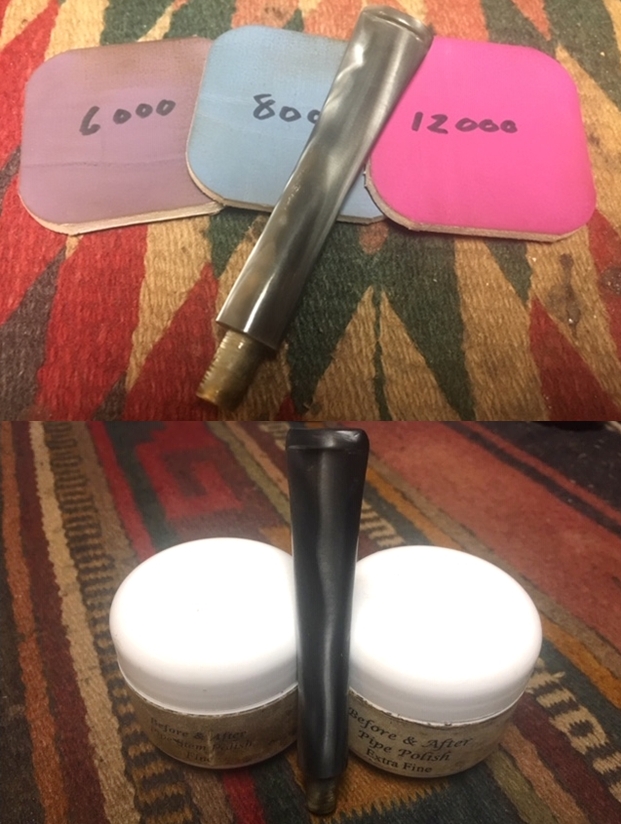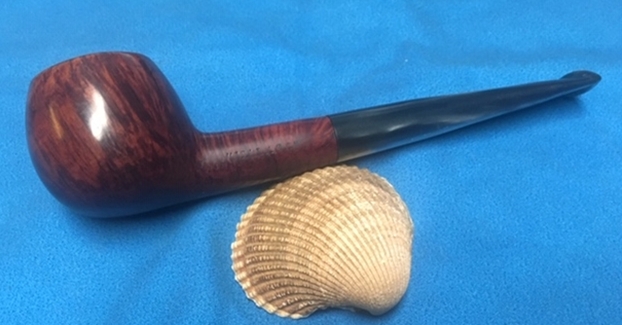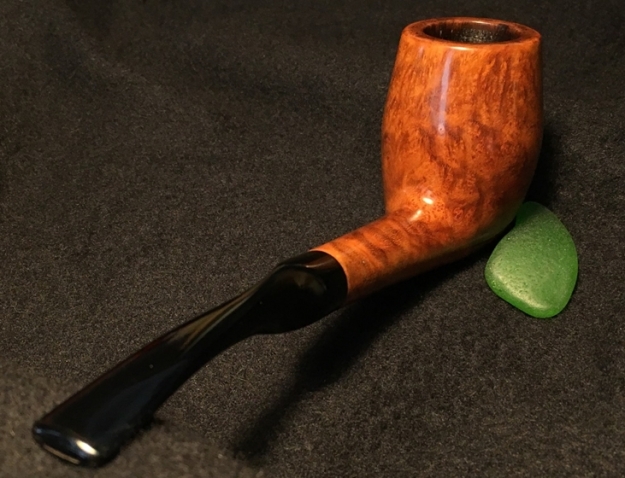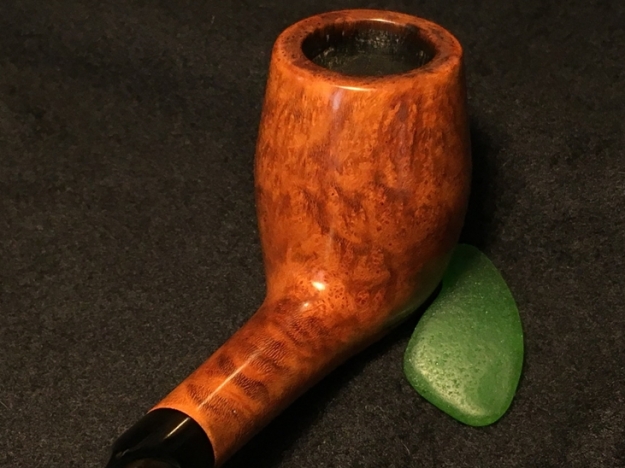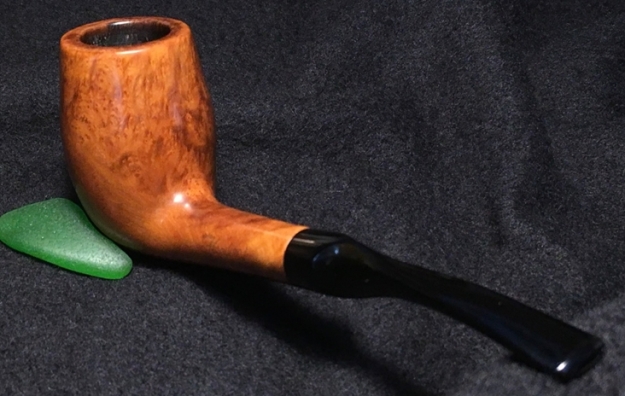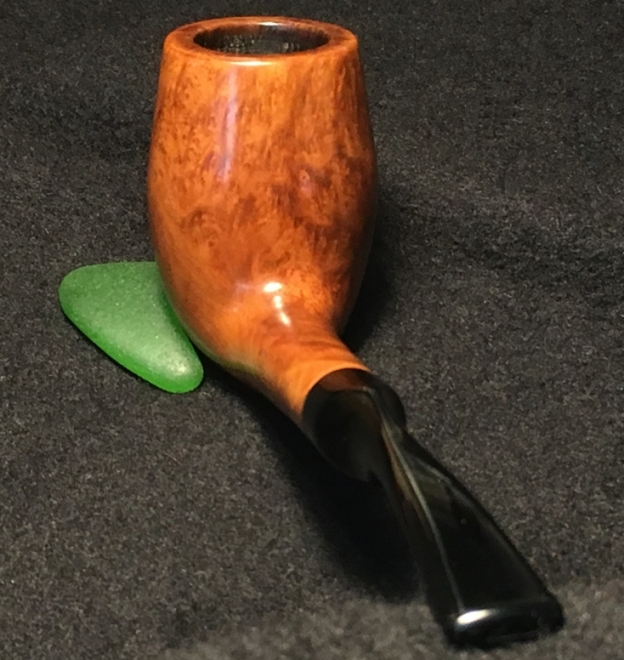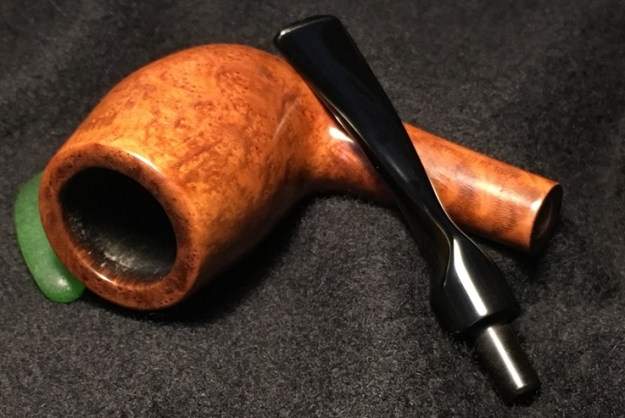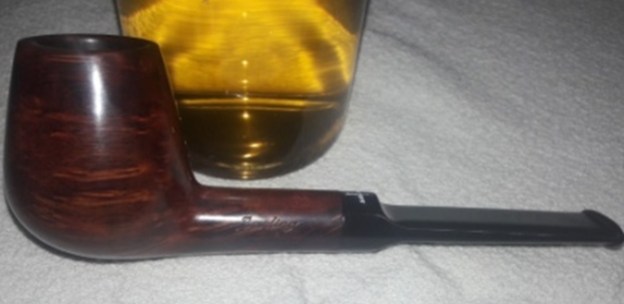
Tag Archives: bite marks

Restoring a Beautiful Bertram Apple 60 from the Bertram Lot


Blog by Steve Laug

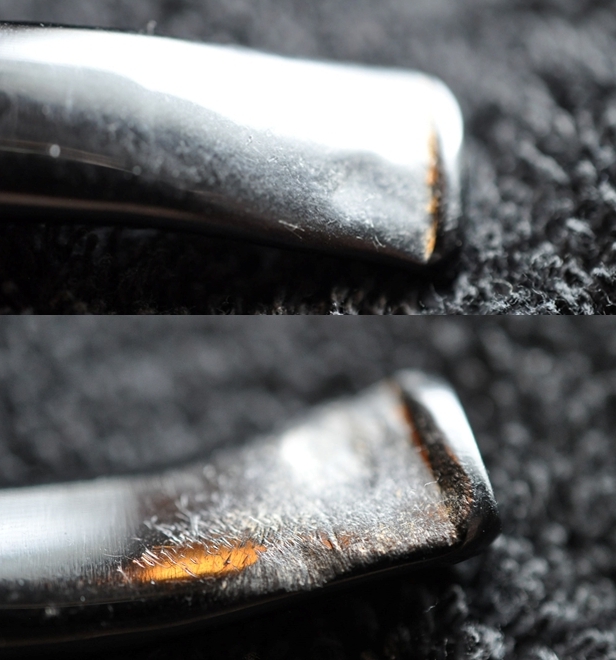
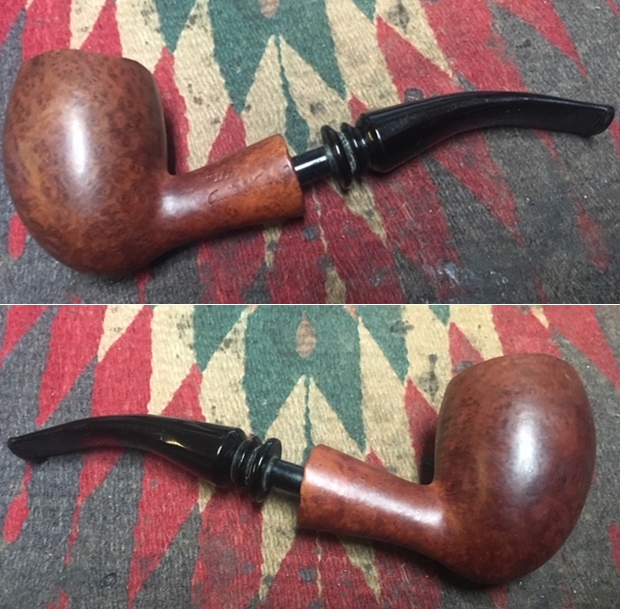
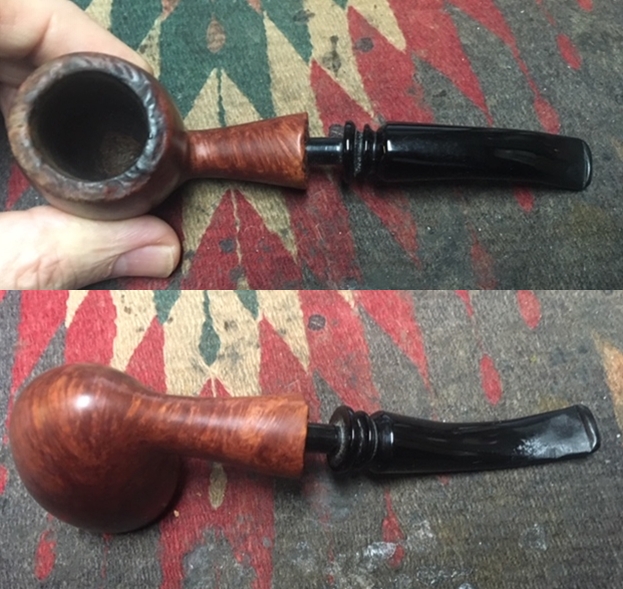
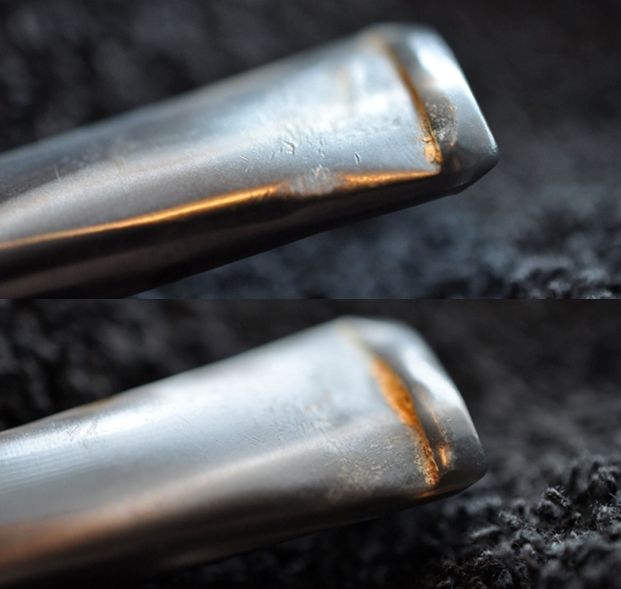
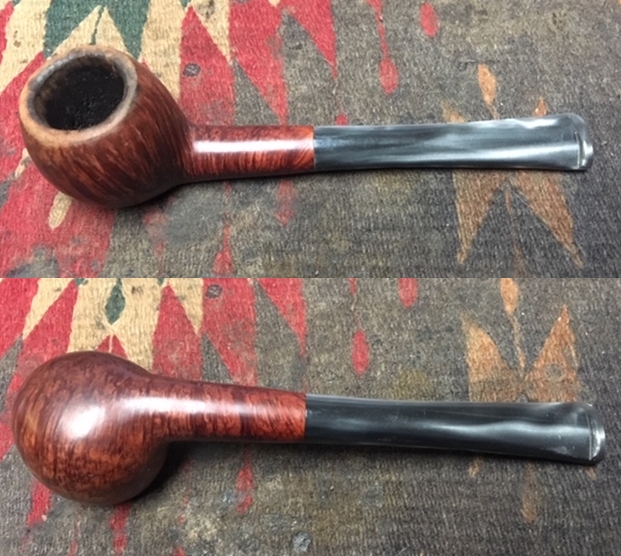
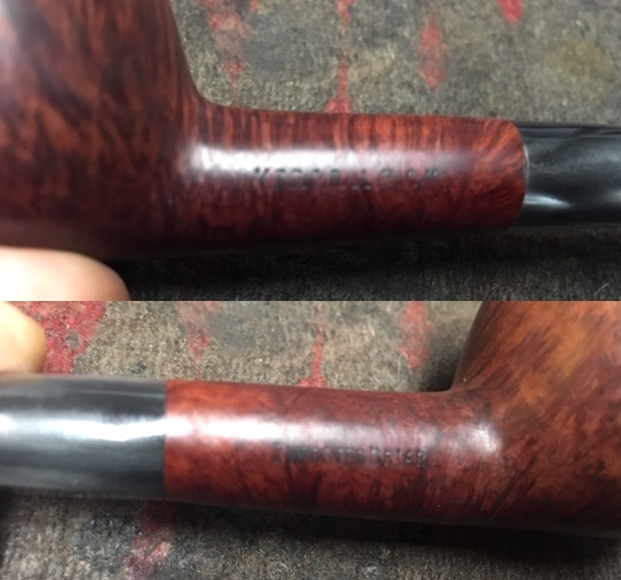
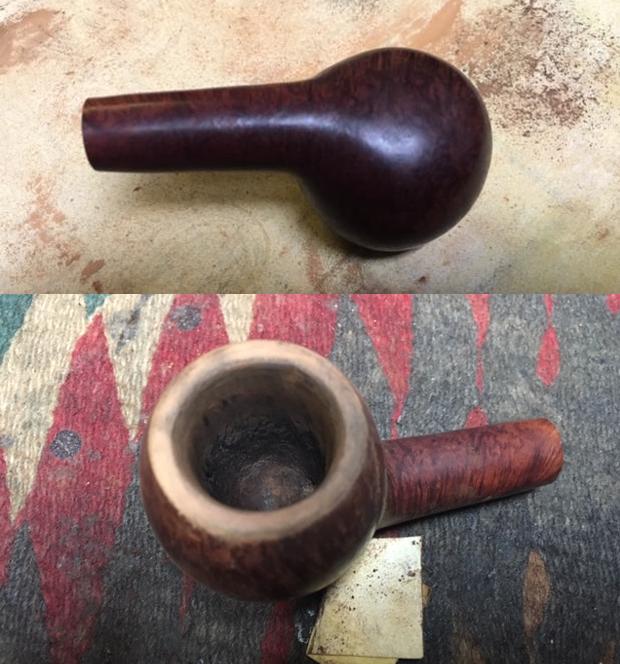
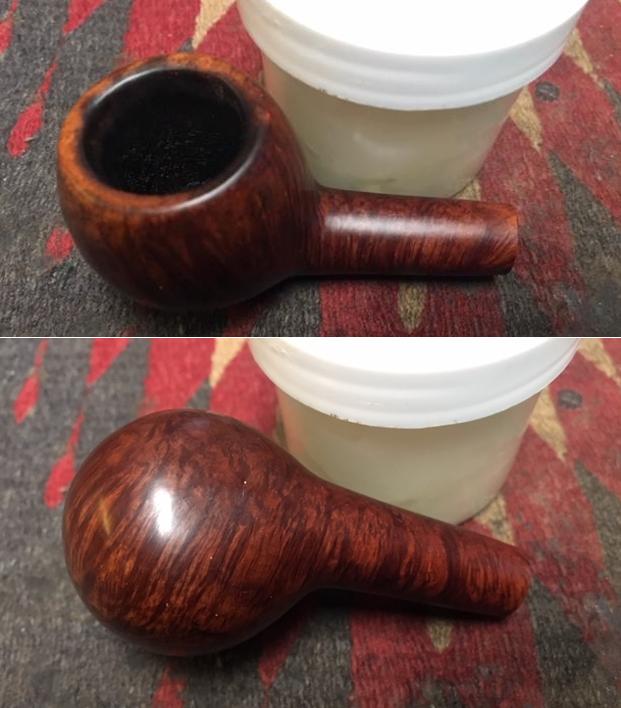
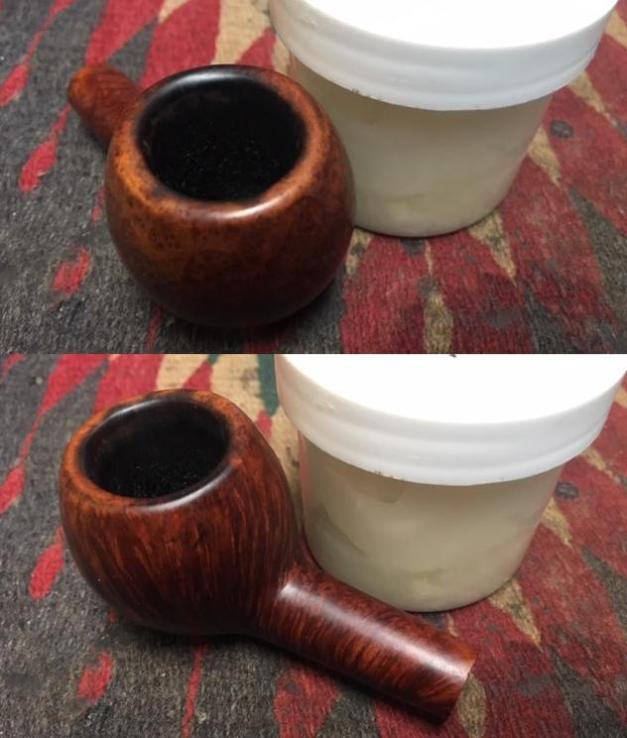
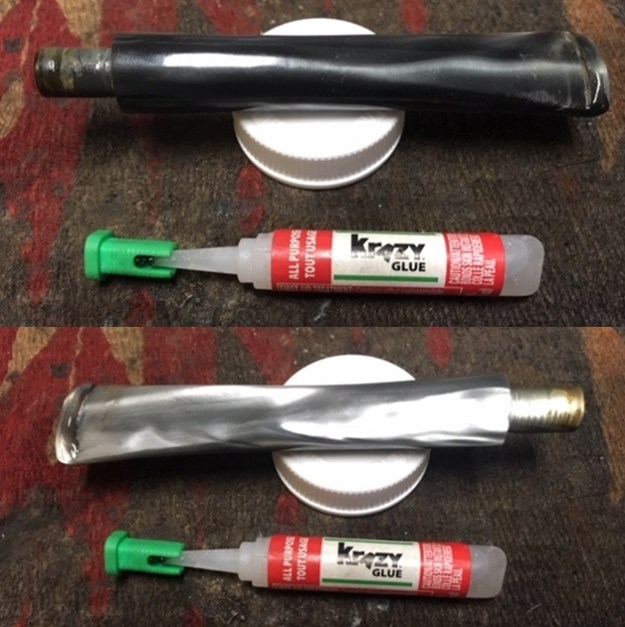
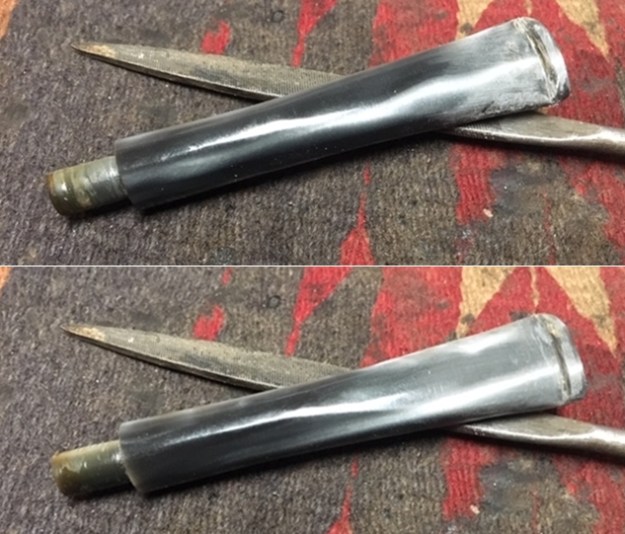
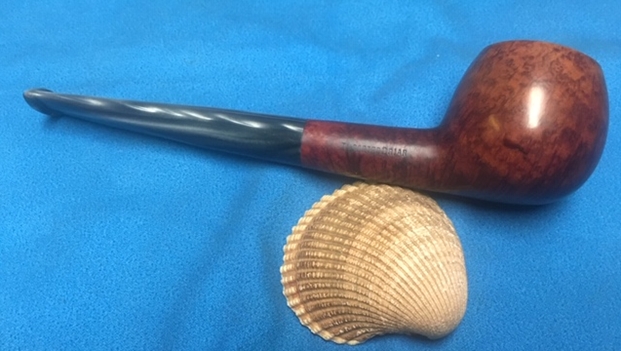
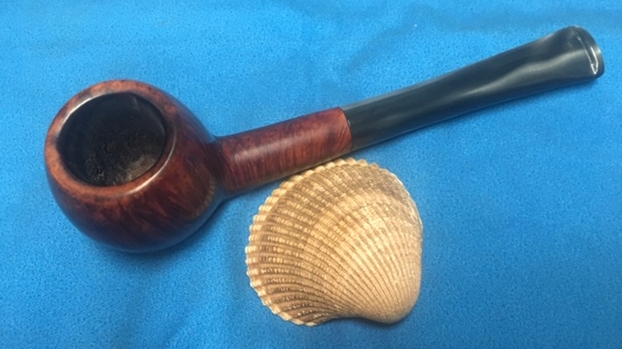
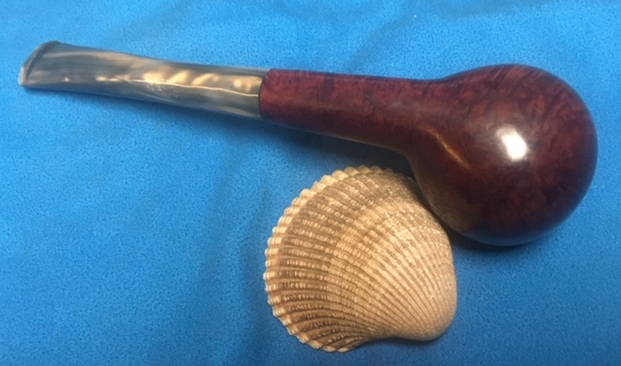
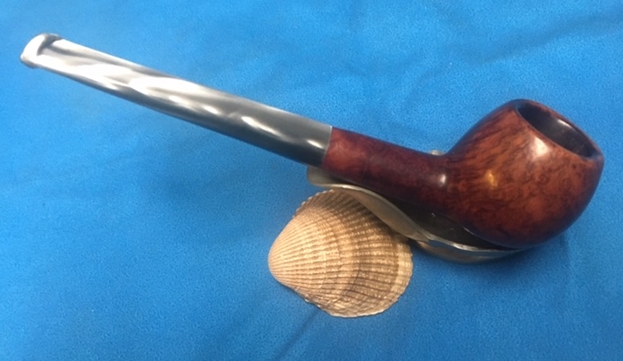
Feel free to refer to the previous blog posts on the brand if you want some background on the pipes in this lot. I have a hard time expressing how overwhelming it is to look at the 200+ pipes that need to be restored. It is mind boggling but there is only one way to move ahead – 1 pipe at a time. I could not do it without Jeff’s help. He is doing the clean up on the lot as that would be more than I could handle by myself in moving through this many pipes. From his cleaned pipes I get to choose what I want to work on. This time I chose another interesting Bertram Apple. It has grade 60 number on the underside of the shank. The grain was a mix of grains – straight, flame and birdseye. It is another round bottom pipe with a taper stem. The exterior of the bowl looked really good. The bowl had cake in the chamber that was no problem. The rim top had some darkening and lava overflow on the back side. There appeared to be a bit of damage to the back side of the inner edge of the bowl. The stem had some oxidation and tooth chatter near the button on both sides. Jeff took some photos of the pipe before he began his cleanup work on it. Jeff took close-up photos of the bowl and rim to capture the condition of the pipe when it arrived. The rim top had a thick coat of lava and the bowl had a thick cake. It was hard to tell the condition of the inner edge of the rim due to the thick cake and lava coat.Jeff took pictures of the bowl sides and the heel to show the great looking grain around the sides of the bowl. Spots on the briar in the photo are actually dirt and not fills. I am looking forward to seeing what is under all of the grime.Jeff took photos to capture the stamping on the left side of the shank. It shows the stamping which read Bertram over Washington, D.C. The second photo shows the number 60 stamped on the underside of the shank. That is the quality number designation on this pipe. The next two photos show the stem surface. They show the calcification, oxidation and the chatter on both sides near the button. There are several deeper tooth marks on the underside of the stem near the button. There is some wear on the button edge.I have included this information with each of the Bertram blogs I have posted. You can skip the next bit. But if you have not, then I include the link to Bertram history and information. I would recommend that if you don’t know much about them do some research on them. I include a link to the write up on Pipedia (http://pipedia.org/wiki/Bertram). Bertram pipes were based out of Washington DC. They were popular among famous politicians and celebrities of the time. They made many products for them from FDR’s cigarette holders to Joseph Stalin’s favorite pipe. They were considered some of the best America had to offer till they finally closed their doors in the 70s. They graded their pipes by 10s, the higher the grade the better. Above 60s are uncommon and 80-90s are quite rare. I’ve never heard of or seen a 100 grade. I have several blogs that I have written on rebornpipes that give some history and background to Bertram pipes. (https://rebornpipes.com/2015/06/16/an-easy-restoration-of-a-bertram-grade-60-217-poker/).
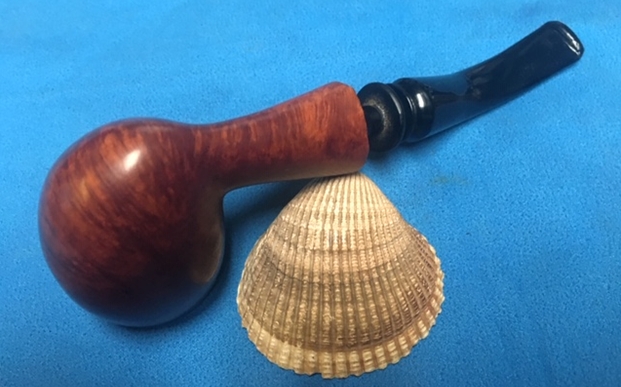
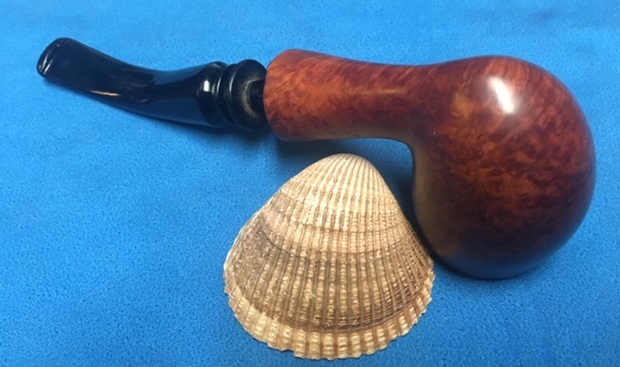
I have included the following link to give a bit of historical information on the pipe company. It is a well written article that gives a glimpse of the heart of the company. http://www.streetsofwashington.com/2012/01/bertrams-pipe-shop-on-14th-street.html#

From this information I have learned that the shape and grade Bertram I have in front of me now was made before the closure of the shop in the 1970s. This Bertram Zulu is yet another different shape from the other Bertram shapes I have restored. I have restored one other Zulu from this collection (https://rebornpipes.com/2019/06/01/a-zulu-shaped-bertram-30-from-the-bertram-collection/). Like the other one this also has a 30 grade stamp that gives some idea of how Bertram identified the quality of this pipe.

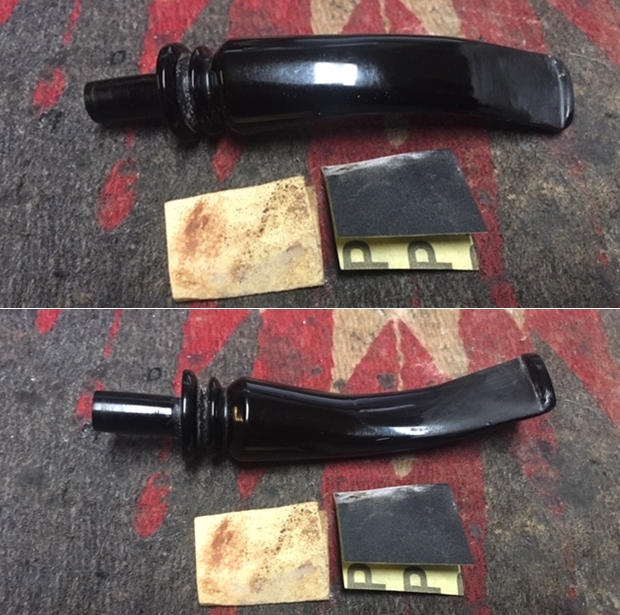
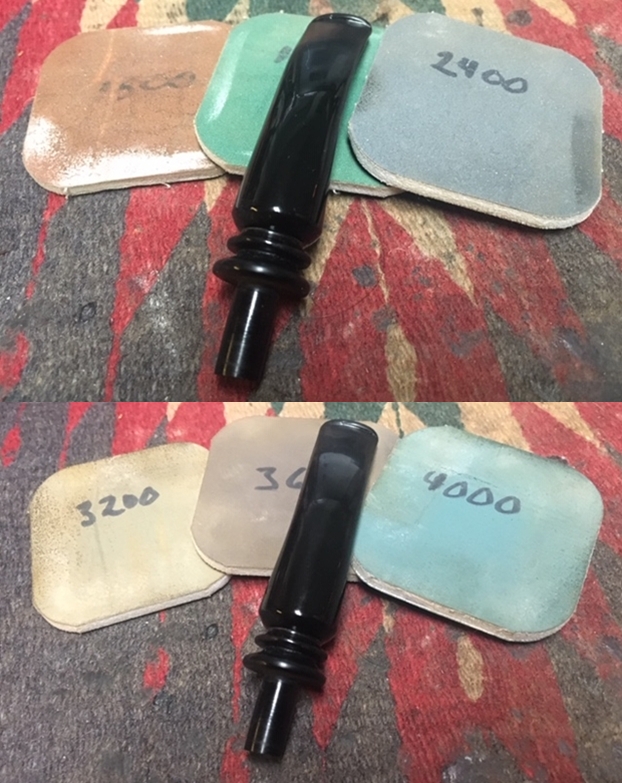
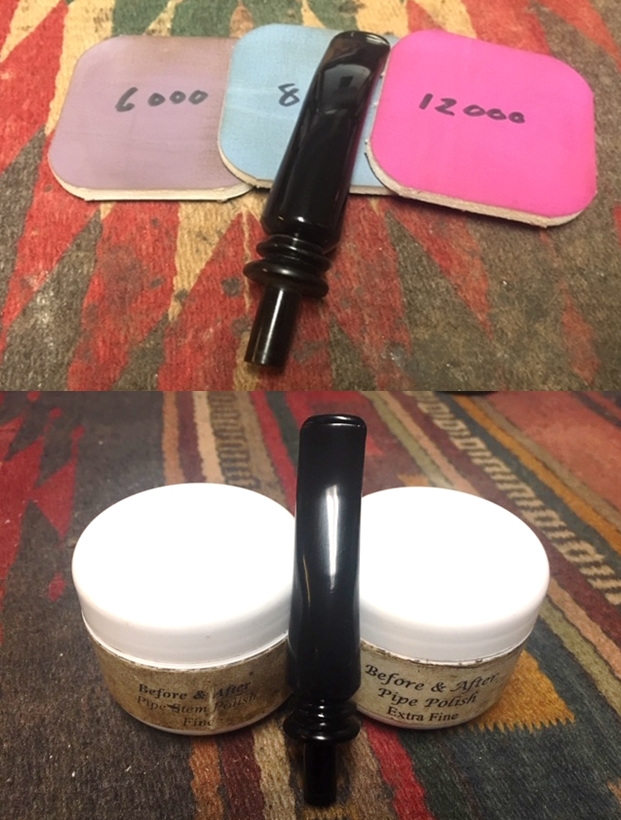
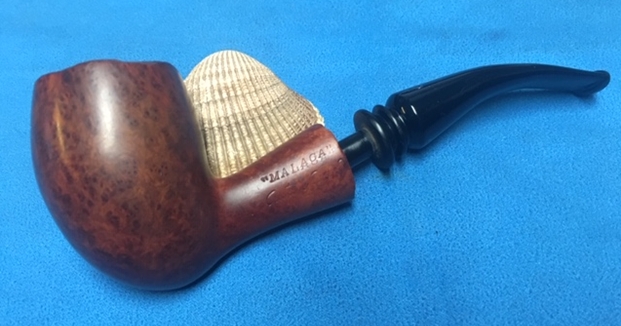
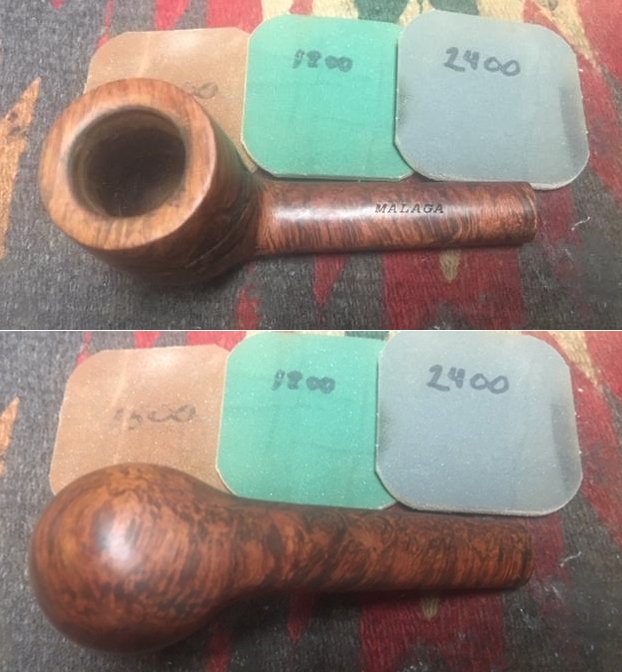
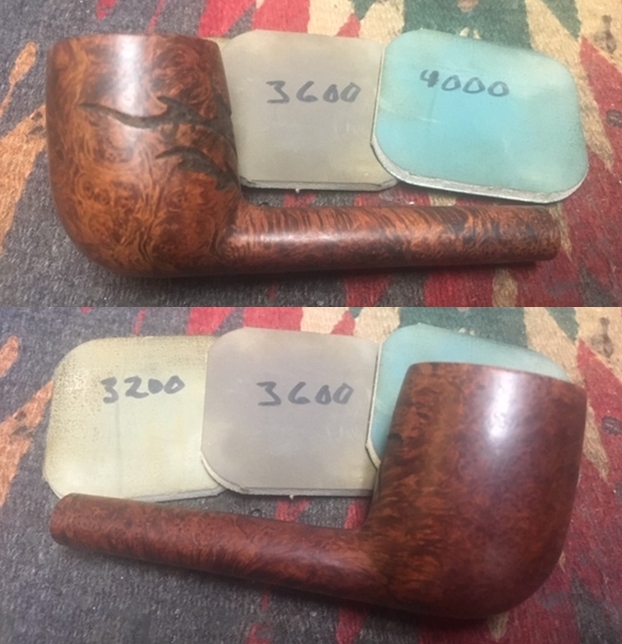
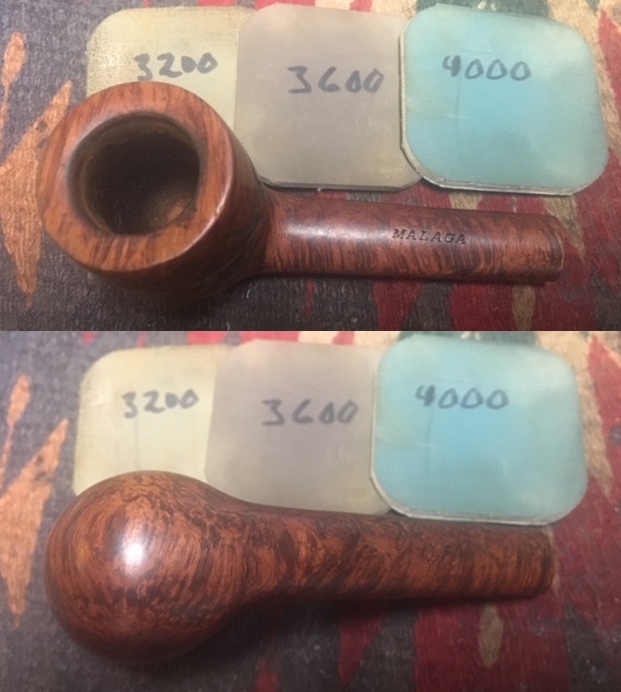
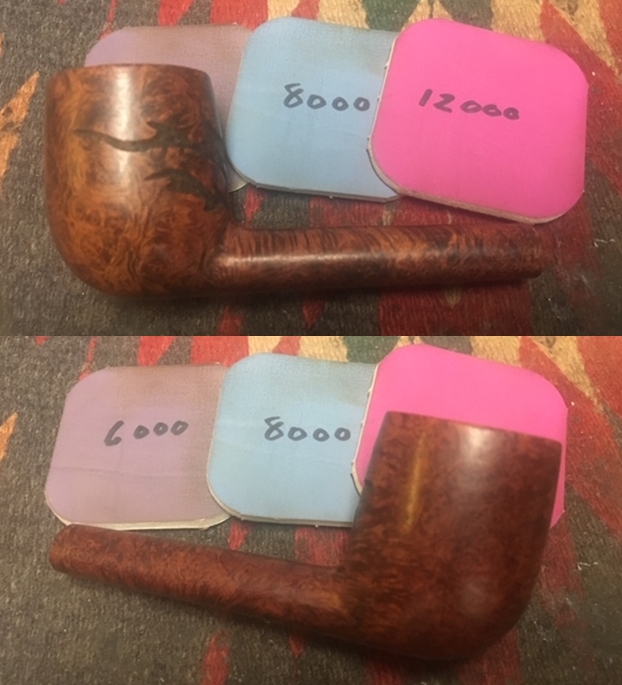
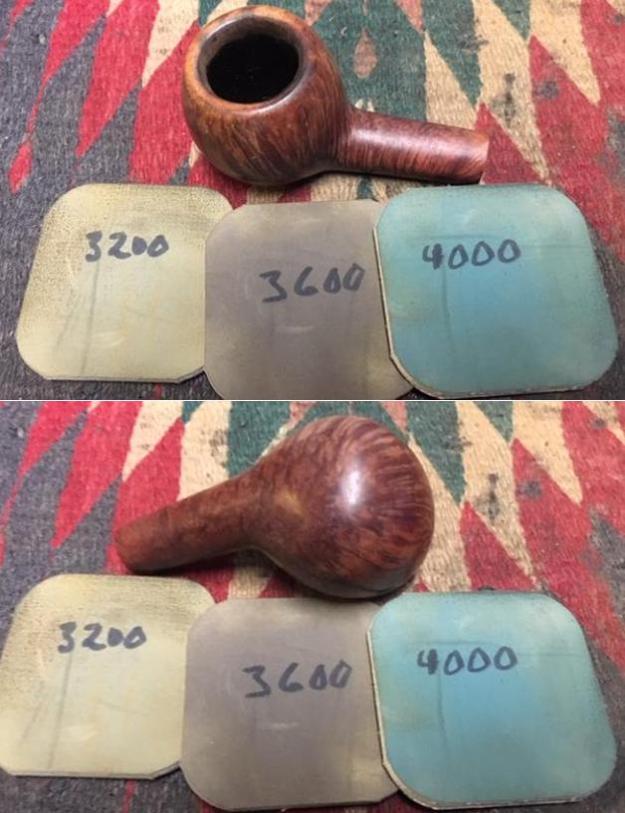
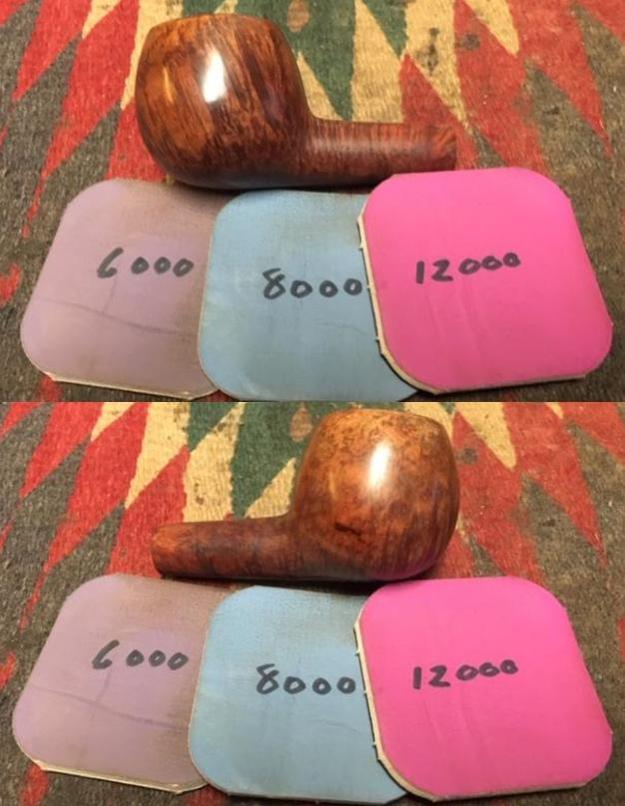
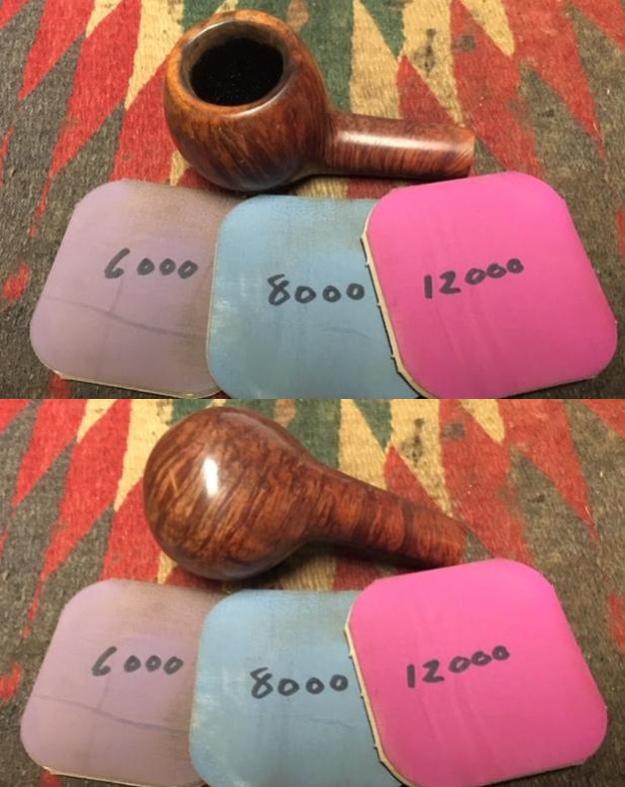
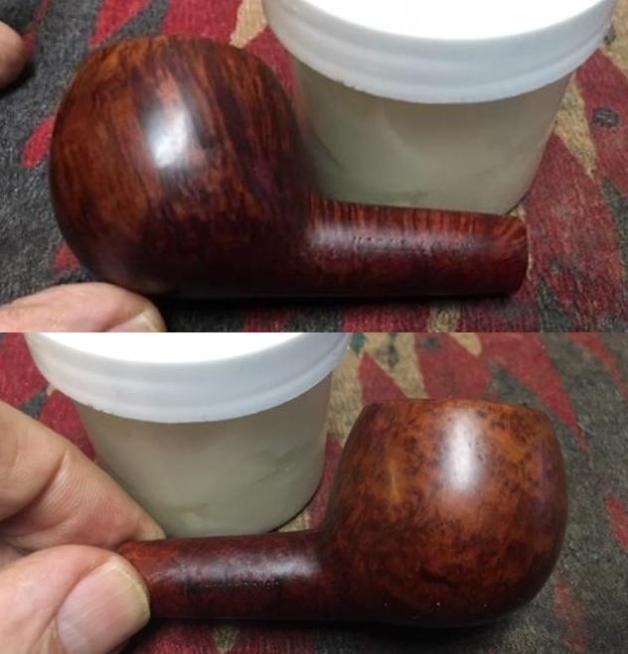
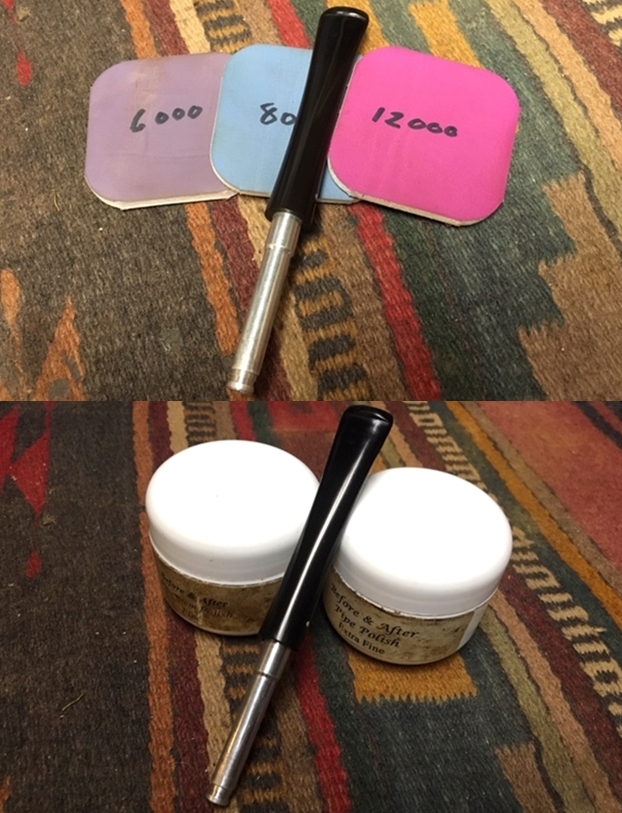
By now if you have been a reader for long you have Jeff’s cleaning regimen pretty well memorized. If you know it you can skip right to the pictures. If not I will include them once more. Jeff reamed the bowl with a PipNet pipe reamer and followed up with a Savinelli Fitsall pipe knife to remove the cake. He scrubbed out the mortise and the airway in the shank and the stem with alcohol, cotton swabs and pipe cleaners. He scrubbed the exterior of the bowl, rim, shank and stem with a tooth brush and Murphy’s Oil Soap to remove the oils and tars on the rim and the grime on the finish of the bowl. He rinsed it under running water. He dried it off with a soft cloth. He was able to remove lava build up on the rim top and you could see the great condition of the bowl top and edges of the rim. The rim and edges were in amazing condition. He soaked the stem in Before & After Deoxidizer to remove the oxidation. I took photos of the pipe before I started my work on it. I took a close up photo of the rim top to show the condition of the bowl and rim after Jeff had cleaned up the grime and lava. Without the lava there was some burn damage to the rear inner edge. I have circled the burn damage in red in the photo below. The stem photos show that the light oxidation is gone. The stem is in excellent condition with some light tooth marks on the underside near the button and light tooth chatter on both sides.I took photos of the stamping to show how it looked after the cleanup. The Bertram Washington DC is clear and readable. The second photo shows the grade 60 stamp on the underside of the shank.I cleaned up the burn damaged inner edge and outer edge of the rim with a folded piece of 220 grit sandpaper. I cleaned up the sanding marks with 400 grit wet dry sandpaper. Next I worked on some  sand pits and gouges in the bowl. There was one on the lower left side of the bowl. There were several near the rim top on the back of the bowl. I filled them in with clear super glue and set it aside to cure. When the repairs had cured I sanded them smooth with 220 grit sandpaper and started the polishing with 400 grit wet dry sandpaper. I touched up the sanded area with an oak stain pen to blend it into the rest of the bowl. I polished the bowl and rim top with micromesh sanding pads – wetsanding it with 1500-12000 grit pads. I wiped the bowl down with a damp cloth after each pad to remove the sanding debris. The grain began to stand out. After the final sanding pad I hand buffed it with a cotton cloth to raise a shine. I worked some Before & After Restoration Balm into the finish of the briar with my fingertips to clean, enliven and protect it. I let the balm sit for a little while and then buffed with a cotton cloth to raise the shine. The Restoration Balm really makes the grain stands out beautifully. If you have not tried some why not give it a try. I sanded out the small tooth marks and chatter next to the button on both sides of the stem with a folded piece of 220 grit sandpaper. I sanded the stem with 400 grit wet dry sandpaper to remove the scratches. I followed by polishing the stem with Denicare Mouthpiece Polish with a cotton pad. I wiped it down with some Obsidian Oil and set it aside to dry. I polished out the sanding scratches with micromesh sanding pads – wetsanding it with 1500-12000 grit pads. I wiped the stem down with Obsidian Oil after each pad. I polished it with Before & After Pipe Polish – both Fine and Extra Fine and gave it a final coat and set it aside to dry. Jeff and I are gradually working through this 200+ lot dealing with each of the different challenges they present. This one is Bertram’s take on a classic medium sized Apple shape. I put the stem and bowl back together and buffed the pipe with Blue Diamond on the buffing wheel. I polished the briar and the minute scratches still in the vulcanite of the stem until there was a rich shine. This is a Grade 60 pipe with some really nice grain around the bowl. It has a tapered vulcanite stem. The finish really has some interesting grain on a proportionally well carved pipe. Once I buffed the pipe the briar came alive and the grain popped with polishing. The black vulcanite stem had a rich glow. The finished pipe is well shaped Apple. This Bertram feels great in the hand sits right in the mouth. Have a look at it with the photos below. The dimensions are Length: 5 ½ inches, Height: 1 3/4 inches, Outside diameter of the bowl: 1 1/4 inches, Chamber diameter: 3/4 of an inch. Maybe this shape speaks to you and you want to add it to your collection. Rest easy, this one will soon be on the rebornpipes store. If you are interested let me know. Thanks for walking through the restoration with me as it was a pleasure to work on.


Restoring a Bertram Thick Shank Apple 20 from the Bertram Lot


Blog by Steve Laug

Feel free to refer to the previous blog posts on the brand if you want some background on the pipes in this lot. I have a hard time expressing how overwhelming it is to look at the 200+ pipes that need to be restored. It is mind boggling but there is only one way to move ahead – 1 pipe at a time. I could not do it without Jeff’s help. He is doing the clean up on the lot as that would be more than I could handle by myself in moving through this many pipes. From his cleaned pipes I get to choose what I want to work on. This time I chose an interesting thick shank Bertram Apple. It has grade 20 number on the underside of the shank. The grain was a mix of grains – swirls, flame, cross and birdseye. It is another round bottom pipe with a taper stem. The exterior of the bowl looked really good. The bowl had cake in the chamber that was no problem. The rim top had some darkening and lava overflow on the back side. There appeared to be a bit of damage to the back side of the inner edge of the bowl and a little darkening on the outer edge on the left side. The stem had some oxidation and tooth chatter near the button on both sides. There were two deeper tooth marks on the underside near the button. Jeff took some photos of the pipe before he began his cleanup work on it. Jeff took close-up photos of the bowl and rim to capture the condition of the pipe when it arrived. The rim top had a coat of lava and the bowl had a thick cake. There were a few nicks in the back side of the inner edge of the rim.Jeff took pictures of the bowl sides and the heel to show the great looking grain around the sides of the bowl. There appear to be some fills on the underside of the bowl amidst the grime and dirt.Jeff took a photo to capture the stamping on the left side of the shank. It shows the stamping which read Bertram over Washington, D.C. There is a number 20 stamped on the underside of the shank. That is the quality number designation on this pipe. The next two photos show the stem surface. They show the calcification, oxidation and the chatter on both sides near the button. There are several deeper tooth marks on the underside of the stem near the button. There is some wear on the button edge.I have included this information with each of the Bertram blogs I have posted. You can skip the next bit. But if you have not, then I include the link to Bertram history and information. I would recommend that if you don’t know much about them do some research on them. I include a link to the write up on Pipedia (http://pipedia.org/wiki/Bertram). Bertram pipes were based out of Washington DC. They were popular among famous politicians and celebrities of the time. They made many products for them from FDR’s cigarette holders to Joseph Stalin’s favorite pipe. They were considered some of the best America had to offer till they finally closed their doors in the 70s. They graded their pipes by 10s, the higher the grade the better. Above 60s are uncommon and 80-90s are quite rare. I’ve never heard of or seen a 100 grade. I have several blogs that I have written on rebornpipes that give some history and background to Bertram pipes. (https://rebornpipes.com/2015/06/16/an-easy-restoration-of-a-bertram-grade-60-217-poker/).

I have included the following link to give a bit of historical information on the pipe company. It is a well written article that gives a glimpse of the heart of the company. http://www.streetsofwashington.com/2012/01/bertrams-pipe-shop-on-14th-street.html#

From this information I have learned that the shape and grade Bertram I have in front of me now was made before the closure of the shop in the 1970s. This Bertram Apple is yet another different shape from the other Bertram shapes I have worked. The 20 grade stamp gives some idea of how Bertram identified the quality of this pipe.

By now if you have been a reader for long you have Jeff’s cleaning regimen pretty well memorised. If you know it you can skip right to the pictures. If not I will include them once more. Jeff reamed the bowl with a PipNet pipe reamer and followed up with a Savinelli Fitsall pipe knife to remove the cake. He scrubbed out the mortise and the airway in the shank and the stem with alcohol, cotton swabs and pipe cleaners. He scrubbed the exterior of the bowl, rim, shank and stem with a tooth brush and Murphy’s Oil Soap to remove the oils and tars on the rim and the grime on the finish of the bowl. He rinsed it under running water. He dried it off with a soft cloth. He was able to remove lava build up on the rim top and you could see the great condition of the bowl top and edges of the rim. The rim and edges were in amazing condition. He soaked the stem in Before & After Deoxidizer to remove the oxidation. I took photos of the pipe before I started my work on it. I took a close up photo of the rim top to show the condition of the bowl and rim after Jeff had cleaned up the grime and lava. Without the lava there was a clear fill on the left topside of the rim. I have circled it in red in the photo below. There was some nicking along the inner edge that would need to be dealt with as well. The stem photos show that the light oxidation is gone. The stem is in excellent condition with only light tooth chatter on both sides near the button.I took photos of the stamping to show how it looked after the cleanup. The Bertram Washington DC is clear and readable. The second photo shows the grade 20 stamp on the underside of the shank.I cleaned up the damaged inner edge and outer edge of the rim with a folded piece of 220 grit sandpaper. I cleaned up the sanding marks with 400 grit wet dry sandpaper. I sanded the area with the fill to smooth it out and blend it in better.I polished the bowl and rim top with micromesh sanding pads – wetsanding it with 1500-12000 grit pads. I wiped the bowl down with a damp cloth after each pad to remove the sanding debris. The grain began to stand out. After the final sanding pad I hand buffed it with a cotton cloth to raise a shine. I worked some Before & After Restoration Balm into finish of the briar with my fingertips to clean, enliven and protect it. I let the balm sit for a little while and then buffed with a cotton cloth to raise the shine. The Restoration Balm really makes the grain stands out beautifully. If you have not tried some why not give it a try. I sanded out the small tooth marks and chatter next to the button on both sides of the stem with a folded piece of 220 grit sandpaper. I sanded the stem with 400 grit wet dry sandpaper to remove the scratches. I followed by polishing the stem with Denicare Mouthpiece Polish with a cotton pad. I wiped it down with some Obsidian Oil and set it aside to dry. I polished out the sanding scratches with micromesh sanding pads – wetsanding it with 1500-12000 grit pads. I wiped the stem down with Obsidian Oil after each pad. I polished it with Before & After Pipe Polish – both Fine and Extra Fine and gave it a final coat and set it aside to dry. Jeff and I are gradually working through this 200+ lot dealing with each of the different challenges they present. This one is Bertram’s take on a classic Apple shape. I put the stem and bowl back together and buffed the pipe with Blue Diamond on the buffing wheel. I polished the briar and the minute scratches still in the vulcanite of the stem until there was a rich shine. This is a Grade 20 pipe with some small fills around the shank and rim top. It has a tapered stem on a thick shank. The finish really has some interesting grain on a proportionally well carved pipe. Once I buffed the pipe the briar came alive and the mixture of grain popped with polishing. The black vulcanite stem had a rich glow. The finished pipe is well shaped thick shank Apple. This Bertram is a handful and sits right in the mouth. Have a look at it with the photos below. The dimensions are Length: 5 1/2 inches, Height: 2 inches, Outside diameter of the bowl: 1 1/2 inches, Chamber diameter: 3/4 of an inch. Maybe this shape speaks to you and you want to add it to your collection. Rest easy, this one will soon be on the rebornpipes store. If you are interested let me know. Thanks for walking through the restoration with me as it was a pleasure to work on.

A Bertram 30 Pot/Lovat Pipe from the Bertram Lot


Blog by Steve Laug

Once again if you want the background on the lot of Bertram pipes that Jeff and I purchased please refer to the previous blog posts on the brand. Like I have said, words escape me in trying to adequately describe how overwhelmed I am when I look at the 200+ pipes that need to be restored. It is mind boggling but there is only one way to move ahead – 1 pipe at a time. I am glad Jeff is helping with the clean up on the lot as that would be more than I could handle by myself in moving through this many pipes. From his cleaned pipes I chose a beautifully grained Bertram 30 that was a either a long shank pot or a Lovat shape with a great look and line. The grain was a mix of grains – swirls, flame, cross and birdseye. It was a round bottom pipe with a saddle stem. The exterior of the bowl looked really good and there were no fills on this beauty. The bowl had cake in the chamber that was no problem. The rim top had some darkening and lava overflow on the back side. The inner and outer edges of the bowl look very good. The exterior of the briar looked lifeless and was dusty with the grime of years of storage. The stem had some oxidation and tooth chatter near the button on both sides. Jeff took some photos of the pipe before he began his cleanup work on it. Jeff took close-up photos of the bowl and rim to capture the condition of the pipe when it arrived. The rim top had a coat of lava and the bowl had a thick cake.Jeff took pictures of the bowl sides and the heel to show the great looking grain around the sides of the bowl. It really is quite stunning and very dirty! Jeff took a photo to capture the stamping on the left side of the shank. It shows the stamping which read Bertram over Washington, D.C. The stamping has been overstamped on the left of the impression. The second photo shows the number stamp at the bowl/shank junction on the left side of the shank. The number designates the quality of the pipe. The next two photos show the stem surface. They show the calcification, oxidation and the chatter on both sides near the button. There is also some wear on the button edge.Once again, if you have read the previous Bertram blogs I have posted about the pipes that I have cleaned up so far you can skip the next bit. But if you have not, then I include the link to Bertram history and information. I would recommend that if you don’t know much about them do some research on them. I include a link to the write up on Pipedia (http://pipedia.org/wiki/Bertram). Bertram pipes were based out of Washington DC. They were popular among famous politicians and celebrities of the time. They made many products for them from FDR’s cigarette holders to Joseph Stalin’s favorite pipe. They were considered some of the best America had to offer till they finally closed their doors in the 70s. They graded their pipes by 10s, the higher the grade the better. Above 60s are uncommon and 80-90s are quite rare. I’ve never heard of or seen a 100 grade. I have several blogs that I have written on rebornpipes that give some history and background to Bertram pipes. (https://rebornpipes.com/2015/06/16/an-easy-restoration-of-a-bertram-grade-60-217-poker/).

I have included the following link to give a bit of historical information on the pipe company. It is a well written article that gives a glimpse of the heart of the company. http://www.streetsofwashington.com/2012/01/bertrams-pipe-shop-on-14th-street.html#

From this information I have learned that the shape and grade Bertram I have in front of me now was made before the closure of the shop in the 1970s. This Bertram Pot/Lovat is slightly different from the other Bertram shapes I have worked. With a grade 30 stamp it is a lower mid-range pipe.

By now if you have been a reader for long you have Jeff’s cleaning regimen pretty well memorized. If you know it you can skip right to the pictures. If not I will include them once more. Jeff reamed the bowl with a PipNet pipe reamer and followed up with a Savinelli Fitsall pipe knife to remove the cake. He scrubbed out the mortise and the airway in the shank and the stem with alcohol, cotton swabs and pipe cleaners. He scrubbed the exterior of the bowl, rim, shank and stem with a tooth brush and Murphy’s Oil Soap to remove the oils and tars on the rim and the grime on the finish of the bowl. He rinsed it under running water. He dried it off with a soft cloth. He was able to remove lava build up on the rim top and you could see the great condition of the bowl top and edges of the rim. The rim and edges were in amazing condition. He soaked the stem in Before & After Deoxidizer to remove the oxidation. I took photos of the pipe before I started my work on it. I took a close up photo of the rim top to show the condition of the bowl and rim after Jeff had cleaned up the grime and lava. The lava left a little darkening on the rear rim top but otherwise the bowl looked very good. There is a small pinhole flaw on the top of the shank that I will need to take care of in the restoration. The stem photos show that the light oxidation is gone. The stem is in excellent condition with only light tooth chatter on both sides near the button.I took photos of the stamping to show how it looked after the cleanup. The Bertram Washington DC is still readable and clear. The quality number stamp was on the underside of the shank and read 30.I decided to fill in the pinhole flaw with clear super glue. I put a drop of glue in the hole and overfilled it to take shrinkage into account. Once the fill cured I sanded it smooth with 220 grit sand paper and 400 grit wet dry sandpaper.I polished the bowl and rim top with micromesh sanding pads – wetsanding it with 1500-12000 grit pads. I wiped the bowl down with a damp cloth after each pad to remove the sanding debris. The grain began to stand out. After the final sanding pad I hand buffed it with a cotton cloth to raise a shine. I worked some Before & After Restoration Balm into finish of the briar with my fingertips to clean, enliven and protect it. I let the balm sit for a little while and then buffed with a cotton cloth to raise the shine. The Restoration Balm really makes the grain stands out beautifully. If you have not tried some why not give it a try. I sanded out the small tooth marks and chatter next to the button on both sides of the stem with a folded piece of 220 grit sandpaper. I followed that by sanding the stem with 400 grit wet dry sandpaper to remove the scratches. I polished out the sanding scratches with micromesh sanding pads – wetsanding it with 1500-12000 grit pads. I wiped the stem down with Obsidian Oil after each pad. I polished it with Before & After Pipe Polish – both Fine and Extra Fine and gave it a final coat and set it aside to dry. I am continuing to enjoy restoring these pipes from the Bertram Collection and with Jeff’s cleanup work we are making progress through them. Each one presents different challenges but all are well laid out classic shapes. This is no exception. I put the stem and bowl back together and buffed the pipe with Blue Diamond on the buffing wheel. I polished the briar and the minute scratches still in the vulcanite of the stem until there was a rich shine. This Bertram is in interesting combination of a long shank Pot or a Lovat with a large bowl. It has a saddle stem. The finish really has some interesting grain on a proportionally well carved pipe. Once I buffed the pipe the briar came alive and the mixture of grain popped with polishing. The black vulcanite stem had a rich glow. The finished pipe is a beautiful grained Lovat/Pot. Like the other Bertrams I have worked on this one fits well in the hand and sits right in the mouth. Have a look at it with the photos below. The dimensions are Length: 5 1/2 inches, Height: 2 inches, Outside diameter of the bowl: 1 5/8 inches, Chamber diameter: 7/8 of an inch. Maybe this shape speaks to you and you want to add it to your collection. Rest easy, this one will soon be on the rebornpipes store. If you are interested let me know. Thanks for walking through the restoration with me as it was a pleasure to work on.


A 1/4 Bent Bertram 60 Paneled Pot from the Bertram Lot


Blog by Steve Laug

If you want the background on the lot of Bertram pipes that Jeff and I purchased please refer to the previous blog posts. I can’t adequately describe how overwhelmed I am when I look at the 200+ pipes that need to be restored. It is mind boggling but there is only one way to move ahead – 1 pipe at a time. I am glad Jeff is helping with the clean up on the lot as that would be more than I could handle by myself in moving through this many pipes. From his cleaned pipes I chose an unusual Bertram 60 that was a ¼ bent Paneled Pot. The grain was a mix of grains – swirls, flame, cross and birdseye. It was a pot shape with a tapered stem. The bowl had cake in the chamber that was no problem. The rim top had some darkening and lava overflow on the back side. There was a small nick in the front outer edge of the bowl. The inner edge look very good. The exterior of the briar looked lifeless and was dusty with the grime of years of storage. The stem had some oxidation and tooth chatter near the button on both sides. Jeff took some photos of the pipe before he began his cleanup work on it. Jeff took a close-up photo of the bowl and rim to capture the condition of the pipe when it arrived. The rim top had a coat of lava and the bowl had a thick cake. There is also a small nick on the right front outer edge of the bowl that will need to be dealt with.Jeff took pictures of the bowl sides and the heel to show the great looking grain around the sides of the bowl. It really is quite interesting and very dirty!Jeff took a photo to capture the stamping on the left side of the shank. It shows the stamping which read Bertram over Washington, D.C. The stamping on this pipe is a faint on the right side of the impression. The second photo shows the number stamp 60 on the underside of the shank. The number designates the quality of the pipe. The next two photos show the stem surface. They show the calcification, oxidation and the chatter on both sides near the button. There is also some wear on the button edge.Once again, if you have read the previous Bertram blogs I have posted about the pipes that I have cleaned up so far you can skip the next bit. But if you have not, then I include the link to Bertram history and information. I would recommend that if you don’t know much about them do some research on them. I include a link to the write up on Pipedia (http://pipedia.org/wiki/Bertram). Bertram pipes were based out of Washington DC. They were popular among famous politicians and celebrities of the time. They made many products for them from FDR’s cigarette holders to Joseph Stalin’s favorite pipe. They were considered some of the best America had to offer till they finally closed their doors in the 70s. They graded their pipes by 10s, the higher the grade the better. Above 60s are uncommon and 80-90s are quite rare. I’ve never heard of or seen a 100 grade. I have several blogs that I have written on rebornpipes that give some history and background to Bertram pipes. (https://rebornpipes.com/2015/06/16/an-easy-restoration-of-a-bertram-grade-60-217-poker/).

I have included the following link to give a bit of historical information on the pipe company. It is a well written article that gives a glimpse of the heart of the company. http://www.streetsofwashington.com/2012/01/bertrams-pipe-shop-on-14th-street.html#

From this information I have learned that the shape and grade Bertram I have in front of me now was made before the closure of the shop in the 1970s. This Bertram Panelled Pot with a ¼ bent stem is different from the other Bertram shapes I have worked. With a grade 60 stamp it is a mid-range pipe.

By now if you have been a reader for long you have Jeff’s cleaning regimen pretty well memorised. If you know it you can skip right to the pictures. If not I will include them once more. Jeff reamed the bowl with a PipNet pipe reamer and followed up with a Savinelli Fitsall pipe knife to remove the cake. He scrubbed out the mortise and the airway in the shank and the stem with alcohol, cotton swabs and pipe cleaners. He scrubbed the exterior of the bowl, rim, shank and stem with a tooth brush and Murphy’s Oil Soap to remove the oils and tars on the rim and the grime on the finish of the bowl. He rinsed it under running water. He dried it off with a soft cloth. He was able to remove lava build up on the rim top and you could see the great condition of the bowl top and edges of the rim. There was still some darkening to the rim top toward the back of the bowl. He soaked the stem in Before & After Deoxidizer to remove the oxidation. I took photos of the pipe before I started my work on it. I took a close up photo of the rim top to show the condition of the bowl and rim after Jeff had cleaned up the grime and lava. The lava left a little darkening on the rear rim top but otherwise the bowl looked very good. The cleanup had also minimized the nick on the front outer edge. The stem photos show that the light oxidation is gone. The tooth marks and chatter next to the button are visible and should sand out quite easily.I took photos of the stamping to show how it looked after the cleanup. It is still readable and clear.I polished the bowl and rim top with micromesh sanding pads – wetsanding it with 1500-12000 grit pads. I wiped the bowl down with a damp cloth after each pad to remove the sanding debris. The grain began to stand out. After the final sanding pad I hand buffed it with a cotton cloth to raise a shine. I know I have mentioned it before but I really like the balm that Mark Hoover created. It really does wonders on a dry piece of briar. I worked some Before & After Restoration Balm into finish of the briar with my fingertips to clean, enliven and protect it. I let the balm sit for a little while and then buffed with a cotton cloth to raise the shine. The Restoration Balm really makes the grain stands out beautifully. If you have not tried some why not give it a try. I sanded out the tooth marks and chatter on the stem with 220 grit sandpaper and polished the sanding with 400 grit wet dry sandpaper. The marks and chatter are gone and the stem is smooth.The stem was in great condition at this point. I polished out the sanding scratches with micromesh sanding pads – wetsanding it with 1500-12000 grit pads. I wiped the stem down with Obsidian Oil after each pad. I polished it with Before & After Pipe Polish – both Fine and Extra Fine and gave it a final coat and set it aside to dry. I am having fun doing these pipes from the Bertram Collection. Each one presents different challenges but all are well laid out classic shapes. This is no exception. I put the stem and bowl back together and buffed the pipe with Blue Diamond on the buffing wheel. I polished the briar and the minute scratches still in the vulcanite of the stem until there was a rich shine. This Bertram is in interesting twist on a ¼ Bent Pot shape with tapered stem. The finish really highlights some interesting grain on a proportionally well carved pipe. Once I buffed the pipe the briar came alive and the mixture of grain popped with polishing. The black vulcanite stem had a rich glow. The finished pipe is a beautiful grained Paneled Pot. Like the other Bertrams I have worked on this one fits well in the hand and sits right in the mouth. Have a look at it with the photos below. The dimensions are Length: 5 3/4 inches, Height: 1 1/2 inches, Outside diameter of the bowl: 1 1/2 inches, Chamber diameter: ¾ of an inch. Maybe this shape speaks to you and you want to add it to your collection. Rest easy, this one will soon be on the rebornpipes store. If you are interested let me know. Thanks for walking through the restoration with me as it was a pleasure to work on.

A Crowned Thick Shank Billiard 40 from the Bertram Lot


Blog by Steve Laug

Once again rather than repeat myself about the background, please refer to the previous blog posts on the collection of Bertrams and other brands that Jeff and I purchased. I can’t adequately describe how overwhelmed I am when I look at the 200+ pipes that need to be restored but there is only one way to move ahead – 1 pipe at a time. I am glad Jeff is helping with the clean up on the lot as that would be more than I could handle by myself in moving through this many pipes. From his cleaned pipes I chose a thick shank Billiard Bertram 40 with a crowned rim top. The grain was a mix of cross grain and birdseye. It was a Billiard with a tapered stem. The bowl had cake in the chamber that was no problem. The rim top had some darkening and lava overflow on the back side. There was a chip in the front, inner edge of the bowl and what appeared to be a burn mark on back inner edge. The outer edge of the bowl appeared to be in good condition but we would know more once the bowl had been reamed and cleaned. The exterior of the briar looked lifeless and was dusty with the grime of years of storage. The stem had some oxidation and tooth chatter near the button on both sides. Jeff took some photos of the pipe before he began his cleanup work on it. Jeff took a close-up photo of the bowl and rim to capture the condition of the pipe when it arrived. The rim top had a coat of lava and the bowl had a thick cake. There is also an obvious nick on the front inner edge of the bowl that will need to be dealt with.Jeff took pictures of the bowl sides and the heel to show the great looking grain around the sides of the bowl. It really is quite stunning and very dirty!Jeff took a photo to capture the stamping on the left side of the shank. It shows the stamping which read Bertram over Washington, D.C. The stamping on this pipe is a faint on the right side of the impression. The second photo shows the number stamp 40 which shows the quality of the pipe. The number stamp is on the underside at the stem/shank junction.The next two photos show the stem surface. They show the oxidation and the chatter on both sides near the button. There is also some wear on the button edge.Once again, if you have read the previous Bertram blogs I have posted about the pipes that I have cleaned up so far you can skip the next bit. But if you have not, then I include the link to Bertram history and information. I would recommend that if you don’t know much about them do some research on them. I include a link to the write up on Pipedia (http://pipedia.org/wiki/Bertram). Bertram pipes were based out of Washington DC. They were popular among famous politicians and celebrities of the time. They made many products for them from FDR’s cigarette holders to Joseph Stalin’s favorite pipe. They were considered some of the best America had to offer till they finally closed their doors in the 70s. They graded their pipes by 10s, the higher the grade the better. Above 60s are uncommon and 80-90s are quite rare. I’ve never heard of or seen a 100 grade. I have several blogs that I have written on rebornpipes that give some history and background to Bertram pipes. (https://rebornpipes.com/2015/06/16/an-easy-restoration-of-a-bertram-grade-60-217-poker/).

I have included the following link to give a bit of historical information on the pipe company. It is a well written article that gives a glimpse of the heart of the company. http://www.streetsofwashington.com/2012/01/bertrams-pipe-shop-on-14th-street.html#

From this information I have learned that the shape and grade Bertram I have in front of me now was made before the closure of the shop in the 1970s. This Bertram Thick Shank Crowned Billiard is different from the other Bertram shapes I have worked. With a grade 40 stamp it is a more of lower mid-range pipe, though I am not sure why as the briar is very clean and the grain very interesting.

By now if you have been a reader for long you have Jeff’s cleaning regimen pretty well memorized. If you know it you can skip right to the pictures. If not I will include them once more. Jeff reamed the bowl with a PipNet pipe reamer and followed up with a Savinelli Fitsall pipe knife to remove the cake. He scrubbed out the mortise and the airway in the shank and the stem with alcohol, cotton swabs and pipe cleaners. He scrubbed the exterior of the bowl, rim, shank and stem with a tooth brush and Murphy’s Oil Soap to remove the oils and tars on the rim and the grime on the finish of the bowl. He rinsed it under running water. He dried it off with a soft cloth. He was able to remove lava build up on the rim top and you could see the great condition of the bowl top and edges of the rim. There was still some darkening to the rim top toward the back of the bowl. He soaked the stem in Before & After Deoxidizer to remove the oxidation. I took photos of the pipe before I started my work on it.I took a close up photo of the rim top to show the condition of the bowl and rim after Jeff had cleaned up the grime and lava. The damaged area on the front inner edge and a burned area that has damaged the rear inner edge are visible. The stem photos show that the oxidation is gone. The light tooth chatter is hard to see but I should be able to sand it out quite easily. I used a drop of clear super glue to fill in the chip in the inner edge and rim top on the front of the bowl. Once the repair cured, I used a folded piece of 220 grit sandpaper to smooth out the repair and to cleanup the burn damage to the rear inner edge of the rim.I polished the bowl and rim top with micromesh sanding pads – wetsanding it with 1500-12000 grit pads. I wiped the bowl down with a damp cloth after each pad to remove the sanding debris. The grain began to stand out. After the final sanding pad I hand buffed it with a cotton cloth to raise a shine. I touched up the rim top with a Maple Stain pen to blend the repairs to the rim top and edge into the rest of the surrounding briar. It did not take much to get a good match. I will need to buff it in the final steps to get the proper look but I am liking it.I know I have mentioned it before but I really like the balm that Mark Hoover created. It really does wonders on a dry piece of briar. I worked some Before & After Restoration Balm into finish of the briar with my fingertips to clean, enliven and protect it. I let the balm sit for a little while and then buffed with a cotton cloth to raise the shine. The Restoration Balm really makes the grain stands out beautifully. The stem was in pretty decent condition. I polished out the light tooth chatter with micromesh sanding pads – wetsanding it with 1500-12000 grit pads. I wiped the stem down with Obsidian Oil after each pad. I polished it with Before & After Pipe Polish – both Fine and Extra Fine and gave it a final coat and set it aside to dry. I am having fun doing these pipes from the Bertram Collection. Each one presents different challenges but all are well laid out classic shapes. This is no exception. I put the stem and bowl back together and buffed the pipe with Blue Diamond on the buffing wheel. I polished the briar and the minute scratches still in the vulcanite of the stem until there was a rich shine. This Bertram is a classic Thick Shank Crowned Billiard shape with tapered stem. The finish really highlights some amazing grain on a proportionally well carved pipe. Once I buffed the pipe the briar came alive and the mixture of grain popped with polishing. The black vulcanite stem had a rich glow. The finished pipe is a beautiful grained Billiard. Like the other Bertrams I have worked on this one fits well in the hand and sits right in the mouth. Have a look at it with the photos below. The dimensions are Length: 5 1/2 inches, Height: 1 3/4 inches, Outside diameter of the bowl: 1 1/2 inches, Chamber diameter: ¾ of an inch. This one will soon be on the rebornpipes store. If you are interested let me know. Thanks for walking through the restoration with me as it was a pleasure to work on.


A simple restoration of a “Castello, Sea Rock Briar” 56 F pipe with Steve and Jeff Laug


Blog by Paresh Deshpande

Followers of rebornpipes by now are well aware that Steve, Jeff and Dal Stanton had been on a week long visit here to meet me and my family. Amidst all the program of sightseeing and pipe smoking and getting to know each other, it was but natural that restoration of pipes from my grandfather’s collection was one of the “Bill of Intent” on the agenda. Of all things planned, this agenda was fulfilled to the hilt!!

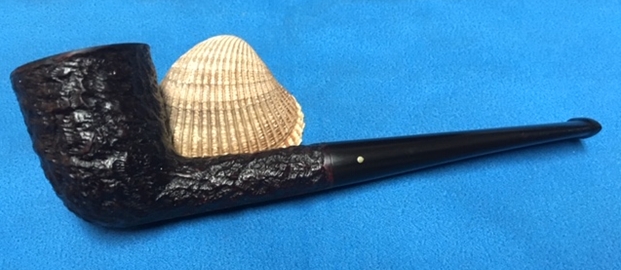
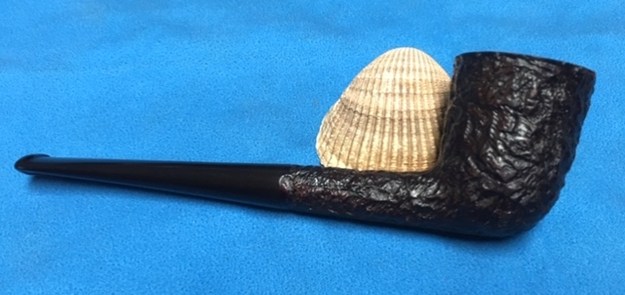
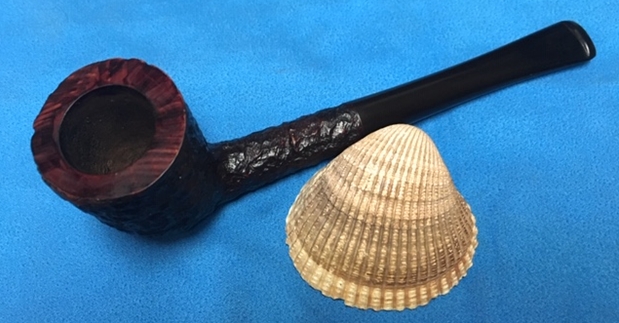
While I was working on the stem of the Brakner Antique #108, which was posted earlier, Steve rummaged through the pile and immediately came up with what maybe the only Italian (as far as I can recollect) pipe from my grandfather’s collection. It is a deeply rusticated pipe with a diamond shank and a slight flair around the middle of the stummel similar to ring cap in a classic Bulldog shape, towards the rusticated rim top. The shank end is adorned with a diamond shaped vulcanite shank extension that tapers at the end to seat an army mount style vulcanite stem. This beautiful pipe is stamped on the lower left smooth shank surface in a parallelogram as “CASTELLO” over “SEA ROCK BRIAR” over “MADE IN CANTU” over “ITALY”, all in capital. Towards the left side of the stampings, in the same space, is the size code “SC” over an unconfirmed code “56 F”.I referred to pipedia.org for a better and detailed understanding of this brand since I have not worked on very many Italian pipes and never on any CASTELLO!! The read was very interesting and I reproduce excerpts from pipedia.org source. The opening paragraphs itself speaks volumes about the quality and craftsmanship of the pipe that we now are working on!!

Pipa Castello was born in 1947 in the artisan workshop of Carlo Scotti in Via Fossano, in Cantù, with the target to produce pipes which could be placed at the very top of quality and perfection from both the technical and aesthetical side.

“I run a craftsman’s shop, not a factory, my pipes are works of art, fruit of expert hands, heart and fantasy” – Carlo Scotti.

So, the Castello Philosophy was born. It prefers to be, not to appear, always looking for a perfection that, in the human limits, Castello tries to reach. Carlo’s work-passion continues unaltered under the faithful guidance of his daughter Savina and Franco Coppo.

If a pipe man wanted to pull out a pipe that conveyed a sense of status, a brand with undeniable cache, he had to go to a pedigreed English pipe, such as Dunhill and Sasieni; a pipe from Italy simply wouldn’t have come to mind. Then, in 1946, a man from Cantu, Italy began carving a pipe that would change all of that. That man’s name is Carlo Scotti, and his pipe brand is called “Castello”.

Carlo’s choice for his company’s name was an inspired one. He needed a name that had a cognate in many of the European languages (Castle, Castillo, Castelo (Portuguese)), and wanted that name to be evocative of pleasant fantasy. While the name did have a dream like quality, the startup of Castello, and the early years of the company were more akin to a nightmare. Early Castello pipes emulated the English classic shapes, if a man leaned toward that aesthetic; he already had plenty of established brand names to turn to. Carlo outfitted his pipes with Plexiglas, something unfamiliar to men who were quite comfortable with vulcanite. Compounding woes, early Castello pipes were quite small in size, usually carved or sandblasted, and were stamped in a bewildering, rapidly changing manner. Some growth did occur via word of mouth. But that growth was too slow, too little, and by 1953, Castello was close to closing the doors.

Most fairy tales introduce a character or an element that allows the protagonist to overcome peril. For Carlo, this character was Wally Frank, who accidentally bumped into Carlo on a pipe buying trip to Italy. Mr. Frank was smitten by the product and agreed immediately to start importation into the US. Upon hitting New York, Mr. Frank replaced the Castello white bar with a superb counter-point to the Dunhill “White Spot”, a “diamond” inlaid in the bit (actually crimped aluminum), and began to market the pipe to highly skeptical Americans with a wholly new angle. The pipe that the prospective buyer held was not churned out in a factory, but crafted start to finish by one man. The shapes were not created by a machine, but by the hands of a master. This was a very different, very special pipe. In short, Mr. Frank redefined in the minds of many an American what it took to give a pipe a pedigree. Combined with the sudden rise in awareness of chic, upper echelon Italian products (Gucci had just opened their first US boutique in NYC), this approach was a success. Castello took off and never looked back.

Small conflicts do not stop great partnerships, Scotti and Frank worked out the product issue and, by the 1960’s, production had moved into high gear. Carlo hired the likes of Luigi “Gigi” Radice and Pepino Ascorti, who carved at full speed to meet demand. Within the synergy of the three legends, a new shaping aesthetic emerged. Emulations of the English standards were replaced by bold shapes with Italian inspiration. This, in turn, fueled American appetites for the pipes to the point that it was not uncommon for a Castello collector to be placed in a position of having to call tobacconists around the country to try to locate a pipe. Often a premium was negotiated for the product.

With this fair bit of background information on this brand, I move towards the prospect of dating this pipe and again an external link on pipedia.org proved to be useful. Here is the link to dating of Castello pipes on Briar Blues – www.briarblues.com/castello.htm

Even though this article makes for an interesting read and is worth reproducing here, for the sake of brevity, I have reproduced only the relevant information which helps to approximate the date of this particular pipe. However, I implore readers to read the complete well researched article.

  1. 1947 – Carlo Scotti begins the company.  In the beginning (1947 – 1949, maybe 1950 ) the pipes were stamped Mi Reserva ( my reserve ).  Later the Reg No was added.  This Reg No has nothing to do with shape numbers, but is merely the Castello company trademark.
  2. The Old Sea Rock and the Sea Rock co-existed. As far as I know, the OSR was US only, imported by Hollco Rohr, and sported the rhinestone. The Sea Rock goes back to the early days.
  3. Shape numbers. Shape numbers are all 2 digits. A 2 in front indicates a “fancy” interpretation, a 3 in front means that the carving is somehow unique. I don’t know when the change was made, but currently, a π symbol is used instead of the 3xx. I’ve only seen this on Sea Rocks, but that doesn’t mean anything.
  4. Pre ‘K’ grading.  Late 1950’s to mid 1960’s the pipe carried stamps which indicated sizes.   These were as follows; SA, SB, SC, and SS.  SA being the smallest and SS the largest.
  5. Ever wonder where your pipe came from?  Which shop had it first?  If so, read below;

 N1 = Novelli ( Italy )

 N = Noli ( Italy )

 F = Fincato ( Italy )

From the above, it is clear that the stampings on the pipe which is being restored, indicates that this pipe most likely is from 1950’s to mid 1960’s with third largest size in the lineup and came from a shop in Fincato, Italy. However, this information also introduces some ambiguities like the shape # 56 and the diamond inlay which points to US market whereas the lack of Old Sea Rock Briar stamp and the letter F after the shape code points to Italian market. It would be nice if these mysteries could be unraveled by the readers of this blog.

INITIAL VISUAL INSPECTION
There is a thick layer of cake in the chamber which has been evenly reamed, and this, for me was a big surprise as most of my inherited pipes have not seen the face of a reamer!!!! The Castello, may well be only the second or third pipe from the collection that appears to have been cared for and could be because of the price that he had to pay! Well, nevertheless, there is a thick layer of cake in the chamber and the rusticated rim top surface shows overflow of lava and accumulation of dust, dirt and grime of all these years of storage. There appears to be no damage to the inner and outer rim edges and the same will be confirmed only after the rim top has been thoroughly cleaned. From the thickness of the cake in the chamber, we feel that the chamber walls have been well protected and do not foresee any heat fissures or cracks. However, the same will be ascertained only after the cake has been completely reamed down to the bare briar. The draught hole is perfectly drilled in the center and opens into the chamber at its base. This should be a great smoker, I say. The beautifully rusticated stummel surface is covered in dust and grime. This grime and dirt can be seen in the deep rustications and lends a dull and lifeless appearance to the pipe. The smooth parallelogram surface bearing the stampings on the shank has darkened as a result of this accumulation. The browns of the raised rustications should contrast beautifully with the rest of the dark stummel surface once it has been cleaned up. The saving grace is that there is no damage to the rustications on the stummel. The vulcanite shank end extension is undamaged but is severely oxidized. The shank end extension will lend a sophisticated and classy touch to the appearance of the pipe once this oxidation is rid off the vulcanite and is nicely polished. The mortise is clogged with heavy accumulations of oils, tars and gunk. This will require some heavy cleaning and scraping. However, though laborious, there is airflow through the shank airway. The stem, surprisingly, is nice and shining with very minor traces of oxidation. The upper and lower stem surface shows minor tooth chatter towards the bite area and upper button edge damage. This, we expect, should be easily addressed just by sanding the bite zone. The airflow through the stem airway is full and easy. The diamond inlay on the stem is undamaged. THE PROCESS
As decided, Abha, my wife, and Jeff worked on the stem first. They ran a couple of pipe cleaners dipped in isopropyl alcohol, through the stem air way. Once satisfied with the internal cleaning, the stem was immersed in “Before and After Deoxidizer” solution to rid the stem of the minor stem oxidation. The discerning reader must have noted the mention of this step for the first time and it’s true. This magic potion/ liquid gold, as Jeff likes to call it, finally reached me, thanks to Jeff who had acted as a courier. The cost of shipping from US is exorbitant and then custom clearance is also a hassle. So when Jeff’s plan to travel here were finalized, I requested him if he could carry it for me and he readily agreed. Thus, I had Mark Hoover send this solution and other products from his store to Jeff and from Idaho, it reached me. By the way, this product works like magic and has reduced my (and now Abha’s…LOL) work by half. After a soak of about 4 hours, Jeff took the stem out, cleaned it under running tap water, wiped it with microfiber cloth and ran a couple of pipe cleaners through the airway to remove the liquid from the internals of the stem. It was amazing to see the transformation in the stem.While the stem was soaking in the “liquid gold”, Abha and Jeff reamed out the cake from the chamber using the first three heads of the Castleford reamer. The amount of carbon that was reamed out belied our initial expectations. This was followed by sanding the walls of the chamber with a piece of 220 grit sandpaper by our little expert on this step, Pavni, my youngest daughter. She just loves doing this task and takes immense pride in making the walls smooth. Dear readers don’t even think for a moment that we were sitting idle while all this work was in progress! All this while, Steve and I were deeply engrossed in admiring the pipes from my collection and sipping on our cold, chilled and frosted Beer…LOL!! Once the chamber was cleaned and spruced up, the duo launched an irrepressible and determined assault on the clogged mortise. The battle was so severe that at one point we thought that Jeff and Abha would throw in the towel, but they persisted and a pile of pipe cleaners, q tips and gallons of isopropyl alcohol later, the mortise was declared clean. When Jeff admitted this to be one of the filthiest cleanings he had undertaken, I smiled inwardly as all of my grand old man’s pipes were in such a state!!When Abha and Jeff declared that they were through with their cleaning, Steve just glanced at their expressions and the pile of pipe cleaners and q tips in front and immediately started to work further on the stummel (he is indeed a very wise man, I say!!) and seeing him and them, I too left the comfort of my perch to lend him a helping hand.

We cleaned the surface of the stummel with cotton pads and Murphy’s oil soap. The deep rustications were thoroughly scrubbed to remove the grime and dirt lodged between them. This was followed by a wash and a scrub under running tap water using a hard bristled tooth brush. The stummel looks clean and vibrant at this stage with the brown tips of the rustications contrasting majestically against the dark of the rest of the stummel surface. Next we addressed the heavy oxidation on the vulcanite shank extension. I was mentally prepared for lot of elbow greasing using sandpapers, when Steve just dabbed the shank extension with alcohol, flamed it with a Bic lighter flame and rigorously scrubbed it with the microfiber cloth. A couple of repetitions and the shank extension is clean and oxidized surface is history. This was an interesting learning for me. I followed it up with micromesh cycle of wet sanding with 1500 to 12000 grit pads. I rubbed a small quantity of Extra Virgin Olive oil in to the shank extension and set it aside. The contrast of the shiny black shank extension with the rustications looks amazing and adds additional bling to an already beautiful pipe.We further revitalized the briar by rubbing “Before and After Restoration” balm deep in to the briar. Care was taken to ensure that the balm is applied within the surfaces of the rustications by rubbing the balm with our fingers. The stummel was set aside for 20 minutes for letting the balm be absorbed by the briar. With the stummel resting, we turned our attention to the stem repairs. As appreciated earlier, it was decided to address the minor tooth chatter by sanding the bite zone with a folded piece of 220 grit sandpaper and if this fails, progress to the next process. Steve did the honors and sanded the tooth chatter with the sandpaper as decided. He also worked the button to crisp edges. Fortunately, the issue of tooth chatter was completely addressed.The task of polishing fell on me. Under the watchful eye of my mentor, Steve, I went through the complete cycle of micromesh pads, wet sanding through 1500 to 12000 grit pads. I wiped the stem clean with a moist cloth to observe the progress. Once I was through with the micromesh polish cycle, I rubbed a small quantity of Extra Virgin Olive oil in to the stem and set it aside. The stem looks amazing and the, now clean, diamond inlay adds additional bling to an already beautiful pipe. We finished this project with a vigorous hand buffing with a microfiber cloth and worked it to a nice, rich and deep shine. It was a wonderful experience to work with these gurus of pipe restoration. Their knowledge about all things pipes and tobacco is just amazing. Their precise, measured movements and speed while working on a pipe, is a treat to watch and emulate. Here are pictures of the finished pipe…cheers.

Restoring my Grandfather’s “Brakner” with Steve and Jeff Laug


Blog by Paresh Deshpande

How often does it happen in one’s life that the person/ persons you are very keen to meet do finally meet up for a week or so? This, especially with the background when each of these friends is from across the world, has to cross the seven seas, numerous hurdles of visas and fine tuned itineraries of all the stake holders!! Well, believe you me readers, these remain as the most treasured days.

I recently had this great experience when Mr. Dal Stanton (The Pipe Steward) from Sofia, Bulgaria, Mr. Steve Laug (rebornpipes.com) from Vancouver, Canada and his brother Jeff from Idaho, USA, visited my family. The following week was a flurry of activities, which also included learning the finer nuances of pipe refurbishing while restoring some nice pipes from my grand old man’s collection, it was something like OJT (on the job training). One such pipe that was selected by Steve was this Brakner. This pipe was nowhere in the “To Restore” list of pipes that I had drawn out as I thought it to be some run-of-the-mill pipe, but was cherry picked by Steve with a smile while sifting through the pile of pipes.

This uniquely rusticated billiard shaped pipe is stamped on the smooth surface on the left side of the shank as “BRAKNER ANTIQUE” over “DENMARK”. The smooth surface on the right side of the shank is stamped as “HAND-CUT” followed by # 108, most likely the shape number. The vulcanite stem is adorned with a green dot (larger than a Dunhill stem logo), which has now faded to a light brown color. There is a smooth band around the end of the shank.I researched this maker and it was then that I realized the uniqueness of this brand and why Mr. Steve had selected it to work on. I visited rebornpipes.com and sure enough, Mr. Steve has worked on a Brakner before and researched the maker/ brand in detail. Here is the link to the write up that he has posted on his web page: https://rebornpipes.com/2018/08/26/breathing-new-life-into-a-brakner-antique-hand-cut-807/

From this write up, I have picked this picture which shows the Brakner design # 108 (ticked in red) that we were working on. The only variation is that my inherited pipe has a smooth band on the stummel below the rim.Having read the detailed account, I now know that I am holding a piece of pipe history and cannot thank my lucky stars for the inheritance and having being introduced to Mr. Steve.

INITIAL VISUAL INSPECTION
As is generally observed with most of my grandfather’s pipe, the chamber of this pipe too is filled with a thick cake with overflowing lava covering the rim top surface. The thick cake hides the condition of the inner walls of the chamber and will be ascertained only after the cake has been taken down to bare briar. Similarly, the condition of the rim top surface will be commented once the overflowing lava has been scraped off. However, with the inner rim edge, Steve and I suspect charring in the 4 o’clock direction and is highlighted in pastel blue circle. The outer rim edge too shows damage in the 6 o’clock direction and is circled in yellow. There is a thin smooth briar band extending down from the outer rim edge, which too, is covered in overflow of oils, tars and grime. The contrast of dark and medium brown stains on the rim top and the band should highlight the beautiful grain on the briar and will go well with the rusticated finish on the bowl and shank once cleaned up. The mortise and the shank air way are clogged as expected making the air flow restricted and laborious. However, with the draught hole being right at the bottom of the chamber and the perfect alignment of the stem airway, tenon and the shank airway should make this one a fantastic smoker. The excitement of restoration and fun filled involvement of Steve, Jeff, Abha and me, all resulted in none of us taking any pictures of before and detailed pictures of the process. Each one thought that other was taking the pictures and the end result was that none of us took any!! Lol…

The unique rustications on the stummel surface are covered in oils, tars, grime and dust of all these years of use and storage. However, once cleaned up, the dark of the stummel should contrast beautifully with the smooth brown shank end band, the rim top and the band below the rim outer edge. The vulcanite stem is heavily oxidized and showed heavy tooth chatter and deep tooth marks on the upper stem surface. The button on the upper surface has bite marks and will have to be rebuilt and reshaped. The same holds true for the lower stem surface, albeit with less severity. As brought out earlier, the trademark green dot on Brakner pipe stem has turned a shade of brown. The tenon does not seat flush inside the mortise. This issue, in all probability, should get addressed once the mortise is cleaned off the entire accumulated gunk. Sorry again, I did not take sufficient pictures of the stem either!!All in all, judging from the initial examination, we do not envisage any major/ serious issues to present themselves in the course of restoring this beauty, with the exception of charred inner rim edge and damaged outer rim edge.

THE PROCESS
Even before Steve and Jeff had arrived, it was decided that Abha, my wife who helps me in the initial clean up, and Jeff who does it for Steve, would work together on the initial clean up and Steve and I would do the repairs and final finish on these pipes. This would help us understand and learn the techniques and processes involved in restorations. This exactly what we did while working on this pipe, but with a twist, which I shall bring out later.

Abha and Jeff reamed the chamber with Castleford pipe reamer set (one of the many gifts for Abha from Steve and Jeff) followed by cleaning the mortise and shank airway using dental pick, cotton buds/ hard and soft bristled pipe cleaners dipped in isopropyl alcohol. Once the shank internals were cleaned, we called it a day.

And this is where the twist occurs!!

When we met again over breakfast the next day, the Brakner was completed!! In short, what really started as a combined project was eventually completed by Steve and Jeff alone. What follows is the narrated sequence and pictures that Steve and Jeff shared with me over a pot of coffee (perfect brew was demonstrated by these two gentlemen as we are predominantly tea drinkers).

Once the chamber and shank were cleaned, Jeff cleaned the external surface of the stummel and the smooth rim top surface with Murphy’s Oil soap and cotton swabs followed by scrubbing the rusticated surface with a toothbrush and dish washing soap. This rid the stummel rustications of all the accumulated dust, dirt and grime and both the smooth brown bands around the rim and shank now contrasts beautifully with the dark stummel surface. However, the inner and outer rim damage revealed itself in all its ugliness and this is what Steve decided to tackle at this stage in restoration. No pictures available to show the condition of the stummel at this point…sincere apologies!!

Steve began the process of addressing the inner rim damage by creating a bevel to the inner rim edge to mask the blackened rim and address the out-of-round chamber with a folded piece of 220 grit sandpaper. Once satisfied with the repairs, he polished the entire rim top surface with micromesh pads, wet sanding with 1500 to 2400 grit pads and dry sanding with 3200 to 12000 grit pads. The rim top surface now appears amazing and the repairs appear to be almost non-existent. To enliven the briar wood and further enhance the contrast of the bands with the rest of the dark stummel surface, he rubbed a little quantity of “Before and After” balm in to stummel surface and set it aside for 20 minutes for the balm to be absorbed in to the briar. Thereafter he hand buffed it with a microfiber to deepen the shine. The stummel looks nice and vibrant. All this while, Jeff was busy working the stem. He cleaned the internals of the stem using pipe cleaners dipped in isopropyl alcohol. Once the stem internals were clean, he cleaned the stem surface with cotton pads dipped in isopropyl alcohol. This step also helps to remove surface oxidation to some extent. With this, he handed the stem back to Steve to address the tooth chatter and deep bite marks.To address the issue of bite marks and tooth chatter on the stem surfaces, Steve flamed the surface with the flame of a Bic lighter. Vulcanite has the property to return to its original shape when heated and this is exactly what was being done. The tooth chatter and deeper bite marks were raised to the surface to a great extent. The remaining minor tooth indentations were filled with clear super glue and set aside to cure. Once the fill had hardened (and it was pretty quick, thanks to the 43 degrees temperature that was prevalent at that point in time!!), he sanded the fill and the entire stem surfaces with a folded piece of 220 grit sandpaper. This not only ensured a nice blend of the filled areas with the rest of the stem surface, but also removed the oxidation from the surface. He rubbed the stem surface with some Extra Virgin Olive Oile and set it aside to be absorbed in to stem surface. It was at this stage that self, Abha and my kids joined them for breakfast. After a hearty breakfast, I launched a determined assault on the stem, subjecting it to the complete cycle of micromesh polish. The end result is a gorgeous, smooth and shiny looking black of the vulcanite stem. This was followed by the routine regime of polish with carnauba wax using my hand held rotary tool. The Brakner looks unique and oozes quality. Here are a few pictures that should give you a fair idea about the end results… Thank you all for being a part of this journey and all the encouragement and support extended. P.S. – As I mentioned above, the excitement of working and learning from Steve and Jeff coupled with the ambiguity of who is taking pictures and not to mention the chilled Beer and humorous banter, all resulted in a limited number of pictures.

Secondly, those of you who have been following rebornpipes.com regularly, would surely have read the detailed write up on the restoration of an 1846 BBB Amber stem by the master story teller, Dal Stanton (https://rebornpipes.com/2019/05/30/west-meets-east-in-india-to-restore-a-grandsons-treasure-an-1846-bbb/) !! While in one corner of the world, on the 10th floor apartment in Sofia, Bulgaria one of the longest write ups on rebornpipes.com was being shaped, here I was trying to piece all the processes involved in restoration of this unique piece of pipe history from memory and ending up with what could be the shortest write up on rebornpipes.com.

A National Washington, D.C. Bent Billiard from the Bertram Collection


Blog by Steve Laug

Give the previous blogs a read to have an idea about the Bertram Collection that I am working on these days. I can’t adequately describe how overwhelmed I am when I look at the 200+ pipes that need to be restored but there is only one way to move ahead – 1 pipe at a time. Jeff is doing the major cleanup on the lot as that would be more than I could handle by myself in moving through this many pipes. From his cleaned pipes the next one I chose is a Made in London National Washington, D.C. 33 Bent Billiard to be the next pipe that I would work on. It has some amazing straight grain around the bowl and shank. The bowl had cake in the chamber that was no problem. The rim top had some darkening and lava overflow on the back side. The inner and outer edge of the bowl appeared to be in good condition but we would know more once the bowl had been reamed and cleaned. The exterior of the briar looked lifeless and was dusty with the grime of years of storage. The stem had some oxidation, tooth chatter and marks near the button on both sides. Jeff took some photos of the pipe before he began his cleanup work on it. Jeff took close-up photos of the bowl and rim to capture the condition of the pipe when it arrived. The rim top had a thick coat of lava and the bowl had a thick cake. It was hard to see what the inner and outer edge looked like with the cake and lava.Jeff took a picture of the bowl side and the heel to show the marvelous grain on the bowl. It really is quite stunning and very dirty! There is also something mis-stamped on right side of the bowl. Under a magnifying lens it reads England.The next two photos show the stamping on the sides of the shank. The left side is stamped with National over Washington, D.C.  over Made in London. At the shank/bowl junction it is stamped 33. The stamping on the shank was slightly double stamped and had some white paint in it.The next two photos show the condition of the stem surfaces. The stem was oxidized and had some calcification on the surface as well as tooth marks and chatter on both sides near the button.I have already done the work on one of the National pipes in the Bertram lot so I turned to that to have another look at the history of the brand (https://rebornpipes.com/2019/05/21/doing-some-cosmetic-work-on-a-national-pipes-rhodesian/). I quote in full from that blog.

Before I started my restoration work I wanted to refresh my memory about the brand. I remembered from previous National Pipes that I had worked on that there was a tie to the Bertram Pipe Company in Washington, D.C. I also knew that it was a very different company than the National Briar Pipe Company of Jersey City, New Jersey but that is where all the trails let in terms of Pipedia and Pipephil’s site. I turned back to a previous blog that I had written on the brand when I restored a pipe with the same stampings to review the history and connection of the brand to Bertram. https://rebornpipes.com/tag/national-washington-d-c-pipes/. I knew that the fact that there were several of these included with the large lot of Bertram pipes that Jeff and I purchased was not accidental. Here is the link to that previous blog. I quote in part:

I had a gut feeling that the pipe had some connection to Bertram Pipe Company of Washington DC but only the vaguest memory of that connection. I could not remember where I picked that up but just had the memory. I did some searching on the Internet and found a National Briar Pipe Company of Jersey City, New Jersey with no clear ties to Washington DC on the Pipedia site. This was the company that purchased the Doodler after Tracy Mincer died. I could see that the Jersey City pipes were stamped differently and all had line names stamped on them. On the Pipephil site I found an English version that had very different stamping on the left side of the shank as well as Made in England on the right side of the shank.

Thus I was reminded of the non-connection to the New Jersey Pipe Company. The blog went on to record some information that tied the National Washington, D.C. company to Bertram more definitively. I quote

I…posted a question on Smokers Forum (SF) and Pipe Smokers Unlimited regarding the brand. I received several responses that gave me information. One of them on SF came from Ed Klang and provided me with some confirmation regarding my memory of the connection with Bertram. I quote him in full, “In the history of the Bertram company, after the fire at the Washington, D.C. facility and the decision was made to discontinue Bertram production a group of employees and a few investors wanted to buy the rights to the Bertram name, which was turned down and it was then proposed that they would rebrand the pipes as National, no mention was made whether anything ever came of that proposal. Supposedly this group did produce pipes for a while but the effort was finally abandoned and I have never been able to reliably confirm this. Just bits and pieces here and there.” Thanks Ed. This is the random memory that I was trying to dig up.

I also received a reply on SF from Radiobob that read as follows: “National Pipe and Tobacco was located on the 1700 block of Pennsylvania Avenue in Washington, D.C., just about a block from where I worked. I still have two Canadians that I bought there, as well as a Comoy’s Patina Apple. In my recollection, it closed down–much to my regret–in the mid to late 1980s.”

Those responses gave me the kind of details that I always find helpful in my restoration work. I will continue to do some digging on the company and see what I can find but that bit confirmed the visual tie to the Bertram Company of DC. Thank you for your help Ed and Bob.

Now I have a different one that has the National stamp and also is stamped Made in London. There is also a mistaken stamp on the side of the bowl that says ENGLAND. This is another piece of the puzzle for me. I know National had other pipe companies in Europe make there pipes. This one has a very Barling like look to it. I wonder if it was not made by them for National? On with the cleanup and restoration on this Bent Billiard.

When I received the pipe Jeff had already reamed the bowl with a PipNet pipe reamer and followed up with a Savinelli Fitsall pipe knife to remove the cake. He had scrubbed out the mortise and the airway in the shank and the stem with alcohol, cotton swabs and pipe cleaners. He had scrubbed the exterior of the bowl, rim, shank and stem with a tooth brush and Murphy’s Oil Soap to remove the oils and tars on the rim and the grime on the finish of the bowl. He had rinsed it under running water. He dried it off with a soft cloth. He was able to remove lava build up on the rim top and you could see the great condition of the bowl top and edges of the rim. There was still some darkening to the rim top toward the back of the bowl. He soaked the stem in Before & After Deoxidizer to remove the oxidation. I took photos of the pipe before I started my work on it. I took a close up photo of the rim top to show the condition of the bowl and rim after Jeff had cleaned up the grime and lava. The inner edge of the rim has some damage and nicks on it. The out edge of the rim looks good. There is some rim darkening on the back side of the bowl. The stem photos show that the oxidation is gone. The surface of the vulcanite looked very good. The tooth marks and chatter are near the button on both sides. I also took a photo of the stamping on the left side of the shank showing how the stamping was laid out. It appeared to have been double stamped and the stamping whitened. There was also a strange mistaken stamping on the right side of the bowl – it read ENGLAND.I worked on the inner edge of the rim and the darkening on the backside of the top with a folded piece of 220 grit sandpaper to smooth out the damage and remove the darkening. There were two noticeable divots in the otherwise flawless briar – one on the left side of the heel of the bowl and the other on the right side of the shank. I darkened them with a black Sharpie pen and then filled them in with clear super glue. Once the repair cured I sanded it smooth with 220 grit sandpaper and smoothed further with 400 grit sandpaper. I polished the bowl and rim top with micromesh sanding pads – wet sanding it with 1500-12000 grit pads. I wiped the bowl down with a damp cloth after each pad to remove the sanding debris. After the final sanding pad I hand buffed it with a cotton cloth to raise a shine. I worked some Before & After Restoration Balm into finish of the briar with my fingertips to clean, enliven and protect it. I let the balm sit for a little while and then buffed with a cotton cloth to raise the shine. The Restoration Balm really makes the grain stands out beautifully. Between the polishing with the micromesh pads and the balm I did not have to stain the repaired areas. They blend in very well. I set the bowl aside and worked on the stem. I used a folded piece of 220 grit sandpaper to blend the tooth marks and chatter into the surface of the stem. Once the surface was smooth I sanded out the scratch marks and started the polishing of the stem with a folded piece of 400 grit sandpaper. I wiped the stem down with Obsidian Oil. I polished the stem with micromesh sanding pads – wetsanding it with 1500-12000 grit pads. I wiped the stem down with Obsidian Oil after each pad. I polished it with Before & After Pipe Polish – both Fine and Extra Fine and gave it a final coat and set it aside to dry.  This is the part of the restoration process that I really look forward to! When all the parts are finished and the pipe I clean then I put the stem and bowl back together and buff the pipe with Blue Diamond on the buffing wheel. I polish the briar and any minute scratches still in the vulcanite of the stem until there is a rich shine. This National Washington, D.C. pipe is a classic English looking bent billiard shape with a natural finish that highlights some amazing straight and flame grain on a proportionally well carved pipe. Buffing the pipe made the briar come alive and the grain popped with polishing. The black vulcanite stem had a rich glow. The finished pipe is a beautifully grained English Made National Bent Billiard. The pipe feels really good in the hand and sits right in the mouth. Have a look at it with the photos below. The dimensions are Length: 5 ½ inches, Height: 2 inches, Outside diameter of the bowl: 1 1/4 inches, Chamber diameter: ¾ of an inch. Thanks for walking through the restoration with me as it was a pleasure to work on.


A Bent Diamond Shank Billiard Bertram 25 from the Bertram Collection


Blog by Steve Laug

Once again rather than repeat myself with the repetition please refer to the previous blog posts on the collection of Bertrams and other brands that Jeff and I purchased. I can’t adequately describe how overwhelmed I am when I look at the 200+ pipes that need to be restored but there is only one way to move ahead – 1 pipe at a time. I am glad Jeff is helping with the clean up on the lot as that would be more than I could handle by myself in moving through this many pipes. From his cleaned pipes I chose a Diamond Shank Bent Billiard Bertram 25 with mixed grain to be the next pipe that I would work on. It was a1/2 bent Billiard with a saddle stem. The bowl had cake in the chamber that was no problem. The rim top had some darkening and lava overflow on the back side. The inner and outer edge of the bowl appeared to be in good condition but we would know more once the bowl had been reamed and cleaned. The exterior of the briar looked lifeless and was dusty with the grime of years of storage. I am still trying to figure out Bertrams numbering system as some of the higher number pipes seems to have more fills than the 25s. The stem had some oxidation and tooth marks near the button on both sides. Jeff took some photos of the pipe before he began his cleanup work on it. Jeff took a close-up photo of the bowl and rim to capture the condition of the pipe when it arrived. The rim top had a thick coat of lava and the bowl had a thick cake.Jeff took pictures of he bowl sides and the heel to show the great looking grain around the sides of the bowl. It really is quite stunning and very dirty! Jeff took a photo to capture the stamping on the top and left side of the shank. It shows the stamping on the topside which read Bertram over Washington, D.C. The stamping on this pipe is clear and readable. It also shows the number stamp 25 which shows the quality of the pipe.The next two photos show the stem surface. They show the oxidation and the chatter on both sides near the button. The tooth marks are visible on the underside next to the button. There is also some wear on the underside button edge.If you have read the previous Bertram blogs I have posted about the pipes that I have cleaned up so far you can skip the next bit. But if you have not, then I include the link to Bertram history and information. I would recommend that if you don’t know much about them do some research on them. I include a link to the write up on Pipedia (http://pipedia.org/wiki/Bertram). Bertram pipes were based out of Washington DC. They were popular among famous politicians and celebrities of the time. They made many products for them from FDR’s cigarette holders to Joseph Stalin’s favorite pipe. They were considered some of the best America had to offer till they finally closed their doors in the 70s. They graded their pipes by 10s, the higher the grade the better. Above 60s are uncommon and 80-90s are quite rare. I’ve never heard of or seen a 100 grade. I have several blogs that I have written on rebornpipes that give some history and background to Bertram pipes. (https://rebornpipes.com/2015/06/16/an-easy-restoration-of-a-bertram-grade-60-217-poker/).

I have included the following link to give a bit of historical information on the pipe company. It is a well written article that gives a glimpse of the heart of the company. http://www.streetsofwashington.com/2012/01/bertrams-pipe-shop-on-14th-street.html#

From this information I have learned that the shape and grade Bertram I have in front of me now was made before the closure of the shop in the 1970s. This Bertram Diamond Shank Bent Billiard with a darker finish is different from the other Bertram shapes I have worked. With a grade 25 stamp it is a lower range pipe.

By now if you have been a reader for long you have Jeff’s cleaning regimen pretty well memorized. If you know it you can skip right to the pictures. If not I will include them once more. Jeff reamed the bowl with a PipNet pipe reamer and followed up with a Savinelli Fitsall pipe knife to remove the cake. He scrubbed out the mortise and the airway in the shank and the stem with alcohol, cotton swabs and pipe cleaners. He scrubbed the exterior of the bowl, rim, shank and stem with a tooth brush and Murphy’s Oil Soap to remove the oils and tars on the rim and the grime on the finish of the bowl. He rinsed it under running water. He dried it off with a soft cloth. He was able to remove lava build up on the rim top and you could see the great condition of the bowl top and edges of the rim. There was still some darkening to the rim top toward the back of the bowl. He soaked the stem in Before & After Deoxidizer to remove the oxidation. I took photos of the pipe before I started my work on it. I took a close up photo of the rim top to show the condition of the bowl and rim after Jeff had cleaned up the grime and lava but the rim top had some light damage, some pits and darkening on the inner edge of the rim. The stem photos show that the oxidation is gone. The light tooth chatter is hard to see but I should be able to sand it out quite easily. Every one of the pipes that I have worked on from this Bertram Collection has had tooth marks on the underside of the stem and some on the topside as well. The tooth marks on the underside will take a little more work to remove.I also took a photo of the stamping on the left side of the shank showing how the stamping was laid out.I used a folded piece of 220 grit sandpaper to cleanup the light damage to the inner edge of the rim. I would address the darkening when I polished it with micromesh sanding pads.I used a black Sharpie pen to put a black spot in each of the fills on the bowl sides. Once I had done that I filled in the dents with clear super glue. Once the repairs had cured I sanded the repaired spots with 220 grit sandpaper to blend them into the surface of the briar. I polished the bowl and rim top with micromesh sanding pads – dry sanding it with 1500-12000 grit pads. I wiped the bowl down with a damp cloth after each pad to remove the sanding debris. After the final sanding pad I hand buffed it with a cotton cloth to raise a shine. I know I have mentioned it before but I really like the balm that Mark Hoover created. It really does wonders on a dry piece of briar. I worked some Before & After Restoration Balm into finish of the briar with my fingertips to clean, enliven and protect it. I let the balm sit for a little while and then buffed with a cotton cloth to raise the shine. The Restoration Balm really makes the grain stands out beautifully. I set the bowl aside to work on the stem. I used a folded piece of 240 grit sandpaper to blend the tooth marks and chatter into the surface of the stem. Once the surface was smooth I sanded out the scratch marks and started the polishing of the stem with a folded piece of 400 grit sandpaper. I wiped the stem down with Obsidian Oil. I polished the stem with micromesh sanding pads – wetsanding it with 1500-12000 grit pads. I wiped the stem down with Obsidian Oil after each pad. I polished it with Before & After Pipe Polish – both Fine and Extra Fine and gave it a final coat and set it aside to dry. I am having fun doing these pipes from the Bertram Collection. Each one presents different challenges but all are well laid out classic shapes. This is no exception. I put the stem and bowl back together and buffed the pipe with Blue Diamond on the buffing wheel. I polished the briar and the minute scratches still in the vulcanite of the stem until there was a rich shine. This Bertram is a classic Bent Billiard shape with a diamond shank and saddle stem. The stain really highlights some amazing grain on a proportionally well carved pipe. Once I buffed the pipe the briar came alive and the mixture of grain popped with polishing. The black vulcanite stem had a rich glow. The finished pipe is a beautiful grained Billiard. Like the other Bertrams I have worked on this one fits well in the hand and sits right in the mouth. Have a look at it with the photos below. The dimensions are Length: 5 inches, Height: 2 inches, Outside diameter of the bowl: 1 3/8 inches, Chamber diameter: ¾ of an inch. This one will soon be on the rebornpipes store. If you are interested let me know. Thanks for walking through the restoration with me as it was a pleasure to work on.

A Zulu Shaped Bertram 30 from the Bertram Collection


Blog by Steve Laug

Once again rather than repeat myself and give readers grief with the repetition please refer to the previous blog posts on the collection of Bertrams and a smattering of other brands that Jeff and I purchased. I can’t adequately describe the sense of being overwhelmed that I have when I look at the 200+ pipes that need to be restored but there is only one way to move ahead – 1 pipe at a time. I am glad Jeff is helping with the clean up on the lot as that would be more than I could handle by myself in moving through this many pipes. From his cleaned pipes I chose an interesting Zulu with cross grain on the sides of the bowl and some birdseye around the front and back to be the next pipe that I would work on. It was a1/8 bent Zulu with a tapered stem. The bowl had cake in the chamber that was no problem. The rim top had some darkening and lava overflow on the back side. The inner and outer edge of the bowl appeared to be in good condition but we would know more once the bowl had been reamed and cleaned. The exterior of the briar looked lifeless and was dusty with the grime of years of storage. I am still trying to figure out Bertrams numbering system as some of the higher number pipes seems to have more fills than the 30s. This is one of those pipes that look really good. The stem had some oxidation and tooth marks near the button on both sides. Jeff took some photos of the pipe before he began his cleanup work on it. I have included them below and they tell the story and give a glimpse of the pipe before clean up. Jeff took close-up photos of the bowl and rim to capture the condition of the pipe when it arrived. The rim top had a thick coat of lava and the bowl had a thick cake.Jeff took pictures of he bowl sides and the heel to show the great looking grain around the sides of the bowl. It really is quite stunning and very dirty!Jeff took 2 photos to capture the stamping on the top and left side of the shank. The first photo shows stamping on the topside which read Bertram over Washington, D.C. The stamping on this pipe is clear and readable. The second photo shows the grade number stamping on the left side toward the shank/bowl junction. It read number 30 which shows the quality of the pipe. The next two photos show the stem surface. They show the oxidation and the chatter on both sides near the button. The tooth marks are visible on the underside next to the button. There is also some wear on the underside button edge. If you have read the previous Bertram blogs I have posted about the pipes that I have cleaned up so far you can skip the next bit. But if you have not, then I include the link to Bertram history and information. I would recommend that if you don’t know much about them do some research on them. I include a link to the write up on Pipedia (http://pipedia.org/wiki/Bertram). Bertram pipes were based out of Washington DC. They were popular among famous politicians and celebrities of the time. They made many products for them from FDR’s cigarette holders to Joseph Stalin’s favorite pipe. They were considered some of the best America had to offer till they finally closed their doors in the 70s. They graded their pipes by 10s, the higher the grade the better. Above 60s are uncommon and 80-90s are quite rare. I’ve never heard of or seen a 100 grade. I have several blogs that I have written on rebornpipes that give some history and background to Bertram pipes. (https://rebornpipes.com/2015/06/16/an-easy-restoration-of-a-bertram-grade-60-217-poker/).

I have included the following link to give a bit of historical information on the pipe company. It is a well written article that gives a glimpse of the heart of the company. http://www.streetsofwashington.com/2012/01/bertrams-pipe-shop-on-14th-street.html#

From this information I have learned that the shape and grade Bertram I have in front of me now was made before the closure of the shop in the 1970s. This Bertram Zulu with a darker finish is one of the more usual shapes in terms of the Bertram pipes I have worked on. With a grade 30 stamp it is a lower mid-range pipe.

By now if you have been a reader for long you have Jeff’s cleaning regimen pretty well memorized. If you know it you can skip right to the pictures. If not I will include them once more. Jeff reamed the bowl with a PipNet pipe reamer and followed up with a Savinelli Fitsall pipe knife to remove the cake. He scrubbed out the mortise and the airway in the shank and the stem with alcohol, cotton swabs and pipe cleaners. He scrubbed the exterior of the bowl, rim, shank and stem with a tooth brush and Murphy’s Oil Soap to remove the oils and tars on the rim and the grime on the finish of the bowl. He rinsed it under running water. He dried it off with a soft cloth. He was able to remove lava build up on the rim top and you could see the great condition of the bowl top and edges of the rim. There was still some darkening to the rim top toward the back of the bowl. He soaked the stem in Before & After Deoxidizer to remove the oxidation. I took photos of the pipe before I started my work on it. I took a close up photo of the rim top to show the condition of the bowl and rim after Jeff had cleaned up the grime and lava but the rim top had some light damage, some pits and darkening on the backside of the inner edge of the rim. The stem photos show that the oxidation is gone. The light tooth chatter is hard to see but I should be able to sand it out quite easily. Every one of the pipes that I have worked on from this Bertram Collection has had tooth marks on the underside of the stem and some on the topside as well. The tooth marks on the underside will take a little more work to remove.I also took a photo of the stamping on the left side of the shank showing how the stamping was laid out. I used a folded piece of 220 grit sandpaper to cleanup the light damage to the inner edge of the rim. I would address the darkening when I polished it with micromesh sanding pads.I polished the bowl and rim top with micromesh sanding pads – dry sanding it with 1500-12000 grit pads. I wiped the bowl down with a damp cloth after each pad to remove the sanding debris. After the final sanding pad I hand buffed it with a cotton cloth to raise a shine. I know I have mentioned it before but I really like the balm that Mark Hoover created. It really does wonders on a dry piece of briar. I worked some Before & After Restoration Balm into finish of the briar with my fingertips to clean, enliven and protect it. I let the balm sit for a little while and then buffed with a cotton cloth to raise the shine. The Restoration Balm really makes the grain stands out beautifully. I set the bowl aside to work on the stem. I used a folded piece of 240 grit sandpaper to blend the tooth marks and chatter into the surface of the stem. Once the surface was smooth I sanded out the scratch marks and started the polishing of the stem with a folded piece of 400 grit sandpaper. I wiped the stem down with Obsidian Oil. I polished the stem with micromesh sanding pads – wetsanding it with 1500-12000 grit pads. I wiped the stem down with Obsidian Oil after each pad. I polished it with Before & After Pipe Polish – both Fine and Extra Fine and gave it a final coat and set it aside to dry. I am having fun doing these pipes from the Bertram Collection. Each one presents different challenges but all are well laid out classic shapes. This is no exception. I put the stem and bowl back together and buffed the pipe with Blue Diamond on the buffing wheel. I polished the briar and the minute scratches still in the vulcanite of the stem until there was a rich shine. This Bertram is a classic Zulu or Yachtsman shape with a darker finish that really highlights some amazing grain on a proportionally well carved pipe. Once I buffed the pipe the briar came alive and the mixture of grain – cross grain and birdseye – popped with polishing. The black vulcanite stem had a rich glow. The finished pipe is a beautiful grained Zulu. Like the other Bertrams I have worked on this one fits well in the hand and sits right in the mouth. Have a look at it with the photos below. The dimensions are Length: 5 1/2 inches, Height: 1 7/8 inches, Outside diameter of the bowl: 1 3/8 inches, Chamber diameter: ¾ of an inch. This one will soon be on the rebornpipes store. If you are interested let me know. Thanks for walking through the restoration with me as it was a pleasure to work on.