Category Archives: Pipe Refurbishing Essays

Essays and pictorial essays on the art of refurbishing

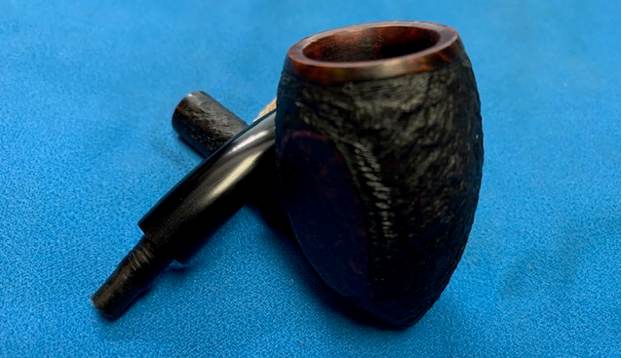
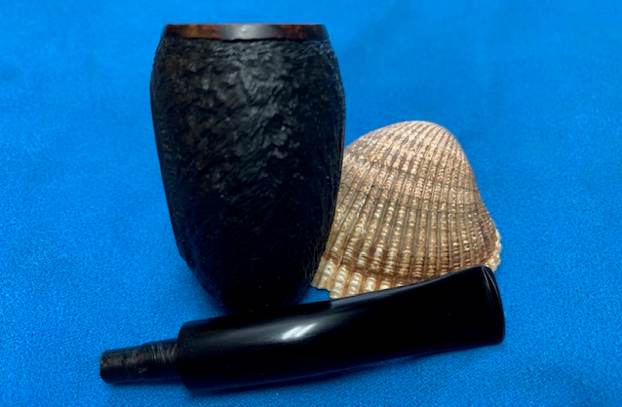
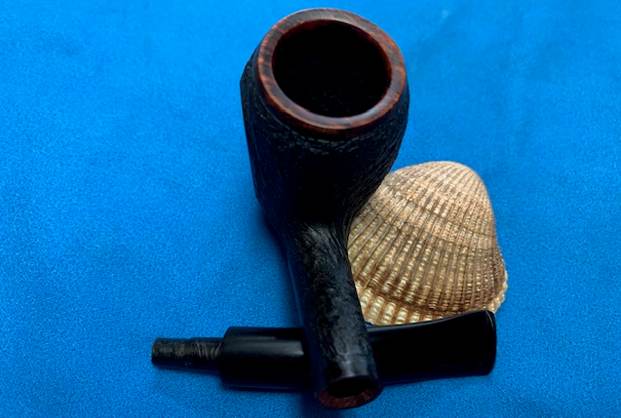
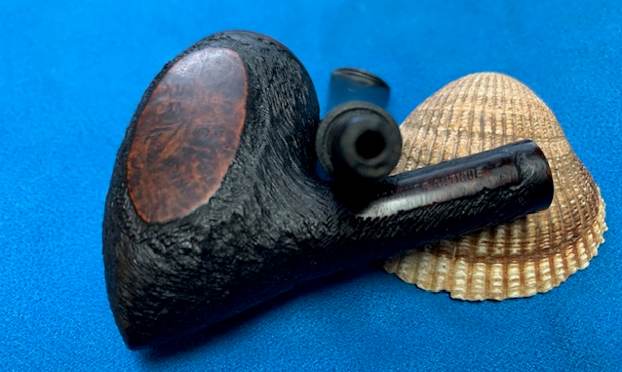
Restoring a Vauen Nest Rusticated Bent Egg


Blog by Steve Laug

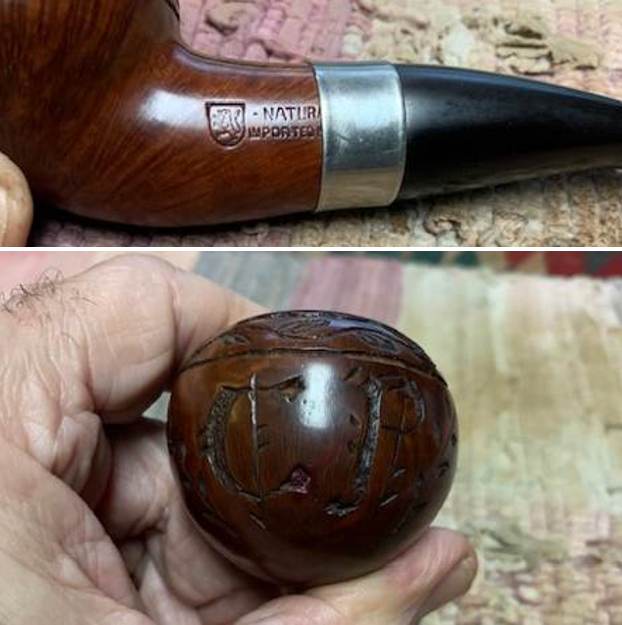
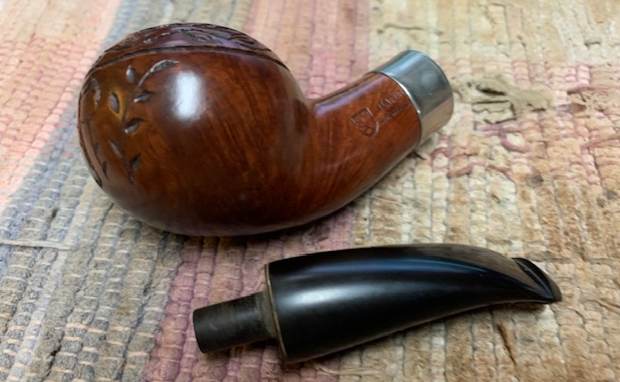
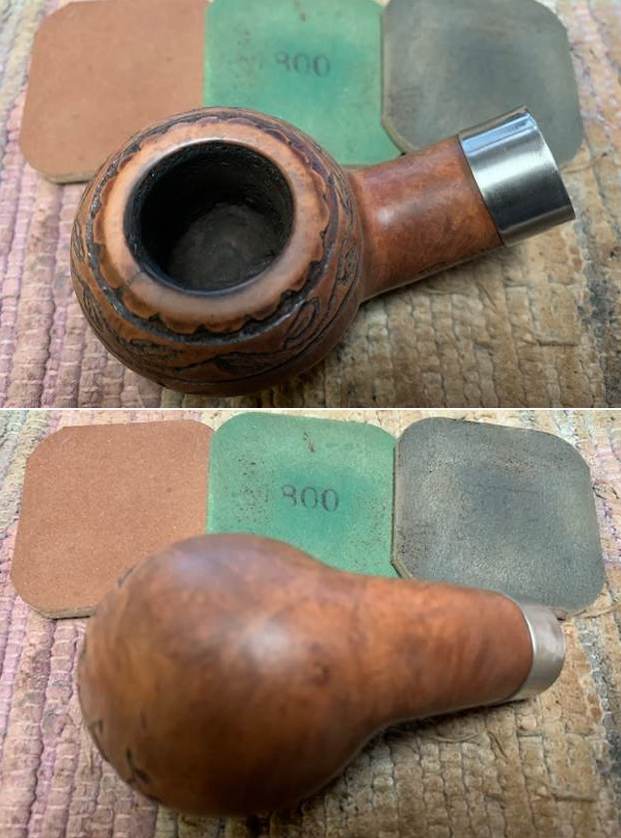
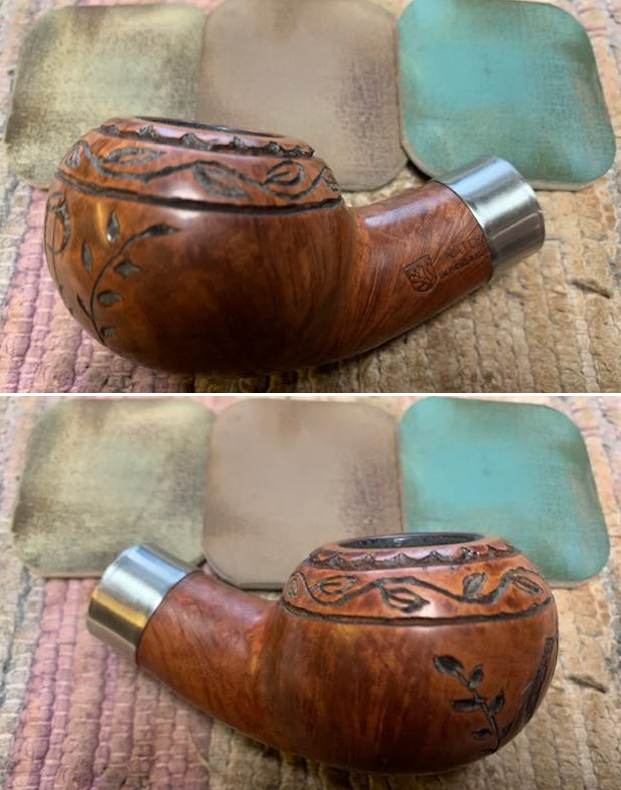
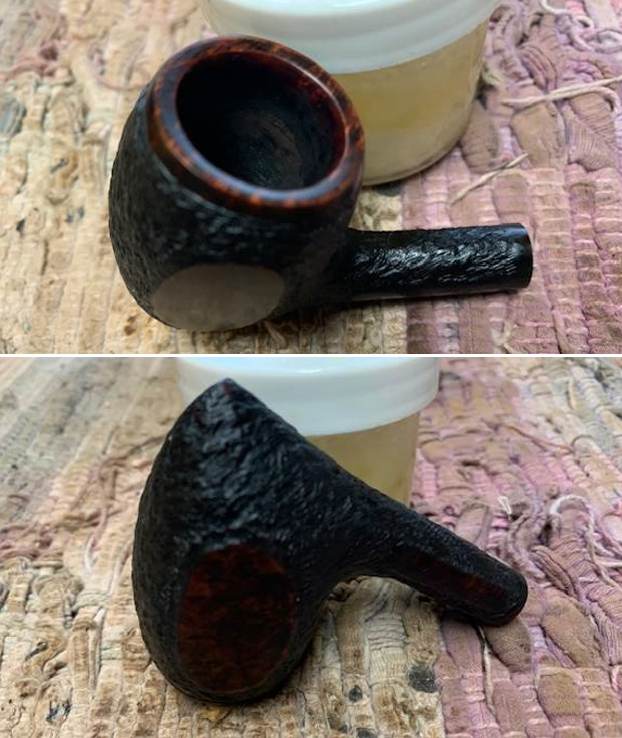
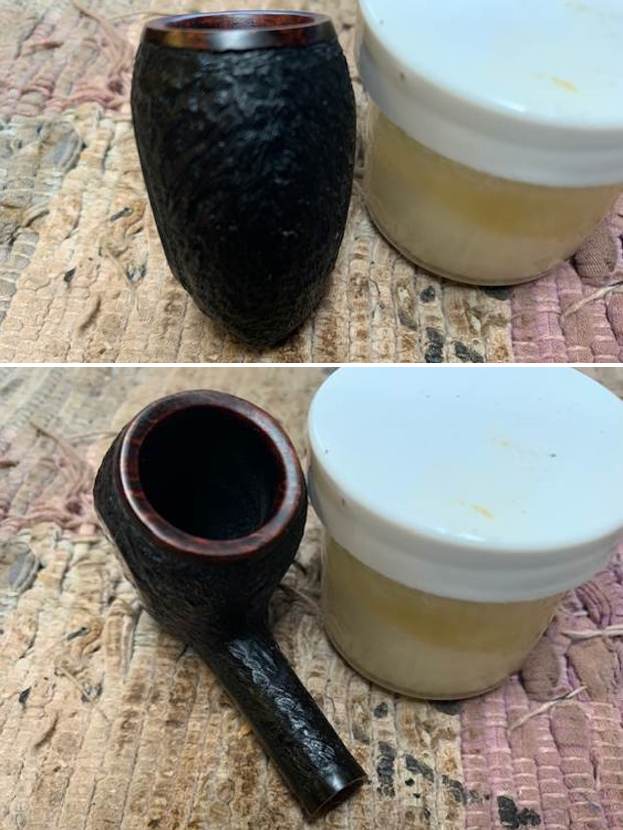
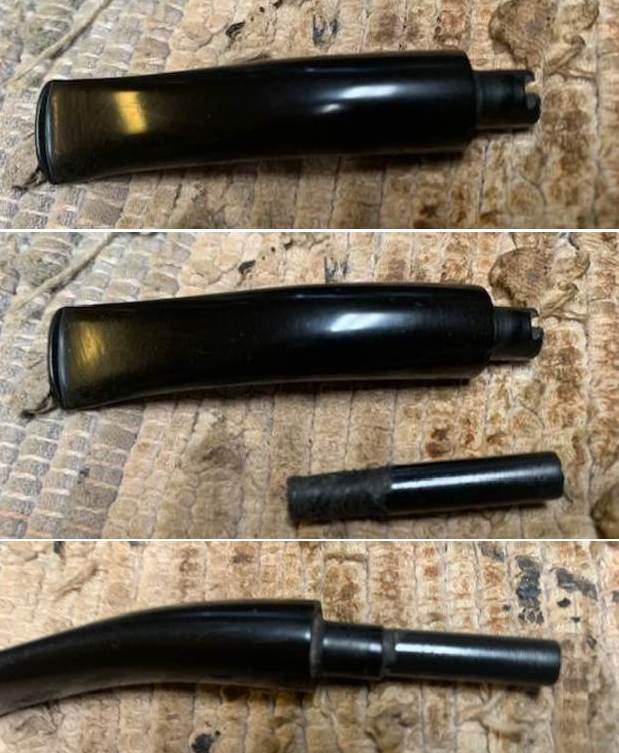
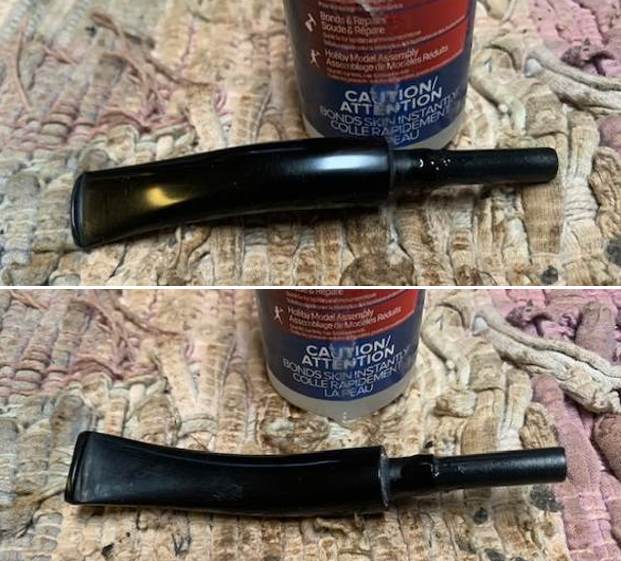
This past week, after some email correspondence I received a package with three Vauen pipes that a friend here in British Columbia wanted me to restore for him. The one was a broken shanked Vauen Meerschaum and the other two were rusticated briars. This is the second of the briars – a Vauen rusticated Bent Egg with a 9MM Filter stem. The smooth rim top had some lava build up and a moderate cake in the bowl. The inner and outer edges of the bowl looked very good. The finish was dirty but had a charm that was characteristic of older rusticated Vauen pipes. The rustication was slightly different than the previous Billiard which make me wonder if it is a newer rendition. The pipe was stamped on the left side of the shank and read Vauen. On the right side it read Nest. There was not a shape number present. It was light weight and would clean up quite nicely. The tenon had come loose from the stem and would need to be reglued but it was in good shape. The stem was quite clean and was made of black acrylic. There was light chatter and marks on the surfaces near the button on both sides but no tooth marks at all. I took photos of the pipe before I started working on it. I took photos of the rim top and the top and underside of the stem. You can see the cake in the bowl and the lava overflow on the rim top. The stem has light tooth chatter and marks on both sides ahead of the button. It is dirty but otherwise great. It is a nice looking pipe.The next photos show the stamping on the left and right sides of the shank. It is clear and readable as noted above. I removed the stem from the shank and took a photo of the parts to give a sense of the overall look of the pipe. You can see the loose tenon in the photo as well. It is really a nicely looking pipe that will look great once it is cleaned up.I am including that material on the brand from the previous blog for those who may have missed it. I turned first to Pipephil’s site (http://pipephil.eu/logos/en/logo-v1.html). I did a screen capture of the information on the site. There was a great sidebar that gave some history of the brand. I include both of them below.In 1848, Karl Ellenberger and his partner Carl August Ziener establish a pipe factory in Nuremberg. In 1901 they merge with Gebhard Ott an other factory in town and they create a firm named Vereinigten Pfeifenfabriken Nürnberg (abbreviated : VPFN*). Shortly after Ernst Eckert, a member of the Ott family became manager of the society. During the 20th century Adolf, Ernst (jr) and Alexander Eckert (CEO in 2012) followed one another at Vauen’s head.* VPFN : “V” is said VAU in German (pronounce faou) and “N” becomes EN. Hence VAUEN.

I also turned to a blog written on rebornpipes by Dal Stanton (Pipesteward.com) that I quote a section from the blog below that gives a great sense of the history of the German brand and some photos from the website (https://rebornpipes.com/2021/04/27/breathing-new-life-into-a-german-vauen-6294-p-lip-saddle-billiard-for-a-special-young-lady/).

… I turn to the question of the history of the VAUEN name? I look to the History section of the VAUEN website and again, I am impressed with the presentation. Whenever I work on a pipe, and especially when a pipe name is new to me, I enjoy looking at its history to appreciate the pipe more fully now on my worktable. From VAUEN’s website:Quality and a wealth of ideas have a long tradition at VAUEN. 160 years of VAUEN: that means 160 years of skilled workmanship and modern technology and 160 years of experience in fulfilling the individual wishes of today’s pipe lovers, and those of tomorrow.

In Nuremberg in 1848, Karl Ellenberger and his partner Carl August Ziener turned an idea into reality: Germany’s first pipe manufacturer produced tobacco pipes for connoisseurs around the world using a selection of the best wood. In an amalgamation with the Gebhard Ott pipe factory, which was founded in 1866 in Nuremberg, the Vereinigten Pfeifenfabriken Nuremberg (United Pipe Factories Nuremberg, or VPFN) was born in 1901.  Under the management of Ernst Eckert, a descendent of the founding Ott family, a company was born whose products and services would shape the tobacco and smoking culture in Europe and overseas for the next 160 years and counting.

The question about the name, VAUEN, not being a name of a person and why it is capitalized throughout is explained:

In his search for a name that would be easily remembered by all pipe lovers, Ernst Eckert’s son, Adolf Eckert, coined a new name for the company in 1909: VAUEN – a composition of the first letters V (pronounced vow) of Vereinigte Pfeifenfabriken and N (pronounced en) of Nuremberg. A brand for the future was born.

Now it was time to work on the pipe itself. I reamed out the cake on the bowl walls with a PipNet Pipe reamer and  cleaned it up with a Savinelli Fitsall Pipe Knife. I sanded the walls smooth with 220 grit sandpaper wrapped around a piece of dowel. I cleaned out the mortise and airway into the bowl and the stem with cotton swabs, pipe cleaners and isopropyl alcohol until they came out clean. I scrubbed the rugged exterior of the bowl with undiluted Murphy’s Oil Soap and a tooth brush. I rinsed it off with warm water to remove the grime and the soap. It looked much better once it was clean. I polished the rim top and removed the light scratching in the surface with micromesh sanding pads – dry sanding with 1500-12000 grit pads and wiping it down with a damp cloth after each pad to remove dust. I stained the rim top and edges with a Walnut stain pen to match the rest of the bowl and shank. I rubbed the bowl and shank down with Before & After Restoration Balm. I worked it into the finish with my fingers and used a shoe brush to press it deep into the crevices of the rustication. The product works to deep clean the finish on the bowl and shank and enliven and protect the briar. After it sat for 15 minutes I wiped it off with a soft cloth. The briar really came alive with a rich shine. I took some photos of the bowl at this point to mark the progress in the restoration. It is a beautiful bowl.  I set the bowl aside and turned my attention to the stem. I reglued the tenon in the cleaned up stem end with clear CA glue. It lined up perfectly and I set it aside for the glue to cure.I polished out the tooth chatter and marks on the stem with micromesh sanding pads – dry sanding with 1500-12000 grit pads. I wiped the stem down after each pad with Obsidian Oil to remove the sanding dust. I used the Before & After Pipe Polish to remove the small minute scratches left in the vulcanite. I finished by wiping the stem down with a final coat of Obsidian Oil and set it aside to dry.  As usual at this point in the restoration process I am excited to be on the homestretch. I look forward to the final look of the Vauen Nest Rusticated Bent Egg when it is put back together, polished and waxed. I put the bowl and stem back together. I polished the bowl and stem with Blue Diamond to polish out the scratches in the briar and the vulcanite. I gave the bowl and the stem multiple coats of carnauba wax. I buffed the pipe with a clean buffing pad to raise the shine. I hand buffed it with a microfiber cloth to deepen the shine. The pipe polished up pretty nicely. The took on depth with the wax and polish. The shiny black acrylic stem is a beautiful contrast to the browns of the bowl and thick shank. This Rusticated Vauen Next Bent Egg was another fun pipe to work on. It really is a quite stunning piece of briar whose shape follows the flow of the grain on the briar. The pipe is comfortable pipe to hold in the hand. The finished pipe is shown in the photos below. The dimensions of the pipe are Length: 5 ½ inches, Height: 2 inches, Outside diameter of the bowl: 1 inches, Chamber diameter: ¾ of an inch. The weight of the pipe is 1.80 ounces/51 grams. This is the second of three Vauen Pipes that I am working on for my friend. Once I finish the last pipe of the threesome I will be sending them back to him. Thanks for reading my reflections on the pipe while I working on it.

Restoring a Vauen College 350 Rusticated Billiard


Blog by Steve Laug

This past week, after some email correspondence I received a package with three Vauen pipes that a friend here in British Columbia wanted me to restore for him. The one was a broken shanked Vauen Meerschaum and the other two were rusticated briars. The first of the briars was a Vauen rusticated Billiard with a 9MM Filter stem. The rim top had some lava build up in the rustication and a moderate cake in the bowl. The inner and outer edges of the bowl looked very good. The finish was dirty but had a charm that was characteristic of older rusticated Vauen pipes. The pipe was stamped on the underside of the shank and read College [over] Vauen followed by the shape number 350. It was quite lightweight and would clean up quite nicely. The tenon was set in the shank and the stem fit over it. The stem was quite clean and was made of black acrylic with the characteristic Vauen White Dot. There was light chatter on the surfaces near the button on both sides but no tooth marks at all. I took photos of the pipe before I started working on it. I took photos of the rim top and the top and underside of the stem. You can see the cake in the bowl and the lava overflow on the rim top. The stem is very clean in regards to tooth marks an damage. It is dirty but otherwise great. It is a nice looking pipe.The next photo shows the stamping on the underside of the shank. It is clear and readable as noted above.I removed the stem from the shank and took a photo of the parts to give a sense of the overall look of the pipe. It is really a nicely looking Billiard that will look great once it is cleaned up.I wanted to remind myself of the background on the Vauen brand before I started my work on the pipe. I turned first to Pipephil’s site (http://pipephil.eu/logos/en/logo-v1.html). I did a screen capture of the information on the site. There was a great sidebar that gave some history of the brand. I include both of them below.In 1848, Karl Ellenberger and his partner Carl August Ziener establish a pipe factory in Nuremberg. In 1901 they merge with Gebhard Ott an other factory in town and they create a firm named Vereinigten Pfeifenfabriken Nürnberg (abbreviated : VPFN*). Shortly after Ernst Eckert, a member of the Ott family became manager of the society. During the 20th century Adolf, Ernst (jr) and Alexander Eckert (CEO in 2012) followed one another at Vauen’s head.* VPFN : “V” is said VAU in German (pronounce faou) and “N” becomes EN. Hence VAUEN.

I also turned to a blog written on rebornpipes by Dal Stanton (Pipesteward.com) that I quote a section from the blog below that gives a great sense of the history of the German brand and some photos from the website (https://rebornpipes.com/2021/04/27/breathing-new-life-into-a-german-vauen-6294-p-lip-saddle-billiard-for-a-special-young-lady/).

… I turn to the question of the history of the VAUEN name? I look to the History section of the VAUEN website and again, I am impressed with the presentation. Whenever I work on a pipe, and especially when a pipe name is new to me, I enjoy looking at its history to appreciate the pipe more fully now on my worktable. From VAUEN’s website:Quality and a wealth of ideas have a long tradition at VAUEN. 160 years of VAUEN: that means 160 years of skilled workmanship and modern technology and 160 years of experience in fulfilling the individual wishes of today’s pipe lovers, and those of tomorrow.

In Nuremberg in 1848, Karl Ellenberger and his partner Carl August Ziener turned an idea into reality: Germany’s first pipe manufacturer produced tobacco pipes for connoisseurs around the world using a selection of the best wood. In an amalgamation with the Gebhard Ott pipe factory, which was founded in 1866 in Nuremberg, the Vereinigten Pfeifenfabriken Nuremberg (United Pipe Factories Nuremberg, or VPFN) was born in 1901.  Under the management of Ernst Eckert, a descendent of the founding Ott family, a company was born whose products and services would shape the tobacco and smoking culture in Europe and overseas for the next 160 years and counting.

The question about the name, VAUEN, not being a name of a person and why it is capitalized throughout is explained:

In his search for a name that would be easily remembered by all pipe lovers, Ernst Eckert’s son, Adolf Eckert, coined a new name for the company in 1909: VAUEN – a composition of the first letters V (pronounced vow) of Vereinigte Pfeifenfabriken and N (pronounced en) of Nuremberg. A brand for the future was born.

Now it was time to work on the pipe itself. I reamed out the cake on the bowl walls with a PipNet Pipe reamer and  cleaned it up with a Savinelli Fitsall Pipe Knife. I sanded the walls smooth with 220 grit sandpaper wrapped around a piece of dowel. I cleaned out the mortise and airway into the bowl and the stem with cotton swabs, pipe cleaners and isopropyl alcohol until they came out clean. I scrubbed the rugged exterior of the bowl and the stem with undiluted Murphy’s Oil Soap and a tooth brush. I rinsed it off with warm water to remove the grime and the soap. It looked much better once it was clean. I rubbed the bowl and shank down with Before & After Restoration Balm. I worked it into the finish with my fingers and used a shoe brush to press it deep into the crevices of the rustication. The product works to deep clean the finish on the bowl and shank and enliven and protect the briar. After it sat for 15 minutes I wiped it off with a soft cloth. The briar really came alive with a rich shine. I took some photos of the bowl at this point to mark the progress in the restoration. It is a beautiful bowl.   I set the bowl aside and turned my attention to the stem. I polished the stem with micromesh sanding pads – dry sanding with 1500-12000 grit pads. I wiped the stem down after each pad with Obsidian Oil to remove the sanding dust. I used the Before & After Pipe Polish to remove the small minute scratches left in the vulcanite. I finished by wiping the stem down with a final coat of Obsidian Oil and set it aside to dry.  As usual at this point in the restoration process I am excited to be on the homestretch. I look forward to the final look of the Vauen College 350 Billiard when it is put back together, polished and waxed. I put the bowl and stem back together. I polished the bowl and stem with Blue Diamond to polish out the scratches in the stem. I gave the bowl multiple coats of Conservator’s Wax and the stem multiple coats of carnauba wax. I buffed the pipe with a clean buffing pad to raise the shine. I hand buffed it with a microfiber cloth to deepen the shine. The pipe polished up pretty nicely. The depth of the rustication really pops with the wax and polish. The shiny black acrylic stem is a beautiful contrast to the browns of the bowl and shank. This Rusticated Vauen College 350 Billiard  was another fun pipe to work on. It really is a quite stunning piece of briar whose rustication flows with the cut of the briar. The pipe is a comfortable pipe to hold in the hand. The finished pipe is shown in the photos below. The dimensions of the pipe are Length: 5 ¾ inches, Height: 1 ½ inches, Outside diameter of the bowl: 1 ¼ inches, Chamber diameter: ¾ of an inch. The weight of the pipe is 1.02 ounces/ 29 grams. This is the first of three Vauen Pipes that I am working on for my friend. Once I finish the threesome I will be sending them back to him. Thanks for reading my reflections on the pipe while I working on it.

An Igloo in Algeria


Blog by Kenneth Lieblich

Pull up a chair and light your pipe – let me tell you the tale of an involved pipe restoration. This pipe arrived from France in a large lot. It certainly caught my eye with its idiosyncratic name and shape. I don’t know anything about the previous smoker of this pipe, but it certainly has travelled the world. Many things about this pipe are unusual, but most unusual of all is the shape! What would you call it? From the side it looks a bit like an igloo. It’s not a freehand, it’s not a classic shape – what on earth is it? I’m not sure, but I do have a soft spot for it so I’m going to call it an igloo.This is a Skikda pipe, made in Algeria. The only marking on the pipe was on the left of the square shank, which simply had the word ‘Skikda’. Igloo shape or not, it has a squared, tapered stem. As you can see, the stem of the pipe is made of vulcanite and the width of the stem narrows to the button. This indicates that the pipe is likely pre-war. My educated guess is that the pipe was made between 1932 and the beginning of World War II. Why 1923? Read on… As is often the case with pipes from the early 20th century, the information I have on Skikda Pipes is slim indeed. What does the word “Skikda” mean or refer to? Skikda is a region and a town in northeastern Algeria. Between the 1830s and 1960s (when Algeria was under French rule), the town was known as Philippeville, after the French king at the time the town was founded. Pipephil had no information at all under the name, Skikda, and Pipedia had a mere three short sentences – but the sentences were significant in their own way:

“It seems likely that Skikda pipes are connected to the Amiel brand founded (1923) [sic – this should read 1932] by Raoul Amiel in Philippeville (Skikda, Algeria). The factory employed about 30 persons in the early 1960s when it closed down. It is the only known pipe producer to have been headquartered in Skikda.”

This was significant because I had independently come to the same conclusion about Skikda and Amiel, before reading the Pipedia article. In other words, I was pleased that someone else had made the connection between Skikda and Amiel.

Pipedia also has an article on Amiel Pipes, with information gleaned from an email of Jacques Le Moigne, great-grandson of Justine Amiel, Raoul Amiel ‘s sister. I quote some (but not all) of that information:

The factory of Raoul Amiel near Philippeville in Algeria is the result of the briar industry there. By 1900 the French and Italian sources of briarwood in the Mediterranean are becoming rarer. The pipe industry had grown in a short period of time and a gigantic demand for this special rootwood was there. In 1905 rich fields of briar were discovered in Algeria, at that time still part of France. Within some years Algeria became an important exporter of so-called ebauchons that were exported world-wide. About eighty percent of the briar used in the pipe industry of that time originated from Algeria. We had previously indicated that French undertakers together with English investors were considering to set up the industry of pipe making in Algeria. The raw material was sufficient available, moreover cheap labour was easy to get. The Amiel family reports the factory was originally financed by the Wassas Family. Unfortunately things changed after 1929. The Amiel family was a traditional pipe family. They had their origins in Nancy, France, which they left in 1870 during the German invasion. They first moved to Florence Italy before moving to Philippeville in French Algeria. Raoul was a gifted engineer and designed and built the factory, which was very modern for the time. In 1932 the first pipe factory in Algeria opened its doors under the name Raoul Amiel. A mysterious factory of which little history is known. Certainly the techniques for making the pipes came over from Saint-Claude so that the pipes are hard to distinguish from the French counterparts. The factory named Amiel is heading with success. The product soon reached a high grade of perfection and soon competed with the French products. Even so, Amiel was selling a greater deal of his products in Saint-Claude, where the pipes received a French mark to be exported world-wide. Despite of the large production and the excellent trade the success of the factory is unclear to us now. After the founding the factory worked till the late 1950’s. Possibly the mark thereafter was sold and the production moved to another place. Anyhow, pipes under the name Amiel were kept alive till they disappeared from the marked somewhere around 1980. Certainly that fact is related to the declining interest in the tobacco pipe in general.

On to the pipe — and it was a bit of a nightmare. This stem may be the most badly oxidized stem I’ve ever worked on. The brownish-greenish-yellowish colour was oppressive and it was unclear whether it could be fully returned to its original glossy black. Inside the stem was quite dirty but not unusually so. The surface of the stem had scratches, marks, and dents as would be expected of a pipe this old, but worst of all — as the photos show — a big chunk of vulcanite was missing on the underside. As for the stummel, it was no better. It was nasty, grungy and dull. The left side had a couple of significant nicks, the underside of the shank had a crack, and the rim of the pipe was badly damaged by burns and was damaged enough to look like a meteor crater. Clearly, it had had a long, hard life. This turned out to be a more challenging restoration than I had anticipated. Part of the difficulty was as a direct result of my own inexperience; I had to redo some of the steps more than once to achieve the desired result.

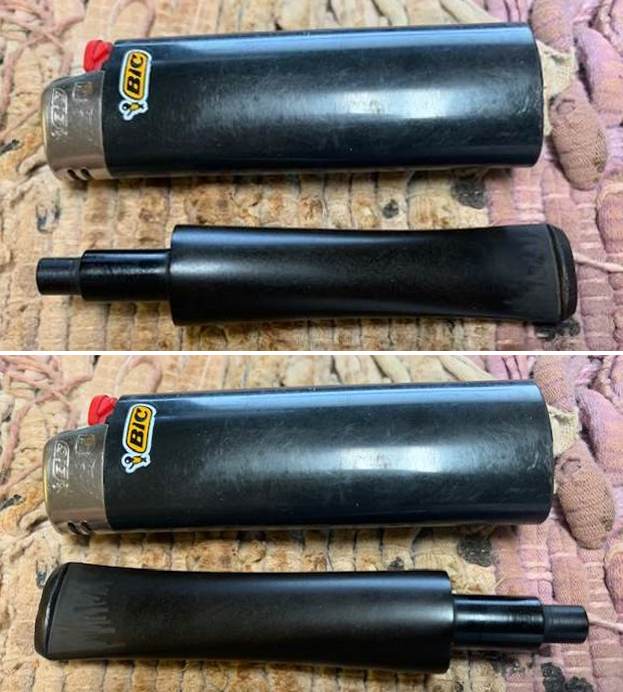
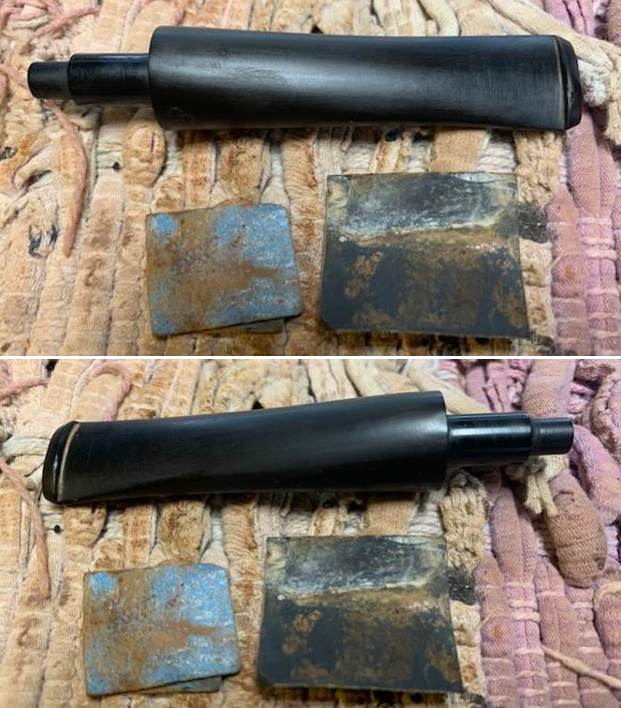
It was time to fix this pipe! First up — the stem. There was some paper mush (or something similar) on (and adjacent to) the tenon. I later found out that this was to repair yet another problem in the stummel, but I digress. I removed all of that paper debris before proceeding with the usual procedures. I wiped the outside down with Murphy’s Oil Soap on some cotton pads. I also took a BIC lighter and ‘painted’ the stem with its flame in order to lift the bite marks and dents. Then I cleaned out the inside with pipe cleaners and isopropyl alcohol. Because of the extreme oxidation, I used SoftScrub and cotton pads to wipe down the stem before throwing it in the Pipe Stem Oxidation Remover. The following day, I cleaned all of the de-oxidizing mess and again scrubbed with SoftScrub on some cotton pads to remove the leftover oxidation. This worked quite well. I built up the smaller dents on the stem and button with black cyanoacrylate adhesive and let them fully cure.The major gouge would need far more work. I made a patch out of a new-to-me product — a type of cyanoacrylate adhesive strengthened with carbon and rubber (I also mixed a little activated charcoal in). I’d heard good things about this product and wanted to try it out for myself (Spoiler alert: it worked very well!) This repair was a perfect opportunity to test drive this adhesive. I first plugged up the stem’s draught hole with a folded pipe cleaner coated in petroleum jelly. This ensured that any of the CA glue would not accidentally plug up the air passage in the stem. This was a tricky business and it took some real patience and effort to make it work. As the photos show, after I applied the cyanoacrylate, it looked pretty darn ugly, but I was expecting that. After the curing, I ended up sanding down the end of the stem to reduce some of the excess material. To carry this process on, I used some miniature files to further shape the button and make it suitable for sanding. I used another file on the inside to ensure there were no rough edges in the bore.I then sanded the stem down with 220-, 400-, and 600-grit sandpapers to meld seamlessly into the stem. This ensures that it keeps its shape and looks like it should. I then used all nine Micromesh pads (1,500 through 12,000 grit) to bring out the lovely black lustre on the stem. I also used Obsidian Pipe Stem Oil in between each pad scrubbing. It is worth noting that a repair this big on a stem will never be completely invisible, but I was pleased with how I managed to make it look reasonably good.

After all of that, it was time to work on the stummel. First, I reamed out the bowl. I used the KleenReem to remove the built-up cake and followed that with 220-grit sandpaper taped to a dowel to eliminate as much as I could. I took the chamber down to bare briar, as I wanted to ensure there were no hidden flaws in the wall. Fortunately, there were none. One thing to note is that this stem has an unusually wide draught hole and I’m not sure whether it was originally constructed that way, or if it was widened later. Either way, that (coupled with the crack in the shank) is why the stem’s tenon had that paper stuff on it – to ensure that the pipe fit together properly.Since the draught hole was unusually wide, I used some drill bits to help remove the detritus inside. Just to be clear: I did NOT use these drill bits in a drill! I used them with my hands. Using a drill here would be catastrophic for the pipe.I then proceeded to clean out the insides of the shank with Q-tips, pipe cleaners, and lemon-infused isopropyl alcohol. It was fairly dirty, but not extraordinarily so. I used cotton rounds and some Murphy’s Oil Soap to scrub the outside of the stummel and a toothbrush with Murphy’s for the lava on the rim of the pipe. I followed that up by cleaning the insides with some dish soap and tube brushes. Because this pipe was so filthy, I decided to bypass the usual “ghosting” altogether, and go straight to a bath! I opted to soak the stummel in isopropyl alcohol overnight. This will usually remove the sort of goo, grunge, and ghosts I was faced with. Next day, I took it out of the bath and left it to dry. As you can see in the post-bath photos, some filth remained in the recesses of the pipe, so I took a bit of acetone on some Q-tips and rubbed. This worked like a charm!Having completed that, I could move on to fixing up the wounds on the stummel; there were three significant ones on the left side. They were large enough that I would not be able to make them disappear entirely, but I wanted to make them solid and smooth, and meld into the rest of the wood. I used a dental tool to dig out the remaining fill-material and replaced it with a mixture of cyanoacrylate adhesive and briar dust. These would get sanded down later. I then moved on to the crack on the underside of the shank. The first step in dealing with this was to ensure that the crack would not continue to creep after I had repaired it. To that end, I took a micro-drill bit, inserted it in my Dremel, and very carefully drilled a hole right through the wall of the shank, into the mortise. I then needed to apply cyanoacrylate adhesive in order to seal and repair it. First, however, I used a Q-tip and a folded pipe cleaner to coat the inside of the shank with petroleum jelly. This would prevent the adhesive from dripping inside the shank and creating further problems. That done, I carefully applied a tiny bead of adhesive to the hole and the length of the crack. Finally, I clamped it shut and let it cure. This was a great success – obviously, the crack would always be visible, but I was really pleased with how the repair looked. I took out my topping board and sanded the three planes of the pipe to both flatten the repairs and also level out the surface. I also wanted to resharpen the edges and corners a little. Next was to work on that meteor crater of a rim. I actually argued with myself for some time about this damaged rim. I seriously considered the idea of leaving the damage as it was (as part of the pipe’s history) because I was adamant about not changing the profile of the rim by sanding it. However, I felt that I couldn’t just leave the pipe as it was. It needed some help. I took some 600-grit sandpaper, wrapped it around my wooden sphere and gingerly sanded the rim. The circular shape and motion of the sphere gradually smoothed and returned the edge to a perfect circle. I think I managed to achieve a good balance between removing the damage but still keeping the original look.I took some oxalic acid, used several Q-tips, and rubbed, but this did not do much towards removing the burn. So, I brought out the big guns and used acetone, which achieved better results. Then I used all of my Micromesh pads over the entire stummel, including the rim.But just when I thought I was done the stummel — I wasn’t. I was reminded that there was that awful paper stuff on the tenon of the stem because it didn’t fit correctly, so I needed to rectify this too. I built up the bottom part of the mortise of the shank with CA glue and briar dust. After letting it cure, I sanded it down with my needle files, made it look good and, most importantly, ensured it fit well with the tenon. Finally, I gave the pipe a light application of Before & After Restoration Balm and let it sit for 15 minutes or so. I then buffed it with a microfibre cloth. After that, I took it to my bench polisher and polished it with white diamond and carnauba wax. This brought out the best in the stummel’s grain. The Skikda igloo with a long, hard life has been brought back from the dead! It an unusual and uncommon piece of Algerian and French pipemaking. It looks so much better than when I started and is ready to be enjoyed again by the next owner! I am pleased to announce that this pipe is for sale! If you are interested in acquiring it for your collection, please have a look in the ‘French’ pipe section of the store here on Steve’s website. You can also email me directly at kenneth@knightsofthepipe.com. The approximate dimensions of the pipe are as follows: length 5½ in. (140 mm); height 1 in. (25 mm); bowl diameter 1¼ in. (32 mm); chamber diameter ⅝ in. (16 mm). The weight of the pipe is 1⅛ oz. (33 g). I hope you enjoyed reading the story of this pipe’s restoration as much as I did restoring it. If you are interested in more of my work, please follow me here on Steve’s website or send me an email. Thank you very much for reading and, as always, I welcome and encourage your comments.

Restoring a Mysterious Rusticated Pot with an Amber Acrylic Stem


Blog by Steve Laug

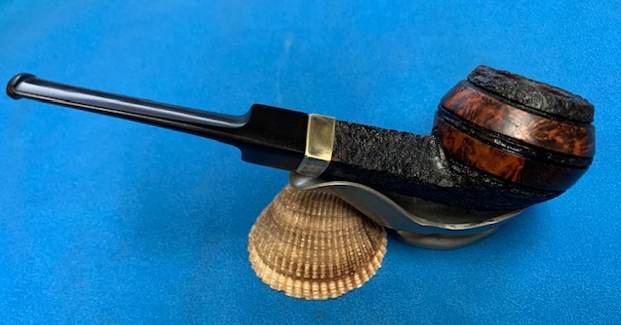
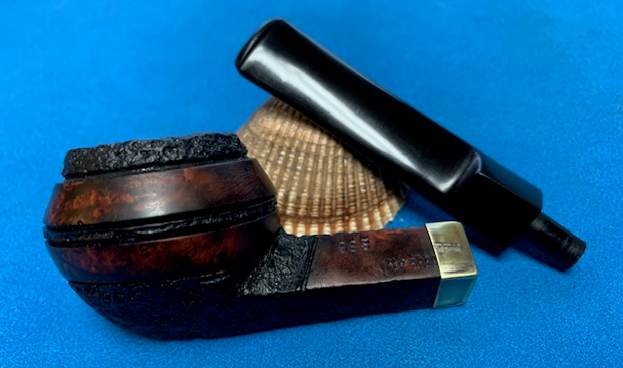
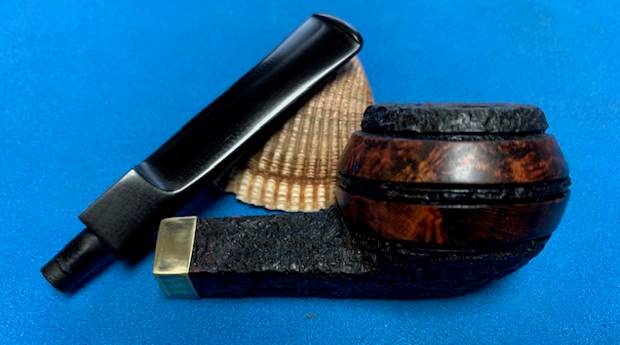
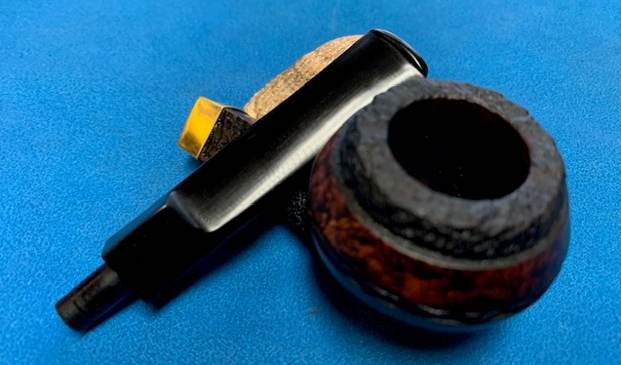
The next pipe was another interesting pipe that surprised both Jeff and me when  it came in a lot of pipes that we bought it from the fellow in Copenhagen, Denmark on January 26, 2023. This one a mystery pipe that has no stamping on the shank or stem. It has a wire brush style rustication around the bowl and short shank. The rim top and shank end have some brass/gold finishings. The rim top is capped around the outer edge leaving behind a smooth rim top with clean edges. It is held in place by three small brads. The shank end has a band/ferrule carved with Celtic knots all the way around it with twin rings on each side and a cap over the shank end. The bowl had a thick cake and some lava overflow on the smooth rim top. The inner edge of the rim top appeared undamaged. The brass cap was slightly tarnished as was the shank end cap or ferrule. The finish was dirty with dust and grim in the wire style grooves of the rustication. The clear amber acrylic taper stem was lightly oxidized and dirty and had some light tooth chatter and marks on both sides ahead of the button. Jeff took these photos of the pipe before he started his cleanup work. He took photos of the rim and bowl to show the condition of the bowl and rim top. You can see the thick cake in the bowl and the lava on the rim top. He also took photos of the stem surfaces to show its overall condition when it arrived. It was lightly oxidized and dirty and had light tooth marks and chatter on both sides. The photos of the sides and heel of the bowl show the unique rustication around the bowl and shank sides. The rich brown stain adds depth to the finish. He also took photos of the etching and marks on the rim cap and the shank ring/cap. It is a beautiful piece. Since there was no information on the pipe regarding the maker I decided to move ahead to the work on the pipe. Jeff cleaned up the pipe for me. He reamed the bowl with a PipNet pipe reamer and cleaned it up with a Savinelli Fitsall Pipe Knife. He scrubbed the exterior with Murphy’s Oil Soap and a tooth brush to clean off the grime and dust off the finish. The cleaning had removed the debris and left the pipe looking very good. He cleaned up the internals of the shank, mortise and stem with pipe cleaners, cotton swabs and alcohol to remove any remnant of oils and tars in the lightly used pipe. He soaked the stem in Before & After Deoxidizer and was able to remove much of the oxidation, calcification. When it arrived here in Vancouver it was a clean pipe and I knew what I had to work with. I took photos of it before I started my part of the restoration. I took a photo of the rim top and the stem to show their condition once it arrived in Canada. Jeff was able to clean up the rim and bowl sides as shown in the photos below. He was also able to get rid of the grime and grit in the surface of the briar. I removed the stem from the shank and took a photo of the parts to give a sense of what the pipe looks like. It is a proportionally pleasing pipe with classic dimensions and an oval shank with a vulcanite stem.I started my work on the pipe by polishing the briar with micromesh sanding pads – dry sanding with 1500-12000 grit pads. I wiped it down after each sanding pad with a damp cloth to remove the sanding debris. I rubbed the bowl and shank down with Before & After Restoration Balm to deep clean them. The product works to clean, enliven and protect the briar. I worked it in with my fingers to get it deep in the briar. I let it sit for 10 minutes then I wiped it off and buffed it with a soft cloth. The briar really began to have a rich shine. I set aside the bowl and turned my attention to the stem. I polished the stem with micromesh sanding pads – dry sanding with 1500-12000 grit pads. I wiped the stem down after each pad with a damp cloth to remove the sanding dust. I gave it a further polish with Before & After Stem Polish – both Fine and Extra Fine. I finished by wiping the stem down with a final coat of Obsidian Oil and set it aside to dry. I put the amber acrylic stem back on the Mysterious Wire Rusticated Pot and took the pipe to the buffer. I buffed the bowl and stem with Blue Diamond to lightly buff the briar and the vulcanite. Blue Diamond does a great job on the smaller scratches that remain in both. I gave the bowl and the stem several coats of carnauba wax and buffed the pipe with a clean buffing pad to raise the shine. I hand buffed it with a microfiber cloth to deepen the shine. I am amazed at how well it turned out. The finished pipe is shown in the photos below. This is a beautiful Custom Made Pot with a tight rustication and a brass cap and shank band – the amber acrylic taper stem and the finish combine to give this Pot a great look. The polished stem looks really good with the deep grain shining through on the bowl and shank. The dimensions of the pipe are Length: 4 ¾ inches, Height: 1 ¾ inches, Outside diameter of the bowl: 1 ½ inches, Chamber diameter: ¾ of an inch. The weight of the pipe is 2.15 ounces/61 grams. Since it came to us from Copenhagen, Denmark this pipe will soon be added to the rebornpipes store in the Pipes By Danish Pipemakers section of the store. Thanks for walking through the restoration with me on this beauty!

Restoring a Faaborg Special Old Briar Hand Shaped 36 Volcano


Blog by Steve Laug

The next pipe was another interesting pipe that surprised both Jeff and me when  it came in a lot of pipes that we bought it from the fellow in Copenhagen, Denmark on January 26, 2023. This one is the first of the Faaborg pipes we have picked up from him. It is a great looking Volcano with a rusticated heel. The rustication goes up the edges on the underside of the shank in a thin line framing the area where it is stamped. The pipe is stamped on the underside of the shank and reads Faaborg [over] Special [over] Old Briar [over] Hand Shaped [over] In Denmark. To the right of that stamping at the stem/shank joint is stamped the shape number 36. The bowl had a thick cake and some lava overflow on the smooth rim top. The inner and outer edges of the thin rim top appeared undamaged. The finish was dirty and on the rusticated base was dusty and grimy in the grooves of the rustication. The vulcanite saddle stem was lightly oxidized and dirty and had some tooth chatter and marks on both sides ahead of the button. Jeff took these photos of the pipe before he started his cleanup work.He took photos of the rim and bowl to show the condition of the bowl and rim top. You can see the thick cake in the bowl and the lava on the rim top. He also took photos of the stem surfaces to show its overall condition when it arrived. It was lightly oxidized and dirty and had light tooth marks and chatter on both sides. The photos of the sides and heel of the bowl show the beautiful grain around the bowl and shank sides. The rich brown stain adds depth to the finish. He also took photos of the stamping on the underside of the oval shank. The stamping was clear and read as noted above. I turned to Pipephil’s site to see what I could learn about the Faaborg brand and the carver who had made the pipe (http://www.pipephil.eu/logos/en/logo-v2.html). I have included a screen capture of the pertinent section from the site and have added the sidebar information below the photo. Artisan: Viggo Nielsen (1927 – †2009) starts making pipes during WWII. He establishes his own Bari factory in 1948. The business is sold to a German tobacco manufacturer in 1978 and from this period on he starts the “Faaborg Pipe” (Fåborg Pibe) with his two sons Jørgen Nielsen and Kai Nielsen. The “Jewel of Denmark” stamping is reserved for perfect pipes (flawless straight grain).

As I had vaguely remembered the pipe was identified with Viggo Nielsen (Bari) and his two sons Jorgen and Kai (both famous carvers in their own right). I knew that the pipe was made after 1978 when he sold Bari and started the Faaborg Pipe.

I turned to Pipedia to see if I could gain a bit more information on the brand as it generally has a great digest of the history of the brand and maker (https://pipedia.org/wiki/Faaborg_Pipe). I quote the article in full below:

In 1978 Viggo Nielsen sold his previous business to a German tobacco manufacturer and he began making the Faaborg Pipe together with his two sons Jørgen Nielsen and Kai Nielsen. Even when Viggo had reached the age of retirement, he could not quite leave his workshop and he still made about 100 pipes a year, some of them based on the famous “Fåborg Pibe” but also a few “Jewels of Denmark”, until he passed away.

The name “Jewel of Denmark” was reserved for the very few 100% perfect blocks with no stains and with straight grain and birds eye, and is still used by his son Kai, who continues making pipes in the workshop they shared together in the latter years of Viggo’s life.

The Faaborg Pibe is sculptured by hand, from the best materials. Each piece of briar was carefully selected and seasoned before shaping began. By following the structure and the fine grains of the briar root the pipes were formed to become the pride of any particular pipe owner. They offered both sandblasted and smooth finishes.

There was also a catalogue included on the site and I have included the description of the brand from that catalogue below in the screen capture.What I learned is that the pipe was made post 1978 (as noted above) and was hand shaped from quality materials by Viggo Nielsen and his sons. He only made about 100 pipes per year so there are not too many. Now it was time to work on the pipe.
Jeff cleaned up the pipe for me. He reamed the bowl with a PipNet pipe reamer and cleaned it up with a Savinelli Fitsall Pipe Knife. He scrubbed the exterior with Murphy’s Oil Soap and a tooth brush to clean off the grime and dust off the finish. The cleaning had removed the debris and left the pipe looking very good. He cleaned up the internals of the shank, mortise and stem with pipe cleaners, cotton swabs and alcohol to remove any remnant of oils and tars in the lightly used pipe. He soaked the stem in Before & After Deoxidizer and was able to remove much of the oxidation, calcification. When it arrived here in Vancouver it was a clean pipe and I knew what I had to work with. I took photos of it before I started my part of the restoration. I took a photo of the rim top and the stem to show their condition once it arrived in Canada. Jeff was able to clean up the rim and bowl sides as shown in the photos below. He was also able to get rid of the grime and grit in the surface of the briar. I took a photo of the stamping on the underside of the shank. It reads as noted above.I removed the stem from the shank and took a photo of the parts to give a sense of what the pipe looks like. It is a proportionally pleasing pipe with classic dimensions and an oval shank with a vulcanite stem.I started my work on the pipe by polishing the briar with micromesh sanding pads – dry sanding with 1500-12000 grit pads. I wiped it down after each sanding pad with a damp cloth to remove the sanding debris. I rubbed the bowl and shank down with Before & After Restoration Balm to deep clean them. The product works to clean, enliven and protect the briar. I worked it in with my fingers to get it deep in the briar. I let it sit for 10 minutes then I wiped it off and buffed it with a soft cloth. The briar really began to have a rich shine. I set aside the bowl and turned my attention to the stem. I smoothed out the tooth marks and chatter on both sides of the stem with 220 grit sandpaper and started polishing it with 400 grit wet dry sandpaper.I polished the stem with micromesh sanding pads – dry sanding with 1500-12000 grit pads. I wiped the stem down after each pad with a damp cloth to remove the sanding dust. I gave it a further polish with Before & After Stem Polish – both Fine and Extra Fine. I finished by wiping the stem down with a final coat of Obsidian Oil and set it aside to dry. I put the vulcanite stem back on the Faaborg Special Old Briar Hand Shaped 36 Volcano and took the pipe to the buffer. I buffed the bowl and stem with Blue Diamond to lightly buff the briar and the vulcanite. Blue Diamond does a great job on the smaller scratches that remain in both. I gave the bowl and the stem several coats of carnauba wax and buffed the pipe with a clean buffing pad to raise the shine. I hand buffed it with a microfiber cloth to deepen the shine. I am amazed at how well it turned out. The finished pipe is shown in the photos below. This is a beautiful Viggo Nielsen Hand Shaped Faaborg Special Old Briar Volcano – the vulcante saddle stem and the grain combine to give this Brandy pipe a great look. The polished vulcanite stem looks really good with the deeply grain shining through on the bowl and shank. The dimensions of the pipe are Length: 5 ¾ inches, Height: 1 ¾ inches, Outside diameter of the bowl: 1 inch, Chamber diameter: ¾ of an inch. The weight of the pipe is 1.87 ounces/53 grams. This beautiful pipe will soon be added to the rebornpipes store in the Pipes By Danish Pipemakers section of the store. Thanks for walking through the restoration with me on this beauty!

Restoring a GiGi Castagna 1988 Collezion 721 Rusticated Brandy with a Cumberland Stem


Blog by Steve Laug

The next pipe was another surprise to Jeff and me when  it came in a lot of pipes that we bought it from the fellow in Copenhagen, Denmark on January 26, 2023. Most of what we have picked up from him are Danish Pipes and few interesting exceptions. However, this Italian Made rusticated Brandy was a unique addition. It is a rusticated oval shank Pot with a smooth rim top and band at the shank end. The pipe is stamped on the underside of the shank and reads GiGi [over] Castagna. To the left is the shape number 721 and to the right is the line – Collezion [over] 1988. The bowl appeared to be lightly smoked with raw briar on the lower half. The smooth rim top was clean and the edges undamaged. The finish on the rusticated bowl was dull looking with dust in the grooves of the rustication. The Cumberland saddle stem is oxidized and dirty but otherwise undamaged. It came with a flannel bag stamped The Danish Pipe Shop in a circular logo. Jeff took these photos of the pipe before he started his cleanup work.He took photos of the rim and bowl to show how clean the inside was and the lightly smoked condition. The bowl and the rim top and edges were in flawless condition. He also took photos of the stem surfaces to show its overall condition when it arrived. It was lightly oxidized and dirty but did not have any tooth marks or chatter. The photos of the sides and heel of the bowl show the rugged rustication around the bowl and shank sides. The rich tan stain adds depth to the finish. He also took a photo of the stamping on the smooth panel on the underside of the oval shank. The stamping was clear and read as noted above.I turned to Pipephil’s site to see what I could learn about the GIGI brand and the carver who had made the pipe (http://www.pipephil.eu/logos/en/logo-g3.html). I have included a screen capture of the pertinent section from the site. The information I found was as follows:

Artisan: Luigi “Gigi” Crugnola made at Gigi Pipe Via Rovera, 40 21026 Gavirate Oltrona al Lago (VA).

Now I knew that the pipe was made by Luigi “GIGI” Crugnola. That was the extent of the information on that site. I turned to Pipedia to see if I could gain a bit more information on the brand as it generally has a great digest of the history of the brand and maker (https://pipedia.org/wiki/Gigi). I quote the article in full below:

Luigi “Gigi” Crugnola was born in 1934, the same year Giorgio Rovera founded a company in his own name in Varese, Italy along with partners Angelo and Adele Bianchi, who also happened to be Luigi Crugnola’s Uncle and Mother, respectively. The company produced pipes for 30 years, largely exported to America and elsewhere in the world. Crugnola took over the company in 1964 with the death of Angelo Bianchi, changing the name soon after to his own nickname Gigi, and continues to run the company today. The vast majority of Gigi pipes continue to be made for export.

What I learned is that the pipe was made post 1964 and was in all likelihood made for export. We purchased this pipe from our Copenhagen, Denmark connection so indeed it was exported. Now it was time to work on the pipe.

Jeff cleaned up the pipe for me. He reamed the bowl with a PipNet pipe reamer and cleaned it up with a Savinelli Fitsall Pipe Knife. He scrubbed the exterior with Murphy’s Oil Soap and a tooth brush to clean off the grime and dust off the finish. The cleaning had removed the debris and left the pipe looking very good. He cleaned up the internals of the shank, mortise and stem with pipe cleaners, cotton swabs and alcohol to remove any remnant of oils and tars in the lightly used pipe. He soaked the stem in Before & After Deoxidizer and was able to remove much of the oxidation, calcification. When it arrived here in Vancouver it was a clean pipe and I knew what I had to work with. I took photos of it before I started my part of the restoration. I took a photo of the rim top and the stem to show their condition once it arrived in Canada. Jeff was able to clean up the rim and bowl sides as shown in the photos below. He was also able to get rid of the grime and grit in the surface of the briar. The Cumberland stem was quite clean and just needed a good polishing. I took a photo of the stamping on the underside of the shank. It reads as noted above.I removed the stem from the shank and took a photo of the parts to give a sense of what the pipe looks like. It is a proportionally pleasing pipe with classic dimensions and an oval shank with a Cumberland stem.I started my work on the pipe by polishing the smooth rim top with micromesh sanding pads – dry sanding with 1500-12000 grit pads. I wiped it down after each sanding pad with a damp cloth to remove the sanding debris. I rubbed the bowl and shank down with Before & After Restoration Balm and a horsehair shoe brush to deep clean them. The product works to clean, enliven and protect the briar. I worked it in with my fingers and the brush to get it into the rustication of the briar. I let it sit for 10 minutes then I wiped it off and buffed it with a soft cloth. The briar really began to have a rich shine. I set aside the bowl and turned my attention to the stem. I polished the stem with micromesh sanding pads – dry sanding with 1500-12000 grit pads. I wiped the stem down after each pad with a damp cloth to remove the sanding dust. I gave it a further polish with Before & After Stem Polish – both Fine and Extra Fine. I finished by wiping the stem down with a final coat of Obsidian Oil and set it aside to dry. I put the Cumberland stem back on the GiGi Castagna 1988 Collezion 721 Brandy and took the pipe to the buffer. I buffed the bowl and stem with Blue Diamond to lightly buff the briar and the Cumberland. Blue Diamond does a great job on the smaller scratches that remain in both. I gave the bowl several coats of Conservator’s Wax and the stem several coats of carnauba wax and buffed the pipe with a clean buffing pad to raise the shine. I hand buffed it with a microfiber cloth to deepen the shine. I am amazed at how well it turned out. The finished pipe is shown in the photos below. This is a beautiful GiGi Castagna 1988 Collezion – the Cumberland saddle stem and the rusticated finish combine to give this Brandy pipe a great look. The polished Cumberland stem looks really good with the deeply rusticated bowl and shank. The dimensions of the pipe are Length: 5 ½ inches, Height: 1 ¾ inches, Outside diameter of the bowl: 1 ¼ inches, Chamber diameter: ¾ of an inch. The weight of the pipe is 1.62 ounces/46 grams. This beautiful pipe will soon be added to the rebornpipes store in the Pipes By Italian Pipe Making Companies section of the store. Thanks for walking through the restoration with me on this beauty!

Restoring the first Tsuge Kaga I have worked on – a smooth 950A Bulldog


Blog by Steve Laug

The next pipe was another surprise to Jeff and me when  it came in a lot of pipes that we bought it from the fellow in Copenhagen, Denmark on January 26, 2023. It is a smooth wide shank Bulldog with an unusual flair to the classic shape. The pipe is stamped on the underside of the shank. On the left underside of the diamond shank it is stamped TSUGE [over] KAGA. On right underside of the diamond shank it reads Handmade [over] In Japan [over] 950A – the shape number. The bowl had a thick cake with some lava overflow on the rim top and inwardly beveled inner edge of the bowl. There was some damage on the inner edge and bevel. The silver was oxidized and darkened. The finish on the bowl was dirty but also seemed to have a very shiny coat on it. The vulcanite taper stem is oxidized, dirty and had tooth chatter and marks on the top and underside of the stem ahead of the button. It came with a flannel bag stamped The Danish Pipe Shop in a circular logo. Jeff took these photos of the pipe before he started his cleanup work. He took photos of the rim and bowl to show the thick cake and lava coat covering the rim top. It really was filthy and a mess. The photos show the rim top and beveled inner edge and they appear to be in good condition under the lava. He also took photos of the stem surfaces to show its overall condition when it arrived. It was lightly oxidized and had tooth marks and chatter on both sides of the stem ahead of the button. The photos of the sides and heel of the bowls show beautiful grain around the uniquely carved bowl and shank sides. The rich brown stains highlights the grain and adds depth to the finish. It shows some promise. He also took photos of the stamping on the underside of the diamond shank. The stamping on both the left and right side were clear and read as noted above.  The stem had a classic Tsuge Red Dot on the left side of the diamond saddle. To help me understand the stamping a bit more and the history of the brand I turned to Pipephil’s site to see what it said about Tsuge Japanese Handmade pipes (http://pipephil.eu/logos/en/logo-t9.html). I have included a screen capture of the section below as well as the side bar information below the capture. The first pipe shown in the photo below shows the same Red Dot on the top of stem as the one on the pipe I am working on.Tsuge Pipe Company Ltd. The company was founded by Kyoichiro Tsuge (1911 – † Nov 2010). The traditional classic shape pipes are machine-made. After Kyoichiro Tsuge passed away, his three sons continue to run the two factories and the Ikebana workshop. Kyozaburo “Sab” Tsuge, the youngest son , manages the company.

Smokingpipes.com (https://www.smokingpipes.com/pipes/new/tsuge/) sells the brand and has this introduction on their site.

The Tsuge (pronounced roughly “Su-gay”) pipe company is led by pipe maker Kazuhiro Fukuda, who has been carving for the company for nearly 60 years. Initially, they produced pipes out of ivory and briar which were all classic shapes that were small and stained dark. Kazuhiro went to Denmark in 1969 to work with Sixten Ivarsson for a month and Sixten was able to teach him how to hone his innate skill, which he took back to Japan to help the company become famous the world over.

While the factory produces many machine-made pipes, Tsuge also has available a handcrafted line called Ikebana, available here. Most of these pipes are carved in the shape/drill Danish fashion with very strong Japanese aesthetics. Frequent use of plateau and Japanese bamboo adorn many of the high-grade pieces. Each stem is hand cut from solid vulcanite rod, with a beautifully polished vulcanite tenon from the same piece. Slight asymmetry allows many of the shapes to utilize the wonderful grain and Japanese aesthetic. A few of their pipes even are dressed in ultra high grade Japanese lacquer for the Namiki line.

I then turned to Pipedia (https://pipedia.org/wiki/Tsuge) for more information. It has a great summary of the history of the brand. I quote from a portion of the article below:

1950–Tsuge Started Making Products Eyeing Overseas Markets

When imported briar became available in the 1950’s, TSUGE started making briar pipes. Kyoichiro requested an ivory carver to engrave traditional Japanese motifs such as Mt. Fuji, three monkeys, Toshogu, and Geisha on pipe bowls. The pipes were sold to the U.S. soldiers as souvenirs at the Imperial Hotel, Yokohama officers club, and at the shops of the PX and USO. In the 1960’s the demand of pipes for soldiers increased due to the aggravation of the Vietnam War and a large amount of cherry wood pipes made in Japan were exported to Saigon.

1970 –Excellent Craftsmanship Acclaimed by the World

In the 1970’s the company lost its share to the emerging Asian countries in the severe price competition resulting from the sharp hike in the yen. In order to make competitive high value-added pipes, the company sent six craftsmen to pipe workshops in Italy and Denmark to acquire advanced skills of pipe-making from Europe. Two craftsmen, Fukado and Sato, studied under the great masters Sixten Ivarsson and Jørgen Larsen to touch the essence of freehand pipe making.
Upon returning to Japan, they immediately started working on freehand pipes. At first, the pipes were exported to the U.S. and earned a good reputation. Then, Tsuge received an offer from Germany that led to success in Europe. When freehand pipes and series pipes started to be sold at famous smoking goods shops in Germany and Switzerland, people said, “Japan has sent us cars and motorcycles, and now pipes,
too!”

I then turned to the following link on Worthpoint, an online auction site that had a Kaga 950S on it (https://www.worthpoint.com/worthopedia/tsuge-kaga-950-handmade-japan-dark-400653938). It referred to a bent “Rhodesian” 950S shaped pipe, made by Tsuge Briar Pipe Company, Japan. It shows a “Kaga” pipe-line or grading stamp, with a beautiful “Dark” sandblasted finish, with an awesome grained, deep blast “Relief Grain”. This pipe is in excellent condition, it’s almost like a new pipe by Tsuge Briar Pipe Co.

The description gave another concise history of the brand that I quote below.

The company was founded by Kyoichiro Tsuge (1911 – �� Nov 2010). Tsuge business is owned by a family whose craftsmen tradition stretches back to Japan’s warring period, which ended in the 19th Century. During that time, they were sword makers; it was only in the 1930s that the family began hand carving pipes. After Kyoichiro Tsuge passed away, his three sons continue to run the two factories and the Ikebana workshop, now handled by Kyozaburo “Sab” Tsuge, the youngest son. The Tsuge pipe company is led by pipe maker Kazuhiro Fukuda, who has been carving for the company for nearly 60 years. Initially, they produced pipes out of ivory and briar which were all classic shapes that were small and stained dark. Kazuhiro went to Denmark in 1969 to work with Sixten Ivarsson for a month and Sixten was able to teach him how to hone his innate skill, which he took back to Japan to help the company become famous the world over. “Tsuge Briar Pipe Company” is the best known Japanese pipe maker in the world and are highly regarded across the globe for their superior workmanship and creative styles. Tsuge pipes are distinctively Asian in style, with heavy Danish influence, balanced by Japanese aesthetics. They make traditional English style straight pipes, but their fanciful and delicate bents and half-bents are especially eye-catching. Some combine smooth, flame-grain bowls with startling lengths of honey-colored bamboo shanks, and flowing, with vulcanite or lucite stems. While the factory produced many machine-made pipes, the real gems are the Ikebana line. Most of these pipes are carved in the shape/drill Danish fashion with very strong Japanese aesthetics. Frequent use of plateau and Japanese bamboo adorn many of the high-grade pieces. Each stem is hand cut from solid vulcanite rod, with a beautifully polished vulcanite tenon from the same piece. Slight asymmetry allows many of the shapes to utilize the wonderful grain and Japanese aesthetic. A few of their pipes even are dressed in ultra high grade Japanese lacquer for the Namiki line. Their Corsican briar is exceptionally light in the hand and mouth, as well as dry-smoking.

Jeff cleaned up the pipe for me. He reamed the bowl with a PipNet pipe reamer and cleaned it up with a Savinelli Fitsall Pipe Knife. He scrubbed the exterior with Murphy’s Oil Soap and a tooth brush to clean off the grime off the finish and the overflow of lava on the rim top. The cleaning had removed the debris on the rim top. He cleaned up the internals of the shank, mortise and stem with pipe cleaners, cotton swabs and alcohol to remove all of the oils and tars in the pipe. He soaked the stem in Before & After Deoxidizer and was able to remove much of the oxidation, calcification. When it arrived here in Vancouver it was a clean pipe and I knew what I had to work with. I took photos of it before I started my part of the restoration. I took a photo of the rim top and the stem to show their condition once it arrived in Canada. Jeff was able to clean up the cake and the lava overflow that was shown in the rim and bowl photos above. The rim top and the inner edge of the bowl showed some damage to the inner edge and top toward the front of the bowl. He was also able to get rid of the grime and grit in the surface of the briar. The stem looked better, though there were tooth marks and chatter on both sides near the button.I took photos of the stamping on the underside of the shank. It reads as noted above.I removed the stem from the shank and took a photo of the parts to give a sense of what the pipe looks like. It is a proportionally pleasing pipe with classic dimensions and a twist with flattened and widened diamond shank. Maybe it is my imagination but it seems like the pipe combines the Eskimo pipe shape with the Classic Bent Bulldog for an unusual shape that works well.I started my work on the pipe by polishing the briar with micromesh sanding pads – dry sanding with 1500-12000 grit pads. I wiped it down after each sanding pad with a damp cloth to remove the sanding debris. I rubbed the bowl and shank down with Before & After Restoration Balm to deep clean them. The product works to clean, enliven and protect the briar. I worked it in with my fingers to get it into the briar. I let it sit for 10 minutes then I wiped it off and buffed it with a soft cloth. The briar really began to have a rich shine. I set aside the bowl and turned my attention to the stem. I sanded the chatter and marks on the stem with 220 grit sandpaper to blend them into the stem surface. I started polishing it with 400 grit wet dry sandpaper.  I polished the stem with micromesh sanding pads – dry sanding with 1500-12000 grit pads. I wiped the stem down after each pad with a damp cloth to remove the sanding dust. I gave it a further polish with Before & After Stem Polish – both Fine and Extra Fine. I finished by wiping the stem down with a final coat of Obsidian Oil and set it aside to dry. I put the stem back on the Tsuge 950A Smooth Stylized Bulldog and took the pipe to the buffer. I buffed the bowl and stem with Blue Diamond to polish the briar and the vulcanite. Blue Diamond does a great job on the smaller scratches that remain in both. I gave the bowl and the stem several coats of carnauba wax and buffed the pipe with a clean buffing pad to raise the shine. I hand buffed it with a microfiber cloth to deepen the shine. Considering the mess the pipe was when we received it and the surprise of a cracked shank that appeared in the cleanup, I am amazed at how well it turned out. The finished pipe is shown in the photos below. This is a beautiful Tsuge Bulldog – the vulcanite taper stem and the smooth finish combine to give the pipe a great look. The polished black, vulcanite stem looks really good with the rich grain standing out on the bowl and shank. The dimensions of the pipe are Length: 5 ½ inches, Height: 1 ¾ inches, Outside diameter of the bowl: 2 inches, Chamber diameter: 7/8 of an inch. The weight of the pipe is 2.12 ounces/60 grams. This beautiful Tsuge will soon be added to the rebornpipes store in the Pipes From Various Makers section of the store. Thanks for walking through the restoration with me on this beauty!

Breathing New Life into a Lovely S. Bang Calabash


Blog by Steve Laug

The next pipe was another surprise to Jeff and me when we bought it from the fellow in Copenhagen, Denmark on November 10, 2022. It is a sandblast Calabash with a smooth rim top and a silver ring around the outer edge of the bowl. The stem is vulcanite and the ring is Sterling Silver. The pipe is stamped S. Bang [over] Copenhagen on a smooth oval on the underside of the shank. Under that is over another smooth patch, a rectangle stamped with Handmade [over] In Denmark. The Sterling Silver around the outer edge of the bowl is not stamped. The bowl had a thick cake with some lava overflow on the rim top and inwardly beveled inner edge of the bowl. There was some damage on the inner edge and bevel. The silver was oxidized and darkened. The finish on the bowl was dirty but also seemed to have a very shiny coat on it. The vulcanite taper stem is oxidized, dirty and had tooth chatter and marks on the top and underside of the stem ahead of the button. It came with a leather bag stamped S. Band over Kobenhavn in gold on the front of it. Jeff took these  photos of the pipe before he started his cleanup work. He took photos of the rim and bowl to show the thick cake and lava coat covering the rim top. It really was filthy and a mess. The photos show the damage to the rim top and beveled inner edge. There are also scratches on the rim top at the front and back of the bowl. He also took photos of the stem surfaces to show its overall condition when it arrived. The photos of the sides and heel of the bowls show beautiful blast around the bowl and shank sides. The rich brown stains highlights the grain and adds depth to the finish. It shows some promise. He also took photos of the stamping on the smooth panels on the underside of the shank. It took several photos to capture the stamp on the curve but they were clear and read as noted above. The leather pipe sock is stamped in gold and reads as follows:To help me understand the stamping a bit more I turned to Pipephil’s site and read what it said about S. Bang pipes (http://pipephil.eu/logos/en/logo-s1.html). I have included a screen capture of the section below as well as the side bar information below the capture. Sven Bang opened his tobacco and pipe shop in 1968 in Copenhagen. He was more a business man than a pipe carver and began to hire pipemakers. About half a dozen succeeded each other in his workshop during the 1970’s (Ivan Holst Nielsen, Jan Wideløv, Phil Vigen…). At least Per Hansen and Ulf Noltensmeier stayed and when Sven retired in 1983 they took over the company (in 1984) keeping its name.

I knew from that the pipe I have was made for the European market and was known as a Black Blast. I also knew that it was made before 1984 when the stamp Copenhagen was replaced with Kobenhavn. It is also the time when Ulf and Per took over the company so it was made by one of them.

To close my understanding of the pipe I turned to Pipedia (https://pipedia.org/wiki/S._Bang). I quote the section from the article where the company changed hands from S. Bang to Hansen and Noltensmeier in 1984. It is a great read so I have included it below.

Svend Bang retired in 1984. Evidently he felt a great deal of pride in the product that he initiated throughout his career and retirement and until his death in 1993.

Once Hansen and Noltensmeier took over the company (in 1984) they knew it was best to retain the S. Bang name – the two carvers always shared the same philosophy about that. Noltensmeier and Hansen were determined to maintain top quality at the expense of increased numbers. The only change they made concerns the stamping on the pipes changing from the English version “COPENHAGEN” to the Danish “KOBENHAVN”.

Still, they are two separate carvers, with their own styles and preferences. Each makes his own pipes – there is no “assembly line” construction at S. Bang. They bounce ideas off of each other, of course, and admit that when problems arise in a pipe, it is nice to have a partner to discuss them with.

Though they carve pipes as individuals, there are similarities in their work. All Bang pipes are made with black, hand-cut vulcanite stems.

The same engineering is used by both carvers as well. The shape and size of the tobacco chambers vary according to size and design of the pipe, but each carver follows the same design guidelines for choosing the proper chamber dimensions. The smoke channel is always engineered for optimum performance.

Bang pipes are noted for the high definition and fine contrast in the grain. They undergo a double staining process to achieve that effect. The technique makes the grain leap from the bowl of the pipe, making well-grained wood become extra ordinary. The same coloring, however, will produce different results in different pieces of briar, making each pipe truly individual.

Per Hansen is the designated sandblasting artist for the team. He personally takes those pieces that are to be sandblasted to Stanwell, and is permitted to use the sandblasting equipment himself. That is the only S. Bang process, though, that is not executed by the individual carver of each pipe. Everything else, including the famous S. Bang silverwork, is done in the shop by each of the carvers on his own pipes.

Jeff cleaned up the pipe for me. He reamed the bowl with a PipNet pipe reamer and cleaned it up with a Savinelli Fitsall Pipe Knife. He scrubbed the exterior with Murphy’s Oil Soap and a tooth brush to clean off the grime off the finish and the overflow of lava on the rim top. The cleaning had removed the debris on the rim top. He cleaned up the internals of the shank, mortise and stem with pipe cleaners, cotton swabs and alcohol to remove all of the oils and tars in the pipe. He soaked the stem in Before & After Deoxidizer and was able to remove much of the oxidation, calcification. When it arrived here in Vancouver it was a clean pipe and I knew what I had to work with. I took photos of it before I started my part of the restoration. I took a photo of the rim top and the stem to show their condition once it arrived in Canada. Jeff was able to clean up the cake and the lava overflow that was shown in the rim and bowl photos above. The rim top and the inner edge of the bowl showed some damage to the inner edge and top toward the front of the bowl. He was also able to get rid of the grime and grit in the surface of the briar. The stem looked better, though there were tooth marks and chatter on both sides near the button.I took a photo of the stamping on the underside of the shank. It reads as noted above.I removed the stem from the shank and took a photo of the parts to give a sense of what the pipe looks like.I started my work on the bowl by dealing with the burn damage on the inner edge and rim top. I followed the bevel on the inner edge and removed the burn damage while cleaning the bevel using 220 grit sandpaper. Once I got the bevel cleaned up and the rim damage removed I burn and the scratches on the rim top with 220 grit sandpaper. I smoothed out the repairs with a 1500 grit micromesh sanding pad. I polished the rim top and silver rim edge with micromesh sanding pads – dry sanding with 1500-12000 grit pads. I wiped it down after each sanding pad with a damp cloth to remove the sanding debris. I rubbed the bowl and shank down with Before & After Restoration Balm to deep clean them. The product works to clean, enliven and protect the briar. I worked it in with my fingers to get it into the briar. I let it sit for 10 minutes then I wiped it off and buffed it with a soft cloth. The briar really began to have a rich shine. While I was rubbing it down with the Balm a chunk of the shank fell out in my hand. There must have been cracks in the shank as the stem was loose before. It is frustrating when that happens. I repaired the cracks with clear CA glue and pressed the piece back into the shank.Once the repair cured I sanded the shank end smooth to hold a silver band. I sanded the depth of the band and removed half of the depth of the band. It would look good once it was pressed in place on the shank end. I coated the shank end with all purpose glue and heated and pressed the band on to  the shank end. I stained the sanded areas on the shank just ahead of the band with a Walnut stain pen to blend them into the surrounding briar. It looks very good. I rubbed the bowl and shank down once again with Before & After Restoration Balm to deep clean them. The product works to clean, enliven and protect the briar. I worked it in with my fingers to get it into the briar. I let it sit for 10 minutes then I wiped it off and buffed it with a soft cloth. The briar really began to have a rich shine. I set aside the bowl and turned my attention to the damage on the stem. I painted the stem surface with the flame of a lighter to lift the tooth marks. I lifted them some. I filled in what remained of the marks on both sides with black CA glue. I set it aside to cure. Once the repairs cured I flattened them out with a small file. I sanded the repairs with 220 grit sandpaper to blend them into the stem surface. I started polishing it with 400 grit wet dry sandpaper.  I polished the stem with micromesh sanding pads – dry sanding with 1500-12000 grit pads. I wiped the stem down after each pad with a damp cloth to remove the sanding dust. I gave it a further polish with Before & After Stem Polish – both Fine and Extra Fine. I finished by wiping the stem down with a final coat of Obsidian Oil and set it aside to dry. I put the stem back on the S. Bang Black Sandblast Calabash and took the pipe to the buffer. I buffed the bowl and stem with Blue Diamond to polish the briar and the vulcanite. Blue Diamond does a great job on the smaller scratches that remain in both. I gave the bowl and the stem several coats of carnauba wax and buffed the pipe with a clean buffing pad to raise the shine. I hand buffed it with a microfiber cloth to deepen the shine. Considering the mess the pipe was when we received it and the surprise of a cracked shank that appeared in the cleanup, I am amazed at how well it turned out. The finished pipe is shown in the photos below. This is a beautiful S. Bang Sandblast Calabash – the vulcanite taper stem and rim top and sandblast finish combine to give the pipe a great look. The newly fitted silver band and the polished black, vulcanite stem looks really good with the rich grain standing out on the bowl and shank. The dimensions of the pipe are Length: 5 ½ inches, Height: 1 ¾ inches, Outside diameter of the bowl: 1 ¾ inches, Chamber diameter: ¾ of an inch. The weight of the pipe is 1.48 ounces/43 grams. This beautiful S. Bang will be staying with me for awhile. Thanks for walking through the restoration with me on this beauty!
Giving Life to an Old Smokewel of Mysterious Origin


Blog by Kenneth Lieblich

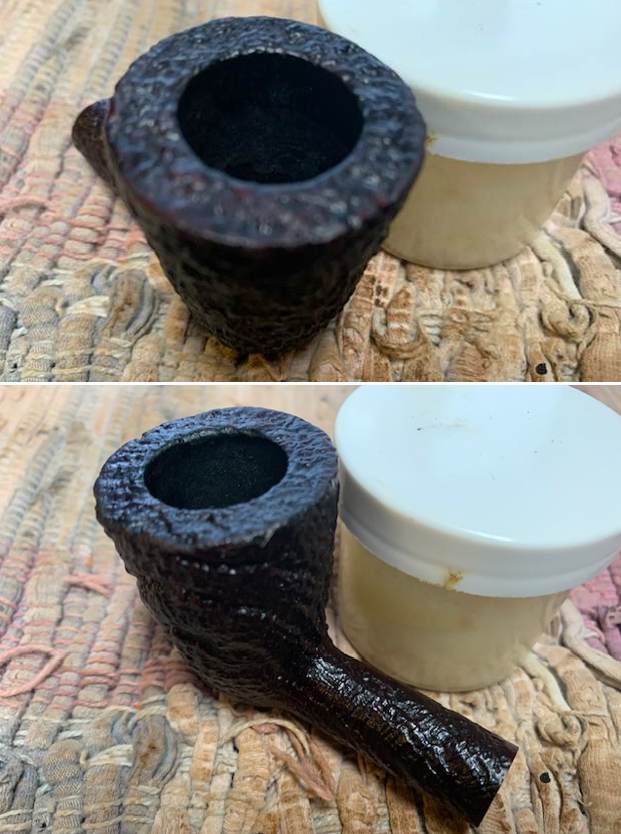
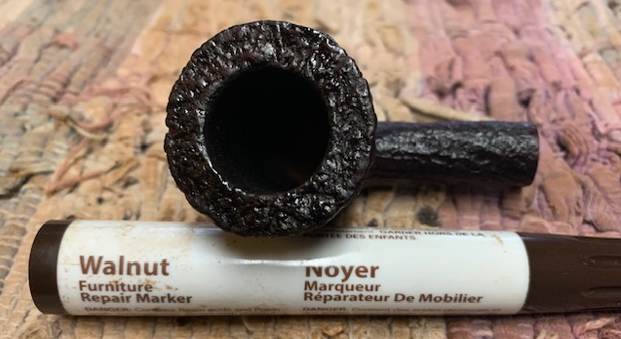
Next on the chopping block is a bent billiard sandblast Smokewel (one “L”), which I acquired in a lot of pipes from a gentleman living on Vancouver Island. He had quite an assortment of pipes and they ranged from utterly horrible to surprisingly beautiful – fortunately, this was of the beautiful variety. The pipe is very well made: the proportions are right, the drilling is accurate, and it just oozes competence. This is a sandblasted bent billiard, with a tapered, vulcanite stem. And what a wonderful, rugged blast on this one! On the underside of the shank, the markings read ‘Smokewel [over] London Made’, and, off to the right, the shape number ’26’. This pipe had been well-loved and well-smoked, as it arrived with some marks and general wear, and the stem was pretty nasty. There were also beautiful indications of “hand erosion” on the right-hand side, where the previous owner’s hand had lovingly rubbed the pipe over the years. There were also a couple of tiny nicks, but, fortunately, nothing overly complicated.

Identifying exactly what a “Smokewel” pipe is turned out to be a typical pipe-history morass. There are a few twists and turns in this story, so join me in wading through this mess. As you’ve seen in the photos, the pipe clearly says “Smokewel” – not “Smokewell”. I initially thought that perhaps the terminal “L” had been rubbed off, but, looking closely, one can see that “Smokewel” is perfectly centred over “London Made”, which suggests this odd spelling was not the victim of rubbing. In other words, there is no missing “L”.

There is scant information to be had on both “Smokewel” and “Smokewell” – and none of it could be linked definitively to this pipe. There is this entry on Pipephil for “Smokewell”:As you can see, it is a line of pipes from the John Redman firm of London. There are some examples of these pipes that can be found online, and I have included a photo of the markings of Redman’s “Smokewell” line: This might be significant because I have studied the letters of the markings from my pipe and Redman’s pipe, and they are the same. In addition, a John Redman catalog (supposedly) from the 1960s, lists “Smokewell” as one of their “London Made Briars” (note the wording). I have clipped the specific passage here:All of this is persuasive evidence, but not definitive. The missing “L” on my pipe causes me to pause, if only briefly, before declaring it to be a John Redman pipe. Also, the various iterations of Redman pipe usually had markings on the stem – this one has none and I don’t think it’s a replacement stem. I am aware that Wilczak and Colwell’s Who Made That Pipe? lists “Smokewell” under John Redman – but there is more.

Wilczak and Colwell also list “Smokewell” under a company called Maurice Pipes. The second “L” here could be an error from Wilczak and Colwell – the book is full of them. I also found an old advertisement for Maurice Pipes. Based in London, this firm supposedly produced very fine pipes. Superficially, this ad seems to have nothing to do with our pipe, except that it instructs the reader to use the word “Smokewel” (one “L”) in telegram and cable correspondence with the firm. The word obviously had significance to Maurice Pipes.On the PipesMagazine forums online, I read a thread about early sandblasts and one comment stuck out to me: “The mysterious Maurice was listing blast pipes in the 20’s and as a pipe company they are totally in the dusty shadows, but I’d reckon they were a fine maker, mostly because of their prices – they sold their Sandblast alongside their topline Extra for the very same price, at 16/6 and that’s a fairly high price comparatively.”

The connection between Maurice Pipes and “Smokewel” is tenuous at best, but it was my only connection to the single-L “Smokewell”. If you have information about any of the research above, I would love to hear from you. The stinger is a bit odd – does it ring any bells for you?

And speaking of the stinger, let’s clean it. I heated the stem and stinger with my heat gun and this provided just enough softening of the internal goo to allow me to pull it out. It then went for a soak in some lemon-infused isopropyl alcohol. I let it sit for several hours and then cleaned it off and it looked much improved.I wiped the outside of the stem down with Murphy’s Oil Soap on some cotton pads. Though dirty, the outside of the stem was in decent condition and the oxidation wasn’t too bad. On the other hand, the inside was another kettle of fish! I used up a good chunk of the world’s supply of pipe cleaners to clean it out – the pictures only show a fraction of what I used. Next, the stem went for an overnight soak in the Pipe Stem Oxidation Remover. The following day, I cleaned all of the de-oxidizing mess off. The oxidation had migrated to the surface and would be fairly straightforward to remove. I scrubbed with SoftScrub on some cotton pads to remove the leftover oxidation and leave the stem in a dull black colour. Finally, I used all nine Micromesh pads (1,500 through 12,000 grit) to bring out the lovely black lustre on the stem. I also used Obsidian Pipe Stem Oil in between each pad scrubbing. Now for the stummel. It was nicked on the front edge of the rim, and the rim itself had lava and general filth, so, time to work on it! I started with the KleenReem to remove the built-up cake and followed that with 220-grit sandpaper taped to a dowel to eliminate as much as I could. I took the chamber down to bare briar, as I wanted to ensure there were no hidden flaws in the wall. Fortunately, there were none. I then proceeded to clean out the insides of the shank with Q-tips, pipe cleaners, and lemon-infused isopropyl alcohol. There was an extraordinary amount of filth inside this stummel and it took an enormous amount of cotton to get it clean. I only have a photo of a small number of pipe cleaners. I can’t imagine that this pipe had ever been cleaned – or, at least, not in many decades. Because the filth in the shank was well-encrusted, I used a couple of drill bits held in a chuck, by hand (not in a drill), to try and loosen up the debris. This worked quite well. I decided to de-ghost the pipe to remove any lingering smells of the past. I thrust cotton balls into the bowl and the shank and saturated them with 99% isopropyl alcohol. I let the stummel sit overnight. This caused oils, tars and smells to leach out into the cotton.In fact, the pipe was dirty enough that I then used my pipe retort system on it. I neglected to take photos of that, but it certainly helped clean the pipe. I followed that up by cleaning the insides with some dish soap and tube brushes. I used some Murphy’s Oil Soap and a toothbrush to scrub the outside of the stummel and the lava on the rim of the pipe. I didn’t scrub too hard – I wanted to keep the nice colour on the wood. Having completed that, I was able to address the small nicks on the rim and the bowl. I used some tiny drops of cyanoacrylate adhesive to fill the nicks, and a metal brush to camouflage the repairs in the wood. Finally, I used only the last three MicroMesh pads to polish the stummel, but I was careful not to damage the sandblast. After that, a light application of Before & After Restoration Balm brought out the best in the stummel’s grain. Then off to the buffer! A tiny dose of White Diamond and a few coats of conservator’s wax were just what this pipe needed. This Smokewel looks fantastic again. It is elegant and handsome, and is ready to be enjoyed by the next owner. I am pleased to announce that this pipe is for sale! If you are interested in acquiring it for your collection, please have a look in the British pipe section of the store here on Steve’s website. You can also email me directly at kenneth@knightsofthepipe.com. The approximate dimensions of the pipe are as follows: length 5¼ in. (133 mm); height 2¾ in. (70 mm); bowl diameter 1¼ in. (32 mm); chamber diameter ¾ in. (19 mm). The weight of the pipe is 1⅛ oz. (35 g). I hope you enjoyed reading the story of this pipe’s restoration as much as I did restoring it. If you are interested in more of my work, please follow me here on Steve’s website or send me an email. Thank you very much for reading and, as always, I welcome and encourage your comments.
Cleaning up a GBD Fantasy 9643 Tomato


Blog by Mike Belarde

Hello, I hope everyone is doing well. I’m grateful to finally have an easy going Sunday to clean up a pipe. This GBD Tomato is not a shape that I have encountered often, and I was excited to win the online auction.

The pipe is an impressive piece of briar with a very wide and squat bowl. When I received it, I was pleased that it was in fairly good condition.  The stummel had been cleaned and waxed, but the pipe still looked a little grimy and dull.  The chamber and rim had a light build up of carbon. Thankfully, the stem still had a nice crisp button and was only lightly oxidized.  Below are photos of the initial condition.As you can see from the photos, it is a great looking pipe.  I really like GBD’s Fantasy and Tapestry lines with their whimsical geometric smooth panels over a black or brown sandblast.  The stamping on this pipe is still crisp.  The markings include the Colossus stamp, and the linear London England stamp.  Below these, are the GBD in an oval over the Fantasy stamp with the shape number of 9643.
The Colossus stamp indicates that this was part of GBD’s line of supersized pipes. The linear London England stamp, paired with the brass GBD rondel, dates this pipe prior to 1981 or 1982.  My guess is this pipe was made sometime in the 1970s.Eager to clean the pipe up and add it to my collection, I placed the stem in a small Tupperware to soak overnight in Briarville’s Pipe Stem Oxidation Remover solution. I then set to cleaning up the stummel. Realizing all my pipe reamers were too small for the width of the chamber, I wrapped a piece of 220 grit sandpaper around a highlighter to remove the built-up carbon.After this was done, I took the stummel to the sink and washed the exterior with Oil soap and an old toothbrush.  A light lava build up was present on the rim so I used an old green scouring pad to scrub it away. With the chamber and the exterior clean, the Tomato was looking really nice. The chamber seemed to be in good condition once the light cake had been removed.Thankfully the internals of this pipe were fairly clean and required minimal work on my part. I have to admit that cleaning the draught is my least favorite part of restoring estate pipes! I first used a 3mm wire brush to gently clean out the shank. Once done, I cleaned the internals with a handful of pipe cleaners dipped in 99% Isopropyl alcohol.After the interior of the pipe was cleaned to a satisfactory level, I prepared the pipe for de-ghosting. I put two fluffy pipe cleaners down the shank to act as a wick and then placed two cotton balls in the chamber. I soaked each cotton ball with alcohol, as I placed them one at a time in the chamber. To let the alcohol, work its magic and draw out more of the old tar and grime, I let it sit overnight. The next day I took the stem out of the Briarville solution and scrubbed the surface with a green scouring pad and some Soft Scrub.  The stem looked great, but I ran into a problem – for some reason the brass rondel came off. I’m not really sure what went wrong, but it would have to be fixed. I reattached the rondel by applying a small amount of Super Glue and used a soldering iron to apply heat. Hopeful that the heat would soften the vulcanite under the rondel and allow it to reattach as the vulcanite cooled. The process seemed to work, but I’m going to keep an eye on the rondel for possible problems down the road.
With that done, I sanded the stem with some 220 grit sandpaper and polished it with the series of micropads (1500-12000). Between each pad I wiped the stem down with stem oil. In the final step, I applied some Before and After Extra Fine Stem polish. I think the results turned out pretty well and am happy with how the stem looked. I may go back and rework some of the area around the rondel, but I am leery of disturbing the area too much and dislodging it again.Satisfied with the progress on the stem, I turned my attention to the stummel. I polished the rim and smooth panels with the progression of micromesh pads (1500-12000), wiping the areas with a damp paper towel after each pad. I lightly polished the sandblast areas with the 6000-12000 pads to avoid removing any of the original black stain. After I cleaned the stummel, I noticed a few areas that needed to be re-stained. You’ll notice the areas where the brown stain was showing through on the sandblast in the pictures below. I also noticed the transition between the shank and stem was darkened like it had been stained over with black dye. On other Fantasy pipes that I own, this transition is usually stained brown giving the pipes a nice highlight on the shank. I lightly sanded the rim with a piece of 220 grit sandpaper to remove some lingering darkening. I also lightly sanded the smooth panels and shank transition to remove some of the dark stain there. After this was done, I mixed a 1-to-3 ratio of Medium Brown and Black dyes with alcohol to thin them down. I like to apply the stain with a small hobby brush as I find the brush helps me to coat the stummel evenly. Once the stain was applied, I used a candle to fire the briar and set the dye. I let the stummel sit for 10 or 15 minutes and then removed some of the excess stain with a folded paper towel dampened with alcohol.I began to polish the stummel with the micromesh pad series (1500-12000), wiping the briar down with a damp paper towel between each pad. Once finished with the micro pads, I worked some Before and After Restoration Balm into the stummel, let it sit for about 10 minutes, and then buffed it with a cotton cloth. At this point I was very pleased with the results – the pipe looked great! For the last step, I buffed both the stummel and stem with Red Tripoli and Blue Diamond. I gave both several coats of Carnauba wax and buffed them with a cotton cloth.

I’m really happy how this pipe turned out! It is a great shape and the size of the bowl just dominates one’s palm.  The overall length of the pipe is 5.25”, with the outside diameter of the bowl coming in at 2.13”. The chamber itself is a generous 1”, while the entire bowl stands at a modest 1.13”. The pipe weighs a noticeable 2.20oz, and its haft and size just feel nice in one’s hand.   It should be a nice smoking pipe, and I’m happy that I can add it to my collection. Thank you for taking the time to read this blog!