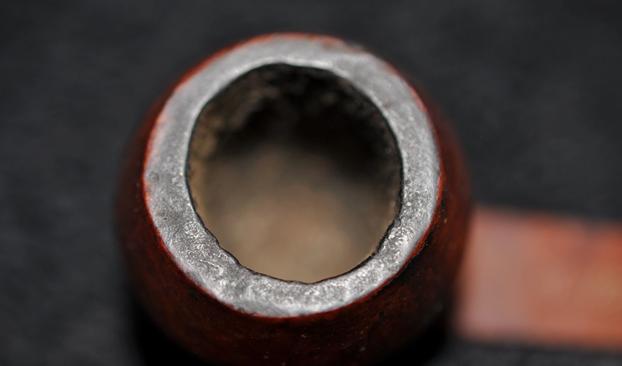
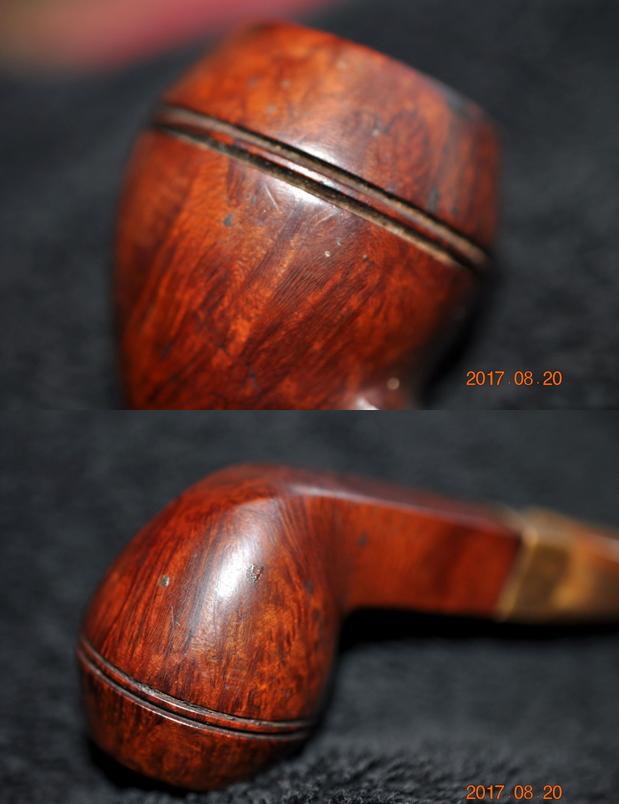
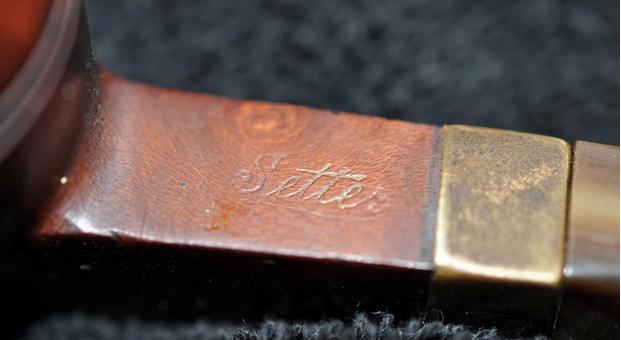
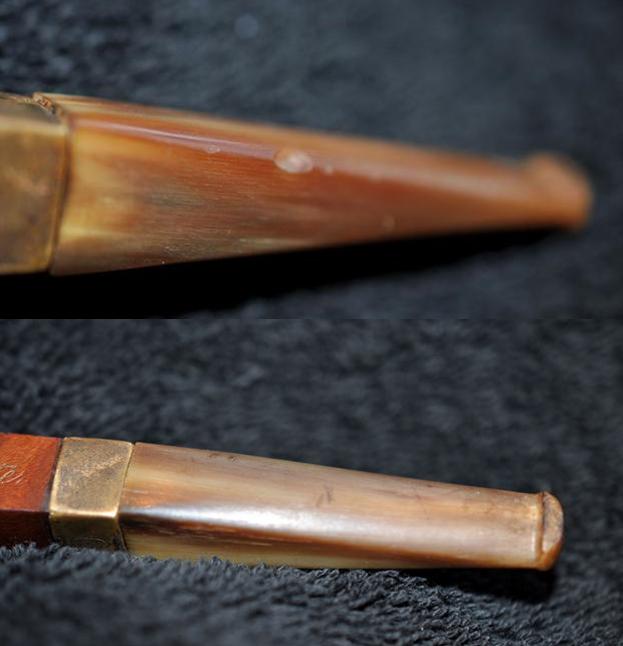
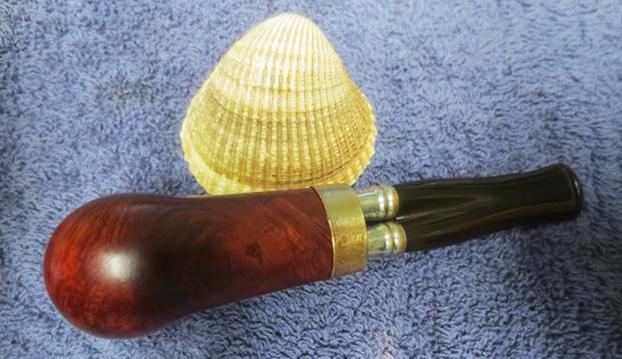
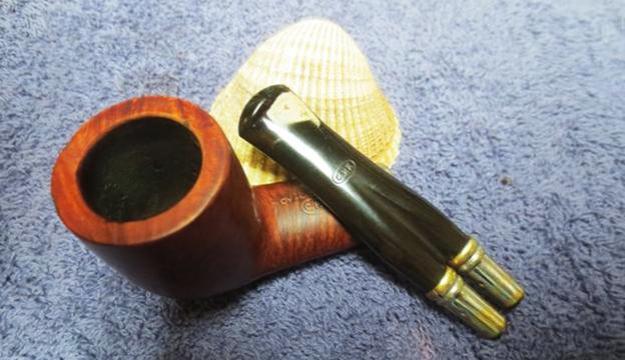
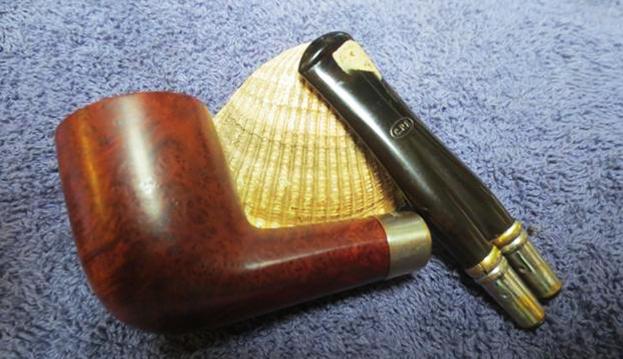
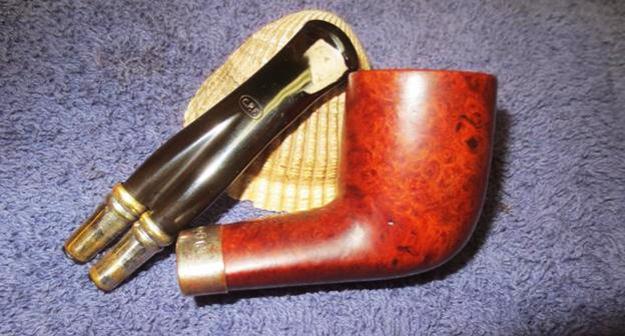
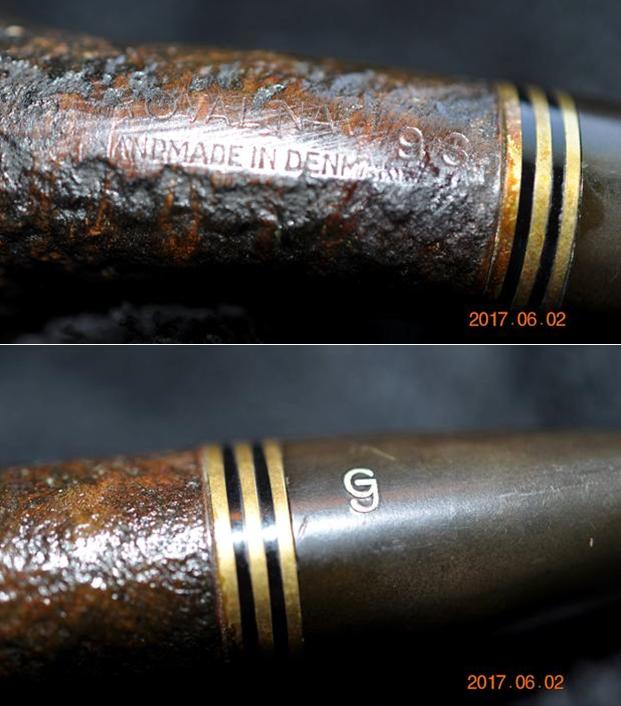
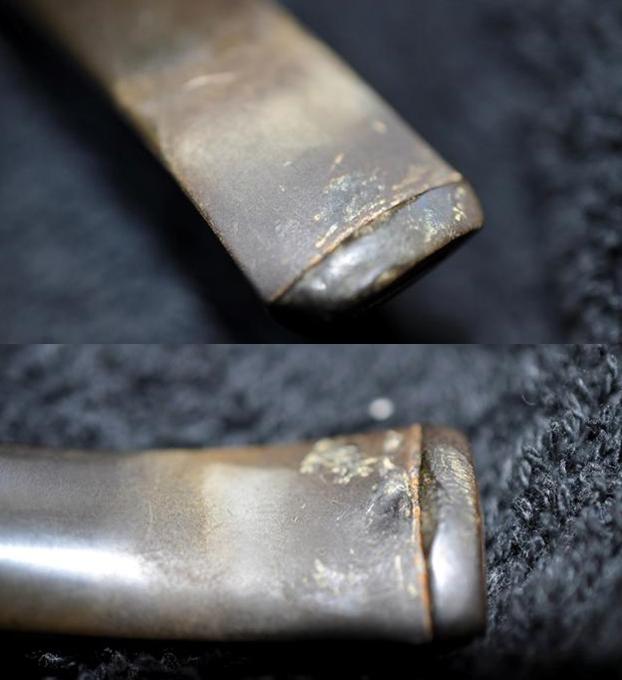
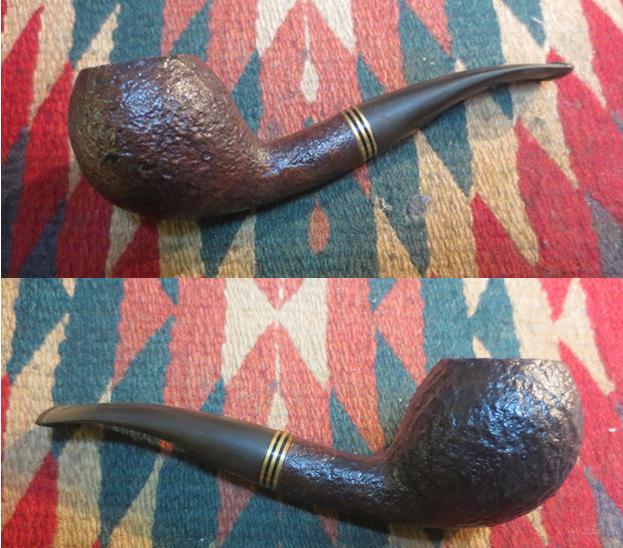
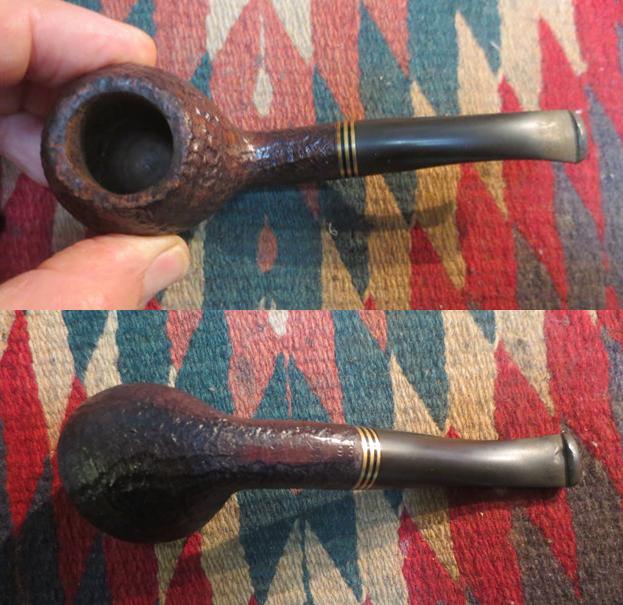
Author Archives: rebornpipes

An Italian Croc Skin Zulu and a Bear of a Meer Lining Repair


Blog by Dal Stanton

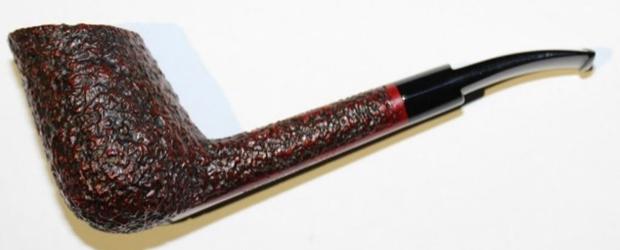
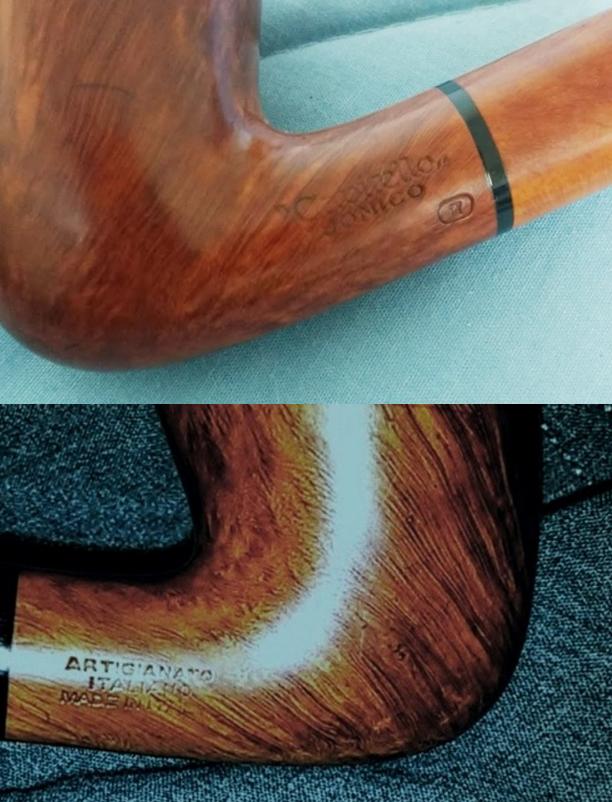
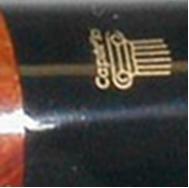
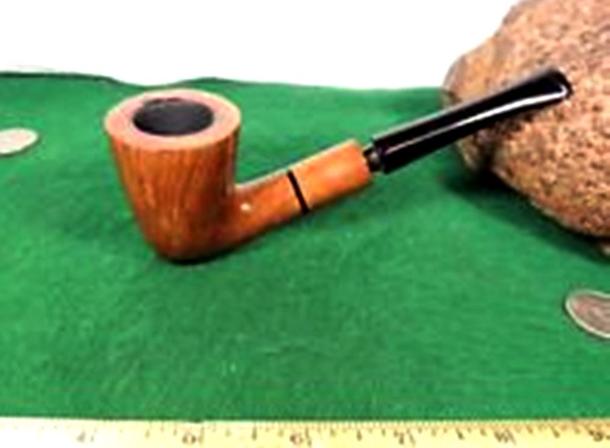
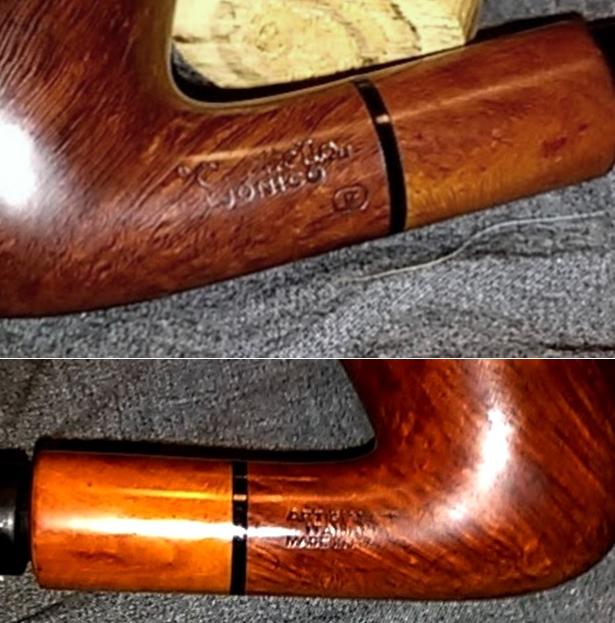
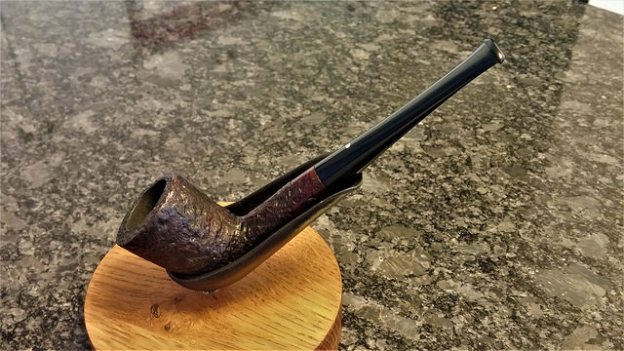
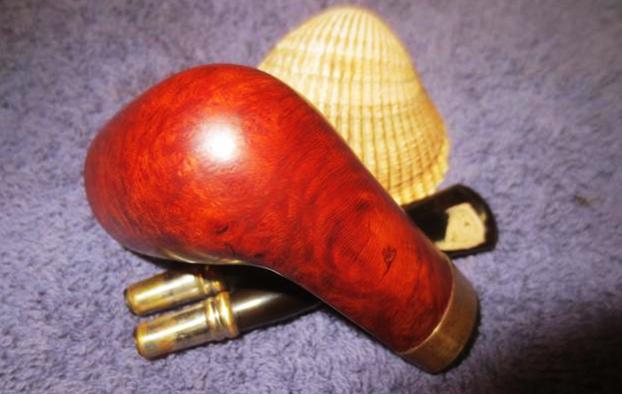
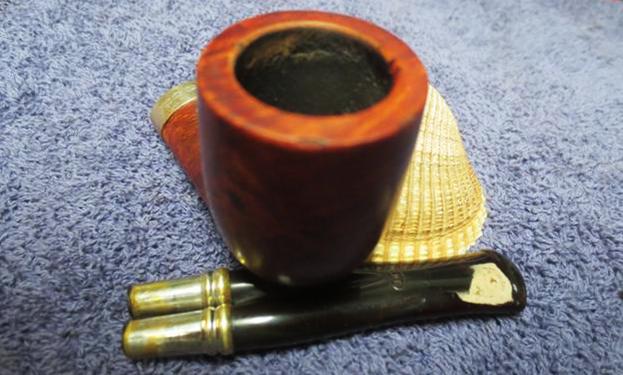
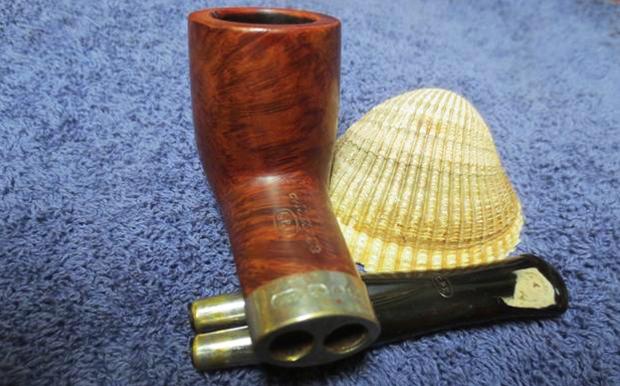
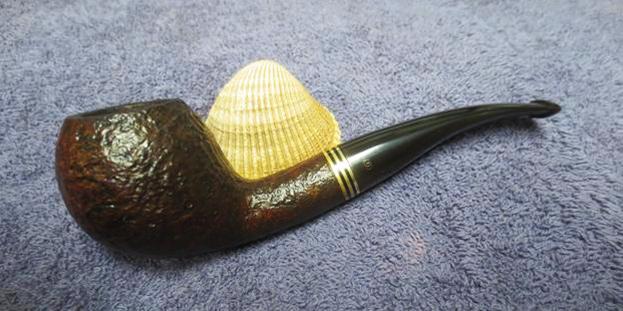
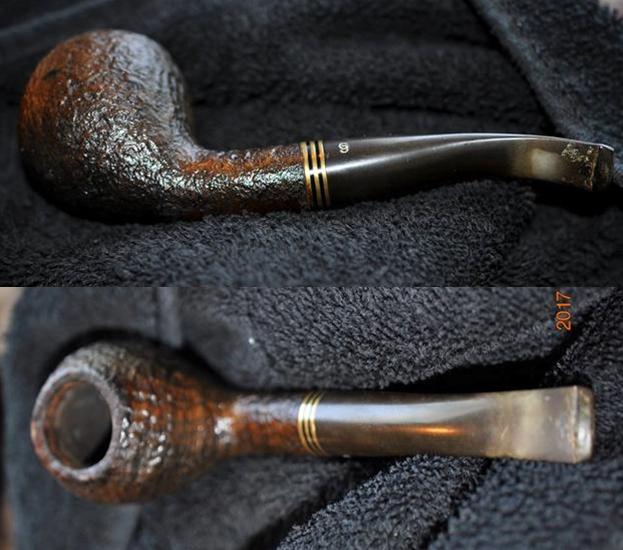
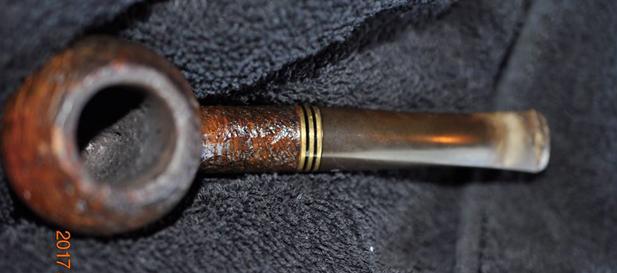
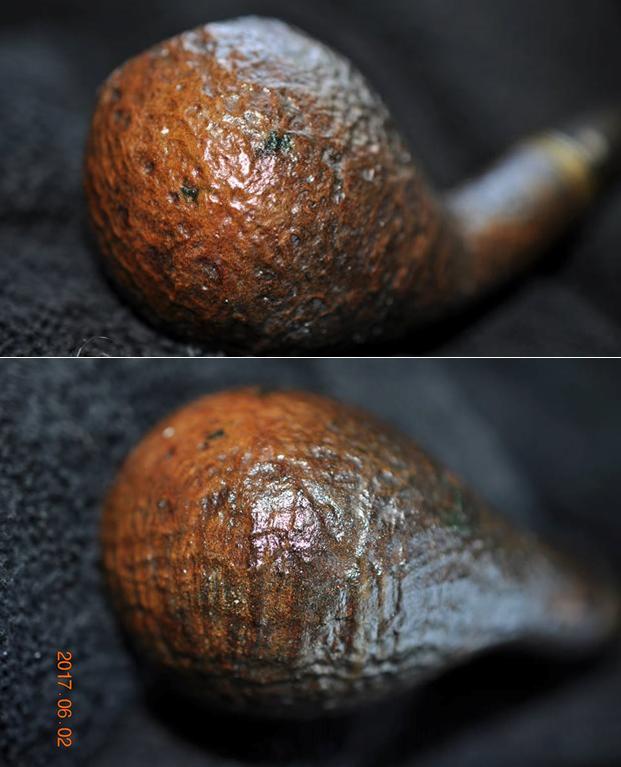
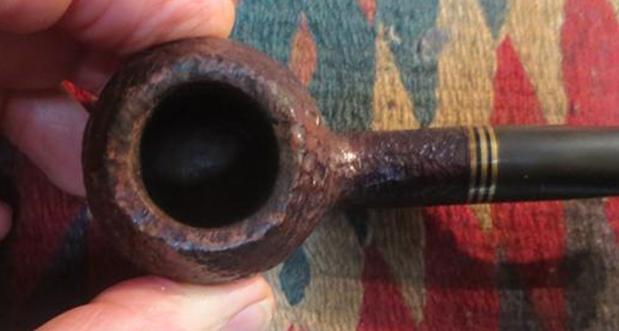
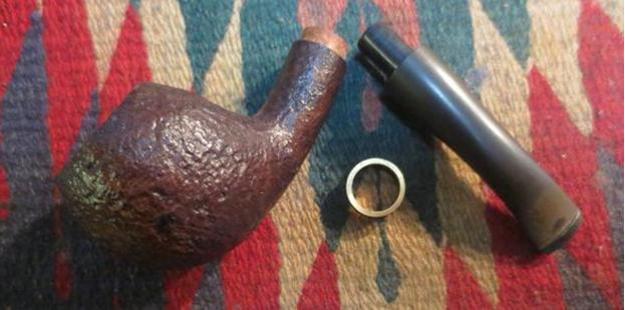
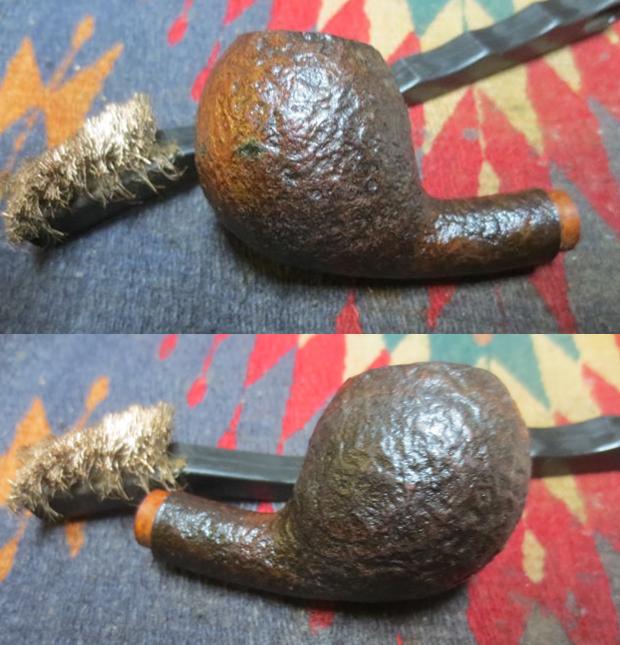
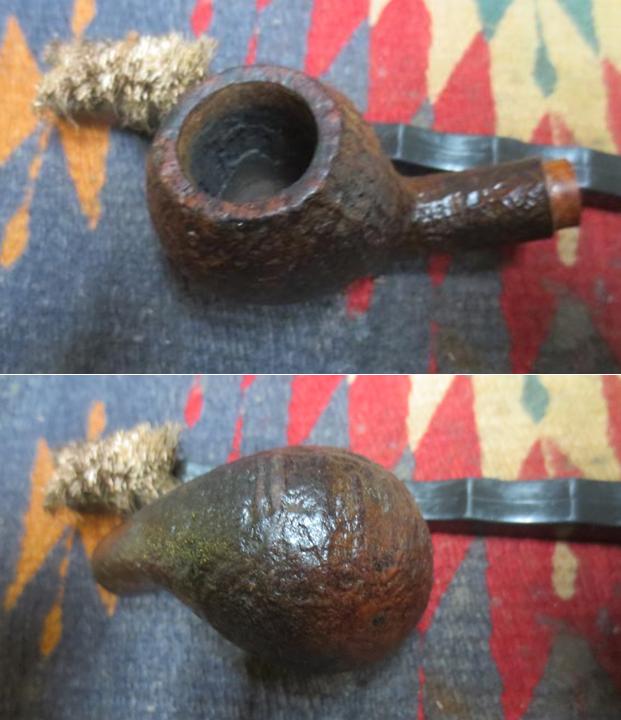
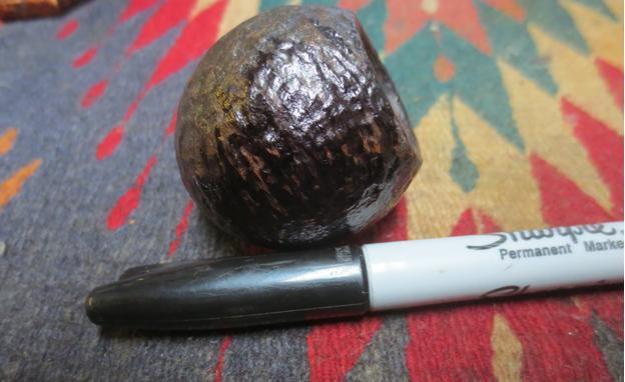
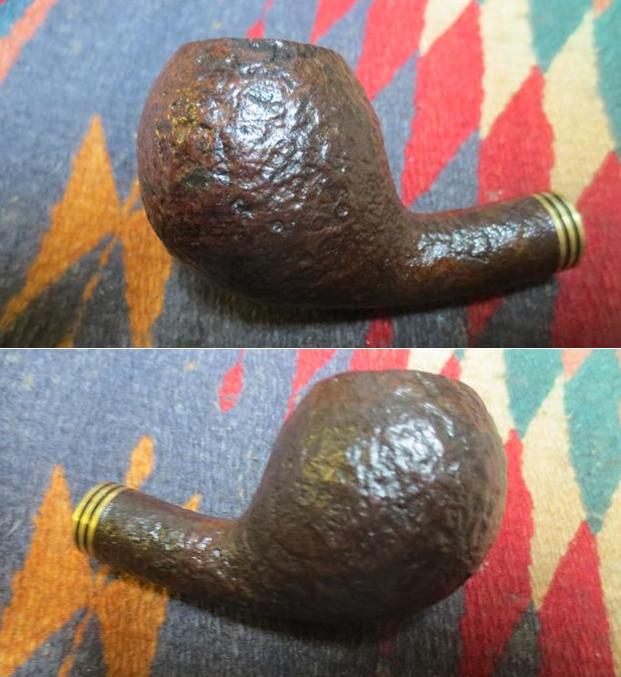
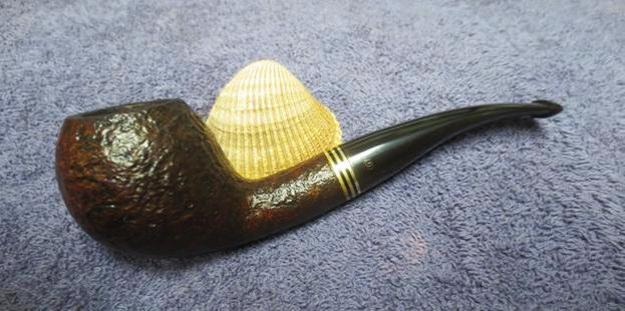
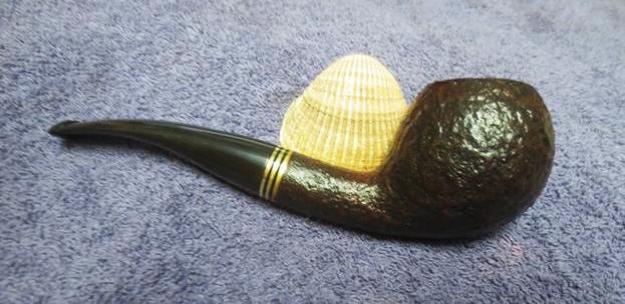
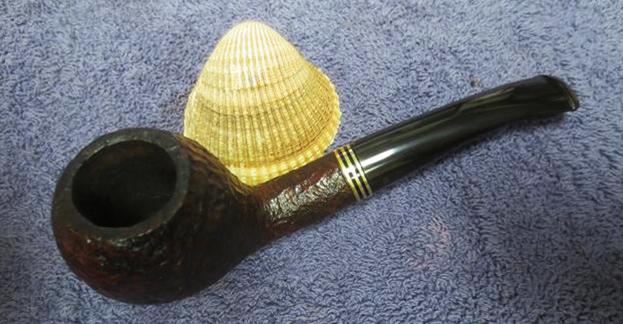
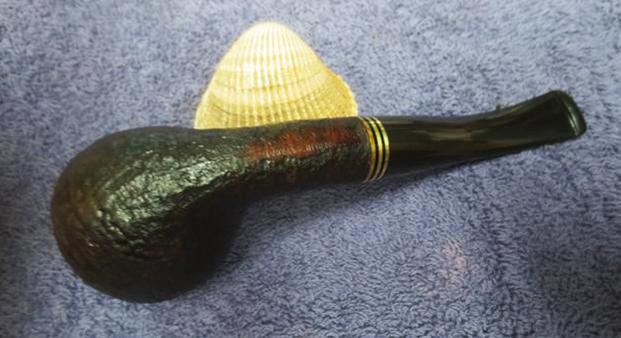
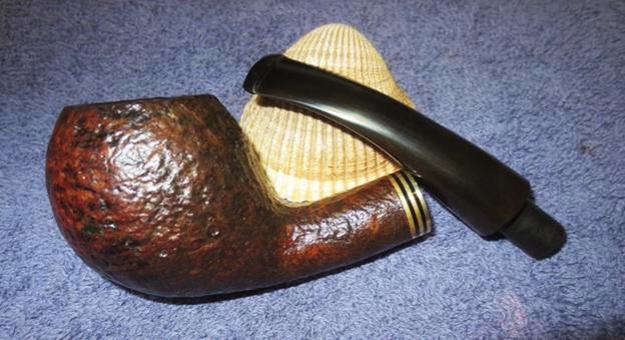
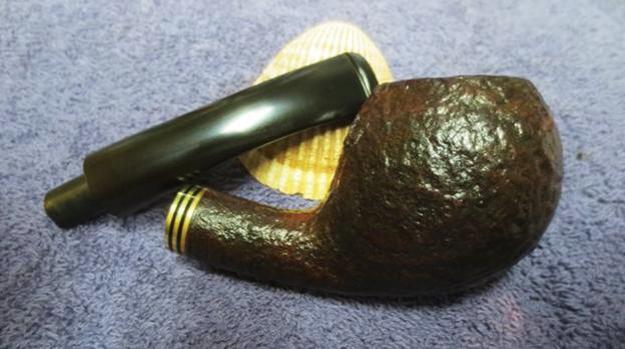
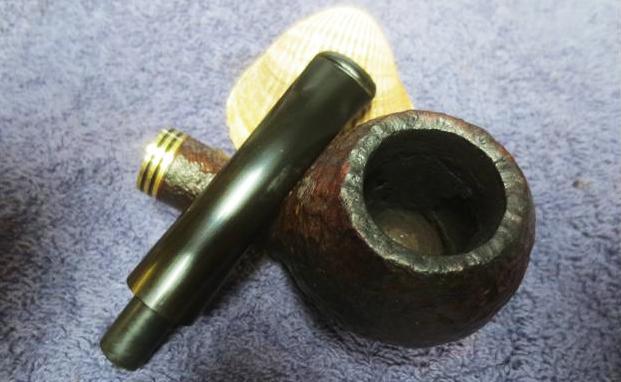
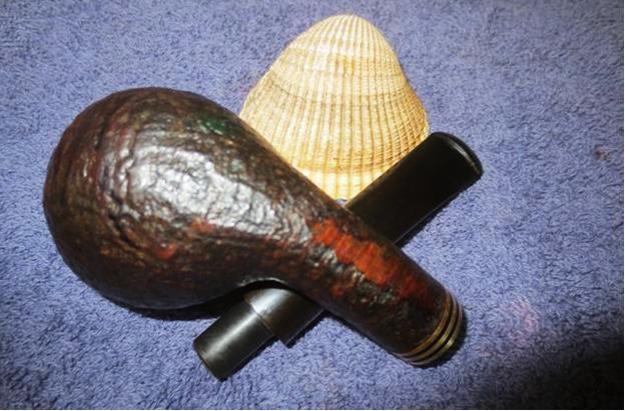
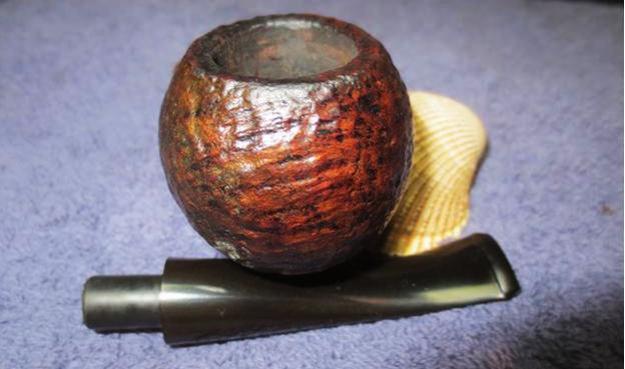
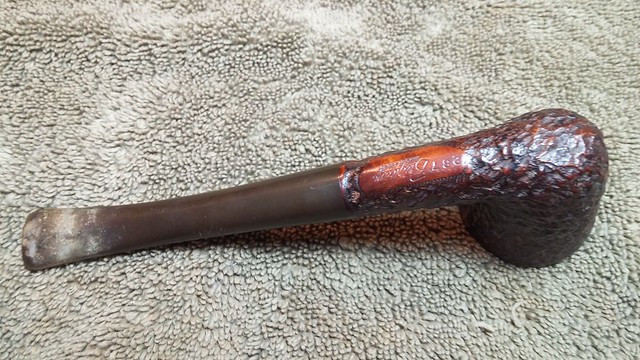
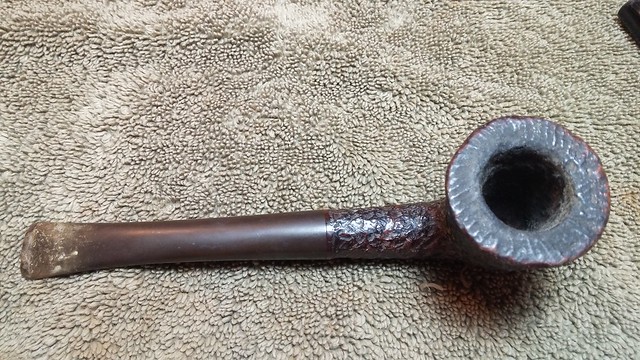
This Zulu caught my eye along with a striking, Comoy’s Royal Falcon bent Bulldog on the UK eBay auction block.  I have always been attracted to the canted stummels of both Dublin and Zulu shapes.  They strike me as pipes with a bit of attitude!  The second thing that caught my attention was the exquisite, tight crocodile skin-like texture of the rustification.  When I first took the Zulu out of the ‘Help Me!’ basket, I wasn’t quite sure how to best describe the pattern. Initially, I was thinking maybe, pine cone – mainly because of the tight, uniform design.  I showed it to my wife for her first impressions.  Without hesitation she said that it was iguana or crocodile skin…  I chose the croc description because it seems to go better with the Zulu motif!  Of course, the final selling point was the Meer lining.  That is always cool not only because of the aesthetics but also because of the special attributes of Meerschaum.  The seller provided some helpful information on both pipes.  After sealing the eBay deal in pounds, it did not take long for the Zulu and Bulldog to arrive in my box here in Sofia, Bulgaria.  I restored the Royal Falcon already and if you’re interested, you can take a look at it HERE.  Here are pictures I took on my worktable of the Zulu.  The Zulu is clearly marked on the bottom of the shank, on the left side Ariston [over] Rustic, and to the right, Veritable [over] Ecume, a French reference which means, “Real Foam”, referencing the Meerschaum lining.  “Meerschaum” means, ‘sea foam’ in German.  The other identifying mark is a gold rondel with a tilted ‘R’ ensconced in it. When I went to all my usual places to identify the origins of this Ariston Rustic, what I found was not a lot, and what I did find did not seem to line up.  My first stop was Wilczak & Colwell (3/3/97) ‘Who Made That Pipe?’ listed ‘Ariston L’ as coming from the Lane Tobacco Co. Importer 1942 – ENG/USA.  However, subsequent searches for Lane Tobacco Co., didn’t turn up anything.  The seller on eBay provided information saying that the Zulu was made by “Empire State” and referenced this link to Pipephil.eu (See: LINK).  The gold stem rondel with the tilted ‘R’ was the common connector.  I had wondered before why an ‘R’ on the stem with a name, ‘Ariston’?  But this link pointed to ‘Regis’ bearing the same logo – probably the source of the ‘R’.  ‘Empire State’ below also states an Italian connection.Going to the ‘Regis’ link in Pipephil brings you to the listing below with the connecting stem rondel.  A seller of another Regis on eBay gave more information which is helpful, but I’ve not been able to substantiate it.

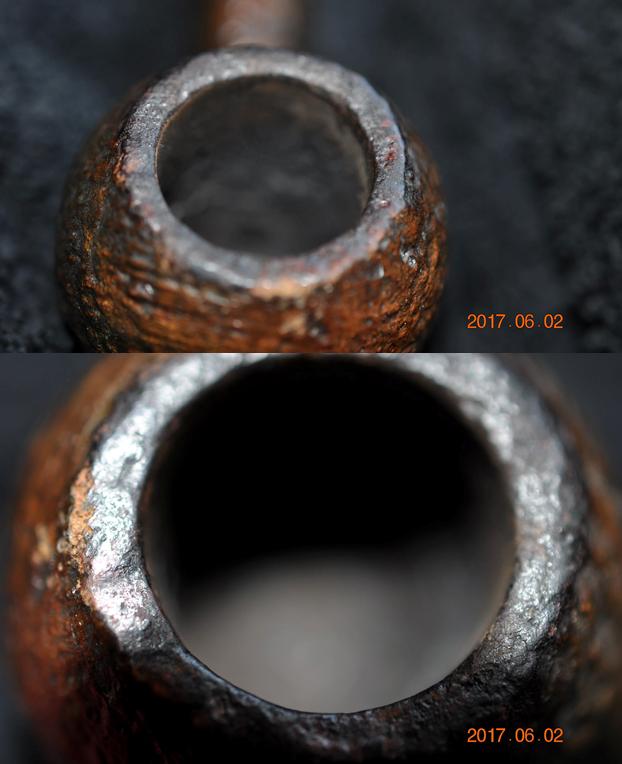
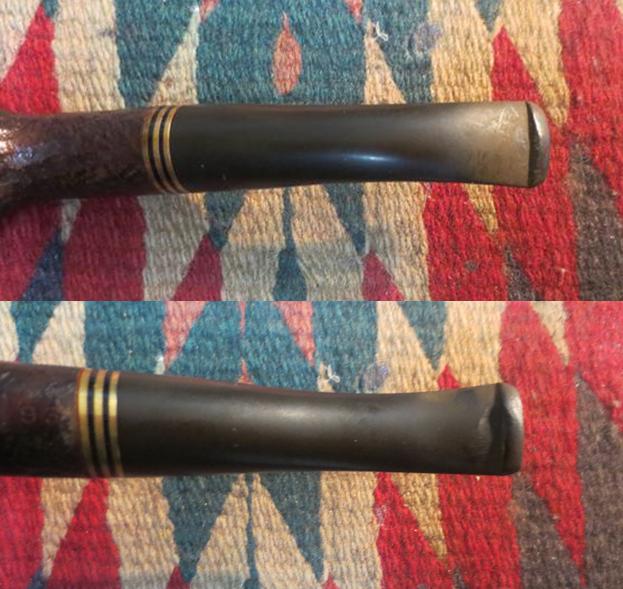
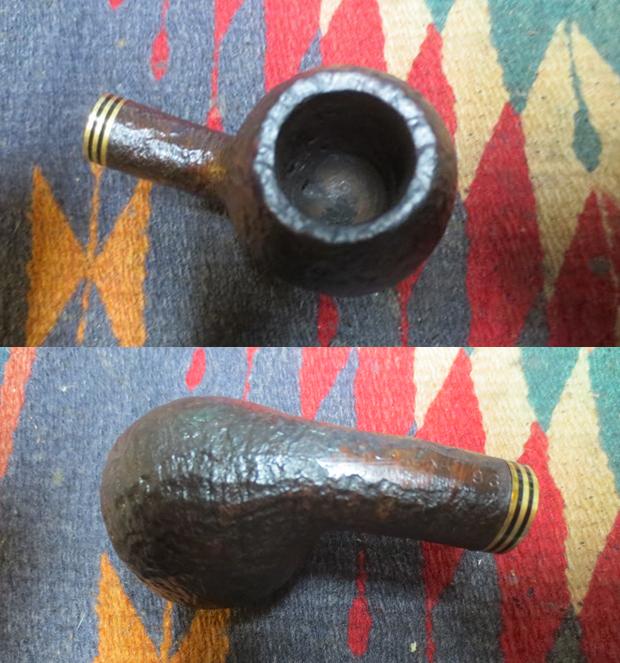
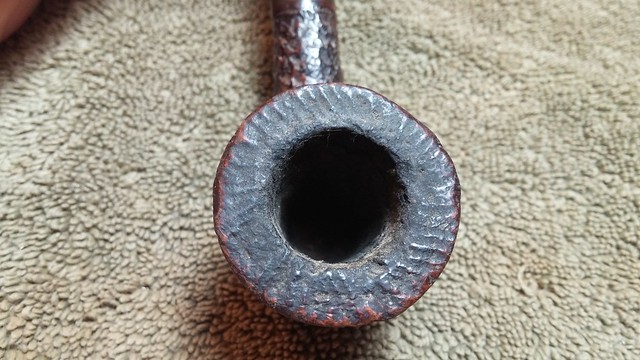
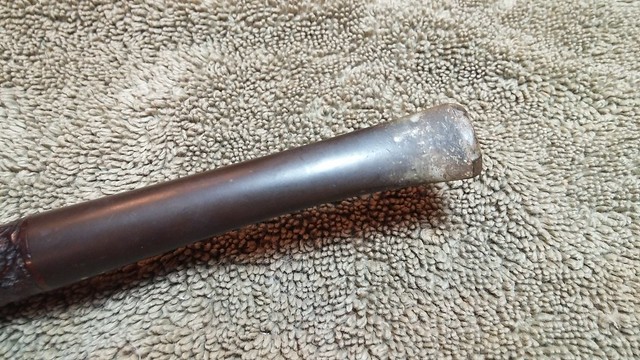
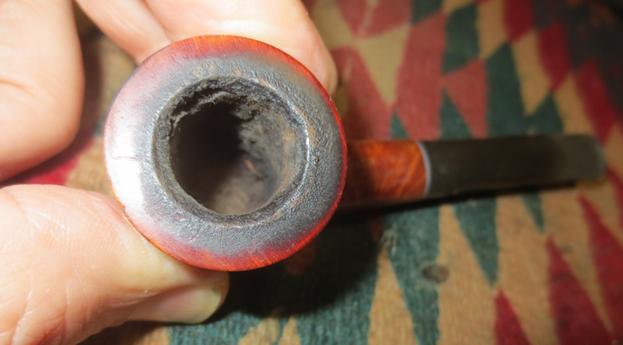
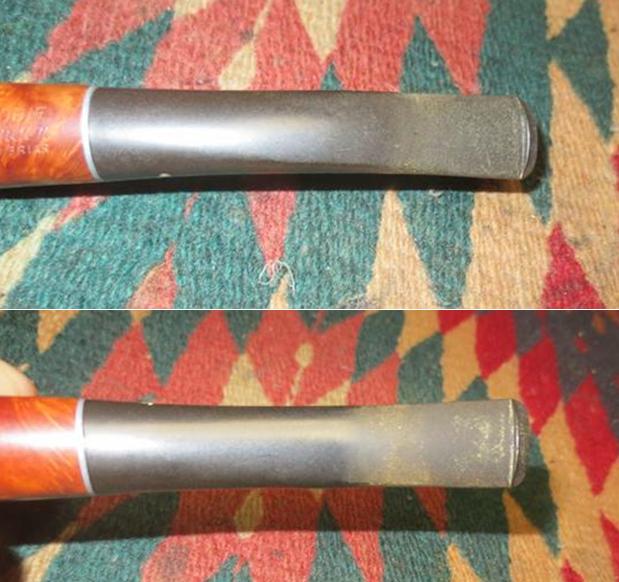
Aristons were originally made in Italy under the trade name “Empire State” (go figure) for a niche market in France that catered to dignitaries in the French Government, somewhat like Bertram pipes were for the US Government dignitaries.  Who knows – this pipe might have been smoked by French President Charles DeGaulle !  Well, maybe….As I look at the Italian, perhaps, Regis Ariston Rustic Zulu with a critical eye to the issues it has, the rusticated surface appears to be in good condition.  It needs to be cleaned.  The Meerschaum lining has carbon cake buildup and the rim shows lava flow which has formed a caked layer on the top of the Meer lining and has flowed over the rim briar. I will not know the condition of the Meer until I carefully remove the cake in the chamber.  Meerschaum, a stone, needs no cake to protect it like briar pipes.  When carbon cake forms on a Meerschaum surface, it can crack and damage the Meer as the carbon heats up and expands and contracts.  The stem has little oxidation as I can see.  The larger issue is the bit.  The former steward of this Zulu was a clincher and there are significant bites on the top of the bit and the lower lip of the button is compressed and the bit suffers from a hole. That was probably when the Zulu was retired. The bit needs some TLC.

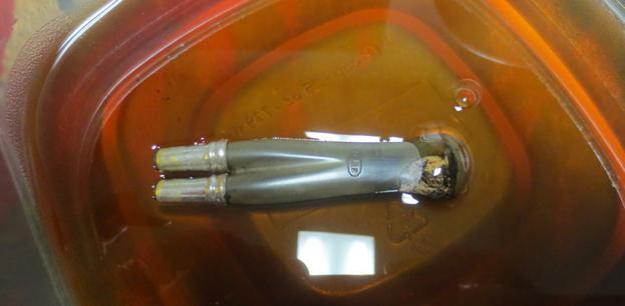
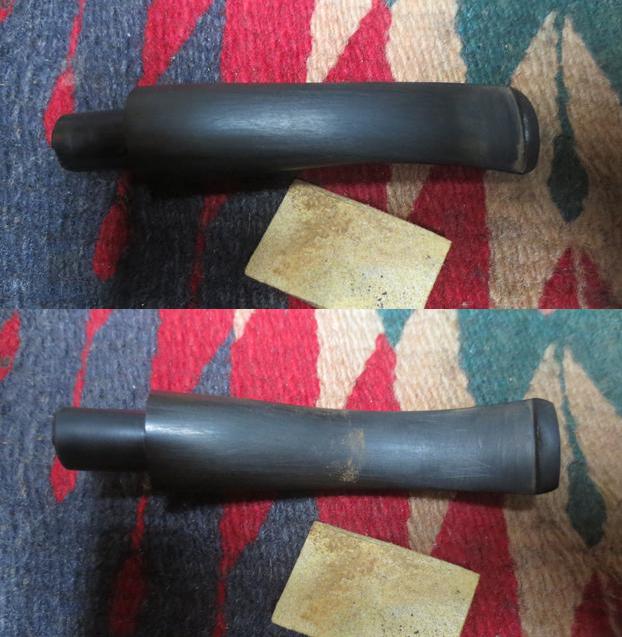
Beginning the restoration, I will deal with oxidation in the stem.  I decided to use the Before and After Hard Rubber Oxidizer that Steve ran through the paces several months ago to test the product put out at www.iberen.com.  Steve published his findings on Rebornpipes (A Review – Before & After Pipe Stem Deoxidizer and Fine and Extra Fine Polishes) which is very helpful.  So, I picked up some of the Before & After product while I was in the US and decided to try it.  As Steve discovered in his review, its important to read the directions 😊!  I did, and Steve’s input was beneficial.  One of the things I learned was that the Deoxidizer isn’t aggressive toward stem stampings and marks – that is a big plus.  The other, which is impacting how I restore pipes, is that the solution is geared to deoxidize several stems in one soaking.  My usual practice is one pipe at a time – I’m not thinking too far ahead what’s next or working on more than one pipe at a time.  So, with that in mind, I decide to move forward with a project restoring several L. J. Peretti pipes I purchased in a Lot from a seller near Boston – this Lot contained several Oom Paul’s which will be sold to benefit the Daughters of Bulgaria, helping women, girls (and their children) who have been trafficked and sexually exploited.  So, I fish those pipes out of the ‘Help Me!’ basket and clean the internals of each Oom Paul stem with pipe cleaners and a long bristle brush dipped in Isopropyl alcohol 95% before putting them into the Before & After Deoxidizer. I pour the Before & After Deoxidizer in a plastic container that can be sealed up and airtight.  The liquid reminds me of slime products out there for people’s morbid entertainment!  It has an odor too, that’s not too pleasant.I lay out the full Lot of L. J. Peretti boys that are destined for the worktable eventually!  I’m choosing the 4 Oom Paul’s to serve as both an experiment to test the new deoxidizer product which is more beneficial to soak several stems at once and to give me a jump start for the next restoration projects!  I pull 4 of the Perretti Oom Paul stems and clean the internals. Then I take a picture to show the ‘before’ condition.  Along with the Ariston Zulu’s stem, which has minor oxidation, 2 of the 4 Perretti stems, I would say also have minor oxidation.  The other 2, one stamped with the Peretti “P”, are heavily oxidized. I slip the stems into the slime goo, careful not to mix the order of the stems so they make it back to the correct Oom Pauls! Pictues of the Peretti Lot and the deoxidation in process: The instructions indicate that even for the most oxidized stems, the process takes less time than with my usual OxiClean bath, but I leave them in the solution overnight because its late and I need some sleep! The next morning, I take one stem at a time, hooking it with a tooth pick and allowing the goo to run off the stem as much as possible to save the product.  I finally found Bulgaria’s version of mineral oil to use to clean off the goo – staying away from water.  A pharmacist friend here looked it up and she provided me with a bottle of Paraffin Light Liquid – used in Bulgaria for ingestion for certain lower abdominal blockages 😊.   With a cotton pad I use paraffin oil to remove the deoxidizer.  With each stem I follow the same procedure by scrubbing off the oxidized layer with the cotton pad to then buffing with the cotton pad.  Then with each, I apply Before & After Polish, first Fine and Extra Fine, by putting a dab on my finger and working the polish in, which has a gritty oily feel (Fine) and then smoother (Extra Fine).  With each application I work it in then, with cotton pad, I wipe the polish off but buffing at the same time. I have to say, I’m impressed.  The more oxidized of the Peretti stems came out looking good, apart from one oxidation shadow in the first stem to the left.  But overall, the vulcanite appears darker, blacker, rejuvenated.  I take the ‘after’ pictures and I think this product is working as advertised. Back to the Ariston Rustic Zulu, here are shots of the stem after the Deoxidizer and then after each Before & After polish regimen.  From above’s ‘P’ Peretti marked stem and the ‘R’ gold rondel mark in the Zulu, it also appears that the B&A Deoxidizer is not harmful as reported and acted to polish and bring out the stamps.I put stems aside for the time and turn to the croc skin rustification, rim and the Meerschaum lined chamber and take a closer look.  Two-thirds of the rim is hidden by a thick lava flow, but the forward third, shows the briar rim.  I like the lighter smooth briar that provides the border between the Meer and the external surface.  When cleaned up, that will look good.  Before working on the Meerschaum chamber, I want to clean the rim and get a better look at the condition of the Meerschaum’s topside.  While I’m doing this, I will clean the Zulu’s surface.  First, using undiluted Murphy’s Oil Soap, I use cotton pads and a bristled tooth brush to do the scrubbing in the nooks and crannies.  I also lightly utilize a brass brush to work on the rim. I then rinse the Murphy’s with cool tap water, careful to keep water out of the internals.  The croc skin stummel’s surface is in good shape dirt-wise.  I see nice attractive, minute reddish flecks on the peaks of the black rustification which brings out some contrast to the croc texture. The cleaning did not make a dent on the hard, caked lava over the rim.  The pictures show the progress. To clean the rim and reestablish crisp lines, I take out the topping board, which for me is a small chopping board with a piece of 240 grade sanding paper on top.  I lightly top the Zulu’s rim first with 240 grade paper then 600 to smooth things up.  It didn’t take much to remove the lava build-up and to reintroduce the crisp lines – the rim will look great contrasted to the black croc rustification. Now to clean the fire chamber.  Working on the Meerschaum requires care and most of all, patience.  I’ll first start on the chamber proper to remove the thickest carbon cake buildup.  I use my Savinelli Fitsall pipe tool to scrape the cake from the Meer gently and slowly! The trick is to know when the Savinelli Fitsall starts meeting the Meer surface.  The sound and feel of the carbon cake a crunchiness.  When the crunch stops, and the feel is more solid on the surface, this lets me know that I’m on the Meerschaum. When I remove what I can with the Savinelli Fitsall, I then wrap a piece of 240 grit paper around a dowel rod and sand the Meer surface – removing more of the carbon from the Meerschaum surface. With the carbon cake removed, I can inspect the Meer surface revealing some minor perforations, but no threatening cracks, that I see!Now, to remove the lava from the beveled top and smooth out some nicks on the Meerschaum lining, I again use a rolled piece 240 grade sanding paper.  I first pinch the paper with my thumb and run it around the circumference of the Meerschaum bevel.  To get more of an edge in contact with the bevel, I then wrap the paper around the dowel rod and work methodically around the rim to remove the cake and scratches.  After the 240 grit paper, I switch to 600 and repeat the movement around the rim.  During this process, the sanding of the Meer bevel causes a slight rounding of the rim’s briar in contact with the Meer.  I take the stummel back to the topping block and lightly top again using 600 grit paper.  This does the trick restoring the crisp lines of the rim which I like. To remove the dust in the chamber, I wet a cotton pad with alcohol and wipe the chamber, using tweezers to grip the pad as I pushed it into the chamber.  That cleaned things up but also revealed a crack in the Meer lining starting at the front of the stummel and going down about halfway into the chamber – where there is some wearing in the Meer surface – a bit craggy.  I take some closeups to get a better look at the culprit and try to assess the seriousness of what I’m seeing. In the second picture below, I lighten the exposure to enable seeing in the darker chamber – the crack starts at the 9PM position in that picture.  Wanting to be sure of my next steps and not wanting to miss something, I decide to send the following pictures to Steve, with his vast RebornPipes restoring experience he is usually able to give some help.  His response came quickly from Vancouver – 10-time zones away!  His assessment agreed with mine, that the Meerschaum was most likely OK, that it seemed solid.  He also agreed that I could utilize Troy’s (of Baccy Pipes) method of using chalk and egg whites to repair Meer surfaces.  Steve had reposted Troy’s blog on the methodology and I had saved it as a keeper in my resource bucket.  Steve’s repost can be found here: Old Time Meer Lining Repair Method On a Kaywoodie Shellcraft #5651 | Baccy Pipes

While I’m mulling over this new challenge to restore this Ariston Rustic Zulu, and how I’m going to find white chalk here in Bulgaria (I asked my wife and neither of us have seen old fashion chalk for sale here), I decide to finish the cleanup of the stummel by taking cotton buds dipped in isopropyl 95% and working on the buildup in the mortise.  I also utilize a shank brush (thanks to Charles Lemon of DadsPipes.com for giving me a name for what I was calling a ‘long bristled brush’ foever!) which does the job.I reread Troy’s blog describing his Meer lining repair and the basic concept is simple – a mixture of ground white chalk and egg whites creates a surface that, when it cures, is very durable and emulates amazingly the composition of Meerschaum.  If you’re new to Meerschaum, here is a quick easy read about how Meerschaum is mined (See: LINK) which I found interesting.  Chalk!  On a recent two-day trip to Plovdiv, Bulgaria’s second largest city where we have colleagues working, I put out the appeal for ‘Chalk!’ and Tammy, a Kindergarten teacher by profession, had some in store!  So, unloading the small paper bag of my precious chalk from Tammy onto my work desk, I follow Troy’s direction to pulverize the chalk, getting it as fine as possible.  I use an old fashion mortar and pestle to do the job.  I have absolutely no idea how much powdered chalk is necessary for the applications Troy’s method utilizes.  If too much, then I’ll have some on queue for the next Meerschaum lining repair project! Troy described in his blog how he came upon this strategy as he approached repairing his first Meer lining:

I had read and heard from other pipe restores that an old late 19th-early 20th century druggist recipe for fixing broken meerschaum was egg whites and finely ground chalk, so that was what I was going to try and fix the meer lined rim with. It is said to have about the same porous properties of meerschaum and imparts no taste to the tobacco. 

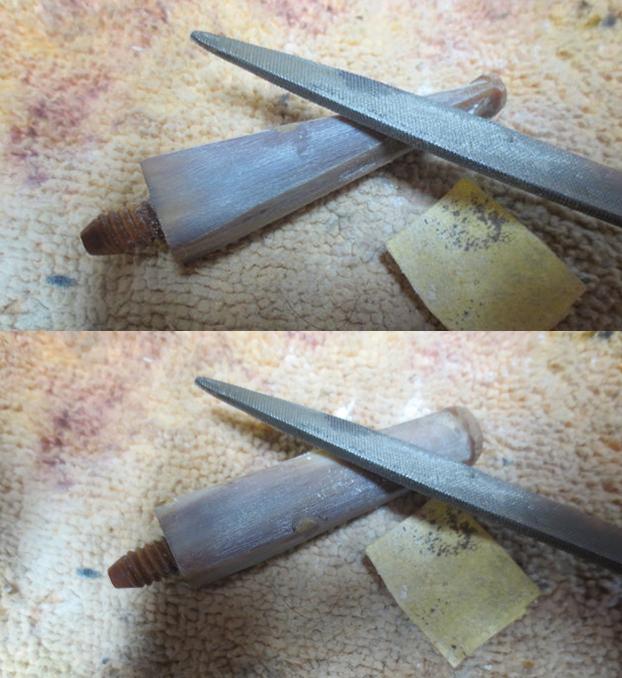
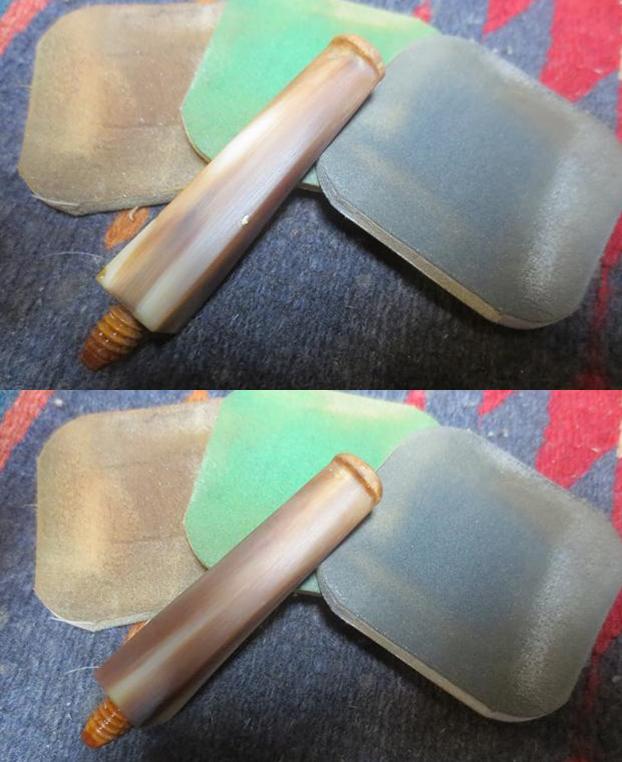
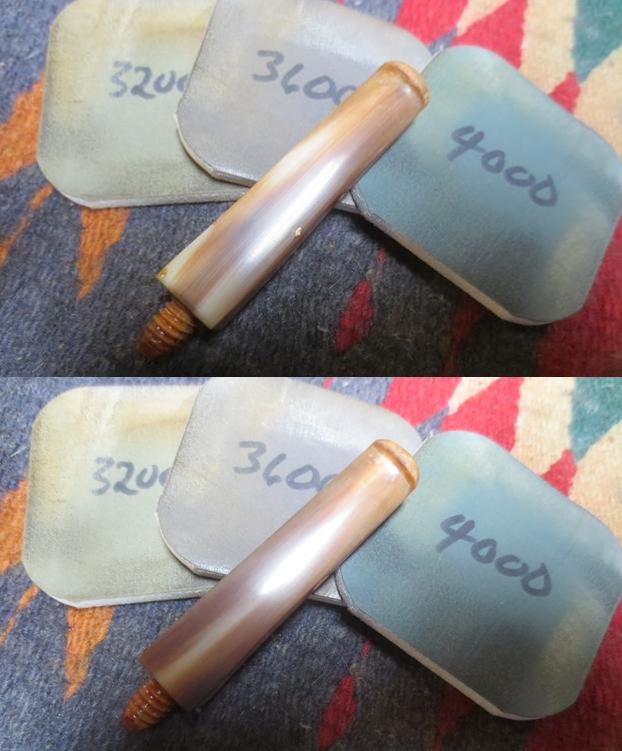
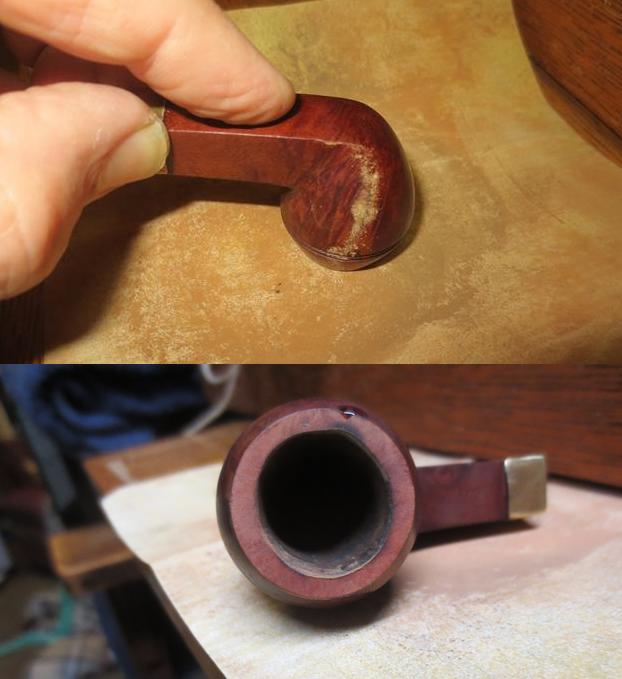
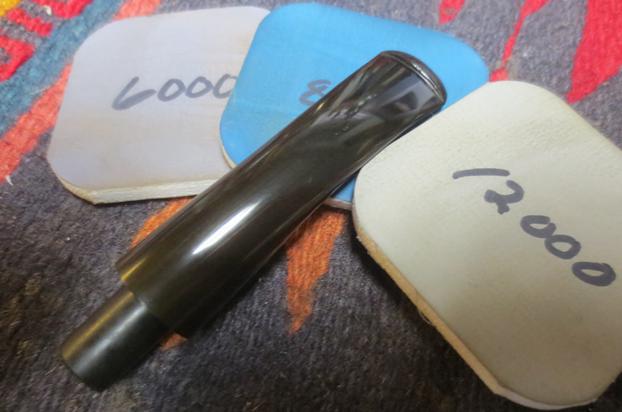
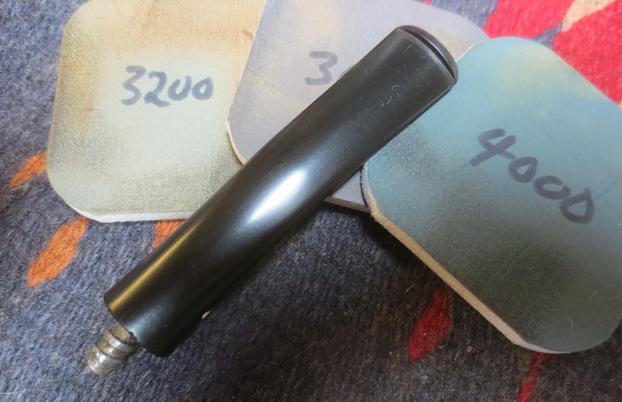
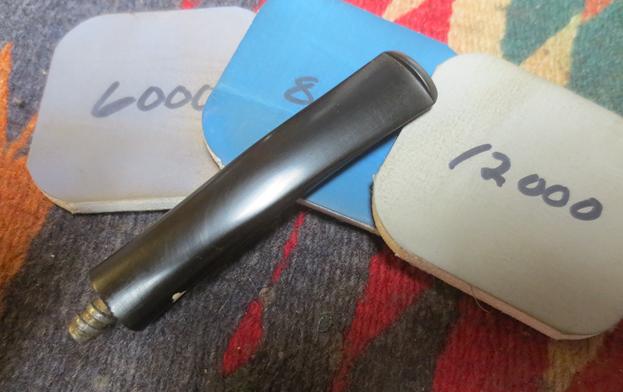
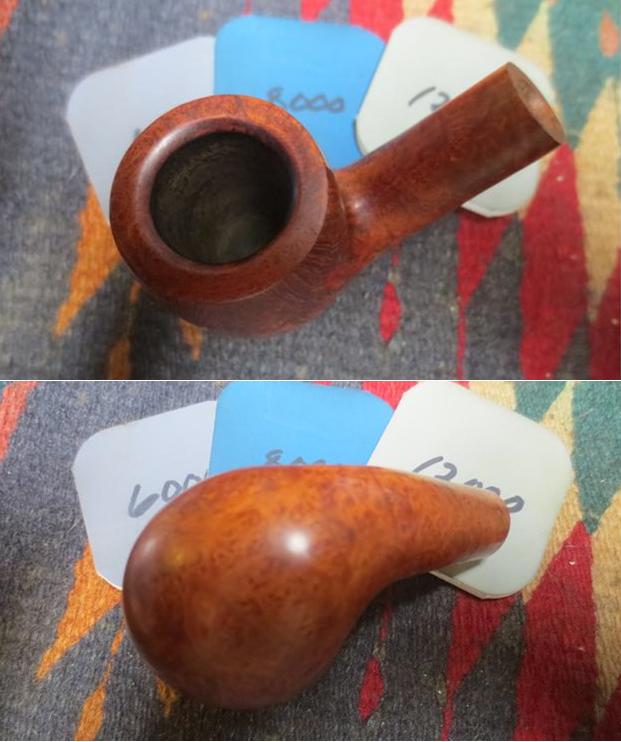
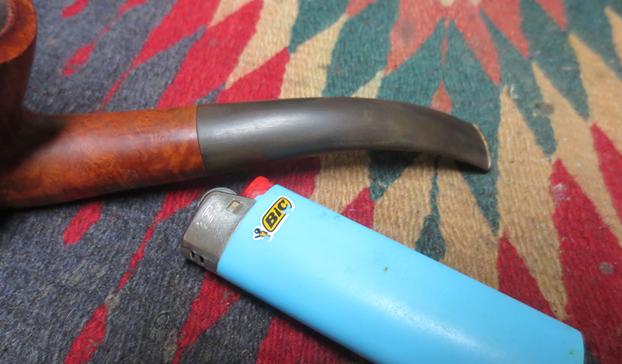
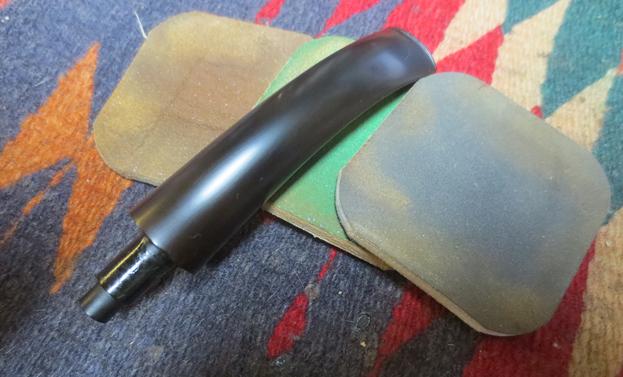
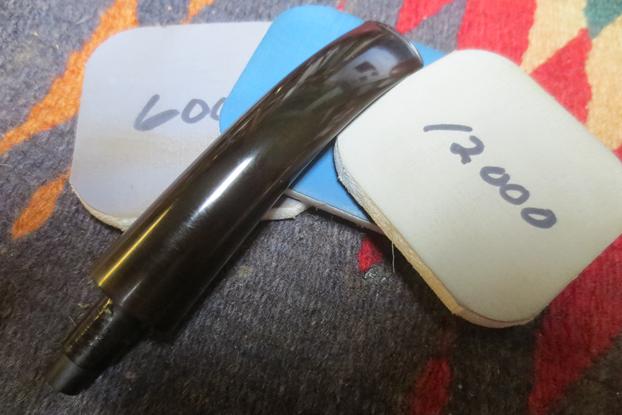
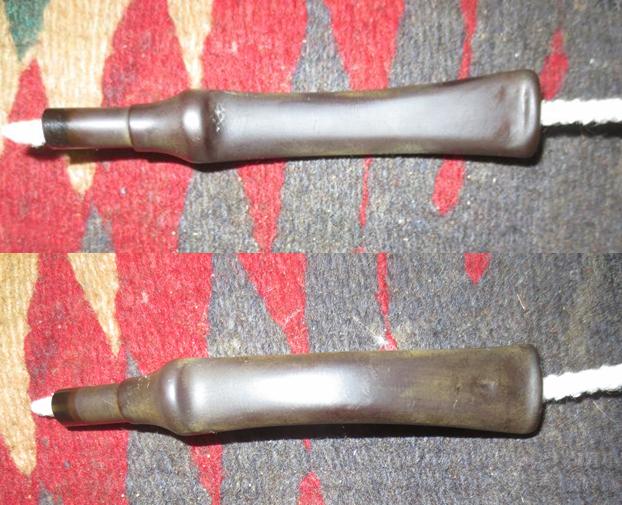
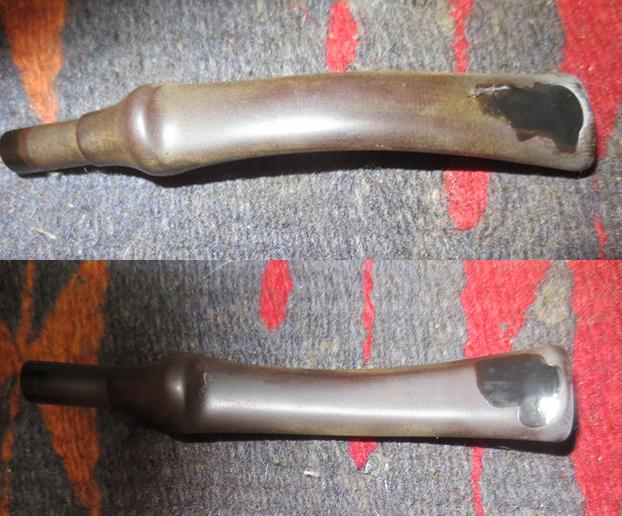
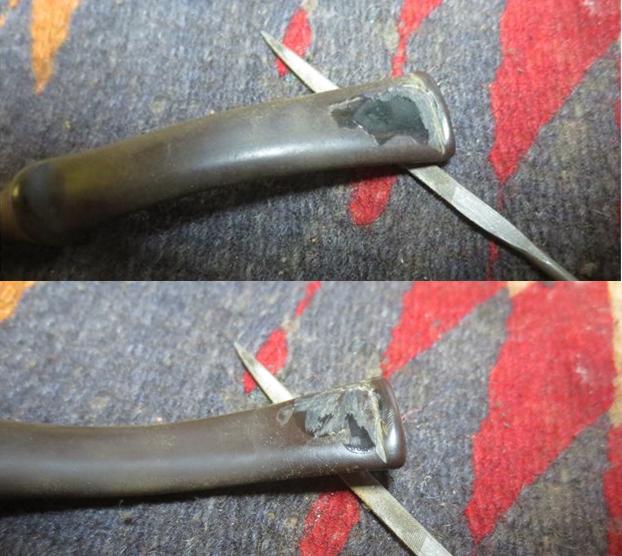
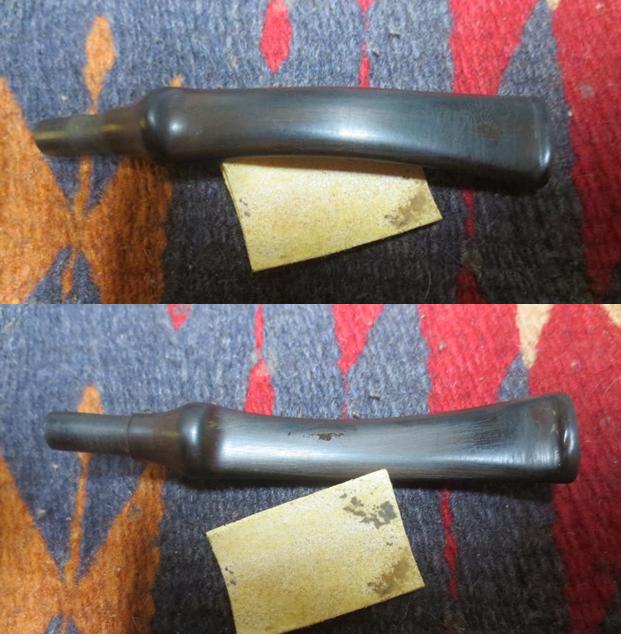
I follow Troy’s lead in masking the stummel to protect it from the chalk/egg white mixture because it sets up very hard – not something I want on the croc skin rustified surface! My plan is to apply an initial thin coating of the Meer patch mixture to fill in the cracks in the fire chamber and over the cracked area originating from the rim.  I would like to build up the lining toward the rim so that it will cover the crack as well as provide a new platform for an internal bevel or rounding.  For the first application, I mix about 1 tablespoon of white to 1 tablespoon of chalk to create a thinner mixture to get into and fill the cracks for the first two applications. After mixing the chalk and whites well, I used my finger to apply the mixture to the Meer surface.  I’ll let it sit for a few hours then apply another coat.The first thin coat.After a couple of hours, I apply another thin coat which I leave to cure overnight. To be on the safe side, I insert a pipe cleaner into the airway to be sure that it remains open. I made enough of the egg white/chalk mixture to apply the next coats.  I put the Meer patch mixture in the fridge, sealed in a small plastic container for use tomorrow.The next morning, I jiggle the pipe cleaner to make sure its keeping the airway open.  I take the mix out of the fridge, pour some of it into a smaller mixing cup and I add more chalk to thicken it.  Troy described a more methodical ‘parts to parts’ ratio.  I simply added more so that it would provide a somewhat thicker application.  After it looks right, after thoroughly mixing with a pipe nail tool, I apply it to the chamber walls with my finger as Troy describes.  Using the finger enables me to feel the foundation and spread the mixture evenly.  I leave it until I return tonight after my workday!  It should have about 7 to 8 hours to cure before I apply another coat.Seven hours later, I return to the worktable.  I decide the next coat of Troy’s Meer Recipe mixture will be my final and thickest application.  I take the mixture out of the fridge and add a portion to a smaller mixing cup.  I add more chalk until it looks right – thicker than before but not too thick it sets up in the mixing cup!  I take a picture of the finished mixture and the final application.  I’ll set the stummel aside now for 24 hours to assure that the Meerschaum coating has cured thoroughly and ready for sanding.With the Meer Recipe curing, I now turn to the stem work.  The former steward of this Zulu liked his pipe.  Zulus or Yachtsmen, being lighter weight, usually ride very well hands free.  Yet, without a bit protector, over time the teeth work as God created them, furrowing in the vulcanite to achieve a tight, comfortable grip.  Eventually, as this Zulu bears witness, the bite breaks through under the pressures and a hole is the result.  I take pictures to show the forensics of this bit.  There is a long, elongated tooth dent on the top, and some chatter, the breakthrough on the bottom, and the button has a cut of sorts – not sure how that happened.  All are pictured – I insert a pipe cleaner to highlight the hole.  To work on the dents, I first use heat to expand the vulcanite.  With a cheap bic lighter, I paint the top dent first with the flame – moving the flame back and forth without scorching the surface.  This method helps some, but not enough to avoid the next step, mixing up Special T CA glue and activated charcoal to patch the hole and fill the dents.  After forming a point with an index card, covering it with scotch tape to keep the glue from sticking, I insert it into the button to form a backing for the patch material.  I then empty one capsule of activated charcoal with a bit of the glue and mix it with a tooth pick.  When it arrives at a molasses-like consistency, I apply it to both hole and the upper dent, applying more than needed to build a mound to file down to shape a button later.  To quicken the curing process, I use an accelerator. Pictures show the progress.    I also apply a drop of Starbond Black Medium KE-150 glue to the cut on the button and let it sit to cure until tomorrow.  Another day has come and gone in Sofia, Bulgaria.The next day, after a LONG day on the job, I’m thankful to return to the worktable with both stummel, with cured Meerschaum lining repair and stem bit/button reconstruction waiting for my attention.  I decide to work on the stem.  To establish a button baseline, I use a topping board with 240 grit paper to remove the excess patch glue.Next, using a flat needle file, I score a working starting point to establish a new upper, button lip.  The score is intentionally leaving a large ‘button real estate’ to enable a patient, methodically sculpting of the button from large to normal sizing.  After the scoring, I file toward the stem’s vulcanite surface, removing the patch mound.  Of all the mini-projects in restoring pipes, stem work as I’m doing now, is probably the most time consuming. So, I put on my favorite Spotify jazz station, set back, and enjoy the moment.  I take pictures to chronicle the upper bit progress. After the top is roughed in, I turn to the lower bit. The initial shaping with files is completed! It’s normal to uncover small pockets where air was trapped in the glue as I can see.  I’ll fill those in later.Now, continuing the removal of excess patch material and shaping with 240 grit sanding paper, I also remove the marks left over from the filing.  I also work on the tooth chatter left over on the upper side of the bit.  After 240, I  use 320 grit, then 600.  Pictures show the progress. Now to address the air pockets that have emerged in the charcoal/superglue patch.  I clean the area with alcohol and cotton pad, even using a dental probe to make sure the pockets and surface are free of dust and leftover sanded vulcanite.  When it’s clean, I paint the surface of the button with a thin film of regular, clear super glue, filling the pockets.  I use the tip of a toothpick to spread the glue evenly over the surface.  I do both sides and set the stem aside to allow the glue to cure. Finally – in the interest of full blog disclosure – I had several iterations of filling the air pockets with thin glue and sanding.  I think I’m finally satisfied with the button/bit repairs!  Moving on.I turn to the Zulu’s Meer lined stummel.  The egg white/chalk layering has cured thoroughly.  I unmask the stummel to get a closer look at the results.  I am careful to peel away the masking tape at the rim.  I’m not sure how the Meer mixture will respond – will it crumble away?  It doesn’t, and I find that my fingernail is a good tool to remove excess Meer Recipe from the rim surface showing me the general lay of the land. My priority is to clear away the excess Meer Recipe from rim plateau.  I first use a flat needle file reaching across the chamber to remove material.  When near the briar surface, I top the stummel very lightly using 600 grade sanding paper.  As I have my first experience working with Troy’s Meer Recipe, I’m pleased with how durable it is.  It doesn’t feel fragile. After a gentle topping, I am VERY pleased at the appearance and composition of the Meer Recipe and the rim, now with clean briar, looks great. The pictures show the rim’s emergence.  Next, after wrapping a piece of 240 grit paper around a sharpie pen, I carefully start smoothing the chamber walls, removing the rough Meer Recipe and expanding the chamber, marching it back towards the original Meerschaum surface.  The method that emerges is that I rotate the stummel in my hand and allow the natural shape of the cylinder to emerge.  I do this with 240, followed by 320, then finally with 600 grit papers.  I leave enough of a layer of the Meer Recipe to cover the old Meerschaum and do not expose it. Now to cut a gentle bevel to remove the rough Meer Recipe on the rim and to lower the threshold of greater vulnerability of the surface where pipe tools go in and out.  I roll a tight piece of 240 paper to shape the bevel.  I do a combination of sawing it vertically to smooth rougher rises and pinching the paper with my thumb over the top of the rim.  I follow with 600 grit paper doing the same.  Here are pictures showing the progress.I notice that there are a few pockets around the circumference of where the Meer Recipe and briar meet.  I decide to bring out the unused Meer Recipe and apply a thin coating on the surface of the rim to fill these gaps.  I’ll give it a few hours and then clean off the residue.  I think this bit of improvisation works.  It looks good.  The lining will require TLC as any Meerschaum deserves.  Troy’s Meerschaum Recipe looks like Meerschaum and has essentially the same composition characteristics.  I think the Meer Recipe repair is now completed!  Thanks for your pioneering and sharing, Troy!Now to the Zulu’s croc skin surface.  I clean the stummel using mineral water, which in Bulgaria is light paraffin oil.  I remove the dust from all the Meer Recipe sanding and I am again reminded why I was attracted to this sharp looking Zulu – the Croc Skin rustification is striking.  I take a black dye pen and darken many of the valleys of the rustification to freshen the black pop of the croc skin.  Earlier I noticed that the texture of the croc skin rustification was enhanced and given depth by lighter, reddish flecks on the peaks of the rustification.  To further enhance this, I use an 1800 grade micromesh sponge pad and randomly sand on the Croc Skin surface – nipping the ridges to lighten them here and there allowing more briar to peek through.  These are subtle enhancements to the Zulu and I think they look good.Back to the final stages of the stem’s refurbishment. I reunite the Zulu bowl with the stem to give me a bird’s eye view of the progress.  I like what I’m seeing!Now to the final stage of the stem restoration.  I use 0000 grade steel wool and buff the entire stem, including the Regis ‘R’ gold rondel.  The steel wool removes the final scratches and tracks left from sanding and buffs the stem up.  I then do a complete cycle of micromesh pads from 1500 to 12000.  I wet sand using 1500 to 2400, then dry sanding with 3200 to 4000 and then 6000 to 12000.  Between each cycle the stem receives a coating of Obsidian Oil which refreshes the vulcanite.  At the end of the process, the stem is looking great – including the bit and button repairs. Now, looking at the rim, I will buff up the bare briar ring forming the rim.  I use the full 9 entourage of micromesh pads from 1500 to 12000 to shine and deepen the briar ring.  I think this bare briar ring is one of the attractive features of a Meer lined pipe.  The contrasts enhance the overall attractiveness of the pipe.  This Zulu surrounds the rim with the dark, craggy croc skin rustification – the center is the light Meer and the rich, butterscotch bare briar pops in contrast.  I like it. The first picture is before the micromesh sanding – then after.  On the home stretch, I use a Dremel with cotton cloth wheels and I go over the stummel applying Tripoli and Blue Diamond compounds.  These compounds bring out more the bare briar flecks in the rustification.  I also apply the compounds to the rim and lower shank nomenclature area where the briar is smooth.  Then, with another cotton cloth wheel, I apply coats of carnauba wax to the stem and stummel.  I find that by using the high speed and compact Dremel, I’m able to effectively apply wax even to most rustified and blasted finishes without the wax gunking up. I’m pleased with the restoration and recommissioning of this Italian (perhaps) Meerschaum lined Ariston Rustic croc skin rustified Zulu.  The use of Troy’s Meer Lining Recipe worked well and looks good.  I’m also pleased with the stem button/bit hole repair and button rebuild.  The Zulu is 5 ¾” long, 2” in height, bowl depth: 1 ½”, internal chamber diameter: ¾”, and full rim diameter: 1 ¼”.  If you would like to add this Meerschaum lined, croc skin rustified Zulu to your collection, go to The Pipe Steward Store and leave a comment or send me a note at ThePipeSteward@gmail.com.  This Zulu will benefit the Daughters of Bulgaria, our work here in Bulgaria helping women and girls (and their children) who have been trafficked and sexually exploited.  Thanks for joining me!


Paresh’s Grandfather’s Pipe #4 – An Antique Kalmasch Meerschaum Pipe


Blog by Steve Laug

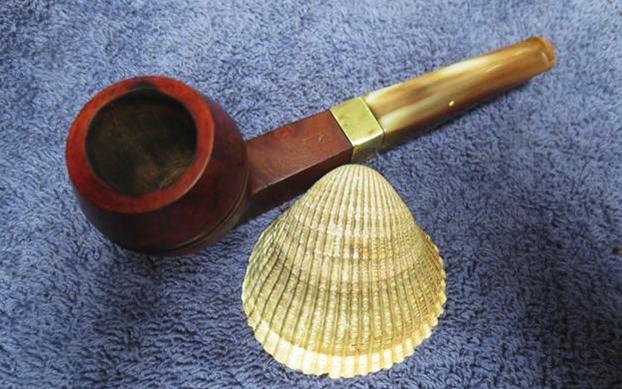
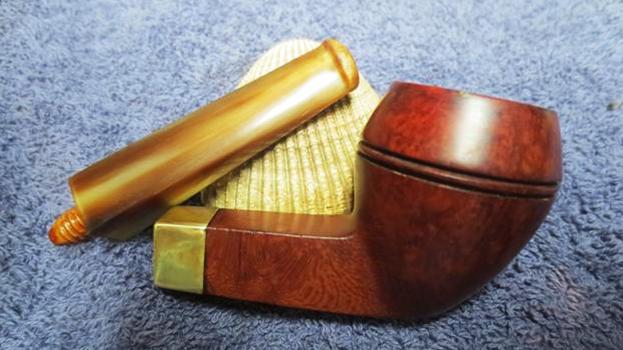
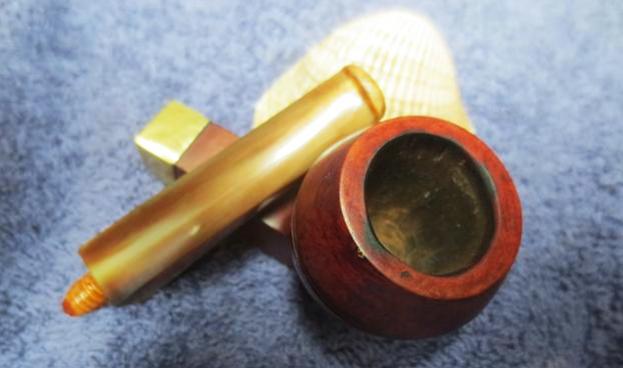
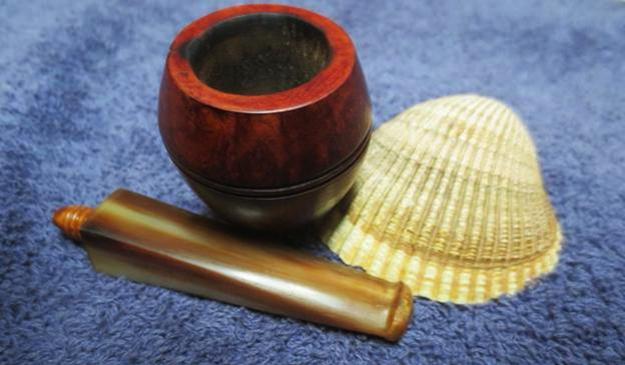
I have repaired three of the pipes from the seven of his Grandfather’s pipes that Paresh sent me. It is an interesting assortment of older pipes that come from the period of 1937-1950s. His Grandfather worked for the Indian Railroad and was a pipeman. Paresh is also a pipeman and only recently learned that his Grandfather smoked a pipe. The fourth pipe is an antique Meerschaum pipe with a Cherrywood shank and vulcanite stem. It is what is known as a Kalmasch Meerschaum pipe. It is a large pipe – 12 inches long and 2 ½ inches tall. I took the following photos of the pipe before I stated to work on it. It was in excellent condition, very clean with just a thin bit of lava and tar on the top of the rim. The inner and outer edge of the bowl was in excellent condition. I took some photos below show the pipe as it arrived.

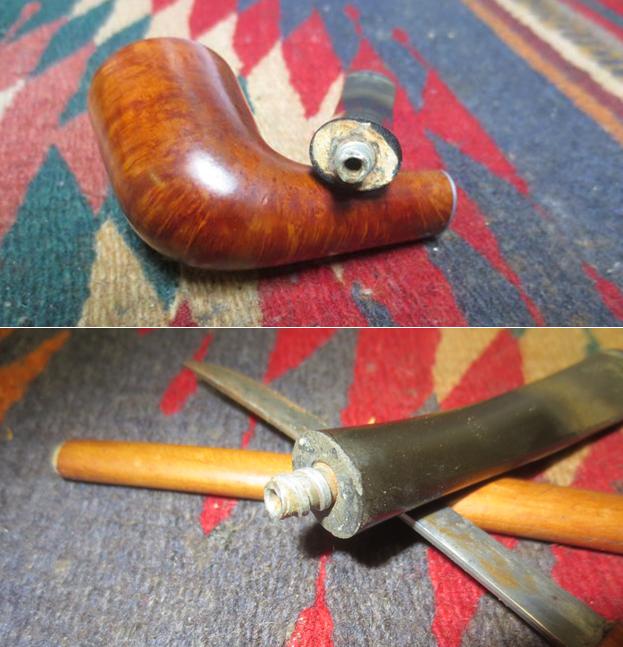
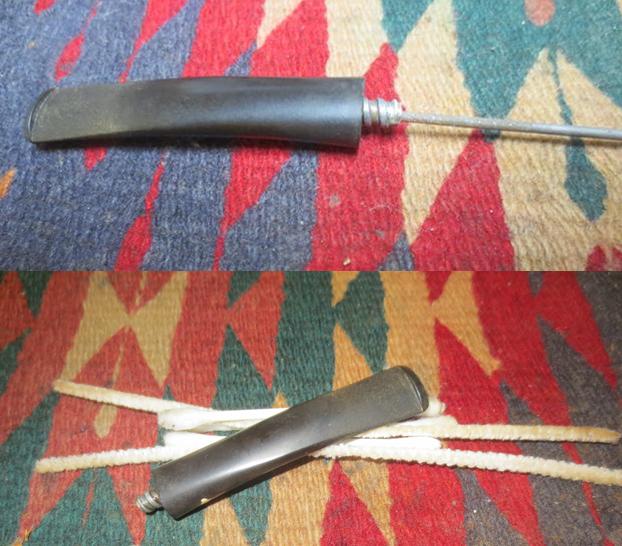
The photos of the pipe show the parts. Abha, Paresh’s wife had cleaned it up and sent the parts of the pipe individually packaged for safe shipping. The bowl was a heavy piece of meerschaum that had already begun to take on colour in the shank and up the sides of the bowl. The Cherrywood shank had one end threaded and the other end carved into a cone shape. The cone shaped end had the same angles as the mortise in the meerschaum bowl. The vulcanite stem was threaded and was made to be turned onto the threaded end of the cherry wood shank. You can see in the photos below how far down the threads the stem could be turned as they are darkened. There is about a ½ in gap between the stem and the shank when the stem is turned onto the shank. That will need to be addressed in the restoration. The rim top has some lava that had overflowed from the bowl and darkened the gouges in the surface and was built up around the back side of the bowl. It is not too thick and hard. It will need to be scraped off when I started the cleaning. The outer edge of the bowl looks pretty good with a little wear on the front edge and back right side. The bowl was very clean and smooth on the inside. I also took a close up photos of both sides of the stem. You can see that there is light tooth chatter on the top and underside of the stem just in front of the button. The surface of the stem is lightly oxidized and pitted.I took close up photos of both ends of the Cherrywood shank. The first photo shows the threaded end where the stem is screwed onto the shank. The first portion is threaded and the bottom half is partly threaded. It appears to me that there was originally a space between the stem and the rest of the shank end. The other end of the shank shows the conical shaping that matches the taper of the inside of the mortise in the bowl portion of the pipe.  I put the pieces back together and took photos of the pipe to show what it looked like. You can see the fit of the shank to the bowl. It is snug and it will not need to be changed. The stem is screwed in place on the shank and you can see the ½ inch gap between the stem and the shank. As I have mentioned in the previous three restorations, I always enjoy getting some background information on the pipeman whose pipes I am restoring when I am working estate pipes from the family members. If you have followed rebornpipes for a while you have read a few of these summaries from estates like Kathy’s Dad, Barry’s Dad and Farida’s Dad. Each of them did a great job summarizing their fathers’ estates. Since the next group of seven pipes that I will be working came to from India and belonged to the Grandfather of Paresh, I asked him to write a short tribute to his Grandfather. What follows is his writeup.

Respected Sir,

Now that the first batch of my Grandfather’s pipes has reached you, I would like to share my memories of him with you, the aim being to provide you with an insight to his personality, the era in which he lived, and a brief history associated with the pipes that I have inherited from him.

My Grandfather, Ananta (named after an exotic seasonal white flower having lovely fragrance), was born in a small coastal town of Konkan region of Maharashtra, India, in 1918. These were very turbulent times when India’s freedom struggle against British rule was gathering momentum and the atmosphere was charged with “Quit India Movement”. Having completed his graduation from Bombay, he joined Railways in 1937. This also marked the beginning of his journey into the world of pipe smoking!!!!!

Having seen his potential, in 1945, he was sponsored by the Government to visit England, for gaining further experience and expertise in his profession. This was a period when India’s Independence was round the corner and efforts were being made to train Indians for various administrative appointments in future Independent India. He returned back to India after a year, in 1946 and with him came some pipes that he had purchased in England. I believe a few of his Petes, Barlings, Charatans and GBDs are from this visit.

In 1947, when the British finally left India for good, my Grandfather was gifted pipes by his British peers, subordinates and Superior Officers as a parting gift. He stayed in touch with a few of them over all these years, even visiting them in 1959-60. Some of his later era Charatans and Barlings and Petes are from this trip. He quit smoking in early 1970s (before I was even born!!!!) and his pipes were packed up. There were a number of pipes which were used as TINDER for lighting fires (CAN’T BELIEVE IT…… I have not overcome my grief of this loss till date!!!!!) due to ignorance!!!!!!

My Grandfather was a very strict disciplinarian and temperamental (I did not know this as he was neither when dealing with me as I am the youngest of all his grandchildren!!!!!! He was always the most understanding and loving person in my life). I later learned that in his office, he was not to be disturbed when his pipe was lit, as he would be in his thinking/ contemplating mode while it was just the opposite as he lit his pipe in the evening while at home, when he would be at his relaxed best!!!!.

The interesting part is that neither of us knew that we each smoked a pipe until after his demise in Jan 2018!!!! In our culture, to this day, smoking or alcohol consumption is socially never talked about (mute acceptance!!!). It was during his last rites that absent mindedly I lighted my pipe and looking into the flickering flames of his funeral pyre, remembered and recollected all the wonderful memories and talks that we had shared. No one said a word to me about my lighting up a pipe!!!!!! Immediately thereafter, I rejoined my duty station. A few days later, my wife, Abha, received a box from my Uncle with a note that said “Grandfather would have loved Paresh to have these”. This box contained a collection of his fountain pens and 8-10 of his pipes (since then as my folks are winding up his belongings, I have received 2-3 packets and a large number of pipes, some in decent condition and some in unspeakable state). Abha immediately messaged me with pictures of these pipes and pens. I had been collecting and restoring (no major repairs, though) fountain pens since long and immediately recognized some of them as highly collectibles, however, pipes were a totally different ball game! I was inexperienced with no knowledge/ information regarding various brands/ pipe makers, shapes and materials. I knew nothing about the value of these pipes, nothing about pipe restorations, nothing about caring for them; I mean zero knowledge about collecting pipes. I smoked some real cheap Chinese pipes which were readily and unfortunately, the only ones, available in India and some inexpensive pipes from eBay India!!!!! Also regular pipe cleaning, pipe rotation, pipe cleaners and such things were unknown to me.

Thus, to know more about the REAL pipes, I embarked upon the journey of exploring finer nuances of pipe brands/ makers, their history and watching “How to videos” on packing a pipe, cleaning, repairing and caring for ones pipes. I found it extremely interesting and satisfying. It was while meandering through this confusing quagmire of pipe world that I came across rebornpipes.com website and eventually established contact with you, Mr Steve, who has since been my mentor, guide and GURU, making this journey a wonderful and satisfying experience.

Sir, there is one more thing that I need to thank you for and that is when you asked me to write a brief about my grandfather and his pipes, I realized how little I knew about him, in fact, knew nothing, as I was not even aware that he was a “pipeman” as no one in my family ever spoke about it being taboo subject and since he had quit a long time before I was even born!!!! This led me to ask the elders in my family, questions on the subject and came to know the above details. I cannot thank you enough for prodding me to get to know my grandfather and his pipes a lot better. Sir, these pipes of his, with your help and guidance, will remain with me forever in mint condition……

Thanks Paresh for this great descriptive take of your Grandfather. It really gives me a sense of the pipes that you have sent me and what they meant to him. It is obvious from the variety of pipes that you sent and the overall condition that he knew how to choose good quality pipes and obviously enjoyed smoking them throughout most of his life.

Paresh’s wife Abha cleaned all of the pipes before she sent them to me here in Canada and did an amazing job cleaning them up. She reamed the bowls, cleaned the rims and scrubbed the exterior of the pipes and the stems with Murphy’s Oil Soap and cleaned off the buildup on the stems. On this pipe she had removed the cake in the bowl and done a great job cleaning the exterior of the bowl. The cherrywood shank had also been cleaned. The stem was lightly oxidized on both sides and had light chatter and pitting.

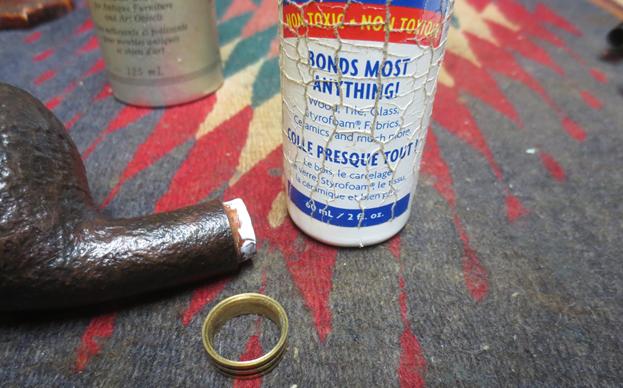
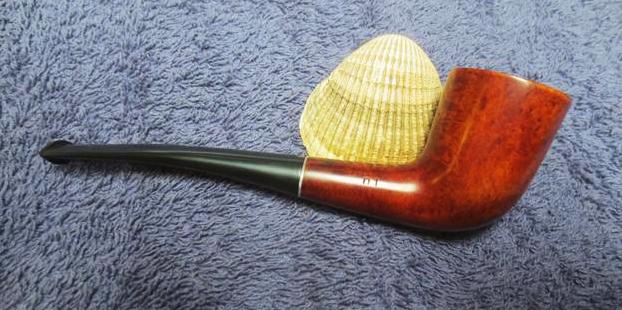
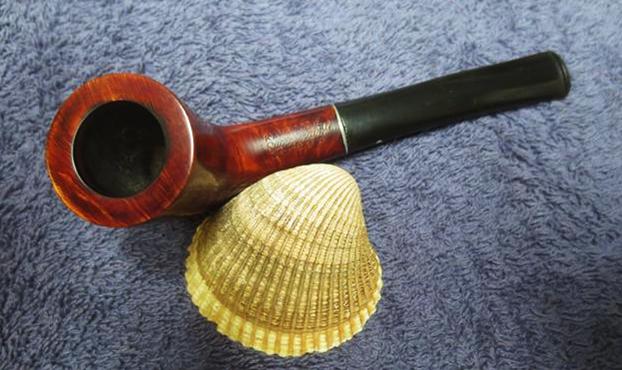
I polished the top of the bowl with micromesh sanding pads to remove all of the tar and lava that was on the surface. I wet sanded it with 1500-2400 grit pads and dry sanded with 3200-12000 grit pads. I wiped the bowl down with a damp cloth to remove the dust that was left behind by the sanding. While I was working on the bowl top I also worked over the sides and bottom of the bowl to polish them as well. I went through my box of bands and ferrules and found a brass ferrule that would work well to fill the gap between the shank and the stem when it was put in place. I put it on the end of the shank and screwed the stem in place. I took photos of the shank with the stem in place. It still needed to be polished and the edge below the ferrule will need to be smoothed out and touched up with stain to blend in the edge. However, you can see what it will look like when it is finished. I polished the ferrule with micromesh sanding pads to polish off the tarnish. I wet sanded it with 1500-2400 grit pads and dry sanded it with 3200-12000 grit pads. I polished it with a jeweler’s cloth and the shine really stood out. I took photos of the band after polishing.I worked Before & After Restoration Balm deep into the Cherrywood shank to clean, enliven and protect it. I worked it into the finish with my fingertips. I worked it into the threaded and conical end. I set it aside for a few minutes to let the balm work. I wiped it off and buffed it with a soft cloth to polish it. The bark on the shank really began to have a deep shine. I took a photo of the shank with the polish ferrule and polished Cherrywood at this point to mark the progress in the restoration. The shank is really beginning to look good.I sanded out the tooth chatter and pitting on both sides of the stem at the button with 220 grit sand paper. I polished the stem with micromesh sanding pads – wet sanding with 1500-2400 grit sanding pads and dry sanding with 3200-12000 grit pads. I wiped the stem down with Obsidian Oil after each sanding pad and set it aside to dry. With the stem polished I put it back on the pipe and lightly buffed the bowl and stem with Blue Diamond. I gave the Cherrywood shank and the stem several coats of carnauba wax. I gave the bowl a coat of beeswax and buffed the pipe with a clean buffing pad to raise the shine and hand buffed it with a microfiber cloth to deepen the shine. The pipe polished up pretty nicely. The finished pipe is shown in the photos below. I have three more of Paresh’s Grandfather’s pipes to finish and then I will pack them up and send across the sea to India where he can carry on the legacy. I know that he is looking forward to having them in hand and enjoying a bowl of his favourite tobacco in memory of his Grandfather. Thanks for walking through the restoration with me as I worked this pipe over.

Paresh’s Grandfather’s Pipe #3 – A Dr. Grabow Starfire


Blog by Steve Laug

I have repaired pipes for Paresh in India over the past four months and not long ago he sent me seven of his Grandfather’s pipes to restore. It is an interesting assortment of older pipes that come from the period of 1937-1950s. His Grandfather worked for the Indian Railroad many years and was a pipeman. Paresh is also a pipeman and recently found out that his Grandfather smoked a pipe as well. The third of the pipes is an older Dr. Grabow Starfire Adjustomatic Tomahawk #21. It is stamped on the right side of the shank Starfire over Dr. Grabow. From what I can find out the pipe was part of the Continental X-Series that came in 12 unique shapes that were originally released in 1959. When the Continentals were first put into production they may have been available only by coupon in the Westbrook, Emperor and Sculptura lines, but they were available in the regular production–non coupon lines such as Viscount, Starfire and Eldorado. The coupon pipes were given XO shape numbers while the regular production lines (meaning sold in retail stores) were given standard shape numbers. The XO numbers were never stamped on the pipes, but the regular production pipes will sometimes have a stamped shape number. This particular pipe that I am working on for Paresh is a Starfire line pipe. I have included the following shape chart to help identify the pipe. It is the third pipe down in the column on the right side – shape #21. (Quoted from the late Ed James, a man who knew a lot about Grabow pipes and who is dearly missed by those of us who knew and enjoyed his company.  http://pipesmagazine.com/forums/topic/3-year-journey-complete-set-of-continental-x-series-pic-heavy.) I took the following photos of the pipe before I stated to work on it. It was probably one of the dirtiest of the pipes that Paresh’s wife Abha sent me – even then it was not that dirty because she had removed much of the cake bowl and the grime in the wire rustication.  The rim top has lava that has overflowed from the bowl and filled in the wire rustication. It is quite thick and hard. It will need to be scraped off when I started the cleaning. I am not sure what the inside edge of the rim looks like at this point because of the lava overflow. The outer edge of the bowl looks pretty good with a little wear on the front edge and back right side. The bowl still the remnants of cake left behind that I will need to take care of. I also took a close up photos of both sides of the stem. The stem significantly overclocked to the right giving the pipe an odd look. You can see the tooth chatter and calcification on the top and underside of the stem just in front of the button. It appears that the stem must have had a softee bit that was later cut off and left behind the debris.I always enjoy getting some background information on the pipeman whose pipes I am restoring when I am working estate pipes from the family members. If you have followed rebornpipes for a while you have read a few of these summaries from estates like Kathy’s Dad, Barry’s Dad and Farida’s Dad. Each of them did a great job summarizing their fathers’ estates. Since the next group of seven pipes that I will be working came to from India and belonged to the Grandfather of Paresh, I asked him to write a short tribute to his Grandfather. What follows is his writeup.

Respected Sir,

Now that the first batch of my Grandfather’s pipes has reached you, I would like to share my memories of him with you, the aim being to provide you with an insight to his personality, the era in which he lived, and a brief history associated with the pipes that I have inherited from him.

My Grandfather, Ananta (named after an exotic seasonal white flower having lovely fragrance), was born in a small coastal town of Konkan region of Maharashtra, India, in 1918. These were very turbulent times when India’s freedom struggle against British rule was gathering momentum and the atmosphere was charged with “Quit India Movement”. Having completed his graduation from Bombay, he joined Railways in 1937. This also marked the beginning of his journey into the world of pipe smoking!!!!!

Having seen his potential, in 1945, he was sponsored by the Government to visit England, for gaining further experience and expertise in his profession. This was a period when India’s Independence was round the corner and efforts were being made to train Indians for various administrative appointments in future Independent India. He returned back to India after a year, in 1946 and with him came some pipes that he had purchased in England. I believe a few of his Petes, Barlings, Charatans and GBDs are from this visit.

In 1947, when the British finally left India for good, my Grandfather was gifted pipes by his British peers, subordinates and Superior Officers as a parting gift. He stayed in touch with a few of them over all these years, even visiting them in 1959-60. Some of his later era Charatans and Barlings and Petes are from this trip. He quit smoking in early 1970s (before I was even born!!!!) and his pipes were packed up. There were a number of pipes which were used as TINDER for lighting fires (CAN’T BELIEVE IT…… I have not overcome my grief of this loss till date!!!!!) due to ignorance!!!!!!

My Grandfather was a very strict disciplinarian and temperamental (I did not know this as he was neither when dealing with me as I am the youngest of all his grandchildren!!!!!! He was always the most understanding and loving person in my life). I later learned that in his office, he was not to be disturbed when his pipe was lit, as he would be in his thinking/ contemplating mode while it was just the opposite as he lit his pipe in the evening while at home, when he would be at his relaxed best!!!!.

The interesting part is that neither of us knew that we each smoked a pipe until after his demise in Jan 2018!!!! In our culture, to this day, smoking or alcohol consumption is socially never talked about (mute acceptance!!!). It was during his last rites that absent mindedly I lighted my pipe and looking into the flickering flames of his funeral pyre, remembered and recollected all the wonderful memories and talks that we had shared. No one said a word to me about my lighting up a pipe!!!!!! Immediately thereafter, I rejoined my duty station. A few days later, my wife, Abha, received a box from my Uncle with a note that said “Grandfather would have loved Paresh to have these”. This box contained a collection of his fountain pens and 8-10 of his pipes (since then as my folks are winding up his belongings, I have received 2-3 packets and a large number of pipes, some in decent condition and some in unspeakable state). Abha immediately messaged me with pictures of these pipes and pens. I had been collecting and restoring (no major repairs, though) fountain pens since long and immediately recognized some of them as highly collectibles, however, pipes were a totally different ball game! I was inexperienced with no knowledge/ information regarding various brands/ pipe makers, shapes and materials. I knew nothing about the value of these pipes, nothing about pipe restorations, nothing about caring for them; I mean zero knowledge about collecting pipes. I smoked some real cheap Chinese pipes which were readily and unfortunately, the only ones, available in India and some inexpensive pipes from eBay India!!!!! Also regular pipe cleaning, pipe rotation, pipe cleaners and such things were unknown to me.

Thus, to know more about the REAL pipes, I embarked upon the journey of exploring finer nuances of pipe brands/ makers, their history and watching “How to videos” on packing a pipe, cleaning, repairing and caring for ones pipes. I found it extremely interesting and satisfying. It was while meandering through this confusing quagmire of pipe world that I came across rebornpipes.com website and eventually established contact with you, Mr Steve, who has since been my mentor, guide and GURU, making this journey a wonderful and satisfying experience.

Sir, there is one more thing that I need to thank you for and that is when you asked me to write a brief about my grandfather and his pipes, I realized how little I knew about him, in fact, knew nothing, as I was not even aware that he was a “pipeman” as no one in my family ever spoke about it being taboo subject and since he had quit a long time before I was even born!!!! This led me to ask the elders in my family, questions on the subject and came to know the above details. I cannot thank you enough for prodding me to get to know my grandfather and his pipes a lot better. Sir, these pipes of his, with your help and guidance, will remain with me forever in mint condition……

Thanks Paresh for this great descriptive take of your Grandfather. It really gives me a sense of the pipes that you have sent me and what they meant to him. It is obvious from the variety of pipes that you sent and the overall condition that he knew how to choose good quality pipes and obviously enjoyed smoking them throughout most of his life.

Paresh’s wife Abha cleaned the pipes before she sent them to me here in Canada and did an amazing job cleaning them up. She reamed the bowls, cleaned the rims and scrubbed the exterior of the pipes and the stems with Murphy’s Oil Soap and cleaned off the buildup on the stems. She had removed much of the cake on this pipe and done a great job cleaning the exterior of the bowl. The lava on the rim top was very hard and thick so she left that behind so as not to damage the top edge. The stamping on the right side of the shank was very readable. The stem was oxidized on both sides of the stem and had quite a bit of tooth chatter and calcification on both.

Since the stem was an adjustomatic according to what I had read I decided to work on the alignment before working on the rest of the pipe. I removed the stem and heated the metal tenon and stinger to loosen the tars and oils that had hardened on it. Once it was heated I turned the stem into the mortise and adjusted it by turning it clockwise until all was aligned.I let the heat dissipate from the stem and then removed it from the shank and started my work on the bowl itself. I cleaned up the cake in the bowl with a Savinelli Fitsall Pipe Knife and took the rest of the cake off until I had bare briar walls. I wanted to check out the condition of the interior of the bowl. It looked very good once it was cleaned off. There was no checking or cracking on the bowl walls. There was no sign of burn out inside. I scraped the rim top with the sharp edge of the Savinelli Knife and took off the thick lava that was there. I used a brass bristle wire brush to clean out the cake from the wire rustication on the surface. You can see the thick chunks of lava that came off the rim top on the white sheet of paper.I scrubbed the exterior of the bowl and shank with Murphy’s Oil Soap and a tooth brush to clean out the debris I left behind from the rim clean up. I also used the brass bristle brush with the soap to work over the rustication on the rim top. I rinsed it in running water and dried it off with a cloth. I restained the rim top with a Walnut stain pen to match the colour of the rest of the bowl. I touched up random spots on the shank and bowl sides where the finish was worn or nicked.I cleaned out the mortise and the airway in the shank with pipe cleaners, cotton swabs and alcohol. It took a lot of scraping and scrubbing to remove all of the thick tars and oils that had accumulated around the Grabow spoon stinger.I worked Before & After Restoration Balm deep into the briar to clean, enliven and protect it. I worked it into the finish with my fingertips. I worked it into the rim and shank end. I set it aside for a few minutes to let the balm work. I wiped it off and buffed it with a soft cloth to polish it. The briar really began to have a deep shine. I took some photos of the bowl at this point to mark the progress in the restoration. The bowl is really beginning to look good and the pipe is waxed I think it will really have a rich glow to wire rusticated finish.  I set the bowl aside and worked on the stem. I used a brass bristle wire brush to clean off the spoon stinger enough that I could remove it and clean out the rest of the stem. I cleaned up the stinger and the airway in the stem with pipe cleaners, cotton swabs and alcohol until they were clean. I would buff the metal with the buffing wheel to take off the rest of the staining later. I sanded out the tooth chatter and the calcification on both sides of the stem at the button with 220 grit sand paper.I polished the stem with micromesh sanding pads – wet sanding with 1500-2400 grit sanding pads and dry sanding with 3200-12000 grit pads. I wiped the stem down with Obsidian Oil after each sanding pad. I finished polishing the stem with Before & After Pipe Stem Polish both Fine and Extra Fine to remove the last of the scratches. I gave it a final coat of Obsidian Oil and set it aside to dry. With the stem polished I put it back on the pipe and lightly buffed the bowl and more heavily buffed the stem with Blue Diamond. I gave the bowl several coats of Conservator’s Wax and the stem multiple coats of carnauba wax. I buffed the pipe with a clean buffing pad to raise the shine and hand buffed it with a microfiber cloth to deepen the shine. The pipe polished up pretty nicely. The finished pipe is shown in the photos below. I have four more of Paresh’s Grandfather’s pipes to finish and then I will pack them up and send across the sea to India where he can carry on the legacy. I know that he is looking forward to having them in hand and enjoying a bowl of his favourite tobacco in memory of his Grandfather. Thanks for walking through the restoration with me as I worked this pipe over.


Paresh’s Grandfather’s Pipe #2 – A Yello-Bole Carburetor 4522 Billiard


Blog by Steve Laug

I have repaired pipes for Paresh in India over the past four months and not long ago he sent me seven of his Grandfather’s pipes to restore. It is an interesting assortment of older pipes that come from the period of 1937-1950s. His Grandfather worked for the Indian Railroad many years and was a pipeman. Paresh is also a pipeman and recently found out that his Grandfather smoked a pipe as well. The second of the pipes is an older Yello-Bole Carburetor Billiard. It is stamped on the left side of the shank Carburetor over the KBB triangle logo followed by Yello-Bole over US Pat. 2082.106 over Cured with Real Honey. On the right side there is a four digit number 4522. This pipe was made between 1935 and 1936. Here is the rationale. The carburetor patent was granted in 1935, this pipe is stamped “US Pat.” Interestingly enough, it also has a patent number on the bottom of the shank that reads Reg.U.S.Pat.Off. over No. 343.331. The four digit number was used by KBB until 1936. The first two numbers indicate the finish, in this case 45 indicates a smooth finish. The second two numbers indicate the shape, in this case 22 indicates a straight billiard. The rim top is beat up and worn there is damage on the surface and also has nicks around the inner and outer edges of the bowl. The bowl still had a fairly thick cake on the walls. The carburetor tube that goes through the bottom of the bowl from outside to the inside was clogged and dirty. I took a close up photo of the rim top and both sides of the stem. You can see the damage to the top and inner edge of the rim top in the first photo below. The second and third photo shows the top and underside of the stem.The next photo shows the stamping on the left side of the shank as noted above. There is also a large crack on the top left side of the shank. The next two photos show the stamping and the crack very clearly. I always enjoy getting some background information on the pipeman whose pipes I am restoring when I am working estate pipes from the family members. If you have followed rebornpipes for a while you have read a few of these summaries from estates like Kathy’s Dad, Barry’s Dad and Farida’s Dad. Each of them did a great job summarizing their fathers’ estates. Since the next group of seven pipes that I will be working came to from India and belonged to the Grandfather of Paresh, I asked him to write a short tribute to his Grandfather. What follows is his writeup.

Respected Sir,

Now that the first batch of my Grandfather’s pipes has reached you, I would like to share my memories of him with you, the aim being to provide you with an insight to his personality, the era in which he lived, and a brief history associated with the pipes that I have inherited from him.

My Grandfather, Ananta (named after an exotic seasonal white flower having lovely fragrance), was born in a small coastal town of Konkan region of Maharashtra, India, in 1918. These were very turbulent times when India’s freedom struggle against British rule was gathering momentum and the atmosphere was charged with “Quit India Movement”. Having completed his graduation from Bombay, he joined Railways in 1937. This also marked the beginning of his journey into the world of pipe smoking!!!!!

Having seen his potential, in 1945, he was sponsored by the Government to visit England, for gaining further experience and expertise in his profession. This was a period when India’s Independence was round the corner and efforts were being made to train Indians for various administrative appointments in future Independent India. He returned back to India after a year, in 1946 and with him came some pipes that he had purchased in England. I believe a few of his Petes, Barlings, Charatans and GBDs are from this visit.

In 1947, when the British finally left India for good, my Grandfather was gifted pipes by his British peers, subordinates and Superior Officers as a parting gift. He stayed in touch with a few of them over all these years, even visiting them in 1959-60. Some of his later era Charatans and Barlings and Pete are from this trip. He quit smoking in early 1970s (before I was even born!!!!) and his pipes were packed up. There were a number of pipes which were used as TINDER for lighting fires (CAN”T BELIEVE IT…… I have not overcome my grief of this loss till date!!!!!) due to ignorance!!!!!!

My Grandfather was a very strict disciplinarian and temperamental (I did not know this as he was neither when dealing with me as I am the youngest of all his grandchildren!!!!!! He was always the most understanding and loving person in my life). I later learned that in his office, he was not to be disturbed when his pipe was lit, as he would be in his thinking/ contemplating mode while it was just the opposite as he lit his pipe in the evening while at home, when he would be at his relaxed best!!!!.

The interesting part is that neither of us knew that we each smoked a pipe until after his demise in Jan 2018!!!! In our culture, to this day, smoking or alcohol consumption is socially never talked about (mute acceptance!!!). It was during his last rites that absent mindedly I lighted my pipe and looking into the flickering flames of his funeral pyre, remembered and recollected all the wonderful memories and talks that we had shared. No one said a word to me about my lighting up a pipe!!!!!! Immediately thereafter, I rejoined my duty station. A few days later, my wife, Abha, received a box from my Uncle with a note that said “Grandfather would have loved Paresh to have these”. This box contained a collection of his fountain pens and 8-10 of his pipes (since then as my folks are winding up his belongings, I have received 2-3 packets and a large number of pipes, some in decent condition and some in unspeakable state). Abha immediately messaged me with pictures of these pipes and pens. I had been collecting and restoring (no major repairs, though) fountain pens since long and immediately recognized some of them as highly collectibles, however, pipes were a totally different ball game! I was inexperienced with no knowledge/ information regarding various brands/ pipe makers, shapes and materials. I knew nothing about the value of these pipes, nothing about pipe restorations, nothing about caring for them; I mean zero knowledge about collecting pipes. I smoked some real cheap Chinese pipes which were readily and unfortunately, the only ones, available in India and some inexpensive pipes from eBay India!!!!! Also regular pipe cleaning, pipe rotation, pipe cleaners and such things were unknown to me.

Thus, to know more about the REAL pipes, I embarked upon the journey of exploring finer nuances of pipe brands/ makers, their history and watching “How to videos” on packing a pipe, cleaning, repairing and caring for ones pipes. I found it extremely interesting and satisfying. It was while meandering through this confusing quagmire of pipe world that I came across rebornpipes.com website and eventually established contact with you, Mr Steve, who has since been my mentor, guide and GURU, making this journey a wonderful and satisfying experience.

Sir, there is one more thing that I need to thank you for and that is when you asked me to write a brief about my grandfather and his pipes, I realized how little I knew about him, in fact, knew nothing, as I was not even aware that he was a “pipeman” as no one in my family ever spoke about it being taboo subject and since he had quit a long time before I was even born!!!! This led me to ask the elders in my family, questions on the subject and came to know the above details. I cannot thank you enough for prodding me to get to know my grandfather and his pipes a lot better. Sir, these pipes of his, with your help and guidance, will remain with me forever in mint condition……

Thanks Paresh for this great descriptive take of your Grandfather. It really gives me a sense of the pipes that you have sent me and what they meant to him. It is obvious from the variety of pipes that you sent and the overall condition that he knew how to choose good quality pipes and obviously enjoyed smoking them throughout most of his life.

Paresh’s wife Abha cleaned the pipes before she sent them to me here in Canada and did an amazing job cleaning them up. She reamed the bowls, cleaned the rims and scrubbed the exterior of the pipes and the stems with Murphy’s Oil Soap and cleaned off the buildup on the stems. This particular pipe had a very hard cake in the bowl and with the tube sticking up from the bottom of the bowl she was very careful in here cleanup. There was till cake that needed to be removed. The finish on the bowl is in bad condition and was peeling and dirty. The light varnish coat was rough. The stamping on the sides and bottom of the bowl was very readable. The crack in the shank was fairly open and would need to be banded to repair it. The rim top had been beat up on hard surfaces and the outer edges were rough and rounded. The stem was lightly oxidized on both sides of the stem and had quite a bit of tooth chatter on both.

I removed the stem from the shank and started my work on the bowl itself. I wiped down the peeling finish on the bowl and shank with acetone on cotton pads. I rubbed it down until I had removed the varnish coat and the grime in the finish. I carefully cleaned up the reaming in the bowl with a PipNet pipe reamer first. I started with the smallest cutting head and worked up to the second cutting head. I took the cake back to bare briar on the top ¾ of the bowl with the PipNet. I finished up the bottom ¼ with a Savinelli Fitsall Pipe Knife and took the cake back to the bare briar on the bottom. I was careful around the tube extending into the bowl bottom so I would not damage it. I wanted to check out the condition of the interior of the bowl. It looked very good once it was cleaned off. There was no checking or cracking on the bowl walls. There was no sign of burn out inside.  I decided to take care of the cracked shank next before I cleaned up the inside. I found a nickel band that was the right diameter for the shank. I used the Dremel and sanding drum to cut back about 1/3 of the depth of the band so that when it was fully on the shank it would not cover up the stamping on either side of the shank. I cleaned out the crack with a cotton swab and alcohol. I put some all-purpose white glue in the crack and pressed the band onto the shank. I used the sandpaper on the topping board to face the band and the end of the shank. I wanted the shank end and band to be absolutely smooth so that the fit of the stem in the shank would not change. You can see from the first photo below that the band placement does not come close to the stamping but completely cover the crack.To remove the damage to the top of the rim and minimize the damage on the inside and outside edge of the rim I topped it on a topping board with 220 grit sandpaper. I cleaned out the carburetor tube on the bottom of the bowl with a paper clip and pushed through the tars and grime that had plugged the tubes. I cleaned out the airway in the shank and the mortise with cotton swabs, pipe cleaners and alcohol until the inside was clean.I polished the rim top and bevel with micromesh sanding pads – wet sanding with 1500-2400 grit pads and dry sanding with 3200-12000 grit pads. I wiped it down with a damp cloth to remove the sanding dust and the scratches. I stained the rim with a Maple stain pen to match the colour of the rest of the bowl and shank.I worked Before & After Restoration Balm deep into the briar to clean, enliven and protect it. I worked it into the finish with my fingertips. I worked it into the rim and shank end. I set it aside for a few minutes to let the balm work. I wiped it off and buffed it with a soft cloth to polish it. The briar really began to have a deep shine. I took some photos of the bowl at this point to mark the progress in the restoration. The grain on the bowl is really beginning to stand out and will only do so more as the pipe is waxed.  I set the bowl aside and worked on the stem. I sanded out the tooth chatter on both sides of the stem at the button with 220 grit sand paper.I polished the stem with micromesh sanding pads – wet sanding with 1500-2400 grit sanding pads and dry sanding with 3200-12000 grit pads. I wiped the stem down with Obsidian Oil after each sanding pad. I finished polishing the stem with Before & After Pipe Stem Polish both Fine and Extra Fine to remove the last of the scratches. I gave it a final coat of Obsidian Oil and set it aside to dry. With the stem polished I put it back on the pipe and lightly buffed the bowl and stem with Blue Diamond. I gave them both multiple coats of carnauba wax and buffed the pipe with a clean buffing pad to raise the shine. I hand buffed it with a microfiber cloth to deepen the shine. The pipe polished up pretty nicely. The finished pipe is shown in the photos below. I have five more of Paresh’s Grandfather’s pipes to finish and then I will pack them up and send across the sea to India where he can carry on the legacy. I know that he is looking forward to having them in hand and enjoying a bowl of his favourite tobacco in memory of his Grandfather. Thanks for walking through the restoration with me as I worked this pipe over.

Paresh’s Grandfather’s Pipe #1 – An Early GBD Bent Billiard


Blog by Steve Laug

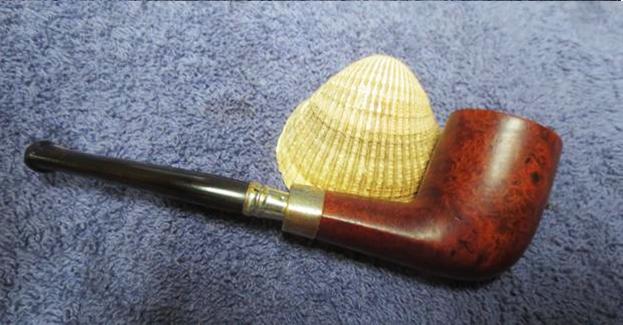
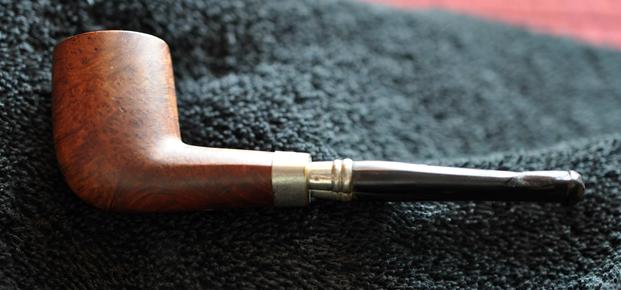
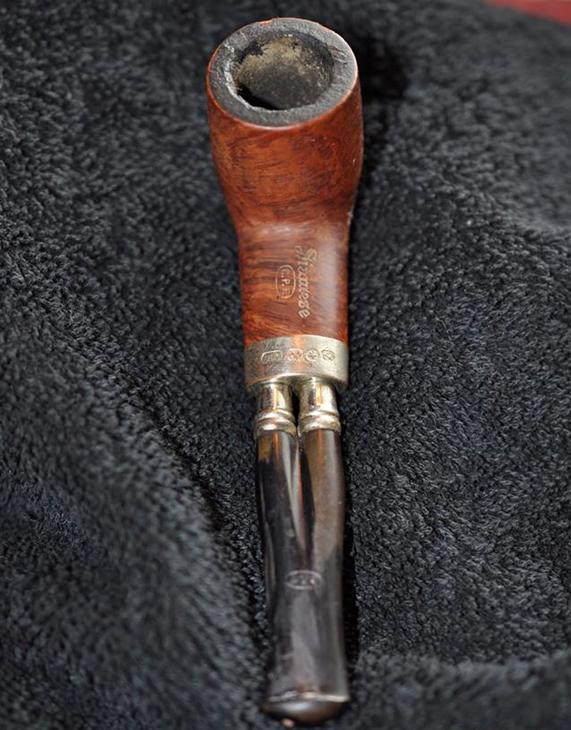
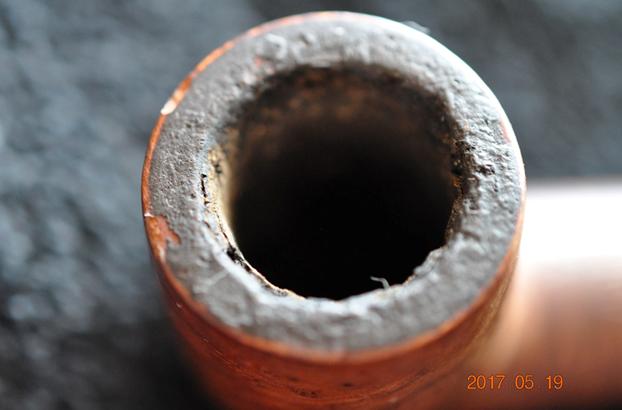
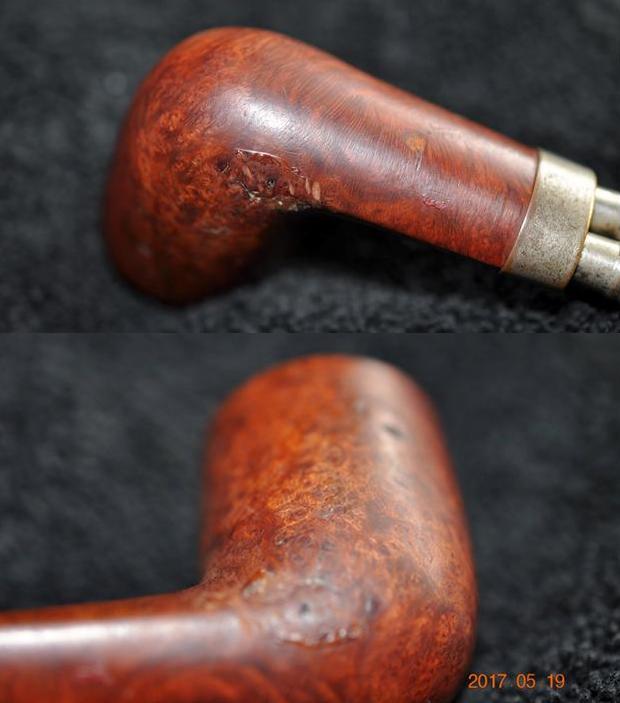
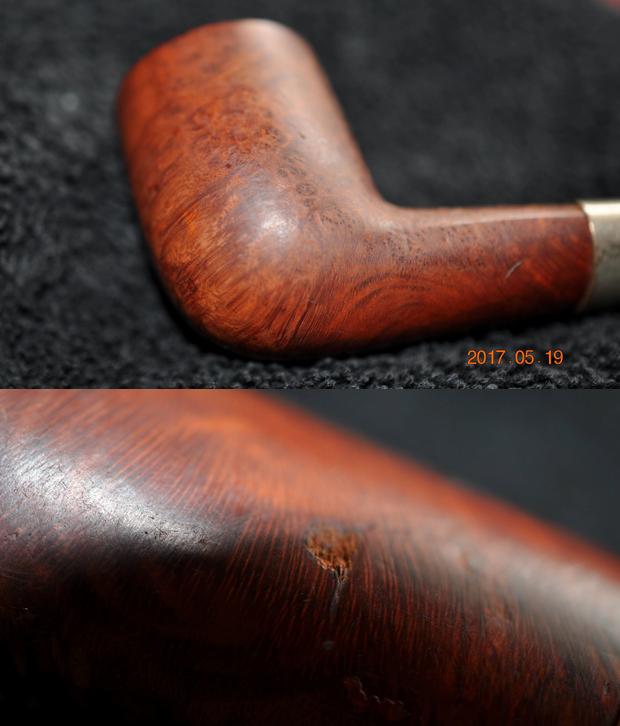
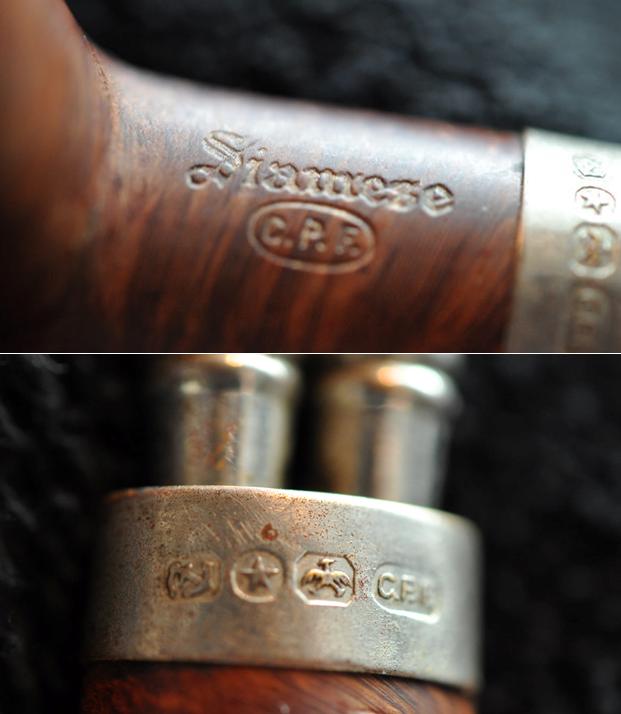
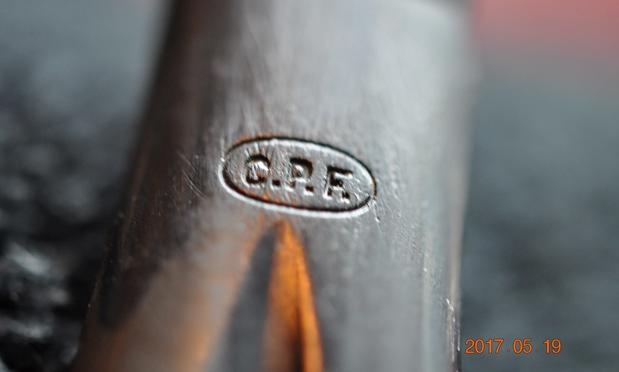
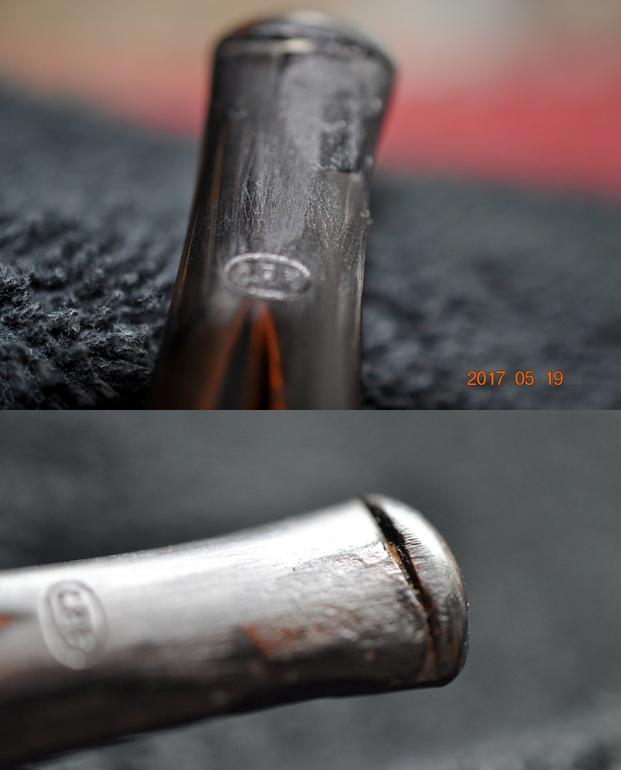
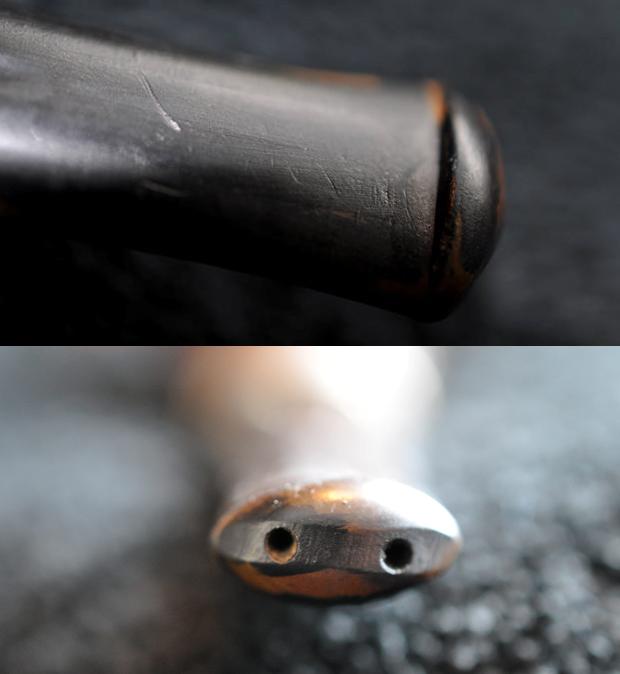
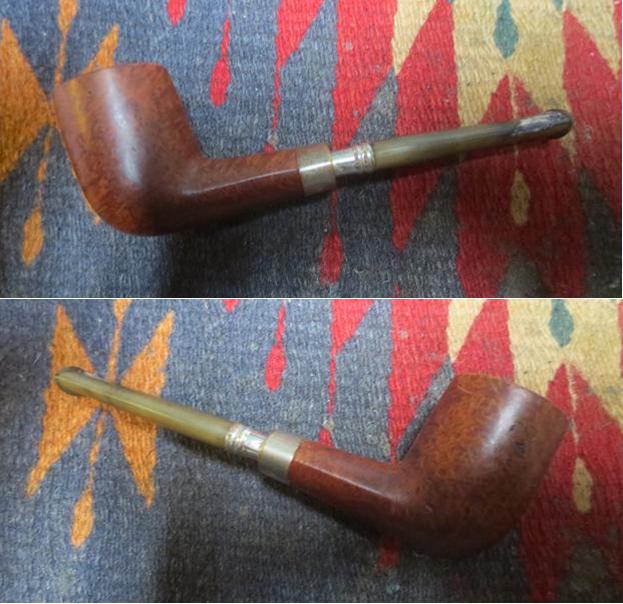
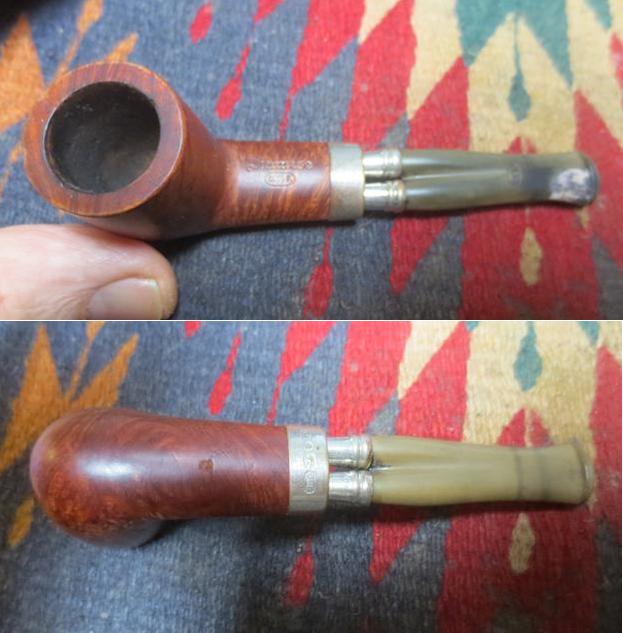
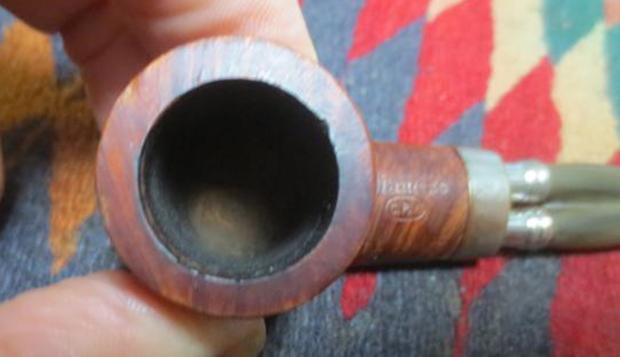
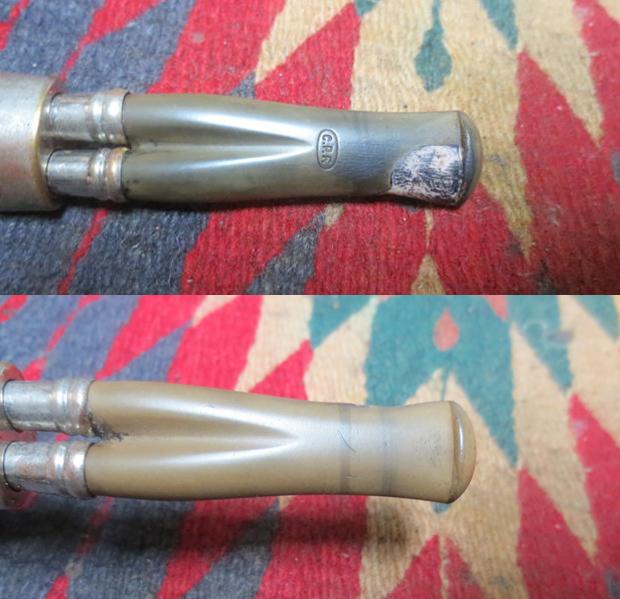
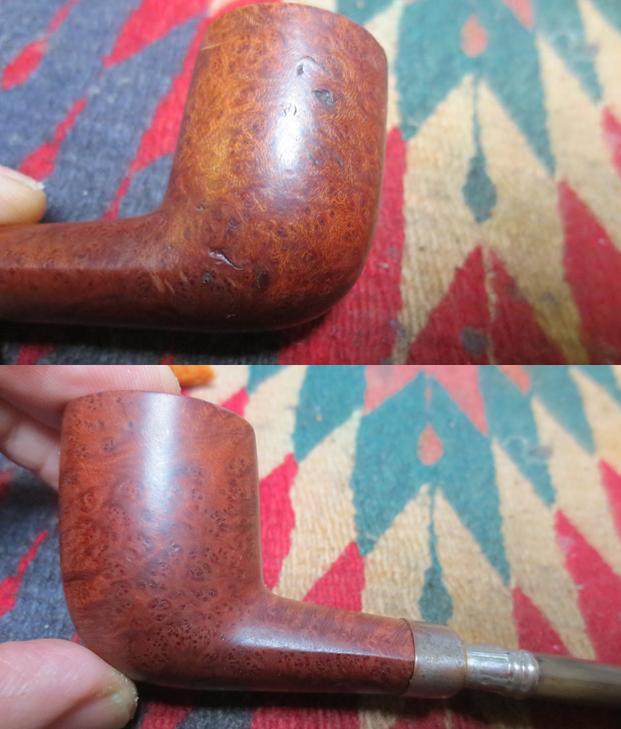
I have repaired several pipes for Paresh in India over the past four months or so and not long ago he sent me a box of seven of his Grandfather’s pipes. There is an interesting assortment of older pipes that come from the time period of 1937-1950s. His Grandfather worked for the Indian Railroad for many years and was a pipeman. Paresh follows in his love of the pipe and just recently found out that his Grandfather smoked a pipe as well. The first of the pipes I am working on for him is a GBD. It is an older one that has a silver band on the shank that is stamped with a GBD oval over four individual boxes – each is worn and hard to read. It is possible that it reads MRCLtd like the one in the first photo below which would identify the pipe as a French made GBD by Marechal, Ruchon & Co. Ltd. It could also be silver hallmarks with a lion (925 silver) and anchor (Birmingham) and two unreadable marks (one of which could give a date). Underneath them AO is stamped. AO could mean Alfred Oppenheimer which would date the pipe as after the Oppenheimer bought the brand in 1902 from MR&C Ltd. This would make it an early English made GBD pipe. The shank is stamped with a GBD Oval. There are no other stampings on the shank sides or the band. There is also a GBD Oval stamped on the left side of the saddle portion of the stem.Paresh’s wife Abha cleaned the pipes before she sent them to me here in Canada and did an amazing job cleaning them up. She reamed the bowl, cleaned the rim and scrubbed the exterior of the pipe and the stem with Murphy’s Oil Soap and cleaned off the buildup on the stem. She also cleaned off the silver band. The finish on the bowl is in very good condition and the GBD oval logo on the bowl was very readable. The silver band was scratched and worn. The GBD oval on the silver was faint but readable. The four hallmarks were very worn but it is possible that the first two are a lion and anchor but not certain. The stem was lightly oxidized on the underside and there was a GBD oval on the left side of the saddle portion of the stem. Interestingly for a stem that purports to be bite proof there is a deep tooth mark on the left side of the top near the button over the left twin bore and on the underside near the button on the right side. Both are directly over the twin bore airways.

The stem is unique and one that I have not come across before. From researching on the internet a bit it appears that the twin bore stem could be an early edition of the Tuskan Series that was London Made. Underneath the movable end cap diffuser it has something like the Tuskana Insertion with the twin bore stem. In the pipe I am working on it has the insert between the twin airways but it also has a diffuser cap at the end of the button. It is an amber coloured piece that covers the end of the button. There is a slight gap between the edge of the button and the cap that functions to diffuse the smoke. The end piece can be turned vertically to reveal the twin bore stem underneath. Like I said it is quite unique and I have not been able to find any other examples of this system on the internet. If any of you have any insight or information on this particular feature on GBD pipes please let me know. Thanks.I found an advertisement on the Pipedia link above which explains the Tuskana Insert. I have included that below.I took photos of the pipe before I started to work on it. It is a beautiful pipe that has some age on it. It has some very great looking grain on the bowl and shank. The rim top is worn, damaged on the surface and also has nicks around the inner edge of the bowl. The bowl was slightly out of round and there was still a light cake on the walls.I took a close up photo of the rim top and both sides of the stem. You can see the damage to the top and inner edge of the rim top in the first photo below. The second and third photo shows the top and underside of the stem. I have circled the tooth marks on both sides of the stem with red.I always enjoy getting some background information on the pipeman whose pipes I am restoring when I am working estate pipes from the family members. If you have followed rebornpipes for a while you have read a few of these summaries from estates like Kathy’s Dad, Barry’s Dad and Farida’s Dad. Each of them did a great job summarizing their fathers’ estates. Since the next group of seven pipes that I will be working came to from India and belonged to the Grandfather of Paresh, I asked him to write a short tribute to his Grandfather. What follows is his writeup.

Respected Sir,

Now that the first batch of my Grandfather’s pipes has reached you, I would like to share my memories of him with you, the aim being to provide you with an insight to his personality, the era in which he lived, and a brief history associated with the pipes that I have inherited from him.

My Grandfather, Ananta (named after an exotic seasonal white flower having lovely fragrance), was born in a small coastal town of Konkan region of Maharashtra, India, in 1918. These were very turbulent times when India’s freedom struggle against British rule was gathering momentum and the atmosphere was charged with “Quit India Movement”. Having completed his graduation from Bombay, he joined Railways in 1937. This also marked the beginning of his journey into the world of pipe smoking!!!!!

Having seen his potential, in 1945, he was sponsored by the Government to visit England, for gaining further experience and expertise in his profession. This was a period when India’s Independence was round the corner and efforts were being made to train Indians for various administrative appointments in future Independent India. He returned back to India after a year, in 1946 and with him came some pipes that he had purchased in England. I believe a few of his Petes, Barlings, Charatans and GBDs are from this visit.

In 1947, when the British finally left India for good, my Grandfather was gifted pipes by his British peers, subordinates and Superior Officers as a parting gift. He stayed in touch with a few of them over all these years, even visiting them in 1959-60. Some of his later era Charatans and Barlings and Pete are from this trip. He quit smoking in early 1970s (before I was even born!!!!) and his pipes were packed up. There were a number of pipes which were used as TINDER for lighting fires (CAN”T BELIEVE IT…… I have not overcome my grief of this loss till date!!!!!) due to ignorance!!!!!!

My Grandfather was a very strict disciplinarian and temperamental (I did not know this as he was neither when dealing with me as I am the youngest of all his grandchildren!!!!!! He was always the most understanding and loving person in my life). I later learned that in his office, he was not to be disturbed when his pipe was lit, as he would be in his thinking/ contemplating mode while it was just the opposite as he lit his pipe in the evening while at home, when he would be at his relaxed best!!!!.

The interesting part is that neither of us knew that we each smoked a pipe until after his demise in Jan 2018!!!! In our culture, to this day, smoking or alcohol consumption is socially never talked about (mute acceptance!!!). It was during his last rites that absent mindedly I lighted my pipe and looking into the flickering flames of his funeral pyre, remembered and recollected all the wonderful memories and talks that we had shared. No one said a word to me about my lighting up a pipe!!!!!! Immediately thereafter, I rejoined my duty station. A few days later, my wife, Abha, received a box from my Uncle with a note that said “Grandfather would have loved Paresh to have these”. This box contained a collection of his fountain pens and 8-10 of his pipes (since then as my folks are winding up his belongings, I have received 2-3 packets and a large number of pipes, some in decent condition and some in unspeakable state). Abha immediately messaged me with pictures of these pipes and pens. I had been collecting and restoring (no major repairs, though) fountain pens since long and immediately recognized some of them as highly collectibles, however, pipes were a totally different ball game! I was inexperienced with no knowledge/ information regarding various brands/ pipe makers, shapes and materials. I knew nothing about the value of these pipes, nothing about pipe restorations, nothing about caring for them; I mean zero knowledge about collecting pipes. I smoked some real cheap Chinese pipes which were readily and unfortunately, the only ones, available in India and some inexpensive pipes from eBay India!!!!! Also regular pipe cleaning, pipe rotation, pipe cleaners and such things were unknown to me.

Thus, to know more about the REAL pipes, I embarked upon the journey of exploring finer nuances of pipe brands/ makers, their history and watching “How to videos” on packing a pipe, cleaning, repairing and caring for ones pipes. I found it extremely interesting and satisfying. It was while meandering through this confusing quagmire of pipe world that I came across rebornpipes.com website and eventually established contact with you, Mr Steve, who has since been my mentor, guide and GURU, making this journey a wonderful and satisfying experience.

Sir, there is one more thing that I need to thank you for and that is when you asked me to write a brief about my grandfather and his pipes, I realized how little I knew about him, in fact, knew nothing, as I was not even aware that he was a “pipeman” as no one in my family ever spoke about it being taboo subject and since he had quit a long time before I was even born!!!! This led me to ask the elders in my family, questions on the subject and came to know the above details. I cannot thank you enough for prodding me to get to know my grandfather and his pipes a lot better. Sir, these pipes of his, with your help and guidance, will remain with me forever in mint condition……

Thanks Paresh for this great descriptive take of your Grandfather. It really gives me a sense of the pipes that you have sent me and what they meant to him. It is obvious from the variety of pipes that you sent and the overall condition that he knew how to choose good quality pipes and obviously enjoyed smoking them throughout most of his life.

I removed the stem from the shank and started my work on the bowl itself. I cleaned up the reaming in the bowl with a Savinelli Fitsall Pipe Knife and took the slight remnant of cake back to the bare briar. I wanted to check out the condition of the interior of the bowl. The inside looked very good once it was cleaned off. There was no checking or cracking on the bowl walls. There was no sign of burn out inside.To remove the damage on the rim top and to minimize the damage to the inner edge of the rim I lightly topped the bowl on a topping board with 220 grit sandpaper. I carefully removed the damage without changing the shape of the bowl. I used a folded piece of 220 grit sandpaper to clean up the inside edge of the bowl. I was able to remove much of the damage to the edge with the sandpaper and smooth out the bevel.  I polished the rim top and bevel with micromesh sanding pads – wet sanding with 1500-2400 grit pads and dry sanding with 3200-12000 grit pads. I wiped it down with a damp cloth to remove the sanding dust and the scratches. I stained the rim with a Cherry stain pen to match the colour of the rest of the bowl and shank.I worked Before & After Restoration Balm deep into the briar to clean, enliven and protect it. I worked it into the finish with my fingertips. I worked it into the rim and shank end. I set it aside for a few minutes to let the balm work. I wiped it off and buffed it with a soft cloth to polish it. The briar really began to have a deep shine. I took some photos of the bowl at this point to mark the progress in the restoration. The grain on the bowl is really beginning to stand out and will only do so more as the pipe is waxed.  I polished the silver band with a jeweler’s cloth to remove the tarnish from the silver and give it a shine. It worked pretty well to bring it back to life. The second photo below shows the stamping on the left side.I set the bowl aside and worked on the stem. I cleaned the deep tooth marks on both sides of the stem with a cotton swab and alcohol and dried it off with a cotton pad. I filled in the tooth marks with clear super glue. I set it aside to cure and called it night.In the morning I sanded out the repairs with 220 grit sandpaper to blend them into the surface of the vulcanite. I polished the stem with micromesh sanding pads – wet sanding with 1500-2400 grit sanding pads and dry sanding with 3200-12000 grit pads. I wiped the stem down with Obsidian Oil after each sanding pad. I finished polishing the stem with Before & After Pipe Stem Polish both Fine and Extra Fine to remove the last of the scratches. I gave it a final coat of Obsidian Oil and set it aside to dry. With the stem polished I put it back on the pipe and lightly buffed the bowl and stem with Blue Diamond. I gave them both multiple coats of carnauba wax and buffed the pipe with a clean buffing pad to raise the shine. I hand buffed it with a microfiber cloth to deepen the shine. The pipe polished up pretty nicely. The finished pipe is shown in the photos below. I have six more of Paresh’s Grandfather’s pipes to finish and then I will pack them up and send across the sea to India where he can carry on the legacy. I know that he is looking forward to having them in hand and enjoying a bowl of his favourite tobacco in memory of his Grandfather. Thanks for walking through the restoration with me as I worked this pipe over.


The Case of the Murdered Dunhill


Blog by Robert M. Boughton

Copyright © Reborn Pipes and the Author except as cited
https://www.facebook.com/roadrunnerpipes/

It is my belief, Watson, founded upon my experience, that the lowest and vilest alleys in London do not present a more dreadful record of sin than does the smiling and beautiful countryside. — From Sir Arthur Conan Doyle’s “The Adventure of the Copper Beeches,” in The Adventures of Sherlock Holmes (1892)

NOTE: I owe the singular logic and chronicle of this story to the author of a French blog upon which I had the good fortune and immense pleasure of discovering, quite by chance, in the course of a search for other, more mundane instruction on Dunhill pipes.  The credit for the blog, almost hidden at the bottom of the page, attributes the work to “pipephil,” whose nationality and working name being identical to that of a certain devoted and well-known researcher of pipes and their histories, I can only surmise is one and the same.  This story is based on an unequal blending of fact and fiction and might better be approached as the latter.   Acknowledgement to Sir Arthur Conan Doyle (1859-1930) is likewise in order, and, if prevailing opinion of this willing suspension of disbelief warrants, apologies.  Names have been changed to protect the real and imagined

(Being a reprint from the personal blogs of JAMES BOSWELL)

CHAPTER I. MR. SHERRINFORD CAVISH

At the age of twenty-six, early in the year of 1989, I was considered an old man to be commencing studies as an undergraduate at New Mexico State University in Las Cruces and was branded non-traditional, a distinction which stirs not a grain of animosity in my mind.  The principal difference between the average teenager fresh from the crucible of high school and myself, during my first semester of courses prescribed for those desiring to specialize in journalism, was my already appreciable experience in the workforce I sought to continue.  I had under my belt a solid grounding in the old school style of newspaper writing, owing to an early tossing into the cesspool when I was a mere fifteen-year-old.  Already I was squared away in the requisite determined and, when necessary, obdurate nature to survive the initial condescending underestimation of my ability to recognize obfuscation when I heard it.  These traits were of invaluable help in eliciting a modicum of legitimate answers from the police officers, politicians and other authorities who became the salt and pepper on the main fare of official reports that fed my regular police and city hall beats.

Quartered at first in one of the better dormitories and accustomed to taking my meals at the campus cafeteria, an establishment that over-favored a form of creamed chipped beef on toast that exemplified the military term for that menu item which I will for the sake of good form abbreviate as S.O.S., I straight away took up the tobacco pipe.  As well as soothing my nerves and allowing an air of contemplation conducive to my studies, the pipe expelled the unfortunate after taste of the gruel the school called food.  Pipes were also a family tradition on the paternal side, and so I embraced them with alacrity.  Smoking, of course, was prohibited in the dormitories, but I dismissed the absurdity as did all but a poignant minority of the other inhabitants.

Finding disagreeable the cramped suite of rooms that allowed no privacy and which I shared with three adolescent males who were more interested in beer kegs, parties and all of the other inclinations wholly natural to youngsters, I reached the inevitable conclusion that I must secure a more mature roommate off-campus.  The very same night, while strolling the university grounds taking the long course to the student union building, where I had planned to brush up on the Associated Press Style Book tucked under an arm, and puffing contentedly on the single pipe I then owned, I heard my name called from nearby.

“Boswell!  James Boswell!”

Glancing in the direction of the greeting, I found the young man smiling and waving at me vaguely familiar, but only a name came to mind.

“Beall!” I said, relieved to have no need to fumble with that social awkwardness.

Trapped, I found myself engaged in small talk.

“Wherever have you been hiding?” Beall asked.  “I haven’t seen you in dog’s years!”

Not caring for the suggestion that I in any way skulk and thinking that dogs tend to age with rather unfortunate rapidity, I was off-put before I could answer but endeavored to be civil.

“Off fighting the good fight, Beall,” I said.  “Just at the moment I’m considering how to move out of my dormitory but can’t afford a place of my own on my income.”
Where I met Beall and why the devil I let slip my need for a proper roommate eluded me, and I would have kicked myself had that colloquial expression been possible.  With all the delicacy I can muster, I found young Beall to be a nice enough fellow but rather insipid and a bit too friendly.  I braced in anticipation of his putting himself forward as a candidate, and indeed, having among other faults a distressing clutching habit, he seized me by an arm.

“Why, I have just the person for you!  I’ve known him forever, and he’s absolutely perfect!”

Not caring a bit for the sound of any of that and being dubious of Beall’s judgment, my aversion to conspicuous rudeness prevented me from declaring so.  By my own fault, therefore, Beall, still clutching my arm, compelled both of us at once in a straight line toward the north edge of the campus, obviously the direction of the friend’s place of residence.  I managed with some dexterity to dislodge my arm from his grip and counted myself fortunate beyond words that the mysterious dwelling was within easy walking distance.  My subsequent introduction to the man who, though five years my junior, was gifted with the most singular and brilliant deductive powers I have ever encountered, can only be attributed to fate.

When at last we found ourselves on the step and the door to the apartment opened, I had the first dreaded look at my proposed new roommate.  The appearance of Mr. Sherrinford Cavish was altogether the opposite of my preconceived image.  Standing three inches taller than six feet in height, Cavish towered over Beall, whom I had spent most of our walk struggling to devise a means of escaping, and had several inches on me.  His stature had none of the typical lankiness associated with very tall men and was instead complemented by a husky but fit build.  He wore an expensive powder blue dress shirt with the top two buttons undone, medium brown wool slacks appropriate for the season that appeared to be tailored, leather loafers with tassels and no jewelry whatsoever, not even a watch.  His longish brown, wavy and un-brushed hair, wild, for lack of a better word, was the oddest feature I noted.  The old, blackened clay pipe between his lips seemed a natural extension of his mouth and the highest testament thus far of his suitability as a fellow lodger. Then, ignoring poor Beall beside me altogether, his sharp blue and acute eyes narrowed and took in the whole of me with a glance.  I admit I was more than a little disconcerted by the scrutiny I thought rude.  His greeting astounded me.

“Have you been a reporter for any publications I may have read?”

The ensuing dumfounded silence prompted the otherwise meek and silent Beall, who still stood to my side, to remark, “Yes, he’s always like that.”

“Ah!  But you’re here about the room for rent, no doubt eager to quit the dreary conditions of the dormitories,” Cavish said before I answered, astounding me once again.

The man who introduced himself to me by his full first and last name the moment I stepped inside his apartment pursed his lips in a peculiar grin I have come to know well.  One corner of his mouth rose a tad and the other fell.  Initially viewing the practice as a sort of conceited smirk, I soon came to recognize it as an outward sign of the constant processing of simultaneous and unfathomable amounts of complex mental data related to the unparalleled fields of study of which Cavish can only be described as an expert.  Well into that first night, I learned of a comparative few of these, but our mutual fondness for pipes and shared interest in matters of crime were enough for me.  That grin of his meant that Cavish was in good spirits, working out the various enigmas he undertakes to solve for his own odd pleasure and at the request of others.  He calls them cases, but to me they are worse than giant white table puzzles.  Cavish invariably examines each piece with pure logic and science as his only tools.  On my word, I do believe he relishes scrambling the parts of the puzzles his clients – again, as he calls them – believe they have put together.  To Cavish, each piece of the puzzle must be probed from both sides and every angle regardless of how closely it may seem to fit.

“Excuse me,” I said, no longer able to contain my curiosity, “but how did you know I was a reporter?”

Cavish looked me in the eye.  “Elementary,” he said.  “Even without the well-thumbed AP guide under your arm the conclusion is inescapable.  Your red-striped Oxford with its frayed button collar doesn’t go with the ruffled tan corduroy blazer and dark brown elbow patches, as well as the mismatched light blue cord pants.  And that ancient polyester tie is enough to give an epileptic a fit.  Who but a reporter dresses in that style?  Then there are the light smudges of news print on your fingers and the cuffs of your shirt sleeves, not to mention the small note pad and flowy pen in your front coat pocket, icing on the cake, as it were.”

However accurate the conclusions Cavish reached, I still wondered if his lack of tact might be distasteful after all but resisted the urge to do an about-face and march out.

“Very well, then, what about the fact that I live in a dormitory?”

“Good God, man!” he said with alarming drama.  “Only a new student living in the dorms, regardless of age, would eat all of his meals in the cafeteria.”  Reading my face like a newspaper headline, he interrupted the protest I was about to make.  “My exhaustive research of every restaurant menu in Cruces tells me that none of them serves creamed chipped beef such as that which caused the spot on your tie.  I’m happy to say the dish is unique to that venue.”

In this disturbingly fascinating manner was I introduced to the deductive skills of Mr. Sherrinford Cavish.

“Interesting pipe,” Cavish said as he saw me to the door, speaking of the bulldog of which I was rather proud.  “An Italian no-name, I see.  Well, we’ll have to do something about that.”

The following morning, ignoring my petty misgivings as to my new roommate, I fled the dormitory.  I confess with some remorse that I left my affable yet erstwhile fellow cellmates understandably dazed and confused, not to mention sad in a manner that was touching, to see me depart.

CHAPTER II. WHAT THE MAIL HAD TO SAY

Dunhill pipe courtesy These Pipes Like No Others

Sooner than later, I learned of the flipside of the unusual grin I noted.  When Cavish was without a case, he fell into periods of deep broodings and profound depressions that lasted until some new mystery he deemed worthy of his time presented itself.  At the low point of one of these bouts of sheer, unbearable boredom, a piece of mail arrived that Cavish was too despondent to consider.  I took the liberty of cutting open the end for him and found a single small photograph of a smoking pipe in utter ruin, accompanied by a letter imploring Cavish to investigate the matter and some pages printed from a website.

Reading the letter to my lackluster friend did not even make him stir.  Knowing the somewhat perverse delight Cavish takes in the most dreadful horrors this world has to offer, and also taking into consideration his deep love of smoking pipes, I concluded the only hope of rousing him from the lethargic stupor in which he was trapped might be the sight of the desecrated pipe.  I tossed the photograph and printout on his chest that might have been that of a corpse.  As I turned away, I heard Cavish sit up on the couch.  Turning back to face him the next instant, I saw him hunched over his laptop on the coffee table cluttered with many documents only he was permitted to touch.  Moving so that I could watch over his shoulder, I noticed he had pulled up the website from which the printout was made so that he could read the entire text in its original French, which he spoke fluently in addition to Latin, German, Dutch, Italian and Iranian, to name those I have identified.

“The game is afoot!” Cavish said with refreshed vigor.  I shook my head and sighed with no small amount of relief as he stood and began pacing in excitement.  I, on the other hand, needed a break and decided I deserved one for the part I played in reviving him.  Retiring to the comfort of my armchair, I took up an elegant new briar wood prince possessing the tightest vertical grain that I found at my local shop and filled it with a handy Balkan blend.  Already, I had a fine beginning of a collection thanks to a certain compulsion to acquire more and more that I blamed on the bad influence Cavish had on me.  Indeed, the compulsion verged on a disorder.

 CHAPTER III. CES PIPES PAS COMME LES AUTRES

The masthead of the site, Cavish translated, read “These Pipes Like No Others.”  Succumbing to an uncontrollable urge, I wagered the Dunhill displayed in the blog and photograph just arrived in the mail was clearly well smoked and previously lightly enjoyed. *  I shall savor for the rest of my life the rare flash of utter incredulity on my friend’s face that dissolved back into his typical working countenance of gravest contemplation when he deduced I had to be joking.

“She is extraordinary,” Cavish said, almost in a whisper.  I took a moment to realize he was speaking of the pipe.  “The outer simplicity obscures an inner complexity.”

“No doubt,” I said for the sake of good manners.

Still pacing about the room, Cavish recited the entire text of the blog from memory after his single reading of it online.  In the interest of brevity, I will paraphrase the key points of interest in the blogger’s quite stylish and eloquent narrative detailing his theories relating to the cause of the Dunhill’s destruction.  The general theme as stated in the second sentence was that, whatever act of brutality indeed brought about the end of the pipe’s days of usefulness to anyone, the once noble but now wretched thing was murdered.  Counting myself an aficionado of tobacco pipes, I appreciated the writer’s dramatic use of personification.

When the gruesome remains were discovered, two immediate types of suspects were considered, the more likely being a lone assassin acting on his own insane motives, and the other a terrorist group.  The latter theory raised the possibility of a political link, perhaps the Front de Lutte Anti-Tabac (F.L.A.T.), in English the Fight Against Tobacco Front.  Whoever ended the pipe’s life, the blogger concluded, chose Dunhill rather than any other brand for the general regard of the old British house as perhaps the world’s most iconic maker.  The impact of the act of extreme violence would therefore engender outrage and consternation among pipe enjoyers everywhere.

“It is quite a two-pipe problem, and I beg that you won’t speak to me for thirty minutes,” Cavish said in characteristically blunt form.  Even with what I knew of his machine-like reasoning ability, I was impressed with the time in which he expected to solve the mystery.

CHAPTER IV. THE TRUTH UNRAVELED

I can only conjecture that Cavish chose a striking natural finish Dunhill Canadian as his own way of paying respect to the victim.  In silence, as requested, and as unobtrusively as possible, I watched while he loaded the pipe with Dunhill White Spot, an English blend not available in this country that he somehow managed to acquire, no doubt through one of his many private sources.  He lay back in the chair, stretching his legs out before him and crossing his ankles as was his habit when formulating his inscrutable conclusions.  After savoring the one fill, he repeated the process.  When the last of the smoke trailed off, I glanced at the clock and observed the prescribed half-hour had passed to the minute.  My friend sat bolt upright and, his eyes glinting through narrow slits, stood.  I waited with greater than average anticipation for him to begin.

“The deplorable annihilation of this ill-fated Dunhill billiard was not an act of murder, as conjectured by the blogger with eloquence that was nevertheless the product of typical human emotion,” Cavish said in an even tone that belied the passion I alone knew him well enough to detect from the deliberate choice of such strong terms.

“That much I myself concluded,” I replied.

“Indeed, as you well know, the inherent inanimateness of the briar wood forming the chief constituent of the whole, by definition, precludes the possibility of homicide.”

“Indeed,” I muttered for lack of anything more substantial to contribute.

“Nor was this the work of any terrorist organization, the blogger’s brio, however excessive, notwithstanding.”

“Oh?  How so?”

“Contrary to popular misconception, terrorists are not as secretive as they would have us believe,” Cavish stated in the form of a thesis.  “Why else would they invariably claim credit for their foul and pusillanimous deeds sparked by a sense of impotence?”  Knowing the last part was only rhetorical punctuation, I waited for him to continue.  “No such communication has been attempted.”

“I see,” I said.  “But wait, Cavish.  There is one thing I still cannot comprehend.”

“Only one?” he asked, again not expecting a direct response but with the annoying twist of his mouth that so infuriated me at times.

“Yes, for the moment at least, only one,” I said in a pointless attempt to defend my honor that was not lost on the great detective.

“Pray tell, my dear Boswell, let’s hear the singular point of your confusion.”

Once more, I knew enough of the man to recognize a note of reconciliation, however feeble I thought it.  “What about the Frenchman’s keen observation that in order to burn briar, how did he put it, ‘extraordinary temperatures are needed which cannot be reached in the combustion of even a dry tobacco’?”

“Aha!” Cavish exclaimed, triumphant.  “There you have it!  Once again, you see, yet you do not observe.  Any careless smoker can burn a pipe made of any material, briar by no means excluded, even to the point of creating a hole through the bowl.  One sees such uncouth damages all the time.  Just ask anyone who restores smoking pipes for a living.”

Cavish continued before I could register a protest.

“The operative word is burn, which is altogether different than incinerate, the latter being the choice our French blogger doubtless meant.  Based on my study of the incineration points of thousands of wood types, I can tell you with authority that briar can only be reduced to ashes, that being the definition of incinerate, at temperatures sometimes exceeding 1,292 degrees Fahrenheit.”

“Good lord!”

“Quite so,” Cavish went on.  “As you will recollect from the photograph, the Dunhill, though burned more severely than any other specimen I have ever seen, which is no trivial claim, and to the point where evenly spaced horizontal cracks encircle the bowl through to the chamber, the pipe is nowhere near disincorporation into a pile of ashes.”

“Amazing, Cavish!  Simply amazing!  But what does it all mean?”

“It means, my obtuse friend, that the theory of some person or persons unknown filling the Dunhill with a fuel or other accelerant, intent on exploding or vaporizing the pipe, is erroneous.”

Bringing to bear the full powers of my brain to determine possible explanations, all I achieved was a pulsating headache.

“I surrender, Cavish!  How on Earth was the Dunhill destroyed, and by whom?”

Cavish has described himself as a high-functioning sociopath, a self-diagnosis with which I would not have argued until that moment.  The years I have known him, it was the first time he displayed what I would call a normal sign of humanity, the instance being a profound sense of grief manifested in his entire physical demeanor.  I was almost overwhelmed by a foreboding of some cataclysmic doom.  When he did speak at last, he sounded tired, but his usual veil of absolute self-control, dispassion and supreme objectivity was again in place.

“Never indulge in the delusion that the whole of mankind is not, in its most base state of consciousness, a species unequaled for its most natural instincts of callous cruelty and neglect for the welfare of others,” he said, pausing as though in emphasis of his perceived status of being separate from the rest of the world.  I wanted to disagree but held my tongue, letting Cavish expand on his point.  Whether he was aware of the repeated use of personal pronouns usually reserved for beings endowed with life, I could not say.  “Have no doubt, Boswell, she was tortured for some years.  Indeed, her neglect would be criminal were she, to employ a deliberate contradiction in terms, more that a work of art.  I agree with our French friend, the blogger, that the Dunhill was desecrated, and should like to believe his assertion that the act was premeditated.”

Unable to bear the ensuing silence longer, I prompted him.  “But?”

“Premeditation, my dear Boswell, implies a certain amount of forethought.  The atrocities committed against the once beautiful and vibrant example of skilled craftsmanship, created with the sole purpose of providing pleasure to a man, demonstrate the wanton kind of thoughtless, careless disregard for all but the self.”

“Really, Cavish, I think you’re being too harsh,” I interjected.

“In that case, Boswell, why did you acquire so many new pipes of which you could scarcely keep track?  I seem to recall your frequent agitation lest one of them end up falling to the floor, from wherever you happened to set it down, and breaking.  You even went to some expense to commission your carpenter friend to fashion an exceedingly large, elaborate cabinet made more of glass than wood, and filled with separate beveled holders so that you could display even more pipes than you already own.  Whatever possessed you to go to this trouble?”

My blood beginning to boil, I replied in hardly contained anger, “Because I care for them!  And besides, I got the idea for the cabinet from your own!”

“Quite so!” Cavish said with such pleasure he even let slip the rarest of smiles.  I must say that took the wind out of me, and I felt quite the fool.  My good friend had tricked me again.

“Point taken,” I conceded with a sheepish grin.  “But when are you going to reveal the identity of the scoundrel who so monstrously destroyed the excellent Dunhill?”

Cavish turned and resumed his former languid position in the armchair.  I stood there awaiting his solution to the puzzle while he loaded his pipe once more and leaned back, puffing away with a peculiar air of satisfaction.

“The culprit, Boswell, was no monster or group of terrorists.  The person who snuffed out the life of the Dunhill billiard was a common pipe smoker, one who considers these delightful instruments of divine contemplation to be as disposable as a Bic lighter.”

I was flabbergasted.  “Then you have no idea who did it?”

“Thankfully, no, or else I would have to track him down wherever he might live, if indeed he still does, and give him some lessons.  But I can say for certain that the unknown perpetrator of this loathsome deed prefers cigars to pipes.”

“How can you possibly deduce that?”

“Elementary,” Cavish said.  “He used a cigar torch to light his pipe.”

I took a seat in my chair across from him, sighed and filled my well-tended pipe, thinking the end of this mystery a bit disappointing, but pleased the case was closed.

“She is still a beautiful pipe,” Cavish said in a quiet tone.  “She shall always be the woman to me.”

AFTERWORD

I will leave my changing of name to the deductive powers of any readers who may be devotees of the great consulting detective, Sherlock Holmes.  The simplest way to sum up my little homage to the genius of the character and writing of the many Holmes adventures is to quote a funnier Holmesian anecdote, by Thomas Cathcart, another great author, who is still alive at 78.

Holmes and Watson are on a camping trip.  In the middle of the night Holmes wakes up and gives Dr. Watson a nudge.  “Watson,” he says, “look up in the sky and tell me what you see.”

“I see millions of stars, Holmes,” says Watson.

“And what do you conclude from that, Watson?”

Watson thinks for a moment.  “Well,” he says, “astronomically, it tells me that there are millions of galaxies and potentially billions of planets.  Astrologically, I observe that Saturn is in Leo.  Horologically, I deduce that the time is approximately a quarter past three.  Meteorologically, I suspect that we will have a beautiful day tomorrow.  Theologically, I see that God is all-powerful, and we are small and insignificant.  Uh, what does it tell you, Holmes?”

“Watson, you idiot!  Someone has stolen our tent!”

* I owe the wry comments of two friends on the Smokers Forums UK, where I posted the graphic photograph of the horribly abused Dunhill, a note of gratitude for the inspiration of these words.

SOURCES

http://pipes.over-blog.com/article-3152955.html
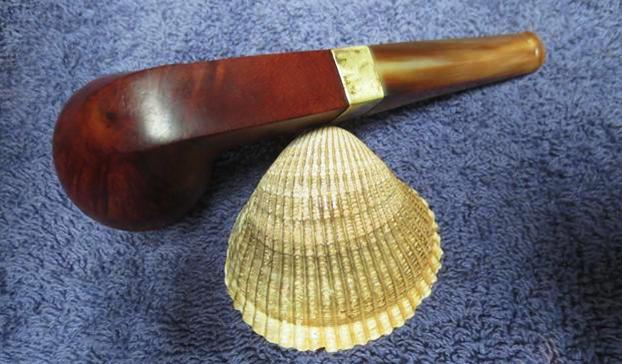
http://www.pipephil.eu/logos/en/index-en.html
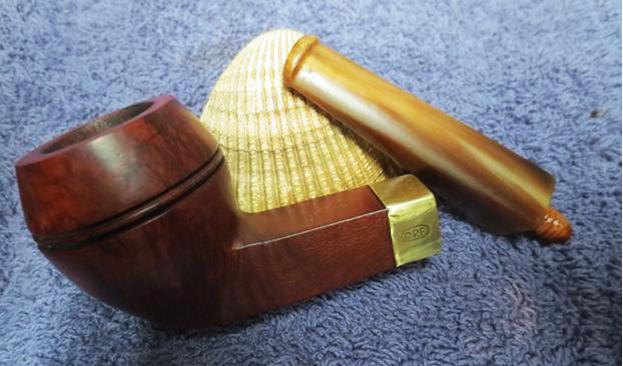
https://en.wikipedia.org/wiki/Holmes_(surname)
https://en.wikipedia.org/wiki/Sherlock_Holmes

Replacing a Broken Tenon on a Civic Select 14 Zulu


Blog by Steve Laug

I received a call from a local fellow who had picked up my phone number from a local pipe and cigar shop. He had just returned from a trip and the tenon on his little Civic Zulu had snapped off. As it was his only pipe he wondered if I would be willing to take on the job of repairing it. He had tried to glue it on with epoxy but it had not worked. The pipe was relatively new and half the bowl was not even darkened by smoking. There was raw briar on the bottom half of the bowl. The briar was dirty on the outside from being pocketed in his coat of backpack.  The stem was oxidized and had tooth chatter on both sides at the button. The oxidation is deep in the vulcanite. I told him I would take on the project. I took photos of the pipe before I started working on it.I found a Delrin tenon replacement in my box that would fit well once the diameter was reduced. We talked and he decided to get rid of the stinger to make it a better smoking pipe. The broken angle on the end of the stem would need to be sanded smooth and faced so that the new tenon would fit well. I took some photos of the pipe, stem, broken tenon and new tenon.In preparation for drilling out the stem for the new tenon I used a sharp knife to open and bevel the edges of the airway in the stem. I have found that doing this keeps the drill bit centred and straight in the airway.I used the Dremel and the sanding drum to reduce the diameter of the new tenon. I sanded it with 220 grit sandpaper to smooth out the tenon. I worked on it until the diameter was the same as the broken tenon and the fit in the mortise was snug.I started drilling the airway with a bit slightly larger than the diameter of the airway. I slowed the speed on the cordless drill to make sure it moved slowly and straight. I worked my way up to a bit that was the same diameter as the new tenon end, but not too large to compromise the strength of the stem.I removed some of the diameter on the threaded end of the tenon to get a proper fit in the stem. I cleaned up the inside of the newly drilled end of the stem with a needle file to smooth out the walls. When it was smooth I cleaned up the new tenon, applied glue to the end and pressed it into place in the stem.I sanded the tenon with 4000 grit wet/dry sandpaper to clean up the marks and scratches in the tenon. Once the glue had cured I put the stem on the shank of the pipe. As is usual with these repairs the alignment was not perfect but close. I sanded the shank/stem junction smooth to clean up the alignment. I took pictures of the newly fit stem. I cleaned out the mortise and the airway in the shank and stem with cotton swabs, pipe cleaners and alcohol. I worked on them until they were clean. Since the pipe was barely smoked it was a pretty simple clean up.I reamed out the debris in the bowl with a Savinelli Fitsall Pipe Knife. I wanted the bowl to be clean and smooth.I stained the area where I had sanded the shank with an oak stain pen to blend it into the rest of the shank. It is a bit streaky at this point in the process but that would blend together once I buffed and polished the pipe. I worked Before & After Restoration Balm deep into the briar to clean, enliven and protect it. I worked it into the finish with my fingertips. I worked it into the rim and shank end. I set it aside for a few minutes to let the balm work. I wiped it off and buffed it with a soft cloth to polish it. The briar really began to have a deep shine. I took some photos of the bowl at this point to mark the progress in the restoration. The grain on the bowl is really beginning to stand out and will only do so more as the pipe is waxed. I polished the stem with micromesh sanding pads – wet sanding with 1500-2400 grit sanding pads and dry sanding with 3200-12000 grit pads. I wiped the stem down with Obsidian Oil after each sanding pad. I finished polishing the stem with Before & After Pipe Stem Polish both Fine and Extra Fine to remove the last of the scratches. I gave it a final coat of Obsidian Oil and set it aside to dry. With the stem polished I put it back on the pipe and lightly buffed the bowl with Blue Diamond. I buffed the stem with a more aggressive buff of Blue Diamond. I gave the bowl and stem multiple coats of carnauba wax and buffed the pipe with a clean buffing pad to raise the shine. I hand buffed it with a microfiber cloth to deepen the shine. The pipe polished up pretty nicely. The finished pipe is shown in the photos below. I will call the pipeman soon so he can pick up his pipe and begin to enjoy it once more. He called several nights ago and said he had ordered some new tobacco and it had arrived. He was excited to try it out with his repaired pipe. Thanks for walking through the restoration with me as I worked this pipe over.
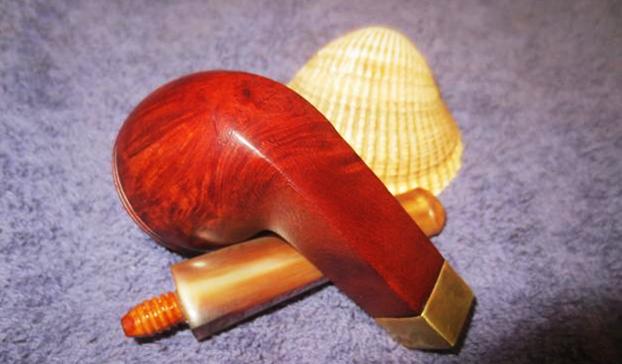
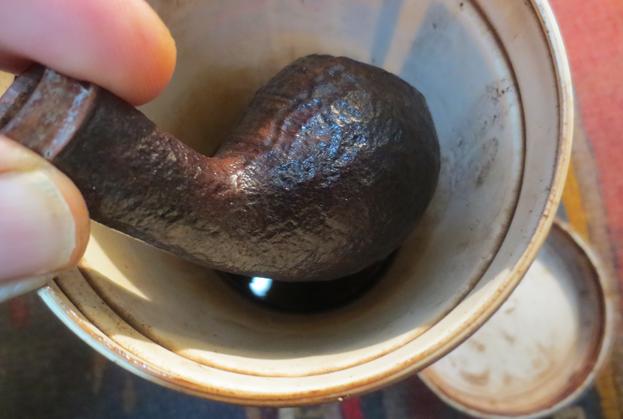
Restoring a Kaywoodie Hand Made Rusticated Rhodesian


Blog by Steve Laug

Last Fall I took a trip for work to Gainesville, Georgia in the US and during that time had a day free to do a bit of roaming. The friends I was staying with took us to a couple antique malls to have a bit of a pipe hunt. I found a few good pipes that I will be working on in the days ahead. This is the first of them – a Kaywoodie Hand Made Rhodesian. The stamping on the left side of the shank is faint but readable with a bright light and a lens. It reads Hand Made over Kaywoodie. On the right side of the shank it reads Imported Briar. The bowl had a light cake lining the walls and bottom while the rim top had a coating of lava that made the rim top look like it was rusticated or knocked about. The rim top is beveled slightly inward and was probably originally smooth. The carved worm trails pm the bowl sides and shank have angled slash marks across each of the grooves. The grooves on the bowl sides are more worn than those on the shank. There are twin rings around the bowl separating the cap from the bottom portion of the bowl. The finish was dirty and many of the grooves were filled in with dust and debris of the years. The stem had some nicks and scratches in the vulcanite and was lightly oxidized. There was also a spot on the top side near the shank where there must have been a logo insert that was lost many years ago and had been filled in with glue. There was light tooth chatter on both sides of the stem at the button but no deep tooth gouges. I took close up photos of the bowl, rim top and both sides of the stem to show the condition prior to cleaning. The buildup on the rim top is a combination of thick lava and damage to the surface of the briar. There appears to be some rustication on it but at this point I am not certain it is actually rusticated or just damaged.On the top side of the stem was a round spot that I think had originally held a Kaywoodie logo. It was missing and there was a slight divot in the stem. I filled it in with a clear super glue and set it aside to cure.I cleaned up the rim top with a Savinelli Fitsall Knife blade. I scraped the surface of the rim and also the inner edge of the bowl to smooth things out. Once the rim was cleaned off the damage to the surface of the rim was visible. It was rough to touch. I reamed the bowl with a PipNet pipe reamer starting with the second cutting head and finishing with the third head which was the close to the same size as the bowl itself. I reamed the cake back to smooth briar. I worked over the beveled rim top with a folded piece of 220 grit sandpaper to smooth out the rough surface and remove as much of the damage as possible.I worked Before & After Restoration Balm deep into the rusticated patterns of the briar to clean, enliven and protect it. I worked it into the rustications with my fingertips and with cotton swabs. I worked it into the rim and shank end. I set it aside for a few minutes to let the balm work. I wiped it off with a soft cloth and buffed it with a horsehair shoe brush to polish it. The briar really began to have a deep shine. I took some photos of the bowl at this point to mark the progress in the restoration. The grain on the bowl is really beginning to stand out and will only do so more as the pipe is waxed.  I wiped down the rim top and polished it with micromesh sanding pads – wet sanding with 1500-2400 grit pads and dry sanding with 3200-12000 grit pads. I wiped the rim top down with a damp cloth after each sanding pad. I restained the rim top to match the contrasting stains on the rest of the bowl. I used a black Sharpie pen to colour in the grooves on the top of the rim to match the grooves around the bowl. When I had finished I like the final look of the pipe.I used a dental spatula to clean out the hard tars and oils on the walls of the mortise. It did not take too much work to remove the hard build up. I scrubbed out the shank after that using cotton swabs, pipe cleaners and isopropyl alcohol. I cleaned out the airway in the stem with pipe cleaners, cotton swabs and alcohol. The airway in the end of the tenon was slightly out of round because somewhere along the way the stinger had been removed and the airway damaged. I used a knife to bevel the edge of the airway in the tenon and then sanded it with a folded piece of sandpaper to smooth it out. I polished the stem with micromesh sanding pads – wet sanding with 1500-2400 grit sanding pads and dry sanding with 3200-12000 grit pads. I wiped the stem down with Obsidian Oil after each sanding pad. I finished polishing the stem with Before & After Pipe Stem Polish both Fine and Extra Fine to remove the last of the scratches. I gave it a final coat of Obsidian Oil and set it aside to dry. With the stem polished I put it back on the pipe and lightly buffed the bowl with Blue Diamond. I buffed the stem with a more aggressive buff of Blue Diamond. I gave the bowl multiple coats of Conservator’s Wax and the stem several coats of carnauba wax and buffed the pipe with a clean buffing pad to raise the shine. I hand buffed it with a microfiber cloth to deepen the shine. The pipe polished up pretty nicely. The finished pipe is shown in the photos below. I will be posting it on the rebornpipes store very soon. It should make a nice addition to your pipe rack if you have been looking for a reasonably priced older Kaywoodie Hand Made Rhodesian carved in an almost classic Custombilt style. It should be a great smoking pipe with a good hand feel. The dimensions are Length: 5 3/4 inches, Height: 1 1/2 inches, Outside diameter of the bowl: 1 3/4 inches, Chamber diameter: 7/8 inches. Thanks for walking through the restoration with me as I worked this pipe over.


ANSWERS TO QUESTIONS: What is the process for cleaning my pipe?


Blog by Steve Laug

After cleaning, refurbishing and restoring pipes for more years than I care to remember a question from a friend prompted this blog. It makes sense to put this blog together as a good pipe cleaning regimen will prevent a lot of problems that neglect bring to a pipe. Those issues range from a sour and stinky pipe to a cracked bowl or shank. In fact the majority of issues that I deal with on an almost daily basis come from poor maintenance of a pipe. The first cardinal rule of pipe cleaning is very simple and if you remember nothing else from this blog remember this: DO NOT TAKE THE PIPE APART WHILE IT IS WARM/HOT. I have seen too many loose tenons, broken tenons, and cracked shanks because this simple rule was ignored. It is not a suggestion! It is a warning. In terms of the question in the title of the blog, I thought I would break the steps down into the two broad categories that characterizes my own cleaning and then spell out the specifics under the two broad headings.

After each smoke – These steps are my own post smoke regimen that I try to religiously follow after each smoke. I find that for me it generally keeps my pipe smoking sweet and cool and minimizes the problems that I have seen in my refurbishing work.

  • Immediately upon finishing a bowl tap out the ash on the heel of your hand or use the pick end of the tamper to empty the bowl.
  • Scrape the edge of the tamper around the inside of the bowl to remove most of the debris left behind.
  • Run one or more pipe cleaners through the airway in the stem and shank to remove the moisture and oils from those areas. If the pipe cleaner does not go through to the bowl wiggle and turn it to see if it will slide in. If not just clean the stem for now. Once the pipe cools you can remove the stem and do the shank.
  • Work the pipe cleaner into the edges of the slot in the button to remove any buildup in those spots. You can wet the pipe cleaner with a bit of saliva if you would like to help with debris removal.
  • Fold the used pipe cleaner in half and work it around the inside of the bowl to remove remaining debris from the walls and bottom of the bowl. Tap out the bowl on the heel of your hand to remove any loose tobacco bits and then blow through the airway to displace any debris in the airway and bowl.
  • Stand the pipe in a rack or pipe rest – bowl down to let the pipe air dry. I have found that often an overnight rest for the pipe is enough. Others swear that you should let it set for several days and even up to a week to let it rest. I have not found that to be an issue. Sometimes I will leave a pipe cleaner in the stem and shank to let it absorb any residual moisture.

That is the short and long of a post smoke cleanup. You can see that it is not a long process or one that needs to be avoided. It is simple and easily becomes a part of the smoking process for your pipe once you build it into your routine.

Weekly – Once a week or at least every other week I take the pipes I have smoked during that week to my work table and do a more thorough cleaning. The more thorough cleaning keeps the pipe operating at its full potential and helps to deliver a clean tobacco taste with each smoke.

  • Spread out a cloth or a newspaper to keep the table top or work table clean as it will minimize the distress of your other half.
  • Carefully remove the stem so that I can clean out the mortise and shank. If it is tight and does not come out with a little pressure, put it in the freezer for about 10 minutes and that should loosen the stem and make it easy to remove.
  • Scrub down the mortise area with cotton swabs and 99% isopropyl alcohol to remove the tars and oils that collect there. I always use the highest % of alcohol I can find as it evaporates quickly leaving the interior of the pipe dry.
  • Clean out the airway to the bowl with pipe cleaners and alcohol to remove tars and oils that eventually accumulate and constrict the airway. Over time these build up and harden and reduce the draw of a pipe.
  • Lay the bowl aside to let the shank thoroughly dry before you reassemble the pipe. Usually a half hour is enough time to make sure all is dry. Moisture can swell the briar so letting the pipe dry keeps the fit of the tenon snug in the mortise.
  • Run pipe cleaners and isopropyl alcohol through the airway in the stem and work over the end of the tenon to remove any tar or oil that has built up there. Clean out the edges of the slot. You may need to use a tooth pick or dental pick to clean out these areas.
  • PLEASE NOTE – Neglecting the internals of your pipe can eventually lead to a sour tasting and bitter smoking pipe.
  • Check the cake in the bowl. I personally keep the cake in my bowls thin and I want them to be hard and clean. To allow the cake to form in that way you do not want to ream your pipe every week. The easiest method is to simply twist a paper towel into the bowl to knock off loose debris in the surface of the cake and smooth out the bowl sides. It also absorbs any liquid in the bowl.
  • Clean off the rim top with a little saliva on a cotton pad or paper towel to remove the natural oils that build up on the surface.
  • Once the bowl is finished, check to see if the shank is dry enough for an easy fit of the stem. It should be snug but not have to be forced.
  • Wipe down the exterior the cleaned bowl and stem with a paper towel lightly wetted with olive oil. I find that this preserves and protects the briar and the stem material. Do not use it in excess as many have said that it goes rancid – personally I have never had a problem with that so I continue to use it.
  • I buff it dry with a soft cloth to remove the excess oil and to give the pipe a shine.
  • Set the pipe upright in a rack and let it thoroughly dry out. Put a pipe cleaner in the stem to absorb any residual moisture. Repeat the process with the next pipe in your collection.

That summarizes the procedure that I use to clean my pipe and keep it smoking well. Hopefully the process gives you a sense of how to build your own. The key is to keep the pipe clean daily and the other cleanups will be less onerous. As always I am sure there as many views on this process as there are people who will read it. This is my own process and it works for me. How you do it is up to you. Until next time enjoy your pipe!


Broken Pipe Blues


Blog by Joe Gibson (PappyJoe)

I have followed PappyJoe on Twitter ever since our paths crossed on the Country Squire Radio show. We have fired tweets back and forth and not long ago he sent an invite to his blog PappyJoe’s World – Pipe Smoking and other thoughts.  Since then I have frequented the blog and read quite a number of his posts. During my lunch hour at work today I decided to visit again. I read three really interesting posts that I thought would be great to share on rebornpipes. I wrote PappyJoe and asked permission to post these blogs here. This is the first of them. Well worth the time to read. Thanks PappyJoe and welcome to rebornpipes. Without further words from me here is his blog (https://pappyjoesblog.com/broken-pipe-blues/).

This is a cautionary tale about buying “estate” meerschaums at antique/collectible/junk shops…

As mentioned in an earlier post, we like to walk around antique/collectible/junk shops, malls and flea markets.  I also said most of those pipes are overpriced. I’ve seen briar pipe so dirty you would have trouble fitting a toothpick into the bowl and priced upwards of $75. Look carefully and instead of something like a Dunhill or Charatan, you will find a Dr. Grabow or Medico you could have bought just a few years ago at a drugstore. Get real lucky though and you can find a nice briar with 50 or 60 years of age on it that is still worth cleaning and sanitizing. Just inspect them carefully. I once examined a nice looking Charatan that you could run a pipe cleaner though – the bowl that is. It had burned through the bottom.

My Sultan Saxophone meerschaum. The crack is along the base of the turban

The worst offenders seem to be vendors selling meerschaum pipes. I’ve seen figural meerschaum pipes with broken stems and bowls priced at $400. I looked at CAO Sherlock Holmes pipe priced at $350 because it was “signed.” Unfortunately it was signed in big block letters along one side  by someone using a rotary tool. You could still see the tool marks. I passed on both of those.

I do have a Sultan saxophone meerschaum I paid $10 for at a flea market. It has a 3-part stem (one acrylic and two sections of meerschaum) and was unsmoked. I examined it carefully before buying and didn’t see any cracks. But as I smoked it the first time and it got hot, two long cracks at the base of the bowl appeared. I quickly applied super glue to it and it’s been sitting on my shelf since then. It looks nice sitting on display as a $10 piece of art. It is also my first cautionary tale about buying pipes at these shops.

Floral meerschaum in case was only $20

And it brings me to my second cautionary tale. This past weekend we made an overnight swing through southwest Mississippi. At one stop I found an unnamed, never smoked, Meerschaum in its hard case for $20. After carefully examining it with a magnifying glass, I took the stem off and inspected the stummel end. I felt I gave it a thorough examination and other than a musty, moldy, almost mothball smell in the bowl, it looked in great condition. Until I started the cleaning process when I got home.

I removed the stem by gently turning and pulling it with no problem. Next, I inserted a clean and dry pipe cleaner through the airway and then filled the bowl with baking soda to see if that would get rid of the smell and let it set.  A few hours later, I dumped the baking soda and removed the pipe cleaner. Wiped out the bowl with a tissue and then dipped the pipe cleaner in water and ran it through the airway.

The invisible crack appears...

The first crack, before attempted repair

That’s when a crack at the very end of the stummel, where the nylon screw went appeared. Don’t you hate it when that happens? I have five rescued meerschaum pipes. I have cleaned each of them this way. This is only the first one to crack when cleaning. I sat there and watched as the crack around the stummel expanded and a half inch piece fell off.

I hate it when that happens. My first thought was to throw it in the trash.  My second thought was it may be salvageable. The broken part was only part of the threaded stummel so if I glued it back together it might not affect the smoking capability of the pipe. That’s what I was hoping for, anyway.

It wasn’t what I got. After letting it sit for 24 hours, I loaded the bowl and lit it carefully. About five minutes into the smoke, as the tobacco started burning good, I heard a crackle which I first attributed to maybe the tobacco not being dry enough. Then I look at the right side of the pipe and saw another thin, almost imperceptible crack extending from the stummel along one side of the bowl. Then I heard another crackle and saw the crack had expanded around the bowl and up the left side.

The crack expanded around the front of the bowl

Lesson learned? Not really

Nothing can save this pipe, so I gentle pried the tobacco out of it to prevent more damage. It now sits on top of one of my pipe shelves with the Sultan which is also never smoked. Either the pipe had not been cared for properly or the block was flawed when carved. It only takes a drop or two on a hard surface for a meerschaum to crack.

Won’t stop me from rescuing more pipes in the future.

(© J. Gibson Creative Services 2018)