Monthly Archives: January 2021

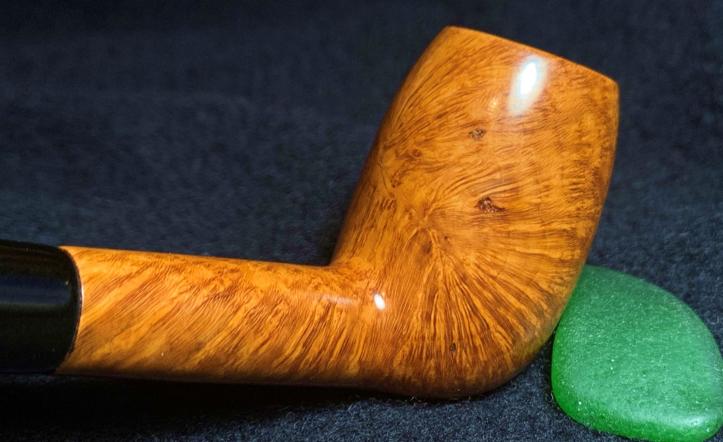
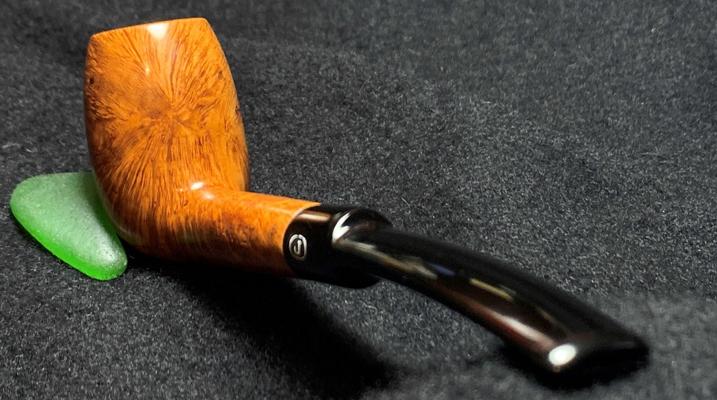
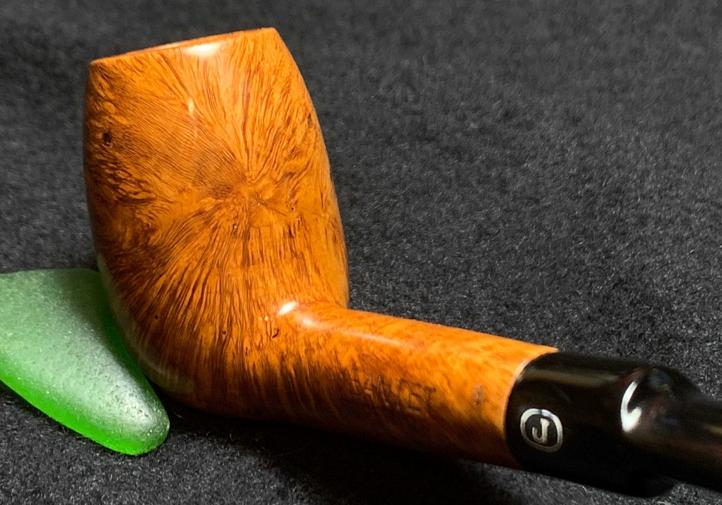
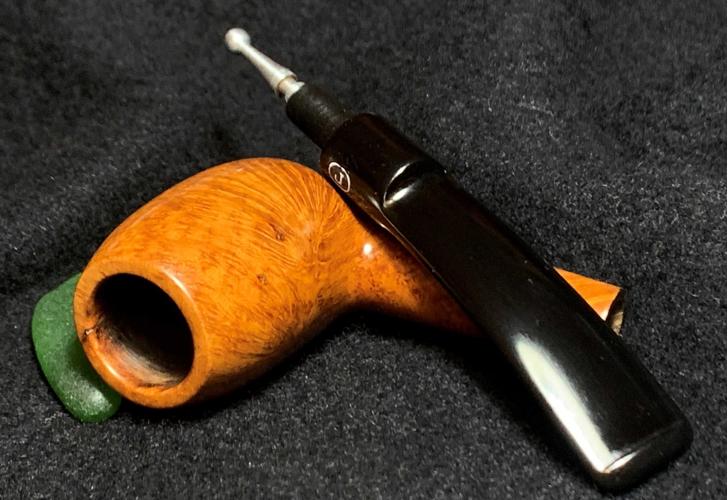
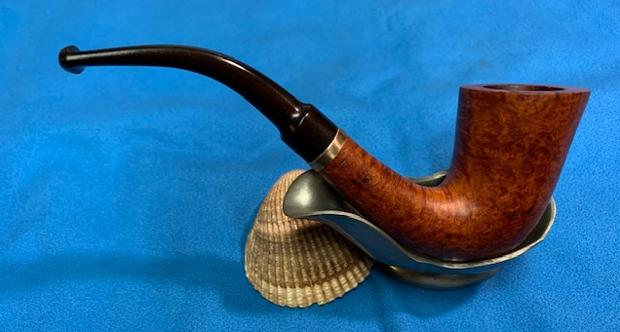
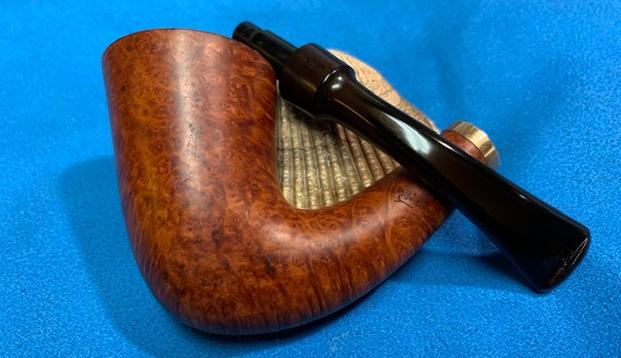
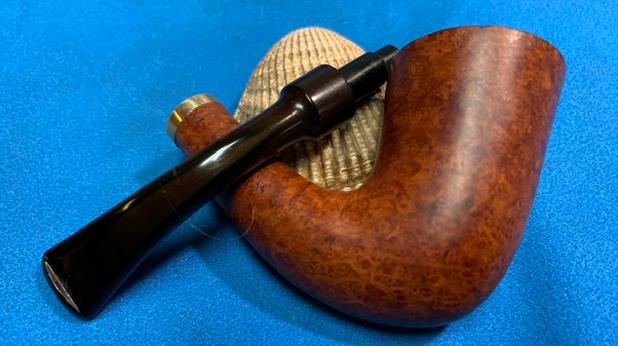
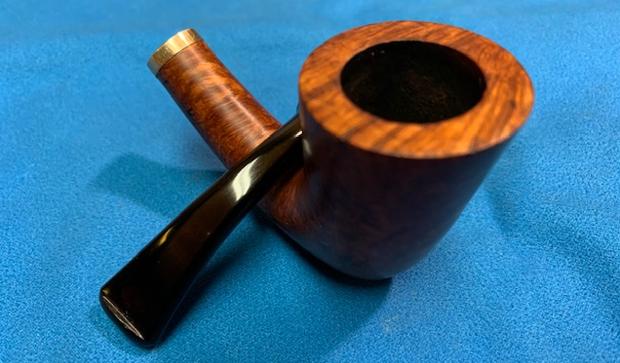
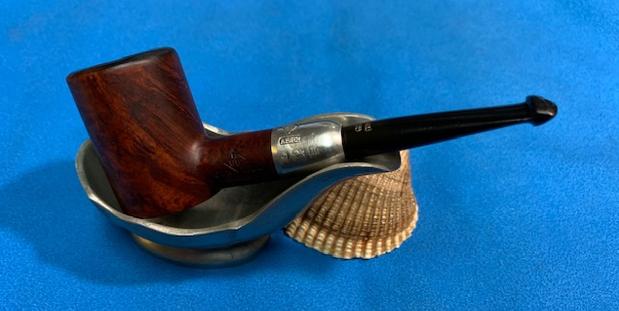
Comoy’s Regent Prince Restoration


By Al Jones

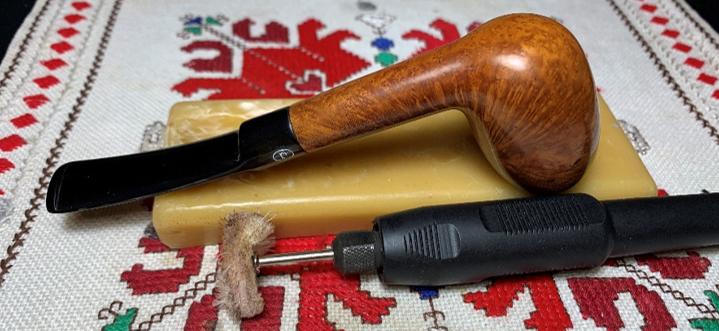
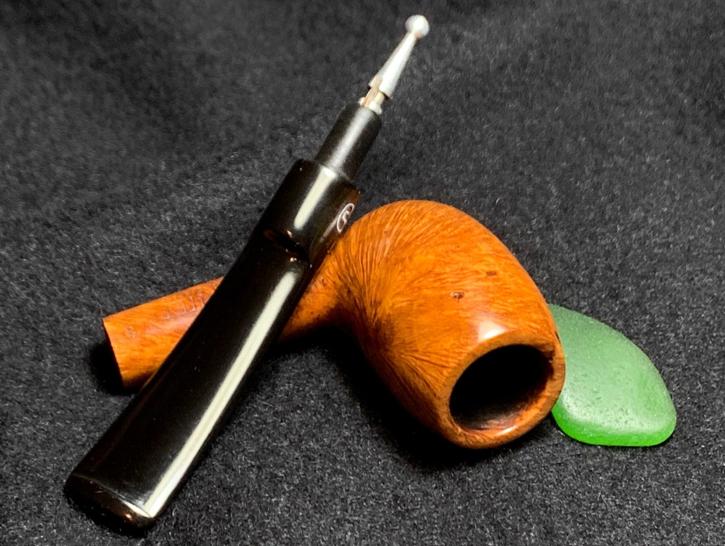
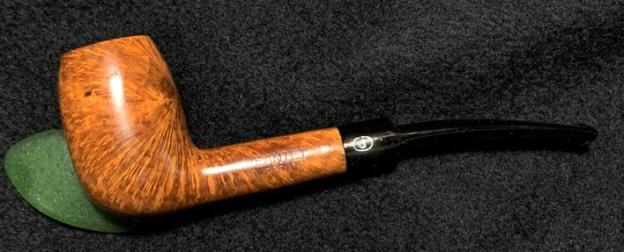
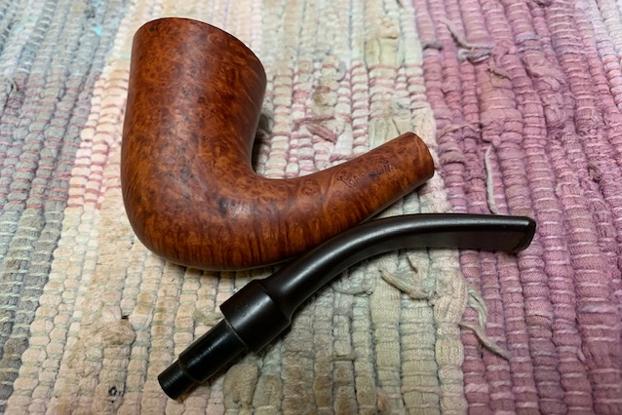
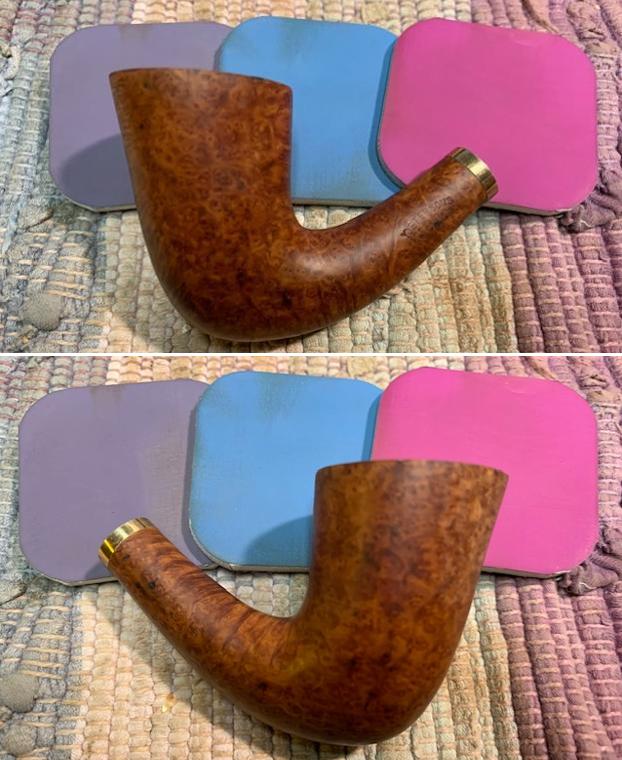
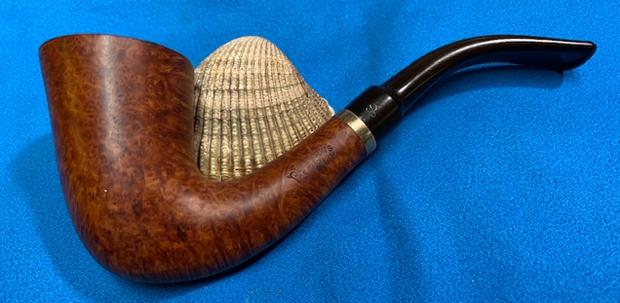
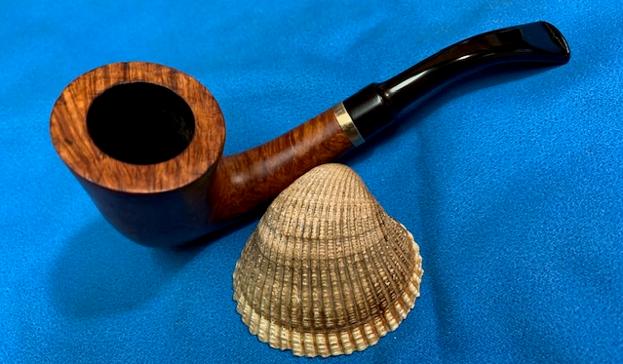
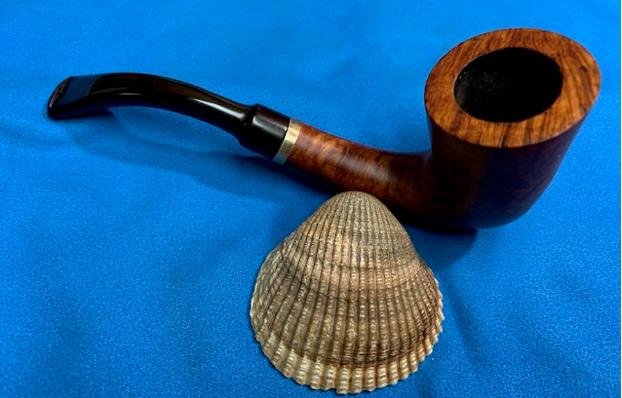
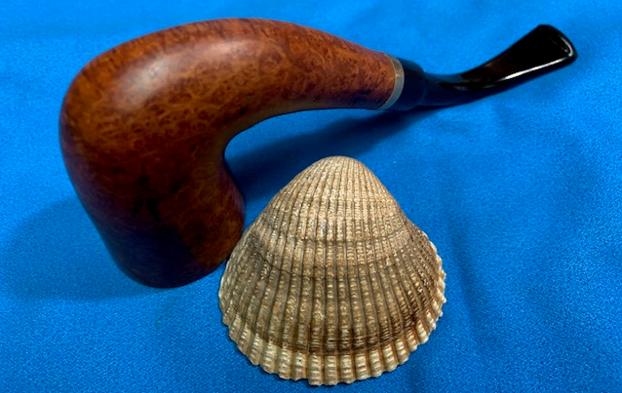
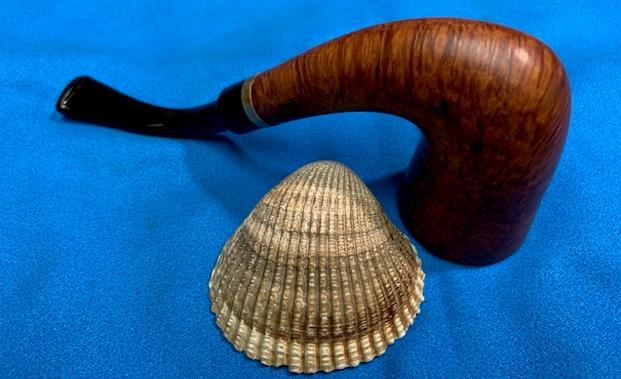
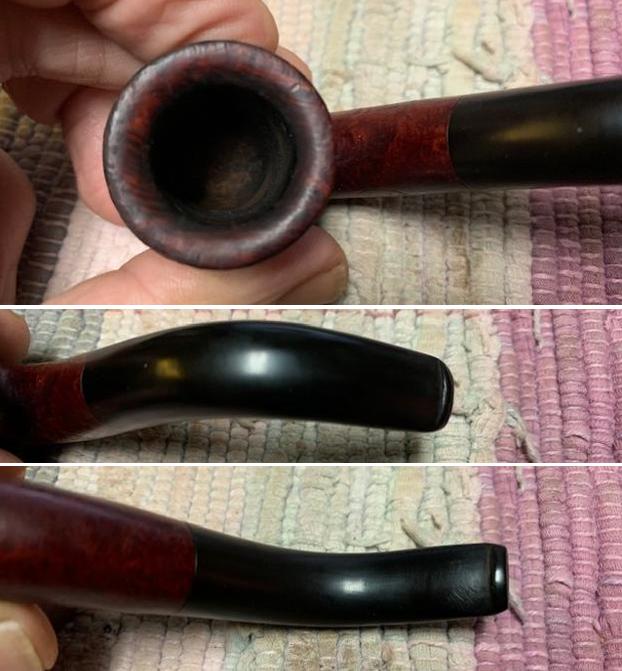
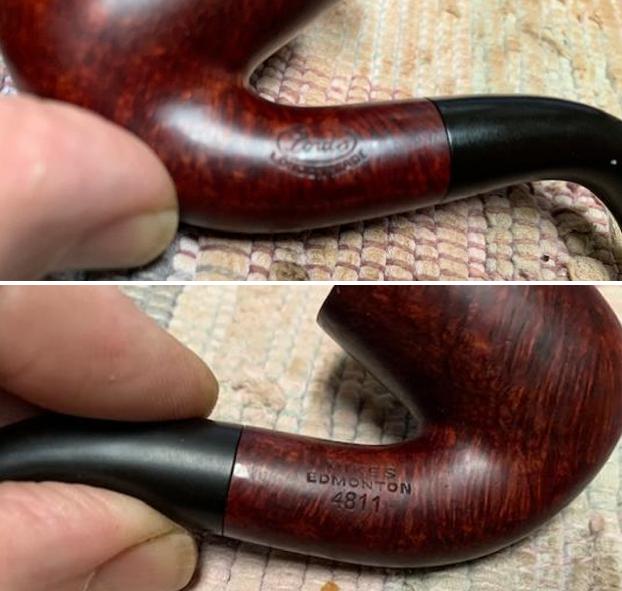
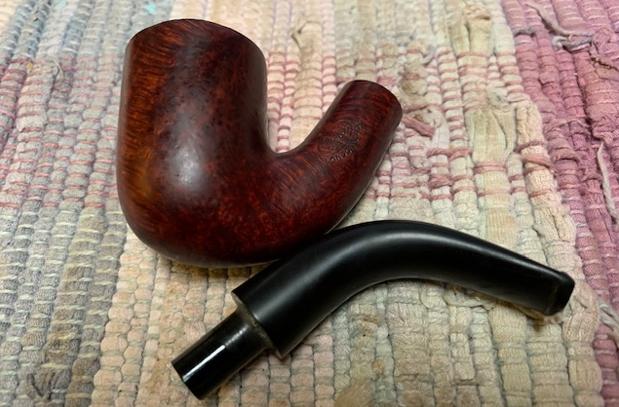
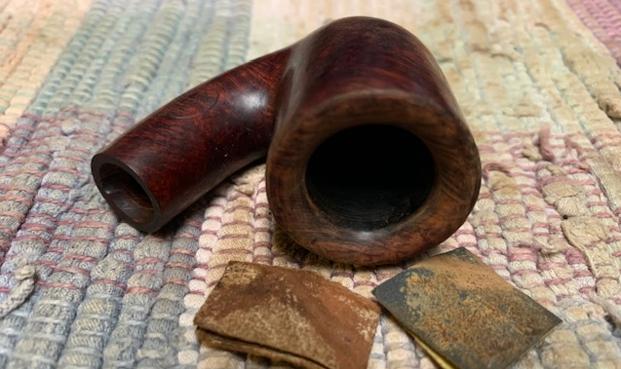
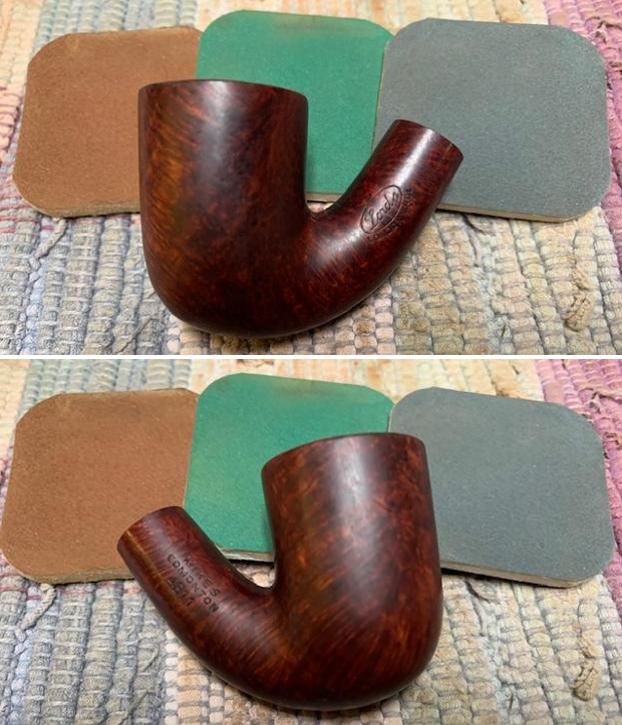
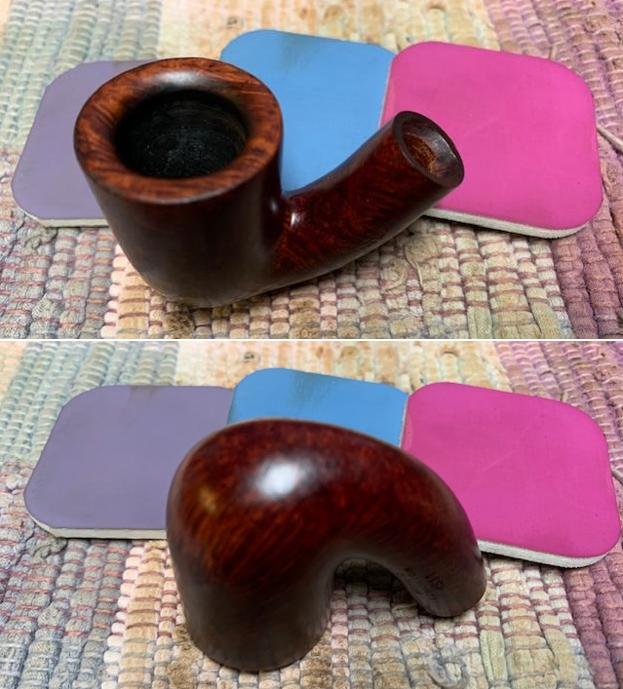
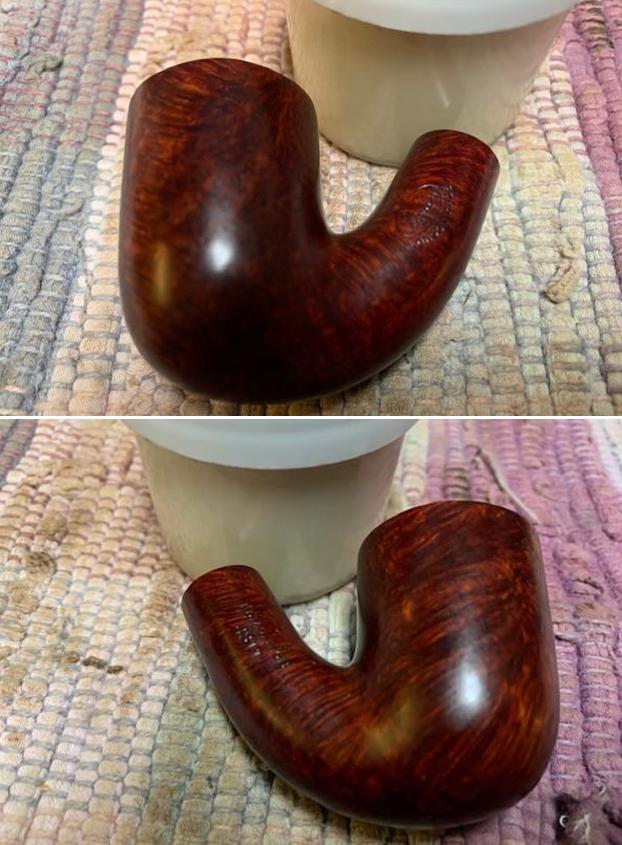
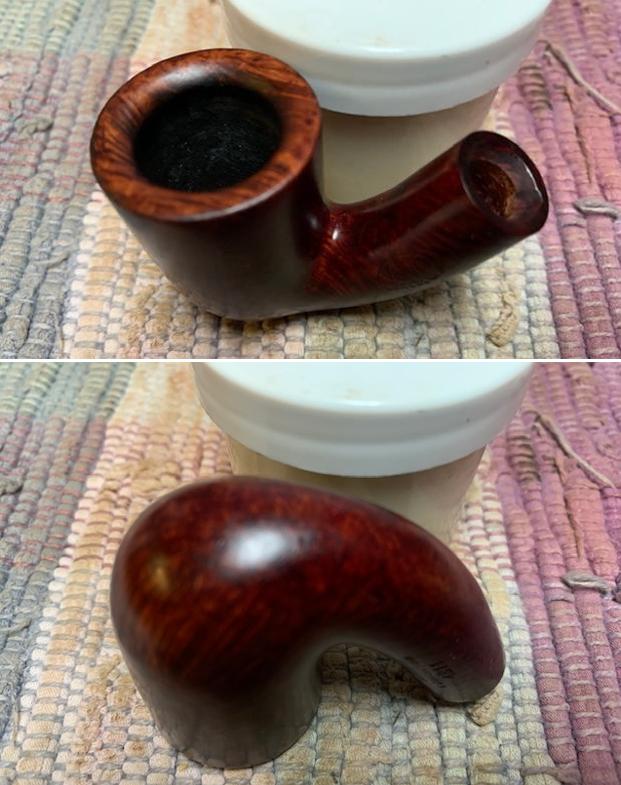
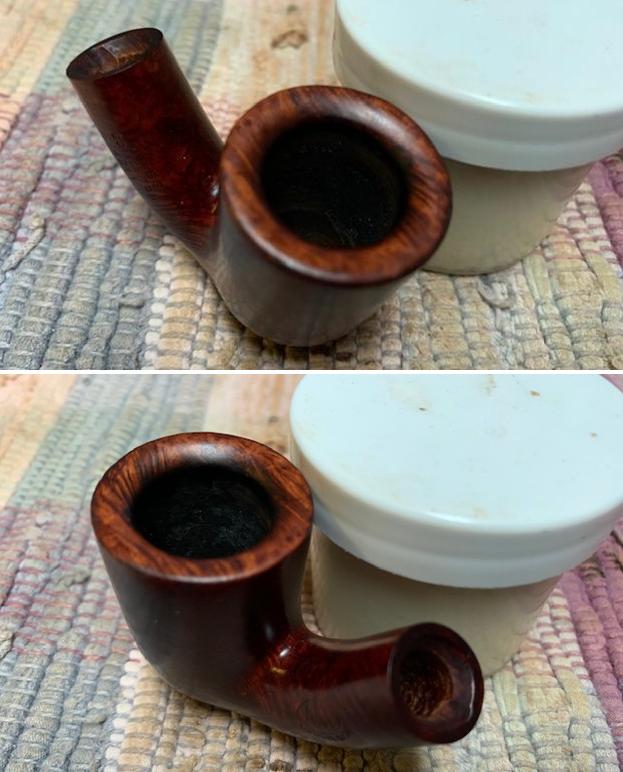
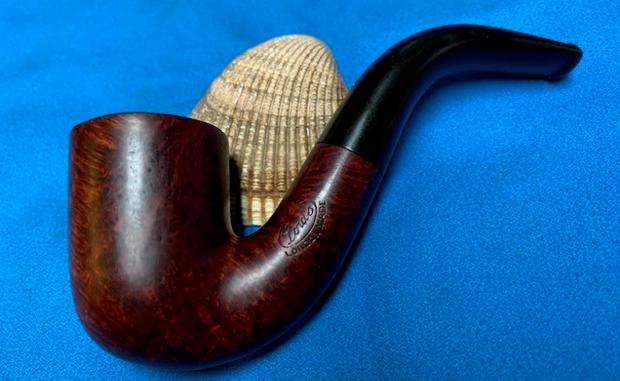
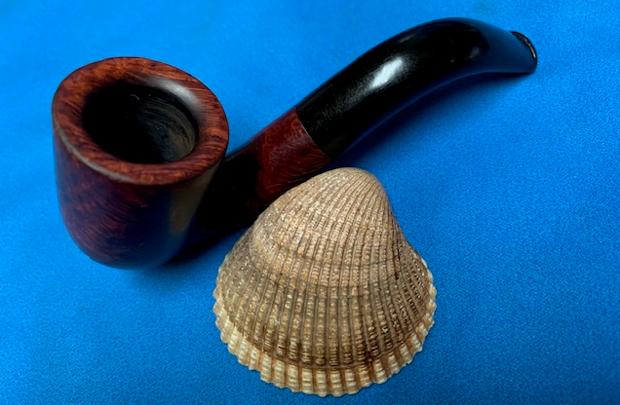
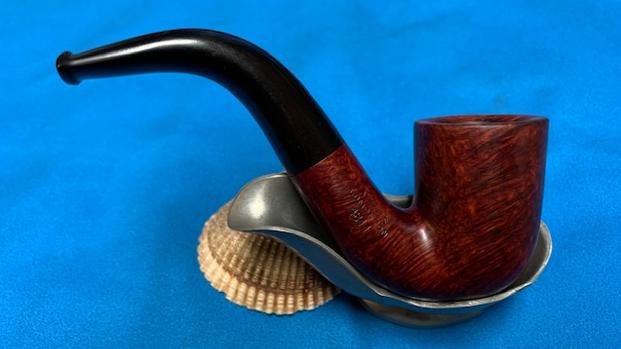
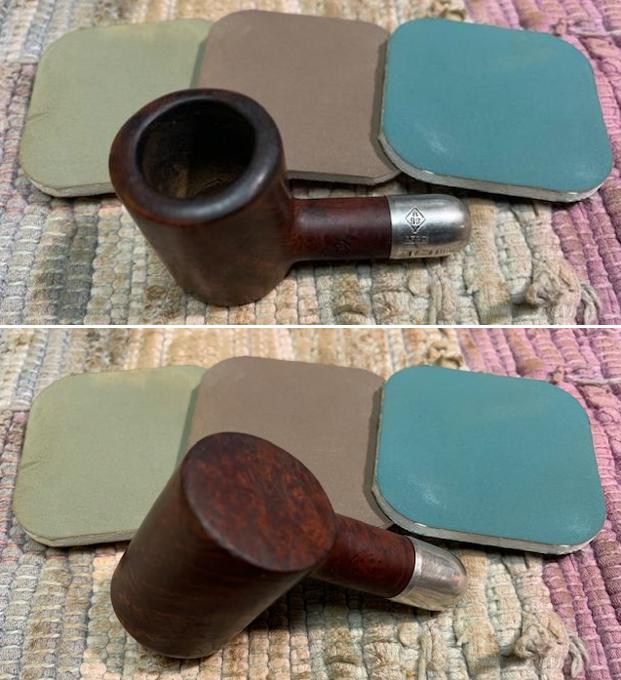
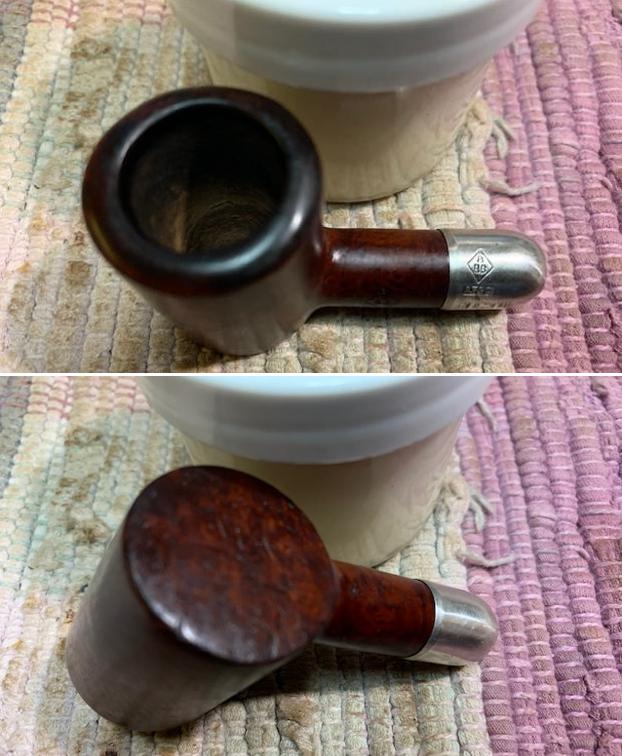
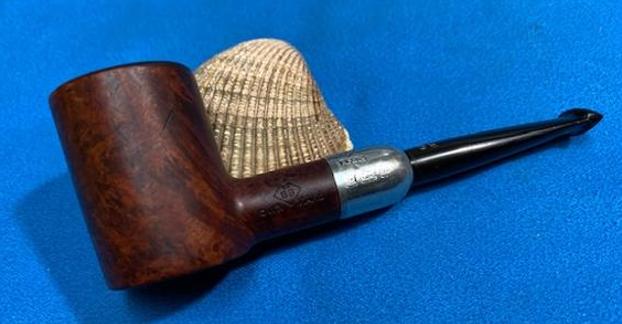
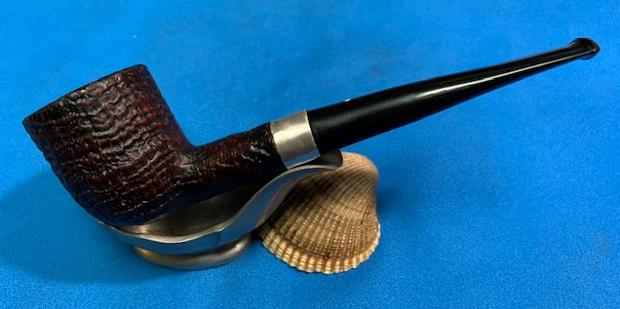
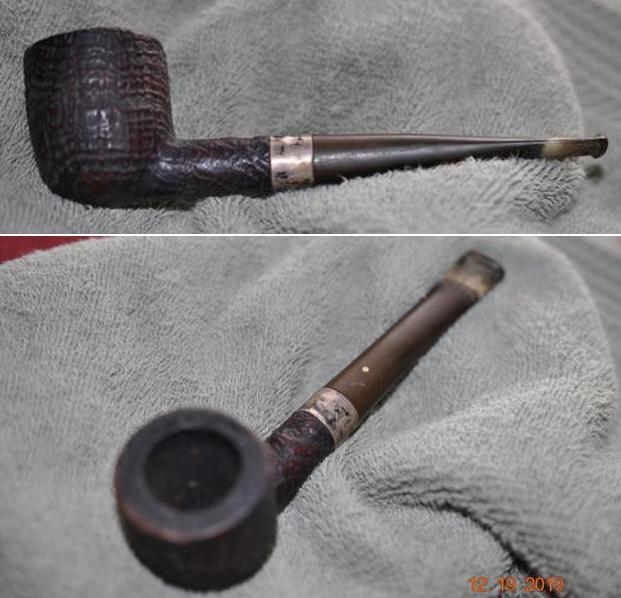
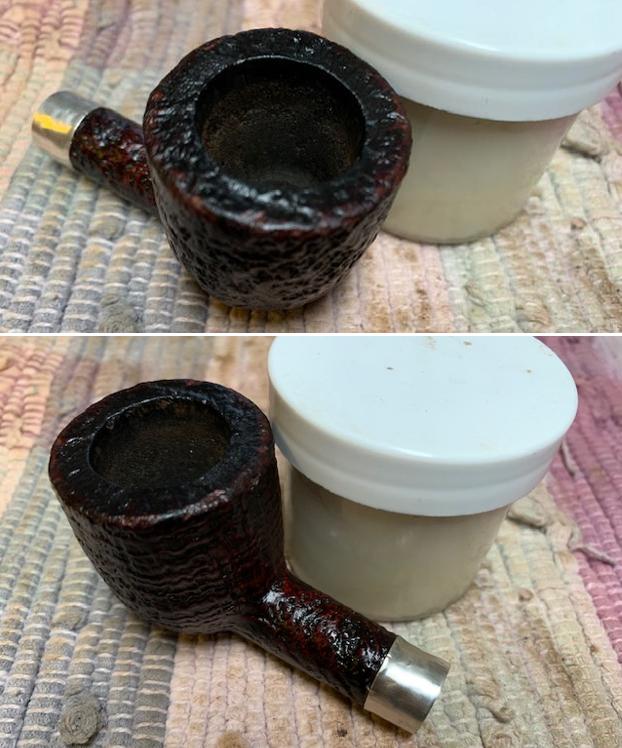
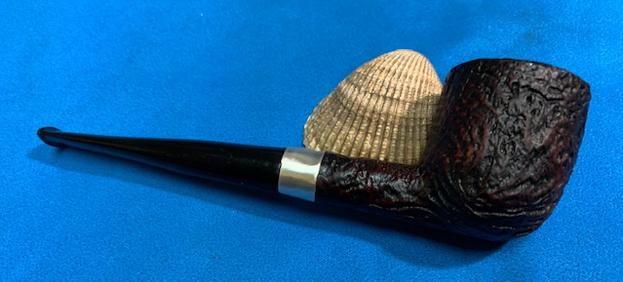
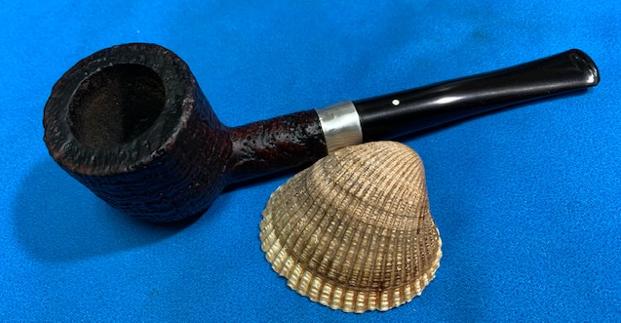
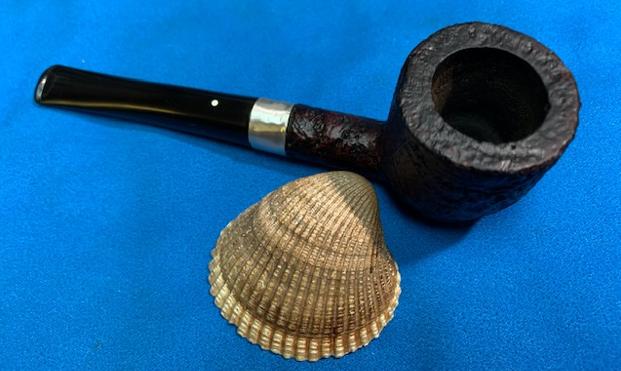
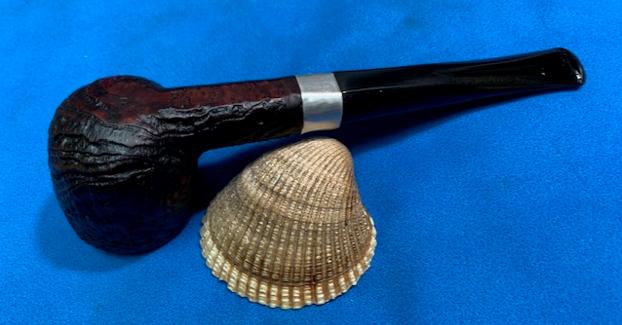
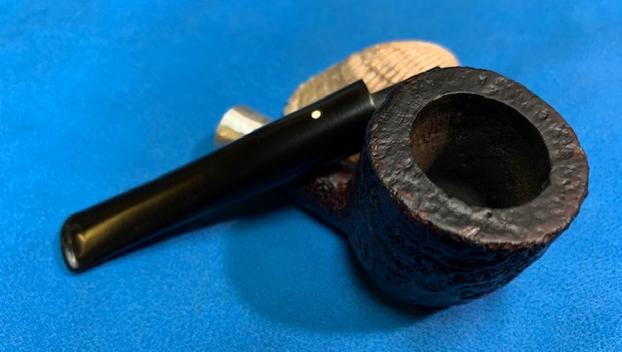
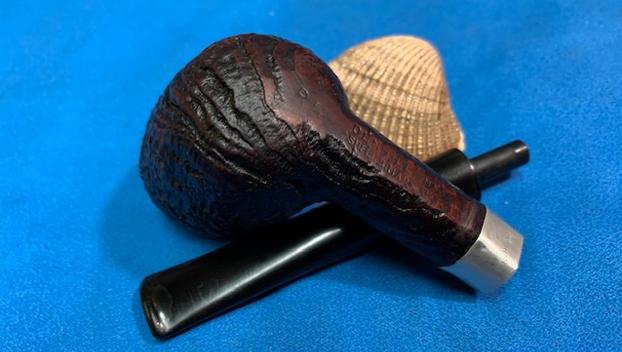
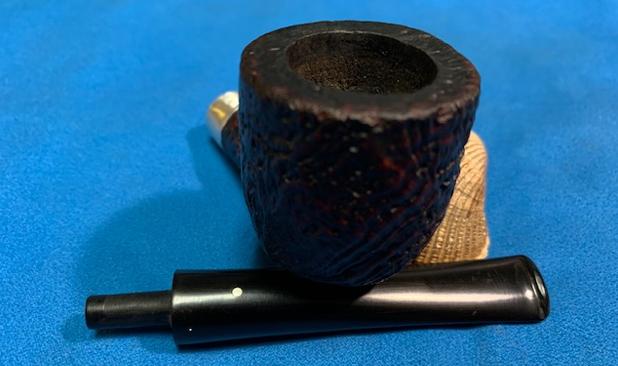
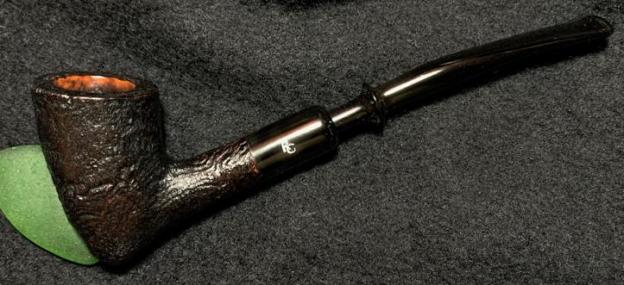
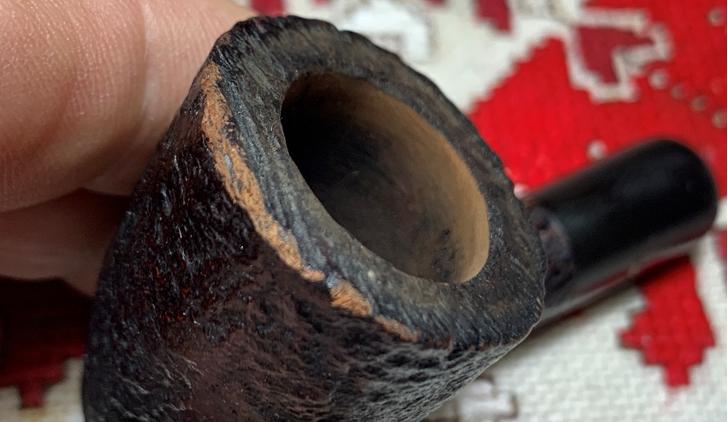
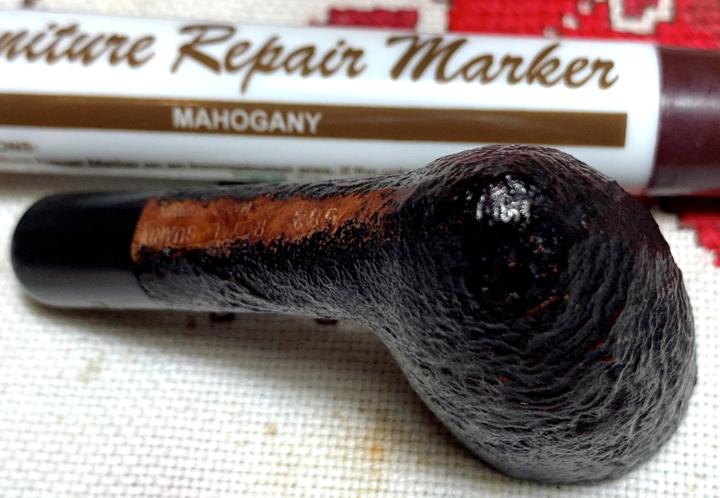
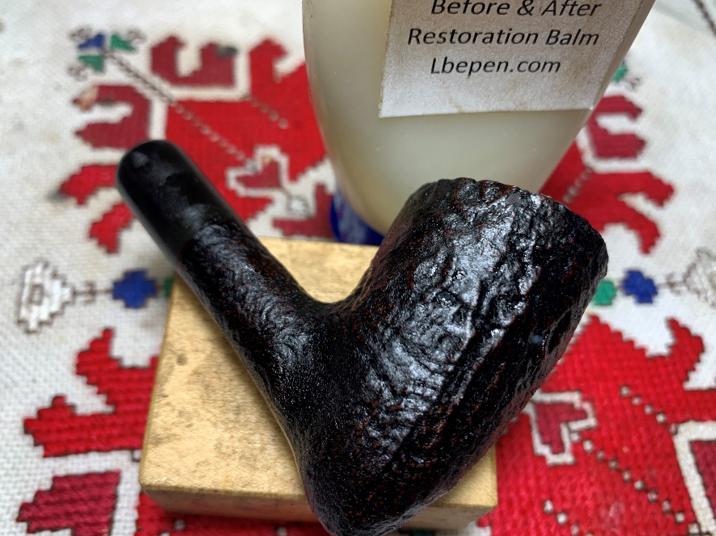
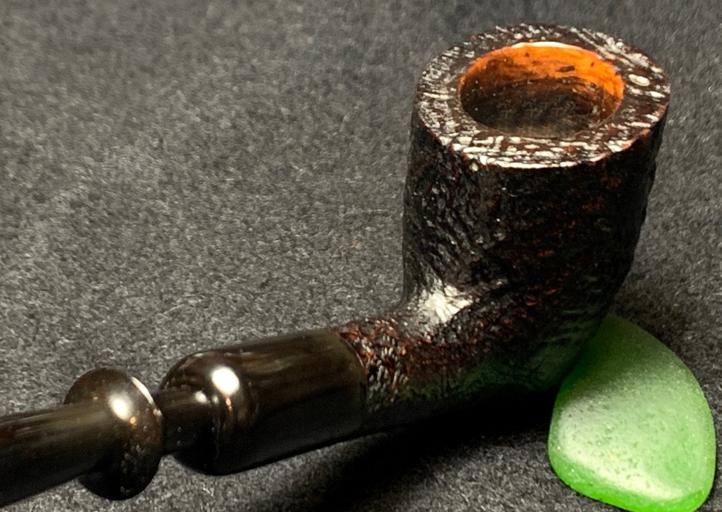
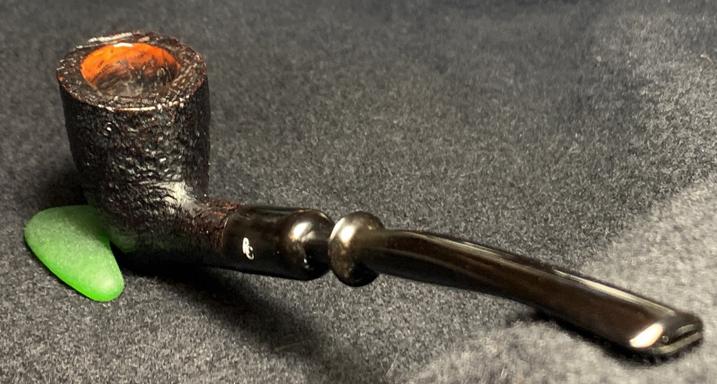
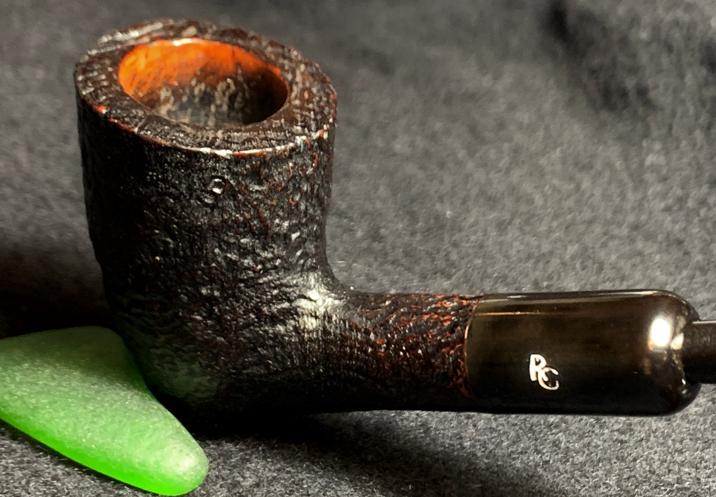
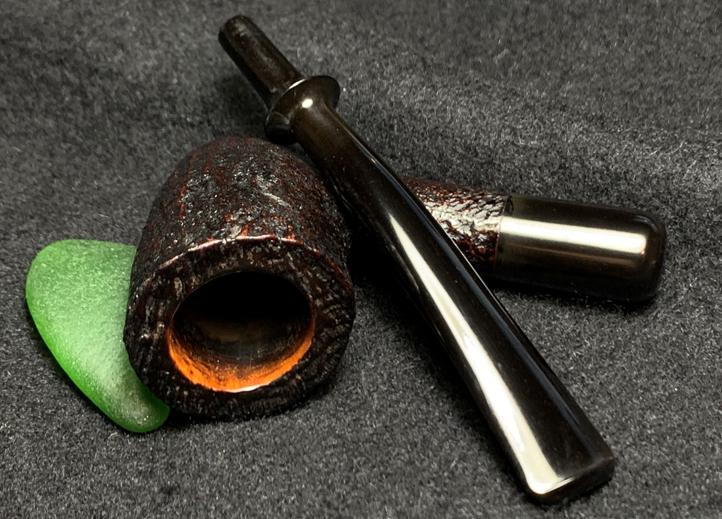
The 337 is one of several Prince shapes in the Comoy’s catalog.  I was unable to determine when the shape was first seen.   This pipe is a “Regent” and the first I’ve seen on my bench fro that line.  This one didn’t require much work, there was mild oxidation on the stem, a few light teeth indentions, a mild cake and some build-up on the bowl top.  Below is the shape from a 1970’s Comoy’s catalog, and the pipe as it was received.

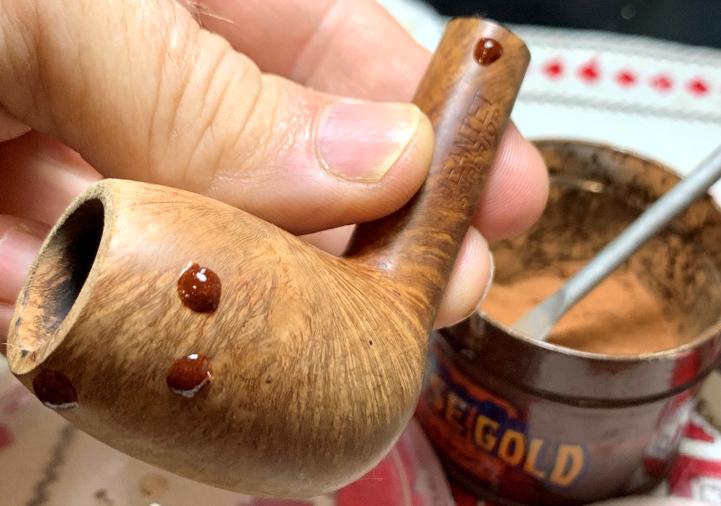
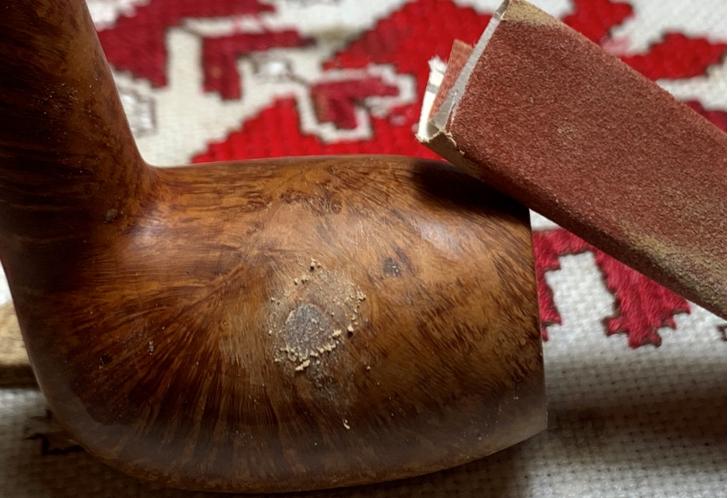
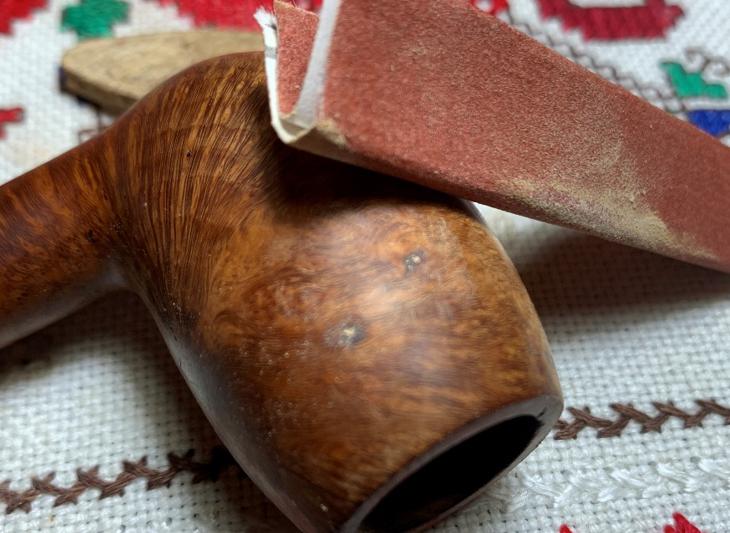
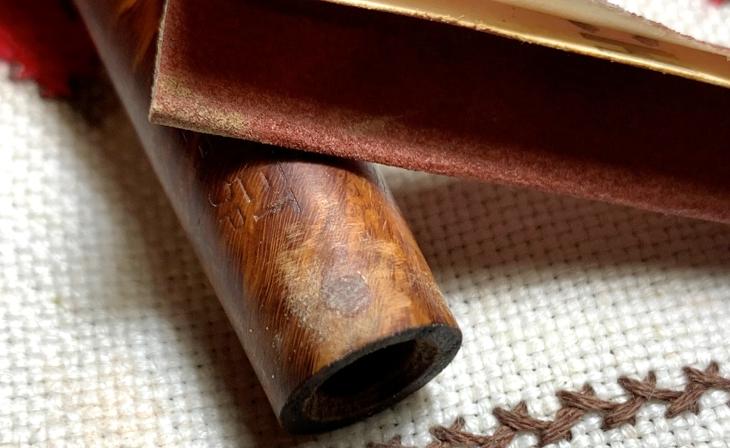
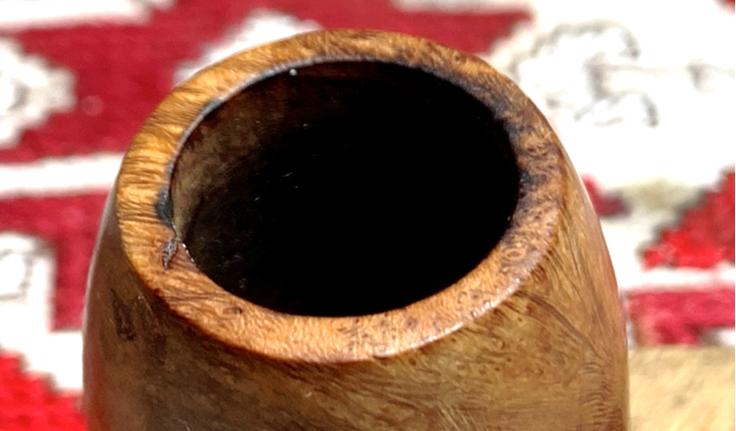
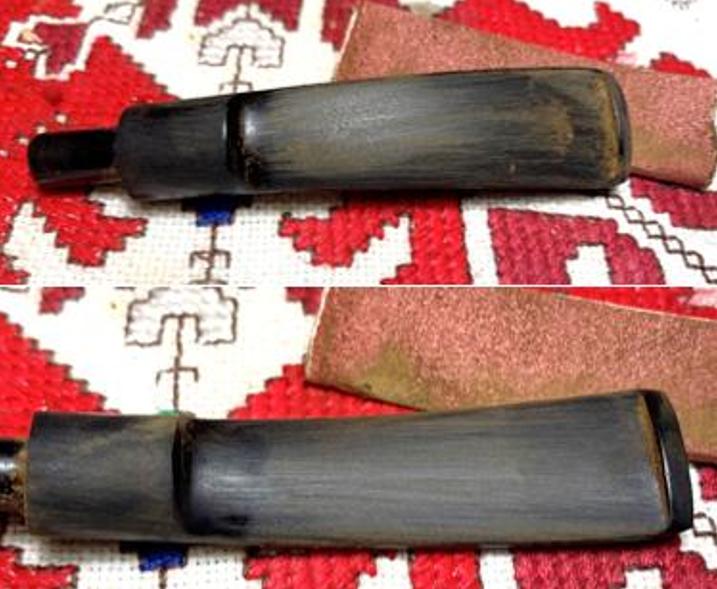
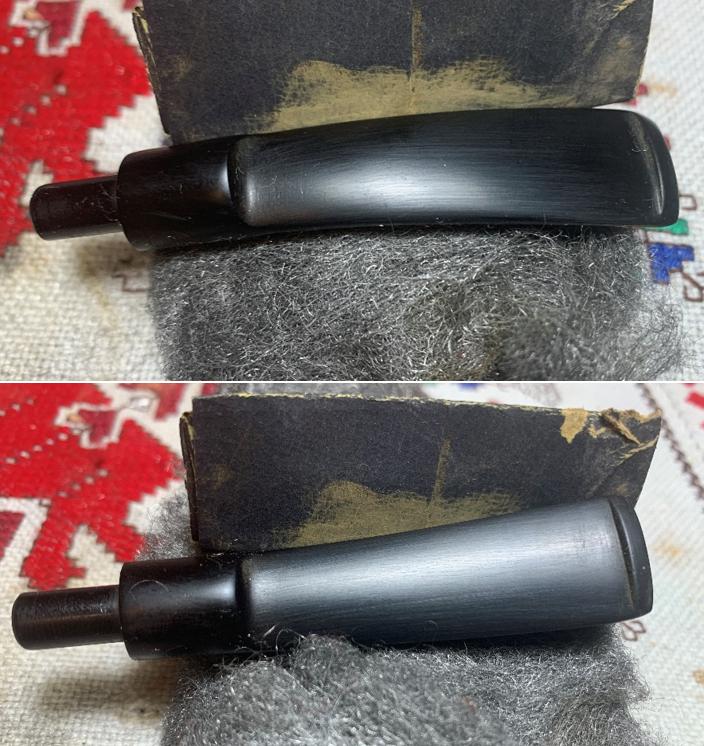
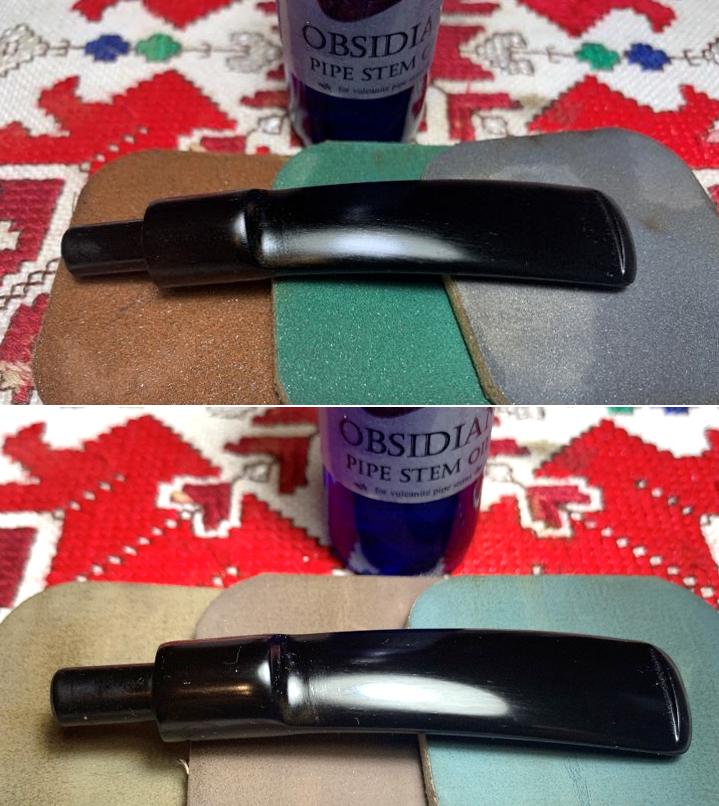
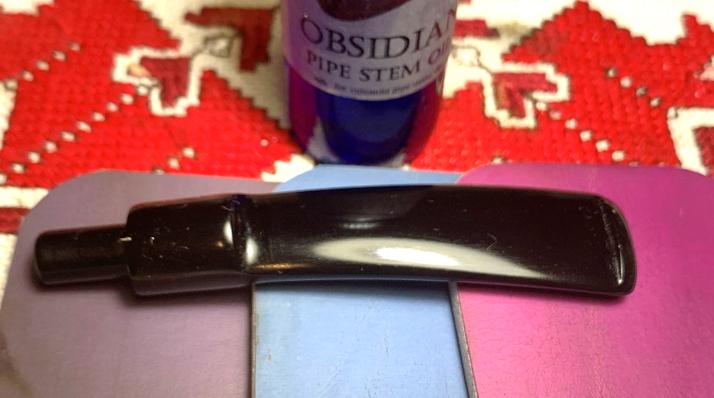
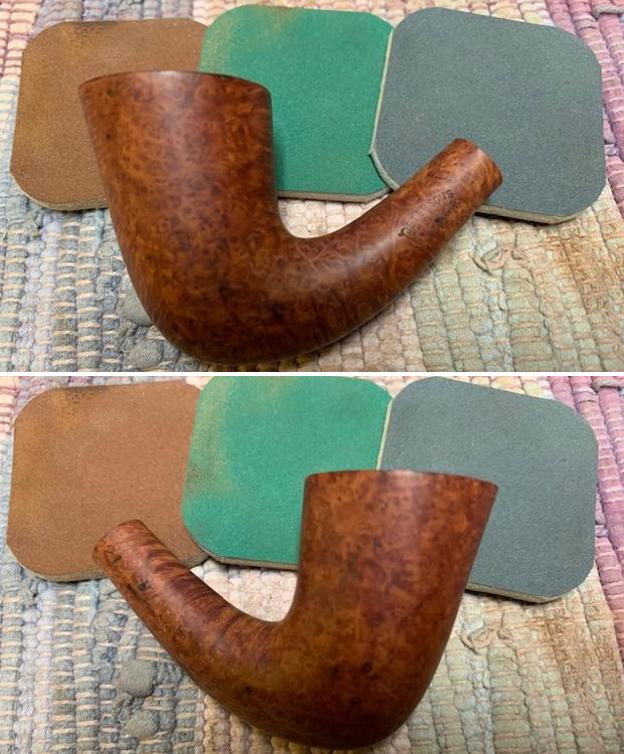
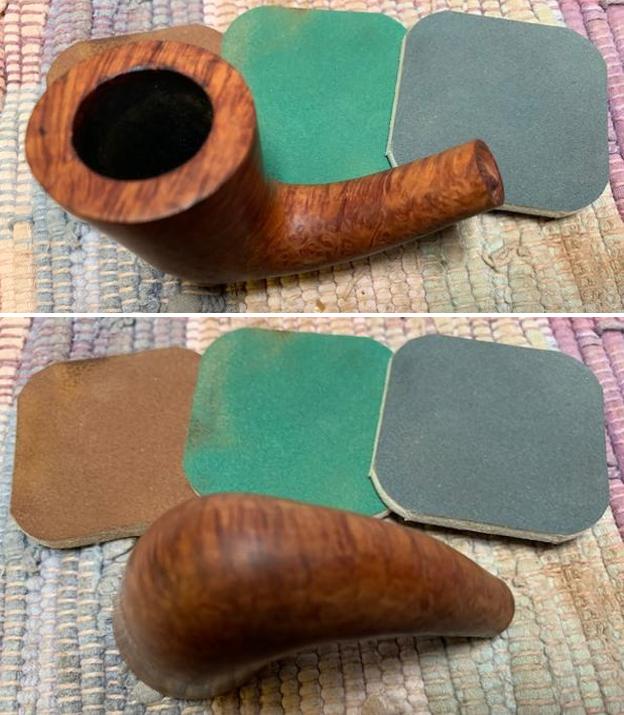
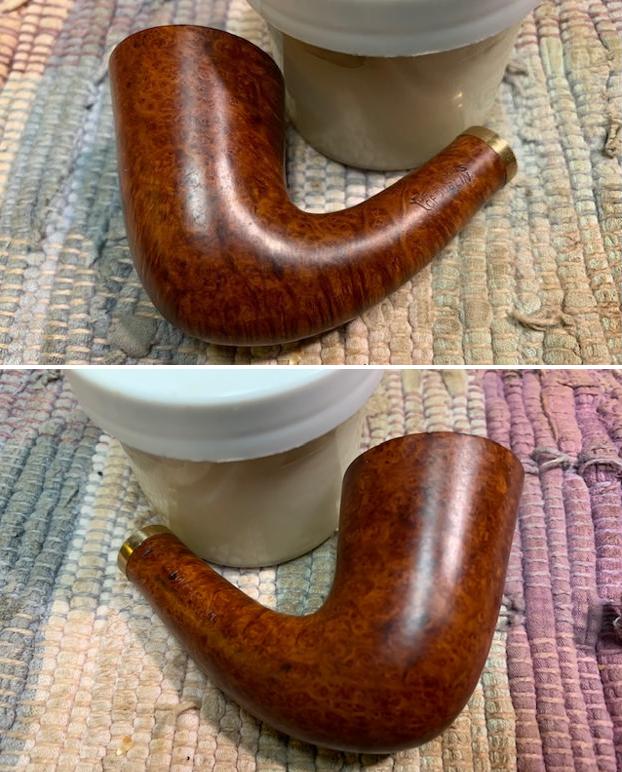
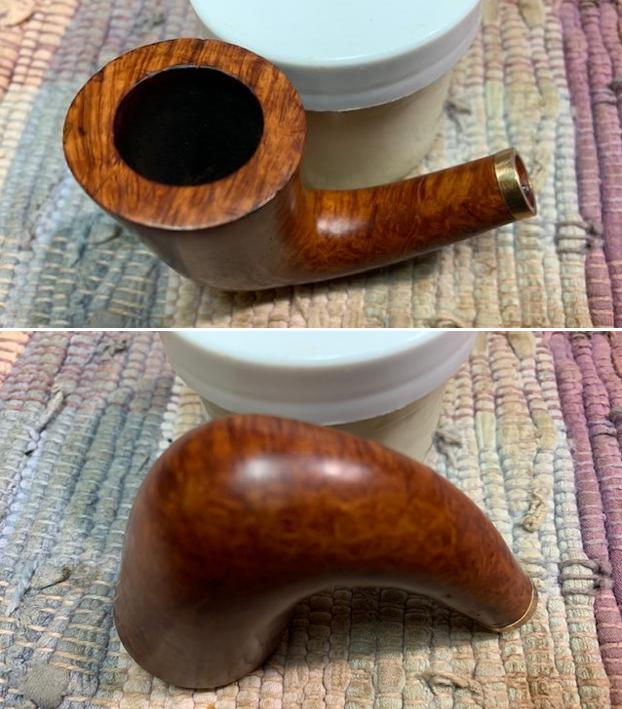
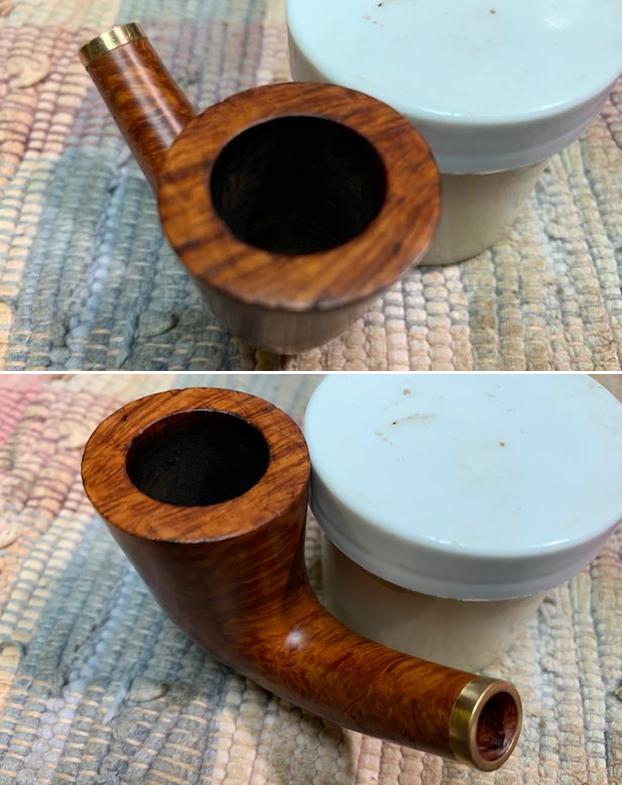
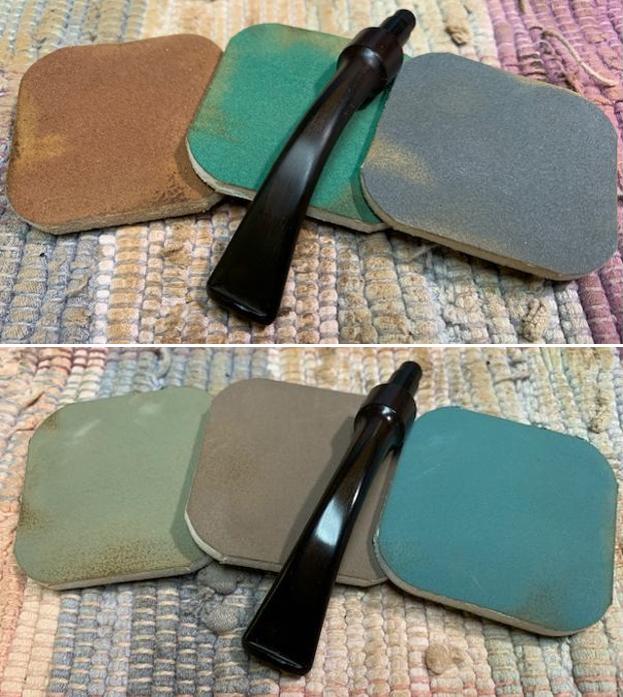
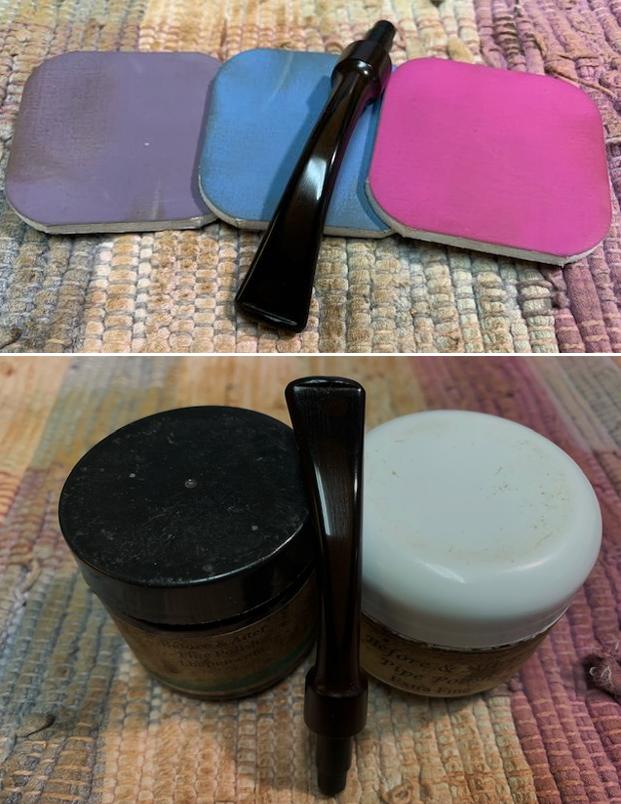
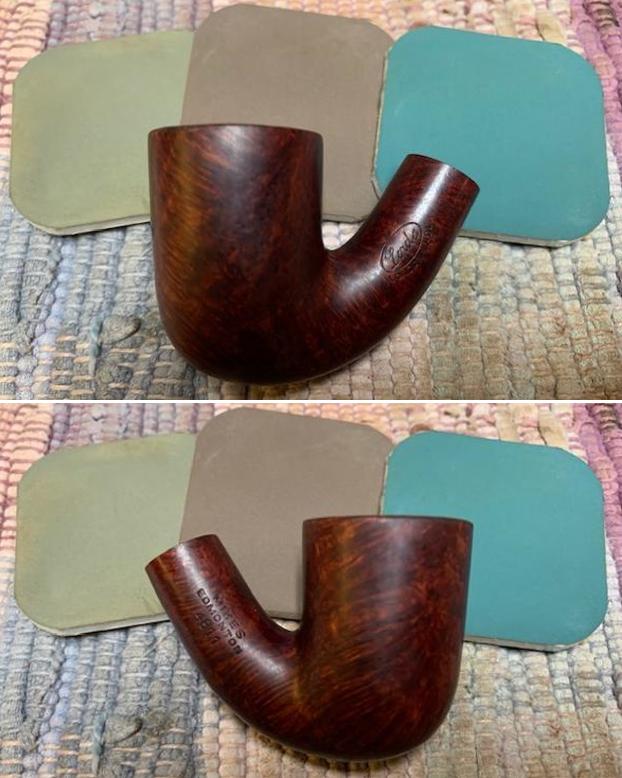
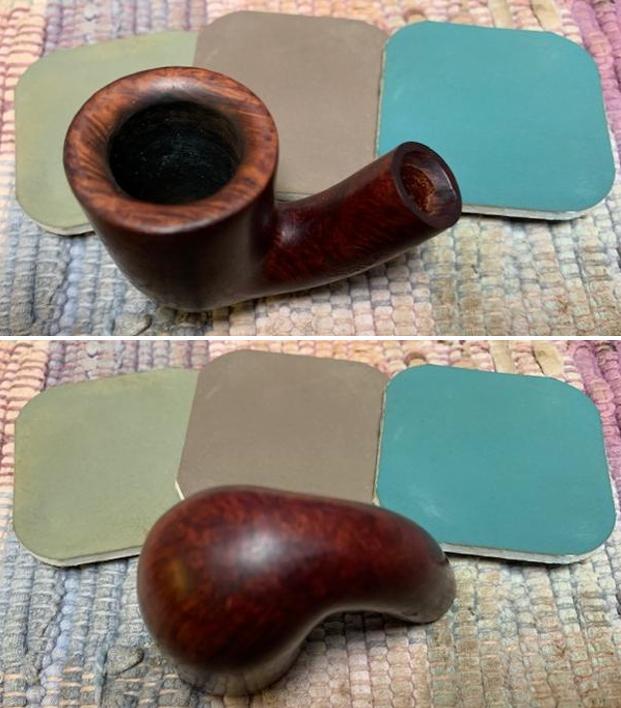
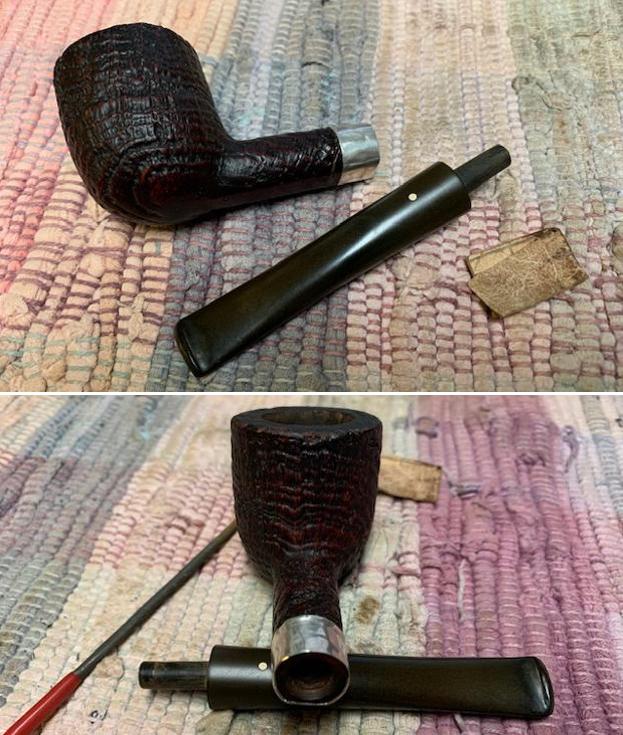
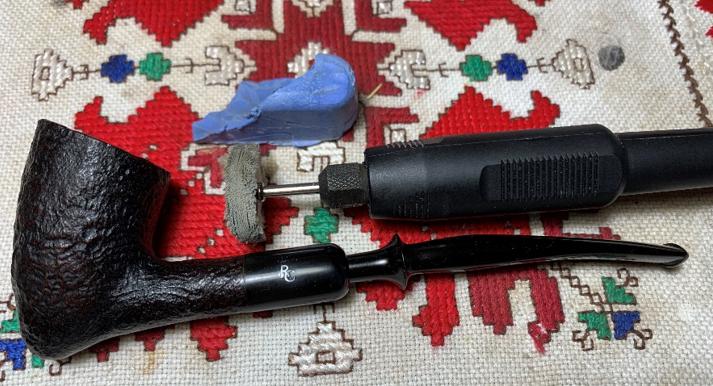
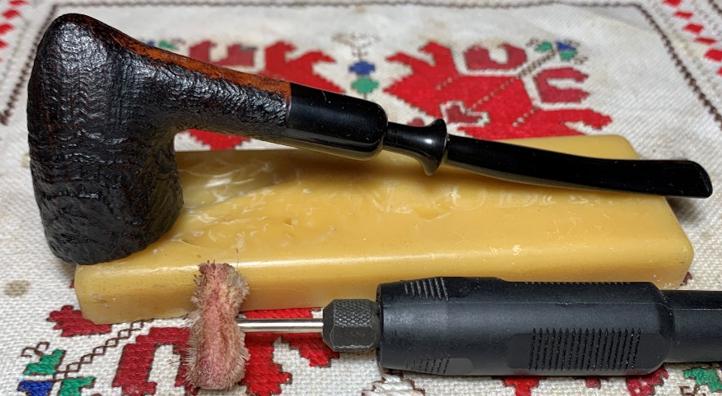
I used a lighter to lift the two light teeth indentions. The build-up on the bowl top was removed with 2,000 grade wet paper and a 8,000 grade micromesh sheet. I reamed the slight cake and the bowl was soaked with alcohol and sea salt. Following the soak, the stem was mounted and oxidation removed with 800, 1,500 and 2,000 grade wet sandpaper. This was followed by 8,000 and 12,000 grade micromesh sheets. The stem was then buffed with White Diamond and Meguiars Plastic Polish. The bowl was buffed with White Diamond and several coats of Carnuba wax.

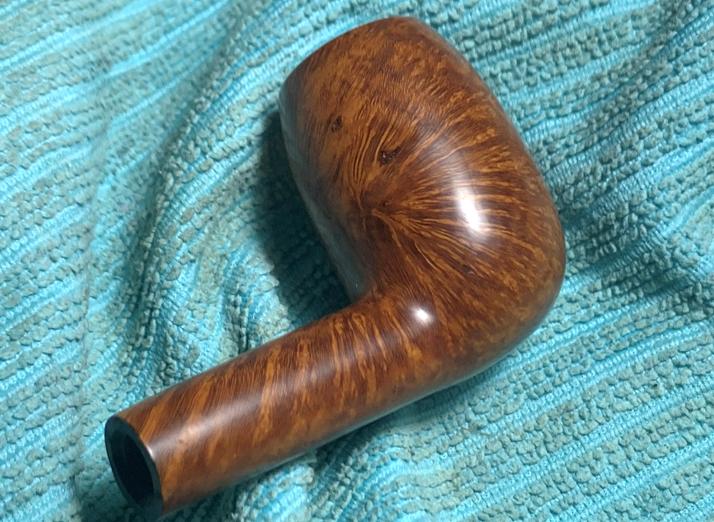
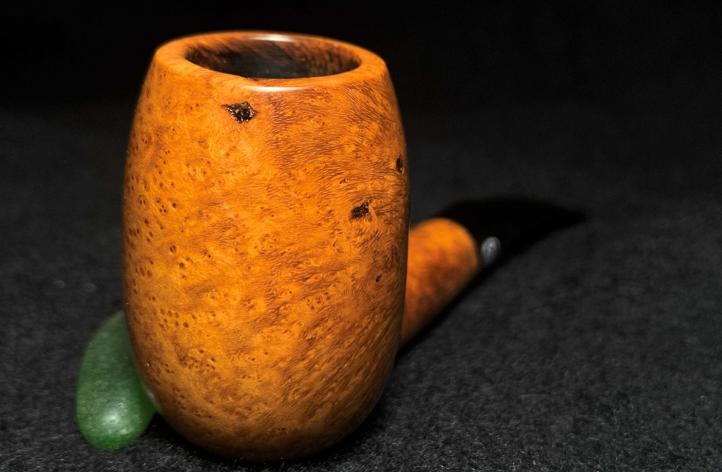
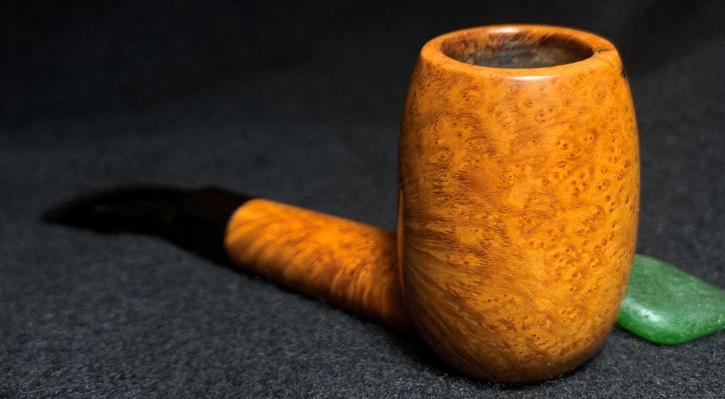
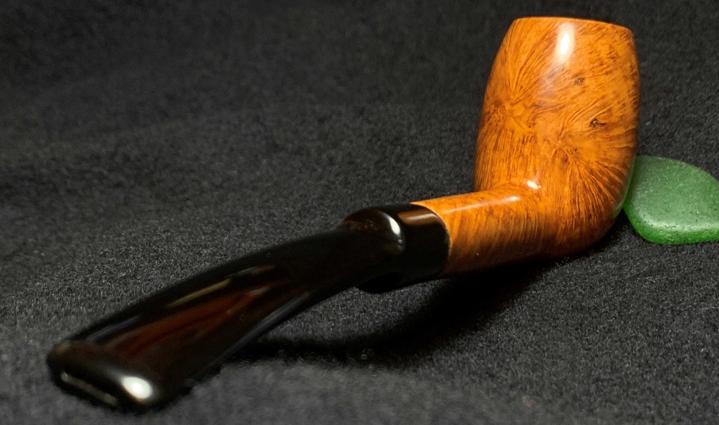
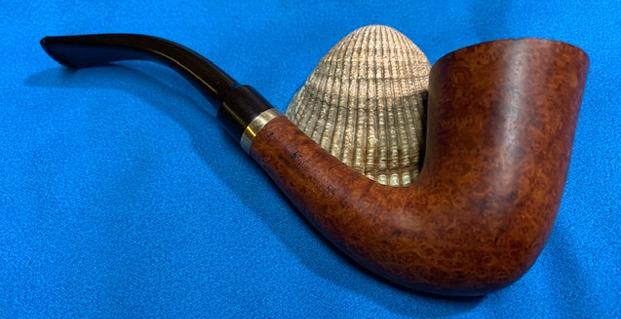
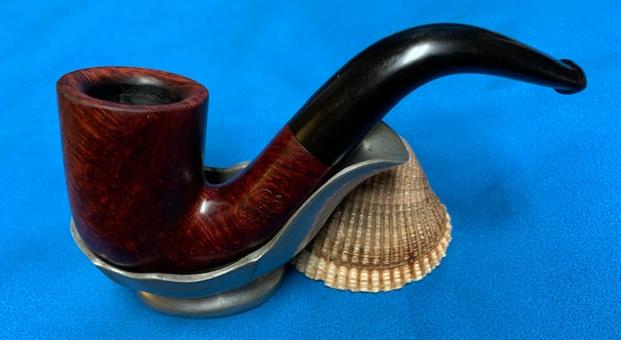
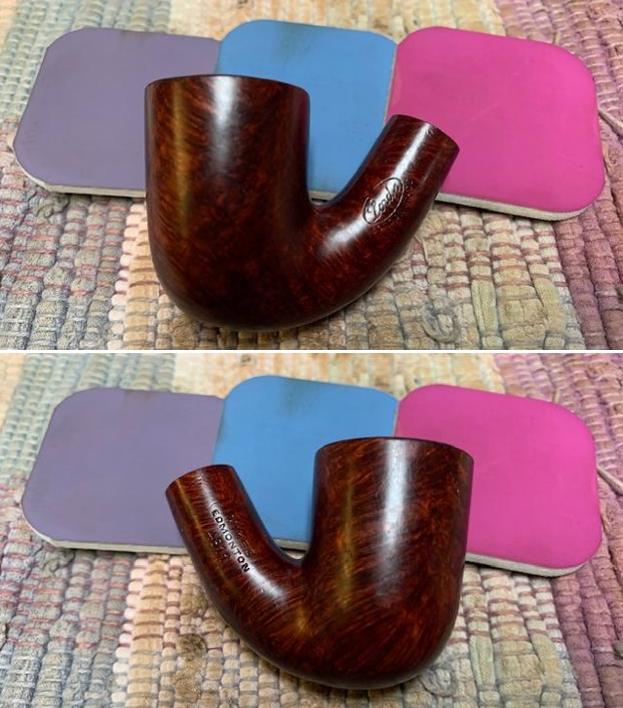
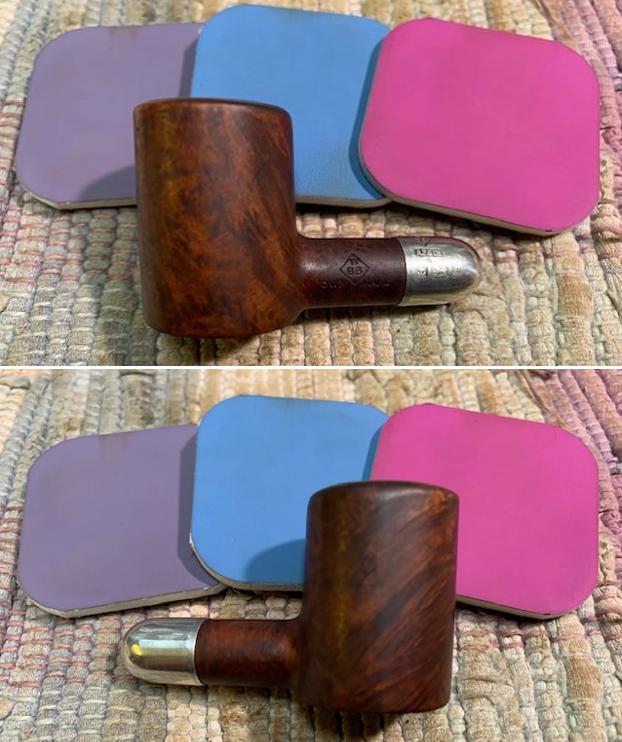
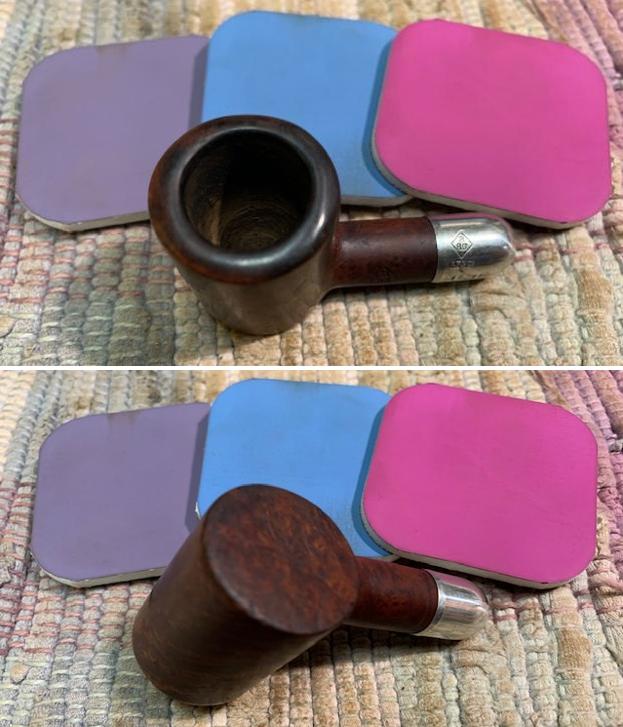
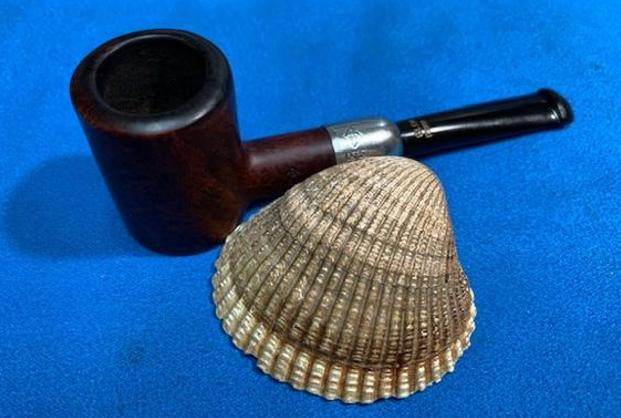
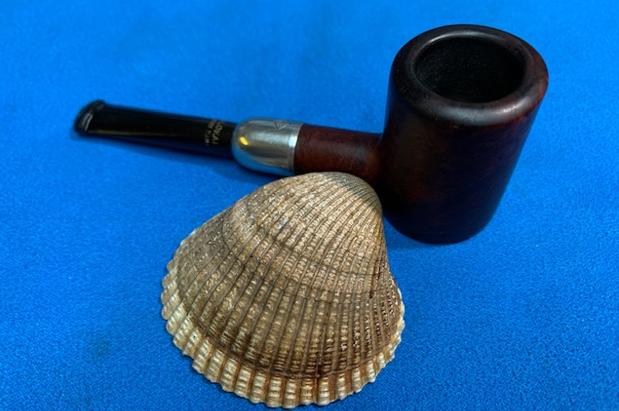
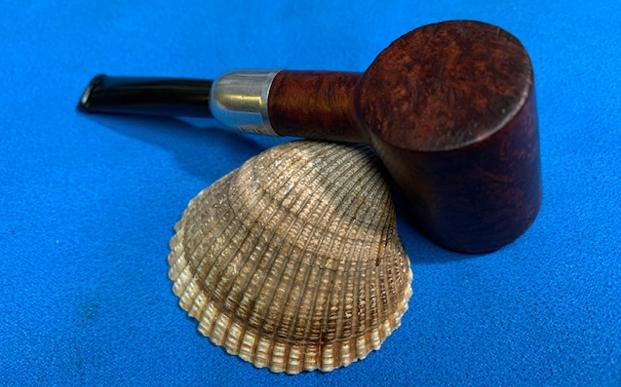
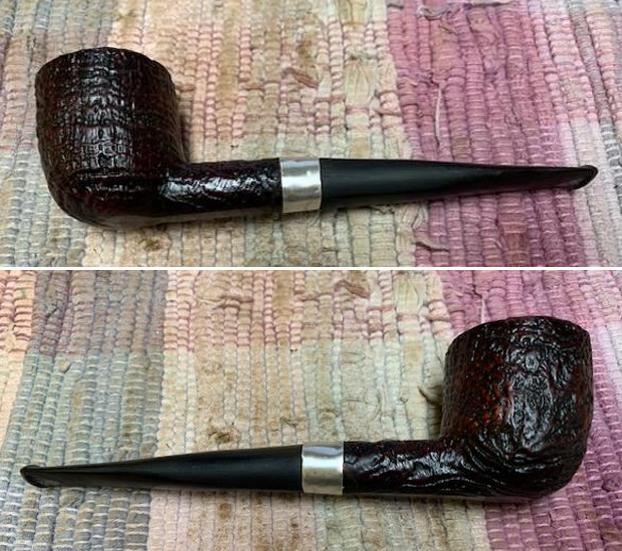
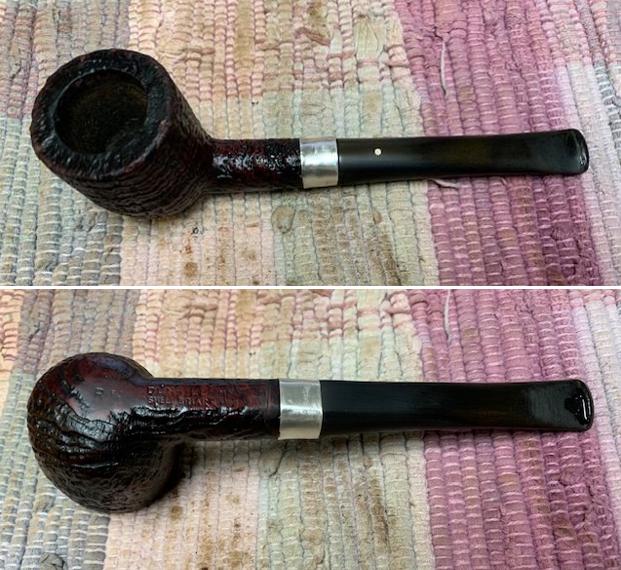
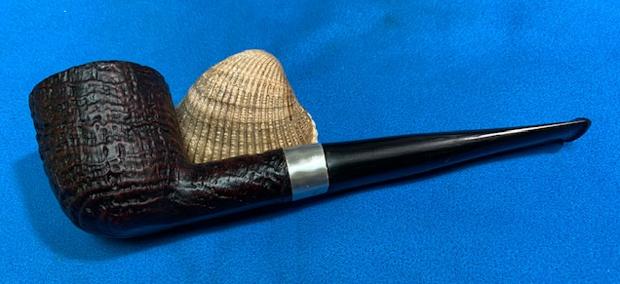
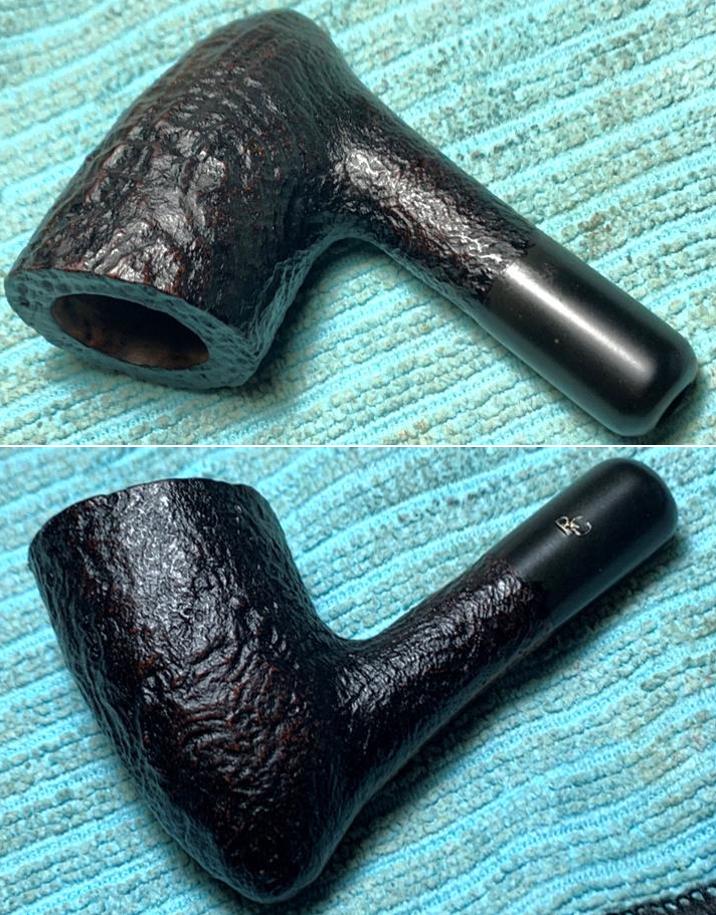
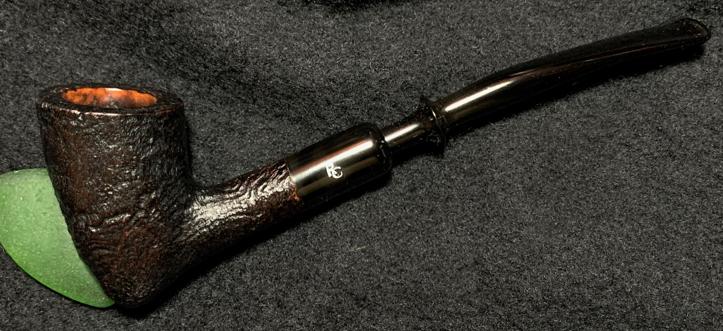
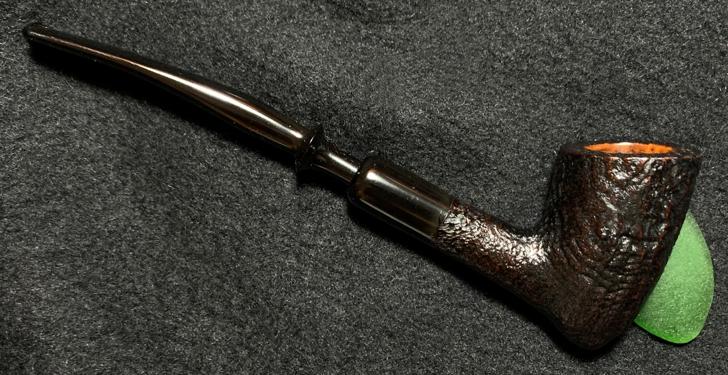
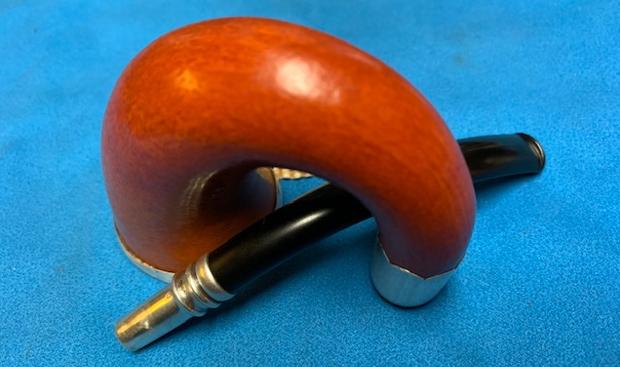
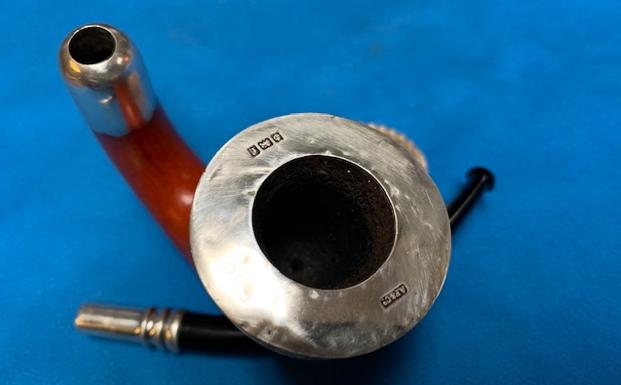
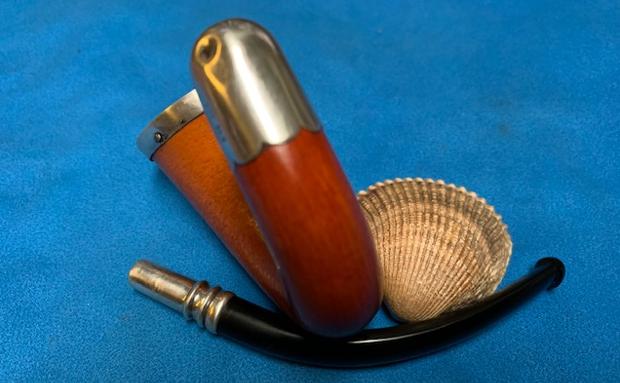
Below is the finished pipe.

Shades of Tolkien and Lewis – Restoring a Stunning Figural Briar “Dryad”


Blog by Steve Laug

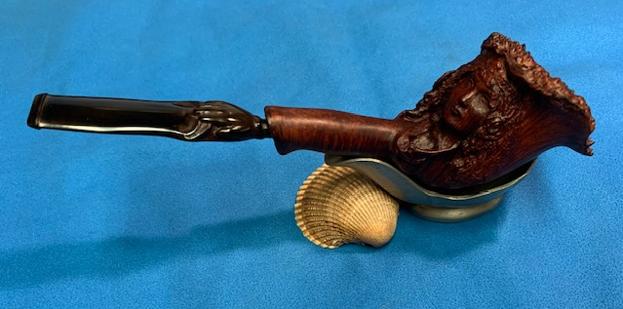
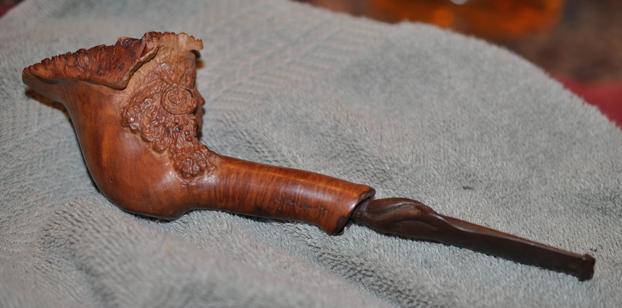
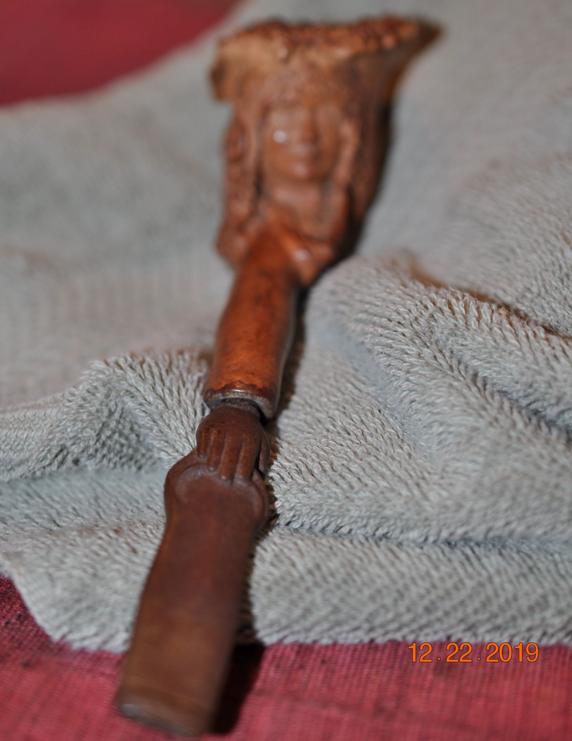
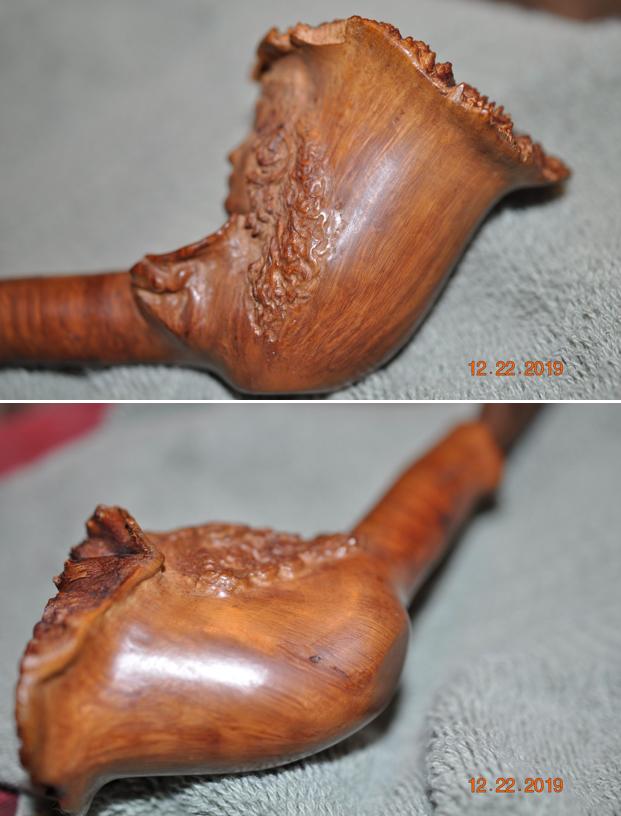
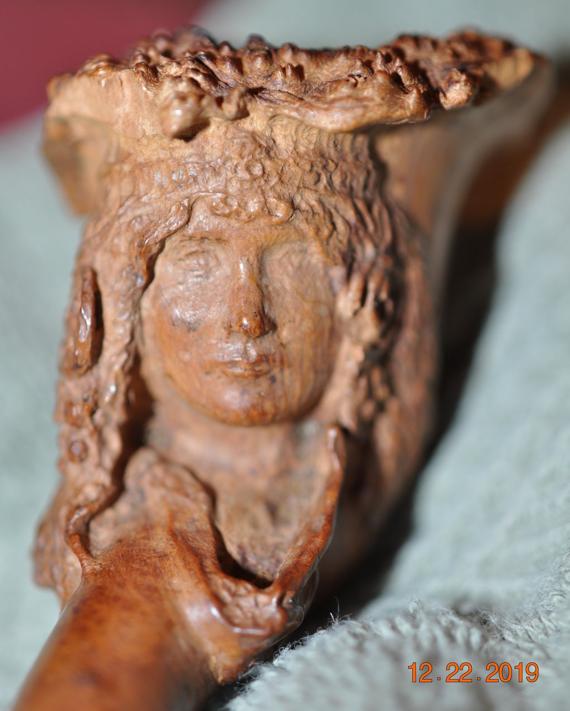
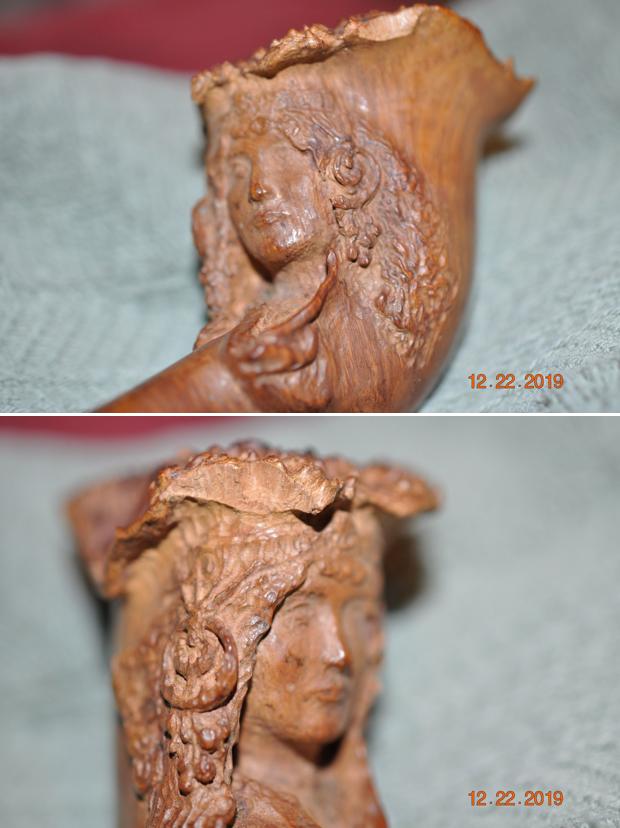
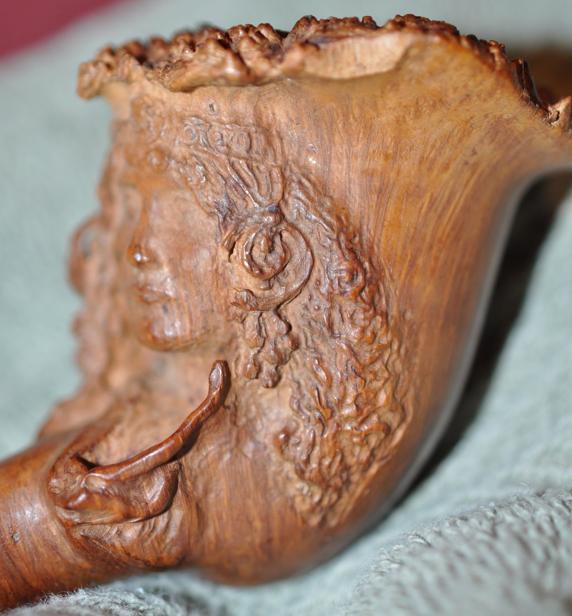
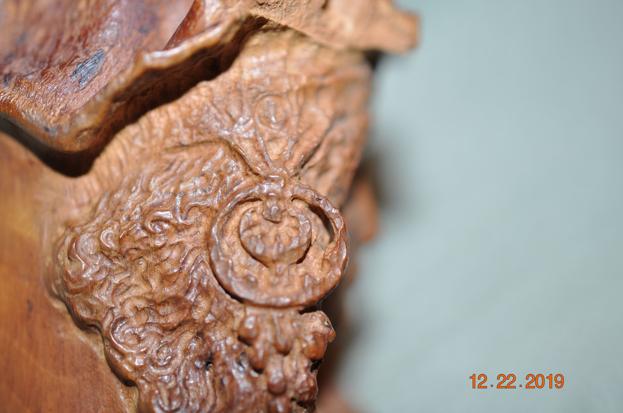
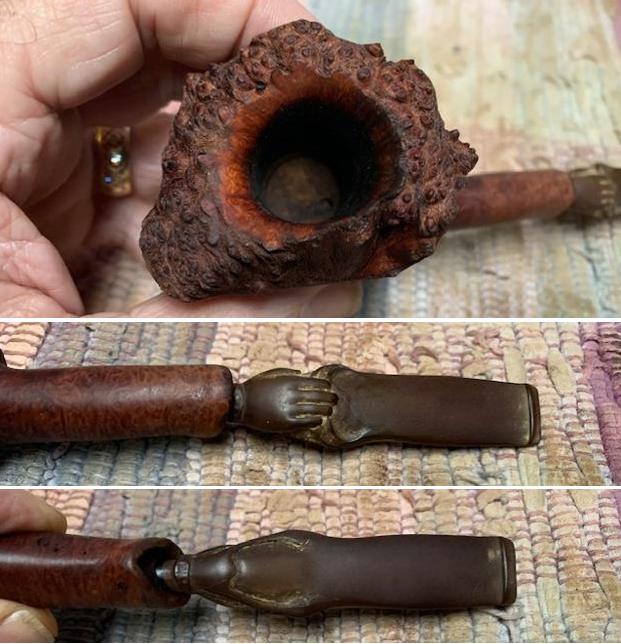
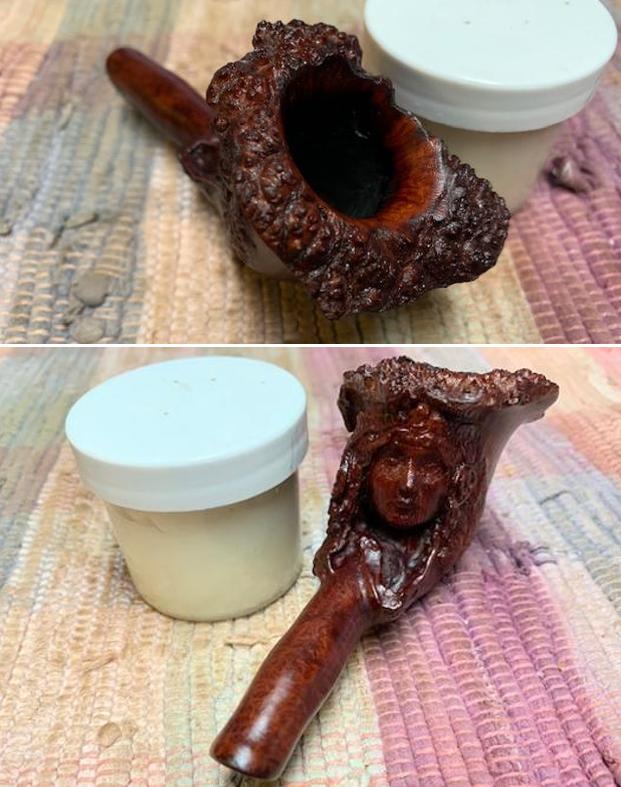
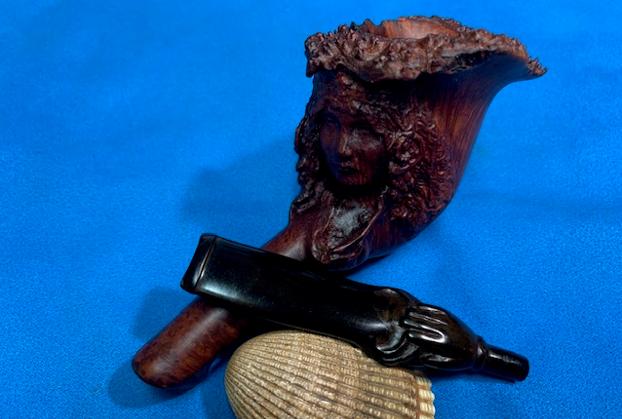
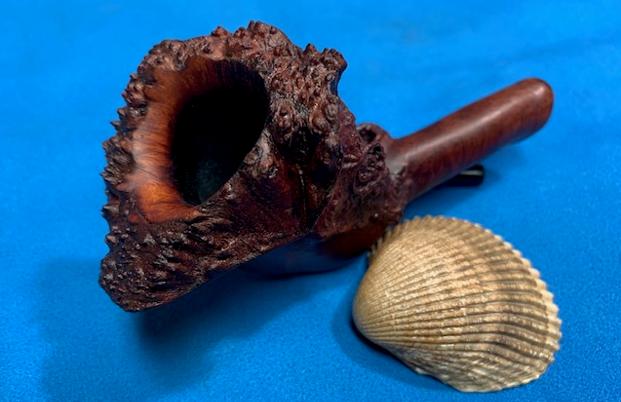
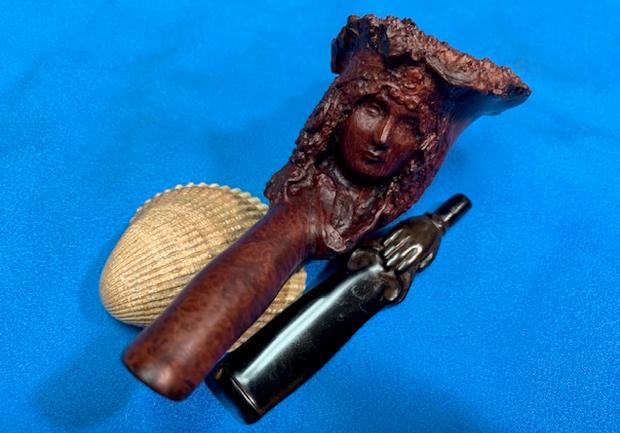
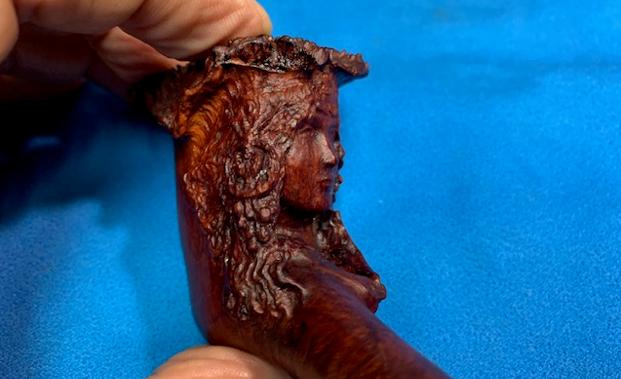
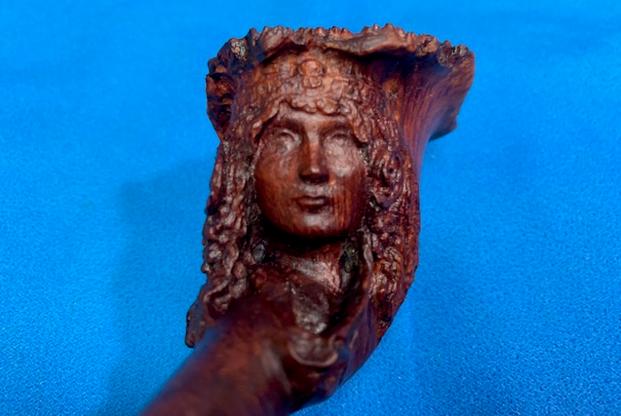
Over the Christmas holidays I listen to the audio book of the Hobbit and the entire Chronicles of Narnia. I am not sure if that influences what I see in the next pipe or not, but to me it is what I imagined when both spoke of the Dryads, Wood Nymphs or Entwives. The carved figure coming out of the back of the bowl of this pipe perfectly captures what I imagined. The hair on both sides is entwined with leaves, vines and fruit (grapes). There is a symbol like a flower with a jewel in the centre at the top of the forehead that seems to be on a band around the head. The feminine features are well worked on the face and as you hold it looking at it you can easily imagine it watching you.

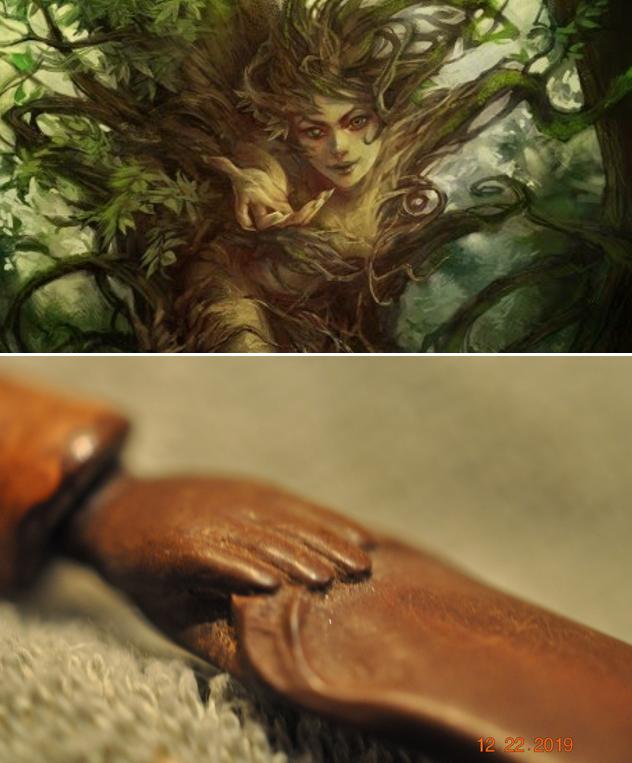
I did a bit of research on Google and found ought a fair bit about Dryads. I included this picture from Goodreads (https://www.goodreads.com/review/show/2440813268) as well as a close up of the face of the woman in the pipe I am working on. I summarize what I learned about Dryads below: According to Greek mythology a Dryad is a tree nymph or tree spirit. The Greek word Drys signifies “oak”, and dryads are specifically the nymphs of oak trees, but the term has come to be used for tree nymphs in general, or human-tree hybrids in fantasy.

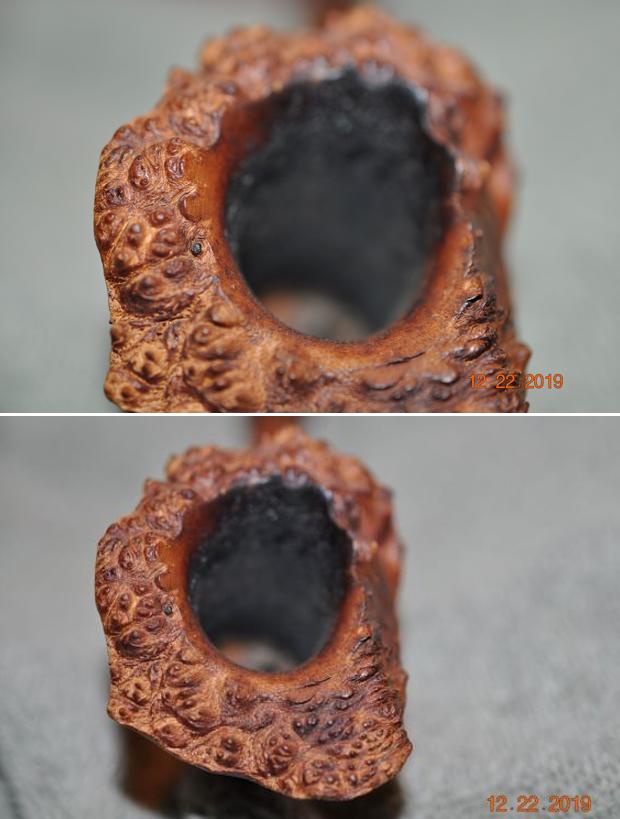
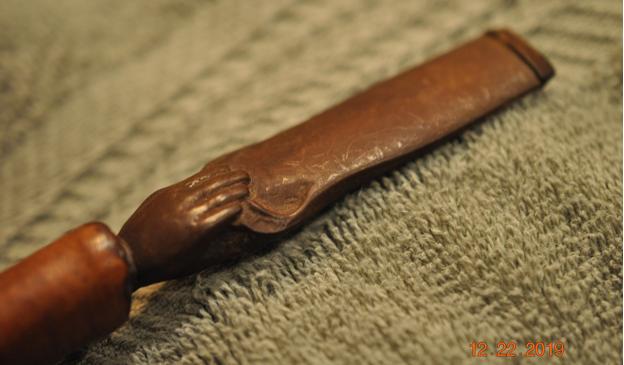
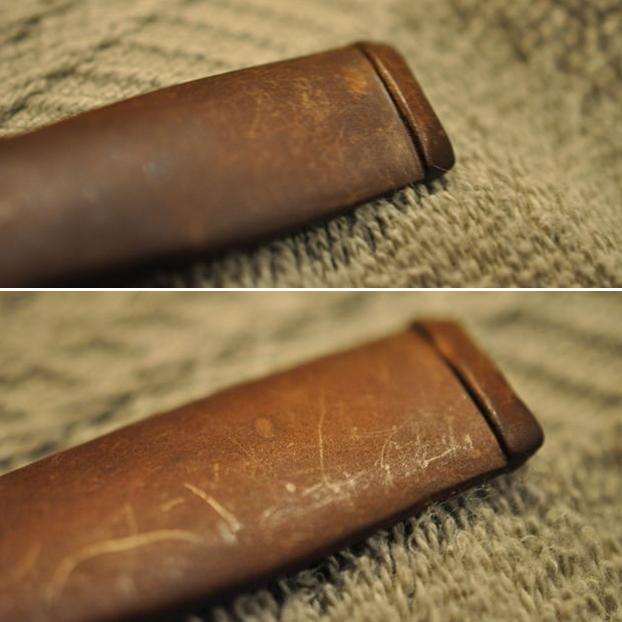
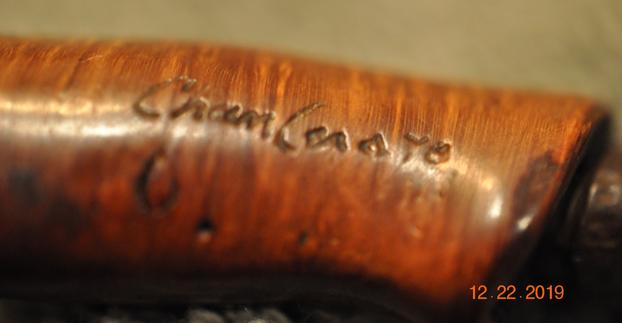
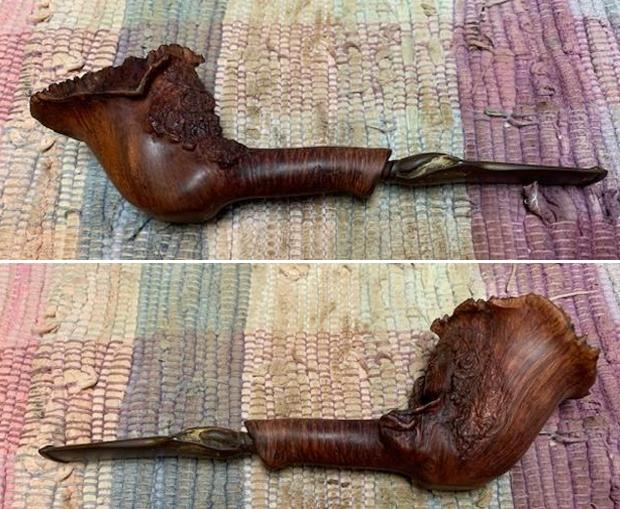
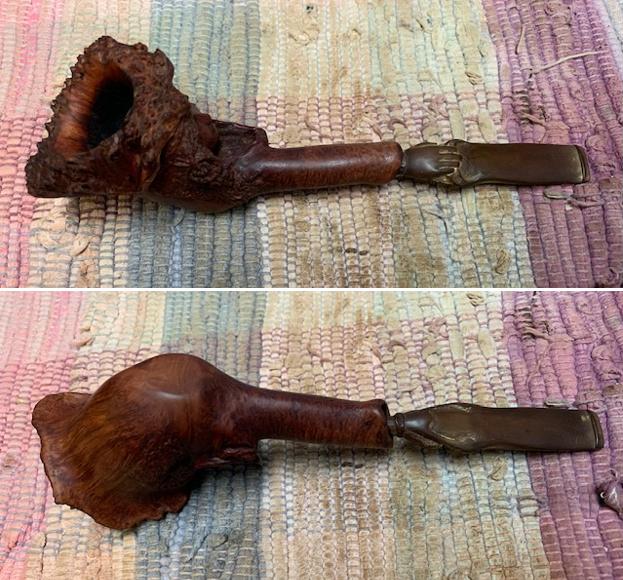
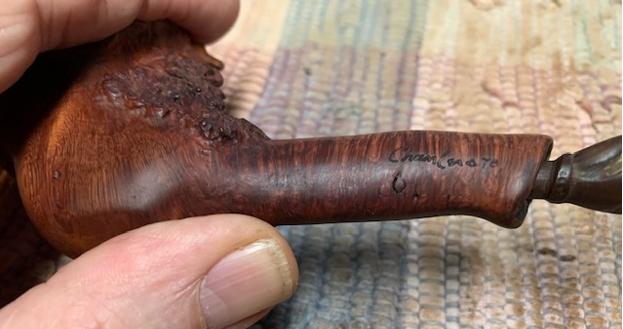
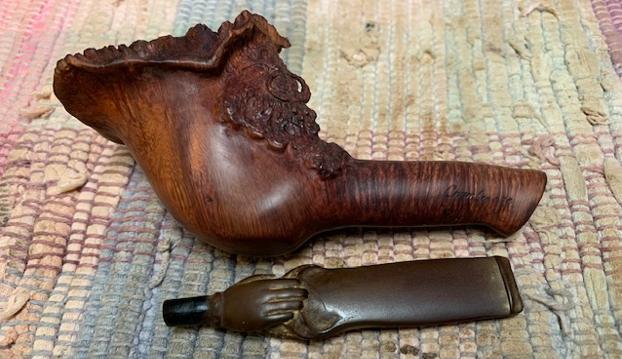
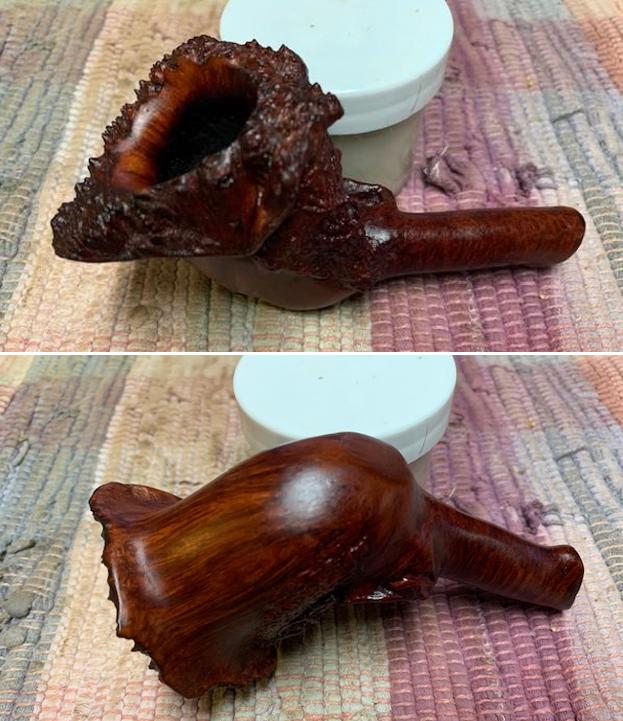
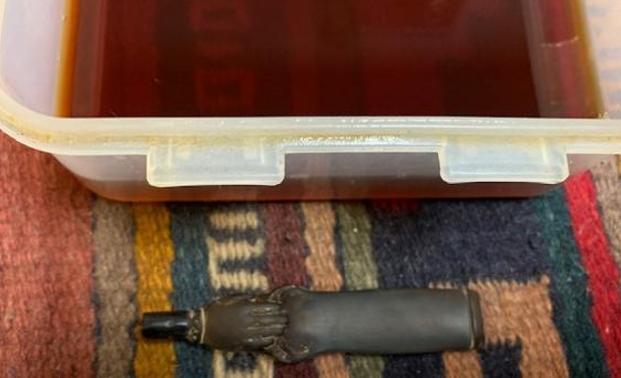
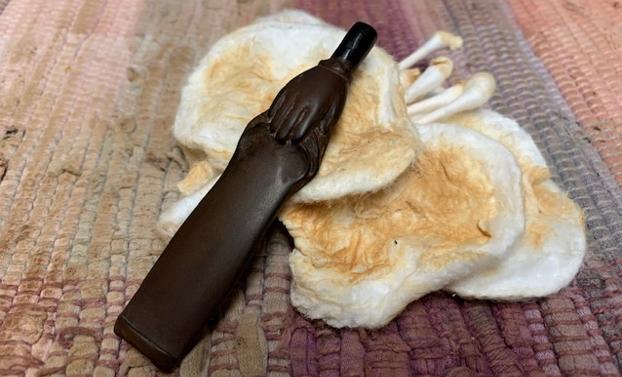
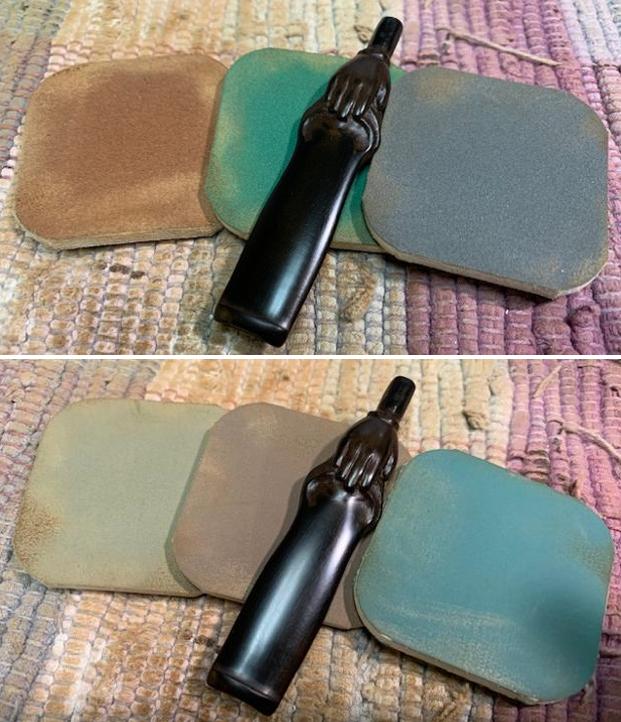
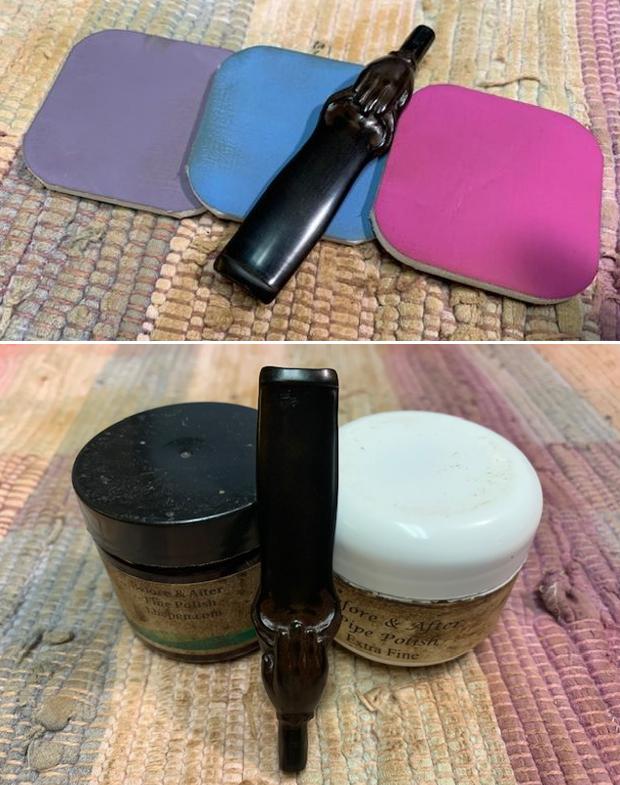
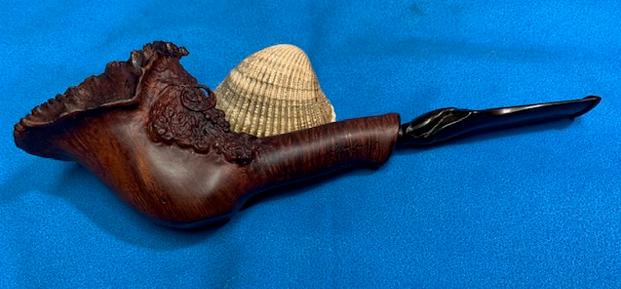
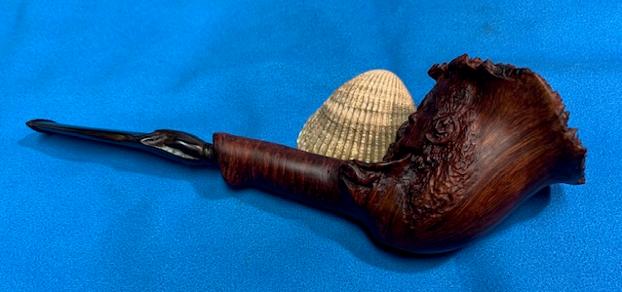
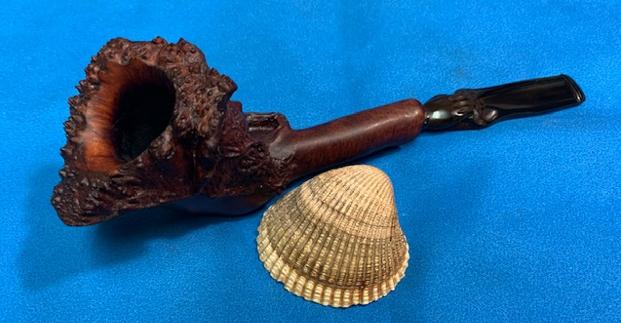
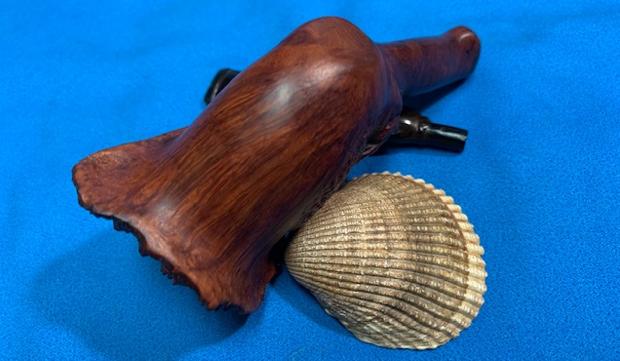
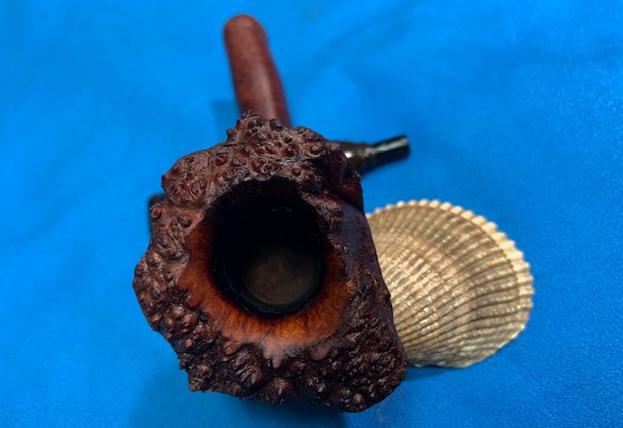
I found another photo of a Dryad that is stunning. She is reaching out of the tree for the person coming towards her (http://testforbloggerandgadgets.blogspot.com/2014/04/spritesdryads-spritesnymphs.html). The pipe I am working on has a shank that is like a hollow branch with the stem carved like a hand reaching out toward the smoker and grasping the blade of the stem.Jeff picked the pipe up from an auction from a fellow in Los Angeles, California, USA. The grain on the pipe was stunning with straight and flame grain around the bowl and shank. The rim top was plateau briar and the carver had used it to form almost a leafy overhang over the face. There were chips out of the overhanging edge on the left rear of the bowl and the right side. It was visible but did not detract from the carving. The pipe was dirty and needed a lot of work to clean up in terms of grit and grime in the carving’s features and ground into the smooth bowl sides. The pipe had been smoked and there was a moderate cake and some lava on the beveled inner edge of the rim. Jeff took photos of the pipe to give a sense of the overall look and condition it was in before he worked his magic on it. He took photos of the plateau rim top and the bowl to show the condition of both. You can see the lava on the beveled inner edge at the back of the bowl. The plateau is actually quite nice and the beveled rim edge should look stunning once it is cleaned up.The unique carved hand coming off the tenon and holding the blade of the stem is really interesting. The shank end is carved like a snapped off tree branch and the hand is reaching out of it .The left hand fingers and thumb hold what looks like a crescent moon and the top of the stem flows out of that. Look closely at the carving of the stem and the shank end in the photos below. The stem is heavily oxidized and scratched and will take a lot of work to clean up in all the grooves of the hand. He took some close up photos of the stem surface on both sides. It is heavily oxidized but there are not any tooth marks or chatter.Jeff took photos of the smooth portions of the bowl sides to show the amazing grain on the pipe. It is straight/flame grain that flows up from the flattened heel of the bowl to the plateau of the rim top.Jeff took a series of photos to show the details of the carving around the backside of the bowl and the curves around the edges. You can see the floral like band on the forehead and the vine like hair framing the face. The detail of the emblems hanging on the sides of her face and hair are very similar looking to the one that is on the forehead. At first I thought they were earrings but I am not pretty certain they hang from the head band on the sides of her head. There is some stamping on the left side of the shank that is carved in by hand. There are several possibilities as to what it says but I cannot find any information on any of them. One possibility could be Chambers 70 which would be the name of the carver and the date. Another possibility is Cham Cerato but I cannot find anything like that name for a carver. Do any of you know who it could be?Jeff reamed the bowl with a Pipnet pipe reamer and cleaned up the reaming with a Savinelli Fitsall Pipe Knife. He carefully scrubbed the bowl, plateau rim top, beveled inner edge and the carving on the bowl with Murphy’s Oil Soap and a soft tooth brush. He was able to remove the grime from the surface of the briar and the carving without damaging the face. He cleaned the internals of the mortise, airway in the shank and the stem with alcohol and cotton swabs and pipe cleaners. This pipe is so ornate that it took some time and care to not damage it in the process of the cleaning. He scrubbed the stem with Soft Scrub to remove some of the oxidation on the surface in the fingers of the carving. He soaked it in Before & After Deoxidizer to further remove the oxidation. While he got a good portion of it there was still some deep oxidation on the stem surface and in the grooves of the carving that I would  need to deal with. I took photos of the pipe at this point in the process. It looks significantly better.  I took a close up photo of the plateau rim top and beveled inner edge. The inner edge looks very good. The stem photos show the remaining oxidation on both sides.I took a photo of the stamping and show the knot like spot below the carving.I took a photo of the pipe taken apart to give a sense of proportion to the whole that is hard to see with the stem in place in the shank. I worked some Before & After Restoration Balm into the surface of the bowl and shank with my fingertips. I worked it into the carvings with a q-tip or cotton swab. The product works to clean, enliven and protect the briar. I let the balm sit for 15 minutes and then carefully buffed it off with a cotton cloth to raise the shine. The photos show the bowl at this point in the restoration process.   Earlier in the process I had put the stem to soak in the Briarville Deoxidizer Bath while I worked on the bowl. It was time to take it out – almost 2 hours in the bath. While it definitely was not as brown as it had been the hand and wrist still showed a lot of oxidation. This was going to be a bear to work on and would take a lot of time to get it all off!I scrubbed the stem and all the grooves with Soft Scrub using cotton swabs and cotton pads. Many pads and cotton swabs later it was finally looking better. Still a lot of work to do but I feel like I am making some progress. I polished the stem with micromesh sanding pads – wet sanding with 1500-12000 grit sanding pads. I wiped it down after each sanding pad with Obsidian Oil. I polished it with Before & After Pipe Stem Polish – both Fine and Extra Fine. I am excited to finish this Mythical Dryad/Wood Nymph/Entwife Pipe. I put the pipe back together and hand buffed it with a soft cloth and clean tooth brush. I gave the bowl and the stem multiple coats of a coat of Conservators Wax. I hand buffed the pipe with a microfibre cloth to raise the shine. It is fun to see what the polished bowl looks like with beautiful mixed grain and carved face emerging from the back of the bowl looking at you while you hold it. Added to that the polished black vulcanite stem with the hand reaching out of the branch like shank made a stunning pipe. This incredible hand carved Dryad/Wood Nymph/Entwife pipe is great looking and feels great in my hand. It is light and well balanced. Have a look at it with the photos below. The dimensions are Length: 8 inches, Height: 2 ¼ inches, Outside diameter of the bowl: 2 ½ inches long x 2 inches wide, Chamber diameter: ¾ of an inch. The weight of the pipe is 54grams/1.90oz. It is a beautiful pipe that I will be keeping in my own collection. I am looking forward to my yearly reading of the Lord of the Rings and will enjoy a bowl of tobac as I read. Thanks for walking through the restoration with me as I worked over this pipe. Thanks to each of you who are reading this blog.

Putting together a Great Looking Gourd Calabash from Parts


Blog by Steve Laug

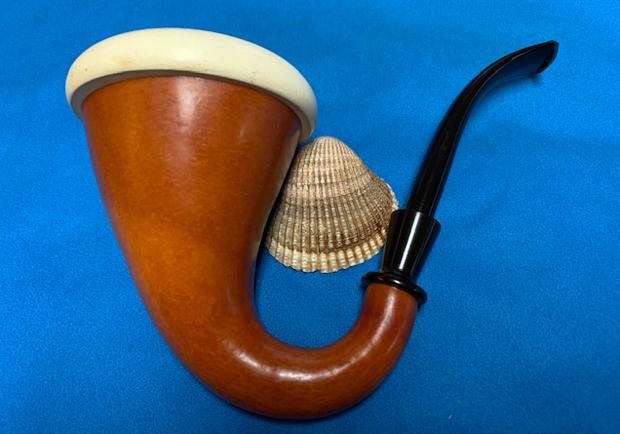
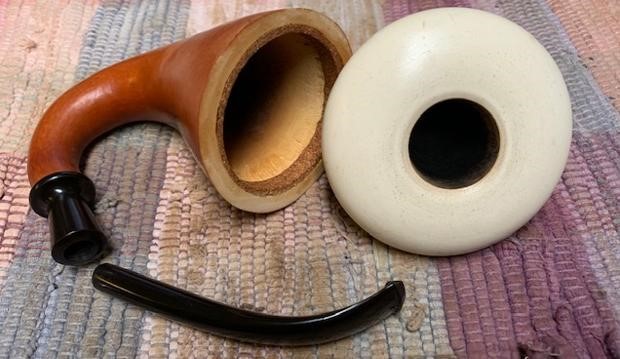
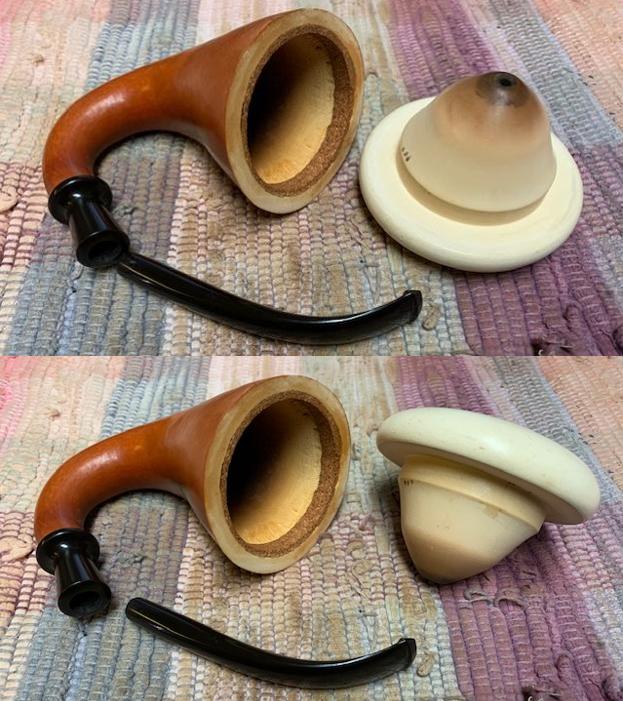
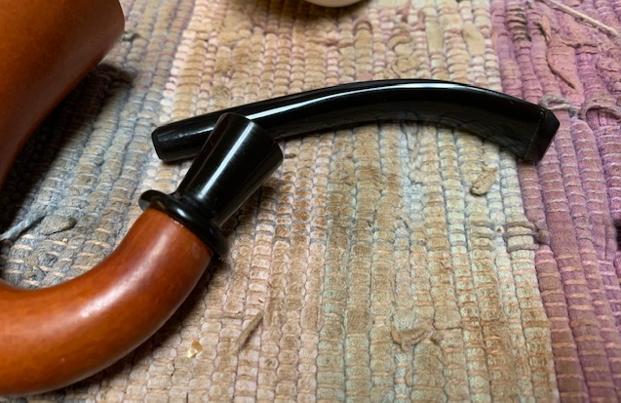
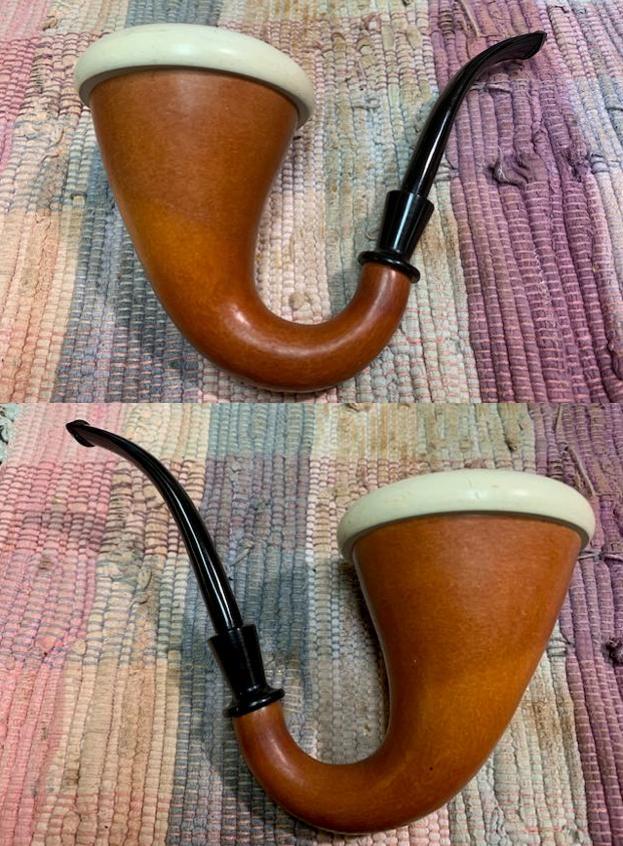
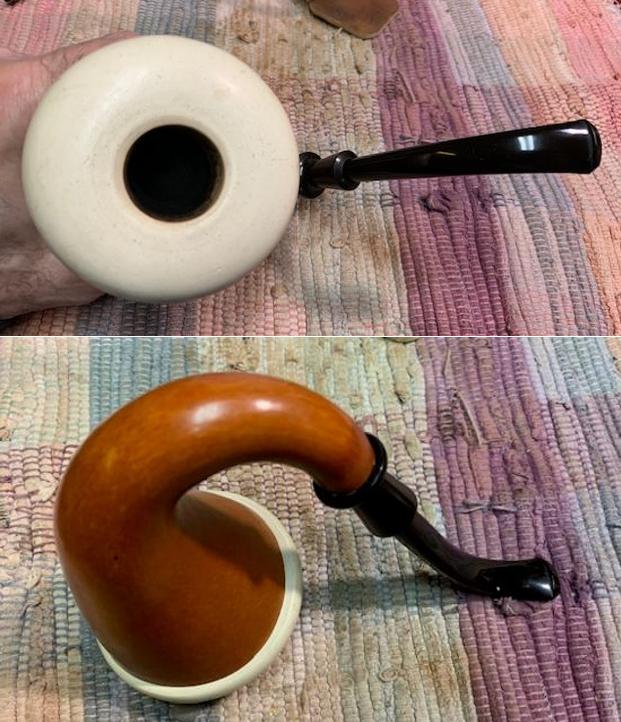
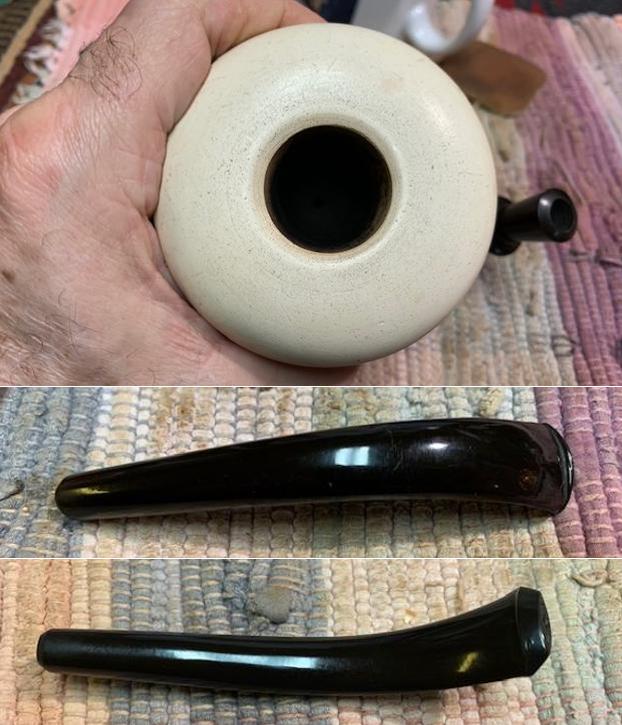
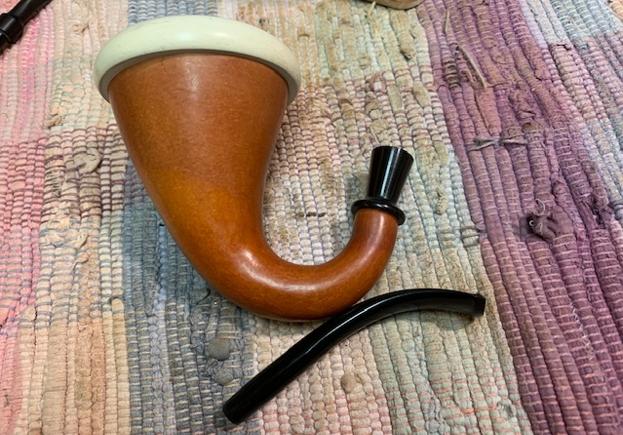
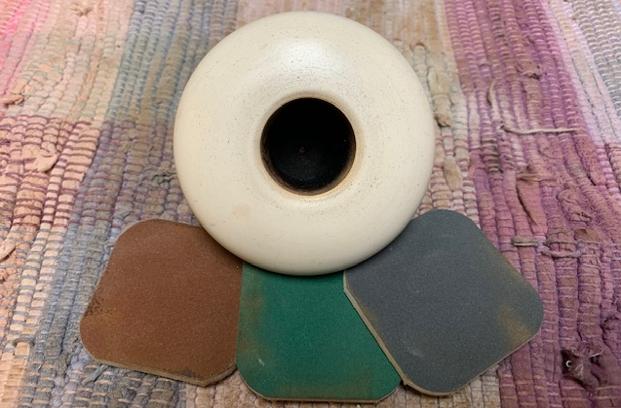
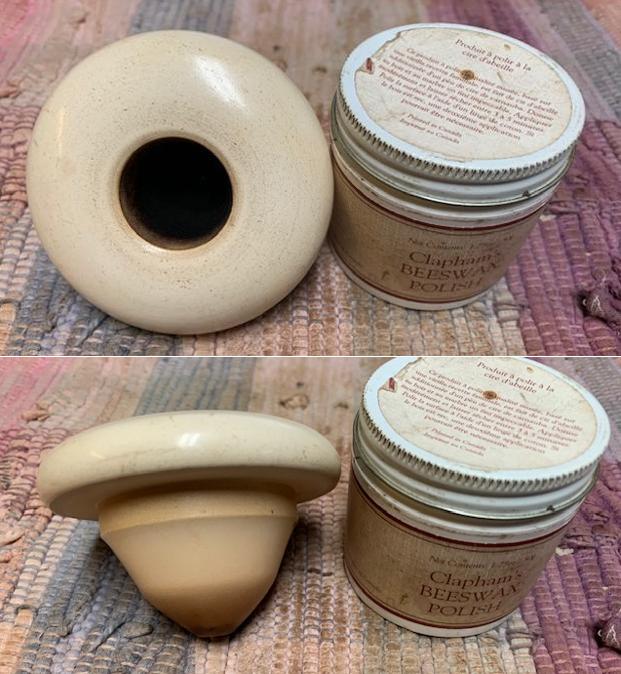
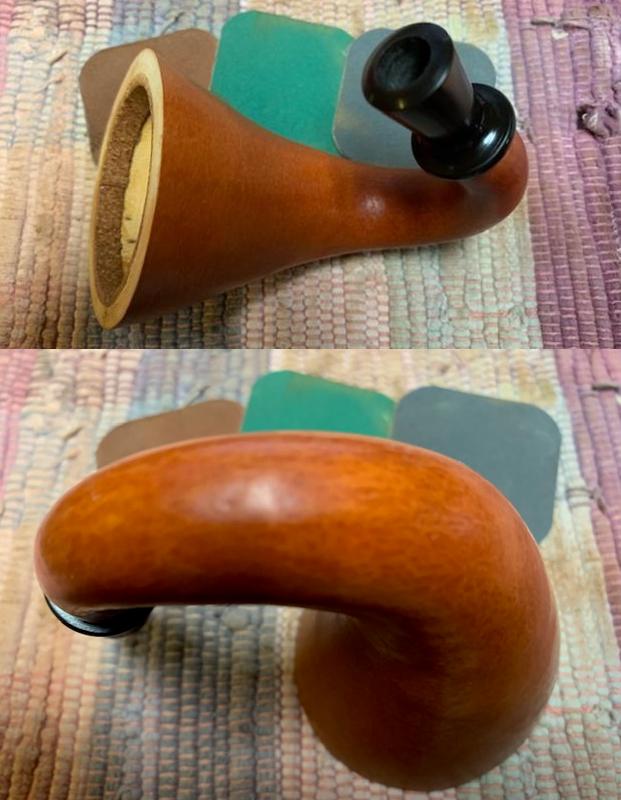
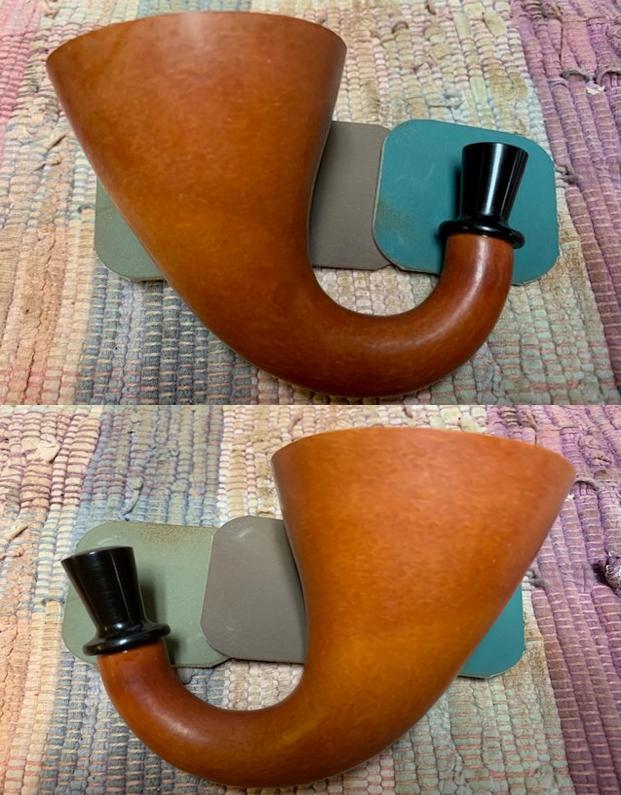
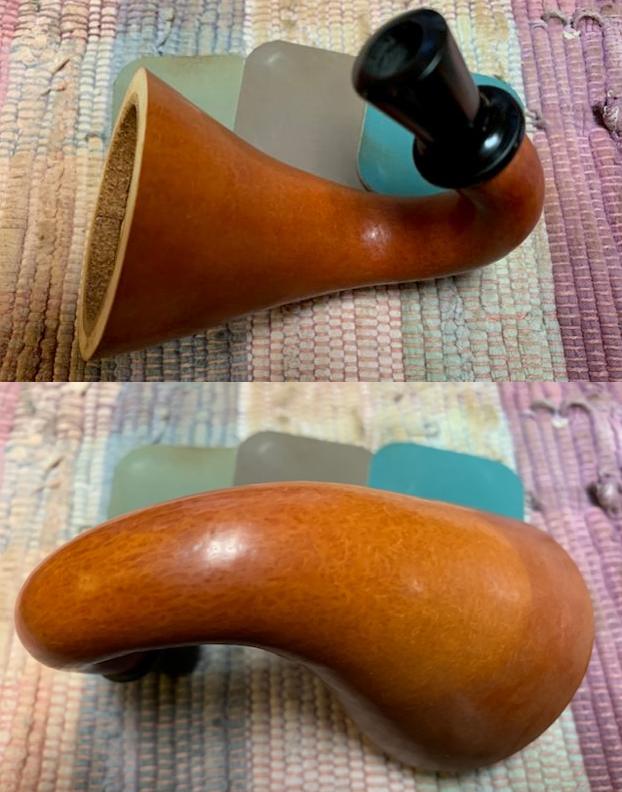
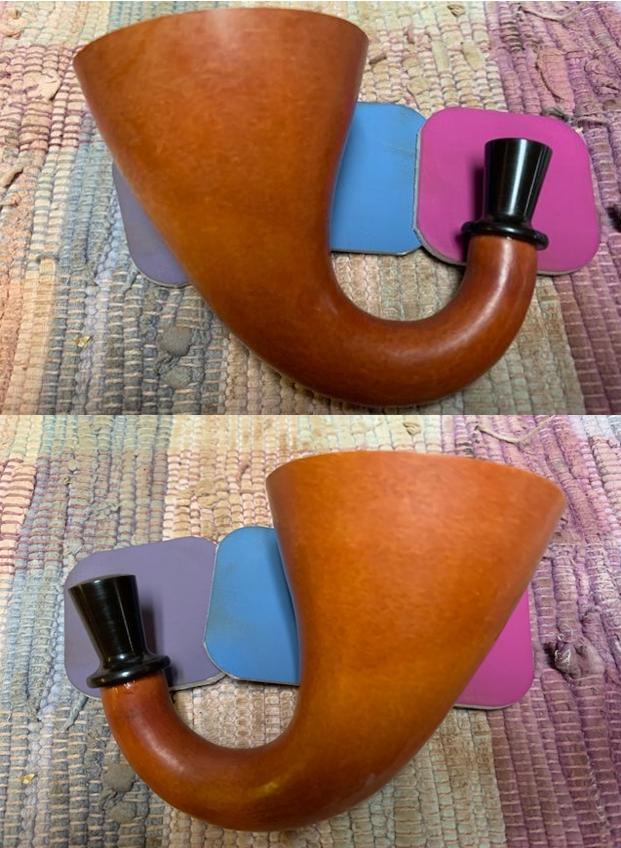
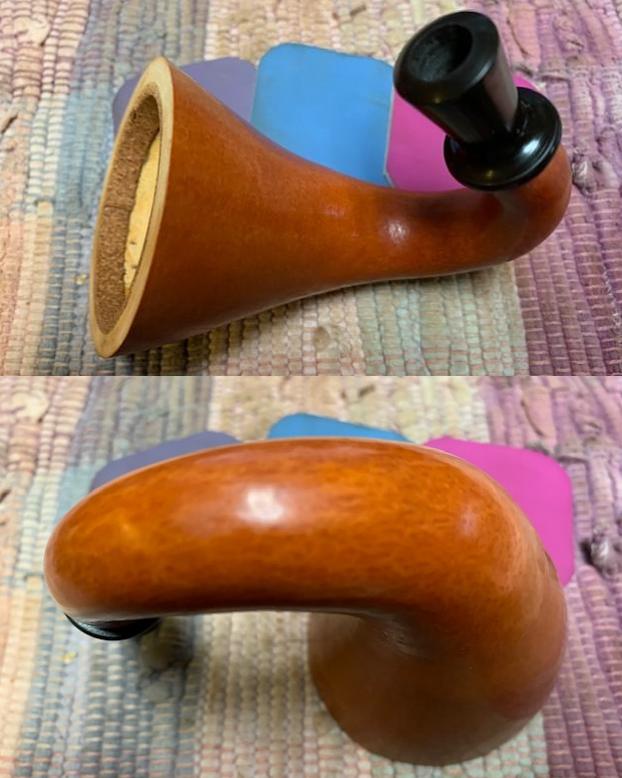
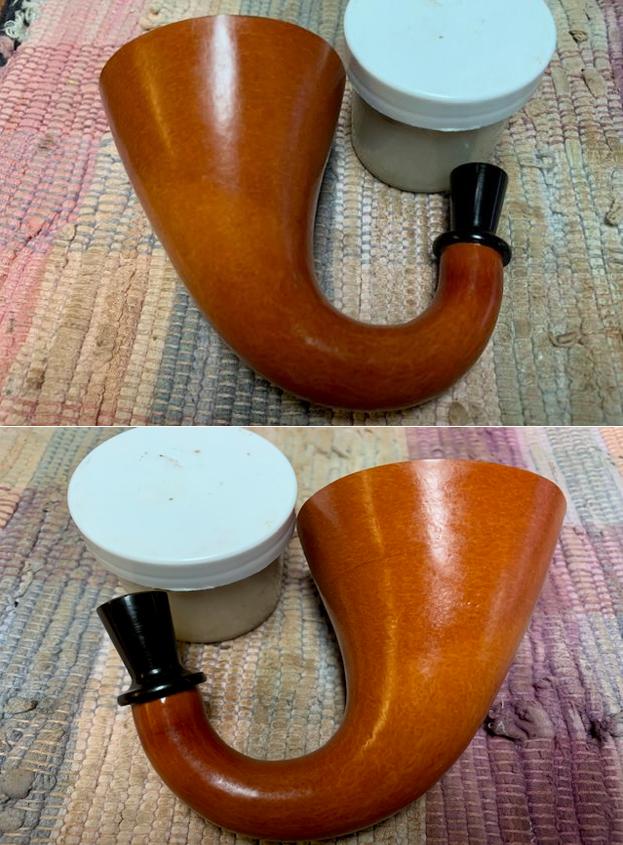
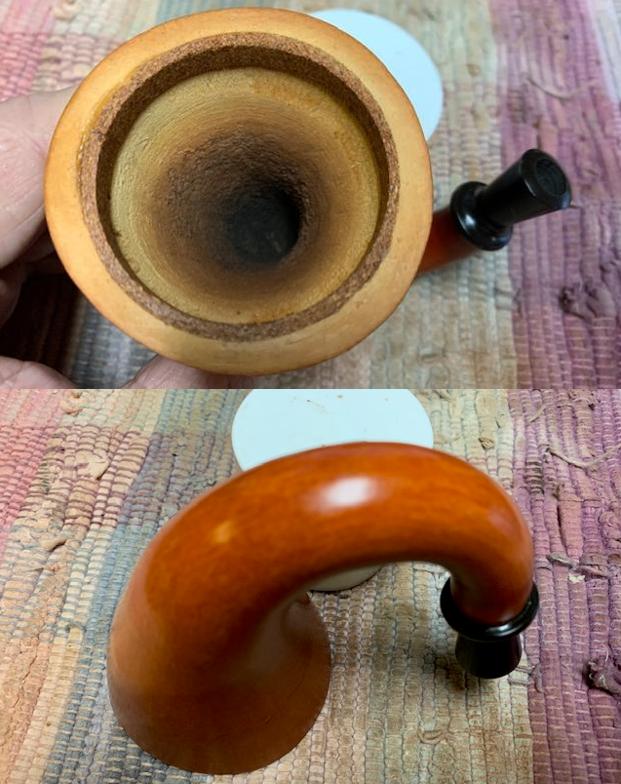
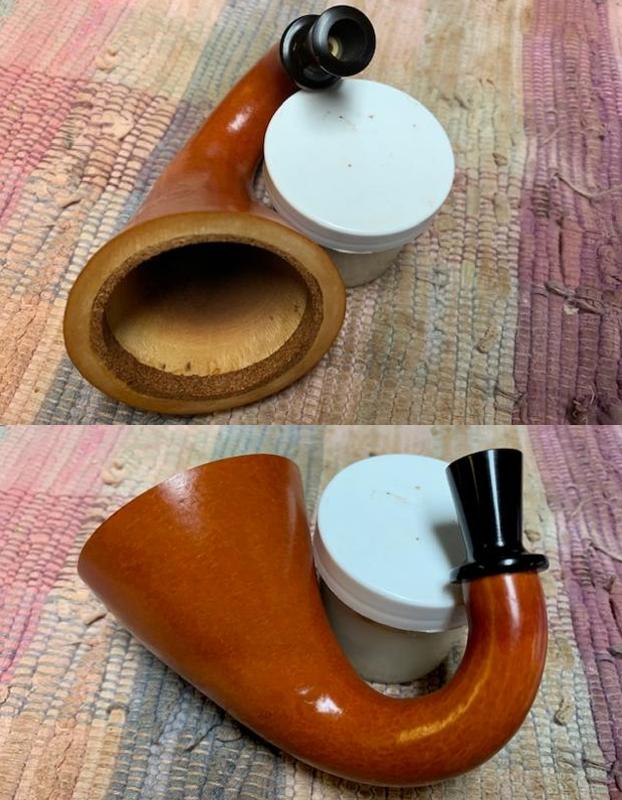
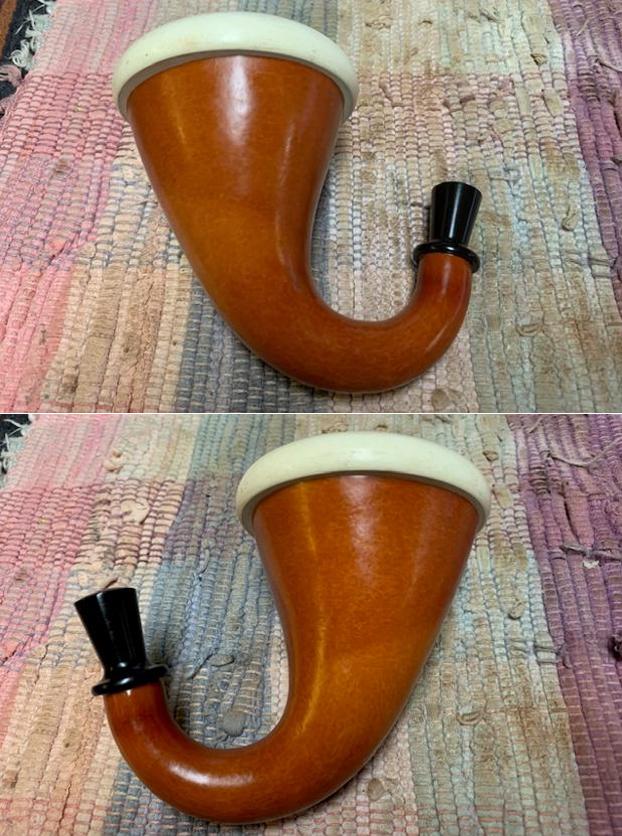
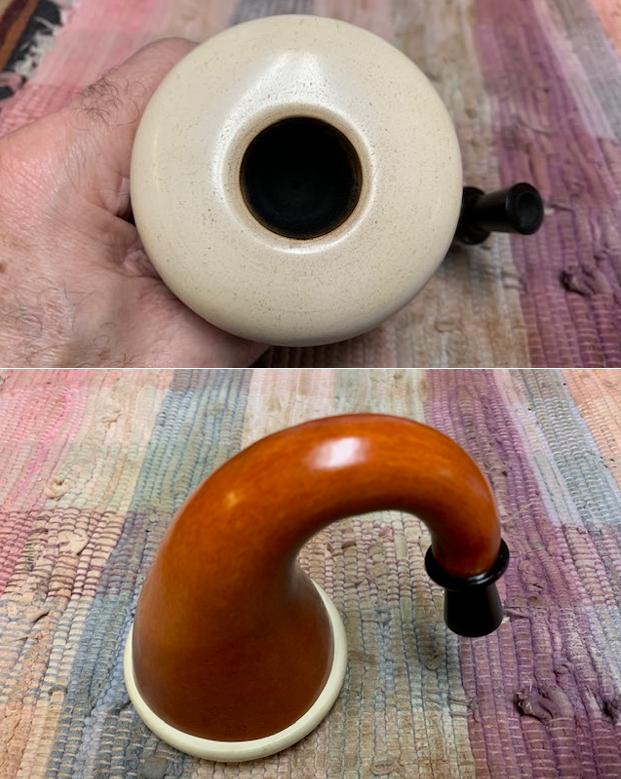
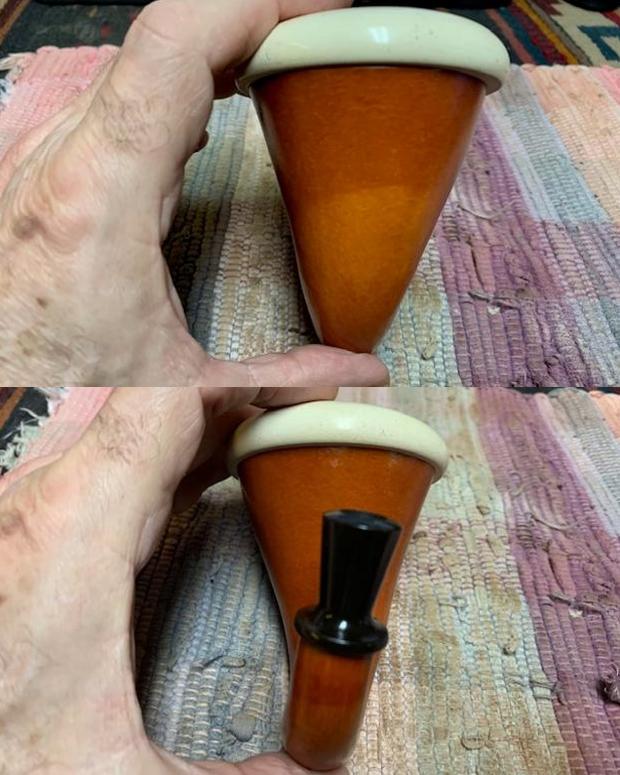
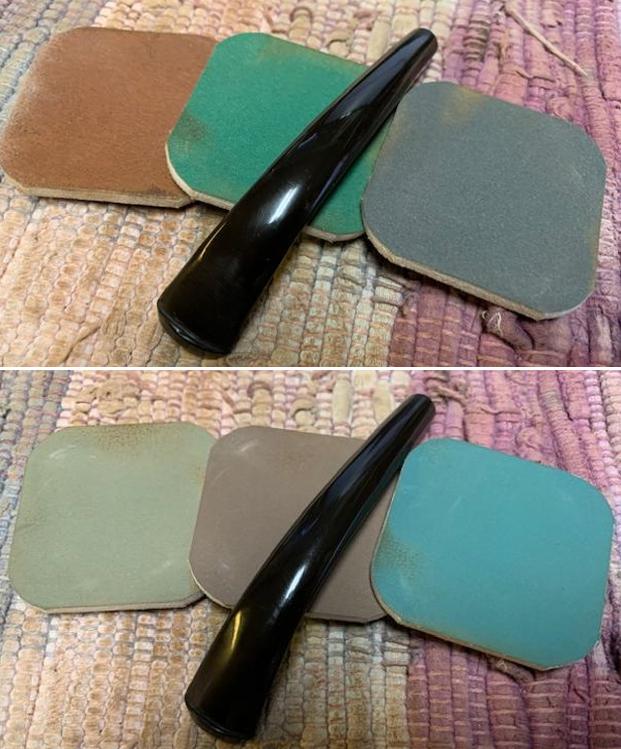
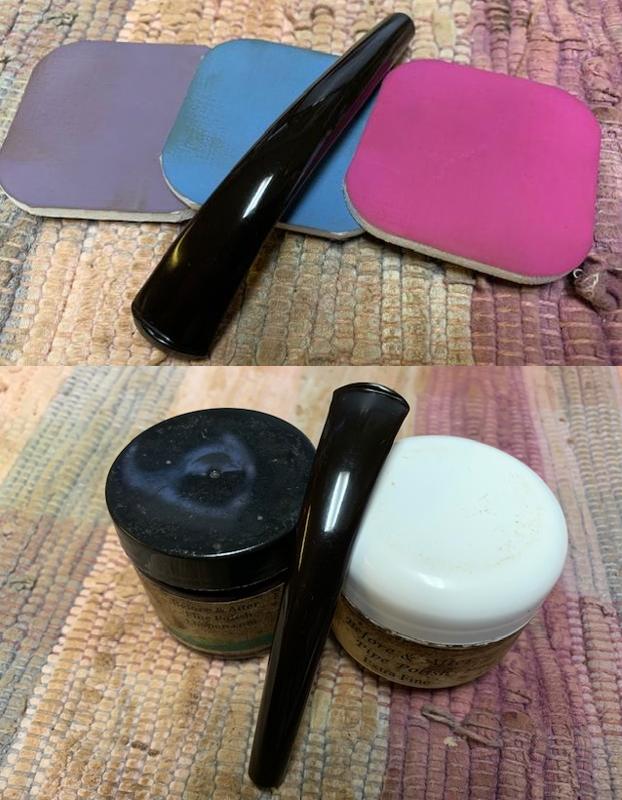
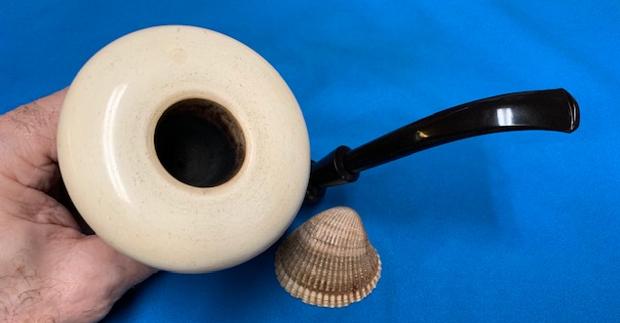
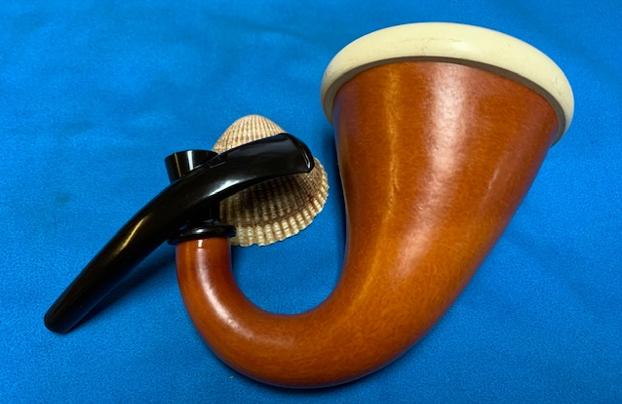
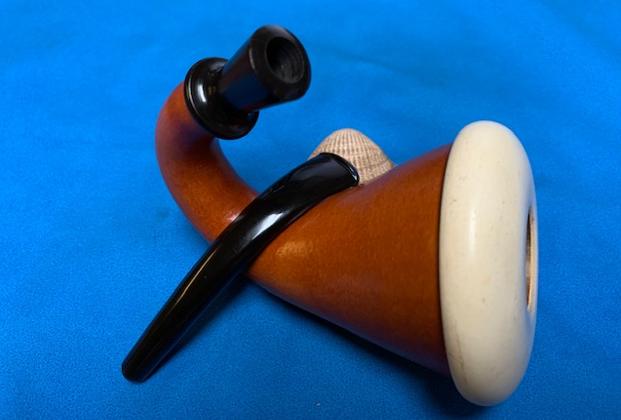
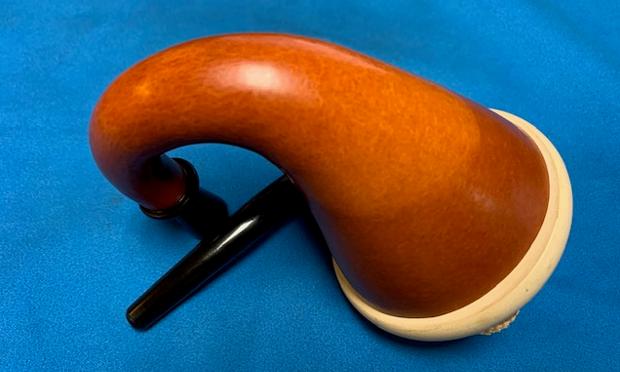
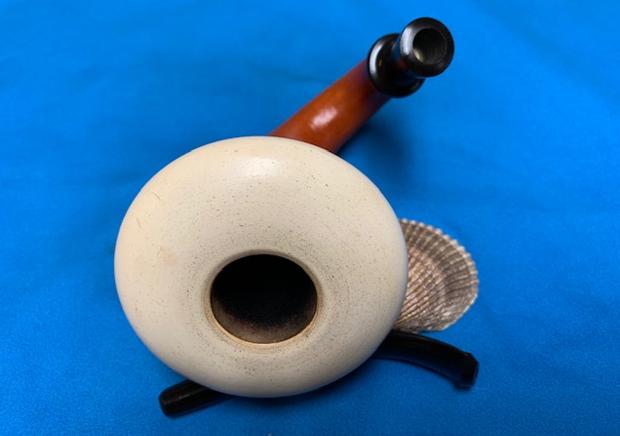
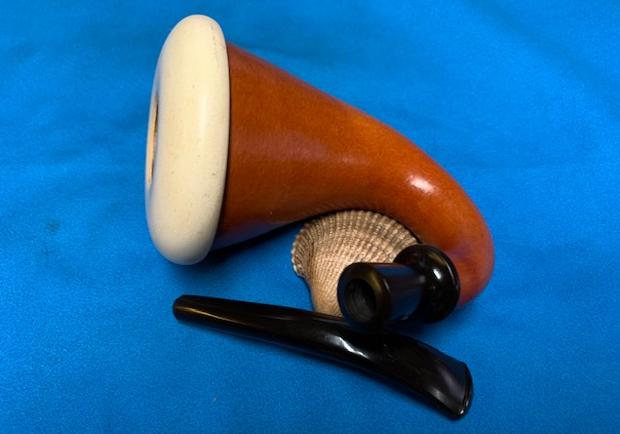
For years now I have kept a box of parts and bowls for a variety of pipes. It has briar bowls that I want to one day restem and shank extensions etc. Periodically Jeff will send me bits and bobs in the boxes of pipes that he sends me. I don’t remember where I picked up the gourd calabash with a meerschaum cup below. It was large and in excellent condition. It was missing the acrylic  shank extension that was glued into the shank of the calabash and it was missing a stem. In the latest box that Jeff sent me he included a shank extension and a stem that I thought would work perfectly to complete this calabash. I put the extension in the shank and took pictures of the parts of the pipe. It worked very well together and once it was all glued and fitted it would look great. I glued the shank extension in the end of the calabash and set it aside to cure. Once the glue was set the shank extension was ready for the new stem.I used some Vaseline Petroleum Jelly to rejuvenate the cork gasket in the bowl. I worked it into the cork with my finger tips to soften the gasket. Once it had absorbed a bit it would be soft and hold the meerschaum bowl in the gourd easily.I put the meerschaum bowl in the gourd and put the stem in the shank extension and took photos of the newly constructed calabash.  I took a photo of the meerschaum cup from the top to show the general condition. It was in decent condition with some scratching and staining around the top surface. The inside of the bowl was in excellent condition. The edges of the bowl and chamber  were in excellent condition. The stem was virtually unused with no tooth marks or chatter on either side.  I took a photo of the bowl and stem from the side to give a sense of proportion. It is a great looking pipe.I started my work on the bowl by polishing the meerschaum bowl with micromesh sanding pads – polishing with 1500-12000 grit pads and wiping them down with a damp cloth after each pad. I waxed the meerschaum bowl with Clapham’s Beeswax Polish. I rubbed it into the meerschaum with my finger tips and once it had dried I buffed it out with a soft cotton cloth.    I polished the gourd down with 1500-12000 grit micromesh sanding pads. The gourd had taken on a great shine. I rubbed the gourd down with Before  and After Restoration Balm to clean and rejuvenate the  gourd and give the calabash and briar a fresh look. I put the meerschaum cup in the gourd calabash bowl and took photos of this portion of the restoration of this pipe. I set aside the bowl and turned my attention to the stem. I polished the stem with micromesh sanding pads – wet sanding it with 1500-12000 grit pads. I polished it further with Before & After Pipe Stem Polish – both fine and extra fine.   I really enjoyed putting this pipe together and restoring it because I love the final touches that make it sing. I put the Gourd Calabash back together and lightly buffed the bowl with Blue Diamond on the buffing wheel. I gave the gourd and stem multiple coats of carnauba wax. I buffed the pipe with a clean buffing pad to raise the shine. I hand buffed it with a microfiber cloth to deepen the shine. It is fun to see what the polished meerschaum bowl looks like with the smooth finished gourd and the black vulcanite stem. This richly finished Gourd Calabash is light weight and ready for you to load up a tobacco of preference and enjoy smoking it. Have a look at it in the photos below. The dimensions are Length: 7 inches, Height: 4 inches, Outside diameter of the bowl: 3 ¼ inches, Chamber diameter: 1 inch. The weight of the pipe is 142grams/5.04oz. This is one that will go on the Meerschaum Pipemakers section of the rebornpipes online store shortly. Thanks to each of you who are reading this blog. Remember we are not pipe owners; we are pipemen and women who hold our pipes in trust until they pass on into the trust of the next generation.    

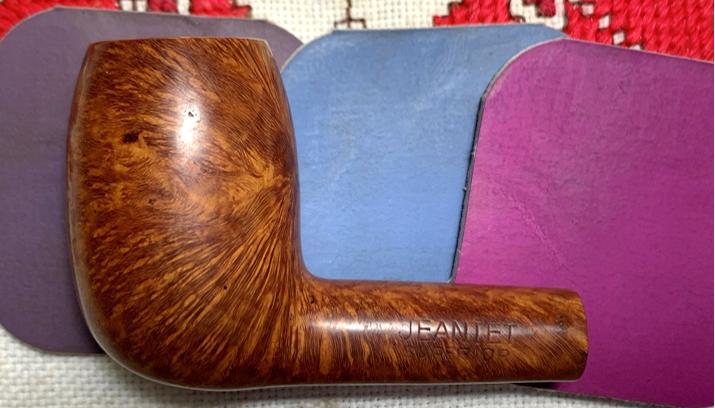
Recommissioning a Classic French Jeantet Superior Chimney


Blog by Dal Stanton

A few years ago, I acquired the Jeantet Superior Chimney now on the worktable in the ‘French Lot of 50’ which demanded my attention on the French eBay auction block.  It has provided several treasures that are now in the care of new stewards benefiting the Daughters of Bulgaria.  Another from this Parisian Lot, is now in the offering.  Skeet saw the Jeantet in the online inventory, ‘For “Pipe Dreamers” Only!’ along with a few other pipes and reached out to me with questions about the possibility of commissioning some.  Part of why I love restoring pipes is not only their innate beauty and intrigue delving into their pedigrees and stories, but also when I can learn about their former stewards or potentially in this case, their future stewards.  Here is a portion of Skeets initial email to me:

Greetings Dal,

I have been looking through your collection of “Help Me!” Baskets and I am overwhelmed!  There are so many beautiful pipes in this group!  I have received a little extra money in recent days and I am finally going to commission a pipe or two.  I am (sadly) clueless on the basic expense of this and the basic value of pipe brands.  I found a dozen pipes I would cherish if I had them but have cut the number down significantly.  I usually tend to buy full or half bent styles, but as I looked, I was drawn to mostly “slightly bent” or even straight models.  I am a newbie still even though I am 66.  I don’t automatically know the relative values of each of these pipes so I may be very interested in a pipe I cannot afford.  This is the primary reason for my exploratory email.

Below I have listed 5 pipes (cut down from many more!)  If you could supply me with a general idea of what these might cost to commission and eventually purchase, I would be quite appreciative.  I intend to commission at least one and hopefully two if I can afford it.

I appreciate your willingness to support the Daughters of Bulgaria.  What a wonderful cause!  Thank you for your compassion.
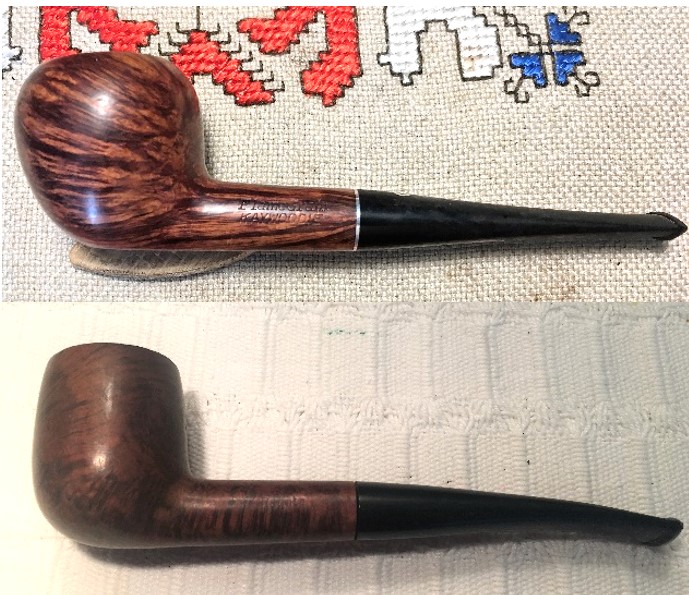
After communicating back and forth, Skeet’s starting point with the consideration 5 pipes was whittled down to commissioning 3.  Along with the Jeantet, Skeet commissioned an interesting Kaywoodie Flame grain 09B Pear and a Butz-Choquin Regate St. Claude France 1275 shown here.

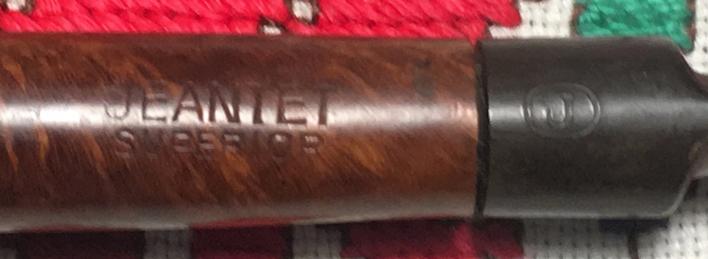
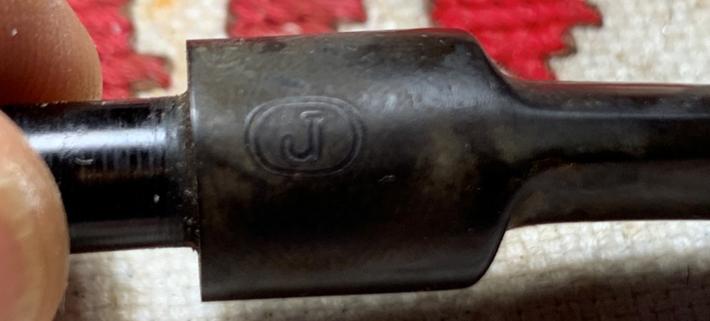
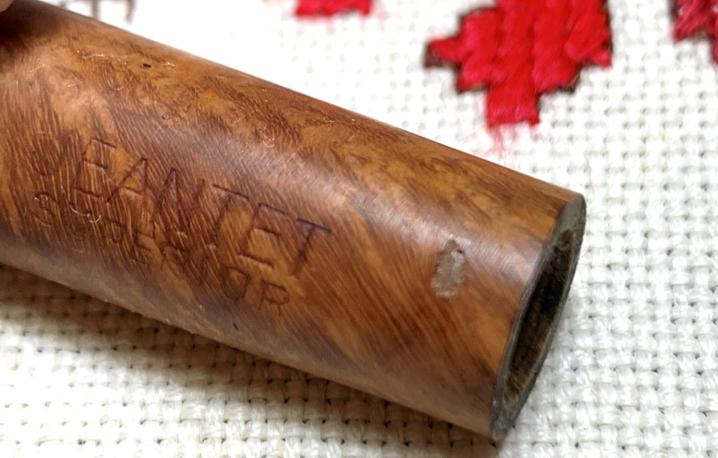
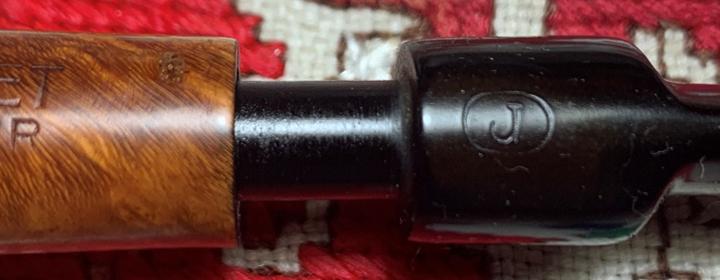
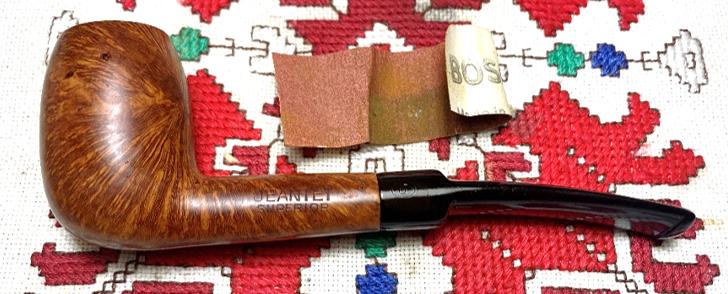
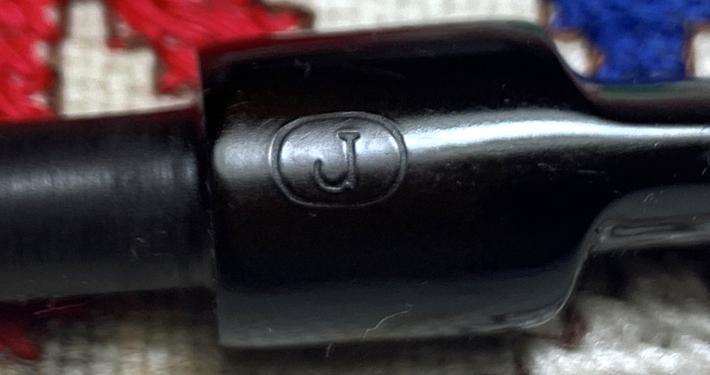
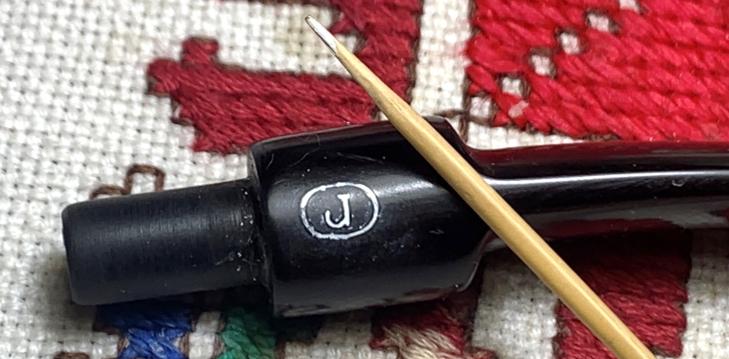
With all who commission pipes, the one condition I ask of them is patience as the pipes work through my deliberate but often slow worktable!  A few months ago, before the holidays, I reached out to Skeet thanking him for his patience and letting him know that his pipes were close to the worktable.  Now, the Jeantet Superior Chimney is on the table.  With the 1 7/8-inch-tall bowl, which tightens and tapers toward the rim – sharp looking, I’m calling it a Chimney shape.  To complete the dimensions, the length is 5 1/2 inches, the rim is 7/8 inches wide with a chamber width of 5/8 inches and depth of 1 11/16 inches.  Here are a few pictures to take a closer look.The stampings on the left side of the shank are JEANTET [over] SUPERIOR.   The stem has stamped a ‘J’ with an oval encircled around it.One of the first pipes I restored several years ago was a Jeantet Fleuron which I found in one of my favorite antique – second-hand shops located in downtown, Sofia, Bulgaria, which I affectionately called the, ‘Hole in the Wall’.  That restoration was my first dive into the labyrinth of French pipe makers and the historic center of pipe making in Saint Claude, France.  I was fascinated by all the relationships and machinations of figuring out the histories of pipe names, datings, and the fluctuations caused by business deals between UK and France….  I enjoyed the research of that first French pipe on my worktable and you can take a look and read it at this link: Another nice find at the ‘Hole in the Wall’ – Jeantet Fleuron 70-7.  The history of the Jeantet name in Saint Claude spans back into the 1700s.  The first part of Pipedia’s Jeantet article starts by looking at the history up to WW2 – as a refresher I repeat it here:

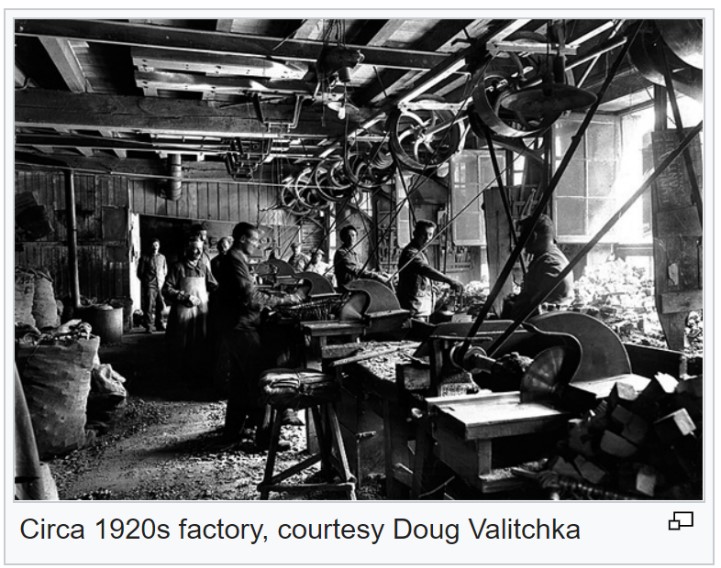
The firm of the Jeantet family in Saint-Claude is first mentioned as early as 1775. By 1807 the Jeantets operated a turnery producing in particular wooden shanks for porcelain pipes and wild cherry wood pipes. The firm was named Jeantet-David in 1816, and in 1837 the enterprise was transformed into a corporation as collective name for numerous workshops scattered all over the city.

The manufacturing of briar pipes and began in 1858. 51 persons were employed by 1890. Desirous to concentrate the workers at a single site, the corporation began to construct a factory edifying integrated buildings about 1891 at Rue de Bonneville 12 – 14 In 1898 Maurice Jeantet restructured the business. He is also presumed to enlarge Jeantet factory purchasing a workshop adjoining southerly. It belonged to the family Genoud, who were specialized in rough shaping of stummels and polishing finished pipes. (In these times it was a most common procedure to carry goods from here to there and back again often for certain steps of the production executed by dependent family based subcontractors. Manpower was cheap.)

Jeantet was transformed to a corporation with limited liability in 1938. By that time a branch workshop was operated in Montréal-la-Cluse (Ain), where mainly the less expensive pipes were finished. 107 employees – 26 of them working from their homes – were counted in Saint-Claude in 1948 and 18 in the Ain facility.

According to the Pipedia article, the Jeantet production continued to expand through the 50s with new equipment and more employees.  But in 1969 production reached its zenith with the production of 30 to 35,000 dozen pipes per year with 72 workers shrinking to 1987 with 6 to 7000 dozen pipes per year with 22 workers on the payroll.   The final years of the Jeantet name are described in the same Pipedia article:

Yves Grenard, formerly Jeantet’s chief designer and a great cousin of Pierre Comoy, had taken over the management of Chapuis-Comoy in 1971. Now, to preserve the brand, the Jeantet family went into negotiations with him, and resulting from that Jeantet was merged in the Cuty Fort Group (est. 1987 and headed by Chacom) in 1988 along with the pipe brands of John Lacroix and Emile Vuillard. Chacom closed the Jeantet plant, and the City of Saint-Claude purchased it in 1989. After alternative plans failed, the buildings were devoted to wrecking. The southerly workshop was wrecked before 1992.

Today Jeantet pipes were produced as a sub-brand by Chapuis-Comoy who’s mainstay is Chacom of course.

Looking at Pipephil.eu, I hoped to find more information about the Jeantet on my table in the listing.  The ‘Superior’ line was not among the listings, but what was added was later information about the fate of the Jeantet name:

The company joined the Cuty-Fort Entreprises group (Chacom, Ropp, Vuillard, Jean Lacroix…) in 1992. In 2010 it dropped out and the brand isn’t part of the group any more. The label is owned by the Jeantet family (Dominique Jeantet) again. The pipe production is discontinued. Dominique Jeantet retired in 2000.

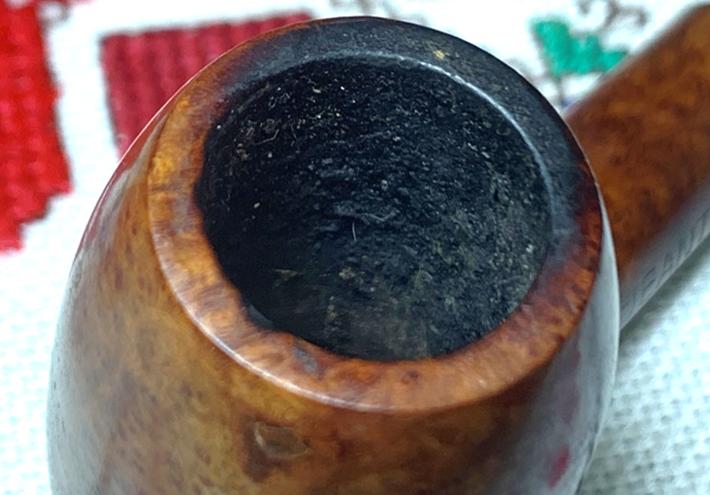
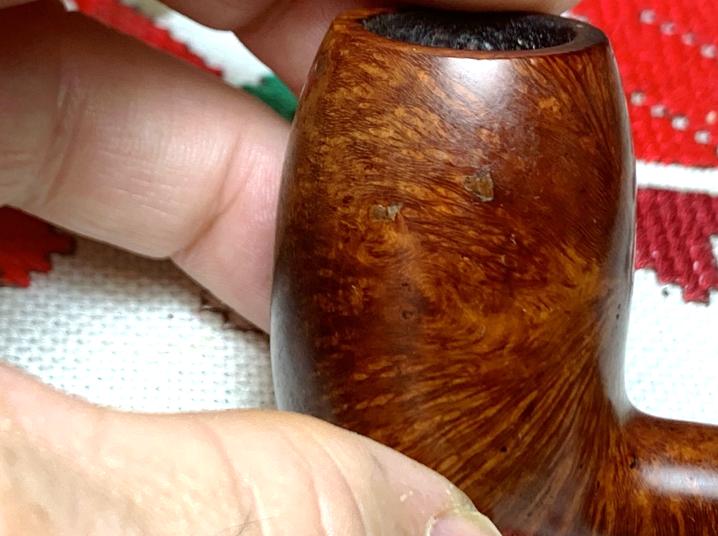
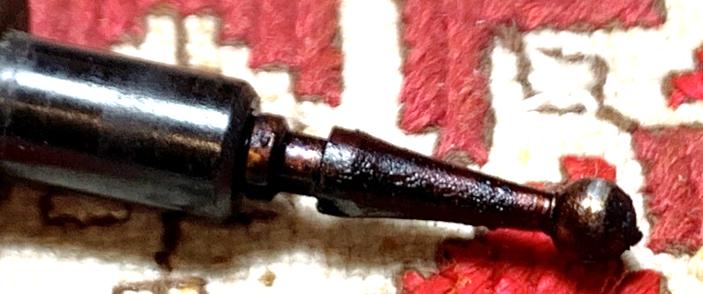
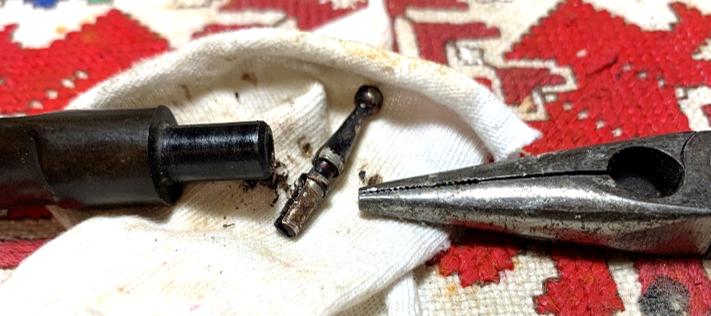
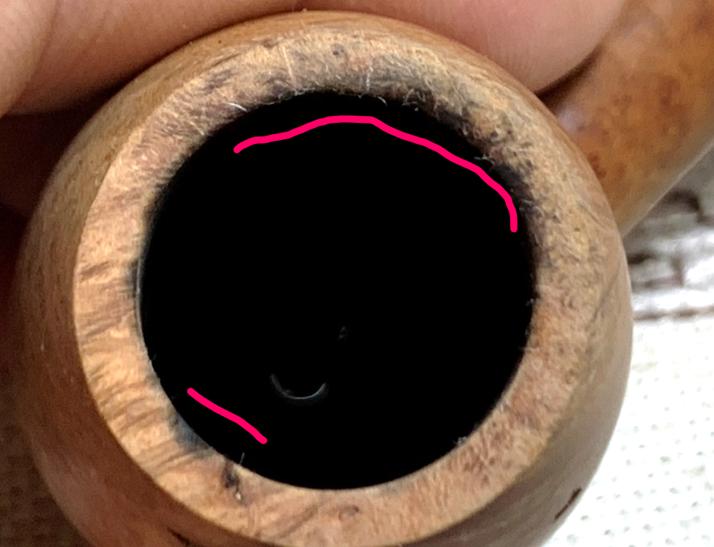
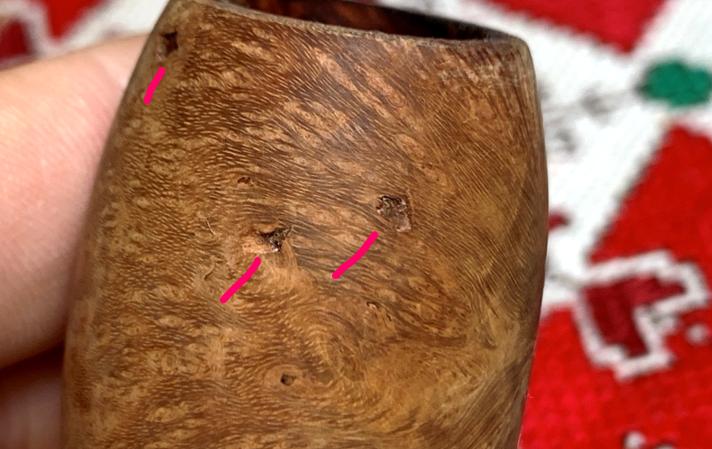
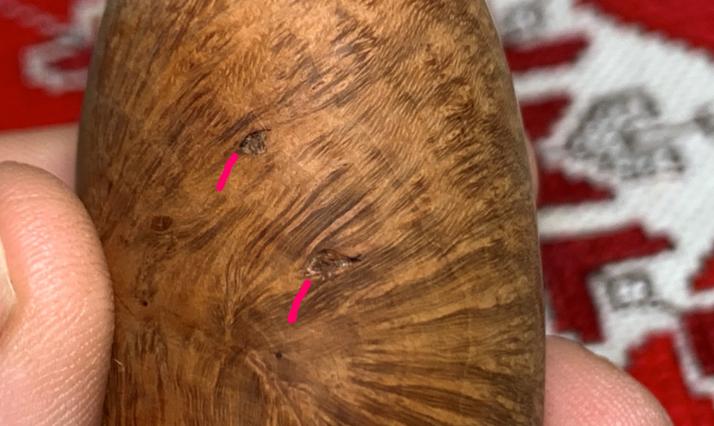
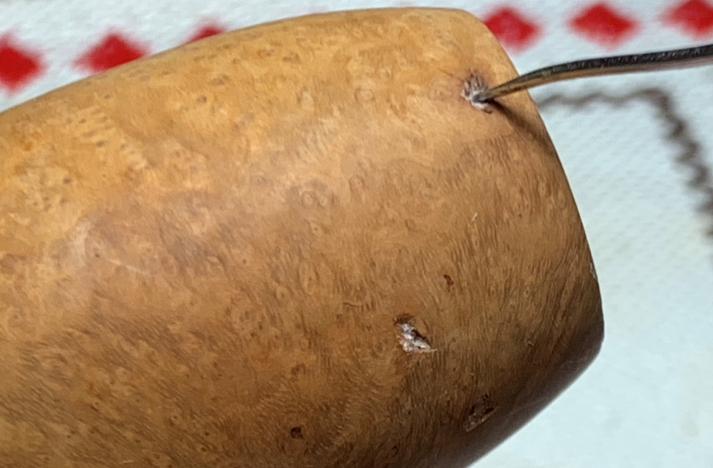
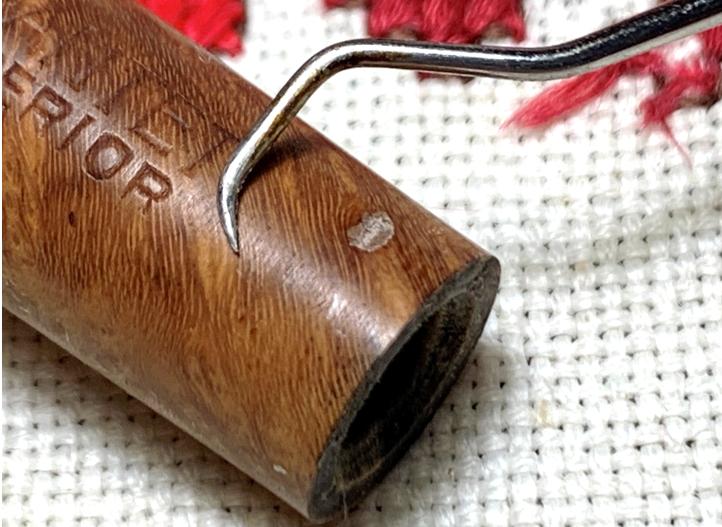
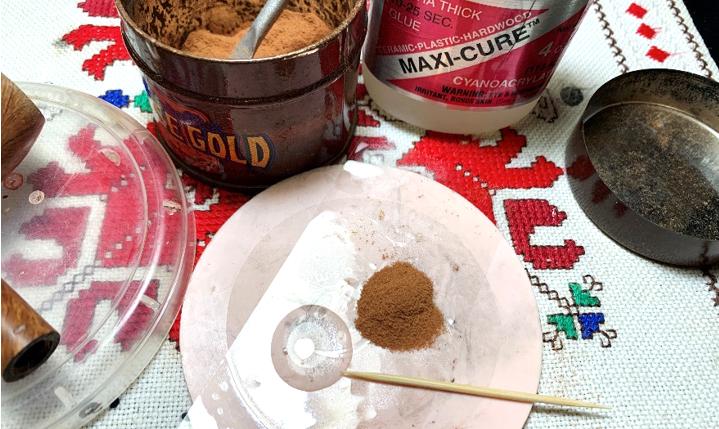
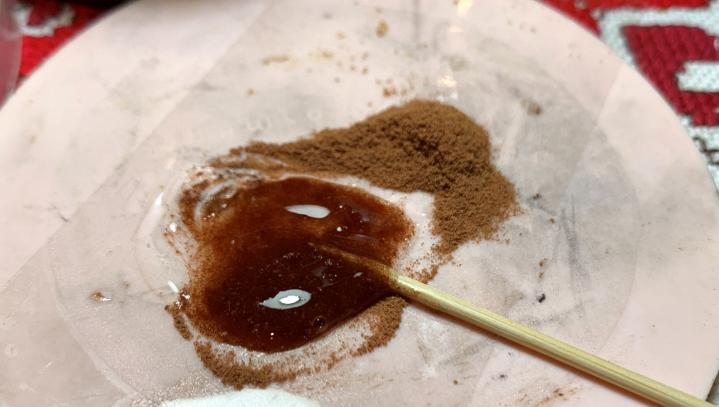
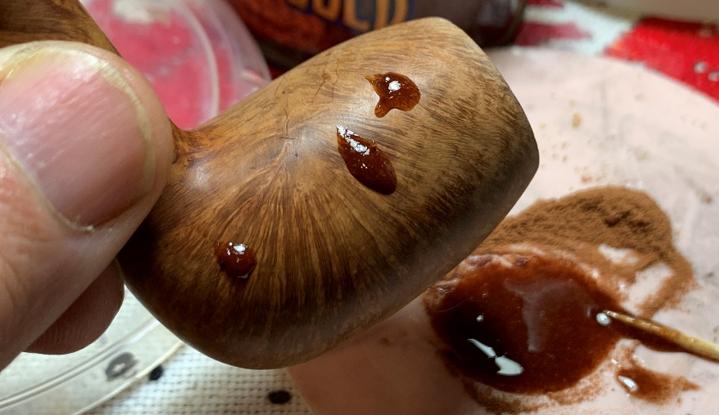
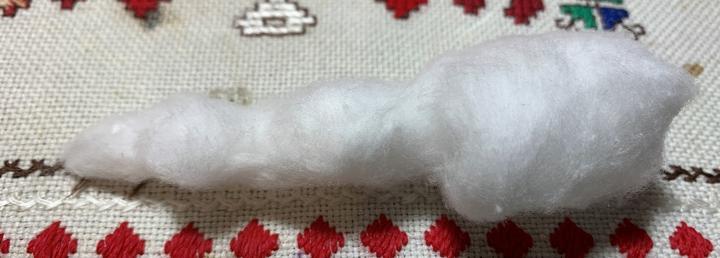
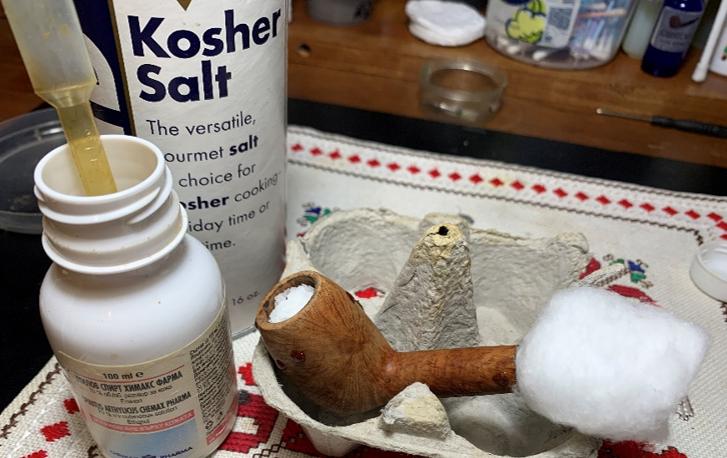
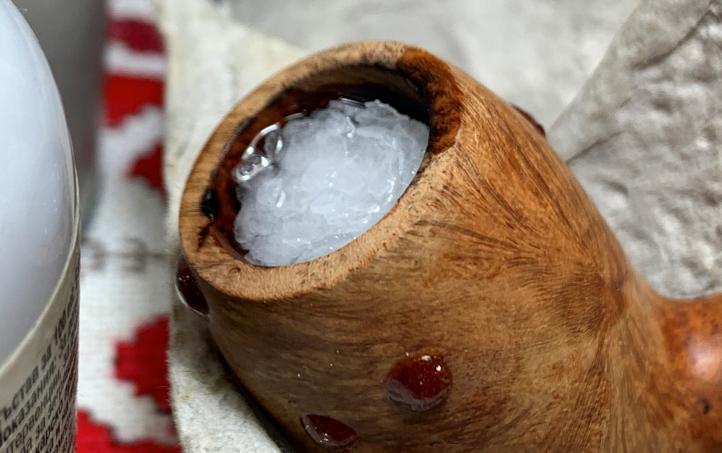
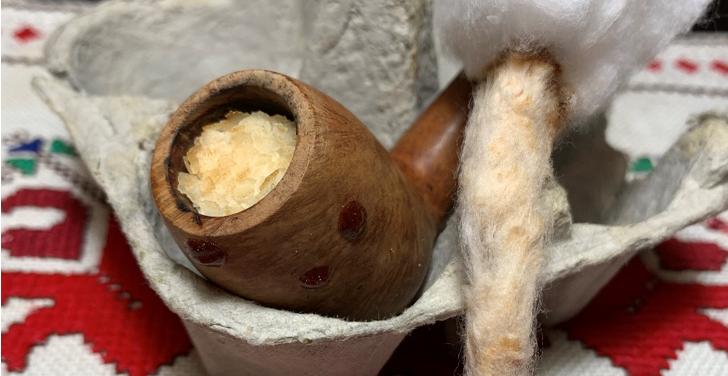
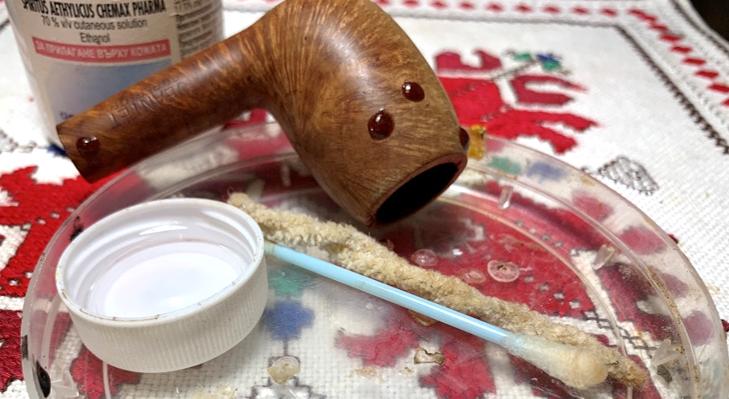
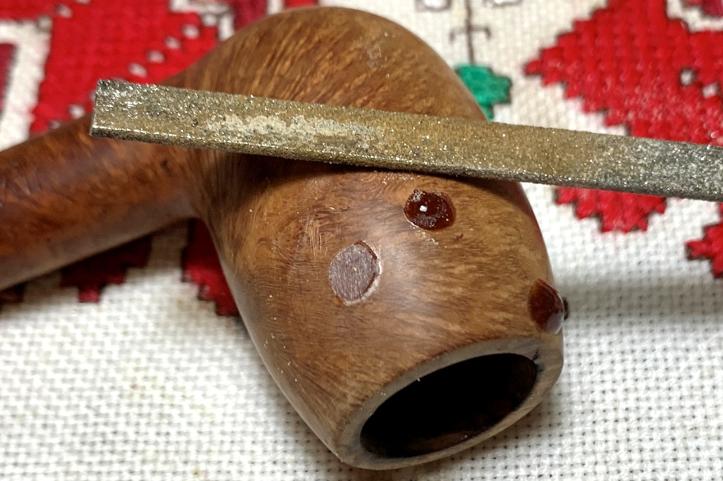
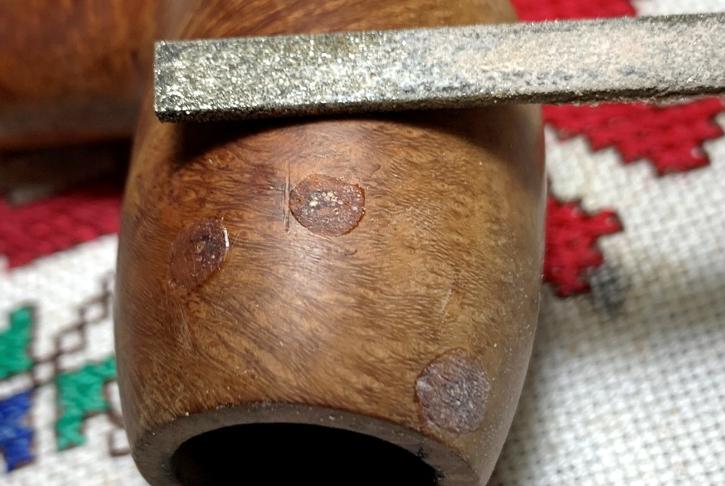
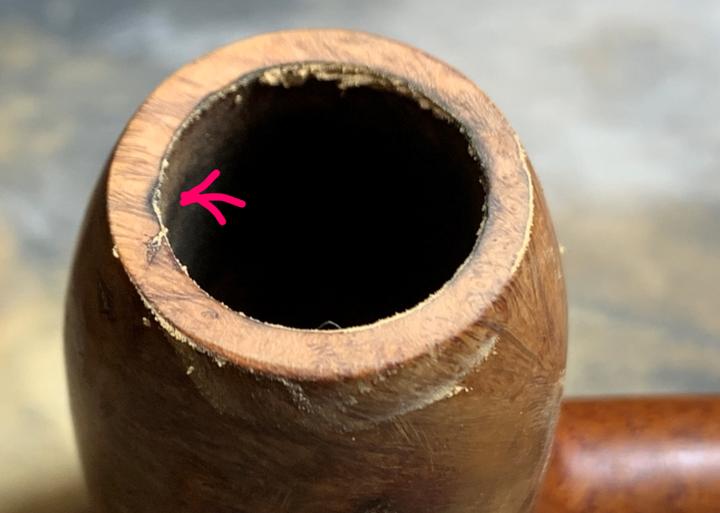
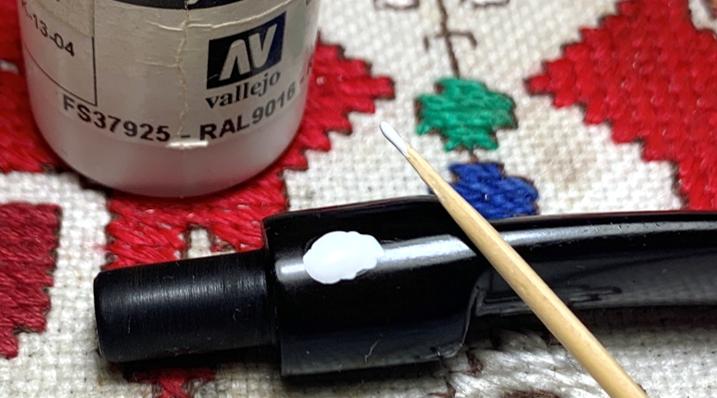
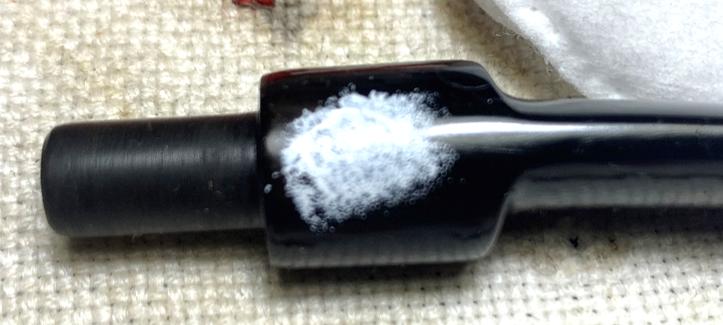
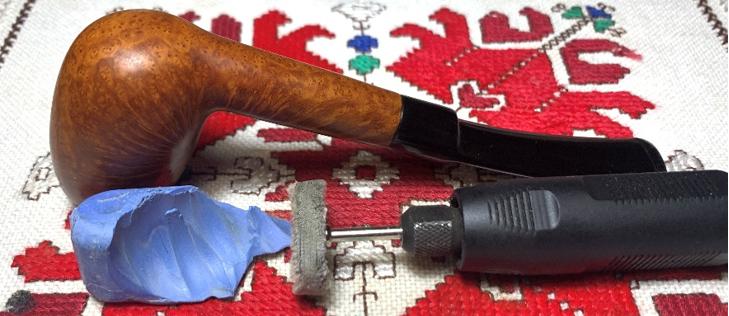
With a renewed appreciation for the legacy of the Jeantet pipe on my table, I look more closely at the pipe. The chamber needs cleaning to give the briar a fresh start.  The carbon buildup is minor.  There is some darkening on the rim from lighting, but hopefully, this should clean easily.  The stummel has attractive and expressive random grain and fire grain that wraps the bowl.  Looking closely at the bowl several fills are visible which may need attention later. The slightly bent saddle stem shows some thick oxidation and light roughness on the bit.Starting with the stem, the original Jeantet nickel stinger is lodged in the tenon.  It is debated whether stingers help or hinder the smoking experience.  I personally do not prefer stingers.  Yet, as part of the historicity of a pipe, if it has a stinger as a part of its original production, I like to save it and allow the future steward to make his own decisions.  To remove the stinger, a cloth is used to wrap the stinger to protect it from ‘teeth marks’ as it’s removed.  With the cloth wrapped around the stinger, the needle nose pliers lightly grab the stinger while I gently rotate the stem to dislodge the stinger.  This works well.  I put the stinger in some alcohol to soak and to later clean with steel wool.Next, the airway is cleaned with a few pipe cleaners wetted with isopropyl 99%.I can see some significant deposits of oxidation in the vulcanite stem.  While protecting the circled ‘J’, I go work on the oxidation before putting the stem into a soak of Before & After Deoxidizer.I use Soft Scrub and steel wool to try to break up the oxidation – avoiding the stem stamping.After rinsing the stem, it is then placed in the Before & After Deoxidizer to soak through the night along with the other pipes that Skeet has commissioned.The next day, the stem is fished out of the Deoxidizer and drained.  With latex surgical gloves on my hands, I squeegee the liquid off the stem.I then use a pipe cleaner wetted with isopropyl 99% to clear the Deoxidizer from the airway.  Cotton pads and alcohol are also used to wipe off the raised oxidation from the stem.To help condition the vulcanite, paraffin oil, a mineral oil, is applied to the stem. Looking more closely at the stem with the oil on it, and with the help of a lightened picture, residual oxidation is visible.  Ugh!  The greatest concentration is on the bit and on the horn of the saddle stem.  I have found that the Before & After Deoxidizer does not work as well with deep oxidation.  The question that has been discussed is, does this product remove oxidation or mask it?  I’ll need to ask Mark Hoover about this who produces the product (www.Lpen.com)!  The Deoxidizer seems to do great with stems with light oxidation, but for this stem, sanding will be needed to continue the oxidation removal.    Turning now to the Chimney stummel, a fresh picture shows the chamber and the light cake build up.I am only able to use the smallest diameter blade head in the Pipnet Reaming Kit to ream the chamber.  The narrow chamber shaft will not accommodate more!The Savinelli Fitsall Tool follows by scraping the chamber wall and can reach down to the floor of the chamber and navigate the tight angles.  The chamber cleaning is completed with a sanding with 240 paper wrapped around a Sharpie Pen.  After wiping out the chamber with a cotton pad, an inspection reveals healthy briar – no heating or cracking problems. The cleaning continues with undiluted Murphy’s Oil Soap and a cotton pad.  Using the cotton pad, the outer stummel is scrubbed. The darkened char on the aft of the rim is stubborn.  I scrub the rim with my thumbnail and Murphy’s.  The brass wired brush also is used and a careful scraping using a pocketknife.  I’m extremely careful working on the rim because the rim top of the chimney bowl is very thin, and I do not want it damaged or worn down inadvertently. To continue the cleaning the stummel is transferred to the sink where using anti-oil liquid dishwashing soap and warm water, the mortise is scrubbed using shank brushes.  After scrubbing, the stummel is thoroughly rinsed and transferred back to the worktable. The rim cleaned up more but burn damage is there. The aft quadrant shows where most of the lighting activity has transpired – over the rim. The front shows some burns as well, but more localized.  I’m an old school match user – over the bacca and draw down not over!  This rim damage will be addressed later.During the external surface cleaning process, weakened patches, probably made of water-based fill material, filling the pitting in the briar are revealed. I had noted these fills earlier. The beauty of highly active briar grain often has the downside of small imperfections in the briar that have to be filled with patch material.  I count 5 patches in need of repair. While the old patch material is still damp, I use a dental probe to dig the remnant filler material. Before continuing with patching, the cleaning of the internals of the stummel need completion.  I prefer working on clean pipes!  It only takes a few cotton buds and pipe cleaners dipped in isopropyl 99% to finish the cleaning.  I will further the cleaning later with a kosher salt and alcohol soak.With the pipe now clean, I will address the 5 pits that emerged through the cleaning process now emptied of old fill material. To repair the briar, I refill the pits using a mixture of briar dust and CA glue.  The mixture creates a ‘briar putty’ that is then applied to the pits.  I first clean the surface with alcohol AND discover another pit or possibly a chip in the shank, just to the right of the nomenclature.  Well, now there’s 6 patches to be made.  I clean the area with a dental probe and alcohol.  The appearance seems that it’s a chip and not a pit that lost its fill material. To make the briar putty, I use a plastic disk as the mixing palette.  To help with clean up and to keep the CA glue pristine, a piece of clear packing tape covers the disk.  To mix on a paper or an index card may change the viscosity of the CA glue during mixing and cause it to solidify too soon.  A small pile of briar dust is placed on the palette, and then, beside this, a small puddle of extra thick CA glue is placed.  The picture shows the set up before the mixing commences.Using the toothpick, briar dust is gradually pulled into the CA and mixed in with the toothpick.  Additional briar dust is pulled into the thickening mixture until it reaches the viscosity of molasses.When the putty is thick enough and no longer runny, the toothpick is used to trowel the putty to spot place onto each pit.  I use an accelerator to hold the patches in place and to quicken the curing process.  The pictures below show the patches in place.  While applying the putty, I saw another small pit – and then there were 7. The hour is late and with the patches on the stummel firm, I will do one last project before turning out the lights.  A kosher salt and alcohol soak will continue the internal cleaning and refresh the pipe for the new steward.  Starting with a cotton ball, it is pulled and twisted until it forms a ‘wick’ to help draw out the tars and oils from the internal briar.  The end of the cotton ball wick is guided with the help of a stiff wire down the mortise into the airway as far as the draft hole.  The bowl is then filled with kosher salt and the stummel is placed in an egg crate to keep it stable and to maintain the proper angle – the top of the salt and end of the shank are parallel.  Kosher salt is used because it leaves no aftertaste.  With a large eye dropper, isopropyl 99% is introduced slowly into the bowl until the alcohol surfaces over the salt.  After about 10 minutes, the alcohol is absorbed into the salt and cotton wick to some degree.  The bowl is then topped off with additional alcohol until it surfaces once more above the salt.  I set the crate stummel aside resting in the egg crate and turn out the lights. The next morning, the kosher salt and alcohol soak have been at work.  The salt and the wick are soiled indicating a continued drawing out of the oils and tars from the internal briar. To make sure all is cleaned and refreshed, a cotton bud and pipe cleaner wetted with isopropyl 99% confirm all is good.With the stummel clean, next is the process of filing down all the briar putty patches.  The basic approach for all the patches is to use a flat needle file with the goal to file exclusively on the patch mound and not to wander off the patch area onto the surrounding briar.  The mounds are filed down close to the briar surface.  These next few pictures give the idea. After all the mounds are filed down, 240 grade sandpaper is used to sand the patches further.  The goal is to remove all the excess dried putty surrounding the patch itself.  You can tell when excess glue is remaining as you sand – the glue is a powdery white whereas briar is not.  A few more pictures showing sanding on different patches. With the patches filed and sanded down, I switch my focus to the rim.  I like the design of the rim as it culminates.  It is very compact as it crowns the coned taper of the bowl.  The rim itself is a narrow 1/8 inch wide.  The front and back of the rim have sustained charring and burn damage from lighting.  The entire circumference of the inner rim is darkened. To clean and refresh the rim, I top the stummel – oh, but precious little!  To begin, 240 paper is used on the top of a chopping board which serves as my topping board.  After inverting the stummel on the paper, I give it a few rotations and check.  The last thing I want to do is take off too much with such a tightly fashioned rim.  A few rotations are enough it seems to me. Switching on the topping board now to 600 grade paper, several more rotations are given on the less abrasive paper.  In the picture below after topping on the 600 paper, the rim looks better.  There remains a burn mark on the front side that reaches into the rim.  The back side damage to the rim, which appeared to be worse, has pretty much been erased except for the inner lip radius which still is darkened.Using a tightly rolled piece of 240 paper followed by 600 paper, the inside rim lip is gently sanded to remove the black char stain.  I call the sanding ‘gentle’ because I don’t want to create a bevel on a rim this narrow.  I only desire to clean and freshen it.  The rim looks great – nice grain has emerged.  The only quandary I have is that there is still a small bit of char darkening remaining (upper arrow), but I don’t want to take more off the rim.  Another question is right next to the dark spot – when I run my finger over it, it is not smooth (lower arrow).  This appears to be an imperfection in the briar and topping the stummel to remove it will probably require a good bit more briar to be removed.  Briar is the most important real estate on a pipe, and one does not give it up unless necessary. To avoid topping more and sacrificing more briar off the rim, I spot drop CA glue to fill the small crevasse on the rim. After the CA is cured, a pointed half moon needle file works well to file down the excess CA on the inner curve of the chamber.Flipping the file over to the flat edge, it works well to remove the excess CA patch on the flat rim surface.  I’m careful to keep the file on top of the patch mound so not to impact the surrounding briar.The rim patch is completed with 240 sanding paper followed by 600.  The rim is now smooth to the touch and the patch blends well with the surrounding briar.Next, with the several patches required on the stummel surface, to blend these patches and to clean the surface, sanding sponges are used.  I use a coarser grade sponge to start.  Following this, a medium then a fine grade sponge to complete this phase. Transitioning next to dry sanding with micromesh pads, pads 1500 to 2400 are followed by 3200 to 4000 and then 6000 to 12000.  The grain emerges very nicely through the micromesh sanding process.  Before putting the stummel aside to focus on the stem, Before & After Restoration Balm (www.Lpen.com) is applied to the stummel.  The Balm does a great job bringing out the subtle hues of the natural briar.  After placing some of the Balm on my fingers, the Balm is rubbed into the briar surface with a creamy consistency and it gradually thickens.  Once the surface is thoroughly covered, the stummel is set aside for about 20 minutes for the Balm to do its work.After 20 minutes, the excess Balm is wiped off with a microfiber cloth and then buffed.  It’s looking great!Turning now to the stem, the picture I took earlier after the Deoxidizer soak is a reminder of the deep oxidation the remained. Interestingly, as I look at the stem now, I am not able to see the oxidation as I was earlier….  Hmmm.  Even so, I elect to sand the stem so that the oxidation doesn’t show itself later during the fine polishing phase.  Using 240 sanding paper, the entire stem is sanded careful to guard against accidentally sanding over the Jeantet Circle ‘J’ stem stamping.  Following the 240 grade coarser sanding, I wet sand using 600 grade paper and then finish after applying 0000 grade steel wool.Continuing with the stem using micromesh pads, the stem is wet sanded with pads 1500 to 2400.  Following the wet sanding, I dry sand with pads 3200 to 4000 and 6000 to 12000.  Between each set of 3 pads, Obsidian Oil is applied to further condition the stem and to guard it from future oxidation. After completing the sanding of the saddle stem, I reunite the stem and stummel to get an overall look at the progress.  What I discover is that the fit of the tenon and mortise has tightened through the cleaning process – this happens.  I do not risk forcing the stem and stummel together which could result in hearing that dreaded snap of a cracked shank. The remedy is to pinch 240 sanding paper around the tenon and rotate the stem to create the abrasion which gradually reduces the diameter of the tenon to fit the mortise. After several rotation sessions and fittings to test the size, the tenon gradually fits – snugly but not too tight.  The Jeantet Superior Chimney is coming along very nicely.The next step is to refresh the Circle ‘J’ stem stamping with white acrylic paint.  It appears that there’s enough ‘tread’ left in the stamping to give the paint traction to be held in the imprint.The first step is to place a small drop of white acrylic paint over the stamping.  The toothpick then is used to spread the paint over the lettering.I then daub the wet paint with a cotton pad to absorb the excess and to spread the paint evenly over the lettering.  This also dries the paint quickly.I use both the flat edge of a toothpick and its point to clean the excess paint away and to sharpen the stamping.  I use the side of the toothpick to scrape over the entire stamping removing most of the paint on the stem surface – leaving the paint in the troughs of the stamping.  The point of the toothpick allows me to finish the edges of the stamping more closely.  I repeat applying paint a couple times with daubing and then the toothpick finishing process until the Jeantet stamping looked good.Now on the home stretch.  After remembering to replace the original nickel stinger after it was cleaned and polished with steel wool, and rejoining the stem and stummel, a cotton cloth buffing wheel is mounted onto the rotary tool to apply Blue Diamond compound to the stem and stummel.  The speed is set at about 40% full power as I methodically apply the fine abrasive to the surface of the briar and vulcanite. After applying the compound, the pipe is wiped/buffed with a felt cloth to remove left over compound dust particles.  I don’t want the abrasive particles to mix with the wax that comes next.  Another wheel, dedicated to applying carnauba wax is mounted and with the speed remaining the same, wax is applied to the pipe.   When this is completed, the pipe enjoys a rigorous hand buffing with a microfiber cloth to remove any excess wax from the surface and to raise the shine. Skeet commissioned this Jeantet Superior Chimney because he saw its potential.  The Chimney shape gives a sharp, clean-cut look.  This joined with the slightly bent saddle stem gives the pipe a comfortable symmetry.  The briar required several repairs to fill pits, but the results were worth the effort!  There is no such thing as a perfect piece of briar! The briar block appears to have been cut near the edge of the bole which manifests the beautiful, active briar seen in this stummel.  The fire grain seems to hug and wrap around the bowl tightening into a spider web knot on the back side of the bowl.  Without question, a striking landscape for a new steward to enjoy!  Skeet will have the first opportunity to claim this Jeantet Superior Chimney from The Pipe Steward Store benefitting the Daughters of Bulgaria – helping women and girls who have been trafficked and sexually exploited.  Thanks for joining me!


Restoring a Peterson’s Dublin (London Made England) 21 Calabash


Blog by Steve Laug

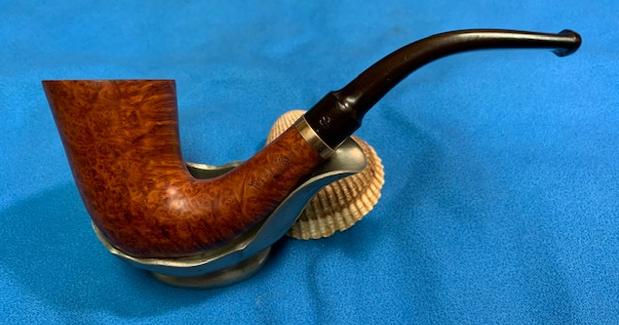
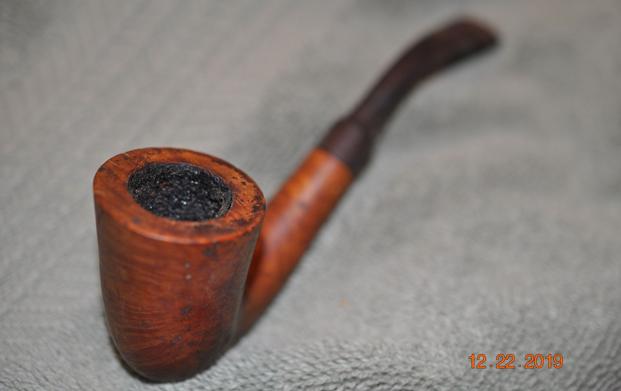
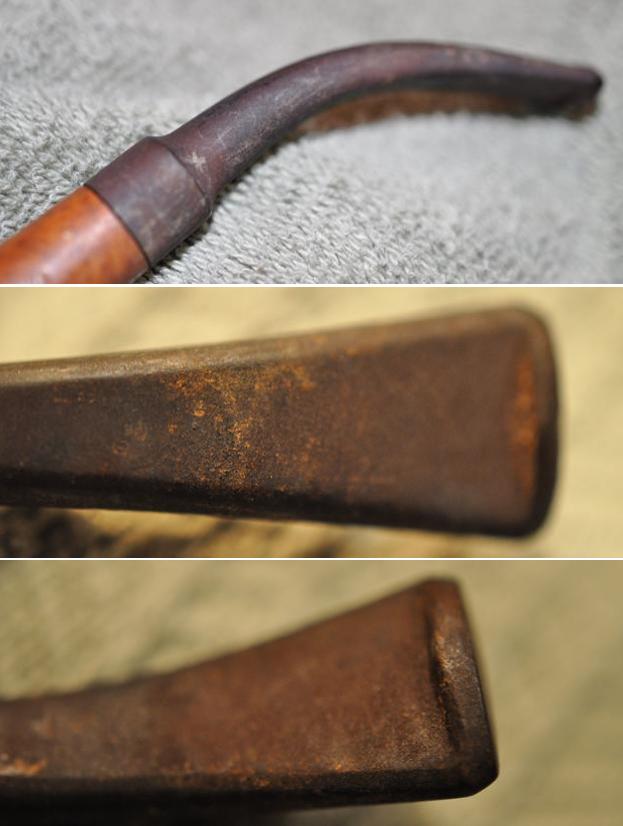
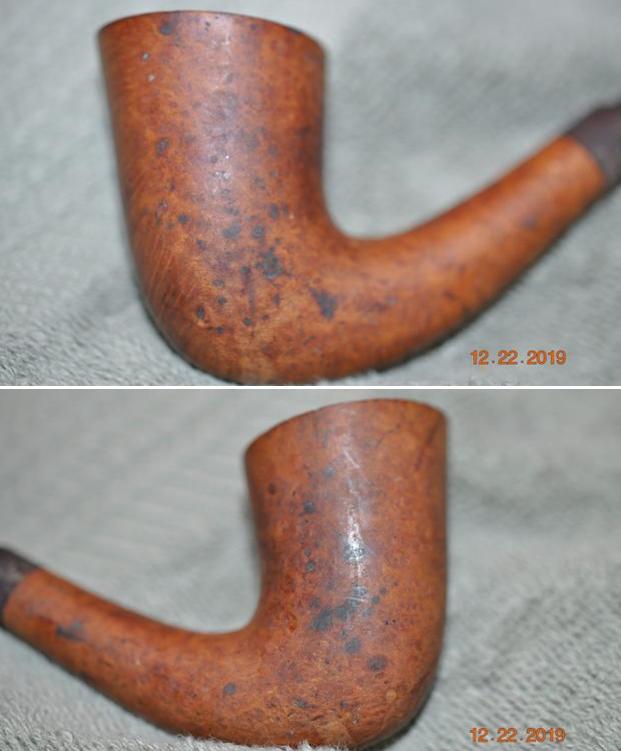
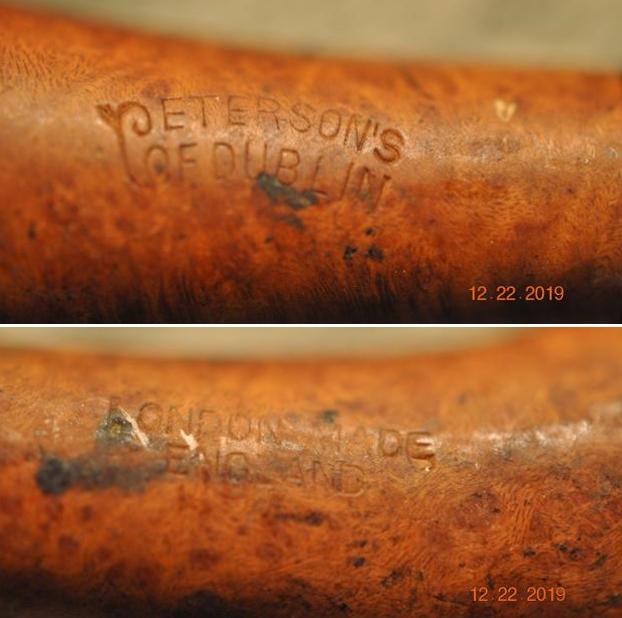
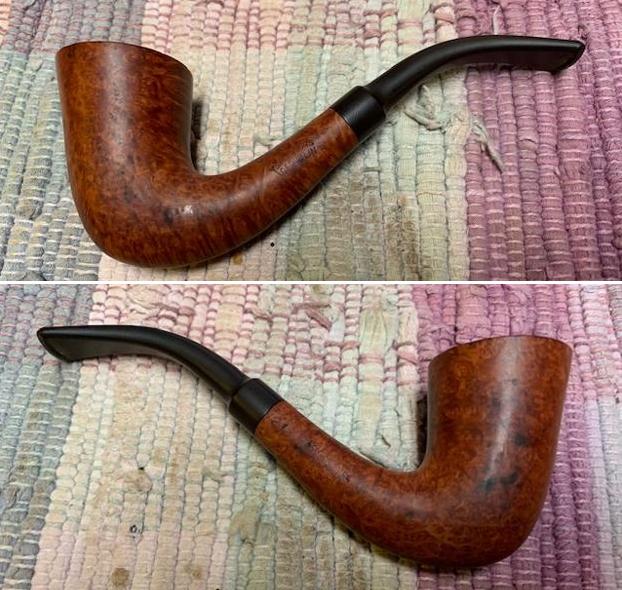
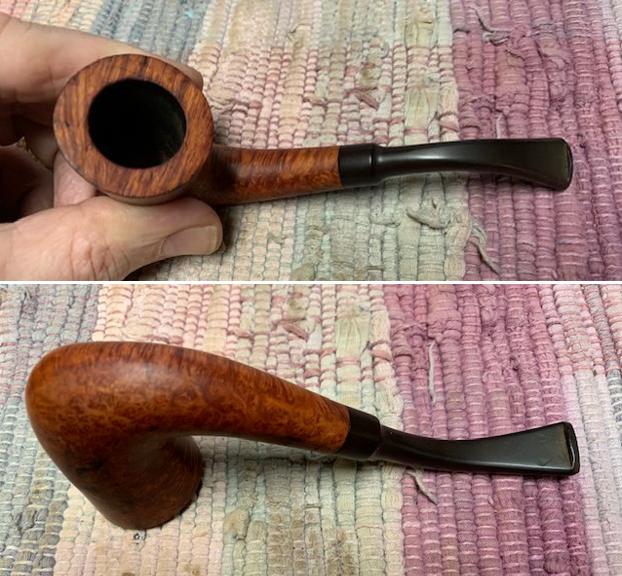
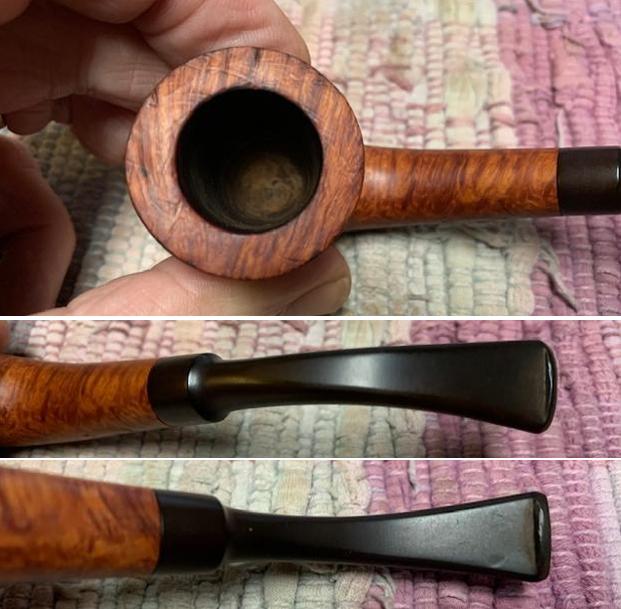
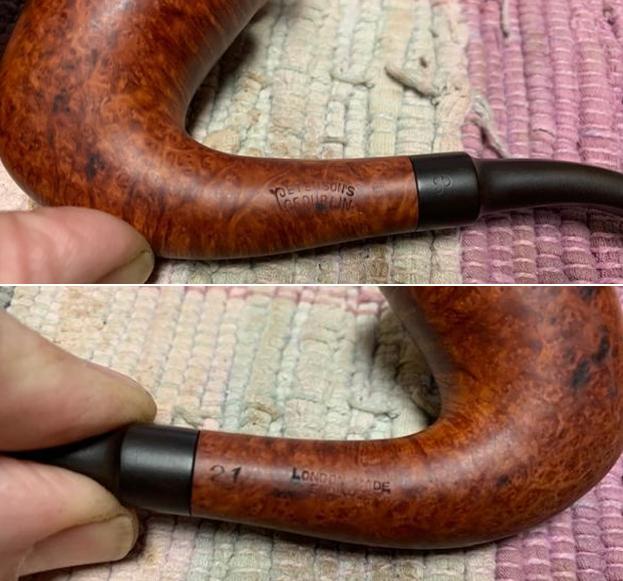
The next pipe I have chosen is smooth finished Peterson’s Dublin Calabash pipe that had a bit of a bland looking finish but had some good looking grain around the bowl sides and shank. It came to us in a group of pipes we bought from a fellow in Los Angeles, California, USA. This Calabash was stamped on the left side of the shank and read Peterson’s [arched over] Dublin. It was stamped on the right side and read London Made [over] England. On the left of that next to the stem it is stamped 21. The pipe was in filthy condition when he brought it to the table. The finish was dirty with grime ground into the briar sides and rim. There were black spots on the briar around the bowl and shank. There was a thick cake in the bowl and a light coat of lava on the rim top but the edges of the bowl and top actually looked to be in good condition. The stem was oxidized, calcified and had tooth marks and chatter on the top and underside on and near the button. It had a stamped P on the left side of the saddle. Jeff took photos of the pipe before his cleanup work. They tell the story and give a glimpse of the promise that we see in this pipe. Jeff took photos of the rim top and stem to show the general condition of the pipe. The bowl is thickly caked and the rim top and edges look pretty good under the light lava coat. The photos of the stem show some oxidation and light tooth marks on both sides near the button. Jeff took some photos of the bowl sides and heel to show the amazing grain that was around this bowl. It is a nice looking pipe.     He took photos of the sides of the shank to show the stamping. The stamping is readable in the photos below and is as noted above.    I am including the link to the Pipedia’s article on Peterson pipes. It is a great read in terms of the history of the brand (https://pipedia.org/wiki/Peterson).

I turned to “The Peterson Pipe” by Mark Irwin and Gary Malmberg to get some background on the Peterson’s London Made England line. On page 296-297 it had the following information.

MADE IN over ENGLAND and variations shown below (1936-62) Peterson maintained a factory in England for about a quarter of a century, from the late 1930s to ’62. Corporate transcripts and London business periodicals suggest the London operation on White Lion Street was about to get underway in ’37. Only a handful of London hallmarked Petersons are documented, stamped with date marks of 1936 and 1939, and these have no COM stamp. Their output would be limited by the onset of the Battle of Britain in July 1940, but it seems reasonable to suppose pipes were made in the London factory during WWII, inasmuch as the K&P Staff Register lists twelve employees earning wages there in January ’44. London hallmarked Petersons have been identified with dates of 1949-54. Most London made Petersons in a collector’s inventory were made in these postwar years, from 1949 until the closing of the factory in ’62. This narrow range  of dates is probably the most reliable indicator of years when the stamp and the variations listed below were employed. The presence of one variation or another on a pipe is not by itself a reliable indicator of age.

Made In over England

Made In England forming a circle

Made In England forming an ellipse

Made in England in a line

A “Peterson’s Product” over Made In England

A Peterson’s Product over Made In England

A Peterson Product over Made in England

Made In over Great Britain

Great Britain

London Made over England

London Made

Now I knew a date range for the pipe I was working on – 1949-1962. I have underlined and made the text bold in the above list to show the stamping on the pipe I am working on. Now it was time to work on the pipe.

Jeff had done a great job cleaning up the pipe as usual. He reamed the pipe with a PipNet reamer and cut back the cake back to the bare briar. He cleaned up the walls with a Savinelli Fitsall Pipe Knife. He scrubbed the interior of the bowl and shank with pipe cleaners, cotton swabs and alcohol to remove the tars and oils. He scrubbed the exterior of the pipe with Murphy’s Oil Soap and a tooth brush to remove the grime from the finish. He worked on the rim top lava and the darkened spots with the soap and tooth brush. He scrubbed the inside of the stem with alcohol and pipe cleaners. He scrubbed the exterior with Soft Scrub and then soaked it in Before & After Deoxidizer. He washed it off with warm water to remove the Deoxidizer. The pipe looked far better when it arrived. I took some close up photos of the rim top and also of the stem surface. I wanted to show how well it had cleaned up. The rim top had some looked quite good and the inner edge had some darkening and damage. It should clean up really well. I also took close up photos of the stem to show the tooth marks on the surface near the button.     I took photos of the stamping on the sides of the shank. You can see that it is stamped as noted above. It is clear and readable.     I removed the stem and took a photo of the pipe to have a look at the parts and overall look. I decided to address the spots around the bowl sides first. I was pretty sure I could remove them with micromesh sanding pads. I sanded it with 1500-2400 grit pads and was able to remove and minimize those that remained with the micromesh.    In the process of sanding the shank I found a small hairline crack in the underside of the shank that extended straight up the shank for about ½ inch. I checked out the stability of the crack and it was still quite tight. I decided the best course for this kind of crack was to bind it together with a thin brass band. I topped the band edge off and removed some of it so that it did not interfere with the number stamp on the right side and would still do the job it was intended to do. I drew a red rectangle around the crack in the shank and took two pictures to capture it. There is some darkening around the crack and that was what caught my eye.  I went through my bands and found one that was the proper fit for the shank diameter. It was a bit too deep and covered some of the shape number stamp on the right shank so I used a topping board and 220 grit sandpaper to reduce the depth so that it did not cover the number. Once I had the depth correct I put some all purpose glue on the shank end and pressed the band in place on the shank. I wiped off the excess glue with a damp pad. I finished polishing the briar with the remaining micromesh sanding pads – dry sanding with 3200-12000 grit sanding pads. I wiped the bowl down with a damp cloth after each sanding pad. I worked some Before & After Restoration Balm into the surface of the bowl and shank with my fingertips to clean, enliven and protect the briar. I let the balm sit for 15 minutes and then buffed with a cotton cloth to raise the shine. The photos show the bowl at this point in the restoration process.    I set the bowl aside and “painted” the stem surface with the flame of a “Bic” lighter to lift the tooth marks. I was able to raise most of them I filled in the remaining tooth marks with clear super glue. Once the glue cured I sanded the repairs smooth to blend them into the surface of the surrounding vulcanite.  I touched up the P stamp on the left side of the saddle stem with Rub’n Buff  Antique Gold. I rubbed it on with a tooth pick and worked it into the stamp. I buffed it off with a soft cloth. While the stamping is faint it is still readable.     I polished the stem with micromesh sanding pads – wet sanding with 1500-12000 grit sanding pads. I wiped it down after each sanding pad with Obsidian Oil. I polished it with Before & After Pipe Stem Polish – both Fine and Extra Fine.    I am excited to finish this London Made English Peterson’s Dublin, Calabash 21. I put the pipe back together and buffed it with Blue Diamond on the buffing wheel. I gave the bowl and the stem multiple coats of carnauba wax. I hand buffed the pipe with a clean buffing pad to raise the shine. It is fun to see what the polished bowl looks like with beautiful mixed grain all around it. Added to that the polished black vulcanite stem combined with the bowl and brass band on the shank and made a stunning pipe. This smooth Classic Older Peterson’s Dublin English Made Calabash is great looking and the pipe feels great in my hand. It is light and well balanced. Have a look at it with the photos below. The dimensions are Length: 5 ½ inches, Height: 2 inches, Outside diameter of the bowl: 1 ¼ inches, Chamber diameter: ¾ of an inch. The weight of the pipe is 34grams/1.20oz. It is a beautiful pipe that I will soon be putting on the rebornpipes store in the Irish Pipe Makers section. If you are interested in adding it to your collection send me an email or a message. Thanks for walking through the restoration with me as I worked over this pipe. Thanks to each of you who are reading this blog.

A Piece of Edmonton, Alberta History – A Mike’s Edmonton Lord’s Bent Billiard


Blog by Steve Laug

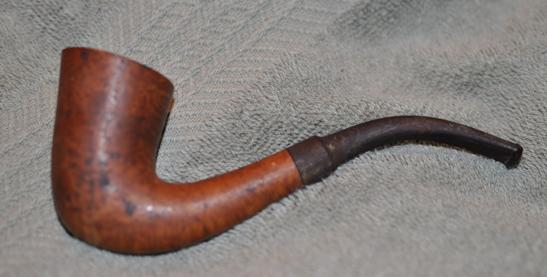
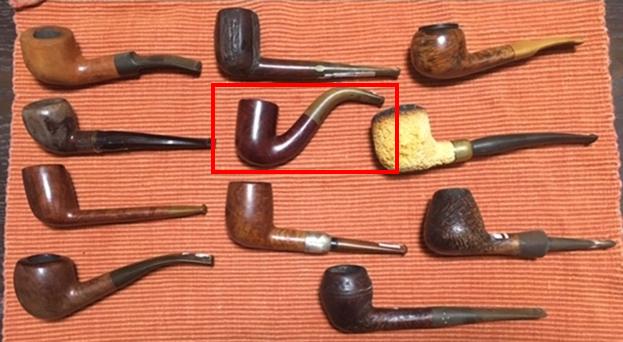
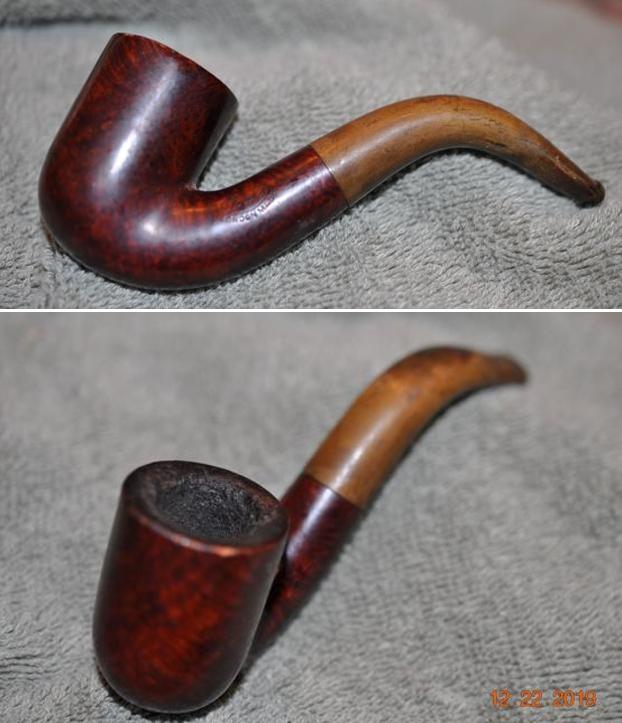
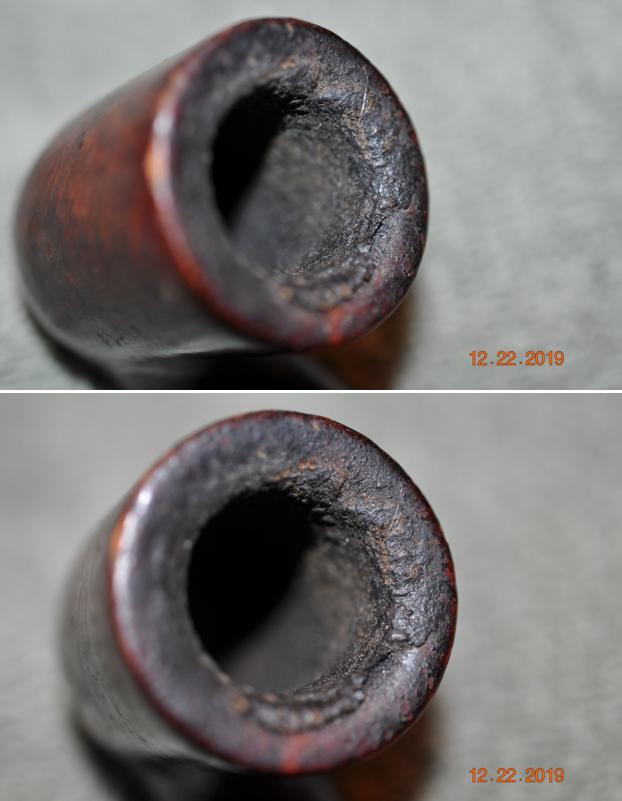
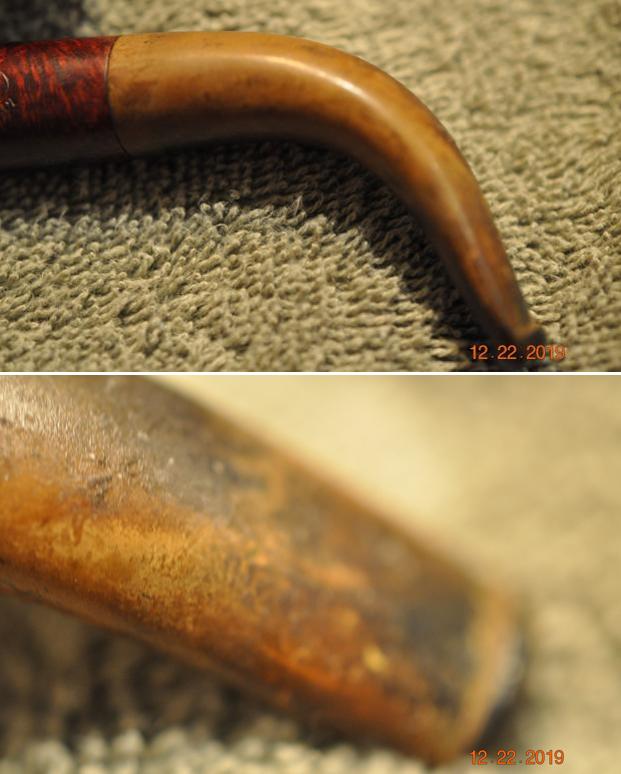
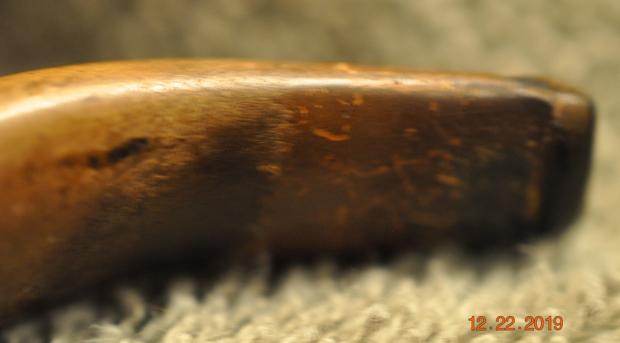
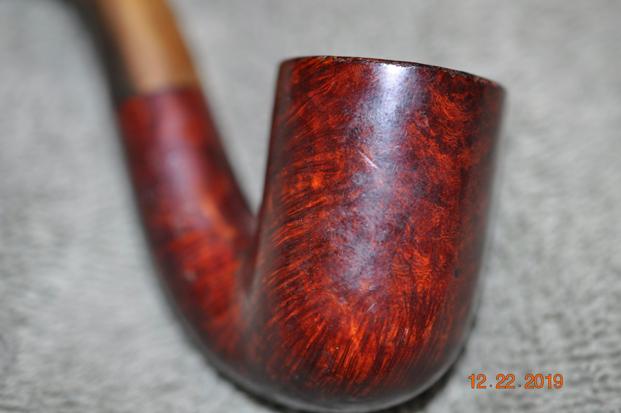
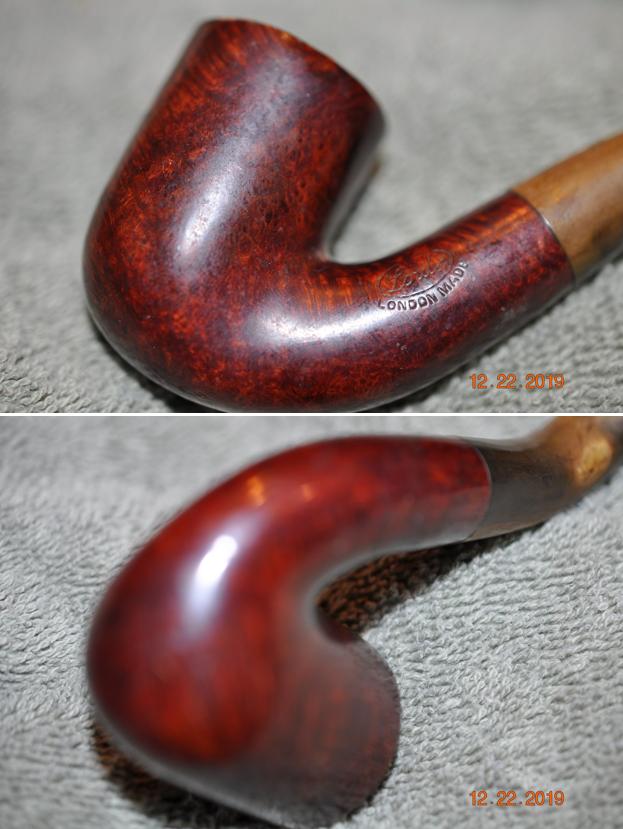
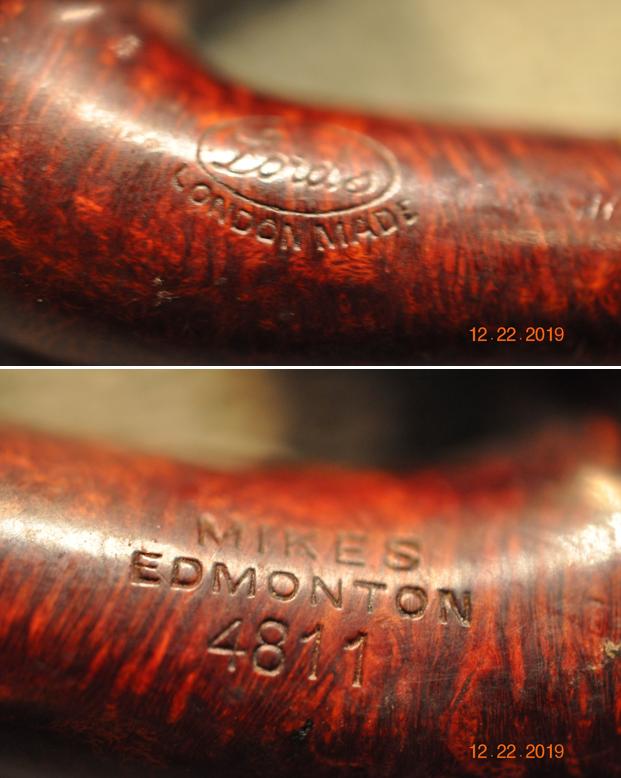
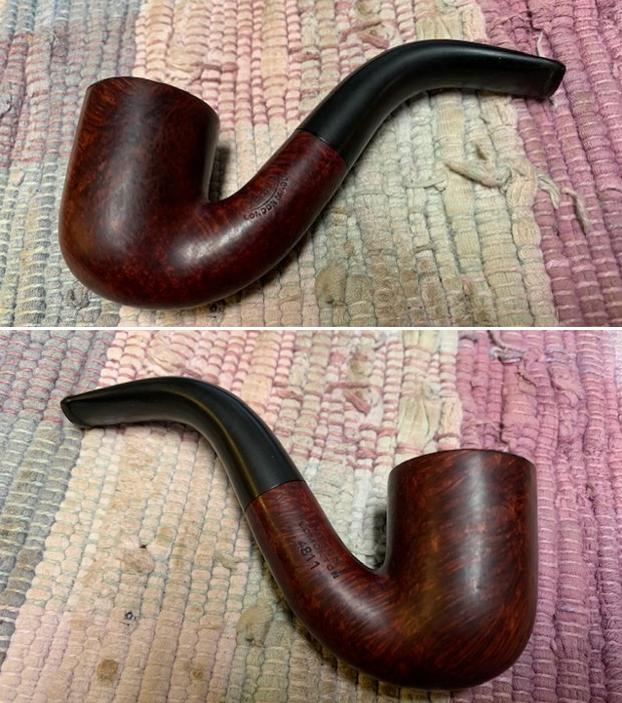
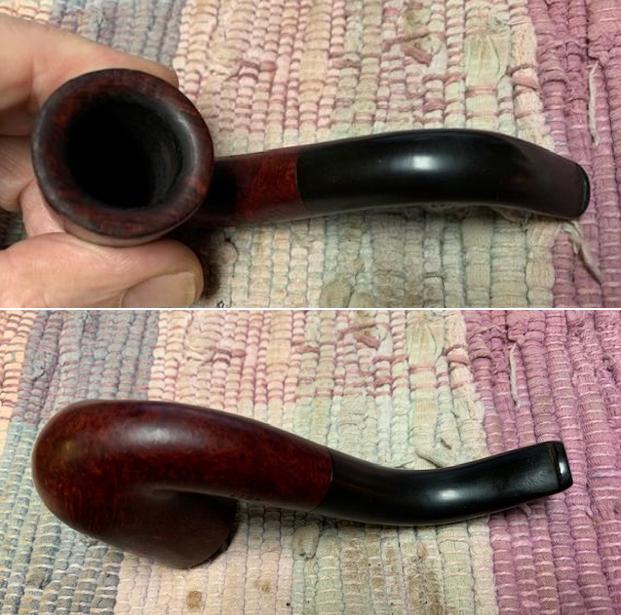
The next pipe on the table is one that Jeff and I picked up on a pipe hunt in Alberta, Canada a few years ago. We hit antique shops and malls from Lethbridge in the south to Edmonton in the north and found a lot of nice looking pipes. The photo below shows some of those pipes and in particular the one on the table today. I have drawn a box around it in the photo below. It came from and antique mall in Edmonton, Alberta. I could tell by looking at it that it was an old timer even before I picked it up. The shape and finish looked English to me and I was thinking maybe a Comoy’s or a GBD pipe. The stamping on the left side of the shank read Lords in an oval with London Made arced underneath. On the right side of the shank is where the pipe got even more interesting to me. It read MIKES [over] EDMONTON [over] 4811 (the shape number). The more I looked at it the more I am convinced it is a GBD made pipe. But after reading the stamping I had to know more about MIKES EDMONTON. I had no idea what that referred to and I wondered how a British made pipe came to be stamped with that information. I put the pipe in a box and Jeff took it home to clean up and I promptly forgot about it until he sent it back to me not to long ago. Now it is on the table and it is the focus of my attention.Jeff took photos of the pipe before he did his clean up work. It was a great looking piece of briar with a mix of grain around the bowl and shank. There was a heavy cake in the bowl  and a heavy overflow of lava on the inwardly beveled rim top. The stem was heavily oxidized and there was calcification around the button area. There were tooth marks and chatter on the top and underside just ahead of the button. Jeff took photos of the bowl and rim top to show the cake in the bowl. The smooth beveled rim top showed thick coat of lava that filled in the rim top and hopefully protected the edges from damage. He took photos of the top and underside of the stem showing the tooth chatter, scratching and oxidation on the stem surface and wear on the edges of the button.   Jeff took a photo of the side and heel of the bowl to show the condition of the finish. You can see the well done shape and he amazing grain around the bowl and shank. Even under the dirt and debris of the years it looked very good. The stamping is clear and readable as noted above. I am still thinking it is linked to GBD pipes. 

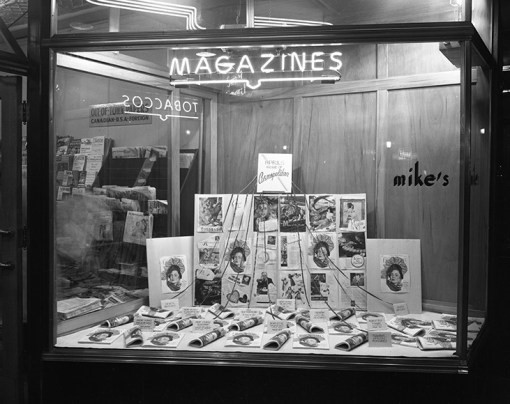
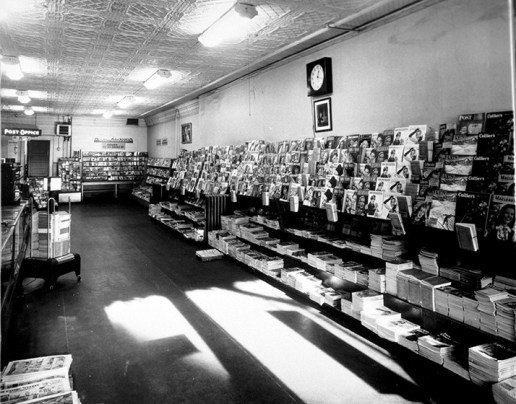
I was very curious about the Mikes Edmonton stamp on the shank so I did a bit of searching for information on Google to see what I could find. I searched for Mikes Edmonton Tobacco shop to see what I could find. I found a location on the web called Mikes News Stand. They sold newspapers, magazines, cigarettes, cigars and pipes and tobacco it. It was an institution in Edmonton. I found an article about the shop written by Lawrence Herzog in 2015 and I have included portions of the article below (https://citymuseumedmonton.ca/2015/05/04/mikes-news-stand/). I am including clips from the article as well as some photos.

Mike’s News Stand –                     Author Lawrence Herzog                    May 4, 2015 

Mike’s quickly became the place to go to hear the local gossip, the fascinating exploits of the bush pilots who gathered there and catch the latest sports scores. Each day, newsboys would fan out from the store along Jasper Avenue, shouting “extra, extra, read all about it!”

For 70 years, Mike’s News Stand was an Edmonton institution. For most of that time, it operated from a storefront at 10062 Jasper Avenue, and its animated neon sign was a famous downtown landmark.

The sign, with a legs-crossed man reading the Toronto Star Weekly and with one leg that swung back and forth as if by magic, was erected above the entrance in 1934. “News…Smokes,” the sign shouted to Jasper Avenue passersby. Now, it hangs proudly once again as part of the Neon Sign Museum on the side of the Telus building on 104th Street and 104th Avenue.

The store itself opened for business on Tuesday, December 5, 1916, and was called Mike’s News and Tobacco Stand. Named for its owner John Michaels (who everybody knew as Mike), it was billed a place where citizens could send magazines or periodicals and smokes to boys on the front, fighting in the First World War…..

With its ancient worn linoleum floor, tin ceiling, varnished wood magazine and newspaper shelves darkened by time, distinctive fragrance and cacophony of sounds, Mike’s News Stand was a singular experience. The floors creaked under the coming and going of customers, and the tang of Cuban cigars and pipe tobacco hung in the air. The storefront had housed a shooting gallery in an earlier existence and had bullet holes near the ticket office sign to prove it.

Michaels retired in 1957 and died in 1962 at the University Hospital at the age of 71. He was survived by his wife Ruth and daughter Audrey Lovelace. The neighbourhood of Michaels Park at 38th Avenue north of Whitemud Drive, 66th Street to 76th Street, was later named by the City in his honour….

Two years later, with plans afoot to demolish the building Mike’s had long called home and construct gleaming new Scotia Place, the news stand relocated to a sterile cubicle in the Metropolitan Building at 10162 101st Street. The landmark sign, counters and some of the old fixtures went with it, but the spirit of the old place didn’t.

Ruth Michaels told a Journal reporter that it was too bad the old store had to close. “I suppose it’s one of those things called progress,” she said at the time from her retirement home in Hollywood, Florida. “Sometimes I wondered how the place has stood up this long.” She said the secret to the success and the longevity was “simply because we gave personal attention to the individual. Johnny knew practically everyone personally.”

The store returned to Jasper Avenue in January 1983 in the Melton Building at 103rd Street, and then moved again to a retail frontage at 10119 101 Street. But business continued to drop, and the end came in April 1986. Wire and wooden display fixtures were hauled out, and Mike’s closed its doors for good.

With the information I learned in the above article I had the background on the stamping on the pipe. It was a pipe made for Mike’s News and Tobacco Stand. I could not however find out who made the pipe. The shape number on the pipe seemed to point to GBD as the maker in my opinion but I would not be certain of that. Now it was time to work on the pipe.

I am really happy to have Jeff’s help on cleaning up the pipes that we pick up along the way. He cleaned this filthy pipe with his usual penchant for thoroughness that I really appreciate. This one was a real mess and I did not know what to expect when I unwrapped it from his box. He reamed it with a PipNet pipe reamer and cleaned up the reaming with a Savinelli Fitsall Pipe Knife. He scrubbed out the internals with alcohol, pipe cleaners and cotton swabs until the pipe was clean. He scrubbed the exterior of the bowl with Murphy’s Oil Soap and a tooth brush to remove the grime and grit on the briar and the lava on the rim top. The finish looks much better and the beveled rim top was actually very visible. There were scratches and nicks in the bevel that needed to be cleaned up but it looked good. Jeff soaked the stem in Before & After Deoxidizer to remove the oxidation on the rubber. He scrubbed it with Soft Scrub All Purpose Cleaner to remove the majority of the oxidation. When the pipe arrived here in Vancouver I was amazed it looked so good. I took some close up photos of the rim top and the stem surface. The rim top looked very good but there were dents and nicks in the rim top surface and on the outer edge of the bowl. I took close up photos of the stem to show the condition of the surface and button.  I took a photo of the stamping on the left side of the shank. You can see that it is stamped as noted above. It is faint but readable.   I took the pipe apart and took a photo of the pipe. It is a good looking pipe and has some great grain on the bowl and shank. I decided to start my restoration work on this one by dealing with the damage to the rim top and edges. I used a folded piece of 220 grit sandpaper to smooth out the damage on the beveled rim top. I started polishing the rim top with 400 grit wet dry sandpaper.I polished the smooth rim top and sides of the bowl with micromesh sanding pads – dry sanding it with 1500-12000 grit pads. After each pad I wiped the briar down with a damp cloth.   I worked some Before & After Restoration Balm into the surface of the briar with my fingertips to clean, enliven and protect the briar. I let the balm sit for 15 minutes and then buffed with a cotton cloth to raise the shine. The photos show the bowl at this point in the restoration process.      With that done the bowl was finished other than the final buffing. I set it aside and turned my attention to the stem. I looked at the tooth chatter on the stem and concluded that none of it was deep so I figured I could polish it out with micromesh sanding pads. I polished the stem with with 1500-12000 grit sanding pads. I wiped it down after each sanding pad with Obsidian Oil. I polished it with Before & After Pipe Stem Polish – both Fine and Extra Fine.   It is fun to come to end of the restoration of the Mikes Edmonton Lords London Made Bent Billiard. It was interesting to be able to at least tentatively to link the pipe to the tobacco shop in Edmonton. It turned out to be a nice looking Bent Billiard. The finish came alive with the work I had done so far. I put the pipe back together and buffed it with Blue Diamond on the buffing wheel. I gave the bowl and the stem multiple coats of carnauba wax. I hand buffed the pipe with a clean buffing pad to raise the shine. It is fun to see what the polished bowl looks like with the grain popping through and the polished black vulcanite taper stem. It really was beautiful. This older English Bent Billiard is nice looking and the pipe feels great in my hand. It is light and well balanced. Have a look at it with the photos below. The dimensions are Length: 4 ½ inches, Height: 1 ¾ inches, Outside diameter of the bowl: 1 ¼ inches, Chamber diameter: ¾ of an inch. The weight of the pipe is 34grams/1.20ounces. It is a beautiful pipe that I am still trying to figure out if I want to sell. Perhaps if you are an Edmontonian we should chat. Thanks for walking through the restoration with me as I worked over this pipe. Thanks to each of you who are reading this blog. Remember we are not pipe owners; we are pipemen and women who hold our pipes in trust until they pass on into the trust of the next pipeman or woman. 

Yet Another Treasure – a 1911 BBB Own Make Glokar Poker


Blog by Steve Laug

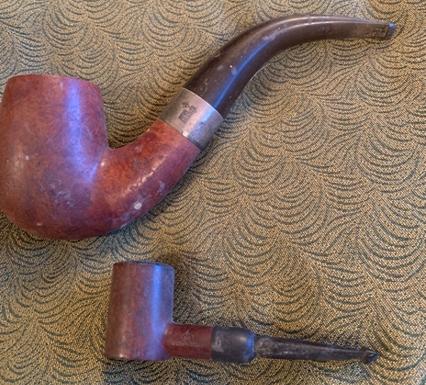
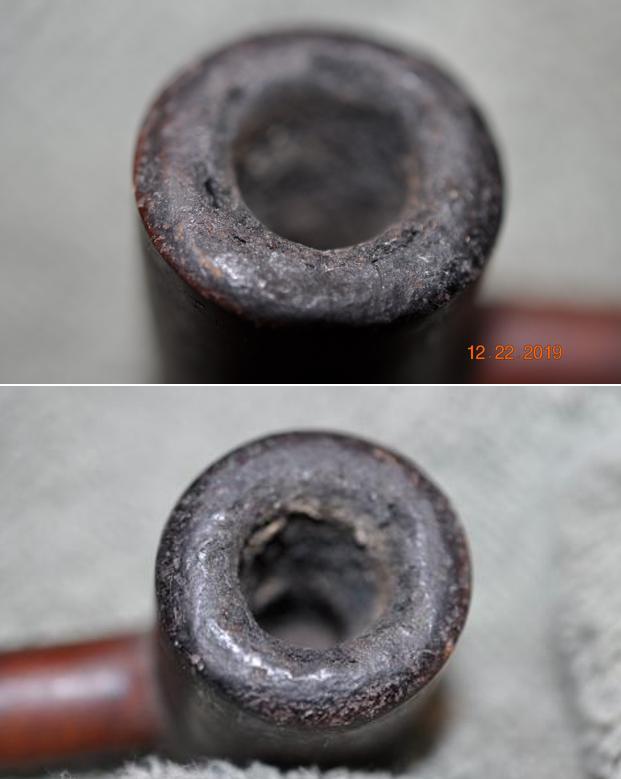
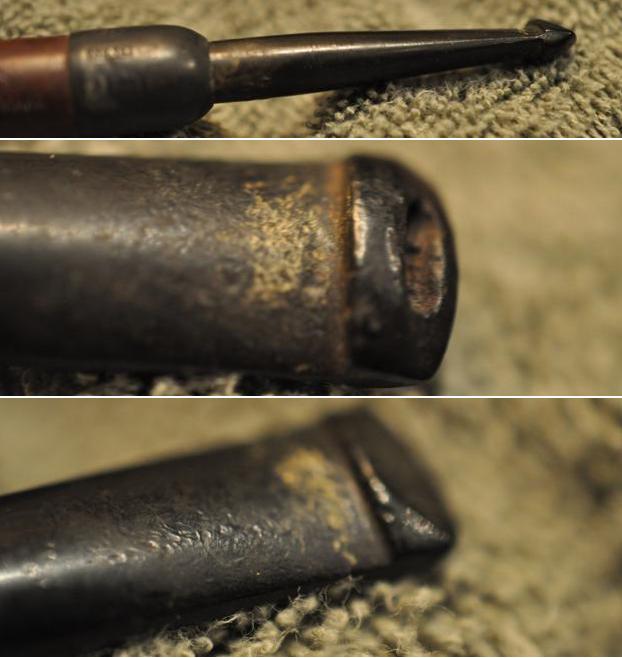
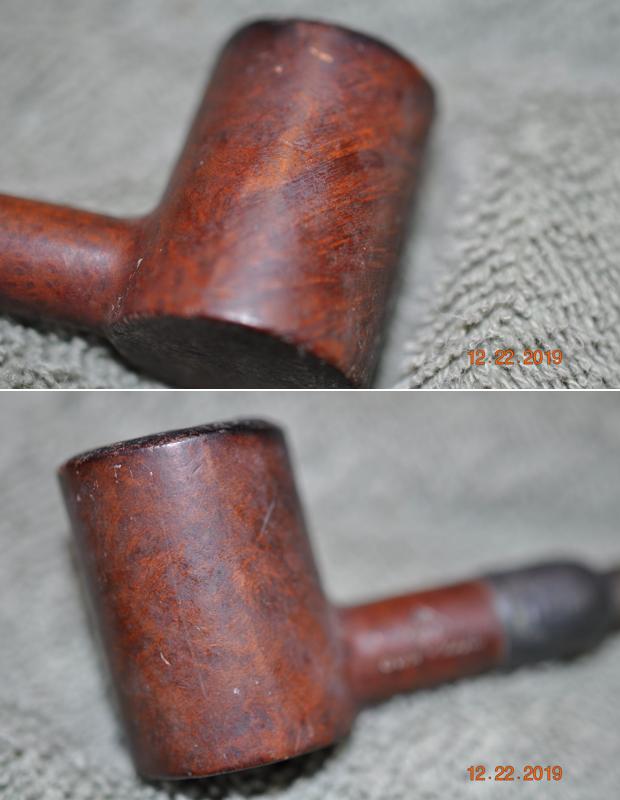
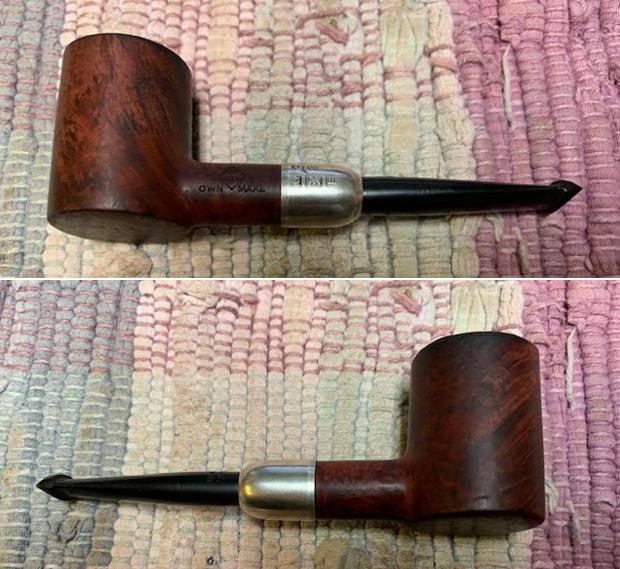
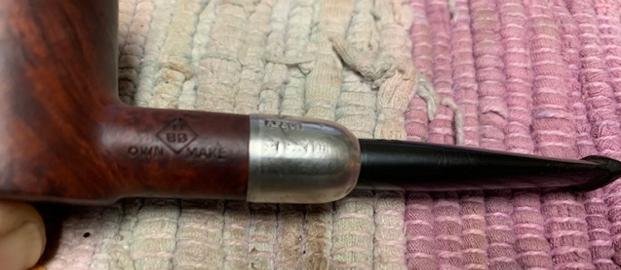
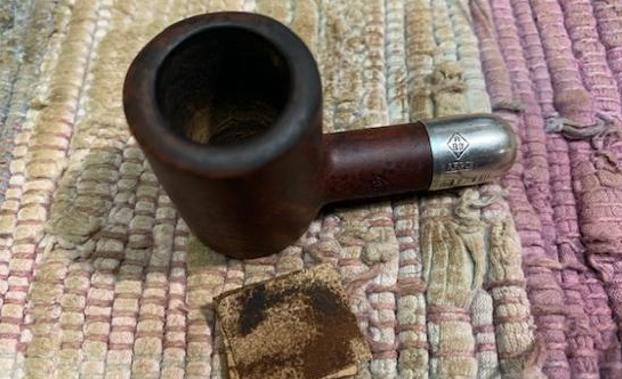
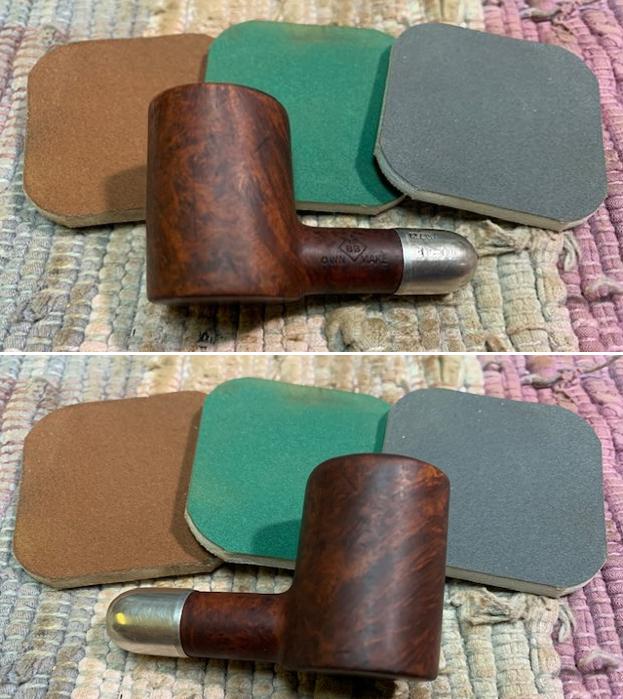
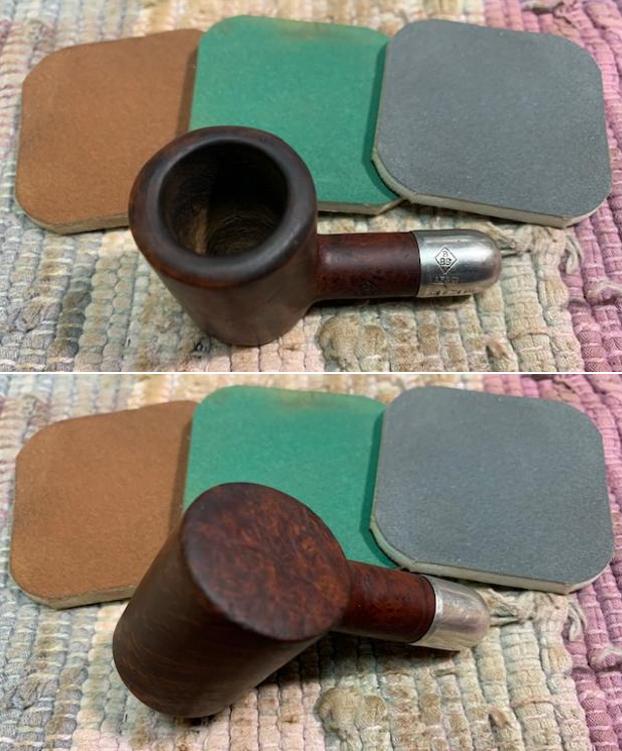
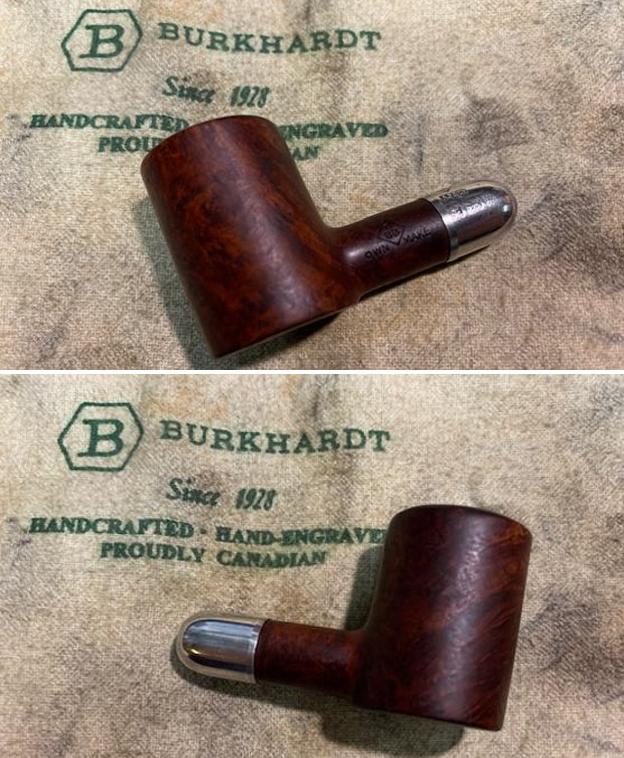
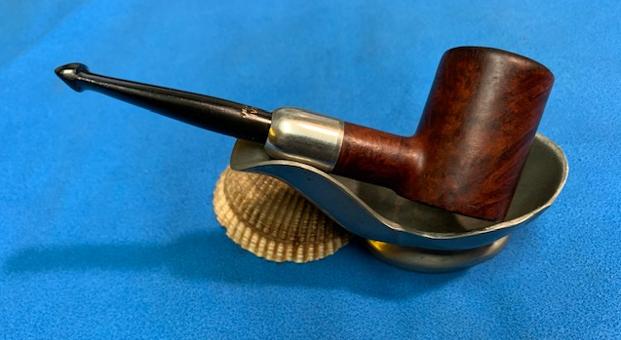
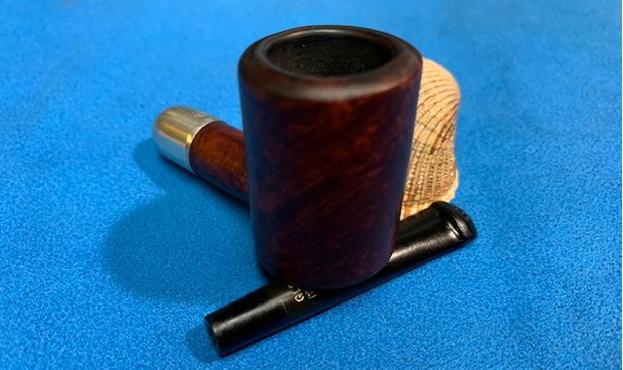
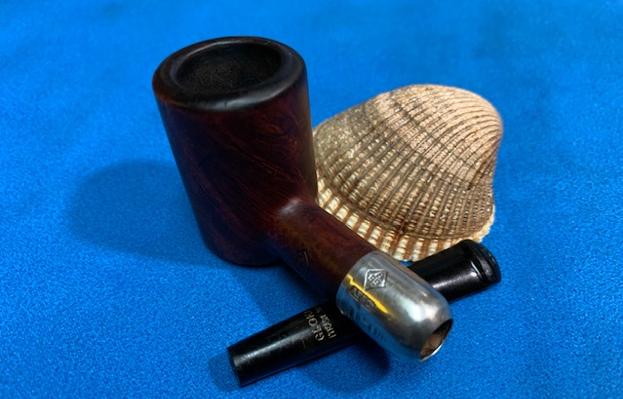
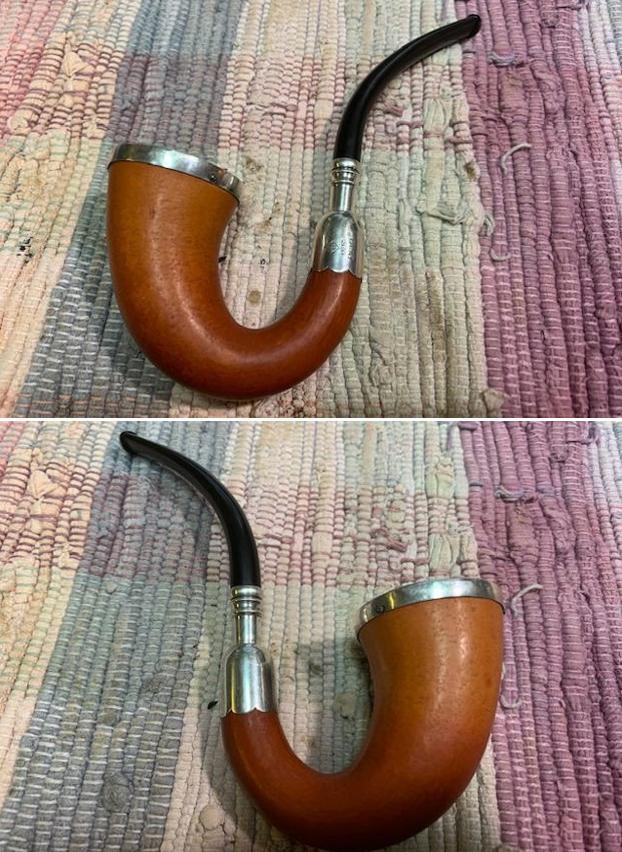
It seems like just a few weeks ago I was contacted by an older gentleman about purchasing his pipe collection. He sent me the photos and I was amazed at what I saw. It had Dunhill pipes, BBB pipes, Orlik pipes, Barclay Rex Pipes, a couple of Meerschaums and a whole lot of other pipes. All I could say as I looked at the pipes was what a collection it was. We negotiated a deal and I think we both walked away quite happy with the exchange. But I have to tell you there was another very interesting pipe caught my interest when I looked at pictures of it. It was a beautiful older BBB Poker/Cherrywood sitter. It was a mess but there was something charming about  it. It is shown in the photo to the left. The larger pipe in the photo is also a BBB and from what I can gather it is on the larger side but not to degree it looks in the photo with the poker. This poker is tiny. It is only 4 ¼ inches long and 1 ½ inches tall. The black band on the shank is oxidized/tarnished Sterling Silver. I could not wait to get it in hand and figure out the age of the pipe. From the looks of it I could tell it was older. The stem was also very unique looking so I was looking forward to checking that out.

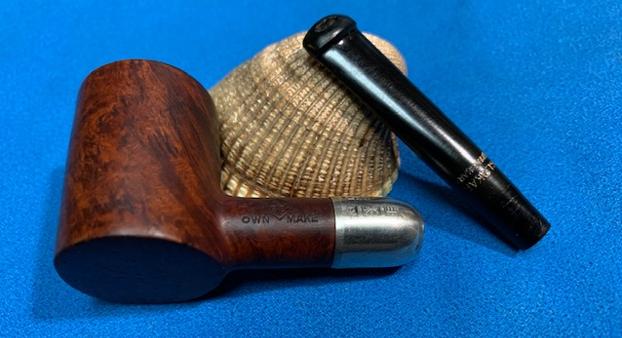
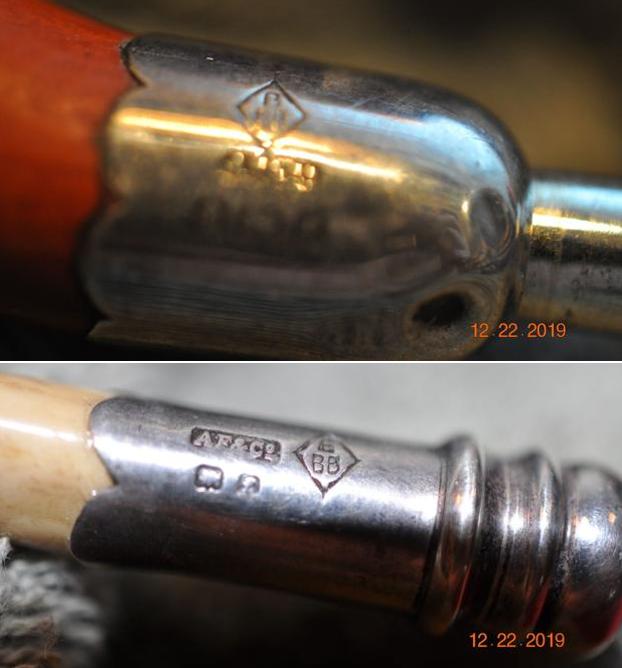
I have worked on a lot of BBB pipes over the years and never had the opportunity to work on one like this. It would be a great addition to my collection of older BBB pipes. From the photos the pipe appeared to be in good condition from the photo he sent me. He said that the pipe was stamped on the left side of the silver ferrule and read AF & Co over three hallmarks. The hallmarks are as follows: an anchor (Birmingham, England), a rampant lion (the symbol for quality of the silver) and the final one is a lower case “m” (the date stamp). I had him ship it to Jeff for cleanup so it would be a while before I held in hand.

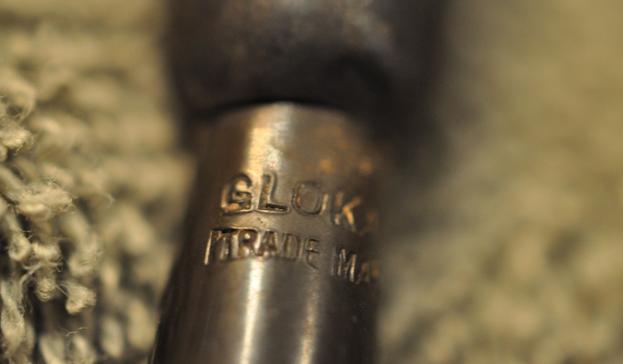
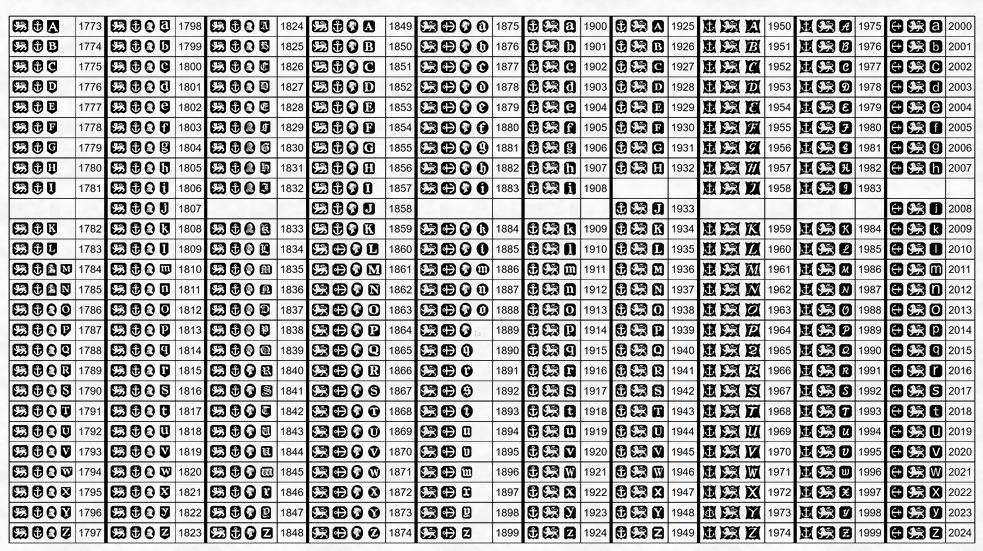
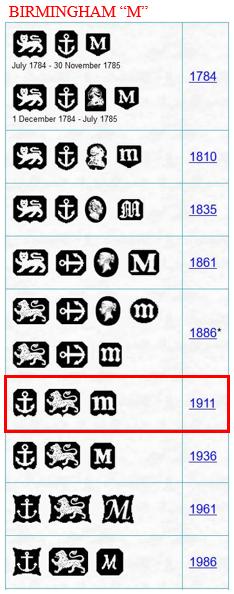
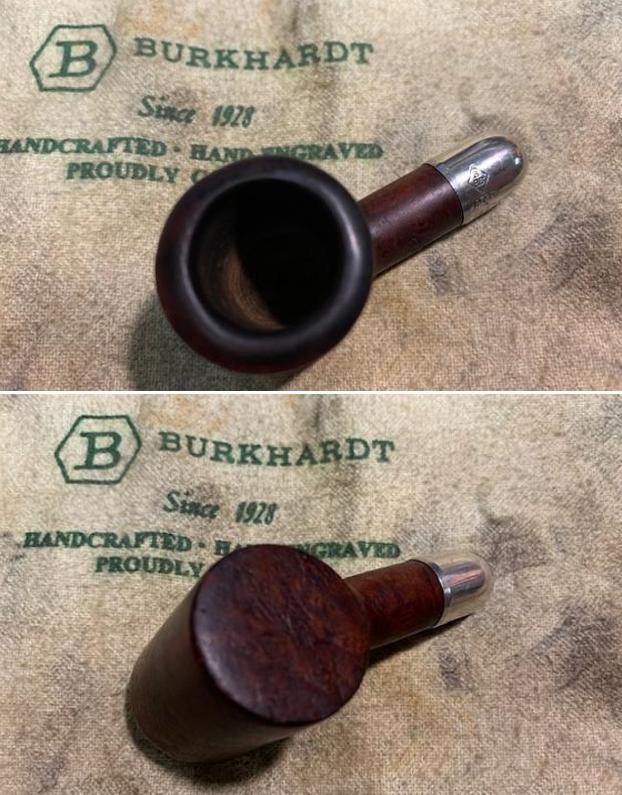
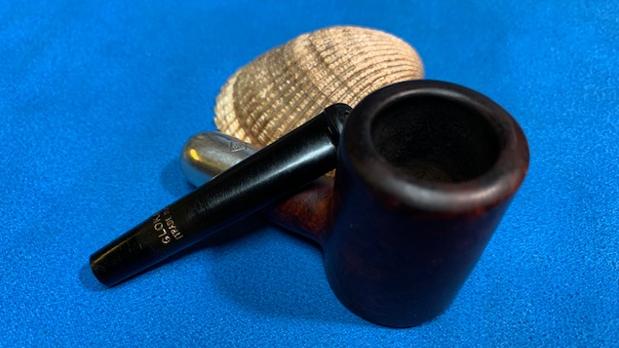
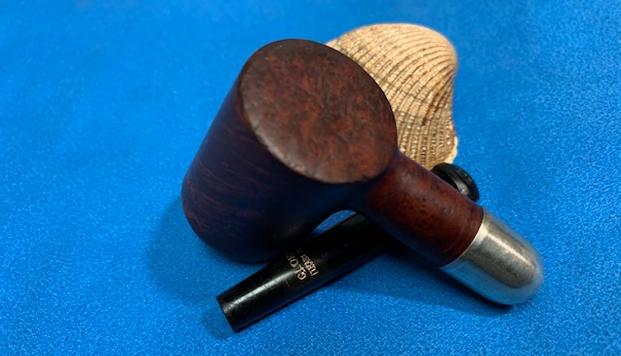
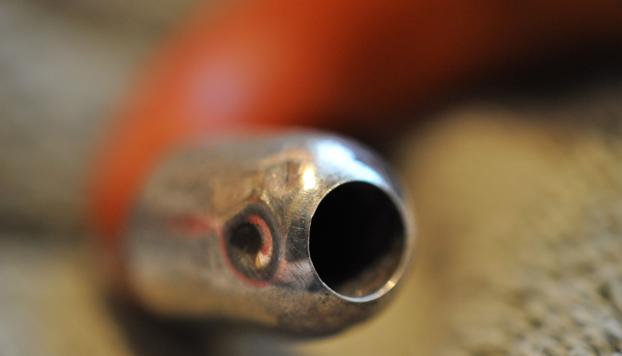
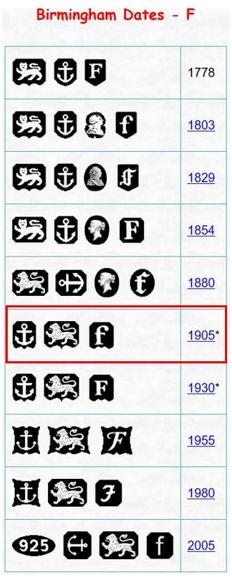
When the package arrived at Jeff’s place in Idaho he waited for me and opened the box with me on Facetime to look at the collection of pipes as he removed them from the box. It is an amazing collection and one that I am going to enjoy working on over the months ahead. Jeff took some photos of the BBB Tiny Poker with a Sterling Silver Ferrule and a Peterson like system stem and internals for me to look at while he worked his magic in cleaning up the pipe. It is a an interesting pipe with a lot of potential and what appears to be some great grain under the grime and debris of the years.  Jeff took photos of the bowl, rim top to show the thickness of the cake in the bowl and the lava on the rim top. It was obviously a great smoking pipe and a favourite. I am hoping that the thick lava coat on the crowned rim top protected things underneath it from damage to the edges and top. Cleaning it would make that clear! He took photos of the top and underside of the stem showing the tooth chatter, scratching and oxidation on the stem surface and wear on the edges of the button.  The photos of the stem also show the unique design and shape of the stem. I am looking forward to doing some research on the GLOKAR to figure out all I can about it.  Jeff took photos of the sides and heel of the bowl to show the condition of the briar. You can see the beautiful shape and the grain on the bowl even through the dirt and debris of 110 years. At this point in the process it certainly looks its age.  The stamping on the pipe was on the left side of the shank and read BBB in a diamond separating OWN MAKE on each side of the diamond. There was no other stamping on the shank sides. On the silver ferrule on the shank of the pipe it is stamped top and left side and it has the BBB diamond logo and underneath that is AF&Co (which is the Adolph Frankau & Company logo). After his death, the BBB gradually became known as Britain’s Best Briars. It is one of the oldest, if not the oldest, English trademark in current use and the first pipe ever to have a registered trade mark. Underneath the AF&Co it is stamped with three hallmarks – an anchor, a lion and a lower case “m”.  The anchor identifies the city of origin of the silversmith (Birmingham, England), the rampant lion (the symbol for quality of the silver) and the final one is a lower case “m” (the date stamp). The silver is badly oxidized but you can see the hallmarks in the first photo below. The stamping is clear and readable.The hard rubber stem is also stamped and reads GLOKAR over TRADE MARK. It is very readable as can be seen in the photo below. Since the hallmarks were so clear, I turned to one of the numerous silver hallmark charts on line for the city of Birmingham, England to see what I could find out about the “m” date stamp and pin down and age for the pipe (https://www.silvermakersmarks.co.uk/Dates/Birmingham.html). I clicked on the section that applied to the date stamp on this pipe. The first chart below is the chart from 1773-2024.I am also including screen capture of the enlarged section on the Birmingham dates for the letter M. This chart covers pipes made in 1778-1986. I have drawn a read box around the hallmark pattern that matches the one on the BBB Silver ferrule. You can see that it dates the pipe to 1911. That means that this little pipe is roughly 110 years old.

With the information from the hallmark site I had a clear date for the manufacture of the pipe. It was definitely an old timer and really was another stellar acquisition.

I wanted know more about the GLOKAR stamp and what it signified. I had an inkling that I was dealing with a BBB system pipe not unlike the Peterson’s System pipes but I wanted to see what I could find out about that. I have a facsimile of a 1912 BBB Catalogue No. 20 that has a section dedicated to the Glokar. On page 107-110 there is information about the pipe and the various versions available. Interestingly it does not include a picture/drawing of my Poker. I quote the description of the Trademarked Glokar below.

The “Glokar” Mouthpiece does away with the great drawback of all ordinary pipes, viz., the unpleasant and possibly injurious, effect of the smoke upon the tongue, as the end of the stem  has a smooth, concave surface, which while forming a pleasant rest for the tongue, acts as a barrier between it and the smoke. Instead of pressing through an ordinary round bore, the smoke leaves the mouthpiece through a fan-shaped slot, which is drilled in and upward direction – thus preventing saliva from entering the bore of the pipe.

Advantages:

  1. The bore, being kept dry, requires less cleaning than that of an ordinary pipe.
  2. As no saliva can reach the bowl, the tobacco can be consumed to the last particle.
  3. The shape of the mouthpiece affords the perfection of comfort for the mouth, tongue ad lips.

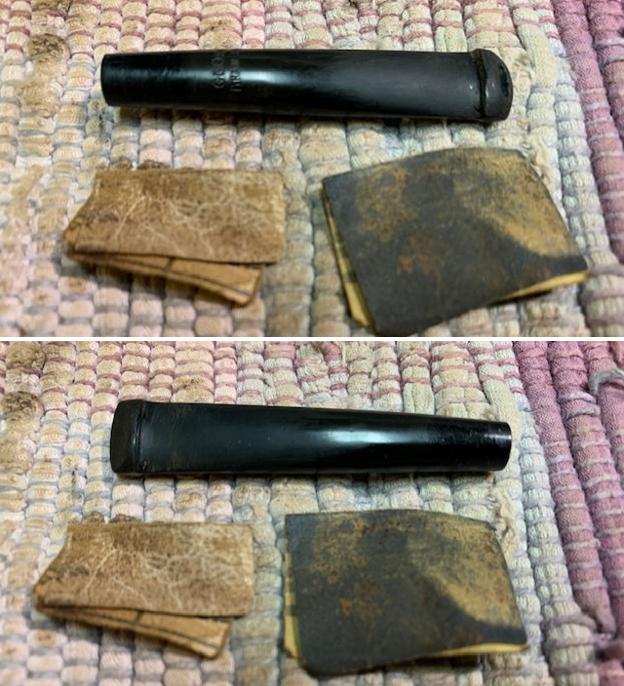
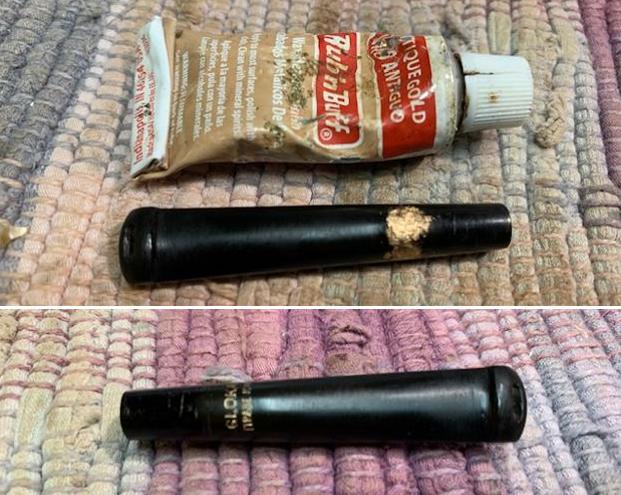
I took a photo of the picture that was included in the catalogue for the “GLOKAR” and have included it below. The cutaway diagram shows the system in the bowl and shank as well a the patented lip design. It is remarkably like a Peterson’s system pipe. One of the differences is the shape of the exit of the air way in the button. This one is a slot rather than a round hole.Now it was time to work on the pipe. Jeff carefully cleaned the pipe from top to stern. He reamed it with a PipNet pipe reamer and then cleaned up the reaming with a Savinelli Fitsall Pipe Knife. He scrubbed out the internals of the shank, stem and shank extension with alcohol, pipe cleaners and cotton swabs until the pipe was clean. He scrubbed the exterior of the bowl with Murphy’s Oil Soap and a tooth brush to remove the grime and grit on the calabash and the tarnish and lava on the rim top. The finish looks much better and has a deep richness in the colour that highlights grain of the briar. The rim top looked good with some darkening on the top and outer edge of the bowl. Jeff soaked the stem in bath of Before & After Deoxidizer to remove the oxidation on the rubber. He worked it over with Soft Scrub All Purpose Cleaner to remove any remnants of oxidation. When the pipe arrived here in Vancouver I was amazed it looked so good. Here are some photos of what I saw. I took some close up photos of the rim top and the stem surface. The rim top  was darkened but did not look otherwise damaged. There was also some darkening around the outer edge of the bowl that would need to be worked on. The silver ferrule was in great condition. I took close up photos of the stem to show the condition of the surface and button. I took a picture of the stamping on the shank. The reflection on the silver did not capture the stamping on the ferrule but it was all clear and readable as noted above.I took the pipe apart and took a photo of the pipe with the short stem. It is a good looking pipe and very unique. I started my work on the pipe by addressing the darkening on the edges and rim top. I used a folded piece of 220 grit sandpaper to work over the edges (inner and outer) and the crowned rim top to try to minimize the darkening. While not flawless I was happy with the results.I polished the rim top and the rest of the briar with micromesh sanding pads – dry sanding it with 1500-12000 grit pads. After each pad I wiped the briar down with a damp cloth.  I was able to give a shine to the bowl and remove some of the surface scratches in the process.  I worked some Before & After Restoration Balm into the surface of the bowl and shank with my fingertips to clean, enliven and protect the briar. I let the balm sit for 15 minutes and then buffed with a cotton cloth to raise the shine. The photos show the bowl at this point in the restoration process. I polished the silver ferrule with a jewelers cloth to remove any residual tarnish and also to protect it from future tarnish (at least for awhile). With that done the bowl was finished other than the final buffing. I set the bowl aside and turned my attention to the stem. I filled in the deep tooth marks against the button edge with clear super glue. Once it cured I sanded out the repairs and the tooth chatter on the stem with 220 grit sandpaper. I started the polishing with 400 grit wet dry sandpaper.    I filled in the Glokar Trademark stamping on the stem with Rub’n Buff Antique Gold to highlight the stamping. I rubbed it on and worked it into the stamp with a toothpick. I buffed it off with a cotton pad. The stamp looks really good at this point.I polished the stem with micromesh sanding pads – dry sanding with 1500-12000 grit sanding pads. I wiped it down after each sanding pad with Obsidian Oil. I polished it with Before & After Pipe Stem Polish – both Fine and Extra Fine.    With the bowl and the stem finished I put the pipe back together and buffed it on the wheel using Blue Diamond to give it a shine. I gave the bowl and stem multiple coats of carnauba wax on the wheel and then buffed it with a clean buffing pad to raise the shine. I hand buffed it with a microfiber cloth to deepen the shine. It really is an amazing little pipe. The dimensions of this part of the pipe are – Length: 4 ¼ inches, Height: 1 ½ inches, Outside diameter of the bowl: 1 inches, Chamber diameter: ¾ of an inch. The weight of this tiny pipe is .71 ounces /20 grams. This unique find – a 1911 BBB Glokar Poker with a silver ferrule is joining the other pipes in my collection of BBB pipes and will hold a place of honour while it is in my trust. This is another pipe that one day soon I will enjoy a special bowl of tobacco in it and be transported to a slower paced time in history where I can enjoy a respite. Thanks for walking through the restoration with me.


Previous Repairs Can Wreak Havoc in a Restoration – Dunhill Shell Briar R F/T 1962 Pot


Blog by Steve Laug

This Dunhill came to us in the same lot of pipes as the 1922 Dunhill Bruyere Reading Pipe and the BBB Calabash Reading Pipe that I have already restored and written blogs on. It was a great looking blast on this pipe that caught our attention. The silver band on the shank was definitely an aftermarket addition to repair a cracked shank. It was made out of Sterling Silver so that was not a big deal to us when we purchased the lot. It was a filthy pipe with a thick cake in the bowl and a heavy lava overflow on the rim top. The stem was oxidized, calcified and had deep tooth marks on both sides next to the button. It is hard to see until the close up photos but the shank was seriously crack about 1/8 of an inch ahead of the band on the underside of the shank and from the shank end you could see two large crack at 3 and 9 o’clock. Jeff took photos of the pipe as it stood when we received it.  He took photos of the bowl and rim to give a picture of the depth of the cake and lava on the rim top. You can also see the nicks around the outer edge of the rim. Even the stem was pretty normal fare – tooth marks with a small hole in the underside and heavy wear and tear on the rest of the stem. Everything was pretty common in terms of the restorations that we work on at least we thought so at this point! He took some photos of the sides of the bowl to show the beautiful (and filthy), rugged sandblast around the bowl. It really was a magnificent looking bowl. It took a few photos to try to capture the stamping on the underside of the shank. There are deep scratches in the smooth portion of the shank and heel of the bowl. On the heel it is stamped R F/T. That is followed by Dunhill [over] Shell Briar followed by Made In [over] England with a 2 following the D in England. You can also see the repaired cracked shank in the photos below. The silver band is stamped Sterling Silver on the underside. If we had stopped here a lot of pain could have been avoided! If we just left is dirty and did a cursory clean up and just smoked it we could have avoided a multitude of issues. But that is not the way we work. Jeff attacked the cleanup by trying to take the pipe apart. The stem was stuck in the shank. He tried heat, cold and even pouring alcohol down the shank to try and loosen what we assumed was the grime and grit that held the stem firmly in the shank. Nothing worked. He even heated the band area to try to loosen the stem from the shank but nothing work. Finally after a combination of all of the above he felt what he thought was a bit of give in the stem and gave it a very careful twist…. Here is where all went horribly wrong. Remember that crack in the shank shown in the above photos? That is what gave and the shank came off in his hand! Now what to do. We talked and he was sick with what had happened but there was nothing to be done. And do you know what the worst part was? The stem was still stuck! He went back through all of the methods we all use to loosen a stem and finally it came free! BUT the band had been epoxied on the shank and it was not removable!

It was in this state that the pipe came to me in a bag. Now it was my turn to try to see if I could loosen the band. I took the broken shank and band and filled up a small jar with enough acetone to cover the band and let the piece soak for two days in the bath. I replenished the acetone as it evaporated. The incredible thing for me was that this had absolutely no effect on the band and briar. It was permanently bonded! Time to come up with a new plan of attack.I let the broken shank sit on my desk in pieces for several days – probably about a week while I worked on other pipes. Finally after recently repairing the broken shank on the Butz-Choquin for Randy (https://rebornpipes.com/2021/01/16/a-badly-broken-butz-choquin-pipe-makes-its-way-back-to-me-for-repair-and-restoration/) I had an idea for fixing this one. Give that blog a read if you want to know the difference.

In this case there was already a band and the break was further down the shank making it a bit more problematic to address. I cut a short piece of Delrin that would extend far enough into the bowl side of the broken shank to provide some stability and into the shank end to tie it together. I decided to leave the mortise the depth it was to add stability to the shank rather than drill it out and extend the tube in further. I would need to drill out the Delrin a bit and reduce the diameter of the tenon to fit inside the tube I the shank. It just might work and was certainly worth a try. I roughened up the Delrin with a sanding drum on the Dremel to provide a rough surface of the glue to bind to in the shank.I fit the Delrin piece in the bowl end of the broken shank to make sure it fit. I then painted the surface of the Delrin with super glue and pressed into the banded shank end. I coated the briar ends with an all purpose glue and joined the pieces together. I clamped them until the glue set. Once it had I filled in the gaps in the crack with clear CA glue and set it aside to cure. I used a corner of 220 sandpaper to carefully smooth out the glue on the crack repair. I was able to make it smooth and not ruin the sandblast! That alone was an accomplishment. The repair obscured the 2 on the date stamp. It is still present but now blurred.

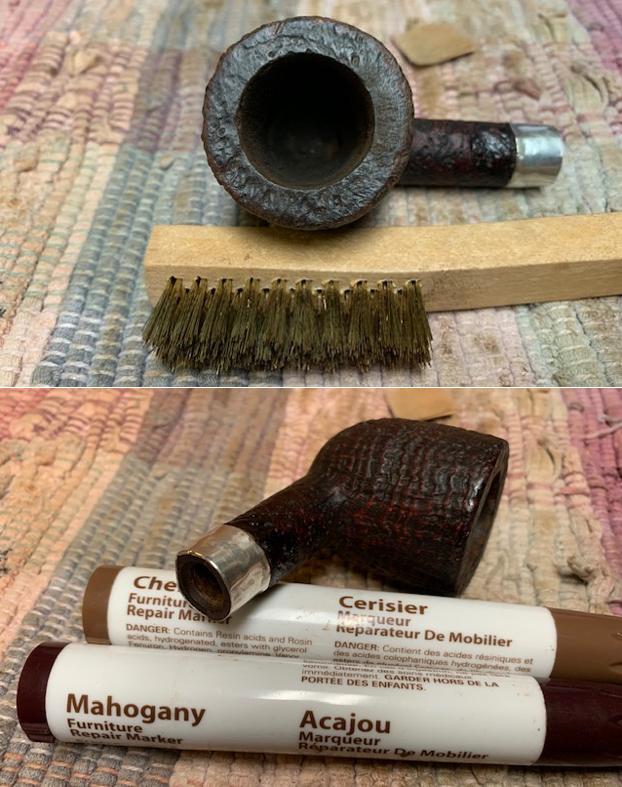
I used a brass bristle wire brush to clean up a bit more of the sandblast on the rim top and then used a combination of Cherry and Mahogany stain pens to restain the rim edges and the repaired area of the shank and blend it into the rest of the bowl. With the repair completed and the briar restained I rubbed the briar down with Before & After Restoration Balm. I worked it into the briar with my fingertips and a horsehair shoe brush. The product works to clean, enliven and preserve the briar. I let it sit for 15 minutes while I worked on the stem. After the time passed I buffed it with a cotton cloth to deepen the shine. The briar really comes alive with the balm.     Now it was time to deal with the fit of the stem in the newly lined shank! I had a couple of options here. I could either drill out the tube and open the shank up a bit more or I could reduce the diameter of the tenon and make it fit that way. Since the shank was already fragile and twice repaired I opted for reducing the diameter of the tenon. I took it down with a Dremel and sanding drum until it was a close fit in the shank. I worked on it with 220 grit sandpaper to get it even closer. Once I had the tenon end in I could see that things were slightly off. So instead of continuing to reduce the diameter of the tenon I used a needle file to even out the inside of the shank and get as close to an equal fit on all sides of the tube. That was more of a job that I make it sound and actually took a fair bit of time.Once I had a good fit to the shank I put the stem and bowl together and took some photos of the pipe at this point in the process. I still needed to work on the fit of the stem to the shank and alignment and gaps but the tenon fit well. I also need to work on repairing the tooth marks. You will see in the last photo of the underside of the stem that I had already started the process.   With the fit of the stem taken care of I worked on the repairs necessary to make it fully functional. I took a bit of excess stem material off the flattened bottom of the stem at the shank to make the fit seamless. I also filled in the tooth marks and pin prick with black super glue and set the stem aside to cure.  Once the repairs cured I smoothed them out with a 1500 grit micromesh sanding pad until they blended in well with the surrounding vulcanite. I used a small flat needle file to clean up the sharp edge of the button but forgot to take photos of that! Once the repair was smoothed out I polished the stem with micromesh sanding pads – dry sanding with 1500-12000 grit pads and wiping the stem down after each pad with Obsidian Oil. I finished by polishing the stem with Before & After Stem Polish – both fine and extra fine and gave the stem a final wipe down with Obsidian Oil.    I am really happy to be finished with the rescue of this beautifully grained sandblast 1962 Dunhill Shell Briar R Pot. The grain is quite stunning and the blast is rugged. The repair to the broken shank while not a total thing of beauty worked very well and makes the pipe usable once again. The permanently affixed Sterling Silver band is useful reinforcement externally for the tube in the shank. The refit stem came out looking very good. The pipe should be a good smoking pipe and outlast all of us as it moves through the hands of the pipe men and women who take on the trust. The dimensions of this pipe are Length: 5 ¾ inches, Height: 1 ¾ inches, Outside diameter of the bowl: 1 ½ inches, Chamber diameter: 7/8 of an inch. The weight of the pipe is 1.48 ounces/41 grams. Because of the repairs to the pipe I will soon be adding it to the rebornpipes store in the British Pipe Makers section at a price that is significantly lower than it would have been had it not been repaired.   It might be a chance for one of you to add it to your collection for a good price. Thanks for following the work on this pipe in the blog.


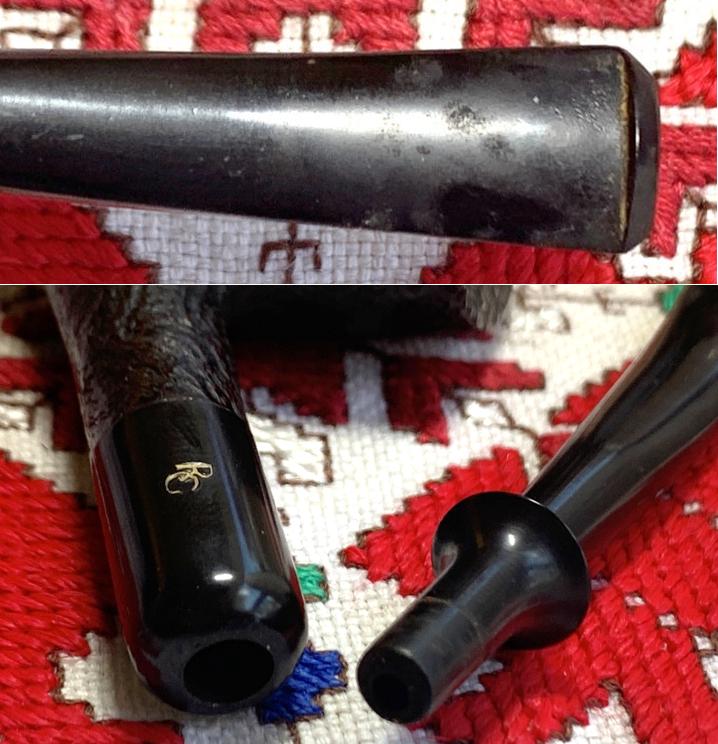
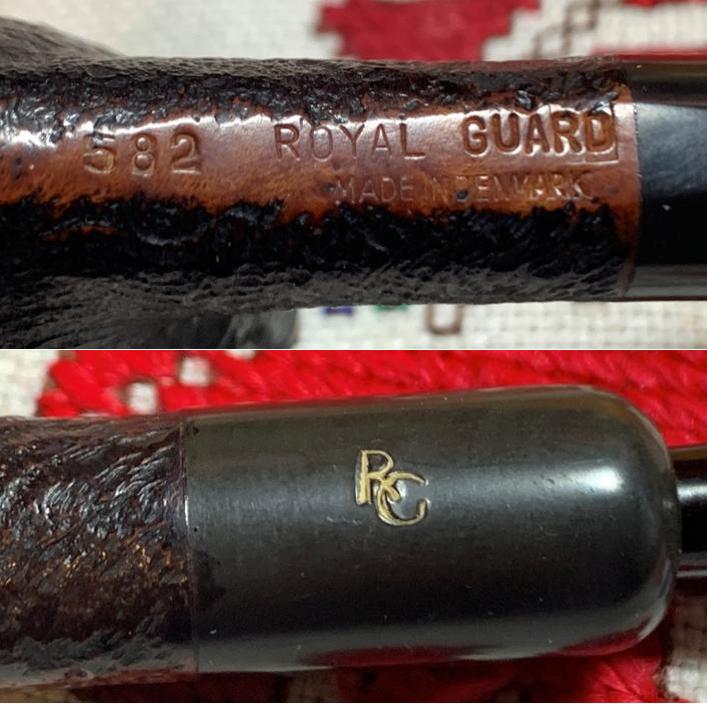
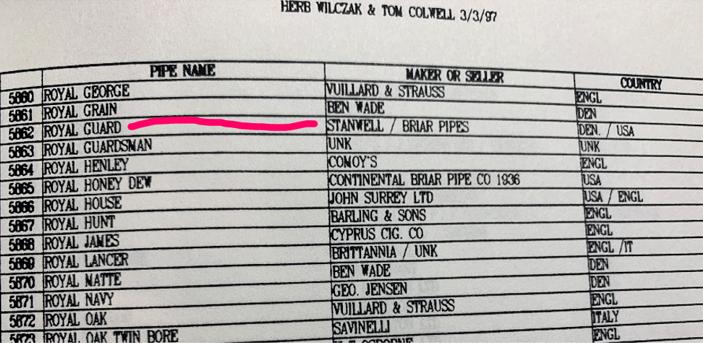
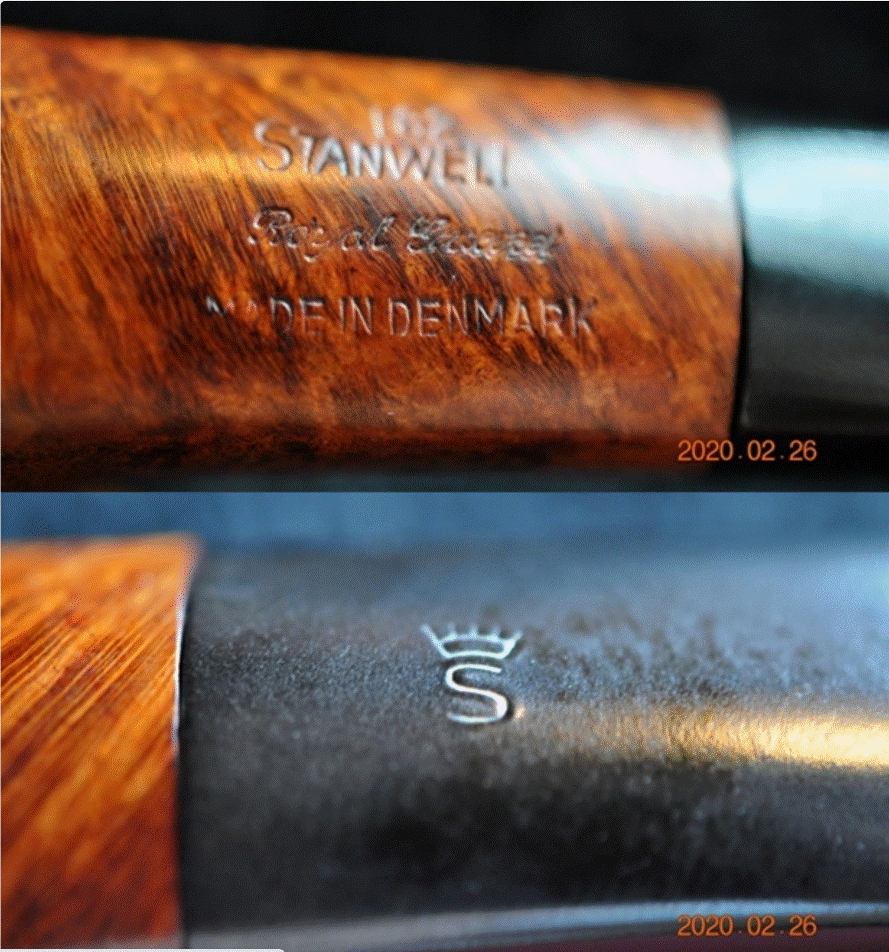
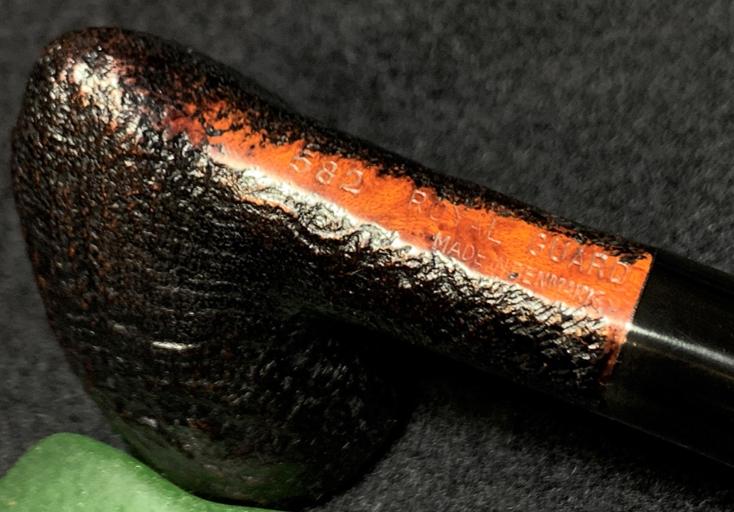
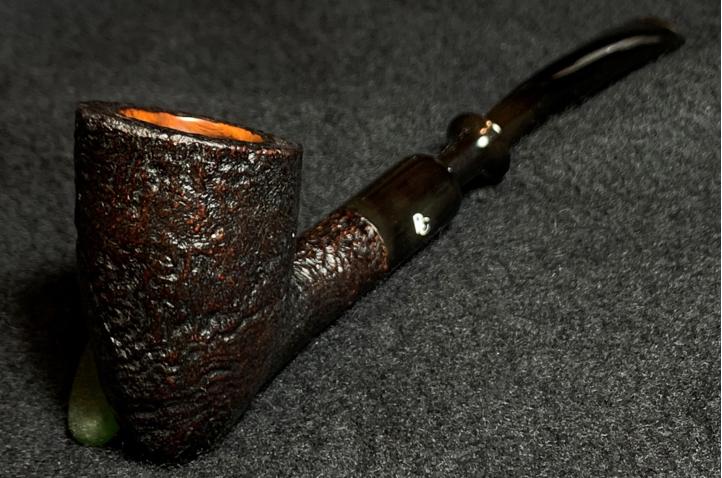
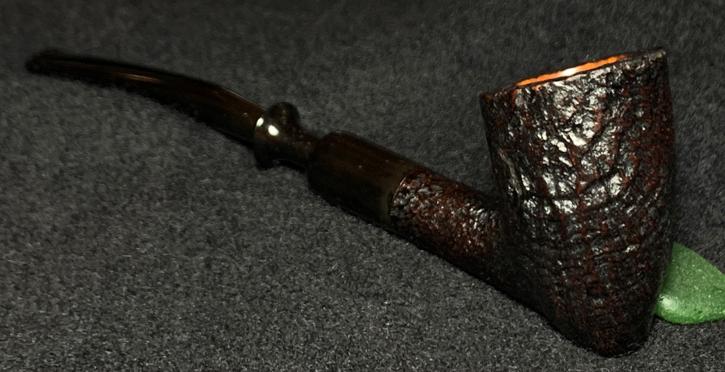
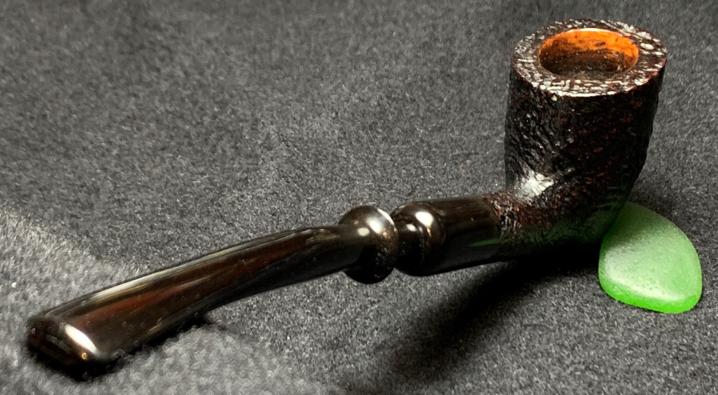
Giving New Life to a Stanwell Royal Guard 582 Pickaxe Made in Denmark


Blog by Dal Stanton

After returning to Golden, Colorado, after nearly 5000 miles of travel over Christmas and New Year, it was good to return to my stationary Pipe Steward work desk!  I experimented with a mobile Pipe Steward worktable through the travels and it worked exceptionally well.  I am looking forward to traveling again in our R-pod travel trailer and taking my hobby with me.  Seeing family in Florida, Nashville, and St. Louis during our travels was wonderful, whipped frosting on the cake!  One highlight of our journeys was sharing a bowl with my son-in-law, Niko, in Nashville.  I was able to complete the Butz-Choquin Cocarde Geante Plus (see picture below) that Niko had commissioned that was huge enough not to be dwarfed by his larger than normal hands 😊.  The BC turned out beautifully and was the first to be restored from a Lot of 16 that was donated anonymously to The Pipe Steward from a pipe man in the Kansas City, Missouri, area who wanted his pipes to benefit the Daughters of Bulgaria – women and girls who have been trafficked and sexually exploited.

Niko commissioned the BC Cocarde Geante, but he also found another pipe from the Pipe Steward inventory that he wanted to add to his blossoming collection of pipes.  What caught his eye was a stylish Danish Royal Guard 582 Pickaxe with an eye-catching blasted surface to compliment the unique shape.  I acquired the Royal Guard Pickaxe in the ‘Lot of 68’ I found on the eBay auction block from a seller in West Hartford, Connecticut.  I will be uploading more of the ‘Lot of 68’ to the virtual ‘Help Me Baskets’ in the For “Pipe Dreamers” Only! online collection where pipe men and women can choose and commission a pipe that catches their eye – all benefiting the Daughters of Bulgaria.  This picture shows the plethora of quality pipes soon to be added to the online Dreamers collection.With the blasted Royal Guard Pickaxe now on the worktable here in Golden, I take a few pictures to take a closer look. The nomenclature is crisp and distinct and is in the smooth briar panel on the underside of the shank.  Stamped to the far right is the shape number ‘582’.  To the right of this is ROYAL GUARD [over] MADE IN DENMARK.  The shank cap is stamped with a diagonally over-lapping ‘RG’.I have grown in my appreciation of Danish pipes and have enjoyed adding some genuinely nice Danish pipes to my own collection – classic shapes and Freehands.  I am not familiar with the ‘Royal Guard’ name and my first effort at discovering more in Pipedia comes up empty.  Next, I pull out my prized copy of ‘Who Made that Pipe?’ by Herb Wilczak and Tom Colwell and discover that Royal Guard is a product of the well-known Danish pipe maker, Stanwell. My next stop to find information is Pipephil.eu where the Danish Stanwell provenance is confirmed.   The panel I clipped below provides some Royal Guard examples and confirmation with the same ‘RG’ stamping.
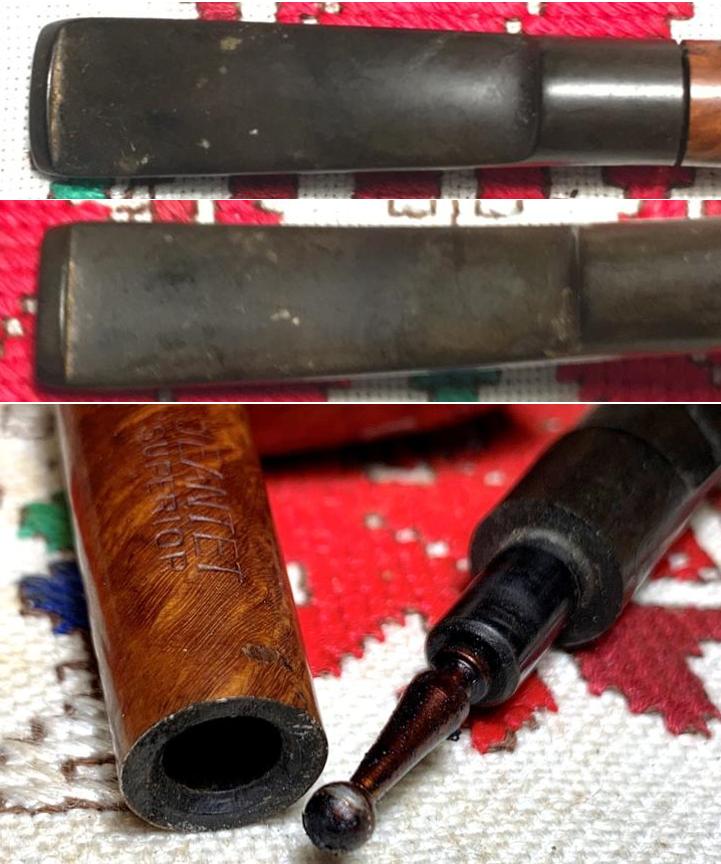
The concise summary of Stanwell provided by Pipephil is helpful (See: Link):

Brand & factory were established in 1942 by Poul Nielsen. The company has been owned since 2000 by Nordisk Tobaks Kompagni A/S. The factory in Borup crafted all Stanwell pipes from 1965 until 2009. From 2010 on the pipes are crafted by Barontini (Italy) exept for the limited editions. Production (2007): 115 000 Pipes/year.

According to this addition of information, with the COM being Denmark, the Royal Guard on my worktable would have been made at the Stanwell Borup factory dating between 1965 and 2009. The feel and look of the pipe lend toward the earlier or mid-date range – early 70s?  I return to Pipedia to the Stanwell article looking for additional information about the Royal Guard line.  I find nothing helpful.  Pipedia has a good article on ‘Stanwell Shape Numbers and Designers’ which I looked at hopeful of finding some correlation.  I compared the Stanwell shape number information (See: LINK) and found no correlation with the shape number, 582 and Stanwell shape numbering.

What I found of interest was that Stanwell did mark some of the ‘Royal Guard’ seconds with the ‘Stanwell’ name.  Steve restored an attractive Stanwell Royal Guard Made in Denmark  which also enjoyed the classic Stanwell ‘crowned S’ stem stamping.  These two pictures come from Steve’s rebornpipes writeup:

One other anecdotal piece of information I found while doing broad trolling while searching for Royal Guard information on the internet.  Several Royal Guard pipes come up in various sites selling pipes.  One ad, already sold, on the site Worthpoint (see: LINK), showed a Danish Freehand style like the RG on my worktable with the shape number 564 – 500s like the Pickaxe. It seems that all Royal Guard pipes have shape numbers in the 500s.  The RG pipe in the ad also has a very nice, blasted surface and a shank cap – military style fancy stem, and the RG stamping on the shank cap – the same DNA.   The seller provided a lot of information about the Stanwell linkage but also provided some information that helps hone in on the dating with a reference to the previous steward of the pipe: “It is from the personal collection of a physician who quit smoking in the early 1970’s. It would make an excellent addition to anyone’s collection.”  If the doctor quit in the early 70s, he would have acquired the pipe before this, and it would have been produced earlier yet.  It is very probably that the Royal Guard line could date back into the 60s which gives it an earlier Stanwell provenance.With a better understanding and appreciation for the Stanwell Royal Guard 582 Pickaxe on my worktable, I take a closer look at the issues.  The narrow conical chamber has some cake that will be removed to give the briar a fresh start.  The dark blasted surface shows the grime of some years, but generally in good condition and should clean up well.  The stem has minor oxidation, and the bit has tooth chatter or roughness, but not serious.  The shank cap, which appears to be a black acrylic, needs cleaning as well. Its appearance is like vulcanite and it appears to have oxidation or dulling on the upper side – the sun-side.  I take a picture of this, but showing different phases of black isn’t easy with the iPhone Xs camera!I start the cleaning by addressing the oxidation in the fancy RG stem, but first the airway is cleaned with a couple pipe cleaners dipped in isopropyl 99%.  After this, the Royal Guard fancy stem joins other pipes in the queue for a soak in Mark Hoover’s (www.Lbepen.com) Before & After Deoxidizer. After several hours in the soak, the stem is fished out and the Deoxidizer fluid is squeegeed off with my fingers and a pipe cleaner wetted with isopropyl 99% is used to clean the airway of the fluid.  A cotton pad wetted with isopropyl 99% is then used to wipe off much of the raised oxidation.To encourage the conditioning of the stem, paraffin oil, a mineral oil, is applied to the vulcanite stem and set aside to absorb.Turning next to the blasted Pickaxe stummel, I take another close up of the chamber to show its condition.  The last bit of baccy the former steward used is an exhibit on the floor of the chamber.  The carbon cake buildup is moderate. The widest measurement of the chamber at the rim is only 11/16 inches.  Neither the Pipnet Reaming Kit nor the Kleen Reem Pipe Tool, which I pull out for tighter chambers, are small enough to reach far into the chamber to ream.  I therefore go directly to the Savinelli Fitsall Tool to do the job.  It scrapes the chamber walls and can reach down to the floor of the chamber where the cone tightens to the smallest radius.When the Fitsall tool has done its work, a piece of 240 sanding paper wrapped around a Sharpie Pen completes the cleaning of the chamber as the walls are sanded.After an inspection of the chamber, the briar looks good.  There are no heating problems detected.  I move on.Next, the external blasted surface is cleaned using undiluted Murphy’s Oil Soap and a cotton pad to scrub.  A bristled toothbrush is also used to scrub the rough blasted surface. Next, the stummel is transferred to the sink where the cleaning continues using warm water, shank brushes with anti-oil dish washing liquid on the internals.  The dishwashing liquid helps break down the oils built up in the mortise.  While at the sink, I also use Magic Eraser on the acrylic shank cap – careful not to scrub over the ‘RG’ stamping.  After a thorough rinsing, the stummel is brought back to the worktable and pictures are taken showing raw spots on the fore and aft rim edge.The point of the Pickaxe is also worn, and bare spots are coming through.The scrubbing of the shank cap with Magic Eraser did a good job.  The cap now is a unified dull after the cleaning which should shine back up through the polishing phase.To complete the cleaning, I return to the internals using cotton buds and pipe cleaners wetted with isopropyl 99%. A small dental spoon also is used to scrape the mortise walls to remove residual gunk.  After some effort, the buds and pipe cleaners lighten indicating cleaner internals.  Later, I will continue the cleaning of the internals by using a kosher salt and alcohol soak.Turning now to the blasted briar surface of the stummel, there were raw or ‘bald’ spots on the rim and heel after the cleaning.  The most pronounced place on the front of the rim.To remedy these bald spots, I use a mahogany dye stick to refresh the rim edges and the blasted rim surface.  The same is done with the heel and a few small spots on the shank.  The results look good.  The blending between the dye stick and the native stummel hue is good. Next, I treat the blasted stummel with Before & After Restoration Balm. I apply the Balm by placing some on my fingers and working it into the rough blasted landscape. As I’ve described many times before, I notice the colors and textures of materials I use on pipes.  The Balm applies initially with a cream-like consistency and then thickens to a waxier texture as it’s worked in.  Some Balm is applied also to the acrylic shank cap as well – it will work on it too!  After thoroughly covering the stummel landscape, the stummel is put aside for the Balm to be absorbed.After about 20 minutes, excess Balm is removed with a microfiber cloth and then buffed up. I have two microfiber cloths of the same color dedicated to, first, wiping off the excess, and then, secondly, to buffing the stummel after cloth number 1 has wiped off the excess.  This dedication is helpful when I use cloth #1 on other pipes simply to give them a quick ‘spruce-up’ with Restoration Balm.  The next pictures do not do justice to the deepening of the hues of the dark blasted surface I can see with the eye.  The blasting on this Stanwell Royal Guard is attractive with deep burgundy flecking and the Restoration Balm brings this fact out more. With the stummel now waiting in the wings, the Royal Guard fancy stem is back on the table.  The Before & After Deoxidizer did a good job earlier.  Some pictures of the upper and lower bit show almost no tooth chatter but roughness from normal wear. To remove the roughness in the bit area and to address any remaining oxidation, the stem is sanded with 240 grade paper below the flare.Following the 240 sanding, the entire stem is wet sanded with 600 grade paper and then 0000 grade steel wool is applied.Next, the full regimen of 9 micromesh pads is applied starting with wet sanding with pads 1500 to 2400.  Following this is dry sanding with pads 3200 to 4000 and 6000 to 12000.  Between each set of 3 pads, Obsidian Oil is applied to condition the stem as well as to protect against future oxidation when the pipe is put back into service. The gloss comes out nicely through the micromesh sanding. To get a look at the progress, the Pickaxe stummel and fancy stem are reunited.  The progress looks good, but I see a few cosmetic issues that will improve the overall presentation.First, I decide to apply micromesh pads to the shank cap to create a bit more pop in the acrylic.  I only use the final 6 micromesh pads, 3200 to 12000 to do the sanding/polishing.  I avoid the initial coarser pads because the surface is sufficiently smooth but simply needs some pop that the finer pads will deliver.  As hoped, the picture below shows the renewed ‘pop’ after using the pads.The second cosmetic application is to sharpen and smooth the inner chamber wall below the rim.  I like a smooth briar contrast with the dark blasted surface as a general preference.  The smooth briar panel on the underside, holding the nomenclature, looks good contrasted to the rough, dark blasted surface. I would like to emulate this contrast on the inner rim chamber wall. This inner upper chamber wall finishing enhances the looks of Danish Freehand pipes with their longer, taller stummel designs. The next two pictures show the forward quadrant and then the rear quadrant of the chamber as it is now.  There is some space here that should work well.   I apply a quick sanding on the upper chamber wall with 240 then 600 to clean it and smooth it further.  This is then followed with the full set of micromesh pads 1500 to 12000 to finish the inner chamber wall.  I like the way this finishes the rim providing a bit of bump in the classy category!  The last cosmetic upgrade is the RG stamping on the shank cap.  The stamping needs refreshing, and white acrylic paint is used to do the job.The first step is to place a drop of paint over the stamping and then spread it out with a toothpick. A cotton pad then daubs the wet paint to thin it out more over the lettering and this also quickly dries the paint.Using a toothpick, the excess paint is removed as the toothpick is scraped over the lettering.  The point of the toothpick is also helpful to edge off excess paint close to the stamping.  The final ‘RG’ looks good.On the home stretch – with stem and stummel reunited, a cotton cloth buffing wheel is mounted on the rotary tool set at about 40% full power.  Blue Diamond compound is applied primarily to the smooth surfaces – the underside of the stummel, inner rim chamber wall, shank cap and fancy stem.  I do apply the compound to the blasted stummel but very, very lightly.  I do not want to load the rough blasted briar surface with compound making it difficult to remove and clean.  The results are good overall.  Following the application of the compound, the entire pipe is wiped down with a felt cloth to remove remnant compound residue.After the compound, another cotton cloth buffing wheel is mounted, and carnauba wax is applied to stem and stummel.  Following the wax, the pipe is given a rigorous hand buffing with a microfiber cloth to raise the shine and to remove excess wax from the surface.I am pleased with the way this Danish Stanwell Royal Guard perked up through the restorative process.  The dark blasted briar surface draws the eye to the 3-D presentation of grain, and this is augmented by the smooth briar contrast of the inner chamber wall.  The Pickaxe shape is sharp and provides a unique tactile hold with the blasted surface.  The black acrylic shank cap provides a nice flow transitioning from the conical bowl to the fancy stem.   I think Niko will be pleased with this additional pipe of Denmark he commissioned, and he will have the first opportunity to acquire it from The Pipe Steward Store benefiting the Daughters of Bulgaria – women and girls who have been trafficked and sexually exploited.  Thanks for joining me!
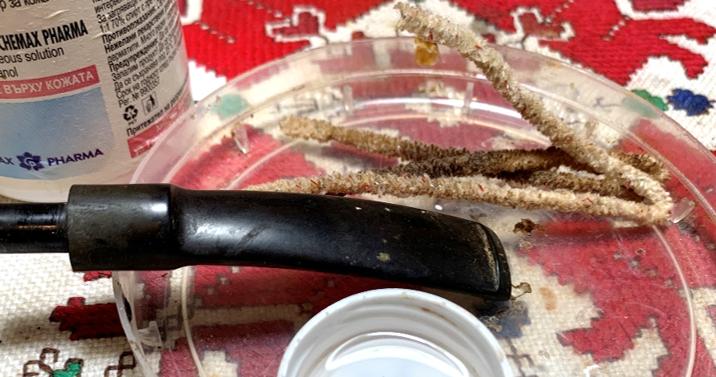
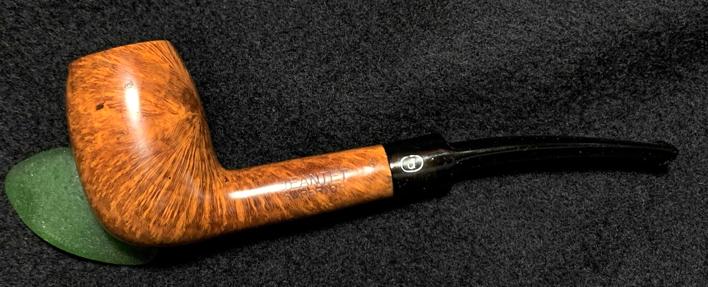
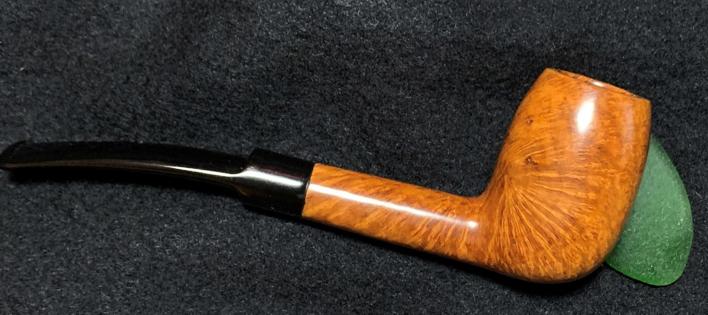
Yet Another Treasure – a 1905 BBB Silver Capped Gourd Calabash


Blog by Steve Laug

Time really flies during this COVID-19 time! It seems like just a few weeks ago I was contacted by an older gentleman about purchasing his pipe collection. He sent me the photos and I was amazed at what I saw. The collection included Dunhill pipes, BBB pipes, Orlik pipes, Barclay Rex Pipes, a couple of Meerschaums and a whole lot of other pipes. All I could say as I looked at the pipes was what a collection it was. We negotiated a deal and I think we both walked away quite happy with the exchange. But I have to tell you there was another very interesting pipe caught my interest when I looked at pictures of it. It was a beautiful older BBB Calabash with an albatross wing bone extension that is shown in the photo below. I have worked on a lot of BBB pipes over the years and never had the opportunity to work on one like this. It would be a great addition to my collection of BBB pipes. From the photos the pipe appeared to be in good condition from the photo he sent me. He said that the pipe was stamped on the left side of the silver ferrule and read AF & Co over three hallmarks. The hallmarks are as follows: an anchor (Birmingham, England), a rampant lion (the symbol for quality of the silver) and the final one is a lower case “f” (the date stamp). It has the same stamp on the rim cap and the shank extension. I could not wait to get it and have a look at it up close and personal. I had him ship it to Jeff for cleanup so it would be a while before I held in hand.When the package arrived at Jeff’s place in Idaho he waited for me and opened the box with me on Facetime to look at the collection of pipes as he removed them from the box. It is an amazing collection and one that I am going to enjoy working on over the months ahead. Jeff took some photos of the BBB Calabash with the silver cap and bone shank extension for me to look at while he worked his magic in cleaning up the pipe. It is a real beauty. Jeff took photos of the bowl and the silver capped rim top to show the cake in the bowl. The silver cap has some nicks, dents and dings in it that will remain after the cleanup as part of the story of the pipe. He took photos of the top and underside of the stem showing the tooth chatter, scratching and oxidation on the stem surface and wear on the edges of the button. Jeff took photos of the sides and heel of the bowl to show the condition of the gourd. You can see the beautiful shape and the contrast of the silver and the calabash even through the dirt and debris of over 105 years.       The stamping on the pipe was on the silver of the pipe rather than any where else on the gourd. It is on the rim cap, the ferrule and the end cap of the extension. On the rim cap it is stamped toward the front and reads AF&Co which are the Adolph Frankau Company. After his death, the BBB gradually became known as Britain’s Best Briars. Soon to be the oldest English trademark in current use and the first pipe ever to have a registered trade mark. “Britain’s Best Briars”, often called BBB, is one of the oldest brands still in production. At the back of the rim cap it is stamped with three hallmarks – an anchor, a lion and a lower case “f”.  The anchor identifies the city of origin of the silversmith (Birmingham, England), the rampant lion (the symbol for quality of the silver) and the final one is a lower case “f” (the date stamp). There is a slight variation on the stamping on the scalloped ferrule. It includes the BBB Diamond stamp above the AF&Co which is above the same three hallmarks noted above. The shank extension matches the ferrule exactly. All have the same date letter “h”.  The ferrule has some dents on the left side as shown in the photos below. Because of the attachment to the gourd I will be leaving the dents as a part of the pipe’s story. I turned to one of the numerous silver hallmark chars on line for the city of Birmingham, England (https://www.silvermakersmarks.co.uk/Dates/Birmingham.html) and was able click on the section that applied to the date stamp on this pipe. The first chart below is the chart from 1773-2024.I am also including screen capture of the enlarged section on the Birmingham dates for the letter F. This chart covers pipes made in 1778-2005. I have drawn a read box around the hallmark pattern that matches the one on the BBB pipe silverwork. You can see that it dates the pipe to 1905. That means that this gourd calabash is over 115 years old. All of the silverwork confirms the 1905 date for the pipe. The bowl lining in the calabash seems to be a clay lining that is seat in the gourd and held in place by the silver top cap.

With the information from the two sites I had a pretty clear idea on the background of the pipe. It was definitely an old timer and really was another stellar acquisition. Now it was time to work on the pipe.

Jeff carefully cleaned the pipe from top to stern. He reamed it with a Savinelli Fitsall Pipe Knife. He scrubbed out the internals of the shank, stem and shank extension with alcohol, pipe cleaners and cotton swabs until the pipe was clean. Without being able to remove the bowl liner the internal cleaning of the gourd was complicated but he cleaned it as much as possible. He scrubbed the exterior of the bowl with Murphy’s Oil Soap and a tooth brush to remove the grime and grit on the calabash and the tarnish and lava on the rim top. The finish looks much better and has a deep richness in the colour that highlights gourd. The rim top looked very good and the inner and outer edge looked very good. The nicks and dents in the silver remain and will be “war wounds” that travel with the pipe. Jeff scrubbed the stem with Before & After Deoxidizer to remove the oxidation on the rubber. He worked it over with Soft Scrub All Purpose Cleaner to remove any remnants of oxidation. When the pipe arrived here in Vancouver for the second stop of its restoration tour I was amazed it looked so good. Here are some photos of what I saw.  I took some close up photos of the rim top and the stem surface. The rim top  looked good. There were some dents and scratches in the silver. I took close up photos of the stem to show the condition of the surface and button. I took the pipe apart and took a photo of the pipe with the short stem and with the extension. It is a good looking pipe and very unique.I polished the silver rim top, edges and the gourd with micromesh sanding pads – dry sanding it with 1500-12000 grit pads. After each pad I wiped the briar down with a damp cloth.  I was able to give a shine to the silver, remove scratches a bit and also polish the gourd.     I worked some Before & After Restoration Balm into the surface of the gourd with my fingertips to clean, enliven and protect the gourd. I let the balm sit for 15 minutes and then buffed with a cotton cloth to raise the shine. The photos show the bowl at this point in the restoration process. I polished the scalloped silver ferrule with a jewelers cloth to remove any residual tarnish and also to protect it from future tarnish (at least for awhile). The interesting detail for me is that the ferrule is scalloped and the end of the shank extension that holds the stem also is scalloped.   With that done the bowl was finished other than the final buffing. I set it aside and turned my attention to the stem. I sanded out the tooth marks and chatter on the stem with 220 grit sandpaper. I started the polishing with 400 grit wet dry sandpaper. I polished the silver stem cap with a jewelers cloth that helps remove any residual tarnish and protects the silver.I polished the stem with micromesh sanding pads – dry sanding with 1500-12000 grit sanding pads. I wiped it down after each sanding pad with Obsidian Oil. I polished it with Before & After Pipe Stem Polish – both Fine and Extra Fine.    With the bowl and the short stem finished I put the pipe back together and buffed it on the wheel using Blue Diamond to give it a shine. I gave the bowl and stem multiple coats of carnauba wax on the wheel and then buffed it with a clean buffing pad to raise the shine. I hand buffed it with a microfiber cloth to deepen the shine. It really is an amazing little pipe. The dimensions of this part of the pipe are – Length: 6 ½ inches, Height: 2 ¾ inches, Outside diameter of the bowl: 1 ¾ inches, Chamber diameter: 7/8 of an inch. The weight of the short version of the pipe is 2.33 ounces/66 grams. This unique find – a 1905 BBB Silver Capped Gourd Calabash is joining the other pipes in my collection of BBB pipes and will hold a place of honour while it is in my trust. This is another pipe that one day soon I will enjoy a special bowl of tobacco in it and be transported to a slower paced time in history where I can enjoy a respite. With the pipe and short stem finished all that remained was to finish the shank extension that fit in the shank end of the pipe. The end that fit into the shank had the same end cap as the stem itself. The opposite end was fitted to receive the end cap of the stem. The tube between the caps is albatross wing bone. There was a small crack in the bone at the joint of the silver that held the stem. I filled in the crack with clear CA glue to stabilized. It I polished it with the full gamut of micromesh sanding pads to blend it in the rest of the bone. I polished the silver with a jewelers cloth to remove residual tarnish in the turnings of the silver caps and polished the shank extension with Obsidian Oil. The length of the extension tube is 8 ½ inches. I took a few photos of the pipe next to the extension to give a sense of the size. I also took photos of the extension tube with the stem in place to show the look of it. Finally the last photos give a sense of the fully extended BBB Silver Capped Calabash with the bone extension. With it installed on the pipe the length of the pipe is 13 inches. Height and other measurements remain as noted above.