Monthly Archives: November 2019

Restoring a Pair of Petite Peterson’s of Dublin Pocket Pipes


Blog by Steve Laug

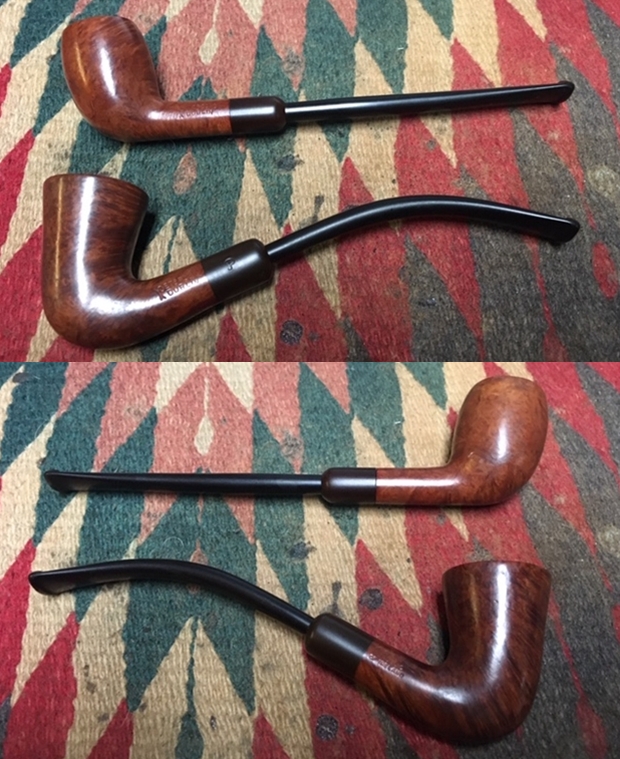
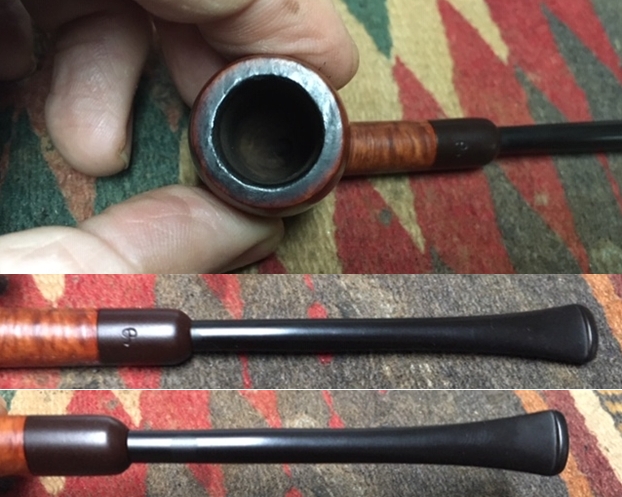
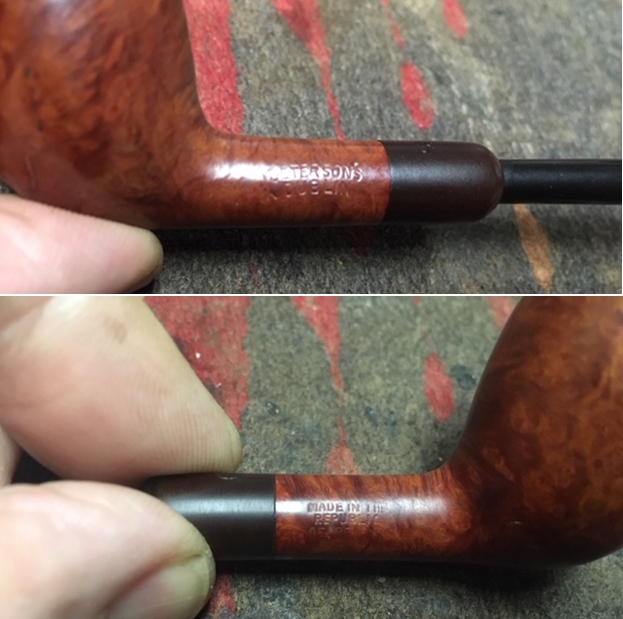
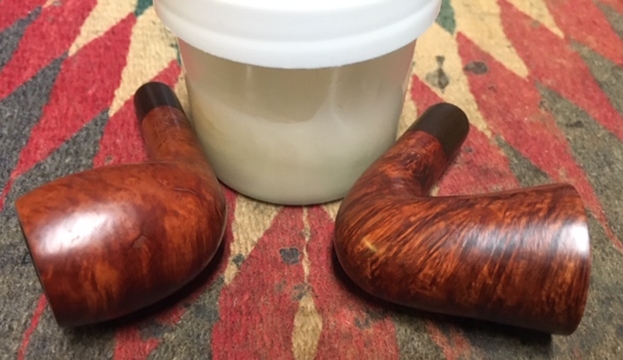
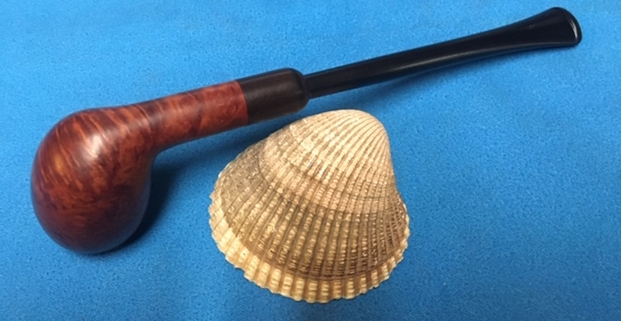
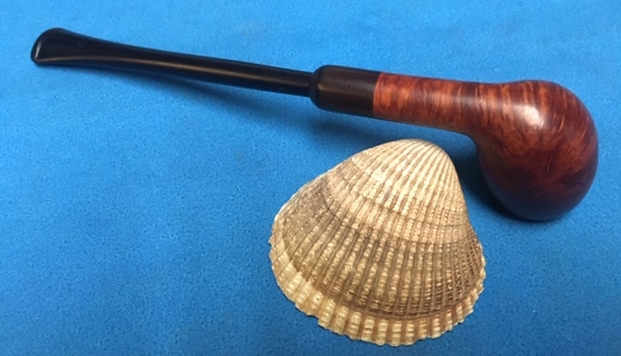
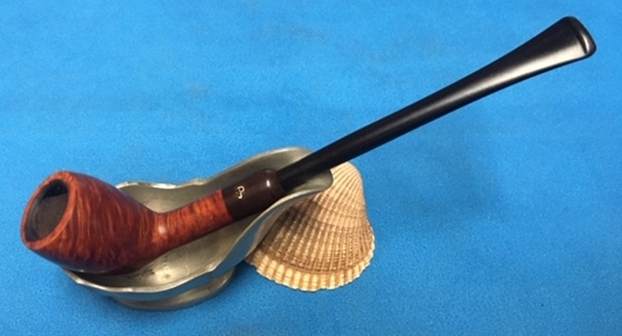
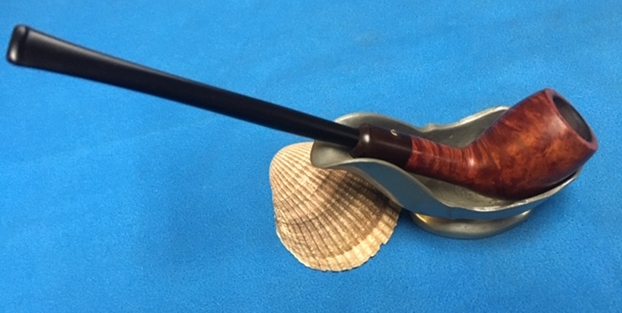
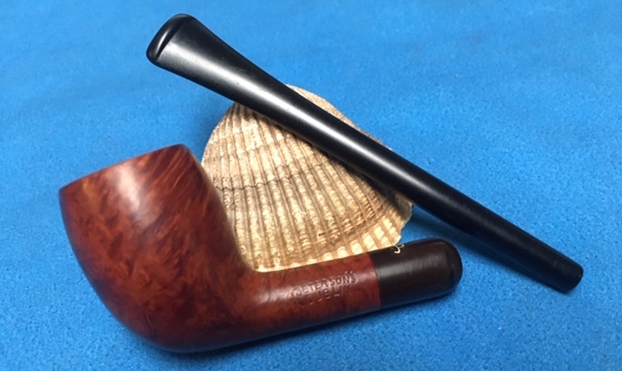
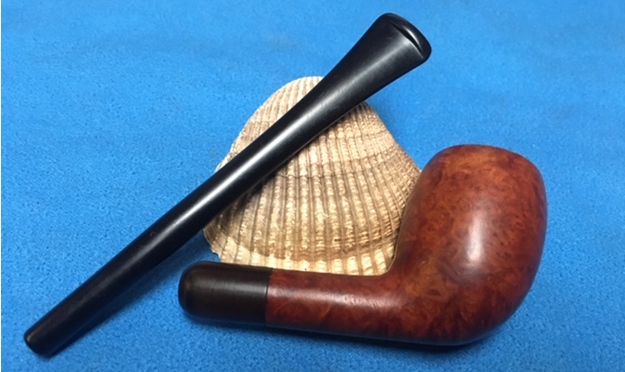
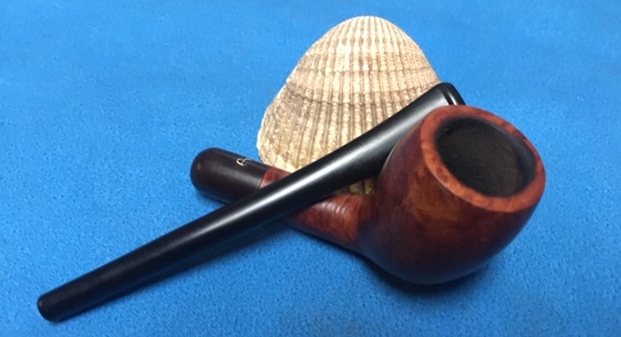
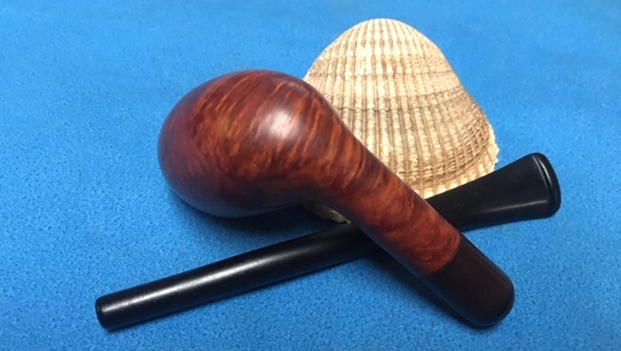
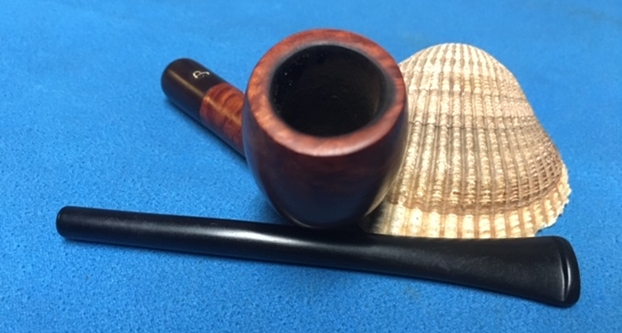
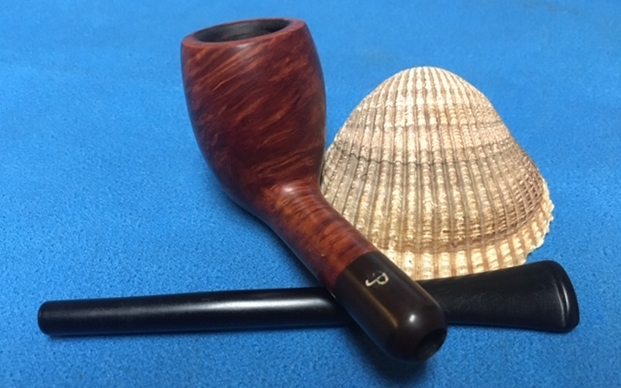
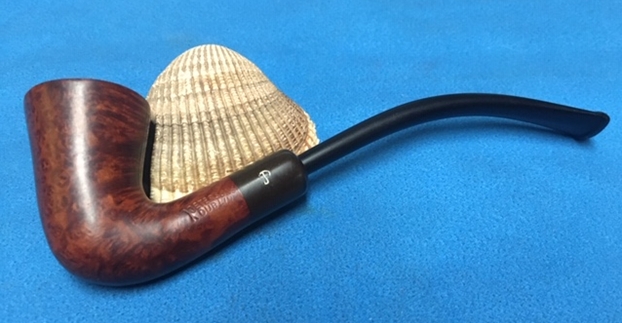
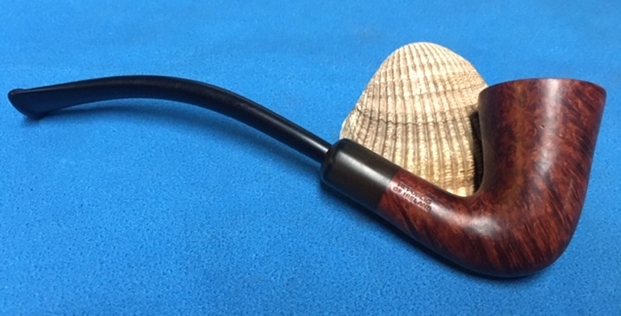
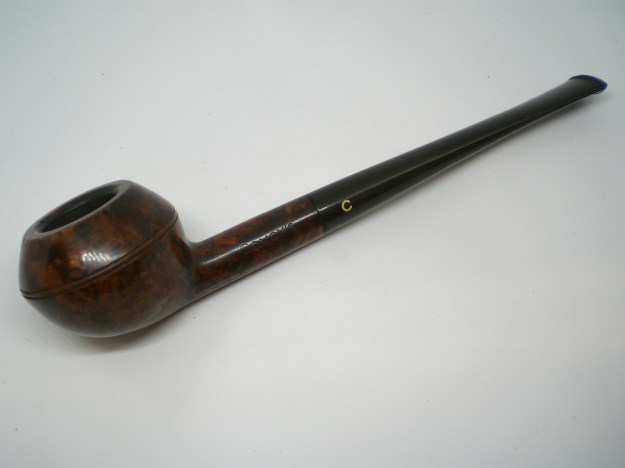
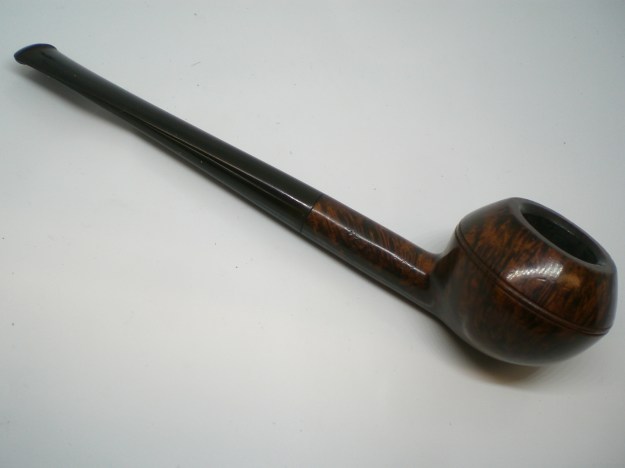
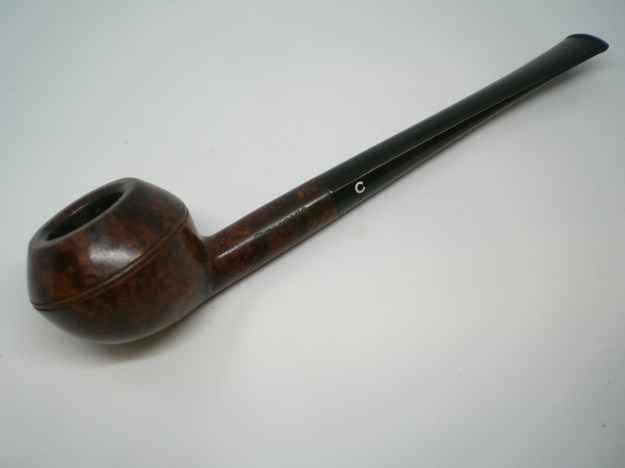
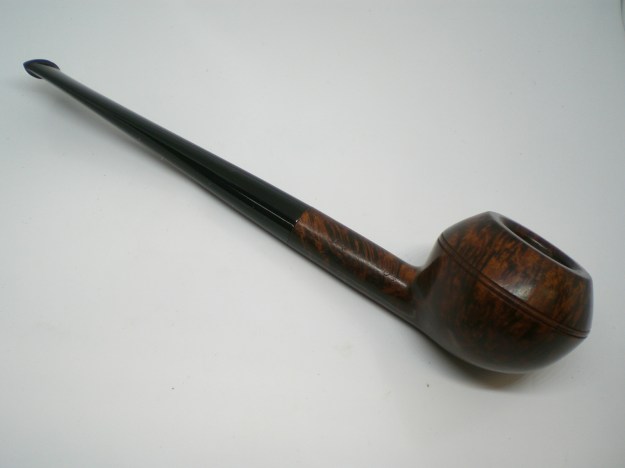
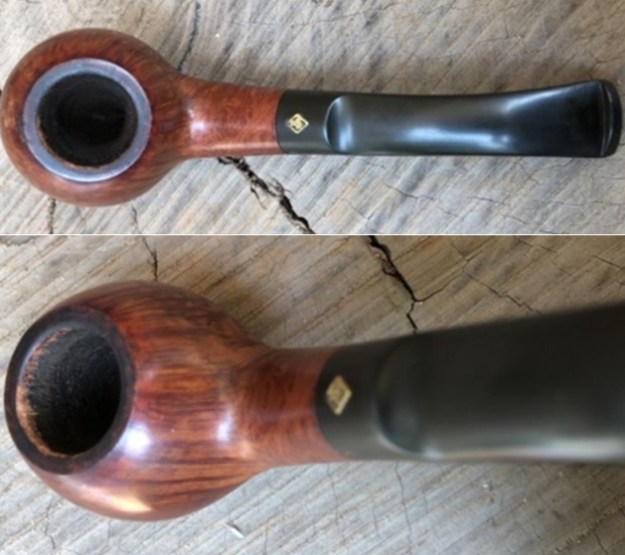
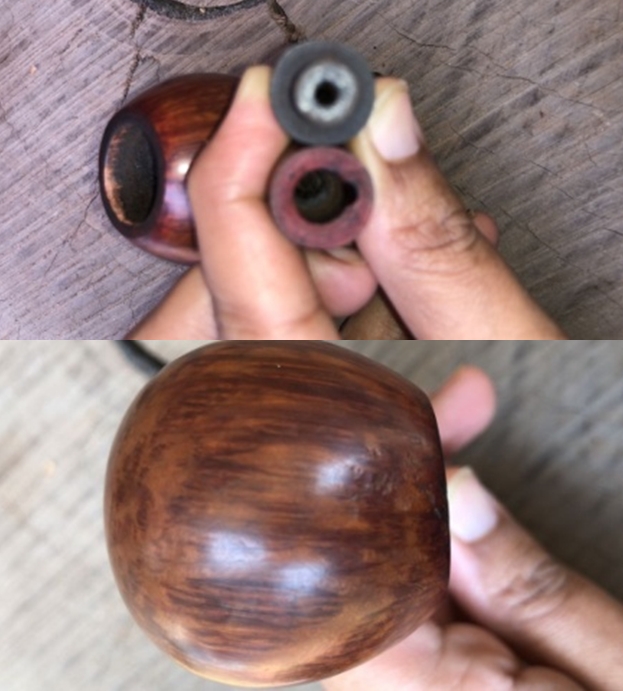
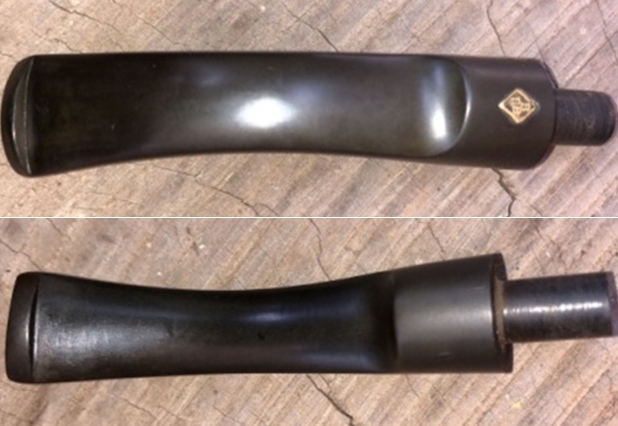
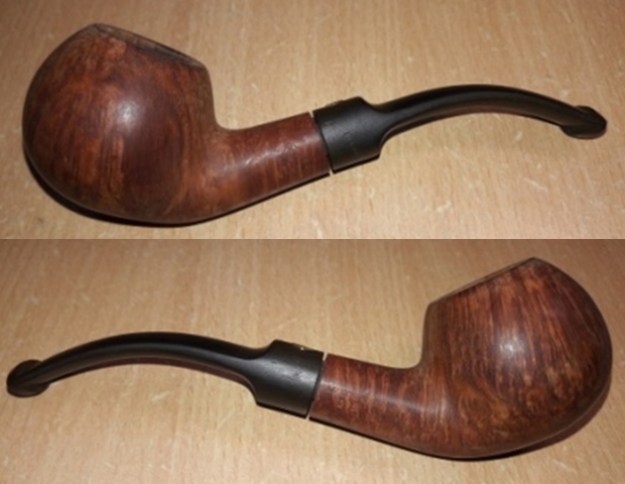
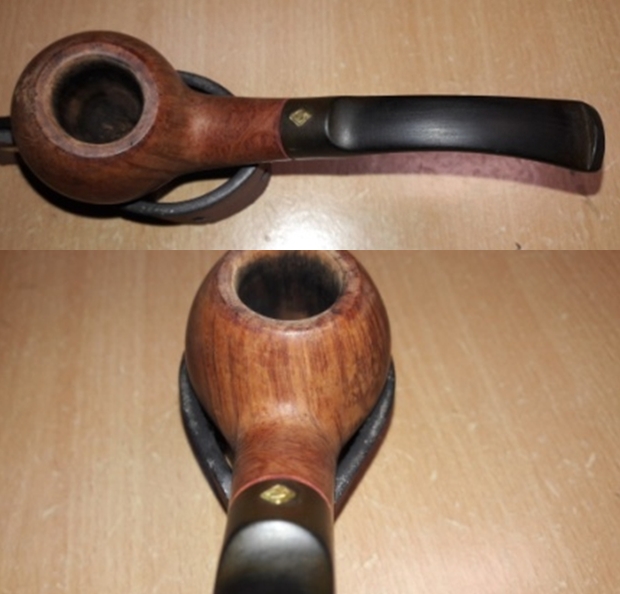
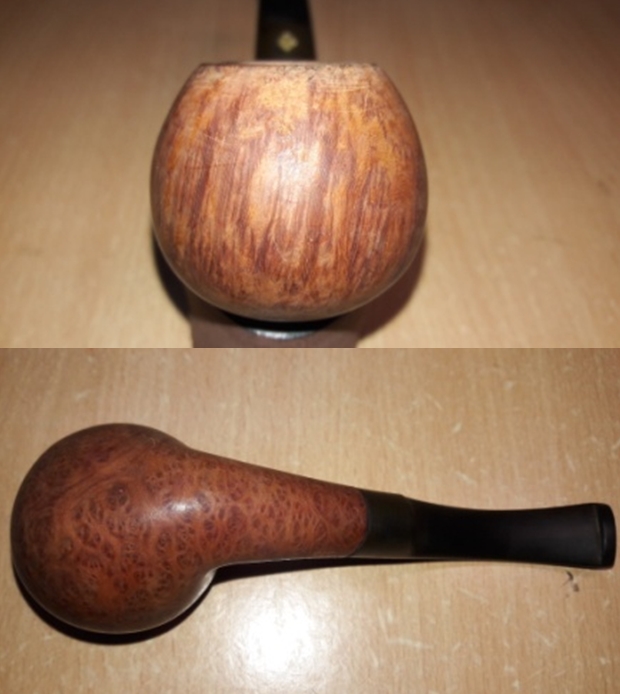
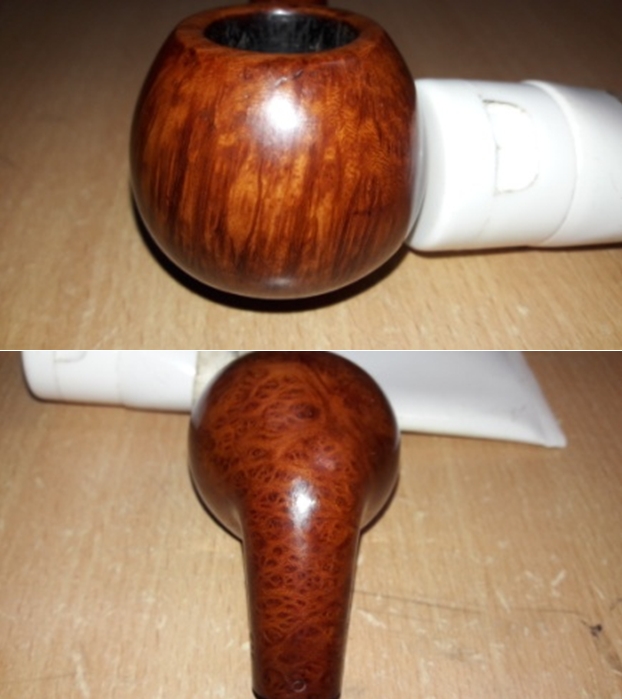
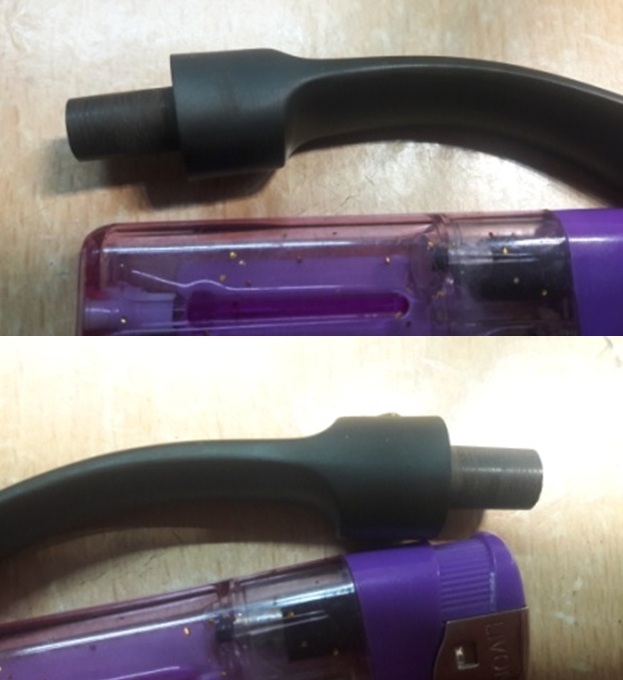
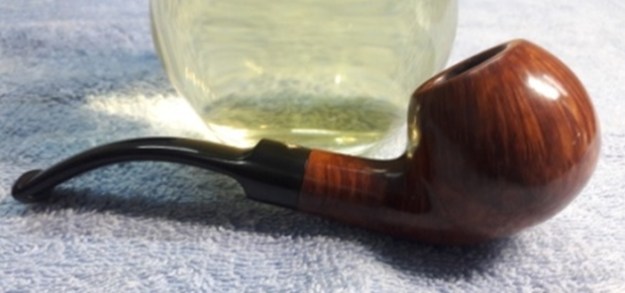
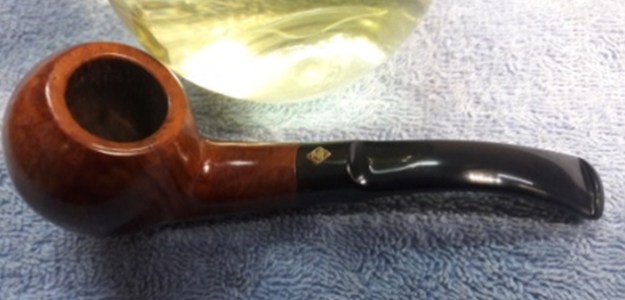
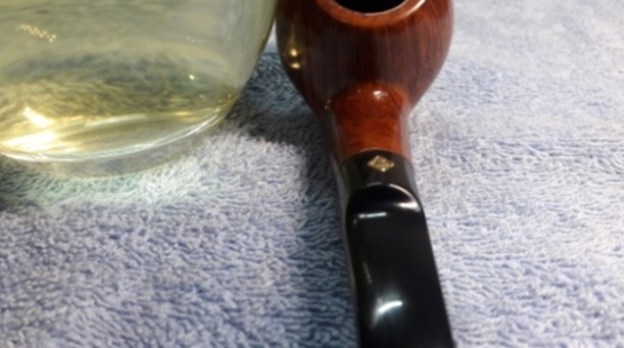
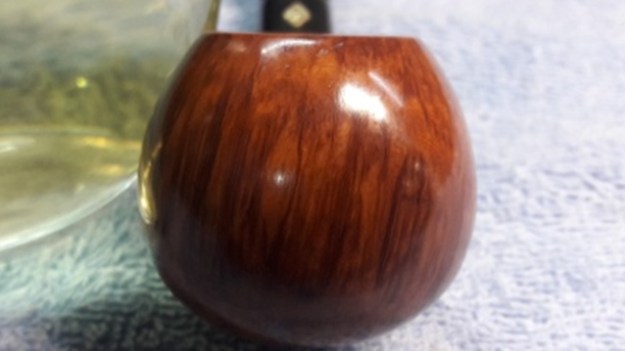
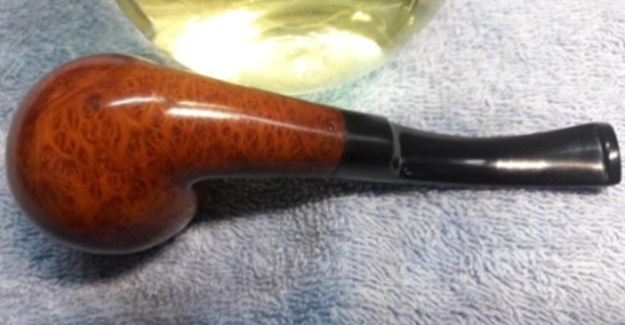
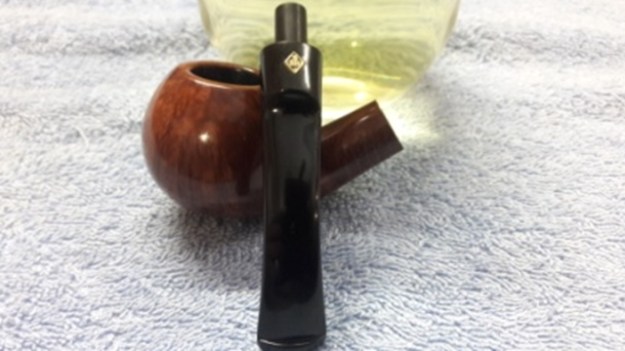
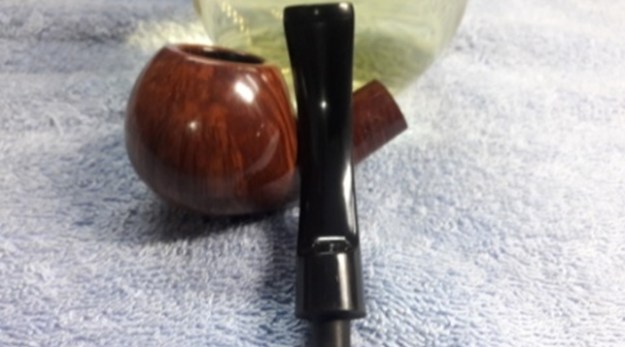
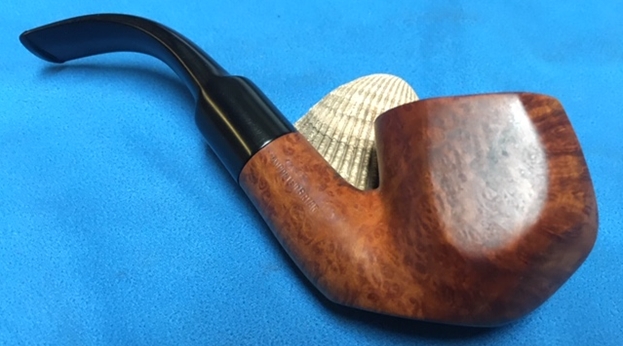
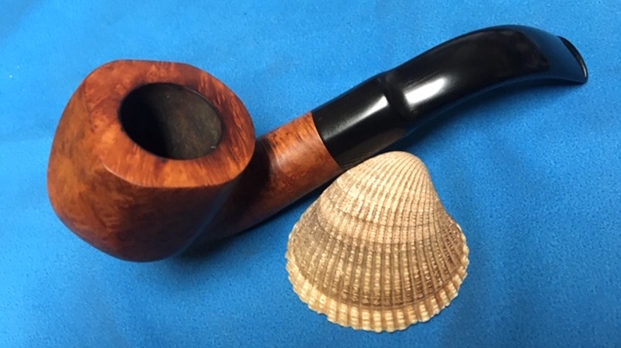
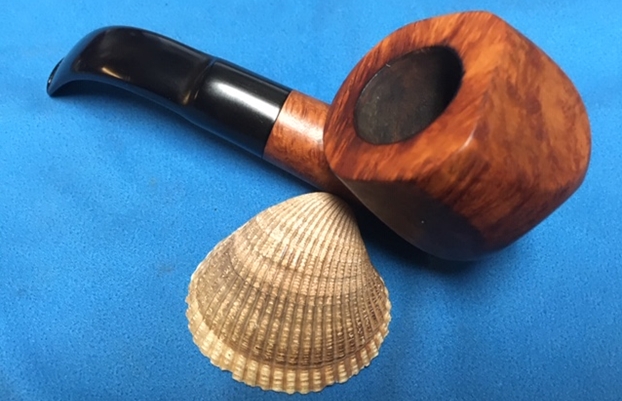
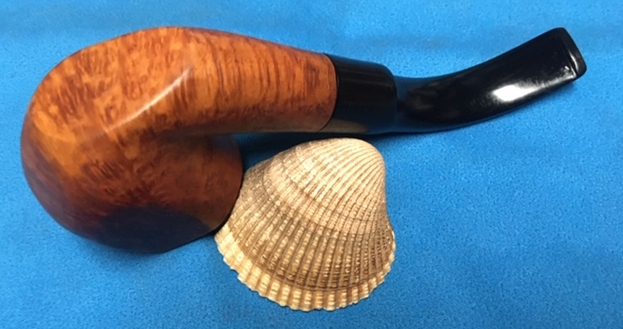
I did a pipe repair on an old cased Bulldog for a fellow in Australia, Ray Choy. He sent the pipe and I repaired it and sent it back to him. He replied that he had a few pipes that were just too small for his liking anymore and he wanted to clean and ream them and send them to me. His email said that he would clean them up with the reamer and cleaning equipment he had. Once he had them cleaned and reamed he would send them to me for the finishing touches. The box arrived and I set them aside so that I could finish the clean up later. I decided to tackle the two small Peterson’s Pocket pipes that Ray had sent me. The first one is a Peterson’s of Dublin Belgique military mount and the second is a Peterson’s of Dublin Calabash military mount. Both pipes are stamped on the left side of the shank with the words Peterson’s Dublin. On the right side of the shank both are stamped Made in the Republic of Ireland. Neither one has a shape number on them and both have a vulcanite shank extension bearing the Peterson’s “P”. The stems were in good condition with no chatter or tooth marks. Both had some light oxidation.

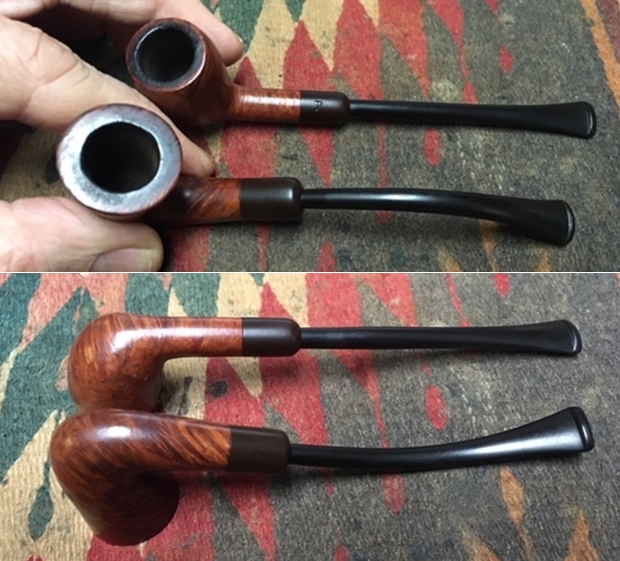
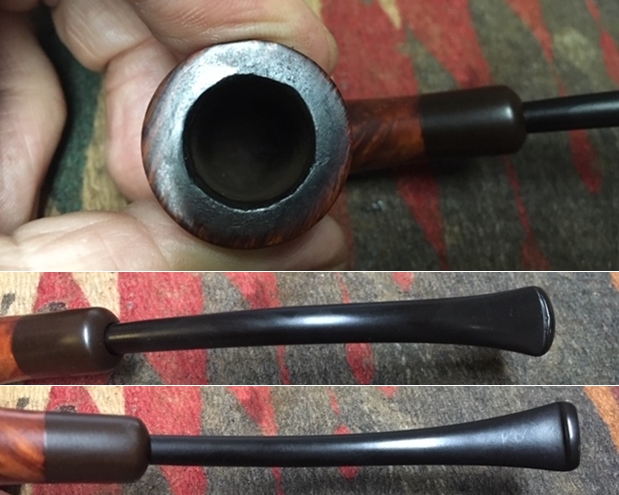
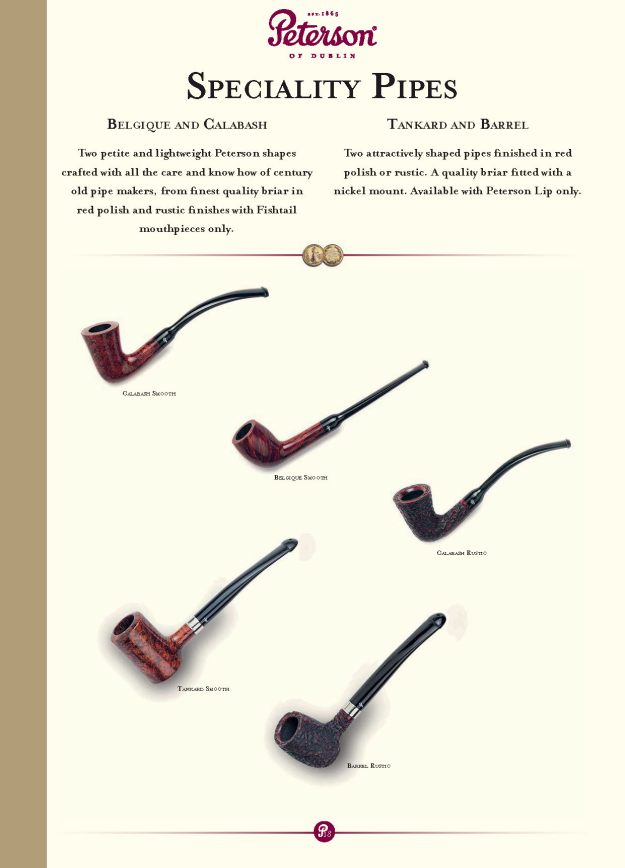
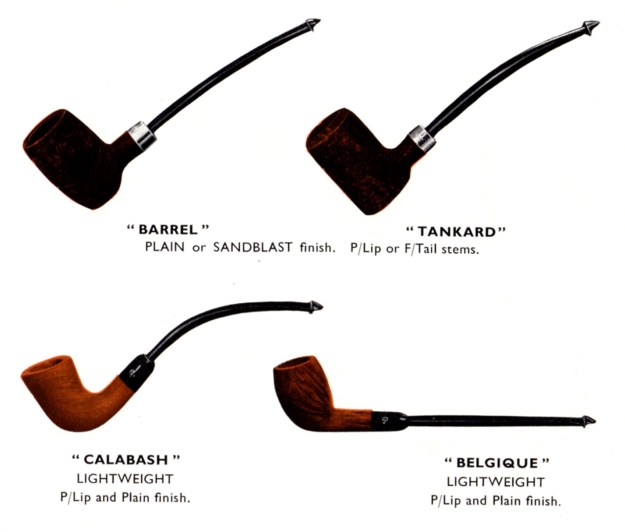
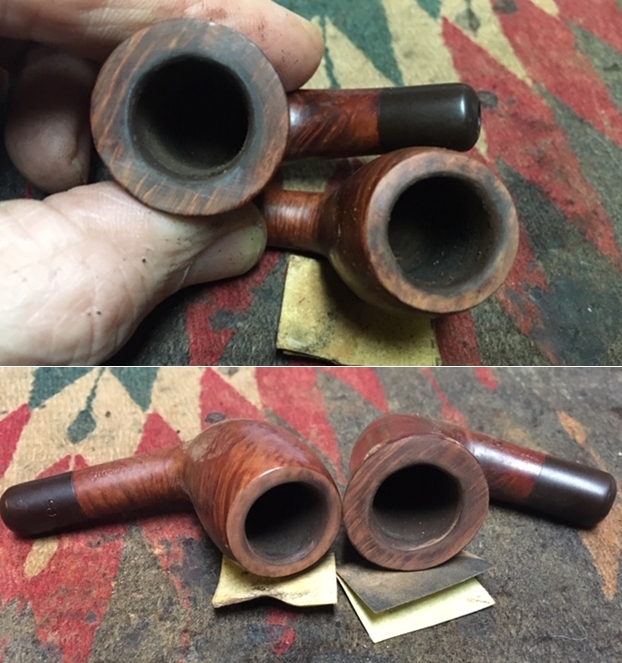
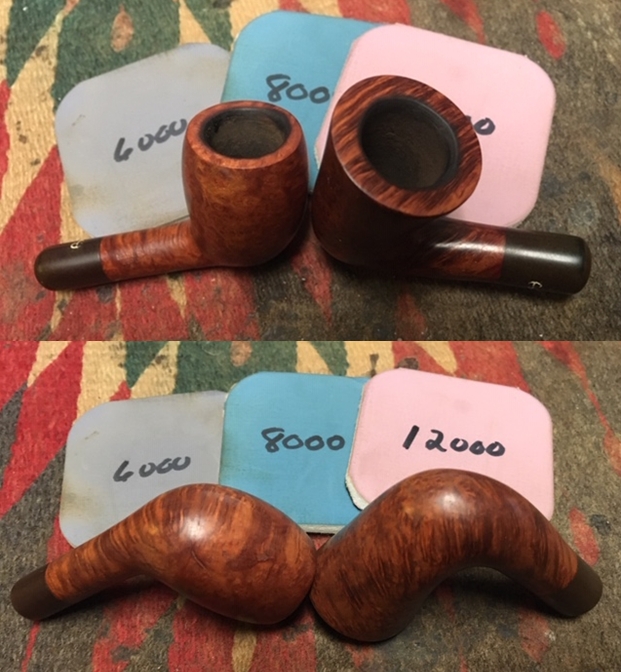
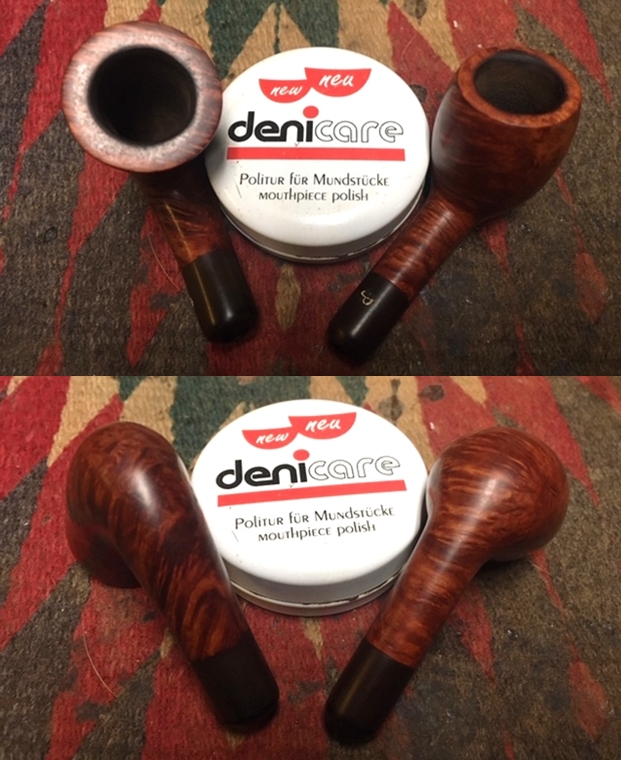
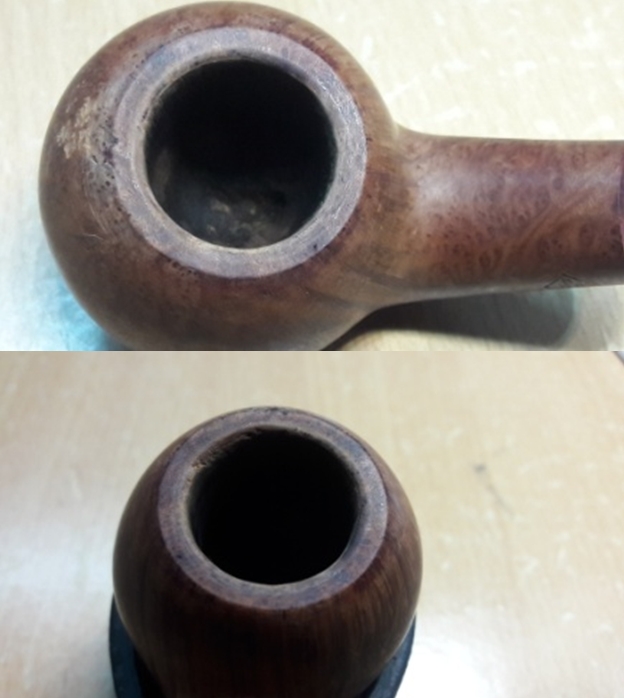
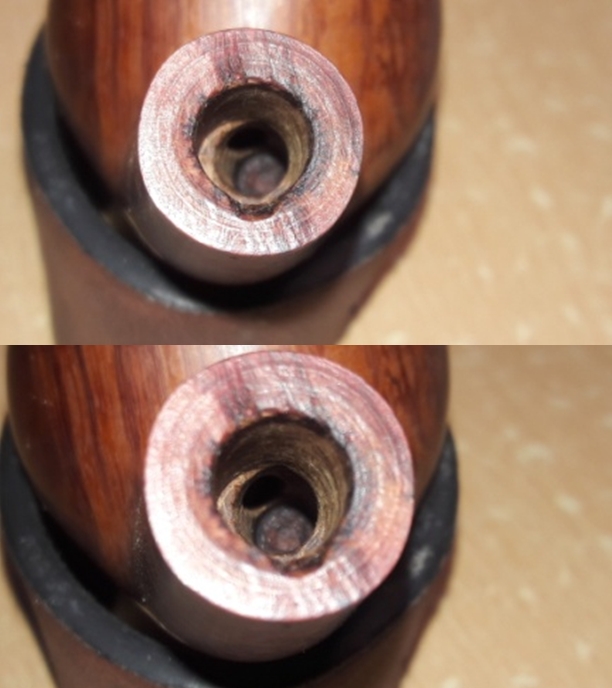
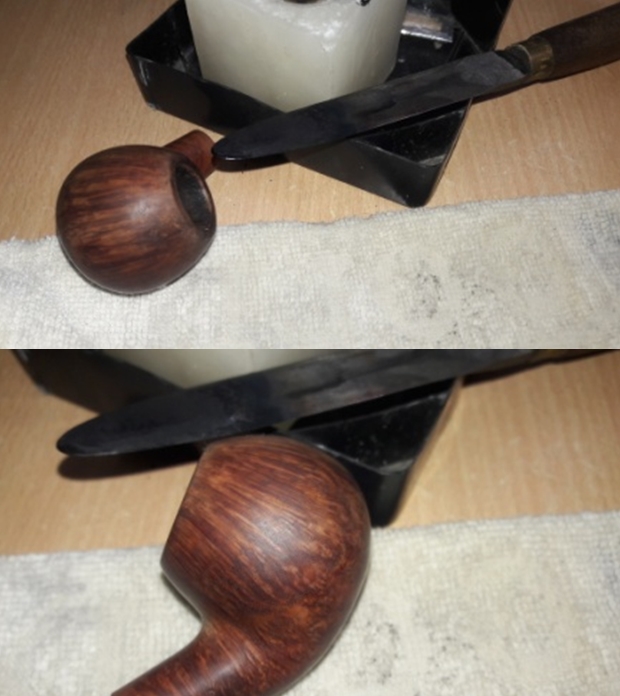
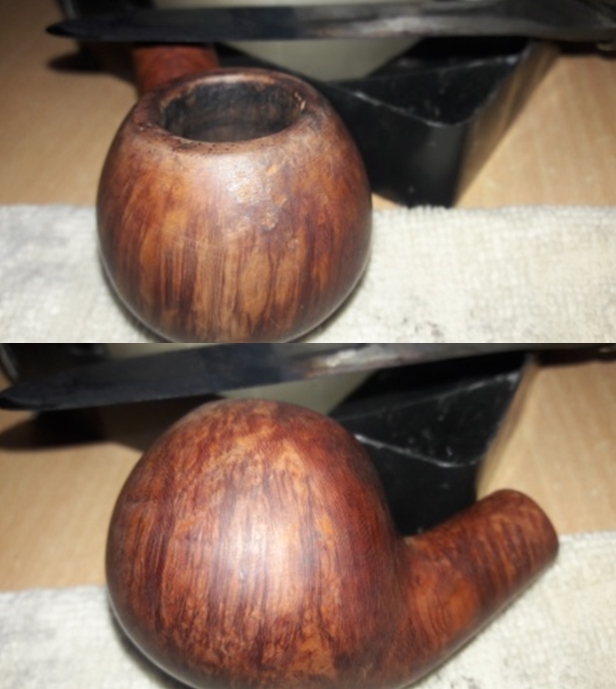
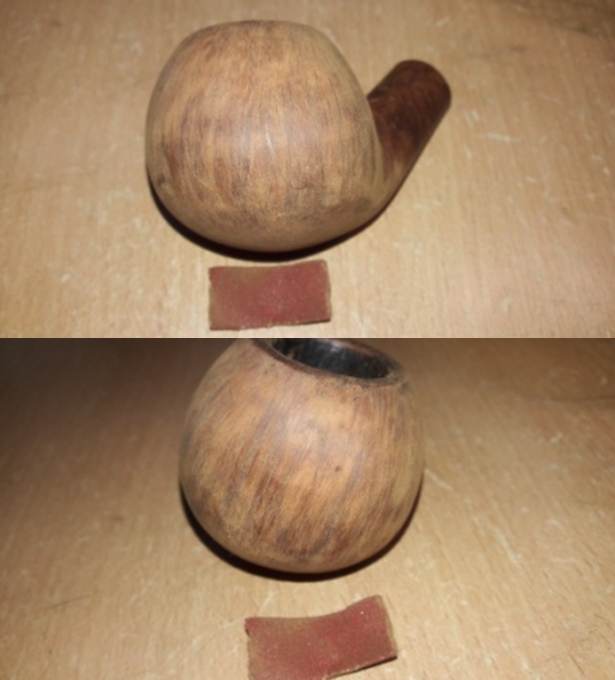
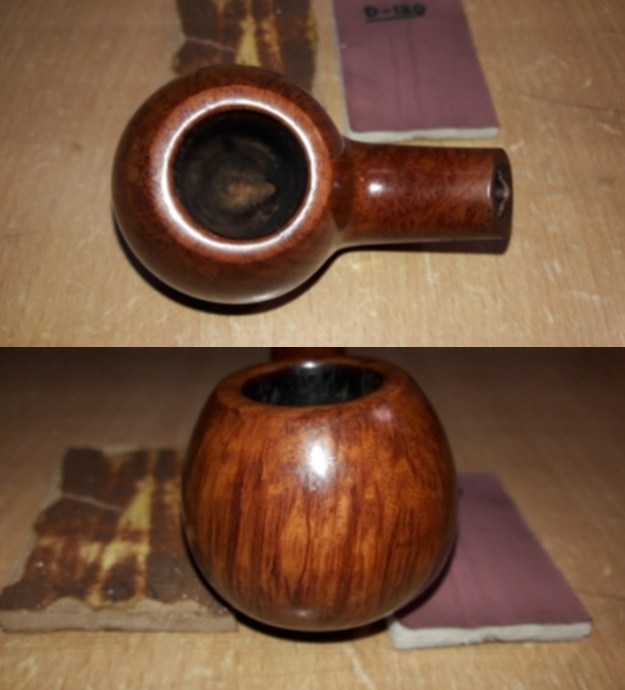
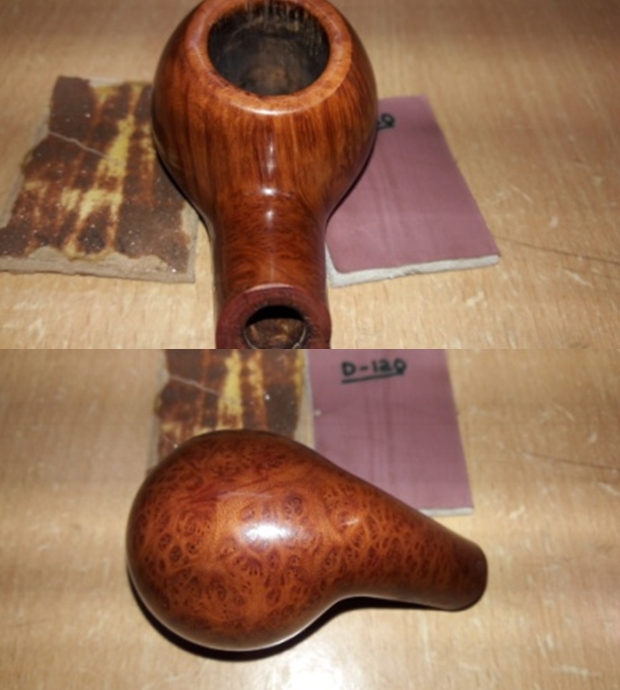
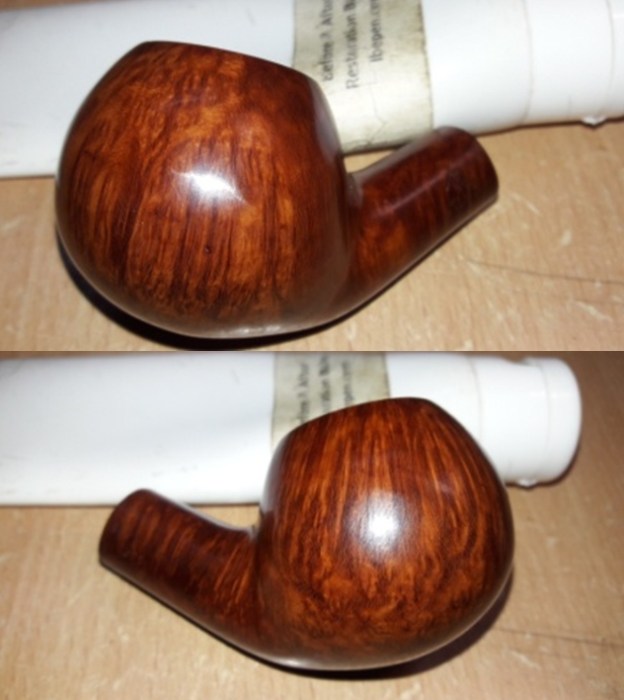
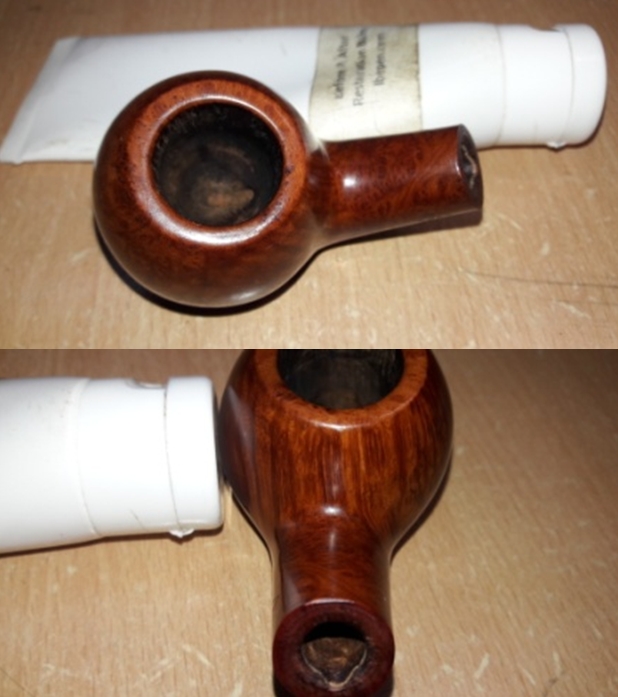
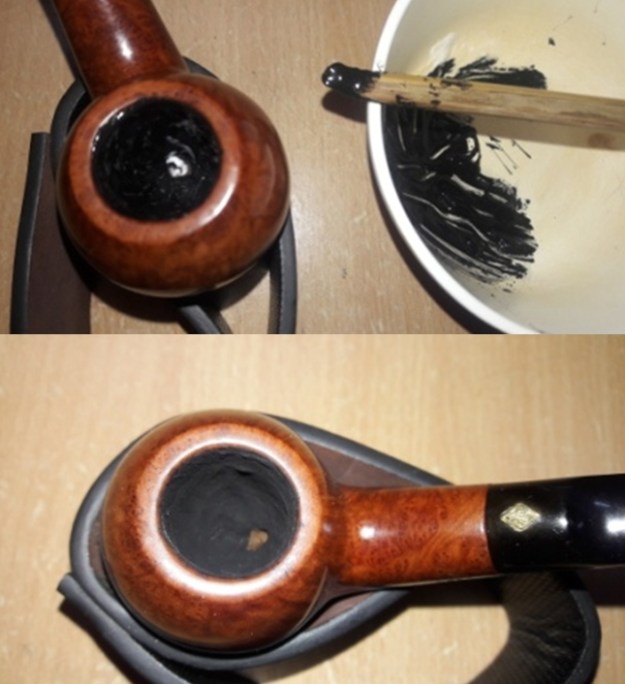
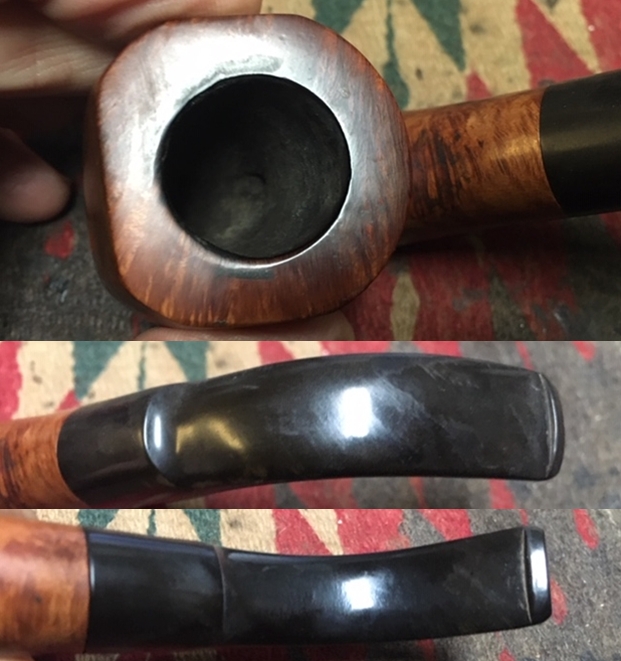
Ray had done a great job on the reaming and the cleaning of the bowl and shank so I could literally just start with the finishing touches. The rim tops on both pipes had some darkening on the flat tops. The inner edges of both were damaged and slightly out of round. The outer edges were in great condition. There was some light oxidation on the vulcanite shank extensions. I took some photos of the pipe before I started putting the finishing touches on them. I took some photos of the rim top and bowl to show the condition of the pipes when they arrived. The bowls were very clean. Both rims had some darkening and the inner edge of both had some damage to them. The photos of the stems show the condition of both of them. They both are in excellent condition. I took photos of the stamping on both pipes. The first is the Belgique with straight shank and the second is the Calabash with the bent shank. You can see the clear stamping on both pipes. The left side shows the arched Peterson’s Dublin with a forked P and the right side shows Made in the Republic of Ireland. I have a 2010 Peterson Catalogue on rebornpipes that shows the various shapes that Peterson made. There is a page there on Specialty Pipes that shows the pipes that I am working on. The pipes pictured are different from the two that I am working on in that both of these are military mount stem. It states that the Belgique and Calabash are two petite and lightweight Peterson crafted with all the care and know how of century old pipe makers, from finest quality briar in red polish and rustic finishes with Fishtail mouthpieces only. However they are described in the catalogue the two shapes that are extremely lightweight. These two are not red polish but actually a rich matte brown finish. The fishtail mouthpieces are classic military mounts that can easily be removed to fit in the pocket. They represent the best micro-pocket pipe within the Peterson portfolio. I have included the noted page below (https://rebornpipes.com/2015/05/15/).I did a bit more digging on the Peterson Pipe Notes blog. There I found that Mark had included a photo of the various Speciality pipes. Peterson’s first put these four small pipes on the market in 1945 – Tankard & Barrel, Calabash & Belgique seen in the photo below.  Here is the link to Mark’s Blog (https://www.petersonpipenotes.org/tag/peterson-valentia-pipe/).I did a bit more digging and found some descriptions of the two shapes that I am working on. The various descriptions of the Belgique come from a variety of sites and the final one is quoted on the Brothers of Briar site.

…The Belgique is yet another extremely lightweight, petit pipe. It can be described as a tulip shape, and is fitted… and fishtail mouthpiece. A rich brown hue adorns the briar and makes for an attractive finish to this pocket companion.

…The Peterson Belgique Pipe is a straight cutty, which is a traditional shape derived from the old clay pipes. It is a small un-filtered pipe made from the finest Briar that Peterson have become renowned for. It has a smooth polished finish with a rich Brown stain to show of the natural grain pattern of the Briar.

…I have a pre rep Belgique love it. As you know the bowl is pretty large for the small pipe measuring 5/8″ ID and 1 1/4″ deep. My pipe is just shy of 6″ long and only weighs 11.7 grams. the bowl is not tapered which makes the capacity rather nice. Depending on what tobacco you load you will get a 30- 45 min smoke. The Belgique has thin walls so you have to sip very slowly and tamp more than usuall. The newer models hava a fishtail stem which i believe makes the newer pipes not as delicate as my military p lip. If you decide to get the Belgique I am sure you will not be disappointed. (http://www.brothersofbriar.com/t16010-anybody-familiar-with-peterson-s-belgique-model).

…The Belgique is one of our favorite shapes in the Peterson line up. Interestingly, while it was a serious mainstay of the brand in decades past, it sort of faded into obscurity for a few years there, before being seriously revived in the past decade. A particularly small shape, and sort of an oddity in Peterson’s shaping lexicon (a bit like Native American loan words in English), it nonetheless fits the timeless, elegant style for which Peterson is known and loved.             

I also found this description of the Calabash.

This particular Calabash represents the smallest pipe within the Peterson portfolio making it a perfect pocket pipe for a short smoke.  Finished here with a rich brown finish together with a… fishtail mouthpiece.

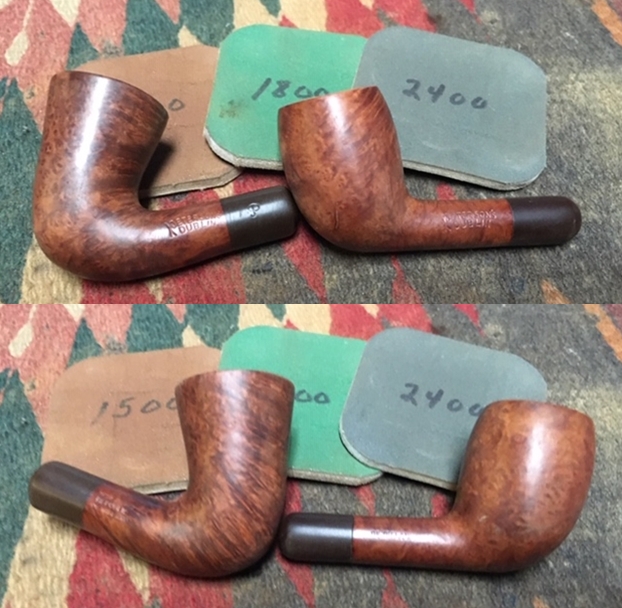
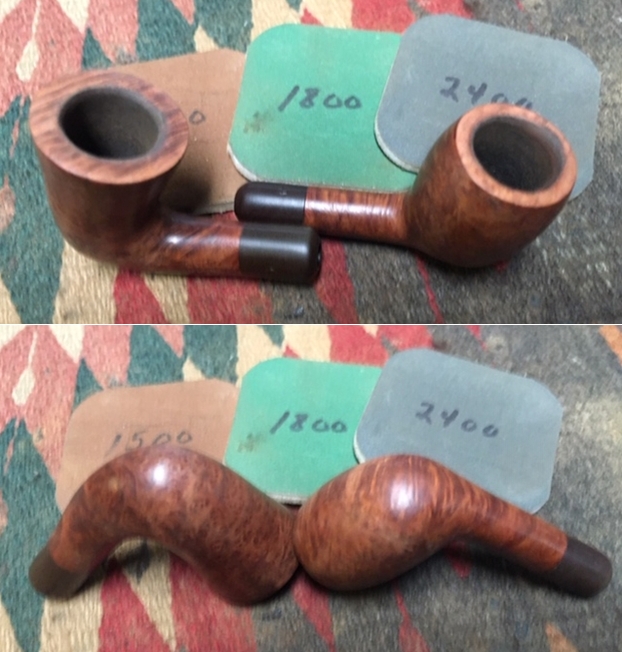
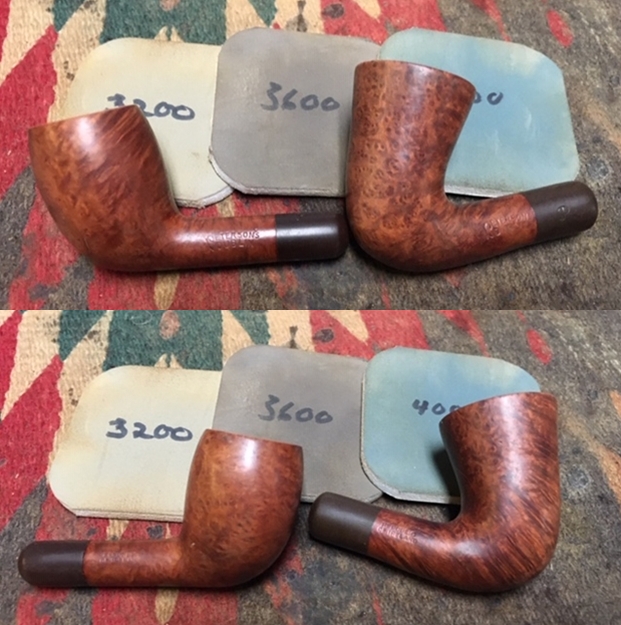
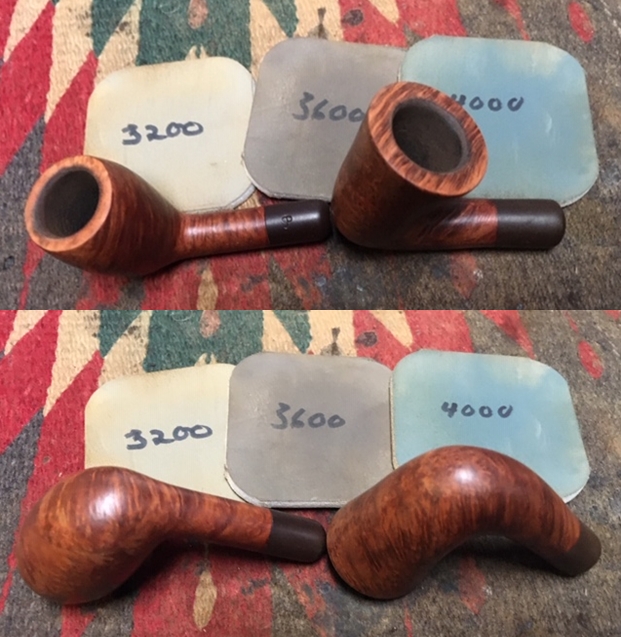
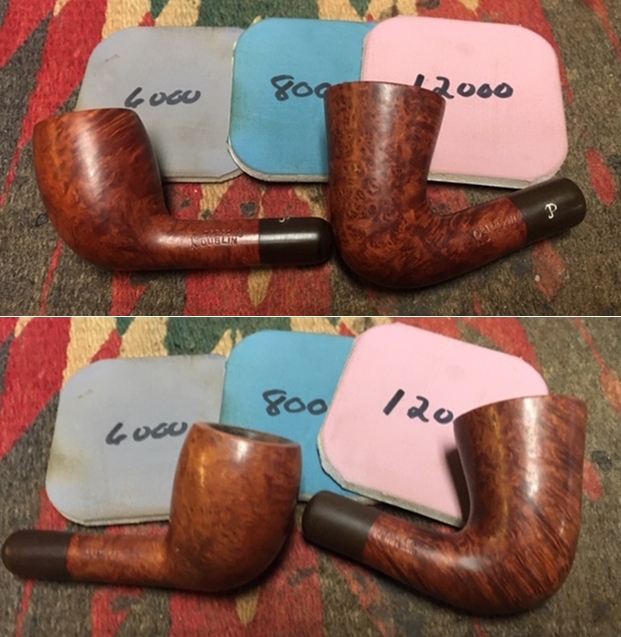
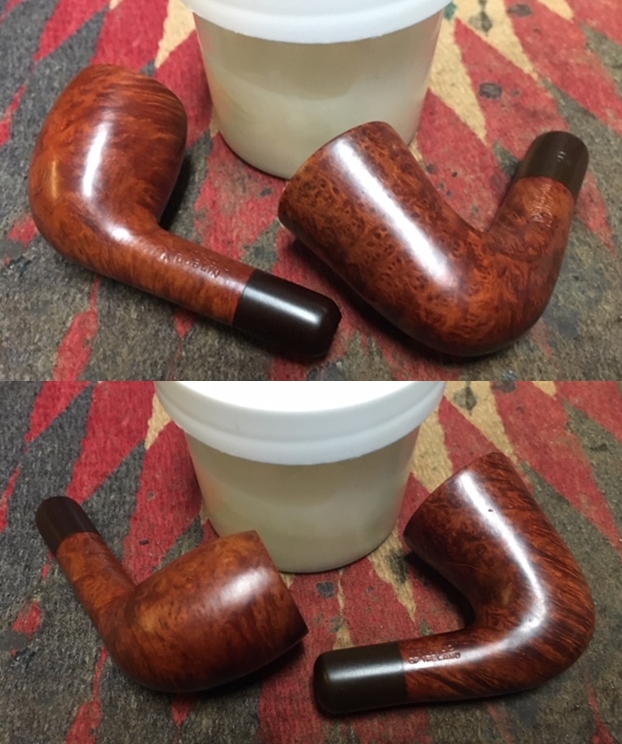
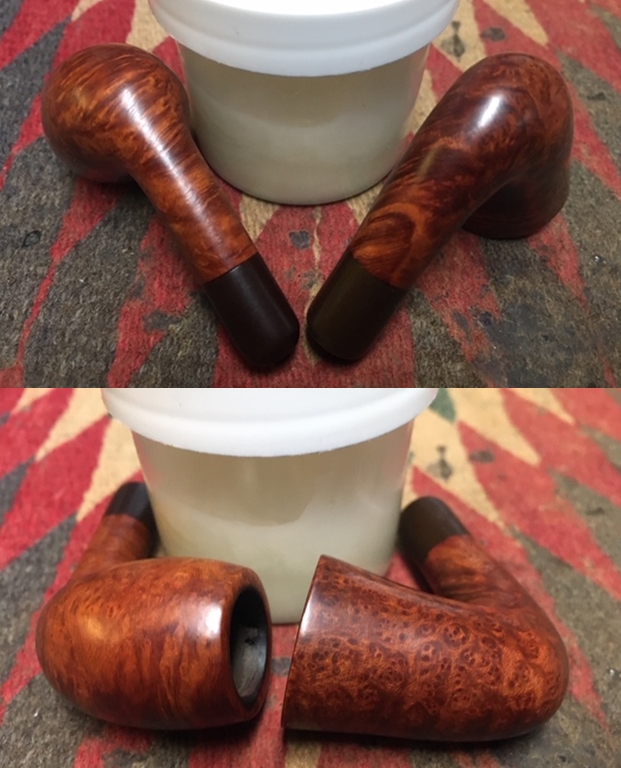
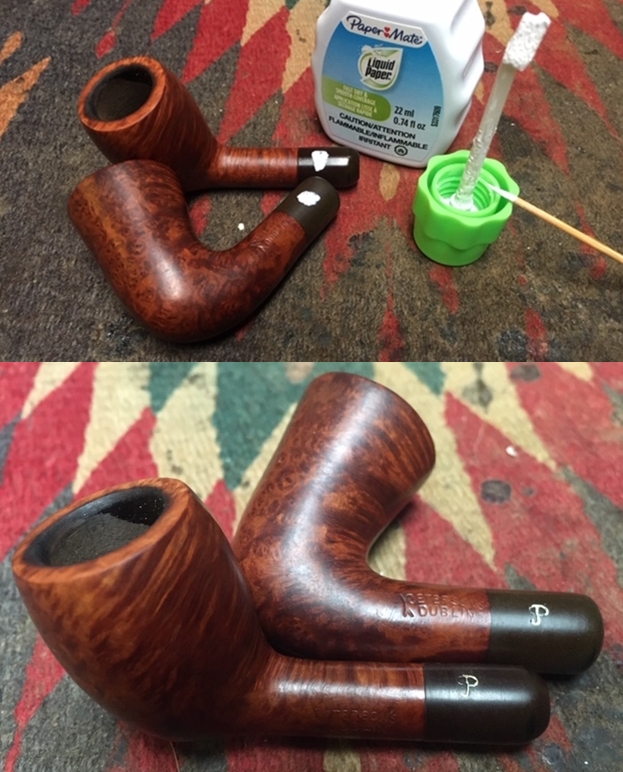
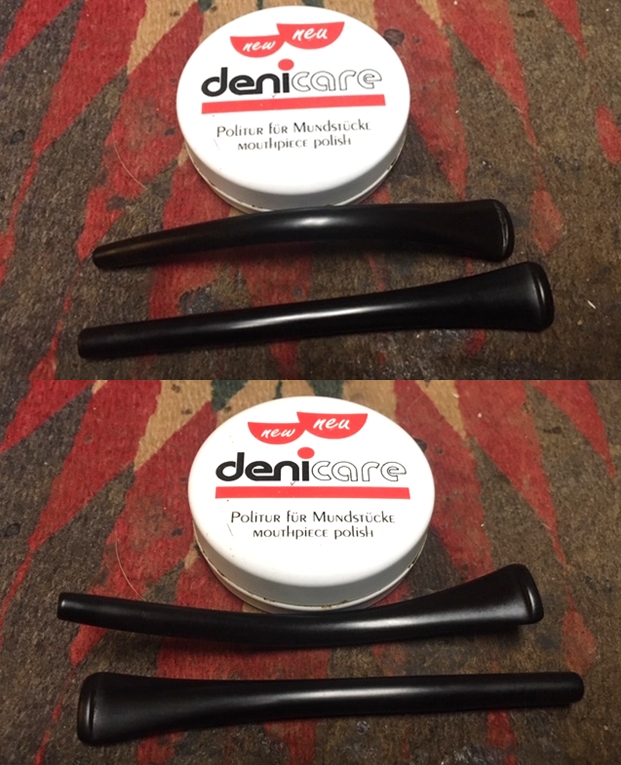
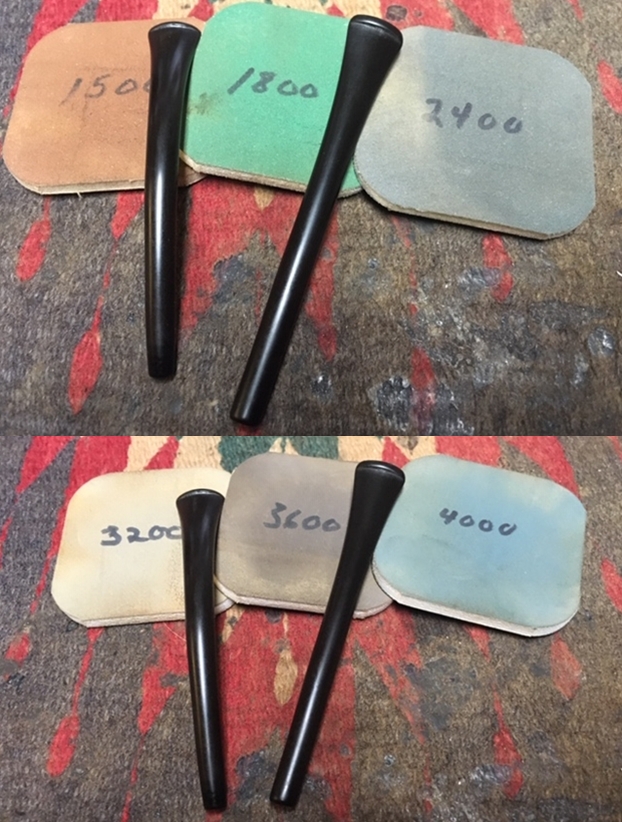
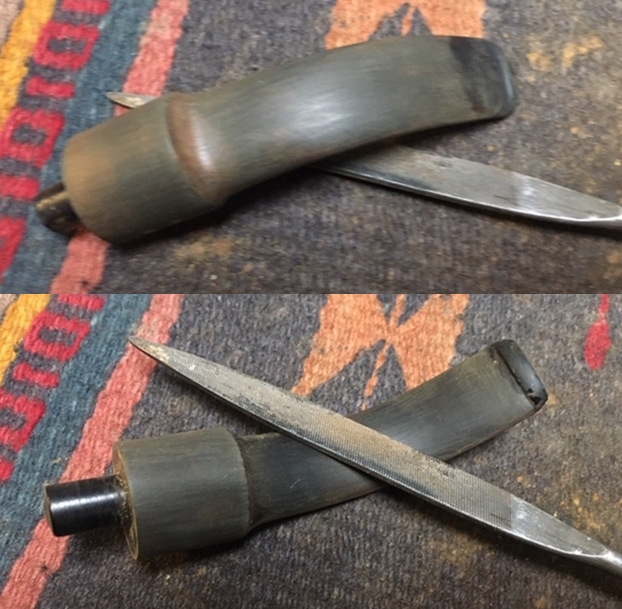
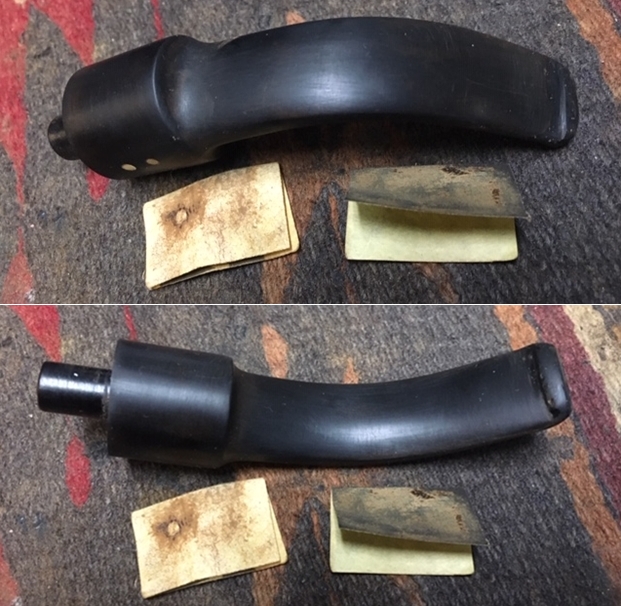
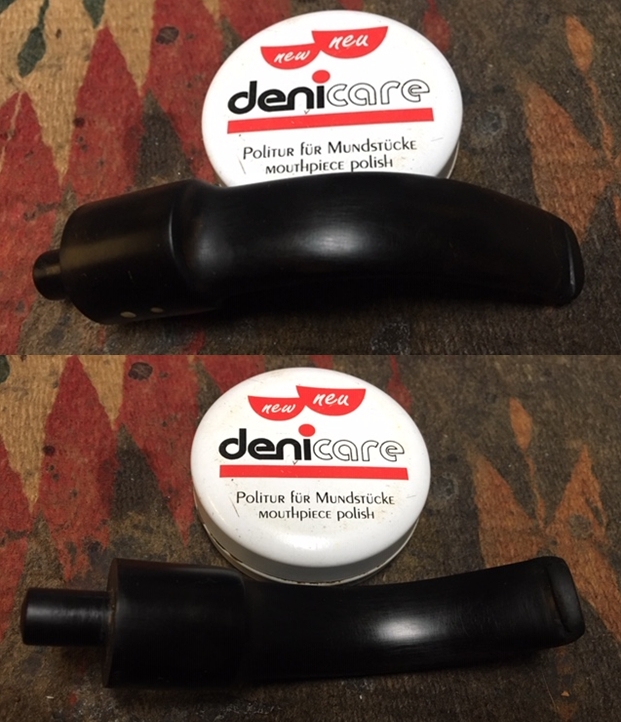
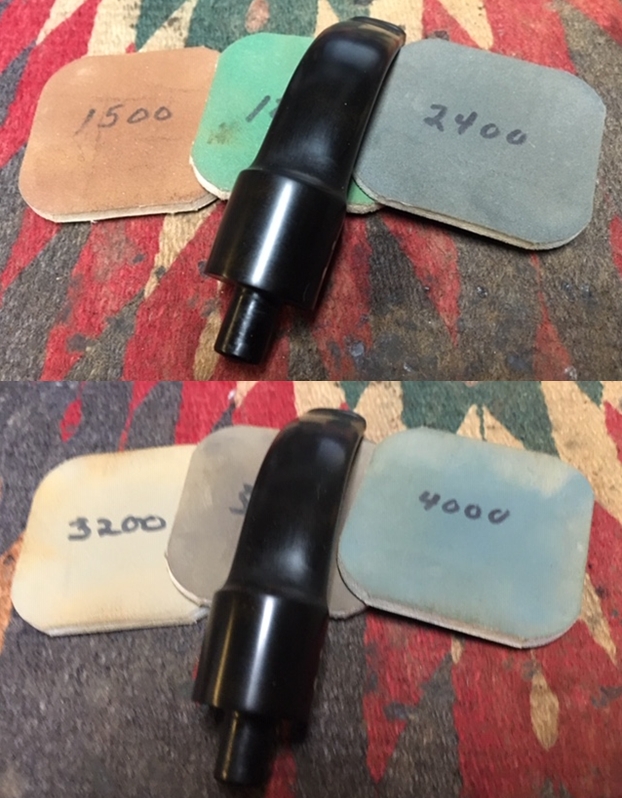
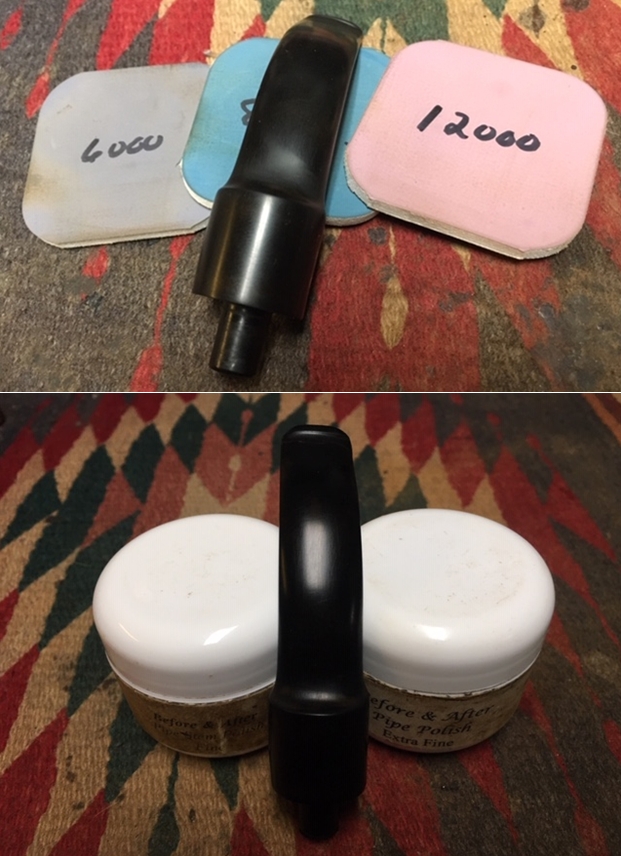
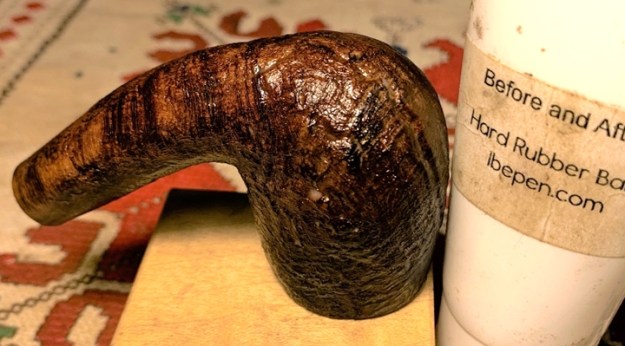
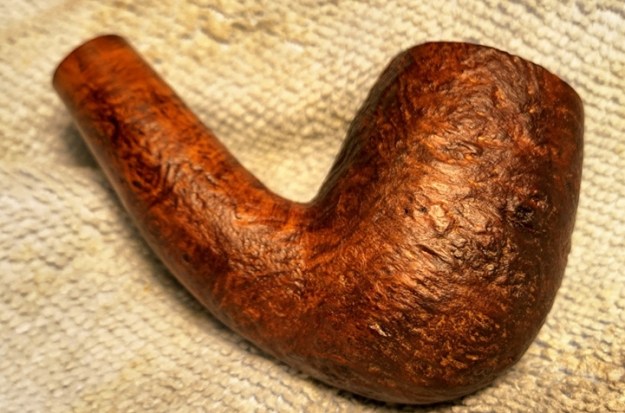
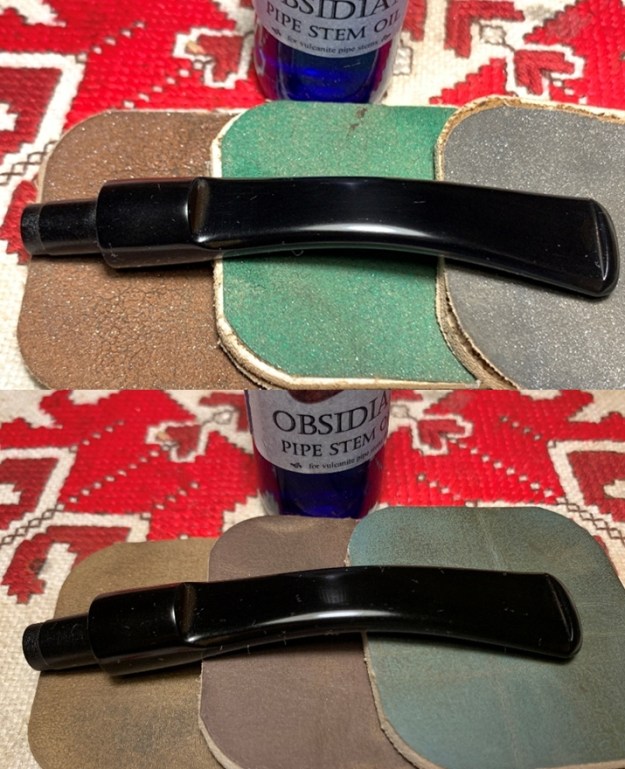
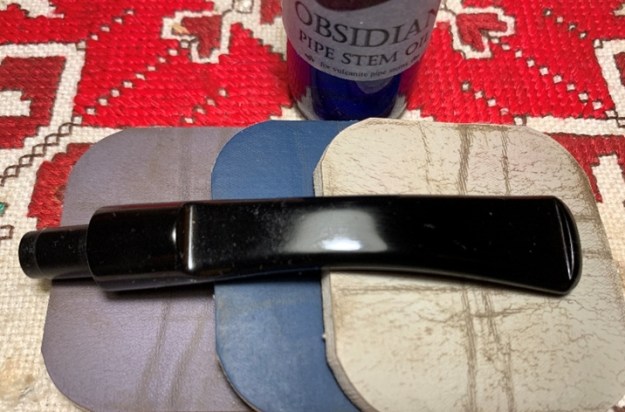
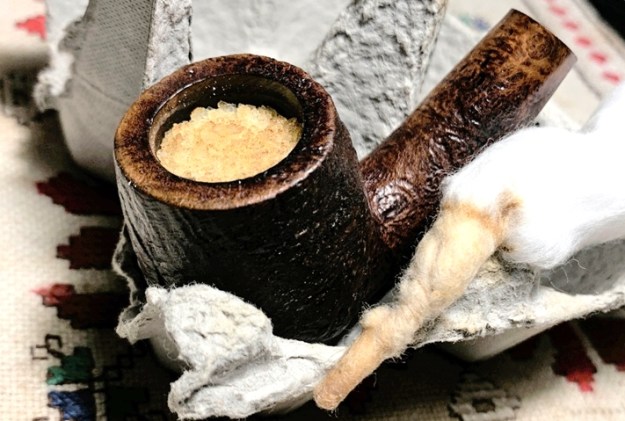
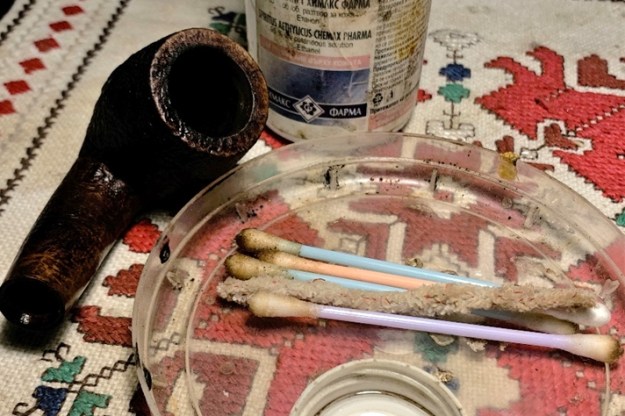
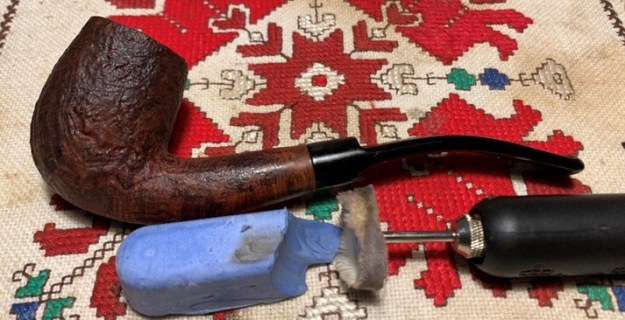
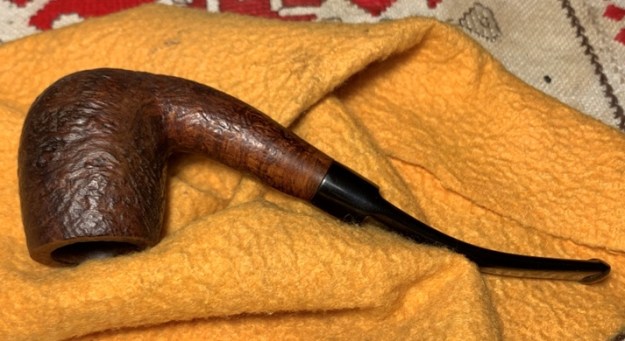
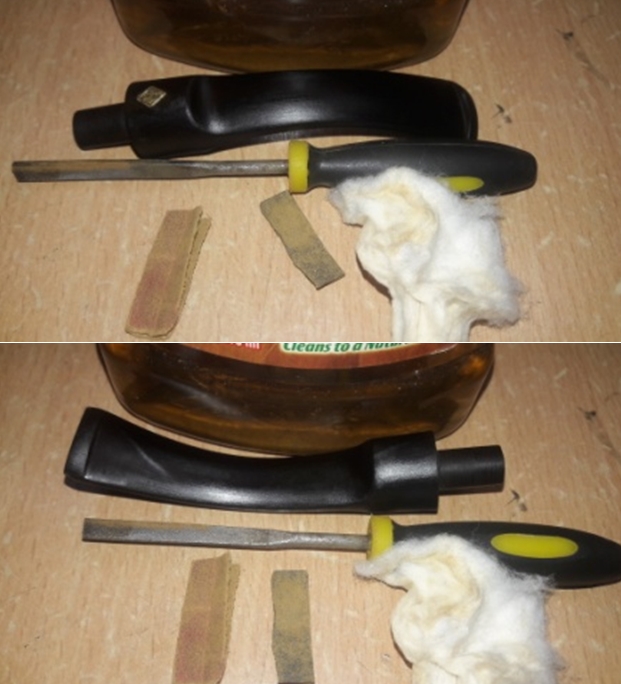
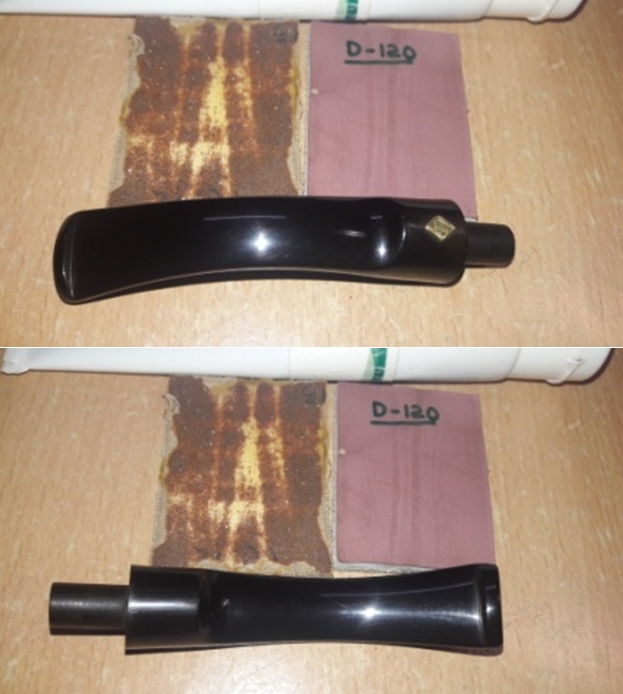
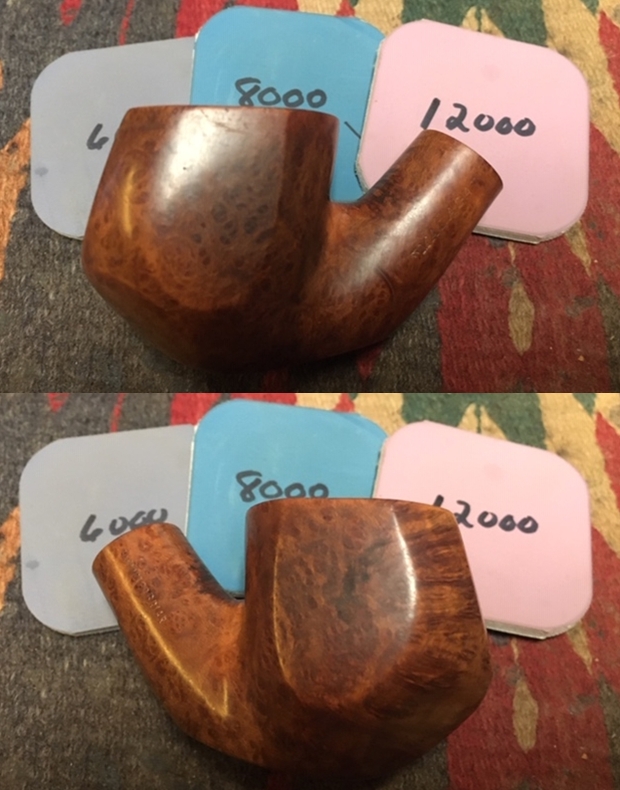
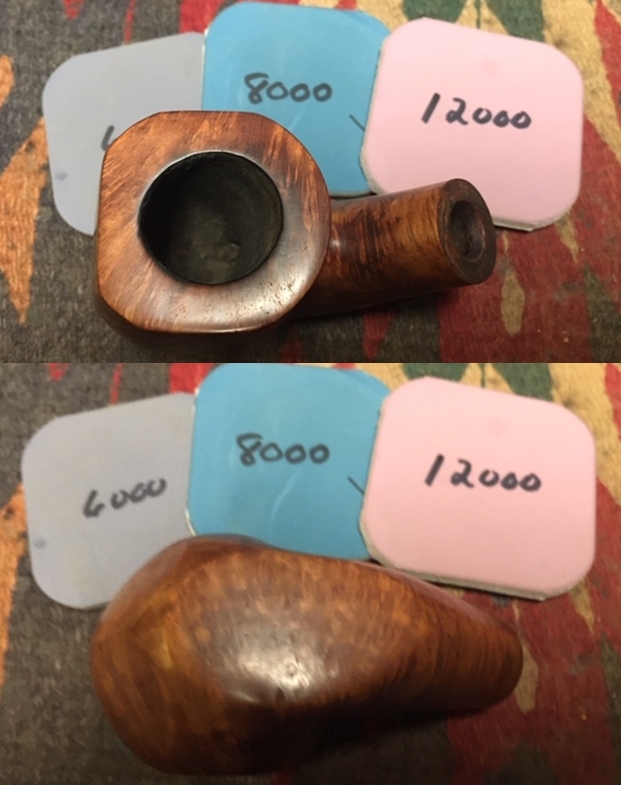
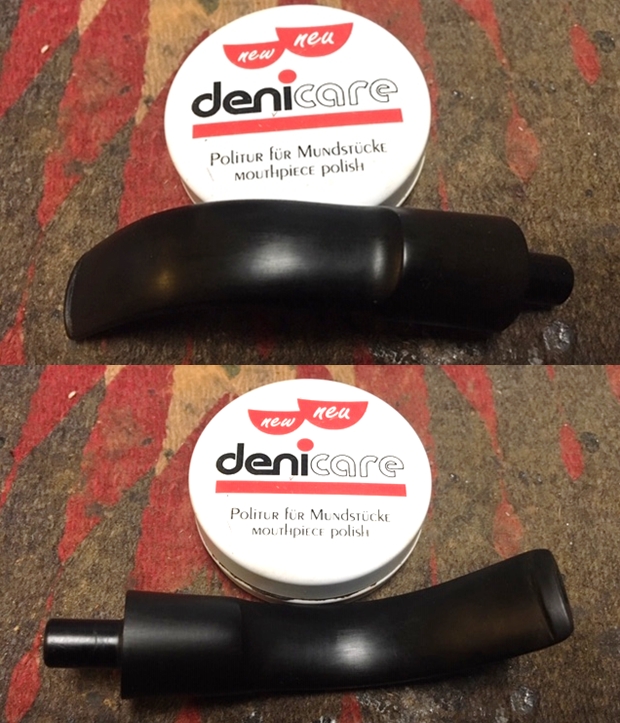
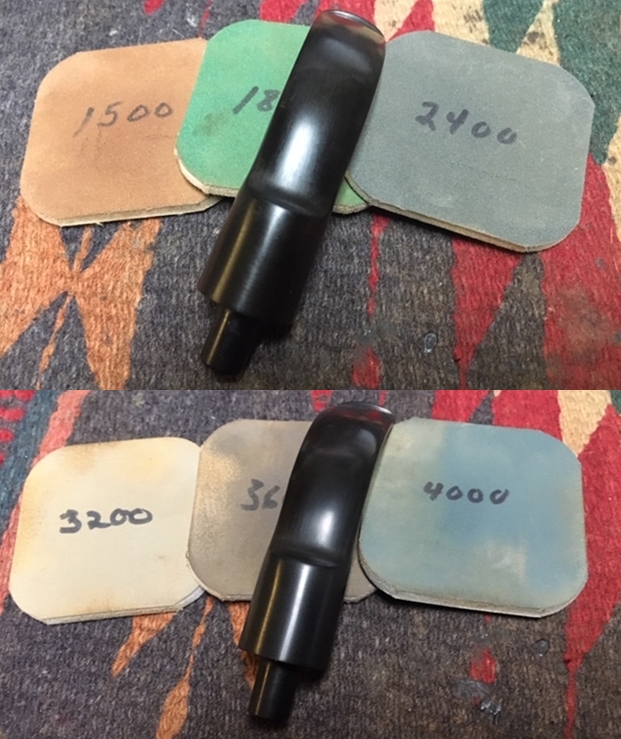
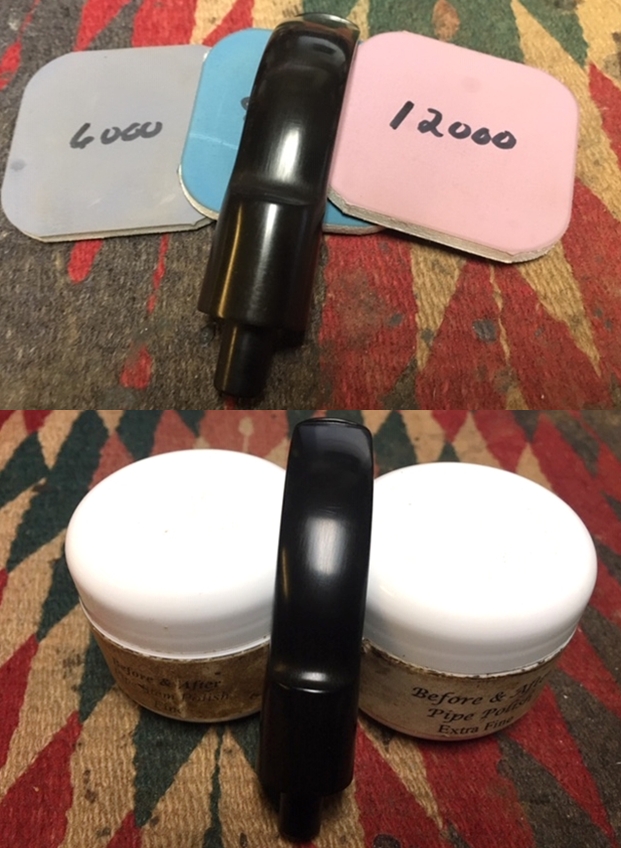
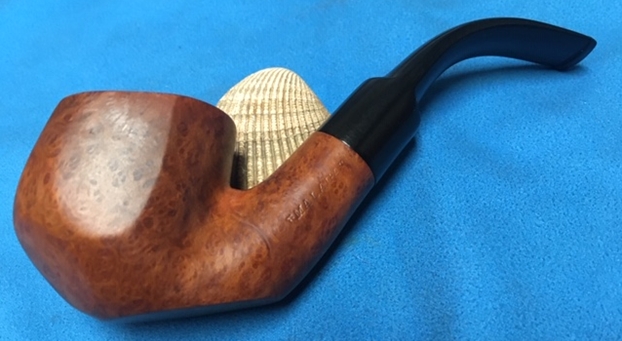
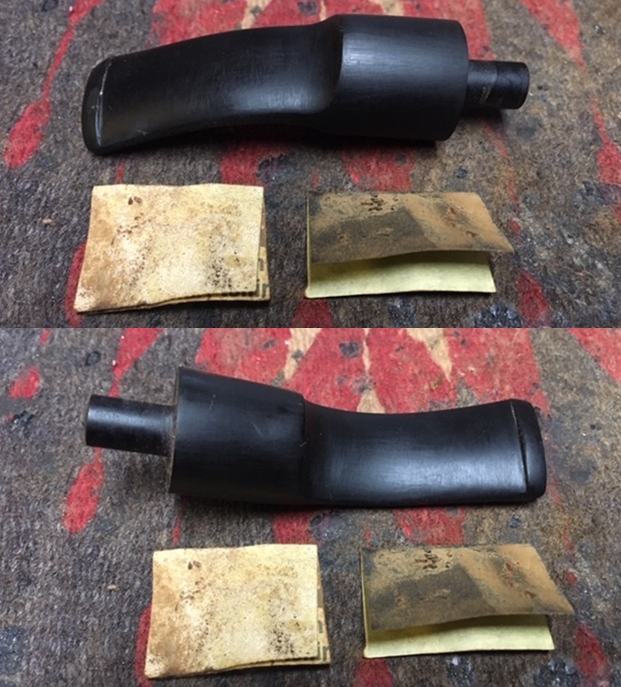
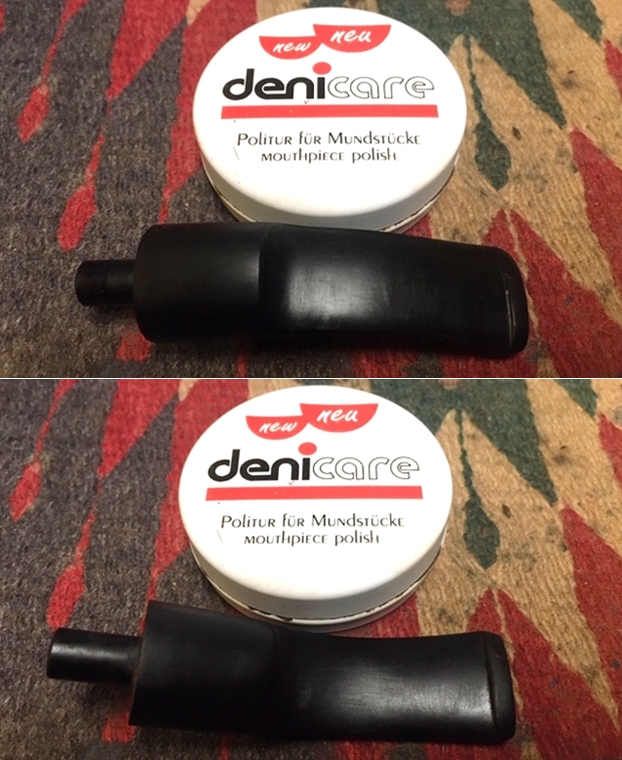
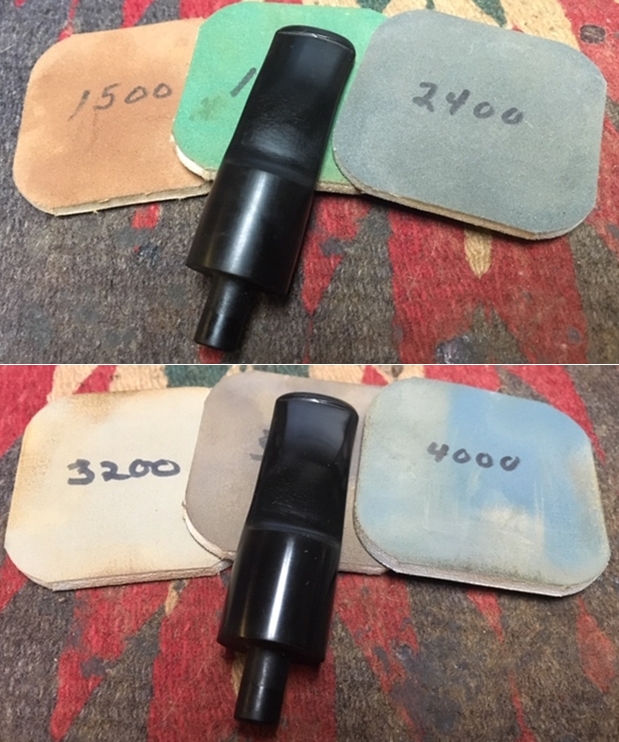
I started working on the pipes by cleaning up the rim top and the inner edge on the bowl of both of them. I used a folded piece of 220 grit sandpaper to clean off the rim darkening. I used the folded edge to clean up the inner edge. I was able to bring the bowl back into round. I polished it with 400 grit wet dry sandpaper to take out the scratches. The rim tops were looking really good.   I polished exterior of the bowl and the vulcanite shank extensions with micromesh sanding pads – wet sanding with 1500-12000 grit pads. I wiped it down with Obsidian Oil after each sanding pad to wipe of the dust and polish it. I rubbed the bowls down with Before & After Restoration Balm. I worked it into the briar and into the vulcanite shank extension to preserve, protect and enliven it. I let it sit on the surface of the bowls for about 10 minutes and then buffed the pipe with a cotton cloth. The photos tell the story. These pipes had some stunning grain on the bowls. I polished the vulcanite shank extensions with Denicare Mouthpiece Polish from a tin of it I have in the drawer here. It is a gritty red paste that I rub on with my finger tips and work into the surface of the stem and button and buff off with a cotton pad. It gives me a bit of a head start on the polishing work plus I have a tin to use up! I touched up the “P” stamp on the shank extensions with PaperMate liquid paper. I filled in the stamping with the liquid applying it with a dauber and a tooth pick. Once it dried I rubbed it off with a cotton cloth. The second  photo shows the stem before the polishing on the buffing wheel.I polished the stem with Denicare Mouthpiece Polish from a tin of it I have in the drawer here. It is a gritty red paste that I rub on with my finger tips and work into the surface of the stem and button and buff off with a cotton pad. It gives me a bit of a head start on the polishing work plus I have a tin to use up!I polished the stem with micromesh sanding pads – wet sanding with 1500-12000 grit sanding pads. I wiped it down after each sanding pad with Obsidian Oil. I polished it with Before & After Pipe Stem Polish – both Fine and Extra Fine and buffed it off with a final coat of Obsidian Oil. This pair of Peterson’s Speciality Pipes is a great addition. The Belgique and the Calabash shapes are classic in every way. They are petite, lightweight and comfortable in the hand. They will be a short smoke. The briar is beautifully grained and the black vulcanite military/stick Fishtail stems go well with the briar and the vulcanite shank extension. I polished stems and the bowls with Blue Diamond polish on the buffing wheel. I gave the bowls multiple coats of stems multiple coats of carnauba wax. I buffed the pipes with a clean buffing pad to raise the shine. I hand buffed them with a microfiber cloth to deepen the shine. The pipes polished up pretty nicely. The rich stained briar on both bowls took on life with the buffing. The rich brown colour of the briar bowls work well with the polished vulcanite stems. The finished pipes have a rich look that is quite catching. Have a look at it with the photos below. The shape, finish and flow of the pipe and stem are very well done.

The dimensions of the Belgique are Length: 6 inches, Height: 1 ½ inches, Outside diameter of the bowl: 1 inches, Chamber diameter: 9/16 of an inch. The dimensions of the Calabash are Length: 5 ½ inches, Height: 1 ¾ inches, Outside diameter of the bowl: 1 1/16 inches, Chamber diameter: 9/16 of an inch. I am pleased with how the pipes turned out. They look very good and show some signs of age. I am uncertain of the dates on either of them but am pretty sure they hold some age. I send my appreciation to Ray for these pipes. I think that these two will stay with me for a while and I will have to at least give them a smoke. We shall see what the future holds for them. Thanks for reading the blog.


New Life for Alex’s Rusticated “Malaga” Oom Paul


Blog by Steve Laug

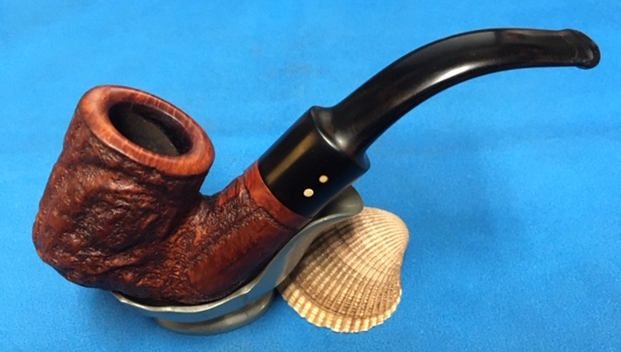
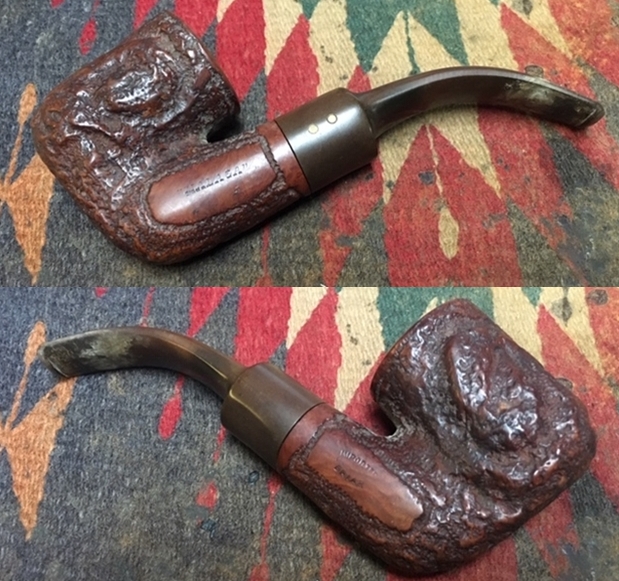
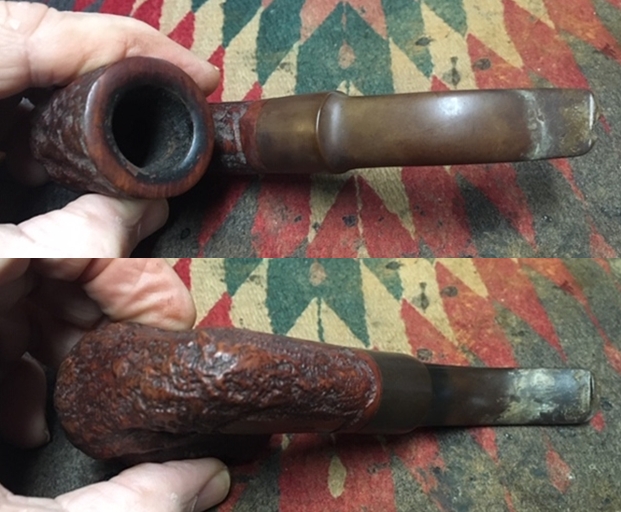
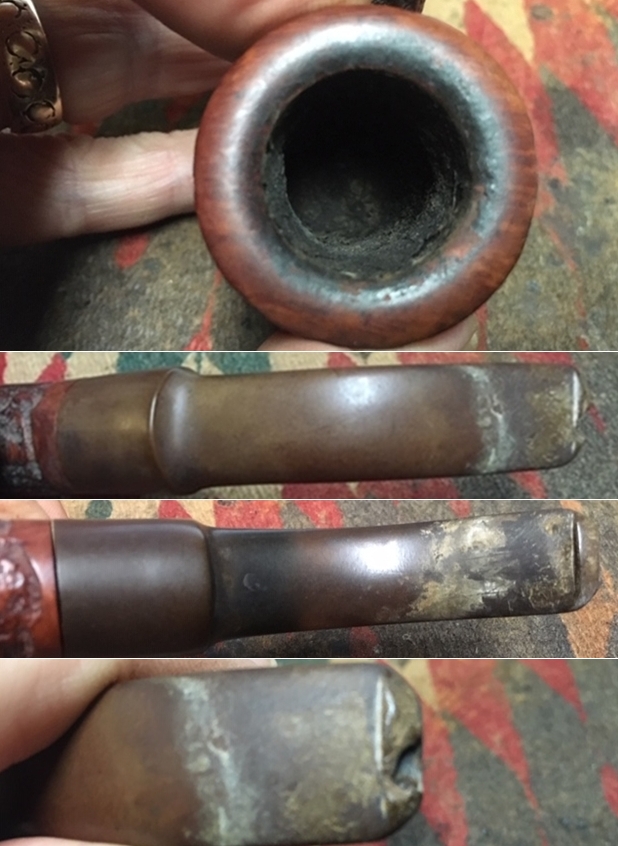
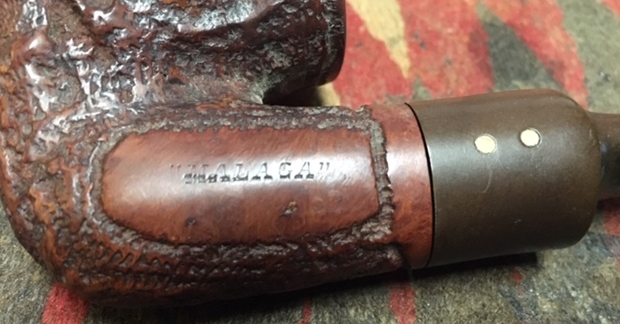
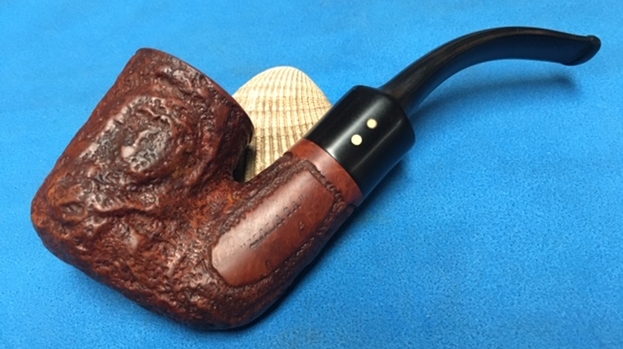
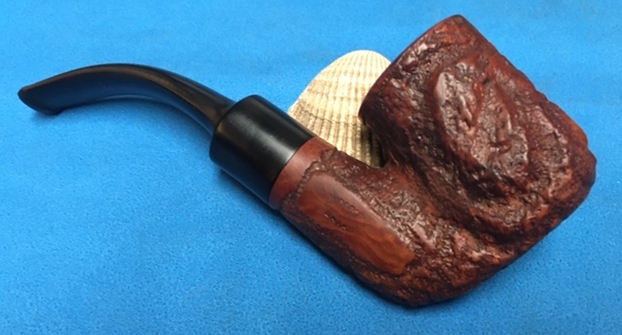
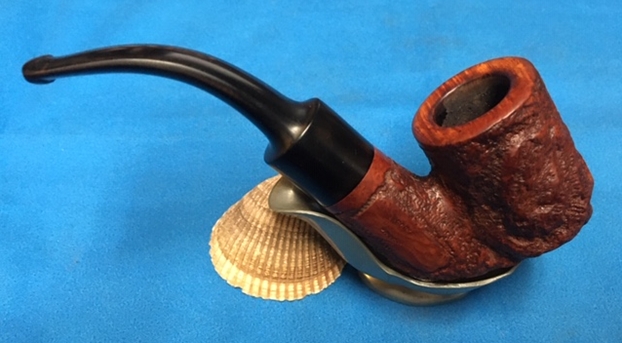
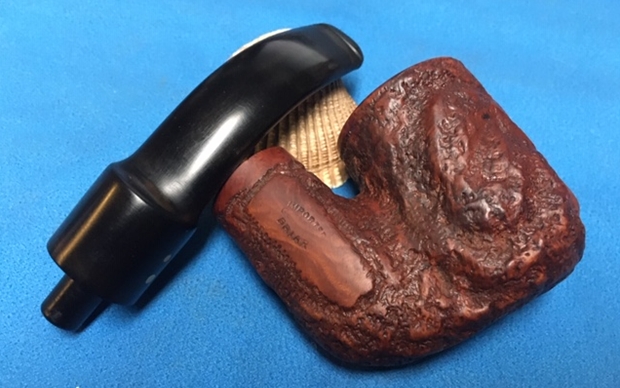
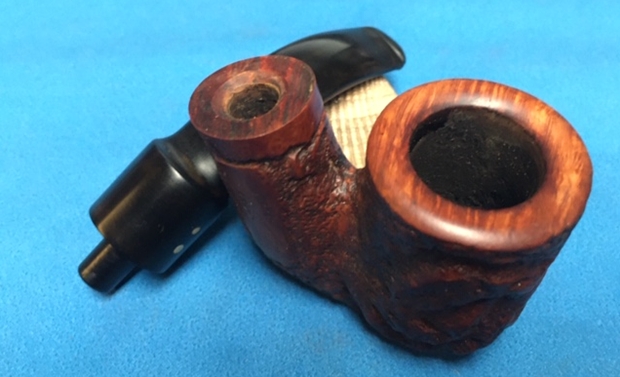
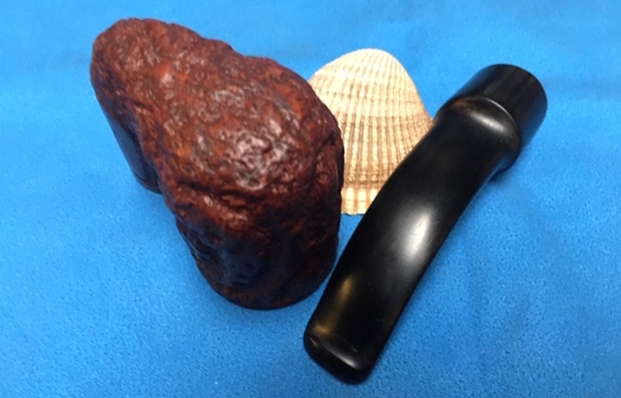
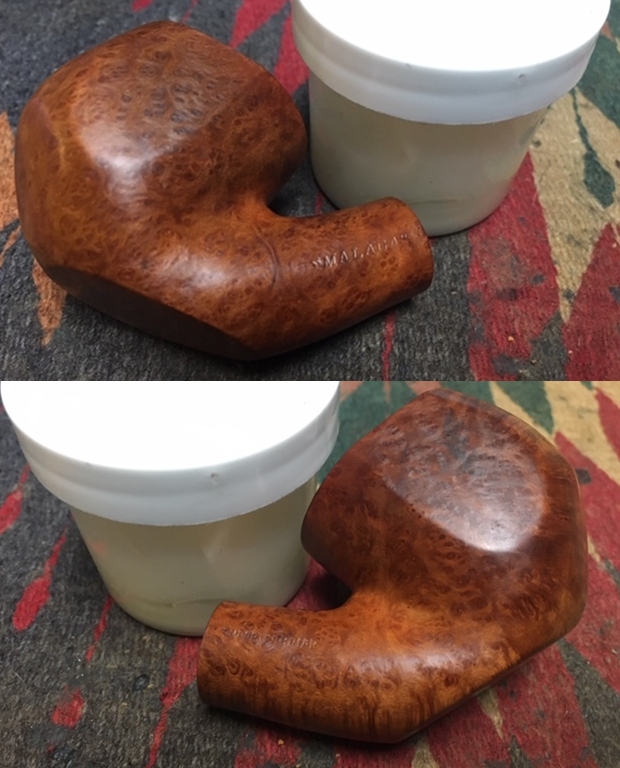
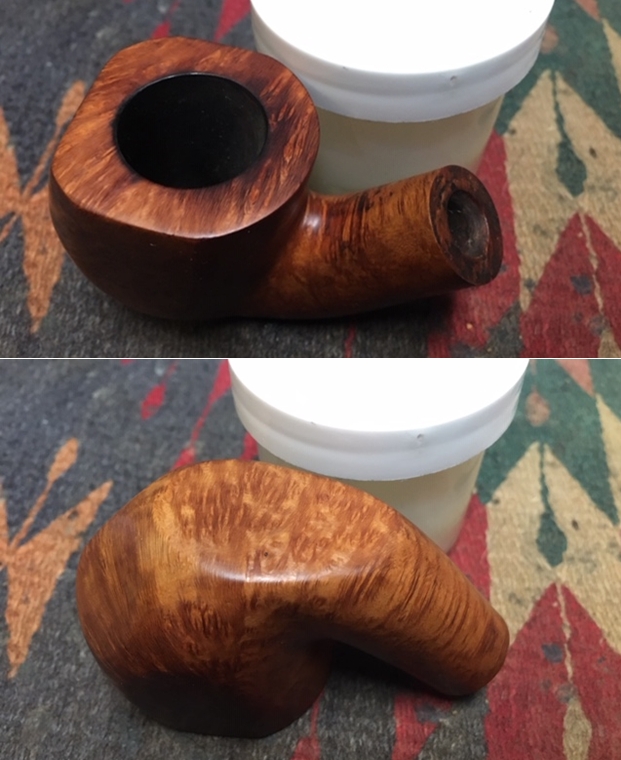
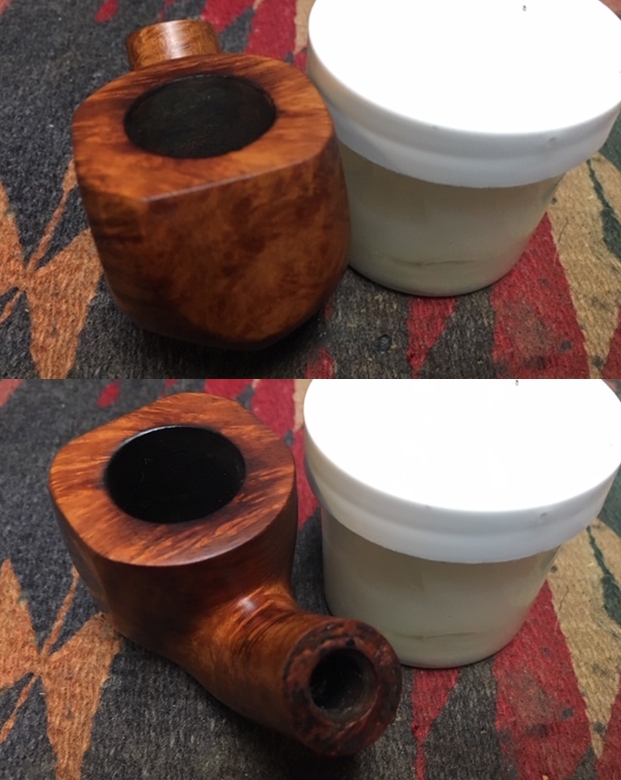
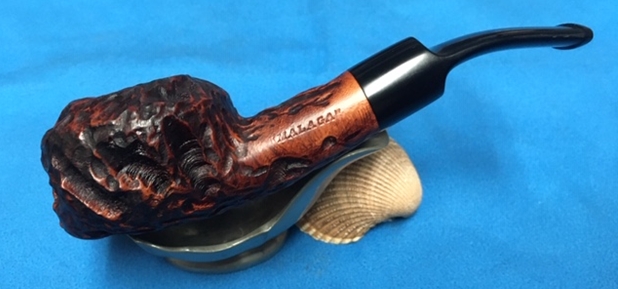
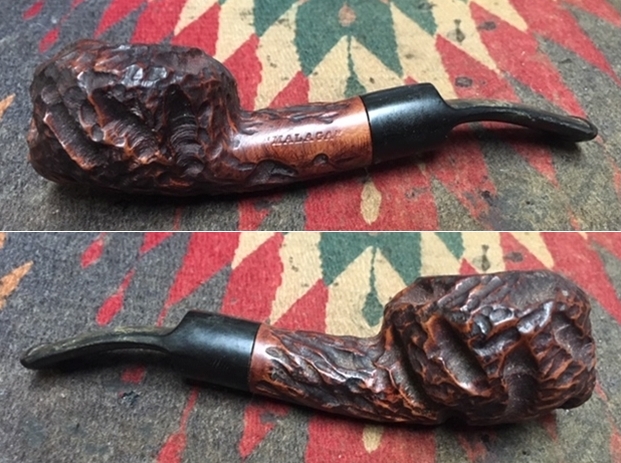
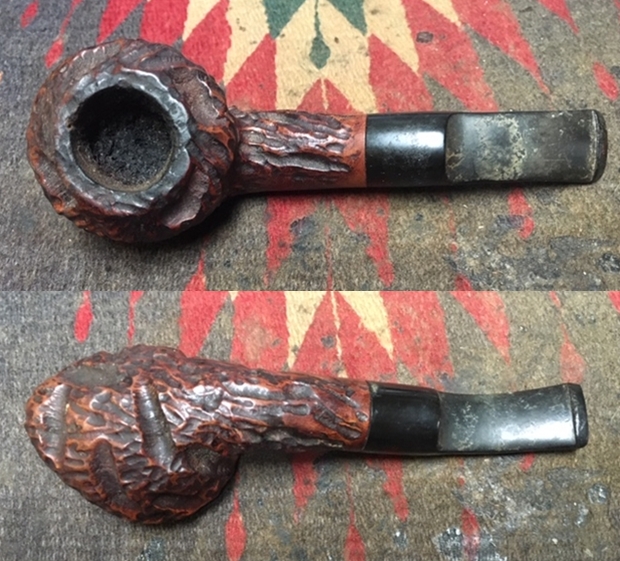
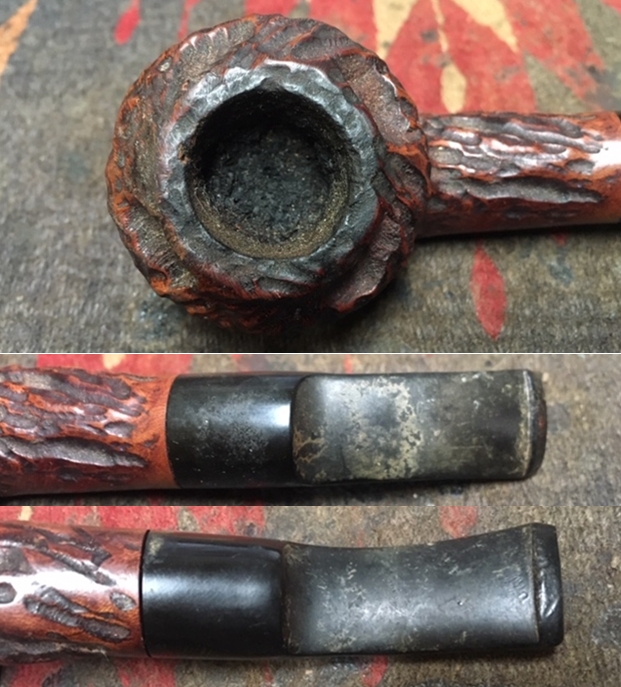
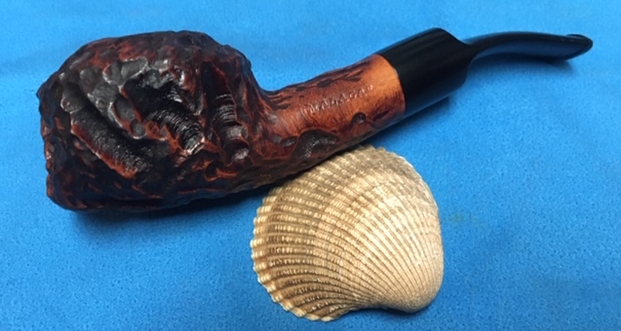
I have another of Alex’s purchases on the table this morning. It is an Oom Paul pipe with a rusticated finish. It is another very unique Malaga that has the same kind of rustication as a lot of the Custom-Bilt pipes had as well. The rim top, the ring around the shank end and a panel on each side of the shank are smooth. The pipe was dirty and caked with few spots of lava and some darkening on the inner edge of the bowl. The bowl had a thick rough surfaced cake. The exterior was dirty with grime and oils in the crevices of the finish. The stamping on the left side of the shank read “MALAGA” and the right side the stamping was in an oval and read Imported Briar. There appears to be something else in the oval but it is worn. The first two letters could be CA the rest are worn away. The vulcanite saddle stem had two dots on the left side of the stem. It was oxidized and had tooth marks and chatter on both sides. There was a chip out of the top edge of the button. I took photos of the pipe before I started the cleanup work. I took close up photos of the bowl and rim to capture the condition of the pipe before I started my cleanup work. The rim top had some lava and it was thick enough that I could not see if there was any darkening or damage on the crowned rim top and the inner edge. There was a thick cake in the bowl. Other than being very dirty the pipe was in great condition. The stem was dirty and oxidized. It was covered with a thick scum on the surfaces. There was tooth chatter on the top and underside near the button and some tooth marks on the button surface itself. There was a large chunk out of the top of the button on the stem. I have included a close up photo of the chipped stem surface below.I took a photo to capture the stamping on the shank. The stamping on the left side of the shank read “MALAGA”. I forgot to take a photo of the stamping on the right side the stamping but it was in an oval and read Imported Briar. There appears to be something in the center of the oval but it is worn. The first two letters could be CA the rest is worn away. It would make sense that this was one of the pipes from the “MALAGA” CARVED line so the rest of the letters may well be RVED. There were also two white dots on the left side of the saddle stem.If this is the first of the Malaga restorations that you have read about then you should know the backstory of the brand. I am including the link to a blog that I wrote that gives some of the history of the Malaga brand and the Malaga Pipe Shop in Royal Oak, Michigan in the USA. I have written an earlier blog to give a little history of the Malaga Brand and the pipemaker, George Khoubesser. Here is the link – https://rebornpipes.com/tag/malaga-pipes/.That blog also includes links to a catalogue and the history of the pipemaker George Khoubesser. Follow the link to get a feel for the brand and the pipemaker.

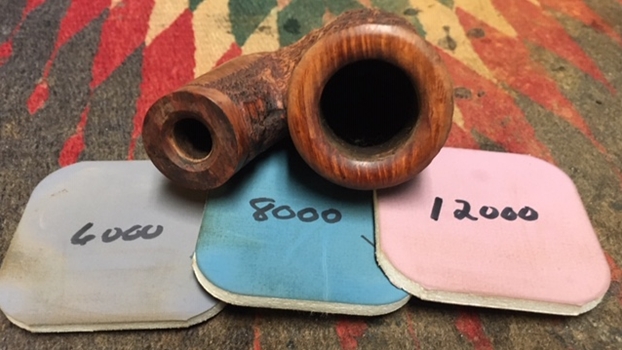
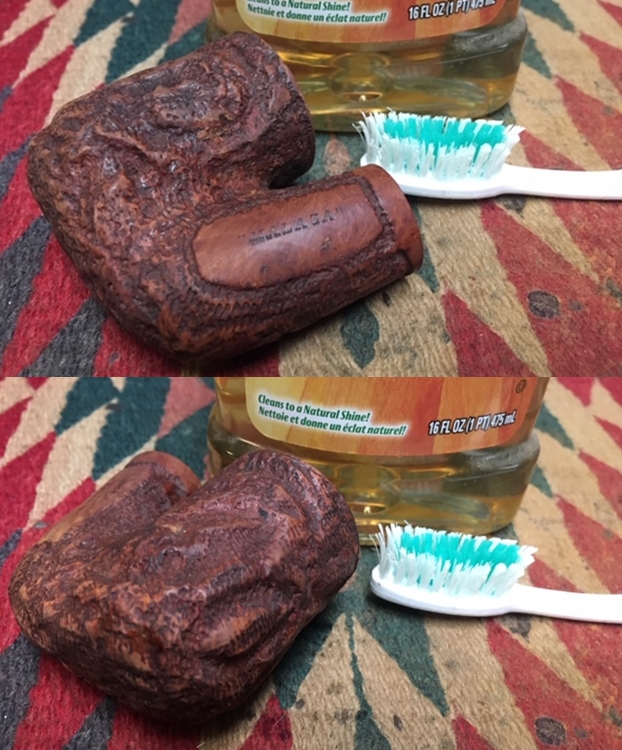
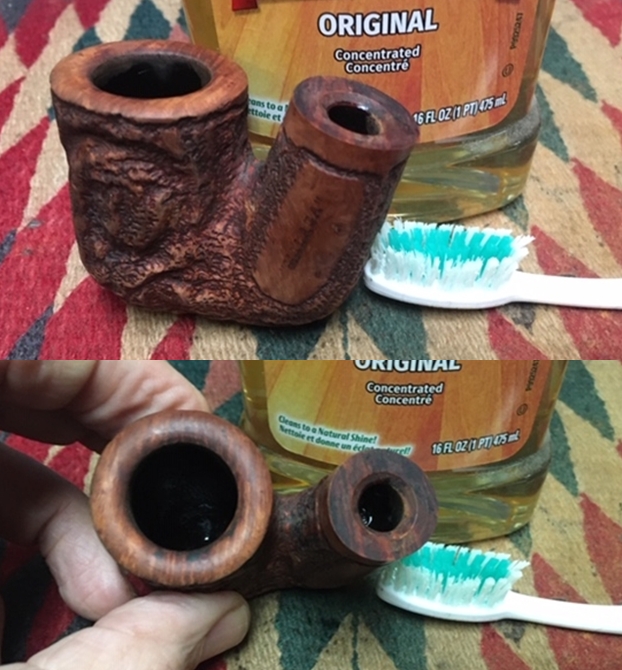
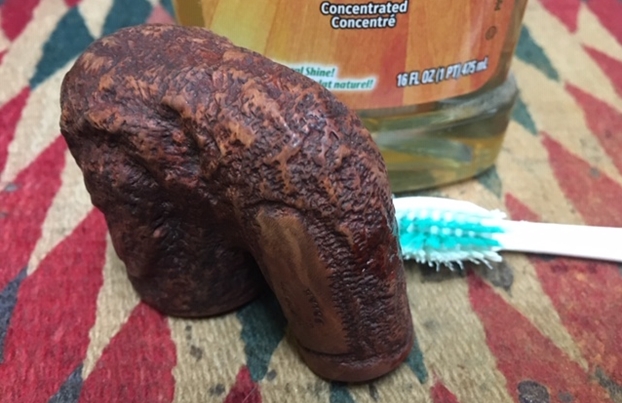
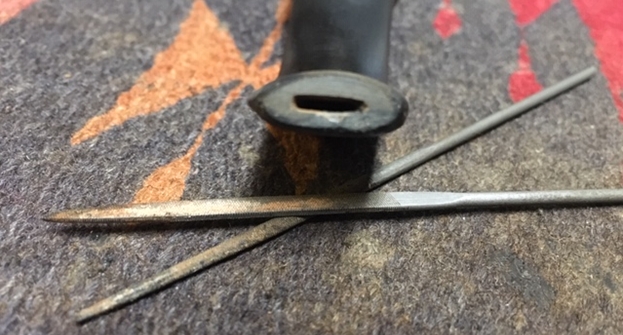
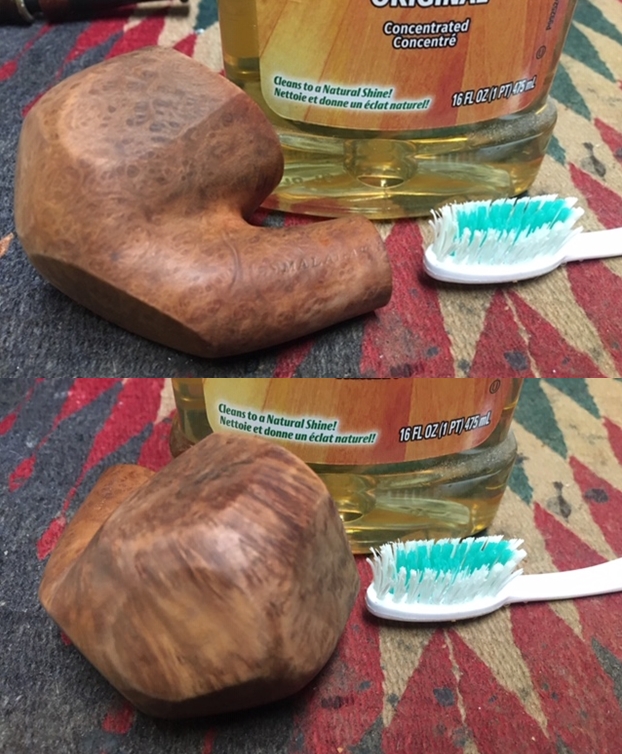
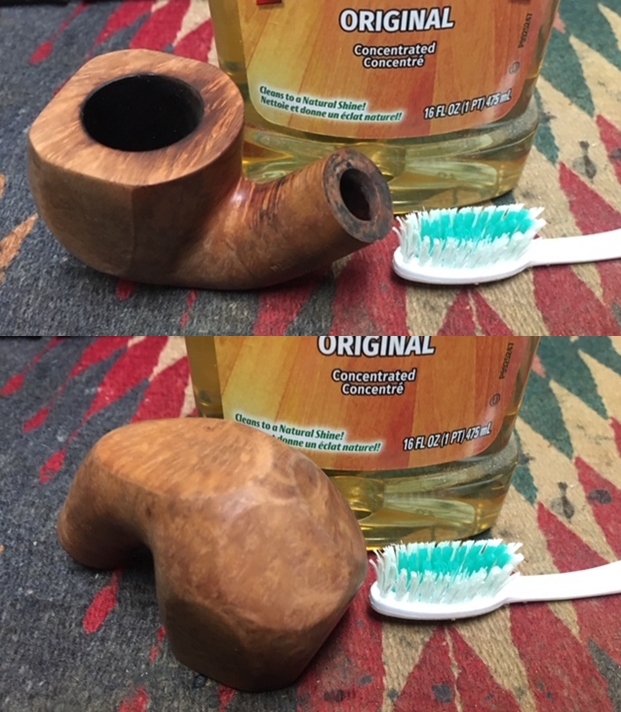
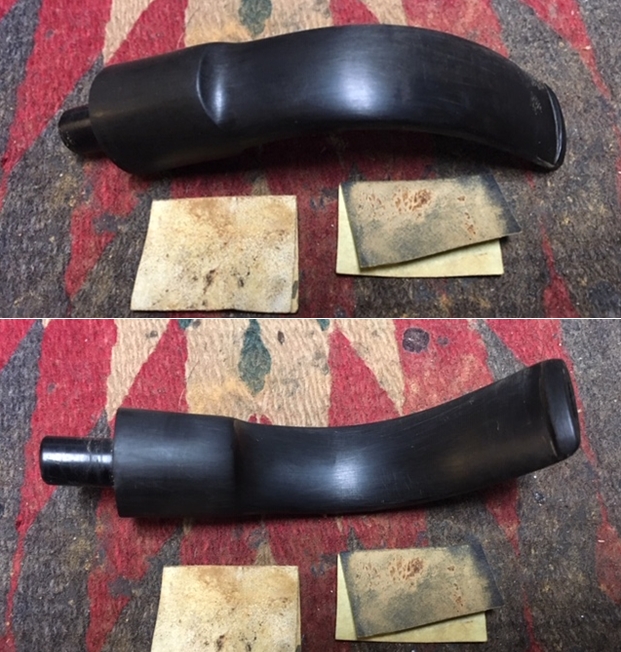
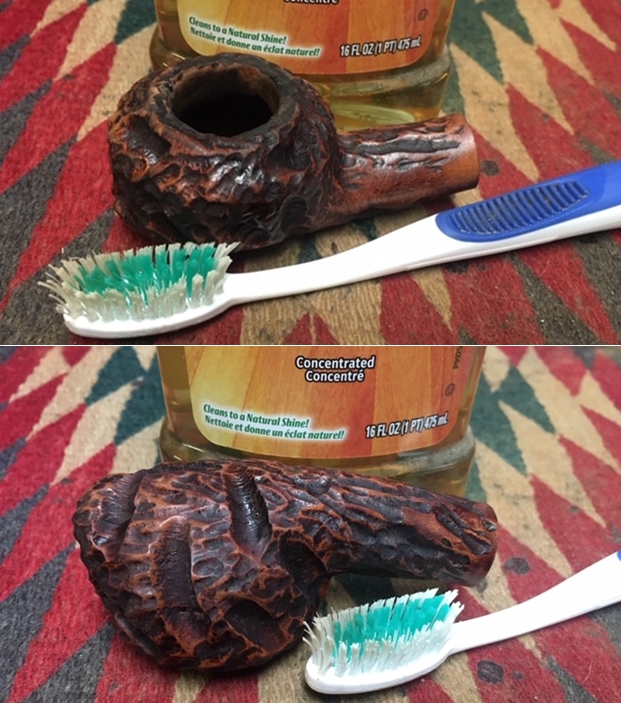
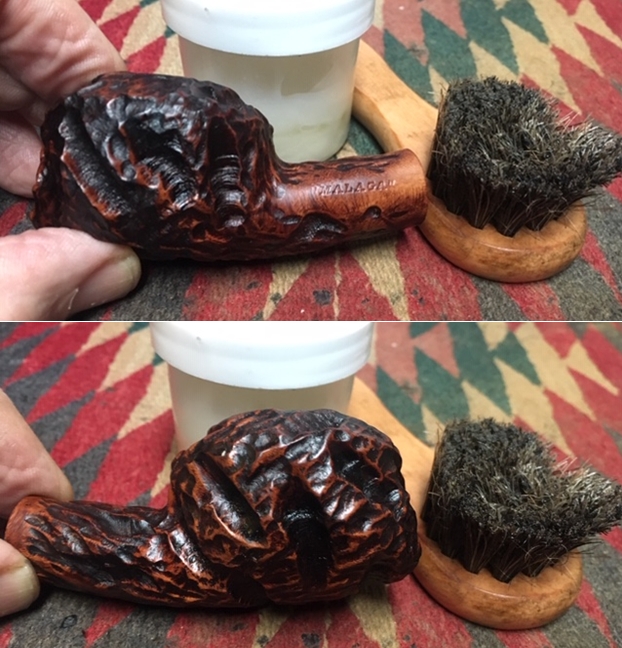
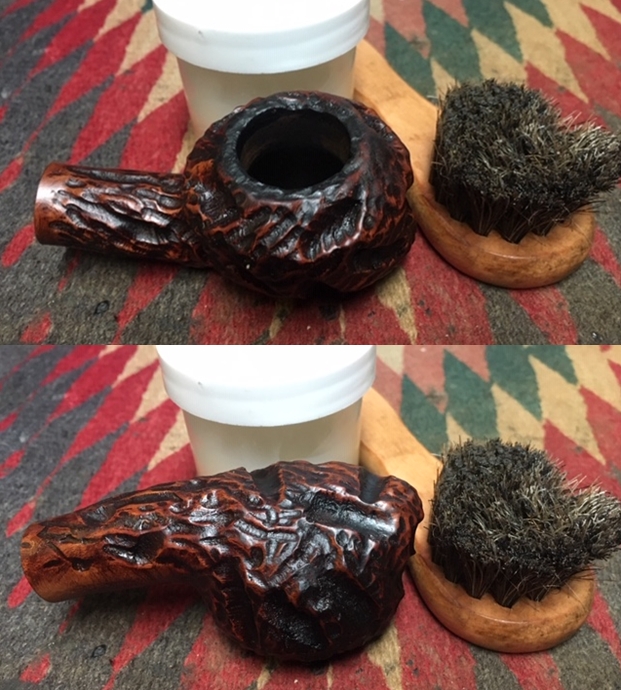
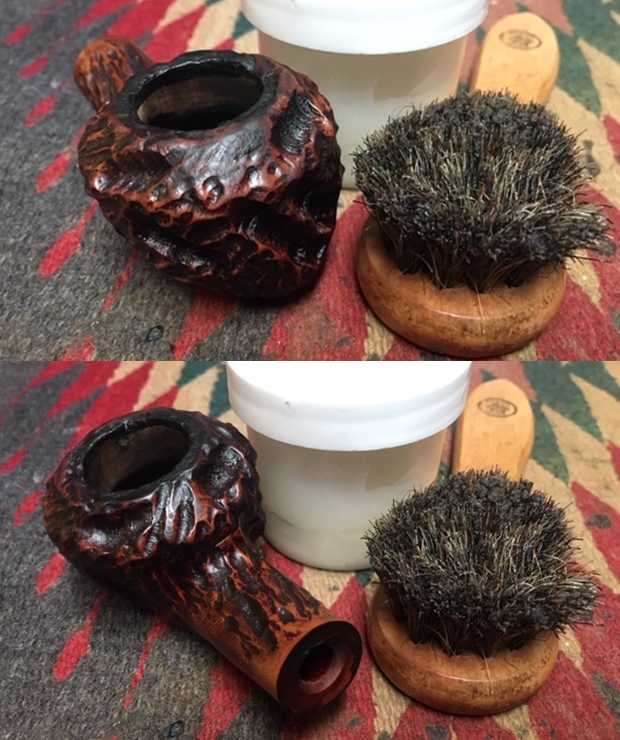
I decided to start with the bowl first. I followed Jeff and my regular regimen for cleaning estates. I reamed the thick cake in the bowl with a PipNet Pipe Reamer using the third size of cutting heads to take the cake back to bare briar. I followed up with a Savinelli Fitsall pipe knife to remove the slight remnants of cake toward the bottom of the bowl. I sanded the bowl with 220 grit sandpaper wrapped around a piece of dowel to smooth out the inside walls of the bowl.The mortise was surprisingly clean but there were some tars and oils on the walls. I scrubbed the mortise and the airway in the shank and the stem with alcohol, cotton swabs and pipe cleaners.I polished the smooth rim top and the ring around the end of the shank with micromesh sanding pads – wet sanding with 1500-12000 grit sanding pads. I wiped down the bowl after each sanding pad with a damp cloth. The polishing took the remainder of the bit of lava that had remained after the cleanup. I scrubbed the briar with Murphy’s Oil Soap with a tooth brush. I scrubbed it off under running water to remove the soap and the grime on the bowl. I dried it off with a soft cloth. I worked some Before & After Restoration Balm into the surface of the briar with my fingertips and a horsehair shoe brush to clean, enliven and protect it. I let the balm sit for a little while and then buffed with a cotton cloth to raise the shine. The photos show the bowl at this point in the restoration process. I set the bowl aside and turned my attention to the stem. I took a photo of the stem before I started my work on it. I cleaned it with alcohol and sanded off the calcification and oxidation on the surface. Once it was cleaned I mixed up a batch of activated charcoal powder and black super glue. I greased a pipe cleaner with Vaseline and inserted it in the button. I used a dental spatula to fill in the missing chunk of vulcanite. Once it had hardened a bit I removed the pipe cleaner and set it aside to cure.I set it on a container to let the repair cure. Once it hardened I would need to reshape the button and the slot on the stem. I had also filled in the damage to the underside of the button. The reshaping would bring it back to the original shape.I shaped the button edges and surface with a needle file to remove the excess material on the repair. I still need to do some more sanding but the stem is shaping up to be quite nice. I still need to remove the oxidation on the surface but it is getting there.I sanded out the tooth chatter with 220 grit sand paper and started to polish it with a folded piece of 400 wet dry sandpaper. Once it was finished it the tooth chatter and oxidation was gone and it began to shine.I reshaped the slot in the button end with needle files to clean up the shape.I polished the stem with Denicare Mouthpiece Polish from a tin of it I have in the drawer here. It is a gritty red paste that I rub on with my finger tips and work into the surface of the stem and button and buff off with a cotton pad. It gives me a bit of a head start on the polishing work plus I have a tin to use up!I polished the stem with micromesh sanding pads – wet sanding with 1500-12000 grit sanding pads. I wiped it down after each sanding pad with Obsidian Oil. I polished it with Before & After Pipe Stem Polish – both Fine and Extra Fine and buffed it off with a final coat of Obsidian Oil. This is another interestingly shaped rusticated pipe in what I would call an Oom Paul shape. It has a black vulcanite saddle stem with two brass dots. The smooth rim top and shank end band look really good against the rustication. Everything about this one says that it was part of the “Malaga” Carved line of pipes. It has a great look and feel. The shape is very tactile and fits well in the hand. I polished stem and the bowl with Blue Diamond polish on the buffing wheel. I gave the bowl multiple coats of Conservator’s Wax and the stem multiple coats of carnauba wax. I buffed the pipe with a clean buffing pad to raise the shine. I hand buffed it with a microfiber cloth to deepen the shine. The pipe polished up pretty nicely. The rich oil cured briar took on life with the buffing. The rich brown colour of the briar works well with the polished vulcanite stem. The finished pipe has a rich look that is quite catching. Have a look at it with the photos below. The shape, finish and flow of the pipe and stem are very well done. The dimensions are Length: 6 inches, Height: 2 inches, Outside diameter of the bowl: 1 ½ inches, Chamber diameter: ¾ of an inch. I will be adding the pipe to the finished Malaga pipes that I have set aside for Alex. This will be a great addition to his collection of Malaga pipes. Thanks for walking through the restoration with me as I worked over another Malaga.

A Long-time Friend Commissions a Blasted French GBD Sablée Standard Bent Billiard


Blog by Dal Stanton

I’ve known Steve for 40 or so years – I’m not counting!  In our earlier years we shared the same pursuit of going to seminary in Jackson, Mississippi, where we shared many things in common.  We studied dusty but fascinating theological books, wrote papers for hopeful professors, studied Greek and Hebrew and we would do the occasional obligatory trips to fish for bass and hunt ducks when they were in season.  We were both relatively new in the business of being husbands and against all odds, we also became fathers during this time of stretching our minds and hearts to be better men before our God and to do what we could to make a difference in this world.  After seminary, Steve and his family and I and my family followed different paths yet, over the years we’ve been able to cross those paths here and there and generally stay in touch – at least every few decades or so.  Steve is a wood worker going way back – the serious kind that gets paid for it.  When he came across my avocation of restoring pipes by seeing my posts on Facebook, he reached out to me a few years back and kept threatening to commission a pipe or two.  Steve isn’t a big pipe smoker, but his last email to me to confirm the two pipes he commissioned, wrote these words his pipe collection:

“I bought a very cheap one in a kit and these will probably be all the ones I get. But knowing that it came from the work of your hands will be special to me and help out the ministry to boot.”

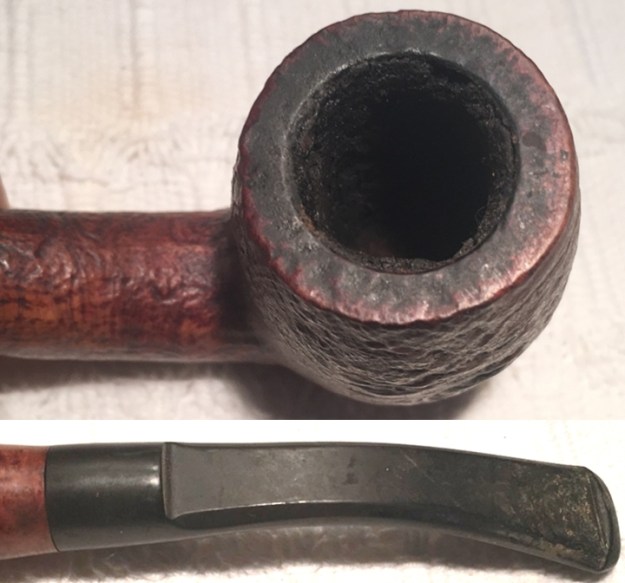
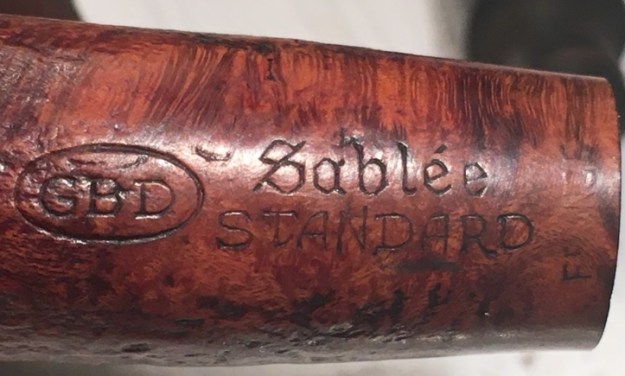
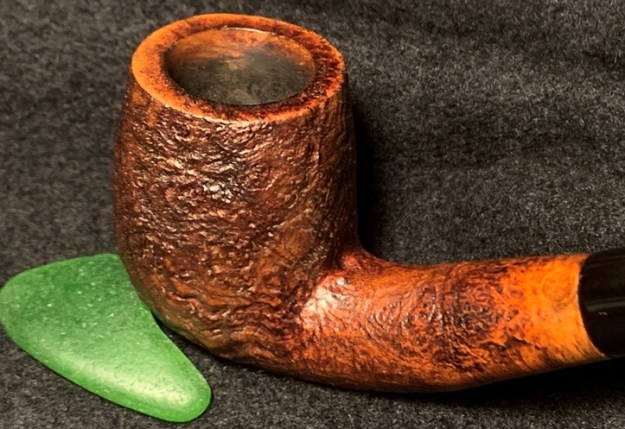
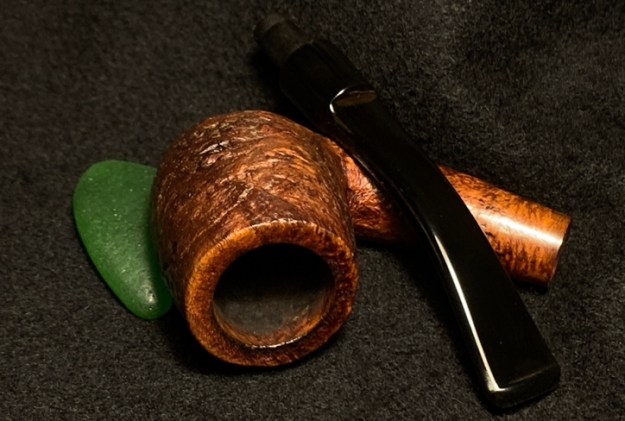
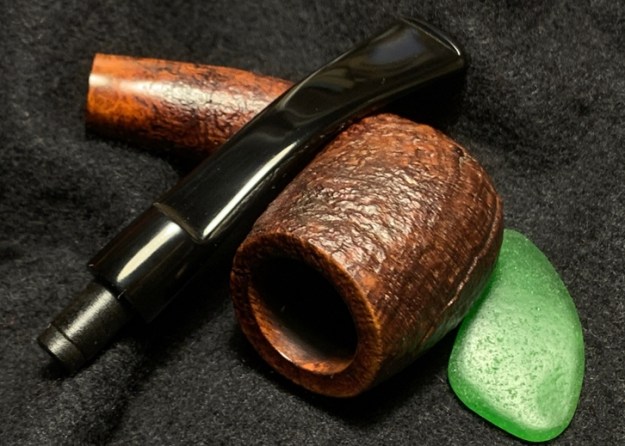
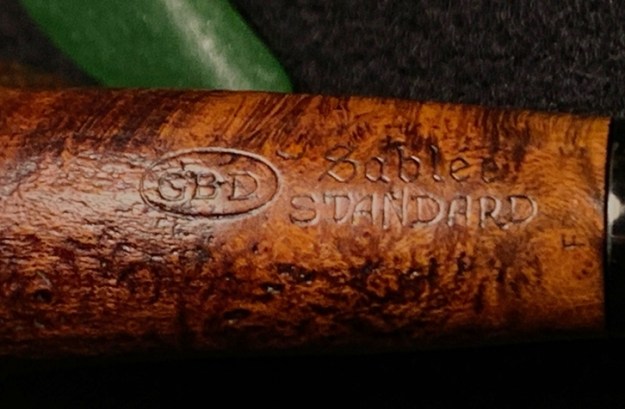
Friendship is a valuable thing, and I appreciate Steve’s desire to help the Daughters of Bulgaria – women and girls who have been trafficked and sexually exploited.  Steve commissioned a very nicely grained, honest to goodness American made iconic pipe, a Carey Magic Inch Straight Apple.  He also commissioned a continental pipe – a beautifully blasted GBD Sablée Standard long shank Bent Billiard.  Here are Steve’s commissioned pipes pictured when I first acquired them:The Carey Magic Inch came to me from another good friend, Dave Shane. I worked with Dave when he was a younger man in Ukraine, a pipe man and restorer himself (see: https://www.thepipery.com).  When I was in the US a few years ago I visited Dave and he gifted me a box of pipes that he hoped would benefit the Daughters of Bulgaria.  The Carey Magic Inch was in this offering.  The first pipe on my worktable is the GBD Sablée Standard which I acquired in what I have affectionately called, the Lot of 66, which I acquired on the eBay auction block a few years back.  This Lot of 66 has yielded many very nice collectable pipes and I’m honestly surprised that this Blasted GBD has remained this long waiting for someone to come along – a very nice pipe for Steve’s small, select collection. Here are more original pictures of the GBD: The nomenclature is found on the lower shank panel with a ‘GBD’ ensconced in the oval.  To the right is ‘Sablée’ [over] STANDARD.  To the right of this is the COM, ‘FRANCE’ perpendicular to the rest of the nomenclature.  The fancy lettering of ‘Sablée’ is classy.  I did a quick search of the French, ‘Sablée’ using Google Translate and discovered the meaning to be, “sandblasted” – a very nice blasted finish to be sure.I like Jerry Hannah’s VERY ‘Brief History of GBD’ from Pipedia: GBD Model Information:

The company was founded in Paris France in the 19th century by Ganeval, Boundier and Donninger who were no longer associated with the company by the turn of the century. By the time they left the GBD name was well established and thus retained. In 1903 an additional factory was built in England and ran by Oppenheimer. The Paris factory moved to Saint-Claude in 1952. Since 1981 the majority of GBD pipes come from the English factory. At about that same time GBD merged with Comoys, since then all production for both GBD and Comoy comes from a single factory. ( I wasn’t kidding when I said it was brief! )

Pipedia’s main article on GBD is extensive in detailing the history and all the corporate iterations of English/French interests going back to the 1800s.

The opportunities that I’ve had to restore GBD pipes, has led me to reach out to the resident expert on GBDs, rebornpipes contributor, Al Jones.  Al has always been very helpful with questions about GBD pipes and some questions emerged as I look at the FRANCE COM of this ‘Sablée’ Standard.  The standard practice in dating GBD pipes is based upon the brass rondel.  Generally, GBDs with brass rondels come from the pre-Cadogan era – that is, when GBD, owned by the Oppenheimer conglomerate, merged with Cadogan, maker of Comoy’s.  This happened in 1980/81.  This gives a dating parameter for GBD made pipes.  With this guideline, then the Sablée STANDARD on my worktable would be dated after 1981.  It’s possible that it’s listed in some GBD catalogue which would give the specific period the line came into production.  The question floating through my mind now has to do with the French origin of this GBD.  There’s much information about the English side of the Channel regarding GBD production, but I could find almost nothing about the French side. Do the openings and closings of French factories referred to above, have any bearing on the dating of this French GBD? Is the absence of the GBD rondel have the same force of marking the date of a French made GBD?  These essentially were the questions I shot off to Al with some pictures of the pipe and nomenclature.

Dal:
I’m not clear on if the pipe has the rondel or not?
You are right, there is almost nothing written about GBD’s made in France.
If it has the rondel, I’d say you can assume it was a pre-Cadogan pipe.
I don’t know what happened to French made COM’s after the merger (perhaps there weren’t any).
So, unfortunately, you can’t be any more definitive.
I don’t think they posted French made GBD’s in the older catalogs, at least not that I’m aware.
Al

After responding to Al’s question about the presence of the rondel in the negative, his last response was definitive:

Yep, another GBD story lost to time, that adds to the charm!
Al

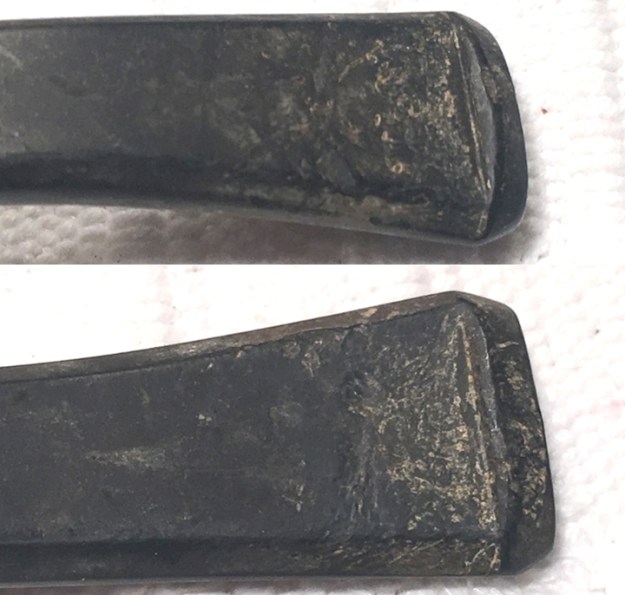
With the mystery of the provenance of this French GBD solidly established with Al’s help, I take a closer look at the pipe’s generally good condition. The medium cake buildup in the chamber needs to be removed to give the underlying briar a fresh start and to check for heating damage.  The rim has normal darkening along with a very nice blasted stummel surface that appears in need only of cleaning of normal grime buildup.  The shank appears to be longer than a normal half bent Billiard and gives more of a sweeping presentation transitioning to the saddle stem – which has some oxidation and tooth chatter damage on the upper and lower bit.  What stands out to me about the stem is its sharp, distinct cut shaping.  The edges are not rounded but have distinctive edge transitions – nice.

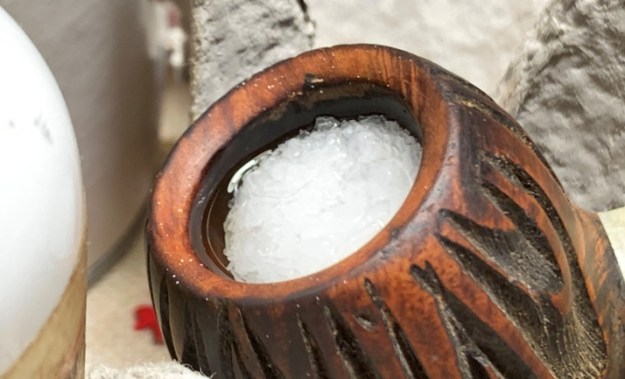
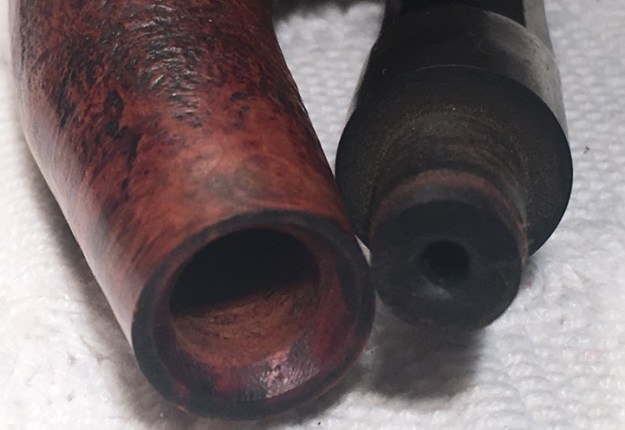
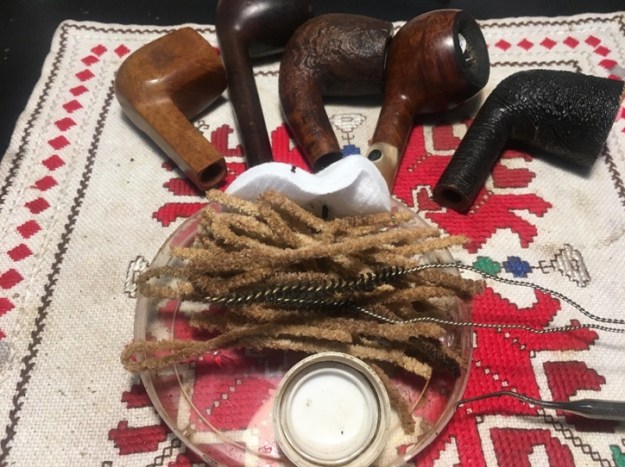
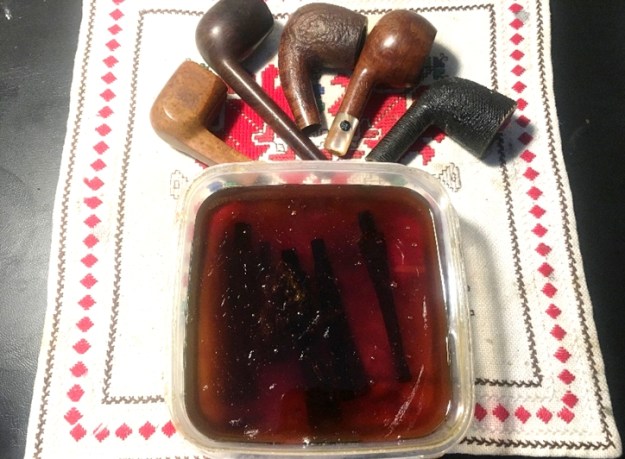
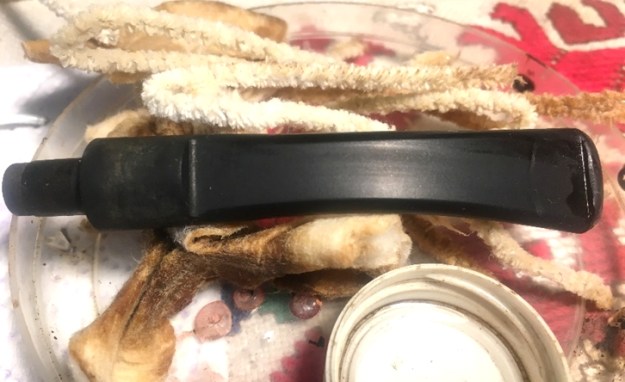
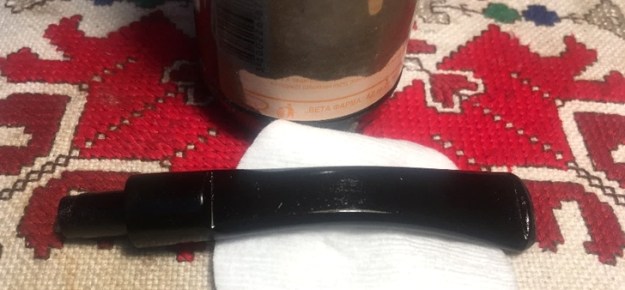
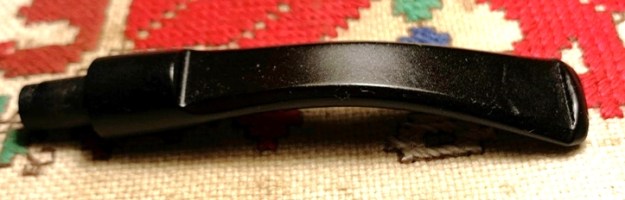
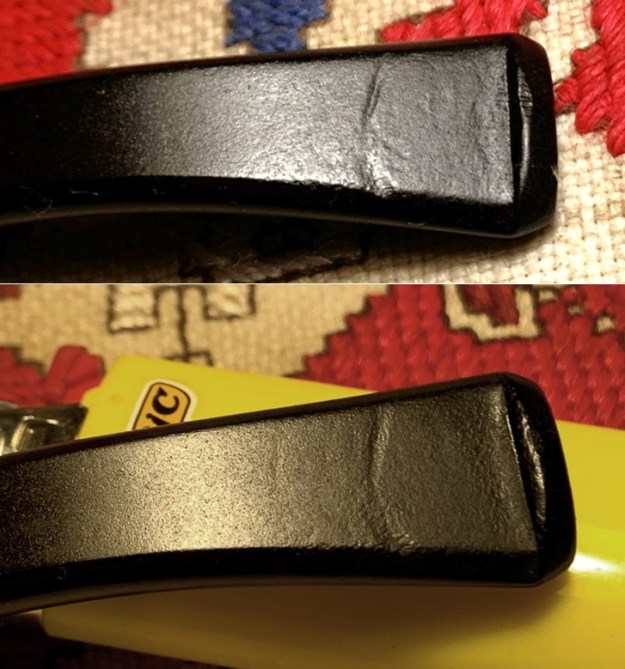
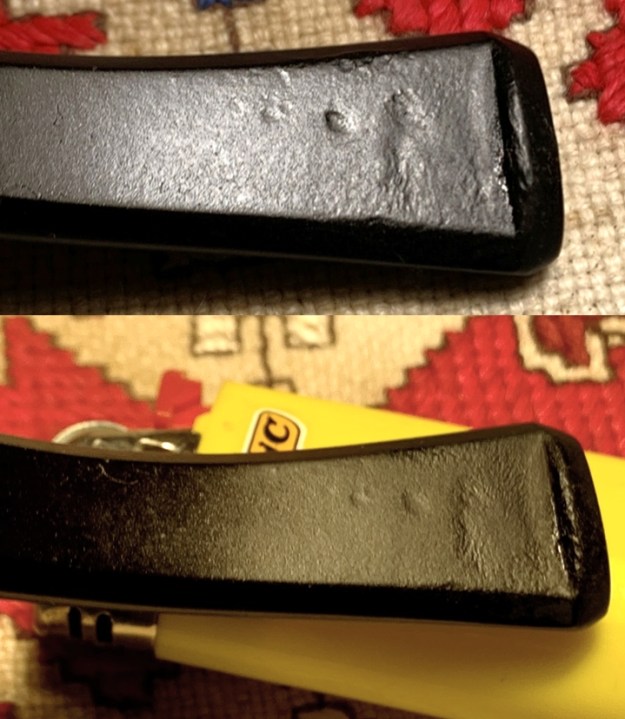
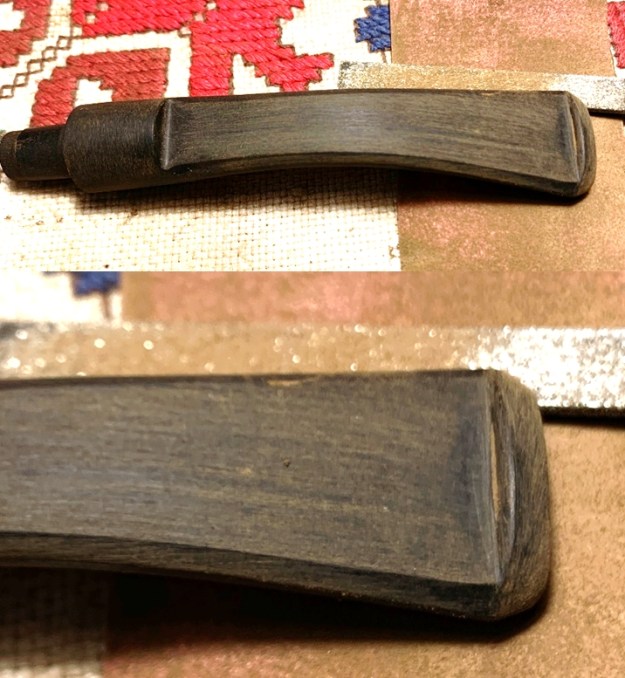
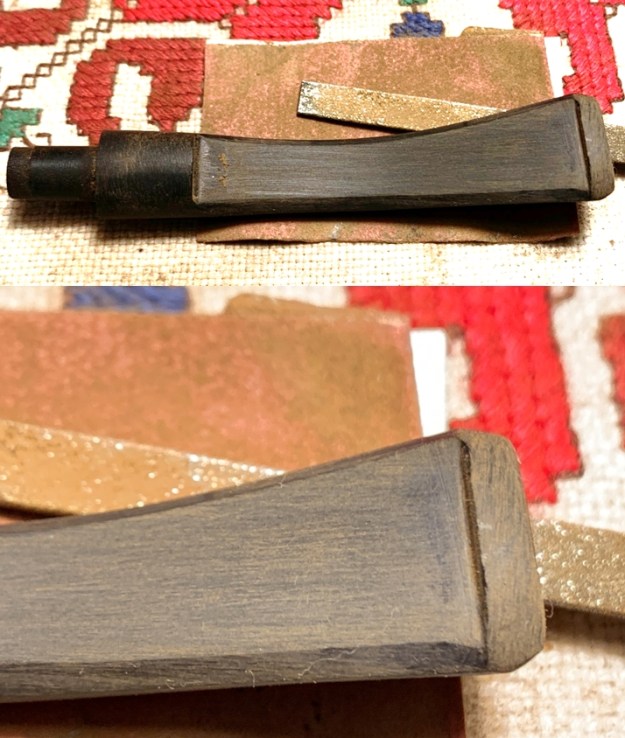
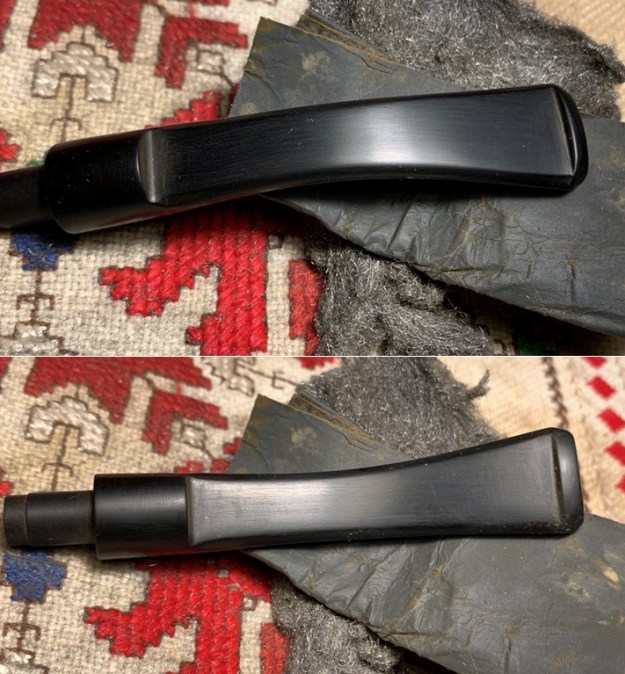
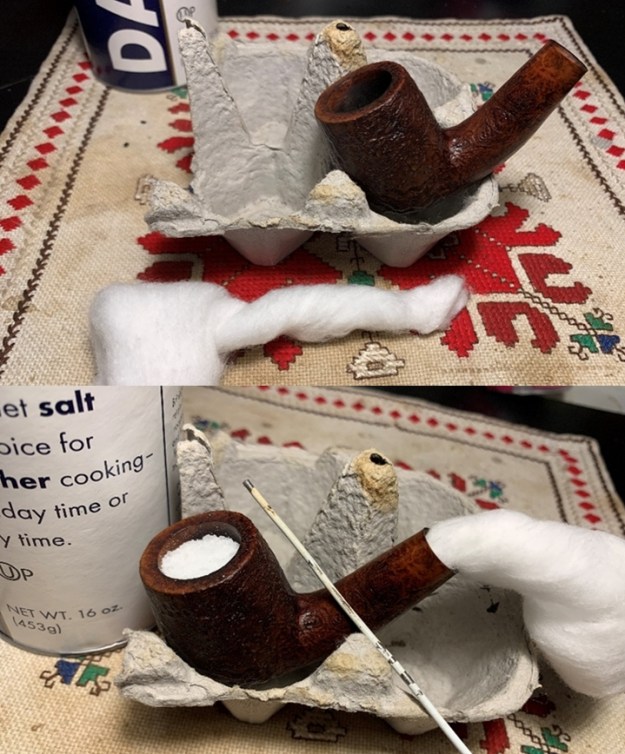
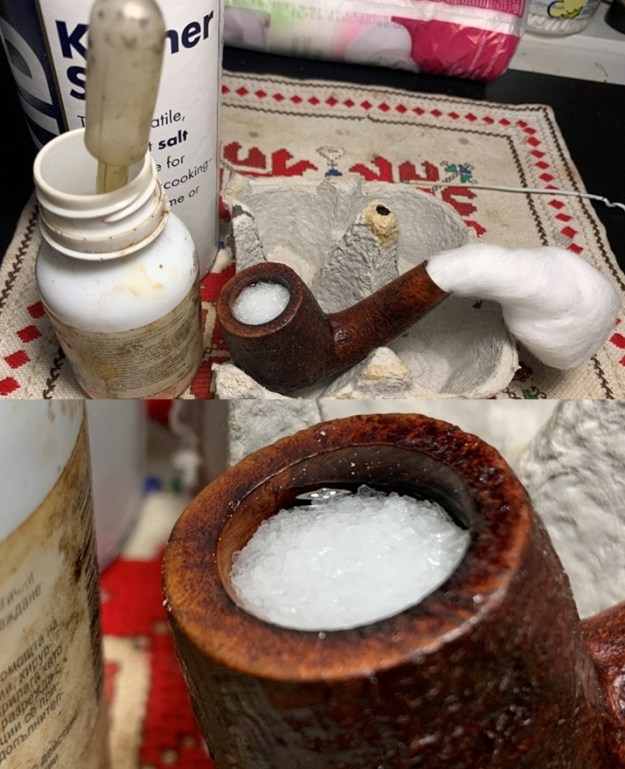
I start the restoration by adding the French GBD’s stem to the queue along with other pipes to soak in Before & After Deoxidizer.  First, using pipe cleaners and bristled shank brushes dipped in isopropyl 95%, the stem’s airway is cleaned.Following this, the stem is placed in the B&A Deoxidizer for several hours.After soaking in the Deoxidizer, I fish out the stem allowing it to drain the fluid back into the vat and run another pipe cleaner wetted with isopropyl 95% through the airway to clean it of Deoxidizer.  I then wipe off the raised oxidation with cotton pads wetted with isopropyl 95%.  The Deoxidizer seems to have done a good job.To help in revitalizing the vulcanite rubber, paraffin oil is applied with a cotton pad and worked into the surface.  I set the stem aside to absorb the oil.Turning to the stummel, I take closer look at the condition of the chamber.  I take a close-up of the cake buildup to mark the start.  After putting paper towel down to minimize on the cleanup, I use the Pipnet Reaming Kit to begin cleaning the chamber. I use two smaller of the 4 blade heads available in the Kit.  The cake is soft and is removed very easily.  I follow reaming by fine tuning using the Savinelli Fitsall Tool which does a great job of scraping the walls removing additional carbon cake as well as reaching down to the floor of the chamber and addressing the hard to get to angles and curves.  I finish by sanding the chamber using 240 grade paper wrapped around a Sharpie Pen and then wiping out the residual carbon dust with a cotton pad wetted with alcohol. I forgot to take a picture of the cleaned chamber inspection which looks good.  No heating damages. Moving from the chamber clean up, after taking a few pictures to mark the start, I focus on the external briar using undiluted Murphy’s Oil Soap and a cotton pad to scrub the sandblasted finish.  I also employ a brass wire brush to address the residue on the rim.  A brass brush does not harm the briar as it works. From the worktable I take the GBD stummel to the sink to continue the cleaning by using warm water with anti-oil dish soap and using bristled shank brushes, I scrub the internals of the pipe in the mortise and airway.  I also use the brass wire brush to do some additional scrubbing on the rim.  Finally, after rinsing the stummel thoroughly, I return to the worktable focusing on the internal cleaning using pipe cleaners and cotton buds wetted with isopropyl 95%. The internals are surprisingly clean, but still in need of cleaning.  I also use the small dental spoon to remove some tars and oils that have collected at the ridges created by the mortise drilling.  Without great effort, cotton buds are emerging lighter, and I call it done for now.  Later, I’ll give the stummel a kosher salt and alcohol soak to continue the internal cleaning process.Looking at the stummel and the condition of the blasted surface, the cleaning, as expected lightened the surface.  The briar seemed to call out to me for an application of Before and After Restoration Balm to hydrate and condition the dry stummel. I happily comply!  After applying some of Mark Hoover’s Before & After Restoration Balm (www.iberen.com) to my fingers, I work the balm into the blasted briar surface – thoroughly working it into the rough surface and rim.  I take a picture of the stummel after application, set to the side for 20 minutes or so.After about 20 minutes, using a cloth, I wipe the excess Balm off and then using a microfiber cloth, continue wiping and buffing up the briar surface.  Wow!  I’m loving the results and the hues of this blasted surface.  I take another picture after buffing.  This is a bowl that doesn’t need a lot of help 😊.Turning now to the stem, I observe again the stem’s unique shape.  The stem is not rounded but with flat surfaces on the upper and lower sides.  The edges of the stem connect the flat surfaces with a half diamond right angle.  Very smart – I like it.There is bite and chatter damage on the upper and lower bit. To address this, I first use the heating method to expand the compressions.  Using a Bic lighter, I paint the bit area heating the vulcanite and the physics of expansion take over.  After applying the heat, the indentations are still visible but have lessened so that sanding dispatches the problems easily.  First the before and after of the upper bit followed by the lower bit. I still can detect deep oxidation in the stem.  Therefore, I sand the entire stem with 240 grade paper to address this. Also employing a flat needle file, I file the button to freshen it as well as sand the bit to erase the bite and tooth chatter damage. Following the filing and 240 sanding, using 600 grade sanding paper I wet sand the entire stem followed by applying 000 grade steel wool.  The stem is looking good.Next, I go straight away to applying the full regimen of micromesh pads.  Starting with pads 1500 to 2400, I wet sand.  Following this, I dry sand using pads 3200 to 4000 and 6000 to 12000.  To continue revitalization of the vulcanite, I apply a coat of Obsidian Oil after each set of the micromesh pads. Next, I continue the internal cleaning of the stummel by giving it a soak using kosher salt and alcohol.  I first stretch and twist a cotton ball to act as a ‘wick’ which serves to draw the oils and tars from the internal chamber.  I use a stiff wire to guide the wick down the mortise and airway. After filling the bowl with kosher salt which doesn’t leave an aftertaste as iodized salt does, I settle the stummel in an egg carton for stability. I then fill the bowl with isopropyl 95% with a large eye dropper until it surfaces over the salt.  After a few minutes the alcohol absorbs into the pipe and I top the alcohol off again and set the stummel aside to soak.After several hours, the salt and wick have soiled from absorbing the tars and oils.  I remove the expended salt into the waste basket, wipe the chamber with paper towel and blow through the mortise to dislodge any residual salt crystals.I follow the soak by employing a few more pipe cleaners and cotton buds assuring that all is clean.  I move on!With a freshened bowl for a new steward, and after reuniting the stem and stummel, I mount a cotton cloth buffing wheel to the Dremel, and after setting the speed at about 40% full power, I give a light application of Blue Diamond compound over the blasted surface of the stummel.  I’m light on applying compound so that it will not cake up in the rougher sandblasted surface.  I apply compound normally over the stem.To clean the pipe of compound dust in preparation for the application of wax, a felt cloth is used to wipe down the pipe.After mounting another cotton cloth buffing wheel onto the Dremel, increasing the speed to about 60% full power, I apply carnauba wax to both stem and stummel.  I increase the speed of the Dremel in order to create more friction heat to aid the wax in liquifying as it works into the blasted briar surface.  I decrease the speed of the Dremel to my normal 40% as I apply wax to the stem.  After applying a few coats of wax and working it in well so that there is no caking, using a micromesh cloth, I give the pipe a rigorous hand buffing to disperse excess wax and to raise the shine.Undoubtedly, there’s some mystery surrounding the provenance of this GBD Sablée Standard.  The French origins of this GBD leave us with questions of its dating – pre- or post- 1981, the merger which marks the eras of the GBD name.  Even though this will be lost to us in history, at least for now, there is no disputing the exquisite quality of this pipe’s sandblasted briar surface.  It is a classic Bent Billiard workhorse with an elongated stem that adds to the sweep of this pipe.  The flat, cut stem design also adds to the uniqueness.  Steve, my long-time friend, commissioned this GBD Sablée Standard and will have the first opportunity to acquire it from ThePipeSteward Store.  This pipe benefits the Daughters of Bulgaria – women and girls who have been trafficked and sexually exploited.  Thanks for joining me!

New Life for a Stunning Malaga Bent Billiard from Kathy’s Dad’s Pipes


Blog by Steve Laug

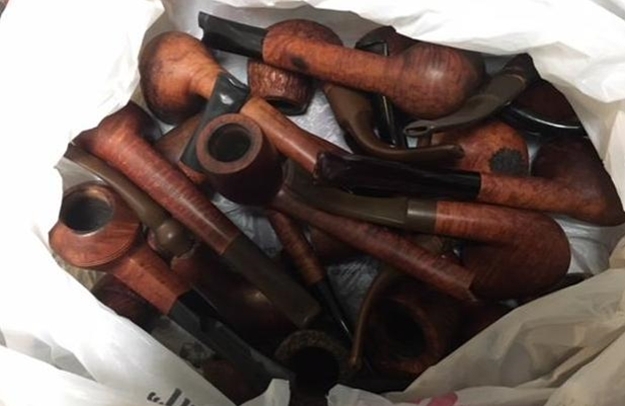
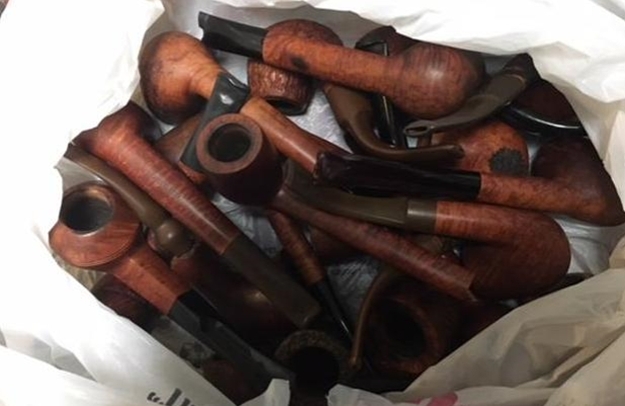
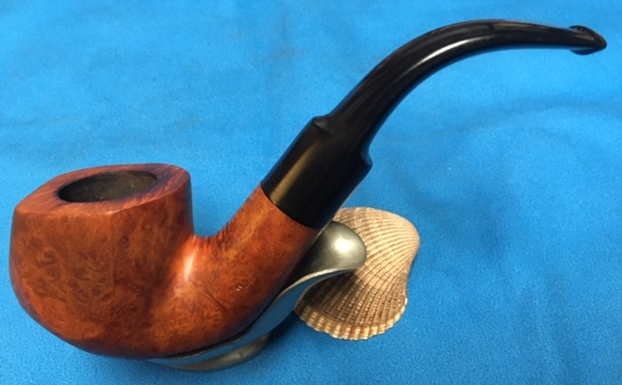
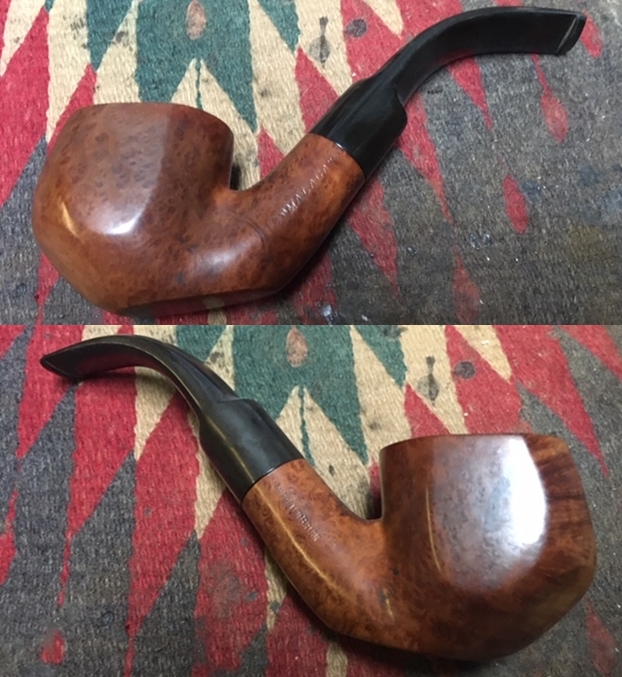
This is another of the Malaga pipes from George Koch’s estate that Alex added to the box of pipes I had set aside for him. There are quite a few of them to work on so I go back to them quite regularly to work on one of them. The next Malaga is a shape I would define as a bent billiard. It has some great cross and birdseye grain and a tapered vulcanite stem. The grain around the bowl and shank combined with the stem make it a stunning pipe. It is one of the many Malaga pipes that came to my brother and me in several shipments of pipes from George’s daughter Kathy. When Jeff got each box the pipes were well wrapped and packed. Jeff unwrapped them and took the following photo to give an idea of the volume of the pipes that we purchased. This Malaga came in mixed in a box of pipes much like the one below.In each of the previous blogs that I have written on the restoration of George’s pipes I have told his story. If you have followed the restorations you will have read the information and the background piece that Kathy did on her father. Here is a link to one of the previous blogs on his Malaga pipes where I included her tribute in full (https://rebornpipes.com/2019/01/26/back-to-kathys-dads-pipes-restoring-a-%c2%bc-bent-malaga-author/). You can also read the bio on her Dad, George Koch. It is an interesting read and one that shows just how far our pipe collecting passion can go when we find a brand of pipes that we enjoy. I am going to only include the portion on the Malagas at this point. If you wish to read the rest follow the link above.

Kathy writes…We lived in Livonia, and that’s where his love for Malaga pipes began. After a few years he returned to Allis Chalmers and we moved back to Springfield. I remember that when we went back to Michigan to visit friends, Dad had to go to the Malaga store and acquire a few new pipes. Many a year I wrote to Malaga and they picked out a pipe for me to purchase that I could give Dad for a Christmas or birthday present. He was always pleased. His favorites were the straight stemmed medium sized bowl pipes, but he liked them all. 

He had some other pipes, but the Malagas were his favorites. I remember him smoking them sitting in his easy chair after work, with feet up on the ledge by the fire burning in the fireplace.  Growing up it was my job to clean them and he liked the inner bowl and stem coated with Watkins vanilla, leaving a little of that liquid in the bowl to soak in when I put them back on the rack…I’m very happy they are being restored by you and your brother and hope they find homes who enjoy them as much as Dad did. Thank-you for your care and interest. — Kathy, the oldest daughter

The next “Malaga” Bent Billiard on the table is another classic bent shape. The carver did a great job of shaping the pipe to follow the grain on the briar. The bowl, round shank and bent tapered vulcanite stem look very good. The bowl had a thick cake that overflowed with lava onto the rim and there was significant burn damage on the top front inner of the bowl. The sides of the bowl and shank are very dirty with grime and oils from prolonged use. The stamping on the left side of the shank read “MALAGA” and on the right side it read Imported Briar. The vulcanite stem had tooth dents and chatter on the top and the underside of the stem. The button was worn almost smooth Jeff took these photos before he started the cleanup work on the pipe. Jeff took a close up photo of the bowl and rim to capture the condition of the pipe before he started his cleanup work. The rim top had some lava overflow and darkening on the back of the bowl and some serious burn damage to the inner edge on the bowl front. The burn marks appeared to be quite deep on the inner edge on the right front side of the grimy pipe.He also took photos of the sides and bottom of the bowl and shank to show the beautiful grain around the bowl. The photos show the general condition of the bowl and wear on the finish. It is very dirty but this is another beautiful pipe.Jeff took a photo to capture the stamping on the shank. The photos show the stamping “MALAGA” on the left side of the shank and Imported Briar on the right side. The stamping is very readable.The next photos show the stem surface. There is oxidation and calcification on the stem. There are tooth marks and chatter on both sides near the button and wear on the button surface and edges. The button surfaces and edges are worn and almost smooth.I am also including the link to a blog that I wrote that gives some of the history of the Malaga brand and the Malaga Pipe Shop in Royal Oak, Michigan in the USA. I have written an earlier blog to give a little history of the Malaga Brand and the pipemaker, George Khoubesser. Here is the link – https://rebornpipes.com/tag/malaga-pipes/.That blog also includes links to a catalogue and the history of the pipemaker George Khoubesser. Follow the link to get a feel for the brand and the pipemaker.

Jeff reamed the bowl with a PipNet pipe reamer and followed up with a Savinelli Fitsall pipe knife to remove the cake. He scrubbed out the mortise and the airway in the shank and the stem with alcohol, cotton swabs and pipe cleaners. He scrubbed the exterior of the bowl, rim, shank and stem with a tooth brush and Murphy’s Oil Soap to remove the oils and tars on the rim and the grime on the finish of the bowl. He rinsed it under running water. He dried it off with a soft cloth. He was able to remove the lava build up on the rim top and the flat surface of the rim looked very good. The inner edge of the rim has some serious burn damage on the front right side. The outer edge looked very good. He soaked the stem in Before & After Deoxidizer and rinsed it with hot water. I took photos of the pipe to show its condition before I started my work on it. I took close up photos of the bowl and rim top as well as the stem. You can see the condition of the rim top and bowl in the first photo. Jeff was able to remove all of the tar and oils but you can now see the damage on the inside rim edge. The edge is out of round. There is a burn mark that extends across the front and the back edge of the rim top at that point. The vulcanite stem had tooth chatter on both sides near and on the button surface there was also a large deep bite mark on the underside of the stem.I took a photo of the stamping on the shank to show how good the condition is. It shows the “MALAGA” stamp on the left side and Imported Briar on the right side. The stamping is very legible.I decided to address the rim top first. I topped the bowl on a topping board with 220 grit sandpaper. I wanted to remove the damage on the top front edge and remove the darkening all the way around the inner edge of the bowl. I took a close up photo the rim top before I started to give a clear picture of the condition of the pipe. I used a folded piece of 220 grit sandpaper to clean up the damage on the right rear inner edge of the bowl. I gave the inner edge a slight bevel to repair the damage. I polished the edge with 400 grit wet dry sandpaper. The rim top and edges really looked better.I polished the rim top and the briar with micromesh sanding pads. I wet sanded the bowl with 1500-12000 grit sanding pads. I wiped the bowl down after each pad with a damp cloth to remove the sanding dust. I restained the rim top and edges with an Oak Stain Pen. I was able to blend it into the rest of the bowl. I scrubbed the briar with Murphy’s Oil Soap and a tooth brush. I rubbed it into the surface of the briar with my finger tips and let it sit for a few minutes then scrubbed it off with a tooth brush and running water. I dried it off with a soft cloth. I worked some Before & After Restoration Balm into the surface of the briar with my fingertips to clean, enliven and protect it. I let the balm sit for a little while and then buffed with a cotton cloth to raise the shine. The following photos show the bowl at this point in the restoration process. I am very happy with the results. I turned to the stem to address the issues on the surface of both sides at the button. I used a needle file to recut the edges of the button. They had been chewed to the point of no edge remaining so I used the file to cut it and sharpen the edges. I smoothed out the top and bottom surfaces of the button on both sides.Once I had the button edge reshaped I decided to address the tooth marks and dents in the button and just ahead of the button. I “painted” the surface of the stem with the flame of a lighter to lift the tooth chatter and marks. The light marks on the top side disappeared quickly and the larger indentation on the underside lifted until the remaining small marks could be dealt with by sanding the stem.I sanded both sides smooth with 220 grit sandpaper to remove the deep oxidation on the surfaces. I finished this initial polishing with 400 grit sandpaper to smooth out the scratches in the stem surface. As I sanded and reshaped the button and stem surface the stem began to look very good. I polished the stem with Denicare Mouthpiece Polish from a tin of it I have in the drawer here. It is a gritty red paste that I rub on with my finger tips and work into the surface of the stem and button and buff off with a cotton pad. It gives me a bit of a head start on the polishing work plus I have a tin to use up!I polished the stem with micromesh sanding pads – wet sanding with 1500-12000 grit sanding pads. I wiped it down after each sanding pad Obsidian Oil. I finished by polishing it with Before & After Pipe Stem Polish both fine and extra Fine and then wiped it down with a final coat of Obsidian Oil. This is another, slightly larger Malaga Bent Billiard with a vulcanite tapered stem. It has a great grain around the bowl and the carver really maximized that with the shape of the pipe. Everything about the pipe – the shape of the bowl, the beveled rim top and the cut of the briar work well to highlight the grain around the bowl sides. I polished stem and the bowl with Blue Diamond polish on the buffing wheel and the grain just popped and came alive. I gave the bowl and the stem multiple coats of carnauba wax. I buffed the pipe with a clean buffing pad to raise the shine. I hand buffed it with a microfiber cloth to deepen the shine. The pipe polished up pretty nicely. The grain took on life with the buffing. The rich oil cured colour works well with the polished vulcanite stem. The finished pipe has a rich look that is quite catching. Have a look at it with the photos below. The shape, finish and flow of the pipe and stem are very well done. The dimensions are Length: 6 inches, Height: 2 inches, Outside diameter of the bowl: 1 ¼ inches, Chamber diameter: ¾ of an inch. I will be adding the pipe to the finished Malaga pipes that I have set aside for Alex. I am glad that he is carrying on the trust for George Koch. Thanks for walking through the restoration with me as I worked over another one of Kathy’s Dad’s Pipes.

Restoring a Stunning Malaga Bent Billiard from Kathy’s Dad’s Pipes


Blog by Steve Laug

Not long ago Alex came by and went through the Malaga pipes from George Koch’s estate. Alex added the newly chosen pipes to the box of pipes I set aside for him. There are quite a few of them to work on so I decided to go back to work on one of them. The next Malaga is a shape I would define as a bent billiard. It has some great cross and birdseye grain and a saddle vulcanite stem. The grain around the bowl and shank combined with the stem make it a stunning pipe. It is one of the many Malaga pipes that came to my brother and me in several shipments of pipes from George’s daughter Kathy. When Jeff got each box the pipes were well wrapped and packed. Jeff unwrapped them and took the following photo to give an idea of the volume of the pipes that we purchased. This Malaga came in mixed in a box of pipes much like the one below.In each of the previous blogs that I have written on the restoration of George’s pipes I have told his story. If you have followed the restorations you will have read the information and the background piece that Kathy did on her father. Here is a link to one of the previous blogs on his Malaga pipes where I included her tribute in full (https://rebornpipes.com/2019/01/26/back-to-kathys-dads-pipes-restoring-a-%c2%bc-bent-malaga-author/). You can also read the bio on her Dad, George Koch. It is an interesting read and one that shows just how far our pipe collecting passion can go when we find a brand of pipes that we enjoy. I am going to only include the portion on the Malagas at this point. If you wish to read the rest follow the link above.

Kathy writes…We lived in Livonia, and that’s where his love for Malaga pipes began. After a few years he returned to Allis Chalmers and we moved back to Springfield. I remember that when we went back to Michigan to visit friends, Dad had to go to the Malaga store and acquire a few new pipes. Many a year I wrote to Malaga and they picked out a pipe for me to purchase that I could give Dad for a Christmas or birthday present. He was always pleased. His favorites were the straight stemmed medium sized bowl pipes, but he liked them all. 

He had some other pipes, but the Malagas were his favorites. I remember him smoking them sitting in his easy chair after work, with feet up on the ledge by the fire burning in the fireplace.  Growing up it was my job to clean them and he liked the inner bowl and stem coated with Watkins vanilla, leaving a little of that liquid in the bowl to soak in when I put them back on the rack…I’m very happy they are being restored by you and your brother and hope they find homes who enjoy them as much as Dad did. Thank-you for your care and interest. — Kathy, the oldest daughter

The “Malaga” Bent Billiard with the classic bent shape is the next on the table. The carver did a great job of shaping the pipe to follow the grain on the briar. The bowl, round shank and bent tapered vulcanite stem look very good. The bowl had a thick cake that overflowed with lava onto the rim so that it was impossible to see if there was damage on the inner edges. The sides of the bowl and shank are very dirty with grime and oils from prolonged use. The stamping on the left side of the shank read “MALAGA” and on the right side it read Imported Briar. The vulcanite stem had tooth dents and chatter on the top and the underside of the stem. Jeff took these photos before he started the cleanup work on the pipe.Jeff took a close up photo of the bowl and rim to capture the condition of the pipe before he started his cleanup work. The rim top had some lava overflow and darkening on the back of the bowl and some damage to the inner edge of the bowl front. There appeared to be deep burn marks on the inner edge on the right front side of the grimy pipe.He also took photos of the sides and bottom of the bowl and shank to show the beautiful grain around the bowl. The photos show the general condition of the bowl and wear on the finish. It is very dirty but this is another beautiful pipe.Jeff took a photo to capture the stamping on the shank. The photos show the stamping “MALAGA” on the left side of the shank and Imported Briar on the right side. The stamping is very readable.The next photos show the stem surface. There are tooth marks and chatter on both sides near the button and wear on the button surface and edges.I am also including the link to a blog that I wrote that gives some of the history of the Malaga brand and the Malaga Pipe Shop in Royal Oak, Michigan in the USA. I have written an earlier blog to give a little history of the Malaga Brand and the pipemaker, George Khoubesser. Here is the link – https://rebornpipes.com/tag/malaga-pipes/.That blog also includes links to a catalogue and the history of the pipemaker George Khoubesser. Follow the link to get a feel for the brand and the pipemaker.

Jeff reamed the bowl with a PipNet pipe reamer and followed up with a Savinelli Fitsall pipe knife to remove the cake. He scrubbed out the mortise and the airway in the shank and the stem with alcohol, cotton swabs and pipe cleaners. He scrubbed the exterior of the bowl, rim, shank and stem with a tooth brush and Murphy’s Oil Soap to remove the oils and tars on the rim and the grime on the finish of the bowl. He rinsed it under running water. He dried it off with a soft cloth. He was able to remove the lava build up on the rim top and the flat surface of the rim looked very good. The inner edge of the rim has some serious burn damage on the front right side. The outer edge looked very good. I took photos of the pipe to show its condition before I started my work on it. I took close up photos of the bowl and rim top as well as the stem. You can see the condition of the rim top and bowl in the first photo. Jeff was able to remove all of the tar and oils but you can now see the damage on the inside rim edge. The edge is out of round. There is a burn mark that extends across the front and the back edge of the rim top at that point. The vulcanite stem had tooth chatter on both sides near and on the button surface there was also a large deep bite mark on the underside of the stem.I took a photo of the stamping on the shank to show how good the condition is. It shows the “MALAGA” stamp on the left side and Imported Briar on the right side. The stamping is very legible.I decided to address the rim top first. I lightly topped the bowl on a topping board with 220 grit sandpaper. I wanted to minimize the damage on the top, remove the darkening and clean up the damage on the front and rear inner edge of the bowl.I used a folded piece of 220 grit sandpaper to clean up the damage on the right rear inner edge of the bowl. I gave the inner edge a slight bevel to repair the damage. I polished the edge with 400 grit wet dry sandpaper. The rim top and edges really looked better.I polished the rim top and the briar with micromesh sanding pads. I wet sanded the bowl with 1500-12000 grit sanding pads. I wiped the bowl down after each pad with a damp cloth to remove the sanding dust. I scrubbed the briar with Murphy’s Oil Soap and a tooth brush. I rubbed it into the surface of the briar with my finger tips and let it sit for about 10 minutes then rinsed it off with running water. I dried it off with a soft cloth. I restained the rim top and edges with an Oak Stain Pen. I was able to blend it into the rest of the bowl.I worked some Before & After Restoration Balm into the surface of the briar with my fingertips to clean, enliven and protect it. I let the balm sit for a little while and then buffed with a cotton cloth to raise the shine. The following photos show the bowl at this point in the restoration process. I am very happy with the results. I turned to the stem to address the issues on the surface of both sides at the button. I started by “painting” the surface of the stem with the flame of a lighter to lift the tooth chatter and marks. The light marks on the top side disappeared quickly and the larger indentation on the underside lifted until the remaining small marks could be dealt with by sanding the stem.I sanded both sides smooth with 220 grit sandpaper to remove the deep oxidation on the surfaces. I finished this initial polishing with 400 grit sandpaper to smooth out the scratches in the stem surface. As I sanded and reshaped the button and stem surface the stem began to look very good.I polished the stem with Denicare Mouthpiece Polish from a tin of it I have in the drawer here. It is a gritty red paste that I rub on with my finger tips and work into the surface of the stem and button and buff off with a cotton pad. It gives me a bit of a head start on the polishing work plus I have a tin to use up!I polished the stem with micromesh sanding pads – wet sanding with 1500-12000 grit sanding pads. I wiped it down after each sanding pad Obsidian Oil. I finished by polishing it with Before & After Pipe Stem Polish both fine and extra Fine and then wiped it down with a final coat of Obsidian Oil. This is a Malaga Bent Billiard with a vulcanite saddle stem. It has a great grain around the bowl and the carver really maximized that with the shape of the pipe. Everything about the pipe – the shape of the bowl, the beveled rim top and the cut of the briar work well to highlight the grain around the bowl sides. I polished stem and the bowl with Blue Diamond polish on the buffing wheel and the grain just popped and came alive. I gave the bowl and the stem multiple coats of carnauba wax. I buffed the pipe with a clean buffing pad to raise the shine. I hand buffed it with a microfiber cloth to deepen the shine. The pipe polished up pretty nicely. The grain took on life with the buffing. The rich oil cured colour works well with the polished vulcanite stem. The finished pipe has a rich look that is quite catching. Have a look at it with the photos below. The shape, finish and flow of the pipe and stem are very well done. The dimensions are Length: 5 ¾ inches, Height: 1 7/8 inches, Outside diameter of the bowl: 1 ¼ inches, Chamber diameter: ¾ of an inch. I will be adding the pipe to the finished Malaga pipes that I have set aside for Alex. I am glad that he is carrying on the trust for George Koch. Thanks for walking through the restoration with me as I worked over another one of Kathy’s Dad’s Pipes.


Comoy’s Tradition Bullcap Restoration (Shape 364)


By Al Jones

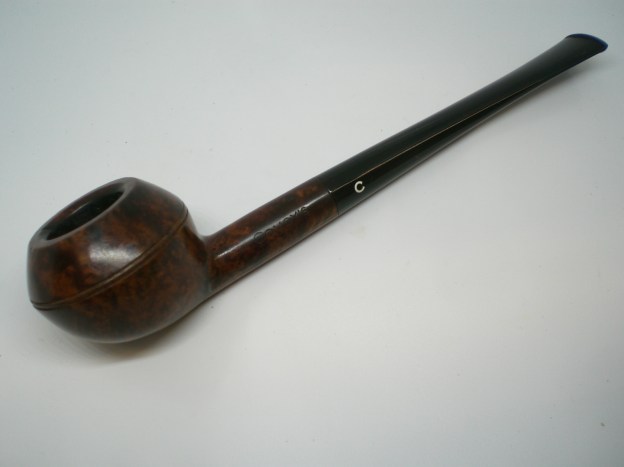
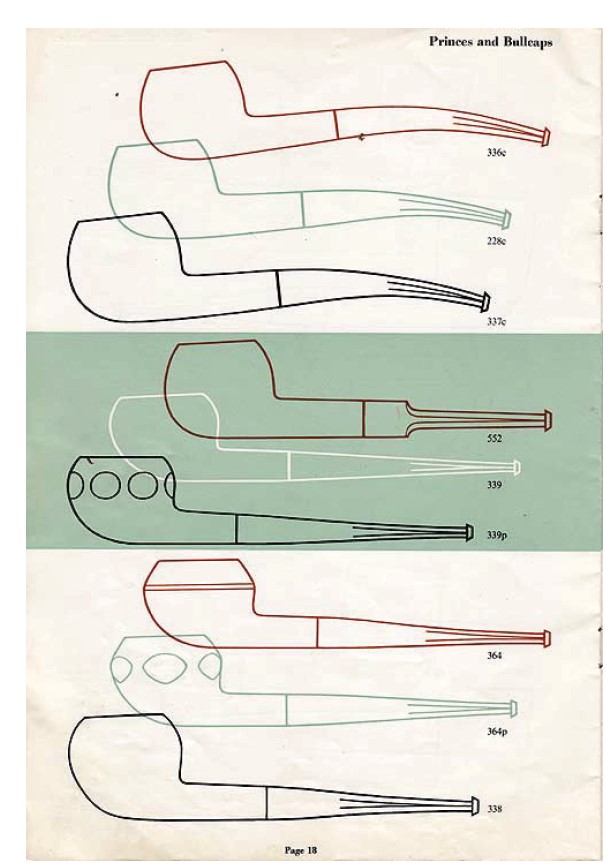
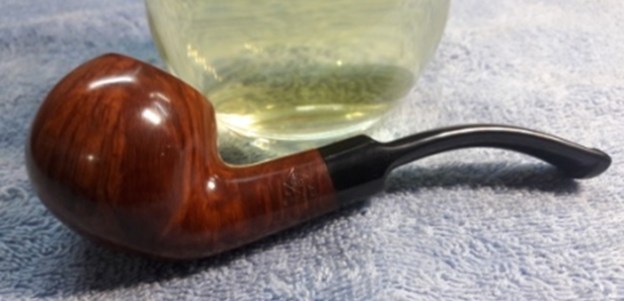
I’m almost embarrassed to call this a restoration, as the pipe was in very good condition.  I’ve never seen this Shape 364 before but find one example in an old Ebay ad (a Blue Riband sold by the late Tony Soderman).  This example is in Tradition finish.  Pipepedia has the shape number on their Comoys’ list and calls it a Bullcap.  Tony titled his pipe a Prince.  I did find the shape in a 1964 catalog, that shows the shape with bowl rings.  A similar shape without rings is listed as a 364P (for Prince?).

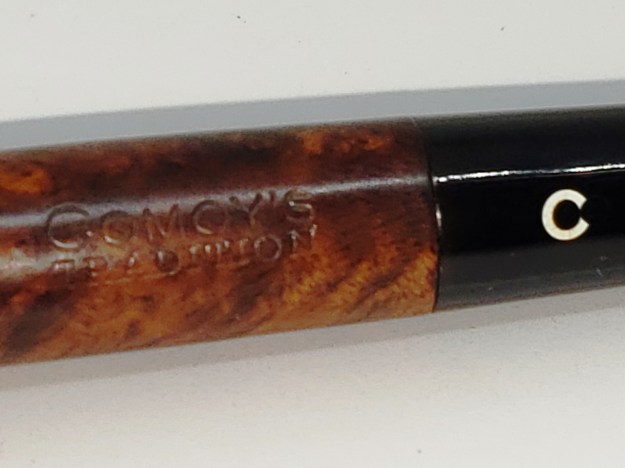
The round COM and 3 piece, drilled C stem logo indicate the pipe was made between the late 1940’s and the merger point in 1981.

The pipe had just a slight layer of oxidation on stem.  The stem had a softee tip on it, so the famous Comoy’s button was pristine.  There were a few handling marks around the bowl, with very little cake.

I used a piece of 800 grit paper to remove the slight cake.  The bowl was then soaked with alcohol and sea salt.  Once the bowl soak was completed, I cleaned the shank with a soft bristle brush dipped in alcohol and paper towels scrunched into the shank.

The stem was mounted and oxidation removed with 800, 1,500, 2,000 wet paper, followed by 8,000 and 12,000 micromesh. The stem was then polished with White Diamond and Meguiars Plastic Polish.

I was able to steam out some of the marks around the bowl, with an electric iron and wet cloth. The bowl was then buffed with White Diamond and several coats of Carnuba wax.

Below is the completed pipe.  I would call this pipe a Group 2 in size and it weighs a scant 25 grams.

Restoring a 2 Star BBB “Special” # 395


Blog by Paresh Deshpande

A few weeks ago, Steve had worked on a BBB Own Make 693 Canadian with some really gorgeous grains to boast about. As I was reading the blog, I remembered the BBBs that Abha had cleaned and sent across for further restoration along with 40 other pipes. However, since I was working on a Thorburn Clark pipe from my inheritance, I had postponed work on this BBB. With the Thorburn Clark completed, I rummaged through the pile and separated all the BBBs that she had sent. This is the one that caught my attention. The note in the package, along with the issues observed by Abha while cleaning the pipe, said that it was from my grandfather’s collection!! I had to work on this BBB.

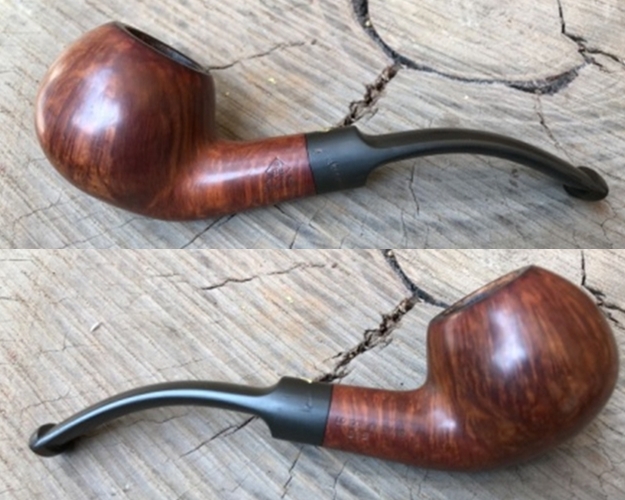
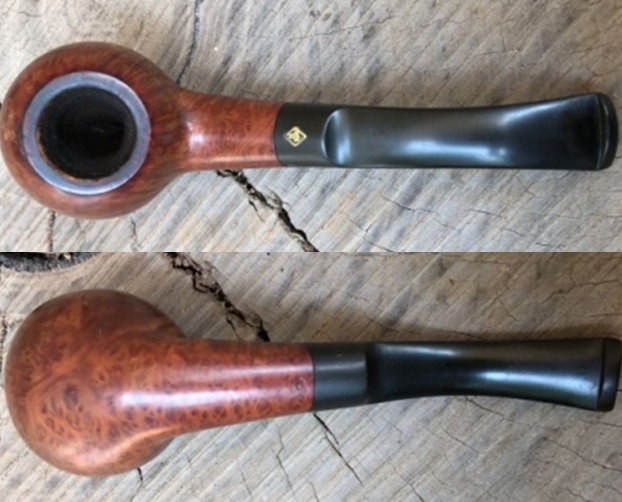
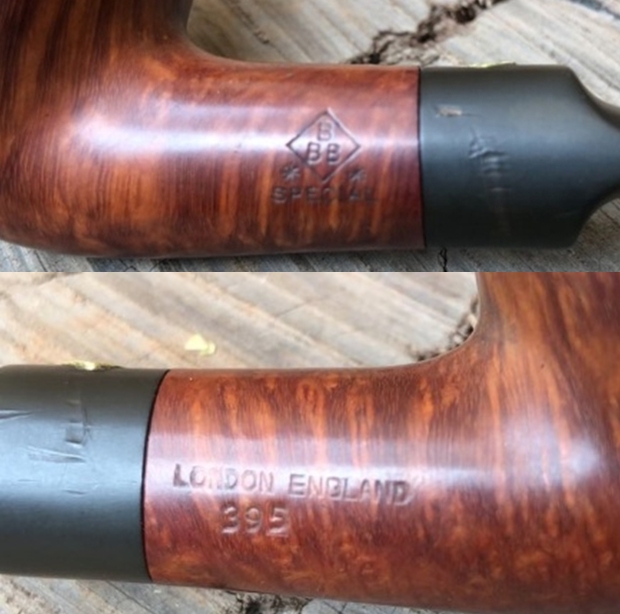
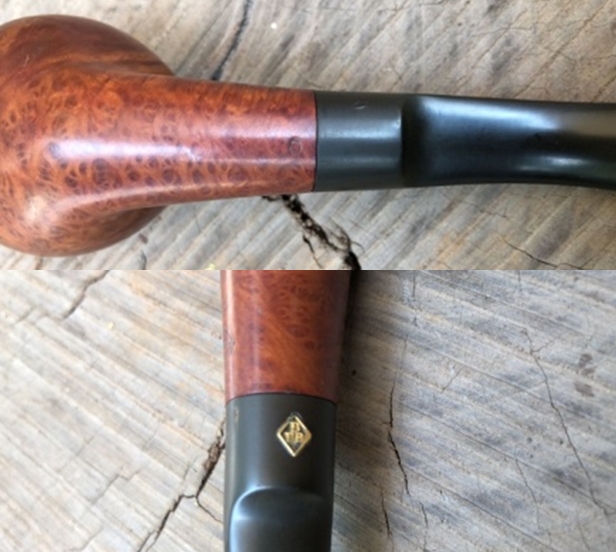
This BBB in bent Apple shape with a saddle stem has stunning grains and it appears that the grain on the block of briar dictated the shape to the carver. The stummel boasts of beautiful tightly packed straight grains to the front, sides, back and along the sides of the shank. The foot of the stummel, bottom and top of the shank has the most beautiful and distinct bird’s eye that you would ever see. The transition from bird’s eye at the foot of the stummel to the straight grain all around is very well defined and seamless. The stummel is stamped on the left shank surface, close to the shank end, in trademark rhombus as “BBB” over two Stars (**) on either side of the lower part of the rhombus over “SPECIAL”. On the left shank surface, it is stamped as “LONDON ENGLAND” over the shape code “395”. The bottom of the shank bears the numeral “0” very close to the shank end. Inlaid BBB brass diamond logo on the saddle adorns the vulcanite stem. If you are interested to know anything about BBB pipes, look no further than rebornpipes.com!! This is Steve’s favorite brand and he has been researching and collecting BBB pipes for decades. I visited rebornpipes and sure enough there was a write up on “History of BBB Pipes”! Here is the link to the blog: https://rebornpipes.com/2012/08/05/history-of-bbb-pipes/

I was more interested in background information of the brand and later in the dating of this pipe. Here is what I found interesting;

Adolph Frankau arrived in London in 1847 and quickly grasped the opportunities which the enlarging tobacco market introduced. He started “Adolph Frankau and Co.” and began importing meerschaum pipes and tobacco supplies. The Company took a young 14 year-old boy, Louis Blumfeld under its wing. The Company quickly thrived and did so until the untimely death of Adolph Frankau in 1856. His widow decided to sell the company.

Thomas Carlyle (1795-1881), author of “Hero and worship of the heroes” came on the scene at this point. He recommended that the widow Frankau not sell, but rather that she should entrust the future of the company into the hands of young Louis Blumfeld, then 18 years old. Carlyle had to have had a very high opinion of the young Louis to make this recommendation, and his trust proved to be justified as Blumfield took care of the company with enthusiasm and bottomless energy. Louis quickly realized, as others had before him, the potential of the newly acknowledged pipes made of briar.

Louis Blumfeld developed important international trade relations from the beginning, and had particular success in Canada, Australia, New Zealand, India, Europe, as well as Switzerland and Denmark. The USA had never been an extraordinary market for the company, but nonetheless a subsidiary was opened in New York. His commercial strategy focused on the countries of British Empire.        

In the 1930s, the top pipe of the line was “BBB Best Make” with variants such as “Great Dam” and “Ultonia Thule”. The BBB Carlton, sold retail in 1938, was endowed with a complicated stinger system; the same system was also used on the BBB London Dry. The Blue Peter was not stamped BBB but BBB Ultonia, and BBB Two Star (**) was the stamping on lesser quality pipes.

Shapes of BBB pipe were typical of other companies pipes made in this era: half were billiards, some princes and bullcaps, bulldogs and some bents. It is also in this period that the inlaid metal BBB was put on more upscale pipes, while series of lesser quality had only the stamped BBB on the stem.

During the middle of 1950s and 1960s, BBB lines were comparatively stable. The top pipes of the line were stamped Own Make “Rare Grain”, followed by Own Make “Virgin”, Own Make “Walnut” and finally Own Make “Thorneycroft”.

From the above, it is evident that the BBB on my work table is from the period 1930 to 1950.

INITIAL VISUAL INSPECTION
The chamber had a thick layer of cake, but not as thick as seen in some of his pipes. As expected, the rim top surface is covered with overflow of lava. The beveled inner edge of the rim in 11 ‘O’ clock direction is badly damaged which could probably be caused as a result of hitting against a hard surface to remove the dottle. The outer rim edge too has dents and dings around. The condition of the walls can be commented upon only once the cake has been taken down to the bare briar. This chamber has some pretty strong ghost smells.   The stummel surface is pebbled with numerous dents, dings and scratches. However, there is not a single fill in the stummel surface!! Significant damage was seen to the front of the stummel and around the rim. This damage, in all probability, has been caused due to uncared for storage and it having rubbed against some hard object. The briar had taken on a nice aged patina and I shall try to preserve it. However, the kind of damage to the stummel would necessitate a few invasive methods to address these issues which are detrimental to preservation of aged patina. Let’s see how the restoration pans out!! The mortise showed dried accumulated gunk with a blocked draught hole. Air flow was very laborious to say the least.The stem is heavily oxidized with a deep gouge on either side of the saddle of the stem. This and other stummel damage could have been due to uncared for storage for the last 40 odd years. There is no significant damage to the button or in the bite zone, save for a few very minor tooth marks to button edges and tooth chatter in the bite zone. This was surprising as I have observed that the stem was the most damaged part in most of my inherited collection. Maybe my grandfather did not like the smoking character of this pipe or the shape or the hand feel or the clench or could be that he did not like the size of this pipe (most probable cause since he preferred large sized ones!!) The tenon is covered in dried gunk. INITIAL CLEANING BY ABHA…
The initial cleaning on this pipe was done by Abha, my wife (she has cleaned up around 40-50 pipes and these have now reached me for further restoration). She reamed out the complete cake and further smoothed out the chamber walls with a folded piece of 220 grit sand paper. She further cleaned out the internals of the shank with pipe cleaners and alcohol and cotton buds. In the note that she had packed with pipe, she mentioned that getting a pipe cleaner out through the draught hole was not easy. She followed the internal cleaning of the shank with external cleaning of the stummel using Murphy’s Oil soap and hard bristled tooth brush and dried it with paper napkins and cotton cloth.

Next she cleaned out the internals of the stem air way. She covered the inlaid brass stem logo with petroleum jelly (helps protect the metal from corrosion due the solution) and immersed it in “Before and After Deoxidizer” solution along with the stem of other pipes in line for restoration. Once the stem had soaked overnight, she cleaned the stem under running warm water and scrubbed the raised oxidation from the stem surface using Scotch Brite pad. She further removed the oxidation by scrubbing the stem with 0000 grade steel wool and applied a little olive oil to rehydrate the stem.

ONCE THE PIPE IS ON MY WORK TABLE…
The initial cleaning by Abha, my wife, is thorough and while saving me time, it also provides a clear picture of all the issues that needs to be addressed during the restoration process. She also makes a note of all the issues that she observed during initial cleaning for me to address and includes this note with each pipe that she packs. It’s a big saving on the time factor and I am really thankful to her for indulging me.

This is how the pipe came to me after Abha had worked her magic. This is definitely a beautiful pipe and would be a challenge for me to do justice and bring the beauty of this pipe to the fore!!

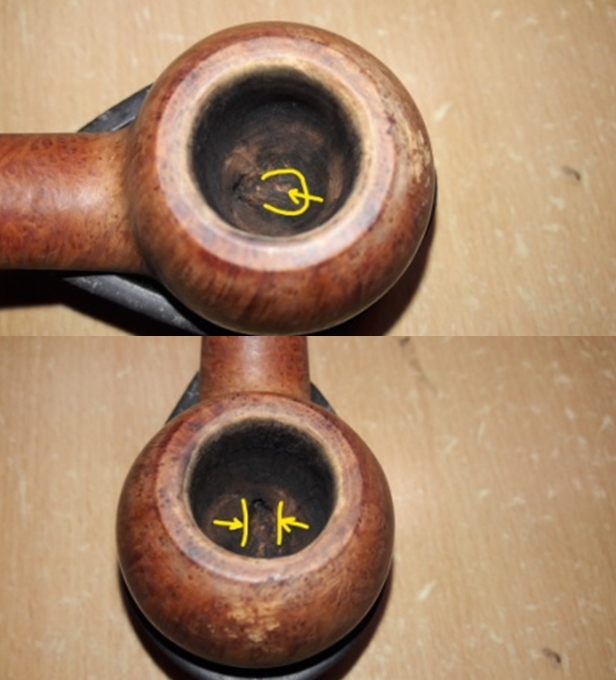
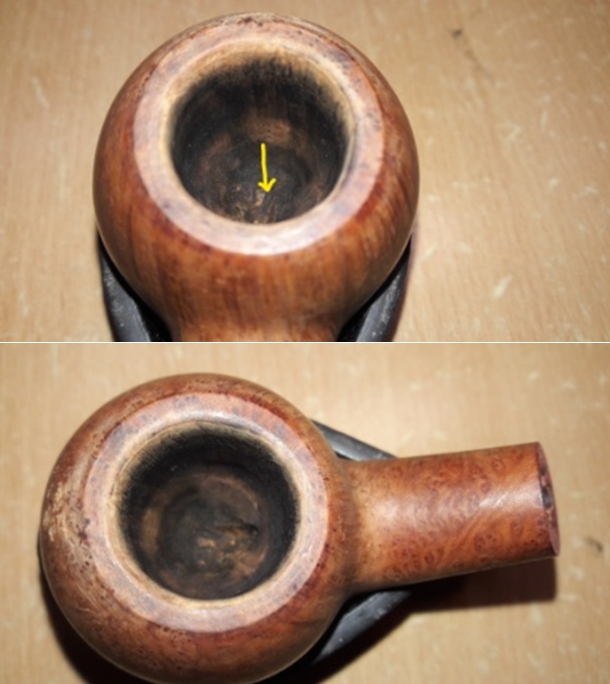
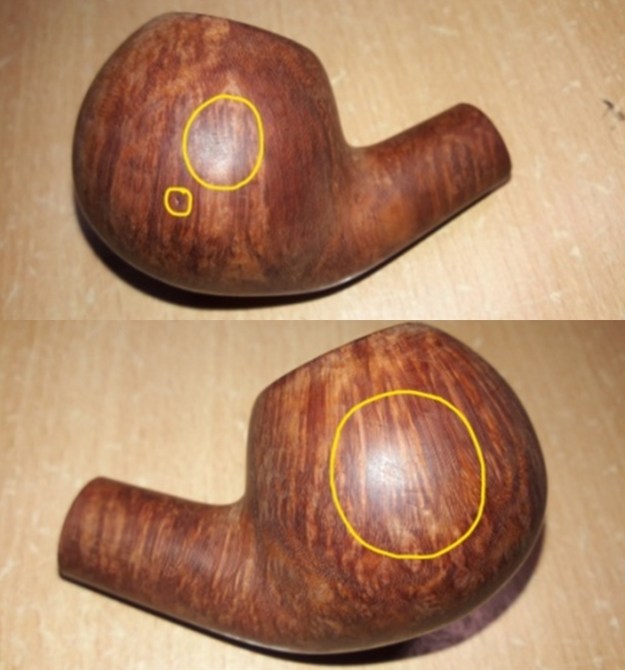
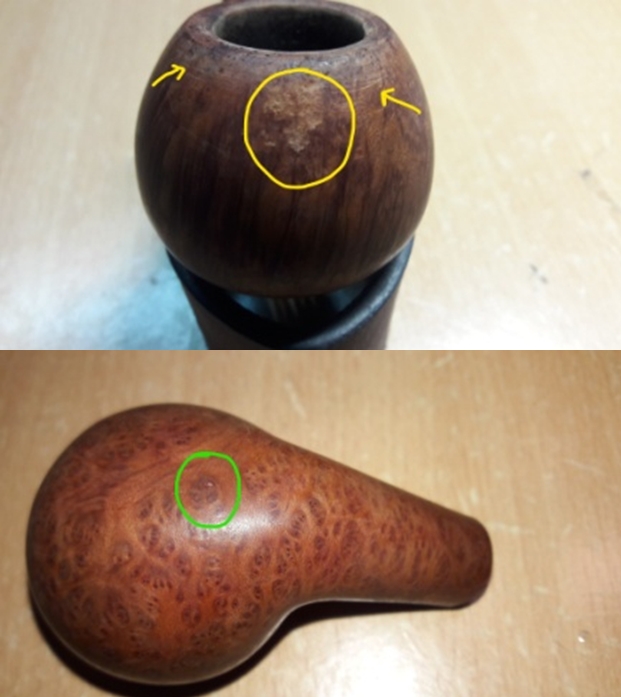
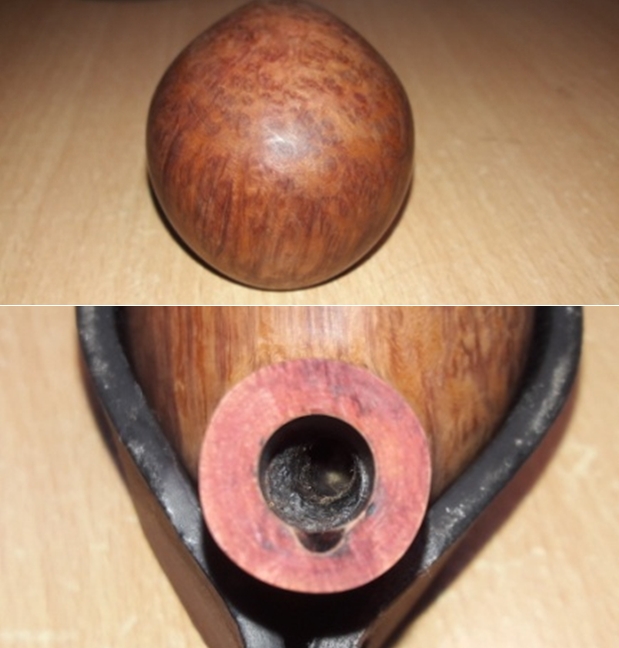
The chamber walls are solid without any signs of damage. The smooth and thin rim top surface is where all the action is on this pipe with an added bonus of an equally damaged beveled inner rim edge. At this point, the damage to the outer rim edge does not appear to be a major issue and should be easy to address. The ghost smells are greatly reduced, but still offending to the olfactory nerves. One major cause of concern is in the heel of the stummel. There is a dip at the bottom that forms a channel from the draught hole to the heel with raised shoulders along the sides (marked in yellow arrows). If this issue is not addressed now, prolonged further use may subsequently lead to a burnout at the foot of the stummel. However, as things stand now, the external surface at the foot appears solid. As observed earlier, there is not a single fill in the entire stummel. The reasoning for giving it a 2 Star, denoting lesser grade, fails me completely!! Abha had nicely cleaned the stummel surface. The surface is solid to the touch but has a number of dents and dings over the stummel, notably to the front, sides and a couple at the foot of the stummel (marked in yellow circles and arrows). Is it a figment of my imagination or a reality, I am not sure, but I think I saw a very slightly darkened spot at the bottom of the foot (circled in green), which was strongly refuted by anyone and everyone I happened to show it to. Just to be sure, I gently tapped it with the back of a screw driver for a shallow sound, but nothing!! I checked the entire stummel for sound and it all sounded the same. The stummel is solid throughout. In the note that Abha had enclosed in the packet containing this pipe, she had mentioned that she could not get a pipe cleaner through the mortise and the draught hole and as such she had left it alone. I would need to check it and further clean the mortise. The stem is free of any major tooth indentations/ bite marks. Minor light tooth chatter, however, is seen on both the stem surfaces in the bite zone. The lip edges needs to be sharpened and evened out. The stem still has signs of deep oxidation. The otherwise good condition of the stem is marred by deep gouges on either sides of the saddle of the stem. THE PROCESS
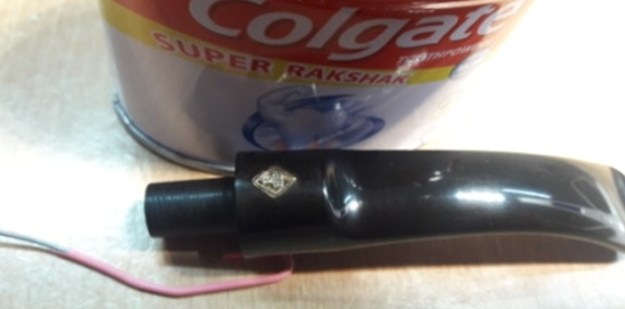
The first issue that I decided to address was that of the blocked air way in the mortise. With the bent flat dental tool, I scraped the walls of the mortise and removed as much of the dried gunk as I could. Using a round needle file, I tried to pry at the blockage, but to no avail. What I found unusual was that an upward movement of the needle file had a little give, however, when I tried to push it in straight, I hit a hard and solid block. Using shank brush and dish washing soap, I scrubbed the shank internals clean. This helped in getting a better idea of what lurked within the mortise that was preventing the pipe cleaner from coming out of the draught hole.I checked the mortise internals under a torch light and what I saw surprised me no end!! Straight away, I could not see the draught hole straight ahead and all that I saw was a reservoir like the one seen on a Pete System pipe. Closer observation around the mortise revealed the opening for the draught hole that was aligned towards the top side and that too was at a weird angle to the rest of the mortise. Here is how the internal of the mortise looked and will present a clearer picture of what I have been trying to explain.Well, this could very well be a flaw in the drilling of the mortise or could be a design element for a better smoke (HIGHLY IMPROBABLE!!), I really cannot tell. Continuing with the internal cleaning of the bowl, I subject the chamber to salt and alcohol treatment to get rid of the strong ghost smells. I insert a folded pipe cleaner through the mortise and out of the draught hole in to the chamber. Thereafter, I tightly pack cotton balls in the mortise, pushing it deep with a dental tool. Next I tightly pack cotton balls in to the chamber, slightly below the rim edge. Once this set up is ready, I pour 99.9% pure isopropyl alcohol in to the chamber and mortise, using a syringe. I let the alcohol settle down and top it again after about an hour. I set the stummel aside for the night to let the alcohol loosen up the grime, draw out all the entrenched oils and be trapped in the cotton. By next afternoon, the cotton and alcohol had drawn out the old oils and tars from the chamber and mortise. I removed the cotton from the chamber and the mortise. I scraped out the loosened crud from the mortise with my dental tools and further cleaned the mortise using hard bristled and regular pipe cleaners. However, on close scrutiny of the mortise under a torch light, I realized that the mortise was still not clean. While removing the loosened cake from the chamber, I gently scraped the shoulders that had formed at the heel near the draught hole. Lucky me, the shoulder that was formed was nothing but hardened cake and was easily removed due to the softening during the salt and alcohol bath. Using my dental tools, I scraped out all the crud that I could and followed it up with a cleaning using q-tips and alcohol. Though the mortise cleaned up pretty nicely, the smells were still strong. I decided to subject the chamber and the mortise to a second salt and alcohol bath. I followed the procedure for the bath explained above and set the stummel aside for the bath to work its magic. The next day, all the remaining oils and tars were drawn out and trapped in the pipe cleaner and cotton. I cleaned the mortise again using pipe cleaners and dental tools. I am happy with the way the mortise cleaned up this time. The pipe smells clean and fresh. Next, I decided to address the dents and dings on the stummel surface and on the rim outer edge. Using a whitener pen, I marked all the major areas with dents and dings and decided to leave the minor ones as they were. I heated my fabricated knife over the flame of a candle, placed a wet Turkish hand towel over the marked areas and steamed out the dents by placing the heated knife over the towel. Though some dents were still observed, these were greatly reduced when compared to before the steaming. Steaming out the dents and dings from the stummel surface had necessitated that the surface of the stummel be evened out by sanding. Using a folded piece of 220 grit sand paper, I sand the entire stummel surface taking care to preserve the stampings on this pipe. To address the damaged inner beveled edge of the rim as well as the dents and dings and darkening of the thin rim top surface, I topped the rim top on 180 grit sand paper. I took a piece of used and worn 180 grit sand paper, folded it and pinching it between my thumb and forefinger, freshened the inner bevel on the inner edge of the rim. Both the rim top and inner edge look much better than before. Staying with the stummel restoration, I polished the stummel with micromesh pads, dry sanding with 1500 to 12000 pads. I polished the freshly topped rim surface and the newly created inner rim bevel. I wiped the surface with a soft cloth at the end of the micromesh cycle. The stummel looks amazing with a deep shine and beautiful grains popping over the stummel surface. I am surprised that the rim top surface has the same deep brown coloration as the rest of the stummel surface and use of stain pen was not required. Also the supposed dark spot at the foot of the stummel was indeed a figment of my imagination and was nothing but the eye in the bird’s eye grain, whew!! The next step is the application of the “Before and After Restoration Balm”, developed by Mark Hoover and a must have for restorations. This product not only protects and enlivens the briar but also highlights the grains on the surface. I rubbed a small quantity of the balm into the briar surface with my fingers and set it aside for about 20 minutes. The transformation is almost immediate and I polished the surface with a microfiber cloth to bring out a deep shine on the stummel. The bird’s eye and straight grains look awesome. The following pictures speak for themselves. Now with the stummel refurbished, I turned my attention to the stem. I start with addressing the issue of deep gouges to the either sides of the saddle by heating the damaged surface with the flame of a lighter. The heat from the flame expands the vulcanite and raises it to the surface. The results are pretty satisfactory.Next I sand the entire stem surface with a folded piece of worn out 180 grit sand paper followed by a 220 grit sand paper. This addresses two issues; firstly the minor tooth chatter in the bite zone and the raised gouges are evened out and secondly, the residual oxidation is sanded out. I follow it up with sharpening of the lip edges with a flat head needle file. To finish the stem repairs, I wiped out the raised oxidation and dust from the surface with Murphy’s Oil soap and cotton swab.To bring a deep shine to the vulcanite stem, I went through the complete set of micromesh pads, wet sanding with 1500 to 12000 grit pads. I wiped the stem with a moist cloth after each pad. Another Mark Hoover product which I had recently ordered is the “Before and After Extra Fine” stem polish. I applied a small quantity of this polish and rubbed it deep in to the vulcanite stem. This polish, purportedly, is supposed to remove the finer sanding marks left behind by the abrasive grit papers. The pictures of the process and final results are shown below.Only the brass BBB stem logo remains to be polished. Abha, my wife, had suggested that I should try using Colgate toothpowder to bring back the shine on the metal logo. She had tried this on her jewelry with amazing results. I rubbed the brass logo with Colgate toothpowder and the results are truly amazing.To apply the finishing touches, I mount a cotton cloth buffing wheel on to my hand held rotary tool and apply a coat of Blue Diamond to the stummel and the stem to polish out the minor scratches. With a cotton buffing wheel that I use for carnauba wax, I apply a coat of carnauba wax and continue to work on it till the complete coat of wax had been polished out. I mount a clean cotton cloth buffing wheel and give the entire pipe a once over buff. I finished the restoration by giving the entire pipe a rigorous hand buffing using a microfiber cloth to raise the shine further. This is a truly beautiful pipe with a classic bent Apple shape boasting of stunning straight grains all round the stummel and shank and bird’s eye grains at the bottom of the entire stummel. Just to be on the safe side, I decided to protect the chamber walls and the heel of the stummel by giving it a bowl coating of activated charcoal and yogurt. This not only protects the walls from direct contact with the burning tobacco but also helps in speeding up the formation of cake. Now the pipe is completed aesthetically as well as functionally.P.S. The only aspect that was bothering me with this pipe is the alignment of the opening of the draught hole in to the mortise. I shared my concerns and pictures of the skewed alignment with my Guru and mentor, Steve. He suggested that this issue, to be addressed, may necessitate funneling the tenon end. He also suggested that I should first smoke this pipe and if the draw is smooth, even and full, funneling the tenon may not be necessary.

I dry tested the draw and found it to be smooth even and full without any whistling sounds. Thus, I can safely expect that the pipe should be a good smoker. I shall eventually get around to enjoying my first smoke in this beauty, but for now, the confidence that this one will be good smoke has me satisfied.

Truth be told, this project was completed by 16 October 2019, however, thereafter I proceeded on leave for my home and got around to complete the write up only after rejoining from leave.

I earnestly thank all the readers for sparing their valuable time in following this write up and hope to learn from your comments on this post.

Fashioning a Churchwarden by Reclaiming an East German Howal Sculpted Apple Bowl


Blog by Dal Stanton

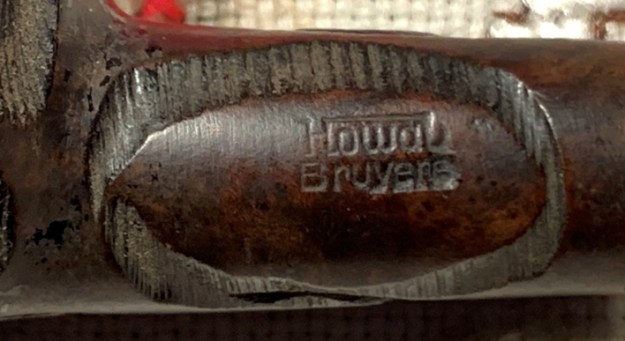
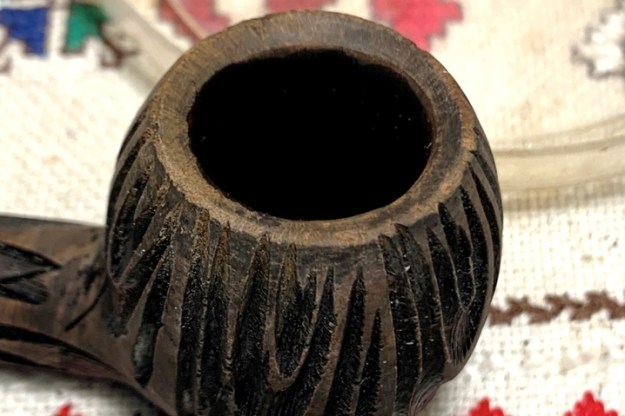
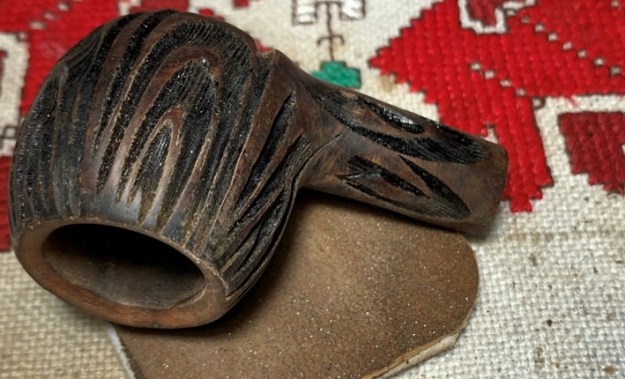
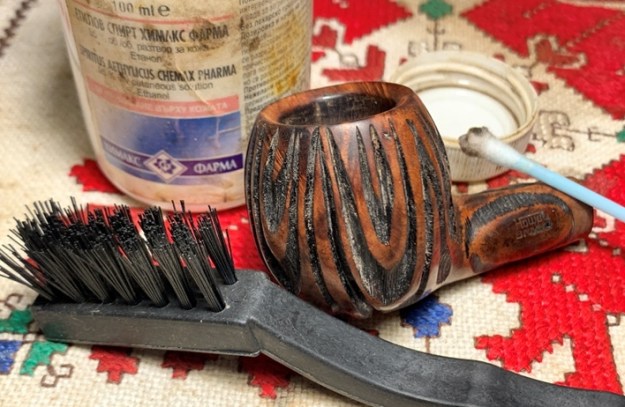
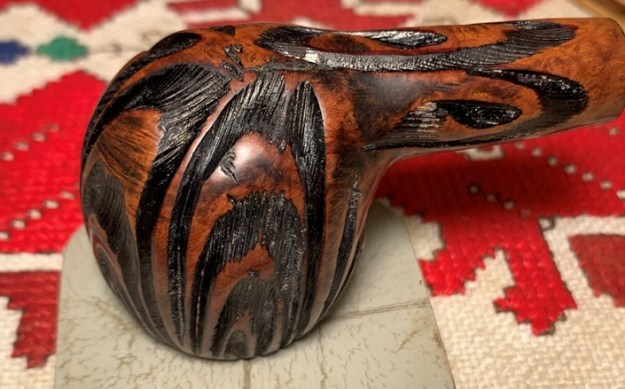
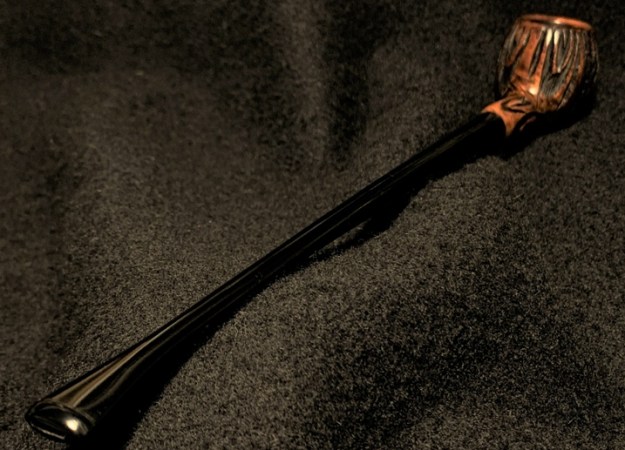
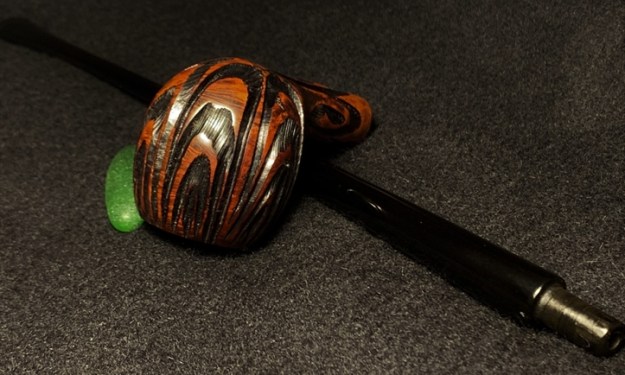
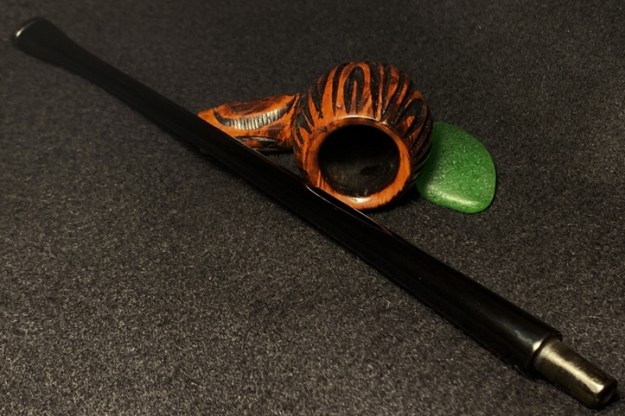
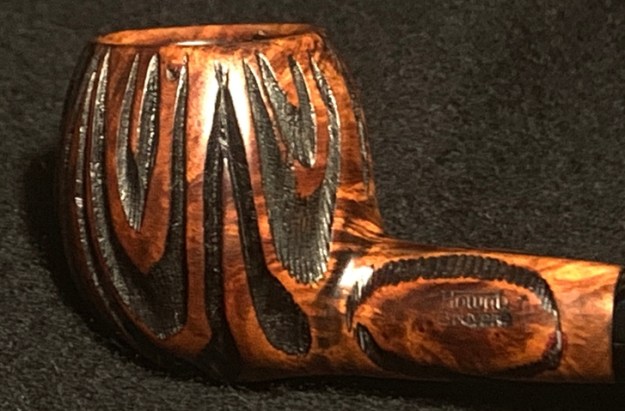
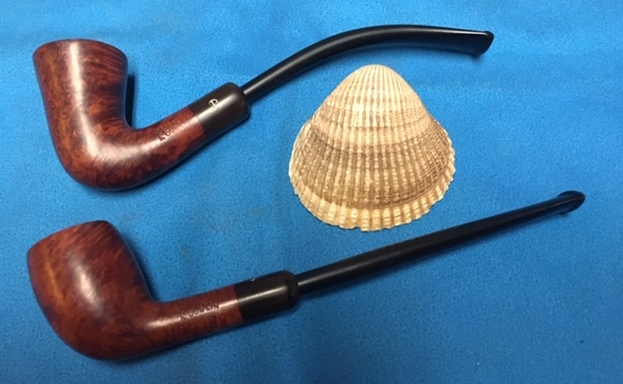
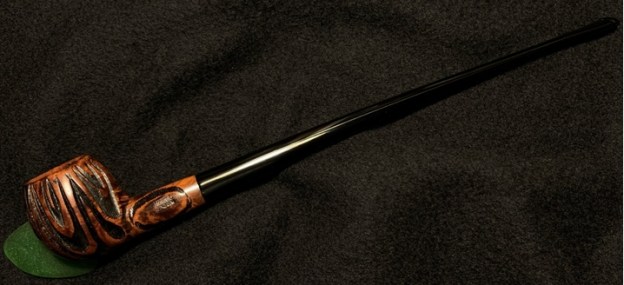
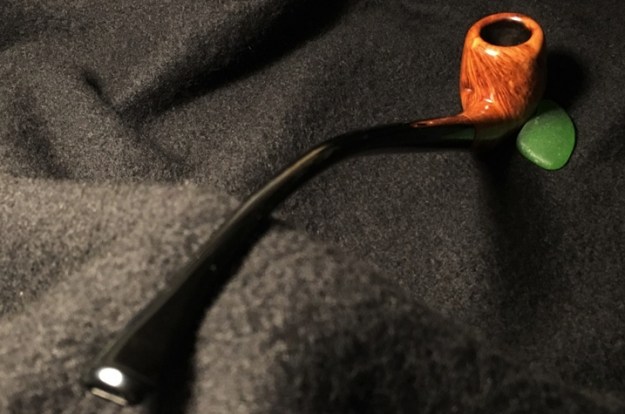
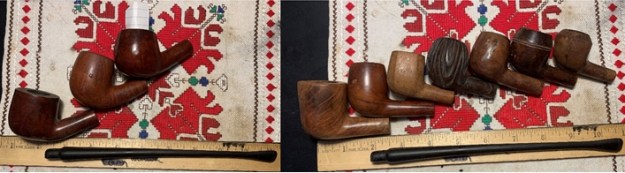
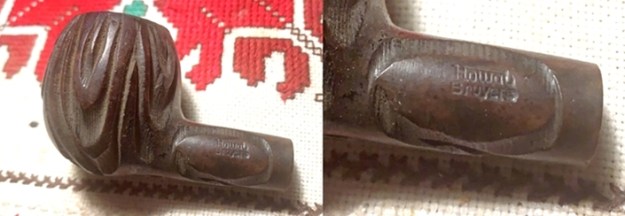
One of the ways I can help benefit women and girls who have been trafficked and sexually exploited – the Daughters of Bulgaria,is by fashioning Churchwardens from discarded repurposed bowls.  I enjoy taking discarded bowls, no longer serving any purpose, and after restoring them, mounting them on the fore of a long, flowing Warden stem.  Suddenly, the metamorphosis is realized – the neglected and discarded again becomes a treasure, sought after with great value.  John, from Utah, saw another CW I created – Fashioning a Churchwarden from a Dimpled Bent Billiard Bowl when I posted it on the Old Codgers Smoking Pipe Facebook group, and he reached out to me to explore commissioning a Churchwarden for himself.  This was the Dimpled Bent Billiard Churchwarden got his attention:After some months, John’s CW project finally worked its way through the queue, patience always appreciated(!) – and as I told him before, when his project was on the worktable, I would contact him with choices for a bowl.  I spread out a selection of bowls next to a Warden stem and ruler.  The selection included bent and straight shanks and smooth and rusticated surfaces – and different shapes.  The unique thing about the Churchwarden shape is that its designation is not determined primarily by the shape of the bowl but by the length of the stem.  After taking a few pictures, and sending them to John, he made his choice.John’s chose a very nice-looking sculpted Apple shape pictured on the right, in the middle.  Through this choice, he expressed that he preferred a straight rather than a slightly bent Warden stem.  When I pulled that bowl aside and took a closer look at the shank, I discovered that on the left side was stamped the name, ‘Howal’ [over] ‘Bruyere’.Howal is not a well-known name in the West, but I became familiar with it after seeing several Howals here in Bulgaria – formerly under the Warsaw Pact, behind the Iron Curtain of the Former USSR.  Having previously restored a Howal – a rusticated Dublin, I enjoyed the research of the Howal name which was a mystery to me.  My research uncovered not only the origins of the pipe in former East Germany, but that the city where Howals were produced was a historical center for pipe manufacturing in Germany that pre-dated WW2.  A fascinating story that I wrote of in this restoration: Checkered History and Heritage of an East German Howal Old Briar Rustified Dublin.
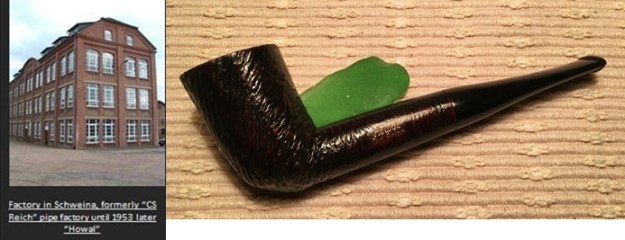
Pipedia’s article that I sited in that write up was both interesting and helpful in understanding the predecessor of and origins of the Howal name:

C.S. Reich was founded by Carl Sebastian Reich in Schweina, Germany in 1887. By its 50th jubilee in 1937 C.S. Reich was the biggest pipe factory in Germany.  In 1952, however, the owners of the company were imprisoned and the company itself was nationalized as Howal, an abbreviation of the German words for “wood products Liebenstein” or “Holzwaren Liebenstein”.  By the 1970’s Howal, after acquiring many other smaller pipe making firms, was the sole maker of smoking pipes in East Germany. In 1990, with the fall of the Berlin Wall and reunification of the Germanys, the company was closed.

As I reread that previous research on the history of the Howal name for this write-up, I decided to restate my observations in full because I don’t restore Howals often and the history and human story draws me to retell the story as I transform this Howal bowl into a Churchwarden.  From the previous restoration (my present comments in brackets):

While helpful for a broad sweep, I discovered much missing from this [Pipedia] summary and it raises more questions.  From another interesting source, Edith Raddatz’s lecture on tobacco pipe production in Schweina [a link which unfortunately is no longer working!] at the Tobacco Pipe Symposium in 2003, it describes a history of pipe production in this central German village that was reminiscent of my research into France’s pipe mecca, St. Claude.  A strong development of the pipe making industry can be traced in the 1800s to the apex of the C.S. Reich Co. being Germany’s largest pipe producer in 1937, but Raddatz’s lecture reveals that other producers of pipes were also based in the German village of Schweina.  Pipedia’s article above describes how the owners of the C.S. Reich Co. were arrested and imprisoned followed by the nationalization of the Reich Co. and becoming ‘Howal’, an acronym for “Wood Products Liebenstein” – Bad Liebenstein was the town that bordered and absorbed the village of Schweina. The question begs to be asked – which, unfortunately introduces the human tragedy wrapped around the name ‘Howal’ – Why were the owners arrested?  In an unlikely source, the website of the ‘Small Tools Museum’ adds the names of those imprisoned: shareholders Robert Hergert and Karl Reich.

Edith Raddatz’s lecture (referenced above) brings more light to the difficult geopolitical realities these people faced (Google translated from German – brackets my clarifications):

By 1945 the company, which had meanwhile [passed to] the next generation – Kurt Reich And Walter Malsch – [had] about 100 employees.   Among them were many women who mainly did the painting work.  At the beginning of the 1950s, an era ended in Schweina. The first [oldest] tobacco pipe factory in Schweina closed their doors. There were several reasons for this. Kurt Reich passed away in 1941, [and] Walter Malsch [in] 1954.  The political situation in the newly founded GDR made the conditions for private entrepreneurship difficult. The heirs of the company “AR Sons” [Reich family] partly moved to West Germany. The operation was nationalized, and later toys were made there.

In post WWII occupied Germany, the Soviet occupied section was declared to be a sovereign state and the German Democratic Republic (GDR) was established in 1949 (See link).  With a rudimentary understanding of Marxism and the economic philosophy undergirding it, it is not difficult to deduce what brought the demise of the C. S. Reich Co. and the formation of Howal.  Solidification of the FDR’s hold on power paralleled the necessity to nationalize private ownership and to institute a State-centered command economy.  These efforts gained momentum and forced companies/workers to work more with no additional pay.  In 1952, the year that the owners of C. S. Reich Co., were arrested, this edict was advanced (See link):

In July 1952 the second party conference of the Socialist Unity Party of Germany (SED) took place in East Berlin. In SED General Secretary Walter Ulbricht‘s words, there was to be the “systematic implementation of Socialism” (planmäßiger Aufbau des Sozialismus); it was decided that the process of  Sovietization should be intensified and the importance of the state expanded. The party was acting on demands made by Soviet premier Joseph Stalin.[2]

As a result, today Germany remembers the Uprising of 1953 which started in East Berlin, as factory workers revolted against the repression of the GDR, and spread to all East Germany.  Many lost their lives as Moscow responded to squelch the unrest with tanks on the streets.  In play also, was the mass exodus of people fleeing to West Germany, which included, per Edith Radditz’s lecture, the Reich family, who would have been heirs of the family’s legacy and company – pipe making.  Also, in 1953, completing the State forced abolition of any Reich claim, the largest pipe making company of Germany was seized, nationalized, and changed from C. S. Reich Co. to Howal.  As ‘Howal’, pipes continued to be produced, undoubtedly with the same hands and sweat of the people of Schweina, along with other wooden products, such as toys.  In the Pipedia article I quoted above, it said:

By the 1970’s Howal, after acquiring many other smaller pipe making firms, was the sole maker of smoking pipes in East Germany. In 1990, with the fall of the Berlin Wall and reunification of the Germanys, the company was closed.

My curiosity piqued, what does it mean when it says that Howal acquired many other smaller pipe making firms?  Should we question whether these words can be understood in the normal free market enterprise way we are accustomed?  Doubtful.

…So, as I had written before regarding the checkered history of the Howal name.  Now, as I look again at the Howal sculpted Apple bowl on my worktable, I take a few more pictures to mark the starting point and to take a closer look. I very much like John’s choice of a bowl to fashion a Churchwarden.  The sculpting of the classic Apple shape will look very nice as a Warden – with a rustic, ‘Olde World’ look to it.  The condition of the Howal bowl is generally good.  The chamber has a heavy cake which will be removed to give the briar a fresh start and to check the chamber wall for heating problems.  The rim has some crusting lava overflow that needs cleaning. The rusticated surface with the intricate ribs carved into the sculpting also needs scrubbing to remove grime lodged in the wood.  Before working on the stem, I start the Howal Churchwarden project by using the Pipnet Reaming Kit.  After taking a picture of the chamber showing the tightening chamber as the cake thickens, I use the two smallest blade heads of the 4 available and ream the chamber.  The cake proves to be stubborn – hard as a brick.  After the Pipnet Kit, transitioning to the Savinelli Fitsall Tool, clearing the cake continues as the tool scrapes the chamber wall. Finishing this phase, I wrap 240 paper around a Sharpie Pen and sand the walls and then wipe the excess carbon dust with a cotton pad wetted with alcohol.
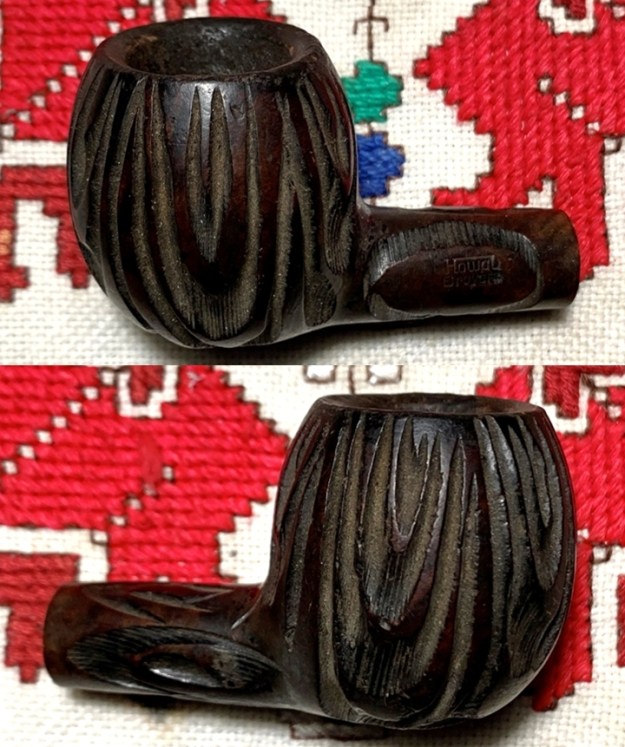
After completing the removal of the cake and cleaning the walls, an inspection reveals no heating problems.  I move on.Next, using undiluted Murphy’s Oil Soap I begin the external cleaning. I also employ a bristled toothbrush to get into the crevasses of the sculpted vertical sweeps, which are more detailed upon closer inspection. Within each crevasse, fine lines have been carved to provide a classier sculpted appearance. I like it. From the picture above, the lava flow caking on the rim is evident. A brass brush helps with removal of the crusting without damaging the briar underneath. The sharp edge of my Winchester pocketknife also helps as I carefully scrape the rim surface. From the worktable, I take the bowl to the sink and there using different sized long shank brushes with some anti-oil dish soap, I scrub the internal mortise under warm water.  After a thorough rinsing of the soap, I bring the bowl back to the worktable. The cleaning did a good job. I can now see the rim more clearly with a cut on the right side and some light damage on the left. The cleaning also reveals the residue of old finish on the smooth briar which shows up dark and shiny in the picture.  I’ll remove these patches with sanding.Starting with the rim, I take another picture showing the damage on the top and the bottom of the picture’s orientation.  The rim is sloped downwardly to form beveled rim peak. This is attractive and accentuates the Apple shape’s peaked rim. Going with this flow, I use 240 grade paper and sand the rim to freshen the lines and to remove the damage.  I show a few pictures to show the freshening progression. I follow the 240 paper by dry sanding with 600 grade paper on the rim.  I’m liking the emergence of a smooth grain contrast underneath.  A few blemishes remain on the rim at this point but I like the more rustic look – some imperfections on the rim accents the overall look.Next, to address the patches of old, dark shiny finish on the bowl’s surface, I dry sand using a 1500 micromesh pad to remove the old finish patches from the smooth briar surfaces of the sculpted motif.  I intentionally leave the rough rusticated briar in the sculpting untouched to preserve the original, darkened patina.  I’m aiming for an attractive contrast between the smooth briar, which will naturally lighten through the restoration process, revealing briar grain, with the rough, darkened sculpted briar. Not forgetting where I am in the cleaning process, I return to working on the internals with cotton buds and pipe cleaners dipped in isopropyl 95% – the strongest rubbing/cleaning alcohol available to me here in Bulgaria.  For a smaller Apple bowl, the internals were rife with old oils and tars.  I also did much excavation of tars and oils using the small dental spoon as well as drill bits.  With the bits, I hand turn a bit that is the same size as the drilling diameter which scrapes the wall.  The gunk seemed to have no end, yet finally, the cotton buds started to lighten, and I call the cleaning provisionally finished.  Later, I’ll continue the cleaning and refreshing of the internals by using a kosher salt and alcohol soak. Now to the stem fabrication.  I cease the stummel work at this point because there will be additional sanding as I size and sand the stem with the shank.  I take a few pictures to mark the starting point.  John prefers a straight stem for his Churchwarden which is not a problem.  The precast Warden stem has a very slight bend as it arrived on my table.  This will remain as it helps with maintaining the up/down orientation of the mounted stem.  The picture below shows the rough tenon oversizing which will be shaped to form a good junction with the Howal shank and tenon seating in the mortise. No shank/stem fitting is the same which means that sanding and finetuning the junction is always required.  The picture below illustrates this – the mortise drilling is slightly higher in the mortise which means that the upper thickness of the shank/mortise briar will be thinner and the lower will be slightly thicker.  Shaping the stem fit must factor this offset.The first step in fashioning the CW stem is to size the tenon.  I use the PIMO Tenon Turning Tool that I purchased from Vermont Freehand.  I keep the instructions tacked on the wall in front of me for a reminder and safe keeping!  A very useful tool to have for fashioning tenons.First, using an electronic caliper to measure the diameter of the mortise marks the target sizing of the tenon of the precast stem.  The mortise measurement is 7.95mm in diameter.  Using Charles Lemon’s (of Dad’s Pipes) methodology, I add about 50mm to this exact measurement to give me my ‘fat’ target.  The ‘fat’ target is what I will aim for when bringing the tenon down to size using the PIMO Tenon Turning Tool.  The ‘fat’ target (7.95mm minus 50mm) is about 8.45mm.  From this ‘fat’ point, I will sand the tenon by hand which gradually and patiently custom sizes the tenon to the mortise.The first thing needed is to pre-drill the tenon airway with the drill bit provided by the PIMO tool.  This enlarges the airway slightly enabling the insertion of the PIMO tool guide pin.  I mount the drill bit to the hand drill and drill out the airway.Next, the PIMO Tenon Turning Tool is mounted on the hand drill and I cut a small test sizing to give me the distance between the test cut and the ‘Fat’ target.  After cutting the test, I measure with the caliper and record 9.23mm and subtract the ‘Fat’ target, 8.45mm, leaving about .78mm to remove using the PIMO tool. Using the Allen wrench provided with the PIMO tool, I close the gap of the cutting arm and cut again.  I only cut a small portion out of the end of the tenon and then measure – this additional test cut guards from taking off too much.  The measurement of this test cut after closing the gap of the carbide cutter arm is 8.45mm.  On the button!  I finish the cut to the stem facing and begin sanding the tenon down. Using 240 grade paper, I uniformly sand the tenon so that the fit is snug, but not too snug.  As I sand the tenon, I often test the progress by inserting the tenon into the mortise.  I NEVER force the tenon to make it fit – a cracking sound of a shank is not a happy thing!I come to a point where the end of the tenon was butting up against the closing ridge from the mortise drilling.  I could detect the bump in the mortise.  Using the sanding paper and a flat needle file, I focus on tapering the end of the tenon so that it can navigate the narrowing mortise.  I don’t want to cut off the end of the tenon as a longer tenon provides a bit more strength for the longer stem’s reach.Finally, a good snug fit it accomplished and the stem is seated well.  The next step in the project is to fashion the shank around the new stem.  The pictures following show the overbite of the shank which needs sanding.To protect the Howal nomenclature and provide a sanding barrier, I wrap masking tape around the shank.  Using 240 sanding paper, I begin the process of sanding to bring the shank and stem into alignment. After making good progress, I discover a dimple at the seam of the precast stem just at the tenon facing. I’ve seen this before. To take the dimple out by sanding also will remove the corresponding briar on the shank side.  This I don’t wish to do more than is necessary.  I could also use the PIMO Tool to shave off more of the facing to remove the dimple.  Yet this would shorten the overall length of the Warden stem – not a good solution either. To remedy the dimple, after cleaning the area with a cotton pad wetted with alcohol, I spot drop regular CA glue on the dimple and immediately give it a spray of an accelerator so that the glue patch stays in place.  I don’t want CA glue running down the tenon facing!Shortly after, I rejoin the stem and Howal stummel and continue sanding the patch area.  The patch did the trick. The pictures show the results and the shank and stem are now in alignment.  I move on. Even though a precast Warden stem is new, it doesn’t arrive on the scene ready for action. Precast stems will usually not have smooth surfaces but tend to be ‘wavy’ – a leftover from the casting process. Therefore, sanding the entire stem is necessary. To do the initial rough sanding of the stem I use a coarse 120 paper to do the heavy lifting. As I sand the stem, the first picture below reveals what I’m describing as sanding reveals the rippled surface. After much sanding and bothersome rubber dust(!), the stem is shaping up well.  I’m liking what I’m seeing.With the rough sanding of the stem-proper done, I shape the button using the 120 grade paper and a flat needle file.  The first two pictures show the starting point and sanding – upper then lower. My day is ending, and the final project is to continue the internal cleaning and refreshing of the stummel.  To do this I use kosher salt and isopropyl 95% to give the internals a soak which helps draw out the tars and oils embedded in the internal briar.  I first stretch and twist a cotton ball to serve as a ‘wick’ that helps draw the oils out of the mortise walls.  Using a stiff wire, I guide the wick down the mortise and airway.  I then fill the bowl with kosher salt – kosher doesn’t leave an aftertaste as iodized salt. After placing the stummel in an egg carton that keeps it stable, with a large eyedropper I fill the bowl with isopropyl 95% until the alcohol surfaces over the salt.  After a few minutes, the alcohol is absorbed, and I refill the bowl with alcohol.  I put the stummel aside to soak through the night. The next morning, the salt and wick are soiled indicating the activity of the soak through the night.  I toss the expended salt in the waste, wipe the chamber with paper towel and blow through the mortise to dislodge any salt crystals left behind.  To make sure all is clean, I again employ a pipe cleaner and cotton buds dipped in isopropyl 95% to finish the cleaning.  Not long after, the buds are emerging clean.  I move on. I return now to a reunited stem and stummel, using 240 sanding paper I now start the fine tuning of the stem after the coarse 120 paper. To show the completed condition of the stem after the 240 grade paper sanding, two close-ups show the improved texture of the sanded surface.Next, for more fine tuning of the stem’s surface, I wet sand with 600 grade paper and follow by applying a buff with 000 grade steel wool.  I love to see the emergence of the buffed-up vulcanite stem!  I keep the stem and stummel united throughout the sanding process to assure that the stem’s tenon facing remains sharp and in alignment with the shank – shouldering the stem is not an option!Turning back to the Howal bowl, I remove the masking tape and take some pictures marking the stage of progress. I like the rustic look this bowl already has.  My approach will be to run the bowl through the full regimen of micromesh pads to bring out the shine and briar of the smooth briar surfaces – going over for the most part, the sculpted surfaces.  At that point I’ll determine if I need to darken the shank end that was lightened because of the stem sanding.  I also will freshen the darker sculpted sections with a stain stick.  I’ll keep the stem and stummel joined through this process which will aid me later when I continue with the micromesh process on the stem. I take pictures of the bowl to mark the starting point. Beginning with micromesh pads 1500 to 2400, I wet sand followed by dry sanding with pads 3200 to 4000 and 6000 to 12000.  The pictures show the progression. The grain came out of the smooth briar nicely.  Now, to freshen the sculpted sections.  With the fine lined carvings in each sculpted section, briar dust has collected from all the sanding.  I first brush the carvings with a bristled brush.  This removes a good deal.  Following this, with an alcohol wetted cotton bud, I wipe out each carved section.  Next, using a very dark brown dye stick which turns out to be a mahogany, which looked the best after blending with the original surface, I trace the carvings darkening the sculpted briar.  After finishing, I give another quick sanding over the smooth briar surface with the last of the micromesh sanding pads, 12000.  I do this to clean off any inadvertent overrun of the dye stick onto the smooth briar and to sharpen the lines. Using Before & After Restoration Balm, I place some on my fingers and work the Balm into the briar surface.  I’m careful to work it into the crevasses of the sculpting.  B&E Restoration Balm is an excellent product from Mark Hoover at www.ibepen.com that raises the natural hues in subtle ways that enhances the presentation of the pipe.  After thoroughly working the Balm into the briar surface, I set the bowl aside for 20 minutes to allow the Balm to do its thing.  The second picture shows this state.  After 20 minutes, I wipe the excess Balm with a cotton cloth and then buff the stummel with a microfiber cloth to thoroughly remove the excess Balm and to raise the shine.The next step is to apply Blue Diamond compound to the entire pipe.  After reuniting stem and stummel, I mount a cotton cloth buffing wheel to the Dremel, set the speed at about 40% full power and apply a light application of the compound focusing primarily, but not exclusively, on the smooth briar sections.  I keep it light because I do not want the compound to cake up in the rusticated ridges of the sculpting.  I apply the compound to the smooth and rusticated surfaces and to the stem.Following the compound, I use a felt cloth to wipe the pipe to clean it of compound dust.  I don’t want compound mixing with the waxing phase.After switching to another cotton cloth buffing wheel, maintaining the same speed, carnauba wax is applied to the entire pipe.  As with the compound, I go easy on the rusticated ridges not wanting wax to cake.  After applying wax to the entire pipe, I use a microfiber cloth to give the Howal Churchwarden a rigorous hand buffing to remove excess wax and to raise the shine.The Howal Sculpted Apple bowl looks great mounted on the bow of the Churchwarden stem!  I’m pleased how the smooth briar surfaces cleaned up and how the grain provides a striking contrast with the sculpted design.  The added rusticated ribs in the carvings adds a nice detail.  The overall presentation of the Howal Sculpted Churchwarden gives a very old, rustic feel.  I’m glad John was patient waiting for this Churchwarden to come to life.  He will have the first opportunity to add this pipe to his own collection from The Pipe Steward Store.  This Churchwarden project benefits the Daughters of Bulgaria – women and girls who have been trafficked and sexually exploited.  Thanks for joining me!
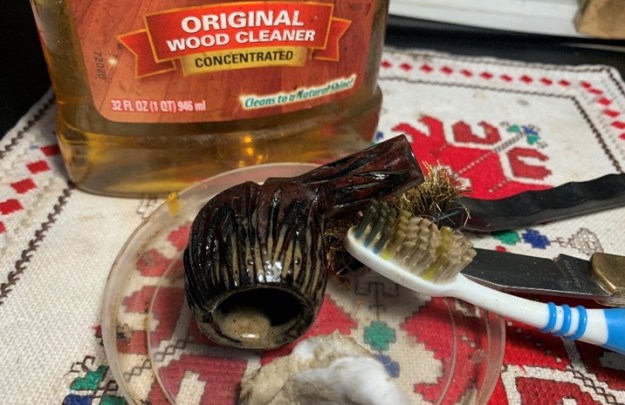
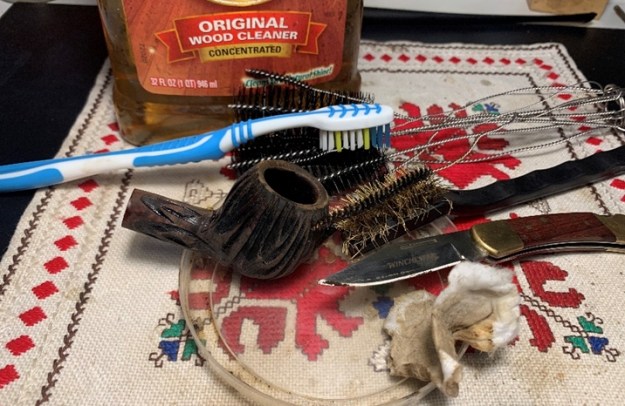
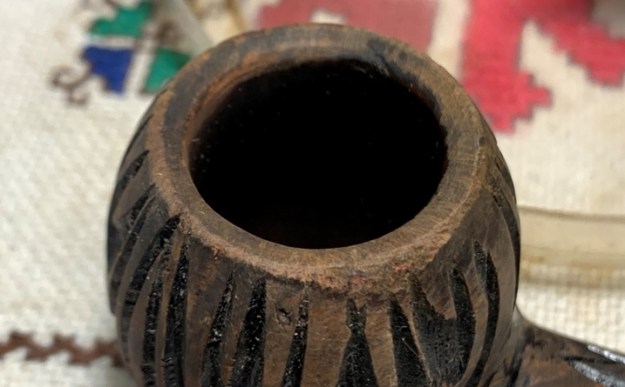
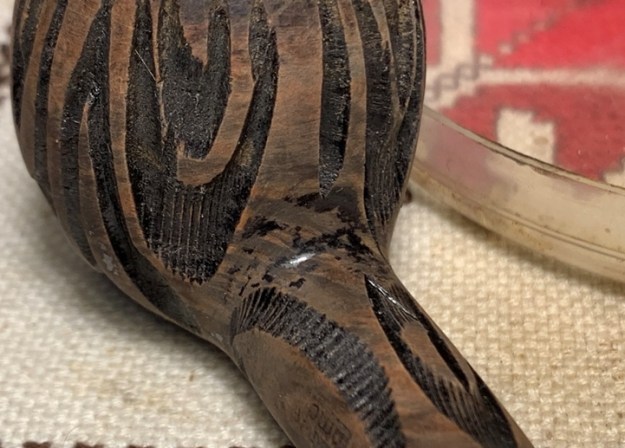
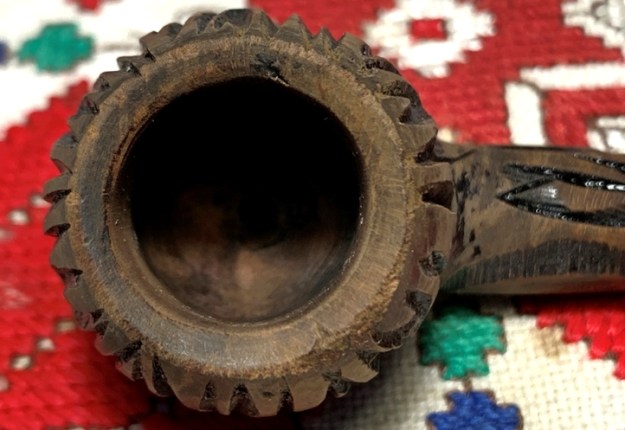
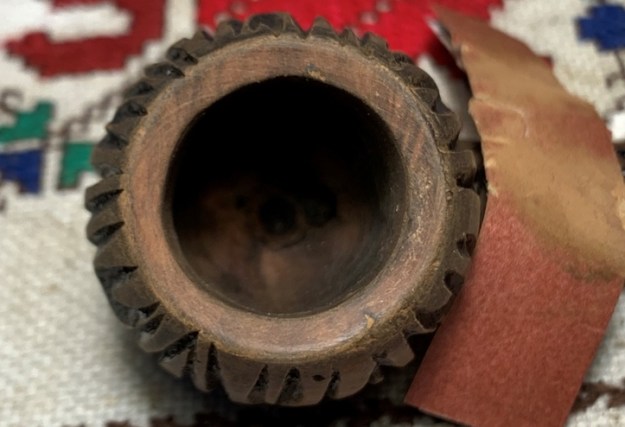
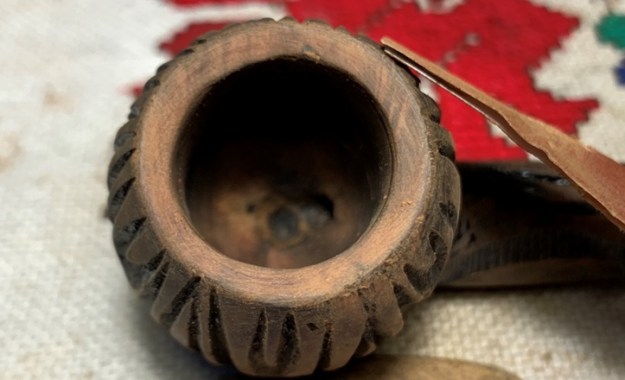
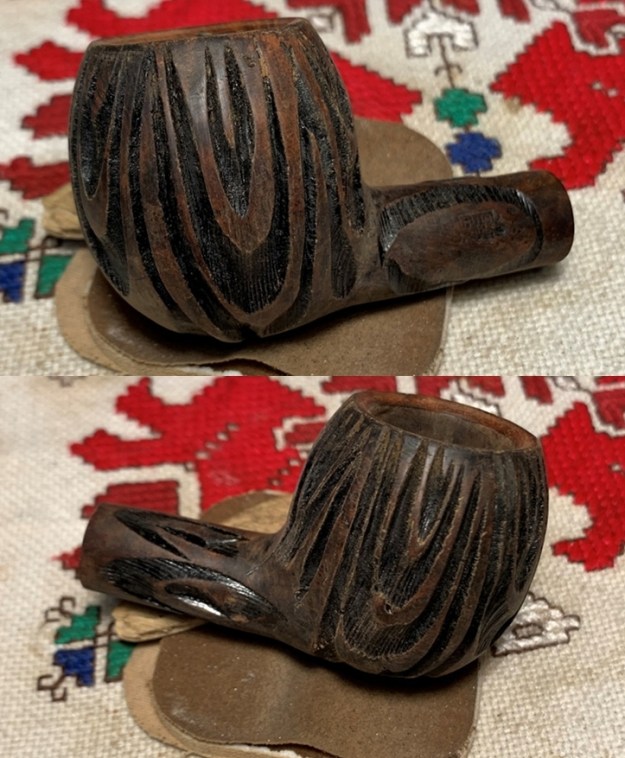
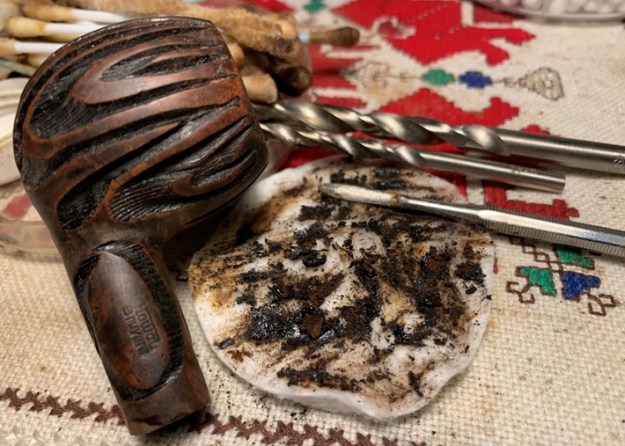
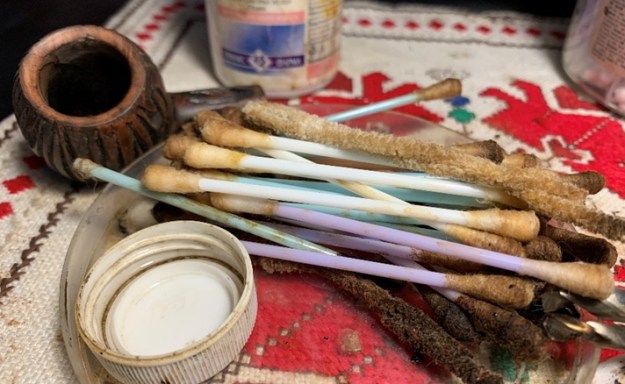
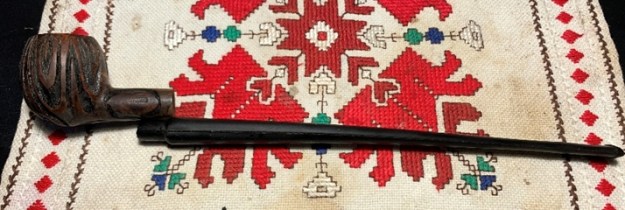
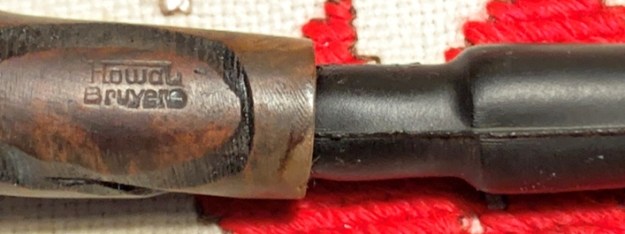
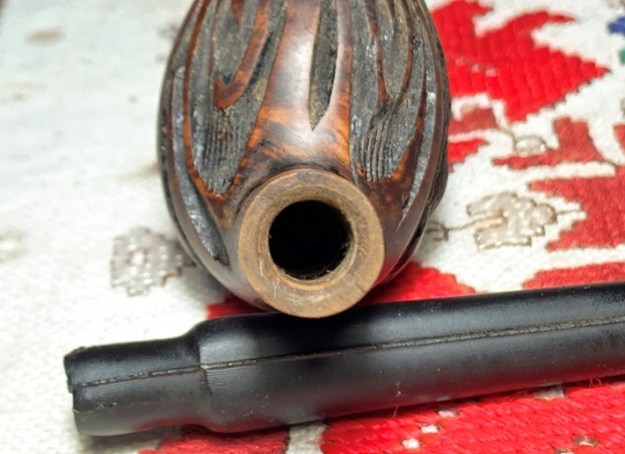
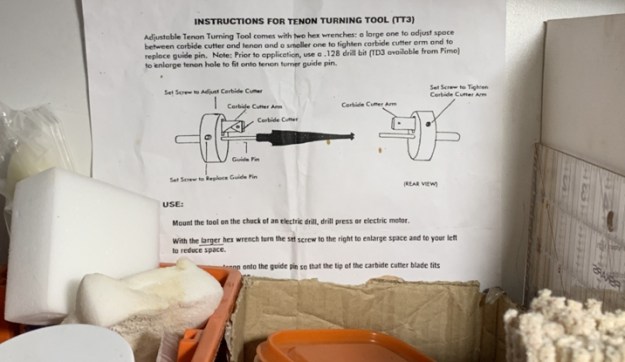
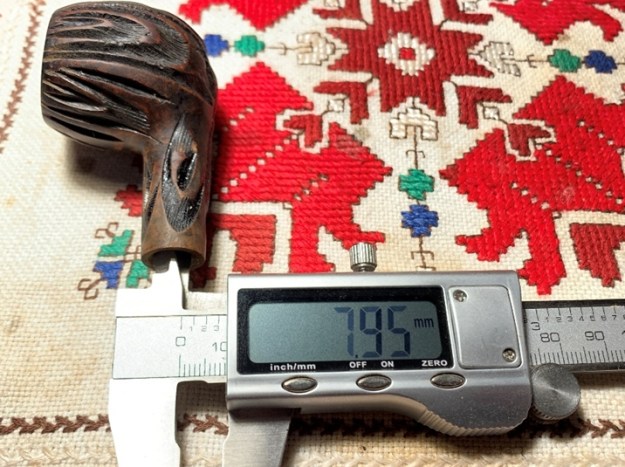
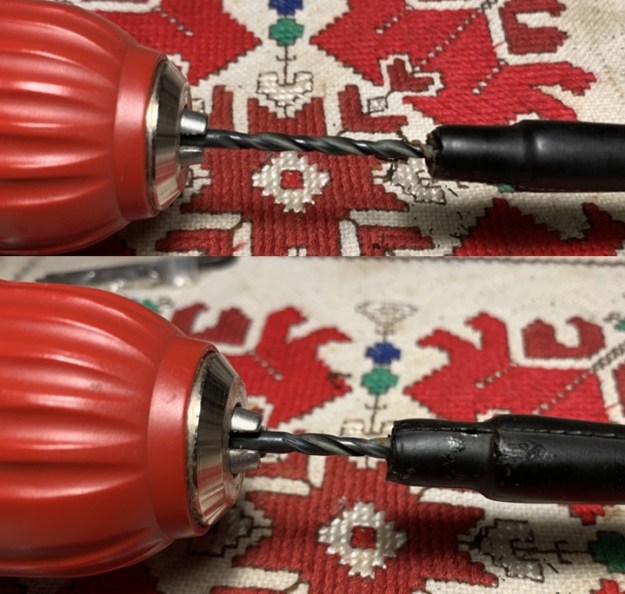
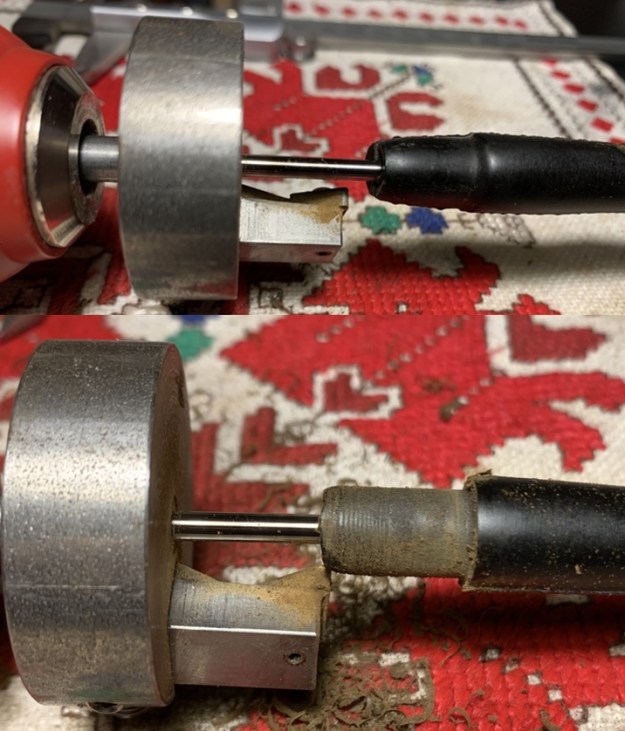
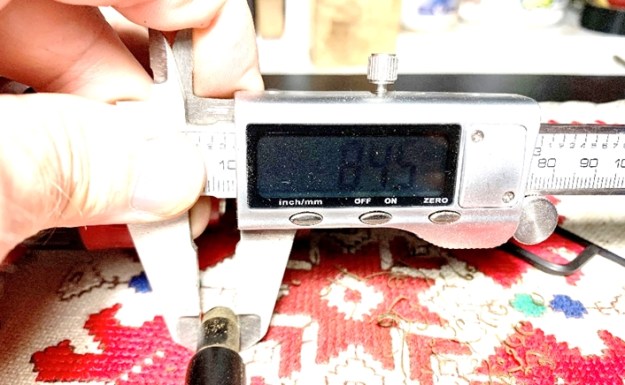
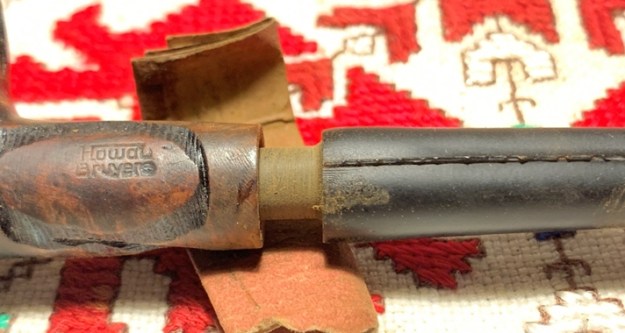
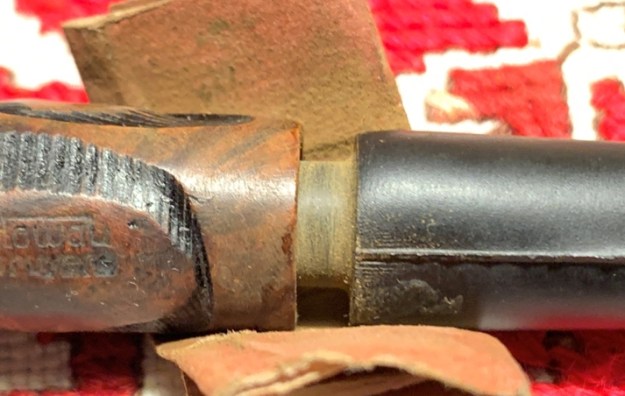
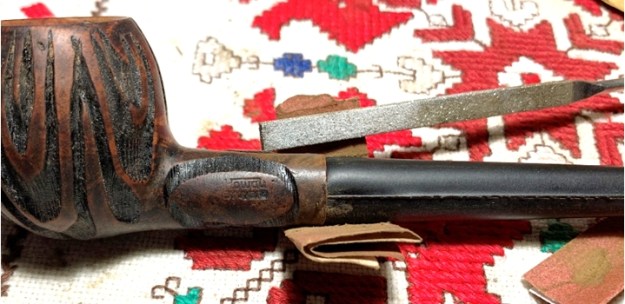
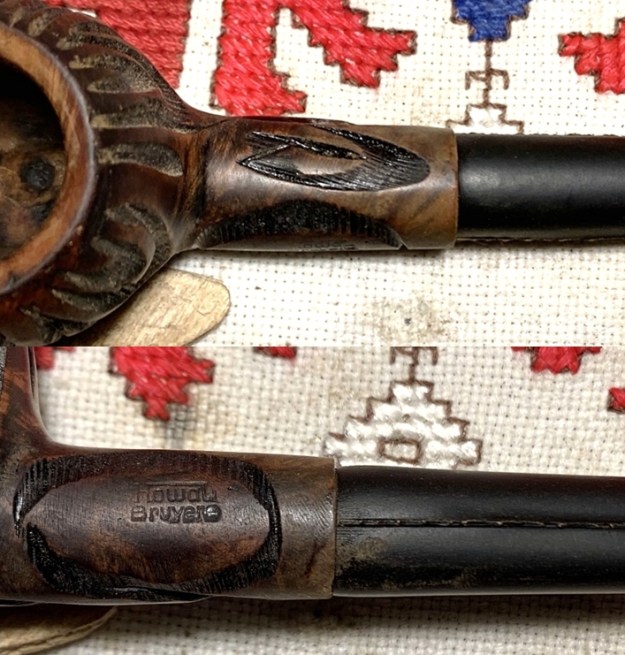
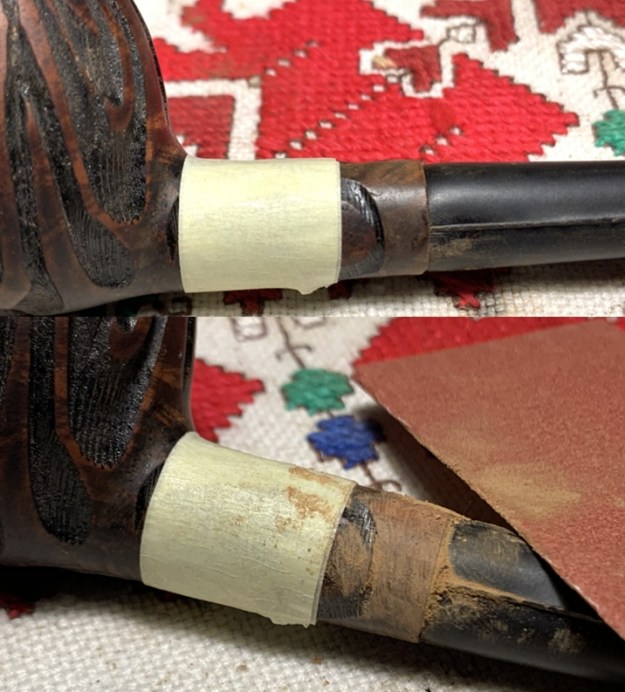
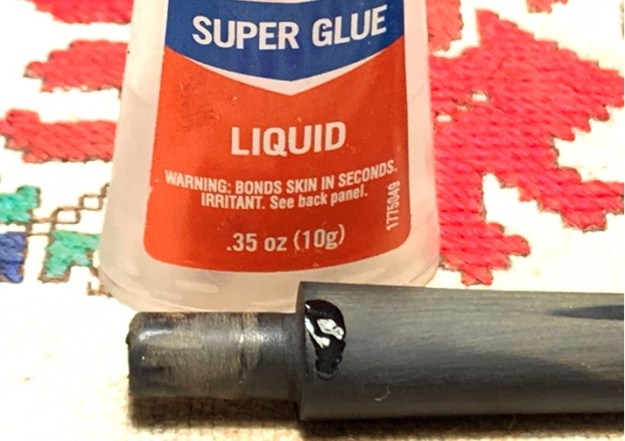
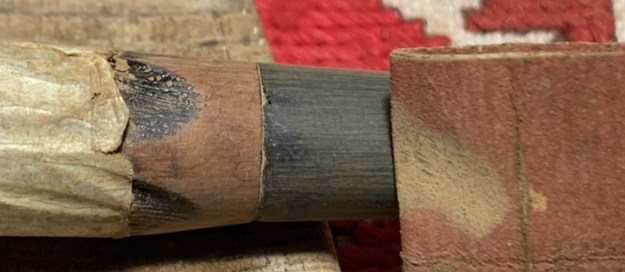
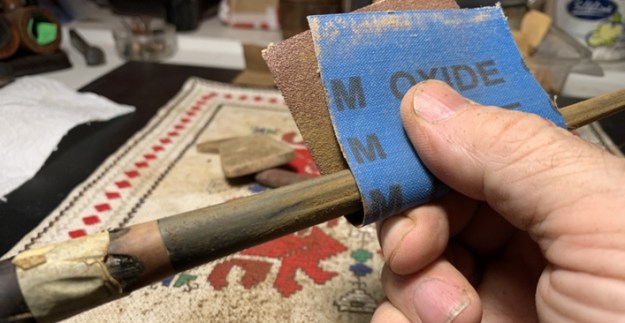
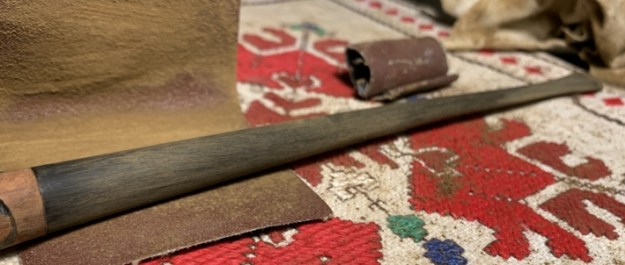
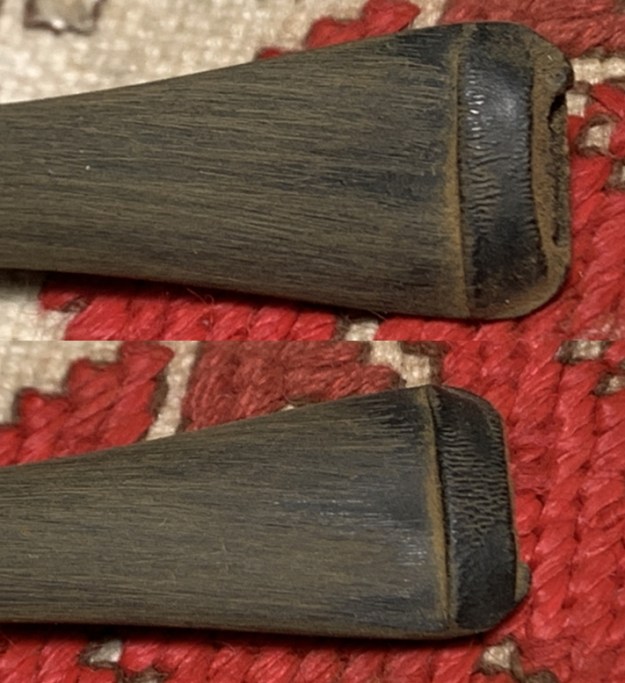
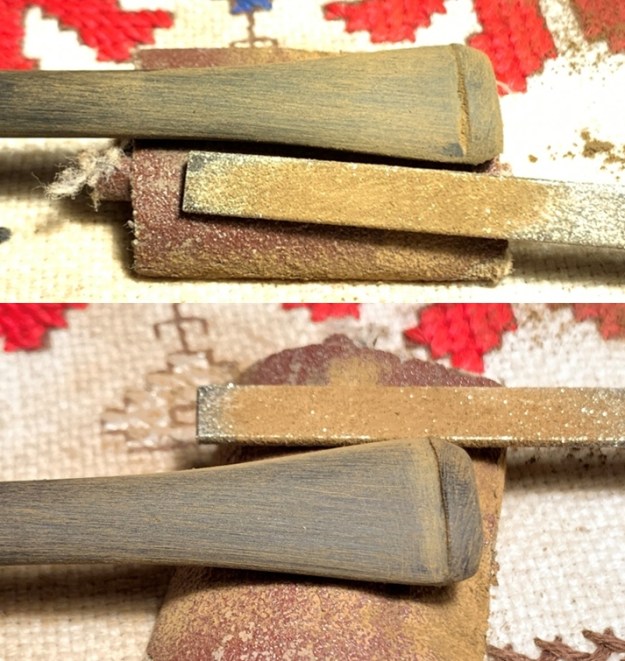
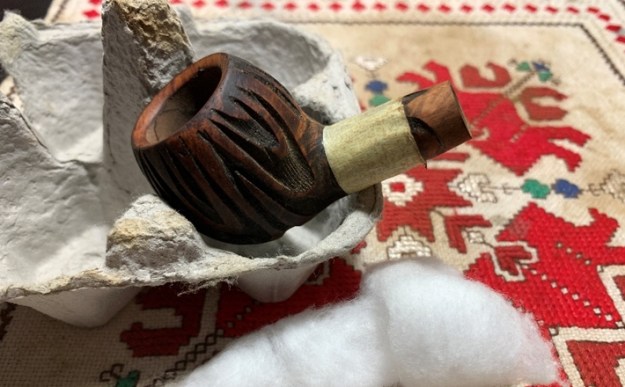
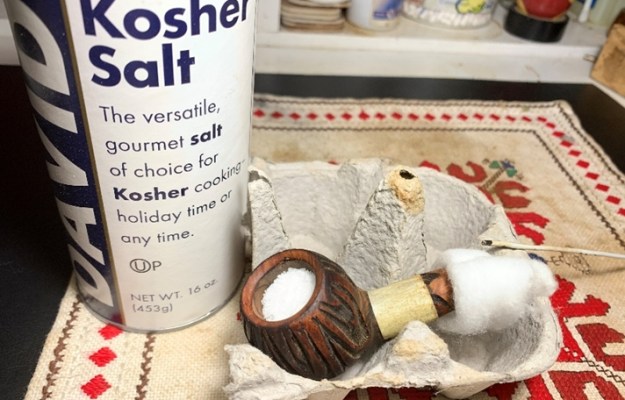
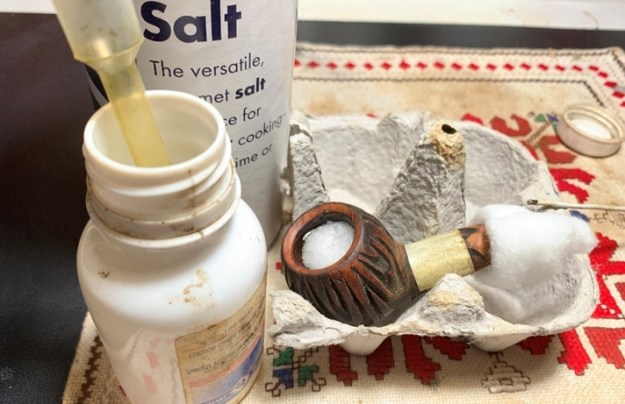
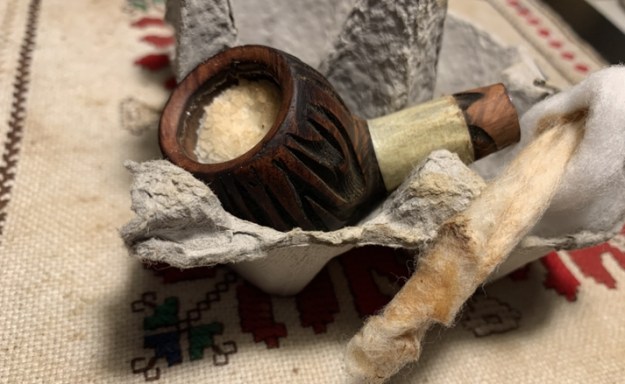
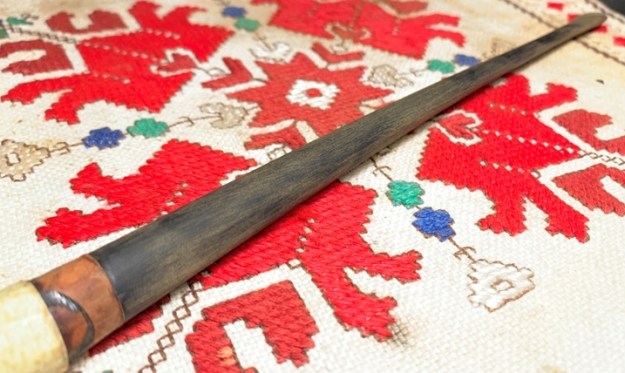
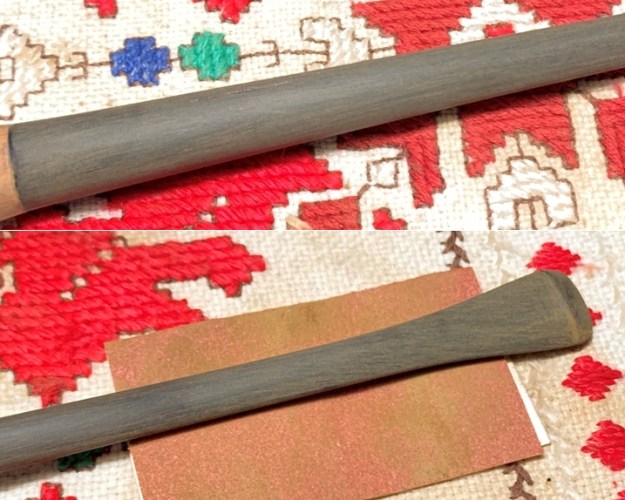
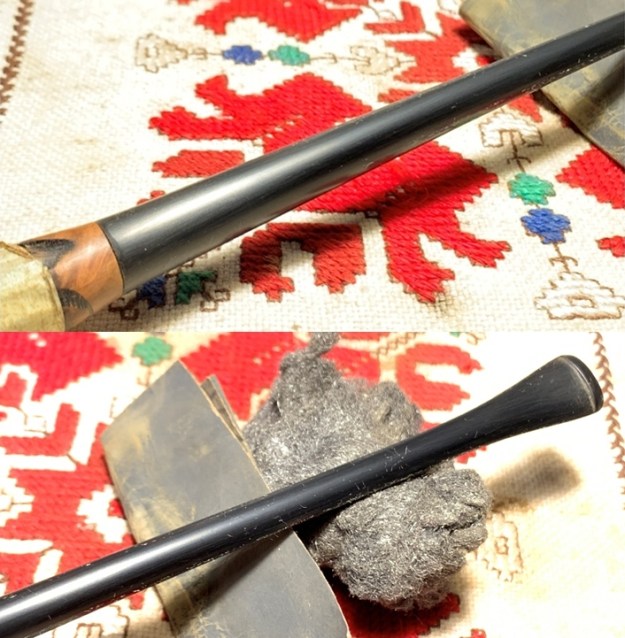
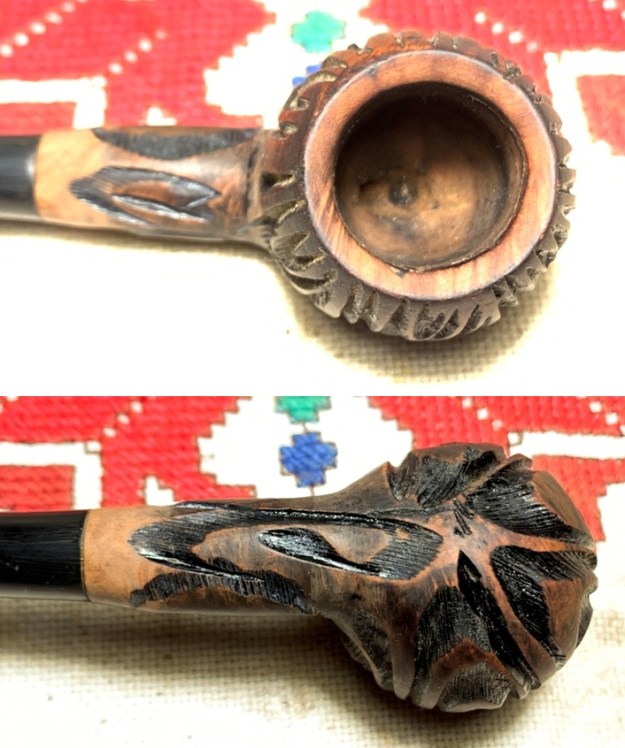
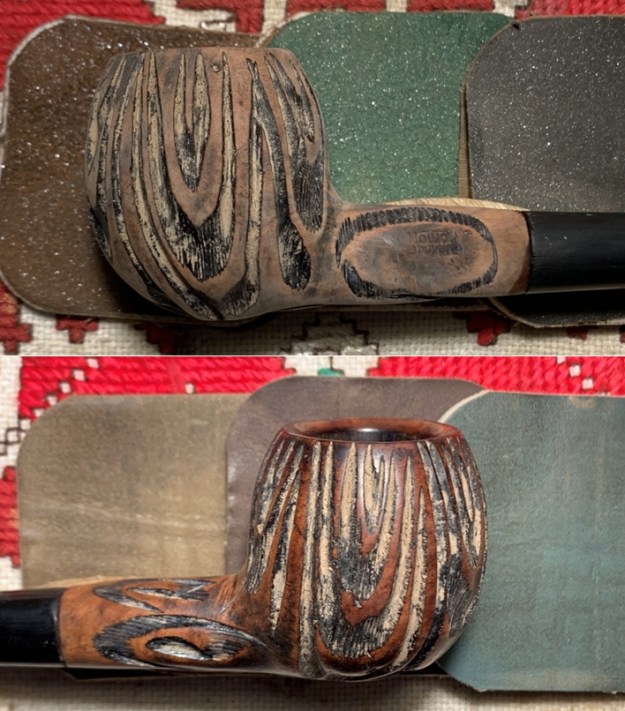
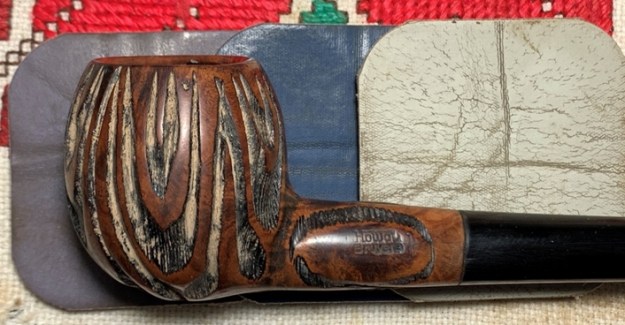
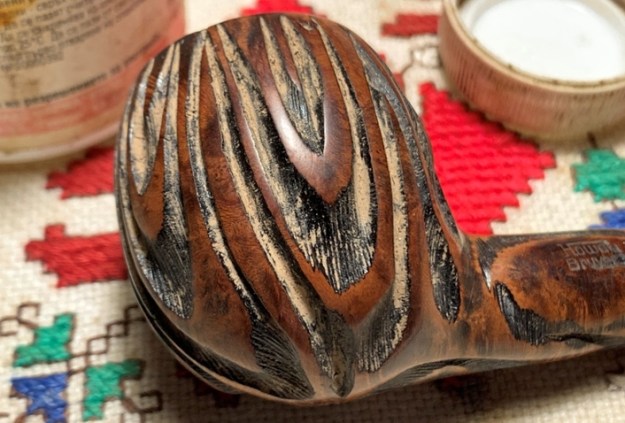
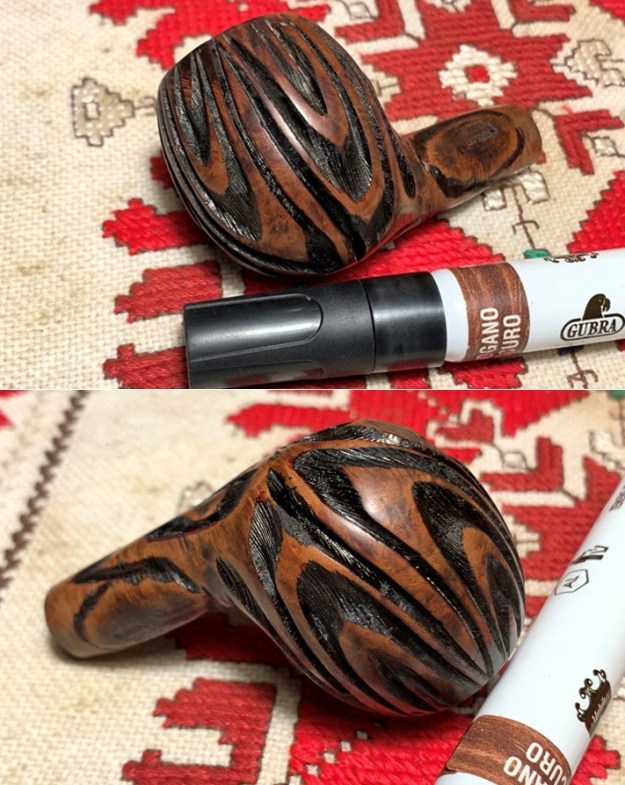
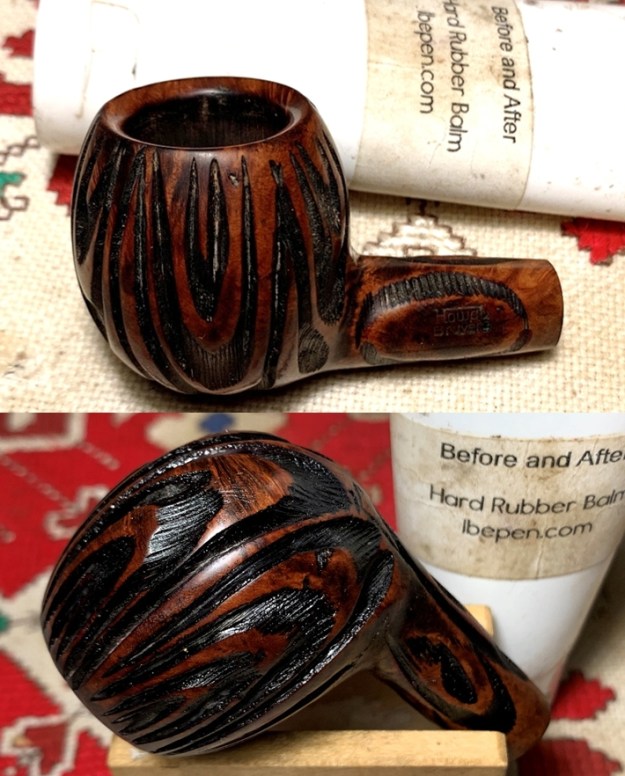
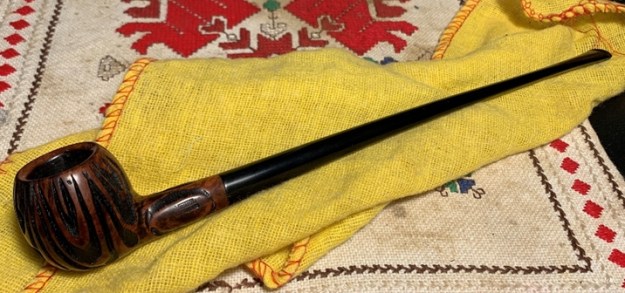
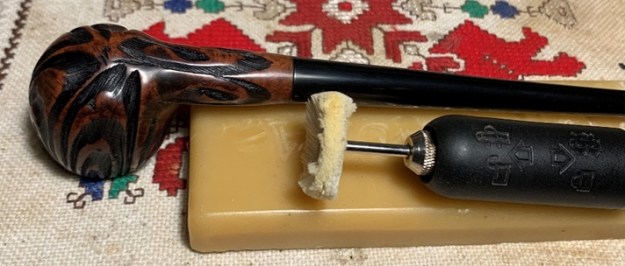
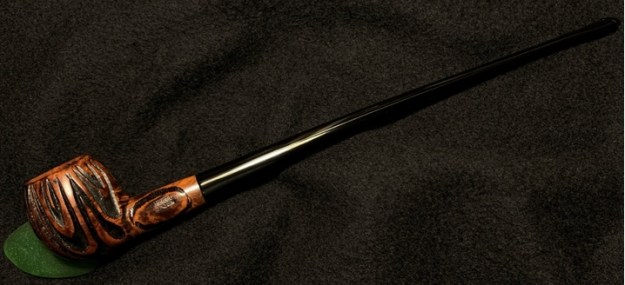
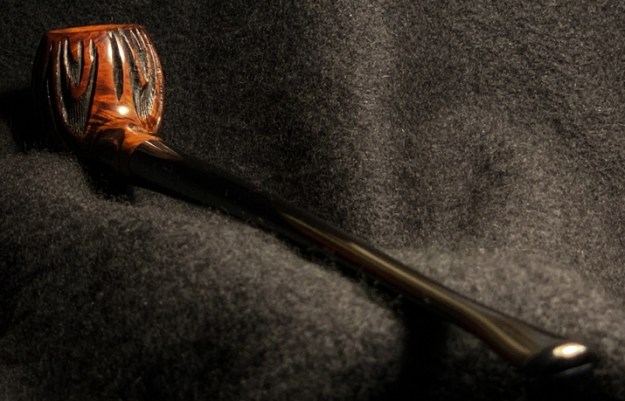
Restoring a Pipe for Alex with a shape I don’t know how to identify


Blog by Steve Laug

I have another of Alex’s purchases on the table this morning. It is a smooth finished pipe in a shape that really covers a gamut of shapes – a bent pot, paneled pot, sitter, canted pot sitter. It is a very unique Malaga that I am not sure what to call. When it is set as a sitter the rim top is straight with the stem. The pipe was dirty and caked with few spots of lava and some darkening on the inner edge of the bowl. The bowl had a rough surfaced cake. The exterior was dirty with grime and oils. The stamping on the left side of the shank read “MALAGA” and the right side read Imported Briar. The vulcanite saddle stem had tooth marks and chatter on both sides. I took photos of the pipe before I started the cleanup work. I took close up photos of the bowl and rim to capture the condition of the pipe before I started my cleanup work. The rim top had some lava and darkening on the top and the inner edge. There was a thin uneven cake in the bowl. Other than being very dirty the pipe was in great condition. The stem was dirty and covered with a thick scum on the surfaces. There was tooth chatter on the top and underside near the button and some tooth marks on the button surface itself.I took a photo to capture the stamping on both sides of the shank. The first photo shows the stamping “MALAGA” on the left side of the shank. The second photo shows the stamping on the right side of the shank. It reads Imported Briar. The stamping on both sides is clear and readable.If this is the first of the Malaga restorations that you have read about then you should know the backstory of the brand. I am including the link to a blog that I wrote that gives some of the history of the Malaga brand and the Malaga Pipe Shop in Royal Oak, Michigan in the USA. I have written an earlier blog to give a little history of the Malaga Brand and the pipemaker, George Khoubesser. Here is the link – https://rebornpipes.com/tag/malaga-pipes/.That blog also includes links to a catalogue and the history of the pipemaker George Khoubesser. Follow the link to get a feel for the brand and the pipemaker.

I decided to start with the bowl first. I cleaned up the rim top with a folded piece of 220 and 400 grit sandpaper to remove the lava and the damage. I followed Jeff and my regular regimen for cleaning estates. I reamed the light cake in the bowl with a Savinelli Fitsall pipe knife to remove the cake. I sanded the bowl with 220 grit sandpaper wrapped around a piece of dowel to smooth out the inside walls of the bowl. The mortise was surprisingly clean but there were some tars and oils on the walls. I scrubbed the mortise and the airway in the shank and the stem with alcohol, cotton swabs and pipe cleaners.I polished the exterior of the bowl and the rim with micromesh sanding pads – wet sanding with 1500-12000 grit sanding pads. I wiped down the bowl after each sanding pad with a damp cloth. I scrubbed the briar with Murphy’s Oil Soap with a tooth brush. I scrubbed it off with running water to remove the soap and the grime on the bowl. I dried it off with a soft cloth. I worked some Before & After Restoration Balm into the surface of the briar with my fingertips to clean, enliven and protect it. I let the balm sit for a little while and then buffed with a cotton cloth to raise the shine. The photos show the bowl at this point in the restoration process. I set the bowl aside and turned my attention to the stem. I sanded out the tooth chatter with 220 grit sand paper and started to polish it with a folded piece of 400 wet dry sandpaper. Once it was finished it the tooth chatter and oxidation was gone and it began to shine.I polished the stem with Denicare Mouthpiece Polish from a tin of it I have in the drawer here. It is a gritty red paste that I rub on with my finger tips and work into the surface of the stem and button and buff off with a cotton pad. It gives me a bit of a head start on the polishing work plus I have a tin to use up!I polished the stem with micromesh sanding pads – wet sanding with 1500-12000 grit sanding pads. I wiped it down after each sanding pad with Obsidian Oil. I polished it with Before & After Pipe Stem Polish – both Fine and Extra Fine and buffed it off with a final coat of Obsidian Oil. This is interestingly shaped smooth, bent sitter in what I would call a Bent, Paneled Pot Sitter with a black vulcanite saddle stem. It has a great look and feel. The shape is very tactile and fits well in the hand. The shape makes it a unique looking pipe. I polished stem and the bowl with Blue Diamond polish on the buffing wheel. I gave the bowl and the stem multiple coats of carnauba wax. I buffed the pipe with a clean buffing pad to raise the shine. I hand buffed it with a microfiber cloth to deepen the shine. The pipe polished up pretty nicely. The rich oil cured briar took on life with the buffing. The rich brown colour of the briar work well with the polished vulcanite stem. The finished pipe has a rich look that is quite catching. Have a look at it with the photos below. The shape, finish and flow of the pipe and stem are very well done. The dimensions are Length: 6 inches, Height: 1 ¾ inches, Outside diameter of the bowl: 1 ½ inches, Chamber diameter: 7/8 of an inch. I will be adding the pipe to the finished Malaga pipes that I have set aside for Alex. This will be a great addition to his collection of Malaga pipes. Thanks for walking through the restoration with me as I worked over another Malaga.
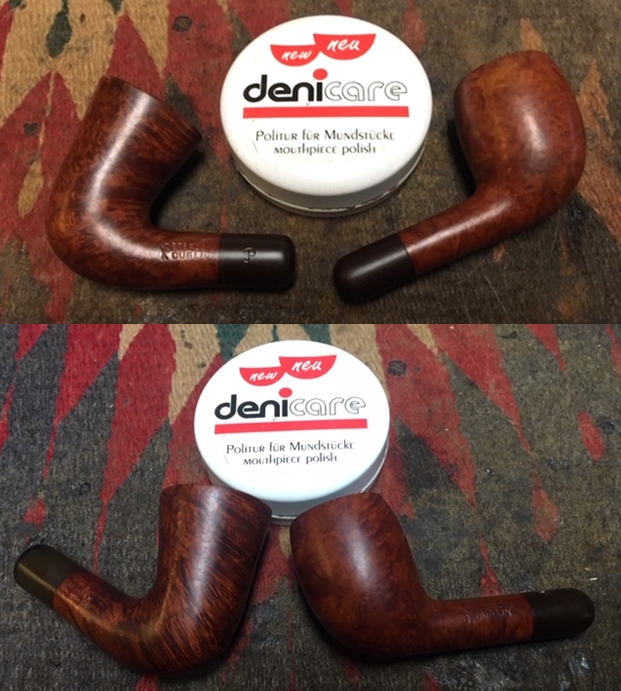
New Life for a Rusticated Malaga Bullmoose for Alex


Blog by Steve Laug

I have been working on a lot of different estate pipes and selling them for different families. I am continuing to work on the Malaga pipes that Alex put aside for restoration. He also brought other pipes to add to his box. I have a box of pipes from Alex that I am always working away at. He periodically drops more Malaga pipes into his box. There are quite a few of them to work on so I decided work on a few of them. The next one of these was another Malaga pipe. It is a rusticated Bullmoose with deeply carved grooves and rustications almost like bark on the bowl and shank of the pipe that really grabbed my attention. It has a vulcanite saddle stem. The pipe was dirty and caked when arrived. The rim top has lava and some darkening on the top edge of the bowl. The bowl had not only a thick cake in the bowl but had the remnants of the previous pipeman’s last smoke inside. The exterior of the bowl and shank are dirty with grime and oils from prolonged use. The stamping on the left side of the shank read “MALAGA” The vulcanite saddle stem was in great condition and had tooth marks and chatter on the top and the underside of the stem. I took photos of the pipe before I started the cleanup work. I took close up photos of the bowl and rim to capture the condition of the pipe before I started my cleanup work. The rim top had some lava and darkening smooth top and a slight nick on the front inner edge. The bowl was half filled with tobacco that had been sitting for a very long time in the bowl. It had hardened. Above the tobacco there was a thick cake in the bowl. Other than being very dirty the pipe was in great condition. The stem was dirty and covered with a thick scum on the surfaces. There was tooth chatter on the top and underside near the button and some tooth marks on the button surface itself.I took a photo to capture the stamping on the shank. The photo shows the stamping “MALAGA” on a smooth panel on the left side of the shank. It is clear and very readable.If this is the first of the Malaga restorations that you have read about then you should know the backstory of the brand. I am including the link to a blog that I wrote that gives some of the history of the Malaga brand and the Malaga Pipe Shop in Royal Oak, Michigan in the USA. I have written an earlier blog to give a little history of the Malaga Brand and the pipemaker, George Khoubesser. Here is the link – https://rebornpipes.com/tag/malaga-pipes/.That blog also includes links to a catalogue and the history of the pipemaker George Khoubesser. Follow the link to get a feel for the brand and the pipemaker.

I decided to start with the bowl first. I used a dental pick to remove the remnants of the previous pipeman’s tobacco. The dottle was very hard and dry. It was almost welded to the wall of the bowl and pressed into the hardened cake. I followed Jeff and my regular regimen for cleaning estates. I reamed the light cake in the bowl with a PipNet pipe reaming set to remove the hard cake on the walls. I cleaned it up with a Savinelli Fitsall pipe knife to remove the remnants of the cake. I sanded the bowl with 220 grit sandpaper wrapped around a piece of dowel to smooth out the inside walls of the bowl. I wiped the bowl interior down with a paper towel to remove the debris. I repaired the nick on rim top at the front of the bowl. I filled it in with a drop of clear Krazy Glue and pressed some briar dust into the surface of the glue.I scraped out the mortise and the shank with a pen knife to remove the thick build of tobacco lacquer on the walls. The walls were covered with debris that was thick and hard. I scrubbed the mortise and the airway in the shank and the stem with alcohol, cotton swabs and pipe cleaners. I scrubbed the briar with Murphy’s Oil Soap with a tooth brush. I scrubbed it off with running water to remove the soap and the grime on the bowl. I dried it off with a soft cloth. I worked some Before & After Restoration Balm into the rusticated surface of the briar with my fingertips and a horsehair shoe brush to clean, enliven and protect it. I let the balm sit for a little while and then buffed with a cotton cloth to raise the shine. The photos show the bowl at this point in the restoration process. I set the bowl aside and turned my attention to the stem. I sanded out the tooth chatter with 220 grit sand paper and started to polish it with a folded piece of 400 wet dry sandpaper. Once it was finished it the tooth chatter and oxidation was gone and it began to shine.I polished the stem with Denicare Mouthpiece Polish from a tin of it I have in the drawer here. It is a gritty red paste that I rub on with my finger tips and work into the surface of the stem and button and buff off with a cotton pad. It gives me a bit of a head start on the polishing work plus I have a tin to use up!I polished the stem with micromesh sanding pads – wet sanding with 1500-12000 grit sanding pads. I wiped it down after each sanding pad with Obsidian Oil. I polished it with Before & After Pipe Stem Polish – both Fine and Extra Fine and buffed it off with a final coat of Obsidian Oil. This is an interesting Rusticated “Malaga” Bullmoose with a black vulcanite saddle stem. It has a great look and feel. The shape is very tactile and fits well in the hand. The rustication and grooves make it a unique looking pipe. I polished stem and the bowl with Blue Diamond polish on the buffing wheel. I gave the bowl multiple coats of Conservator’s Wax and the stem multiple coats of carnauba wax. I buffed the pipe with a clean buffing pad to raise the shine. I hand buffed it with a microfiber cloth to deepen the shine. The pipe polished up pretty nicely. The rich oil cured briar took on life with the buffing. The rich brown and black colours of the briar work well with the polished vulcanite stem. The finished pipe has a rich look that is quite catching. Have a look at it with the photos below. The shape, finish and flow of the pipe and stem are very well done. The dimensions are Length: 5 ¾ inches, Height: 1 ½ inches, Outside diameter of the bowl: 2 inches, Chamber diameter: ¾ of an inch. I will be adding the pipe to the finished Malaga pipes that I have set aside for Alex. This will be a great addition to his collection of Malaga pipes. Thanks for walking through the restoration with me as I worked over another Malaga.