Yearly Archives: 2017

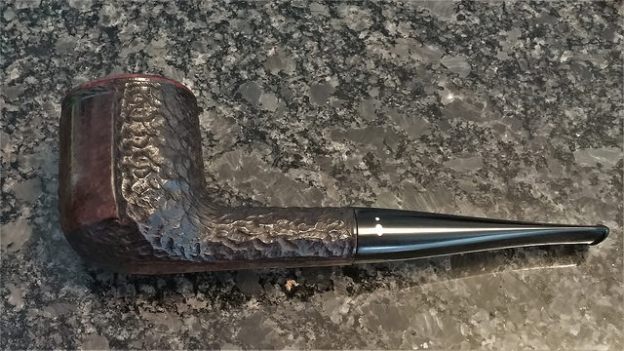
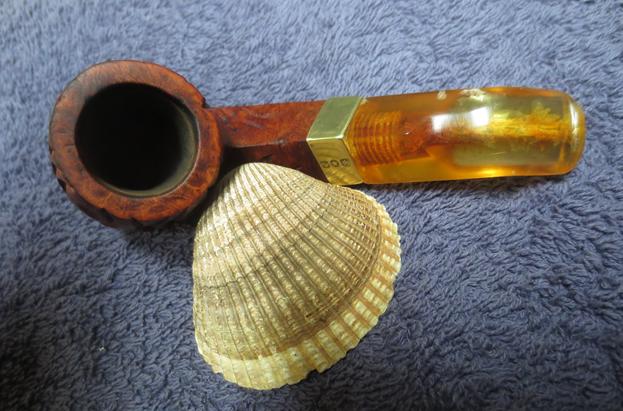
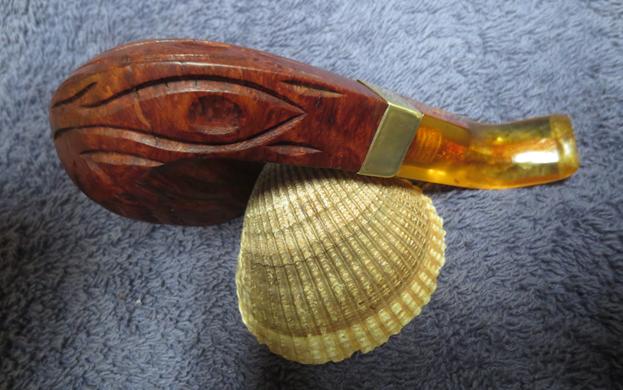
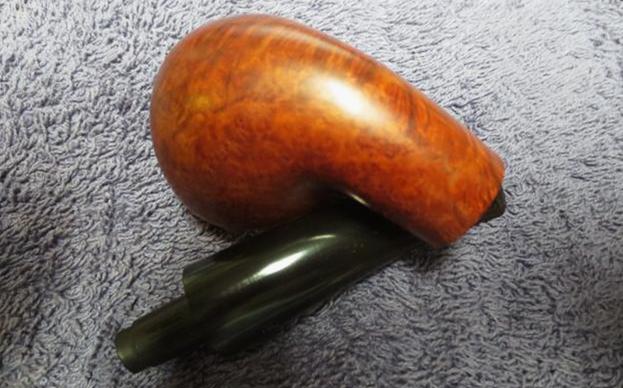
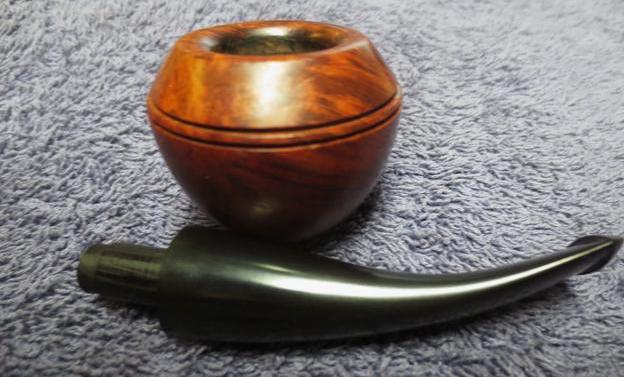
Rehabilitating a Brigham Executive 604 Large Billiard with a Seized Stem


A nice combination of a pipe restorers skills made this pipe a success. Well done Charles.

Charles Lemon's avatar

I’ve mentioned in an earlier post that Brigham offered the ever-popular Straight Billiard shape in several sizes and considered them from the start as separate product offerings rather than variations on a theme. Thus there are three shape numbers for a Brigham Billiard – 02 for a small pipe , 03 for a medium pipe, and 04 for a large pipe.

The pipe on the table today is the largest of the shapes listed above, the 04 Large Straight Billiard, and it certainly lives up to the designation. As a rough size reference, Brigham’s 02 Billiard shares the same stummel dimensions as my Dunhill Group 3 Shell Briar; Shape 03 approximates a Dunhill Group 4, and the 04 Large Billard is a big one, at a Group 6.

This old billiard is an impressive handful of briar, even in the rather rough state in which it arrived for refurbishment. As…

View original post 1,716 more words

Sometimes when you buy an estate there are bonuses


Blog by Steve Laug

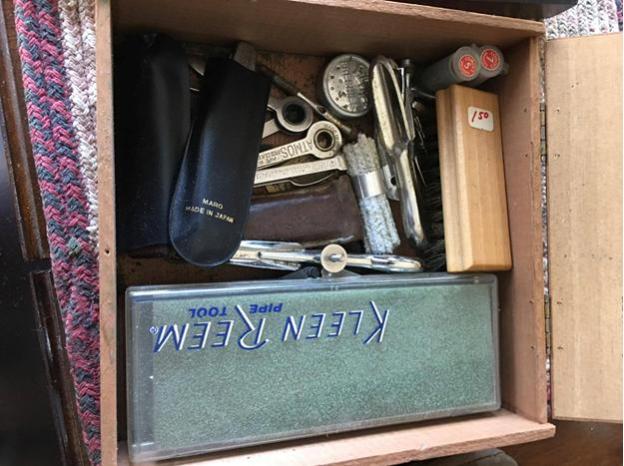
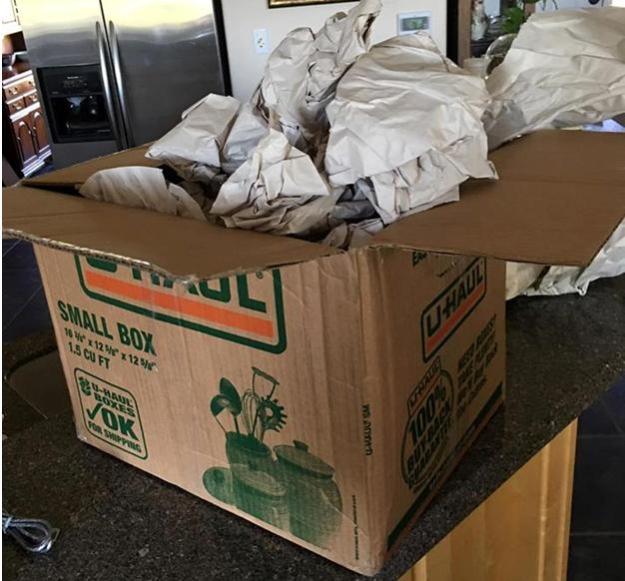
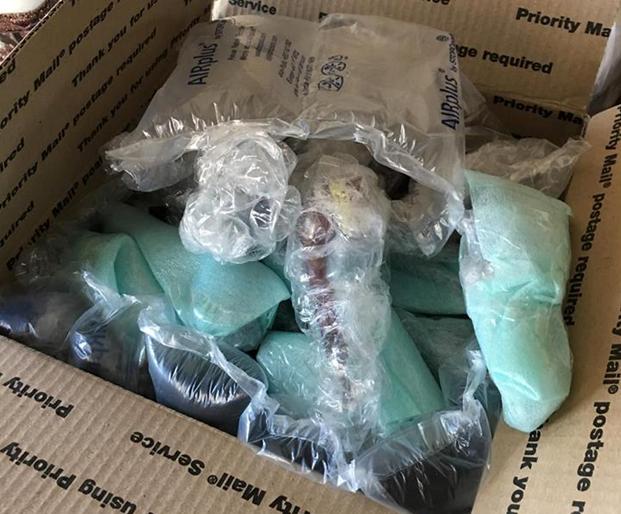
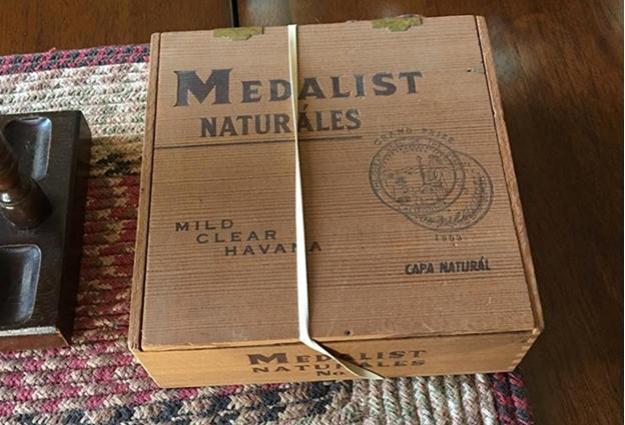
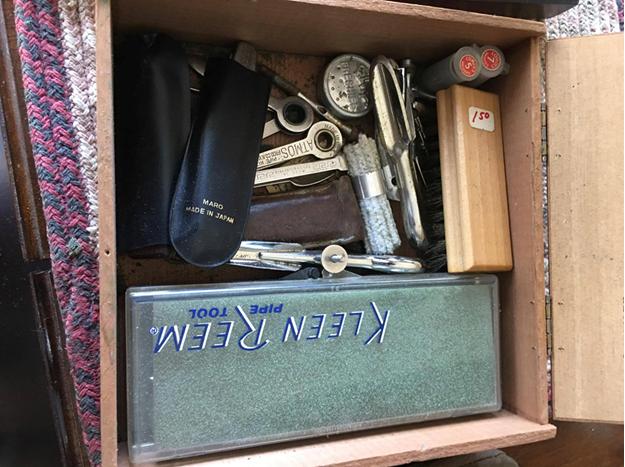
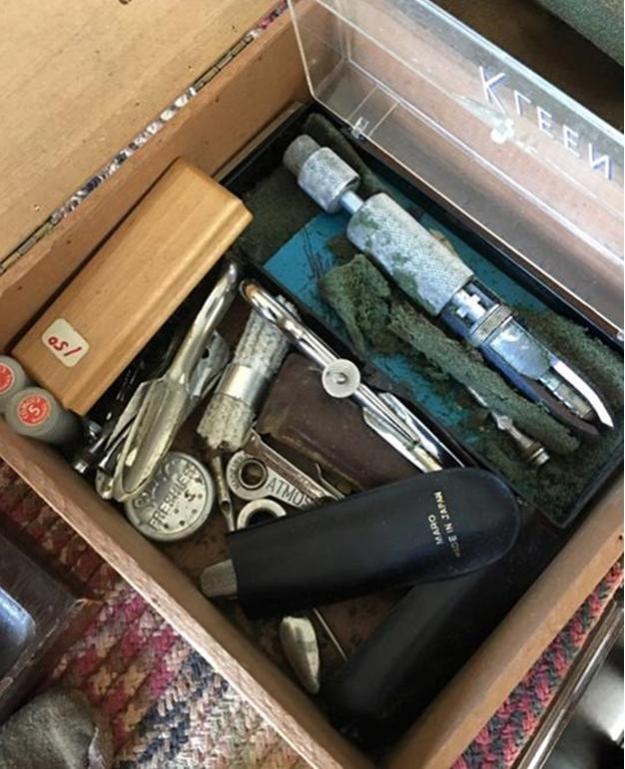
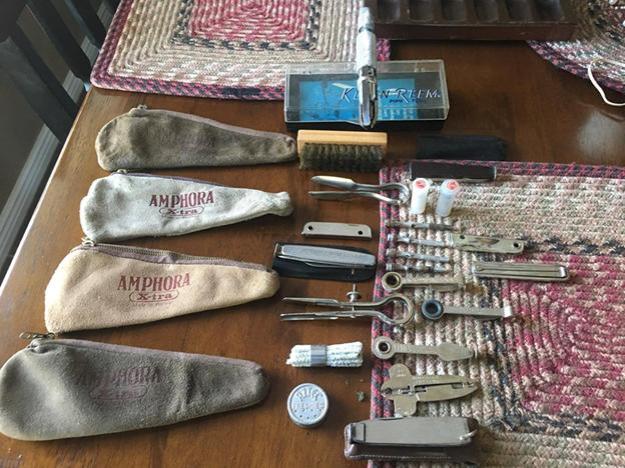
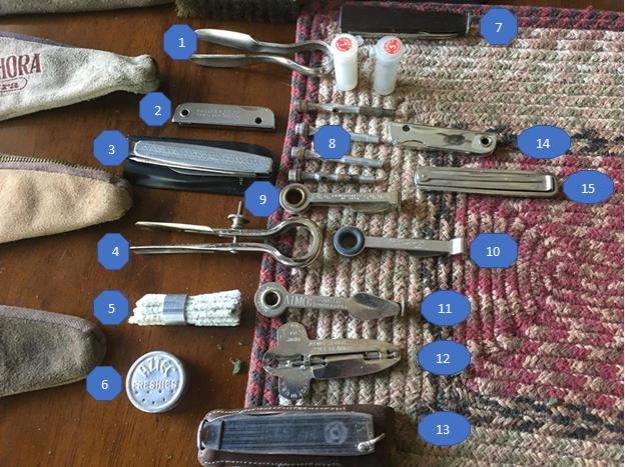
I negotiated the purchase of a lot of pipes from a fellow who contacted me about his father’s estate pipes. His dad had left behind 25 pipes, two pipe racks and some pipe paraphernalia that he would send along as well. I had no idea what to expect in terms of the paraphernalia but I looked forward to seeing what he packed. I had the package shipped to Jeff in Idaho. When the box arrived my brother took pictures of the box as he opened it. It was well packed with lots of padding to keep things from being damaged in shipping. He removed the paper packing material and inside everything was individually wrapped in bubble wrap. After he removed the packed pipes and the racks there was a small cigar box that was held closed with an elastic band. It was a hinged cedar box that was stamped Medalist Naturales Mild Clear Havana. I could not wait until he opened the box.He removed the elastic band and inside an interesting assortment of pipe parts and tools. There were quite a few reamers of different brands and some other assorted items. I could see a humidifier tab that you could put in a pouch or jar, a small brush with a wooden handle and what appeared to be two small plastic containers – one with a label that looked like it had a number 5 on the top and the other a number 7. There were also some Comoy’s Stingers in the box and a boxed KleenReem Pipe Reamer. Jeff included a few photos of the opened box from different angles before he unpacked to give me a feel for what might be in store.Jeff removed the lid off the plastic box that held the KleenReem Pipe Tool. The pipe reamer rested in a formed sponge that was originally form fitted to the reamer. The sponge had disintegrated into pieces and was the tool itself was formed into the hatching on the tool.Jeff wiped off the debris from the items in the box and laid them out on the table. There were four zipper pouches for Amphora X-tra Holland pipes. There was the Kleen Reem box that had the instructions on the inside. He removed the various pipe knives from their cases and added them to the collection.I wrote him and asked him to identify the various reamers and items on the table. He sent me a list of the items with their names. I have inserted numbers in the photo below to match the list below. (The KleenReem Pipe Tool is not shown in the photo below.)

    1. The Aonian
    2. Barker Mfg. Co. Portland, OR.
    3. Richards Shefield England
    4. Cook’s Pipe Reamer Ansonia, Conn. Made in U.S.A.
    5. Pipe Cleaners that come with the KleenReem pipe reamer kit,
    6. Aztec Freshies Clay Moistener Co. NYC.
    7. Maro Stainless Steel Japan (Brown handle)
    8. Four Comoy’s stingers
    9. Made in Czechoslovakia scoop and tamper
    10. Imco’s Pipe Companion Made in U.S.A.
    11. Atmos Pipe Kit Prod. Co. N.Y.11 N.Y.
    12. Atmos Folding Pipe Reamer Made in U.S.A.
    13. Masteromet Stainless Japan
    14. No Name Made in USA file, bottle opener, and knife
    15. Dunhill Stainless Steel Made in England knife and poker.
    16. -17. Comoy’s #7 washers (8), and Comoy’s #5 washers made for Comoy’s Grand Slam pipes.

Looking at all the assorted pipe reamers and knives in the collection I was excited to see what was there. I have a quite a few reamers in my collection but none of these. I did not have many pipe knives at all so I was looking forward to adding them to the collection.

An Old Bakelite Stemmed Diamond Shank Bent Billiard


Blog by Steve Laug

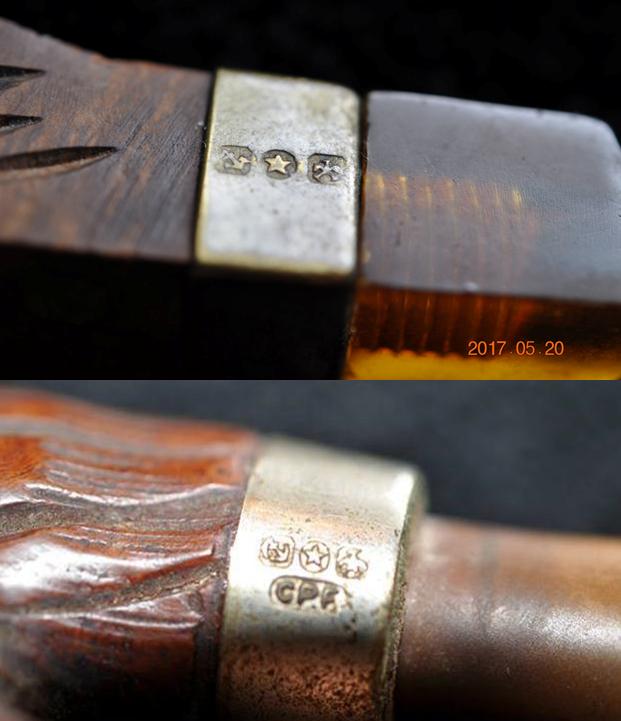
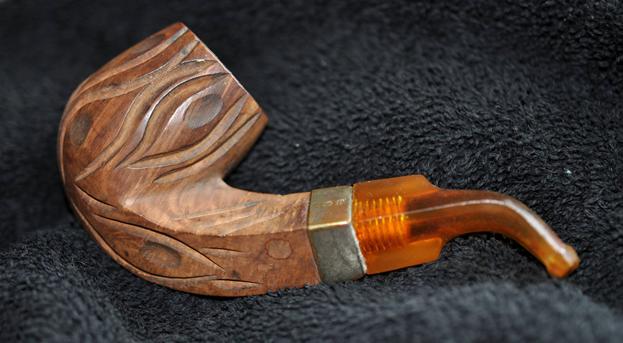
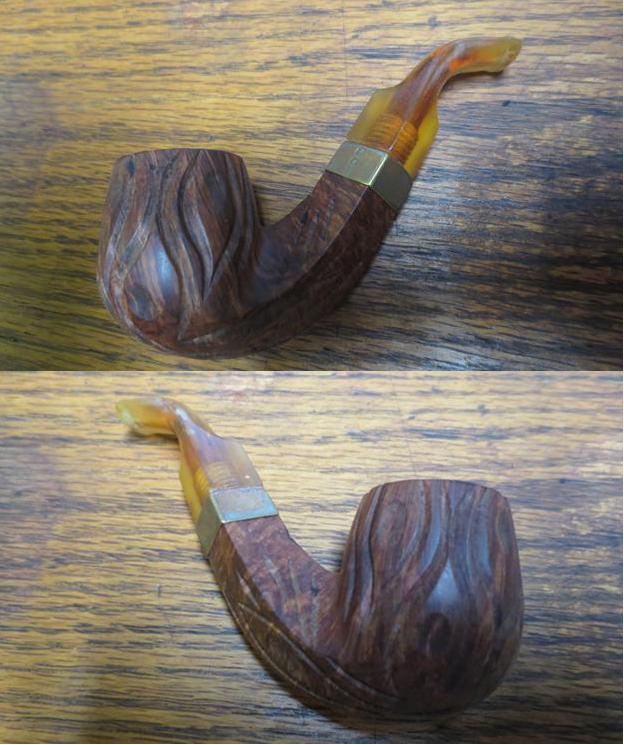
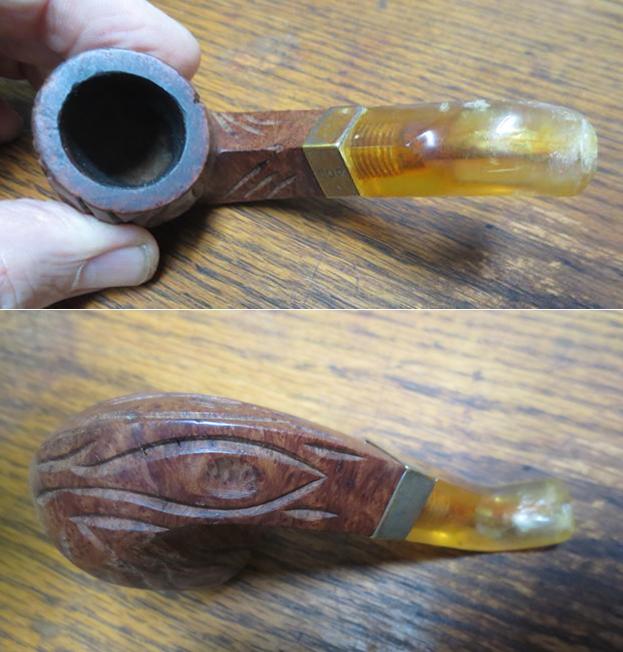
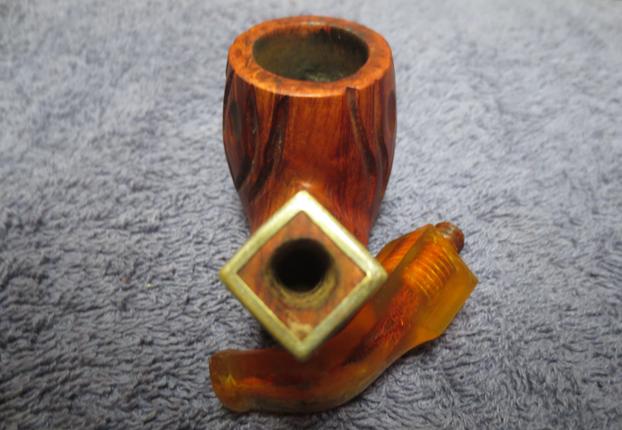
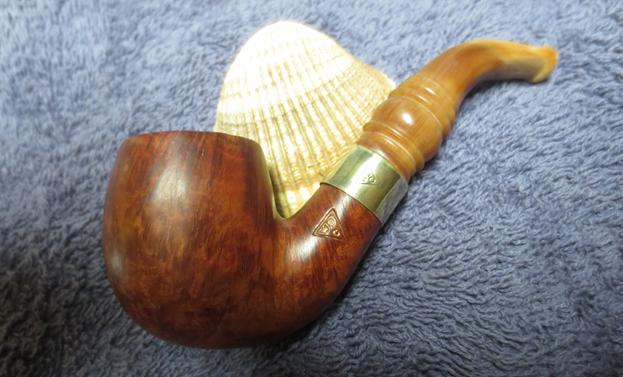
This old-timer came from the lot we purchased on our virtual pipe hunt in Montana. It has no stamping anywhere on the sides of the shank. There are faux hallmark on the oxidized brass band that don’t really help in identifying the pipe. The bowl and the shank have an interesting rustication pattern of swirls and divots. The finish was long gone from the bowl and the briar was worn and dirty. Some of the grooves were stained from oils and tars. There was a bone tenon in the stem that screwed into the shank of the pipe. The stem was worn and chipped with deep tooth marks on the top and underside near the button and on the button edges itself. My first impressions of it make me think it is Bakelite not amber. It is not heavy and it is warm to touch. The chips along the edges look like chips in Bakelite not amber and the tooth dents also go along with the theory of it being Bakelite.There was something about the rustication pattern that reminded me of some of the rustication patterns that I have seen on older Wellington style C.P.F. pipes. The next two photos show one with a similar style of rustication and it was in the same lot of pipe from the virtual pipe hunt.The C.P.F. pipe above has a nickel band that had similar faux hallmarks as the one I am working on but it also has the C.P.F. oval stamped in the metal. The hallmarks are an anchor, a star and a bird of some sort. The first photo below is from the pipe I am working on and the second one is the C.P.F. Wellington.It also has the same kind of work on the edges of the ferrule that are folded over the end of the shank. All of these parallels make me wonder if the pipe I am working on was also made by C.P.F. I may never know but I think that it is a pretty good guess.

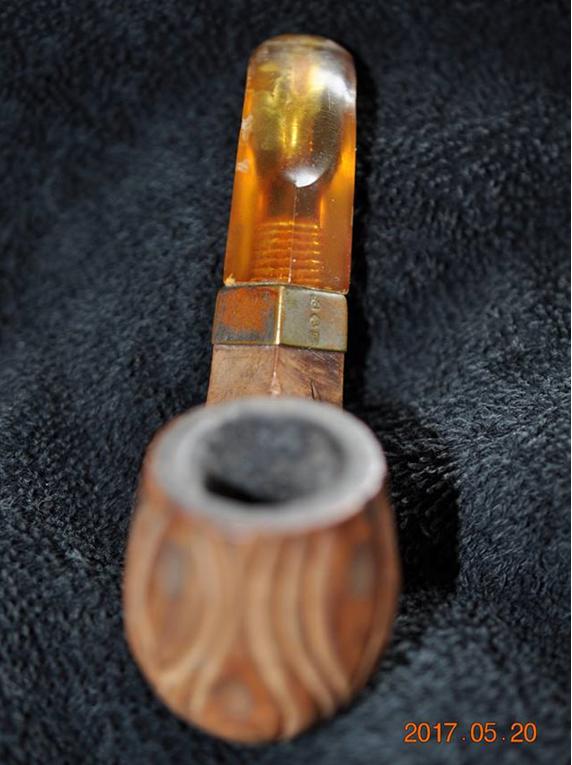
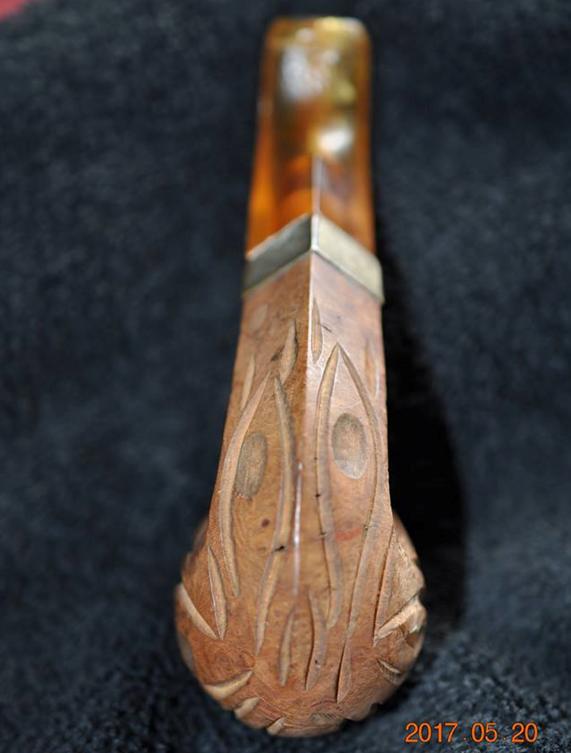
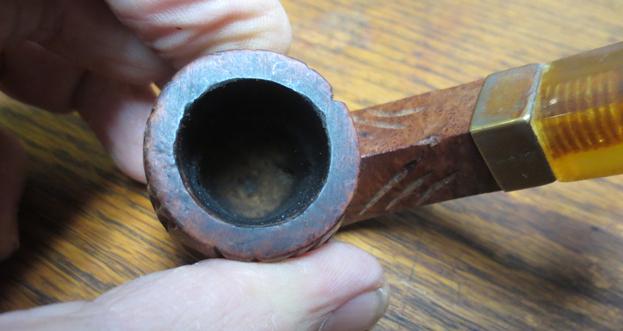
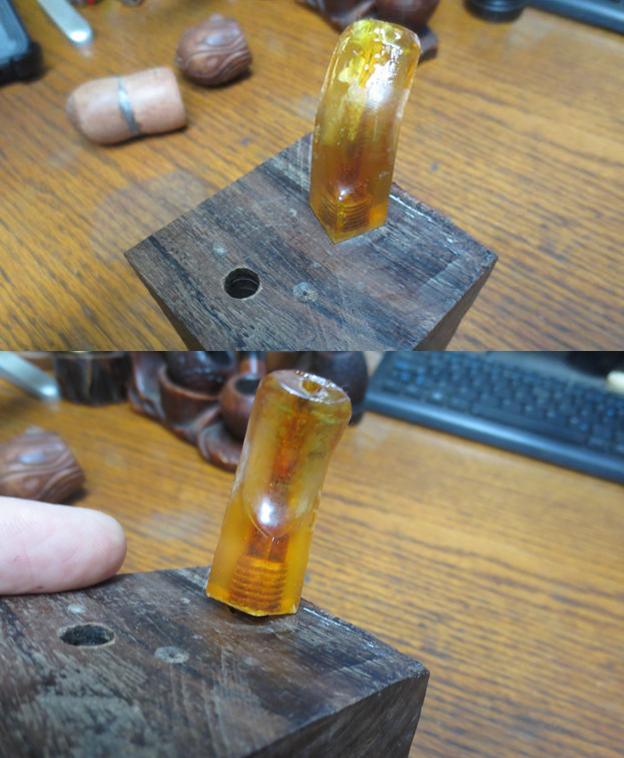
Jeff took the first photo above and the others that follow before he cleaned up the pipe to give me some idea of what we were dealing with. It is an interesting old pipe and the mystery of the trying to figure out who carved it may never fully be answered. The next photos show the pipe from various angles – looking at it from the left side, the front of the bowl and the underside of the bowl and the shank. You can see from the photos that the finish is almost nonexistent. There are spots on the briar that look like water stains but we won’t know until Jeff does his cleanup work on it. Looking at the pipe from the top down you can see the thick overflow of lava on the top of the rim and the thick cake in the bowl. Remarkably the inner and outer edge of the bowl appear to be in good condition with no damage but I would know for sure once it had been cleaned and reamed.The next close up photos show the swirling carving and divots on the sides and bottom of the bowl. There is some sticky substance like that found on sales labels on several spots on the briar. It is interesting to me that you can see the grain in the wood and some fills peeking through the remnants of the finish. It appears to have some beautiful grain. There were some chips and nicks along the sharp edges of the diamond shaped stem. There was tooth chatter and tooth marks on the top and underside near the button. The surface of the button itself had tooth marks on the left side. All were repairable but all were quite deep.Jeff reamed the bowl with a PipNet reamer and a Savinelli Fitsall Pipe Knife to finish the cleanup of the bowl. He scrubbed the exterior of the pipe using Murphy’s Oil Soap and a tooth brush. He worked the crevices and carvings over carefully to remove the sticky substance and the dirt and grime that were ground in there. When he finished scrubbing the briar he rinsed it off under running water. He dried it off with a soft cloth and the soap had removed the deeply ground in grime on the finish and the lava on the rim edges. He ran pipe cleaners and alcohol through the mortise and the airway in the shank and stem to remove dust and debris that had collected there. He carefully scrubbed out the nicks and tooth marks on the saddle stem using a tooth brush and rinsed it with water. Once the pipe was clean, he packed it up and sent it my way for the repair and restoration work. I took photos of the pipe when I brought it to my worktable. It is another intriguing little pipe from the collection of older C.P.F. and WDC pipes from our Montana pipe hunt. Once the rim top was cleaned I found that there was damage to the inner edge. There was also some darkening and surface damage on the flat of the rim as well that would need work.Jeff had been able to remove the debris from the chips and tooth marks on the stem surface. It was rough to touch but should clean up well. He had also removed all the tars and oils in the airway of the stem.I filled in the tooth marks and chips in the stem with amber super glue and set the stem aside in my drilled block to dry. This block allows me to work on both sides at the same time thus cutting my drying/curing time.While the repair on the stem cured I turned my attention to the inner edge of the bowl. I used a folded piece of 220 grit sandpaper to smooth out the damaged edge and bring the bowl back to round.To smooth out the surface of the rim I used a coarse, medium and a fine grit sanding sponge like a topping board. This method removes the grime and build up without removing briar from the rim surface.The band was loose on the shank so I removed it and polished it with micromesh sanding pads and a jeweler’s cloth to remove the tarnish. I used a pick to put some all-purpose glue on the surface of each side of the diamond shank and pressed the band in place. I set the bowl aside to let the glue dry.I polished the stem with micromesh sanding pads. I could not do anything about the spidering around the internal airway but the stem was very clean. The repairs polished up nicely. I wet sanded the stem with 1500-2400 grit pads and dry sanded with 3200-12000 grit pads. I wiped it down with Obsidian Oil after each pad and set it aside to dry after the final coat of oil. I polished the pipe with Blue Diamond on the buffing wheel. You have to have a light touch on the old Bakelite as it will melt and become deformed if you have too heavy a touch. At this point in the process I did not want to make more work for myself. I gave the stem multiple coats of carnauba wax and polished it with a clean buffing pad. I hand waxed the rusticated bowl with Conservator’s Wax and buffed it with a clean buffing pad. I hand buffed the bowl and stem with a microfiber cloth. This turned out to be a pretty little pipe – its dimensions are Length: 4 ½ inches, Height: 1 ¾ inches, Bowl diameter: 1 ¼ inches, Chamber diameter: ¾ inches. The finished pipe is shown in the photos below. If it interests you send me an email to slaug@uniserve.com or a message on Facebook. Thanks for looking.

One of my favourite shapes – a Butz-Choquin Bourbon Rhodesian 1025


Blog by Steve Laug

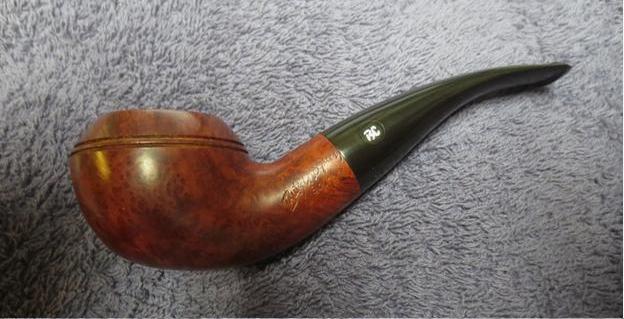
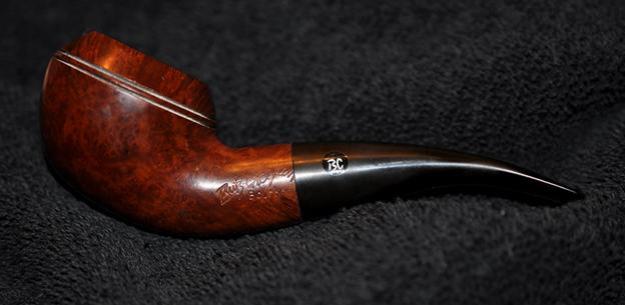
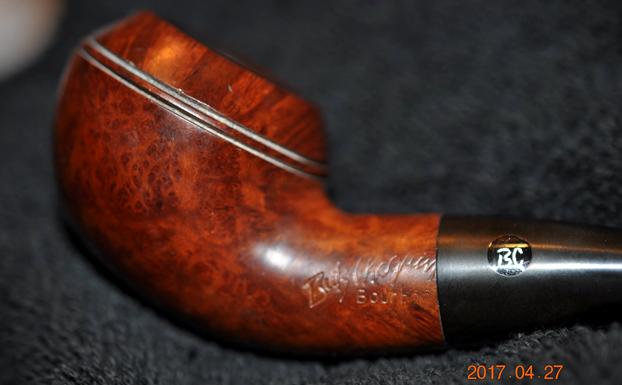
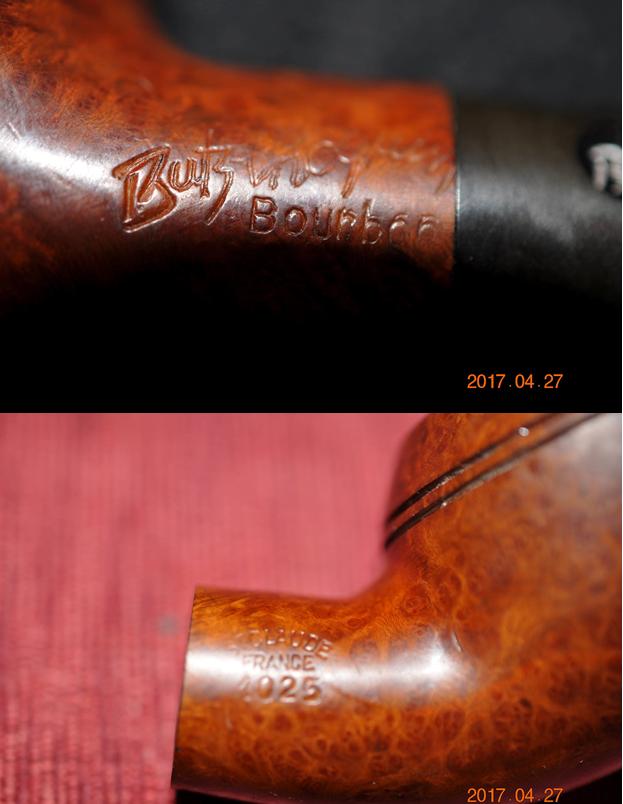
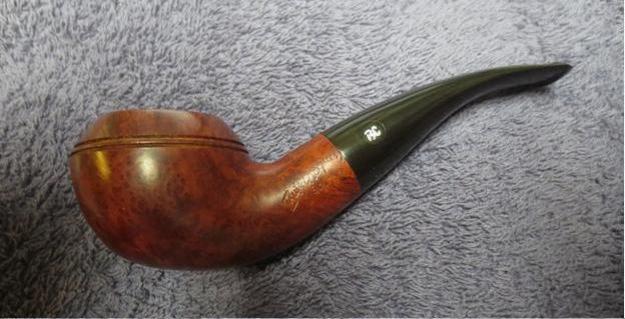
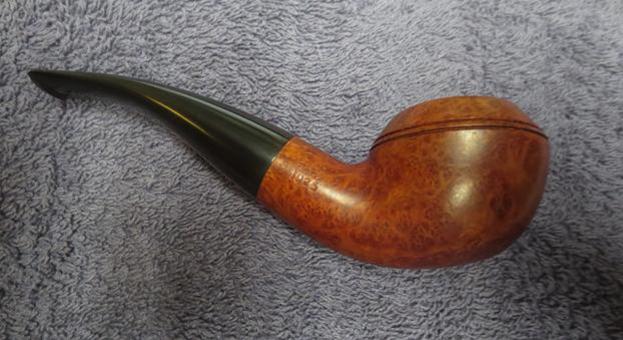
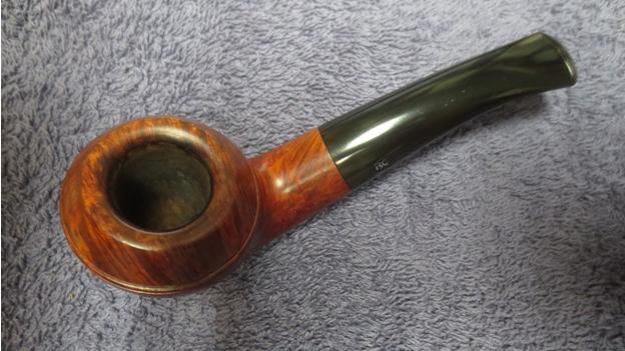
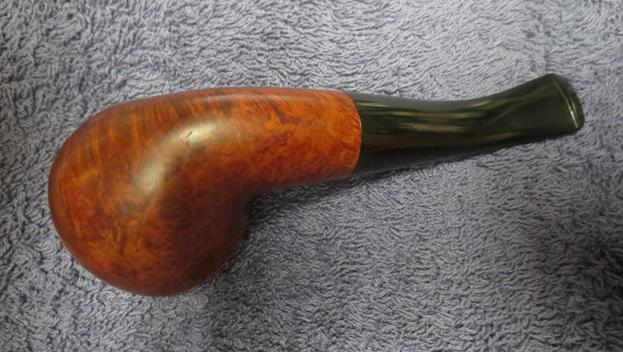
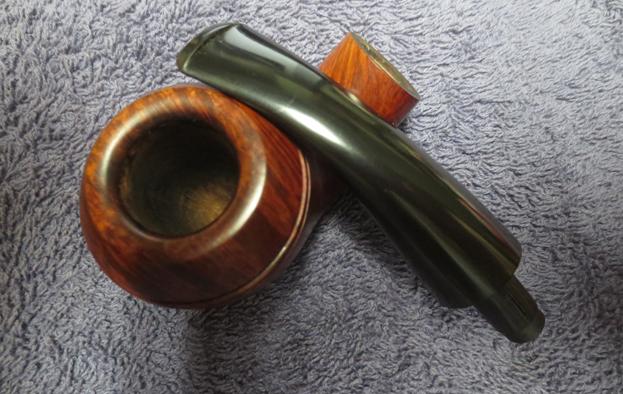
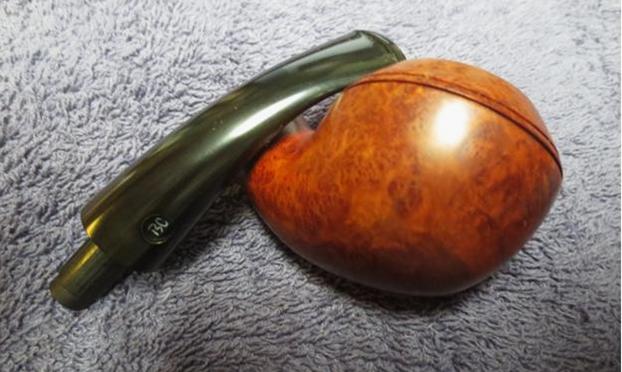
The next pipe I brought to the work table was a Butz-Choquin (BC) Rhodesian. The Rhodesian shape is one of my favourites and one that continually look for in my pipe hunting. My brother, Jeff found this one either on his eBay hunts or his antique mall hunting trips. The pipe is similar in shape to the GBD 9438 and also the Peterson 999 but there is a slight difference. The BC is squatter to my eye – less height from the bottom of the stummel to the top of the cap and a bit wider at the same time. It is still one of those shapes that sits well in the hand and just feels like it was made to clutch as you smoke it. This one is stamped Butz-Choquin in script over the word Bourbon on the left side of the shank. On the right side it is stamped St. Claude over France over the shape number 1025.

The origin of the Butz-Choquin brand reaches back to 1858 when Jean-Baptiste Choquin in collaboration with his son-in-law Gustave Butz created their first pipe in Metz (France). Since 1951 Butz-Choquin is a brand of the Berrod-Regad group (Saint-Claude, France). Jean Paul Berrod managed the company from 1969 to 2002 when he retired and sold the corporation to Mr. Fabien Gichon. Denis Blanc, already owner of EWA, took over the Berrod-Regad group in 2006.

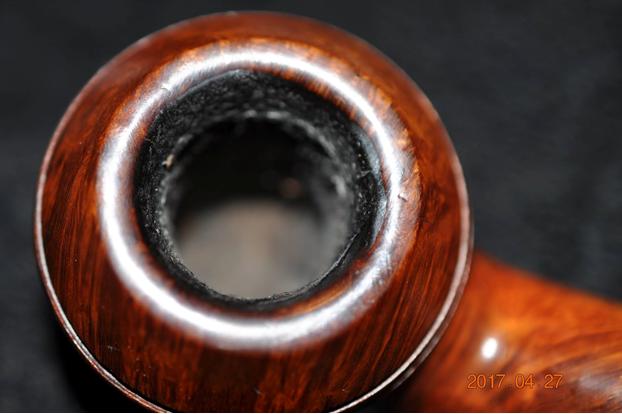
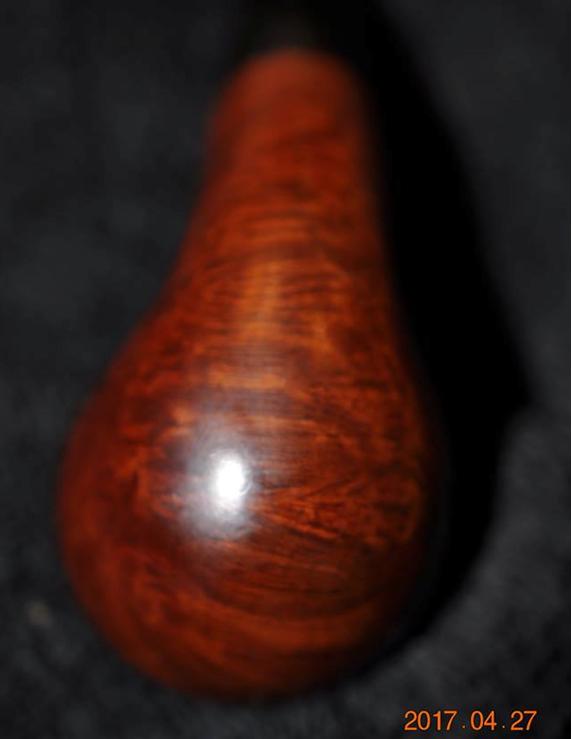
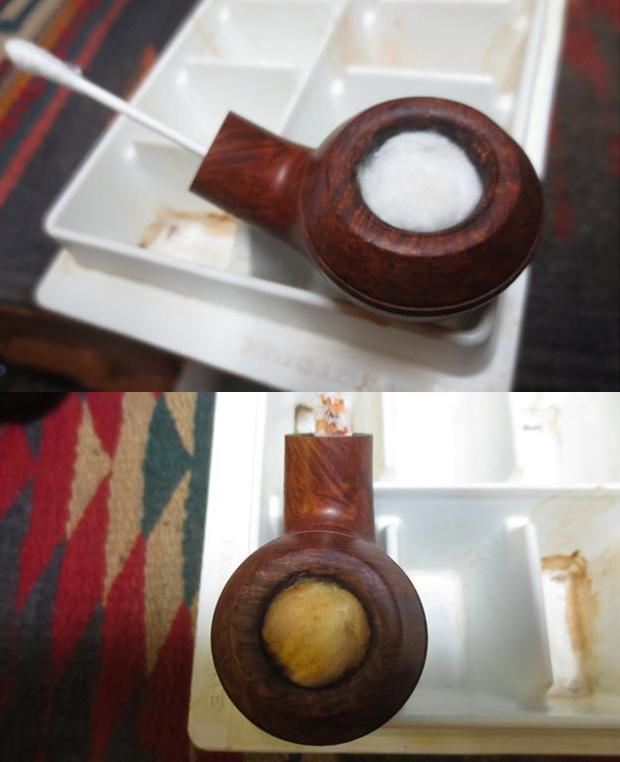
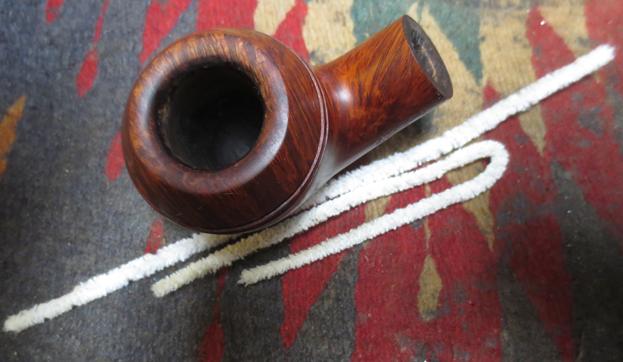
The finish on the bowl was in great condition, just dirty. There was some great grain on the bowl sides, top and bottom. The twin grooves around the rim were dirty and filled in with debris. The rim top had some dents and dings in the surface of the rim. The fit of the stem against the shank was excellent with no gaps or separation. The stem was lightly oxidized and dull but should clean up very well. The next photo is a close up of the bowl and rim. You can the thick cake in the bowl but it had not overflowed on to the rim top. You can also see the small nicks and dents in the surface of the curved rim top. The mortise and the airway in the shank and the stem were dirty and black with grime.The stamping on the left side of the shank appeared to be double stamped. The Butz-Choquin part of the stamp was clear. The Bourbon stamping was double and the letters appeared to be blurry when looked at without a light. The next photos show the stamping on both sides of the shank.The grain on the bottom of the bowl was quite beautiful cross grain that ran from the bottom of the bowl the length of the shank.The surfaces of both the top and bottom sides of the stem near the button had a lot of tooth chatter and a few tooth marks. None of them were too deep so they should clean up easily.Jeff did his usual thorough cleanup of the pipe. He reamed the bowl with the PipNet reamer and tidied it up with a Savinelli Fitsall Pipe Knife. He took the cake back to bare briar. He scrubbed the mortise and the airway in the shank and the stem with alcohol, pipe cleaners and cotton swabs. He scrubbed the externals with Murphy’s Oil Soap and a tooth brush to remove the grime. He scrubbed the stem in the same way. He rinsed the pipe off with running water to rinse off the soap. When I received the pipe in the mail it looked really good. It did not appear to need too much work. I took photos of the pipe before I started working on it. I took a close up photo of the rim top and bowl. I apologize that it is out of focus but you can see that the bowl and rim are clean. As the work progresses I will take further photos of the rim and bowl to show its condition.The stem looked really good – Jeff was able to remove the grime and clean up the oxidation on the surface. The tooth chatter really was quite light. There was one small tooth mark on the left side of the top near the button that would need some work. I sanded the tooth chatter with 220 grit sandpaper to remove it and the tooth mark to reduce it. I polished the stem with micromesh sanding pads – wet sanding it with 1500-2400 grit pads and dry sanding it with 3200-12000 grit pads. I rubbed the stem down with Obsidian Oil after each of the pads. After the 12000 grit pad I gave it a final coat of oil and set it aside to dry. The pipe had a heavy cased tobacco smell that lingered in the shank and bowl even after cleaning it with alcohol. I decided to give it a cotton ball and alcohol soak. I stuffed the bowl with cotton balls until it was full. I used an ear syringe to fill the bowl with alcohol. I stuck a cottons swab and then a thick pipe cleaner in the shank to absorb the tars and oils that were in the shank and it would also wick the alcohol up the shank to help clean it. I set the bowl aside to let the alcohol and cotton do their work over night. In the morning when I checked the pipe the cotton pad was brown with the oils it had drawn out of the bowl. I removed the cotton pads and ran pipe cleaners through the shank to pick up any leftover oils. The pipe cleaners were surprisingly clean. I polished the briar and the stem with Blue Diamond on the buffing wheel and gave the bowl and stem multiple coats of carnauba wax. I buffed the pipe with a clean buffing pad to raise the shine and hand buffed it with a microfiber cloth to deepen it. It is a beautiful pipe whose dimensions are Length: 5 ¼ inches, Height: 1 3/8 inches, Bowl diameter: 1 ¾ inches, Chamber diameter: ¾ inches. I am going to put this one on the rebornpipes store soon, even though everything in me wants to hang on to it. If you are interested email me at slaug@uniserve.com or send me a message on Facebook. Thanks for looking.

Cleaning and Restoring a Large Meerschaum Calabash Oom Paul


Blog by Steve Laug

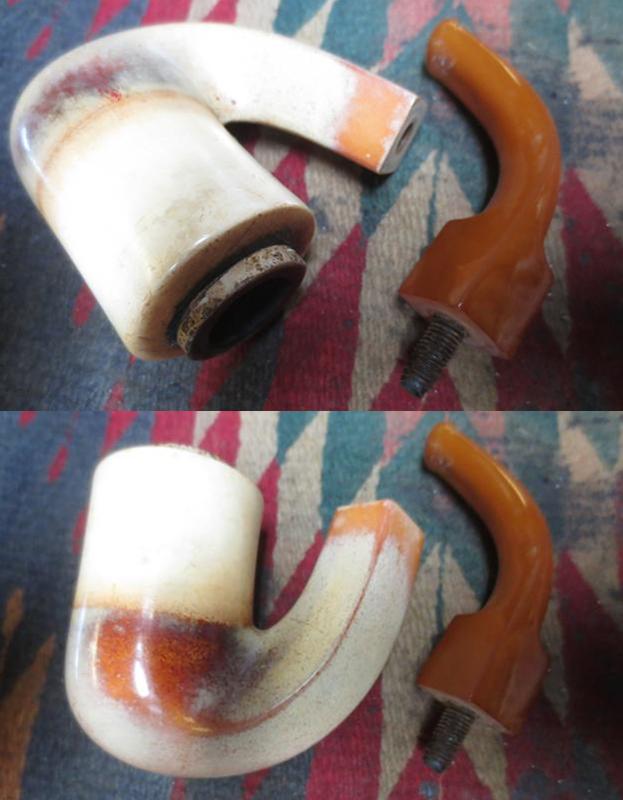
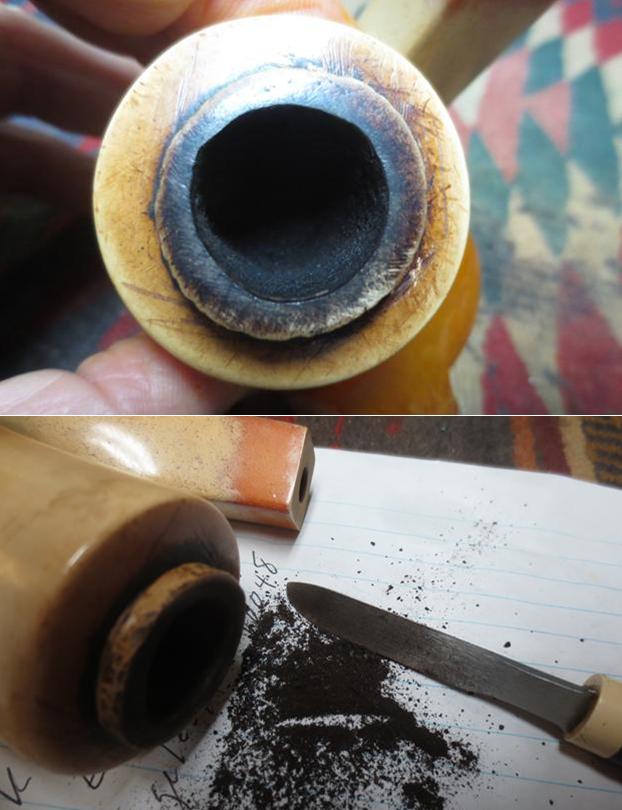
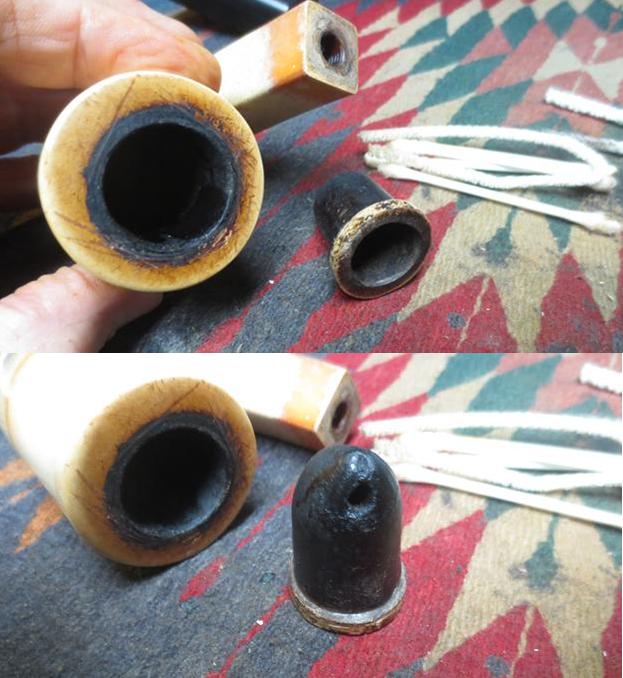
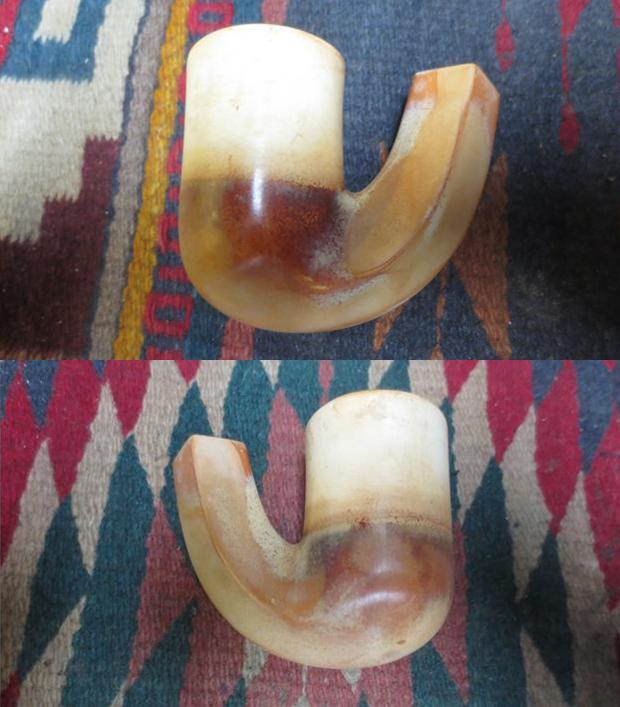
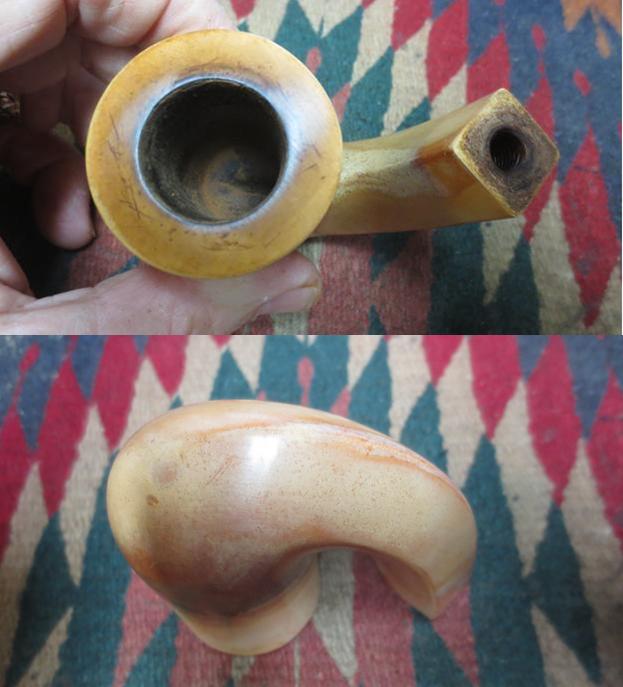
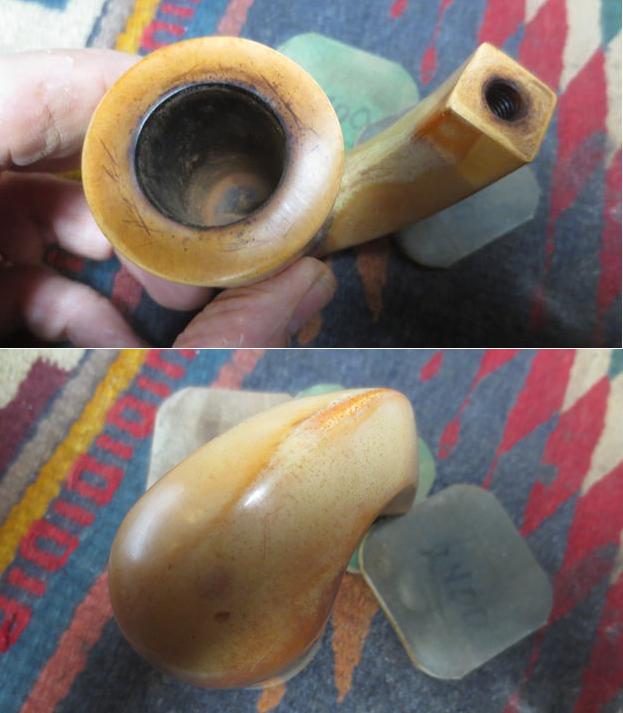
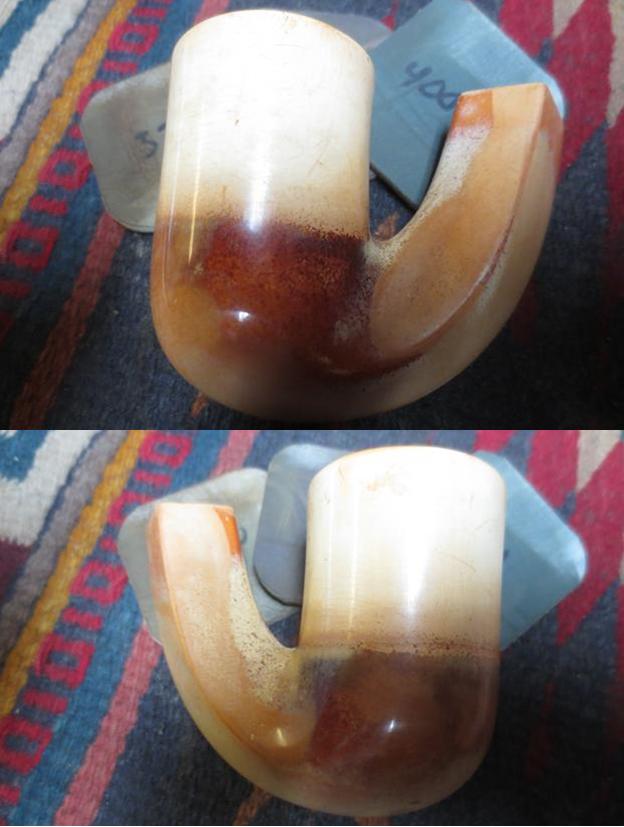
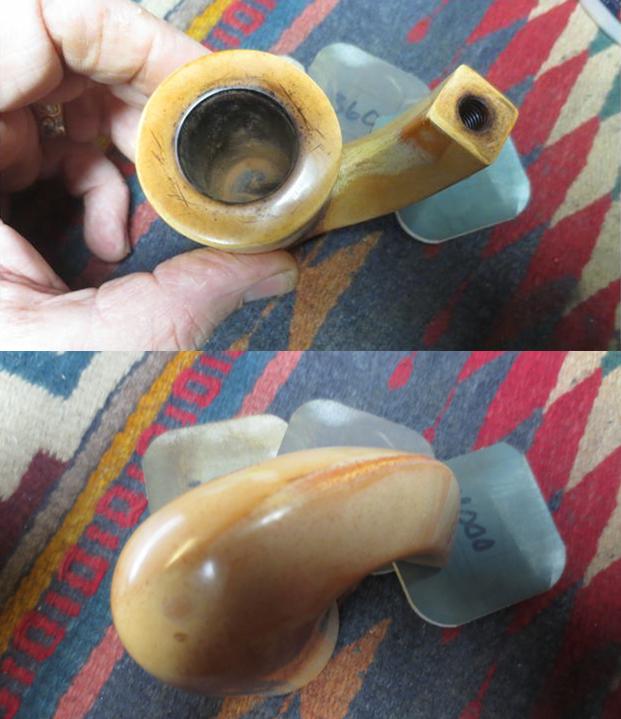
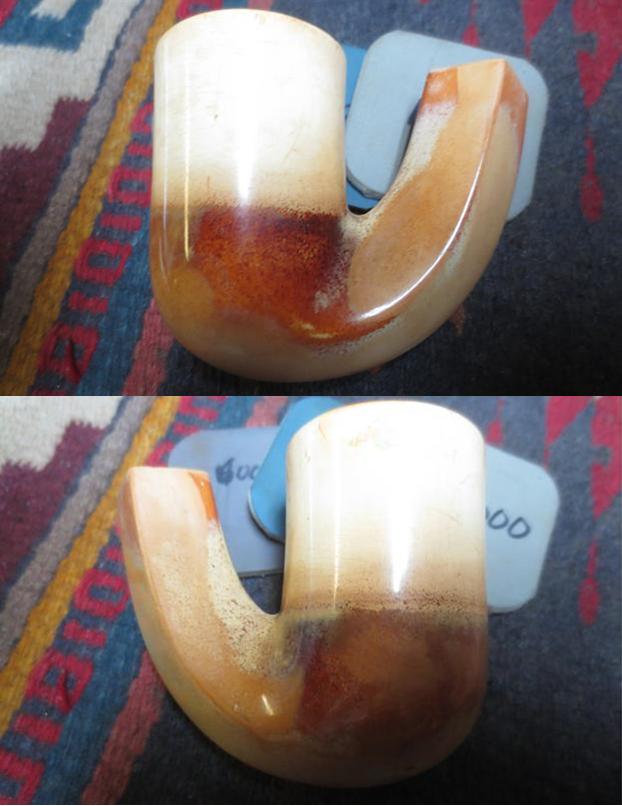
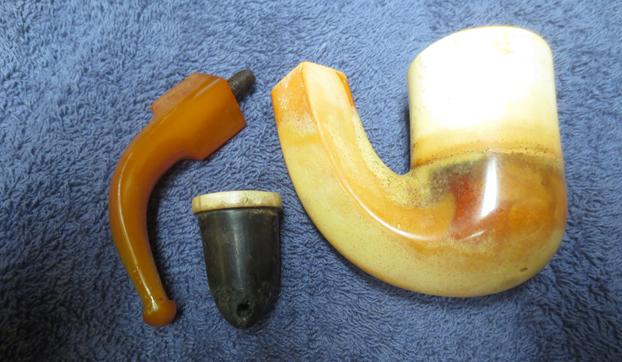
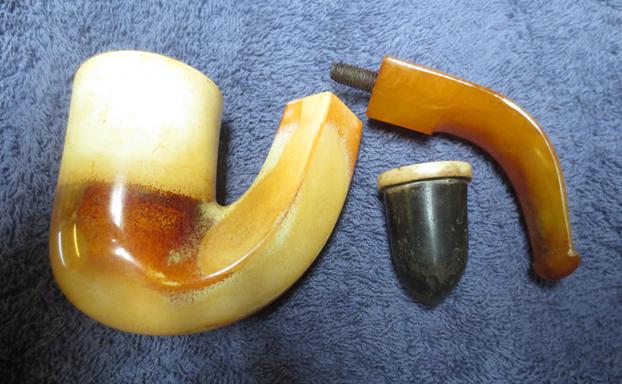
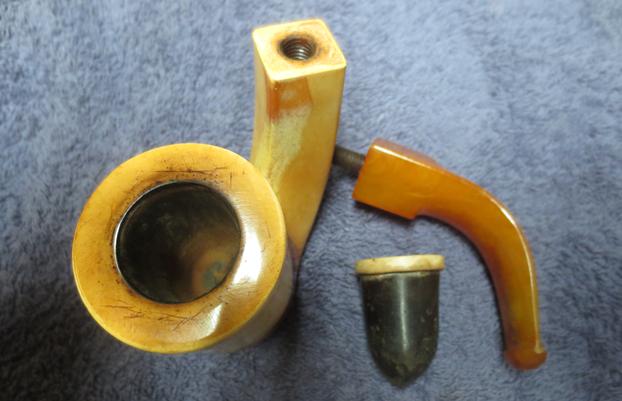
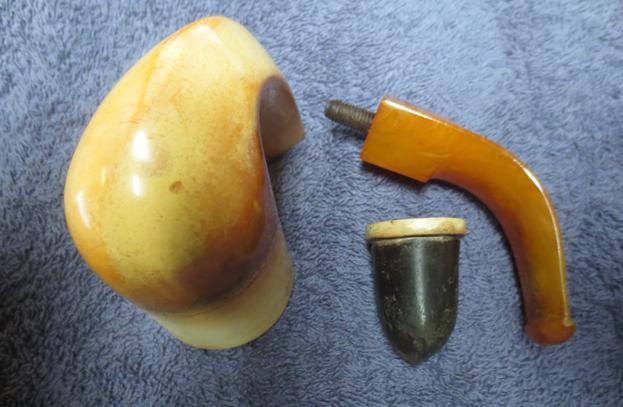
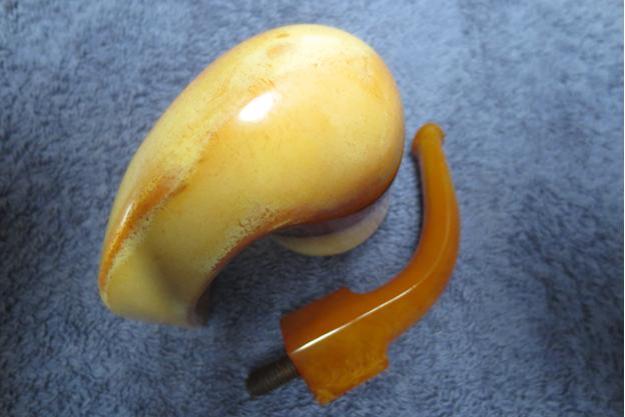
I was visiting my family in Idaho and staying with Jeff and his wife when this pipe arrived. We opened the box and took it out and I think both of us were surprised at how big it was. We took it out and turned it over in our hands to examine it. It was a huge meerschaum Oom Paul. The meer seemed to have an interesting colouring pattern coming up from the bottom of the bowl. The surface of the meerschaum was dirty and scratched. The rim top had a strange stepped up section that rose above the top of the rim. It was chipped and no longer round. The bowl had a cake in it and it did not seem to be as deep as the bowl exterior would have led us to believe. It was odd. The area around the raised section of the rim top was dirty and had a thick build up of tars and oils flowing out from the raised portion toward the outer edge of the rim. The stem was in rough condition at the button end but it aligned perfectly with the diamond shank. It was amber coloured Bakelite stem and I believe it was original. There were deep tooth marks and chatter on the stem at the button on both sides. The button itself was misshapen from tooth marks. I took photos of the pipe before I started the cleanup. The out of round portion that extends above the rim surface and the colouration pattern on the sides of the bowl made me wonder what I was dealing with in terms of the mechanics of this pipe. When I inserted my finger in the bowl, it is not as deep as the depth of the outer portion of the pipe. That too made me wonder.I took a close up photo of the rim top to show the condition of the bowl and rim at this point. You can see the rough inner and outer edges of the raised portion of the pipe. There was also scratching in the surface of the lower potion and a ring of darkening around the edge where the raised portion met the lower portion. This made me wonder if I was not dealing with some kind of bowl insert.I took photos of the stem damage on both sides of the stem. The button and the flat portion had a lot of tooth marks and chatter that left a very rough and uneven surface on both sides.I unscrewed the stem from the shank and found that the pipe had a metal tenon in the stem itself. That was a good sign in that it was not stuck in the shank.The next two photos show the cake in the bowl and how I used a Savinelli Fitsall Pipe knife to trim back the cake to bare meerschaum.I used a cotton swab to run a bead of alcohol around the raised portion of the bowl to begin to loosen it. I ran alcohol, pipe cleaners and cotton swabs through the mortise and shank of the pipe to clean out the tars. I ran a pipe cleaner into the airway in the bowl and as I pulled it back and forth the raised portion came loose on the pipe cleaner. I removed the inner bowl from the outer and was surprised by how deep the outer bowl was. The inner bowl was quite shallow and had the airway on the back side. In the bottom of the outer bowl there was a ball of cotton or wool that was used as a trap for moisture and a filter. It was brittle and crusty with old tars. It is visible in the third and fourth photo below. I used the Savinelli Fitsall Reaming Knife to ream the outer bowl. I scrubbed the inside and outside of the two bowls with SoftScrub cleanser and a tooth brush. I worked on the rim top with the scrub and tooth brush and was able to remove the tars and oils that were on that surface. Once it was clean I rinsed the pipe under running water. I dried it off with a soft cloth. The photos below show the bowl after the scrubbing and rinsing. The line on the bottom half of the bowl makes sense now. The colouration is all below the bottom of the insert bowl. Everything above the insert shows no colour at this point. The outer edge of the inner bowl was damaged. It almost looked as if someone had tried to remove it with a pair of pliers. The edge was very rough and no longer round. The inside edge and the outside edge was damaged. I used a Dremel and sanding drum to clean up the outer edge of the bowl. I sanded the bowl surface, the edges and the bottom portion of the bowl with 220 grit sandpaper and with 1500-2400 grit sandpaper. The next four photos show the bowl after my cleanup work. There was some darkening on the rim top that I was not able to remove without removing significant amounts of the meerschaum. I worked over the inner edge of the bowl with a folded piece of 220 grit sandpaper. I wanted to clean it up and make it more round again.One the bowl was cleaned up I put it back in the outer bowl and took a picture of how it looked in place in the meerschaum. I could easily put it in place and remove it with the tip of my index finger. The second photo below gives some idea of the size of the inner bowl.I polished the inner bowl with micromesh sanding pads – wet sanding with 1500-2400 grit pads and dry sanding with 3200-12000 grit pads. Each successive pad brought more of the shine to the surface of the inner bowl. I waxed the bowl edge and rim top with Clapham’s Beeswax and hand buffed it to raise a shine. I cleaned up the damaged portions of the stem with a cotton swab and alcohol to remove any debris in the deep tooth marks. I filled in the tooth marks and rebuilt the button surfaces to make the orific button round like it was originally. I layered on the amber super glue in the marks and on the button until the surfaces were slightly over filled.I put the stem in my ebony drilled block to allow the repair to dry on both sides.When the repair dried I recut the edges of the button on the top and underside of the stem with a needle file. I also smoothed out the surface of the repairs with the file to match the surface of the rest of the stem. I sanded the repaired areas on the stem surface and the button with 180 and 220 grit sandpaper to blend them into the surface of the stem and the button. I wanted the repairs to be as invisible as possible when the stem was examined. I polished the stem with micromesh sanding pads – wet sanding with 1500-2400 grit sanding pads and dry sanding with 3200-12000 grit pads. I rubbed the stem down after each sanding pad with Obsidian Oil. After the final sanding pad I gave it a final rubdown with the oil and set it aside to dry. I cleaned the end of the shank with alcohol and cotton swabs to remove the tars and build up on the shank end.I polished the meerschaum bowl with micromesh sanding pads – wet sanding with 1500-2400 grit pads and dry sanding with 3200-12000 grit pads. I wiped the bowl down after each pad with a dry felt cloth to polish it further. I have found that the micromesh pads do not remove the patina in the colouring meerschaum. I put the stem back on the bowl and buffed it with Blue Diamond on the buffing wheel to raise a shine. I put the inner bowl on the end of my finger and buffed it with Blue Diamond. I buffed the stem, the inner and outer bowl with a clean buffing pad to raise a shine. I hand buffed the pipe with a microfibre cloth to deep the shine. I inserted the inner bowl in the outer bowl and hand buffed it all one final time with the microfibre cloth. It is a big pipe and fills the hand. It is definitely one that should be smoked sitting beside the fire, sipping your favourite beverage and reading a good book. The dimensions of the pipe are Length: 6 inches, Height: 3 inches (with the inner bowl inserted), Outer diameter of the bowl: 1 ¾ inches, Chamber diameter: ¾ inches. The finished pipe is shown in the photos below. Thanks for joining me in the process.

Restoring a Sad, Old MLC Bent Billiard


Blog by Steve Laug

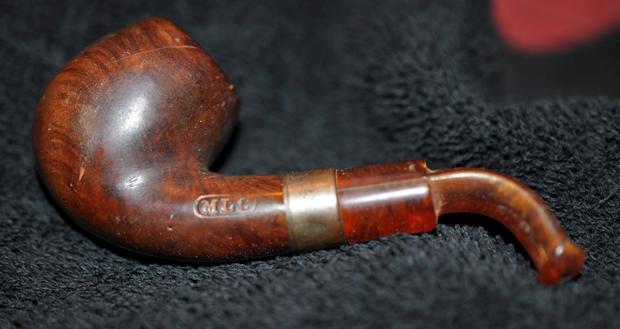
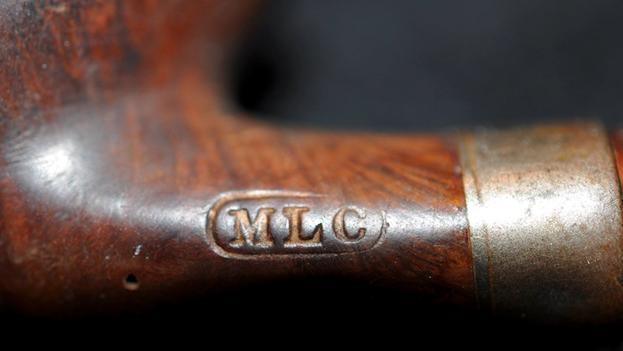
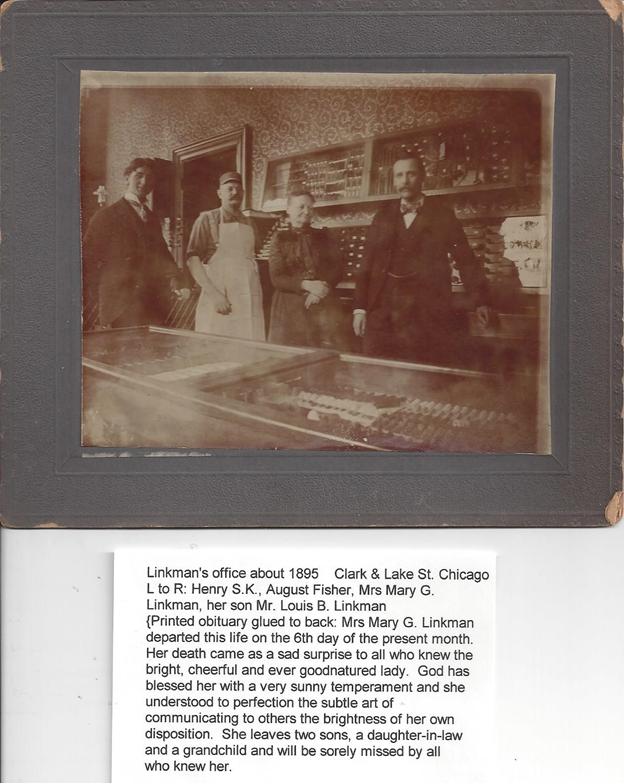
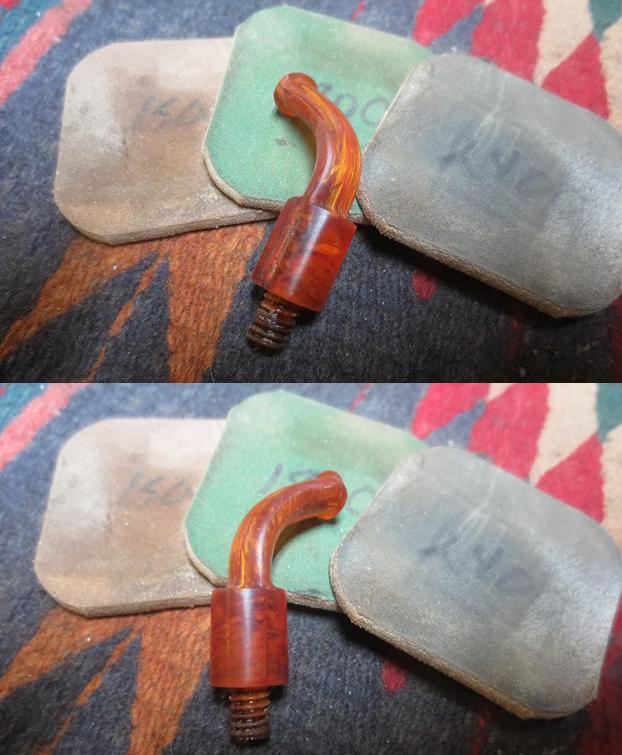
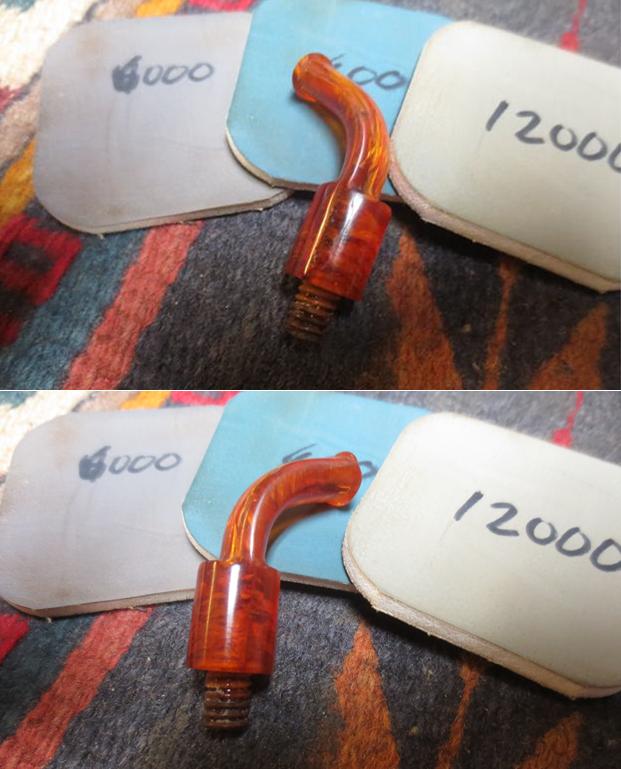
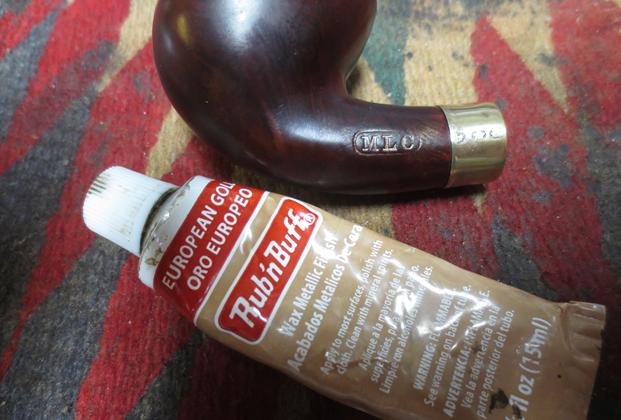
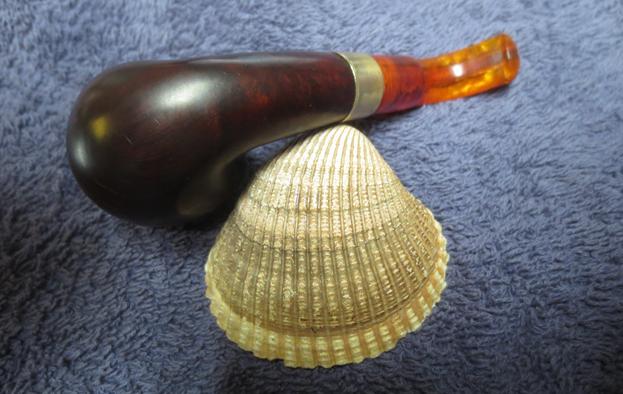
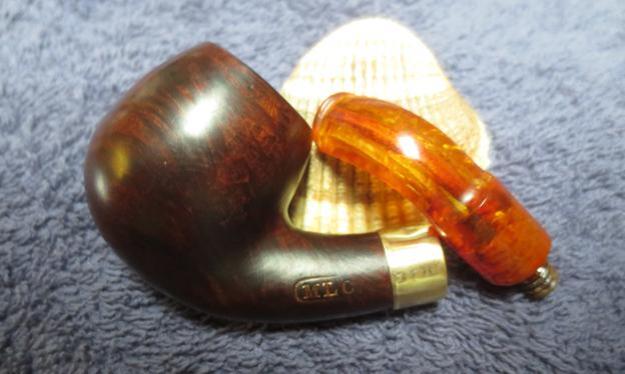
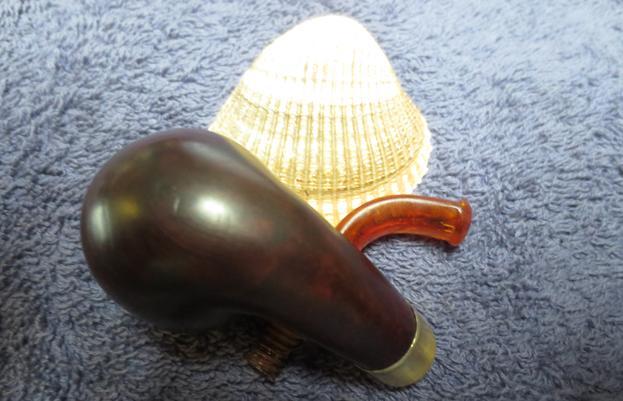
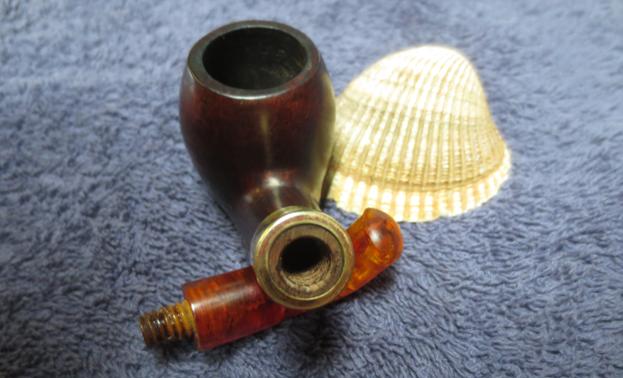
This older MLC bent billiard is a turn of the 20th century pipe. The initials stand for Mary Linkman Company. The company was named for the mother of the same Linkman who eventually branded pipes under that same name and then eventually became the Dr. Grabow pipe manufacturer with which we are familiar. If you have followed this blog for a while you have come to know that I love really old pipes and this one fits the bill. It is stamped MLC in an oval with no other stamping on the shank. The ferrule is brass and has faux hallmarks on the left side. They are worn but still readable with a bright light and a lens. It is another small pipe, slightly under 4 inches long and 1 ½ inches tall. The stem is Bakelite or Redmanol and has a lot of small spidering cracks in the flat portions of the stem on both sides. Both sides of the saddle are split the entire length of the saddle. There is very little tooth chatter or and minor tooth marks on both sides near the button. Jeff took the photos that follow before started the cleanup. (http://www.pipephil.eu/logos/en/logo-m6.html)The pipe was in really rough shape. The finish was worn and spotted with paint specks, grime and nicks in the briar. The stem was split and worn. The bone tenon looked good but the band on the shank was loose and spun around the shank. The wear and tear on the brass band and the tarnish left is a mottled mess. The bowl had been reamed somewhere in the process so the cake was not thick. The lava on the rim was light. The inner and outer edge of the bowl was undamaged. The rim close up shows the cake and the peeling lava on the surface of the bowl.Jeff took photos of the sides of the bowl and the bottom side to show the wear and tear on the finish. There were some deep gouges in the briar and a lot of paint speckles on the briar. The stamping on the left side of the shank is quite clear – MLC in an oval. It had originally been gold leaf but it was worn. The stamping on right side of the oval was lighter than the rest of the stamping.I did some digging on the net to see what I could find out about the MLC brand. I knew that it was a Linkman pipe but could not remember much about it. I turned to my go to site for quick information – Pipedia (https://pipedia.org/wiki/M._Linkman_%26_Co). The information did not add much to my understanding other than pin down the date to the late 1890s or early 1900s. Included in the article was a photo of Mary Linkman, her son Louis and August Fisher at their Chicago Office. The photo is from Mary’s obituary and is a fascinating piece of history. The scan of the photo and obituary are courtesy of August Fisher’s granddaughter.Jeff took some photos of the stem. The right side of the saddle stem was split from the end up to the transition to the blade of the stem. The right side also had a crack. It looked to me that someone had turned the bone tenon too deep into the stem and split the saddle. The flat surfaces of the top and bottom of the stem were filled with a series of small spidering cracks. The stem, like the bowl was covered with paint flecks or spray. You can see from the first photo that the band has been turned all the way around so that the worn faux hallmarks are upside down and on the wrong side. Jeff cleaned the exterior of the pipe with some Murphy’s Oil Soap and a tooth brush and rinsed it off under running water. He dried it off with a soft cloth and the soap had removed the paint flecks and the deeply ground in grime on the finish. He ran pipe cleaners and alcohol through the mortise and the airway in the shank and stem to remove dust and debris that had collected there. He carefully scrubbed out the cracks and splits in the sides of the saddle stem using a tooth brush and rinsing it in water. Once the pipe was clean, he packed it up and sent it my way for the repair and restoration work. I took photos of the pipe when I unwrapped it on my worktable. It is an intriguing little pipe that caught my attention. When I unscrewed the stem the ferrule fell off in my hand. I laid out the parts of the pipe and took the following photo. It shows the nicks, dents, sandpits and flaws in the briar. The band looked as if it was never glued to the shank. The briar is clean and the inside of the ferrule had no remnants of glue. It was clean.I took some close up photos of the stem to show the cracks and splits in the saddle portion. The stem was worn and battered. The bone tenon was darkened from tobacco smoke and tars. The edges on the tenon were worn down and when the stem was on the pipe it was over turned or over clocked.  I cleaned out the cracks in the side of the saddle stem with a dental pick and a damp cotton swab until the inside of the crack was clear of debris that would cause the stem repair to be very visible. I dried the stem off with a cotton pad. I filled in the cracks on both sides of the stem with amber super glue and set the stem aside to dry.When the repair had cured I sanded it smooth to blend it into the rest of the stem with 220 grit sandpaper. I sanded all of tooth chatter and marks out of the surface of the stem as well to smooth out all of the damage. I wanted it to disappear into the amber Bakelite. After I had smoothed out the repair I polished it with micromesh sanding pads – wet sanding with 1500-2400 grit pads and dry sanding with 3200-12000 grit pads. I wiped the stem down after each pad with Obsidian Oil and set the stem aside to dry. (I almost forgot to add this piece of information. Just before I polished the stem I painted the threads on the tenon with clear fingernail polish to build them up so the stem would align properly when I put it in place.) The bowl needed a lot of work. I wiped the bowl down with acetone and filled in the nicks, dents, flaws and sandpits in the briar with clear super glue. I sanded the fills smooth with 220 grit sandpaper until they blended into the surface of the briar. I wiped the bowl down again with alcohol on a cotton pad to remove the sanding debris. I gave the shank end a coat of white all-purpose glue and put the ferrule in place with the faux hallmarks aligned with the stamping on the shank side. I left it to dry and worked on another pipe for a while. Once the glue had set I sanded the bowl and the ferrule with a medium and a fine grit sanding sponge to smooth out the scratches left behind from sanding with the 220 grit paper. The photos below show the bowl at this point in the process of the restoration. I stained the bowl with a dark brown aniline stain and flamed it to set it in the grain. I figured that the dark brown stain would hide the repairs and give the bowl the original rich colour. I set it aside to cure while I went to work for the day.I buffed the bowl with red Tripoli on the buffing wheel to remove some of the heavy coat of stain. I sanded the bowl with 2400-6000 grit micromesh sanding pads to make the finish more translucent so the grain would stand out when it was polished. I gave the bowl multiple coats of Conservator’s Wax and set it aside to dry. I touched up the gold filled MLC Oval with Rub’n Buff European Gold. I applied it with a cotton swab and hand buffed the excess off with a cotton pad.I carefully buffed the bowl and stem with Blue Diamond on the buffing wheel. I gave the bowl and stem multiple coats of carnauba wax and buffed the pipe with a clean buffing pad to raise the shine. I hand buffed it with a microfiber cloth to deepen the shine. The photos of the finished pipe are shown below. It has come a long way from what it looked like when I started. It turned out to be a beautiful pipe that has served pipe men well for well over 100 years. Thanks for looking.

An Unbelievable Find – An Unsmoked Tiny Horn Stem WDC Bent Billiard


Blog by Steve Laug

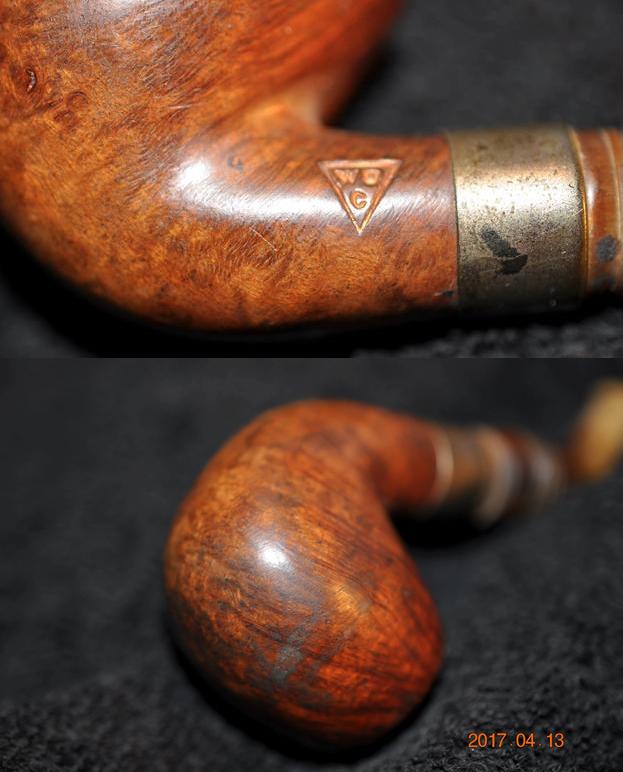
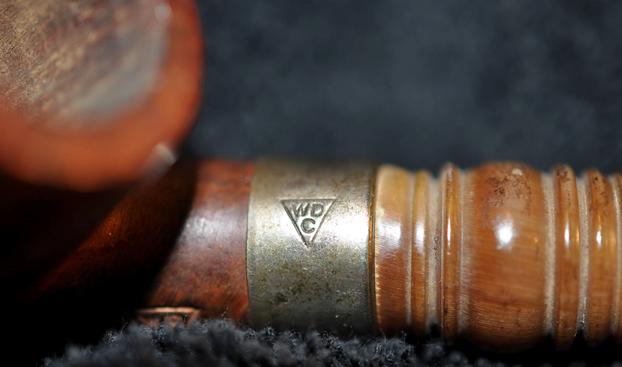
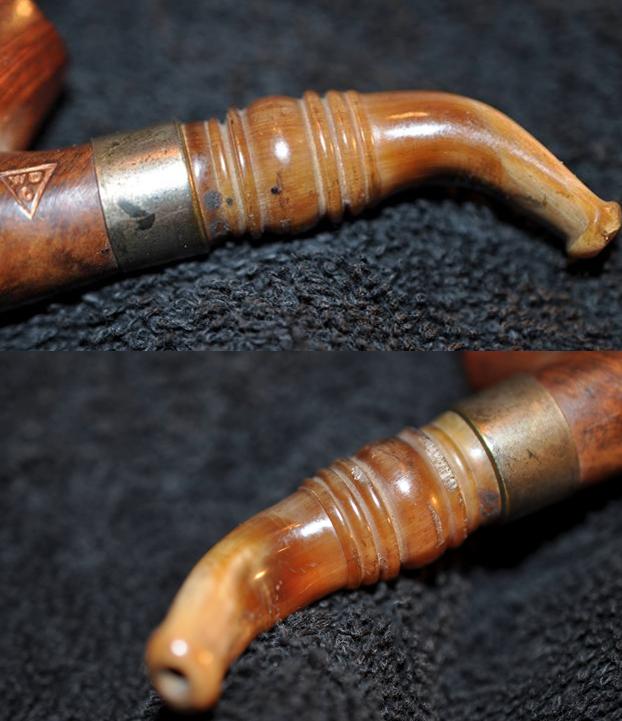
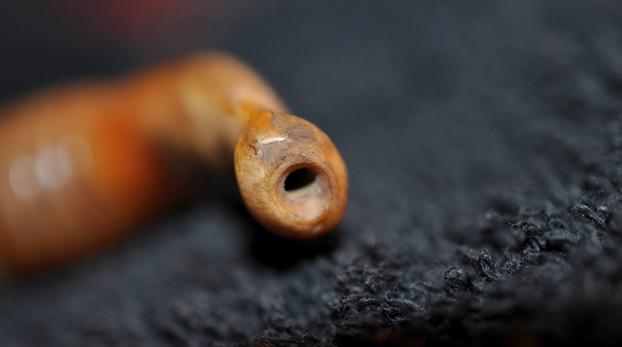
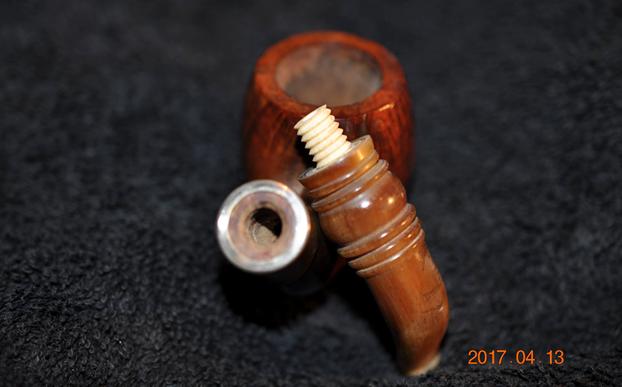
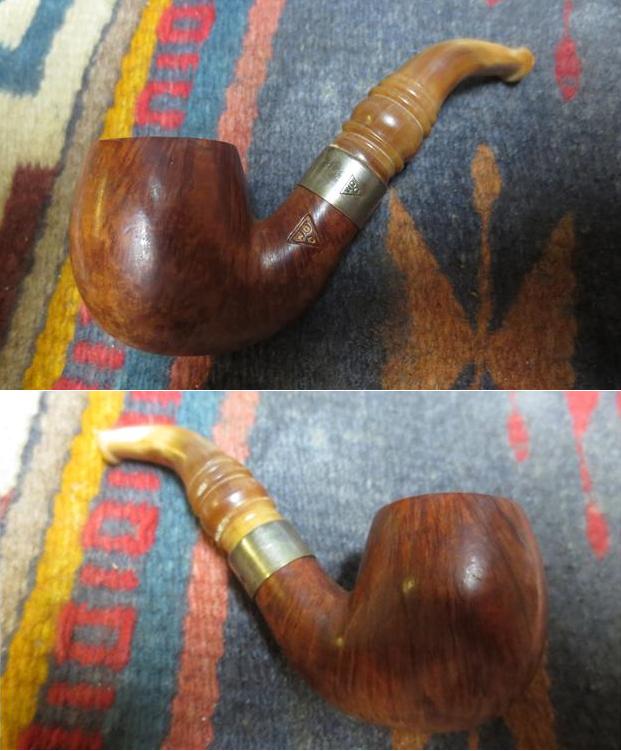
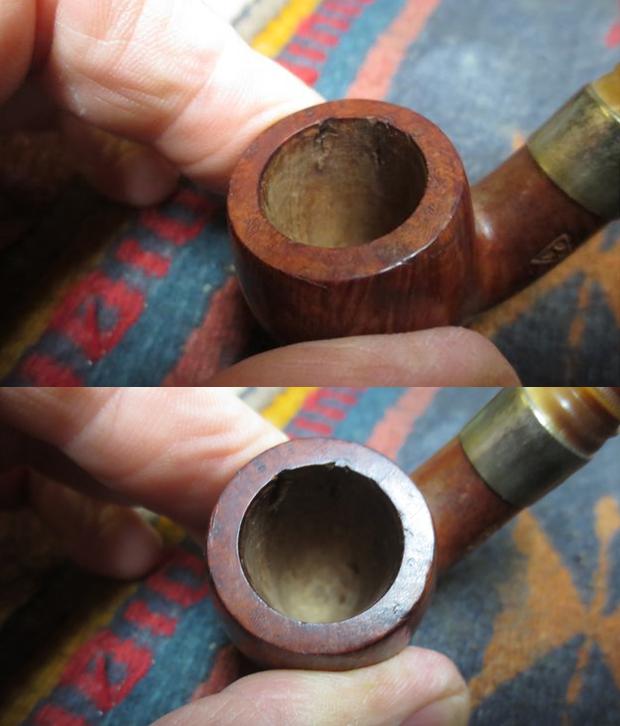
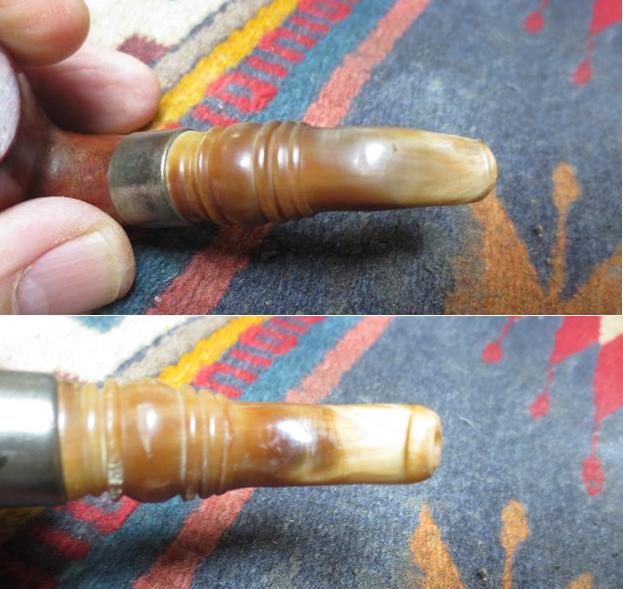
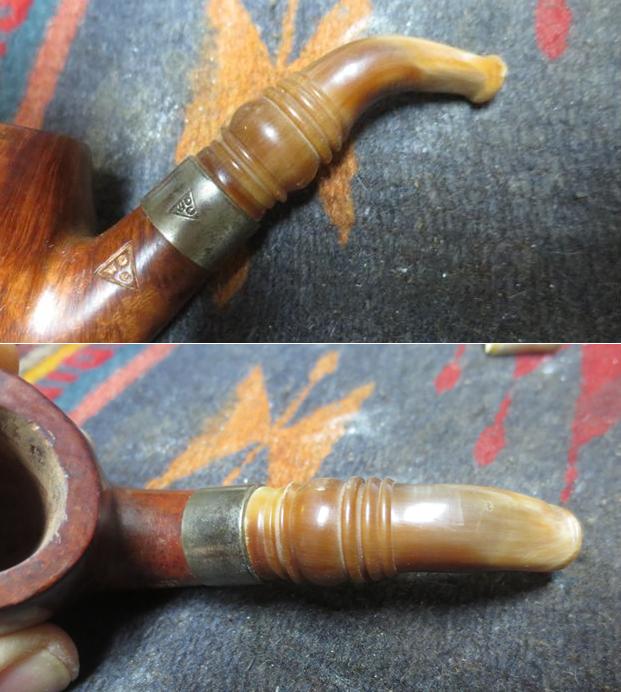
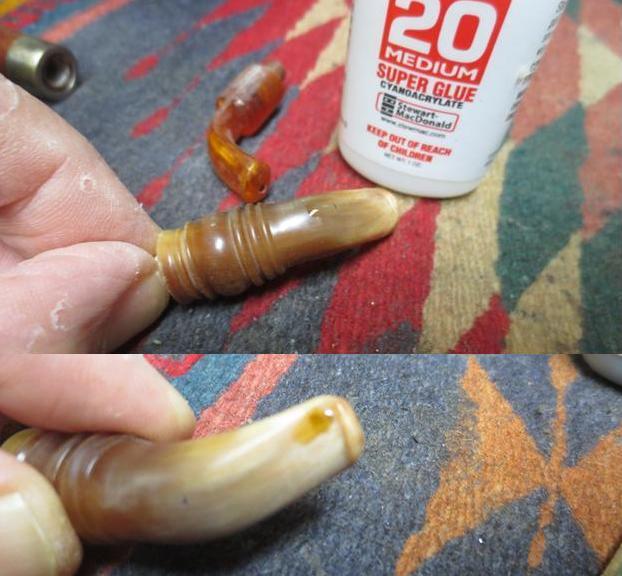
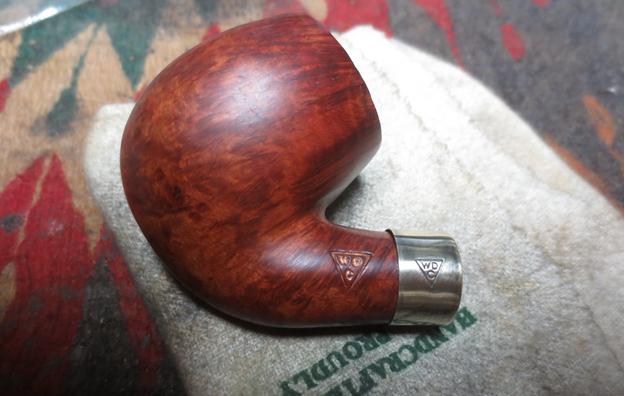
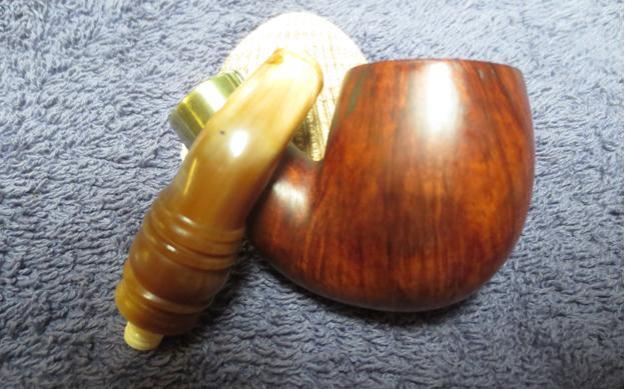
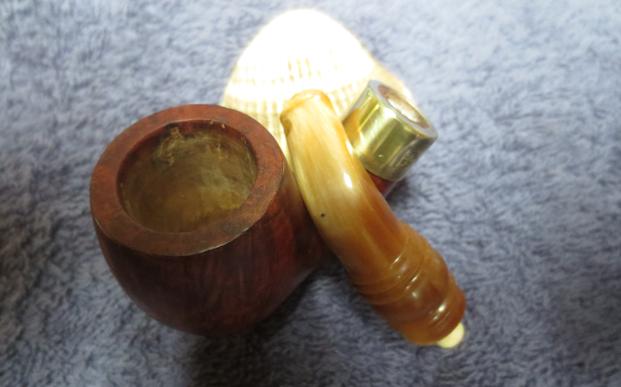
Jeff picked this one up in an antique shop somewhere along his travels. He is getting as bad as me in not being able to drive by an antique mall or shop without pulling over and having a quick look. We both have very patient wives that humour us with our obsession. He found this little beauty on one of those stops. It is a small pipe – 4 inches long and 2 inches tall. The bowl diameter is 1 1/8 inches and the chamber diameter is ¾ inches. For such a petite pipe the bowl is almost standard size and would hold a full bowl of tobacco. This pipe came from the age of putting the pipe in the pocket when you went to the opera or a show. It would hardly show whatever the pocket you slipped it into.What makes this pipe remarkable to me is that it is unsmoked. There has never been a bowl of tobacco lit and smoked in this old timer. I believe it is an early 1900’s era pipe or possibly earlier. It has a horn stem that is turned which is also unusual. I typically see straight or bent tapered horn stems. I don’t remember the last fancy turned horn stem I have seen. The pipe bears the WCD triangle logo on the left shank and a matching logo on the ferrule. There are a few small fills in the bowl and some issues on the inside that I will speak about when I get to the photos of the bowl and rim. Nonetheless this is a rare find – a pipe that is probably at least 100 years old that has not been smoked. It is new old stock with an emphasis on the old. Jeff took the above photo and the ones that follow when he brought it home from the trip. The finish was a little shop dirty from years of sitting on display. The rim was clean but had some grime in the finish. The issue I referred to above can be seen in the first photo below. There was a large fissure in the right side of the bowl from the rim downward into the bowl for about ¼ inch. It was clean and there was no burn thanks to the unsmoked condition. If the pipe is going to be used for its intended purpose then this will need to be repaired. The inner edge of the bowl is also nicked around the area above the flaw. It makes the inner edge out of round. Though the pipe is new and unsmoked it is dirty with the kind of dust and grime that comes from sitting for a long time on display. The next photos show the grain with the grime and also show the tarnished ferrule and the clear stamping on the shank. The ferrule has been turned as there is a WDC triangle logo on it as well. The next four photos give a closeup picture of the shank/stem fit and the WDC triangle on the ferrule. The turned horn stem really is beautiful under the dust and debris of time. The stem has the old style button with the orific opening on the end. The button is more rounded that new buttons and the round opening at the end is very different from the newer slot opening. Jeff took a photo of the pipe with the stem removed. The threaded bone tenon looks clean and new. This is yet more proof of an unsmoked pipe.The horn stem showed damage from the shuffling around. There were small scratches and nicks in the top side and underside on the flat portion of the stem. There were also small nicks on the some of the edges of the turned area of the stem. These were normal marks of wear and tear and really nothing too big to deal with. Jeff cleaned the exterior of the pipe with some Murphy’s Oil Soap and a tooth brush and rinsed it off under running water. He dried it off with a soft cloth and the grime on the finish was gone. He ran pipe cleaners and alcohol through the mortise and the airway in the shank and stem to remove dust and debris that had collected there and he packed it up and sent it my way for the touch up work. I took photos of the pipe when I unwrapped on my worktable. It is an intriguing little pipe that draws attention, that is for certain. He also turned the loose band so that it lined up properly with the stamping on the shank side. You can see from the photos that the stem is slightly underclocked and will need to be aligned. The next two photos show the damage to the bowl wall and rim edge.The stem had some small nicks that a bit of amber super glue would easily take care of.The ferrule was loose and it took nothing to have it drop off in my hands when I turned the stem out of the shank. The briar underneath looked as if it had never had glue on it. It made me wonder if the band had just been held in place originally by pressure fit and over time the wood shrunk as it dried and the band came free of the shank.To address the flaw in the briar on the right inside of the bowl I mixed some briar dust and clear super glue and filled in the flaw. As the patch dried it shrunk and I refilled it until it was even with the rest of the surround bowl walls. While the glue dried on the repair I put some white glue around the shank, aligned the ferrule and put it in place. Thus while the repair dried the band could also dry. Once the repair in the bowl dried I sanded it smooth with 220 grit sandpaper. I reshaped the inner edge of the bowl with the sandpaper as well and cleaned up the nicks in the edge. I chose not to bevel the rim as it had not been beveled previously. The bone tenons can swell over the years making the fit and alignment less than perfect. I have learned a few tricks over time with over and under turned stems with bone tenons. If the stem is over turned I generally build up the threads on the bone tenon with super glue until thing align properly. If it is under turned like this stem I remove material from the tenon. I carefully sanded the threaded area to reduce the diameter slightly. I checked the fit often and once I had it finish I cleaned up the tenon and put the stem aside. I filled in the nicks on the surface of the stem and near the button with clear super glue. The amber would have dried dark on this light horn. When the repair dried I sanded it smooth with 220 grit sandpaper. I sanded the nicks on the turned areas with 220 grit sandpaper to smooth them out and make them less obvious. I polished the horn stem with micromesh sanding pads – wet sanding it with 1500-2400 grit pads and dry sanding it with 3200-12000 grit pads. I rubbed the stem down with Obsidian Oil after sanding with each micromesh pad. After the final pad I set the stem aside to let it dry. I polished the metal ferrule with micromesh sanding pads to remove the tarnish on the metal. There was a small crack in the underside of the ferrule that I repaired when I glued it onto the shank. I finished with the 12000 grit pad and then rubbed the stem down with a jeweler’s cloth to polish the metal. The silver is a nice contrast between the brown of the bowl and the translucence of the horn.I buffed the pipe and stem with Blue Diamond on the buffing wheel and worked carefully around the band. I gave the bowl and stem multiple coats of carnauba wax. I buffed it with a clean buffing pad to polish the wax and give the pipe a shine. I hand buffed it with a microfiber cloth to deepen the shine. The wax made the grain stand out clearly and the two fills along the front and the back right edge of the bowl running with the grain. They are visible but they do not detract from the beauty of this old unsmoked William Demuth & Company pipe. It is an interesting piece of pipe history and I can only wish it could tell the story of its journey across the United States and now into Canada. Thanks for looking.


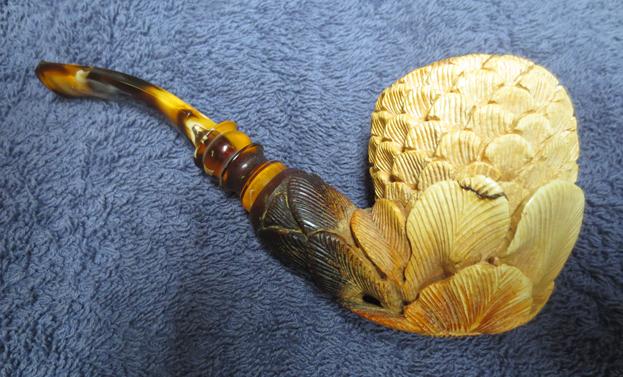
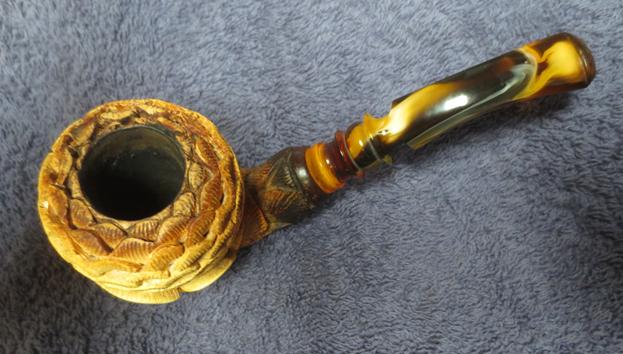
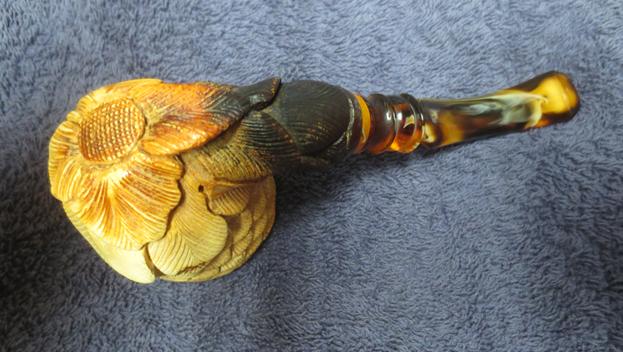
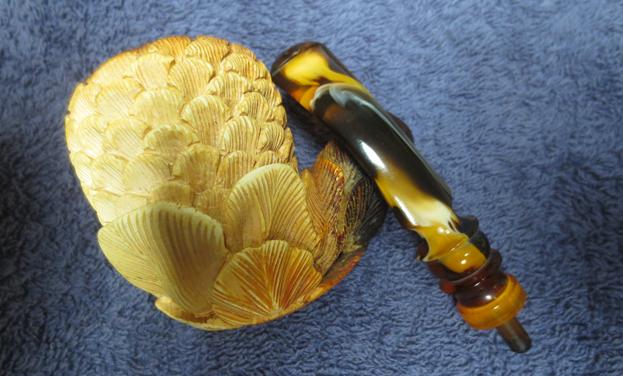
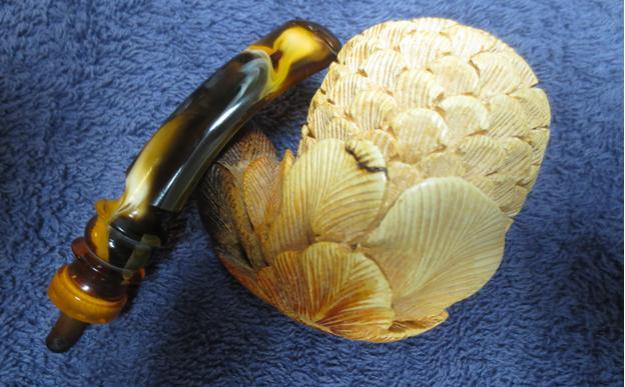
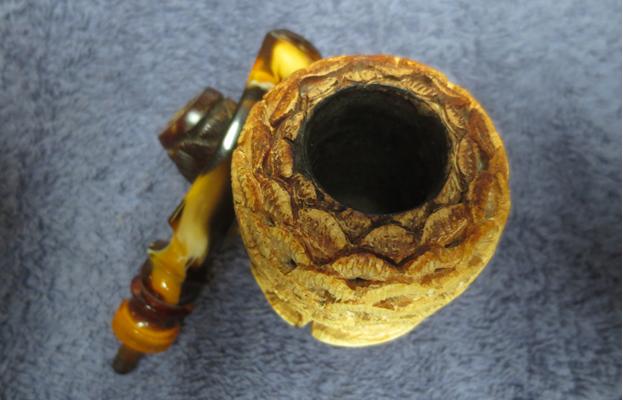
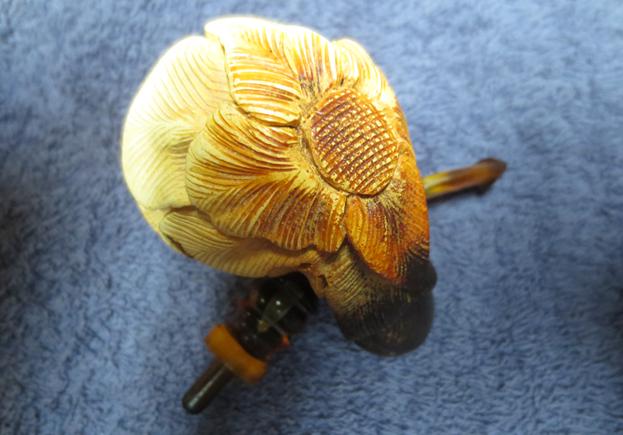
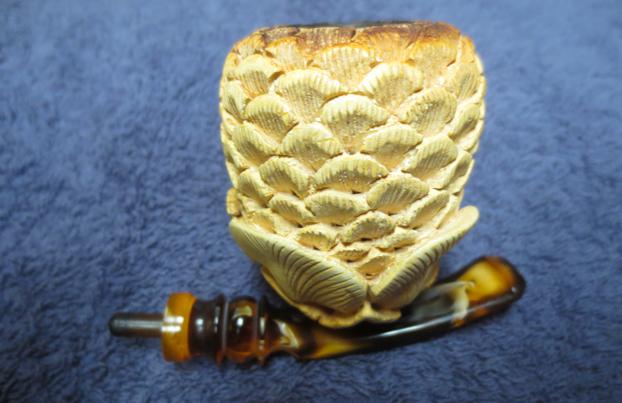
Restoring a Lovely Carved Pine Cone Bent Meerschaum


Blog by Steve Laug

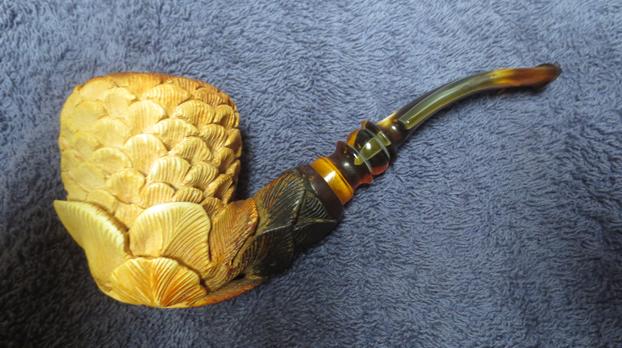
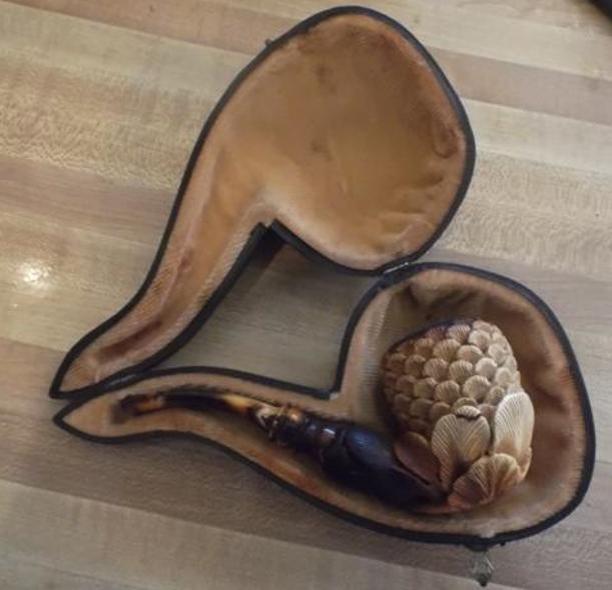
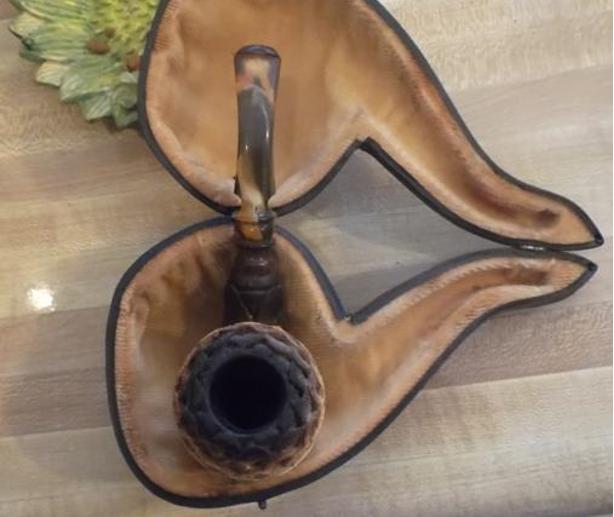
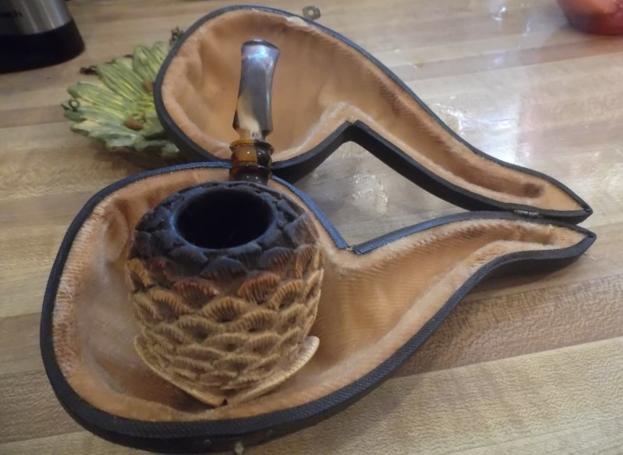
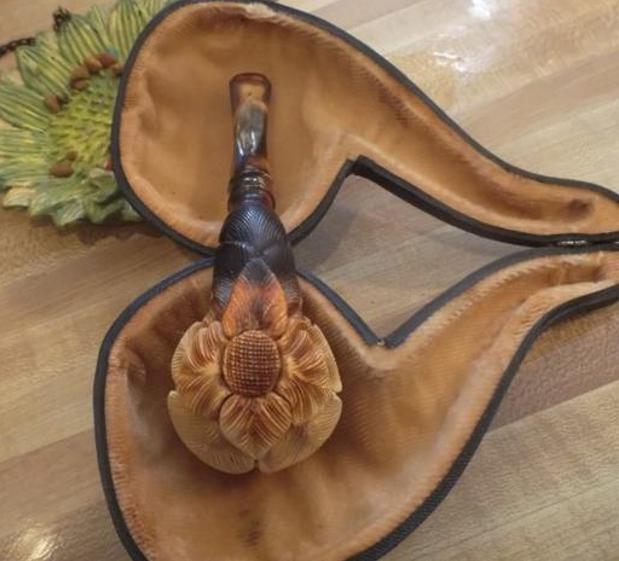
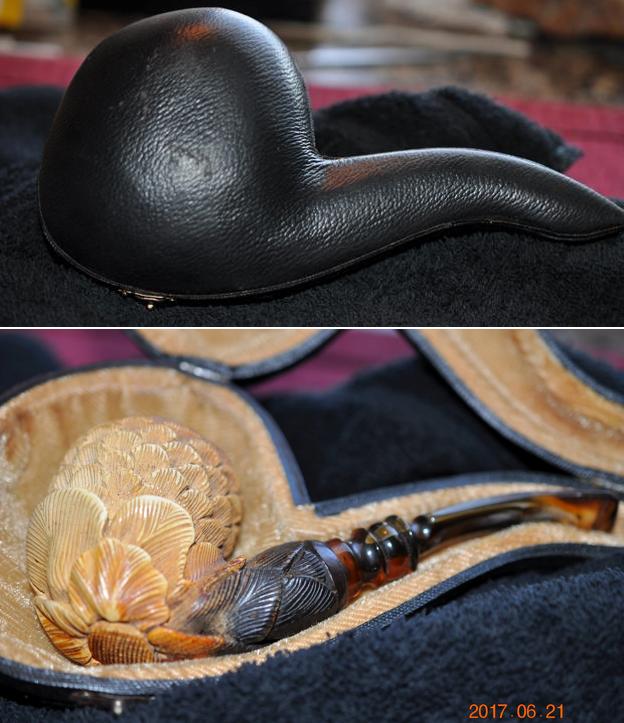
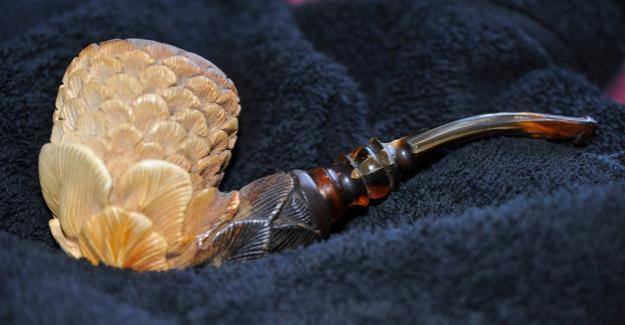
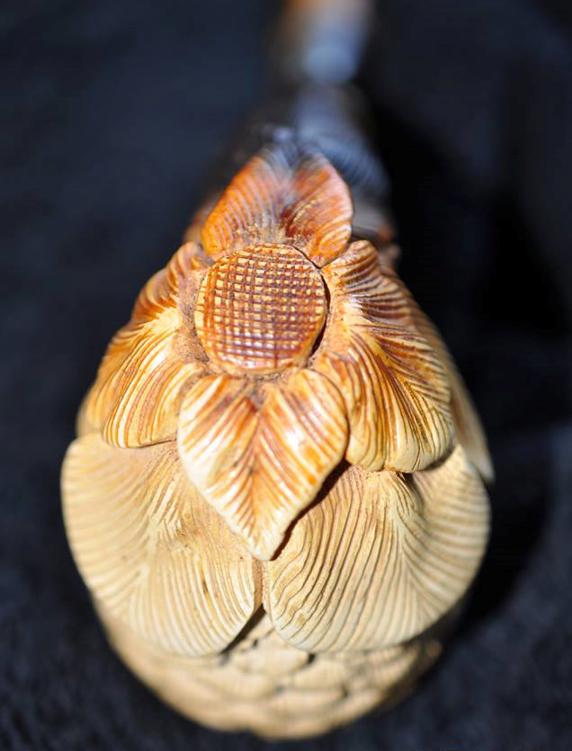
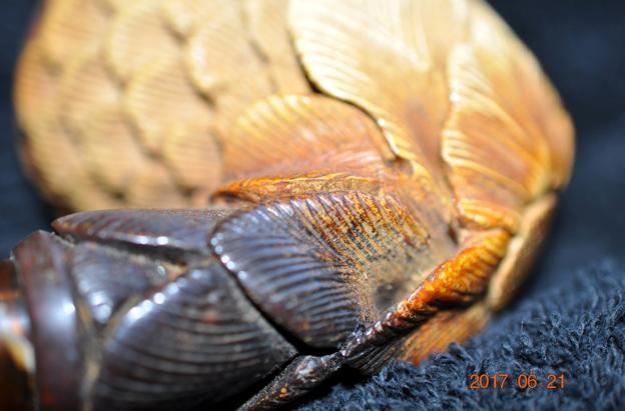
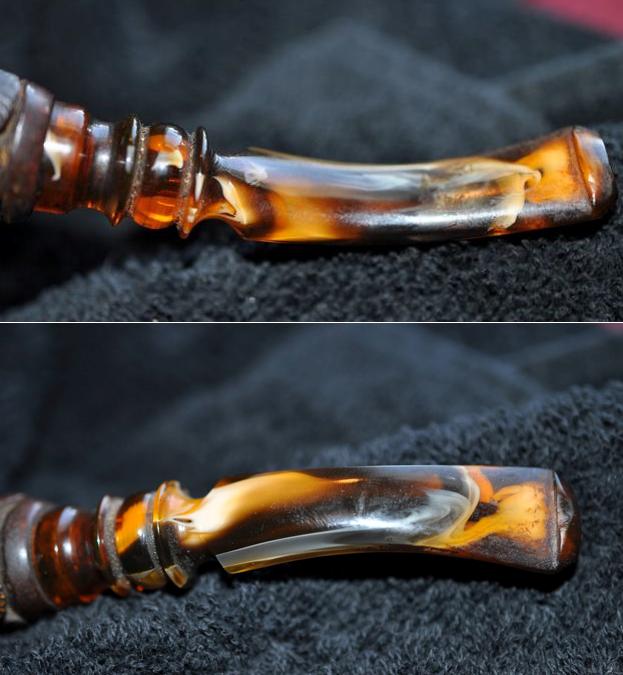
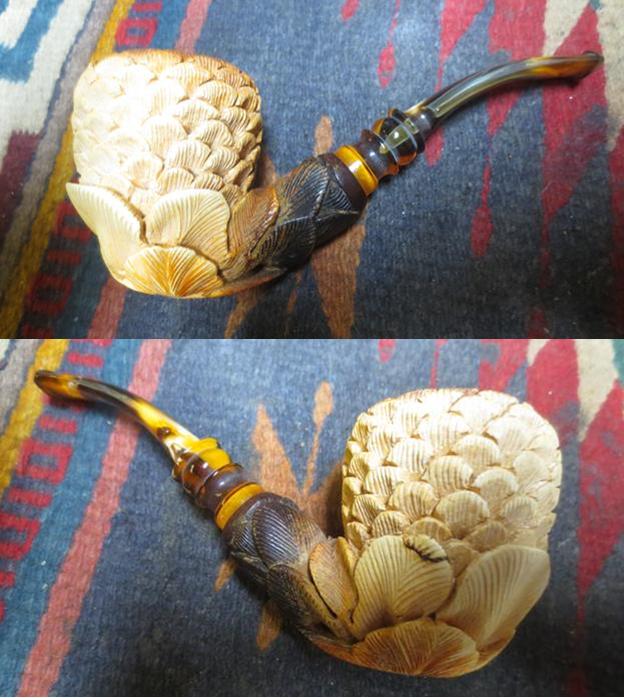
I think Jeff was drawn to this one because of the interesting carving on the bowl and shank, the developing colour on the meerschaum, and the colour and patterns of the acrylic stem. I think he knew I would be interested in it as well. It came in a case that was a bit large for the pipe so I think it may not have been the original case for this meerschaum. Even though it is too large, it does protect it and holds it firmly in place. The shank and the bottom of the bowl have darkened nicely. The rest of the pipe is also darkening with the colour moving from the dark bowl bottom and lightening as you move up the bowl. The rim was dirty with tars and oils and there was a cake in the bowl. The stem has tooth marks and chatter on the top and the underside near the button. The first five photos were the ones that the EBay seller posted with the description of the pipe. To me the pipe showed a lot of potential and I was looking forward to hearing from Jeff if he thought it was a nice as it looked once it arrived in Idaho. We talked and he was pleased with the overall look of the pipe. There was one of the ends of a pinecone “leaf” that was cracked and poorly repaired but otherwise it just needed a cleanup.

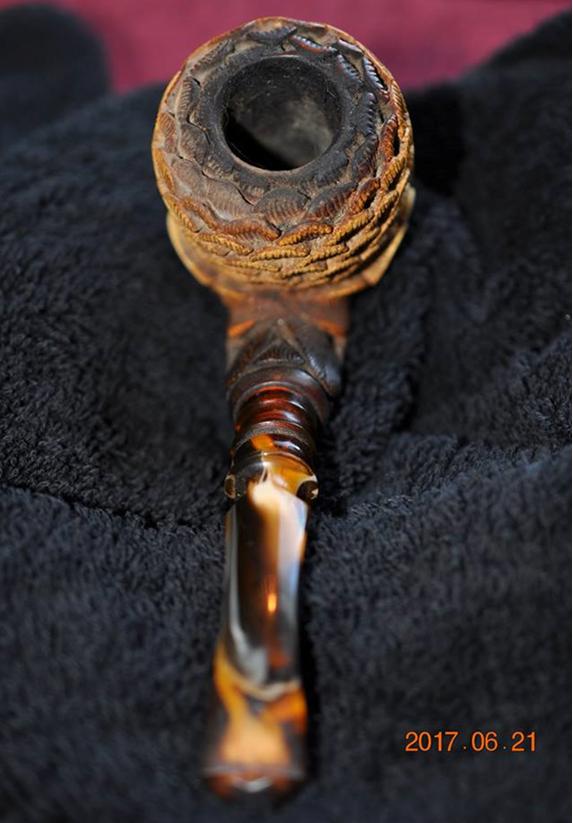
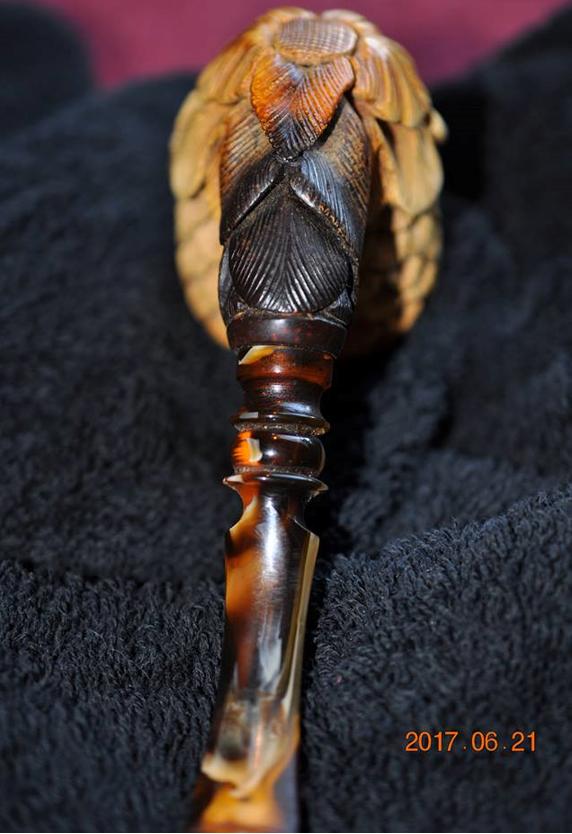
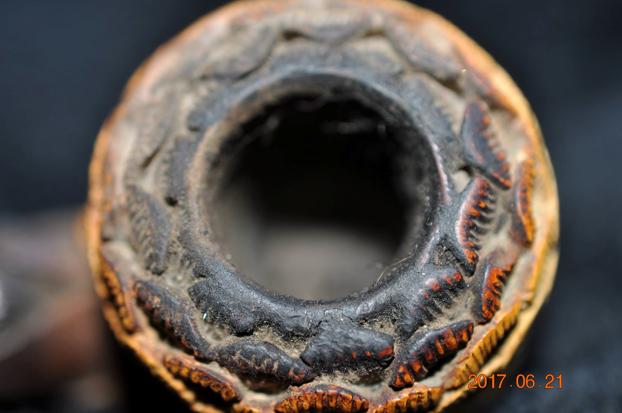
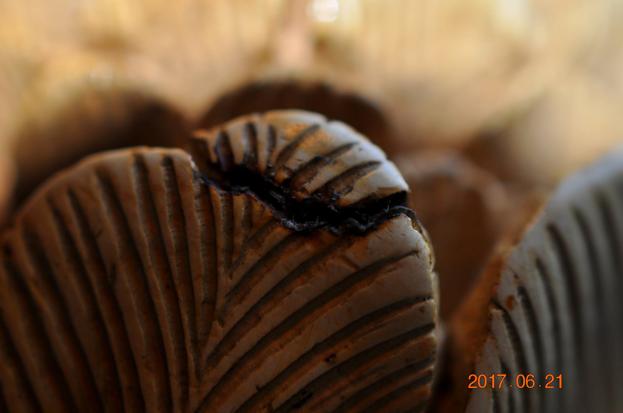
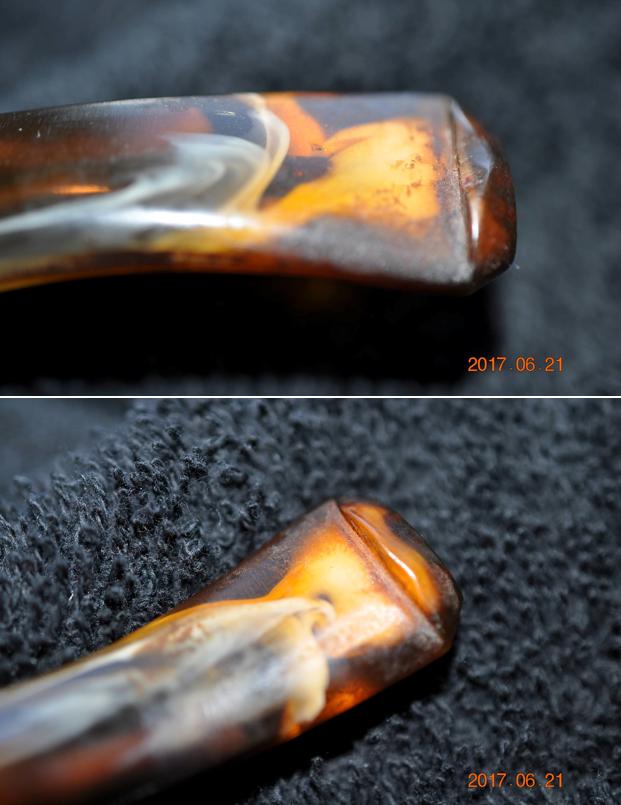
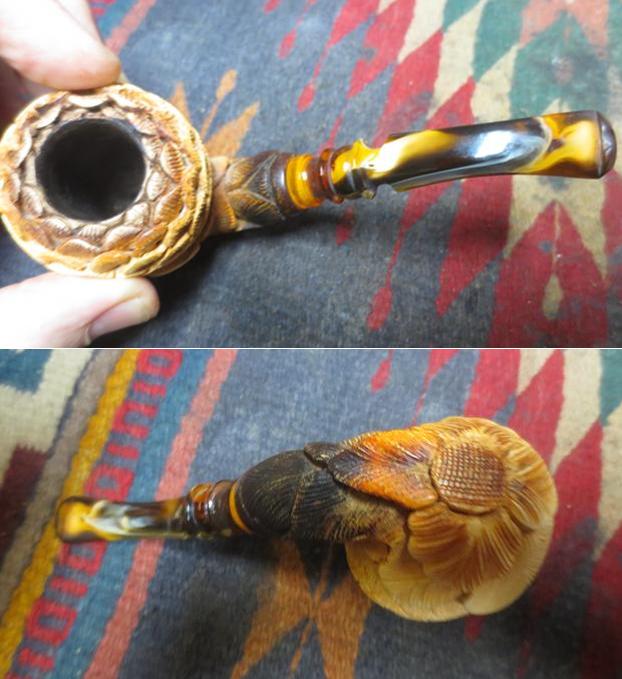
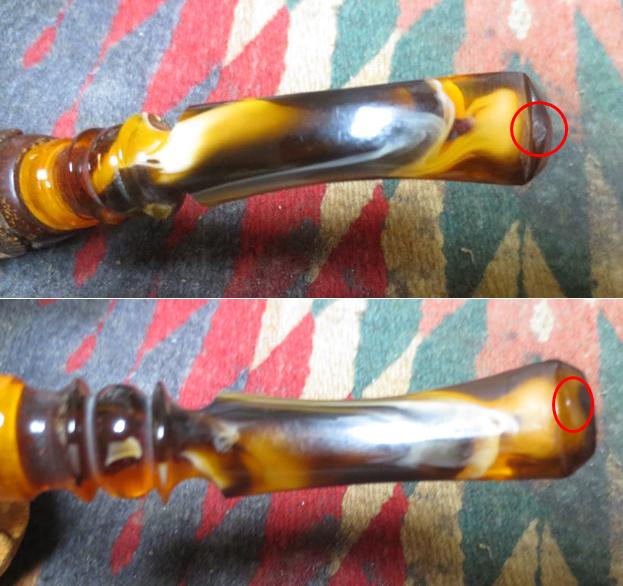
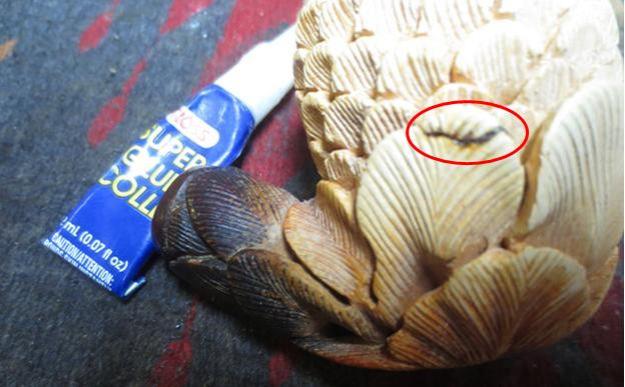
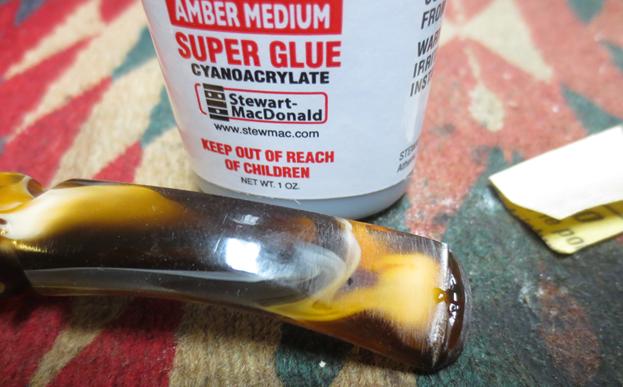
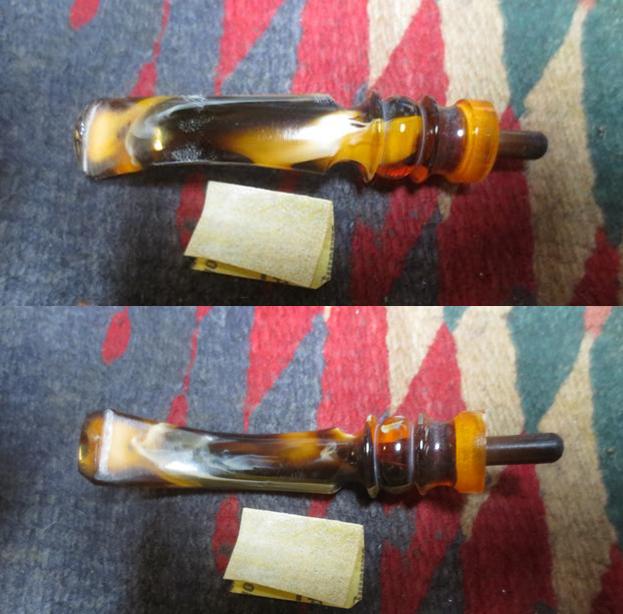
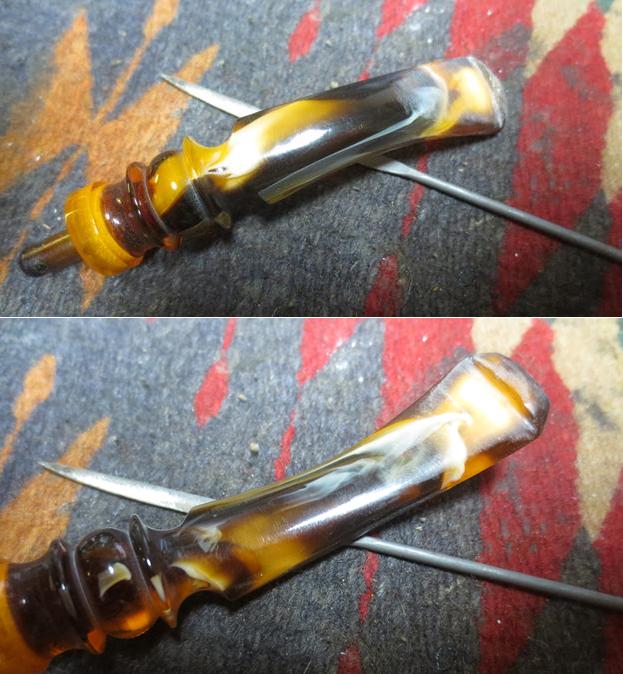
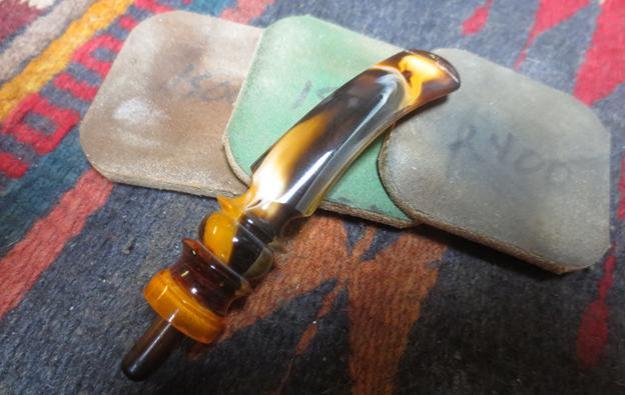
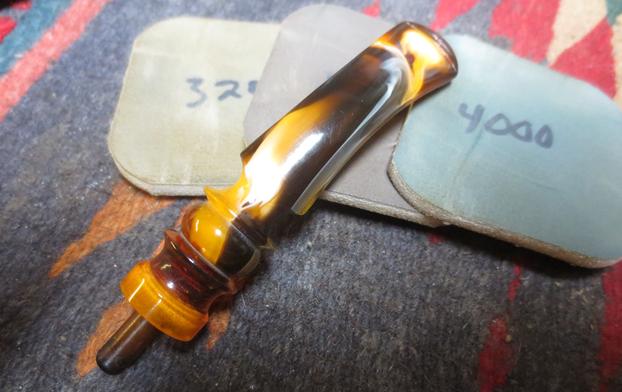
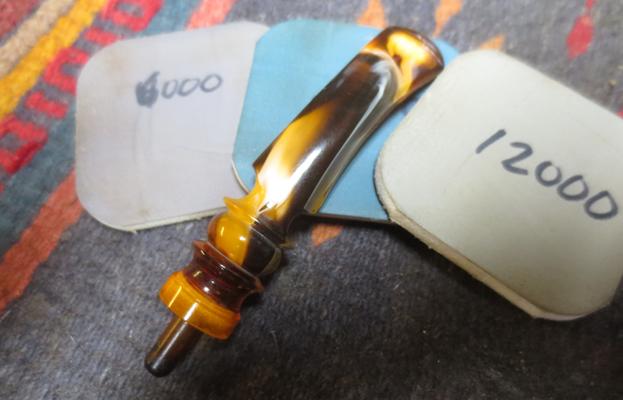
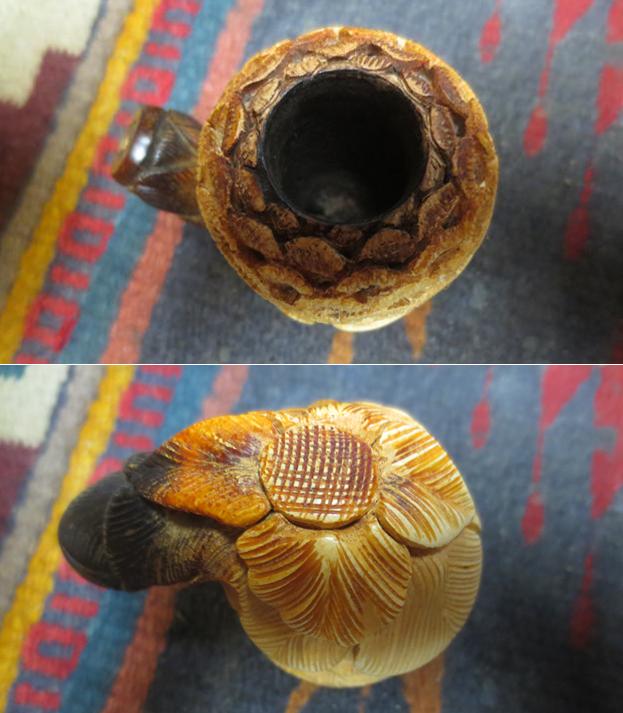
Jeff took photos of the pipe when it arrived in Idaho before he started his cleanup work. It looked pretty good – the seller’s photos and description matched what he saw when he had it in hand. When he opened the case the left side of the pipe looked really good. There were no chips of cracks, not damaged areas on the bowl side. The fit of the stem to the shank was perfect.He took this photo of the pipe when he took it out of the case and I was hooked. I really liked the sense of how the pipe captured the pine cone. The shank and base are the stalk and branch that the pine cone hangs on. The sides of the bowl curving over the rim gave the clear picture of a pine cone. It is well carved.The grooves and small crevices on the rim top were filled in with tars and oils. The deep open areas of the rim were not visible under the grime. There was also a lot of dust deep in the grooves of the carving. The underside of the shank and the bottom of the bowl also formed the cluster that held the cone. The bottom of the bowl had darkened significantly to a rich brown patina. The shank had darkened to a dark brown with shades of the rich brown peeking through the grooves. The swirls of colour in the Lucite stem match those in the patterns of the bowl. The close up photo of the rim top shows the cake that had formed in the bowl and the thick lava that was filling in the grooves of the carved rim top. The rich browns of the underside of the bowl are really beautiful and give the pipe character. The transition from the bowl to shank shows the various shades of colour that were developing in the meerschaum. The only flaw if you will, or damage that I could find in the carving was one of the “leafs” of the cone was cracked on the bottom third of the bowl on the right side. It had been repaired with a black rubber cement like substance but there was a lot of seepage from the glue below the repair and the crack had never fully sealed. At least the broken portion was not lost as is often the case in pipes that we purchase as estates.Jeff removed the stem from the shank and exposed the Delrin push tenon on the end of the stem and the fitting that was in the shank itself. The amber portions of the stem were very translucent.The turned stem looked good with the pipe bowl and with a little imagination you can envision a tree branch holding the pine cone in place. The third and fourth photo below are close up photos of the stem surface and show the damage to the button surface and the tooth chatter on both sides of the stem. I love the swirling patterns in the stem material as they remind me of the colours of pine sap that I used to get all over my hands when I was a kid cleaning up our yard. I feel like there is a certain redundancy to this section of the blogs that I do on my restoration projects. But I write it each time to keep the cleaning process focused for those of you who read the blogs to learn our methods. So here it is again. Jeff cleaned the pipe with his usual thoroughness – he reamed the bowl and cleaned out the internals with alcohol, cotton swabs and pipe cleaners. He scrubbed the exterior with Murphy’s Oil Soap and a tooth brush and rinsed it under running water to remove the soap. He focused his work on the rim top to remove the cake and lava on the grooves and crevices of carving there. He cleaned up the stem surface and the internals in the stem to remove the tars and oils in the airway. When the pipe arrived in Vancouver it was in clean shape and ready to be restored. I took some photos of the before I started to work on it to show its condition. Jeff was able to remove the grime and build up from the grooves of the rim top. When I received it the lava was gone from the rim and it was clean. His cleaning had still left behind the patina on the meerschaum so it still showed some colour. The bowl was spotless and the cake was gone leaving behind bare meerschaum walls.The close up photos of the stem show the tooth marks on the top and underside of the button. They are the only deep marks on the stem. I have circled them in red in the photos below. The rest of the stem has tooth chatter but no deep tooth marks.I decided to repair the broken/chipped piece of meerschaum on the right side of the bowl. It was loose so I removed it and cleaned off the black epoxy that held the piece to the bowl. I scraped off the glue and cleaned the piece with a cotton swab and alcohol. I was able to remove much of the brown/black glue overflow between the pieces. Some still remained but it was not nearly as thick as before. I put drops of clear super glue on the chip itself and on the area where it fit and slid it in  place with the point of a dental pick. I aligned the two parts and set the bowl aside to dry. The fit looks far better, though there is still a thin black line between the two parts. It is shown in the photo below.I filled in the tooth marks on the top and underside of the button with amber super glue. Once the glue had dried I sanded the stem surface with 220 grit sandpaper to blend the repairs in to the button surface. I sanded out the tooth chatter on the stem surface until it was smooth. I used a needle file to recut, shape and clean up the sharp edge of the button. I polished the stem with micromesh sanding pads – wet sanding with 1500-2400 grit pads and wiping the stem down with damp cotton pads to remove the sanding dust. I dry sanded it with 3200-12000 grit pads to polish it further and wiped it down after each pad. I buffed the stem with Blue Diamond on the buffing wheel. A soft touch is critical when polishing acrylic – a heavy hand and you overheat the acrylic and it melts and makes a mess. Melt it and it makes more work for you. I buff gently to keep from making more work. I gave the bowl a light coat of Clapham’s Beeswax Polish. The polish needs to be heated and put on lightly to ensure that it does not fill in the grooves in the meer. I hand buffed it with a shoe brush and a microfiber cloth to deepen the shine. I put the stem back on the bowl and hand buffed the pipe a final time to give it a deeper shine. The colouration that is beginning to work up the shank toward the bowl is beautiful. The colours on the bowl are progressively darker as you work your way up the bowl. The rim colour once it was cleaned is getting darker as well but is no longer coloured with tars and oils. The acrylic stem goes really well with the colouring meer bringing out some of the same colours in both as the stem darkens. The dimensions of the pipe are Length: 6 inches, Height: 2 ½ inches, Bowl diameter: 2 inches, Chamber diameter: ¾ inches. I think this is a pipe that will join my collection. I really like the stem and bowl and how they work together – the pine cone shape and the variegated stem work together like a branch and a pine cone. Thanks for looking.

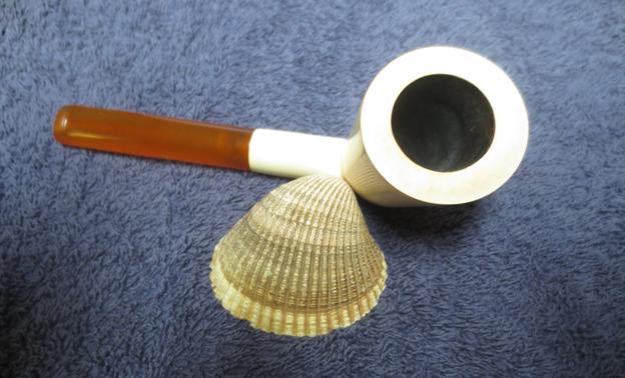
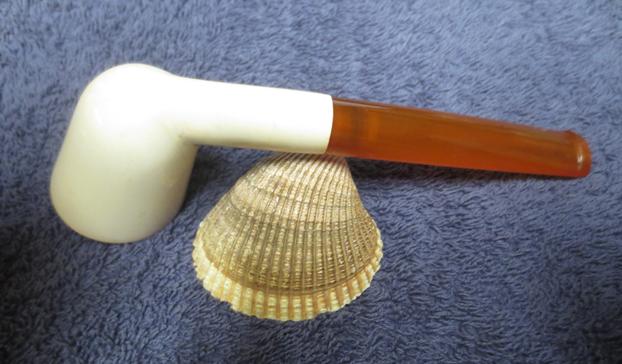
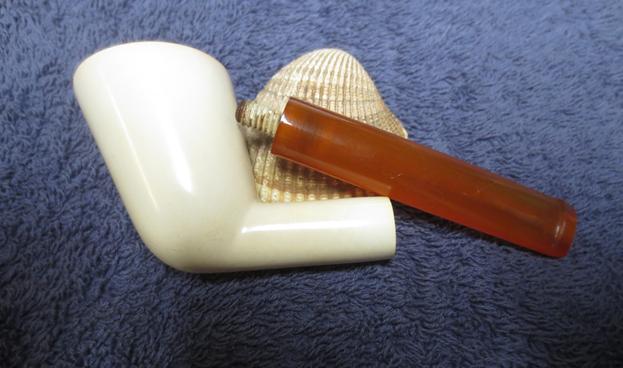
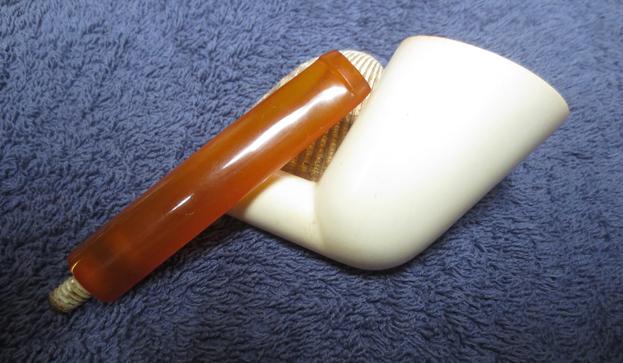
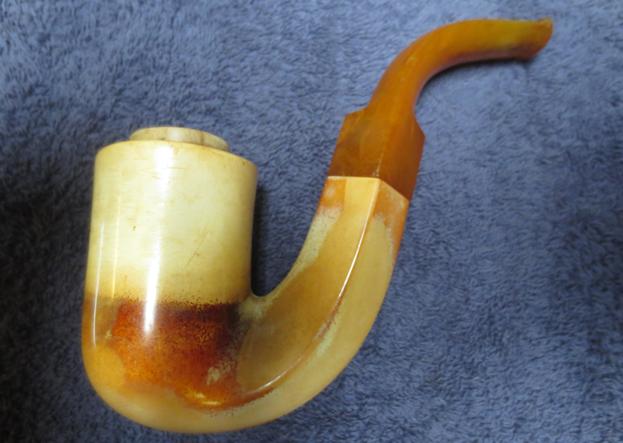
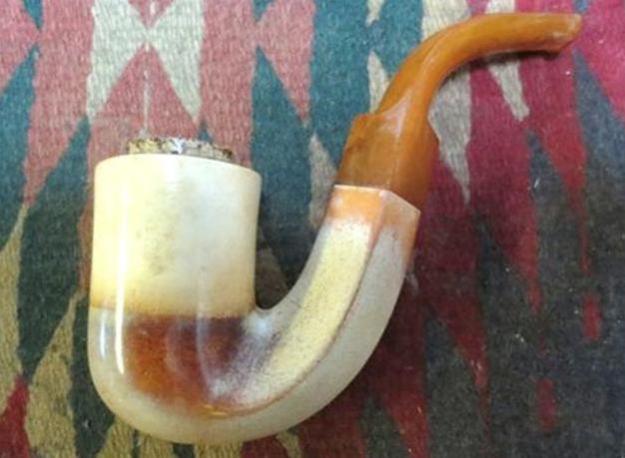
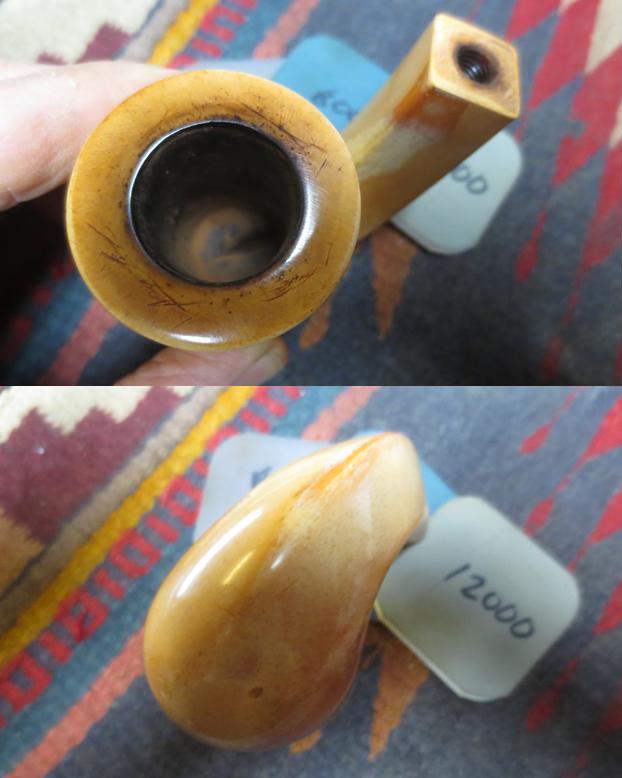
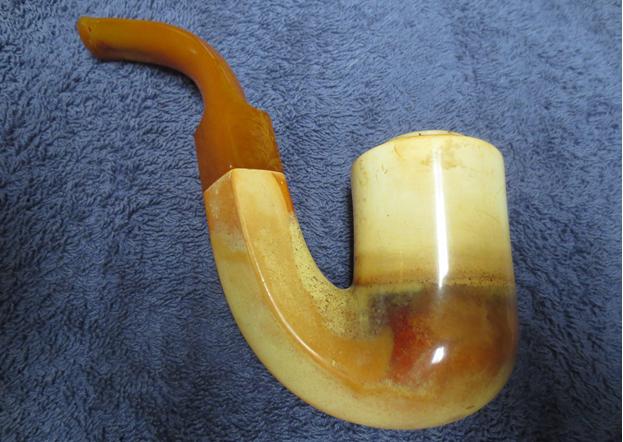
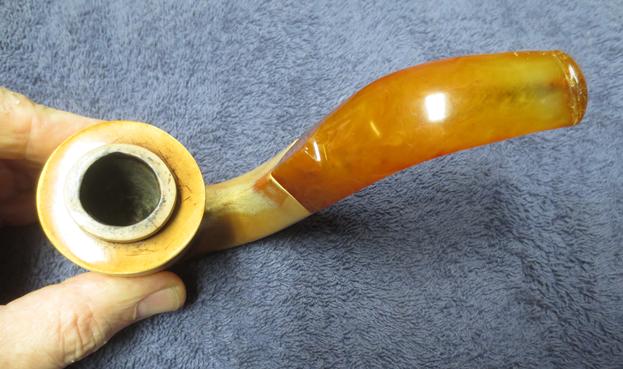
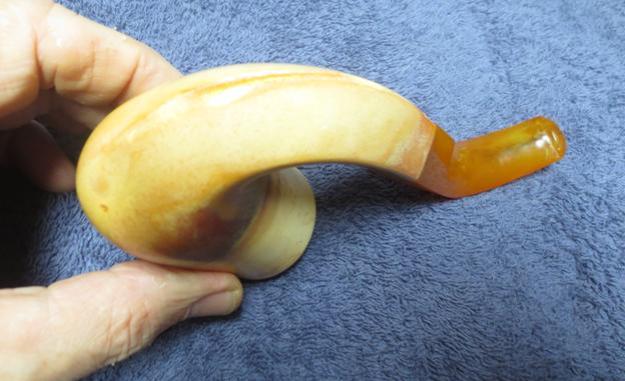
Cleaning up an Echt Bernstein Dublin Shaped Meerschaum


Blog by Steve Laug

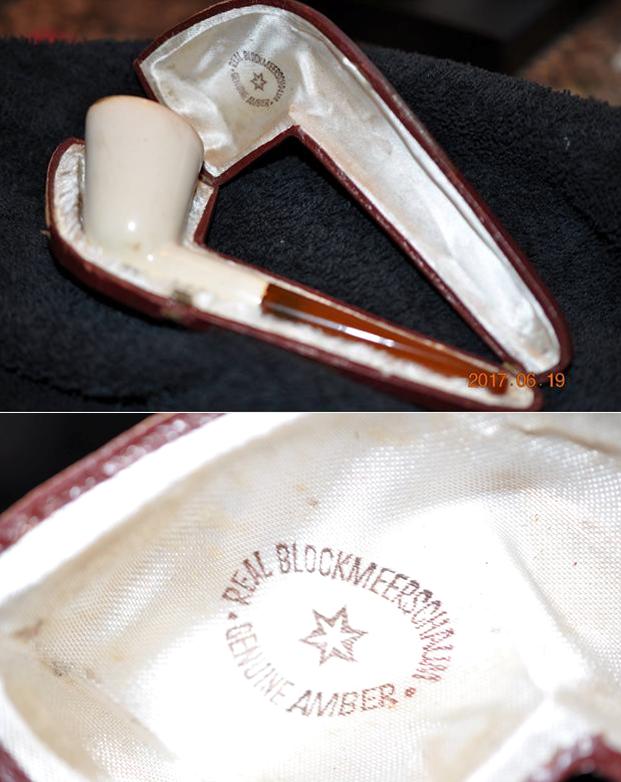
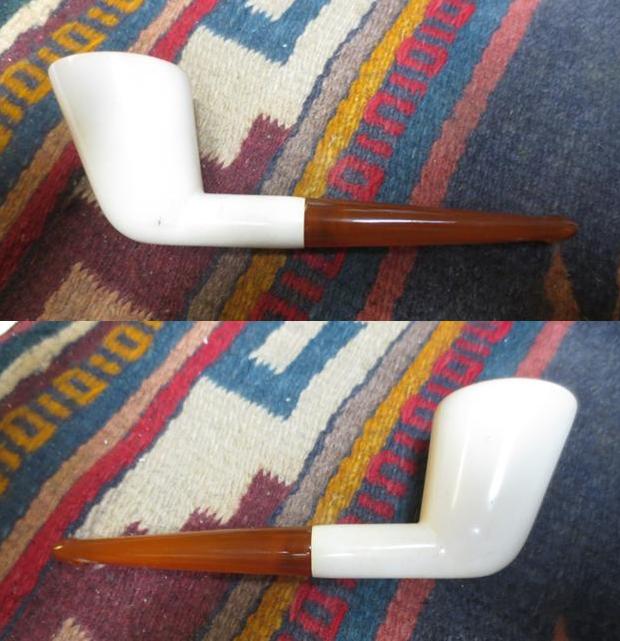
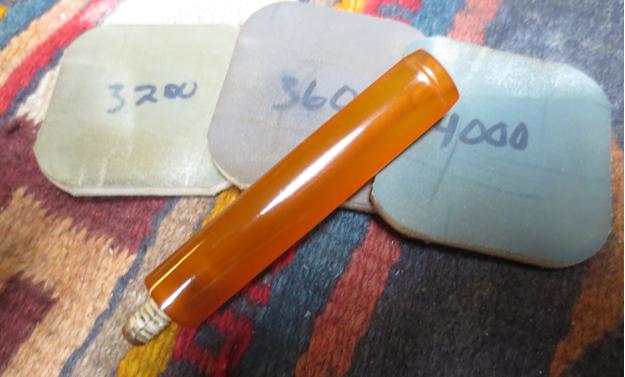
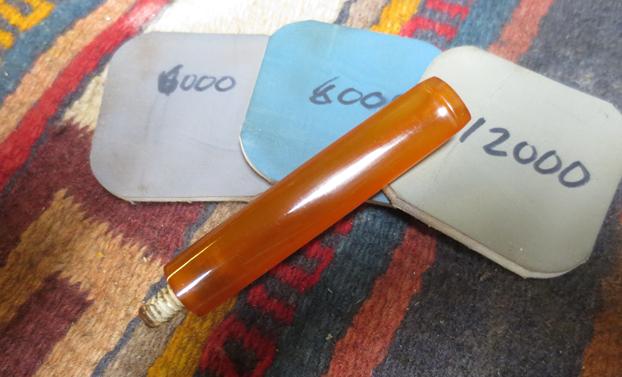
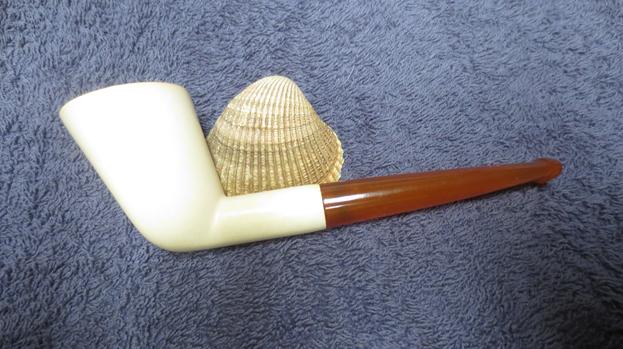
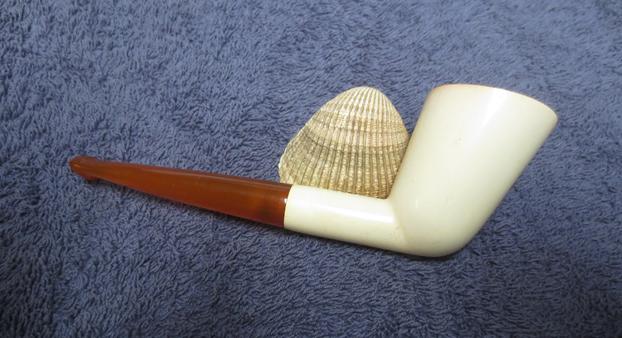
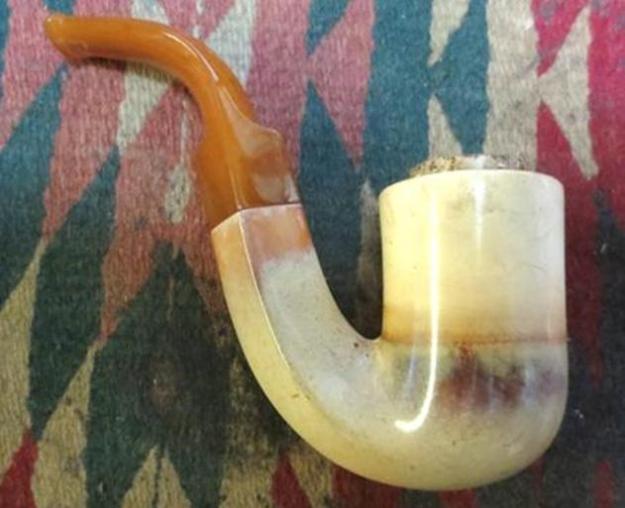
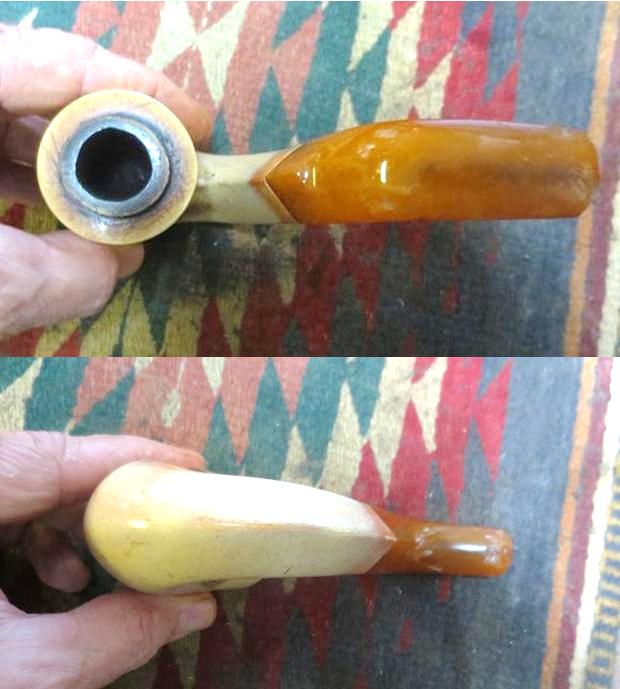
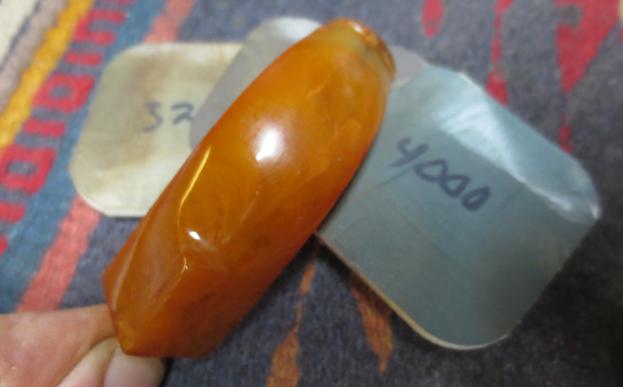
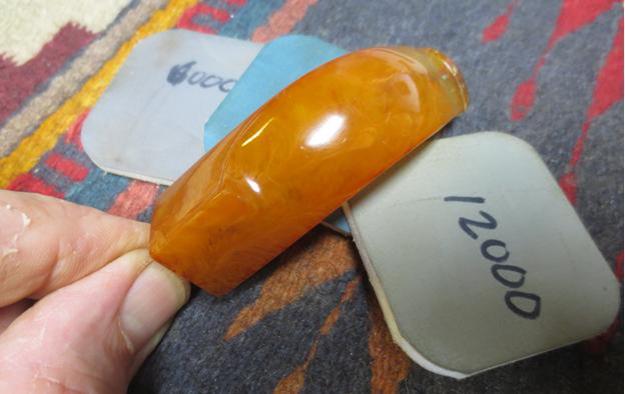
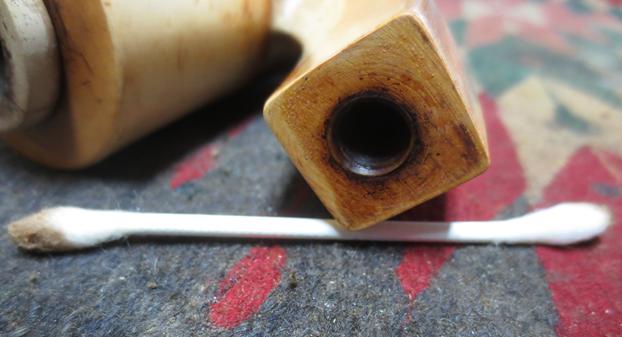
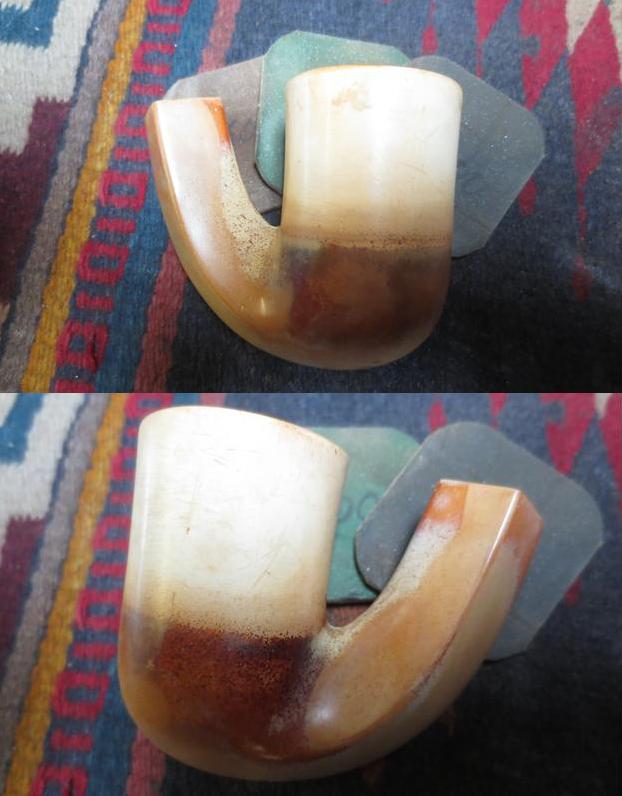
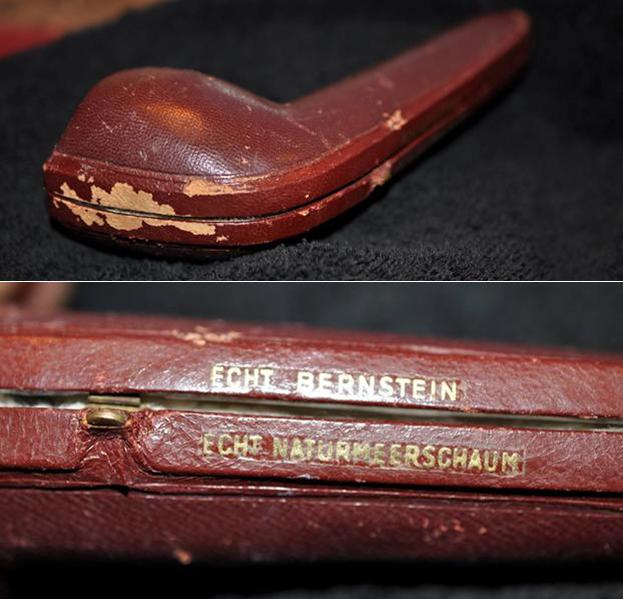
Something about the shape of this old meerschaum canted Dublin or Zulu that caught my brother’s eye so he picked it up and added it to the lot he was cleaning up to send my way. The worn red leather case had gold letters embossed on the edge just above and below the latch. At first I thought Echt Bernstein was the brand name but after a bit my high school German kicked in and I realised that it was not. The name was German and it read on the top edge of the case Echt Bernstein which means Genuine Amber and on the lower edge read Echt Naturmeerschaum which translates as Genuine Natural (Block) Meerschaum. The pipe is quite probably of Austrian origin and could have been made by Strambach. That is not provable because the pipe is not marked at all. But the German stamping on the fitted case lends itself to that idea.I looked up Strambach on Pipedia to see if there were any hints about the pipe I had in hand (https://pipedia.org/wiki/Strambach). I quote from that article some of the pertinent information.
In 1904 Edmund Jolitschke founded a company that, at the begining, produced cigar and cigarette mouthpieces and later meerschaum pipes. In 1922, Robert Strambach became the leader of the company and he expanded the business. He produced meerschaum pipes and Calabash pipes, and he developed a system to produce the meerschaum mass (this is a convolute of small sepiolite pieces, grinded down, and pressed together with a bonding agent). In 1974, Edith Corrieri succeeded to her father. She is a master-turner, and today, she is the only producing high quality calabashes and meerschaum pipes in Europe…

…(ed. quoting Edith Corrieri, current owner) My company was started in 1904 by my uncle Edmund, and in 1922 my father Robert took over the firm. In the following fifty years my father expanded the firm with many ideas e.g. he developed a special technique to transform raw meerschaum into workable material (so-called meerschaum masse), the secret formula to which he revealed to me shortly before his death. As I was the only child I had the chance in 1974 to become one of the first females in the field of pipe making. After three years of training I received a diploma as Master of Pipemaking. Today we are the only manufacturer of Meerschaum and Calabash Pipes in the European Union and are still making our pipes according the same age-old formula. In 1981 STRAMBACH PIPE CO. was awarded the Austrian “State Seal” for exceptional quality.”

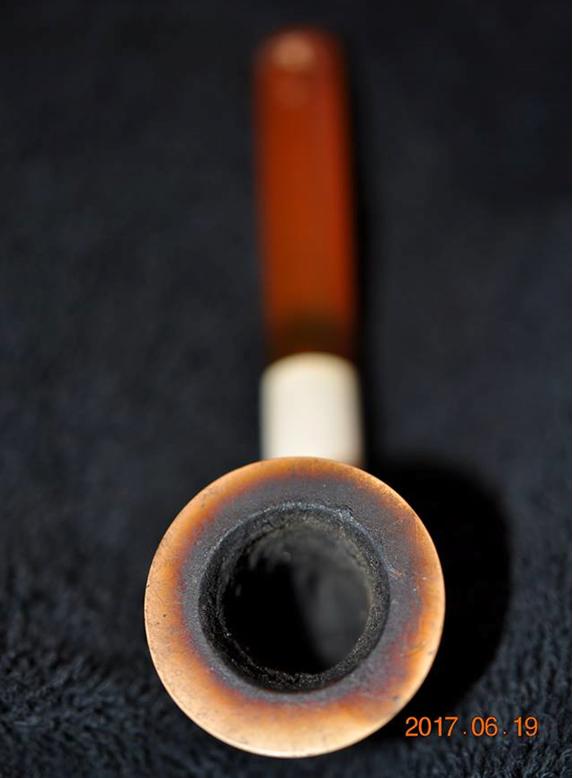
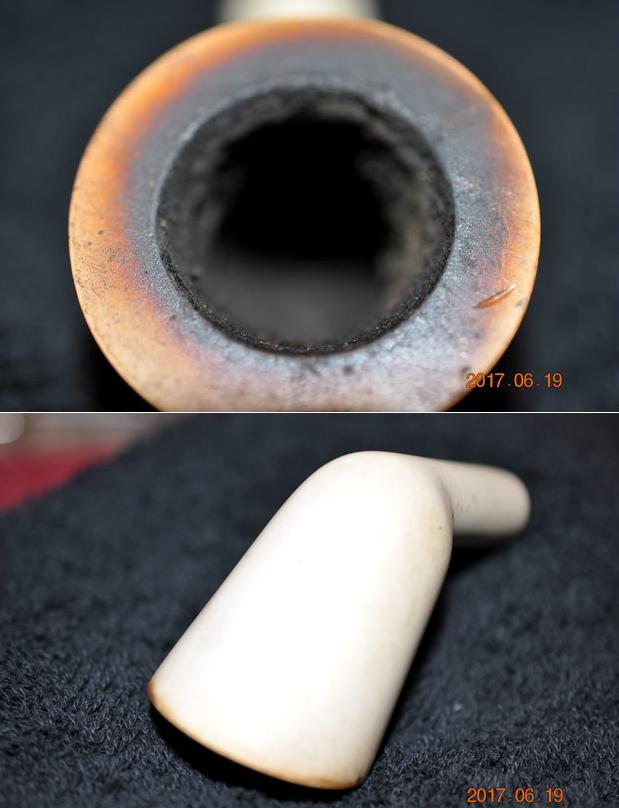
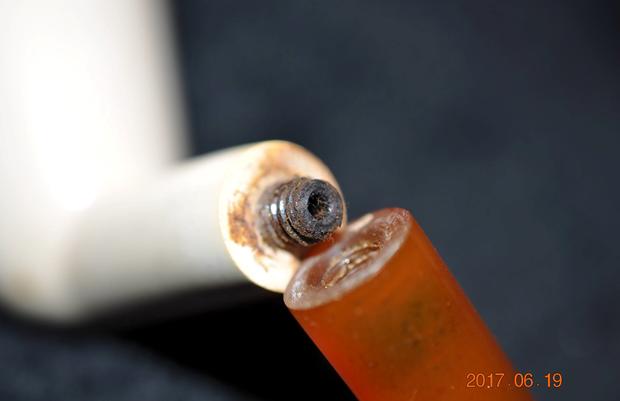
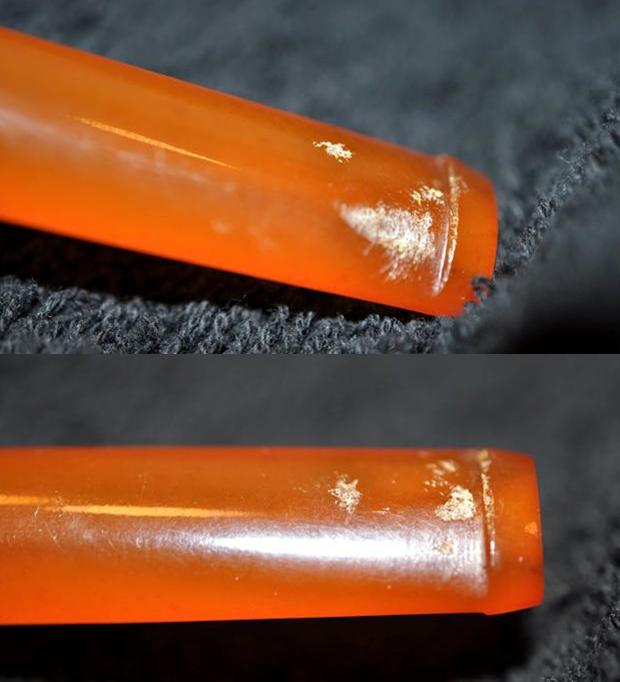
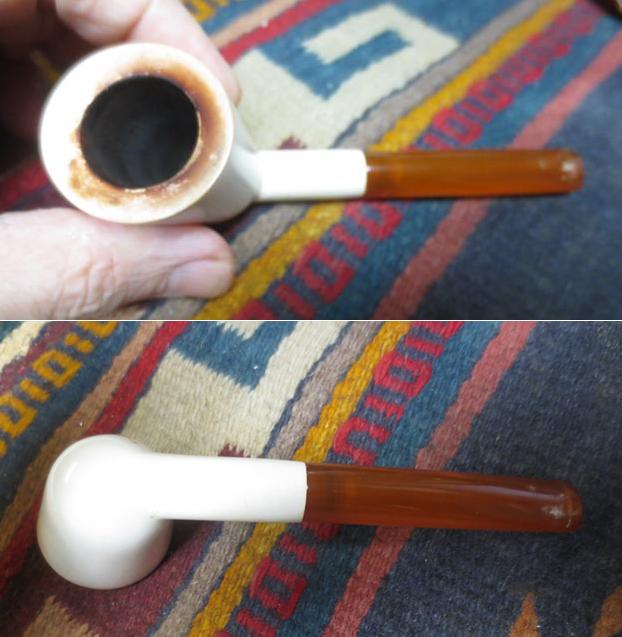
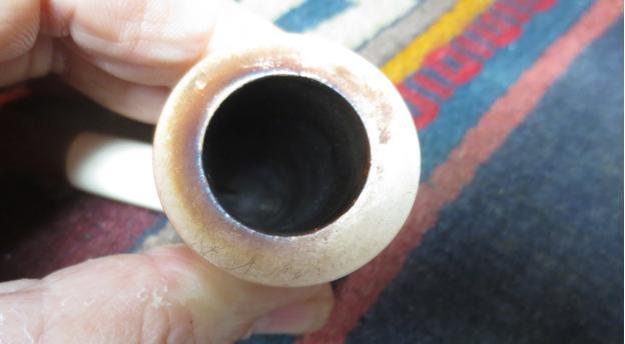
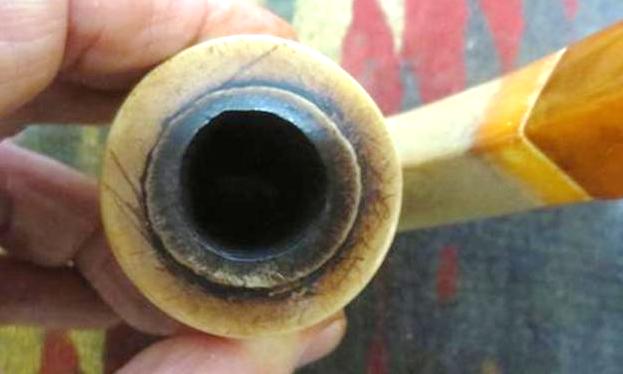
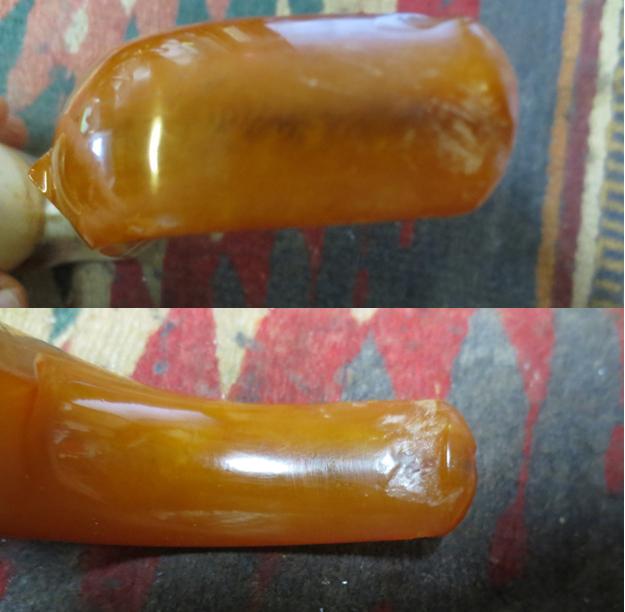
Jeff took photos of the pipe as he opened it and removed it from the case. All of the previous and the following photos were taken before he cleaned up the pipe. Inside the lid of the case it read in English the same thing that had been stamped on the exterior of the case – Real Block Meerschaum in an arc over a six point star and Genuine Amber in an arc under the star.Jeff removed the pipe from the case and took some photos of it fresh from the case. The shape of the bowl was quite beautiful and there was colour beginning to happen on spots on the bowl and rim edge. The rim was exceptional dirty with a lava overflow from the cake that had formed in the bowl. The stem appeared to be a replacement – not genuine amber but an acrylic amber that obviously had been added later in the life of the pipe. The stem showed tooth marks and chatter on both the top and underside near the button. The slot in the button was not smooth but looked to be much like the slot cut in stem blanks that I purchase currently. The shape and the colour seem older but I cannot be certain of that. I know that it is not Bakelite as the colour goes all the way down into the bite marks and does not lighten as it goes deeper. Jeff took a close up photo of the rim top to show the build up and the darkening – not colouration of the meerschaum but burn and tars that was on the surface of the meer. The second photo below shows the shape of the bottom of the bowl. The meerschaum is quite clean and shows little scratching and damage. The smooth and gentle curves show a quality of carving that is not seen too much in more current production meers.The tenon on the pipe is a metal threaded tenon that screws directly into the mortise of the meerschaum and directly into the stem. The tenon has the same threads on both ends so it is reversible and interchangeable. It was incredibly dirty and caked with tars, oils and debris. The airway in the tenon was quite plugged with the tars.The stem itself had tooth chatter and marks on both the top and the underside near the button. In the photos it appears to be white but in reality as the stem is cleaned up the acrylic material is the same colour all the way through the bite marks. Jeff cleaned the pipe with his usual thoroughness – he reamed the bowl and cleaned out the internals with alcohol, cotton swabs and pipe cleaners. He scrubbed the exterior with Murphy’s Oil Soap. And worked over the rim top to remove the cake and lava on the surface of the meerschaum. He also removed the marks and grime that was on the exterior of the bowl and shank. When it arrived in Vancouver it was in clean shape and ready to be restored. I took some photos of the before I started to work on it to show its condition. While Jeff was able to remove the tars and lava buildup on the rim top there was still some debris and buildup on the surface. As I examined it I could see that it sat on top of the rim surface rather than down in the meerschaum itself. The surface of the meer was smooth and undamaged so cleaning off the layer on the rim top should come off easily.Jeff was also able to remove the debris around the bite marks in the top and underside of the stem surface. You can see from the photos that the stem material remains the same deep into the marks.I used a fine grit sanding sponge to gently top the bowl. It is a flat surface and I turned the bowl into the sanding sponge. I carefully kept the rim flat against the surface of the sanding block. I worked it on the sanding block until all of the remaining buildup was gone. I polished the bowl and rim with micromesh sanding pads – wet sanding with 1500-2400 grit pads. I wiped the meer down with a damp cotton pad. I dry sanded it with 3200-12000 grit pads and wiped it down with the damp cotton pad after each micromesh pad. The photos below tell the story. I lightly sanded the area around the tooth marks to provide a rough surface to provide a surface for the repair to bond to the stem material. I cleaned out the tooth marks with a dental pick and alcohol on a cotton swab to remove any debris on the surface. I repaired both sides of the stem with amber super glue and set the stem aside to dry in the block of ebony.When the glue had cured I filed the repairs close to the surface of the stem and sanded them with 220 grit sandpaper to blend them into the surface. The repair on the underside of the stem still showed some damage so I refilled it with amber superglue and smoothed out the repair. When it dried I sanded it with 220 grit sand paper. The third photo below shows the underside after the touch up repair was blended into the stem surface.I polished the stem with micromesh sanding pads – wet sanding with 1500-2400 grit pads and wiping it down after each pad with Obsidian Oil. I dry sanded it with 3200-12000 grit pads and continued to wipe it down after each pad. When I had finished polishing it with the 12000 grit pad I gave it a final coat of oil and set it aside to dry. I put the stem back on the pipe and buffed the bowl and stem lightly with Blue Diamond polish on the buffing wheel. I gave the stem multiple coats of carnauba and the bowl several coats of Clapham’s Beeswax Polish. I buffed the pipe with a clean buffing pad to raise a shine and hand buffed it with a microfiber cloth to deepen the shine. The dimensions on this pipe are Length: 5 ½ inches, Height: 2 inches, Bowl diameter: 1 ½ inches, Chamber diameter: 3/4 inches. The photos below show the finished pipe. It looks far better in person than in these photos. If you are interested in adding the pipe to your collection contact me at slaug@uniserve.com or send me a message on Facebook. It will be going on the rebornpipes store shortly. Thanks for looking.