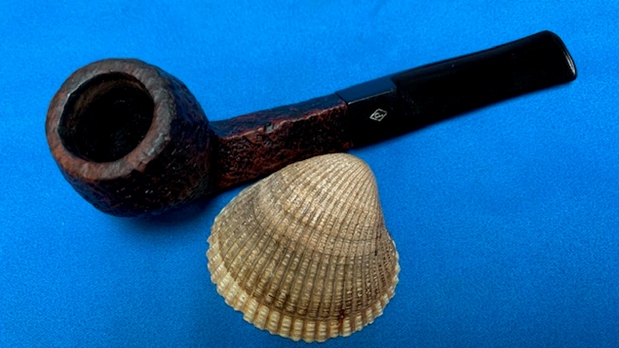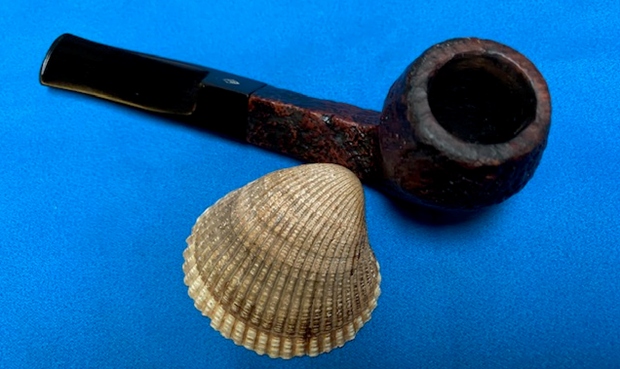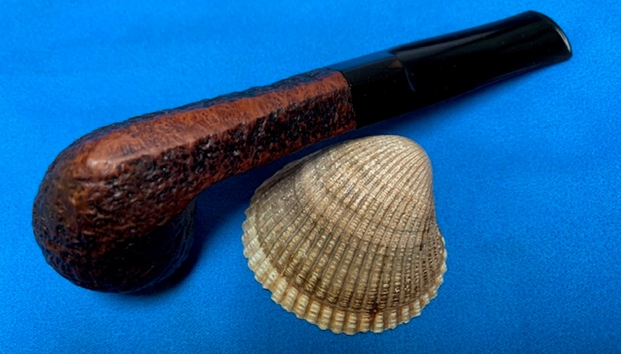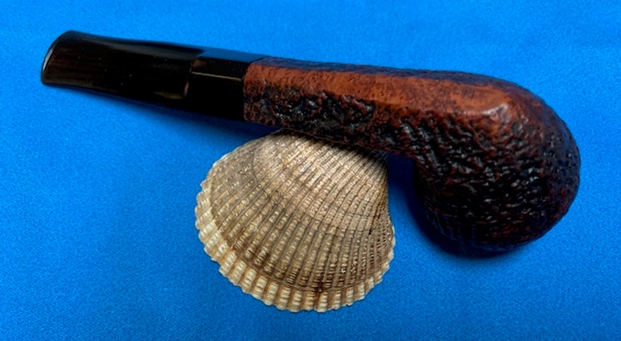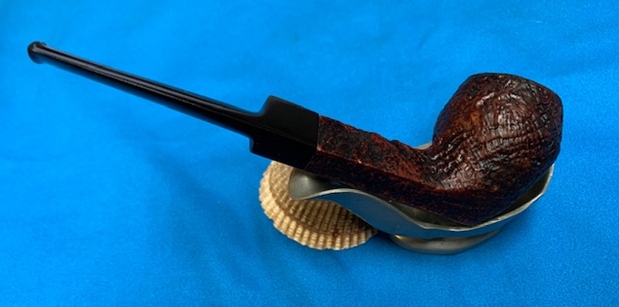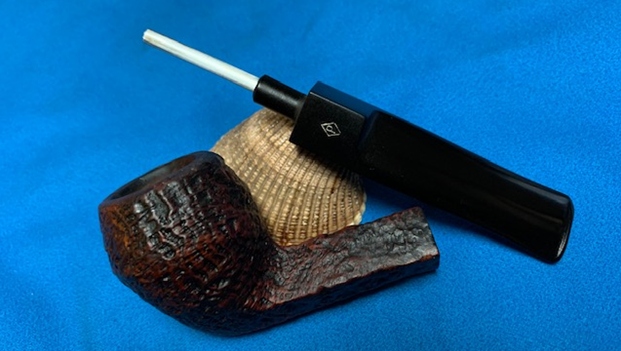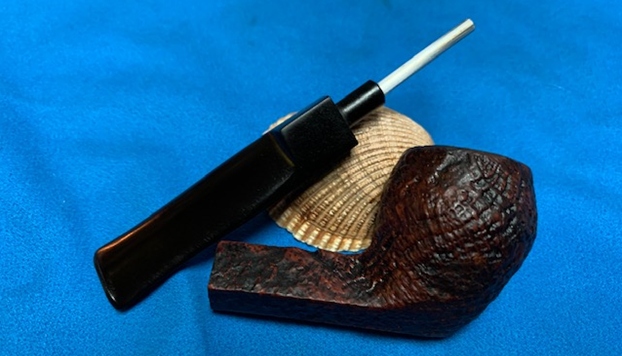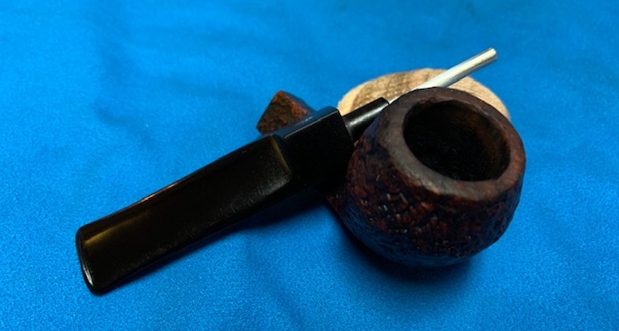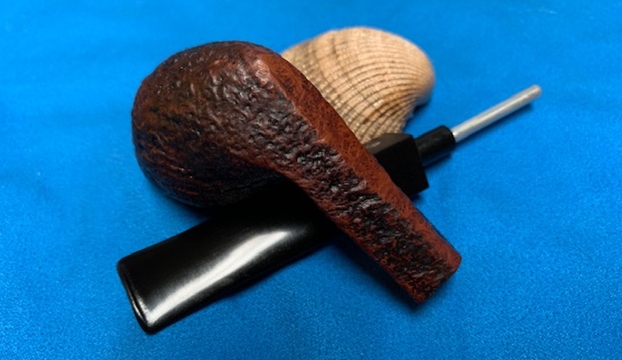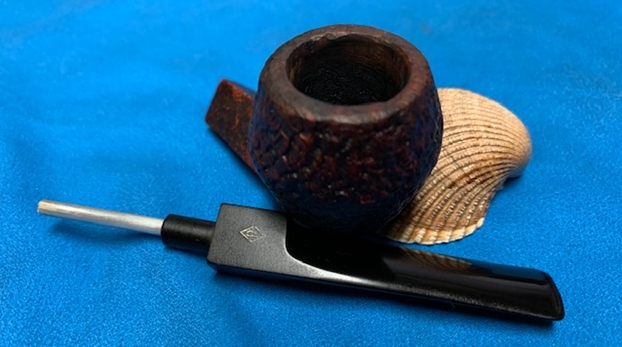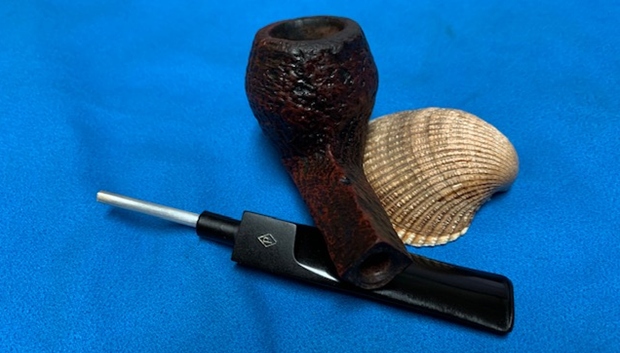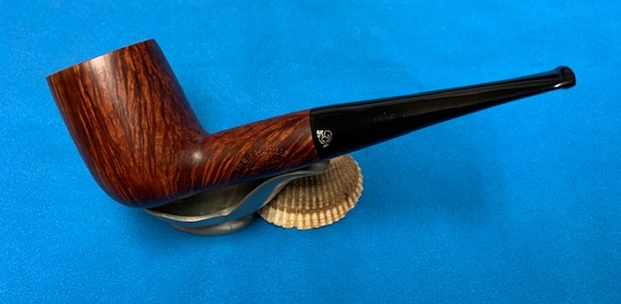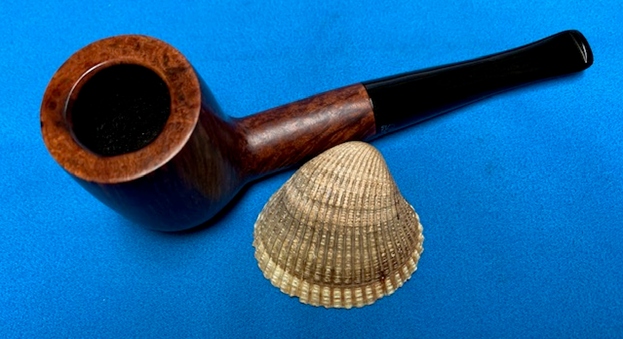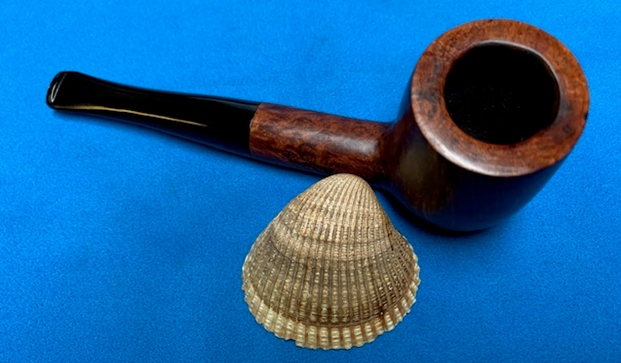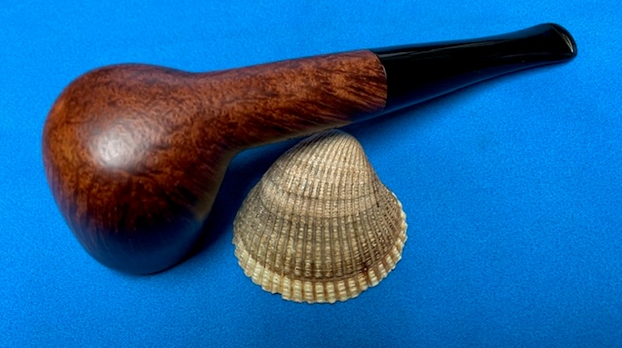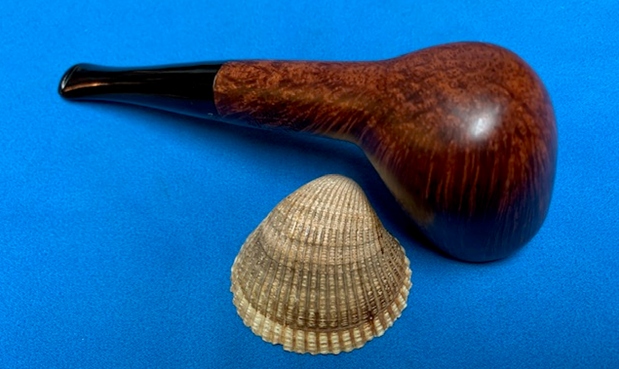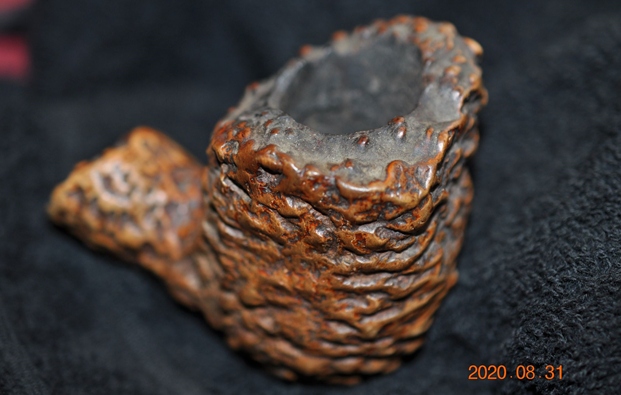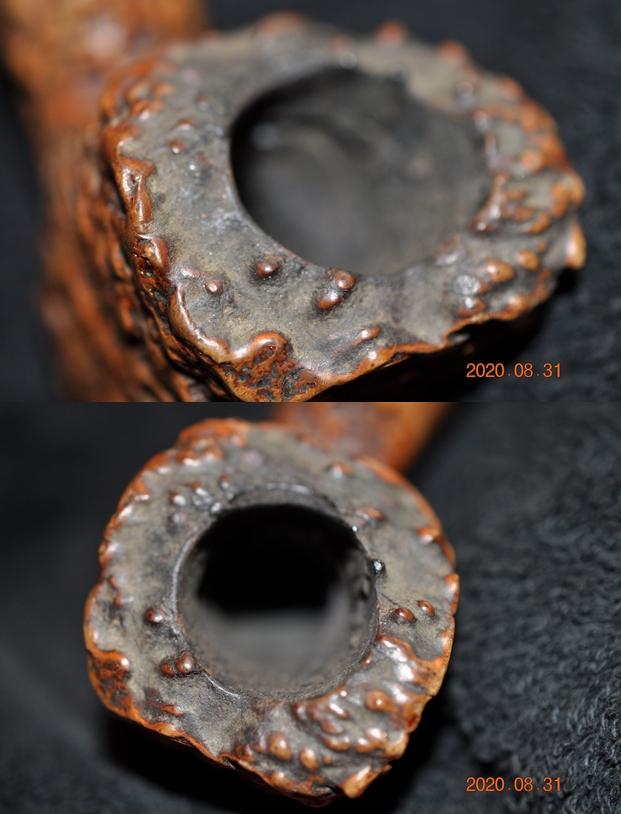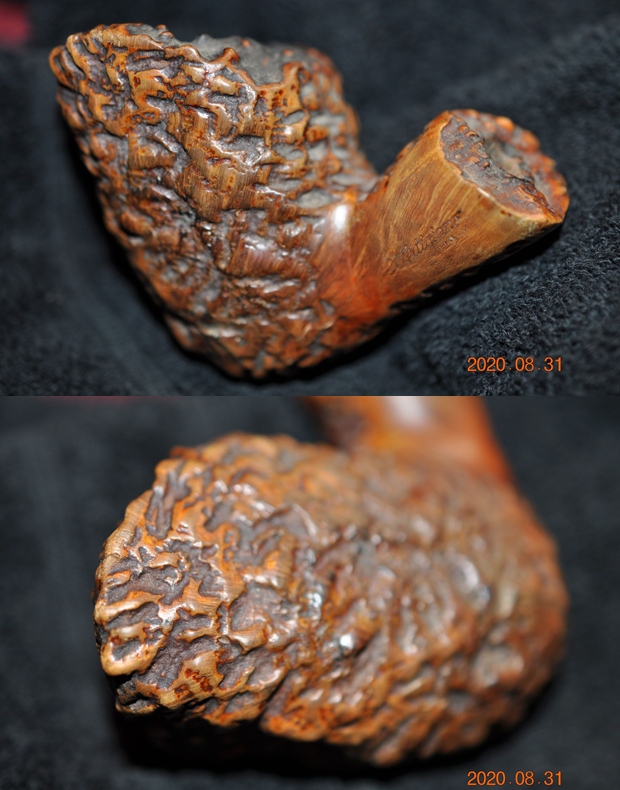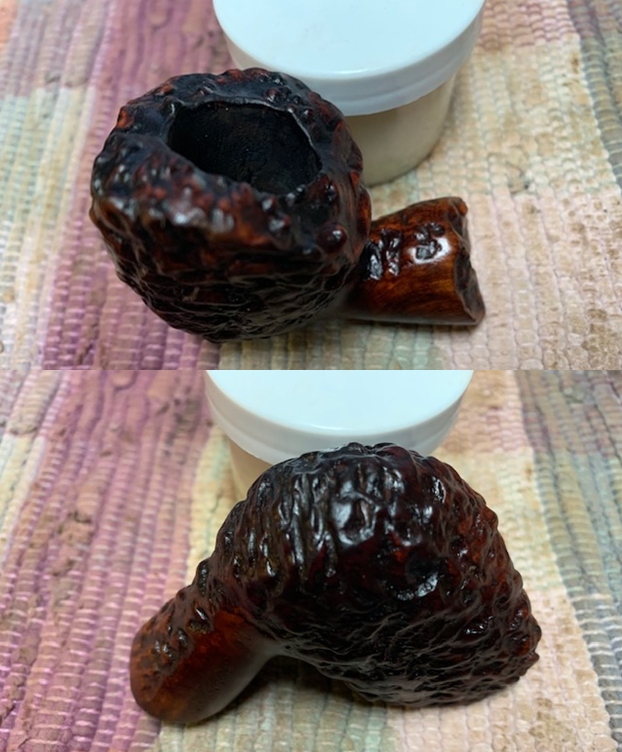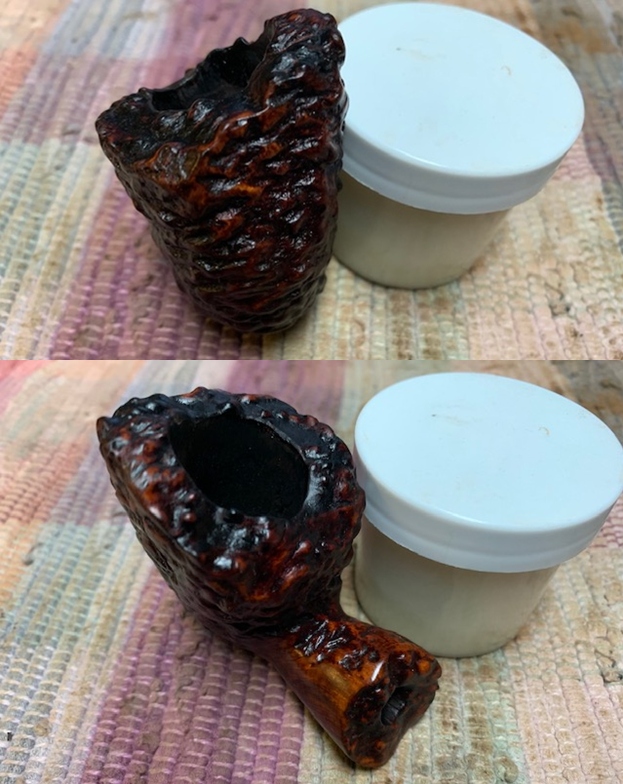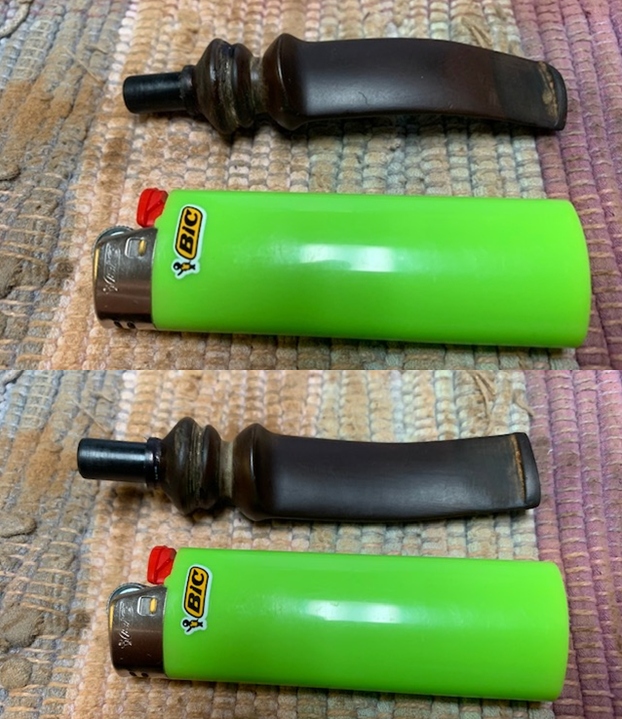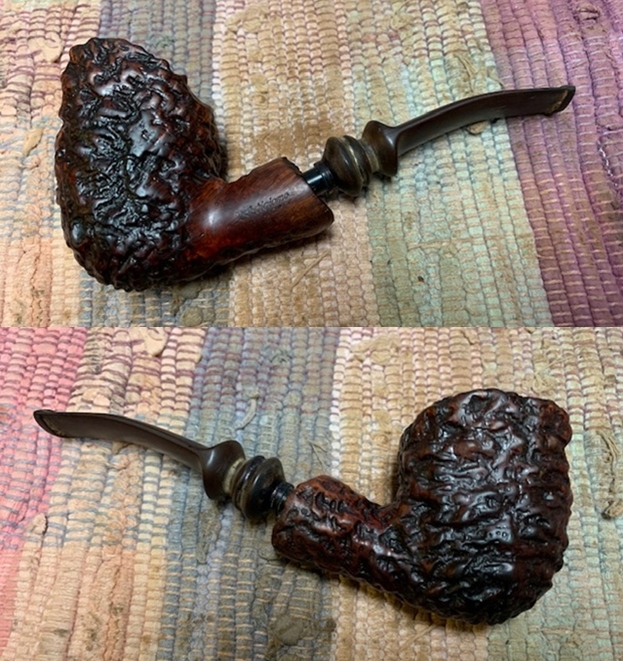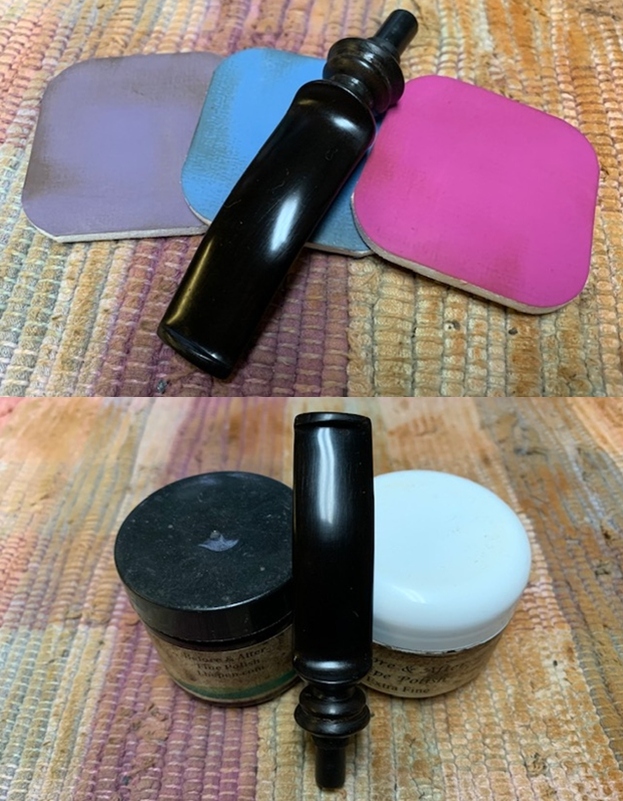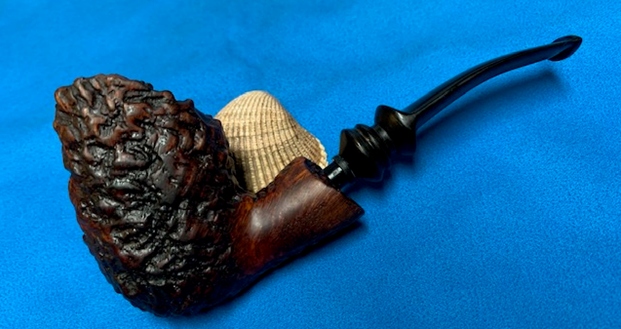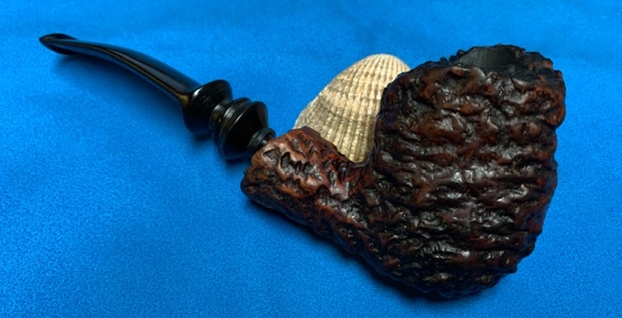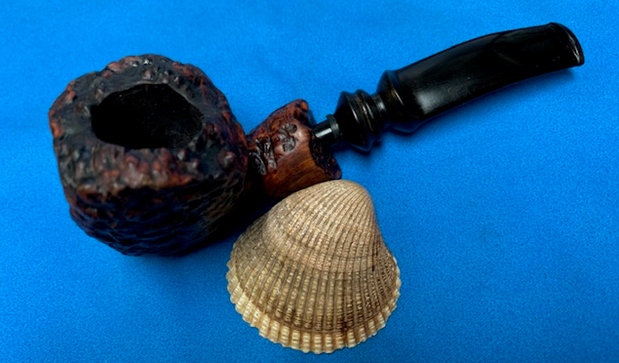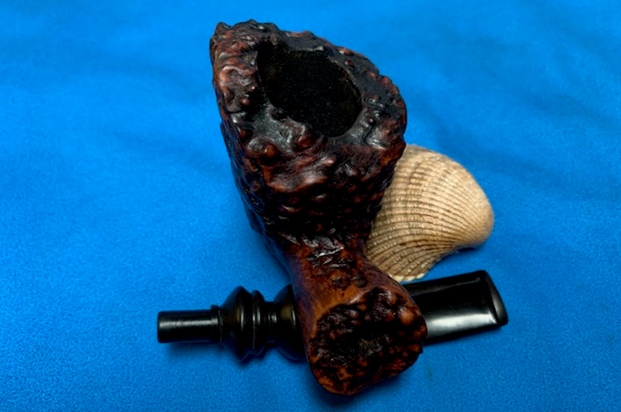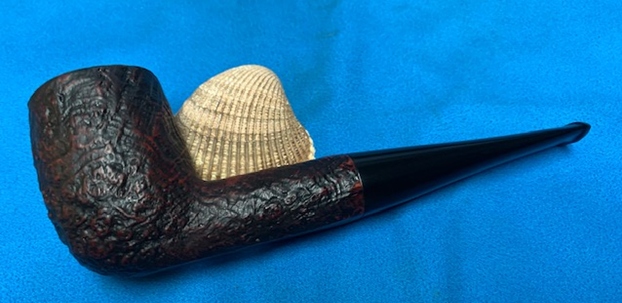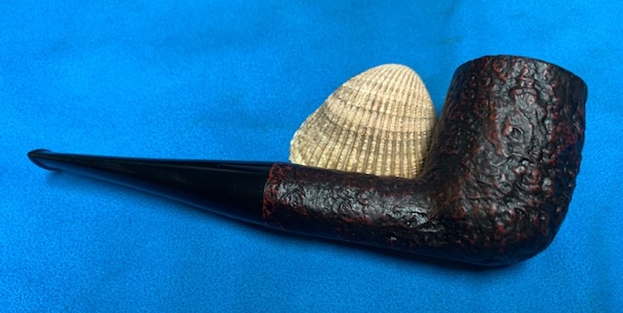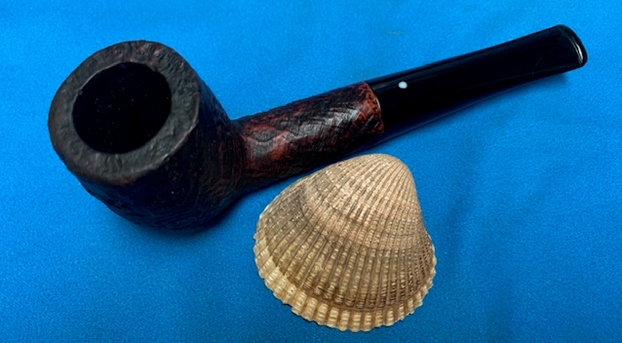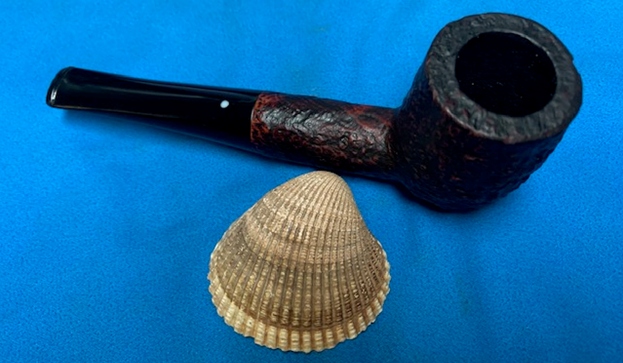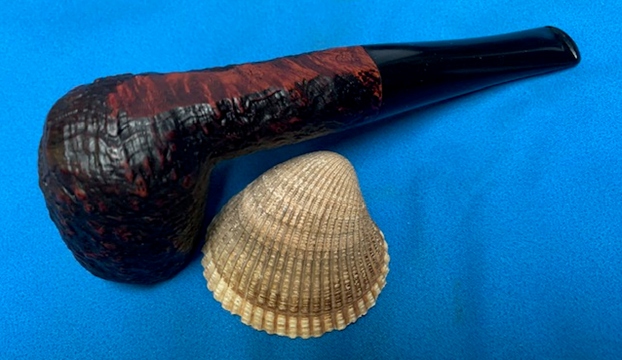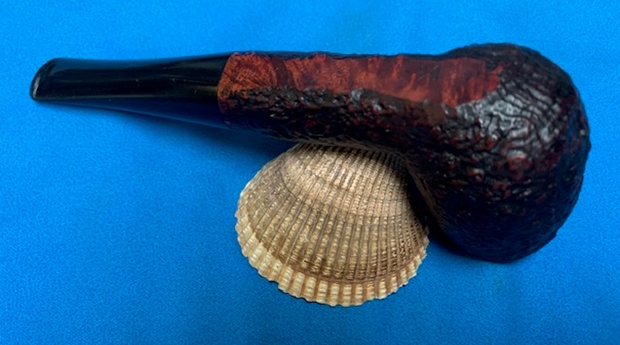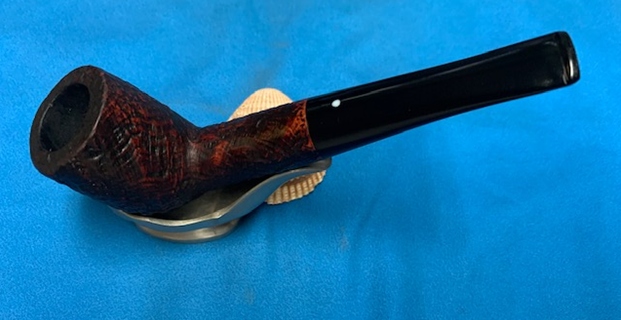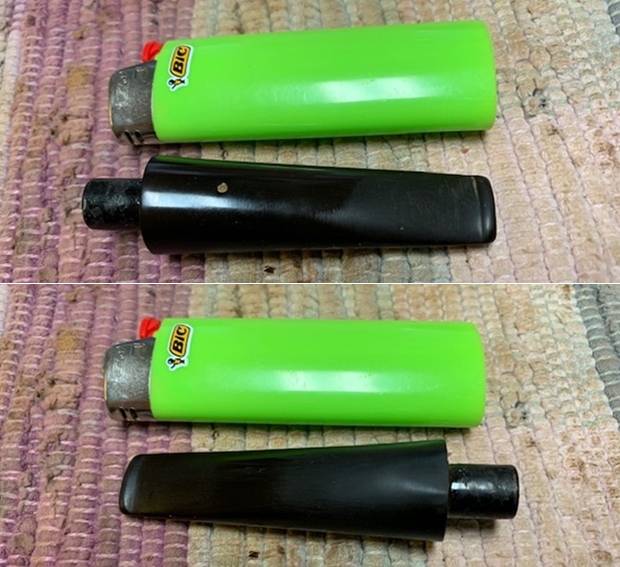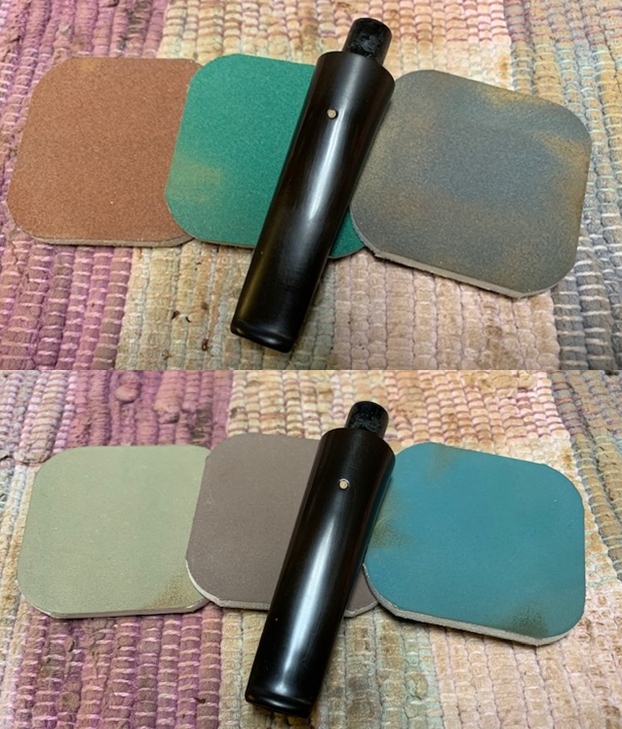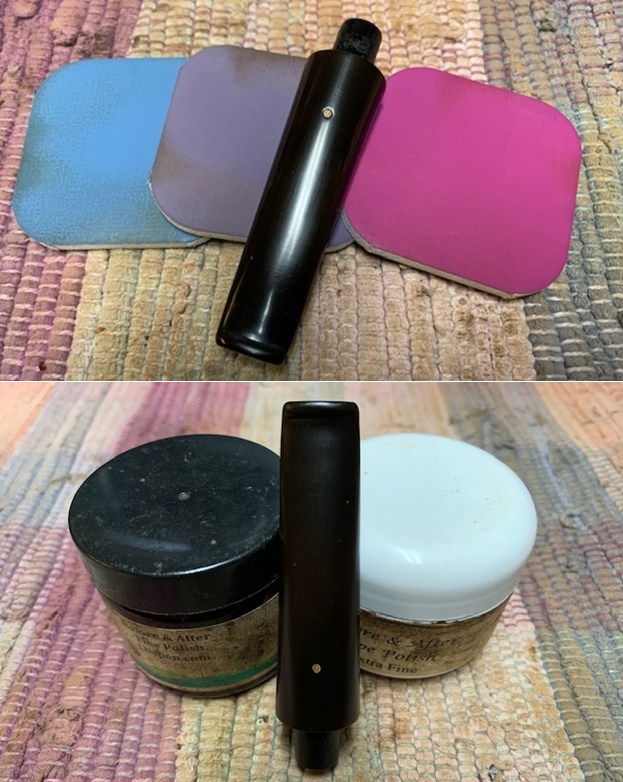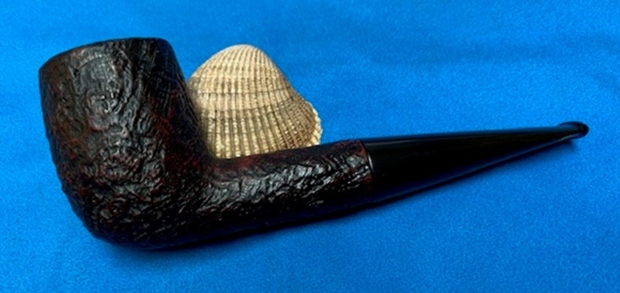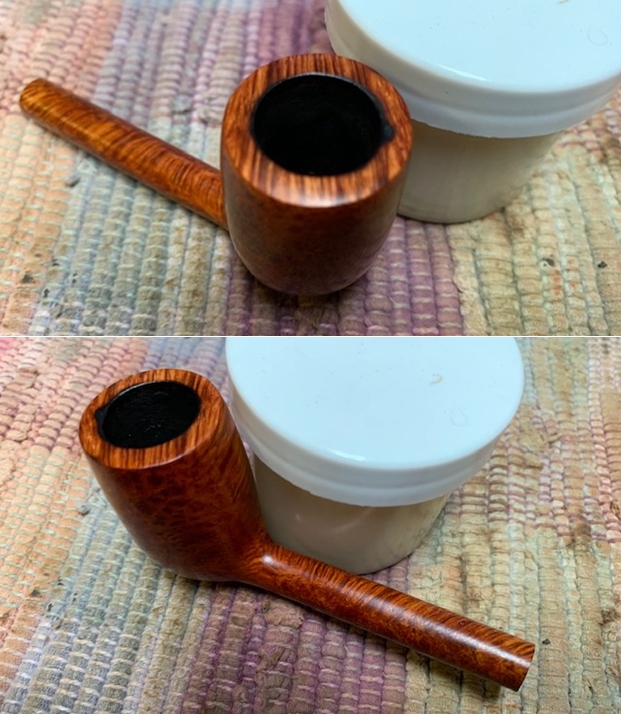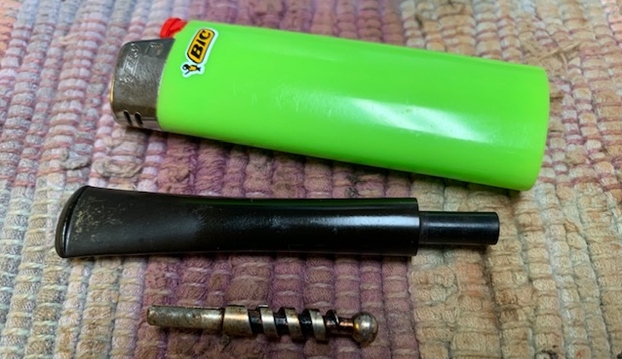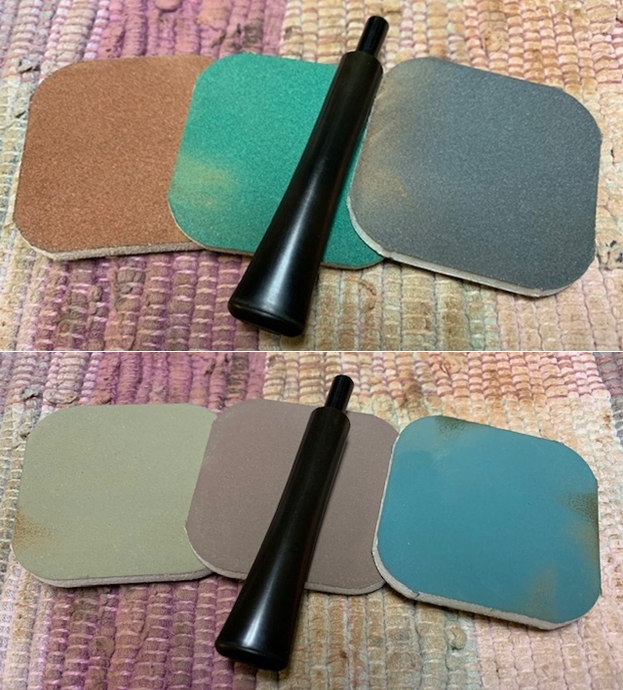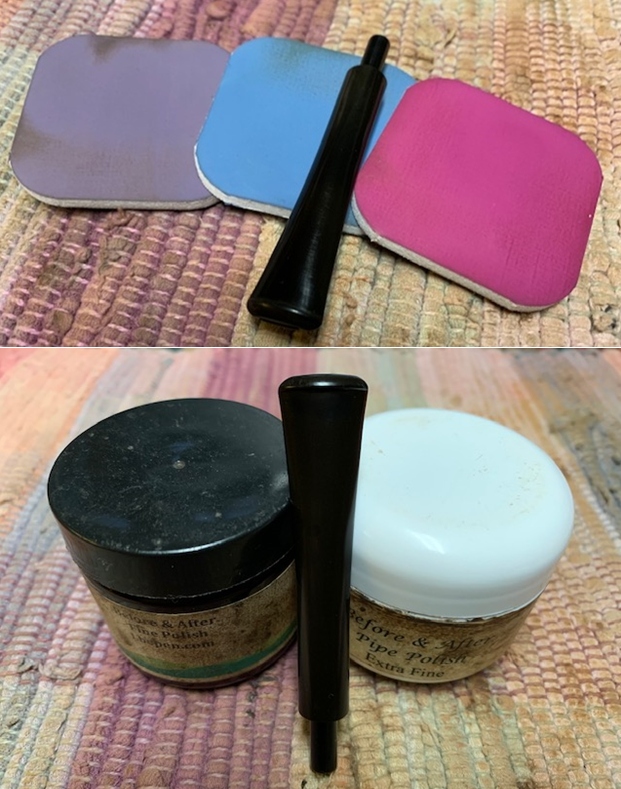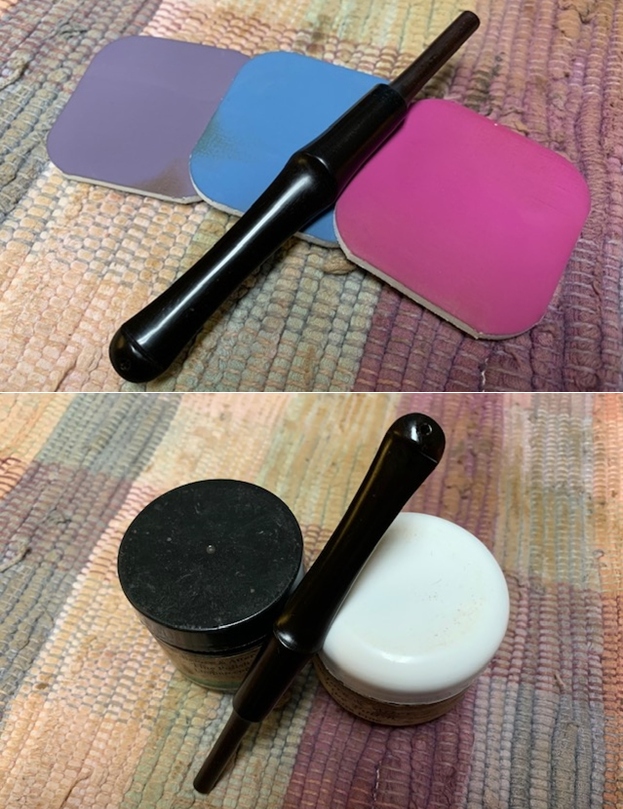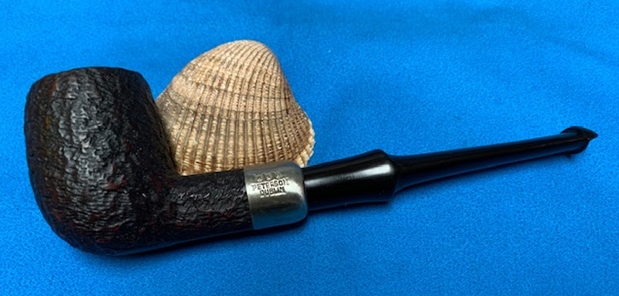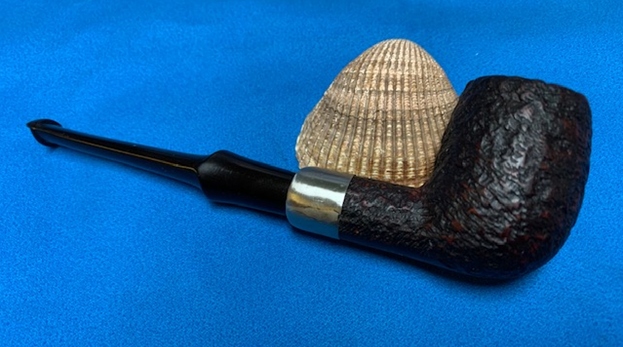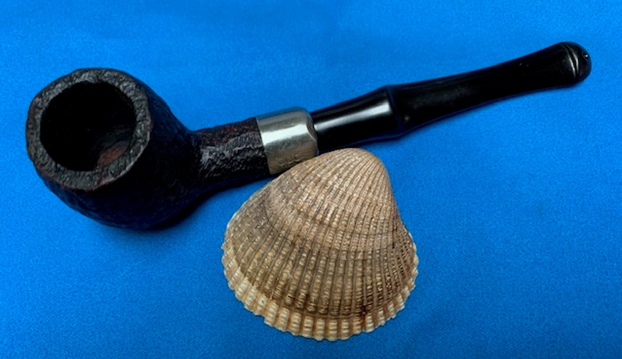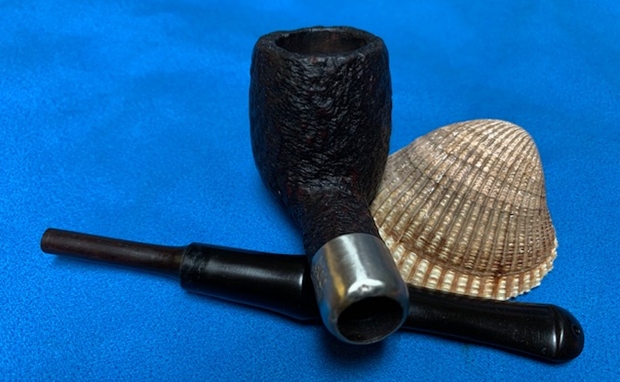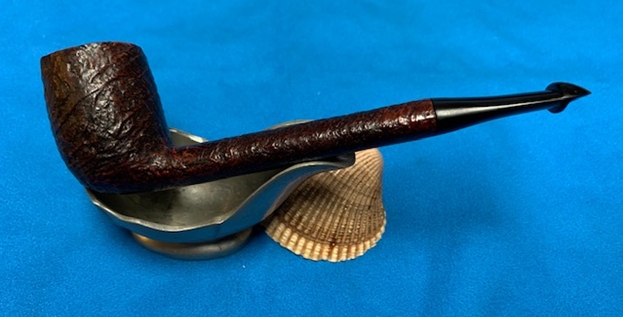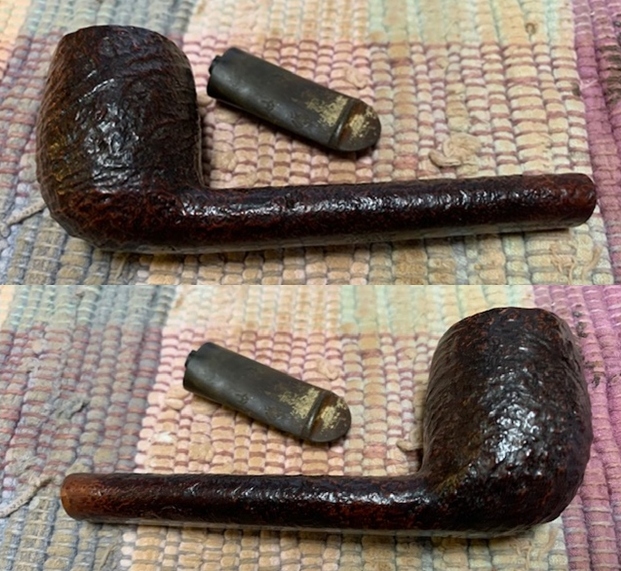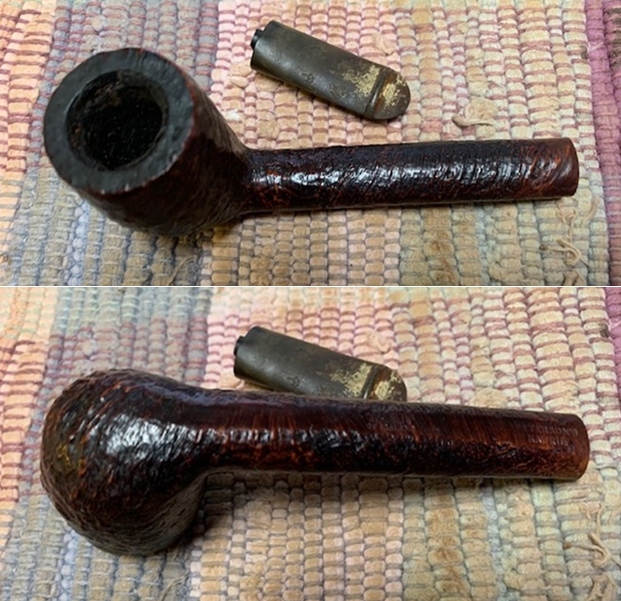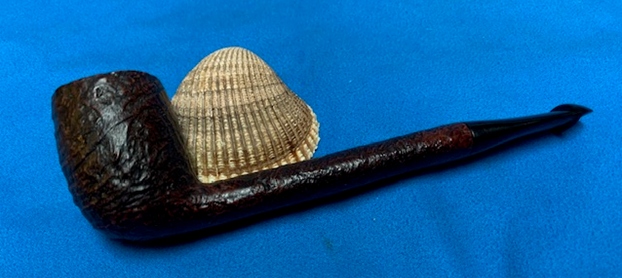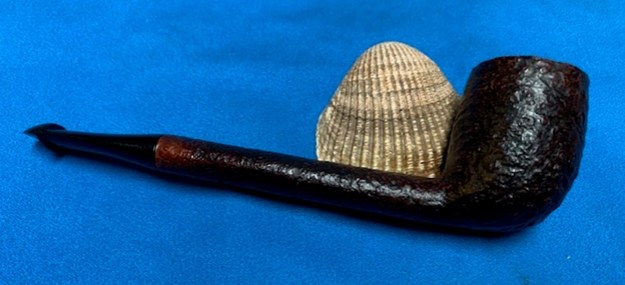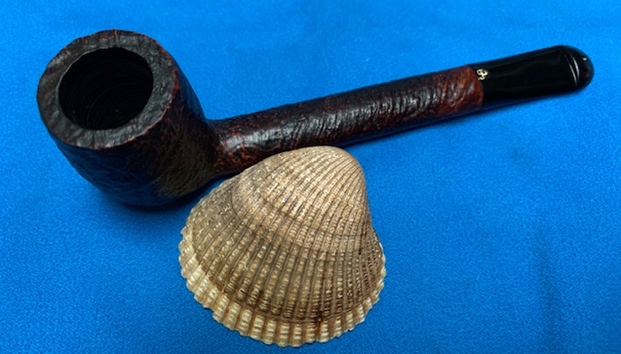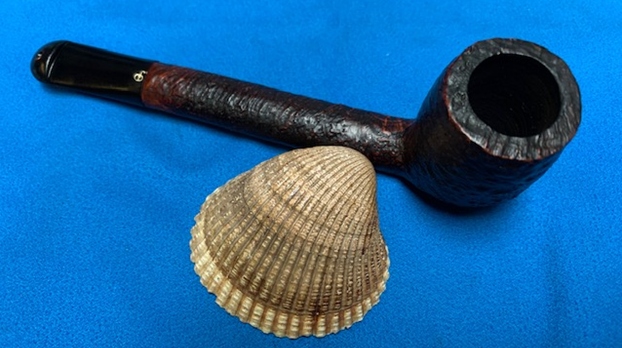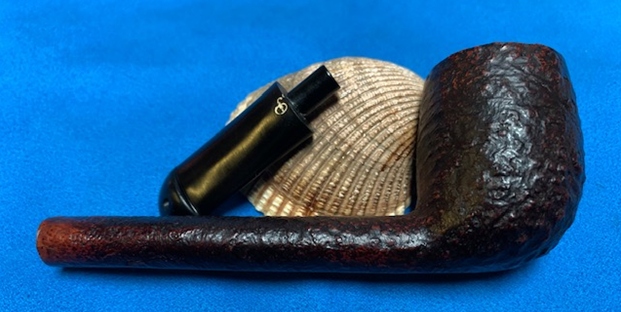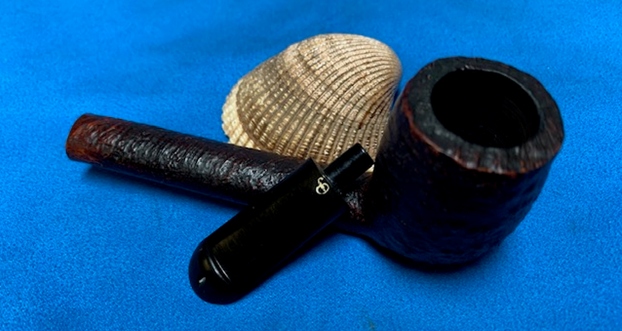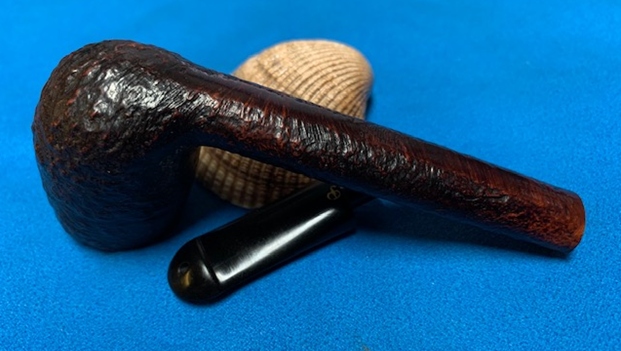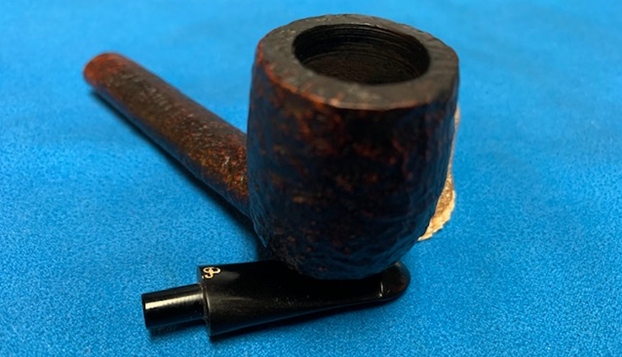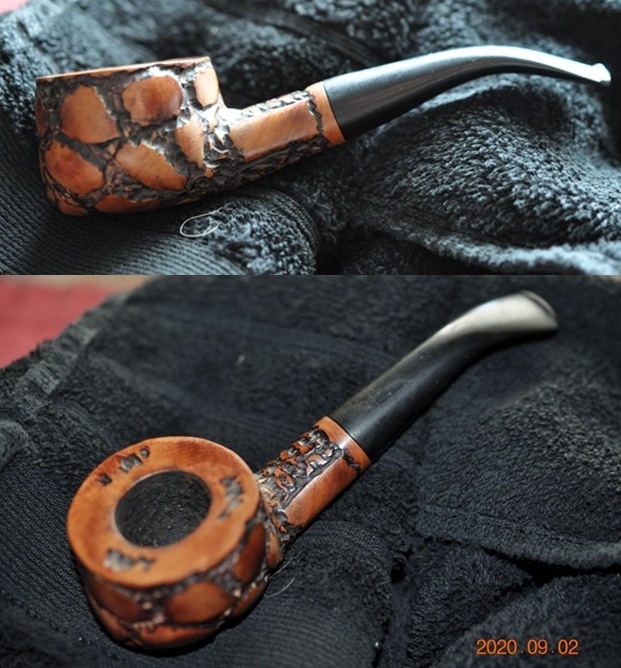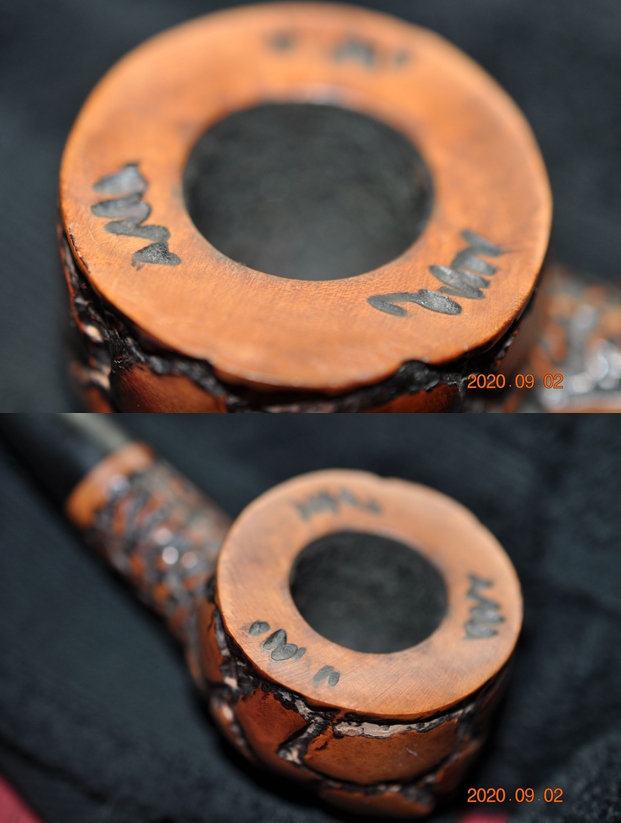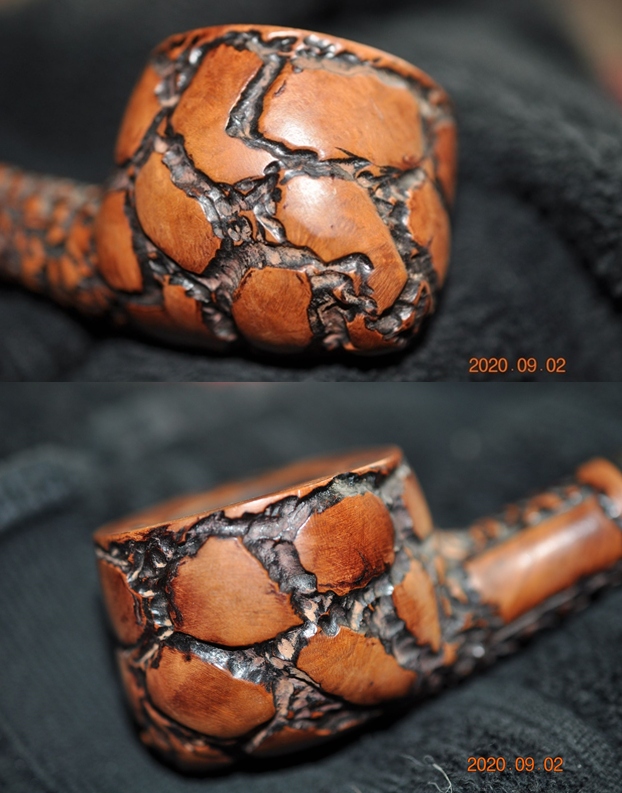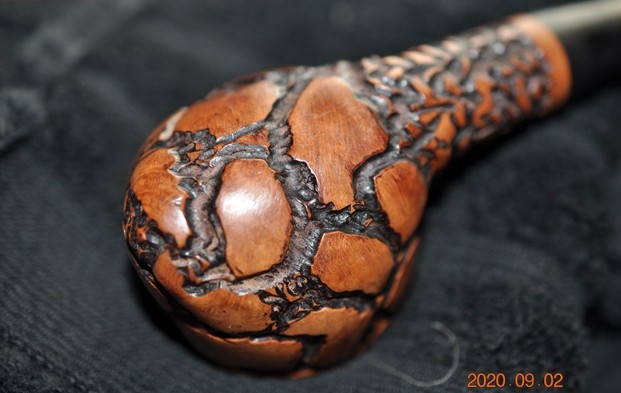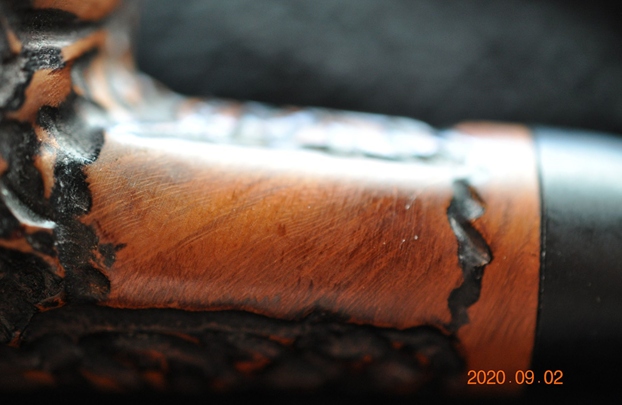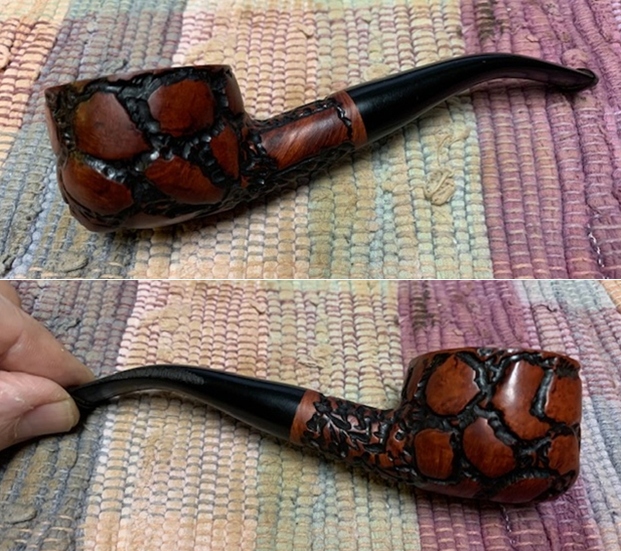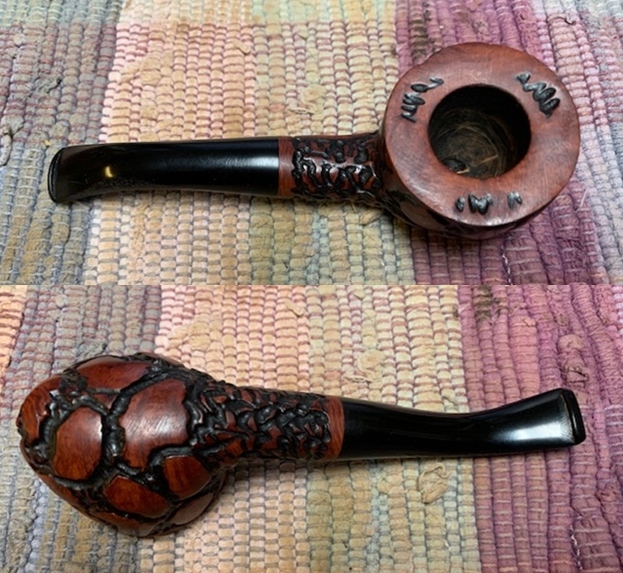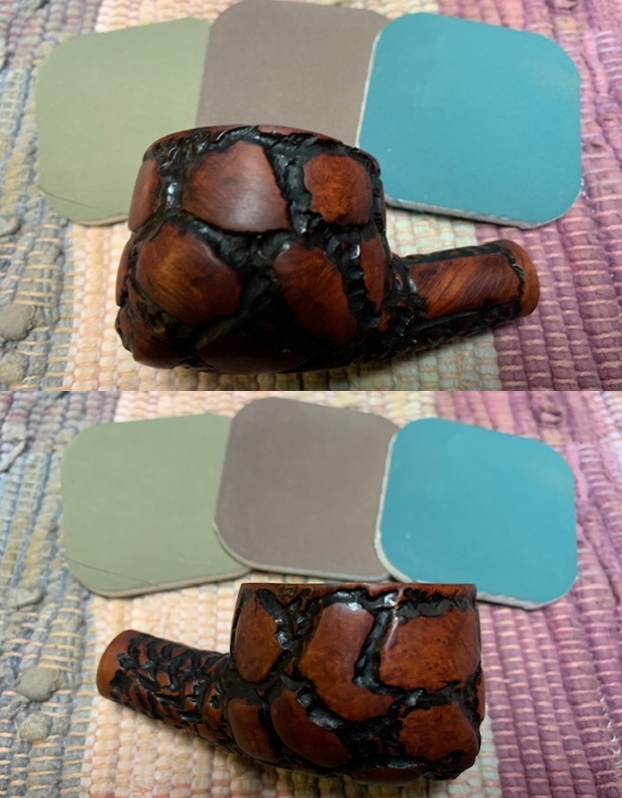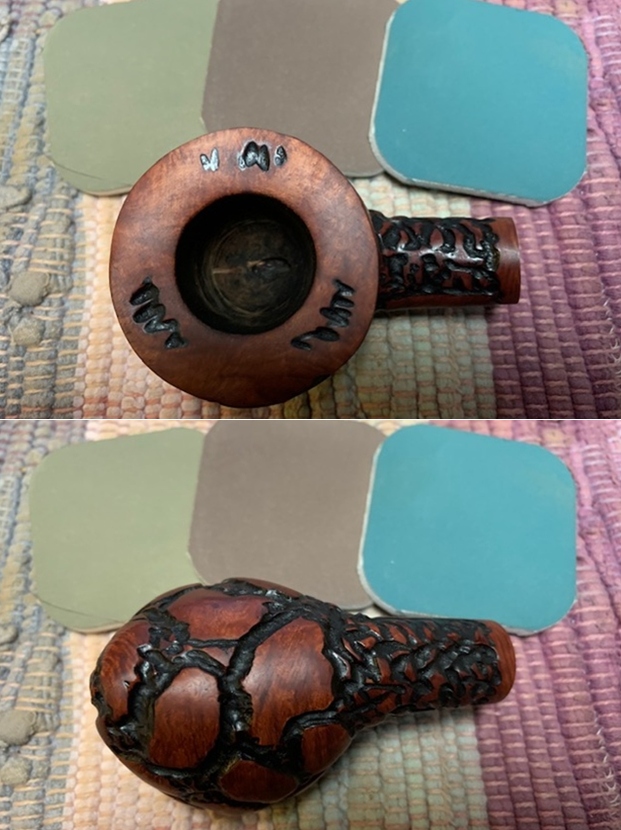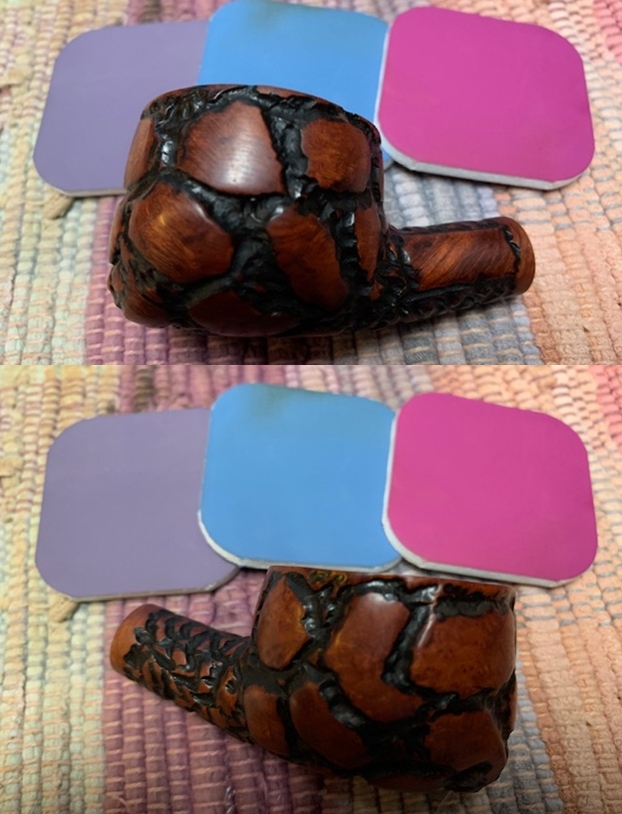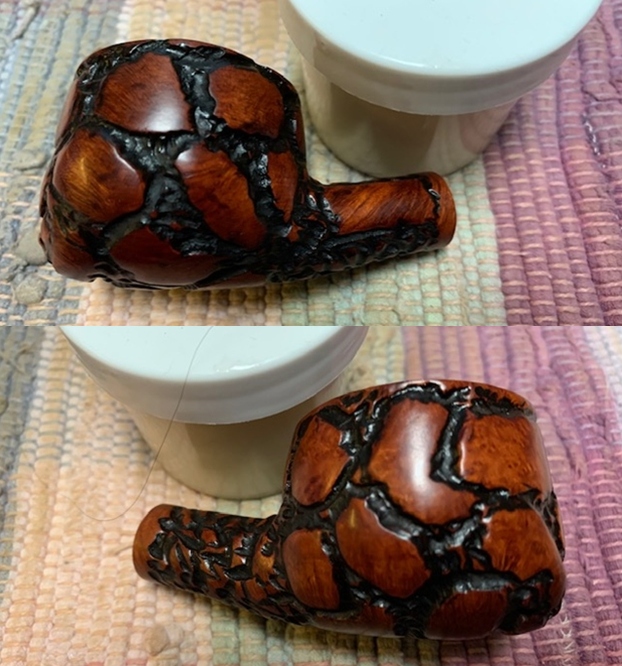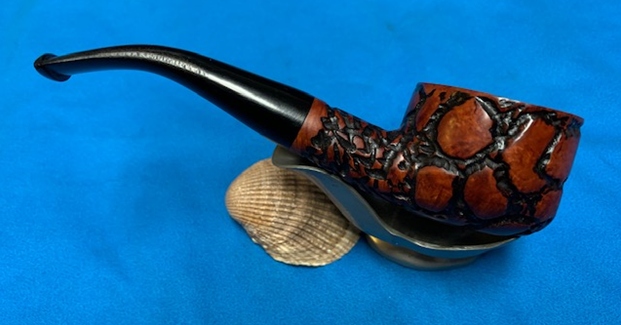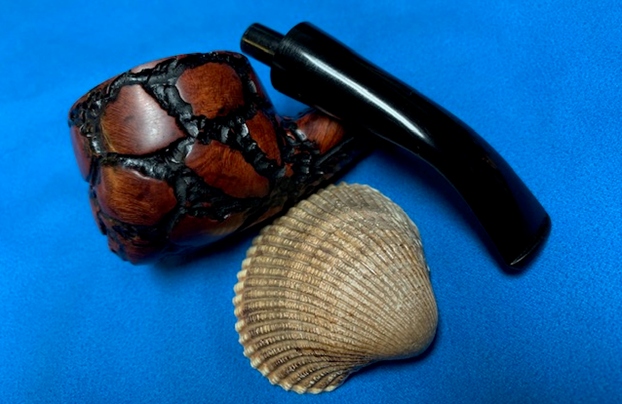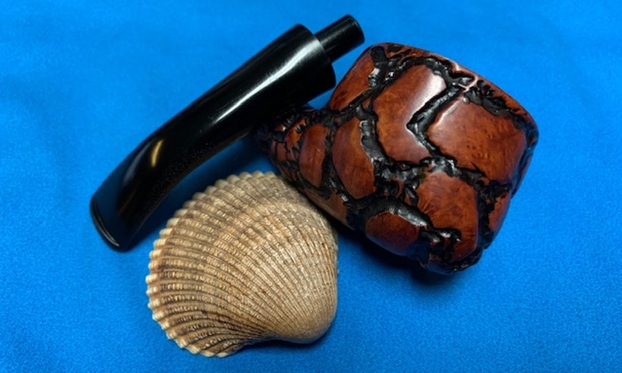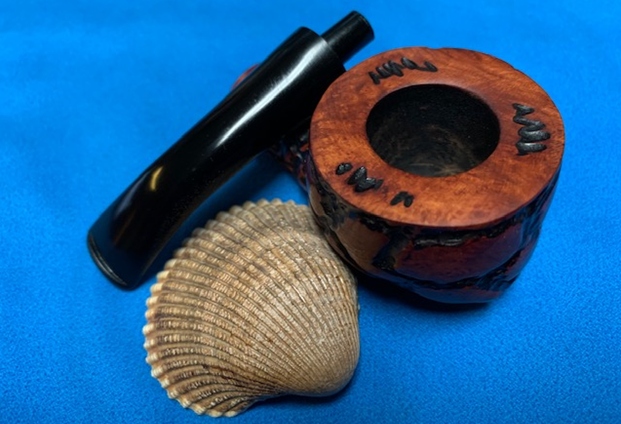
Tag Archives: vulcanite

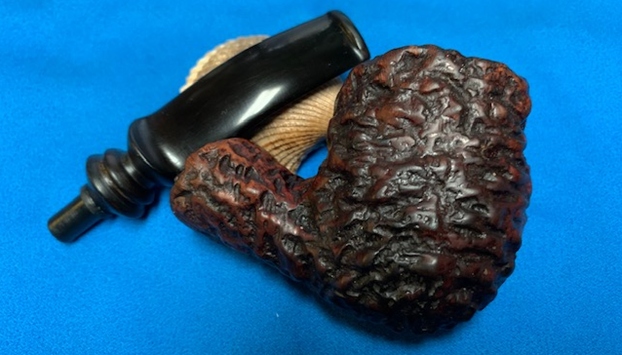
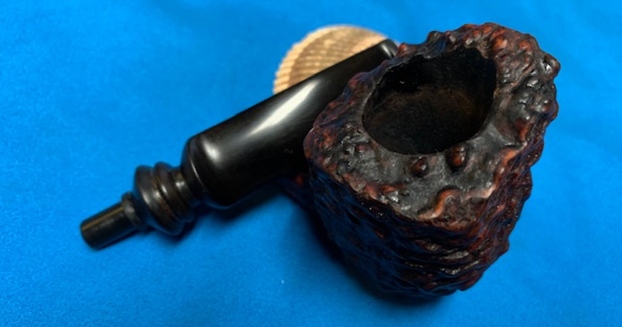
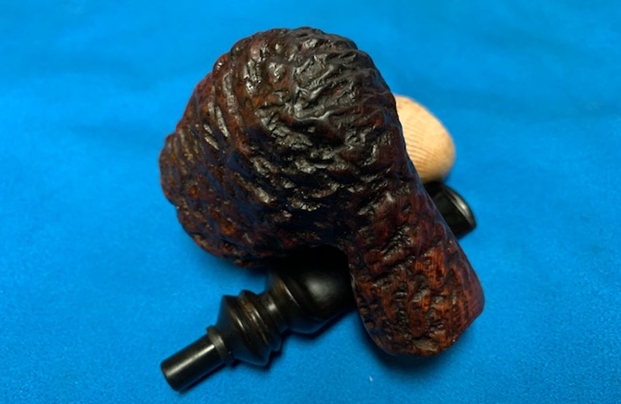
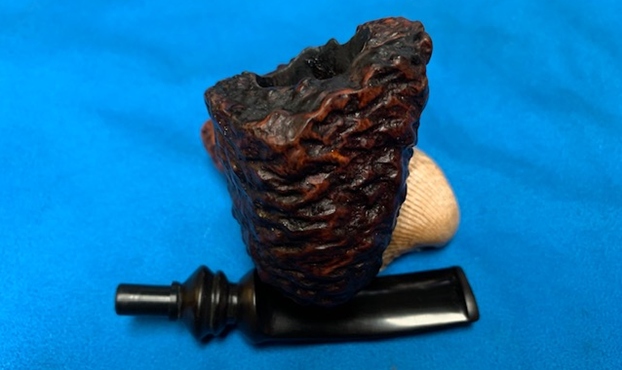
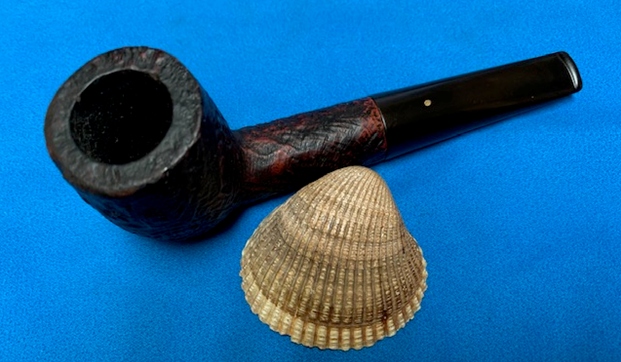
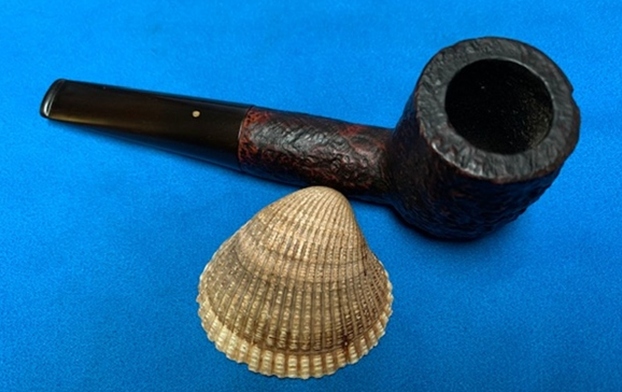
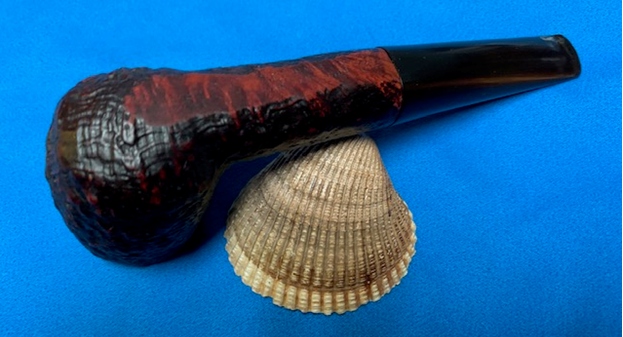
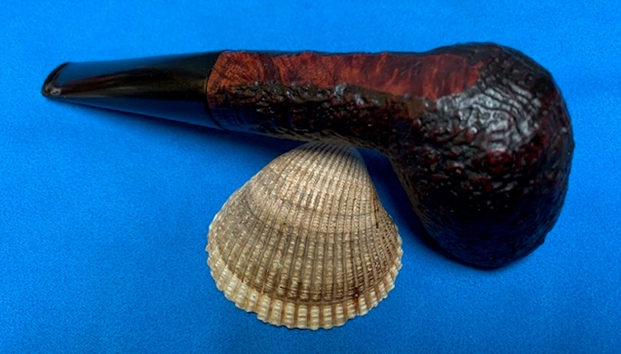
Breathing New Life into a Parker Super Briar Bark 345 Bulldog


Blog by Steve Laug

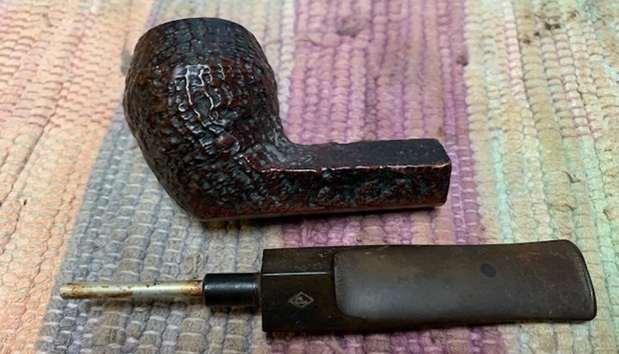
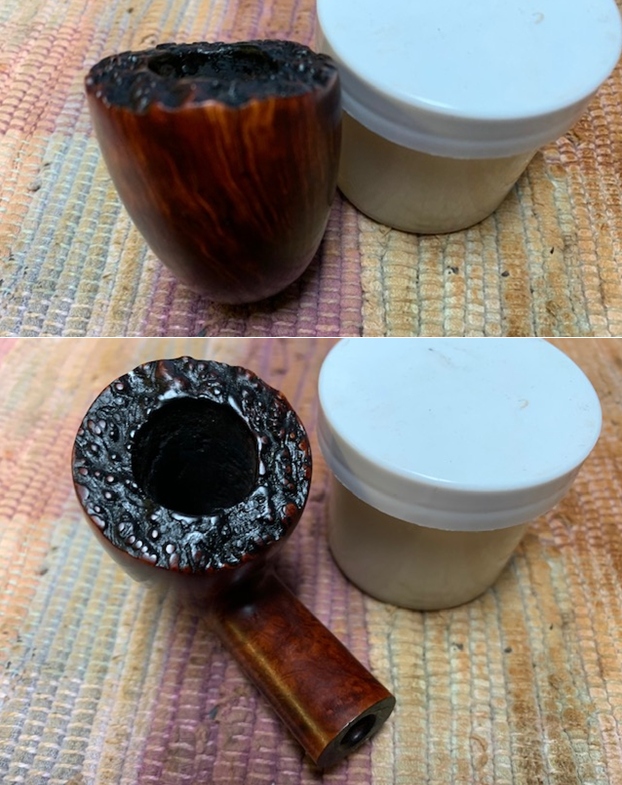
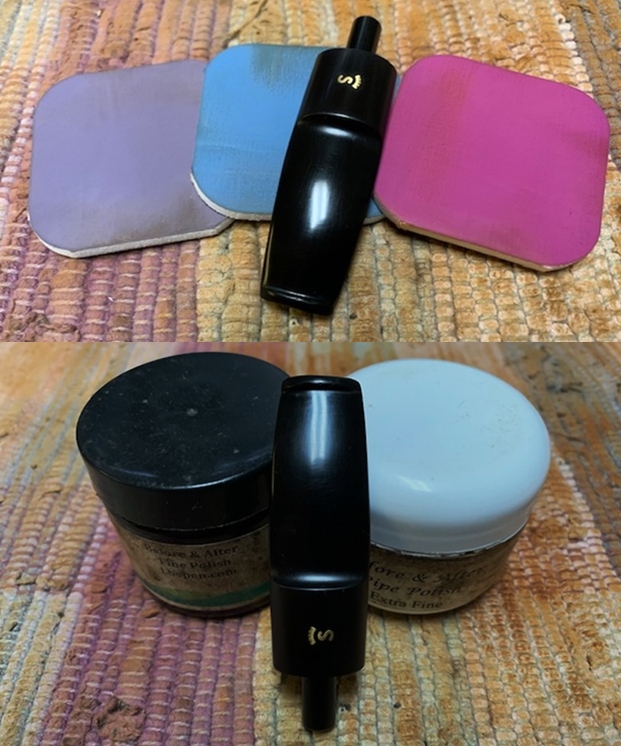
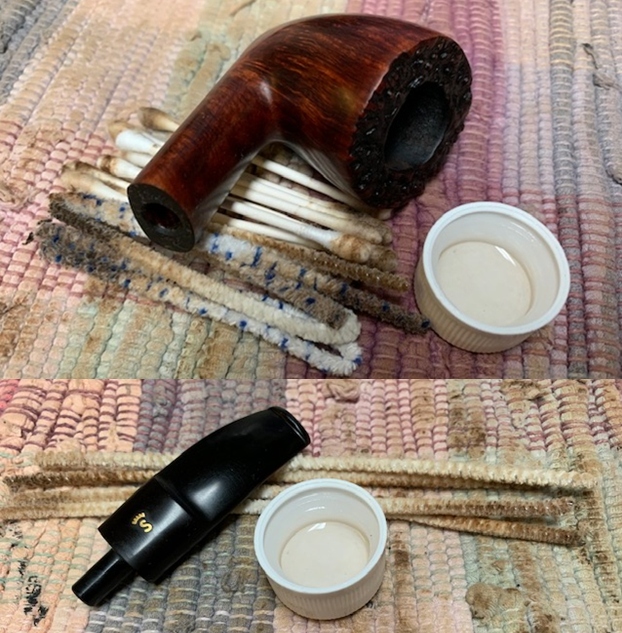
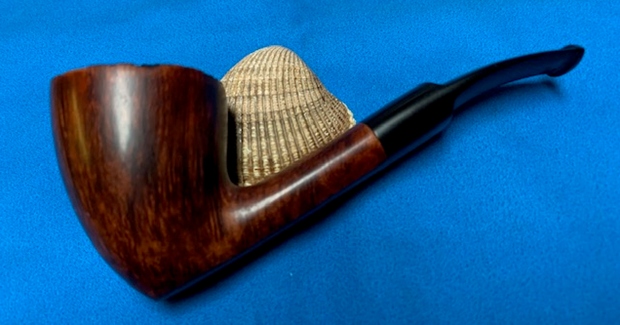
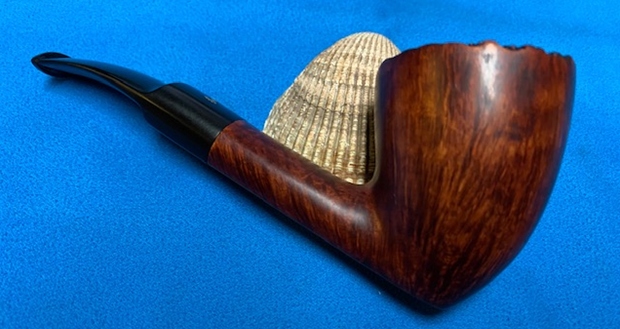
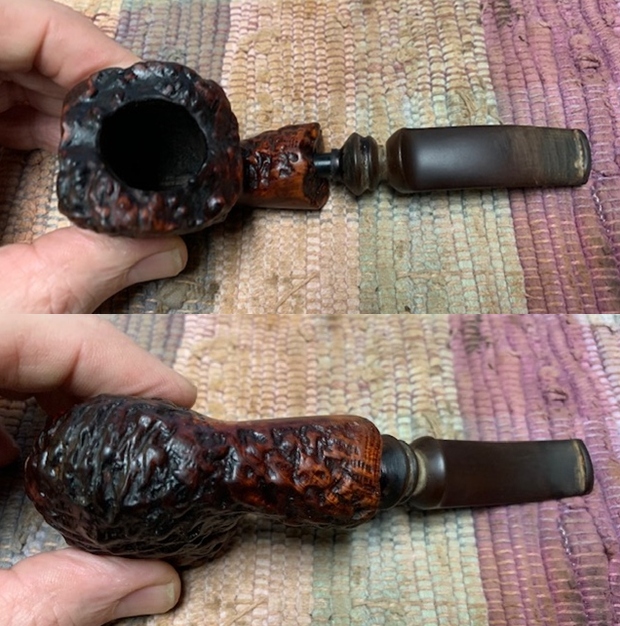
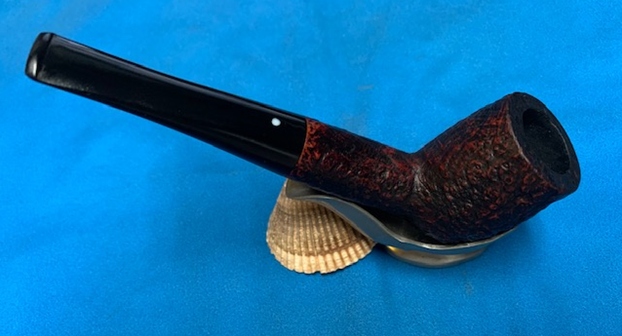
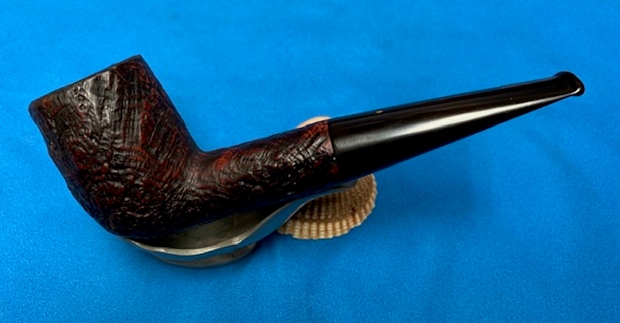
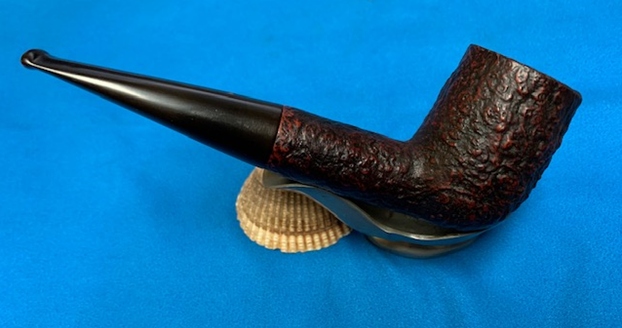
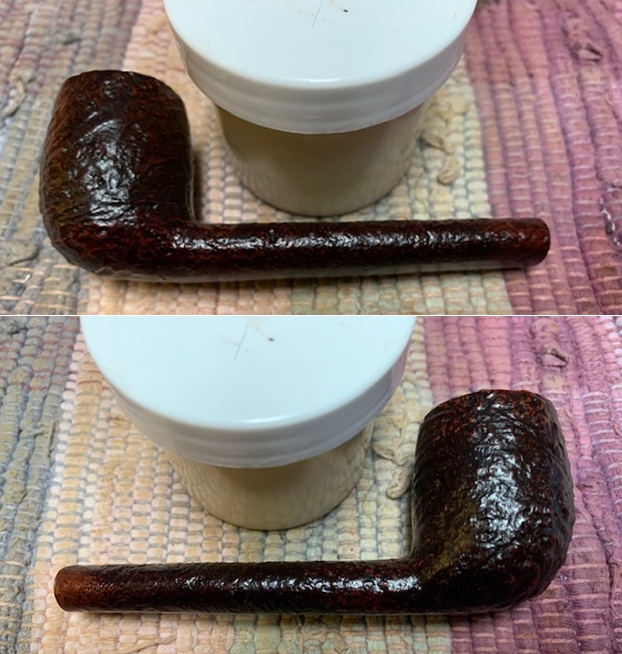
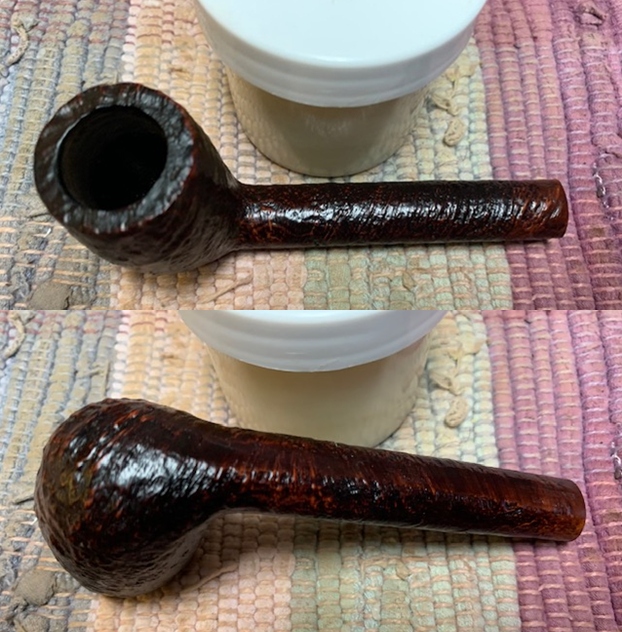
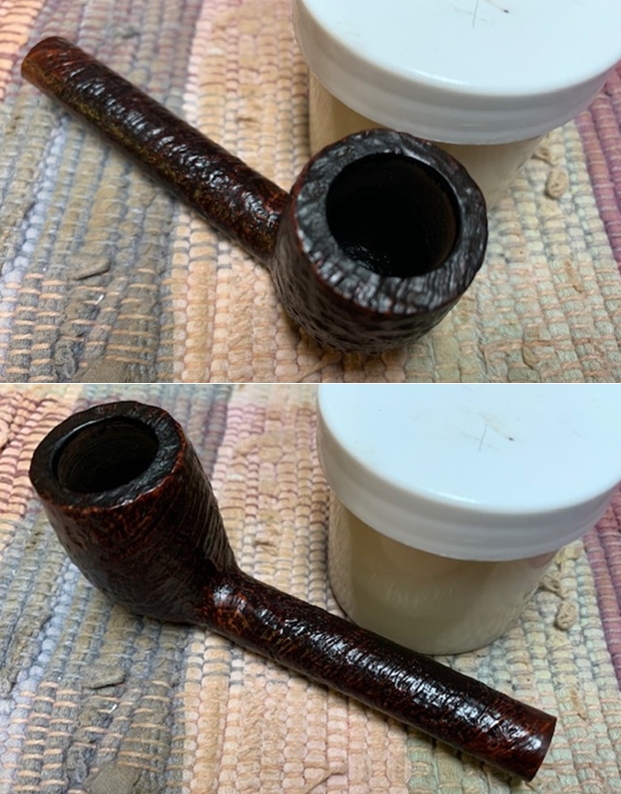
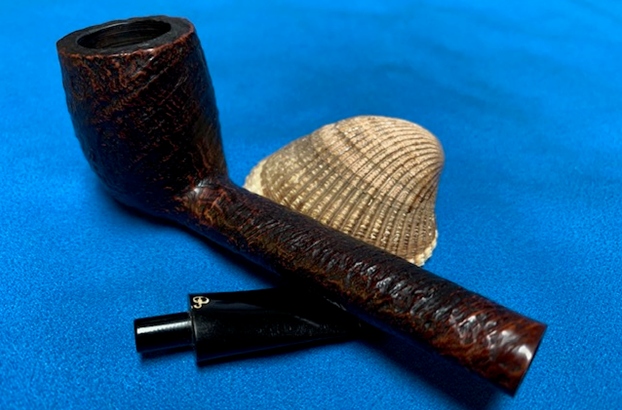
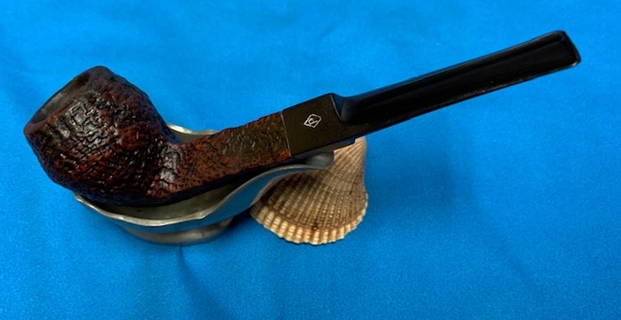
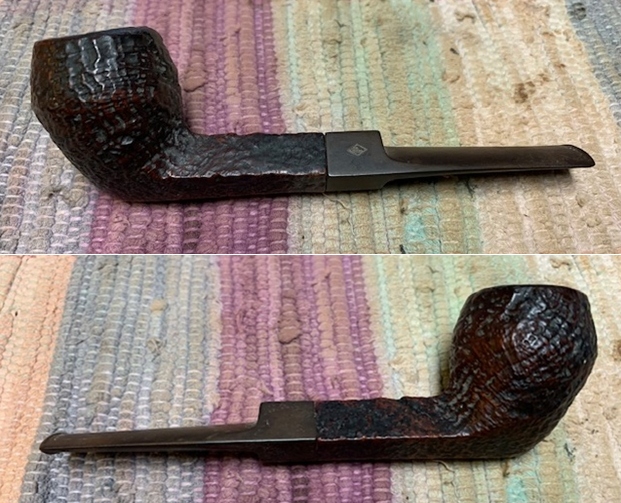
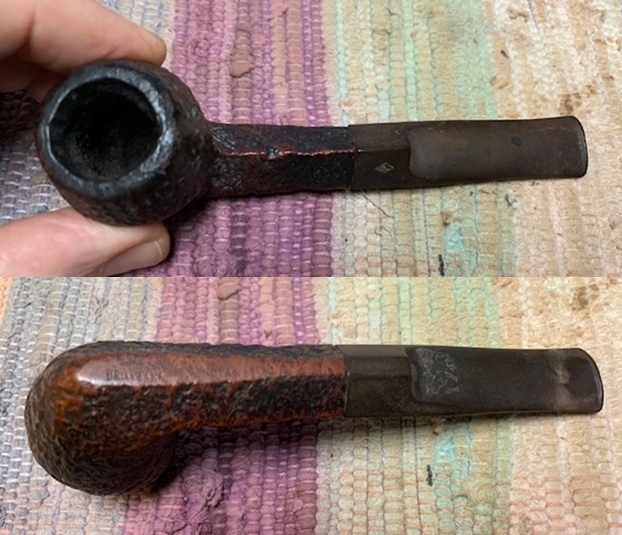
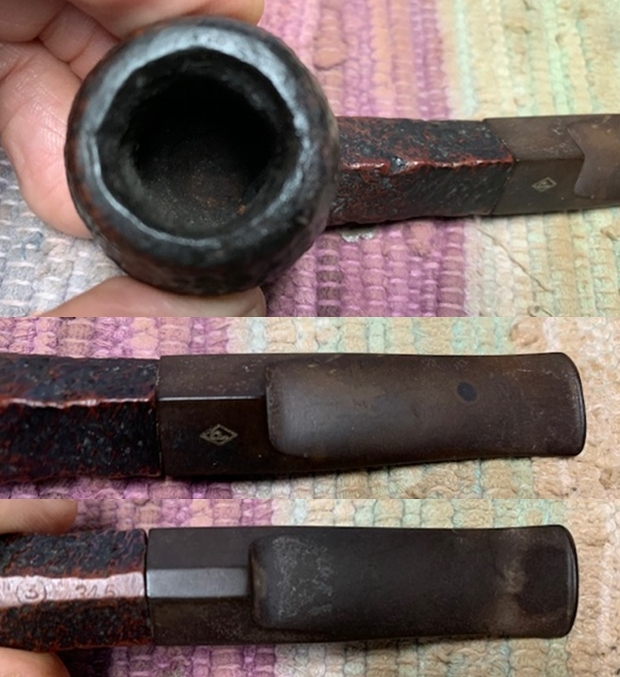
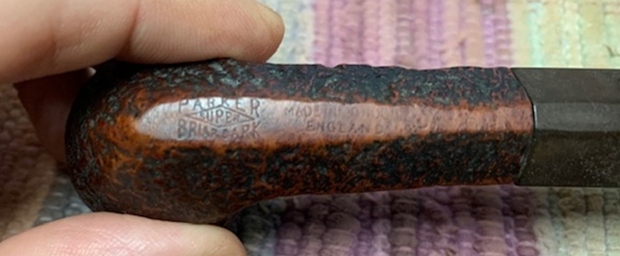
The next pipe on the work table came to me from either a trade I made (pipes for labour) or a find on one of my pipe hunts. I honestly don’t remember where it came from. It has been around for a while waiting to be worked on. It is a ruggedly sandblasted Parker Super Bark Bulldog that really looks quite nice. The stamping is clear and readable. It is stamped on the underside of the shank and reads Parker [over] Super in a Diamond [over] Briar Bark that is followed by Made in London [over] England. To the right of that stamping is a 3 in a circle followed by the shape number 345. The circle 3 is the size number that matches the Dunhill group size 3. The pipe had a lot of grime ground into the grooves of the sandblast on the bowl and some wear on the finish around the sides of the bowl. The bowl was heavily caked and had an overflow of thick lava on the plateau rim top. It was hard to know what the rim top and inner edge of the bowl looked like under the grime. The stem was calcified, oxidized and had light tooth chatter and marks on the top and underside and the top surface of the button had a tooth mark. There stamped P in a diamond on the top left side of the saddle stem. The pipe had promise but it was very dirty. I took photos of the pipe before he started his cleanup work.   I took photos of the rim top and bowl to give a clear picture of the thickness of the cake and the overflow of lava on the rim top. It is hard to know for sure how extensive the damage was to the inner edge of the bowl because of the thickness of the lava coat. I also took photos of the top and underside of the stem to show the oxidation, calcification, light chatter and tooth marks.       I took a photo of the stamping on the underside of the shank. It reads as noted above and is clear and readable. I took the stem off the bowl and took a photo of the parts. There was also an inner-tube inserted in the tenon and it was unmovable.I looked on Pipephil’s site for information on the Parker Super Briar Bark line and found the following information (http://www.pipephil.eu/logos/en/logo-parker.html). The screen capture below has quite a bit of information on the line from Parker. The one that I am working on definitely has the inner tube but does not have a patent number nor does it have a date stamp following the D in England.I also went to Pipedia and read the article on the Parker brand. It is a great read and worth the time to read it (https://pipedia.org/wiki/Parker). I picked up the following piece of information that was helpful.
After 1957 on pipes Parker ceased to put patent number and the code with definition of date.

That tells me that my pipe was made after 1957 when the numbers were no longer added to the stamping on the pipe.

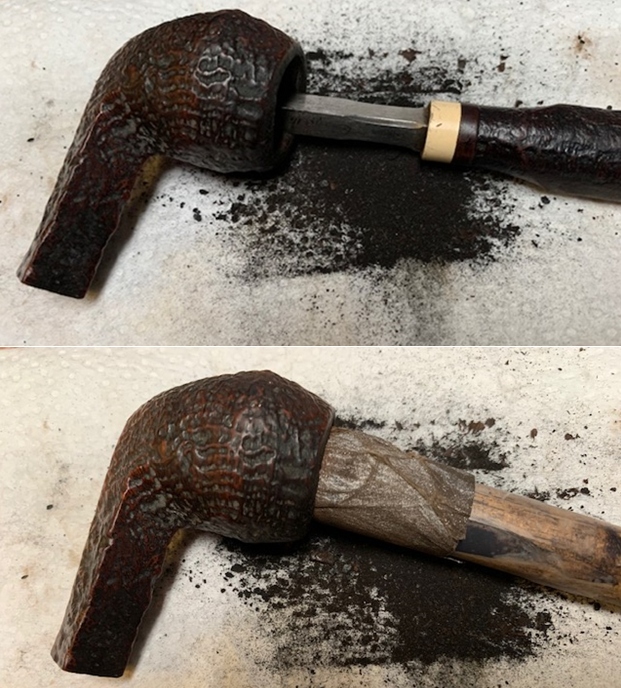
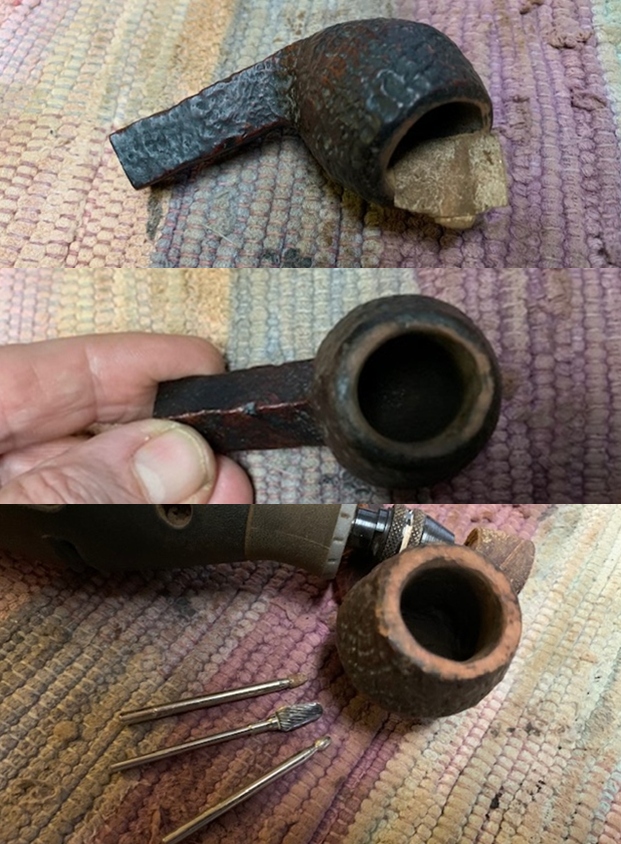
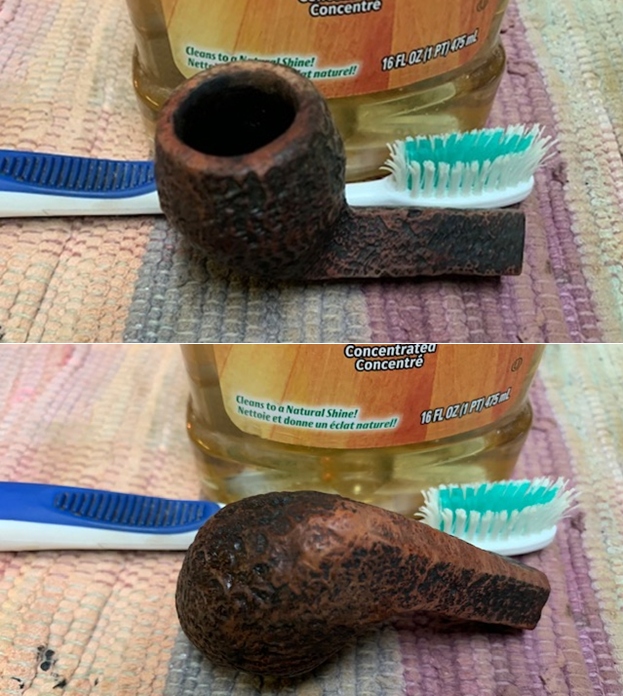
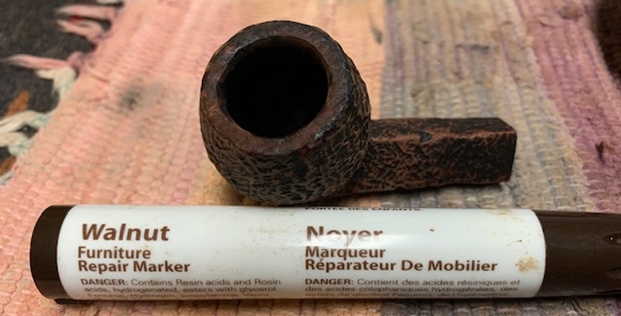
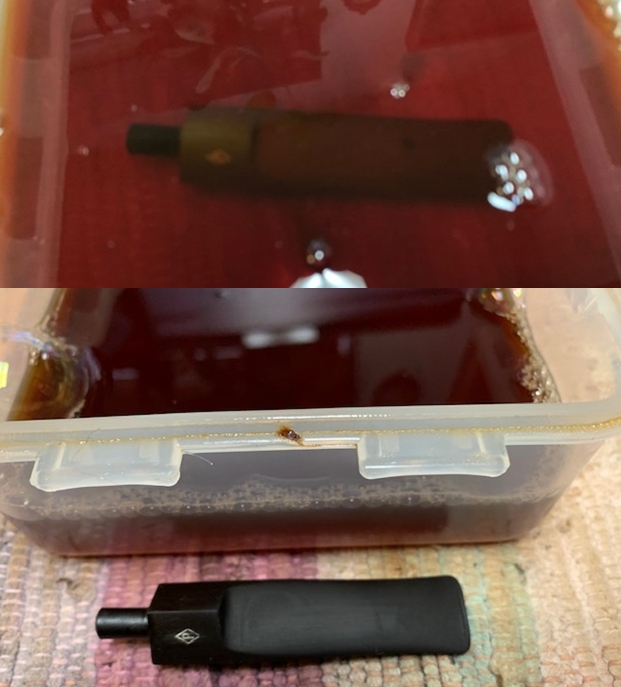
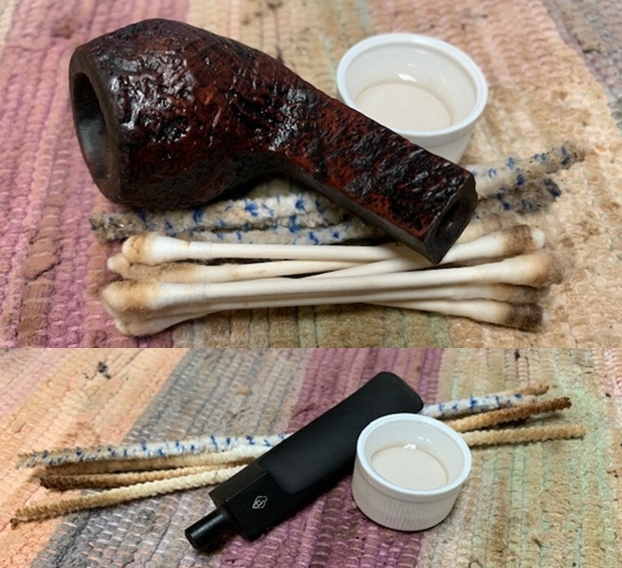
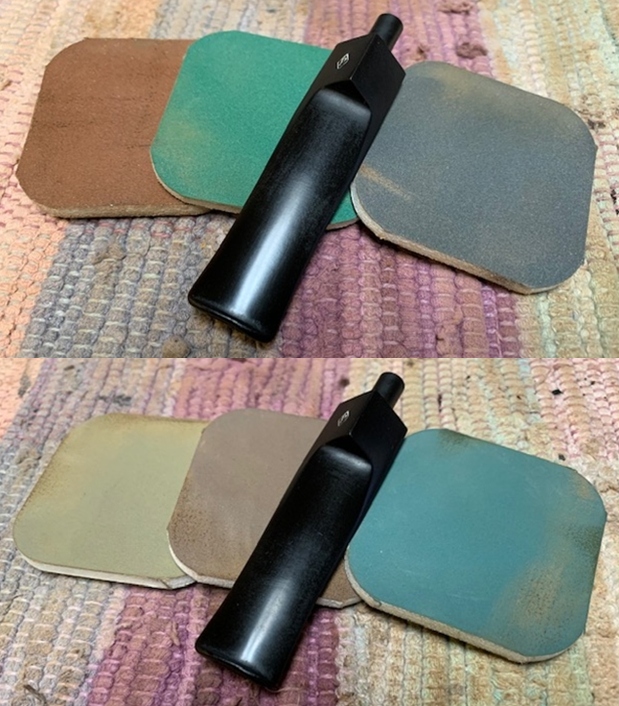
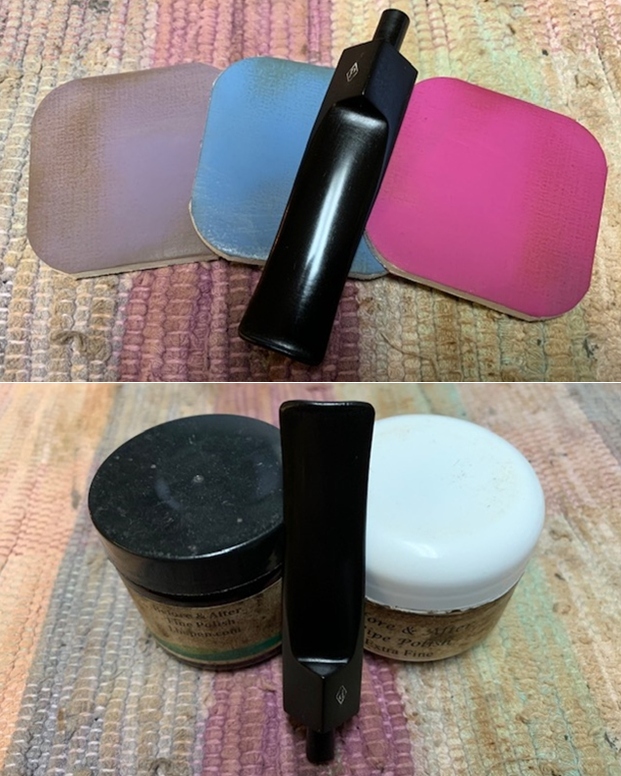
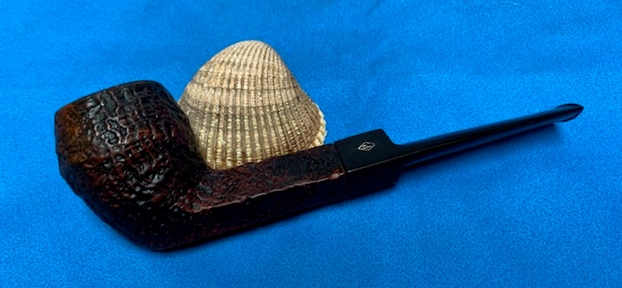
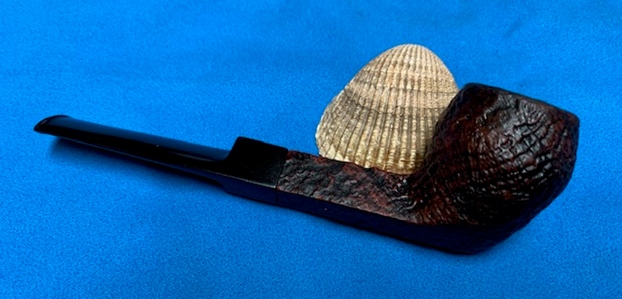
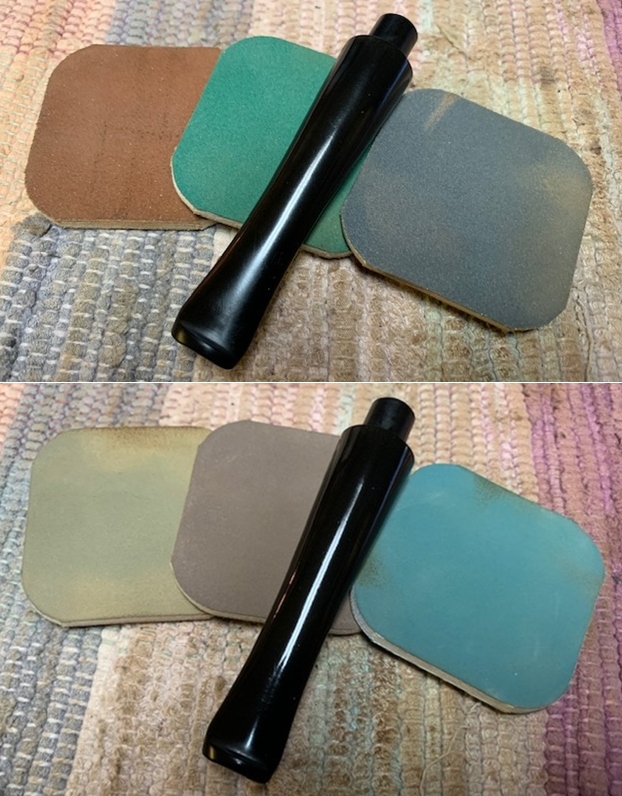
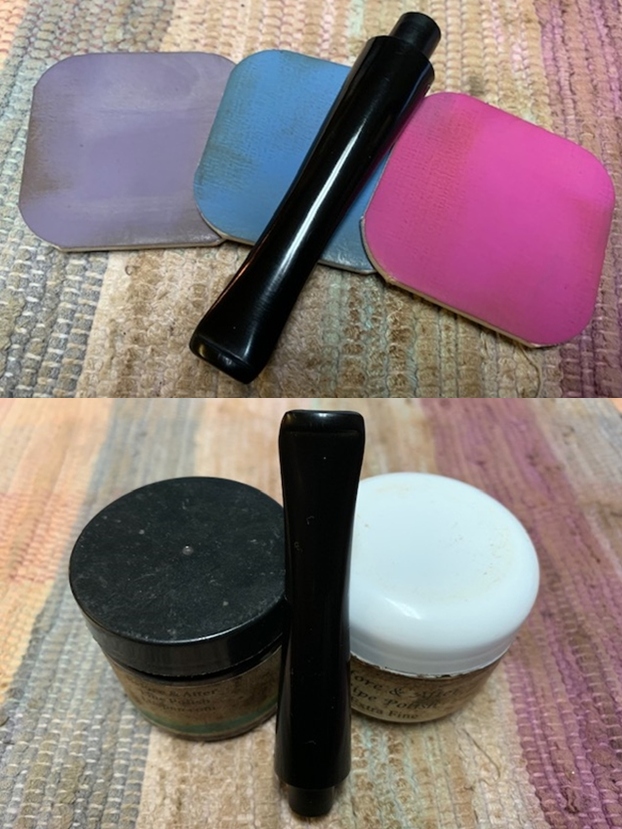
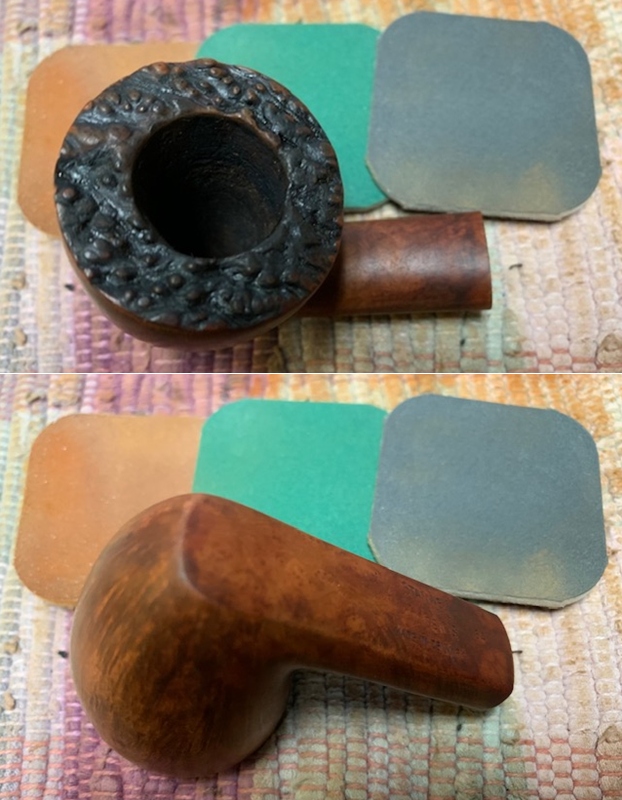
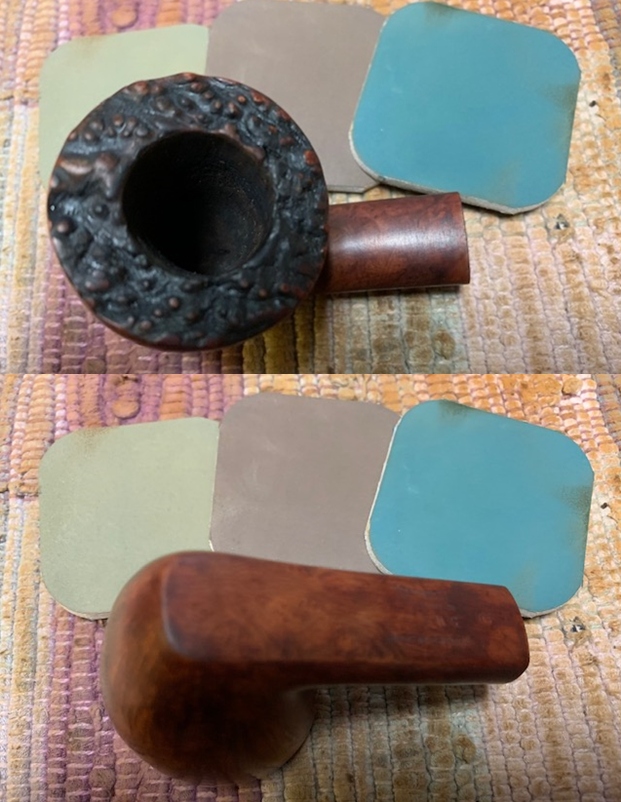
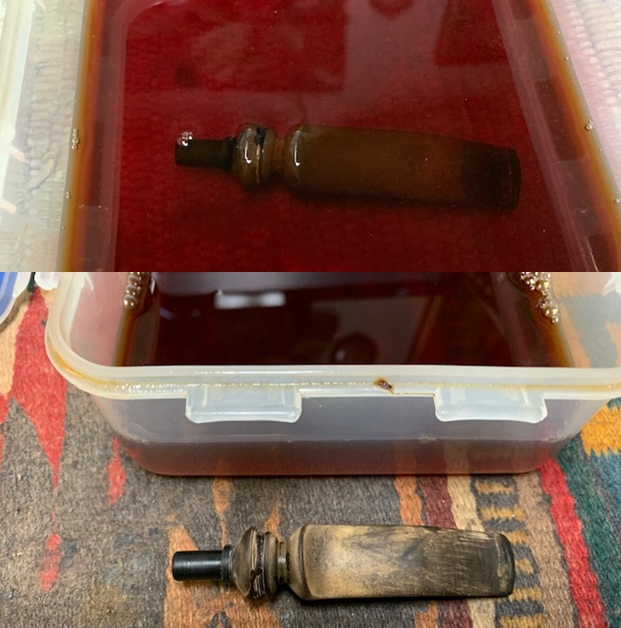
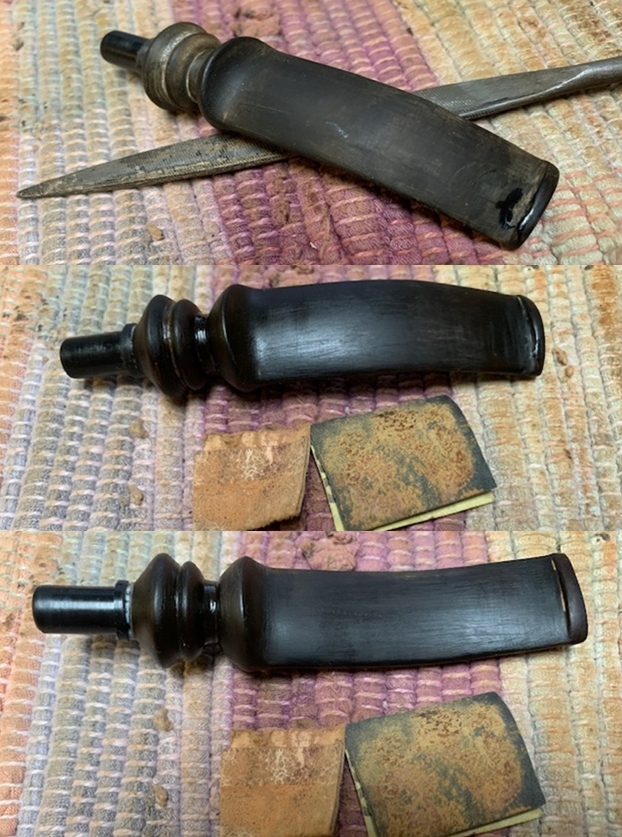
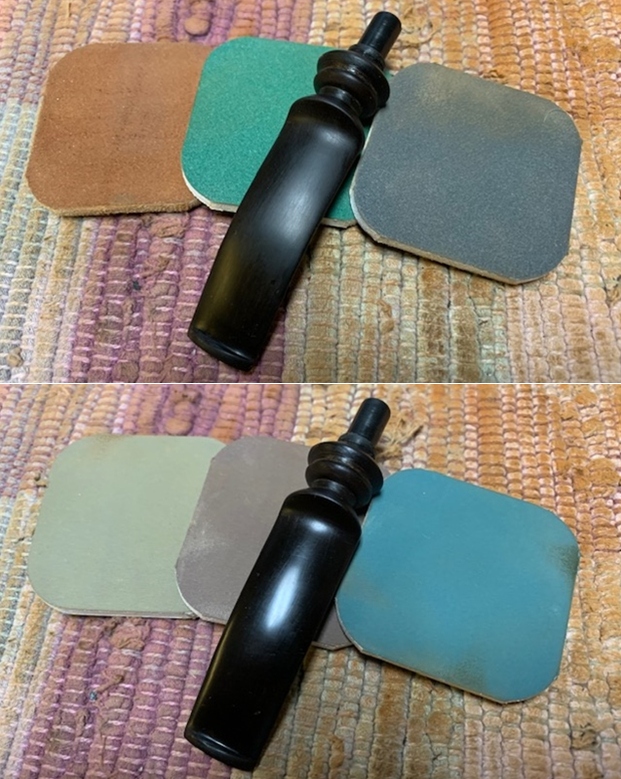
Now it was time to work on the pipe. I started the process by heating the inner tube and removing it from the tenon. I wrapped a paper towel around the tube and wiggled it free of the tenon. It came out easily.I have to say it once again that I am really spoiled having Jeff clean up the pipes for me. Having to start with them in this condition adds time. I reamed the bowl with a PipNet pipe reamer using the first two cutting heads. I followed up by scraping the remaining cake with a Savinelli Fitsall Pipe Knife. I finished cleaning up the cake in the bowl with a piece of dowel wrapped in 220 grit sandpaper to smooth out the walls of the bowl.  I cleaned up the rim top and the inner edge of the bowl with a folded piece of 220 grit sandpaper. I gave the inner edge of the rim a slight bevel. I smoothed out the top of the rim with the sandpaper in preparation for rusticating it with a series of burrs and the Dremel.    I scrubbed the exterior of the bowl and rim top with a tooth brush and undiluted Murphy’s Oil Soap to remove the debris from the finish. I rinsed the bowl with warm water to remove the grime and soap and dried it off with a soft towel. I touched up the rim top rustication with a Walnut stain pen and a Black Sharpie pen to blend the top into the rest of the bowl colour. I also touched up the faded spots on the heel of the bowl and around the edges of the bowl.I rubbed the bowl and shank down with Before & After Restoration Balm. I worked it into the surface of the bowl sides and shank with my fingertips and a horsehair shoe brush to get into the nooks and crannies of the blast. The balm works to clean, enliven and protect the briar. I let the balm sit for a little while and then buffed with a cotton cloth to raise the shine.   While I was working on the bowl the stem was soaking in Briarville Pipe Repair’s – Pipe Stem Oxidation Remover. The stem sat in the mixture for 2 ½ -3 hours. I removed the stem from the bath, scrubbed lightly with a tooth brush and dried if off with a paper towel. I was surprised that it was quite clean. Just some light tooth marks on the button and underside of the stem near the button. The Diamond P stamp on the stem remained and was not damaged by the deoxidizer. I cleaned out the shank and the airway in the stem with alcohol, cotton swabs and pipe cleaners to remove the tars and oils in the airways of both. Once they were clean the pipe smelled better.I polished the vulcanite stem with micromesh sanding pads – 1500-12000 grit pads. I wiped it down with a damp cloth after each sanding pad. I used Before & After Pipe Polish – both Fine and Extra Fine to further polish the stem. This beautiful sandblasted Parker Super Briar Bark 345 Bulldog with a vulcanite saddle stem is a great looking pipe now that it has been restored. The rich browns and blacks of the contrasting stains in the sandblast came alive with the polishing and waxing. The newly rusticated rim top blended in very well. I put the stem back on the bowl and carefully buffed the pipe with Blue Diamond on the buffing wheel using a light touch on the briar. I gave the bowl multiple coats of Conservator’s Wax and the stem multiple coats of carnauba wax on the buffing wheel and followed that by buffing the entire pipe with a clean buffing pad. I hand buffed the pipe with a microfiber cloth to deepen the shine. The finished Parker Super Briar Bark Bulldog is a beauty and fits nicely in the hand and looks very good. Give the finished pipe a look in the photos below. The dimensions of the pipe are Length: 5 ½ inches, Height: 1 ½ inches, Outside diameter of the bowl: 1 ¼ inches, Chamber diameter: ¾ of an inch. If you are interested in adding this pipe to your collection send me a message or an email. Thanks for reading this blog and my reflections on the pipe while I worked on it. There are many more to come!

Refreshing a Friend’s First Purchased Pipe – A French Courrieu Straight Grain Billiard


Blog by Steve Laug

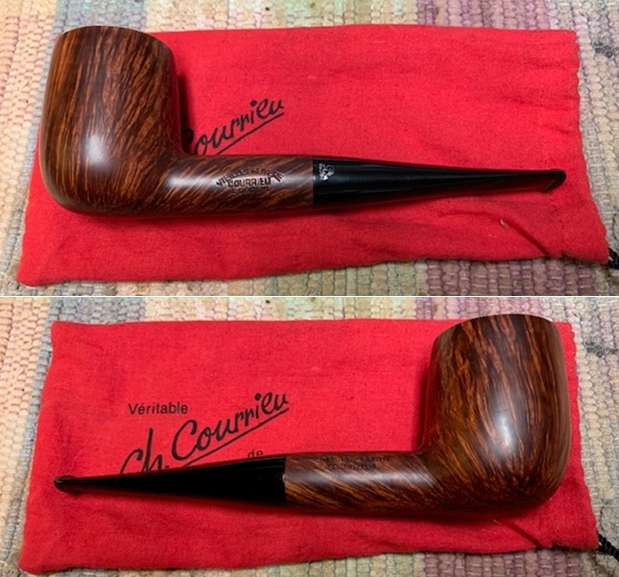
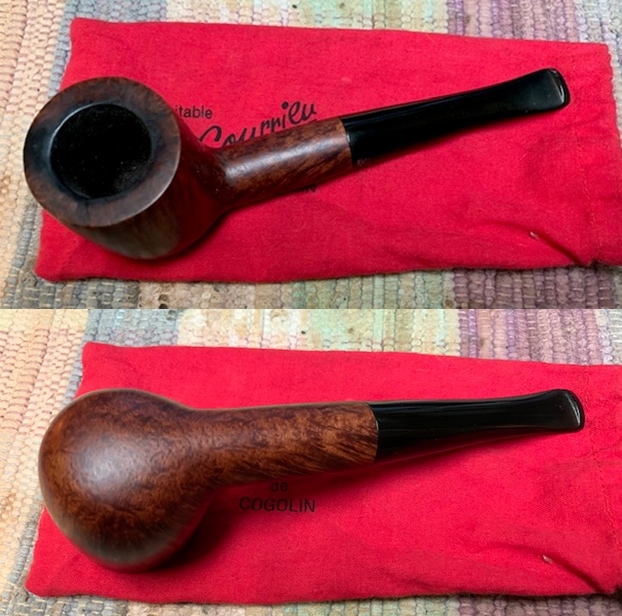
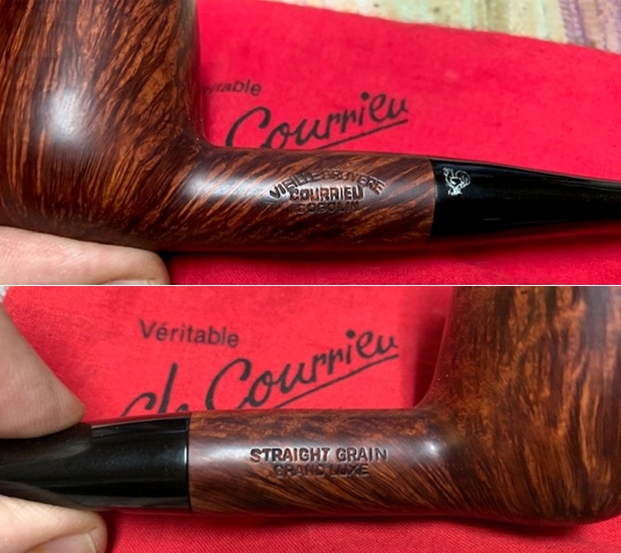
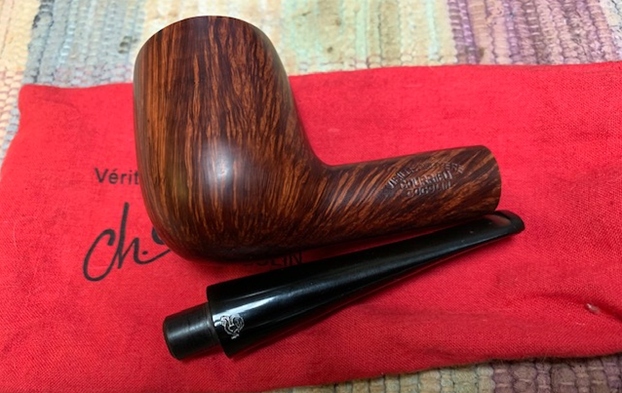
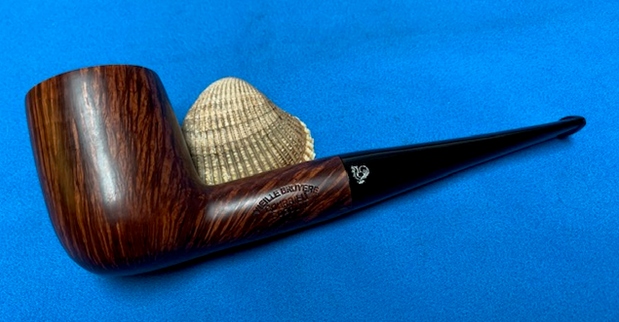
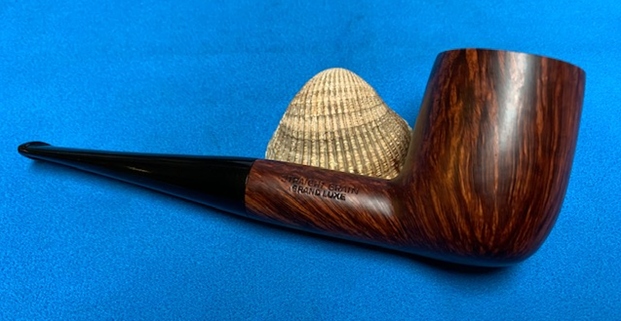
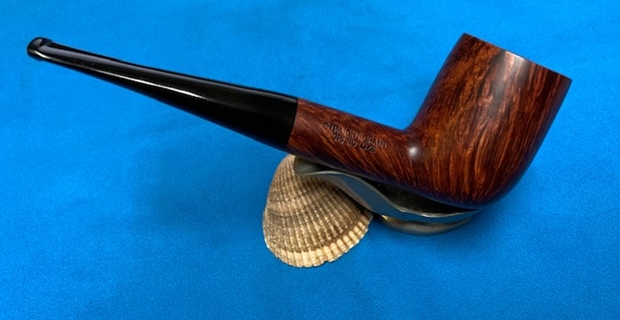
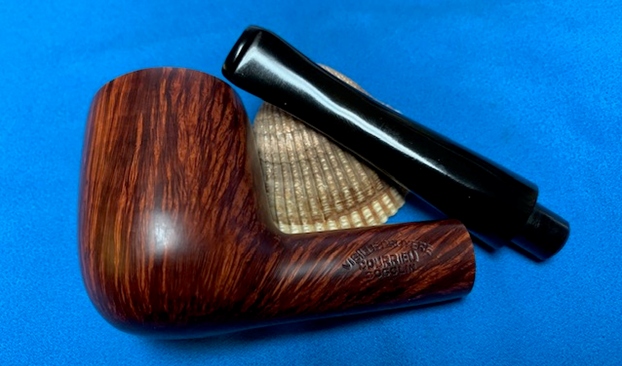
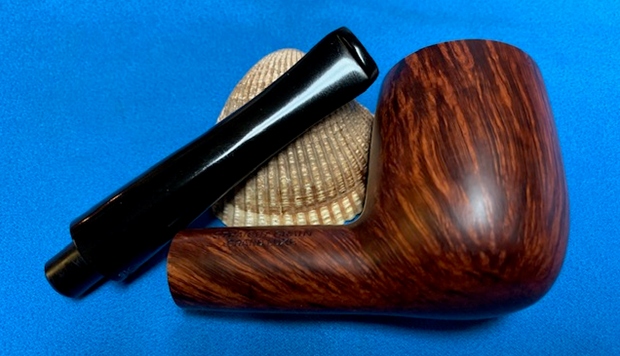
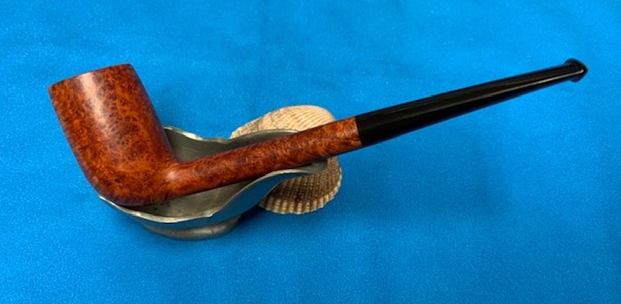
The next pipe I am working on is the second one that came from a friend, Lee who lives in the US. It is a gorgeous Straight Grain French Made Billiard. It is stamped on the left side of the shank and reads Vieille Bruyere [arched over] Courrieu [over] Cogolin. On the right side it is stamped Straight Grain [over] Grand Luxe. He sent me an email detailing what he saw in the pipe and gave his assessment as well as several pictures of the pipe. He wrote and opening paragraph and then a list of his request:

The second pipe I’ll be sending is my first pipe, a French Courrieu, billiard shape, straight grain. While it’s just fine, I’d like to see if you can remove the burning/charring on the bowl’s edge (due to me being a total newbie at the time), bowl clean, and a wood buff if possible. Again, deep sentimental value with this French pipe, so want it to be in great shape.

  1. First pipe ever purchased. Purchased from the mfg after a fascinating tour (I’m a mfg guy, so seeing how they do things both fascinated and horrified me!)
  2. I know this piece is in good shape, but the scorching on the rim due to ignorance/newbie-stumbles irritates me (I really don’t need to be reminded with every bowl of Semois how badly I’ve treated this thing); if you can assist, please do what you can to remove, even if it means sanding off the top of the bowl.
  3. My only ’need’ is you match the original stain, best you can. If that requires sanding the entire bowl and working up from there with another stain (a close match), I’m fine with that call. Again, this is a sentimental piece (unlike the Peterson – for now), so I’m not concerned about the labor required to get it the best it should be. Merci –

Once the pipe arrived I spent some time going over it to assess what I thought needed to be done to bring it back the flare to the finish of Lee’s first pipe. This Courrrieu Straight Grain Billiard really is a very beautiful pipe with some stunning grain. This is the list that I sent to him via email.

  1. Bowl exterior is in good condition. There are no deep scratches or marks in the briar.
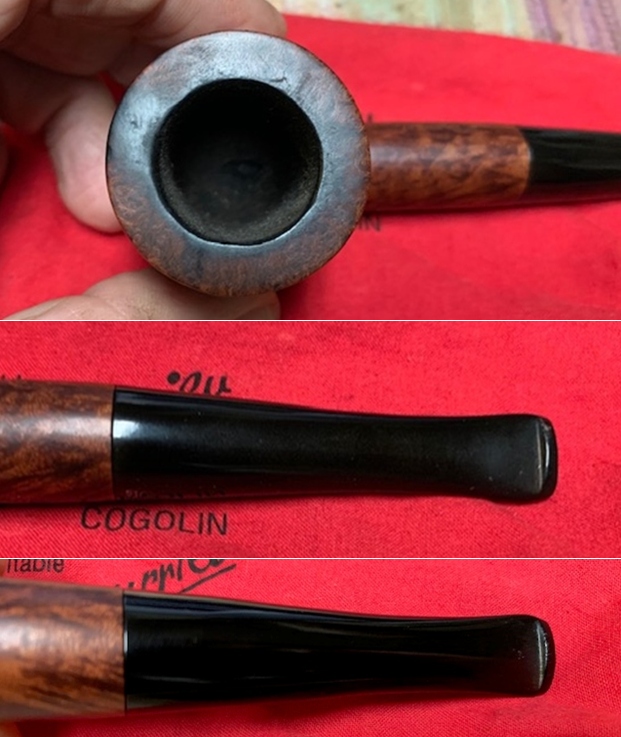
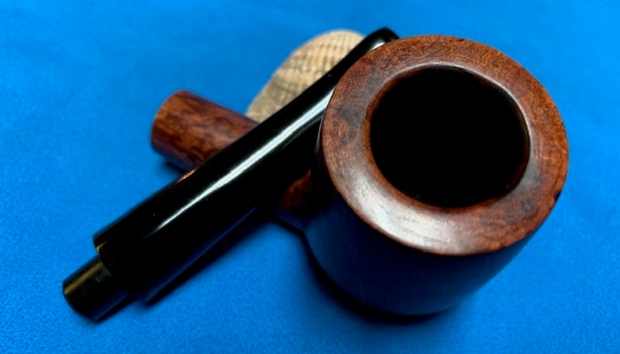
  2. Rim top shows some scratches and marks on the surface. There is darkening around the inner edge of the bowl and on the front, back and left side of the top. The inner edge is also damaged on the front edge and rear left edge with what looks like some charring. Definitely worse on the front than the back of the rim. Bowl is slightly out of round due to that.
  3. Bowl internals are good – light cake. Do you want that cut back to bare briar again or just leave it and lightly clean it?? I ask because taking it back some will make the rim cleanup easier to manage.
  4. The stem is in relatively good condition with tooth chatter on the underside ahead of the button and on the button surface itself. A few tooth marks on the underside and on the underside of the button.

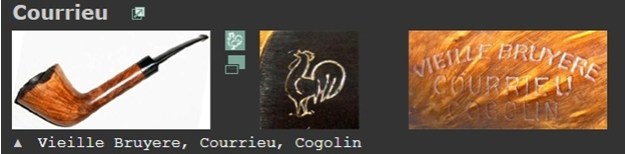
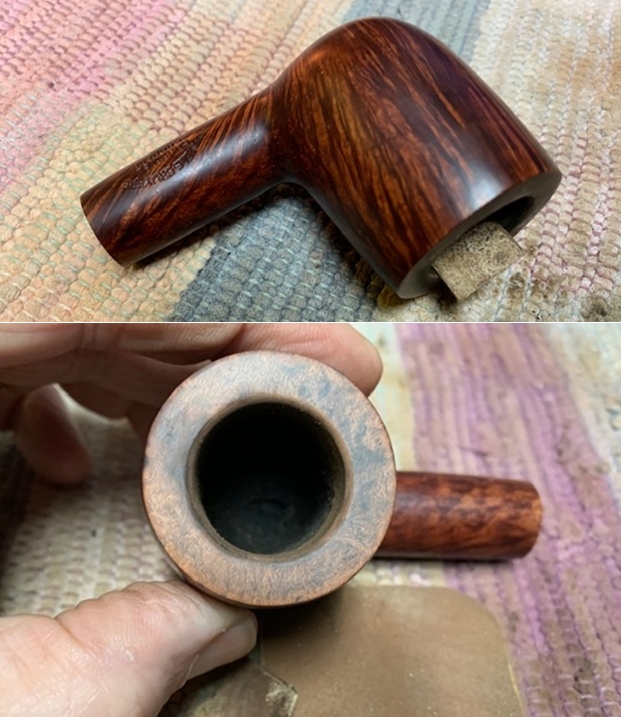
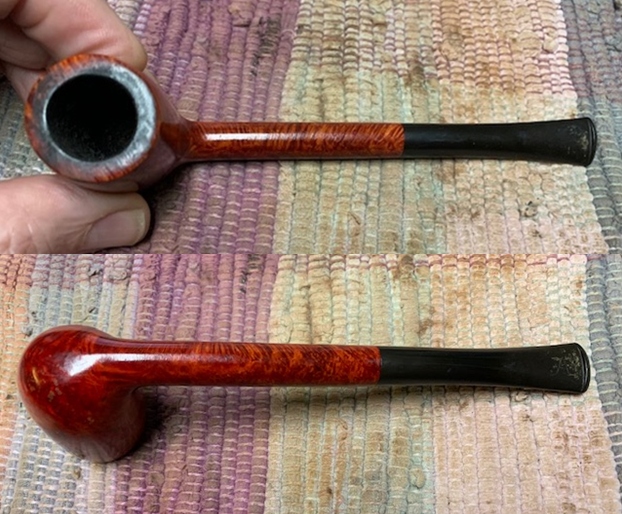
I took photos of the pipe before I started the work on the pipe. It is a beauty. The grain is beautiful and the pipe is in very good condition other than the burn marks on the rim top. The photos tell the story of pipe’s condition.  I took some photos of the rim top and stem surfaces to capture their condition. The photo of the rim top shows the darkening on the top of the rim and the damage to the inner edge of the rim. It is more pronounced on the front inner edge than the rear. It is solid but definitely burned. The bowl is slightly out of round. The stem surface is pretty clean. There are light tooth marks on the top and underside as well as on the button surface itself.   I took photos of the stamping on both sides of the shank. It is clear and readable as noted above. The stamping on the left side of the stem is a rooster. I took the stem off the shank to give a clear picture of the pipe as a whole. The flow of the bowl, shank and the taper stem contribute to the overall beauty of the pipe.I wanted to gather some background information on the Courrieu brand as this is the first pipe of this brand that I have worked on. I turned to Pipephil to get a quick overview of the brand and was not disappointed (http://www.pipephil.eu/logos/en/logo-c8.html). I have included a screen capture of the section on the brand. I also quote from the side bar below the screen capture.Ulysse Courrieu started carving pipes in Cogolin in 1802. Courrieu certainly is the oldest french briar pipe factory. The family corporate is managed (2009) by René Salvestrini who married a Courrieu daughter.

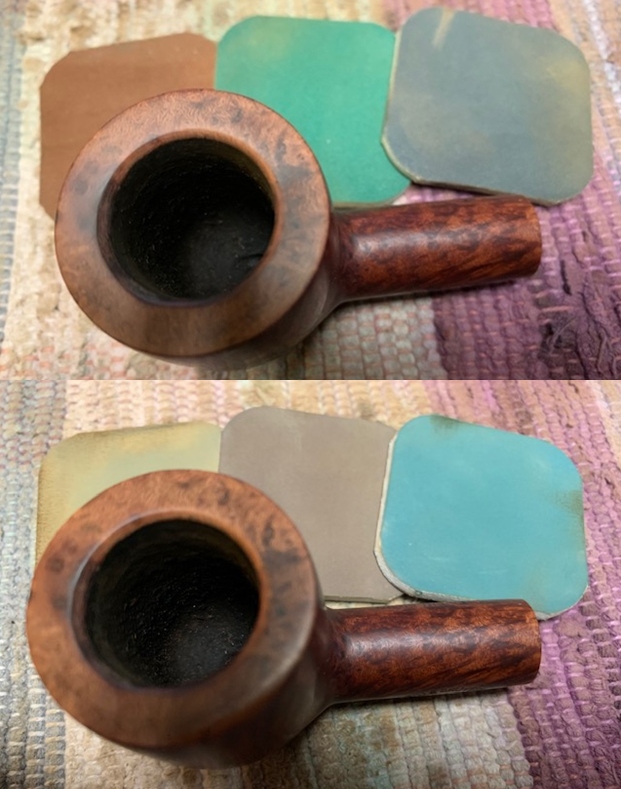
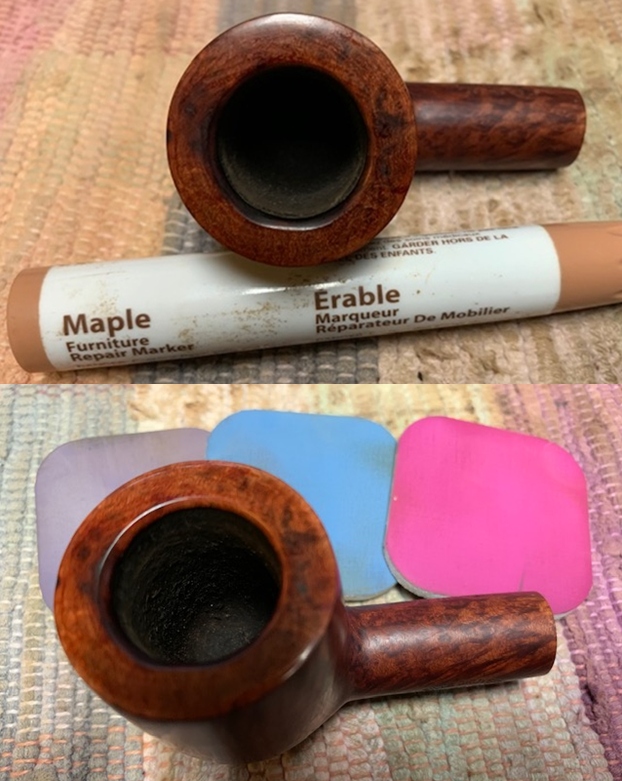
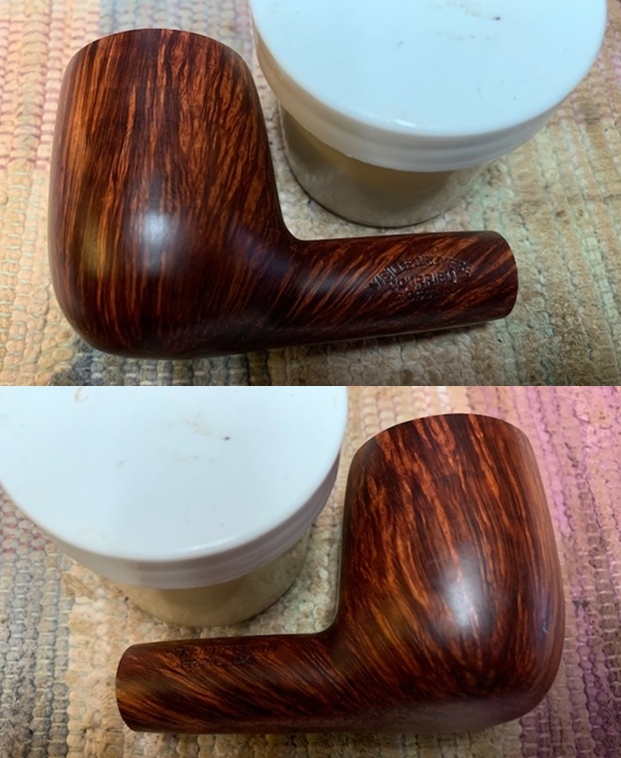
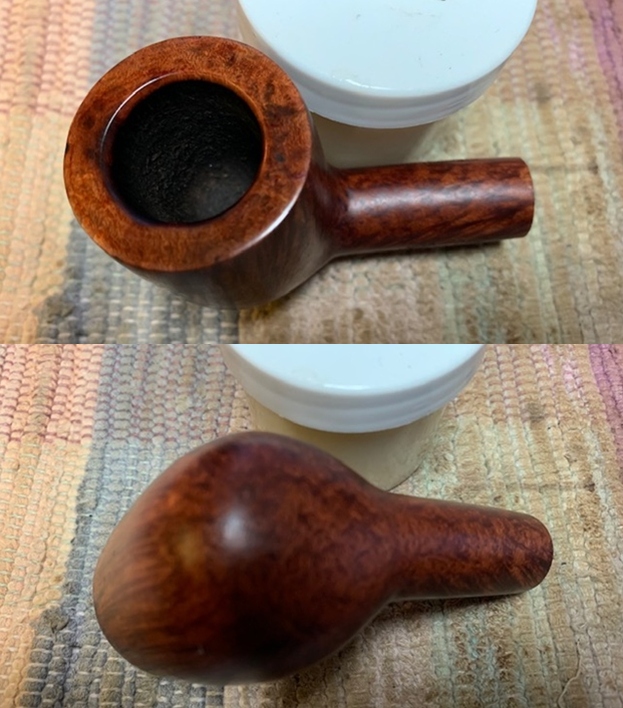
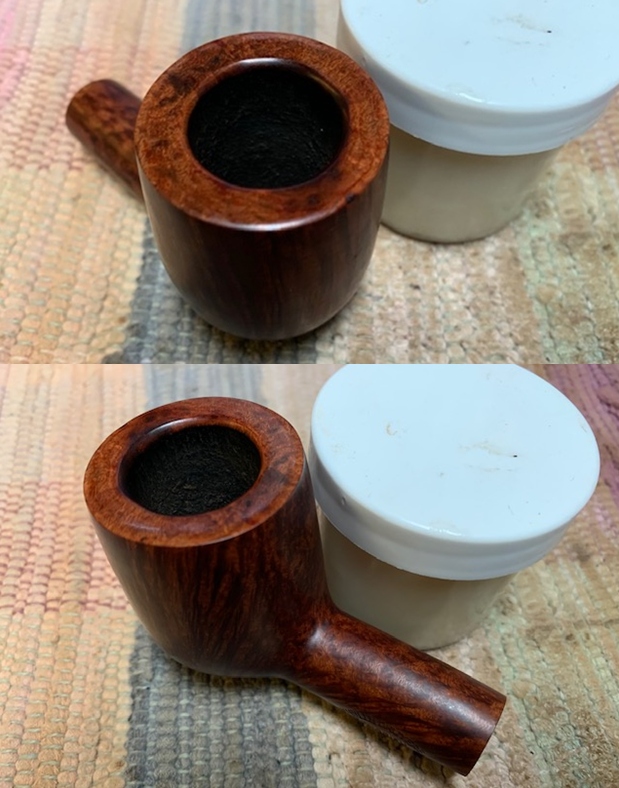
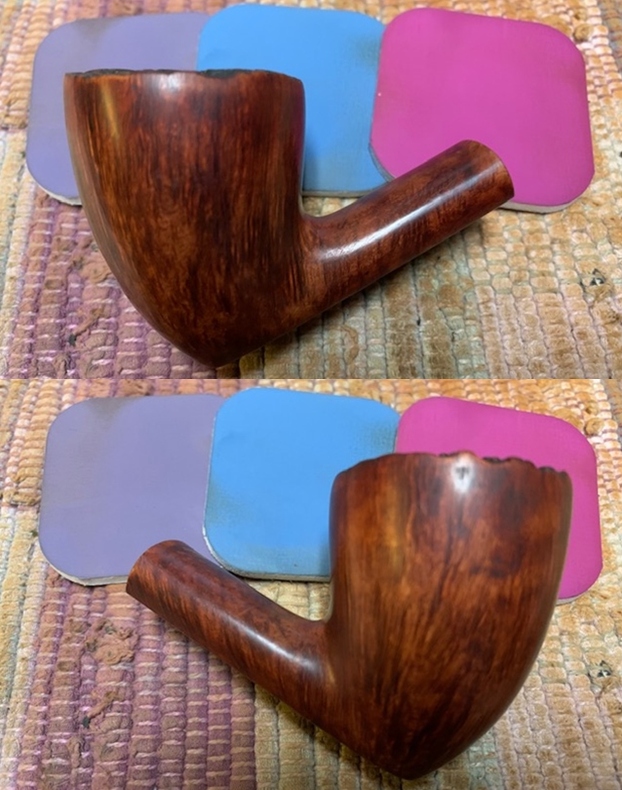
Armed with the information on the pipe maker I turned to work on the damage to the rim top and inner edges of the bowl. I sanded the damaged edge and gave it a slight inward bevel to alleviate the damage. I sanded out the burn marks as much as possible on the top of the rim with a folded piece of 220 grit sandpaper. I was able to minimize the damage on the top surface and the rim edge. I started polishing the edge and the top of the bowl with a 1500 grit micromesh sanding pad.  I polished the rim top of the rim with micromesh sanding pads. I wet sanded it with 1500-12000 grit pads and wiped the rim down after each sanding pad. The rim began to take on a good shine. After polishing it with the 4000 grit pad I restained the rim top with a Maple stain pen. I finished polishing the rim with 6000-12000 grit pads. I wiped the rim down with a damp cloth. I worked some Before & After Restoration Balm into the surface of the briar with my fingertips and a horsehair shoe brush to clean, enliven and protect the briar. I let the balm sit for about 15-20 minutes and then buffed it with a cotton cloth to raise the shine. The photos show the bowl at this point in the restoration process. With that done the bowl was finished other than a final buffing.  I set it aside and turned my attention to the stem. I polished the stem with micromesh sanding pads – wet sanding with 1500-12000 grit sanding pads. I wiped it down after each sanding pad with Obsidian Oil. I polished it with Before & After Pipe Stem Polish – both Fine and Extra Fine.     I am excited to finish this beautifully grained Courrieu Vieille Bruyere Straight Grain Billiard. I put the pipe back together and buffed it with Blue Diamond on the buffing wheel. I gave the bowl and the stem multiple coats of carnauba wax. I buffed it with a clean buffing pad to raise the shine and followed that with a quick hand buff with a microfibre cloth to deepen the shine. It is fun to see what the polished bowl looks like with the polished black vulcanite stem. This Courrieu Billiard is a great looking pipe and it feels great in my hand. It is light and well balanced. Have a look at it with the photos below. The dimensions are Length: 6 inches, Height: 2 inches, Outside diameter of the bowl: 1 ½ inches, Chamber diameter: 7/8 of an inch. It is a beautiful pipe. Thanks for walking through the restoration with me as I worked over this pipe. I am looking forward to seeing what my friend Lee thinks of the pipe after the restoration. Now that both of the pipes have been restored I will mail them back to them. Thanks to each of you who are reading this blog. Remember we are not pipe owners; we are pipemen and women who hold our pipes in trust until they pass on into the trust of the next pipeman or woman. 

New Life for a Republic Era Peterson’s Jade 150 Bulldog


Blog by Steve Laug

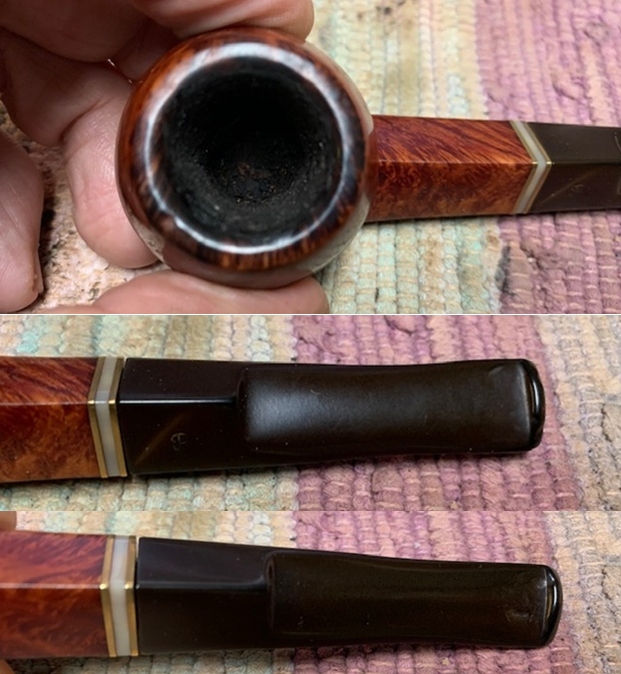
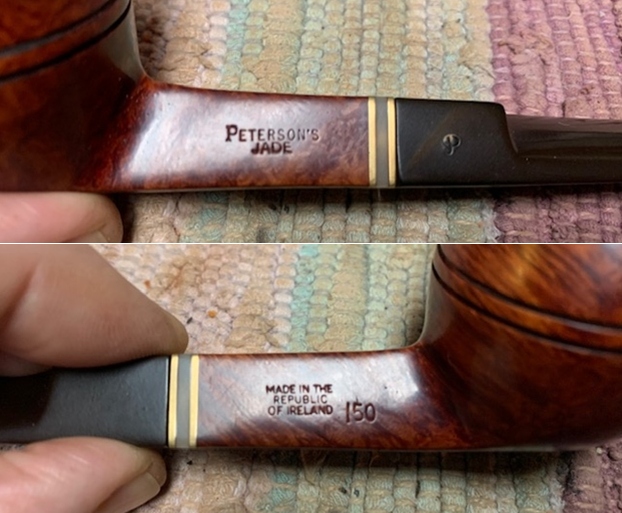
The next pipe I am working on came from a friend, Lee who lives in the US. It is a Peterson’s Straight Bulldog. It is stamped on the left side of the shank and reads Peterson’s [over] Jade. On the right side it is stamped Made in the [over] Republic [over] of Ireland followed by the shape number 150. He sent me an email detailing what he saw in the pipe and gave his assessment as well as several pictures of the pipe. He wrote:

The Peterson Bulldog is hardly in horrible shape, but would like you to go at this thing to bring to ‘showcase’ quality if possible. Of course, you’ll have to see the pipe first before expectations are set. He had picked it up on eBay. Would like you to take this to the best it could be – will leave it to you to assess, but will mention that the ‘jewel’ fastening between bowl and stem fascinates me as something for differentiate the pipe from the rest of my collection. Whatever you can do…

Here are the photos he included. The pipe arrived and I went over it to see what I thought of it before I started my work on it. Here is what I sent to Lee.

Peterson’s Republic Era Jade Bulldog.

  1. Bowl exterior is dirty with a few dings and dents in the ring and on the sharp diamond edges of the shank… particularly on the sides.
  2. Rim top is a bit of a mess. There are a lot of nicks and dings in the briar, some darkening and lava on the inner beveled edge of the bowl. The inner edge looks ok under the lava as far as I can see. Outer edge has some nicks and dings. Worn spots.
  3. Bowl internals show a heavy cake that greatly reduces the bowl capacity. Needs to be reamed and cleaned. Strong Latakia smell.
  4. Stem is scratched and lightly oxidized. There are deep tooth marks on both sides and a lot of tooth chatter marking the stem surface ahead of the button.

Overall in moderately good condition

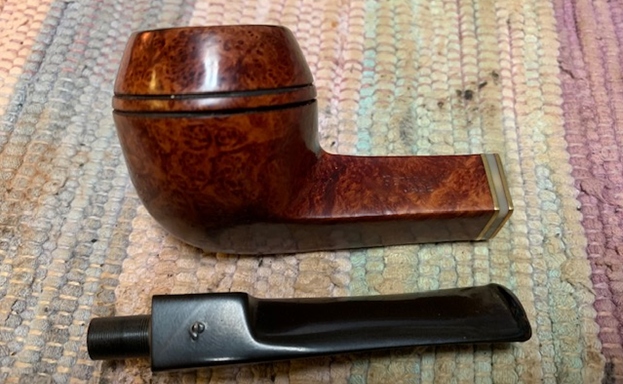
I took photos of the pipe before I started my cleanup work. They tell the story of what I have noted above in short form. They also give a glimpse of the promise that Lee saw in this pipe.  I took photos of the rim top and stem to show the condition of the bowl and stem. The interior the bowl had a heavy cake that overflowed like lava onto the rim top. There are dings and dents in the rim top and some darkening on the inner edge. The stem is oxidized, calcified and has deep tooth marks and chatter on the top and underside near the button.  The stylized P stamp on the top left side of the saddle is faded but present. I took photos of the sides of the shank to show the stamping. The stamping is readable in the photos below and is as noted above. The decorative band on the shank end is twin brass plates separated by a pearlized acrylic.       I took the stem off the shank and took a photo. It is a nice looking pipe and the shank end decorative piece looks very good.I am including the information from Pipedia’s article on Peterson pipes. It is a great read in terms of the history of the brand (https://pipedia.org/wiki/Peterson). I have included a bit of the pertinent history here.

1950 – 1989 The Republic Era – From 1950 to the present time, the stamp for this era is “Made in the Republic of Ireland” in a block format generally in three lines but two lines have been used with or without Republic being abbreviated.

During the 1950’s and 60’s the Kapp & Peterson Company was still in the ownership of the Kapp family. However 1964 saw the retiral of the company Managing Director Frederick Henry(Harry) Kapp.

I knew that I was dealing with a Republic Era pipe made between 1950-1989. It was a nice looking straight Bulldog with a unique shank end decoration. The finish was stained with a medium brown stain. Now it was time to work on the pipe.

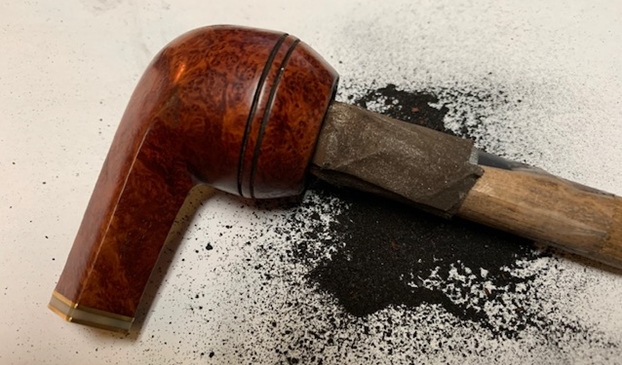
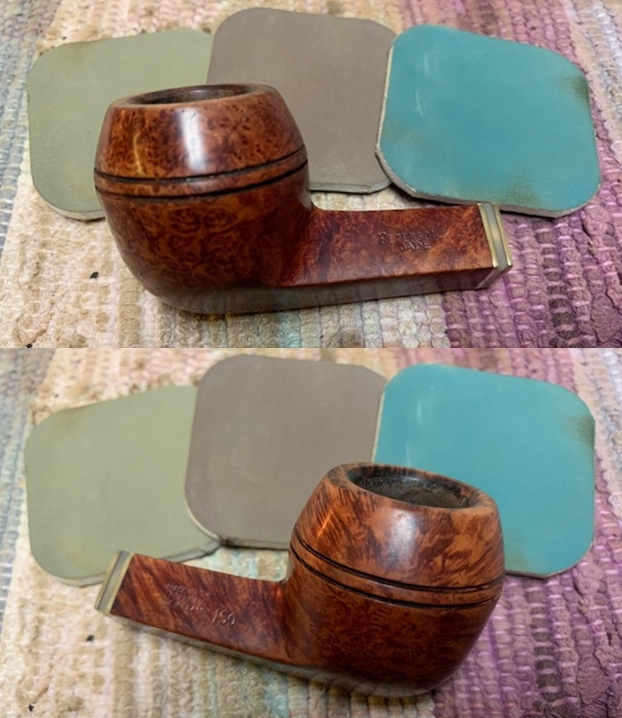
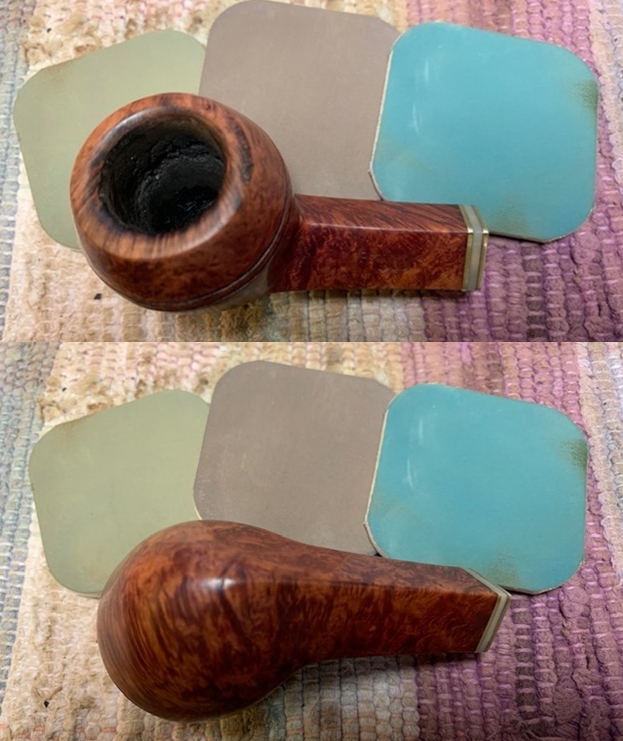
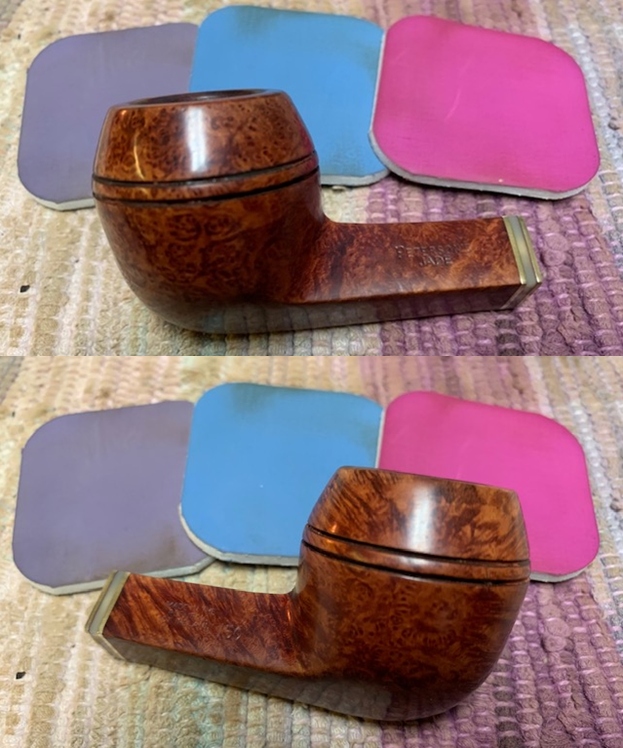
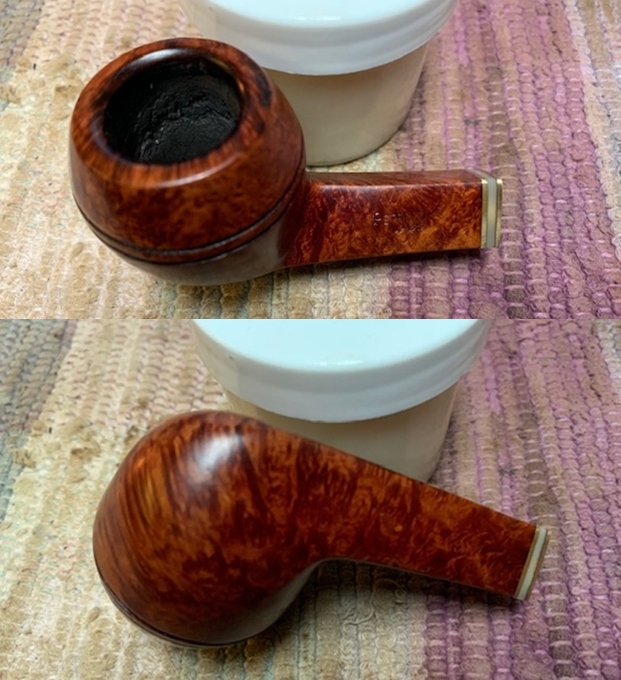
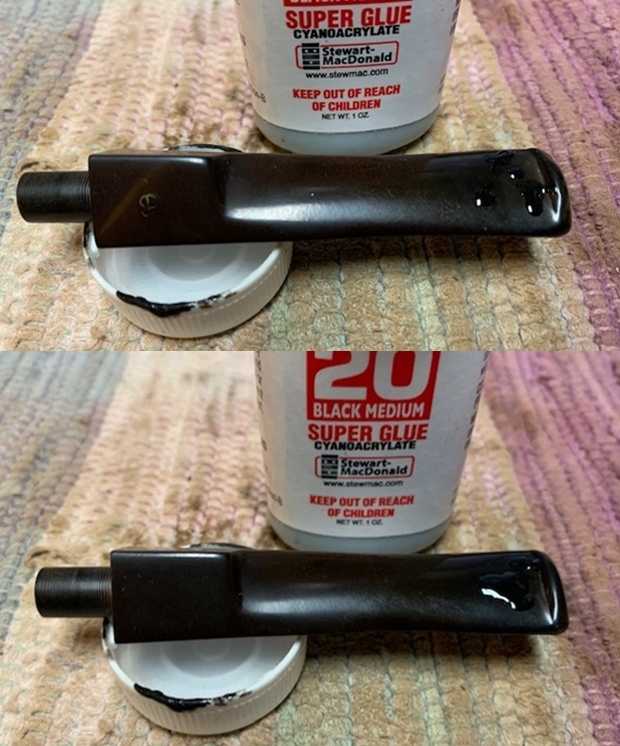
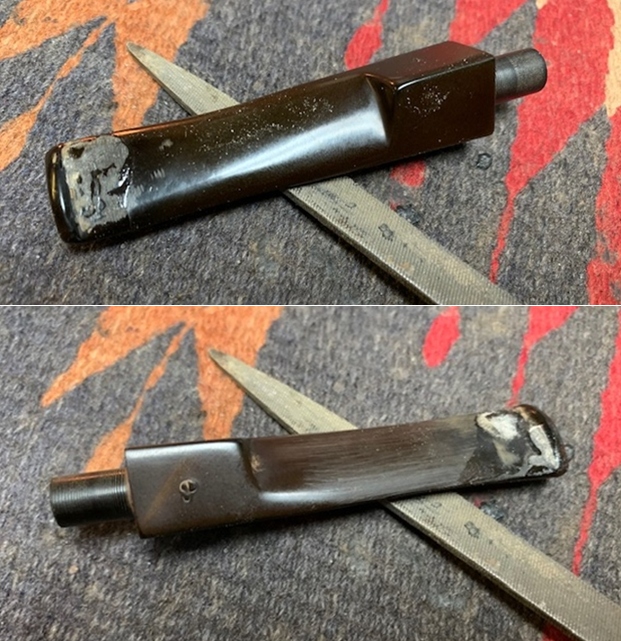
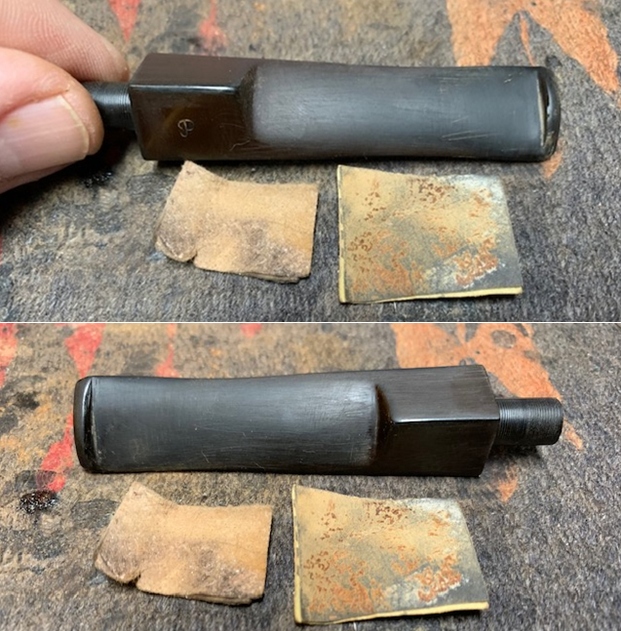
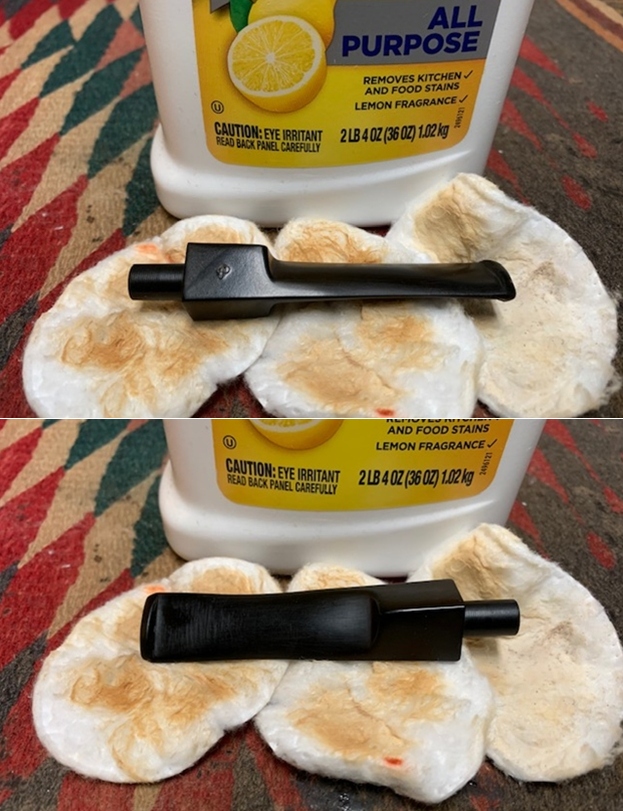
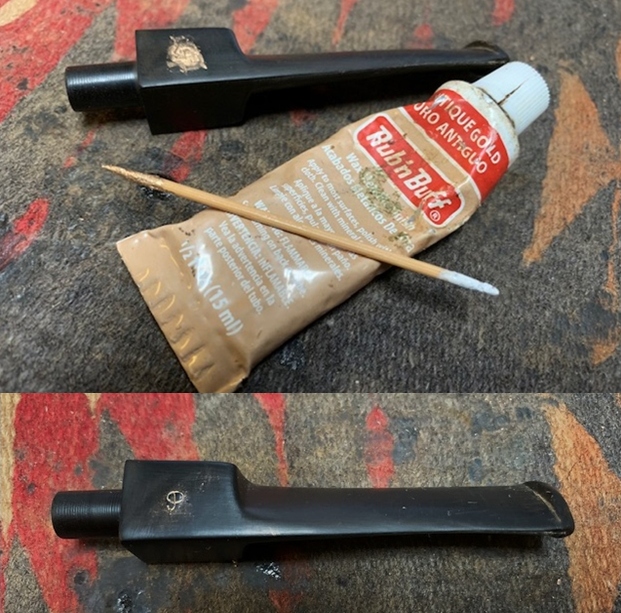
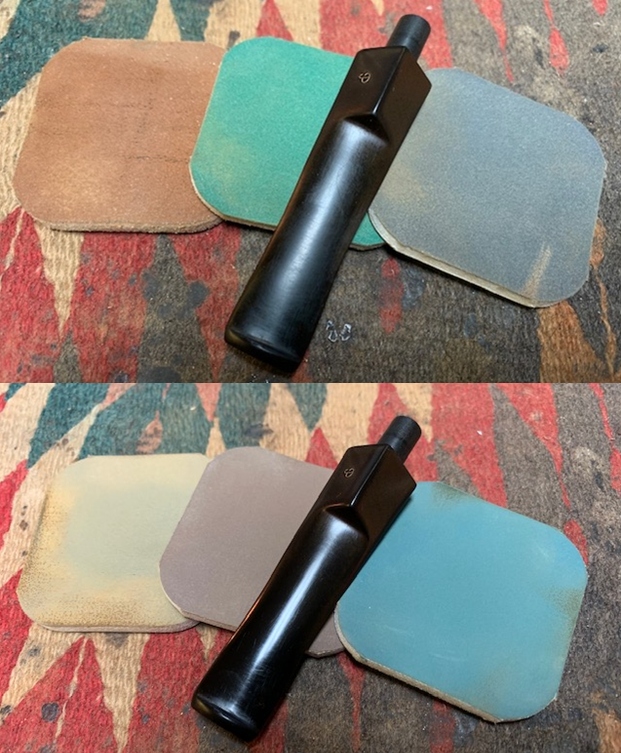
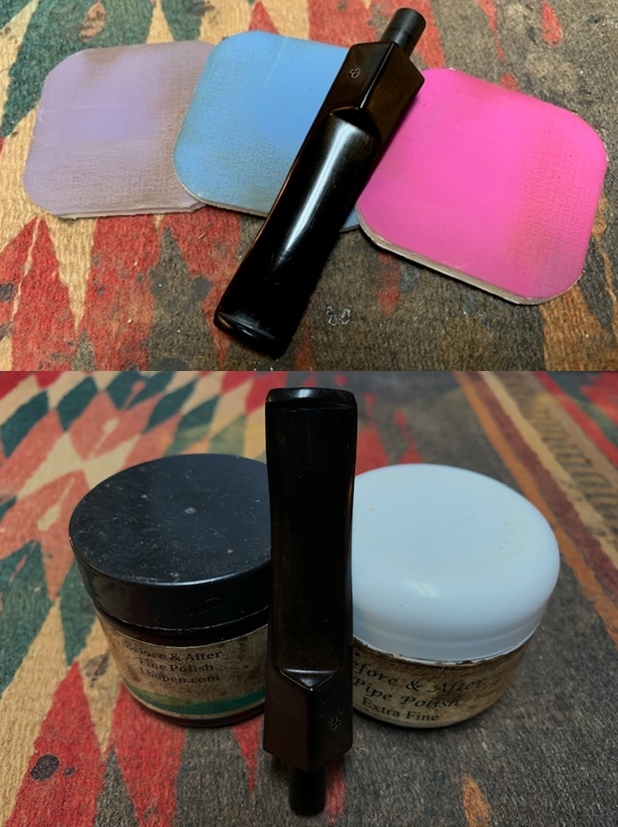
I decided to start my restoration work on this one by starting my cleanup of the bowl. I reamed the thick cake back with a PipNet pipe reamer using the smallest cutting head on this petite pipe. The cake was thick and crumbly and came out easily. I followed that by cleaning up the remnants of cake with a Savinelli Fitsall Pipe Knife and finish with a piece of dowel wrapped in 220 grit sandpaper. I decided to deal with the damaged rim top next. I lightly topped the bowl to remove the significant dents and damage to the top and outer edge. It did not take too much work to remove it. I used a folded piece of 220 grit sandpaper to smooth out the bevel on the inner edge of the bowl and remove the burn damage there. It came out looking much better. Once it is polished it will look very good and match the finish on the bowl quite well.I wiped off the exterior of the bowl with a damp cloth to remove the sanding dust and grime. Once it was clean it was time to deal with the interior. I scrubbed out the shank and the airway in the stem with pipe cleaners, cotton swabs and alcohol to remove the tars and oils. There was also some brown stain that came out of the inside of the shank  and the end of the stem.  I polished the rim top and bowl with micromesh sanding pads – wet sanding with 1500-12000 grit pads. I wiped the briar down after each pad with a damp cloth. The photos tell the story of the progress of the rim and bowl.   I worked some Before & After Restoration Balm into the surface of the briar with my fingertips and a horsehair shoe brush to clean, enliven and protect the briar. I let the balm sit for about 15-20 minutes and then buffed it with a cotton cloth to raise the shine. The photos show the bowl at this point in the restoration process. With that done the bowl was finished other than a final buffing.  I set it aside and turned my attention to the stem. I “painted” the surface of the stem to lift the tooth marks and dents I was able to lift many of them but several remained on the top and underside near the button. I filled them in with black superglue and set them aside to cure. Once they had cured I smoothed them out with a file to start to blend them into the surface of the stem. I sanded the repaired areas with 220 grit sandpaper to smooth out the repairs. I started the polishing with 400 grit wet dry sandpaper.   I scrubbed the surface of the stem to remove the remaining oxidation with Soft Scrub all Purpose cleanser. I rubbed it on and off with a cotton pad and was able to remove a lot of oxidation.    I touched up the P stamp on the left side of the saddle with Rub’n Buff Antique Gold. I applied it to the stamping with a tooth pick. I buffed it off with a paper towel and was pleased by the gold left behind in the stamp.  I polished the stem with micromesh sanding pads – wet sanding with 1500-12000 grit sanding pads. I wiped it down after each sanding pad with Obsidian Oil. I polished it with Before & After Pipe Stem Polish – both Fine and Extra Fine.     I am excited to finish this Republic Era Peterson’s Jade 150 Bulldog. I put the pipe back together and buffed it with Blue Diamond on the buffing wheel. I gave the bowl and the stem multiple coats of carnauba wax. I buffed it with a clean buffing pad to raise the shine and followed that with a quick hand buff with a microfibre cloth to deepen the shine. It is fun to see what the polished bowl looks like with the polished shank decoration on the end and the black vulcanite stem is a great contrast of colour. This Peterson’s Jade Bulldog is a great looking pipe and it feels great in my hand. It is light and well balanced. Have a look at it with the photos below. The dimensions are Length: 5 ¾ inches, Height: 1 ¾ inches, Outside diameter of the bowl: 1 ¼ inches, Chamber diameter: ¾ of an inch. It is a beautiful pipe. Thanks for walking through the restoration with me as I worked over this pipe. I am looking forward to seeing what my friend Lee thinks of the pipe after the restoration. One more of his to restore then I will mail them back to them. Thanks to each of you who are reading this blog. Remember we are not pipe owners; we are pipemen and women who hold our pipes in trust until they pass on into the trust of the next pipeman or woman.

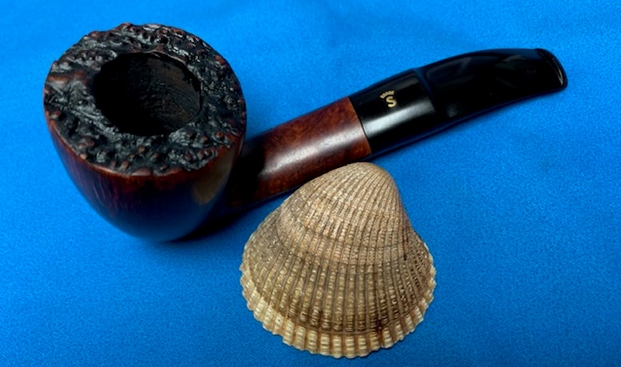
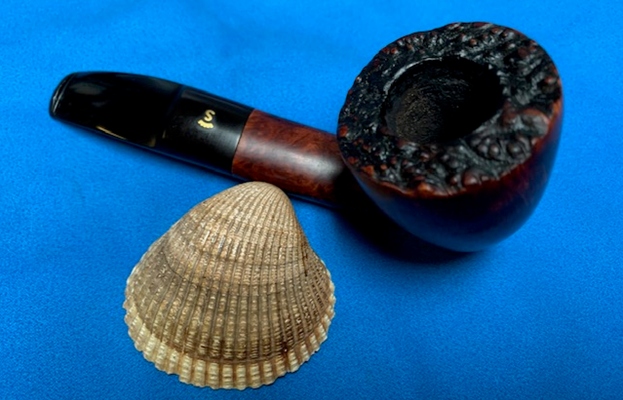
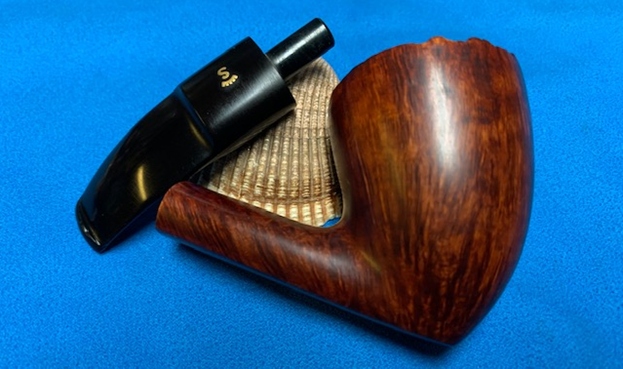
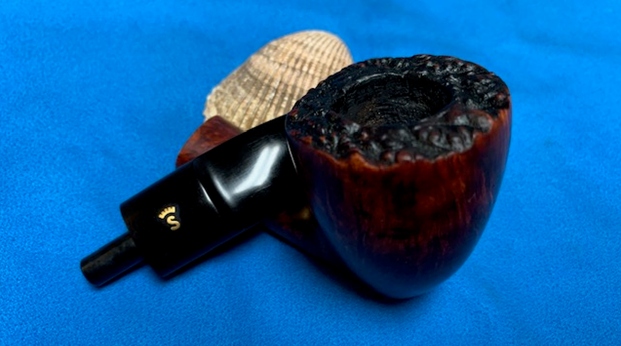
Breathing New Life into a Stanwell Golden S Dublin 64


Blog by Steve Laug

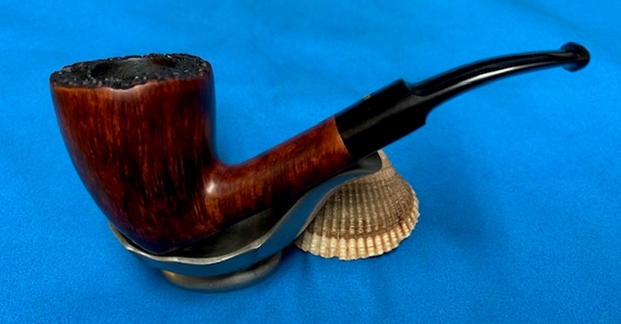
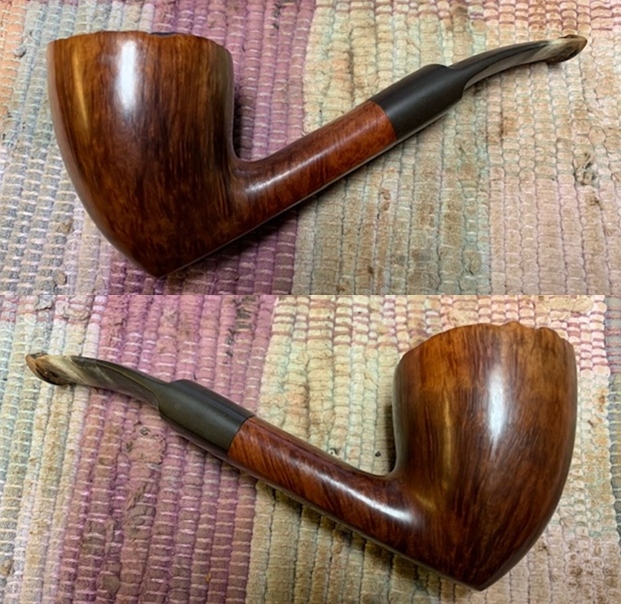
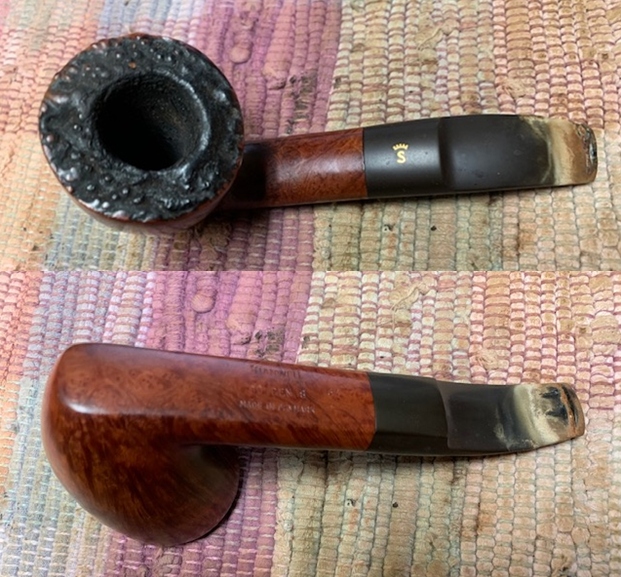
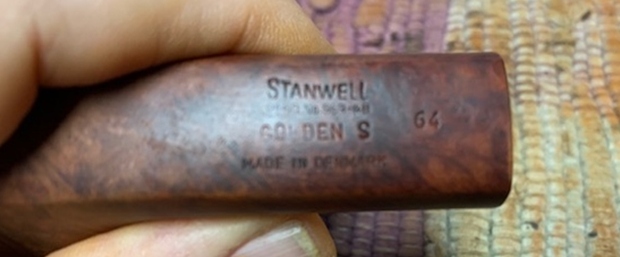
The next pipe on the work table came to me from either a trade I made (pipes for labour) or a find on one of my pipe hunts. I honestly don’t remember where it came from. It has been around for a while waiting to be worked on. It is a beautifully grained Stanwell Golden S Dublin that really looks quite nice. The stamping is clear and readable. It is stamped on the underside of the shank and reads Stanwell [over] Regd. No. 969-48 [over] Golden S [over] Made in Denmark. To the right of that stamping is the shape number 64. The pipe had a lot of grime ground into the smooth finish on the bowl and some darkening around the sides of the bowl. The bowl was heavily caked and had an overflow of thick lava on the plateau rim top. It was hard to know what the rim top and inner edge of the bowl looked like under the grime. The stem was calcified, oxidized and had light tooth chatter and marks on the top and underside and the top surface of the button had a tooth mark. There an inset golden Crowned S on the top of the saddle stem. The pipe had promise but it was very dirty. I took photos of the pipe before he started his cleanup work. I took photos of the rim top and bowl to give a clear picture of the thickness of the cake and the overflow of lava on the rim top. It is hard to know for sure if there is damage to the inner edge of the bowl because of the thickness of the lava coat. I also took photos of the top and underside of the stem to show the oxidation, calcification, light chatter and tooth marks.     I took a photo of the stamping on the underside of the shank. It reads as noted above and is clear and readable. There is a gold Crown S logo on the top of the saddle stem.I looked on Pipephil’s site for information on the Stanwell Regd. No. 969-48 Golden S line and found the following information (http://www.pipephil.eu/logos/en/logo-stanwell.html). I found one piece of information on the Regd. No. that was helpful to me. I quote:
The “Regd. No.” stamping discontinued in late 1960s to very early 1970s

I also went to Pipedia and read the article on the Stanwell brand. It is a great read and worth the time to read it (https://pipedia.org/wiki/Stanwell). There was a note toward the end of the article on the Golden S series. I quote that note below:

Golden S: This series was last produced in the mid to late 1970s. Its distinguishing mark was an 18 carat gold Stanwell logo, crown and “S”, on the mouthpiece.

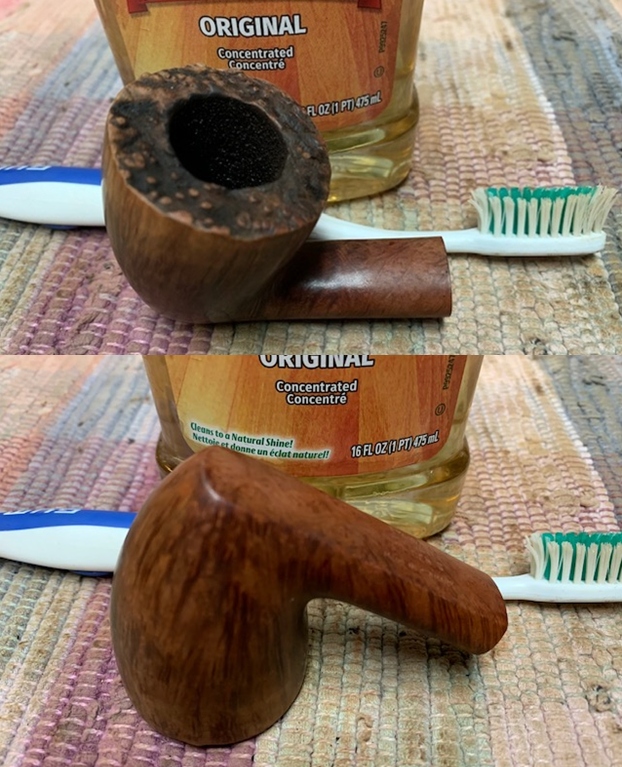
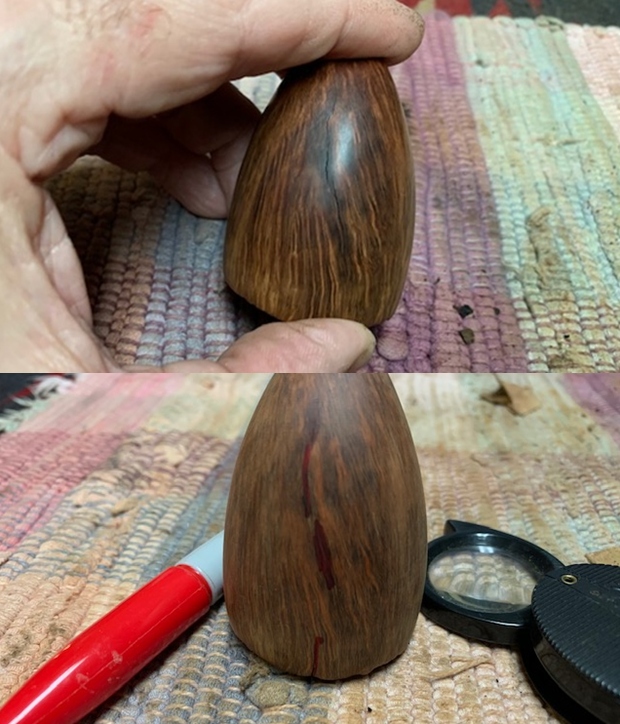
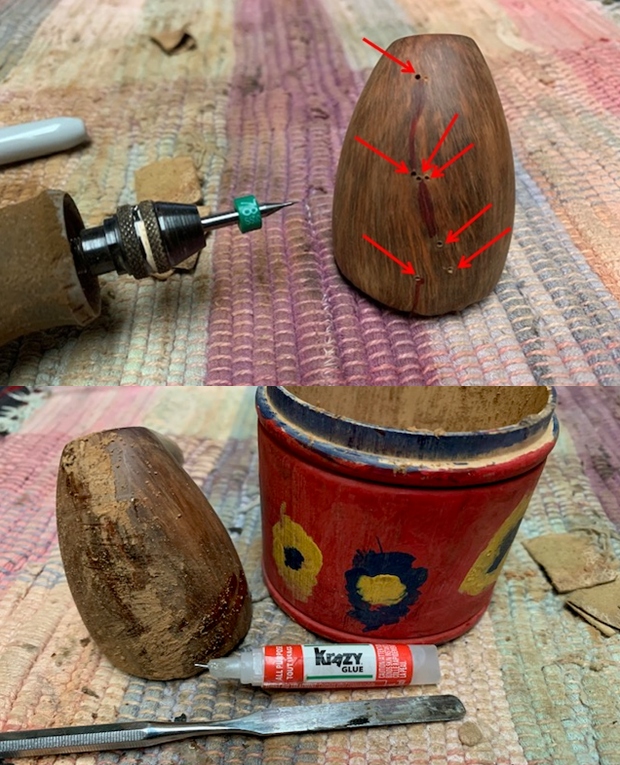
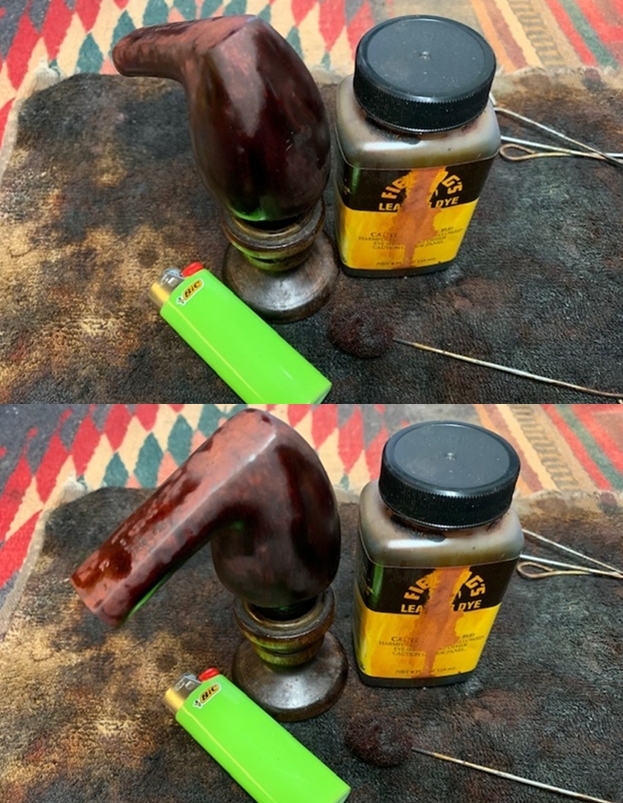
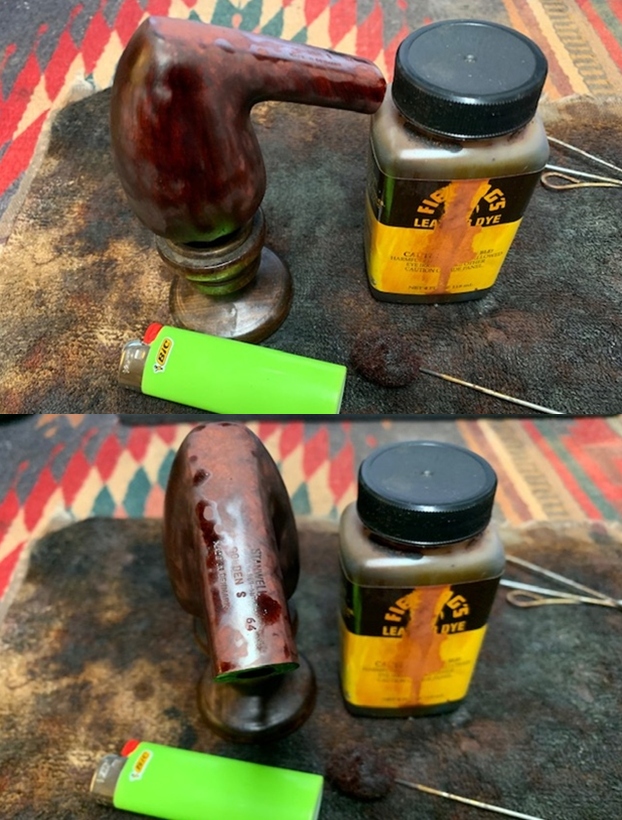
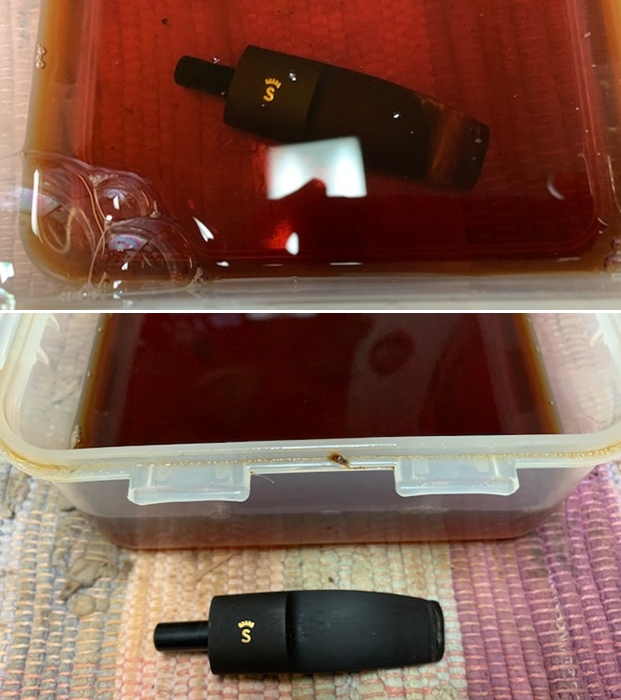
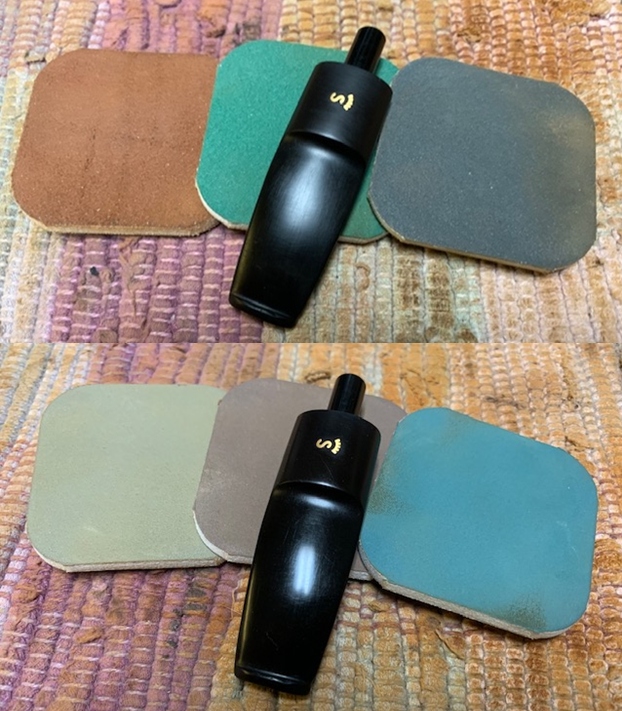
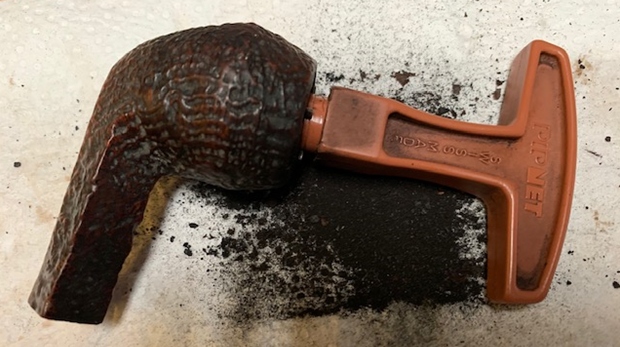
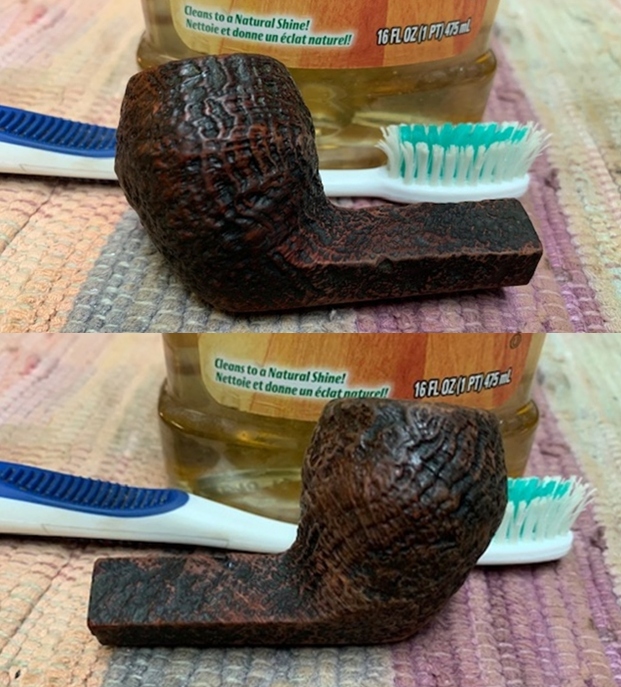
Now it was time to work on the pipe. I have to say it once again that I am really spoiled having Jeff clean up the pipes for me. Having to start with them in this condition adds time. I reamed the bowl with a PipNet pipe reamer using the first two cutting heads. I followed up by scraping the remaining cake with a Savinelli Fitsall Pipe Knife. I finished cleaning up the cake in the bowl with a piece of dowel wrapped in 220 grit sandpaper to smooth out the walls of the bowl.  I used a dental pick to pick out the lava in the plateau finish on the rim top. I used a brass bristle wire brush to remove the debris from the finish. The rim top cleaned up really well with the lava coat removed. I scrubbed the exterior of the bowl and rim top with a tooth brush and undiluted Murphy’s Oil Soap to remove the debris from the finish. I rinsed the bowl with warm water to remove the grime and soap and dried it off with a soft towel. While I was scrubbing the bowl I felt a rough spot on the front of the bowl. I examined it and found cracks on the front. There was a short one at the top from the rim down about ½ inch and below that were two further cracks extending down the height of the bowl. None of them go through to the inside of the bowl and are quite shallow. In the second photo below I showed the line of the crack with red ink. I used a microdrill bit on the Dremel to drill pin holes at the ends of each crack. You will see 7 pin holes in the photo below. I filled in the drill holes and the cracks with briar dust and clear super glue. Once the repair cured I sanded it smooth with 220 grit sandpaper and followed that with 1500-2400 grit micromesh sanding pads.  I stained the bowl with a dark brown aniline stain and flamed it with a Bic lighter to set it in the grain. I repeated the process until the coverage of the briar was even and the repaired areas were hidden.  I stained the plateau rim top with a black stain pen to highlight the grooves in the finish. I wiped the bowl down with alcohol on a paper towel to remove the excess stain and bring the grain to the surface. I polished the bowl and the rim top, sides and shank with micromesh sanding pads –sanding with 1500-12000 grit pads and wiping it down after each pad with a damp cloth. I rubbed the bowl and shank down with Before & After Restoration Balm. I worked it into the surface of the bowl sides and shank with my fingertips to clean, enliven and protect the briar. I let the balm sit for a little while and then buffed with a cotton cloth to raise the shine.   While I was working on the bowl the stem was soaking in Briarville Pipe Repair’s – Pipe Stem Oxidation Remover. The stem sat in the mixture for 2 ½ -3 hours. I removed the stem from the bath, scrubbed lightly with a tooth brush and dried if off with a paper towel. I was surprised that it was quite clean. Just some light tooth marks on the button and underside of the stem near the button.   I filled in the small tooth marks on the surface of the stem on both sides with clear super glue. Once the repairs cured I sanded the stem with 220 grit sandpaper and started polishing it with 400 grit wet dry sandpaper.  I polished the vulcanite stem with micromesh sanding pads – 1500-12000 grit pads. I wiped it down with a damp cloth after each sanding pad. I used Before & After Pipe Polish – both Fine and Extra Fine to further polish the stem. At this point it dawned on me that I had not cleaned the inside of the shank or stem… boy I am rusty at this and have to tick off the steps! I cleaned the shank and the airway in the stem with alcohol, cotton swabs and pipe cleaners until the pipe smelled and looked clean.  This beautiful Stanwell Golden S shape 64 Dublin with a vulcanite saddle stem is a great looking pipe now that it has been restored. The rich browns and blacks of the contrasting stains on the bowl and the plateau rim top came alive with the polishing and waxing. The repairs to the cosmetic cracks on the front of the bowl blended in very well. I put the stem back on the bowl and carefully buffed the pipe with Blue Diamond on the buffing wheel using a light touch on the briar. I gave the bowl and the stem multiple coats of carnauba wax on the buffing wheel and followed that by buffing the entire pipe with a clean buffing pad. I hand buffed the pipe with a microfiber cloth to deepen the shine. The finished Stanwell Golden S Dublin is a beauty and fits nicely in the hand and looks very good. Give the finished pipe a look in the photos below. The dimensions of the pipe are Length: 5 ½ inches, Height: 2 inches, Outside diameter of the bowl: 1 ½ inches, Chamber diameter: ¾ of an inch. If you are interested in adding this pipe to your collection send me a message or an email. Thanks for reading this blog and my reflections on the pipe while I worked on it. There are many more to come!
Restemming and Rebirthing a L’Artigiana Italian Made Freehand


Blog by Steve Laug

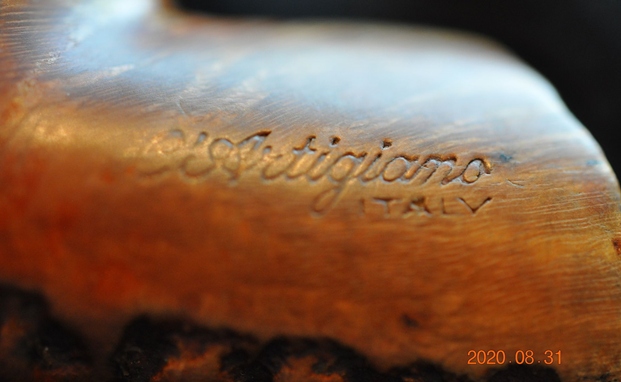
The next pipe in the queue came to us from a recent pipe hunt that Jeff and his wife did in Utah. It is an interesting Freehand bowl that has a heavy rustication around the bowl and shank and a plateau rim top and shank end. It has a smooth panel on the left side where it is stamped. It reads L’Artigiana [over] Italy. I think that this will be another nice looking piece once it is cleaned up and restemmed. The bowl is thickly caked with an overflow of lava filling in much of the plateau rim top. The rustication around the bowl and shank are very deep and craggy and filled in with a lot of dust and debris. The top and edges of the bowl look good but I would be more certain once I reamed and cleaned it. The exterior of the briar was dirty with grime and dust. Jeff took photos of the pipe before my cleanup work. They tell the story and give a glimpse of the promise that we see in this pipe. He took a photo of the plateau rim top to show the cake in the bowl, the lava on the rim top and the inner edge.  The lava coat on the rim top filled in the plateau top to the point of the valleys being filled in.The next photos show the rustication portions of the bowl. The dust and debris has filled in many of the deepest grooves in the rustication. It is a pretty nice looking pipe under the grime.   He took photos of the stamping on the left side of the shank. It is faint on the left end but is otherwise readable in the photo below and is as noted above. I turned to Pipedia to read about L Artigiana Pipes. There was no specific listing for the brand but under the Makers list it was listed as a sub brand or second connected the brand to Cesare Barontini (https://pipedia.org/wiki/Italian_Pipe_Brands_%26_Makers_K_-_L). Quote:

Cesare Barontini sub-brand / second.

From there I turned to the article that I have read previous on Pipedia about Ceare Barontini (https://pipedia.org/wiki/Barontini,_Cesare).

In 1890 Turildo Barontini opened a factory for the production of briar. In 1925 his son Bruno began to produce the first pipes. Cesare Barontini, son of Bruno, started direction of the factory in 1955, and still runs it together with his daughters Barbara and Silvia.

Sub-brands & Seconds:

Aldo Velani

Cesare

L’artigiana

Stuart

Cortina

See also Barontini, Ilio, Cesare’s cousin.

I love the description as it truly captures the shape and beauty of this freehand pipe. The article above stated that the pipe is handcrafted by artists so that each one is a unique piece. It is cut from the plateau to leave that exposed on the top of the rim and down the shank to the end. It has a thumb hole cut for comfort in holding it while smoking. It is suggested that pipe sold for $60. Now to work on the pipe.

Jeff had cleaned up the pipe with his usual penchant for thoroughness. He reamed the pipe with a PipNet pipe reamer and removed the rest of it with a Savinelli Fitsall Pipe Knife.  He scrubbed the bowl with undiluted Murphy’s Oil Soap with a tooth brush. He rinsed it under running warm water to remove the soap and grime. He cleaned out the inside of the shank and the airway in the stem with alcohol, cotton swabs and pipe cleaners. He soaked the stem in Before & After Deoxidizer and rinsed it off with warm water. It looked very good but I forgot to take photos of the bowl when I brought it to the table – one of those days I guess. You will get a feel for it in the photos below.

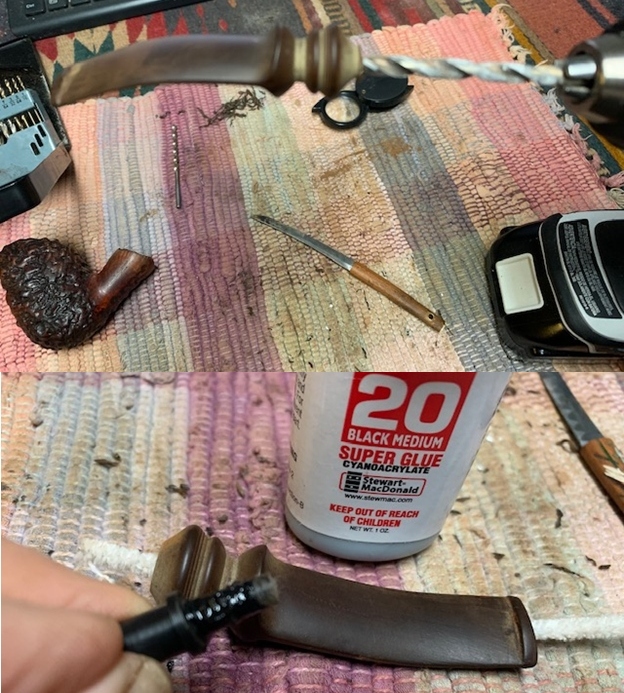
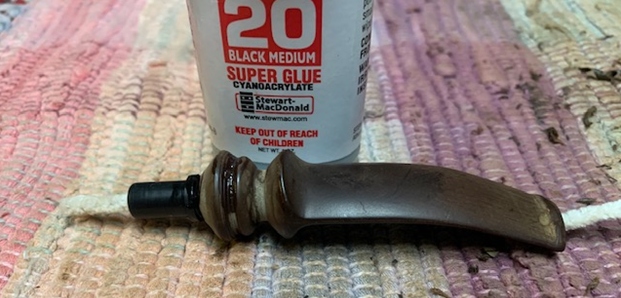
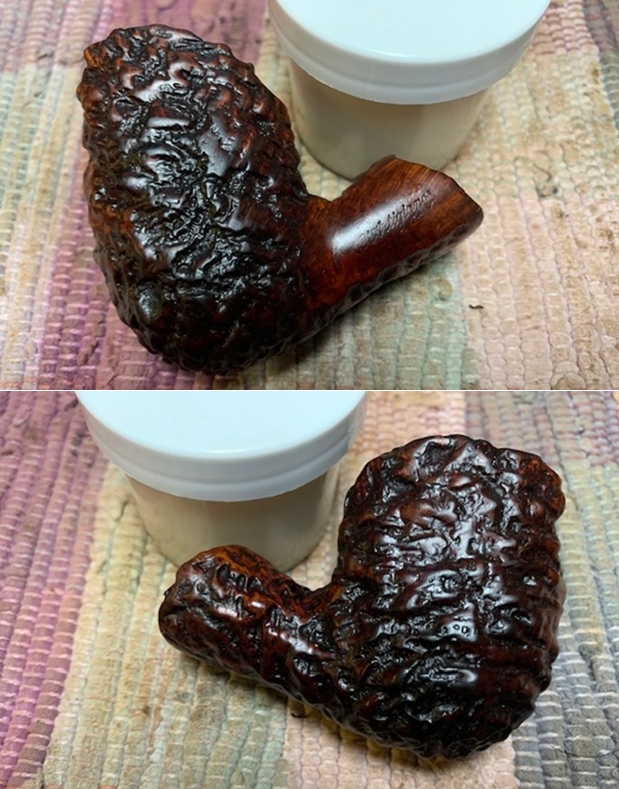
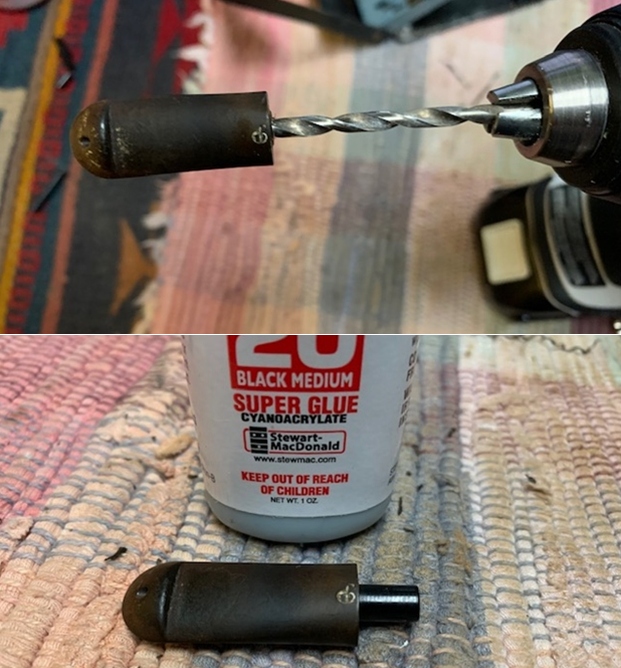
I found a perfect fancy stem for the pipe in my stem can that was a potential candidate for the pipe. The issue with it was that the tenon had broken somewhere in its life. I tend to keep this kind of thing around as I have learned that I seem to always have a use for them. I drilled out the airway with a series of drill bits starting with one slightly larger than the airway in the stem and ending with one that would fit the threaded end of the new tenon. I put a pipe cleaner in the airway and painted the threaded tenon end with black super glue. I threaded the new tenon onto the pipe cleaner and pressed it into the hole in the stem. I set it aside to let the glue cure while I worked on the bowl. Now you will finally see the bowl! I worked some Before & After Restoration Balm into the surface of the briar with my fingertips and a horse hair shoe brush to clean, enliven and protect it. I let the balm sit for a little while and then buffed with a cotton cloth to raise the shine. I set the bowl aside and turned my attention to the stem. Eventually I would need to soak it in Briarville’s Deoxidizer but I had some work to do first to clean the damages to the stem. I “painted” the tooth marks with the flame of a Bic lighter and was able to raise all of them on the underside and all but one on the top side.  Before I put the stem in the soak I decided to put it in the shank and take pictures of the pipe at this point in the process. I am really pleased with the overall look. Once the vulcanite is polished the stem will look perfect with the pipe. I removed the stem from the pipe and put it in the bath of Briarville’s Pipe Stem Oxidation Remover overnight to let it do its magic. When I took it out of the bath I dried it off with a paper towel and rubbed off the product it had softened the oxidation but did not remove it. Lot of sanding and polishing remained on this one.I sanded the top surface of the stem and filled in the tooth mark along the button with black super glue. Once the glue cured I used a small file to flatten out the repair. I followed that by sanding the entire stem with 220 grit sandpaper to remove the oxidation remaining on the stem. I started to polish the stem with 400 grit wet dry sandpaper.I polished the vulcanite with micromesh sanding pads – 1500-12000 grit pads. I wiped it down with Obsidian Oil after each sanding pad. I used Before & After Pipe Polish – both Fine and Extra Fine to further polish the stem.     With both parts of this unique L’Artigiana Freehand finished, I polished the bowl and the stem with Blue Diamond polish on the buffing wheel. I gave the bowl and the stem multiple coats of carnauba wax. I buffed the pipe with a clean buffing pad to raise the shine. I hand buffed it with a microfiber cloth to deepen the shine. The pipe polished up pretty nicely. The mix of grain on the bowl came alive with the buffing. The finish on the briar works well with the polished black vulcanite stem. The finished pipe is a well-proportioned, nicely grained L’Artigiana Freehand. Have a look at it with the photos below. The dimensions are Length: 6 inches, Height: 2 ¾ inches, Outside diameter of the bowl: 1 ¾ inches, Chamber diameter: ¾ of an inch. This interestingly made Freehand will be going onto the rebornpipes store very soon. If you would like to purchase it and carry on the legacy of the previous pipe smoke send a message or an email to me. Thanks for walking through the restoration with me on this Italian Made L’Artigiana pipe. 

I was Gifted an LB Stem for my Dunhill Shell Briar LB F/T Chunky Billiard


Blog by Steve Laug

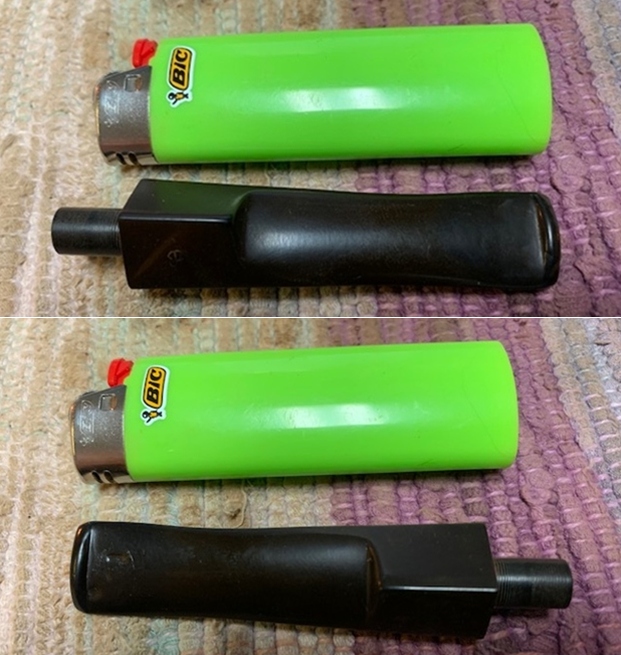
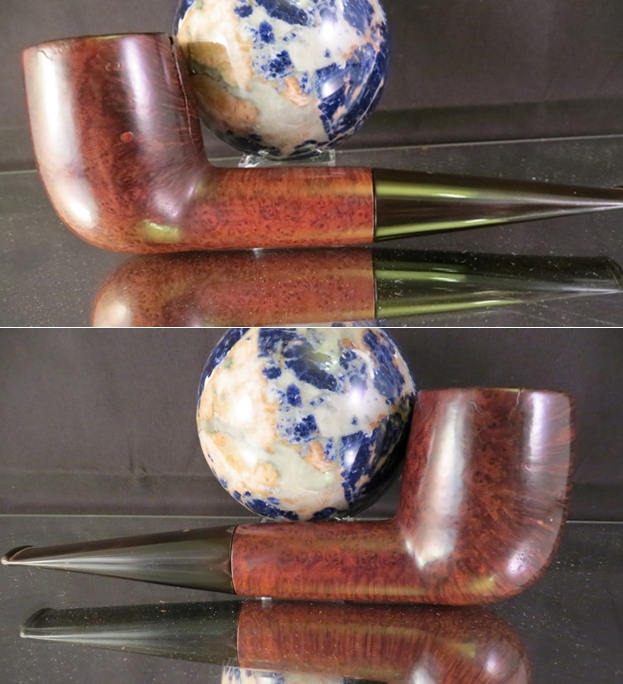
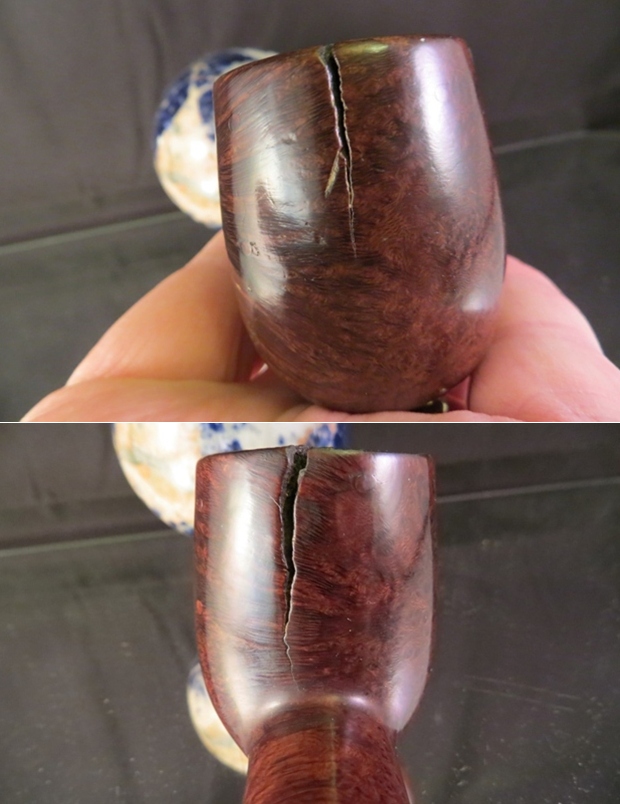
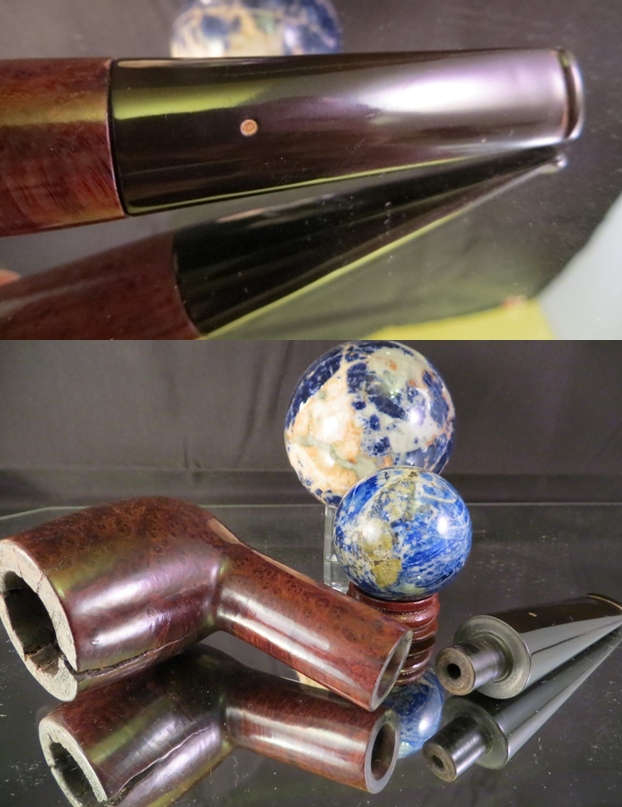
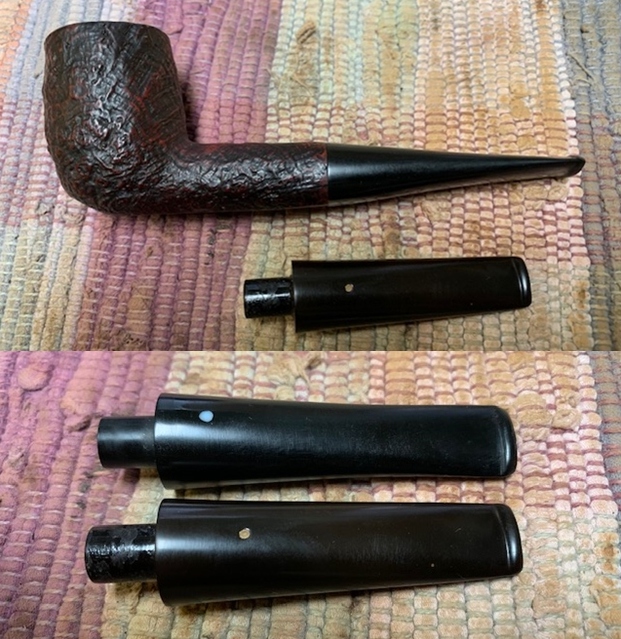
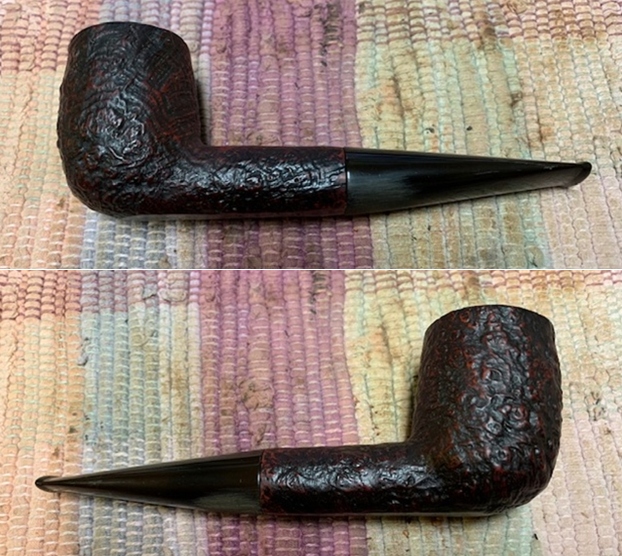
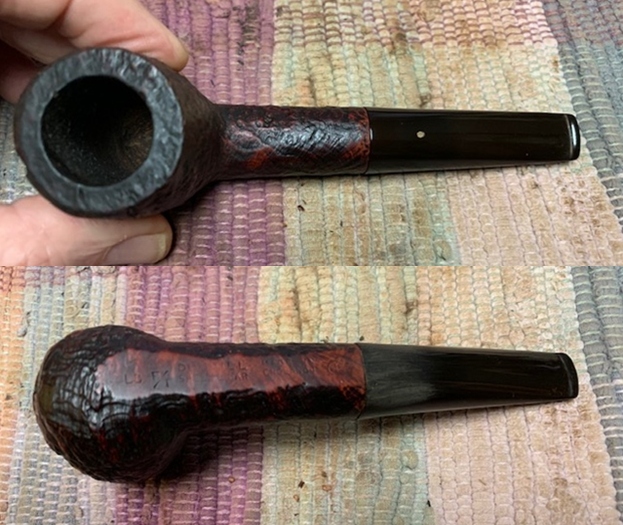
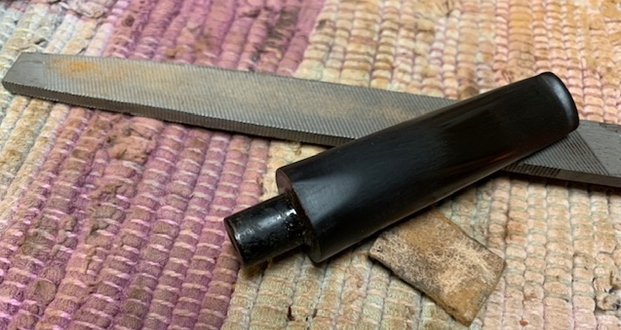
When I restored this Dunhill Shell Briar LB F/T Chunky Billiard I closed the blog asking that if anyone came across a stem for an LB that they would be willing to part with to contact me as I really wanted a Dunhill stem on this pipe (https://rebornpipes.com/2020/07/26/breathing-life-into-a-1968-dunhill-shell-briar-lb-f-t-group-4-billiard/). The pipe is a beautiful sandblasted Billiard with the unique Dunhill Sandblast finish made in 1968 (since that time I am leaning toward a 1958 date for the pipe). It is a great looking pipe that is in almost new condition. The dark finish that is identified as a black stain highlights some great grain around the bowl sides and the heel. It has some great rugged sandblast that Dunhill specialized in making. The finish on the pipe is in excellent condition and the repaired area on the front outer edge of the rim top looks very good. The mix of stains works well to highlight the grain. The polished black replacement vulcanite taper replacement stem adds to the mix. I had drilled and inserted a blue dot on the top of the stem to get by while I hunted for a proper stem. Here are some photos of the pipe once I had finished the restoration of both the bowl and stem. Not too long ago I was on one of the Facebook pipe groups and David Andrew Goostree of Banjo Bob’s Fine Pipes posted a picture of a Dunhill LB with a ruined bowl – vertical cracks all around the bowl that he was willing to part with. I quickly wrote him a note to see what he wanted for it as I had the above LB that needed the stem from his ruined bowl. We exchanged a few messages back and forth and he sent the pipe to me. It arrived in Canada yesterday (Monday) and David had included a small sample of Old Gowrie in the box.  Here are a few pictures that David sent me of the pipe before he sent it.   I took a photo of the new stem next the pipe and replacement stem and then of the two stems side by side. The look and shape is similar. I tried the stem on the shank of the LB bowl that I had and the fit was perfect in the shank. The bowl I have has a flat bottom so I would need to flatten the bottom of the stem to match the shank but other than that the fit was good. I took some photos of the fit to send to David. I had already started the shaping of the underside because I was impatient to see what it would look like. I am including those photos below so you can see the fit in the shank. I used a rasp/flat file to flatten the bottom of the stem to match the flow of the shank. I smoothed out the flattened area with 220 grit sandpaper to remove the file marks in the vulcanite.The stem had some tooth marks in the surface on both sides ahead of the button. I “painted” the surface with the flame of a Bic lighter and the tooth marks lifted. I would easily be able to sand the remnants out with micromesh. I polished the stem with micromesh sanding pads – wet sanding with 1500-12000 grit sanding pads. I wiped it down after each sanding pad with Obsidian Oil. I polished it with Before & After Pipe Stem Polish – both Fine and Extra Fine.     With the stem fitting work finished I put the new stem on the Dunhill LB and gave the bowl several coats of Conservator’s Wax and the stem several coats of carnauba wax on the buffing wheel. I buffed the pipe with a clean buffing pad to raise the shine and hand buffed it with a microfibre cloth to deepen the shine. I took photos of the LB with the stem I received from David and I really like the look of an original Dunhill stem. Have a look! I am looking forward to loading the bowl with some of the Old Gowrie that David sent along and taking it for its initial smoke. Thanks David for the stem and thank you all for reading this update.

Cleaning up a Shalom Israel Pencil Shank Bing Crosby


Blog by Steve Laug

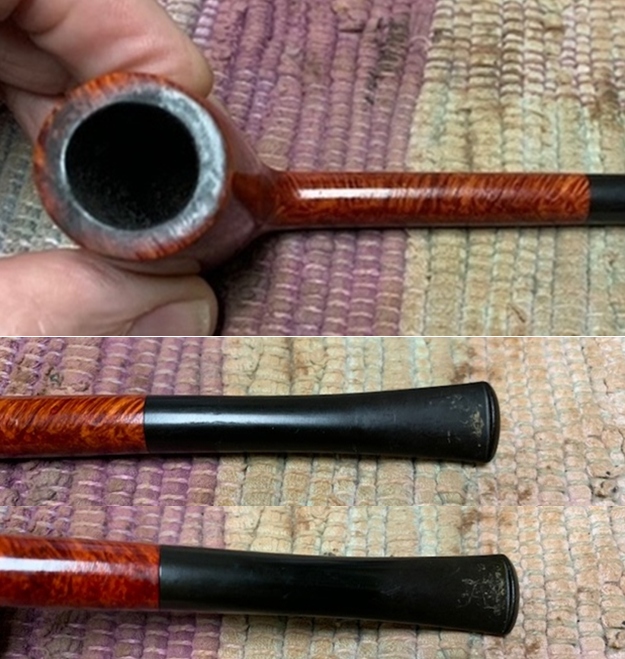
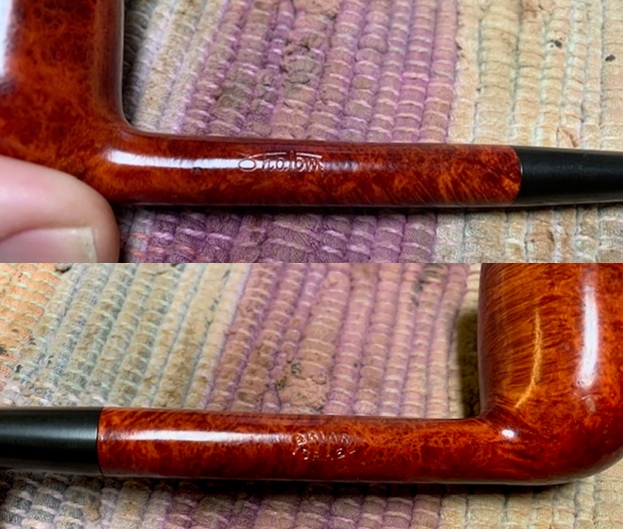
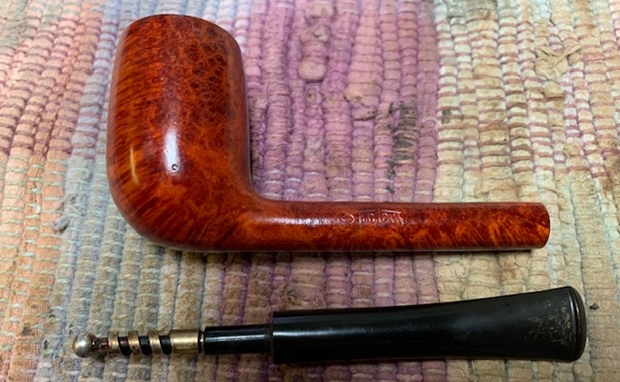
The next pipe I have chosen is a pencil shank Bing Crosby like Billiard that was very dirty and worn. There was grime ground into the finish around the bowl sides and rim top. The medium brown stain was pretty but the grime obscured real look of the grain. This one also came to me in a box of parts that were part of an estate I purchased here in Vancouver. It was stamped on the sides of the shank. The stamping was very readable. It read Shalom in script on the left side mid shank. On the right side it is stamped Briar Israel in a rugby ball shaped COM stamp. The finish had a coat of varnish over the bowl that was thick and shiny. It was peeling on the rim top and heel of the bowl as well in some spots on the front of the bowl. There were a few small fills and pits in the briar but none were obnoxious. There was a moderate cake in the bowl and an overflow of lava on the rim top. The stem had light tooth marks and chatter on the top and underside on and near the button. I took photos of the pipe before I started my cleanup work. They tell the story and give a glimpse of the promise that I see in this pipe.  I took photos of the rim top and stem to show the condition of the bowl and stem. The interior the bowl had a moderate cake that overflowed like lava onto the rim top. The stem has light tooth marks and chatter on the top and underside near the button.     I took photos of the sides of the shank to show the stamping. The stamping is very readable in the photos below and is as noted above.       I took the stem off the shank and took a photo. The stem has a long spiral stinger apparatus that is pressure fit into the tenon. It really constricts the air flow so I will leave it out once restored and if someone wants it they can reinsert it.I am including the information from Pipedia’s article on Shalom Pipe Factory pipes. It is a great read in terms of the history of the brand (https://pipedia.org/wiki/Shalom_Pipe_Factory). I have included a bit of the pertinent history here.

Not much is known about Israel’s sole pipe factory though it’s reported to have operated quite successfully on international markets.

Beside the brand “Shalom” the mainstay brand was Alpha – especially well known in the USA. Alpha was popular for a range of fresh and unusual shapes. Series (afaik): Caprice (s), Citation (s), Classic (b), Pedestal (s), Regent, Region (b), Rex (s). (1)

Alpha also produced at least one of its Citation forms for Carey’s “Magic Inch” series.

Mentioned in context with Shalom Pipe Factory was a Danish pipemaker named ‘Muki Liebermann’, who later lived and worked in the USA. Muki is known for his unique briar bending technique and his original shapes that gave inspiration to many of the most praised Danish pipemakers.

Shalom was taken over by Robert L. Marx of New York City, later Sparta, NC, then of Mastercraft. Mastercraft continued the Alpha pipes introducing new lines.

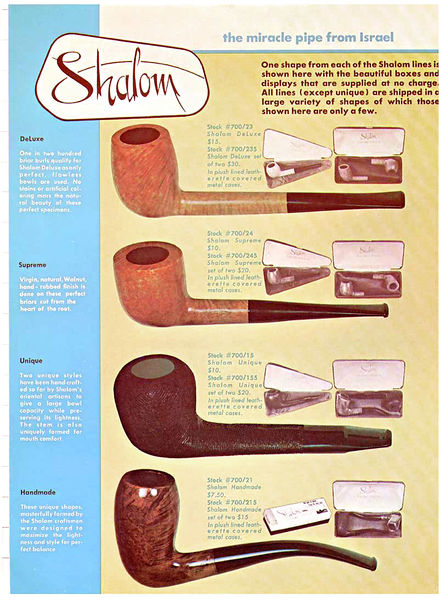
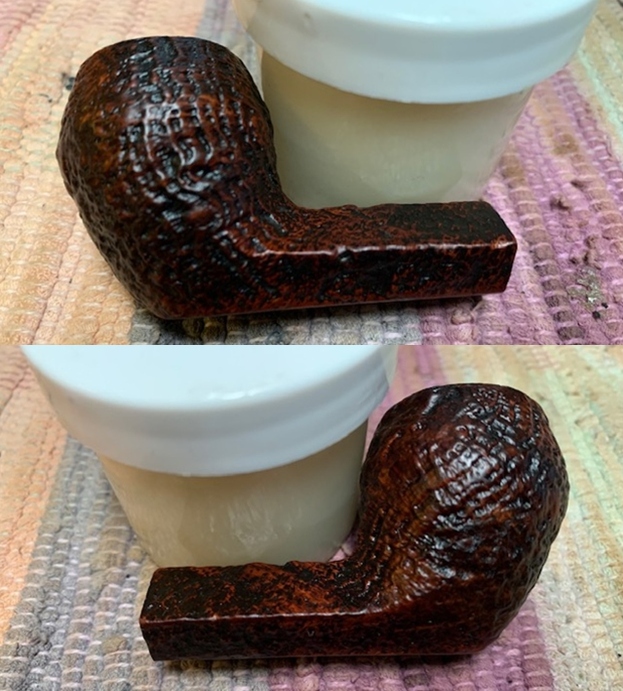
The article also included a flyer page on the brand that gave some more helpful information (https://pipedia.org/wiki/File:ShalomAlpha.jpg). The page came courtesy of Doug Valitchka.Now it was time to work on the pipe. I reamed the moderate cake back with a PipNet pipe reamer using the smallest cutting head on this petite pipe. The cake was thick and crumbly and came out easily. I followed that by cleaning up the remnants of cake with a Savinelli Fitsall Pipe Knife and finished by sanding the chamber walls with a piece of dowel wrapped with 220 grit sandpaper. I scraped the lava off the rim top with the Savinelli Fitsall Pipe Knife. Along with the lava some of the varnish on the rim top came off as well. I scrubbed the exterior of the bowl with undiluted Murphy’s Oil Soap and a tooth brush to clean up the grime in the finish. I rinsed off the debris and the soap with running water and dried the pipe off with a soft towel. I wiped the varnish coat off the bowl with acetone to remove the peeling spots and to have a look at what was underneath the shiny polish. It came off easily. There were a few small fill that showed up but also some amazing grain came up. With the exterior clean it was time to deal with the interior. I scrubbed out the shank and the airway in the stem with pipe cleaners, cotton swabs and alcohol to remove the tars and oils. I polished the briar with micromesh sanding pads – dry sanding with 1500-12000 grit pads. I wiped the bowl down after each sanding pads with a damp cloth.   I worked some Before & After Restoration Balm into the surface of the briar with my fingertips to clean, enliven and protect the briar. I let the balm sit for a little while and then buffed with a cotton cloth to raise the shine. The photos show the bowl at this point in the restoration process. With that done the bowl was finished other than a final buffing. I set it aside and turned my attention to the stem. I used a lighter to heat up the gunk holding the stinger in the tenon. I wiggled it out of place with a pair of pliers.I polished the stem with micromesh sanding pads – wet sanding with 1500-12000 grit sanding pads. I wiped it down after each sanding pad with Obsidian Oil. I polished it with Before & After Pipe Stem Polish – both Fine and Extra Fine.   I am excited to finish this pencil shank Shalom Pipe Factory Israel Briar Bing Crosby. I put the pipe back together and buffed it with Blue Diamond on the buffing wheel. I gave the bowl and the stem multiple coats of carnauba wax. I buffed it with a clean buffing pad to raise the shine and followed that with a quick hand buff with a microfibre cloth to deepen the shine. It is fun to see what the polished bowl looks like grain popping through on the bowl sides and rim top. Added to that the polished black vulcanite stem is a great contrast of colour. This light weight Shalom Bing Crosby style pipe is a great looking pipe and it feels great in my hand. It is light and well balanced. Have a look at it with the photos below. The dimensions are Length: 6 inches, Height: 1 ¾ inches, Outside diameter of the bowl: 1 1/8 inches, Chamber diameter: 5/8 of an inch. It is a beautiful pipe. Thanks for walking through the restoration with me as I worked over this pipe. Thanks to each of you who are reading this blog. Remember we are not pipe owners; we are pipemen and women who hold our pipes in trust until they pass on into the trust of the next pipeman or woman. 
New Life for a Republic Era Peterson’s System 31 Billiard


Blog by Steve Laug

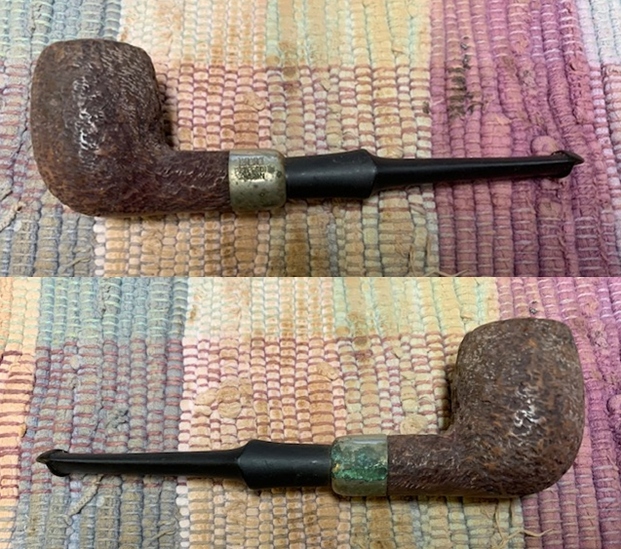
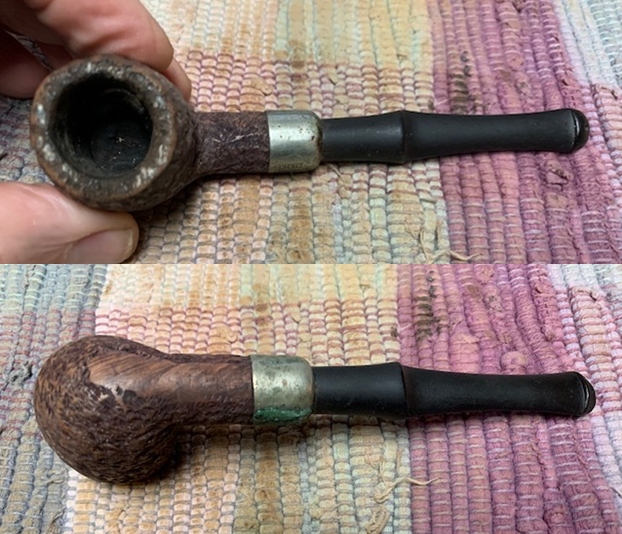
The next pipe I have chosen is a rusticated Peterson’s System 31 Billiard that was incredibly dirty and worn. The grime on the finish pretty much obscured the rustication around the bowl sides and rim top. The brown stain was tired looking and the grime obscured the texture of the rustication. This one also came to me in a box of parts that were part of an estate I purchased here in Vancouver. It was stamped on the underside of the shank. The stamping was faint but readable. It read Peterson’s in an arc over System on the heel of the bowl followed the shape number 31. After that near the nickel band it read Made in the Republic of Ireland. The nickel band is oxidized and dirty but it has the K & P stamp over Peterson Dublin. The band had some nicks and dents and had been repaired by soldering on the right side (where the green oxidation is shown in the second photo below). It should clean up well. It was in rough condition when I brought it to the table. The finish was dirty with grime ground into the briar sides and rim. There was a thick cake in the bowl and an overflow of lava on the rim top that filled in the rim top and edges. The stem had a long tube I the end that is part of the makeup of the stem. The rest of the stem was oxidized, calcified and had light tooth marks and chatter on the top and underside on and near the button. I took photos of the pipe before I started my cleanup work. They tell the story and give a glimpse of the promise that I see in this pipe.  I took photos of the rim top and stem to show the condition of the bowl and stem. The interior the bowl had a heavy cake that overflowed like lava onto the rim top filling in the sandblast. The stem is oxidized, calcified and has light tooth marks and chatter on the top and underside near the button. I took a photo of the underside of the shank to show the stamping. The stamping is faint but readable in the photos below and is as noted above.  The nickel ferrule is stamped with three shields with the inscriptions ‘K ‘&’ ‘P’ [over] PETERSON [over] DUBLIN.   I took the stem off the shank and took a photo. The stem has a long tube/funnel that is an integral part of the tenon.I am including the information from Pipedia’s article on Peterson pipes. It is a great read in terms of the history of the brand (https://pipedia.org/wiki/Peterson). I have included a bit of the pertinent history here.

1950 – 1989 The Republic Era  – From 1950 to the present time, the stamp for this era is “Made in the Republic of Ireland” in a block format generally in three lines but two lines have been used with or without Republic being abbreviated.

During the 1950’s and 60’s the Kapp & Peterson Company was still in the ownership of the Kapp family. However 1964 saw the retiral of the company Managing Director Frederick Henry(Harry) Kapp.

I did a search on Google about the Peterson System 31 Straight Billiard to see if I could learn any specific information on the shape. I found a link to a pipe for sale on Smokingpipes.com. I quote:

The straight-stemmed Peterson System is quite different from their better-known bent-stem version. Rather than a moisture chamber extending past the transition as part of the shank, akin to that of a cavalier-type pipe, the moisture chamber is drilled beneath the bowl itself, with the tobacco chamber’s draft hole drilled straight downward into it. Further, a metal tube is threaded to the base of the vulcanite stem, to extend into the moisture chamber and provide a better, drier smoke (https://www.smokingpipes.com/pipes/new/peterson/moreinfo.cfm?product_id=183783).

Paresh had worked on System 31 pipe so I went back and reread his work on that smooth pipe. It was very helpful for the background information included (https://rebornpipes.com/tag/peterson-system-31-pipe/).

I knew that I was dealing with a Republic Era pipe made between 1950-1989. The K&P mark on the nickel band ties to Kapp & Peterson brings the date to the time between 1950-1964. It was a rusticated Straight billiard with a unique shape and chamber beneath the bottom of the bowl. The finish was stained with a combination of brown and black stains. Now it was time to work on the pipe.

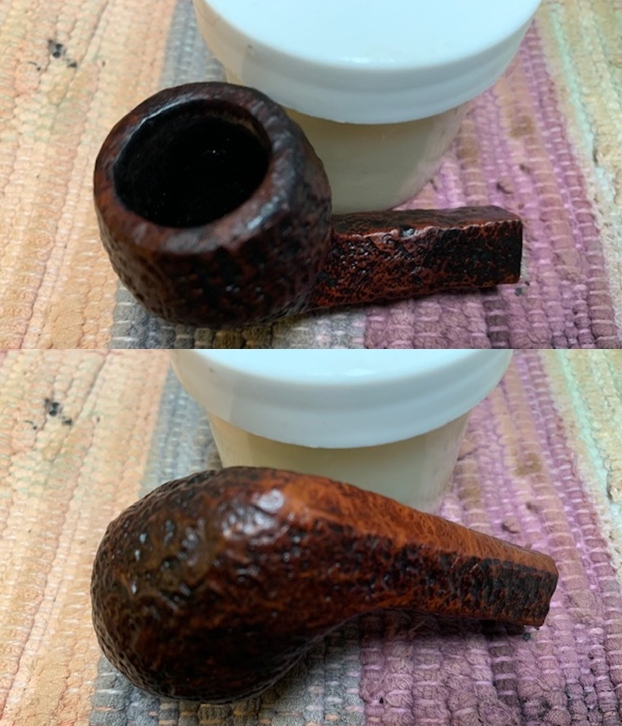
I decided to start my restoration work on this one by starting my cleanup of the bowl. I reamed the thick cake back with a PipNet pipe reamer using the smallest cutting head on this petite pipe. The cake was thick and crumbly and came out easily. I followed that by cleaning up the remnants of cake with a Savinelli Fitsall Pipe Knife and finish with a piece of dowel wrapped in 220 grit sandpaper. I decided to use the cotton ball and alcohol treatment to remove the stink from the bowl. I stuffed a cotton ball in the bowl of the pipe and twisted a second cotton ball into the shank and sump of the pipe. I filled in the bowl and shank with isopropyl alcohol. I set the pipe aside and let it leach out the tars and oils in the bowl. I let it sit for several hours and then removed the cotton from the bowl and shank. It came with a lot of the tars and oils.   I scrubbed the exterior of the bowl with undiluted Murphy’s Oil Soap and a tooth brush to clean up the crevices in the sandblast finish. I rinsed off the debris and the soap with running water and dried the pipe off with a soft towel.    With the exterior clean it was time to deal with the interior. I scrubbed out the shank with pipe cleaners, cotton swabs and alcohol to remove the tars and oils. I also cleaned out the airway in the stem at the same time with pipe cleaners and alcohol.  I worked some Before & After Restoration Balm into the surface of the briar with my fingertips and a horsehair shoe brush to clean, enliven and protect the briar. I let the balm sit for a little while and then buffed with a cotton cloth to raise the shine. The photos show the bowl at this point in the restoration process. With that done the bowl was finished other than a final buffing. I set it aside and turned my attention to the stem. I polished the stem with micromesh sanding pads – wet sanding with 1500-12000 grit sanding pads. I wiped it down after each sanding pad with Obsidian Oil. I polished it with Before & After Pipe Stem Polish – both Fine and Extra Fine.  I am excited to finish this petite Republic Era Peterson’s System 31 Straight Billiard. I put the pipe back together and buffed it with Blue Diamond on the buffing wheel. I gave the bowl multiple coats of Conservator’s Wax and the stem multiple coats of carnauba wax. I buffed it with a clean buffing pad to raise the shine and followed that with a quick hand buff with a microfibre cloth to deepen the shine. It is fun to see what the polished bowl looks like with the variations of colour in the rustication on the bowl sides and rim top. Added to that the polished nickel ferrule and black vulcanite stem is a great contrast of colour. This small Peterson’s System 31 Straight Billiard is a great looking pipe and it feels great in my hand. It is light and well balanced. Have a look at it with the photos below. The dimensions are Length: 5 ½ inches, Height: 1 ½ inches, Outside diameter of the bowl: 1 1/8 inches, Chamber diameter: ¾ of an inch. It is a beautiful pipe. Thanks for walking through the restoration with me as I worked over this pipe. Thanks to each of you who are reading this blog. Remember we are not pipe owners; we are pipemen and women who hold our pipes in trust until they pass on into the trust of the next pipeman or woman. 
New Life for a Republic Era Peterson’s Kapruf 71 Canadian


Blog by Steve Laug

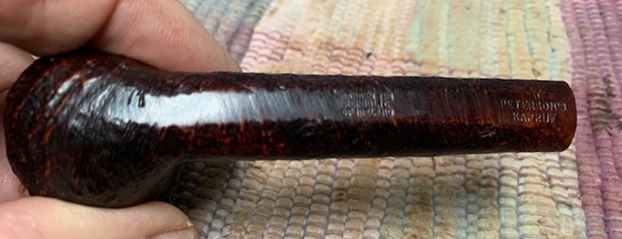
The next pipe I have chosen is a sandblast Peteron’s Kapruf Canadian that was incredibly dirty. The grime on the finish pretty much obscured the sandblasted grain around the bowl sides. The contrast of the brown stain made the texture of the blast stand out clearly. This one came to me in a box of parts that were part of an estate I purchased here in Vancouver. It was stamped on the underside of the shank. The stamping was readable. It read shape #71 on the heel of the bowl followed by Made in the Republic of Ireland mid shank. That is followed by Peterson’s [over] Kapruf. It was in rough condition when I brought it to the table. The finish was dirty with grime ground into the briar sides and rim. There was a thick cake in the bowl and an overflow of lava on the rim top that filled in the blasted rim top and edges. The stem had a broken tenon that was stuck in the shank. The rest of the stem was oxidized, calcified and had light tooth marks and chatter on the top and underside on and near the button. I took photos of the pipe before I started my cleanup work. They tell the story and give a glimpse of the promise that I see in this pipe.  I took photos of the rim top and stem to show the condition of the bowl and stem. The interior the bowl had a heavy cake that overflowed like lava onto the rim top filling in the sandblast. The stem has a broken tenon and the taper is oxidized, calcified and has tooth marks on the top and underside near the button. It has a clear P stamp on the top of the stem.I took a photo of the underside of the shank to show the stamping. The stamping is readable in the photos below and is as noted above. I am including the information from Pipedia’s article on Peterson pipes. It is a great read in terms of the history of the brand (https://pipedia.org/wiki/Peterson). I have included a bit of the pertinent history here.

1950 – 1989 The Republic Era  – From 1950 to the present time, the stamp for this era is “Made in the Republic of Ireland” in a block format generally in three lines but two lines have been used with or without Republic being abbreviated.

During the 1950’s and 60’s the Kapp & Peterson Company was still in the ownership of the Kapp family. However 1964 saw the retiral of the company Managing Director Frederick Henry(Harry) Kapp.

I knew that I was dealing with a Republic Era pipe made between 1950-1989. It was a Kapruf which sported a rugged sandblast finish with a combination of brown and black stains. Now it was time to work on the pipe.

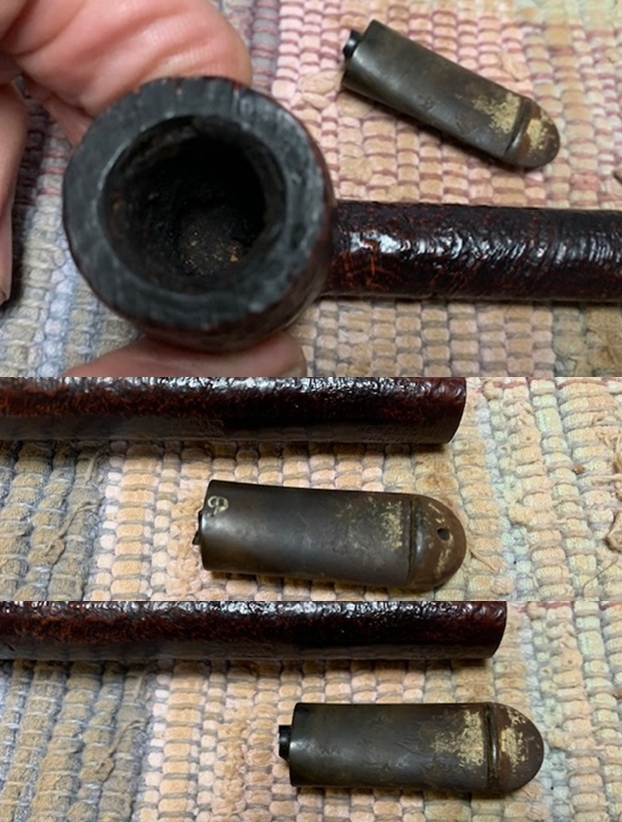
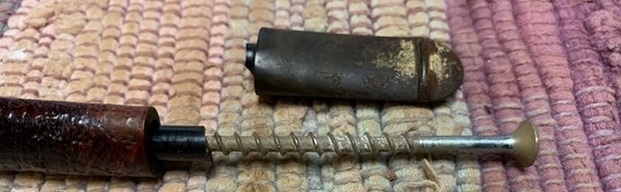
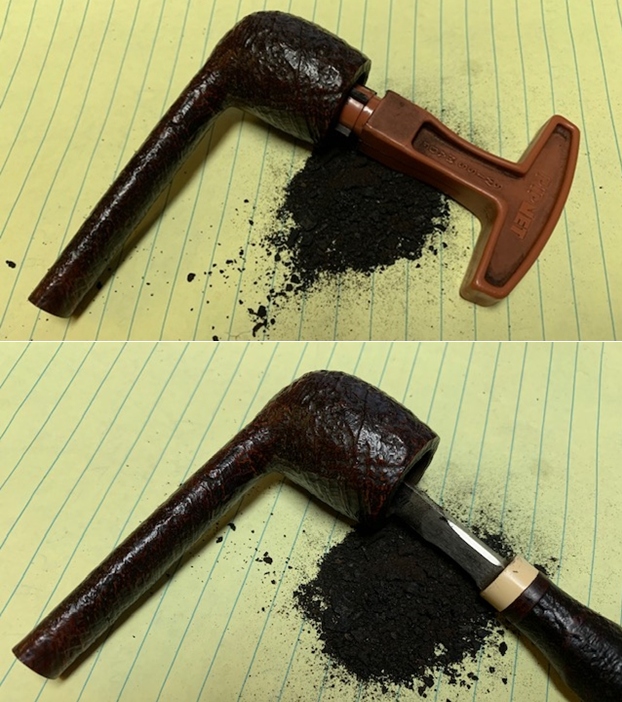
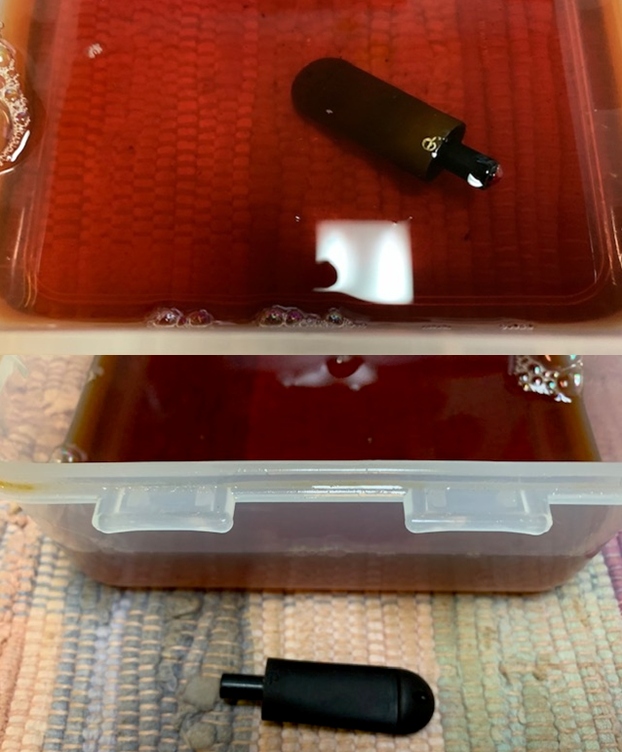
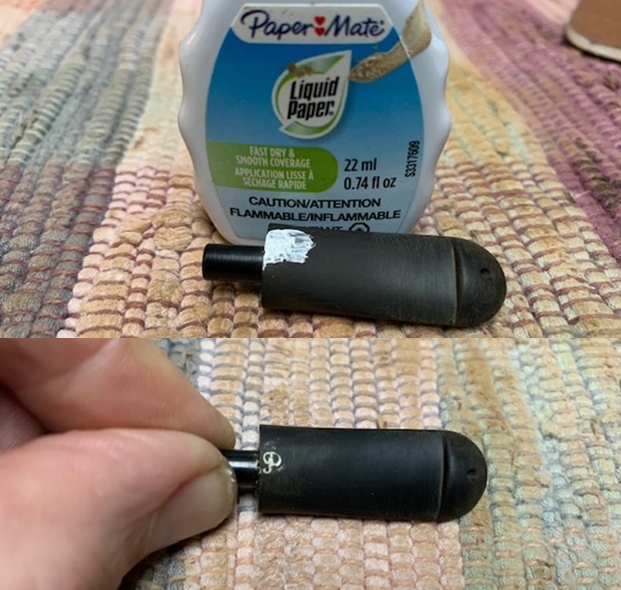
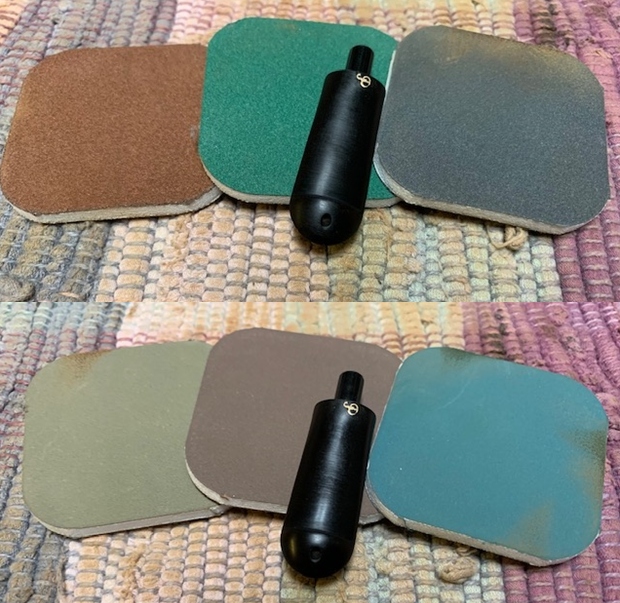
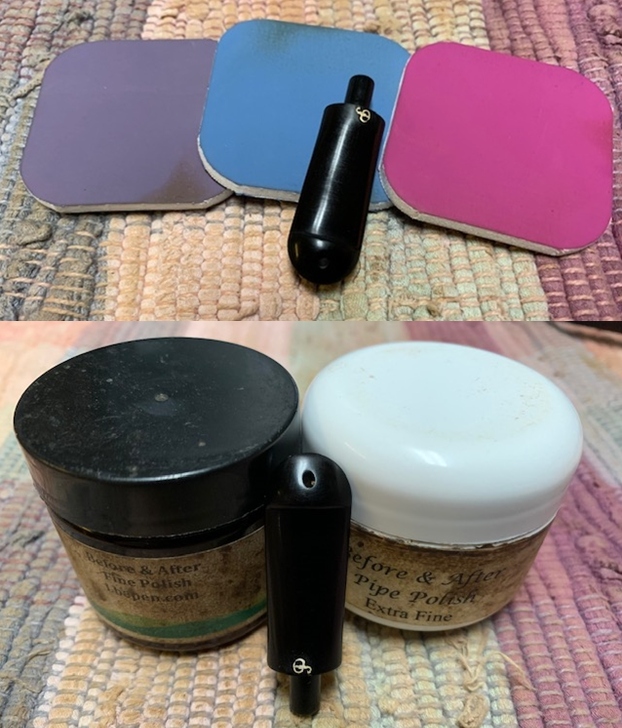
I decided to start my restoration work on this one by dealing with the broken tenon in the shank. When it was removed I would be able to clean out the shank and bowl. I pulled the tenon with a wood screw. I turned it into the airway in the tenon in the shank. Once I had a good grip on the tenon I wiggled it free of the shank. With the tenon removed it was time to clean up the bowl and shank. I reamed the thick cake back with a PipNet pipe reamer using the smallest cutting head on this petite pipe. The cake was thick and crumbly and came out easily. I followed that by cleaning up the remnants of cake with a Savinelli Fitsall Pipe Knife and finish with a piece of dowel wrapped in 220 grit sandpaper. I scrubbed the exterior of the bowl with undiluted Murphy’s Oil Soap and a tooth brush to clean up the crevices in the sandblast finish. I rinsed off the debris and the soap with running water and dried the pipe off with a soft towel. With the exterior clean it was time to deal with the interior. I scrubbed out the shank with pipe cleaners, cotton swabs and alcohol to remove the tars and oils. I also cleaned out the airway in the stem at the same time with pipe cleaners and alcohol.  I worked some Before & After Restoration Balm into the surface of the briar with my fingertips and a horsehair shoe brush to clean, enliven and protect the briar. I let the balm sit for a little while and then buffed with a cotton cloth to raise the shine. The photos show the bowl at this point in the restoration process. With that done the bowl was finished other than a final buffing. I set it aside and turned my attention to the stem. I decided to replace the broken tenon before cleaning up the oxidation on the stem surface. I used a series of drill bit to drill out the airway in the stem for the new tenon replacement. I moved carefully because of the angle of the stem surface. There was no room for error. Once I had it opened I cut a piece of rubber tenon material that I had to match the depth of the hole I had drilled and the depth of the mortise. I glued it in place with black super glue and aligned it so that it would be straight in the shank. Once it was aligned I set it aside for the glue to cure. Once the glue cured I dropped the stem in a bath of Briarville’s Pipe Stem Oxidation Remover and called it a night. This morning I removed the stem from the bath and dried it off with a paper towel. I cleaned out the airway with alcohol and pipe cleaners and other than the P on the top side missing the stem looks very good.  I used some Paper Mate Liquid Paper to touch up the “P” stamping on the top of the stem. Once it cured I scraped off the excess leaving the stamp filled in. I am happy with the way that it came out.   I polished the stem with micromesh sanding pads – wet sanding with 1500-12000 grit sanding pads. I wiped it down after each sanding pad with Obsidian Oil. I polished it with Before & After Pipe Stem Polish – both Fine and Extra Fine.      I am excited to finish this petite Republic Era Peterson’s Kapruf 71 Canadian. I put the pipe back together and buffed it with Blue Diamond on the buffing wheel. I gave the bowl multiple coats of Conservator’s Wax and the stem multiple coats of carnauba wax. I buffed it with a clean buffing pad to raise the shine and followed that with a quick hand buff with a microfibre cloth to deepen the shine. It is fun to see what the polished bowl looks like with the variations of colour in the sandblast on the bowl sides and rim top. Added to that the polished black vulcanite stem is a great contrast of colour. This small Canadian is a great looking pipe and it feels great in my hand. It is light and well balanced. Have a look at it with the photos below. The dimensions are Length: 5 ½ inches, Height: 1 ½ inches, Outside diameter of the bowl: 1 1/8 inches, Chamber diameter: ¾ of an inch. It is a beautiful pipe. Thanks for walking through the restoration with me as I worked over this pipe. Thanks to each of you who are reading this blog. Remember we are not pipe owners; we are pipemen and women who hold our pipes in trust until they pass on into the trust of the next pipeman or woman. 
Cleaning up a new brand for me – a Cowan’s Hand Made Custom Bullmoose


Blog by Steve Laug

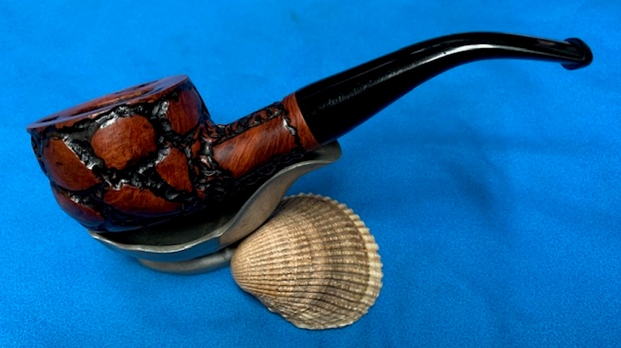
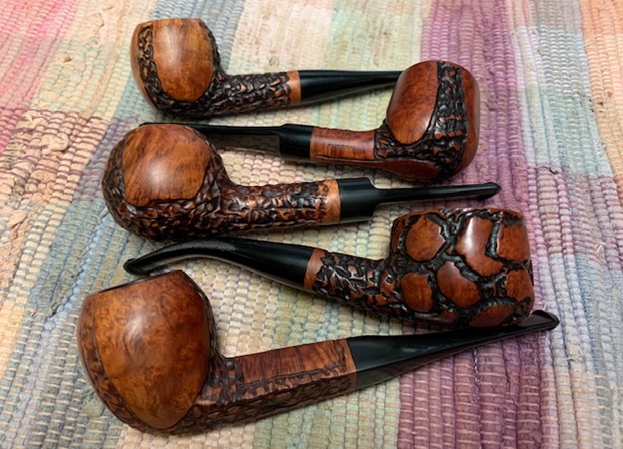
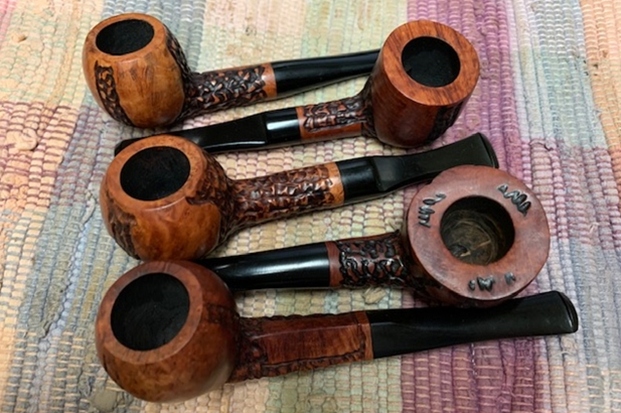
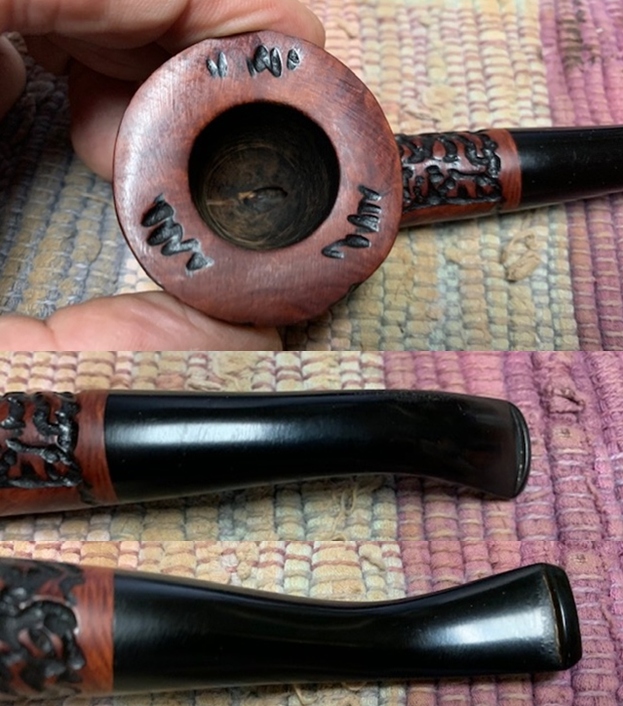
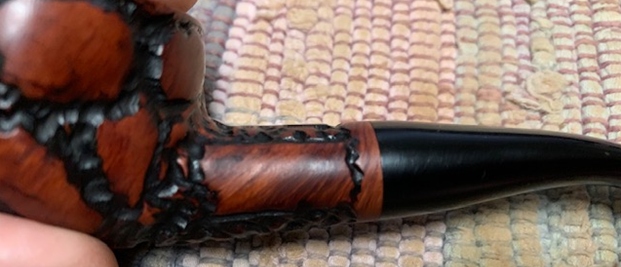
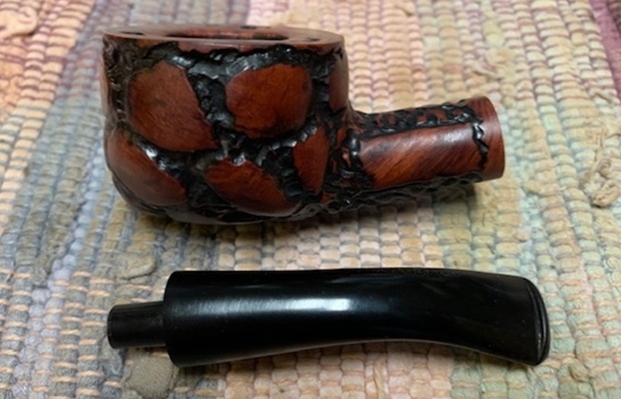
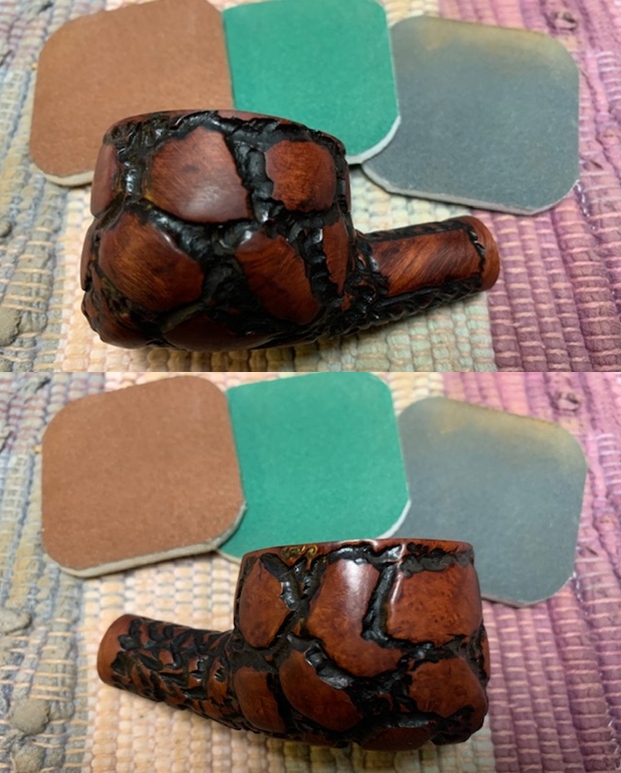
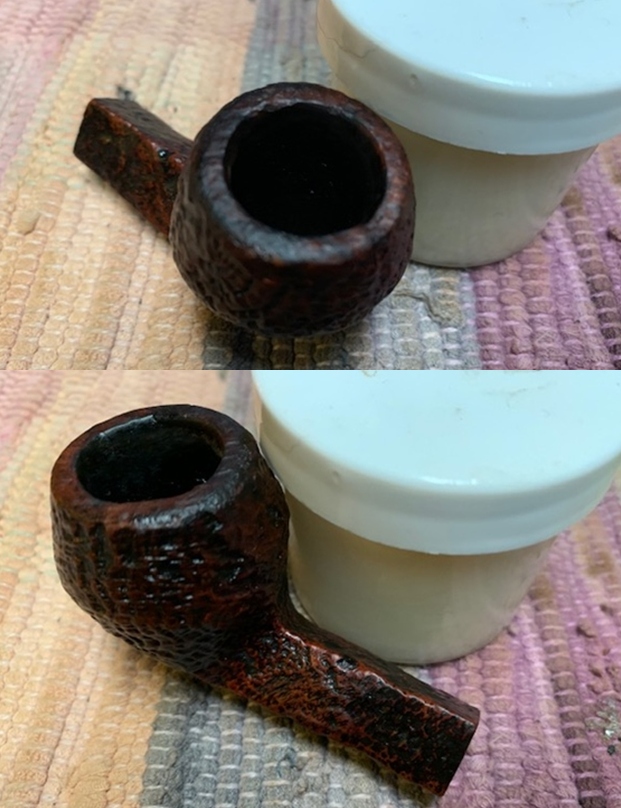
The next pipe in the queue came to us from a recent pipe hunt that Jeff and his wife did in Utah. It is one of five pipes that he found in a new spot that he visited. All of the pipes have a similar pattern of rustication around the bowl and shank. It combines both smooth and panels of rustication in a unique pattern. The five pipes include a Bullmoose, a Pot, a straight Apple, a Bulldog and a squat Apple. Four of the five were unsmoked and the fifth one lightly smoked. All had vulcanite stems – both taper and saddle style. The finish on all of them had a coat of shiny varnish that would need to be removed. All were dusty from lack of use. All had precarbonized bowls. All of them except the Bullmoose were stamped on a smooth panel and read Cowan’s [over] Hand Made [over] Custom. With the stamping in a variety of spots on the shank from pipe to pipe. The seller told Jeff he had just got a hold of the group from someone who brought them into the shop. He had no further information on the brand so they were a mystery. When I received the five I took some photos of the lot to give a feel for this group of pipes. Now that you have a sense of the five pipes that came from Cowan’s Hand Made I turn to the one smoked pipe in the lot – a Bullmoose. It is also the only one that does not bear maker’s stamp on the panel provided on the shank side. Everything about it including its inclusion in the group of five say that it was made by Cowan’s. What should have been on the left side is Cowan’s [over] Hand Made [over] Custom. The panel is the correct size for that stamp and matches the proportions of the stamping on all of the other pipes. This one was a Bullmoose shape with a rustication similar to the other pipes but also a bit unique in that it had a variety of smooth spots around the bowl sides. The shank rustication matches that found on the others. The rim top was wide and beveled inward with some rusticated spots around the top. There was a light cake in the bowl and no damage to the inner or outer edges of the rim. The shiny varnish coat was worn but not flaking. The stem was lightly oxidized and has some light tooth chatter on the surface of both sides near the button. Jeff took photos of the pipe before he started his clean up work.He took photos of the rim top to show the condition of the bowl and rim top. It had a light cake an the rim top and edges were clean. He took photos of the stem as well to show its general condition. It is lightly oxidized with light chatter on both sides near the button. The next photos show the rustication around the sides of the bowl.  The rusticated portions around the panels matches that found on the other pipes in this group. He took photos of the area where the other pipes are stamped. It seems to me that there is a faint ghost of the stamping visible in the photo below. I turned to Pipedia to see if I could find any specific information on the Cowan’s Brand. I turned to the Pipemakers and Pipe Brands section and looked for the brand under American pipe makers (https://pipedia.org/wiki/American_Pipe_Brands_%26_Makers_C_-_D). There was a listing but there was not an article on the brand. I quote:

Louis Cowan, an artisan who produced for Marxman after working for Loewe & Co. in England.

I am pretty certain that Louis Cowan is the artisan I was looking for as the pipe was quite a bit like the Marxman pipes that I have worked on. It seems that he was a carver who produced for Marxman and previously for Loewe and Company in England.  Now it was time to work on the pipe.

Jeff had cleaned up the pipe with his usual penchant for thoroughness. He reamed the pipe with a PipNet pipe reamer and removed the rest of it with a Savinelli Fitsall Pipe Knife.  He scrubbed the bowl with undiluted Murphy’s Oil Soap with a tooth brush. He rinsed it under running warm water to remove the soap and grime. He cleaned out the inside of the shank and the airway in the stem with alcohol, cotton swabs and pipe cleaners. He soaked the stem in Before & After Deoxidizer and rinsed it off with warm water. I took photos of the pipe once I received it.  I took a close up photo of the rim top to show the general condition. You can see is clean and that it looks good.  The stem is in good condition with a little bit of chatter on both sides near the button.I took a photo of the panel that was where the pipe should have born the stamping that was on the other pipes. With a lens it appears that there is some faint stamping present. I removed the stem from the shank and took a photo to show that the pipe looked like. I polished the rim top and the smooth panels on the bowl and shank with micromesh sanding pads to clean up the finish and give it a shine. I wet sanded with 1500-12000 grit pads and wiped the bowl down after each pad with a damp cotton cloth. The photos tell the story. I worked some Before & After Restoration Balm into the surface of the briar with my fingertips and a horse hair shoe brush to clean, enliven and protect it. I let the balm sit for a little while and then buffed with a cotton cloth to raise the shine.   I set the bowl aside and turned my attention to the stem. I polished the vulcanite with micromesh sanding pads – 1500-12000 grit pads. I wiped it down with Obsidian Oil after each sanding pad. I used Before & After Pipe Polish – both Fine and Extra Fine to further polish the stem.      With both parts of this unique Cowan’s Hand Made Custom Bullmoose finished, I polished the bowl and the stem with Blue Diamond polish on the buffing wheel. I gave the bowl and the stem multiple coats of carnauba wax. I buffed the pipe with a clean buffing pad to raise the shine. I hand buffed it with a microfiber cloth to deepen the shine. The pipe polished up pretty nicely. The mix of grain on the bowl came alive with the buffing. The finish on the briar works well with the polished black vulcanite stem. The finished pipe is a well-proportioned, nicely grained Cowan’s Hand Made Custom Bullmoose. Have a look at it with the photos below. The dimensions are Length: 5 ½ inches, Height: 1 ½ inches, Outside diameter of the bowl: 1 ¾ inches, Chamber diameter: 7/8 of an inch. This interesting Hand Made Bullmoose will be going onto the rebornpipes store very soon with the other four Cowan’s pipes. If you would like to purchase it and carry on the legacy of the previous pipe smoke send a message or an email to me. Thanks for walking through the restoration with me of this hand made pipe.