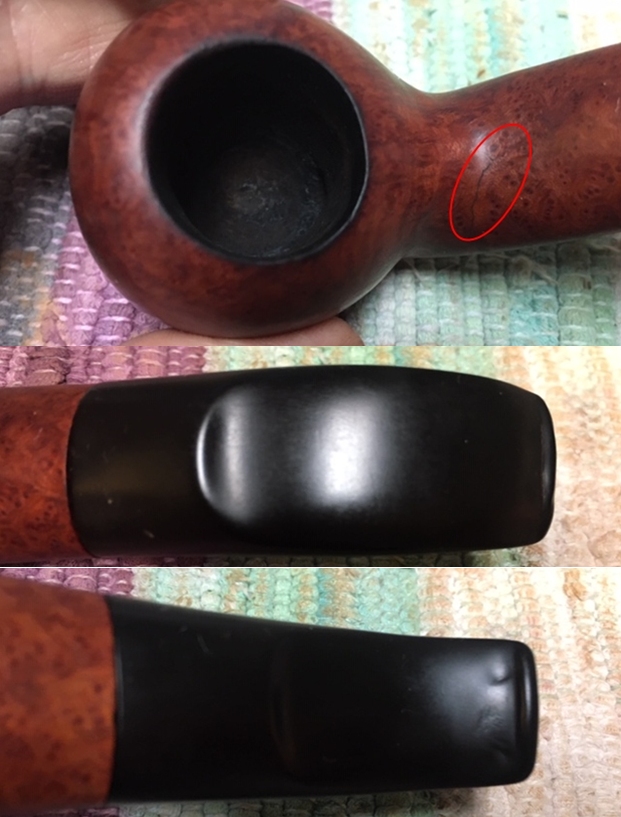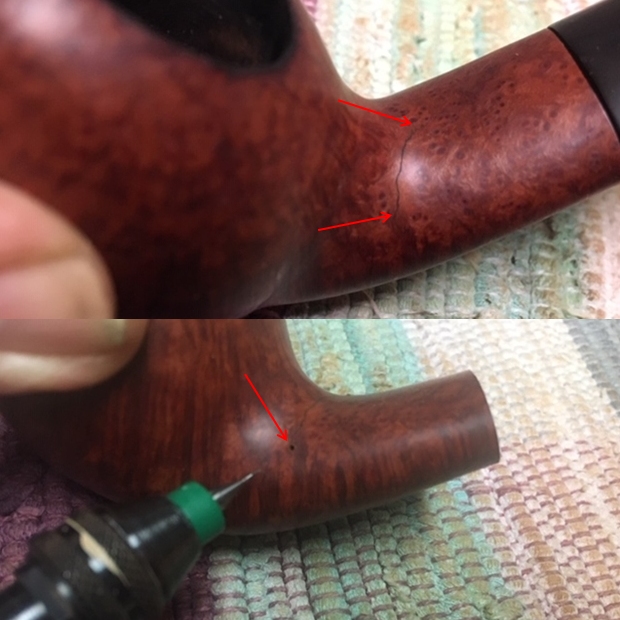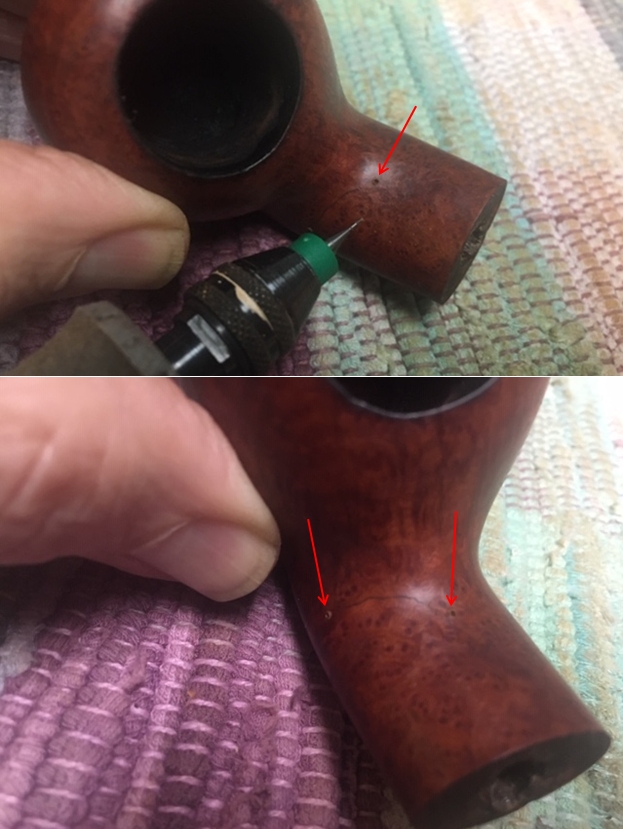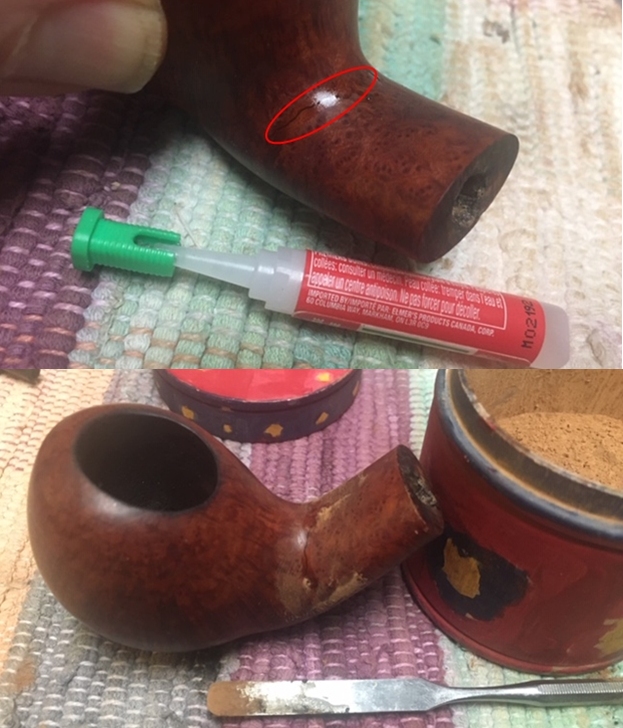
Tag Archives: super glue

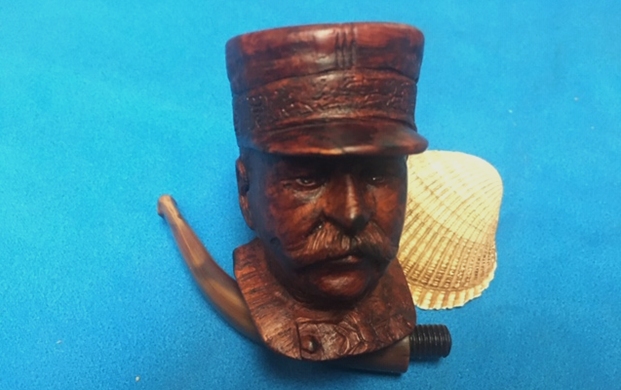
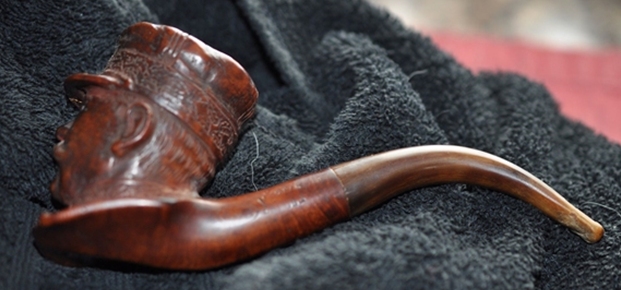
This is a restoration I have been waiting for – an HWB Modele Depose Figural Head


Blog by Steve Laug

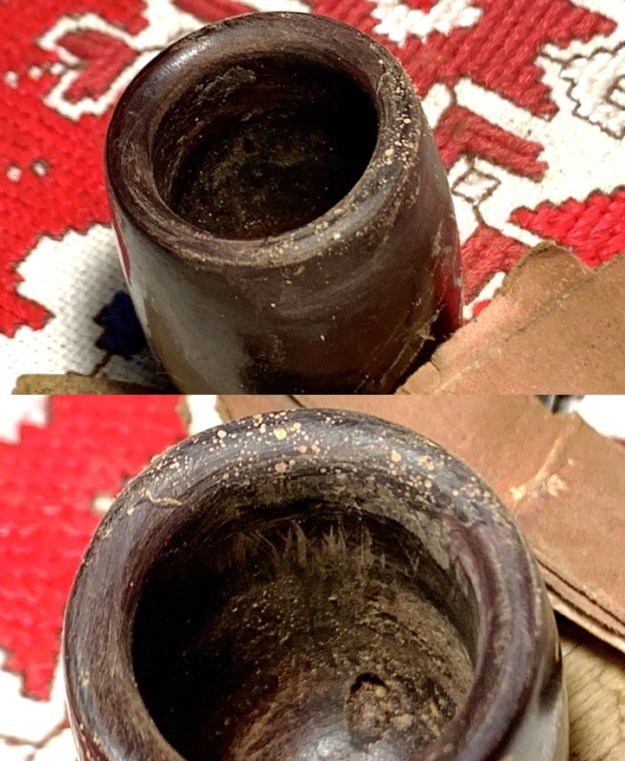
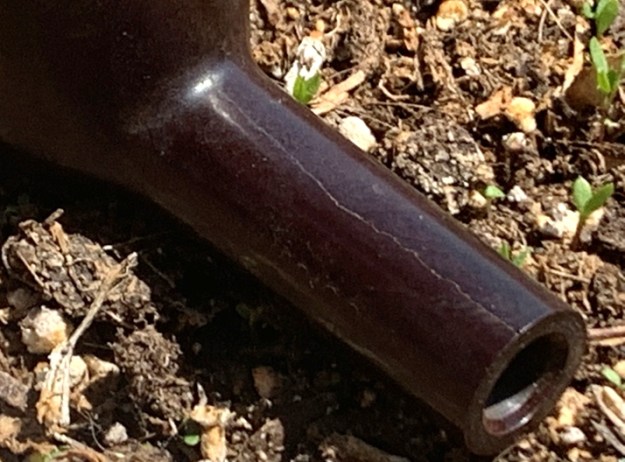
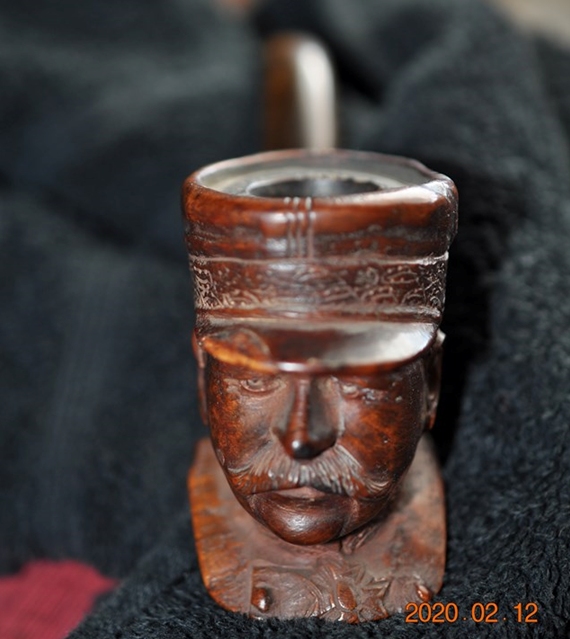
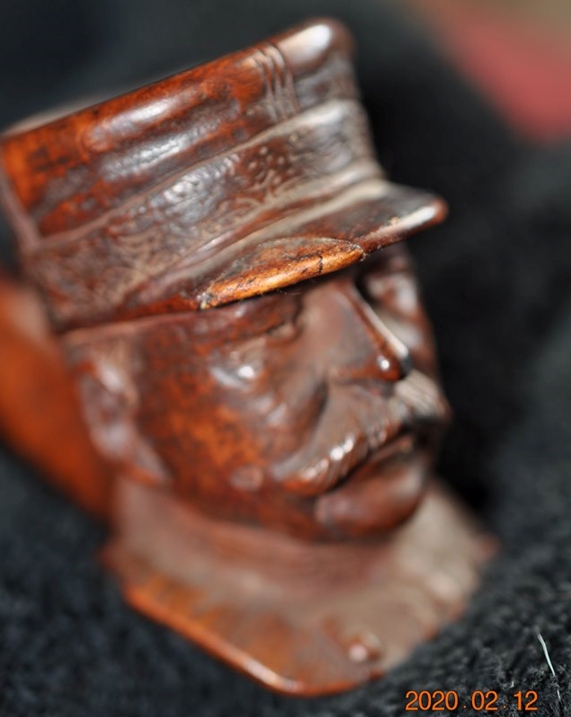
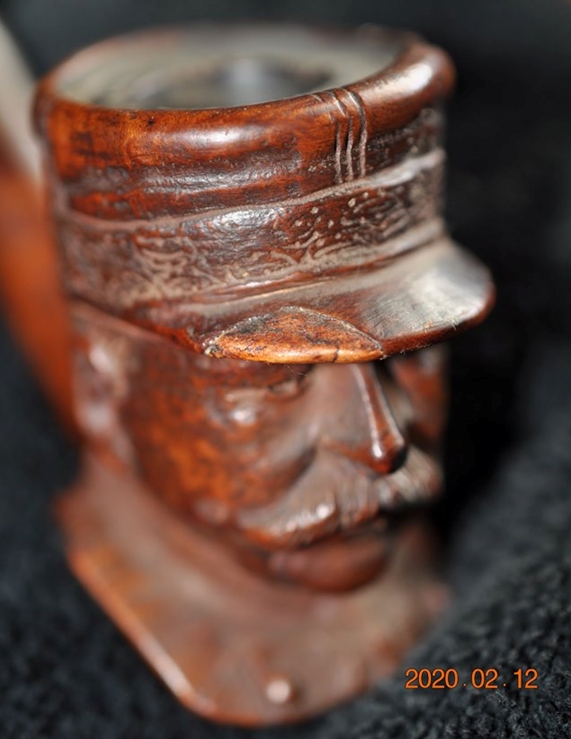
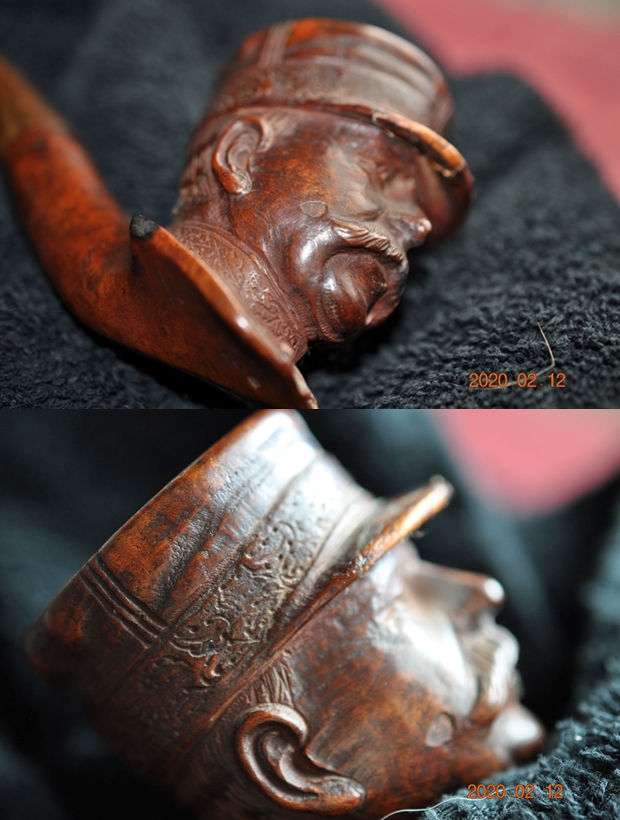
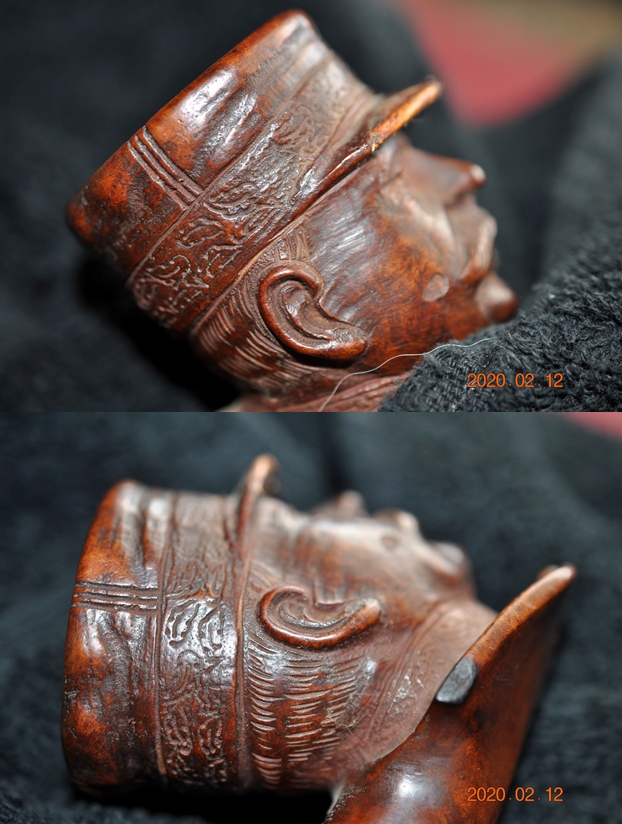
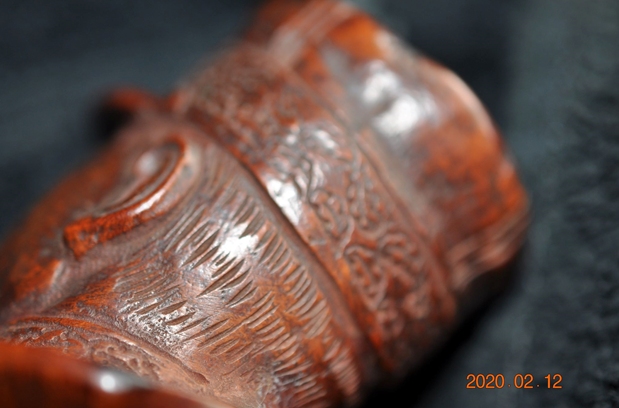
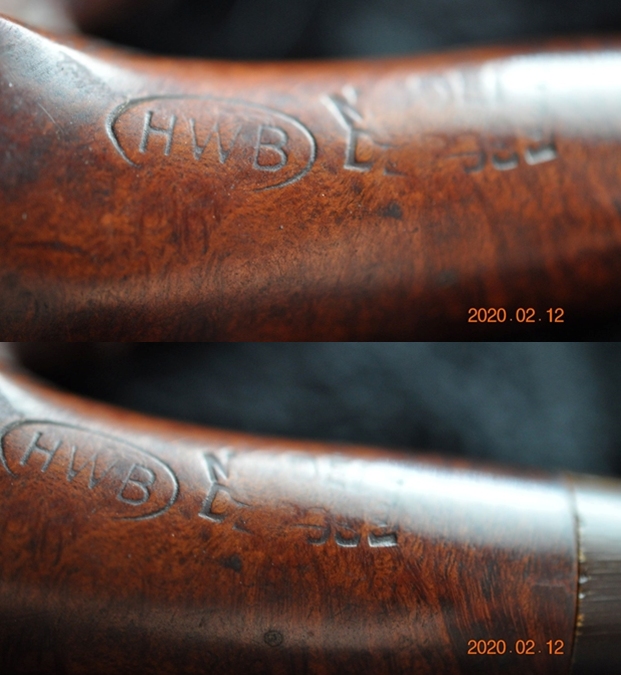
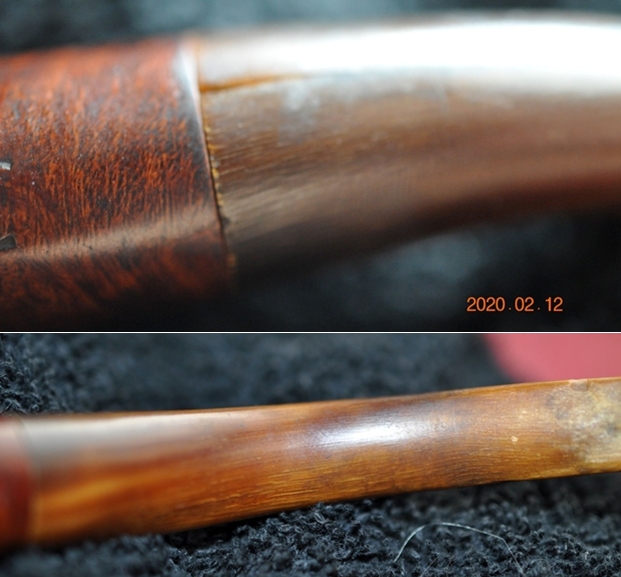
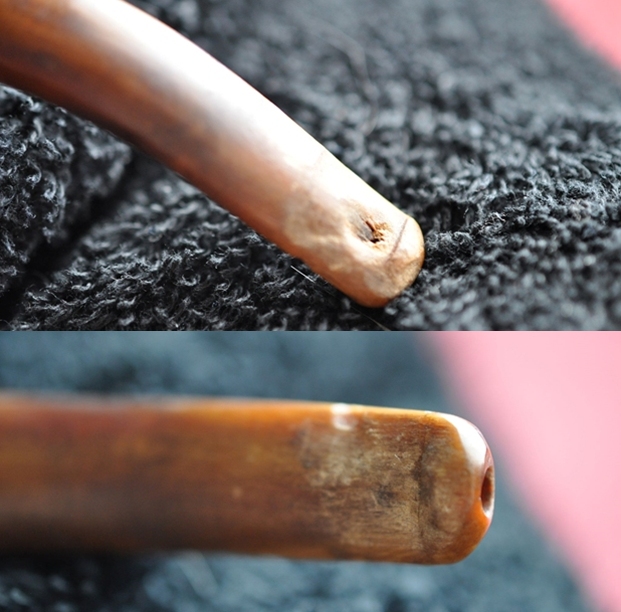
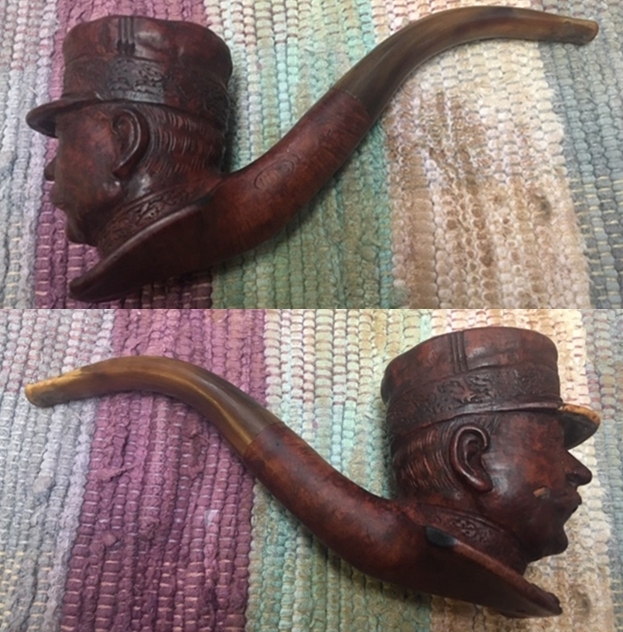
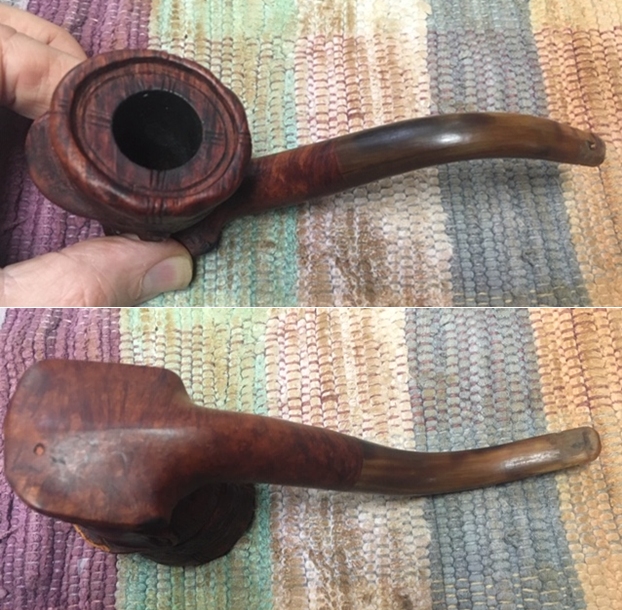
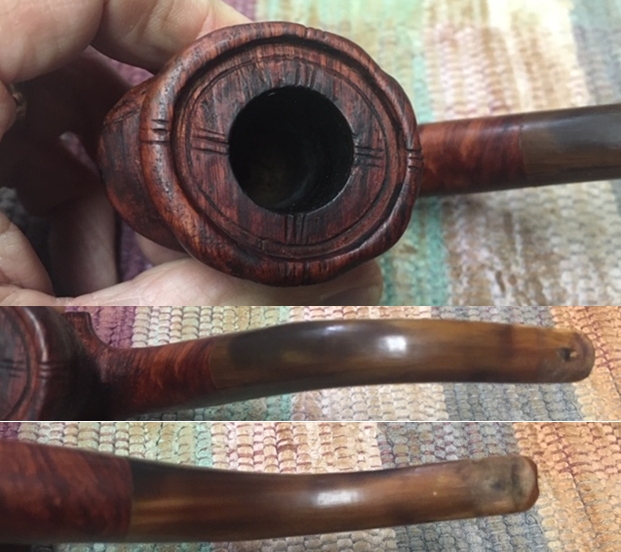
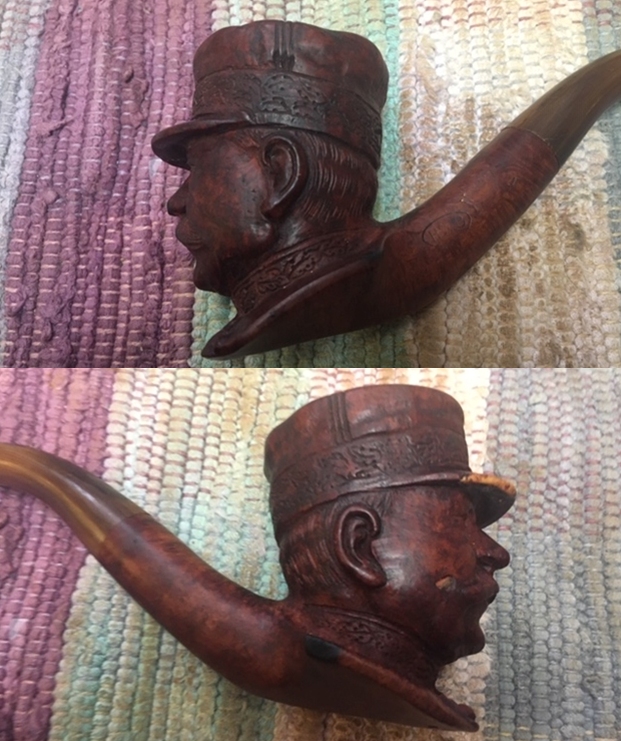
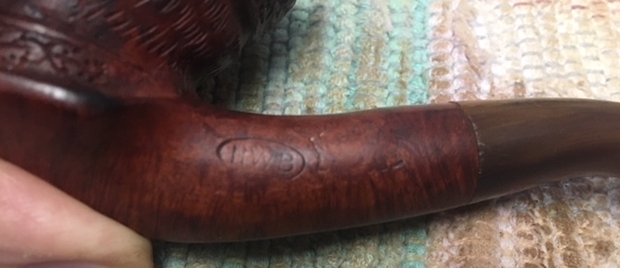
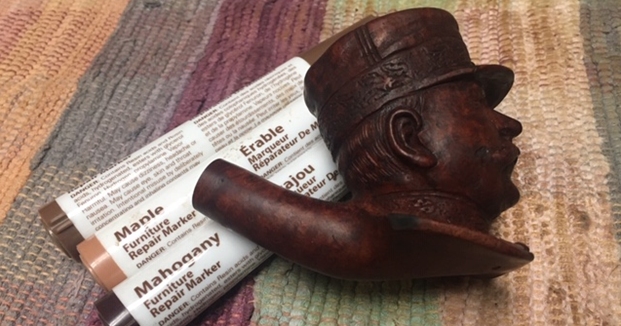
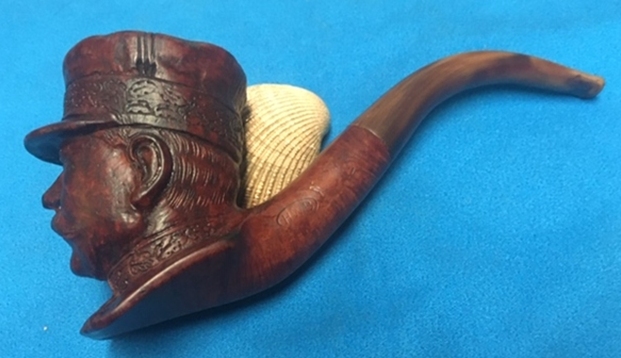
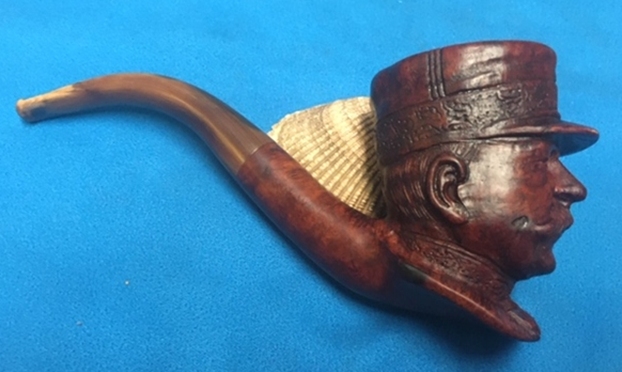
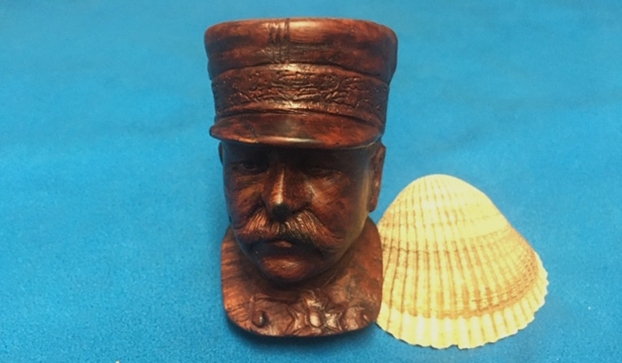
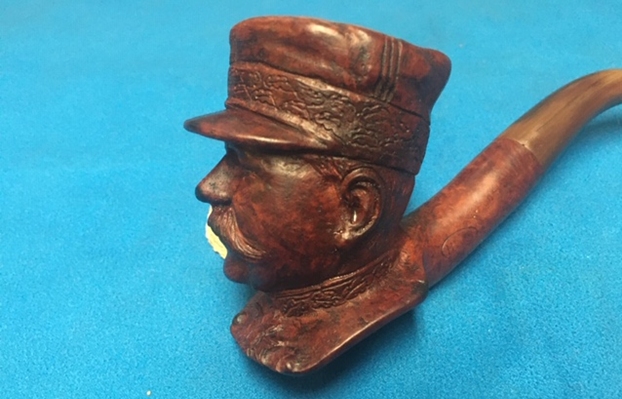
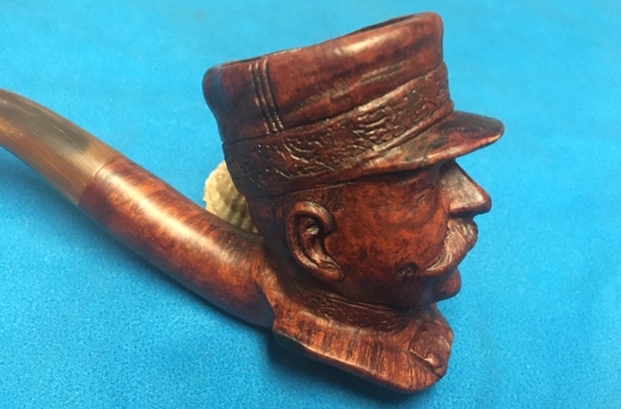
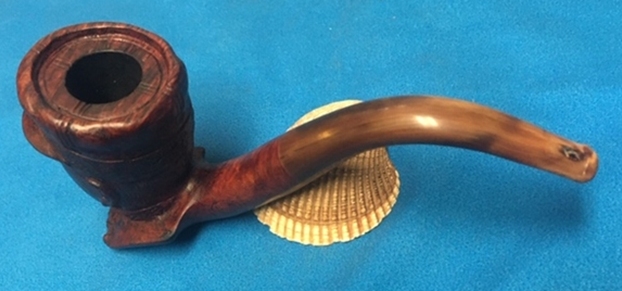
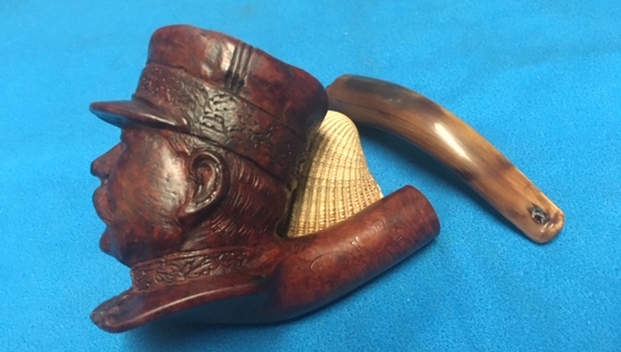
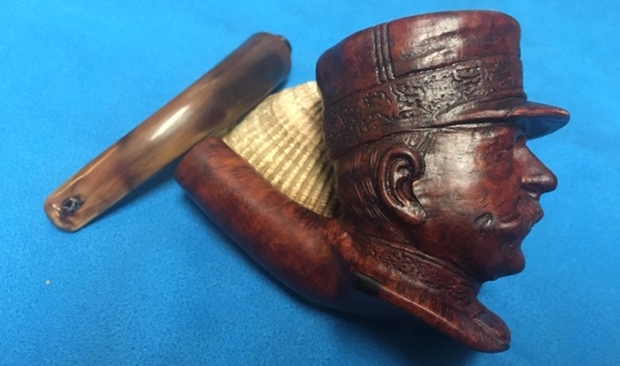
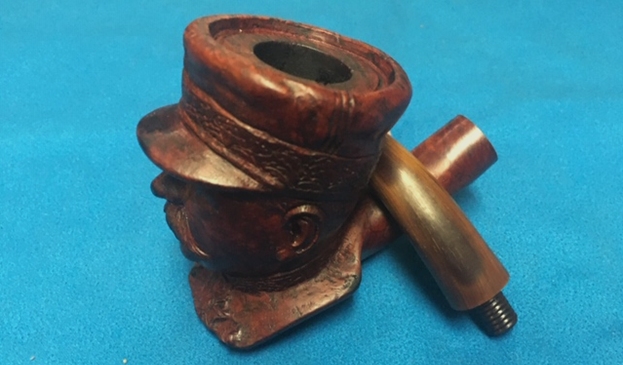
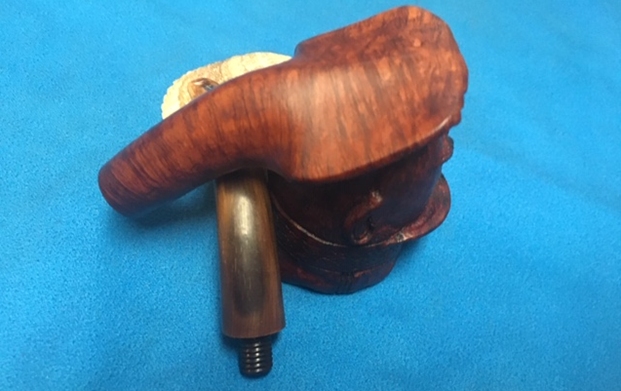
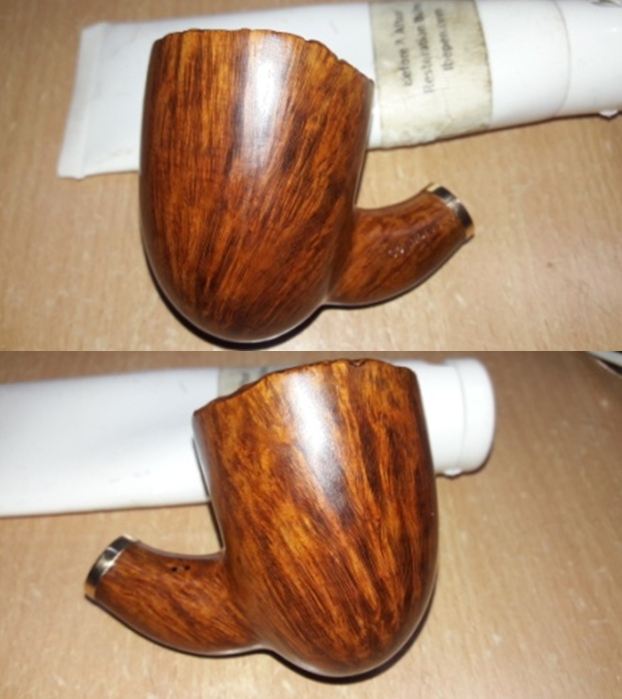
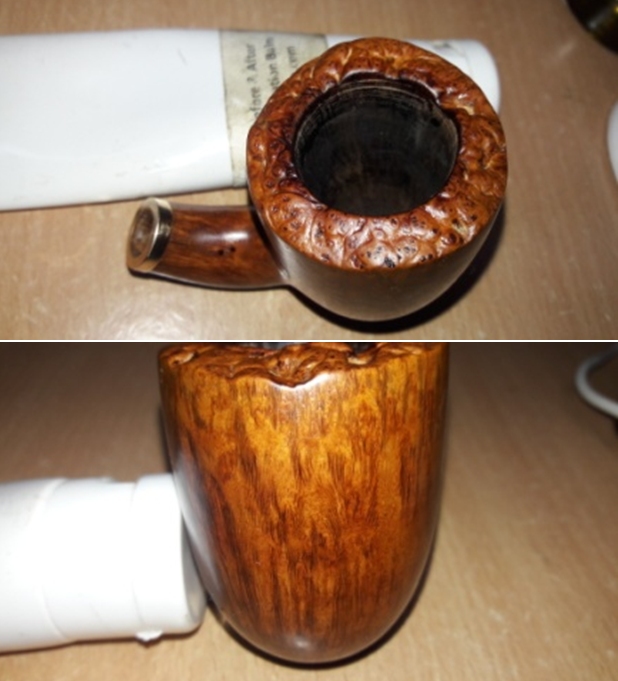
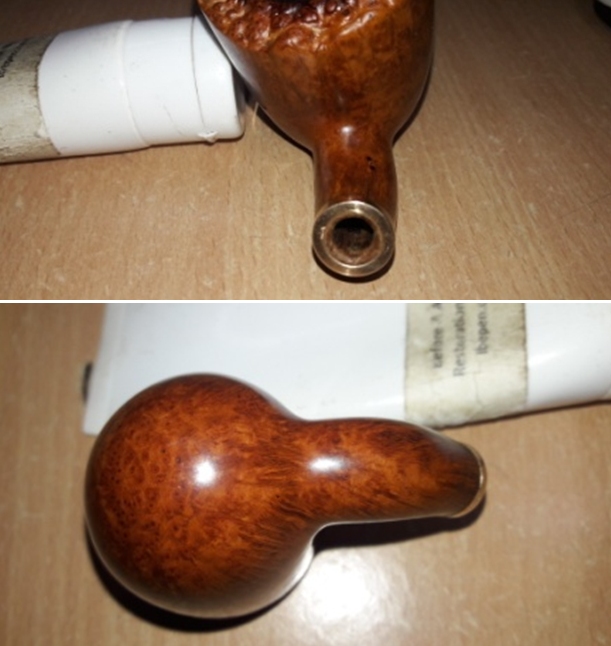
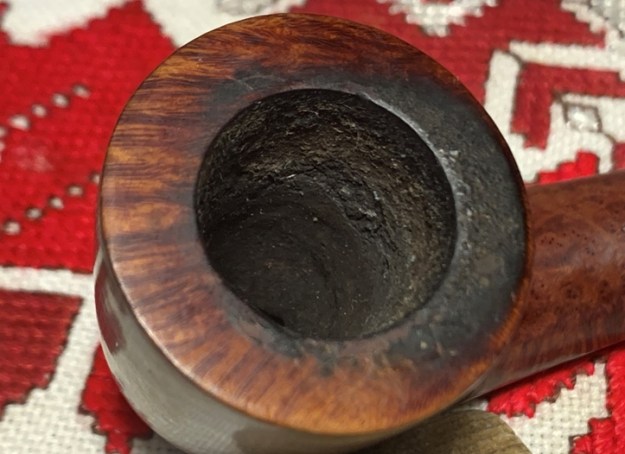
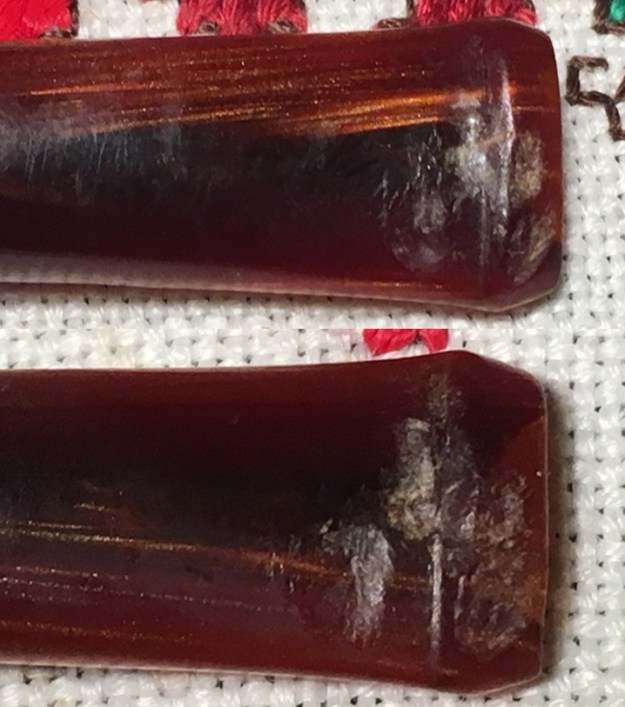
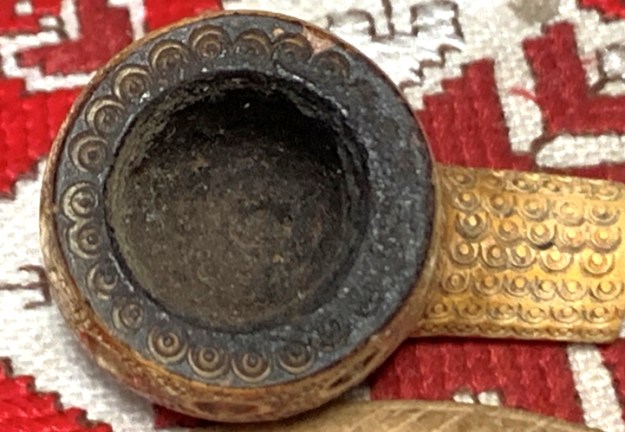
The next pipe on the worktable is an incredibly detailed carved figural head that has a lot of character in the well carved features that Jeff picked up from an auction in the Midwest of the US. It has a tapered horn stem that has a threaded tenon that screw into the shank. The finish is smooth under the carved head and the shank and heel of the bowl. There appears to be some nice grain around the bowl. The curves of the shank and stem give the pipe a sense of true dignity. The pipe is stained with various hues of brown. The pipe is stamped with HWB in an oval followed by Modele Depose on the left side of the shank. There is no other stamping on the bowl or shank of the pipe. The pipe is far from being a collectible decorative piece and was obviously an earlier pipeman’s favourite smoker. The finish was very dirty and tired looking with a lot of grime and oils ground into the sides of the bowl. There was a thick cake in the bowl overflowing with tars onto the rim top. There is also some darkening on the inner edge of the rim top. There was repaired damage on the bill of the hat and there were also burn marks on the back corners of the heel of the bowl. The tapered horn stem is heavily damaged with a crack in the left side near the shank junction and both the top and underside of the first inch of stem is well chewed with a bite through on the top side. The button is worn down and the sharp edge all but flattened. Because of the uniqueness of this particular pipe Jeff took a lot of photos of the pipe before he started his cleanup work. Jeff took photos around the bowl from various angles to show the well done carving on this pipe. You can see in the first photo below the repair that had been done to the right side of the bill of the hat somewhere in the pipe’s journey. It was well done and solid. Look at the details in the carving. The fancy hat band on the hat with the triple lines on the front/back/sides that are carried over the rim top are an example. Note the cross medal on the front of the collar. Note the features of the hair on the head and the moustache. It is a well carved piece of briar. Jeff captured the condition of the rim top. It is hard to see but the triple lines on the outer edges continue across the rim of the bowl. You can see the cake in the bowl and the lava build up on the rim top. It was a well-loved and oft smoked pipe.Jeff also took a photo of the heel of the bowl. The briar is quite beautiful as you can see. The base or heel is spade shaped and flows from the shoulders of the bust above. The base is not flat but it can be balanced as a sitter. Quite a beauty. You can also see the flaw in the briar toward the front of the bowl. He also took photos of the stamping on the shank. It includes an HWB in an oval followed by the words Modele Depose. I have been unable thus far to find out any information on the HWB brand but I did a quick search of the translation of Modele Depose. I included that below

https://www.linguee.com/french-english/translation/mod%C3%A8le+d%C3%A9pos%C3%A9.html

Modèle Déposé noun, masculine it translates as registered design and less commonly as registered pattern.

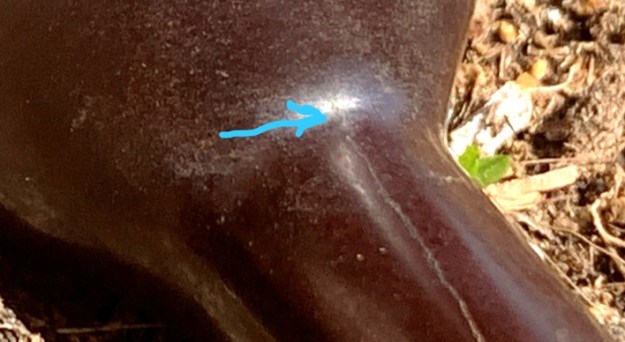
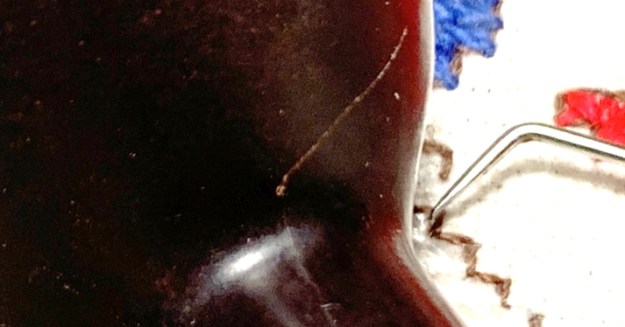
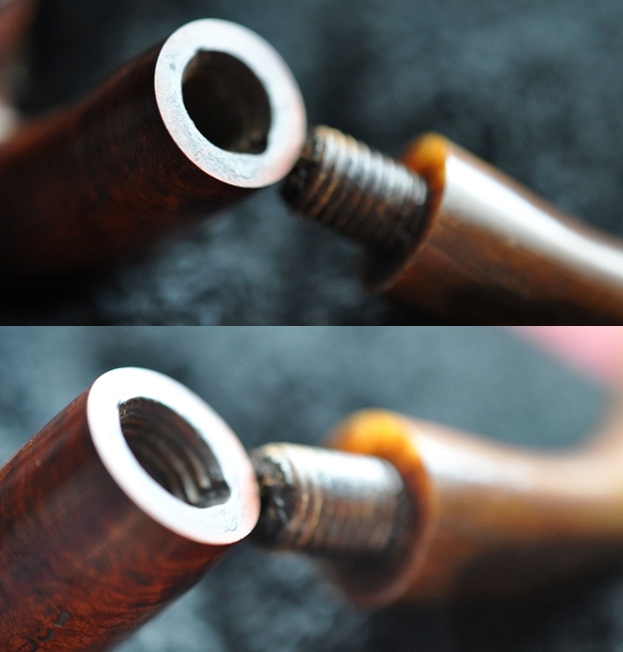
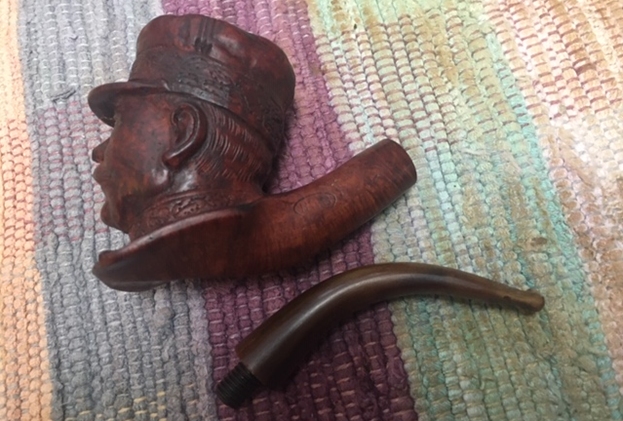
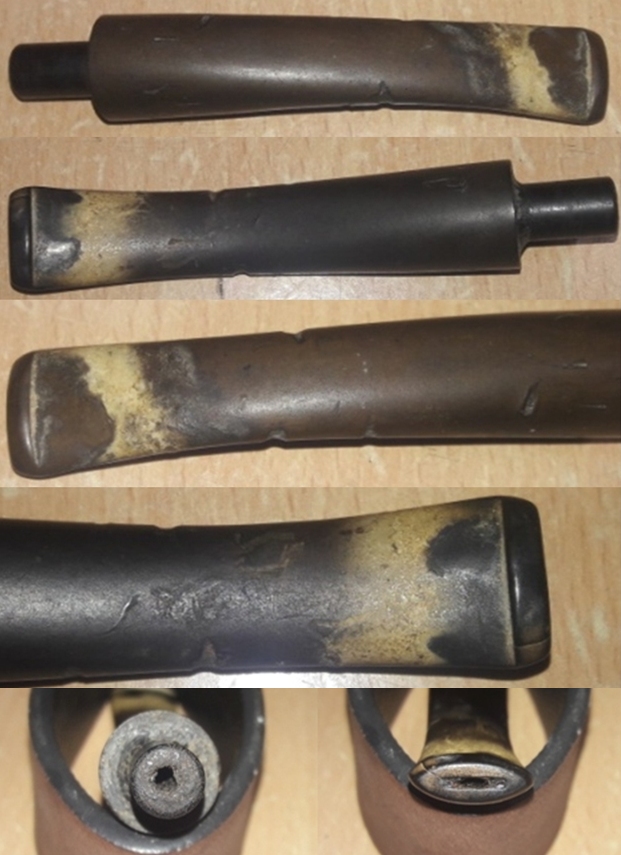
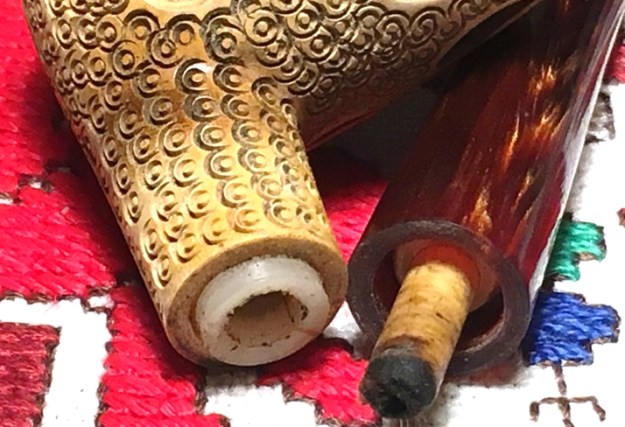
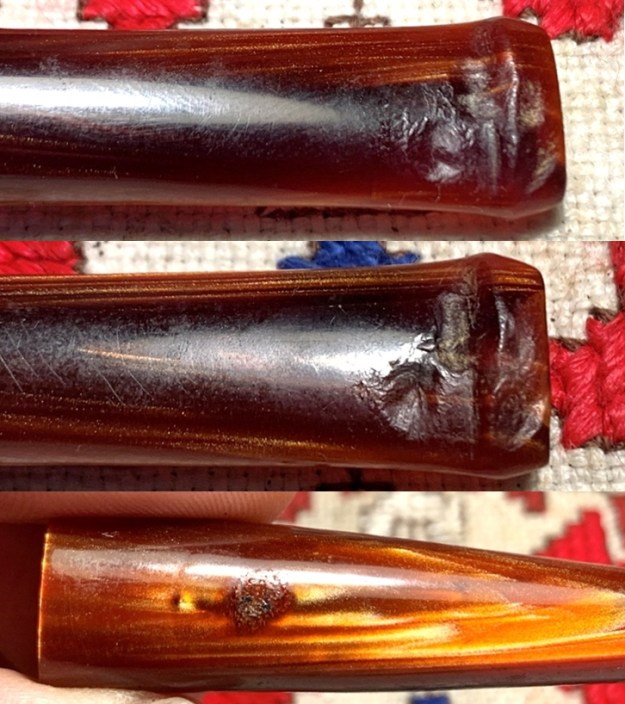
This is the first clue that leads me to think that the pipe is French made. As I examine the pipe and get input there will be more clues.The next photos reveal the well-used condition of the horn stem. It was very dry and had a crack at the shank/stem junction as seen in the first photo. The second photo shows a long view of the stem and you can see the striations of the horn on the underside. The final two photos below show the chewed end of the stem just ahead of the button. On the top side of the stem there is a hole all the way through to the airway below. There is quite a bit of damage to the stem that will need to be addressed. For his final photos of the pipe before cleaning Jeff unscrewed the stem from the shank and took pictures. The photos show the condition of mortise and tenon. It actually looks to be in excellent condition.Before turning to my restoration of the pipe I decided to see if I could figure out who the figure depicted. Both Jeff and I wondered if it was not General Charles de Gaulle. I posted a query for help on the Facebook group – Tobacco Pipe Restorers and received a lot of responses. The options included General De Gaulle of France, Philippe Pétain (the Lion of Verdun) France, Marshal Joseph Jacques Césaire Joffre of France, Marshal Ferdinand Foch of France, Otto von Bismarck of Germany and even a suggestion that it was a Victorian Baseball player. I thank each of those who responded as each one took me closer to a solution.

Here is what I have learned so far:

  1. The figure is probably French and definitely military.
  2. The figure is from the period of or directly after World War I.
  3. The figure was a hero of some sort, a key figure that was commemorated by the carving.

That is what I know so far. That is progress. During the night I received a response from Aaron Comsia on Facebook Tobacco Pipe Restorers Group that noted the medal around the neck of the figure. He included the following photo of French medal matching the one on the figure’s neck. I have included that below.The medal was another clue further confirming a French connection of both the figure and the pipe. The stamping pointed to France and the Medal on the neck of the figure pointed to France. Now I knew that I could eliminate the German figures and the Baseball player. That left me with four options – General de Gaulle, General Philippe Pétain, Marshal Ferdinand Foch and finally Marshal Joseph Jacques Césaire Joffre. I decided to find photos of these figures (some I picked up on the web and others were shared by those from the group who put the person forth in response to my question). I will work through them in order and narrow the field further.

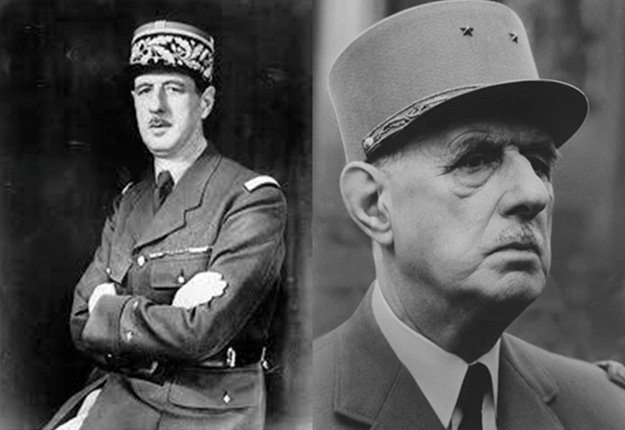
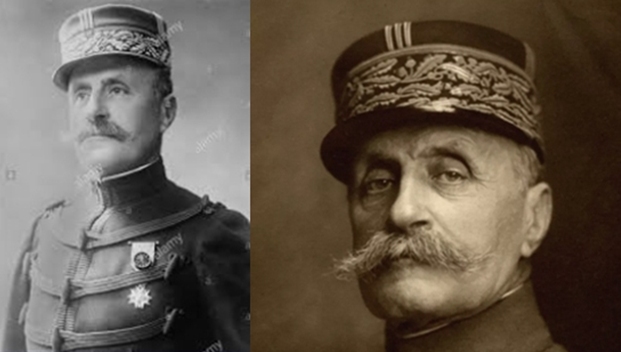
General Charles de Gaulle was the choice of three of four of the responders to my question for who people thought the figure represented. I found a younger and an older photo of General de Gaulle. Comparing these photos to the carved figural above I note some dissimilarities that take de Gaulle off the list. These include a longer narrower face, a smaller and thinner moustache and the large prominent nose. The carved figure had a rounder, fuller face and a thick moustache and a smaller nose. The hat is also different in these two photos and in others that I scanned on the web. I am as certain as I can be that the figure is not General Charles de Gaulle.

The second choice that came up more than once was General Philippe Pétain. He had been acknowledged as having saved the French Army in 1917 at Verdun. His exploits there earned the moniker ‘Lion of Verdun’. He was a prominent figure in French political and military history. During World War II he became part of the Viche Government (working with the Nazi’s in France). For many this would have made him a collaborator. Here are two photos of Pétain that I found online.Comparing these photos to the carved figural above I thought for some time that I had found the right historical character to match the pipe. Looking at the photo the hat is the same as the carved head. The nose and moustache are close for sure but there is some dissimilarity as well when I studied the face. The eyes on the photos are much closer set with the nose than on the figure. The jawline is also different in that the carved figure seems to have a more round chin and the upper jaw seem to extend over the lower much more than in the photos. Given those features and his connection to the Vichy Government I think I can rule out General Philippe Pétain personage of the carving. To be honest this was a hard one to let go of for me.

The third choice that came up several times was Marshal Ferdinand Foch. Marshal Foch was a noted French commander during World War I. One respondent on the group, Taeve Schaer commented that many carvers in St.Claude, France (they call themselves the cradle of pipemaking) did these pipes. Many of the carvings were of Marshal Foch. Several responders included the photo of Foch on the right. I found the second one and included them both here.Comparing these photos to the carved figural above I thought for some time that this was a good possibility. Taeve Schaer’s comment about many carved figural pipes of Marshal Foch were made in St. Claude. Looking at the photo the hat is the same as the hat on the carved head. The nose and moustache are close for sure but there is some dissimilarity as well when I studied the face. The drooping brows and eyes on the photos are different than those on the figure. The jawline is also different in that the carved figure seems to have a more round chin and the upper jaw seem to extend over the lower much more than in the photos. The cleft in the chin is also notably missing in the carving. The moustache is longer and more ragged than the cropped one on the carved figure. Given those features I think I can rule out Marshal Ferdinand Foch as the personage of the carving. This was easier to let go of than Pétain.

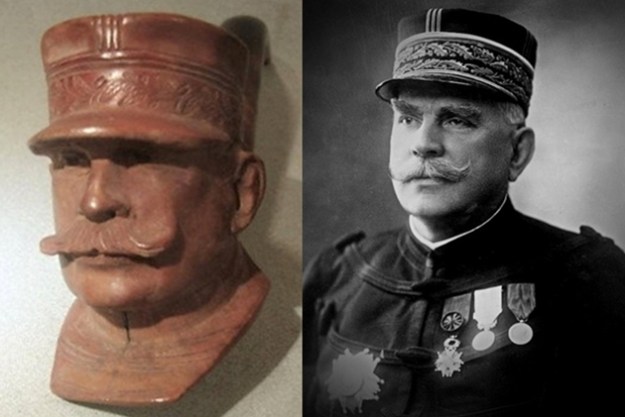
The fourth choice that came to me was that the figure was Marshal Joseph Joffre. Chris van Hilst suggested Joffre and included a photo of another carved figural pipe of Joffre from 1917. Marshal Joseph Jacques Césaire Joffre (12 January 1852 – 3 January 1931), was a French general who served as Commander-in-Chief of French forces on the Western Front from the start of World War I until the end of 1916. He is best known for regrouping the retreating allied armies to defeat the Germans at the strategically decisive First Battle of the Marne in September 1914.

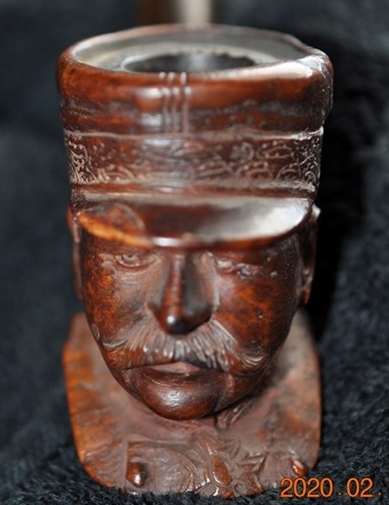
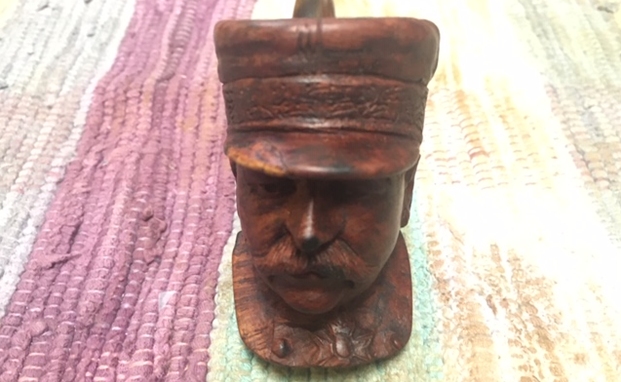
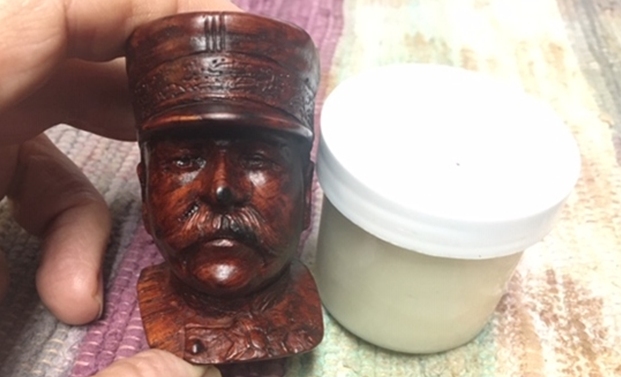
I used the photo of the figural of Joffre and picture that I found online. I have included them both below. You can see the similarity between that figural and Joffre for sure. But did it match the figural that I was working on? I have included a frontal view of the figural I am working on below these two photos. What do you think?From my perspective the facial features match this choice the best. The jawline, the nose, the moustache, the set of the eyes and the hat as well as the medal on the chest of the figural and the picture of Joffre all point to the similarities between Joffre and the pipe that I have. I am convinced that the pipe is indeed Marshal Joseph Jacques Césaire Joffre. I am sure some of you will not be convinced but that is my logic.

I did some more reading about Joffre on Wikipedia (https://en.wikipedia.org/wiki/Joseph_Joffre). It included the previous information I included above but also the following:

…His political position waned after unsuccessful offensives in 1915, the German attack on Verdun in 1916, and the disappointing results of the Anglo-French offensive on the Somme in 1916. At the end of 1916 he was promoted to Marshal of France, the first such promotion under the Third Republic, and moved to an advisory role, from which he quickly resigned. Later in the war he led an important mission to the United States. His popularity led to his nickname Papa Joffre.

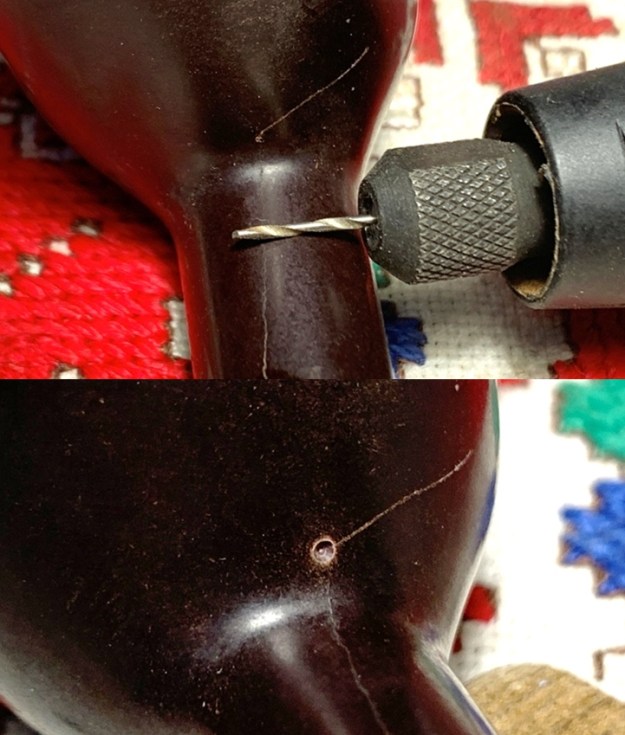
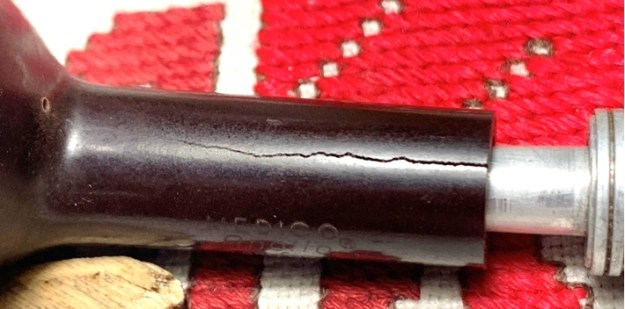
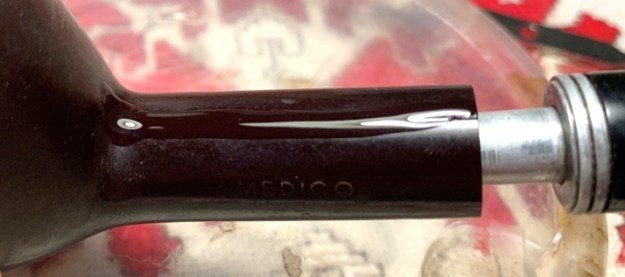
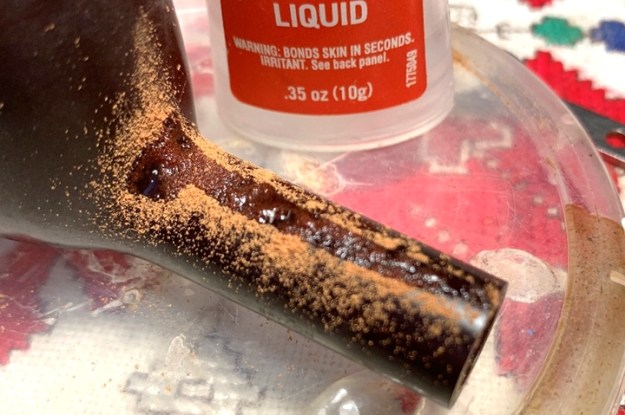
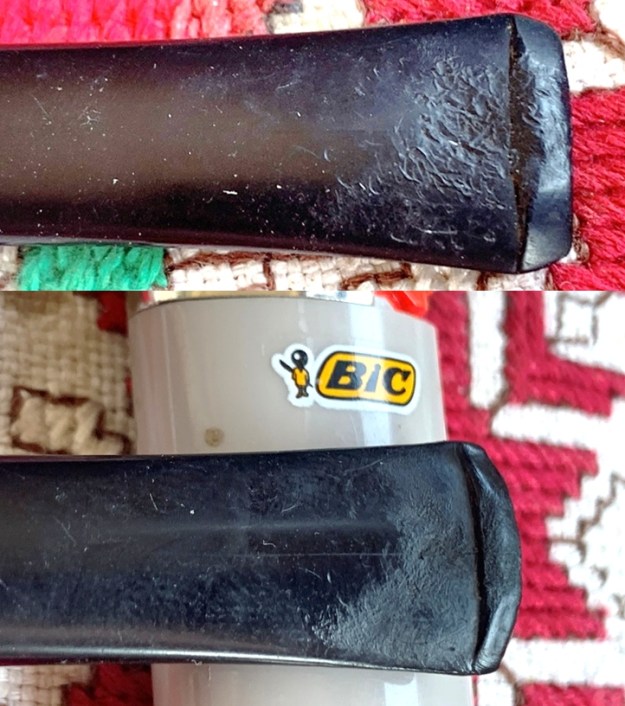
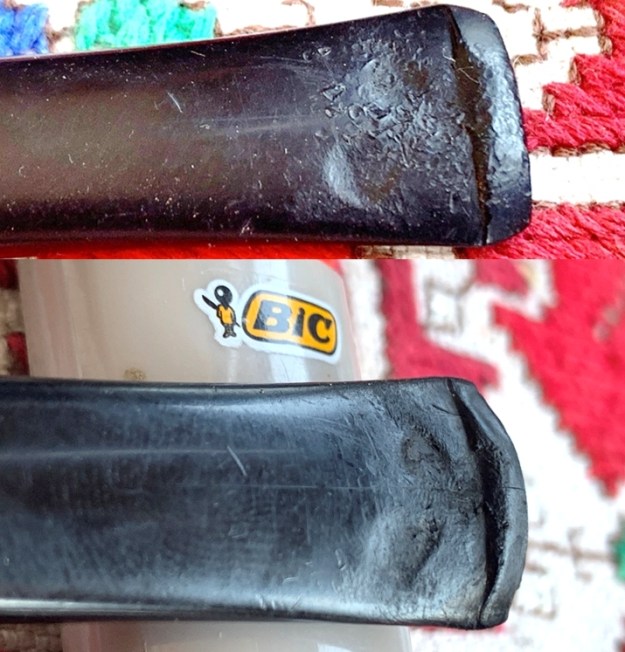
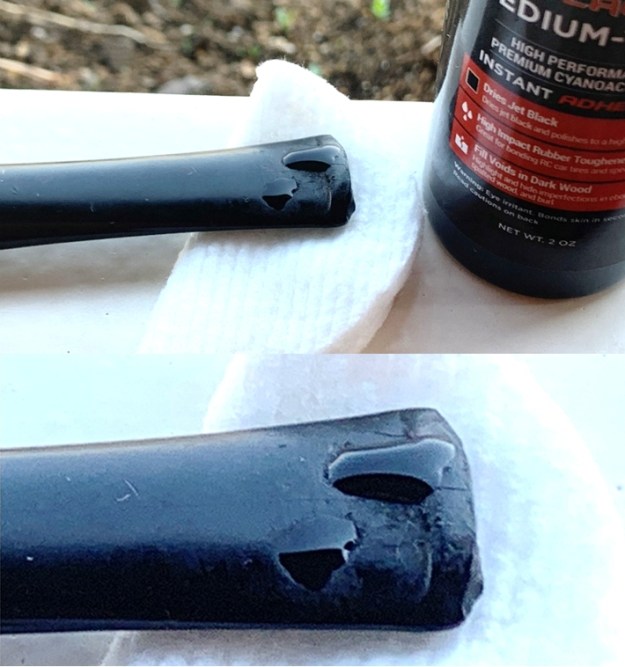
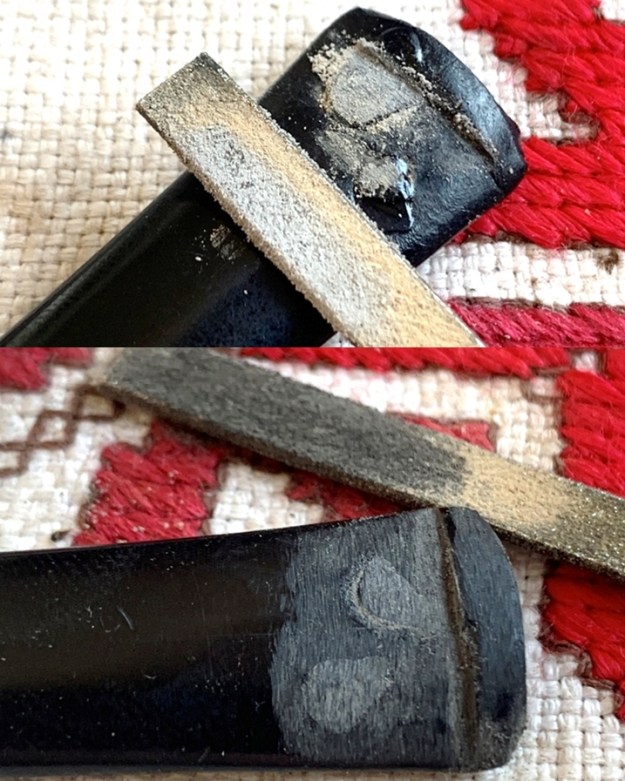
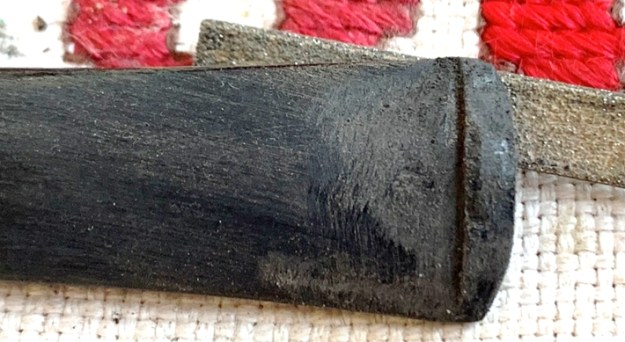
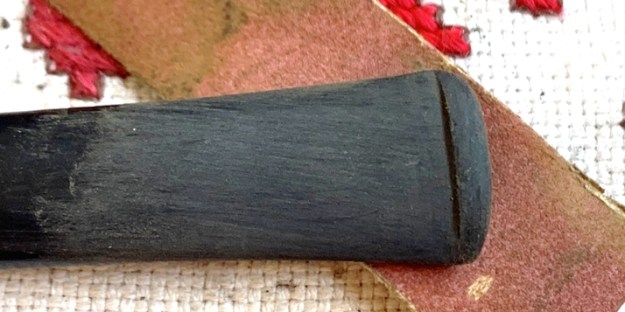
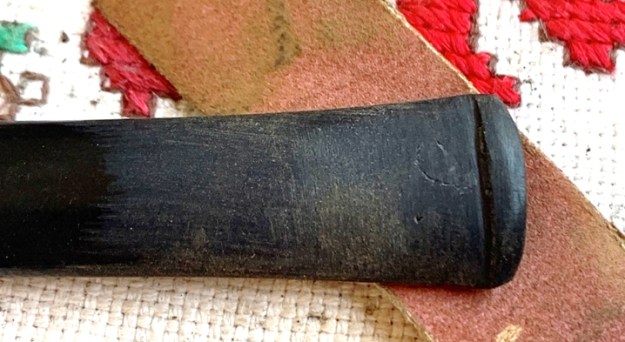
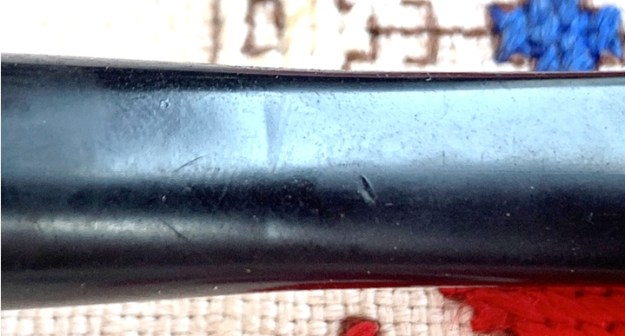
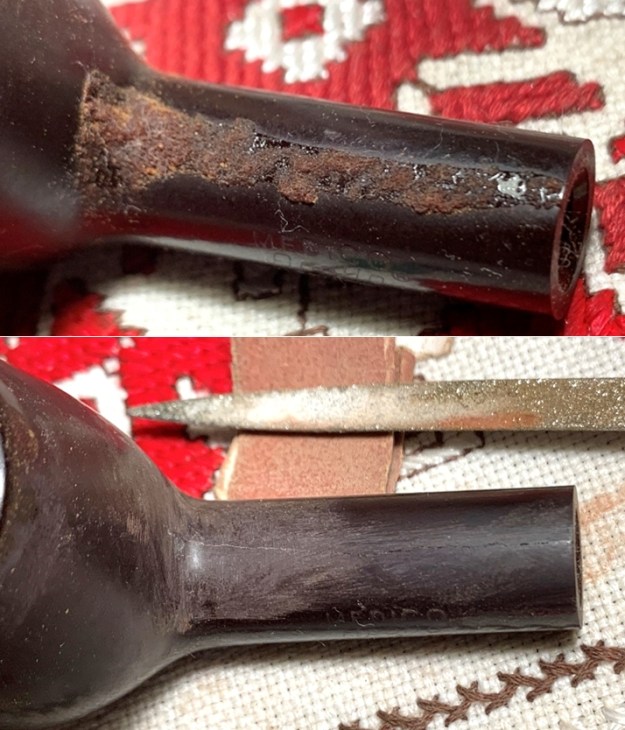
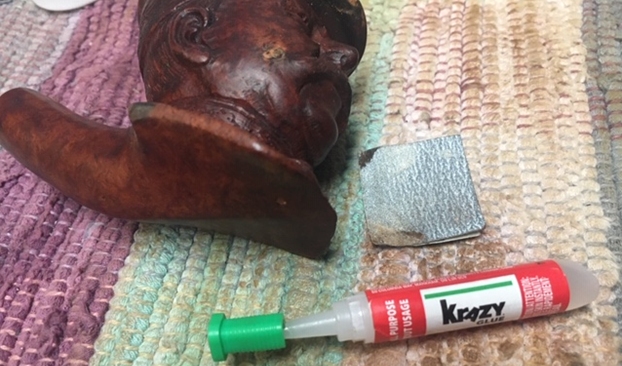
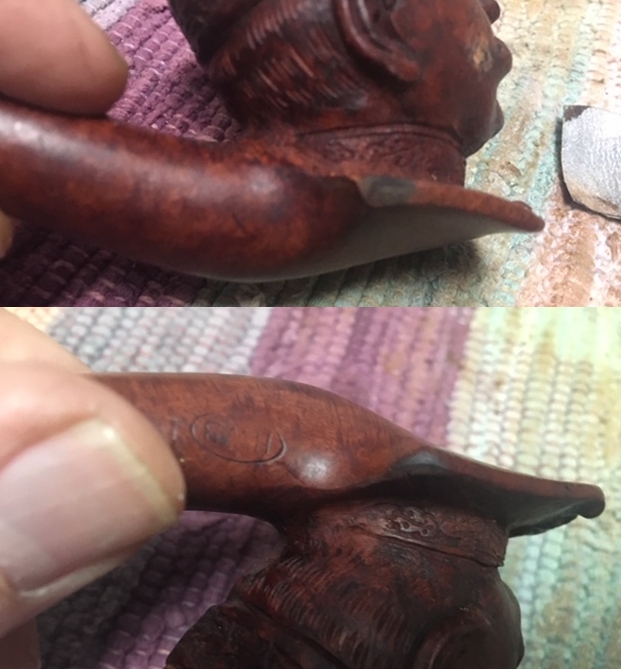
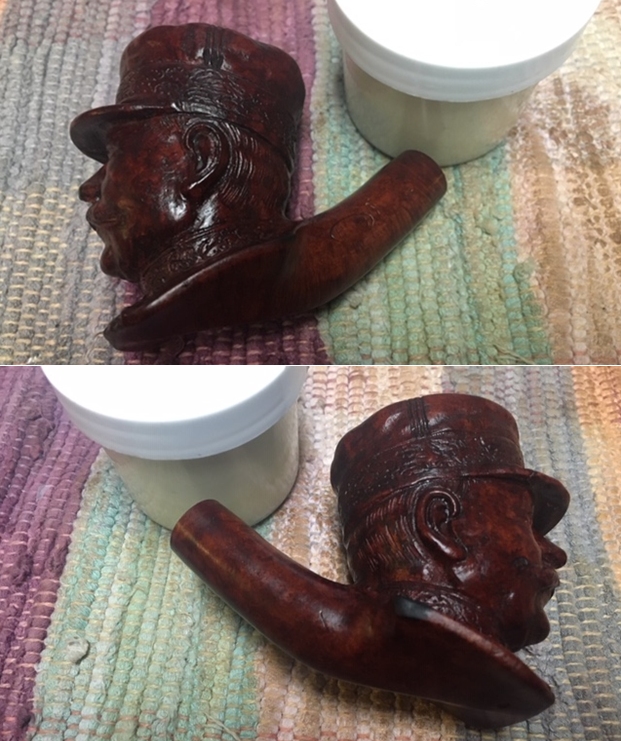
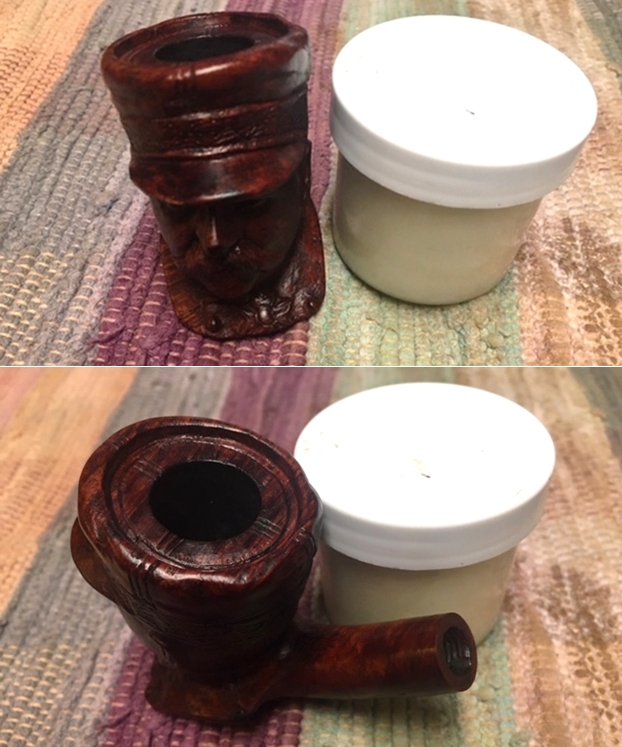
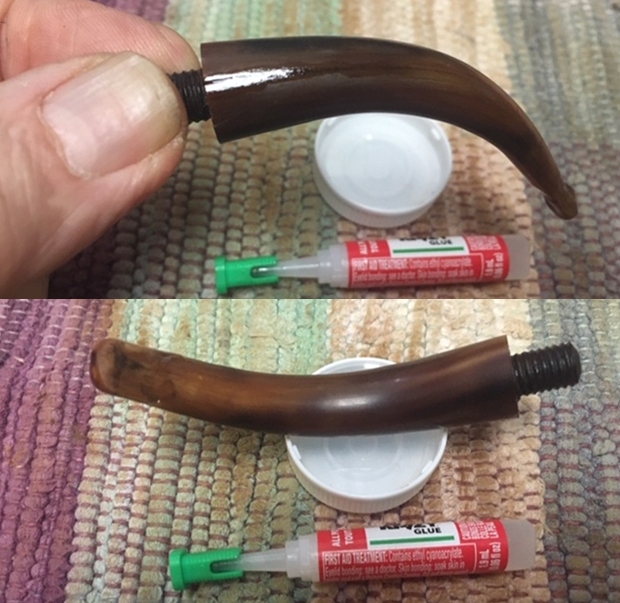
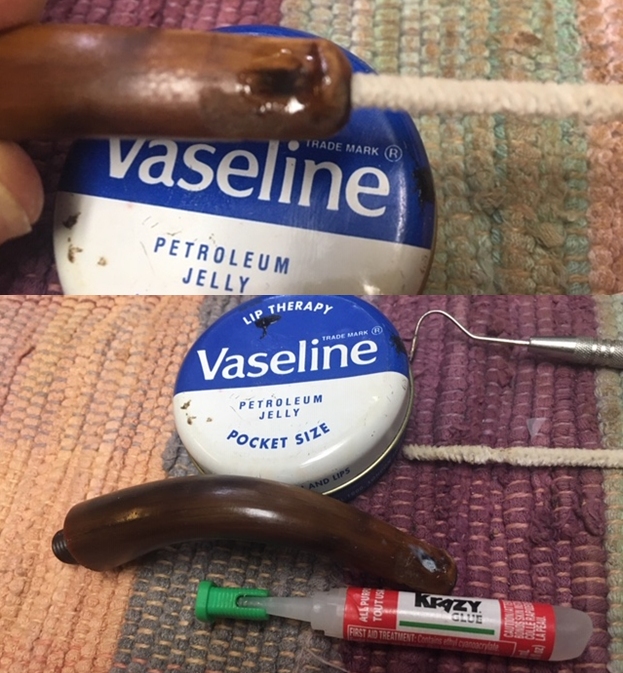
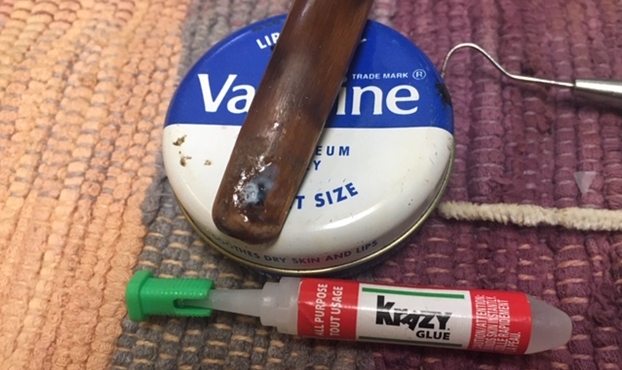
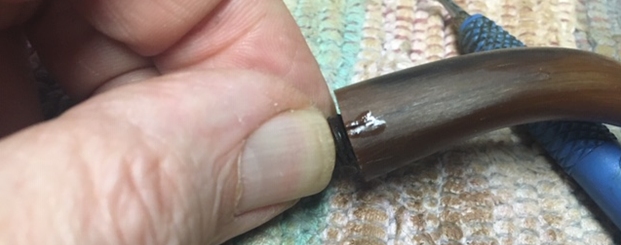
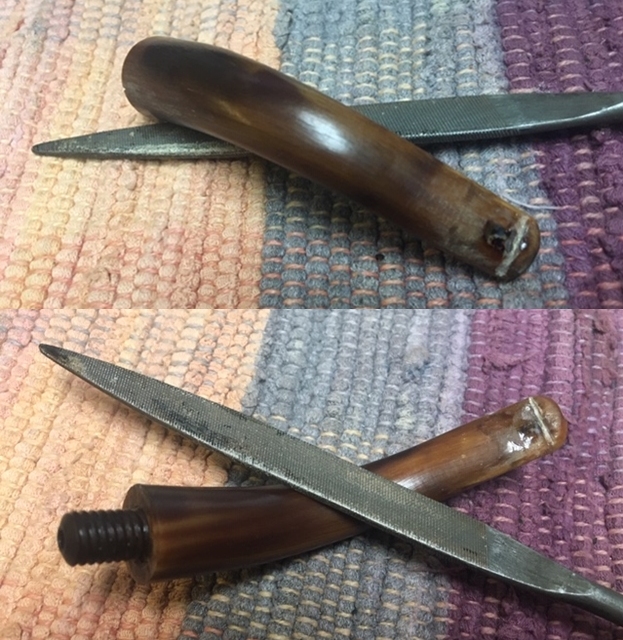
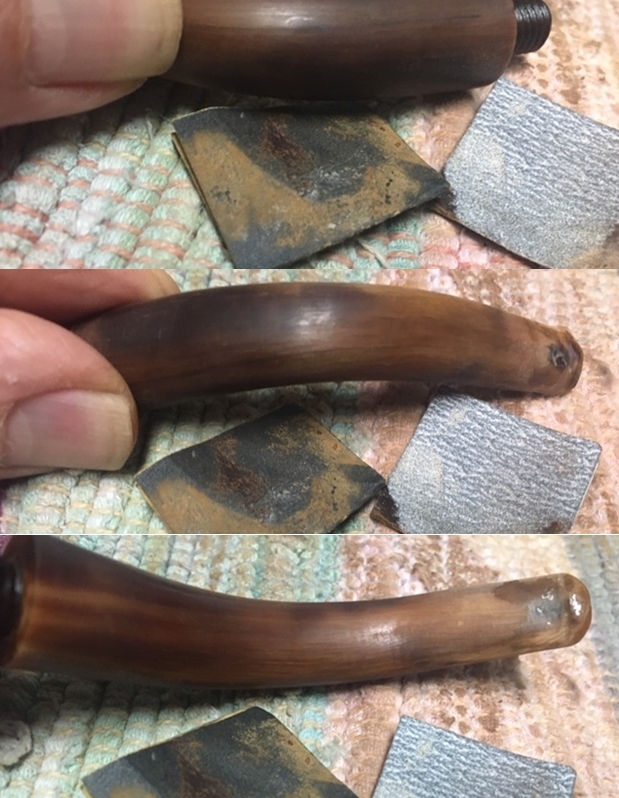
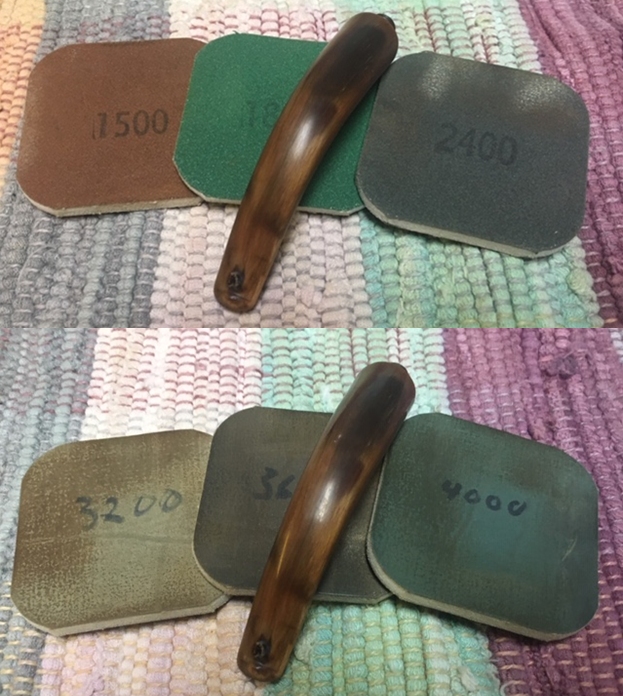
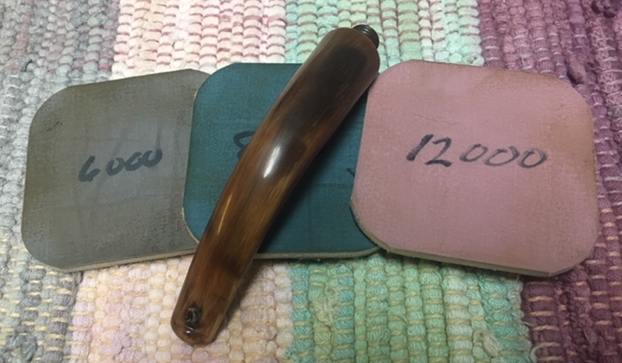
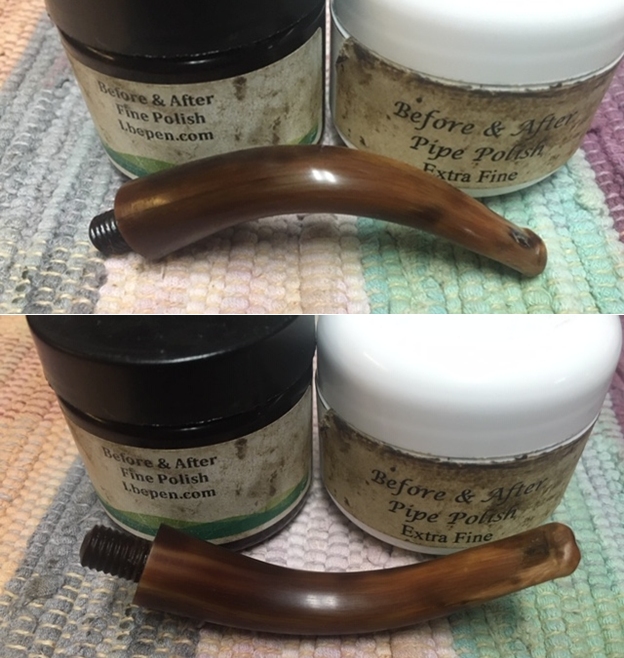
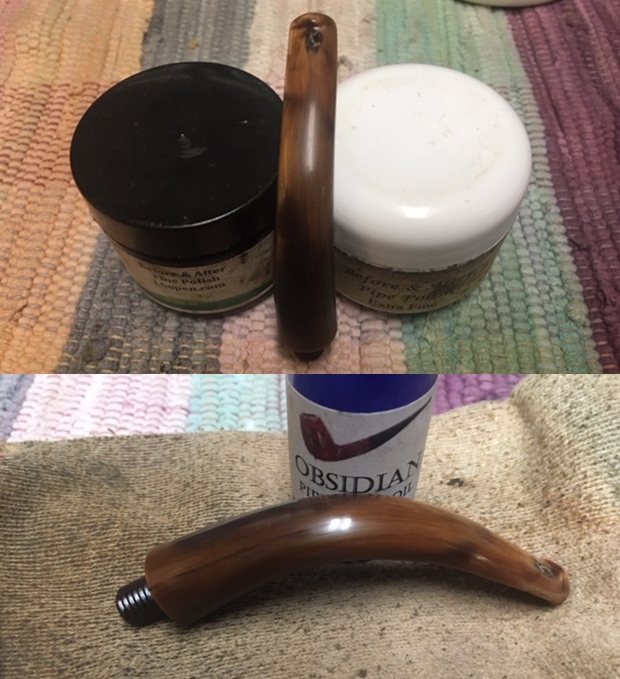
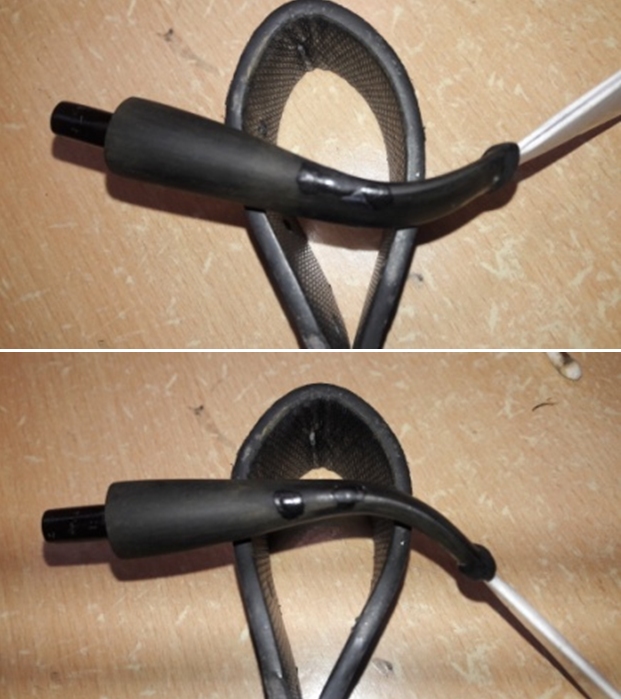
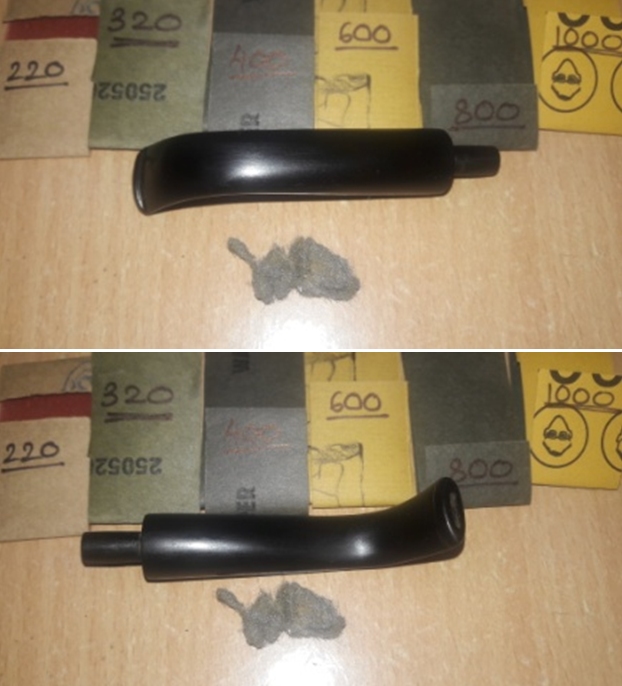
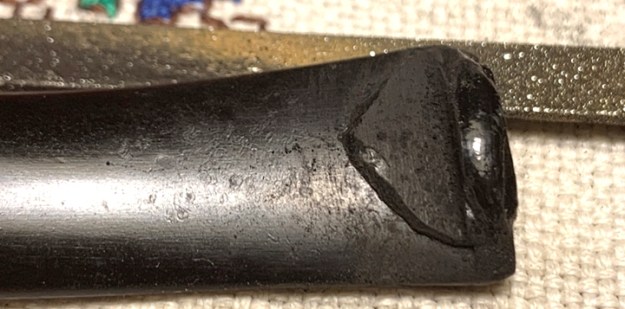
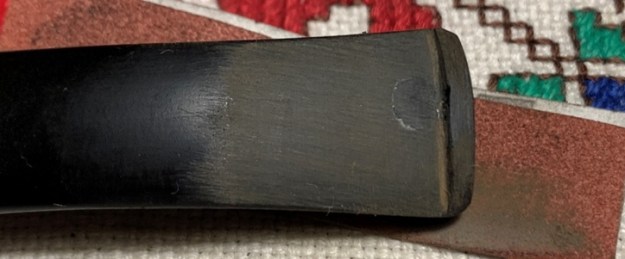
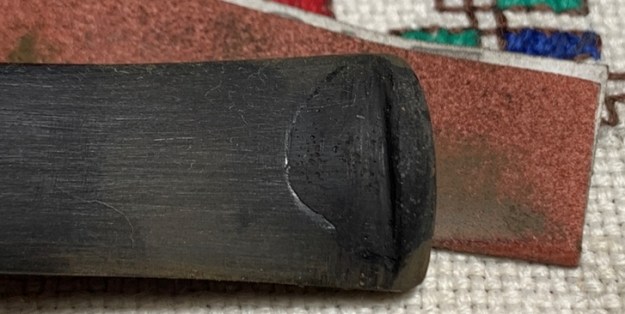
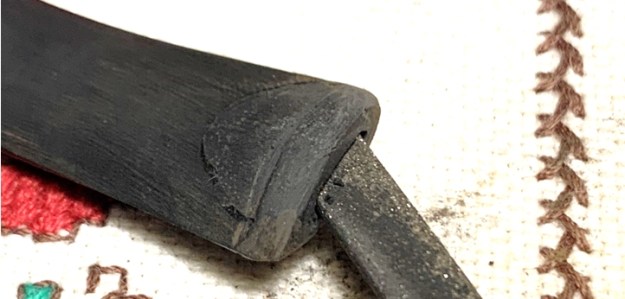
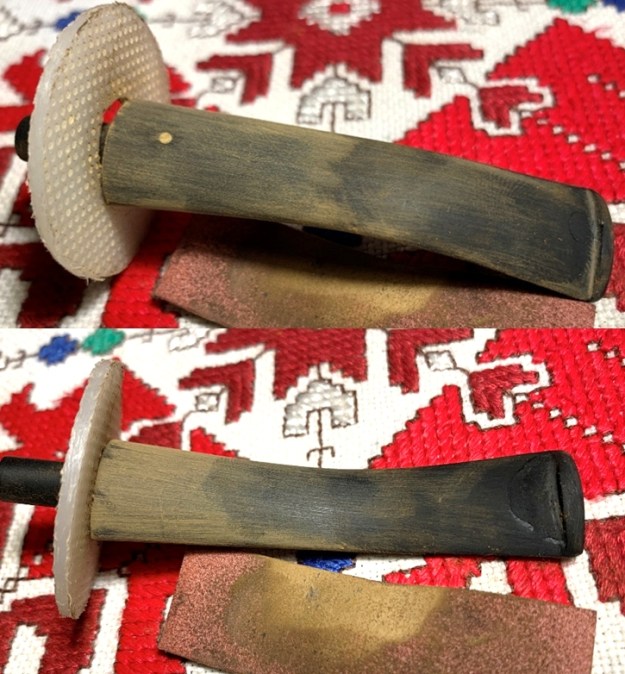
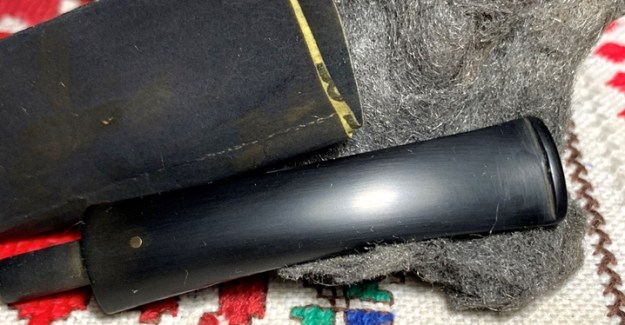
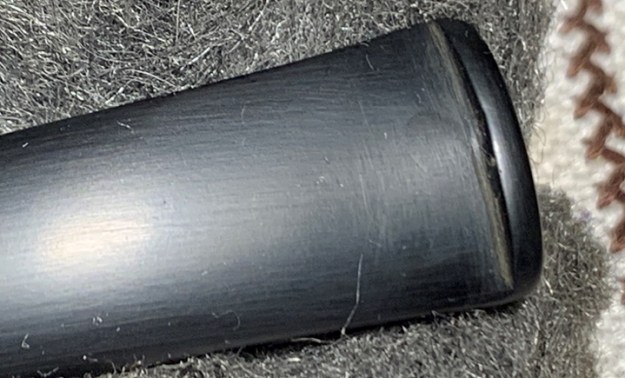
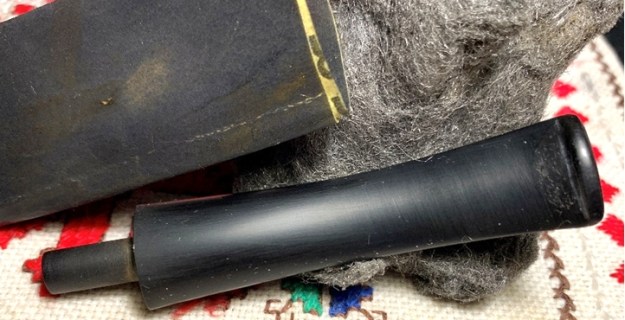
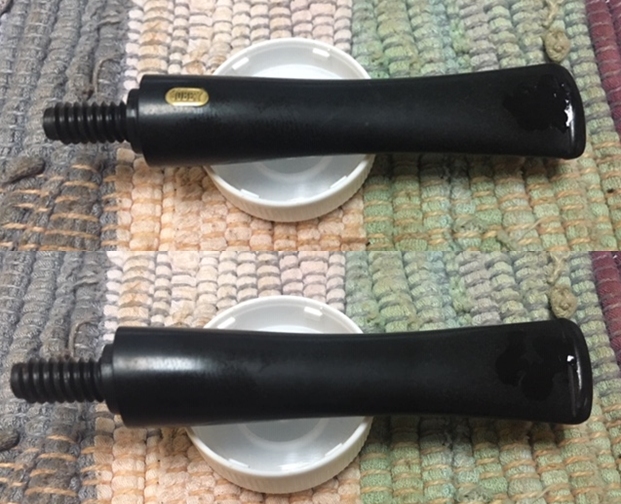
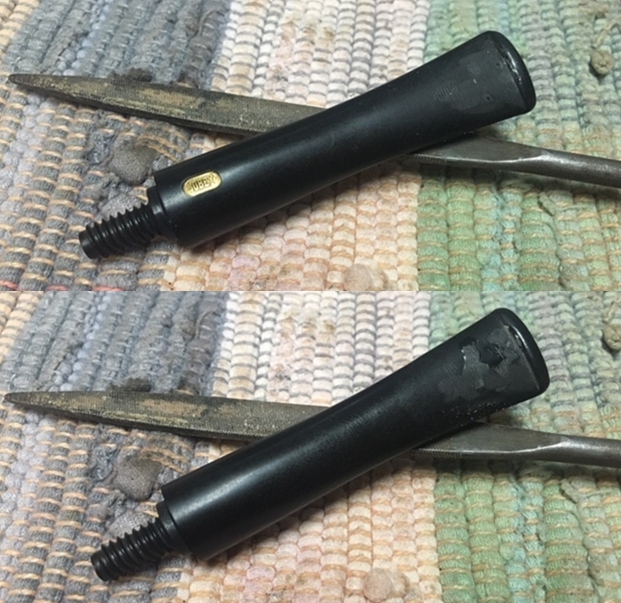
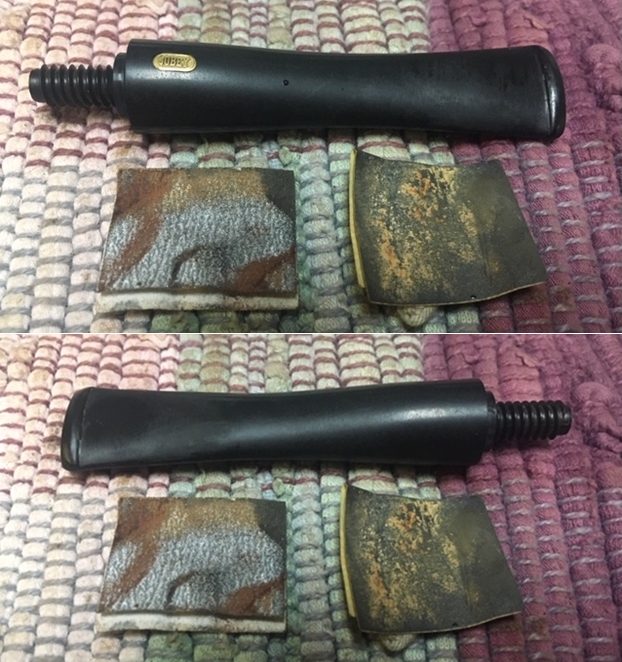
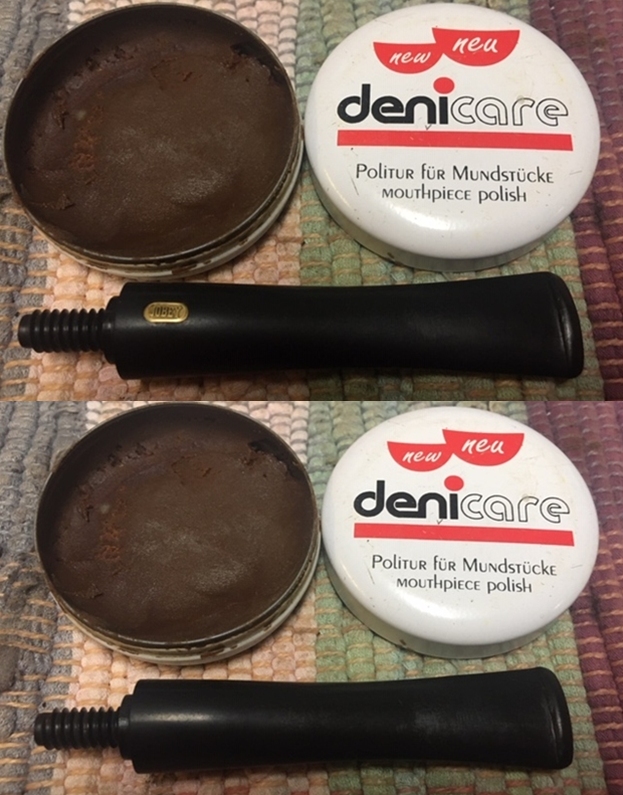
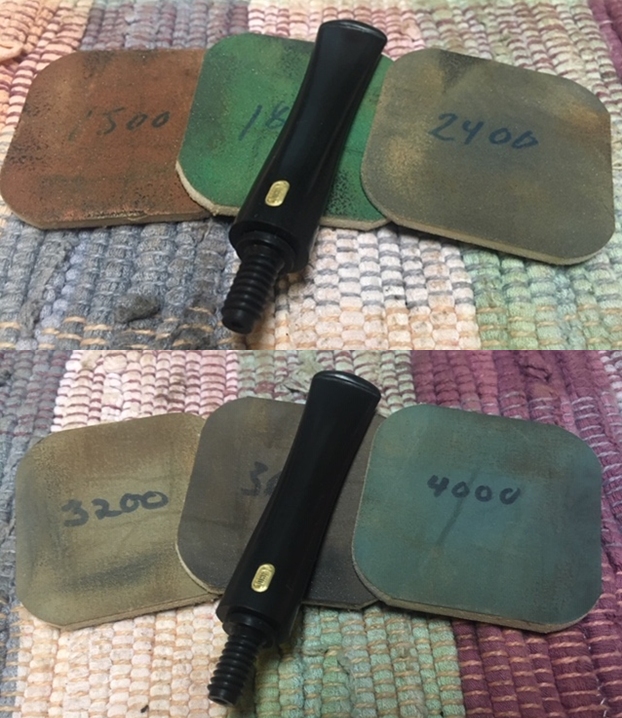
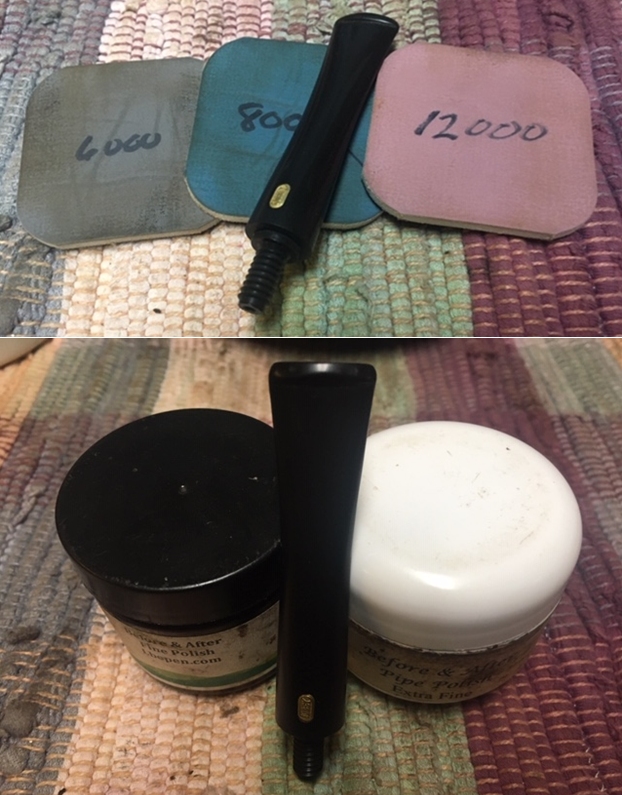
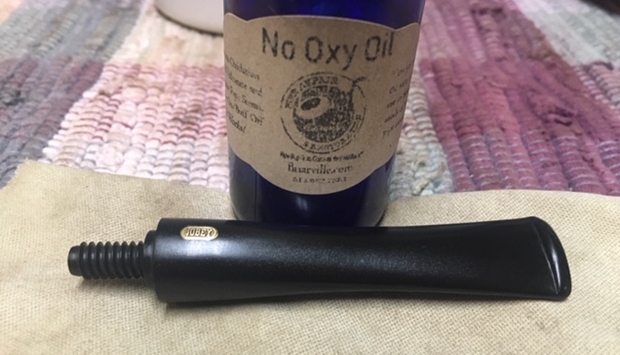
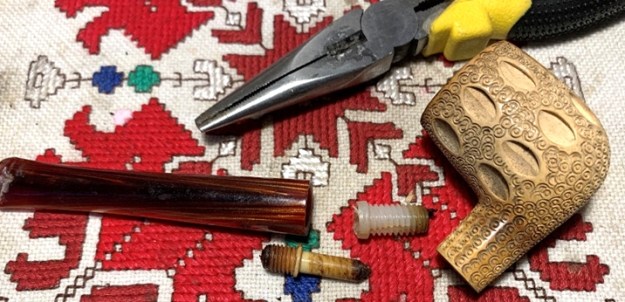
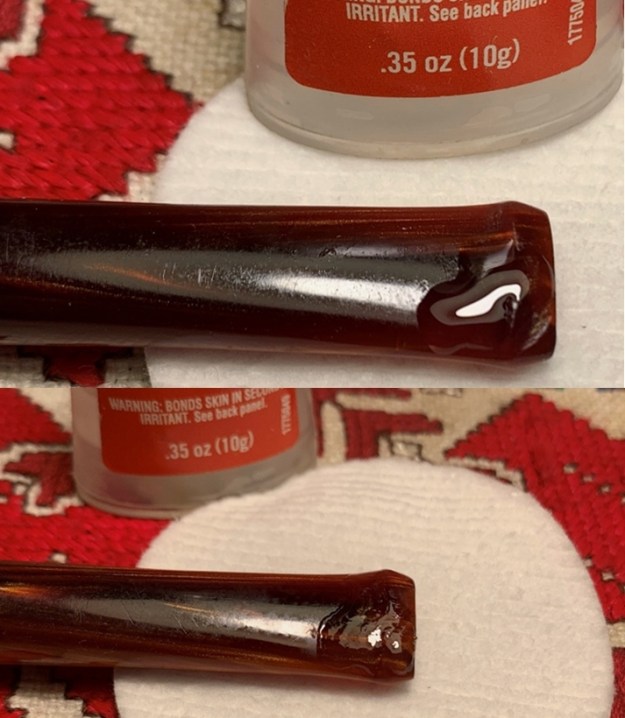
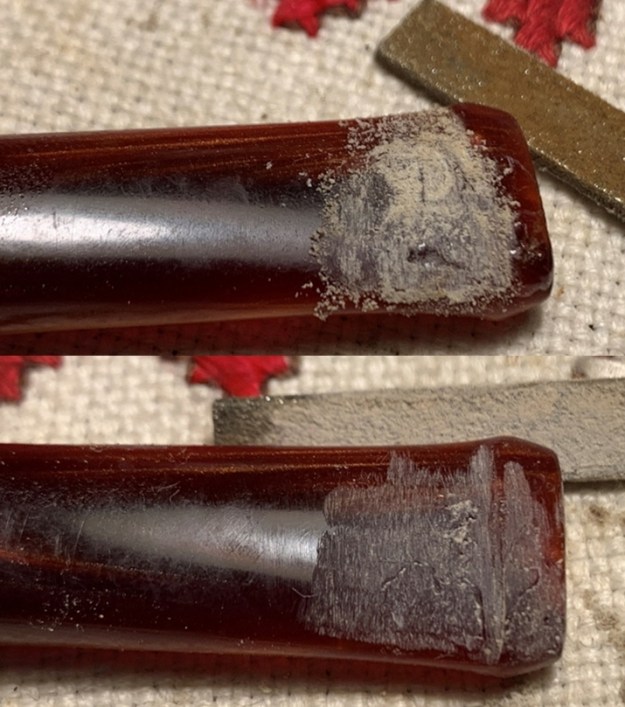
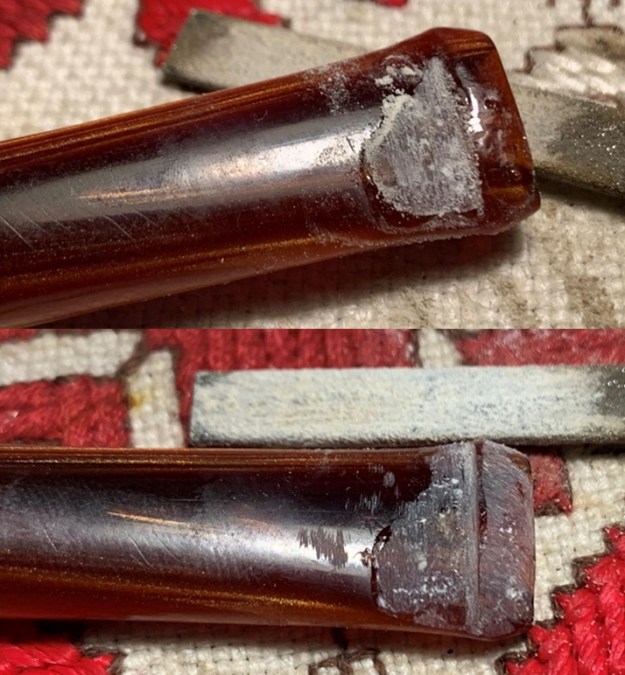
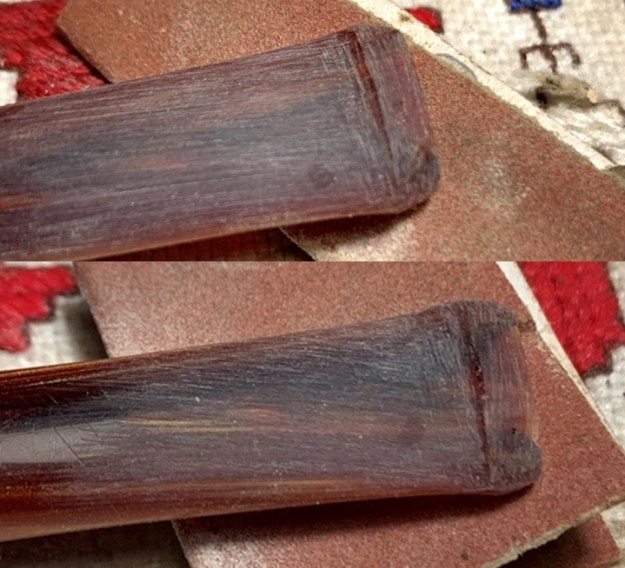
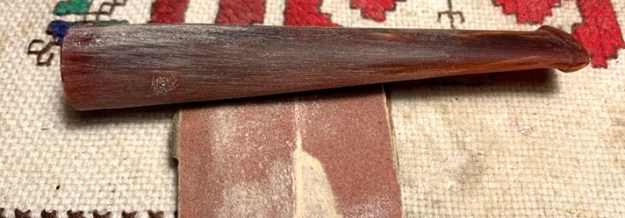
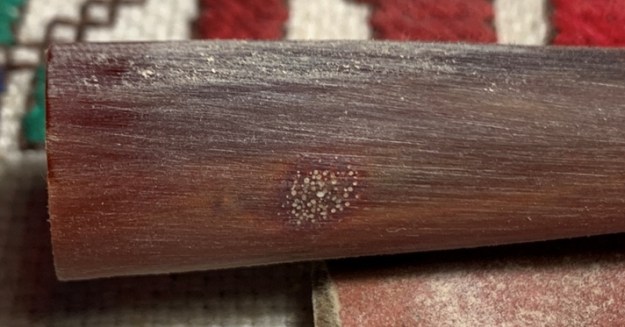
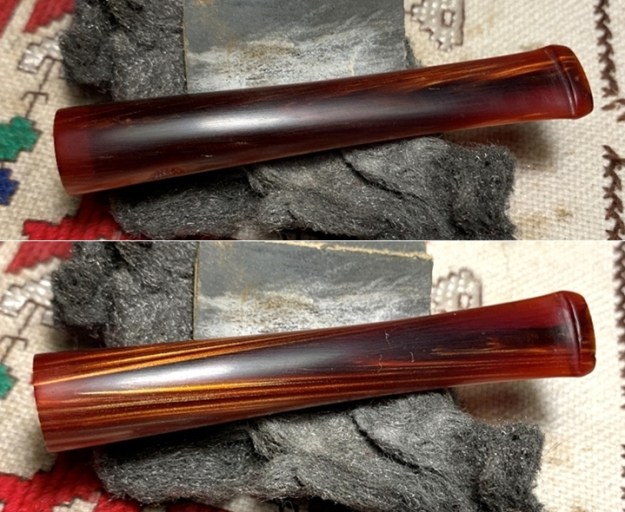
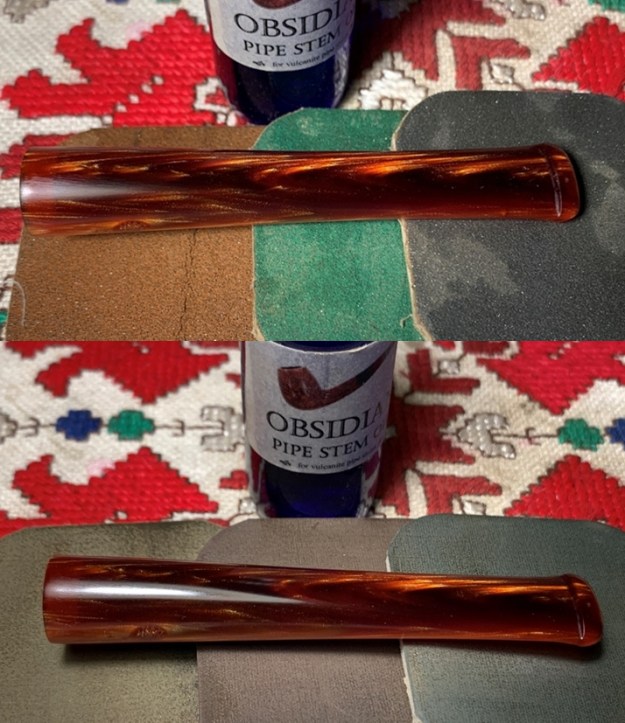
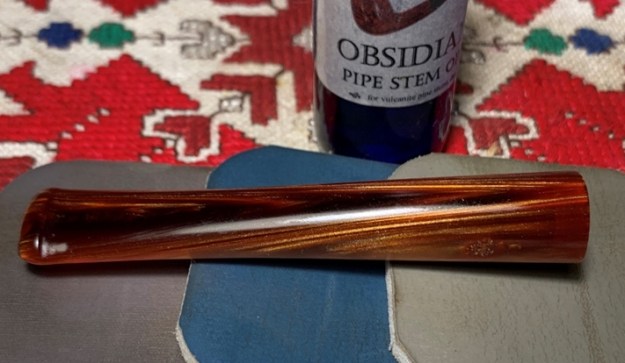
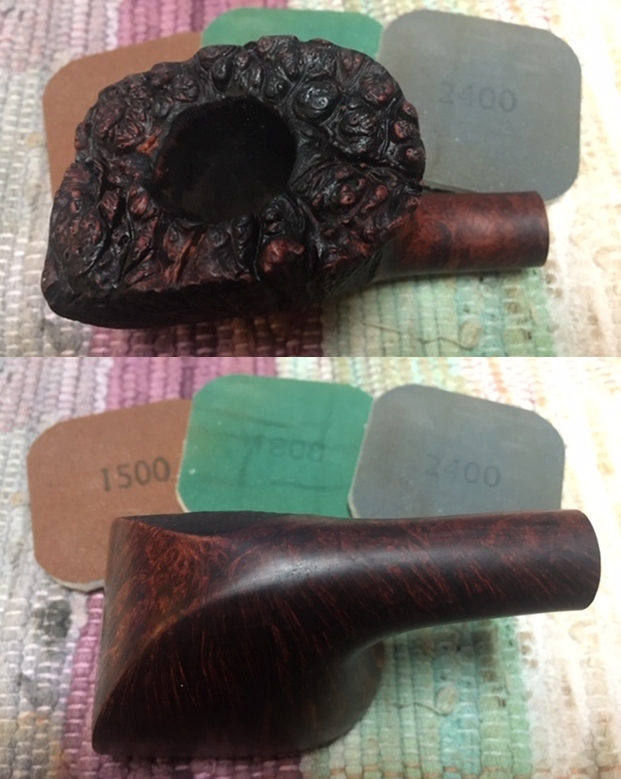
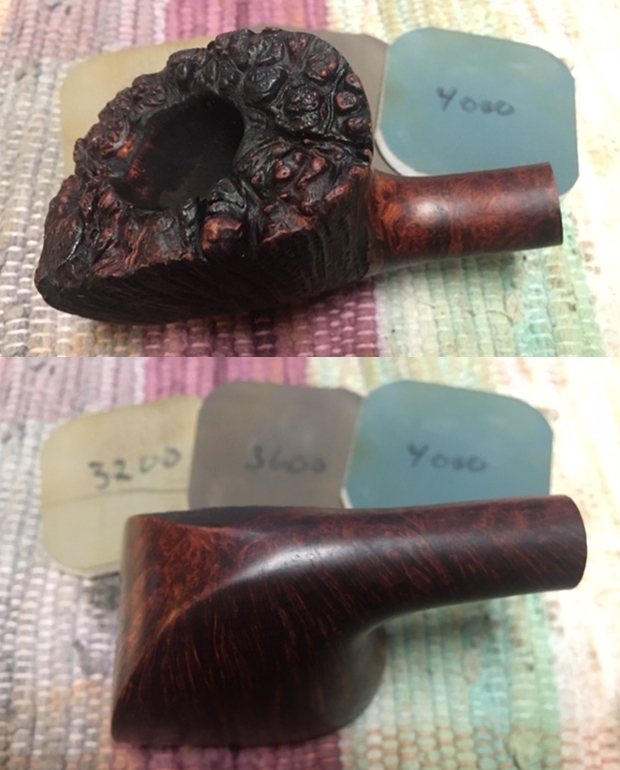
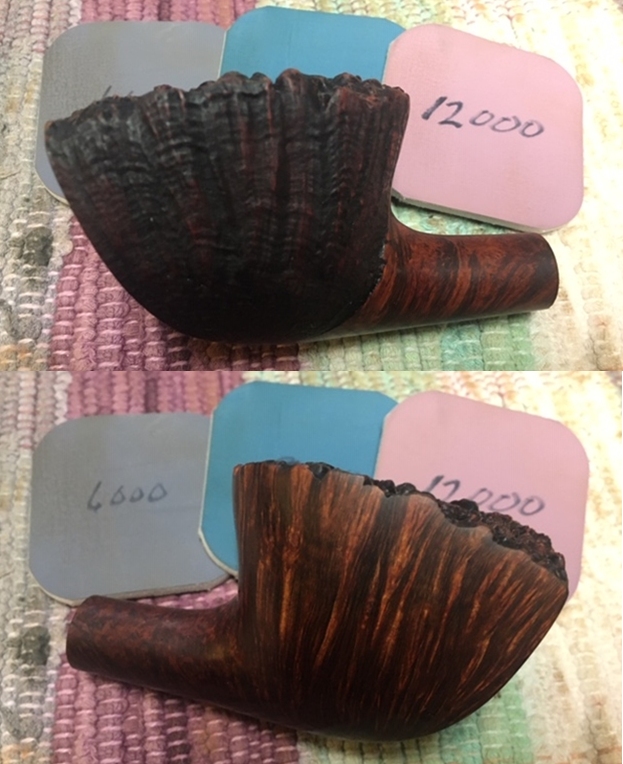
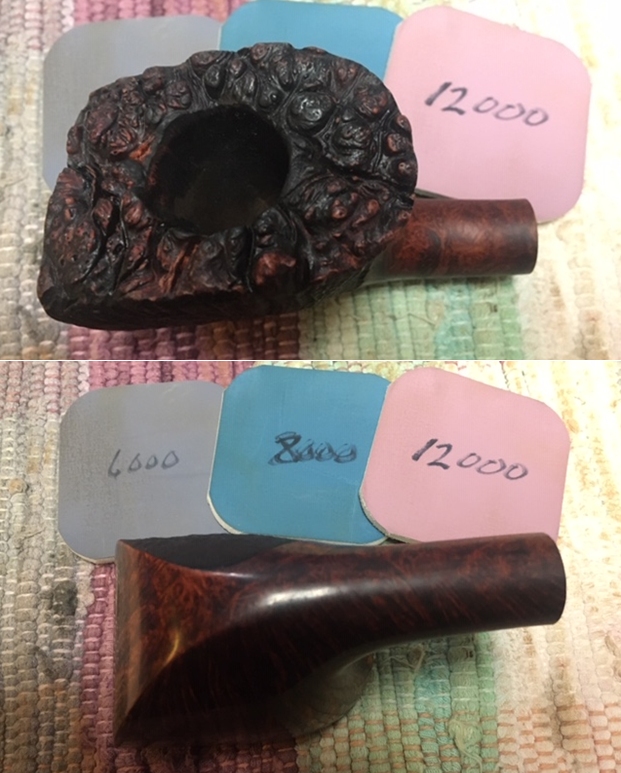
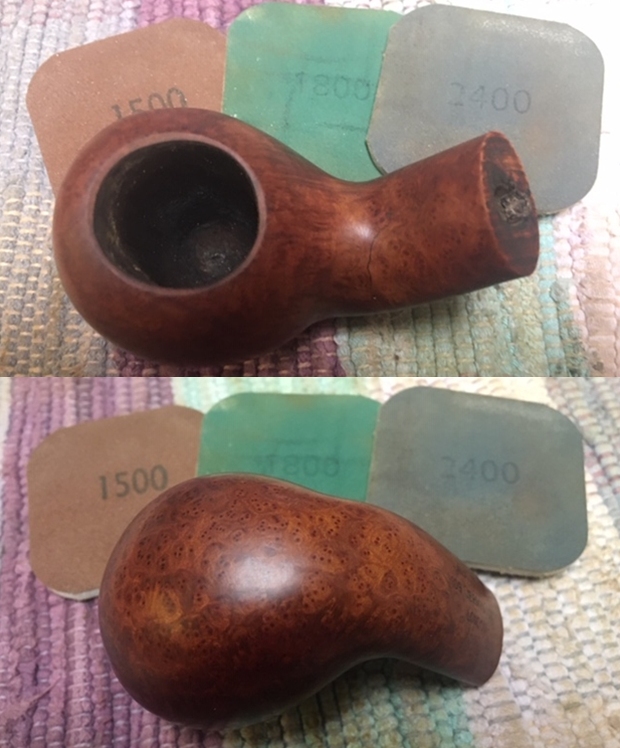
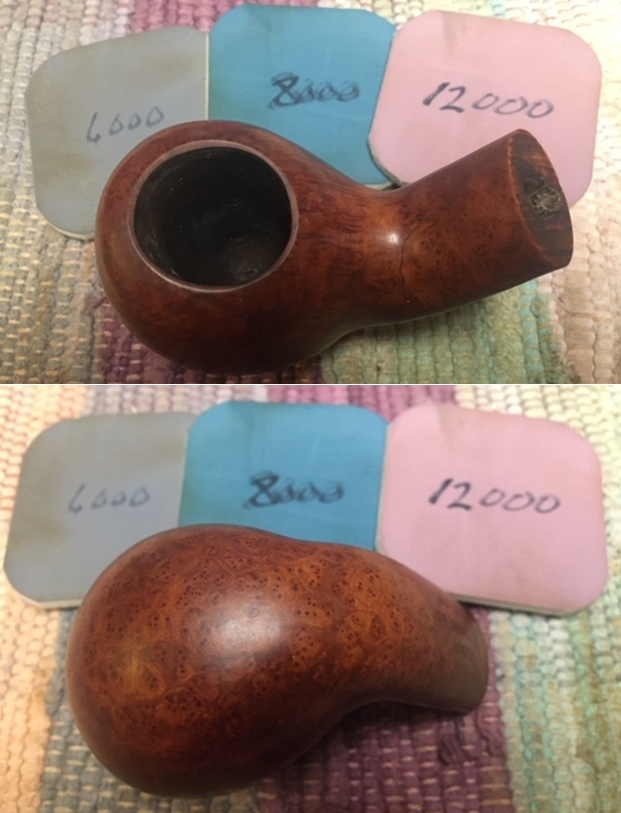
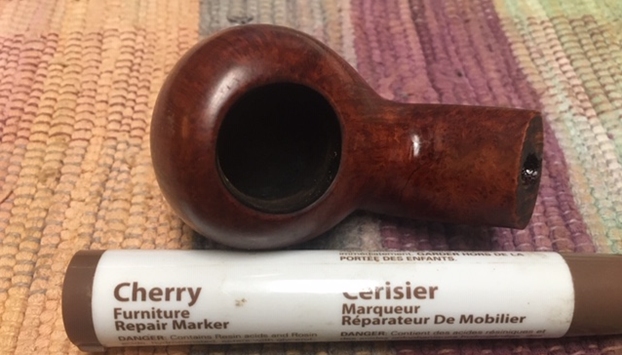
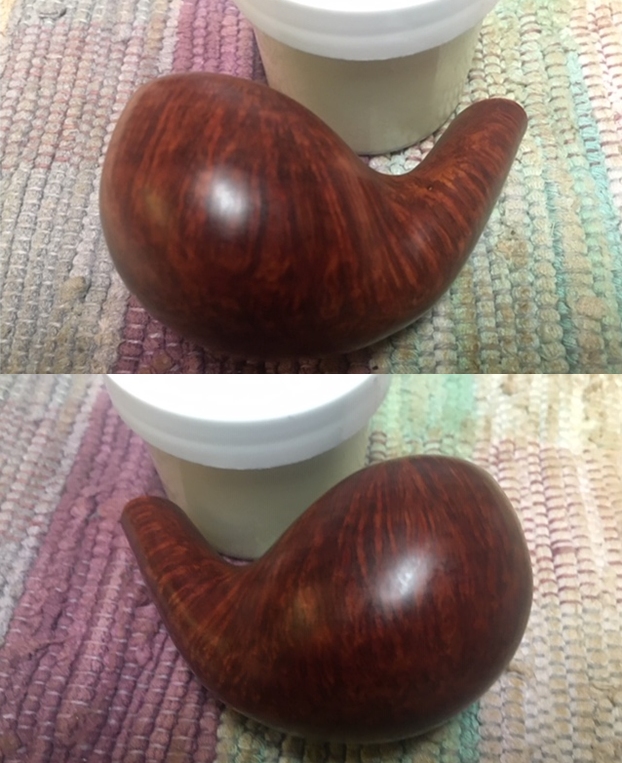
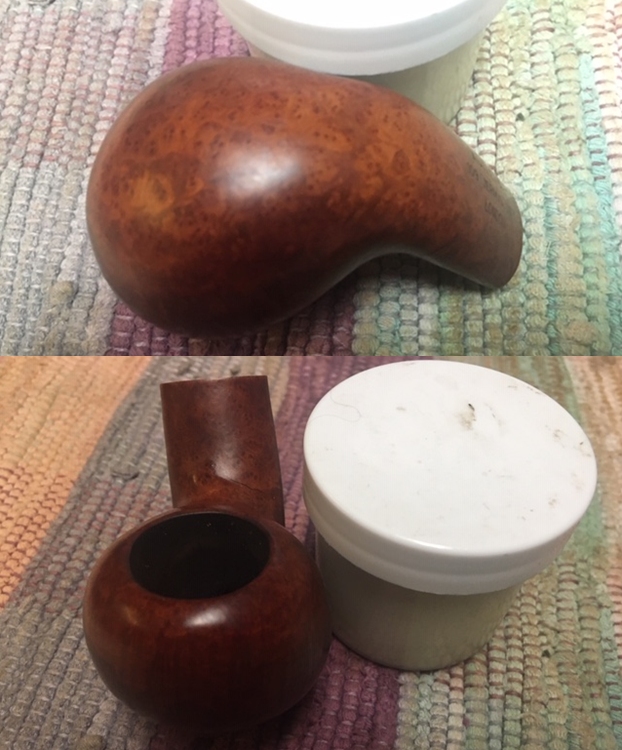
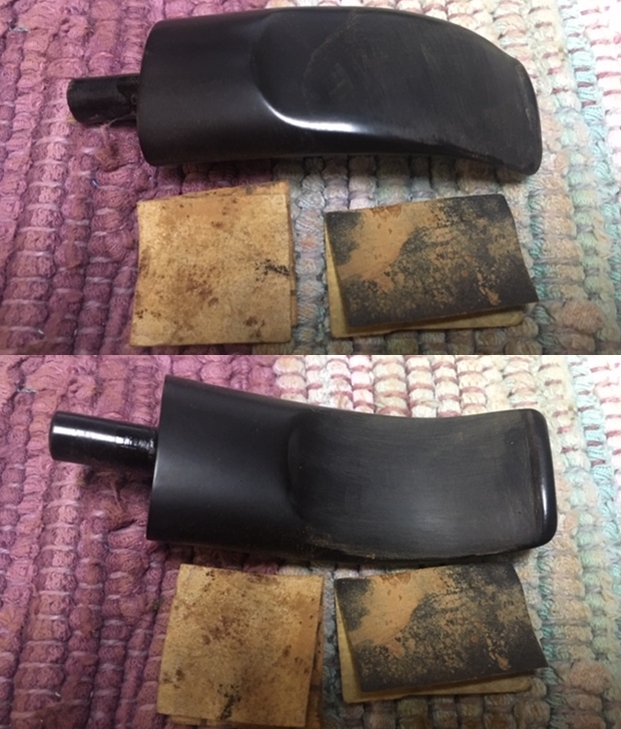
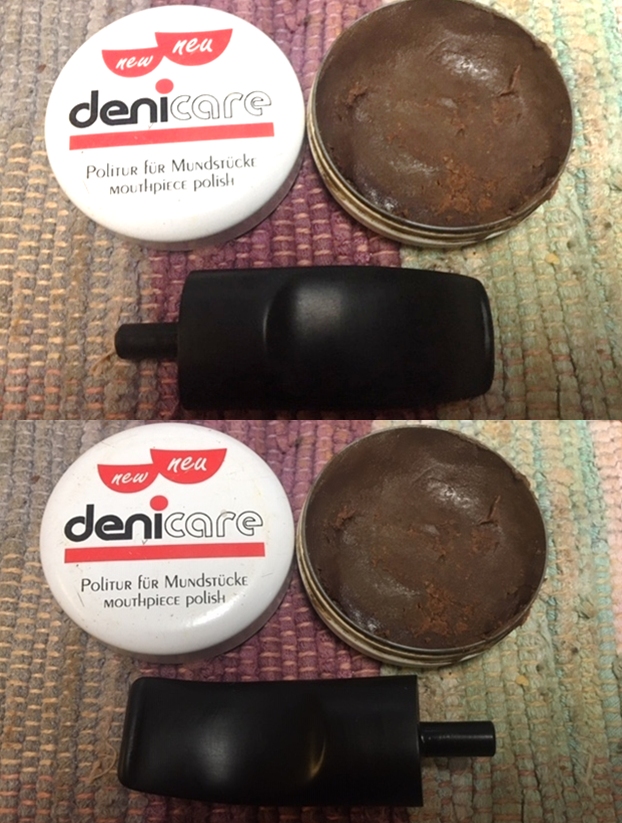
It makes good sense to me that a pipe carver in St. Claude with HWB would so beautifully capture the features of Papa Joffre. Now it was time to do my part of the restoration of this pipe. Jeff had done his usual thorough cleanup of the pipe. He had reamed it with a PipNet reamer and cleaned up the remnants with a Savinelli Fitsall reamer. He cleaned out the internals of the shank and stem with alcohol, cotton swabs and pipe cleaners. He carefully scrubbed the grime and oils off the surface of the briar with a tooth brush and undiluted Murphy’s Oil Soap. He rinsed it with warm water and dried it off with a soft towel. He set it aside to air dry before putting it back together. When he brought it to Oregon on a recent trip we made pre-COVID-19 I was stunned at how well it had cleaned up. I have wanted to work on it for a while now but somehow had mislaid it. I found it recently and brought it to the worktable. Here is what it looked like before I started. I took close-up photos of the bowl and rim top and stem to show how much better they looked. You can see the lines from the front, back and sides of the hat carried across the rim top. The briar is clean and quite beautiful to me. The issues with the pipe really involved the stem more than anything else. There was the split in the left side at the shank and the bit through and gnawing on the top and underside of the stem. The stem was really a mess and had been well used. That is where the lion’s share of my work would come.I took photos of the sides and front of the bowl to show the fine details of the carving now that it is cleaned up. The repair to the right front of the bill of the hat is also visible. It really is a well carved figural. I only wish I could find information on the initials HWB on the shank side. I took another photo of the stamping on the left shank side in hopes that it may register with a reader of the blog. I removed the stem from the shank and took a photo of the parts.Now it was time to start the restoration. I wanted to minimize the flaw on the right cheek. It appear to be damaged. I filled in with CA glue to lessen it slightly and feathered the edges with a corner of sandpaper. I used a folded piece of 220 grit sandpaper to smooth out and reduce the damage on the burned rear corners of the base. I touched up the repaired areas on the face, the heel edges and the bill of the hat with a mixture of Cherry, Maple and Mahogany stain pens. The three pens blended together to match the surround areas of the briar. I was happy with the look of the repairs.I worked some Before & After Restoration Balm into the surface of the briar with my fingertips and a horsehair shoe brush and q-tip to work it into the nooks and crannies of the carving. The product works to clean, enliven and protect the briar. I let the balm sit for ten minutes and then buffed the bowl with a cotton cloth to raise the shine. The photos show the carved bowl at this point in the restoration process. It almost looks oily at this point but that will soak into the briar as it sits while I work on the stem. I set the bowl aside at this point and moved on to address the issues with the stem. I cleaned out the crack on the left side of the stem and the chewed area on the underside of the stem and gave them both the first fill coat of clear CA glue. These were the straightforward repairs to the stem. I have found that clear super glue stabilizes the horn in damaged areas and binds split in the stem very well.The damage on the topside of the stem required more work. I greased a pipe cleaner with Vaseline and slid it into the airway in the stem. It plugged the bite through area on the top of the stem and would keep the glue from closing the airway. I put drops of super glue on the stem surface and after the first layer I removed the pipe cleaner. The bite through was sealed. I continued to layer on the glue repairs until the surface of the stem was even with the surrounding sound horn areas. I sprayed the area with an accelerator – and promptly was reminded why I did not do that normally! The glue dried WHITE… and it was ugly. I am not sure what the accelerator adds but what normally dries clear went white… now I had one more issue to address. I sanded the crack repair on the shank end of the stem with 220 grit sandpaper and was able to blend it in quite well. I filled in the very end of the crack with more glue. To remove as much of the whitening as I could I scraped the top file with a dental pick. I stained it with a maple stain pen and applied another coat of CA glue over the top of it. I added another layer of glue to the underside at the same time. The repair was looking better. You have to remember that the repair will always show at some level but to me darker is better than WHITE.Once the repair cured I used a needle file to redefine the sharp edge of the button and to flatten out the repair and begin to blend it into the surface of the stem. Ahhh… even though there is still a long way to go I feel like I am making some progress.I sanded out the repaired areas of the stem to blend them into the surrounding areas with a folded piece of 220 grit sandpaper. I started polishing the repairs with 400 grit wet dry sandpaper. The repair to the crack on the left topside of the stem looks very good and has blended in very well. The areas around the button look much better and with polishing will look even better. Progress is evident now.The stem was now ready to be polished. I use micromesh sanding pads to polish out the scratches in the horn. I find that wet sanding with 1500-12000 grit pads and wiping the stem down after each pad with Obsidian Oil enlivens and enriches the horn and a beautiful shine begins to appear that  really bursts forth with the last set of sanding pads. I polished it further with Mark Hoover’s Before & After Pipe Polish. I rub the Fine and Extra Fine polishes into the stem surface with my fingertips. I let it sit for a few moments and the buff the each polish off with a soft cotton cloth. I find that these polishes actually take the shine to another level. I finished my work on the stem by rubbing it down with a cloth impregnated with Obsidian Oil as it protects and enlivens the horn even more. I am pretty happy with the stem. It is highly functional and though far from what it was originally it looks really good to my eye. This has been an incredibly fun pipe to restore. The reading and history lessons learned in the process were great. The interactions with the various people on the Facebook Pipe Restorers Group were invaluable and enjoyable as well. It really was like having folks in my shop while I restored the pipe and I could ask questions. Thank you all!

Now I was at one of the best parts of restoration for me – putting it all back together again and seeing how the pipe looks. I put the stem on the shank and carefully buffed the pipe with a lightly loaded buffing wheel of Blue Diamond polish. I wanted to be careful to not fill in the fine details with the polish but I wanted to get the benefit of a buff. I gave the bowl and stem multiple coats of Conservator’s Wax and buffed it with a clean buffing pad. I hand buffed it with a microfiber cloth to deepen the shine. The pipe really has come alive and the figure is so well done that I have found myself just stopping and studying the handiwork of the unknown HWB carver. The dimensions of the pipe are probably helpful to give perspective now. The length from the tip of the hat bill to the end of the button is 6 ½ inches, the height from the top of the hat to the edge of the French medal 2 ½ inches. The outside diameter of the bowl is 1 ¾ inches long by 1 ½ inches wide. The diameter of the chamber is ¾ of an inch. The photos below of the finished pipe tell the finished story. Papa Joffre will not be leaving me anytime soon. Way too much enjoyment in just observing it and turning it over in my hands! I am looking forward to loading and enjoying a bowl. If you have read through the entirety of this blog I want to thank you for your time.


Continuing My Practice on Tenon Replacement… Working on a Connoisseur, NYC Pipe


Blog by Paresh Deshpande

Any learning consists of three phases; first is being taught, second is practice and the third phase is mastering!! Continuing on my learning curve, I wanted to practice replacing broken tenons on pipes to make them smoke worthy again.

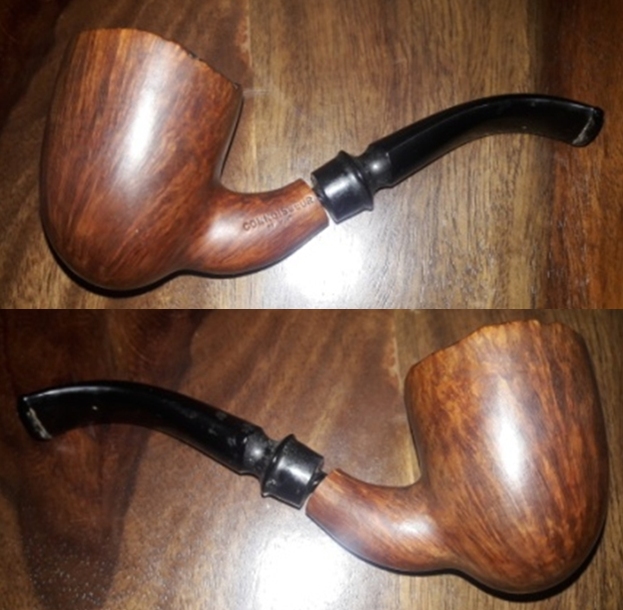
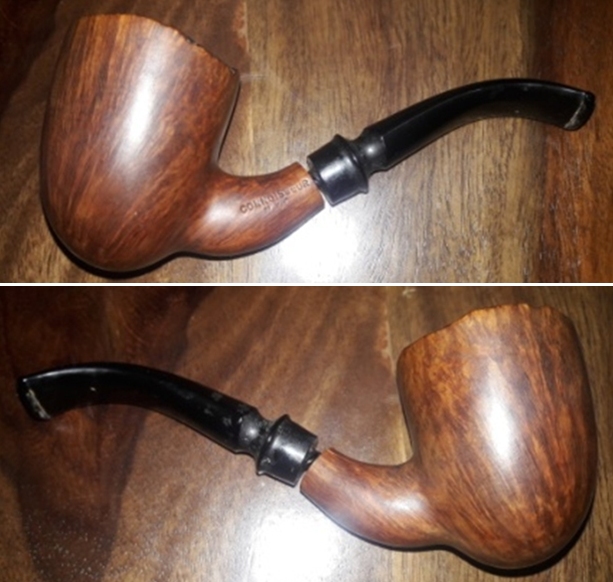
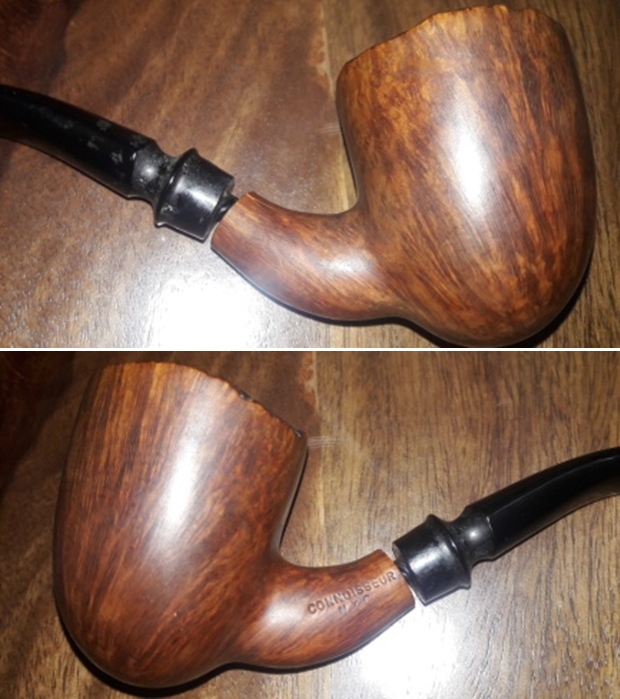
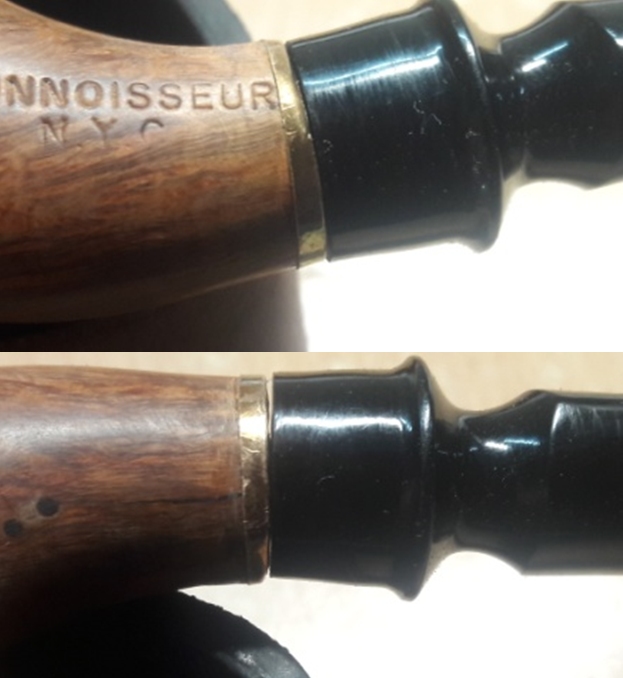
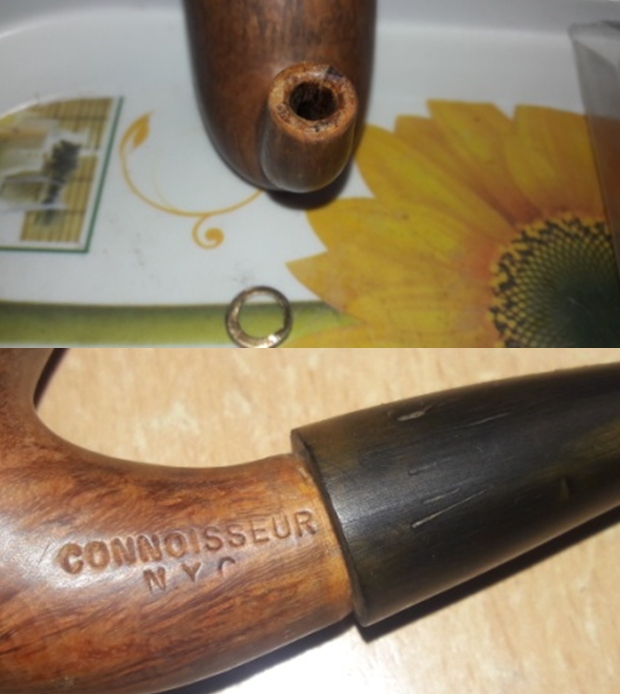
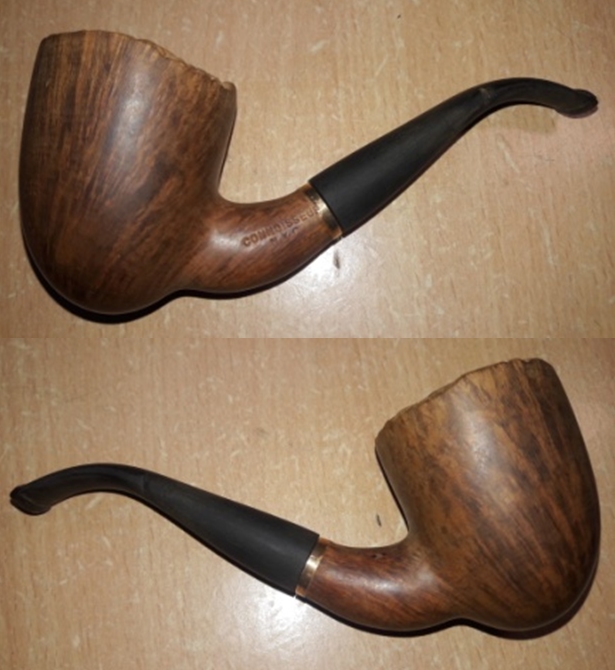
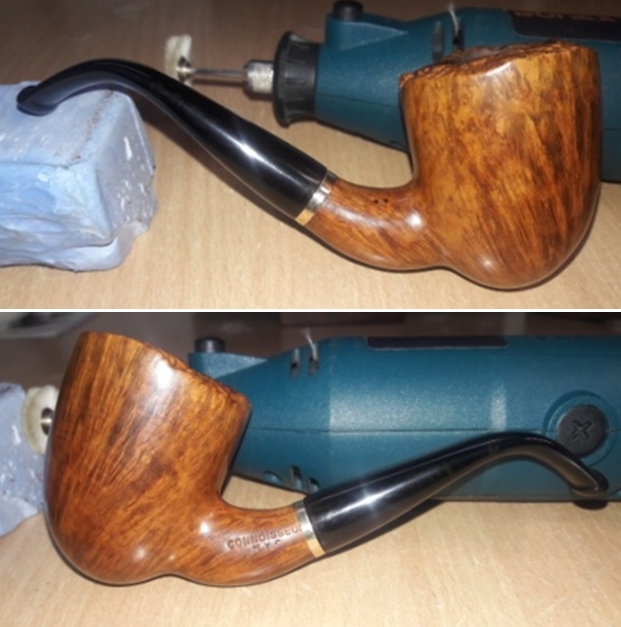
The pipe that I chose to practice on is a free hand that boasts of straight / flame grains all around the stummel with bird’s eyes on the heel of the bowl with a plateau rim top. It is stamped on the left of the shank as “CONNOISSEUR” over “N.Y.C.”. These stampings are crisp and easily readable. There is no other stamping seen on either the stummel or the stem. This is the first time that I am working on a Connoisseur and am keen to know more about this pipe brand, carver and also dating this pipe. As is my habit, the first site that I visit is rebornpipes where, over the years, it seems like Steve has chronicled almost all the pipes that were and are in existence. True enough, Steve has restored and researched a pipe from this maker. Here is the link for a detailed information on this pipe; https://rebornpipes.com/2015/05/23/restoring-an-ed-burak-connoisseur-tall-stack/

Further down the write up, he also gives out the dating methodology adopted by Ed Burak and the same is reproduced for immediate reference.

I also learned on Pipephil’s website (http://www.pipephil.eu/logos/en/about-en.html) that the stamping did indeed give some information that helped in identifying the period that a particular pipe was made. There I found that one may generally separate Connoisseur pipes’ date of manufacture into three periods.

From late 1960’s until 1974: no stampings
From 1974 until 1981: CONNOISSEUR over N.Y.C.
From 1981 on: CONNOISSEUR over N.Y.C. and Ed Burak’s signature.

Thus from the above information, it’s evident that this beautiful Connoisseur pipe in my hand is from the period 1974 to 1981!

INITIAL VISUAL INSPECTION
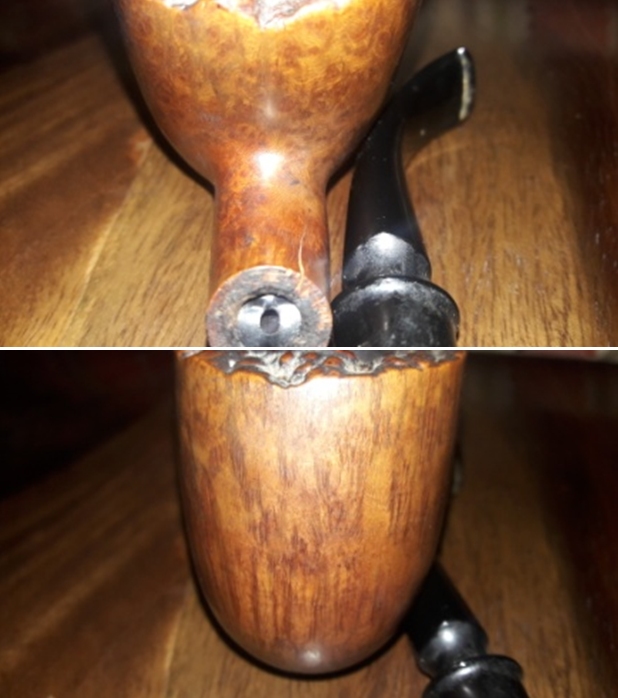
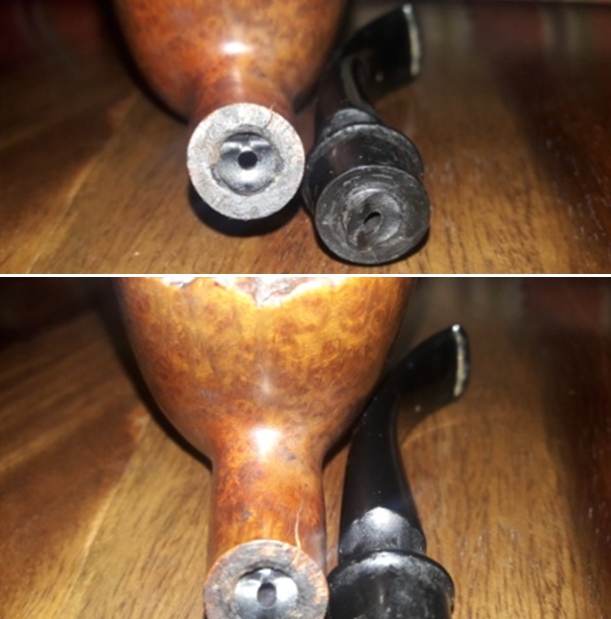
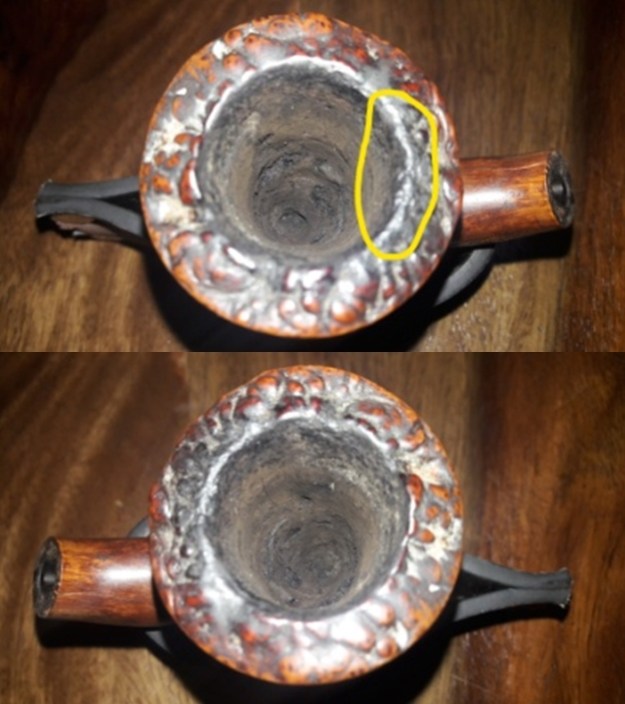
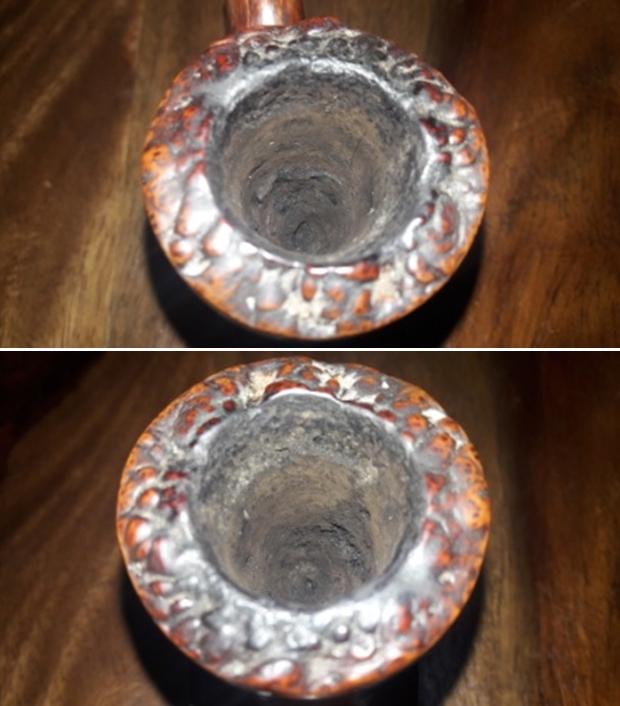
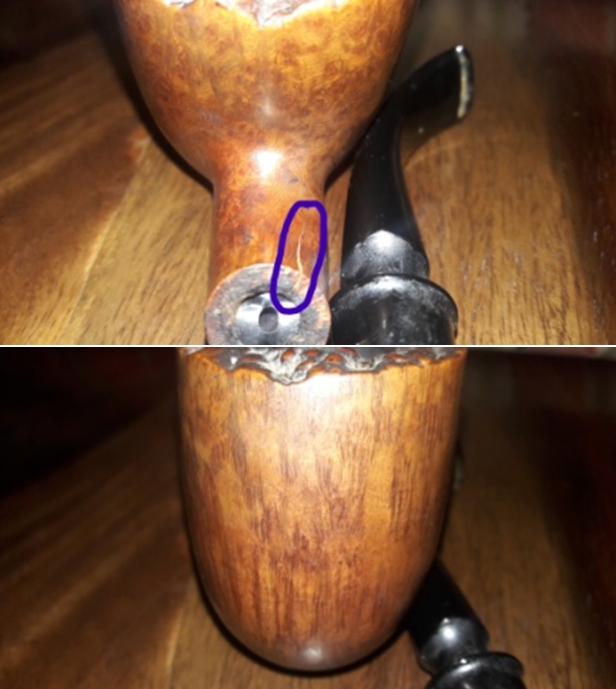
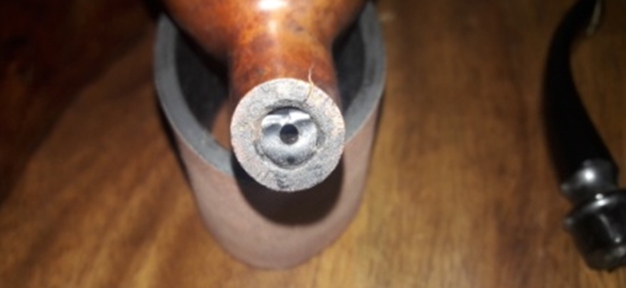
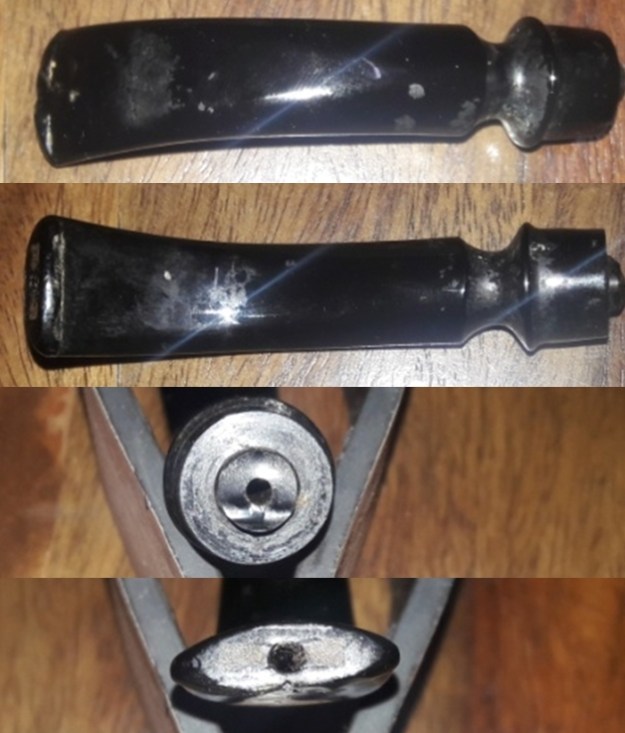
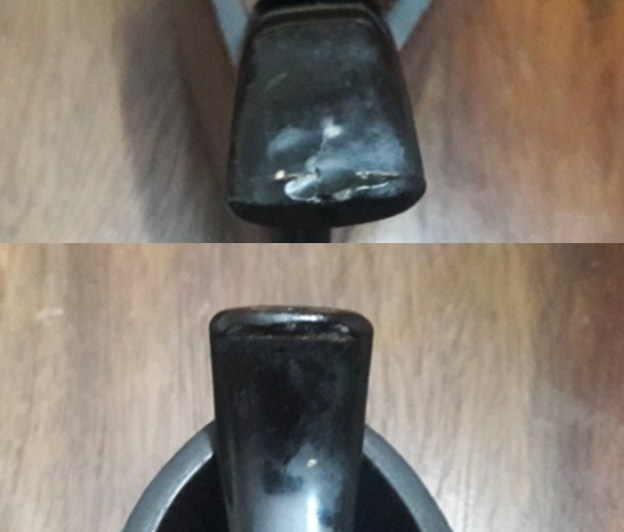
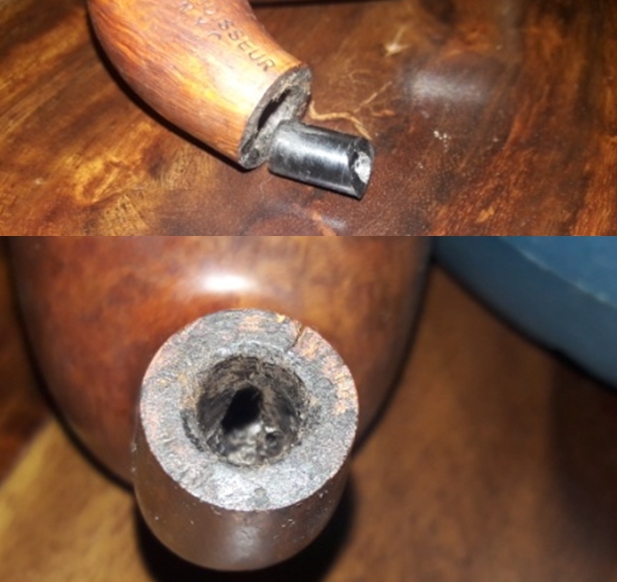
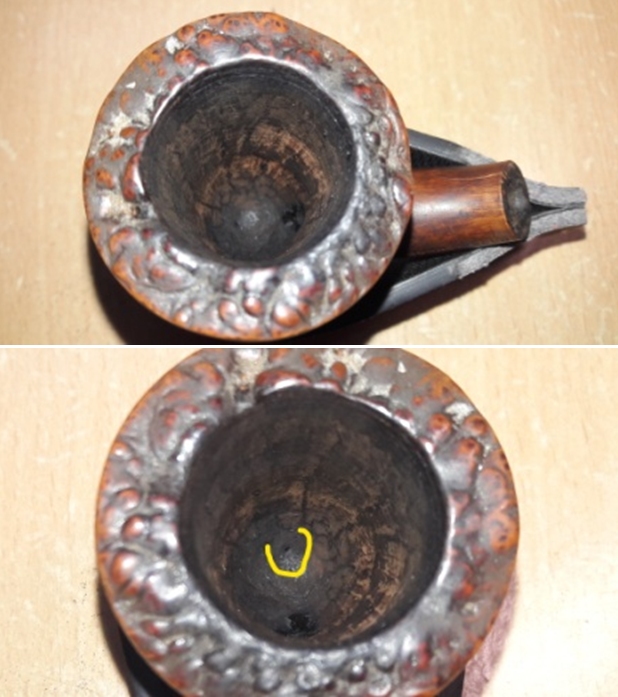
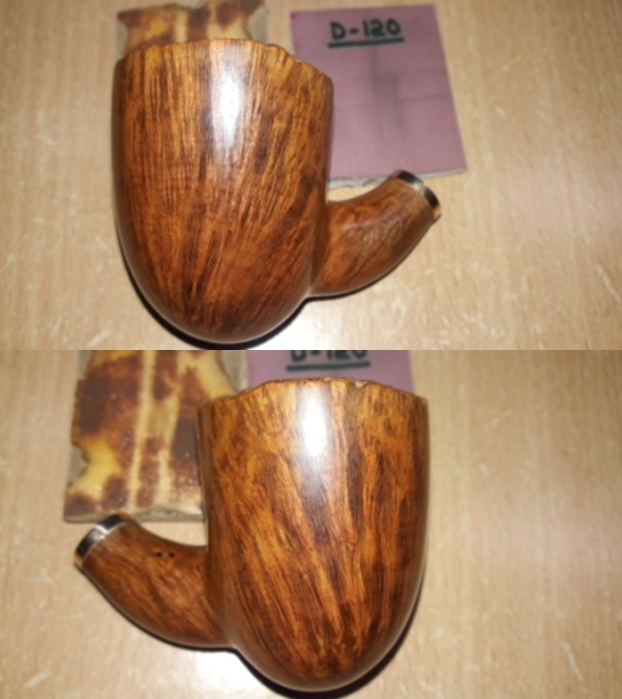
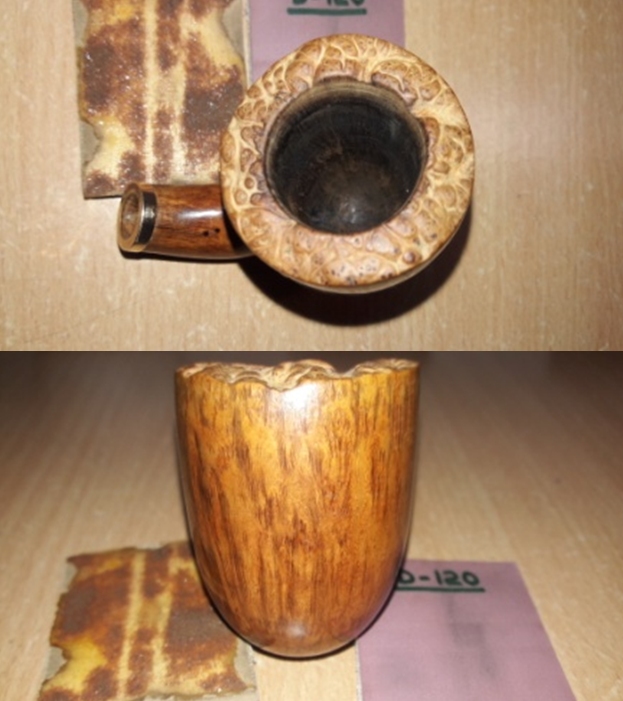
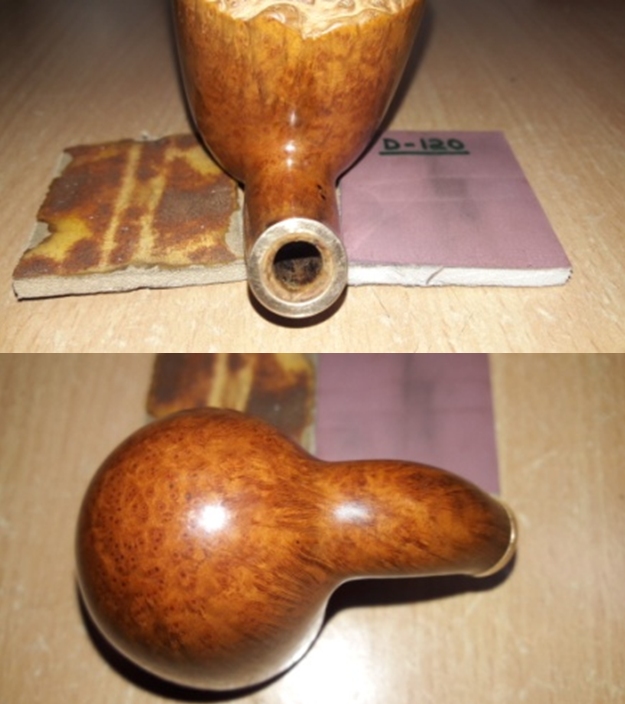
The first and foremost issue that I noticed and was aware of from the description given by the seller is that of the broken tenon. When I saw the pictures of this pipe for the first time, I had observed, apart from the most obvious broken tenon a number of other issues which presented a challenge of their own. The briar was natural and unstained. It had darkened slightly with age. This was how the pipe had reached me…discerning readers will easily make out other major issues that need to be addressed on this pipe. The chamber has a thick uneven layer of dry and hard cake with the inner rim edge showing darkening in 6 o’clock direction (marked in yellow). The condition of the inner walls of the chamber can be checked and ascertained only after the cake has been taken down to the bare briar. However, I do not envision any damage to the chamber walls. There is heavy lava overflow and debris embedded in the plateau of the rim top surface. The condition of the inner rim edge will be commented upon once the lava overflow has been removed. There are very strong and all pervading smells of old tobacco emanating from the chamber. Hopefully this issue should be addressed once the cake has been removed and the mortise is thoroughly cleaned. The stummel boasts of beautiful straight/flame grain all around and extend over the shank surface too!! The surface is covered in lava overflow, dirt and grime. The stummel briar is without a single fill and through all the dirt and grime, exudes a very high quality briar and craftsmanship. The foot of the stummel shows beautiful bird’s eye grains and is sans any damage. The slightly tapered end of the shank has the broken end of the tenon still embedded within. A prominent crack is visible over the shank on the right side. This pipe, in all probability, has suffered this catastrophic damage as a result of having fallen in stem down position. The mortise has the broken tenon stuck inside. I did try to wriggle it out with a screw driver, but the broken tenon wouldn’t budge. This will require more invasive technique. The heavy build up of cake in the chamber, dirty plateau rim top and the sorry condition of the stem all point towards a clogged mortise. This will be ascertained once the broken piece is removed from the shank end.The fancy stem has blobs of sticky oils and tars on both the surfaces as well as in between the nooks and crannies at the tenon end. There are significant tooth indentations on both the upper and lower buttons, to the extent that they would need to be rebuild completely. The slot just does not appear correct. It appears to be a orifice, but it is not a perfect round and  there are horizontal extensions on either side. Even this opening is clogged with old oils and tars. The broken tenon end of the stem is jagged and sharp at the place where the tenon has snapped. In my opinion, there is something which is not right about this stem. The quality of the stem is not something which is to be expected on a Connoisseur pipe. THE PROCESS
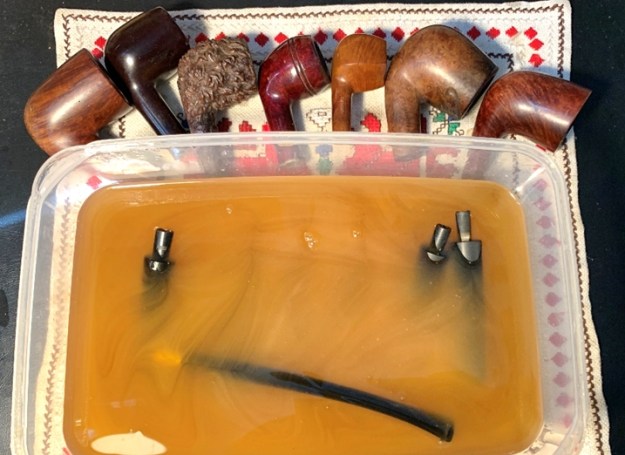
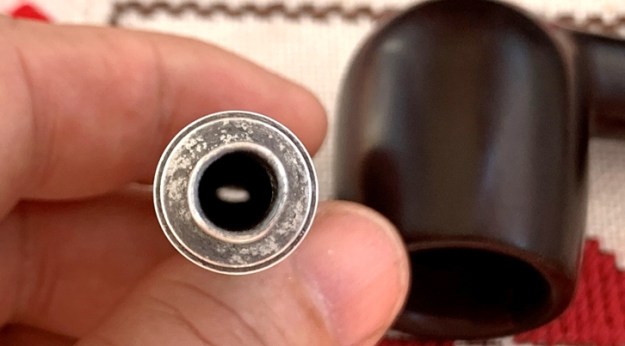
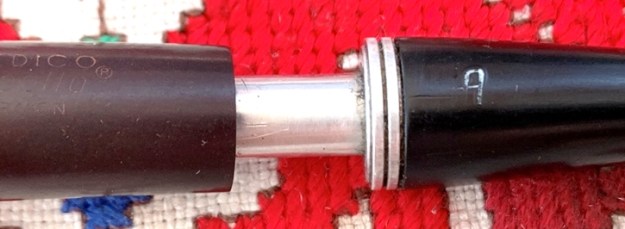
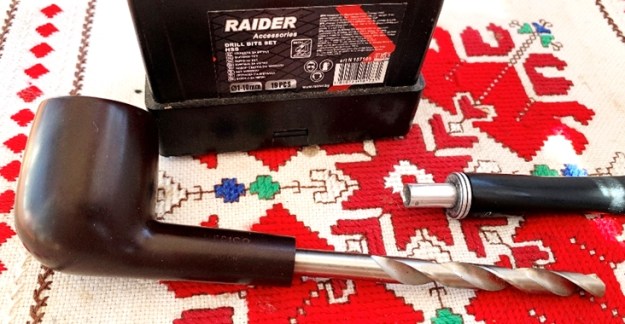
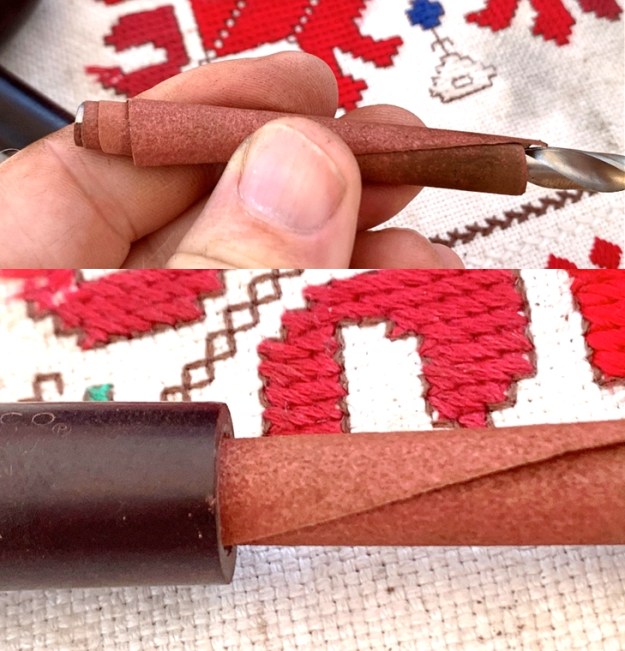
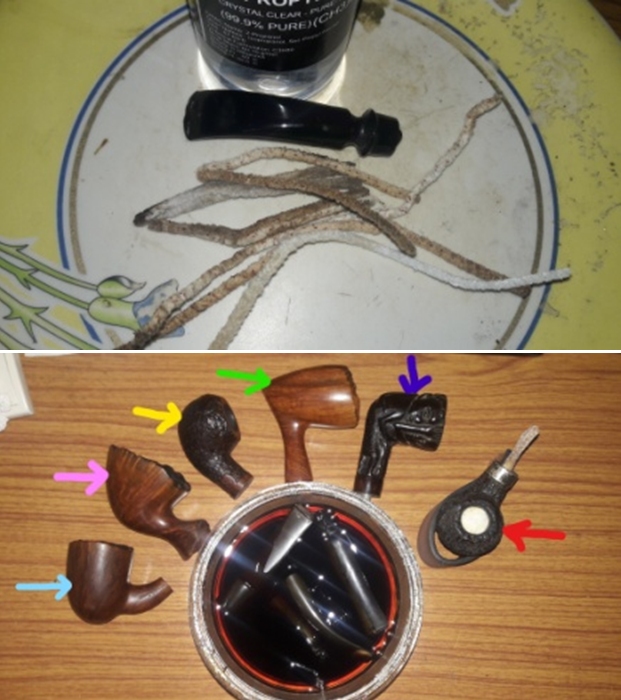
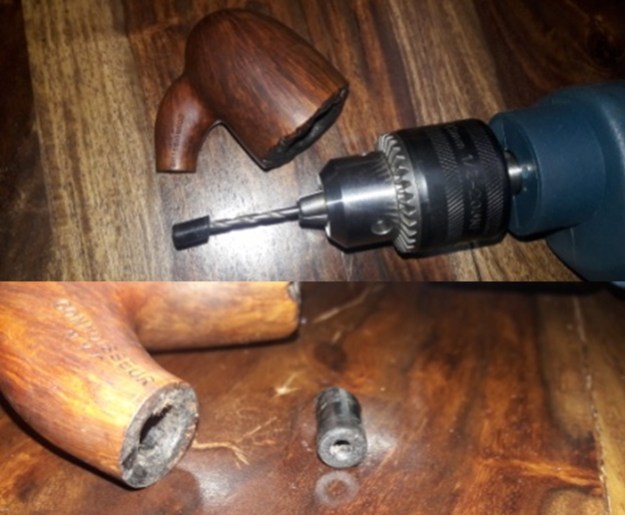
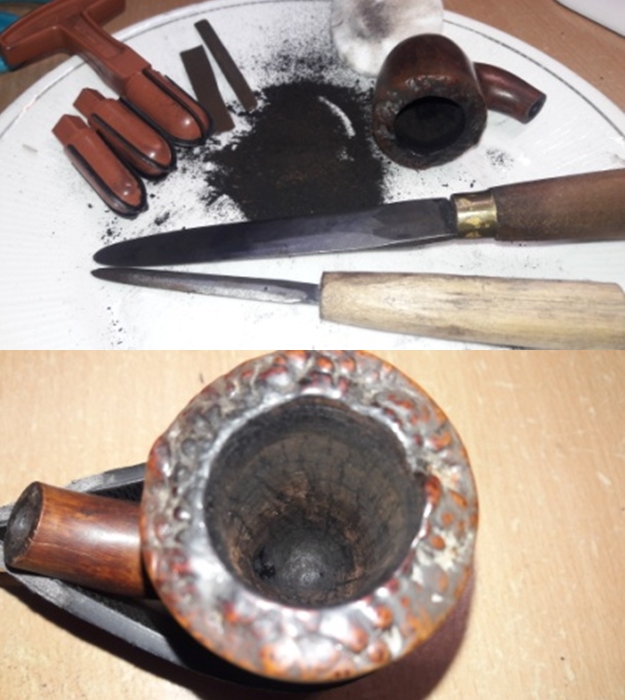
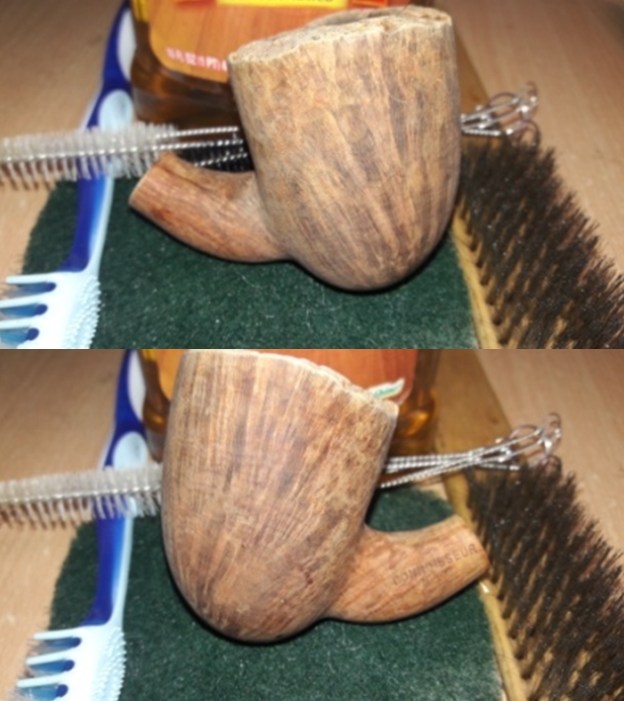
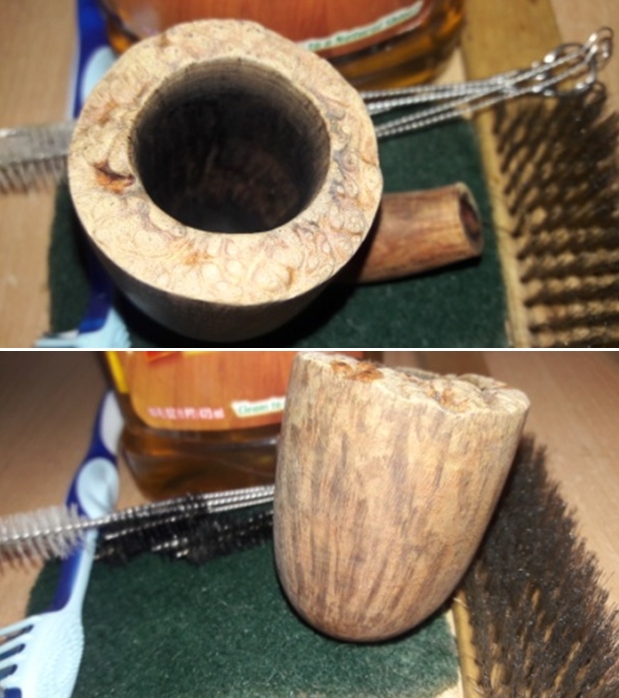
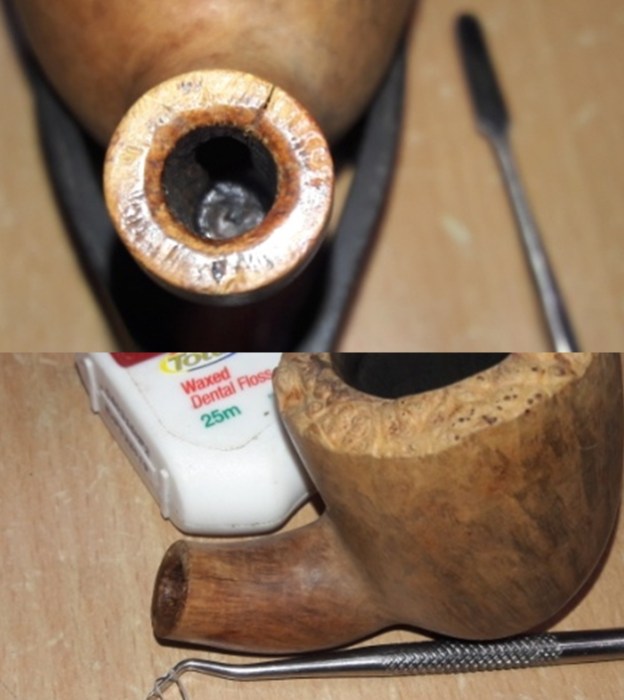
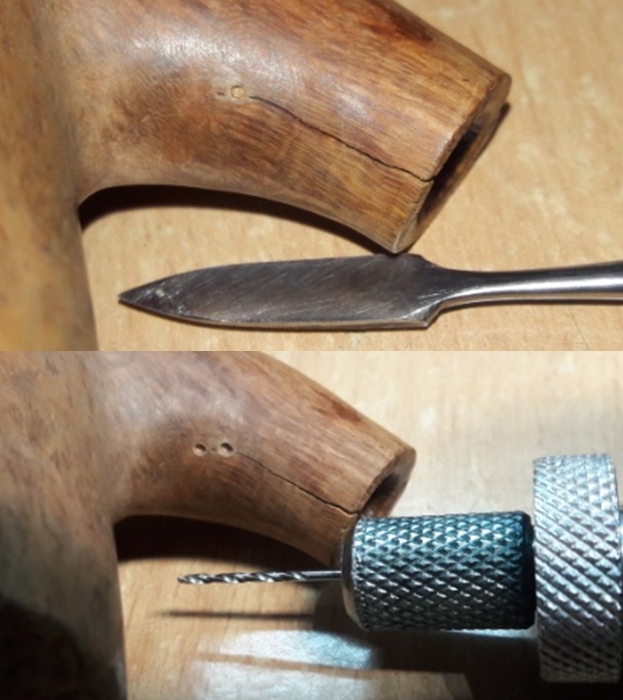
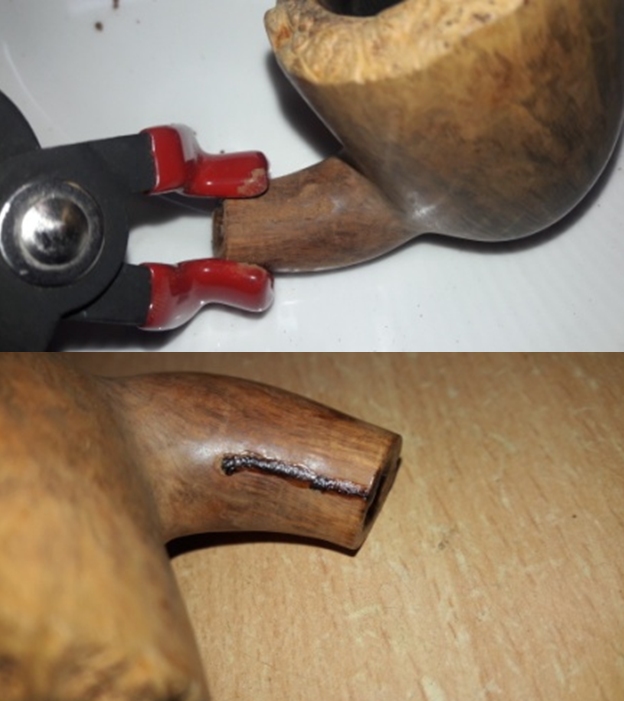
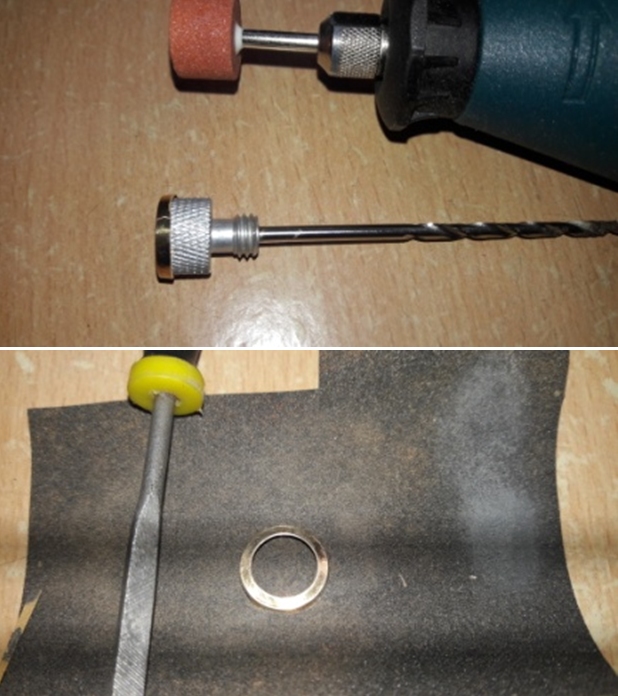
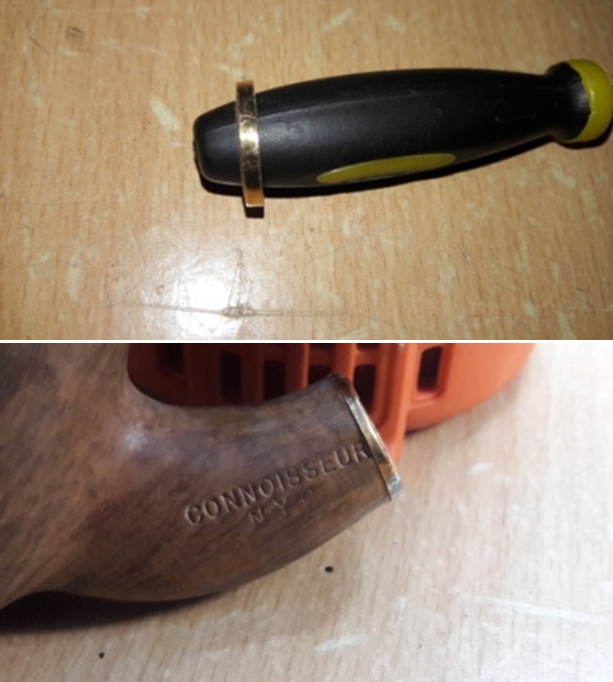
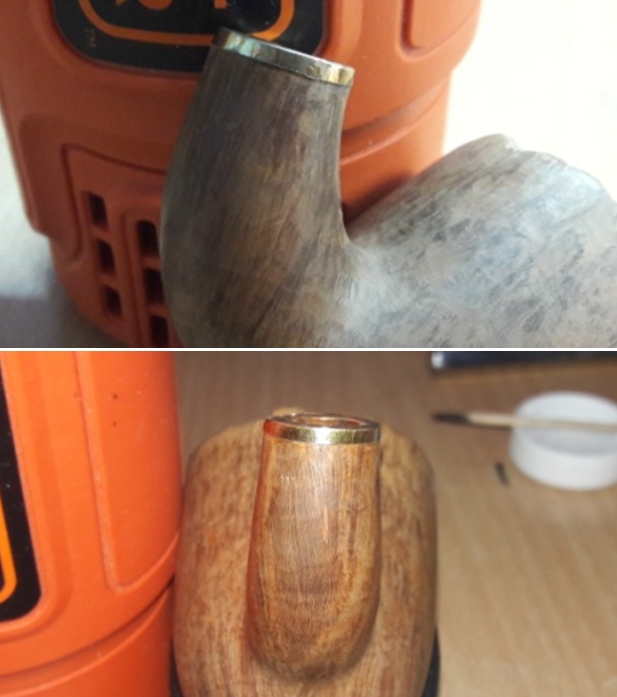
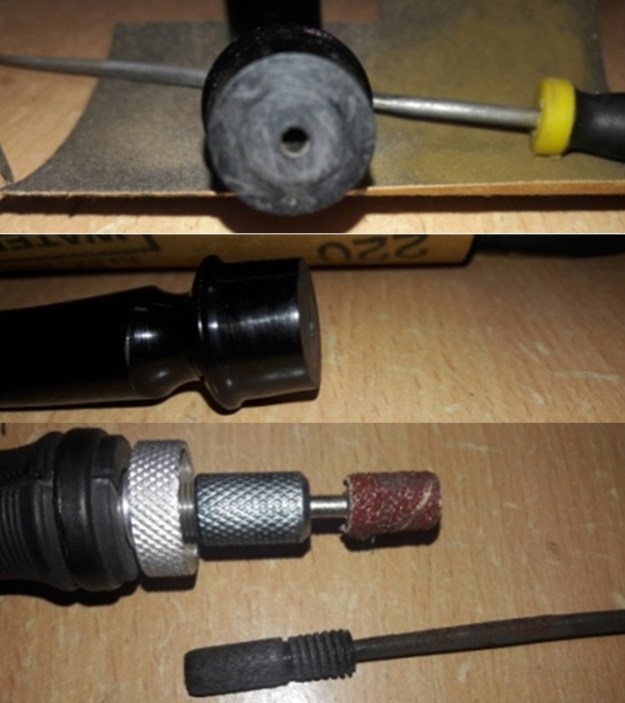
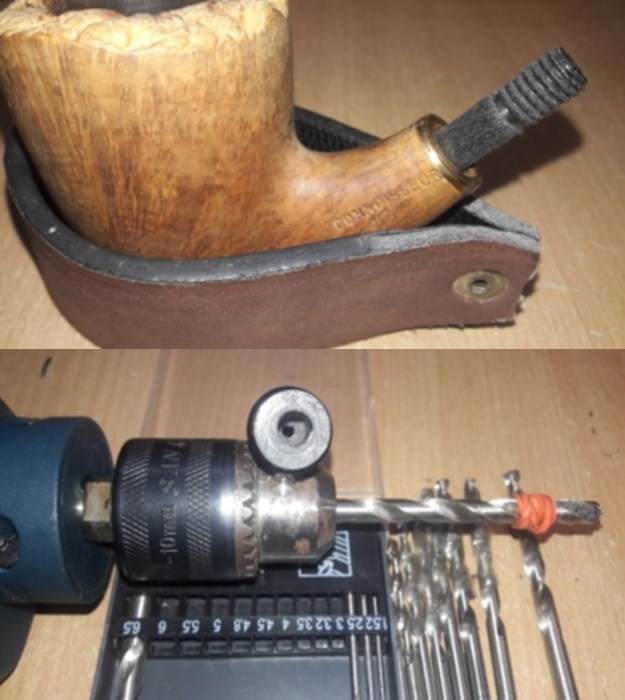
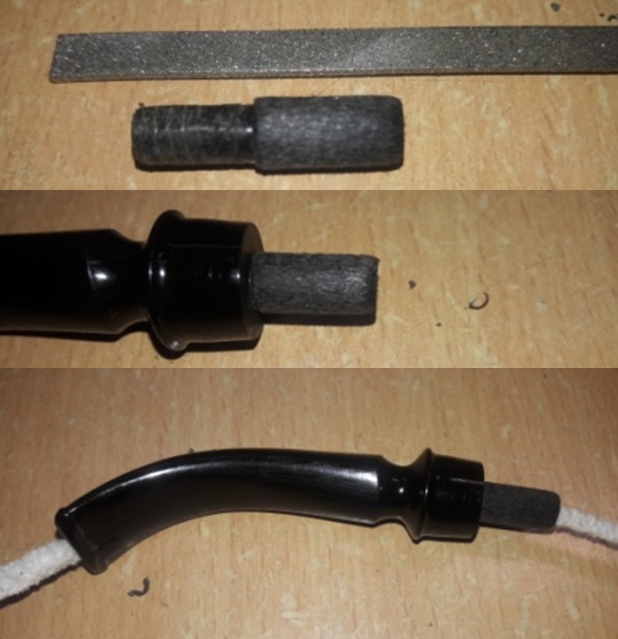
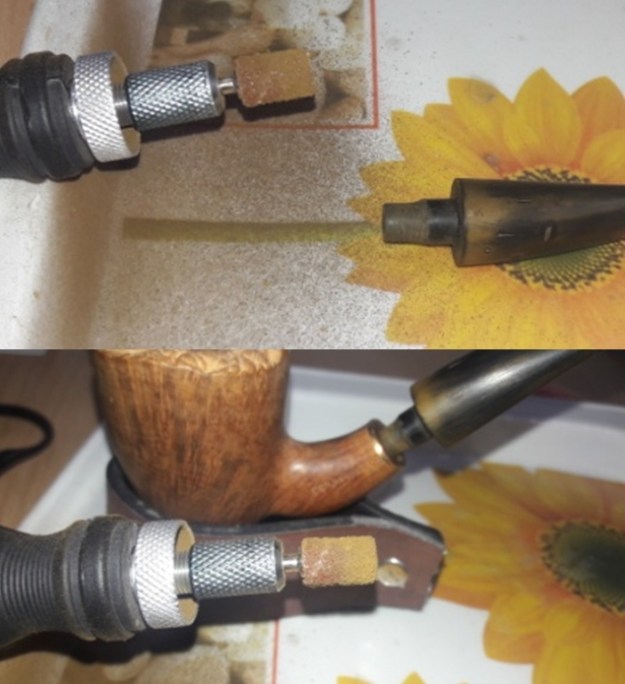
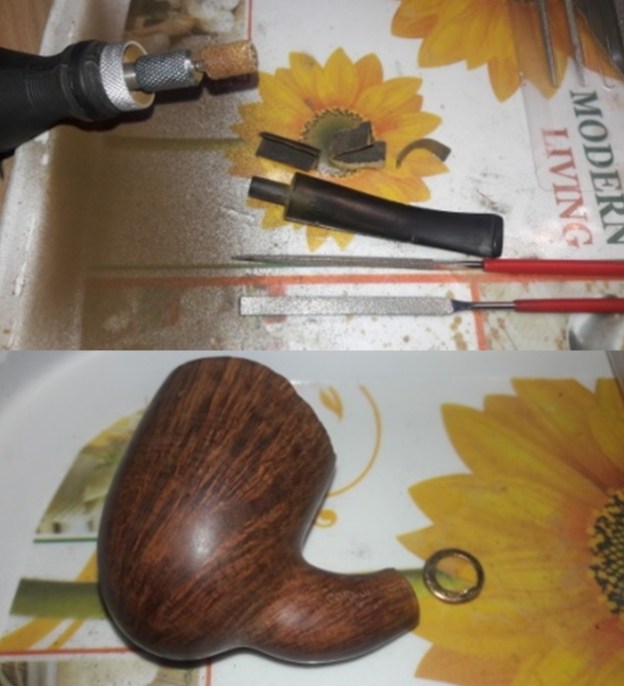
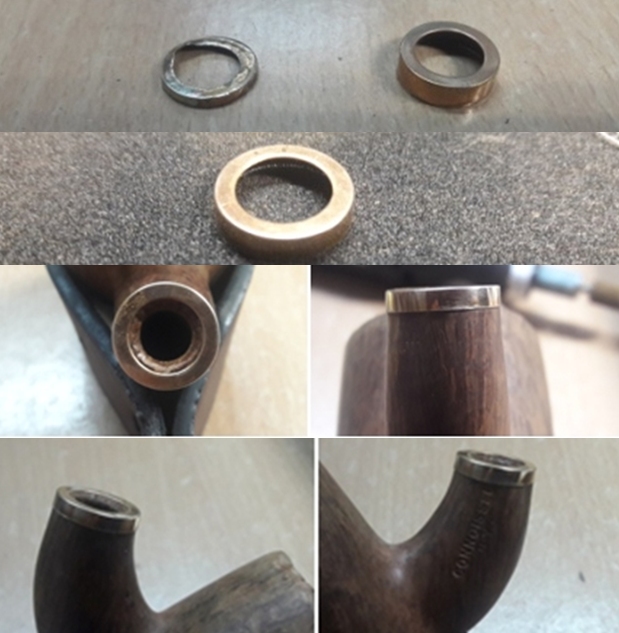
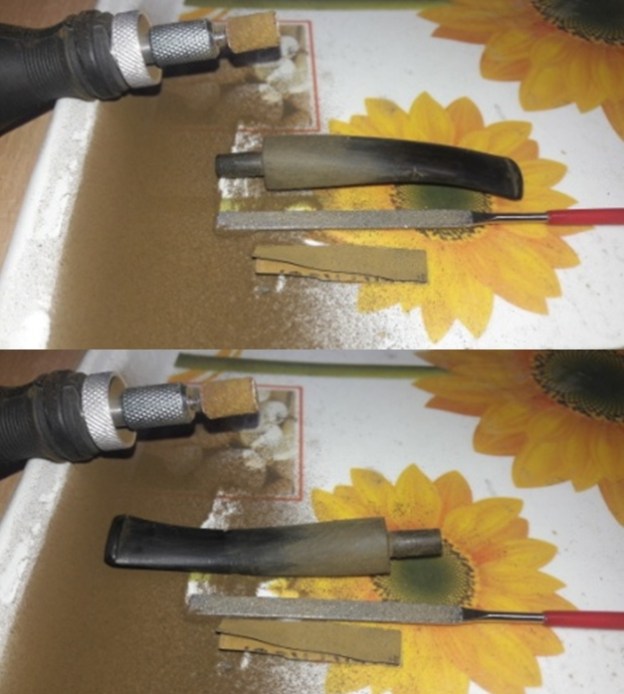
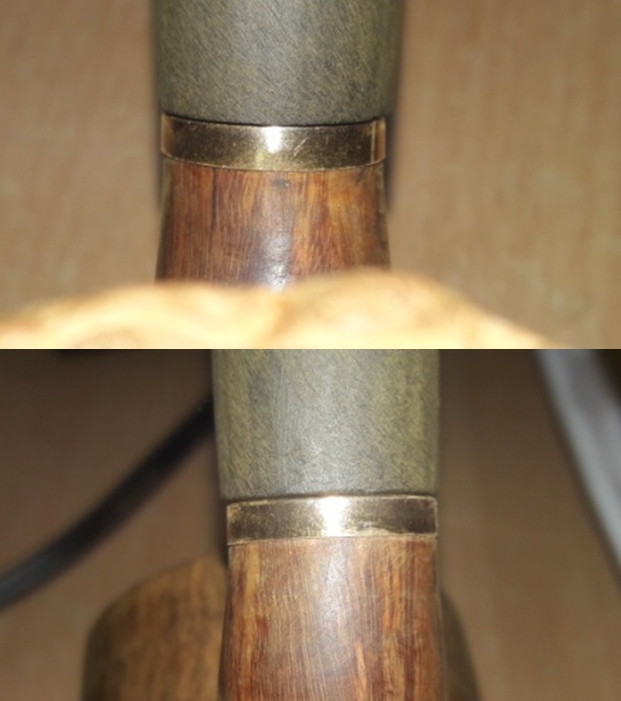
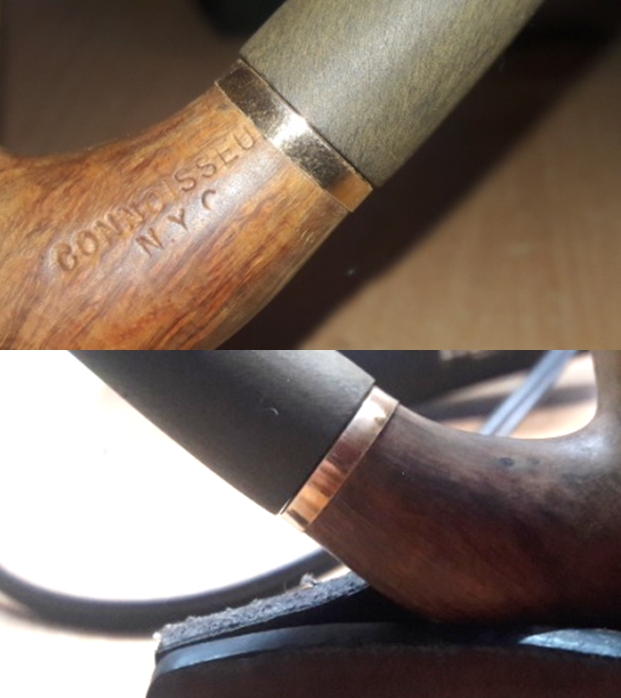
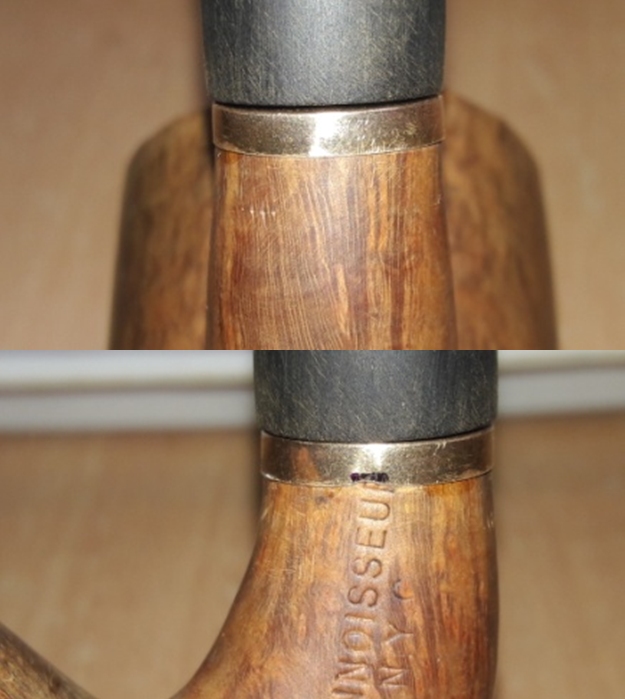
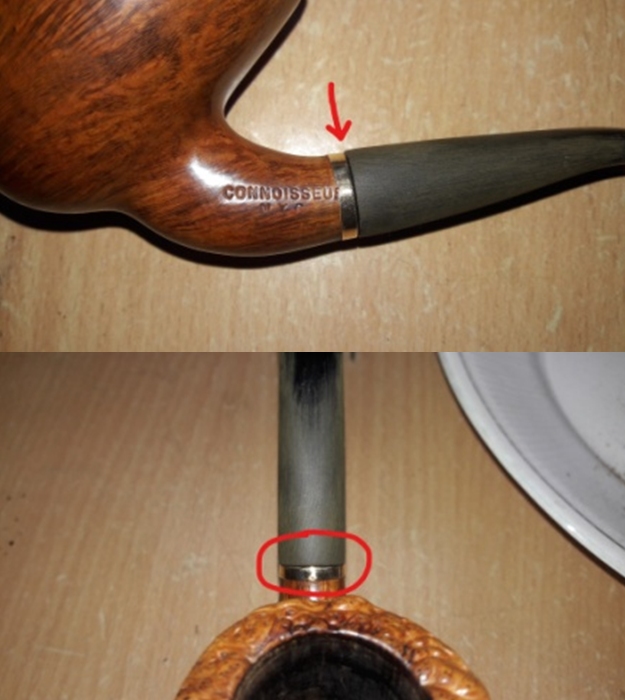
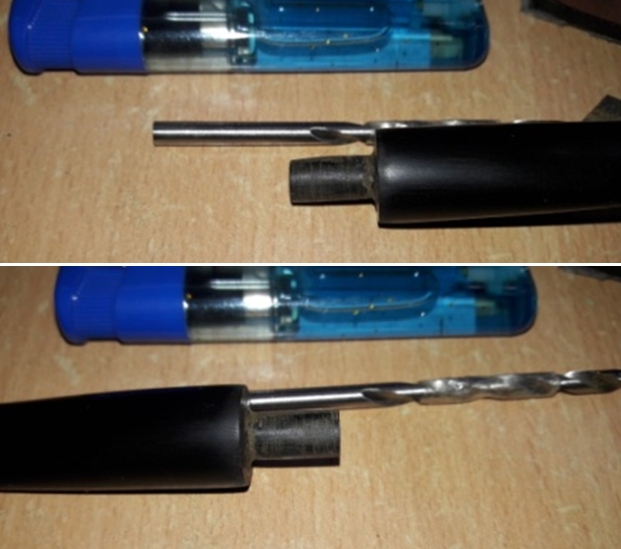
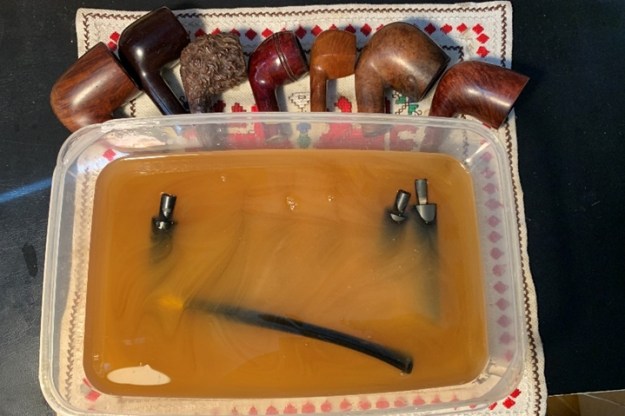
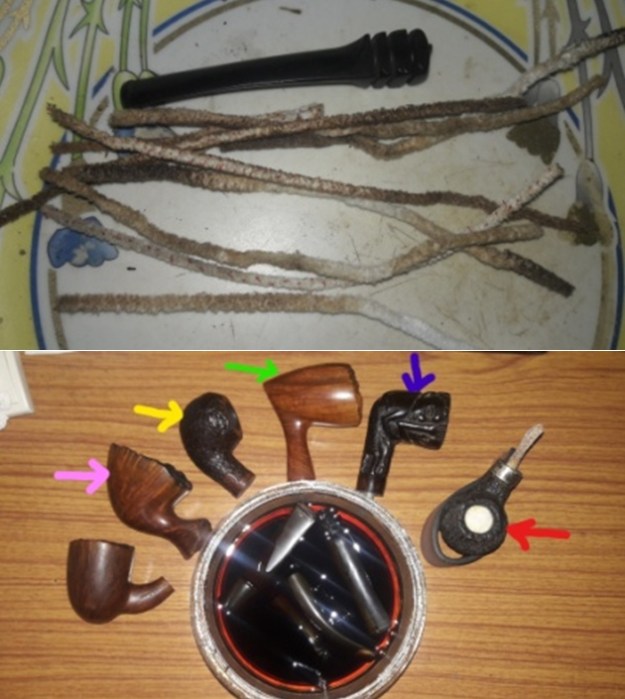
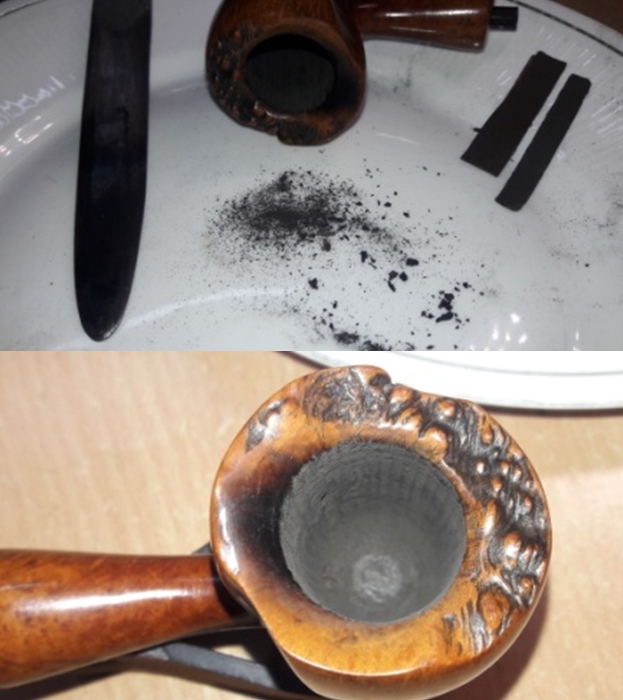
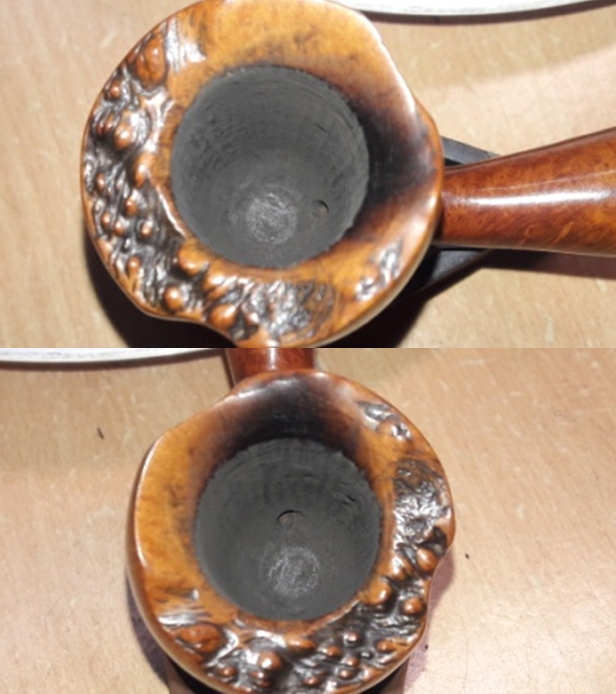
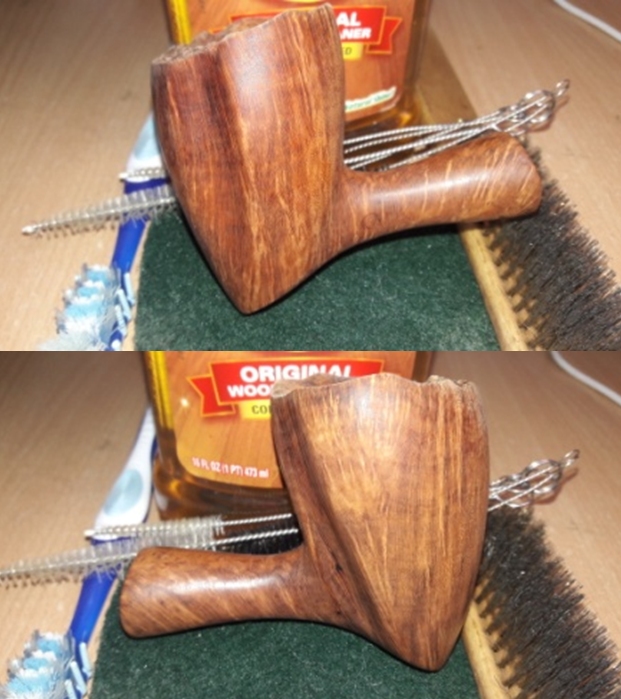
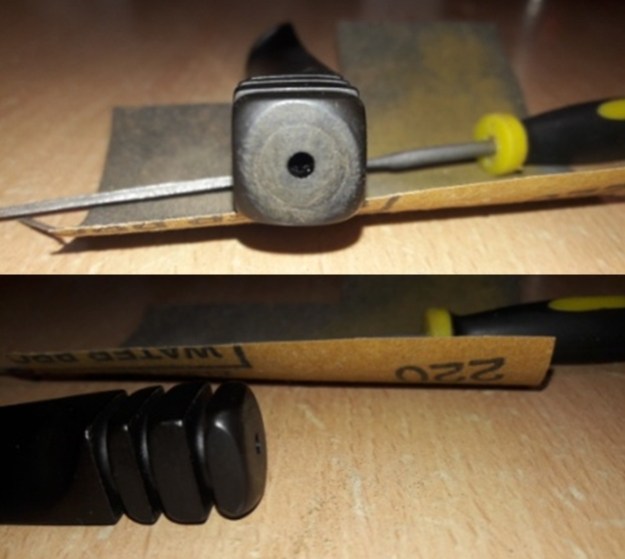
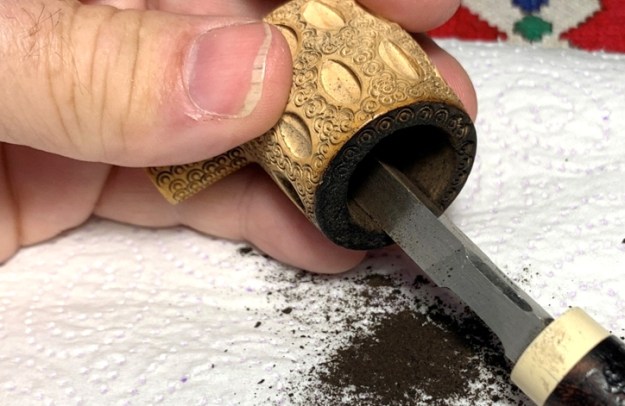
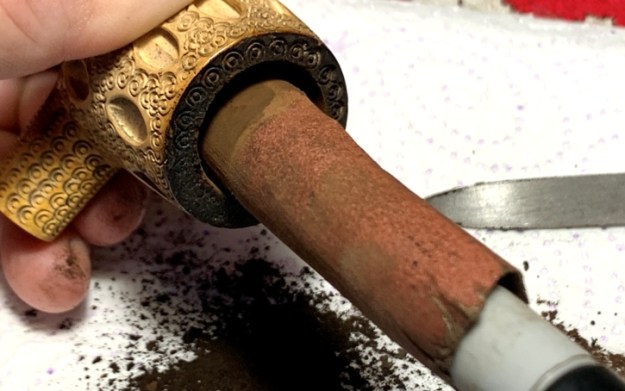
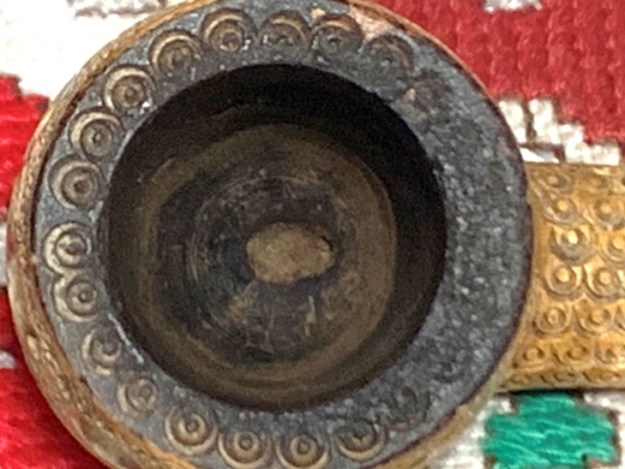
I began the process of refurbishing this pipe with cleaning the internals of the stem using pipe cleaners with isopropyl alcohol (99.9% pure) and dunking the stem in to “Before and After Deoxidizer” solution developed by my friend Mark Hoover. The solution helps to draw out heavy oxidation to the surface making its removal a breeze, while the minor oxidation is eliminated to a very great extent. I usually dunk stems of 5-7 pipes that are in-line for restoration and this pipe is marked in pastel blue arrow. I generally allow the stems to soak in this solution overnight for it to work its magic.With the stem soaking in the deoxidizer solution, I decided to remove the broken portion of the tenon from the shank. I select a drill bit that was slightly bigger than the tenon airway opening and mount it on my hand held drill. Very gently holding the drill absolutely straight, I give the drill machine a few forward turns. Once the drill bit is firmly embedded in to the broken tenon, I turn the drill machine in reverse. The reverse turns pull the broken end of the tenon out from the mortise. I breathe a sigh of relief as this is a very delicate step and a lot of things can go wrong if not executed with precision and patience. I further work the stummel, reaming the chamber with my PipNet reamer using head sizes 1 to 3. Using my fabricated knife, I further ream out the cake from places where the PipNet reamer could not reach and follow it with sanding the chamber walls with a 220 grit sand paper. I wipe the chamber with isopropyl alcohol and a cotton swab to remove all the carbon dust. This final cleaning of the chamber reveals a minor indentation in the wall opposite the draught hole, a result of over enthusiastic use of pipe cleaners to clean the mortise (marked in yellow semi- circle)!! Though not a major issue now, one will have to be careful with using pipe cleaners in future. Next, I clean the mortise with hard bristled and regular pipe cleaners dipped in isopropyl alcohol. I scrub the external surface of the bowl with undiluted Murphy’s oil soap and hard bristled tooth brush and dry it using paper towels and soft cotton cloth. I carefully clean the plateau rim top with a soft brass wire brush to remove the accumulated dirt and debris from the surface. Thereafter, I clean the mortise, plateau rim top and stummel surface with anti-oil dish washing soap on a shank brush and a tooth brush. The entire stummel, including the plateau rim top, cleans up nicely. I set the stummel aside to dry out naturally. The smells from the pipe, though reduced, are still very strong. Close observation of the stummel reveals the culprit to be the now moistened accumulated gunk in the mortise. Using my dental tools, I assiduously pick out and clean the mortise of all the gunk. I also clean the mortise with q-tips and alcohol. The amount of old grime that is scraped out from the mortise itself tells the story. The mortise is now clean and smells fresh.Moving ahead, I now address the crack that is seen on the right side of the shank, extending from the shank end to nearly half distance towards the stummel. Firstly, I clean off all the debris that is lodged in the crack using dental floss. The thin floss cleans the crack of all the dirt without widening it.I follow up this cleaning of the crack by marking the end points and turning points of the crack with a sharp dental pick. These marks help to guide the drill bit when drilling the counter hole. I take care that the drill is just sufficiently deep enough to arrest the further spread of the crack and not a through hole.I fill this crack with a mix of CA superglue and briar dust. To ensure a tight fill I clamp it down with pliers till the mix had cured, which by the way, is instantaneous!! Once the repair has cured for couple of hours, I sand it down with a flat needle file to achieve a rough match with the rest of the stummel surface. I fine tune the match with  220, 400 and 600 grit sand paper.To further stabilize the crack and prevent it from splitting again, I decide to place a band over the shank end. I select a band that is a tad bit smaller than the shank end diameter. When I place this band over the shank end, I realize that the last two letters of the stamping are being masked. I decide on grinding away the excess material from the band with my sanding drum mounted on a hand held rotary tool to a size which while being appropriate to stabilize the crack will not mask the stampings. The process is long and fraught with mistakes… The band has flown out of my hands a few times, since it can not withstand the stress of the sanding drum and is deformed , not to mention the time factor involved. However, through all these difficulties, I have prevailed to shape a band for the shank end. This is the pictorial depiction of the process and the result. Once I am satisfied with the fit, I heat the band with a heat gun in order to expand it and fix it over the shank end. I have avoided gluing it securely in place just in case I may have to revisit the entire process and go for a fresh band. Here is how the band fits over the shank end. Truth be told, I am not very confident that the band would be a success given the fitting of the band over the shank end. I set the stummel aside and decide to replace the tenon on the stem. I have explained in great detail the procedure that I have learnt and followed while replacing the tenon on a Preben Holm # 7 FH pipe. To avoid repetition of the process, I would request all to refer to the write up and other literature on the subject that is available on rebornpipes.

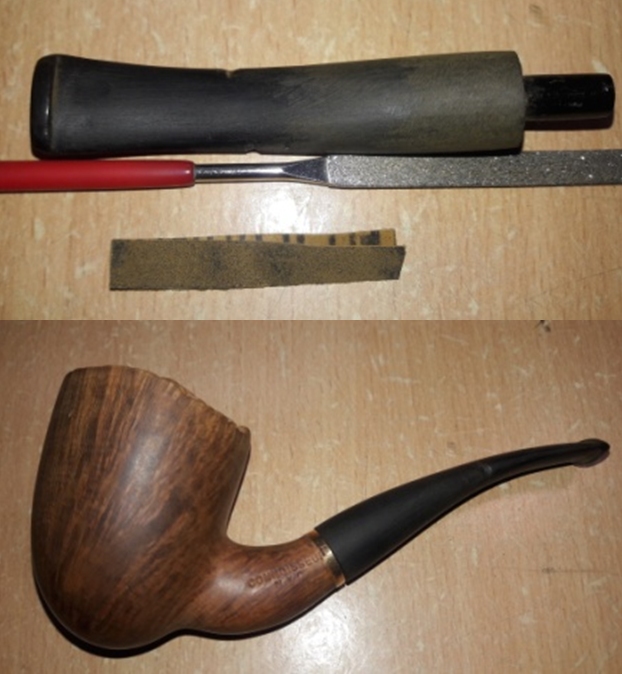
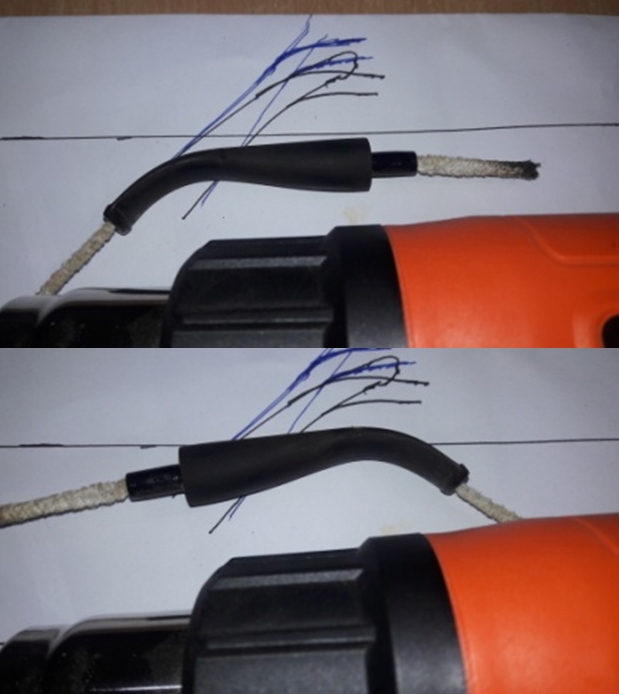
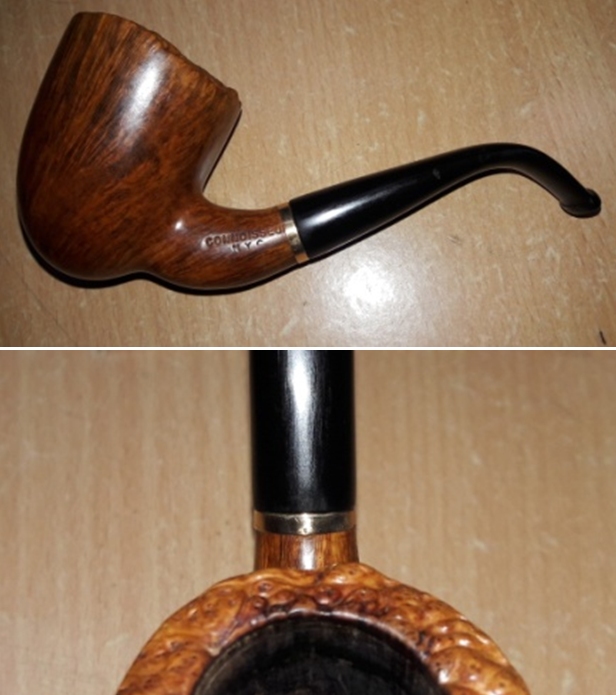
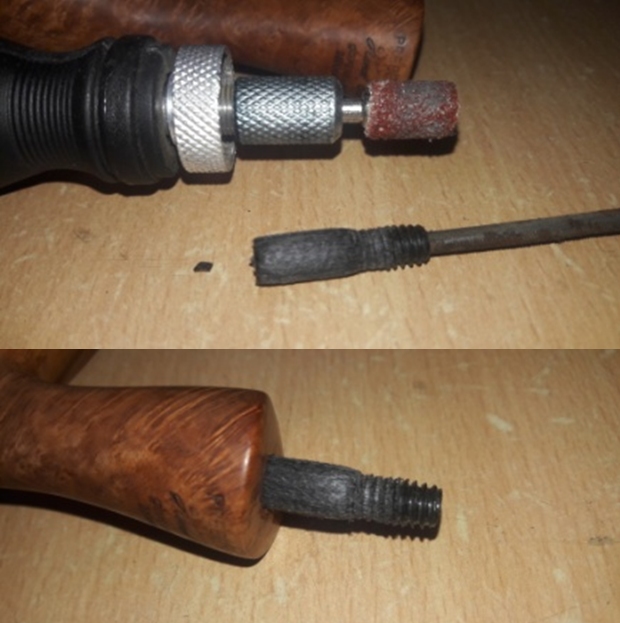
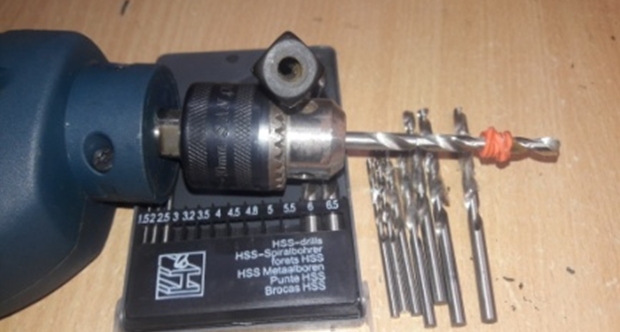
Given below are a series of sequential pictures explaining the procedure. Here I would also like to note that as I had mentioned earlier, the quality of the stem appeared circumspect and this was corroborated while drilling the stem air way to accommodate the new tenon. The plastic or some such low quality of the stem did pose a lot of resistance during the drilling and a straight drill was very difficult. However, my persistence has paid off and I am happy with the replaced tenon. Once the tenon is replaced, I try the fit of the stem in to the mortise. The fit though snug, reveals gaps and the seating of the stem in to the mortise is not flush. No amount of tweaking and minor adjustment by sanding of the tenon can ensure a flush seating. I feel that I have botched up the banding of the shank end and that is what has caused this issue. Here is how the seating appears after all the adjustments and tweaking. At this point in restoration, I shared pictures of this issue and then later in the day had a FaceTime chat with my Guru, Steve. Steve, with his vast experience and having worked on and researched a Connoisseur pipe before, immediately commented that the stem is not the right style for Connoisseur pipes and could be a replacement stem. I have another Connoisseur pipe (which awaits restoration) with a saddle stem in my collection and when the stem of this freehand was compared, it was no where near the quality that was seen on the other saddle stem. The pictures below show the difference in quality of the stem material and finish between the two pipes. Thereafter we discussed the shank band and he suggested to reband the shank end while going in for a completely new stem. Thereafter, we went through my can of spare stems and selected one that would be the best match for this pipe. Here are the pictures of the shortlisted stem. The slightly bent stem with all the calcification is the one that would replace the one that the pipe came with. The shortlisted stem, I am afraid, is not in the best of condition. The tapered slightly bent vulcanite stem is nearly the same length as the replaced one while being very thick at the tenon end. The quality of the re-replacement stem is very good. The stem is heavily oxidized with significant calcium deposition and deep tooth indentations in the bite zone on either surfaces of the stem. A couple of deep chips are seen along the seam on either sides as well as on the lower and upper surfaces of the stem. The button surfaces on either side has bite marks and the edges are equally damaged and deformed. The tenon and the horizontal slot shows heavy accumulation of oils, tars and gunk. All in all, the refurbishing and shaping of this stem presents a ton of effort and time.I begin the refurbishing and reshaping of the stem by first cleaning the stem, both internally and externally. With my fabricated knife and a paper cutter, I remove the entire calcium sediments from the bite zone. Using a dental tool, I dislodge all the dried oils and tars from the tenon and slot end. I clean the stem internals with pipe cleaners and shank brush dipped in isopropyl alcohol. I sand the entire stem surface with a folded piece of 150 grit sand paper to remove some oxidation as well as to even out some tooth chatter from the bite zone. Once the initial cleaning is done, I move ahead for shaping/sizing the stem. The tenon is too thick for the mortise and that is my start point. I mount a sanding drum on to my hand held rotary tool and sand the tenon till I achieve a rough fit in to the mortise. During the entire process, I frequently check the progress being made as I do not want to sand too much material from the tenon, making for a loose fit.I fine tune the fit of the tenon in to the mortise by hand sanding with flat head needle file and 180 grit followed by a 220 grit sand paper. The tenon attachment with the stem is shaped with a triangular needle file. I check the seating of the stem in to the mortise after I remove the shank band. The stem fit is nice and snug. Before I move to the final fit and shaping of the stem, I decide to reband the shank end. This time I select a band that was a snug fit as against a size smaller as I have done earlier. To reduce the thickness of the band, this time I manually sand it over a 150 grit sand paper instead of using my rotary tool and a sanding drum. It does take a long time, but the end result is much better. The last letter “R” has been masked, but I shall deal with it later (will I…?). I still have not glued the band in place, just to be on the safer side!!Now with the band in place, I move ahead with shaping and aligning the stem. The first thing that I proceed to do is to shave of the excess meat from the shoulders at the tenon end. Readers, when I say excess, please be aware that the word excess does not convey the quantum of excess… It  was hell of a lot of material to shave off!! I mount a 150 grit sanding drum on to the rotary tool and go to town sanding off the material from the shoulders of the stem. Once I have achieved a rough match, I use a flat head needle file to further match the fit. I progress to manual sanding with a 180 grit sand paper to fine tune the match. This is how the stem profile matches with the shank end of the stummel…not quite there but getting close. I feel that the mid region of the stem needs to be trimmed a bit and do so with a flat head needle file and a 180 grit sand paper. Here is where I have reached at this stage. Truth be told, eye balling the shape is not the easiest way to achieve the exact shape since I am always seeing it, shaping it and matching it. It’s something akin to optical illusion that I am experiencing. There is a bit of overhang at the shoulders of the stem and I need to shave off some more material from the area above it. Also a slight gap is seen at the lower end and on the left side of the stem that needs to be addressed. I decide to take a break from all the sanding of the stem and move on to shaping the stem to match the profile of the stummel. I insert a pipe cleaner through the stem’s air way to prevent it from collapsing once the stem is heated. I first straightened the stem by heating it with a heat gun. To impart the requisite bend, I try to adopt the technique that my friend, Dal Stanton of PipeSteward fame, uses and that is to draw a diagram marked with the plane of the stummel rim top, a parallel plane that is required, the present profile of the stem and thereafter, the exact place and shape of the bend that is needed. Well, it is an attempt that I made, but ended up eye balling the exact bend to be imparted. I heat the stem with my heat gun till the vulcanite becomes pliable and gives it the necessary bend. I hold it in place till the stem had cooled down a bit and thereafter, hold the stem under cold water for the bend to set. The next issue that is addressed is of the stem repairs. I insert a triangle shaped index card covered in transparent tape in to the slot. The tape prevents the mix of superglue and charcoal from sticking to the index card. I mix superglue and activated charcoal powder and generously apply it over the bite zone, including over the button. I also fill the couple of deep chips along the seam on either sides as well as on the lower and upper surfaces of the stem with the charcoal mix and set it aside to cure. Once the mix has cured, I remove the index card from the slot. While the stem fill is set aside to cure, I polish the stummel with micromesh pads, wet sanding with 1500 to 12000 pads. This time around, I do not repeat the mistake of polishing the plateau rim top as I had done with the PH # 3 earlier! I wipe the surface with a soft cloth at the end of the micromesh cycle. The stummel looks amazing with a deep shine and beautiful straight grains popping over the stummel surface. I rub a small quantity of “Before and After Restoration Balm” in to the briar. I rub this balm deep in to the nooks and crannies of the plateau rim top surface with my fingers and let it rest for a few minutes. The balm almost immediately works its magic and the briar now has a nice vibrant appearance with the dark brown hues of the grain contrasting with the rest of the stummel surface. I further buff it with a horse hair shoe brush. The appearance of the stummel at this stage motivates me further to complete this project at the earliest. I set the stummel aside and all that remains was to shape, align and polish the stem! Now motivated with the appearance of the stummel, I turn my attention to the stem repair. The fills have cured nicely and I move ahead and began the process of filing and shaping the button end with a flat head needle file. At this stage, I get in touch with Steve on Face Time and discuss the progress on the stem. He suggests that a slightly sharper bend to the stem from near the bite zone would accentuate the shape and flow of the shank with that of the stem. He also suggests that the profile of the stem near the shoulder and mid region needs to be more slender. So, it is back to heating the end of the stem with the heat gun and giving it the desired bend, of course, eyeballing it to the desired shape!As discussed with Steve, with a flat needle file, I shave off some more vulcanite from the shoulder and the mid region of the stem. I further sand the stem with 220, 320, 400, 600, 800 grit sand papers and finally with 0000 grade steel wool. I wipe the stem with a cotton pad dipped in alcohol to remove the resultant dust and rub some extra virgin olive oil onto the stem and set it aside to be absorbed.I polish the stem with micromesh pads, wet sanding with 1500 to 12000 grit pads. I rub a little extra virgin olive oil in to the stem at the end of the micromesh pads polishing cycle. I complete the polishing regime of the stem by rubbing a small quantity of Extra Fine Stem polish developed by my friend Mark Hoover, and giving it a final polish with a soft cotton cloth. The stem is now nice, smooth and shiny.To apply the finishing touches, I first mount a cotton cloth buffing wheel on to my hand held rotary tool and apply a coat of Blue Diamond to the stummel and the stem to polish out the minor scratches. Boy, am I glad to finally have reached the home run stretch to complete this project!! I shared these images with Steve for his comment. He suggested that the shoulder overhang needs to be reduced and under belly to be straightened out more.Well, here I was back with a flat needle file and 220 grit sand papers as against carnauba wax and rotary tool!! I again diligently worked on these issues, frequently checking for progress being made. Once I am satisfied that the shoulder overhangs and under belly issues have been resolved, I check the seating of the stem in to the mortise. The seating is canted backwards. I address this issue by heating the tenon and slightly pushing it upwards (that is, in the opposite direction). I check the seating and am quite pleased by the overall appearance of the stem and its seating. Thereafter, I go through the entire regime of sanding and polishing as explained above. At the end of the micromesh pads, I complete the polishing regime of the stem by rubbing a small quantity of Extra Fine Stem polish developed by my friend Mark Hoover, and giving it a final polish with a soft cotton cloth. The stem is now nice, smooth and shiny. With a cotton buffing wheel that I use for carnauba wax, I apply a coat of carnauba wax to the stummel and stem and continue to work on it till the complete coat of wax is polished out. I mount a clean cotton cloth buffing wheel and give the entire pipe a once over buff. I finish the restoration by giving the entire pipe a rigorous hand buffing using a microfiber cloth to deepen the shine further. The finished pipe is shown below. P.S. – This project was more tedious than I had anticipated, mostly because of my own faults and errors in judgement.  But then, isn’t this the fun part of being of the learning curve? I shall be avoiding the following in my future restorations:

(a) Using a band that is a tad smaller then the shank end diameter. I would rather use a band that has a snug and perfect fit over the shank end.

(b) Using a rotary tool with a sanding drum to get the band to the desired size. It’s better, safer and precise to manually sand the band on a sand paper.

(c) Clamping the shank end after filling a crack. I am not sure, but I think that the clamping down may have caused a slight deformation that had caused me such grief with the seating of the stem.

(d) Less reliance on “eye balling” for sizing and shaping…need to get on with hunting for a “PIMO TENON TURNING TOOL” and a set of “VERNIER CALIPERS”.

I am really fortunate to be in the process of learning the nuances of pipe restoration and cannot thank Steve enough for his support and guidance.

Thanks for your patience and looking forward to input about the write up. Cheers…

A Gift for My Good Friend in India – An Italian Savinelli Punto Oro 413KS Woodstock


Blog by Dal Stanton

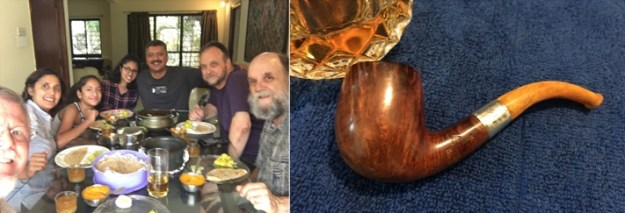
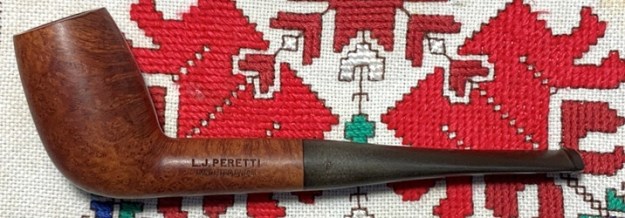
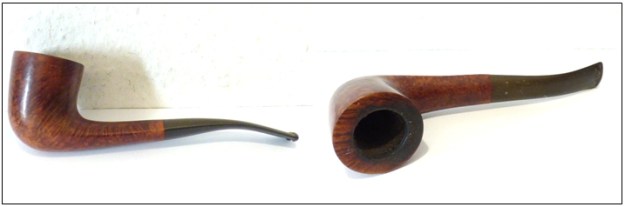
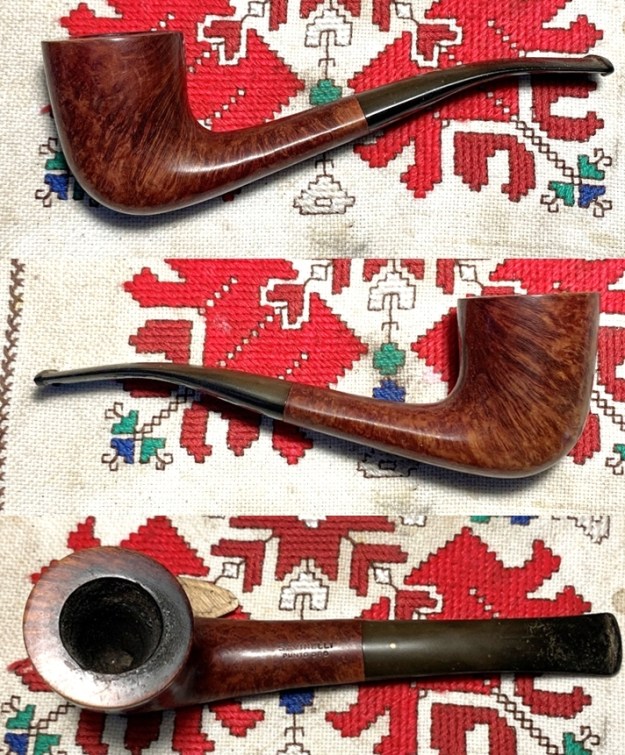
As I begin this restoration, my mind is replaying the plethora of experiences that were shaped and riveted into my memory of my visit last year to India.  Not many ‘good’ experiences in life can be described as ‘life changing’.  These kinds of changes are usually reserved for the difficult times – like now, as the world is navigating a pandemic that creates confusion and uncertainty about life and the future.  Yet, Paresh’s invitation to me, along with the rebornpipes’ trust, Steve and Jeff Laug, to visit his home and family was an experience that was life changing for me.  It wasn’t just the sights and sounds of a different cultural context or the different foods the pallet experienced tasting Indian cuisine.  What was so profoundly and wonderfully life changing was the depth of loving hospitality Paresh and his wife, Abha, provided to us during the visit.  Meeting and enjoying his family, along with their two daughters, Mudra and Pavni, was truly an experience that will walk with me in the life I continue to enjoy by God’s grace.  Of course, I cannot fail to mention the ‘reason’ for our travels where West met East!  Paresh asked that we collaborate in the restoration of one of his heirloom pipes, an unbelievably fun and enriching experience that produced this story, perhaps my favorite:  West Meets East in India to Restore a Grandson’s Treasure – an 1846 BBBHow does an Italian Savinelli Punto Oro heading to India enter this story?  It has to do with an Italian American L. J. Peretti pipe that I noticed in India – basking nonchalantly among the historic pipes of Paresh’s unbelievable heirloom collection he received from his grandfather.  The Peretti that got my attention was not from his grandfather’s collection, but a pipe that Paresh had acquired himself.  Since doing my first restoration of a L. J. Peretti, I have become somewhat of a collector of these blue collar ‘shop pipes’ from the second oldest tobacconist shop located in downtown Boston.  I had never seen a Peretti Cutty shape before and hence, the Savinelli Punto Oro makes his debut on the stage.One of the great things about ‘Pipedom’s’ smaller subset, pipe restorers, is that it is special and an honor to have pipes in your personal collection that have come from other restorers who you’ve learned from and appreciated.  I have pipes in my rotation from Steve, who introduced me to the world of pipe restoration and is a good friend who has visited me here in Sofia and I’ve had the privilege of visiting his home terrain, Vancouver.  When I enjoy fellowship with one of his pipes with my favorite blend stoked in the bowl, the relationship is always the focus of the reflection during those paused moments.  I managed to secure one very special pipe for my collection from Charles Lemon of Dad’sPipes, who I’ve also learned much from in his restorations and appreciated that his health has allowed him to come back from hiatus.

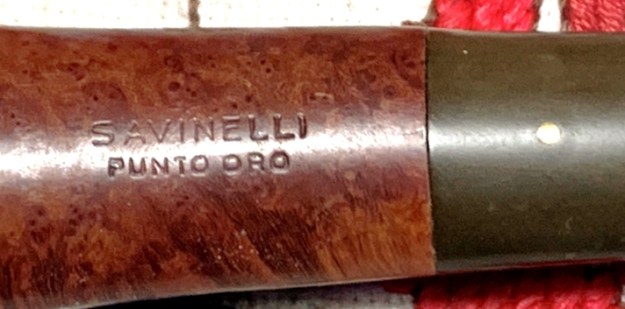
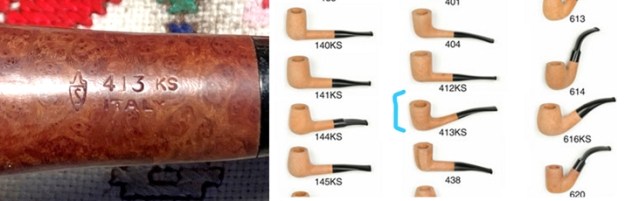
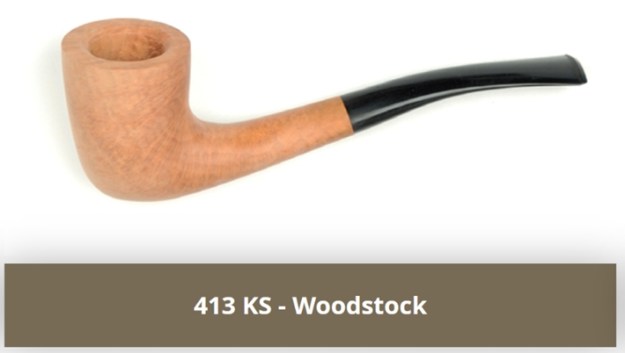
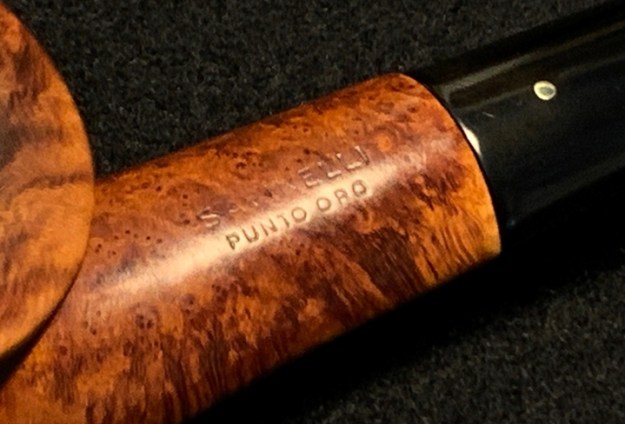
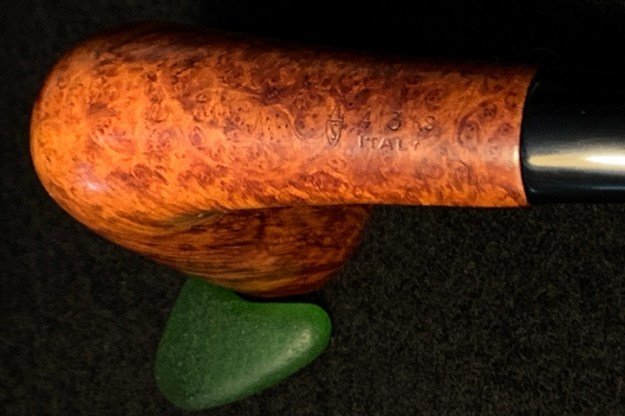
When Paresh became aware of my attraction to his L. J. Peretti Cutty, the accord we ratified between us was to do a reciprocal gifting from our personal collections.  Paresh gifted me his Peretti Cutty which I brought home to Bulgaria from India.  After getting back to Bulgaria, I chose a pipe from my personal collection for him.  The special pipe I chose for Paresh was a Savinelli Punto Oro that was in my personal restoration queue – for a LONG time.  The problem of restoring pipes primarily for others is that sometimes it’s difficult to work on your own trove of treasures!  When I saw the Punto Oro on German eBay located in Bühl, I was drawn by the elegant lines of this Savinelli offering. The shape is unique with the Dublin-esque bowl, but not quite.  In my initially assessment of the pipe, I was calling it an oval shank, slightly Bent Billiard – but not quite. The shank was not actually a true oval but a compressed oval – an American football or rugby ball shape.  The unique shape created a lined definition running down the sides of the shank transitioning into and through the stem – flow and balance!  With so much attention on focused the shape, the fact of the striking fire grain showcased throughout the pipe – was reminiscent for me of a tiger’s fur, flowing even through the shank composition.  This only added frosting on this Savinelli Punto Oro cake!  Very nice! Unfortunately, it has taken me a few years to get to this beautiful pipe, but it was waiting.  It was patiently waiting in the ‘Help Me!’ basket and when it came to mind as a comparable reciprocal gift for Paresh, his debut on the worktable became a reality.  Here are more pictures of a very nice Savinelli Punto Oro yet having some daunting issues. The nomenclature is on the upper shank and it reads, SAVINELLI [over] PUNTO ORO, (Gold Point).  ‘Gold Point’ may also be referencing the single gold point brass dot embedded on the upper stem panel.The lower panel section is stamped with the encased ‘S’ in Savinelli’s well known and recognized symbol.  The Savinelli symbol is to the left of the shape number, 413KS [over] the COM, ITALY.  The shape is found in the Savinelli shapes chart found in the Pipedia article on Savinelli,  but the chart offers no names for the shapes, only numbers.  This 413 is designated as a ‘King Size’ by the KS.   Whatever the shape is, I like it!Not satisfied with my lack of definition on what to call this shape, I sent a note off to Steve asking for his opinion – Calabash, Dublin, fancy Billiard?  Steve’s response settled the question directing me to Savinelli’s website – my first thought, why didn’t I think of that?  In the Savinelli line up of shapes or models, the 413KS is described as a Woodstock (pictured below).  Nice!  Bill Burney’s description of the Woodstock in his Pipedia shapes discussion is helpful and includes all the variations I was contemplating!

Zulu/Woodstock – The Zulu shape combines the canted bowl of the Dublin with an 1/8 bent stem.  The shape is sometimes referred to as a Woodstock, Yacht or Yachtsman.  The gentle bend makes the pipe more comfortable to hold in the teeth than a straight pipe.  This popular style is made by most pipemakers and is widely available on the estate market.My first restoration with the Italian name of Savinelli stamped on the pipe was a Tortuga, which was a very sharp looking pipe.  During that initial exposure to the name Savinelli, I learned that before and after WW II, when Italian pipe production was known more for volume than for quality, and not considered by many in the same league with other European pipe makers, Achille Savinelli Jr.’s ambition took shape to make Savinelli one of the premier names in pipe making today.  This clip from the Pipedia Savinelli article summarizes this well:

Savinelli Pipes began production in 1948 and, although the pipes were of a superior quality and unique in their aesthetic, the brand wasn’t an immediate success. Few new brands are. It takes time for the public to catch on. Retailers were skeptical of placing Italian pipes alongside their best sellers from England or France, and customers, in turn, were hesitant to purchase a Savinelli over pipes by already established, foreign brands. Achille Jr. stood by his product, however; he knew it was only a matter of time before the world realized that these pipes were of a far superior quality, capable of competing with even the most well-established pipe manufacturers in the world. As it turns out, he was right. In less than a year, Savinelli pipes gained prestige in markets all across the world—heralded for their delicate balance of innovation and tradition, of form and function. Savinelli pipes were placed alongside the likes of Dunhill and Comoy’s in tobacconists from the United States to Europe, and, in time, this exposure modified Italy’s reputation; it was not only the premier exporter of briar, but now a premium source of fine briar pipes.

The Punto Oro line is considered a top shelf Savinelli offering.  When I first acquired this pipe, wishing to know more especially about the Punto Oro line, I emailed rebornpipes contributor, Al Jones, for his input.  His response was helpful.

Dal:

I’m sorry to say that I have very little expertise in the Savinelli world, save the Guibileo d’Oro or Autograph lines (and only cursory in those).

Here’s an interesting thread about that line on the Pipesmagazine.com forums (I’m a moderator there) http://pipesmagazine.com/forums/topic/opinions-sought-savinelli-punto-oro.  Older ones, like yours appears to be, were a pretty high grade, from what I can gather. 

If your stem is vulcanite and non-filter, it should have been made before 1981 (looks that way to me).   In ’81, they switched to filter pipes.

I’ll look forward to your restoration!

Al

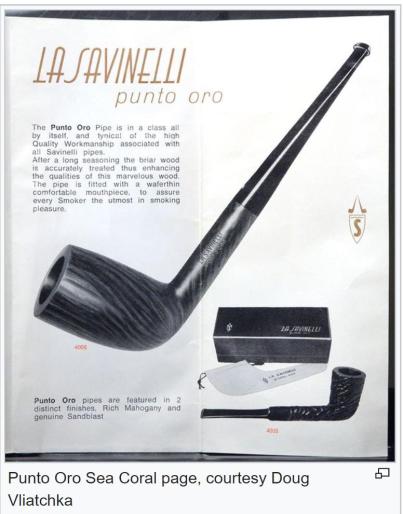
The thread from PipesMagazine.com Forum was helpful.  The general impression from the thread was that the older Punto Oro pipes were on the upper shelves of Savinelli offerings, just under the Guibileo D’Oro and older Autographs.  The Punto Oro catalog ad on Pipedia describes the quality of this Savinelli line and the processes involved in the producing the quality finish.  I found interesting that the ad describes the two finishes available with the Punto Oro line – “Rich Mahogany and genuine Sandblast”.  With the smooth surfaces, the hue is mahogany – the pipe on my table fits this described hue with flare!

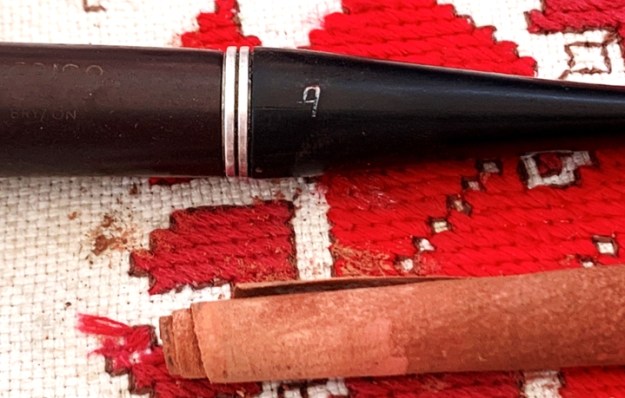
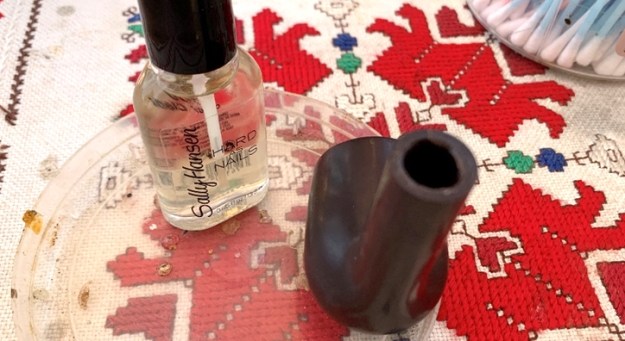
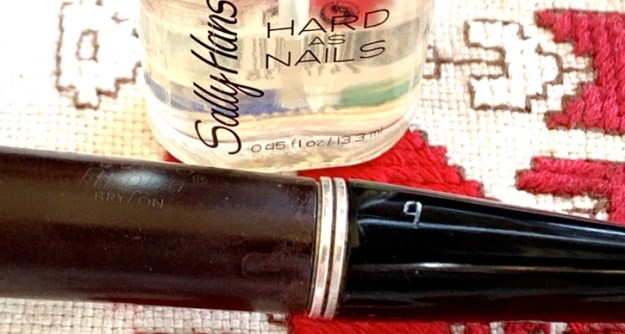
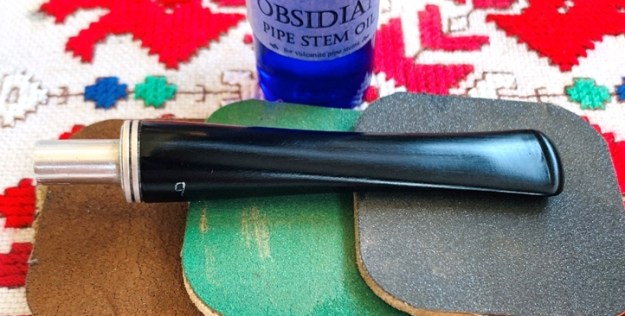
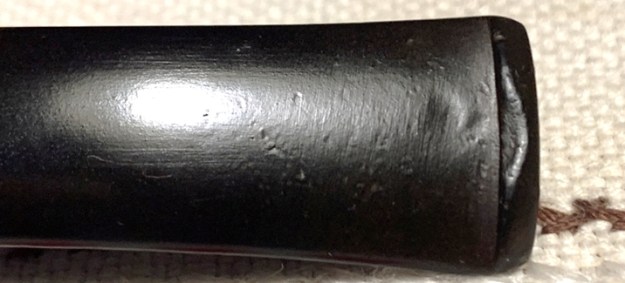
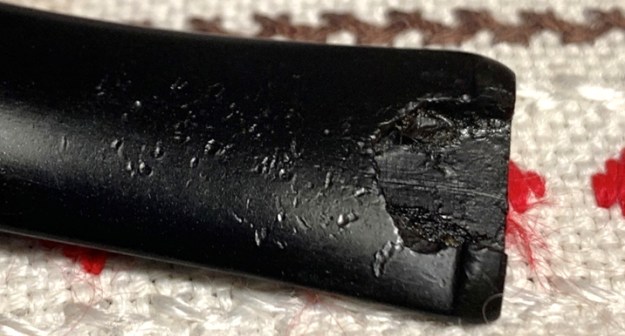
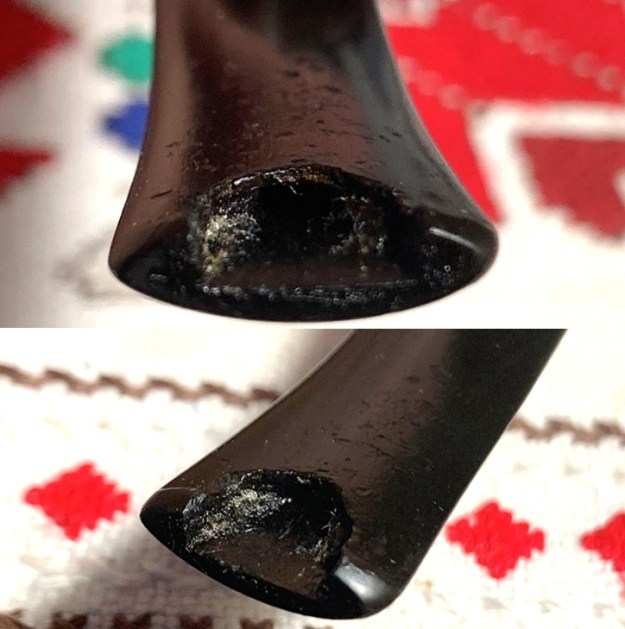
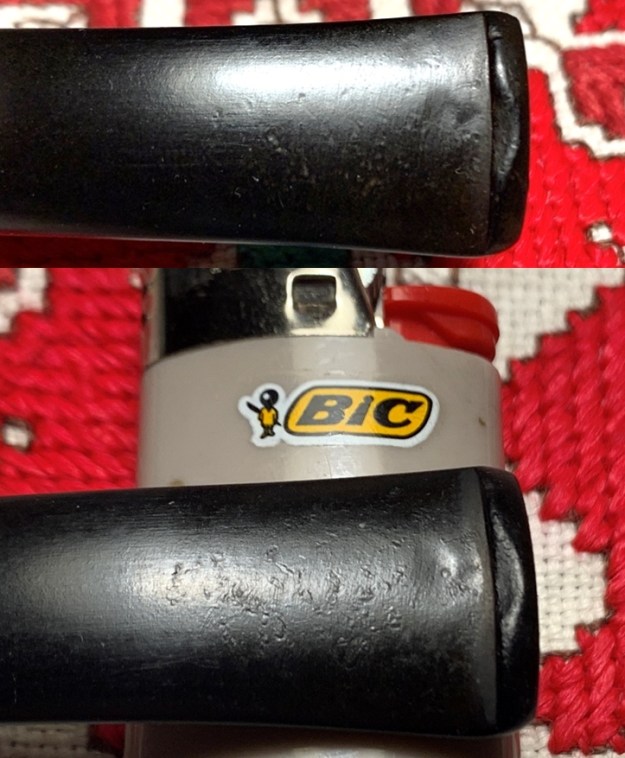
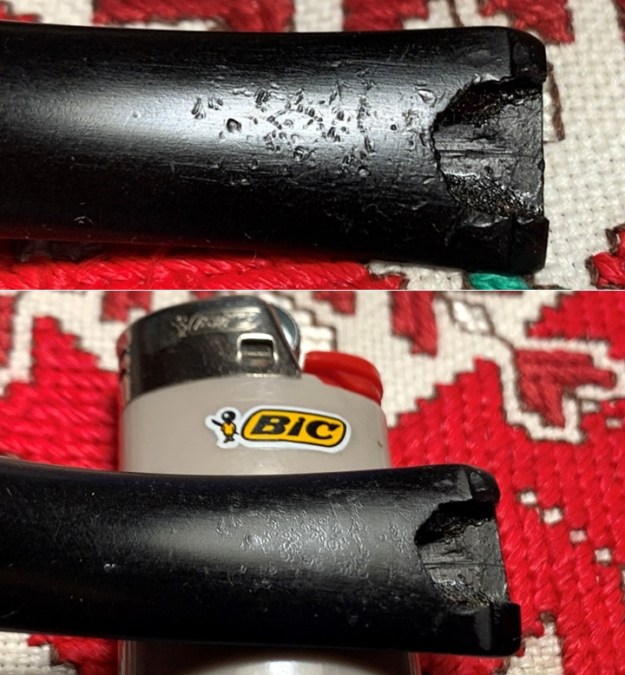
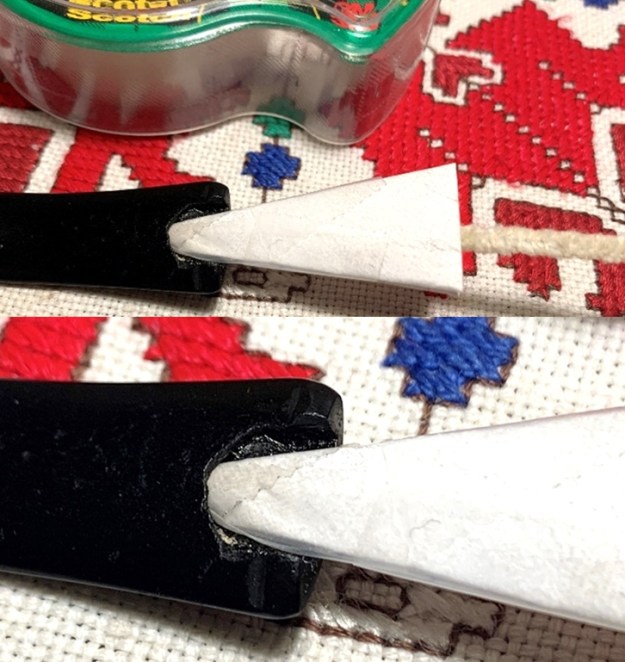
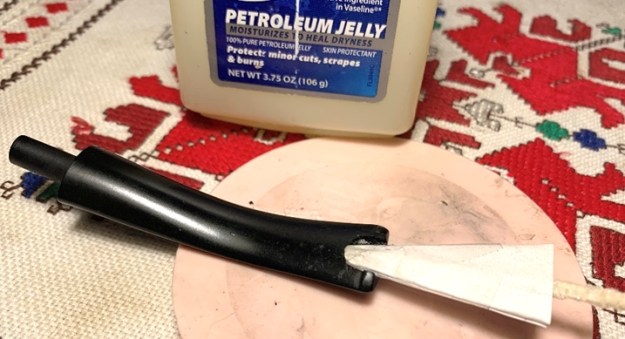
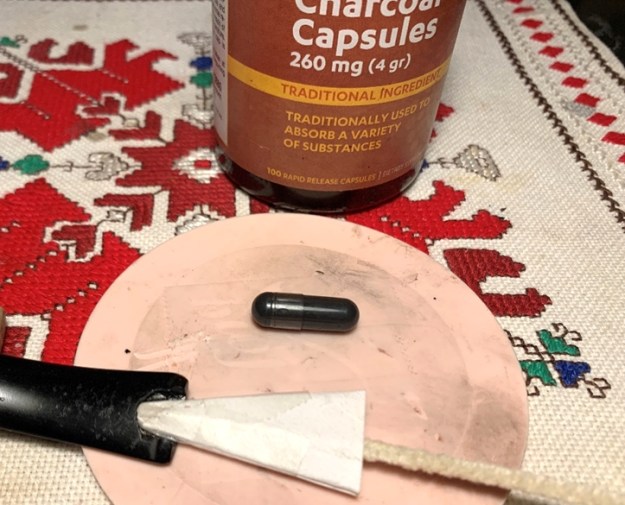
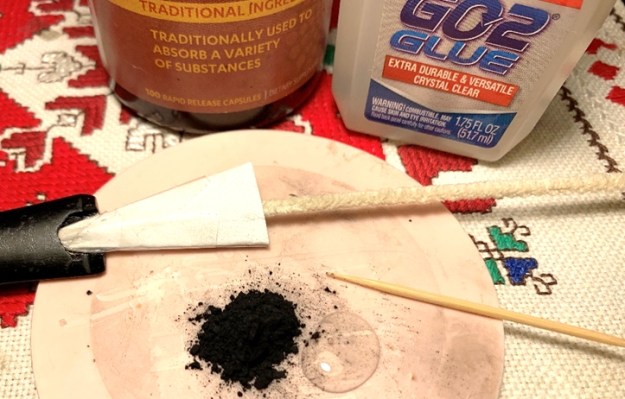
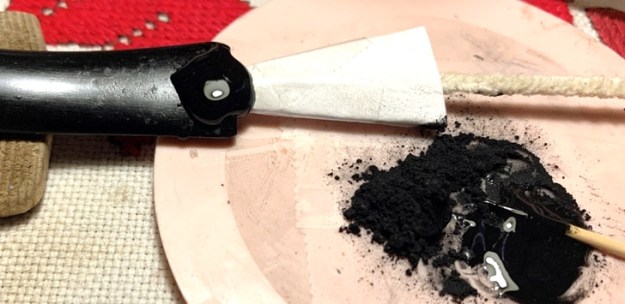
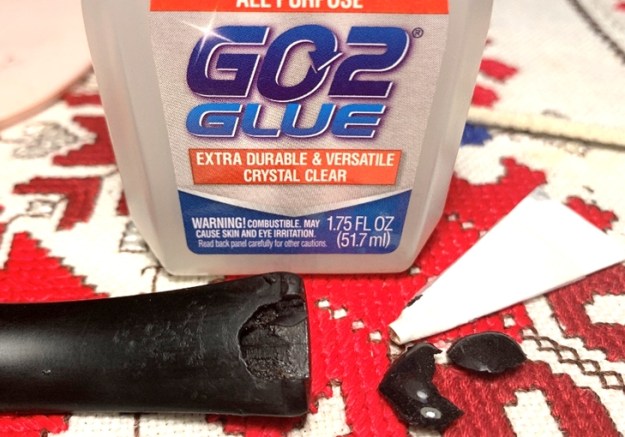
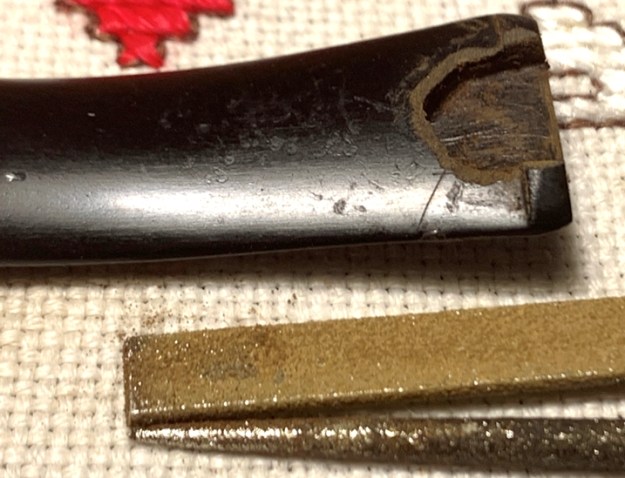
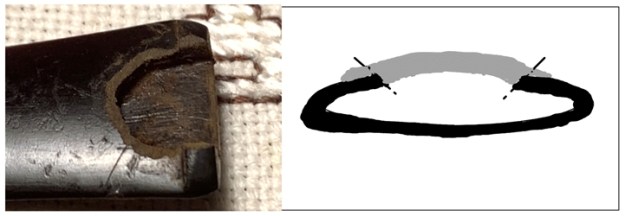
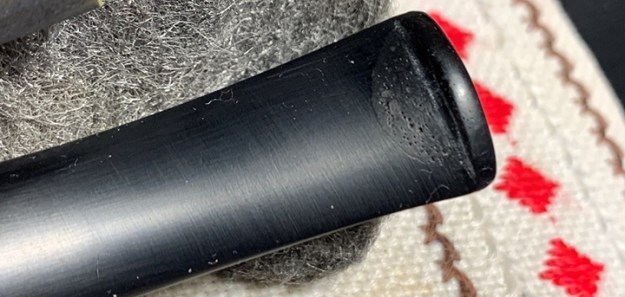
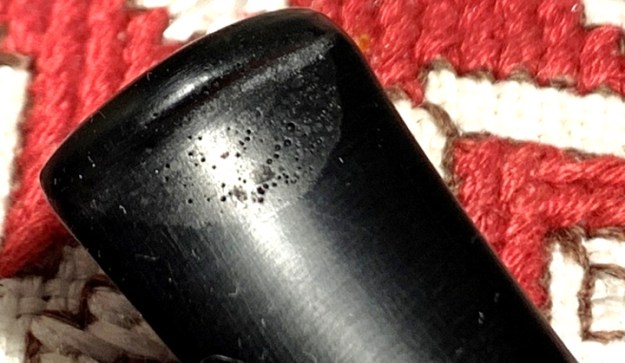
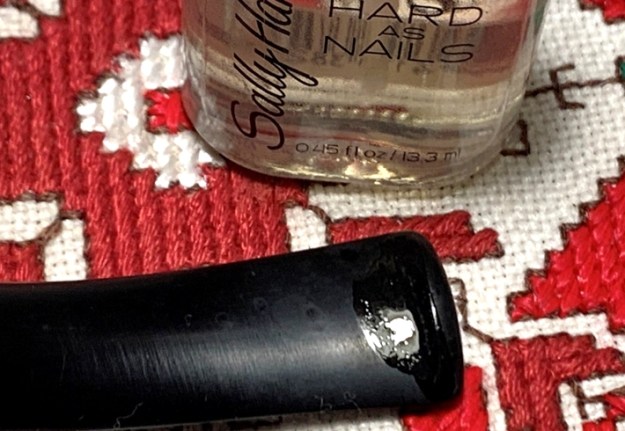
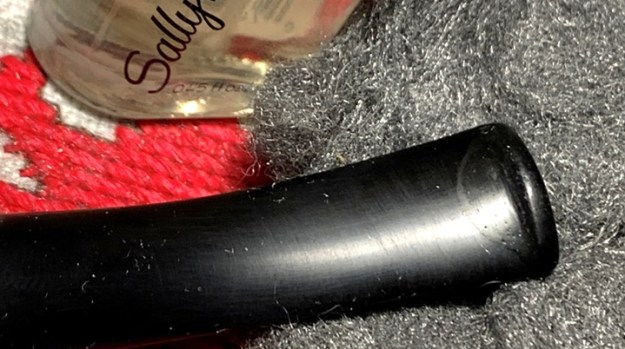
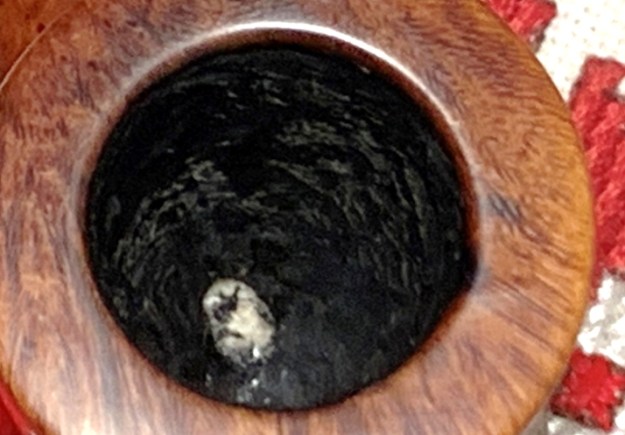
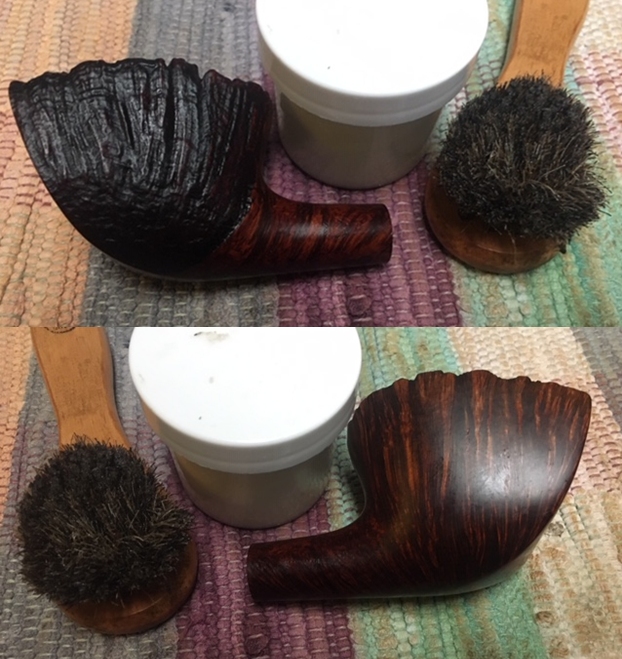
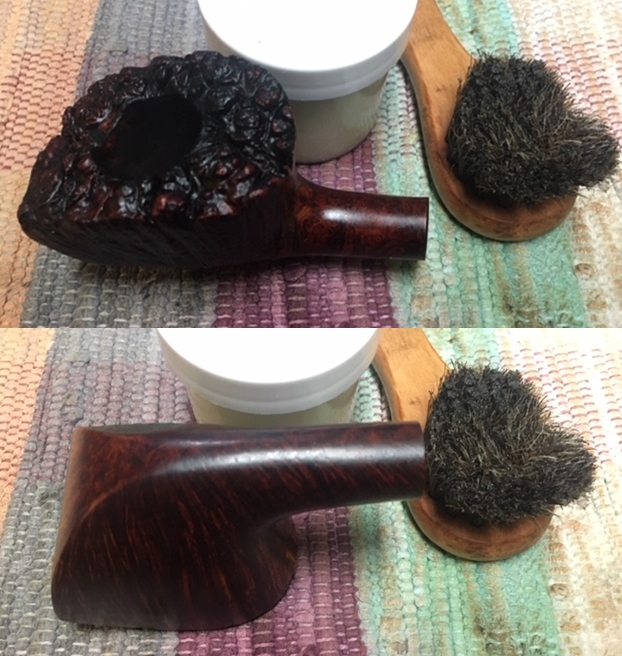
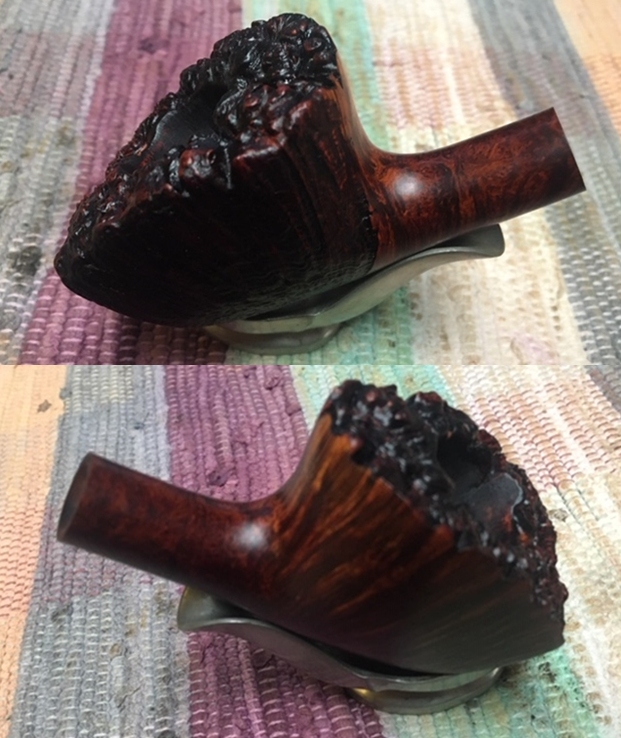
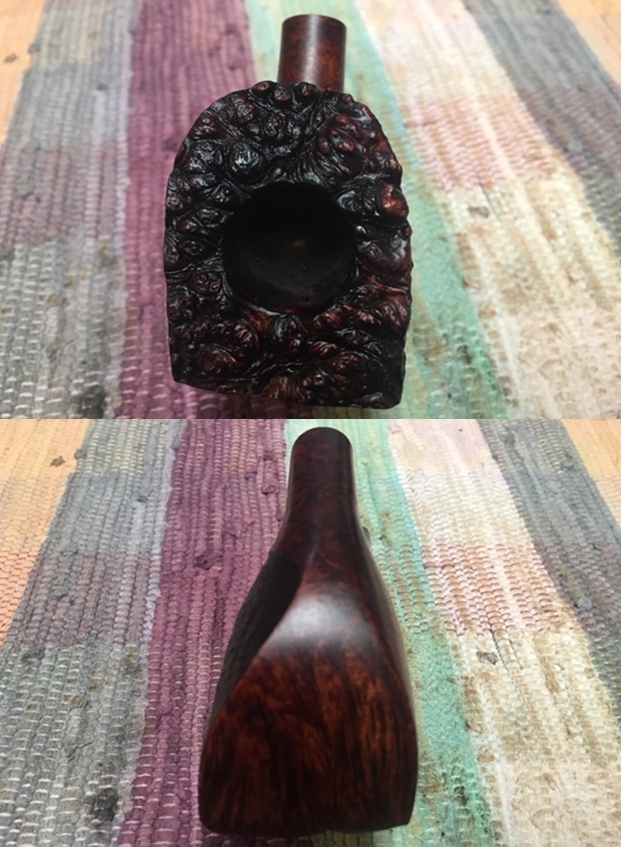
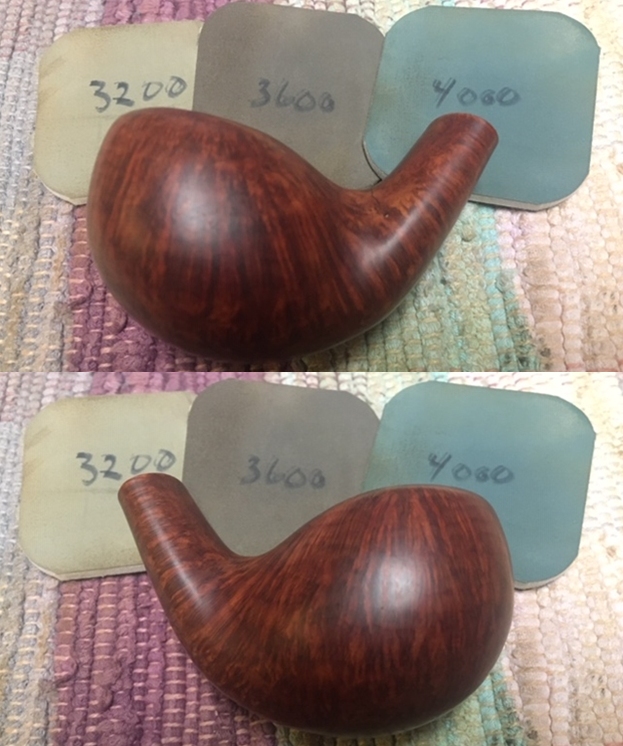
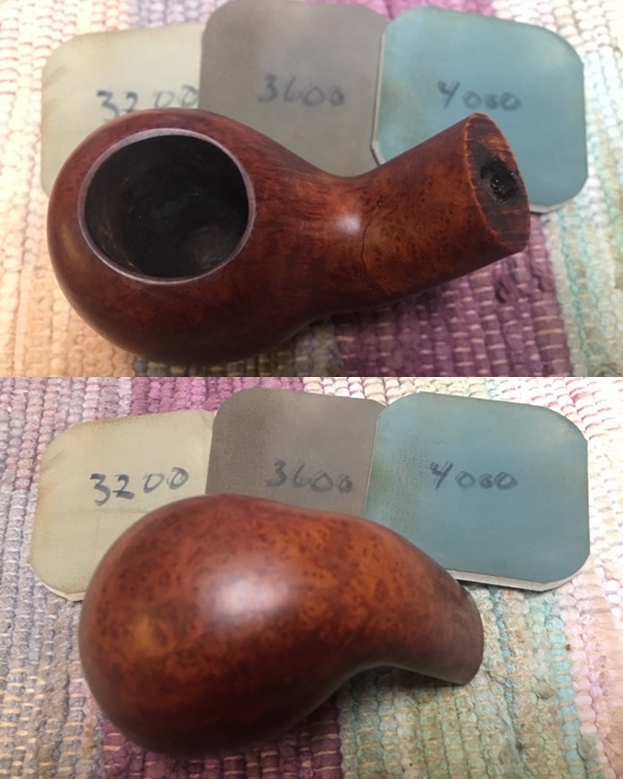
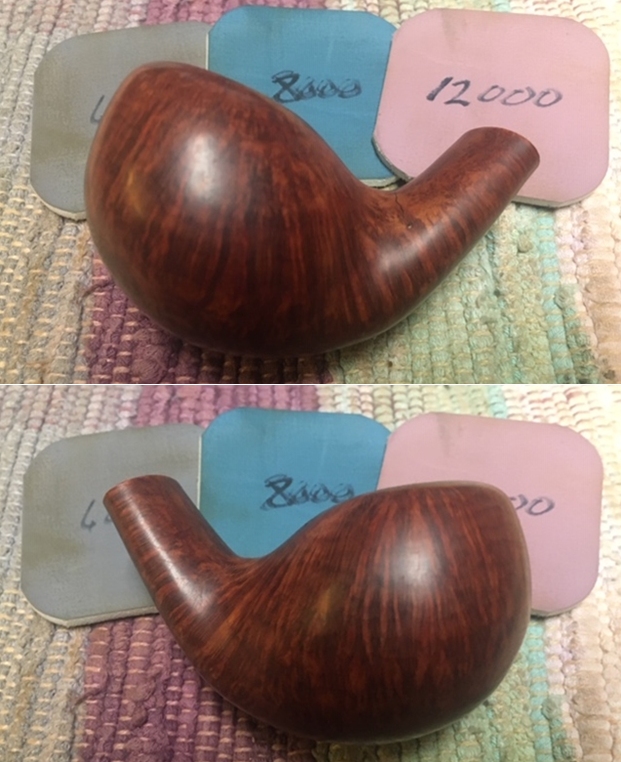
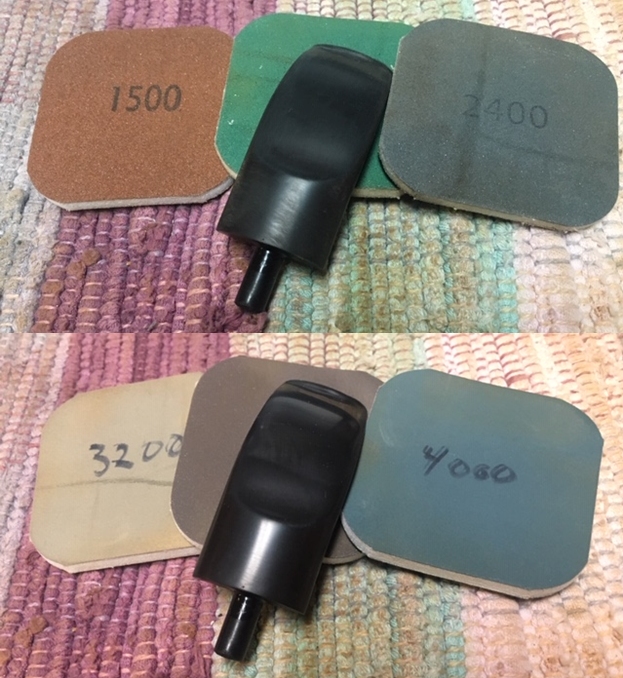
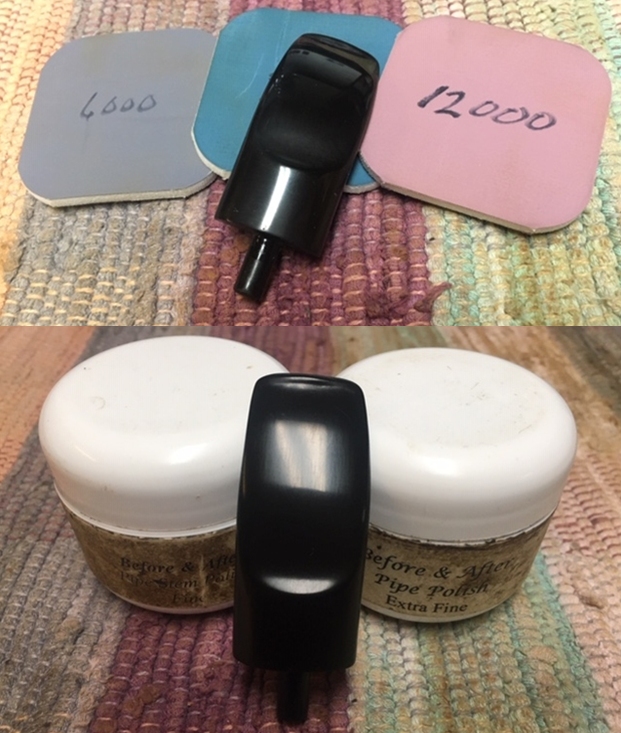
I like this pipe – a Woodstock (!) a lot and I think it will be a good addition Paresh’s collection although a lesser, humbler cousin in that collection to be sure!  Looking at the state of the Punto Oro’s condition, the briar landscape is beautiful – no issues that I can see.  The chamber has very light cake – the appropriate dime-width that is recommended.  I’ll remove it for the briar to have a fresh start and to inspect the chamber condition.  The rim reveals the lighting practices of the former steward – over the aft rim surface where it’s darkened and caked with crusted lava flow.  The picture below looks at the chamber and rim.The major issues with the restoration of this Punto Oro are with the stem.  The upper bit has tooth compressions on the bit and button.The lower bit is where all the fun is hiding!  The lower button has broken off and the break migrates down the stem – it will be no small button rebuild to address this moon crater!  There is also tooth chatter evident on the lower bit.  To restore the usefulness of this original Savinelli ‘Gold Point’ stem, which to me is critical, requires a button rebuild.  Rebuilds are never as strong as the original stem, of course, but I’m hopeful of building in some strength as I do this rebuild. I begin the restoration of this gift for Paresh by cleaning the Savinelli stem airway with a pipe cleaner wetted in isopropyl 95%.  It takes one cleaner to do the job.The oxidation on the stem is deep.  I use grade 000 steel wool with CIT, a product like SoftScrub, to work on the oxidation before putting it into the soak of Before & After Deoxidizer.  I like this product but when the oxidation is deep I’ve found that the soak alone is not sufficient to remove the oxidation.  The steel wool gives a head start for the Deoxidizer to break up the oxidation.The stem is then added to the soak of Before & After Deoxidizer along with several other pipes in the queue and their stems.  I let the stem soak for a few hours.When I fish out the stem after a few hours, I let the Deoxidizer fluid drain off the stem and I also squeegee the stem with my fingers.  Using a pipe cleaner wetted with isoproypl 95%, the airway is cleaned of the Deoxidizer.  I also wipe off raised oxidation from the stem with a cotton pad wetted with alcohol.  To help to rejuvenate the vulcanite stem, I also apply paraffin oil and set the stem aside to soak in the oil.Turning now to the stummel, I use the Pipnet Reaming Kit to begin the removal of carbon cake from the chamber.  After taking a picture showing the starting point, I use 3 of the 4 blade heads available in the kit. The chamber narrows at the bottom, consistent with a conical shape of the Woodstock crafted stummel.  I use the Kleen Reem Tool that more easily reaches to the floor of the tapered chamber.  The Savinelli Fitsall tool continues the scraping and finally the chamber is sanded with 240 grade paper wrapped around a Sharpie Pen.  After wiping the chamber with a cotton pad wetted with alcohol to clear the carbon dust, an inspection reveals heat veins in the chamber briar.  These are fissures that form from overheating the stummel.  The veins are not substantial enough to repair, but I will complete the restoration by applying a coating of yogurt and activated charcoal mixture to the chamber that will protect the chamber wall and encourage the formation of a protective cake. Switching now to the external briar surface, undiluted Murphy’s Oil soap is used with a cotton pad to scrub the stummel.  The thick, crusted area on the aft of the rim is stubborn.  With the solvent working, I also carefully scrape with my thumb nail, with the edge of my Winchester pocketknife, and with a brass wired brush.  After working on the scrubbing of the external briar surface, I then transfer the stummel to the kitchen sink and using warm water, I scrub the internal mortise and airway with shank brushes and anti-oil liquid dish soap.  After a thorough rinsing, I take a picture back on the worktable.  The stummel cleaned nicely, but the darkened area remains on the stummel’s rim.  I’ll continue to work on that with minor sanding later.I turn now to focus on the internal cleaning.  With only one cotton bud and one pipe cleaner wetted with isopropyl 95%, the fact of the internal cleaned condition is established.  Nice!With the stummel cleaning completed, I turn now to the stem.  The daunting aspect of the restoration is the button rebuild.  Before starting on this, I first focus on the tooth chatter and compressions on upper and lower bit.  I go in this order because the approach in rebuilding the button introduces the CA glue and activated charcoal patch which has a different composition from the vulcanite stem. Since I’m beginning with the heating method to erase as much as possible the chatter and compressions, this involves the heating and expanding of the vulcanite.  This is better done before the patch is applied in the button rebuild.  Using a Bic lighter, I paint the upper and lower bit to heat the vulcanite and through heating the rubber compound expands to reclaim its original disposition – or closer to it.  After going through the painting procedure and comparing the before and after pictures, the heating method did not help a great deal with the composition of this vulcanite stem. It helped some, but not a great deal it seems to me.With pictures showing the starting point for the upper and lower bit, it’s interesting to me to see where the tooth chatter is on the lower bit.  It extends about a quarter of the way down the stem!  I think what this indicates is that a frustrated steward, after he crunched the button, refused to put one of his favorite pipes aside!  Just like in American baseball, he ‘choked up’ on the stem, to keep using his pipe even though the button had endured catastrophic failure.  Now I turn my attention to the button rebuilding procedure.  First, I fashion a cone that inserts into the airway having a pipe cleaner running through the cone into the airway.  The cone is covered with scotch tape and then petroleum jelly is put on the tape.  This helps the cone not to get stuck after the patch material is applied. The patch material is a mixture of activated charcoal that is in capsule form and CA glue.After placing the charcoal in a small pile from the capsule, the glue is placed in a small puddle next to it.  The toothpick is used to mix the charcoal and glue by gradually pulling charcoal into the CA glue while mixing.  As the charcoal is mixed in, the patch material thickens.  After it reaches the consistency like molasses, I apply the charcoal putty to the button using the toothpick as a trowel. I intentionally use a mixture that is a bit thinner at the beginning so that is will seep down around the cone filling in the open spaces.  This is important to create as much strength as possible in the rebuild.  I apply more than is needed to build a mound that will later be filed and sanded to shape the new button. After enough patch material has been applied, I put the stem aside overnight allowing the button build to cure.  The lights go out!Well, the next morning held some surprises!  When I examine the button rebuild, looking forward to starting the process of filing and shaping, I discover that the new CA glue that I used did not cure to a solid state!  The patch was reminiscent of a bite guard – pliable rubber.  With some tugging and peeling, the repair came off in two pieces….  Interestingly, nowhere that I can find on the labeling that this glue does not harden, unless the “Extra Durable and Versatile” on the front label implies this?The good news is that the cone was removed without trouble and is ready to go again for button rebuild patch attempt number two!  I’ll spare the reader of all the pictures to record this second process but will jump forward.  What I did do differently after examining the large area of the patch, was to better engineer and strengthen the resulting rebuild.  I carefully applied rounded and flat needle files to the edge of the break.  I filed to taper downwardly the edge toward the break. My thinking is that this small innovation perhaps will strengthen the patch by providing more of a shelf or footing upon which the patch material can rest.  It seems that this engineering would inherently provide better buttressing than a straight vertical edge drop.  I’m thinking also that this will help in the sanding and blending of the patch. The sketching below illustrates my thinking.  I also file and clean out the entire button cavity and clean it with a cotton pad wetted with isopropyl 95% in preparation for the new patch.  Before starting on the button patch, I decide to do a quick fill of the upper bit and button lip where there were compressions.  I use medium-thick black CA glue to do the filling.  To quicken the curing and to hold the patch in place I use an accelerator.The next pictures show the second finished button rebuild patch with the engineering changes beginning the curing process.After the second button rebuild patch is cured, using the flat needle file, the patch on the upper bit and button lip are filed down flush with the vulcanite stem surface.Switching to the underside, filing and shaping begin on the button rebuild.  I start with the slot facing to flatten it by removing the excess patch material.  Then, cutting the line shaping the button lip is next.Filing continues with the main bit patch and button shaping.  I’m careful to allow a rounded patch and not filing straight across horizontally.  This would weaken the patch – thinking of the difference between an arched bridge’s symmetry rather than that of a flat bridge’s.  Maintaining the patch thickness is critical to its strength.With the filing phase completed I transition to using 240 grade paper starting first on the upper bit and button lip fills.The 240 grade sanding fine tunes the button rebuild further. I’m careful not to sand too much on the patch and continue to round it to maintain thickness.  A slightly thicker lower button lip purchases some strength as well. I focus on sanding the seams of the patch so that they are flush with the vulcanite surface.  The patch is still rough but making progress!I use the flat needle file to shape and smooth the slot as well.  It’s almost a given that air pockets will emerge as the sanding continues to shape the button.A careful examination of this cross-section view of the slot facing shows the added buttressing effect of the earlier tapered filing.  Arrows help to show this.With the 240 grade sanding paper still in play, I sand the entire stem to remove any residual oxidation.  Deep oxidation always seems to appear during the fine sanding and polishing phases.  Sanding the stem with 240 now will hopefully address this as well as the remnants of tooth chatter remaining on the bit.  I use a plastic disk that I fabricated to be able to sand the stem facing without shouldering the edges.Next, I sand the entire stem by wet sanding with 600 grade paper and following this, 000 grade steel wool is applied.The upper bit and button repairs are looking great – the sanding is erasing the contours of the patch and blending nicely.Work on the lower stem side is a bit more of a challenge with the huge button rebuild patch material.  The stem is looking great, but the challenge is to blend the large patch area.Air pockets are the most common side effects of patching.  Air bubbles are trapped in the CA glue and activated charcoal as it is mixed and these air bubbles become visible as sanding dissects and reveal the pockets.The many microscopic air pockets are not easy to remove.  I use a clear acrylic nail polish to try to fill and erase the pockets.  CA glue can be used to do the same. I use the brush provided by the nail polish and I paint over the pockets almost covering the entire patch.  I let it dry and repeat the process for a second coating.After the acrylic polish cures, I apply 000 steel wool to the patch and the picture below shows the results.  The nail polish does an amazing job but there remain some pockets.  These are very small and I’m doubtful that more coating will erase them.  I’m satisfied now with leaving them and moving on!  They remain as a testament to the catastrophic button failure and this noble attempt to recommission this beautiful Savinelli Punto Oro Woodstock!  Moving on!I move on to applying the full regimen of micromesh pads to the Woodstock stem.  I begin with wet sanding using pads 1500 to 2400 and follow by dry sanding with pads 3200 to 4000 and 6000 to 12000.  Between each set of 3 pads, Obsidian Oil is applied to condition the stem and to protect it from oxidizing.  The stem is looking great. With the stem sanding completed, looking now to the stummel, I focus first in cleaning up the rim.  There remains darkened briar from the lava flow earlier cleaned on the aft quadrant of the rim.  The inner rim edge is also darkened at places with the normal nicks from wear and tear.  The outer edge of the rim is also with some normal nicks and dents – all very small. To clean the rim, I first start by using 240 sanding paper and doing a very light inner and outer rim bevel – just enough to clean the edge of the rim.  After this, I also use the 240 paper to lightly ‘feather sand’ the aft part of the rim to clean the darkened surface.  I run the sandpaper lightly around the full rim plane surface to clean the briar, not to remove it.I follow the same procedure with the rim edges and the rim plane with 600 grade sanding paper.  The rim is shaping up very nicely.Next, I use micromesh pads to do fine sanding on the Savinelli Gold Point stummel.  I begin by wet sanding with pads 1500 to 2400 and then dry sanding with pads 3200 to 4000 and 6000 to 120000.  The fine sanding brings out the grain and restores the mahogany finish for which the Punto Oro line is known.  Very nice indeed! To deepen the natural hues of the briar, Mark Hoover’s Before & After Restoration Balm (www.ibepen.com) does a great job.  I put some of the Balm on my finger and work it into the briar surface.  The Balm begins with a cream consistency and then thickens into a waxy consistency as it is worked into the stummel.  After working the Balm thoroughly into the surface, I put the stummel aside for about 20 to 30 minutes as the Balm is absorbed into the briar.  The picture below was during this period.  Afterwards, I wipe off the Balm with a cloth dedicated to this, and then the stummel is buffed up using a microfiber cloth.  The stem also is a beneficiary of Before & After Fine Polish and Extra Fine Polish.  The polish helps further to condition the vulcanite and to rid the stem of oxidation.  Starting with the B&A Fine Polish, I work the black oily liquid into the stem – the liquid has a gritty texture.  Afterwards, I let the stem absorb the polish for 15 minutes and then wipe the excess off with a paper towel.  I follow by applying the Extra Fine Polish in the same manner.  Again after 15 or so minutes, the excess is wiped off and the stem is buffed with a microfiber cloth.Now, the homestretch.  After reuniting stem and stummel and mounting a cloth buffing wheel to the Dremel setting it at about 40% full power, Blue Diamond compound, a fine abrasive, is applied to the pipe.  After this, the pipe is wiped down with a felt cloth to clean it of compound dust before application of the wax.  Next, after mounting another cotton cloth buffing wheel onto the Dremel at the same speed, carnauba wax is applied to the pipe.  Following the wax application, the pipe is given a vigorous hand buffing to further raise the shine.

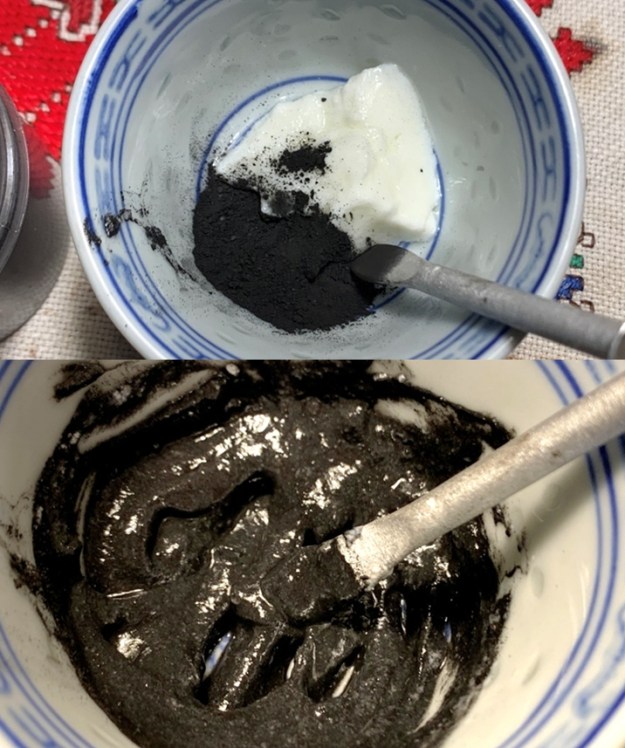
After the buffing, one project came to mind that I had almost forgotten.  Earlier, after inspecting the chamber and finding some heating veins, I had decided to apply a coating of natural yogurt and activated charcoal powder mixture to the chamber wall.  This mixture, after applied to the chamber, hardens into a protective layer to help protect the briar as well as encourage the formation of a protective cake.  I mix some charcoal powder with a small amount of natural yogurt.After the yogurt and charcoal are mixed and is somewhat thickened – not running but with the consistency of mud, and after inserting a pipe cleaner to keep the draft hole cleared, I use the pipe nail and spread the ‘mud’ over the chamber wall.  After it is covered, since it is late, I put the pipe aside to allow the mud to dry through the night and the lights go out!The next morning, after applying the pipe mud mixture to the chamber, I give the pipe one more rigorous hand buffing to raise the shine and my gift to Paresh is complete.

The button rebuild was, without doubt, the most technically demanding part of the restoration of this striking Savinelli Punto Oro Woodstock.  The grain is beautiful, and I am especially drawn to the Woodstock shape with the lines guiding the eyes down the sides of the pipe, taking in the movement of grain and shape.  I’m thankful for my L. J. Peretti Cutty that I received from Paresh when I was in India.  I have yet to put the Cutty into service here in Bulgaria – it has been waiting for my gift to Paresh to make it to India.  It still needs to be refreshed and a little polishing work, and my plan and hope is that Paresh and I will share our first bowls together with our gifted pipes to each other, perhaps not in person, but via video conferencing, today’s miracle bringing people together throughout our ever shrinking world.  After the pandemic issues are behind us, I’ll be mailing the Savinelli Punto Oro Woodstock to India.  Thank you for the Peretti Cutty, my friend!

My First Ever Tenon Replacement and it’s on a Preben Holm # 7 Freehand Pickaxe Pipe!!


Blog by Paresh Deshpande

The first ever Preben Holm in my collection was from eBay about two years back. It came to me with a broken stem and the tenon stuck in to the mortise. This pipe received a new lease on life in the month of May last year when Steve, Jeff and Dal Stanton visited me here in India. I learned the process of tenon replacement along with many other tips and processes in pipe restoration. Here is the link to the informative write up by Steve on this pipe; (https://rebornpipes.com/2019/05/14/restoring-a-preben-holm-hand-cut-sandblast-freehand-in-pune-india/).

The second Preben Holm in my collection came from my Mumbai Bonanza, which I really enjoyed working on; (https://rebornpipes.com/2019/08/12/refurbishing-a-tired-preben-holm-1-from-the-mumbai-bonanza-lot/).

The next two Preben Holm pipes came to me from a seller on eBay. Both these pipes had some serious stem issues which really kept other buyers away from placing their bids and lucky me, I got both these pipes for a really good price. Even though both pipes came to me together, I shall be working on them separately since they each have a different set of issues involved.

The first of these two PH pipes was restored a couple of weeks ago and it really turned out to be a gorgeous pipe. Here is the link to the write up that has been posted on rebornpipes.com (https://rebornpipes.com/2020/03/10/refurbishing-a-preben-holm-3-freehand-pipe/).

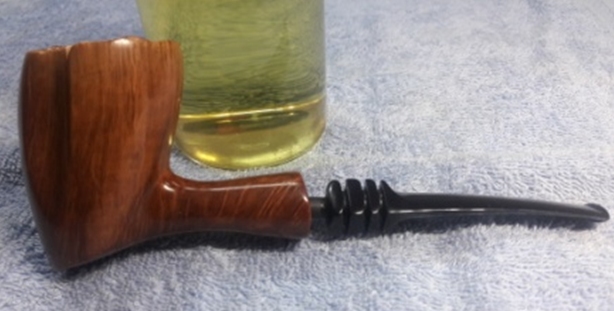
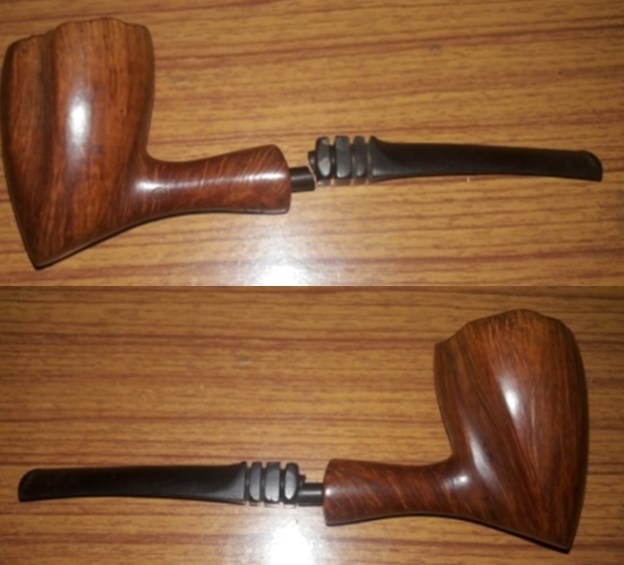
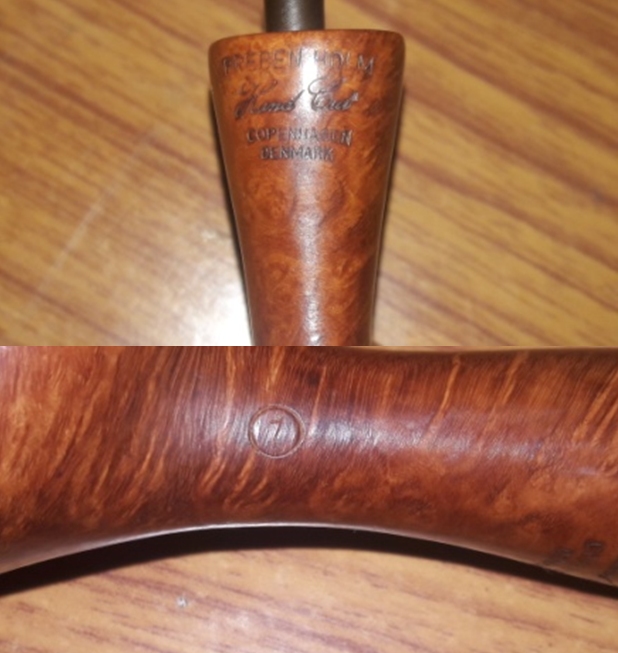
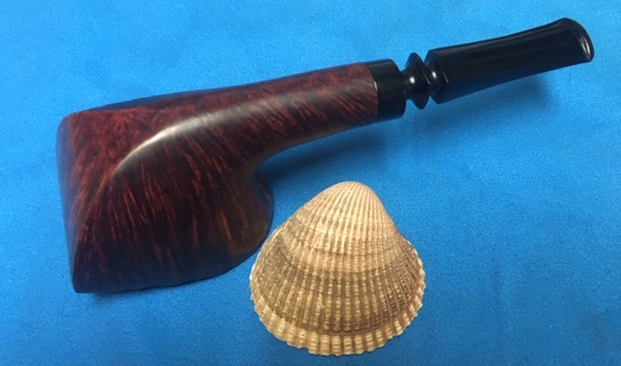
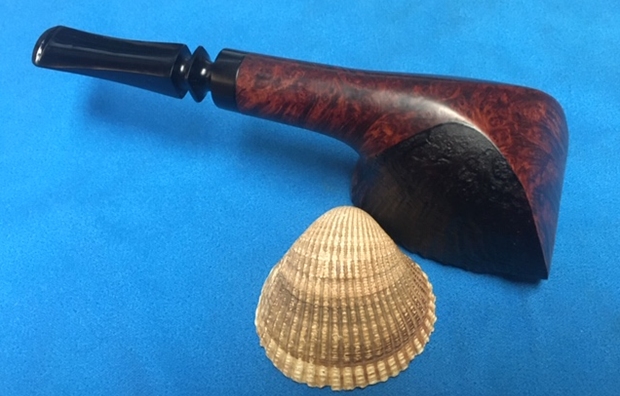
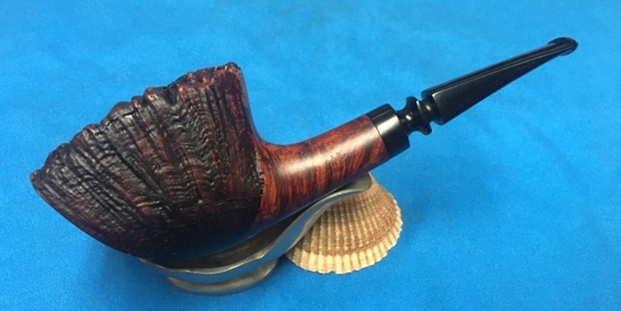
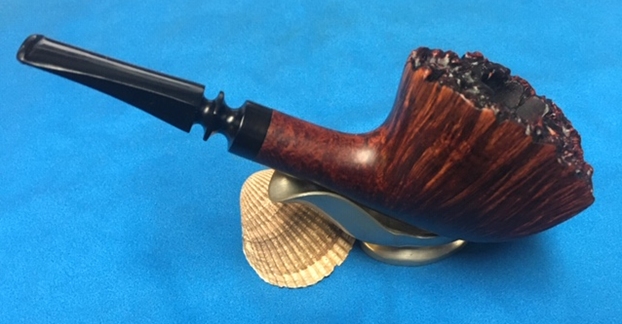
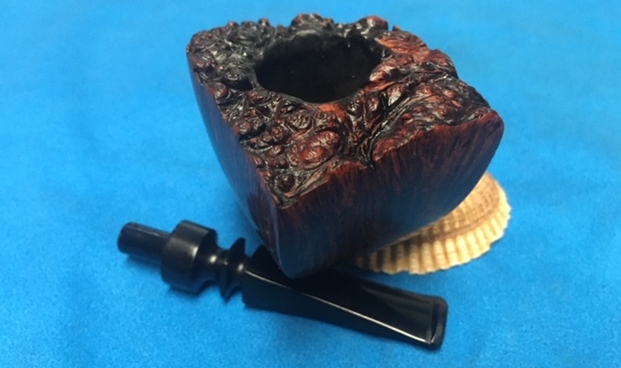
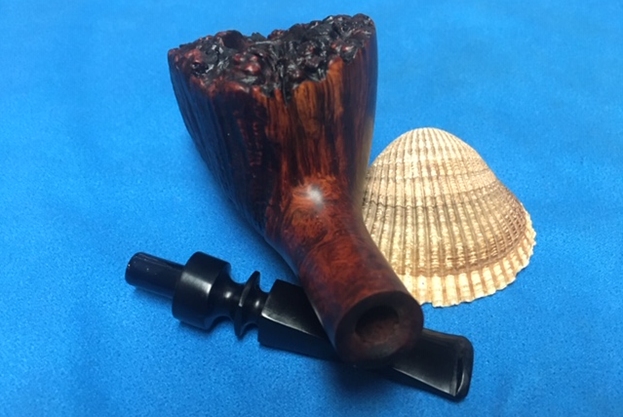
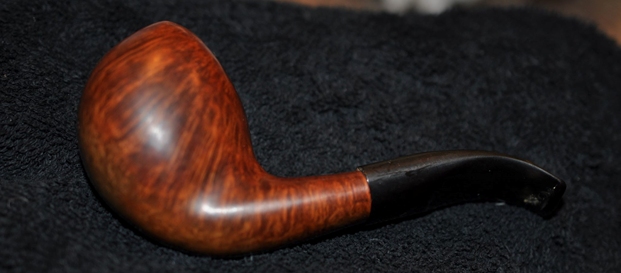
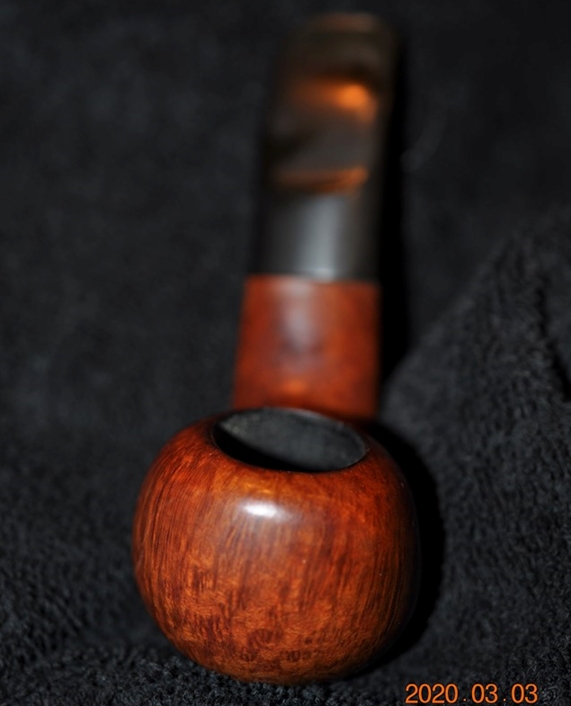
The second PH currently on my work table, is a beautiful pickaxe freehand with beautiful flame grain all around the stummel and shank and birdseye at the foot of the stummel. The rim top has remnants of plateau along the front left side and extending to the right up to half the length of the rim top. The shank end is sleek and smooth with a slight flare at the shank end, a complete contrast to the earlier PH I had worked on that had a large flare at the shank end. Here are the pictures of the pipe as it sits on my work table. The pipe is stamped on the bottom of the flared shank end as “PREBEN HOLM” in block capital letters over “Hand Cut” in a cursive artistic hand over “COPENHAGEN” over “DENMARK”, all in block capitals. The left side of the shank bears the encircled numeral “7”. All the stampings are crisp and easily readable. The fancy vulcanite stem is devoid of any stampings.There is a lot of interesting information on the carver, Preben Holm, on pipedia.org (https://pipedia.org/wiki/Holm,_Preben) which makes for an interesting read. However, there was no information or guidelines to help understand the grading and dating of these pipes from the carver. In my previous write ups on Preben Holm pipes, I had sought input on these specific aspects and was honored by studied information from esteemed readers of rebornpipes. Here is some of the information that was shared by the readers;

Roland Borchers March 10, 2020 at 8:21 am

Hi Paresh,

What a wonderful pipe and a great job (again) on the restoration. The PH pipes were 1968-1970 graded from 1 (lowest) to 8 (unicorn) .
This page from smokingpipes.com might be of interest, but there is more to be found on the www.
https://www.smokingpipes.com/pipes/estate/denmark/moreinfo.cfm?product_id=136933

So a 3 is not bad at all…

Best wishes,

Roland

I followed the link forwarded by Mr. Roland Borchers and reproduce the information gleaned;

“Now that my pulse has returned to (vaguely) normal. Preben Holm pipes which bear a single grading number in a circle, represent Holm’s earliest ‘Hand Cuts’, a period that most estimate between 1968 and 1970. Prior to handling this amazing jewel, the highest grade that I had encountered was a ‘5’. Once (just once) I saw a smoked ‘7’ offered across the pond for a price that could feed a decent sized village for a month (mild exaggeration, but you get the idea). Here we have a ‘6’, featuring both the conservancy of shape that one would expect from the earliest days, as well as a grain worthy of such a lofty grade designation. Forty (plus) years young, utterly unsmoked and it comes with both the original presentation box and sleeve. For Pete’s sake, don’t let this one get away”.

–R. ‘Bear’ Graves

borman August 15, 2019 at 5:44 pm

Not sure how correct I am but… pipes 1-4 as such are lower to higher quality rating as A-E is low to high. The bone extensions that I have had and others I have seen appear to be from the 60’s. Hope I am not far off and also I hope it helps you.

Thus from the above information, it’s evident that this beautiful Preben Holm pipe in my hand is a very rare # 7, top grade and very expensive pipe from 1960s…

INITIAL VISUAL INSPECTION
The first and foremost issue that I noticed and was aware of from the description given by the seller is that of the broken tenon. Most of the readers must be wondering as to the rational of buying a pipe, even a Preben Holm, with a broken tenon and it’s a logical question. However, there are two main reasons why I went in for this purchase; firstly my friend and guru, Steve had demonstrated how to replace a broken tenon and I was keen to try my hand at it and secondly was the economic consideration!! Pray tell me if it is possible to get a grade 7 early hand-cut Preben Holm from the 1960s at USD $65, including shipping!! Never, I say. Below are the pictures of the broken tenon stuck in to the mortise. This is going to be a challenging repair being my first tenon replacement.The chamber has a very thin layer of dry and hard cake with the slightly outward flared inner rim edge showing darkening in the 6 o’clock direction. The condition of the inner walls of the chamber can be checked and ascertained only after the cake has been taken down to the bare briar. However, I do not envisage any damage to the chamber walls. There is negligible lava overflow and debris embedded in the plateau of the rim top surface. It is my guess that this pipe suffered said catastrophic damage very early in its existence and had since been languishing in a box with the previous piper before he decided to get rid of it. The stummel boasts of beautiful straight grain all around and extends over the shank surface too!! The surface is relatively clean and without any fills save for a few very minor scratches that could have been caused during routine use. The slightly flared smooth end of the shank is clean. The foot of the stummel shows beautiful bird’s eye grains and is sans any damage. Overall, the stummel presents a sparingly used and a well-cared for pipe. The mortise has the broken tenon stuck in to it. However, given the condition of the chamber and the overall pristine appearance of the stummel, I think the mortise should be clean too!!

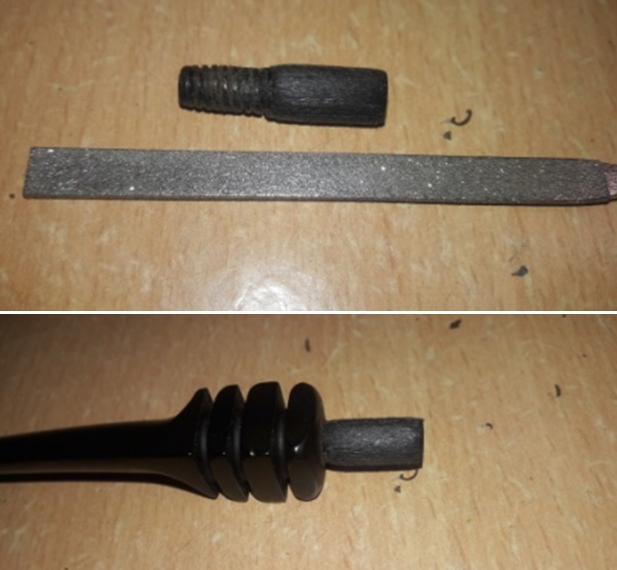
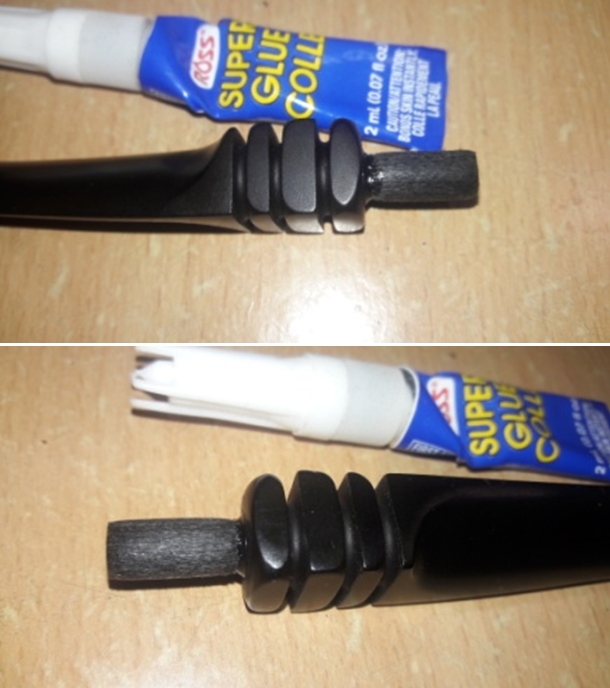
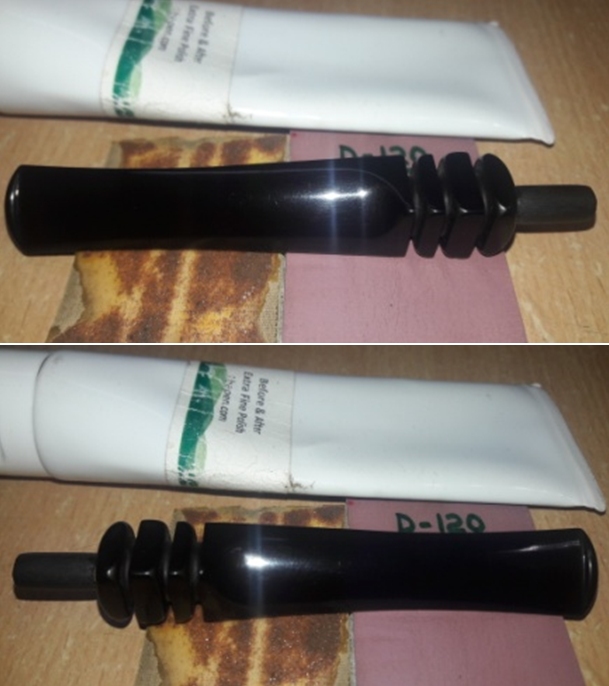
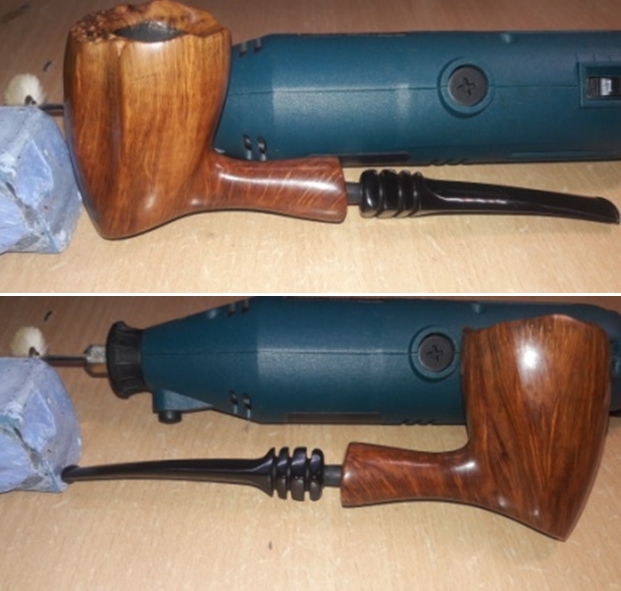
The fancy vulcanite stem shows traces of oxidation and is otherwise sans any major damage. The horizontal slot end of the stem is heavily oxidized to a dark brown coloration. The broken tenon end is jagged and sharp at the place where the tenon has snapped. The fancy stem, though it looks beautiful when black and shiny, is a bear to clean with all the dips and narrow gaps between the beads and rings etc.THE PROCESS
I began the process of refurbishing this pipe with cleaning the internals of the stem using pipe cleaners with isopropyl alcohol (99.9% pure) and dunking the stem in to “Before and After Deoxidizer” solution developed by my friend Mark Hoover. The solution helps to draw out heavy oxidation to the surface making its further removal a breeze, while the minor oxidation is eliminated to a very great extent. I usually dunk stems of 5-7 pipes that are in-line for restoration and this pipe is marked in green arrow. I generally allow the stems to soak in this solution overnight for the solution to do its work.With the stem soaking in the deoxidizer solution, I worked the stummel starting with reaming the chamber with my fabricated knife as the layer of cake was too thin and did not warrant the use of a reamer. It was at this stage that I realized that the pipe has been so sparingly smoked that what I was assuming to be a layer of cake, is in fact a layer of bowl coating!! The walls of the chamber are smooth and solid. I tried to wriggle out the broken tenon that was stuck in to the mortise. Lucky me, it came out without any resistance!! That’s a big relief. Next, I cleaned the mortise with hard bristled and regular pipe cleaners dipped in isopropyl alcohol. I scrubbed the external surface of the bowl with undiluted Murphy’s oil soap and hard bristled tooth brush and dried it using paper towels and soft cotton cloth. I carefully cleaned the plateau rim top with a soft brass wire brush to remove the accumulated dirt and debris from the surface. Thereafter, I cleaned the mortise, plateau rim top and stummel surface with anti-oil dish washing soap on shank brush and tooth brush. The entire stummel, including the platue rim top, cleaned up nicely. I set the stummel aside to dry out naturally. Staying with the stummel restoration, I polished the stummel with micromesh pads, wet sanding with 1500 to 12000 pads. This time around, I did not repeat the mistake of polishing the plateau rim top as I had done with the PH # 3 earlier! I wiped the surface with a soft cloth at the end of the micromesh cycle. The stummel looks amazing with a deep shine and beautiful straight grains popping over the stummel surface. I rubbed a small quantity of “Before and After Restoration Balm” in to briar. I rubbed this balm deep in to the nooks and crannies of the plateau rim top surface with my fingers and let it rest for a few minutes. The balm almost immediately works its magic and the briar now has a nice vibrant appearance with the dark brown hues of the grain contrasting with the rest of the stummel surface. I further buff it with a horse hair shoe brush. As mentioned in the previous write up on refurbishing of pipe PH # 3, I had worked on all the stems that had been soaking in the deoxidizer solution overnight. I fished out all the stems and cleaned them under running warm water and scrubbed the raised oxidation from the stem surface using Scotch Brite pad. I further removed the oxidation by scrubbing the stems with 0000 grade steel wool and applied a little olive oil to rehydrate the stems and set them aside for the oil to be absorbed. Complete oxidation was removed on this stem by the process described above. Unfortunately, I did not click any pictures of these stems at this stage.

With this, I have now reached the most critical and challenging part of this restoration; replacing the broken tenon. While Steve, Dal and Jeff were here in India, Steve had replaced a tenon on a Preben Holm which had come to me with a broken tenon. I had minutely observed the procedure, made detailed notes and read the relevant blogs that Steve has written on rebornpipes.com.

The process starts with sanding the broken tenon end of the stem till a smooth and even stem face is available for the new tenon. This step also reveals and opens up the stem airway for drilling to accommodate the new tenon. I did this by topping the tenon end of the stem face on a piece of 220 grit sandpaper till smooth.Next, I selected a Delrin tenon that was the closest fit in to the mortise. I mounted a sanding drum on to my hand held rotary tool and setting the speed at its lowest, I shaped the tenon to a perfect fit in to the mortise. I was very slow, deliberate and frequently checked the progress being made. Once I had achieved a snug fit, I kept the tenon aside and worked the stem.The one and most important aspect that has to be kept in mind while replacing a tenon is to keep the new tenon and stem airway straight and aligned. To ensure this, with a sharp knife I gave a slight inward bevel to the stem’s airway opening which will serve as a guide to the drill bit when drilling. I use the length of the end of the tenon to determine the depth of the drilling. I marked off this length with a rubber band wound tightly on each and every drill bit that I used. I started the drilling with a bit that was slightly larger than the existing airway. I proceed through a series of bits starting with a 3 mm bit until I had drilled the airway with the final bit of 5.5 mm, the same size as the end of the replacement tenon that I had shaped earlier. I proceed with caution as I wanted to make sure that I kept the airway straight for a good fit of the new tenon.I used a file to knock off the threads on the tenon end just enough to pressure fit it in place in the stem. I carefully checked the alignment to make sure the tenon was straight on the stem before setting it aside to cure. I subjected the stem with the replaced tenon to the pipe cleaner test. The pipe cleaner passed through the air way smoothly and without any obstruction. Once satisfied that the alignment is perfect, I put some super glue on the tenon end and pressed it into the airway and set it aside to cure. I am very pleased with my first attempt at a tenon replacement. I further sand the stem with 600 and 800 grit sand paper and wiped the stem with cotton pad dipped in alcohol to remove the resultant dust and rubbed some extra virgin olive oil in to the stem and set it aside to be absorbed in to stem. I polished the stem with micromesh pads, wet sanding with 1500 to 12000 grit pads. I rubbed a little extra virgin olive oil in to the stem at the end of the micromesh pads polishing cycle. I completed the polishing regime of the stem by rubbing a small quantity of Extra Fine Stem polish developed by my friend Mark Hoover, and giving it a final polish with a soft cotton cloth. The stem is now nice, smooth and shiny.To apply the finishing touches, I first mount a cotton cloth buffing wheel on to my hand held rotary tool and apply a coat of Blue Diamond to the stummel and the stem to polish out the minor scratches.With a cotton buffing wheel that I use for carnauba wax, I apply a coat of carnauba wax to the stummel and stem and continue to work on it till the complete coat of wax has been polished out. I mount a clean cotton cloth buffing wheel and give the entire pipe a once over buff. I finish the restoration by giving the entire pipe a rigorous hand buffing using a microfiber cloth to deepen the shine further. The finished pipe is shown below. P.S. – First things first; tenon replacement, now that I have personally worked on it, is definitely not a very difficult procedure. All it takes is a lot of patience and I strongly recommend that before attempting it, one should go through as many write ups on tenon replacement as possible. Steve has some nice, simple and informative step by step write ups on this procedure which is strongly recommended.

I am really fortunate to be in the process of learning the nuances of pipe restoration and cannot thank Steve enough for his support and guidance.

I wish to thank Mr. Roland Borchers and Mr. Borman who have explained the numbering system followed on Preben Holm pipes and also on dating these pipes for the larger good of our fraternity.

Thanks for your patience and looking forward to inputs about the write up. Cheers…


Restoring Jennifer’s Dad’s Jobey Asti 245 Pot


Blog by Steve Laug

I decided to change things up a bit and work on another of Jennifer’s Dad’s pipes. For the next pipe from the estate of George Rex Leghorn I have chosen a Pot shaped pipe. You may not have read about this estate before, so I will retell the story. I received an email from Jennifer who is a little older than my 64+ (65 now – sheesh, I forget how old I am) years about whether I would be interested in her Dad’s pipes. My brother Jeff and I have been picking up a few estates here and there, so I was interested. Here is the catch – she did not want to sell them to me but to give them to me to clean up, restore and resell. The only requirement she had was that we give a portion of the sales of the pipes to a charity serving women and children. We talked about the organization I work for that deals with trafficking and sexual exploitation of women and their children and she decided that would be a great way to carry on the charitable aspect of her Dad’s character. With some great conversation back and forth she sent the pipes to Jeff and he started the cleanup process on them. Once he had finished cleaning them all he sent them to me to do my work on them.

The pipe on the table is stamped on the left side of the shank Jobey over Asti. On the right side is the shape number 245. The tapered stem bears an inlaid brass Jobey oval. The pipe has an interesting mixed finish – smooth lower bowl and shank with a band of rustication and a smooth inwardly beveled rim top. The finish was very dirty, making it hard to see beyond that to the nice grain underneath that. There was a thick cake in the bowl and it had overflowed with lava onto the rim top. It was hard to know at this point the condition of the rim edges. The pipe was a dirty and tired looking old pipe. The stem was badly oxidized and there were George’s usual tooth marks and chatter on both sides just ahead of the button. It had been sitting in boxes for a lot of years and it was time to move ahead with the restoration. Jennifer took photos of the pipes she was sending. I have included the photos of this pipe below. When the box arrived from Jennifer, Jeff opened it and took photos of each pipe before he started his cleanup work on them. This pipe was a real mess but showed some promise under all of the grime of the years. The shape was a pot with the mixed finish as noted above and visible in the photo below. The briar appeared to be in good condition underneath the grime. The finish was spotty and seemed to be peeling which indicated to me that there was some sort of varnish or shellac coat on top of the finish. The pipe really was covered with the grime and oils on the bowl sides from George’s hands. The bowl had a thick cake that had hardened with time. The lava overflow on the rim top filled in much of the beveled rim top. It was very thick but it could very well have protected the rim from damage. We won’t know what is under it until Jeff had cleaned it off. The stem was oxidized and there were deep tooth marks on both sides just ahead of the button. Jeff took photos of the pipe before he started working on it. I include those below.  Jeff took photos of the bowl and rim top to show the cake in the bowl and the lava build up on the rim top and dust and grime on the bowl. It was thick and hard but hopefully it had protected the rim and edges from damage. The lava coat looks horrible but it points to a well-used, favourite smoking pipe. George must have enjoyed this old timer a lot judging from the condition of the pipe.   Jeff took a photo of the side and heel of the bowl to show the condition of the finish – the grime and grit all over the sides and bottom of the bowl. The rustication around the midbowl is deep and dirty but it is interesting.  The peeling varnish/shellac coat is also visible in the photos. Jeff took a photo of the stamping on the left and right sides of the shank. It is very clear and readable. On the left it reads Jobey Asti and on the right it reads 245. The top of the tapered stem has a brass inlaid Jobey oval logo.Jeff took photos of the top and underside of the stem showing the scratching, oxidation and tooth marks on the stem surface and button. The tooth marks are quite deep on both sides of the stem. I turned to Pipephil’s site for a quick review of the brand (http://www.pipephil.eu/logos/en/logo-j3.html). I quote a section of the post on the Jobey brand: These pipes are made in St Claude (France) by Butz-Choquin (Berrod-Regad group) since 1987. Before this date some were manufactured in England and Denmark (Jobey Dansk).

I turned then to Pipedia to gather further information regarding the brand and quote the first part of the article (https://pipedia.org/wiki/Jobey).

English – American – Danish – French… Sadly, solid information about Jobey is scant…

Probably established in England around 1920(?) the brand hiked into the USA later. In the course of time owner, distributor and manufacturer changed repeatedly. As far as is known the following companies have been involved with the brand:

George Yale Pipes & Tobacco, New York (1942)

Norwalk Pipe Co., New York (1949)

Arlington Briar Pipes Corp., Brooklyn (when?)

Hollco International, New York (1969).

Weber Pipe Co., Jersey City, NJ (1970’s)

The Tinder Box, (1970’s – 80’s).

Throughout decades Jobey pipes were mainly sold in the USA, Canada and England but remained almost unknown in continental Europe. The bulk of Jobeys was predominantly made according to classical patterns and mainly in the lower to middle price range. The predominant judgment of the pipe smokers reads: “A well-made pipe for the price.” So there is hardly anything very special or exciting about Jobey pipes although a flyer from ca. 1970 assures: “The briar root Jobey insists upon for its peer of pipes is left untouched to grow, harden and sweeten for 100 years. […] Jobey uses only the heart of this century old briar and only one out of 500 bowls turned measures up to the rigid Jobey specifications.” 99.80% of cull… that makes the layman marveling!

Before I get on to cleaning up the pipe I thought I would once again include the tribute that Jennifer wrote to her Dad for the blog. She also sent some photos and an article that her Dad wrote for Jeff and me to be able to get a feel for him. I have included those below. Note in each of them that he is holding a pipe in his left hand. I asked her to also send me an email with a brief tribute to her Dad. Here is her tribute from an email to me.

Steve, I want to thank you again for accepting my dad’s pipes.  They were so much a part of my dad’s life that I could not simply discard them. But as his daughter, I was not about to take up smoking them either. *laughing* I think my dad would like knowing that they will bring pleasure to others.  I know that I do.

I’m not sure what to say about his pipes. I always remember Daddy smoking pipes and cigars.

First a bit about my dad. Though my father, George Rex Leghorn, was American (growing up in Alaska), he managed to join the Canadian Army at the beginning of WWII, but in doing so lost his American citizenship.  He was fortunate to meet a Canadian recruiting officer who told him the alphabet began with “A” and ended with “Zed” not “Zee”, and also told him to say that he was born in a specific town that had all its records destroyed in a fire.  When the US joined the war my dad, and thousands of other Americans who had made the same choice*(see the link below for the article), were given the opportunity to transfer to the US military, and regain their citizenship.

After WWII, my dad, earned his degree at the University of California Berkeley and became a metallurgist. There is even a bit about him on the internet.

He loved taking the family out for a drive, and he smoked his cigars on those trips. (As a child, those were troubling times for my stomach.)

I most remember my father relaxing in his favorite chair with a science fiction book in one hand and a pipe in the other… Sir Walter Raleigh being his favorite tobacco… and the pipes themselves remind me of him in that contented way.  If I interrupted his repose, he’d look up, with a smile on his face, to answer me.

It seemed he smoked his Briarwood pipes the most, though he had others.  At the time, it was only the Briarwood I knew by name because of its distinctive rough shaped bowl.  And it was the Anderson Free Hand Burl Briar, made in Israel, which I chose for his birthday one year, because I thought he might like that particular texture in his hand.

At least two of his pipes, he inherited from his son-in-law, Joe Marino, a retired medical laboratory researcher (my sister Lesley’s late husband)… the long stemmed Jarl (made in Denmark), and the large, white-bowled, Sherlock Holmes style pipe.  I believe Joe had others that went to my dad, but Lesley was only sure about those two.

The Buescher, corncob pipe my older sister Lesley bought for Daddy while on one of her travels around the States.

A note on the spelling of my sister’s name…

My dad met my mother, Regina, during WWII and they married in Omagh, Ireland.  My mother was English and in the military herself.  The English spelling of Lesley is feminine, and Leslie masculine, in the UK… just the opposite of here in the United States.  I guess my mom won out when it came to the spelling of the name…

This pipe was a real mess just like the other ones in the collection. I was curious to see what it would look like when I unpack it. I was surprised at how good it looked. He reamed it with a PipNet pipe reamer and cleaned up the reaming with a Savinelli Fitsall Pipe Knife. He scrubbed out the internals with alcohol, pipe cleaners and cotton swabs until the pipe was clean. He scrubbed the exterior of the bowl with Murphy’s Oil Soap and a tooth brush to remove the grime and grit on the briar and the lava on the rim top. The finish on the bowl looked really good when I got it. The rim top looked much better and the inner and outer edges were looking good. Jeff had cleaned the internals and scrubbed the exterior of the stem and soaked them in Before & After Deoxidizer bath to remove the oxidation. The stem looked very good other than the deep tooth marks and chatter in the surface. When the pipe arrived here in Vancouver for the second stop of its restoration tour it looked very good. I took photos of the pipe before I started my part of the restoration. I took photos of the bowl and rim top to show how well it had cleaned up. The edges and top were very clean and in excellent condition. There was some darkening on the inner edge but it was still round. The rim top had some light nicks and dents. The stem had some deep tooth marks just ahead of the button.The stem was held in the shank with the Jobey link connector. I is pressed into the stem and threads into the shank. It makes it easily replaceable and also easy to align.I decided to clean up the darkening on the inner edge of the rim top and the dents and nicks on the top itself. I used a folded piece of 220 grit sandpaper to remove the damage and 400 grit wet dry sandpaper to smooth out the sanding. I was happy with the overall look. The finish will show as I polish the pipe with micromesh pad shortly.  I polished the briar with micromesh sanding pads – wetsanding it with 1500-12000 grit sanding pads. I wiped it down with a damp cloth after each sanding pad. It looked better after each pad and the top blended into the colour of the rest of the bowl without staining. I worked some Before & After Restoration Balm into the finish of the bowl and the rim top and shank with my fingertips and a horsehair shoebrush to clean, enliven and protect it. I find that the balm really makes the briar come alive again. The contrasts in the layers of stain and the separate finishes really made the grain stand out. I let the balm sit for a little while and then buffed with a cotton cloth to raise the shine. The bowl really looks good at this point.   I set the bowl aside and turned to the stem. I filled in the deep tooth marks with clear super glue. I built up the edge of the button at the same time. I set it aside to dry. Once the repairs had cured I used a needle file to cut a sharp edge on the button on both sides and to flatten the repaired areas. I sanded the stem to remove the oxidation that was on the surface and to smooth out the repaired areas. I used a folded piece of 220 grit sandpaper and a piece of 400 grit wet dry sandpaper. At this point the stem is looking better and the tooth marks are gone.  I rubbed the stem down with Denicare Mouthpiece Polish and a cotton pad to remove remnants of oxidation and to further blend in the sanding. The stem was showing some promise at this point in the process. I polished the stem with micromesh sanding pads – wet sanding it with 1500-12000 grit pads. I polished it further with Before & After Pipe Stem Polish – both fine and extra fine. I finished by wiping it down with Briarville’s No Oxy Oil and buffing it to a shine. Once again I am the part of the restoration that I always look forward to – the moment when all the pieces are put back together. I put the pipe back together and buffed the bowl and stem with Blue Diamond on the buffing wheel. I gave the bowl multiple coats of Conservator’s Wax and the stem multiple coats of carnauba wax. I buffed the pipe with a clean buffing pad to raise the shine. I hand buffed it with a microfiber cloth to deepen the shine. It is fun to see what the polished bowl looks like with the combination of rustication and smooth finishes. The black vulcanite stem stands out as a shiny black contrast to the colours of the bowl. While this is not one of my favourite finishes as it seems busy to me, it came out looking good. It is a light weight pipe that could be clenched and smoked while doing other things. It must have been a fine smoking pipe judging from the condition it was when we received it from Jennifer. Have a look at it with the photos below. The dimensions are Length: 5 ¼ inches, Height: 1 ½ inches, Outside diameter of the bowl: 1 ½ inches, Chamber diameter: ¾ of an inch. This is one that will go on the rebornpipes online store shortly. If you want to carry on the pipe trust of George Rex Leghorn let me know. Thank you Jennifer for trusting us with his pipes. Thanks to each of you who are reading this blog. Remember we are not pipe owners; we are pipemen and women who hold our pipes in trust until they pass on into the trust of the next generation.


Sprucing Up a Meerschaum Teardrop Lattice Billiard


Blog Dal Stanton

I just completed an Aldo Velani from what I’ve called the St. Louis Lot of 26 (See: Refreshing a Saucy Italian Aldo Velani Trio Bent Apple) and the next pipe in queue is also from this Lot.  The Meerschaum just above the giant Champion Churchwarden’s bowl is on the worktable now.  My son, Josiah found this lot in an antique shop in St. Louis where he was studying.  He sent me a text here in Bulgaria about his find with pictures.  We went in together to purchase the lot with the provision that my son’s part of the purchase would be for me to pick a pipe out of the lot as a Christmas present from him.  I chose the giant Champion Churchwarden!  Other pipe men and women have chosen other pipes from this lot of treasures which are posted in the online collection, For “Pipe Dreamers” Only! .This is where Jeremiah, from the state of California, saw the Meerschaum and commissioned him back when my wife and I were enjoying the Black Sea during our summer R&R.  I appreciate Jeremiah’s patience as his pipe worked up the queue!  Here are more pictures taking a closer look at the Meerschaum Teardrop Lattice Billiard. There are no markings on the pipe.  The size of the Billiard shape is Length 5 5/16 inches, Height 1 5/8 inches, Rim width 1 1/8 inches, Chamber width 3/4 inches, Chamber depth 1 3/8 inches. What is unique about this Meerschaum Teardrop Lattice design are the size of the tear drops, or the egg-shaped carvings – they are large.  The fine circular scallop carvings are in comparison, small and tight.  The Meer is set-up with a basic push/pull tenon which appears to have a crack in the mortise insert (pictured above).  The tenon insert is worn and discolored.  The pipe itself appears to be in great shape in need of cleaning.  The chamber has some carbon build up which is not needed or desired in a Meer chamber.  One of the great things about Meerschaums is that they do not need to rest between uses as with briars.  There is a bit of the coveted patina developing around the scalloped shank and climbing toward the back of the bowl.  This is good.  This brief description from Meerschaum.com that I’ve previously cited is helpful to understand the nature of Meerschaum:

Meerschaum is a very rare mineral, a kind of hard white clay. Light and porous structure of the pipe keeps the smoke cool and soft. The pipe itself is a natural filter which absorbs the nicotine. Because of this peculiarity, meerschaum pipes slowly change their colors to different tones of gold and dark brown. This adds an esthetic enjoyment to its great smoking pleasure. The longer a pipe is smoked the more valuable it becomes due to the color change. Today many old and rare meerschaums have found a permanent place in museums and private collections.

I begin the restoration of this Meerschaum by disassembling the component parts.  This helps with the cleaning.  I also plan to replace the push/pull tenon.  With the help of a pair of needle nose pliers, the push/pull components are easily removed.Taking the stummel in hand, the chamber has moderate carbon cake build up which will be removed.I don’t use the reaming kit with Meerschaum because it produces too much indiscriminate torque on the Meer chamber wall.  A more gentle and strategic approach is the use of the Savinelli Fitsall tool.  I’m able to scrape the chamber walls with the tool in a way that removes carbon buildup but is mindful of the Meerschaum.Following the wall scraping, the chamber wall is sanded with 240 grade paper wrapped around a Sharpie Pen.  This does a good job of removing the last vestiges of carbon build up.  A Meerschaum chamber does not need a cake protection like a briar chamber.An inspection of the chamber after cleaning looks good.  The Meer is still colored but it is clean and smooth to the touch.Cleaning the external surface of the Meerschaum starts with the rim which has lava caked on it, especially on the aft quadrant where most of the lighting occurred.  Using undiluted Murphy’s Oil Soap, I begin on the rim to soften and break up the lava without damaging the scalloped rim carvings.  I am patient to allow the solvents to break up the cake on the rim.  I also gently utilize a brass wired brush on the rim but most of the scrubbing is done with a bristled toothbrush.  I use the toothbrush to clean the rim as well as work into all the carvings of the bowl.  I take the bowl to the kitchen sink and continue cleaning with a cotton pad and toothbrush under warm water.  Not pictured is something I tried for the first time.  I have a Soft-Scrub product here in Bulgaria called CIT which has a gentle bleach and abrasion composition.  I put a small amount on a cotton pad and continue to work on the rim’s darkened condition.  After a thorough rinsing with warm water, the stummel returns to the worktable.I’m very pleased with the cleaning results. The stummel will lighten more because it’s still damp from the cleaning. The rim cleaned up very nicely.  One blackened area remains on the extreme edge of the aft rim quadrant.  Later, I may be able to clean this with very strategic sanding. The patina gathering at the bowl/shank crook remains through the cleaning. Moving now to cleaning the internals, I use cotton buds and pipe cleaners dipped in isopropyl 95%.  I also employ a small dental spoon to scrape the internal walls of old oils and tars.  The more excavated, the faster the cotton buds can clean.  In time the buds emerge in a lightened state and the job is completed.It took no time to dispatch the internal cleaning of the acrylic stem.Focusing now on the stem repairs, I like the brown tone acrylic.  It will clean up well.  The stem bit has significant biting damage to both upper and lower bit that will require patches from the start.  The button is damaged as well.  It appears this stem was the victim of mauling, not just biting.  There is also what appears to be a burn on the side of the stem – that’s the only thing I can think it would be. It is rough to the touch so sanding should help this blemish later.I use regular CA glue to fill the compressions on one side first.  An accelerator is also used to hold the glue in place and to quicken the curing process.After the CA glue cures, I use the flat needle file to remove the excess patch material and to shape and refresh the button lips – both upper and lower.  The first two pictures are the upper.Next the lower.Next, with the filing completed, I continue to sand with 240 grade paper on the upper and lower bit.From the bit, I also sand the entire stem and focus on the burn or blemish on the side of the stem.As I look at the mark on the side of the stem, I believe now it’s simply a blemish in the acrylic.  It is not just surface but seems to go deeper.  I can only sand it out as much as possible.After sanding with 240 paper, I transition to wet sanding the entire stem with 600 grade paper then the 000 grade steel wool fine tunes the acrylic stem – it’s looking great.Transitioning now to the full regimen of micromesh pads, I wet sand with pads 1500 to 2400 and follow with dry sanding with pads 3200 to 4000 and 6000 to 12000.  Between each set of 3 pads Obsidian Oil is applied.  I like the fire in this acrylic stem. I want to strategically sand the burn spot on the extreme back of the inner rim edge.  I use a very light 240 grade paper and follow with a dry 1500 micromesh pad.I think it looks good.  The darkness is not erased but it is reduced.  To enrich and encourage the coveted patina in the Meerschaum, the age-old approach is a beeswax treatment.  Using a hot air gun, the beeswax in the Mason jar is heated until it liquefies.  I also heat the Meer bowl with the gun and then apply the liquefied beeswax to the stummel – painting thoroughly all the nooks and crannies of the sculpting.  During the painting process, I have the hot air gun propped in such a way as to continue to blow hot air on the stummel as I’m painting it.  This helps to keep the wax thin and it is more easily absorbed into the porous Meerschaum.After the stummel is thoroughly coated in beeswax, I put it aside for the stummel to cool.After cooling, I buff the stummel with a microfiber cloth to remove excess wax and to raise the shine.  The Meerschaum literally drank in the beeswax!I decided earlier to replace the old push/pull tenon system with a new set.  The shank acrylic fitment and the stem tenon both screwed in with no problem. When I tried inserting the tenon into the shank receptor, the fit was very tight – too tight to fit without me being nervous about cracking something.  To remedy this, I hand turn a drill bit just a bit larger than the hole and it bores out a slightly more comfortable fit.  This works like a charm. With the stem and stummel reunited, after mounting a cotton cloth buffing wheel to the Dremel and set the speed at 40% full power and Blue Diamond compound is applied only to the acrylic stem.  Following the compound, after wiping the stem with a felt cloth to clean it of compound dust, the same procedure is followed with another cotton cloth buffing wheel and carnauba wax is applied to the acrylic stem.  After this, the entire Meerschaum Teardrop Lattice Billiard is hand buffed to raise the shine.

The design of this Meerschaum is a classic carvers’ template in this genre of pipe.  The patina on the Meerschaum has a good start with the honey honed hues which complement beautifully the fire waves of the acrylic stem.  Jeremiah wanted to add a Meerschaum to his growing collection, and he will have the first opportunity to add this Teardrop Lattice Billiard from The Pipe Steward Store benefiting the Daughters of Bulgaria – women and girls who have been trafficked and sexually exploited.  Thanks for joining me!
Fresh Life for a Bari Matador Freehand


Blog by Steve Laug

The next pipe on the work table is a pipe that came to me from Joe in Georgia. He was selling an estate for a family and sent me a list that had a Bari Matador pipe listed. I had him send me some photos of the pipe so I could see what it looked like. I was initially interested in the pipe and once I saw it we struck a deal and the pipe was on its way to Jeff. Often when I buy pipes from the US I have the sellers send them to Jeff and he cleans them for me before sending them up to me for the rest of the restoration work. It was an intriguing pipe with a combination of sandblast and smooth finishes. The left side of the bowl is sandblasted and the rest of the bowl is smooth. The rim top of the bowl is a plateau finish. The stem was a fancy turned stem with a paneled taper.This Freehand shaped Bari is interesting in that it borders on being a panel. The front and sides are flat making the pipe rectangular while the shank is round. The panel idea follows through to the stem after the fancy turning. The blade of the stem is square. It is stamped on the left side of the shank and reads Bari over Matador in a football shape. On the right side it reads Handmade In Denmark. The finish is smooth on three sides of the pipe (right, front and back) and is sandblasted on the left side of the bowl. It has some great grain around the smooth sides of the bowl and shank. The blast is deep and rugged with some great grain as well. The rim top is plateau and is craggy. The pipe was dirty and the finish flat. There were some dings and scratches in the briar but otherwise it was in good condition. The bowl was lightly caked and the inner edge of the rim looked to be in good condition. The fancy saddle stem was vulcanite and had tooth marks and chatter on both sides near the button. It was oxidized and had some calcification on the end. Jeff took some photos of the pipe to show the general condition of the pipe before he started his clean up. Jeff took some close-up photos of the rim top and bowl to show the overall condition. There is some light lava in some of the grooves but overall it is just dusty. The edges look very good.Jeff took some photos of the sides and heel of the bowl to show the condition of the finish on the pipe. The photos show the beautiful grain around the bowl. Under the dust and grime it was a nice looking bowl. I think it will be a beautiful Freehand pipe once it is restored. He took a photo of the stamping on the left side of the shank. On the shank it was stamped Bari over Matador in the football shape as noted above. In my examination of the pipe when it arrived I could see that it was also stamped on the right side Handmade in Denmark but it was very faint.The next two photos show the top and underside of the stem. It is dirty and has calcification on both sides at the button. There is also some tooth chatter and some light tooth marks with some damage to the button edge. The third photo shows the fancy turning on the shank end of the stem.Paresh has restored a similar Bari Matador and written about it on a blog. It is an informative piece so I have included the link to it here (https://rebornpipes.com/2019/05/15/a-simple-refurbishing-of-a-bari-matador/).

I also have worked on quite a few Bari’s in the past and did the work on the brand information so rather than rework all of that I am including the information I found while working on a Bari De Luxe Freehand. I quoted a section from Pipedia on Bari pipes (https://pipedia.org/wiki/Bari). I am including the material that I found previously on the brand. It is good to be reminded of the fact that Viggo Nielsen was the pipe maker. I quote:

Pipedia states that Bari Piber was founded by Viggo Nielsen in Kolding, Denmark around the turn of 1950/51. His sons Kai and Jørgen both grew into their father’s business from a very young age and worked there till 1975. Both have become successful pipe makers.

Bari successfully adapted the new Danish design that had been started mainly by Stanwell for its own models. Bari was sold in 1978 to Van Eicken Tobaccos in Hamburg, Germany though the pipes were still made in Denmark. From 1978 to 1993 Åge Bogelund and Helmer Thomsen headed Bari’s pipe production.

Helmer Thomson bought the company in 1993 re-naming it to “Bari Piber Helmer Thomsen”. The workshop moved to more convenient buildings in Vejen. Bogelund, who created very respectable freehands of his own during the time at Bari got lost somehow after 1993. Bari’s basic conception fundamentally stayed the same for decades: series pipes pre-worked by machines and carefully finished by hand – thus no spectacular highgrades but solid, reliable every day’s companions were what they turned out. The most famous series are the smooth “Classic Diamond” and the blasted “Wiking”.

Now that I was reminded about the Viggo Nielsen connection it was time to work on the pipe on my end. When I received it Jeff had once again done an amazing job cleaning the pipe. He reamed it with a PipNet pipe reamer and got rid of the cake. He cleaned up the reaming with a Savinelli Fitsall Pipe Knife so that we could see the walls of the bowl and assess for damage. He cleaned the internals of the shank and stem with alcohol, pipe cleaners and alcohol. He scrubbed the exterior with undiluted Murphy’s Oil Soap and a tooth brush. He rinsed the pipe under warm water. He dried it off with a cloth and then let it air dry. The stem was scrubbed with Soft Scrub and soaked in Before & After Deoxidizer. It came out looking very good. The finish on the bowl and the rim top cleaned up nicely. I took pictures of the pipe to show how it looked when I unpacked it. I took a close up photo of the plateau rim top to show how clean it was. The inner edge of the rim and the ridges and valleys of the plateau looked good. The stem looked good just some light tooth chatter and several deeper tooth marks on the button.The pipe was in decent condition so I started with the bowl. I polished the smooth portions of the briar with micromesh sanding pads – wet sanding with 1500-12000 grit pads and wiping down the briar after each sanding pad with a damp cloth. The briar began to shine. I worked some Before & After Restoration Balm into the smooth briar with my fingertips and the plateau and sandblasted side with a horsehair shoe brush. The product is a great addition to the restoration work. It enlivens, enriches and protects the briar while giving it a deep glow. I appreciate Mark Hoover’s work in developing this product. I buffed the pipe with a micro fiber cloth to raise the shine and took photos of it at this point it the process. It is a beautiful looking pipe. I set the bowl aside and turned my attention to the stem. I “painted” the tooth marks with the flame of a Bic lighter to try and raise them a bit. Remember vulcanite has “memory” and if the marks are not sharp edge the heat well raise them. In this case while they came up some on the blade so that none remained. The damage on the button edge came up a little but it would need to be repaired.I filled in the remaining tooth marks on the button edge with clear CA glue and set the stem aside to dry.Once the repairs cured I used a needle file to flatten them out and recut the sharp edge of the button.I sanded the surface of the stem with 220 grit sandpaper to further blend in the repairs. I started the polishing process with 400 grit wet dry sandpaper.I polished the stem with Denicare Mouthpiece Polish from a tin of it I have in the drawer here. It is a gritty red paste (similar in grit to red Tripoli) that I rub on with my finger tips and work it into the surface of the stem and button and buff it off with a cotton pad. It gives me a bit of a head start on the polishing work.I polished the stem with micromesh sanding pads – wet sanding with 1500-12000 grit sanding pads. I wiped it down after each sanding pad with Obsidian Oil. I polished it with Before & After Pipe Stem Polish – both Fine and Extra Fine. I buffed the stem with a soft cloth to raise the shine. I wiped the stem down with Briarville’s No Oxy Oil to preserve and protect the stem surface. I am on the homestretch with this Bari Matador! As always I am excited to finish a pipe that I am working on. I put the pipe back together and buffed it with Blue Diamond on the buffing wheel. I used a gentle touch on the sandblast portion of the bowl. I gave the bowl and the stem multiple coats of carnauba wax. I buffed the pipe with a clean buffing pad and hand buffed it to raise the shine. It is fun to see what the polished bowl looks like along with the polished vulcanite stem. This Bari Matador is a nice looking pipe. It is quite comfortable in hand and should be so when smoking. It is quite light and well balanced. Have a look at it with the photos below. The dimensions are Length: 6 inches, Height: 2 inches, Outside diameter of the bowl: 2×2 1/2 inches, Chamber diameter: ¾ of an inch. It is another beautiful pipe and one that will be on the rebornpipes store soon. You can find it in the section of Pipes by Danish Pipe Makers. If you are interested in adding it to your collection let me know. Thanks for walking through the restoration with me as I worked over this pipe. Thanks to each of you who are reading this blog.

More work than I expected – an Astleys 109 Jermyn Street London Scoop


Blog by Steve Laug

The next pipe on the work table is a bit of a strange one to me. It is almost an egg shape on its side with a stem that should have been bent a bit more to fit the angles of the pipe. It has an oval shank and an oval saddle stem. It is stamped on the underside of the shank and reads Astleys over 109 Jermyn St over London. There is no other shape numbers on the pipe. The finish is smooth and has some great grain around the sides, top and bottom of the bowl and shank. It was quite dirty and the rim top had an overflow of lava on the beveled inner rim top. The bowl was thickly caked and the inner edge of the rim had some darkening. The saddle stem was vulcanite and had tooth marks and chatter on both sides near the button. The stem was oxidized and had some calcification on the end. Jeff took some photos of the pipe to show the general condition of the pipe before he started his clean up. He took some photos of the rim top and bowl from various angles to give me a clear picture of the condition of the rim top and bowl. You can see the cake in the bowl and the darkening around the inner edge of the rim. Jeff took some photos of the sides and heel of the bowl to show the condition of the finish on the pipe. The photos show the beautiful grain around the bowl. Under the oils and grime it was a nice looking bowl. I think it will be a really nice looking pipe once it is restored. He took a photo of the stamping on the underside of the shank. On the shank it was stamped Astley’s over 109 Jermyn St over London. As noted there was not a shape number.The next two photos show the top and underside of the stem. It is dirty and has calcification on both sides at the button. There is also some tooth chatter and some light tooth marks. The third photo shows the condition of the slot while the final photo shows the curve of the full stem. Jeff once again did an amazing job cleaning the pipe. He reamed it with a PipNet pipe reamer and got rid of the cake. He cleaned up the reaming with a Savinelli Fitsall Pipe Knife so that we could see the walls of the bowl and assess for damage. He cleaned the internals of the shank and stem with alcohol, pipe cleaners and alcohol. He scrubbed the exterior with undiluted Murphy’s Oil Soap and a tooth brush. He rinsed the pipe under warm water. He dried it off with a cloth and then let it air dry. The stem was scrubbed with Soft Scrub and it came out looking very good. The finish on the bowl and the rim top cleaned up nicely. I took pictures of the pipe to show how it looked when I unpacked it. I took a close up photo of the rim top to show how clean it was. There was some damage and darkening on the inner edge of the rim. It was slightly out of round from the damage. You can also see the crack on the top of the shank (Jeff had mentioned this to me in our conversations today). I have circled it in red in the photo below. The stem looked good just some light tooth chatter and several deeper tooth marks near the button.I decided to address the hairline crack in the top of the shank. It was not a deep crack and it did not go all the way around the shank. It was only on the top of the shank. You can see the totality of it in the first photo below. I used a microdrill bit on my Dremel to drill a small hole at each end of the crack to stop it from spreading further. I located the end of the crack with lens and marked it. I drilled a hole at each end (photos 2 and 3). The fourth photo shows both ends of the crack with the pilot holes. I wiped down the surface of the crack. I cleaned it out with a dental pick to open it slightly. I filled in the crack and the pilot holes with clear super glue. I used a dental spatula to spread briar dust over the pilot holes and the crack.Once the repair had cured I sanded the surface of the shank around and over the crack with a folded piece of 220 grit sandpaper and smoothed the repair out and blended it into the surface of the surrounding briar. I was able to blend it in fairly well. While it is still visible in the photo below it is solid and repaired.When I examined the end of the shank, the angled drilling of the airway into the bowl left a thin area at the bottom of the mortise opening. I put a few drops of super glue in the airway and put some briar dust on top of the glue to build up the mortise in that area. Once it was cured I sanded it smooth with a small sanding stick.I decided to address the damage to the inner edge of the rim. I used a folded piece of 220 grit sandpaper to smooth out the rim edge and give it a bevel to minimize the damage to the edge.. I was able to remove the damage and bring the bowl back into round.I polished the briar with micromesh sanding pads – wet sanding with 1500-12000 grit pads and wiping down the briar after each sanding pad with a damp cloth. The briar began to shine. I touched up the stain around the sanded area of the repair with a Cherry stain pen and blended the repair into the surrounding briar. The result looks very good.I worked some Before & After Restoration Balm into the briar with my fingertips. The product is a great addition to the restoration work. It enlivens, enriches and protects the briar while giving it a deep glow. I appreciate Mark Hoover’s work in developing this product. I set the bowl aside and turned my attention to the stem. I “painted” the tooth marks with the flame of a Bic lighter to try and raise them a bit. Remember vulcanite has “memory” and if the marks are not sharp edge the heat well raise them. In this case while they came up some there was still significant damage.I filled in the remaining tooth marks with clear CA glue and set the stem aside to dry.Once the repairs cured I used a needle file to flatten them out and recut the sharp edge of the button.I sanded the surface of the stem with 220 grit sandpaper to further blend in the repairs. I started the polishing process with 400 grit wet dry sandpaper.I polished the stem with Denicare Mouthpiece Polish from a tin of it I have in the drawer here. It is a gritty red paste that I rub on with my finger tips and work it into the surface of the stem and button and buff it off with a cotton pad. It gives me a bit of a head start on the polishing work.I polished the stem with micromesh sanding pads – wet sanding with 1500-12000 grit sanding pads. I wiped it down after each sanding pad with Obsidian Oil. I polished it with Before & After Pipe Stem Polish – both Fine and Extra Fine. I buffed the stem with a soft cloth to raise the shine. I wiped the stem down with Briarville’s No Oxy Oil to preserve and protect the stem surface. As always I am excited to finish a pipe that I am working on. I put the Astley’s pipe back together and buffed it with Blue Diamond on the buffing wheel. I gave the bowl and the stem multiple coats of carnauba wax. I buffed the pipe with a clean buffing pad and hand buffed it to raise the shine. It is fun to see what the polished bowl looks like along with the polished vulcanite stem. This is nice looking pipe and I am sure that it will be comfortable in hand when smoking as it is light and well balanced. Have a look at it with the photos below. The dimensions are Length: 5 ½ inches, Height: 1 ¾ inches, Outside diameter of the bowl: 1 ½ inches, Chamber diameter: 7/8 of an inch. It is another beautiful pipe and one that will be on the rebornpipes store soon. You can find it in the section of Pipes by English Pipe Makers. If you are interested in adding it to your collection let me know. Thanks for walking through the restoration with me as I worked over this pipe. Thanks to each of you who are reading this blog.


Bringing Life Back to a Heritage Antique 86 Blasted Apple  


Blog by Dal Stanton

A few years ago I landed a large lot of pipes on the eBay auction block from a seller in Georgetown, Texas.  The seller was actually a charitable organization called the Georgetown Caring Place operating some thrift stores mainly manned by volunteers – elderly.  I liked it from the start!  The description on the ‘Lot of 66’ said it all:

Huge Lot Of 66 Smoking Pipes, Pre-Owned, Loved, Pre-Smoked, Many different makers styles and Brands, We will not be able to list specifics on these pipes, We are not pipe people, You are buying one person’s collection

Undoubtedly, an estate collection of a pipe man’s collection that the family donated to benefit the Caring Place. My bid won the Lot of 66 and helped a good cause.  It also placed the former steward’s pipes in my charge, and it has been a joy for me to discover many treasures in the Lot of 66 and to enable these pipes to continue to serve many new stewards for years to come.  Here’s the Lot of 66 that I saw on eBay.Pipe man Todd, who has commissioned and received several pipes from The Pipe Steward before, all benefiting the Daughters of Bulgaria, saw one of the Lot of 66 waiting, an unassuming ‘Heritage Blasted Apple’ listed in my online inventory called For “Pipe Dreamers” Only! and he commissioned it along with 2 others (See: Borge Mortensen of Denmark and Ehrlich Special Chimney of Boston). Todd has a knack for seeing good pipes with ‘Pipe Dreamer’ eyes!  Here are the pictures he saw that got his attention despite the cardboard presentation background! The nomenclature, what there is, is/would be located on the bottom panel.  My initial pictures held little promise of identifying any markings.  In this picture, ‘86’ is discernible – a shape number. The next picture, which is a picture I recently took to get a better look, ‘ANTIQUE’ is discernible on the lower part of the panel.  When I first looked at these pictures, I wanted to see lettering all over the panel, but most would be phantom suggestions.  Yet, above ‘ANTIQUE’ I want to see more lettering on a diagonal, but nothing is discernible without question.The stem provides the first strong clue of identifying this mystery ‘Antique’ Blasted Apple.  A quick trip to Pipephil.eu identifies the double diamond inlay as a ‘Heritage’.  The panel information identified a ‘Heritage Pipe Inc.’ which had closed in 1971 as a submark of the S.M. Frank pipe conglomeration.  The double diamond stem inlay was a match.The next stop at Pipedia brought more clarity to the Heritage name and origins.  In the ‘Collector’s Guide to Kaywoodie Pipes’ (LINK) there was a section devoted to “Other” Kaywoodie Pipes which provides great information.  I include the introductory paragraph and then the information related directly to the ‘Heritage’ brand.

NOTES ON “OTHER” KAYWOODIE PIPES

Kaywoodie Stembiter and Chinrester, courtesy ChrisKeene.com

The previous sections of this Chapter summarize information taken from eight Kaywoodie Catalogs from the period 1936 to 1969. Because of the gaps in the catalogs, it is highly likely that many “holes” exist in the material presented in this monograph. This section presents a brief overview of some Kaywoodie Pipes that did not appear in any of the catalogs consulted in this research. The information on these pipes was provided by W.R. “Bill” Lowndes (a well-known Kaywoodie Collector from California).

Heritage. Lowndes suggests that the Heritage pipes were introduced in the 1960’s to compete with Dunhill. No fitments. Smooth finish called “Heirloom”, sandblast called “Antique”. Lowndes notes that there was a carved Heritage similar to Barling Quaints. Pipes were not marked “Kaywoodie”, and logo on bit is a double diamond. Lowndes notes that the Heritage pipes in his collection are small to medium-­size pipes and have Kaywoodie shape numbers. Lowndes suggests there may have been a special Heritage catalog.

I love it when research begins to back up the forensics of the pipe on your worktable!  “Antique”, which I could barely make out on the lower panel is the sandblasted line of Heritage pipes, a line introduced by Frank to compete with Dunhill.  Not a bad aspiration!

The article provided by Pipedia on the S. M. Frank & Co. adds more information:

The history of S. M. Frank & Co. spans nearly a century and half of pipe making, supporting its claim as the “oldest pipe house in America.” S. M. Frank, as it exists today, is a combination of some of the biggest names in pipe making from the early part of the 20th. century. The pipe names KaywoodieYello-BoleReiss-PremierWilliam Demuth CompanyMedico, Heritage (Heritage Pipes Inc.), and Frank are familiar to generations of pipe smokers.

In May of 1960, S. M. Frank started a subsidiary company called Heritage Pipes. The Heritage pipes were an upscale line of push bit pipes meant to compliment the Kaywoodie line. Although not hugely successful, Heritage produced some fine pipes that are still in the collections of many pipe smokers. This company was dissolved on December 31, 1971.

The article references an article about Heritage Pipes Inc. does not add new information but has examples of Heritage pipes which give a clue to the nomenclature and the marking design of the Blasted Apple on my table.  The picture on the top shows the way ‘Antique’ was below the fancy script ‘Heritage’ above it and diagonal – as I was trying to make out on the panel of the Blasted Apple.  The shape number to the left, beneath the bowl proper, is the design which I’m seeing – or, barely seeing.  The upscale Heritage pipe subsidiary of Frank was started in May of 1960 and the company closed its doors in December of 1971.  The look and feel of the pipe on my table I would guess ranges toward the early of these years.  The look and wear it has endured, with much dignity, gives it an older cast to me.

As if frosting were needed on the Heritage Antique cake, the reference to ChrisKeene.com.  In the introductory paragraph to the “Collectors Guide to Kaywoodie Pipe” was a reference to Chris Keen’s Pipe Pages.  This site has been down for some time and I miss the information that was on this site.  Here’s the paragraph:

This is an ongoing effort to adapt information from the Collector’s Guide to Kaywoodie Pipes into Pipedia articles. The Guide was first compiled by Chris Keene for his pipe pages at ChrisKeene.com. Chris used source material from Robert W. Stokes, Ph.D and additional support materials from Bill Feuerbach III, of the S.M. Frank Co.. Many thanks to these dedicated pipemen for their work in compiling this material.

Without expecting too much, I followed the ChrisKeene.com link to see what I might find.  What I found appears to be links to ALL the information that was formerly compiled in the now defunk Pipe Pages site.  Oh my!  There are 100s of links to catalogues and brochures listed.  They are not categorized but the links gives some identifying information.  I went down the long list of links and pulled out four pictures that had ‘Heritage’ referenced.  A brochure of ‘Heritage – Briar Pipes of Rarest Beauty’ emerged with great information about this line of pipes – included is the ‘Antique’ line and the shape number of 86 – a large Apple.  I enjoyed the motto given for the ‘Double-Diamond’: “Symbol of FINEST, RAREST PIPES of IMPORTED BRIAR”.

I love historic brochures and catalogs!  With a better understanding of the Heritage Antique name and history, I take a closer look at the Blasted Apple on my worktable.  The chamber has moderately heavy cake build up which needs to be removed to give the briar a fresh start.  The rim has grime as you would expect, but most notable are the divots out of the internal rim lip.  The damage to the rim is significant.  The left-aft quadrant of the rim is in especially poor shape where it appears that lighting practices caused the chamber wall to deteriorate so that it’s now thinner at this point.The blasted briar surface is dirty and has grime build-up, but the blasted surface has a look of quality about it. The stem has oxidation and the bit has biting.  There are compressions on the upper and lower bit, but the button appears to be in good shape.  Interestingly, the left side of the stem has a cut where a wedge of vulcanite has been removed.I start the restoration of this Heritage Antique Blasted Apple by cleaning the stem’s airway using a pipe cleaner wetted with alcohol. To address the oxidation, I use a soak of Before & After Deoxidizer along with the Ehrlich stem.  I leave the stems in the soak for a few hours.After fishing out the Heritage stem, I squeegee the liquid off with my fingers and run a pipe cleaner wetted with alcohol through the airway to clean it of the Deoxidizer.  I use cotton pads wetted with isopropyl 95% to wipe off the raised oxidation.  The Deoxidizer did a good job dealing with the oxidation.To help rejuvenate the vulcanite stem, paraffin oil is applied with a cloth for that purpose.Turning now to the stummel, to ream the chamber I use the Pipnet Reaming Kit.  After putting paper towel down for easier cleanup, I use the two smaller blade heads of the four available.  I follow the reaming by scraping the chamber wall with the Savinelli Fitsall Tool and then sanding by wrapping 240 grade paper around a Sharpie Pen.  Finally, after wiping the bowl with a cotton pad wetted with alcohol, an inspection reveals a healthy chamber.Continuing with cleaning, using undiluted Murphy’s Oil Soap, the external blasted surface is cleaned using a cotton pad and bristled toothbrush.  For the rim, I employ the brass wire brush to clean it of minor lava flow.Next, taking the stummel to the kitchen sink, I use shank brushes to clean the mortise with anti-oil dish soap.  After rinsing well, I return to the worktable.Continuing with the internal cleaning, I find that it is clean and pipe cleaner and cotton bud wetted with isopropyl 95% are not soiled indicating that the internals are clean.After the cleaning is completed, I look at the stummel.  The old finish has been removed during the cleaning process.  I’ll need to give some consideration to how to proceed down the path regarding re-staining the blasted surface.  With the original coloring emulating the Dunhill look – S. M. Frank’s marketing strategy, I hope to oblige.  I decide to send my fellow restorer and good friend in India, Paresh, an email asking for advice.  I know that in his past restorations of Dunhills, he has worked on techniques in restoring the Dunhill hue.  With an email written including pictures, I’ll await Paresh’s advice. Turning now to the rim, it’s in bad shape.  There are some significant divots out of the internal rim edge.  In the picture below with 12 o’clock being up, a small divot is at 12 o’clock, and larger divots at 3:30, 4:30 and 5:30.  The 2 o’clock region suffers from some burning degradation with a slight compression in the rim plane because of it.  The questions in my mind focus on restoring this Heritage close to its original design – a challenge to Dunhill!  The coloring is an issue and the remnants of blasting on the rim are evident especially at the 4 o’clock region.  I have not done much in the way of rustication processes to emulate the blasting and to repair the rim will undoubtedly mean topping it and therefore, removing the blasting on the rim as a result.  The question would then be how to restore it?  With this question in my mind, I send an email off to Steve with the full weight of rebornpipes.com experience behind him, to see what light he could shed on an approach.As I await responses from my fellow restorers, I move forward with the structural issues of the rim that must be addressed either way.  As I look at it, there is no way around having to top the bowl to provide a new rim foundation from which to work.  Starting with 240 grade paper on the chopping board, I give only a few rotations.  The picture below reveals the contouring in the rim with the flat surface of the topping board not touching the areas that are compressed.  The upper (in the picture) area that I referenced above is compressed.  The divots are more distinctly defined as well. After several more rotations on 240 grade paper, the compression is minimized.  The divots from 3:30 to 5:30 are also growing less distinct.I come to the terminal point in using 240 grade paper.  I only take off what is needful because we can’t replace briar!  My goal was to erase the degraded area at the 1 to 2 o’clock area.  That has been done.  In the process, the major divots no longer appear as divots but areas of the rim that are thinner.After replacing the 240 paper with 600 grade paper, the stummel is rotated several more times to smooth and erase the scratching of the 240 papers. With the topping completed, the small divot at the top should be dispatched with sanding.  On the lower quadrant, from 3:30 to 7 o’clock, the rim is noticeably thinner.  To see the lower quadrant from different angles to demonstrate what I can see, I take a few more pictures looking from the left, then the right.  As I see it, I have two options of approach.  First, to even out the entire circumference of the rim internal edge and to blend the thinning on the lower quadrant in the pictures, I can sand the entire circumference of the internal rim to smooth to even out the different rim depths.  Or, secondly, I can build up the lower quadrant with briar dust putty and sand it down to blend with more balance with the entire rim.I decide to do the latter – seek to build up the thinning area with briar dust putty.  Since the application will be only on the very upper part of the chamber, I’m not concerned about issues of heating.  I use the plastic disk that serves as a mixing pallet and cover a portion with scotch tape to ease the cleanup.  I scoop a small mound of briar dust on the pallet. Following this, I place next to the briar dust a small puddle of Extra Thick CA glue and with a toothpick, I pull briar dust into the glue.As briar dust is pulled into the glue, it is mixed with the developing putty.  I aim for the thickness of molasses – not runny and if it gets too thick, it will set up and harden spontaneously – with a little smoke for excitement!  The putty needs to be pliable enough to adhere to the chamber/rim edge.  When it’s thick enough, I trowel the putty onto the target area.I set the bowl aside to allow the briar dust putty to cure thoroughly.  It looks good.  In the picture below you can see how it adheres to the contours of the damaged area.After a few hours, the briar dust putty is ready to go.  The process of removing the excess patch material and shaping starts with a half circle needle file focusing on the center of the patch to shape out the curved pitch of the rim. After a few minutes of filing, I remember that I have a Dremel and attach a sanding drum!  With the speed set to low, the Dremel quickens the job of removing the excess and shaping the curve.  I do go slowly and patiently not to take off too much too quickly.After the sanding drum does its job, I switch back to filing to fine tune the removal of excess patch and shaping. When the needle file brings the patch down near to flush to the briar chamber, I switch and use 240 grade paper wrapped around a Sharpie Pen.  This works well to continue a nice curve and to give more leverage to removing excess patch material.  My goal is to feel no transition from the patch to the chamber wall.This is achieved after the sanding.  I like what I see.Transitioning now to the rim surface, using a flat needle file the patch excess is removed and smoothed to blend with the rim surface.After using the file, I use 240 then 600 grade paper to fine tune.  I also sand around the full circumference of the rim to remove other smaller nicks.I’m pleased with the progress of the rim’s restoration.  The rim rebuild with briar dust putty will be invisible after the rim is dyed and I figure out an approach to introduce an emulated blasted surface on the rim!Well, I received Steve’s response regarding his thoughts about how to approach the rim.  His counsel was not to top the stummel and to blend repairs and blemishes using burrs from the Dremel.  His counsel arrived a bit late but using burrs to emulate a ‘blasted’ rim surface is the direction I’ll take.  Since I’ve not had a lot of experience with the use of burrs and what effects they produce, I practice on a discarded stummel destined for the briar dust container.After testing different burrs and saw what they do, I chose an approach and apply it to the Heritage’s rim.  I start with a cylindrical burr and finish with a sharper, cone-like burr to get the effect that I practiced. Still not sure if I will stain or leave the stummel as it is, I decide to hydrate the stummel as well as get a sneak peek at what the stummel would look like more in a finished state.  I apply paraffin oil to the stummel, not the rim.  The stummel darkens nicely, but the finish is uneven – patches of lighter on the lower side which darkens going up.  Still thinking….With the stummel darkened, I need to darken the raw rim briar to match where the stummel is.  I use two dye sticks to do the job.  The under coat is with a walnut stain, then over that, a mahogany.  Then, in order to give the new fresh rim surface a more weathered look, I use three mid-range micromesh pads and lightly sand the rim.I heard back from my good friend, Paresh in India, about his approach to achieving a Dunhill color tone.  His basic approach is to apply a dark brown undercoat in the normal way – flamed and then ‘unwrap’ after several hours.  Then, the key part of the process is when Paresh stain washes with a cherry red dye, applying with cotton pad and immediately wiping until the hue that is wanted is reached.  He also sent a link to his great write up on rebornpipes describing the process: A Project Close to My Hear: Restoring a Dunhill From Farida’s Dad’s Collection.  With Paresh’s encouragement, I decide to give Paresh’s approach a try with this Dunhill minded Heritage Antique Blasted Apple.  Not long ago, thankfully, I acquired some red concentrated dye solution that I’ll be able to employ for the first time.  To start, I assemble my desktop staining ensemble.  After wiping the bowl with a cotton pad wetted with alcohol to clean, I warm the stummel using a hot air gun.  This has the effect of expanding the briar and helping it to be more receptive to the dye. Using a fashioned cork as a handle, I then apply Fiebing’s Dark Brown Leather Dye, per Paresh’s directions.  I use a folded over pipe cleaner to do this.  After ‘painting’ a section, I immediately ‘flame’ the alcohol-based dye with a lit candle.  The combustion burns off the alcohol leaving behind the embedded hue absorbed into the briar. After completing this process with a thorough painting and flaming of the entire stummel, I put it aside for several hours for the new dye to rest.  This helps to solidify the new dye.With the newly dyed stummel resting, I turn my attention to the stem.  Taking a closer look, the compressions on the upper bit and lower bit are significant.  There is also a divot of vulcanite sliced off the left side of the stem.  I’m not sure how something like this would happen – perhaps a lit match?  I’ll work on blending this in by sanding.  First, using the heating method, I paint the compressions with the flame of a Bic lighter.  This heats and expands the rubber helping it to regain its original disposition – or closer to it.  The goal is to raise the compressions sufficiently enough so that simple sanding will then be all that is needed to erase them – hopefully avoiding patching.   Before and after pictures of upper and then lower show the results.  First, the upper: And the lower:I believe that the lower bit may now be sanded out.  I’m not so sure about the upper bit – the compression next to the button is still significantly deep.  Before sanding, I fill this compression with black CA glue to be on the safe side and fill up against the button.  When the patch cures, this will make sure that the compression is addressed in conjunction with the button lip edge.After the patch cures, a flat needle file goes to work on bringing the excess CA glue down to the stem’s surface level on both the upper and lower sides.  The change in the background is explained by me moving out onto my 10th floor balcony ‘Man Cave’ to enjoy the warmth of the day!As I was filing the lower side, it became apparent that the compression was too pronounced for filing and sanding to remove.  It would require too much to dig that deep.  Switching gears, I decide to detour a bit and fill the compression with black CA glue.After cleaning it with alcohol, I place a drop of black CA glue on the lower side compression.What I missed taking a picture of was that during the detour, I also decided to apply some black CA glue to the wedge on the left side of the stem.  I used an accelerator to hold the glue in place and to quicken the curing time.After both of the ‘tour patches’ cure, I used the flat needle file on both to remove excess and to bring the patches down to stem level.After filing, the sanding continues with 240 grade paper on the upper and lower.Sanding is continued after the 240 grade paper with wet sanding using 600 grade paper on the entire stem along with applying 000 grade steel wool.Continuing to the micromesh process, I wet sand with pad 1500 to 2400 and dry sand with pads 3200 to 4000 and 6000 to 12000.  Between each set of three pads Obsidian Oil is applied to freshen as well as to protect the vulcanite against oxidation.  I’m pleased with the repairs.  The large fill on the upper side is solid but still visible.  We still live in an imperfect world! Turning back to the newly stained stummel, it has been resting now for several hours and it’s time to ‘unwrap’ the flame crusted surface.  To remove the crusted surface, a felt buffing wheel is mounted onto the Dremel with the speed set almost to the slowest to avoid excess heating with the friction created by the felt on the briar surface.  With the felt wheel, the coarser Tripoli compound is applied to the blasted briar surface.  With my wife’s help taking some pictures while my hands are full, it shows the ‘unwrapping’ process.  The second close-up shows the line between the crusted part and the unwrapped part.The stummel has been unwrapped revealing the dark brown undercoat.  Next, the stain wash with a red dye applied until the desired hue is reached – hopefully!The red dye concentrate I acquired not long ago prescribes a ratio of 1 fluid ounce per quart of either water or alcohol.  For my smaller purposes of application, I pour some isopropyl 95% in a small jar – about 1/3 filled and add several drops of the red tint concentrate until it looks good. Then, using a folded pipe cleaner, I wash the stummel with the red dye and wipe it with a cotton pad.  Since I haven’t done this before, I’m going by the ‘seat of my pants’ to see how the briar takes the wash and what the effect will be.Satisfied at this point, not sure whether I’m achieving the ‘Dunhill’ look, I set the stummel aside to rest for several hours through the night.The next morning, the red dye wash has had time to settle.  The next step to unwrap the stummel a second time.  For this, I mount the Dremel with a softer cotton cloth buffing wheel, set at the normal 40% speed, and apply the lesser abrasive compound, Blue Diamond.  Again, my wife assists with a picture of this process.DISASTER AVOIDED!  When I reached for the stem to rejoin it to the stummel to apply Blue Diamond to it, I noticed that the double diamond inlay was missing!  Oh my!  Miracle of miracles, I looked down and amazingly saw the diamonds.  To remedy this near disaster, using a toothpick, I dab a bit of CA glue in the diamond cavities on the stem and with tweezers replace the double diamond inlay.  The process was not as easy as it sounds as small as the double diamonds are and not getting excess CA glue on the finished stem surface…. With Double Diamonds reattached, and the stem and stummel reunited, I continue the application of Blue Diamond compound to the stem.  I do change buffing wheels because of the dye unwrapping.Before applying wax, I do a ‘heat’ buffing.  To help minimize dye leaching off on the hands of the new steward, I use the heat gun to warm the stummel, emulating the heating of a pipe in service, and use a cotton cloth to wipe it during the heated state.  This helps to stabilize the new dyed briar surface.After reuniting stem and stummel, I mount another cotton cloth buffing wheel to the Dremel, set at 40% full power, and apply carnauba wax to the pipe.  When completed, a microfiber cloth provides a rigorous hand buffing to raise the shine.

Wow!  With Paresh’s help, I think I nailed it!  The depth and richness of this blasted finish has that ‘Dunhill’ look to it I believe.  Thanks, Paresh!  The blasted landscape of this Heritage Antique Blasted Apple jumps out with the 3-dimensional contours of the briar grain contours.  I can’t get over the red notes in the finish – it gives it a depth and richness that is something to enjoy.  The technical challenges with the rim repairs and stem patches turned out great.  I’m pleased with this restoration and Todd, who commissioned it, will have the first opportunity in The Pipe Steward Store to acquire the Heritage Antique benefiting the Daughters of Bulgaria – women and girls who have been trafficked and sexually exploited.  Thanks for joining me!
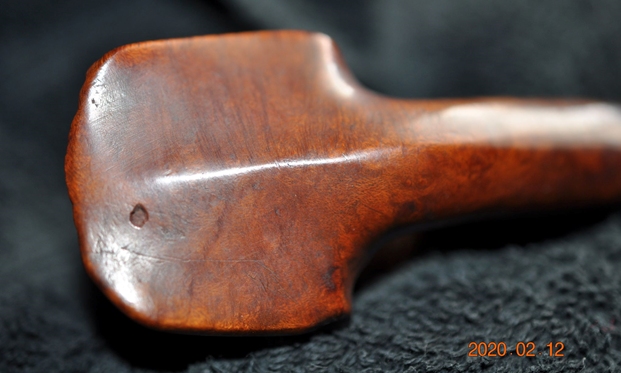
Ehrlich – Another Iconic Boston Tobacconist (1868-1968): An Ehrlich Special Chimney


Blog by Dal Stanton

I saw this pipe on eBay from a seller in the New England state of Connecticut.  What drew my attention was the tall bowl – a Chimney shape.  There’s something about ‘Chimneys’ that I like.  They have the basic Billiard workhorse air about them, but with the tall Chimney – it’s like a challenge: pack it high and tight!  My bid held firm and the Ehrlich, which I assumed had a German COM, was added to the online collection, For “Pipe Dreamers” Only! for a pipe man or women to see, ‘dream’ of the possibilities, and commission to benefit the Daughters of Bulgaria – women and girls who have been trafficked and sexually exploited.  Todd saw this Ehrlich and commissioned him along with two other pipes – a Borge Mortensen Handmade of Denmark (see: Link for the restoration) and a Heritage Blasted Apple still in the queue – up next.  Here are the pictures of the Ehrlich Special Chimney that got Todd’s attention. The bowl is stamped with the nomenclature, EHRLICH, on the left shank.  On the upper right-hand side of the shank is stamped, SPECIAL [over] ALGERIAN BRIAR, which is dropped lower on the shank.  The stem is stamped with ‘E’ I had assumed that ‘Ehrlich’ was a German name and I had assumed, wrongly, that the Country of Manufacturing was Germany as well.  I was fully surprised to discover in my initial research that Ehrlich was a tobacconist located in one of my favorite cities, Boston.  This was a pleasant surprise because I have long appreciated the story of the US’s second oldest Tobacconist shop also located in Boston – the L. J. Peretti Co., still in operation and one of the few establishments remaining that mix blends while you test blends as you wait.   My son used to live in Boston and the city has had an attraction to me for its history, its character and yes, its sports team – Boston Red Sox and Bruins – sorry, as a long-time Miami Dolphins fan, I cannot stomach New England’s version of NFL!  My discovery of L. J. Peretti shop pipes, most of which were manufactured in NYC and some in London, started for me a fun advocation of collecting them.  I had never heard of Ehrlich of Boston until finding the article in Pipedia on the Ehrlich name.  I include it here because I enjoy adding to the opus of information, of especially Boston tobacconist shops.
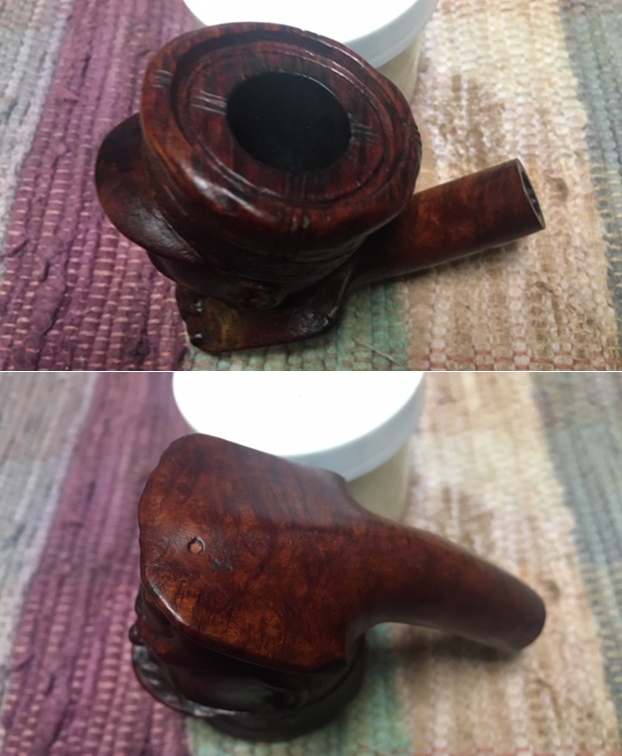
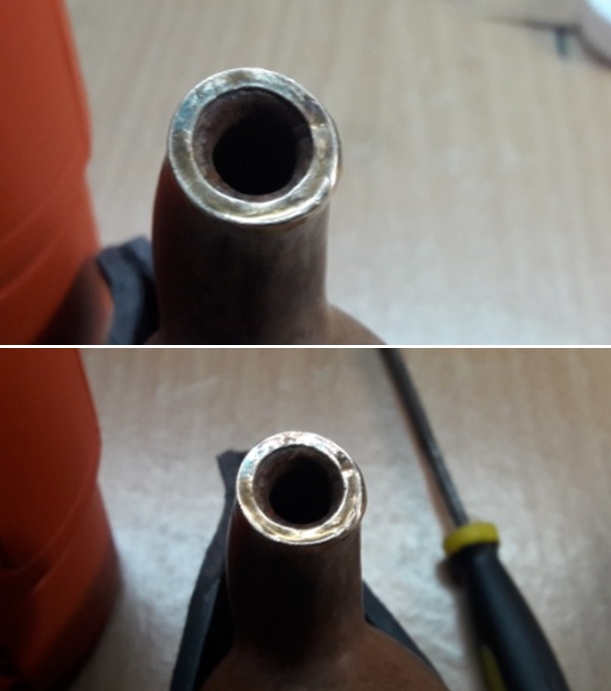
The David P. Ehrlich story

Pipemakers and Tobacconists for a Hundred Years, 1868-1968.

The David P. Ehrlich Company has remained solely in the hands of one family during its century of business, yet it has had several firm names and locations. David P. Ehrlich went to work in 1881 at the age of twenty for Ferdinand Abraham, who dealt in cigars and tobacco and who had begun business in 1868 at 1188 Washington Street in the South End, but in 1880 moved to the center of the city, where the firm has been ever since. David Ehrlich married the boss’s daughter. In 1916 the name became the David P. Ehrlich Company and Mr. Ehrlich devoted the rest of his life to this business. Since David’s death in 1912 it has been owned by – his nieces and nephews including Richard A. and William Ehrlich.

Ehrlich shop has since 1880 had a predilection for historic sites. 25 Court Street was close to the spot where from 1721-1726 James Franklin had, with the assistance of his brother Benjamin, published The New-England Courant. In 1908 the firm moved a few doors up Court Street to number 37, on the opposite corner of the alley that is grandiloquently named Franklin Avenue. This new locution was on the site of the one-time printing office of Edes and Gill, publishers of the Boston Gazette, in whose back room some of the “Indians” of the Boston Tea Party assumed their disguises. Soon after the end of World War II at which time the store was located at 33 Court Street a move around the corner to 207 Washington Street brought the shop diagonally across from the Old State House and onto the site occupied from 1610-1808 by the First Church of Boston. The demolition of 207 Washington Street in 1967 caused still another move to 32 Tremont Street, adjoining King’s Chapel burying Ground, which is the oldest cemetery in Boston.

The David P. Ehrlich Co. has not just occupied sites intimately associated with Boston history and institutions; it has in the past century become a Boston institution in its own right. It has specialized in fine cigars, pipes, and pipe tobacco. In addition to the retail business, the firm has long specialized in the manufacture of pipes, both from Algerian briar root and from meerschaum, a beautiful white fossilized substance, mined from the earth in Turkish Asia Minor. Meerschaum lends itself to carving, and in the nineteenth century there developed in Austria a fashion for carving pipes from it with formidably intricate decoration.

The Ehrlichs have long had meerschaum carvers, who ply their craft in the shop window to the delight of passersby. For years the bearded Gustave Fischer was a familiar figure in the window at 33 Court Street. A succession of craftsmen have continued the tradition. and still make and repair pipes in the window of the new Tremont Street shop. They still turn their meerschaum pipes by hand on a foot operated wooden lathe made in Austria about 1871. Although briars are today turned on power lathes, meerschaum can only be turned on a foot-operated lathe.

As amber was used for the bits in his better pipes, David P. Ehrlich found himself in the amber business as a side line. For years the firm has been noted for amber jewelry in its many types and forms, often purchasing old examples from estates to maintain its large and varied assortment. And with the meerschaum and die amber as a nucleus, a variety of artifacts dealing with tobacco and smoking, as well as prints of Boston have come to decorate the shop. There is a display case in the Boston Museum of Science donated by David P. Ehrlich Company which outlines the story of amber.

Many of the mahogany display cases that were installed in Court Street early in the century have been transplanted to Washington and then to Tremont Streets, so that the present premises, although new, have a strong family resemblance to those that we knew on our earliest visits to Ehrlich’s. This is good sense in Boston, where people do not welcome needless change for its own sake.

In 1956 when the old Harvard Square firm of Leavitt and Peirce was offered for sale, the Ehrlich brothers, because of their Harvard connections, could not resist acquiring it. Richard A. Ehrlich was a member of the class of 1922; his brother William of 1925. As they had known for years this seventy-year-old establishment, which had done business in the same location in Harvard Square longer than any except the College itself, they took it over, with the idea of keeping it as it was, even to the metal ceiling. In 1958, to celebrate its 75th anniversary, David McCord edited for them an engaging volume entitled 75 Aromatic Years of Leavitt & Peirce in the Recollection of 31 Harvard Men . And as Leavitt & Peirce is to Harvard College, so is the even older David P. Ehrlich Co. to Boston – the purveyor of “a brand of special knowledge” built up over a century of honest dealing.

The January 1968 issue of Antiques Magazine carried a feature by Wendell D. Garrett titled “Paraphernalia of smokers and snuffers” describing in considerable detail the impressive collection of paraphernalia and smokers articles from many countries and centuries on permanent exhibit in their Leavitt & Peirce Cambridge tobacco shop. The Boston Public Library in Copley Square devoted twenty-five display cases during the month of January to the David P. Ehrlich Company Centennial Exhibition of Tobacciana made up of the Leavitt & Peirce antique collection, the David P. Ehrlich collection of carved meerschaum pipes and their two venerable Cigar Store Indians.

There are pipes of every price and size and shape, from good ordinary smoking pipes up to briars of the finest grain and meerschaums band cut, turned and polished front the best Turkish blocks. This is in keeping with a catalogue statement: “we have never ceased to regard smoking as an exquisite pleasure, rather than a mere habit.” Another of the principles of the firm is embodied in the observation: “we are pipe makers – not plumbers. There are no tricky gadgets in Ehrlich pipes.” But when a man drops his pipe, the makers will transform themselves into repairmen in a highly efficient manner. All this has been going on for a century, and we confidently trust that it will outlast our time, and then some.

With the information included above, the Ehrlich Chimney now on my worktable dates to at least the late 60s.  With a greater appreciation for the Ehrlich name and the richness of its story, I begin the restoration first with an assessment of its condition.  This old boy is in rough shape. The chamber has thick cake build up which needs to be removed to expose fresh briar for a new start.  The rim is caked with lava.The rim has notches and divots on the lip aft and forward areas.Generally, the briar surface is scratched and dinged a good bit.  The finish is darkened and needs cleaning to remove the surface dirt that has collected.The original stem with the Ehrlich ‘E’ reveals that this pipe was well loved and driven into the ground!  The calcium build-up on the bit is thick along with the oxidation.  The tooth chatter seems to reveal a lot of possible New England winters with the former steward’s teeth chattering as he clinched the stem.  The lower button has disintegrated from biting.  I’m concerned that it’s too damaged for a normal button rebuild.  I love to salvage original stems but this one presents some challenges.  The lower vulcanite surface looks suspect – that there may be a crack in the vulcanite.To start, using a pipe cleaner wetted with isopropyl 95%, the stem’s airway is cleaned.To address the oxidation, a new batch of Before & After Deoxidizer is ready to go to work.  The other pipe’s stem that Todd commissioned, the Heritage Blasted Apple, joins the Ehrlich for a bath.  The fluid is eerie as it swallows the stems!After a few hours of the soak, I use a stiff wire to snag the stem and to allow the B&A Deoxidizer to drain.  I then squeegee more fluid off with my fingers then wipe with cotton pads wetted with alcohol to remove the raised oxidation.  Another pipe cleaner helps to clear liquid from the airway.The B&A Deoxidizer seemed to do an adequate job.  I add paraffin oil to the vulcanite with a cotton pad to further the rejuvenation of the stem.Turning now to the Ehrlich Chimney bowl, I ream the chamber using the Pipnet Reaming Kit.  I use the 2 smaller of 4 blades available in the Kit to navigate the Chimney chamber.  Following this, the Savinelli Fitsall Tool continues the scraping and finally sanding with 240 paper wrapped around a Sharpie Pen cleans the remaining cake. After wiping the chamber with a cotton pad wetted with alcohol to remove the carbon dust, an inspection of the chamber reveals no problems with heating or cracking.   I also scraped the rim with the Savinelli Fitsall tool to remove the crusting lava flow.Next, the external briar surface is dark and dirty. I use undiluted Murphy’s Oil Soap on a cotton pad to clean the briar surface.  I also use a brass wire brush to clean the rim.  The brass brush does not damage the wood surface.  After scrubbing, I transfer the bowl to the sink and continue cleaning using hot water and shank brushes.  Using anti-oil dish soap, the shank brushes reach into the mortise and after scrubbing and rinsing thoroughly, I bring the bowl back to the worktable.The cleaning does a good job.  The briar is lighter, but the rim is still discolored. It doesn’t happen often but returning to the internal cleaning with pipe cleaners and cotton buds reveals a clean pipe!To clean the rim, I use the topping board covered with 240 grade paper to begin.  The topping board will remove the discoloration with fresh briar, and it will help remove the divot damage on the rim edge.  The next pictures show the progression of the topping. Next, the 240 grade paper is replaced with 600 grade paper and several more rotations follow.  What emerges on the rim are round bird’s eye patterns of grain.I decide to stop the topping not to lose more briar real estate off the rim.  There remain some divots on the edge of the rim.To remedy this, instead of taking off more briar to remove the divots, I mix Thick CA glue with briar dust to form a putty to fill the divots.  After putting a small amount of briar dust on the plastic disc, covered with scotch tape for easier cleanup, a few drops of CA glue are placed next to the dust and then mixed with a toothpick.  Gradually, briar dust is pulled into the CA glue and mixed until it thickens to the consistency of molasses.  Using the toothpick as a trowel, putty is placed on the divots.  When sufficiently covered, I put the stummel aside for the putty to cure.After some time, the briar dust putty has cured.  I first use a flat needle file to remove the excess putty until it is flush with the rim surface.  I also use 240 grade paper to smooth the patch further.I also sand the side of the patch with 240 paper.  Finally, using 240 sanding paper tightly rolled, I cut a small bevel around the circumference of the rim to remove smaller cuts and divots and to blend the rim patch.  After the 240 paper, 600 grade paper is used to further smooth and blend.  The rim looks good.  I move on.To further clean the briar surface of nicks and scratches, I utilize sanding sponges.  Before applying the sanding sponges, I cover the Ehrlich Special nomenclature with masking tape.With the tape protecting the nomenclature, I first apply a coarse sanding sponge followed by a medium grade then a light grade.  Sanding sponges address the minor blemishes on the briar surface well without too much invasion. On a roll, I also apply the full regimen of micromesh pads beginning with wet sanding with pads 1500 to 2400.  Following this I dry sand with pads 3200 to 4000 and 6000 to 12000.  The grain comes out well through the micromesh process. One more step before putting the stummel aside to focus on the stem.  Applying Before & After Restoration Balm teases out the subtle hues of the briar grain.  Whenever possible, the natural briar is my preferred presentation of a pipe.  The Balm does a great job.  After placing some of the Balm on my fingers, I work it into the briar surface.  The Balm starts with a crème-like consistency but thickens to a waxy feel as the Balm is worked.  After applying the Balm, I put the bowl aside for 10 to 15 minutes then wipe off the excess Balm with a cloth and buff up the surface.Turning now to the stem, I take another long, focused look at the condition of especially the underside of the bit and button, but the upper bit has some issues too.  First the upper side. The tooth chatter is profound and there are two compressions that are in the center of the stem.  The one closest to the button is rounded, resembling an eye-tooth compression.  The other one is interesting as it runs parallel with the length of the stem.  The angle makes it difficult to imagine it to be a bite, unless it’s a back molar….  That could be, but the compression appears to run parallel to the airway tunnel directly below.  For the upper bit, I’ll attempt to raise the compressions using the heating method and follow by sanding out the chatter.  Fortunately, the upper button lip is in good shape.When I first examined the stem, before cleaning, I was concerned that there might be a crack running down the stem coming from the button break.  Looking at it now, even under a magnifying glass, thankfully, there is no sign of a crack.  That good news barely tempers the catastrophic break of the bit and lower button.  Interestingly, the lower bit shows evidence of also having parallel compression as the top side.  The area extending to the immediate left (in the picture below) of the break is compressed.  The forensics it seems, point to the former steward clinching the stem between his molars for a hands-free mode.  It worked until the force of the clinching on the underside faulted – the rest is history. To repair, I will first attempt to raise as much of the compression through the heating method, then rebuild the button with a mixture of CA glue and activated charcoal dust.  The new steward will need to treat the button with some TLC because a rebuild is not as strong as an original surface. The heating method is painting the compressions with the flame of a Bic lighter.  With the heating of the vulcanite, a rubber compound, the rubber expands to retake its original condition, or closer to it.  After painting the upper and lower with the flame, the compressions are noticeably less pronounced but still evident.Next, using 240 grade sanding paper, I sand out the residual compressions on the upper and lower bit.  The paper also removes the tooth chatter very nicely.  With the button rebuild now before me, I first clean the area with a cotton pad wetted with alcohol.A piece of index card stock serves well to create a wedge to serve as a form.  The wedge fits into the airway to form the mold that will allow the patch material to fill the cavity yet keep the airway open.After covering the wedge with scotch tape, I place some petroleum jelly on the tape to keep the patch material from bonding onto the wedge – allowing the wedge to be removed without problems.The patch material is a putty created from mixing Extra Thick CA glue with activated charcoal dust. A small mound of the charcoal is placed on the plastic disk which acts as my mixing pallet.  I also put scotch tape down on the disk to help in the cleaning.   Next to the mound of charcoal dust, a small puddle of CA glue is placed.I use a toothpick to gradually pull charcoal into the CA glue mixing as I go.  When the putty forms and reaches the viscosity of molasses, I use the toothpick to trowel the putty onto the wedge, filling the damaged area with patch material.I build a mound of the patch material to be more than is needed.  This allows filing to shape the new button by removing the excess and shaping as I go.The wedge is removed easily with a tug.Next, the filing process begins.  I start from the end of the stem to remove the excess to first form the slot facing.With the slot facing flat and flush with the surviving upper button lip, starting with the upper bit, I use the flat needle file to refresh the surviving upper button lip.Next, flipping over to the lower bit, the flat needle file begins to shape the lower button lip.  The next few pictures show this progress. The process is slow, but patience pays off nicely.  The lower button looks good.  A few air pockets show up in the patch area.  I’ll sand and work on removing these as I go.Using 240 grade paper first on the upper bit, the residual chatter and compressions are fully erased.Next, focusing on sanding the lower bit area, 240 paper does well in smoothing out the scratches left by the needle file.  Shaping the button is coming along well.Next, using 600 grade paper, I wet sand the entire stem upper and lower.  Following this, 000 steel wool is applied to smooth the surface further.  The repair is looking great.Some air pockets remain on the lower bit and button lip repair.  I paint a small amount of acrylic nail polish to fill these microscopic pockets.  Again, I apply the 000-steel wool to the acrylic patch.With the stem repair complete, I move on to the full regimen of micromesh pads.  Using pads 1500 to 2400, I wet sand followed by dry sanding with pads 3200 to 4000 and 6000 to 12000. Between each set of 3 pads, Obsidian Oil is applied to the stem to rejuvenate it and to retard the growth of oxidation. Now on the home stretch.  I rejoin the stem and Ehrlich Chimney stummel after a small amount of sanding on the tenon.  After the cleaning, the fit was a bit tight.  After the sanding, the tenon engaged the mortise nicely.  After mounting a cotton cloth buffing wheel to the Dremel, and setting the speed to about 40% full power, Blue Diamond compound is applied.  After completing the application of the compound, I buff the pipe with a felt cloth to remove the compound dust in preparation for the wax.  Before applying carnauba wax, I have one more project to complete.  The Boston tobacconist Ehrlich ‘E’ needs some attention on the stem.  Using white acrylic paint, I put a small drop of paint over the ‘E’ and then tamp the wet paint with a cotton pad.  This flattens the paint and dries it.  I then gently rub the surface with the side edge of a toothpick which clears away the excess paint leaving the ‘E’ filled.  I repeat this process twice to render the finished product.  It looks great. After mounting another cotton cloth buffing wheel to the Dremel leaving it at the same speed, I apply carnauba wax to the entire pipe.  To finish, a microfiber cloth is used to give the pipe a rigorous hand buffing to raise the shine.

This Ehrlich Special Chimney turned out well.  I appreciated learning about the history of the Ehrlich name as one of Boston’s Tobacconist shops.  The button repair looks good and what a change from the molar damage with which the restoration began.  The vertical fire grain on the left side of the Chimney is nice and the bird’s eye grain on the right completes the ensemble. Without doubt, the pipe fits nicely in the palm.  I enjoyed this restoration and Todd who commissioned the Ehrlich Special Chimney, will also have the first opportunity to secure him from The Pipe Steward Store.  This pipe benefits the Daughters of Bulgaria – women and girls who have been trafficked and sexually exploited.  Thanks for joining me!