Tag Archives: super glue

Restoring a Nicely Grained Churchill 999 Imported Briar Pot


Blog by Steve Laug

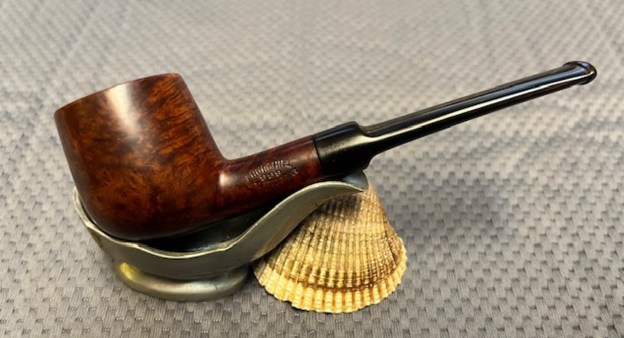
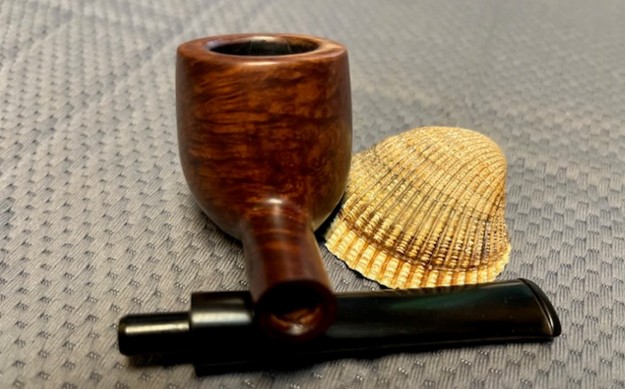
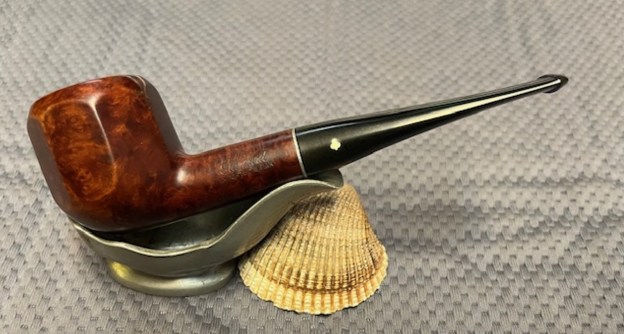
Last week I received a text from Robert about restoring three pipes his brother had found in Eastern New York. There were two Kaywoodies and a Churchill. The Kaywoodies included a small apple stamped Campus and an octagonal pipe stamped Kaywoodie Standard. The Churchill was a 999 Pot shaped pipe. He sent along two photos of the pipes. You can see the condition of the three pipes. They are dirty and worn. The last pipe in the photo, the Campus has what appears to be a broken shank and a potential repair. It looks to be poorly done. Robert said that he was fairly certain that the stem was glued onto the shank with the repair. On Saturday he brought the pipes by for me to look at. I now had three more pipes to clean up and repair. The Churchill 999 Pot and the Kaywoodie Standard Oxagonal 44 Apple were dirty but were in good repair. I had finished the little KW Campus repair and the pipe looked good (https://rebornpipes.com/2024/04/21/repairing-and-restoring-a-kaywoodie-campus-apple/). I also cleaned up the second Kaywoodie, the Octagonal Apple and it looked good. Here is the link to that blog (https://rebornpipes.com/2024/04/22/restoring-a-kaywoodie-standard-octagonal-44-apple/). There was a moderate cake in the bowl with tobacco debris. There was a coat of lava on the rim top that was quite thick and the inner edge showed some damage. The outer edge looked very good. The finish was dirty but otherwise showed some nice grain underneath. The stamping on the pipe is very simple. On the left side of the shank it is stamped Churchill’s arched over 999 with Imported Briar underneath. The stem was very oxidized and there was light tooth chatter on both sides ahead of the button. The stem was also plugged with tars and debris in the slot and airway was narrowed down.

I have worked on several Churchill pipes over the years and have done research on the brand when I worked on them. Here is a link to one of them that I had worked on. Here is the link to the blog (https://rebornpipes.com/2013/09/08/churchills-bent-pot/). I am including that information below.I am fairly certain that the pipe came from Churchill’s Tobacco Shop in Norwich, England. I found the following information on the Pipes and Logos website http://pipephil.eu/logos/en/logo-c4.html On the site there is a small paragraph which I have copied as follows: “Churchill’s Tobacco shop is situated in St Andrew’s Street at the corner of Bridewell Alley in Norwich, England. The shop was next to a church and at the bottom of two hills, and that’s how it became “Churchill’s”. Former manager: John Elvin (retired on May, 31 2008). Current owner (2008): Keith Garrard.” I have included these pictures from that website as they show the stamping on both the shank and stem that is identical to the pipe that I have just refurbished.According to the Churchill’s website it is the last remaining specialist tobacconist in Norwich, originally standing at 32 St Andrews Street for over 23 years. http://www.churchillsofnorwich.com/index.php?_a=viewDoc&docId=1 The site also notifies the shop’s clients that Keith Garrard, who had a wealth of knowledge and was an avid pipe and cigar smoker himself, passed away on 23rd March 2012. His wife Coral continues to maintain the business in his honour.

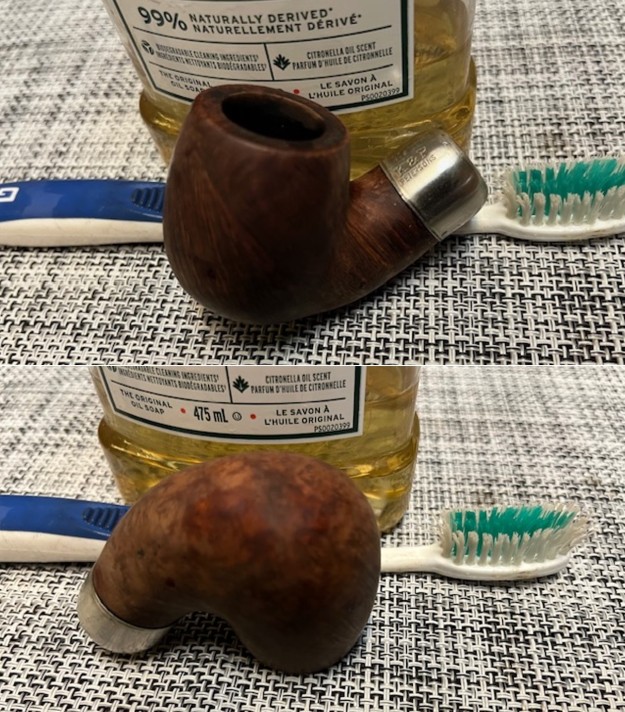
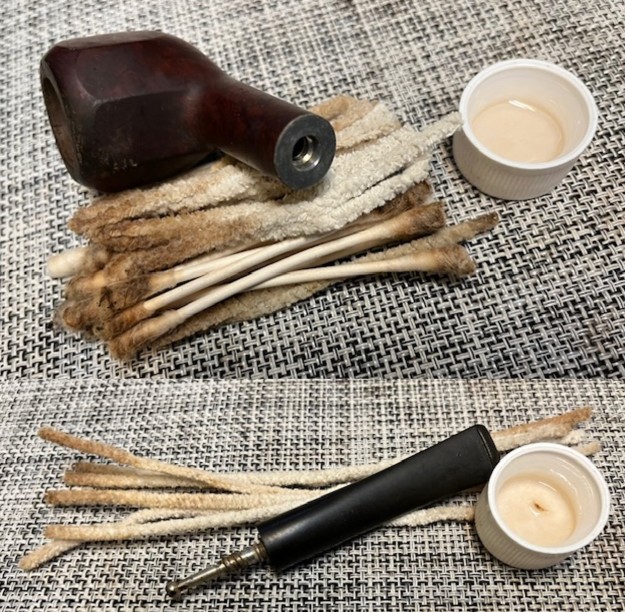
I took photos of the pipe when I brought it to the worktable. I wanted to show the general condition of the pipe before I started my work on it. You can see the cake in the bowl and the lava on the rim top. The rim top appears to be good under the lava. The stem is dirty and heavily oxidized as noted and light tooth marks are on the top and underside ahead of the button. I took some close up photos of the rim top and the stem surface. I wanted to show the condition of both more closely. The rim top and the inner and outer edges of the bowl heavily cake in lava and you can see the marks on the inner bowl edge. I also took close up photos of the stem to show the oxidation and the light tooth marks on the stem surface. I took a photo of the stamping on the left side of the shank and it is clear and readable. It is stamped as noted above. I removed the stem for the shank and took a photo of the bowl and stem to give a picture of what it looked like. Now it is time to clean up the pipe. I reamed the bowl with a PipNet pipe reamer and the second cutting head. It cleaned up most of the cake. I used a Savinelli Fitsall Pipe Knife and cleaned up the remaining cake leaving bare briar. I sanded the bowl walls with 220 grip sandpaper wrapped around a piece of dowel. I smoothed out the bowl walls and they looked very good. There was no heat damage or checking on the walls. I scrubbed the exterior of the bowl and shank with a tooth brush and undiluted Murphy’s Oil Soap. It works exceptionally well to remove unwanted oils from the briar and also the grime on the rim and the bowl sides. I rinsed it in warm water while scrubbing with the tooth brush. The pipe looks very good at this point. The rim top is clean enough to know the condition it is in and what I need to do to deal with it. There are scratches and nicks on the rim top and they are very visible now that the lava has been removed. I scrubbed out the shank and the stem with pipe cleaners, cotton swabs and alcohol.
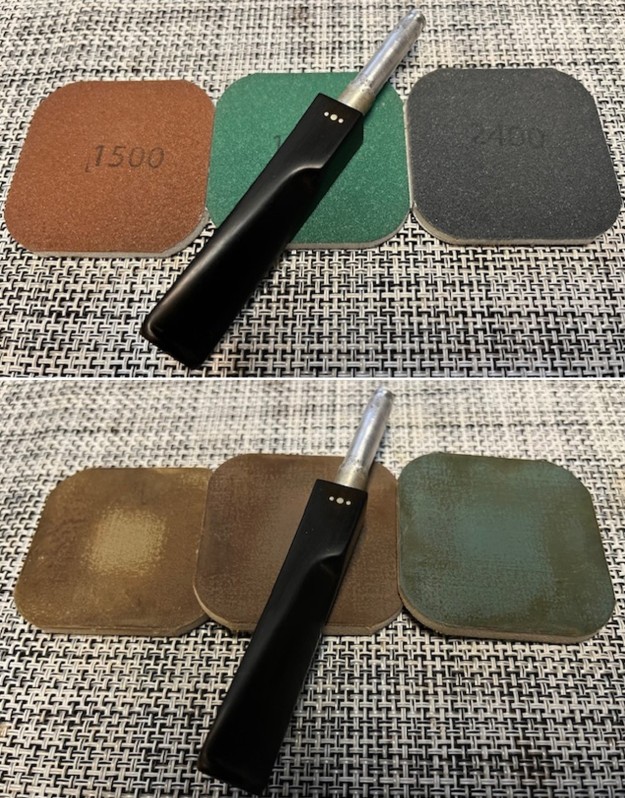
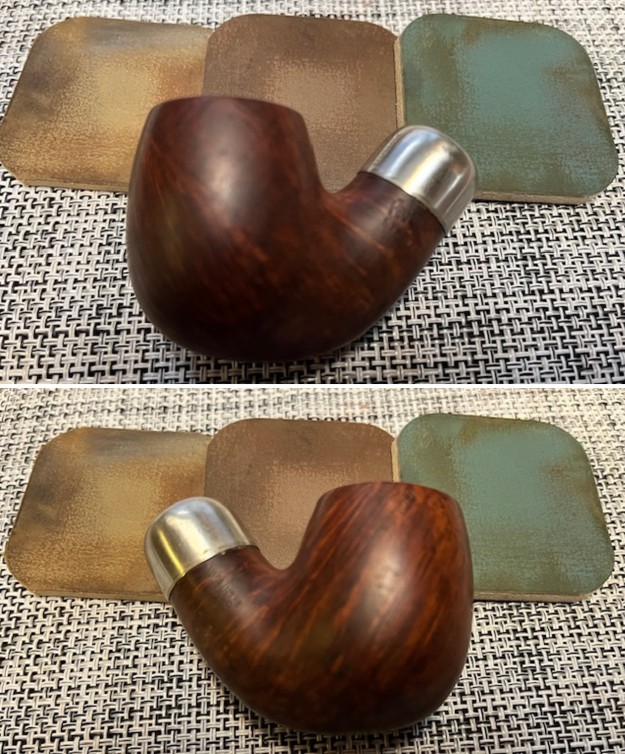
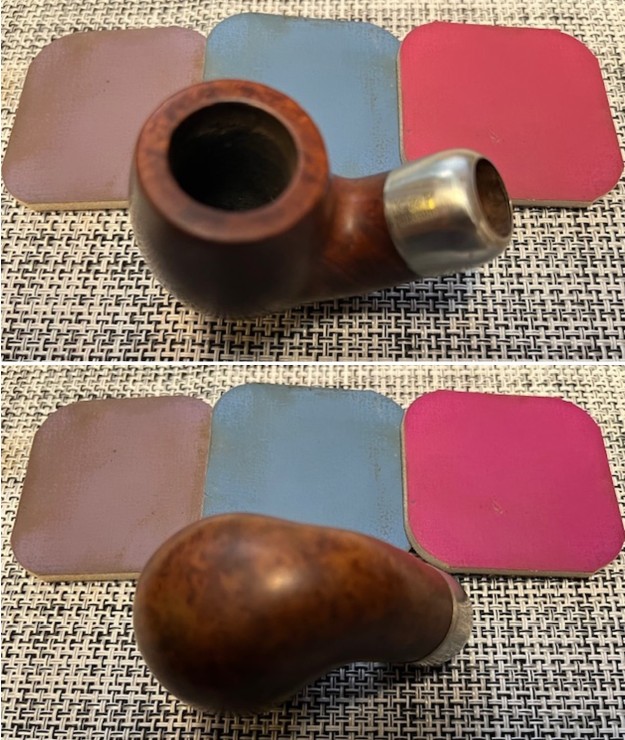
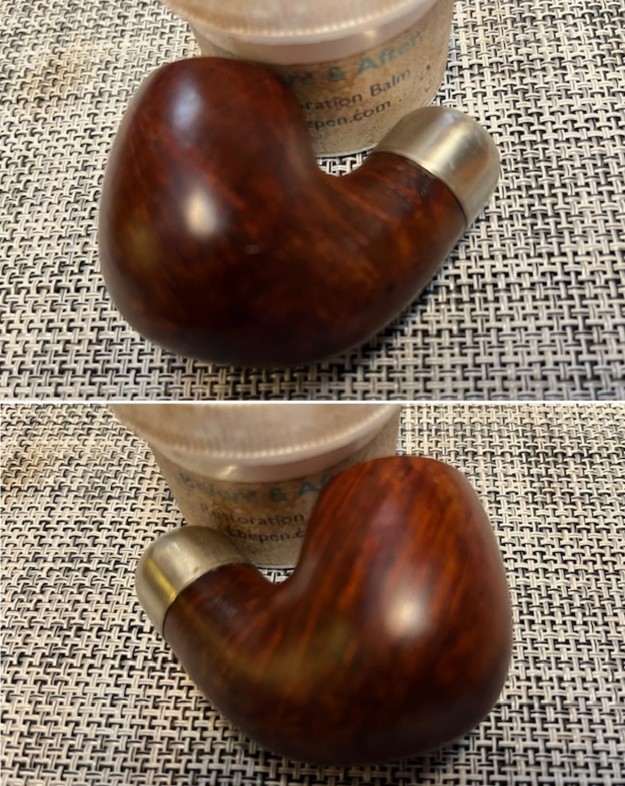
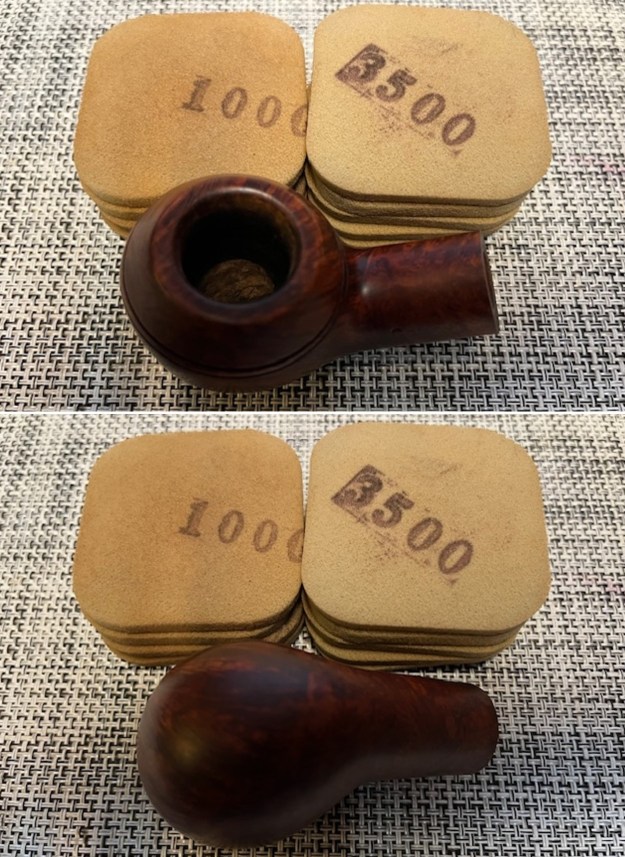
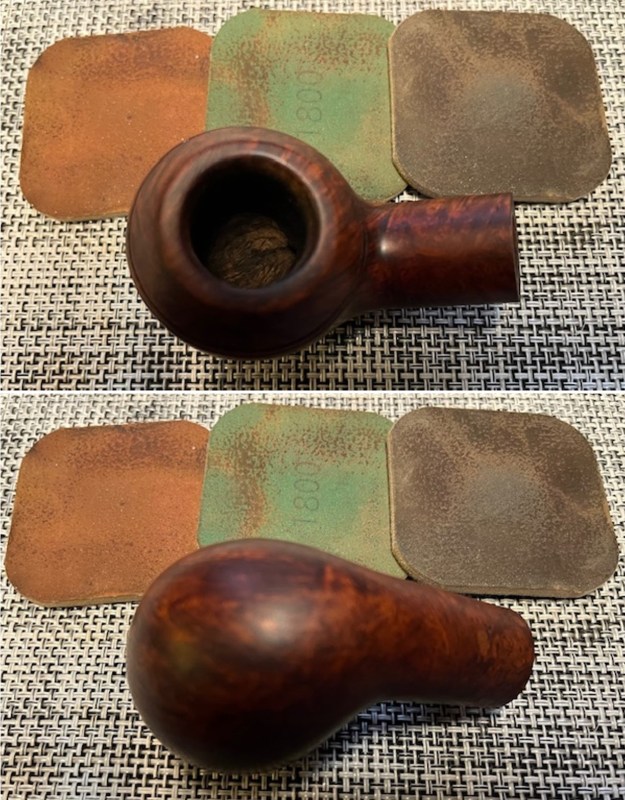
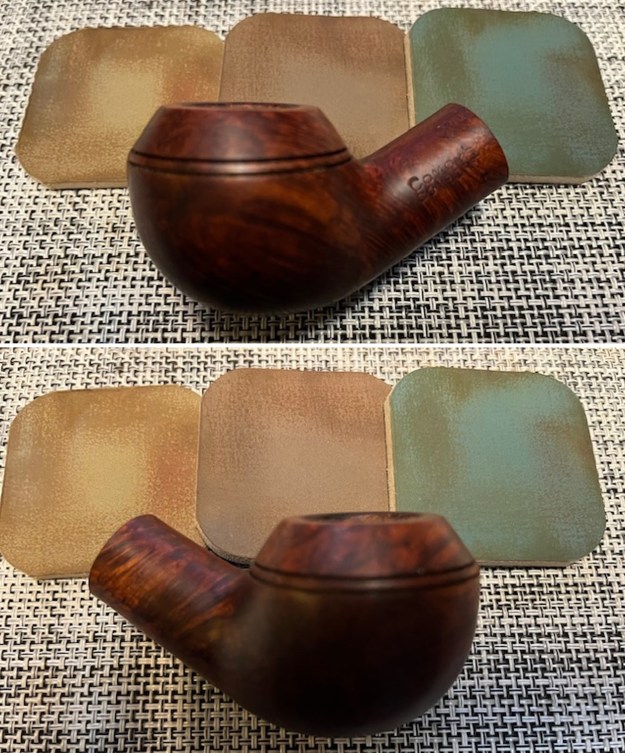
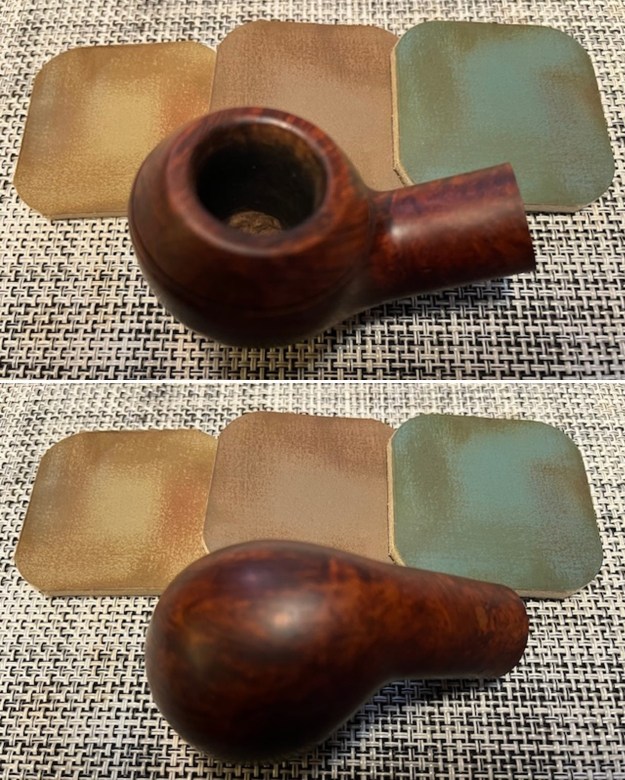
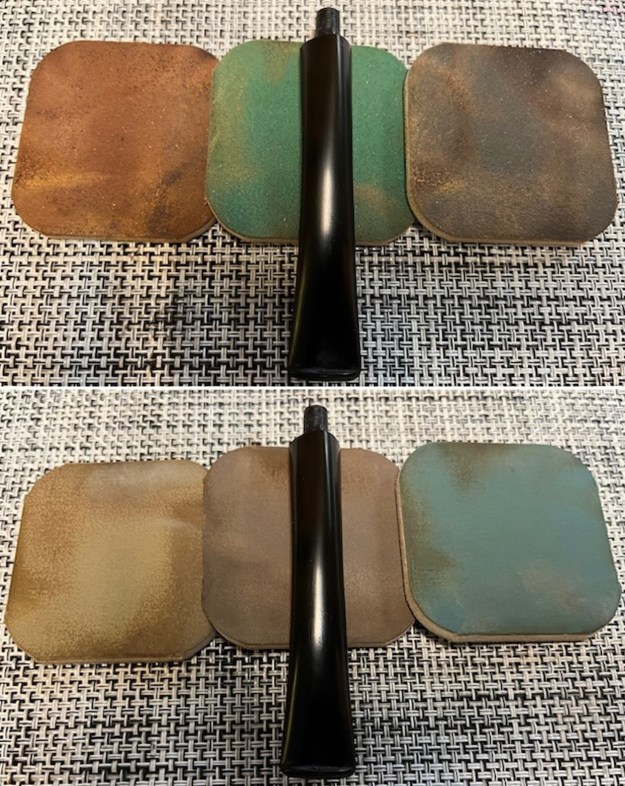
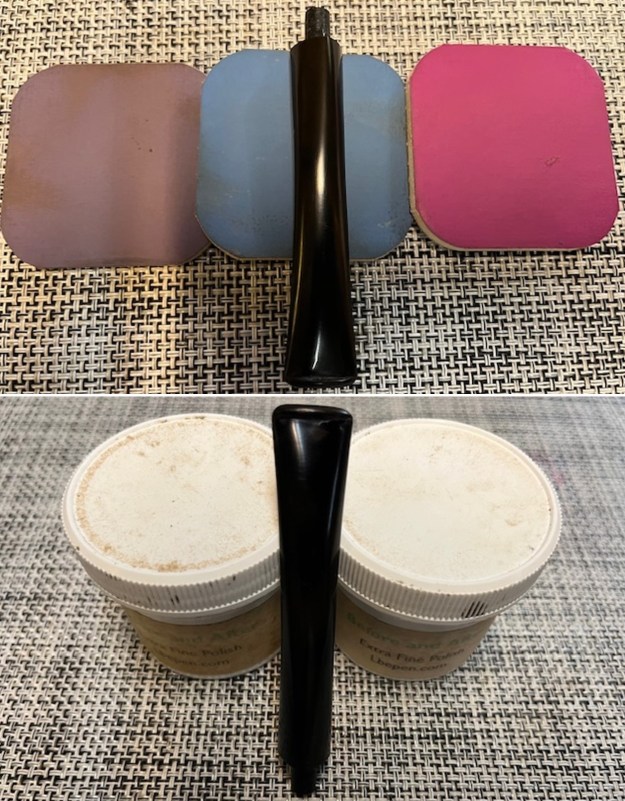
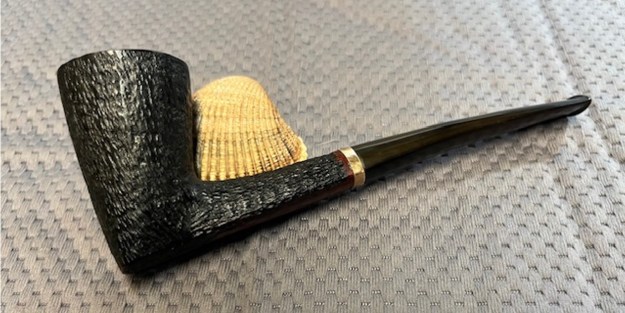
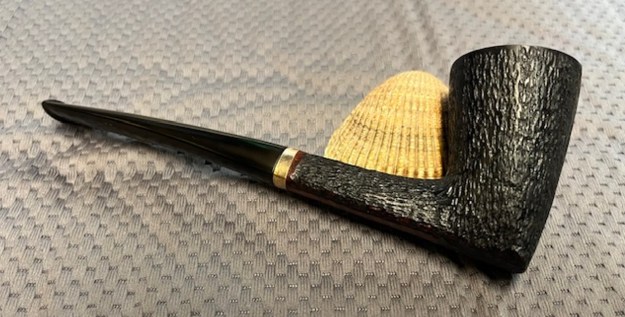
I gently topped the bowl to remove the damage on the rim top and to minimize it on the rear edge where the most damage was. I used a topping board and 220 grit sandpaper.There was some damage and wear on the front outer edge of the bowl. Built it up with CA glue and briar dust to fill in the damage. I smoothed out the damage with 220 grit sandpaper and reshaped it to follow the flow of the bowl. I sanded it further with 320 grit sandpaper to smooth out the repair. It really started to look very good.I touched up the stain on the rim top and on the front of the bowl with a Walnut stain pen. It is a little streaky at this point. It will work better when I finish the sanding and polishing of the rim and bowl.I sanded the bowl and rim top to clean up the damage and repairs to the edge and start the polishing of the bowl. I used 320-3500 grit sanding pads. I wiped the bowl down with a damp cloth after each pad. It really began to take on a shine. I polished the briar with micromesh sanding pads – dry sanding with 1500-12000 grit pads. I wiped it down after each sanding pad with a damp cloth to remove the sanding debris on the surface. I rubbed the bowl down with Before & After Restoration Balm. I worked it into the surface of the briar with my fingertips to clean, enliven and protect it. I let the balm sit for a little while and then buffed with a cotton cloth and shoe brush to raise the shine. I set the bowl aside and turned to address the stem issues. I scrubbed the stem oxidation with Soft Scrub and cotton pads. I was able to remove the majority of the oxidation. Then, I sanded it with a folded piece of 220 grit sandpaper. It looked much better at this point. To remove the remnants of oxidation from the vulcanite I sanded it with 320-3500 grit sanding pads. I wiped it down after each sanding pad with a damp cloth. By the final 3500 grit sanding pad the rim top had a shine.The stem was in good condition so I polished the vulcanite with micromesh sanding pads – 1500-12000 grit pads. I wiped it down with Obsidian Oil after each sanding pad. I used Before & After Pipe Polish – both Fine and Extra Fine to further polish the stem. I gave it a final coat of Obsidian Oil and set it aside to dry. This Churchill 999 Imported Briar Pot cleaned up really well and looks very good. The Before & After Restoration Balm brought the colours and grain out in the smooth finish on the pipe. It works well with the polished vulcanite taper stem. I put the stem back on the bowl and carefully buffed the pipe with Blue Diamond on the buffing wheel using a light touch on the briar. I gave the bowl and the stem multiple coats of carnauba wax on the buffing wheel. I followed that by buffing the entire pipe with a clean buffing pad. I hand buffed the pipe with a microfiber cloth to deepen the shine. The finished Churchill 999 Pot fits nicely in the hand and I think it will feel great as it heats up with a good tobacco. Give the finished pipe a look in the photos below. The dimensions of the pipe are Length: 5 ¼ inches, Height: 1 ½ inches, Outside diameter of the bowl: 1 ¼ inches, Chamber diameter: 7/8 of an inch. The weight of the pipe is 1.13 ounces/32 grams. I know Robert is going to enjoy this last pipe of the three once I return them to him. Thanks for reading this blog and my reflections on the pipe while I worked on it.

Restoring a Kaywoodie Standard Octagonal 44 Apple


Blog by Steve Laug

Last week I received a text from Robert about restoring three pipes his brother had found in Eastern New York. There were two Kaywoodies and a Churchill. The Kaywoodies included a small apple stamped Campus and an octagonal pipe stamped Kaywoodie Standard. The Churchill 999 Pot shaped pipe. He sent along two photos of the pipes. You can see the condition of the three pipes. They are dirty and worn. The last pipe in the photo, the Campus has what appears to be a broken shank and a potential repair. It looks to be poorly done. Robert said that he was fairly certain that the stem was glued onto the shank with the repair. On Saturday he brought the pipes by for me to look at. I now had three more pipes to clean up and repair. The Churchill 999 Pot and the Kaywoodie Standard Oxagonal 44 Apple were dirty but were in good repair. I had finished the little KW Campus repair and the pipe looked good (https://rebornpipes.com/2024/04/21/repairing-and-restoring-a-kaywoodie-campus-apple/). I looked second Kaywoodie, the Octagonal Apple over carefully and this is what I saw. There was a thick cake in the bowl with tobacco debris. There was a coat of lava on the rim top that was quite thick but the inner edge looked very good. The outer edge had some damage on the back side above the shank bowl union. The finish was dirty but otherwise showed some nice grain underneath. The stem was dirty with light tooth chatter on both sides ahead of the button.

Dal had worked on a Kaywoodie Standard, but shape 33 and done a fair bit of research on the pipe (https://rebornpipes.com/2020/03/23/new-life-for-a-kaywoodie-standard-apple-for-a-special-pipe-woman/). I have included the link above if you would like to read it. I have copied the pertinent portion on the 2 digit shape numbers and dating of the pipe below.

The next picture in this set shows the Kaywoodie shape number ‘33’ on the right flank of the shank which points to the designation of a ‘Large Apple’ from the US production of Kaywoodie pipes (LINK).  According to this discussion on Tapatalk.com, the 2-digit system, employed from 1927 to 1972 when the system was changed to a 3-digit system, was when pipe production (for Kaywoodie, Yello-Bole and Medico) was moved to the Medico factory in Richmond Hill Queens NY as plans for new plant were in process.  The 3-digit numbers was used during this period for all Kaywoodie and Medico pipes, from 1972 to 1980.  The same article indicated that the 2-digit numbers were only for Kaywoodies produced in the US – that Kaywoodie of London (Cadogan) had their own three-digit system.  Putting all the information together, this Kaywoodie Apple is most likely a 1960s vintage.  According to the Kaywoodie Discussion at MyFreeForum the ‘Standard’ line of Kaywoodie started in the 1950s, but with the 2 digit shape number and the 3 hole stinger, the evidence points to the 1960s dating.

I included a portion of the shape number chart from Pipedia and the link to the chart as well (https://pipedia.org/wiki/Kaywoodie_Shape_Numbers). I did a screen capture of the section with the shape 44 number. It is interesting in that the shape was available for only a few years – 1965 to 1970. That helps narrow down the date on the pipe I am working on. It also identifies it as an Octagon Apple.I also have included a portion of a chart with the pipe line names and the approximate date of manufacture below (https://pipedia.org/images/3/3d/Kaywoodie_Pipe_Names.pdf). It identifies the date of the Standard line production between 1950 and the present.I learned that the line was introduced in 1950 and the specific shape I had in hand was made between 1965 and 1970. The tenon/stinger was a typical Drinkless type and was threaded to screw into the fitment in the shank. From that I knew that I was working on an older pipe.

I took photos of the pipe when I brought it to the worktable. I wanted to show the general condition of the pipe before I started my work on it. You can see the cake in the bowl and the lava on the rim top. The damage on the back edge of the rim top is also visible. The stem is dirty and lightly oxidized as noted and light tooth marks are on the top and underside ahead of the button. I took some close up photos of the rim top and the stem surface. I wanted to show the condition of both more closely. The rim top and the inner and outer edges of the bowl heavily cake in lava and you can see the marks on the back outer edge. I also took close up photos of the stem to show the general dullness of the stem and the light tooth marks on the stem surface. I took a photo of the stamping on the left side of the shank and it is clear and readable. It is stamped as noted above. The right side has the shape number but it is almost filled in with dirt. It is still readable but I could not capture it in a photo. I removed the stem for the shank and took a photo of the bowl and stem to give a picture of what it looked like.Now it is time to clean up the pipe. I reamed the bowl with a PipNet pipe reamer and the second cutting head. It cleaned up most of the cake. I used a Savinelli Fitsall Pipe Knife and cleaned up the remaining cake leaving bare briar. I sanded the bowl walls with 220 grip sandpaper wrapped around a piece of dowel. I smoothed out the bowl walls and they looked very good. There was no heat damage or checking on the walls. I scrubbed out the shank and the stem with pipe cleaners, cotton swabs and alcohol. I cleaned up the stinger with pipe cleaners, cotton pads and alcohol.I scrubbed the exterior of the bowl and shank with a tooth brush and undiluted Murphy’s Oil Soap. It works exceptionally well to remove unwanted oils from the briar and also the grime on the rim and the bowl sides. I rinsed it in warm water while scrubbing with the tooth brush. The pipe looks very good at this point. The rim top is clean enough to know the condition it is in and what I need to do to deal with it. I gently topped the bowl to remove the damage on the rim top and to minimize it on the rear edge where the most damage was. I used a topping board and 220 grit sandpaper.I repaired the outer edge of the rim at the back with clear CA glue and briar dust. I sanded it smooth with a folded piece of 220 grit sandpaper to start blending the repair into the rest of the briar. It was smooth to touch and did not stand out as a dark repair.I sanded the bowl and rim top to clean up the damage and repairs to the edge using 320-3500 grit sanding pads. I wiped the bowl down with a damp cloth after each pad. It really began to take on a shine. I polished the briar with micromesh sanding pads – dry sanding with 1500-12000 grit pads. I wiped it down after each sanding pad with a damp cloth to remove the sanding debris on the surface. I rubbed the bowl down with Before & After Restoration Balm. I worked it into the surface of the briar with my fingertips to clean, enliven and protect it. I let the balm sit for a little while and then buffed with a cotton cloth and shoe brush to raise the shine. I set the bowl aside and turned to address the stem issues. I “painted” the stem surface with the flame of a lighter. I filled in the deep tooth marks with black CA glue. Once it cured I sanded it flat to the stem surface with a folded piece of 220 grit sandpaper. It looked much better at this point. To blend the repairs into the surface of the vulcanite I sanded it with 320-3500 grit sanding pads. I wiped it down after each sanding pad with a damp cloth. By the final 3500 grit sanding pad the rim top had a shine. The stem was in good condition so I polished the vulcanite with micromesh sanding pads – 1500-12000 grit pads. I wiped it down with Obsidian Oil after each sanding pad. I used Before & After Pipe Polish – both Fine and Extra Fine to further polish the stem. I gave it a final coat of Obsidian Oil and set it aside to dry. This Kaywoodie Standard Imported Briar 44 Octagonal Apple cleaned up really well and looks very good. The Before & After Restoration Balm brought the colours and grain out in the smooth finish on the pipe. It works well with the polished oval vulcanite taper stem. I put the stem back on the bowl and carefully buffed the pipe with Blue Diamond on the buffing wheel. I gave the bowl and the stem multiple coats of carnauba wax on the buffing wheel. I followed that by buffing the entire pipe with a clean buffing pad. I hand buffed the pipe with a microfiber cloth to deepen the shine. The finished Kaywoodie Standard 44 Octagonal Apple fits nicely in the hand and I think it will feel great as it heats up with a good tobacco. Give the finished pipe a look in the photos below. The dimensions of the pipe are Length: 5 ½ inches, Height: 1 ½ inches, Outside diameter of the bowl: 1 ¼ inches, Chamber diameter: ¾ of an inch. The weight of the pipe is 1.34 ounces/38 grams. I know Robert is going to enjoy this second pipe of the three once I return it to him with the other pipes he dropped off. Thanks for reading this blog and my reflections on the pipe while I worked on it.

Restoring a Comoy’s Consort 1057 Rhodesian with an Acrylic Saddle Stem


Blog by Steve Laug

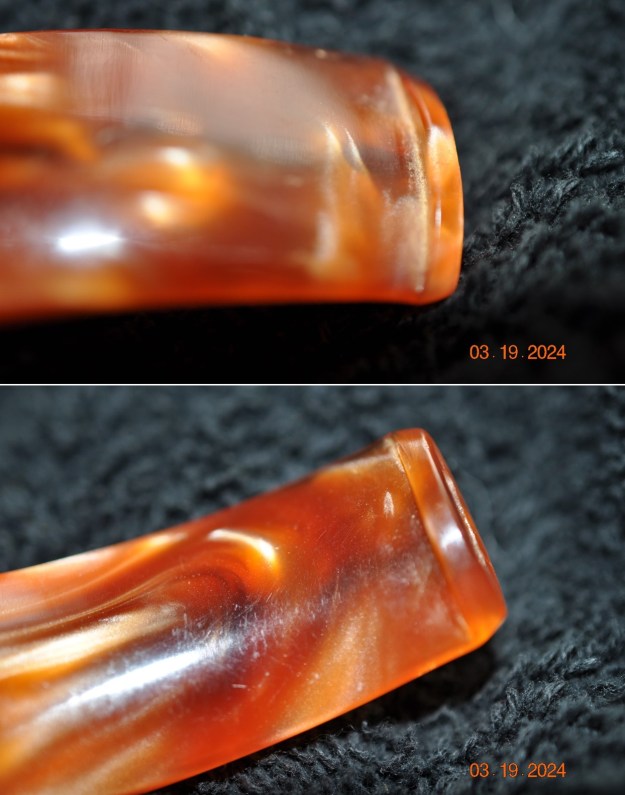
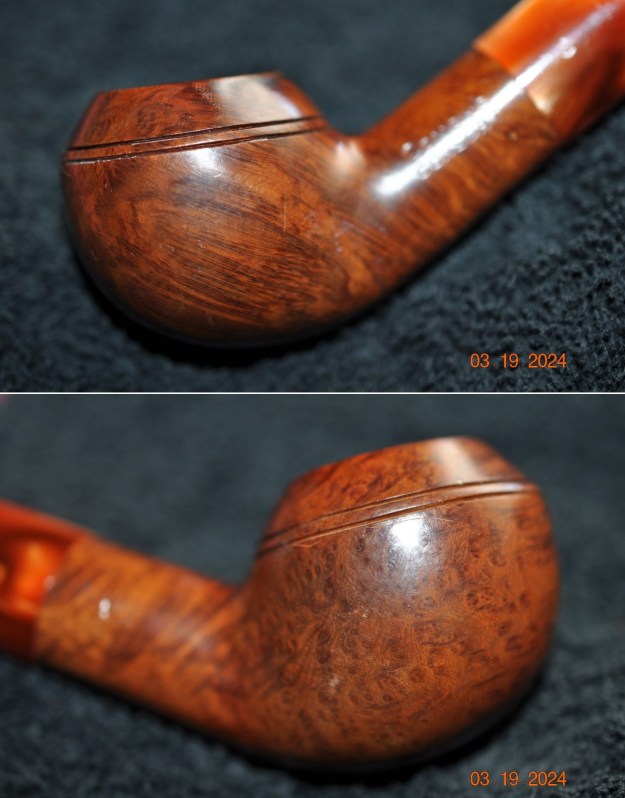
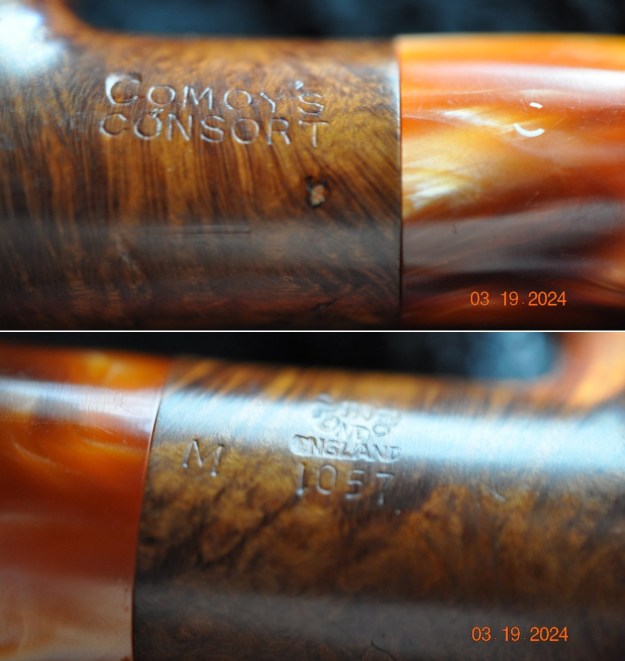
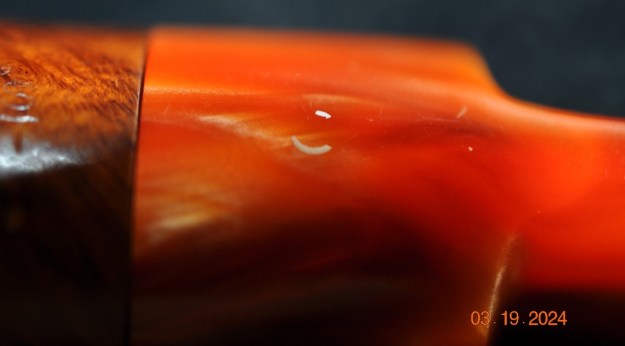
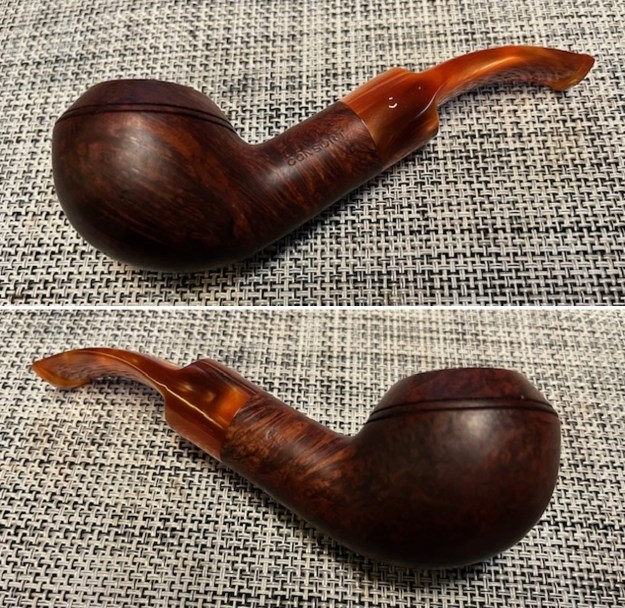
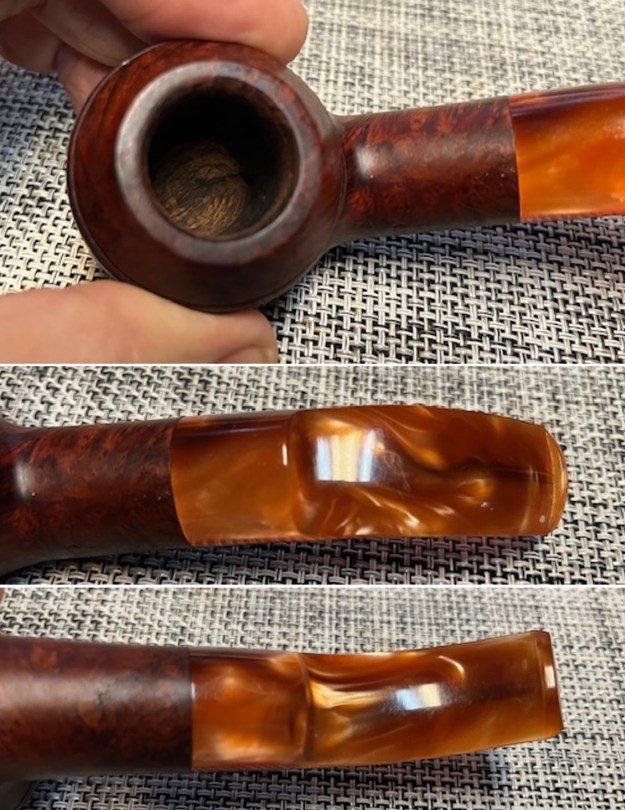
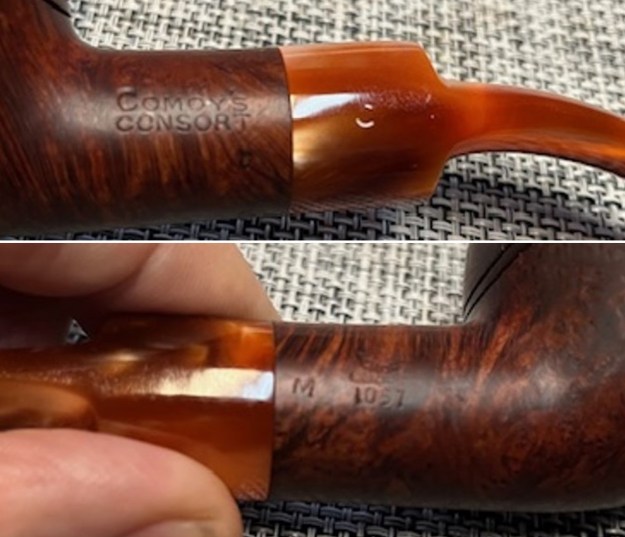
The next pipe on the table is a great looking Bent Rhodesian with great grain around the bowl. It has a well shaped variegated acrylic stem. We purchased it from an estate sale in Spring Branch. Texas, USA on 02/29/2024. I have included the photos below that the seller sent to me so I could see what the pipe looked like. When the pipe arrived Jeff took photos of it before cleaning it up. Here is what we saw. The pipe is stamped on the left side of the shank and reads Comoy’s [over] Consort. On the right side it is stamped Made in London in a circle [over] England. Underneath the COM stamp is the shape number 1057. To the left of that next to the stem shank junction it is stamped with a letter M. The acrylic stem has the newer Comoy’s C logo worn decal on the left side of the saddle. The bowl had been reamed recently and the inner edge of the bowl looked very good. The rim top has some grime and some lava on the surface. There were oils and grime ground into the bowl sides gives the finish a flat look though there is some great grain. The shank has a slight curve to it giving the pipe a Bent Rhodesian shape. The bend of the saddle stem matches the curves of the bowl and shank. The variegated rose acrylic stem is a dirty and has some light tooth chatter on both the top and underside of the stem just ahead of the button.He took photos of the pipe’s bowl and rim top to show the reamed bowl and the spotty lava coat overflowing onto the top. He also took photos of the stem to capture its condition before clean up. He took photos of the sides and heel of the bowl to show the rich grain around the bowl and the amount of grime ground into the surface of the briar.   He took photos of the stamping on the sided of the shank. It is clear and quite readable. It reads as noted above. You can also see the decal of the Comoy’s logo on the side of the stem. It is worn off in places but still identifiable. I knew the pipe was probably newer and a Cadogan period pipe by the style of the stamping, the line and the acrylic stem but I wanted to see if I could get a cleared date on the pipe. I turned to Pipedia’s guide for dating Comoy’s pipes and have included what I found below (https://pipedia.org/wiki/Comoy%27s_Dating_Guide#%E2%80%9CMade_In%E2%80%9D_Stamp). I quote the pertinent section –

Made in London England

Appears in two versions. This is again stamped in a circle with “MADE” at the top, “IN” in the middle, and “LONDON” at the bottom, with “ENGLAND” in a straight line beneath. It can be assumed that this stamp was first used in the export drive in the early 1950s. On a Bulldog Sandblast from the early 50s the Comoy name no. 2 above was used together with “MADE IN LONDON” over “ENGLAND”. There are no known examples of pre-WW II Comoy’s stamped in this way. The second version is the same as above but in a “rugby ball ” shape…

I was correct in assuming it is Cadogan produced the English line. The Rhodesian I am working is a Comoy’s shape 1057. It is a real beauty and the variegated stem looks very good with it. Now it was time to work on it.

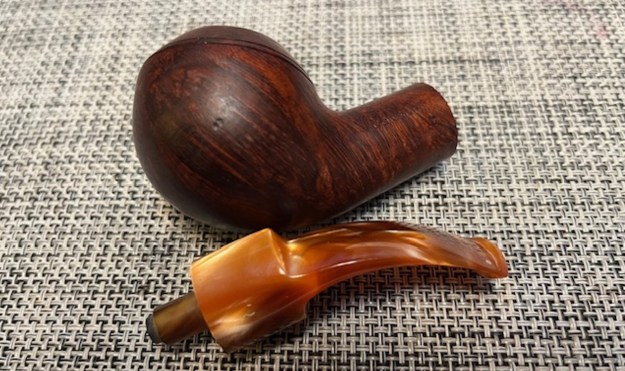
 Jeff had done a great job cleaning up the pipe as usual. He cleaned up the inside of the bowl with a PipNet reamer and a Savinelli Fitsall Pipe Knife. The bowl walls looked very good. He scrubbed the interior of the bowl and shank with shank brushes, pipe cleaners, cotton swabs and alcohol to remove the tars and oils. He scrubbed the exterior of the pipe with Murphy’s Oil Soap and a tooth brush to remove the grime from the finish. He worked on the rim top lava and darkening with the soap and tooth brush. He scrubbed the inside of the stem with alcohol and pipe cleaners. He scrubbed the exterior with Soft Scrub and rinsed it with warm water to remove the soap and debris. The pipe looked far better. I took photos of the pipe when I received it before I started working on it. I took photos of the bowl and rim top to show how clean it was. The top and the inner edge of the rim look quite good with just some small scratches. The stem looks clean of debris and grime. There are light tooth marks and chatter on both sides of the stem.I took photos of the stamping on the sides of shank. The stamping is clear and readable (much clearer in person than the photos show). I took a photo of the pipe with the stem removed to show the overall look of stem, tenon and profile of the pipe. I started polishing the bowl by sanding it with 320-3500 grit sanding pads. I wiped the briar down with a damp cloth after each pad to remove the sanding dust. It looked better and the scratches disappeared. I polished the briar bowl and shank with micromesh sanding pads – dry sanding with 1500-12000 grit sanding pads. I wiped it down with a damp cloth after each pad to remove the debris. The bowl took on a rich glow. I rubbed the bowl down with Before & After Restoration Balm. I worked it into the surface of the briar with my fingertips to clean, enliven and protect it. I let the balm sit for 10 minutes and then buffed with a cotton cloth to raise the shine. Mark Hoover’s Balm is a product that I have come to appreciate and one I use on every pipe I have been working on. I set aside the bowl and turned my attention to the stem. I sanded the stem with 320-3500 grit sanding pads to smooth out the chatter on the surface of the stem.I polished the acrylic with micromesh sanding pads – 1500-12000 grit pads. I wiped it down with a damp cloth after each sanding pad. I used Before & After Pipe Polish – both Fine and Extra Fine to further polish the stem. I put the stem back on the Comoy’s Consort 1057 Rhodesian and took it to the buffer. I worked over the bowl and stem with Blue Diamond to polish out the remaining small scratches. I gave the bowl and the stem several coats of carnauba wax on the wheel and buffed the pipe with a clean buffing pad to raise the shine. I hand buffed it with a microfiber cloth to deepen the shine. The pipe polished up really well and the rim top and edge looked good. I was happy with the look of the finished pipe. The photos below show what the pipe looks like after the restoration. The rich reddish, brown bent Rhodesian is a beautiful take on a classic shape. The polished acrylic saddle stem looks really good with the rich reds of the briar. The dimensions of the pipe are Length: 5 ½ inches, Height: 1 ½ inches, Outside diameter of the bowl: 1 1/8 inches, Chamber diameter: ¾ of an inch. The weight of the pipe is 1.76 ounces/50 grams. I will be putting it on the rebornpipes store in the British Pipe Makers and Companies Section shortly, if you are interested in adding it to your collection. This Bent Rhodesian looks and feels great in the hand. This one should be a great smoker. Thanks for walking through the restoration with me on this beauty!

New Life for a Pipe Pub France 1985 297/350 Bent Billiard


Blog by Steve Laug

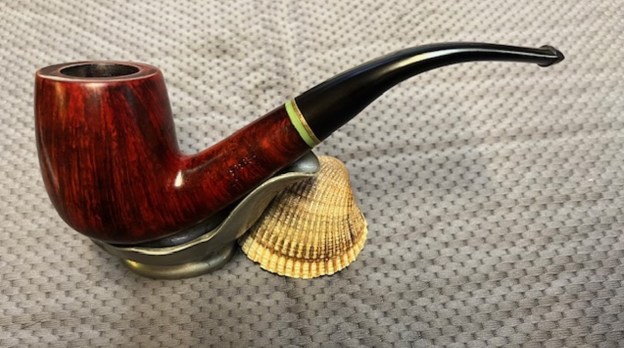
The next pipe on the table is a great looking Bent Billiard with great grain around the bowl. It has a well shaped vulcanite taper stem. We purchased it from an estate sale in Spring Branch. Texas, USA on 02/29/2024. The pipe is stamped on the left side of the shank and reads 1985 [over] 297/350 setting this pipe aside as #297 out of 350 Pipes made in 1985. On the right side it is stamped Pipe Club (separated by a pipe) [over] France. There was a thick cake in the bowl and some darkening and lava on the inner edge of the bowl and some spots of lava on the rim top. It was hard to know for certain the condition of the inner edge though it appeared to be in good condition. There were oils and grime ground into the bowl sides gives the finish a flat look though there is some great grain. The shank has a slight curve to it giving the pipe a Bent Billiard shape. The taper stem matches the curves of the bowl and shank. It has what looks like a pair of bands on the end of the stem – green acrylic and brass. The vulcanite stem is a dirty with some calcification, oxidation, grime, grit on the surface and also light tooth marks on both the top and underside of the stem just ahead of the button. Jeff took photos of the pipe before he started his clean up work. I have included them below. He took photos of the pipe’s bowl and rim top to show the cake in the bowl, the darkening on the inner edge and the spotty lava coat overflowing onto the top. It is another dirty pipe. He also took photos of the stem to capture the oxidation, calcification and the light tooth marks on the top and underside of the stem near the button. He took photos of the sides and heel of the bowl to show the rich grain around the bowl and the amount of grime ground into the surface of the briar.   He took photos of the stamping on the sided of the shank. It is clear and quite readable. It reads as noted above. He also took a photo of the twin bands on the stem end – the brass and green acrylic band. I remembered that Dal had worked on a Pipe Pub pipe so did a quick search of my site and found the blog (https://rebornpipes.com/tag/pipe-pub-pipes/) that I remembered that Dal had written on the brand. What was fascinating was a conversation that he and I had via email that led him to some helpful information. I quote the majority of his research section from the blog below:

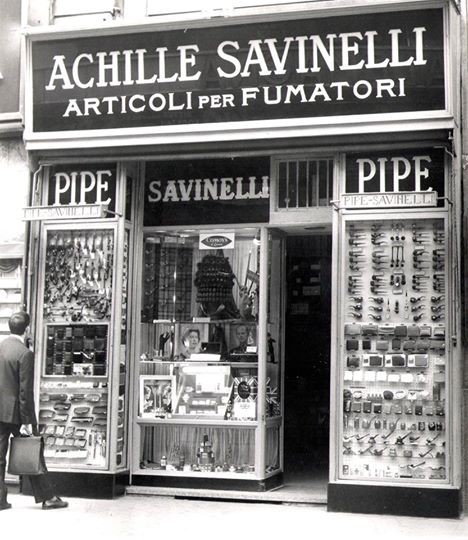
To learn more about the provenance of the Pipe Pub name I started my search in my regular go to sites – Pipedia.com and Pipephil.eu and came up with absolutely nothing.  I broadened my search on the internet by simply searching ‘Pipe Pub’ and ‘Pipe Pub Brigade’.  My initial findings had more to do with bagpipers, bagpipe brigades, Irish pubs and pipes…, all of these go well together!  Yet, I wasn’t finding anything that helped me with the Canadian looking back at me on my worktable.  I looked in my copy of Wilczak and Colwell’s ‘Who Made that Pipe?’ and found nothing giving me a direction.  Usually, when I face the brick wall my response is to send Steve an email.  With all his vast rebornpipes experience, surely, he’ll know something.  Steve’s response was quick and helpful:

Hi Dal

I have heard of it. Here is a link to one on Smoking pipes.com

https://www.smokingpipes.com/pipes/estate/england/moreinfo.cfm?product_id=200834

I would try to ferret out the shape number. For instance, on the one from Smoking pipes it is a 124… which interestingly is a GBD shape number for a Billiard. I wonder if the brand was not made by special order for pipe shops and stores. — Steve

I looked at the link and saw my first example another Pipe Pub pipe – a very nice classic Billiard.  I immediately looked again to see if I missed a shape number on the Canadian – I still saw no number.  But the other piece of information that Steve gave was helpful – the brand was perhaps a special order for pipe shops and stores.  I went back to Google not looking for pipes but for places named ‘Pipe Pub.’  I hit pay dirt and the dirt was surprising!  With the COM of the Canadian stamped indicating London, England, I had been expecting to find something that was UK based but instead, I found a reference for Pipe Pub that was based in the great US state of Texas – who would have thought?  Through several iterations of search parameters, I came across a Google Group chat stream that started in 1998 entitled, “Pipe Pub?” .  The question posed was about a Pipe Pub “almost Canadian” pipe that had the same nomenclature and stem ‘PP’ as mine, but the COM was stamped, ‘Italy’.  The questioner in the stream proposed a correlation with the Italian Savinelli name wondering if Pipe Pub might be a second of that well-known Italian pipe house?

The next response to Bro. R from Larry introduced the Texas connection:

Bro. R,

Back in the 70’s the mall tobacconists here in Austin, TX, were named Pipe Pub; they became Pipe World a little later.  I don’t know if, then or now, these businesses were strictly local or part of a larger chain.  I’m pretty sure they sold a store brand with their name on the pipes.  Today, Pipe World’s store brand pipes *are* made by Savinelli.

Larry

With these two entries, I knew that we were talking about the same pipe name – the ‘PP’ on the stem was the clincher.  Pipe Pub is a local Texas tobacconist which had pipes manufactured with the Pipe Pub name.  But there was more information that perhaps should be submitted to Pipedia!   The next entry I’m including in its entirely because it brings in much of the historical context with much color and the source of the information is a Jon Carter, who is described by Don Schram as a manager of Pipe Pub in the 80s.

Here’s the skinny on Pipe Pub, as related to me by Jon Carter, former manager of Pipe Pub from 1983 to 1987, who isn’t online as of yet. (Messages will be relayed to him through me at: dsc…@bigfoot.com ,however.)

Pipe Pub was started in the Houston area of Texas in the early 70’s with a single downtown store.  It was joined a short time later by a store located in the Austin, TX, area, which was owned and operated by a brother-in-law of the original founders (whose name escapes Jon for the moment).  While Pipe Pub wasn’t nationwide, they owned approx. 14 stores throughout Texas, primarily in the Houston area, and were much in competition with Tinderbox. (Comparable to Churchill’s in the S.E. Michigan area.)

The Pipe Pub pipe in question was confirmed by Jon to be a pipe from this chain.  The letters ‘PP’ in script on the stem indicate that the bit is original, and you are correct in that it stands for Pipe Pub.  As far as the age, there is no definite method of dating this pipe, however; Pipe Pub only carried their own line of ‘Private Label’ pipes between the early 70’s and 1983 when they were phased out in favor of higher grade (and higher priced) pipes, to coincide with the Texas oil boom of the 80’s.  Jon was not able to confirm positively that the pipe is indeed of Savinelli make (second or otherwise), however, he did point out that Pipe Pub did have an excellent relationship with the Savinelli company, as they were allowed to carry and sell the rare Savinelli 0000 (Quadruple-ought) Autograph, of which only 3 have been produced in the last century.  Jon also pointed out that he and another manager sold it to a gentleman who worked for the telephone company to complete a collection of Savinelli Autographs.  (He went to the bank and took out a $5000 loan for it.  The bank, initially thought he was purchasing ‘oil drilling pipe’, but gave him a personal loan for the tobacco pipe anyways.  He kept it in a lock box for a while, then finally broke it out and smoked it for the first time during the 1986 or 1987 Superbowl.)

To round out the history of Pipe Pub, the chain was bought out, save one store, in 1985 by a family, by name of Kowalski, who turned the tobacco chain into a chain of mall knick-knack stores.  (Sound all-too familiar Churchill’s customers?)  The one store, Pipe Pub in Austin, run by the brother-in-law, was not included in the deal, but it was agreed that he would change the name of the store.  Jon commented that the lone store may have changed its name to Pipe World, but wasn’t really privy to such information, as it was, more or less, operated as a renegade store.  The Kowalski’s opened one additional store in Louisiana, their home state, and promptly ran the chain right into the ground after one Christmas season, due to poor ownership and product focus.  Jon pointed out, “They carried vibrating pillows, for God’s sake!”  Forcing the company into bankruptcy, the Kowalski’s sold the chain back to the original owners, whom to his knowledge, still own it today.

For more information, Jon recommends calling down to Houston and asking information for their main office, which was on Mitchelldale.  [A search of Yahoo Yellow Pages came up empty, however there is a Carol’s Pipe Pub in Bacliff, TX, a suburb of Houston.  Phone (281) 488-7300.  It’s unknown if they’re related.]– DS (Don Schram.)

This information-filled post is dated, 1998.  On a hunch, I google the name of the offshoot store characterized as the ‘renegade’ store that wasn’t part of the reported 1985 Pipe Pub acquisition described in stream above.  As part of the legal agreement this store was required to change the name without further association with the Pipe Pub name.  Pipe World, based in Austin, and run by a “brother-in-law” family member came into existence – or, more accurately, carried on the original legacy of Pipe Pub under a different name because it seems that the new owners of Pipe World ran the company off the rails.  I found http://pipeworld.com/ with different locations in Texas and wondered if this was the same ‘Pipe World’ referenced above.

As I’ve done in the past with surprising success, I go directly to the front door and knock.  I went to the ‘Contact Us’ section on the Pipe World site and sent an email asking if anyone had been around long enough to know something about the history of the former, Pipe Pub Tobacconist out of which Pipe World came.  You never know what will happen! 

I received a reply to my email the same day from Pipe World – from Kyle who asked me to call directly if I had any questions.  Thankfully, I have an internet phone from Bulgaria and I called Kyle in Texas.  Kyle answered the phone and was extremely helpful.  His grasp of the history was amazing – he had been there during the whole transition.  I was totally taken off guard when I discovered through our conversation, that he was the owner of Pipe World.  His name is Kyle Haas.  He was the ‘brother-in-law’ referenced above who opened the new Pipe World and held firm to the values that had been true historically of Pipe Pub.

I enjoyed talking with Kyle, his recall of the events and his grasp of all the many moving parts of the tobacco industry fascinated me.  He was able to answer the primary question I had about the origin of the Pipe Pub pipes.  Definitively according to Kyle, during the 70s and early 80s, GBD/Comoy’s was producing the English line of pipes with the Pipe Pub name out of the London factory.  Pipe Pub pipes marked ITALY were all produced by the well-known Italian house of Savinelli.  He said that he doubted that Savinelli continued to do sub-contract work because they sell enough of their own pipes today to make it worthwhile.  He said that they had to order a lot of each shape as part of the requirements – I believe he said that they introduced a new shape each year.  He mentioned that the pipes that were produced in England and Italy with the Pipe Pub label were done with higher quality in mind.  I said that I could attest to this as I looked at the GBD/Comoy’s factory made Pipe Pub Canadian on my worktable.

Armed with Dal’s helpful information I now knew that my pipe was made for Pipe Pub as one of the yearly pipes for the shop. In this case it is a 1985 pipe and was #297 of 350 pipes which also fits the information above. In the last paragraph above Dal mentions that Kyle said that during the 70s and early 80s GBD/Comoy’s which I assume is Cadogan produced the English line of Pipe Pub pipes out of the London Factory. The Pipe I am working on definitely looks like a Comoy’s shape and I would bet that the France Stamp ties it to the Chacom factory (Chapuis-Comoy) in France.

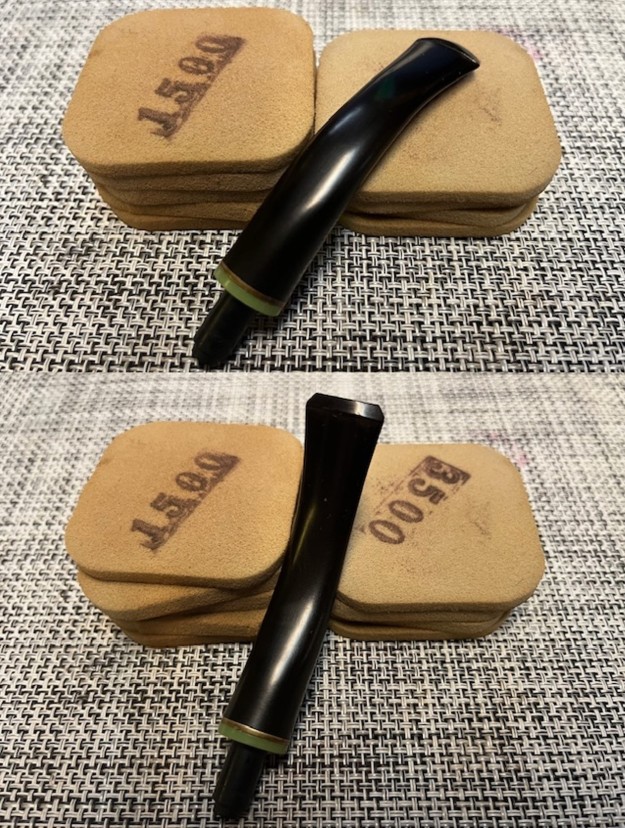
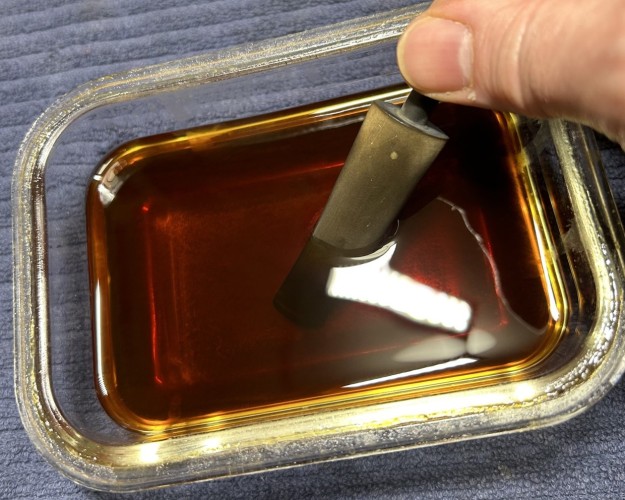
Armed with that information I turned to work on the pipe itself. Jeff had done a great job cleaning up the pipe as usual. He cleaned up the inside of the bowl with a PipNet reamer and a Savinelli Fitsall Pipe Knife. The bowl walls looked very good. He scrubbed the interior of the bowl and shank with shank brushes, pipe cleaners, cotton swabs and alcohol to remove the tars and oils. He scrubbed the exterior of the pipe with Murphy’s Oil Soap and a tooth brush to remove the grime from the finish. He worked on the rim top lava and darkening with the soap and tooth brush. He scrubbed the inside of the stem with alcohol and pipe cleaners. He scrubbed the exterior with Soft Scrub and then soaked it in Briarville’s Pipe Stem Deoxidizer. He washed it off with warm water to remove the deoxidizer. The pipe looked far better. I took photos of the pipe when I received it before I started working on it.  I took photos of the bowl and rim top to show how clean it was. The top and the inner edge of the rim show some darkening, nicks and scratches. The stem looks clean of debris and grime. There are light tooth marks and chatter on both sides of the stem.I took photos of the stamping on the sides of shank. The stamping is clear and readable (much clearer in person than the photos show). I took a photo of the pipe with the stem removed to show the overall look of stem, tenon and profile of the pipe. I polished the briar bowl and shank with micromesh sanding pads – dry sanding with 1500-12000 grit sanding pads. I wiped it down with a damp cloth after each pad to remove the debris. The bowl took on a rich glow. I rubbed the bowl down with Before & After Restoration Balm. I worked it into the surface of the briar with my fingertips to clean, enliven and protect it. I let the balm sit for 10 minutes and then buffed with a cotton cloth to raise the shine. Mark Hoover’s Balm is a product that I have come to appreciate and one I use on every pipe I have been working on. I set aside the bowl and turned my attention to the stem issues. I painted the surface of the stem with the flame of a Bic lighter to lift the tooth marks. I was able to lift all of them enough that sanding would finish blending them. I sanded the stem with 320-3500 grit sanding pads to further blend them in and smooth out the surface of the stem. I polished the vulcanite with micromesh sanding pads – 1500-12000 grit pads. I wiped it down with a damp cloth after each sanding pad. I used Before & After Pipe Polish – both Fine and Extra Fine to further polish the stem. I put the stem back on the Pipe Club 1985 Bent Billiard France and took it to the buffer. I worked over the smooth portions with Blue Diamond to polish out the remaining small scratches. I gave the bowl and the stem several coats of carnauba wax on the wheel and buffed the pipe with a clean buffing pad to raise the shine. I hand buffed it with a microfiber cloth to deepen the shine. The pipe polished up really well and the rim top and edge looked good. I was happy with the look of the finished pipe. The photos below show what the pipe looks like after the restoration. The oxblood stained Bent Billiard that is a beautiful and unique take on a classic shape. The polished vulcanite taper stem with the twin bands of brass and green acrlyic looks really good with the rich reds of the briar. The dimensions of the pipe are Length: 5 ¾ inches, Height: 2 inches, Outside diameter of the bowl: 1 ¼ inches, Chamber diameter: ¾ of an inch. The weight of the pipe is 1.94 ounces/55 grams. This is another pipe that I will be putting it on the rebornpipes store in the American Pipe Making Companies Section shortly, if you are interested in adding it to your collection. This Bent Billiard looks and feels great in the hand. This one should be a great smoker. Thanks for walking through the restoration with me on this beauty!

Repairing a Broken Tenon and Cracked shank on a Rusticated Kriswill Bernadotte Design 1210


Blog by Steve Laug

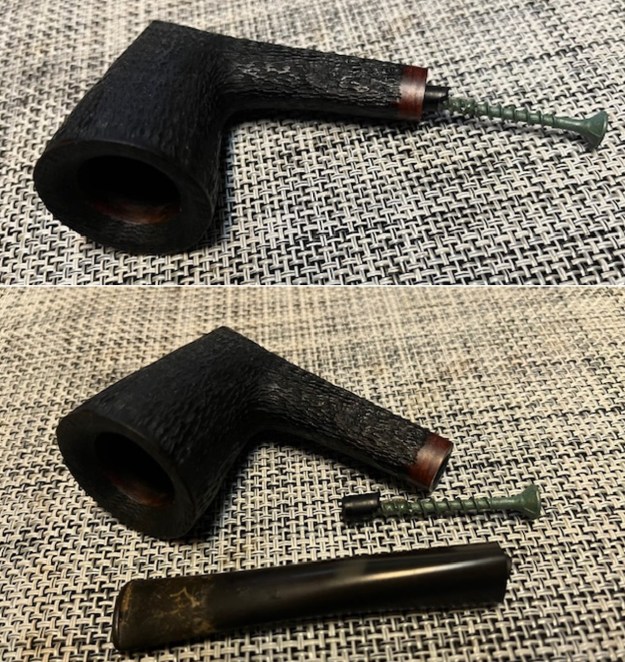
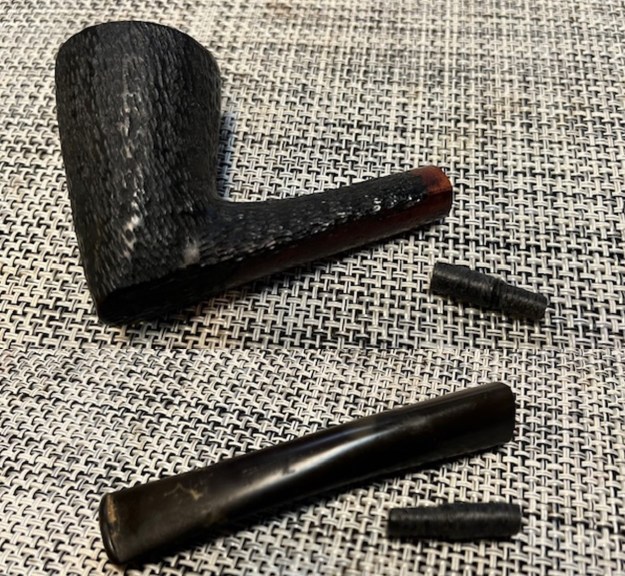
I decided to put my hand to something different this afternoon. I have been working on a lot of pipes that Jeff and I have purchased. The one on the table this after was a pipe that I received for repair from a fellow in Toronto. We had been chatting via email and phone about a nice Kriswill Handmade Bernadotte that he had purchased. When it arrived in Toronto the stem was stuck in the shank and in trying to remove it he had managed to snap the tenon in the shank. He wanted me to repair the tenon for him so I told him to ship it my way. He did a thorough cleaning of the bowl, shank and stem so it was in good condition. It arrived this week and I brought it to the work table and looked it over and put it back in the box. Today, Sunday afternoon I was ready to tackle the task. I took some photos of the bowl and the stem to give a sense my first impression as I looked at quickly.

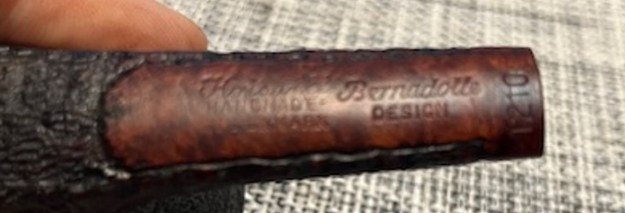
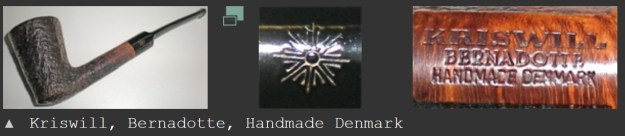
Here are my thoughts as I turned it over in my hands. The pipe has a conical shaped bowl that is pretty clean. There was little or no cake on the walls. The rim top was rusticated and quite clean. There was an inward bevel on the rim edge that was also clean and excellent condition. The shank was triangular with a smooth band on the shank end. There was a smooth panel on the underside of the shank that was stamped Kriswill [over] Handmade [over] in Denmark. That is followed by Bernadotte in script [over] Design in block letters. There is the shape number 1210 stamped on the end of the shank right along the edge. The tenon was snapped evenly in the shank leaving just a little bit of debris on the stem end. The tenon was stuck and I would need to do the freezer trick to remove it. The stem was lightly oxidized and there was debris and sticky marks from price tags on the stem surface. There were light tooth marks on both sides just ahead of the button. It really is a beautiful little pipe. I took a photo of the stamping on the smooth panel on the underside of the shank. It is clear and really readable as noted above.To start my work on the pipe I decided to pull the broken tenon from the shank. I used a screw and tuned it into the airway and it was very tight. I put the bowl in the freezer for 30 minutes and when I took it out the screw easily removed the broken tenon from the shank. I took photos of the process. Before I went any further in the process I decided to do a bit of background work on the pipe. I turned to Pipephil’s site first (http://www.pipephil.eu/logos/en/logo-k3.html). I did a screen capture of the section on the Kriswill Bernadotte Handmade in Denmark pipe. I have included it below and the pertinent sidebar information below that.Kriswill is a brand of Kriswork Briar Trading, in Kolding (Denmark) established about 1955.

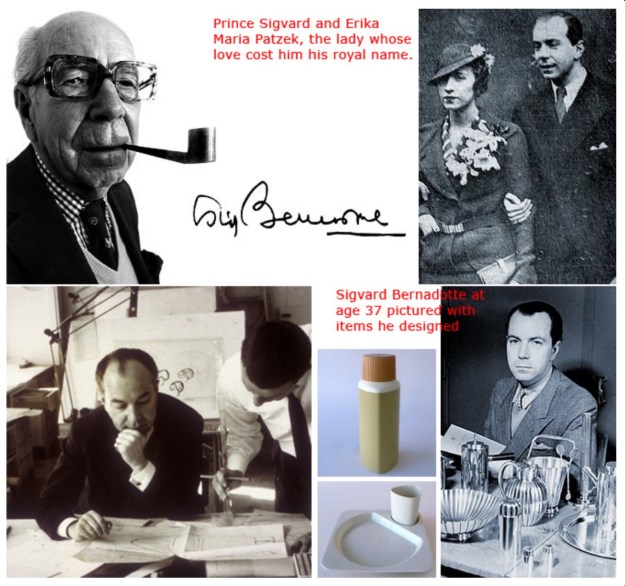
Some of Kriswill pipes were designed by Sigvard Bernadotte, Swedish prince and brother to the late Queen Ingrid of Denmark. He collaborated with his Danish partner Acton Bjørn.

At the end of the quote above there was a link to the photo below. It is a series of portraits of Sigvard Bernadotte the designer of the pipe that I am working on.

I turned to Pipedia (https://pipedia.org/wiki/Kriswill) for more detailed information. There is a great writeup there on the history of the brand that is fascinating. I have quoted the pertinent section below. I have also highlighted the connection to Sigvard Bernadotte in red in the last paragraph. He is one who designed his own series of pipes for Kriswill.

Kriswill began immediately after World War II. Karl Robert Kris, an engineer for the shipping company AP Møller at the time, was in port (undoubtedly in the Mediterranean) when he encountered a shipment of briar. The briar blocks awakened his curiosity and he took some home. About this time the the shipping trade become difficult due to the war, causing Kris to consider other business opportunities. In 1947, Kris (then 47 years old) established himself as a pipe maker in his hometown of Kolding.

Kriss started his pipe making operation in a house located at Haderslevvej 115 in Kolding, and was soon joined by 3-4 employees. The pipes were sold under the name Rocky and supplied the domestic market. Within 6 months the company had grown, more employees hired, and their sales expanded to markets abroad.

Due to increasing production and marketing, Karl Robert Kris decided in the mid-1950s to expand. An entirely new factory was built at Sdr. Ring road on the outskirts of Kolding. At that time the pipes were branded Kriswell. That name did not last long, however, as Stanwell believed that name was too close to theirs. The compromise was to change the name to Kriswill. Kriswill soon grew to become a serious competitor to Stanwell, especially in the export markets. The Kriswill factory logo, stamped on the stem, became the stylized compass rose – as a reference to the manufacturer’s maritime background.

Kriswill pipes excelled in design and craftsmanship. Karl Robert Kris was not afraid of new designs and had a good eye on the US market, where larger and more innovative designs were increasingly popular. Craftsmanship was given top priority throughout Kriswill’s production. A local designer / architect had designed the first models. Later, the famous architects Sigvard Bernadotte (Swedish prince and brother of Queen Ingrid) and Acton Bjørn designed their own series, which were known as Bernadotte designed.

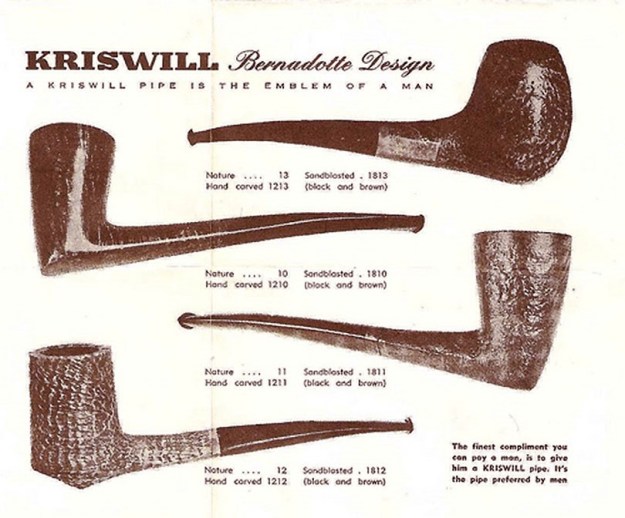
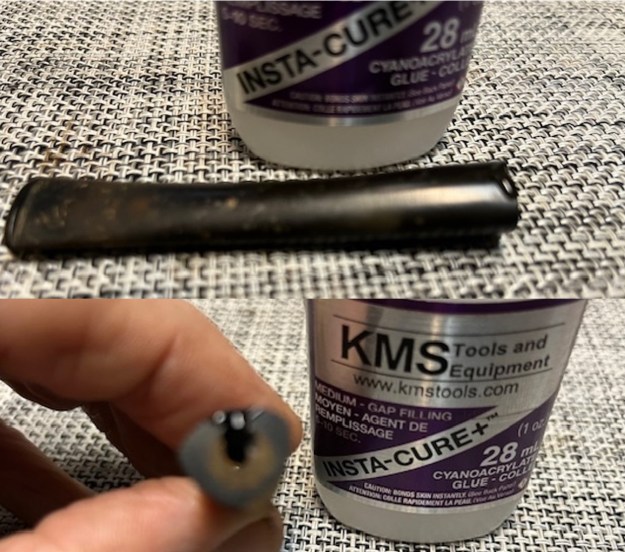
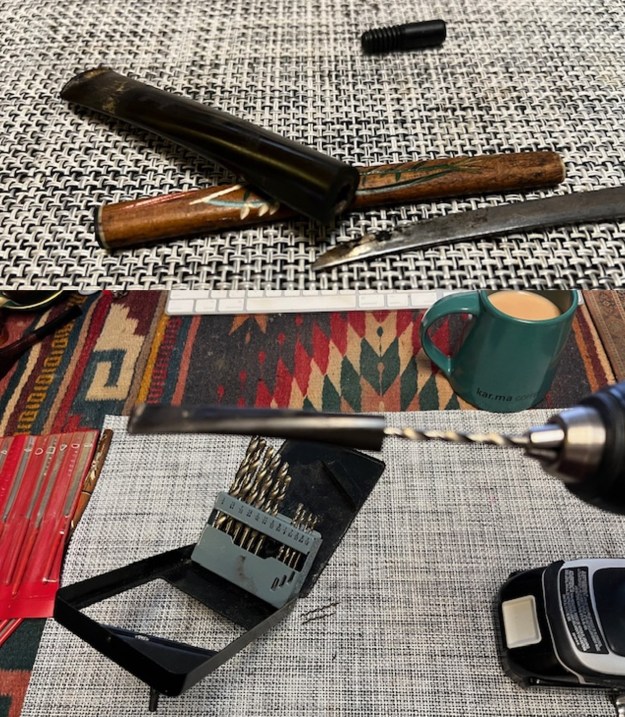
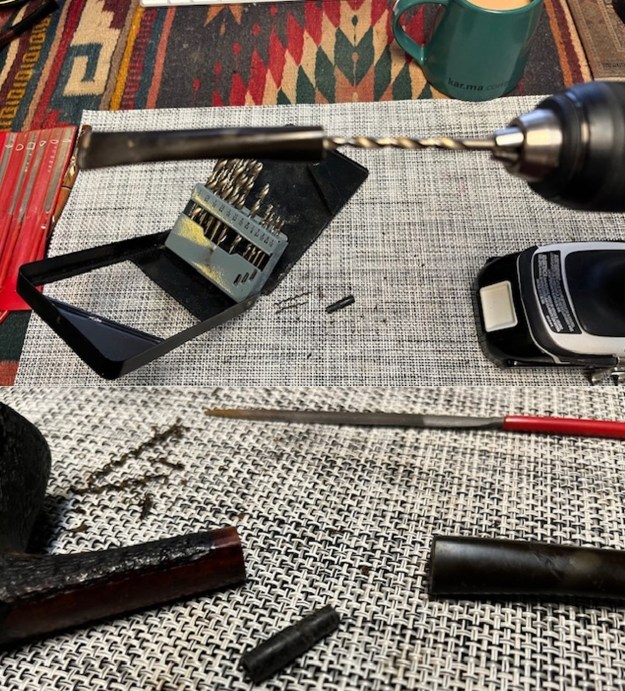
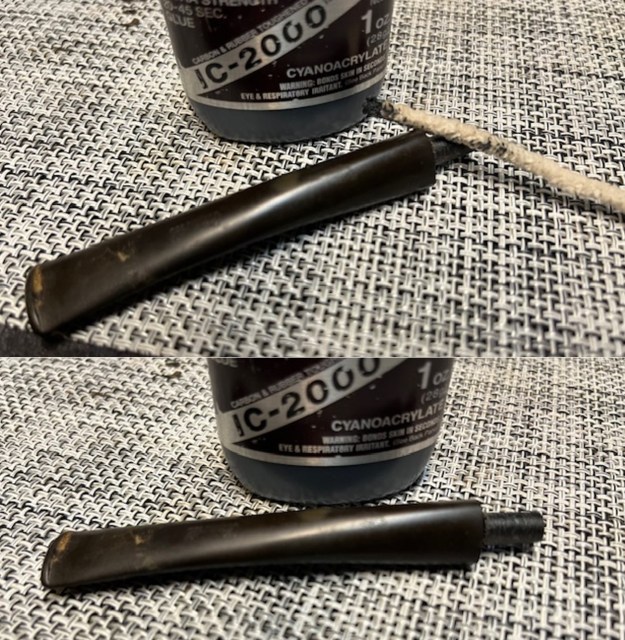
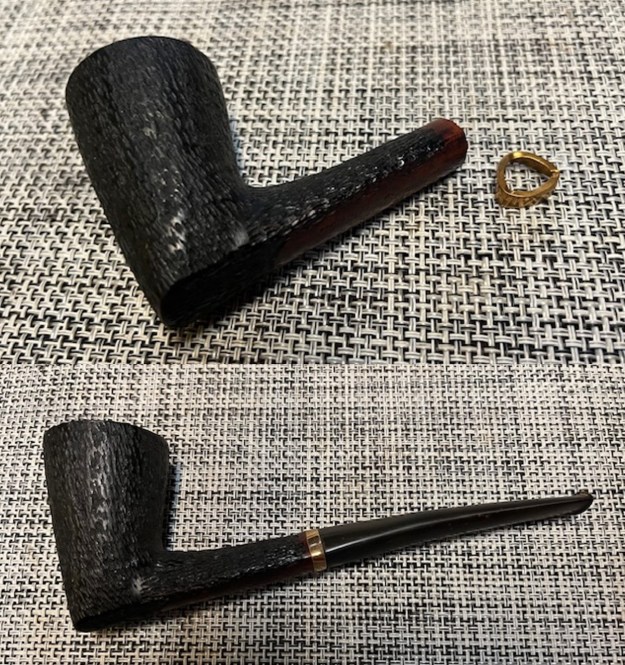
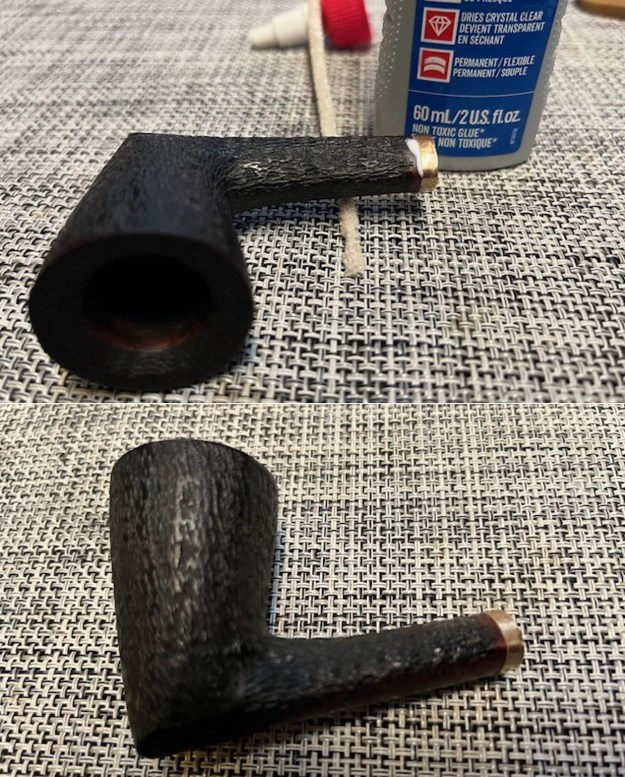
There was also a catalogue page on the Bernadotte Design line that shows the various pipes in the line. The second pipe down is the Hand carved 1210 which was made in black and in brown.I repaired chip and crack in the underside of the triangle shape stem with black CA glue. I wanted to do this prior to drilling the airway and opening it up for the new tenon end. I set the stem aside to let the repair cure.While I waited for the stem repair to cure I went through my tenons and found one that was very close in diameter to the shank. I reduced the diameter of the portion that would go into the stem with a Dremel and sanding drum. I repeated the process on the end of the tenon that would go in the shank. It was ready for the fit once the repair on the stem had cured and I was able to drill out the airway.I was a bit nervous drilling out the thin walled stem with the repair on the underside. I envisioned it splitting and ruining everything. I used a thin pen knife to begin the process of opening up the airway. I opened it to be large enough to take the first of the drill bits. I put the drill bit in my cordless drill and slowly turned it into the airway. I opened it up with several drill bit until the new tenon end fit in the stem. I cleaned up the airway with a set of needle files to make the airway the same diameter the depth of the drill. The fit in the stem was perfect. I painted the end of the tenon with black CA glue and pushed it in place in the airway. I set it aside to let the glue cure.I set the stem aside to allow the glue to cure. I wanted the tenon to be set in the stem so that once I put it in the shank it would not come out of the stem. I turned my attention to the bowl and shank. The shank had two small hairline cracks in in on the right side of the triangle. It would need to be glued and banded to accomplish a tight repair. I shaped a round brass band into a triangle and sanded it against a sanding board to thin the depth of the repair band. I fitted on the shank and put the stem in place to get a sense of what it would look like. I sent a few picks to the trustee in Toronto to show him what was going on. He approved of the repair.
I glued the band on the shank with some all purpose white glue. I painted the surface of the shank with the glue making sure to get into the cracks. I pressed the band on the shank and wiped off the excess glue with a damp cloth.I rubbed the briar down with Before & After Restoration Balm. I worked it into the briar with my fingertips and a horsehair shoe brush to work it into the nooks and crannies of the rusticated finish. The product works to clean, enliven and preserve the briar. I let it sit for 10 minutes then I buffed it with a cotton cloth to deepen the shine. The briar really comes alive with the balm. I set the bowl aside and turned to finish the stem. To address the scratches and marks in the surface of the vulcanite I sanded it with 320-3500 grit sanding pads. I wiped it down after each sanding pad with a damp cloth. By the final 3500 grit sanding pad the rim top had a shine.I polished the vulcanite with micromesh sanding pads – 1500-12000 grit pads. I wiped it down with Obsidian Oil after each sanding pad. I used Before & After Pipe Polish – both Fine and Extra Fine to further polish the stem. I always look forward to this part of the restoration when all the pieces are put back together. I put the Kriswill Bernadotte 1210 pipe back together and buffed it with Blue Diamond on the buffing wheel. I gave the bowl multiple coats of Conservator’s Wax and the stem multiple coats of carnauba wax. I hand buffed the pipe with a clean buffing pad to raise the shine. It is fun to see what the polished bowl looks like with the new brass band on the shank end. The combination of grain and the thin band add some elegance to the pipe when combined with the polished black vulcanite stem. This royalty designed Kriswill Bernadotte 1210 Skater is nice looking and feels great in my hand. The pipe is another light weight that could be clenched and smoked while doing other things as it is very well balanced. Have a look at it with the photos below. The dimensions are Length: 5 ¾ inches, Height: 2 inches, Outside diameter of the bowl: 1 ¼ inches, Chamber diameter: ¾ of an inch. The weight of the pipe is 1.06 ounces/30 grams. This one will be heading back to Toronto soon. I am looking forward to what the pipeman who sent it thinks of this restoration. Lots more to do in this lot! Thanks to each of you who are reading this blog. Remember we are not pipe owners; we are pipemen and women who hold our pipes in trust until they pass on into the trust of the next pipeman or woman.

Restoring a Beautiful Ropp Pneumatic Brevete S.G.D.G # 9105


Blog by Paresh Deshpande

This pipe now on my work table came to me from a lot of 40 pipes that I had purchased from a French seller on etsy.fr just before the outbreak of the pandemic. It’s a beautiful classic billiard shaped pipe with a bone stem and beautiful flame grains along the sides of the stummel and bird’s eye grain over the rim top and the foot of the stummel.

This perfectly proportioned light weight pipe has a medium sized bowl, equivalent to a size 4 Dunhill. The piece of briar is without a single fill and oozes very high quality. The copper band at the shank face adds a classy bling to the appearance of the pipe. The stampings on this pipe is one of the most elaborate that I have come across with “PNEUMATIC” over “BREVETE S.G.D.G” stamped across the left side of the shank at an upward angle. This is followed by “ROPP” in an oval towards the shank end. The right side of the shank is stamped as “RACINE” over “DE VIEILLE SOUCHE” in a downward incline. The shape code “9105” is stamped at its end on the right surface of the shank. The shank opening is lined by a metal ring that extends inside the mortise and is stamped on the metal face as “ROPP” over the upper portion and the lower surface bears the stamp “BREVETE S.G.D.G.”.I had worked on ROPP pipes before and had a fair idea of this French marquee. But it was the stampings which intrigued me and I also knew that I was working on a very early era ROPP and had to know more specific details of this line from ROPP.

I searched the internet and came across this site that had the exact same pipe for sale. The information I got from the description with a link to the website is reproduced below:

https://www.delcampe.net/en_US/collectibles/tobacco-related/pipes-accessories/heather-pipes/tres-rare-pipe-ropp-pneumatic-brevete-s-g-d-g-virole-en-argent-date-1897-ou-1898-a-loccasion-de-linstallation-a-baume-1103869216.html

VERY RARE PIPE ROPP PNEUMATIC patented S.G.D.G silver ferrule dates 1897 or 1898, on the occasion of the installation in Baume

This “Pneumatic” model dates from the very last years of the 19th century: 1897 or 1898, on the occasion of the installation in Baume.

I decided to break down my search parameters to get a better understanding of the stampings as seen on the pipe. I searched for BREVETE S.G.D.G and this is what Wikipedia revealed:-

https://en.wikipedia.org/wiki/Brevet%C3%A9_SGDG

Breveté SGDG was a French type of patent that ceased to exist in 1968. The name was a common abbreviation for “Breveté Sans Garantie Du Gouvernement“ (patent without government guarantees).

In France, the law of 1844 states that patents are issued “without prior examination, at the risk of the applicant and with no guarantee of function, novelty and merit of the invention also in terms of precision or accuracy of the description”.

I also visited various forums to know more about this line of pipes from ROPP. Here is an interesting conversation that I chanced upon on placedelours.superforum.fr and contained a thread discussing a ROPP pipe with similar stampings that were stamped in the exact same way as seen on the pipe currently on my worktable. I have reproduced an English translation of the thread below:-

http://placedelours.superforum.fr/t33004-pipe-ropp-pneumatic

vidu52
Hello to all of you,
For a long time I have been looking for this ROPP brand pipe, marked : PNEUMATIC patented S.G.D.G and with a diamond-shaped punch.

The ROPP brand I find many, but not a single marked “PNEUMATIC” ??
Long : 14 cm approx High 4.5 cm approx, Weight: 42 Grams
I turn to you to try to help me identify this pipe and if possible its degree of rarity.
In advance Thank you….

Nucingen
Very nice pipe, with silver ferrule

this “Pneumatic” model dates from the very last years of the XIXe century: 1897 or 1898, on the occasion of the installation in Baume.
You will know everything about the “Pneumatic” by reading pages 21, 29 and 34 of this very beautiful and interesting book :
https://issuu.com/romainbassenne/docs/ropp_livre_maquette_issuu

However, the link is either no longer active or may not be accessible from my location. In any event, if anyone is able to access it, it is requested to share the information therein on Pneumatic line of pipe from ROPP for info of readers.

https://pipedia.org/wiki/Ropp

Eugène-Léon Ropp (1830 – 1907) had acquired a patent for a cherrywood pipe (wild cherry, lat.: Prunus avium) in 1869. In 1870 he established a workshop to manufacture such pipes in Büssingen (Bussang, Vosges mountains). Around 1893 the business moved into the former mill of Sicard (part of the community of Baume-les-Dames – Département Doubs, Upper Burgundy – from 1895 on).

The pipes were a big success in the export as well. Shortly before 1914 Ropp designated A. Frankau & Co. (BBB) in to be the exclusive distributor in the UK and it’s colonies.

Probably in 1917 a workshop in Saint-Claude in the Rue du Plan du Moulin 8 was acquired to start the fabrication of briar pipes. In 1923 a small building in the environment of Saint-Claude, serving as a workshop for polishing, was added.

Even though cherrywood pipes were the mainstay of Ropp until the company finally closed down in September 1991. The company was taken over by Cuty-Fort Entreprises (Chacom, Jeantet, Vuillard, Jean Lacroix…) in 1994.

I was still not satisfied with the research of this pipe. This pipe has some of the most detailed stampings that I have seen on any pipe. I have deciphered the stampings of ROPP, PNEUMATIC and BREVETE S.G.D.G. The stampings of RACINE, DE VIEILLE SOUCHE yet remains to be understood. Now, my French is what my mother tongue Marathi is to you. I searched the internet for translation and this is what I found.

(a) RACINE: – Root.

(b) DE VIEILLE: – Old stock.

(c) SOUCHE: – Stump.

These stampings together do make sense implying that the briar used to carve this pipe is an old stock briar root stump.

Though the discussion thread and description of the similarly stamped pipe stated above places this pipe to be from the period 1897/ 98, the lack of pictures of the tenon on that pipe and being unable to access the link leading to the book on the PNEUMATIC line of ROPP, I cannot conclusively place the pipe on my work table to be from the period 1897/ 98.

The aluminum tenon in a bone stem with an elliptical slot makes me inclined to place this pipe from during the WW II era, which is from 1940 to 1945/ 6.

That said this pipe is definitely an old timer and is being added to my personal collection.

Initial Visual Inspection
The pipe, as it sits on my work table, is dirty with a thin layer of cake in the chamber, a stummel that is covered in dust and grime and a tapered bone stem that has tooth indentations on either surface in the bite zone. Here are a few pictures of the pipe before I proceed with a detailed visual inspection of each part of the pipe. Detailed Visual Inspection
A thin layer of cake lines the walls of the chamber. There is no accumulation of overflowing crud over the rim surface but slight darkening is seen to the aft of the rim surface. The rim edges, both outer and inner, are sans any dents and dings. The rim top surface, however, shows a number of dents and dings likely caused due to either strikes against a hard edge or due to uncared for storage of the pipe.The stummel surface has attracted dust and dirt giving it a dull lackluster and lifeless appearance. There are a few scrub marks over the surface but these should be easily addressed during the polishing process. The briar wood has taken on a nice dark patina from the years of handling and smoking. It will be my endeavor to preserve and highlight this aspect. The stampings on the shank surface are all crisp and clearly discernible. The shank end of the stummel is adorned with a copper band. The unique feature of this pipe is a metal spacer that is stamped on the face as BREVETE and S.G.D.G as mentioned above. This spacer extends in to the mortise and is lined with cork extending up to an inch or so. The mortise is relatively clean with minor traces of residual ash and oils/ tars. The horn stem has a nice light and bright appearance with bite marks and tooth indentations on either surface in the bite zone. There are a couple of superficial cracks over the stem surface and should be addressed once the stem is sanded and polished. I think these superficial cracks are primarily the result of drying of the bone material. The long aluminum tenon is tapered and cinched at the tenon end to match the mortise opening. The tenon surface is clean but would benefit from some cleaning and polishing. The elliptical slot and tenon end shows traces of old residual oils and gunk. The button edges show a couple of minor teeth marks and would need to be sharpened. The Restoration Process
Whether to start with stem or the stummel refurbishing has always being a source of conflict for me as stem repairs and refurbishing almost always takes the longest time and efforts and hence prudent to be worked on first while the allure of unrevealing the beautiful grains of the briar weighs in favor for its refurbishing first. Well in ibid case, the lovely patina and straight grains won and I decided to start working on the stummel.

I started the process of refurbishing by reaming the chamber first. Using reamer head sizes 1 and 2 of the PipeNet pipe reamer, I took the cake down to the bare briar. The amount of carbon that was dislodged from the chamber was really surprising as I had appreciated a thin layer of carbon and the quantity of carbon that was removed was anything but a thin layer. With my fabricated knife, I removed all the cake and took it down to the bare briar. I further sand the chamber wall with a folded piece of 180 grit sandpaper to smooth out the wall and remove the last bit of stubborn carbon that remained stuck to the chamber. To finish the reaming process, I wiped the chamber walls with a cotton swab dipped in alcohol to clean the last traces of residual carbon dust. I was happy to note a clean and well seasoned solid chamber.Next, I cleaned out the shank internals. Early on, I realized that I could not pass a pipe cleaner trough the draught hole due to blockages in the shank airway. I used a modified poker tool to push through and dislodge this block of dried oils and gunk. I further scraped out all the dried and crumbly oils and tars from the walls of the mortise with my dental tool. I cleaned out the mortise and shank walls with pipe cleaners dipped in alcohol. I shall continue further cleaning of the shank and mortise while going through the other processes.Now on to de-ghosting the pipe…. I packed the chamber with cotton balls and drew out a wick from the cotton and along with a folded regular pipe cleaner, inserted it into the mortise and through the draught hole into the chamber. I tightly packed cotton balls in to the remaining portion of the mortise. Thereafter, I soaked the cotton balls with isopropyl alcohol up to the brim. About half an hour later, the level of alcohol had gone down, having being absorbed by the cotton. I topped it up once again and set it aside overnight. By next afternoon, the cotton and alcohol had drawn out all the remaining oils and tars from the chamber and mortise. I removed the cotton balls and ran pipe cleaners through the mortise and draught hole to clean out all the loosened tars and gunk that was lodged in the draught hole and mortise. The chamber and mortise now smelled clean, fresh and looked it too. I set the stummel to dry out naturally.With the night still being young and not wanting to break the momentum of work as the stummel soaked in cotton and alcohol bath, I decided to use the time to address the stem issues. I first ran a few pipe cleaners dipped in alcohol through the stem airway and they came out very dirty. To conserve pipe cleaners, I put off further cleaning of the airway and would continue the internal cleaning using shank brushes and oil soap under warm water. With a sharp dental tool, I scraped out the dried oils and gunk from the slot end and tenon face. I also cleaned the aluminum tenon surface with a cotton swab wetted with isopropyl alcohol.Continuing with the stem cleaning, I followed the internal cleaning of the stem with cleaning the airway using thin shank brushes and anti oil dish cleaning soap. I ran a couple of pipe cleaners to clean and dry out the airway. Using Scotch Brite pad and oil soap; I cleaned out the entire gunk from the aluminum tenon, elliptical slot end and the stem surface.The last agenda for the day before I turned in for the night was to address the bite marks on either surface in the bite zone. I cleaned the surface with alcohol on a cotton swab in preparation of the surface for a fill. I filled the deep tooth indentation in the bite zone on the upper stem surface with clear medium CA superglue. Once the fill had hardened sufficiently, I similarly filled the tooth indentation in the lower stem surface. I set the stem aside for the fills to cure.By the time I again sat at my work table the next evening, the alcohol and cotton had leached out all the old oils from the chamber walls and the stem fills had cured too.

Next, I proceeded to clean the exterior of the stummel. I used a hard bristled tooth brush, Scotch Brite pad and Murphy’s Oil soap to scrub the stummel and rim top. For this stummel cleaning, I used Murphy’s Oil soap as I wanted to preserve the old patina that had developed on the stummel and this product really helps in cleaning the briar surface. After the scrub with oil soap, I washed the stummel under running warm water with anti oil dish washing detergent till the stummel surface was clean and dried it using paper towels and soft cotton cloth. I simultaneously cleaned the shank internals with the detergent and hard bristled shank brush and set the stummel aside to dry out. That the shank end is internally lined with cork is now apparent after the cleaning and this further restricts the cleaning process, adding caution to the equation while further cleaning the shank internals. I was fortunate that the alcohol bath has not loosened and removed this cork lining. To aid in the drying process, I heat the stummel under a 100 watt filament bulb as it is very important that the briar is completely dry as presence of slight moisture leads to growth of fungus over the surface subsequently.With the stummel set aside for drying, I used a needle file to sand the stem fill to achieve a rough match of the filling with the rest of the stem surface. To achieve a better blend, I sand the fill with a folded piece of 180 grit sandpaper. I also worked the button edges to a crisp edge with the file. By no means is the blending complete and shall be continued with during the sanding and polishing process.To bring a deep shine to the horn stem, I went through the complete set of micromesh pads, wet sanding with 1500 to 12000 grit pads. I wiped the stem with moist cloth after each pad and rubbed it down with Extra Virgin Olive oil to rejuvenate the horn which is very prone to drying and developing cracks over the surface. The finished stem is shown below.Remember the stummel that had been set aside to dry out under the bulb? Well, in the while that I completed the repairs and initial polishing of the stem, the briar had completely dried out and was ready to be worked on further.

The issue that needed immediate attention was the number of dents and dings over the rim top surface. To address it, I topped the surface over a piece of 220 grit sandpaper till these damages all but disappeared. I am quite pleased with the appearance of the rim top at this stage.I followed it by wet sanding the entire stummel with 1500 to 12000 grit micromesh pads, wiping frequently with a moist cloth to check the progress. I really like the looks of the stummel at this point in restoration. The grains and the clean lines of this piece of briar is really appreciable. Next, I rubbed a small quantity of “Before and After Restoration Balm” deep in to the briar with my finger tips and let it rest for a few minutes. The balm almost immediately works its magic and the briar now has a nice vibrant appearance with the beautiful grain patterns displayed in their complete splendor. I further buffed it with a horse hair brush. The contrast of the dark browns of the Bird’s eye and straight grains with the dark natural patina of the rest of the stummel adds an interesting dimension to the appearance of the stummel that cannot be insufficiently described in words and be rather seen in person. I have now reached the homestretch in this restoration project. To complete the restoration, I mounted a cotton cloth buffing wheel on to my hand held rotary tool and polished the stummel and stem with Blue Diamond compound. This compound helps in polishing and also in removing the minor scratch marks that remained from the sanding process. I mounted another cotton buffing wheel that I have earmarked for carnauba wax and applied several coats of the wax. I finished the restoration by giving the entire pipe a rigorous hand buffing using a microfiber cloth to raise the shine further. The finished pipe looks amazingly beautiful and is ready to join my collection. I only wish it could share with me its life story of the past years while I enjoy smoking my favorite Virginia blend in it or maybe an English blend or maybe just keep admiring it!!!! Big thank you to all the readers who have joined me on this path by reading this write up as I restored and completed this project. P.S.: I came across an interesting flyer/ advertisement bearing the stamp  “RACINE, DE VIEILLE SOUCHE” in French language. I have included the same here and would be happy to receive any information on the pipe in English for the sake of enhancing my knowledge on this pipe.Thank you once again for your time and assistance.

ADDENDUM – Pages 21,29 and 34 of the French Ropp Book (Ropp, ça ne fume plus). Kenneth Lieblich scanned the pages and translated them for Paresh.

Translation of the highlighted parts of page 21

Trademarks were registered for each of his creations: La Cosaque, La Pneumatic and La Norvégienne appeared at the beginning of the century, between 1904 and 1908. According to the INPI records, these brands were intended to be affixed to the pipes, smoking accessories and other handmade items as well as cases, boxes, packaging of pipes… The reasons for choosing most of these names are unknown.

Regarding La Pneumatic, we can see a link with current events. In fact, the tire was invented in 1888 by Irishman John Boyd Dunlop and the removable tire by Michelin in 1891. Its use became widespread at the beginning of the 20th century. Another pipe was named Pipe des aviateurs (1909) when, on July 25, 1909, Louis Blériot succeeded in crossing the Channel by plane for the first time.

Each pipe had several varieties of shapes, sizes and ornaments. La Pneumatic could be fitted with a fancy band: gold, silver or other metal; in straight or bent models; of medium to very large size; and with oval or round bowls. Then, the types of briar evolved with the appearance in 1910 of Cum-mer root, Cum-mer briar, blood briar and blood root, recalling both the raw material used and its particular red grain.Translation of the highlighted parts of page 29

To explain the changes, Ropp cited three main reasons: moving towards thinner pipes, the choice of raw materials and the improvements made to the different systems. These developments had made the pipe a “clean, practical and elegant” accessory. The fact that the brand sought to constantly modernize itself, while paying attention to consumer demand, was also an important selling point. The ads spoke of “the important technical research” which allowed the factory to frequently employ new manufacturing processes or new models. La Pneumatic system, developed when the company set up in Baume-les-Dames, was one of the manufacturing processes most appreciated by smokers.Translation of the highlighted parts of page 34

At the start of the 20th century, system pipes and other inventions aimed at better health were very popular with French smokers. Concerns about the harmful effects of tobacco and nicotine were in vogue, as were concerns about hygiene: pipes were sometimes difficult to clean and maintain. These were different from filter pipes since the piece inserted into the stem did not absorb the condensation but only stopped it. These system pipes, with different variations, appeared healthier and more hygienic. La Pneumatic is one of the system pipes that Ropp put on the market and patented. A separate ferrule was housed inside the stem while a piece of cork, providing friction, made it easier to separate the stem from the stummel and also made cleaning easier.

Restoring a Lovely Frasorteret Hand Made in Denmark Freehand


Blog by Steve Laug

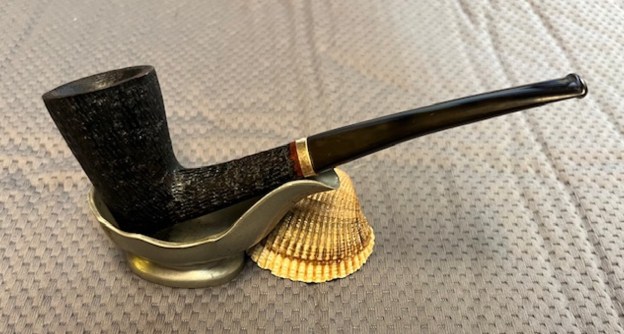
The next pipe on the table is a rugged, sandblast Freehand with a smooth rim and plateau shank end. It had a fancy, turned saddle vulcanite stem. We purchased it from a seller on eBay from Jordan, Minnesota, USA on 01/22/2024. The pipe is stamped on the underside of the shank and reads Frasorteret [over] Hand Made [over] In [over] Denmark. The rim was in good condition other than lava overflowing from the thick cake in the bowl onto the smooth rim top. It is hard to assess the condition of the inner edge of the rim due to the cake and lava overflow. There may be some darkening or damage at the back of the bowl but I cannot be sure. There were oils and grime ground into the bowl sides gives the finish a flat look. The fancy saddle stem is dirty, with grime and grit on the surface. There were also tooth marks on both the top and underside of the stem just ahead of the button. Jeff took photos of the pipe before he started his clean up work. I have included them below. He took photos of the pipe’s bowl and rim top to show the cake in the bowl and the lava coat overflowing onto the top. It is another dirty pipe. He also took photos to capture the tooth marks on the top and underside of the stem near the button. He took photos of the sides and heel of the bowl to show the grain around the bowl and the amount of grime ground into the surface of the briar.   He took photos of the stamping on the underside of the shank. It is faint but still quite readable. I had a memory that Frasorteret pipes came from the creative carving of Preben Holm so I wanted to do some checking. I turned to Pipephil’s site (http://www.pipephil.eu/logos/en/logo-f4.html). It tied the line to Preben Holm but there was not too much more information at this point.I turned to Pipedia (https://pipedia.org/wiki/Frasorteret) to gather further information. There the information was a bit clearer about the tie. Here is the information.

The Frasorteret line of pipes were made by Preben Holm and were nearly identical to his normal line of pipes but for fills and pits and the like. The pipes were stamped Frasorteret Made in Denmark. I took a photo of the rim top to show the condition. You can see the clean bowl. The bowl is in excellent condition and is clean. The rim top and the inner edge shows a lot of damage and burn marking on the bowl. The stem came out looking clean. There were definitely deep tooth marks and chatter on both sides. I took photos of the stamping on the shank. It is faint but still very readable. I removed the stem from the shank and took a photo of the pipe parts to show what I was working with.I started my work on the pipe by addressing the damage on the inner edge of the rim. I used a folded piece of 220 grit sandpaper to smooth out the roughness. I then used 220 grit sandpaper and a wooden ball to give the inner edge of the bowl a slight bevel. It looked much better at this point in the process. I sanded the briar rim top and the sides of the bowl with 320-3500 grit sanding pads. I wiped the bowl down with a damp cloth after each pad. By the time I finished with the 3500 grit pad the briar had taken on a rich glow.I went over the sandblast finish on the bowl and shank with a brass bristle wire brush to knock off the debris in the grain. Once finished it looked much better. It was ready for the next work on the rim and shank end. I worked over the plateau shank end with the wire brush to prepare it for the traditional black stain. I touched it up with a black stain pen making sure that all the grooves and surfaces were evenly stained. Once the stain cured I sanded it with a 320 grit sanding pad to knock the stain off the high spots on the plateau to give a sense of contrast to the plateau. It looked very good once I had finished doing that. I polished the smooth rim top with micromesh sanding pads – dry sanding with 1500-12000 grit sanding pads. I wiped it down with a damp cloth after each pad to remove the debris. The crowned rim top took on a rich glow. I rubbed the bowl down with Before & After Restoration Balm. I worked it into the surface of the briar with my fingertips and a horsehair shoe brush to clean, enliven and protect it. I let the balm sit for 10 minutes and then buffed with a cotton cloth and shoe brush to raise the shine. Mark Hoover’s Balm is a product that I have come to appreciate and one I use on every pipe I have been working on. I set aside the bowl and turned my attention to the stem. I “painted” the stem surface with the flame of a lighter. I was able to lift the tooth marks significantly. There were still some deep marks. I filled them in with a coat of clear CA glue and spread it across the surface with a dental spatula.Once the repairs cured I flattened them with a small file. I started the process of blending them into the surface of the surrounding vulcanite. I sanded it with 220 grit sandpaper to clean up the file marks and smooth out the surface of the stem. I moved on to further smooth out the surface of the vulcanite. I sanded it smooth with 320-3500 grit sanding pads to further blend them into the surface of the stem.I polished the vulcanite with micromesh sanding pads – 1500-12000 grit pads. I wiped it down with Obsidian Oil after each sanding pad. I used Before & After Pipe Polish – both Fine and Extra Fine to further polish the stem. It really took on a shine and I knew that once it was buffed it would look amazing. I put the stem back on the Preben Holm Hand Made in Denmark Frasorteret Sandblast Freehand and took it to the buffer. I worked it over with Blue Diamond to polish out the remaining small scratches. I gave the bowl and the stem several coats of carnauba wax and buffed the pipe with a clean buffing pad to raise the shine. I hand buffed it with a microfiber cloth to deepen the shine. The pipe polished up really well and the rim top looked good. I was happy with the look of the finished pipe. The photos below show what the pipe looks like after the restoration. The Frasorteret Sandblast Smooth Rim Top Freehand is a beautiful and very Preben Holm take on a Freehand shape. The polished vulcanite fancy saddle stem looks really good with the browns of the briar. The dimensions of the pipe are Length: 7 inches, Height: 2 inches, Outside diameter of the bowl: 1¾ inches x 2 inches, Chamber diameter: 1 inch. The weight of the pipe is 2.26 ounces/64 grams. This is another pipe that I will be putting it on the rebornpipes store in the Danish Pipe Makers Section shortly, if you are interested in adding it to your collection. The long shank and tall bowl look and feel great in the hand. This one should be a great smoker. Thanks for walking through the restoration with me on this beauty!

A Rather Sad, Well Used Peterson March 17, 2009 B2 Bulldog


Blog by Steve Laug

In January Jeff found out about an estate sale in Pocatello, Idaho, USA. It turned out that the sale was for a fellow Jeff and I had purchased pipes from in the past, Gene. He had been the owner of Outwest Tobacco in Pocatello (long closed now) and I bought tobacco and other smoking items from him in the past. As I think about it now, it seems that I had known Gene for over 30 years Jeff and I had been to his home and enjoyed coffee and a few pipes together. I have no idea how many pipes we bought on those visits as well as to the antique shop of his daughter. I know that there were many pipes. When we heard that it was Gene’s personal collection that was for sale and that he had passed away we decided for Jeff to go to the house and have a look. He went on January 25, 2024 to scope it out as we had seen his personal collection of pipes and there were definitely some among those well smoked old warriors that would be great to pick up. Perhaps there would even be one that could join my own collection in memory of Gene.

Jeff went to the house and looked through the racks, pipe bags, tobacco – both bulk and tinned as well as a variety of pipes. All the pipes were well smoked and needed serious cleaning. Another one of the pipes that he picked up was this Peterson March 17 2009 with a black vulcanite taper fish tail stem. It was very dirty and was a reddish, brown coloured pipe when it started. The smooth finish around the bowl was dirty and had hand oils ground into the grooves. The bowl had a thick cake that overflowed in lava onto the rim edge and top of the bowl. The bottom of the bowl was flattened so the pipe could be set on a desktop. The stem was vulcanite that was very dirty and had the marks of a rubber Softee Bit on the end. It had become discoloured and there was a line where the debris from smoking had accumulated along the edge and under the bit protector. The good news was that there were only light tooth marks or chatter. The rest of the stem was dirty and had lost the characteristic shine. The pipe was stamped on the polished nickel band on the shank and read Peterson [arched over] a Shamrock with March 17 2009 arched underneath. On the right side of the shank it was stamped with the shape number B2. Jeff took photos of the pipe so I could have a sense of what it looked like before he started his work on it.Jeff took photos of the stem surfaces and the bowl and rim to give a sense of condition of the pipe. You can see the thick cake in bowl and the lava overflow on the edges and rim top of the bowl. It is had to know if there is any damage as the cake and lava is quite thick. The stem surface is very dirty and you can see the area on the end of the stem where the Softee Bit had protected it from chewing but had left it dirty and discoloured. The stem no longer fit in the shank correctly. He also took photos of the sides of the bowl and the heel to show the interesting grain that went around the bowl. There were a few spots on the right side of the bowl that seemed to have a flaw or a shrunken fill. The grain is beautiful and you can see the oils and debris in the grooves of the rim cap.  He took photos of the stamping on the nickel band on the left side of the shank. He did not capture shape number on the right side. The stamping on the band is clear and readable as noted above.I did a bit of searching on the internet to see what I could find. Interestingly turning to Peterson’s Pipe Notes I found the pipe I have in my hand (https://petersonpipenotes.org/tag/st-patricks-day-pipe-2009/). Note that in Mark Irwin’s information below the date he gives for the shape I have is 2010 but the band on mine is definitely marked 2009. Ah well another Peterson anomaly. Either way it is a nicely shape Irish Bulldog.Now it was my turn to work on the pipe. Jeff had done an amazing cleanup of the pipe. He reamed the light cake with a PipNet reamer and cleaned up that with a Savinelli Fitsall Pipe Knife. He scrubbed the internals of the bowl and stem with alcohol, cotton swabs and pipe cleaners. He scrubbed the externals with undiluted Murphy’s Oil Soap and rinsed the bowl off with running water. He soaked the stem in Briarville’s Pipe stem Deoxidizer and once it had soaked rinsed it off with warm water to remove the residual solution. He dried it off and rubbed it down to remove any oxidation that was still on the stem. The pipe looked very good when I received it. I took a photo of the rim top to show the condition. You can see the clean bowl. The bowl is in excellent condition and is clean. The rim top has a small burn mark on the front inner edge and darkening on the back of the rim top and edges. The stem came out looking good. There were definitely light tooth marks and chatter on both sides. I took a photo of the stamping on the shank. The first photo shows that there is no stamping on the briar but the nickel band stamp is very clear. The shape number, B2 on the right side of the shank is also very clear. There was a faint remnant of the P stamp on the left side of the stem.  I removed the stem from the shank and took a photo of the pipe parts to show what I was working with. I also took photos of the pipe with the longer Churchwarden stem in place. It is a nice looking pipe. I started my work on the pipe by addressing the damage on the inner edge of the rim. I used a folded piece of 220 grit sandpaper to smooth out the roughness. I then used 220 grit sandpaper and a wooden ball to give the inner edge of the bowl a slight bevel. It looked much better at this point in the process. I touched up the stain on the rim top with a Cherry Stain Pen and the match to the rest of the bowl is perfect. Once the bowl is finished it will blend very well.I sanded the briar rim top and the sides of the bowl with 320-3500 grit sanding pads. I wiped the bowl down with a damp cloth after each pad. By the time I finished with the 3500 grit pad the briar had taken on a rich glow. The pipe had cleaned up so well that I turned to polish the briar with micromesh sanding pads. I dry sanded it with 1500-12000 grit sanding pads and wiped the bowl down after each pad with a damp cloth. By the final pads the briar really had a shine. I rubbed the briar down with Before & After Restoration Balm. I worked it into the briar with my fingertips and a horsehair shoe brush to work it into the nooks and crannies of the sandblast finish. The product works to clean, enliven and preserve the briar. I let it sit for 10 minutes then I buffed it with a cotton cloth to deepen the shine. The pipe really comes alive with the balm. I set aside the bowl and turned my attention to the stem. I “painted” the stem surface with the flame of a lighter. I was able to lift the tooth marks significantly. Those that remained were more like waves in the stem surface. I filled them in with a coat of clear CA glue and spread it across the surface with a dental spatula. Once the repairs cured I sanded it with a folded piece of 220 grit sandpaper to flatten it further. I sanded it with 320-3500 grit sanding pads to further blend them in and smooth out the surface of the stem.The P stamp on the left side of the stem was faint but I thought I would give it a shot and see how it work. I painted the stamp with white acrylic fingernail polish and let it dry. Once it had dried I scraped off the excess and polished it with a worn 1500 grit micromesh sanding pad. It was faint though it is still readable.I polished the vulcanite with micromesh sanding pads – 1500-12000 grit pads. I wiped it down with Obsidian Oil after each sanding pad. I used Before & After Pipe Polish – both Fine and Extra Fine to further polish the stem. I put the stem back on the Peterson March 17 2009 B2 Bulldog and took it to the buffer. I worked it over with Blue Diamond to polish out the remaining small scratches. I gave the bowl and the stem several coats of carnauba wax and buffed the pipe with a clean buffing pad to raise the shine. I hand buffed it with a microfiber cloth to deepen the shine. The pipe polished up really well and the rim top looked good. I was happy with the look of the finished pipe. The photos below show what the pipe looks like after the restoration. The Peterson St. Patrick’s Day March 17, 2009 Irish Bulldog is a beautiful and unique take on a classic shape. The polished vulcanite taper stem looks really good with the browns of the briar. The dimensions of the pipe are Length: 5 ½ inches, Height: 2 inches, Outside diameter of the bowl: 1 ¼ inches, Chamber diameter: ¾ of an inch. The weight of the pipe is 2.08 ounces/60 grams. This is another pipe that I will be putting it on the rebornpipes store in the Irish Pipe Makers Section shortly, if you are interested in adding it to your collection. The long shank and tall bowl look and feel great in the hand. This one should be a great smoker. Thanks for walking through the restoration with me on this beauty!

New Life for a Fischer Imperial Long shank Canadian Stack


Blog by Steve Laug

The next pipe on the table is a smooth finished long shank Canadian with a tall bowl and a vulcanite stem. We purchased it from a seller on eBay from Jordan, Minnesota, USA on 01/22/2024. The pipe is stamped on the topside of the shank and reads Fischer. On the underside of the shank it is stamped Imperial. The rim was in good condition other than a lot of lava overflowing from the thick cake in the bowl onto the smooth rim top It is hard to assess the condition of the inner edge of the rim due to the cake and lava overflow. There may be some darkening or damage at the back of the bowl but I cannot be sure. There were oils and grime ground into the bowl sides gives the finish a flat look. The short taper stem is a dirty stem with grime and grit on the surface. There were also tooth marks on both the top and underside of the stem just ahead of the button. It appears that there may be some small pin hole bite through marks on the underside ahead of the button. Jeff took photos of the pipe before he started his clean up work. I have included them below. He took photos of the pipe’s bowl and rim top to show the cake in the bowl and the lava coat overflowing onto the top. It is another dirty pipe. He also took photos to capture the tooth marks on the top and underside of the stem near the button. You can also see the pinhole tooth punctures on the underside. He took photos of the sides and heel of the bowl to show the grain around the bowl and the amount of grime ground into the surface of the briar. He took photos of the stamping on the top and undersides of the shank. It is clear and quite readable.I turned to Pipephil’s site (http://www.pipephil.eu/logos/en/logo-f2.html) and looked up the Fischer brand. I found the listing below and have included both a screen capture and the side bar notes. The stamping is the same as the one on the pipe I am working on.
Store closed in 1978. Former address: House of Fischer, 1722 Boston Ridge Road, Orchard Park, NY.

I then turned to the listed for US pipe makers/manufacturers (https://pipedia.org/wiki/Fischer) to see if I could find out more information. I have included the article below.

Gustave Fischer was pipe maker for “The House of Fischer’, which was located in Orchard Park, NY, near Buffalo.  The Fischer family apparently made pipes for six generations, starting in Germany and continuing in the United States until the 1970s. Their literature from 1956 said that all their briars were bench made. They also made meerschaums, but some confusion is caused by the fact that there was also Gustav Fischer, who made meerschaum pipes in Boston during roughly the same period.

The article went on to give information on the Fischer from Orchard Park, NY. I quote from that below.

The following information is gleaned from a thread on PipesMagazine.com

PIPES BY THE HOUSE OF FISCHER, ORCHARD PARK NY
Fischer pipes were made in USA through the 1950’s up to late 1978 when the owner, Paul Fischer retired, sold the store and moved to Florida in 1978. Unfortunately, The House of Fischer did not use a date stamp on their pipes, and therefore it is not possible to determine the exact date of manufacture.

Lee Pattison writes the following:

The Fischer shop in Buffalo closed in the late 1950’s last run by Arthur Fischer who moved shop to his home in Orchard Park. Arthur was the last of the family and retired 1978. Early pipes made in shop in Buffalo were stamped Buffalo in loop below name. Art deleted this from the stamp in early on 1960’s which helps in partial dating. Art did only pipe repair and sales. An unconfirmed report from a pipe maker Milton Kalnitz from the same era stated that the later pipe may have been made by Weber. Paul Fisher was part of the unrelated family in Boston Mass. The Buffalo shop started about 1890’s. Source of info was personal contact with family.

FISCHER PIPE QUALITY GRADE STAMPS
This is a list of various Fischer pipe stampings from my personal collection of over sixty Fischer pipes accumulated over the past forty plus years. It is by no means meant to be all-inclusive, however, if you find more Fischer pipe stampings please email me so I can update my list.

  1. Fischer Supreme
  2. Fischer Royal
  3. Fischer Imperial
  4. Fischer Golden 15
  5. Fischer 15 Grand
  6. Fischer 25 Grand
  7. Fischer Ramsgate
  8. Fischer Deluxe
  9. Fischer Special
  10. Fischer Texan (for which they applied for a patent)
  11. Fischer Seconds

The list of Quality Grade Stamps is very helpful. The pipe I am working on is noted in number 3 above. It is a Fischer Imperial and has some great grain on the bowl and shank. I also learned that is was made after the removal of the Buffalo stamp on the shank in the early 1960s.

Armed with that information I turned to work on the pipe itself. Jeff had done a great job cleaning up the pipe as usual. He cleaned up the inside of the bowl with a PipNet reamer and a Savinelli Fitsall Pipe Knife. The bowl walls looked very good. He scrubbed the interior of the bowl and shank with pipe cleaners, cotton swabs and alcohol to remove the tars and oils. He scrubbed the exterior of the pipe with Murphy’s Oil Soap and a tooth brush to remove the grime from the finish. He worked on the rim top lava and darkening with the soap and tooth brush. He scrubbed the inside of the stem with alcohol and pipe cleaners. He scrubbed the exterior with Soft Scrub and then soaked it in Briarville’s Pipe Stem Deoxidizer. He washed it off with warm water to remove the deoxidizer. The pipe looked far better. I took photos of the pipe when I received it before I started working on it. I took photos of the bowl and rim top to show how clean it was. The top and the inner edge of the rim show some darkening, nicks and scratches. The stem looks clean of debris and grime. There are tooth marks and chatter on both sides. There are also tooth marks on the underside of the stem.I took photos of the stamping on the top and undersides of the shank. The stamping is clear and readable (though fainter on the underside). I took a photo of the pipe with the stem removed to show the overall look of stem, tenon and profile of the pipe. I started my work on the pipe by addressing the damage on the inner edge of the rim. I used a folded piece of 220 grit sandpaper to smooth out the roughness. I then used 220 grit sandpaper and a wooden ball to give the inner edge of the bowl a slight bevel. It looked much better at this point in the process. I sanded the briar rim top and the sides of the bowl with 320-3500 grit sanding pads. I wiped the bowl down with a damp cloth after each pad. By the time I finished with the 3500 grit pad the briar had taken on a rich glow. I polished the briar bowl and shank with micromesh sanding pads – dry sanding with 1500-12000 grit sanding pads. I wiped it down with a damp cloth after each pad to remove the debris. The bowl took on a rich glow. I rubbed the bowl down with Before & After Restoration Balm. I worked it into the surface of the briar with my fingertips and a horsehair shoe brush to clean, enliven and protect it. I let the balm sit for 10 minutes and then buffed with a cotton cloth and shoe brush to raise the shine. Mark Hoover’s Balm is a product that I have come to appreciate and one I use on every pipe I have been working on. I set aside the bowl and turned my attention to the stem issues. I took photos of the stem surface to show the deep tooth marks on the top and the small holes on the underside of the stem just ahead of the button.I greased a pipe cleaner with Vaseline and inserted it below the bite throughs on the underside of the stem surface to keep the repair out of the airway in the stem. I filled in the deep tooth marks on the topside of the stem and the bite throughs on the underside with Black rubberized CA glue. I set it aside to let the glue cure. Once the repairs cured I used a file to flatten out the repairs and start blending them into the stem. surface. I sanded it with a folded piece of 220 grit sandpaper to flatten it further. I sanded it with 320-3500 grit sanding pads to further blend them in and smooth out the surface of the stem.I polished the vulcanite with micromesh sanding pads – 1500-12000 grit pads. I wiped it down with a damp cloth after each sanding pad. I used Before & After Pipe Polish – both Fine and Extra Fine to further polish the stem. I put the stem back on the Fischer Imperial Long Canadian and took it to the buffer. I worked it over with Blue Diamond to polish out the remaining small scratches. I gave the bowl and the stem several coats of carnauba wax and buffed the pipe with a clean buffing pad to raise the shine. I hand buffed it with a microfiber cloth to deepen the shine. The pipe polished up really well and the bevelled rim top looked good. I was happy with the look of the finished pipe. The photos below show what the pipe looks like after the restoration. The long shank tall Canadian is a beautiful and unique take on a classic shape. The polished vulcanite taper stem looks really good with the browns of the briar. The dimensions of the pipe are Length: 7 inches, Height: 2 ¼ inches, Outside diameter of the bowl: 1 ¼ inches, Chamber diameter: 7/8 of an inch. The weight of the pipe is 1.90 ounces/54 grams. This is another pipe that I will be putting it on the rebornpipes store in the American Pipe Makers Section shortly, if you are interested in adding it to your collection. The long shank and tall bowl look and feel great in the hand. This one should be a great smoker. Thanks for walking through the restoration with me on this beauty!

Breathing New Life into an Antique Shell 1021 EX Rusticated Pot


Blog by Steve Laug

The next pipe on the table is large rusticated finished Pot. We purchased it from an Antique Mall in Ogden, Utah, USA on 07/23/2023.The pipe is stamped on the underside of the shank on a smooth panel and reads Antique [over] Shell followed by the shape number 1021 EX. The rim was in good condition other than a lot of lava in the finish overflowing from the thick cake in the bowl. There was grime ground into the bowl sides. The rusticated finish was oily and dirty. The stem is oxidized and calcified. It had light tooth marks on both the top and underside of the stem just ahead of the button. Jeff took photos of the pipe before he started his clean up work. I have included them below.He took photos of the rim top to show the cake and the dust in the rustication on the top. It is another dirty pipe. He also captured the tooth marks on the top and underside of the stem near the button. There is also a spot of blue paint on the top of the stem. He took photos of the sides and heel of the bowl to show the rustication around the bowl and the amount of grime ground into the surface of the briar.   He took photos of the stamping on the underside of the shank. It is clear and quite readable. I turned Pipephil’s section on Savinelli pipes and found the Antique Shell listed there with and an example of the stamping on both the shank and the stem. The stamping on the bowl matches the one that I am working on (http://www.pipephil.eu/logos/en/logo-savinelli1.html). I turned to Pipedia and looked up the specifics of the Antique Shell line from Savinelli and read through the article. There were several pictures of the stamping but nothing on the details (https://pipedia.org/wiki/Savinelli).

I knew that I was working on a Savinelli Made Pot that had the unique Antique Shell style of rustication. Now it was time to work on the pipe.

Jeff had done his usual thorough cleanup on the pipe. He reamed the bowl with a PipNet pipe reamer and followed up with a Savinelli Fitsall pipe knife to remove the cake. He scrubbed out the mortise and the airway in the shank and the stem with alcohol, cotton swabs and pipe cleaners. He scrubbed the exterior of the bowl, rim, shank and stem with a tooth brush and Murphy’s Oil Soap to remove the oils and tars on the rim and the grime on the finish of the bowl. He rinsed it under running water. He dried it off with a soft cloth. He cleaned the internals and externals of the stem with alcohol, pipe cleaners and cotton swabs. He soaked the stem in Before & After Deoxidizer and rinsed it off with warm water and cleaned out the airway in the stem with alcohol. The pipe looked very good. I took a photo of the rim top and stem to show the condition. They cleaned up really well and the top of the rim and inner looked very good. Some of the stain lightened around the top and inner edge of the bowl. The vulcanite saddle stem had tooth chatter and marks on both sides ahead of the button and on the button edges.I took a photo of the stamping on the underside of the shank. It read as noted above. I removed the stem and took a photo of the pipe to give a sense of the whole. It is a well shaped large Pot in the Antique line with the EX stamp.Now it was time to do my work on the pipe. I started by restaining the rim top and inner edges of the bowl. I used a Walnut stain pen to match the rest of the bowl colour.Since it was clean and looked good I rubbed the bowl and shank down with Before & After Restoration Balm. I worked it into the surface of the rusticated bowl sides and shank with my fingertips and a horsehair shoe brush to clean, enliven and protect the briar. I let the balm sit for a little while and then buffed with a cotton cloth to raise the shine. It helped to give depth to the tight rustication around the bowl. The final buffing would bring the pipe alive. I set the bowl aside and turned my attention to the stem. I painted the stem with the flame of a Bic lighter to raise the tooth dents in the vulcanite. I filled in the dents that remained with CA glue to repair them. I sanded the stem with the 2 inch square 320-3500 grit sanding pads. I wiped down the stem after each sanding pad. I was able blend in the repairs on both sides with the pads. The stem looked very good.I polished the vulcanite stem with micromesh sanding pads – 1500-12000 grit pads. I wiped it down with a damp cloth after each sanding pad. I used Before & After Pipe Polish – both Fine and Extra Fine to further polish the stem.   This beautiful tightly rusticated Savinelli Made Antique Shell 1021 EX Pot with a vulcanite saddle stem is a great looking pipe now that it has been restored. The rich Antique Shell coloured finish came alive with the polishing and waxing. The dimensions of the rustication really popped. I put the stem back on the bowl and carefully buffed the pipe with Blue Diamond on the buffing wheel using a light touch on the briar. I gave the bowl multiple coats of Conservator’s Wax and the stem multiple coats of carnauba wax on the buffing wheel. I buffed the pipe with a clean buffing pad to raise the shine. I hand buffed the pipe with a microfiber cloth to deepen the shine. The finished Antique Shell 1021 EX Pot is a beauty and fits nicely in the hand and looks very good. Give the finished pipe a look in the photos below. The dimensions of the pipe are Length: 6 inches, Height: 1 ¾ inches, Outside diameter of the bowl: 1 ¾ inches, Chamber diameter: 1 inch. The weight of the pipe is 2.22 ounces/63 grams. I will be adding it to the Italian Pipe Makers Section soon. If you are interested in adding this pipe to your collection send me a message or an email. Thanks for reading this blog and my reflections on the pipe while I worked on it. There are many more to come!