Tag Archives: stem work

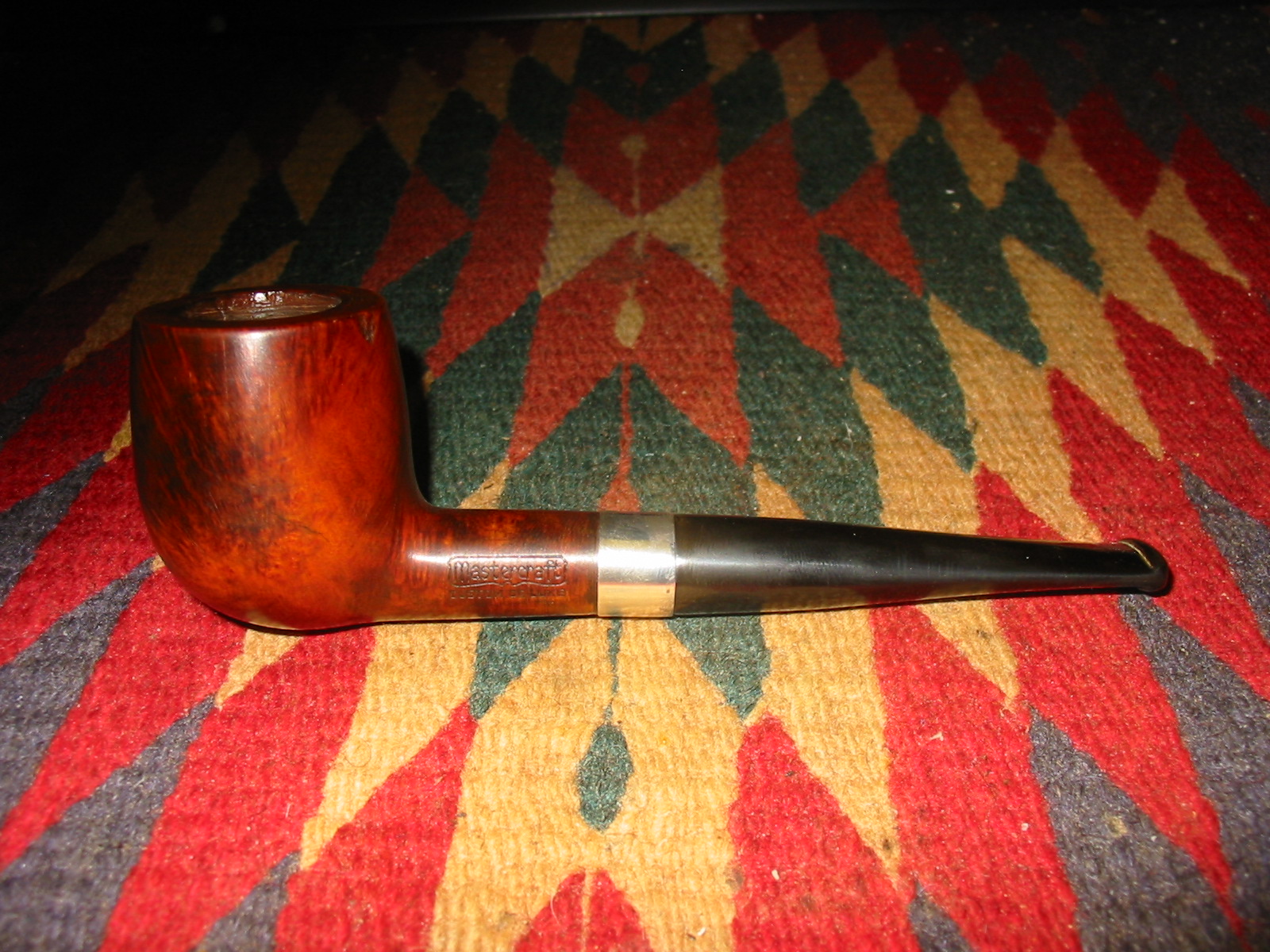
A Renewed WDC Bakelite and Briar Pipe Restemmed


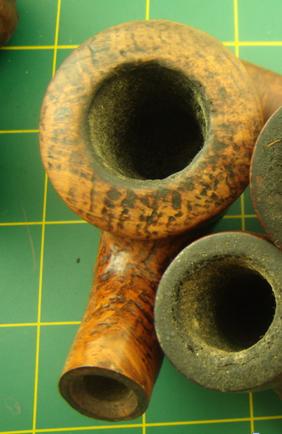
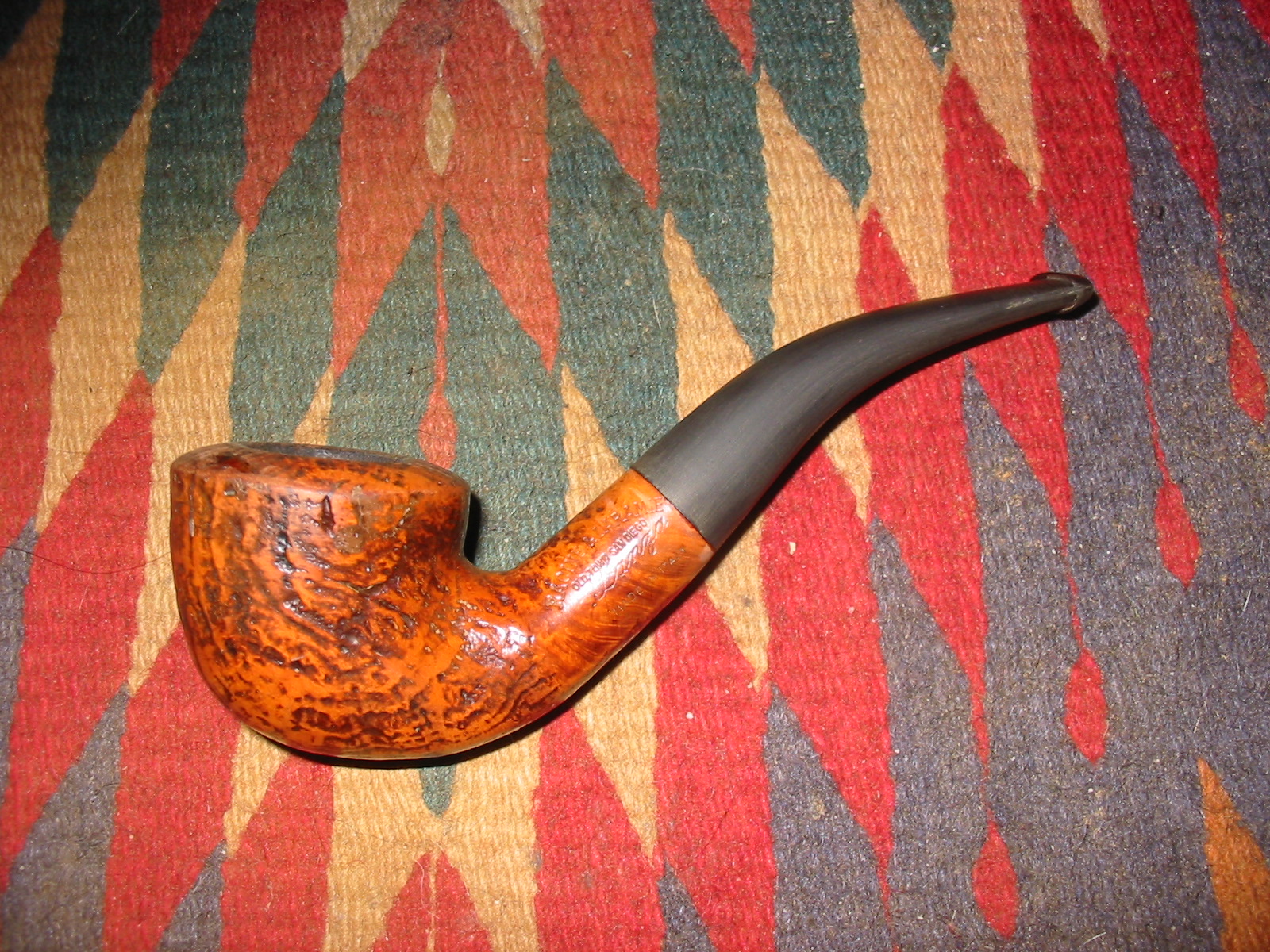
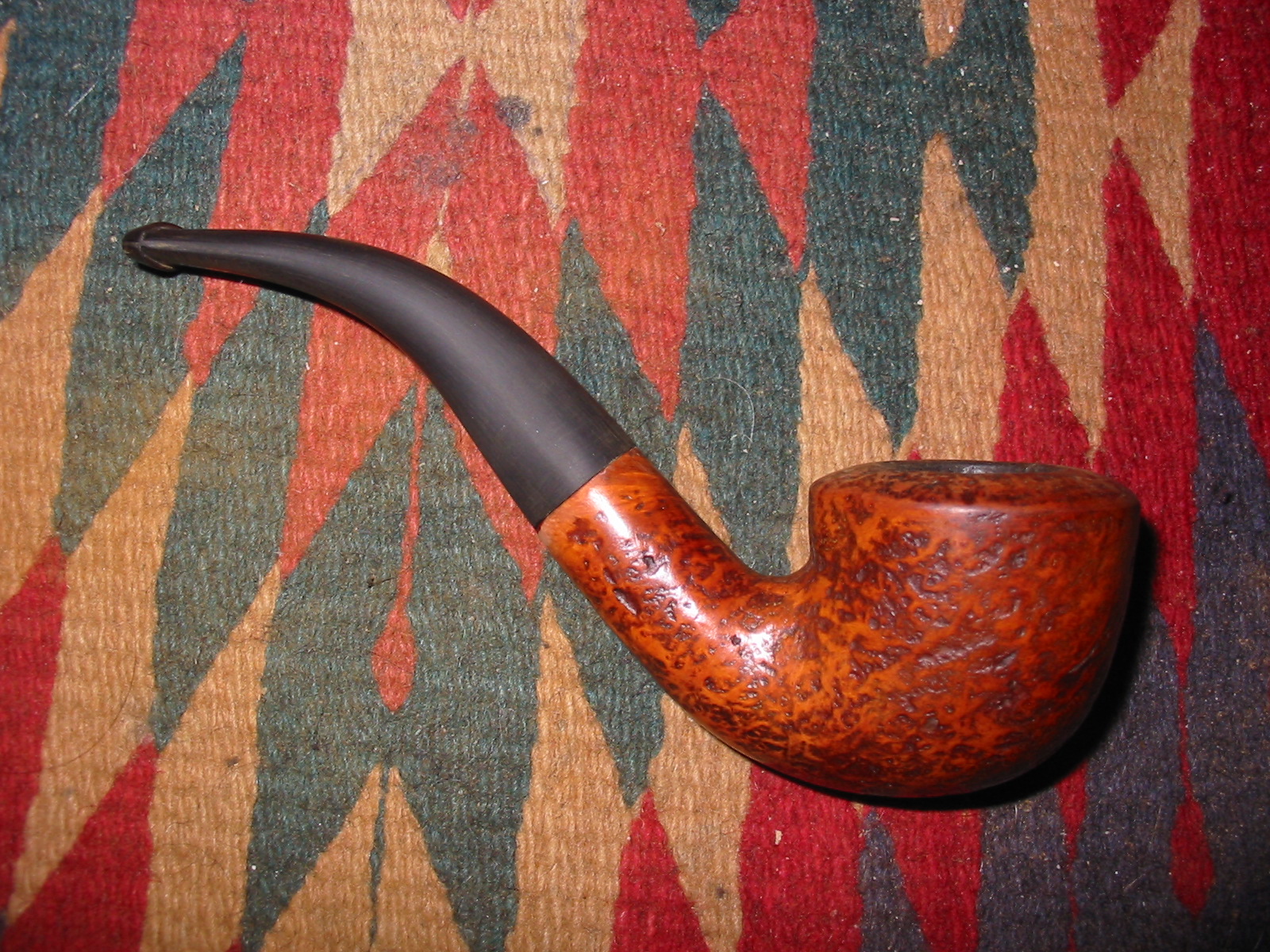
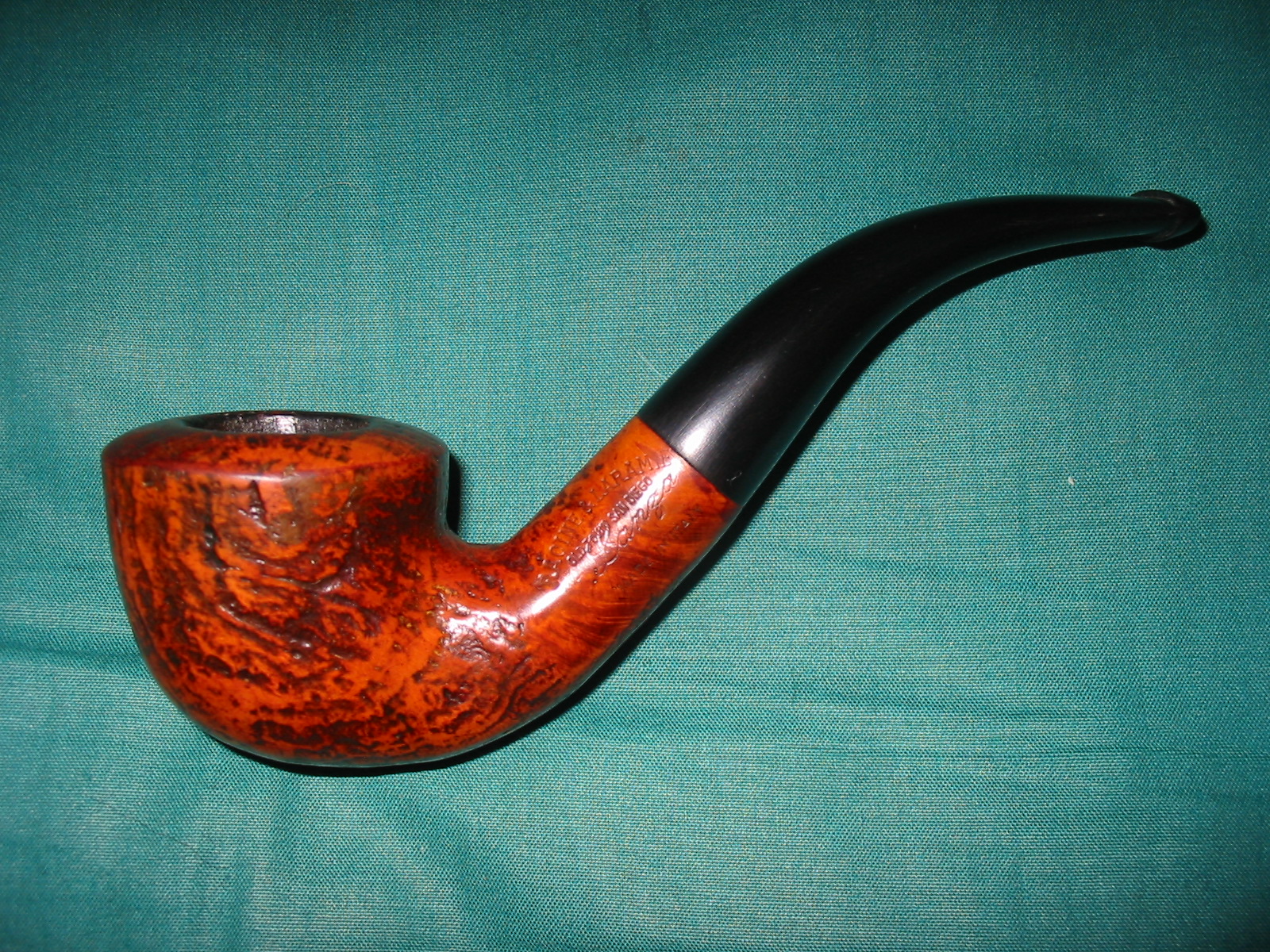
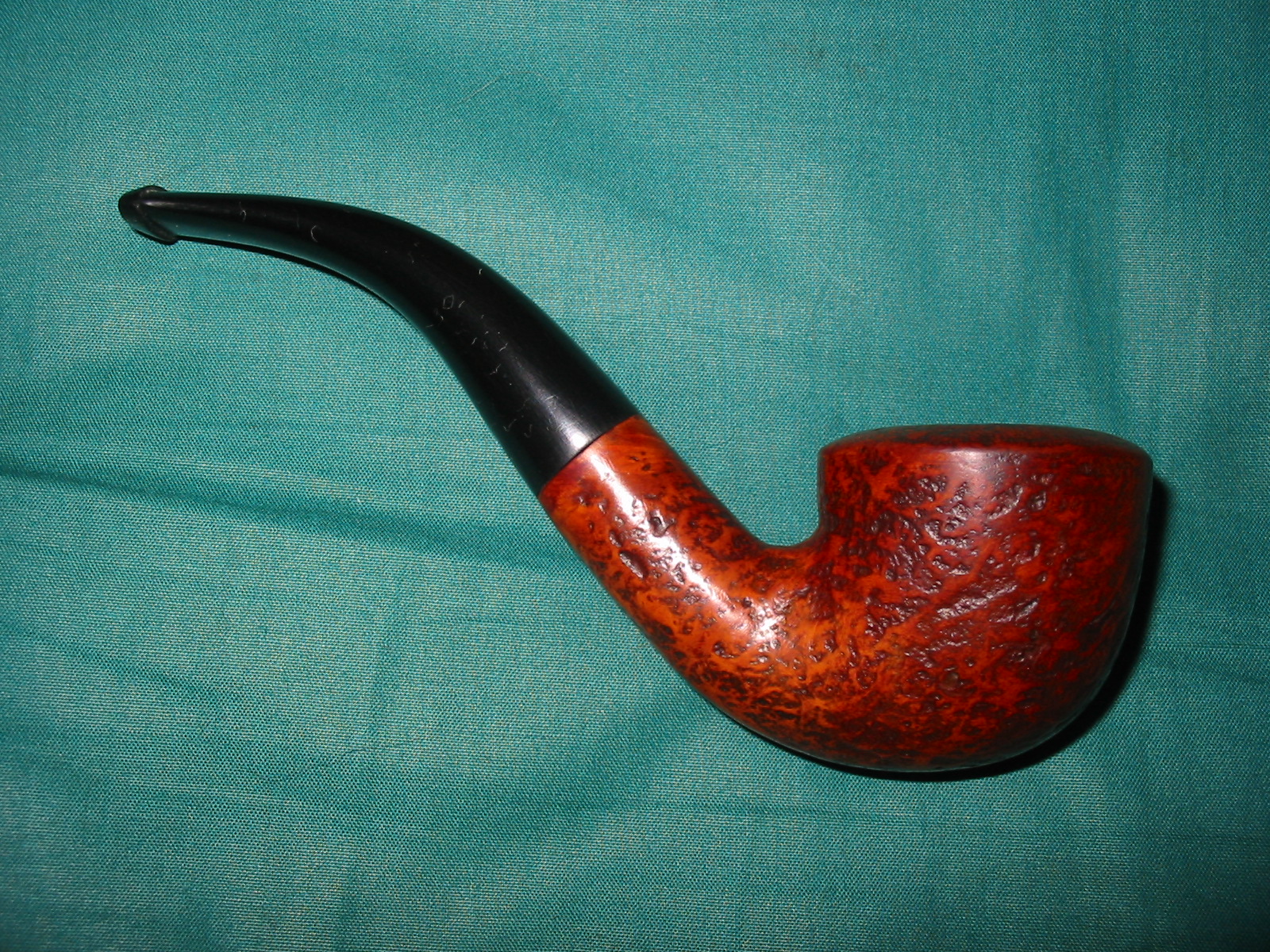
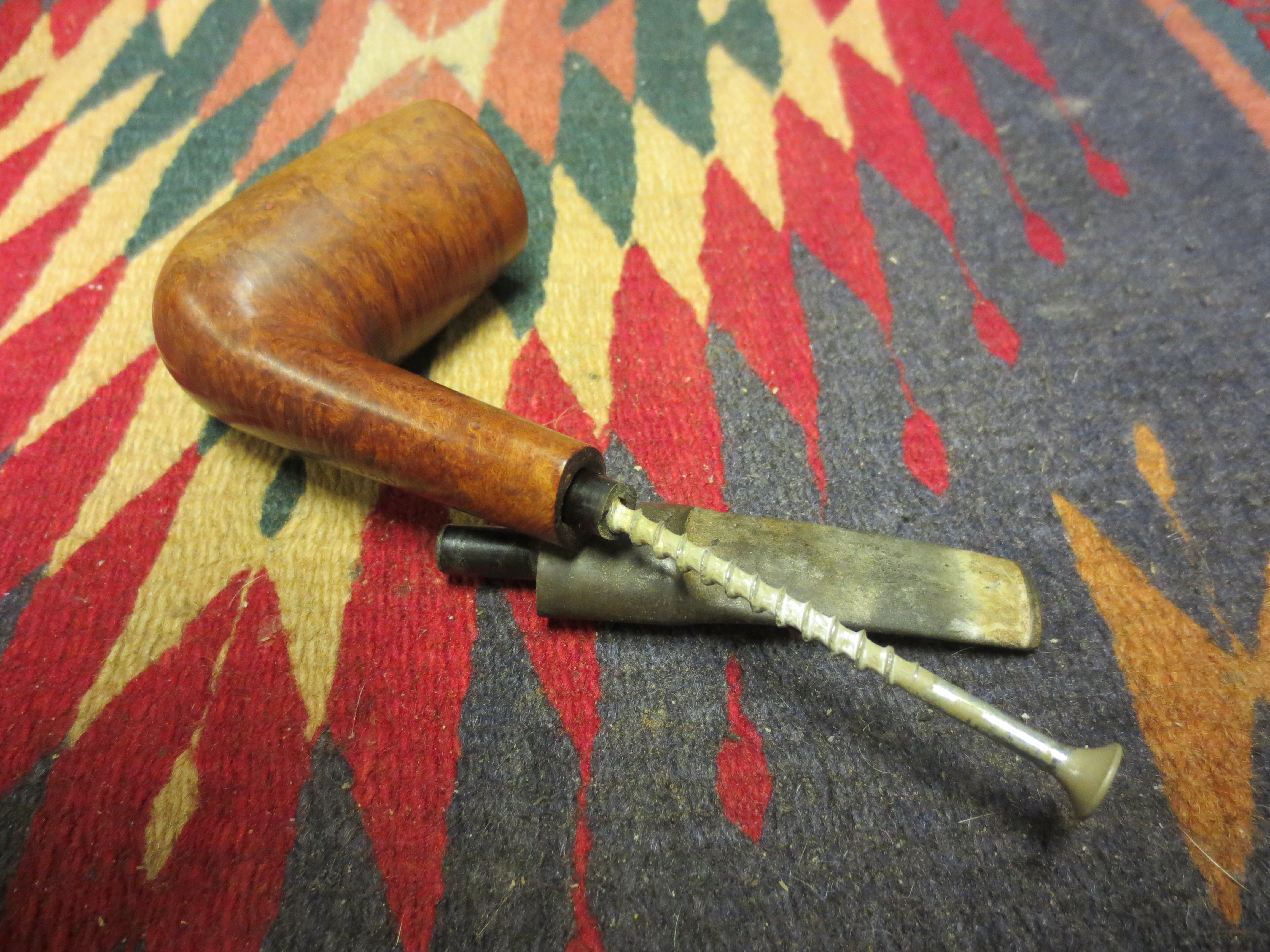
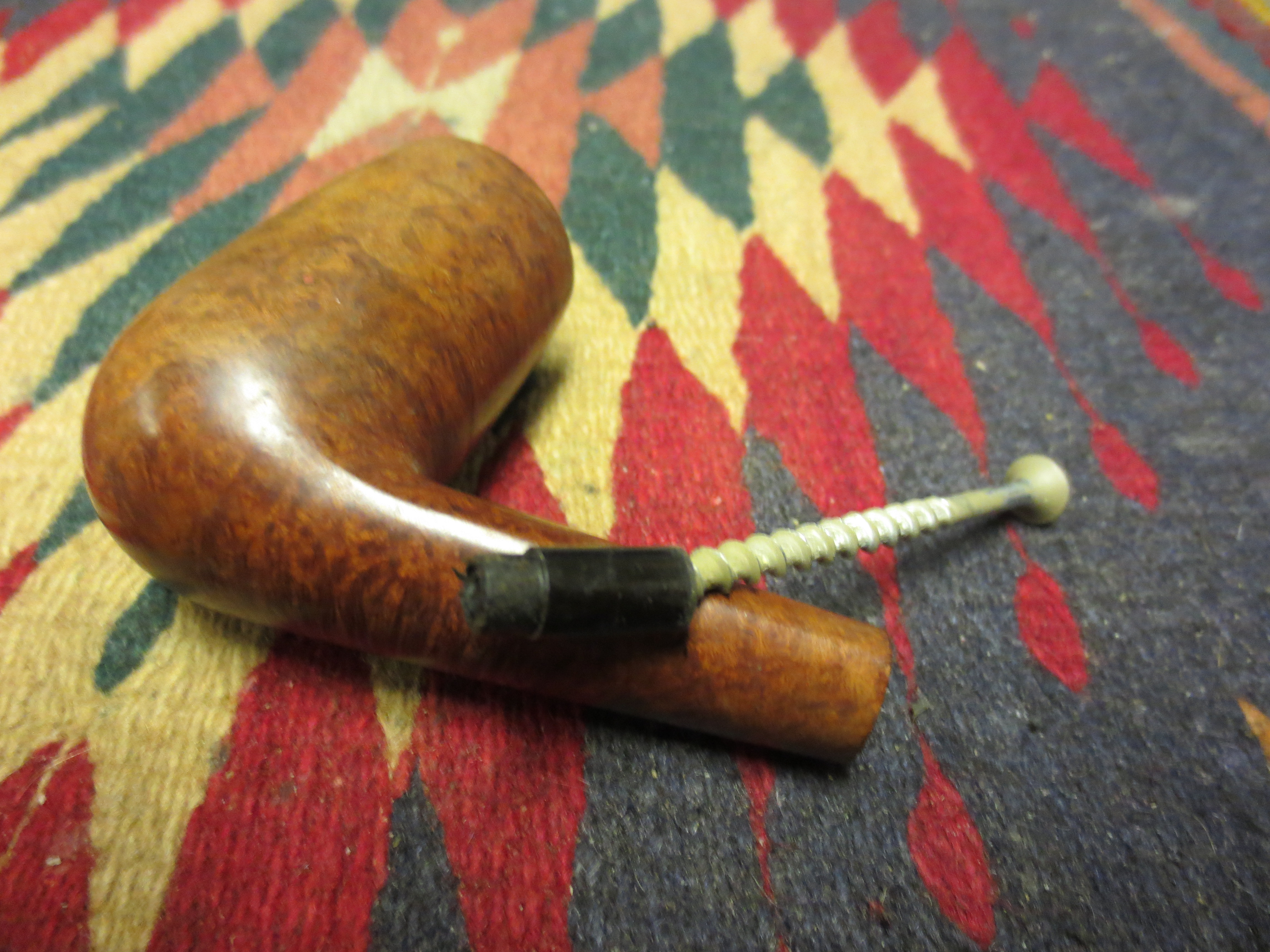
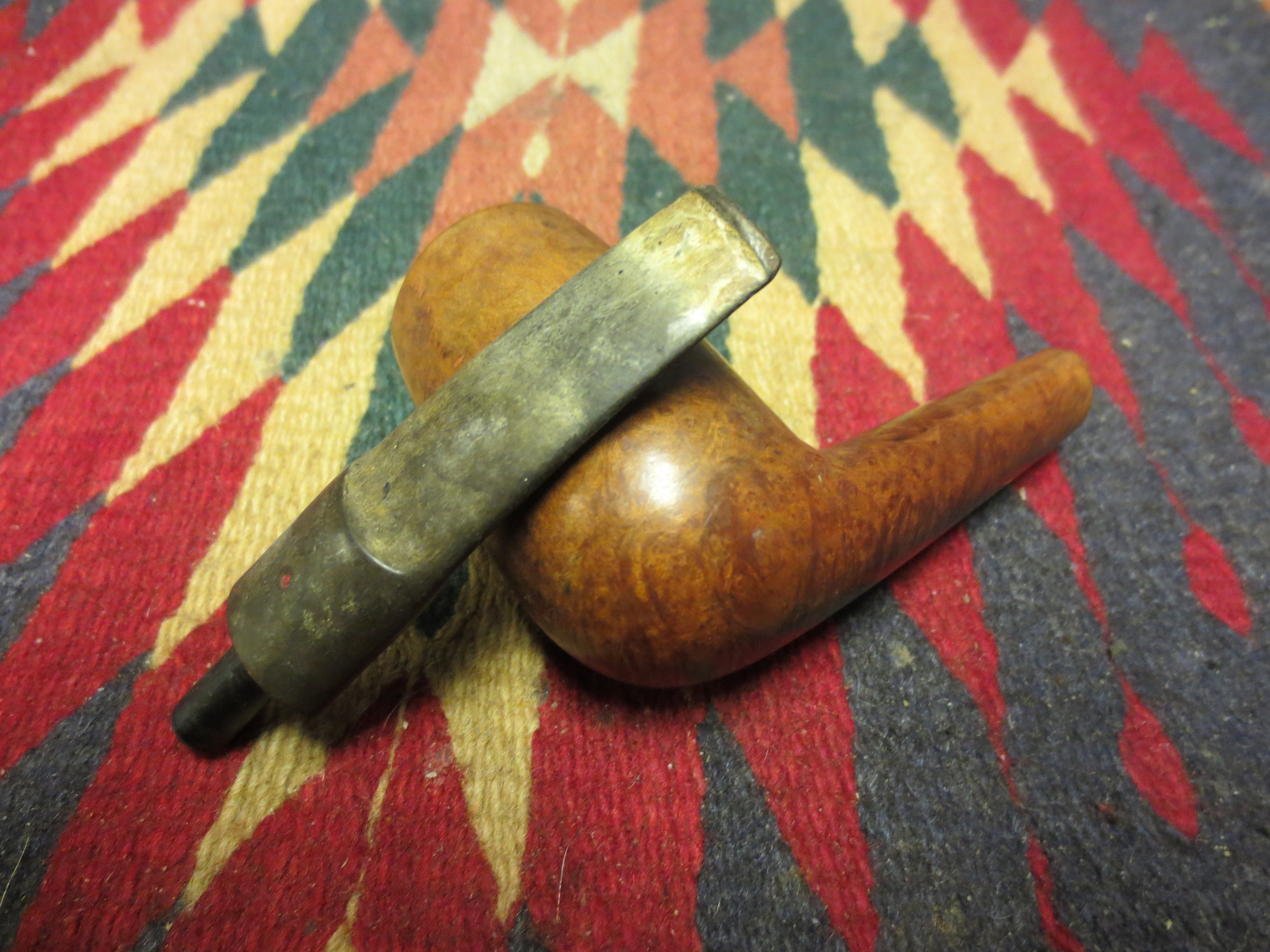
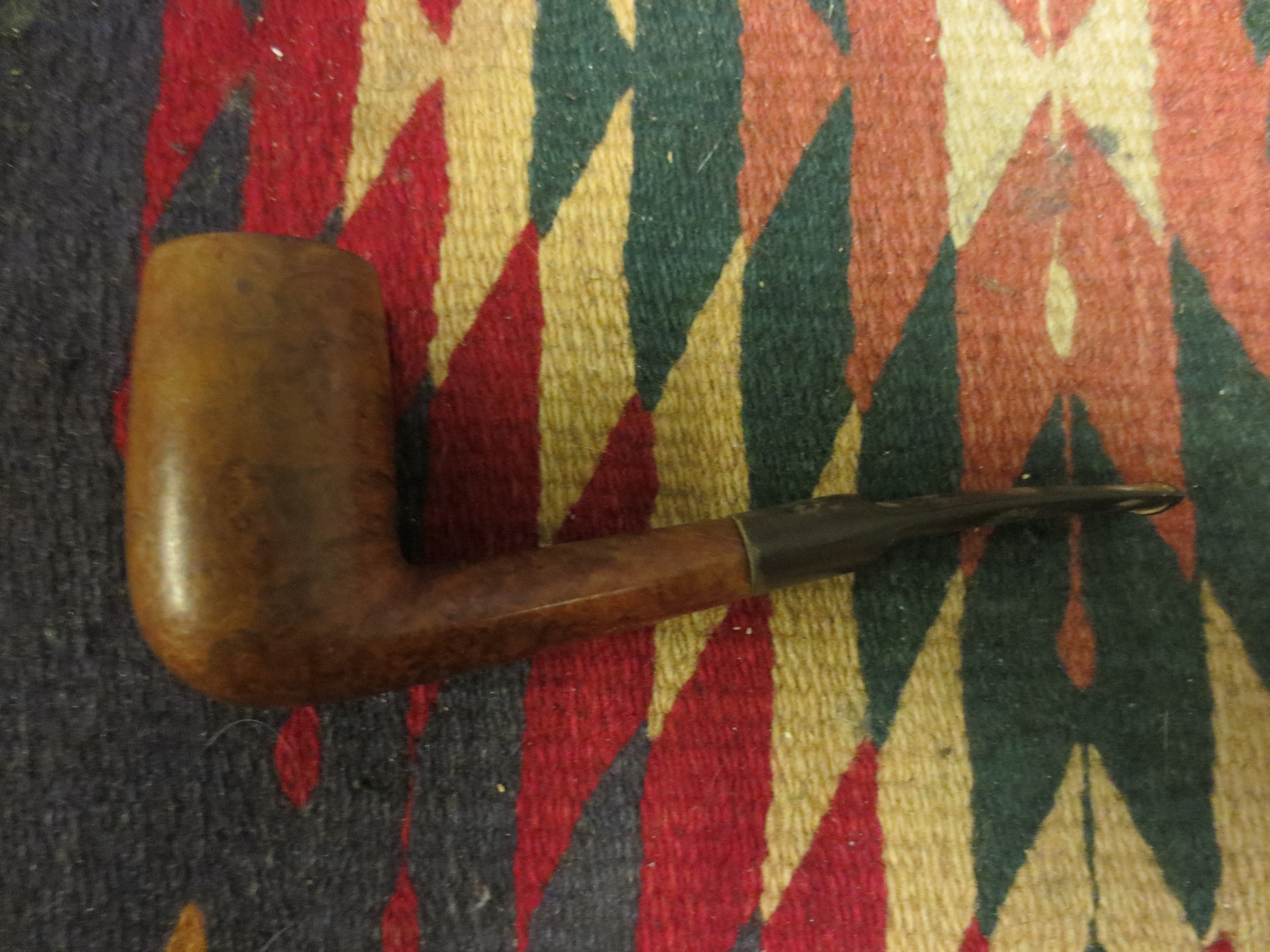
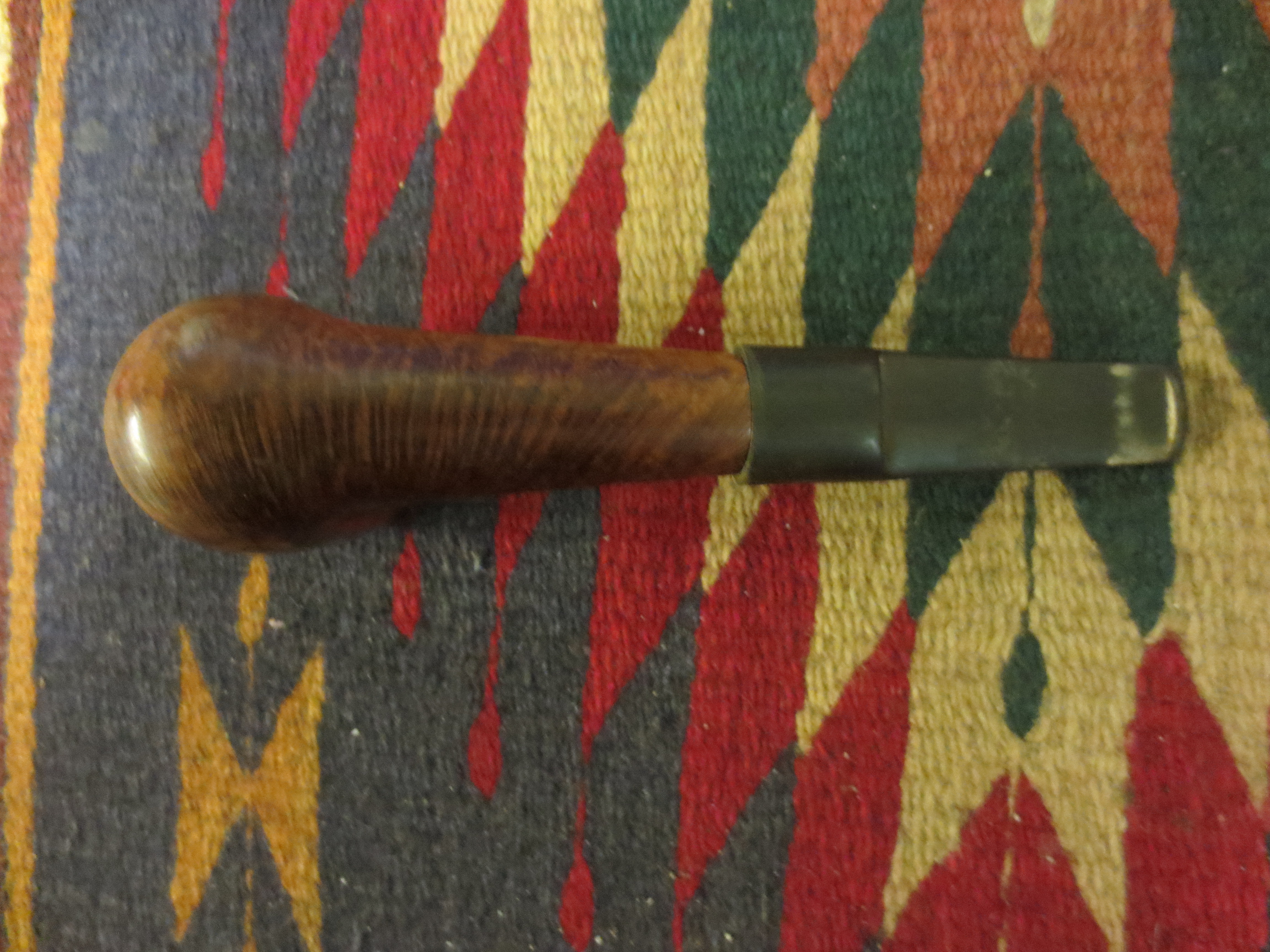
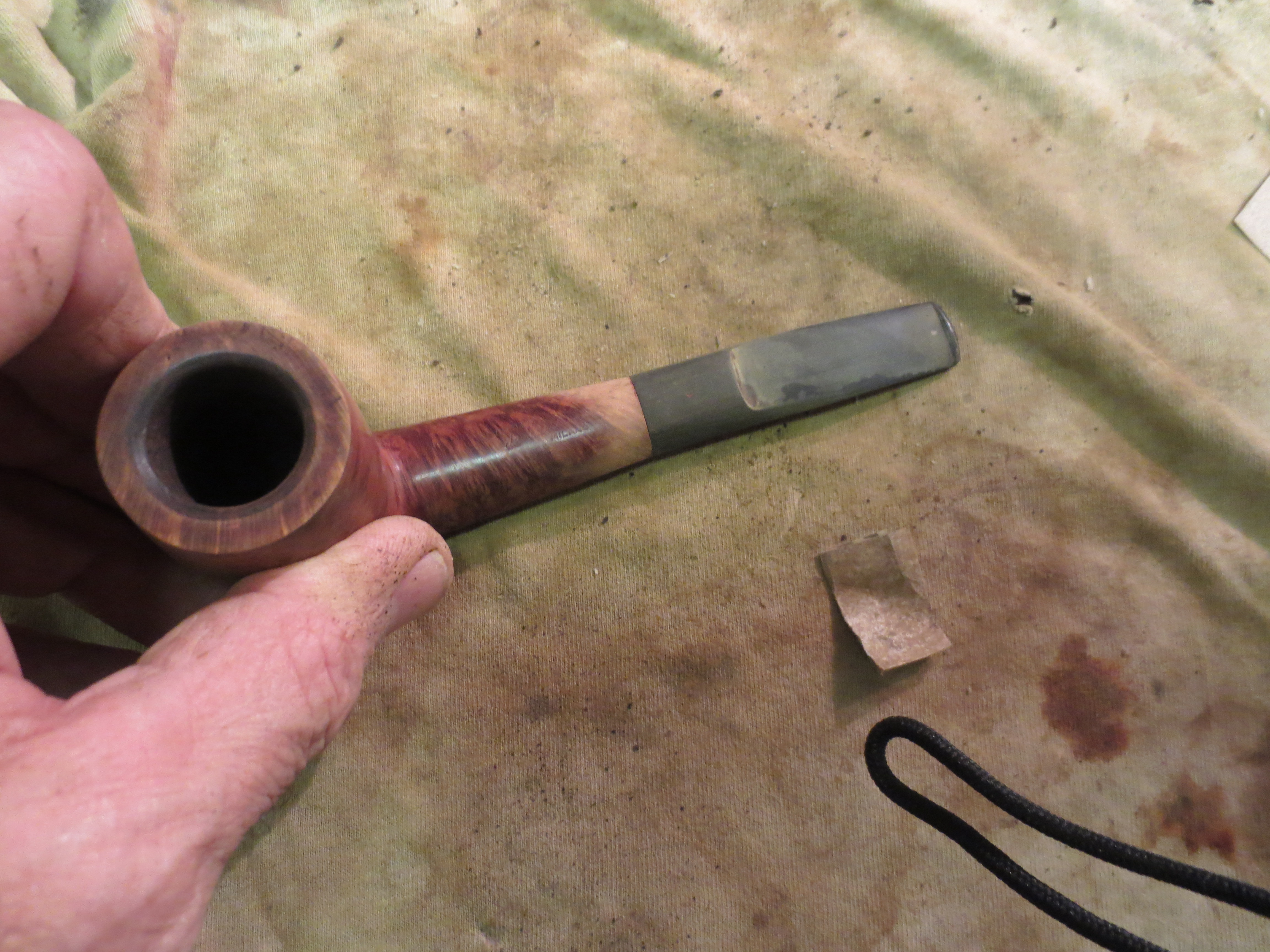
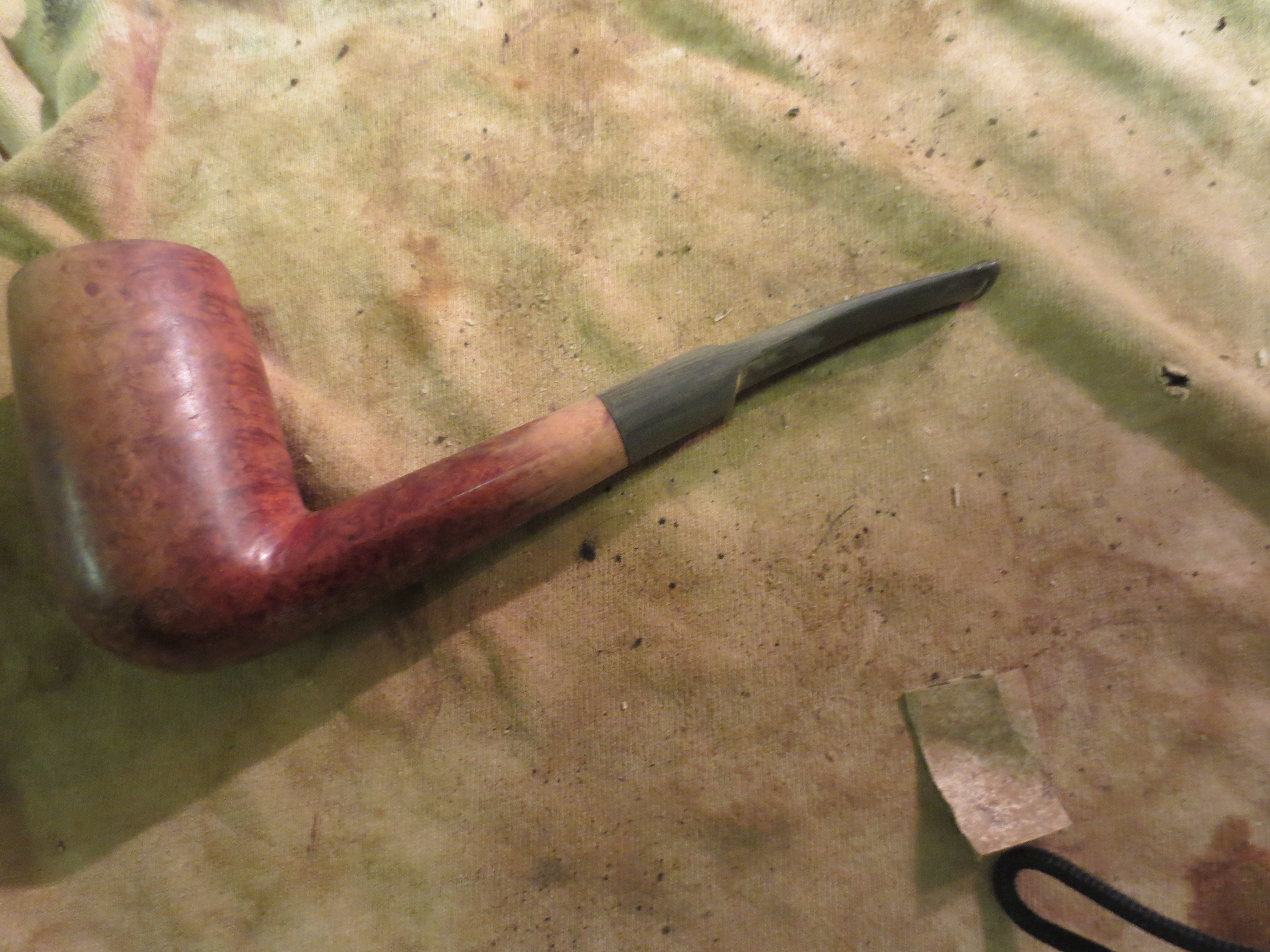
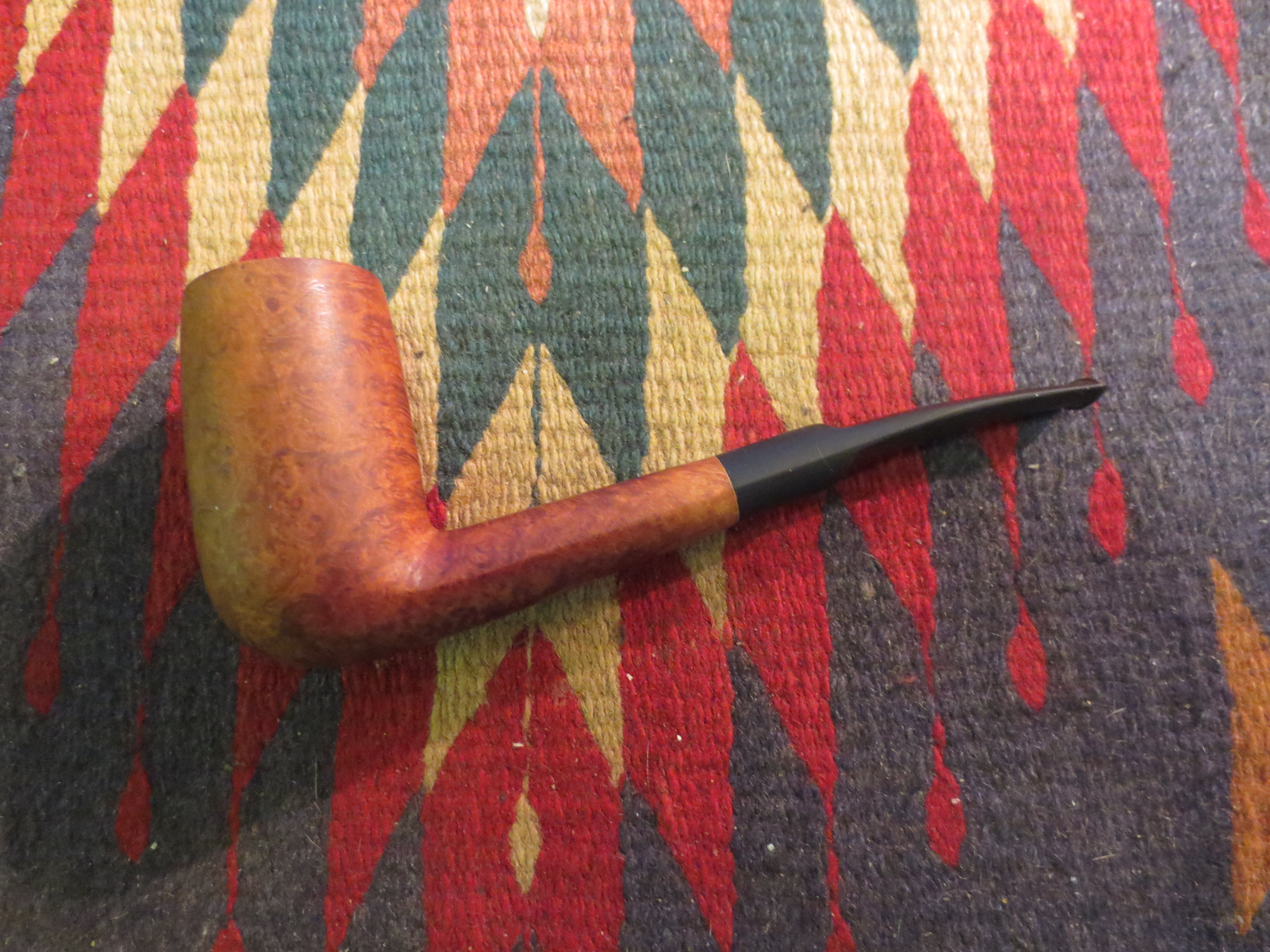
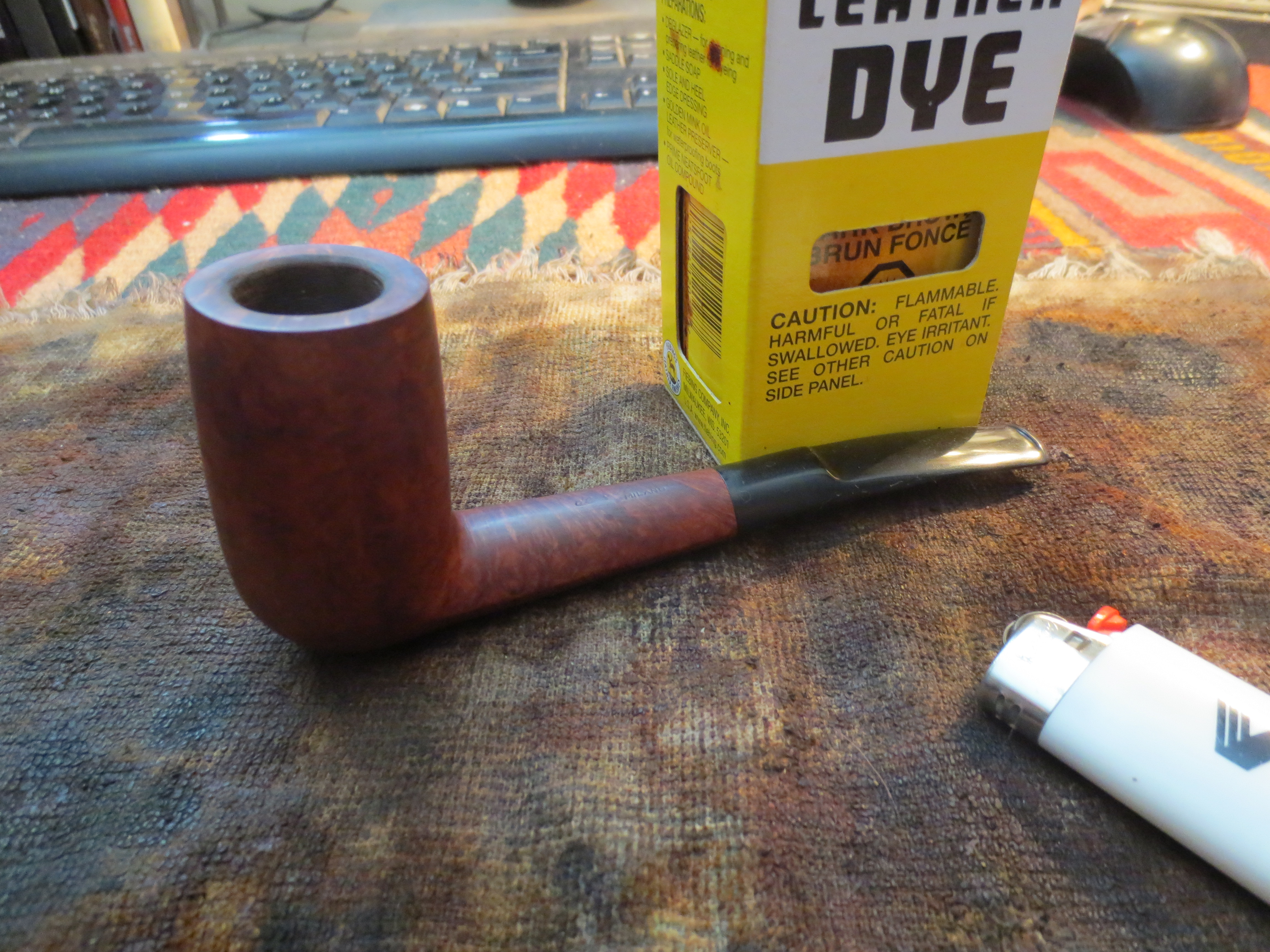
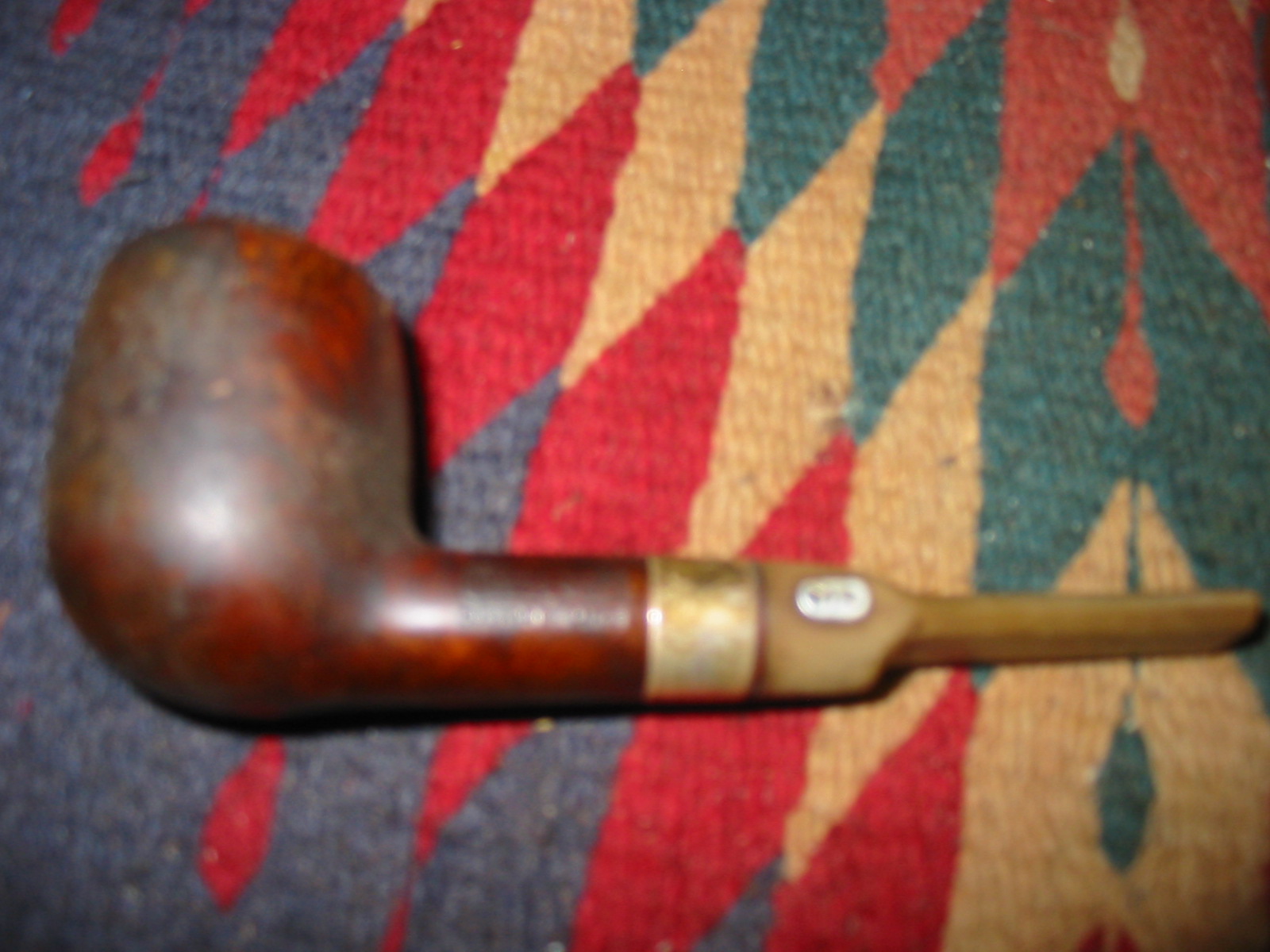
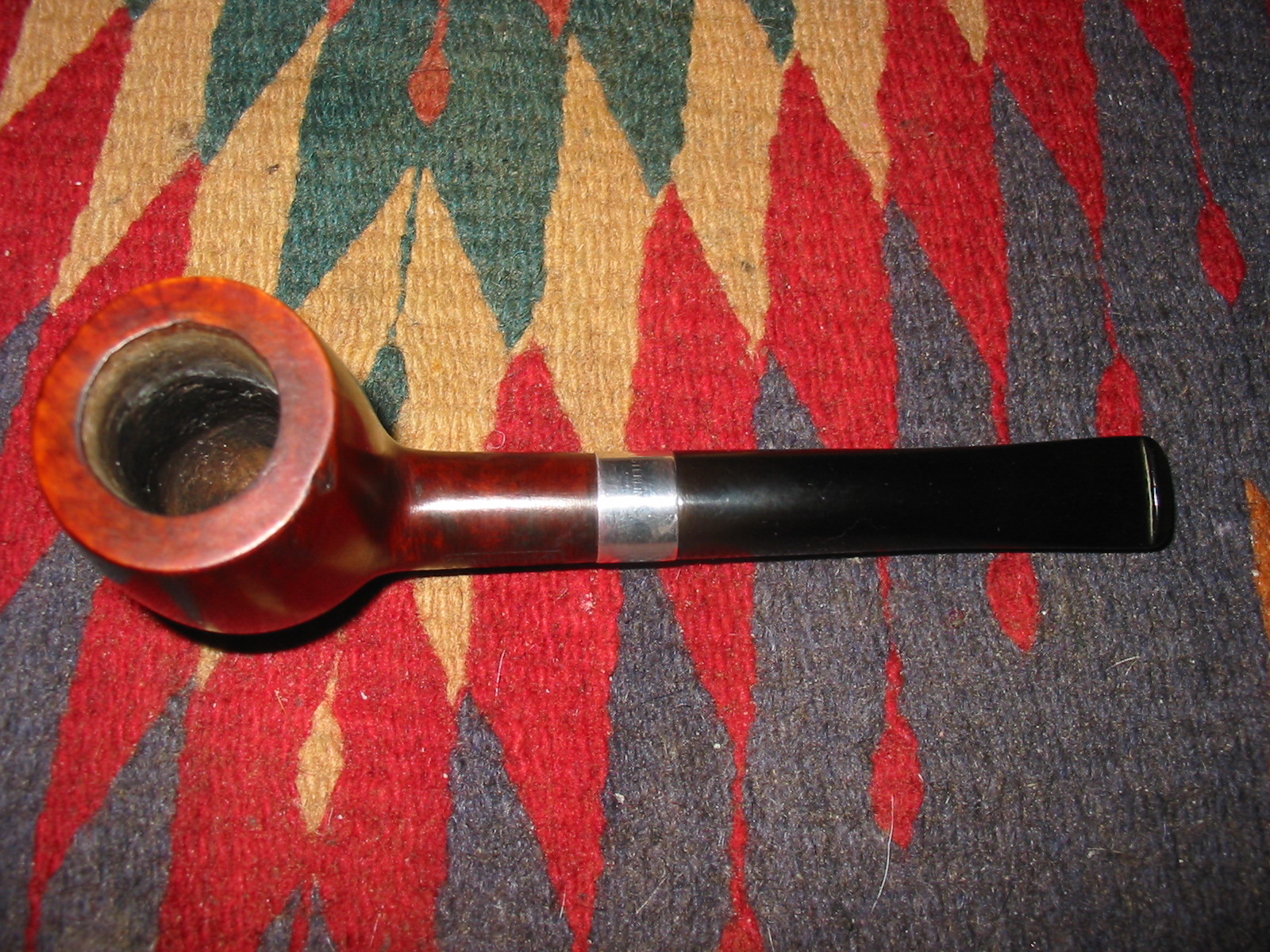
I received the Bakelite bowl base in a lot that I picked up on EBay. At first glance I figured I would trash it and not worry about working on it at all. However, I tend to be drawn to working on things that others would throw away so I decided to see what I could do with it. The two bowls pictured below are threaded and both fit the base. The Dublin like bowl, once on the base, was too narrow for the base but the bulldog bowl fit well. It was packed with a cake and there were chips out of the double line band around the bowl. The bowl rim was damaged and the finish was absolutely shot with dark black stains in the briar all around the bowl where the thumb and fingers held the bowl. The Bakelite shank had the WDC in a diamond stamped on it. The ornate band that usually adorned the shank as well as the metal washer like band on the top of the bowl base was missing. The shank had a broken metal tenon stuck deep within it. The surface had scratches in it but none of them were too deep.

Bakelite bowl base and two potential bowls before beginning the process of refurbishing.

Bakelite bowl base and two potential bowls before beginning the process of refurbishing.


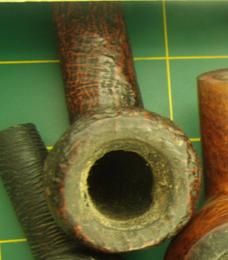
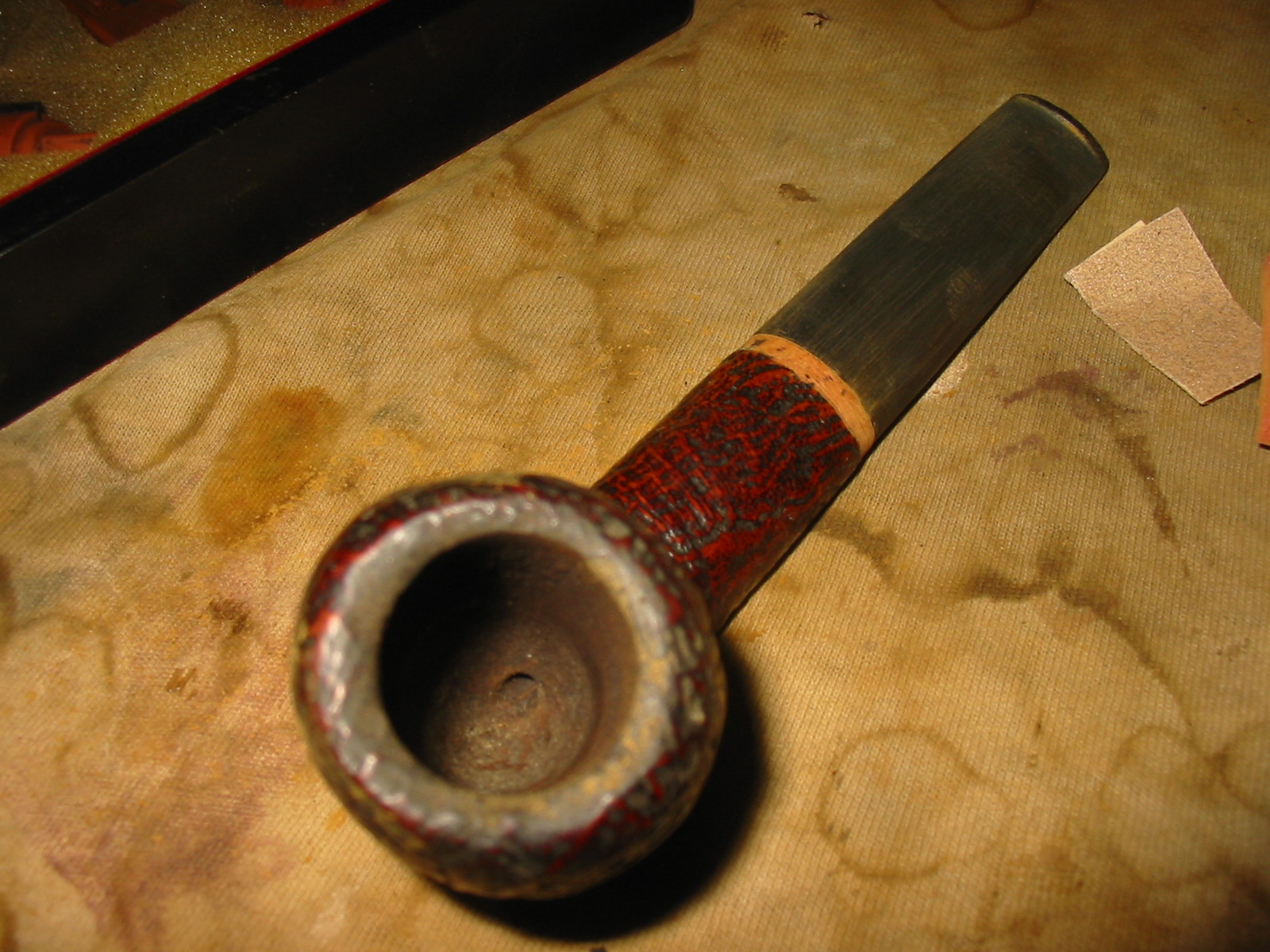
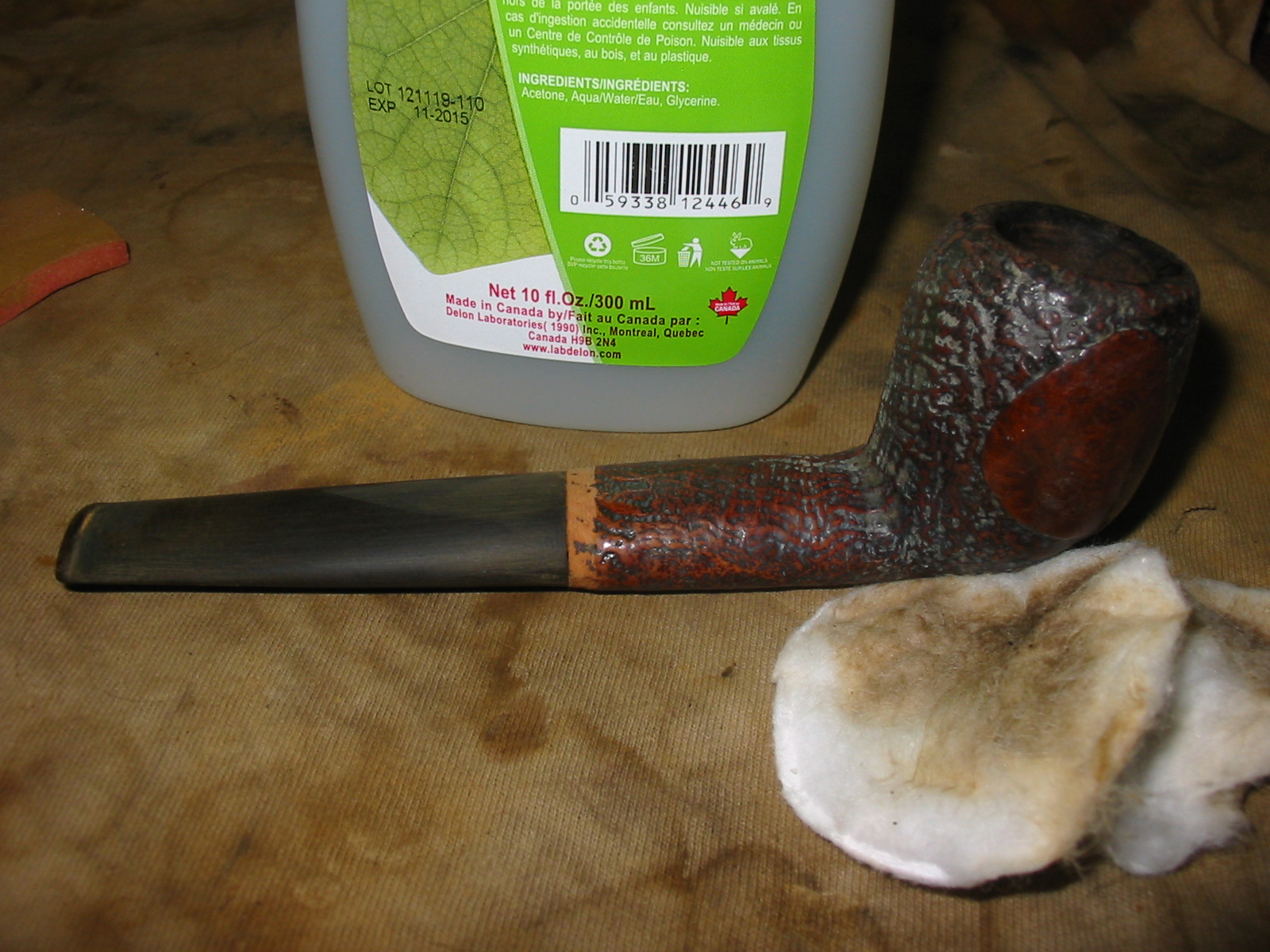
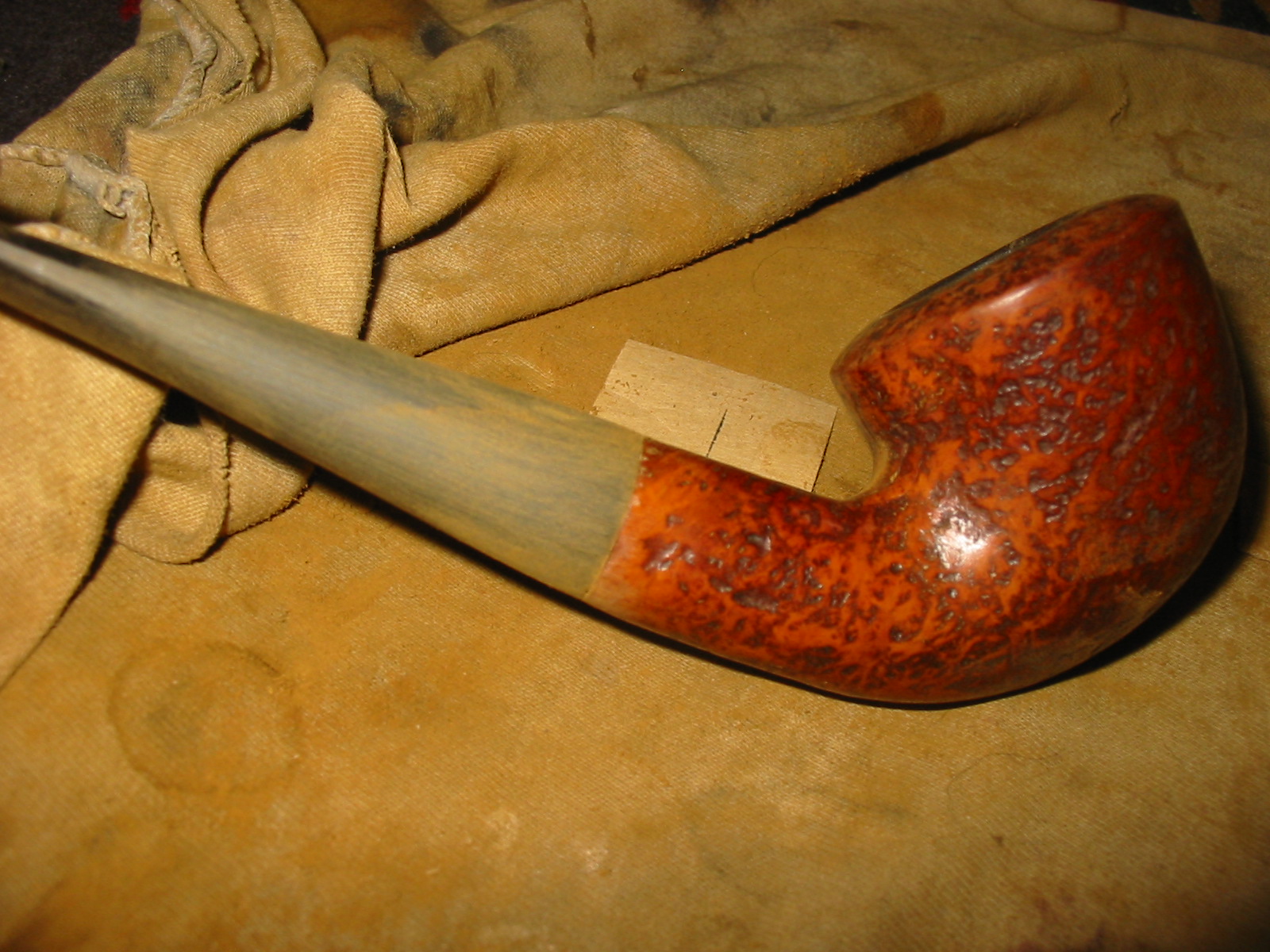
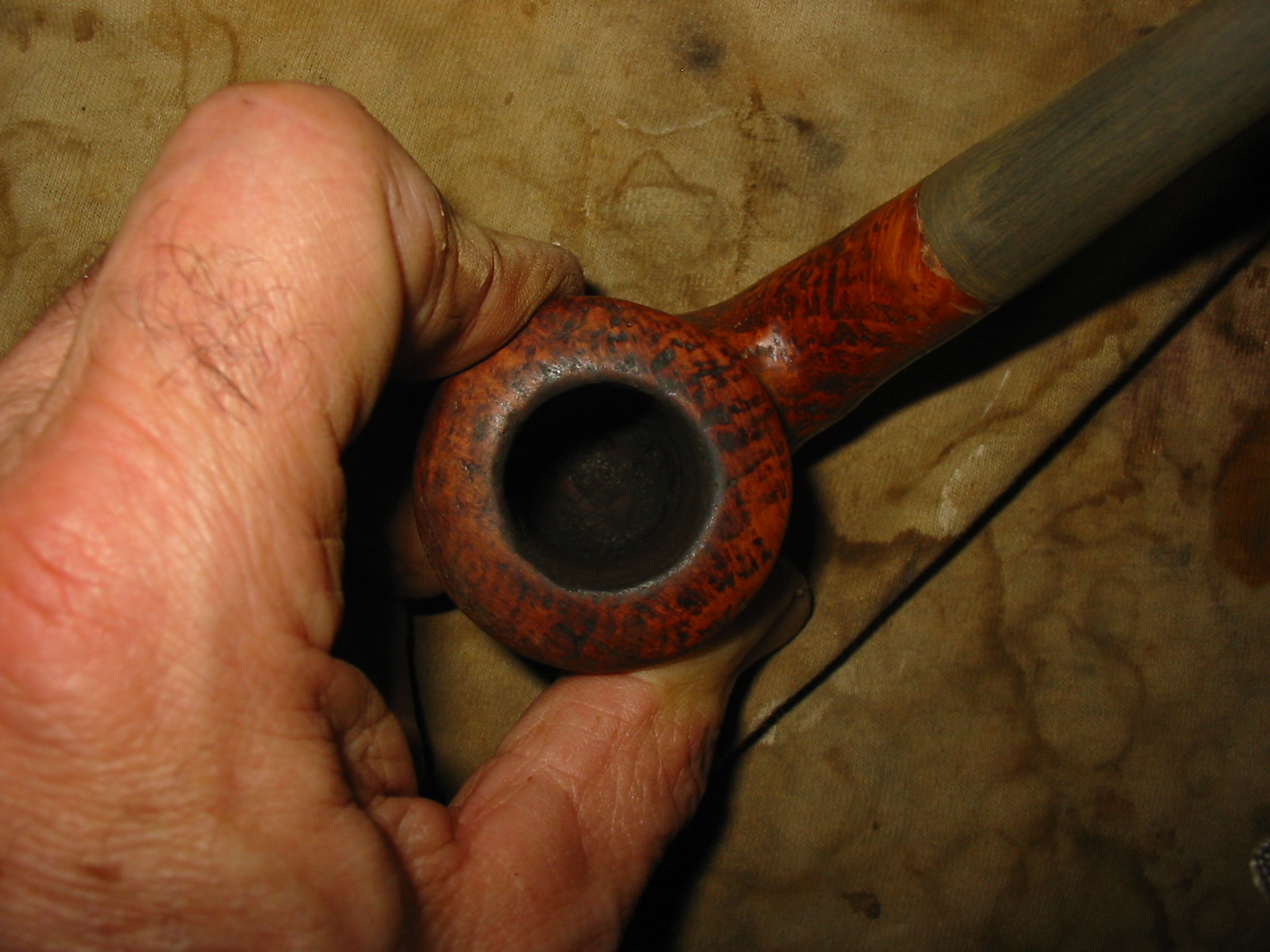
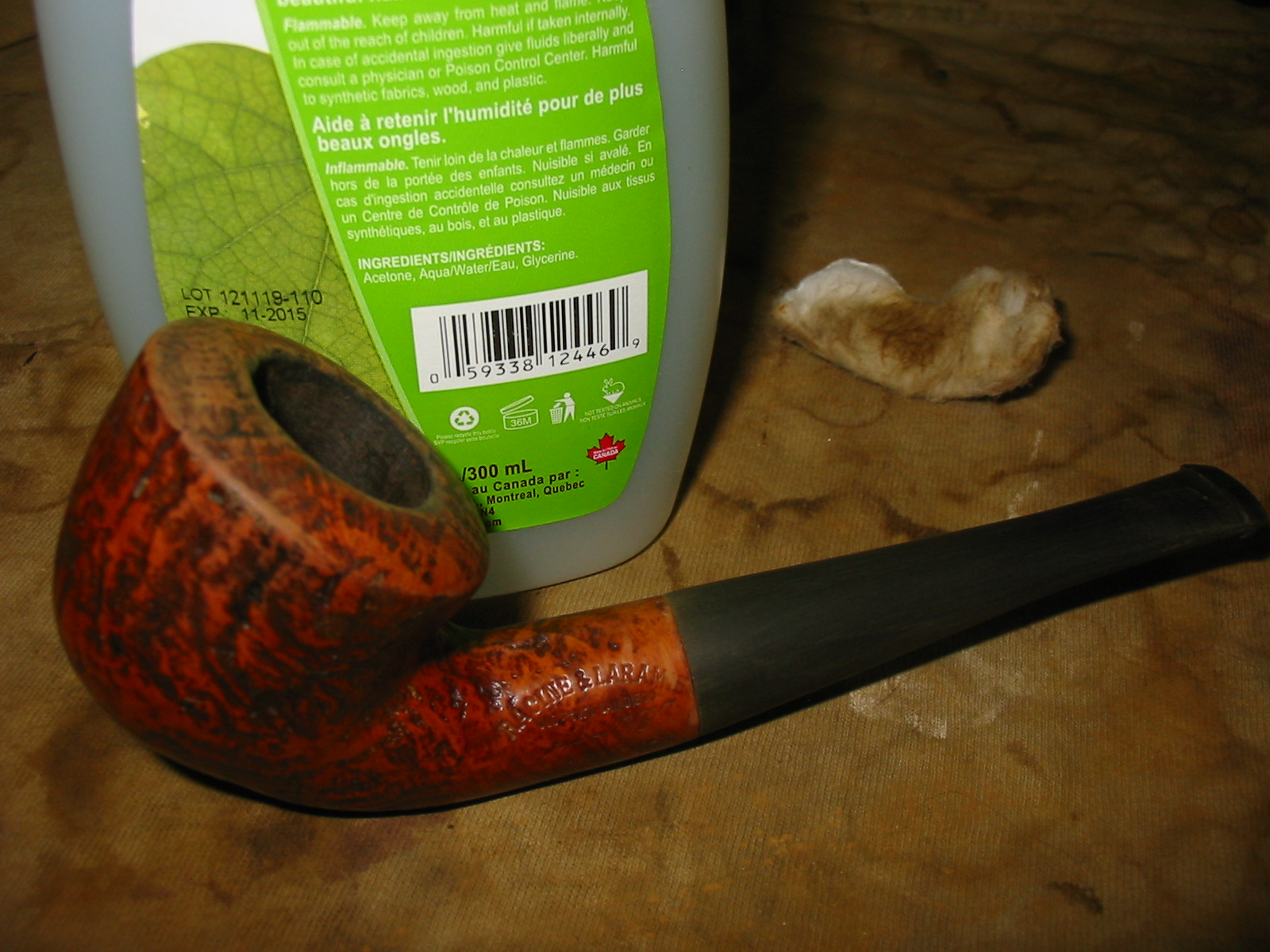
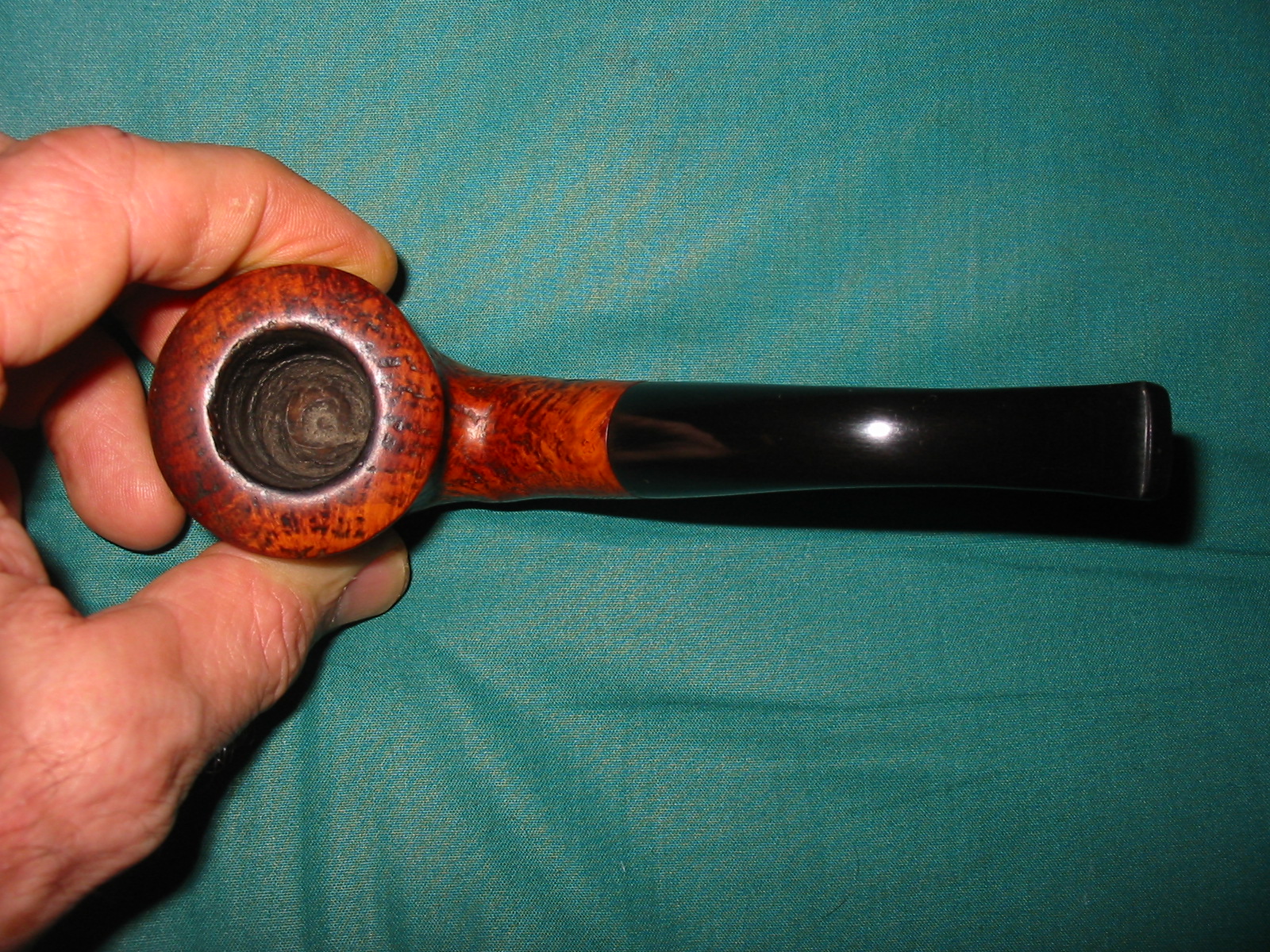
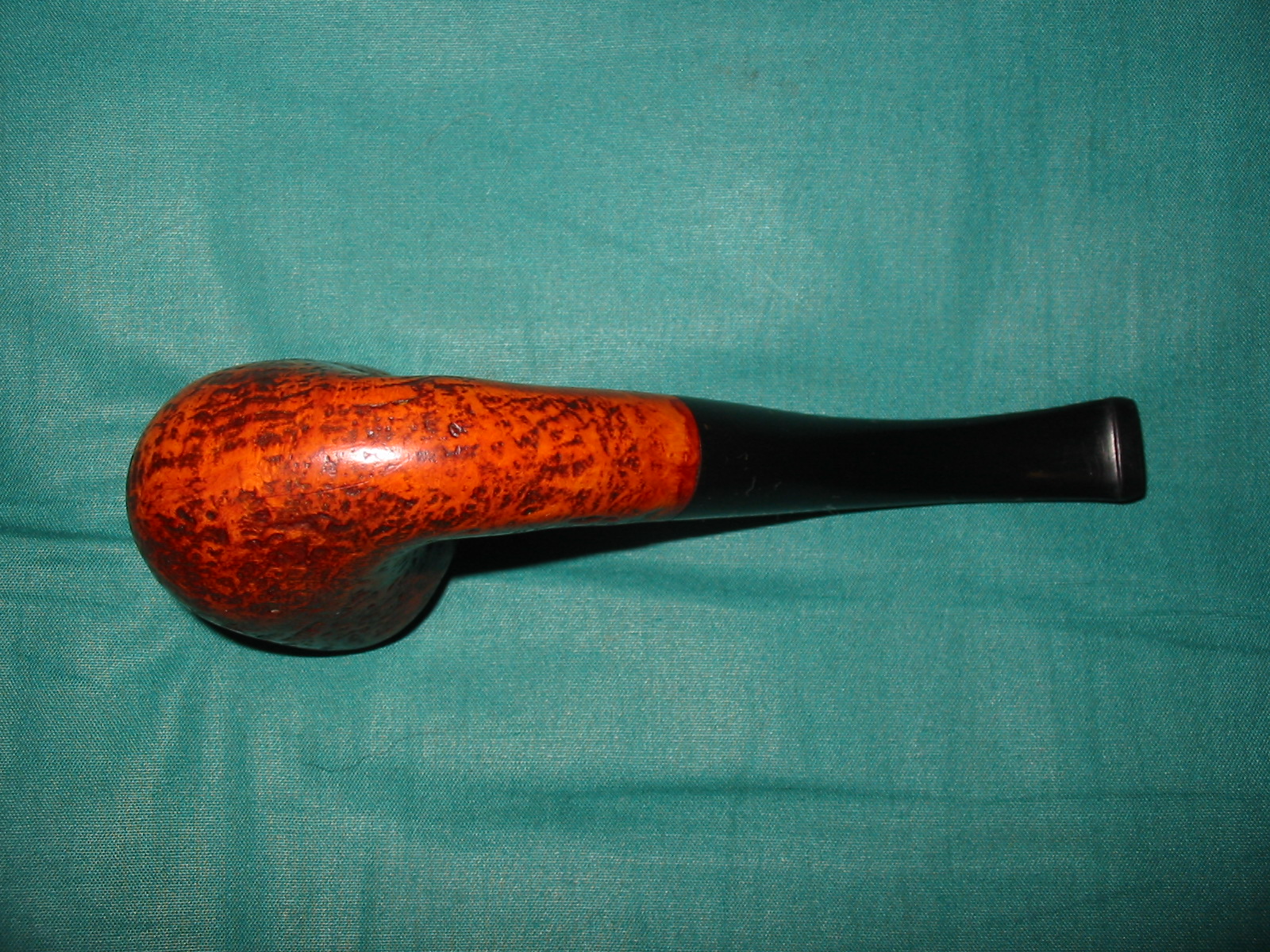
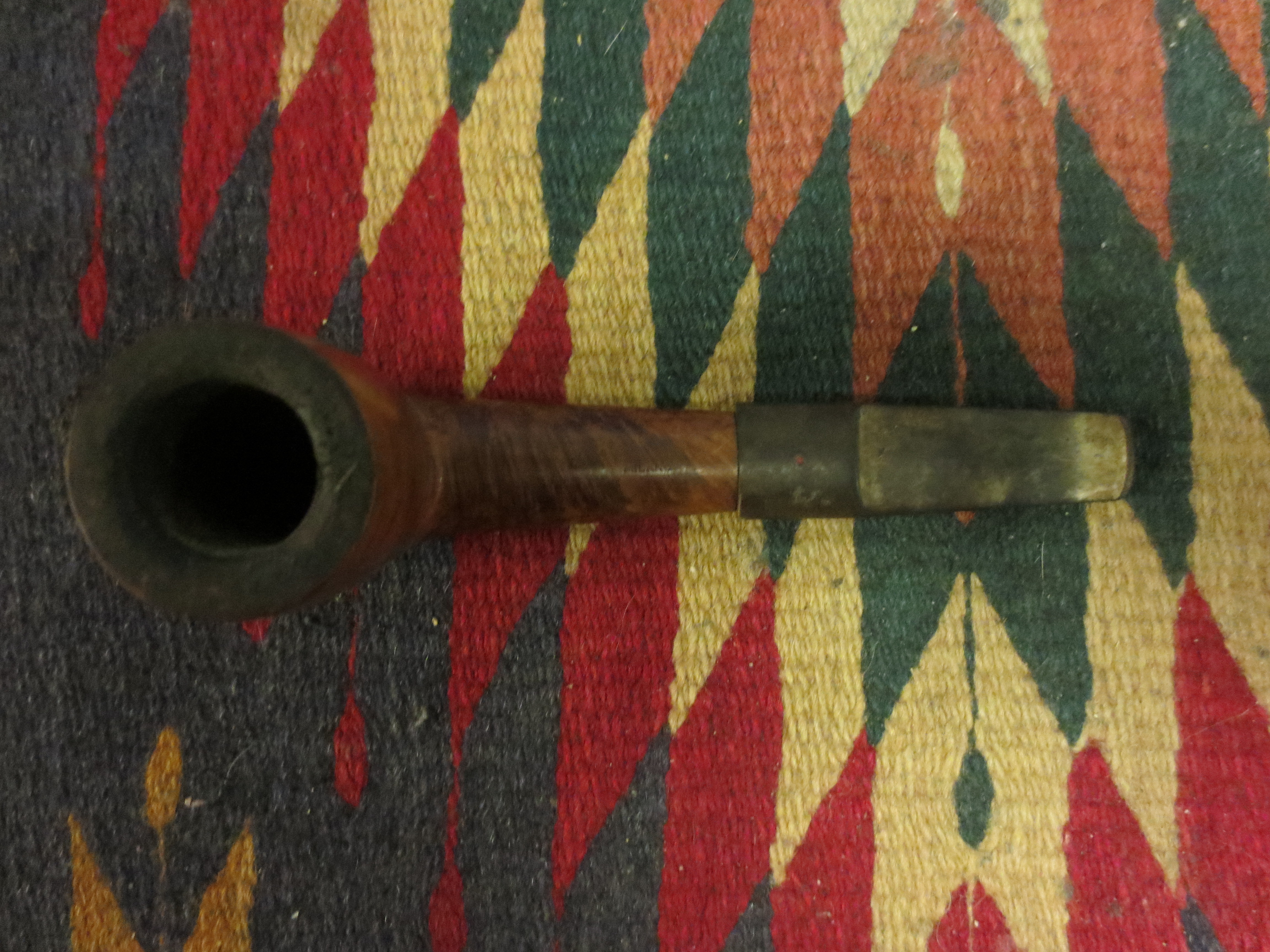
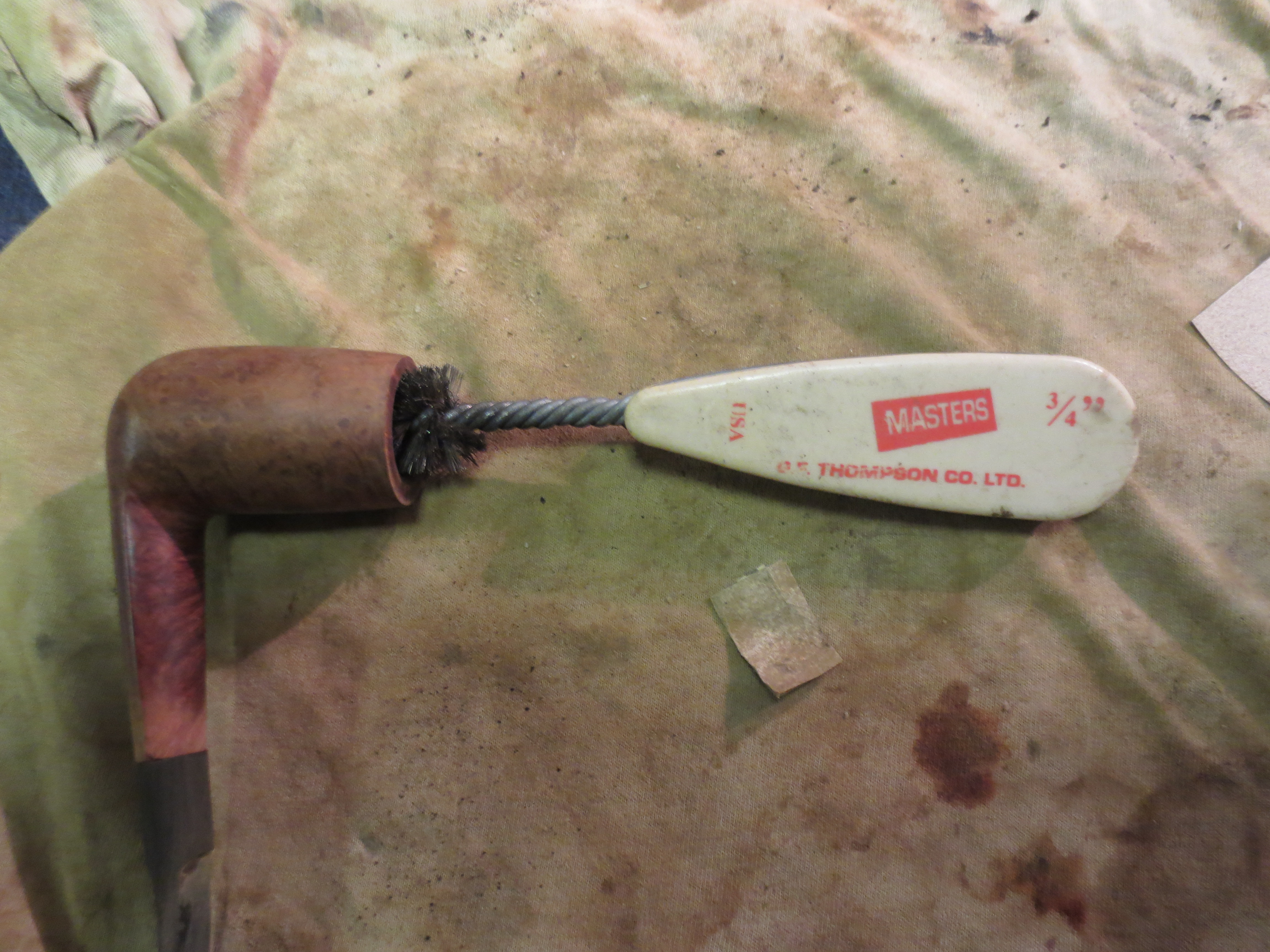
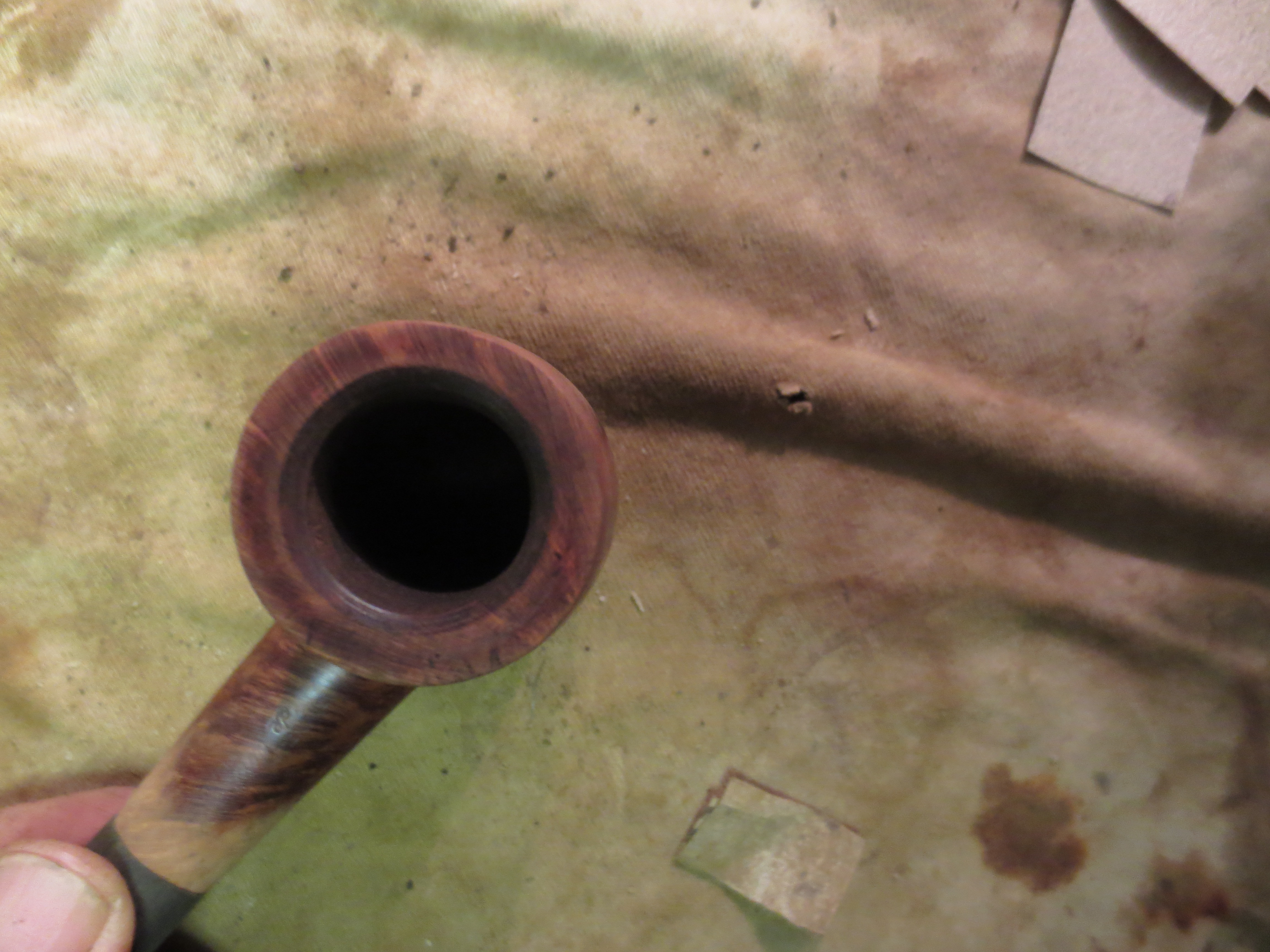
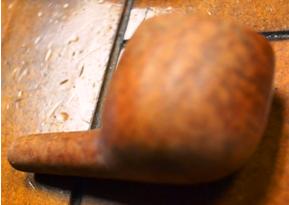
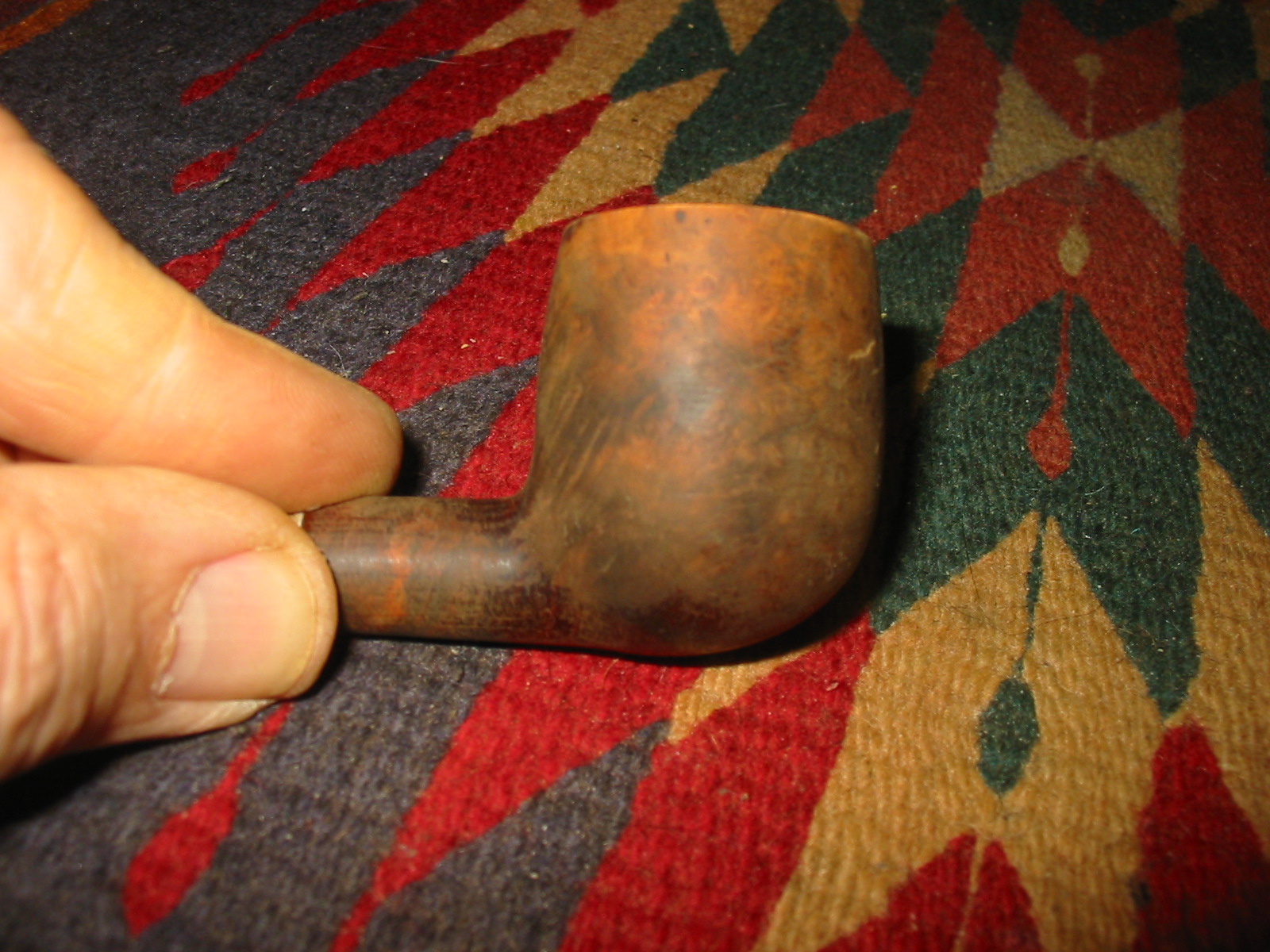
The bowl is pictured below. You can see the thickness of the cake and the rough surface of the rim where a previous owner had damaged it when emptying the bowl. The second photo shows the exterior damage and the finish on the pipe. I reamed the bowl to clean out the cake. I decided to take it back to bare wood and start over with the cake. I checked the bowl for cracks and damage but surprisingly there were none to be found. Eventually I would top the bowl.
SIde view of the bowl before refurbishing.

SIde view of the bowl before refurbishing.

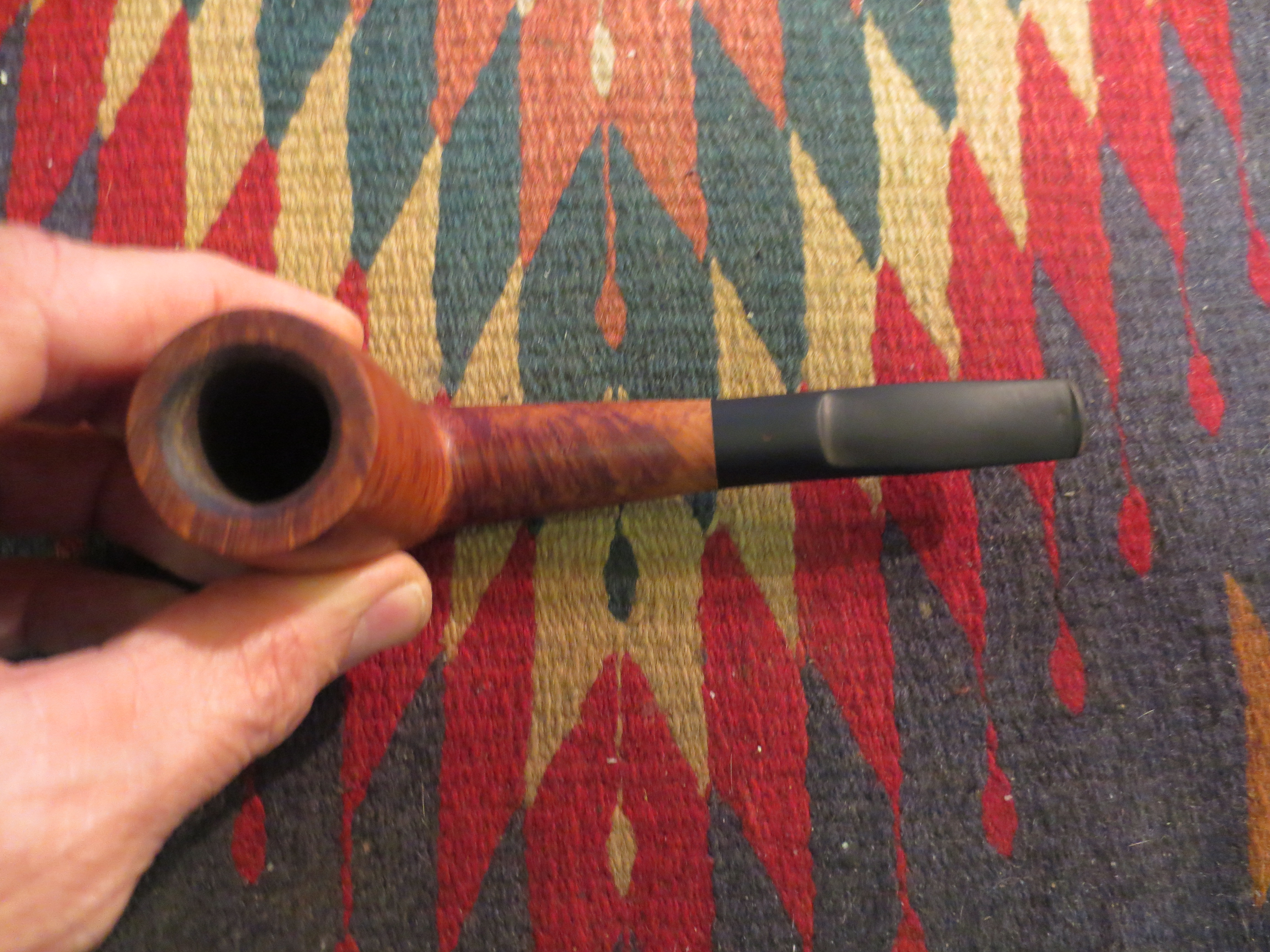
Top view of the unreamed pipe bowl showing its condition before cleaning

Top view of the unreamed pipe bowl showing its condition before cleaning


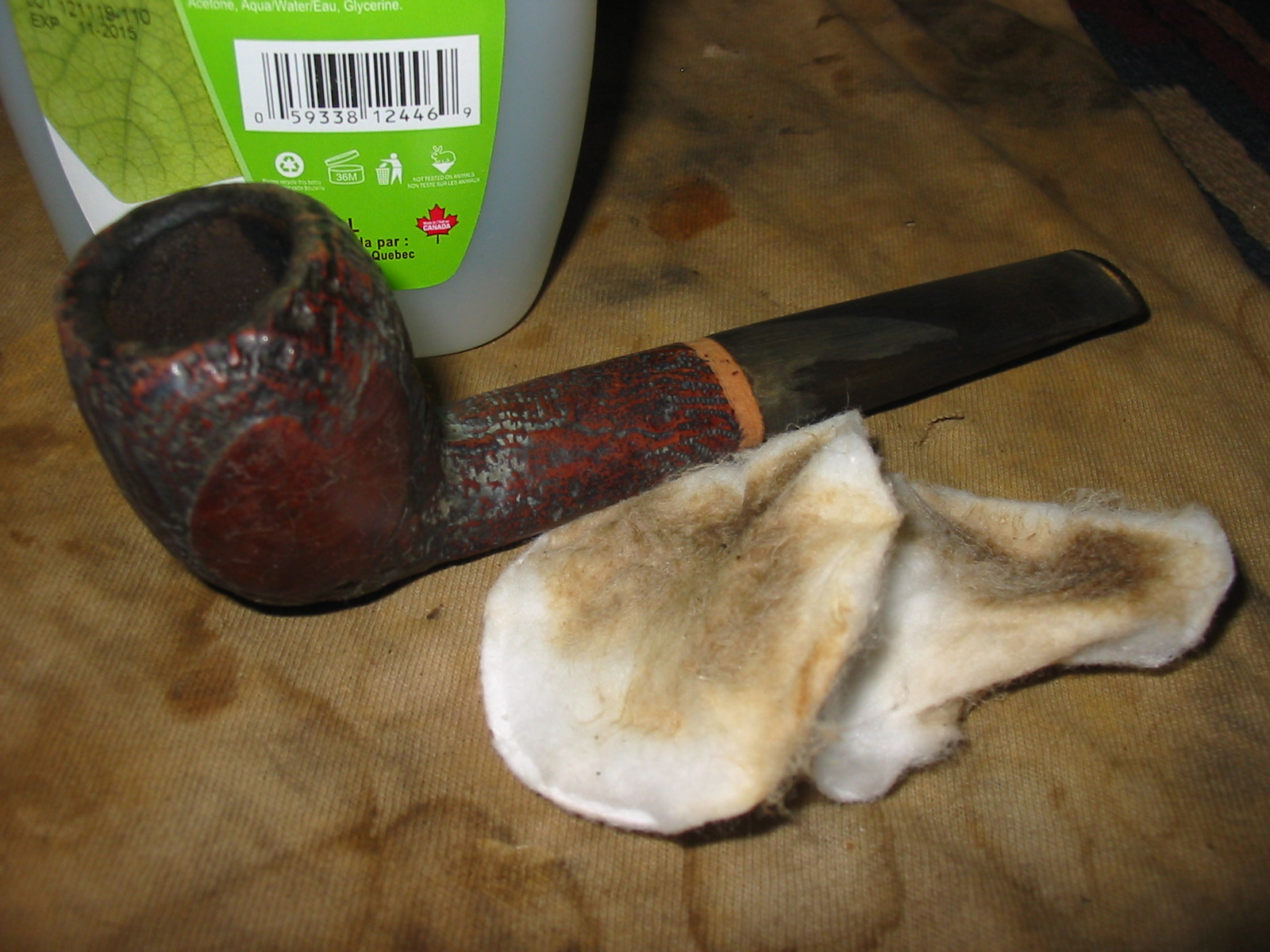
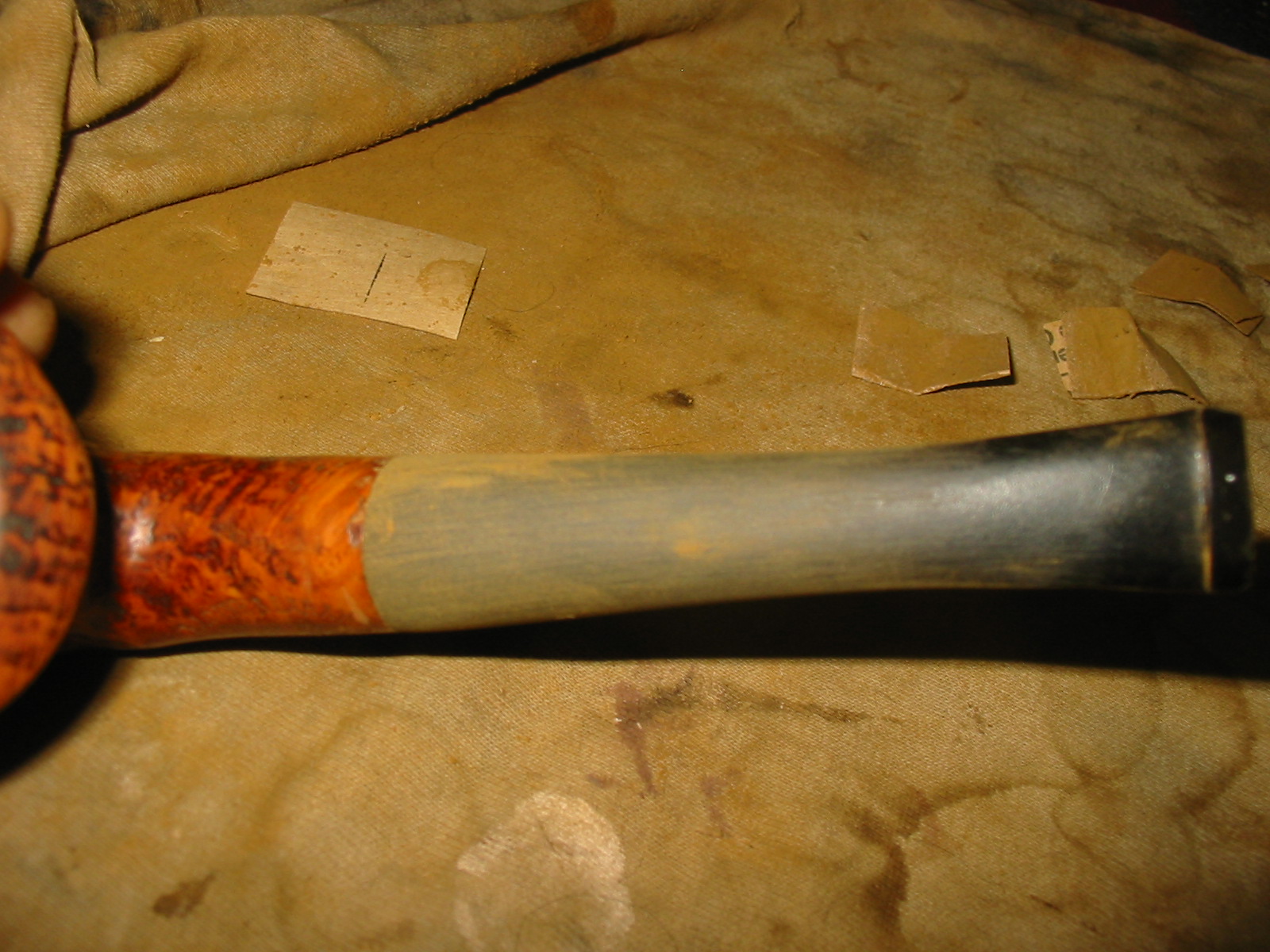
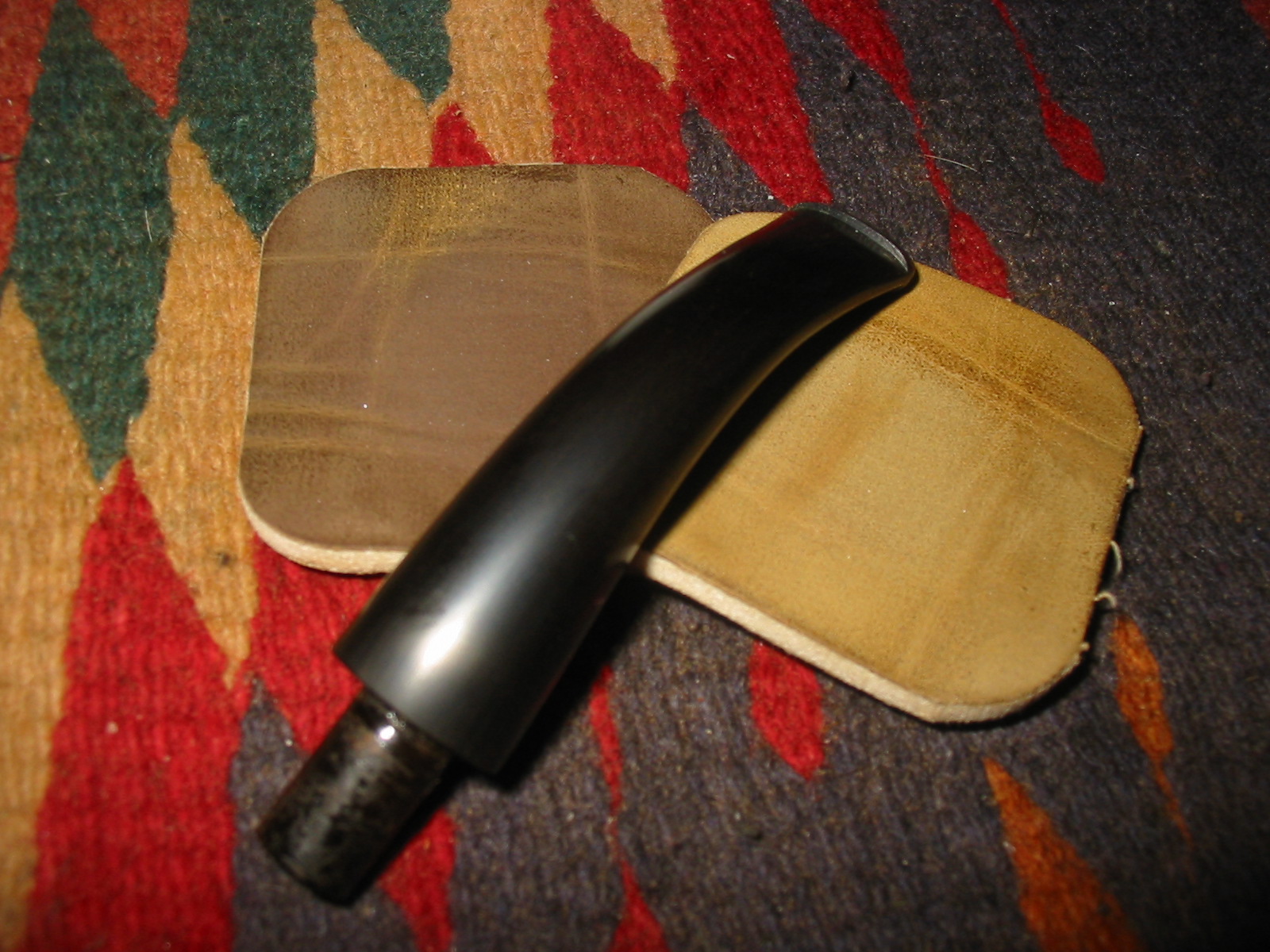
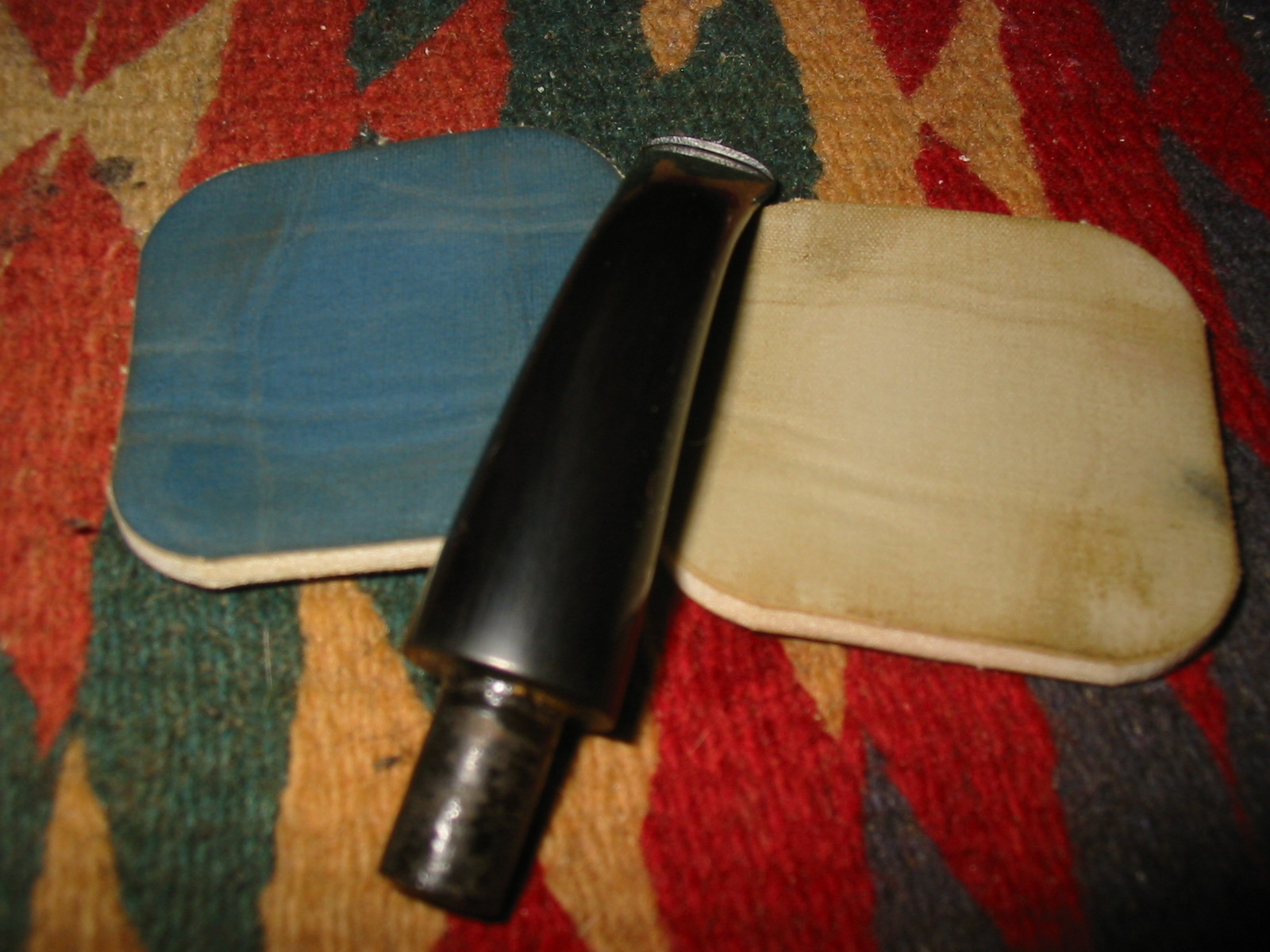
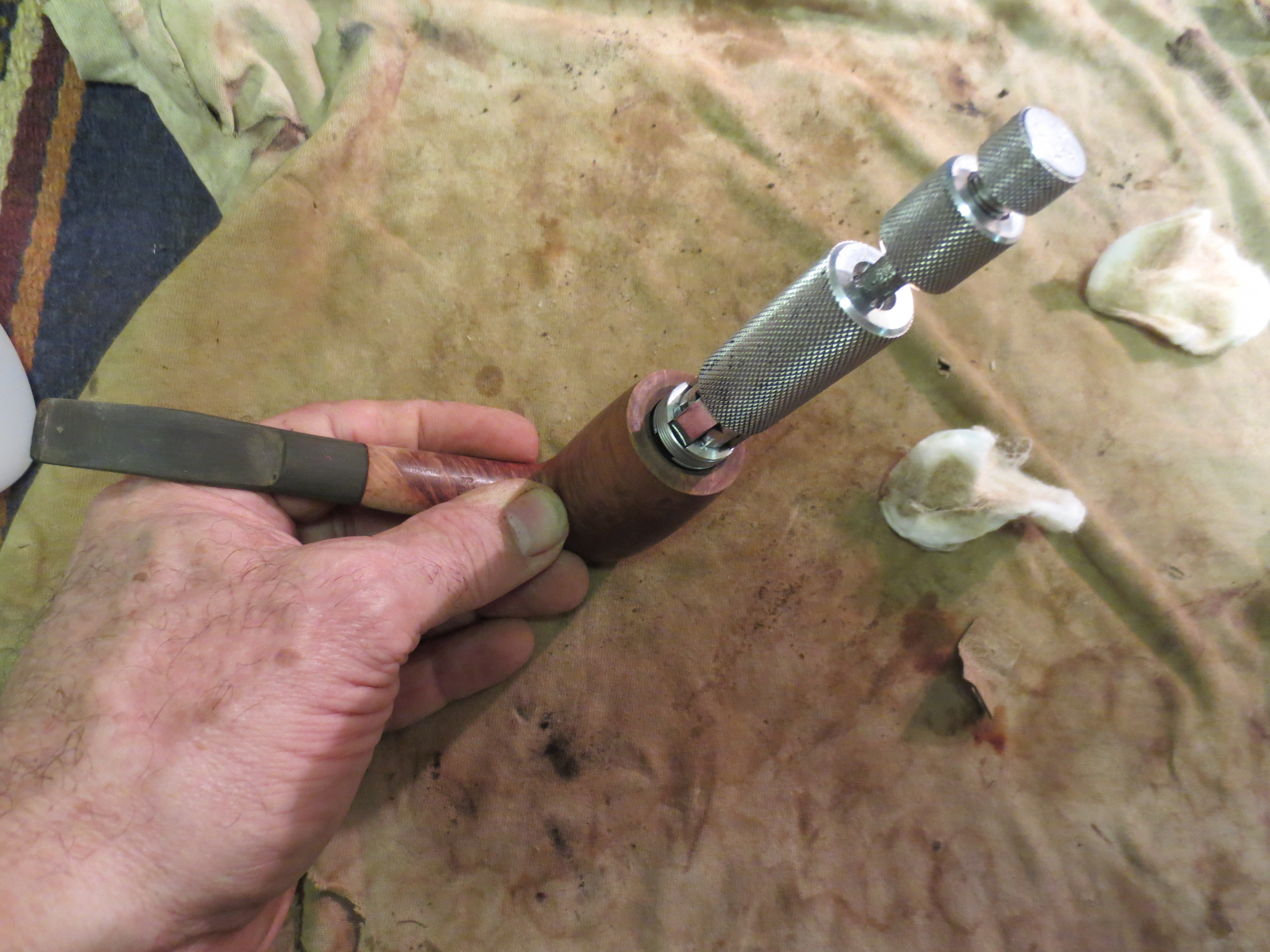
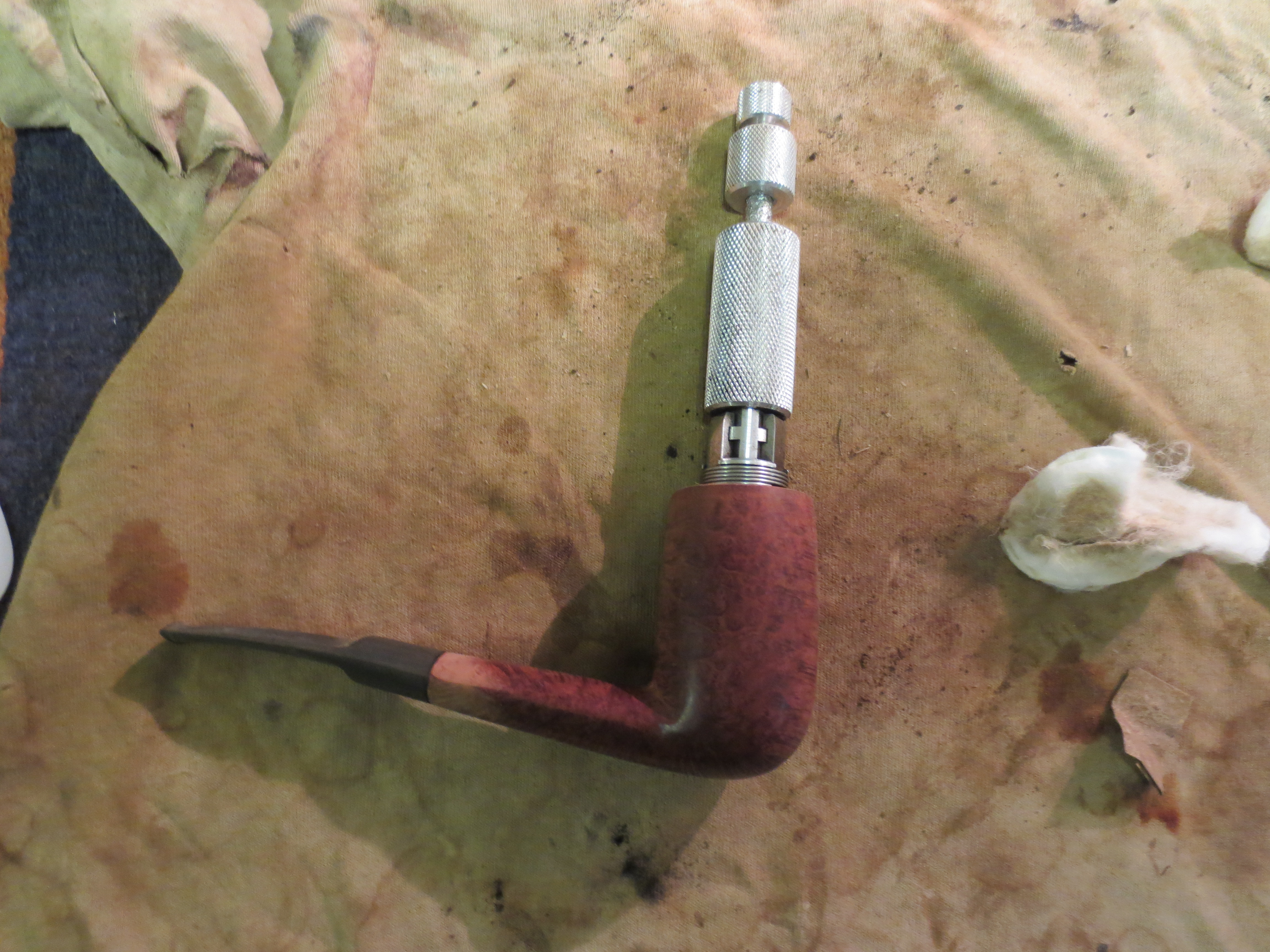
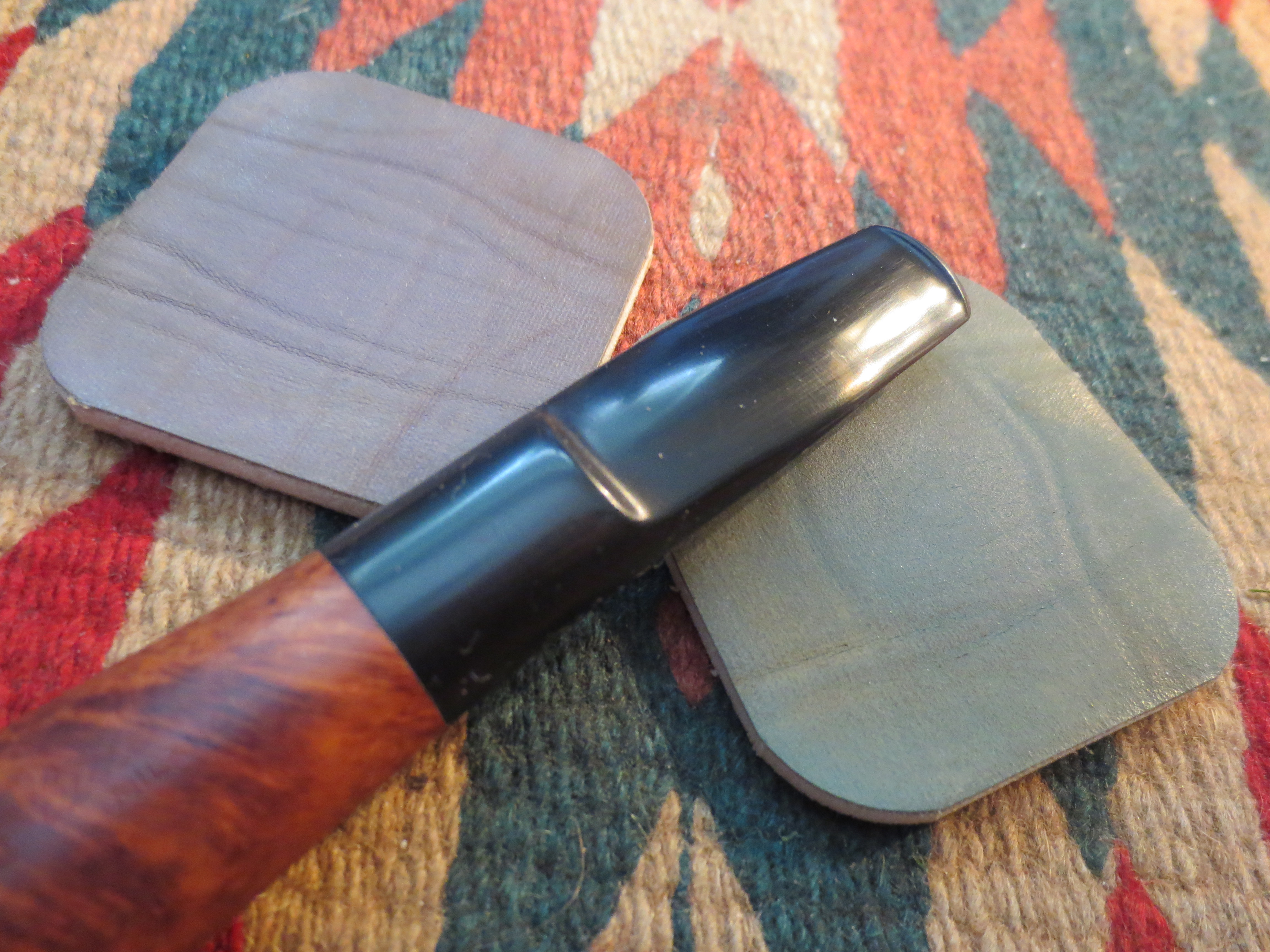
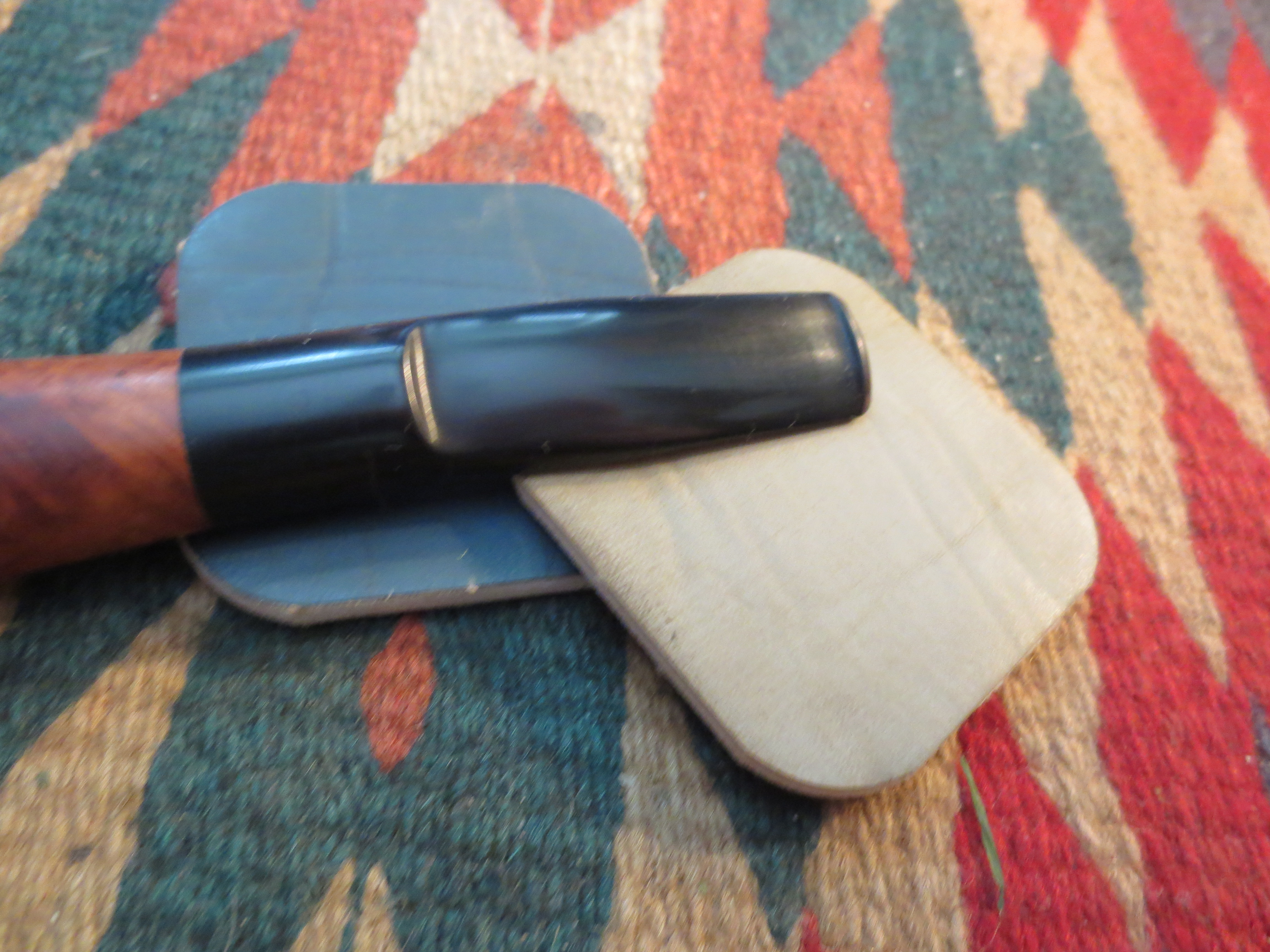
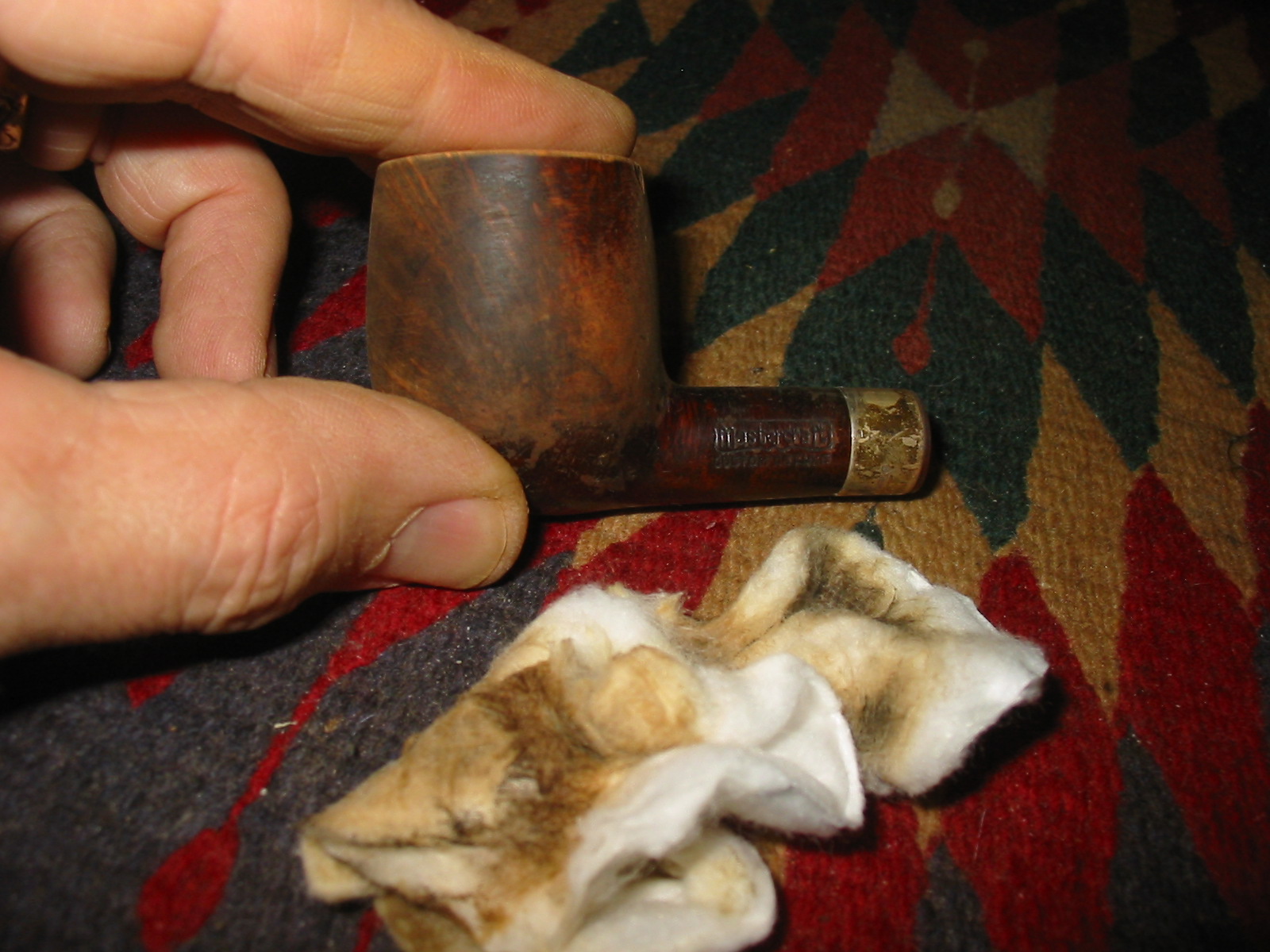
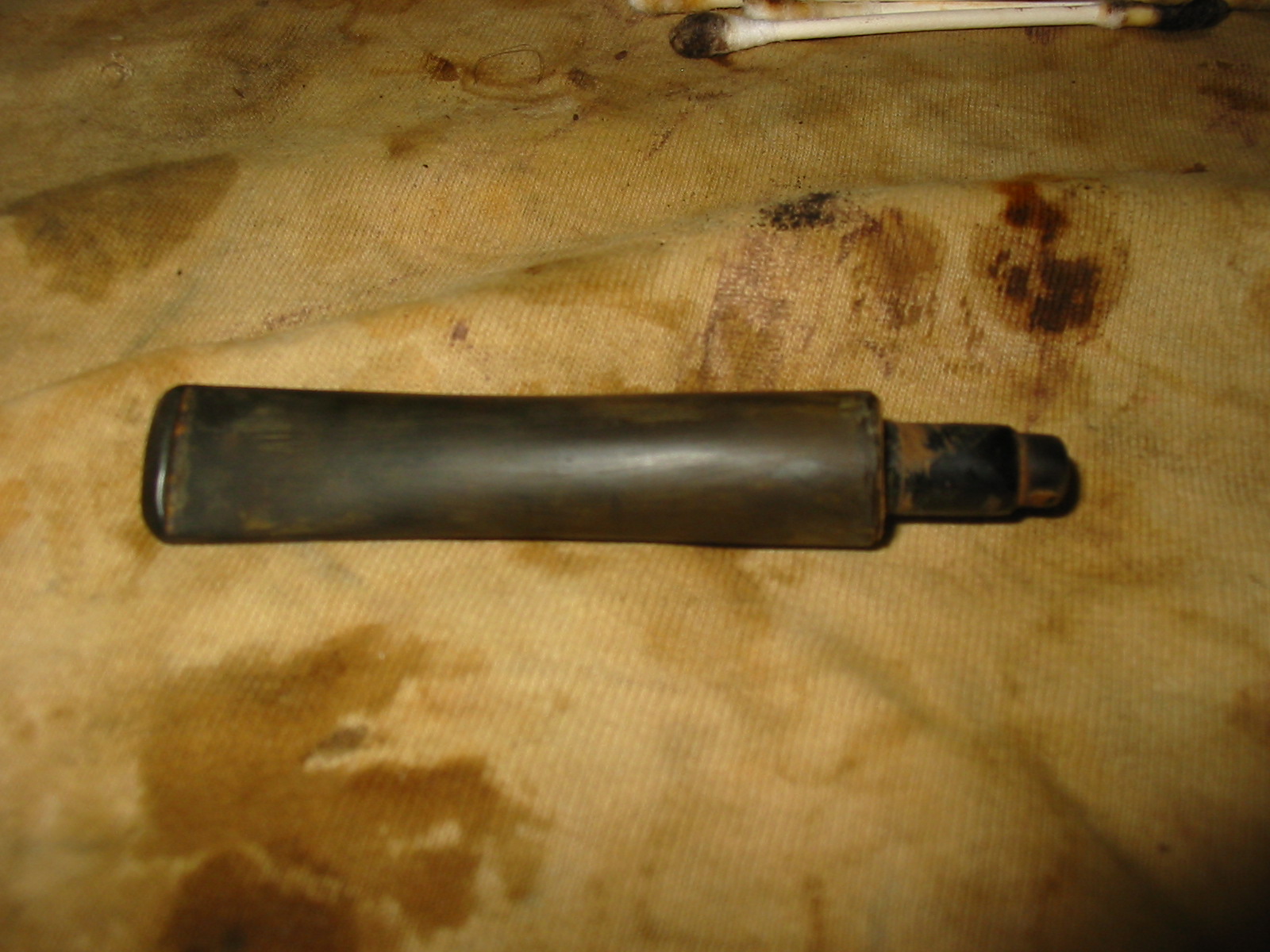
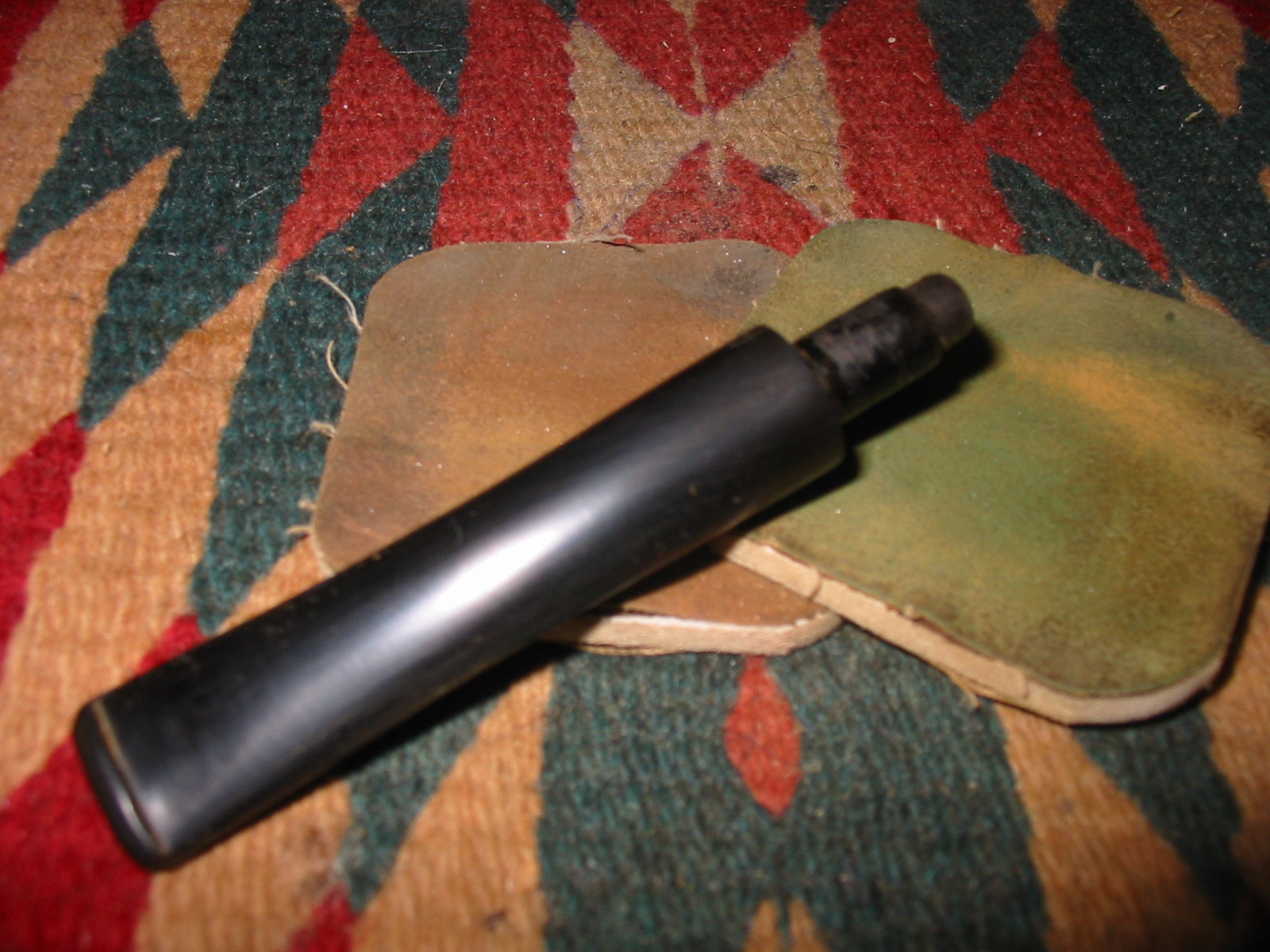
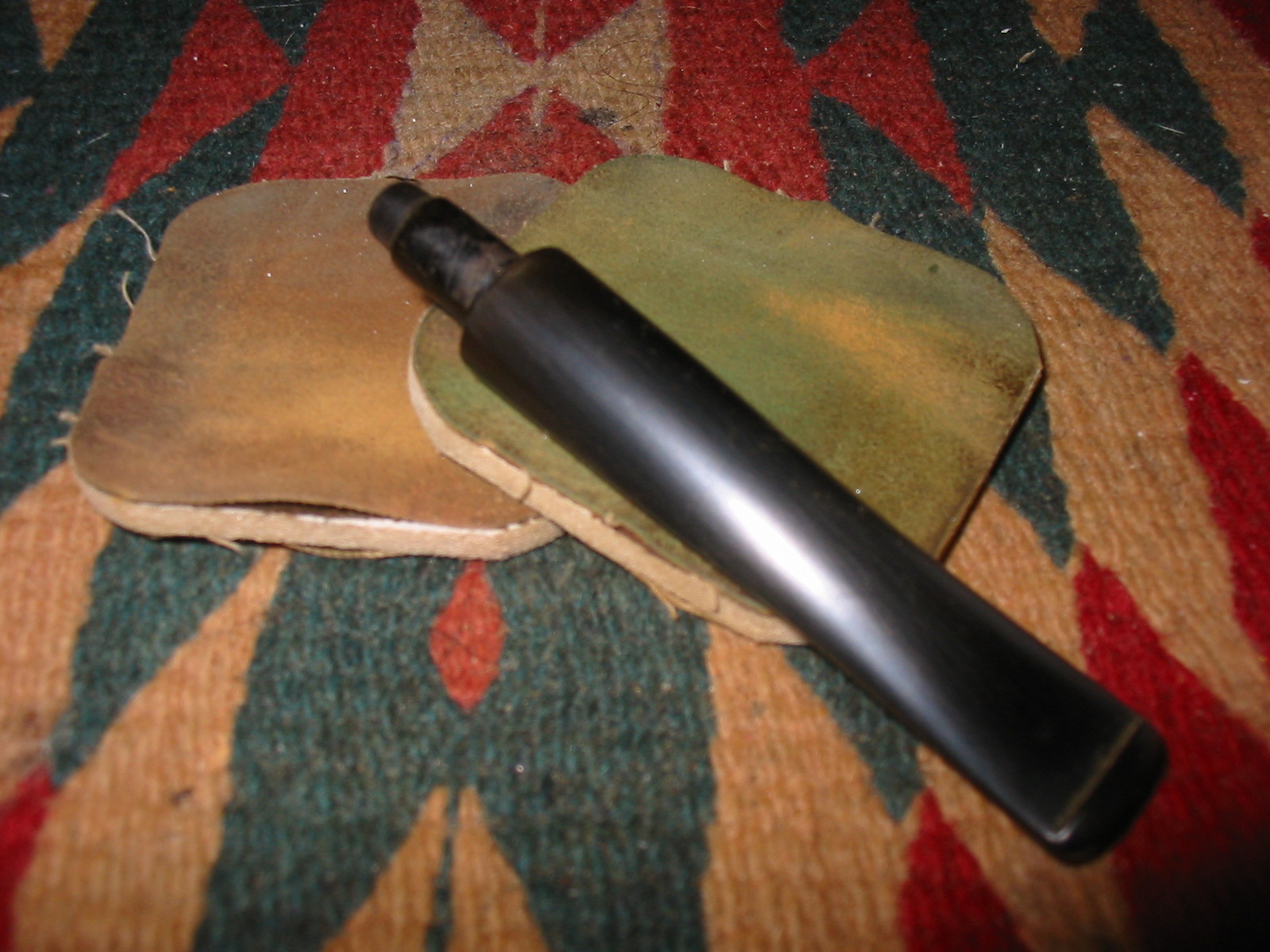
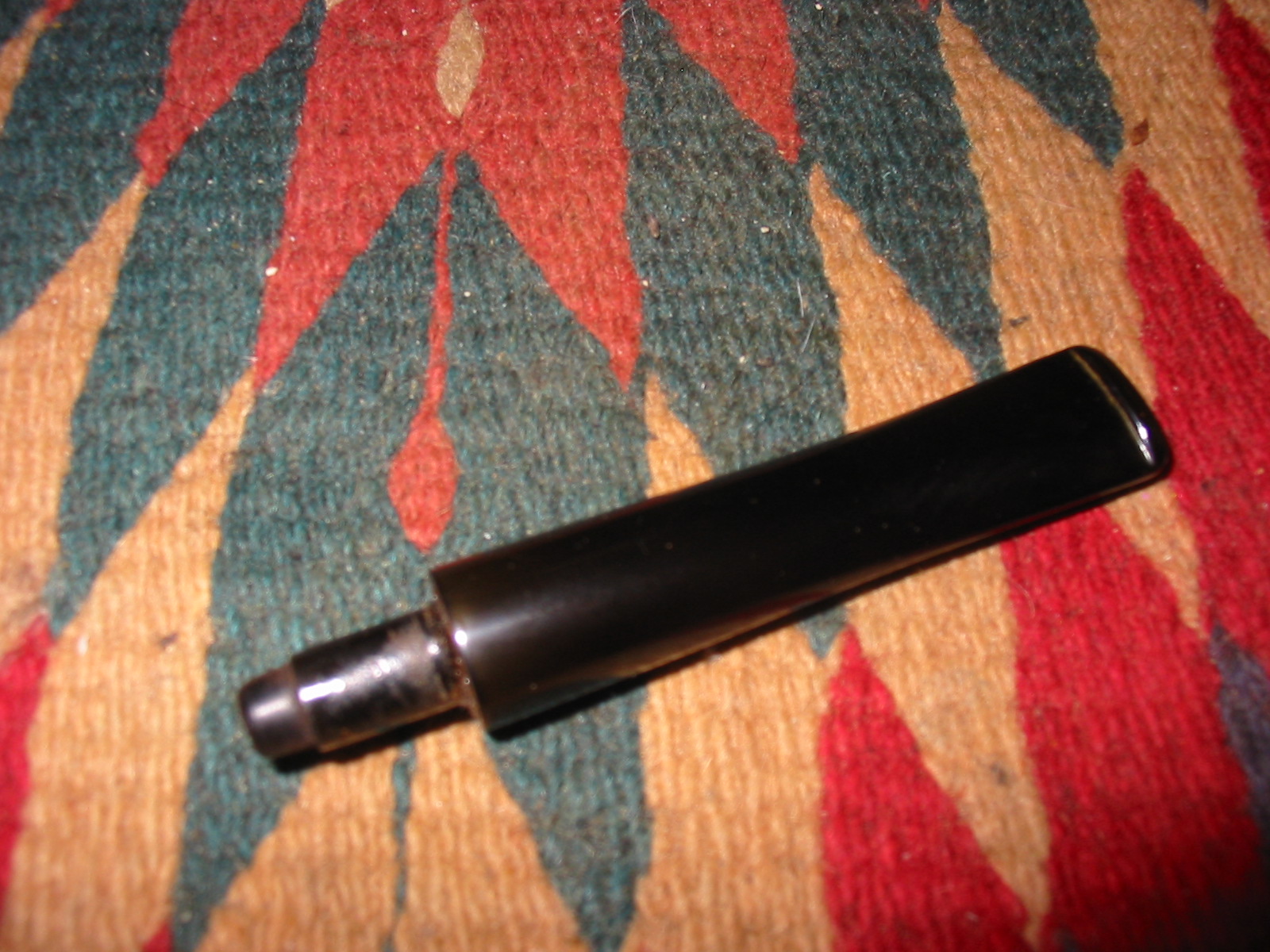
I wiped the bowl down with acetone on a cotton pad, used a dental pick to clean out the grooves and screwed bowl on the base to get an idea how the pipe would look. I also wiped down the bowl base with Everclear to clean off the grime and buildup on that surface. I went through my can of stems in search of a diamond shaped stem that would finish out the look of the pipe. I came up empty-handed so I chose a round stem of the right diameter and length that I could shape to fit the shank. I drilled out the shank to remove the metal tenon and also to open the diameter of the mortise. The original stem had been a screw on one and the metal mortise and the metal tenon were firmly welded together so the drill was the only way to remove it. I opened it as wide as possible while still leaving enough material on the shank to maintain strength. I turned the tenon with the PIMO tenon turning tool and then a Dremel to bring it to the correct size for the new shank. The next two photos show the stem and the fit of the stem to the shank.
WDC base in need of a diamond shaped stem. Necessity is the mother of invention. I used a round Lovat stem.

WDC base in need of a diamond shaped stem. Necessity is the mother of invention. I used a round Lovat stem.


I turned the tenon to fit the mortise and then inserted the stem against the shank.

I turned the tenon to fit the mortise and then inserted the stem against the shank.


Now I needed to shape the stem and remove material to transform the round saddle bit to a diamond saddle bit. I used a Dremel to cut the basic shape in the stem. I proceeded from side to side with the stem on the shank to make sure to match the angles of the shank. I wrote a post on the process for the blog and posted that earlier. You can read about the details of that process on this link https://rebornpipes.wordpress.com/2013/04/15/shaping-a-diamond-shaped-stem-from-a-round-one/ The next eleven photos give a quick look at the shaping work on the stem. It took time and I had to be careful to not damage the shank when I was using the Dremel and sanding drum on the stem.
Figure 3 I used a Dremel to shape the stem to match the diamond angles of the shank. I worked on one side at a time.

Figure 3 I used a Dremel to shape the stem to match the diamond angles of the shank. I worked on one side at a time.

Figure 4 Pipe resting against the Dremel with a sanding drum. Shaping progressed quite quickly. This picture shows one side beginning to take shape.

Figure 4 Pipe resting against the Dremel with a sanding drum. Shaping progressed quite quickly. This picture shows one side beginning to take shape.

5 Top view of the shank. Both sides of the round stem are beginning to take on the shape of the shank.

5 Top view of the shank. Both sides of the round stem are beginning to take on the shape of the shank.

Figure 6 Top view after more shaping with the Dremel.

Figure 6 Top view after more shaping with the Dremel.

Figure 7 Bottom view before the Dremel did its work.

Figure 7 Bottom view before the Dremel did its work.

Figure 8 Left side view after the first side has begun to take shape.

Figure 8 Left side view after the first side has begun to take shape.

Figure 9 Bottom view after both sides have begun to take shape.

Figure 9 Bottom view after both sides have begun to take shape.

Figure 10 Right side view of the stem after it began to take shape.

Figure 10 Right side view of the stem after it began to take shape.

Figure 11 Back to the worktable and the hand sanding.

Figure 11 Back to the worktable and the hand sanding.

Figure 12 Hand sanding continues.

Figure 12 Hand sanding continues.

Figure 13 Hand sanding continues.

Figure 13 Hand sanding continues.


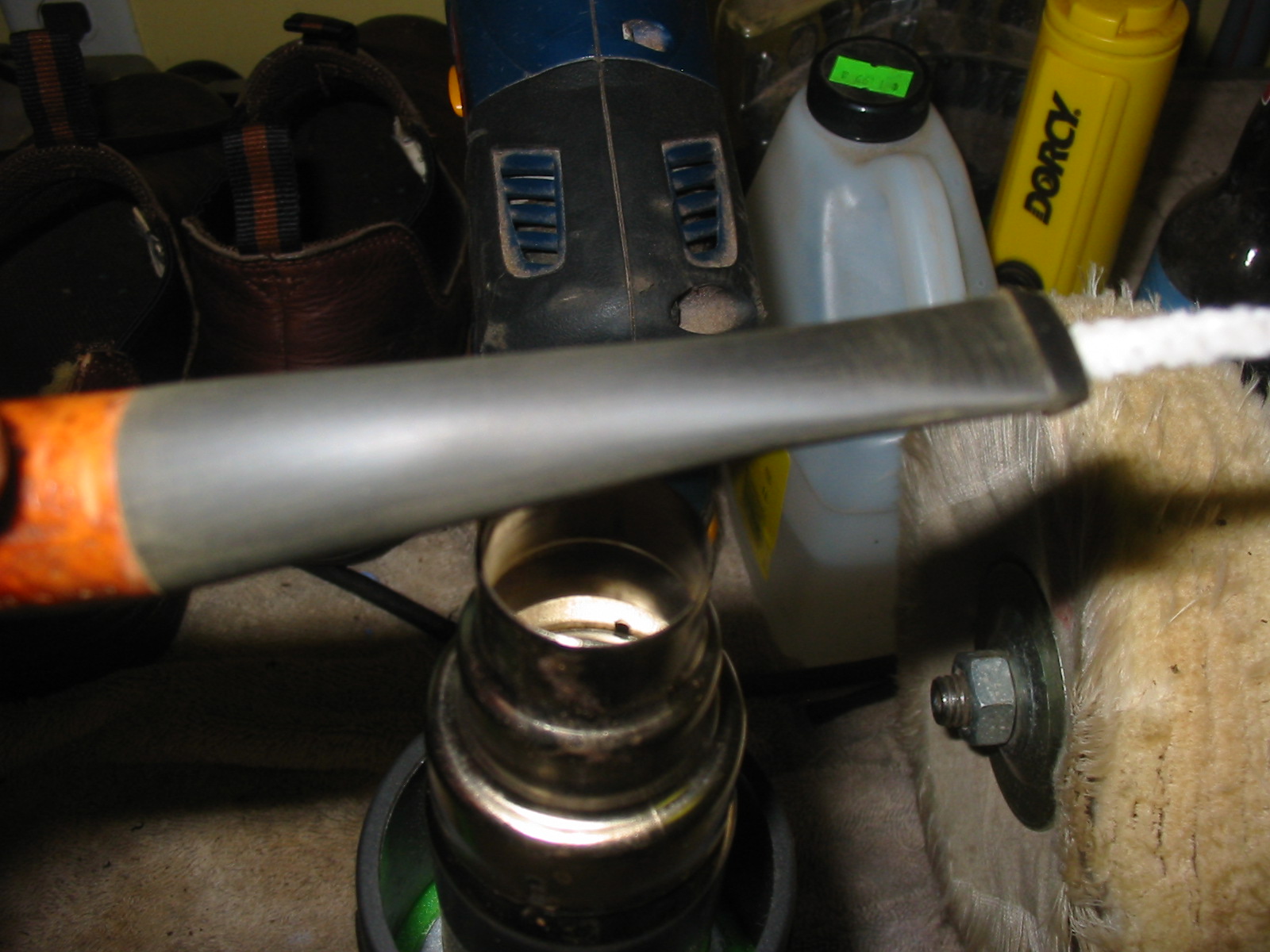
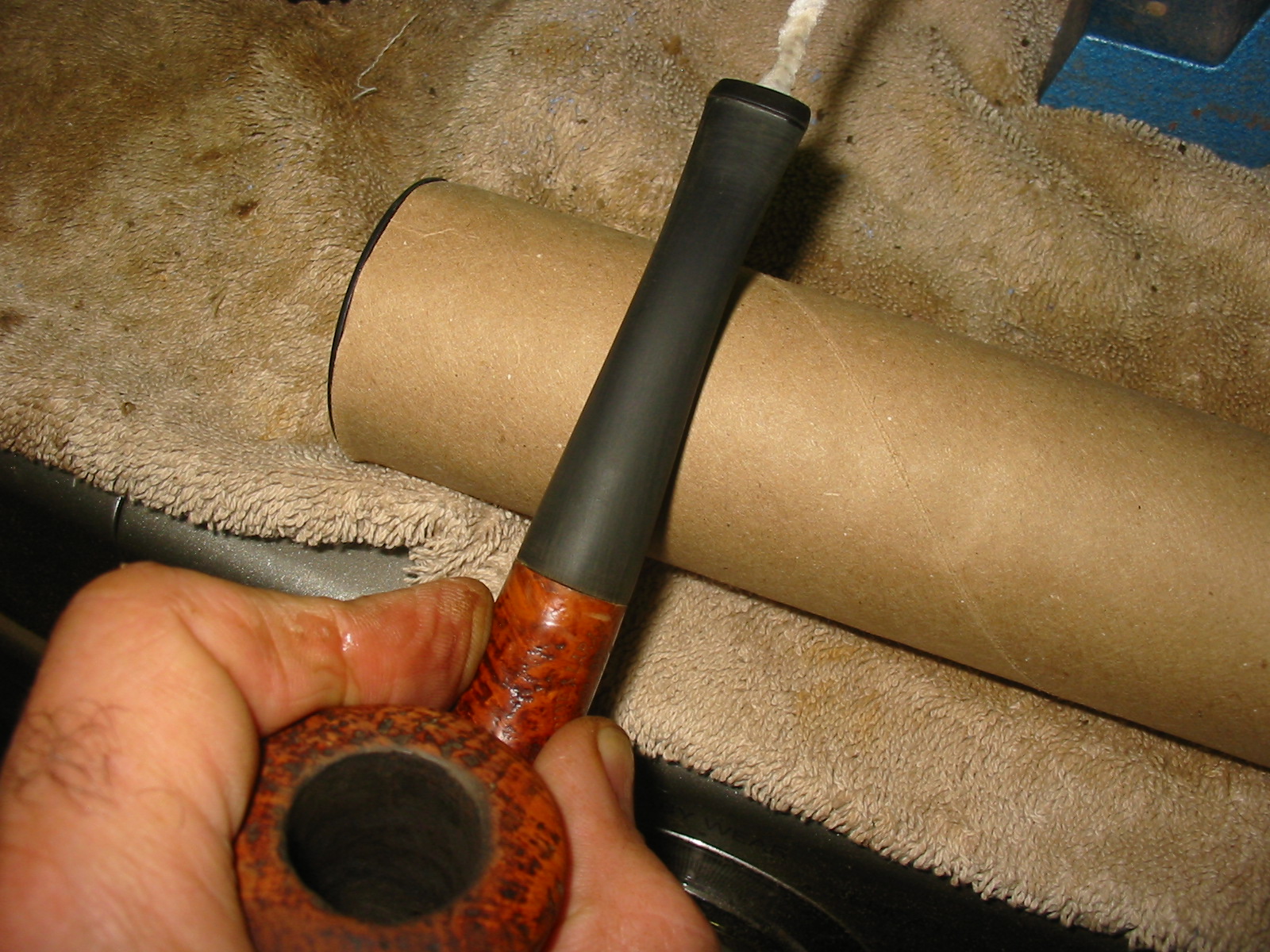
The original shank had sported an ornate band and the stain in the Bakelite showed the marks of the band. I did not have any ornate bands in my collection of bands so I chose instead to band it with a nickel band. I shaped the band to fit, beginning with a round band. This took a bit of fussing to get the shape and fit correct. I have written that process up in detail in a previous blog post as well. You can read about the process at this link https://rebornpipes.wordpress.com/2013/04/15/shaping-a-round-metal-band-to-fit-a-square-or-diamond-shank/ Once the band was shaped correctly I heated it with a heat gun until it was pliable and then pressure fit it on the shank of the pipe. The next series of five photos show the process I used to pressure fit the band on the shank. Once it was in place I carefully used my furniture hammer to flatten the band against the shank.
The square is done

The square is done

Fitting a nickel band on the shank

Fitting a nickel band on the shank

Fitting a nickel band on the shank

Fitting a nickel band on the shank

Nickel band fitted on the shank

Nickel band fitted on the shank

Nickel band fitted on the shank

Nickel band fitted on the shank


The next series of four photos show the newly shaped stem in place on the banded pipe. There was still a lot of work to do on the pipe including cleaning the internals and reworking the bowl and rim but the overall look of the “new” pipe is intriguing.
New band and stem in place.

New band and stem in place.

New band and stem in place

New band and stem in place

Bottom view of the newly banded and stemmed pipe

Bottom view of the newly banded and stemmed pipe

Top view of the new band and stem

Top view of the new band and stem


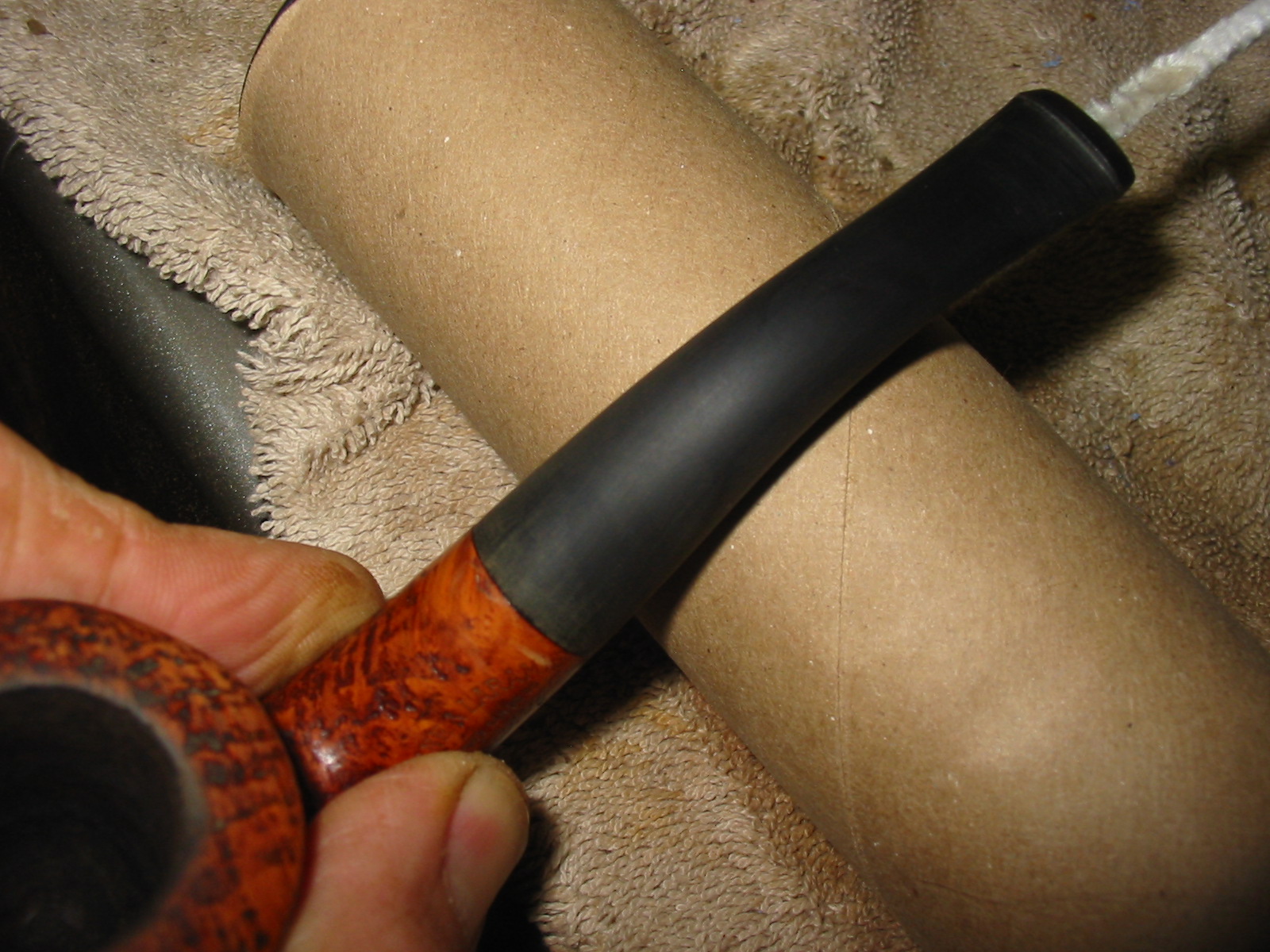
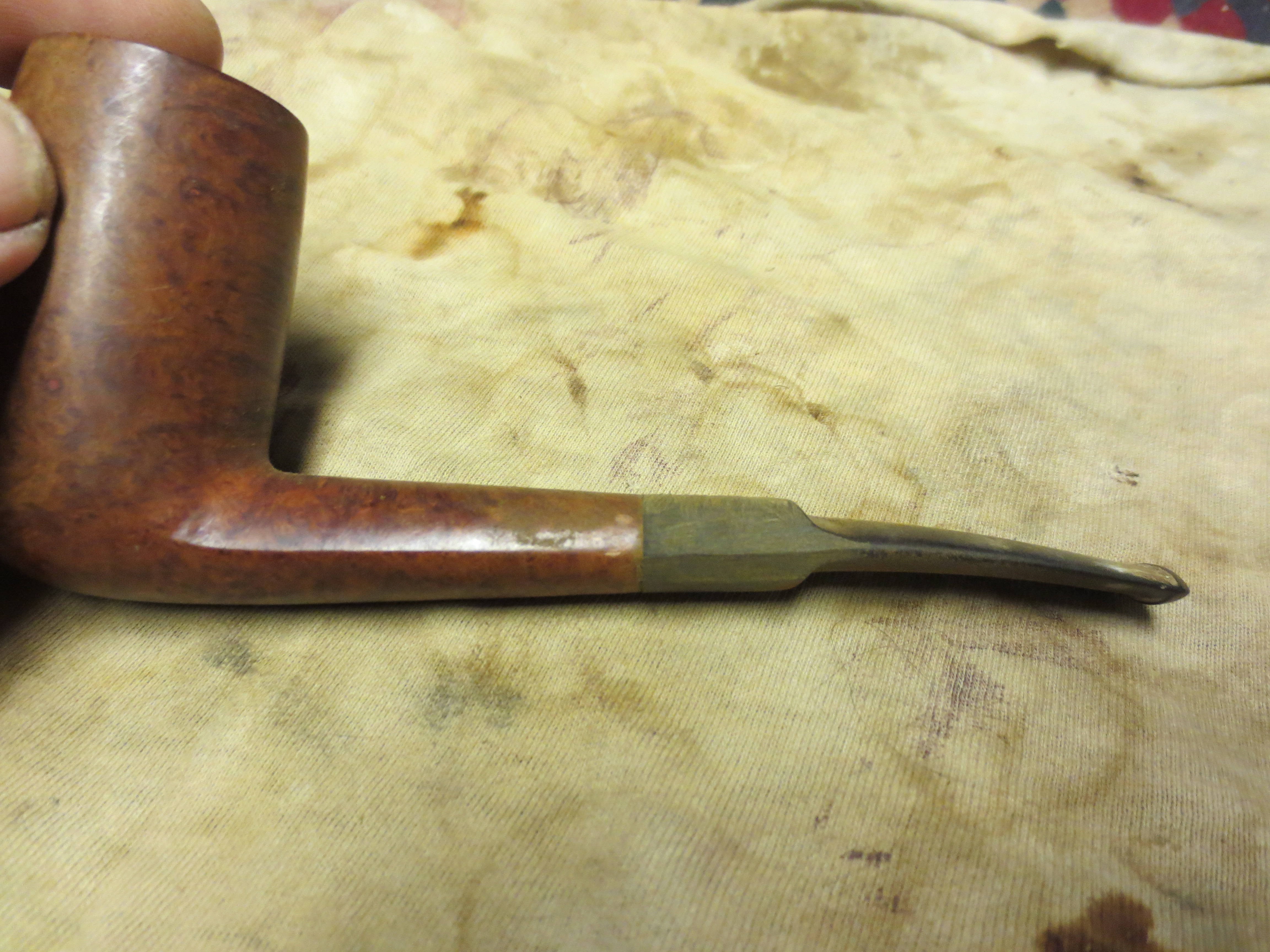
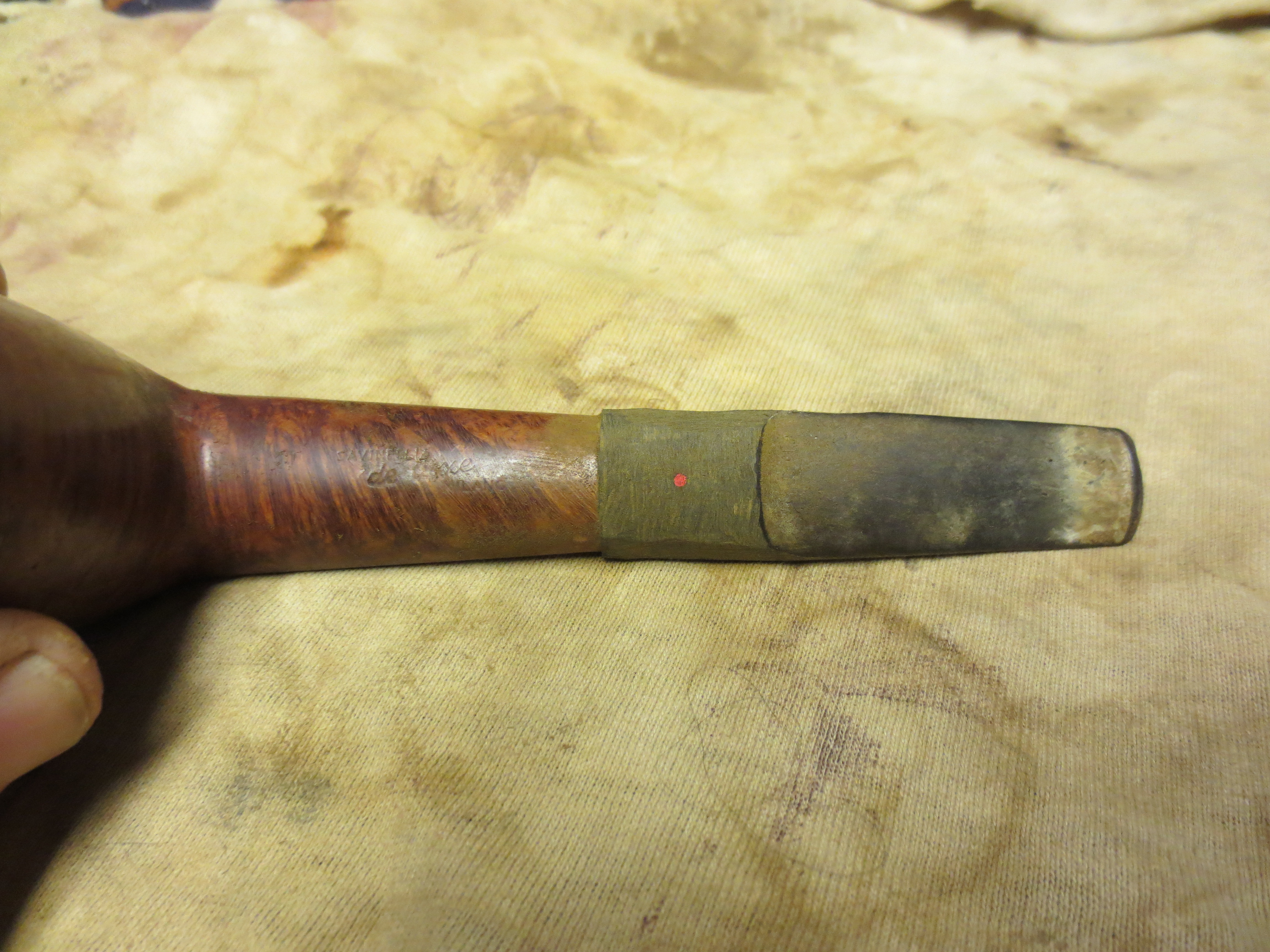
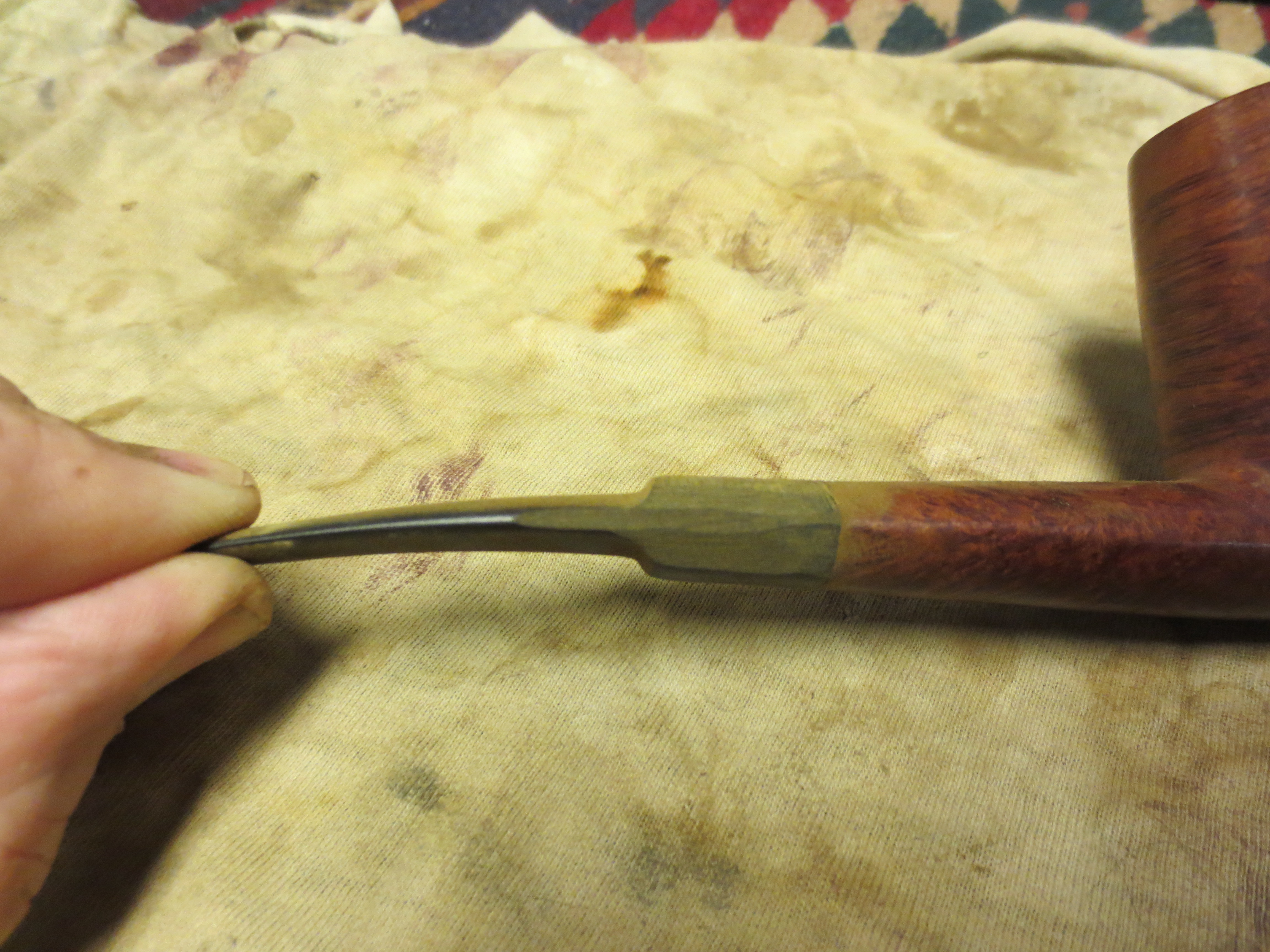
I have included one photo below to give you an idea of the shape of the new stem. I remove a lot of vulcanite to get it from its original round shape to the diamond shape pictured below. The fit and the angles match the shank perfectly. These older pipes are tricky to fit a diamond stem on because none of the sides of the diamond are the same dimensions. Each one is just slightly different so you have to do the fitting work with the stem in place on the shank.
View from the tenon end of the diamond stem at this point in the process.

View from the tenon end of the diamond stem at this point in the process.


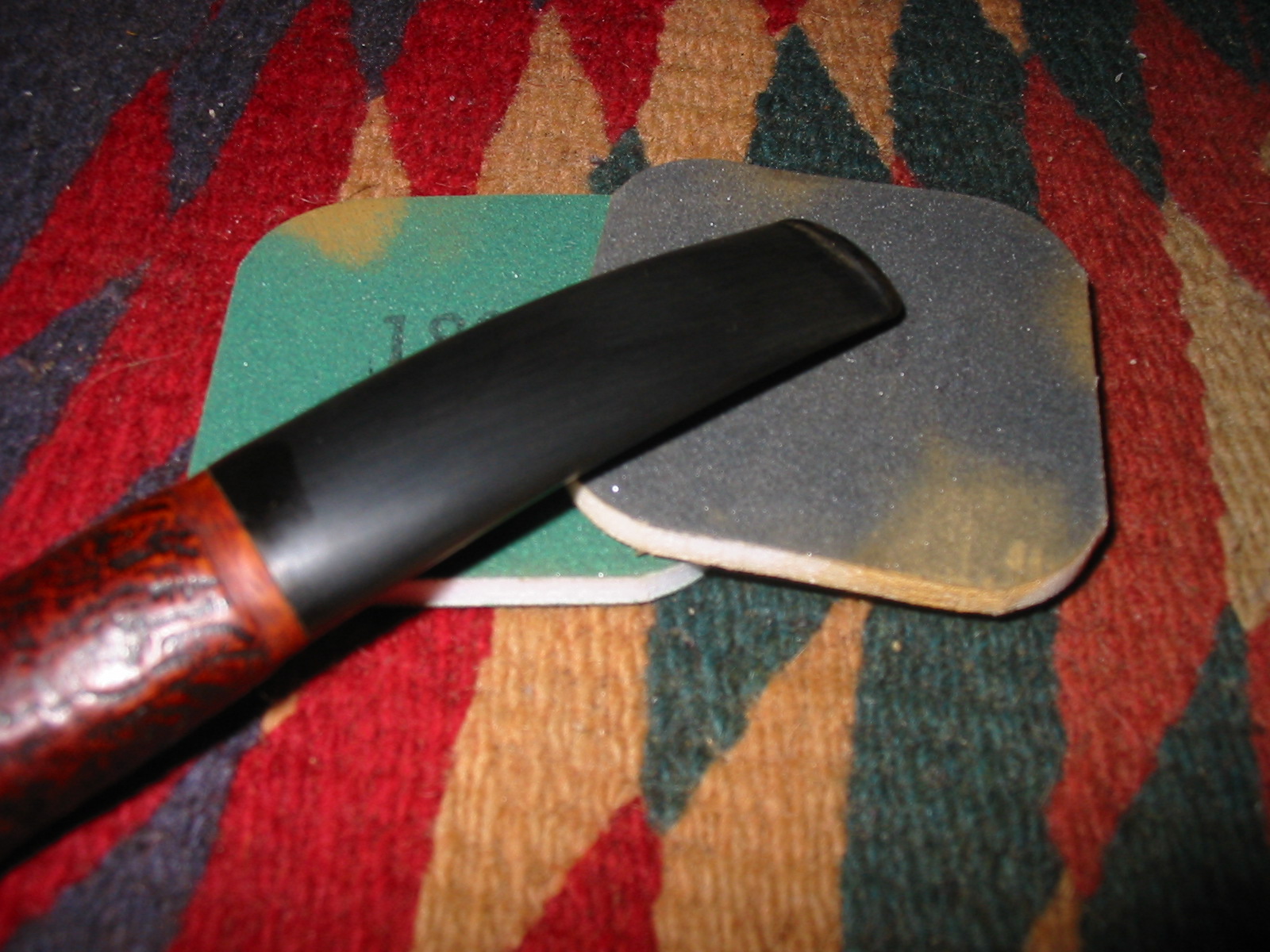
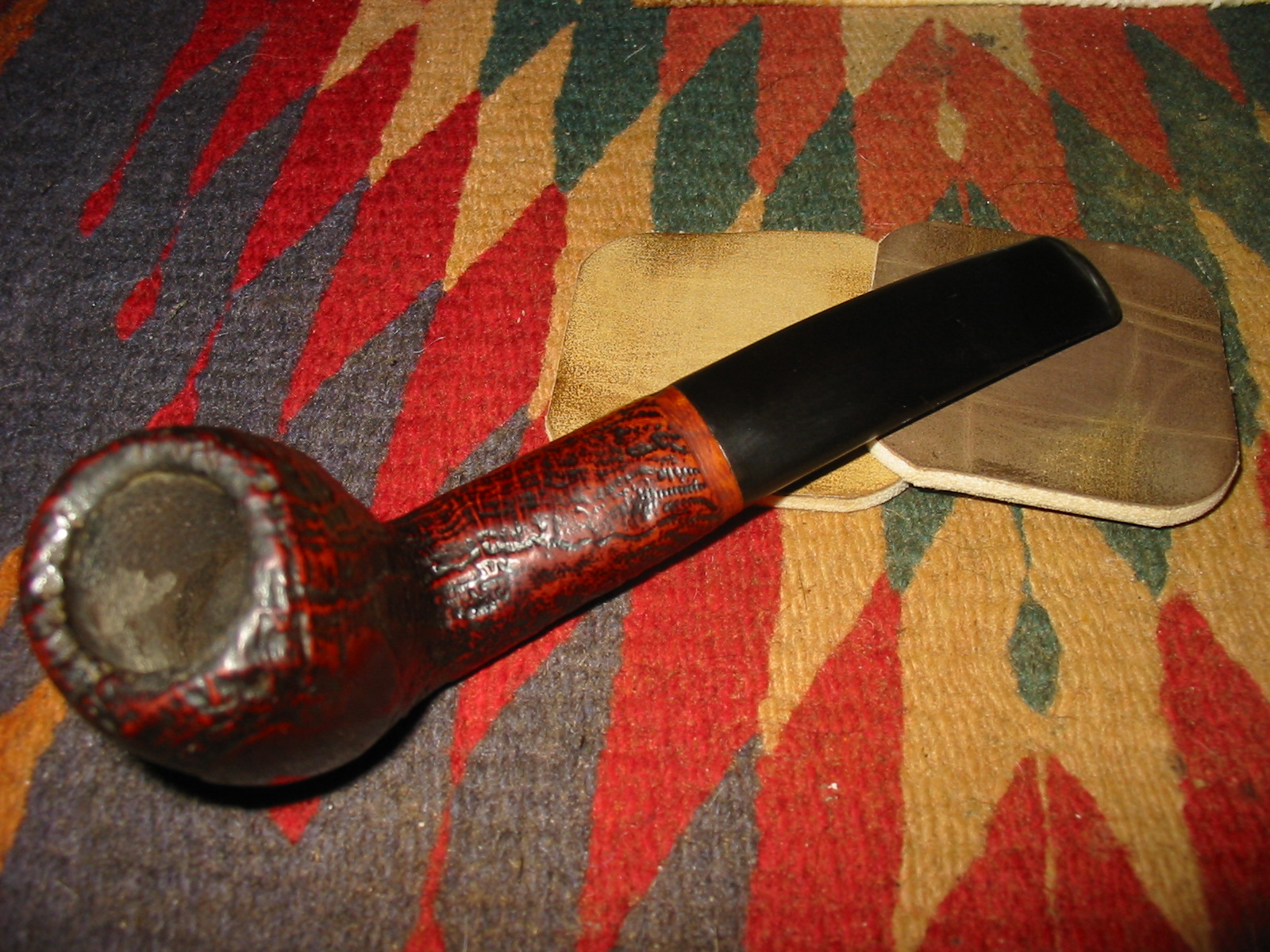
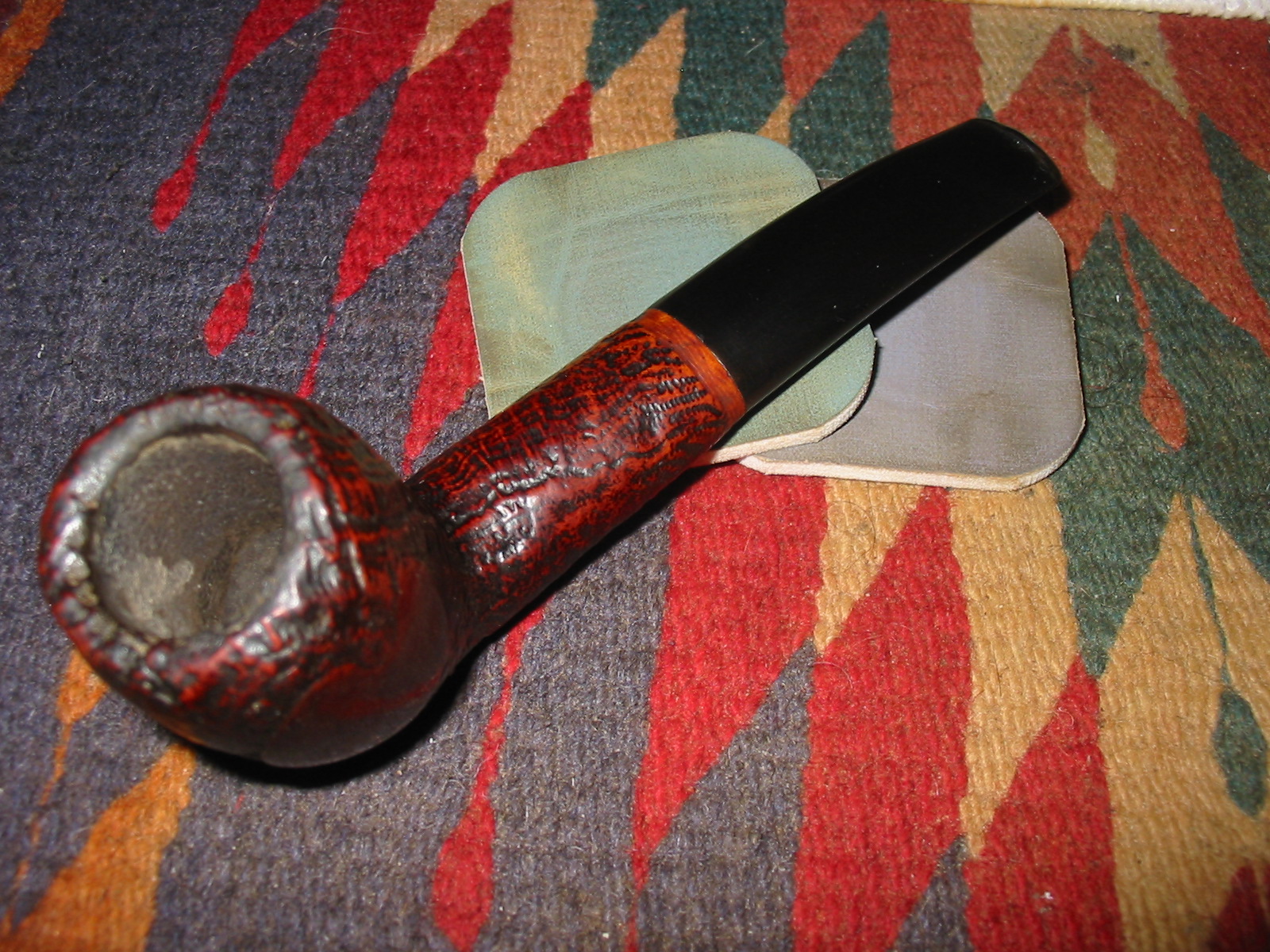
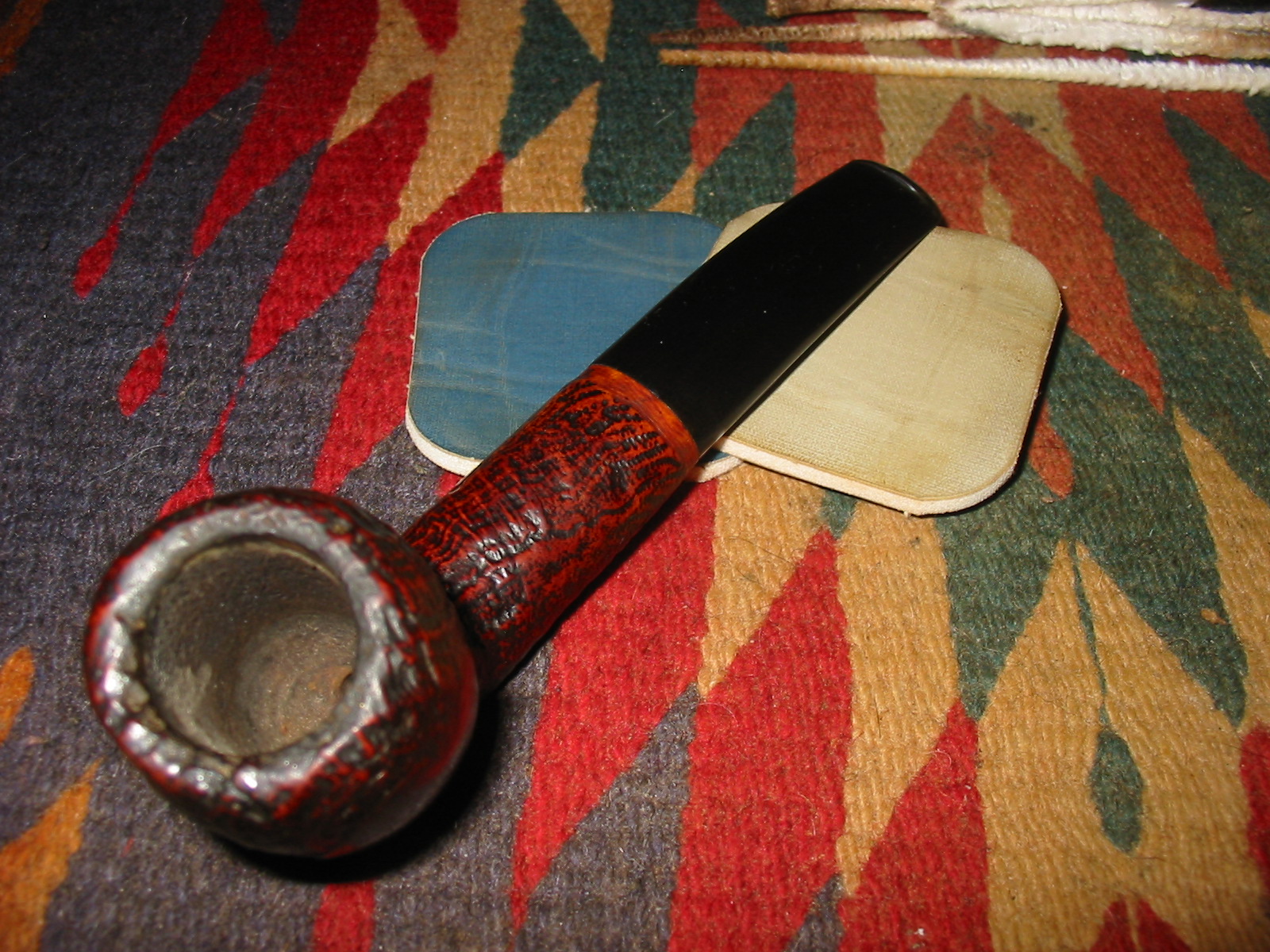
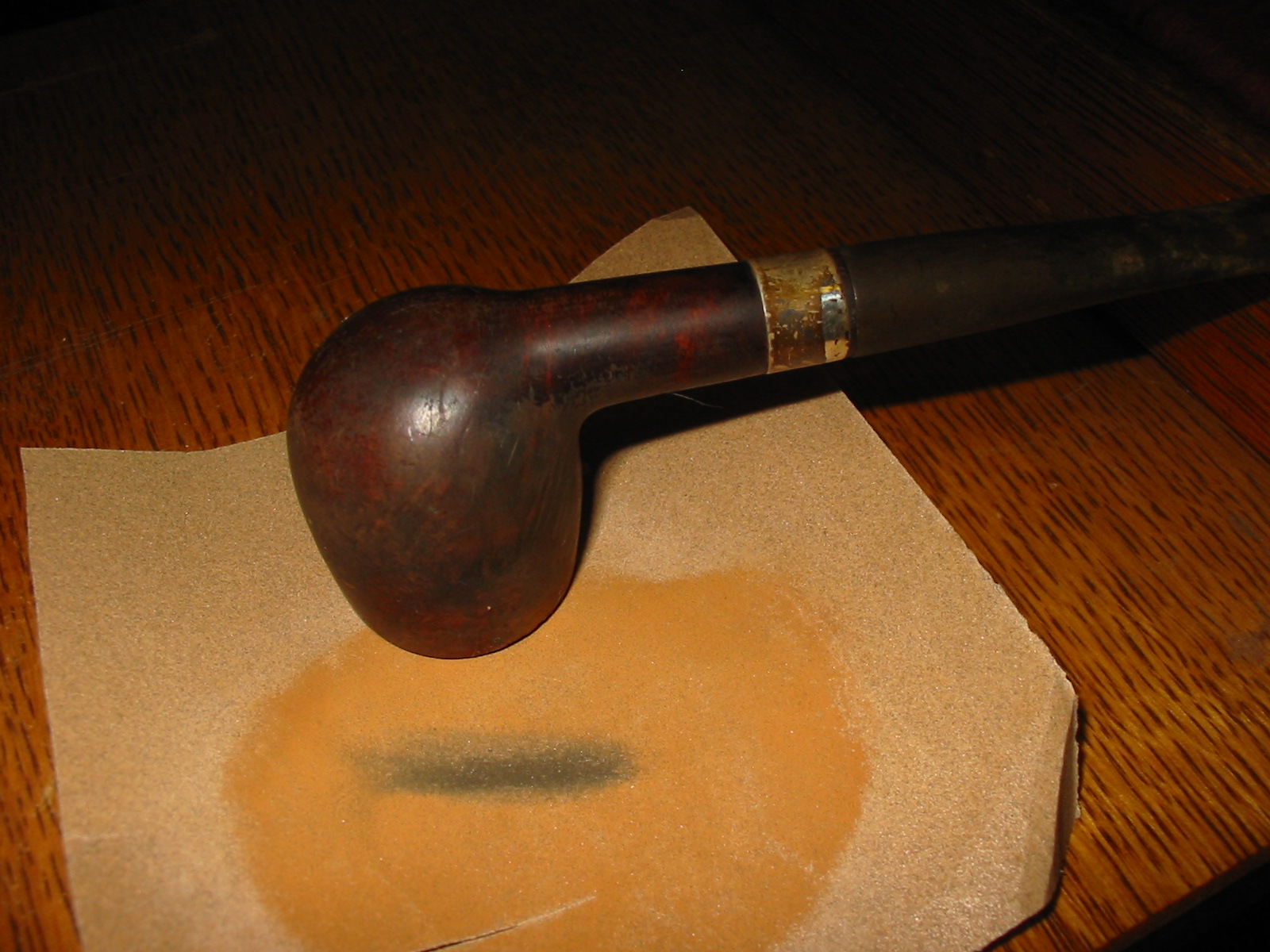
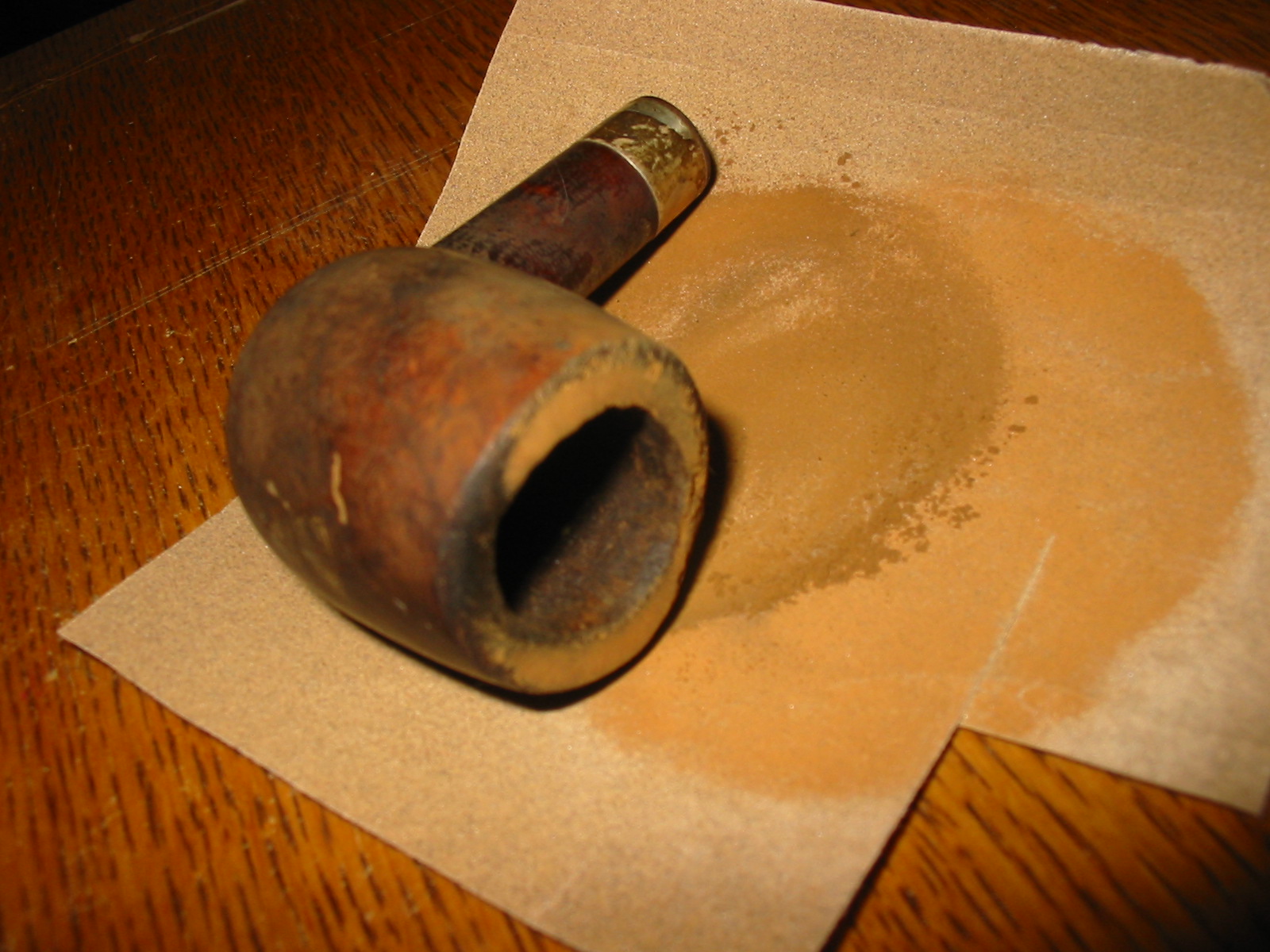
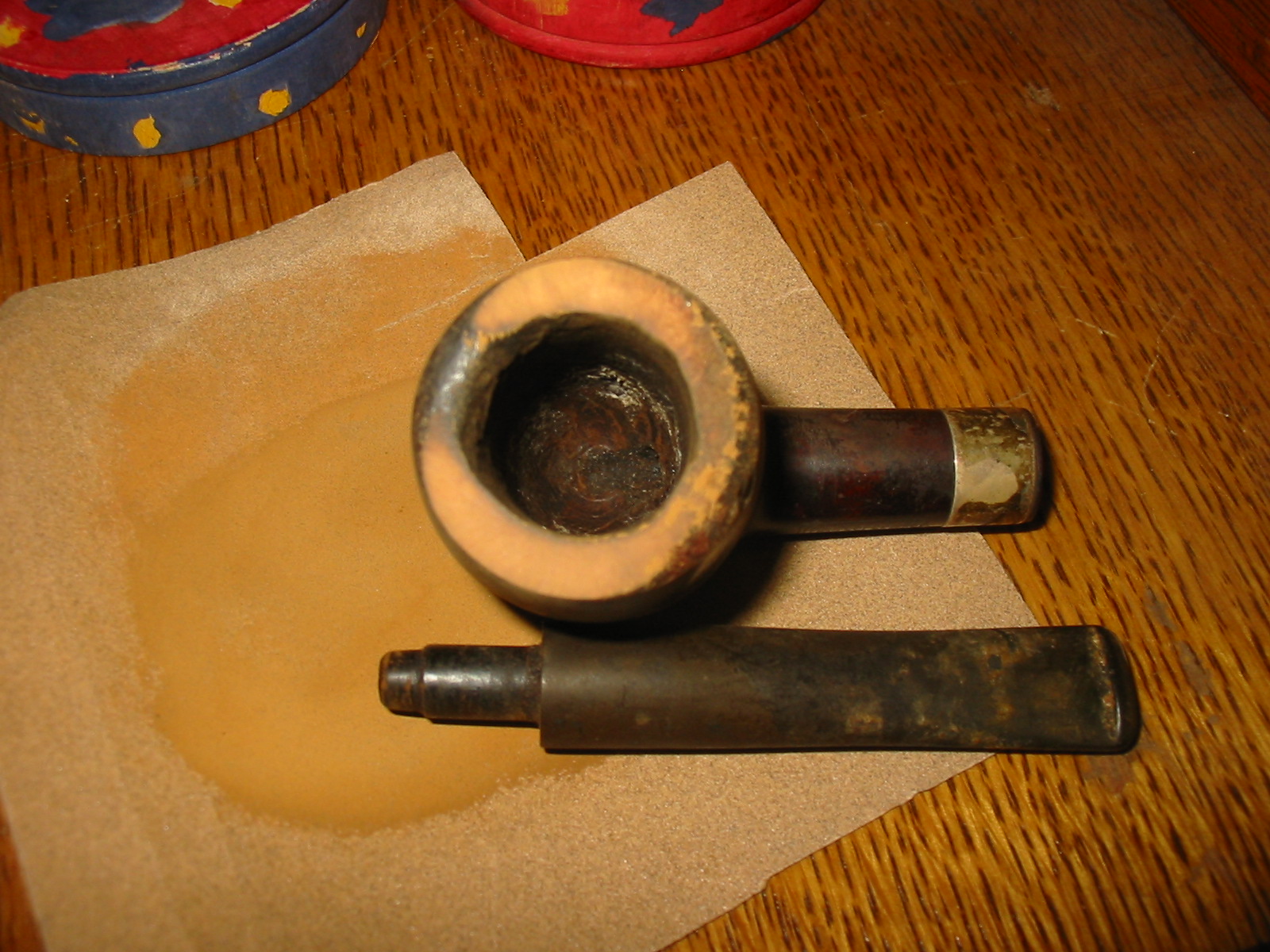
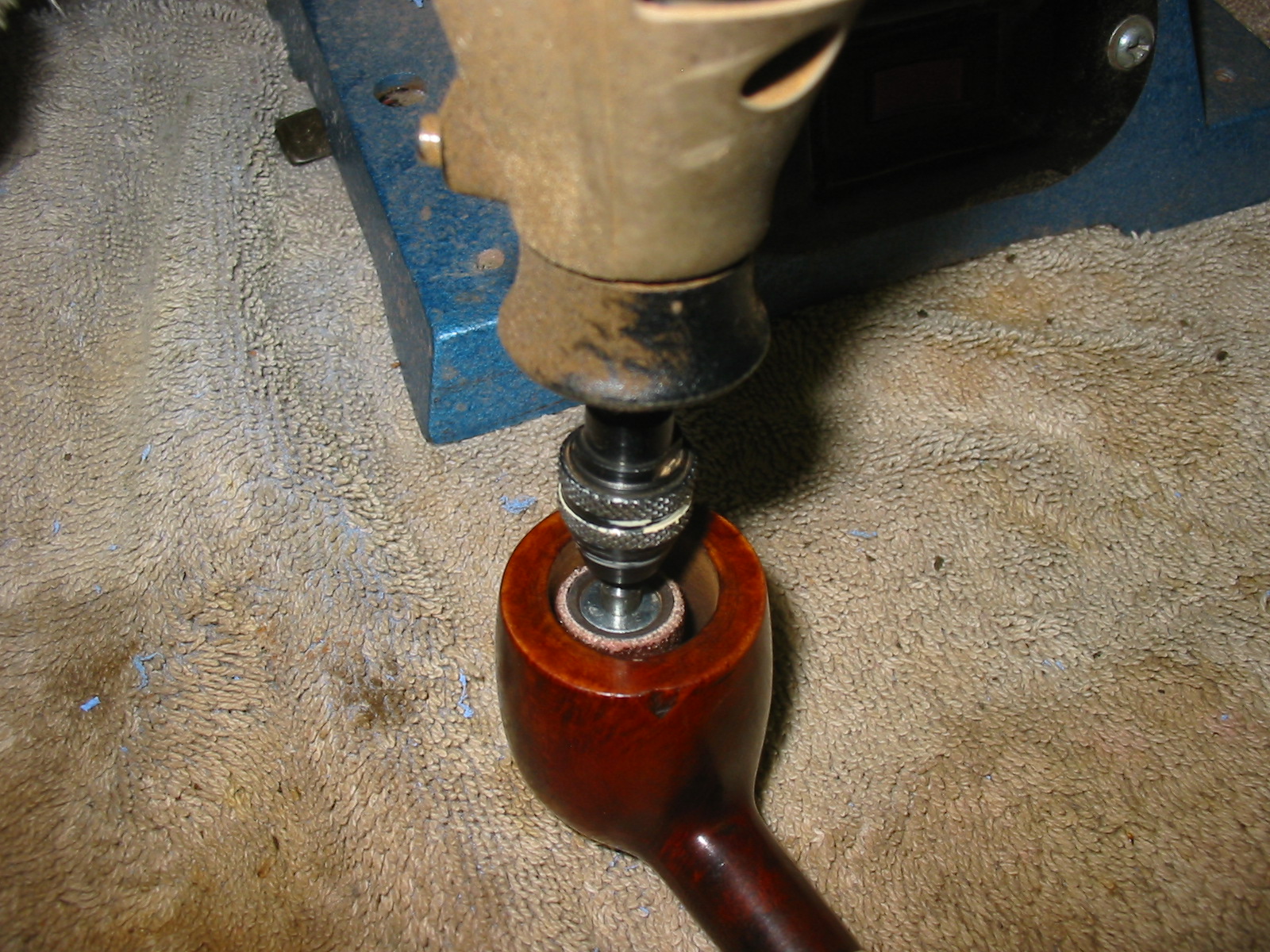
With the stem fitting correctly it was time to tackle the bowl. I set up my board and emery paper so that I could top the bowl. The first photo shows the set up. The second photo shows the state of the bowl rim when I started the process.
Set up for topping the bowl

Set up for topping the bowl

Reamed and ready to top

Reamed and ready to top


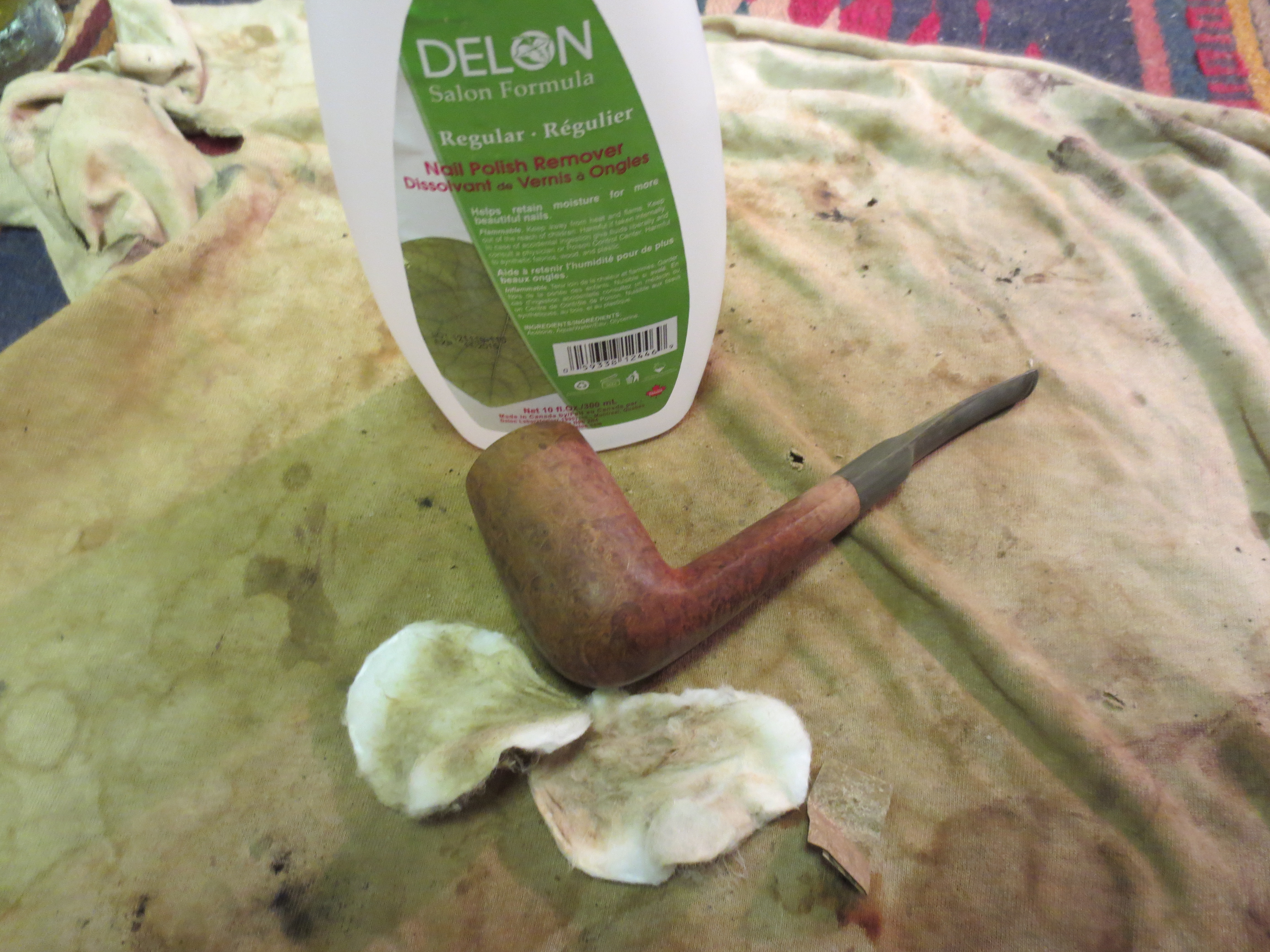
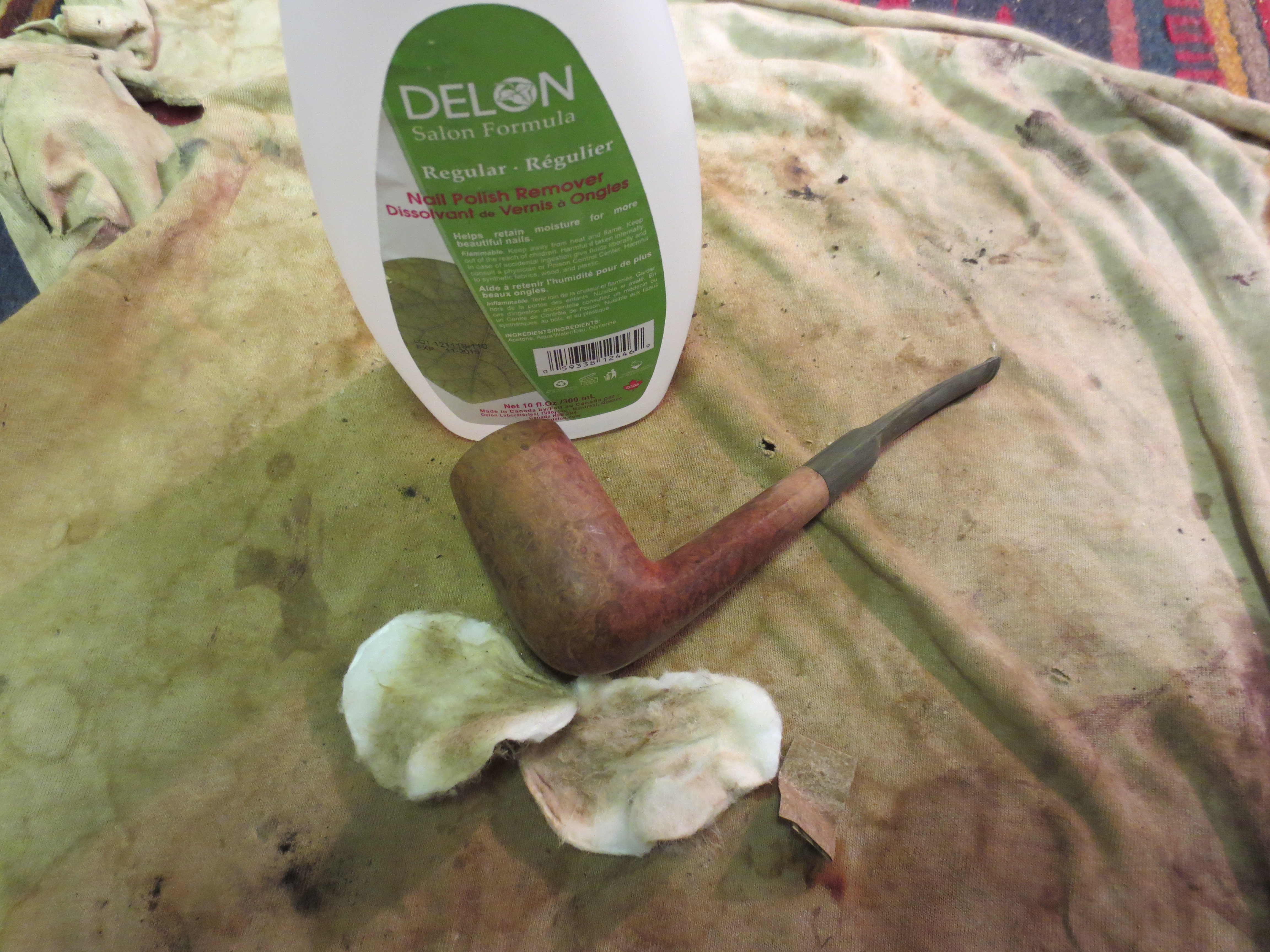
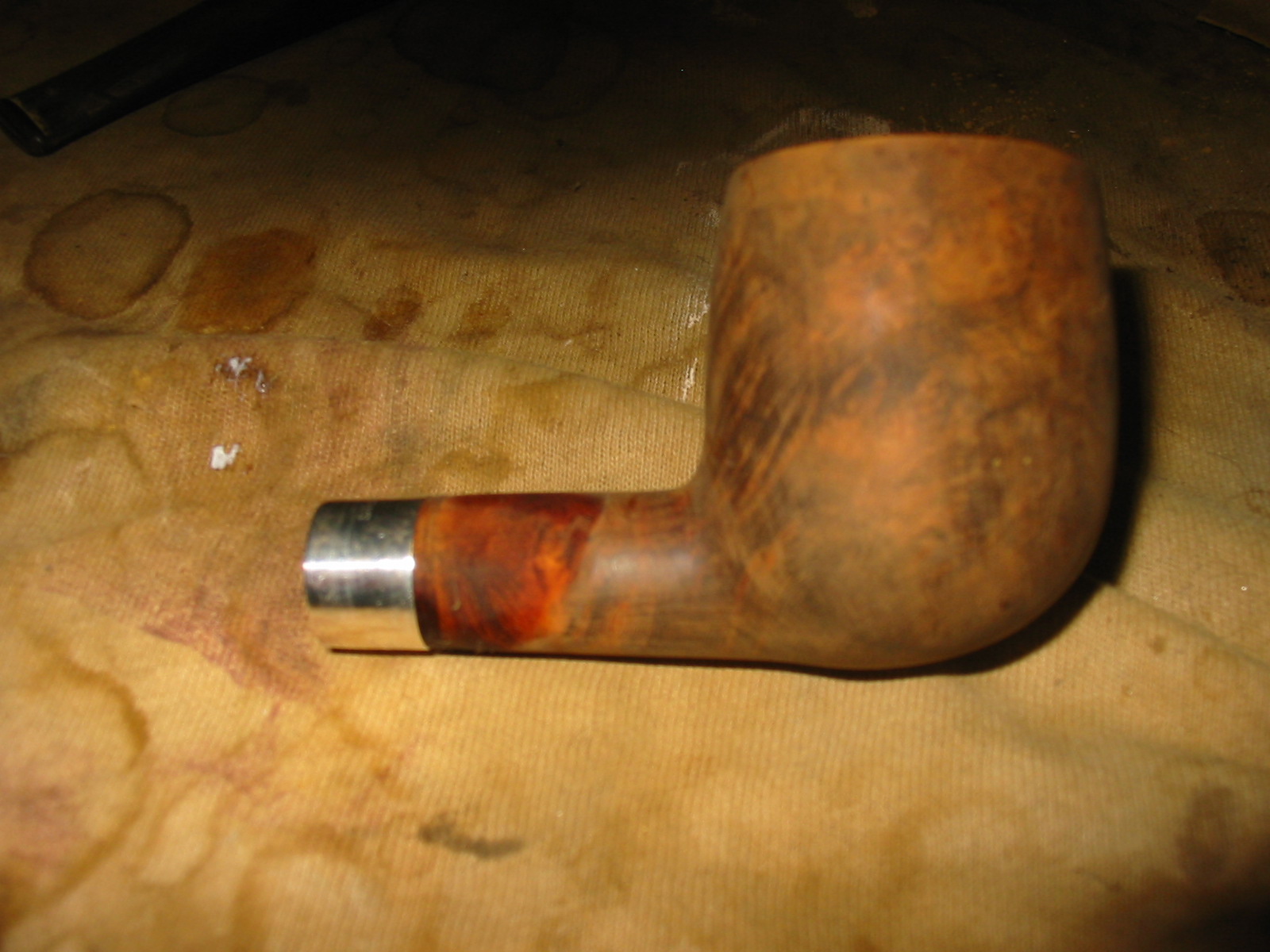
Once I had it topped I decided to wipe it down with acetone on a cotton pad to remove the finish and the grime from the topping. The next three photos show the clean bowl and the topped bowl. The finish work would take some time but the bowl was ready to move on to the next stage of rejuvenation.
Wiping down the bowl with acetone

Wiping down the bowl with acetone

Wiping down the newly topped rim with acetone

Wiping down the newly topped rim with acetone

Wiping down the bowl with acetone

Wiping down the bowl with acetone


I sanded the bowl with 240 and 320 grit sandpaper and finished sanding with a fine grit sanding sponge. The next two photos show the cleaned and prepped bowl ready for staining. The dark oil stains on the sides of the bowl would not come out. I wiped the bowl down with repeated washings of acetone and the surface was clean. I also sanded the stem with the sanding sponge while I worked on the bowl.
Bowl sanded, in place and ready to stain.

Bowl sanded, in place and ready to stain.

Bowl in place, sanded and ready to stain.

Bowl in place, sanded and ready to stain.


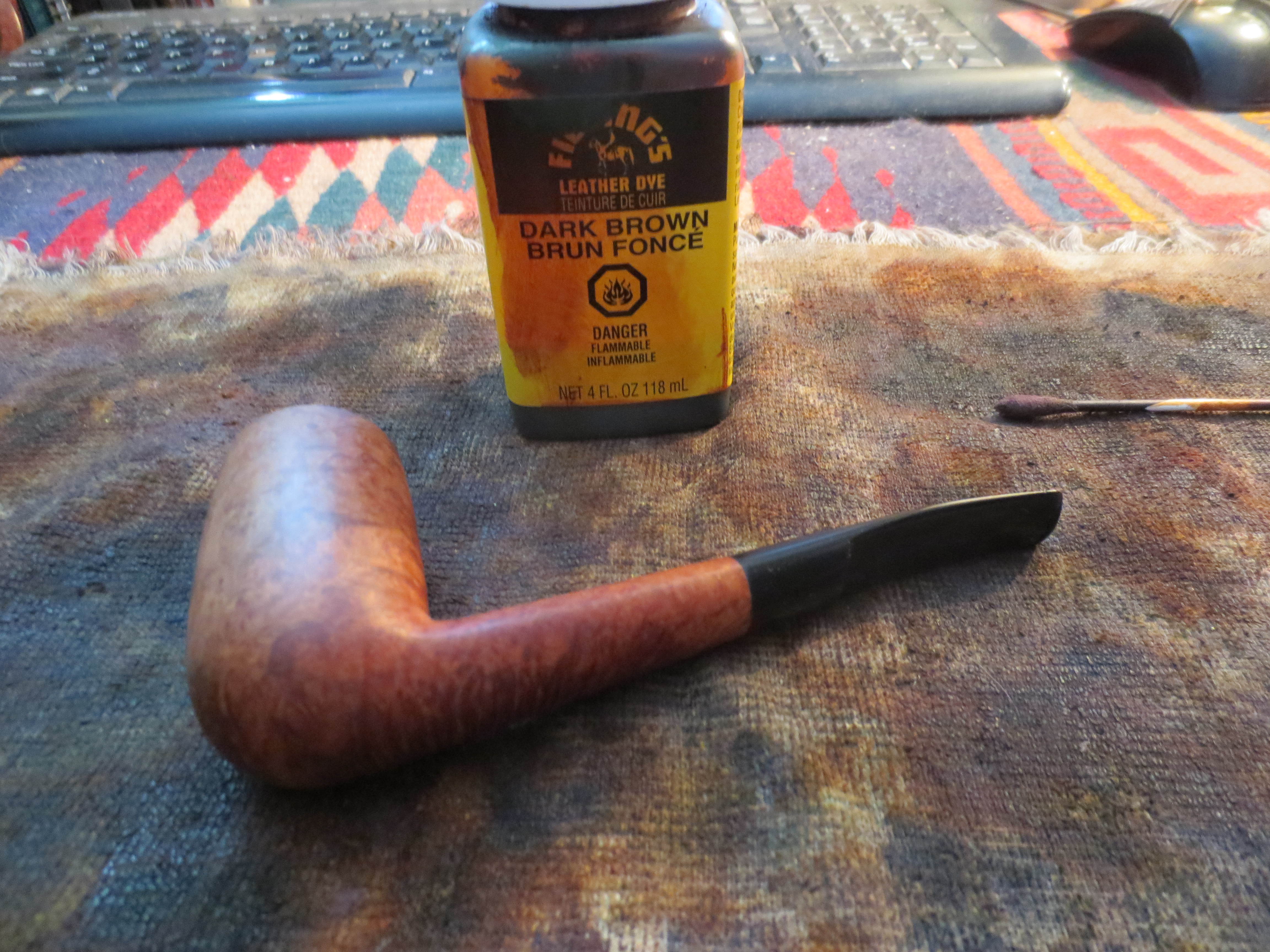
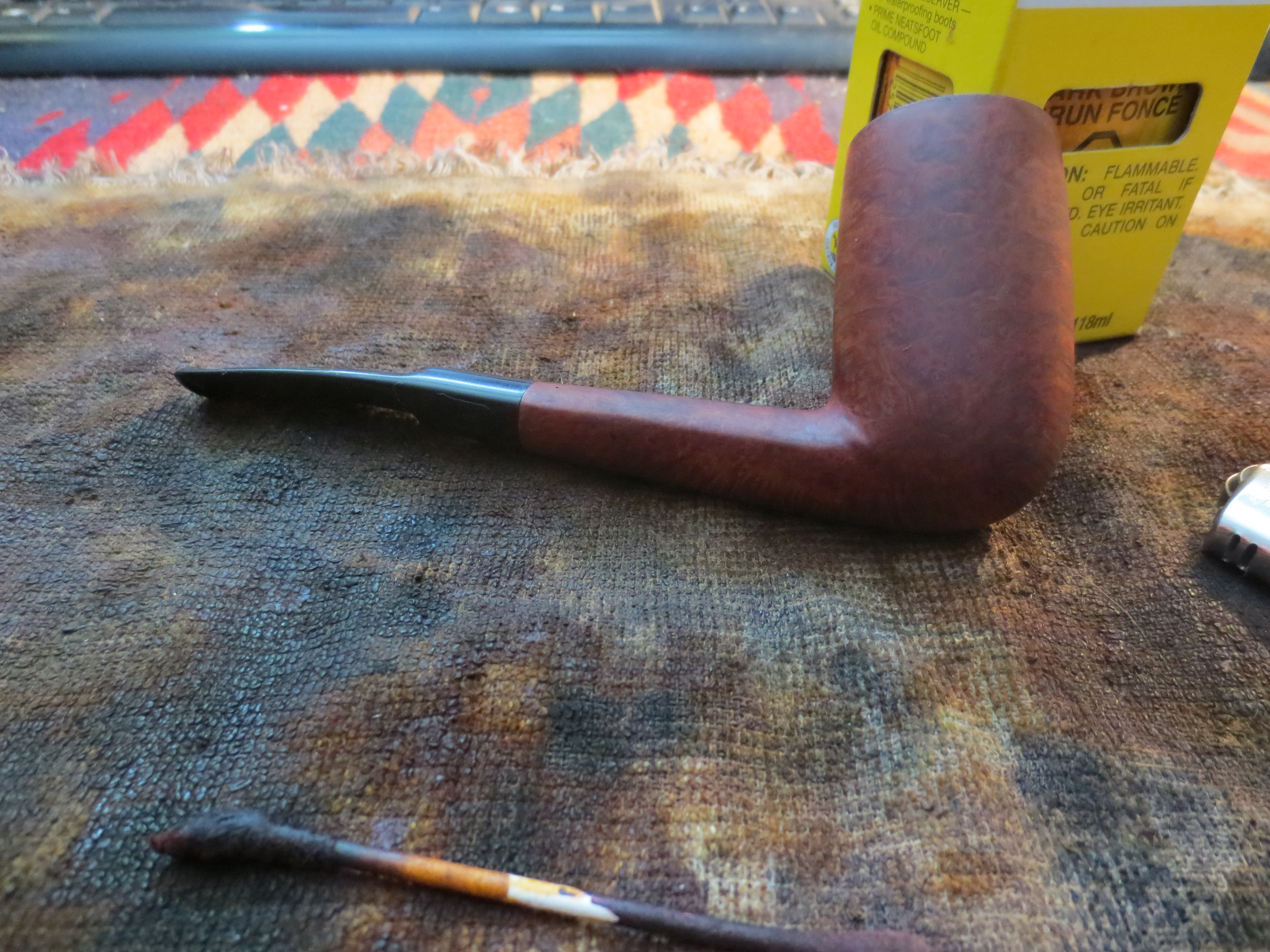
I decided to restain this old timer with an opaque oxblood aniline based stain. I wanted the opacity so that the dark stains would be minimized beneath the new stain and would eventually be blended in through smoking the pipe. I applied the stain and then flamed it. After flaming I hand buffed it to remove the excess stain. I also used a cotton pad and a dental pick to clean out the grooves on the bowl.
Stained with oxblood stain.

Stained with oxblood stain.

Stained with oxblood stain.

Stained with oxblood stain.


The next series of four photos shows the hand buffed bowl in place on the pipe base. The finish was matte at this point and still needed to be taken to the buffer to raise the shine. The third photo shows the rim. The surface is smooth but there is still damage to the inner edge of the rim. I chose to leave that without reworking it too much. I did not want to change the roundness of the inner bowl and decided that I could live with the nicks in the inner edge.
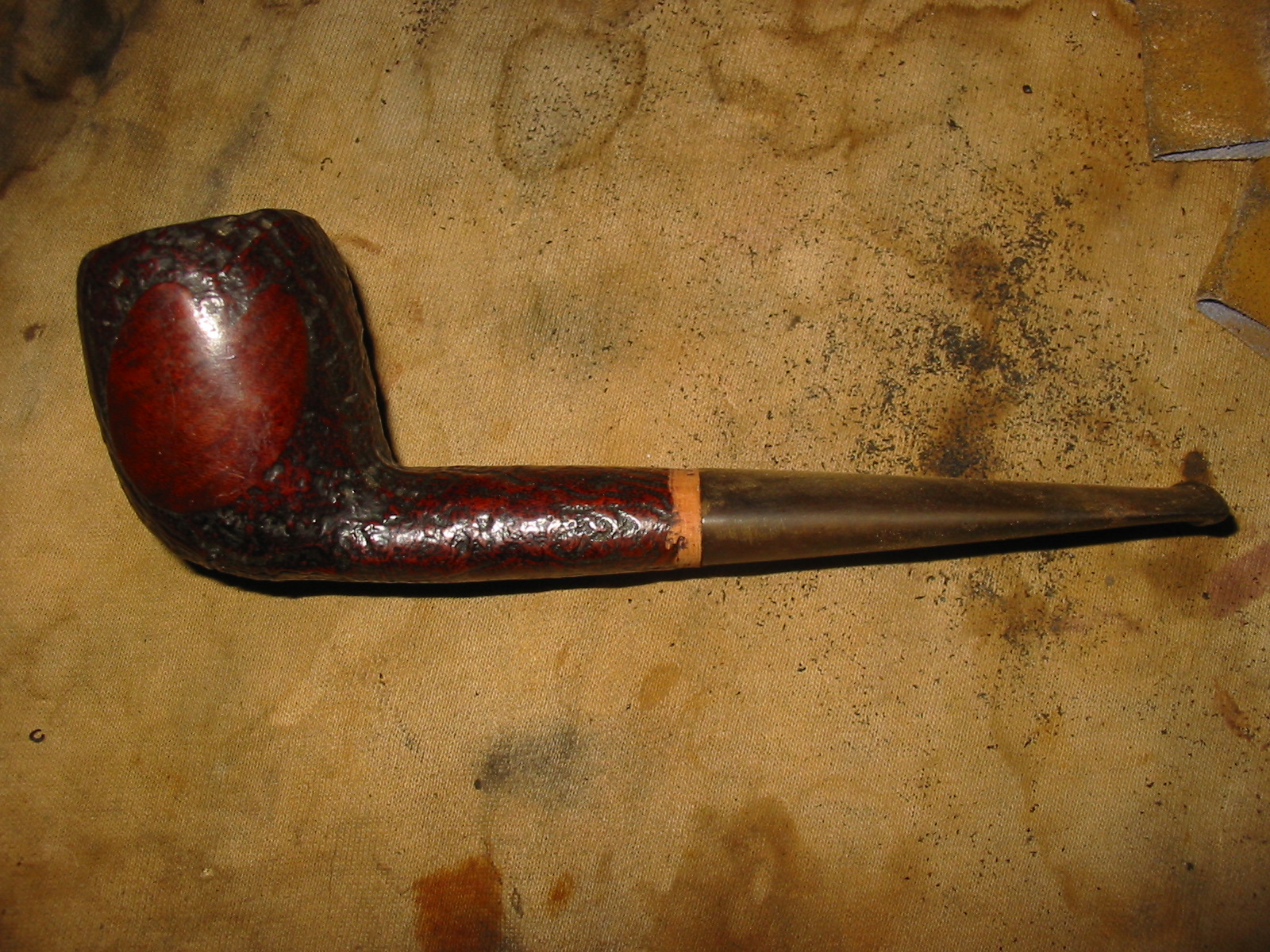
Left side of the pipe with a hand buff on the newly stained bowl.

Left side of the pipe with a hand buff on the newly stained bowl.

Right side of the newly stained bowl with a hand buffed surface.

Right side of the newly stained bowl with a hand buffed surface.

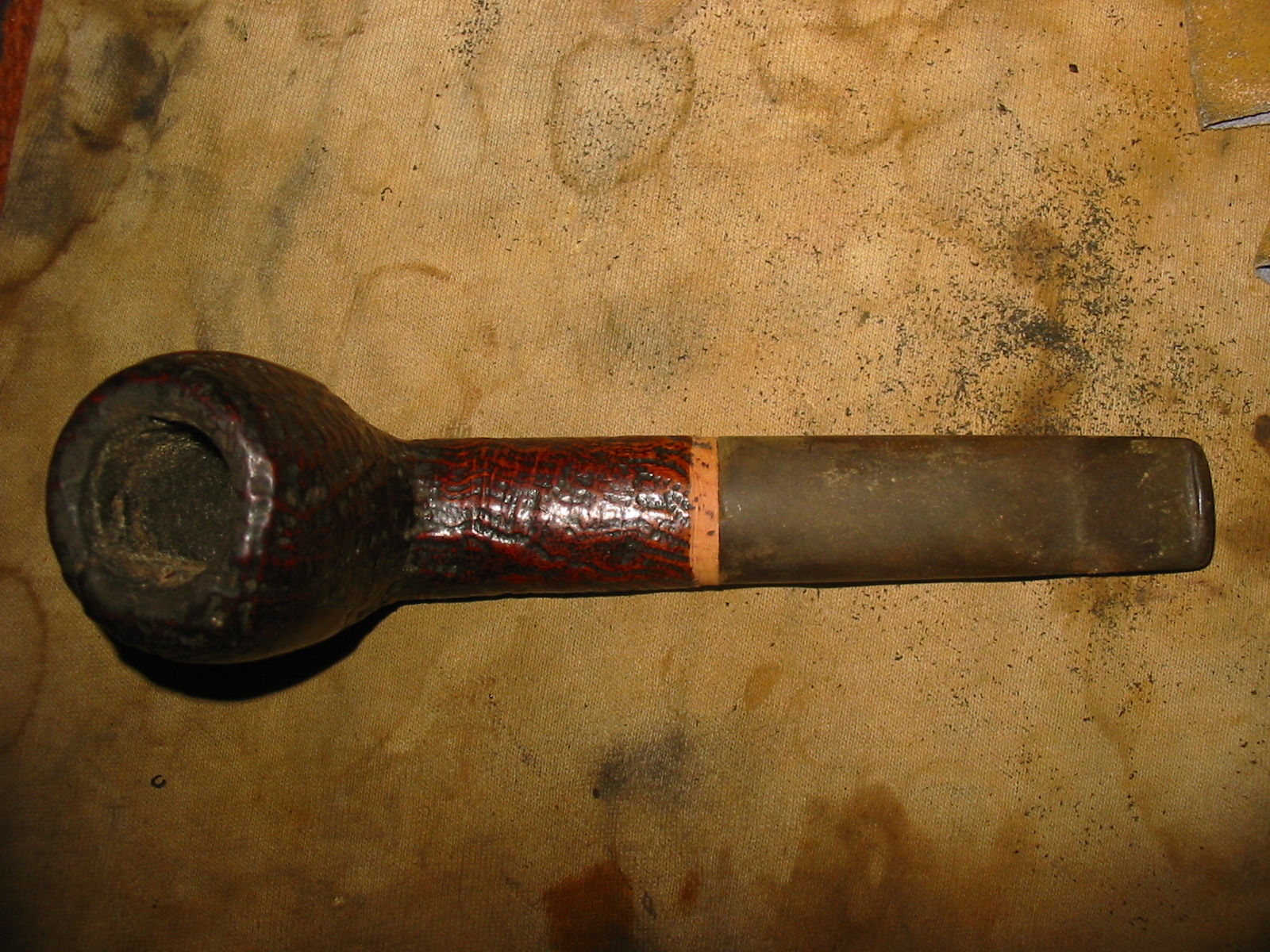
Top view of the hand buffed newly stained bowl.

Top view of the hand buffed newly stained bowl.

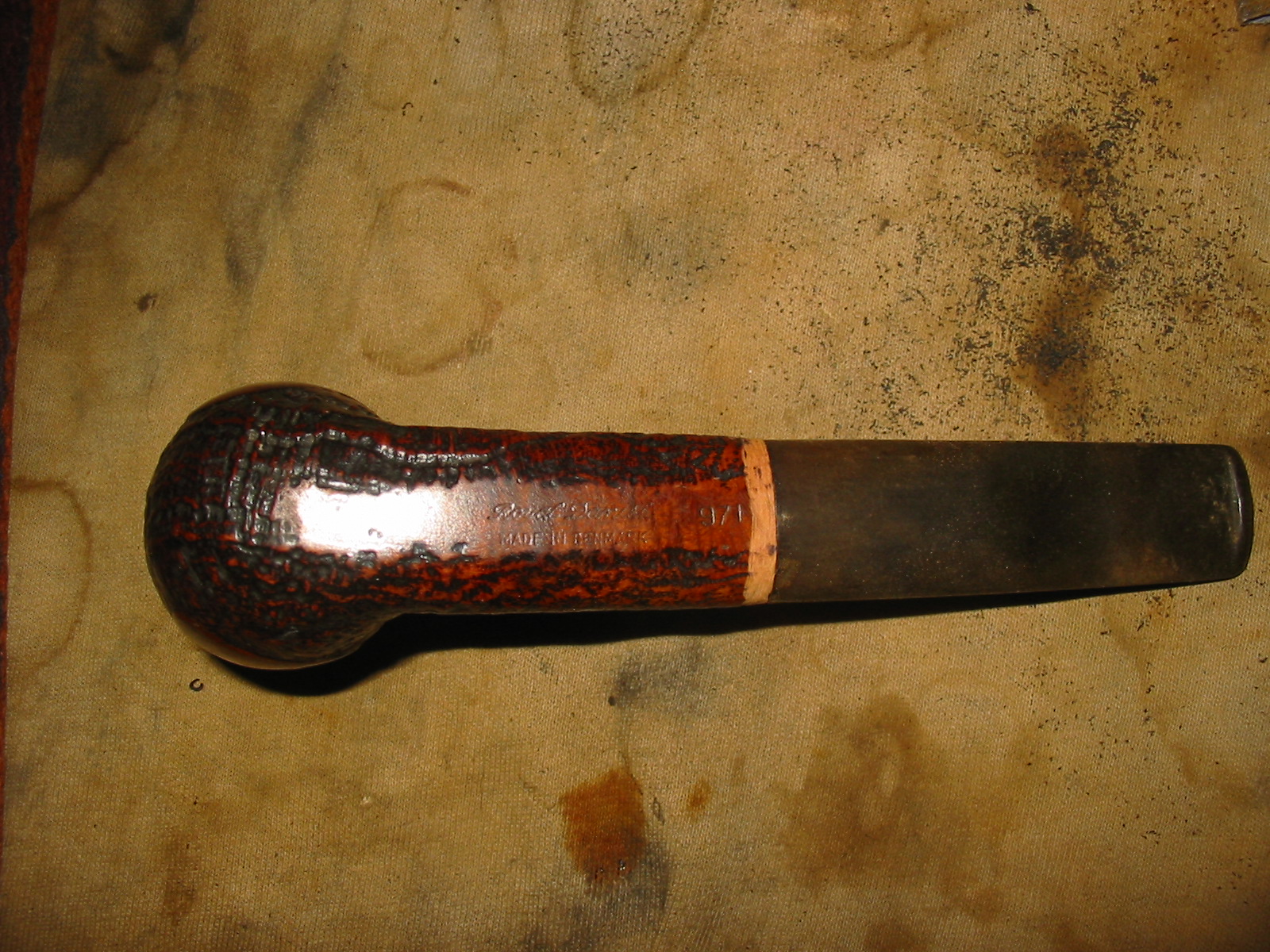
View of the underside of the bowl and Bakelite bowl base.

View of the underside of the bowl and Bakelite bowl base.


The next three photos show the pipe after I had buffed it with White Diamond. The bowl shines and the dark marks around the bowl show faintly beneath the finish but add a flair of character to the old pipe.
Buffed with White Diamond

Buffed with White Diamond

Buffed with White Diamond

Buffed with White Diamond

Buffed with White Diamond

Buffed with White Diamond


The next series of three photos are included to give an idea of the polishing process that went into bringing the stem work to completion. Again I invite you to read the post mentioned above on the transformation of a round saddle stem to a diamond shaped one to understand the full work that the shaping took to bring it to this place.
Stem sanded with 320 grit sandpaper

Stem sanded with 320 grit sandpaper

IMG_1021

Stem sanded with 320 grit sandpaper

IMG_1022

Stem sanded with micromesh sanding pads


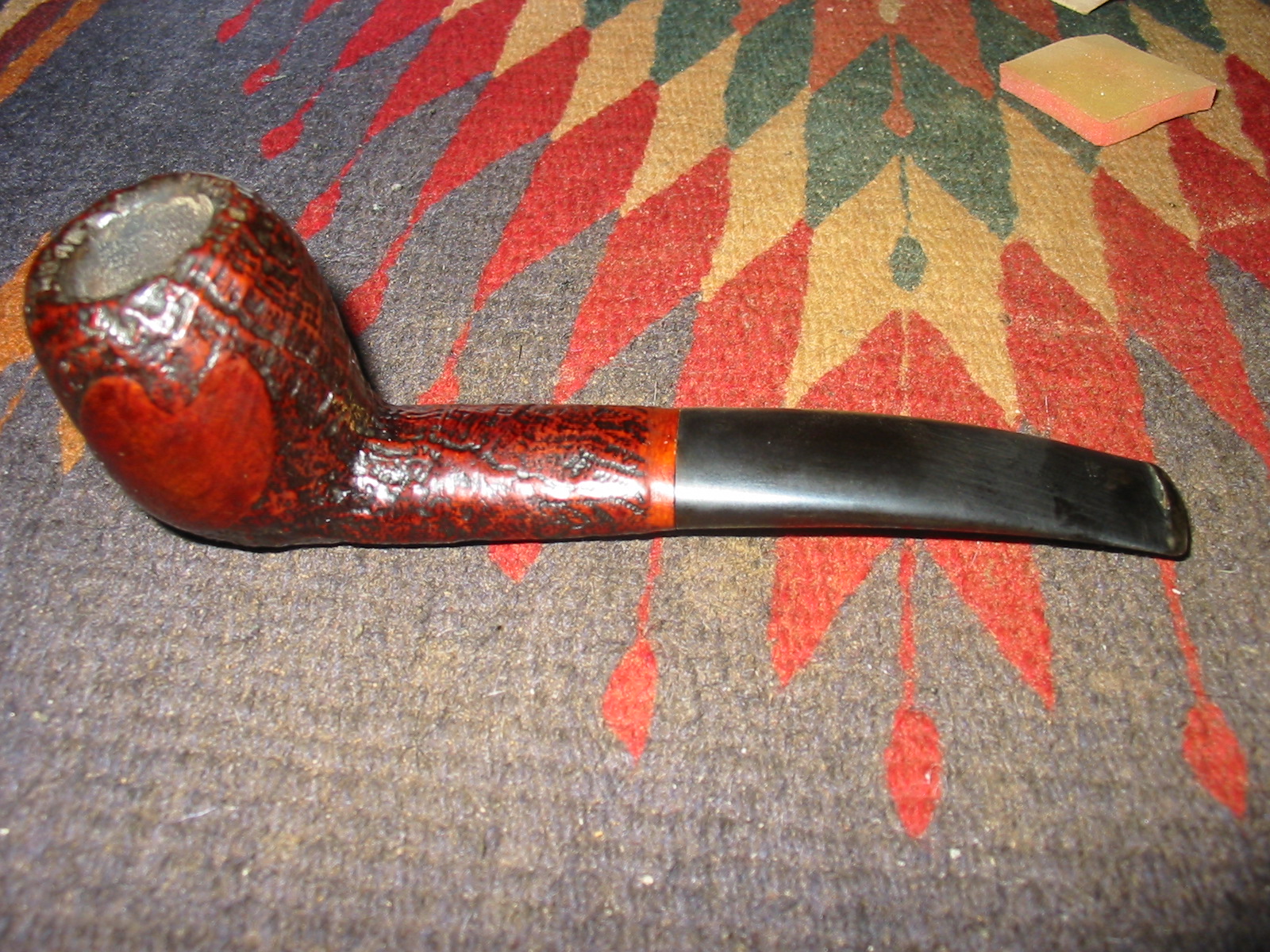
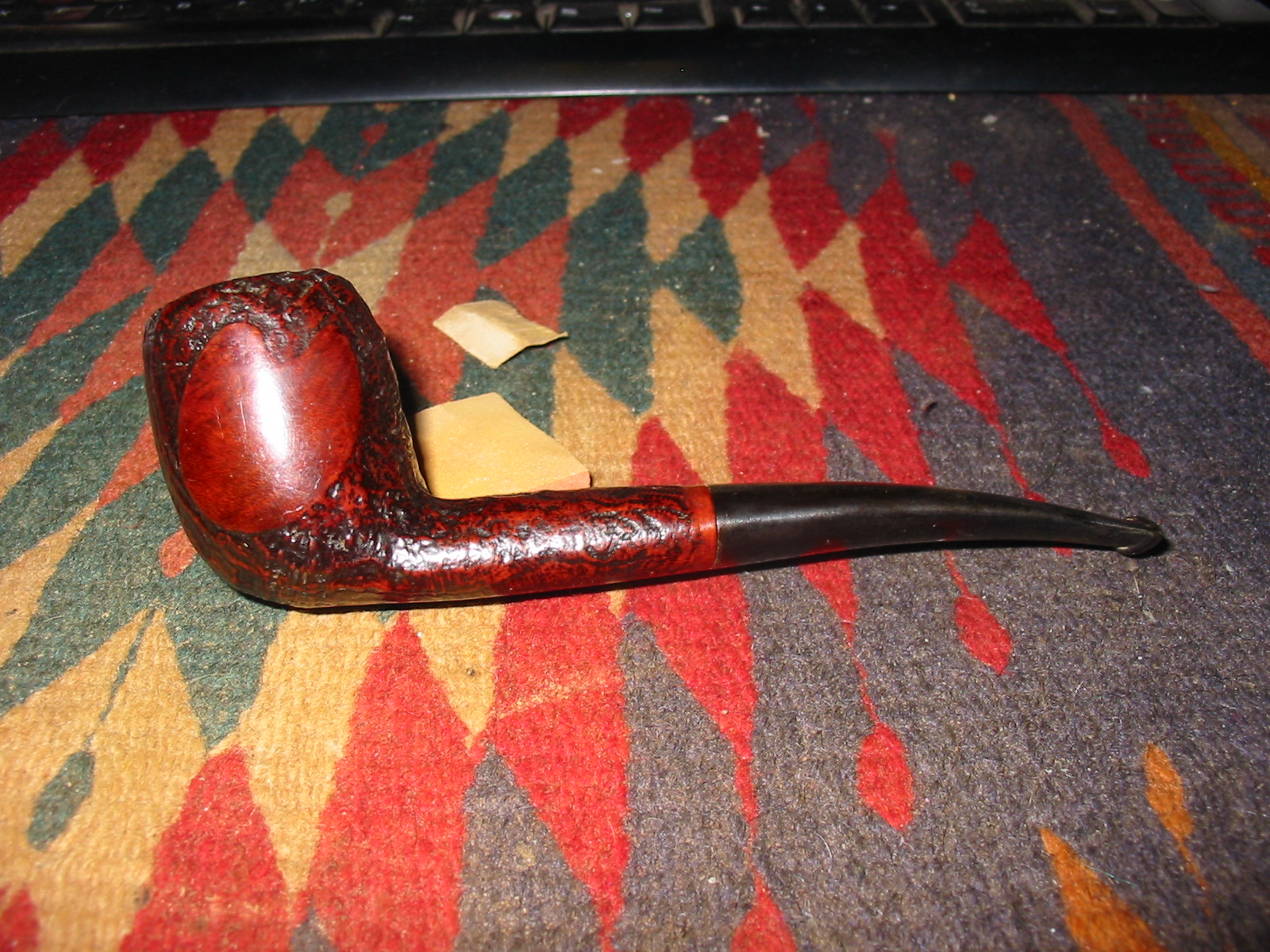
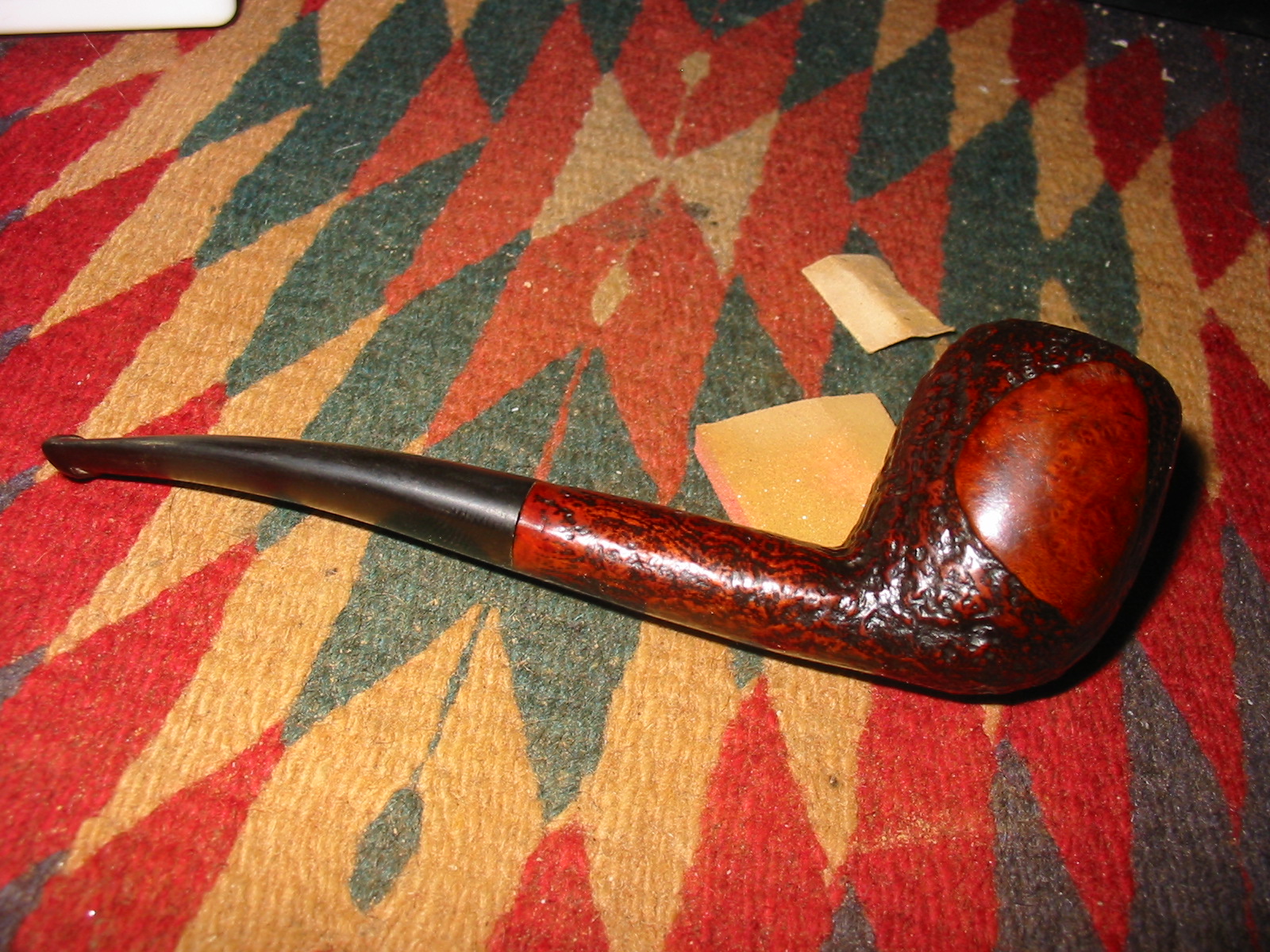
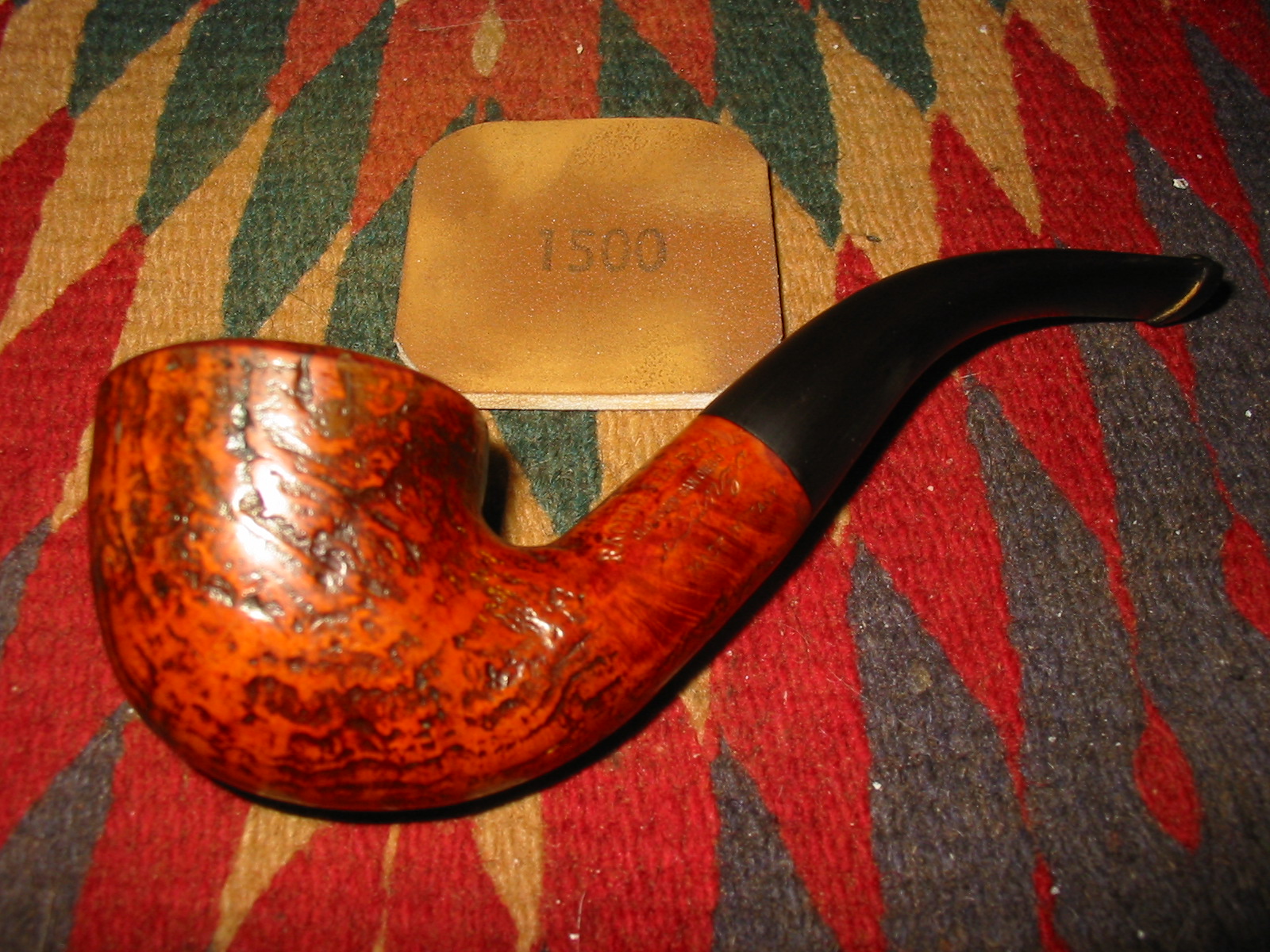
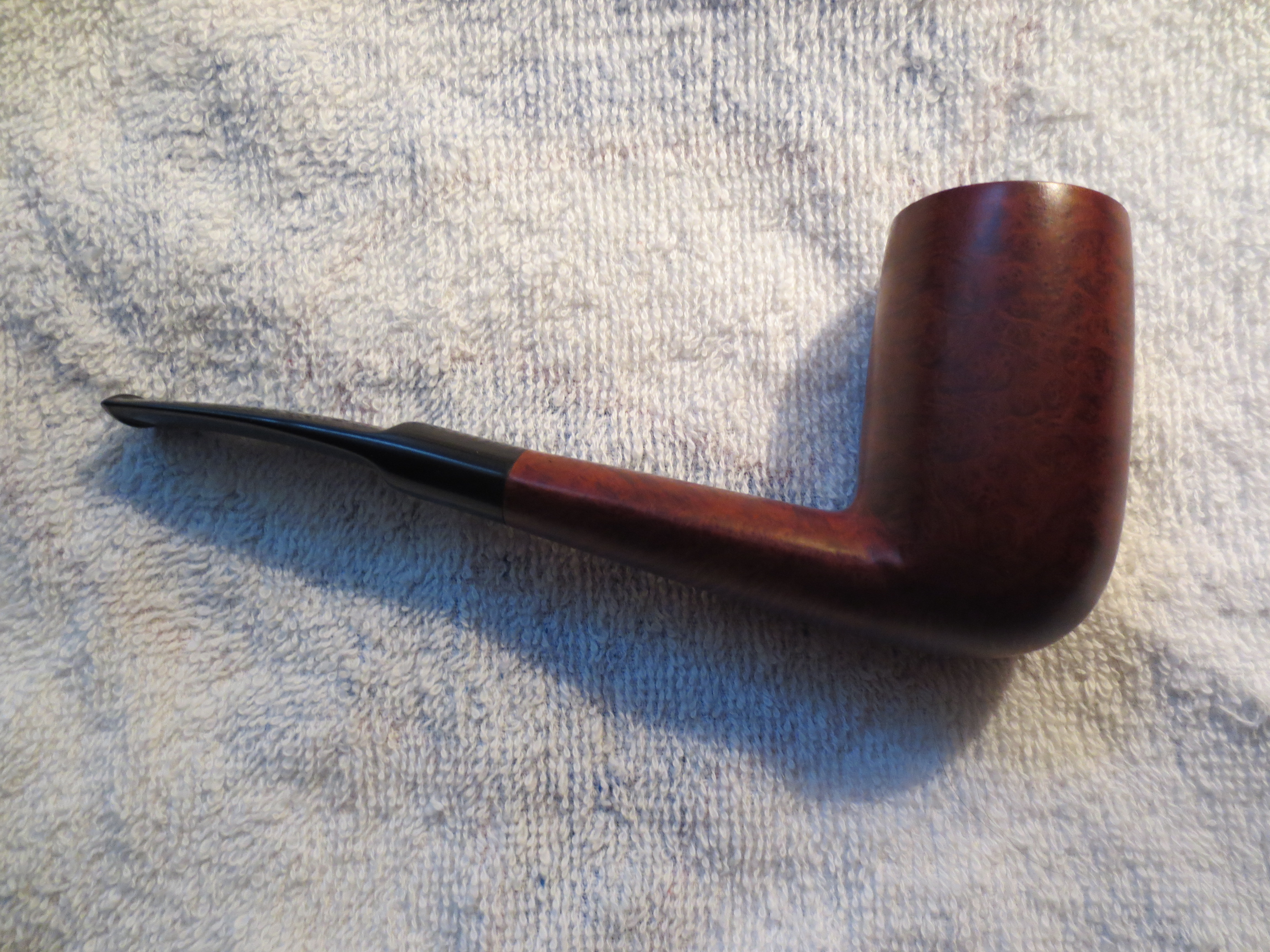
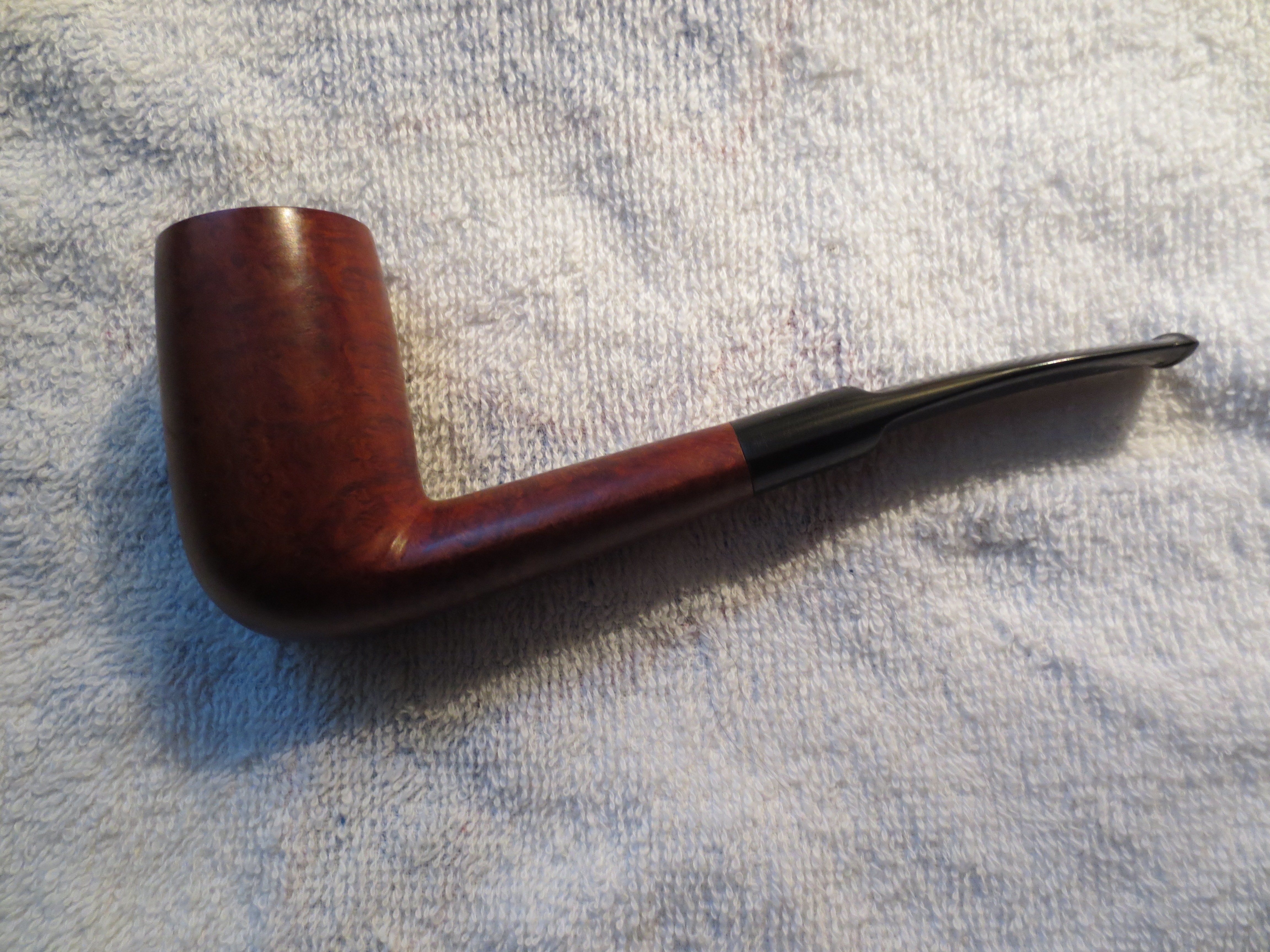
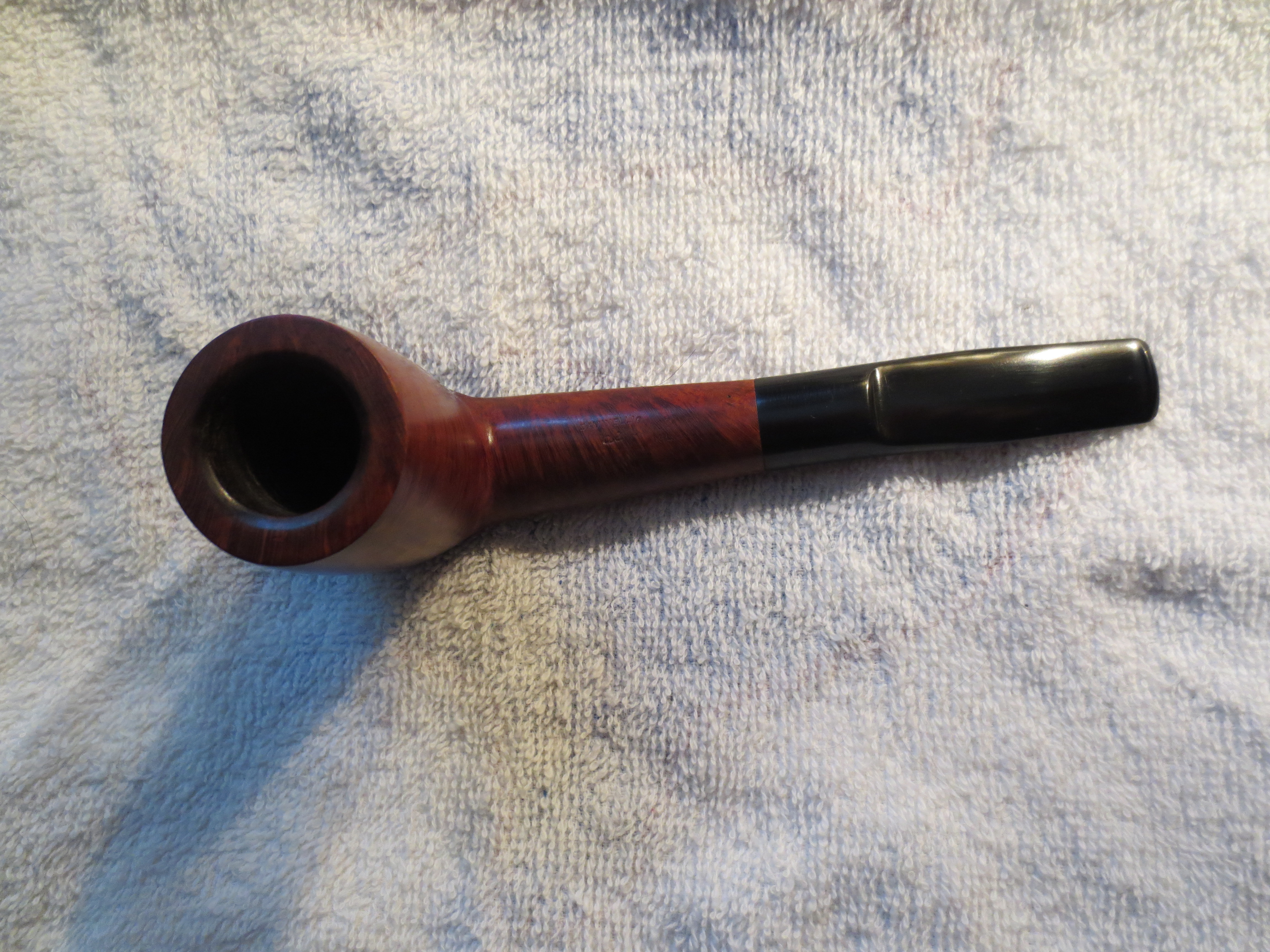
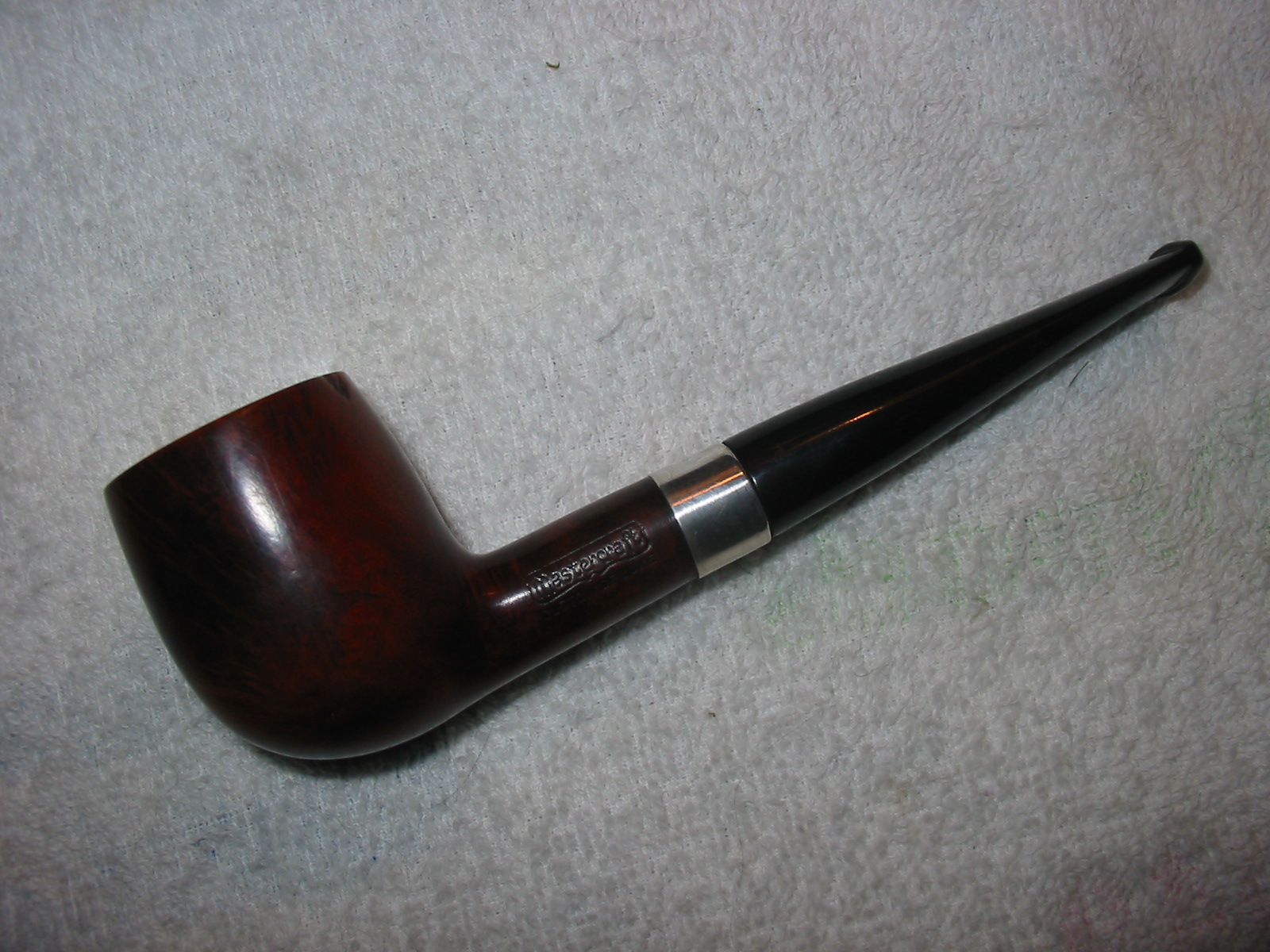
Once I had finished polishing the stem with the various grades of micromesh from 1500-12,000 grit I took the pipe to the buffer once again and buffer the entirety with White Diamond and then gave it multiple coats of carnauba wax to protect it and to give it a deep shine. The next series of four photos show the finished pipe. It is ready to load up with a favourite tobacco and be gently sipped in the solitude of an afternoon on the porch.

IMG_1032

IMG_1033

IMG_1034

IMG_1035

Shaping a Diamond Shaped Stem from a Round One


Blog by Steve Laug

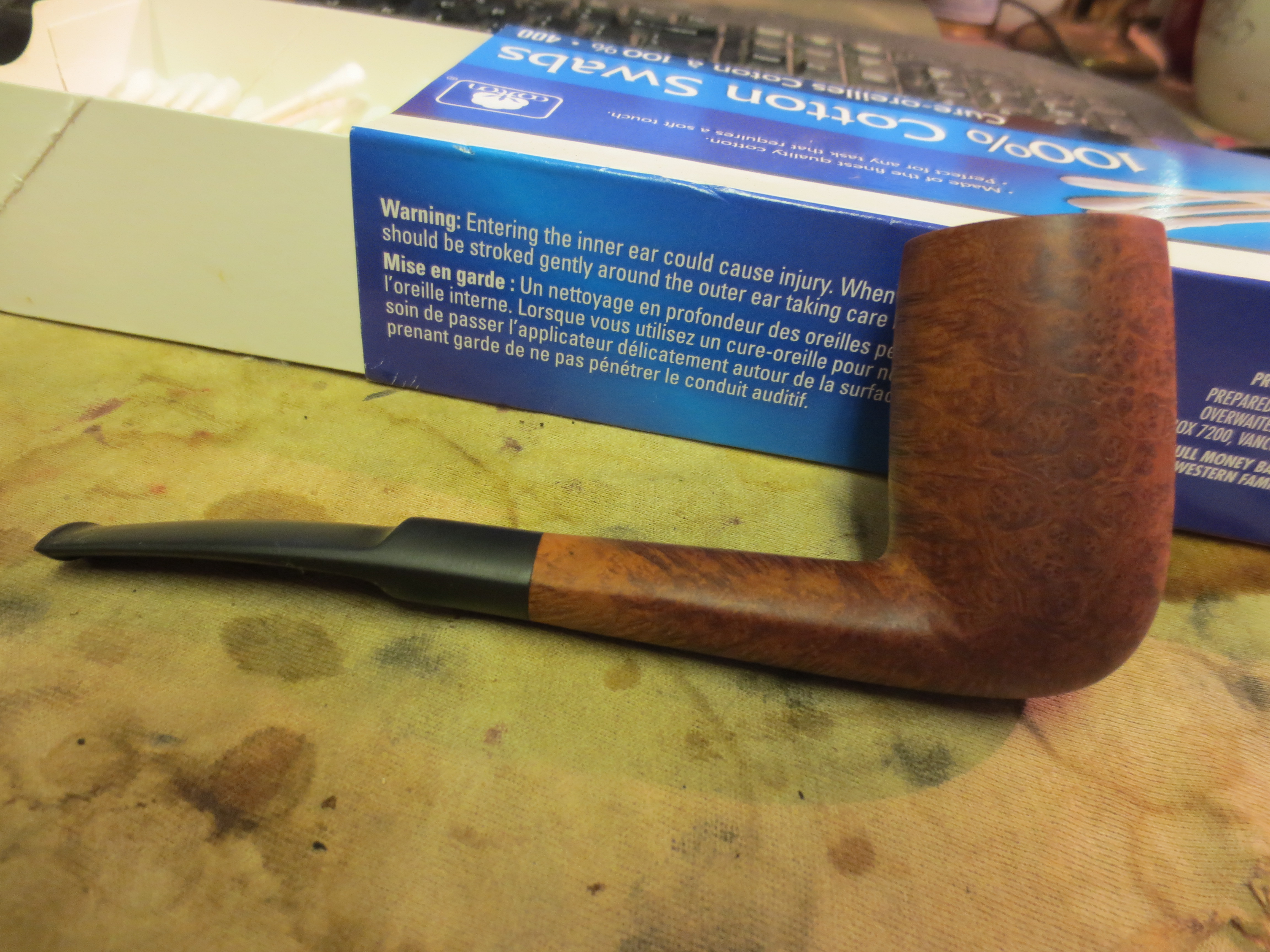
This morning I found myself in need of a diamond shaped stem – a short Lovat style stem for a long shanked pipe I was restemming. I did not have any diamond shaped stems in my can of stems so I decided to craft one. I took a round stem that had the same diameter as the high points on the diamond shank and turned the tenon to fit. It was a tiny diameter mortise so I did a lot of work on it with my dremel and with files and sandpaper. Once I had the fit on the mortise I inserted it in place and used the Dremel to reduce the round sides of the stem to match the diamond shank.

Figure 1 WDC base in need of a diamond shaped stem. Necessity is the mother of invention. I used a round Lovat stem.

Figure 1 WDC base in need of a diamond shaped stem. Necessity is the mother of invention. I used a round Lovat stem.

Figure 2 I turned the tenon to fit the mortise and then inserted the stem against the shank.

Figure 2 I turned the tenon to fit the mortise and then inserted the stem against the shank.

I worked on one side at a time with the sanding drum on the Dremel running at medium speed. I worked holding the pipe bowl and shank in hand and holding the Dremel with the sanding drum perpendicular to the stem. I worked it the length of the saddle until each side was set at the same angle as the shank of the pipe. This took care so as not to damage the Bakelite of the shank and base.

Figure 3 I used a Dremel to shape the stem to match the diamond angles of the shank. I worked on one side at a time.

Figure 3 I used a Dremel to shape the stem to match the diamond angles of the shank. I worked on one side at a time.

Figure 4 Pipe resting against the Dremel with a sanding drum. Shaping progressed quite quickly. This picture shows one side beginning to take shape.

Figure 4 Pipe resting against the Dremel with a sanding drum. Shaping progressed quite quickly. This picture shows one side beginning to take shape.

5 Top view of the shank. Both sides of the round stem are beginning to take on the shape of the shank.

5 Top view of the shank. Both sides of the round stem are beginning to take on the shape of the shank.

I finished the top side of the stem with the Dremel before going on to the underside. I worked the Dremel so as to leave a relatively straight line down the centre of the stem. The goal was to align the line with the line of the shank on each side. I eye balled it at this point and would fine tune it when I worked it with sandpaper.

Figure 6 Top view after more shaping with the Dremel.

Figure 6 Top view after more shaping with the Dremel.

Figure 7 Bottom view before the Dremel did its work.

Figure 7 Bottom view before the Dremel did its work.

Figure 8 Left side view after the first side has begun to take shape.

Figure 8 Left side view after the first side has begun to take shape.

Figure 9 Bottom view after both sides have begun to take shape.

Figure 9 Bottom view after both sides have begun to take shape.

Figure 10 Right side view of the stem after it began to take shape.

Figure 10 Right side view of the stem after it began to take shape.

From this point in the process all the work was done by hand with a variety of sandpapers from medium grit emery paper through 220 grit sandpaper. I wanted to smooth out the angles and align the edges with the straight line of the shank.

Figure 11 Back to the worktable and the hand sanding.

Figure 11 Back to the worktable and the hand sanding.

Figure 12 Hand sanding continues.

Figure 12 Hand sanding continues.

Figure 13 Hand sanding continues.

Figure 13 Hand sanding continues.

Figure 14 View from the tenon end of the diamond stem at this point in the process.

Figure 14 View from the tenon end of the diamond stem at this point in the process.

Originally the Bakelite base had a band on it. I used an older complete one I have here for an example so that I could get the feel for it. The original was more of a brass/gold coloured ornamental band. I have none of those bands so I used a nickel band. After fitting the band I needed to reduce the tenon slightly for a snug fit and also work on the angles of the sides and corners of the diamond to match the banded shank.

Figure 15 Top view after more hand sanding with a medium grit sanding sponge.

Figure 15 Top view after more hand sanding with a medium grit sanding sponge.

Figure 16 Bottom view after more hand sanding with a medium grit sanding sponge.

Figure 16 Bottom view after more hand sanding with a medium grit sanding sponge.

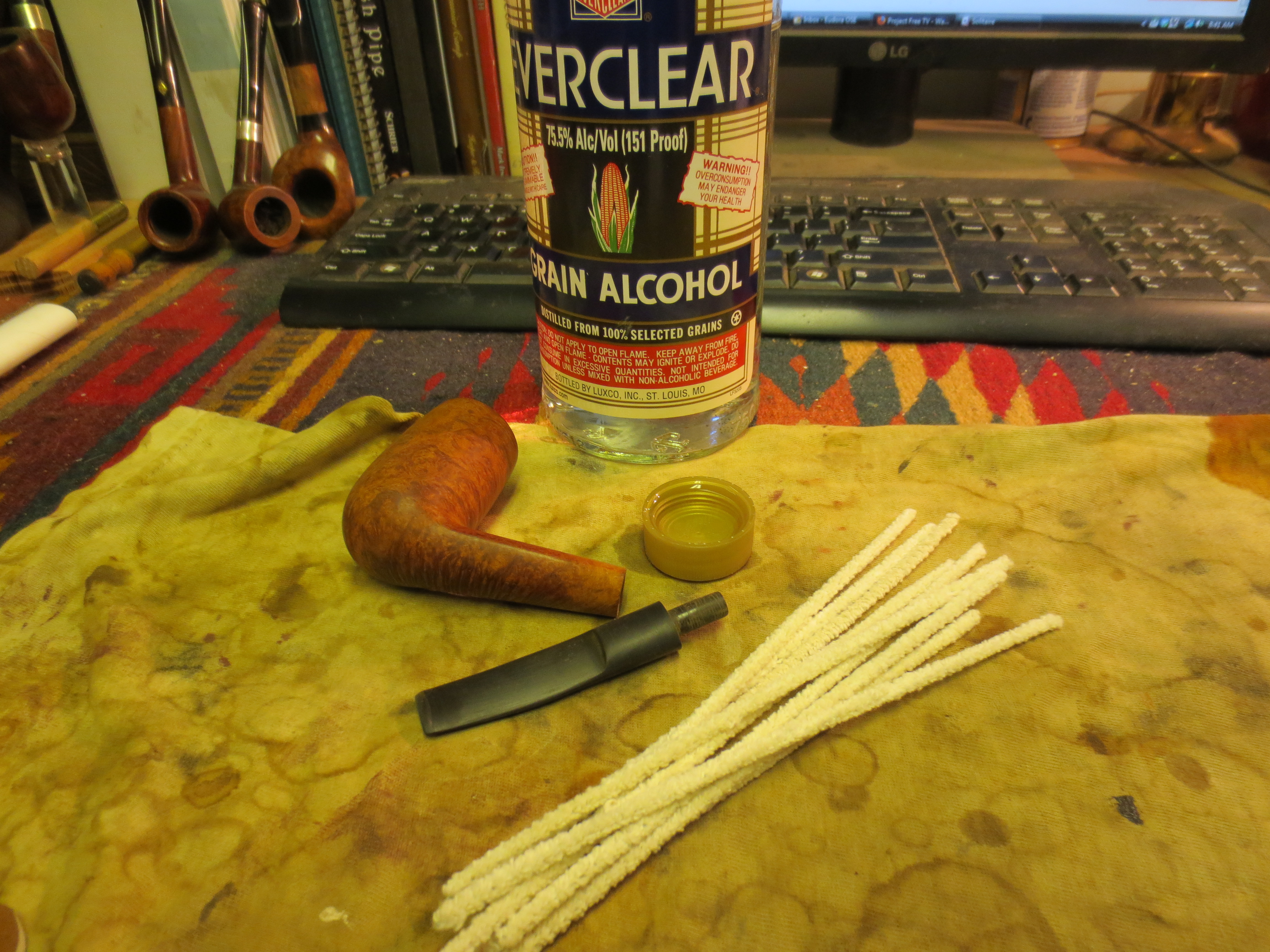
At this point in the process I removed the stem from the shank and worked on the sides with a fine grit sanding sponge to remove the scratches and marks from the previous grits of sandpaper. Once I was finished with this portion I cleaned off the stem with a soft cotton pad and Everclear so I could see the scratches that were left before I moved on to sanding with the micromesh sanding pads.

Figure 17 Top view. Shape is finished. Now to sand out the scratches and polish the stem.

Figure 17 Top view. Shape is finished. Now to sand out the scratches and polish the stem.

Figure 18 Side view. Shape matches the shank perfectly. Need to remove scratches and polish.

Figure 18 Side view. Shape matches the shank perfectly. Need to remove scratches and polish.

Figure 19 Bottom view. Need to remove scratches and polish.

Figure 19 Bottom view. Need to remove scratches and polish.

Figure 20 Tenon end view of the diamond shape of the shank. The hardest part of shaping a diamond stem on an old pipe shank like this one is that all sides of the shank were slightly different measurements so that all sides of the stem would have to be as well to match the angles.

Figure 20 Tenon end view of the diamond shape of the shank. The hardest part of shaping a diamond stem on an old pipe shank like this one is that all sides of the shank were slightly different measurements so that all sides of the stem would have to be as well to match the angles.

Once I saw the scratches that remained I worked over the stem with 320 grit sandpaper to remove the scratches and clean up the surface so that when I sanded with the micromesh the deeper scratches would be gone.

Figure 21 Left side after sanding with 320 grit sandpaper.

Figure 21 Left side after sanding with 320 grit sandpaper.

Figure 22 Right side after sanding with 320 grit sandpaper.

Figure 22 Right side after sanding with 320 grit sandpaper.

Figure 23 End view showing the diamond shape after sanding with 320 grit sandpaper.

Figure 23 End view showing the diamond shape after sanding with 320 grit sandpaper.

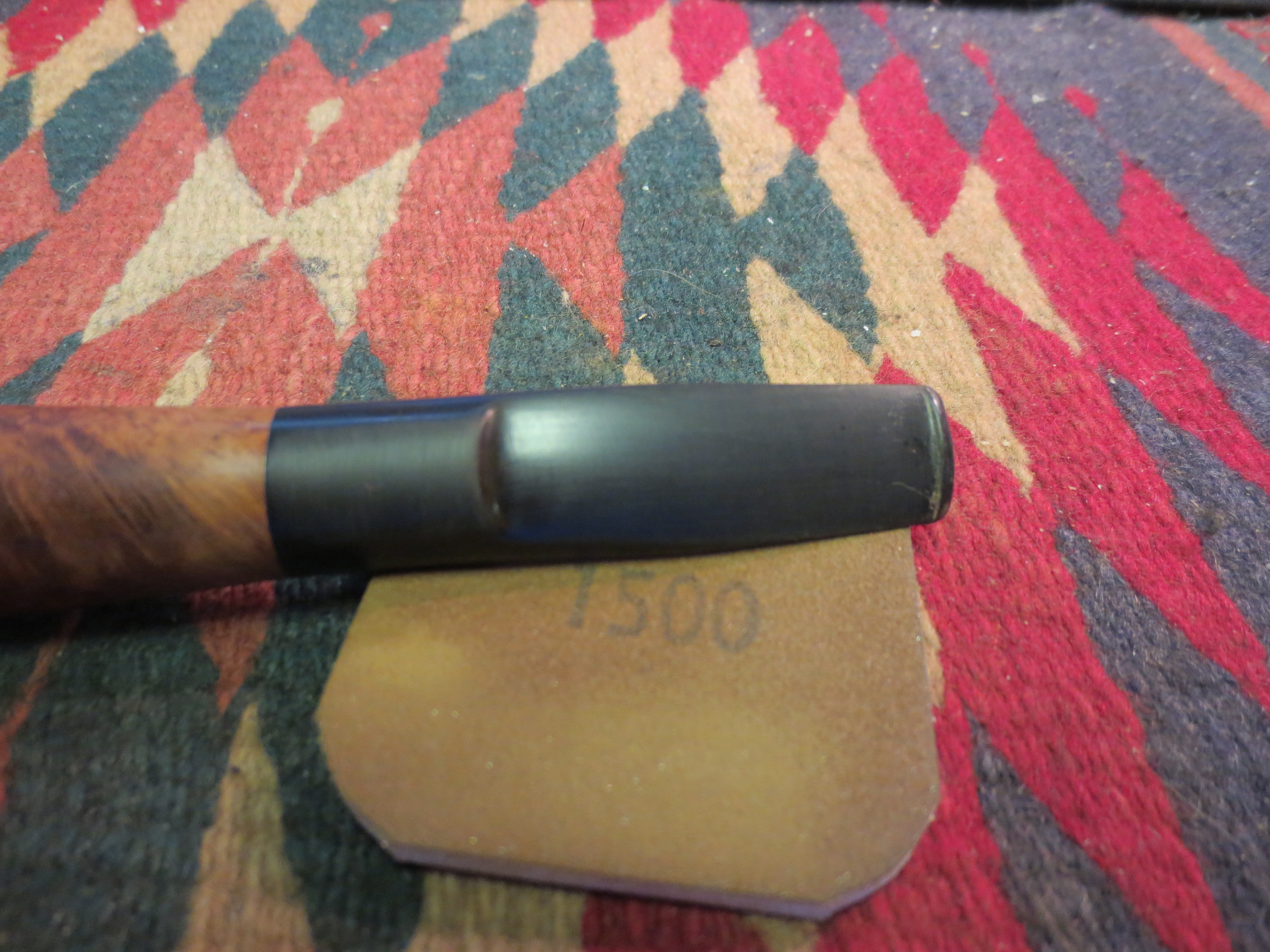
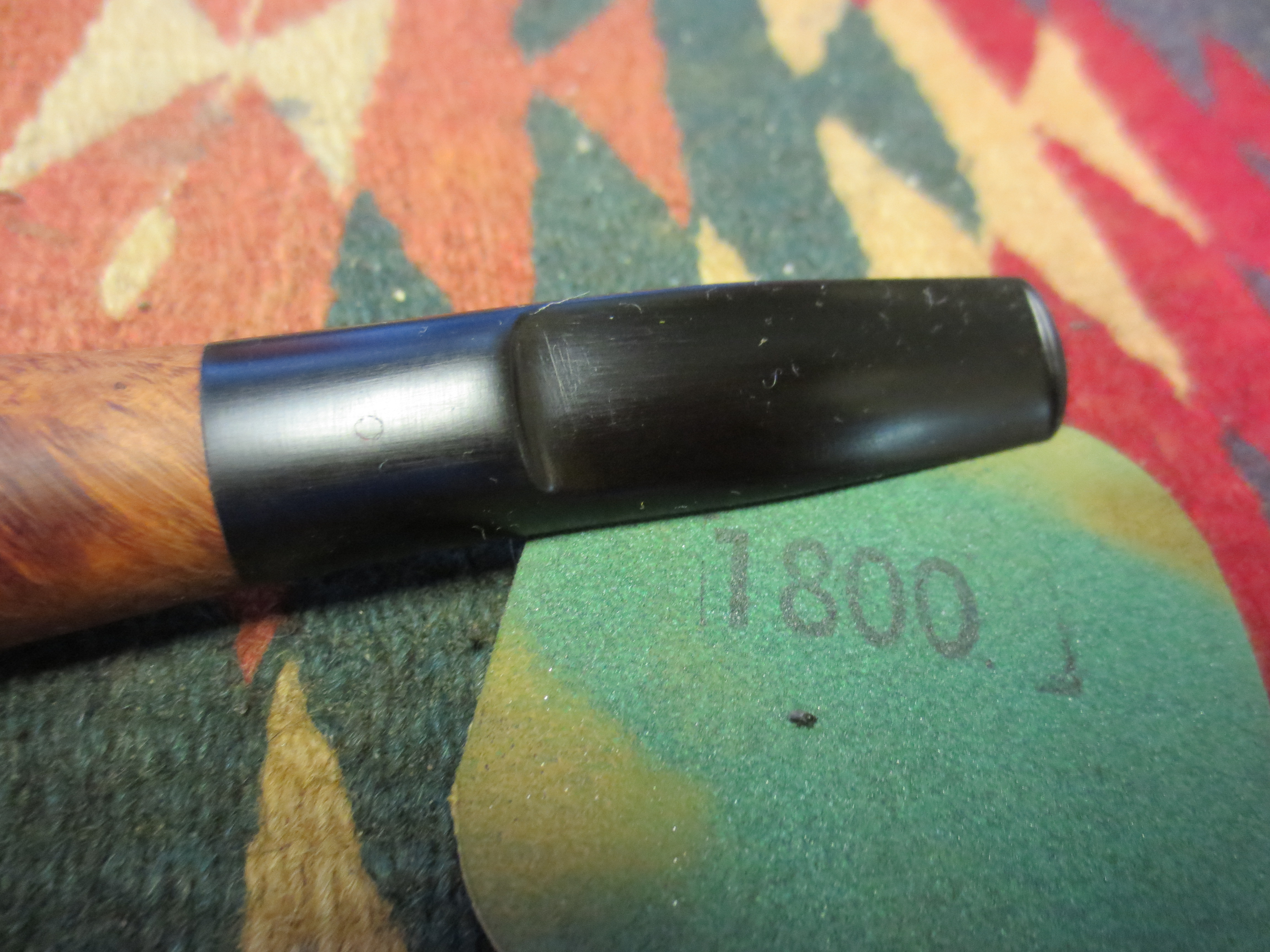
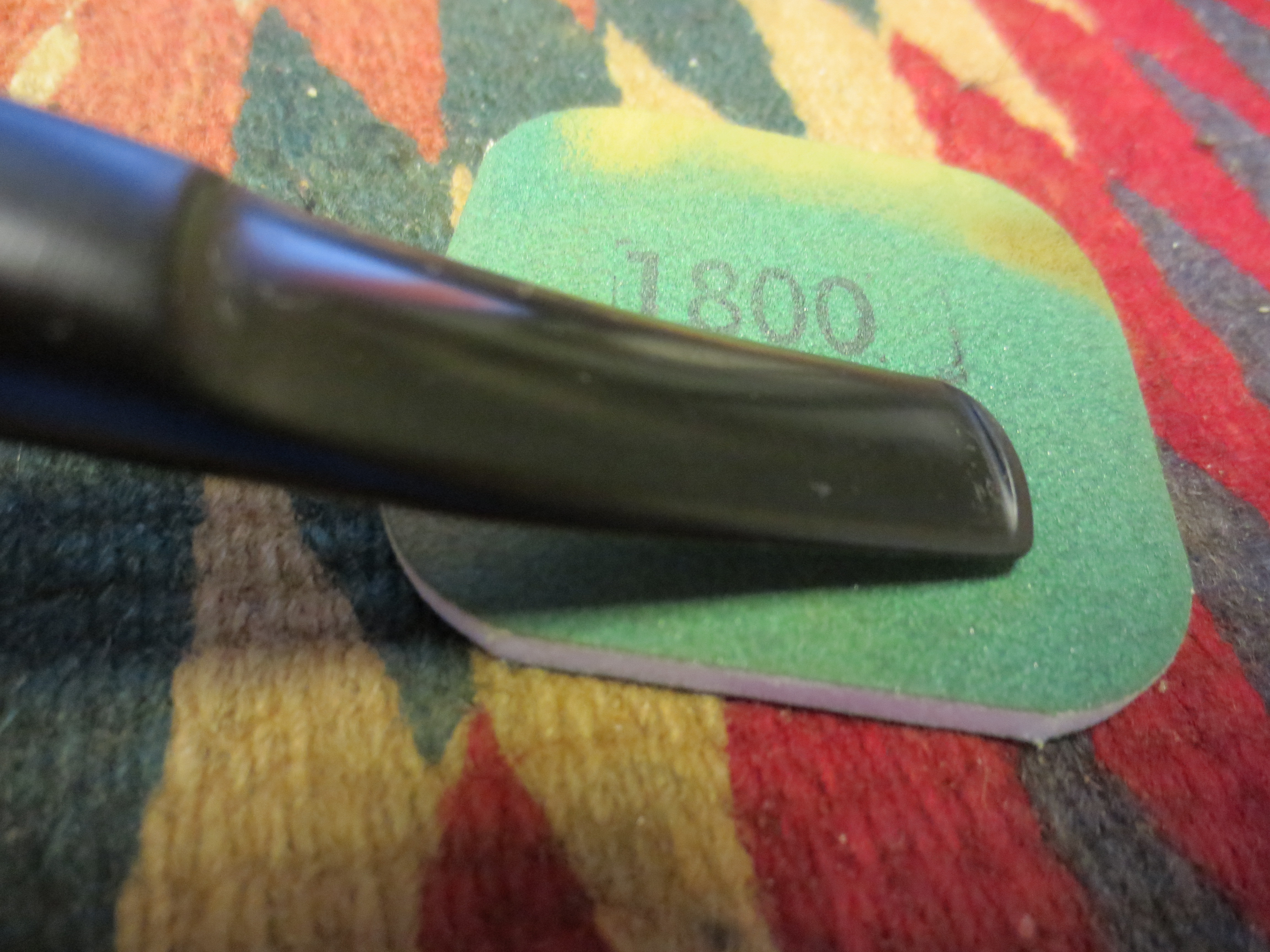
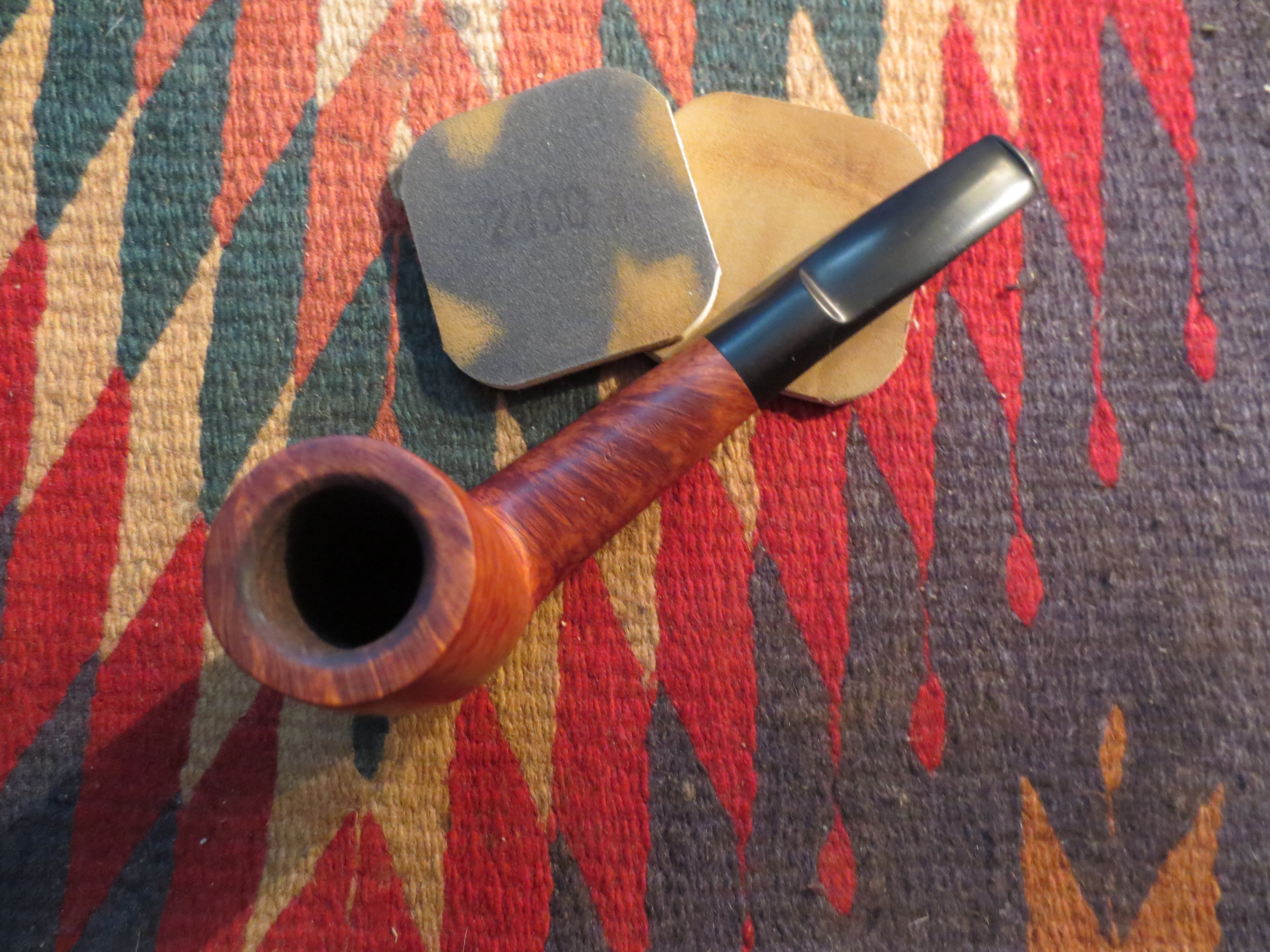
Finally with the scratches removed it was time to move on to the micromesh sanding pads. Photos 1 & 2 show the stem after sanding with 1500 and 1800 grit micromesh. It should clean up nicely with each successive grit of micromesh. Photo 3 shows the stem after sanding with the 2400 grit micromesh. With all three of these grits I wet sanded the stem.

Figure 24 Left side after sanding with 1500 and 1800 grit micromesh sanding pads

Figure 24 Left side after sanding with 1500 and 1800 grit micromesh sanding pads

Figure 25 Right side after sanding with 1500 and 1800 grit micromesh sanding pads.

Figure 25 Right side after sanding with 1500 and 1800 grit micromesh sanding pads.

Figure 26 Right side after sanding with 2400 grit sanding pads

Figure 26 Right side after sanding with 2400 grit sanding pads

I moved on to the higher grits of micromesh. The next five photos below show the 3600 and 4000 grit micromesh. I dry sanded with these pads. The scratches have pretty much disappeared and the higher grits will give the stem a deep shine.

Figure 27 Sanding with 3600 and 4000 grit micromesh.

Figure 27 Sanding with 3600 and 4000 grit micromesh.

Figure 28 Right side sanded with 3600 and 4000 grit micromesh pads.

Figure 28 Right side sanded with 3600 and 4000 grit micromesh pads.

Figure 29 left side of the stem - sanding with 600 and 4000 grit micromesh.

Figure 29 left side of the stem – sanding with 600 and 4000 grit micromesh.

Figure 30 Top view of the stem after sanding with 3600 and 4000 grit micromesh.

Figure 30 Top view of the stem after sanding with 3600 and 4000 grit micromesh.

Figure 31 Bottom view of the stem after sanding with 3600 and 4000 grit micromesh

Figure 31 Bottom view of the stem after sanding with 3600 and 4000 grit micromesh

The next photo shows the view of the stem from the tenon end. The diamond shape is complete and the remnants of it being a round stem are gone. More polishing will bring this to life.
IMG_1027
From this point on in the process I dry sanded with 6000, 8000 and 12,000 grit micromesh to finish the polishing. Once finished I buffed it with White Diamond and then gave it multiple coats of carnauba wax to preserve the stem. The next four photos show the finished stem.

Figure 33 Right side view of the finished stem.

Figure 33 Right side view of the finished stem.

Figure 34 Left side view of the finished stem.

Figure 34 Left side view of the finished stem.

Figure 35 Top view of the finished stem.

Figure 35 Top view of the finished stem.

Figure 36 View of the stem from the tenon end.

Figure 36 View of the stem from the tenon end.

At this point the stem is finished and ready to be added to the WDC pipe that I was restemming. This process proved a point I have held forever – within in every stem resides another smaller stem or at least one of a different shape. That is why I rarely get rid of a stem. They can be reshaped, the button added on a second time a new tenon added… you get the picture.

Banding and Stemming a Figural Pipe – A Carved Bull’s Head


I have never been a big fan of carved animal pipes- whether birds, bulls, horses, etc. There is just something about them that always makes me shy away. Needless to say when I picked up this one in an EBay lot I put it in the bottom of the box of pipes to be refurbished and kept burying it lower in the box. A few weeks ago when I had very few left I decided to give it a go. There were a few challenges about it that made it look interesting. It was without a stem and the shank was damaged – several cracks in it. The angles of the shank made banding it a challenge and the thickness of the neck of the bull at the base of the shank made it formidable. Those attracted me to giving it a try. I also figured I could do some carving on the shank to make it possible to band it and then sand rework an old stem to fit the newly carved shank. The bowl has some kind of impermeable coating on it. Acetone will not cut it; Everclear will not cut it and even a soak in the alcohol bath will not cut it. It is like a coat of Urethane. All my attacks on it resulted in not even damaging the surface. Ah well it will stay as it is then.

I used my Dremel to sand back the shank area so that a band would fit it. I sanded back the neck of the bull to allow for a visible shank. I also had to sand the area at the back of the head to fit the band on the shank. I sanded it with some medium grit emery paper to remove the deep scratches from the Dremel and then worked it over with 240 and 320 grit sandpaper to smooth it out. I finished by wet sanding the shank with micromesh sanding pads from 1500-3200 grit. Once I had it cut back and ready, I heated a band with my heat gun and pressure fit it onto the newly formed shank. The next three photos show the newly banded shank. I left a little excess length on the band so that it would form a seat for the stem (visible in Photo 2). The shank end was so badly damaged that I could not get a smooth end on it. In Photo 3 you can also see the cracks in the shank that I repaired with superglue and pressure.
IMG_0436

IMG_0437

IMG_0438
I had an old stem in my can of stems that was the right shape. It was also in rough shape. It was one of those I had held on to that should have probably been pitched. However, it was right for this shank and would be reparable with a bit of work. This pipe sat on my work table throughout the repairs I was doing on all the other pipes I have worked on in the past month. It was just sitting there and every so often I would pick it up and work on it. The next series of nine photos shows the stem that I was working on for the pipe.

Figure 1 Top view of the stem before I worked on it. There were bite marks, tooth marks and pieces missing.

Figure 1 Top view of the stem before I worked on it. There were bite marks, tooth marks and pieces missing.

Figure 2 I sanded down the stem and filled the deep pits with black superglue. The top side of the stem shows the shiny black glue patches.

Figure 2 I sanded down the stem and filled the deep pits with black superglue. The top side of the stem shows the shiny black glue patches.

Figure 3 The underside of the stem. I used a file to sand down the edges and the flat blade of the stem.

Figure 3 The underside of the stem. I used a file to sand down the edges and the flat blade of the stem.

Figure 4 The stem is beginning to take shape after much filing and sanding on the sides and around the button. This is a photo of the topside of the stem.

Figure 4 The stem is beginning to take shape after much filing and sanding on the sides and around the button. This is a photo of the topside of the stem.

Figure 5 The underside of the stem with the filing and shaping bringing it into shape.

Figure 5 The underside of the stem with the filing and shaping bringing it into shape.

Figure 6 The top side - note the left side dent on the edge of the stem. This would require more sanding, shaping and filling with black superglue.

Figure 6 The top side – note the left side dent on the edge of the stem. This would require more sanding, shaping and filling with black superglue.

Figure 7 Topside of the stem. I sanded it with 320 grit sandpaper and then medium grit sanding sponge. It is beginning to take shape.

Figure 7 Topside of the stem. I sanded it with 320 grit sandpaper and then medium grit sanding sponge. It is beginning to take shape.

Figure 8 Underside of the stem- again sanded and shaped. The dents and edges are starting to be cleaned up.

Figure 8 Underside of the stem- again sanded and shaped. The dents and edges are starting to be cleaned up.

Figure 9 Underside finished with the majority of the shaping. Now a lot of fine tuning needed to be done.

Figure 9 Underside finished with the majority of the shaping. Now a lot of fine tuning needed to be done.

Figure 11 The finished stem fit into the repaired shank. Right side view.

Figure 11 The finished stem fit into the repaired shank. Right side view.

Figure 10 The finished stem shaped and inserted in the repaired shank. Left side view.

Figure 10 The finished stem shaped and inserted in the repaired shank. Left side view.

Once I had the stem cleaned up and repaired it was ready to be heated and bent to fit the flow of the pipe. I set up my heat gun and turned it on low heat. I held the stem over the heat at a distance of 2-3 inches and kept it moving back and forth to prevent the vulcanite from burning. When the vulcanite was pliable I used a wooden rolling pin and bent the stem over the curve of the rolling pin. I find that using this keeps the stem from bending at an angle.

Figure 12 Heat gun set up and ready to use to bend the stem.

Figure 12 Heat gun set up and ready to use to bend the stem.

Figure 13 Heating up the vulcanite stem.

Figure 13 Heating up the vulcanite stem.

Figure 14 Bending the stem over a wooden rolling pin that I scavenged from my wife's thrift shop box.

Figure 14 Bending the stem over a wooden rolling pin that I scavenged from my wife’s thrift shop box.

Figure 15 The finished bend in the pipe. It is now ready to polish the stem and the shank.

Figure 15 The finished bend in the pipe. It is now ready to polish the stem and the shank.

I took it back to the work table and began to sand the stem and the shank with a fine grit sanding sponge. I continued to sand it and then worked on the shank with micromesh sanding pads from 3600-12,000 grit to prepare it for restaining.

Figure 16 Shank preparation for staining.

Figure 16 Shank preparation for staining.

Figure 17 Shank preparation for staining.

Figure 17 Shank preparation for staining.

Once the shank was prepared I stained it with a dark brown aniline stain. I flamed it and repeated the staining and flaming until the brown matched that of the rest of the bowl. I then gave it a coat of Danish Oil medium walnut to seal the shank and give it a shine that would match the head of the bull. I also finished sanding the stem with the remaining grits of micromesh (3600-12,000 grit). When I finished I buffed the stem and shank with White Diamond and gave it all several coats of carnauba wax. The next series of five photos show the finished pipe.
IMG_0951

IMG_0952

IMG_0953

IMG_0954

IMG_0955

Restoring an L.J. Perretti Deluxe Prince


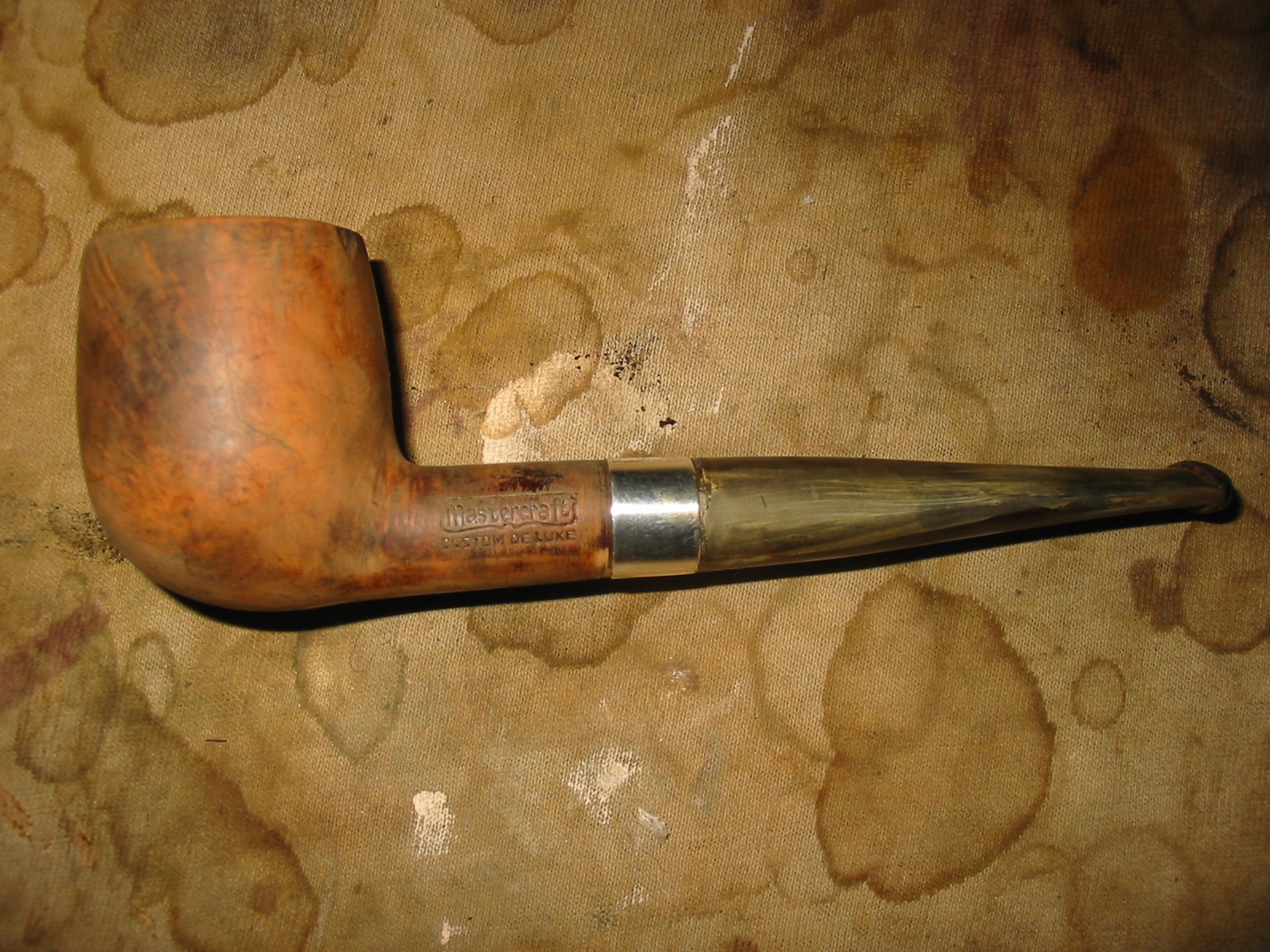
I learned from the last Perretti pipe that I worked on and subsequent replies that the Straight Grain was the top of the line of Perretti pipes. I have no idea where in the hierarchy this one sits but it is stamped L.J. PERRETTI over Imported Briar on the left side and DELUXE on the right side of the shank. It has a factory installed band that is stamped Sterling Silver in an arch. This pipe was a bit of a mess. Like some of the others I have had this one was marked with a swatch of paint – this time red paint. In the first photo below you can see it on the left side of the bowl near the shank bowl junction. The finish was rough but underneath was some great grain. Again there were no fills visible in this piece of briar. The bowl was caked and the lava had erupted over the edges of the rim leaving a thick hard cake on the rim of the bowl. The silver was badly tarnished and the stamping on the silver was not readable. The L.J. Perretti stamping on the left side of the shank ends with the “I” stamped on the silver band. The stem was oxidized and also had a buildup of calcification from the button up the stem about ½ inches. The stem was about a ¼ inch out of the shank and could not be pushed in from the buildup on tars in the shank. The first three photos show the state of the pipe when I brought it to the work table.
IMG_0892

IMG_0893

IMG_0894
I wiped down the bowl with acetone on a cotton cloth. I find that the acetone quickly dispenses with paint spots and splashes on the briar. It seems to go beneath the paint and it easily is scrubbed off. It also removes grime and buildup on the finish and removes the remaining stain on the briar. I wiped down the caked rim to soften the hard surface before I moved on to top the bowl. The next four photos show the pipe after I had scrubbed it with acetone.

IMG_0927

IMG_0928

IMG_0929

IMG_0930
I set up my sanding board and placed the medium grit emery paper on the board. I rotated the bowl on the sandpaper in a circular motion to remove the grime on the rim. I also had seen that there was some burn damage on the rim that needed to be removed. I place the pipe with the rim firmly against the sandpaper and work it until the rim is clean and the damage is minimized. Photos 1 & 2 show the process of sanding on the emery paper. Once I had finished the rough work I moved on to use a medium grit sanding sponge in the same way. I place the sponge flat on the board and work the bowl in a circular motion on the flat surface of the sponge (Photo 3). I then used a fine grit sanding sponge to do the same (Photo 4). Each progressive sanding grit smoothed the scratches and marks left by the previous grit.
IMG_0931

IMG_0932

IMG_0933

IMG_0934
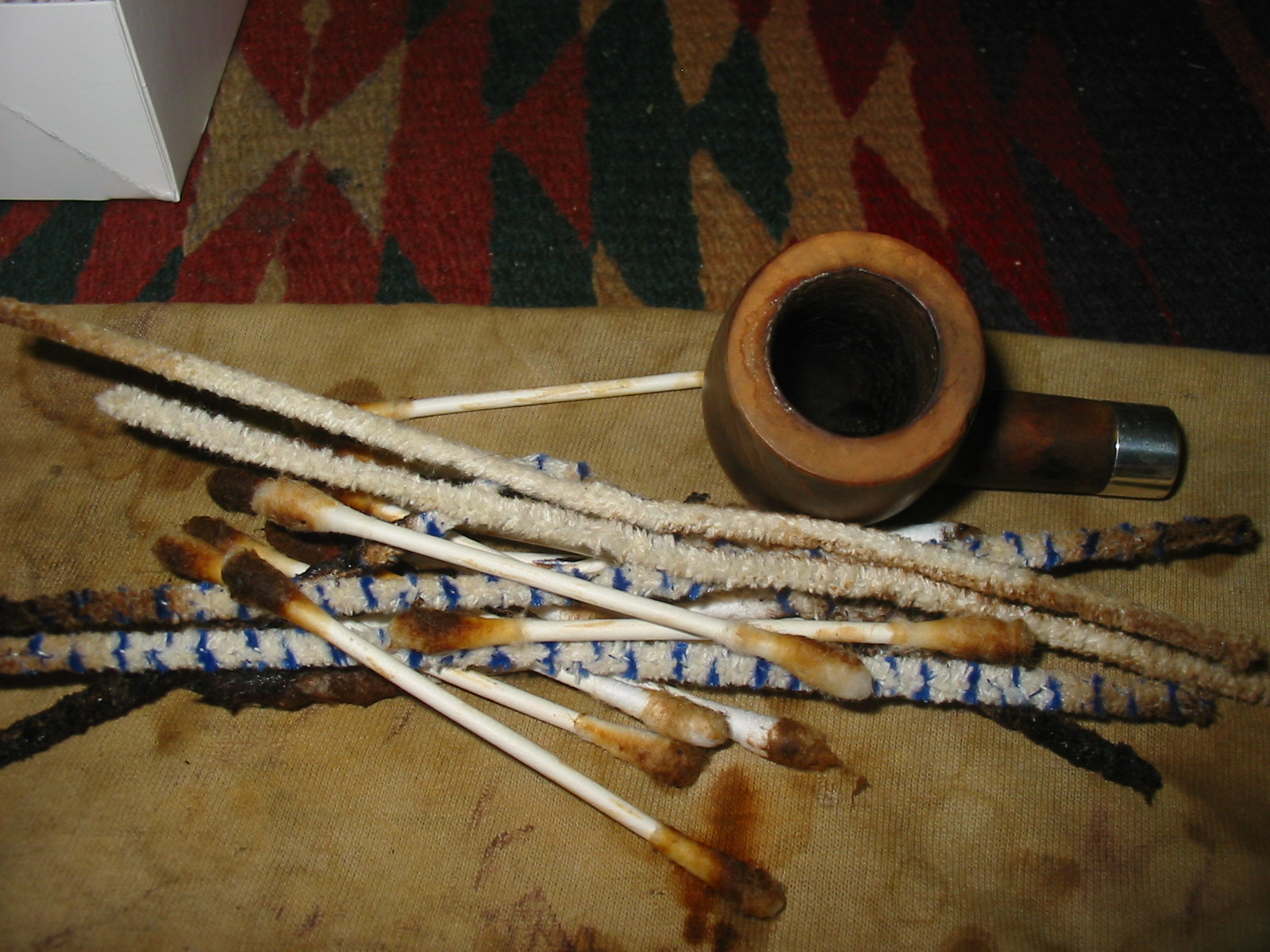
When I had finished topping the bowl I reamed the bowl and cleaned out the shank with cotton swabs, pipe cleaners and Everclear. I also polished the silver band with some tarnish remover applied with a cloth and rubbed into the band. I finished by wiping down the pipe again using Everclear on a cotton pad. This removed the sanding dust and also the overrun of the silver polish on the briar. I reinserted the stem to make sure the fit was correct. The next two photos show the pipe at this point in the process.
IMG_0935

IMG_0936
The next series of six photos show the progressive work on the stem using 1500-12,000 grit micromesh sanding pads. Each degree of grit gave the stem a deeper shine and removed any remaining oxidation. Once I had finished with the micromesh pads I wiped down the stem with Obsidian Oil and then when dry I put the stem on the pipe and buffed it with White Diamond.
IMG_0937

IMG_0938

IMG_0939

IMG_0940

IMG_0941

IMG_0942
I stained the bowl with two different stains – dark brown aniline thinned 2:1 with isopropyl alcohol (Photos 1 – 3 below) and then followed up with an oxblood aniline stain. I flamed the stain, restained, reflamed and then gave the rim a third coat of the brown stain.
IMG_0943

IMG_0944

IMG_0945
The final four photos show the finished pipe. I buffed the entirety a final time with White Diamond and then gave it multiple coats of carnauba wax. I finished by buffing it with a clean flannel buff to bring out the shine.
IMG_0947

IMG_0948

IMG_0949

IMG_0950

LJ Perretti Straight Grain Rejuvenated


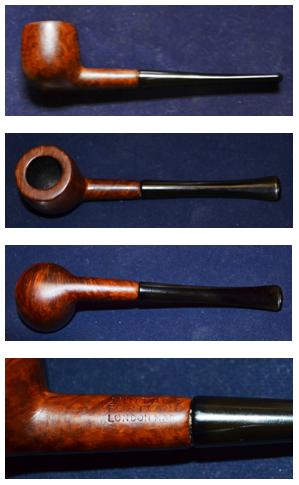
I picked up a seven pipe lot on EBay all because there were at least two of the pipes that were stamped LJ Perretti. One of them is the little pot/billiard pictured in this article. I say pot/billiard because the proportion of the bowl and shank more accurately fit a billiard but the height of the bowl is more like a pot. Ah well whatever it is it showed promise even in the seller’s photos on EBay. I bid and won. There is another Perretti that I will write about as I rework it but this one is stamped L.J. PERRETTI over IMPORTED BRIAR on the right side. It is stamped Straight Grain on the left side of the shank. The grain is quite nice and there are no fills in the briar that are visible. It was a dirty pipe – the finish was darkened and grit and oils were ground into the outside of the bowl. The rim had a serious cake of lava on it and the bowl was packed with a cake. The inside of the shank was so dirty and gritty that the stem would not sit all the way in the mortise. The stem was oxidized and had a rubber softy bit guard that was stuck on the stem. There was a cursive P on the left side of the stem. The Perretti pipes are shop pipes that may have been made by a variety of carvers or by Robert Perretti himself. These are old enough that they may well be done by Perretti. The stamping on the side of the shank that says Imported Briar seems to point to the pipe being American made. The first series of three photos shows the state of the pipe when I took it to my work table.
IMG_0895

IMG_0896

IMG_0897
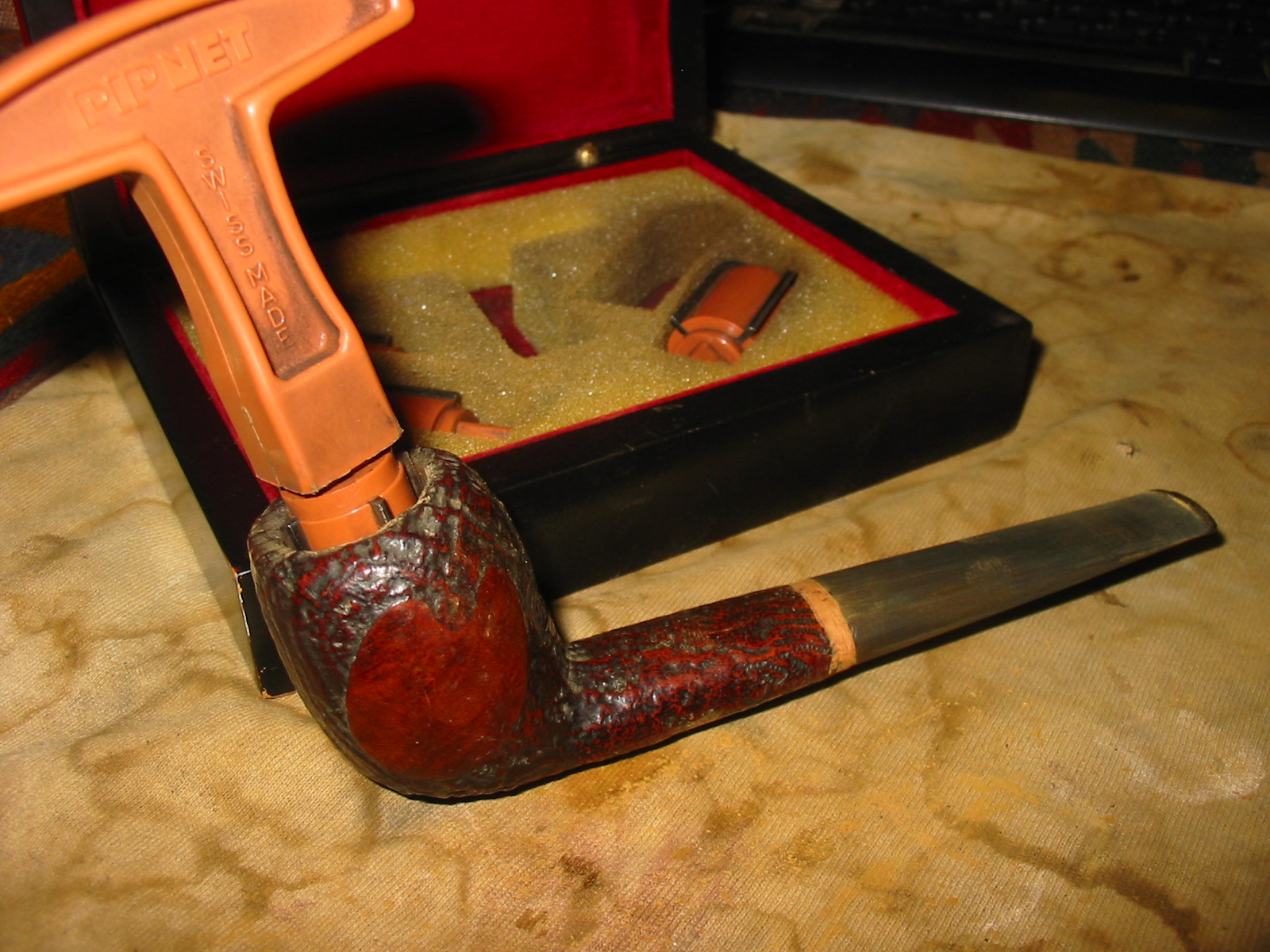
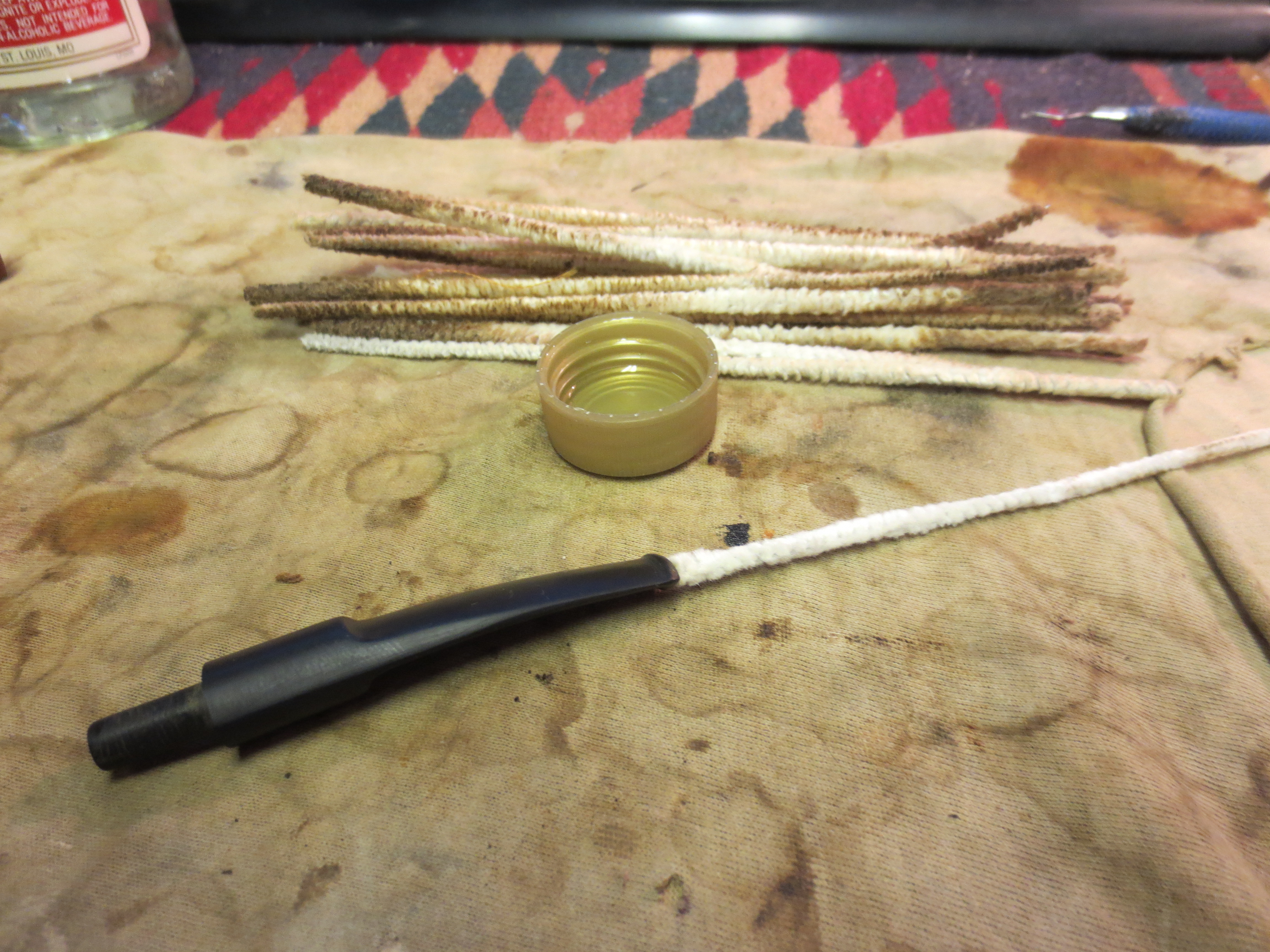
I cut off the rubber softie bit guard with a knife and peeled it free of the stem. I reamed the bowl with a PipNet pipe reamer to remove the buildup of carbon. I cleaned out the stem and the shank with pipe cleaners and Everclear until the pipe cleaners came out as clean as they went in. It never ceases to amaze me how many pipe cleaners it takes to clean out the inside of the pipe and stem. Once the internals were clean the stem fit into the shank with no interference.
IMG_0901

IMG_0902
I wiped won the outside of the bowl with acetone on a cotton pad (Photo 1 below). I wiped down the rim with acetone as well and then decided to lightly top the bowl (Photos 2 – 5). I used a medium grit sanding sponge to top the bowl on this one. I just wanted to remove the carbon build up on the rim and leave as much of the stain intact as I could. Once finished I wiped it a second time with acetone. I also used the drill bit from the Kleen Reem reamer to clean out the airway from the mortise to the bowl. I recleaned the shank with pipe cleaners and Everclear afterwards (Photo 6 below).
IMG_0903

IMG_0904

IMG_0905

IMG_0906

IMG_0907

IMG_0908
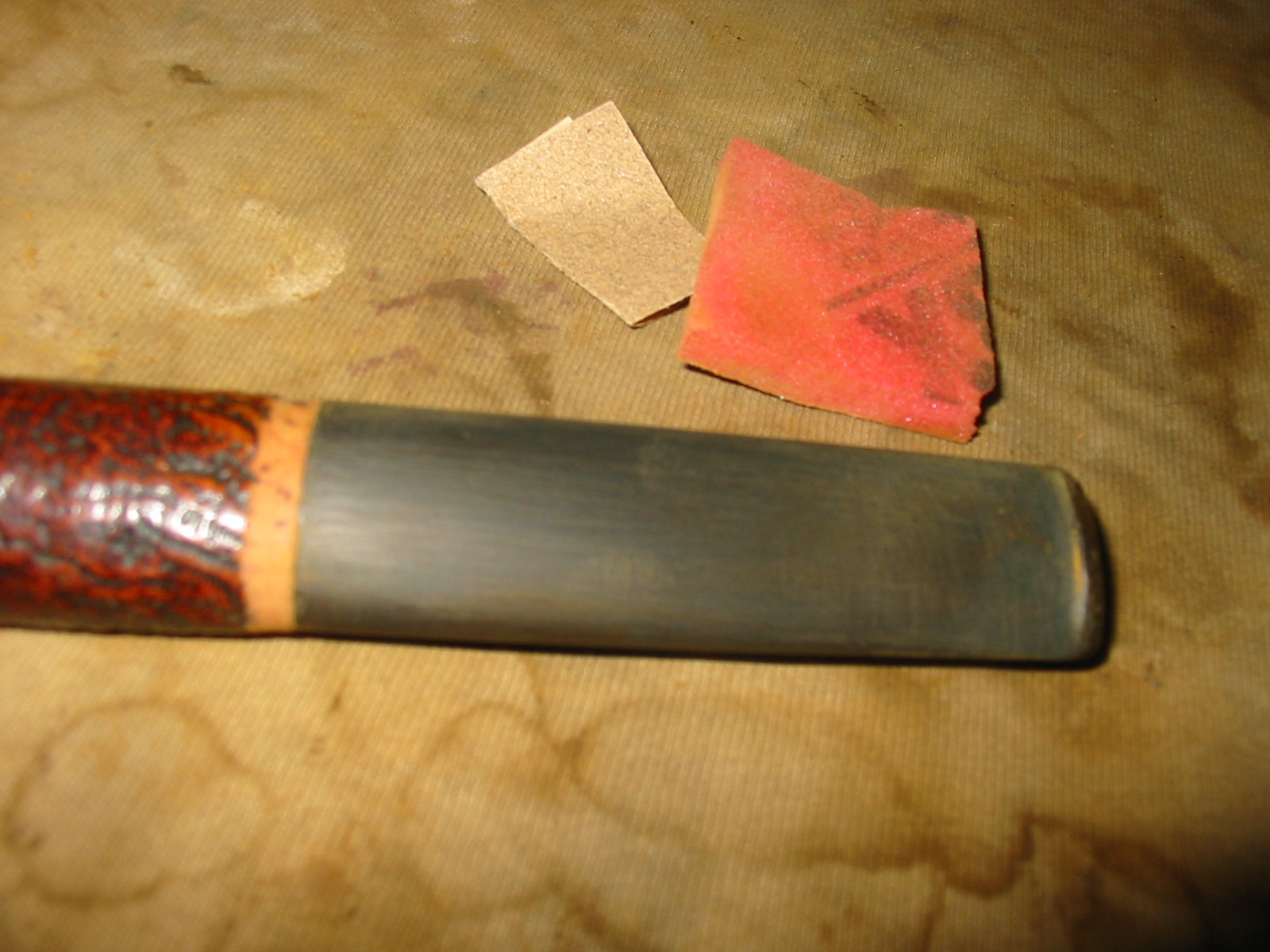
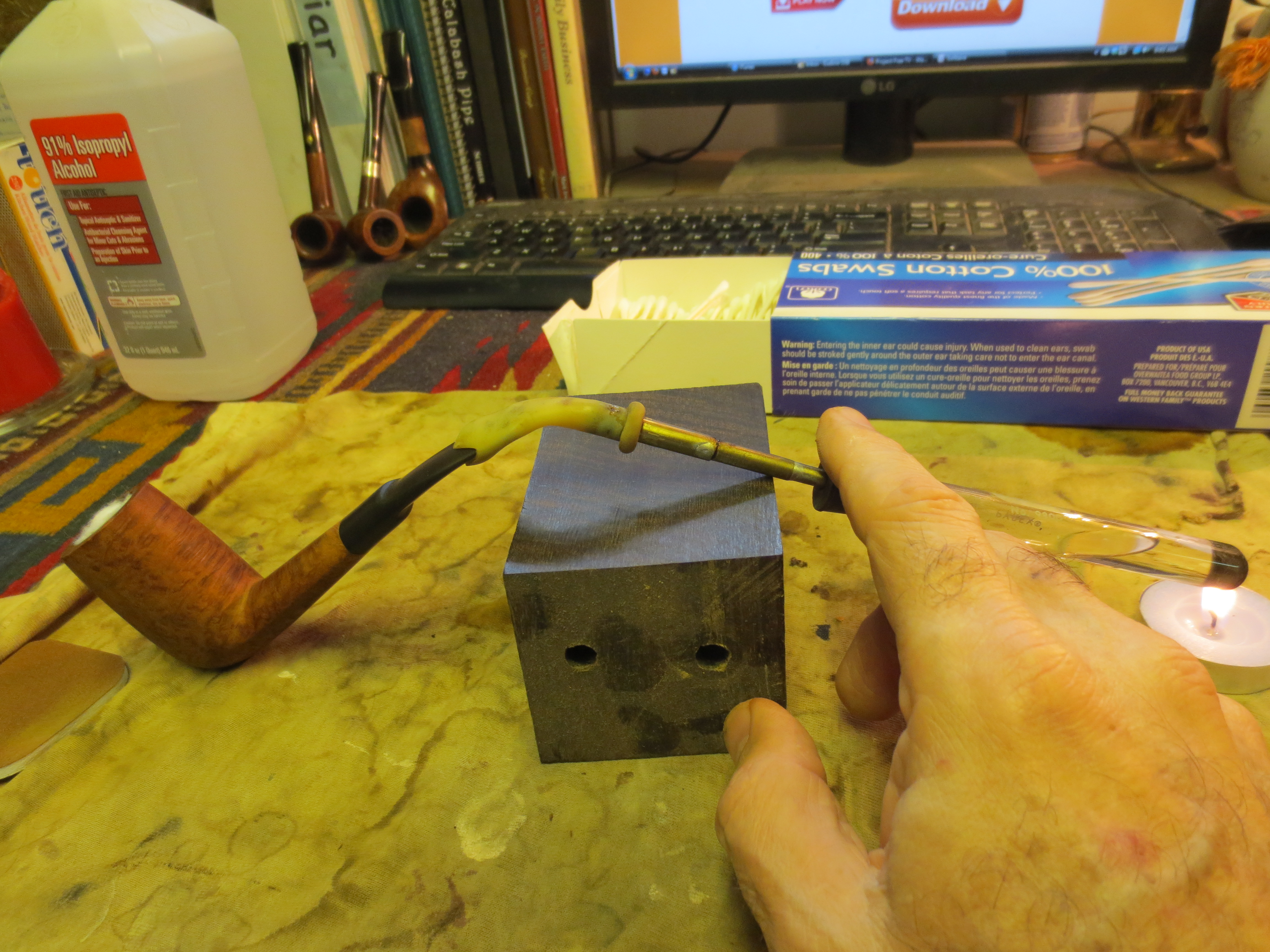
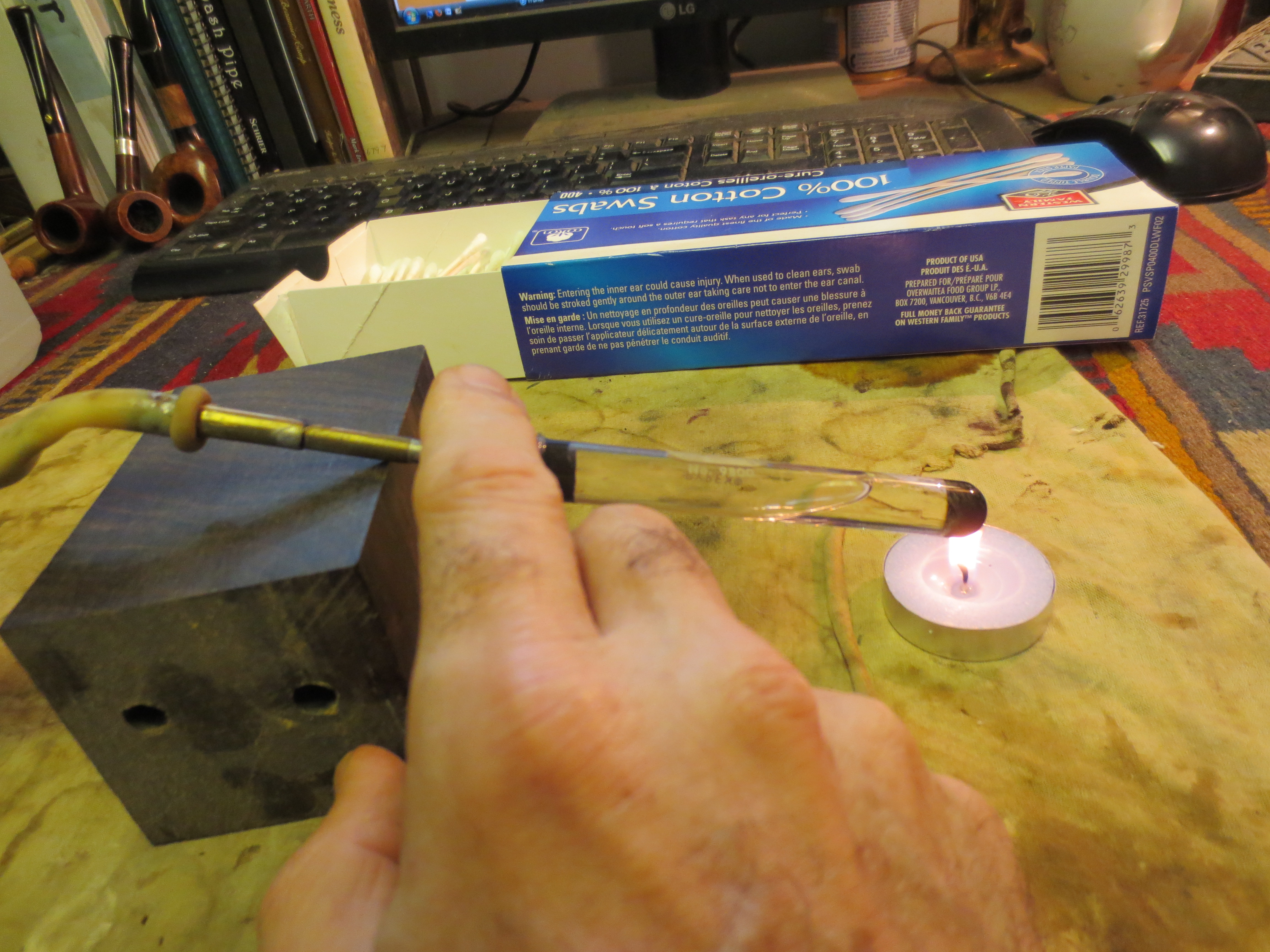
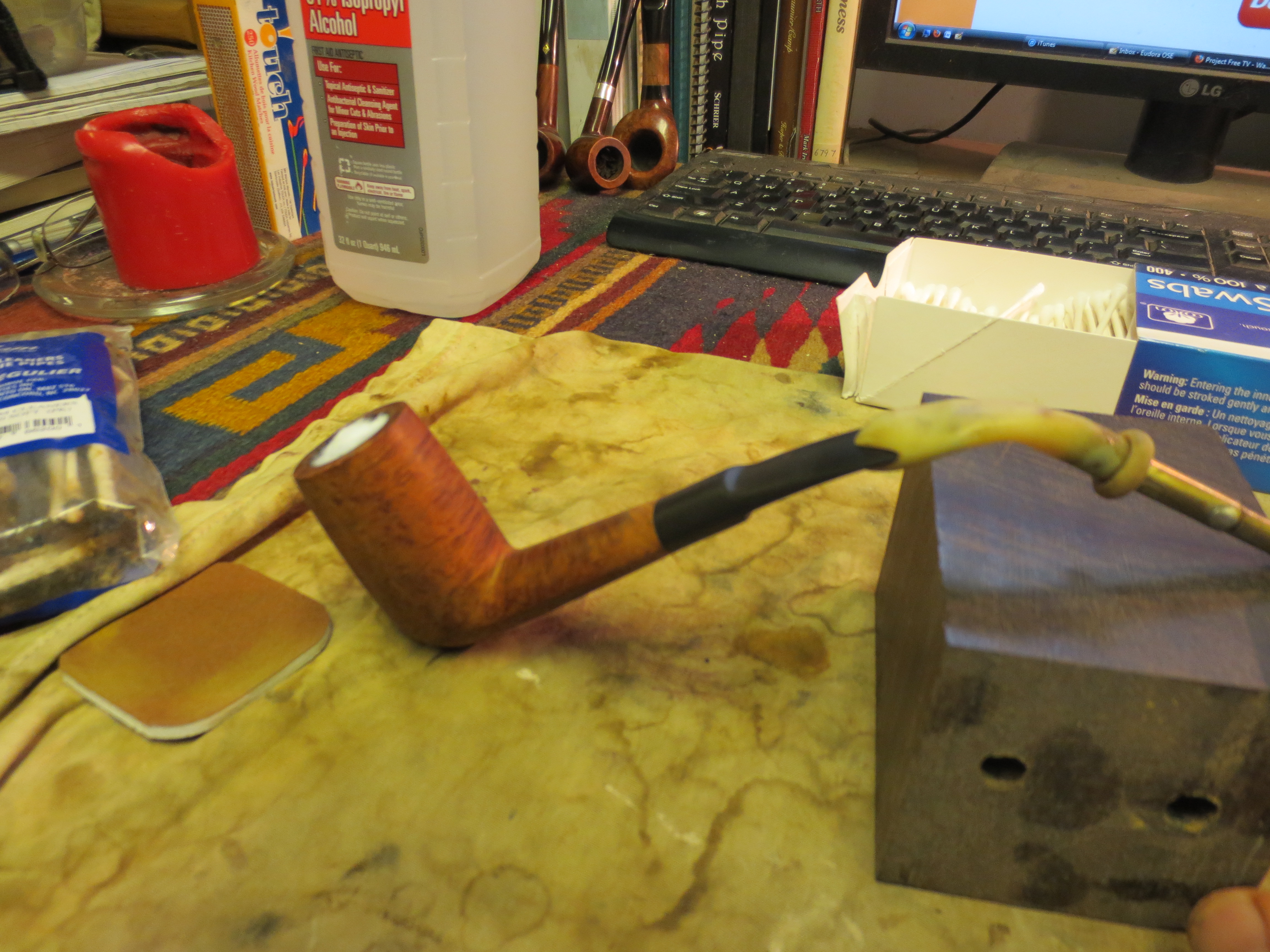
I set the bowl aside and then worked on the stem. I inserted it in the ebony block that I drilled as a mortise to work on the oxidation. I sanded it with 320 grit sandpaper to break up the oxidation and remove the calcium buildup that was under the softee bit. There were also some tooth chatter and marks that needed to be worked out. These were not deep so all I did was sand them with the 320 grit sandpaper. The next two photos show the work on the stem.
IMG_0909

IMG_0910
I reinserted the stem on the pipe and then continued to work on the stem and clean up the oxidation. I sanded around the edge of the stem/shank junction. I used 320 grit sandpaper and a medium grit sanding sponge.
IMG_0911
I wet sanded the stem with 1500 and 1800 grit micromesh sanding pads. I dry sanded with 2400-12,000 grit micromesh sanding pads. The next three photos show the progress of the sanding with the pads. I selected three to show the progress but could easily have shown the lot. The main idea is to show the development of the shine on the stem. I finished sanding with 12,000 grit and then wiped the stem down with Obsidian Oil and buffed it by hand with some carnauba wax.
IMG_0912

IMG_0913

IMG_0914
I restained the pipe with dark brown aniline stain thinned 2:1 with isopropyl alcohol. I flamed the stain and then restained it and reflamed it. I applied a third coat of the stain to the rim and flamed that again as well (Photos 1 & 2 below). I then sanded the bowl and the stem with the 6000, 8000 and 12,000 grit micromesh sanding pads (Photo 3 below) and then took it to the buffer and buffed it with White Diamond (Photos 4 – 6).
IMG_0915

IMG_0916

IMG_0917

IMG_0918

IMG_0919

IMG_0920
I finished by buffing the pipe with multiple coats of carnauba wax and then polished with a soft flannel buff on the buffer. The final series of four photos below show the finished pipe.
IMG_0922

IMG_0925

IMG_0921

IMG_0923

A No Name Bulldog Born Anew – New Look and New Stem


This little bent bulldog is the last of the briar stummels in the EBay lot I picked up. It is a nice little dog and I saved it for last as I find that the diamond shank stems are a bear to fit correctly. Bent diamond shanks are even harder in my opinion. I had quite a few stems to choose from in my can of stems so a new stem was not a problem. The issue really was getting all the sides and angles to line up and look right. Restemming these is a tricky proposition. This one had crosshatched stamping on the left side of the shank that obliterated the stamping of the name on it. On the right side it is stamped Imported Briar which I am assuming makes it an American made pipe. It had some nice grain under the dark stain and varnish coat. The bowl had a very poorly formed cake with many chunks missing. The rim was thick with a tar and oil build up but surprisingly was not dented or damaged by burns or over reaming. The end of the shank which would butt up against the stem was pristine with no damage or cracks. I love it when I can work on a pipe that does not need banding. It is a challenge to get a good clean fit on the stem. This would thus be a double challenge.

I chose a diamond shank tapered stem for the pipe. I had saddle stem galore and only two of these tapered stems. I love the look of a tapered stem on a bulldog so I decided to go with that one. It would not require too much of a bend in it so it would work well and look classy. I drilled out the airway to fit the pin on the Pimo Tenon Turning Tool and then turned the tenon to a close fit on the stem. I had to reduce the length of the new tenon as it was longer than the mortise on the pipe. I hand sanded the tenon to get a good clean fit on the shank and inserted it in place. Externally, it would need to be reduced on all sides to match the flow of the shank so there was work to do in fitting the stem.
IMG_0830

IMG_0831
I used my Dremel with a sanding drum to bring the sides of the stem down to almost match the shank. This was a bit tricky in that I did not want to cause dips in the surface of the stem but reduce each side until it was a close fit to the shank. It takes a light touch on the sanding drum to keep it horizontal to the stem and also keep it from hitting the shank and doing damage to the briar. I held the bowl in hand and worked the sanding drum both vertically and horizontally to the stem to remove the excess vulcanite. I worked on one side at a time until the fit was close then turned the stem and did the next side. I began on the top side of the stem and worked both top sides before turning the stem over and doing the underside. The next three photos show the shaping done by the Dremel. After doing this initial work on the stem it was time to take to the table and do the rest by hand.
IMG_0832

IMG_0834

IMG_0833
I began sanding with medium grit emery paper to remove the deep scratches left by the Dremel and to even out the surfaces of the stem. I sanded each side until they were smooth. I also sanded the peak of the stem on each side to make sure the peak matched the one on the shank of the pipe. The next seven photos show the progress of evening out the stem sides. When I finished with the emery paper I would go on to use various other grades of sandpaper and continue the process.
IMG_0835

IMG_0836

IMG_0837

IMG_0838

IMG_0839

IMG_0840

IMG_0841
As the rim of the bowl was chamfered into the bowl I worked on it with a folded piece of medium grit emery paper first followed by 320 grit sandpaper. I wanted to keep the chamfer clean and even so I held the paper to the angle of the chamfer on the cleanest part of the rim toward to the front of the bowl. The next two photos show the cleaned rim.
IMG_0842

IMG_0843
I went on to sand the stem with a fine grit emery paper to continue to bring the size down to meet the shank on the pipe (Photos 1 & 2). After I had the stem fairly close I switched to 320 grit sandpaper and sanded down the stem, the shank and the bowl. I decided to remove the cross hatching on the shank and clean up the finish. I wiped it down with acetone on a cotton pad to remove the finish and sanded until the finish was stripped and the shank and stem was smooth. The flow between the stem and the shank was a good match when I finished with this part of the work (Photos 3, 4, 5, & 6). An amazing grain was beginning to break out on the bowl and shank.
IMG_0844

IMG_0845

IMG_0846

IMG_0847

IMG_0848

IMG_0849
Once I had finished the fit of the stem to the shank and cleaned off the bowl with the sandpaper I wiped it down a second time with acetone to remove the remaining remnants of stain and to clean off the dust of the sanding (Photos 1 & 2). The remaining photos show the pipe after it was cleaned and ready to stain (Photos 3, 4, 5 & 6).
IMG_0850

IMG_0851

IMG_0852

IMG_0853

IMG_0854

IMG_0855
At this point I decided to bend the stem to the angle I wanted on the finished pipe. I set up my heat gun and turned it on to the lowest setting and held the stem above the heat until it was pliable. I have a wooden rolling pin that I use as a guide to bend the stem evenly so once it was soft I bent it over the rolling pin until the angle of the stem bend aligned with the curve of the bowl. I wanted the bowl to be level when held in the hand. Once the angle was right I cooled the pipe stem in cool water to set the bend. The next four photos show the stem after it was bent according to the angles I was aiming for. The grain on this pipe was calling out to me to come up with a stain colour and process that highlighted the grain.
IMG_0856

IMG_0857

IMG_0858

IMG_0859
I decided to stain the pipe with an oxblood aniline stain. I like it because it sets deeply in the grain of the pipe and when it is buffed off it still allows the grain to be seen. I also planned on sanding the finish with micromesh sanding pads to further highlight the grain patterns on the bowl. The next five photos show the stained bowl. I still needed to buff the pipe and lift the stain a bit from the briar.
IMG_0860

IMG_0861

IMG_0862

IMG_0863

IMG_0864
I reinserted the stem at this point in the process and hand buffed the bowl to get a good feel for the opacity of the stain (Photos 1 & 2). I then began to sand the stem and the bowl with the micromesh sanding pads. I began with 1500 and 1800 grit micromesh first. I wet sanded with these grits of micromesh (Photos 3, 4, & 5). The finish on the stem is smoothing out and the bowl finish is really beginning to show the grain and highlight the beauty of the piece of briar.
IMG_0865

IMG_0866

IMG_0867

IMG_0868

IMG_0869
I continued wet sanding with 2400 and 3200 grit micromesh sanding pads (Photos 1 & 2) and the grain began to pop and the stem began to shine nicely. I dry sanded with 3600 and 4000 grit micromesh sanding pads as I sought to polish the finish and the stem more fully. Photos 3 & 4 give an idea of the polish work that had been done by this point in the process. I finished sanding the bowl and stem with the remaining micromesh dry sanding pads 6000, 8000 and 12,000 grits. The resultant effect on the stain of the bowl was exactly what I had hoped for. The grain stood out clearly on the sides and shanks. On the left side of the bowl there is a nice birdseye pattern that is not as visible in the photos as it is in person. The pipe came out very nicely. Photos 5 & 6 show where things stood after the final polishing with the micromesh pads.
IMG_0870

IMG_0871

IMG_0872

IMG_0873

IMG_0874

IMG_0875
I buffed the pipe with White Diamond and then gave it multiple coats of carnauba wax to finish it. The finish came out nicely in my opinion and the feel of the pipe in the hand was perfect. I had to load a bowl of tobacco and give it a new inaugural smoke. I chose to load it with some 2009 Barclay-Rex Barclay Slice. I packed the bowl, picked up a tamper and lighter and headed outside into the yard with my spaniel. While he ran around and chased sticks and chewed them I relaxed and had a bowl. It is a great smoking little pipe. It is comfortable in the mouth and has an open draught. I like it. Now I need to decide whether to keep it or pass it on.
IMG_0876

IMG_0879

IMG_0878

IMG_0877

Reworking and Reshaping an Old French Briar (CPF?) Billiard


Blog by Steve Laug

This old timer was one of the pipe bowls that I picked up in that EBay lot that had others with the French Briar stamping. The others had the same stamping but also had been stamped CPF on the shank or on the end cap. This one was missing the end cap so it remains a bit of a mystery as to its maker. It was also stemless. From the photos below you can see that at one point in its life it also had a rim cap that was also missing. What was left was the line around the top of the bowl and a darkened rim where the silver cap had covered it. The end of the shank was in pretty good shape but the likelihood of finding another end cap that fit or in making one was pretty low for me. The four photos below show the general state of the pipe when it came to my desk top. The finish was gone. There were several visible fills that stood out. It was one that I had to give a little thought about how I was going to tackle it. I knew that I would have to modify the shank and rework the bowl. I would also have to redrill the mortise way and fit a stem for the newly formed pipe. Ah well… let’s begin the work.
IMG_0789

IMG_0792

IMG_0791

IMG_0790
After many failed attempts over the years to get a good straight cut on the shank and end up with a smooth and even mortise I finally figured out a way with my limited tools to accomplish that. I slip a nickel band on the shank to the place that I want to cut it off. I use the band as a guide for my hacksaw to follow. So far this method has worked for me and left me with some nice evenly cut shanks. The next three photos show the process from start to finish.
IMG_0793

IMG_0795

IMG_0794
After cutting off the shank I sanded the area where the new band would be fitted. I used my Dremel with a sanding drum to begin the process of cutting back the shank to receive the band and finished by hand sanding it with medium grit emery cloth. I set up my heat gun on it end stand, slipped the band in place and set the heat on low to warm the band so that I could press it into place. The next two photos show that process.
IMG_0796

IMG_0797
With the band in place I wiped down the bowl with acetone on a cotton pad to clean off the grit and the remnants of the finish on the pipe. After I had cleaned the bowl I topped the rim with a medium and fine grit sanding pad to remove the damage to the rim edges. The next four photos show that process. During that time I also used superglue and briar dust to fill the obvious sand pits on the bowl (at the back of the bowl near the shank and on the underside). I sanded them once they were dry and was able to blend them into the bowl quite well. In the first photo below you can see the first large sand pit clearly. It was quite long and fortunately flowed with the grain so that it was easy to blend in with the briar dust and superglue. The one on the bowl bottom was a bit more difficult to blend in. In either case both are now smooth surfaces that the finish sanding would blend in as much as possible.
IMG_0798

IMG_0799

IMG_0800

IMG_0801
I sanded the bowl with a medium grit sanding sponge to remove the damage caused by the rim cap and to remove the darkened line around the top of the bowl. The next series of three photos show how the bowl is shaping up after initial sanding. The wood is stamped French Briar but as I work it I am wondering. It is very hard, dense wood with interesting grain. It is very light weight and the feel of the sanding dust and the wood itself calls this into question for me. Maybe it is only a question of age on the pipe as it is probably from the late 1800’s or early 1900’s.
IMG_0802

IMG_0803

IMG_0804
I inserted the stem and took it to the buffer to see what it looked like at this point after buffing. I buffed it with Tripoli. The next four photos show the pipe after buffing. There was a natural reddish colour to the wood that came out more and more as I sanded it.
IMG_0805

IMG_0808

IMG_0807

IMG_0806
After buffing the pipe I reamed it with my PipNet reamer to clean out the crumbling and broken cake that was on the surface of the bowl (Photo 1). I sanded it some more and then wiped it down with an alcohol dampened cotton pad and prepared tit for restaining (Photos 2 & 3).
IMG_0809

IMG_0811

IMG_0810
I receive regular tweets from Grant Batson, pipemaker. In one of the latest he wrote of experimenting with Danish Oil in finish the bowl of a pipe. I have several cans of that around from my refinishing furniture days so I decided to use some medium walnut coloured Danish Oil on this bowl. The next four photos show the stained pipe. I had yet to buff it or polish it at this point in the process. I just rubbed on the Danish Oil and then rubbed it off.
IMG_0812

IMG_0815

IMG_0814

IMG_0813
I set the pipe aside for the evening so that the finish had a chance to dry well. This morning I worked on the stem and the bowl with the micromesh sanding pads. I used all grits that I have available from 1500 – 12,000 grit to sand both the bowl and the stem. The next series of six photos shows the progressively developing shine on both the stem and the bowl.
IMG_0816

IMG_0821

IMG_0820

IMG_0819

IMG_0818

IMG_0817
After finishing with the micromesh sanding pads I took it to my buffer and buffed it with White Diamond. I find that this buffing with a light touch really sets the shine to a glossy finish. The next four photos show the pipe after buffing. I still had to put on the wax but the shine is very evident.
IMG_0822

IMG_0825

IMG_0824

IMG_0823
The final series of four photos show the finished pipe. I gave it multiple coats of carnauba wax and buffed it with a soft flannel buffing pad. I am pleased with the way it turned out. The pipe is ready for smoking and should provide service for many years to come.
IMG_0826

IMG_0827

IMG_0828

IMG_0829

New Life to an Aarhus?? Unique


I have no idea what the final letters of the name on this pipe are supposed to be. The shank had been poorly cut off and there were two cracks, one on each side. It is stamped Aarhus over Made in France on the left side of the shank and the number 6 on the right side. The walls of the shank were quite thin. The bowl top was caked and dirt. The bowl was caked and needing cleaning. There was no stem on the bowl. The finish on the pipe was worn and dirty. There were two small sandpits that had been patched with white putty that had fallen out and left two white spots on the bowl. The shape of the pipe is what interested me. It has a pencil shank and the bowl tapers to a ridge on the front and the back. The bowl is also canted toward the front similar to a cutty and from the top is almond shaped. It is a uniquely interesting shape. The grain on this one is quite nice – birdseye front and back and cross grain on the sides. It does not quite align with the cut of the bowl but is very close. The pipe was a part of the lot that I have been working on lately – a purchase from EBay of 12+ pipe bowls that needed to be stemmed. The first series of four photos below show the state of the bowl when I began. The final photo of the four gives a closer look at the mortise and the thinness of the walls of the shank. Note the notches out of the end that give evidence of the shortening of the shank. In the photo I also included the stem that I took out of my can of stems and turned the tenon on.
IMG_0733

IMG_0734

IMG_0735

IMG_0736
The next three photos show the stamping on the shank and the angle of the cut of portion. It actually cut off the last letter or letters of Aarhus (pipe brand) and the E of France. The third photo shows the crack on the left side of the shank. There was a matching crack on the right side as well.
IMG_0737

IMG_0738

IMG_0739
I reamed the pipe and then topped the bowl to remove the damage to the rim and smooth out the surface. I was intending to refinish the pipe anyway so I started with fine grit emery paper to clean off the thick tars on the surface (Photos 1 &2). I then used a medium grit sanding sponge to clean up the surface from the scratches of the emery paper (Photo 3).
IMG_0740

IMG_0741

IMG_0742
I worked on the tenon in order to get a good smooth fit in the mortise. In Photo 1 below you can see how I used the stem to open the crack so I could repair it. I dripped in some superglue and squeezed it back together. You can see in Photos 1 and 2 the fit of the stem against the shank. The gap between stem and shank shows the angular cut that had been done on the shank. There were also small pieces of briar missing on the bottom edge of the shank. The end was rough and with the cracks left no choice but to band it. (In the photos there are some chunks of briar. These were inside of a band that I was cleaning up to reuse on the tenon of this pipe.)
IMG_0743

IMG_0744
I set up my heat gun and placed the band on the end of the shank. It was a tight band and I was able to just insert the edge in the band so that I could heat the band for pressure fitting it on the shank. The next four photos show the heating of the band and the metal plate that I use to press it into place on the shank. I heated it and pressed it on in three different increments as the band cooled before it would go all the way into place.
IMG_0745

IMG_0746

IMG_0747

IMG_0748
The next two photos show the newly banded shank. In the second photo you can also see the white putty fill about half way down the side of the bowl.
IMG_0749

IMG_0750
I finished fitting the stem on the pipe and sanded down the slag from the edges and end of the stem. I also wiped down the bowl with acetone. It had a coating of varnish on it that was crackling and also did not allow me to rework the fills properly. Once I had it wiped down I picked out the white putty in the two fills that were present with a dental pick and wiped down the bowl again with the acetone. The fills were on the right side mid bowl and on the left side at the bottom of the shank bowl junction.
IMG_0751

IMG_0752
I sanded the bowl and shank with 320 grit sandpaper and then a fine grit sanding sponge to remove the finish completely. The next three photos show the sanded bowl and shank. The grain was quite nice on the pipe. The dark stain had hidden it pretty well. I was beginning to think about not restaining the bowl but leaving it with the remaining colour and polishing and buffing it. Time would tell.
IMG_0753

IMG_0754

IMG_0755
I packed briar dust into the clean sandpit areas on the pipe and then dripped superglue on top of the briar dust. The next two close up photos of the bowl show the patches before I sanded away the excess and cleaned them up to match the surface of the briar.
IMG_0757

IMG_0758
I used 320 grit sandpaper to remove the excess that was shown in the above photos and smooth out the surface. I followed that by sanding with a fine grit sanding sponge. The next four photos show the replaced fills. There were also some dark stains on the bowl that I wanted to work on. I continued to sand the bowl as a whole with the sanding sponge to minimize the dark stain marks on the briar. The colour of the briar is really starting to look great.
IMG_0759

IMG_0760

IMG_0761

IMG_0762
I then sanded the bowl and the stem with micromesh sanding pads. I wanted to remove the scratches and begin to develop a shine. I wet sanded with the 1500-2400 grit micromesh sanding pads and then went on to dry sand with the 3200-12,000 grit sanding pads. The next 9 photos show the developing shine on the bowl and the stem. I also sanded the nickel band with the micromesh pads.
IMG_0763

IMG_0764

IMG_0765

IMG_0766

IMG_0767

IMG_0768

IMG_0769

IMG_0770

IMG_0771
By the time I finished sanding with the 12,000 grit micromesh sanding pad the bowl looked really good. I decided against restaining it and instead reinserted the stem and took the pipe to the buffer. I buffed the entirety lightly with White Diamond to remove any remaining light scratches and to brighten up the shine on both bowl and stem. I then wiped down the stem with Obsidian Oil, and buffed the pipe with carnauba and a soft flannel buff. The final five photos show the finished pipe. It is ready to use. The only remaining question is, “What is the brand? What letters follow Aarhus???” Can any of you help me with that information? It is an unfamiliar brand to me and I can find nothing on the Pipephil Logos and Stampings website or in Who Made that Pipe. Thanks ahead of time for your help.
IMG_0772

IMG_0773

IMG_0774

IMG_0775

IMG_0776

Restoring a Unique Edition of the Keyser Hygienic System Pipe


I picked up this Keyser Hygienic on EBay because it caught my eye. I have three other Keyser Hygienic pipes and they are all very similar in terms of the system. They are briar bowls and shanks with an aluminum mortise with a tube in the centre running to the airway in the bowl. This is matched with a military mount stem with a tube with a down turn on it that fits into the airway in the mortise. The swirling smoke rolls around the inside of the mortise where the moisture in the smoke condenses on the sides of the aluminum mortise. The cooled air is drawn into the down turned tube in the stem and it delivers a cool, dry smoke. The system is fairly straightforward and simple. The genius of the design is that any stem fits any pipe of the same size. Replacement stems are easily purchased and all that is necessary is the size of the pipe and the replacement will be a ready fit.
Keyser Pipes
But this new Keyser was unique in all ways. The system design seems like a prototype of the original or maybe a step toward the ones that I have. It is composed of a short shanked briar bowl and a metal tube that has a normal vulcanite tenon. This sits in the shortened shank. Inside the tube is a second tube that extends ¾ of the way up the barrel. The inner tube is the extension of the airway in the tenon. The stem is a short pressure fit stem with a shoulder that allows it to ride on the end of the outer tube. On the end of the stem is a down turned short tube that draws air in to the mouth piece from the condensing chamber of the tube. It is a fascinating design. It is that uniqueness that caught my eye – that and the stamping/engraving on the outer tube which reads as follows:

KEYSER HYGIENIC PIPE
Made By
Keyser Manufacturing Co.
Brighton England
Pat Appns Brit 34B20/47
US 6067474/48
Can 581101

The next series of seven pictures shows the pipe as it appeared in the EBay webpage. The seller did a great job describing the current state of the pipe and the areas of concern. The seller notes some of the scratches on the outer tube and the darkening of the rim. He also noted the tooth chatter and scratch marks on both the top and underside of the stem.
Keyser1

Keyser2

Keyser3

Keyser4

Keyser5

Keyser6

Keyser7
When the pipe arrived I unpacked it and examined it. There were indeed tooth chatter/marks on both the top and bottom of the stem. There was a cigarette burn mark on the bottom of the shank where it meets the bowl. It was not a deep burn and there was no charred wood just a dark mark. The rim itself also had some issues. While the surface was not charred there was a burned area on the front inside of the bowl and on the front outside of the bowl. It looked to be damage from a lighter used in the same place repeatedly over time. The remainder of the finish was in pretty good shape but the entire pipe would need to be stripped in order to address the burn marks on the rim and the side of the shank. The inside of the bowl and shank were very clean. The pipe had not been reamed but there was a light cake that smelled like an aromatic. The barrel was tight on the shank but I carefully was able to remove it. The vulcanite tenon on the end of the barrel was undamaged but the airway was closed in with tars. The way the tenon was attached to the barrel was interesting. The end of the barrel was bonded to a circular plug of vulcanite with the tenon an integral piece of the part. The stem was frozen in the barrel and could not be removed. The button on the stem was unmarked and the tooth marks were actually mid stem on the top and bottom sides. The vulcanite stem was oxidized and would need to be cleaned. The next four photos show the items that I have pointed out in this paragraph.
IMG_0507

IMG_0508

IMG_0509

IMG_0510
I was able to remove the barrel and tenon from the shank of the pipe by carefully twisting the barrel free of the shank. I always hold tightly to the shank with one hand right next to the shank and then twist with the other hand. I try to maintain equal pressure on all points so that the shank is not strained or cracked in the process. The next photo shows the tenon on the barrel. It is almost the same length as the shank and the airway is lined up very closely to the airway in the bottom of the bowl. I cleaned out the mortise with cotton swabs and Everclear and found that it was quite clean. I also cleaned out the barrel from both ends but was not able to get a pipe cleaner to go all the way through the pipe from button to tenon.
IMG_0511
The next three photos show the front of the bowl and the extent of the burn marks on the front outside of the bowl and the front inside of the rim. These were two areas that would need to be worked over to minimize the burn marks on the finished pipe.
IMG_0512

IMG_0513

IMG_0514
I used my PipNet reamer to ream out the soft aromatic cake in the bowl and then recleaned the shank and the inside of the bowl with pipe cleaners and Everclear to remove the carbon dust that came from the reaming process (Photo 1 below). I wiped down the outside of the bowl and shank with a cotton pad and acetone to remove the finish on the pipe (Photo 2 below).
IMG_0515

IMG_0516
The next series of fourteen photos show the topping of the bowl to remove the burned area on the inside of the rim and the front outside edge. The burn had rounded the outside edge and made it appear out of round when looking at it from the top. I wanted to top the bowl enough to bring the top view back into round, minimize the wood damage in both spots and clean up the sharp edge of the bowl. I used two different sanding sponges – medium grit (black coloured sponge) and a fine grit sponge (yellow coloured sponge) both pictured below to start the process. I went on to use medium grit emery paper on the hard board to further top the bowl and ended with 320 grit sandpaper on the board. I polished the finish of the topped pipe bowl with the fine grit yellow sanding sponge. I also worked on the burned area that extended down the front of the bowl with the two sanding sponges.
IMG_0517

IMG_0518

IMG_0519

IMG_0524

IMG_0525

IMG_0526

IMG_0528

IMG_0529

IMG_0530

IMG_0531

IMG_0532

IMG_0533

IMG_0534

IMG_0535

IMG_0536
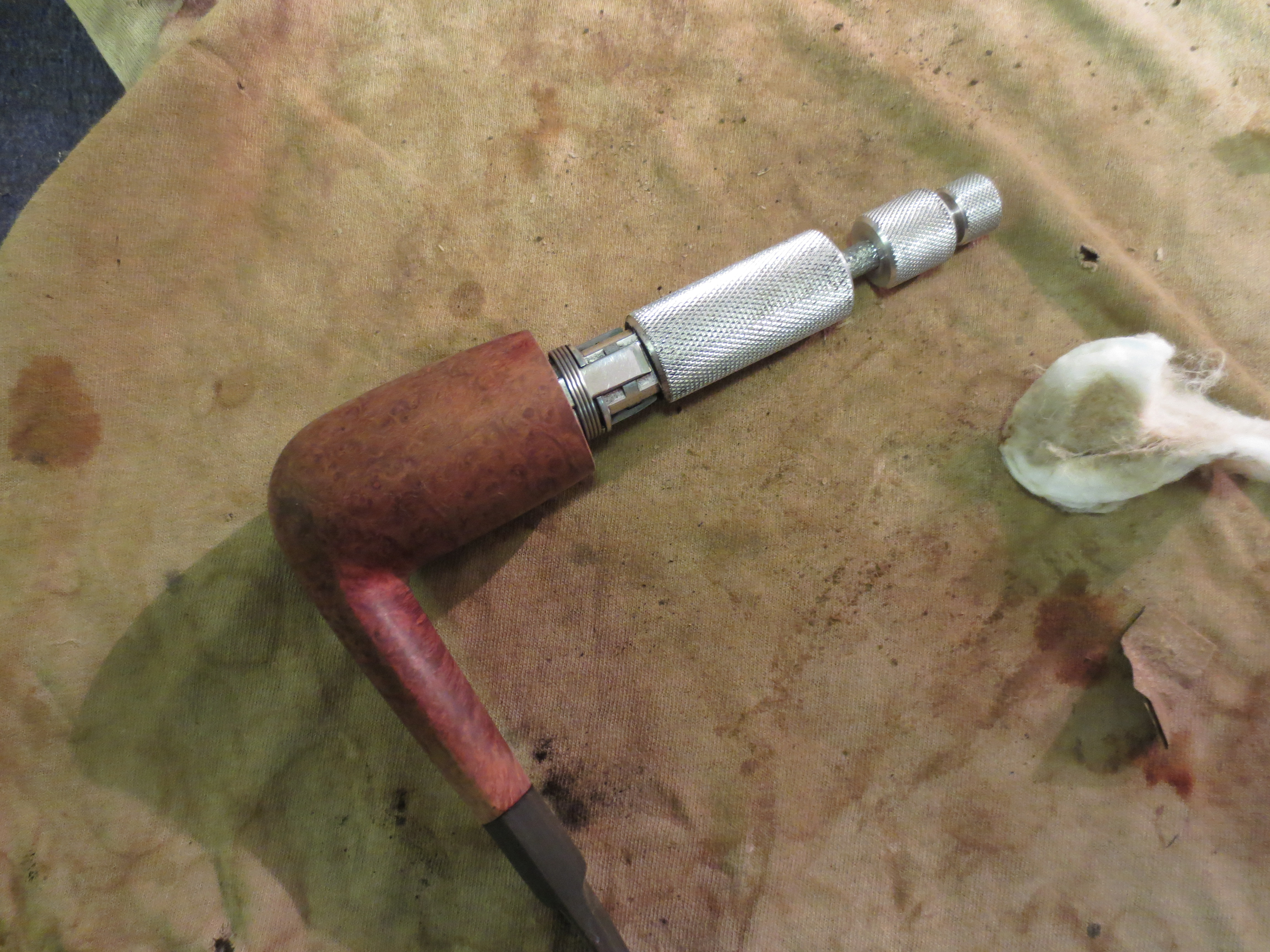
While I was working on the bowl I put the barrel and stem unit in the freezer to try to break loose the stuck stem. I have found that the varying contraction time of the metal and vulcanite will often loosen the stem. Once it was in the freezer for 30 minutes I could easily remove the stem and give the inside of the barrel and the stem a thorough cleaning with pipe cleaners and cotton swabs dipped in Everclear. I cleaned them until both came out clear. The next five photos show the broken down stem and the tube on the end of the stem that I was talking about above. There is one photo of the barrel but it is too dark to see the inner tube.
IMG_0537

IMG_0538

IMG_0539

IMG_0542

IMG_0543
Once the stem and barrel was clean it was time to deal with the tooth marks and chatter on the stem itself. I sanded the top and the bottom with 320 grit sandpaper to remove the marks and the chatter. None of them were too deep. They were more of a ripple like effect on the surface of the vulcanite. I sanded them flat to the surface of the stem and then went on to sand the stem with micromesh sanding pads from 1500-12,000 grits. The next four photos show the progress of the shine.
IMG_0544

IMG_0545

IMG_0546

IMG_0547
After shining the stem with the micromesh I took it to the buffer and buffed the stem with White Diamond and then rubbed it down with Obsidian Oil and finished it with a coat of carnauba wax. I put the stem back in the barrel and lined up the stem with the stamping on the side of the barrel. I gave the entire barrel and stem another coat of carnauba wax and hand buffed them. The next three photos show the assembled barrel and stem unit polished and ready to put on the bowl once it was restained and ready.
IMG_0548

IMG_0549

IMG_0550
I sanded and resanded the bowl with fine grit sanding sponges and then sanded it with micromesh sanding pads from 1500-3200 grit. I wiped it down with acetone between sandings and again when I was finished to prepare it for staining. The next three photos show the prepared pipe ready for staining. The burn mark on the bottom of the shank is gone with very little sanding and no change to the shank surface itself. The one on the front of the is minimized and the one on the rim is also virtually gone. The bowl is ready for a new finish coat.
IMG_0551

IMG_0552

IMG_0553
I restained the bowl with an oxblood aniline stain, flamed it and restained and reflamed it. I rubbed it down with a cotton terry cloth to smooth out the stain and then took it to the buffer. I always buff with my thumb in the bowl to ensure that the buffer does not grab the bowl from my hand and launch it against the wall. I rotate it slowly in my hand and with a light touch buff the shank. I am careful not to apply too much pressure and round the shoulders on the shank. I normally do not buff with the stem off the bowl but in this case I did not want to risk buffing off the black paint on the barrel so I chance the buffing on the bowl alone. The next three photos show the buffed bowl before polishing.
IMG_0554

IMG_0555

IMG_0556
I reassembled the pipe and then hand buffed it with multiple coats of carnauba wax and polished it with a shoe brush. The stem and bowl have a great shine and the bowl has some beautiful grain on it. I look forward to smoking this one and comparing it with my other Keyser Hygienic pipes. The final four photos below show the finished pipe. I have yet to do the research on the patent information on the barrel but I am hoping to find out a bit of history on this piece.
IMG_0723

IMG_0724

IMG_0725

IMG_0726
From the photo of the bottom of the bowl and shank above you can see that the burn mark there is eliminated in its entirety. Also in the photo of the rim above and the one of the front of the bowl below you can see that the burn mark is gone and what remains is blended into the stain.
IMG_0728

A Review – A Bill Boyle Small Bent Rustic Apple


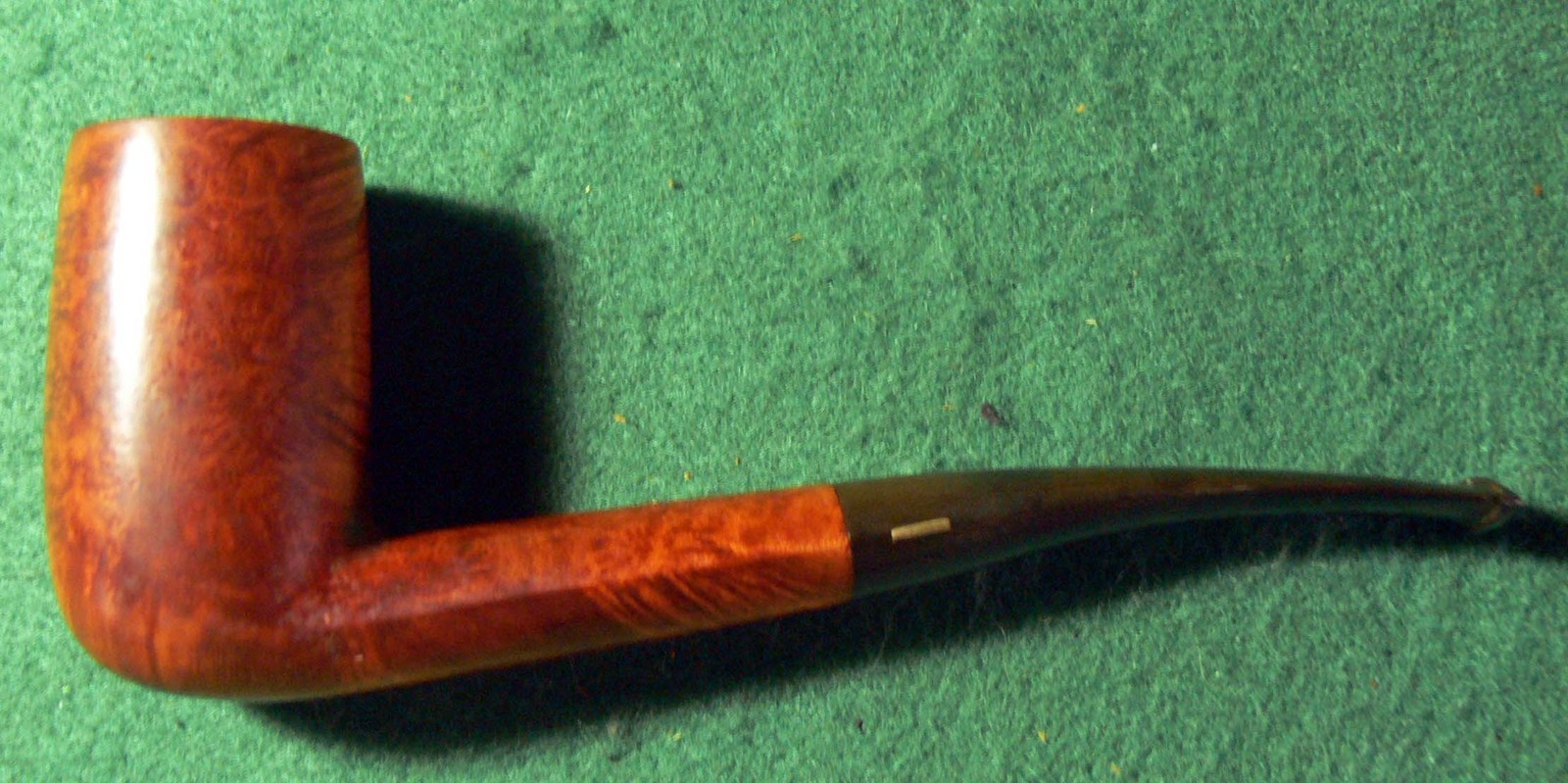
I received my third Bill Boyle Pipe in the post from Bill several weeks ago. I have two other pipes that he made for me during the past several years and I have watched the progress in Bill’s craftsmanship and work in these pipes and through watching the variety of pipes that appear on his website and through the reviews others have made. Bill and I have talked about pipes since the days that he started making modified cob pipes. He has come a long way through the years and this new pipe reflects a huge step up in his work in my opinion. The previous two pipes are amazing smoking machines but his stem work was not perfected and was a bit too thick to my liking (See the comparative pictures below). The taper of the stems on the early ones was more abrupt while this one is very smooth and flowing. His internal mechanics have always been spot on but it was the finish work on the stem that needed to be refined. This new pipe is a step up in every way. It is a beauty to be sure. The length of the pipe is 5 inches and the bowl height is 1 5/8 inches. The chamber diameter is 3/4 inches and depth is 1 3/8 inches. It weighs 40 grams or 1.4 ounces. It is carved from Italian block according to Bill’s website and sports a hand cut Cumberland stem. The pipe is a small apple shape with a ¼ bent stem that fits well in the hand.The stamping reversed B and B and is one of the last of this stamping that will be used as Bill has stepped up his production and has a new stamp for Bill Boyle Pipes.
Bill Boyle 1
The finish on the outside of the pipe is rusticated in a finish that is quite different from the other two rusticated pipes I have purchased from Bill. It is not a heavy deep rustication on this pipe but more of a rustication pattern that has the appearance of strands of a rope. There is a still a very tactile feel to the rustication on the bowl and shank but it does not really have the look of randomness that was in his more heavy rustication. It is a nice variation and I think that it adds to the overall appearance.
Bill Boyle 5On the rim of the pipe Bill rusticated it over the curve and then almost countersunk the bowl. The rim thus forms two levels and a bit of step down from the rusticated edge to the smooth edge that is below and then drops into the bowl. The rustication where the shank and bowl meet is a bit heavier than what is on the rest of the bowl and a bit rougher but does not detract from the other rustication. It is merely a variation that makes me wonder if there is not a flaw or sandpit in this area of the pipe (indeed Bill confirmed this is so in a later email). The staining on the briar appears to be a blend of darker/medium brown/black with an oxblood over stain that is a nice contrast. In the light it appears to have a dark oxblood tinge that comes out well in contrast to the browns in the under stain. It really goes well with the Cumberland stem. Bill has matched the colour of the Cumberland stem with his choice and combination of stains. Great work on the finish Bill.
Bill Boyle 3
The stem itself is the best of the three stems my BB pipes. His stem work has really developed and this is by far the most well executed of the three. It is a nicely cut saddle stem. The saddle is well cut and the finish on the 90 degree angles of the saddle is smooth and polished. There are no machine or file marks. He has done a great job shaping this part of the stem. The blade of the stem is thin and has a good even tapered flow from the saddle to the button. It is matched in terms of angles on the top and the bottom and on the left and right side of the stem. The design along with the slight bend makes it fit very comfortably in the mouth. It also rests well enough that it can be clenched quite easily. The tenon is cut from the stem material and is funneled at the end for good mechanics. The button is exactly the way I like them – thinner on the edges with a gentle rise at the centre top and bottom. The edge of the button is a good sharp angle to the stem and looks sharp. It fits well behind the teeth for a comfortable feel. The draught hole/slot in the end of the button is also funneled to deliver a mouthpiece that has the same diameter from start to finish. Comfortable and well executed. A pipe cleaner passes easily through the pipe with no obstruction. I have posted photos below of my other two of Bill’s pipes so that you can see the progress and development in his stem work.

My first one is the Christmas pipe I had him make for me. The rustication is great and the shape is well done. Note the thickness of the stem from the saddle to the button and also the thick button on the end of the stem. I reworked this stem when I received it. I thinned it down, flattened it out and thinned the button as well. I worked it until it was comfortable for me.
OLYMPUS DIGITAL CAMERA
The second is an apple that caught my eye on one of his email updates. It was made later than the first one. The stem work is definitely improved. Note that the stem is thinner than the one above but there is a definite crown on the stem. It is almost oval in shape from an end view with thin edges and a rise/crown toward the middle of the stem. There is also an abrupt drop from the stem to the button area. The angle is quite sharp. He has also thinned down the button and made it more comfortable. The stem work is getting better and the feel in the mouth is better but it is still not quite there.
Boylesmooth2
The next photo shows the same view of the newest (the third) Boyle pipe that is in my rack. Here the improvement on the stem is marked. Note the thinness of the stem from the saddle back to the button, the flatness of the stem from side to side and the improved shape of the button. To me the development and improvement can be traced in these three photos. All three pipes smoke exceptionally well. Each one is well made. But each one represents a step in Bill’s development as a pipemaker and particular in the way he fashions his stems.
Bill Boyle 4
The mechanics of this new pipe are well done. The bowl chamber came without a bowl coating and the wood was sanded very smooth. There were no pits or checking in the bowl. The countersunk inner edge of the rim gave a distinctive look to the pipe that I was not sure about at first. Since I have been smoking it the briar is darkening (not char or tar) just the natural darkening of heat and oils and it looks great.The draught hole is centered at the bottom of the bowl and seems to have a slight slope from the bottom to the top of the airhole. There is a very easy and open draw to the pipe. The fit of the stem to the shank is very good. Smooth and tight. The tenon sits deep in the mortise – if not exactly the same length then impressively close! The fit of the tenon is also smooth. The drilling of the draught in the shank is slightly high in the end of the mortise. It is not in the middle of the mortise. The tenon on the stem is drilled to match it and there is no misalignment to the two. The air pulls clearly through the pipe with no whistling at all. Using a light to shine through the various airways reveals smoothly executed airways on the inside. Very nice work on the drilling Bill. Your matching the airway in the mortise to the tenon end was well executed.
Bill Boyle 2
I have been smoking it since I received it and am very happy with it. I have smoked Virginia flake and broken flake tobaccos in it and it packs easily and stays lit. And I have to say that like all three of Bill’s pipes that I have the draught on the pipe is superb. Smoking it is a pleasure and is uncomplicated and effortless. I found that without exception Bill’s pipes smoke smooth from the get go with none of the new pipe break in woes. Thanks Bill for a well-made pipe that smokes as good as it looks! If you are interested in Bill’s work check out his website and look at the gallery – he does commissioned pipes as well. Here is the link: http://www.billboylepipes.com/