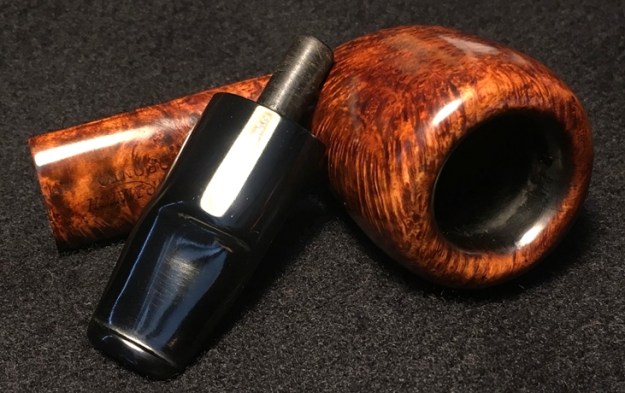
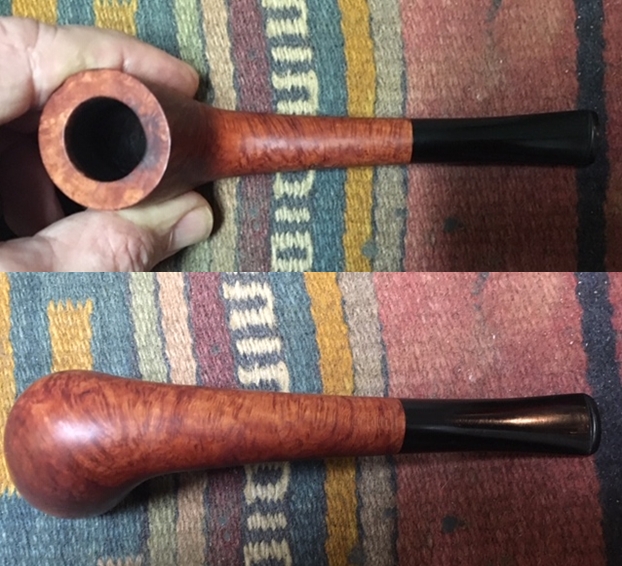
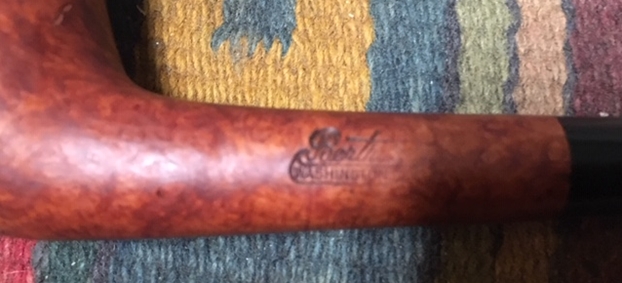
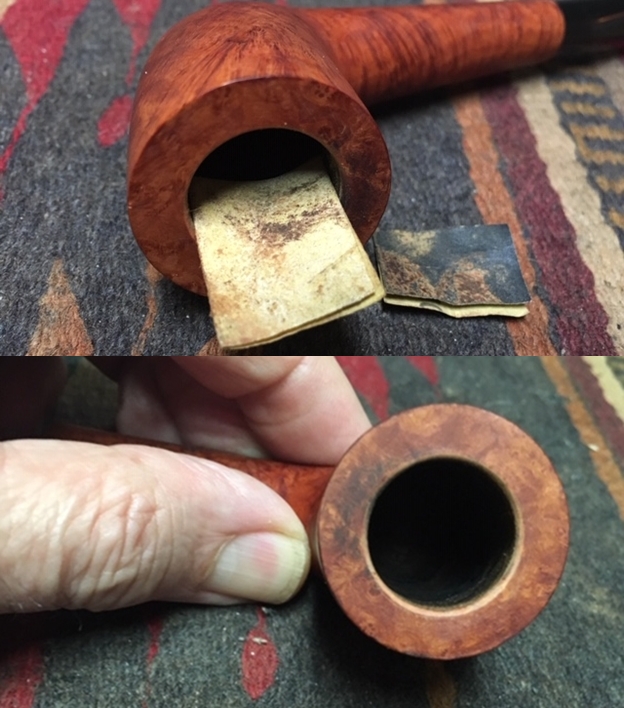
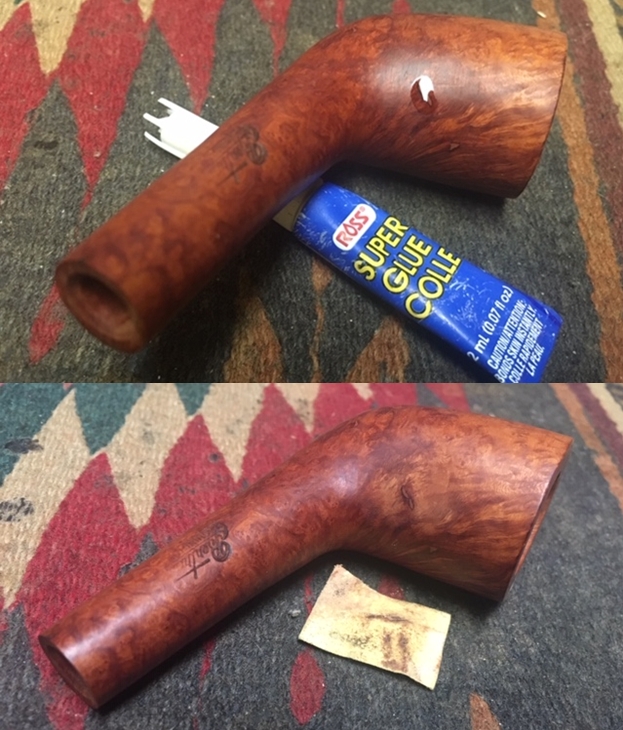
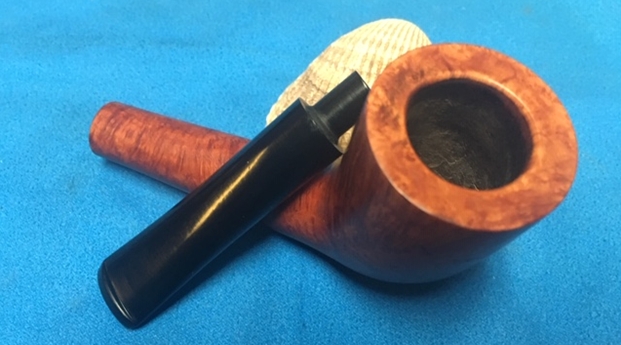
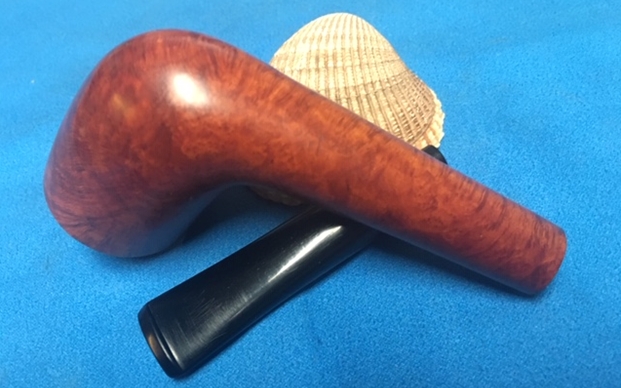
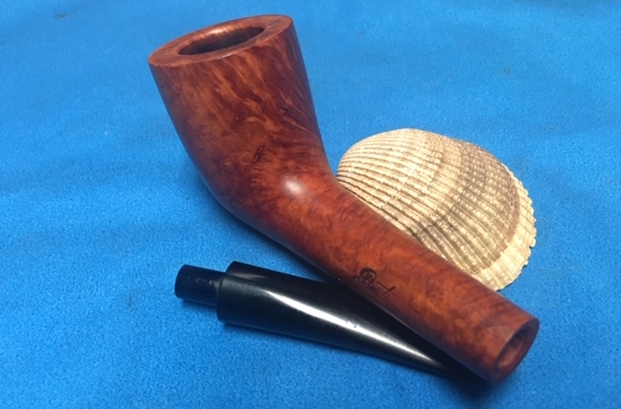
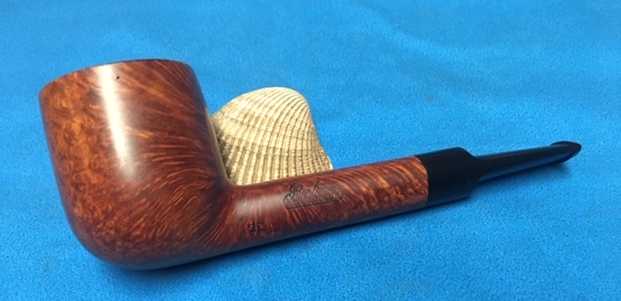
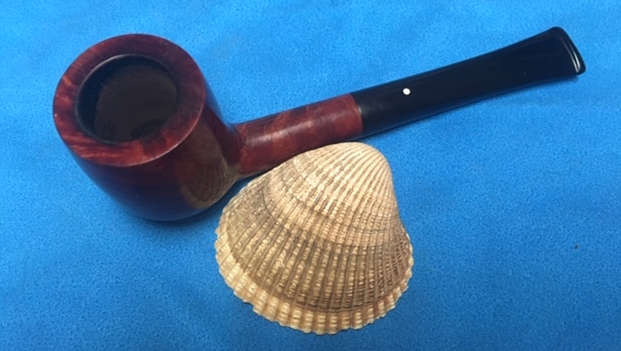
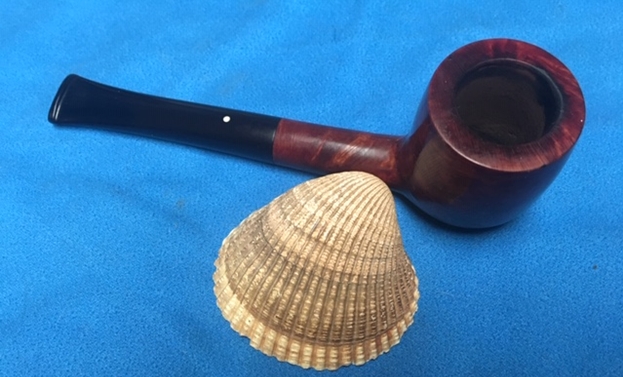
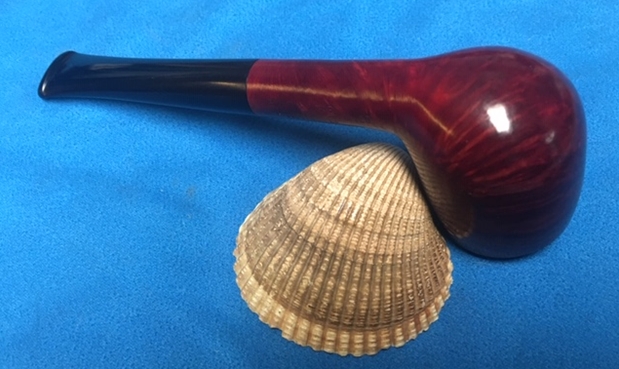
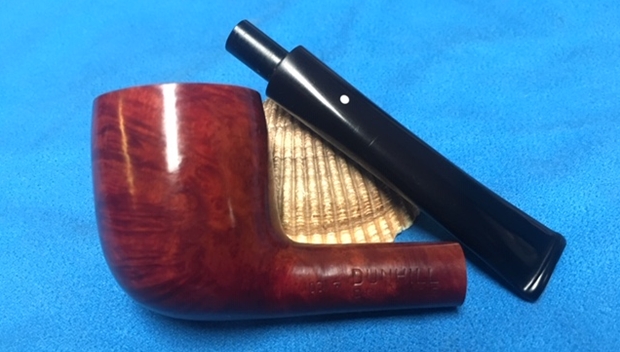
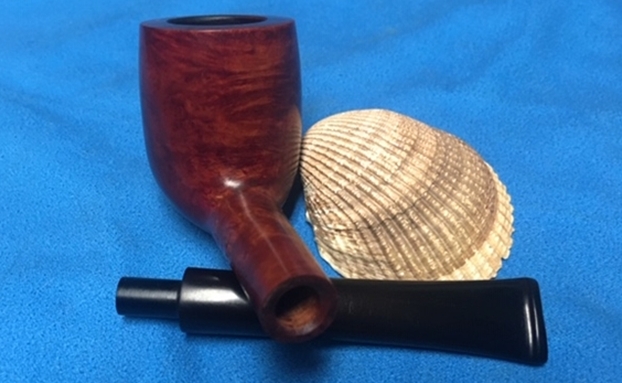
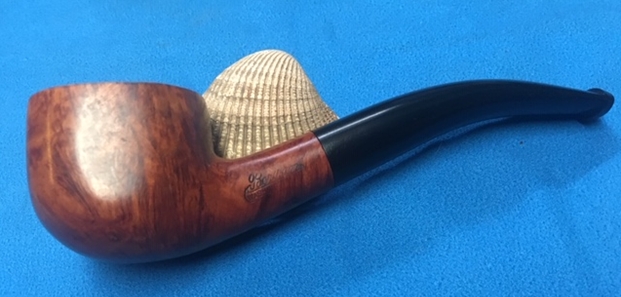
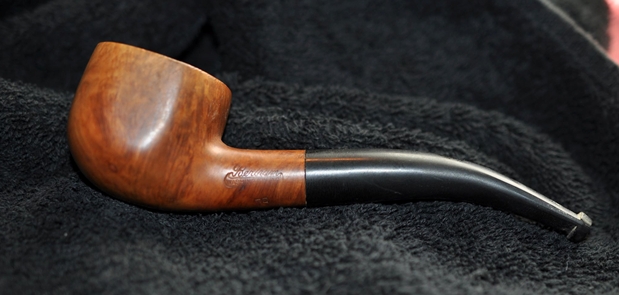
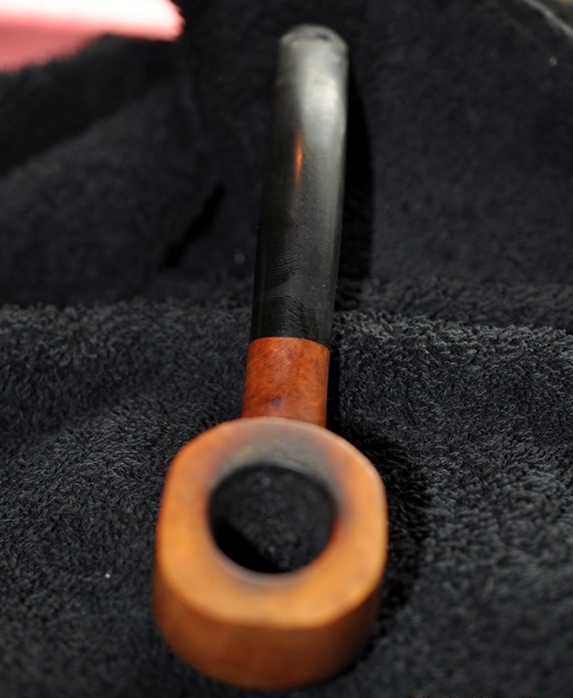
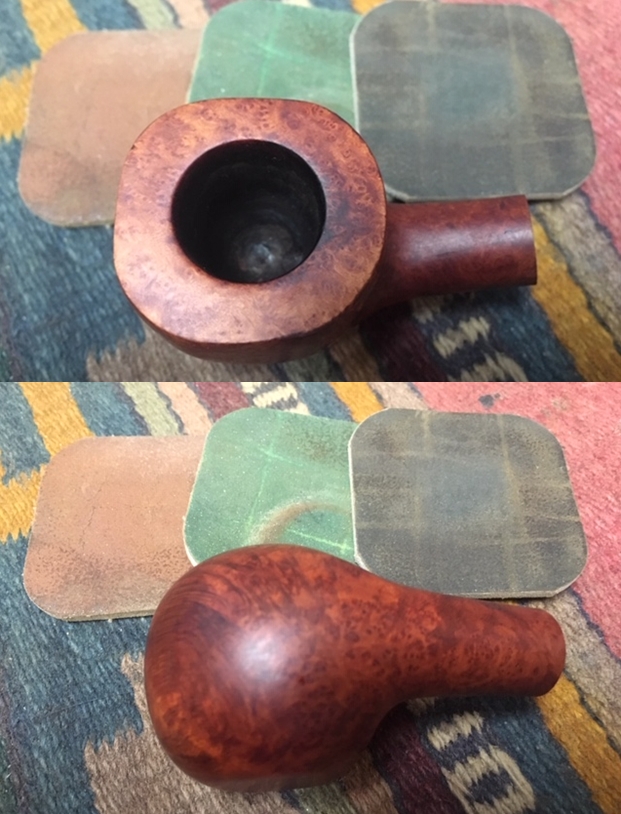
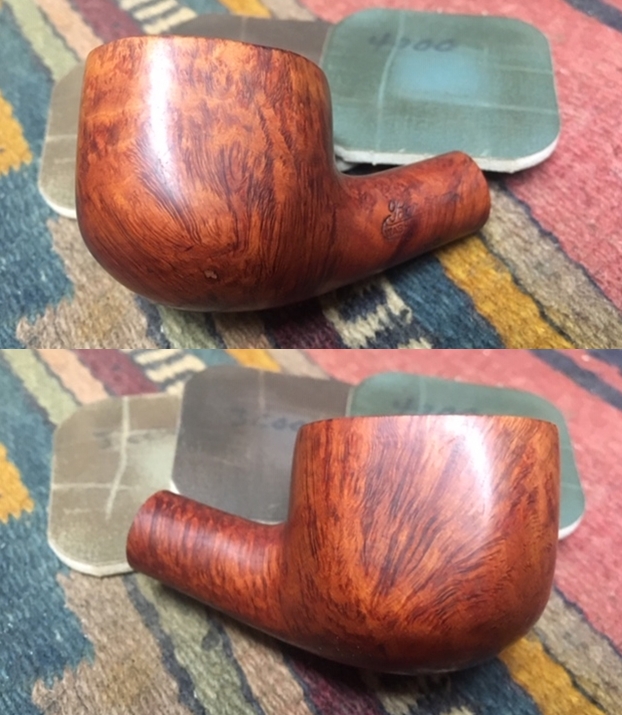
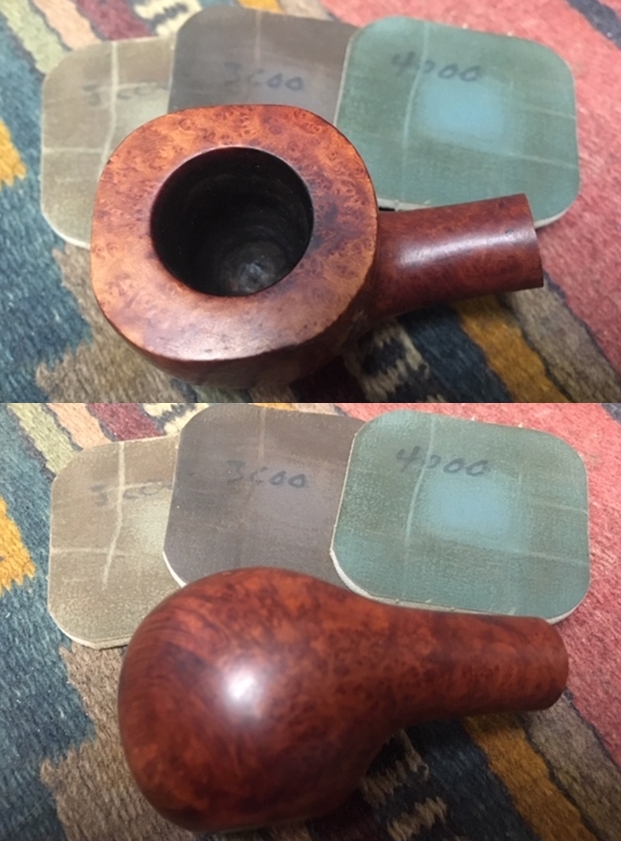
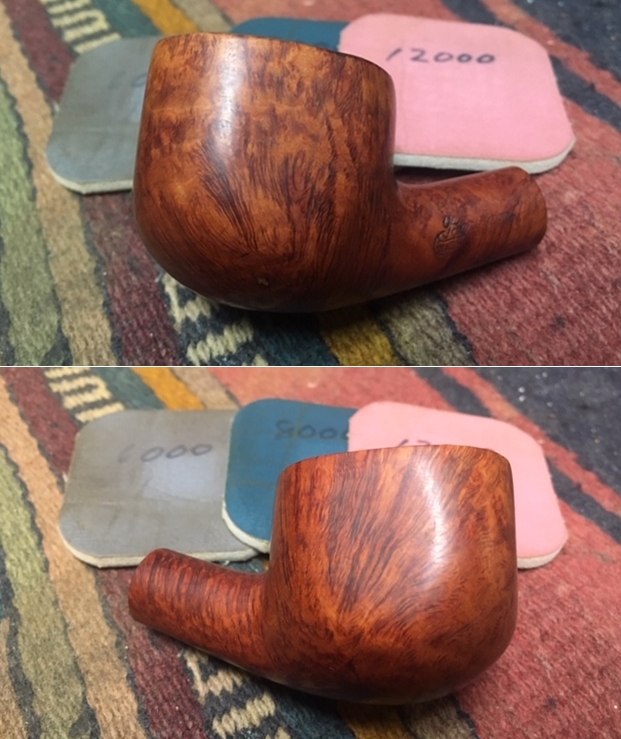
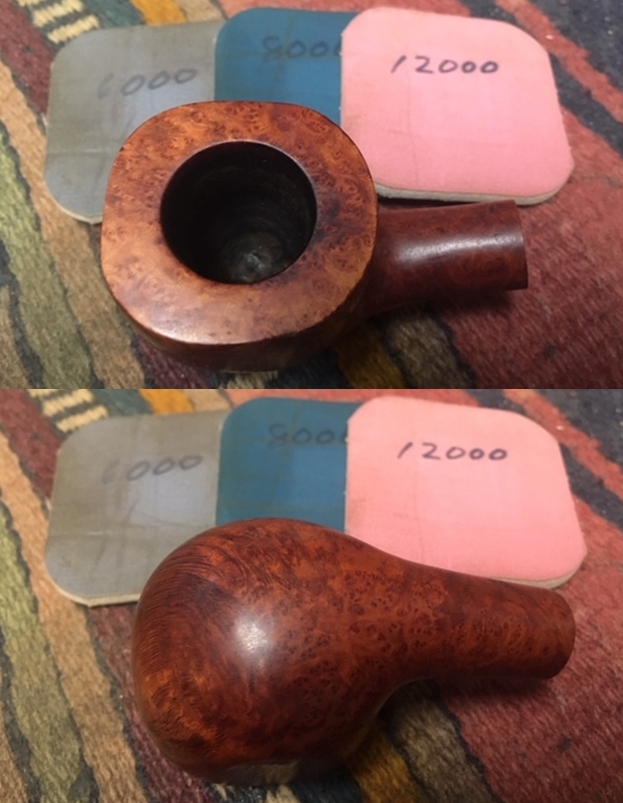
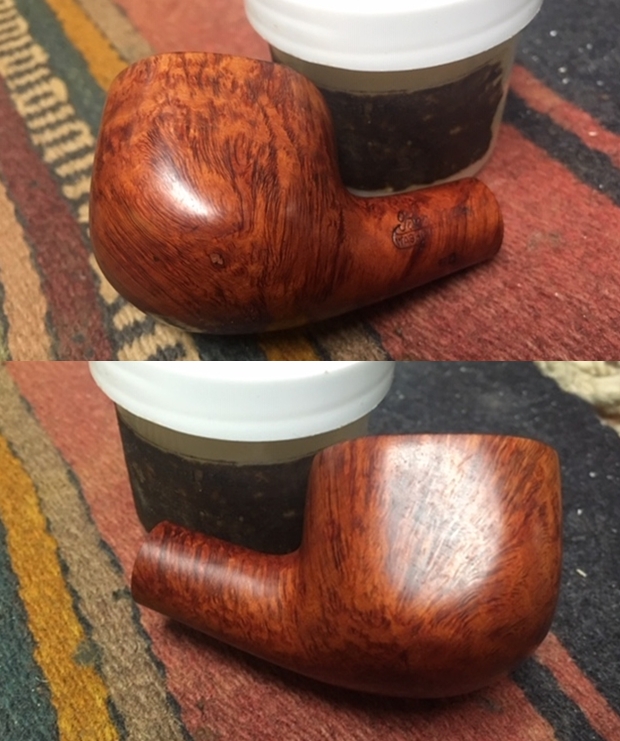
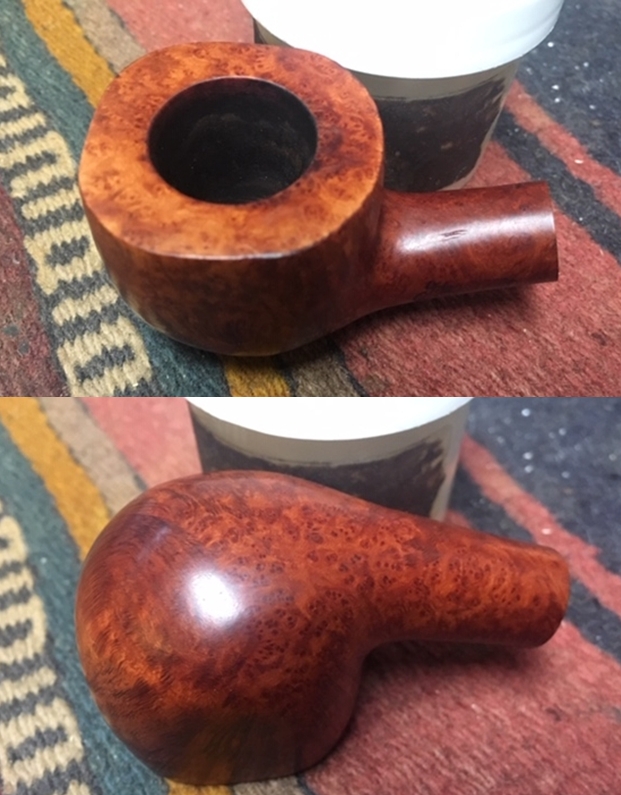
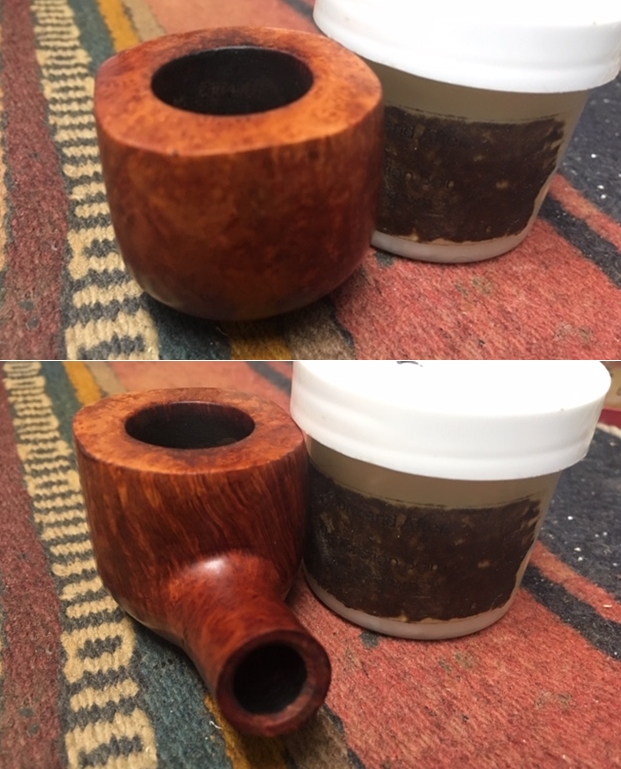
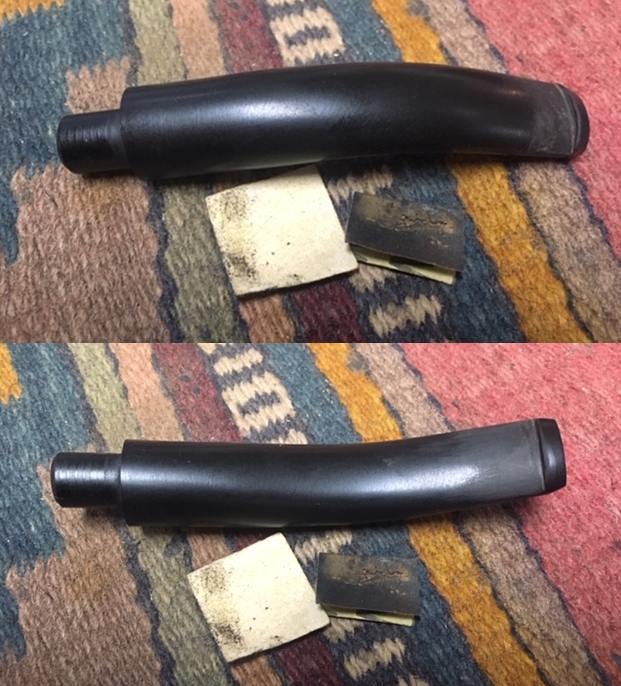
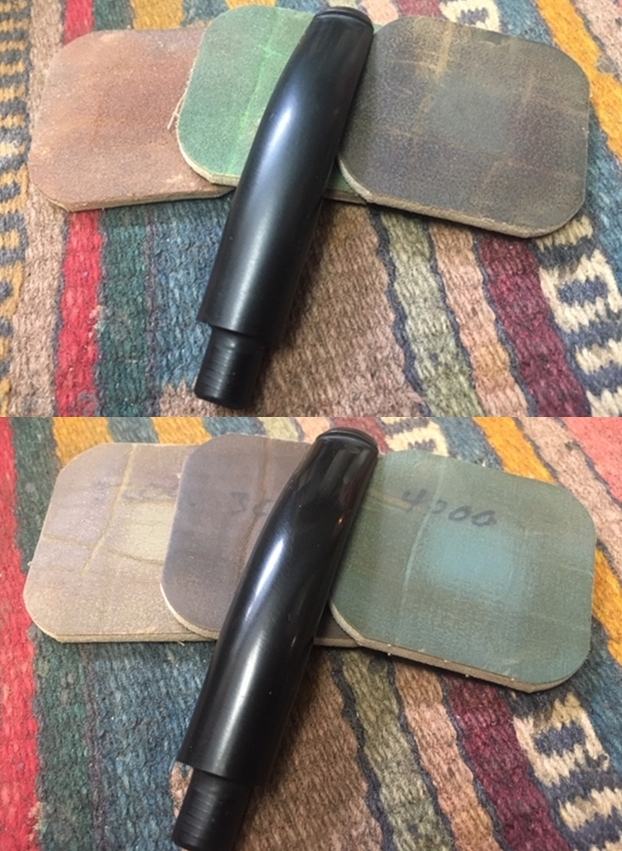
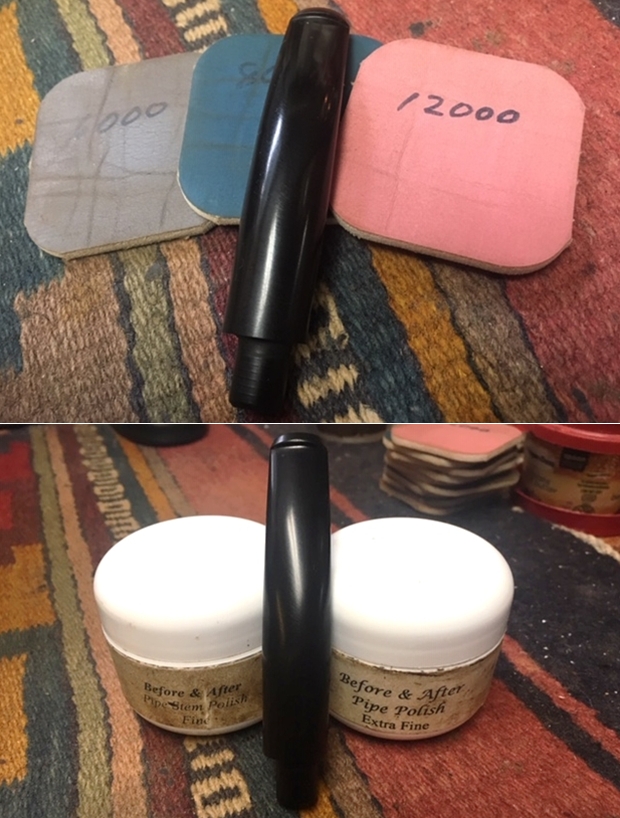
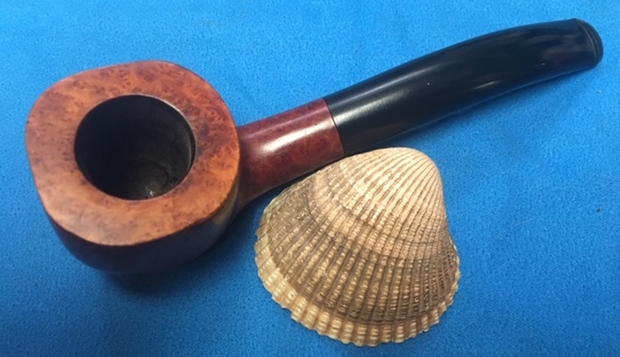
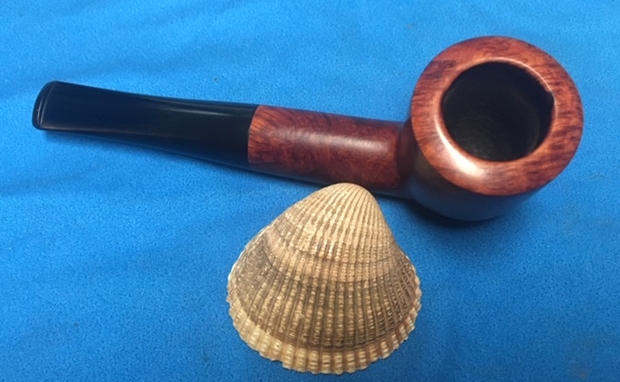
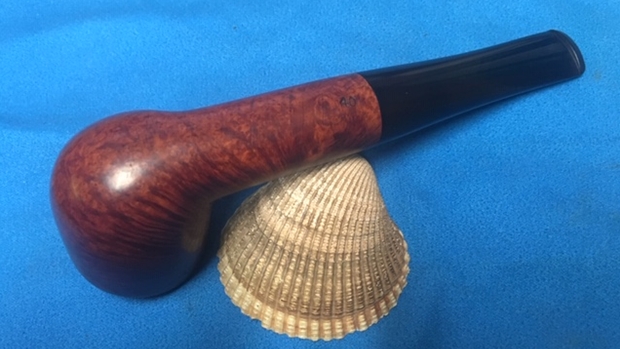
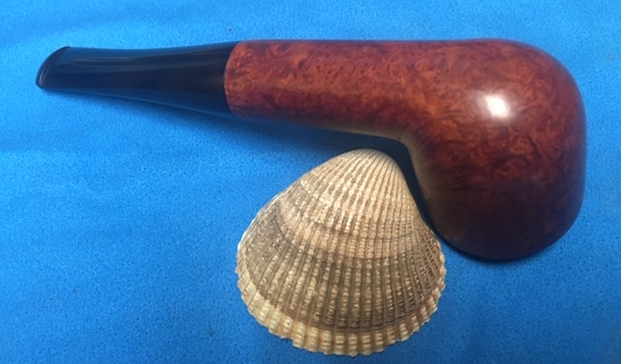
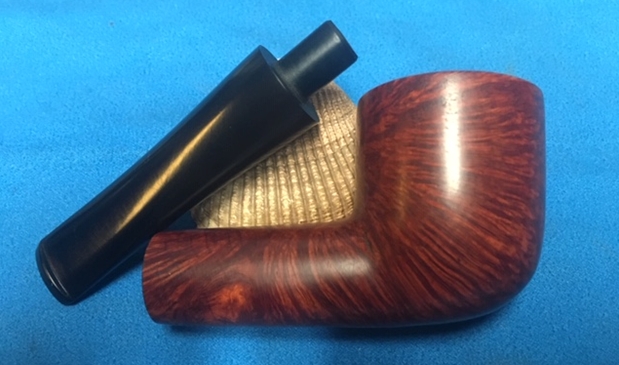
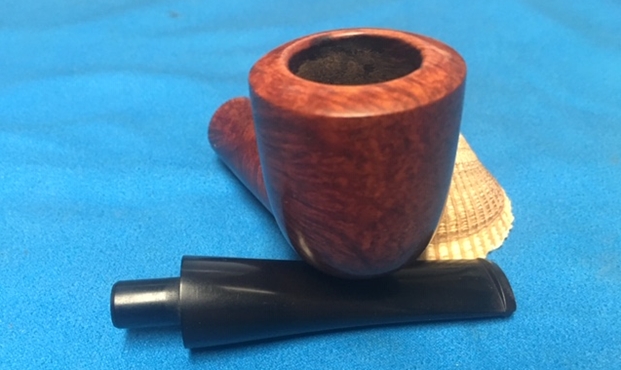
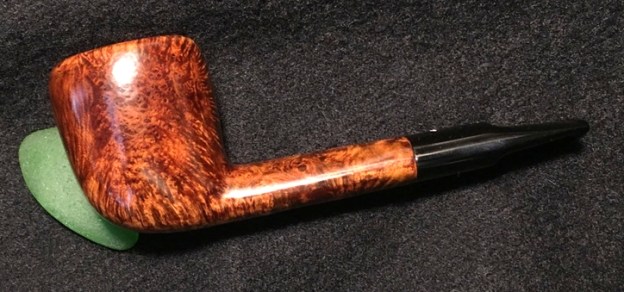
Tag Archives: stem work

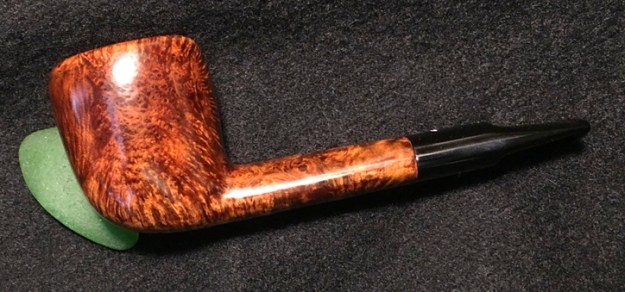
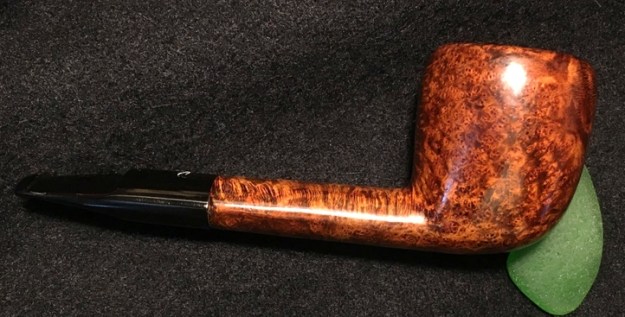
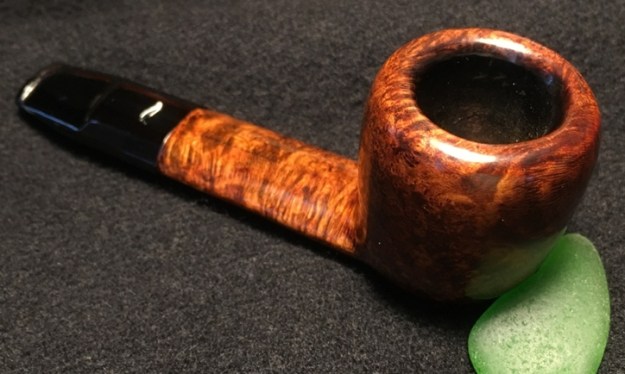
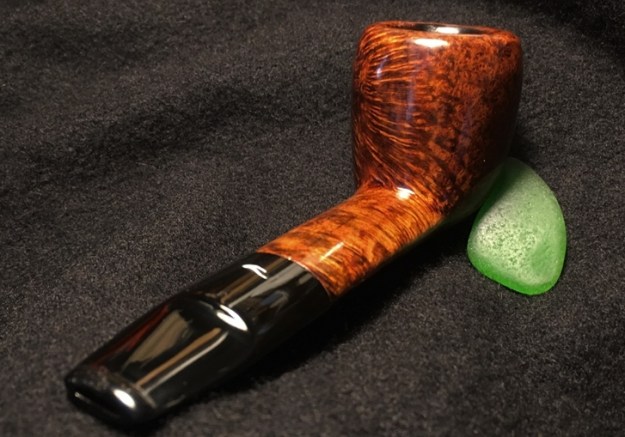
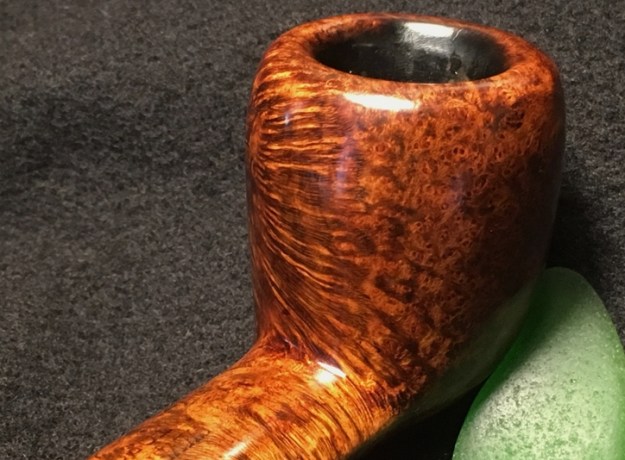
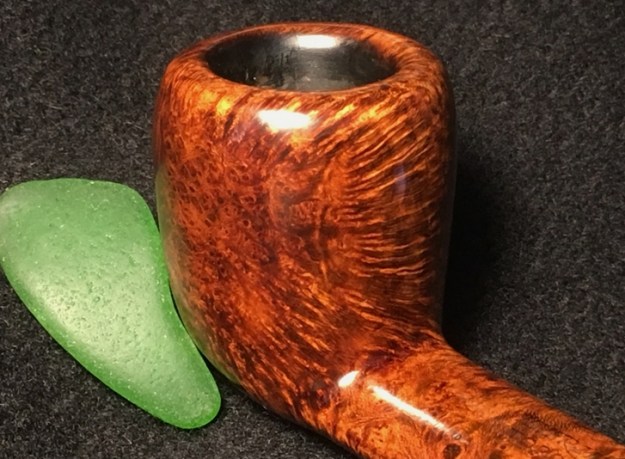
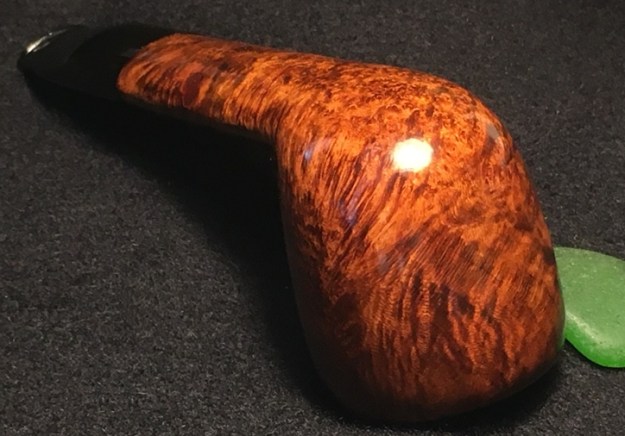
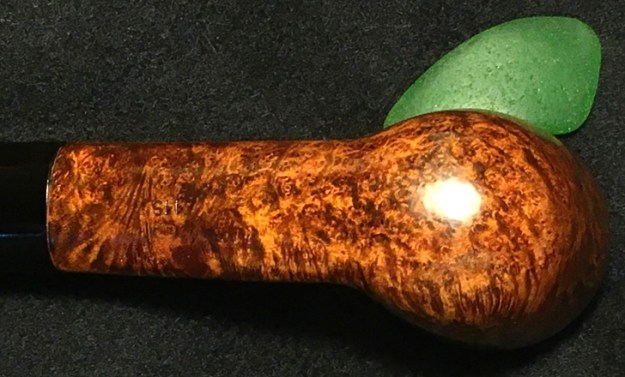
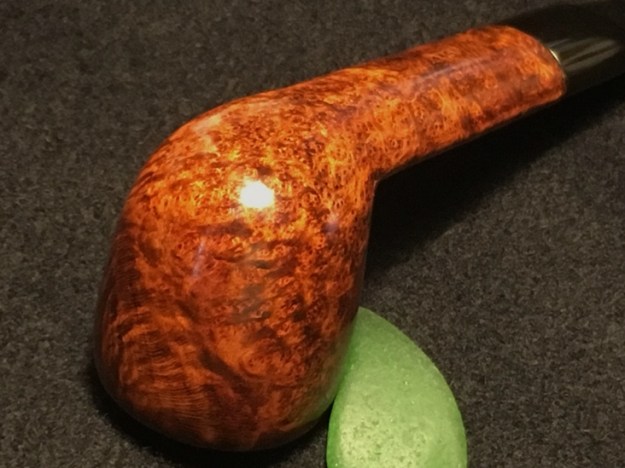
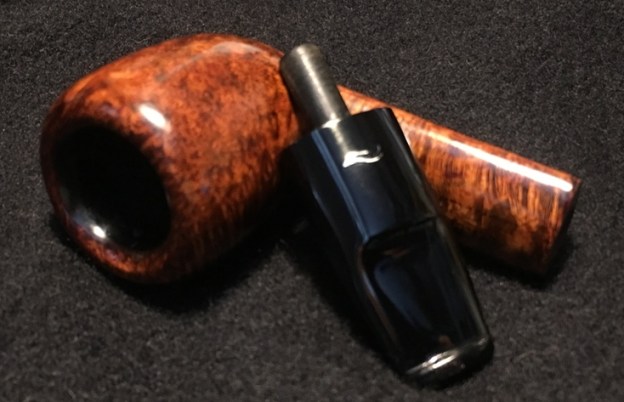
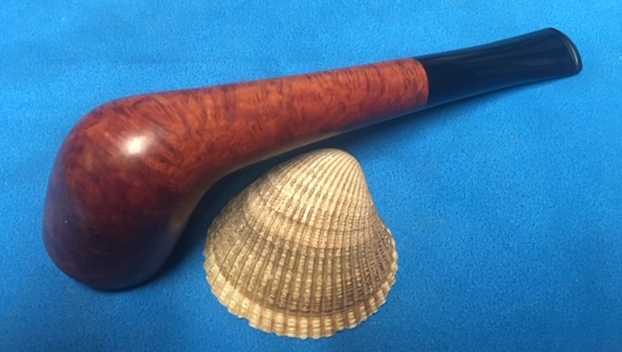
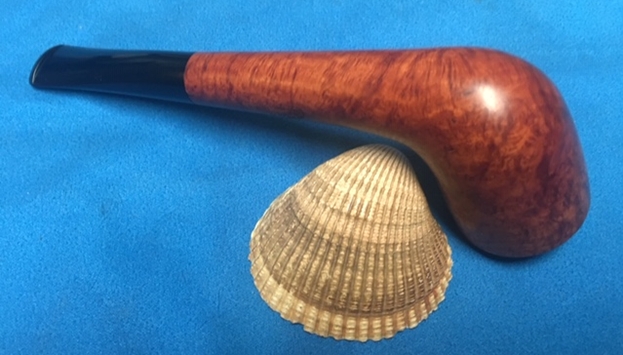
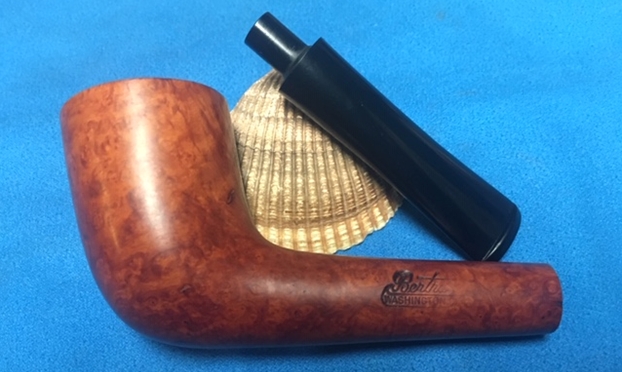
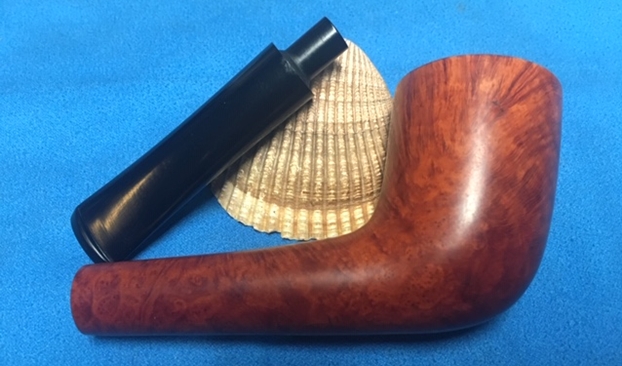
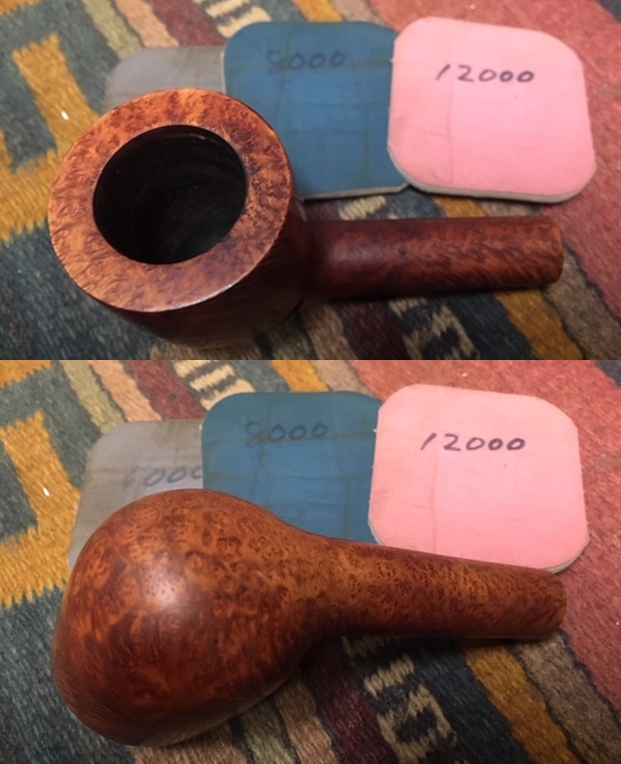
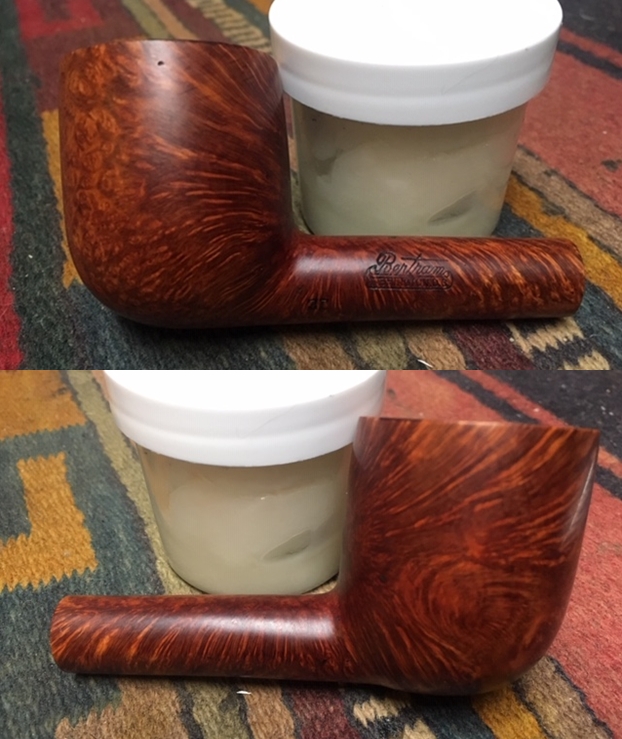
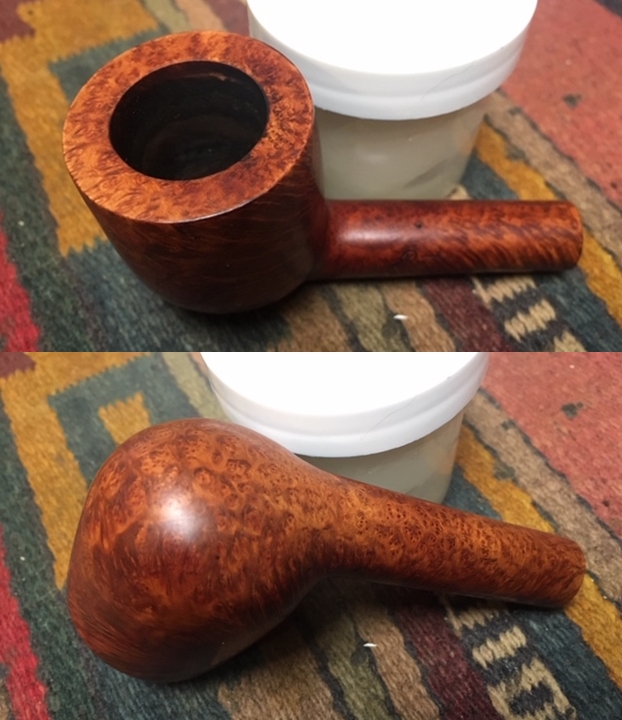
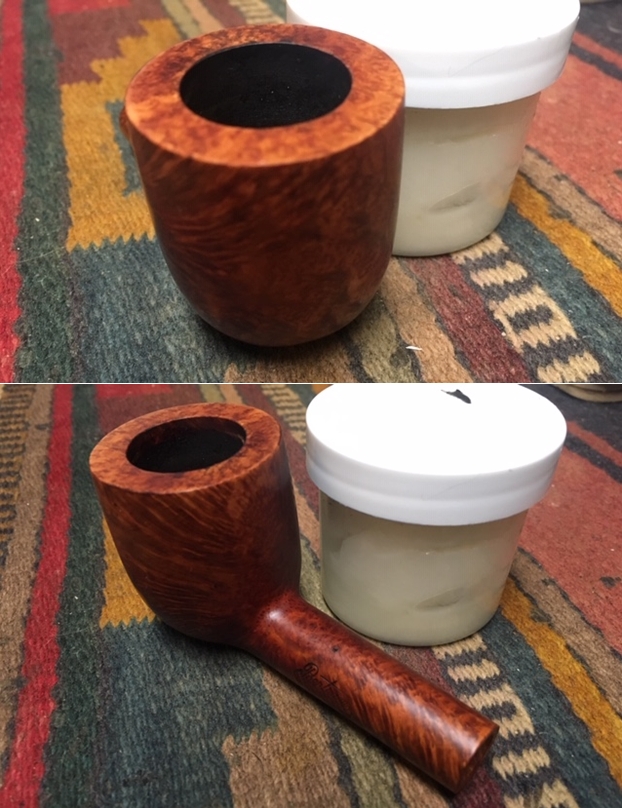
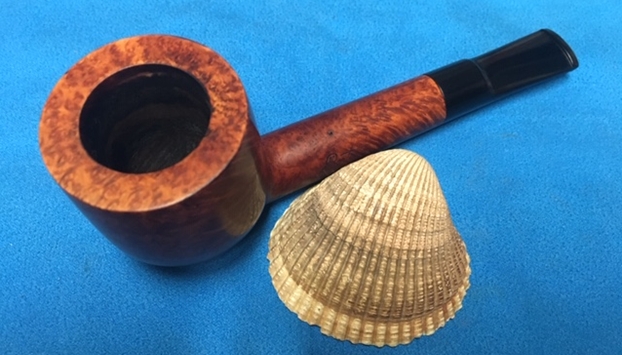
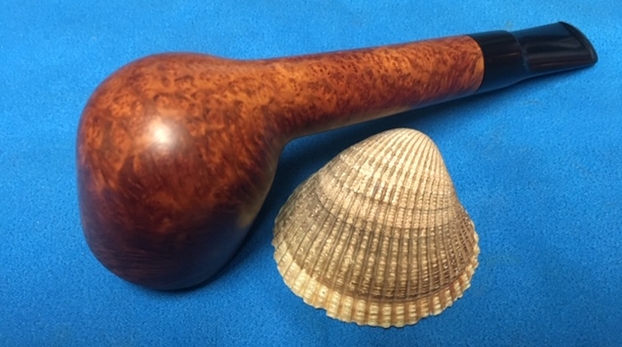
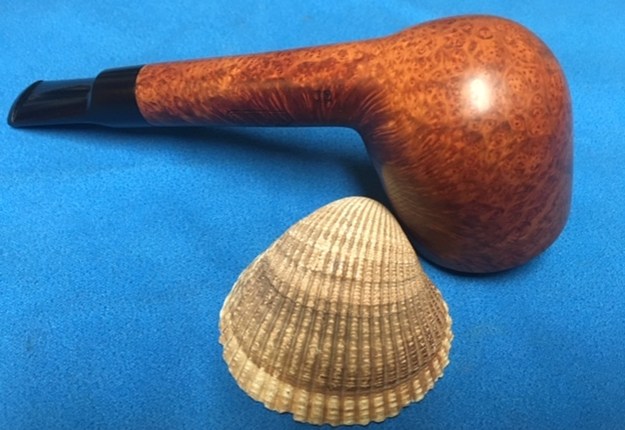
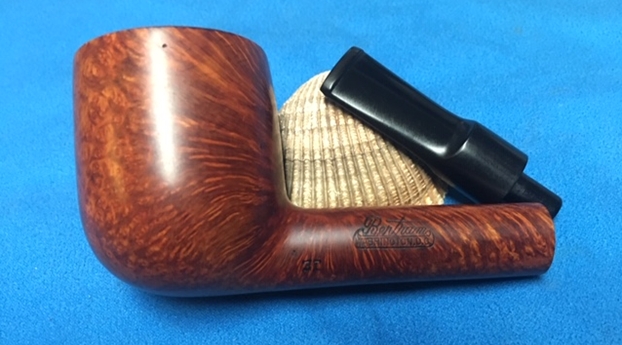
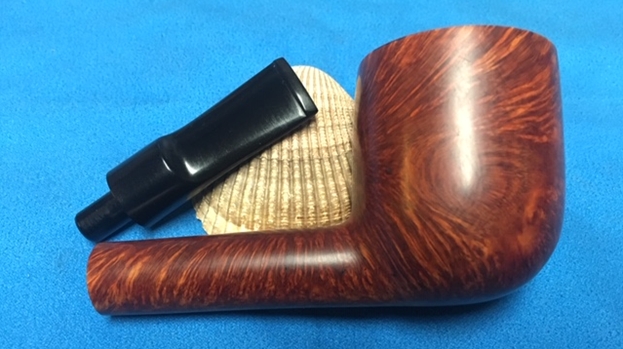
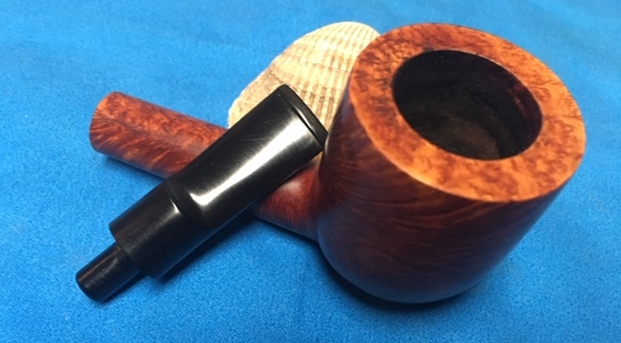
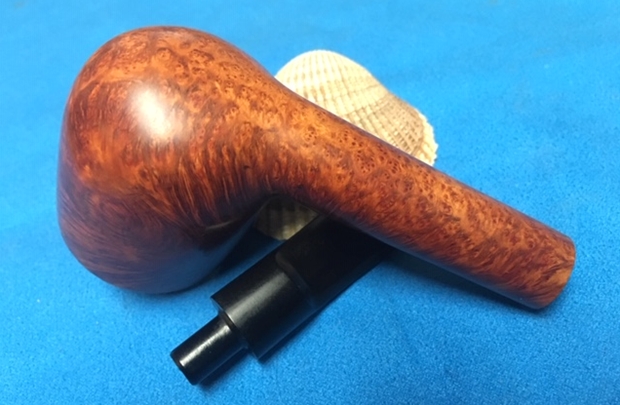
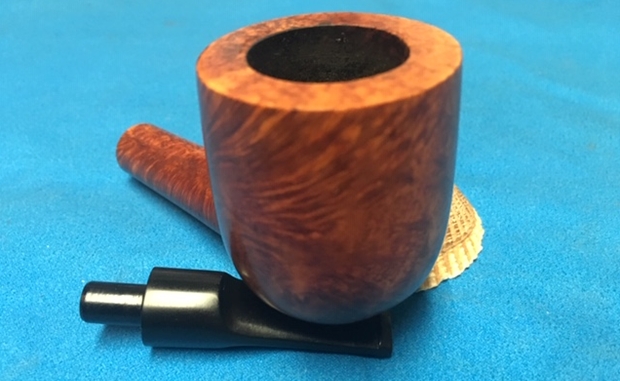
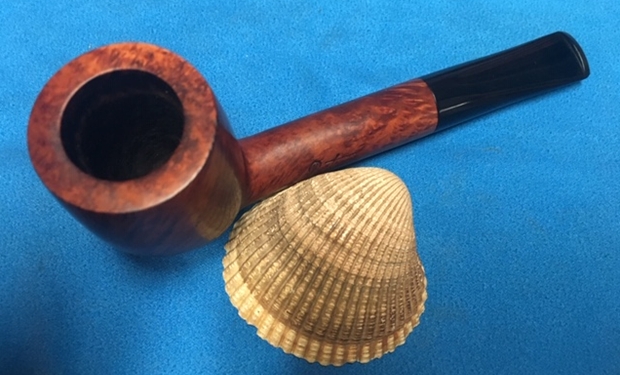
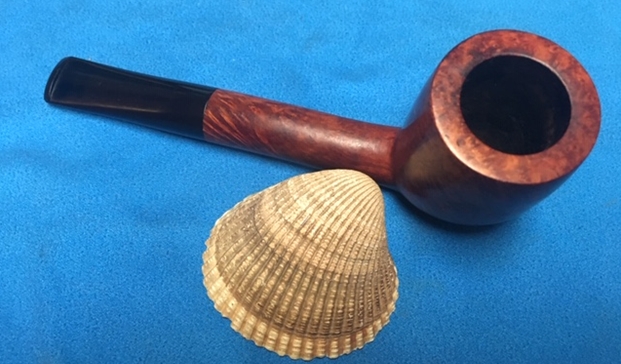
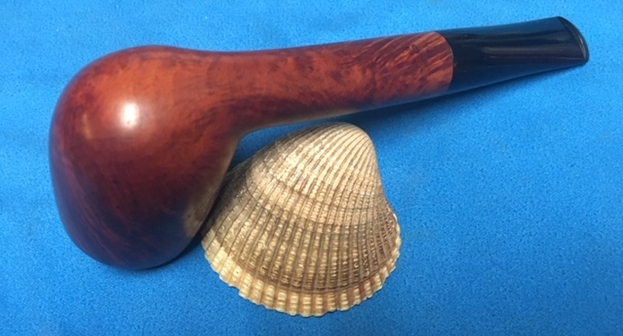
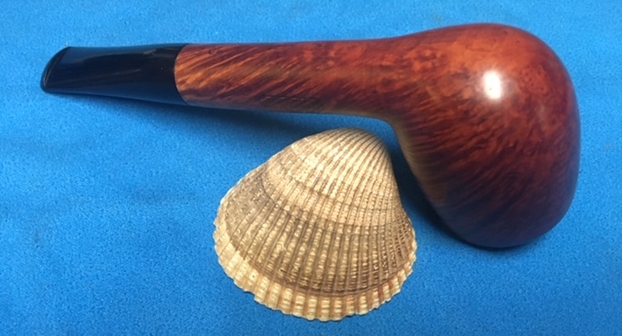
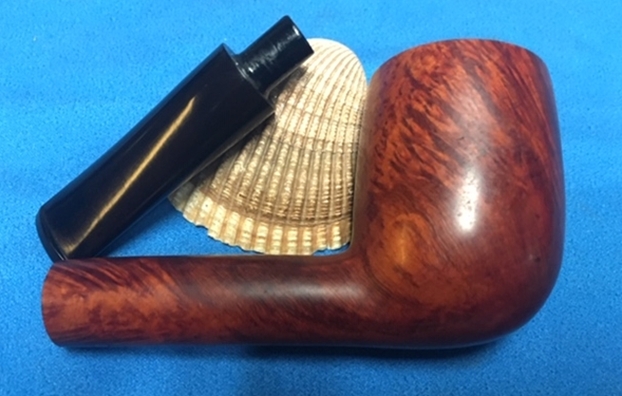
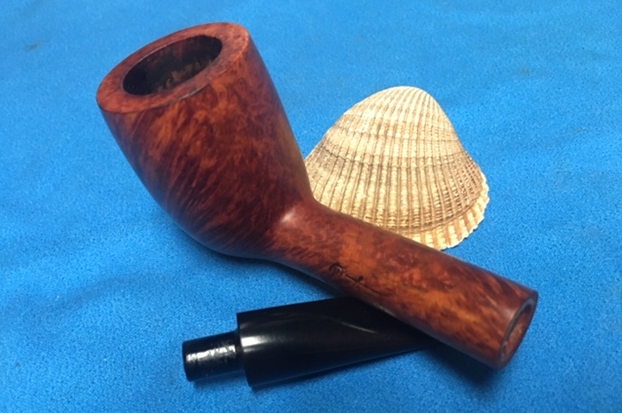
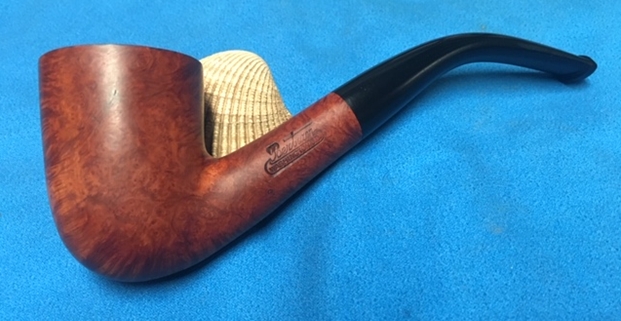
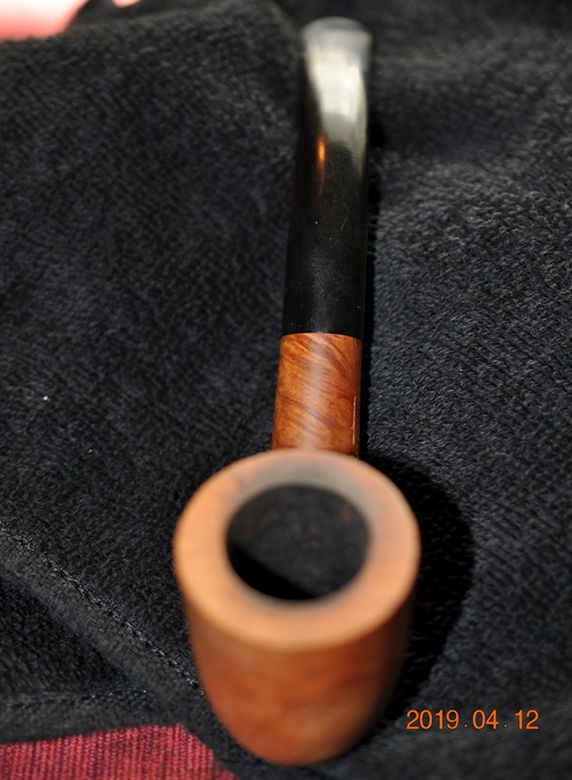
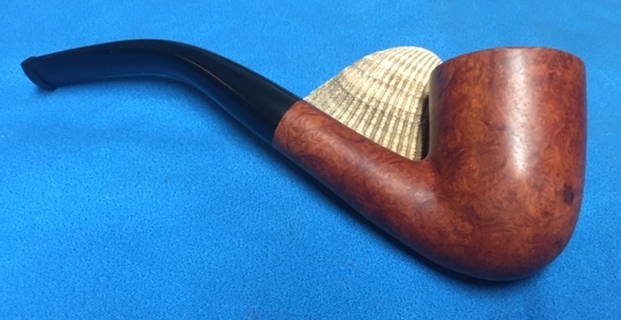
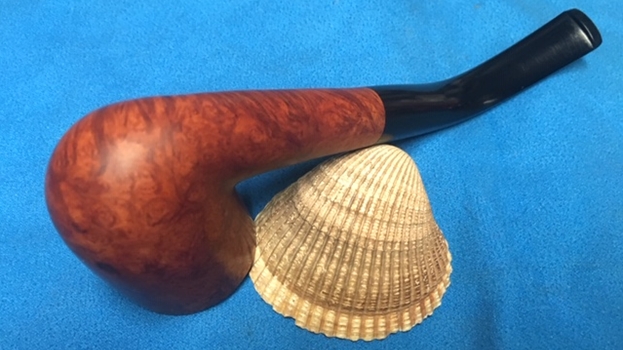
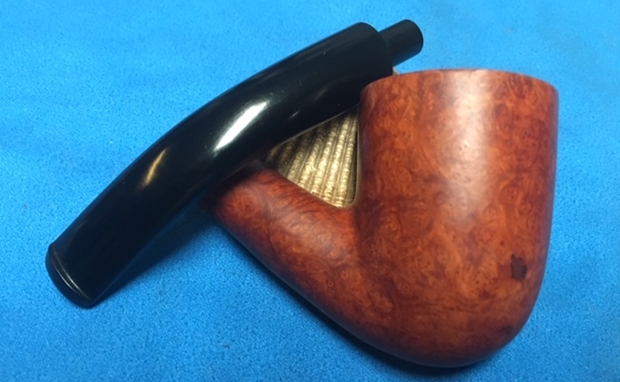
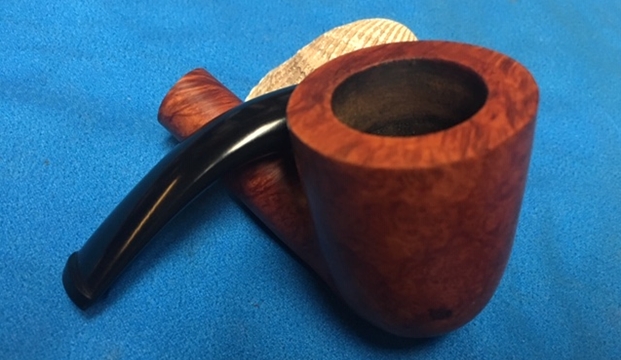
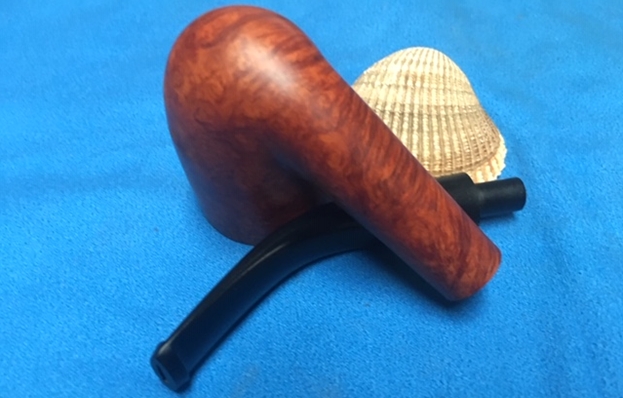
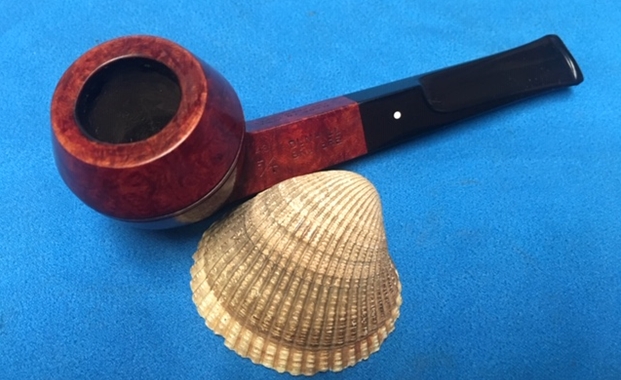
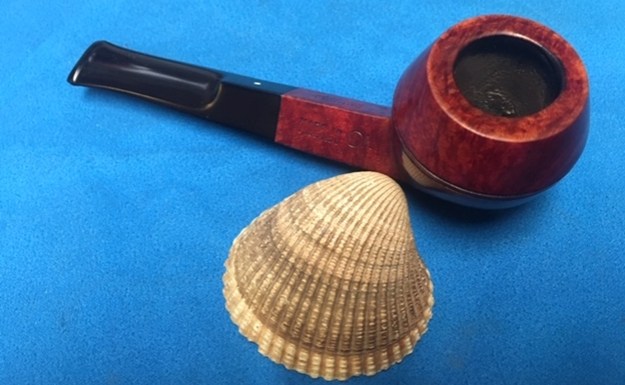
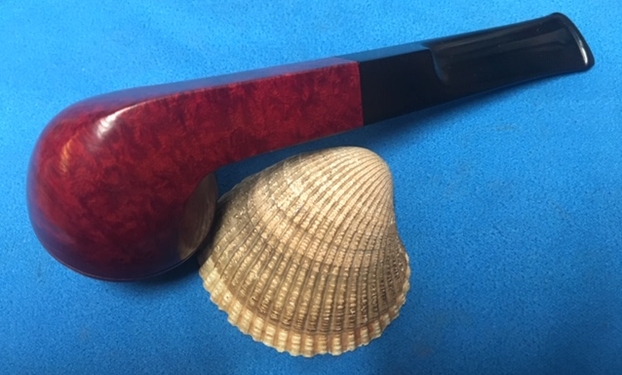
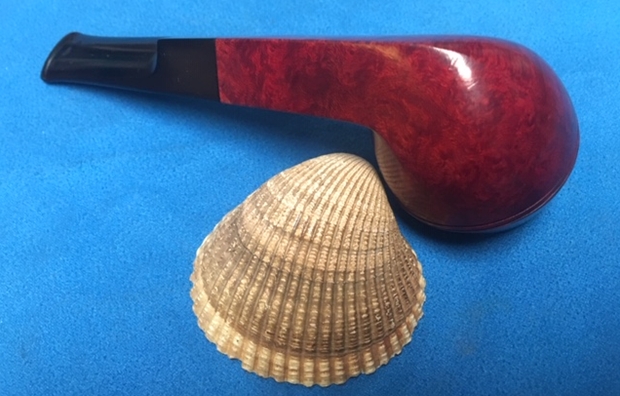
Restoring a Bertram Long Shank Cutty from the Bertram Lot


Blog by Steve Laug

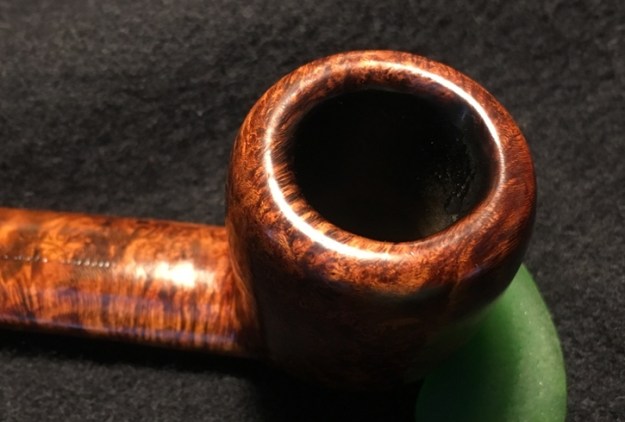
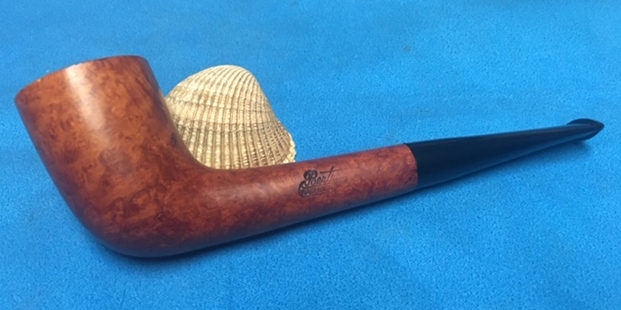
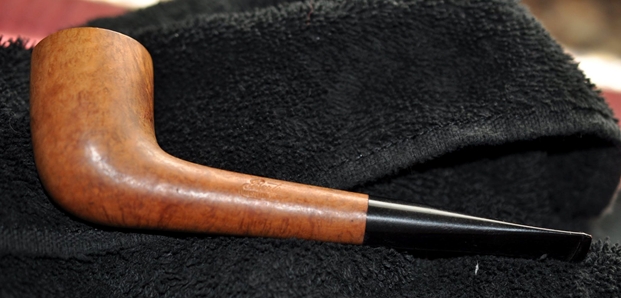
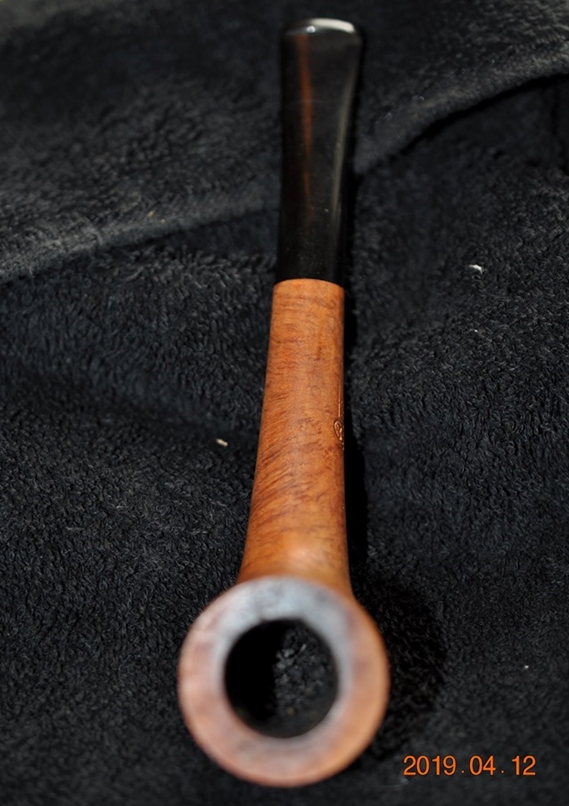
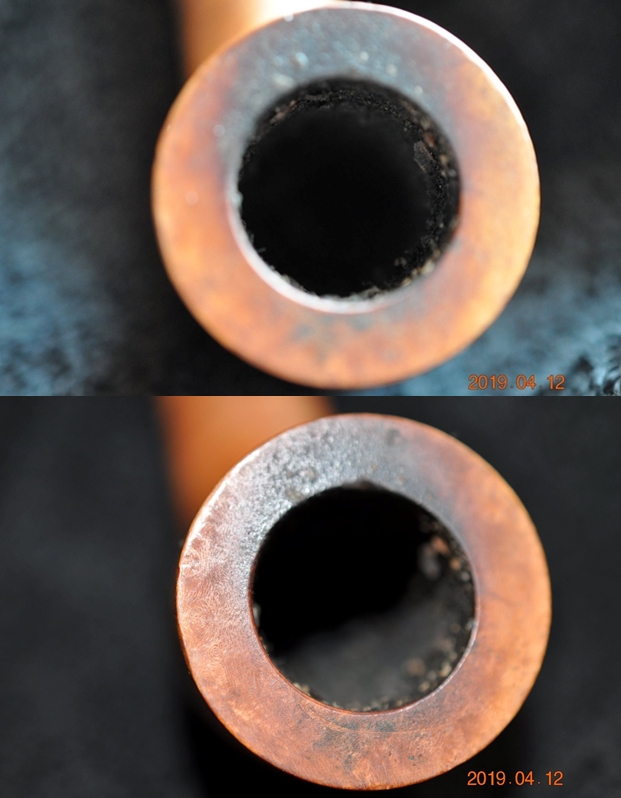
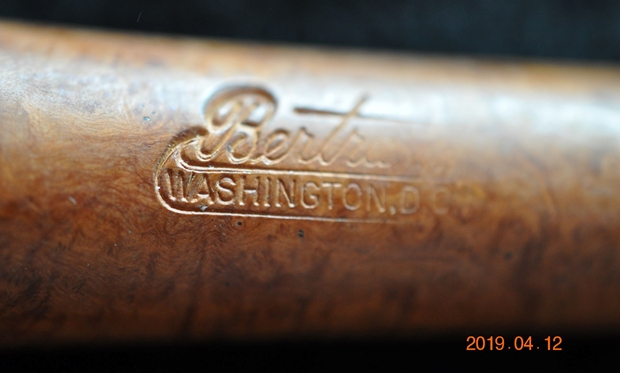
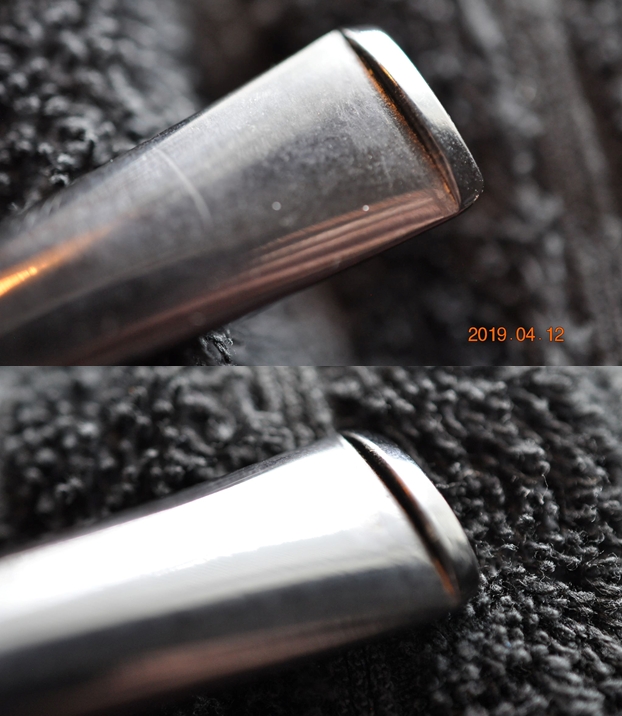
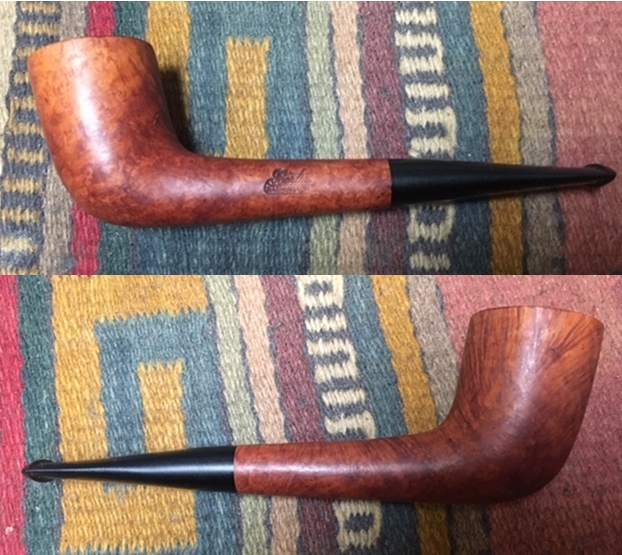
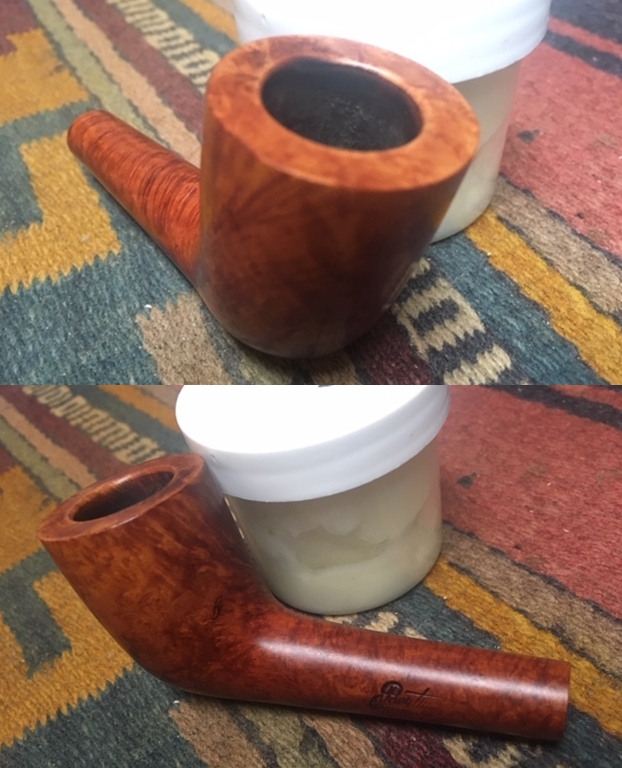
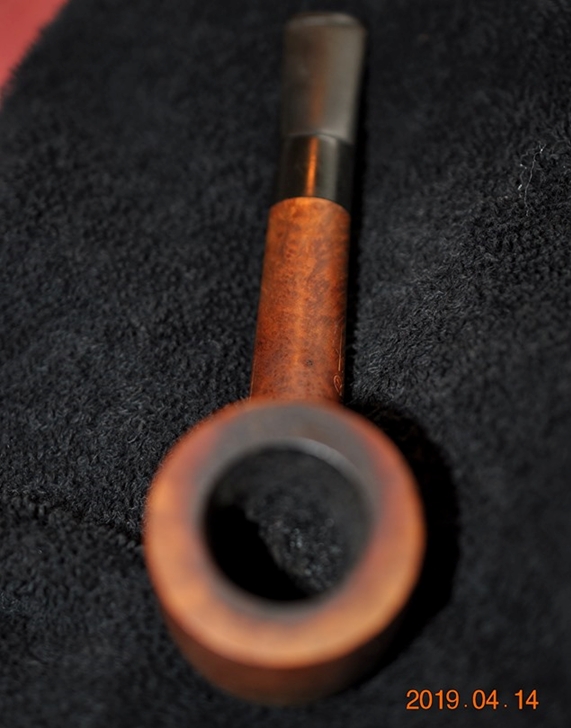
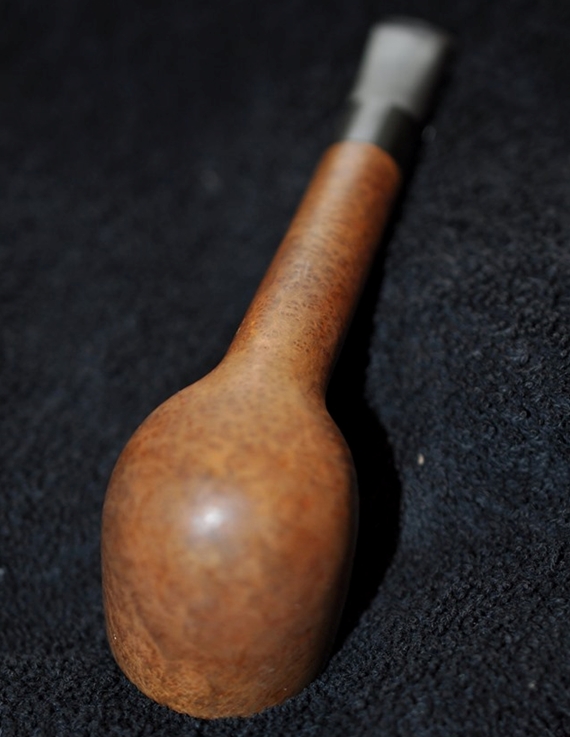
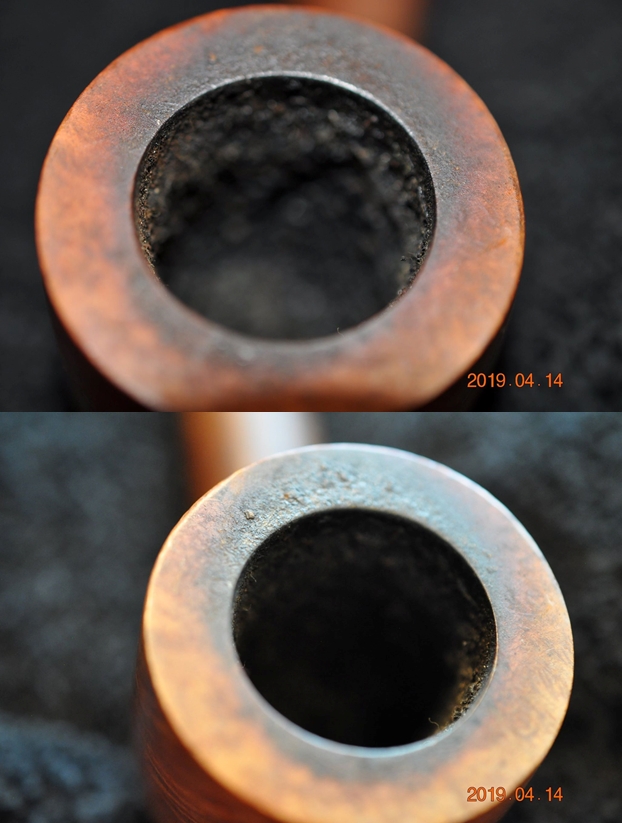
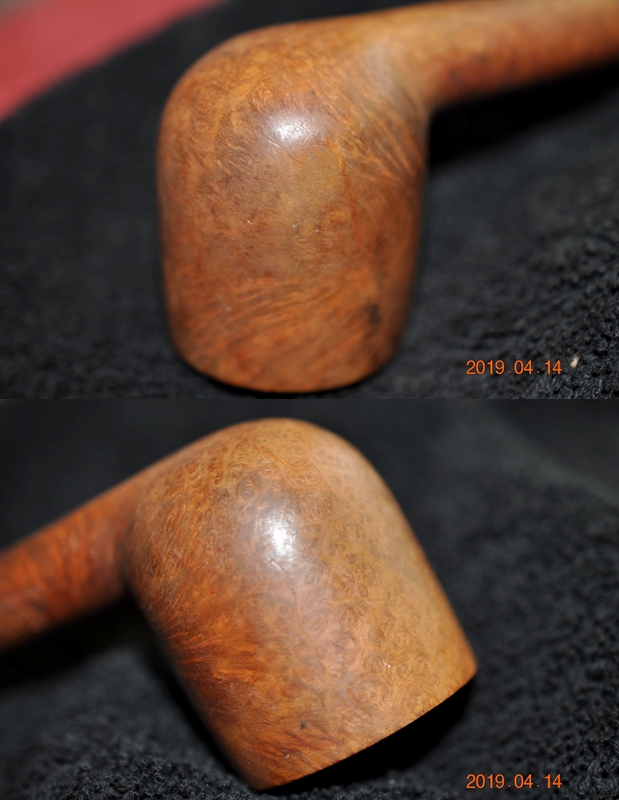
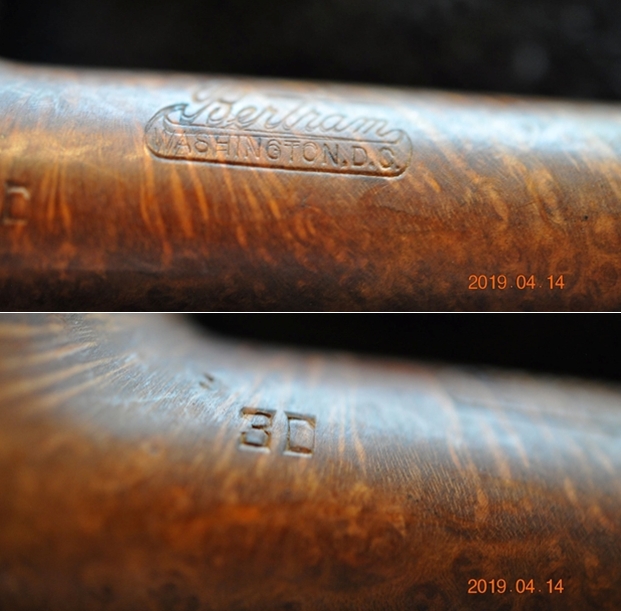
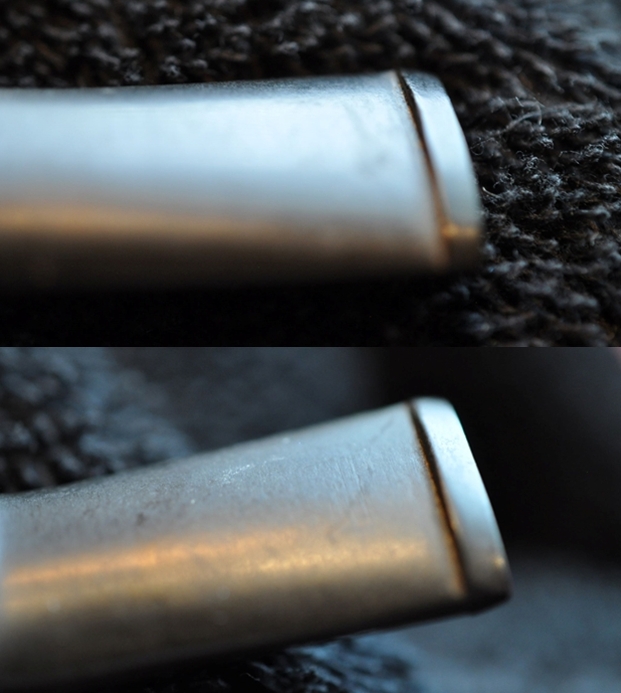
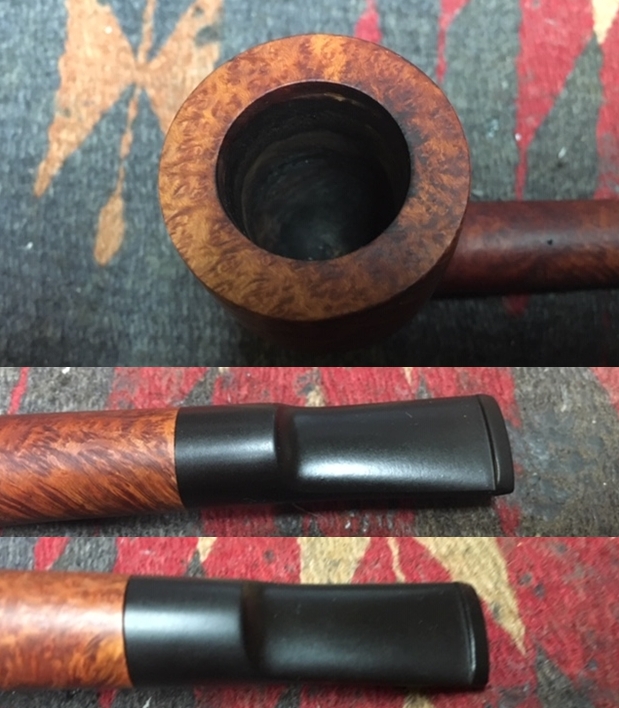
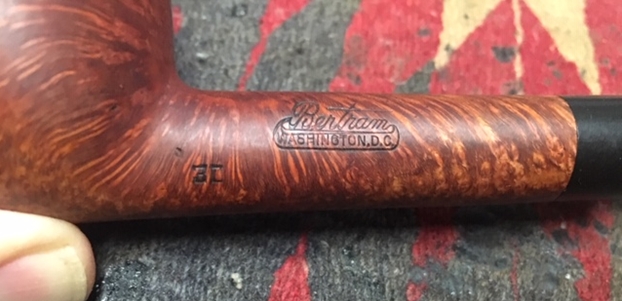
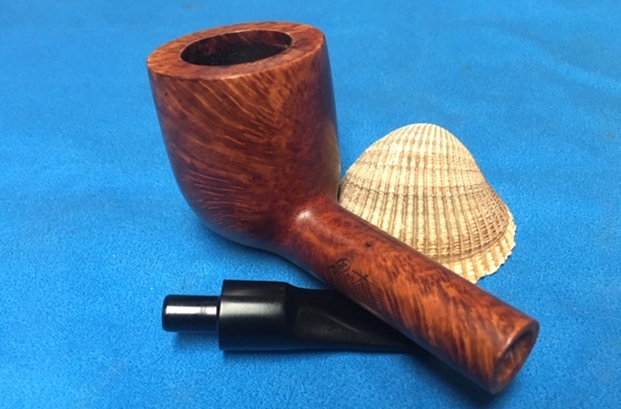
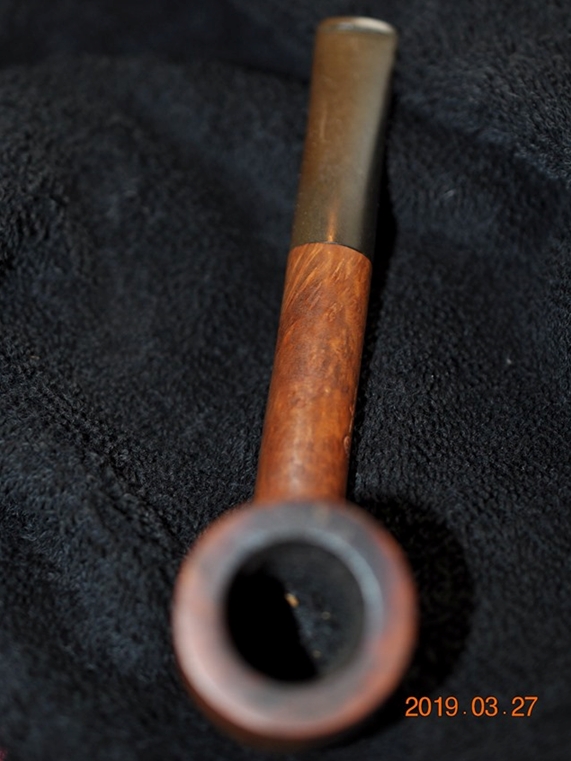
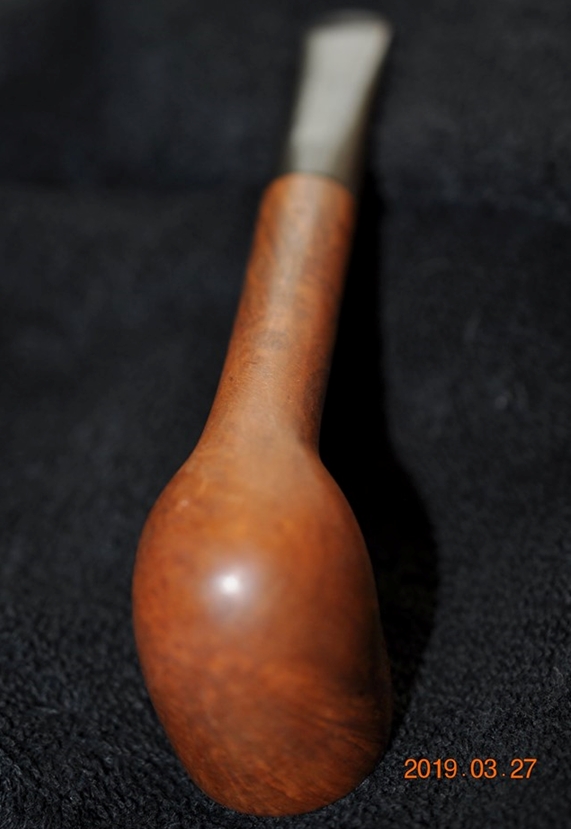
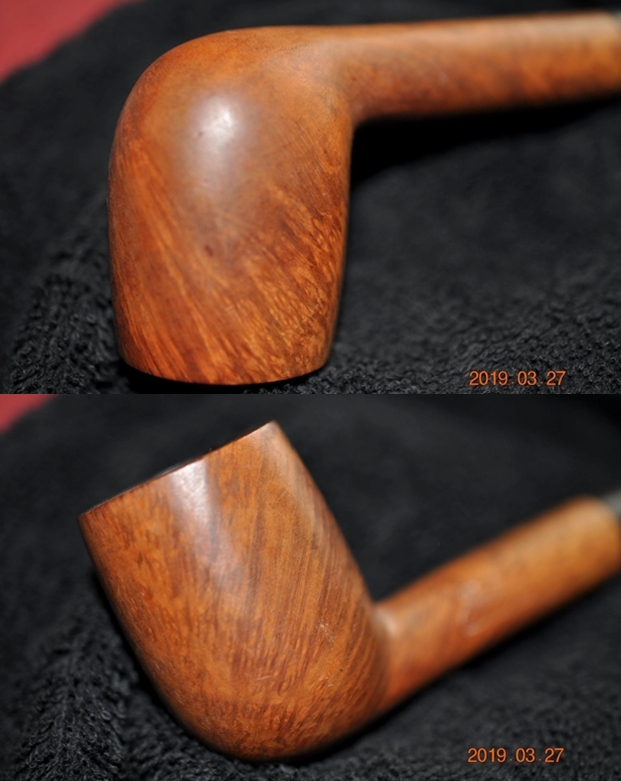
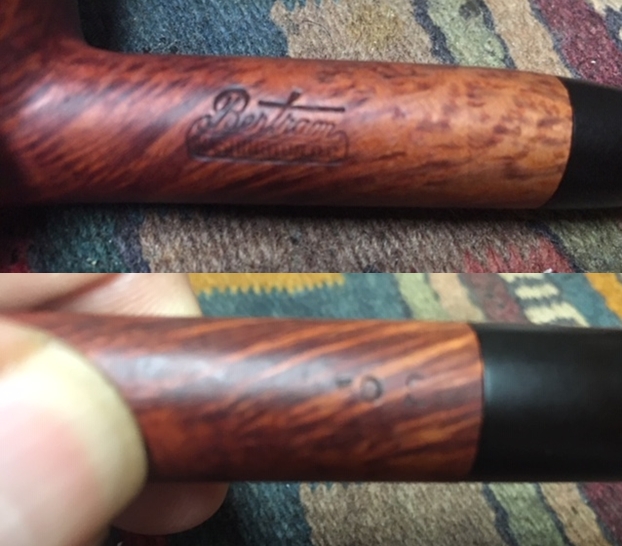
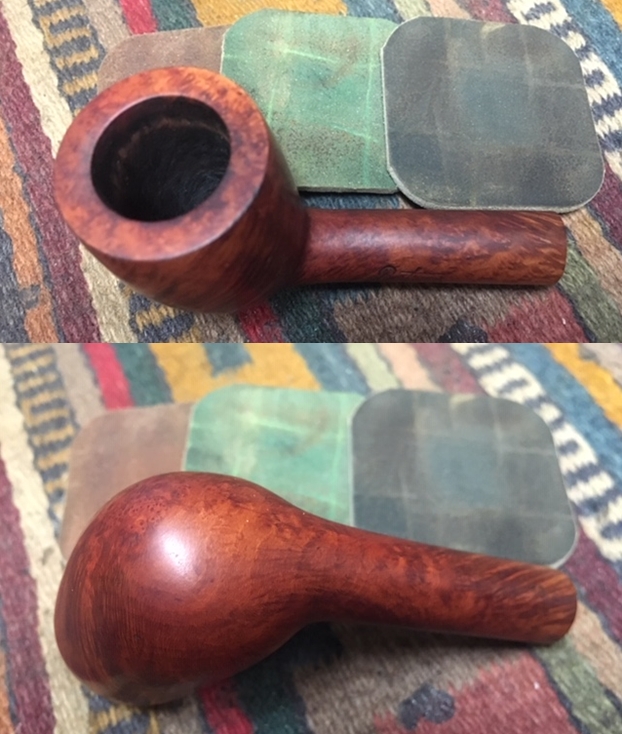
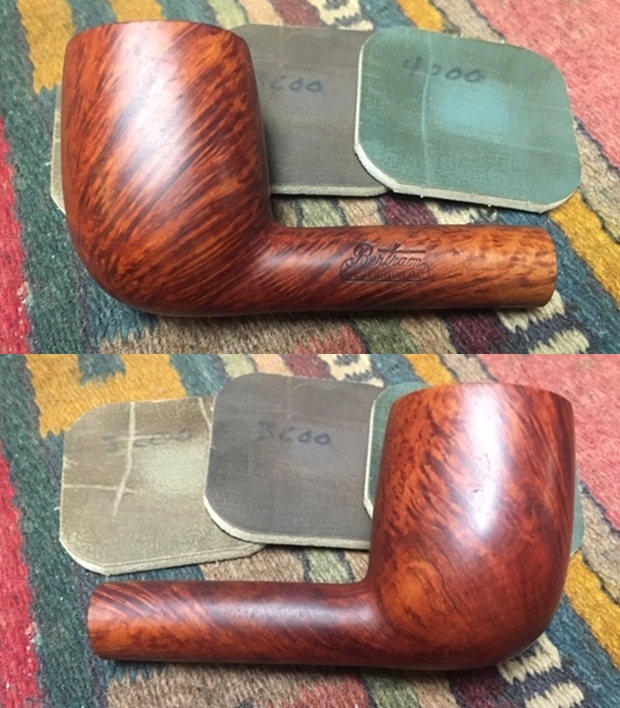
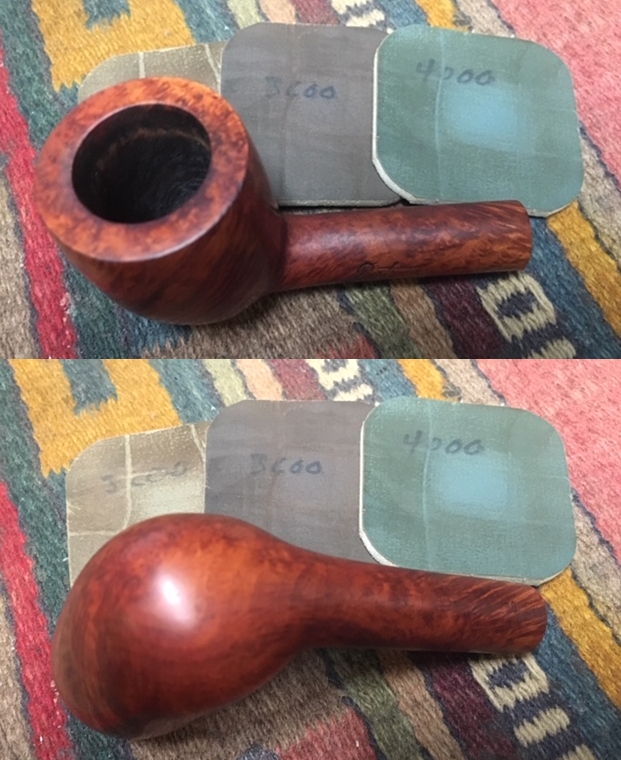
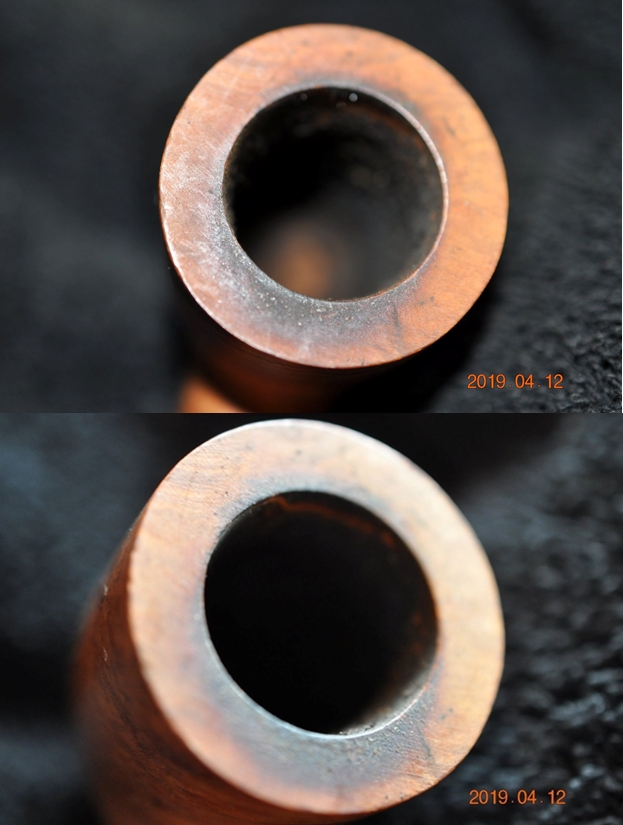
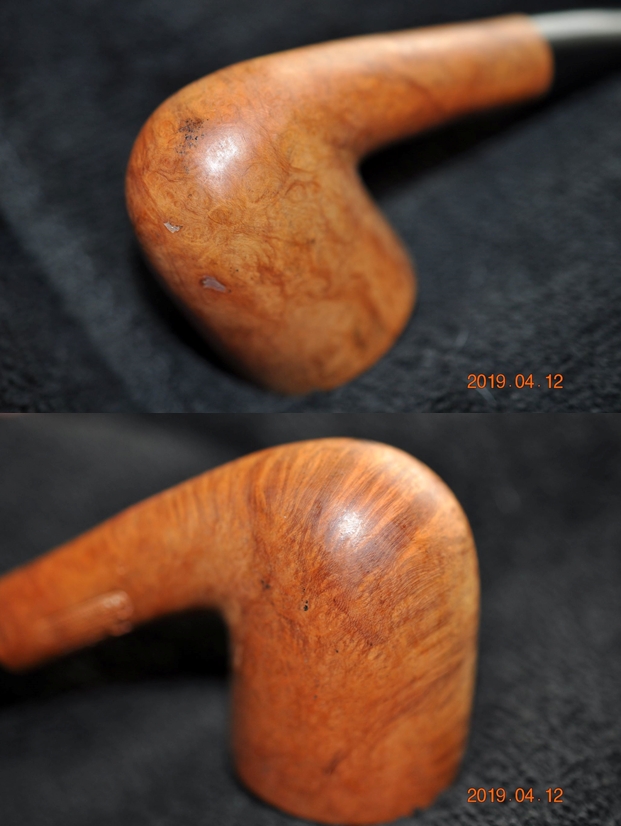
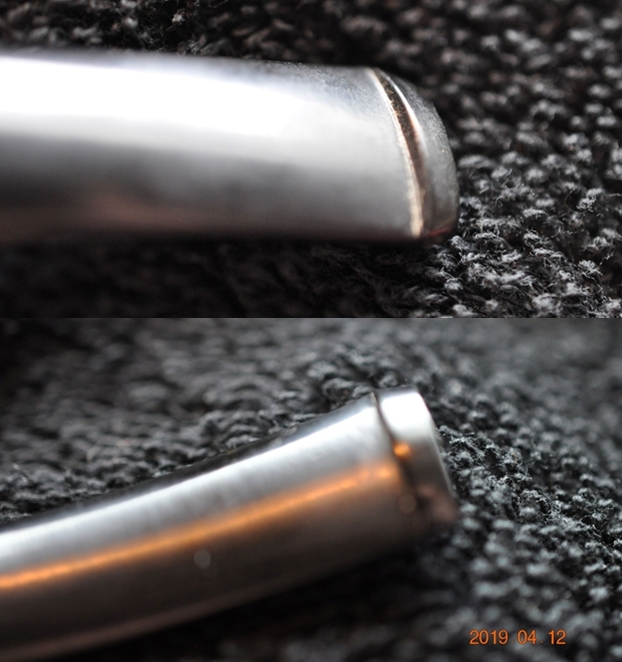
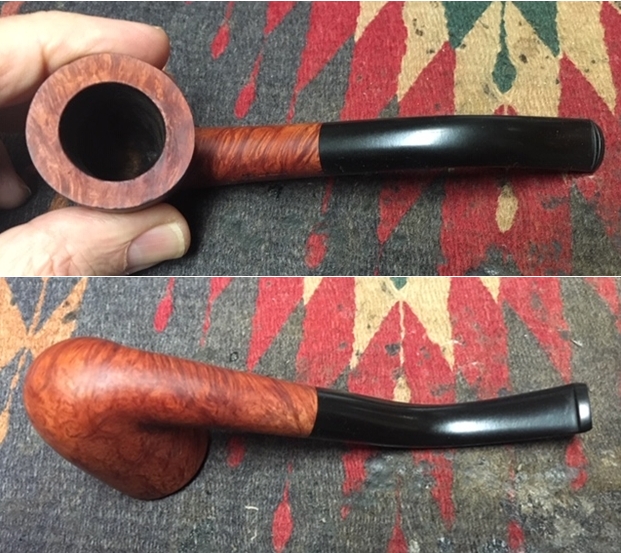
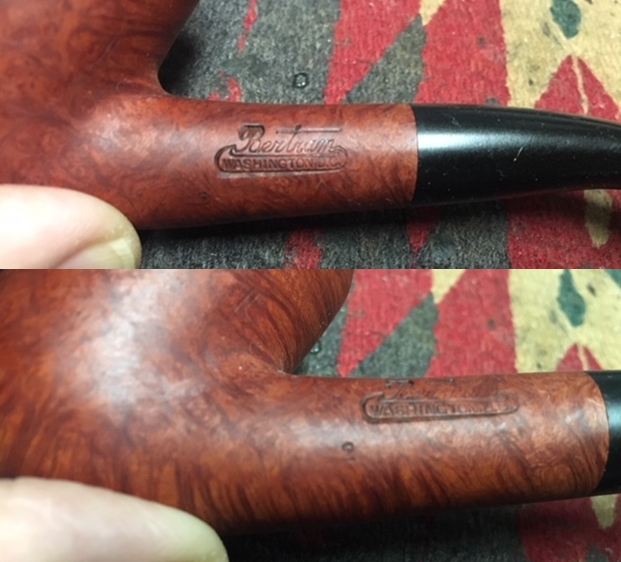
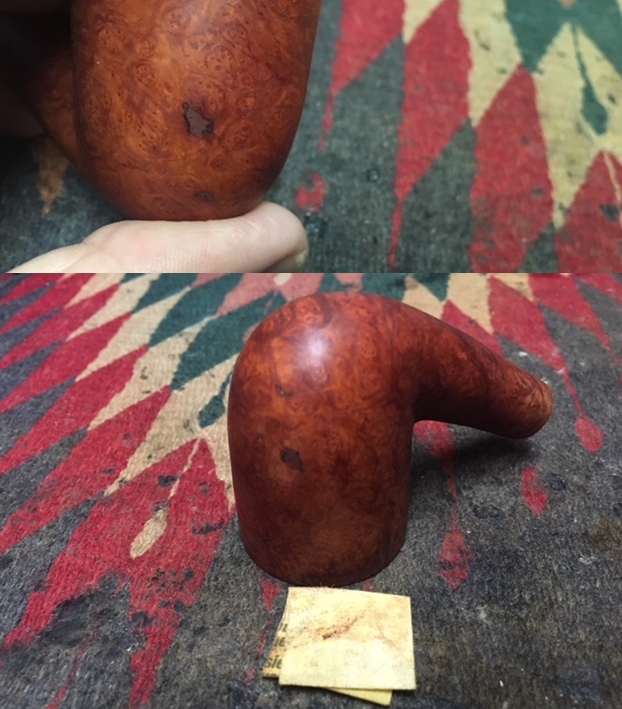
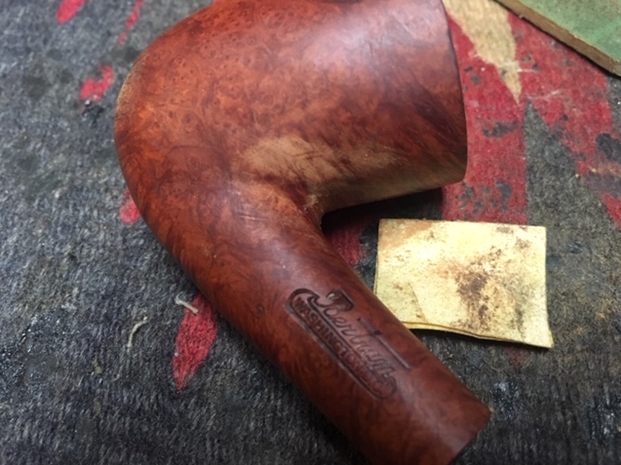
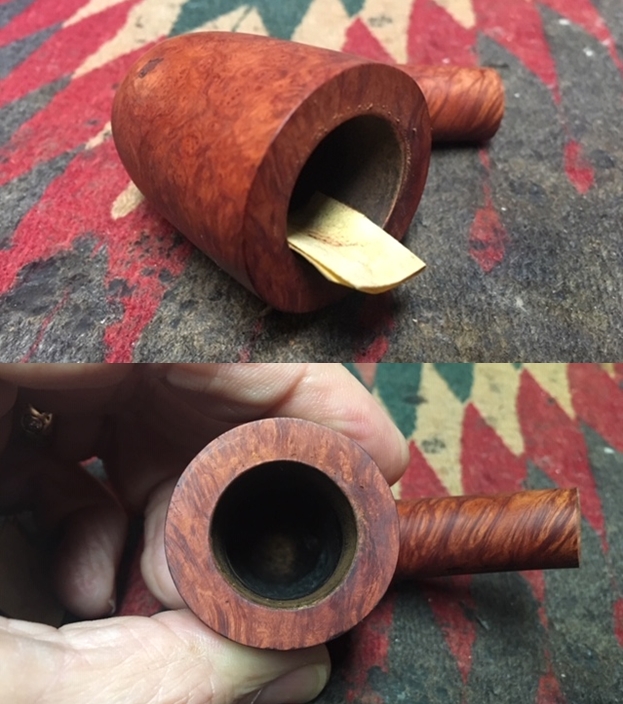
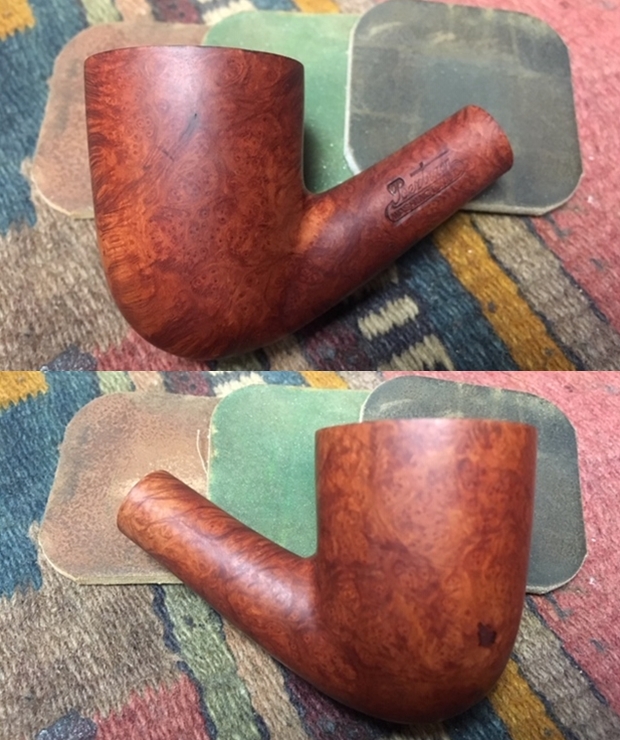
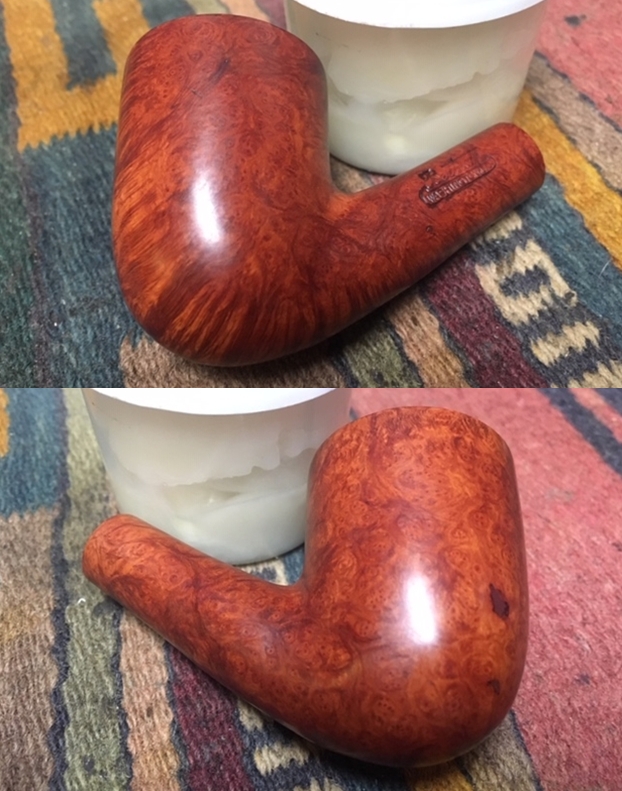
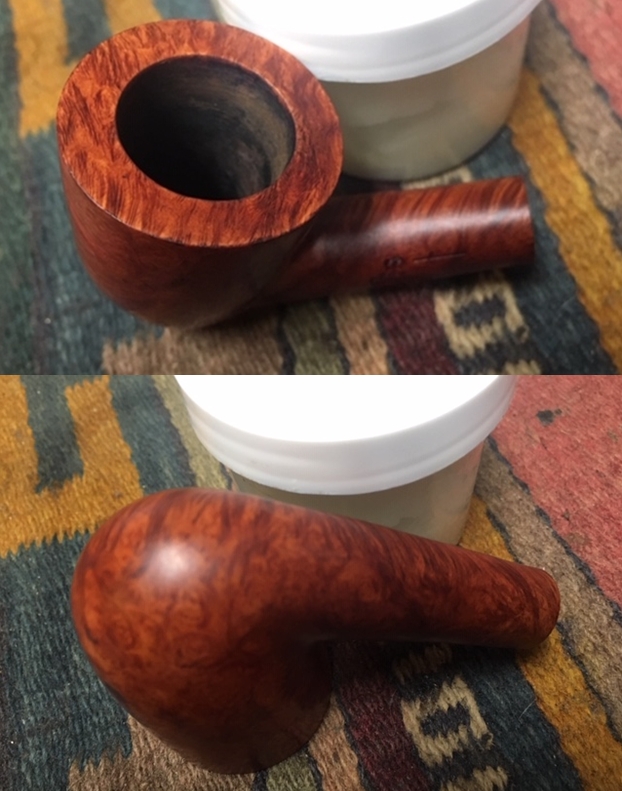
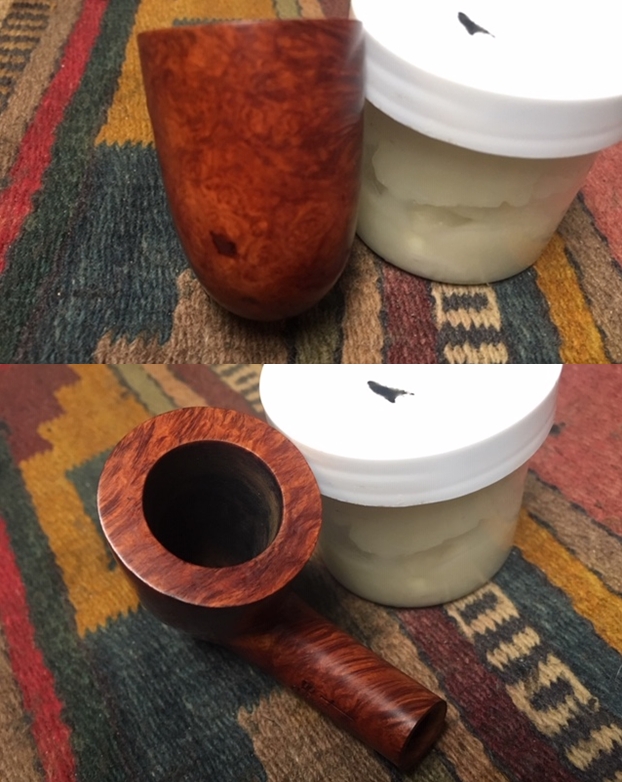
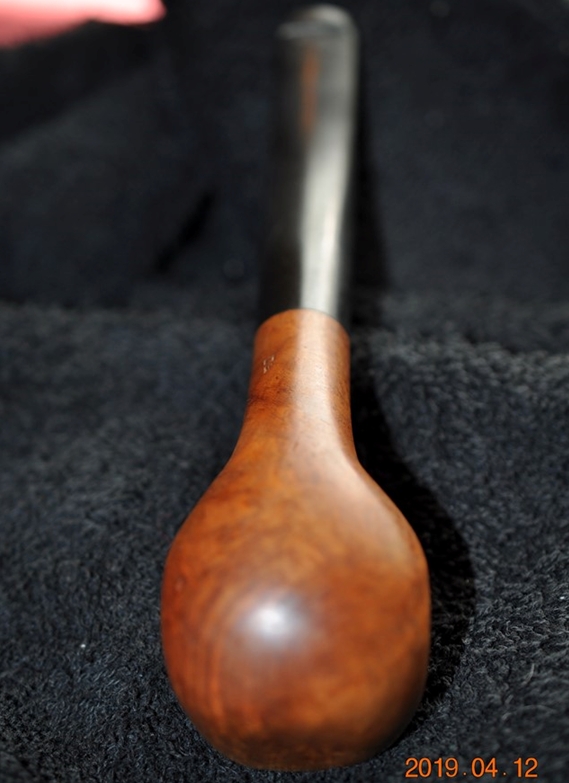
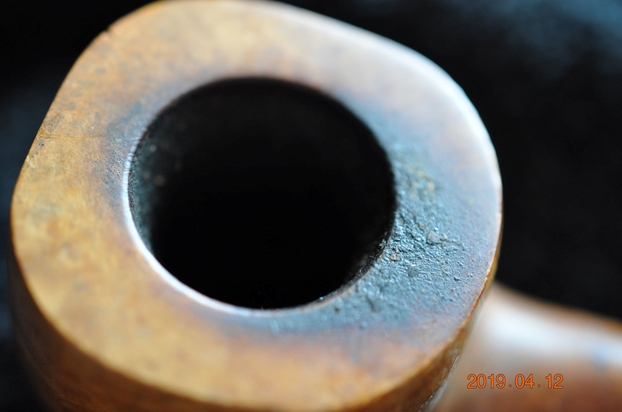
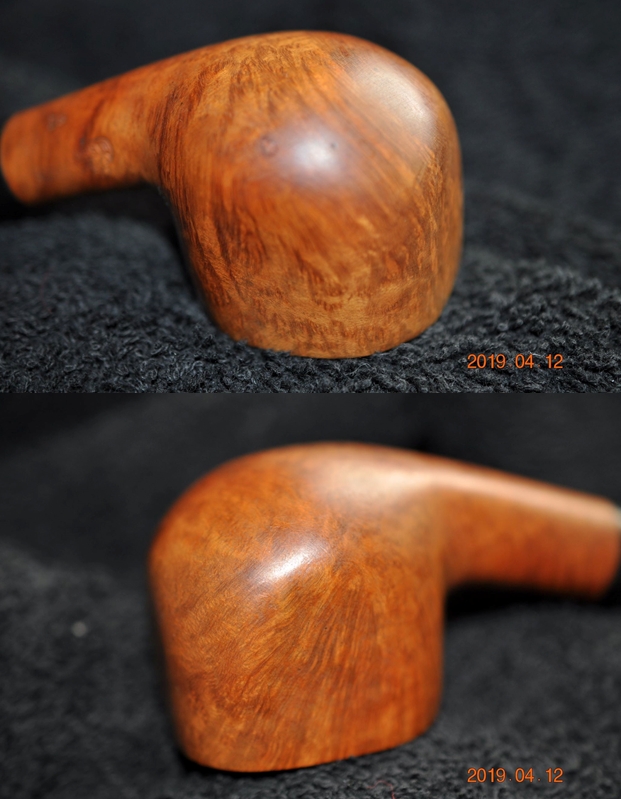
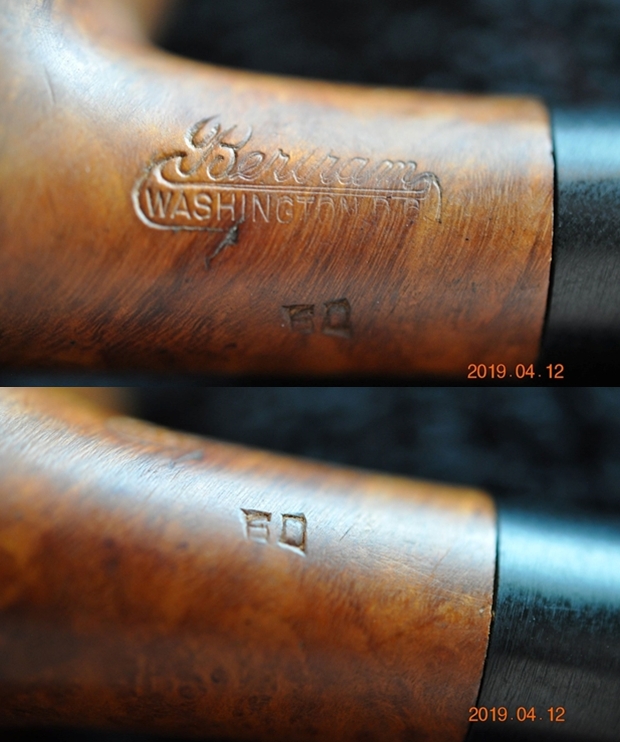
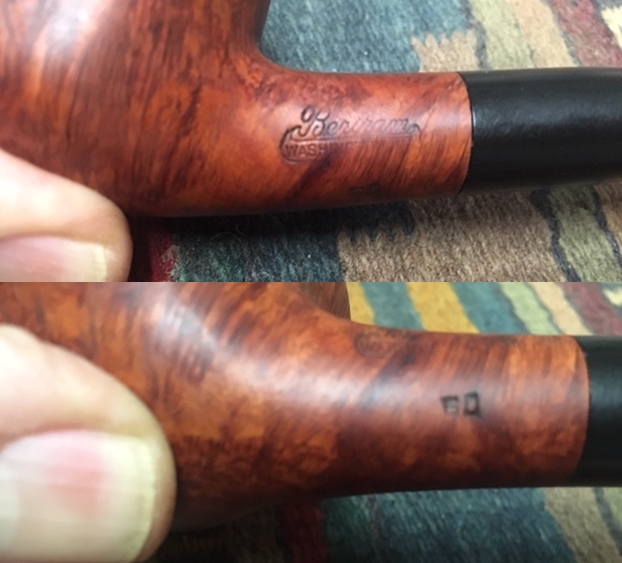
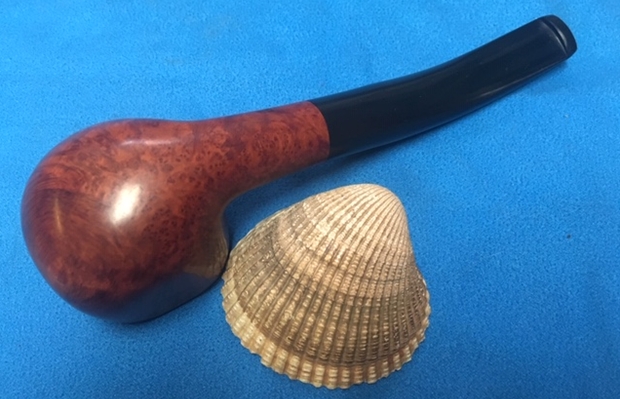
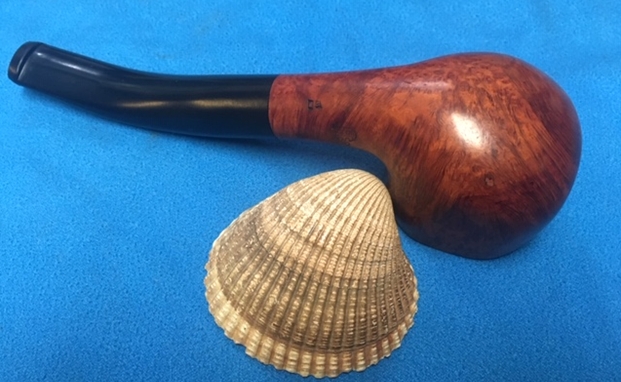
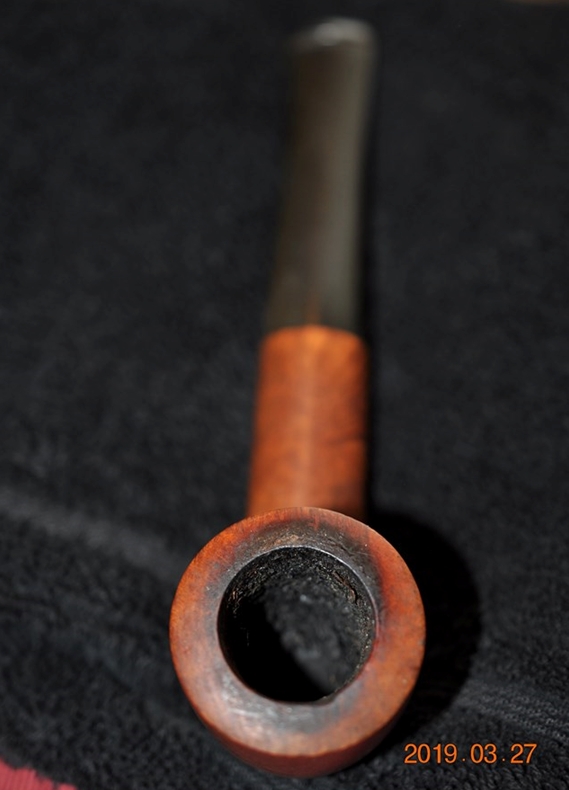
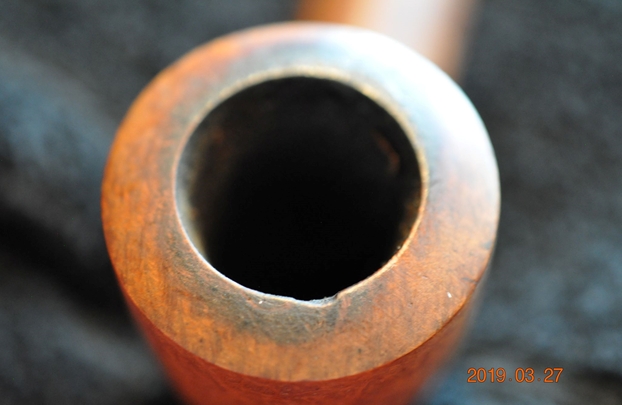
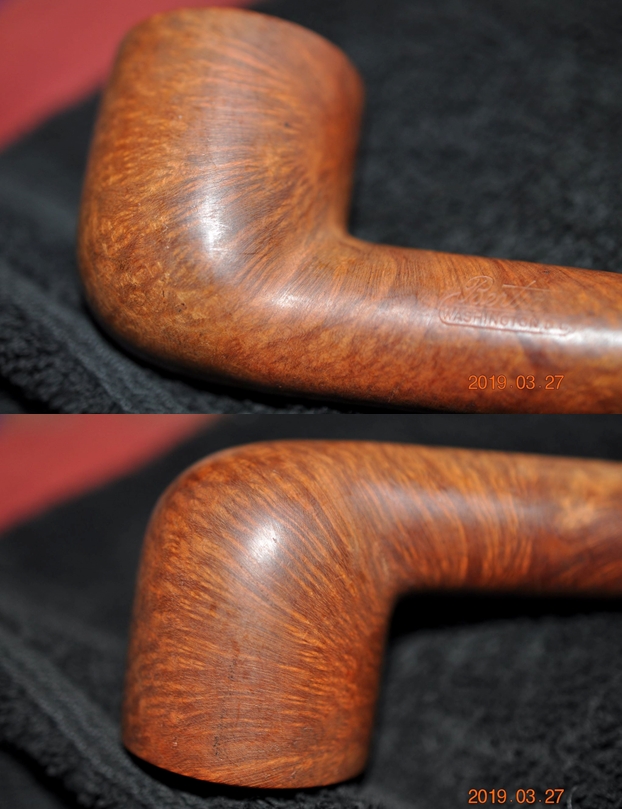
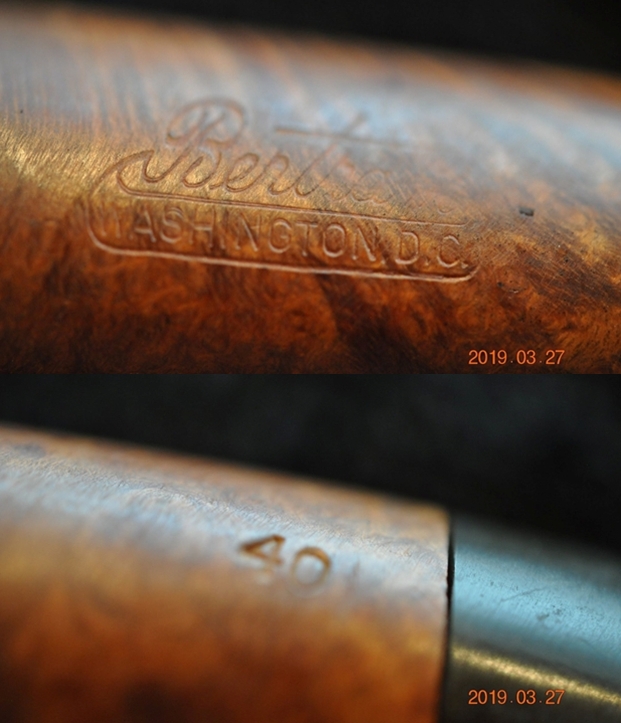
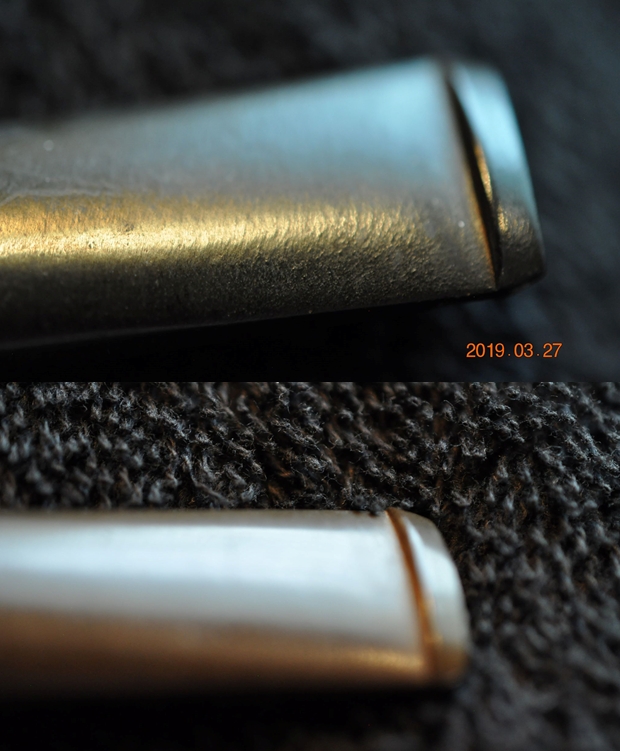
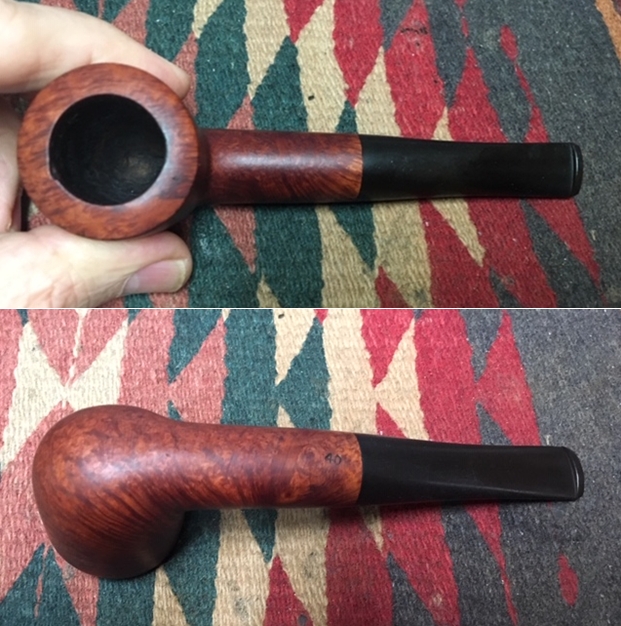
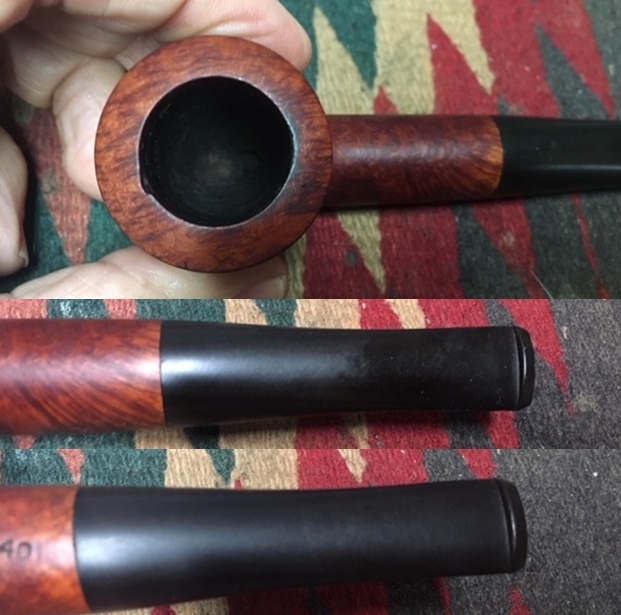
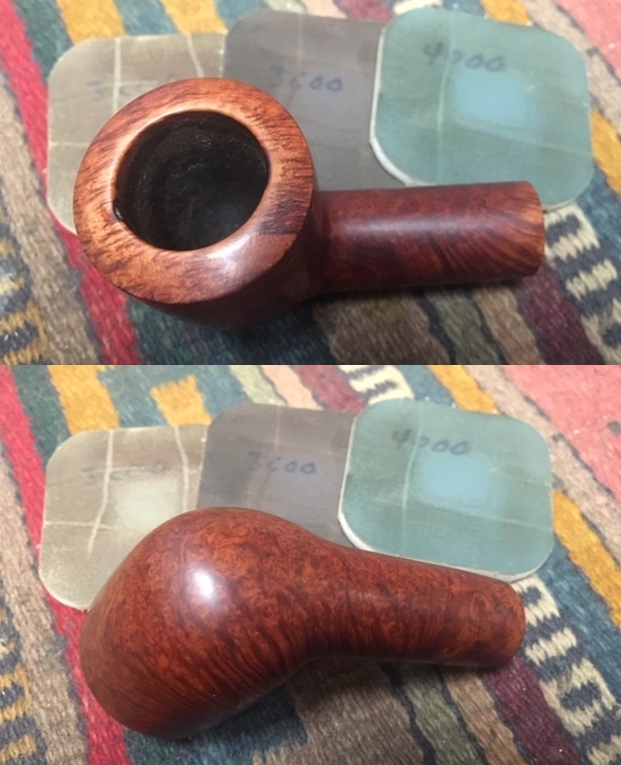
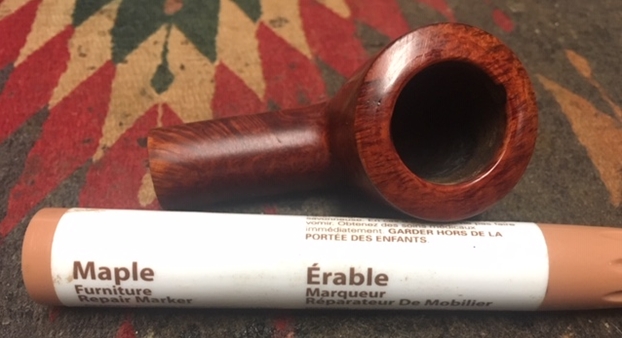
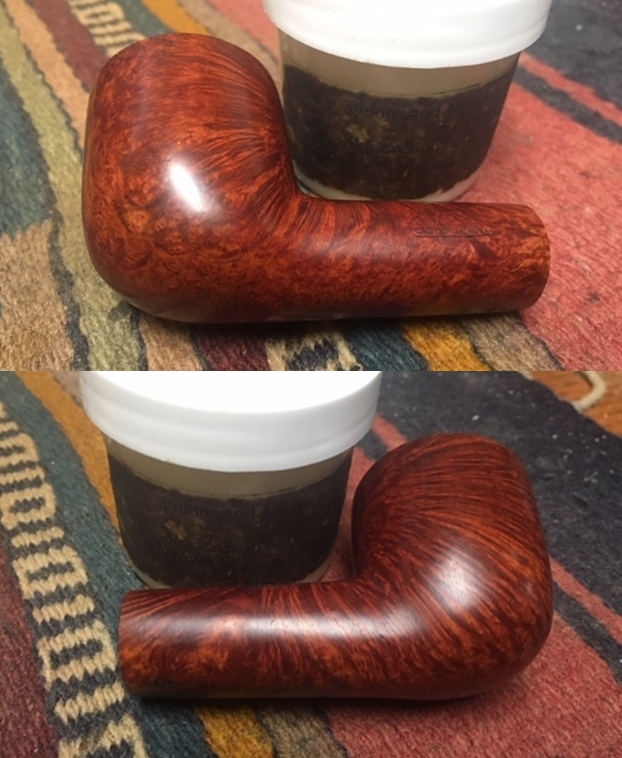
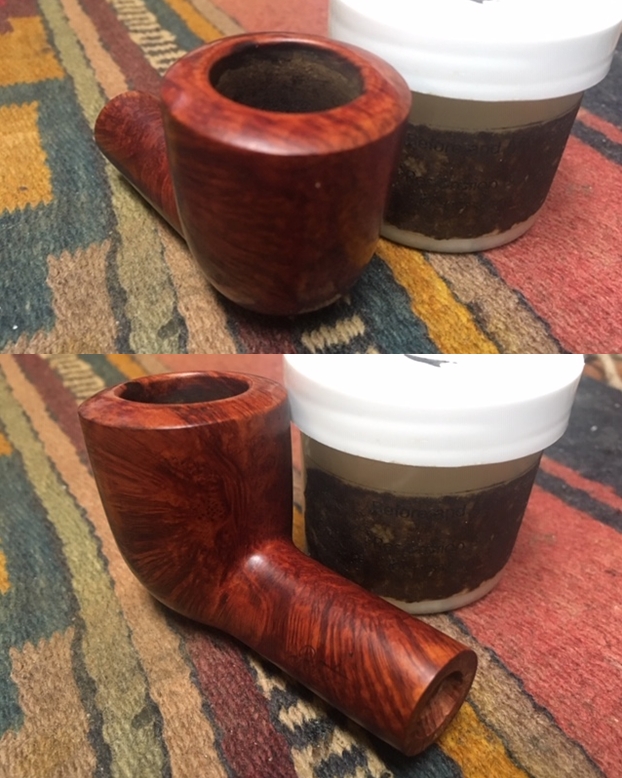
Once again if you want the background on the lot of Bertram pipes that Jeff and I purchased please refer to the previous blog posts on the brand. Like I have said, words escape me in trying to adequately describe how overwhelmed I am when I look at the 200+ pipes that need to be restored. It is mind boggling but there is only one way to move ahead – 1 pipe at a time. I am glad Jeff is helping with the clean up on the lot as that would be more than I could handle by myself in moving through this many pipes. From his cleaned pipes I chose a beautifully grained Bertram Cutty with a long shank. It has no grade number on the shank sides or bottom. It is very different from the other pipes in the lot that I have worked on so far. The grain was a mix of grains – swirls, flame, cross and birdseye. It was a round bottom pipe with a taper stem. The exterior of the bowl looked really good and there were a few small fills on this beauty. The bowl had cake in the chamber that was no problem. The rim top had some darkening and lava overflow on the back side. There appeared to be a bit of damage to the back side of the inner edge of the bowl look very good. The stem had some oxidation and tooth chatter near the button on both sides. Jeff took some photos of the pipe before he began his cleanup work on it. Jeff took close-up photos of the bowl and rim to capture the condition of the pipe when it arrived. The rim top had a coat of lava and the bowl had a thick cake. There was a nick in the back side of the inner edge of the rim.Jeff took pictures of the bowl sides and the heel to show the great looking grain around the sides of the bowl.It really is quite stunning and very dirty!Jeff took a photo to capture the stamping on the left side of the shank. It shows the stamping which read Bertram over Washington, D.C. The stamping is fainter on the right side of the impression. There is no quality number designation on this pipe. The next two photos show the stem surface. They show the calcification, oxidation and the chatter on both sides near the button. There is also some wear on the button edge. Once again, if you have read the previous Bertram blogs I have posted about the pipes that I have cleaned up so far you can skip the next bit. But if you have not, then I include the link to Bertram history and information. I would recommend that if you don’t know much about them do some research on them. I include a link to the write up on Pipedia (http://pipedia.org/wiki/Bertram). Bertram pipes were based out of Washington DC. They were popular among famous politicians and celebrities of the time. They made many products for them from FDR’s cigarette holders to Joseph Stalin’s favorite pipe. They were considered some of the best America had to offer till they finally closed their doors in the 70s. They graded their pipes by 10s, the higher the grade the better. Above 60s are uncommon and 80-90s are quite rare. I’ve never heard of or seen a 100 grade. I have several blogs that I have written on rebornpipes that give some history and background to Bertram pipes. (https://rebornpipes.com/2015/06/16/an-easy-restoration-of-a-bertram-grade-60-217-poker/).

I have included the following link to give a bit of historical information on the pipe company. It is a well written article that gives a glimpse of the heart of the company. http://www.streetsofwashington.com/2012/01/bertrams-pipe-shop-on-14th-street.html#

From this information I have learned that the shape and grade Bertram I have in front of me now was made before the closure of the shop in the 1970s. This Bertram Cutty is slightly different from the other Bertram shapes I have worked. Without a grade stamp it is impossible to know the quality of this pipe.

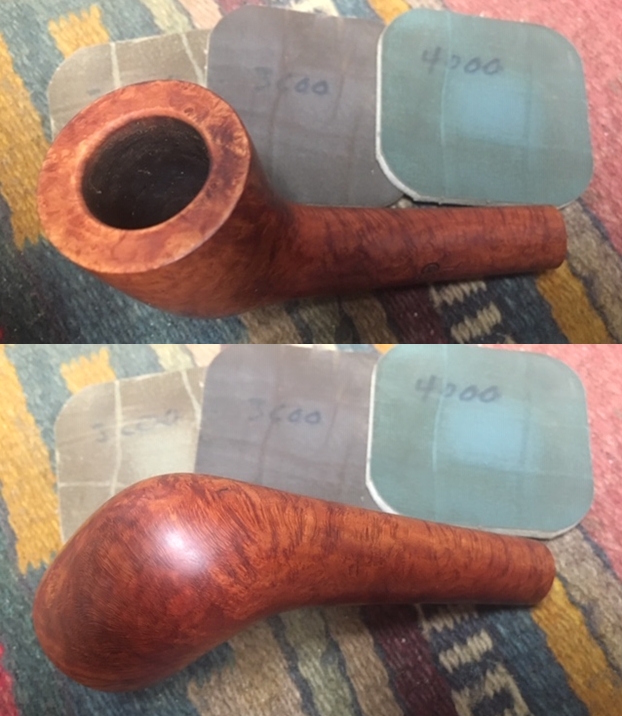
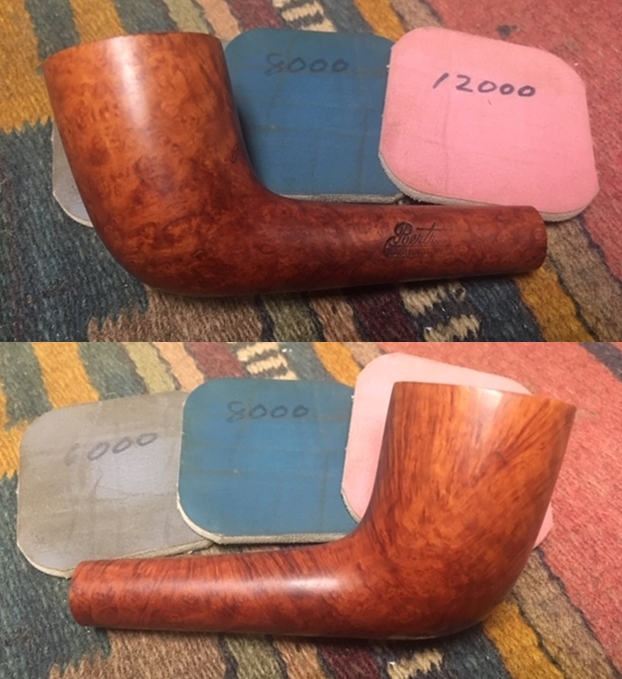
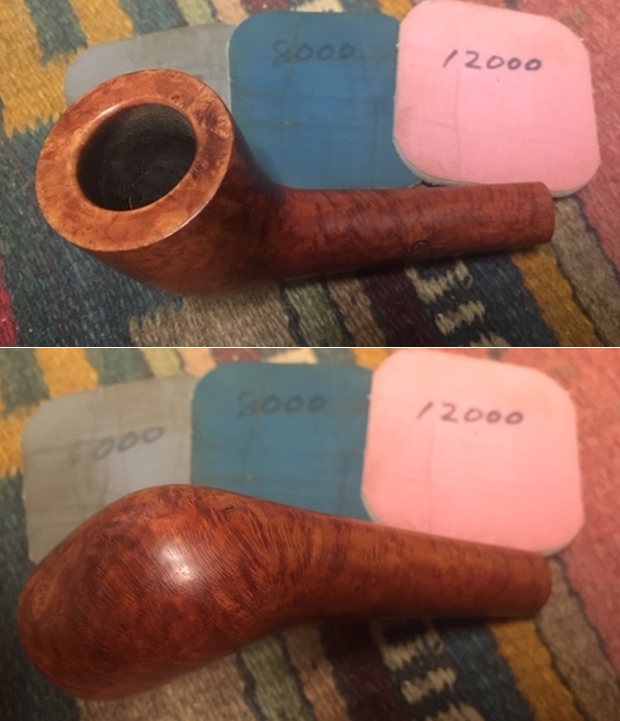
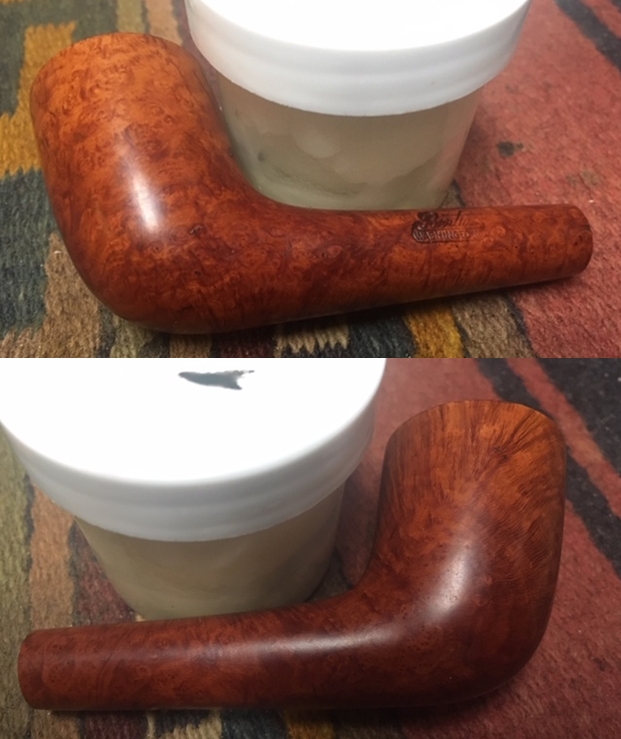
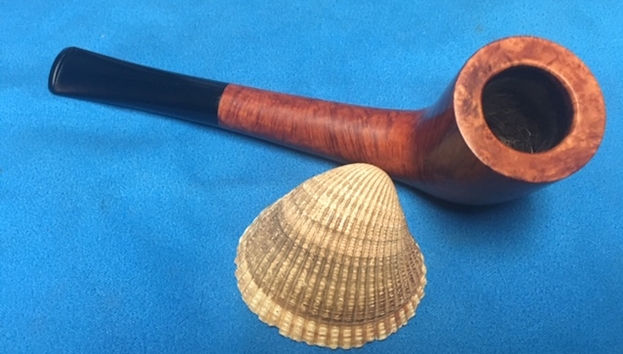
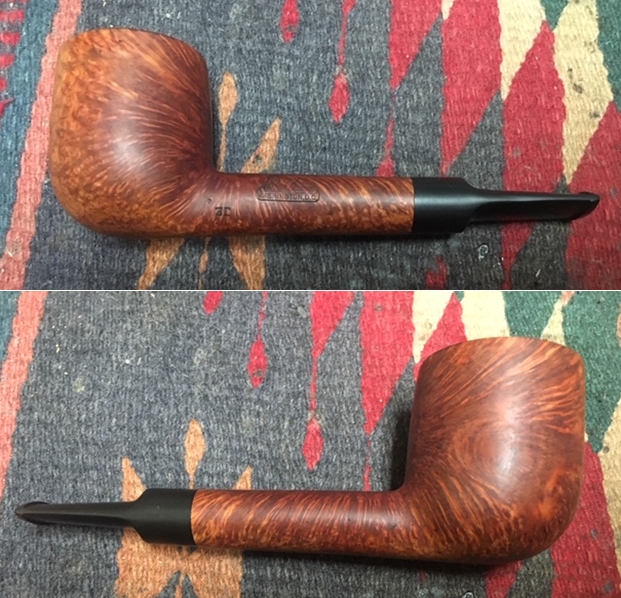
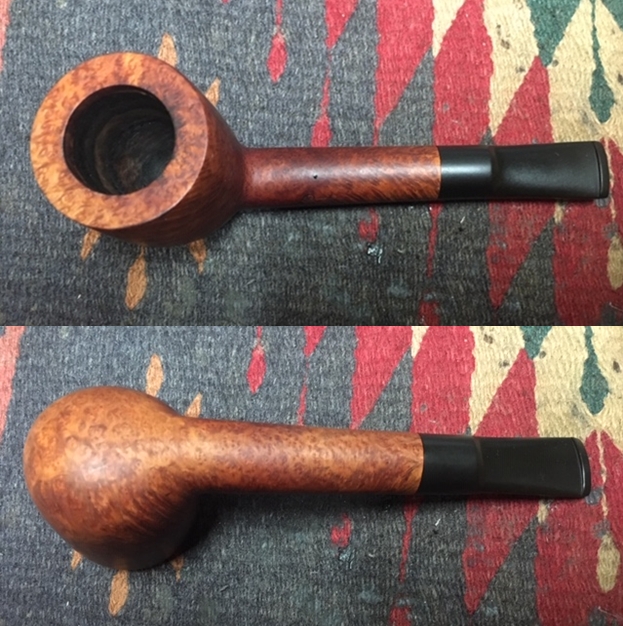
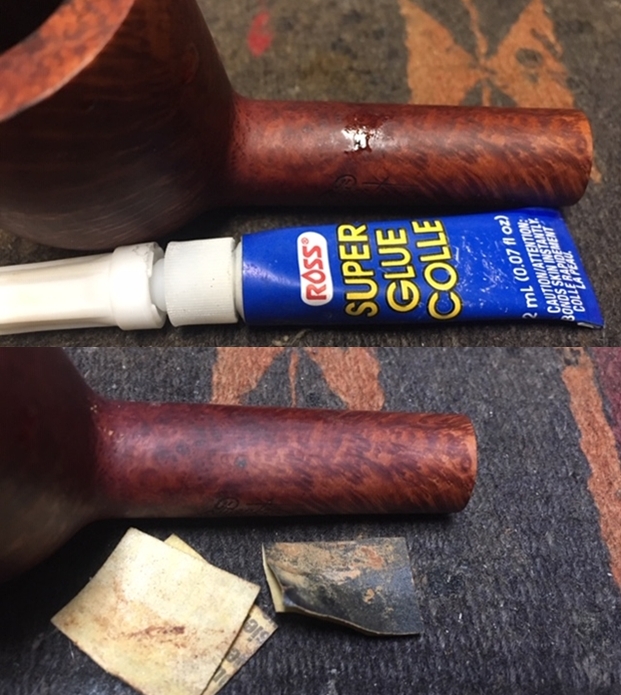
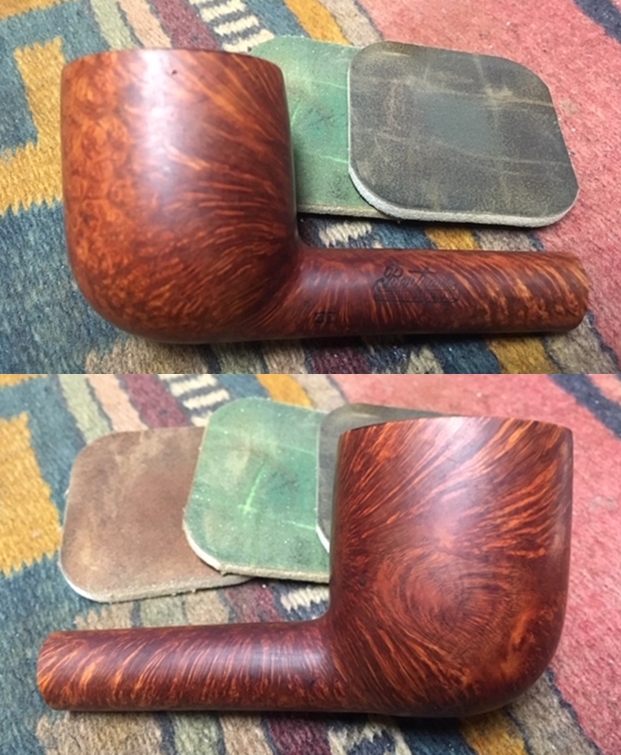
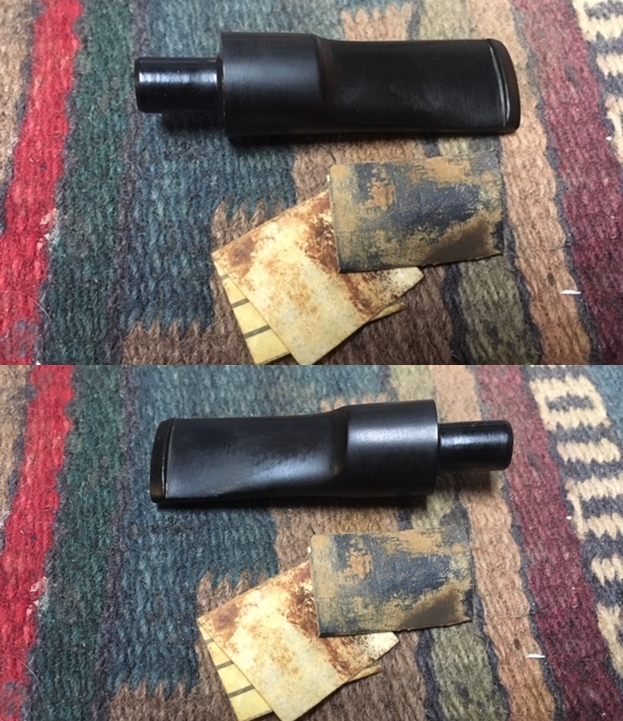
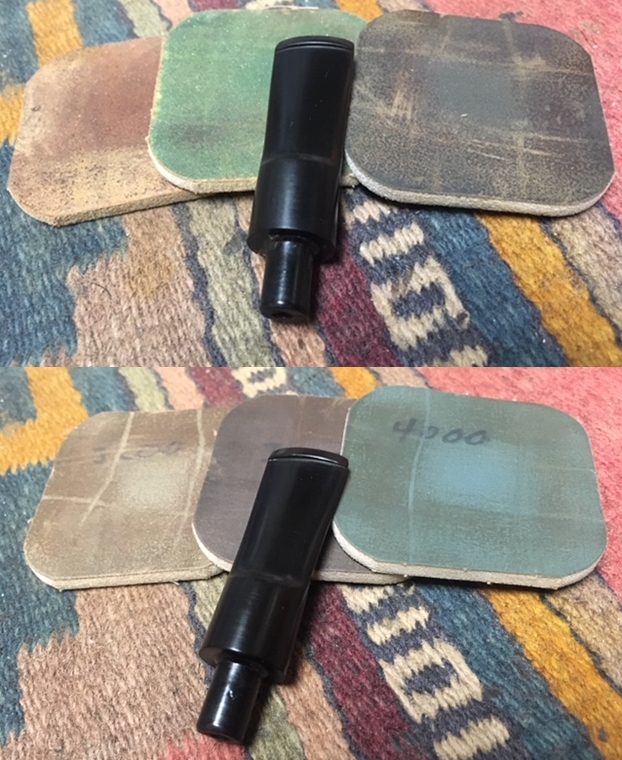
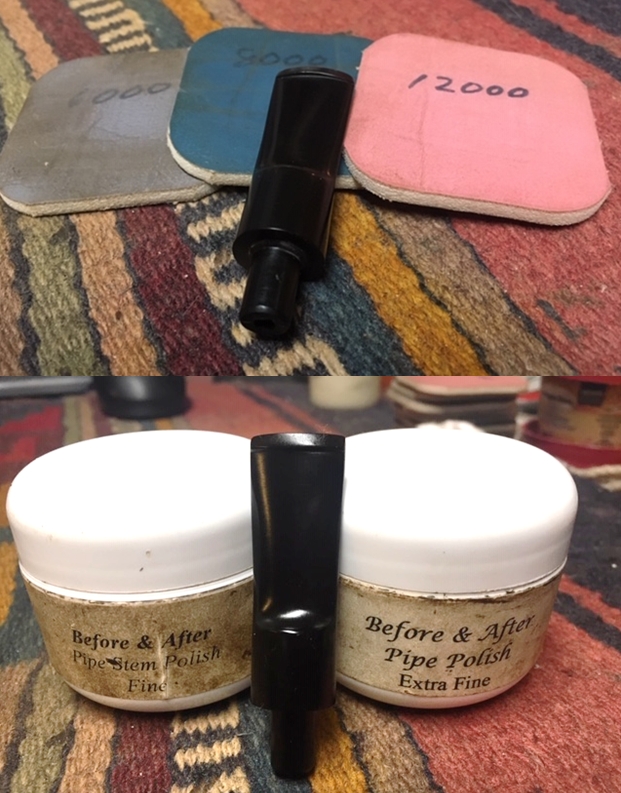
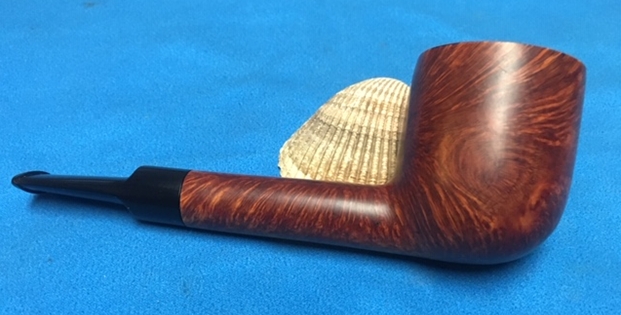
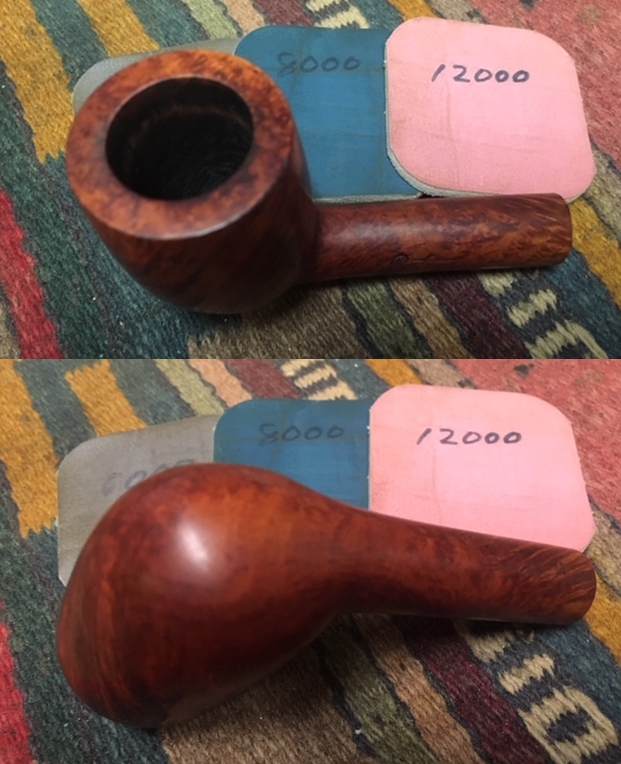
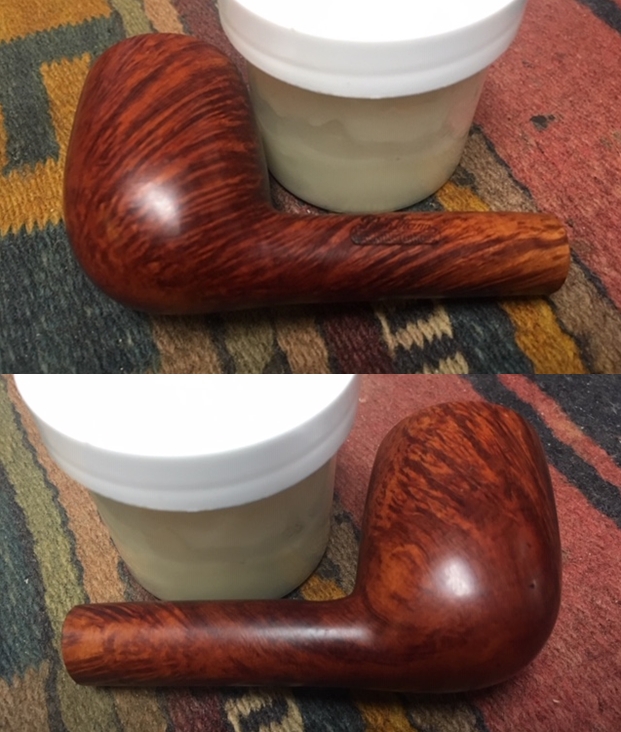
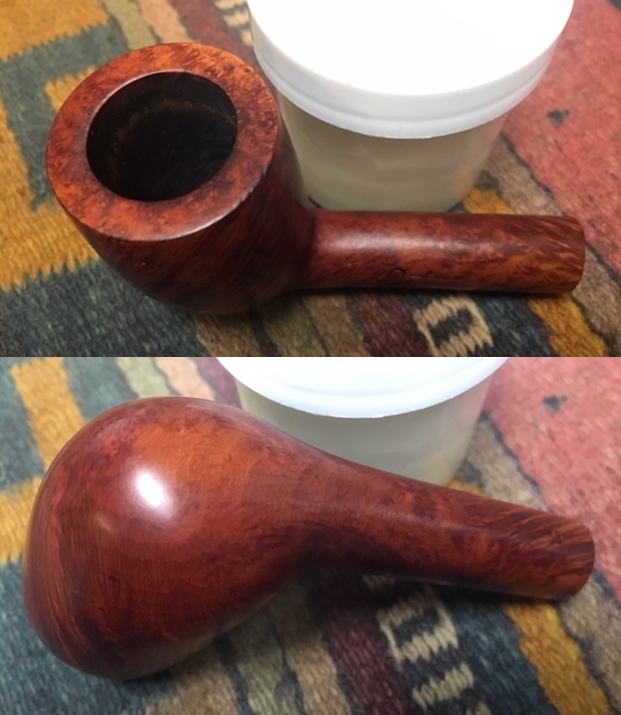
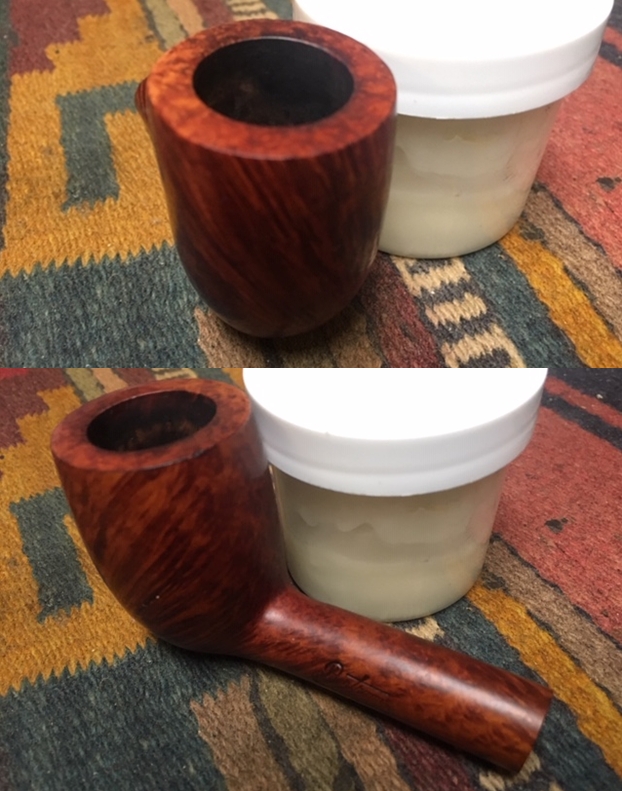
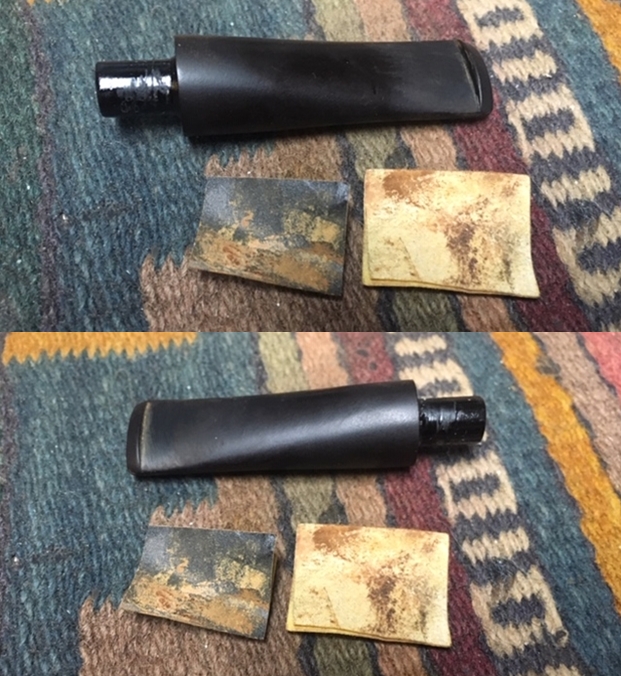
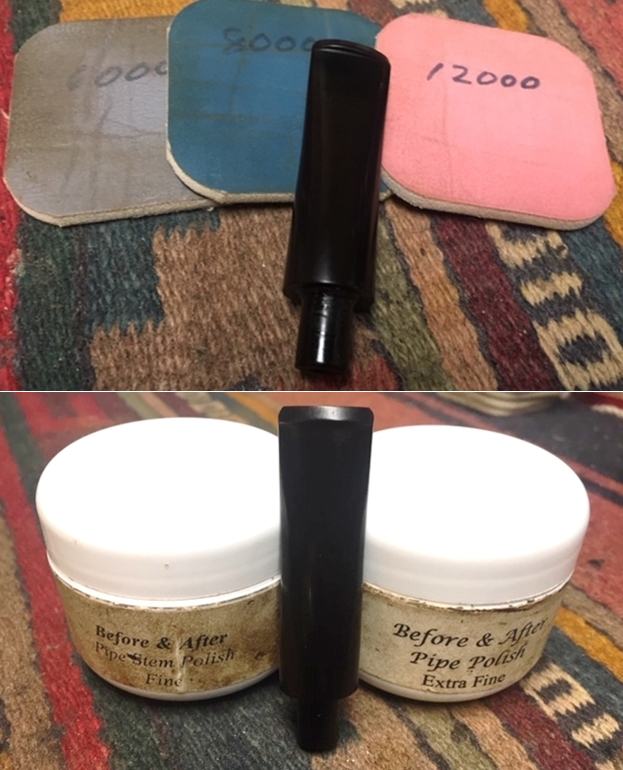
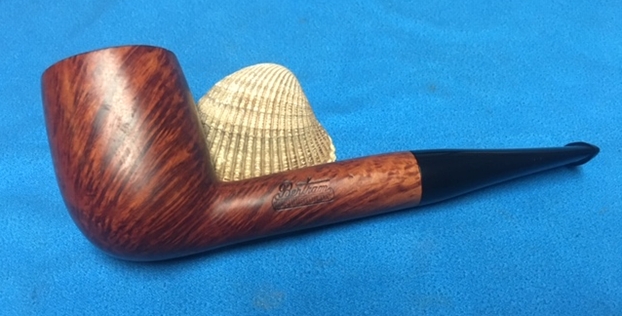
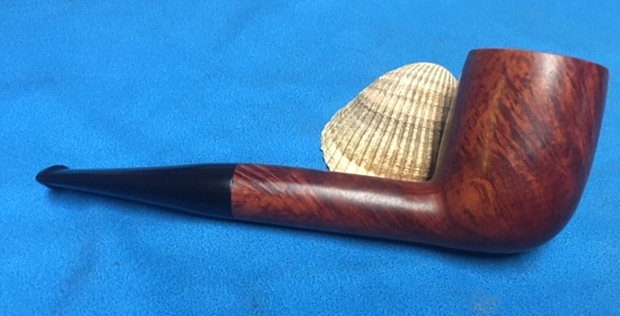
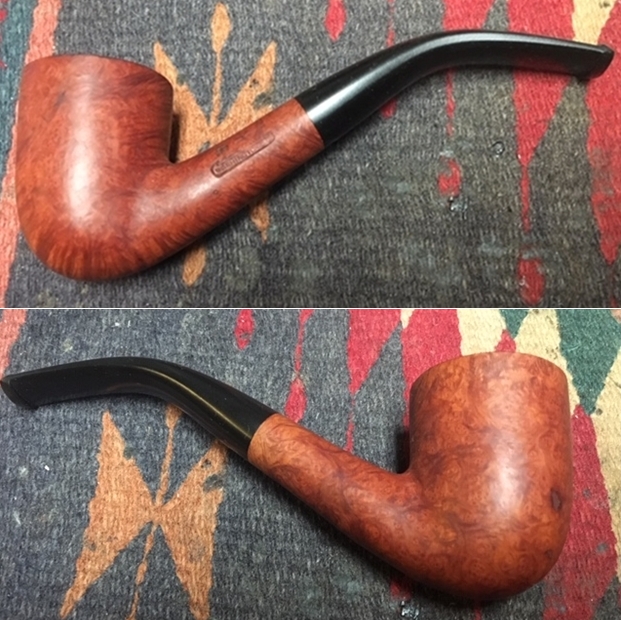
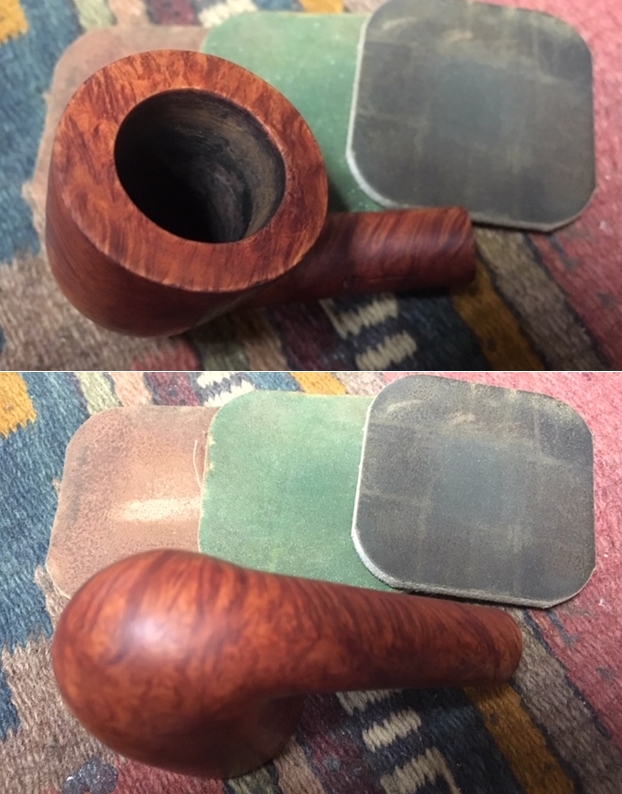
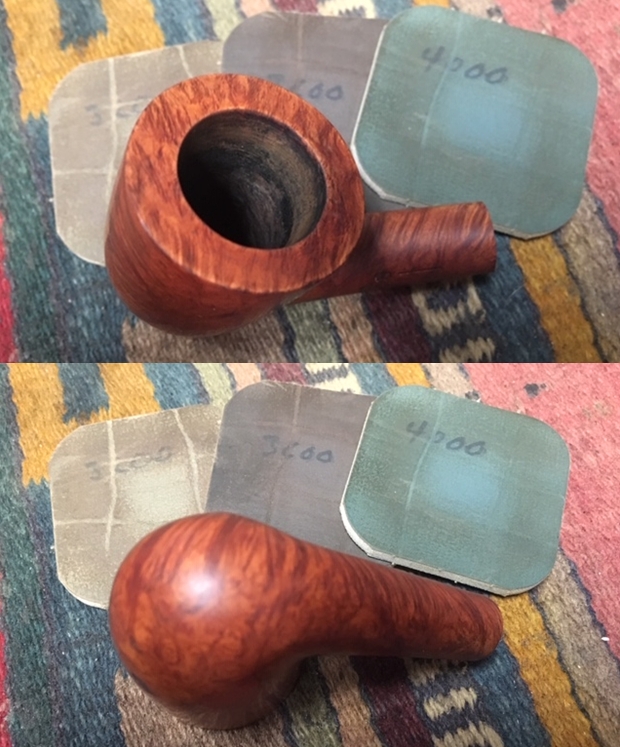
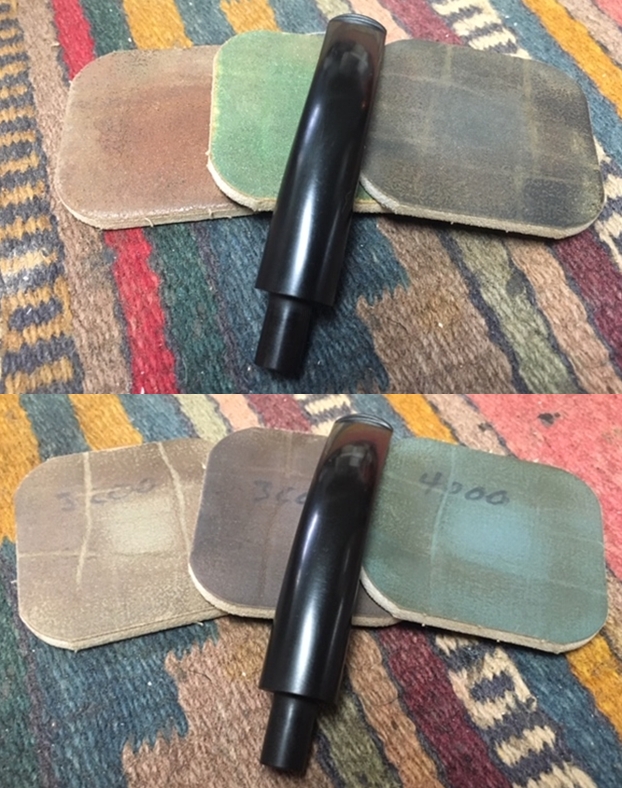
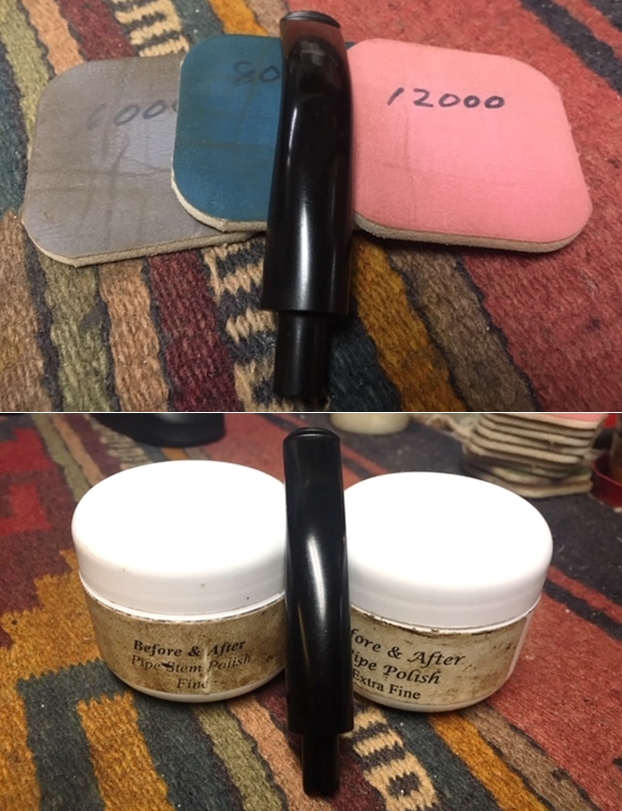
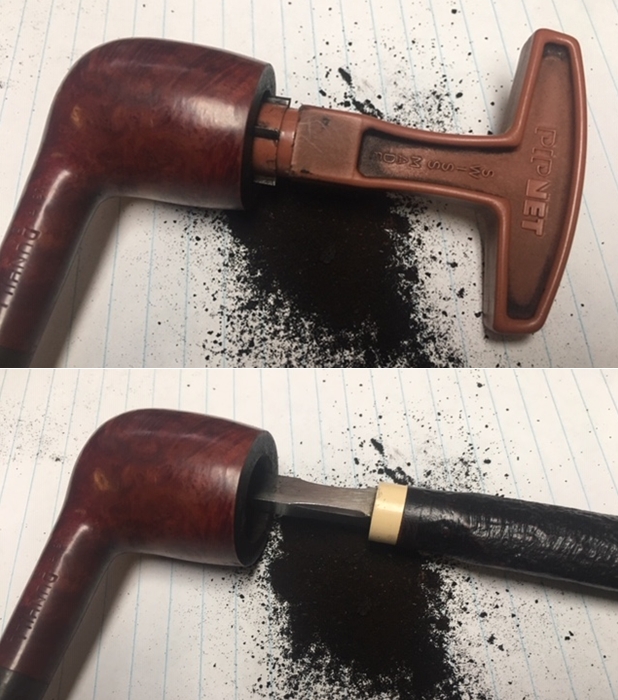
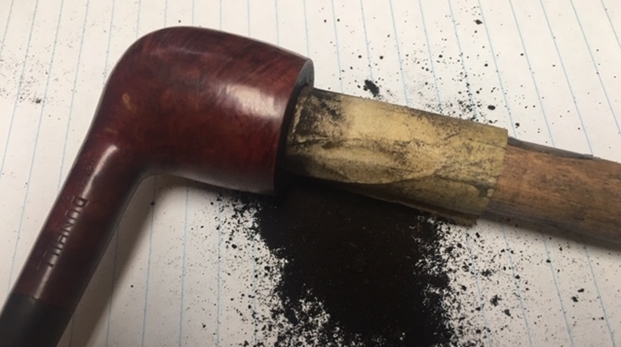
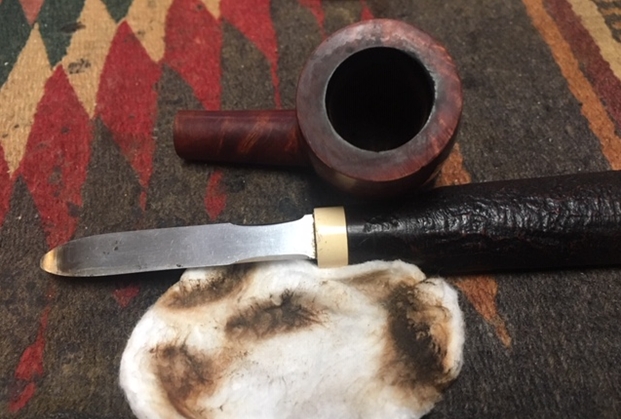
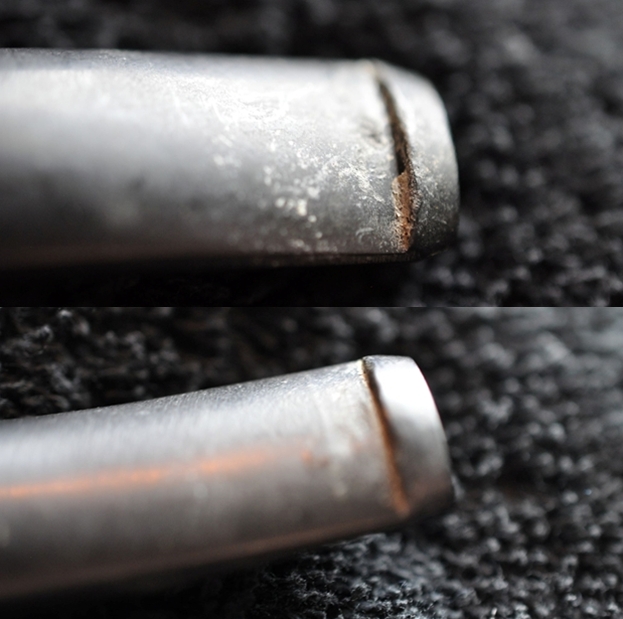
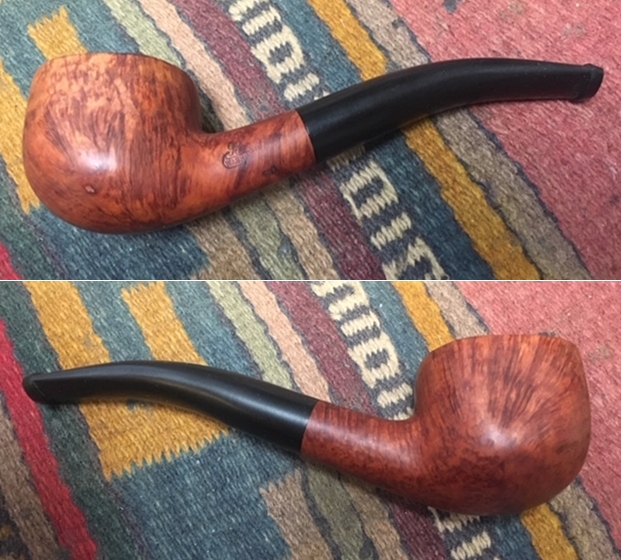
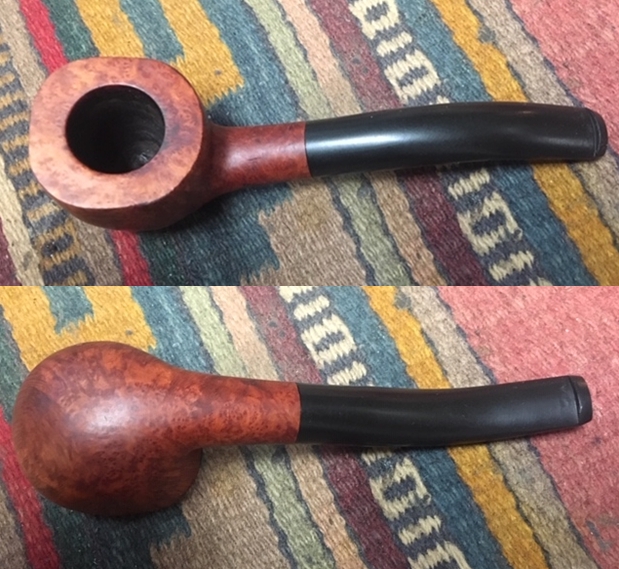
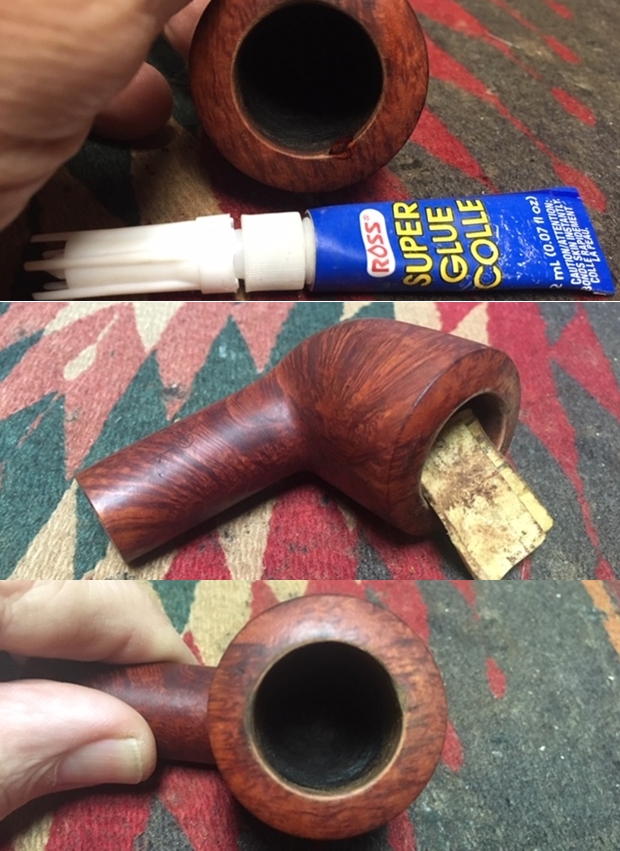
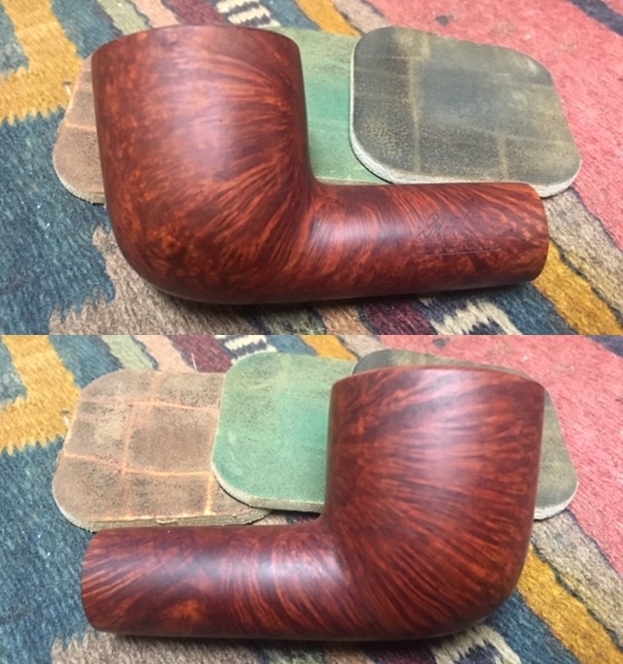
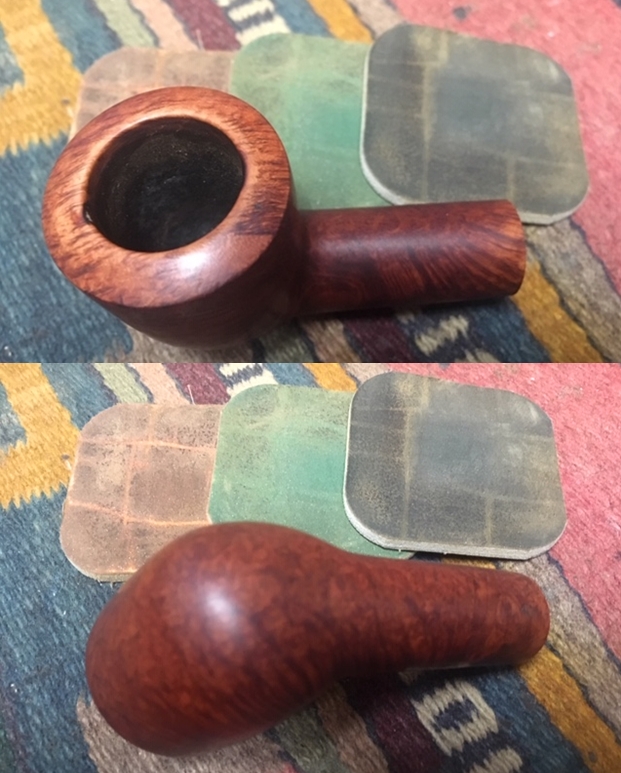
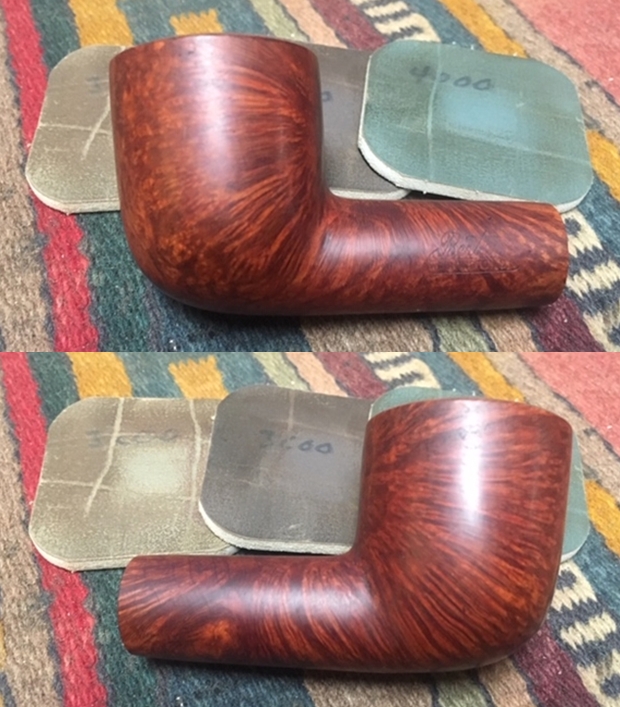
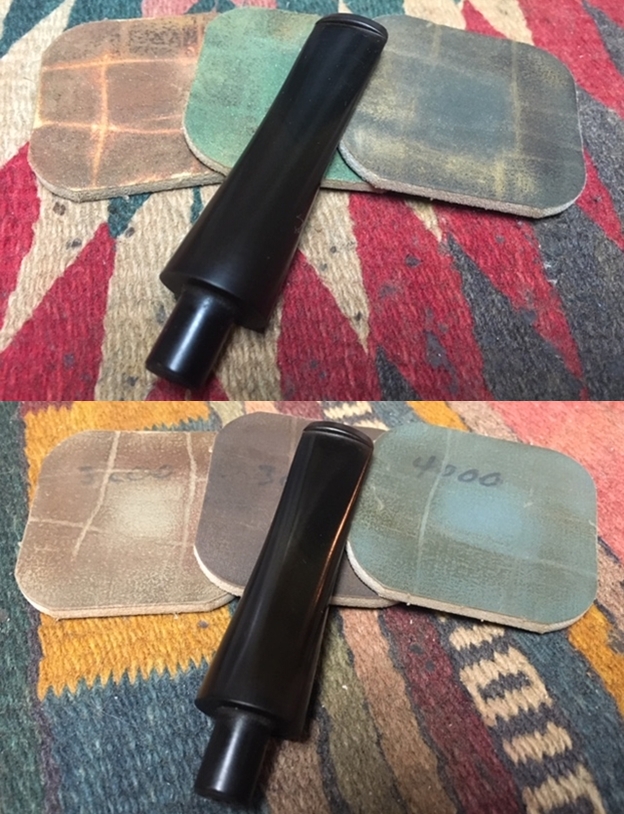
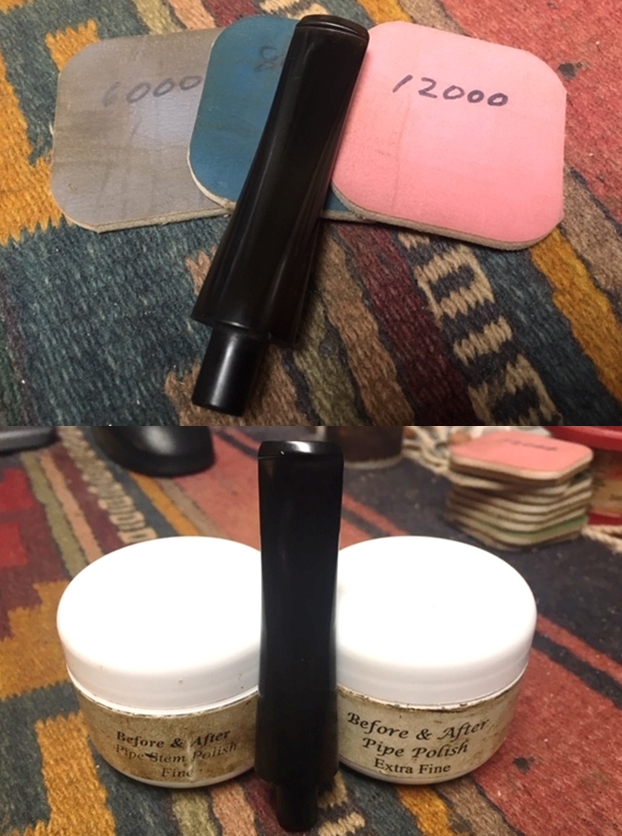
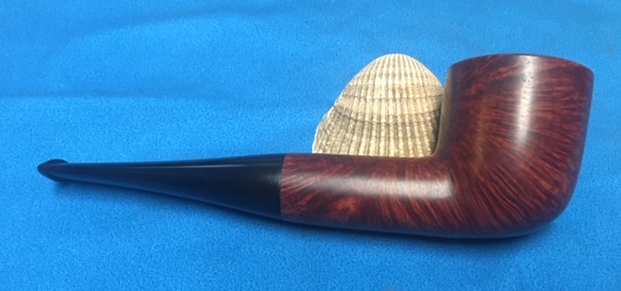
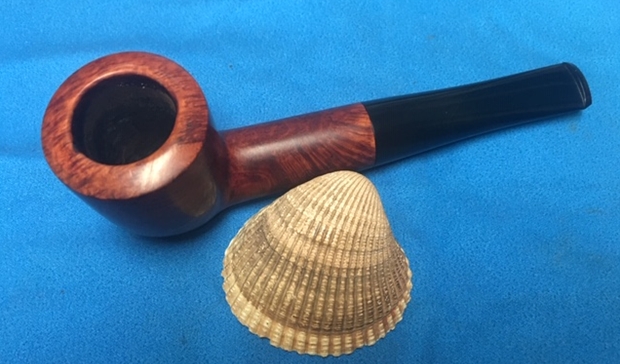
By now if you have been a reader for long you have Jeff’s cleaning regimen pretty well memorized. If you know it you can skip right to the pictures. If not I will include them once more. Jeff reamed the bowl with a PipNet pipe reamer and followed up with a Savinelli Fitsall pipe knife to remove the cake. He scrubbed out the mortise and the airway in the shank and the stem with alcohol, cotton swabs and pipe cleaners. He scrubbed the exterior of the bowl, rim, shank and stem with a tooth brush and Murphy’s Oil Soap to remove the oils and tars on the rim and the grime on the finish of the bowl. He rinsed it under running water. He dried it off with a soft cloth. He was able to remove lava build up on the rim top and you could see the great condition of the bowl top and edges of the rim. The rim and edges were in amazing condition. He soaked the stem in Before & After Deoxidizer to remove the oxidation. I took photos of the pipe before I started my work on it. I took a close up photo of the rim top to show the condition of the bowl and rim after Jeff had cleaned up the grime and lava. The lava left a little darkening on the rear rim top but otherwise the bowl looked very good. The stem photos show that the light oxidation is gone. The stem is in excellent condition with only light tooth chatter on both sides near the button.I took photos of the stamping to show how it looked after the cleanup. The Bertram Washington DC is faint on the right side of the stamp but it is still readable. I could not find any quality number on the sides of the shank.I cleaned up the damaged inner edge of the rim with a folded piece of 220 grit sandpaper. I cleaned up the sanding marks with 400 grit wet dry sandpaper.There was a large sandpit that had a loose fill on the back left side of the bowl. I picked out the dust, wiped it down with alcohol on a cotton pad. I dried it off and then filled it in with clear super glue. When the glue repair dried I sanded it with a folded piece of 220 grit sandpaper.I polished the bowl and rim top with micromesh sanding pads – wetsanding it with 1500-12000 grit pads. I wiped the bowl down with a damp cloth after each pad to remove the sanding debris. The grain began to stand out. After the final sanding pad I hand buffed it with a cotton cloth to raise a shine. I worked some Before & After Restoration Balm into finish of the briar with my fingertips to clean, enliven and protect it. I let the balm sit for a little while and then buffed with a cotton cloth to raise the shine. The Restoration Balm really makes the grain stands out beautifully. If you have not tried some why not give it a try. I sanded out the small tooth marks and chatter next to the button on both sides of the stem with a folded piece of 220 grit sandpaper. I followed that by sanding the stem with 400 grit wet dry sandpaper to remove the scratches. I polished out the sanding scratches with micromesh sanding pads – wetsanding it with 1500-12000 grit pads. I wiped the stem down with Obsidian Oil after each pad. I polished it with Before & After Pipe Polish – both Fine and Extra Fine and gave it a final coat and set it aside to dry. Jeff and I are gradually working through this 200+ lot dealing with each of the different challenges they present. This one is Bertram’s take on a classic Cutty shape. I put the stem and bowl back together and buffed the pipe with Blue Diamond on the buffing wheel. I polished the briar and the minute scratches still in the vulcanite of the stem until there was a rich shine. This one does not have a grade number but it is likely a 30-50 grade pipe judging from the grain and the small flaws and fills. It has a tapered stem at the end of a long shank. The finish really has some interesting grain on a proportionally well carved pipe. Once I buffed the pipe the briar came alive and the mixture of grain popped with polishing. The black vulcanite stem had a rich glow. The finished pipe is an interestingly grained Cutty. Like the other Bertrams I have worked on this one fits well in the hand and sits right in the mouth. Have a look at it with the photos below. The dimensions are Length: 6 inches, Height: 2 inches, Outside diameter of the bowl: 1 1/4 inches, Chamber diameter: 3/4 of an inch. Maybe this shape speaks to you and you want to add it to your collection. Rest easy, this one will soon be on the rebornpipes store. If you are interested let me know. Thanks for walking through the restoration with me as it was a pleasure to work on.

A Bertram 30 Pot/Lovat Pipe from the Bertram Lot


Blog by Steve Laug

Once again if you want the background on the lot of Bertram pipes that Jeff and I purchased please refer to the previous blog posts on the brand. Like I have said, words escape me in trying to adequately describe how overwhelmed I am when I look at the 200+ pipes that need to be restored. It is mind boggling but there is only one way to move ahead – 1 pipe at a time. I am glad Jeff is helping with the clean up on the lot as that would be more than I could handle by myself in moving through this many pipes. From his cleaned pipes I chose a beautifully grained Bertram 30 that was a either a long shank pot or a Lovat shape with a great look and line. The grain was a mix of grains – swirls, flame, cross and birdseye. It was a round bottom pipe with a saddle stem. The exterior of the bowl looked really good and there were no fills on this beauty. The bowl had cake in the chamber that was no problem. The rim top had some darkening and lava overflow on the back side. The inner and outer edges of the bowl look very good. The exterior of the briar looked lifeless and was dusty with the grime of years of storage. The stem had some oxidation and tooth chatter near the button on both sides. Jeff took some photos of the pipe before he began his cleanup work on it. Jeff took close-up photos of the bowl and rim to capture the condition of the pipe when it arrived. The rim top had a coat of lava and the bowl had a thick cake.Jeff took pictures of the bowl sides and the heel to show the great looking grain around the sides of the bowl. It really is quite stunning and very dirty! Jeff took a photo to capture the stamping on the left side of the shank. It shows the stamping which read Bertram over Washington, D.C. The stamping has been overstamped on the left of the impression. The second photo shows the number stamp at the bowl/shank junction on the left side of the shank. The number designates the quality of the pipe. The next two photos show the stem surface. They show the calcification, oxidation and the chatter on both sides near the button. There is also some wear on the button edge.Once again, if you have read the previous Bertram blogs I have posted about the pipes that I have cleaned up so far you can skip the next bit. But if you have not, then I include the link to Bertram history and information. I would recommend that if you don’t know much about them do some research on them. I include a link to the write up on Pipedia (http://pipedia.org/wiki/Bertram). Bertram pipes were based out of Washington DC. They were popular among famous politicians and celebrities of the time. They made many products for them from FDR’s cigarette holders to Joseph Stalin’s favorite pipe. They were considered some of the best America had to offer till they finally closed their doors in the 70s. They graded their pipes by 10s, the higher the grade the better. Above 60s are uncommon and 80-90s are quite rare. I’ve never heard of or seen a 100 grade. I have several blogs that I have written on rebornpipes that give some history and background to Bertram pipes. (https://rebornpipes.com/2015/06/16/an-easy-restoration-of-a-bertram-grade-60-217-poker/).

I have included the following link to give a bit of historical information on the pipe company. It is a well written article that gives a glimpse of the heart of the company. http://www.streetsofwashington.com/2012/01/bertrams-pipe-shop-on-14th-street.html#

From this information I have learned that the shape and grade Bertram I have in front of me now was made before the closure of the shop in the 1970s. This Bertram Pot/Lovat is slightly different from the other Bertram shapes I have worked. With a grade 30 stamp it is a lower mid-range pipe.

By now if you have been a reader for long you have Jeff’s cleaning regimen pretty well memorized. If you know it you can skip right to the pictures. If not I will include them once more. Jeff reamed the bowl with a PipNet pipe reamer and followed up with a Savinelli Fitsall pipe knife to remove the cake. He scrubbed out the mortise and the airway in the shank and the stem with alcohol, cotton swabs and pipe cleaners. He scrubbed the exterior of the bowl, rim, shank and stem with a tooth brush and Murphy’s Oil Soap to remove the oils and tars on the rim and the grime on the finish of the bowl. He rinsed it under running water. He dried it off with a soft cloth. He was able to remove lava build up on the rim top and you could see the great condition of the bowl top and edges of the rim. The rim and edges were in amazing condition. He soaked the stem in Before & After Deoxidizer to remove the oxidation. I took photos of the pipe before I started my work on it. I took a close up photo of the rim top to show the condition of the bowl and rim after Jeff had cleaned up the grime and lava. The lava left a little darkening on the rear rim top but otherwise the bowl looked very good. There is a small pinhole flaw on the top of the shank that I will need to take care of in the restoration. The stem photos show that the light oxidation is gone. The stem is in excellent condition with only light tooth chatter on both sides near the button.I took photos of the stamping to show how it looked after the cleanup. The Bertram Washington DC is still readable and clear. The quality number stamp was on the underside of the shank and read 30.I decided to fill in the pinhole flaw with clear super glue. I put a drop of glue in the hole and overfilled it to take shrinkage into account. Once the fill cured I sanded it smooth with 220 grit sand paper and 400 grit wet dry sandpaper.I polished the bowl and rim top with micromesh sanding pads – wetsanding it with 1500-12000 grit pads. I wiped the bowl down with a damp cloth after each pad to remove the sanding debris. The grain began to stand out. After the final sanding pad I hand buffed it with a cotton cloth to raise a shine. I worked some Before & After Restoration Balm into finish of the briar with my fingertips to clean, enliven and protect it. I let the balm sit for a little while and then buffed with a cotton cloth to raise the shine. The Restoration Balm really makes the grain stands out beautifully. If you have not tried some why not give it a try. I sanded out the small tooth marks and chatter next to the button on both sides of the stem with a folded piece of 220 grit sandpaper. I followed that by sanding the stem with 400 grit wet dry sandpaper to remove the scratches. I polished out the sanding scratches with micromesh sanding pads – wetsanding it with 1500-12000 grit pads. I wiped the stem down with Obsidian Oil after each pad. I polished it with Before & After Pipe Polish – both Fine and Extra Fine and gave it a final coat and set it aside to dry. I am continuing to enjoy restoring these pipes from the Bertram Collection and with Jeff’s cleanup work we are making progress through them. Each one presents different challenges but all are well laid out classic shapes. This is no exception. I put the stem and bowl back together and buffed the pipe with Blue Diamond on the buffing wheel. I polished the briar and the minute scratches still in the vulcanite of the stem until there was a rich shine. This Bertram is in interesting combination of a long shank Pot or a Lovat with a large bowl. It has a saddle stem. The finish really has some interesting grain on a proportionally well carved pipe. Once I buffed the pipe the briar came alive and the mixture of grain popped with polishing. The black vulcanite stem had a rich glow. The finished pipe is a beautiful grained Lovat/Pot. Like the other Bertrams I have worked on this one fits well in the hand and sits right in the mouth. Have a look at it with the photos below. The dimensions are Length: 5 1/2 inches, Height: 2 inches, Outside diameter of the bowl: 1 5/8 inches, Chamber diameter: 7/8 of an inch. Maybe this shape speaks to you and you want to add it to your collection. Rest easy, this one will soon be on the rebornpipes store. If you are interested let me know. Thanks for walking through the restoration with me as it was a pleasure to work on.


A Bertram 50S Lumberman Pipe from the Bertram Lot


Blog by Steve Laug

If you want the background on the lot of Bertram pipes that Jeff and I purchased please refer to the previous blog posts. I can’t adequately describe how overwhelmed I am when I look at the 200+ pipes that need to be restored. It is mind boggling but there is only one way to move ahead – 1 pipe at a time. I am glad Jeff is helping with the clean up on the lot as that would be more than I could handle by myself in moving through this many pipes. From his cleaned pipes I chose a beautifully grained Bertram 50S that was a Lumberman shape with a great look and line. The grain was a mix of grains – swirls, flame, cross and birdseye. It was a round bottom Lumberman pipe with a tapered stem. The exterior of the bowl looked really good and there were no fills on this beauty. The bowl had cake in the chamber that was no problem. The rim top had some darkening and lava overflow on the back side. The inner and outer edges of the bowl look very good. The exterior of the briar looked lifeless and was dusty with the grime of years of storage. The stem had some oxidation and tooth chatter near the button on both sides. Jeff took some photos of the pipe before he began his cleanup work on it. Jeff took close-up photos of the bowl and rim to capture the condition of the pipe when it arrived. The rim top had a coat of lava and the bowl had a thick cake. Jeff took pictures of the bowl sides and the heel to show the great looking grain around the sides of the bowl. You can see the fills on the front right side of the bowl. It really is quite stunning and very dirty! Jeff took a photo to capture the stamping on the left side of the shank. It shows the stamping which read Bertram over Washington, D.C. The second photo shows the number stamp on the underside of the shank at the shank/stem junction. The number designates the quality of the pipe. The next two photos show the stem surface. They show the calcification, oxidation and the chatter on both sides near the button. There is also some wear on the button edge.Once again, if you have read the previous Bertram blogs I have posted about the pipes that I have cleaned up so far you can skip the next bit. But if you have not, then I include the link to Bertram history and information. I would recommend that if you don’t know much about them do some research on them. I include a link to the write up on Pipedia (http://pipedia.org/wiki/Bertram). Bertram pipes were based out of Washington DC. They were popular among famous politicians and celebrities of the time. They made many products for them from FDR’s cigarette holders to Joseph Stalin’s favorite pipe. They were considered some of the best America had to offer till they finally closed their doors in the 70s. They graded their pipes by 10s, the higher the grade the better. Above 60s are uncommon and 80-90s are quite rare. I’ve never heard of or seen a 100 grade. I have several blogs that I have written on rebornpipes that give some history and background to Bertram pipes. (https://rebornpipes.com/2015/06/16/an-easy-restoration-of-a-bertram-grade-60-217-poker/).

I have included the following link to give a bit of historical information on the pipe company. It is a well written article that gives a glimpse of the heart of the company. http://www.streetsofwashington.com/2012/01/bertrams-pipe-shop-on-14th-street.html#

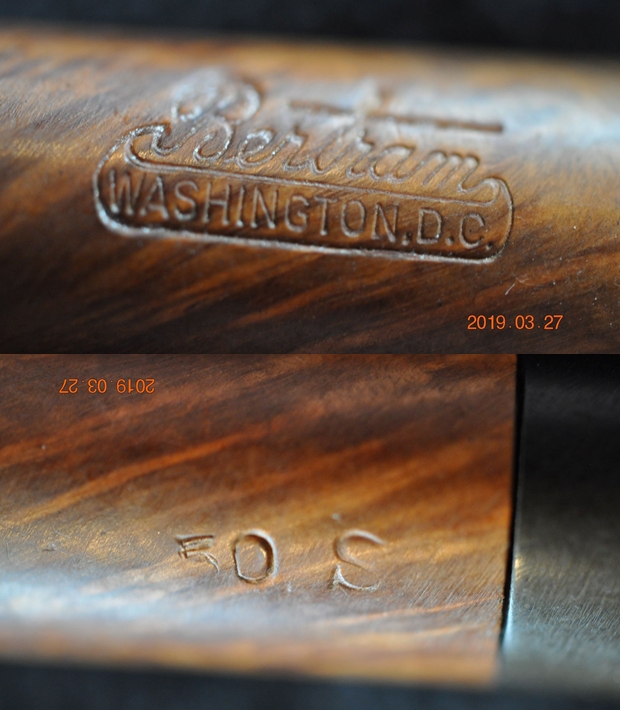
From this information I have learned that the shape and grade Bertram I have in front of me now was made before the closure of the shop in the 1970s. This Bertram Lumberman is slightly different from the other Bertram shapes I have worked. With a grade 50S stamp it is a mid-range        pipe. I have yet to figure out the “S” stamp on some of the higher grade pipes. Can anyone shed some light on this.

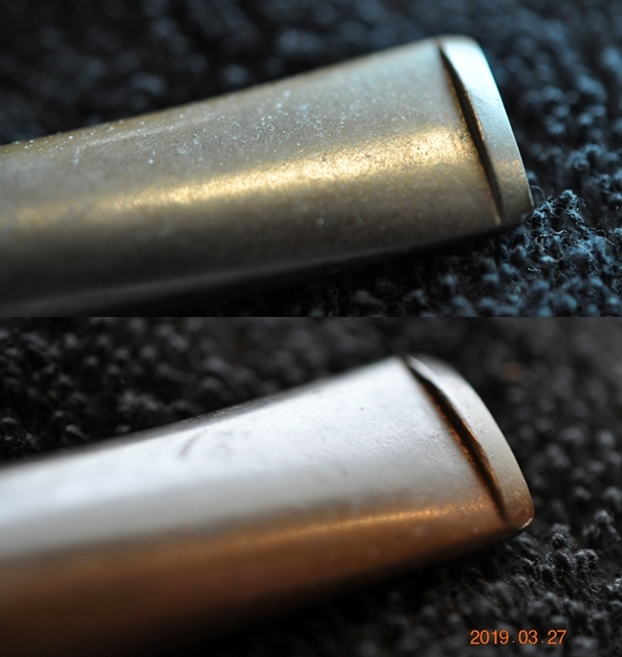
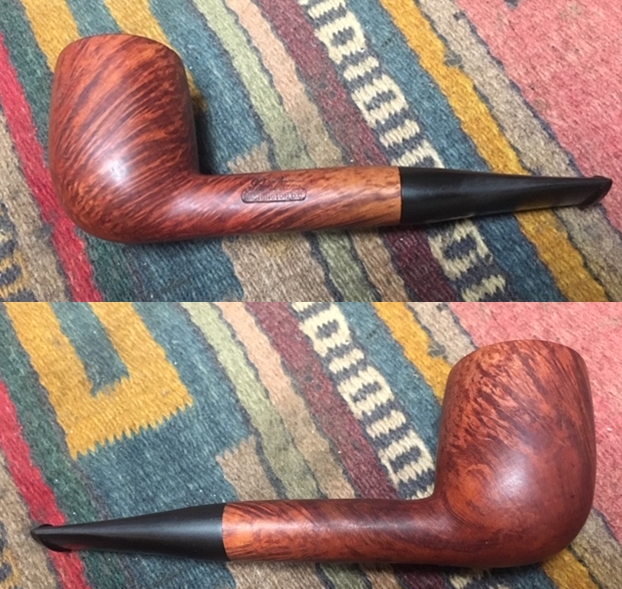
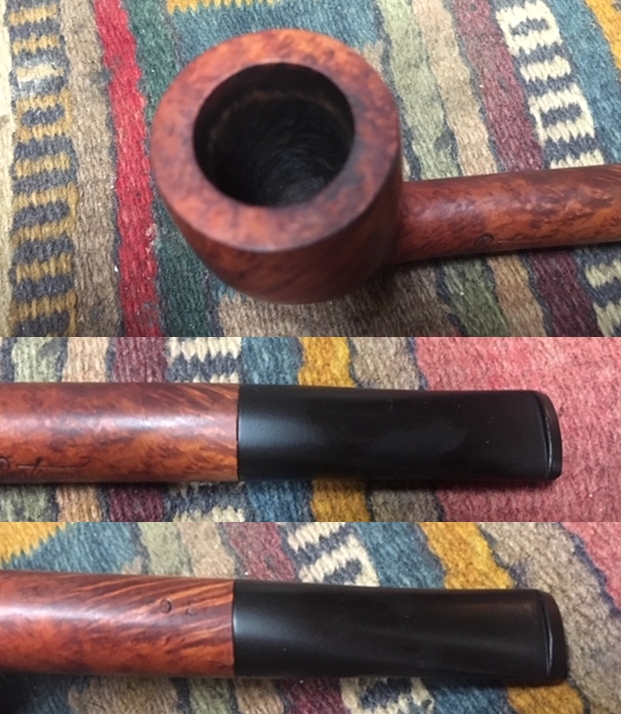
By now if you have been a reader for long you have Jeff’s cleaning regimen pretty well memorized. If you know it you can skip right to the pictures. If not I will include them once more. Jeff reamed the bowl with a PipNet pipe reamer and followed up with a Savinelli Fitsall pipe knife to remove the cake. He scrubbed out the mortise and the airway in the shank and the stem with alcohol, cotton swabs and pipe cleaners. He scrubbed the exterior of the bowl, rim, shank and stem with a tooth brush and Murphy’s Oil Soap to remove the oils and tars on the rim and the grime on the finish of the bowl. He rinsed it under running water. He dried it off with a soft cloth. He was able to remove lava build up on the rim top and you could see the great condition of the bowl top and edges of the rim. The rim and edges were in amazing condition. He soaked the stem in Before & After Deoxidizer to remove the oxidation. I took photos of the pipe before I started my work on it. I took a close up photo of the rim top to show the condition of the bowl and rim after Jeff had cleaned up the grime and lava. The lava left a little darkening on the rear rim top but otherwise the bowl looked very good. The inner edge has some small nicks at the back of the bowl. The stem photos show that the light oxidation is gone. The stem is in excellent condition with only light tooth chatter on both sides near the button.I took photos of the stamping to show how it looked after the cleanup. The Bertram Washington DC is still readable and clear. The quality number stamp was on the underside of the shank and read 50S.I polished the bowl and rim top with micromesh sanding pads – wetsanding it with 1500-12000 grit pads. I wiped the bowl down with a damp cloth after each pad to remove the sanding debris. The grain began to stand out. After the final sanding pad I hand buffed it with a cotton cloth to raise a shine. I know I have mentioned it before but I really like the balm that Mark Hoover created. It really does wonders on a dry piece of briar. I worked some Before & After Restoration Balm into finish of the briar with my fingertips to clean, enliven and protect it. I let the balm sit for a little while and then buffed with a cotton cloth to raise the shine. The Restoration Balm really makes the grain stands out beautifully. If you have not tried some why not give it a try. I sanded out the small tooth marks and chatter next to the button on both sides of the stem with a folded piece of 220 grit sandpaper. I followed that up with 400 grit wet dry sandpaper.I polished out the sanding scratches with micromesh sanding pads – wetsanding it with 1500-12000 grit pads. I wiped the stem down with Obsidian Oil after each pad. I polished it with Before & After Pipe Polish – both Fine and Extra Fine and gave it a final coat and set it aside to dry. I am having fun doing these pipes from the Bertram Collection. Each one presents different challenges but all are well laid out classic shapes. This is no exception. I put the stem and bowl back together and buffed the pipe with Blue Diamond on the buffing wheel. I polished the briar and the minute scratches still in the vulcanite of the stem until there was a rich shine. This Bertram is in interesting take on a Lumberman shape with tapered stem. The finish really highlights some interesting grain on a proportionally well carved pipe. Once I buffed the pipe the briar came alive and the mixture of grain popped with polishing. The black vulcanite stem had a rich glow. The finished pipe is a beautiful grained Lumberman. Like the other Bertrams I have worked on this one fits well in the hand and sits right in the mouth. Have a look at it with the photos below. The dimensions are Length: 6 inches, Height: 2 inches, Outside diameter of the bowl: 1 1/2 inches, Chamber diameter: ¾ of an inch. Maybe this shape speaks to you and you want to add it to your collection. Rest easy, this one will soon be on the rebornpipes store. If you are interested let me know. Thanks for walking through the restoration with me as it was a pleasure to work on.

A 1/2 Bent Bertram 20 Danish Shaped Pipe from the Bertram Lot


Blog by Steve Laug

If you want the background on the lot of Bertram pipes that Jeff and I purchased please refer to the previous blog posts. I can’t adequately describe how overwhelmed I am when I look at the 200+ pipes that need to be restored. It is mind boggling but there is only one way to move ahead – 1 pipe at a time. I am glad Jeff is helping with the clean up on the lot as that would be more than I could handle by myself in moving through this many pipes. From his cleaned pipes I chose an unusual Bertram 20 that was a 1/2 bent Danish looking pipe. The grain was a mix of grains – swirls, flame, cross and birdseye. It was a round bottom billiard type pipe with a tapered stem. The exterior of the bowl looked pretty good other than a large fill on the right side toward the bottom of the bowl. The bowl had cake in the chamber that was no problem. The rim top had some darkening and lava overflow on the back side. The inner and outer edges of the bowl look very good. The exterior of the briar looked lifeless and was dusty with the grime of years of storage. The stem had some oxidation and tooth chatter near the button on both sides. Jeff took some photos of the pipe before he began his cleanup work on it. Jeff took a close-up photo of the bowl and rim to capture the condition of the pipe when it arrived. The rim top had a coat of lava and the bowl had a thick cake.Jeff took pictures of the bowl sides and the heel to show the great looking grain around the sides of the bowl. You can see the fills on the front right side of the bowl. It really is quite stunning and very dirty!Jeff took a photo to capture the stamping on the left side of the shank. It shows the stamping which read Bertram over Washington, D.C. The stamping on this pipe is a faint on the right side of the impression. The second photo shows the number stamp below the brand stamp on the shank. The number designates the quality of the pipe. The next two photos show the stem surface. They show the calcification, oxidation and the chatter on both sides near the button. There is also some wear on the button edge.Once again, if you have read the previous Bertram blogs I have posted about the pipes that I have cleaned up so far you can skip the next bit. But if you have not, then I include the link to Bertram history and information. I would recommend that if you don’t know much about them do some research on them. I include a link to the write up on Pipedia (http://pipedia.org/wiki/Bertram). Bertram pipes were based out of Washington DC. They were popular among famous politicians and celebrities of the time. They made many products for them from FDR’s cigarette holders to Joseph Stalin’s favorite pipe. They were considered some of the best America had to offer till they finally closed their doors in the 70s. They graded their pipes by 10s, the higher the grade the better. Above 60s are uncommon and 80-90s are quite rare. I’ve never heard of or seen a 100 grade. I have several blogs that I have written on rebornpipes that give some history and background to Bertram pipes. (https://rebornpipes.com/2015/06/16/an-easy-restoration-of-a-bertram-grade-60-217-poker/).

I have included the following link to give a bit of historical information on the pipe company. It is a well written article that gives a glimpse of the heart of the company. http://www.streetsofwashington.com/2012/01/bertrams-pipe-shop-on-14th-street.html#

From this information I have learned that the shape and grade Bertram I have in front of me now was made before the closure of the shop in the 1970s. This Bertram Danish Shaped with a 1/2 bent stem is different from the other Bertram shapes I have worked. With a grade 20 stamp it is a lower range pipe.

By now if you have been a reader for long you have Jeff’s cleaning regimen pretty well memorized. If you know it you can skip right to the pictures. If not I will include them once more. Jeff reamed the bowl with a PipNet pipe reamer and followed up with a Savinelli Fitsall pipe knife to remove the cake. He scrubbed out the mortise and the airway in the shank and the stem with alcohol, cotton swabs and pipe cleaners. He scrubbed the exterior of the bowl, rim, shank and stem with a tooth brush and Murphy’s Oil Soap to remove the oils and tars on the rim and the grime on the finish of the bowl. He rinsed it under running water. He dried it off with a soft cloth. He was able to remove lava build up on the rim top and you could see the great condition of the bowl top and edges of the rim. There was still some darkening to the rim top toward the back of the bowl. He soaked the stem in Before & After Deoxidizer to remove the oxidation. I took photos of the pipe before I started my work on it. I took a close up photo of the rim top to show the condition of the bowl and rim after Jeff had cleaned up the grime and lava. The lava left a little darkening on the rear rim top but otherwise the bowl looked very good. The inner edge has some small nicks at the back of the bowl. The stem photos show that the light oxidation is gone. The stem is in excellent condition.I took photos of the stamping to show how it looked after the cleanup. The Bertram Washington DC is still readable and clear. The quality number stamp was missing the second number before and it is still not visible. The first number 2 is clear. The pipe could be a 20 or a 25.The large fill on the lower front side of the bowl is very visible. It is solid so I intend to leave it alone. I sanded it with 220 grit sandpaper to ensure that it was smooth to touch. The outer edges of the fill were a little rough before so sanding took care of that issue. There were also some deep gouges on the bowl on the left side next to the shank bowl junction. I filled them in with clear super glue and sanded them with the 220 grit sandpaper. I used a folded piece of 200 grit sandpaper to smooth out the inner edge of the rim and remove the nicks and damage.I polished the bowl and rim top with micromesh sanding pads – wetsanding it with 1500-12000 grit pads. I wiped the bowl down with a damp cloth after each pad to remove the sanding debris. The grain began to stand out. After the final sanding pad I hand buffed it with a cotton cloth to raise a shine. I know I have mentioned it before but I really like the balm that Mark Hoover created. It really does wonders on a dry piece of briar. I worked some Before & After Restoration Balm into finish of the briar with my fingertips to clean, enliven and protect it. I let the balm sit for a little while and then buffed with a cotton cloth to raise the shine. The Restoration Balm really makes the grain stands out beautifully. If you have not tried some why not give it a try. The stem was in great condition when I received it. I polished out the sanding scratches with micromesh sanding pads – wetsanding it with 1500-12000 grit pads. I wiped the stem down with Obsidian Oil after each pad. I polished it with Before & After Pipe Polish – both Fine and Extra Fine and gave it a final coat and set it aside to dry. I am having fun doing these pipes from the Bertram Collection. Each one presents different challenges but all are well laid out classic shapes. This is no exception. I put the stem and bowl back together and buffed the pipe with Blue Diamond on the buffing wheel. I polished the briar and the minute scratches still in the vulcanite of the stem until there was a rich shine. This Bertram is in interesting take on a bent Danish shape with tapered stem. The finish really highlights some interesting grain on a proportionally well carved pipe. Even the fills do not distract and look all right on the polished pipe. Once I buffed the pipe the briar came alive and the mixture of grain popped with polishing. The black vulcanite stem had a rich glow. The finished pipe is a beautiful grained Bent Danish. Like the other Bertrams I have worked on this one fits well in the hand and sits right in the mouth. Have a look at it with the photos below. The dimensions are Length: 6 inches, Height: 2 inches, Outside diameter of the bowl: 1 1/2 inches, Chamber diameter: ¾ of an inch. Maybe this shape speaks to you and you want to add it to your collection. Rest easy, this one will soon be on the rebornpipes store. If you are interested let me know. Thanks for walking through the restoration with me as it was a pleasure to work on.

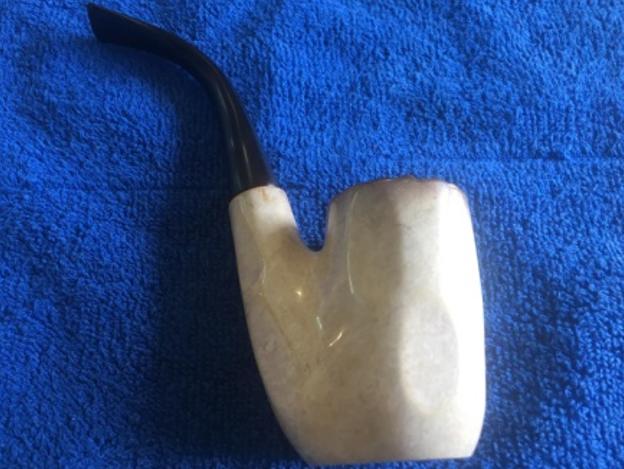
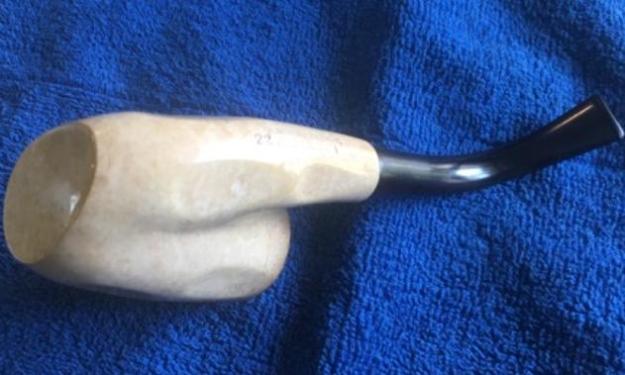
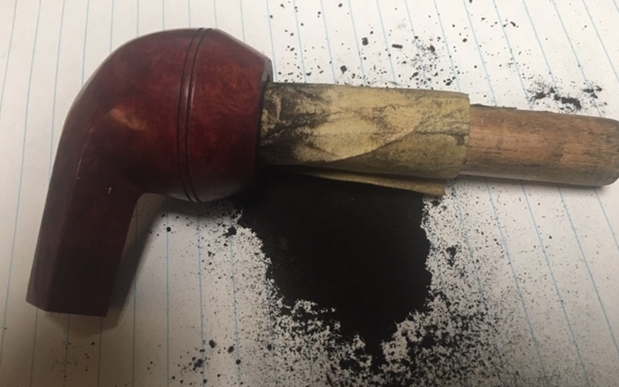
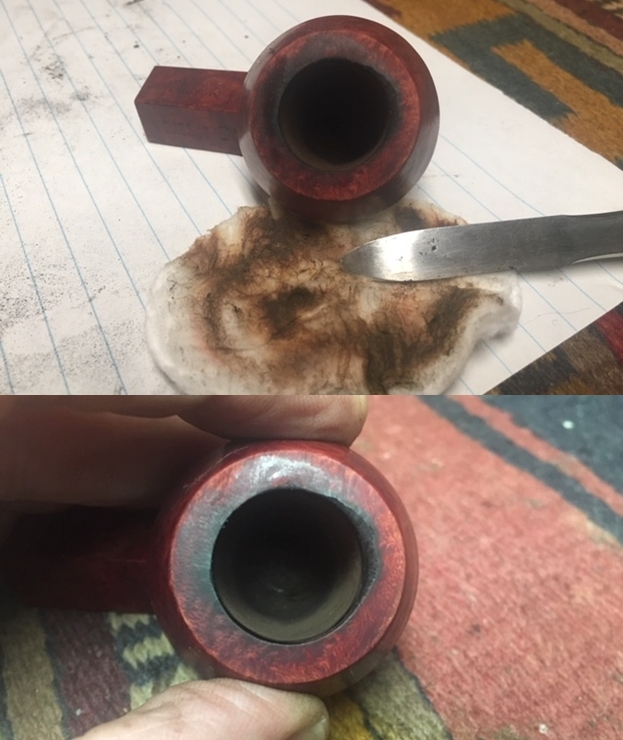
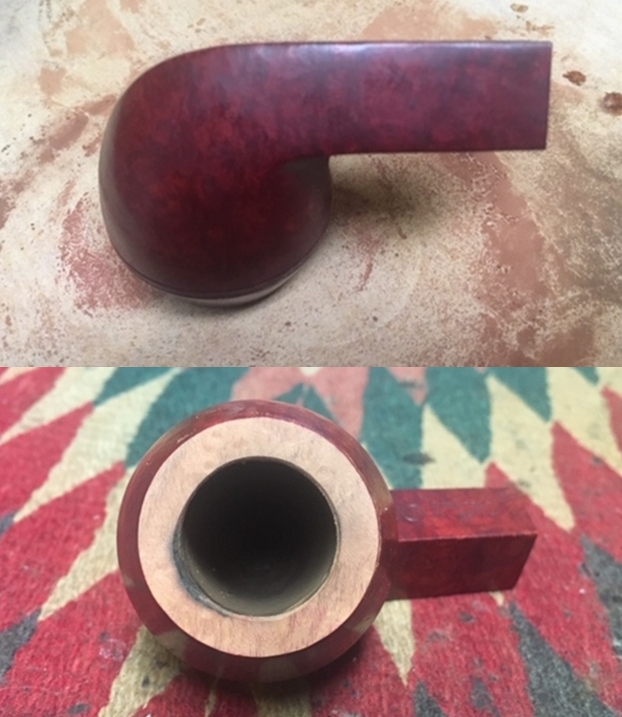
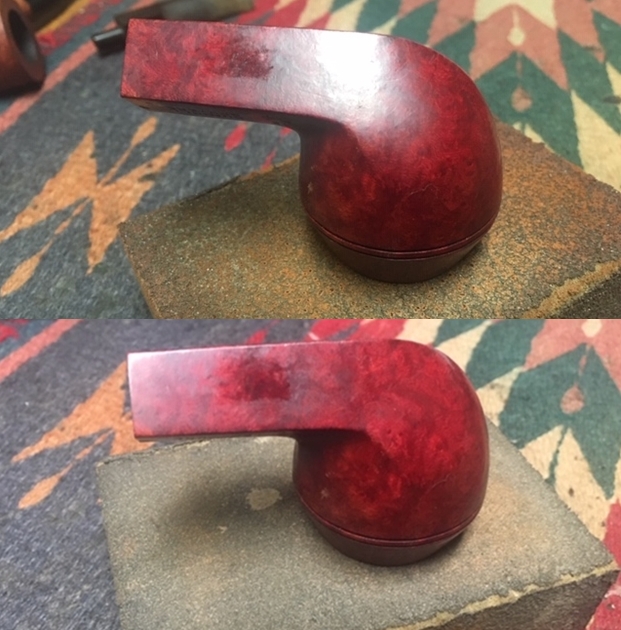
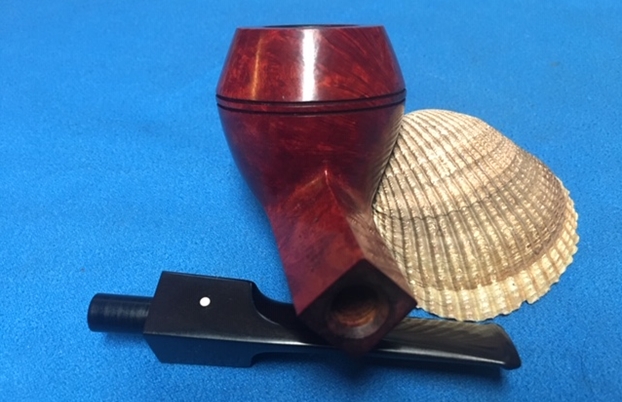
…And Steve and Jeff Laug bid adios with this restoration: a Block Meerschaum # 22!!!


Blog by Paresh Deshpande

From the heading of this post, it is but natural to infer that this would be the last pipe that Abha, Steve, Jeff and I selected to work on before we bid our farewells, but the on-ground fact is this was selected and work commenced on this pipe after we had completed the restoration of an 1846 made BBB with Amber stem from my inheritance. Here is the link to the write up which was penned by Dal Stanton –

https://rebornpipes.com/2019/05/30/west-meets-east-in-india-to-restore-a-grandsons-treasure-an-1846-bbb/

When your life partner supports you in your hobby of restoring pipes and even helps you by doing the dirty work of initial cleaning of an estate pipe, you should be thankful to her and God for the match. And if you don’t want to rock this boat, always acquiesce with their likes and suggestion…I am a wise man too!!

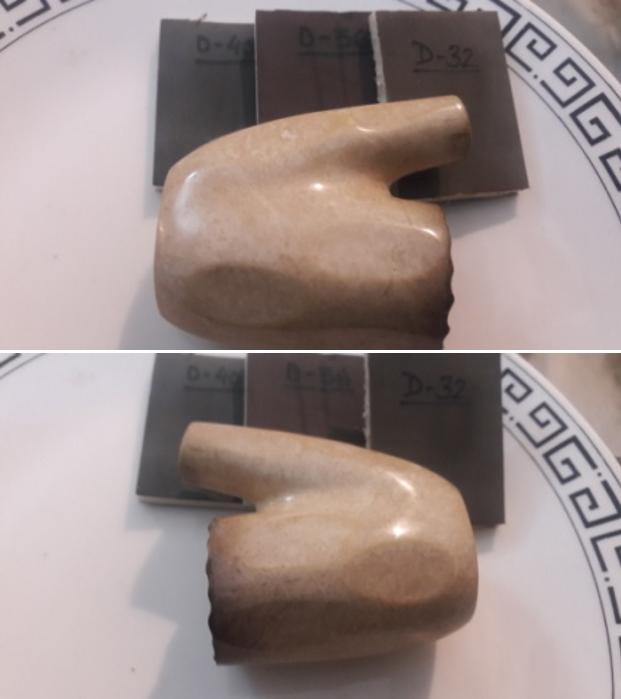
Well, the above musings is the rationale for our owning this pipe in the first place. Abha, my wife, saw this pipe on eBay as I was surfing and she made a passing comment of liking the shape and look of this pipe. Her passing comment was akin to a decision and lucky for me, my bid won. I paid single digit USD for the pipe and a whopping cost of shipping when the pipe reached me about 6 months ago. When Steve and Jeff reached us on a visit, along with other gifts and pipes, Jeff had brought along “Before and After Stem deoxidizer” which I had Mark Hoover ship to Jeff in Idaho, USA to save on the costs of shipping. During one of our discussions, the efficacy of this solution in removing very heavy oxidation from the stem without resorting to any further invasive procedure cropped up. It was then decided to select one of the most heavily oxidized stem from my collection and subject the deoxidizing solution to stringent test. This is, thus, how the Meer came to the fore for restoration and the fact that it was Abha’s choice of pipe, made her happy.

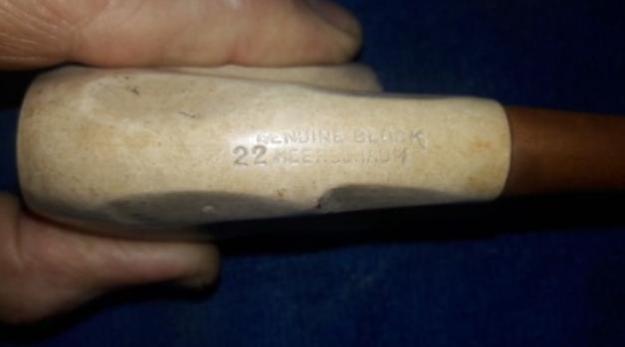
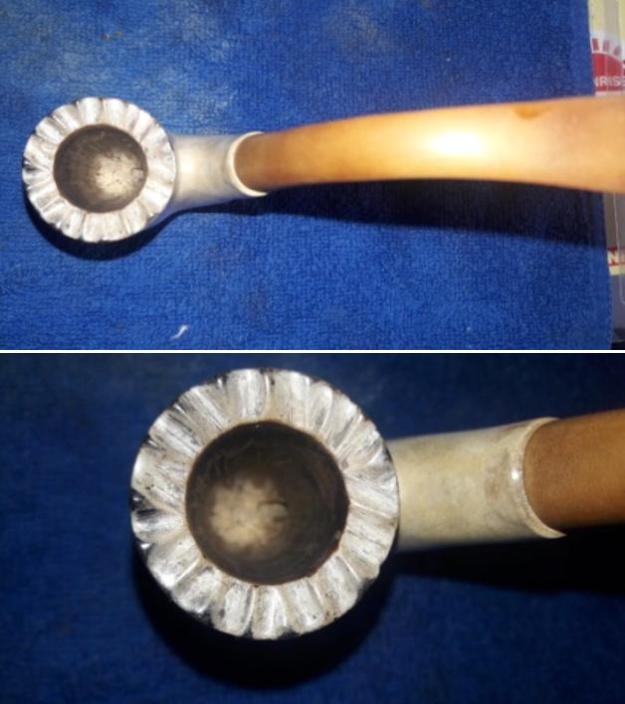
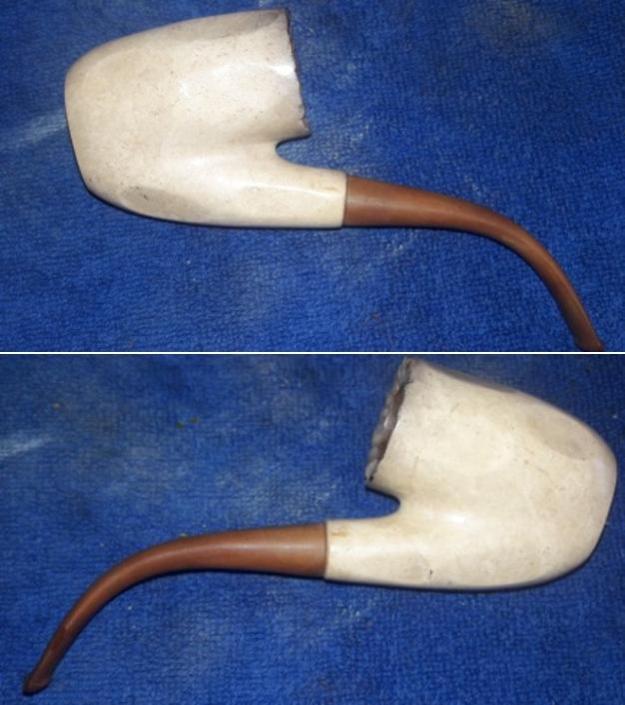
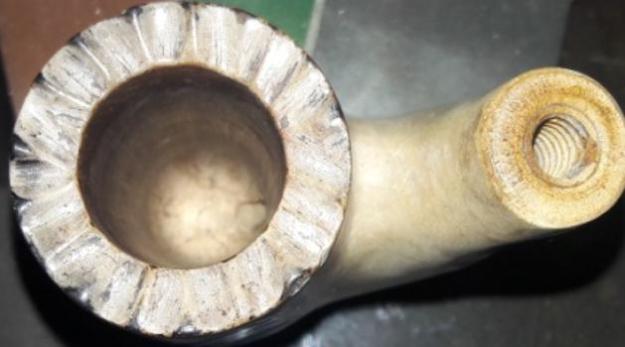
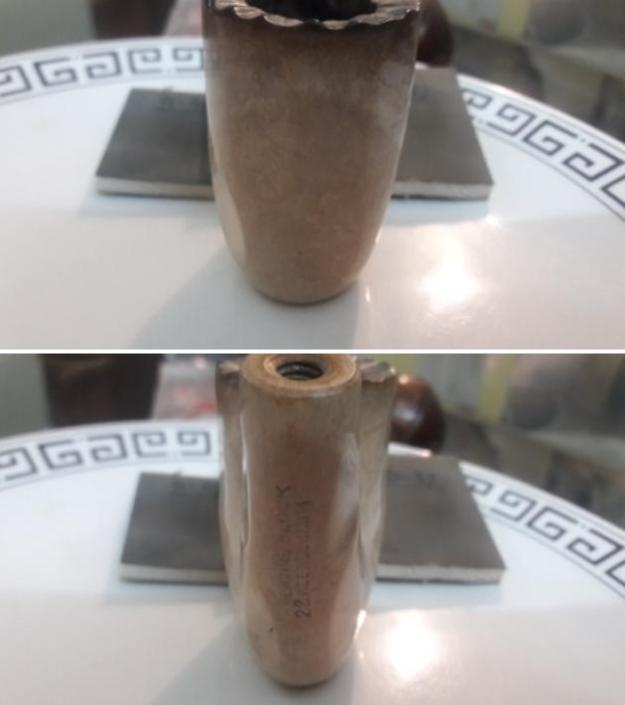
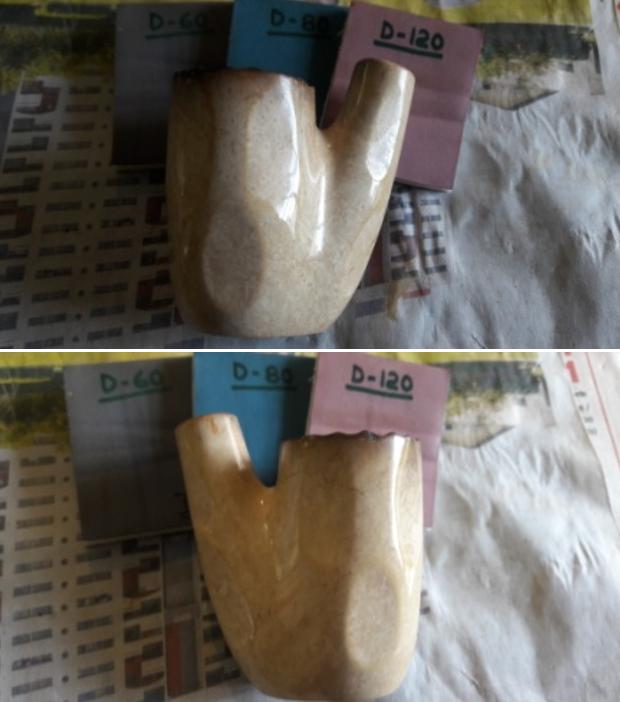
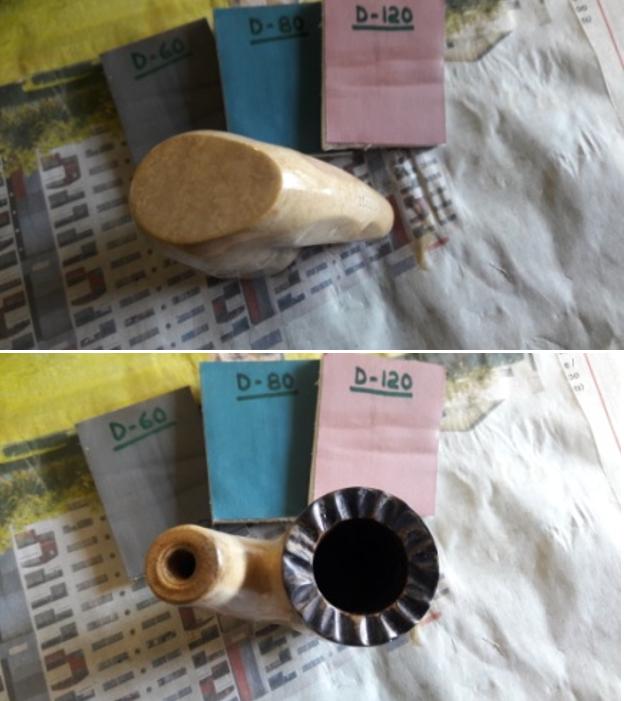
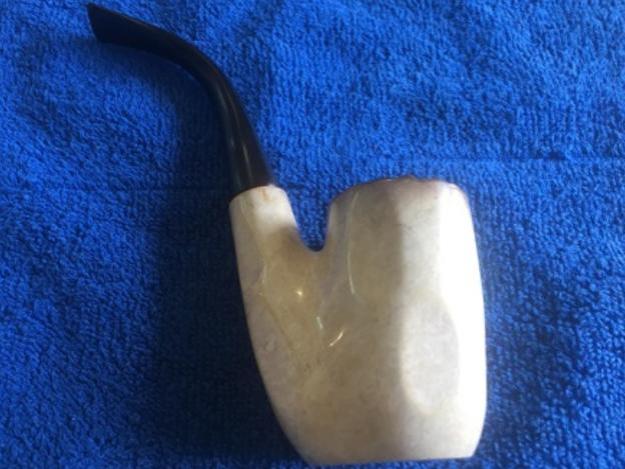
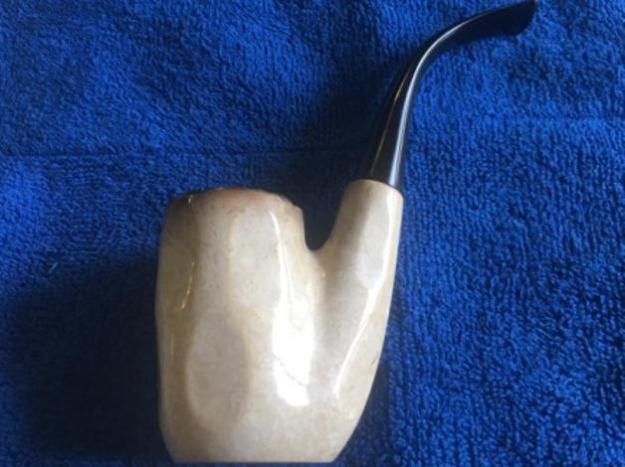
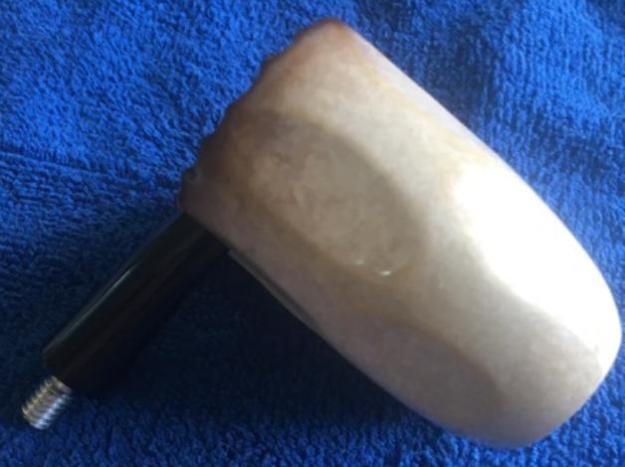
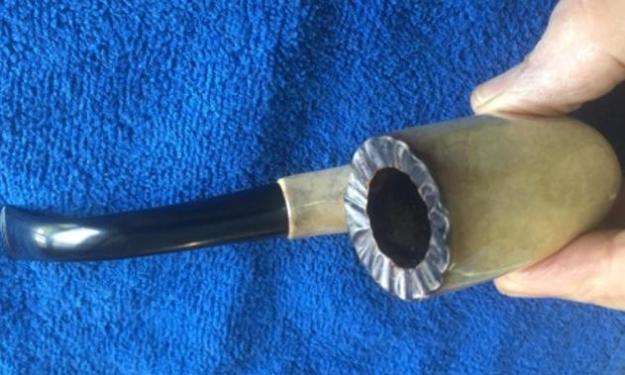
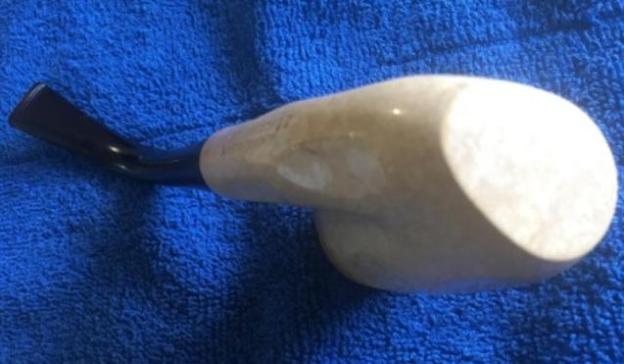
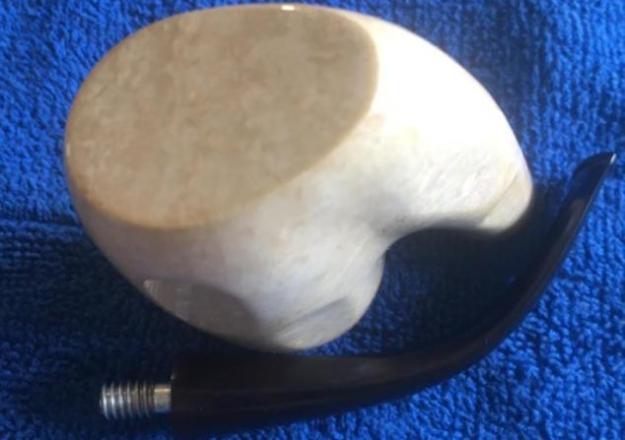
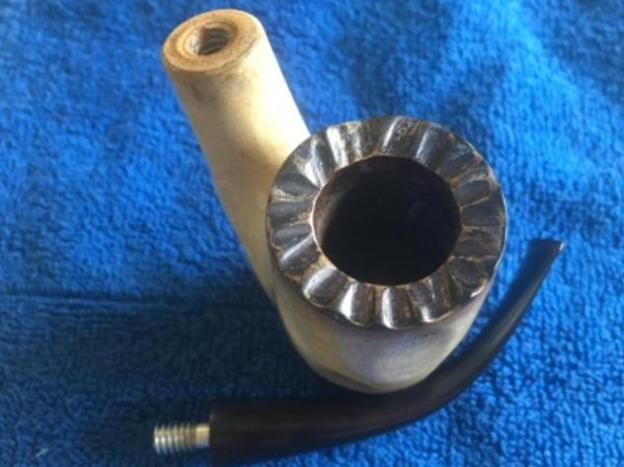
This well made pipe has a beautiful Oom Paul shape with shallow non geometrical concave panels all around. The rim top shows large and evenly serrated surface. The rim top surface appears to have been painted black which has worn out over time.  The bottom of the shank is stamped as “GENUINE BLOCK” over “MEERSCHAUM” with #22 on the left, probably the shape code. The underside of the screw-in vulcanite stem surface bears a very faint stamp of “MADE IN TAN…….IA”, could be and logically most likely is, Tanzania!!The lack of any distinguishing maker’s stamps on the bowl makes it impossible to date and comment upon this pipe. The stamping on the stem points to this pipe as being made in Tanzania, probably by Amboseli? All that I can say is that this a beautiful, well made pipe that feels nice in the hand.

INITIAL VISUAL INSPECTION
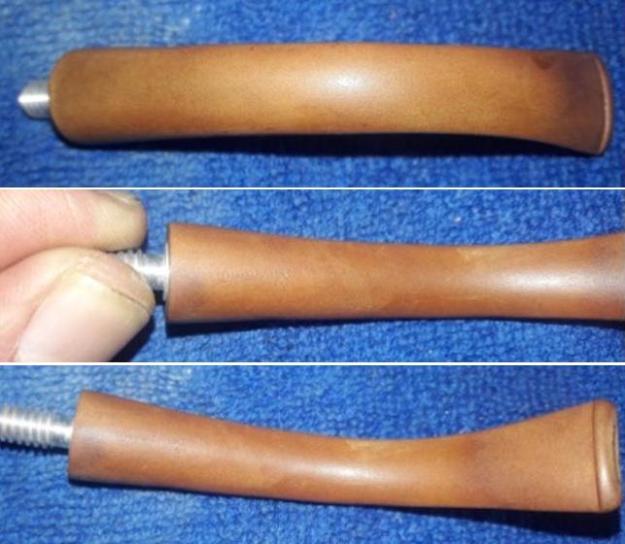
This is virtually an un-smoked pipe with no cake in the chamber. However there are a few scratches on the walls of the chamber. The serrated rim top surface and the rim edges are in pristine condition. The darkened rim top surface points it to have been painted black to provide a contrast with the white of the meerschaum and which over a period of time has been rubbed off. The draught hole is perfectly at the bottom center and should be a great smoker.The stummel surface is covered with minor scratches and one odd very minor chip commensurate with uncared storage and age (??). The stummel has yellowed at some places and appears lifeless being covered in dust and dirt. These issues should not pose any trouble while being addressed. The shank end is clean and air flow is full and smooth. Running a few pipe cleaners dipped in isopropyl alcohol should freshen up the shank internals. The main protagonist of the entire exercise is this heavily oxidized stem!! To be very honest, I have not seen a more heavily oxidized stem since the time I was introduced to the art of pipe restoration. Even the gentleman who coaxed/ cajoled me in to this wonderful world, Mr. Steve, was unanimous in his comment of this being one of the many most heavily oxidized stems that he has come across….. And he has seen many!!! The threaded metal tenon is clean and shining almost like new. The air flow through the stem is open and full. Again, one odd pipe cleaner through the stem air way should clean out any traces of dust and dirt that could have lodged itself in the stem.THE PROCESS
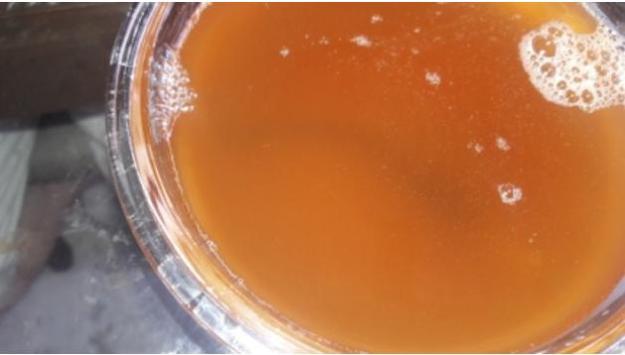
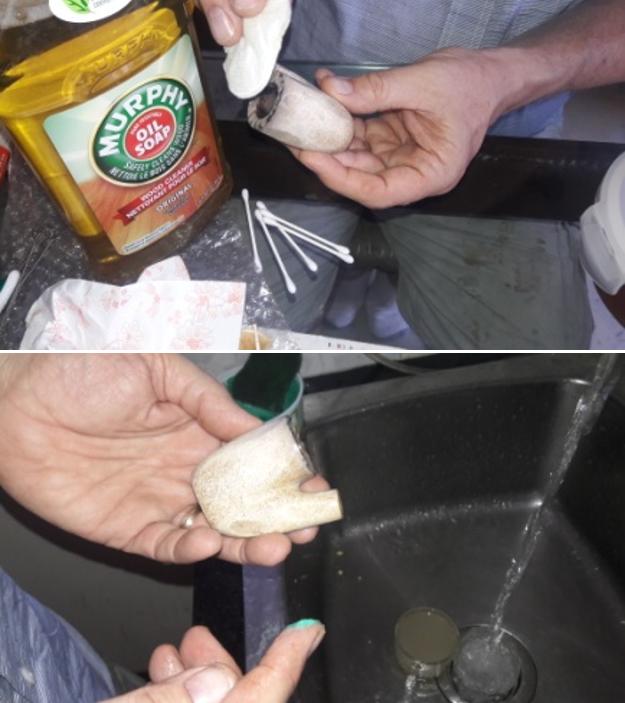
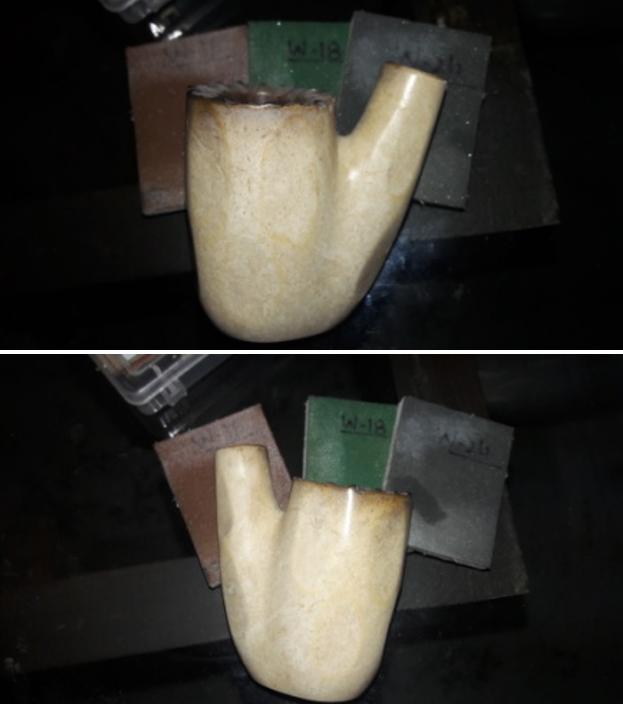
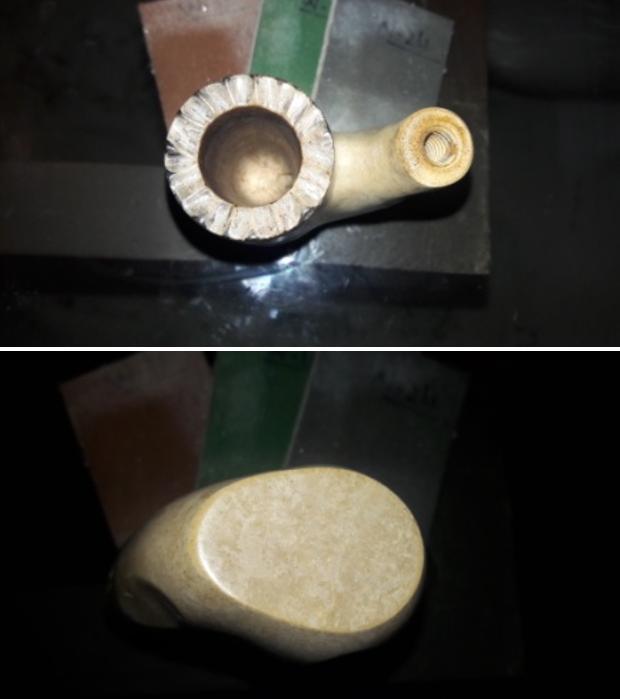
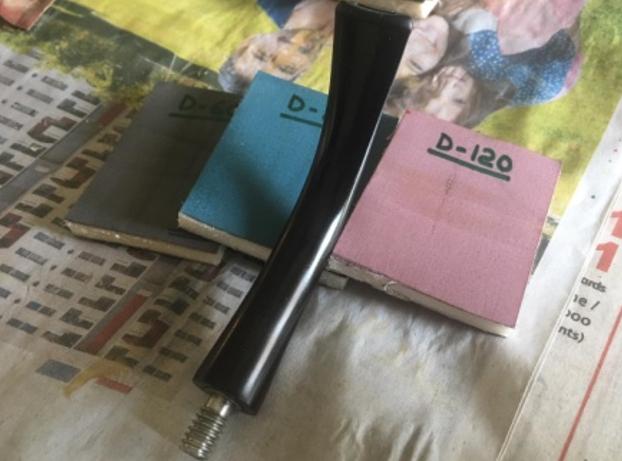
Since the aim of selecting this pipe for restoration was to check the efficacy of the “Before and After Deoxidizer” solution, this was also the start point. Jeff ran a couple of pipe cleaners dipped in isopropyl alcohol through the stem just to make sure that the air way is clean and open. Thereafter, he immersed this stem in to the deoxidizer solution and let it sit for 6 hours.While the stem was soaking in the deoxidizer solution, Pavni, my younger daughter who loves and specializes in working the chamber walls to a smooth surface, worked on the chamber walls with a folded piece of a 220 grit sand paper to a smooth and an even surface.Once Pavni was through with her work, Jeff took over further cleaning of the stummel. He began by cleaning the stummel and rim top surface with Murphy’s Oil soap on a cotton swab to remove the dust and remnants of the black coloration from the serrated rim top. He followed it up by further cleaning the stummel with a dish washer paste on his finger tip till all the accumulated dirt and dust was removed and thoroughly rinsed it under running tap water. Jeff also cleaned the internals of the shank with q tips and pipe cleaner dipped in isopropyl alcohol. I took over from where Jeff had left and began polishing the stummel with micromesh pads, dry sanding the entire stummel with 1500 to 12000 grit pads. The stummel now has a nice smooth and shiny surface. I wiped the stummel and each pad with a soft slightly moist cloth to remove the meerschaum dust from the surface. Once I was done with the micromesh pads, Steve decided to blacken the rim top surface using a permanent black marker. Since the burning tobacco would not be in contact with the rim surface, this should have no harmful effect while the pipe is being smoked. This darkening of the rim top surface transformed the complete appearance of this Oom Paul as can be seen in the last picture.  All the while, the stem was soaking in the deoxidizer solution. At the end of this stage, we got the stem out of the solution only to find that there was not much effect on the oxidation (as can be seen from the picture below) and it was then unanimously decided to let the stem soak overnight. That decided we sat down peacefully for our Single Malt Scotch, pipe smoking and discussing pipes, tobaccos and other things in general. The best part of such times was that Dal, Steve and Jeff ensured that everyone was part of the conversation by discussing and talking on topics wherein my daughters could also participate. My daughters adore these gentlemen!!The next dawn came with the excitement of seeing the result of the fight between the deoxidizer and the stubborn stem oxidation. After a hearty breakfast, we flocked around Jeff, our undisputed expert on cleaning and in use of this solution. Jeff removed the stem from the solution, washed it under running water, blew through the stem to remove any solution that had entered in the stem air way and rigorously cleaned it with a microfiber cloth. We all closely observed the result. Though at this stage, the stem did appear black, but the oxidation was still very much visible.Dal suggested cleaning the stem surface with Murphy’s Oil soap to see if that made any difference. We tried it without much success, though there was some improvement. Next Steve suggested to rub a small quantity of “Before and After Restoration” balm in to the stem surface. Although the stem was now completely black in appearance, we knew that underneath the blackness still lurks the ugly oxidation. We tried cleaning it with isopropyl alcohol and Fine and Extra fine stem polish (both products developed by Mark Hoover). All that has happened is that this residual oxidation was just masked. We kept wondering what is it that Mark does to the stem that they come out shining like they do just after a soak in this solution.When all other ideas and permutations/ combinations failed, I suggested the good old method of using sand paper to remove the oxidation, which incidentally was also the last resort!! This task fell on to the participant who had suggested it in the first place. So there I was, again in my familiar territory of sanding the stem with a 220 grit sand paper and following it up with 400, 600 and 800 grit papers. I followed it up with polishing the stem, going through the micromesh cycle of wet sanding with 1500 to 12000 grit pads. I rubbed a small quantity of Extra Virgin Olive oil in to the stem and set it aside for it to be absorbed by the vulcanite. To finish the pipe, Steve generously rubbed some natural Bee’s Wax in to the stummel surface and set it aside to coat the stummel surface. The prevalent heat here ensured that the wax remained melted and absorbed in the meerschaum! I mounted a clean cotton buffing wheel on to my hand held rotary tool and gave it a nice buffing. I polished the stem, applying carnauba wax with the rotary tool. The pipe, after marrying the stem and stummel looks amazing, to say the least. Have a look at it in the pictures below. The smile on Abha’s face and in her eyes made it well worth the effort and beyond. I wish to make it amply clear here that these conclusions are not laboratory results or a result of sterile and accurate experimentation processes under ideal conditions. This was just a fun filled attempt at attaining the level of finish which our friend Mr. Mark Hoover achieves by just a soak in to this solution. To summarize the findings, we all narrowed down to these followings facts: –

(a) Slight to slightly heavy stem oxidation is very effectively addressed by soaking in the solution of “Before and After Deoxidizing” solution followed by rigorous wipe with a microfiber cloth.

(b) Very heavy/ severely oxidized stem, similar to the one on this pipe, we could not completely remove the oxidation from the stem surface without resorting to invasive processes like sanding with grit papers etc. The oxidation was only masked, but not removed. However, the oxidation had loosened greatly and made further progress easy and rapid. This does save considerable time. It can be inferred that the heavily oxidized stem may be soaked twice for better results.

The outcome of all this is that this is an amazing product and will ease your work on stem. This could form a part of your “MUST HAVE” list while embarking on the journey in to world of pipe restoration.


Back to Bob Kerr’s Estate – a Dunhill Bruyere 0313 Billiard


Blog by Steve Laug

With this Dunhill Bruyere I am turning again to work on Bob Kerr’s estate. This is the third of the smooth pipes in his Dunhill Collection. I am cleaning them for the family and moving them out into the hands of pipemen and women who will carry on the trust that began with Bob and in some pipes was carried on by Bob. In the collection along with the Dunhills are a good bevy of Petersons, some Comoy’s and Barlings as well as a lot of other pipes – a total of 125 pipes along with a box of parts. This is the largest estate that I have had the opportunity to work on. I put together a spread sheet of the pipes and stampings to create an invoice. I was taking on what would take me a fair amount of time to clean up. I could not pass up the opportunity to work on these pipes though. They were just too tempting.

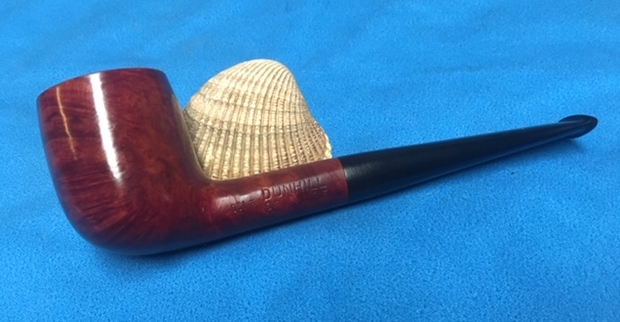
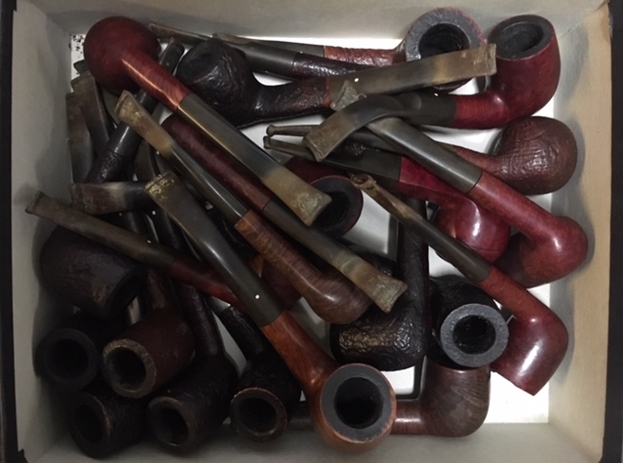
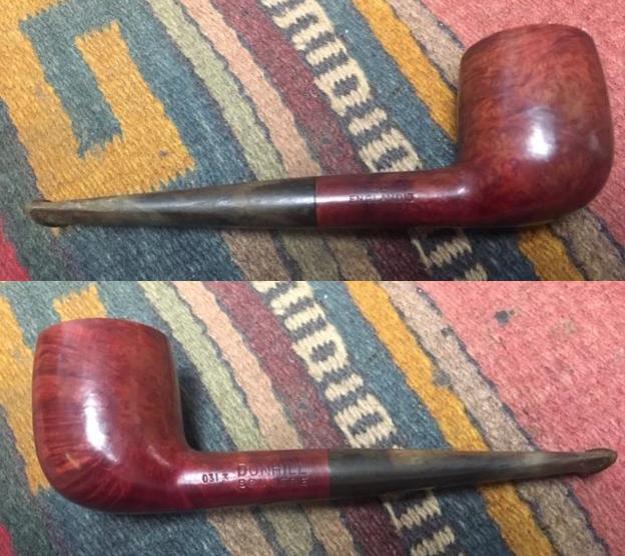
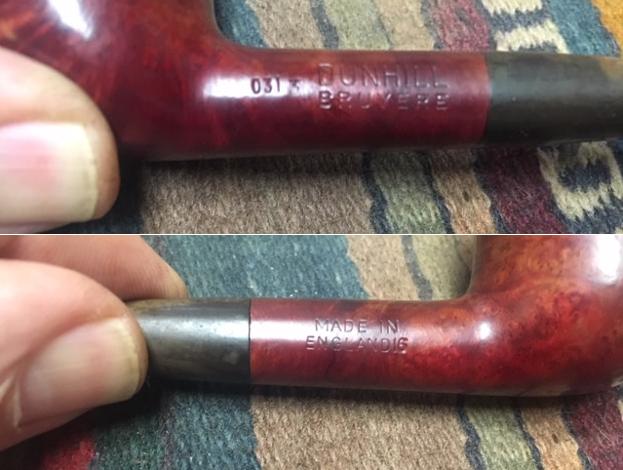
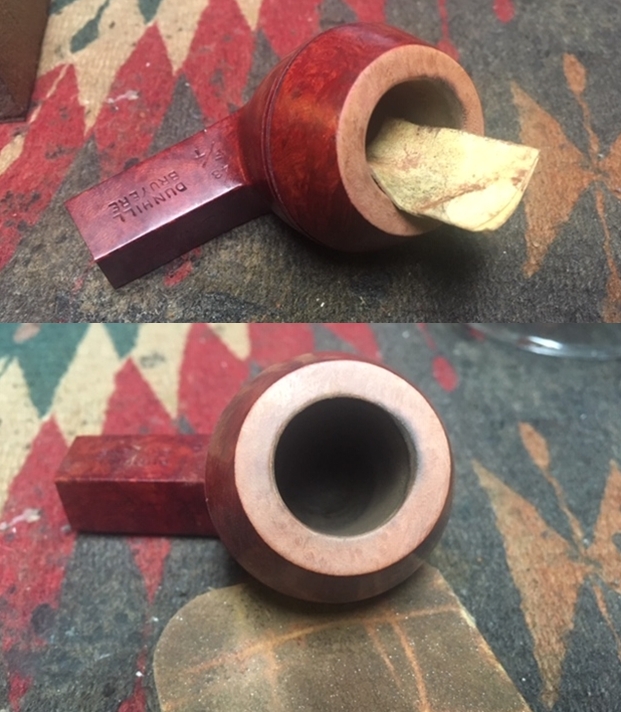
I sorted the pipes into groups of the various brands and had a box of 25 different Dunhill pipes in different shapes, styles and sizes. I decided to work on the Dunhills first. It was a great chance to see the shape variety up close and personal. The photo below shows the box of Dunhill pipes.With the completion of the restoration on this one there are only 9 more Dunhills of the original 25 left to work on – all smooth finished pipes in a variety of shapes. I went through the box of the remaining smooth Dunhills shown above and chose a beautiful little straight billiard. It is stamped 0313 followed by Dunhill over Bruyere on the left side of the shank. On the right side it is stamped Made in England 16 which means it was made in 1976. I wanted to know more about the shape stamp 0313 so I turned to Pipephil’s site for help. The link is as follows – http://pipephil.eu/logos/en/dunhill/shapes.html. From there I was able to decipher the number stamp on the pipe.

Dunhill pipes are stamped with a four digit code.

Digit 1: (from 1 to 6) denotes the size of the pipe (the group).

Digit 2: denotes the style of the mouthpiece (0,1=tapered, 2=saddle). Digit 3 and 4: denote the generic pipe shape (in yellow in the chart on top).

Example: 5102

(5 = size | 1 = tapered stem | 02 = Bent). When 5 digits occur, the meaning of the 4 first remain the same

In this case of the pipe I have in hand I believe the numbering system is actually reverse of what is spelled out above. The first two digits 03 refer to the Dunhill shape of a billiard. The second digit 1 designates the style of stem – in this case it is a tapered stem. The last number is a 3 which designates the size of the pipe – a Group 3.

Here is a summary of the information I gathered regarding the numbering on this pipe. The number 0313 breaks down as follows: the 03=straight billiard |1= tapered stem | 3= size of the pipe, a Group 3.

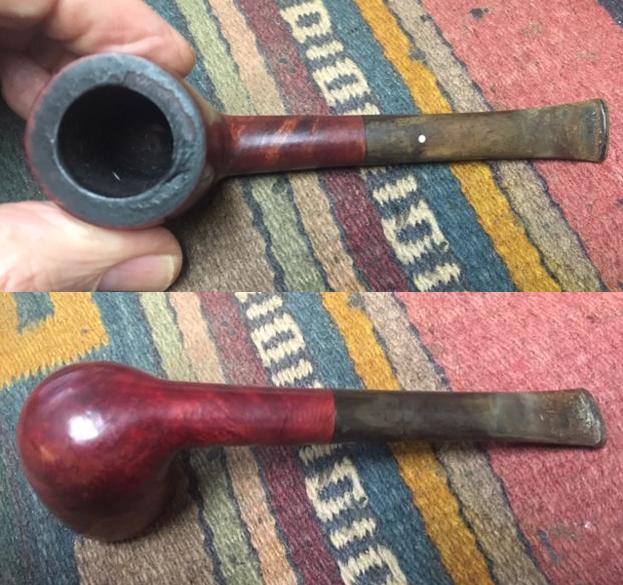
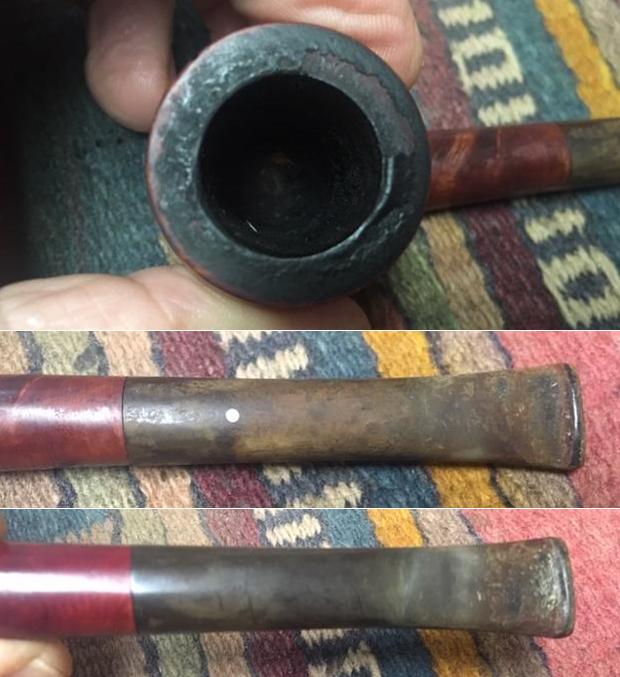
The smooth Bruyere finish is dirty and faded on the right side, but like the other pipes in Bob’s collection there is something quite beautiful about the birdseye and cross grain on the pipe. The bowl had a thick cake and thick lava overflows from the bowl onto the rim top. The stem is oxidized and has tooth marks and chatter near the button. There is some calcification on the first inch of the stem ahead of the button and there is some light damage to the top of the button. I took pictures of the pipe before I started working on it. I took some close up photos of the rim top and the stem to show what I was dealing with. This Bruyere Billiard had some serious cake in the bowl and a thick overflow of lava on the rim top. It was a real mess. It was hard to assess damage on the inner edge of the bowl due to the cake and lava. I would know more once I had reamed it and removed the lava coat. The stem was dirty, oxidized, calcified and had a lot of tooth chatter on the top and underside for about an inch ahead of the button.I took a photo of the stamping on both sides of the shank. The stamping was very sharp and readable and confirms the information above. The left side reads clearly with the shape number 0313 next to the Bruyere stamp. The stamping on the right side is clear and the D of England is followed by 16 which identifies the pipe as made in 1976.Since this is another pipe Bob’s estate I am sure that some of you have read at least some of the other restoration work that has been done on the previous pipes. You have also read what I have included about Bob Kerr, the pipeman who held these pipes in trust before I came to work on them. Also, if you have followed the blog for long you will already know that I like to include background information on the pipeman whose pipes I am restoring. For me, when I am working on an estate I really like to have a sense of the person who held the pipes in trust before I worked on them. It gives me another dimension of the restoration work. I asked Brian if he or his wife would like to write a brief biographical tribute to her father, Bob. His daughter worked on it and I received the following short write up on him and some pictures to go along with the words. Once again I thank you Brian and tell your wife thank you as well.

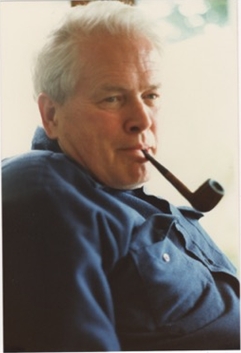
I am delighted to pass on these beloved pipes of my father’s. I hope each user gets many hours of contemplative pleasure as he did. I remember the aroma of tobacco in the rec room, as he put up his feet on his lazy boy. He’d be first at the paper then, no one could touch it before him. Maybe there would be a movie on with an actor smoking a pipe. He would have very definite opinions on whether the performer was a ‘real’ smoker or not, a distinction which I could never see but it would be very clear to him. He worked by day as a sales manager of a paper products company, a job he hated. What he longed for was the life of an artist, so on the weekends and sometimes mid-week evenings he would journey to his workshop and come out with wood sculptures, all of which he declared as crap but every one of them treasured by my sister and myself. Enjoy the pipes, and maybe a little of his creative spirit will enter you!

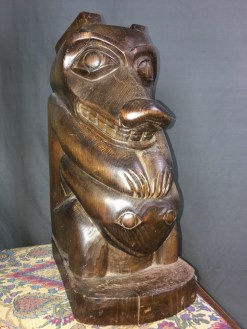
I have included a photo of one of Bob’s wood carvings to give you an idea of what he daughter wrote about above. You can see his artistry in the carving that is patterned after British Columbia’s Coastal First Nations people. To me this is a sea otter but perhaps a reader may enlighten us.

Having already worked on other pipes from Bob’s estate I think I understood how he used and viewed his pipes. I had learned to tell which pipes were his favoured ones and which were his work horses. He really loved his billiards. I could get a sense of the ones that accompanied him into his carving shop. I think this Bulldog also was one that went into the shop and I can almost imagine him reaming it out with a carving knife. In many ways it was as if he was standing over my shoulder while I cleaned up his pipes.

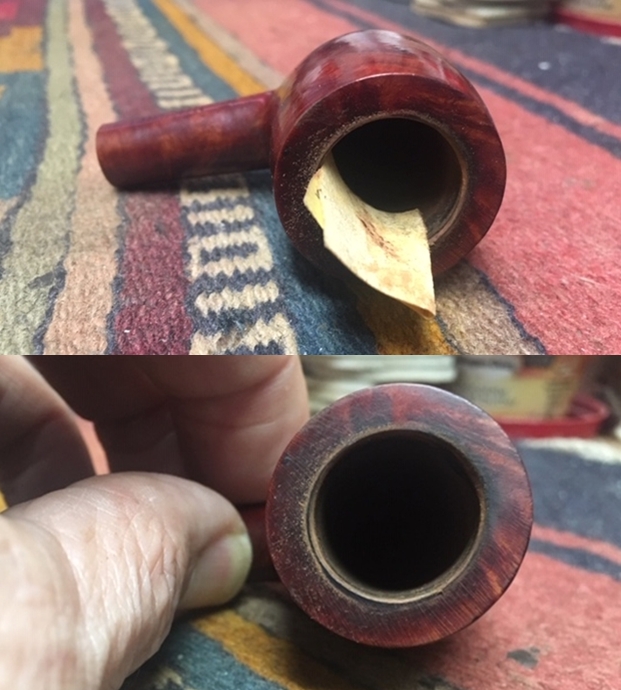
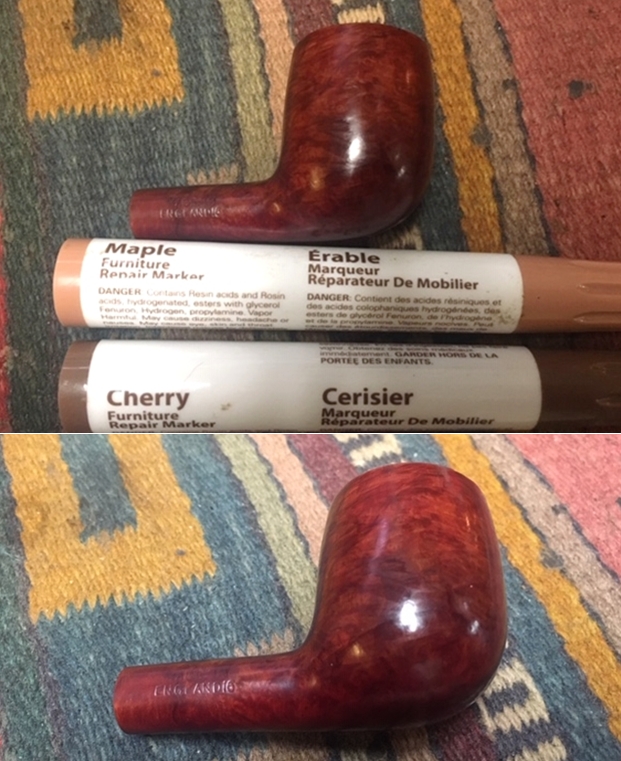
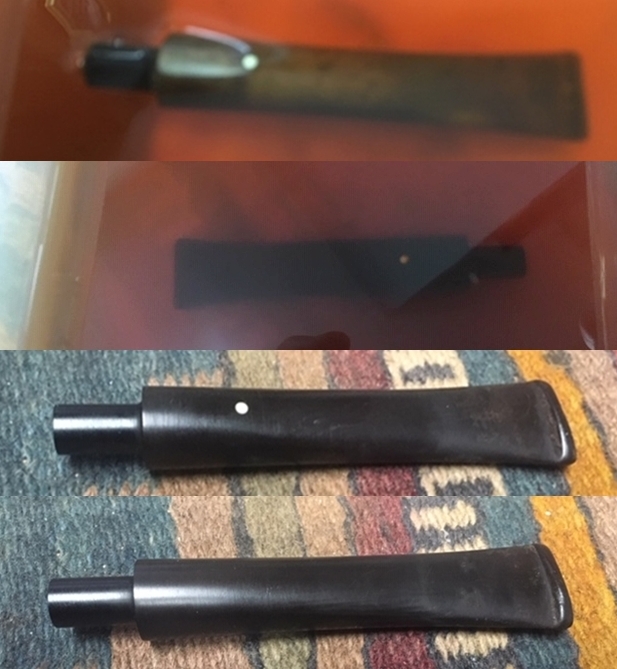
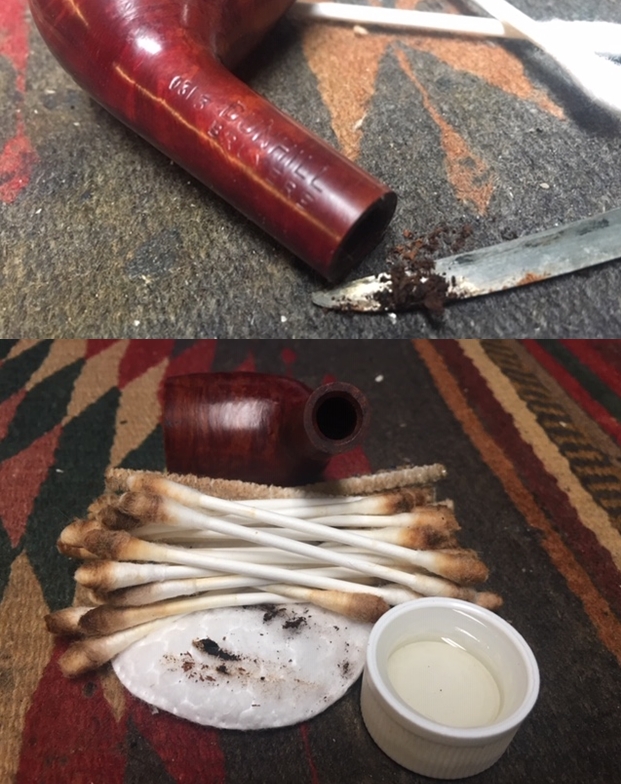
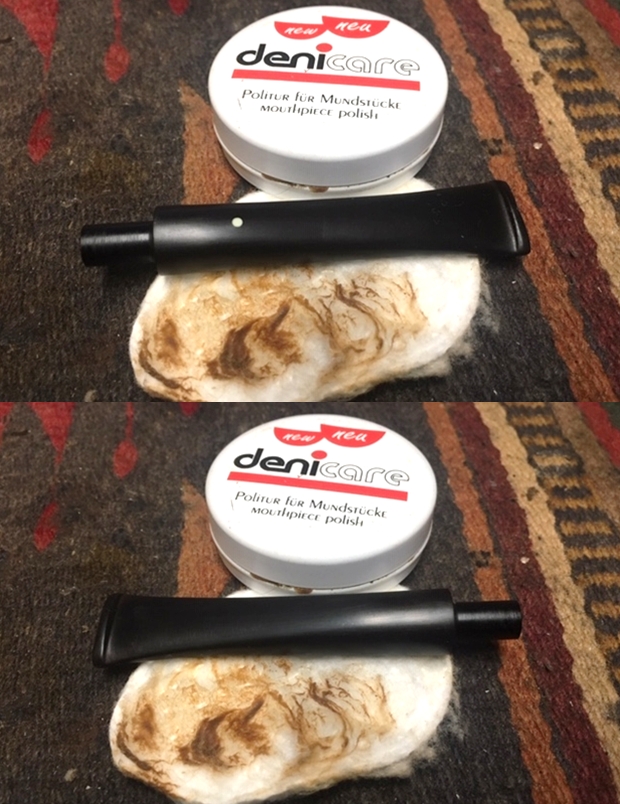
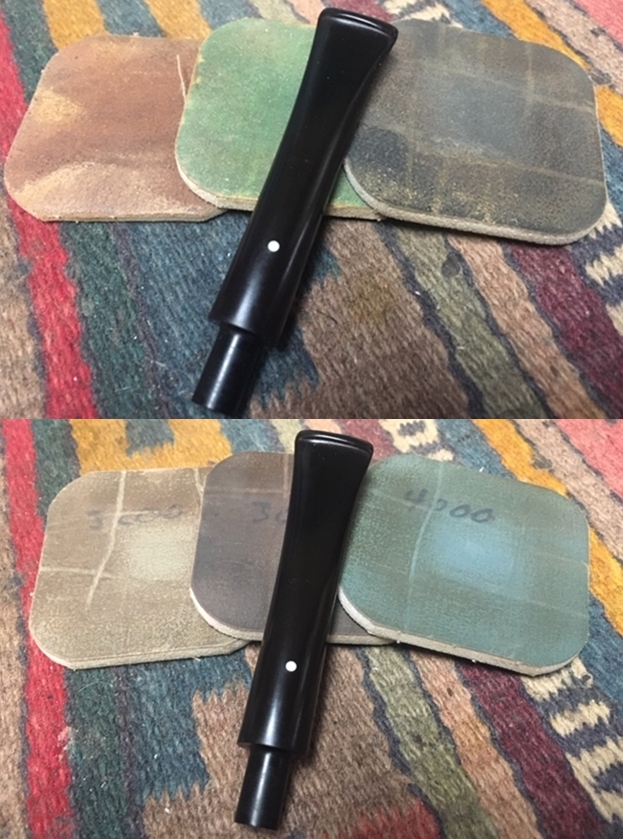
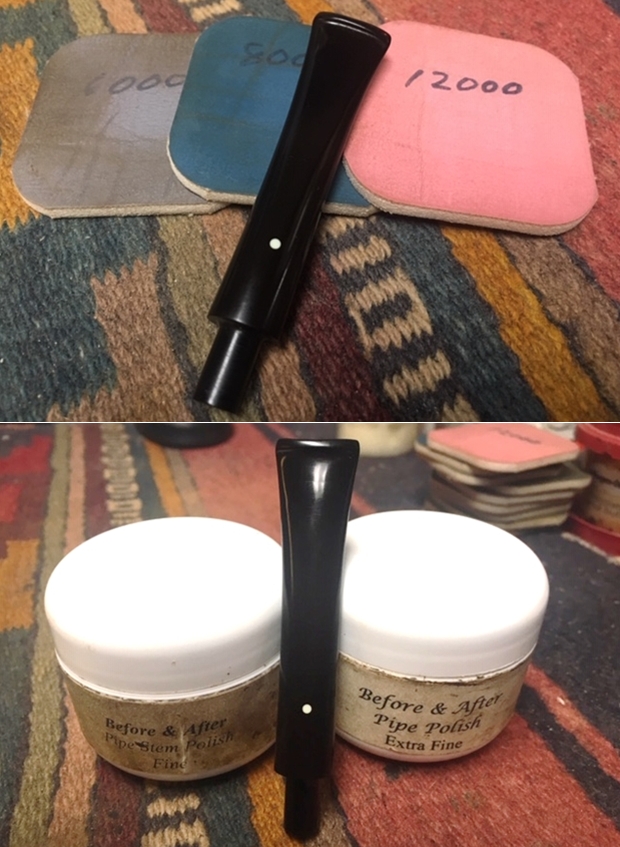
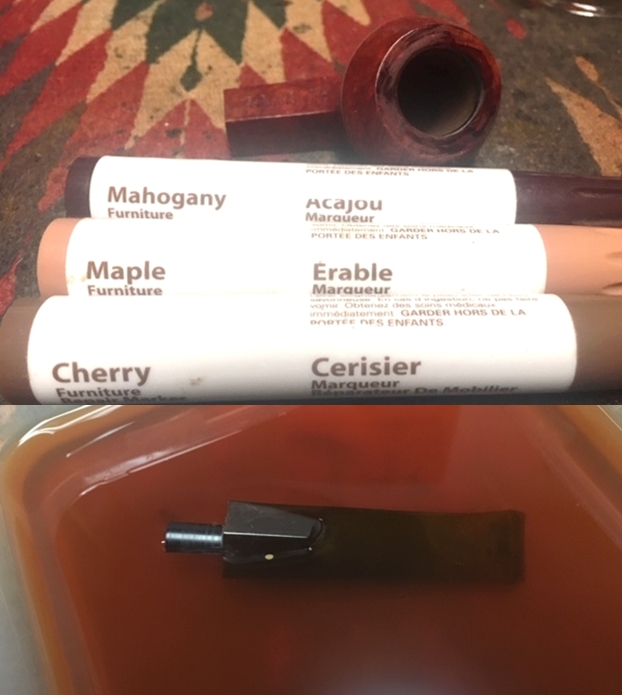
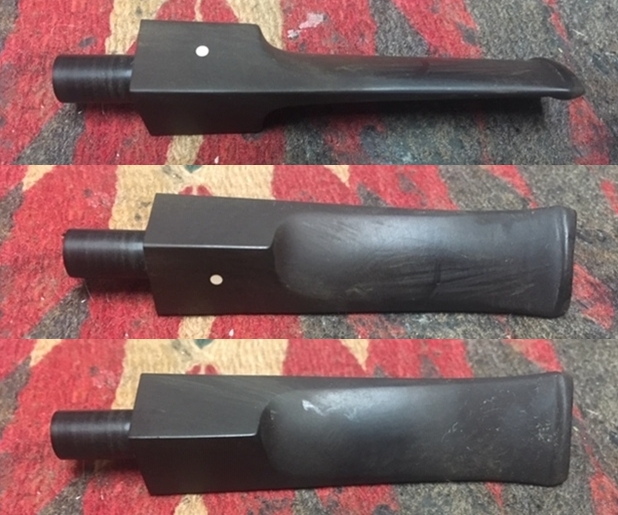
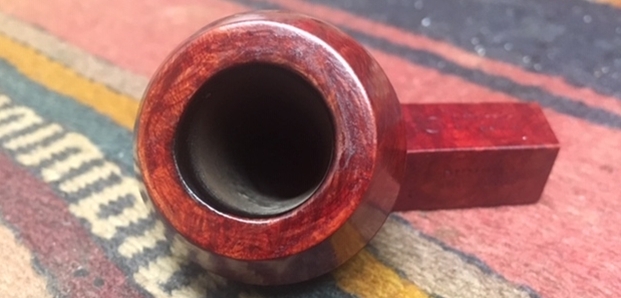
With that in mind I turned to work on this pipe. I reamed the bowl to remove the cake on the walls and the debris of tobacco shards that still remained. I used a PipNet pipe reamer with the first to cutting heads to start the process. I followed that with a Savinelli Fitsall Pipe Knife to clean up the remaining cake in the bottom portion of the bowl and near the entry of the airway into the chamber. I sanded the bowl with 220 grit sandpaper wrapped around a piece of dowel. It smooths out the walls and also cleans up any light damage to the inner edge of the bowl. I scraped the rim top and removed the thick lava coat in the rim with the edge of the Savinelli Fitsall knife. I scrubbed it down with saliva on a cotton pad until the rim top was clean. The finish was quite lifeless once I had removed the debris buildup but it looked pretty decent otherwise. I think that the lava served to protect the rim top and edges because once it was removed they looked to be in decent condition. There was some light damage to the front inner edge and a bit of darkening but overall it was in good shape.I worked over the inner edge of the bowl with a folded piece of 220 grit sandpaper to remove some of the darkening. The rim top definitely looks better than when I started the process.The stain on the right side of the bowl was quite faded and in the light showed that much of it had been rubbed off. I mixed two different stain pens (Cherry and Maple) to match to colour of the rest of the Bruyere bowl. The colour came out very well and the pipe looked fresh. I set the bowl aside to let the stain dry before buffing and polishing it. The first picture shows it after staining and the second after buffing with a microfiber cloth.I decided to address the stem that had been soaking. I had put the stem in a bath of Before & After Deoxidizer to soak overnight (Photo 1 below). When I returned home from work (Photo 2 below), I took the stem out of the bath and rinsed it with warm water to remove the solution. I blew through the stem to clean out the insides and rinsed them with water as well. I rubbed the stem dry with a microfiber cloth to remove the remnants of oxidation. I took the following photos to show the condition of the stem at this point (Photos 3 and 4 below) the difference is quite remarkable. The majority of the oxidation is gone as is the calcification. Once the externals of the stem were cleaned I turned my attention to the internals of the pipe. I scraped the mortise with a small pen knife to break up the hardened oils and tars. Once I had removed them I cleaned out the mortise and airway to the bowl and in the stem with 99% isopropyl alcohol, cotton swabs and pipe cleaners. I cleaned both until the cleaners came out white. It was a dirty pipe. With the internals cleaned I went back to the externals of the bowl. I polished the restained right side with a microfiber cloth to work the stains together to blend them into the remainder of the bowl. I worked some Before & After Restoration Balm into the finish of the bowl and the rim top. I worked it into the surface with my fingertips to clean, enliven and protect the wood. I let the balm sit for about 10 minutes and buffed it off with a soft cotton cloth. I took photos of the pipe at this point in the process to show what the bowl looked like at this point. I am happy with the blend of the stain on the right side and the overall look of the bowl at this point. Now the bowl was finished except for the final polishing. I set the bowl aside and turned my attention back to the stem. I also sanded out the tooth marks and chatter on the surface of the vulcanite with a folded piece of 220 grit sandpaper. I followed the 220 grit sandpaper with 400 grit wet dry sandpaper to minimize the scratching. The two papers combined do a great job removing the tooth chatter and remaining oxidation left behind after the stem soak. I polished the stem with Denicare Mouthpiece Polish to take out the oxidation at the button edge and on the end of the mouthpiece. I buffed the stem with a microfiber cloth. I polished out the scratches with micromesh sanding pads – wet sanding with 1500-12000 grit pads. I wiped the stem down after each sanding pad with Obsidian Oil. I polished it with Before & After Pipe Stem Polish – both Fine and Extra Fine. Once I had finished the polishing I gave it final coat of oil and set it aside to dry. I am finally on the homestretch with this pipe and I really look forward to the final look when it is put back together and polished and waxed. I put the bowl and stem back together. I polished the bowl and stem with Blue Diamond to polish out the scratches in the briar and the vulcanite. I gave the bowl and the stem multiple coats of carnauba wax. I buffed the pipe with a clean buffing pad to raise the shine. I hand buffed it with a microfiber cloth to deepen the shine. The pipe polished up pretty nicely. The cross grain and birdseye grain that show up in the polished bowl looked good with the polished black vulcanite. This 1976 Dunhill Bruyere 0313 Straight Billiard presented some challenges in the restoration process but it was a fun pipe to work on. It really has that classic Dunhill Billiard look in a Bruyere finish that catches the eye. The combination of red and black stains really makes the pipe look attractive. It is a comfortable pipe to hold in the hand and I think that as it heats with smoking that over time the finish will darken and look even better. The finished pipe is shown in the photos below. The dimensions of the pipe are Length: 5 ¼ inches, Height: 1 5/8 inches, Outside diameter of the bowl: 1 1/4 inches, Chamber diameter: ¾ of an inch. If you would like to carry on Bob’s legacy let me know by email or message on Facebook. I still have 8 more Dunhill pipes with smooth finishes – Root Briar, Bruyere etc. Perhaps one of those will catch your attention. Thanks for reading this blog and my reflections on the pipe while I worked on it. This is an interesting estate to bring back to life.

A 1/4 Bent Bertram 60 Paneled Pot from the Bertram Lot


Blog by Steve Laug

If you want the background on the lot of Bertram pipes that Jeff and I purchased please refer to the previous blog posts. I can’t adequately describe how overwhelmed I am when I look at the 200+ pipes that need to be restored. It is mind boggling but there is only one way to move ahead – 1 pipe at a time. I am glad Jeff is helping with the clean up on the lot as that would be more than I could handle by myself in moving through this many pipes. From his cleaned pipes I chose an unusual Bertram 60 that was a ¼ bent Paneled Pot. The grain was a mix of grains – swirls, flame, cross and birdseye. It was a pot shape with a tapered stem. The bowl had cake in the chamber that was no problem. The rim top had some darkening and lava overflow on the back side. There was a small nick in the front outer edge of the bowl. The inner edge look very good. The exterior of the briar looked lifeless and was dusty with the grime of years of storage. The stem had some oxidation and tooth chatter near the button on both sides. Jeff took some photos of the pipe before he began his cleanup work on it. Jeff took a close-up photo of the bowl and rim to capture the condition of the pipe when it arrived. The rim top had a coat of lava and the bowl had a thick cake. There is also a small nick on the right front outer edge of the bowl that will need to be dealt with.Jeff took pictures of the bowl sides and the heel to show the great looking grain around the sides of the bowl. It really is quite interesting and very dirty!Jeff took a photo to capture the stamping on the left side of the shank. It shows the stamping which read Bertram over Washington, D.C. The stamping on this pipe is a faint on the right side of the impression. The second photo shows the number stamp 60 on the underside of the shank. The number designates the quality of the pipe. The next two photos show the stem surface. They show the calcification, oxidation and the chatter on both sides near the button. There is also some wear on the button edge.Once again, if you have read the previous Bertram blogs I have posted about the pipes that I have cleaned up so far you can skip the next bit. But if you have not, then I include the link to Bertram history and information. I would recommend that if you don’t know much about them do some research on them. I include a link to the write up on Pipedia (http://pipedia.org/wiki/Bertram). Bertram pipes were based out of Washington DC. They were popular among famous politicians and celebrities of the time. They made many products for them from FDR’s cigarette holders to Joseph Stalin’s favorite pipe. They were considered some of the best America had to offer till they finally closed their doors in the 70s. They graded their pipes by 10s, the higher the grade the better. Above 60s are uncommon and 80-90s are quite rare. I’ve never heard of or seen a 100 grade. I have several blogs that I have written on rebornpipes that give some history and background to Bertram pipes. (https://rebornpipes.com/2015/06/16/an-easy-restoration-of-a-bertram-grade-60-217-poker/).

I have included the following link to give a bit of historical information on the pipe company. It is a well written article that gives a glimpse of the heart of the company. http://www.streetsofwashington.com/2012/01/bertrams-pipe-shop-on-14th-street.html#

From this information I have learned that the shape and grade Bertram I have in front of me now was made before the closure of the shop in the 1970s. This Bertram Panelled Pot with a ¼ bent stem is different from the other Bertram shapes I have worked. With a grade 60 stamp it is a mid-range pipe.

By now if you have been a reader for long you have Jeff’s cleaning regimen pretty well memorised. If you know it you can skip right to the pictures. If not I will include them once more. Jeff reamed the bowl with a PipNet pipe reamer and followed up with a Savinelli Fitsall pipe knife to remove the cake. He scrubbed out the mortise and the airway in the shank and the stem with alcohol, cotton swabs and pipe cleaners. He scrubbed the exterior of the bowl, rim, shank and stem with a tooth brush and Murphy’s Oil Soap to remove the oils and tars on the rim and the grime on the finish of the bowl. He rinsed it under running water. He dried it off with a soft cloth. He was able to remove lava build up on the rim top and you could see the great condition of the bowl top and edges of the rim. There was still some darkening to the rim top toward the back of the bowl. He soaked the stem in Before & After Deoxidizer to remove the oxidation. I took photos of the pipe before I started my work on it. I took a close up photo of the rim top to show the condition of the bowl and rim after Jeff had cleaned up the grime and lava. The lava left a little darkening on the rear rim top but otherwise the bowl looked very good. The cleanup had also minimized the nick on the front outer edge. The stem photos show that the light oxidation is gone. The tooth marks and chatter next to the button are visible and should sand out quite easily.I took photos of the stamping to show how it looked after the cleanup. It is still readable and clear.I polished the bowl and rim top with micromesh sanding pads – wetsanding it with 1500-12000 grit pads. I wiped the bowl down with a damp cloth after each pad to remove the sanding debris. The grain began to stand out. After the final sanding pad I hand buffed it with a cotton cloth to raise a shine. I know I have mentioned it before but I really like the balm that Mark Hoover created. It really does wonders on a dry piece of briar. I worked some Before & After Restoration Balm into finish of the briar with my fingertips to clean, enliven and protect it. I let the balm sit for a little while and then buffed with a cotton cloth to raise the shine. The Restoration Balm really makes the grain stands out beautifully. If you have not tried some why not give it a try. I sanded out the tooth marks and chatter on the stem with 220 grit sandpaper and polished the sanding with 400 grit wet dry sandpaper. The marks and chatter are gone and the stem is smooth.The stem was in great condition at this point. I polished out the sanding scratches with micromesh sanding pads – wetsanding it with 1500-12000 grit pads. I wiped the stem down with Obsidian Oil after each pad. I polished it with Before & After Pipe Polish – both Fine and Extra Fine and gave it a final coat and set it aside to dry. I am having fun doing these pipes from the Bertram Collection. Each one presents different challenges but all are well laid out classic shapes. This is no exception. I put the stem and bowl back together and buffed the pipe with Blue Diamond on the buffing wheel. I polished the briar and the minute scratches still in the vulcanite of the stem until there was a rich shine. This Bertram is in interesting twist on a ¼ Bent Pot shape with tapered stem. The finish really highlights some interesting grain on a proportionally well carved pipe. Once I buffed the pipe the briar came alive and the mixture of grain popped with polishing. The black vulcanite stem had a rich glow. The finished pipe is a beautiful grained Paneled Pot. Like the other Bertrams I have worked on this one fits well in the hand and sits right in the mouth. Have a look at it with the photos below. The dimensions are Length: 5 3/4 inches, Height: 1 1/2 inches, Outside diameter of the bowl: 1 1/2 inches, Chamber diameter: ¾ of an inch. Maybe this shape speaks to you and you want to add it to your collection. Rest easy, this one will soon be on the rebornpipes store. If you are interested let me know. Thanks for walking through the restoration with me as it was a pleasure to work on.

Back to Bob Kerr’s Estate – a Dunhill Bruyere 48FT Bulldog


Blog by Steve Laug

With this Dunhill Bruyere I am turning again to work on Bob Kerr’s estate. This is the second of the smooth pipes in his Dunhill Collection. I am cleaning them for the family and moving them out into the hands of pipemen and women who will carry on the trust that began with Bob and in some pipes was carried on by Bob. In the collection along with the Dunhills are a good bevy of Petersons, some Comoy’s and Barlings as well as a lot of other pipes – a total of 125 pipes along with a box of parts. This is the largest estate that I have had the opportunity to work on. I put together a spread sheet of the pipes and stampings to create an invoice. I was taking on what would take me a fair amount of time to clean up. I could not pass up the opportunity to work on these pipes though. They were just too tempting.

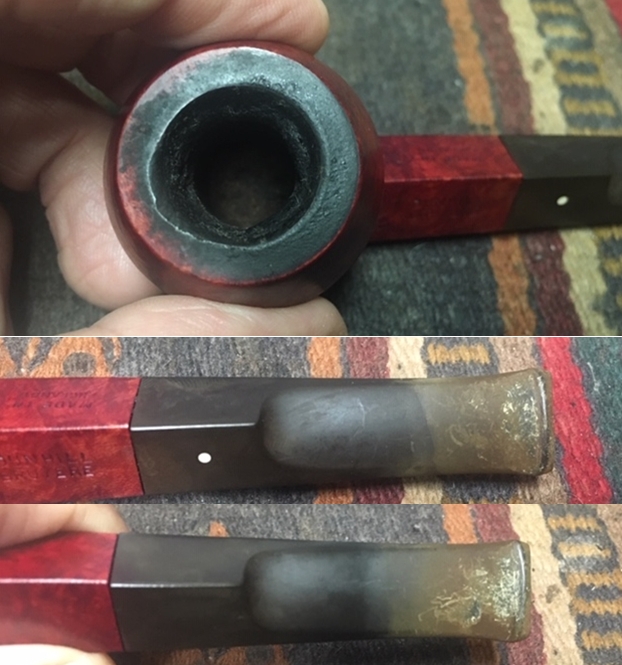
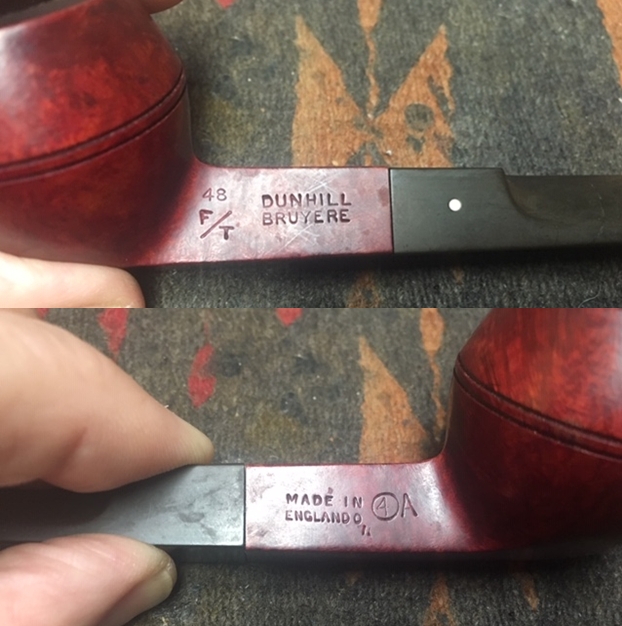
I sorted the pipes into groups of the various brands and had a box of 25 different Dunhill pipes in different shapes, styles and sizes. I decided to work on the Dunhills first. It was a great chance to see the shape variety up close and personal. The photo below shows the box of Dunhill pipes.With the completion of the restoration on this one there are only 9 more Dunhills of the original 25 left to work on – all smooth finished pipes in a variety of shapes. I went through the box of the remaining smooth Dunhills shown above and chose a beautiful little straight Bulldog. It is stamped 48 over F/T followed by Dunhill over Bruyere on the left side of the shank. On the right side it is stamped Made in England followed by 0 and a subscript1 Circle 4A – Group four size Bruyere made in 1960 and sold in 1961. The rich Bruyere finish is very dirty and there is a thick coat of lava on the out of round rim top. The inner edge of the rim is damaged on the front side of the pipe. The smooth Bruyere finish is dirty but like the other pipes in Bob’s collection there is something quite beautiful about the birdseye and cross grain on the pipe. The bowl had a thick cake and as mentioned above, thick lava overflows from the bowl onto the rim top. After cleaning I will know more. The diamond shank flows into a Fish Tail (FT) saddle stem that is oxidized and has tooth marks and chatter near the button. There is some calcification on the first inch of the stem ahead of the button and there is some light damage to the top of the button. I took pictures of the pipe before I started working on it. I took some close up photos of the rim top and the stem to show what I was dealing with. This Bruyere Bulldog had some damage on the inner edge of the bowl toward the front as can be seen in the photo. The cake in the bowl was quite thick and the lava on the rim top was also thick. The stem was dirty, oxidized, calcified and had a lot of tooth chatter on the top and underside for about an inch ahead of the button.I took a photo of the stamping on both sides of the shank. The stamping was very sharp and readable and confirms the information above. There is a little sloppiness to the second number stamp following the D in England. Under the lens it looks clearly like a 0 followed by a 1 that is dropped down below. In the photo there is some sloppiness to the stamp. The one has a slant and some nicks before and after so it looks almost like a 7 but I think it is a 1.Since this is another pipe Bob’s estate I am sure that some of you have read at least some of the other restoration work that has been done on the previous pipes. You have also read what I have included about Bob Kerr, the pipeman who held these pipes in trust before I came to work on them. Also, if you have followed the blog for long you will already know that I like to include background information on the pipeman whose pipes I am restoring. For me, when I am working on an estate I really like to have a sense of the person who held the pipes in trust before I worked on them. It gives me another dimension of the restoration work. I asked Brian if he or his wife would like to write a brief biographical tribute to her father, Bob. His daughter worked on it and I received the following short write up on him and some pictures to go along with the words. Once again I thank you Brian and tell your wife thank you as well.

I am delighted to pass on these beloved pipes of my father’s. I hope each user gets many hours of contemplative pleasure as he did. I remember the aroma of tobacco in the rec room, as he put up his feet on his lazy boy. He’d be first at the paper then, no one could touch it before him. Maybe there would be a movie on with an actor smoking a pipe. He would have very definite opinions on whether the performer was a ‘real’ smoker or not, a distinction which I could never see but it would be very clear to him. He worked by day as a sales manager of a paper products company, a job he hated. What he longed for was the life of an artist, so on the weekends and sometimes mid-week evenings he would journey to his workshop and come out with wood sculptures, all of which he declared as crap but every one of them treasured by my sister and myself. Enjoy the pipes, and maybe a little of his creative spirit will enter you!

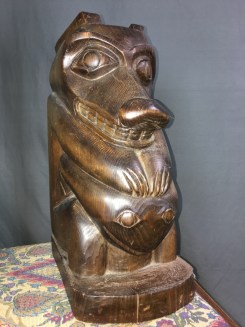
I have included a photo of one of Bob’s wood carvings to give you an idea of what he daughter wrote about above. You can see his artistry in the carving that is patterned after British Columbia’s Coastal First Nations people. To me this is a sea otter but perhaps a reader may enlighten us.

Having already worked on other pipes from Bob’s estate I think I understood how he used and viewed his pipes. I had learned to tell which pipes were his favoured ones and which were his work horses. He really loved his billiards. I could get a sense of the ones that accompanied him into his carving shop. I think this Bulldog also was one that went into the shop and I can almost imagine him reaming it out with a carving knife. In many ways it was as if he was standing over my shoulder while I cleaned up his pipes.

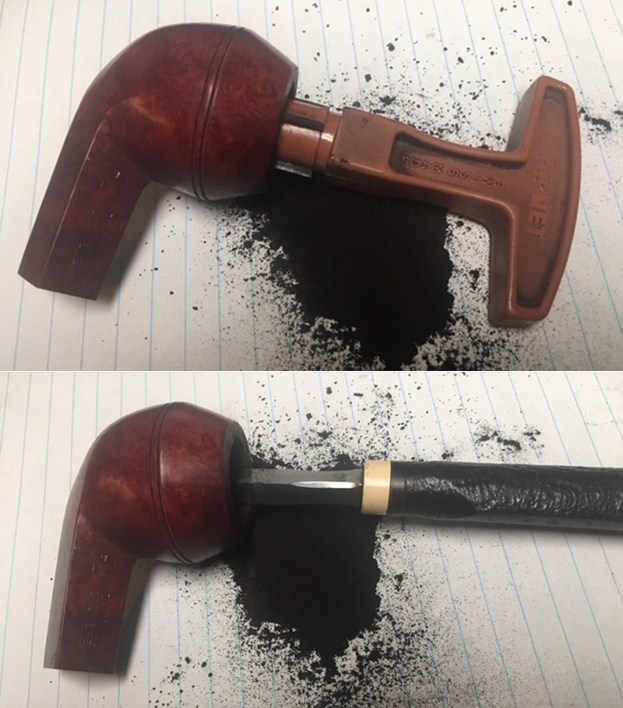
With that in mind I turned to work on this pipe. I reamed the bowl to remove the cake on the walls and the debris of tobacco shards that still remained. I used a PipNet pipe reamer to start the process. I followed that with a Savinelli Fitsall Pipe Knife to clean up the remaining cake in the conical bottom of the bowl. I sanded the bowl with 220 grit sandpaper wrapped around a piece of dowel. It smooths out the walls and also gives a good start to the process of bringing the inner edges back to round. I cleaned up the rim top and removed the thick lava coat in the rim. I used the Savinelli Fitsall knife to scrape away the high spots of lava and a scrubbing pad to continue work on the rim top and remove the buildup there. The rim was quite damaged with the out of round section on the front of the inner edge and the burn mark that was there as well. It was going to take some careful work giving the edge a bit of a bevel to bring it back to round. The damage to the rim was very bothersome to me and in my opinion made an otherwise beautifully finished little Bulldog an eyesore. This is where I am sure some may differ with my decision but I decided to address the damage. I topped the rim on the topping board with 220 grit sandpaper to minimize the damage to the rim edge on the front. I topped it on a medium and a fine sanding sponge to remove the scratches and smooth out the rim top. Once I had flattened the rim top and removed some of the damage, I worked over the front inner edge of the bowl with a folded piece of 220 grit sandpaper. I followed that by sanding the edge with a 1500 grit micromesh sanding pad. Through the process I was able to remove much of the damage. The rim top definitely looks better.Now comes the hardest part of the process in my opinion. It will either make the pipe look refreshed and beautiful or it will make it look very tacky and poorly done. I mixed three different stain pens and a black Sharpie pen to match to colour of the Bruyere stain. I used a Cherry, Maple and Mahogany stain pen – blending them together rather than letting each one dry. The colour is very close. I set the bowl aside to let the stain dry and put the stem in a bath of Before & After Deoxidizer to soak. That done I turned off the lights and called it a night.In the morning I took the stem out of the bath and rinsed it with warm water to remove the solution. I blew through the stem to clean out the insides and rinsed them with water as well. I rubbed the stem dry with a microfiber cloth to remove the remnants of oxidation. I took the following photos to show the condition of the stem at this point.I then picked up the bowl to examine the stain and get a feel for what it looked like in the morning light. It would need some polishing and touch up but the colour was looking very good to my eye. The inner edge of the rim also looked a lot better than it did when I began. Now to polish and blend the colours a bit!I decided to let the polishing wait and turned my attention to the internals of the pipe. I cleaned out the shank and airway to the bowl and in the stem with 99% isopropyl alcohol, cotton swabs and pipe cleaners. I cleaned both until the cleaners came out white. It was a dirty pipe.I polished the rim top with a microfiber cloth to work the stains together to blend it and touched up the light areas with a stain pen. I repeat the polishing with the cloth. I worked some Before & After Restoration Balm into the finish of the bowl and the rim top. I worked it into the surface with my fingertips to clean, enliven and protect the wood. I let the balm sit for about 10 minutes and buffed it off with a soft cotton cloth. I took photos of the pipe at this point in the process to show what the bowl looked like at this point. I am happy with the blend of the stain on the rim top and the overall look of the bowl at this point. I set the bowl aside and turned my attention to the stem. I also sanded out the tooth marks and chatter on the surface of the vulcanite with a folded piece of 220 grit sandpaper. I followed the 220 grit sandpaper with 400 grit wet dry sandpaper to minimize the scratching. The two papers combined do a great job removing the tooth chatter and remaining oxidation left behind after the stem soak. I polished the stem with Denicare Mouthpiece Polish to take out the oxidation at the button edge and on the end of the mouthpiece. I buffed the stem with a microfiber cloth. I polished out the scratches with micromesh sanding pads – wet sanding with 1500-12000 grit pads. I wiped the stem down after each sanding pad with Obsidian Oil. I polished it with Before & After Pipe Stem Polish – both Fine and Extra Fine. Once I had finished the polishing I gave it a final coat of oil and set it aside to dry. I put the bowl and stem back together. I polished the bowl and stem with Blue Diamond to polish out the scratches in the briar and the vulcanite. I gave the bowl and the stem multiple coats of carnauba wax. I buffed the pipe with a clean buffing pad to raise the shine. I hand buffed it with a microfiber cloth to deepen the shine. The pipe polished up pretty nicely. The cross grain and birdseye grain that show up in the polished bowl looked good with the polished black vulcanite. This 1960 Dunhill Bruyere 48 F/T Straight Bulldog presented some challenges in the restoration process but it was a fun pipe to work on. It really has that classic Dunhill Bulldog look in a Bruyere finish that catches the eye. The combination of red and black stains really makes the pipe look attractive. It is a comfortable pipe to hold in the hand and I think that as it heats with smoking that over time the finish will darken and look even better. The finished pipe is shown in the photos below. The dimensions of the pipe are Length: 5 1/4 inches, Height: 1 7/8 inches, Outside diameter of the bowl: 1 1/2 inches, Chamber diameter: 3/4 of an inch. If you would like to carry on Bob’s legacy let me know by email or message on Facebook. I still have 9 more Dunhill pipes with smooth finishes – Root Briar, Bruyere etc. Perhaps one of those will catch your attention. Thanks for reading this blog and my reflections on the pipe while I worked on it. This is an interesting estate to bring back to life.

A Crowned Thick Shank Billiard 40 from the Bertram Lot


Blog by Steve Laug

Once again rather than repeat myself about the background, please refer to the previous blog posts on the collection of Bertrams and other brands that Jeff and I purchased. I can’t adequately describe how overwhelmed I am when I look at the 200+ pipes that need to be restored but there is only one way to move ahead – 1 pipe at a time. I am glad Jeff is helping with the clean up on the lot as that would be more than I could handle by myself in moving through this many pipes. From his cleaned pipes I chose a thick shank Billiard Bertram 40 with a crowned rim top. The grain was a mix of cross grain and birdseye. It was a Billiard with a tapered stem. The bowl had cake in the chamber that was no problem. The rim top had some darkening and lava overflow on the back side. There was a chip in the front, inner edge of the bowl and what appeared to be a burn mark on back inner edge. The outer edge of the bowl appeared to be in good condition but we would know more once the bowl had been reamed and cleaned. The exterior of the briar looked lifeless and was dusty with the grime of years of storage. The stem had some oxidation and tooth chatter near the button on both sides. Jeff took some photos of the pipe before he began his cleanup work on it. Jeff took a close-up photo of the bowl and rim to capture the condition of the pipe when it arrived. The rim top had a coat of lava and the bowl had a thick cake. There is also an obvious nick on the front inner edge of the bowl that will need to be dealt with.Jeff took pictures of the bowl sides and the heel to show the great looking grain around the sides of the bowl. It really is quite stunning and very dirty!Jeff took a photo to capture the stamping on the left side of the shank. It shows the stamping which read Bertram over Washington, D.C. The stamping on this pipe is a faint on the right side of the impression. The second photo shows the number stamp 40 which shows the quality of the pipe. The number stamp is on the underside at the stem/shank junction.The next two photos show the stem surface. They show the oxidation and the chatter on both sides near the button. There is also some wear on the button edge.Once again, if you have read the previous Bertram blogs I have posted about the pipes that I have cleaned up so far you can skip the next bit. But if you have not, then I include the link to Bertram history and information. I would recommend that if you don’t know much about them do some research on them. I include a link to the write up on Pipedia (http://pipedia.org/wiki/Bertram). Bertram pipes were based out of Washington DC. They were popular among famous politicians and celebrities of the time. They made many products for them from FDR’s cigarette holders to Joseph Stalin’s favorite pipe. They were considered some of the best America had to offer till they finally closed their doors in the 70s. They graded their pipes by 10s, the higher the grade the better. Above 60s are uncommon and 80-90s are quite rare. I’ve never heard of or seen a 100 grade. I have several blogs that I have written on rebornpipes that give some history and background to Bertram pipes. (https://rebornpipes.com/2015/06/16/an-easy-restoration-of-a-bertram-grade-60-217-poker/).

I have included the following link to give a bit of historical information on the pipe company. It is a well written article that gives a glimpse of the heart of the company. http://www.streetsofwashington.com/2012/01/bertrams-pipe-shop-on-14th-street.html#

From this information I have learned that the shape and grade Bertram I have in front of me now was made before the closure of the shop in the 1970s. This Bertram Thick Shank Crowned Billiard is different from the other Bertram shapes I have worked. With a grade 40 stamp it is a more of lower mid-range pipe, though I am not sure why as the briar is very clean and the grain very interesting.

By now if you have been a reader for long you have Jeff’s cleaning regimen pretty well memorized. If you know it you can skip right to the pictures. If not I will include them once more. Jeff reamed the bowl with a PipNet pipe reamer and followed up with a Savinelli Fitsall pipe knife to remove the cake. He scrubbed out the mortise and the airway in the shank and the stem with alcohol, cotton swabs and pipe cleaners. He scrubbed the exterior of the bowl, rim, shank and stem with a tooth brush and Murphy’s Oil Soap to remove the oils and tars on the rim and the grime on the finish of the bowl. He rinsed it under running water. He dried it off with a soft cloth. He was able to remove lava build up on the rim top and you could see the great condition of the bowl top and edges of the rim. There was still some darkening to the rim top toward the back of the bowl. He soaked the stem in Before & After Deoxidizer to remove the oxidation. I took photos of the pipe before I started my work on it.I took a close up photo of the rim top to show the condition of the bowl and rim after Jeff had cleaned up the grime and lava. The damaged area on the front inner edge and a burned area that has damaged the rear inner edge are visible. The stem photos show that the oxidation is gone. The light tooth chatter is hard to see but I should be able to sand it out quite easily. I used a drop of clear super glue to fill in the chip in the inner edge and rim top on the front of the bowl. Once the repair cured, I used a folded piece of 220 grit sandpaper to smooth out the repair and to cleanup the burn damage to the rear inner edge of the rim.I polished the bowl and rim top with micromesh sanding pads – wetsanding it with 1500-12000 grit pads. I wiped the bowl down with a damp cloth after each pad to remove the sanding debris. The grain began to stand out. After the final sanding pad I hand buffed it with a cotton cloth to raise a shine. I touched up the rim top with a Maple Stain pen to blend the repairs to the rim top and edge into the rest of the surrounding briar. It did not take much to get a good match. I will need to buff it in the final steps to get the proper look but I am liking it.I know I have mentioned it before but I really like the balm that Mark Hoover created. It really does wonders on a dry piece of briar. I worked some Before & After Restoration Balm into finish of the briar with my fingertips to clean, enliven and protect it. I let the balm sit for a little while and then buffed with a cotton cloth to raise the shine. The Restoration Balm really makes the grain stands out beautifully. The stem was in pretty decent condition. I polished out the light tooth chatter with micromesh sanding pads – wetsanding it with 1500-12000 grit pads. I wiped the stem down with Obsidian Oil after each pad. I polished it with Before & After Pipe Polish – both Fine and Extra Fine and gave it a final coat and set it aside to dry. I am having fun doing these pipes from the Bertram Collection. Each one presents different challenges but all are well laid out classic shapes. This is no exception. I put the stem and bowl back together and buffed the pipe with Blue Diamond on the buffing wheel. I polished the briar and the minute scratches still in the vulcanite of the stem until there was a rich shine. This Bertram is a classic Thick Shank Crowned Billiard shape with tapered stem. The finish really highlights some amazing grain on a proportionally well carved pipe. Once I buffed the pipe the briar came alive and the mixture of grain popped with polishing. The black vulcanite stem had a rich glow. The finished pipe is a beautiful grained Billiard. Like the other Bertrams I have worked on this one fits well in the hand and sits right in the mouth. Have a look at it with the photos below. The dimensions are Length: 5 1/2 inches, Height: 1 3/4 inches, Outside diameter of the bowl: 1 1/2 inches, Chamber diameter: ¾ of an inch. This one will soon be on the rebornpipes store. If you are interested let me know. Thanks for walking through the restoration with me as it was a pleasure to work on.


Bringing a Silver Match Toronto 115 Squat Lumberman Back to Life


Blog by Dal Stanton

I acquired this Silver Match Toronto from what I have called, the ‘French Lot of 50’.  It was on the French eBay auction block and I was fortunate enough to have the winning bid.  When the Lot arrived here in Bulgaria from France, I unpacked it, took pictures of each pipe and posted them in the ‘For “Pipe Dreamers” Only!’ collection for potential new stewards to find and commission.  I have already restored many treasures in this French Lot of 50 for new stewards.  Robert saw the Silver Match Toronto 115 Squat Lumberman in the ‘Dreamers Only!’ collection and wrote me about commissioning it.  In my interchanges with Robert describing the pipe and what was involved in commissioning it, he wrote this in response:

Dal I’m still interested in commissioning the lumberman pipe and I’m in no rush. My wife and I just had a baby he just turned 1 week old! I found out about your restorations on Facebook on The Gentleman’s Pipe Smoking Society.  Thanks for returning my email and I can’t wait to see the outcome of this little pipe!

I also found out that he and his family reside in central Virginia and when we were writing, it was getting ready to snow where he lived!  Well, that was last November, and it has taken this long for Robert’s Lumberman to work its way up the queue and I’m thankful for Robert’s patience! – As well as all the stewards who commission pipes which benefit the Daughters of Bulgaria – women and girls who have been trafficked and sexually exploited.  Here’s a picture of the original Lot of 50 in the ‘wild’ that I saw on eBay – the Lumberman it identified with an arrow.Now with Robert’s commission on my worktable, I take more pictures to show this smart squat Lumberman – I call it ‘Squat’ but the bowl is large and will handle a nice packing of one’s favorite blend. The nomenclature is stamped on the upper and lower sides of the oval stem.  On the upper is stamped ‘SILVER MATCH’ [over] ‘TORONTO’.  The lower shank bears what I’m assuming to be a shape number: ‘115’.  The stem is also stamped with a design which I assume is the flame of a match being depicted – my best guess at this point, but I’m not sure! The information about the Silver Match name is thin.  A quick search on the internet shows that Silver Match has been the name of tobacco accessories manufacturer since the 1800s, but mainly of lighters.  Silver Match lighters seem to be highly collectable with vintage lighters dating back to the 1800s but most listed that I saw have a French origin.  The only information in Pipedia refers to Silver Match in the list of British pipe makers as an inexpensive brand sold by Roy Tallent Ltd., and marked with the stamping SM (LINK).  This is confirmed in my copy of Wilczak & Colwell’s, ‘Who Made That Pipe?’ that Silver Match has English origins and manufactured by Roy Tallent LTD/S’Elite LTD – both of which seem more to be in the accessories market than focusing on the manufacturing of pipes.  Pipephil.eu (LINK) brings these two together in the following panel.  It pictures pipes distributed by the famous lighter brand, Silver Match, but shows the two different stem stampings that may indicate either French or British manufacturing – the flame (French) and the SM (England).  If this is correct, the Silver Match Toronto 115 has a French origin, but I found no other information to corroborate this.  Arriving from France in my ‘French Lot of 50’ is anecdotal evidence perhaps supporting this.I’m calling this Silver Match a ‘Squat’ Lumberman because he meets all the qualifications of his place in the Canadian family with the oval shank, but he’s on the shorter side but I’m impressed with the nice ample bowl. I did look at both French and British made shape charts to see if I could discover a lead on who produced the Silver Match but found no matches with 115 that provided this information.
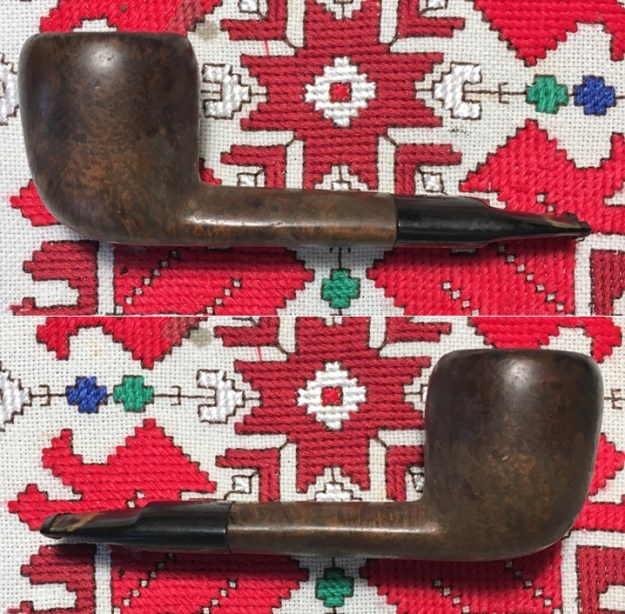
I can see some nice briar underneath the thick layer of grime over the briar surface, but I see one large fill that will need attention on the lower shank near the shape number.  The cake is thick in the chamber with corresponding lava covering the rim.  The stem has oxidation and the button is chipped and will need to be rebuilt.  With this inventory of the challenges this Silver Match Toronto Lumberman faces, I start the restoration by adding the oxidized stem to a soak of Before & After Deoxidizer along with other pipes in the queue.  I first clean the airway with a pipe cleaner wetted with isopropyl 95%. After several hours I fish the Silver Match stem out of the Deoxidizer and use a cotton pad wetted with alcohol to wipe off the raised oxidation. I also run another pipe cleaner wetted with isopropyl 95% through the stem to clean the Deoxidizer remaining in the airway.The Before & After Deoxidizer does a good job and it preserves the white in the Silver Match stem stamp logo – I still can’t figure out for sure what it’s depicting!  I follow by applying paraffin oil to the stem to begin the rejuvenation process.  I put the stem aside to dry and absorb the oil. Next, I address the very thick cake in the chamber.  The chamber is almost closed off as the cake angles down the chamber.  Using the Pipnet Reaming Kit, starting with the smallest blade head, I use 2 blades of the 4 available to me.  I follow the reaming by using the Savinelli Fitsall Tool to further scrape and clean out the carbon build-up.  Finally, I sand the chamber after wrapping a piece of 240 grade paper around a sharpie pen to give me reach and leverage.  To remove the carbon dust, I wipe the chamber with a cotton pad wetted with isopropyl 95%. After the cleaning, I inspect the chamber and it doesn’t have any cracks and fissures from heating damage.  It looks good!Next, I continue the cleaning by using undiluted Murphy’s Soap on the external surface using a cotton pad to scrub.  I also use a Winchester blade to scrape the rim addressing the thick lava you can see in the picture above. I also use a brass wire brush on the rim which doesn’t damage the briar.  After being in India, I learned about some of Jeff Laug’s (Steve’s brother) cleaning techniques and I decide to employ some of them.  After cleaning the stummel with Murphy’s, I take the stummel to the sink and clean the external surface with a bristled toothbrush with regular dish soap – the kind that is anti-oil.  I also use shank brushes to clean the mortise with the dish soap and warm water. After rinsing well, I dry the stummel with a cloth.  It came out well.As I observed earlier, there is a very large fill on the underside of the shank.  As expected, the cleaning of the stummel softens the old fill material and most of it fell out with the cleaning.  Using a sharp dental probe, I continued to excavate the material from the hole to clean it.Addressing the internals, I now use cotton buds, pipe cleaners, shank brushes and a dental spatula to scrape the mortise wall.  Using my tools to clean takes a bit of effort, but after some time, the buds started coming out lighter.  Later I will give the internals a further cleaning using a kosher salt and alcohol soak.Next, I patch the huge crater on the shank.  After I make sure all the old fill material has been removed, I clean the hole with alcohol. In the recent trip to India I discovered that there was some mild controversy around my method for filling holes using a putty created by mixing CA glue and briar dust.  Both Steve and Paresh said that they could not duplicate what I’ve been doing for some time – mixing the two components and creating a putty that remained supple.  What they experienced was the CA glue instantaneously solidifying when it touched the briar dust.  We discussed many different possible factors that would cause this difference in results – elevation, kind of glue, etc.  Another possible difference I suggested was that when I used an index card as a mixing platform, I would first cover the card with a strip of packing tape so that the glue would not be absorbed into the paper – which may, if it did absorb, cause the CA to solidify more rapidly.  Both Steve and Paresh were mixing on an index card surface without the tape.  I don’t know if they’ve had better results yet!  I decide to use a plastic lid as my new mixing platform.  You can see that I also put some scotch tape down so that I can clean easily.  I place briar dust on the tape and add BSI Extra Thick Max-Cure CA glue.I gradually pull briar dust into the puddle of CA glue and mix it with a toothpick.  I don’t overwhelm the glue with a lot of briar dust but gradually mix more in.As you can see, the CA is not solidifying as I add more.When the resulting mixture thickens to that of molasses, I use the toothpick and trowel the putty to the shank and fill the huge hole.  After filled, I put the stummel aside to allow the briar dust putty to cure.With the hour becoming late, I further advance the internal cleaning with a kosher salt and alcohol soak.  The patch on the shank has set up sufficiently.  I fashion a ‘mortise wick’ using a cotton ball. I stretch and twist the cotton until it creates a wick that will serve to draw out the tars and oils from the mortise.  I stuff the wick down the mortise with the help of a stiff wire.  After placing the stummel in a egg carton for stability, I fill the bowl with kosher salt which doesn’t leave an aftertaste as does iodized salt.  I then add isopropyl 95% to the bowl until it surfaces over the salt.  After a few minutes, the alcohol absorbs, and I top off with some additional alcohol and then put the stummel aside to soak through the night.   The next morning, I see what I was hoping to see.  The salt has soiled and after I draw out the wick it shows that it has continued the internal cleaning process of drawing out the tars and oils. After thumping and dumping the expended salt in the waste, I wipe the bowl with a paper towel and blow through the mortise to remove the salt crystals.I follow with a pipe cleaner and cotton bud wetted with isopropyl 95% to clean residue left behind after the soak.  I find that the internals are clean and refreshed for the new steward.  I move on!The crater fill on the lower side of the Lumberman shank has cured, and I begin the process of removing the excess briar putty using a flat needle file.  I file the mound down almost to the briar surface and then I switch to sanding with 240 grade paper to bring the patch flush with the briar surface. As is often the case, from the picture above, you can see the air pockets left in the sanded patch material.  To blend this, I touch up the patch with a dye stick after sanding the patch further using 600 grade paper.Turning now to the rim, the front and sides of the rounded rim have been skinned up a good bit which the following two pictures show. I use 240 grade paper on the rim and go with the rounded rim flow and sand out the roughened areas around the rim. I follow the rim sanding using sanding sponges over the entire stummel, including the rim.  I use a coarse sponge, followed by a medium sponge and finish with a fine sanding sponge.  The briar on this Silver Match Toronto is expressive and It’s coming out nicely with the sanding. After the sponge sanding, I identify a pit on the lower left side of the bowl. I decide to apply a clear CA glue patch to fill this pit.  After cleaning this area with alcohol, I blacken in the pit using a fine point Sharpie Pen then apply a drop of regular clear CA glue and set the stummel aside for the glue to cure. Not long after, the CA glue cures and I file the patch with a flat needle file followed by 240 and 600 grade papers. The result of this quick patch looks good.Waiting in the wings is the short stem of the Lumberman which sports a chipped button.  The button will need to be rebuilt using a mixture of activated charcoal powder and CA glue.I form an initial triangular insert from index card stock which fits into the slot of the button fully.  I had covered the inserted part with a layer of scotch tape to serve as a barrier to the patch material – to easily be able to remove the insert after the charcoal powder and CA mixture cures.  I then insert another triangular piece of card stock into the initial insert.  This serves to expand and tighten the insert.I open one capsule of activated charcoal dust on the plastic disc (also put a few strips of tape down for easier cleaning) and add BSI Maxi-Cure Extra Thick CA glue in a small puddle next to the charcoal powder and mix in gradually using the toothpick.  As with the briar dust putty, I draw charcoal powder into the CA glue until it reaches the viscosity of molasses and then trowel the putty to the stem to fill the missing button cavity. I trowel enough to fully over-coat the area.As hoped, after the charcoal patch sets up after a few minutes, with a bit of wiggling, the insert comes out leaving the slot and airway clear of the patch material.After several hours, the patch material has fully cured, and I go to work using a flat needle file.  I first work on clearing the excess patch material on the end of the stem.To more rapidly remove the mound of excess patch over the button I employ a small sanding drum mounted on the Dremel.  This removes the patch material very easily. I follow using the flat needle file to bring about the fine shaping of the button repair. I follow the filing and shaping of the button with 240 grade sanding paper to further smooth and shape.  I notice significant air bubbles being revealed by the sanding – ugh…Following the 240 paper, sanding with 600 grade paper and 0000 grade steel wool – upper and lower stem, brings out the air pockets even more distinctly. To address the significant presence of air pockets in this button repair, I first darken the pockets with a fine point Sharpie Pen then I paint thin CA glue over the button lip.  I put the stem aside for the CA to cure.Putting the stem aside for the time, I turn back to the stummel sanding it with the full regimen of micromesh pads.  Beginning with pads 1500 to 2400, I wet sand the stummel.  Following this, I dry sand using pads 3200 to 4000 and 6000 to 12000.  Wow!  The grain on this Silver Match Lumberman is nice.  You can tell that when the grain patterns in the briar are random, as in this stummel, it is usually a good indication that it was cut from the upper part of the burl which is called the ‘branch wood’ section where the branches of the briar shrub form.  This article I’ve found helpful in understanding better the nature of briar grain – Published in Pipes & Tobaccos, Fall 1999, GRAIN: The first of an infrequent series of articles concerning THE BRIAR PIPE By R. D. Field (See: LINK).  The grain that emerges through the micromesh process is very nice – the Silver Match Toronto is shaping up well. The thing that bothers me like a burr under a saddle is the huge crater fill on the underside of the shank. Even with a darkened stain to mask the fill, it will still be there.  Yet, the light briar surrounding it in the current state is too much contrast for me to swallow!  I come to a decision to stain the stummel a dark brown to provide as much blending as possible and to use the staining process to tease out in greater contrast of the grain. I assemble on the worktable all the needed components for applying stain to the stummel.  I will use Fiebing’s Dark Brown Leather Dye with the possibility of lightening the dye because it’s an aniline dye – alcohol based.  I can wipe it with a cotton pad wetted with alcohol to lighten the finish and blend it.  I first clean the surface using isopropyl 95% and a cotton pad and using a cork inserted into the shank as a handle, I heat the stummel with a hot air gun.  This expands the briar and helps the grain to be more receptive to the dye.  I then use a folded over pipe cleaner to apply dye in swatches and then I flame the wet dye using a lit candle.  This immediately combusts the alcohol in the dye and it sets the dye pigment into the surface.  I methodically apply dye to the surface and flame as I go.  I then set the newly dyed stummel aside to allow the dye to rest – I’ll let it sit through the night.  This helps setting the new stain so that it will not come off on the hands when the stummel is first fired up when it goes into service. With the stummel resting, I return to the patched button addressing the air pockets.  Unfortunately, I forgot to take pictures during this process, but the result is shown.  I use a flat file to remove the some of excess patch material and then gently sand with 240 grade paper and 600 paper.  I finish this phase using 0000 steel wool over the entire stem.  I’m not 100% satisfied with the button rebuild, but the stem is structurally ready to return to service.I move straightaway to using micromesh pads on the stem.  I begin wet sanding with pads 1500, 1800, and 2400 and follow with dry sanding with pads 3200, 3600, and 4000 and finish with pads 6000, 8000 and 12000.  Between each set of three I apply Obsidian Oil to the stem to help rejuvenate the vulcanite and the expected high-level gloss of the stem makes an appearance.  Nice.  I put the stem aside to dry and absorb the oil. The newly stained stummel rested through the night and it’s time to unwrap the stummel from the flamed crust residue revealing the grain below.  To do this I mount a new felt cloth buffing wheel to the Dremel and set the speed to the slowest possible to reduce the possibility of overheating with the friction.  I then apply Tripoli compound to the entire stummel.  I have been asked how long this process takes as I ‘plow off’ the crust and ‘clean’ the residue dye revealing the grain detail.  I timed it this time and the Tripoli compound application took me one hour and 10 minutes – yep, that long. When the help of my wife, she takes a picture of the process of removing the crust and revealing the hue of the newly stained briar underneath.  I’m pleased with the results.  The crater fill on the underside of the shank almost disappears as it blends with Fiebing’s Dark Brown Leather Dyed grain.  After I complete the application of Tripoli with the felt cloth wheel, I switch to a cotton cloth wheel, increase the speed to about 40% full power, and again apply Tripoli to the stummel.  I do this for two reasons.  First, with the cotton cloth wheel I’m able to reach into the crook of the bowl and shank which the felt cloth wheel cannot reach.  Secondly, I find that it sharpens the grain presentation as additional excess dye is taken away.  The result is almost like a luminescent effect. After applying the Tripoli, I give the stummel a gentle wipe with a cotton pad wetted with alcohol.  This lightens the hue a bit and helps blend the new dye.Next, I mount another cotton cloth buffing wheel and maintain speed at 40% and apply Blue Diamond compound, less coarse than Tripoli, to both stummel and stem.Next, I again detach the stem and I want to freshen the Silver Match ‘flame’ stamping.  It took me a while to figure out that was what it was – at least that’s what I think it is!  I apply white acrylic paint over the stamp and then gently wipe it off while still wet using the flat side of a toothpick. I use a cotton bud and the point of the toothpick to clean off the excess. The result is about 80% success.  The upper part of the flame wasn’t deep enough to catch the paint.  The result still looks good.After reuniting the stem and stummel, I mount another cotton cloth wheel to the Dremel, maintaining 40% full power, and apply carnauba wax to the entire pipe.  I give the pipe a few coats of wax then I give it a rigorous hand buffing with a microfiber cloth to raise the shine and complete the restoration of this nice looking pipe.
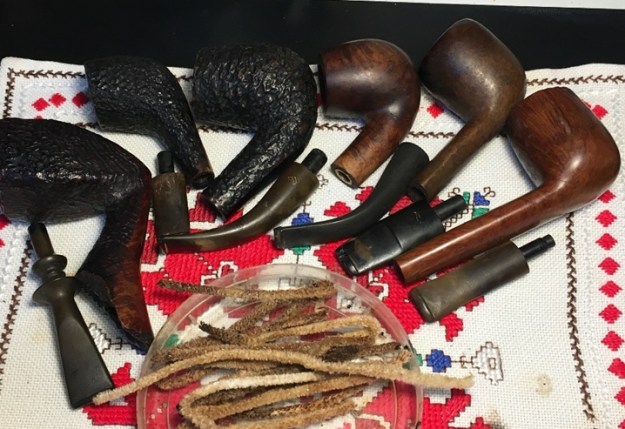
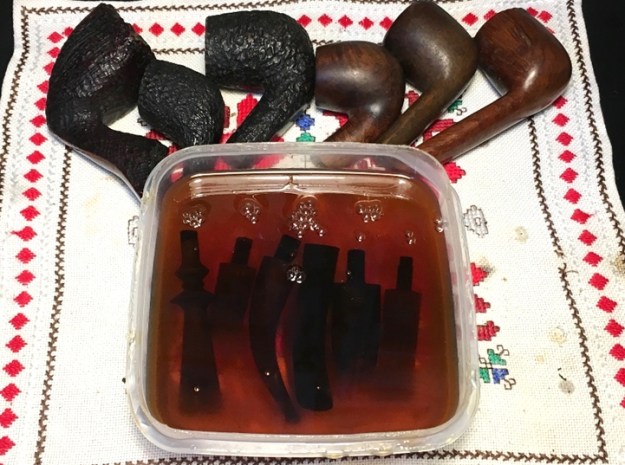
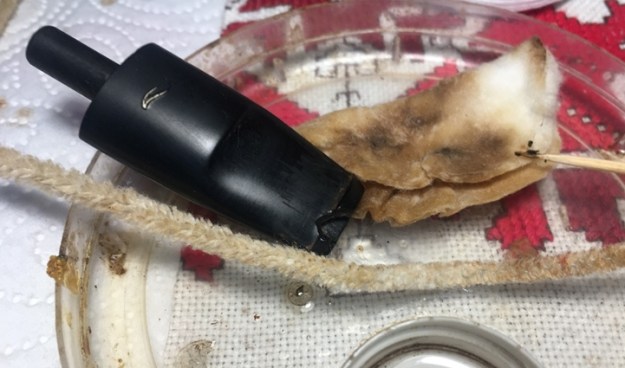
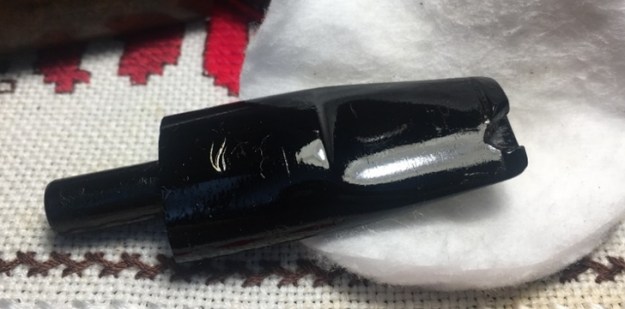
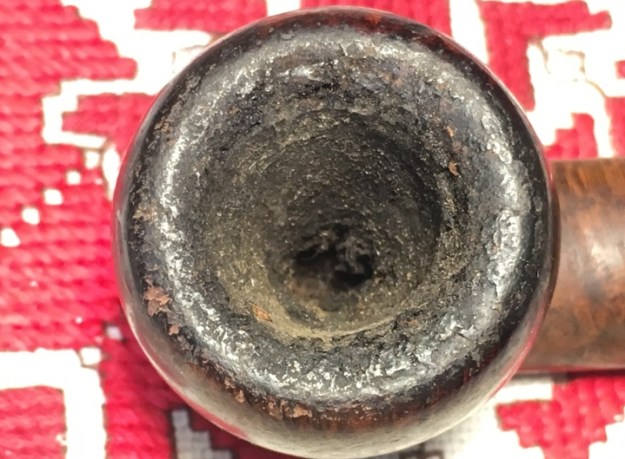
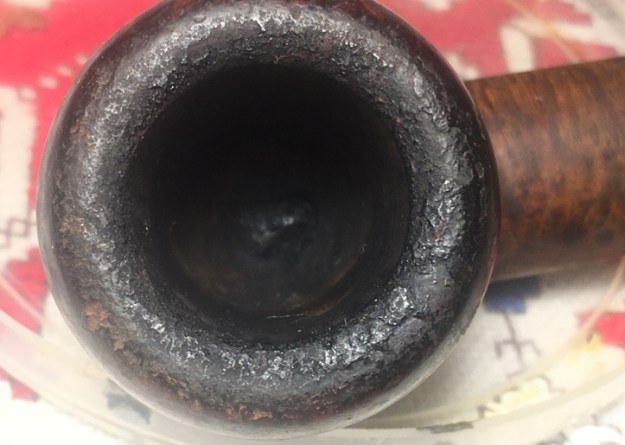
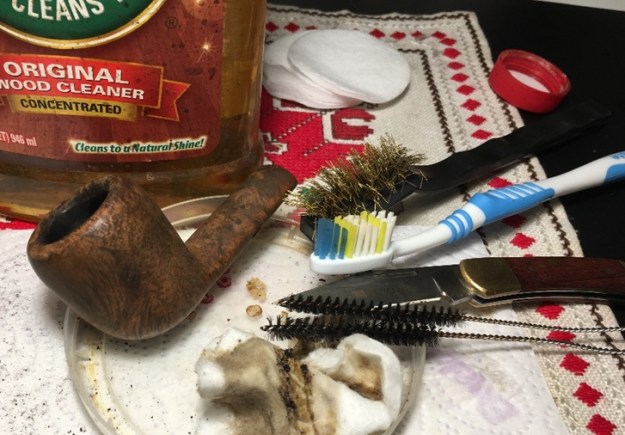
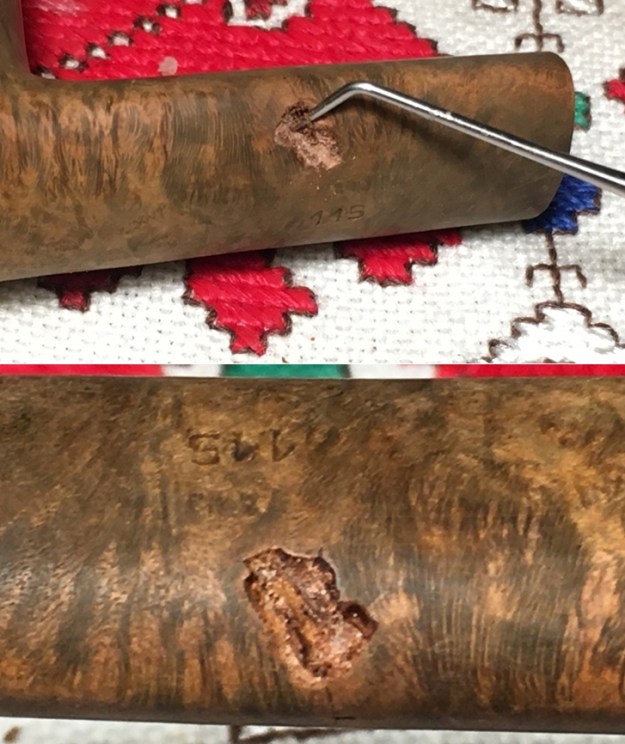
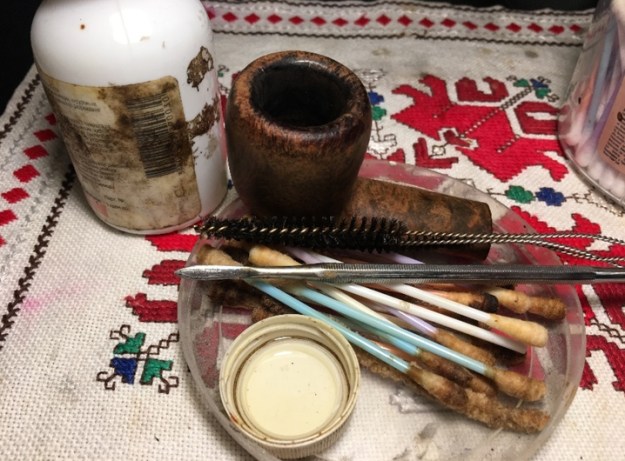
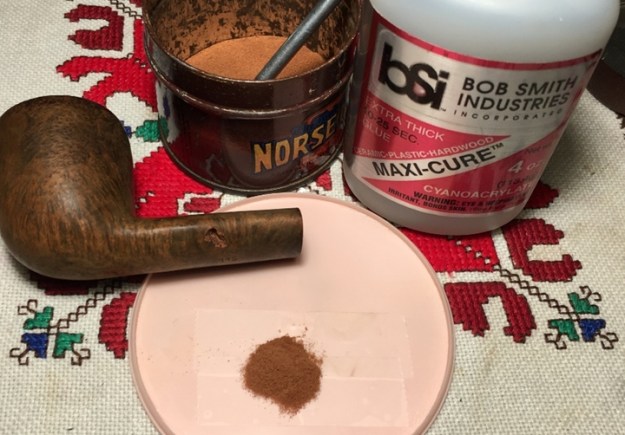
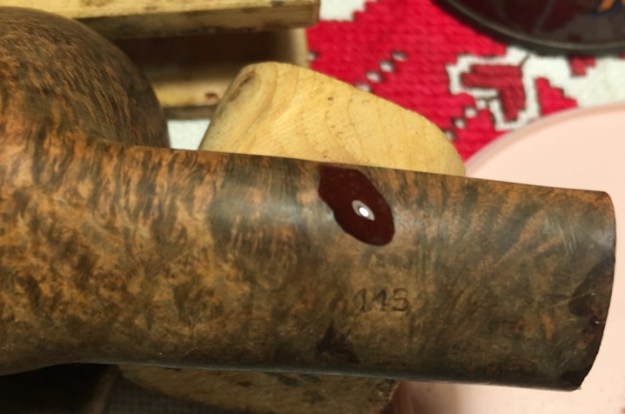
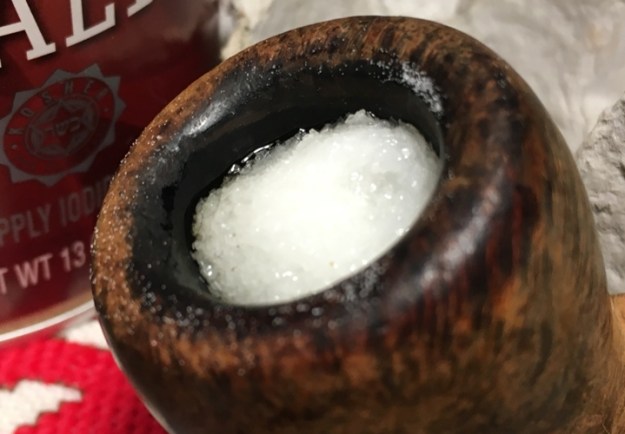
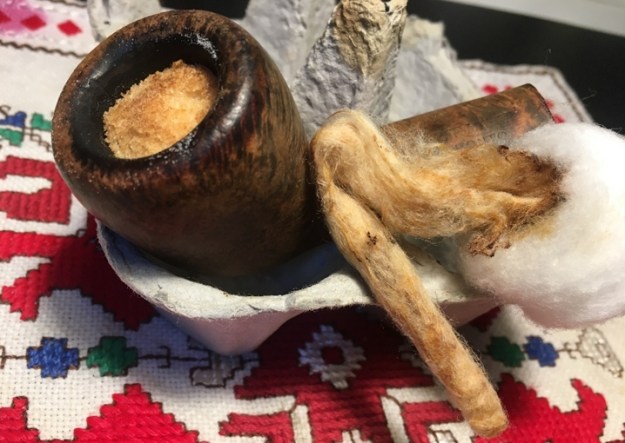
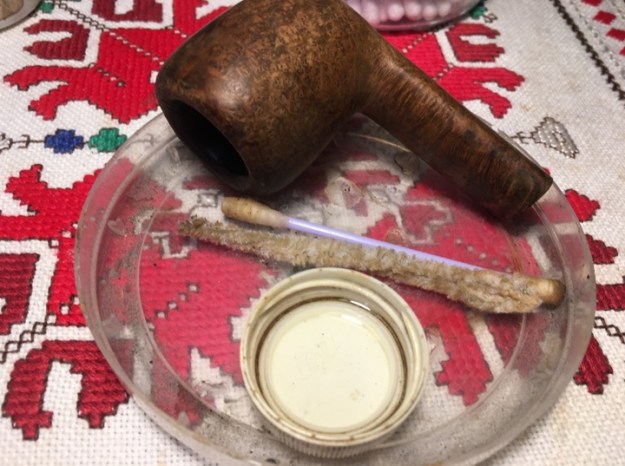
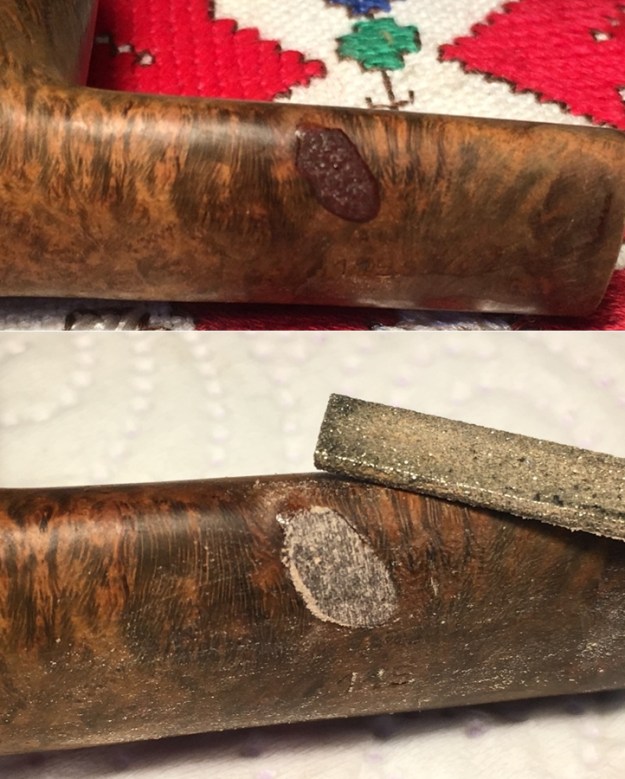
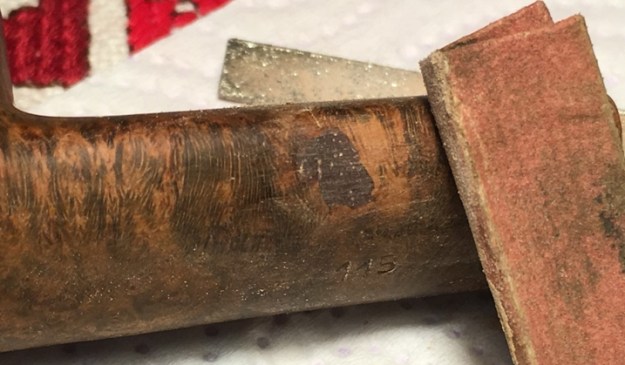
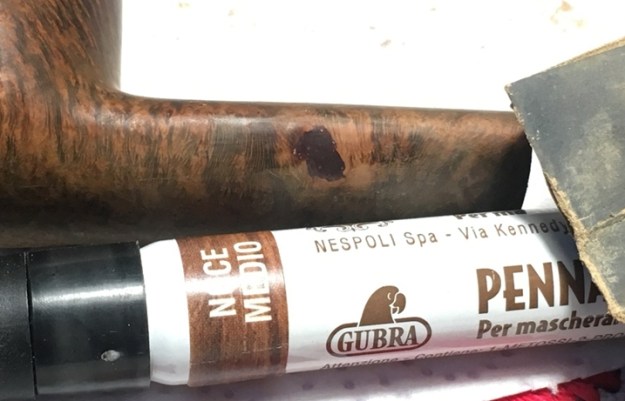
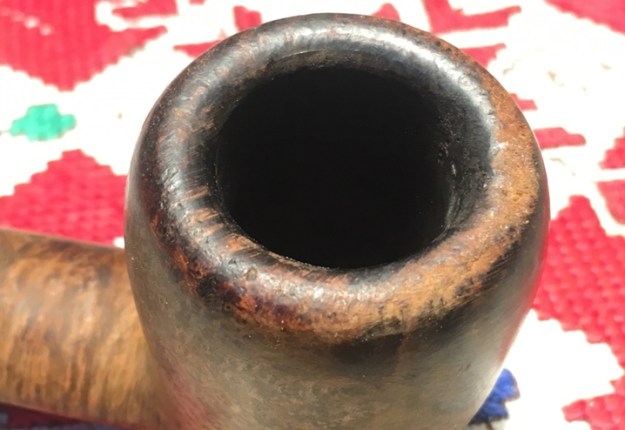
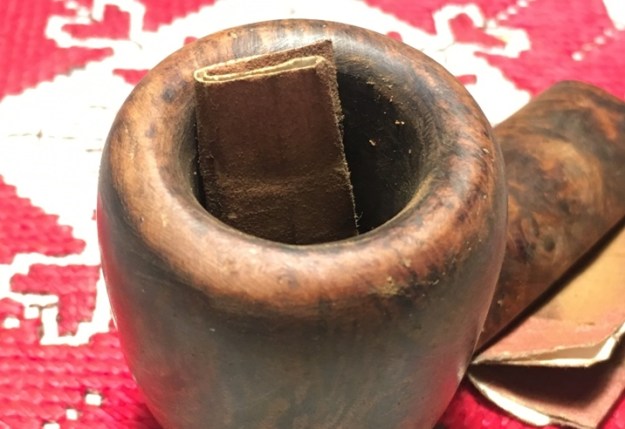
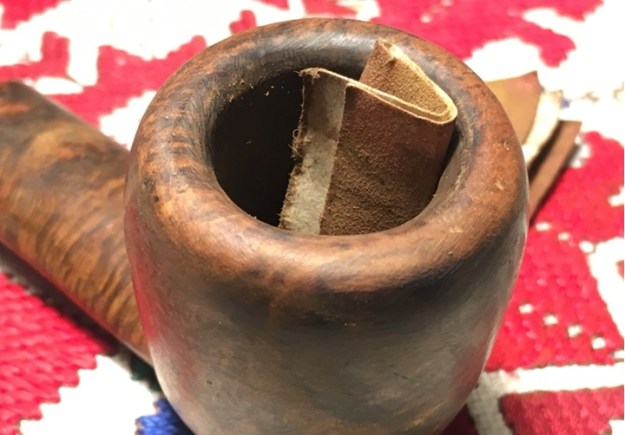
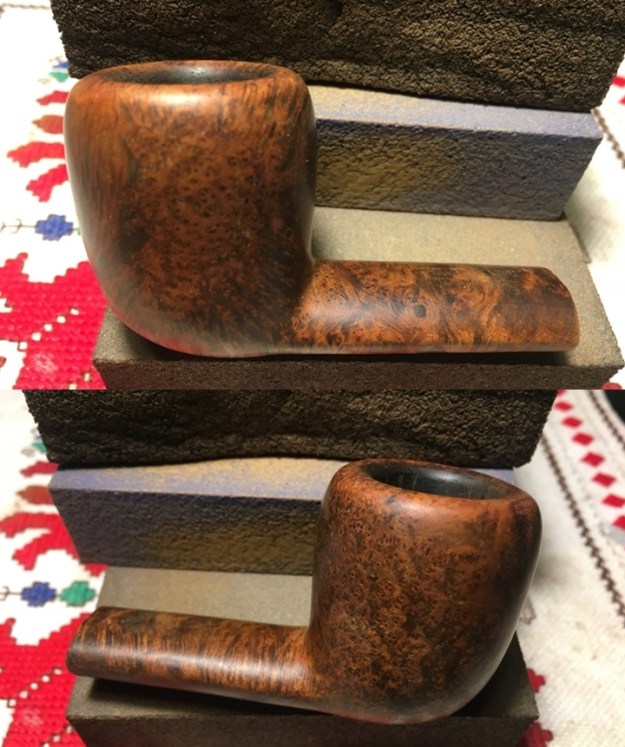
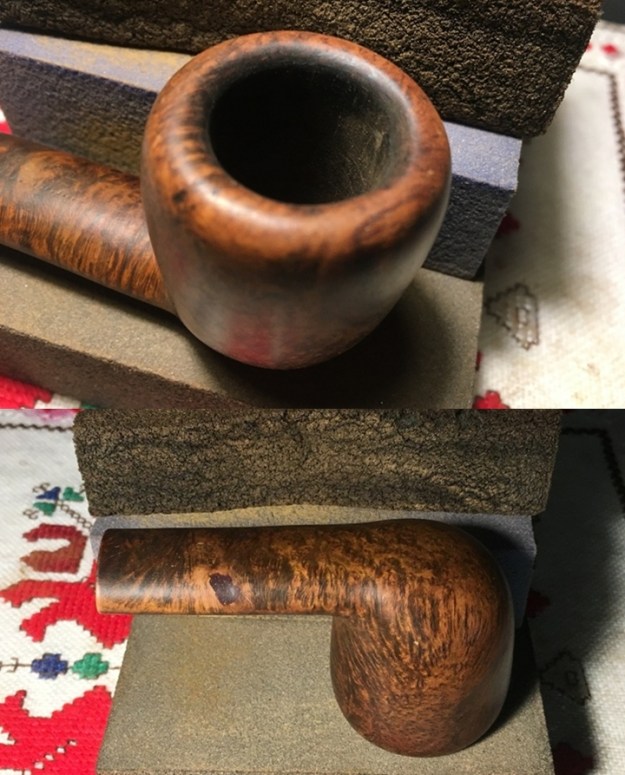
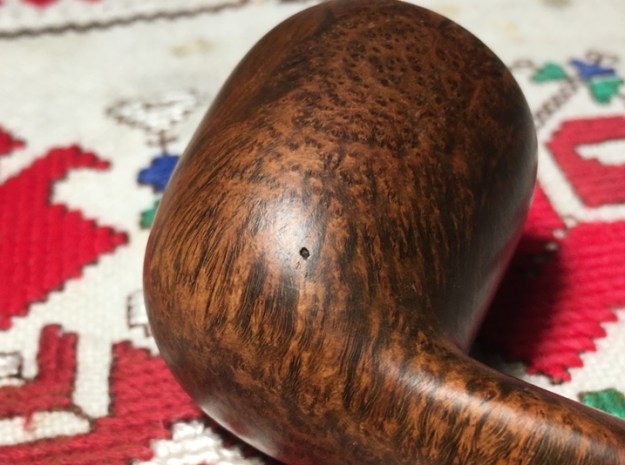
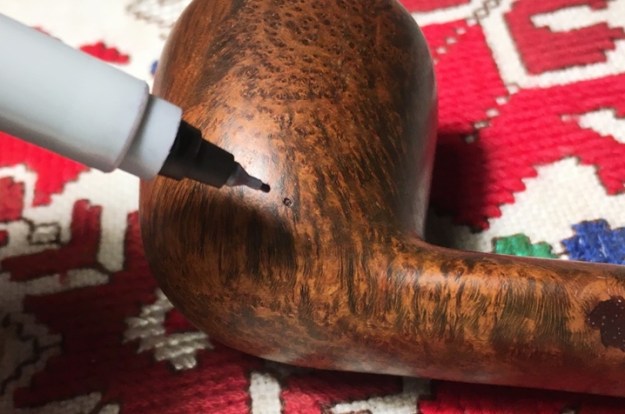
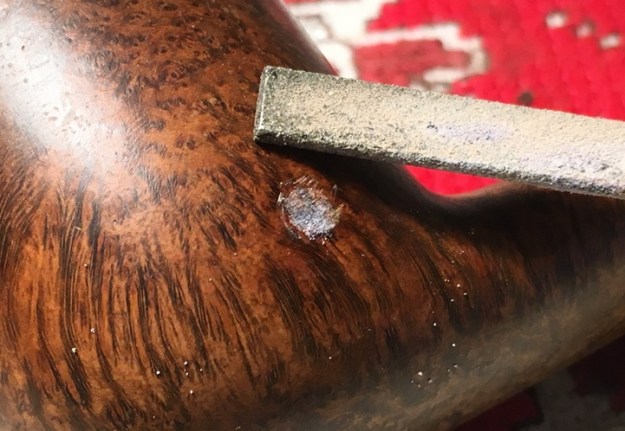
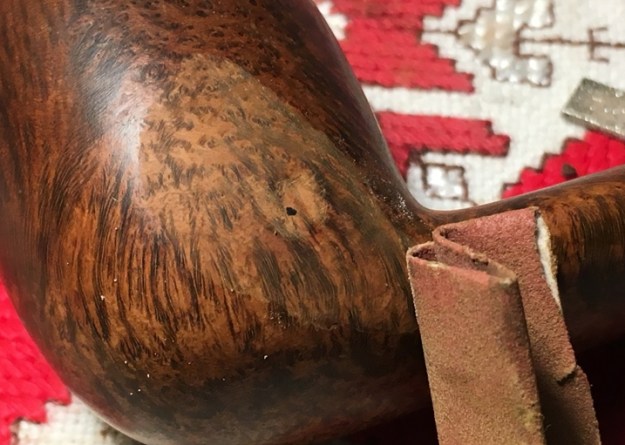
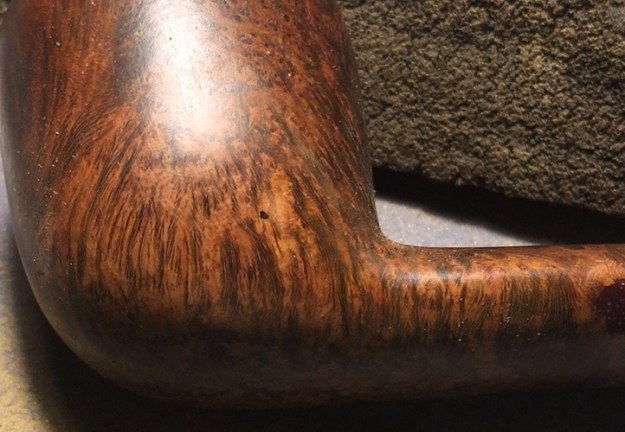
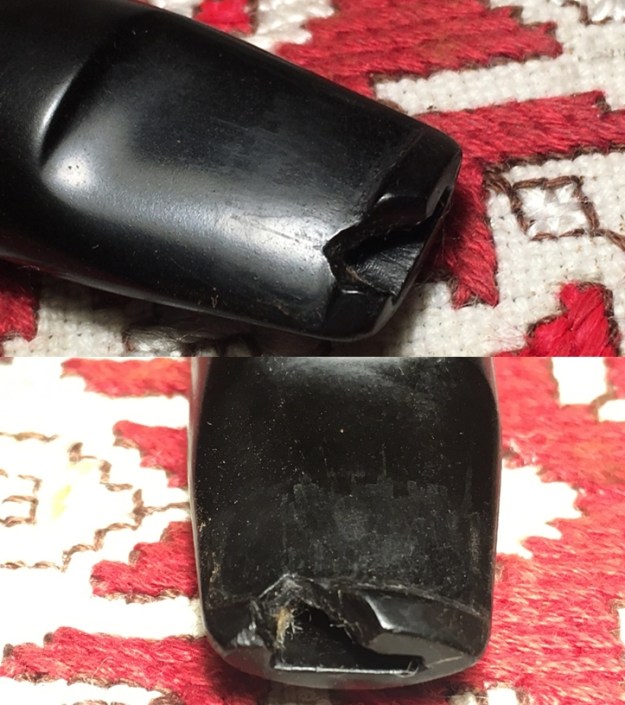
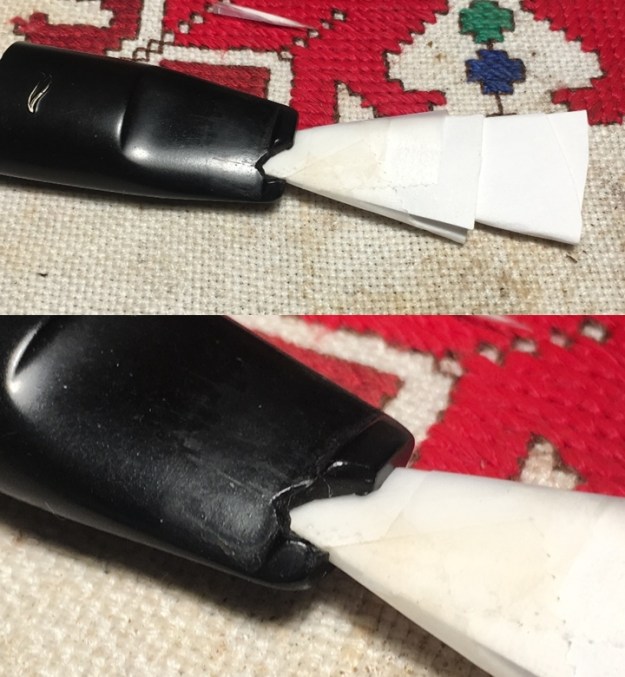
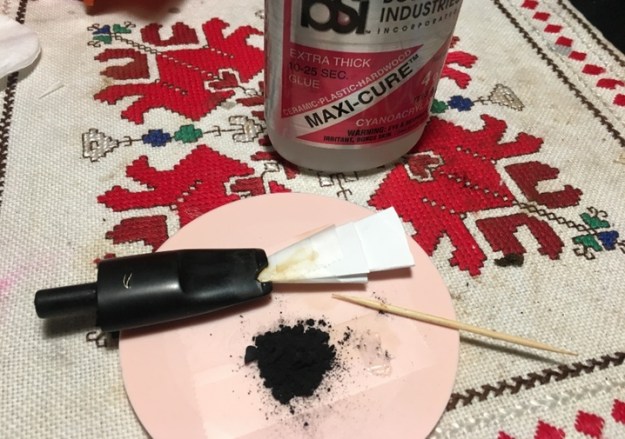
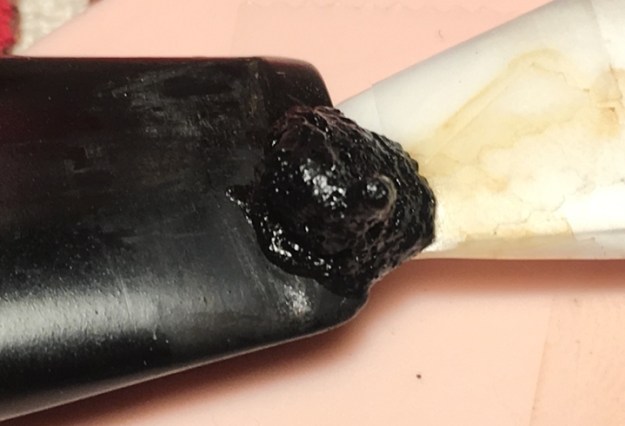
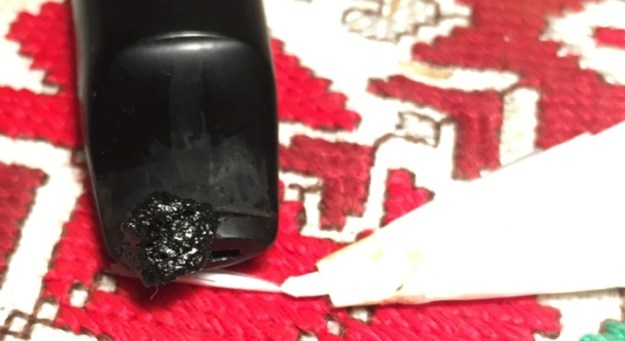
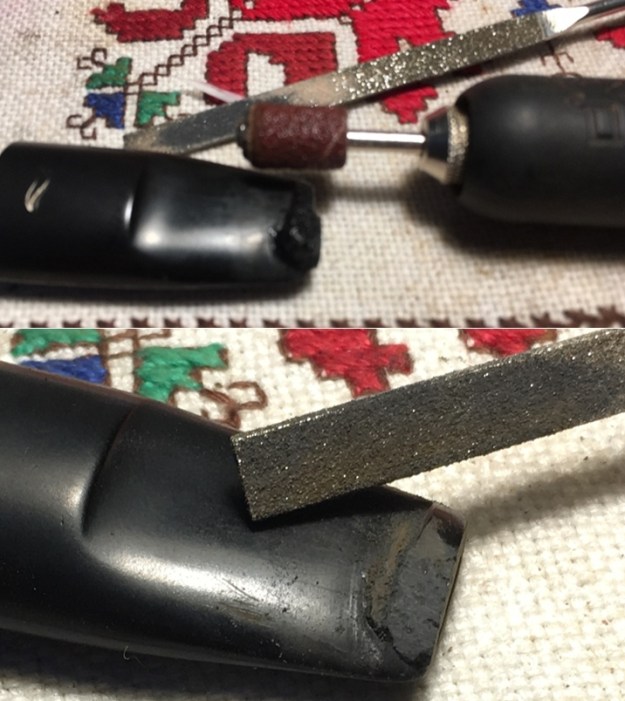
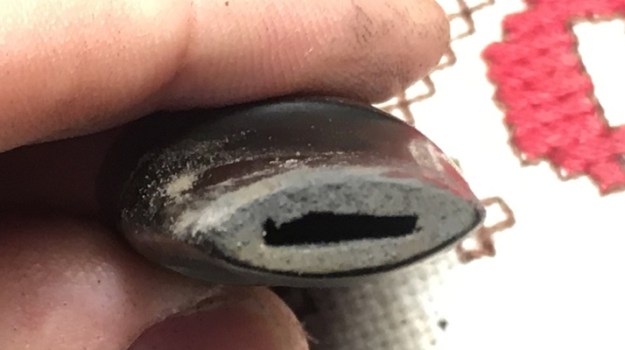
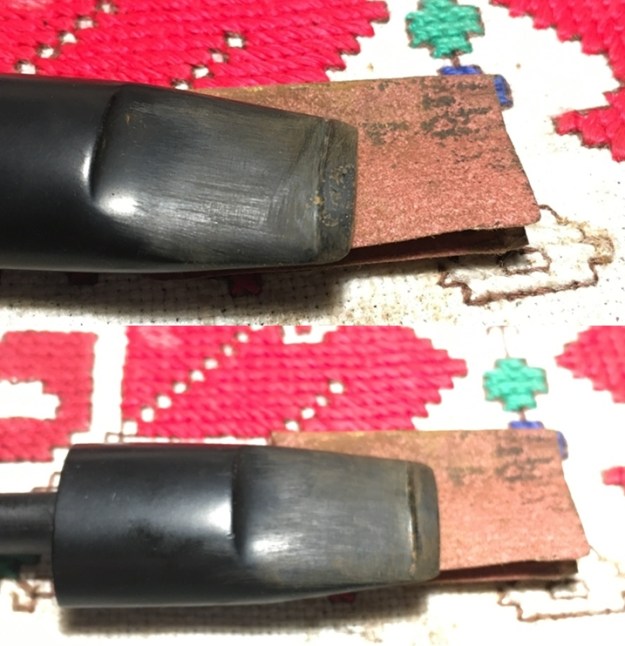
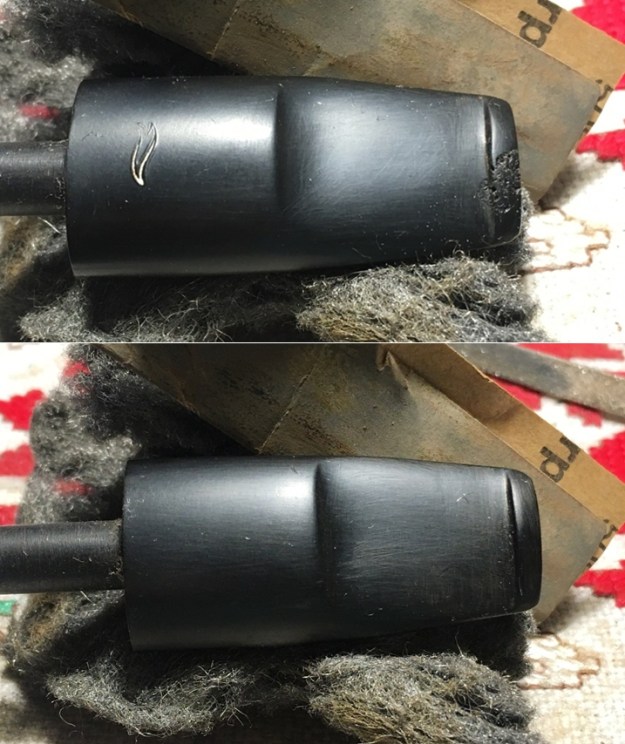
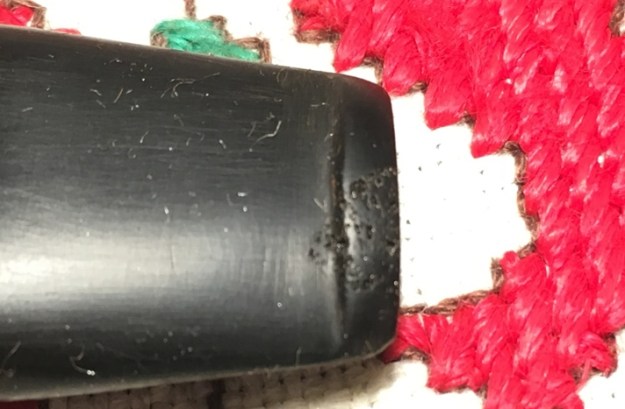
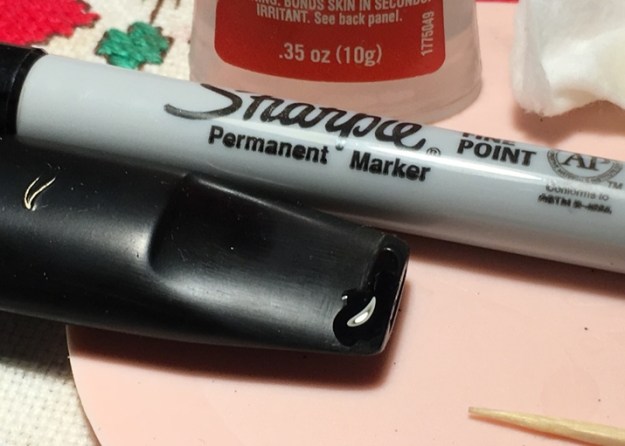
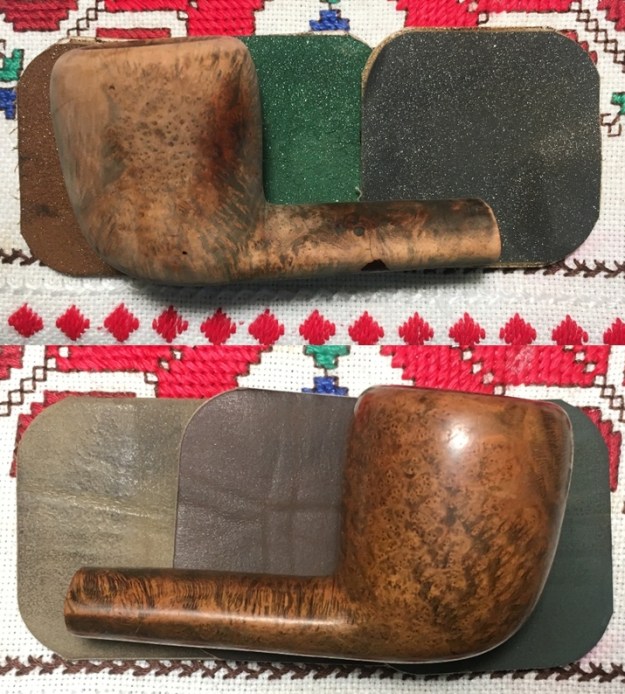
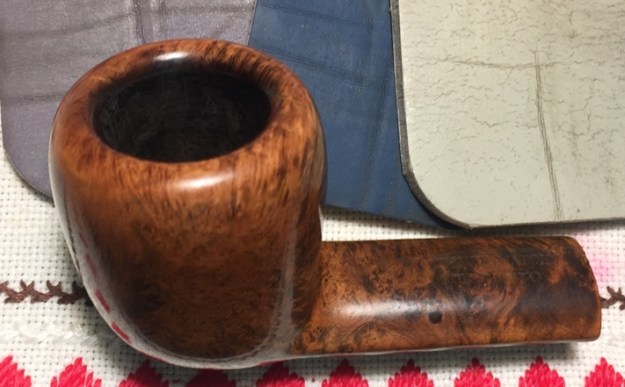
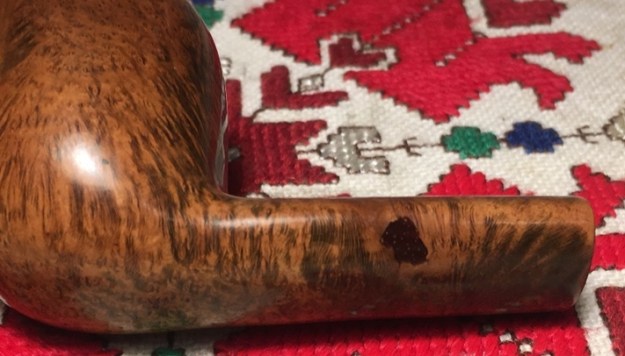
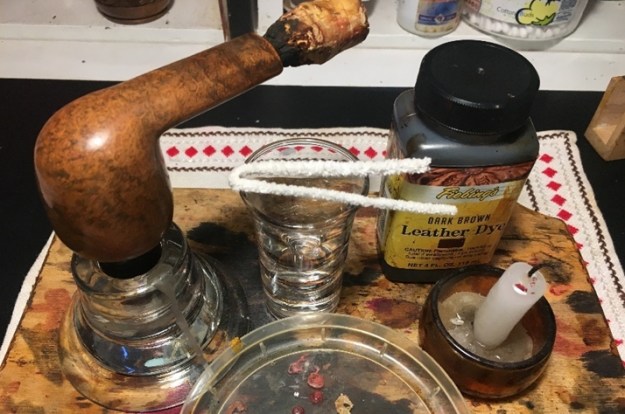
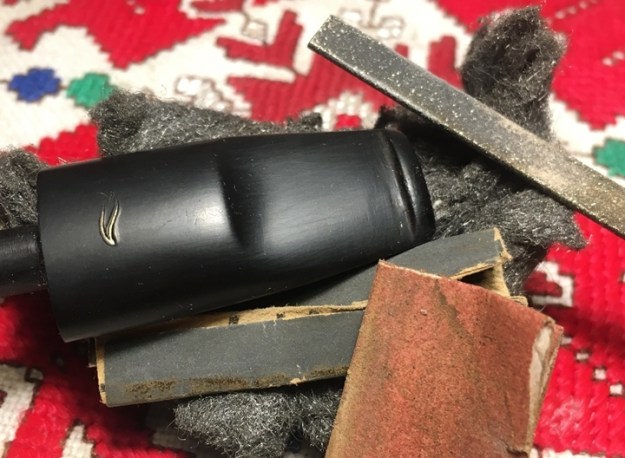
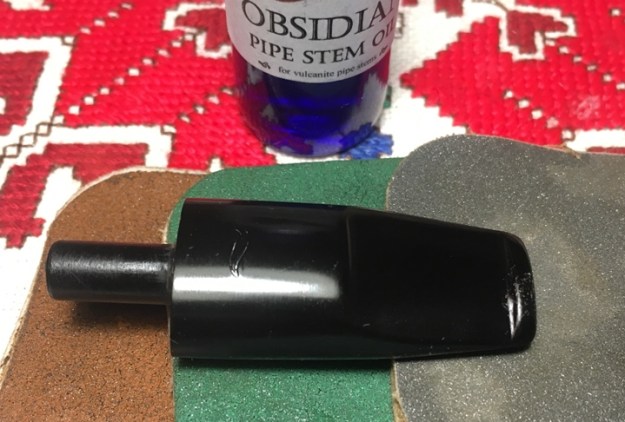
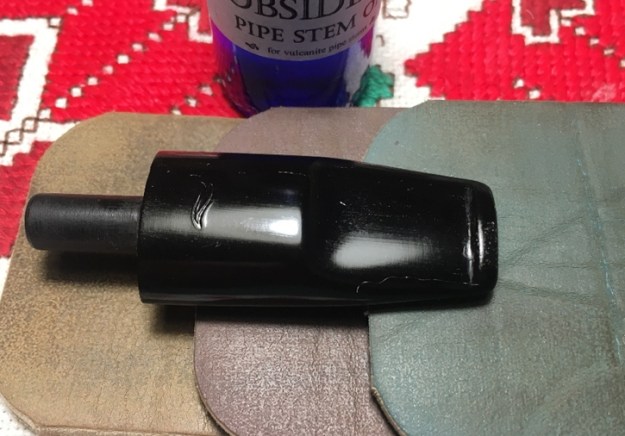
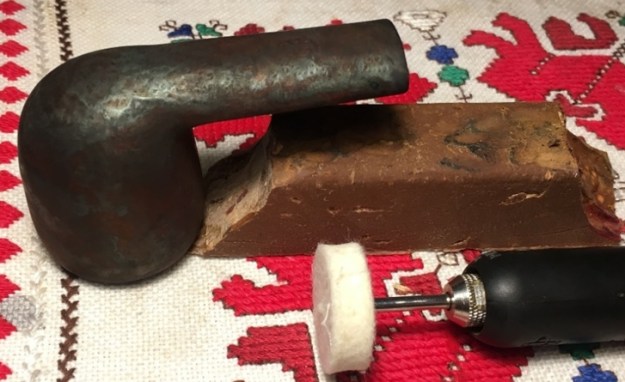
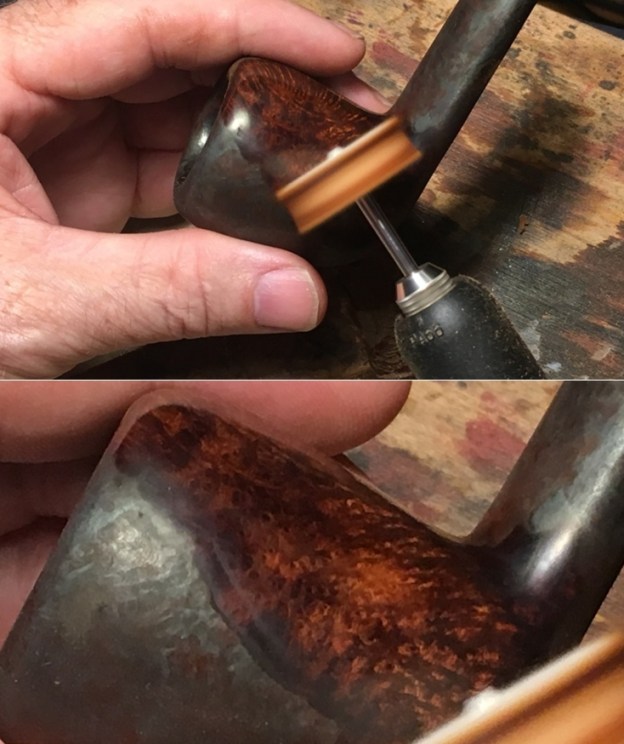
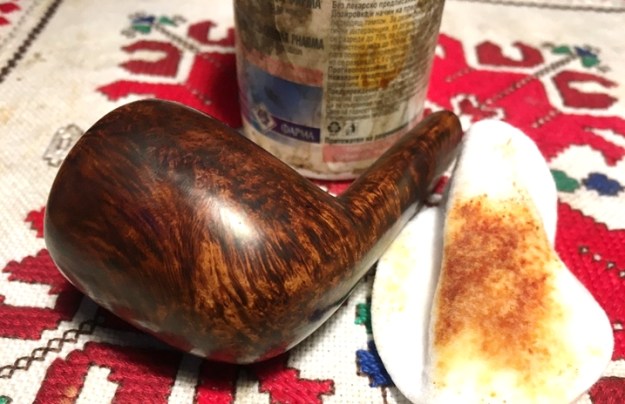
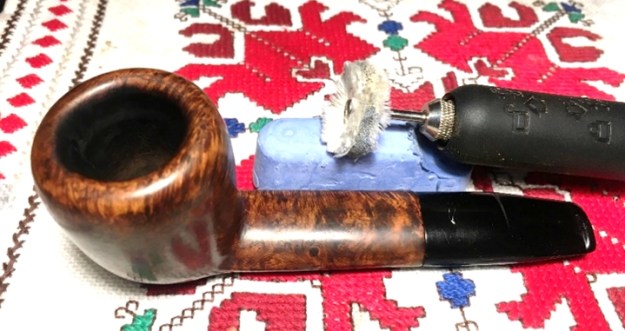
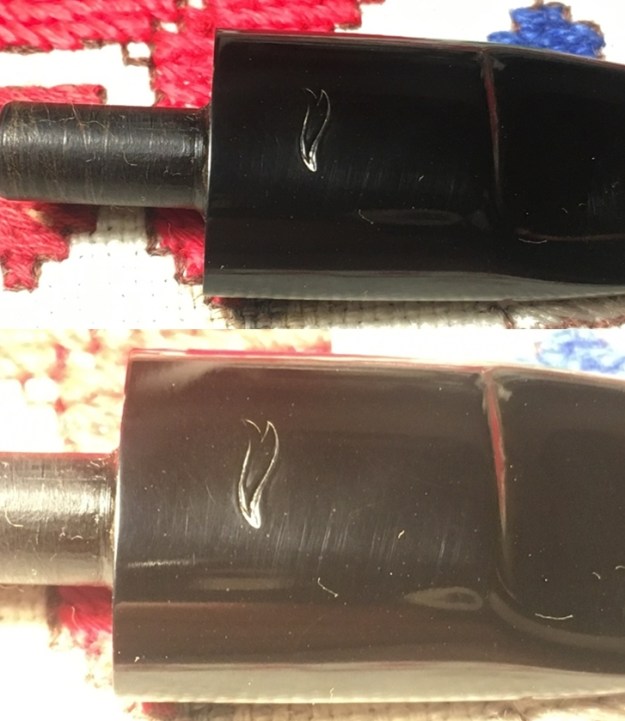
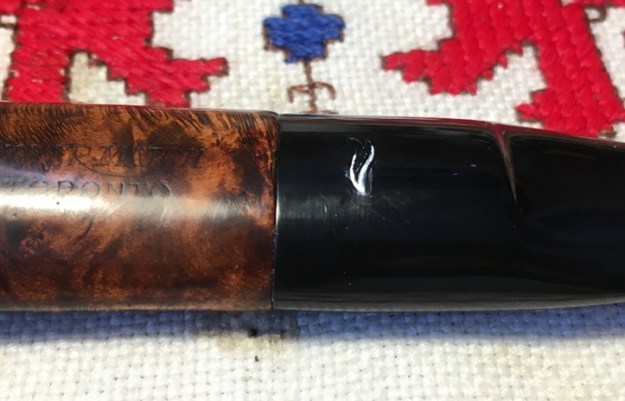
This Silver Match Toronto Squat Lumberman came out well.  The grain is striking with a smattering of swirls, waves, bird’s eye, and flame…, it’s an expressive piece of briar!  The darkened stain works great and masked the fill on the underside of the shank almost to perfection.  I’m pleased with the button rebuild, though I want to work more on reducing the air pockets in the process.  Overall, this stout Lumberman is ready for service.  Robert commissioned him and has the first opportunity to purchase this pipe from The Pipe Steward Store.  This pipe benefits the Daughters of Bulgaria – helping women and girls who have been trafficked and sexually exploited.  Thanks for joining me!