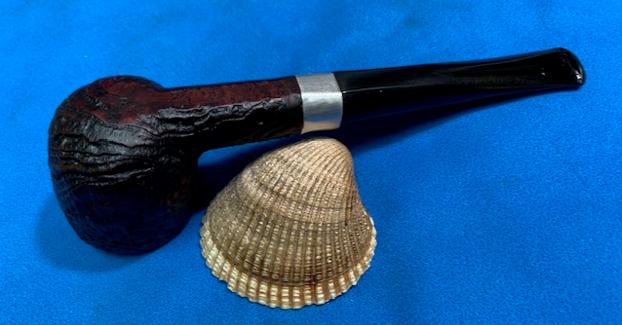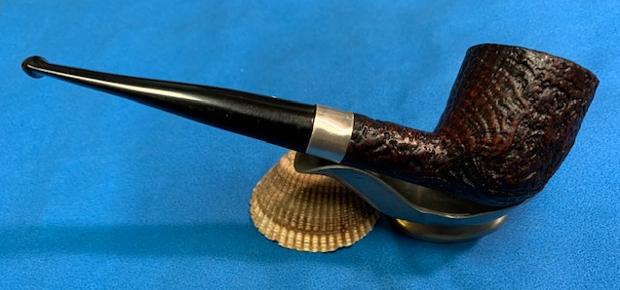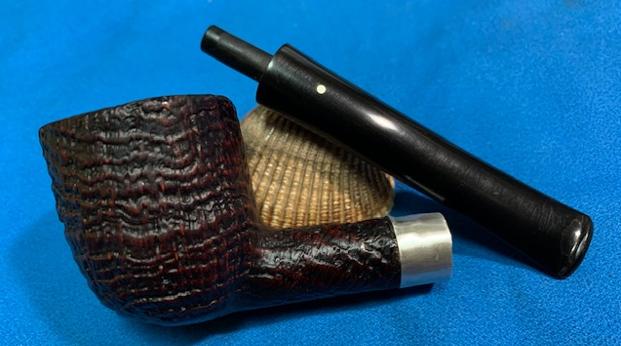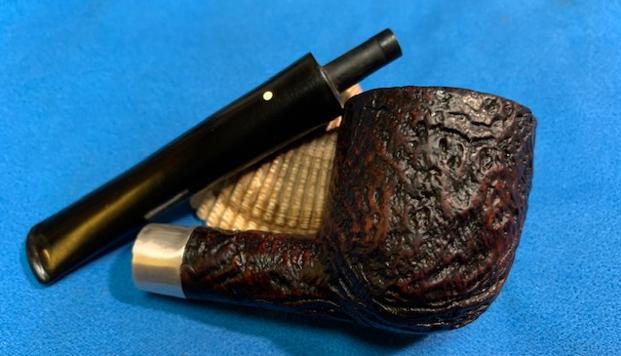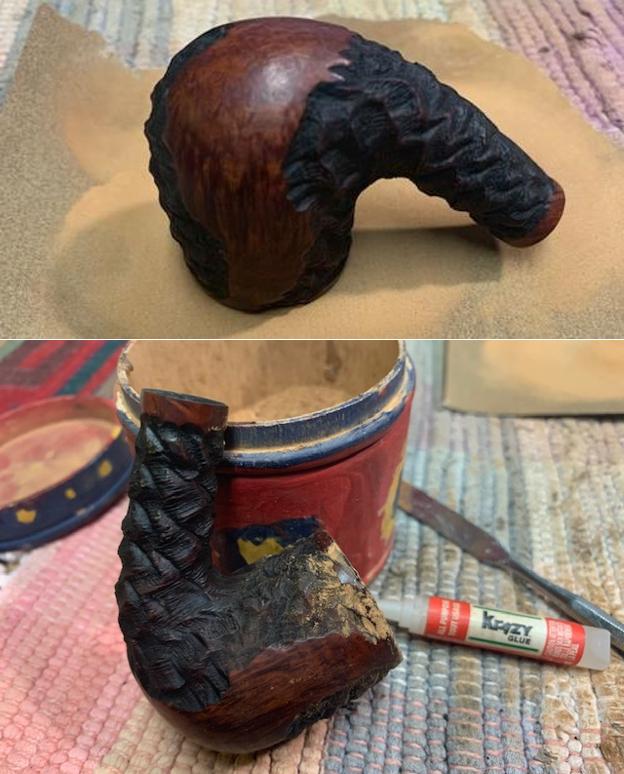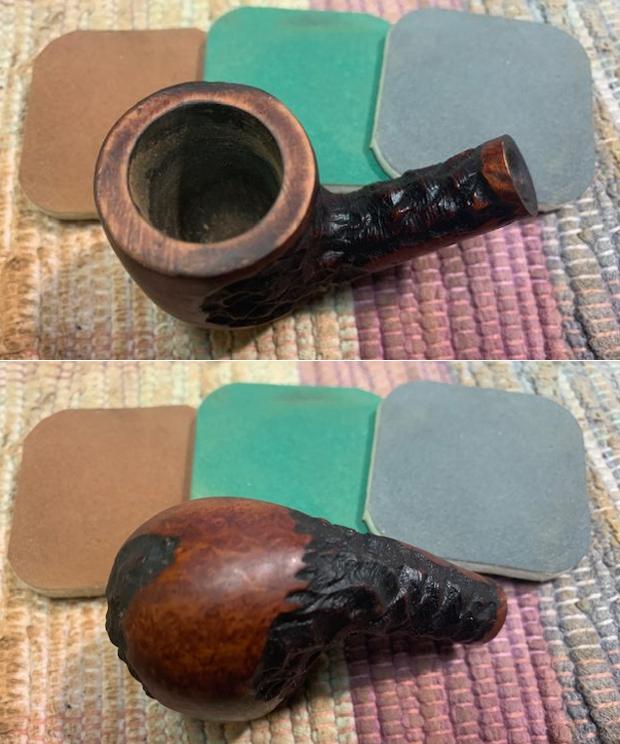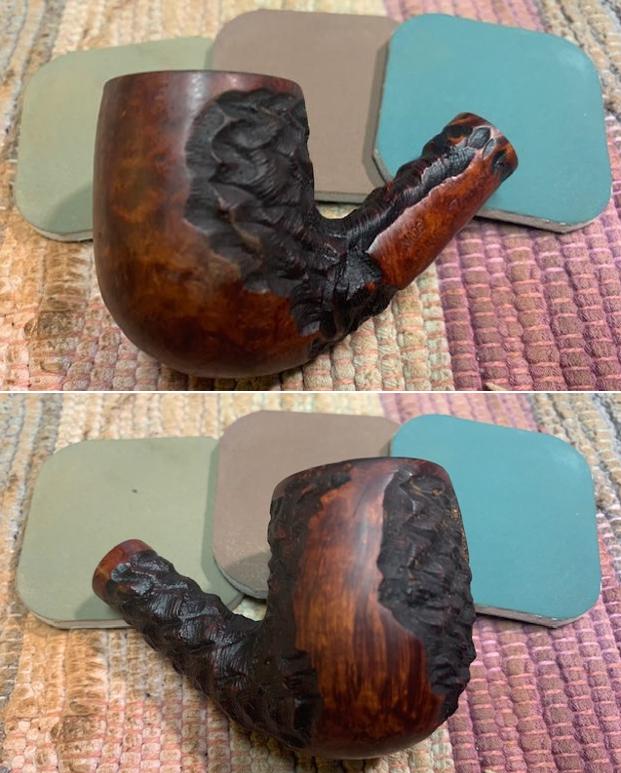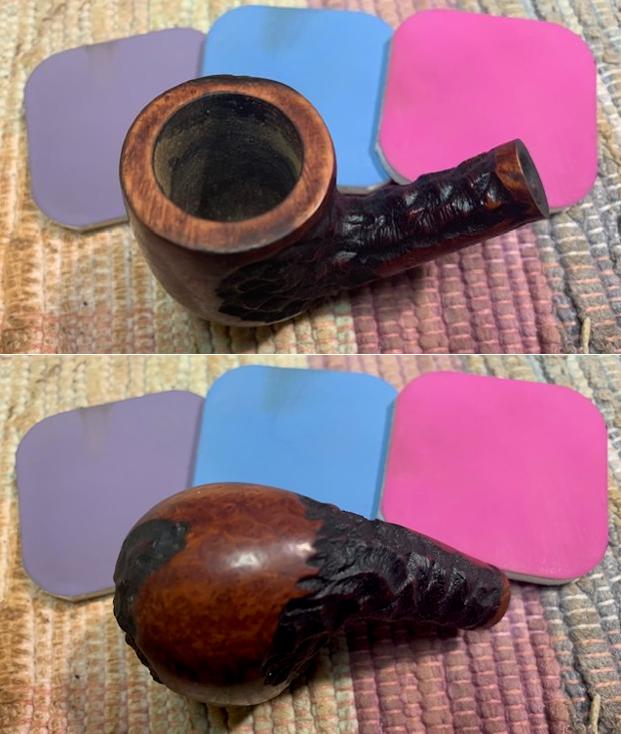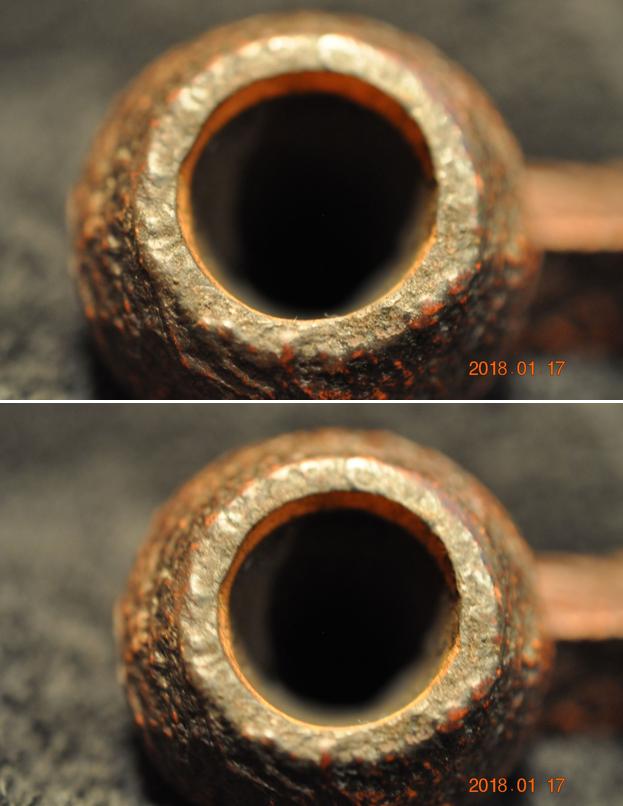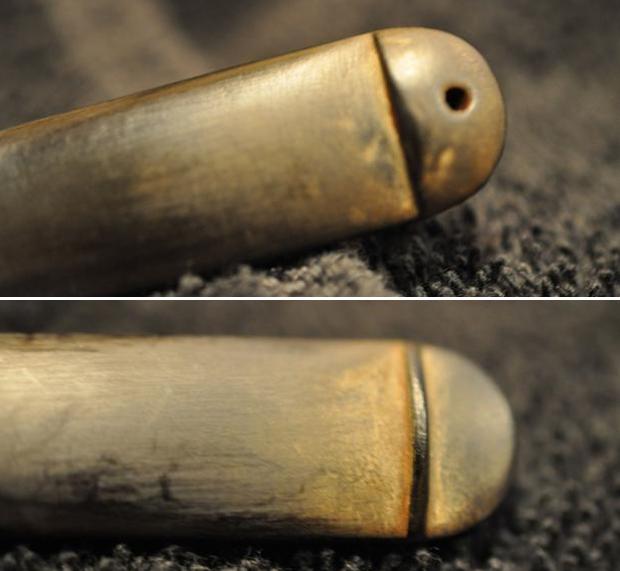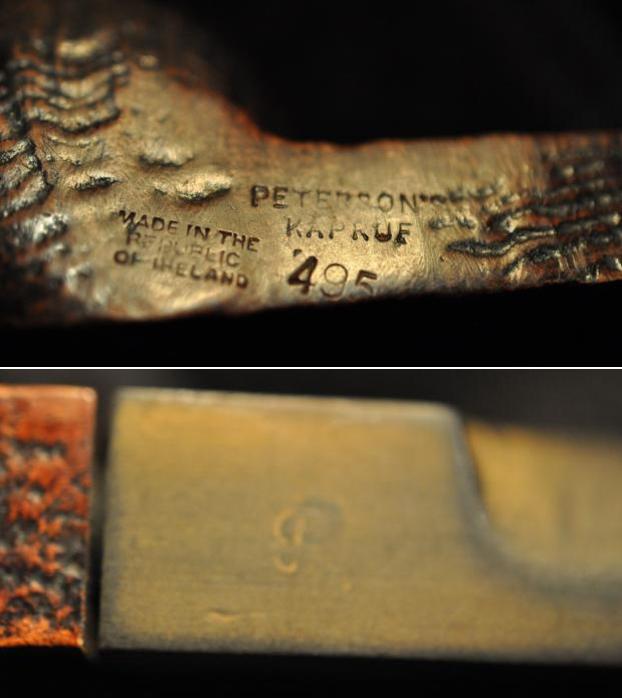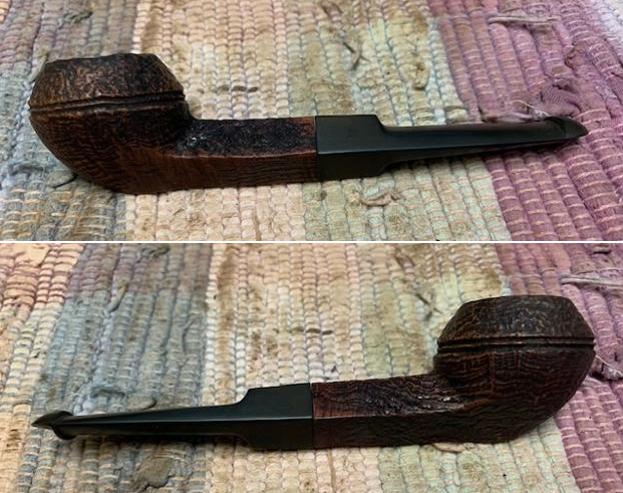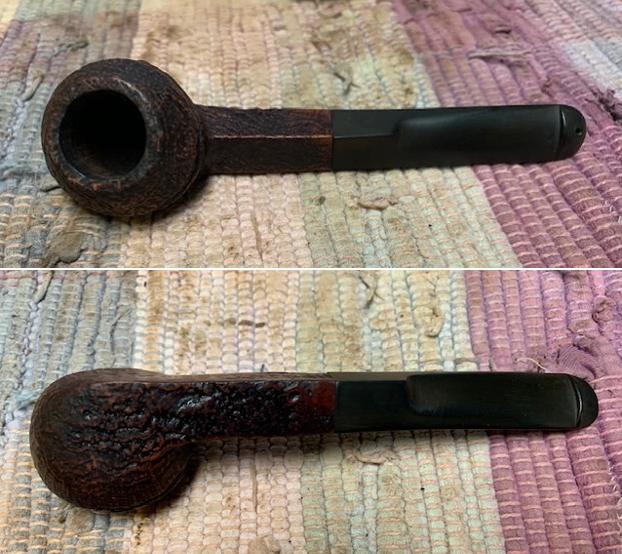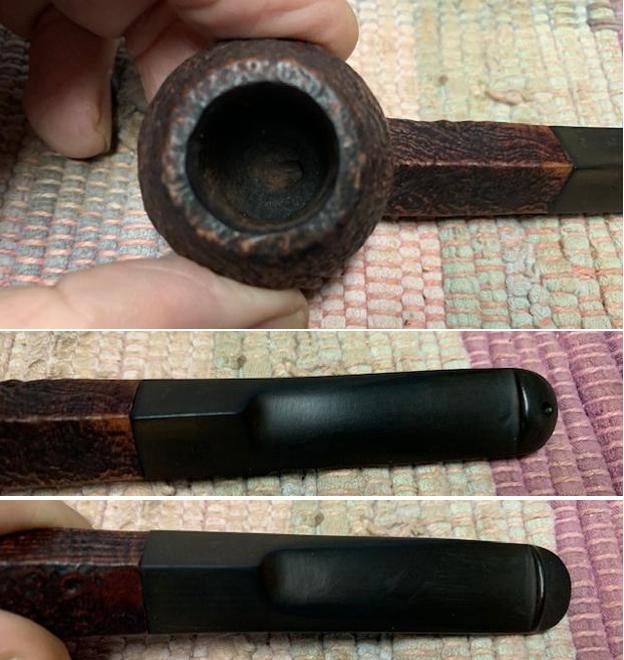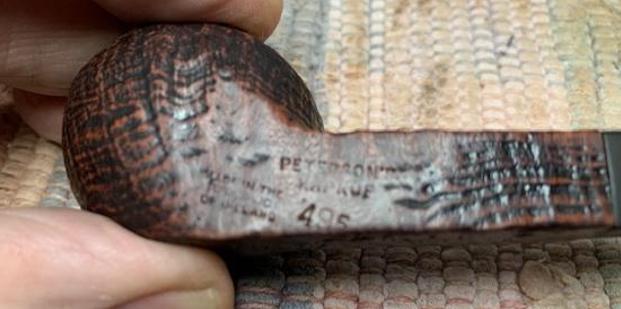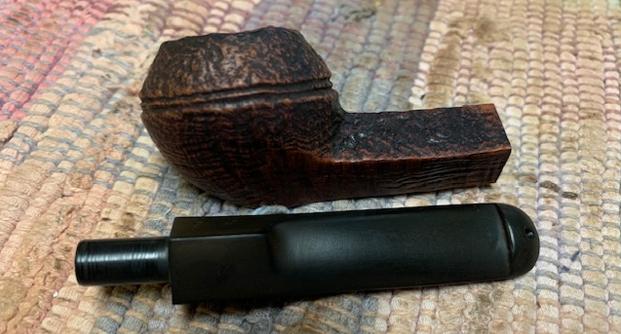
Tag Archives: Stem repairs

Dropped in at the Dunhill Deep End


Blog by Kenneth Lieblich

This is the first and introductory blog by Kenneth. We have been working through his Grandfather’s pipes and others that he has purchased to help him learn the processes that I use to restore and refurbish pipes. He is a quick study and able student. Give his first blog a read and enjoy it. Thanks Kenneth and welcome to rebornpipes.

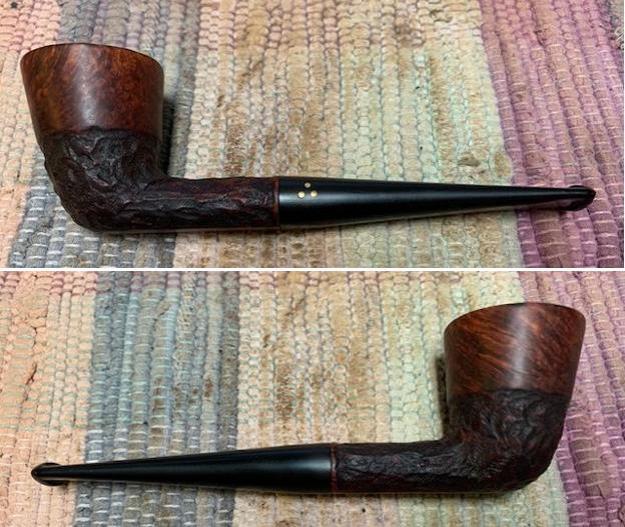
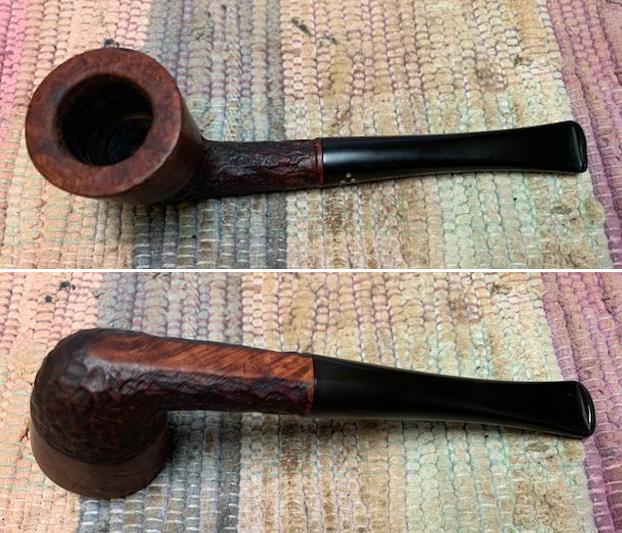
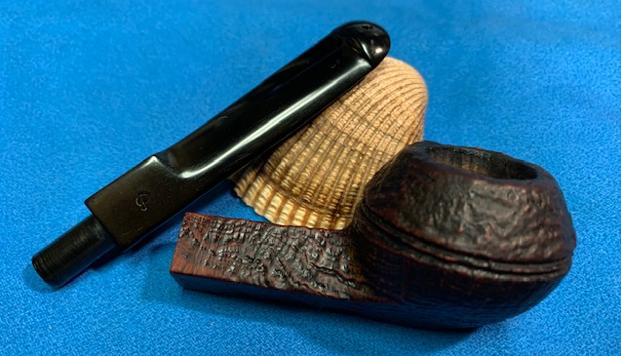
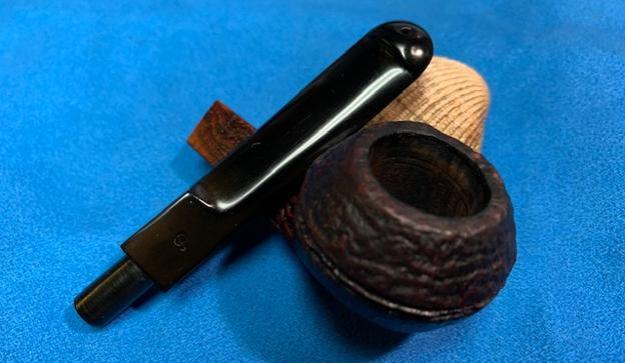
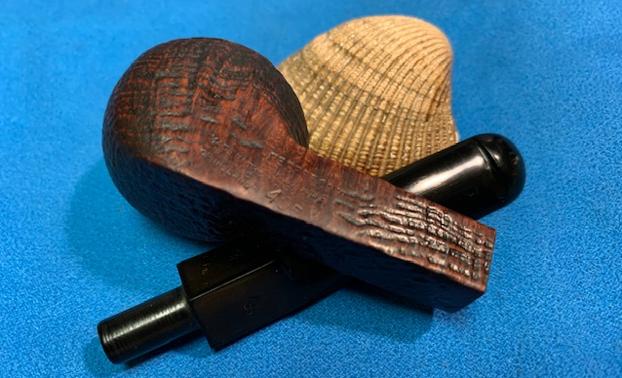
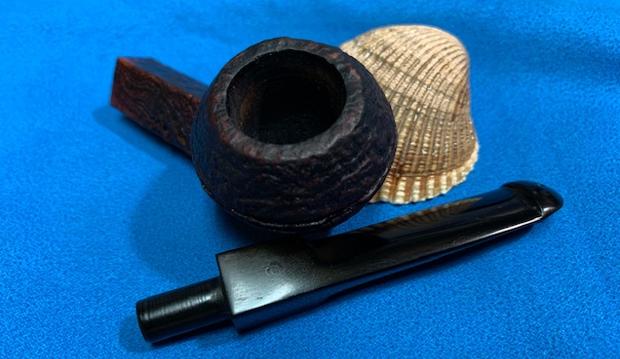
I must admit that I never thought that the first pipe I ever restored would be a Dunhill Shell Briar Bulldog. Talk about nerve-wracking! I figured I would start out on an old clunker of a pipe so that if I made a mess of it, there was no great loss. But Steve Laug insisted that this was the one I had work on first because it was, in fact, a microcosm of pipe restoration all in one little pipe. I want to express my gratitude to Steve for not only permitting me to post the story of this pipe’s restoration, but most especially for guiding me every step of the way through the process. The vagaries of life (thanks to Covid) necessitated several FaceTime and Zoom chats, but he was always generous, friendly, and helpful. Any compliments on this restoration are for him – any criticisms are for me.

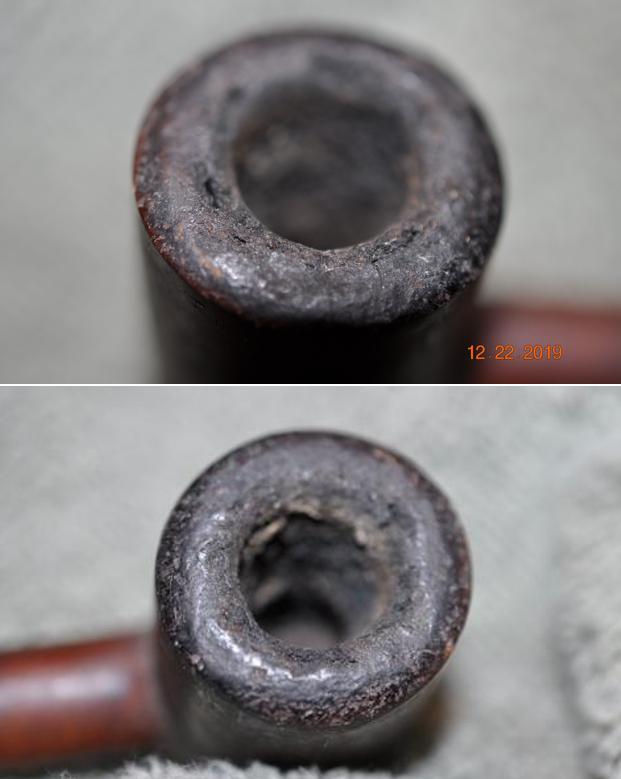
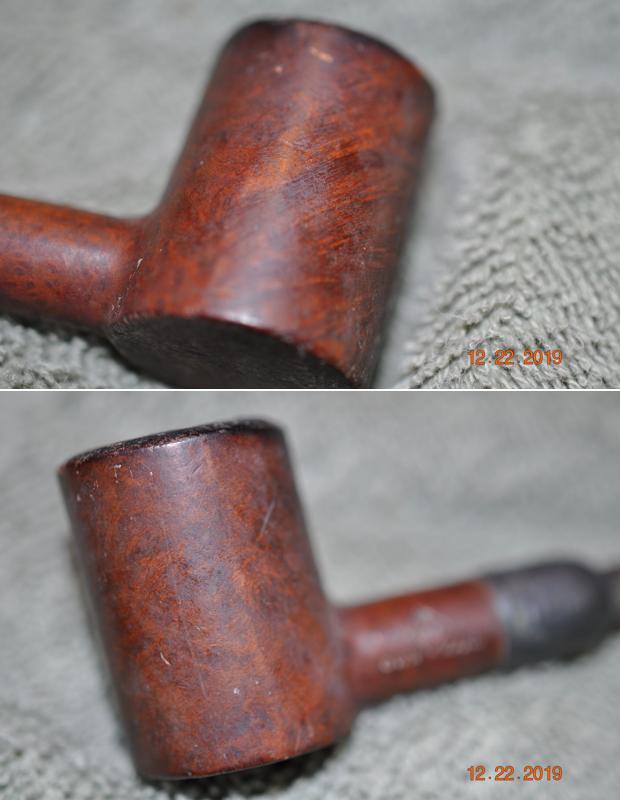
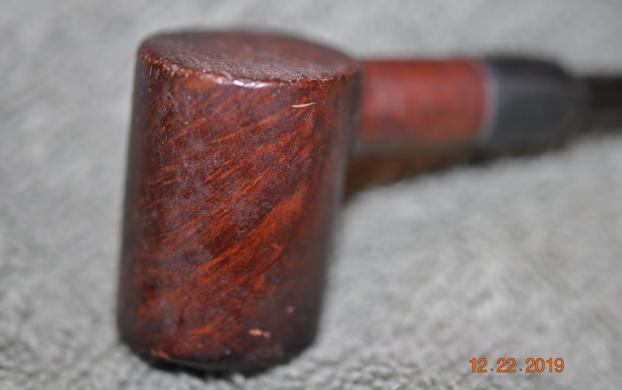
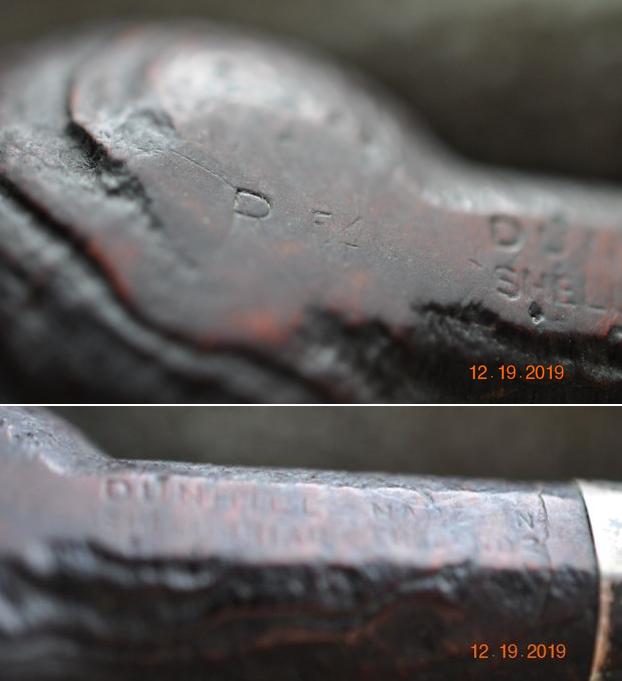
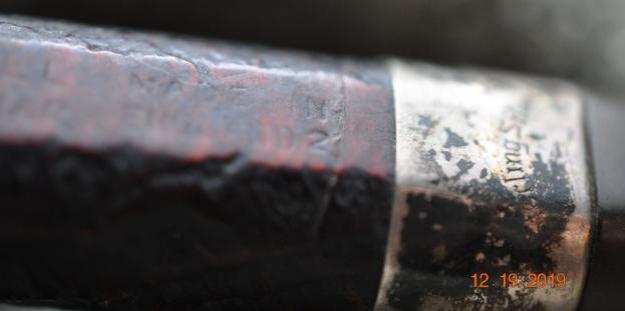
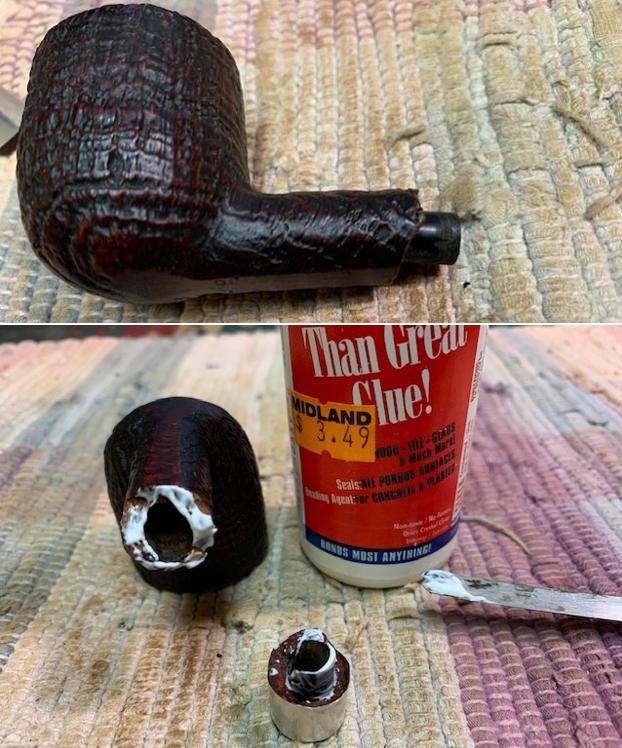
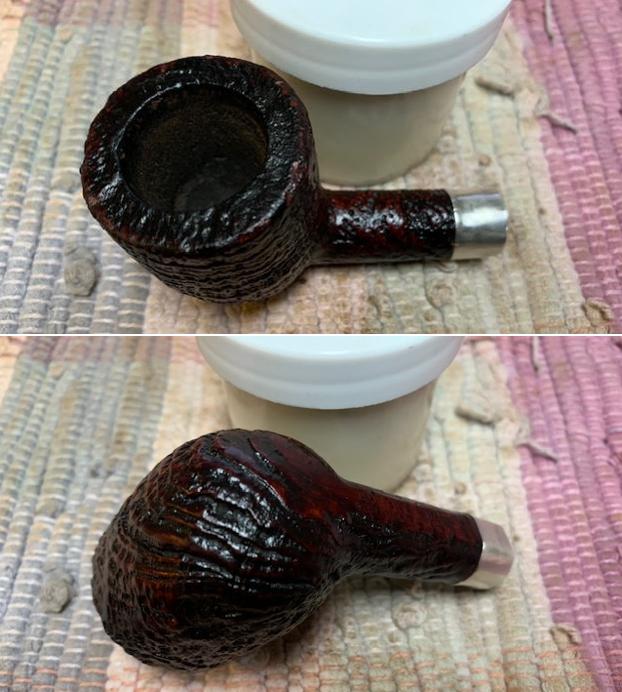
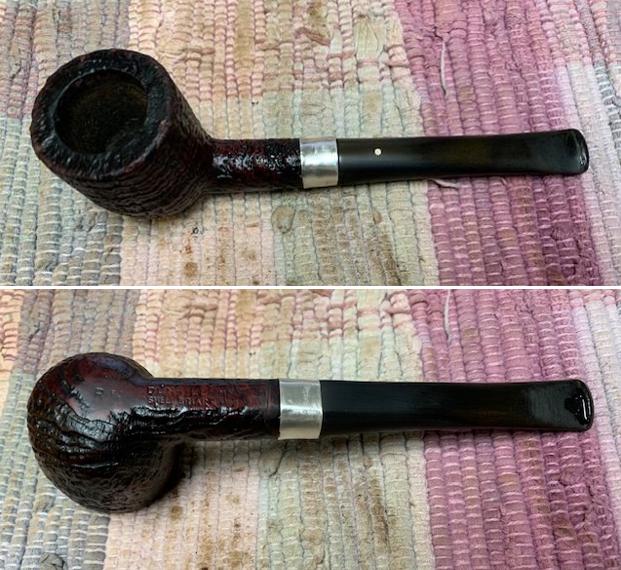
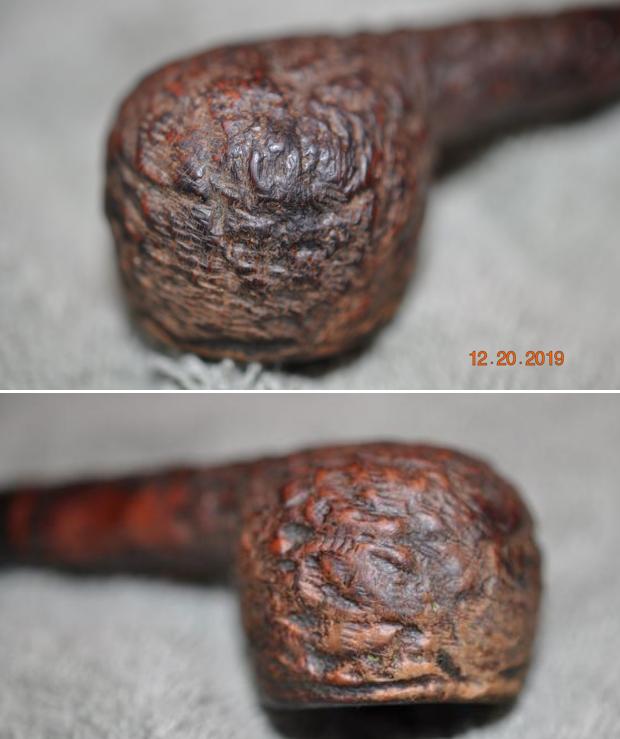
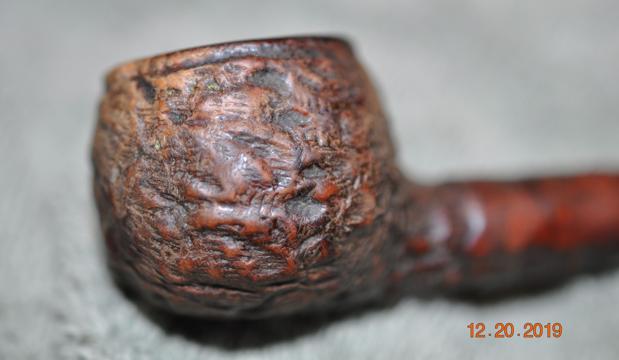
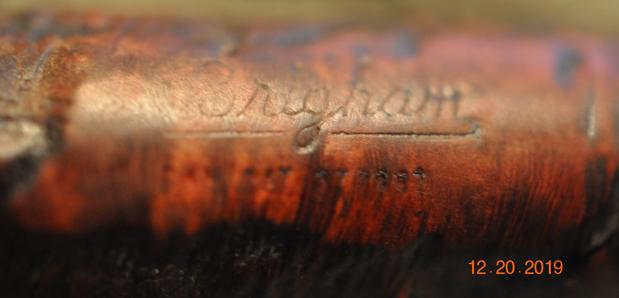
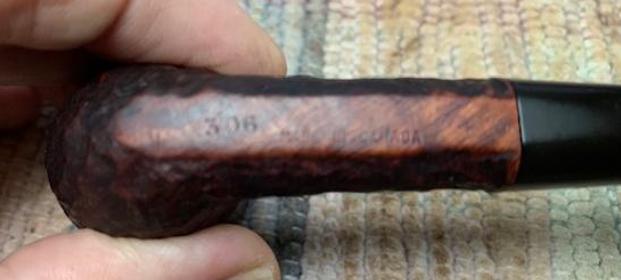
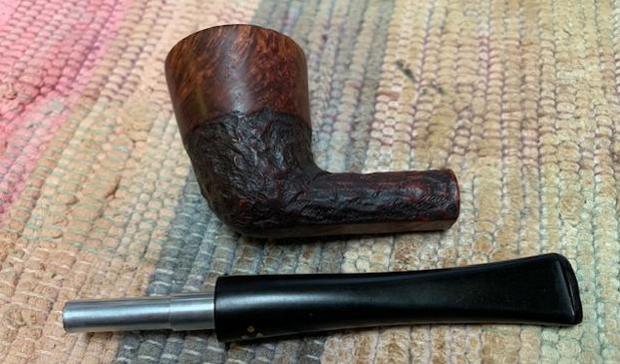
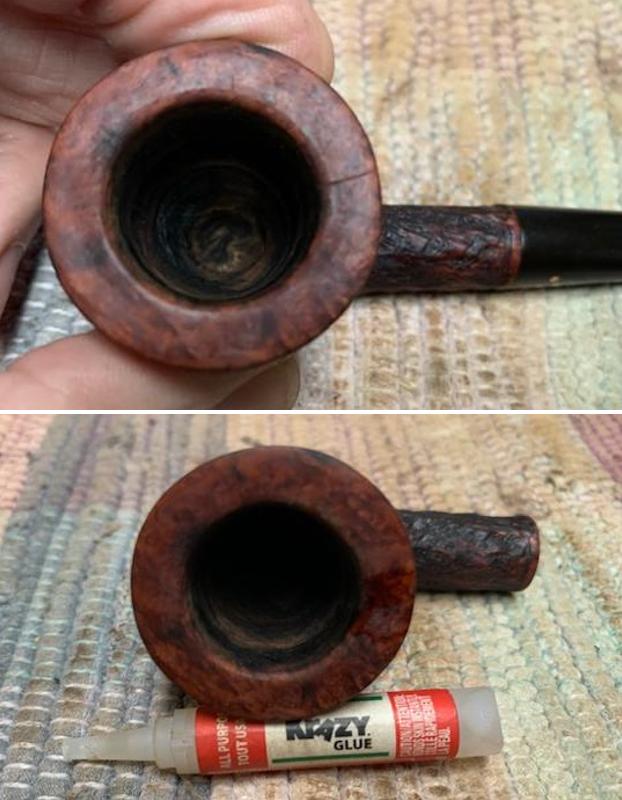
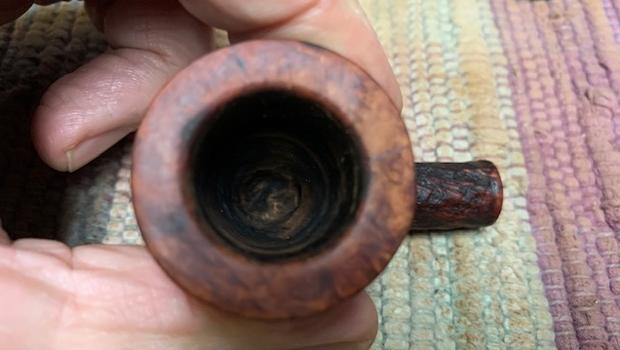
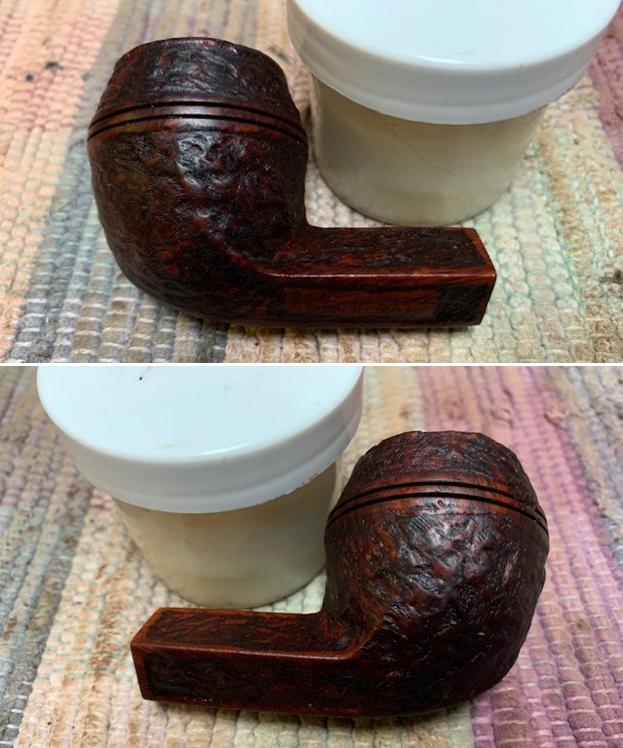
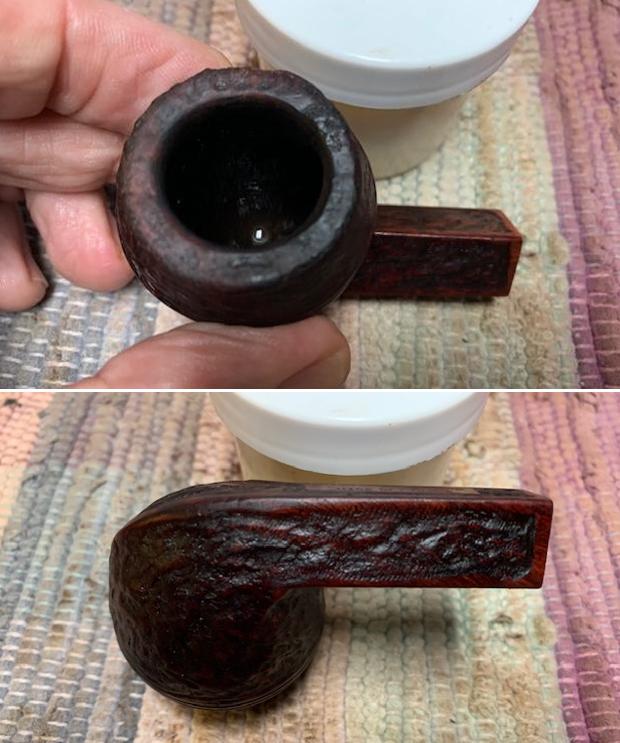
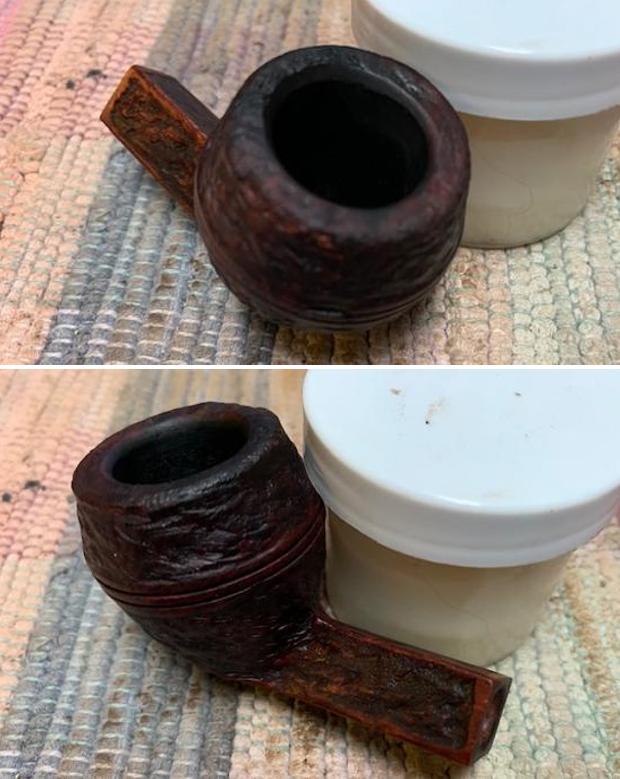
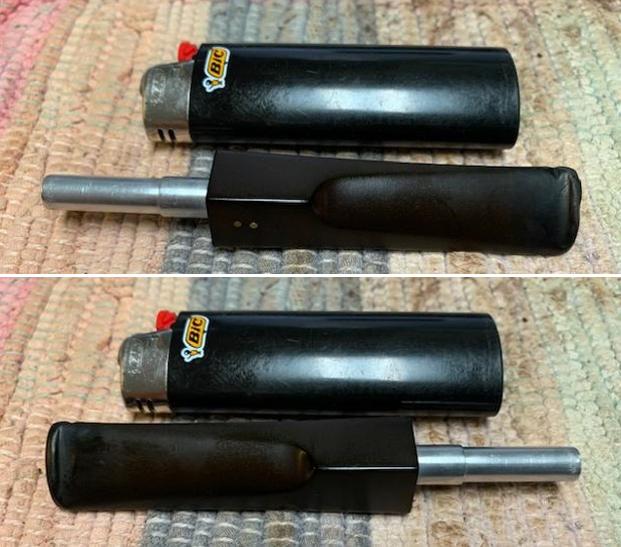
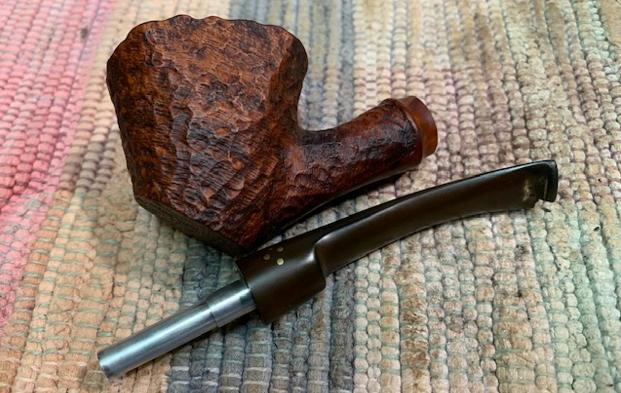
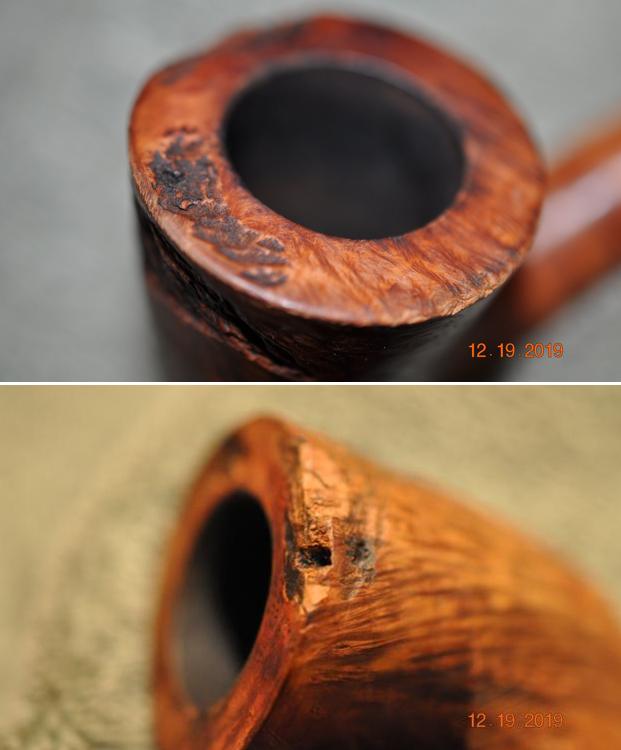
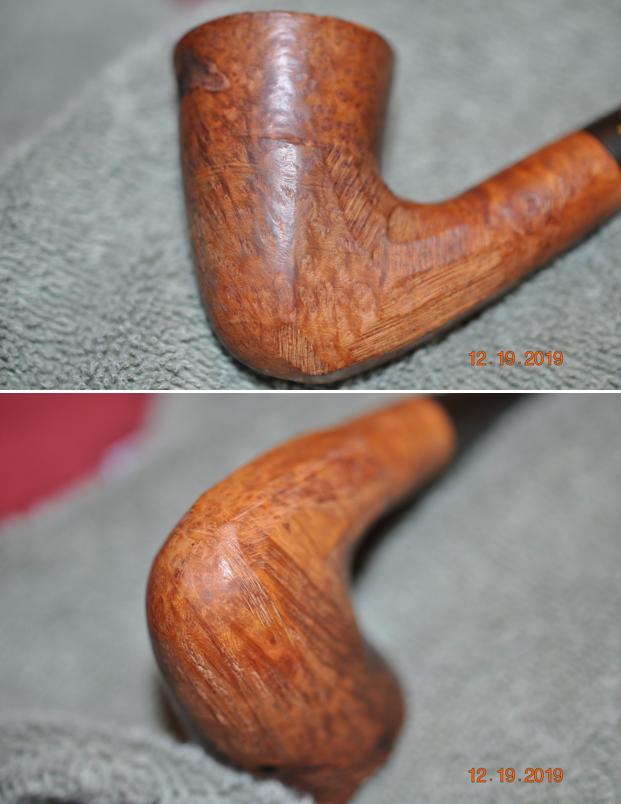
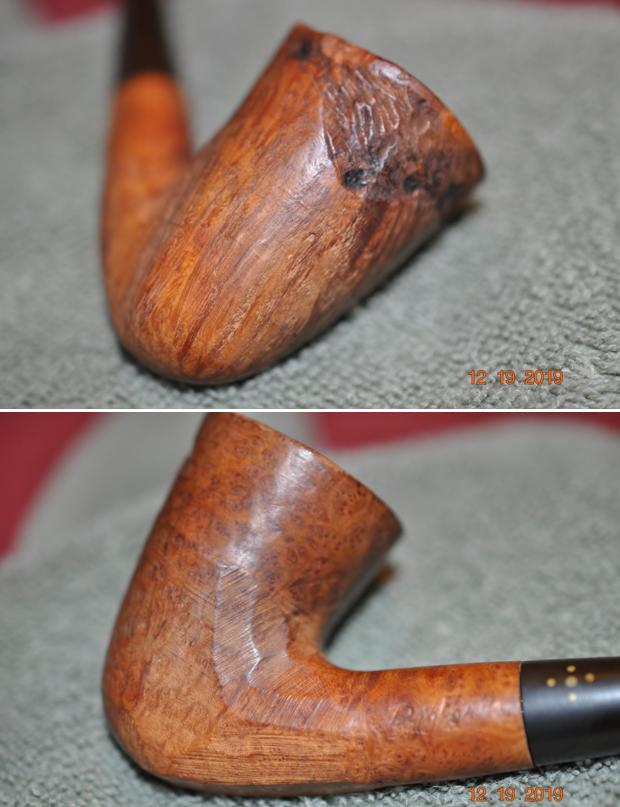
This charming Dunhill Shell Briar Bulldog pipe belonged to my paternal grandfather and was one of seventeen pipes left to my father, and which he has now given to me. A little detective work over at http://www.pipephil.eu revealed that this Dunhill dates from 1937 – which would have made my grandfather 29 years old when it was made.He died in 1975, so this pipe has not been smoked for at least 45 years (and probably more). As a side note, while this restoration was ongoing, I also restored his Dunhill Rollagas lighter (dated to the mid-1950s), so that I could use it to light the pipe one day. In that pipe will be some very old tobacco that is also from my grandfather. I am not sure what the tobacco is, but it smells lovely. I have another two Dunhill pipes I inherited from my grandfather, but I will save those restorations for future posts! As you can see from these initial photos, this poor pipe had some serious issues! The front of the bowl had a large crack, reaching all the way from the rim to the heel. There was also another crack (albeit considerably smaller) on the opposite side of the bowl. Smaller it may have been, but no less daunting to me. There was some cleaning that needed to be done inside the shank and stem, but less than might have been expected from an 85-year-old pipe. The usual routine of isopropyl alcohol, pipe cleaners, Q-tips, etc. made short work of that. Unfortunately, I do not have a handy brother like Jeff Laug to help clean my pipes, so I did it myself. I learn by doing, so this was just as well.

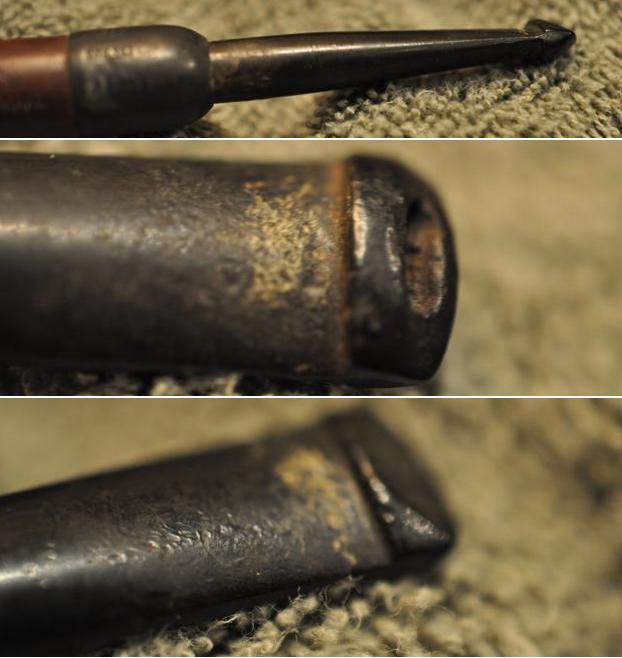
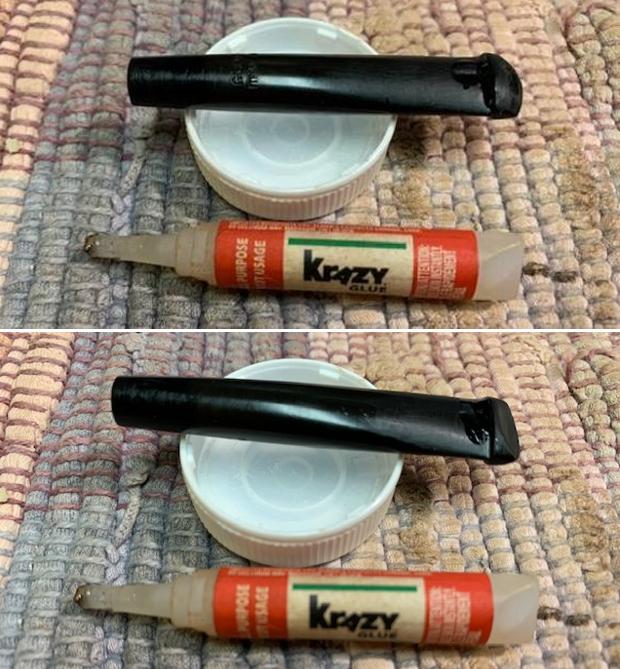
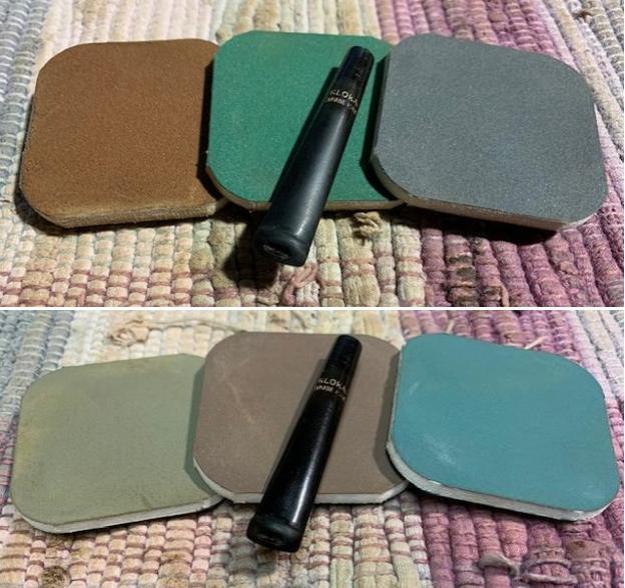
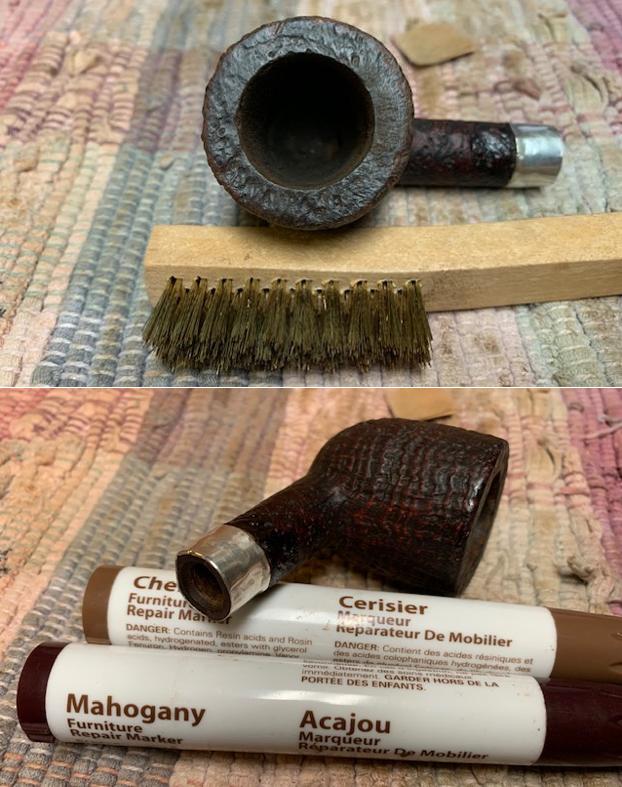
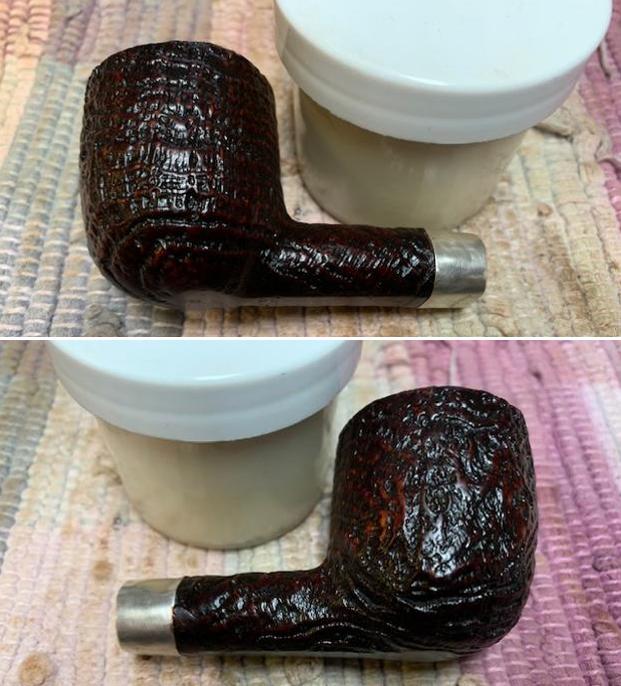
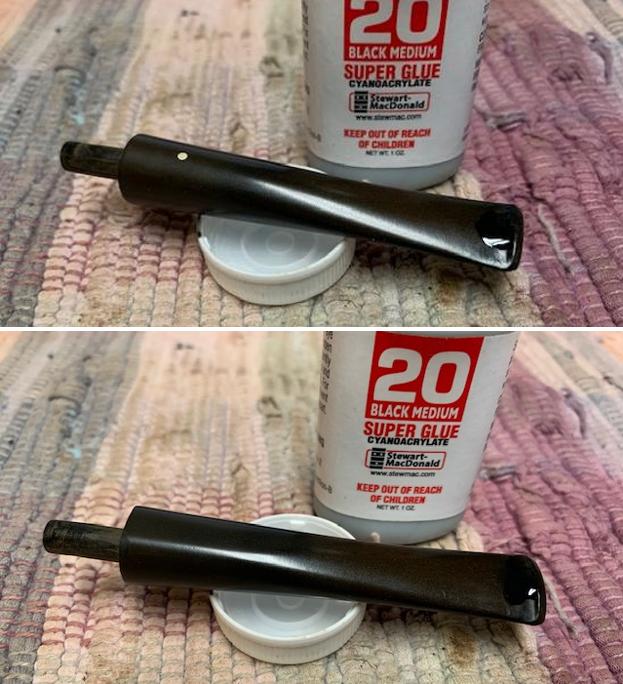
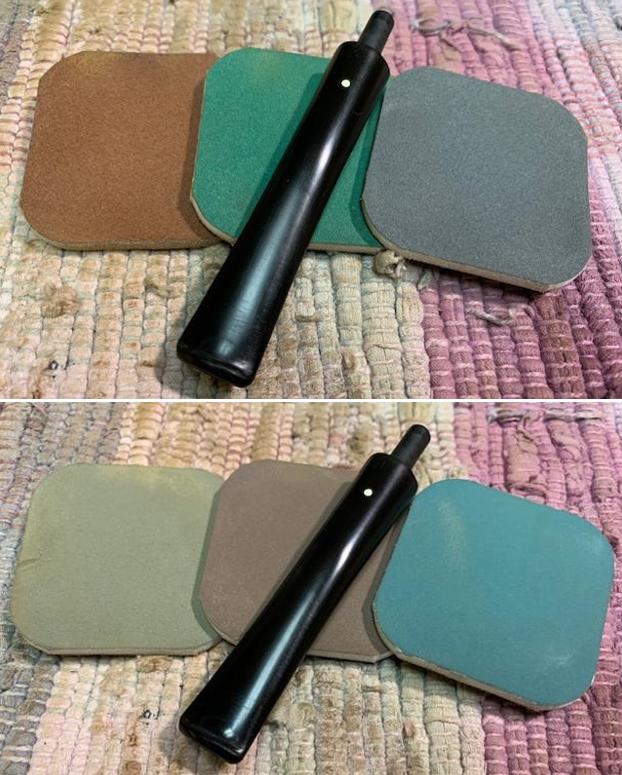
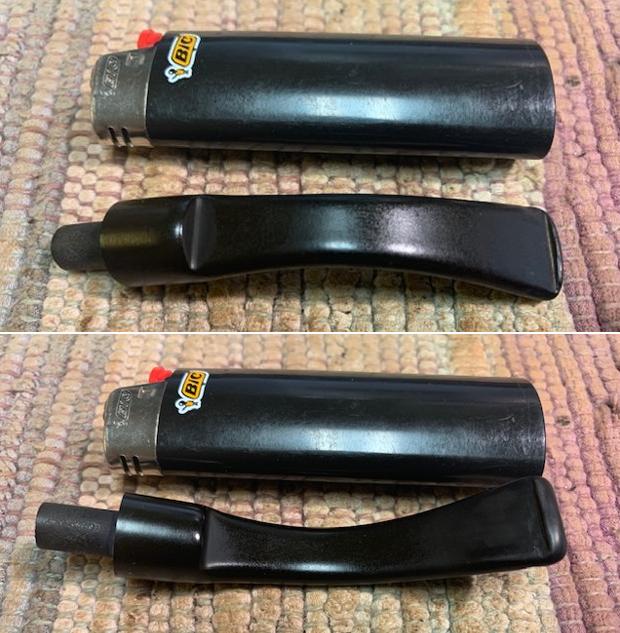
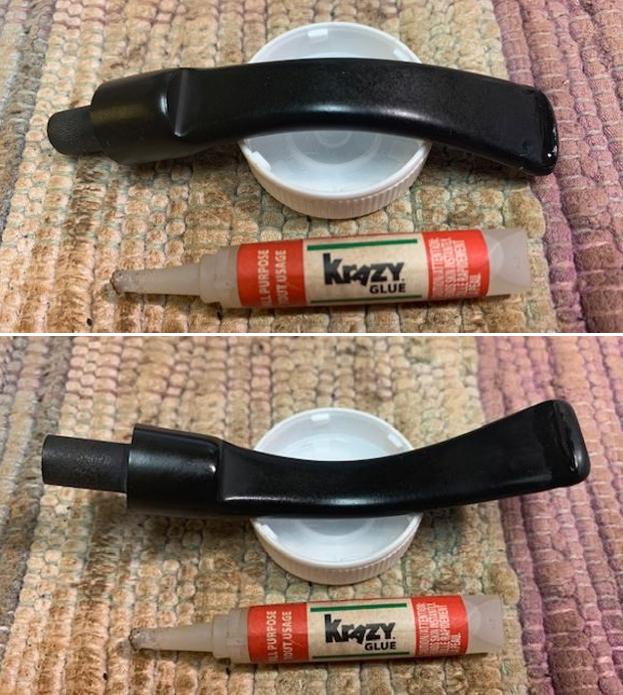
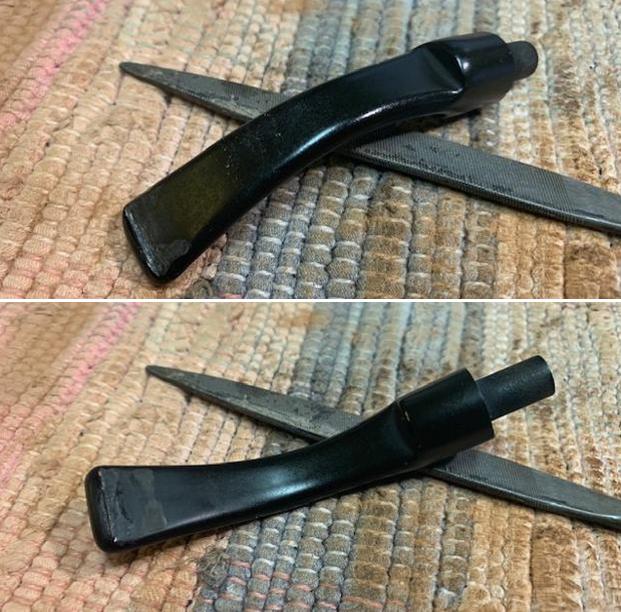
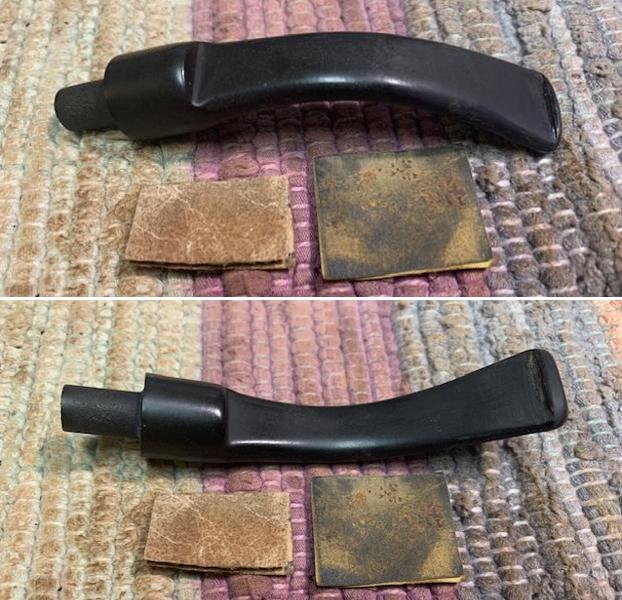
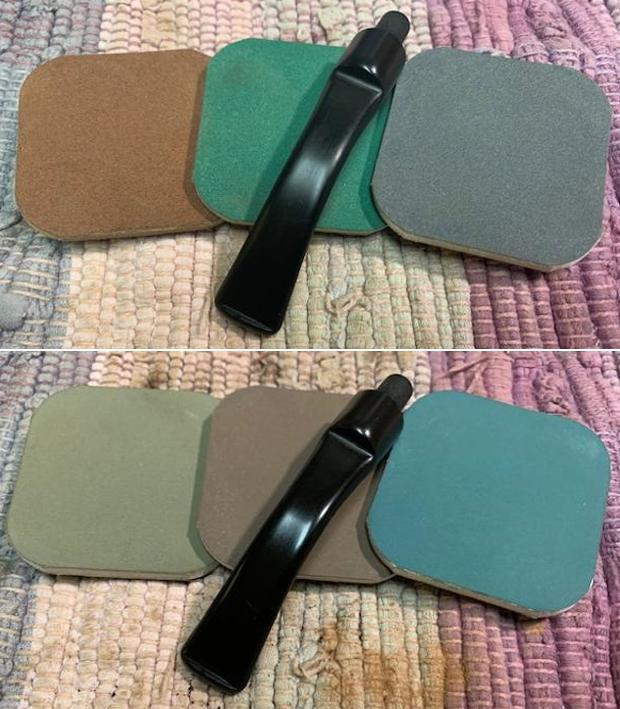
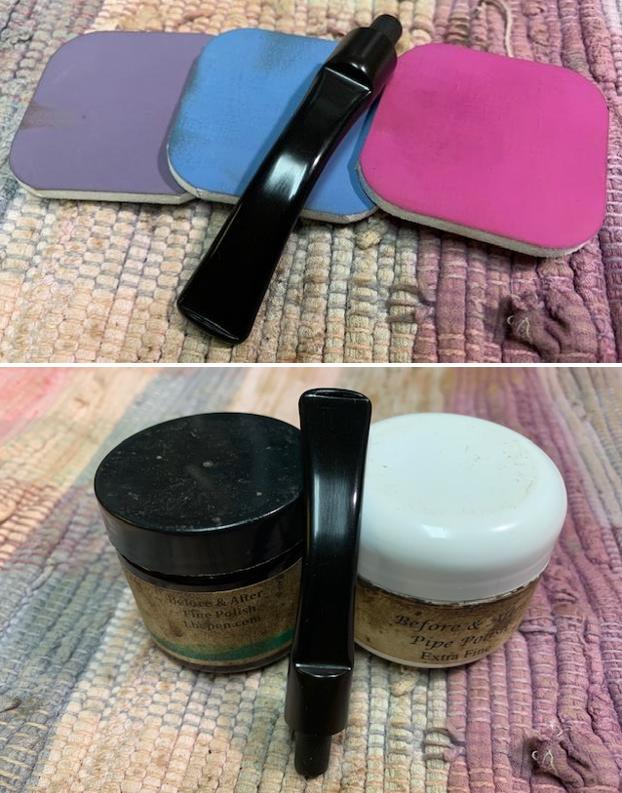
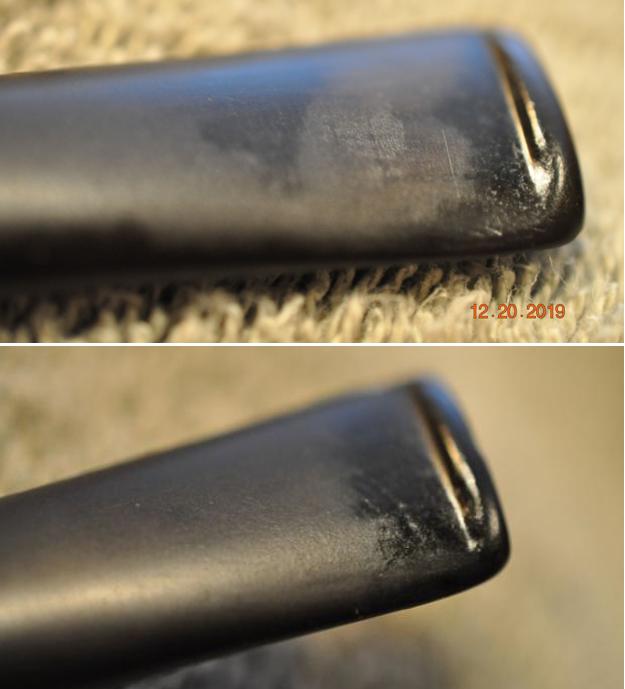
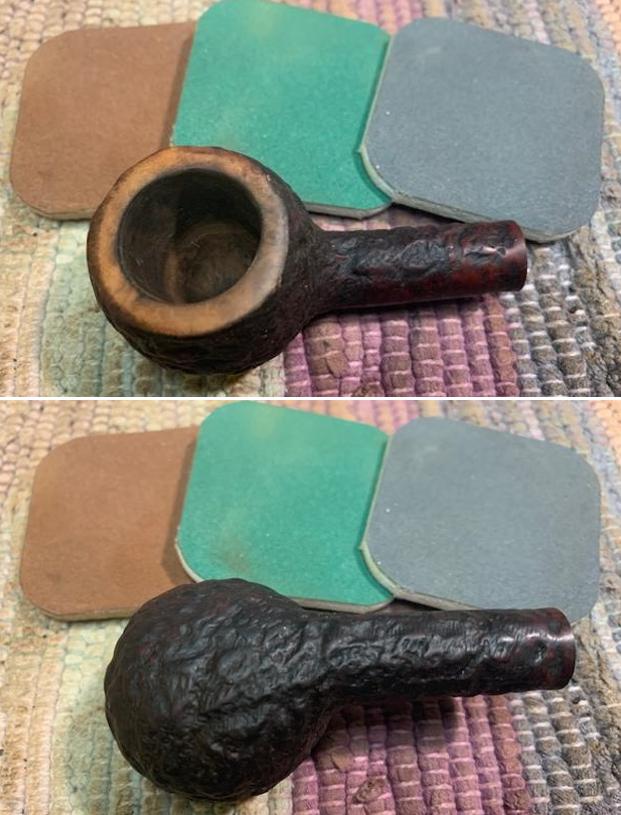
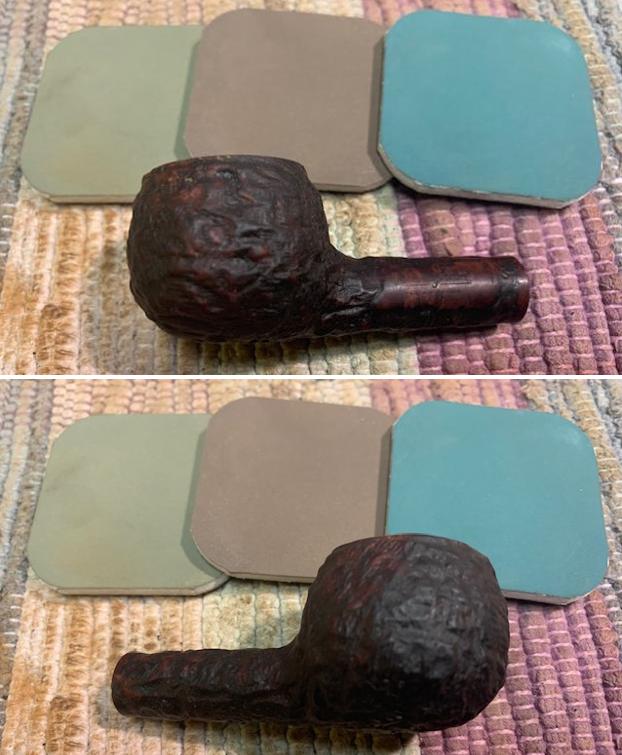
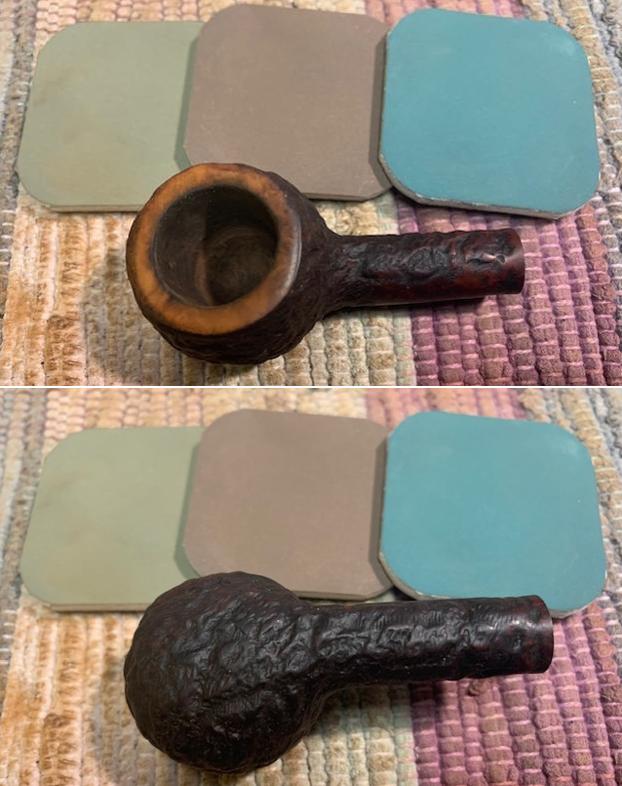
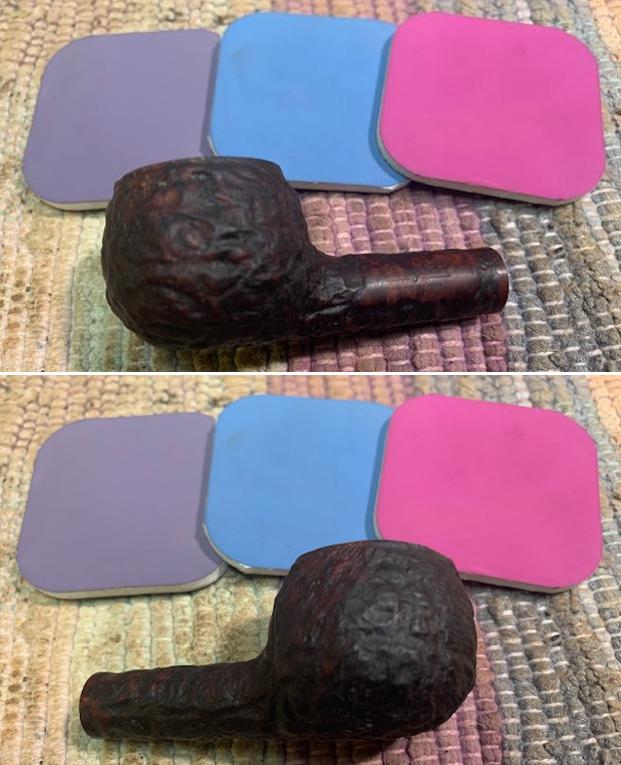
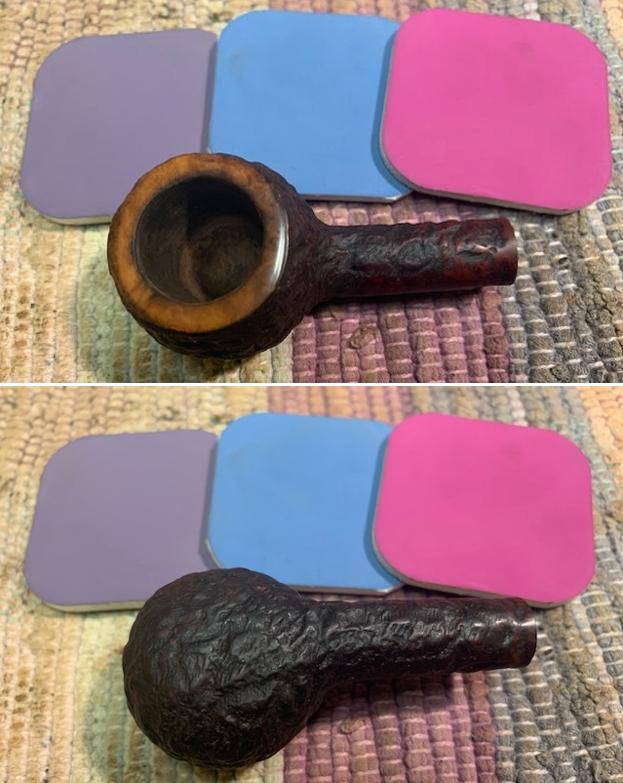
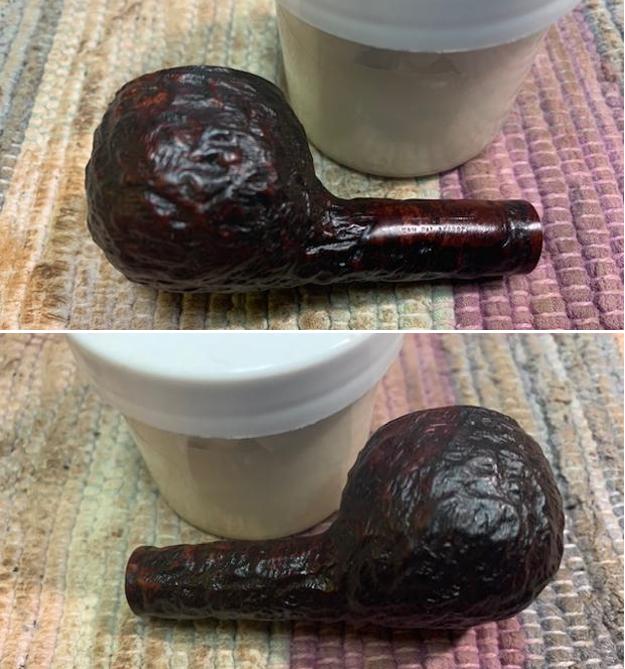
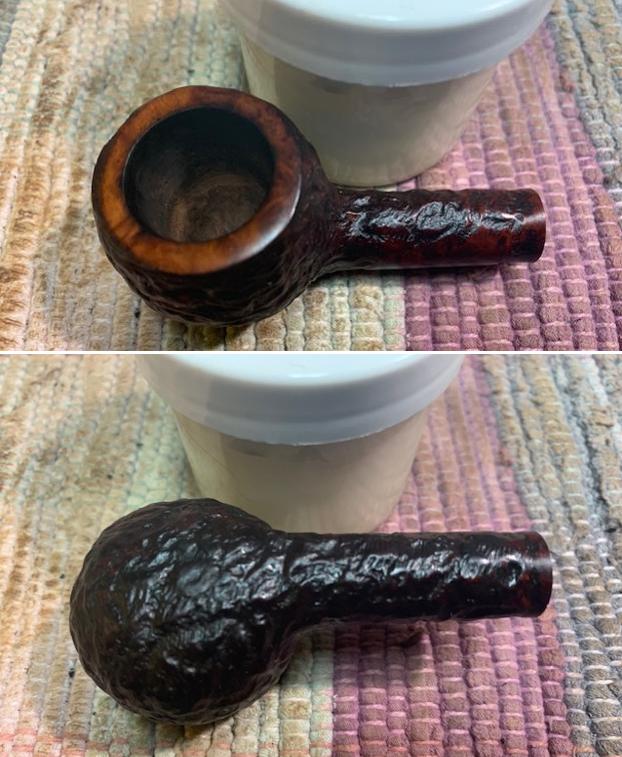
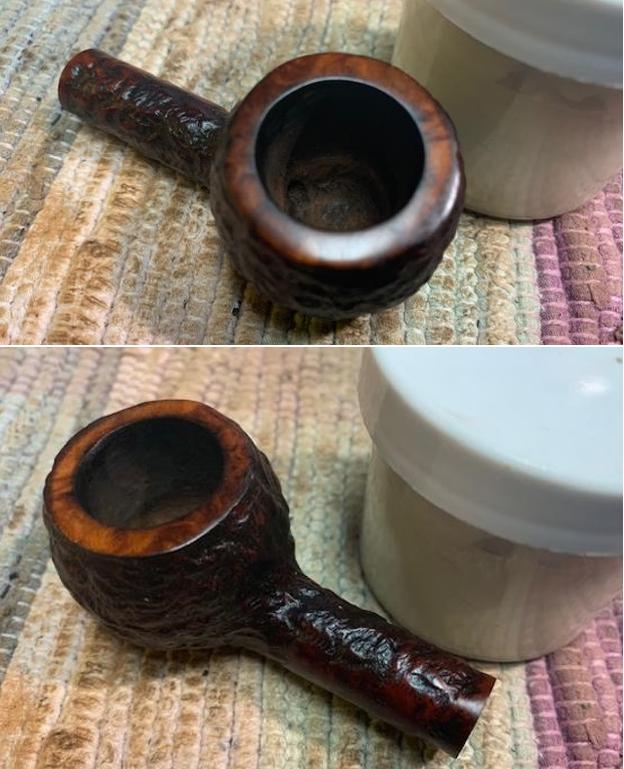
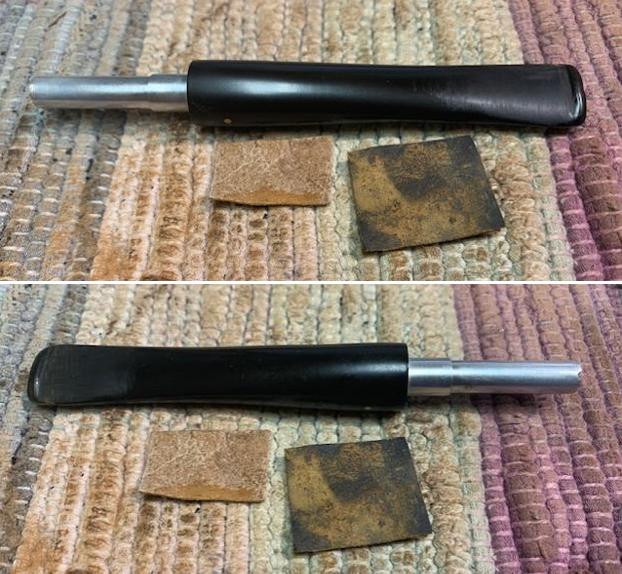
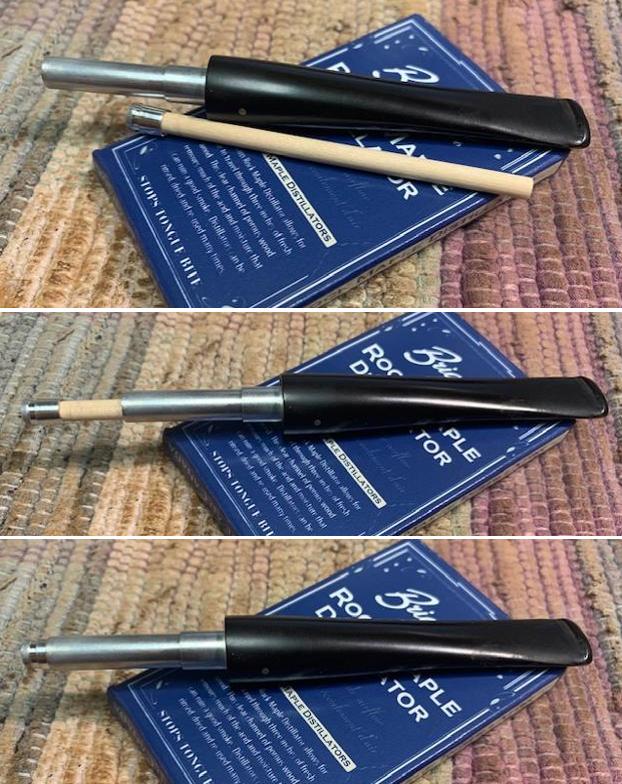
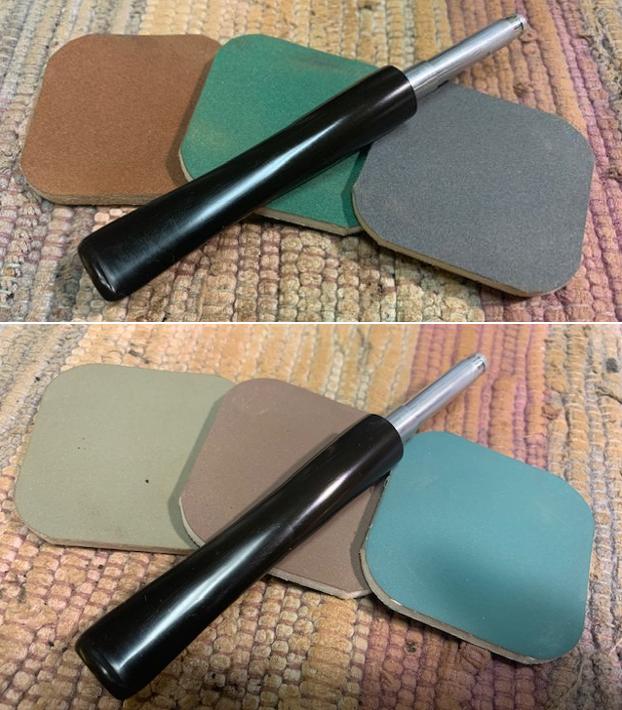
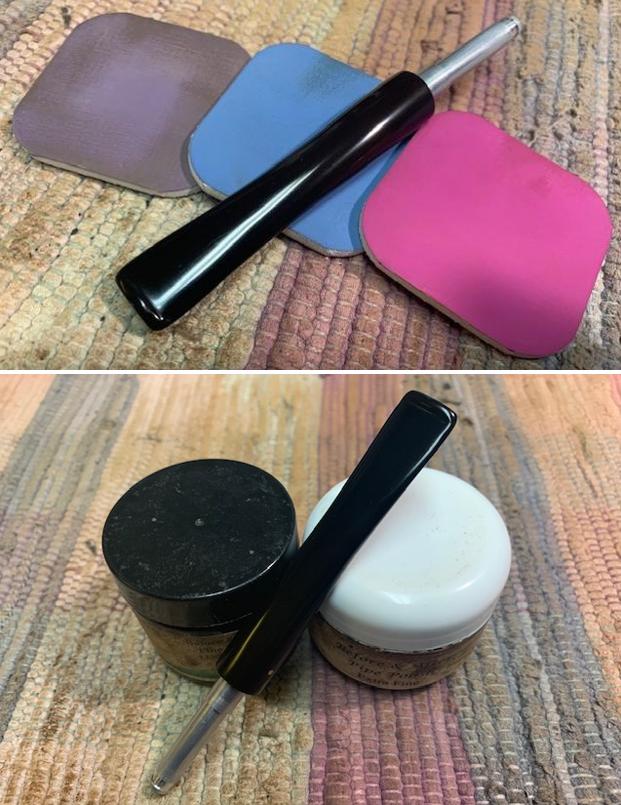
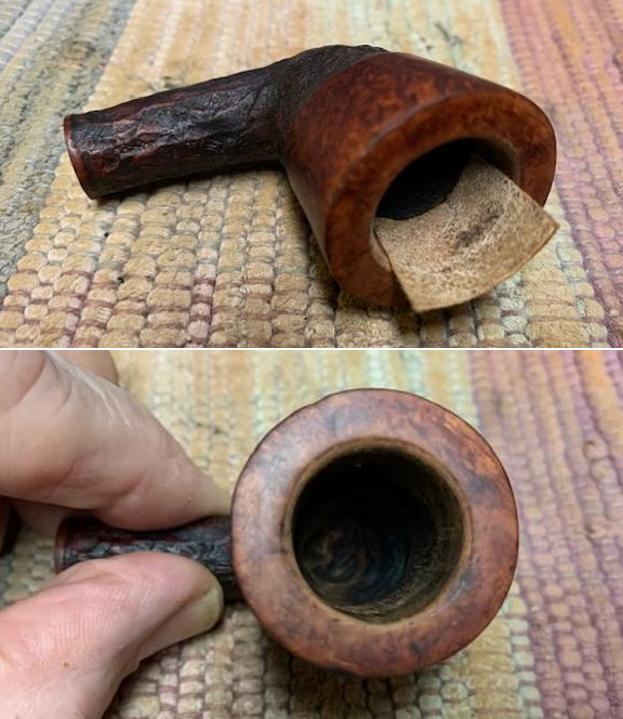
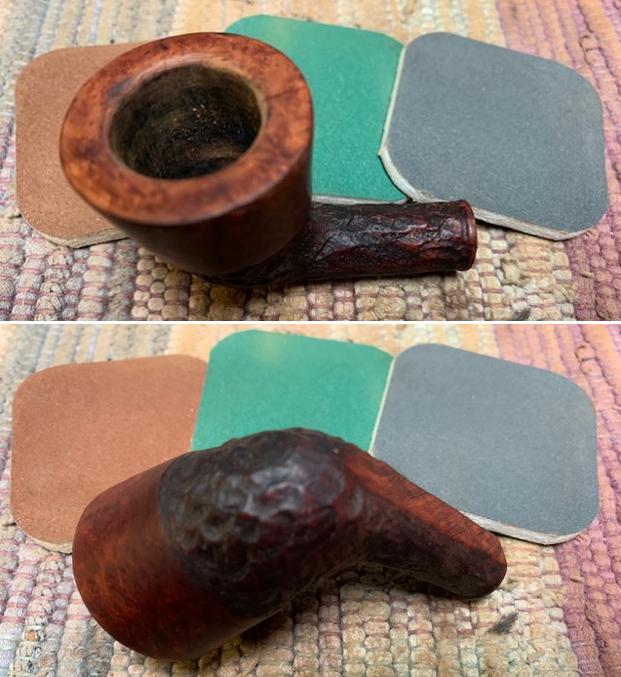
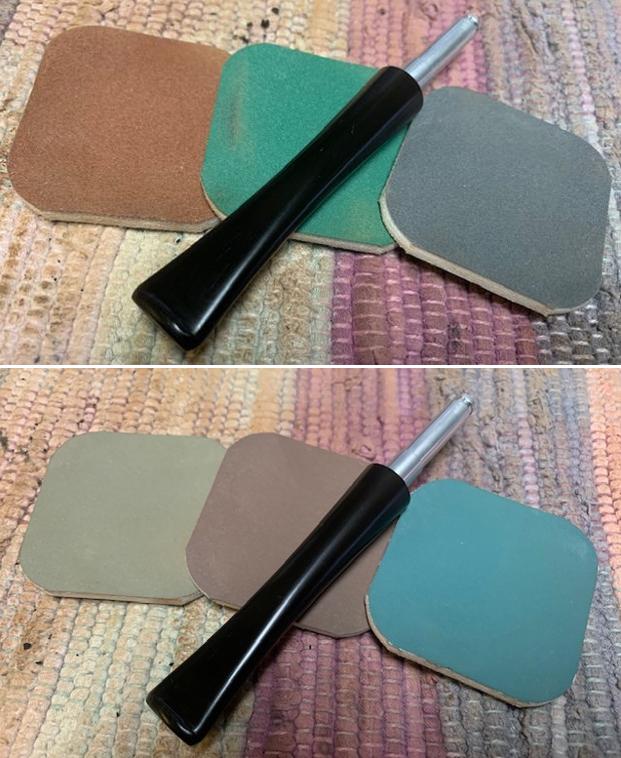
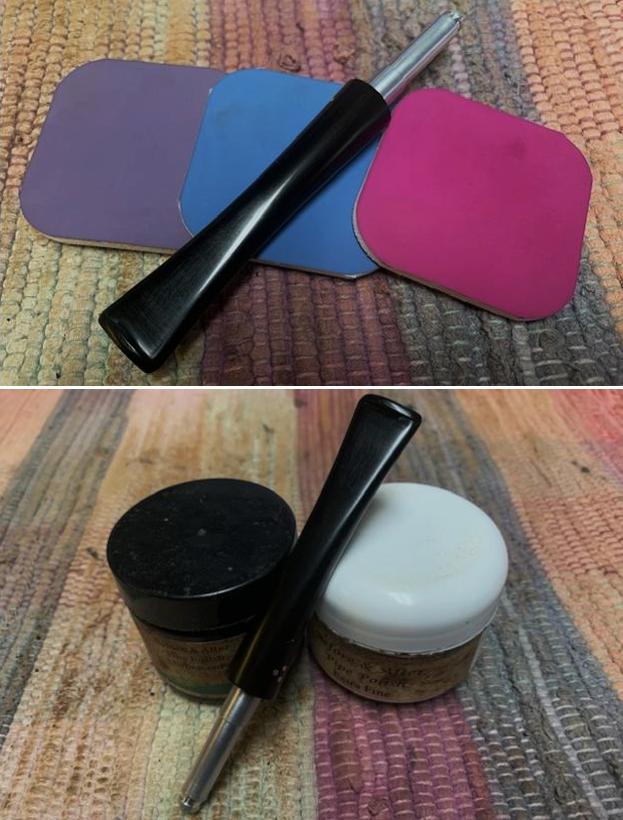
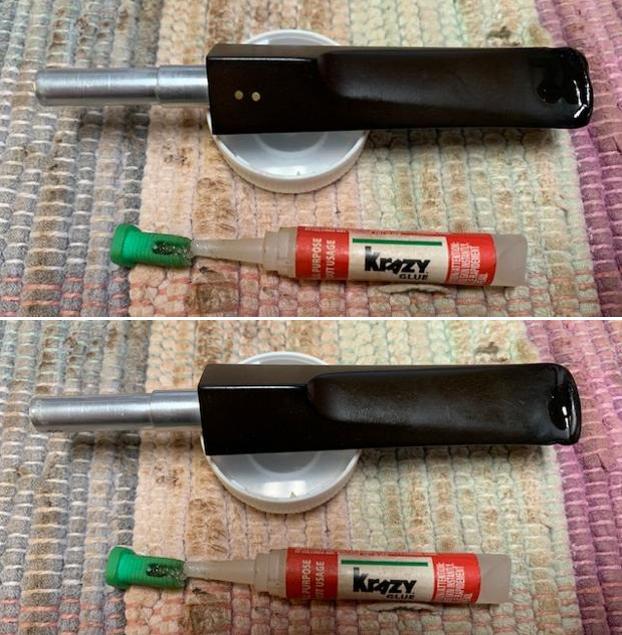
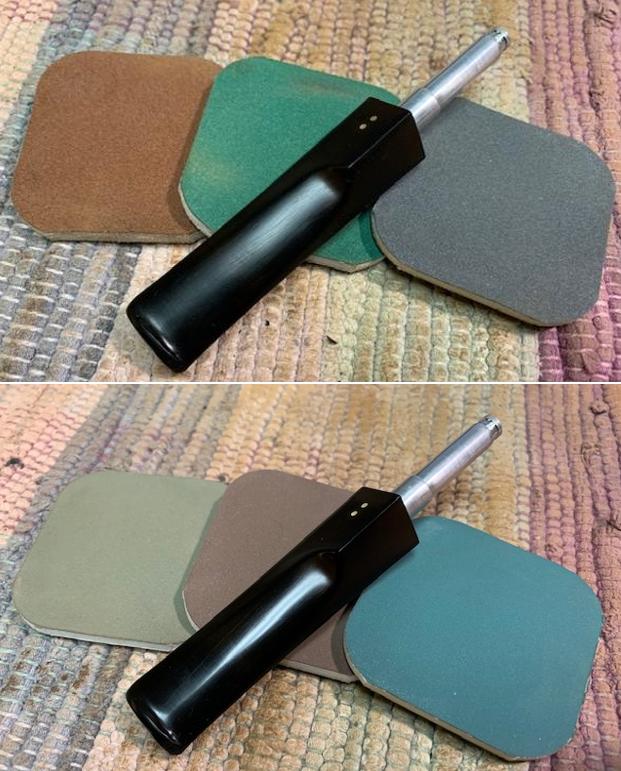
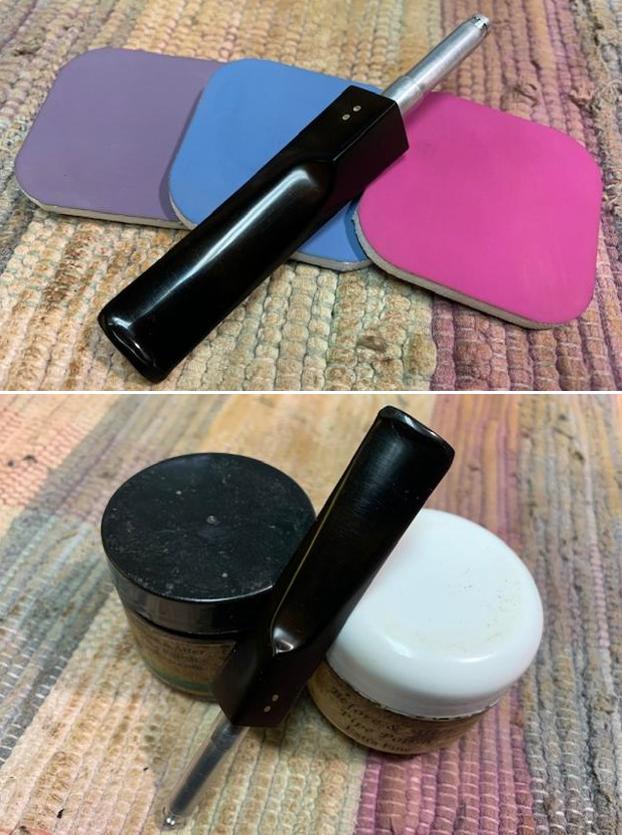
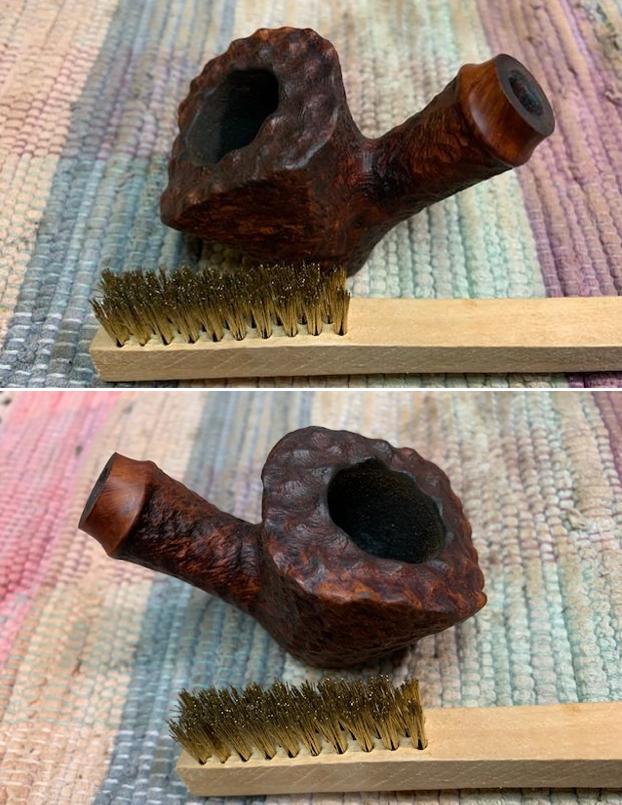
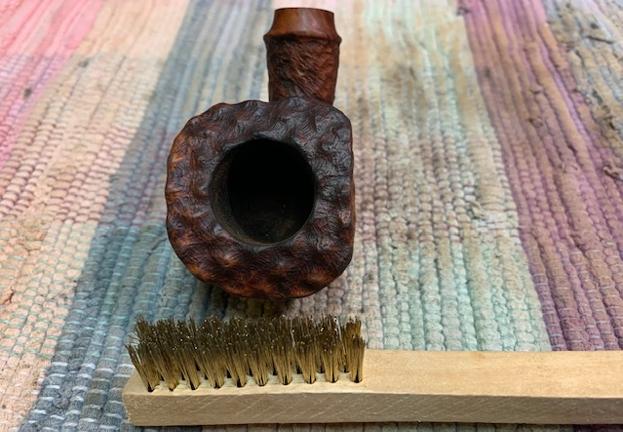
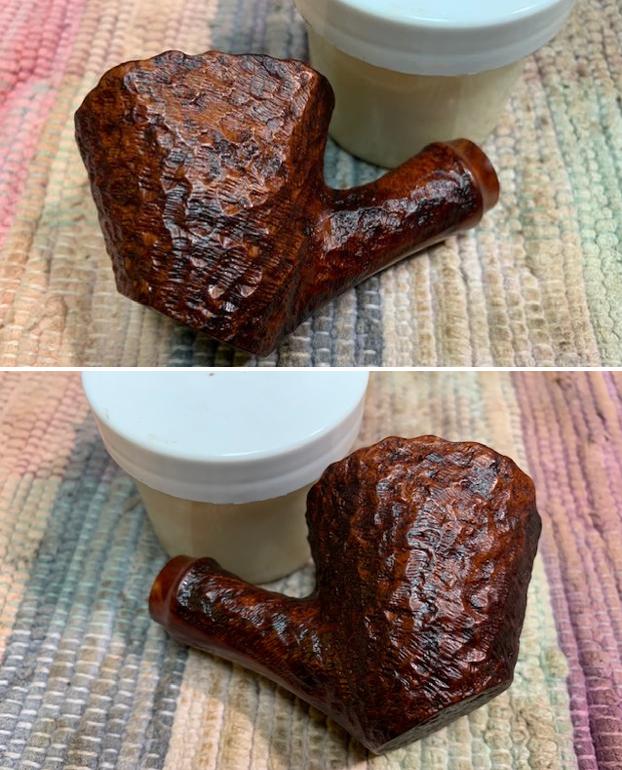
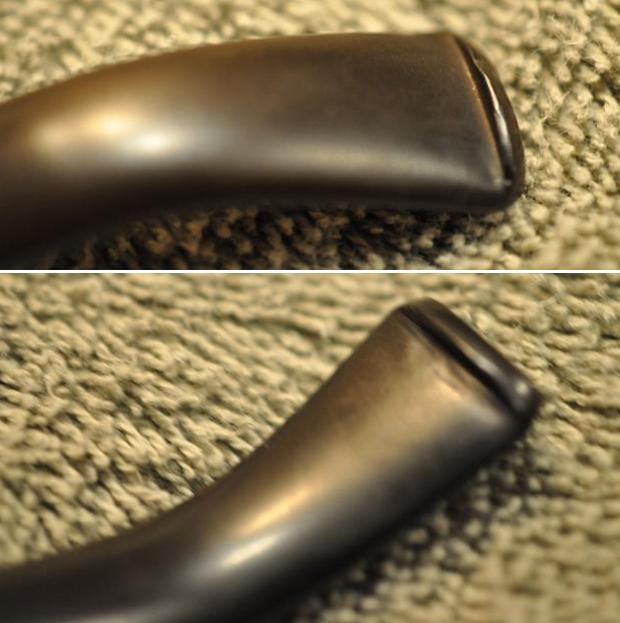
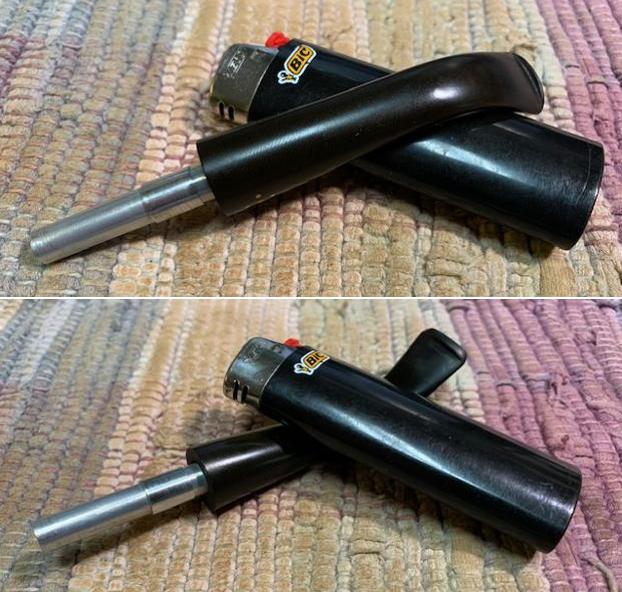
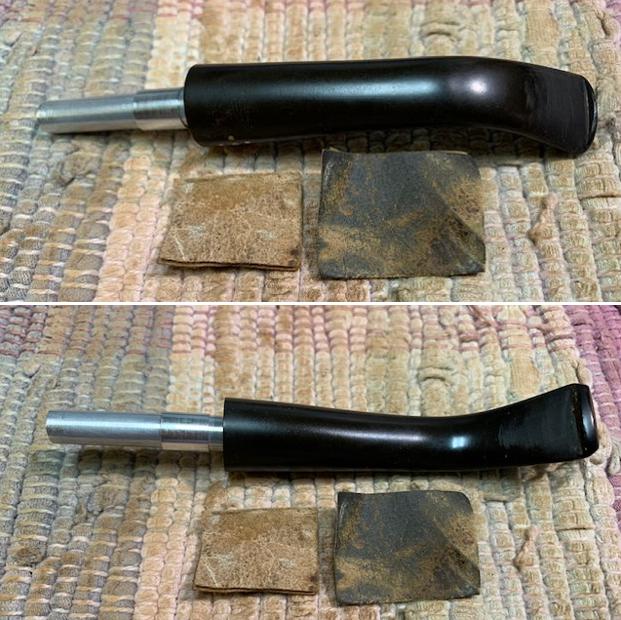
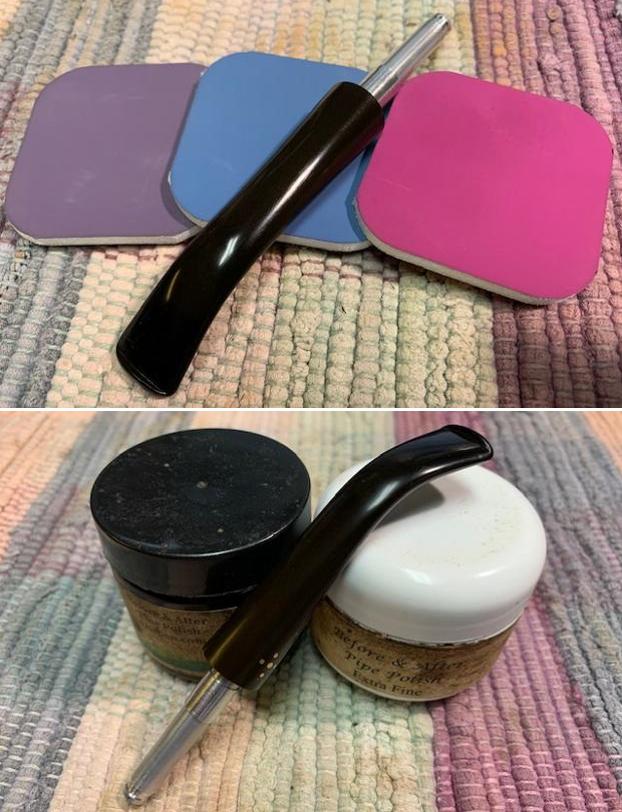
After using both the Pipnet Reamer and the KleenReem, the bowl was stripped down to the bare briar. This afforded me a good look at the condition of the bowl and just how far the two cracks had penetrated the wood. The smaller crack was not any worse than it initially appeared, but the large crack went all the way to the underside of the bowl. I cleaned the stummel with Murphy’s Oil Soap and that made a world of difference to the overall appearance of the wood, but not to the cracks, obviously. I prepared some J.B. Weld epoxy and filled the breach from the inside, ensuring that the epoxy did not ooze out to the front. I filled in the crack from the outside with a mixture of briar dust and cyanoacrylate adhesive. This was a tricky business, as the crack varied from ‘gaping’ at the rim to essentially ‘imperceptible’ at the heel. After putting down some layers of briar dust and glue, I noticed that there were still some small gaps that only iPhone magnification could reveal, as seen here. These were soon mended and left to cure.Following this, some rustication was needed, and a brass-bristle brush was the tool I used. In fact, the brush was used several times – including after I applied some stain to the briar-glue repair. The stain was used in conjunction with the Before & After Restoration Balm, to help meld everything together. I must admit that I wish I could have done this step better – all I could see were flaws, but everyone else told me how much better it looked, especially when compared with how it began. These photographs show you that it wasn’t complete, but I guess it really was better. Once this had fully cured, I coated the entire inside of the bowl with a mixture of activated charcoal and my wife’s homemade yogurt. Once hardened, this provided a good, slightly rough surface for a new cake to build. Then it was time for the stem. It was in pretty good condition, considering its age. There were a couple of relatively minor tooth marks and the button needed some work. However, without doubt, restoring the stem was the most frustrating part of the restoration. It began easily enough, with the stem taking a swim in the Before & After Hard Rubber Deoxidizer. In order to address the chatter, I waved the flame of a BIC lighter over the mouthpiece. I also took some of the cyanoacrylate adhesive and filled in the deeper tooth marks. But then the tough stuff came: sanding, more sanding, then even more sanding. Did I mention the sanding? As you know from Steve’s similar work, I used 220, 400, and 600 sandpapers to wet-sand the stem. Then followed that with all nine Micromesh pads (1,500 through 12,000 grit) – using Obsidian Pipe Stem Oil in between each pad. The pictures only tell a fraction of the story. Quite frankly, my lack of experience was my undoing, as I had to do this entire sanding sequence twice over. It just did not look right the first time. In fact, I was not even convinced that it looked right the second time, but Steve reassured me (with his typical kindness) that I was merely suffering from the same sort of pipe perfectionism that he does – not to mention the fact that this pipe is 85 years old: it is not meant to look brand new! At some point, one has to stop or else one will simply sand the pipe away into oblivion!

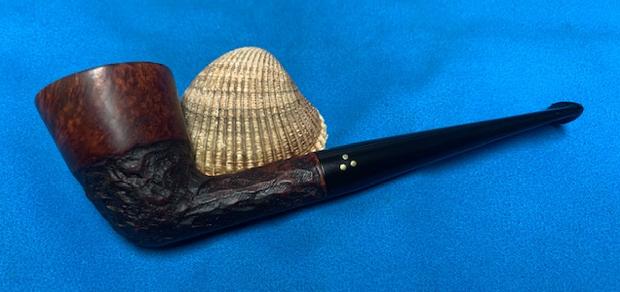
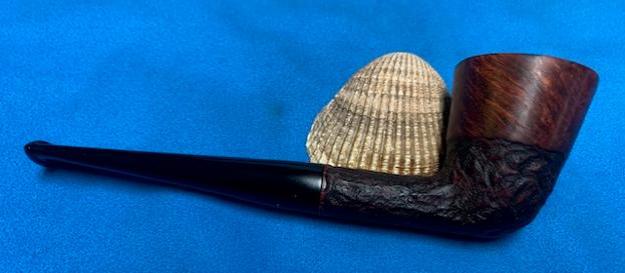
At long last, I was at the point where I could throw down some more Obsidian Pipe Stem Oil, Before & After Restoration Balm, and Paragon II Wax. Microfibre cloths, horsehair shoe brushes, and buffing pads followed – all to provide a final product (hopefully) worthy of my beloved grandfather’s memory. This was certainly a labour of love and I look forward to firing up his 85-year-old Dunhill pipe, with his 65+ year-old Dunhill lighter, filled to the rim with his 50+ year-old tobacco. The dimensions of the pipe are as follows: length 4⅝ inches; height 1⅝ inches; bowl diameter 1½ inches; chamber diameter: ¾ of an inch. The weight of the pipe is ⅞ of an ounce (or 27 grams).

Thank you very much for reading and I welcome and encourage your comments. Kenneth sent me this message and photo on Facebook.

This is my grandfather, Alfred Lieblich,  in Vienna in 1938. Look what’s in his mouth! Amazing!

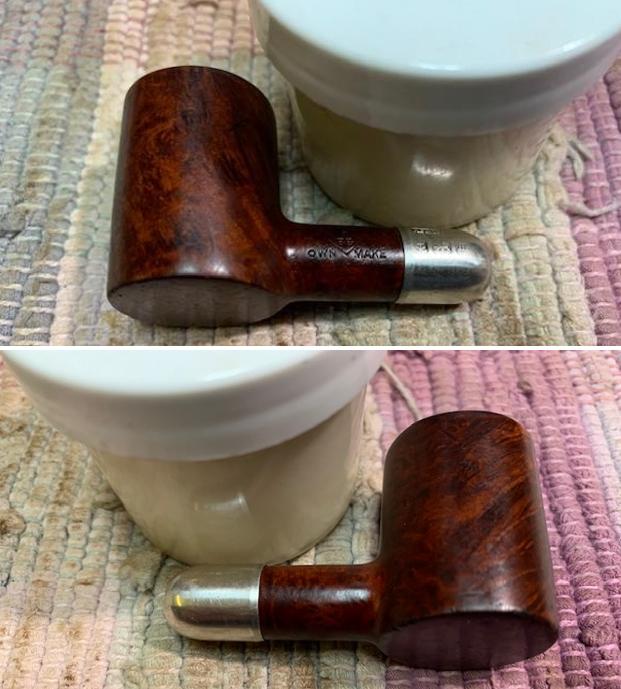
Repairing a Cracked Shank on a Salstrom & Skinner Handmade Acorn


Blog by Steve Laug

Early in December I received and email from a reader of the blog about one of his first pipes. Here is what he wrote to me:

I have got a custom made briar tobacco pipe that split at the shank when I removed the pipe stem. It’s a hair line crack. Was looking to get an estimate of a repair. Was reading one of your repair articles of putting a brass ring to reinforce shank and stem connection. This is something I would like possibly have done. And what is the lead time for such a repair?… Thanks,  Jake

The story behind this being his first pipe caught my attention. I forgot to ask him what the brand was. He sent me some photos of the crack in the shank but I changed out my computer and do not have access to those photos any longer. I figured that it would be a straightforward repair so I answered him and he shipped the pipe to me. This afternoon while I was working the package arrived from Jake. I opened it after work and took some photos of the pipe. I wrote Jake an email to let him know that the pipe had arrived and asked him about the maker and the brand. He wrote me back and I am including that below.

Hi Steve! I was actually going to contact you today to see if it did, but that’s good. Glad it finally made it to you. I bought that pipe back in 2015 from an Etsy retailer that went by the name of Salstrom & Skinner. I believe they are out of Oregon. They aren’t in business anymore from what I can tell, their online Etsy shop is no longer up. And yes, that is the stem that came with the pipe. –Jake

I thanked Jake and sent him my assessment of the pipe and what needed to be done to make a repair work on the pipe. I broke my assessment down to cover the bowl and shank issues and then the stem issues. Both contributed to the crack on the underside of the shank. I include a summary of the email that I sent to him below.

The damaged shank…

  1. I cleaned out the shank to check the crack and it goes all the way through.. Fortunately it is not too long maybe 1/4-1/2 inch into the shank.
  2. The shank was quite thin walled so I decided to glue it and then band it. I would open the crack and fill it with clear CA glue and clamp it shut until the glue dried.
  3. I would fit a thin brass band on the shank end and customize the fit. Once the fit was correct I would need to press it on the shank glue it in place. That would take care of the shank damage.

The stem issues…

  1. The stem is really a mess. The tenon was quite large and poorly cut. It still had the castings on it and the Made in Italy castings. These made the fit in the shank very tight and also I believe caused the crack originally as the shank is quite thin.
  2. I would need to smooth out damage on the tenon and remove the castings.
  3. I also would funnel the entry of the airway in the end of the tenon to make the draw better.
  4. The saddle portion of the stem was very rough and not round. There were file marks and cuts all around it and it did not fit against the shank well. The diameter of the stem and the shank did not match. I would need to round the saddle and removed the cuts and the file marks.

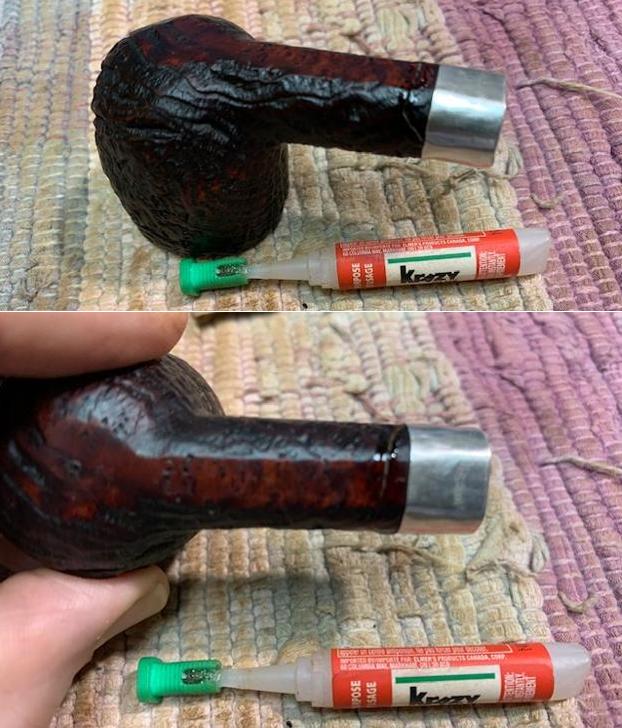
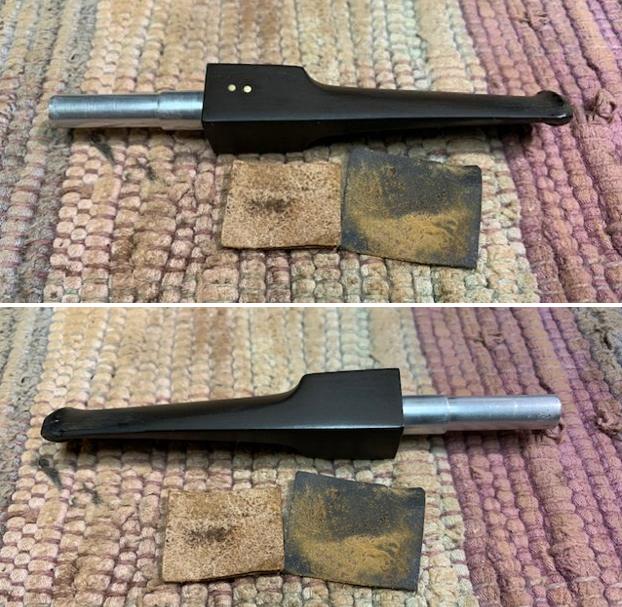
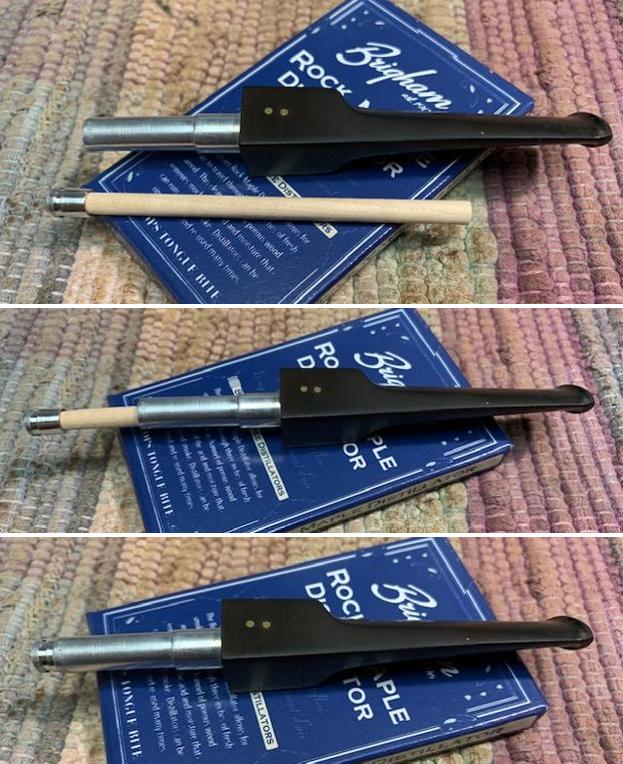
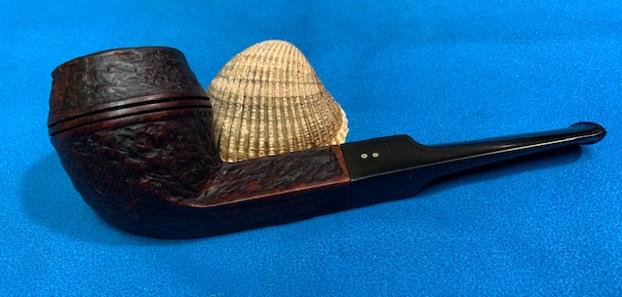
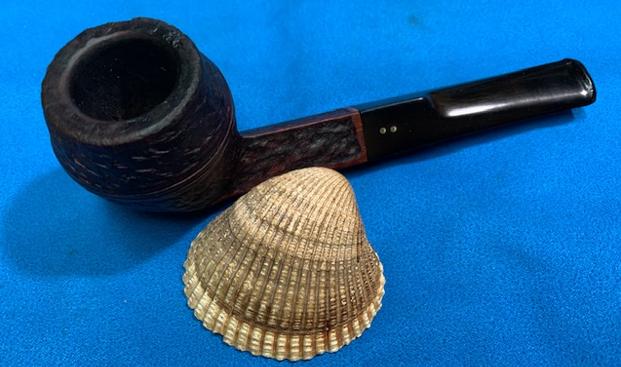
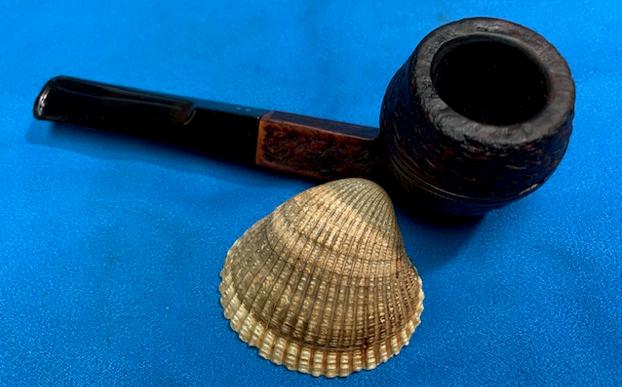
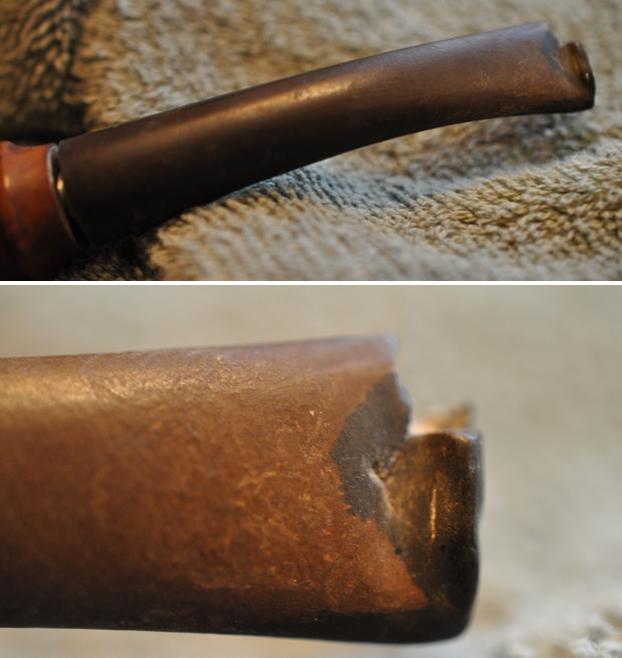
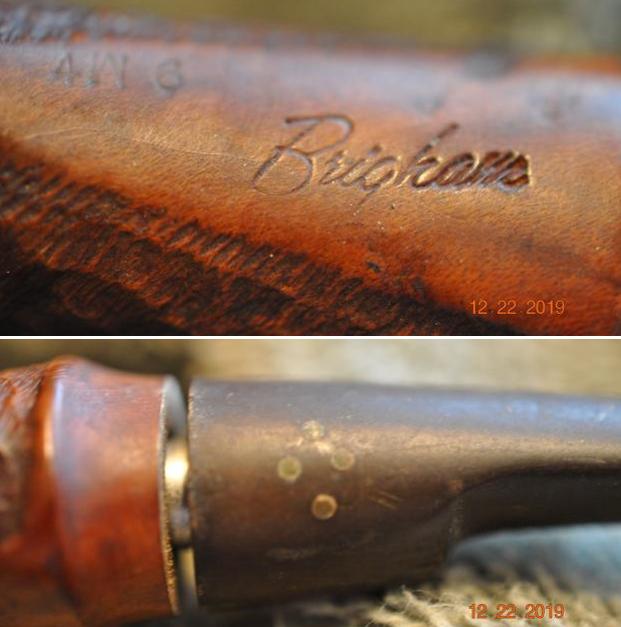
I took photos of the rim top and stem to show the general condition of the pipe. The bowl looked to be in good condition. There was some darkening and lava build up on the top back of the rim. I also took photos of the stem to show the cut marks and fill marks on the surface of the saddle.    I took some photos of the rough looking finish on the stem, its fit to the shank and the crack in underside of the shank.I removed the stem and took a photo of the pipe to have a look at the parts and overall look. I am still amazed by the thickness of the tenon. I took a photo of the castings on the tenon and on the airway entering the tenon end. It made the castings very clear.    I started my work on the pipe by addressing the crack in the shank. I put the stem on the shank and opened it up. I filled in the crack with clear super glue (CA). I removed the stem and clamped the repaired shank together until the glue cured.  Once the glue had cured and the crack was bound together I fit a brass band on the shank end. After I had fit the band to the shank I removed it and coated the shank end and inside of the band with all-purpose glue. I pressed it onto the end of the shank. I set it aside and let the glue cure.   I took photos of the band on the shank from the various angles to show what it looked like. It is a pretty addition. I set aside the repaired bowl and turned my attention to the stem. I used the blade of pen knife to funnel the airway in the tenon.I smoothed out the castings on the tenon with 220 grit sandpaper. I also smoothed out the file marks on the saddle portion of the stem and worked to make it round again.I put the repaired and newly shaped stem on the shank of the bowl and took photos of the look of the pipe. I still needed to polish it but the stem looked much better. It was time to polish the stem now. I polished it with 1500-12000 grit micromesh sanding pads. I wiped the stem down with Obsidian Oil after each pad. I finished polishing it with Before & After Stem Polish – both Fine and Extra Fine. I gave it a final coat of Obsidian Oil to protect the stem surface from oxidizing. I worked some Before & After Restoration Balm into the surface of the briar with my fingertips to clean, enliven and protect the briar. I let the balm sit for 15 minutes and then buffed with a cotton cloth to raise the shine. The photos show the bowl at this point in the restoration process.    I am excited to finish this Salstrom & Skinner Handmade Acorn. It was a rustic pipe with a lot of flaws in craftsmanship of the briar and the stem but it is looking much better. The band on the shank and the reworked stem give the pipe a sense of newly formed class and character. I put the pipe back together and buffed it with Blue Diamond on the buffing wheel. I gave the bowl and the stem multiple coats of carnauba wax. I hand buffed the pipe with a clean buffing pad to raise the shine. It is fun to see what the polished bowl looks like with the polished brass band and the black vulcanite stem was beautiful. This smooth Handmade Acorn is good looking and the pipe feels great in my hand. It is light and well balanced. Have a look at it with the photos below. The dimensions are Length: 5 inches, Height: 2 inches, Outside diameter of the bowl: 1 ¾ inches, Chamber diameter: ¾ of an inch. The weight of the pipe is 48grams/1.69oz. It is a nice looking pipe and one that I will be sending back to Jake in the next few days. I look forward to hearing what he thinks of his “resurrected first pipe”. Thanks for walking through the restoration with me as I worked over this pipe. Thanks to each of you who are reading this blog.
New Life for a Republic Era Peterson’s “Kildare” 381 Billiard


Blog by Steve Laug

The next pipe I have chosen is smooth finished Peterson’s Billiard pipe. This one is a smooth Billiard that has a rich coloured finish around the bowl sides and shank. It also came to us from the estate of Anglican minister that was a great friend of mine here in Canada. The contrast of the brown stains makes the grain really pop. It was stamped on the  left side of the shank and read Peterson’s [over] “Kildare”. It was stamped to the right of the shank and reads Made in the Republic of Ireland (3 lines) with the shape number 381 next to the bowl. It was filthy when he brought it to the table. The finish was dirty with grime ground into the finish around the sides and rim. There was a cake in the bowl and light spattering of lava on the rim top and the inner edge of the bowl. The rim top showed some damage on the flat top. The stem was oxidized, calcified and had tooth marks and chatter on the top and underside on and near the button. Jeff took photos of the pipe before his cleanup work. They tell the story and give a glimpse of the promise that we see in this pipe. Jeff took photos of the rim top and stem to show the general condition of the pipe. The bowl is heavily caked and the rim top and edges have some light lava overflow. The stem is oxidized, calcified and has tooth marks on the top and underside near the button.     Jeff took a photo of the bowl sides and heel to show the grain that was around this bowl. It is a nice looking pipe.   He took photos of the sides of the shank to show the stamping. The stamping is readable in the photos below and is as noted above. I am including the link to the Pipedia’s article on Peterson pipes. It is a great read in terms of the history of the brand (https://pipedia.org/wiki/Peterson).

I turned to “The Peterson Pipe” by Mark Irwin and Gary Malmberg to get some background on the Peterson’s System Line. On page 314 it had the following information.

Kildare (1965-) First issue of line with matte-finish in Classic Range shapes, P-Lip and fishtail mouthpiece. Second issue C.1979 as Kildare Patch, with rusticated patches on pipe surface. Third issue 2010, matte-brown, P-Lip or fishtail mouthpiece, no band. Fourth issue 2011-, burgundy sandblast finish, nickel army mount, fishtail mouthpiece, exclusive to Smokingpipes.com.

Judging from the description above I believe that I am working on a First Issue of the line in the time period of 1965-1979. It is a late Republic Era Classic Shaped pipe with a matte-finish and a P-Lip stem. Now it was time to work on the pipe.

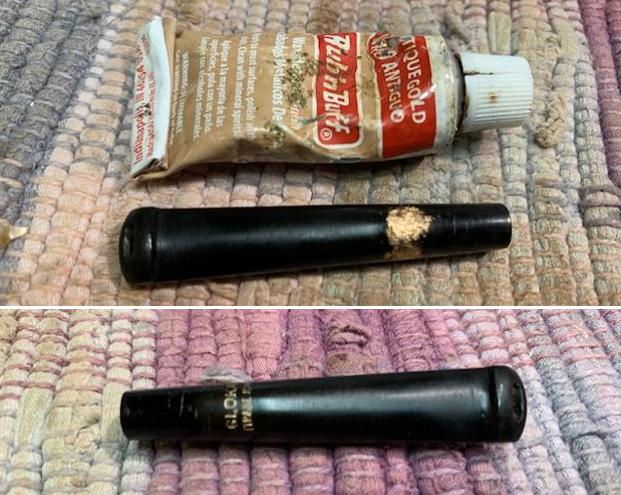
Jeff had done a great job cleaning up the pipe as usual. He reamed the pipe with a PipNet reamer and cut back the cake back to the bare briar. He cleaned up the walls with a Savinelli Fitsall Pipe Knife. He scrubbed the interior of the bowl and shank with pipe cleaners, cotton swabs and alcohol to remove the tars and oils. He scrubbed the exterior of the pipe with Murphy’s Oil Soap and a tooth brush to remove the grime from the finish. He worked on the rim top lava and darkening with the soap and tooth brush. He scrubbed the inside of the stem with alcohol and pipe cleaners. He scrubbed the exterior with Soft Scrub and then soaked it in Before & After Deoxidizer. He washed it off with warm water to remove the Deoxidizer. The pipe looked far better when it arrived.   I took some close up photos of the rim top and also of the stem surface. I wanted to show how well it had cleaned up. The rim top looked to be in good condition with some darkening on the back side and some damage to the inner edges around the bowl. I also took close up photos of the stem to show the tooth marks on the surface near the button.  I took photos of the stamping on the underside of the shank. It is faint but reads as noted above. I removed the stem and took a photo of the pipe to have a look at the parts and overall look.I decided to address the damage to the back edge of the bowl and the rim top first. I used a folded piece of 220 grit sandpaper to give the inner edge of the bowl a slight bevel to accommodate the burned areas and blend them into the surrounding briar. I also worked over the darkening on the rim top with the sandpaper.    I polished the briar with micromesh sanding pads – dry sanding with 1500-12000 grit sanding pads. I wiped the bowl down with a damp cloth after each sanding pad.     I worked some Before & After Restoration Balm into the surface of the briar with my fingertips to clean, enliven and protect the briar. I let the balm sit for 15 minutes and then buffed with a cotton cloth to raise the shine. The photos show the bowl at this point in the restoration process.  I touched up the stamped “P” on the top of the stem with Rub’n Buff Antique Gold. I pressed it into the stamping with a tooth pick and buffed it off with a soft cloth. It looks much better that when I started.  I set the bowl aside and turned my attention to the stem. I “painted” the stem and button surface with the flame of a lighter to lift the tooth marks. It worked amazingly well and I was able to lift them completely or significantly. I sanded what remained with 220 grit sandpaper to blend them into the surface of the vulcanite. I started polishing the stem by wet sanding it with 400 grit wet dry sandpaper.  I polished the stem with micromesh sanding pads – wet sanding with 1500-12000 grit sanding pads. I wiped it down after each sanding pad with Obsidian Oil. I polished it with Before & After Pipe Stem Polish – both Fine and Extra Fine.  I am excited to finish this Peterson’s Kildare 381 Straight Billiard. I put the pipe back together and buffed it with Blue Diamond on the buffing wheel. I gave the bowl and the stem multiple coats of carnauba wax. I hand buffed the pipe with a clean buffing pad to raise the shine. It is fun to see what the polished bowl looks like with beautiful flame grain all around it. Added to that the polished Sterling Silver band and the black vulcanite stem was beautiful. This smooth Classic Peterson’s Kildare 381 Billiard is great looking and the pipe feels great in my hand. It is light and well balanced. Have a look at it with the photos below. The dimensions are Length: 6 ½ inches, Height: 1 ¾ inches, Outside diameter of the bowl: 1 ¼ inches, Chamber diameter: ¾ of an inch. The weight of the pipe is 36grams/1.23oz. It is a beautiful pipe and one that I will be putting on the rebornpipes store shortly. It will be in the Irish Pipe Maker Section on the store if you would like to add it to your collection. Thanks for walking through the restoration with me as I worked over this pipe. Thanks to each of you who are reading this blog.
Breathing Life into a Peterson’s Dublin 3 Billiard


Blog by Steve Laug

The next pipe I have chosen is smooth finished Peterson’s Billiard pipe. This one is a Dublin 3 Billiard that has a rich coloured finish with amazing grain around the bowl sides and shank. It also came to us from the estate of Anglican minister that was a great friend of mine here in Canada. This Billiard had a badly oxidized nickel ferrule on the shank end. The contrast of the brown stains makes the grain really pop. It was stamped on the left side of the shank and read Peterson’s in an arch [over] Dublin 3 in an arch. It was stamped on the right side and reads Made in Ireland (2 lines). The tarnished ferrule is stamped with K&P [over] 3 shields as follows: in the first was a shamrock, in the second was a lion and in the third was a tower. Underneath those marks it read Peterson’s [over] Dublin. It was in filthy when he brought it to the table. The finish was dirty with grime ground into the briar sides and rim. There was a cake in the bowl and light spattering of lava on the rim top and the inner edge of the bowl. There was some damage to the inner edge of the rim. The stem was oxidized, calcified and had tooth marks and chatter on the top and underside on and near the button. Jeff took photos of the pipe before his cleanup work. They tell the story and give a glimpse of the promise that we see in this pipe. Jeff took photos of the rim top and stem to show the general condition of the pipe. The bowl is heavily caked and the rim top and edges have some light lava overflow. There is some damage to the rim edge on the back of the bowl. The stem is oxidized, calcified and has tooth marks on the top and underside near the button. Jeff took some photos of the bowl sides and heel to show the amazing grain that was around this bowl. It is a nice looking pipe.    He took photos of the sides of the shank to show the stamping. The stamping is readable in the photos below and is as noted above. He also took a photo of the band.    I am including the link to the Pipedia’s article on Peterson pipes. It is a great read in terms of the history of the brand (https://pipedia.org/wiki/Peterson).

I turned to “The Peterson Pipe” by Mark Irwin and Gary Malmberg to get some background on the Peterson’s Dublin 3. On page 298 it had the following information.

Dublin (1906-2003) Although DUBLIN appears under PETERSON’S  on many pipe over the decades, it has served mostly as part of the brand name. The word first appeared on pipes hallmarked 1906-11, stamped PETERSON’S over PATENT over DUBLIN. The simpler PETERSON’S over DUBLIN first appeared on pipes hallmarked 1912 after the expiration of the patent. Illustrations of pipes in the ’37 catalog show a random dispersion of the stamp PETERSON’S over OF DUBLIN together with the ordinary PETERSON’S over DUBLIN on every model offered. Specimens of the former will bear either and Irish COM or LONDON MADE over ENGLAND COM and almost certainly date from 1945062. It ws first mentioned as part of a model name in the ’68 price list, as K&P DUBLIN, in ’92 for a Danish market line and in 2017 (see below).

“Dublin” (1992-2003) An orange-brown smooth line with a brass-nickel-brass sandwich band, vulcanite fishtail mouthpiece, consisting mostly of D shapes released for the Danish market. Stamped PETERSON’S in script over “DUBLIN”. A tenth anniversary pipe for the line was produced with a sterling band stamped 2001. Market demand fell shortly thereafter and several pipes stamped “DUBLIN” were released in ’03 for the Fourth of July commemoratives for the US market.

 I turned to Pipephil’s site (http://www.pipephil.eu/logos/en/logo-peterson.html) and found a Pre-Republic Era pipe that has the same stamping on the left side of the shank and the ferrule/band. The difference lies in the stamping on the right side of the shank which were stamped Made in Ireland. The Peterson’s Dublin 3 stamp is the same with the forked P at the head of Peterson’s.I wrote to Mark Irwin to confirm the information I had found and to give any more helpful information on the stamping on this  particular pipe. Mark replied and I quote that in full below:

Hi Steve,

Without the measurements of the bowl I can’t give you the shape number, but I can tell you quite a bit more. The “3” after Dublin indicates it was made between 1937 and 1959 (see p. 301, first column). The nickel-mount marks were on all nickel-mount Petes from 1896 to c. 1963. The nickel was probably hand-soldered (you can often see the solder mark before polishing). The ferrule was also turned down where it meets the mortise by hand. MADE IN IRELAND doesn’t help much, since it has been used in nearly every decade, although I am beginning to believe it indicates a pipe made for export to the US through Rogers Imports, Ltd during the days they were the distributor for K&P (1937-1966, I think was the latter date). The slight swell in the mouthpiece was there because it was a true graduated bore, unlike those made by K&P from c. 1980s forward. This means the pipe will smoke dryly and need no mid-smoke pipe cleaner—a fact I have verified time and time again in my own vintage Petes with type of mouthpiece. Should be a great smoker!

Peace,

Mark

Now it was time to work on the pipe. Jeff had done a great job cleaning up the pipe as usual. He reamed the pipe with a PipNet reamer and cut back the cake back to the bare briar. He cleaned up the walls with a Savinelli Fitsall Pipe Knife. He scrubbed the interior of the bowl and shank with pipe cleaners, cotton swabs and alcohol to remove the tars and oils. He scrubbed the exterior of the pipe with Murphy’s Oil Soap and a tooth brush to remove the grime from the finish. He worked on the rim top lava and darkening with the soap and tooth brush. He scrubbed the inside of the stem with alcohol and pipe cleaners. He scrubbed the exterior with Soft Scrub and then soaked it in Before & After Deoxidizer. He washed it off with warm water to remove the Deoxidizer. The pipe looked far better when it arrived. I took some close up photos of the rim top and also of the stem surface. I wanted to show how well it had cleaned up. The rim top had some looked quite good and the inner edge had some darkening and damage. It should clean up really well. I also took close up photos of the stem to show the tooth marks on the surface near the button.    I took photos of the stamping on the sides of the shank. You can see that it is stamped as noted above. It is clear and readable.       I removed the stem and took a photo of the pipe to have a look at the parts and overall look.I decided to address the damage to the edge of the bowl and the rim top first. I used a folded piece of 220 grit sandpaper to give the inner edge of the bowl a slight bevel to accommodate the burned areas and blend them into the surrounding briar. I also worked over the darkening on the rim top with the sandpaper.   I polished the briar with micromesh sanding pads – dry sanding with 1500-12000 grit sanding pads. I wiped the bowl down with a damp cloth after each sanding pad.    I worked some Before & After Restoration Balm into the surface of the briar with my fingertips to clean, enliven and protect the briar. I let the balm sit for 15 minutes and then buffed with a cotton cloth to raise the shine. The photos show the bowl at this point in the restoration process.   I set the bowl aside and turned my attention to the stem. I “painted” the stem and button surface with the flame of a lighter to lift the tooth marks. It worked amazingly well and the majority of them lifted completely or significantly. I filled in the remaining marks with clear super glue. Once the repairs had cured I flattened them out with a small file. I sanded them with 220 grit sandpaper to blend them into the surface of the vulcanite. I started polishing the stem by wet sanding it with 400 grit wet dry sandpaper.   I polished the stem with micromesh sanding pads – wet sanding with 1500-12000 grit sanding pads. I wiped it down after each sanding pad with Obsidian Oil. I polished it with Before & After Pipe Stem Polish – both Fine and Extra Fine.        I am excited to finish this Peterson’s Dublin 3 Straight Billiard. I put the pipe back together and buffed it with Blue Diamond on the buffing wheel. I gave the bowl and the stem multiple coats of carnauba wax. I hand buffed the pipe with a clean buffing pad to raise the shine. It is fun to see what the polished bowl looks like with beautiful flame grain all around it. Added to that the polished Sterling Silver band and the black vulcanite stem was beautiful. This smooth Classic Older Peterson’s Dublin 3 is great looking and the pipe feels great in my hand. It is light and well balanced. Have a look at it with the photos below. The dimensions are Length: 5 inches, Height: 1 ¾ inches, Outside diameter of the bowl: 1 ¼ inches, Chamber diameter: ¾ of an inch. The weight of the pipe is 29grams/1.02oz. It is a beautiful pipe and one that will be stay in my collection for the time being. It is yet another of my friend’s estate that will stay in my trust. Thanks for walking through the restoration with me as I worked over this pipe. Thanks to each of you who are reading this blog.

Breathing New Life into a Peterson’s “Kapruf” 122 Sandblast Dublin


Blog by Steve Laug

The next pipe I have chosen is another sandblasted Peterson’s Kapruf. This Dublin shaped pipe has a medium brown finish around the bowl sides and shank and a nice looking shallow sandblast finish. It also came to us from the estate of Anglican minister that was a great friend of mine here in Canada. The smooth rim top and edges were in good condition. The finish on the bowl sides was dirty. It was stamped on the underside of the shank and read 122 on the heel of the bowl followed by Peterson’s [over] Kapruf. That is followed by Made in [over] Ireland. There was a heavy cake in the bowl and thick lava on the rim top. The edges of the bowl seemed to be ok but I would know more once it was cleaned. The was oxidized, calcified and there were heavy tooth marks on the top and underside and on the button. The “P” stamp on the left side of the taper stem looks good. Jeff took photos of the pipe before his cleanup work. They tell the story and give a glimpse of the promise that we see in this pipe. Jeff took photos of the rim top and stem to show the general condition of the pipe. The bowl is heavily caked and the rim top and edges have some lava overflow. The stem is oxidized, calcified has tooth marks on the top and underside near the button.     Jeff took a photo of the bowl side and heel to show the look of the sandblast that on this bowl. It is an interesting looking pipe.    He took photos of the underside of the bowl and shank to show the stamping. The stamping is readable in the photos below and is as noted above.   I am including the information from Pipedia’s article on Peterson pipes. It is a great read in terms of the history of the brand (https://pipedia.org/wiki/Peterson).

I turned to “The Peterson Pipe” by Mark Irwin and Gary Malmberg to get some background on the Kapruf line. On page 306 it had the following information.

Kapruf and “Kapruf” (c.1922-87) Sandblast (hence the name, Kapp-rough) P-lip or fishtail mouthpiece, in catalogs from 1940-87. Early documented specimens stamped IRISH over FREE STATE, no Eire specimens documented. Mid-century specimens may be stamped LONDON MADE [over] ENGLAND or MADE IN ENGLAND forming a circle or MADE IN [over] IRELAND, all dating no later than 1970. Those of recent vintage stamped MADE IN THE[over] REPUBLIC [over]OF IRELAND.

I knew that I was dealing with a KAPRUF made before 1970 (or as they say in the book above “Mid-Century” as it is stamped MADE IN [over] IRELAND as noted above. That fit with the majority of his pipes so I was clear what I was working on. Now it was time to work on the pipe.

Jeff had done a great job cleaning up the pipe as usual. He reamed the pipe with a PipNet reamer and cut back the cake back to the bare briar. He cleaned up the walls with a Savinelli Fitsall Pipe Knife. He scrubbed the interior of the bowl and shank with pipe cleaners, cotton swabs and alcohol to remove the tars and oils. He scrubbed the exterior of the pipe with Murphy’s Oil Soap and a tooth brush to remove the grime from the finish. He worked on the rim top lava and darkening with the soap and tooth brush. He scrubbed the inside of the stem with alcohol and pipe cleaners. He scrubbed the exterior with Soft Scrub and then soaked it in Before & After Deoxidizer. He washed it off with warm water to remove the Deoxidizer. The pipe looked far better when it arrived. I took some close up photos of the rim top and also of the stem surface. I wanted to show how thin the back of the inner edge of the bowl is. You can see the out of round bowl is on the sides and rear of the bowl. There was some darkening on the back of the rim top but the edges looked very good. I also took close up photos of the stem to show the tooth marks on the surface of the stem and button. I took a photo of the stamping on the underside of the shank. You can see that it is stamped as noted above. It is faint but very readable. I took the pipe apart and took a photo of the pipe. It is a good looking pipe and has a great looking sandblast. I decided to start by addressing the issue of the darkened rim top and edges of the bowl. I cleaned up both with a folded piece of 220 grit sandpaper. I was happy with the results.    I blended a Maple and a Walnut stain pen to match the colour around the bowl sides and the smooth, flat bottom of the shank.I polished the rim top with micromesh sanding pads – dry sanding it with 1500-12000 grit sanding pads. I wiped the briar down with a damp cloth after each sanding pad. I worked some Before & After Restoration Balm into the surface of the briar with my fingertips and a horsehair shoe brush to clean, enliven and protect the briar. I let the balm sit for 15 minutes and then buffed with a cotton cloth to raise the shine. The photos show the bowl at this point in the restoration process. I set the bowl aside and turned my attention to the stem. I filled in the tooth mark on the underside of the stem next to the button with clear super glue. Once the repair had cured I flattened it out with 220 grit sandpaper to blend them into the surface of the vulcanite. I started polishing the stem by wet sanding it with 400 grit wet dry sandpaper.   I polished the stem with micromesh sanding pads – wet sanding with 1500-12000 grit sanding pads. I wiped it down after each sanding pad with Obsidian Oil. I polished it with Before & After Pipe Stem Polish – both Fine and Extra Fine.   I am excited to finish this Peterson’s “Kapruf” 122 Made in Ireland Sandblast Dublin. I am really happy with how the bowl turned out when I consider the damage that needed to be addressed. I put the pipe back together and buffed it with Blue Diamond on the buffing wheel. I gave the bowl multiple coats of Conservator’s Wax and the stem multiple coats of carnauba wax. I buffed the pipe with a clean buffing pad to raise the shine. I hand buffed it with a microfibre cloth to deepen the shine. It is fun to see what the polished bowl looks like with the colours popping through the sandblast. Added to that the polished  black vulcanite taper stem was beautiful. This shapely Classic Peterson’s Made in Ireland Dublin is nice looking and the pipe feels great in my hand. It is light and well balanced. Have a look at it with the photos below. The dimensions are Length: 5 ¾ inches, Height: 1 ¾ inches, Outside diameter of the bowl: 1 ¼ inch, Chamber diameter: ¾ of an inch. The weight of the pipe is 29grams/1.02oz. It is a beautiful pipe and one that I soon put on the rebornpipes store I you are interested in carrying on the pipeman’s legacy. Thanks for walking through the restoration with me as I worked over this pipe. Thanks to each of you who are reading this blog.

The first for 2021 – A Resurrection of a Peterson’s “Kapruf” 132 Sandblast Apple


Blog by Steve Laug

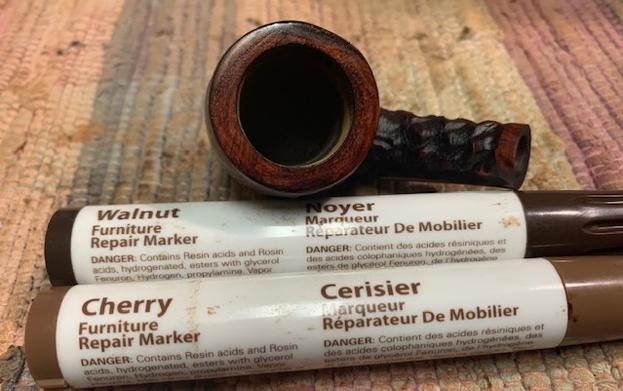
The next pipe I have chosen is sandblasted Peterson’s Kapruf. This Apple has a medium brown finish around the bowl sides and shank and a very nice looking sandblast finish. It also came to us from the estate of Anglican minister that was a great friend of mine here in Canada. The rim top and top of the apple were in very rough condition. The condition caused me to pause. I talked with Jeff about taking the part from this and scrapping the bowl but I find that hard to do! After spending time chatting about it and turning it over in my hands for a bit I decided to give it a go and see what I could do with it. The finish on the bowl sides was dirty. It was stamped on the underside of the shank and read 132 on the heel of the bowl followed by Peterson’s [over] “Kapruf”. That is followed by London Made [over] England. There was a heavy cake in the bowl and lava filling in the sandblast on the rim top. The back inner edge of the bowl was badly damaged and appeared to be quite thin. I would know more once it was cleaned. The was oxidized, calcified and there were heavy tooth marks on the top and underside and on the button. The “P” stamp on the left side of the taper stem was worn off. Jeff took photos of the pipe before his cleanup work. They tell the story and give a glimpse of the promise that we see in this pipe. Jeff took photos of the rim top and stem to show the general condition of the pipe. The bowl is heavily caked and the rim top and edges have some lava overflow. There is some major damage on the back of the inner edge of the bowl. The bowl is really out of round and thin on the back side. The stem is oxidized, calcified has tooth marks on the top and underside near the button.  Jeff took some photos of the bowl sides and heel to show the look of the sandblast that was around this bowl. It is an interesting looking pipe.  He took photos of the underside of the bowl and shank to show the stamping. The stamping is readable in the photos below and is as noted above.    I am including the information from Pipedia’s article on Peterson pipes. It is a great read in terms of the history of the brand (https://pipedia.org/wiki/Peterson).

I turned to “The Peterson Pipe” by Mark Irwin and Gary Malmberg to get some background on the Kapruf line. On page 306 it had the following information.

Kapruf and “Kapruf” (c.1922-87) Sandblast (hence the name, Kapp-rough) P-lip or fishtail mouthpiece, in catalogs from 1940-87. Early documented specimens stamped IRISH over FREE STATE, no Eire specimens documented. Mid-century specimens may be stamped LONDON MADE [over] ENGLAND or MADE IN ENGLAND forming a circle or MADE IN [over] IRELAND, all dating no later than 1970. Those of recent vintage stamped MADE IN THE[over] REPUBLIC [over]OF IRELAND.

I knew that I was dealing with a KAPRUF made before 1970 (or as they say in the book above “Mid-Century” as it is stamped LONDON MADE [over] ENGLAND as noted above. That fit with the majority of his pipes so I was clear what I was working on. Now it was time to work on the pipe.

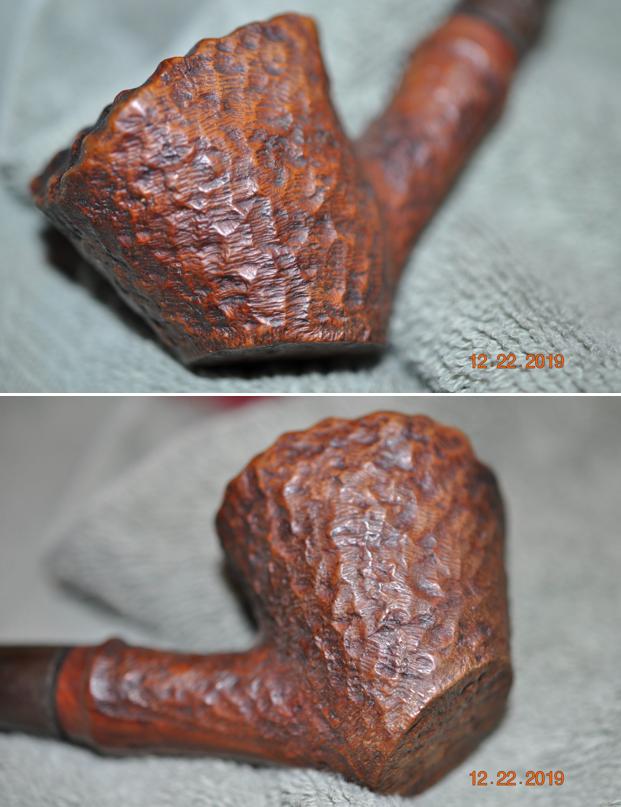
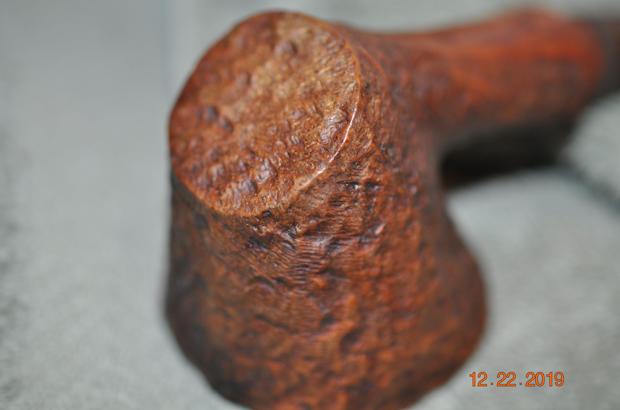
Jeff had done a great job cleaning up the pipe as usual. He reamed the pipe with a PipNet reamer and cut back the cake back to the bare briar. He cleaned up the walls with a Savinelli Fitsall Pipe Knife. He scrubbed the interior of the bowl and shank with pipe cleaners, cotton swabs and alcohol to remove the tars and oils. He scrubbed the exterior of the pipe with Murphy’s Oil Soap and a tooth brush to remove the grime from the finish. He worked on the rim top lava and darkening with the soap and tooth brush. He scrubbed the inside of the stem with alcohol and pipe cleaners. He scrubbed the exterior with Soft Scrub and then soaked it in Before & After Deoxidizer. He washed it off with warm water to remove the Deoxidizer. The pipe looked far better when it arrived.   I took some close up photos of the rim top and also of the stem surface. I wanted to show how thin the back of the inner edge of the bowl is. You can see the out of round bowl is on the sides and rear of the bowl. There was some darkening on the back of the rim top but the edges looked very good. I also took close up photos of the stem to show the tooth marks on the surface of the stem and button.      I took a photo of the stamping on the underside of the shank. You can see that it is stamped as noted above. It is faint but very readable. I took the pipe apart and took a photo of the pipe. It is a good looking pipe and has a great looking sandblast. I decided to start by addressing the issue of the thin rim top and edge at the back of the bowl. I took a photo of the bowl to show the damage that needed to be addressed. I measured the thickness of the walls at the back of the bowl and found that the damage was actually not too deep in the bowl. I figured I could top the bowl and gain some thickness back and then use a Dremel to put a sandblast like finish on the rim top.I topped the bowl with 220 grit sandpaper on a topping board to remove the damaged areas. Once that was finished I had some solid rim top and edge to work with on the back of the bowl. The second photo below shows the starting point of the bowl after the topping. I used the Dremel and sanding drum running at a low speed to bring the bowl back into round. Of course I forgot to take photos of that part of the process. You can see the results in the photo below. I used a Dremel and dental burrs to rusticate the top of the bowl to give it a rusticated finish that approximates the style of the sandblast on the rest of the bowl. I stained the rim to with a dark Walnut stain pen to lay an undercoat of colour to the rusticated rim top. I used a Cherry stain pen to give a top coat on the rim top. I am pleased with the over all look and feel of the newly rusticated rim top.    I worked some Before & After Restoration Balm into the surface of the briar with my fingertips and a horsehair shoe brush to clean, enliven and protect the briar. I let the balm sit for 15 minutes and then buffed with a cotton cloth to raise the shine. The photos show the bowl at this point in the restoration process. I set the bowl aside and turned my attention to the stem. I “painted” the stem and button surface with the flame of a lighter to lift the tooth marks. It worked amazingly well and the majority of them lifted completely or significantly. I filled in the remaining marks with clear super glue. Once the repairs had cured I flattened them out with 220 grit sandpaper to blend them into the surface of the vulcanite. I started polishing the stem by wet sanding it with 400 grit wet dry sandpaper.   I polished the stem with micromesh sanding pads – wet sanding with 1500-12000 grit sanding pads. I wiped it down after each sanding pad with Obsidian Oil. I polished it with Before & After Pipe Stem Polish – both Fine and Extra Fine.  I am excited to finish this Peterson’s “Kapruf” 132 London Made Sandblast Apple. I am really happy with how the bowl turned out when I consider the damage that needed to be addressed. I put the pipe back together and buffed it with Blue Diamond on the buffing wheel. I gave the bowl multiple coats of Conservator’s Wax and the stem multiple coats of carnauba wax. I buffed the pipe with a clean buffing pad to raise the shine. I hand buffed it with a microfibre cloth to deepen the shine. It is fun to see what the polished bowl looks like with the colours popping through the sandblast. Added to that the polished  black vulcanite taper stem was beautiful. This shapely Classic English Peterson’s Sandblast Apple is nice looking and the pipe feels great in my hand. It is light and well balanced. Have a look at it with the photos below. The dimensions are Length: 5 ½ inches, Height: 1 ½ inches, Outside diameter of the bowl: 1 ¼ inch, Chamber diameter: ¾ of an inch. The weight of the pipe is 32grams/1.13oz. It is a beautiful pipe and one that I soon put on the rebornpipes store I you are interested in carrying on the pipeman’s legacy. Thanks for walking through the restoration with me as I worked over this pipe. Thanks to each of you who are reading this blog.

Another Christmas Vacation Restoration – A GBD London Made in London England C789 Pot


Blog by Dal Stanton

With Christmas behind us and with New Years before us, I’m thankful to be with family during these holidays.  This was the first Christmas with my mother in Florida in many years – it has been great!  It has also been great on her second floor screened-in balcony which has served as The Pipe Steward worktable.  My wife caught me in action!

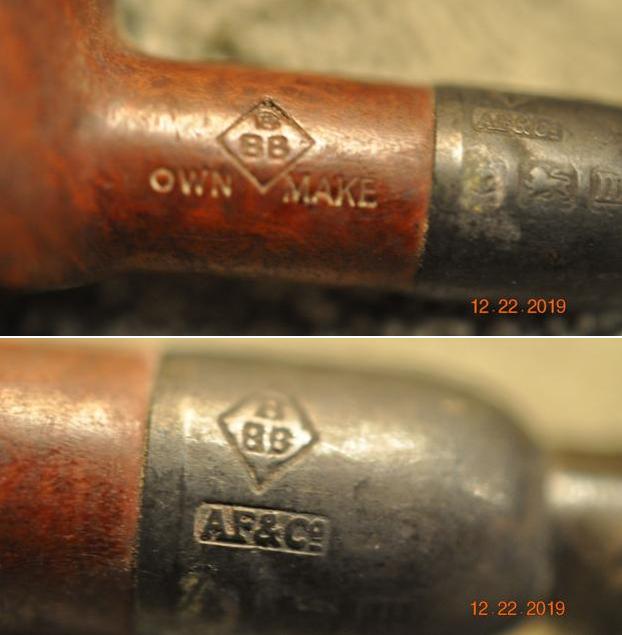
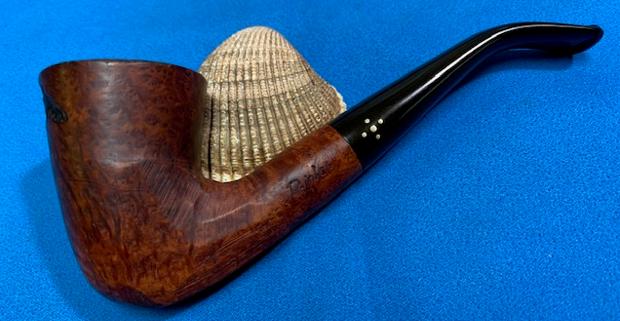
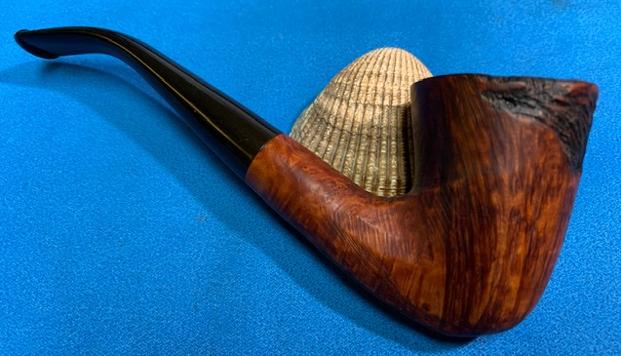
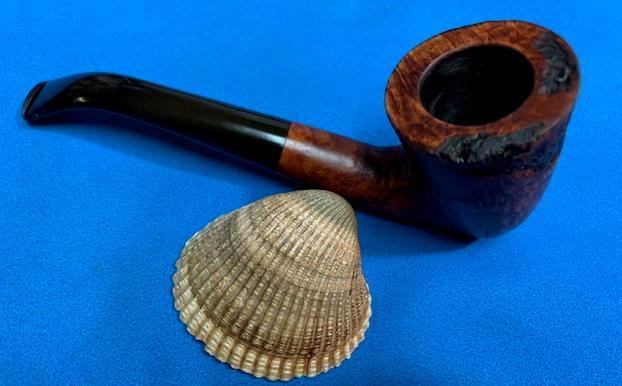
I remember acquiring this GBD Pot a few years back from an eBay seller from Cave City, Arkansas.  She had a few different pipes on the auction block and in the end, we were able to work out a bundled agreement which was mutually beneficial.  The bundle included GBD London Made, Selection Italy, GBD Americana, Dr. Grabow Omega and  No Name Algerian Briar.  I was attracted to the GBD Americana included in the bundle which joined my personal collection.  The unique grain is amazing (See: The Striking Grain of a GBD Americana – Made in London England Bent Billiard).  The other GBD in the bundled deal caught Chris’ attention in the online For “Pipe Dreamers” Only! collection where he also found the Fratelli Rossi ‘Century Old Briar’ (See: A Mobile Christmas Vacation Restoration of an Exquisite Fratelli Rossi Century Old Briar Billiard) which was last on the work table and soon to join Chris in Alabama.  The GBD London Made Pot now on the table also shows great potential.  Here are a few of the pictures of this GBD. The nomenclature is Cadogan era markings.  On the left shank flank is stamped the GBD set in an oval.  Beneath the oval, the arched text LONDON MADE is stamped.  The Cadogan era stem stamp is the GBD in and an oval repeated.  The right side of the stem is stamped in circular fashion, MADE IN LONDON – with the ‘IN’ occupying the center of the oval.  Beneath the circular text is stamped the COM, ENGLAND.  Beneath the COM is the shape number, C789, the designation for a Pot shape.  However, after some searching and finding nothing to explain it, I was flummoxed by the ‘C’ affixed to the shape number.  I decided to send a quick note to rebornpipes contributor, Al Jones, to see if he can shed some light.  Al’s response confirmed the ‘C’ as being a ‘rogue’ letter.  After the merger in the early 80s, differing letters would appear on GBD pipes with no clear understanding what they referenced.

The dating of the GBD on my table I’ve described as a ‘Cadogan Era’ pipe.   Pipephil records that GBD’s metal stem rondels were discontinued after 1981 when GBD merged with Comoys.  The absence of this brass rondel on the stem places this pipe post ’81 and later.  The rounded COM designation rather than a straight lettering (London England), also points to a post-merger GBD.  The GBD also has a random letter, ‘J’ on the underside of the shank.  I’ve seen these letters before on Cadogan era pipes and it seems that Comoy’s used several letters for what are perhaps part numbers, but this isn’t confirmed.I have researched other GBD pipes that have been on my worktable and I always enjoy a refresher from the fruit of that research.  The story of GBD pipes is an interesting one starting in France in 1850 with an unexpected partnership, not coming from businessmen, but fellow pipe makers who felt they could make a go of it.  This excellent article, Finding Out Who Created GBD – Story of a Pipe Brand – Jaques Cole was reposted on rebornpipes and is an excellent read for framing a historical appreciation for a pipe name and its development – GBD.

Who were these creators? Ganneval, Bondier and Donninger were three ‘Master Pipemakers’ who got together in Paris in 1850 to manufacture meerschaum pipes. It was a bold decision as these were troubled times in France. Charles Louis-Napoleon Bonaparte has returned after the 1848 revolution and become President of the Republic. Following a coup d’etat in 1851, he made himself Emperor Napoleon III in 1852. He was incidentally a keen pipesmoker and may well have owned one or more early GBDs.

The focus of the ‘GBD’ enterprise in the late 1800s was primarily the production of meerschaum pipes but in the 1850s, with Saint-Claude’s discovery of briar and its special qualities for making lasting, heat-resistant pipes, GBD adapted and added briar to its list of materials.  GBD boasted in the end of the 19th Century as having 1500 models that customers could choose from – though Pipedia’s article on GBD clarifies this unbelievable number as counting each shape three times due to three different stem materials used.  GBD straddled its French identity and its adopted English identity through various acquisitions and changes in ownership, yet, keeping the initials of the founders firmly in place.  Pipedia’s history is helpful to understand these historical iterations:

There is a very simple explanation for GBD’s program to turn more “British”: GBD became a British company soon after the turn of the century! In 1902 Marechal and Ruchon sold GBD to A. Oppenheimer & Co. in London. Charles Oppenheimer had founded this successful trade business in 1860 as an import-/export house. His brothers David and Adolphe and brother-in-law Louis Adler soon joined him. Adolphe took over when Charles went to Germany as British ambassador. Briar pipes were among the first products traded. The business relation to GBD in Paris began as early as 1870. Being the most important customer in the English-speaking world, Oppenheimer & Co. were designated as sole distributor for Great Britain, the USA and Canada in 1897.

Though English owned, pipe production continued in Paris and soon Oppenheimer acquired two factories in Saint-Claude in 1906, increasing its production.  Also, during this period, Oppenheimer continuing to expand, built a pipe factory in London, but this operation failed to live up to expectations until the genesis of WW I when demand for pipes increased for the front line and production fell in the French factories as men were called to the front lines.  The shift of GBD being identified more distinctly as a British pipe emerged after the close of the war even though production continued in London and France through the 1920s.  I find the next Pipedia excerpt interesting because it marks well how GBD had fully transitioned from its origins, the handshake of 3 French pipe makers, to a macro-business continuing through the 1900s.

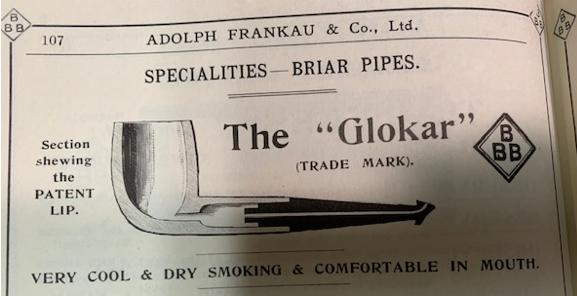
In 1920 Oppenheimer had purchased BBB (Blumfeld’s Best Briar, formerly A. Frankau) and little later Loewe & Co. and large shares of Comoy’s of London. The economic crisis in the early 1920s induced the foundation of Cadogan Investments Ltd., named for its seat at Cadogan Square in London. The Cadogan group was a superordinated holding company, in order to tune all activities of Oppenheimer’s brands in the pipe industry. Whereby an extensive independence of the single brands was preserved. Remember, the Oppenheimers and Adlers weren’t pipe specialists, but rather sales people who depended on their experts in the British and French plants.

In 1952 the Paris factory moved to Saint-Claude and since the 1980s most GBD pipes come from London.  The higher-end GBD pipe lines are of good quality and many feel they stack up well against the array of Dunhill offerings yet more affordable.  The Pipephil.eu history of GBD says that the Saint-Claude pipe factory closed in 1981 leaving only London as the producer of GBD pipes.

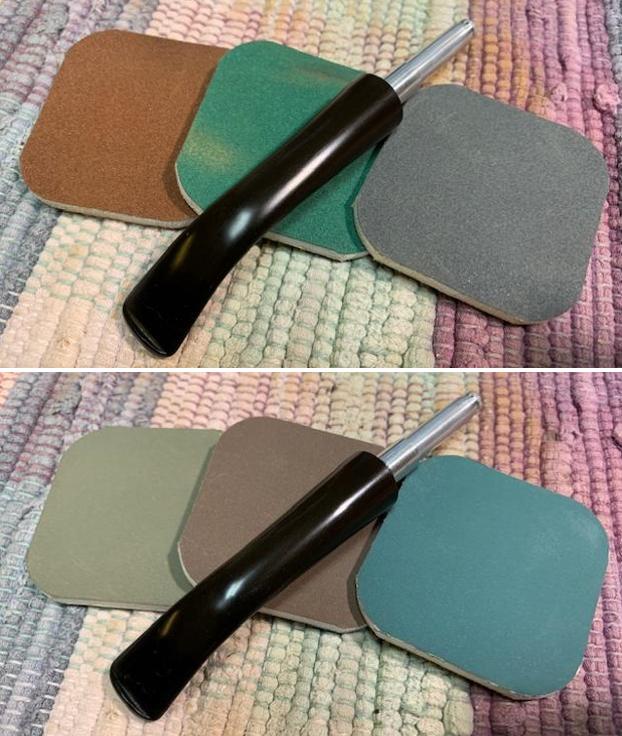
Now looking more closely at the GBD Pot on my worktable, the bowl has thick cake buildup in the chamber.  This will need removing to inspect the chamber walls for heating problems.  The stummel finish is dark and bears the grime of years of service. The stem has heavy oxidation and a good amount of tooth chatter.  To begin, I clean the airway of the stem with pipe cleaners wetted with isopropyl 99%.This is followed by then adding the GBD stem to a soak of Before & After Deoxidizer to address the oxidation issues.After several hours soaking in the solution, I fish the stem out and squeegee the excess liquid from the stem with my fingers and run pipe cleaners wetted with alcohol through the airway to clear away the Deoxidizer.  Cotton pads are also used to wipe off the raised oxidation.The stem is then treated with paraffin oil to help condition and rejuvenate the vulcanite.Turning now to the stummel, I take another look at the chamber. The cake is thick, and the lava flow is substantive over the rim.  There is little doubt that the former steward enjoyed his GBD and that this indicates a good smoker on the table. After putting down paper towel to minimize cleanup, I go to work on removing the carbon buildup to allow the briar beneath to have a new start and to inspect for problems.  I use all 4 of the Pipnet Reaming Kit blades heads and this is indicative of the large chamber of this GBD Pot.  I follow the reaming with the Savinelli Fitsall tool to further scrape the walls and finish by sanding with 240 paper wrapped around a Sharpie Pen.  A pocketknife is also employed to scrap the lava crust off the rim.  This reveals a smart internal rim bevel which is nice. With the cake cleared out, working on the balcony of my mother’s condominium where my Christmas Vacation mobile work desk is located, I use the natural sunlight to inspect the chamber.  Not surprising, I can see some heating veins on the chamber wall.  The thick cake on the GBD contributed to this heating problem.  A carbon cake needs only to be the width of a US dime.  When the cake is too thick, its expansion and contraction during the service of the pipe causes undo stress and heating on the briar.  The worst-case scenario is an eventual burn-through or a severely cracked bowl.  These veins are minor, thankfully, and will be addressed by applying pipe mud later. Pipe mud helps the formation of a protective cake. The scraping of the rim reveals some dings on the edge from normal wear. Continuing the cleaning process, I use undiluted Murphy’s Oil Soap to clean the darkened, grimy briar surface. I take a few pictures to mark the start. A cotton pad did the scrubbing with Murphy’s and a brass bristled brush helps with the rim.  Using brass brushes is less intrusive and a softer approach to cleaning.After this, the stummel is taken to the sink and using anti-oil liquid dishwashing soap and warm water, the mortise is scrubbed with shank brushes.  After the stummel is rinsed thoroughly, I bring it back to the table.Doing a quick survey of the stummel, the chips on the rim are evident along with scratching on the briar surface on the aft quadrant of the bowl.Next, focusing more on the internals, cotton buds and pipe cleaners wetted with isopropyl 99% are used to do the job.  I also use the small dental spoon to scrape the mortise walls.  The previous cleaning in the sink did a good job.  It doesn’t take a lot of effort and the buds and cleaners are coming out lighter.  I’ll continue the internal refreshing later using a kosher salt and alcohol soak. Continuing with the stummel, the rim is not in good condition and coupled with the scratching and fill on the stummel surface, sanding will be necessary.  I start from the top and work my way down. I begin by topping the stummel to refresh the rim.  I use 240 grade paper to begin on a chopping board.  After inverting the stummel, I give it several rotations.I stop to check the progress not wanting to remove more rim briar real estate than is necessary. While I’m at it, I also refresh the rim with 240 paper using a hard surface to press the paper.  I do the same with 600 grade paper and after changing the topping paper to 600, I give the rim several more rotations to further smooth the rim and remove the imperfections.  The picture below shows a much-improved rim.  A knot can be seen on the shank-side of the rim.  It doesn’t appear to be a fill.The spot on the rim has an indentation and is not smooth to the touch.  I decide to fill it so that the rim surface is smooth.Using a sharp dental probe, I dig out any loose material.After cleaning off the area with alcohol, I then apply a drop of clear CA glue to the pit and put the stummel aside for the patch to cure.It doesn’t take long for the patch to cure.  I use a flat needle file and a tightly rolled piece of 240 paper to do some precision filing and sanding to remove the excess patch mound. The rim patch is completed after again returning the stummel to the topping board with 600 grade paper.  After a few more revolutions to blend the patch, the patch looks good and is smooth to the touch.To address the dents on the shank-side of the rim lip and the multitude of scratches over the stummel, I use sanding sponges.  Starting with the rough grade, I sand over the entire stummel, carefully maneuvering around the nomenclature on both sides of the shank.  I follow the roughest grade with a medium grade then a fine grade.  The results are good.  Sanding sponges help to cleanup the blemishes on the briar surface less invasive than sanding paper. On a roll, I continue the stummel sanding with the full set of micromesh pads.  Using pads 1500 to 2400 grade, the stummel is wet sanded.  Following this, dry sanding with pads 3200 to 4000 and 6000 to 12000 complete the job. Wow!  The grain on this GBD is active and expressive.  This is looking good.  Before continuing with the stummel, I decide to continue the internal cleaning using a kosher salt and alcohol soak.  This process continues the cleaning of the internal briar as the salt and alcohol draw out the tars and oils.  I start by stretching and twisting a cotton ball to form a ‘wick’ that helps draw out the oils.  Using a stiff hanger wire, I guide the wick down the mortise and through the airway to the draft hole.  I then fill the bowl with kosher salt and place the stummel in an egg carton to provide the stability and necessary angle for the stummel.  Kosher salt is used rather than regular iodized salt because unlike the latter, kosher salt leaves no undesirable aftertaste. Then, using a large eye dropper, isopropyl 99% is put in the chamber slowly until the alcohol surfaces over the salt.  After waiting a few minutes, the alcohol is absorbed into the salt and cotton and is then topped off with a little more alcohol.  I put the stummel aside for several hours to allow the soak to do its thing.  With the stummel soaking, I return to the stem.  The earlier Before & After Deoxidizer soak did a good job.  A few pictures are taken of the upper and lower bit to look at the damage.  The bit has been chewed and mauled.  The button, upper and lower, shows bite compressions. The process of heating the vulcanite, a rubber compound, causes expansion of the material helping it to regain its original condition.  After several Bic lighter painting sessions, I take two more pictures to compare.  The heating method does not seem to have helped too much this time around.  Perhaps, but only marginally. To address the residual tooth chatter and compression, I apply black CA glue to both sides of the bit filling the compressions and building the button.  To hold the CA glue in place, I use an accelerator that cures the glue more rapidly holding the glue in place.    After the CA patch thoroughly cures, I go to work with a flat needle file bringing the patch mound down to the stem surface level – upper and lower. The button lip is also refreshed during the filing process.Following the filing, 240 sanding paper erases of the rough scratches of the filing and further shapes the button.  To remove the roughness, the sanding is expanded to the entire stem – upper and lower. Following the 240 sanding, I transition to wet sanding with 600 grade steel wool.  It was going so well until it wasn’t.  Oh my.  Restoration of pipes has as a goal returning a pipe to its new, and often, better than new state.  Yet, with all the efforts to do this, mistakes happen that diminish this goal.  While wet sanding with 600 grade paper, the paper inadvertently swept over part of the GBD stem stamping and it disintegrated.  One of the sad realities of the merger was the loss of the brass stem rondel.  Replacing it was more of a press of paint on the stem surface which has little compression or indentation into the vulcanite.  It is this indentation that protects the paint and gives it purchase or hold power.  After I did the carnage, the sick feeling in my gut continued as I vainly tried to repair the damage with the application of white acrylic paint.  I launched an email with the picture to Steve to see if he had any ideas how to salvage the situation.  His reply came quickly:

Hey Dal

I have that happen as well… it is not reparable. I just left mine half missing to give an idea of what it looked like originally. It happens and nothing can change that

Steve

Such is life….  I move on.I complete the wet sanding with 600 grade paper and finish this phase by applying 0000 grade steel wool.  Other than the stamping carnage, the stem looks great – repairs to the bit turned out very well – upper and lower.Next, the stem receives sanding from the full regimen of micromesh pads starting with wet sanding with pads 1500 to 2400.  Following the wet sanding, dry sanding is used with pads 3200 to 4000 and 6000 to 12000.  Between each set of 3 pads, Obsidian Oil is applied to protect the stem from oxidation and to rejuvenate it.     The kosher salt and alcohol soak worked through the night.  It continued the cleaning and refreshes the stummel.  The salt is soiled as well as the wick indicating that oils were drawn out during the process.  After removing the expended salt and wiping the chamber with paper towel, I also blow through the mortise to make sure salt crystals are dislodged. To make sure that all is clean, one cotton bud and one pipe cleaner dipped in isopropyl 99% were the proof of a clean and fresh pipe.Next, I attempted to reunite the stem and stummel to apply Blue Diamond compound, but discovered that through the cleaning process, the fit of the tenon into the mortise had tightened and was a bit too tight for comfort.  To remedy this, I use 470 grade paper to sand the tenon down.  To do this I wrap a piece of the sanding paper around the tenon and while pinching the paper tightly around the tenon, the stem is rotated to create the abrasion.  I did this a few times and tested after each.  When the fit was good, I finish by applying 0000 steel wool to the tenon to smooth it after the sanding paper.Next, after mounting a cotton cloth buffing wheel to the rotary tool, with the speed set about 40% full power, Blue Diamond compound is applied to the stem and stummel.  It takes some time for the process to methodically apply the compound around the pipe.  After completion, a felt towel is used to wipe/buff the pipe to remove excess compound dust. Before applying wax, I apply Before & After Restoration Balm to the stummel. I like how this product enhances and brings out the subtle natural hues of the briar.  After applying some to my finger, I work the Balm into the surface of the briar.  It thickens and it’s applied and once all is covered, the stummel is put aside for 20 minutes or so for the Balm to do what it does.After the time is complete, the stummel is wiped with a microfiber cloth to remove the excess Balm and then it buffs up with the cloth.  Nice.I have two steps left.  First, to apply the wax and then to apply pipe mud to the chamber.  Another cotton buffing wheel is mounted on the rotary tool with the speed remaining at about 40%, and carnauba wax is applied to the pipe – stem and stummel.  After several rotations over the briar with the buffing wheel, I then give the pipe a rigorous hand buffing to raise the shine and to remove excess wax.As noted, because of some heating veins in the chamber, I decided to apply a layer of pipe mud over the chamber wall to help start a protective layer of carbon.  Pipe mud consists of cigar ash and water.  I have already filtered and sifted the ash to clean out chunks of stuff not wanted.  Using a pipe nail tool, I scoop some ash into a shot glass where I will do the mixing.A pipe cleaner is inserted through the draft hole to guard it from being blocked during the process.I use a large eye dropper to introduce small amounts of water and then mix with pipe nail.  It’s easy to get too much water in the mix and it becomes too runny.  If this happens, more ash is added to dry and firm up the mixture.  This I had to do a few times until the mud was the consistency of mud – yep.  Firm enough to hold shape and not drip off the nail.With the consistency good, I scoop some mud with the pipe nail and deposit it at the floor of the chamber and then spread it out like putting peanut butter on bread.  Starting from the floor and working up to the rim, adding mud as I go.  I use my thumb fingernail to run along the inner lip of the rim to create a straight edge of mud around the circumference. I let the mud cure through the night.  When it cures, it will lighten a good bit.  The next morning, the pipe mud was cured and the pipe was given another hearty hand buffing to raise the shine.

Other than the stem marking carnage I inflicted, this GBD came out exceptionally well.  The grain is lively and expressive with large swirls of bird’s eye on both sides of the bowl and horizontal straight grain on both the fore and aft sections of the bowl.  The grain also sweeps across the heel laterally.  Without doubt, the grain of this GBD Pot will hold one’s attention.  The bowl is ample for a good, long time of reflection packed with one’s favorite blend.  This is the second of 2 pipes that Chris commissioned, and he will have the first opportunity to claim this GBD in The Pipe Store benefiting the Daughters of Bulgaria.  Thanks for joining me from my Christmas Vacation in sunny Florida!  Have a great New Year!


New Life for a Peterson’s Product Kilarney X86 Sandblast Apple


Blog by Steve Laug

The next pipe I have chosen is sandblasted Peterson’s Kilarney. This Apple has a medium brown finish around the bowl sides and shank. It also came to us from the estate of Anglican minister that was a great friend of mine here in Canada. The Apple has a great on the bowl and shank that was in great condition. The finish on the bowl sides was dirty. It was stamped on the underside of the shank and read X86 on the heel of the bowl followed by Kilarney in a flowery script. That is followed by “Peterson” [over] “Product” [over] Made in Ireland. There was a moderate cake in the bowl and light spattering of lava on the rim top and the inner edge of the bowl. The stem was once of the worst in this estate in terms of tooth marks. It lightly oxidized but there were heavy tooth marks on the top and underside and on the button. There was a faint “K” stamp on the left side of the taper stem. Jeff took photos of the pipe before his cleanup work. They tell the story and give a glimpse of the promise that we see in this pipe. Jeff took photos of the rim top and stem to show the general condition of the pipe. The bowl is caked and the rim top and edges have some lava overflow. The stem is lightly oxidized and the photos clearly show the deep tooth marks on the top and underside near and on the button.  Jeff took some photos of the bowl sides and heel to show the grain that was around this bowl. It is a nice looking pipe.  He took photos of the underside of the bowl and shank to show the stamping. The stamping is readable in the photos below and is as noted above.     I am including the information from Pipedia’s article on Peterson pipes. It is a great read in terms of the history of the brand (https://pipedia.org/wiki/Peterson).

I turned to “The Peterson Pipe” by Mark Irwin and Gary Malmberg to get some background on the Kilarney Pipe. On page 306 it had the following information on the pipe.

Kilarney (1949-) Entry line with smooth finish and P-Lip mouthpiece. May have either a K or P stamped on the mouthpiece; may have aluminum singer (not to be confused with the tenon extension tube found on straight System pipes). 1949-c.1957 examples made for the US market may have any of the following COM stamps: MADE IN IRELAND (forming a circle), “A PETERSON’S PRODUCT” over MADE IN IRELAND or LONDON MADE over ENGLAND. Some early specimens stamped KILLARNEY over NATURAL (a higher grade) have MADE IN IRELAND (forming a circle). Examples c. 1986-90 feature a nickel band, which was replaced in ’91 with a shank extension of nickel band with black acrylic inlay. Fishtail  mouthpiece from ’86 although P-Lip is sometimes seen. For the current German market, the Killarney is stamped CONNEMARA

I knew that I was dealing with a pipe made between 1949-c.1957 due to the stamping on the underside of the shank. It has the “K” stamp on the stem side and a P-lip mouthpiece. Now it was time to work on the pipe.

Jeff had done a great job cleaning up the pipe as usual. He reamed the pipe with a PipNet reamer and cut back the cake back to the bare briar. He cleaned up the walls with a Savinelli Fitsall Pipe Knife. He scrubbed the interior of the bowl and shank with pipe cleaners, cotton swabs and alcohol to remove the tars and oils. He scrubbed the exterior of the pipe with Murphy’s Oil Soap and a tooth brush to remove the grime from the finish. He worked on the rim top lava and darkening with the soap and tooth brush. He scrubbed the inside of the stem with alcohol and pipe cleaners. He scrubbed the exterior with Soft Scrub and then soaked it in Before & After Deoxidizer. He washed it off with warm water to remove the Deoxidizer. The pipe looked far better when it arrived.   I took some close up photos of the rim top and also of the stem surface. I wanted to show how well it had cleaned up. There was some darkening on the back of the rim top but the edges looked very good. I also took close up photos of the stem to show the tooth marks on the surface of the stem and button.    I took a photo of the stamping on the underside of the shank. You can see that it is stamped as noted above. It is clear and readable.     I took the pipe apart and took a photo of the pipe. It is a good looking pipe and has a great looking sandblast. I worked some Before & After Restoration Balm into the surface of the briar with my fingertips and a horsehair shoe brush to clean, enliven and protect the briar. I let the balm sit for 15 minutes and then buffed with a cotton cloth to raise the shine. The photos show the bowl at this point in the restoration process.   I set the bowl aside and turned my attention to the stem. I “painted” the stem and button surface with the flame of a lighter to lift the tooth marks. It worked amazingly well and the majority of them lifted completely or significantly. I filled in the remaining marks with clear super glue. Once the repairs had cured I flattened them out with a file and then sanded them smooth with 220 grit sandpaper to blend them into the surface of the vulcanite. I started polishing the stem by wet sanding it with 400 grit wet dry sandpaper. I touched up the faint “K” stamp with Rub’n Buff Antique Gold to try to make it more clear. While it is still faint it is clearer as can be seen in the second photo below.   I polished the stem with micromesh sanding pads – wet sanding with 1500-12000 grit sanding pads. I wiped it down after each sanding pad with Obsidian Oil. I polished it with Before & After Pipe Stem Polish – both Fine and Extra Fine. I am excited to finish this Peterson’s Product Made in Ireland Kilarney X86 Sandblast Apple. I put the pipe back together and buffed it with Blue Diamond on the buffing wheel. I gave the bowl multiple coats of Conservator’s Wax and the stem multiple coats of carnauba wax. I buffed the pipe with a clean buffing pad to raise the shine. I hand buffed it with a microfibre cloth to deepen the shine. It is fun to see what the polished bowl looks like with the colours popping through the sandblast. Added to that the polished  black vulcanite taper stem was beautiful. This shapely Classic Peterson’s Sandblast Apple is nice looking and the pipe feels great in my hand. It is light and well balanced. Have a look at it with the photos below. The dimensions are Length: 5 ¾ inches, Height: 1 ¾ inches, Outside diameter of the bowl: 1 ¼ inch, Chamber diameter: ¾ of an inch. The weight of the pipe is 31grams/1.06oz. It is a beautiful pipe and one that I soon put on the rebornpipes store I you are interested in carrying on the pipeman’s legacy. Thanks for walking through the restoration with me as I worked over this pipe. Thanks to each of you who are reading this blog.    


Breathing Life a Peterson’s of Dublin 2001 “Sterling Silver” 53 Lovat


Blog by Steve Laug

The next pipe I have chosen is smooth finished Peterson’s “Sterling Silver” pipe. This one is a 53 Lovat that has a rich coloured finish with amazing grain around the bowl sides and shank. It is also incredibly dirty. It also came to us from the estate of Anglican minister that was a great friend of mine here in Canada. I was in the airport in Hong Kong when his daughter contacted me to tell me of his death and asked if I wanted to take on his pipes. I told her that I was sad to hear of his death but would gladly take on his pipes to restore and sell.

This Lovat had a badly oxidized silver band on the shank. The grime on the finish was ground into the finish on the bowl sides. The contrast of the brown stains the grain really pop. It was stamped on the left side of the shank and read Peterson’s [over] of Dublin [over] Sterling [over] Silver. It was stamped on the right side with the shape number 53. The tarnished band is stamped with K&P in shields [over] Sterling Silver. That was followed by three hallmarks – the seated woman, the harp and the italic letter Q. It was in filthy when he brought it to the table. The finish was dirty with grime ground into the briar sides and rim. There was a moderate cake in the bowl and light spattering of lava on the rim top and the inner edge of the bowl. The stem was lightly oxidized and had light tooth marks and chatter on the top and underside on and near the button. Jeff took photos of the pipe before his cleanup work. They tell the story and give a glimpse of the promise that we see in this pipe. Jeff took photos of the rim top and stem to show the general condition of the pipe. The bowl is moderately caked and the rim top and edges have some light lava overflow. The stem is lightly oxidized and has light tooth marks on the top and underside near the button.    Jeff took some photos of the bowl sides and heel to show the amazing grain that was around this bowl. It is a nice looking pipe.  He took photos of the sides of the shank to show the stamping. The stamping is readable in the photos below and is as noted above. He also took a photo of the band.     I am including the link to the Pipedia’s article on Peterson pipes. It is a great read in terms of the history of the brand (https://pipedia.org/wiki/Peterson).

I always like to date the year a pipe was made while I am working on it. In the process of working on a pipe if I can pin down a date that it was made that it adds another dimension to the restoration process. Once I have identified the hallmarks on the pipe then I use a Hallmark chart to pin the date down. In the case of Peterson’s pipe with a silver band I use a hallmarking chart that Peterson included in their catalogs and on their website

I have a copy of the hallmark charts in one of the Peterson catalogs that I have uploaded to the blog on rebornpipes. I turned to that chart to lock down the date letter for the Sterling Silver Lovat that I am working on. Here is the link to the site (https://rebornpipes.com/wp-content/uploads/2015/05/peterson-cataloguecomp_page_27.jpg).

The chart defines the meaning of each hallmark on the silver band. The first one is of a seated woman with a harp is known as the Hibernia stamp and identifies the pipe as made in Ireland. The second stamp is a crowned harp which is a fineness mark denoting the high quality of silver that was used. The third stamp is the italic letter Q. I have included a larger screen capture of the section on the third column of the chart in the photo below.

I have drawn a square around the date letter below. It identifies the date of this Peterson’s pipe to 2001.I knew that I was dealing with a pipe that the hallmarks date to 2001. Now it was time to work on the pipe.

Jeff had done a great job cleaning up the pipe as usual. He reamed the pipe with a PipNet reamer and cut back the cake back to the bare briar. He cleaned up the walls with a Savinelli Fitsall Pipe Knife. He scrubbed the interior of the bowl and shank with pipe cleaners, cotton swabs and alcohol to remove the tars and oils. He scrubbed the exterior of the pipe with Murphy’s Oil Soap and a tooth brush to remove the grime from the finish. He worked on the rim top lava and darkening with the soap and tooth brush. He scrubbed the inside of the stem with alcohol and pipe cleaners. He scrubbed the exterior with Soft Scrub and then soaked it in Before & After Deoxidizer. He washed it off with warm water to remove the Deoxidizer. The pipe looked far better when it arrived. It has been sitting here for 2 years so the silver tarnished once again and would need to be polished.  I took some close up photos of the rim top and also of the stem surface. I wanted to show how well it had cleaned up. The rim top had some looked quite good and the inner edge had damage on the back. It should clean up really well. I also took close up photos of the stem to show the light tooth marks on the surface near the button.  I took photos of the stamping on the sides of the shank. You can see that it is stamped as noted above. It is clear and readable.  I polished the Sterling Silver band on the shank with some Silver Polish and a jeweler’s cloth to remove the tarnish and polish it.I took the pipe apart and took a photo of the pipe. It is a good looking pipe and has a rugged rustication around the bowl. I decided to address the out of round bowl first. I used a folded piece of 220 grit sandpaper to give the inner edge of the bowl a slight bevel to accommodate the burned areas and blend them into the surrounding briar.    I polished the briar with micromesh sanding pads – dry sanding with 1500-12000 grit sanding pads. I wiped the bowl down with a damp cloth after each sanding pad.     I worked some Before & After Restoration Balm into the surface of the briar with my fingertips and a horsehair shoe brush to clean, enliven and protect the briar. I let the balm sit for 15 minutes and then buffed with a cotton cloth to raise the shine. The photos show the bowl at this point in the restoration process.      I set the bowl aside to turn my attention to the stem. The stem was in excellent condition other than a deep tooth mark in the underside near the button. I filled it in with some clear super glue to repair it. I sanded out the repair on the underside of the stem next to the button and the chatter on the topside with 220 grit sandpaper until they were smooth. I started   polishing the stem with 400 grit wet dry sandpaper.   I polished the stem with micromesh sanding pads – wet sanding with 1500-12000 grit sanding pads. I wiped it down after each sanding pad with Obsidian Oil. I polished it with Before & After Pipe Stem Polish – both Fine and Extra Fine.  I am excited to finish this Peterson’s of Dublin “Sterling Silver” 53 Lovat. I put the pipe back together and buffed it with Blue Diamond on the buffing wheel. I gave the bowl and the stem multiple coats of carnauba wax. I hand buffed the pipe with a clean buffing pad to raise the shine. It is fun to see what the polished bowl looks like with the rugged rustication all around it. Added to that the polished Sterling Silver band and the black vulcanite stem was beautiful. This smooth Classic Peterson’s Lovat is nice looking and the pipe feels great in my hand. It is light and well balanced. Have a look at it with the photos below. The dimensions are Length: 5 inches, Height: 1 ¾ inches, Outside diameter of the bowl: 1 ¼ inches, Chamber diameter: ¾ of an inch. The weight of the pipe is 34grams/1.20oz. It is a beautiful pipe and one that will be on the Irish Pipe Makers section of the rebornpipes store soon. If you are interested in adding it to your collection let me know. Thanks for walking through the restoration with me as I worked over this pipe. Thanks to each of you who are reading this blog.

Rebirthing a Lovely Peterson’s Kapet 264 Canadian


Blog by Steve Laug

The next pipe I have chosen is another smooth Peterson’s Canadian. It was also incredibly dirty. It came to us from the same estate of Anglican minister that was a great friend of mine here in Canada. I was in the airport in Hong Kong when his daughter contacted me to tell me of his death and asked if I wanted to take on his pipes. I told her that I was sad to hear of his death but would gladly take on his pipes to restore and sell.

This Canadian is a real beauty with some great grain around the bowl. The grime was ground into the finish on the bowl sides. The contrast of the brown stains gave the grain a sense of depth. It was stamped on the topside of the shank and read Peterson’s [over] Kapet. The right side had the shape number 264 stamped near the bowl. The underside of the shank is stamped Made in the Republic of Ireland (in three lines). There was a moderate cake in the bowl and a light overflow of lava on the inner edge of the rim at the back. The stem was lightly oxidized, calcified and had light tooth marks, chatter and scratches on the top and underside on and near the button. There is a faint P stamped on the top near the shank/stem junction. Jeff took photos of the pipe before his cleanup work. They tell the story and give a glimpse of the promise that we see in this pipe. Jeff took photos of the rim top and stem to show the general condition of the pipe. The bowl is moderately caked and the rim top and edges have a thick lava overflow. The photos of the stem show that it was oxidized and has light tooth marks on the top and underside near the button.   Jeff took a photo of the bowl sides and heel to show the grain that was around this bowl. It is a nice looking pipe.     He took photos of the stamping on the sides of the shank. It is clear and readable and reads as noted above.   I turned to “The Peterson Pipe” by Mark Irwin and Gary Malmberg to get some background on the Kapet line. On page 305 it had the following information.

Kapet (1925-87) Line first described in 1925 brochure and featured in occasional catalogs through ’87. Early specimens will be stamped IRISH over FREE STATE. Described in 1937 catalog as available in dark plum or natural finish. Featured an aluminum “inner tube” or stinger until ’45. Mid-century specimens may be stamped MADE IN over IRELAND. Specimens from 1970 on may have mounts with hallmarks.

I knew that I was dealing with a Republic Era Kapet. Now it was time to work on the pipe.

Jeff had done a great job cleaning up the pipe as usual. He reamed the pipe with a PipNet reamer and cut back the cake back to the bare briar. He cleaned up the walls with a Savinelli Fitsall Pipe Knife. He scrubbed the interior of the bowl and shank with pipe cleaners, cotton swabs and alcohol to remove the tars and oils. He scrubbed the exterior of the pipe with Murphy’s Oil Soap and a tooth brush to remove the grime from the finish. He worked on the rim top lava and darkening with the soap and tooth brush. He scrubbed the inside of the stem with alcohol and pipe cleaners. He scrubbed the exterior with Soft Scrub and then soaked it in Before & After Deoxidizer. He washed it off with warm water to remove the Deoxidizer. The pipe looked far better when it arrived. I took some close up photos of the rim top and also of the stem surface. I wanted to show how well it had cleaned up. The rim top photo looks very good and there is some slight darkening on the back top and beveled edge. I also took close up photos of the stem to show the light tooth marks and scratching on the surface near the button.      I took photos of the stamping on the top and underside of the shank. You can see that it is stamped as noted above. It is clear and readable.       I took the pipe apart and took a photo of the pipe. It is a good looking pipe and has some great cross grain on the front and back of the bowl. I polished the briar bowl and shank with micromesh sanding pads. I dry sanded it with 1500-12000 grit pads and wiped it down with a damp cloth after each pad.      I worked some Before & After Restoration Balm into the surface of the briar with my fingertips to clean, enliven and protect the briar. I let the balm sit for 15 minutes and then buffed with a cotton cloth to raise the shine. The photos show the bowl at this point in the restoration process. I set the bowl aside and turned my attention to the stem. I filled in the tooth marks on both sides of the stem with clear super glue. I let the repairs cure. Once they had cured I sanded out some tooth marks on the underside of the stem with 220 grit sandpaper. I started the polishing with 400 grit wet dry sandpaper. I wiped it down with some Obsidian Oil.      I touched up the “P” stamp on the stem with Rub’n Buff Antique Gold. I worked it into the stamp with a toothpick. I let it sit for a few minutes then buffed it off with a cotton pad. I polished the stem with micromesh sanding pads – wet sanding with 1500-12000 grit sanding pads. I wiped it down after each sanding pad with Obsidian Oil. I polished it with Before & After Pipe Stem Polish – both Fine and Extra Fine.     I am excited to finish this Peterson’s Kapet 264 Canadian. I put the pipe back together and buffed it with Blue Diamond on the buffing wheel. I gave the bowl and stem multiple coats of carnauba wax. I hand buffed the pipe with a clean buffing pad to raise the shine and hand buffed it with a microfibre cloth to deepen the shine. It is fun to see what the polished bowl looks like with the polished nickel band and the black vulcanite stem. This Classic looking Peterson’s Kapet Canadian feels great in my hand. It is light and well balanced. Have a look at it with the photos below. The dimensions are Length: 5 ¾ inches, Height: 1 ¾ inches, Outside diameter of the bowl: 1 ¼  inches, Chamber diameter: ¾ of an inch. The weight of the pipe is 33grams/1.16oz. It is a beautiful pipe and one that will be on the Irish Pipe Makers section of the rebornpipes store soon. If you are interested in adding it to your collection let me know. Thanks for walking through the restoration with me as I worked over this pipe. Thanks to each of you who are reading this blog.