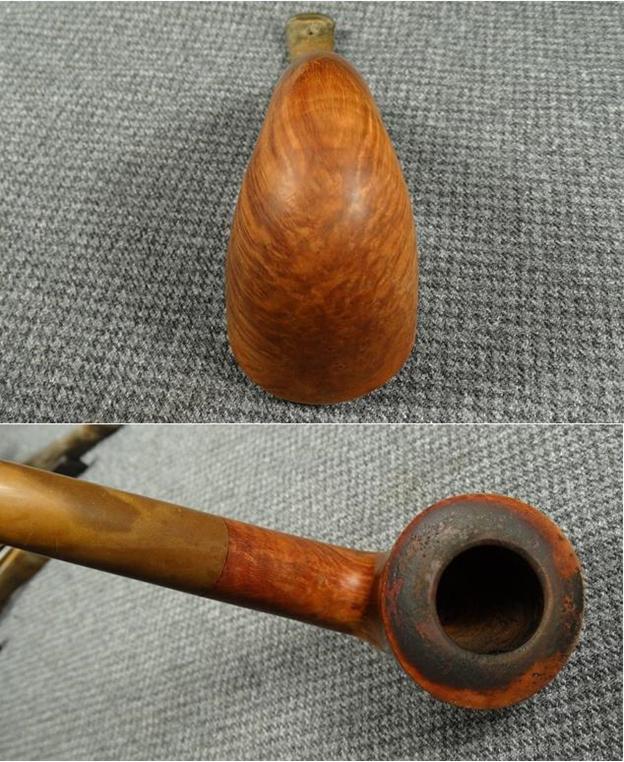
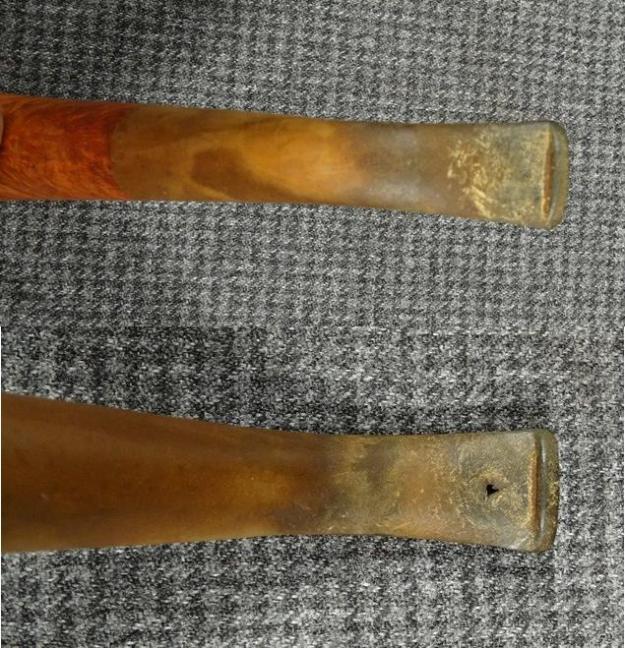
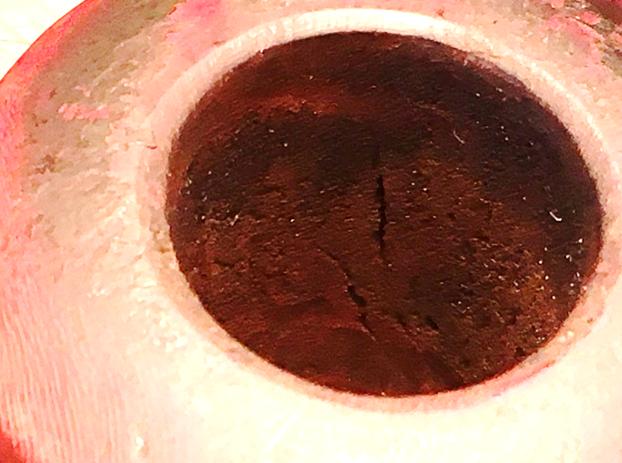
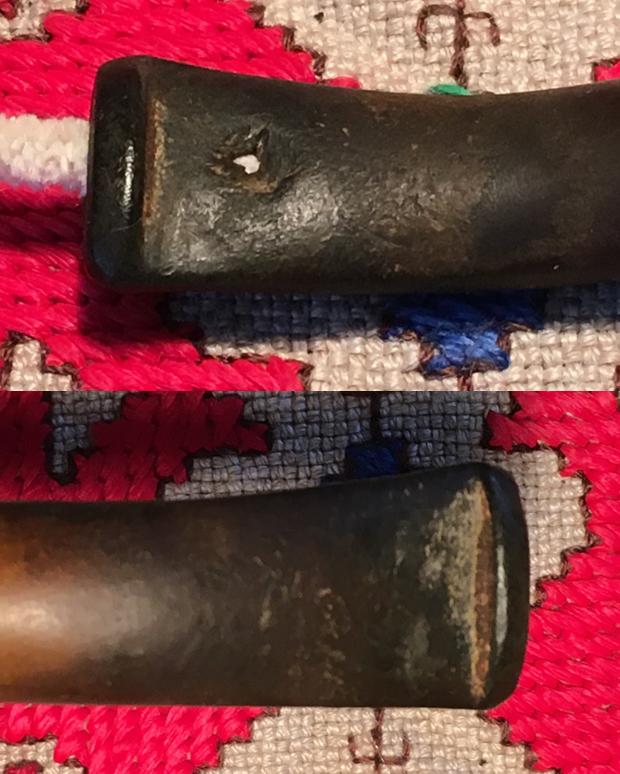
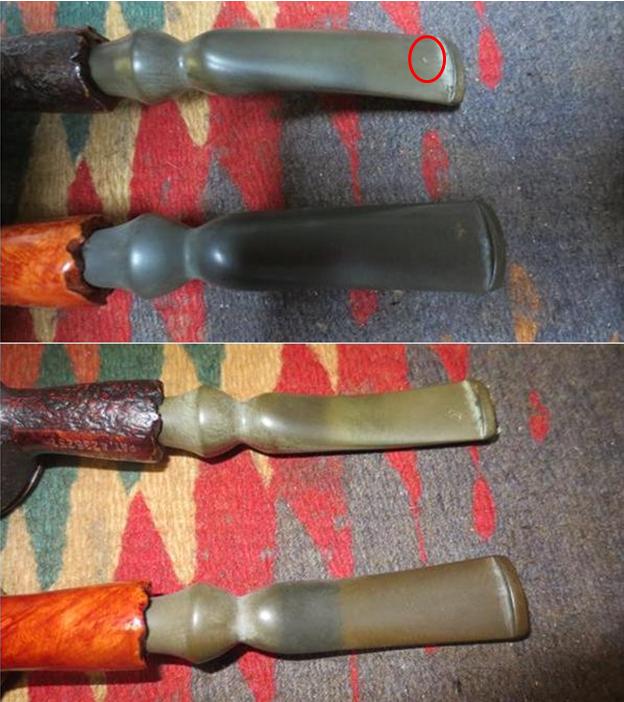
Tag Archives: Stem repairs

Jaws and an Estella Non Pareil ¼ bent 9606 Stack by Savinelli


Blog by Steve Laug

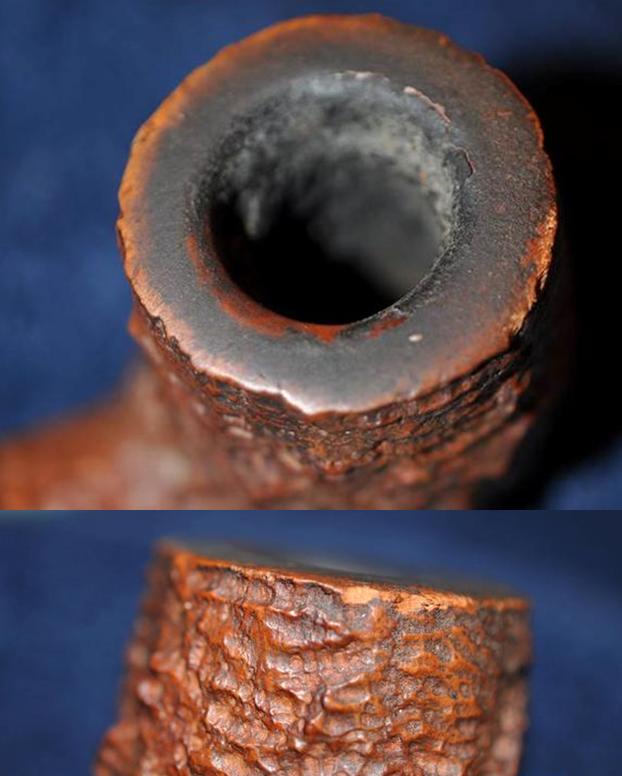
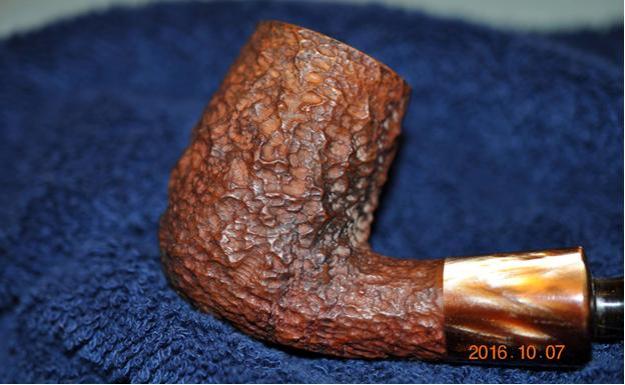
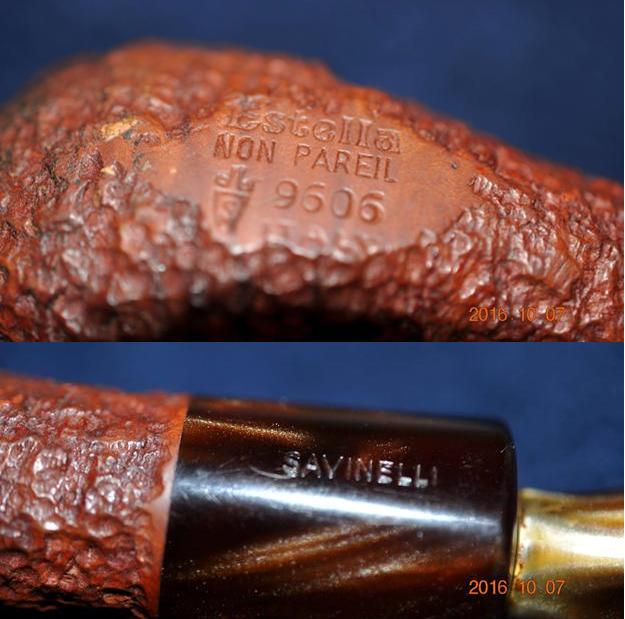
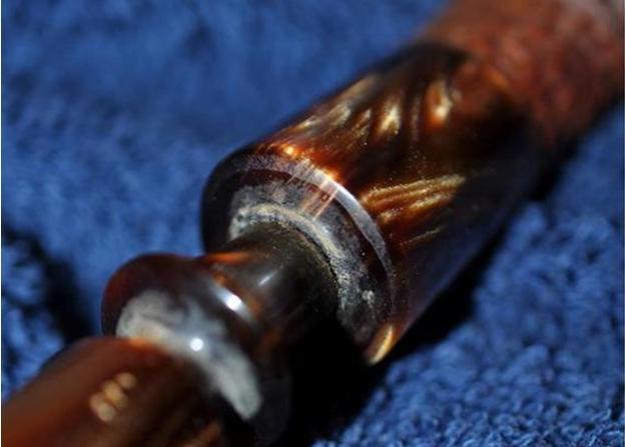
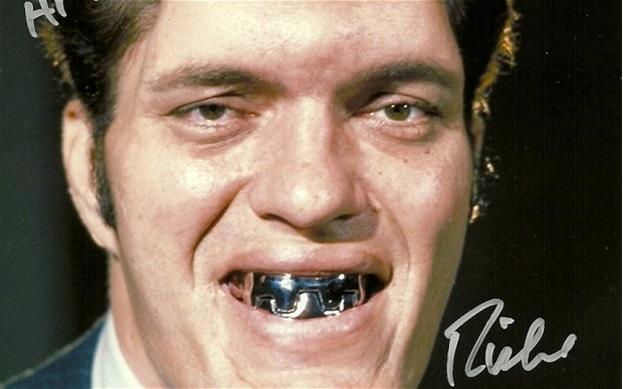
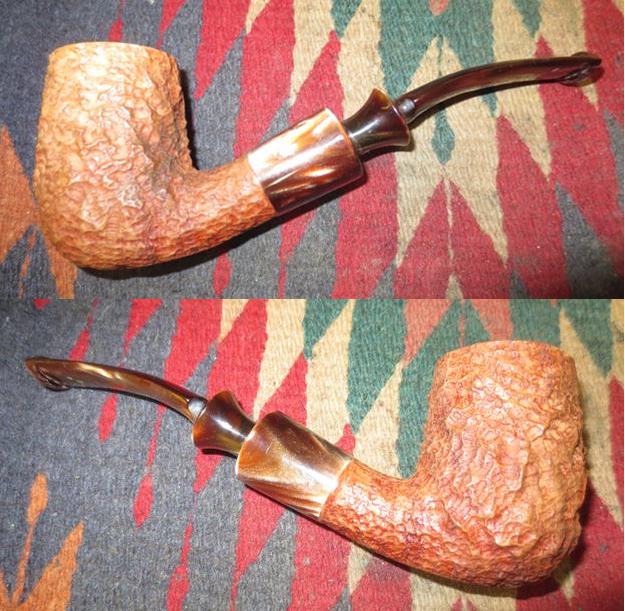
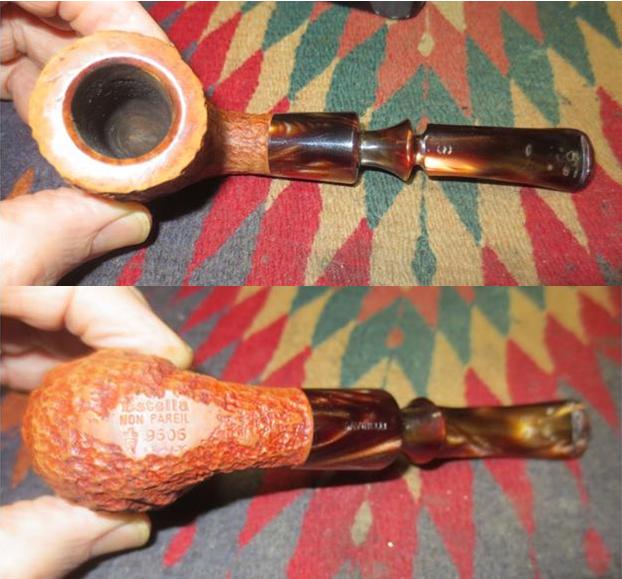
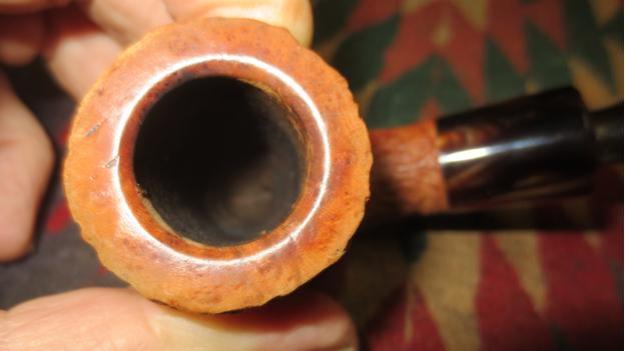
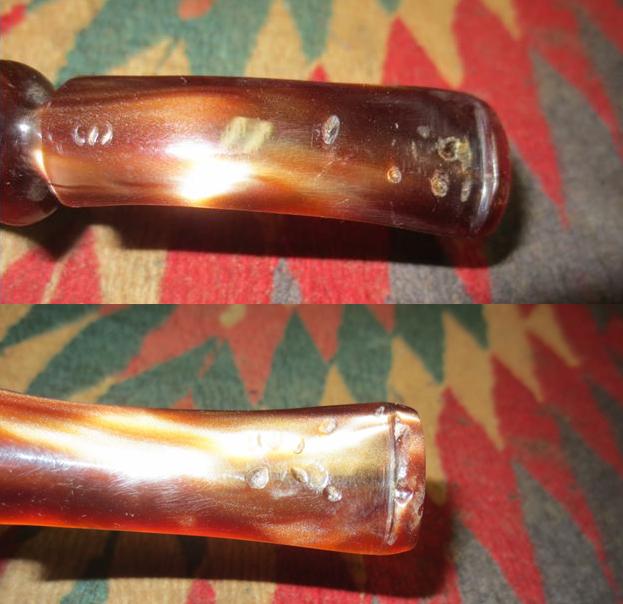
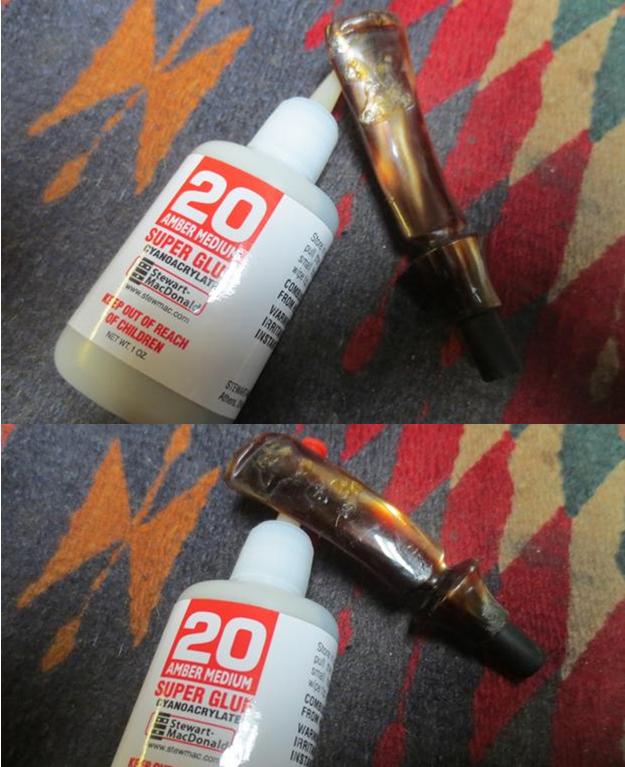
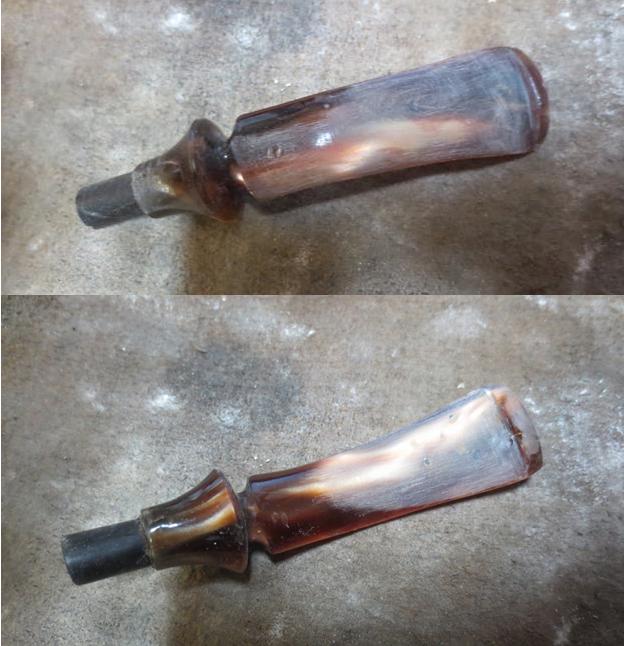
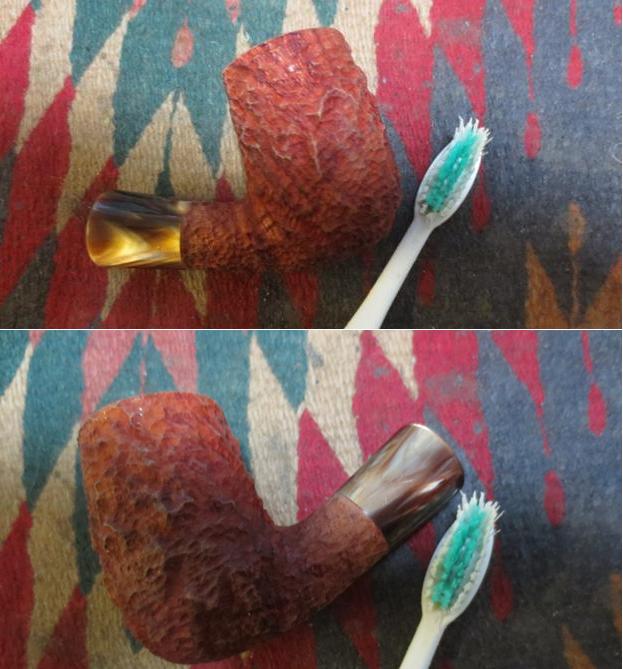
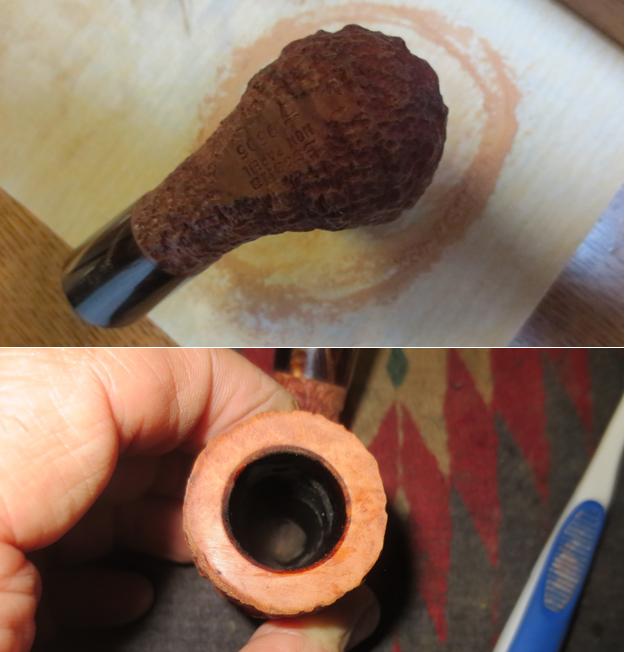
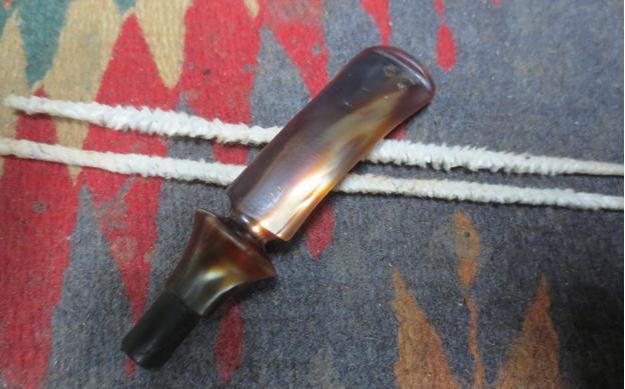
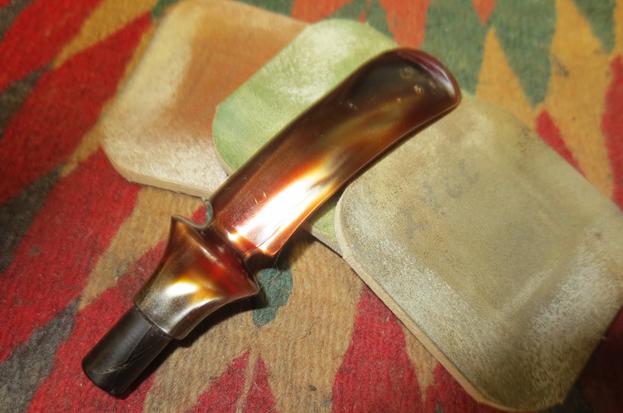
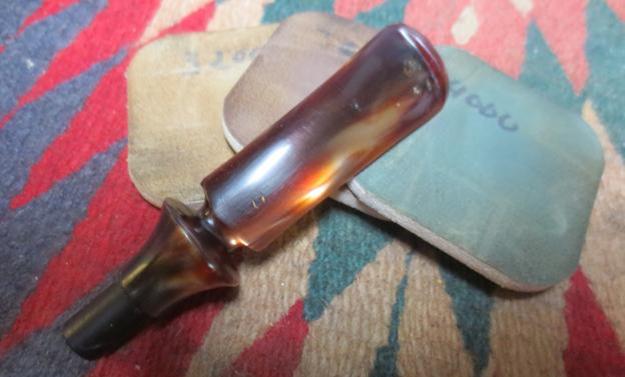
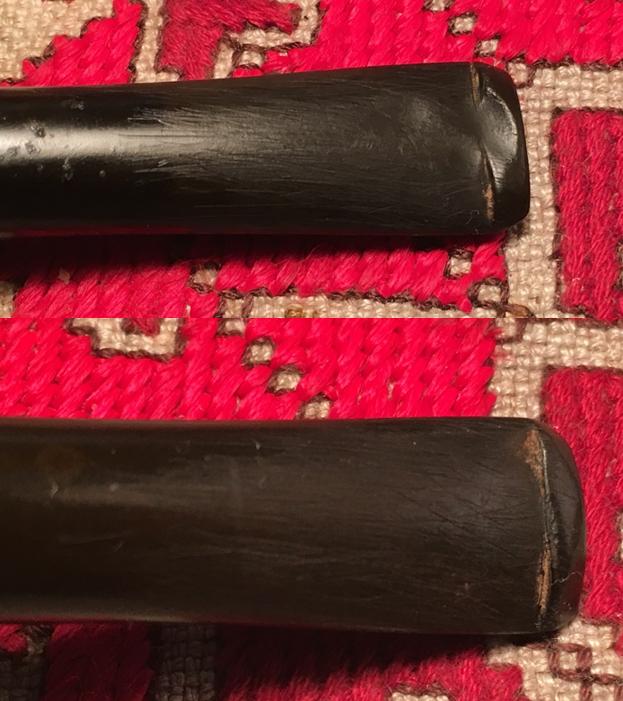
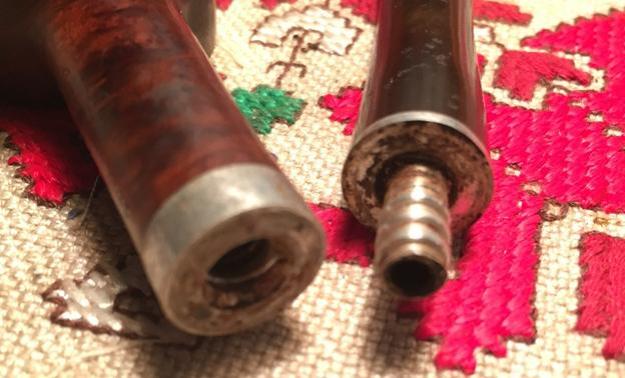
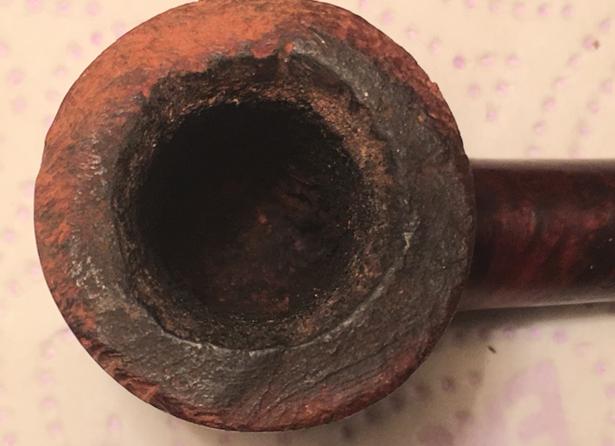
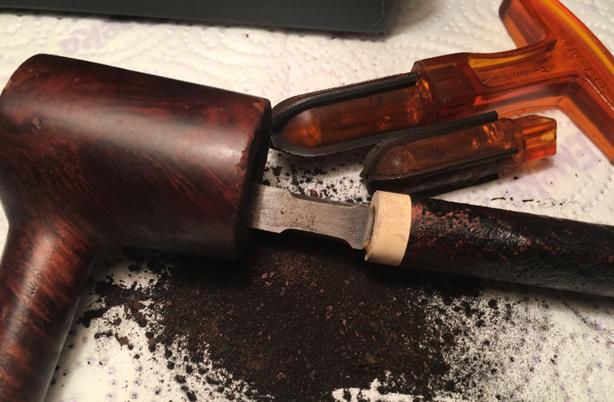
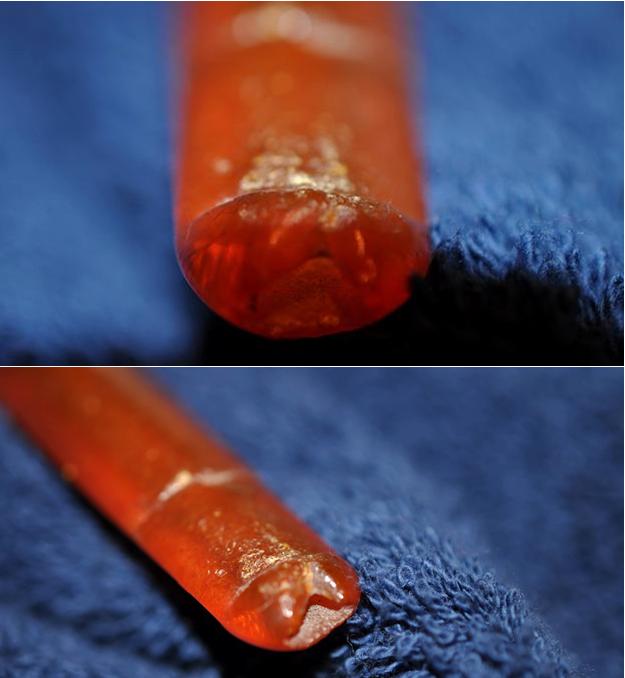
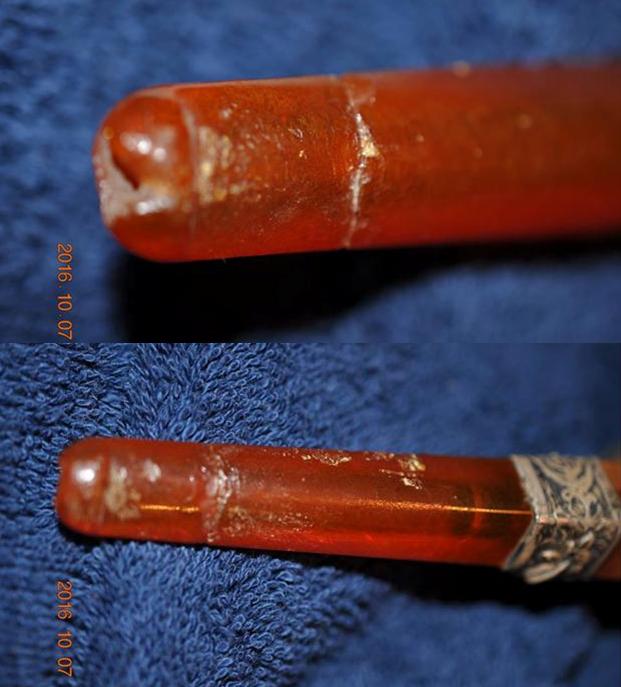
The next pipe on my work table is a Savinelli made Estella that my brother sent my way. It is stamped on the underside of the shank on a smooth oval – Estella over Non Pareil over 9606 with the Savinelli S shield next to that and Italy underneath. When my brother sent me the photos it appeared to be a good looking pipe. The rustication and the stain colour were very nicely done. The Lucite shank extension and the matching Lucite stem in brown and gold tones looked really good – from the side view. The finish on the bowl looked to be dirty or at least had darkening where the hand of the previous owner had wrapped around the bowl.estella1 estella2The cake in the bowl had overflowed on to the rim top and left behind a black and pitted mess. The right front outer edge of the bowl also had a large scrape from a drop or a badly chosen knock to remove the dottle. The close up photos of the rim and the side of the bowl show the condition of the pipe. In the last photo in this series you can see the darkening where the hand wrapped around the side of the bowl.estella3 estella4The next photo shows the stamping on the bottom of the bowl and the shank extension. Other than the S shield logo connecting the Estella and Savinelli the stamping on the Lucite certified the connection.estella5The mortise in the shank extension showed damage and wear as well. It appeared that the mortise was lined with a Delrin tube to go with the Delrin tenon on the stem.estella6Now I am ready to show you the meaning of the word Jaws in the title of this blog. The two photos after the portrait below show the tooth marks left behind by the “shark” who owned this pipe. Lucite stems are really hard material so for him to leave behind this kind of deep gouges in the stem he must have had quite a pair of choppers. Maybe the teeth were like those on one of the villains on James Bond known as Jaws.estella7Whatever then previous pipeman’s choppers were like they left behind a legacy of damage on both sides of this hard Lucite stem that needed a lot of work and would never really disappear.estella8My brother did his usual thorough clean up on the pipe. He reamed the bowl and scrubbed the externals with Murphy’s Oil Soap and a soft tooth brush. He was able to remove all of the buildup on the rim top. He cleaned the internals of the mortise and the airway in the shank and the stem with pipe cleaners and alcohol. He wiped down the stem so that when the pipe came to me it was ready to restore. The next four photos show the pipe when I brought it to my work table.estella9 estella10I took a close up photo of the rim top to show the pitting and the damage on the right front outer edge of the bowl.estella11I took close up photos of the chomped on stem. It was truly a mess and one that would be a challenge to blend in the repairs on the variegated browns and tans of the Lucite.estella12The stem had a partial stamp of an S on the topside near the saddle. Now the challenge began. I examined the tooth marks and saw clearly that they were sharp cuts in the material and not just dents. Heating the stem and trying to raise them would not work. I looked through my super glue options and I had clear and amber superglue that might work. My guess was that no matter what I used would stand out to some degree because of the striations in the browns of the Lucite. I cleaned out the divots with a cotton swab and alcohol to make sure there was no debris in them and put a drop of amber super glue in the divots on both sides of the stem.estella13Once the glue dried I sanded it with 220 grit sandpaper to smooth out the repairs to the surface of the stem. So far the topside was looking better than the underside.estella14I decided to see if I could remove more of the darkening around the spot where the hand of the previous owner clasped the bowl. I used some undiluted Murphy’s Oil Soap and scrubbed it with a tooth brush. I rinsed the pipe under running water avoiding getting water in the bowl. I was able to remove the remainder of the darkening.estella15 estella16To remove the nicks and gouges from the rim top and to remedy the rough outer edge on the front right I topped the bowl on a topping board until the damage was gone and the rough edge was minimized.estella17I cleaned off the exterior of the stem with a damp cotton pad and cleaned out the stem with a pipe cleaner. You can see the ghosts of the repairs in the variations of the colour in the stem material.estella18I polished the stem with micromesh sanding pads – wet sanding it with 1500-2400 grit pads and dry sanding it with 3200-12000 grit pads. After each set of three pads I wiped the stem down with the damp cotton pad to check the progress. The repairs certainly were smooth to the touch but nonetheless they were visible against the variations of the colour of the stem. I had been able to blend in the repairs on the upper portion of the stem but the closer I got to the button the more they seemed to stand out on both the top and the bottom sides.estella19 estella20 estella21I gave the bowl a coat of Conservator’s Wax and buffed it with a shoe brush. I buffed the stem with Blue Diamond on the wheel to see if I could further smooth and blend the repairs. I buffed the entire pipe with a clean buffing pad and then once again by hand with a microfibre cloth. The finished pipe is shown in the photos below. The bowl and rim look really good and the finish is clean and as good as new. The stem and shank extension have a rich glow and from the side they look amazing. The top and underside of the stem with the repairs is absolutely smooth to touch and has a glow. The repairs do show but only because of the swirls of the Lucite. It was a pain to repair but I am happy with the overall finished product. Thanks for journeying with me on this chomped stem and knocked about pipe.estella22 estella23 estella24 estella25 estella26 estella27 estella28 estella29


In With a Roar – A Lion’s Head Meerschaum


Blog by Steve Laug

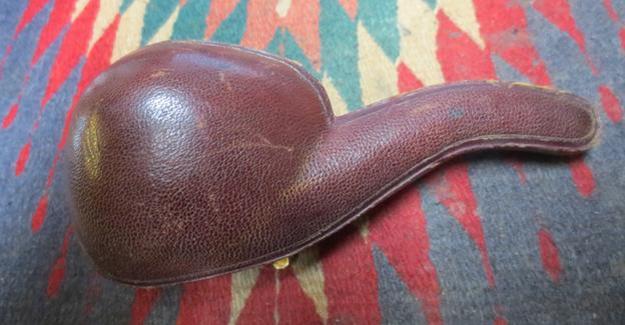
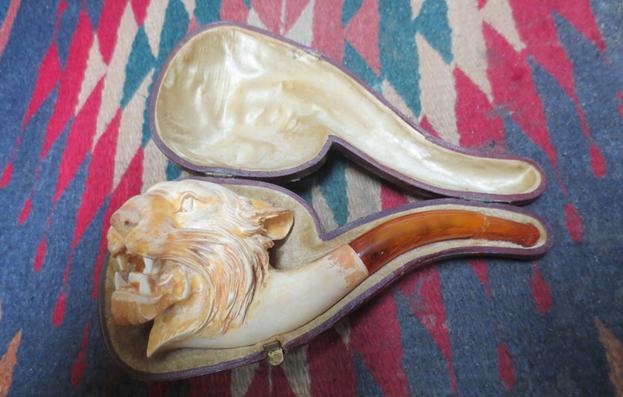
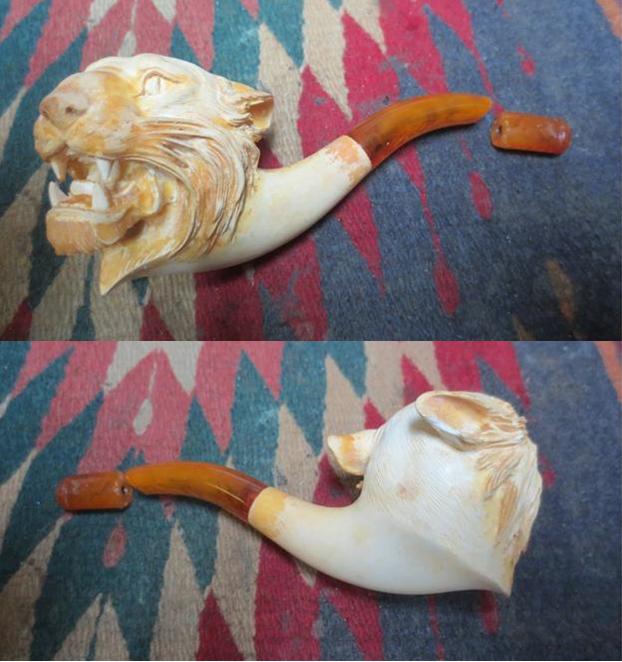
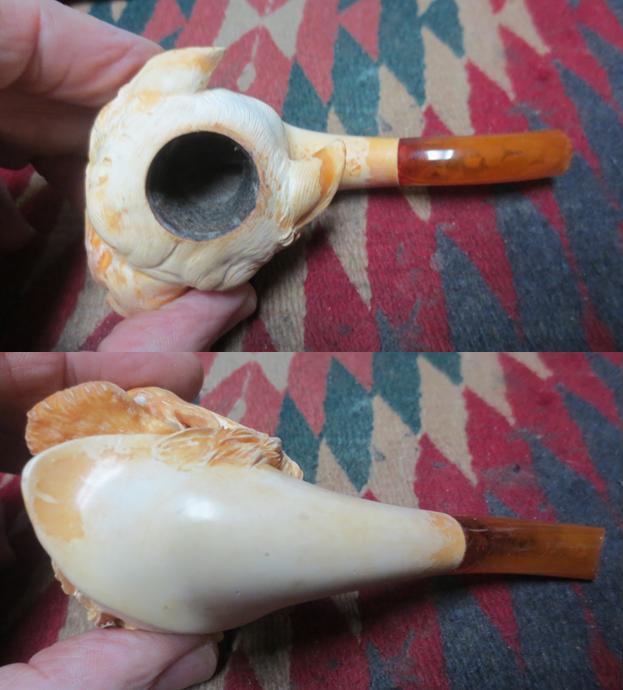
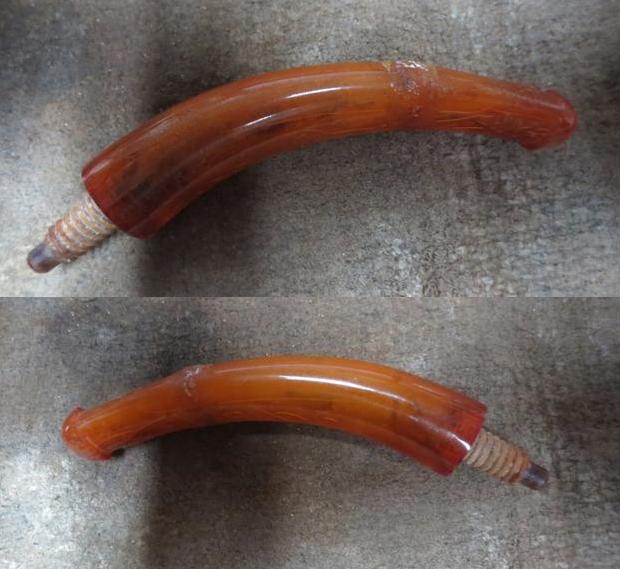
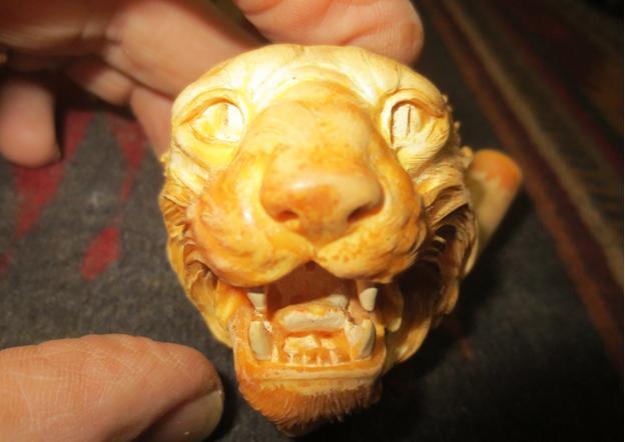
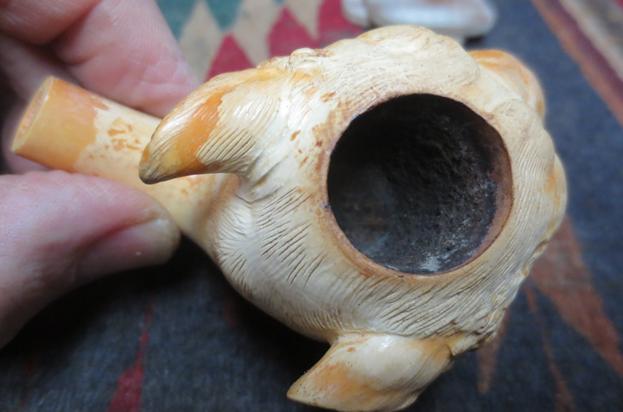
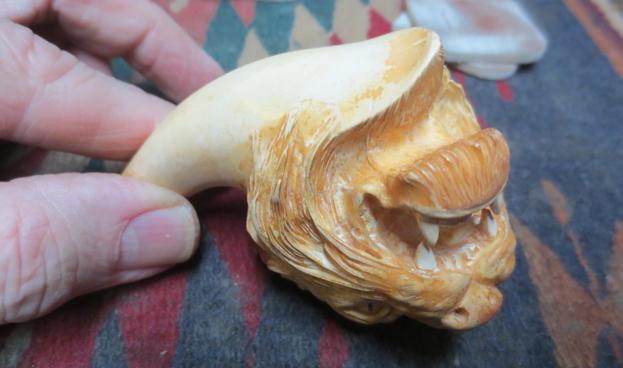
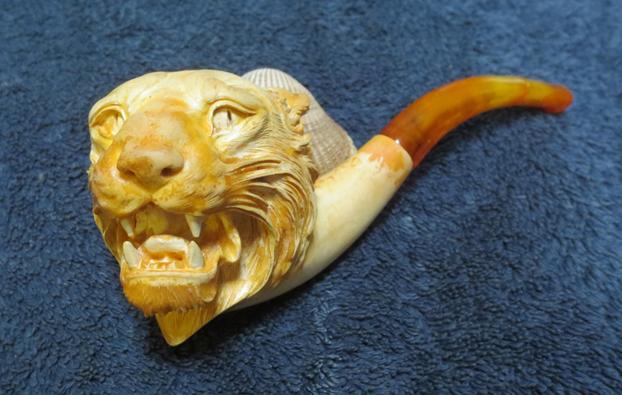
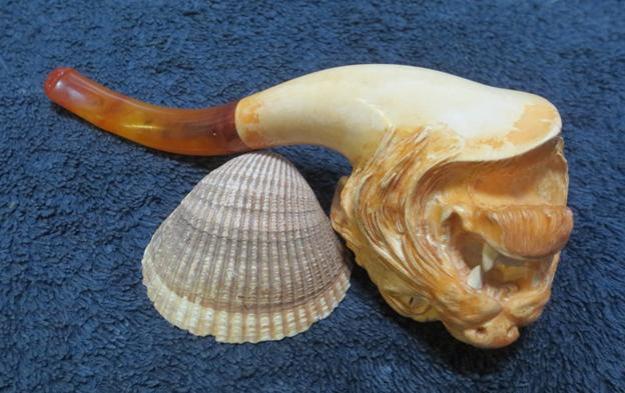
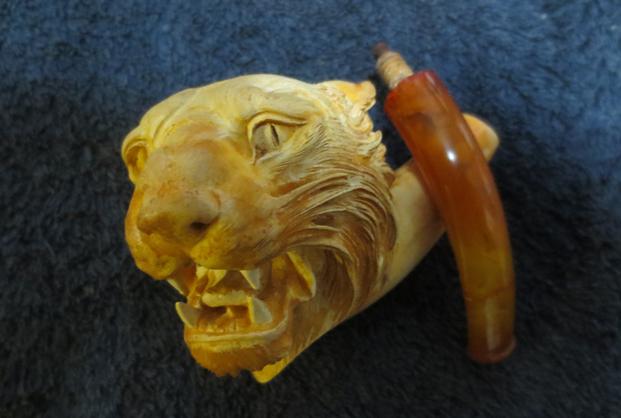
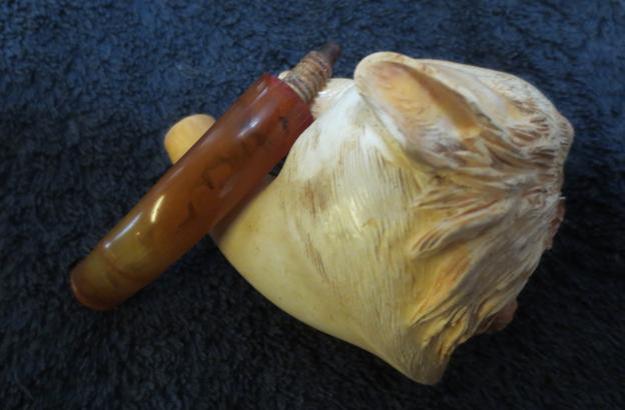
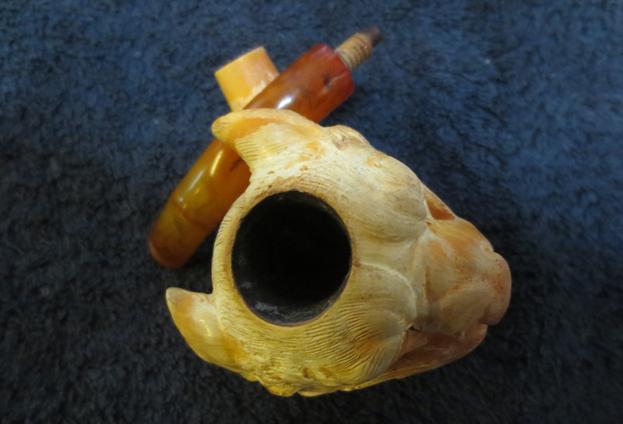
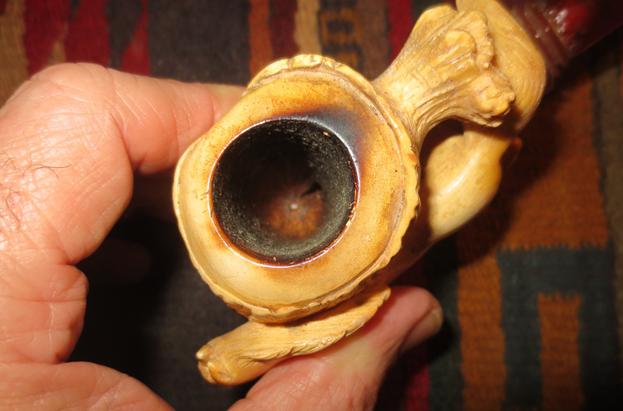
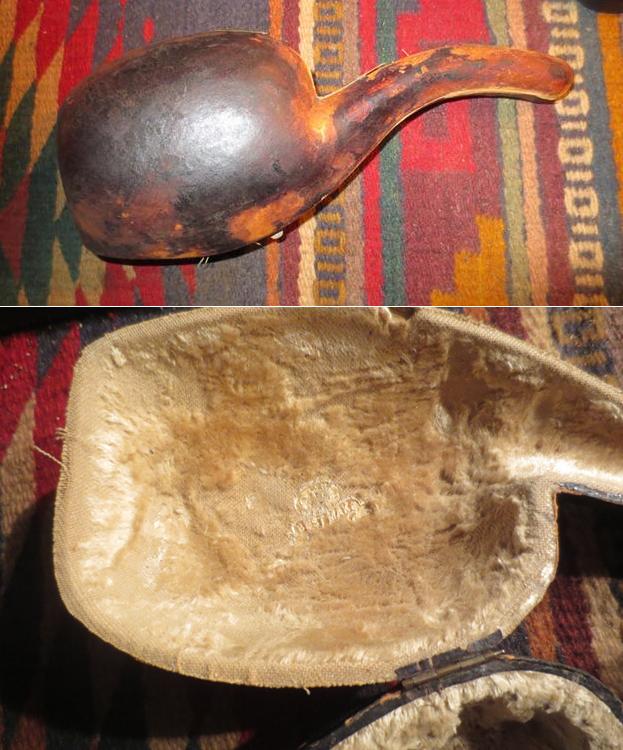
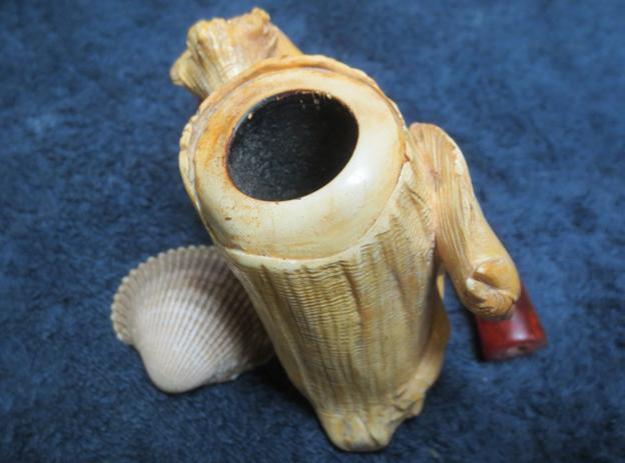
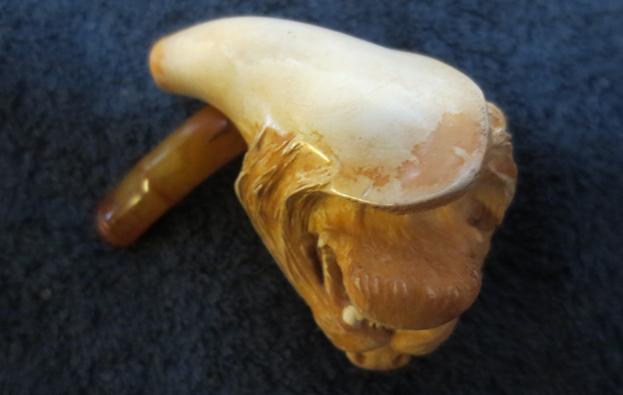
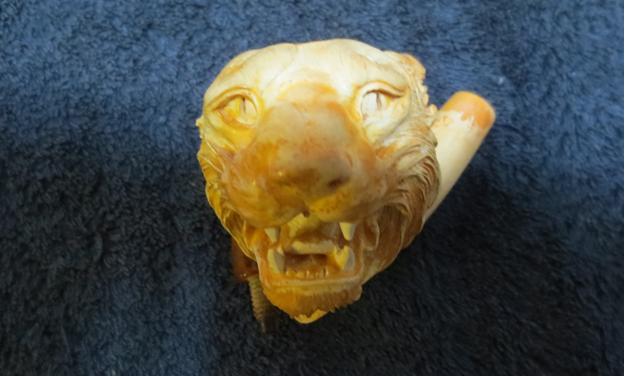
In one of the boxes of pipes that my brother sent me there was a brown leather pipe case that was in good shape. There was some scuffing along the edges of the case but the latch and the hinges were in excellent shape. I love a good mystery and certainly this brown pipe case offered up a good one. Fortunately solving this mystery was very simple. All I needed to do was to press the latch on the front of the case and I would know what was inside. I was curious to see what was inside of the case. The shape hinted at a figural pipe and I was pretty sure it was a meerschaum.lion1I pressed the latch and the case popped open. Inside was a nicely carved lions head staring out at me. The head was turned toward me and the carving was well done. It looked at me the same time I was looking at it. It seemed to have a snarl coming out of its wide open mouth. The large curved fangs were opened and appeared to ready to bite my hand when I reached for it. The lion was well carved – the shape of the head, the open mouth, the fangs and the look of a roar were very realistic. The ear on the right side looked really good with no chips. The meerschaum was developing a patina on the jaws and the shank. It was beginning to darken. The stem looked to be amber but I was not sure at this point in the examination. The last inch of the stem to the button had been broken off and was still in the case.lion2I removed the pipe from the case along with the broken tip of the stem and took some photos of the pipe. My brother had cleaned up the externals and the airway in the shank and the stem. He had reamed the bowl and cleaned the soiled surface of the figural. There was a small chip missing from the bottom edge of the right ear. It is hard to see unless you are looking for it. The rim was clean and solid with no chips or dents. The inner edge of the bowl was also clean with no damage. The fur and whiskers on the big cat were also well carved and the patina was beginning to develop in the deeper grooves of the carving.

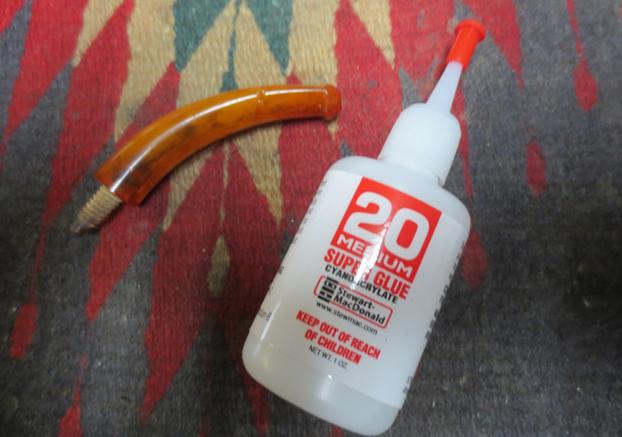
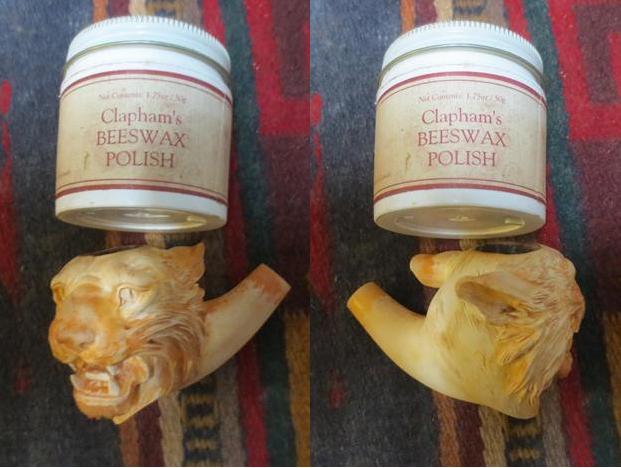
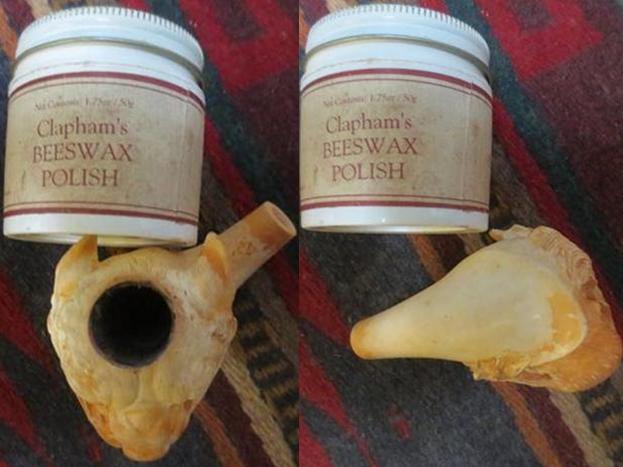
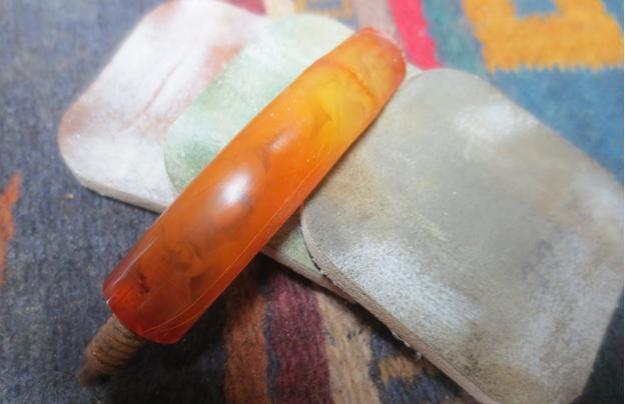
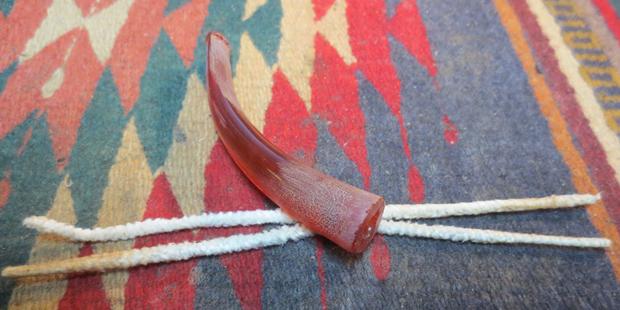
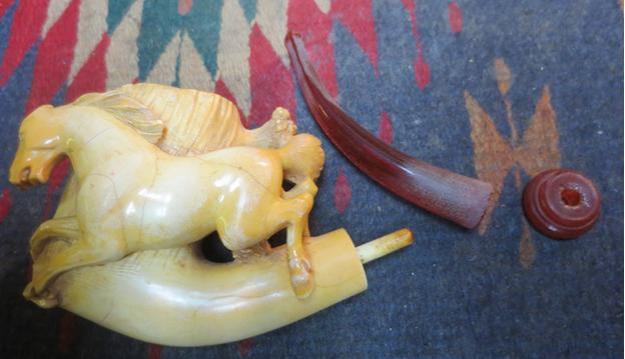
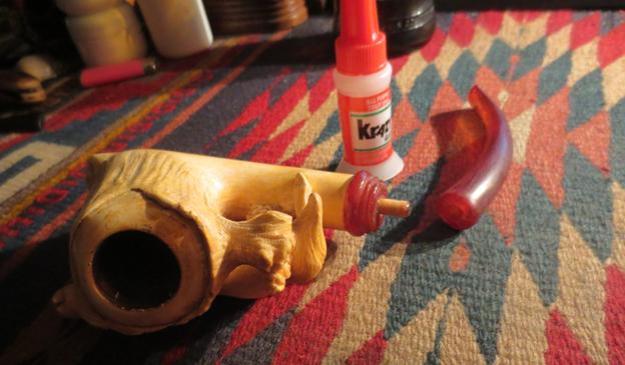
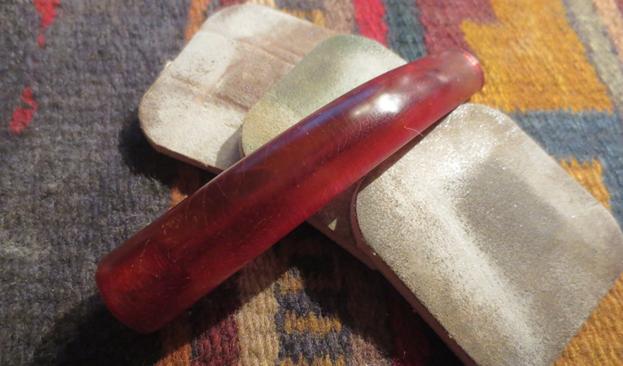
I examined the stem more closely. I looked at the edges on both sides of the break on the stem and I was sure that I was dealing with another Bakelite stem rather than an amber one. The break looked clean and there was no splintering like I have seen in broken amber stems. It also had a plastic like feel when I probed it with a dental pick. The feel of the material was definitely not amber. The stem could be made of “Amberoid” that was used in making stems before Lucite was invented. The last photo in the series below shows the pipe after I had taken it apart. A threaded bone tenon held the stem on the pipe when screwed into the threads in the end of the shank.lion3 lion4 lion5I wiped off both sides of the broken stem with a cotton pad that was dampened with alcohol. Once it was clean I used clear super glue to glue the two pieces back together. I then used the amber super glue to fill in the gaps around the repair. I also used it to fill in the tooth marks on the top and the underside of the stem. The next series of photos show the repaired stem before I sanded it smooth.lion6 lion7 lion8I cleaned out the inside of the airway in the stem to remove any debris from the repair and also to remove the last bit of darkening I had seen in the stem when it was apart. I used pipe cleaners and warm water so as not to damage the Bakelite with alcohol. I had learned the hard way long ago that alcohol can cause a Bakelite stem to craze – not always but it certainly did on the one I learned on.lion9I have a jar of Clapham’s Beeswax Polish in my restoration kit that I have used over the years to polish meerschaum figurals. It is a white beeswax paste that easy to work into all of the carved grooves in the meerschaum and polishes well. I applied the wax to the bowl with a qtip and my finger and once it was dry I buffed it with a shoe brush.lion10 lion11The next series of photos show the pipe after I buffed it with the brush. I love the frontal look of the lion’s head.lion12 lion13 lion14 lion15 lion16I sanded the stem repair with 220 grit sandpaper to remove the ridge that was over the repaired area. I sanded it until the repair blended into the surface of the stem on both sides. I polished the stem with micromesh sanding pads – wet sanding with 1500-2400 grit pads and dry sanding with 3200-12000 grit pads. I rubbed the stem down with Obsidian Oil after each set of three sanding pads. After the final set of three pads I gave it a final coat of the oil and set it aside to dry.lion17 lion18 lion19The finished pipe is shown in the photos below. I lightly buffed the bowl with a clean buffing pad and gave the stem multiple coats of carnauba wax. I also buffed the stem with a clean buffing pad to raise the shine. I hand buffed it with a microfibre cloth to deepen the shine on the meer. I have found that a newly waxed meerschaum will darken after the bowl has been smoked for a while. The spotty appearance of the finish will gradually blend into the patina of the bowl. Thanks for taking this journey with me.lion20 lion21 lion22 lion23 lion24 lion25 lion26 lion27 lion28


Against a Stump – A CPF Best Make Horse Meerschaum


Blog by Steve Laug

I was on a work trip in Alberta when I received an email from a woman named Nancy who picked up my email address from the blog. She wrote to tell me about a pipe that had come into a thrift store she worked at. Here is the first email I received.

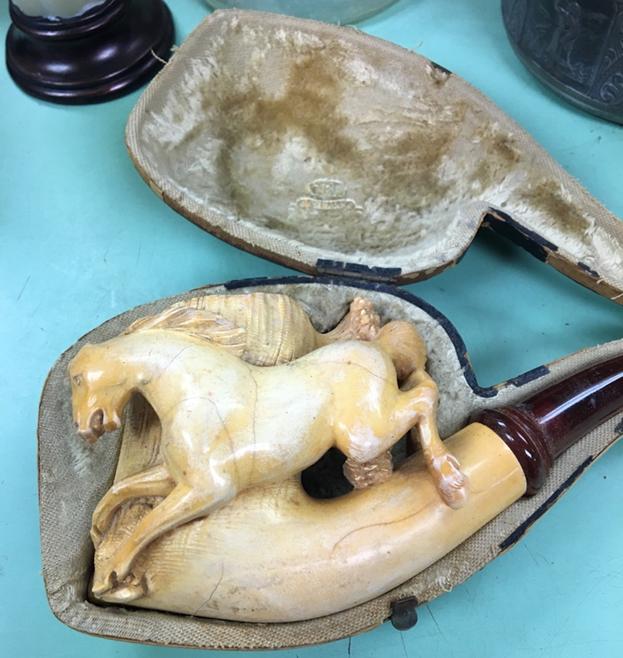
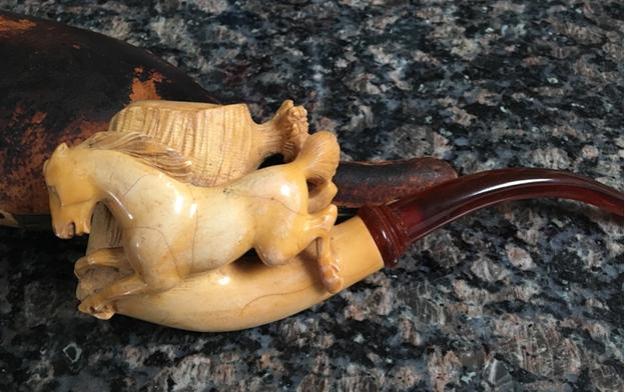
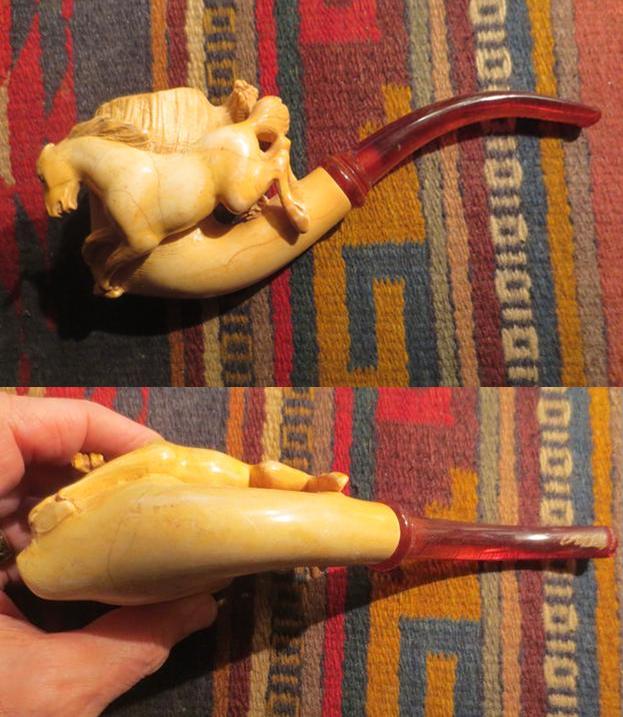
Hello Steve, I volunteer at a thrift store & we received this pipe as a donation. I knew it was too old & precious to sell for a few dollars. It’s in pretty rough shape with cracks but still beautiful in its additional case. It is a horse leaning against a tree stump with a long stem that looks like Bakelite. Is this something you would want to have & restore? I can send pictures if you’ll give me an email. Thank you, Nancy

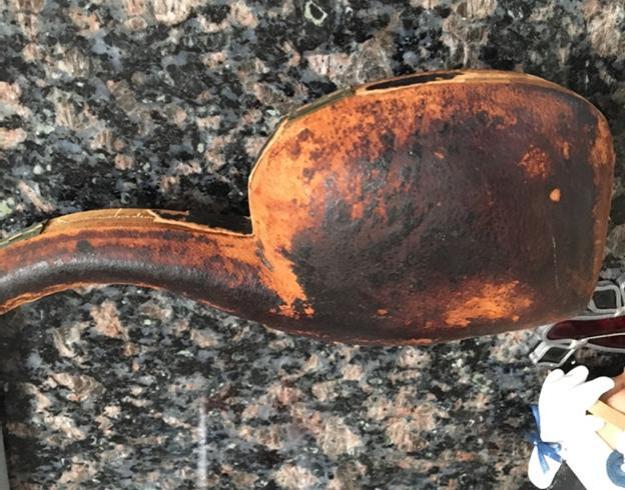
I wrote her back and asked to see the photos of the pipe. She immediately replied and sent me the following three photos. It looked like the pipe may be a CPF Best Make Meerschaum. The case appeared to have been the original for the pipe.cpf1 cpf2 cpf3After looking at the photos on my cell phone I wrote her back and made an offer on the pipe. She quickly responded with the following email:

Yes, that sounds good. The money will go to Assistance League of Yuma. We are a non-profit, all volunteer organization. There are 120 nationwide. We have Operation School Bell which provides 3 new outfits, shoes, books, hats, etc. Just to let you know where the money will go. 😍 I would love to see a picture of the pipe when you are done. I’m so glad to find a good home for it & that it will be restored. Thank you! Send me your address & I will get it ready to send. Thx, Nancy.

I finished the 2 week trip in Alberta and the day after I returned the pipe arrived. It was far bigger than I expected from the photos. Somehow in my mind it was a typical carved meerschaum pipe but when I opened the box it was quite large. It is 8 ½ inches long, 3 ½ inches tall, with an outer diameter on the bowl being 1 ¾ inches and the bowl itself being 15/16 inches in diameter and 2 ¼ deep. It is a handful.

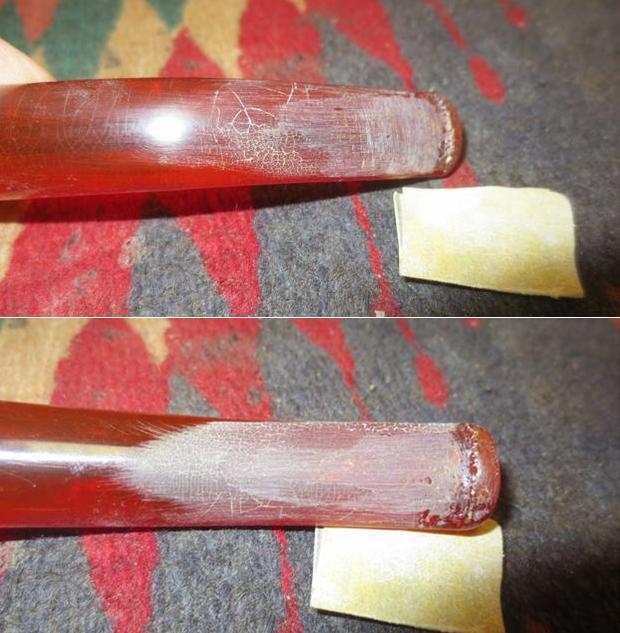
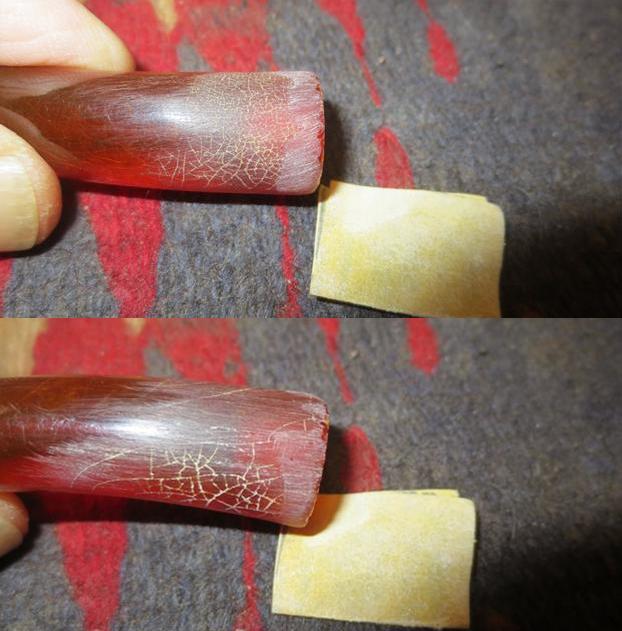
The condition was better than I expected. The cracks in the meerschaum were on the surface of the horse and the right side of the shank. I was expecting more open cracks but these were tight and seemed to be almost a spidering from the spots where the carved horse was connected to the bowl. The center of the back had tiny cracks radiating down the front and rear haunches of the horse and the place where the rear hooves were connected to the shank had a crack radiating both directions. These cracks on the shank also continued around the bottom of the bowl and shank. Fortunately none of them were deep and really added to the aged look of the pipe.cpf4The left side of the shank and bowl (a carved stump) was in excellent shape with no cracks. The rim of the pipe had some darkening and a buildup of tars and oils on the top back side of the rim. There was a light cake in the bowl that would be easily removed with a pipe knife. There was some dust and debris in the grooves of the stump and the mane and tail of the horse.cpf5I took a close up photo of the top of the bowl to show the cake in the bowl and the condition of the rim top. On the back side of the bowl there is a branch extending toward the stem that has the horse’s tail attached to it.cpf6The condition of the Bakelite stem was a bit worse than I expected from the photos. It had a lot of tooth chatter and tooth marks that extended from the button for about an inch up the stem. It was rough on both sides of the stem. The button was also worn from tooth marks. There were a lot of tiny spidering cracks all over the surface of the stem that gave me some concern as I examined it. Time would tell if these would be more than a surface issue.cpf7The case was in rough shape though solid. The leather cover was worn off the wooden case but the hinges and clasp were still solid. The interior of the case had a worn faux fur lining that was almost worn away. I could still read the gold embossed logo in the top of the inside case – the CPF logo in an oval over an unfurled banner reading Best Make. The case was obviously made for the pipe so it gave me the needed information that this was a CPF meerschaum. Since I am a big fan of older CPF made pipes I was excited to see that this was one of them.cpf8I sanded out the tooth marks and chatter on the stem from the button forward. With the sanding dust present on the rest of the stem you can see the spidering cracks on the rest of the Bakelite stem.cpf9I sanded the shank end as well because there were chips missing from the edge of the stem where it sat against the shank. Again the spidering cracks are visible with the sanding dust.cpf10I cleaned out the airway in the stem and the shank with pipe cleaners and water. I also reamed the bowl with the Savinelli Fitsall Pipe Knife.cpf11There was a Bakelite spacer on the shank as well that I unscrewed and cleaned up. The threaded tenon is integral to the shank. The next photo shows the three parts of the pipe.cpf12The stem had been held in place on the tenon with a packing of twisted paper. The threads in the stem had been stripped and worn over the years. The threads were still present in the stem but were very worn. I built up the tenon end with some clear super glue to allow the stem to grip the threads on the tenon.cpf13I sanded the stem with 220 grit sandpaper to remove as much of the spidering cracks as possible. Many were just on the surface. I polished the stem with micromesh sanding pads – wet sanding with 1500-2400 grit pads and dry sanding with 3200-12000 grit pads. I rubbed the stem down with Obsidian Oil after each set of three pads and after the final set gave it a last rubdown and set it aside to dry.cpf14 cpf15 cpf16I carefully scrubbed the surface of the meerschaum with a soft tooth brush and warm water to remove the dirt and grime. I polished the meer with micromesh sanding pads. I started with 1500-2400 grit pads and was able to remove many of the surface scratches and blemishes as well as the tarry build up on the rim of the bowl. I continued to polish it with the remainder of the micromesh pads from 3200-12000 grit to bring a shine to the patina of the bowl.cpf17I buffed the bowl and stem with Blue Diamond on the buffing wheel carefully working around the horse. I lightly buffed the stem as well. I gave the bowl a rubdown of beeswax and hand buffed it with a shoe brush. The finished pipe is shown in the photos below. I am expecting that the coloration of the meer will come back to the surface once the pipe is smoked. Thanks for journeying with me.cpf18 cpf19 cpf20 cpf21 cpf22 cpf23 cpf24 cpf25 cpf26

Aged Imported Briar Poker with Red Dot


Blog by Dal Stanton

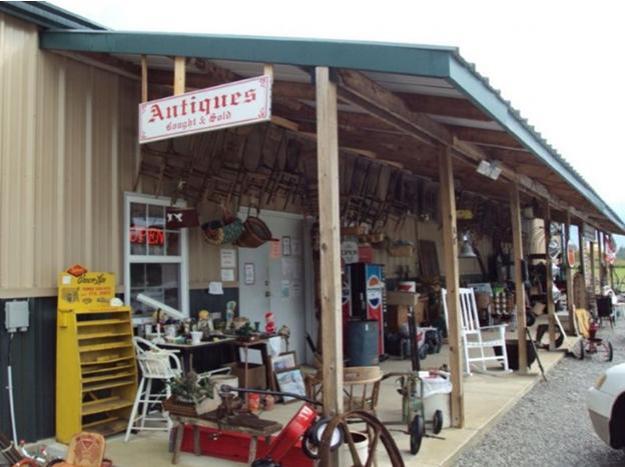
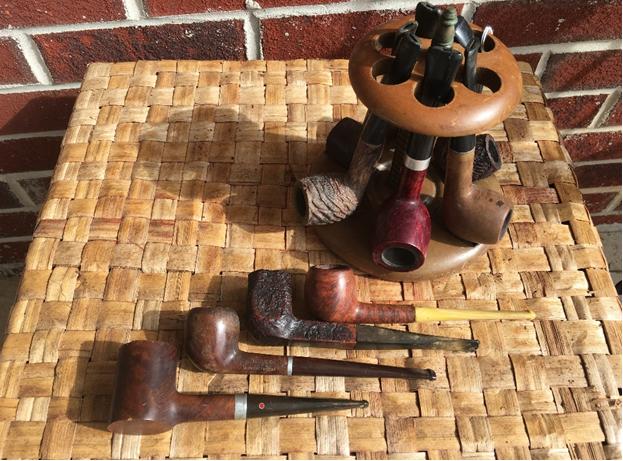
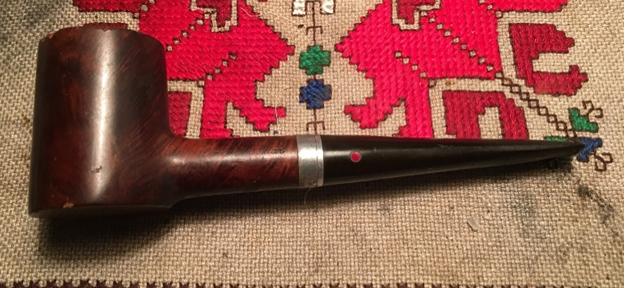
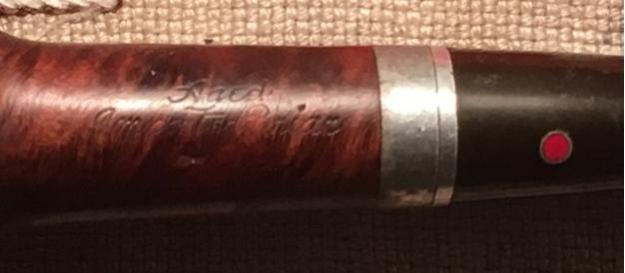
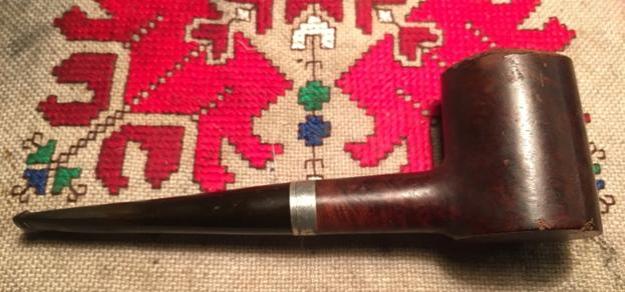
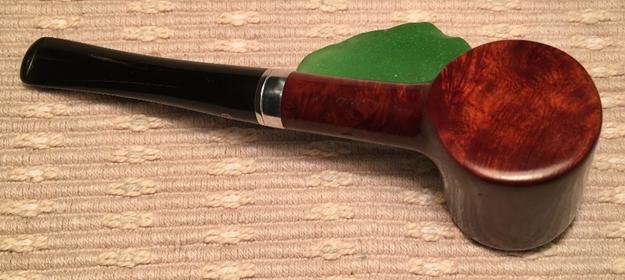
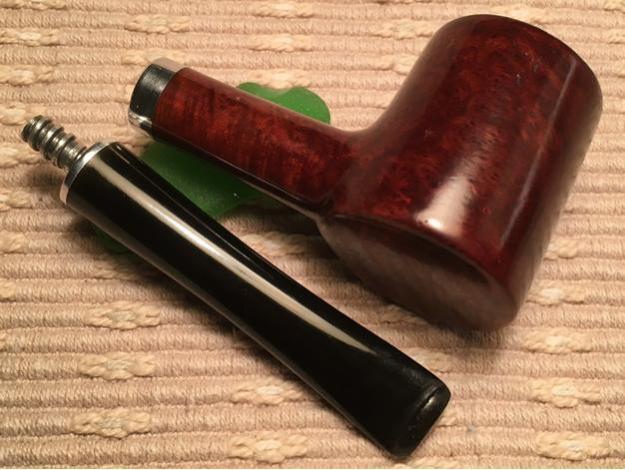
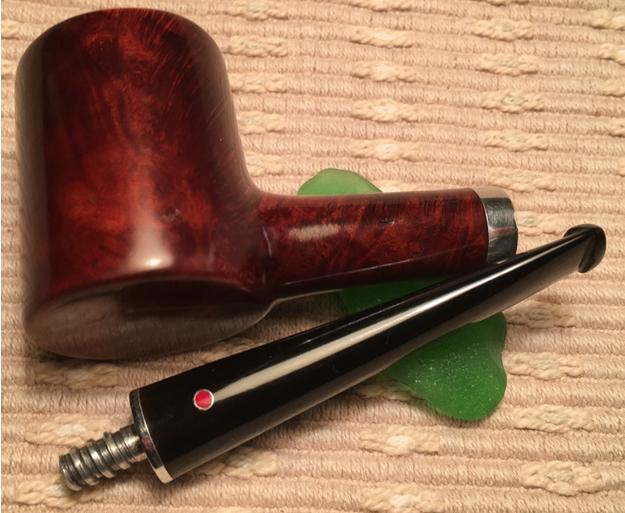
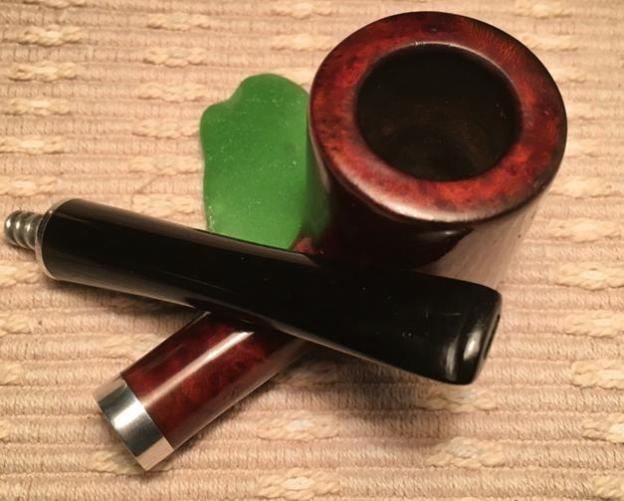
My wife and I were on Interstate 24 nearing Manchester, Tennessee, returning to the Atlanta area after the wedding of our daughter in Nashville.  The billboard beckoned and, of course, I responded by taking the next exit!  Madeline’s Antiques & Uniques had the look of a classic pipe picker’s paradise and I was not disappointed! I’m thankful for my wife’s patience and her eagle eye.  She helped ferret out hidden pipes in need of help and a new home.dal1 dal2 dal3In Palmetto, Georgia, I laid out the haul and recorded the picture above – including the six-pipe pipe stand!  The poker on the lower end is before me now on my work table back in Sofia, Bulgaria.  The left side of the shank has Aged over Imported Briar in a cursive script.  The other remarkable characteristics of this Poker are the red dot on the stem and the screw in tenon with a metal mortise receiver.  Always hopeful of identifying a pipe’s heritage I landed on a thread written in 2013 in Pipesmagazine.com (Link) of someone seeking information about a pipe with the exact nomenclature, dot and screw in stem, just a different shape, an Author shape instead of the Poker before me.  While pedigree is still inconclusive, one helpful comment in the thread summed up well the possibilities:

The “Aged Imported Briar” stamp suggests this is made in the U.S. The screw-in stem is typical of
Kaywoodie and perhaps Jobey which was made for a few years in the U.S. However the design and
shape of this pipe is not Jobey-like. I don’t know Reiss-Premier, but if it is a U.S. outfit, that could
be it. If I understand correctly, the “imported briar” stamp was typical of U.S. pipes at a certain period
when other woods were being used for pipe bowls and there was some misgiving about some of the
woods used. This was a reassurance that the pipe was good quality and safe.

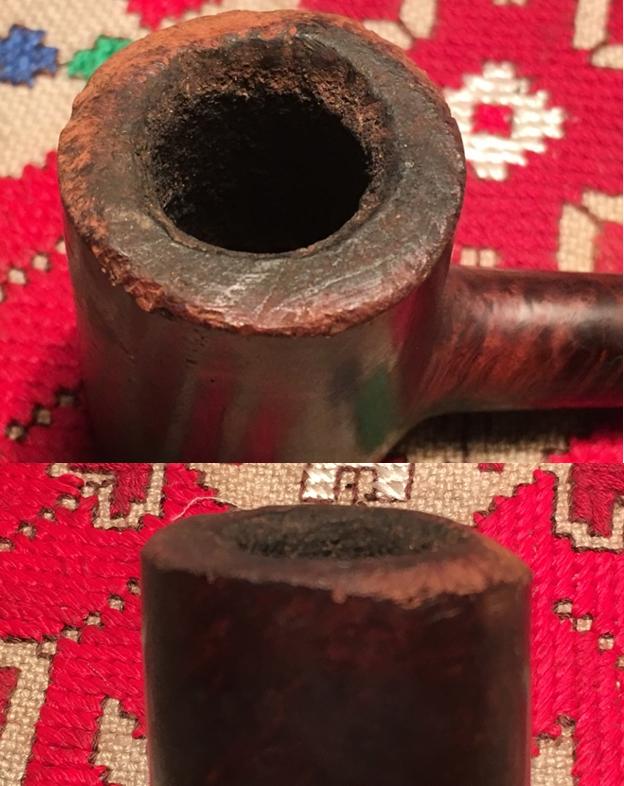
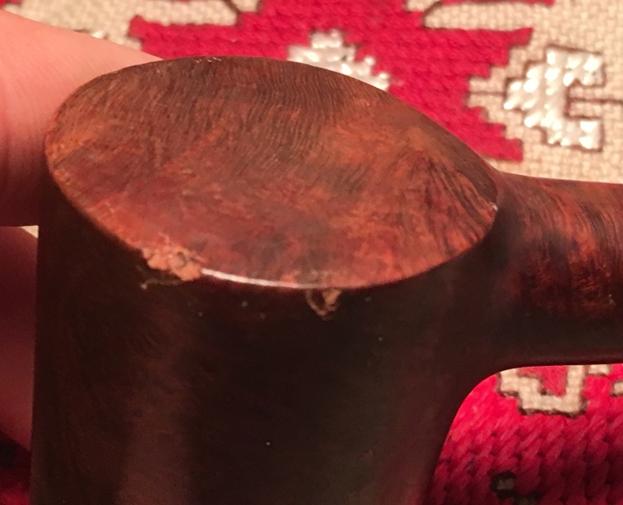
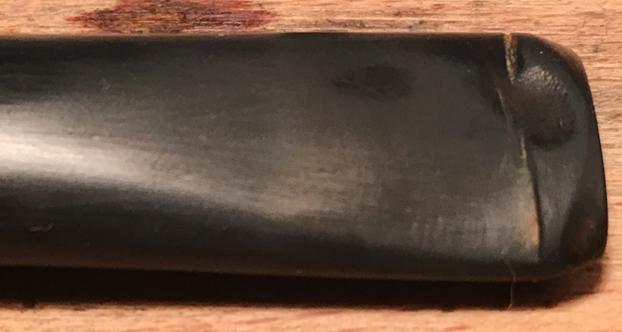
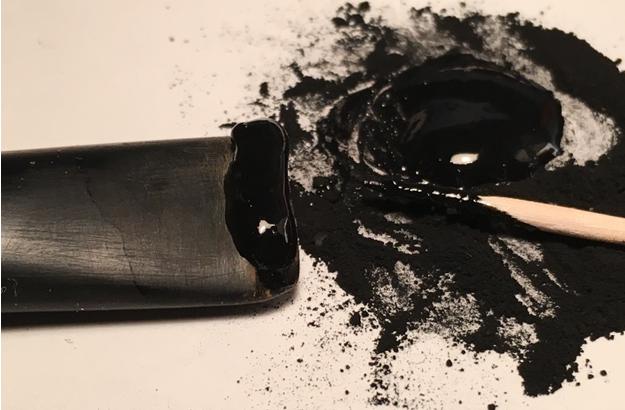
The best guess is the US company, Reiss-Premier, as the source of this Poker because of the dot (See Pipephil.eu) identification.  Reiss-Premier had a factory in Chicago from 1930-1959 and was responsible for the term “Drinkless” which was well known with many Kaywoodie pipes (See Pipedia) which Reiss-Premier also produced.  If the clue about the authenticity verification of briar stated above is accurate, this Poker possibly dates back to WW II days (40s and 50s) when briar supply from Europe was scarce.  Notwithstanding, there is little doubt that this Aged Imported Briar Poker has seen better days and those days are many days ago.  On my work table I take some additional pictures to get a better idea of the challenges with this pipe.dal4 dal5 dal6 dal7 dal9 dal10 dal11The poker is an iconic shape – the name comes from the flat bottomed cylindrical shape of the stummel.  While men dealt hands of poker they could put their pipes on the table without fear of dumping ash on the winnings.  This Poker has heavy cake in the bowl and the rim is in rough shape – I’ll need to remove some valuable briar real estate to reestablish a flat top look, hopefully the Poker won’t turn into a Poker Pot shape in the process!  The stummel heel has some dents and scratches from doing what it was intended to do – sit.  The briar is all but concealed by the old clouded finish – but there is nice looking briar underneath!  I detect a small root branch knot in the grain pattern that will add to the ‘old school’ quaintness of the Poker.  There are signs of wear on the stummel, but I’ll not remove them all – signs of the paths and stewards this Poker has served along the way!  The stem has oxidation and the upper button lip looks like a 9 iron took a divot out of it.  The button will need rebuilding.

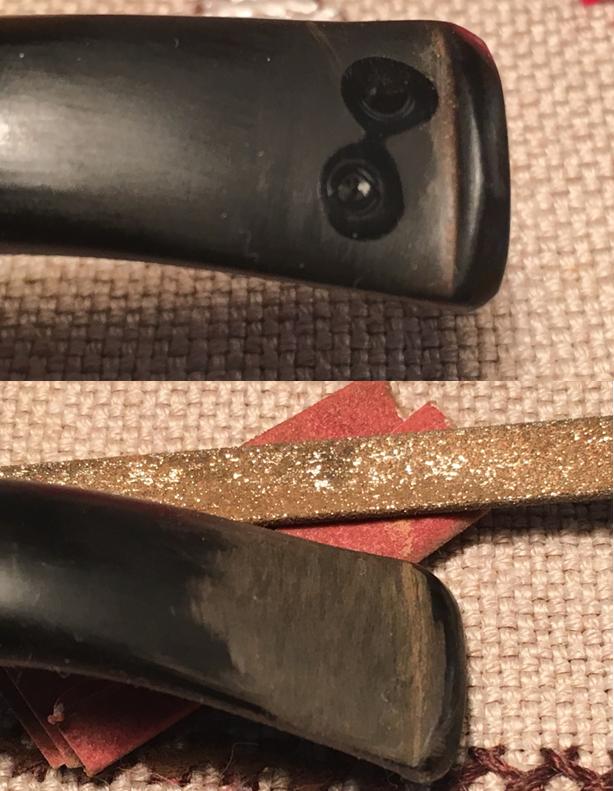
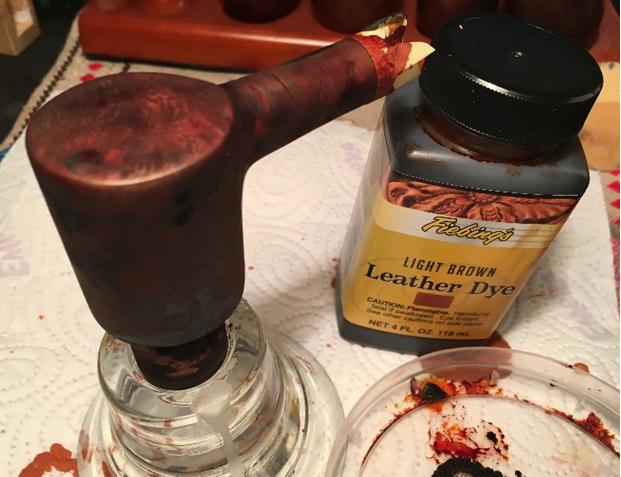
The first order of business is to clean the stummel starting with reaming the bowl and washing down the exterior with Murphy Soap to get a better perspective on the stummel condition.  I also plop the stem into an Oxi-Clean bath to start working on the oxidation.  I’m not sure what effects the bath will have on the red dot so I cover it with Vaseline before the plunge.  I take the Pipnet reaming kit and use 2 smaller of the 4 blades available.  I follow the reaming blades with the Savinelli pipe knife to fine-tune the ream and finish with wrapping 240 grit paper around a dowel rod and sand the chamber.  Using cotton pads and Murphy Oil Soap I scrub the exterior of the stummel and use a brass wire brush to work on the rim which loosens nicely the lava flow without scratching the wood.   The pictures show the progress. dal12 dal13 dal14 dal15I take another close-up of the rim damage from a lateral perspective to illustrate how much briar I will need to take off through topping to achieve a level lid to this Poker.  A bunch!  I take a chopping board covering it with 240 grit paper and carefully rotate the inverted stummel not leaning into the sloping angle of the damaged area.  I don’t want a slanted top!  I check the progress often and ‘free-stand’ the inverted stummel with the help of a right angle I try to keep things perpendicular.  The pictures show the progression of the topping. dal16 dal17 dal18 dal19 dal20When I arrive at a point where almost all damage is eradicated, I stop the topping with 240 grit paper and with 120 grit paper rolled up I shape a bevel on the inside and outside of the rim removing the remainder of rim damage.  After the 120 grit cuts the initial bevel I follow with 240 and 600 grit paper on the inside and outside of the rim.  Finally, I lightly top the stummel again but now with 600 grit paper over the chopping block.  I do this not only to smooth the rim surface, but it also serves to sharpen the circular bevel line around the circumference of the rim – inner and outer.  It gives the rim a very classy, finished look to me.  The pictures show the progress.dal21 dal22 dal23Since the heel of the stummel has scratches and edge damage as well, I repeat the process described above for the heel as well except for using only 600 grit paper to ‘top’ the bottom – not 240.  I only needed to clean and smooth the surface layer not remove real estate.  The bottom bevel utilized 120 then 240 then finally 600 grit sanding papers.  In the last picture of the set below, there remains a small damage spot that I fill with a superglue patch which I will smooth and blend later.  This Poker will be ready for any high-class card table!  The pictures tell the story!dal24 dal25 dal26 dal27 dal28With rim and heel repairs completed, I fish the stem out of the Oxi-Clean bath and it did the job of raising the oxidation out of the vulcanite.  I’ve started inserting a pipe cleaner into the stem before dropping it in the bath making it much easier to fish it out (picture 1 below).  I wet sand the stem with 600 grit sanding paper to take off the mother-load layer of oxidation raised on the stem, then I follow with 0000 steel wool.  After inspecting the stem, I see more oxidation around the button and shank areas – I use 240 grit paper on those more stubborn areas, then again 600, then 0000 steel wool.  In anticipation of doing the button rebuild, I want a clean stem so using pipe cleaners (bristled and non) dipped in isopropyl 95% I clean the stem internals.  It did not take much effort and now to the button repair.  The pictures show the progress.dal29 dal30 dal31I take a close-up of the upper button area to get another look.  It is apparent that the former steward of this Poker had a favorite hold to keep his (or her J) pipe in place while the cards were dealt and considered.  The dent on the button resembles compression damage more than biting or scissor action.  You can see just to the left of the button (up the stem) a bite mark.  My forensic opinion is that the bite is the eye tooth and the compression represents the work of the molar behind – the pipe being clamped on the side to keep the hands free for gathering new cards and tossing those less desirable aside.  I would guess the steward of this Poker was right handed, too – the compression being on the right side leaving most the stem toward the center of the mouth for puffing.  Nope, can’t tell how tall he was!  Yes, I do believe now it was a ‘he’ because a ‘she’ probably wouldn’t mouth-clamp the pipe but put in down on the table and then deal another round J.  Fun and forensics aside, I need to rebuild the upper button area.  First, I attempt to raise the ‘eye tooth’ bite with heat – I ‘paint’ the area with a candle flame.  It seems to have done the trick.  Then, taking 240 grit paper I rough up the button area and then clean the button area with a Q-tip dipped in alcohol.  I mix a batch of charcoal powder and ‘Extra Time Control’ super glue into a toothpaste thick consistency.  I put a mound of charcoal on an index card (so it can be tossed when done) and place a small puddle of super glue next to it and begin to mix – adding more charcoal a bit at a time until I reach the consistency needed to stay in place on the button.  I use a toothpick as a trowel and gradually build and mound over the button that later will be sanded and shaped with a needle file.dal32 dal33 dal34 dal35 dal36 dal37Setting the stem aside to allow the charcoal super glue putty to cure overnight, I turn back to the stummel.  I take medium and light weight sanding sponges and sand the surface, careful to avoid the Aged Imported Briar nomenclature on the shank.  The briar is beginning to emerge and the metal band/mortise is shining up nicely.  I realize that I was anxious to start on the external briar and forgot about the internal muck.  Taking pipe cleaners and Q-tips I clean the internals dipping them in isopropyl 95%.  Time to turn out the lights.dal38 dal39The next day has arrived and I’m anxious to work on the button rebuild that has cured overnight.  I take a picture to mark progress and using a flat needle file I file down the cured charcoal superglue gradually – patience.  The following pictures journal the shaping of the restored upper button that had the most compression damage.  I use the flat needle file to do the button shaping and then follow with 240 grit paper to fine tune and to remove the file marks from the vulcanite.  I’m pleased with the progress.dal40 dal41 dal42 dal43The lower button presented more challenges.  Pictured below I could detect two pockets in the charcoal superglue putty.  To avoid filing off too much of the new button build I elect to apply black superglue and charcoal mix to fill the pockets.  I’ll let these fills cure before sanding and finishing the button repair and then moving on to the stem restoration.dal44 dal45Putting the stem aside, I begin to micromesh the stummel in anticipation of applying a light brown stain.  I begin by wet sanding with micromesh pads 1500 to 2400.  I follow this with dry sanding using 3200 to 4000 then 6000 to 12000 – careful to avoid the Poker’s stampings on the side of the shank.  I enjoy watching the briar grain emerge.  The nickel (I think) band/mortise is shining up very well.  The pictures show the progress. dal46 dal47 dal48Oh my…here I go again.  I intended to apply Fiebing’s Light Brown Leather Dye to the Poker – I just brought it back to Bulgaria from the US and I wanted to give it a try.  The grain of this Poker bowl is very active with a mixture of dark and lighter grains.  I mentioned earlier a knot as well…. I’ll be thinking about this….  I thought and I will apply the light brown Leather Dye as originally planned.  I will see how it looks and I can use a cotton pad with alcohol to lighten the stain as needed.  This is one of the advantages of aniline stains and dyes – these I could not easily find here in Bulgaria.  I’m not sure if the staining will impact the metal band, but I decide to wrap it in masking tape just in case.  I wipe the stummel with a cotton pad and alcohol just to make sure the surface is clear of saw dust from sanding.  I use my air gun to warm the stummel before application of the dye.  I apply the dye with a folded pipe cleaner which I saw Steve do – it is much easier to use compared to a dauber that usually carries more dye than is needed and is messier.  At least this is my experience.  After applying the dye liberally over the entire bowl, I flame it by lighting it with a candle.  The alcohol base in the dye burns off very quickly and does not hurt the wood.  Then, I repeat the application again and flame it.  By doing this I assure that the entire surface has been covered.  I’ll wait until morning to unwrap the ‘package’ and look at the grain.  The picture shows the aftermath.dal49With the stain settling, the stem is ready for the home stretch.  The button super glue patch is cured, so I take 240 grip paper and finish smoothing and shaping the button.  I follow the 240 with 600 grit paper then 0000 steel wool over the entire surface of the stem.  Beginning with micromesh pads 1500 to 2400, I wet sand the stem and follow with an application of Obsidian Oil to the vulcanite.  Then with micromesh pads 3200 to 4000 then 6000 to 12000 I dry sand the stem following each set of 3 pads with an application of Obsidian Oil.  I like the polished vulcanite pop and the red dot stands out nicely.  The pictures show the progress.dal50 dal51 dal52 dal53 dal54Now to unwrap the stummel!  After staining the stummel with Light Brown Leather Dye I take a cotton pad with alcohol on it and wipe down the surface.  This smooths the stain and lightens it slightly.dal55 dal56Reattaching the stem and stummel, with the Dremel felt wheel set at the slowest speed (RPMs) I use Tripoli compound to begin fine tune polishing the surface.  I follow Tripoli with applying Blue Diamond with felt wheel, rotating it methodically over the surface, allowing the high speed of the wheel and the compounds to do the work.  Following the compounds, I wipe/buff the stummel with a cotton cloth to remove the powder residue from the compounds.  Switching to a cotton wheel, and increasing the speed of the Dremel by one number, I apply several coats of carnauba wax to both stummel and stem and finish the restoration of the Aged Imported Briar Poker with a brisk buff with a micromesh cloth.  This old Poker is looking great.  I’m pleased with the button work and the briar makes me smile – it is very active and I enjoy the root knots here and there.  This Poker will again make the card table a more enjoyable experience for some new steward who gives him a home.  Thank you for joining me!dal57 dal58 dal59 dal60 dal61 dal62 dal63 dal64 dal65


CPF Best Make Bulldog with a Silver Rim Cap and Ferrule


Blog by Steve Laug

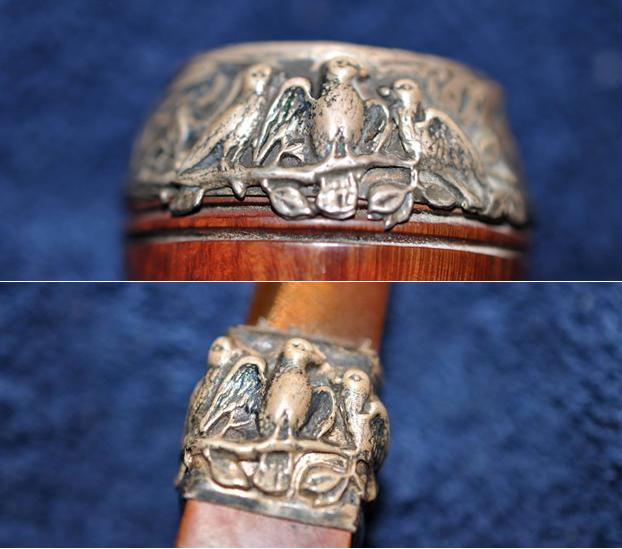
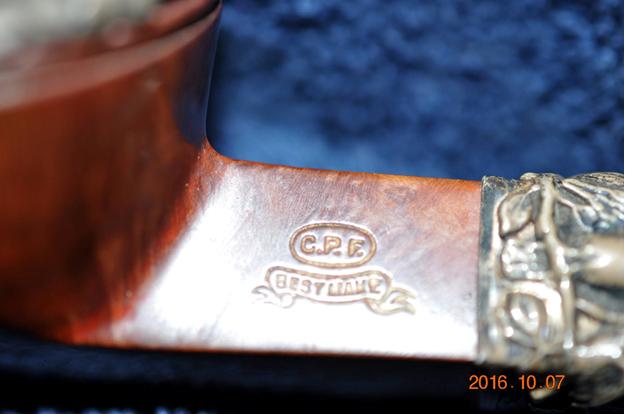
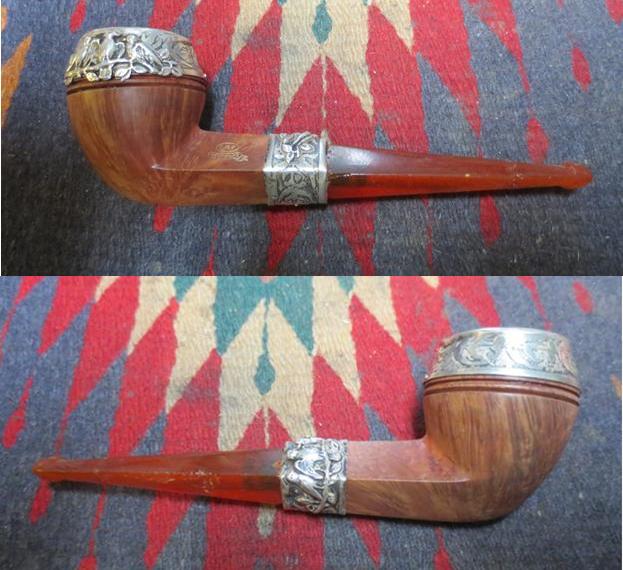
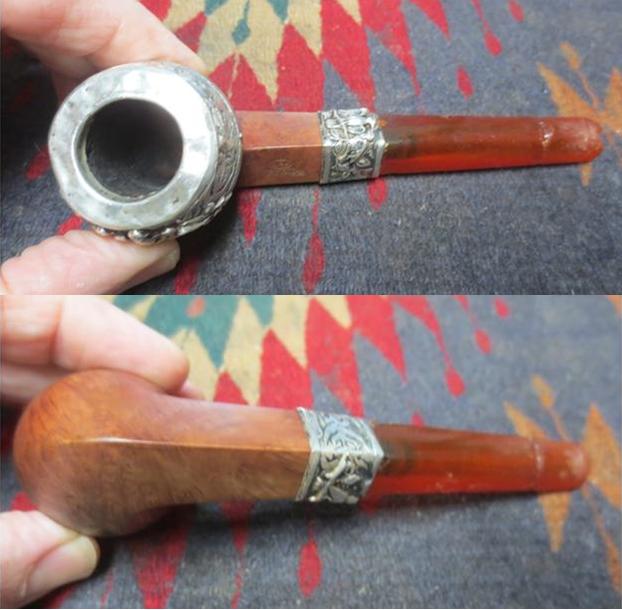
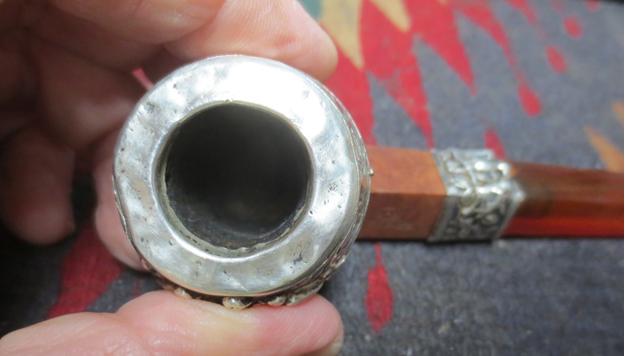
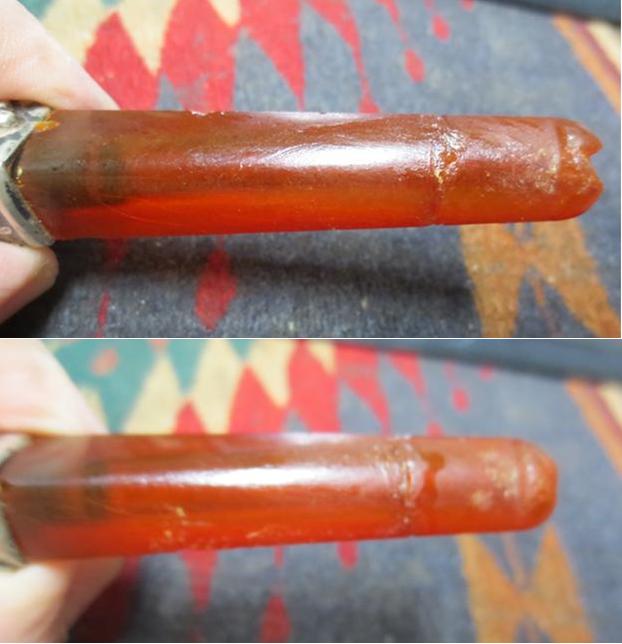
This is yet another great old pipe that my brother picked up on eBay. It is a classic CPF Best Make Bulldog with what I believed to be a Bakelite stem. It is stamped C.P.F. in an oval over Best Make in an unfurled banner on the left side of the shank in gold filigree. The silver rim cap and ferrule on the shank are ornate, both cast with birds and branches which seem to be doves and olive branches. The band and cap were tarnished and dirty. The top of the rim cap was dented, tarnished and had a buildup of tars and oils. The bowl had some great grain under the grime on the briar. The stem was had been broken off at some time in its long life and been repaired with a clear glue – epoxy maybe. The glue had hardened and was really a mess with it “globbed” all over all four sides of the diamond shaped stem. The button on the stem was missing a large chunk on the top side leaving the top of the airway exposed. There were also some chips missing on the stem at the joint of the shank and the stem. The tenon was a bone threaded tenon and screwed into the shank. The alignment was very good. My brother took the next set of photos to show the state of the pipe when it arrived in Idaho before he did the cleanup work on it.cpf1 cpf2My brother Jeff took a close up photo of the rim and the bowl. The photo shows the damage to the silver rim top as well as the cake that is in the bowl. The second photo shows the bowl of the bowl. The diamond shank carries through to the bottom of the bowl in classic bulldog fashion.cpf3 cpf4The next series of three photos show the cast birds and branches on the rim cap and the ferrule. You can see the look of the birds that I think are doves and the branches that I think are olive branches making this a bit of a “peace pipe”. The third photo shows the stamping on the left shank of the pipe.cpf5 cpf6The next series of photos show the repair to the stem and the damage to the button on the top side. It was a solid repair despite the ugliness of the finished look. The first two photos show the damage to the button top and the airway into the stem. You can also see the repair line where the stem was glued in the second photo. The third and fourth photos show the top and the underside of the stem and the repair can be clearly seen in both photos.cpf7 cpf8I have written about the CPF brand in previous blogs including a blog on the historical background of the brand. You can read the whole article at the link that follows. https://rebornpipes.com/2013/04/14/some-reflection-on-the-historical-background-on-cpf-pipes/. I have also included a short portion of the blog to give a brief summary of the brand.

CPF stands for Colossus Pipe Factory. There is not much known about the Colossus Pipe Factory. I learned that by the mid 1890’s CPF was owned by Kaufman Brothers & Bondy (KB&B). They operated the factory at 129 Grand Street, in New York City, New York. I had a faint memory of some connection between CPF and Kaufmann Brothers & Bondy. But was unsure where I had heard or read that. In the process of reading information I came across this post by Bill Feuerbach on the Kaywoodie Forum: “About 10 years ago I picked up two original invoices from KB&B. One is dated February 5, 1884 and the other December 9, 1898. Both have the address as 129-131 Grand Street, which is in Soho, adjacent to the Bowery in New York City. The 1898 invoice has in the upper left hand corner the initials CPF and Trademark. So by 1898 KB&B was making it known to the trade that they owned the CPF trademark. The 1884 invoice does not have CPF on it. Therefore I think we can assume KB&B acquired or started the CPF line sometime between 1884 and 1898.”

I have also included a link to the blog that shows and old CPF catalogue that links KB&B to CPF – or Kaufmann Brothers and Bondy with Colossus Pipe Factory. https://rebornpipes.com/2014/03/05/an-old-kaufman-brothers-bondy-cpf-catalogue/

My brother did his usual thorough clean up on the pipe. He scrubbed the silver with a tooth brush and some dish soap and was able to remove the tarnish in the deep grooves of the castings. He scrubbed the rim cap and removed the tars and oils in the dents on the surface of the cap. He cleaned the briar with soap and a brush and rinsed it off. He reamed the bowl and cleaned out the inside of the shank and the airway in the stem. He cleaned up the threaded tenon and the threads in the shank. When it arrived in Vancouver I took photos of the pipe before I started to restore it.cpf9 cpf10I took close up photos of the rim cap, bowl and the stem to show the condition of the pipe when it arrived at my work table. The rim cap is dented but clean. The stem repair is visible and you can see the buildup of glue on the stem surface and the damage to the button and airway on the stem.cpf11 cpf12I sanded the stem repairs and stem surface with 220 grit sandpaper to remove the buildup of glue all around the stem. It took quite a bit of sanding to remove all of the thick dabs of glue. I worked on the chipped areas of the stem as well on the tenon end of the stem.cpf13I built up the chipped area on the top of the button with clear super glue until it was even with the rest of the button. I sanded it with 220 grit sandpaper to remove the excess and shape it. I used the topping board to flatten the end of the stem and a needle file to smooth out and shape the slot in the button.cpf14I filled in the small pits and crevices in the stem surface and the chips at the tenon end with clear super glue. I sanded the repaired areas on the surface of the stem to smooth it out blend it in with the rest of the stem. I shaped the button and rounded the edges of the button to slope it toward the slot on the stem end.cpf15I stained the briar with a dark brown aniline stain mixed 50/50 with isopropyl alcohol using a folded pipe cleaner to apply it around the rim cap and shank ferrule. I flamed the stain with a lighter and set it aside to dry.cpf16I gave the bowl several coats of Conservator’s Wax and buffed the bowl with a shoe brush and then lightly with carnauba and a clean buffing pad to raise the shine.cpf17 cpf18I polished the stem with micromesh sanding pads – wet sanding it with 1500-2400 grit sanding pads and dry sanding it with 3200-12000 grit pads. I rubbed it down with Obsidian Oil after each set of three pads. I gave it a final coat of oil after the last set of three pads. I set the stem aside to dry.cpf19 cpf20 cpf21I buffed the pipe with Blue Diamond on the buffing wheel, carefully avoiding the rim cap and the ferrule on the shank. I buffed the stem with the Blue Diamond to shine the finish on the stem. I gave the stem and bowl several coats of carnauba wax and buffed it with a clean buffing pad. I hand buffed the pipe with a microfiber cloth to deepen the shine on the pipe. The finished pipe is shown in the photos below. The old pipe has been given new life. The repaired stem has been smoothed out and though it still shows it is a solid repair and smooth to the touch. I really enjoy the look and the feel of these older CPF pipes and this one is no exception. Thanks for journeying with me in the process.cpf22 cpf23 cpf24 cpf25 cpf26 cpf27 cpf28 cpf29

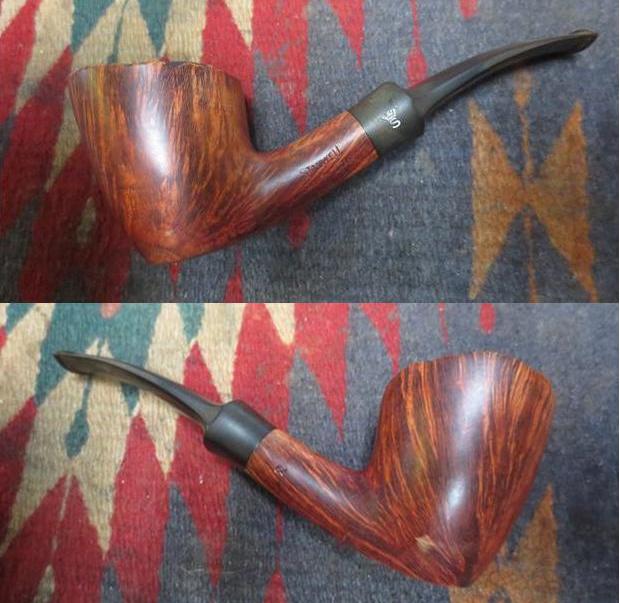
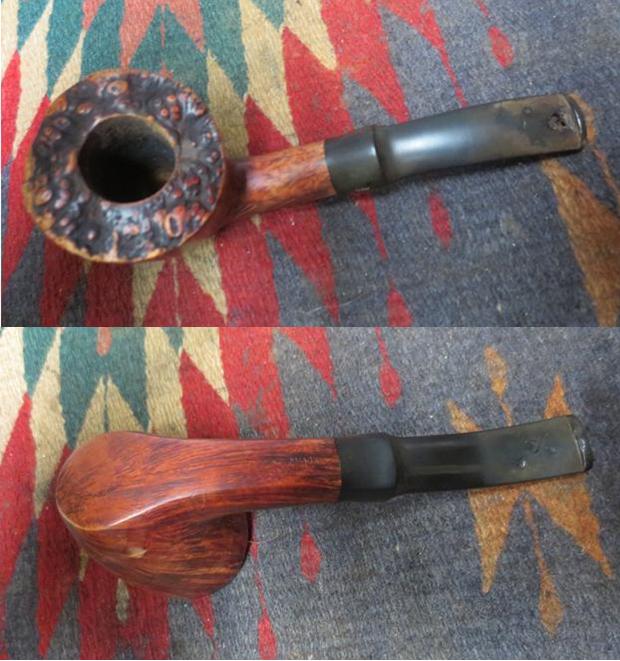
A Stanwell Danish Star 64


Blog by Steve Laug

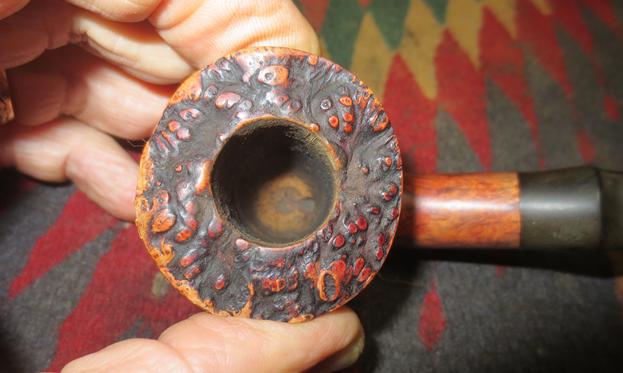
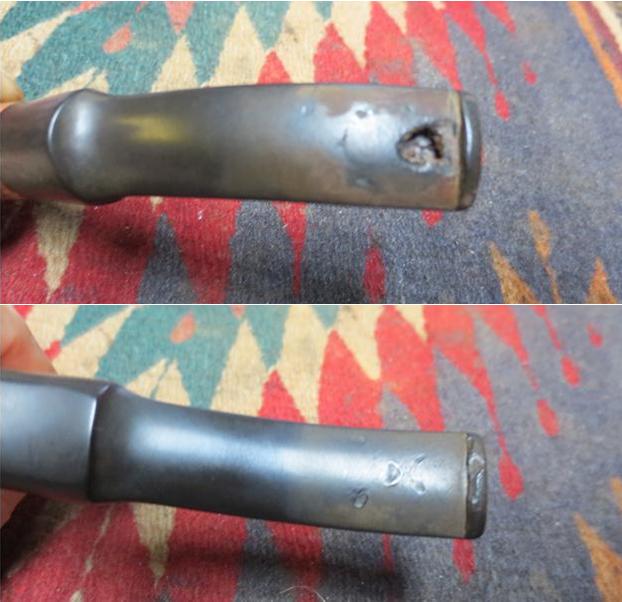
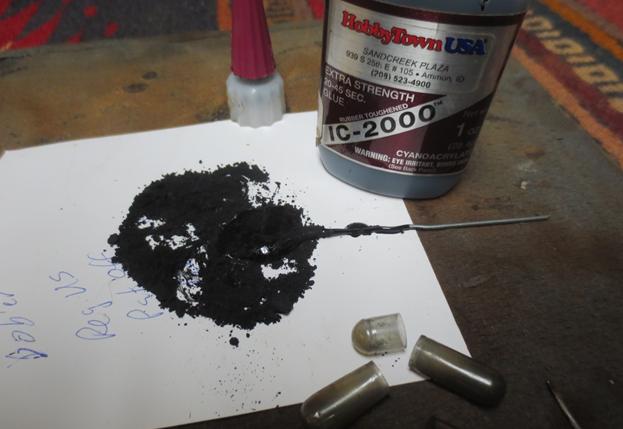
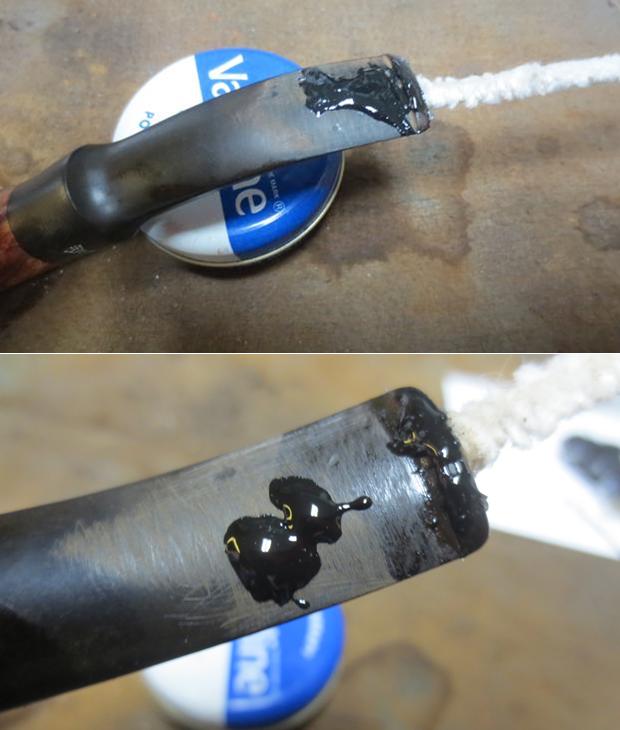
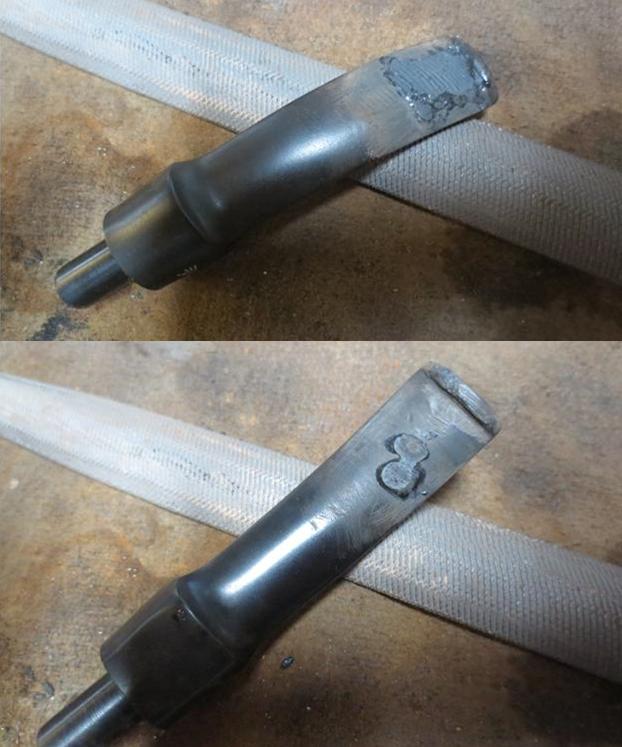
My brother sent me a nice looking Stanwell shape 64 with a nice plateau top. The briar itself was in good shape. There were no dents of nicks in the briar. The finish was in great shape. The rim was decent but the plateau was clean and in decent shape. The high spots were the same brown as the bowl and the nooks and crannies were dark brown or black. It was stamped on the left side of the stem with the words Stanwell over Danish Star. On the right side it was stamped with the shape number 64. On the underside of the shank it is stamped Made in Denmark. The stem was lightly oxidized and there were tooth marks on the top and underside near the button. The bite marks on the underside were deep but the ones on the topside was a bite through into the airway.danish1 danish2I took a close up photo of the top of the bowl. It shows the grooves, crevices and the high spots on the plateau top. It was dirty and there was dust in the grooves of the rim.danish3I took close up photos of the stem to show the condition of the top and bottom side of the stem. The photo of the top shows the bite through and the tooth marks that were further down the stem top. The photo of the underside shows the tooth marks there as well. The tooth marks were deep and large. There were also bite marks on the top and the bottom of the button.danish4I sanded the surfaces of the stem and cleaned out the dents in the surface with alcohol and cotton swabs. I greased a pipe cleaner with Vaseline and inserted it into the airway of the stem. I mixed a putty of charcoal powder and black super glue with a piece of straightened paper clips. I filled in the bite through with putty and the paper clip until it was thickly covered. I filled in the dents in the surface of the stem and built up the worn spots on the button edge. I sprayed the repairs with the accelerator to harden the repair.danish5 danish6 danish7When the glue had hardened and cured I used a file to smooth out the repaired spots on both sides of the stem.danish8I sanded the repaired areas with 220 grit sandpaper to smooth out the surface and remove the scratches left by the file. It took some time but I was able to sand out the scratches.danish9I filled in some of the air holes in the repair with clear super glue and sanded the surface with 220 grit sandpaper to smooth out the stem.danish10I polished the stem with micromesh sanding pads – I wet sanded it with 1500-2400 grit sanding pads and dry sanded it with 3200-12000 grit pads. I rubbed the stem down with Obsidian Oil after each set of three pads. I gave it a final coat of Obsidian Oil and set aside to dry.danish11 danish12 danish13The plateau top was in great shape. I used a black Sharpie pen to highlight the grooves and crevices in the rim top. I buffed the pipe and stem with Blue Diamond on the buffing wheel to raise a shine and remove the last of the scratches on the vulcanite. I buffed the bowl surface to polish out the light scratches in the briar. The Blue Diamond gave the finish on both the bowl and the stem a high shine. I gave the pipe multiple coats of carnauba wax and buffed it with a clean buffing pad to raise the shine. I hand buffed the pipe with a microfibre cloth to deepen the shine. The finished pipe is shown in the photos below. The colour of the stain on the pipe really makes the grain stand out clearly on the pipe. Thanks for having a look.danish14 danish15 danish16 danish17 danish18 danish19 danish20 danish21

Calabash No Name from eBay


Blog by Dal Stanton

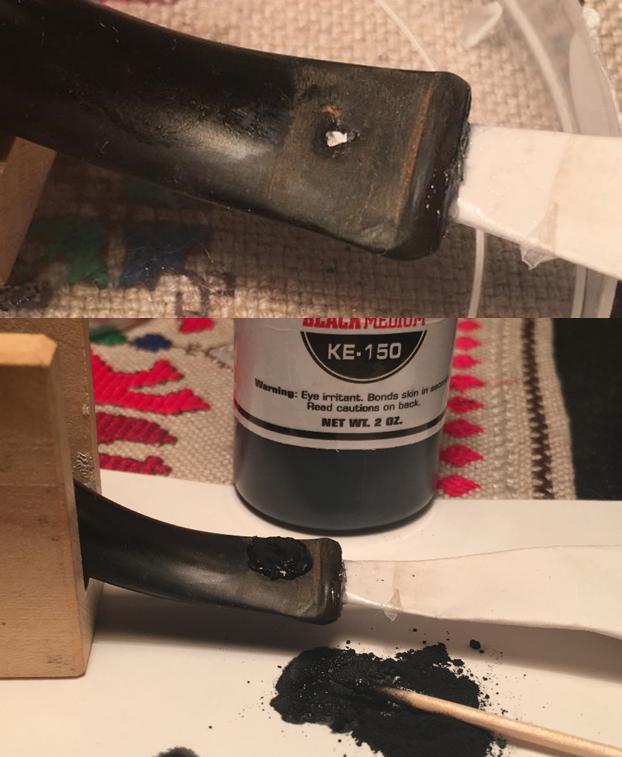
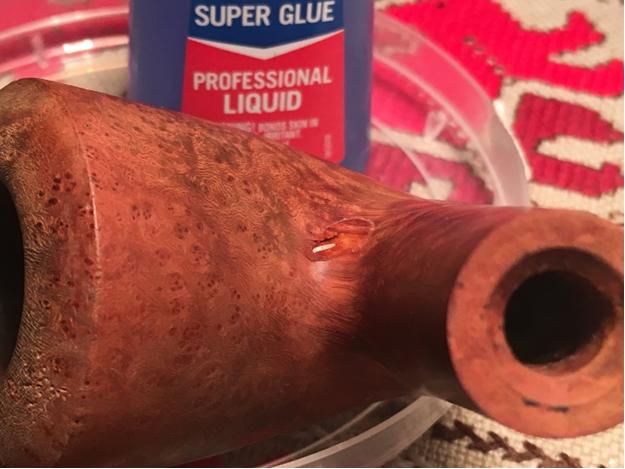
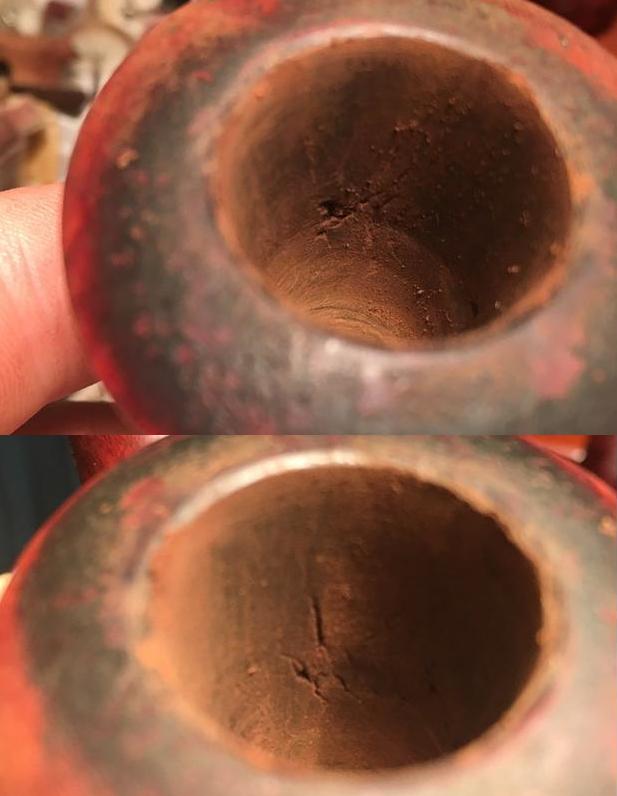
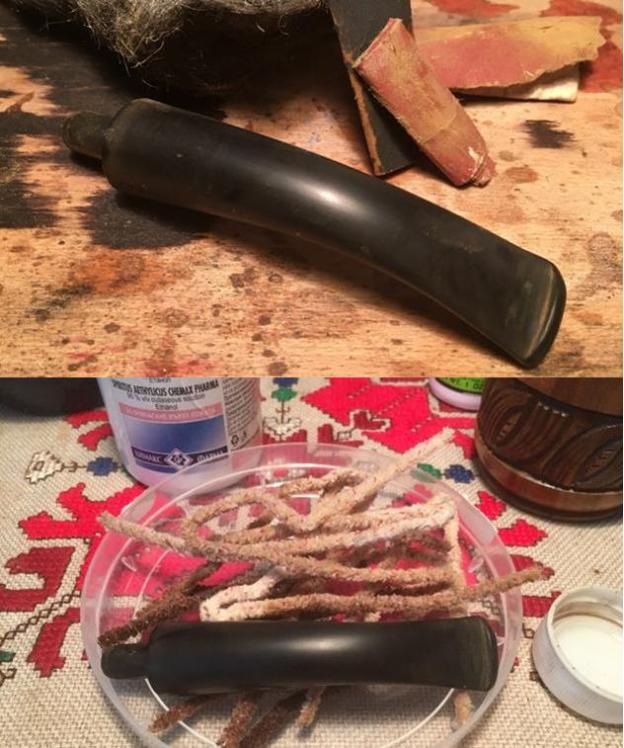
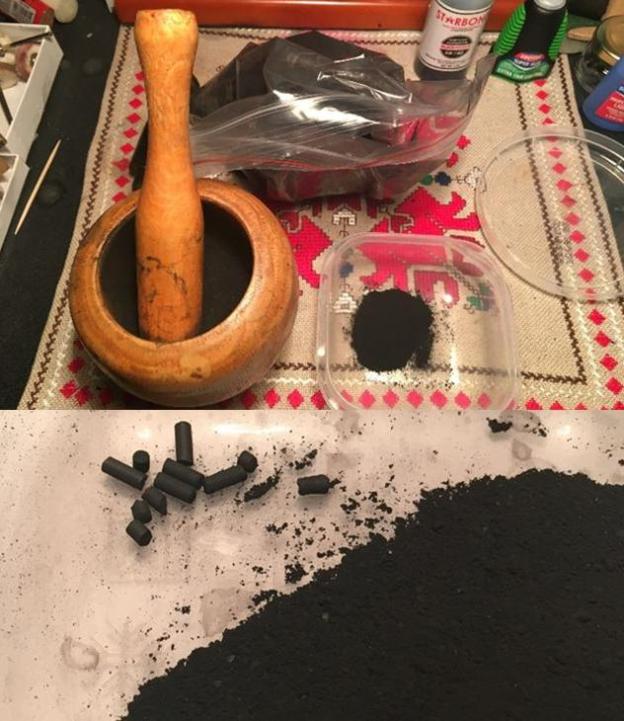
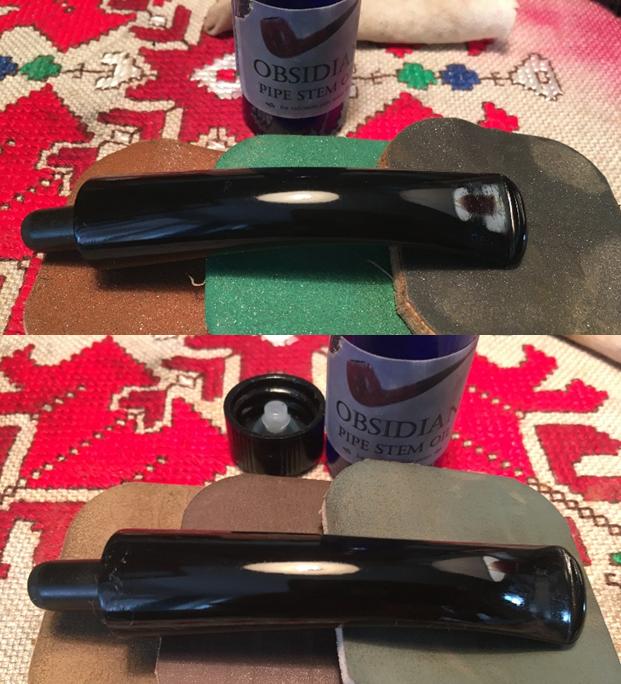
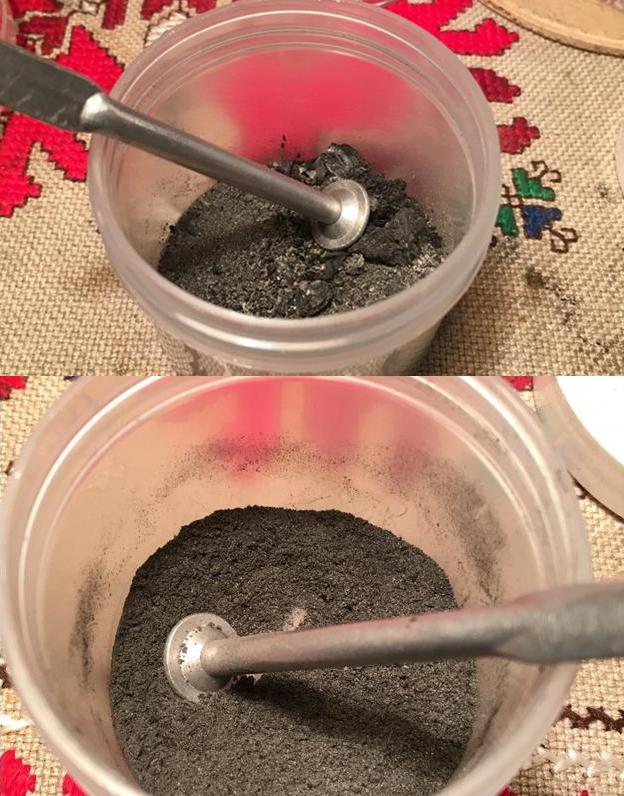
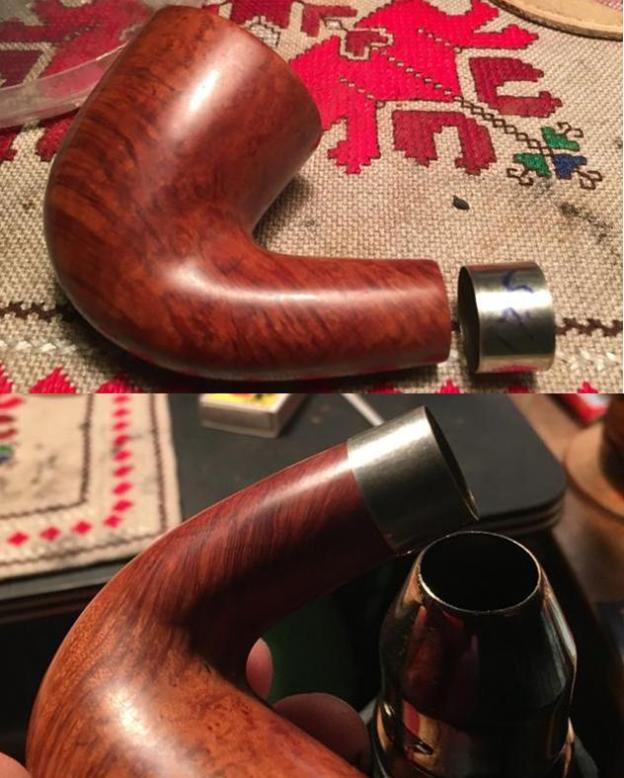
After celebrating our daughter’s wedding and family reunion in the US and returning to Bulgaria, I was anxious to begin a new restoration.  While in the US, I added a few pipes to the pool when my wife and I stopped at an antique store advertised on an interstate billboard between Nashville and Chattanooga – this story for the future.   I’ve developed a bit of an eBay purchases trove and I found in the ‘Help Me!’ basket what I believe is a Calabash shaped unmarked briar from a seller in New Mexico.  I was drawn by the shape and the lateral movement of grain – a very nice looking piece of briar with great potential.  I wasn’t sure on the shape and checked out Pipedia’s Pipe Shapes Chart (Link) and Calabash seems to be the best fit – please let me know if I missed!  The seller’s pictures provided a descent chronicle of the pipe’s strengths and needs.cal1 cal2 cal3The pictures reveal stummel externals in very good shape except for heavy oil and lava overflow on the rim.  The stem is heavily oxidized and has a tooth hole on the underside of the bit – definitely an eye tooth hanger!  Both upper and lower button areas have teeth bites and significant chatter.  The button lip will also need smoothing and redefinition.  By the looks of this pipe, it was someone’s well-loved and used partner in life.  When I put the Calabash on my worktable I take some additional close-ups to focus on the problem areas and I take a closer look.  In the bowl, I discover what appear to be cracks in the briar in the front and backsides.  At this point, I’m not sure if this is only superficial within the cake or if it presents other problems.  I also take a closer look at the stem hole after inserting a pipe cleaner.cal4 cal5 cal6Before I can make a clear assessment of the bowl and the cracks, I decide first to ream the bowl with the Pipnet reaming kit to reveal the wall’s condition and to clean up the rim.  I also remove the stem and plop it in a bath of Oxy-Clean to begin softening the heavy oxidation in the vulcanite.  I use 3 of the 4 blades available in the Pipnet kit.  The cake was light.  I finish the reaming process using the Savinelli pipe knife and clean the walls by sanding with 240 grit paper pinched with the Savinelli knife.cal7 inspect the cracks in the bowl and decide to shoot a question off and some pics to Steve to get his input.  I then use undiluted Murphy’s Oil Soap and clean the stummel surface with cotton pads. In addition, to remove the thick lava on the rim, I utilize a brass brush which will not scratch the wood.cal8 cal9Putting the stummel aside, I retrieve the stem from the Oxyclean bath and wet sand the raised oxidation with 600 grit paper and follow dry sanding with 0000 steel wool.  In anticipation of working on the patch for the tooth hole I want to clean the internals of the stem.  I use several pipe cleaners dipped in isopropyl 95% and things are cleaning up well.cal10With the stem cleaned up from I move to repair the tooth hole.  This is a first time for me so I fill my mental cup reading several different blogs regarding hole repair and techniques.  One of the necessary ingredients for a repair is activated charcoal powder mixed with superglue to create a putty for the hole patch.  Living in Bulgaria, I was not able locate activated charcoal in powder state but we do have pet stores and we do have aquariums which require charcoal for the filtering system.  The problem is that this charcoal comes in a granulated form.  This problem was solved with a technique and tool going back some millennia with the use of a pestle and mortar.  I pictured a comparison of before and after below.  My only concern is that the charcoal powder I am producing with the pestle and mortar is fine enough to form a smooth blended patch.  We will see.cal11With activated charcoal powder now in hand, I take another close-up of the damaged bit.  To provide a good bond between the patch and vulcanite I score and roughen the area with 240 grit sanding paper, working the paper around the hole and to loosen and remove debris in the hole itself.  I follow that with a Q-tip cleaning dipped in alcohol.  I want the area clean.  I cut a piece of an index card, fold it into a hard point that will fit in the button and wrap the end with tape and then put Vaseline over it to assure that the patch has a solid surface underneath so putty doesn’t leak into the airway and will easily slide out after the patch sets. I pour a small mound of charcoal on an index card then I drip a small puddle of Starbond Black Medium KE-150 glue next to the charcoal.  Using a toothpick, I begin to mix the glue and charcoal a bit at a time so that I can judge the viscosity of the emerging putty – I’m aiming for a honey-like thickness.  When the putty begins to thicken as I add charcoal, I arrive at what I hope is the accurate brew!  Using the toothpick as a trowel, I apply charcoal putty to the hole, tamping each application and making sure I reach the depths of the hole and over-cover the damaged area building a bit of a mound.  After the patch cures, I will remove the excess putty.  I’ll give it a full 48 hours before continuing the work to assure the patch is solid and good for years to come.  After the patch sets a bit, I flip the stem and apply drops of Starbond Black Medium KE-150 to the tooth dents on the upper bit area.  The pictures show the progress.cal12 cal13 cal14With the stem patches curing I return to the stummel.  Steve’s email arrived with his reply to my questions about dealing with the cracks in the inner bowl.  He described his method of applying a paste made from a mixture of cigar ash and water to the cracks and bowl wall.  Yes, I remember previously reading about this in one of his restores!  This will come later after I’m able to collect some cigar ash – Cubans are readily available in Bulgaria.  I want high quality ash!  I take another close-up of the stummel as I re-inspect the surface.  I find one small crevice which I will fill with clear super-glue.  First, using a cotton pad I clean the surface of the stummel with acetone to remove any residual finish.  I then apply a drop of super glue on the small crevice above the shank junction and put the stummel down for the night to let the superglue fill to cure.cal15 cal16The next day, ready to move forward, I strategically sand down the superglue fill with 240 grit paper removing the excess glue bringing the patch down to the briar surface assuring a good blend.cal17When I think of the classic Calabash look, the stummel shape is crowned with a distinct cap.  To enhance this look and to remove some damaged, colored briar around the inner rim, I want to enhance and augment the bevel already present.  Using a coarser 120 grit paper tightly rolled, I cut the fresh bevel then I follow using a rolled-up piece of 240 grit paper to smooth the new bevel.  Pictures show the progress.cal18 cal19Before continuing with the rim repair and the stummel finish, I want to clean the stummel internals with a retort but I’ll need to return to the stem bit repair and do the sanding on the patches first.  The retort’s rubber hose will not expand enough to attach directly to the shank so I need to utilize the stem.  I am anxious to see how my first attempt at a hole repair faired.  Utilizing a flat needle file and 240 grit paper I sand the patch down to the stem surface. The patch is blending well but I detect very small, what I assume are air pockets, emerge during the sanding.  From my reading, I found that this is normal, but these appear to be too small to treat with a bit of superglue. I’ll keep my eye on this during the stem finishing phase.  On the upper bit, I also sand the superglue patches of the tooth dents to the stem surface with 240 grit paper.  With a needle file, I redefine the button lip a bit smoothing out where there were tooth bites.  The pictures show the progress on both the underside and the upperside of the bit – I’m liking what I see.cal19a cal20I don’t want to proceed any further until cleaning the internals of the stummel.  I will use the retort to accomplish this.  With cotton ball in the bowl, alcohol boiling in the test tube I begin the process.  I take a couple of shots of the progressive dirtying of the alcohol.  I forgot to take the final where the used alcohol was almost clear.  After the pipe cools from the retort, I remove the stem and finish the internal cleaning with some Q-tips and pipe cleaners dipped in alcohol 95%.   Internals are clean!cal21 cal22 cal23Turning again to the stem, I begin the micromesh process.  I wet sand with micromesh pads 1500 to 2400. Before applying Obsidian Oil, I want to take a close look at the tooth hole patch on the underside of the bit.  I’m not happy with what I find. With the first set of micromesh sanding pads the pocketing in the patch is more pronounced.  Air pockets?  Or, perhaps my charcoal powder was too coarse?  I’m not satisfied with these results so, even though it is a detour, I want to try to rectify the problem.  I apply a thin coat of CA Instant Glue over the area.  I’m hoping that the glue will fill the pocket and allow a smoother surface to emerge – enhancing the blend with the native vulcanite.  I clean the area with a bit of alcohol on a cotton pad then I apply the CA Glue.  I’m hopeful that this will do the trick.cal24Turning now to the stummel externals, I first use a medium and then a light grade sanding sponge, focusing on the rim to work out pits and roughness left over from the lava clean up.  Following the sanding sponges, I wet sand the stummel using micromesh pads 1500 to 2400, then dry sanding with pads 3200 to 4000 and 6000 to 12000.  As I watched the beauty of the grain emerge, I made the decision not to apply a stain but to keep the natural briar – a rich, thick, swirl of honey.  This no name Calabash is dressing up nicely.cal25 cal26Time to return to the stem and complete the lower bit tooth hole patch and to prepare the stem for the waiting bowl.  I ‘gently’ approach the sanding with 240 grit paper to lightly smooth the re-superglued patch down to the stem surface.  The ‘gentleness’ is due to not wanting to sand deeper than the reapplication, increasing the potential of uncovering new pockets.  I also again apply the flat needle file to define the lower button lip and then remove the file marks with the 240 grit paper.  I follow with 600 grit sanding paper and finally, I finish with 0000 steel wool.  I think the hole patch is improved and now I’ll trust the rest of the finishing and polishing process to blend the patch as much as possible.  In the picture below one can still detect the patch boundaries but the surface is much smoother.cal27With tooth hole charcoal superglue putty patch officially completed, I restart the micromesh sanding process by wet sanding with pads 1500 to 2400 followed by an application of Obsidian Oil to absorb into the vulcanite surface. Then dry sanding with micromesh pads 3200 to 4000 and 6000 to 12000, completing each set with an application of Obsidian Oil.  The pictures show the progress.  The last picture in this set I flip the stem to show the hole repair.  I think it’s ok, and as they say, “It is what it is.”cal28 cal29I have two mini-projects left before I begin the final polishing and waxing processes with the Dremel.  I want to dress up this ‘No Name’ Calabash with a band.  The beauty of this pipe emerged along the way and the classy Calabash shape just cries out, “Band!”  So, band it is.  I think it will look great.  The other project is to fill the cracks in the bowl with ‘Pipe Mud’ per Steve’s email response to my questions earlier in the restoration. I recalled reading about ‘Pipe Mud’ before and it didn’t take long to find it in the vast Rebornpipes.com archives.  Steve’s tutorial was helpful and to the point by point as usual (See: Link), but also of value for newbies to the hobby are the comments following – more links and practices to add to the mix!
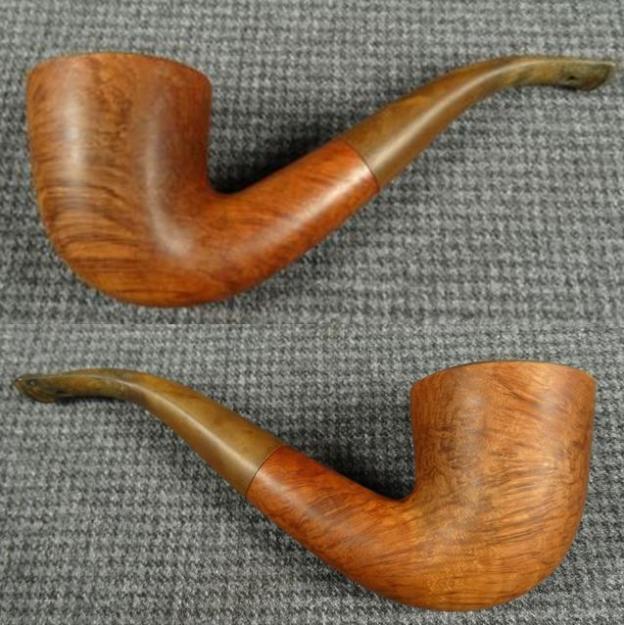
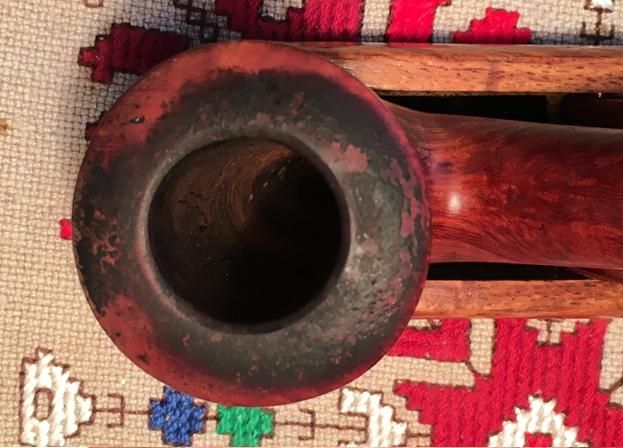
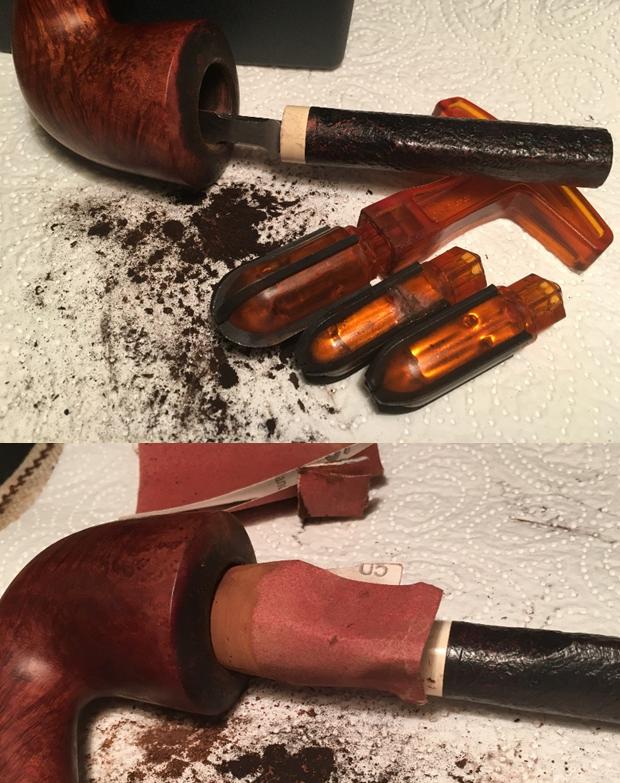
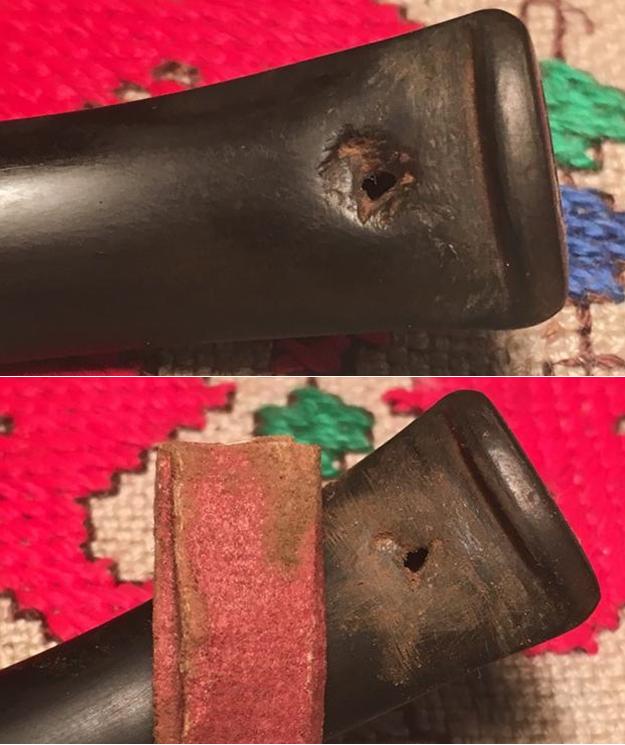
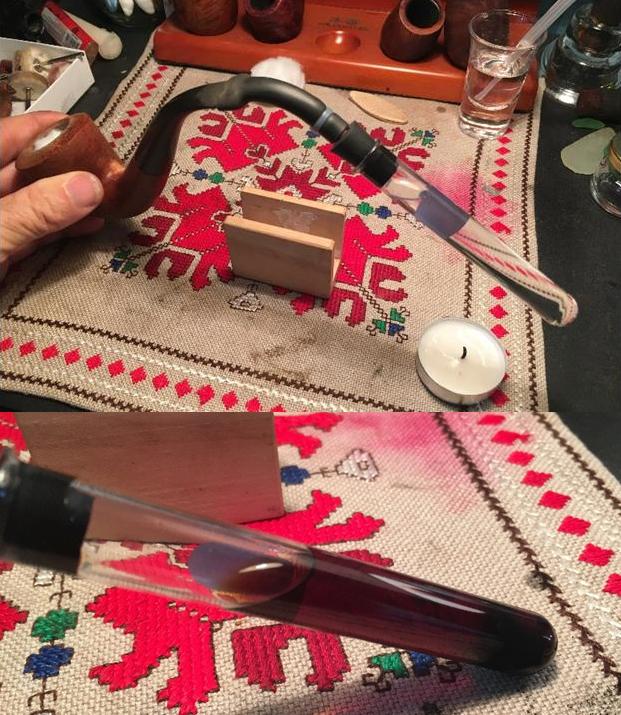
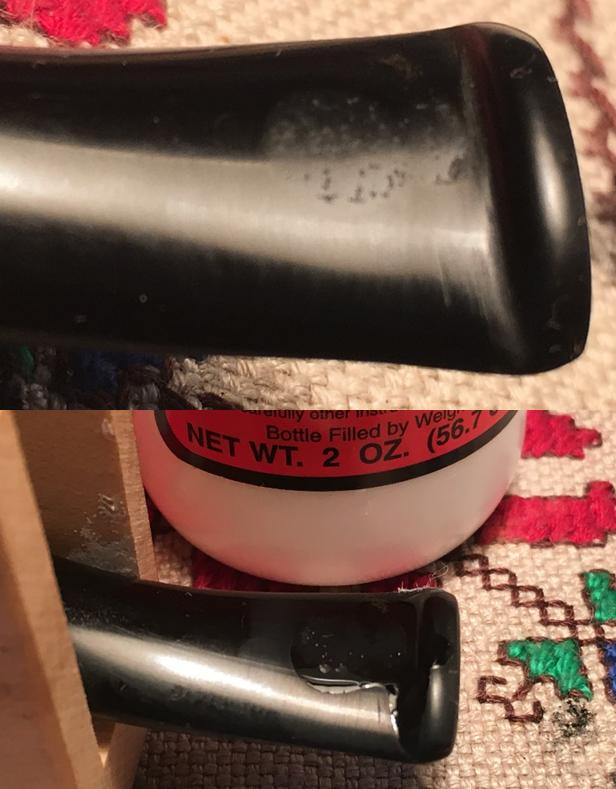
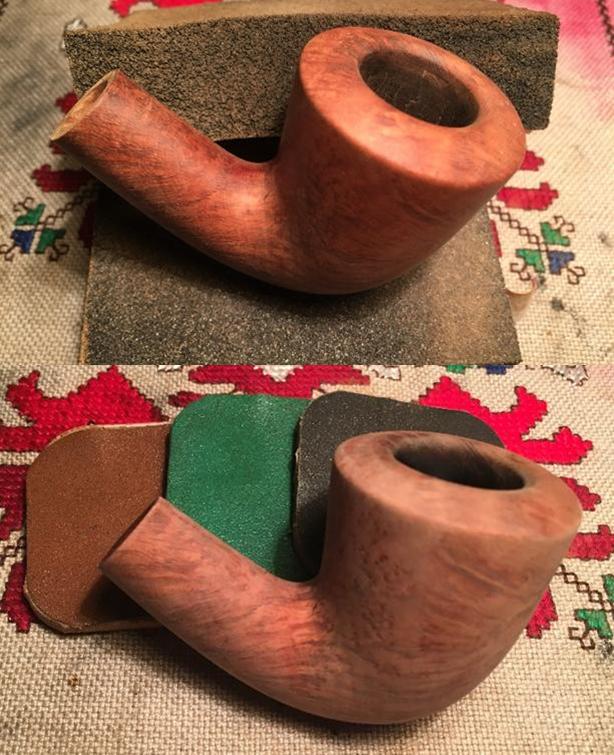
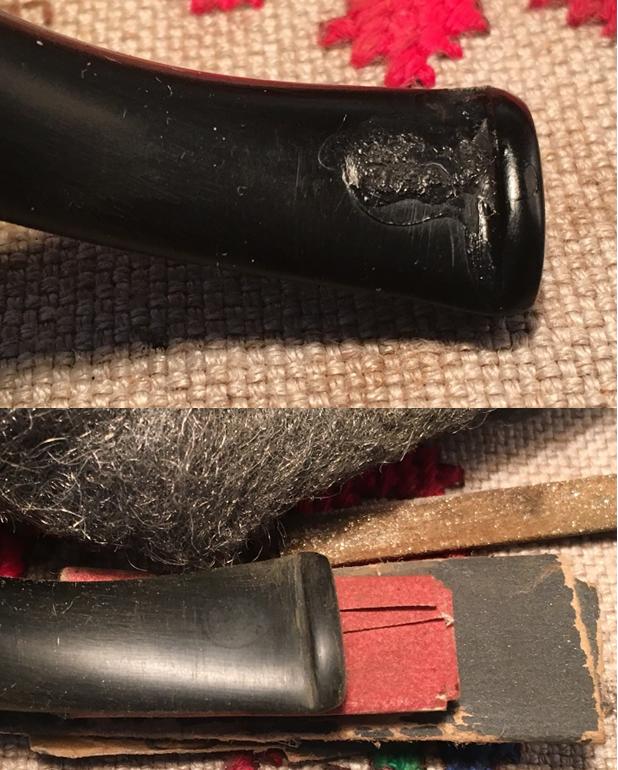
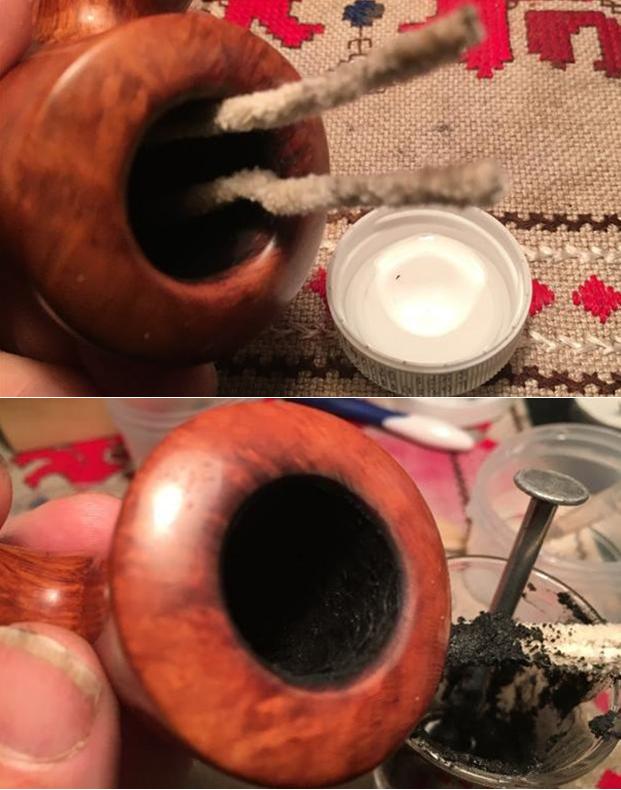
Gary, my friend and colleague who lives in Plovdiv, Bulgaria, happily responded to my plea for ‘quality’ cigar ash.  I am now in possession of ash the byproduct of 2 Cubans – the second of which he smoked with me Thanksgiving Day evening as we gathered to celebrate together in Sofia – I smoked my favorite black Cavendish blend, Lane BCA, in the pipe I call, Ole Pot.  I take a couple close-ups to get a look at the cracks in the bowl. I’m not sure the source of these crevices but they appear to be grouped mid-way down the bowl both in the front and back of the bowl wall.  On a hunch, I look at the exterior and I think my hunch is correct.  The grain of the stummel moves horizontally though the bowl.  When I look at the front and back of the external grain patterns, I find birds eye grain pattern – which represent the cut through, perpendicular perspective of the grain.  The sides of the stummel reveal the side of the grain – the horizontal flow.  So, these cracks appear to me to be the grain splitting – it appears like dry split wood.  Not sure ‘why?’ but this is my theory.  The third and fourth pictures below show the external theory:cal30 cal31First, to prepare to make the pipe mud, I take the Cuban ash and crush it with the end of a pipe nail.  With tweezers, I picked out debris and make sure there are no large chunks.  The gray powder in the pictures is the aim.cal32Next, I use a dental probe to dig a bit in the cracks to make sure there is no loose debris.  Then I take a few bent pipe cleaners dipped in isopropyl and clean the bowl wall.  I put the ash in a shot glass and slowly add water with an eyedropper and mix the mud with the pipe nail.  When the consistency of the mud is like paste, I use a bent pipe cleaner to paint the mud on the wall – careful to tamp in to fill the crevices.  I keep an eye on the areas with crevices as the mud dries in the bowl, making sure that it doesn’t shrink, but remains even with the bowl wall – as Steve’s tutorial instructed.  In about a half hour the mud is dry and forms a pretty hard surface.  The pipe mud will form a foundation for a cake to develop which provides a protective layer for the briar.  Until this happens, care is given to not ream or aggressively scrape the bowl wall.   The pictures show the progress.cal33The next project is adding a band to dress up the No Name Calabash – a touch of class.  The shank diameter is 17.5 millimeters in diameter and I fish out a 17.5 band to match the diameter.  Some months ago, I purchased an assortment of bands to have on hand from J. H. Lowe’s online store.   I’ve done one band previous to this, my first restoration which Steve published on rebornpipes (A Newbie Restore of a Dr. Plumb 9456) which went well.  The mantra I remember from Steve’s tutorial on banding (Link) was the need for patience in applying heat and micro-inching the band up the shank – a hot band could tear if forced to quickly. I set up a handy work station on a solid wooden stool that I can straddle.  I fold a towel and place it over a chopping block to provide a firm, but soft foundation to use as I press the stummel inching the heated band up the shank.  My air gun fits nicely on the platform as well.  About 1/10th of the band fit over the end of the shank at the beginning.  I heat the band rotating it, careful not to burn the wood then put it to the toweled surface and press – firmly but only a bit.  Repeating the process several times.  The pictures below show this.  The last in the set shows the progress of the band’s movement up the shank – almost home!cal34 cal35It was going so well, until it wasn’t!  With millimeters left before the band was flush with the shank, a press against the surface caused a portion of the band to crimp (pictured).  This was not part of the plan.  Different possible scenarios fill my mind for next steps to try to back out of the situation and to salvage the banding project.  I’m concerned that the band has torn at one of the crimp points because I can detect a sharp edge to the touch.  Time for an ‘SOS’ message to Steve with the picture below.cal36Steve’s response was helpful – to heat the band as before and with a small flat screw driver, straighten out the crimping and then continue again with the heating and pressing to bring the end of the band flush with the shank.  The following pictures show the salvage operation.  I begin by heating and bringing the bent edge back out using a small flat head screw driver.  As this progressed, I improvised, using the round head of a pipe nail to help reestablish the round of the band by heating and placing the head in the lip of the band and rolling it like a wheel while rotating the stummel.  Once things start regaining normal, I use a needle file gently filing the edge to remove sharp splinters.  I also filed a bit on the external ‘pucker points’ that help reestablish roundness and a smoother surface, but not perfect.cal37 cal38 cal39As I return now to heating and pressing to complete mounting the band on the shank, my concern is the weakened area of the band will simply crimp again with the process.  I decide to heat the band up a bit more than I did before, hopefully to enable the band expansion more economically and to add more towel padding between the band and the hard surface below.  I return to heating and pressing and thankfully, the result is a seated band with a few battle scars along the way!cal40 cal41When I attempt to rejoin the stem and new banded stummel, I find that increased compression on the shank from the new band has created a tighter mortise/tenon fit.  To release some of the tightness of this fit I wrap the tenon with 240 grit paper and rotate it to reduce the size of the tenon but keep it in round.  I rotate and test the new fit several times until I get it right.  I don’t want to take too much off the tenon and have a loose fit.  I get my first look at the reunited stummel and stem and I like what is before me! I take a close-up on the underside of the shank to show the area of the band crimp and repair.  I’m satisfied now with the repair job; I will see if I can improve it through the polishing process.cal42 cal43Now the fun begins!  With stem and stummel united, I begin the polishing phase using Tripoli over stummel and band.  I mount the Tripoli wheel in the Dremel’s hand-held extender and power it up at the lowest setting (RPMs) and after purging the wheel with the tightening tool, I light tap the wheel on the Tripoli bar and apply it to the surface.  With all the compounds, I do not apply too much vertical pressure to the wheel but allow the speed of the Dremel and compound to do the work.  After the Tripoli, I switch to the Blue Diamond wheel and repeat the process above but include the stem as well as stummel and band.  After this, I give the pipe a good rub down to remove powder left over from the compounds.  With the carnauba wheel mounted (after purging) I apply several applications of carnauba wax then change the Dremel to a clean wheel and buff the entire stem and stummel.   I complete the polishing with a brisk buff with a micromesh cloth to bring out the depth of the briar even more.
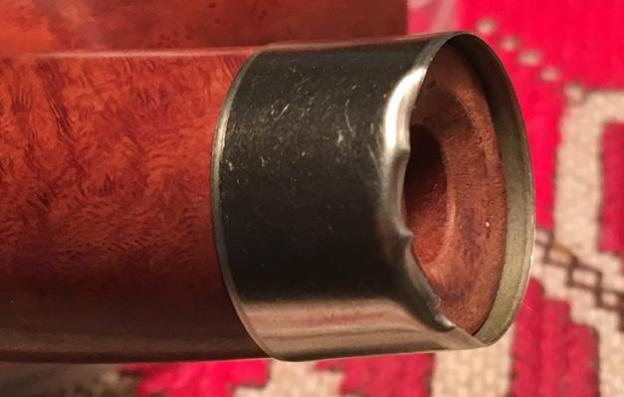
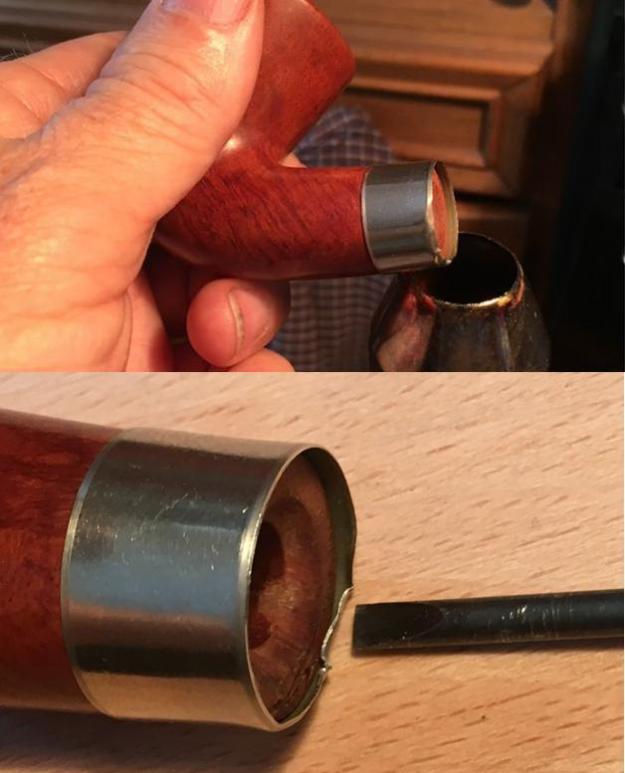
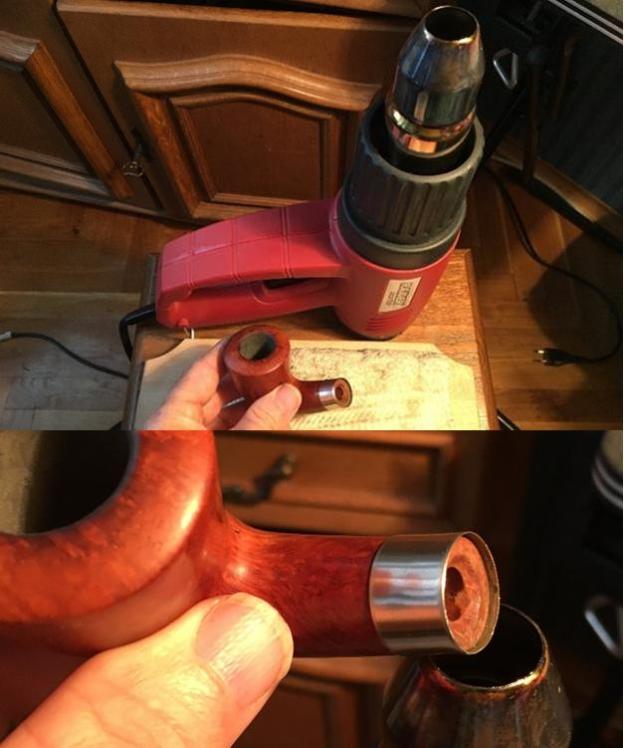
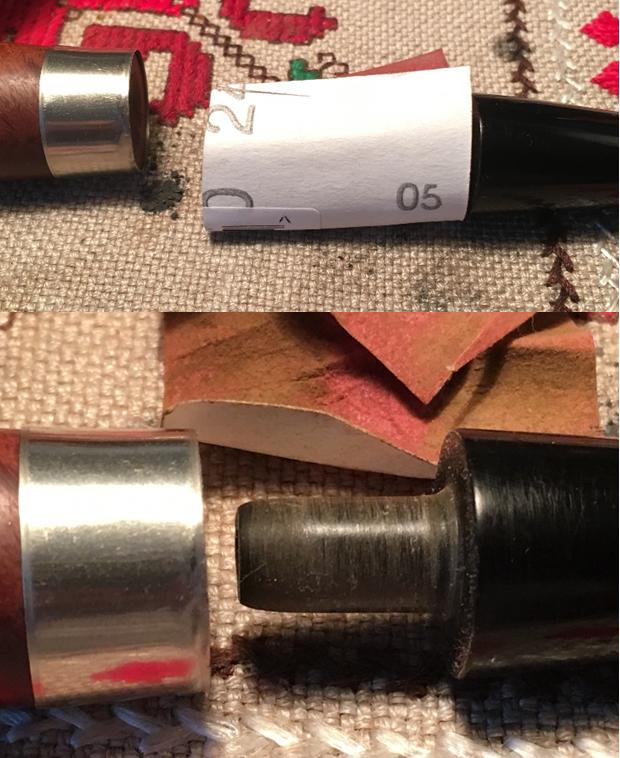
I learned three new skills to put in my tool box – making and applying Pipe Mud, rescuing a botched band mounting, and repairing a tooth hole using a charcoal super glue putty.  Not bad.  I’m very pleased with this ‘No Name Calabash’.  The honey-colored briar is stunning as it flows through the stummel – the depth of the grain almost appears 3-dimensional.  The band is a nice addition – it dresses it up, like putting on a tux. I trust that this pipe finds a good home.  Thank you for joining me!cal44 cal45 cal46 cal47 cal48 cal49 cal50 cal51


This Poor Old Kaywoodie Chesterfield had seen better days


Blog by Steve Laug

I received an email from Jim, the same fellow who sent me the Yello-Bole that I refurbished for him. I wrote about it in an earlier blog (https://rebornpipes.com/2016/11/10/breathing-life-into-a-huge-kbb-yello-bole-3068c-bent-billiard/). I have included the gist of his email and the photos he sent me because any of us who try our hand at pipe repair have found ourselves in similar situations. One simple thing going wrong can quickly compound into a second and a third thing going wrong and leave you with a mess on a pipe that at first glance should have been a simple cleanup.

“So I have a Kaywoodie Chesterfield pipe – the first pipe I ever obtained – and it is in need of serious attention.  I bought it at Barclay’s in Upper Arlington, Ohio from their Estate Pipe display, and I really like the pipe.  However, about three days ago, I was cleaning it, and got a tapered pipe cleaner stuck in the bit.  As I was pulling the cleaner through, the thicker end jammed itself well inside the bit as I attempted to draw the thinner end through the lip.  I apparently pulled too hard, and the end of the pipe cleaner broke off, leaving the remainder of the cleaner fully trapped in the bit.  In my idiocy, I tried various strategies to dislodge the cleaner which eventually led to my doing further damage to the bit in the form of a split down the center of the underside of the stem latitudinally.”
“…I know this particular pipe is not terribly valuable or even rare.  However, I am kind of a sap, and the pipe has a measure of sentimental value in that it is the first pipe I got, and I picked it because it reminded me of the pipes my dad smoked when I was a kid.  I am hoping you can give me some good news in the form of a means to remedy my stupidity.”

He sent the next three photos to show me his pipe and his travail. The first is one of the overall view of the pipe. Though it is hard to see in this photo the bowl has some very nice grain. I will take some pictures of the bowl and the finished pipe once I have finished the repair.chest1He took a photo of the end of the shank. His caption read: “You cannot see the thicker end of the pipe cleaner because it’s stuck way in there…” Indeed the pipe cleaner was stuck in the stem. It was jammed in the stem 1 ½ inches from the button with a bit showing through the jagged split in the stem and about two inches in from the shank end of the stem.chest2The last photo he sent shows the underside of the stem with this caption: “….And this is what you get when a dummy tries to ameliorate a situation that is beyond his ken.” It was a jagged split that looked awful in the photo below.chest3I had him send the pipe to me so that I could see what could be done. A stem repair in its own right that large is a fair bit of work but it could be done. The pipe cleaner jammed in the airway was an altogether different issue. I needed to have a look to see what I could come up with to remove the jam from the airway in the stem. I could not be sure until I saw it and tried.
The package arrived in Canada a few days ago and I opened it to find he had included the large Yello-Bole that I mentioned above and the damaged Chesterfield. The Chesterfield is actually a stunning pipe. The grain on the bowl, the finish and the nickel ferrule all combine to make a beautiful pipe. The bowl was in great shape and required no cleaning or repairs – just a buff to polish it. I can certainly see why Jim was attached to it. He was willing to have a new stem fit to the shank but I really wanted to see if the original Kaywoodie stem could be salvaged.
I took the next series of photos to show the damage to the stem underside. I needed to straighten the stem out to properly work on it. I traced the angle of the curve on the back of the letter that Jim sent along with the package so that I could recapture it once I finished the repair. I used a dental pick and tweezers to pull as much of the pipe cleaner and wire out of the damaged area on the stem. I found as I worked on the damaged area that several chunks of a small drill bit also fell out giving testimony to one of the ways Jim had tried to remove the jammed pipe cleaner. I was hoping to be able to pull all of it out this way but it continue to break and come out in small pieces until I was unable to reach any more with the pick and the tweezers.
I used a drill bit on my cordless drill and turned the straightened stem onto the bit from the shank end. My thought was that perhaps the drill bit would seize a piece of the pipe cleaner when I backed it out of the stem. It worked to a degree but it would not bring out the last 1 ½ inches of broken pipe cleaner. I was stuck. I needed some time to think through my options and try to figure out how to address the problem. I laid the stem aside and worked on the Yello-Bole while I pondered my next moves with the stem.chest4While I was working on the Yello-Bole I had a thought that maybe putting the stem in the freezer for a bit might work. My thinking was that when I removed it the contraction and expansion of the vulcanite and that of the pipe cleaner would be different enough that the pipe cleaner would drop out of the shank. At least that is what I dreamed would happen. A few days went by and I had some late nights at work and the stem sat in the freezer for a lot longer than I had anticipated. Needless to say when I finally took it out of the freeze it appeared to have made no difference. The pipe cleaner did not simply fall out of the airway as the stem warmed.

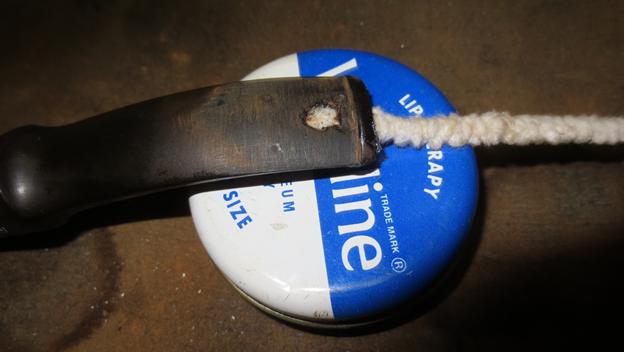
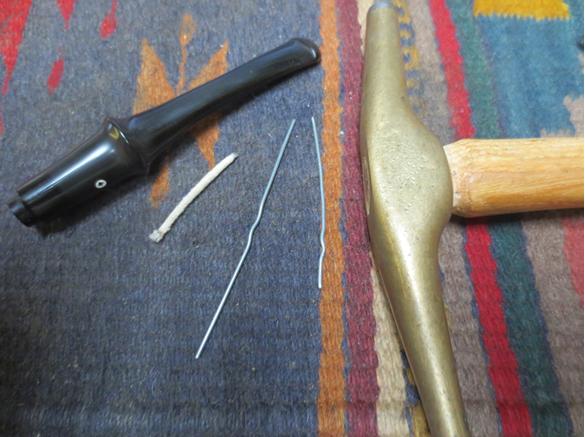
I laid it aside for the night and went to sleep. I woke up early this morning with an idea. I straightened a length of paper clip that I used as a punch. I slid it into the button end of the stem carefully past the damaged underside until it hit the jammed pipe cleaner. I used a small furniture tack hammer to tap on the bit of paper clip extending above the button. I tapped it maybe four or five times and I felt it begin to give. Encouraged, I tapped it several more times and the pipe cleaner bit fell free of the shank end of the pipe. You can see the broken piece of pipe cleaner below the stem in the next photo. I plugged the damaged area with my thumb and blew through the stem to clear out debris left behind by the pipe cleaner bits. The airway was finally free.chest5I mixed a batch of charcoal powder and black super glue on a patch of cardboard until I had a thick paste. I use activated charcoal capsules for the finely ground charcoal and a medium viscosity super glue for the mixture. I greased a pipe cleaner with Vaseline and slid it into the stem filling in the area on both ends of the damaged spot. I applied the mixture of super glue and charcoal powder to the damaged area with a length of straightened paperclip. I smoothed out the repair with the edge of a paper clip. I sprayed the repair with an accelerator and slid the pipe cleaner out of the airway. I blew through the shank end of the stem and the airway was clear of blockage. I used a clean pipe cleaner to remove the excess Vaseline from the inside of the stem.chest6I used the rest of the mixture to build up the repair and spread it over the surface of the stem, bonding the patch to the solid vulcanite on both sides of the damaged area. The patch was thick and large but I would be able to sand it smooth.chest7Once the patch dried I sanded it with 220 grit sandpaper to smooth it out and blend it with the surrounding vulcanite. The next two photos show the repaired area at this point in the process.chest8I polished the stem with micromesh sanding pads – wet sanding with 1500-2400 grit pads and dry sanding with 3200-12000 grit pads. As I worked over the repaired area some of the air bubbles in the mixture of charcoal powder and the glue came to the surface. I have never found them to be big deal as they only need to be lightly filled with clear super glue. I repeated the super glue and sanding process until the patch was smooth. I sanded it with micromesh pads until it shone and after each set of three pads I rubbed the stem down with Obsidian Oil. I gave it a final coat of oil after the last set of three pads and set it aside to dry. The following photos show process of how the repaired area gradually smoothed and blended into the rest of the vulcanite.chest9 chest10 chest11 chest12 chest13 chest14Once the repair was finished and polished I set the stem aside to cure for several hours. I wanted to make sure that the charcoal and black super glue patch was hard. I had visions of it dropping out when I heated the stem and applied pressure to bend it. Once it had hardened bending it was not a problem. I slid a small pipe cleaner into the stem from the button end to keep the airway from collapsing when I bent it. I heated it over a heat gun until the vulcanite was pliable. I bent it to match the pattern on the paper and then cooled it with running water. I repeated the process until I had the right curve to the stem.chest15 chest16I buffed the stem and bowl with Blue Diamond polish on the buffing wheel to raise a shine and polish out the scratches. I gave the bowl and stem multiple coats of carnauba wax. I buffed it with a clean buffing pad on the wheel and hand buffed it with a microfibre cloth. The repair to the underside of the stem is solid and smooth. While the repair is visible under bright light it did not stand out while looking at it with the naked eye. Along with that the repair was fortunately on the underside of the stem in the curve. I think Jim will appreciate the repair and the pipe should serve him well. I look forward to hearing what he thinks of the repair once he has the pipe in hand. Thanks for walking with me through the process.chest17 chest18 chest19
A Pair of Rainy Day Pipes – More Adventures in Oddities


Blog by Steve Laug

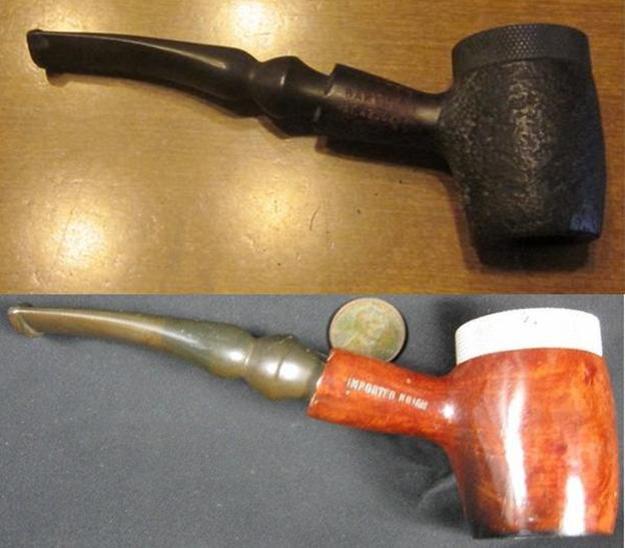
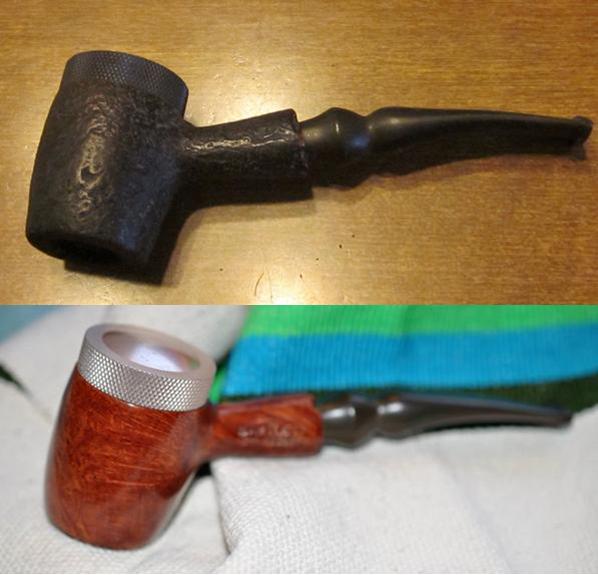
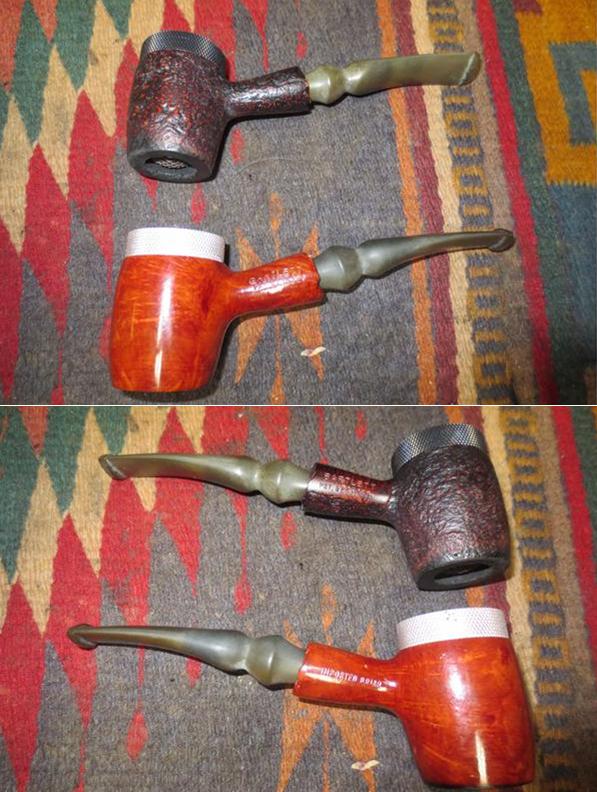
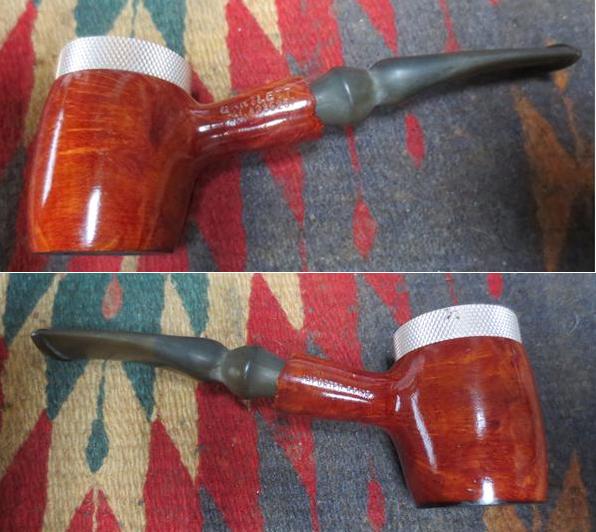
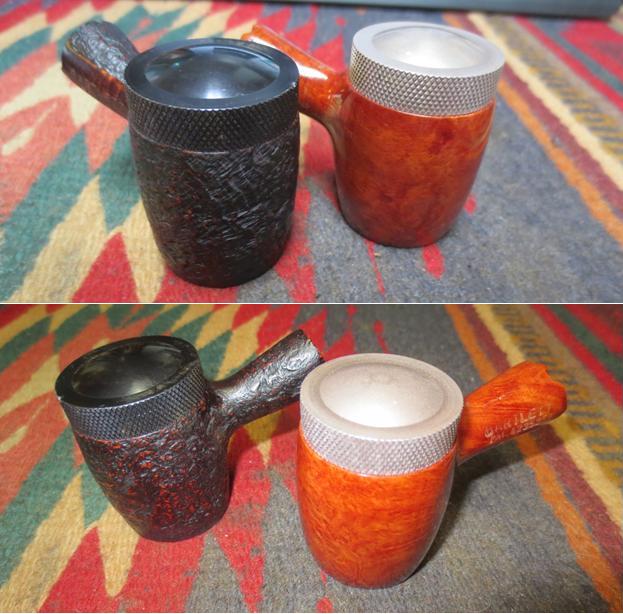
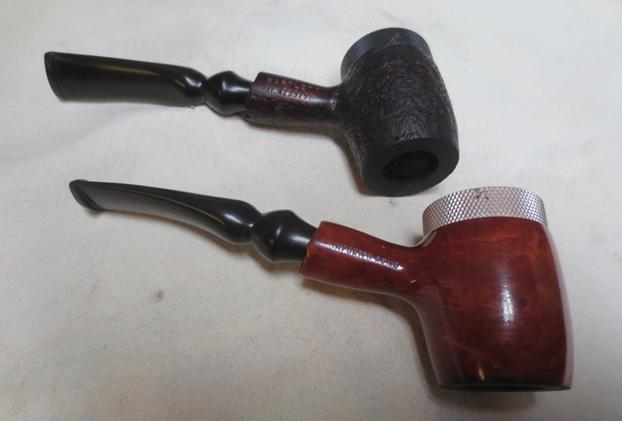
Have you ever heard of Bartlett Pipes? They are rather strange upside down looking pipes in my opinion. My brother sent me this link to a youtube video on the Bartlett pipes. We were both searching for information on the brand as neither of us had heard of them or seen them close up before.   https://www.youtube.com/watch?v=dyFfLidMmws&feature=youtu.be

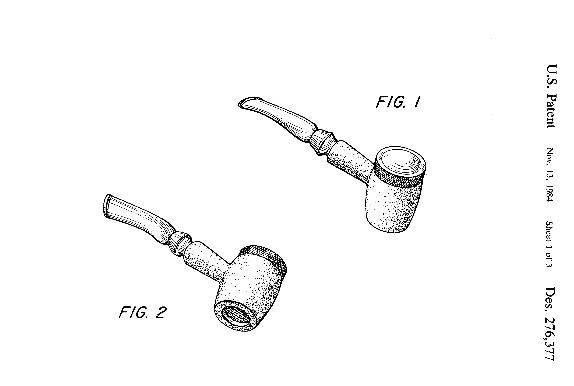
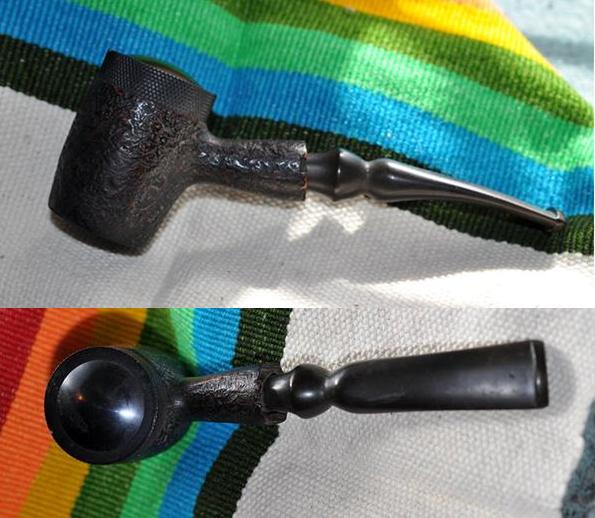
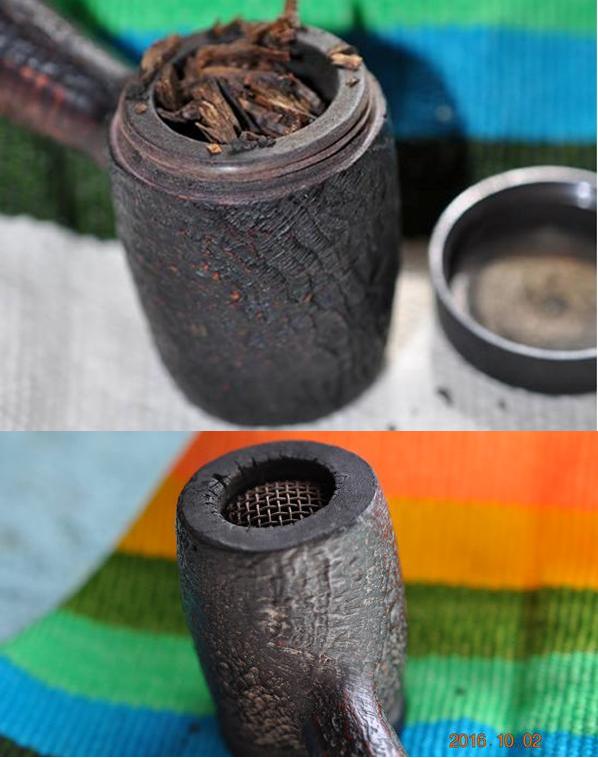
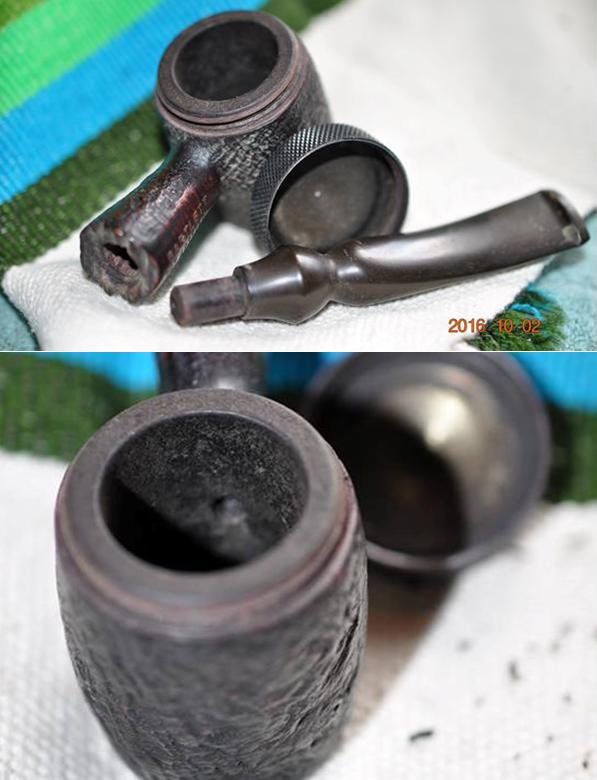
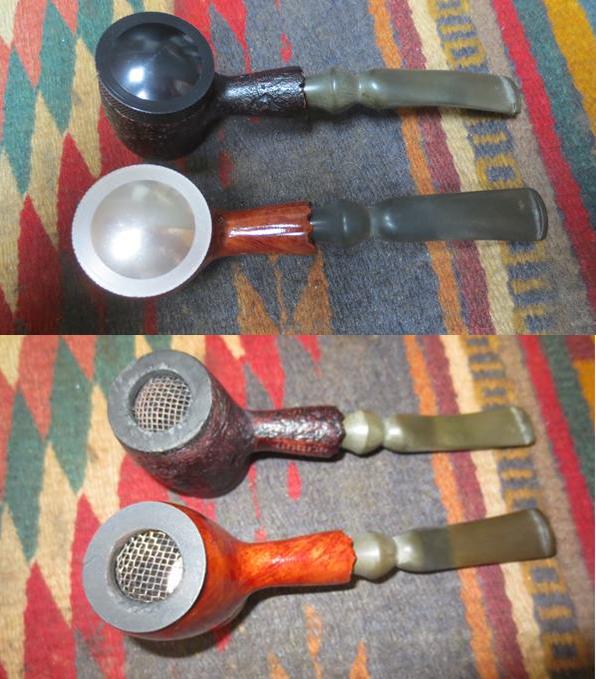
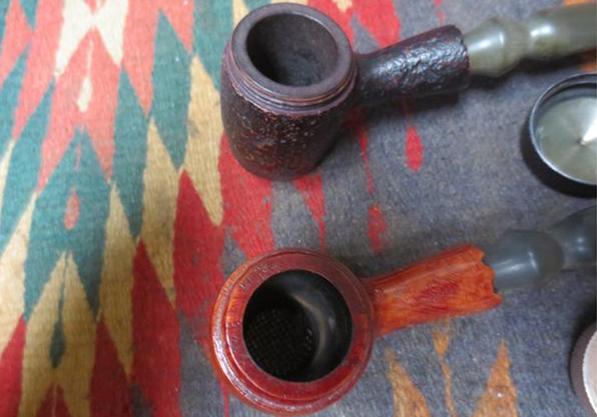
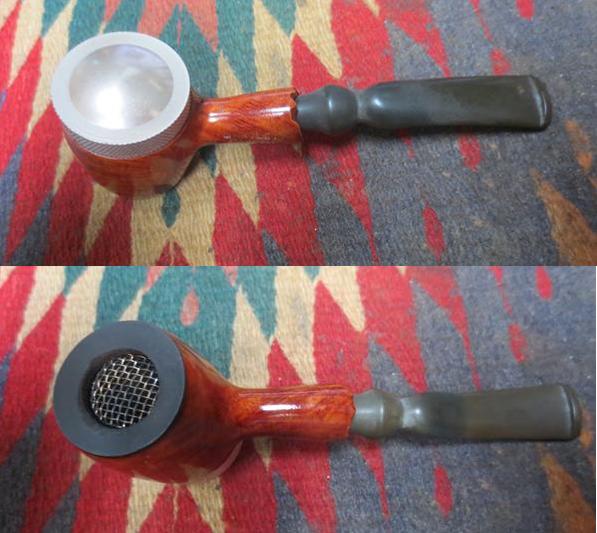
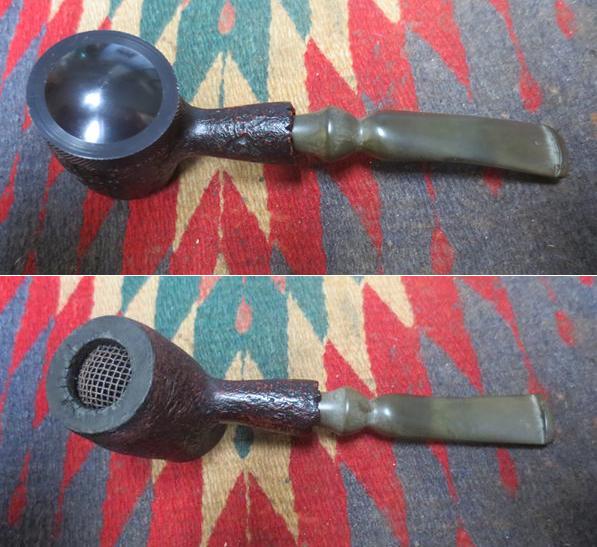
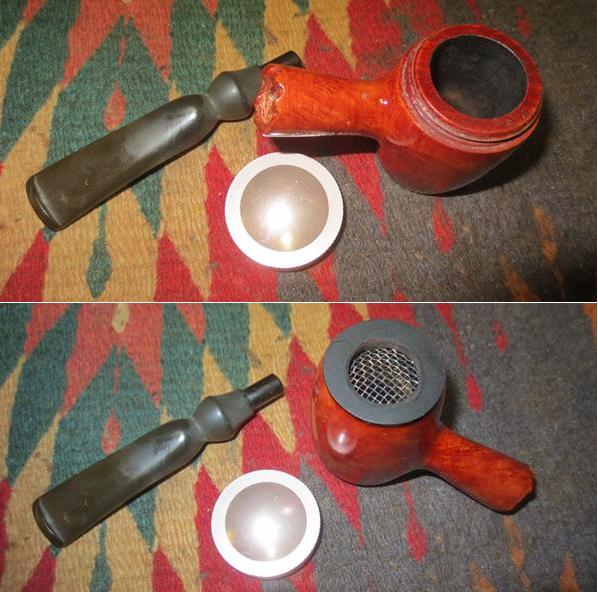
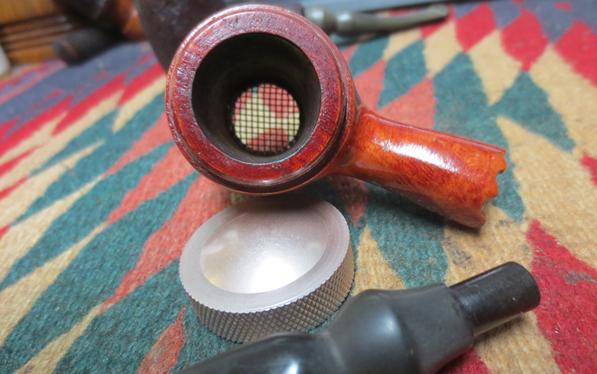
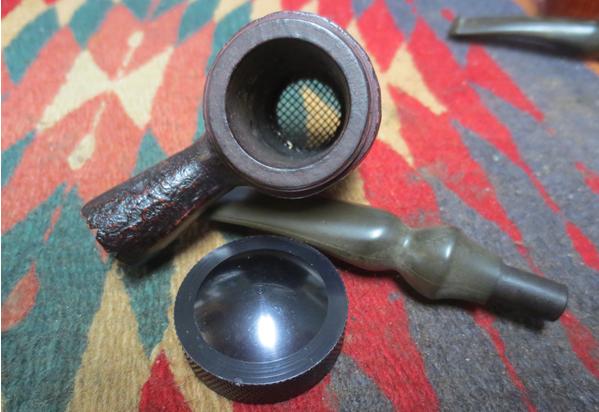
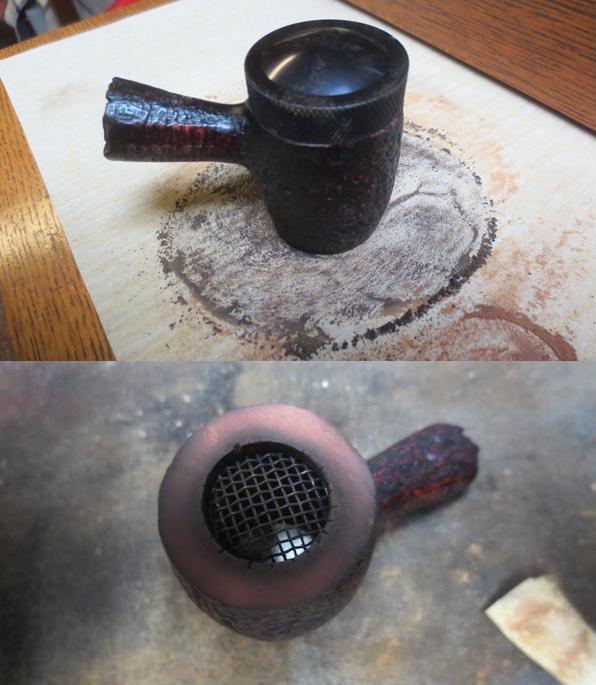
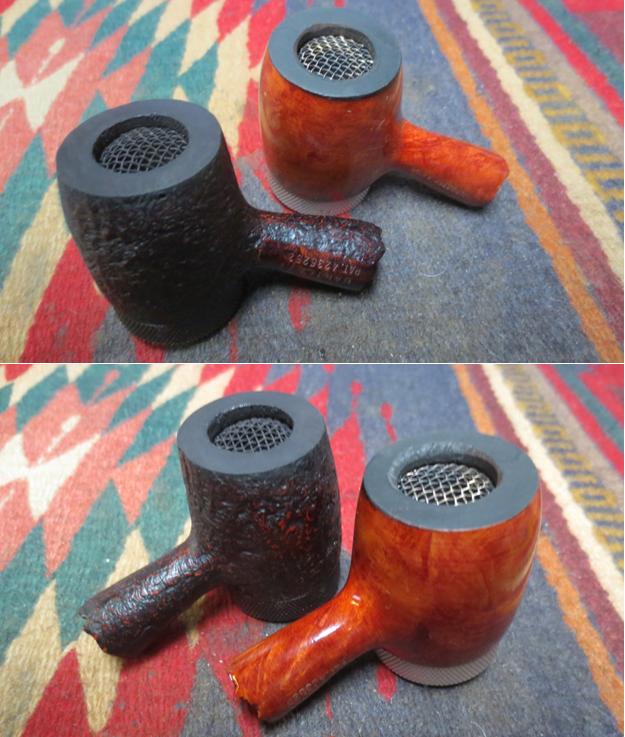
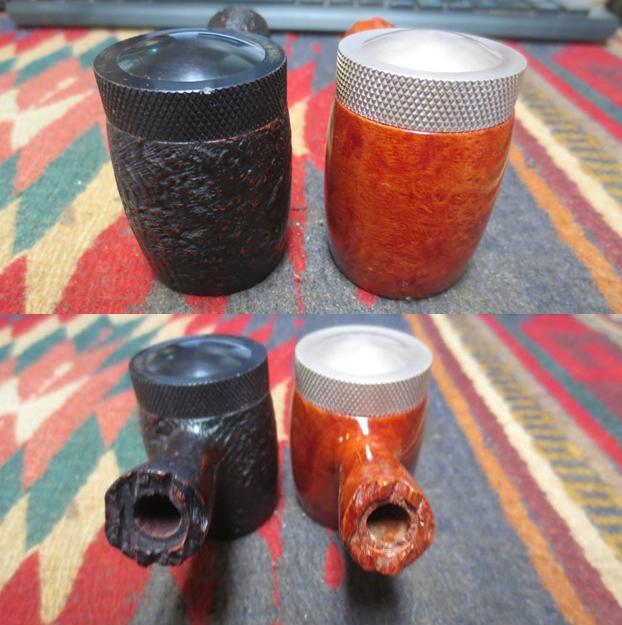
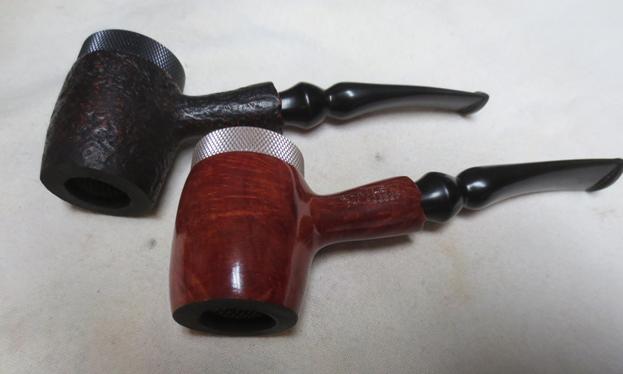
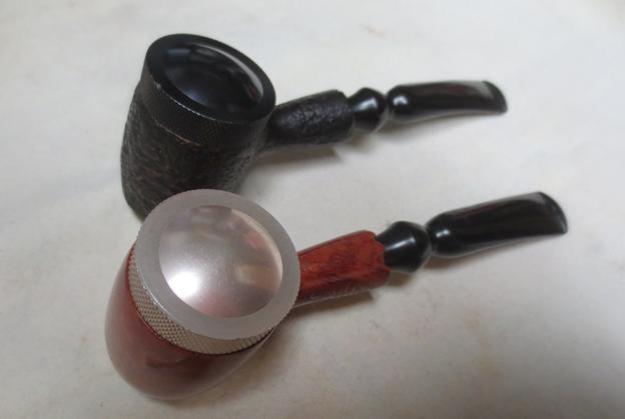
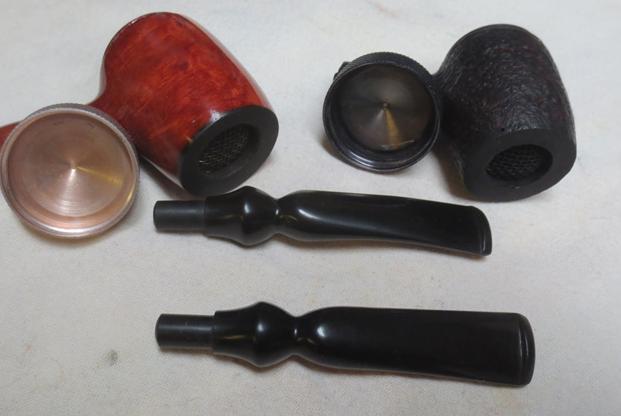
What made the hunt for information regarding this oddity necessary was that my brother had bid on two of these and won both of them on eBay. One of them was NOS (new old stock) and one of them was smoked and well used. In the past I had seen photos and read on the online forums about these pipes but had never really done any research to figure out what they were. They were always a bit of an oddity to me. Either way the stem sat they did not look right and when you removed the cap at the top the airway was almost at the top of the bowl (if the screw on lid was to be considered the top). The angles of the shank and the curve of the stem leads me to think that the capped surface was the top of the bowl. The bottom side of the bowl was a screen that allowed for airflow through the bowl. I am still trying to figure out if you light the pipe from the bottom or the top of the bowl.bart1 bart2From what I read on the various online forums and in the articles that I could find I was able to piece together how the pipe functioned. The pipe bowl was open at the top and the bottom. The airway into the shank was near the top opening and led directly to the pipe stem. A polished aluminum cover is screwed onto the threaded briar bowl top and is left in place when the pipe is smoked. At the other end of the bowl there is a screen that covers the bottom opening that keeps the tobacco in the bowl while permitting access to the tobacco to light it. The screen is supposedly fine enough that the ash does not fall out of the bowl into the lap of the smoker. With the cover in place on the top opening, the tobacco is ignited via the screen on the bottom, causing  the tobacco to burn from the bottom up. New tobacco may be added at any time by removing the cap from the top of the pipe. It is said that the burning the tobacco from the bottom reduces the moisture that usually collects and thus makes it unnecessary to dry out the bowl between pipes. The bottom lighting also makes lighting the pipe in the wind or rain much simpler.
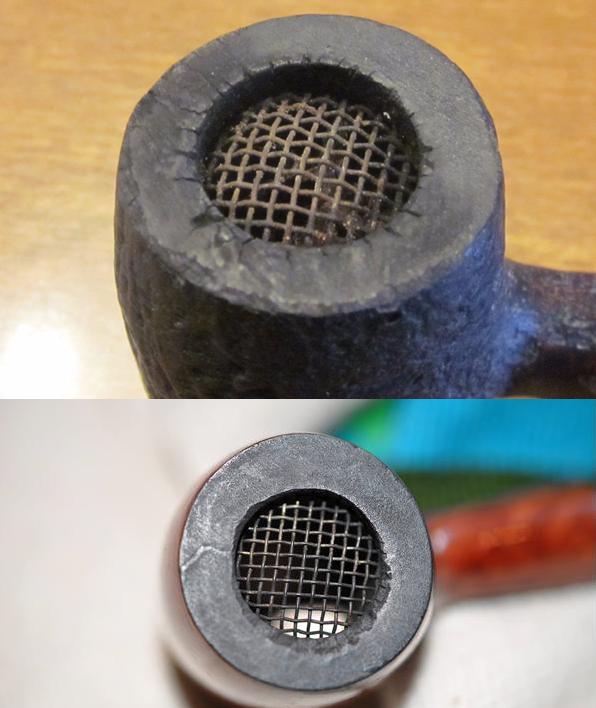
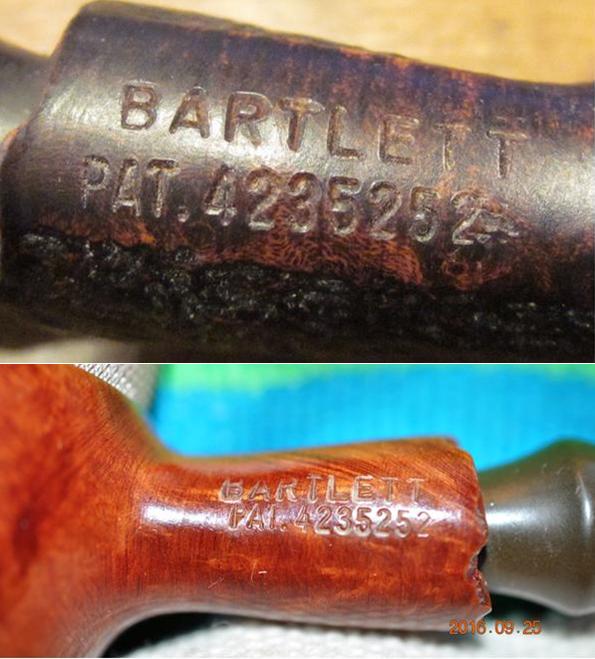
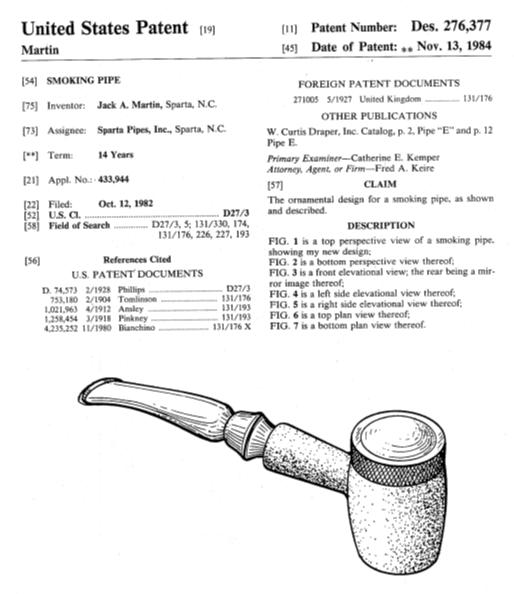
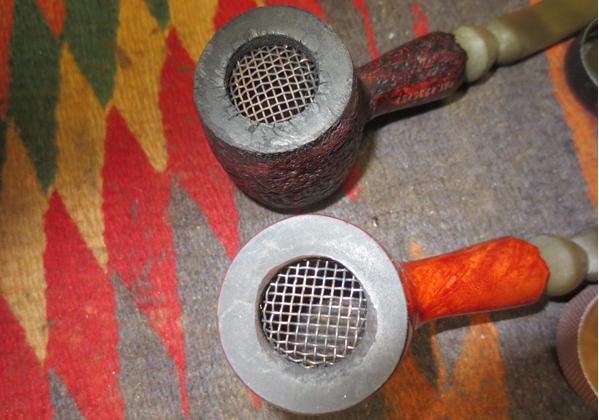
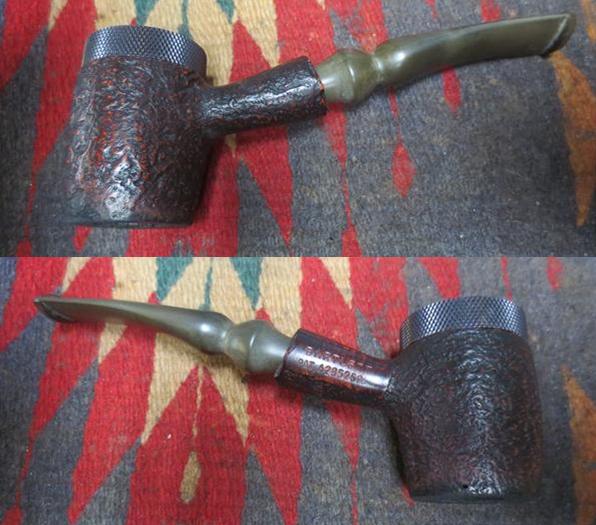
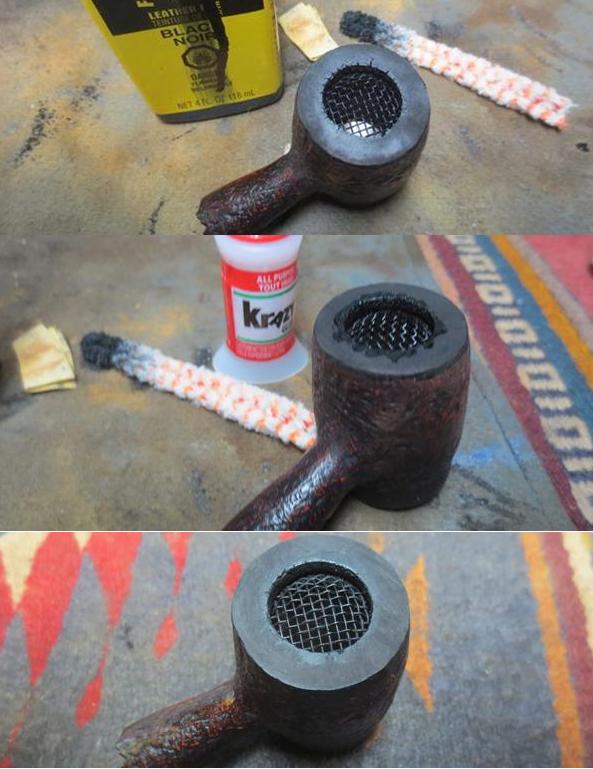
The next photos show the screened bottom of the two pipes that I was going to work on. The smooth pipe is new and unsmoked the sandblasted pipe is used and you can see some charring around the inner edges on the bottom of the bowl. The bowl bottom on the unsmoked pipe was stained black to minimize the darkening that occurs when the pipe is lit.bart3Both pipes were stamped with the name Bartlett over a Patent Number – 4235252. The stamping on the sandblast version was on the right side of the shank and the one on the smooth was on the left side of the shank. Both stampings were very sharp and legible. The smooth briar pipe was also stamped on the right side of the shank with the work Imported Briar.bart4At this point I wanted to know more about the pipe. It was a brand that I was unfamiliar with. In usual unhelpful fashion I found that the Bartlett Pipe was made by the Bartlett Pipe Company Inc. of Bartlett, NH (which I assume is New Hampshire).
On the Pipesmokers Forum I found some interesting information from a friend of the inventor of the pipe. Here is the link to the conversation on that website. http://pipesmokersforum.com/community/threads/an-interesting-surprise.46690/
Adam Hirshan comments: “A friend of mine invented and patented a revolutionary smoking pipe that lights from the bottom. A major manufacturer saw the promise and bought the idea 15 years ago, but it never took off. My friend got the patent back a few years ago and we’ve developed a new rock maple version that we call The Freedom Smoking Pipe.”
“It smokes cool and easy. A stainless steel screen holds the tobacco and ash in place – nothing falls out. No moisture or resin accumulate in the bowl. A cork and leather top makes it wind and rain proof.”

“We had initial success wholesaling through a well-known distributor. We were in about 100 tobacco shops nationwide, and appeared in the Levin catalog. Response from our early customers was strong – most loved it, some hated it. Then interest dropped off and left us wondering what happened.”

I did some more digging and found some information on the Dr. Grabow Collectors Forum. Here is the link: http://drgrabows.myfreeforum.org/viewcardtopic.php?t=1236

I quote: “I was asked what I thought about my Bartlett pipe and figured I’d start a new topic. If you don’t know what it is, it’s the ‘Upside down pipe’. The history as I know it is there have been 3 variations. It was invented in the 70’s. Sparta picked up the rights and produced them in the 80’s for 8-10yrs. Didn’t take off. Rights were returned to the inventor. Seems they are no longer produced. (ed. This seems to go along with the information from Adam Hirshan in the above comment).”

The quote goes on with an interesting reference to the Sparta example of the pipe: “Mine has a red stain, and the chain to hold the cap. My stem is from a junk pipe I had. The weirdest thing is not seeing the baccy burn. First smoke required a tamp halfway through and the bowl got dang hot! Second time out, the pack was perfect. One light, no tamp. Just weird not tending the bowl like normal…….Guess this is why the never went anywhere.”

I was also able to find the patent information for US Pat.4235252. Interestingly it read much like an earlier paragraph that I pieced together regarding the pipe. Here is the document in full. First the written description and then the drawings of the pipe. It read that “the patent was for a smoking pipe having improved smoking characteristics. The smoking pipe includes a bowl having top and bottom openings and a breather hole near the top opening and in communication with a pipe stem. A cover assembly is attached to the bowl adjacent to the top opening and covers the top opening when the pipe is to be smoked. A retainer having a screen cooperates with the bottom opening for retaining smoking tobacco within the bowl while permitting access to the tobacco for the ignition thereof. The retainer may also be removed from its position relative to the bottom opening for the removal of ashes. Tobacco is inserted into the bowl via either opening, but preferably via the top opening and to a level just below the breather hole. With the cover assembly covering the top opening, the tobacco is ignited via the screen of the retainer, causing combustion of the tobacco in a bottom-to-top fashion. New tobacco may be added to existing tobacco via the top opening and ashes may be removed via the bottom opening, even as the smoking process takes place. The bottom-to-top combustion minimizes puddling of tobacco juices or the requirement of drying out periods and facilitates lighting the pipe in the presence of wind, rain, etc. The lack of obstruction of the breather hole by the presence of tobacco results in a smooth draw with the generation of a substantial, satisfying volume of smoke.” (ed. On the two pipes I have the screen on the bottom is not removable and the top is a threaded aluminum cap.)bart5 bart6My brother took some photos of the sandblast version of the pipe that shows the shape but also interestingly shows a hidden benefit. When he removed the cap from the top of the bowl the bowl was already filled with a broken flake tobacco. Unfortunately it was dry and crumbled to dust when he cleaned out the bowl.bart7 bart8 bart9My brother cleaned and reamed the smoked sandblast pipe and cleaned out the dust from the unsmoked smooth one. He scrubbed the briar with Murphy’s Oil Soap and cleaned out the mortise and the airway in the shank and the stem. The stems on both pipes were lightly oxidized and on the smoked pipe there was a small tooth dent on the top of the stem near the button. I took the following photos to show what the pair looked like when I brought them to my work table.bart10 bart11He did a great job cleaning up the aluminum caps on both the inside and the outside. He also cleaned up the thread on the top of both bowls allowing the caps to screw on easily.bart12He cleaned the screen on the smoked pipe with cotton swabs and alcohol until it looked as good as the unsmoked pipe. The inner edge of the rim on the bottom of the bowl was charred and showed some wear and tear from lighting the pipe from the bottom. I think one of the draw backs on this pipe is not being able to see the flame hitting the tobacco. The rim on this bowl shows significant rim damage.bart13I took close up photos of the stems to show the light oxidation – it is not deep in the vulcanite and the overall condition of the stems. The stem on the sandblast pipe had a small pinprick tooth mark on the top of the stem. I have circled it in red on the first photo below.bart14I took some photos of each of the pipes before I cleaned them up. They really were in pretty decent shape. There were some rough spots on the bottom of the bowl around the inner edge of the rim but it looked to be original. The smooth briar is new and has a shiny varnish coat that I decided to leave as the pipe is NOS. It was interesting to me to note that the bottom of the bowl was stained with a flat black stain on the new pipe so when I restored the smoked version I would match them. The sandblast is also in really good shape other than the inner edge of the bottom rim on the bowl.bart15 bart16 bart17 bart18On both pipes the aluminum cap was in perfect condition on both the inside and the polished outside of the cap. I took photos of the pipes with the covers removed and the bowl tilted to give some idea of what the inside of the bowl looked like. It really is no more than a tube with a cap on one end and a screen on the other end.bart19 bart20 bart21 bart22I used the topping board on the damaged bottom of the bowl. I topped it (or maybe bottomed it is more appropriate) until the damage was removed.bart23The small crevices that had opened around the inner edge of the bowl were not really cracks but rather areas that had burned with the heat of the flame. I filled them with briar dust and super glue to make them smooth and then retopped the bowl to smooth them out. I stained it with a black aniline stain and touched it up after sanding the repairs.bart24I sanded the two stems with 220 grit sandpaper to remove the oxidation on the surface of both stems. I used a spot of clear super glue to fill in the tooth mark and sanded the repaired area smooth to match the surface of the stem.bart25 bart26I polished both stems with micromesh sanding pads – wet sanding with 1500-2400 grit pads and dry sanding with 3200-12000 grit pads. I rubbed the stem down with Obsidian Oil after each set of three pads. After the last pad I gave it a final rubdown with the oil and set it aside to dry.bart27 bart28 bart29I took a photo of the pipes and stems before I took them to the buffer to show what they looked like at this point in my restoration.bart30Here are some photos of the bowls from a variety of angles. There is a nice blasé and some pretty grain – they are a nice pair of pipes.bart31 bart32 bart33I buffed the pipes with Blue Diamond on the buffing wheel and then gave the stems several coats of carnauba wax. I gave the sandblast bowl several coats of Conservator’s Wax and left the varnish coat alone on the smooth briar bowl. I buffed both pipe with a clean buffing wheel to raise a shine. I hand buffed them both with a microfibre cloth to deepen the shine. The finished pipe is shown in the photos below. It is a unique piece of pipe and tobacco history. It certainly speaks of the inventiveness of pipesmokers who are perpetually looking for the better and drier smoke. Thanks for taking this journey through the restoration and the history of the Bartlett pipe.bart34 bart35 bart36 bart37 bart38 bart39 bart40 bart41


Breathing new life into a Unique PHM System Pipe with a Horn Stem


Blog by Steve Laug

My brother first sent me the picture below of this old pipe to see what I thought of it. There was something intriguing about it from my first look. I looked at the eBay ad and all of the pictures included and told him we should go for it. I don’t recall ever seeing a pip this shape with the horn stem and the matching horn button on the bottom of the bowl. It certainly looked like it was a nice piece of briar underneath the grime of age. The horn stem looked to be in good shape overall with no splits or cracks. The horn button on the bottom of the bowl also appeared to be in good shape. The briar had no burns or serious damage to the rim or the edges of the bowl. The band was in decent shape with no dents of dings. The chunky look of the stem and the shank attracted me to the pipe. The striations of colour on the stem showed promise of looking great once buffed and polished. He bid on it and won.hornaWhen Jeff received the pipe he took the following photos before he started cleaning it up. You can see some of the issues that I will need to address in the cleanup and restoration. The overall condition of the pipe is fine. The briar was very dirty and the rim and bowl had a thick, dark and oily cake that overflowed onto the top of the bowl. If you look closely at the photos of the entire pipe you will also see some damage to the horn stem. There are tooth marks on the top and underside near the button and there are some divots out of the left side of the stem.horn1He took some close up photos of the rim and bowl. You can see the cake in the bowl and the overflow of lava on the rim top. It is hard to tell if there is damage to the inner edge of the rim at this point due to the buildup but there could be. There is some wear on the outer edges at the front of the bowl.horn2The close up photos of the stem shows the tooth marks and the divots out of the left side. Both of these will need to be addressed in the restoration.horn3The brass coloured band has a small diamond shaped stamp on it that is aligned on the right side. It has some kind of stamping inside the diamond but even with a light and a magnifier I am unable to read it.horn4The PHM stamp in the oval on the left side of the shank is the only stamping on the pipe. I have hunted high and low for information on the brand and can find nothing. The shape and design of the pipe and stem make me think it is quite old and probably British made but I cannot be certain. Can any of you help identify the maker for me?horn5It is hard to see in the photos but the airway in the bowl is at the bottom of the bowl. The horn cap on the bottom of the bowl is removable and it was hollowed into a bowl to catch the moisture from the burning tobacco. The airway into the shank is in the area where the cap screws into the bowl. The area acts as a bit of a cooling chamber for the smoke that is drawn into the airway allowing the moisture to collect in the horn bowl before wending its way into the airway in the shank of the pipe.horn6 horn8 horn9When my brother unscrewed the cap the chamber inside was extremely dirty with tars and oils. The buildup was quite thick on both the inside of the hollowed out cap and the inside of the chamber/trap it screwed into.horn7He removed the stem from the shank and took photos of the shank end. The brass band turned out to be more of a ferrule that wrapped the shank end. The drilling on the airway in the mortise was at a steep angle into the shank so you can see a small divot at the bottom edge of the shank. The tenon/stinger was bone and was shaped like a nipple that sat against the entrance of the airway in the bottom of the mortise.horn10My brother scrubbed the externals of the bowl, reamed and cleaned out the internals. He said that the insides would take more work once I got it as they were very dirty. I took photos of the pipe when it arrived in Vancouver and I brought it to the work table.horn11 horn12He had cleaned up the stem inside and out and the tooth marks and divots were ready to repair.horn13He had been able to remove all of the cake in the bowl and it revealed the airway at the bottom of the bowl. He also cleaned the rim of the entire lava overflow. It would need to be lightly topped to remove the damage to the inner edge of the rim. He had scrubbed the reservoir under the horn plug on the bottom of the bowl but it would need a lot more work to rid it of all of the thick oils and tars accumulated there.horn14I took a photo of the dismantled pipe to give an idea of the components and the size of the pipe. It is not a big pipe but the bowl is large for the overall size.horn15I wiped down the tooth marks and divots on the side of the stem with a cotton pad dampened with alcohol to remove any remaining debris. I filled them in with clear super glue – slightly overfilling them to ensure that once the glue cured there would be enough for a smooth finish once sanded.horn16While the stem glue cured I worked on cleaning out the reservoir/trap at the bottom of the bowl and inside of the cap. I used cotton swabs and alcohol to clean the area out and it took a lot of finicky cleaning to get all of the nooks and crannies clean. I also cleaned out the airway from the trap into the shank with bristle and regular pipe cleaners.horn17I lightly topped the bowl on the topping board with 220 grit sandpaper to remove the damaged rim surface but not to change the overall shape or flow of the bowl. I sanded it with micromesh sanding pads -1500-4000 grit to remove the scratches left behind by the sandpaper on the topping board.horn18 horn19I cleaned out the mortise and airway in the shank and the stem with pipe cleaners, cotton swabs and alcohol until they came out clean and the pipe smelled fresh.horn20I wiped down the exterior of the bowl with acetone to remove any grit and dirt that I had transferred during the interior cleanup.horn21I used European Gold Rub’n Buff to restore the stamping on the shank. I applied it with a cotton swab and let it sit for a moment before rubbing off the excess with a clean swab. The restored stamping can be seen in the second photo below. The bottom edge of the stamp was not as deep as the rest of the stamp so I was not sure if that area would retain the gold.horn22By this time the glue repairs on the stem had cured. I sanded them smooth with the surface of the stem using 220 grit sandpaper. For some reason the clear glue brings out a white spot in each repaired area – it may be a reaction of the horn to the glue. I will minimize those as I polish the stem but they will remain.horn23I polished the stem with micromesh sanding pads – wet sanding with 1500-2400 grit pads and dry sanding with 3200-12000 grit pads. I rub horn stems down with Obsidian Oil after each set of three pads to give life to the horn. I gave it a final coat of oil after sanding with the 12000 grit pad. I set the stem aside to dry.horn24 horn25 horn26I gave the bowl several coats of Conservator’s Wax and hand buffed it with a shoe brush. I would also buff it on the buffer but I wanted to see where things were at this point. Were there any areas on the bowl sides or top that I needed to do more work on to ensure that it would have a smooth finish.horn27 horn28I worked a little more on the horn cap on the bottom of the bowl and on a few of the nicks on the sides of the bowl using 1500-4000 grit micromesh sanding pads. Once I was satisfied with the look and feel of the pipe I buffed it with Blue Diamond on the wheel being careful around the stamping. I buffed the stem with the polish as well to raise a shine and further blend in the repairs. I gave the bowl and the stem several coats of carnauba wax and buffed them with a clean buffing pad. I finished by hand buffing the pipe with a microfibre cloth to deepen the shine. You will note that I did not stain the bowl at all. The rich patina is merely the wax working with the natural colour of the briar. This pipe is an oddity and a beauty. It was well worth the effort in my opinion. Thanks for walking with me through this process.horn29 horn30 horn31 horn32 horn33 horn34 horn35 horn36