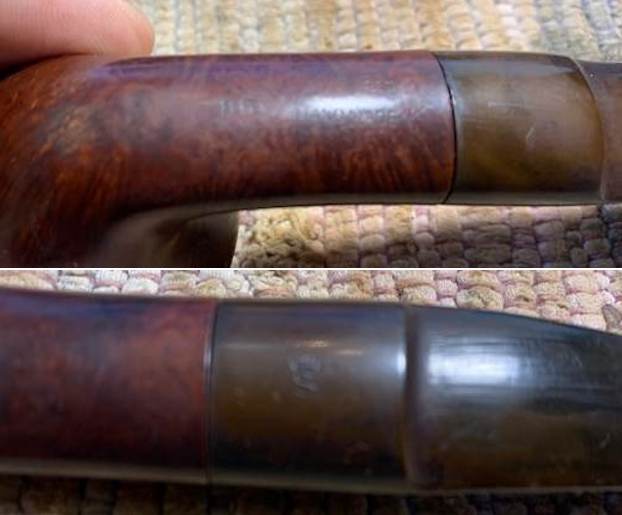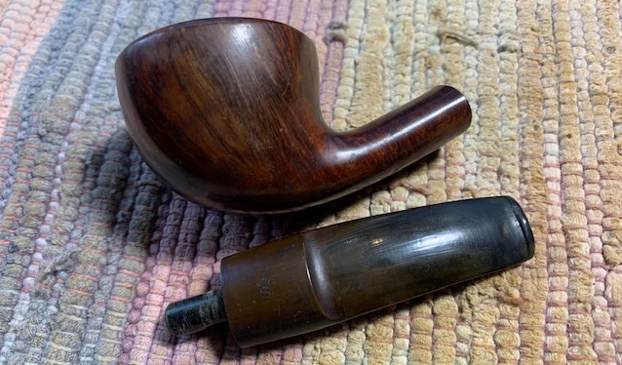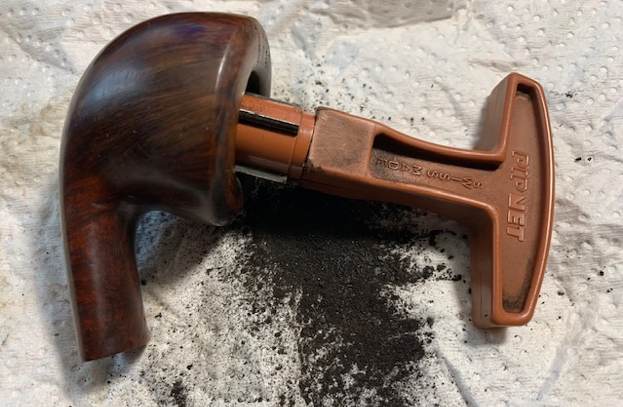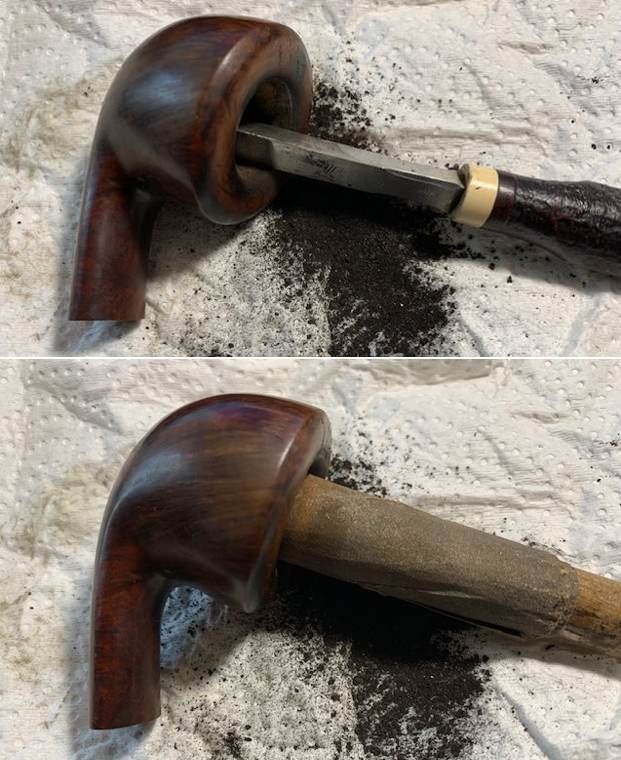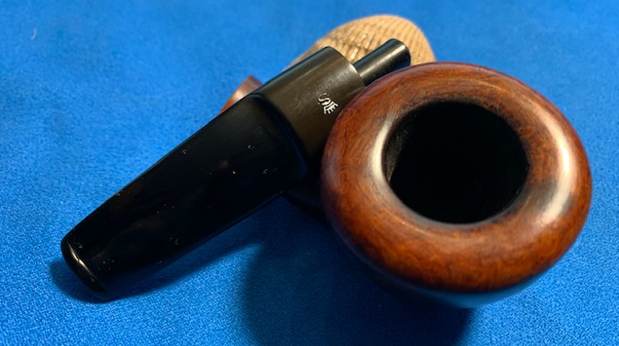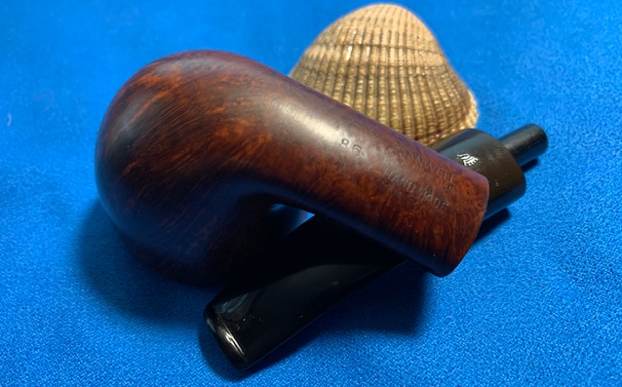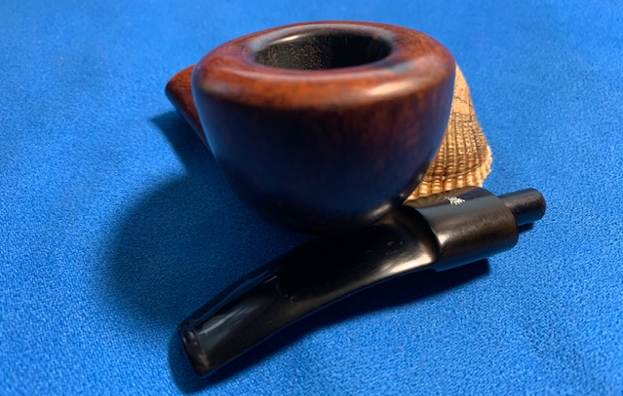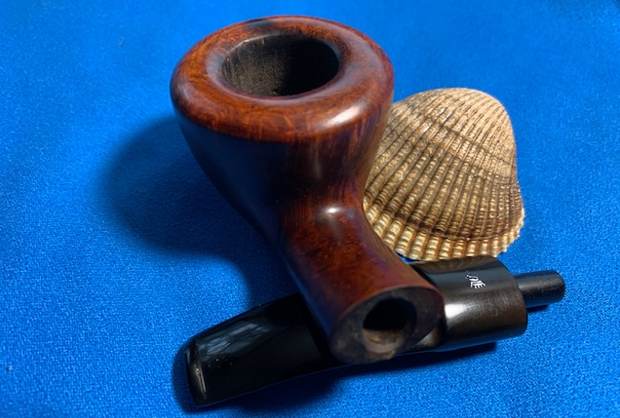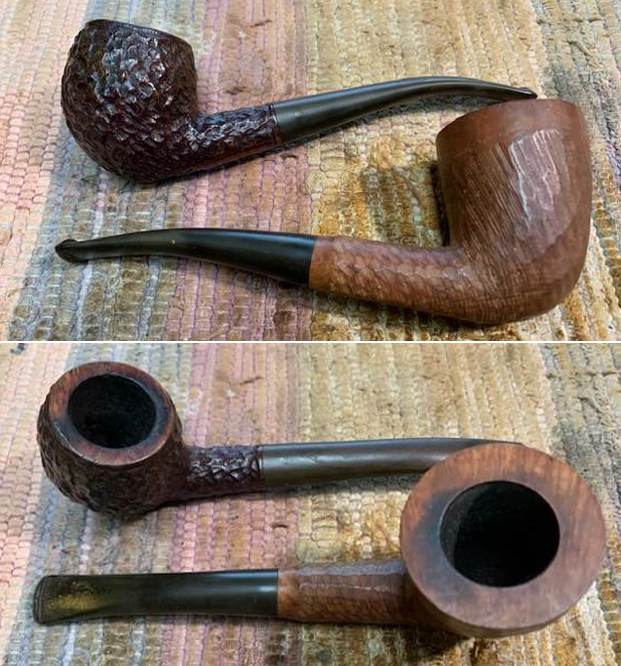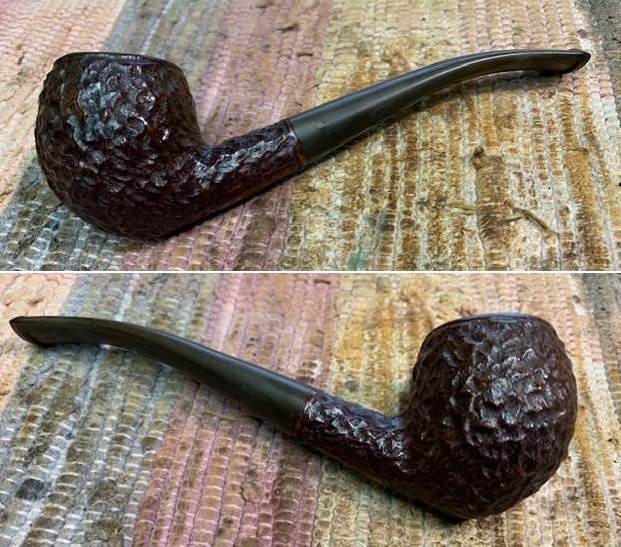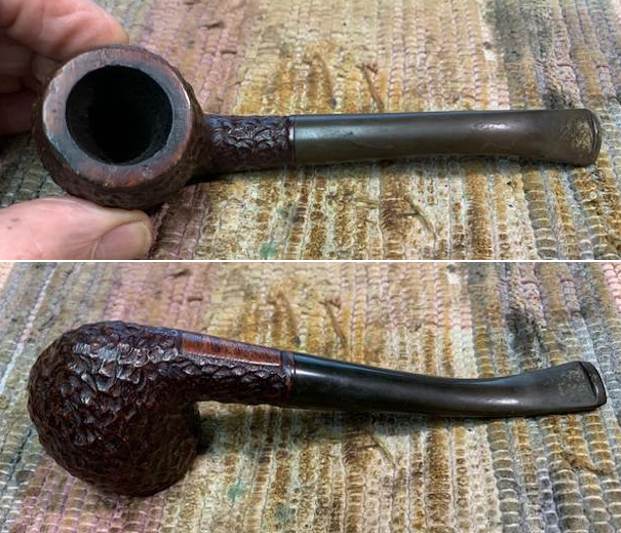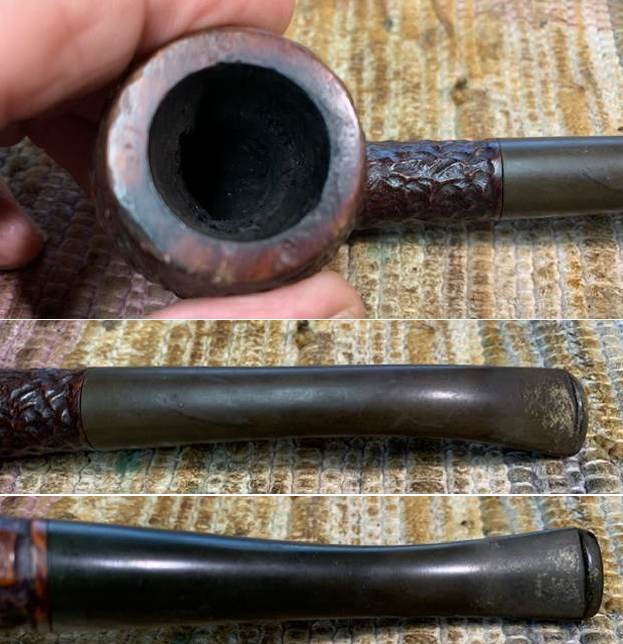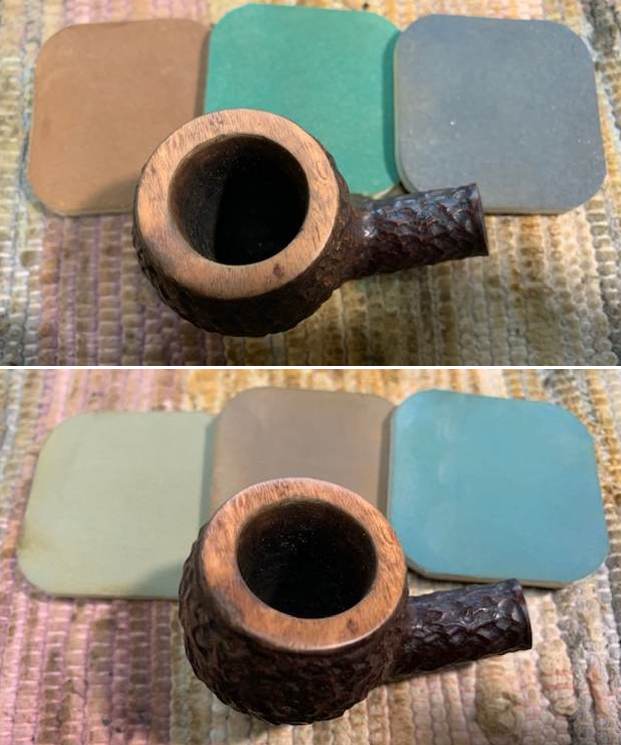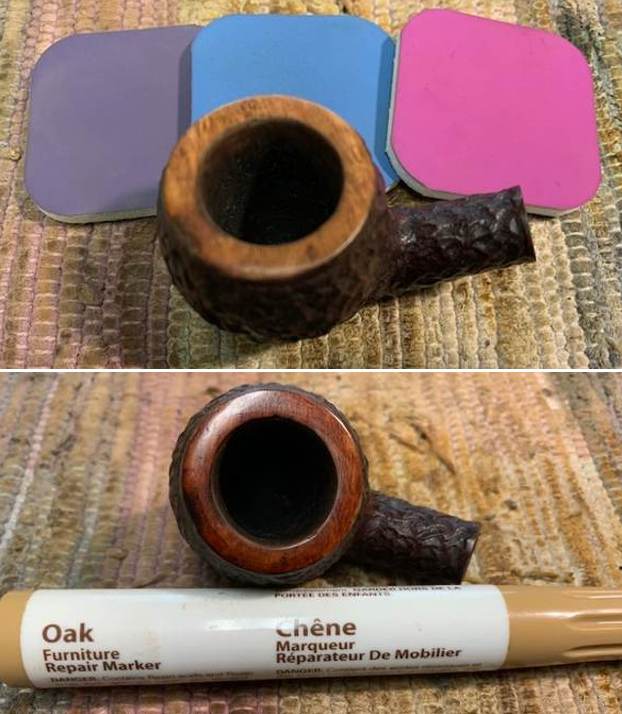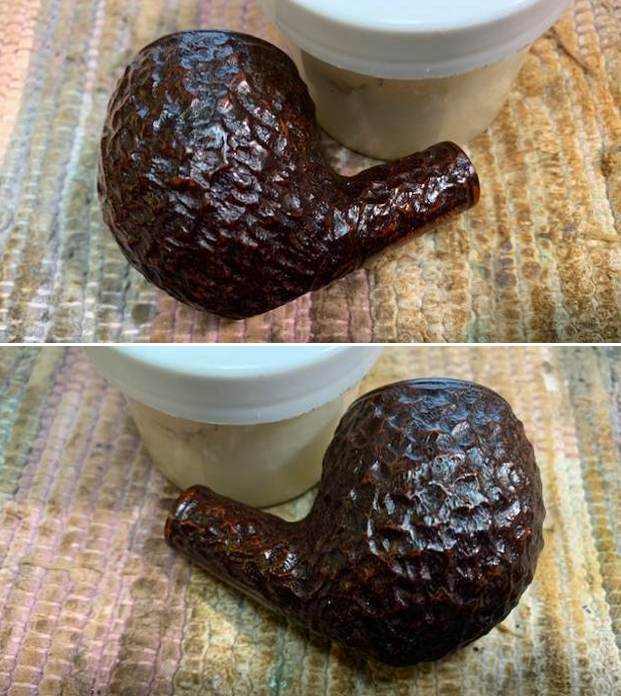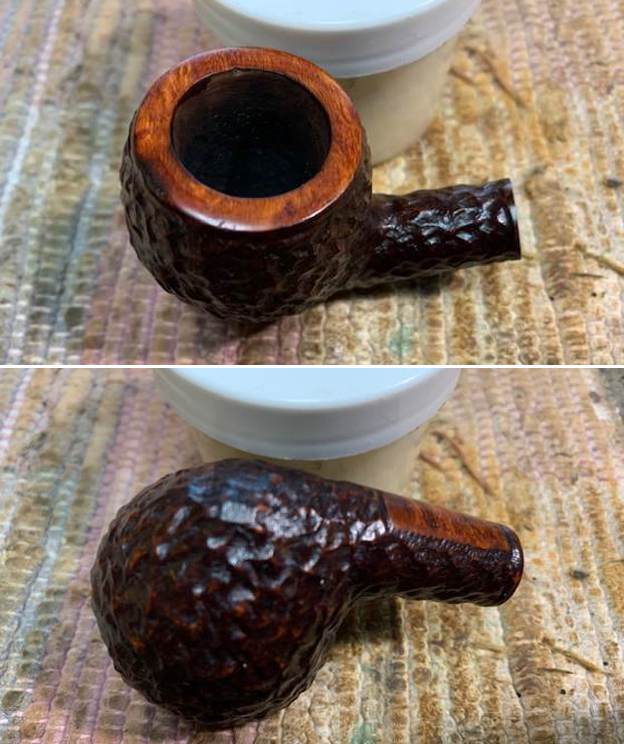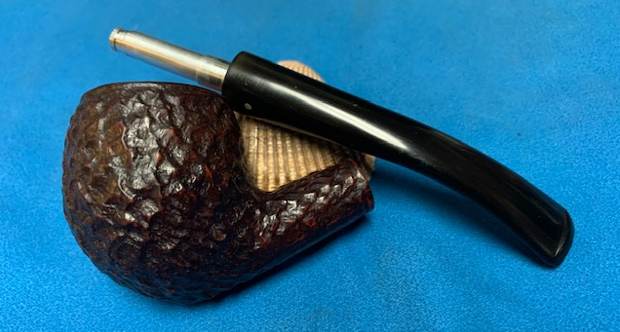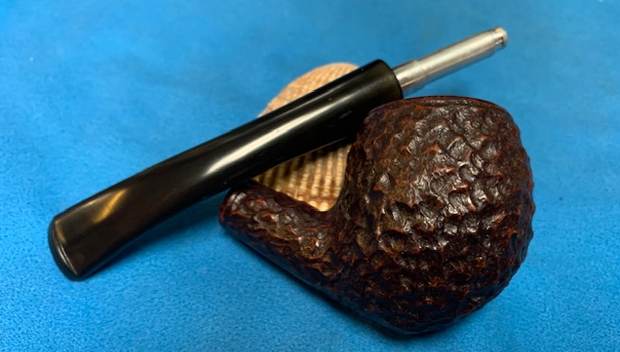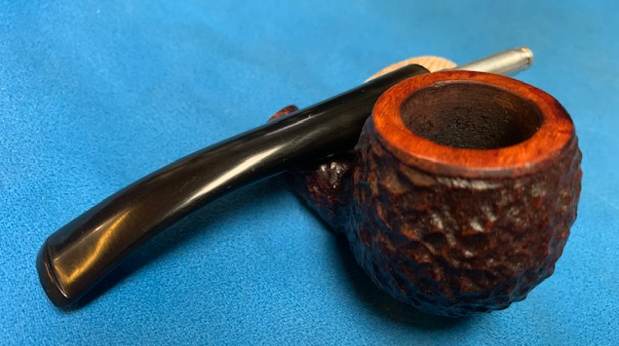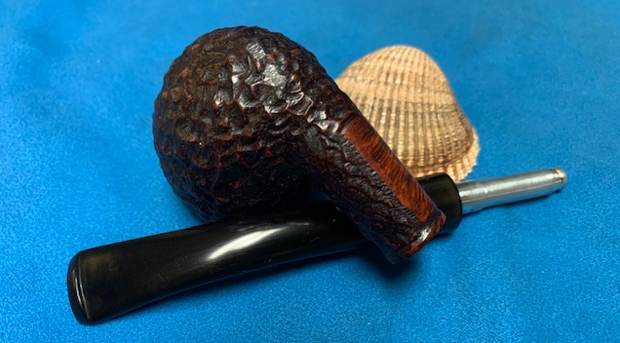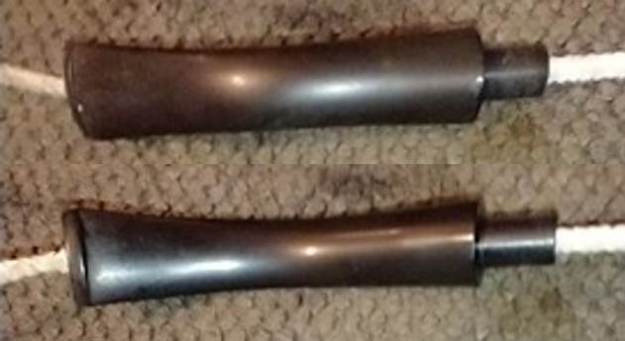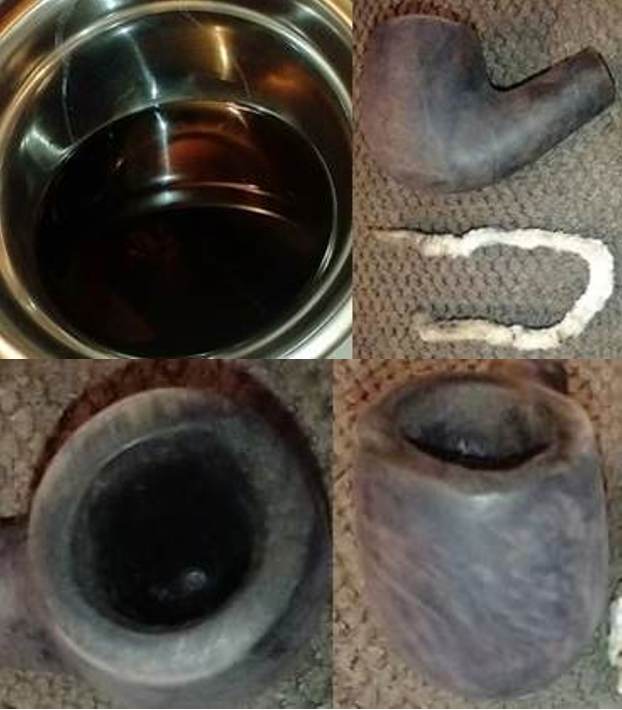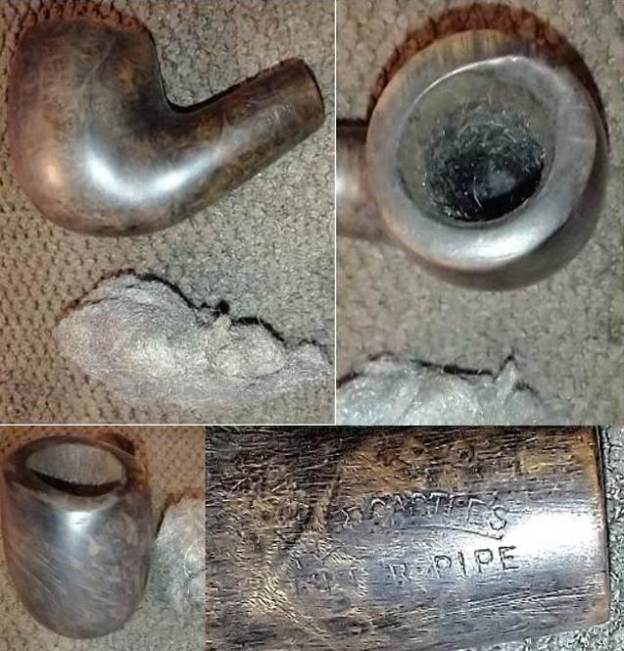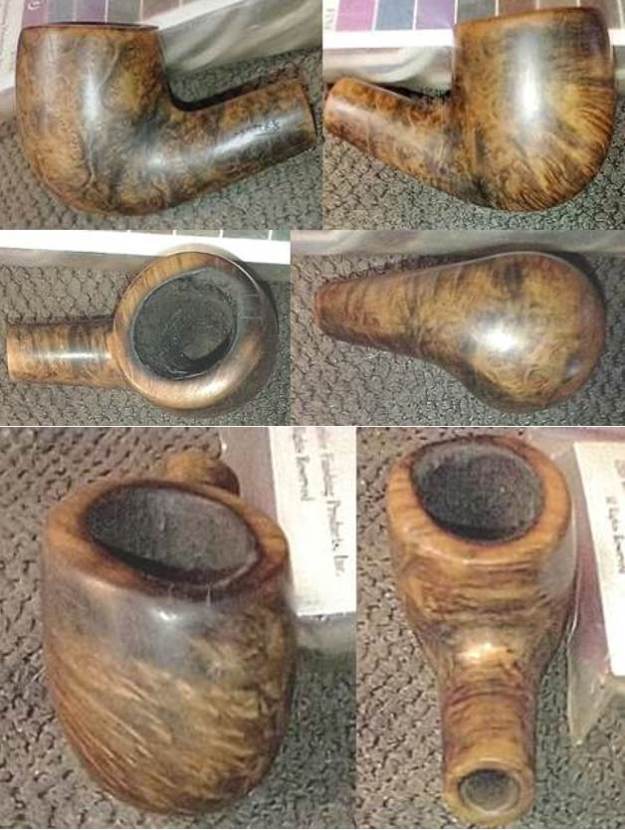
Tag Archives: restaining

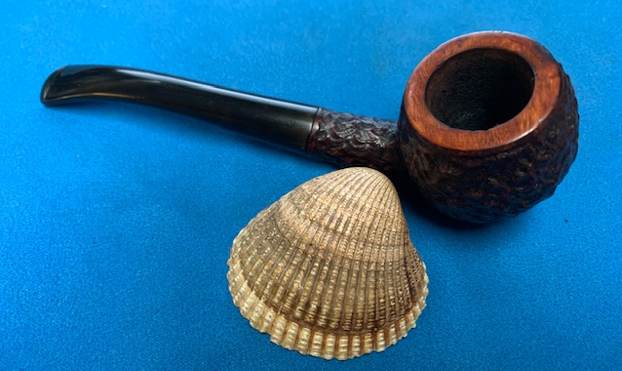
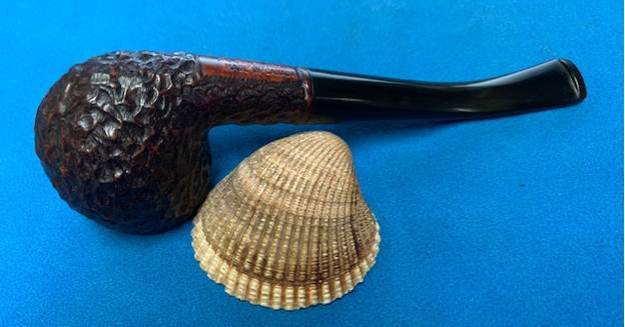
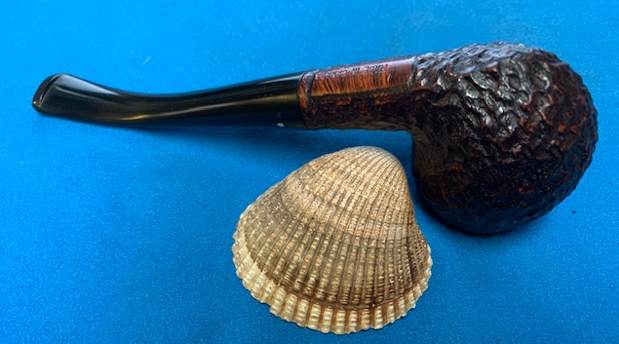
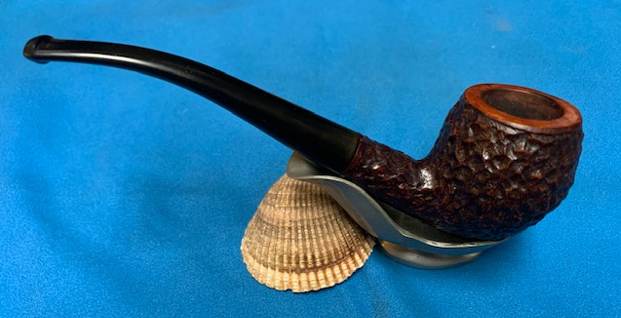
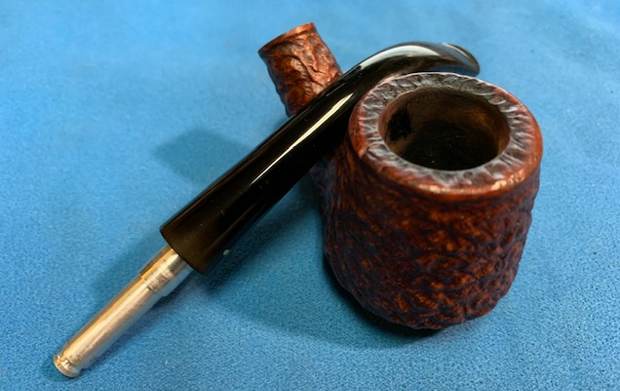
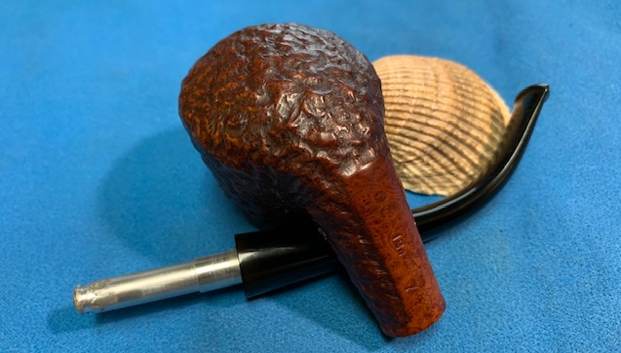
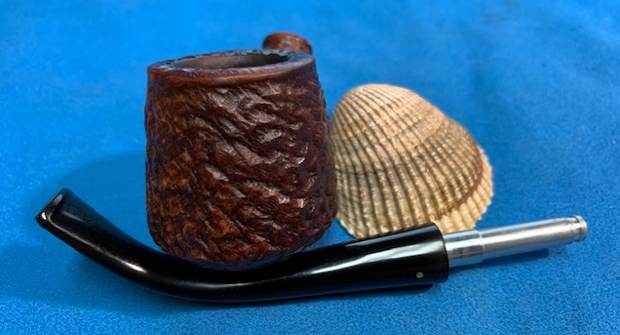
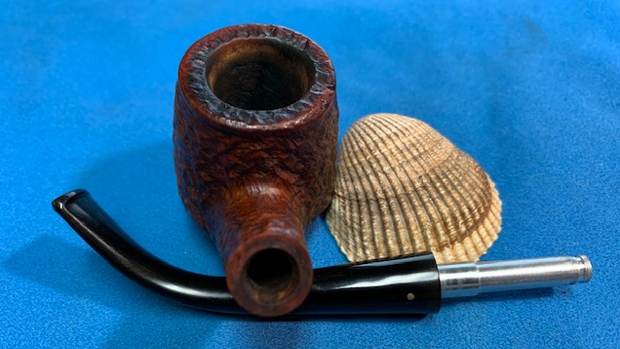
New Life for a Hard Ridden Sasieni 4 Dot Ruff Root Dark 8 Bent Apple


Blog by Steve Laug

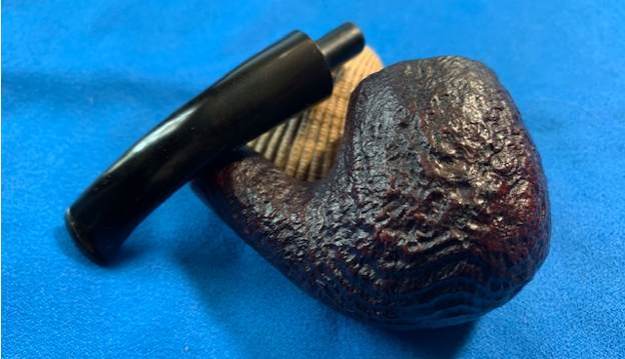
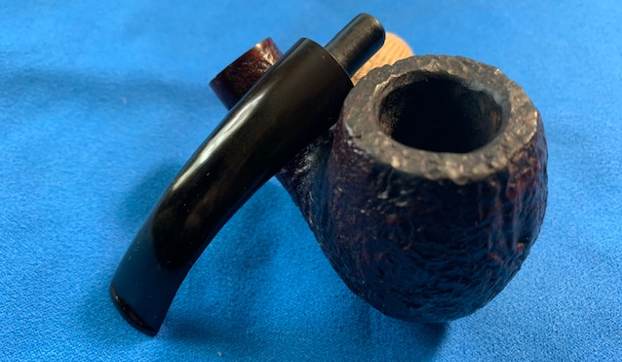
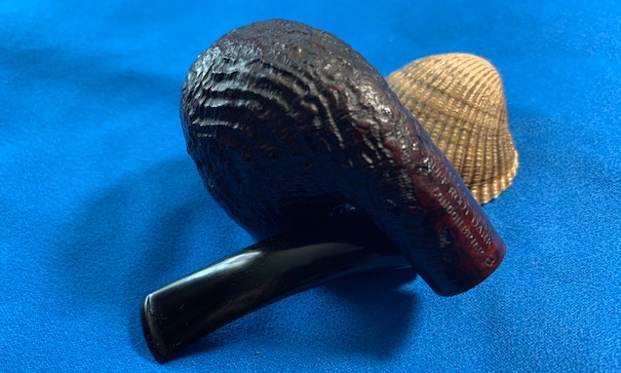
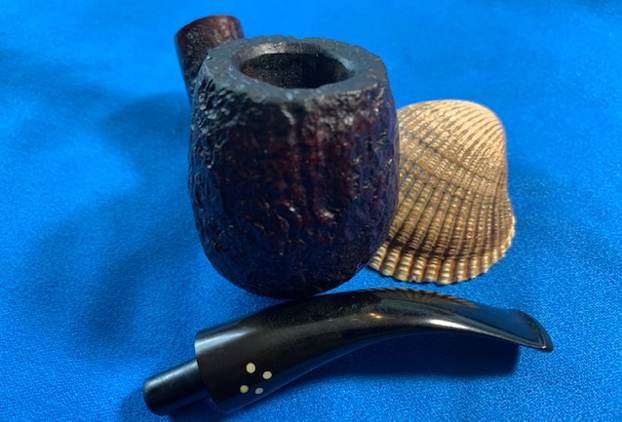
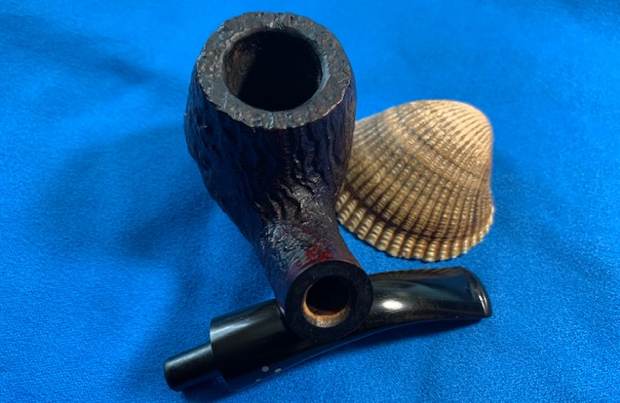
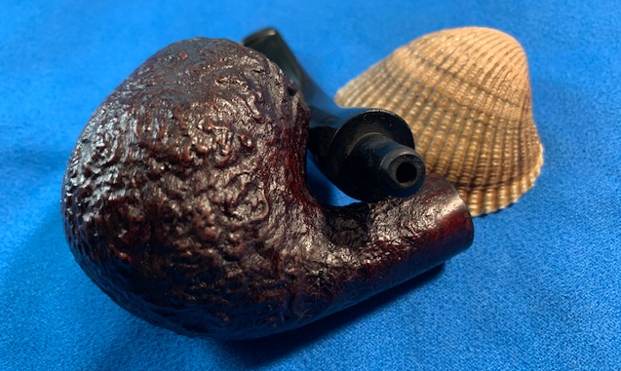
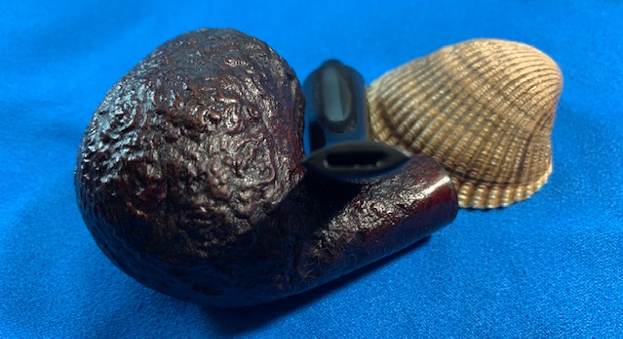
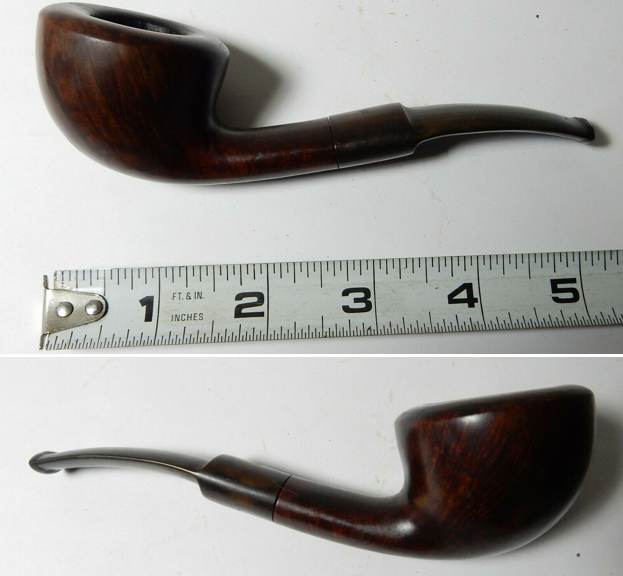
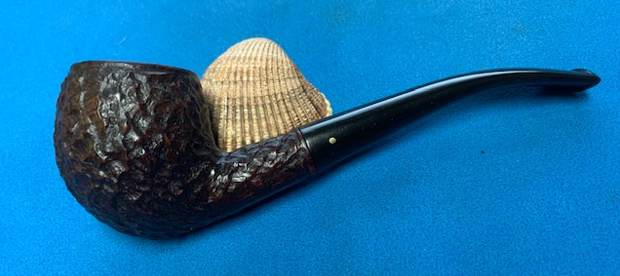
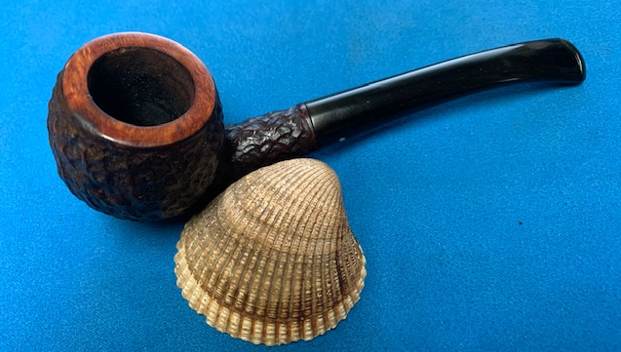
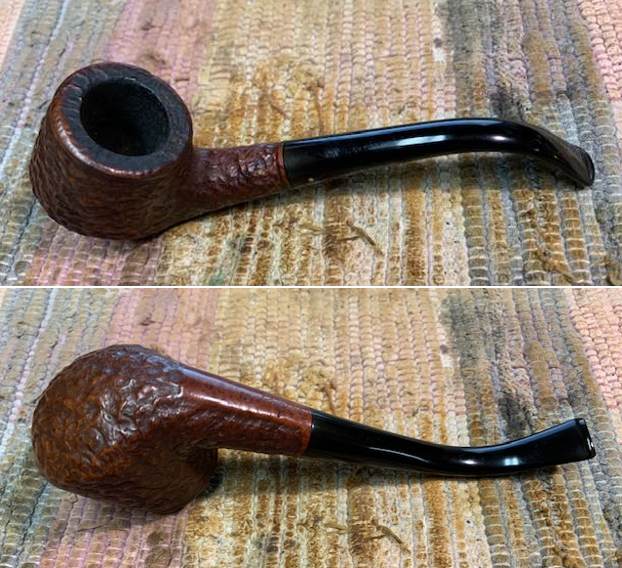
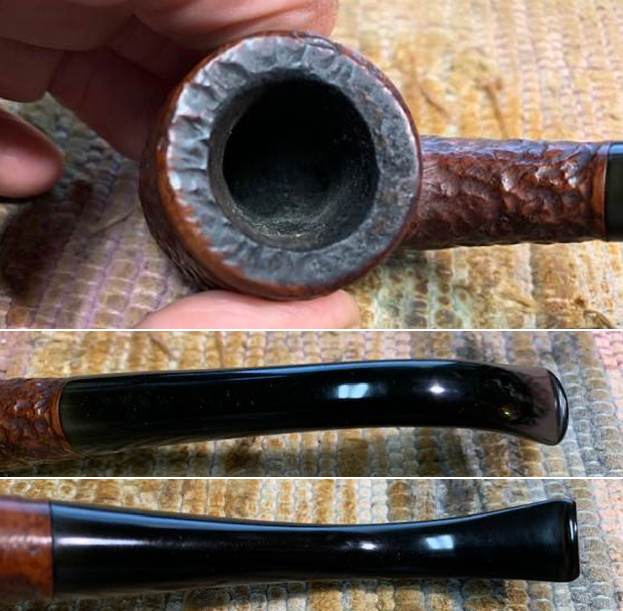
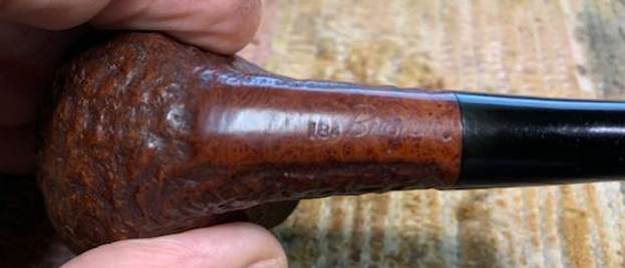
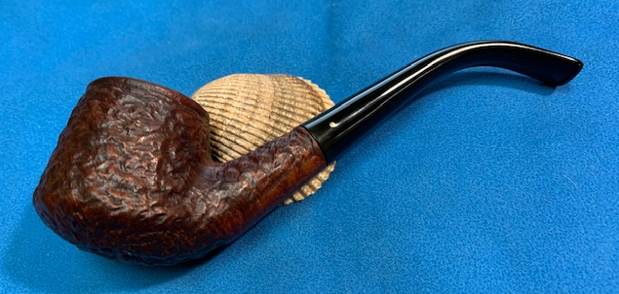
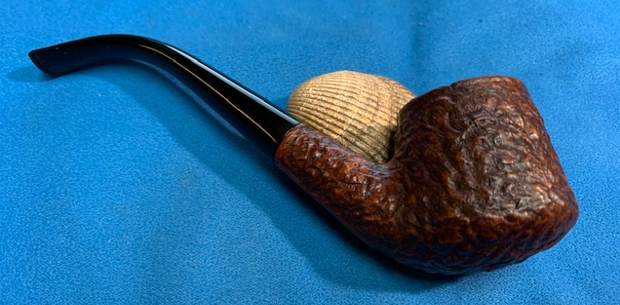
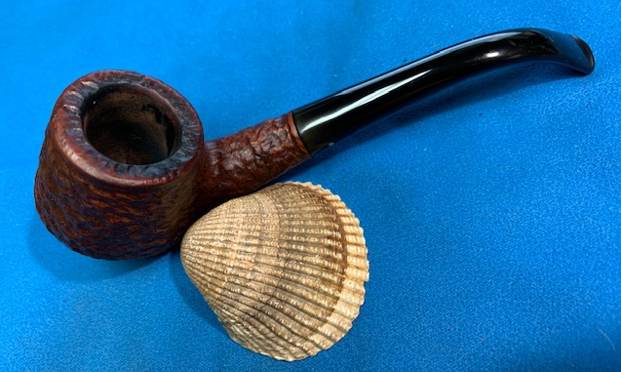
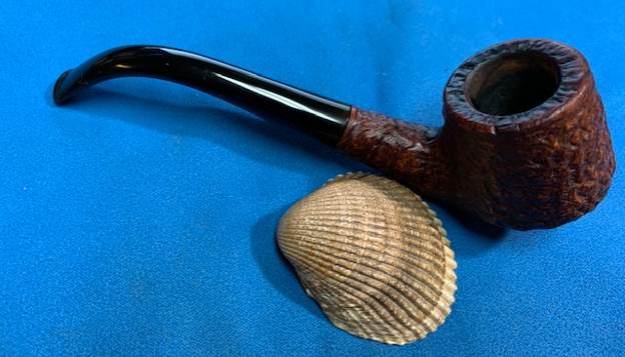
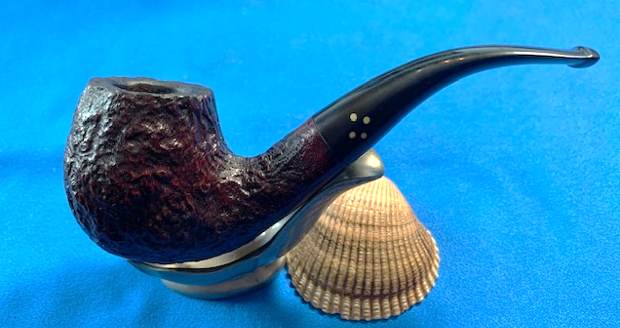
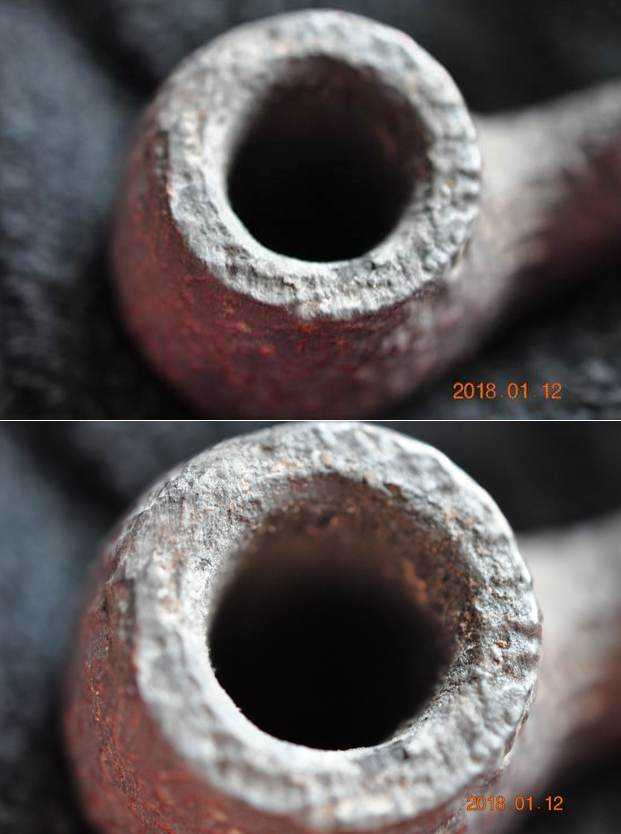
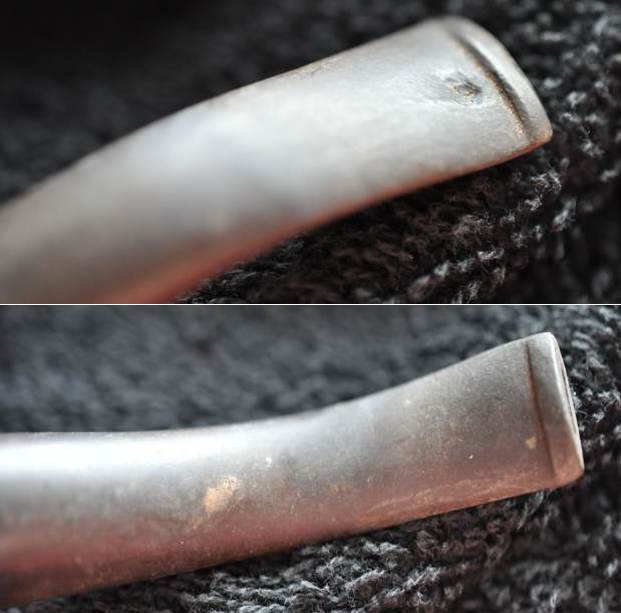
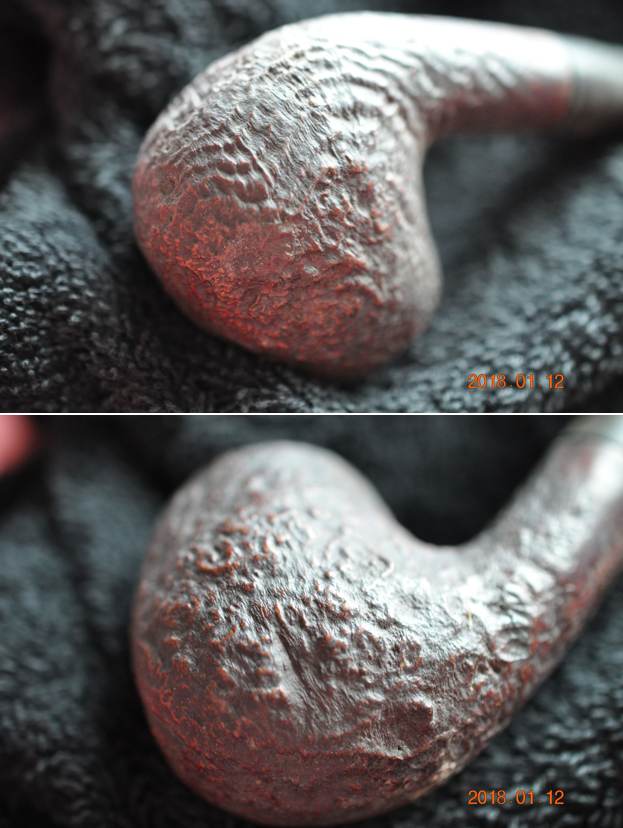
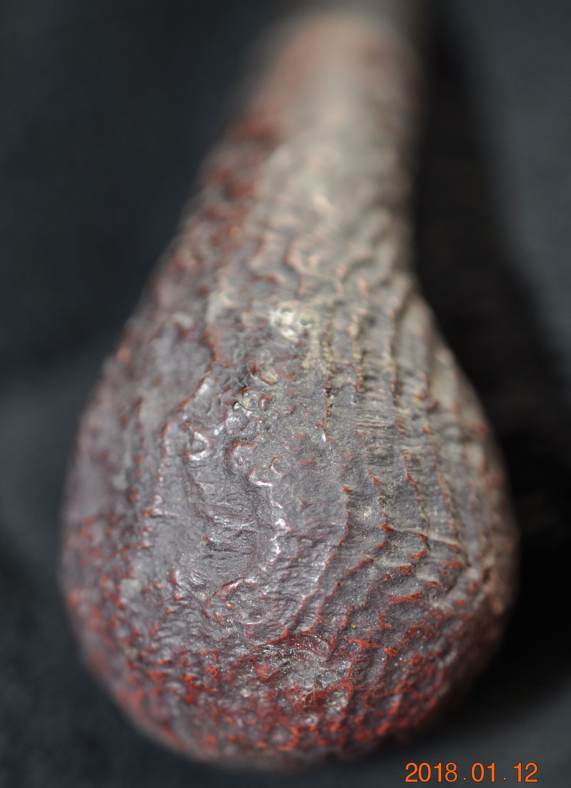
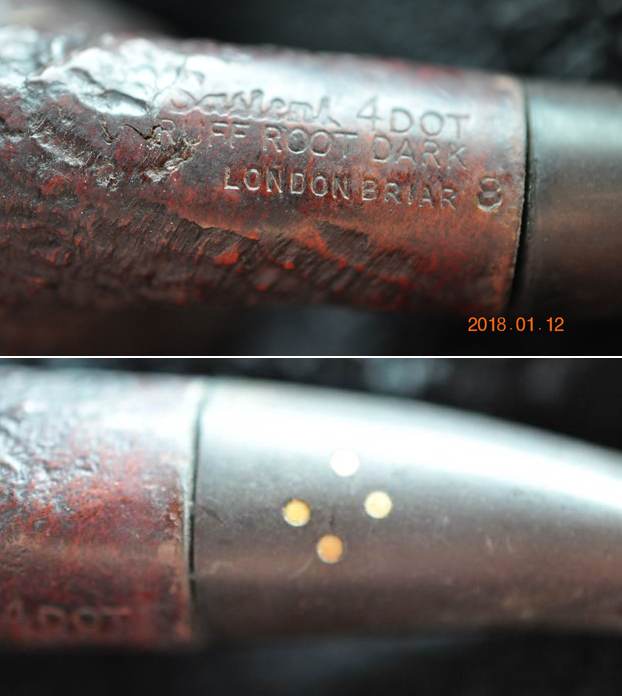
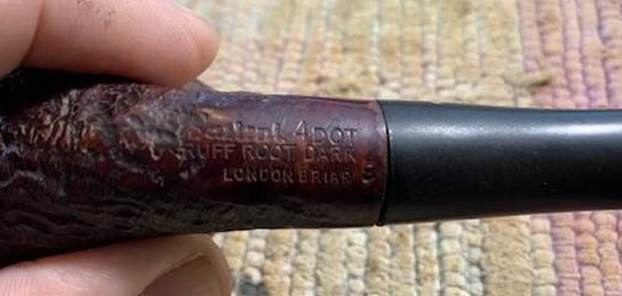
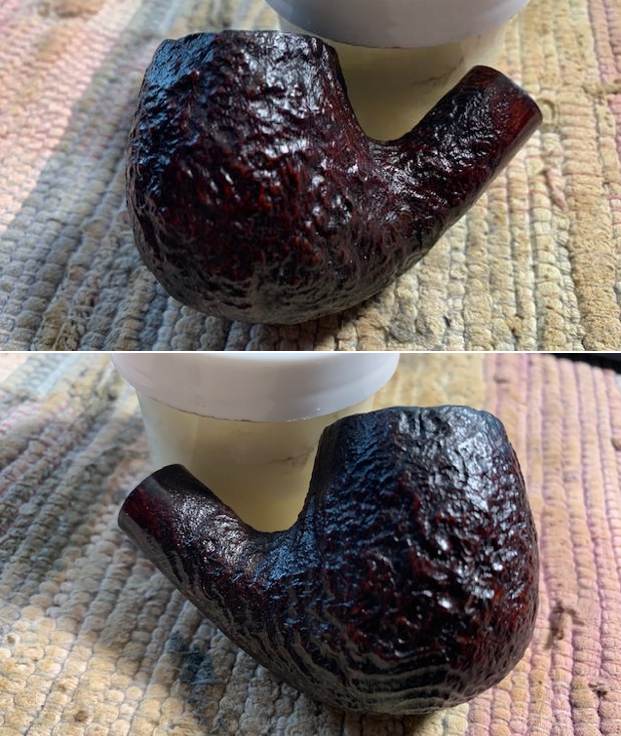
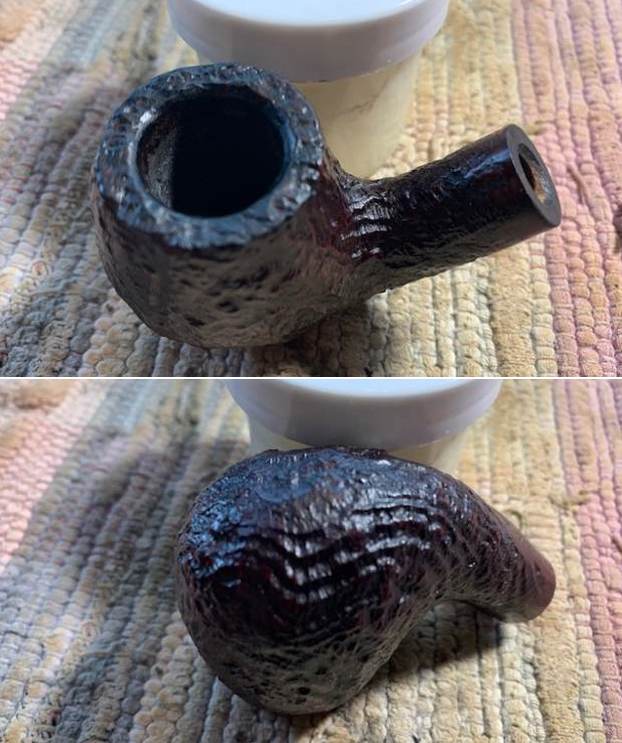
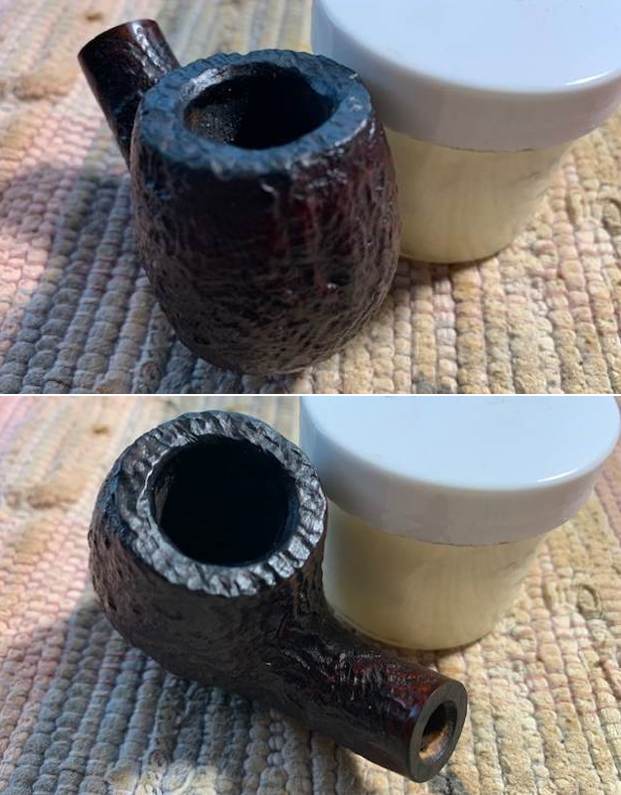
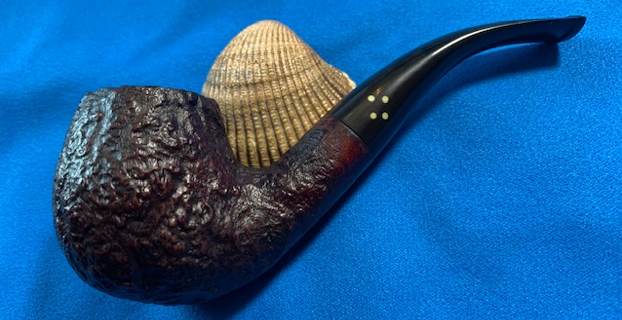
The next pipe on the work table has been here for over four years. Sad that there are some that have sat this long or longer before I got to them. But on the other hand I get to look through my boxes and pick out what turns my crank at the moment. This one was a nice sandblast bent apple. We picked it up back in January of 2018 from a seller on EBay from Los Fresnos, Texas, USA. It is stamped on the underside of the shank and reads Sasieni 4 Dot [over] Ruff Root Dark [over] London Briar followed by the number 8 which appears to be the shape number. The poor pipe had obviously been someone’s favourite and must have been a grand smoker. The finish appears to be light brown but the grime and debris in the sandblast lend to that thought. The bowl is heavily caked with a thick lava overflow on the rim top filling in the sandblast. The stem fits with a gap showing that the shank is also heavily tarred. The stem has some oxidation and deep tooth marks on the top and underside near the button. It really was a mess and a stinky one at that! Jeff took pictures of the pipe before he did his clean up work. He took photos of the bowl and rim top to give an idea of the thickness of the cake and the lava on the top. It was quite thick and hard. He took photos of the stem surface to show the oxidation and the tooth marks on them. There was a deep tooth mark on the top of the stem near the button. He took photos of the sandblasted grain around the bowl sides and heel of the bowl. It is a very nice looking blast. Jeff captured the stamping and the placement of the four dots on the stem side. The stamping is clear and readable. You can also see several issues with the pipe in these photos. First, to the left of the stamping (next to Ruff) there is a flaw in the briar. It looks like a crack but it follows the grain of the blast. Second, the fit of the stem to the shank is off which says to me that the tenon is crooked not allowing a fit to the shank end.I remembered that I had worked on a Sasieni Ruff Root Dark in the past – a Canadian if my memory served me right. I did a quick search on rebornpipes and found the Canadian I was remembering and the blog I had written (https://rebornpipes.com/2020/04/19/an-easy-restoration-of-a-sasieni-4-dot-ruff-root-dark-13-canadian/). I had done some research on the stamping and brand for that blog and I am including it below.
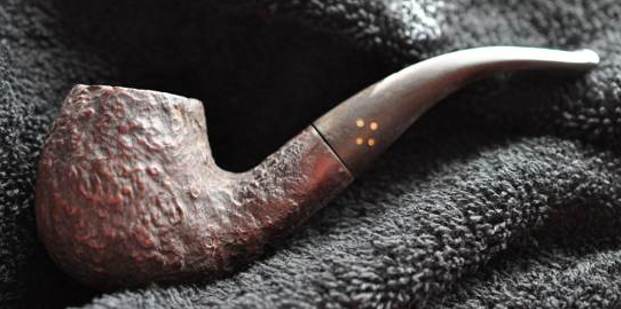
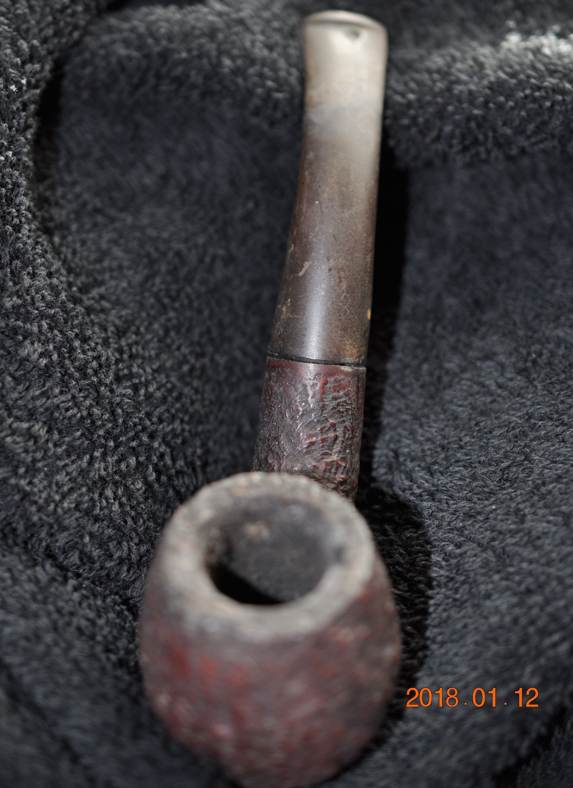
When the pipe arrived I turned to Pipephil (http://www.pipephil.eu/logos/en/logo-sasieni.html) to see if he included not only information on this Sasieni 4 Dot Ruff Root Dark Canadian. Sure enough there was some quick information that identified the time frame of this pipe. He dates it as a Post Transition piece 1986-today. The Ruff Root name is what they call a sandblasted finish. He points out that the 4 Dot has replaced the Four Dot from 1986.I turned to Pipedia for more information on 4 Dot line of Sasieni pipes and any information that was added there (https://pipedia.org/wiki/Sasieni). I quote a pertinent paragraph:

The nomenclature changed again in 1986, with the sale of the company to the Post-Transition firm. The three line nomenclature was changed to two lines, with the first reading “Sasieni 4 Dot” and the second identifying the finish, e.g. Natural, Walnut, or Ruff Root. Note how 4 Dot is spelled, using an Arabic numeral 4, as opposed to spelling out the word “four”. This is the easiest way to spot a Post-Transition Sasieni, as the new company has used both script and block lettering to spell the word “Sasieni” on the shank

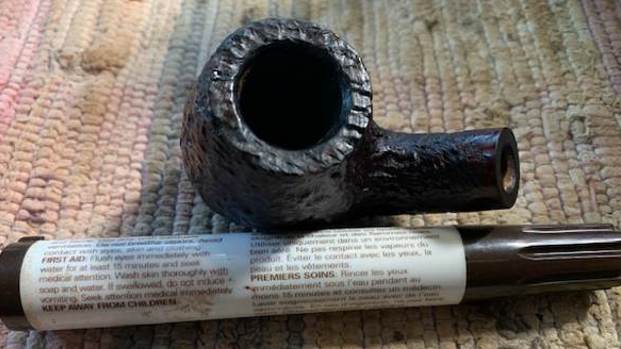
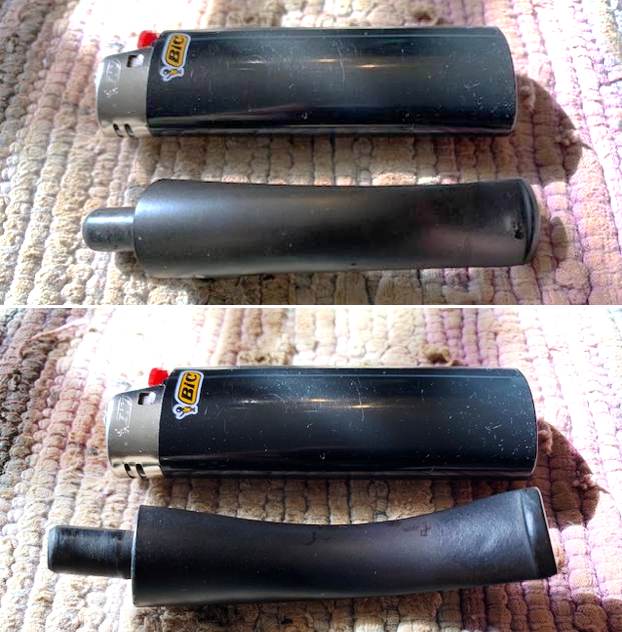
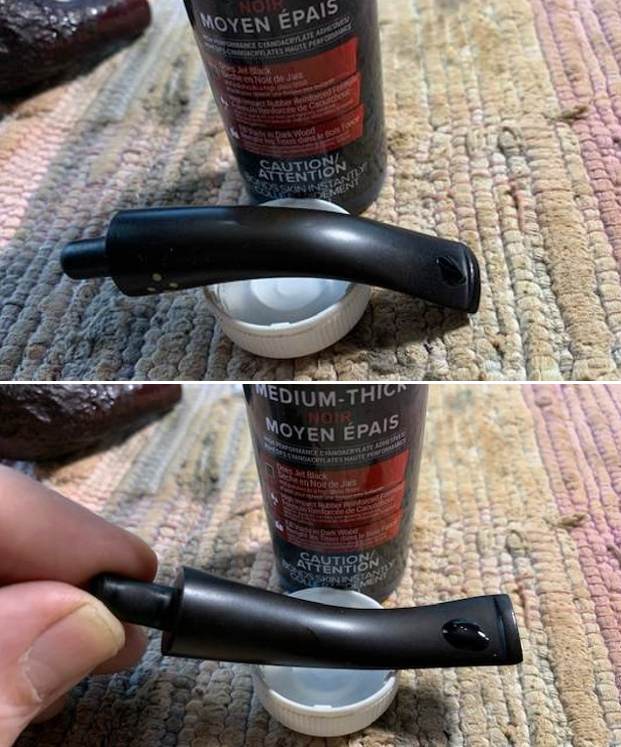
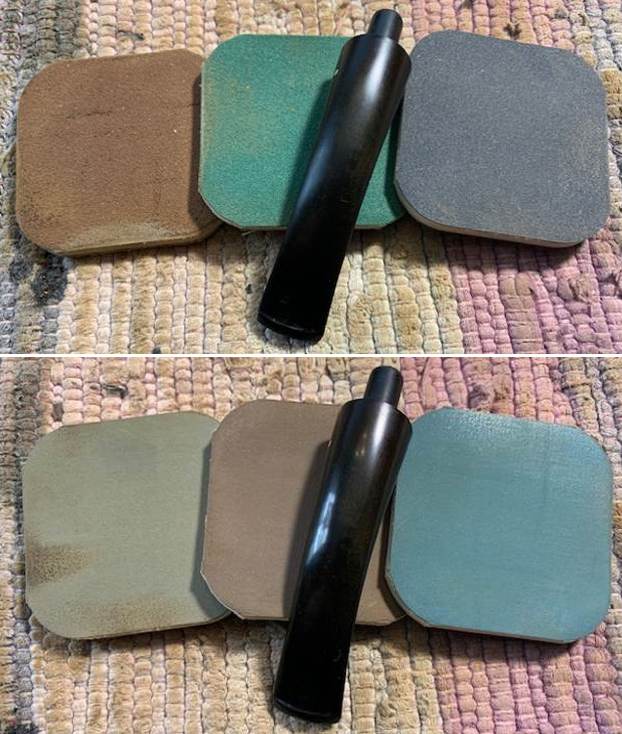
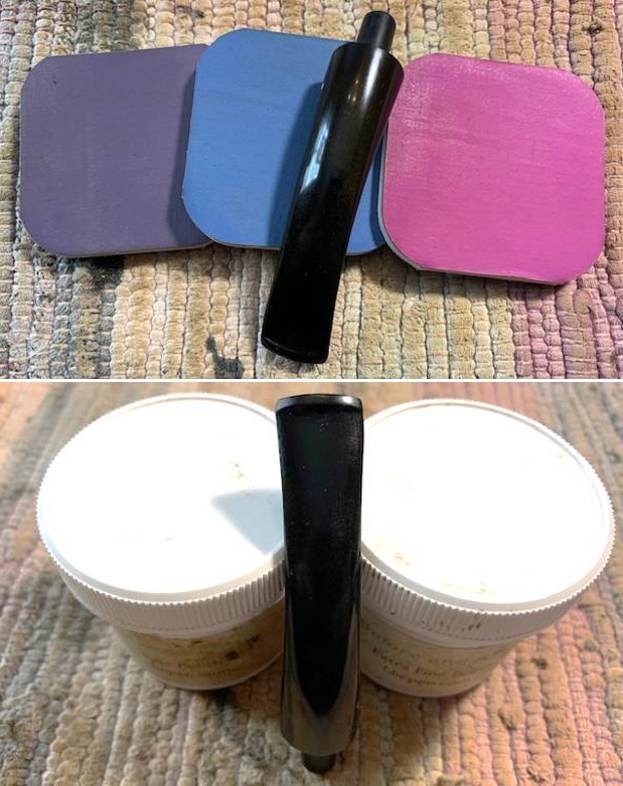
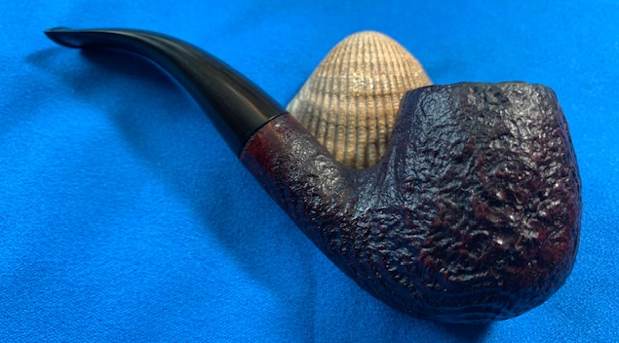
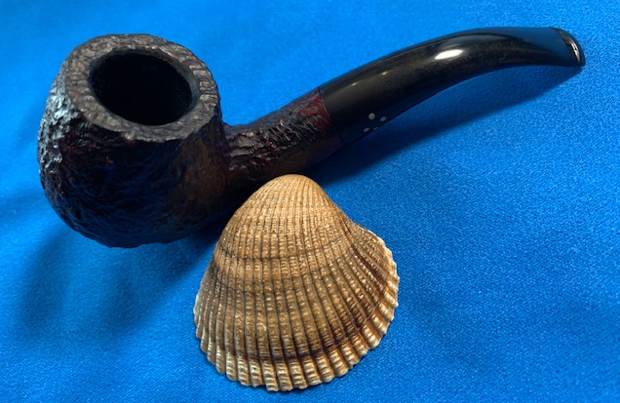
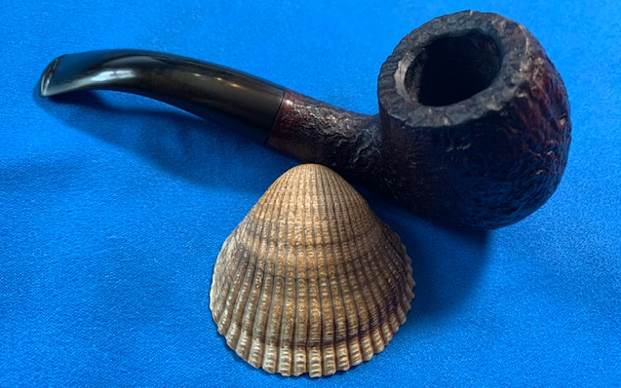
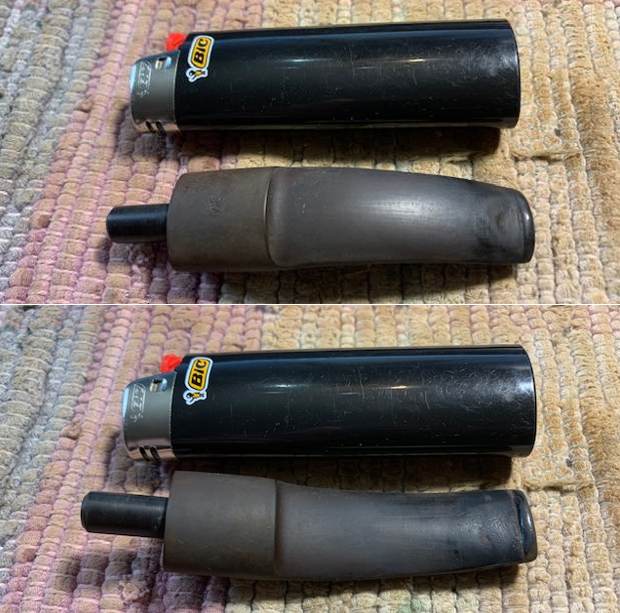
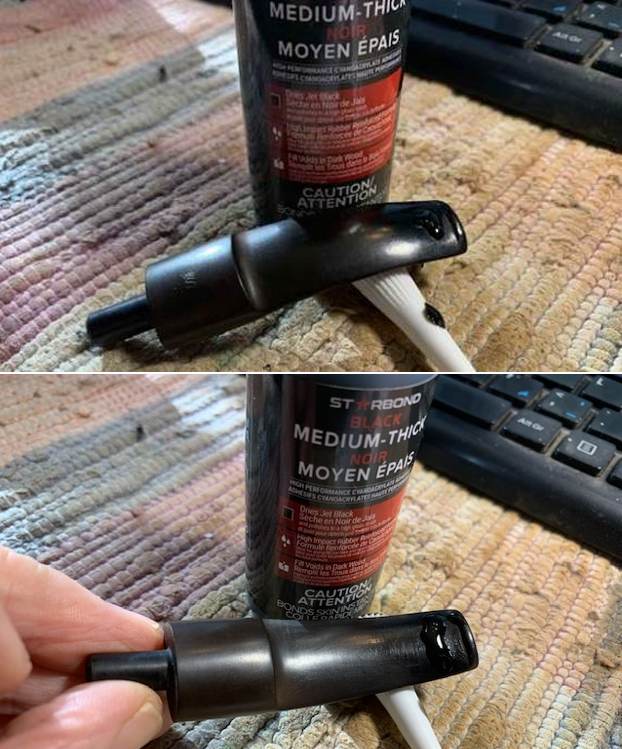
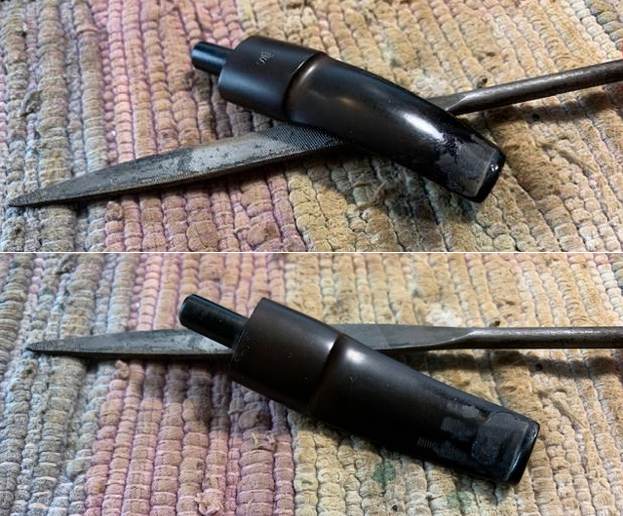
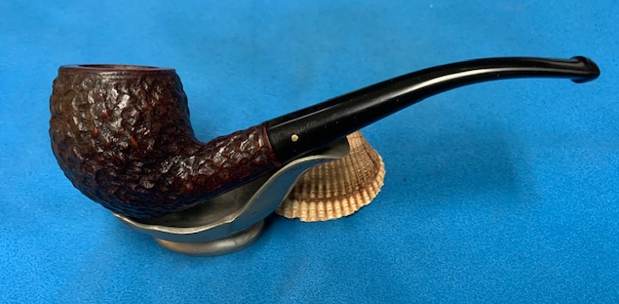
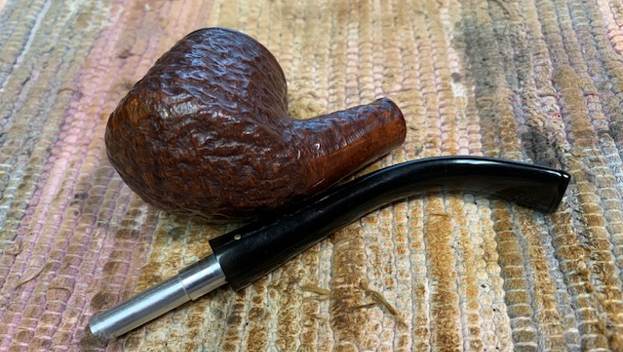
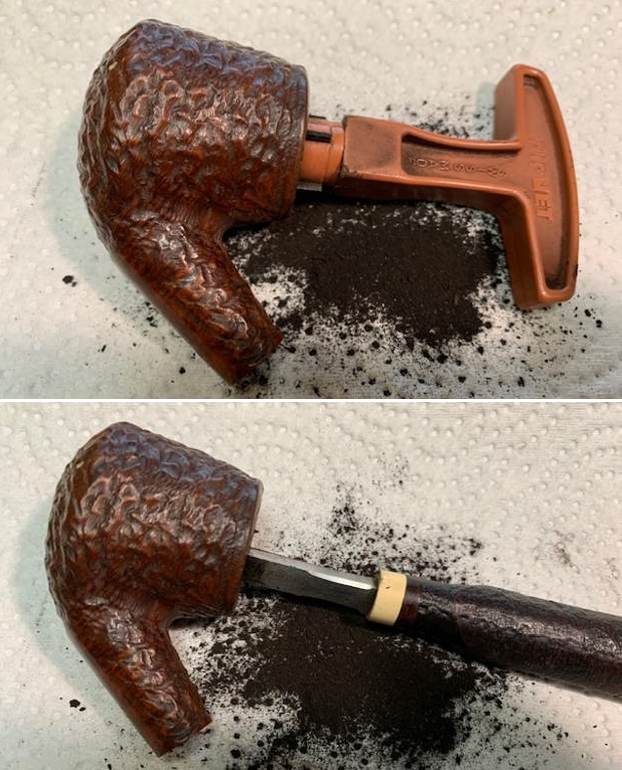
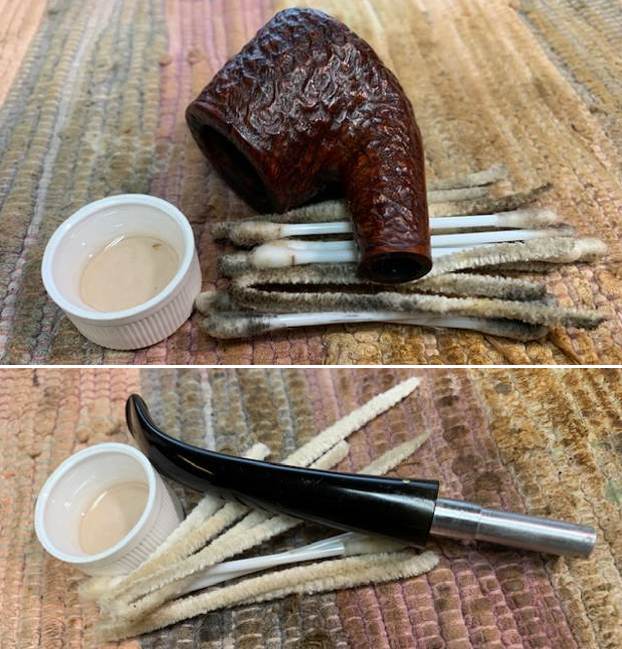
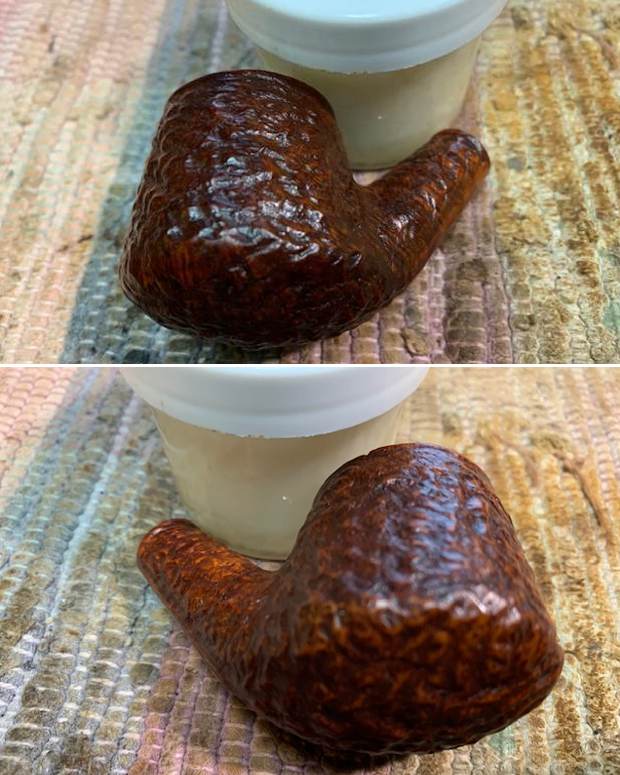
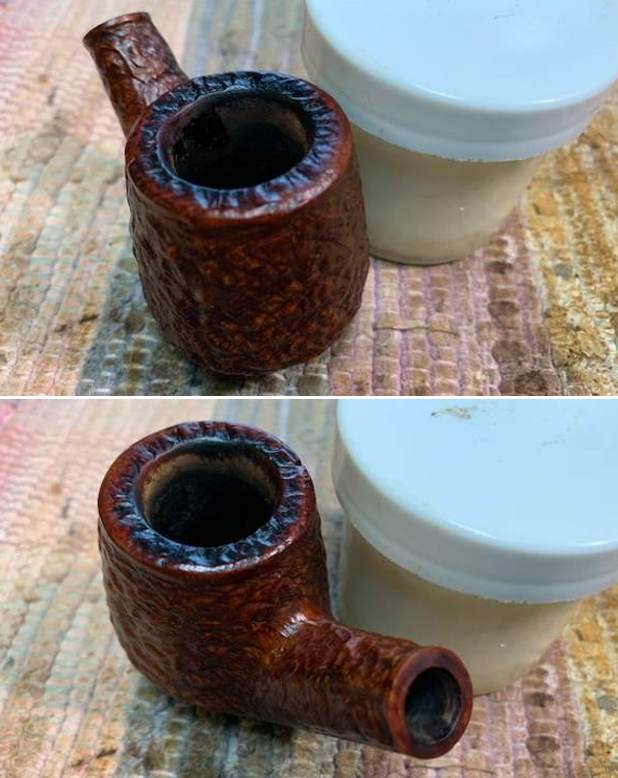
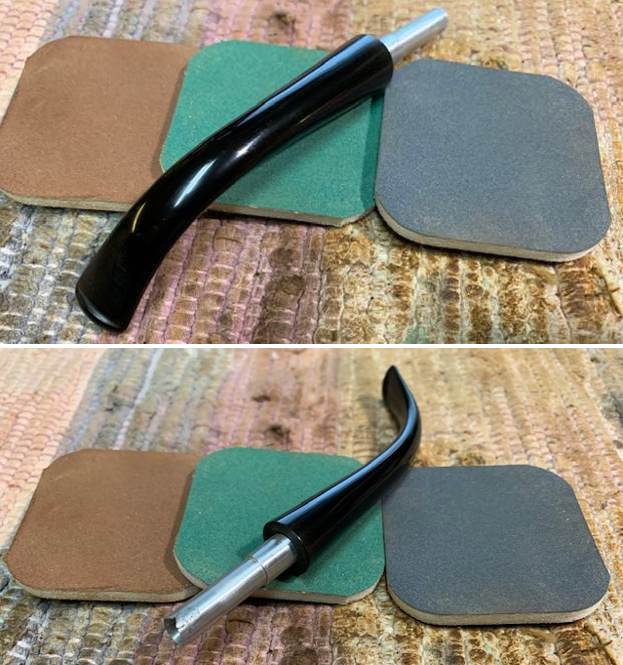
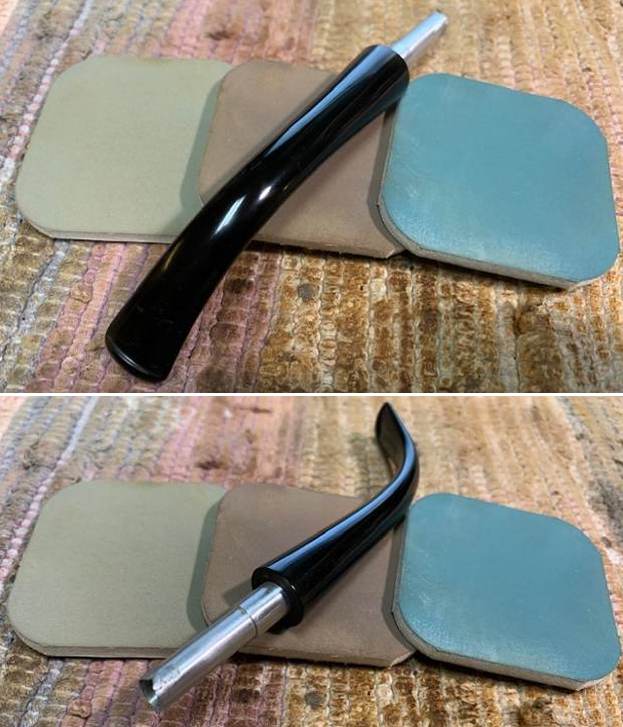
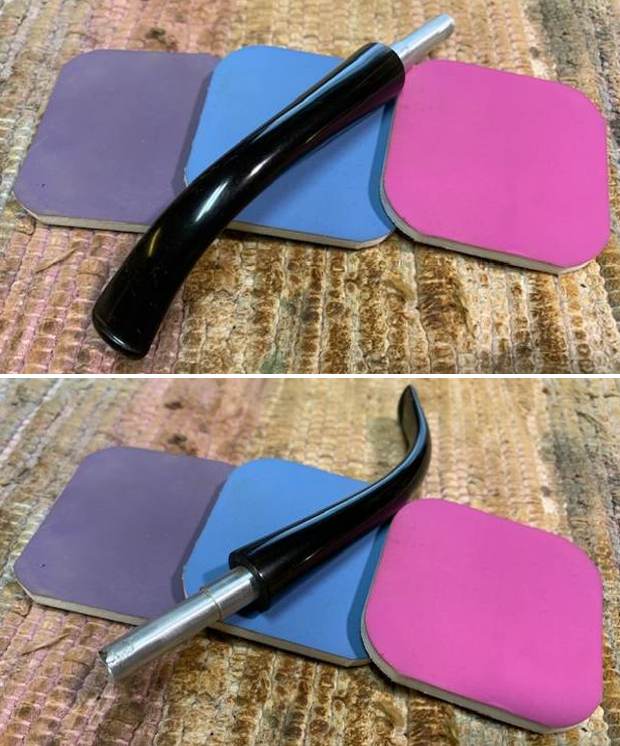
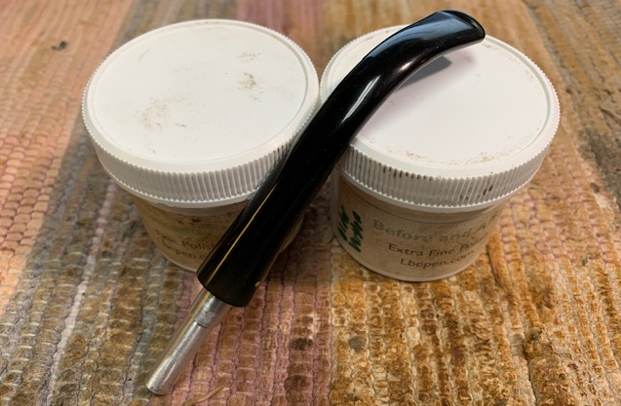
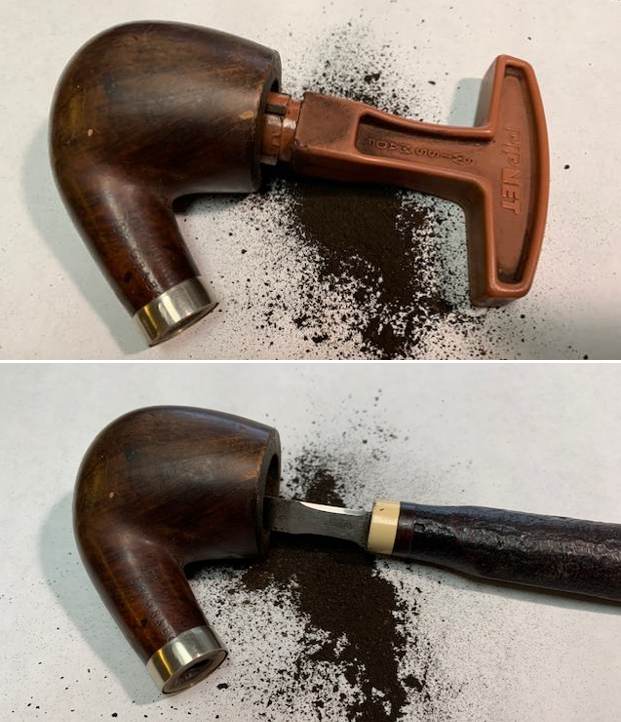
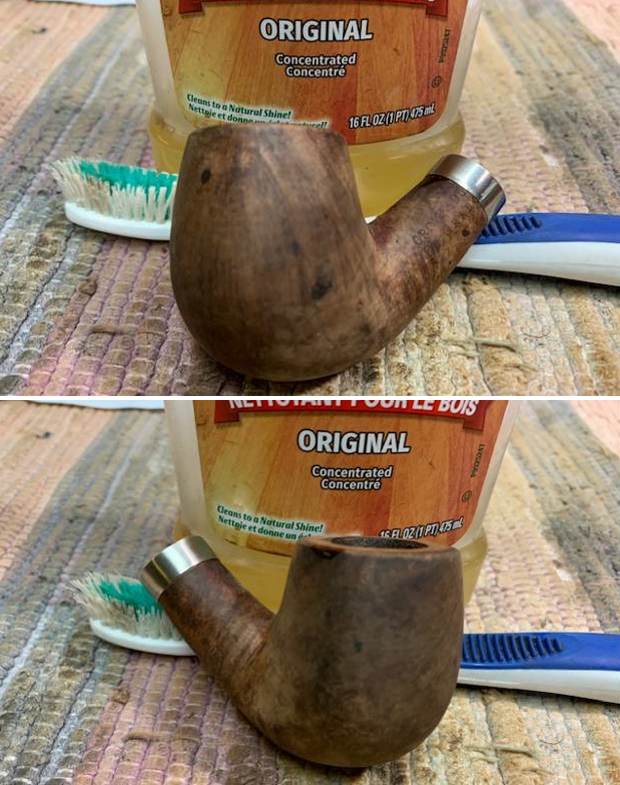
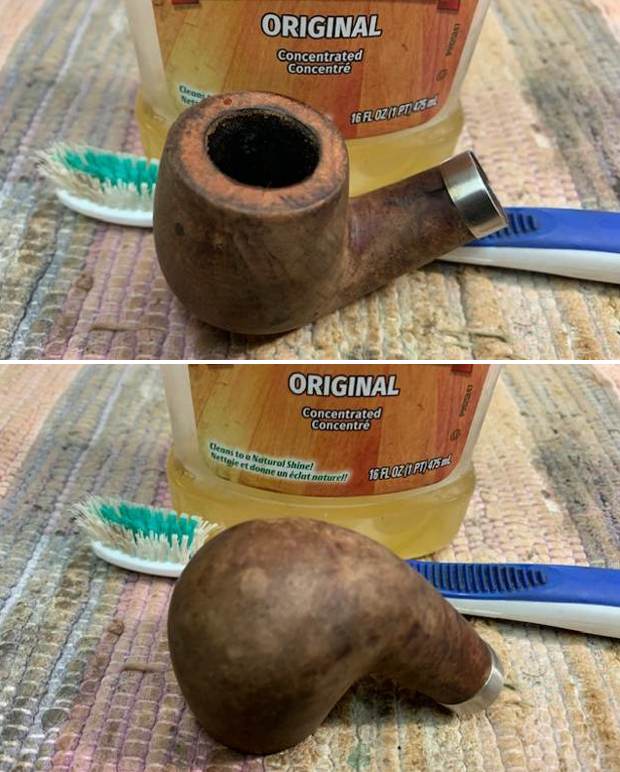
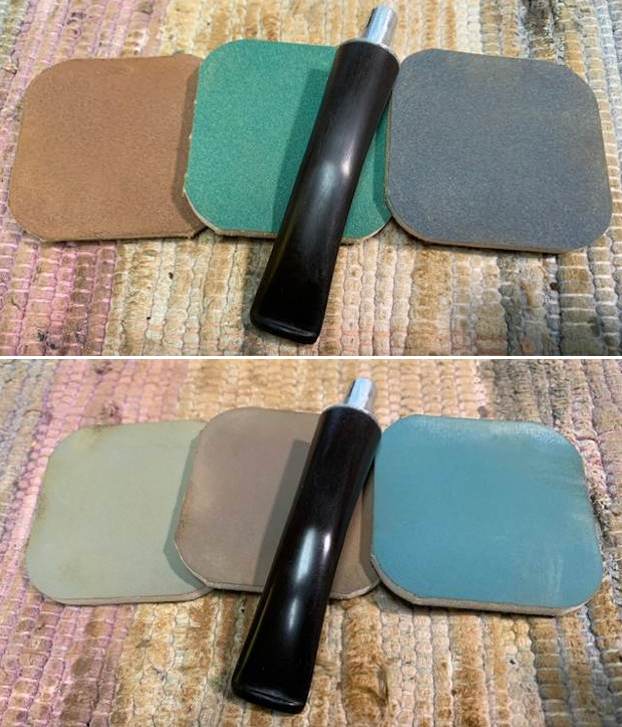
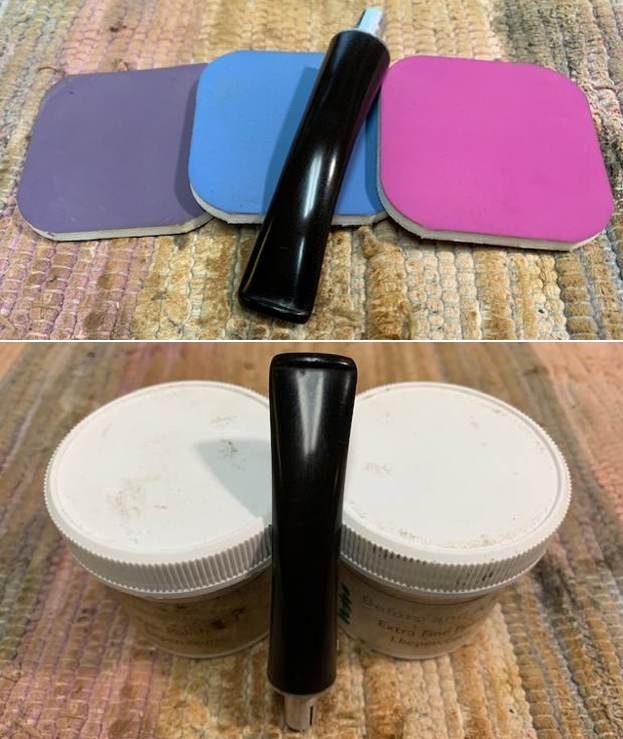
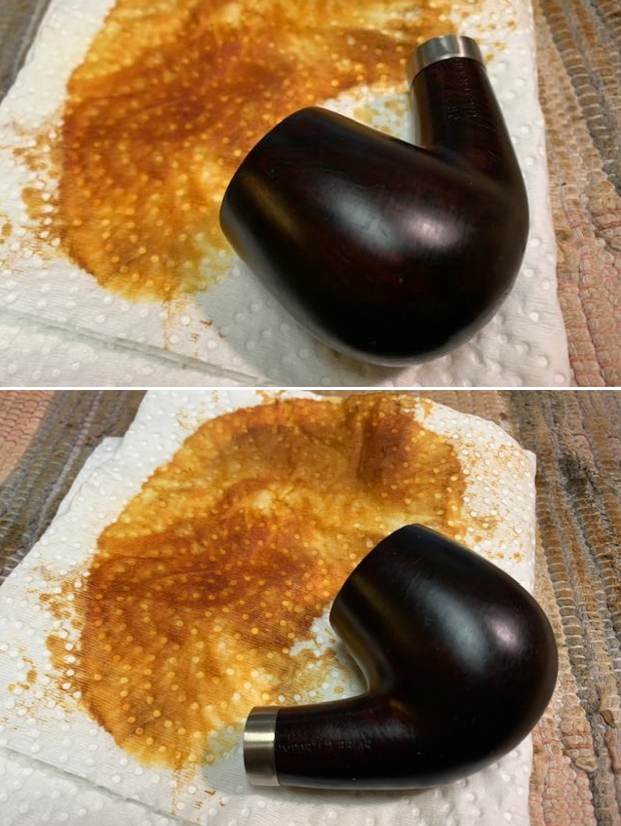
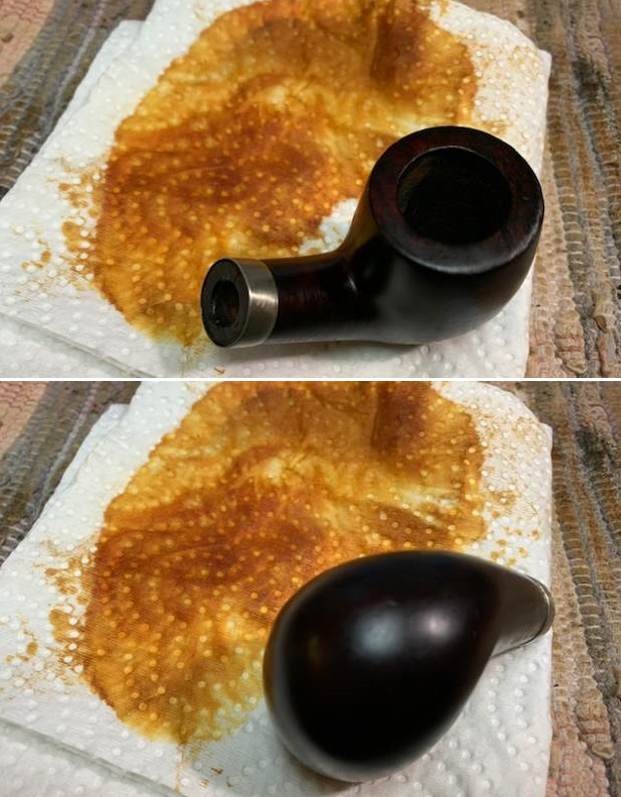
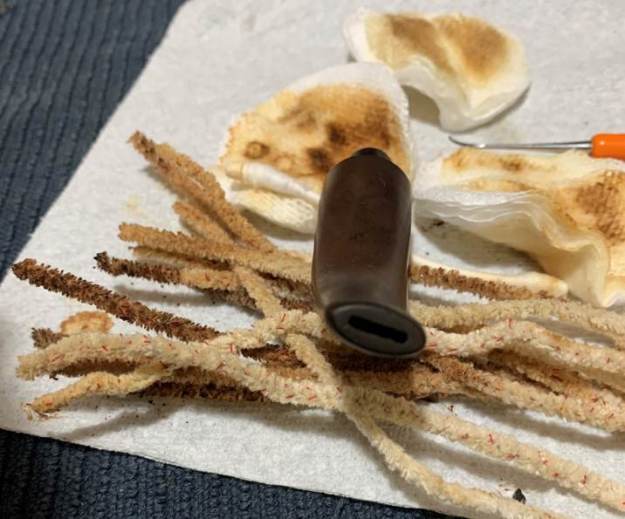
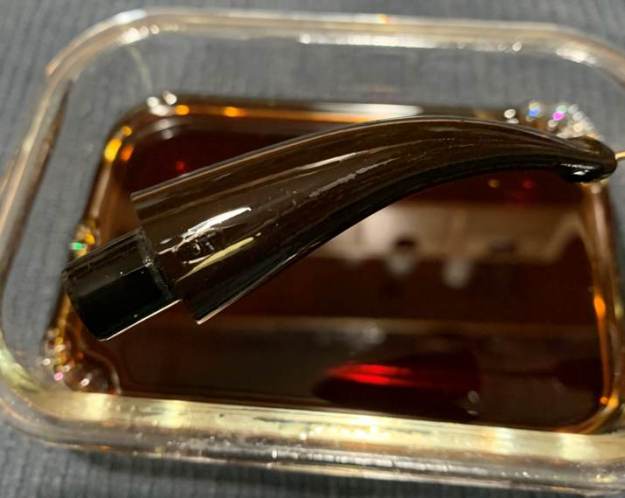
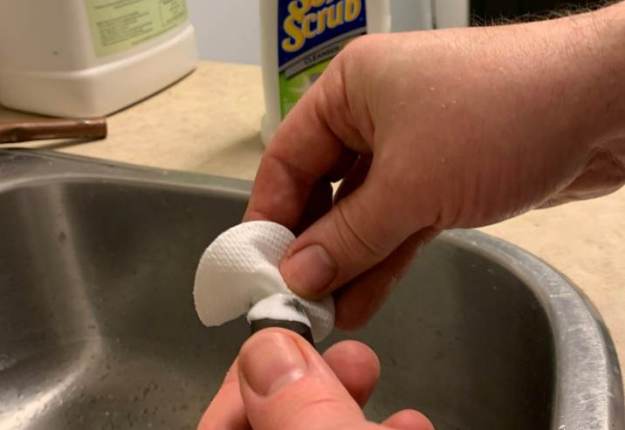
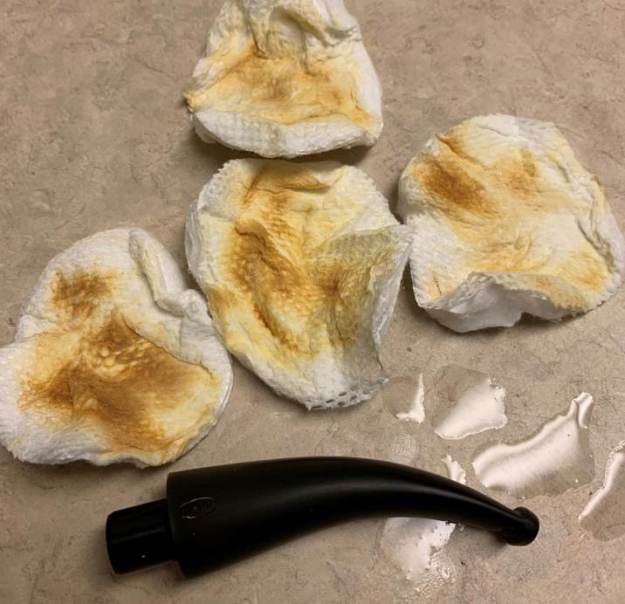
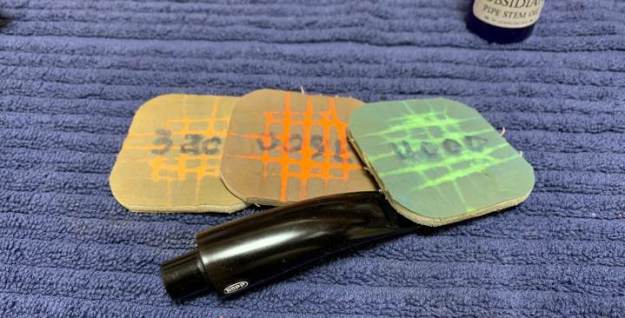
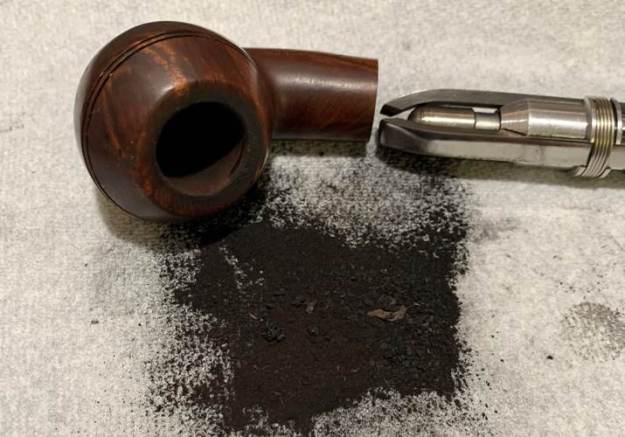
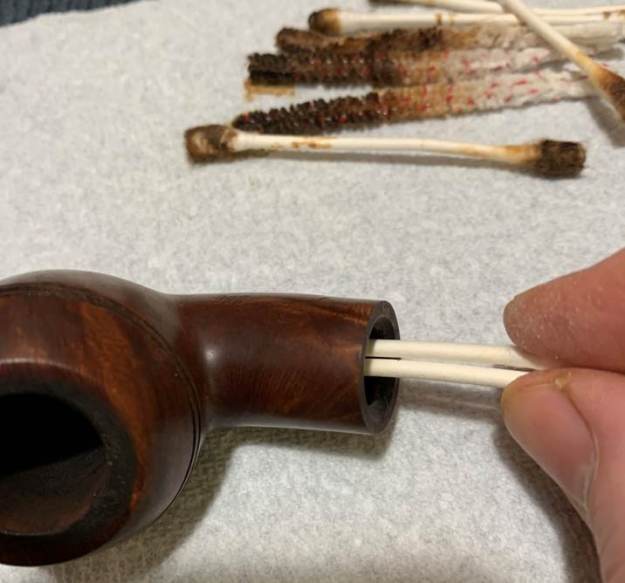
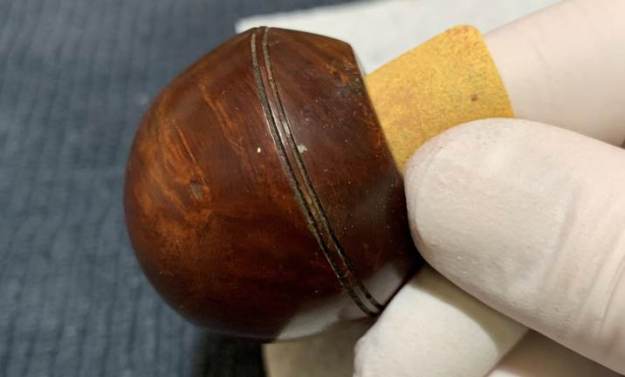
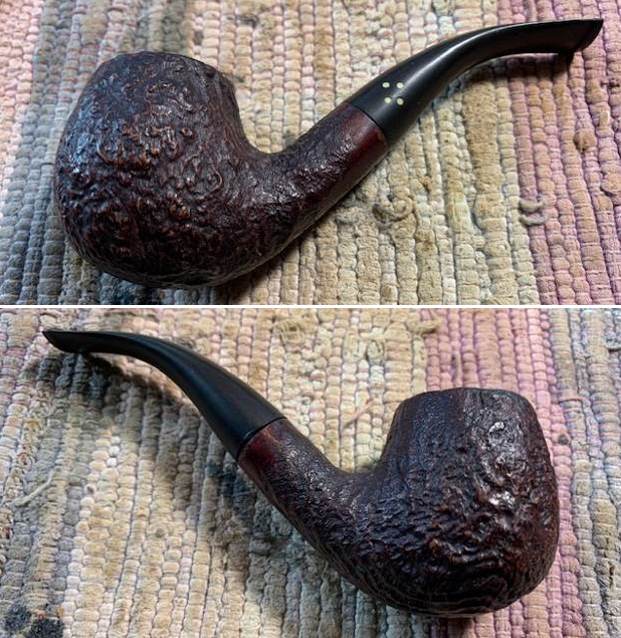
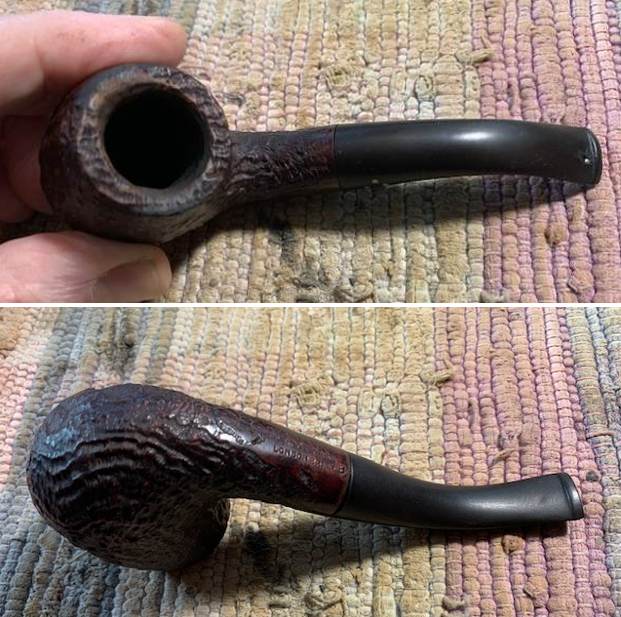
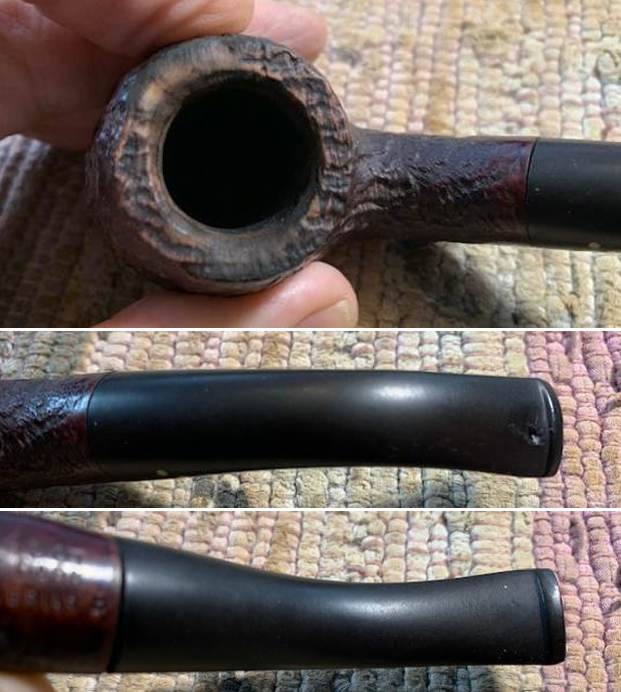
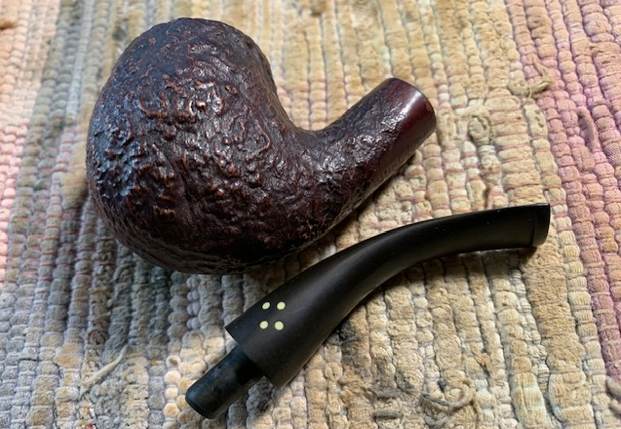
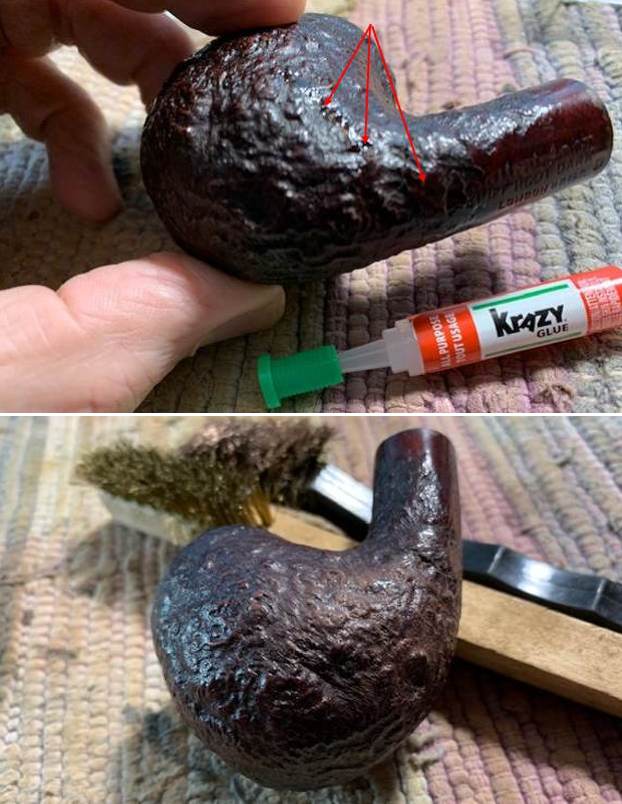
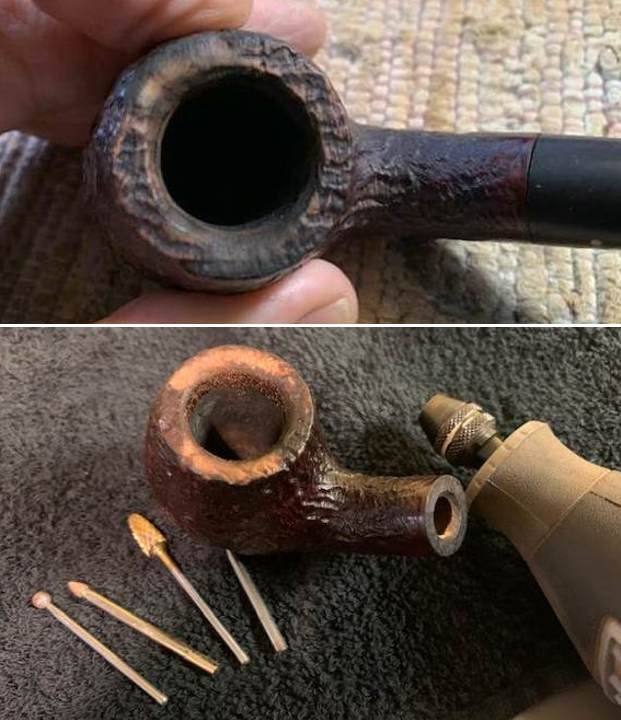
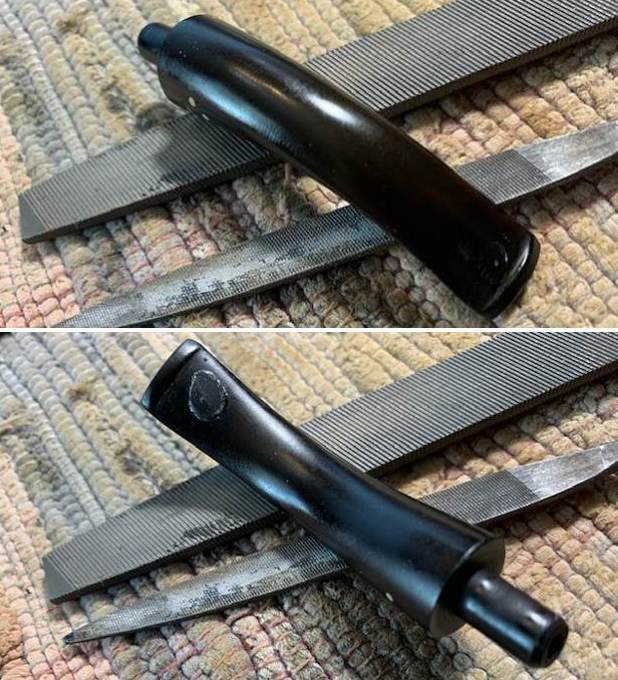
So I knew that I was dealing with a Post Transition 4 Dot Sasieni that was made after 1986. Now it was time to look at it up close and personal. Jeff had done an amazing job in removing all of the cake and the lava on the rim top. He had reamed the bowl with a PipNet Pipe Reamer and cleaned up the remnants with a Savinelli Fitsall Pipe Knife. He took the cake back to bare briar so we could check the walls for damage. He scrubbed the exterior of the bowl with Murphy’s Oil Soap and a tooth brush to remove the grime on the bowl and rim and was able to remove the lava and dirt. He cleaned out the interior of the bowl and shank with pipe cleaners, cotton swabs and alcohol until they came out clean. He cleaned the stem with Soft Scrub to remove the grime on the exterior. He soaked it in Before & After Pipe Stem Deoxidizer and rinsed it with warm water. He cleaned out the airway with alcohol, cotton swabs and pipe cleaners. I took some photos of the pipe before I started my work on it today. I took a close up photo of the cleaned up rim top. You can see the smoothing out of the top on the right front and the left rear of the bowl. The rest of the rim top has some great sandblast. The inner edge has a slight bevel that should clean up well. The stain is faded on the top. The bowl is spotless. The stem is clean and you can see the tooth marks on both sides ahead of the button. After Jeff had cleaned it the stem fit more snug against the shank end.I took a photo of the stamping on the underside of the shank. It is clear and readable as noted above.I removed the stem from the shank and took a photo to give a sense of the part of this pipe. I think it is going to be a beauty.I put on a magnifying headlamp and traced the flaw in the briar from the edge of the Ruff stamp on the underside of the shank. I filled it in with a thin line of clear CA glue. It was more of a cosmetic fix than a concern about a crack. Once it cured I used several brass bristle brushes I have to blend in the repair to the rest of the sandblast finish.With that cosmetic fix done I decided to address the smooth portions of the rim top. The first photo shows what I am referring to. I have used a series of burrs on my Dremel in the past to rusticate the smooth portions of the damaged top and match the sandblast pattern as much as possible. I have found that it works very well. Once I finished I used a brass bristle brush to knock off the debris and some of the roughness. I stained it with a Walnut stain pen to match the rest of the bowl colour. What do you think? Did it work?I rubbed the bowl down with Before & After Restoration Balm. I worked it into the surface of the briar with my finger tips and a horsehair shoe brush. The product works to clean, restore and preserve the briar. I let it do its magic for 15 minutes then buffed it off with a cotton cloth. The pipe looks incredibly good at this point in the process. With that finished I set the bowl aside and turned to work on the stem. I “painted” the surface of the stem with the flame of a Bic lighter to lift the tooth marks on both sides. I was able to lift them significantly but deep marks still remained on each side. I filled those in with black CA glue and set the stem aside to cure. Once the repair cured I flattened the repair with a small file to start the process of smoothing it out and blending it into the surrounding vulcanite. I sanded the file marks and repairs with 220 grit sandpaper and started polishing the stem with 400 grit wet dry sandpaper. It is starting to look very good. I continued to polish the stem with micromesh sanding pads – wet sanding with 1500-12000 grit sanding pads. I wiped it down after each sanding pad with Obsidian Oil. I polished it with Before & After Pipe Stem Polish – both Fine and Extra Fine. I gave it a final coat of Obsidian Oil and set it aside to cure. This Sasieni Ruff Root Dark 8 Bent Apple is a beauty. I put the pipe back together and lightly buffed it with Blue Diamond on the buffing wheel. I gave the bowl multiple coats of Conservator’s Wax and the stem multiple coats of carnauba wax. I hand buffed the pipe with a clean buffing pad to raise the shine. It is fun to see what the polished bowl looks like with beautiful mixed grain all around it. The polished dark Walnut coloured sandblast has depth and lends to a variation in colour as the bowl is turned. It looks great with the black vulcanite stem. This smooth Sasieni Ruff Root Dark Bent Apple is great looking and the pipe feels great in my hand. It is light and well balanced. Have a look at it with the photos below. The dimensions are Length: 5 inches, Height: 1 ¾ inches, Outside diameter of the bowl: 1 ¼ inches, Chamber diameter: ¾ of an inch. The weight of the pipe is 46 grams/1.59 ounces. It turned out to be a beautiful pipe. I will be putting this pipe on the rebornpipes store in the British Pipe Makers Section. Let me know if you are interested in adding it to your rack and carrying on the trust of this well traveled pipe. Thanks for your time reading this blog and as Paresh says each time – Stay Safe.  
New Life for a Vintage Stanwell 86 Regd. No. 969-48 Handmade in Denmark Freehand


Blog by Steve Laug

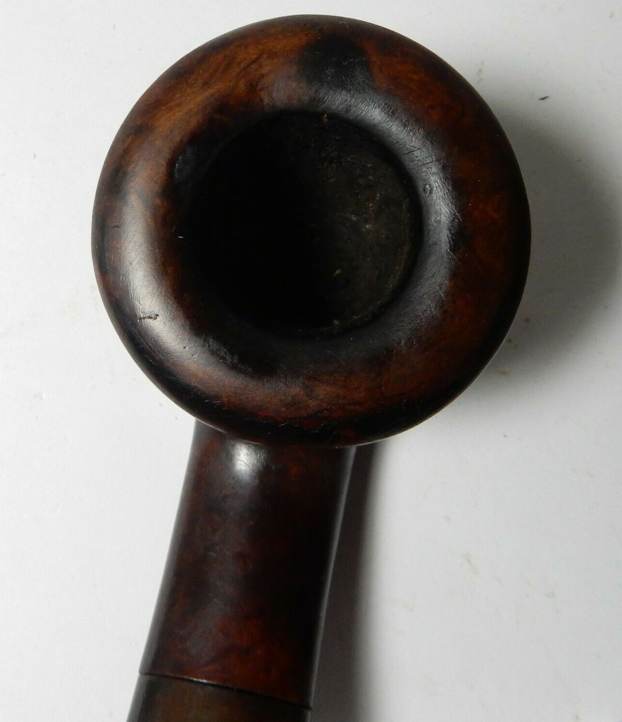
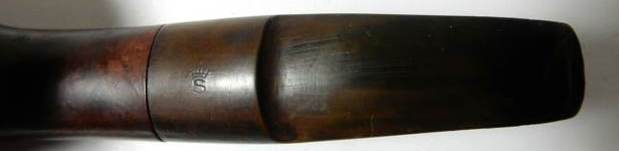
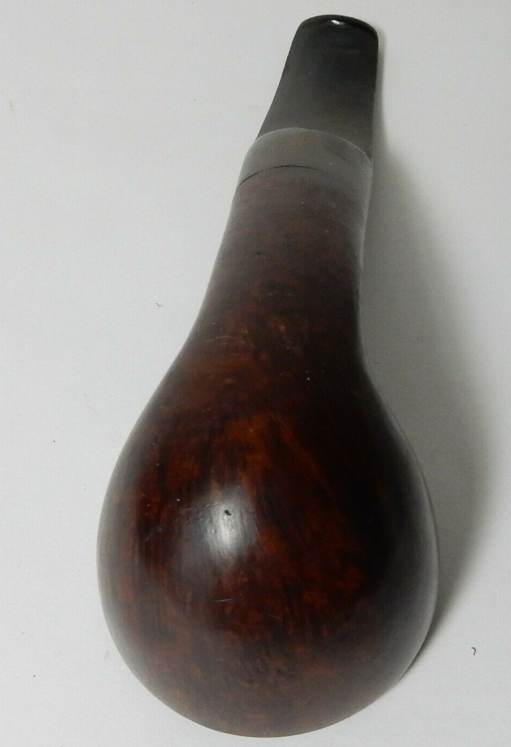
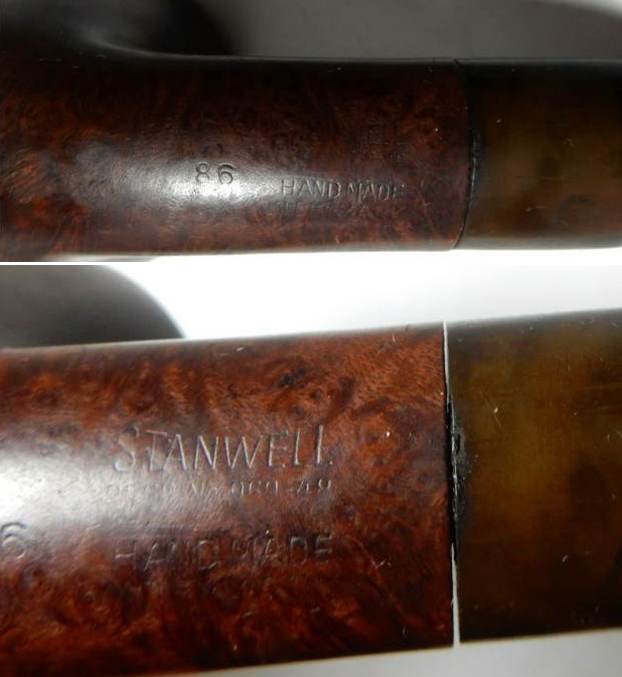
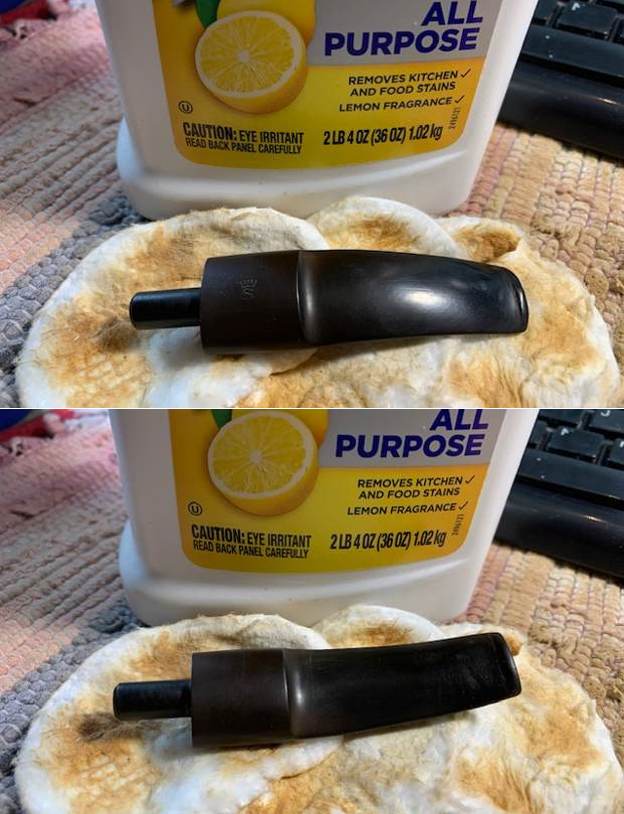
I have sold a few pipes to a fellow in Israel over the past year and he is great to work with. He has great taste in pipes and the ones he has purchased from me have been beautiful. Not long ago I received and email from him about a pipe he was interested in purchasing EBay. He sent me the link and wanted my opinion on it. I believed that it was a design by Sixten Ivarsson made for Stanwell and one that I really like the flowing shape and broad bowl. I remembered that with the Reg. No. it was made between the late 1960s and early 1970s so it was a bit of an old one. The pipe appeared to be in decent condition. Not too many days after that he wrote me to say he had won it and wondered if he could have it shipped to me rather than to him in Israel. We chatted back and forth about it via email and the decision was made and the pipe was on its way to me. Here are the pictures that the seller included with the advertising.  The seller took a large photo of the rim top to show the condition. Though it is dark you can see the cake in the bowl and the burn damage to the inner edge and the top front of the bowl. I am hoping I can reduce that mark some but time will tell. He also included a photo of the top of the stem showing the oxidation and the tooth marks on that side of the stem. The photo of the underside of the bowl and shank is dark but you can seek the grain peeking through the grime on the finish. I think that it will have some nice grain once I clean it up.He also took photos of the stamping on the underside of the shank. It was faint but readable with a light. It read as noted above.He took the stem off the shank and took a picture of the mortise and the tenon to show the condition of those parts of the pipe. It was dirty but it looked solid.The pipe arrived this week and sadly I had forgotten that it was on its way from the seller. When I opened the box I remembered it. I examined it carefully to assess both the condition of the pipe and what I needed to do with it. There was a moderate cake in the bowl with lava on the rim top and what looked like a burn mark on the top front of the bowl. There was darkening around both the inner and the outer edges of the bowl. The pipe was stamped on the underside of the shank and read Stanwell [over] Regd. No. 969-48 [over] Handmade [over] in Denmark. To the left of the stamp it bore the shape number stamp – 86. The finish was dirty and dark so it was hard to see too well but you could see some interesting grain underneath. The stem had the Crown S stamp on the top of the saddle and was fade. The vulcanite was oxidized and there were tooth marks and chatter on the top and underside. It was going to take some work to clean up but I thought it would work out fairly well. My only concern was the burn mark on the front top of the rim. Even with that though it would look pretty amazing. I took some photos of the pipe before I started my work on it. I have included them below. I took a photo of the bowl and rim top to show the thickness of the cake in the bowl and the damage to the top and edges of the bowl. You can see the darkening on the inner and outer edge of the rim – how much is lava and how much is burn damage remains to be seen. You can also see the burn mark on the top of the bowl at the front. It does not appear to have charred the surface as it is hard. I took photos of the stem surface to show the oxidation and tooth marks and chatter on both sides ahead of the button. There are also scratches on the surface running from the tenon end to the button on both sides. The Crown S stamp on the top of the stem is visible but all the colour is gone.I took a photo of the stamping on the shank underside. It is faint but readable. I also took a photo of the Crown S on the top of the saddle stem.I removed the stem from the shank and took a photo of the pipe parts. It is really going to be quite a stunning piece.I reamed the bowl with a PipNet pipe reamer and took the cake back to bare walls. I cleaned up the reaming with a Savinelli Fitsall Pipe Knife. I sanded the bowl walls with 220 grit sandpaper wrapped around a piece of dowel. I examined the walls with a lens and they were solid and undamaged. I cleaned out the airway in the shank and the stem as well as the mortise with isopropyl alcohol, cotton swabs and pipe cleaners. It was quite dirty and now smells much better.I scrubbed the exterior of the bowl with Murphy’s Oil Soap and a tooth brush to remove the grime from the finish of the bowl and rim top. I rinsed off the bowl with warm water and then dried the bowl with a cotton cloth. The grain that came to the surface once it was clean is quite stunning. I worked over the darkening and burn damage on the inside edge of the bowl and the rim top with a folded piece of 220 grit sandpaper. It began to look a lot better.I mixed up a batch of oxalic acid and warm water and used it to scrub off the rim darkening and the burn mark on the top. I dried it off with a paper towel. The burn on the edges of the rim were much better and the burn mark on the front top was definitely lighter.I sanded the rim top with a folded piece of 220 grit sandpaper and then sanded it with a medium and a fine grit sanding block. The grain on the rim top began to stand out. The rim edges look much better and the burn mark is much reduced.I polished the briar with micromesh sanding pads – dry sanding with 1500-12000 grit pads. After each pad I wiped the bowl down with a damp cloth to remove the sanding debris. It really took on a shine by the last three sanding pads. I stained the polished rim top with an Oak stain pen. It matched the colour around the rest of the bowl and hid the burn mark a bit. Though it is still visible it is nowhere near as big as it was when I started.I rubbed the bowl down with Before & After Restoration Balm. I worked it into the surface of the briar where it works to clean, restore and preserve the briar. I let it do its magic for 15 minutes then buffed it off with a cotton cloth. The pipe looks incredibly good at this point in the process. With that the bowl had come a long way from when I started working on it. I set it aside and turned my attention to the stem. I put the stem for an overnight soak in Briarville’s Pipe Stem Deoxidizer. In the morning I removed it from the bath and rubbed it down with a coarse paper towel to remove the oxidation that was on the surface. I cleaned out the airway in the stem with alcohol and pipe cleaners.I “painted” the surface of the stem with the flame of a Bic lighter to lift the tooth marks on both sides. I was able to lift them significantly but one remained on each side that would need to be filled with superglue.I scrubbed the remnants of oxidation with Soft Scrub All Purpose Cleanser. I removed a lot more of the remaining oxidation. It is finally starting to look better.I filled in the remaining tooth marks on both sides of the stem with black super glue. I set it aside to cure. Once the repair cured I flattened the repair with a small file to start the process of smoothing it out and blending it into the surrounding vulcanite. I sanded the file marks and repairs with 220 grit sandpaper and started polishing the stem with 400 grit wet dry sandpaper. It is starting to look very good.I continued to polish the stem with micromesh sanding pads – wet sanding with 1500-12000 grit sanding pads. I wiped it down after each sanding pad with Obsidian Oil. The light oxidation that remained on the top of the saddle portion of the stem was hard to deal with due to the stamping on the top. I cleaned it as much as possible and repaired the white colour of the Crown S logo with White Acrylic fingernail polish. I applied it and when it hardened I scraped off the excess with my fingernail. Once finished I continued to polish the stem with the last three micromesh sanding pads. I polished it with Before & After Pipe Stem Polish – both Fine and Extra Fine and wiped it down with Obsidian Oil one more time. I am excited to finish this Ivarrson Designed Stanwell 86 Freehand. I put the pipe back together and buffed it with Blue Diamond on the buffing wheel. I gave the bowl and the stem multiple coats of carnauba wax. I hand buffed the pipe with a clean buffing pad to raise the shine. It is fun to see what the polished bowl looks like with beautiful mixed grain all around it. The polished grain on the pipe looks great with the black vulcanite stem. This smooth Classic Ivarrson Designed Stanwell 86 is great looking and the pipe feels great in my hand. It is light and well balanced. Have a look at it with the photos below. The dimensions are Length: 5 ¼ inches, Height: 1 ½ inches, Outside diameter of the bowl: 1 ¾ inches, Chamber diameter: ¾ of an inch. The weight of the pipe is 42 grams/1.48 ounces. It turned out to be a beautiful pipe. I will be packing it up and sending it to my friend in Israel. I think he will enjoy this beauty once it is in his hands. Thanks for your time reading this blog and as Paresh says each time – Stay Safe.
Restoring a Brigham Made in Canada (1Dot) 189 Bent Acorn


Blog by Steve Laug

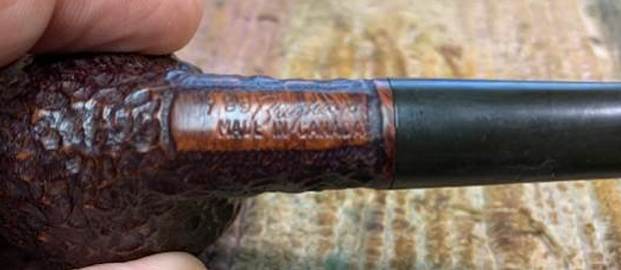
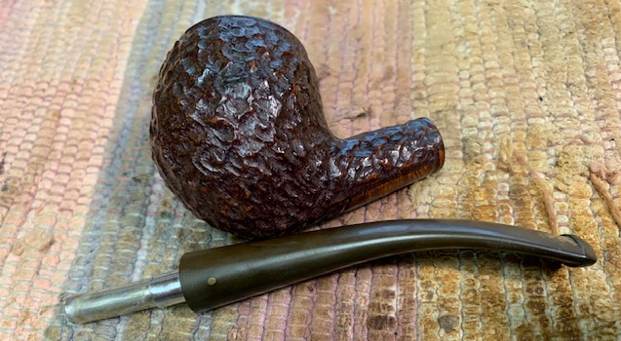
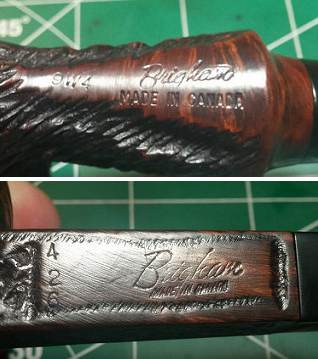
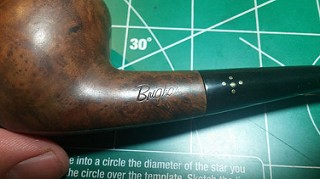
Not too long ago my wife and I had dinner with some good friends here in Vancouver – first time since COVID-19 so it was good to see them. At the beginning of the meal he handed me a box that he said was for me. In it were some pipes that he was giving to me and a bunch of cigars. The pipes included two Brigham rusticated pipes that I have included photos of below. The two pipes in the photo were clean but well smoked. The bowls had light cake and some lava and darkening on the rim top. The stems were lightly oxidized and had tooth chatter on both sides ahead of the button. I decided I would work on them next. I finished the Sportsman Dublin first and now turned my attention to the second pipe. It is a classic Brigham Shape I call an acorn. It is well carved with a rusticated finish and a smooth rim top. It is stamped on the underside and reads 189 followed by Brigham [over] Made in Canada. There was one dot on the stem side and tooth chatter and oxidation. It was going to be a beauty once cleaned up. I took photos of the pipe when it brought it to the desk top. There was a moderate cake in the bowl in the bowl with lava overflowing into the rim top. There were some dark spots on the top of the rim on the front and the back sides. There was also some damage on the inner edge of the rim that would need to be dealt with. The shank and airways were dirty with tars and oil. The finish was dirty and would need scrubbing. I was hoping to bring it back to the natural finish. There was no Hard Rock Maple filter in the tenon and the pipe smelled of stale tobacco. The stem was lightly oxidized and there was some light tooth chatter to the top or underside of the stem. The button had no damage. Overall the pipe looked good even though it was a dirty one. I took photos of the rim top and the bowl to show the condition. The rim top was smooth with some nicks and dents in the surface. It also had some darkening around the top and damage to the inner edges. I also took photos of both sides of the stem to show the tooth marks and chatter. Over all the pipe was in okay condition.I took a photo of the stamping on the underside of the shank. It is clear and t it reads as noted above.I took a photo of the pipe with the stem removed to give an overall picture of the pipe. It really is quite beautiful.For historical background for those unfamiliar with the brand I am including the information from Pipedia on Brigham pipes. It is a great read in terms of the history and background on the pipes (https://pipedia.org/wiki/Brigham_Pipes). Charles Lemon (Dadspipes) is currently working on a book on the history of the brand. Until that is complete this article is a good summary. I have included it below.

Roy Brigham, after serving an apprenticeship under an Austrian pipesmith, started his own pipe repair shop in Toronto, in 1906. By 1918 the business had grown to include five other craftsmen and had developed a reputation across Canada for the high quality of workmanship. After repairing many different brands of pipes over the years, Roy noted certain recurring complaints by pipe smokers, the most common referred to as “tongue bite”. Tongue bite is a burning sensation on the smoker’s tongue, previously thought to be due to the heat of the smoke (i.e. a “hot smoking pipe”).

He soon began manufacturing his own pipes, which were lightweight, yet featured a more rugged construction, strengthening the weak points observed in other pipes. The problem of tongue bite intrigued him, and he decided to make overcoming it a future goal.

About 1938, Roy’s son Herb joined him to assist in the business. The business barely survived the great depression because pipes were considered to be a luxury, not a necessity, and selling pipes was difficult indeed. In approximately 1937 [1], after some experimentation, Roy and Herb discovered that tongue bite was in fact a form of mild chemical burn to the tongue, caused by tars and acids in the smoke. They found that by filtering the smoke, it was possible to retain the flavour of the tobacco and yet remove these impurities and thereby stop the tongue bite.

Just as Thomas Edison had searched far and wide for the perfect material from which to make the first electric light bulb filaments, Roy & Herb began experimenting with many materials, both common and exotic, in the quest for the perfect pipe filter. Results varied wildly. Most of the materials didn’t work at all and some actually imparted their own flavour into the smoke. They eventually found just two materials that were satisfactory in pipes: bamboo and rock maple. As bamboo was obviously not as readily available, rock maple then became the logical choice.

They were able to manufacture a replaceable hollow wooden tube made from rock maple dowelling, which when inserted into a specially made pipe, caused absolutely no restriction to the draw of the pipe, yet extracted many of the impurities which had caused tongue bite. The result was indeed a truly better smoking pipe…

Interestingly the pipe I have in hand is a 1 Dot grade but very well done. It is stamped with the shape number 189 followed by Brigham [over] Made in Canada.

Charles Lemon has also written a great article on the stampings and marking on the Brigham pipes that fit into a time line that he has drafted. It is well worth a read and is fascinating. (https://pipedia.org/wiki/Brigham_Pipes_%E2%80%93_A_Closer_Look_at_Dots,_Dates_and_Markings). I quote from the pertinent section on the time frame for this pipe.

Around the late 1960s or early 1970s, at the beginning of what I’ve called the Canadian Era (roughly 1970 – 1980), the stampings changed again as Brigham moved to modernize its logo. Pipes are stamped with the 3-digit shape number and “Brigham” over “Made in Canada”. Note these two variants of this stamping.

This solidly places the pipe I am working on in the period of Brigham production that Charles calls the Canadian Era (1969/70-1980). It is a great looking pipe with the classic rusticated style of finish.

The Original Brigham Dot System 1938 – 1980

Brigham pipes are renown in the pipe world for their famous “Brigham Dots”, a system of brass pins inset in the stem to denote the grade of each pipe. The original 8-grade pinning system, used for 42 years between 1938 and 1978 (spanning the Patent, Post-Patent and Canadian Eras) looked like this:I knew that I was dealing with a pipe made between 1969-1980 from Canadian Era. It sports 1 dot making it Brigham Standard pipe. There is a 189 shape number on the pipe. Now to do a bit of spiffing with the pipe itself.

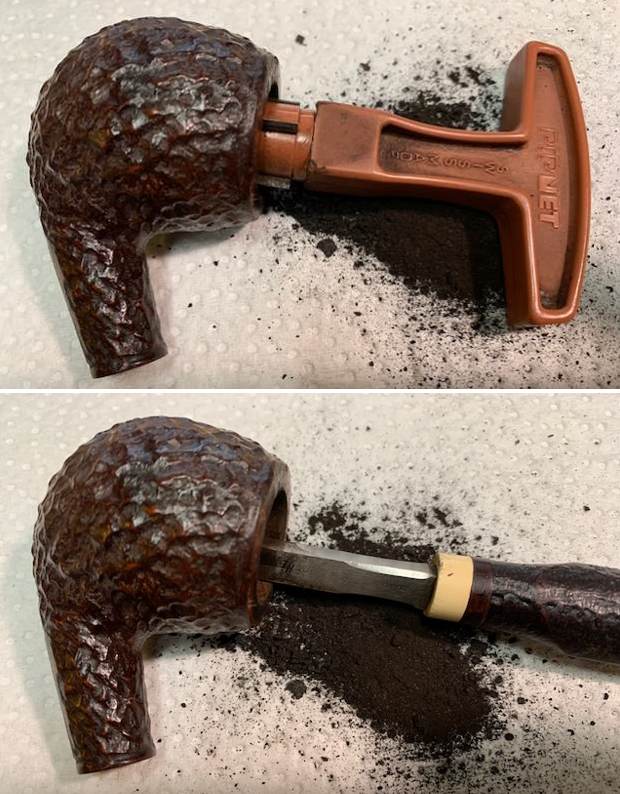
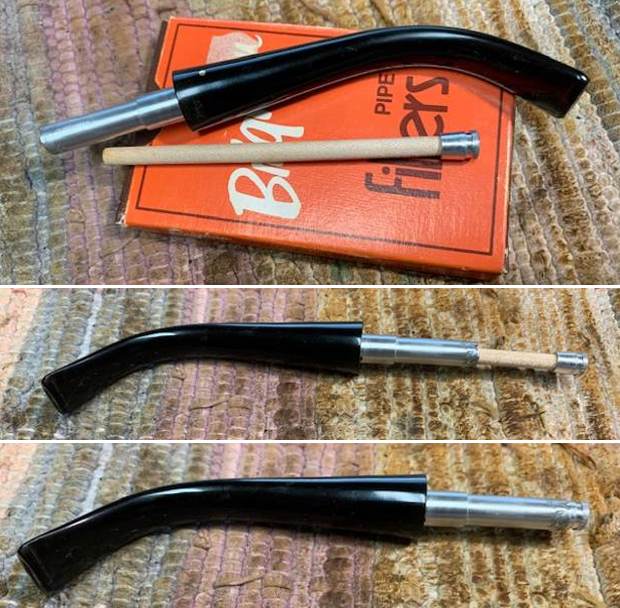
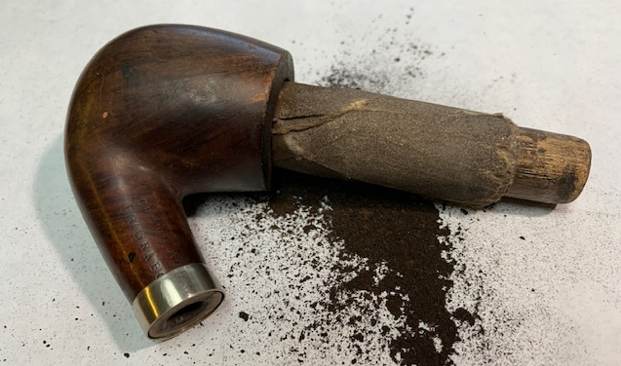
I reamed the pipe with a PipNet pipe reamer to remove the light cake from the bowl walls. It was uneven and needed to be removed so I took it back to bare briar. I cleaned up the reaming with a Savinelli Fitsall Pipe Knife and then sanded the bowl with a dowel wrapped with 220 grit sandpaper to smooth out the walls. I worked on the damage to the rim top and the inner edge of the rim with 220 grit sandpaper. It looked much better.I scrubbed the exterior of the pipe with a tooth brush with undiluted Murphy’s Oil Soap. I scrubbed it to remove the build up on the rim top. I rinsed it with warm water and dried it off with a soft cloth. I cleaned out the internals with alcohol, cotton swabs and pipe cleaners to remove the debris and the oils from the shank and tenon as well as the airway into the stem and bowl.I polished the darkening on the rim top with micromesh sanding pads – dry sanding with 1500-12000 grit pads to remove as much of the darkening as I could. Once it was complete I stained the rim top with an Oak stain pen to match the smooth portions of the finish on the shank end and underside. I rubbed the bowl down with some Before & After Restoration Balm. I worked it into the briar with my fingertips and a horse hair shoe brush. The product works to clean, renew and protect briar. I let it do its work for 15 minutes then buffed it off with a soft cloth. The pipe is really quite a beauty. I set the bowl aside and turned my attention to the stem. I scrubbed it with Soft Scrub All Purpose cleaner to remove the oxidation as much as possible. It needed to be clean before I could address the tooth marks.Once it was clean I “painted” the tooth marks and chatter with the flame of a lighter. I was able to raise all of the damage on the underside of the stem and the majority on the topside. I lightly sanded the topside with 220 grit sandpaper to prepare for the repair. I filled in the tooth marks that remained with black superglue and set the stem aside to cure. Once it cured I flattened out the repaired area with a small file to start the process of blending it into the surrounding briar. I sanded the surface with 220 grit sandpaper to remove the remaining oxidation and also finish blending in the repair. I started polishing it with 400 grit wet dry sandpaper. It is beginning to look quite good. I polished the surface of the stem on both sides using micromesh sanding pads. I dry sanded the stem with the 1500-12000 grit pads, then wiped it down with a cloth impregnated with Obsidian Oil. I finished polishing it with Before & After stem polish – both Fine and Extra Fine. I gave it a final coat of Obsidian Oil and set it aside to dry. I fit the clean and polished stem with the Brigham Rock Maple Distillator and took photos to show what it looked like. This is in essence a hollow Maple wood tube that serves to filter out the moisture and deliver a clean and flavourful smoke. I am excited to finish this 1969-1980 Brigham Made in Canada Acorn 189 – 1 Dot from the Canadian Era. I put the pipe back together and buffed it with Blue Diamond on the buffing wheel. I gave the bowl multiple coats of Conservator’s Wax and the stem multiple coats of carnauba wax. I buffed the pipe with a clean buffing pad to raise the shine and hand buffed it with microfiber cloth to deepen the shine. It is fun to see what the polished bowl looks like with the rusticated finish. Added to that the polished black vulcanite stem with the shining brass pins was beautiful. This mixed grain on the rusticated Brigham Standard 1 Dot 189 Acorn is nice looking and the pipe feels great in my hand. It is light and well balanced. Have a look at it with the photos below. The dimensions are Length: 6 inches, Height: 1 ¾ inches, Outside diameter of the bowl: 1 ¼ inches, Chamber diameter: ¾ of an inch. The weight of the pipe is 1.45 ounces/41 grams. It is a beautiful pipe and one that will be on the rebornpipes store in the Canadian Pipe Makers Section soon. If you are interested in adding it to your collection let me know. Thanks for walking through the cleanup with me as I worked over this pipe. Thanks to each of you who are reading this blog. Remember we are not pipe owners; we are pipemen and women who hold our pipes in trust until they pass on into the trust of those who follow us.

Restoring a Brigham (1 Dot) Rusticated 184 Bent Volcano


Blog by Steve Laug

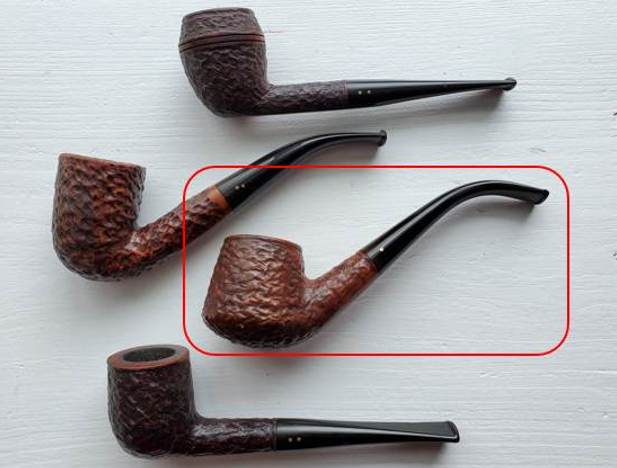
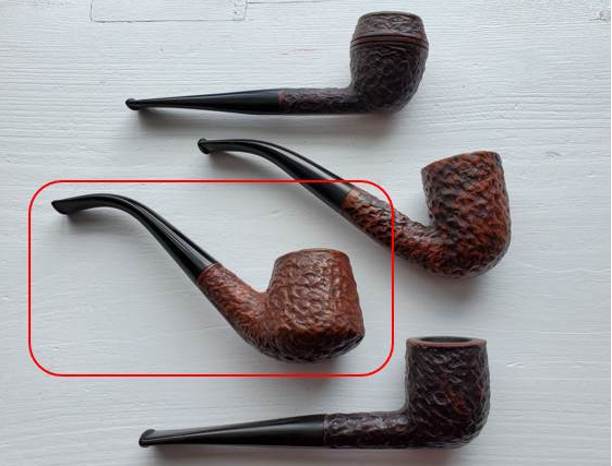
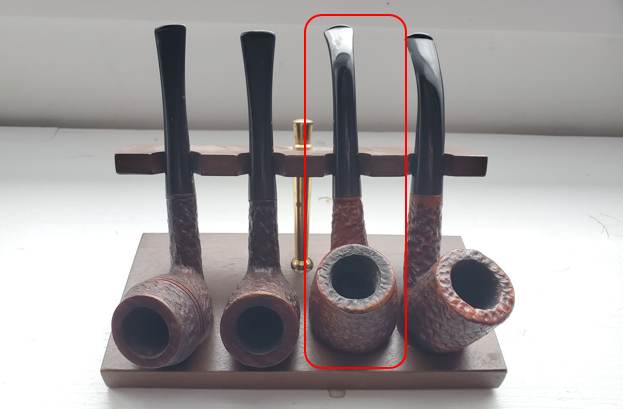
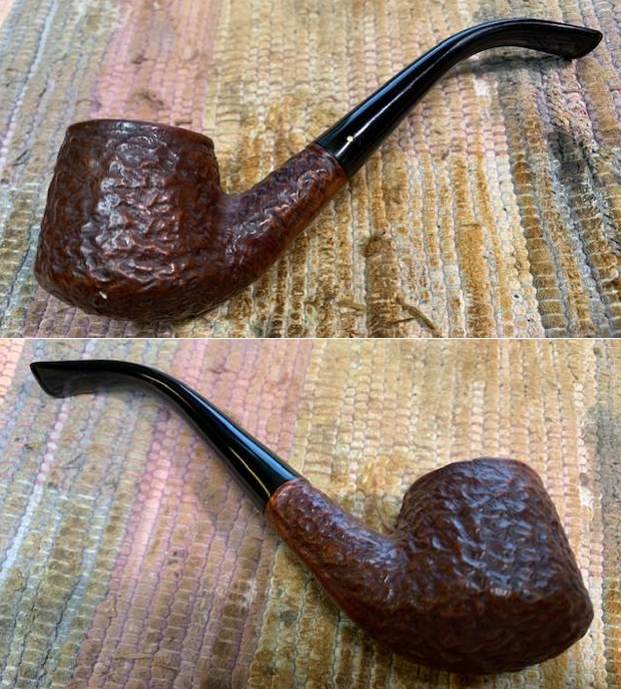
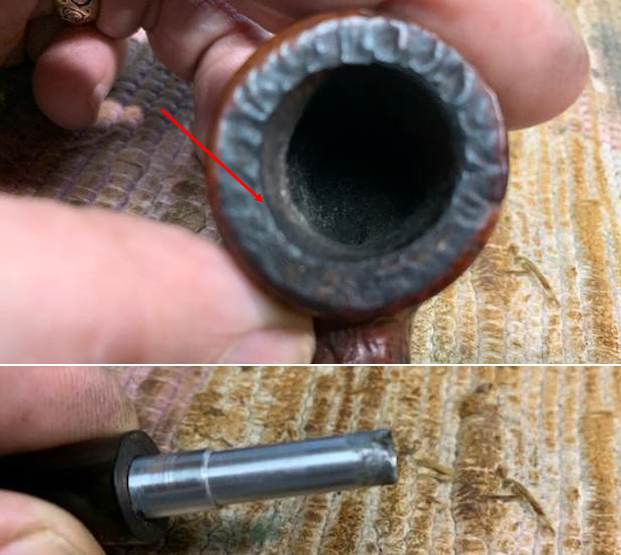
Not too long ago a fellow in Eastern Canada was selling a foursome of Brigham rusticated pipes on Facebook. Jeff contacted him and we became the new owners of the pipes. He sent us some photos of the pipes that I have included below. It did not take long for them to arrive here in Vancouver. When they did I was amazed at how good they looked. Two of them were relatively clean and two were used. The top two pipes in the photo were clean and the bottom two were still dirty with cake and debris in the bowls. I decided I would work on them next. I turned to the final pipe of the lot a Bent Volcano shape – the second from the bottom in the photos below as marked by the red box outlining it. It is stamped on the underside with the shape number 184 on the shank followed further down the shank by Brigham. It was by far the most used of the four pipes. It had the thickest cake in the bowl, lava on the rim top and some damage to the end of the metal tenon/keeper for the Brigham Rock Maple Distillator. It was also probably the newest of the lot of four but I would figure that out as I worked on it. I took photos of the pipe when it arrived. There was some damage on the inner edge with the bowl being out of round. There was a moderate cake in the bowl in the bowl with lava overflowing into the rustication of the rim top. The shank and airways seem to be dirty with tars and oil. It did not have the Hard Rock Maple filter in the shank but the interior smelled strongly of tobacco. The stem was very clean and shiny without any tooth damage to the top or underside of the stem. The button was clean with no damage. Overall the pipe looked good even though it was a dirty one. I took photos of the rim top and the bowl to show the condition. The rim top was rusticated and covered in lava heavily at the back of the bowl. You can see the damage on the inner edge of the bowl making it out of round and the thick cake that is present. I also took photos of both sides of the stem to show the lack of tooth marks and chatter. Over all the pipe was in okay condition.I took a photo of the stamping on the underside of the shank. It is faint but it reads as noted above.I took a photo of the pipe with the stem removed to give an overall picture of the pipe. It really is quite beautiful.I took a photo of the rim top to show how out of round the bowl was and of the damage on the end of the aluminum Distillator holder/tenon. I have included them below. The red arrow shows one of the spots where the damage is visible.For historical background for those unfamiliar with the brand I am including the information from Pipedia on Brigham pipes. It is a great read in terms of the history and background on the pipes (https://pipedia.org/wiki/Brigham_Pipes). Charles Lemon (Dadspipes) is currently working on a book on the history of the brand. Until that is complete this article is a good summary. I have included it below.

Roy Brigham, after serving an apprenticeship under an Austrian pipesmith, started his own pipe repair shop in Toronto, in 1906. By 1918 the business had grown to include five other craftsmen and had developed a reputation across Canada for the high quality of workmanship. After repairing many different brands of pipes over the years, Roy noted certain recurring complaints by pipe smokers, the most common referred to as “tongue bite”. Tongue bite is a burning sensation on the smoker’s tongue, previously thought to be due to the heat of the smoke (i.e. a “hot smoking pipe”).

He soon began manufacturing his own pipes, which were lightweight, yet featured a more rugged construction, strengthening the weak points observed in other pipes. The problem of tongue bite intrigued him, and he decided to make overcoming it a future goal.

About 1938, Roy’s son Herb joined him to assist in the business. The business barely survived the great depression because pipes were considered to be a luxury, not a necessity, and selling pipes was difficult indeed. In approximately 1937 [1], after some experimentation, Roy and Herb discovered that tongue bite was in fact a form of mild chemical burn to the tongue, caused by tars and acids in the smoke. They found that by filtering the smoke, it was possible to retain the flavour of the tobacco and yet remove these impurities and thereby stop the tongue bite.

Just as Thomas Edison had searched far and wide for the perfect material from which to make the first electric light bulb filaments, Roy & Herb began experimenting with many materials, both common and exotic, in the quest for the perfect pipe filter. Results varied wildly. Most of the materials didn’t work at all and some actually imparted their own flavour into the smoke. They eventually found just two materials that were satisfactory in pipes: bamboo and rock maple. As bamboo was obviously not as readily available, rock maple then became the logical choice.

They were able to manufacture a replaceable hollow wooden tube made from rock maple dowelling, which when inserted into a specially made pipe, caused absolutely no restriction to the draw of the pipe, yet extracted many of the impurities which had caused tongue bite. The result was indeed a truly better smoking pipe…

Charles Lemon has also written a great article on the stampings and marking on the Brigham pipes that fit into a time line that he has drafted. It is well worth a read and is fascinating. (https://pipedia.org/wiki/Brigham_Pipes_%E2%80%93_A_Closer_Look_at_Dots,_Dates_and_Markings). I quote from the pertinent section on the time frame for this pipe.

I have dubbed the decades between 1980 and 2000 the Late Canadian Era, a period that saw several changes at Brigham that are of note to the collector. First, the traditional 8-grade pinning system (the famous Brigham “Dots” which denoted the quality of the pipe) was changed to a 7-grade system to simplify pinning (more on this below), and the Norsemen and Valhalla series were merged to form the President Series, which represented the very finest pipes coming out of the Toronto factory. Early pipes from this era (left, below) are stamped with a shape number and “Brigham” over “Canada”; later pipes (late 1980s+, on right below) are stamped simply with a shape number and the Brigham logo.

This solidly places the pipe I am working on in the period of Brigham production that Charles calls the Late Canadian Era (1980-2000). It is a great looking pipe with an older style rustication pattern than the later Brighams that I have worked on.

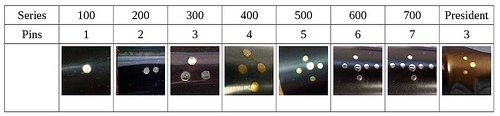
Charles also put together a chart that helps the restorer to understand the Brigham dot system. I quote from the same link on Pipedia as noted above.

Revised Dot System 1980

Brigham changed the Dot system in 1980, adding a 7 Dot at the top of the line, dropping the names of each series and eliminating the confusing vertical and horizontal 3 Dot configurations. The Norsemen and Valhalla series were combined to form the President series of freehand pipes, which adopted a 3 Dot pattern with a larger dot on the right as shown below. The 7- grade pinning system stayed in place from 1980 to 2001. I knew that I was dealing with a pipe made between 1980-2000 from the Late Canadian Era. It sports 1 dot making it Brigham Series 100 pipe with a 3 digit shape number 184. Now to do a bit of spiffing with the pipe itself.

I reamed the pipe with a PipNet pipe reamer to remove the light cake from the bowl walls. It was uneven and needed to be removed so I took it back to bare briar. I cleaned up the reaming with a Savinelli Fitsall Pipe Knife and then sanded the bowl with a dowel wrapped with 220 grit sandpaper to smooth out the walls. I cleaned up the damage to the inner edge of the rim with a folded piece of 220 grit sandpaper and made the bowl edge both smooth and round.I scrubbed the exterior of the pipe with a brass bristle wire brush and a tooth brush with undiluted Murphy’s Oil Soap. I scrubbed it to remove the build up on the rim top. I rinsed it with warm water and dried it off with a soft cloth. I touched up the stain on the rim top and edges with a Maple Stain Pen to match the surrounding colour of the briar. Once it is buffed and polished I think it will look good.I cleaned out the internals with alcohol, cotton swabs and pipe cleaners to remove the debris and the oils from the shank and tenon as well as the airway into the stem and bowl. I rubbed the bowl down with some Before & After Restoration Balm. I worked it into the briar with my fingertips and a horse hair shoe brush. The product works to clean, renew and protect briar. I let it do its work for 15 minutes then buffed it off with a soft cloth. The pipe is really quite a beauty. I set the bowl aside and turned my attention to the stem. I polished out the surface of the stem ahead of the button on both sides using micromesh sanding pads. I also polished out the damaged end of the aluminum tube. I was not perfect but it was smooth and held the filter in place. I dry sanded the stem and tenon with the 1500-12000 grit pads, then wiped it down with a cloth impregnated with Obsidian Oil. I finished polishing it with Before & After stem polish – both Fine and Extra Fine. I gave it a final coat of Obsidian Oil and set it aside to dry.  I fit the clean and polished stem with the Brigham Rock Maple Distillator and took photos to show what it looked like. This is in essence a hollow Maple wood tube that serves to filter out the moisture and deliver a clean and flavourful smoke.  I am excited to finish this Late Canadian Era Made in Canada Brigham 184 Bent Volcano. I put the pipe back together and buffed it with Blue Diamond on the buffing wheel. I gave the bowl multiple coats of Conservator’s Wax and the stem multiple coats of carnauba wax. I buffed the pipe with a clean buffing pad to raise the shine and hand buffed it with microfiber cloth to deepen the shine. It is fun to see what the polished bowl looks like with the rusticated finish. Added to that the polished black vulcanite stem with the shining brass pin was beautiful. This mixed grain on the rusticated Brigham 184 Volcano is nice looking and the pipe feels great in my hand. It is light and well balanced. Have a look at it with the photos below. The dimensions are Length: 6 inches, Height: 1 ¾ inches, Outside diameter of the bowl: 1 ¼ inches, Chamber diameter: ¾ of an inch. The weight of the pipe is 1.55 ounces/44 grams. It is a beautiful pipe and one that will be on the rebornpipes store in the Canadian Pipe Makers Section soon. If you are interested in adding it to your collection let me know. Thanks for walking through the cleanup with me as I worked over this pipe. Thanks to each of you who are reading this blog. Remember we are not pipe owners; we are pipemen and women who hold our pipes in trust until they pass on into the trust of those who follow us.

Cleaning up a Crown Duke, Dr. Grabow Bent Billiard for a Memory Box of Dad


Blog by Steve Laug

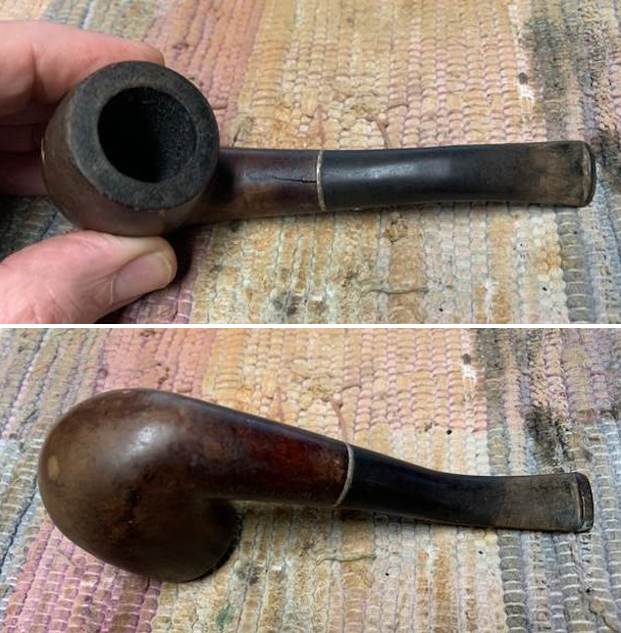
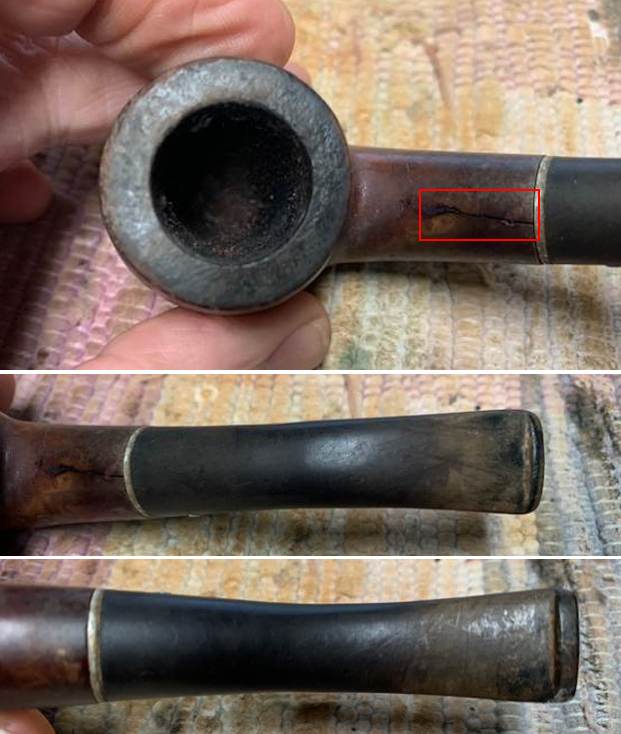
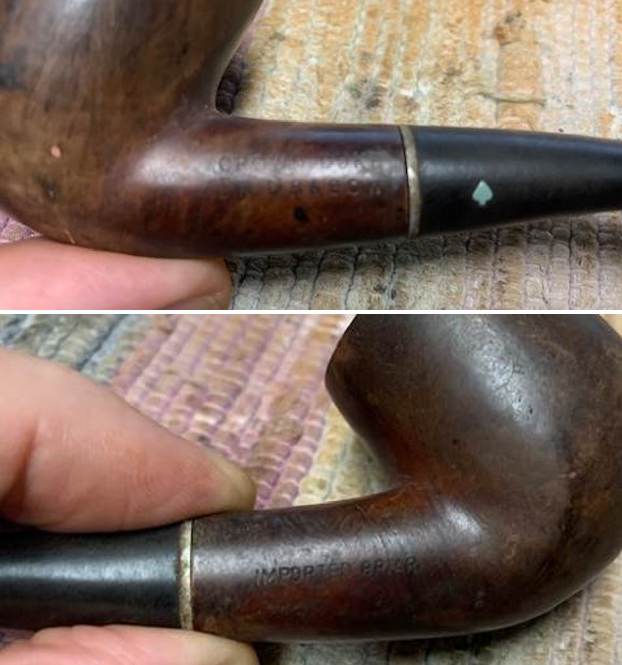
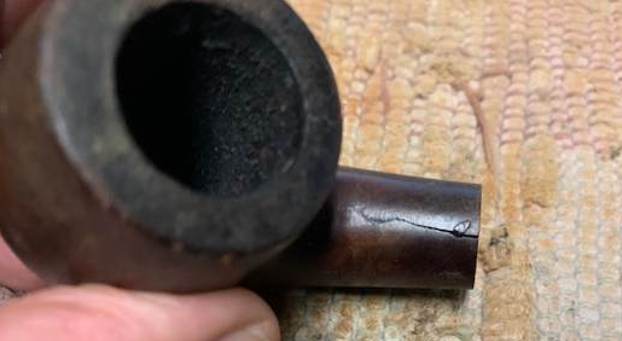
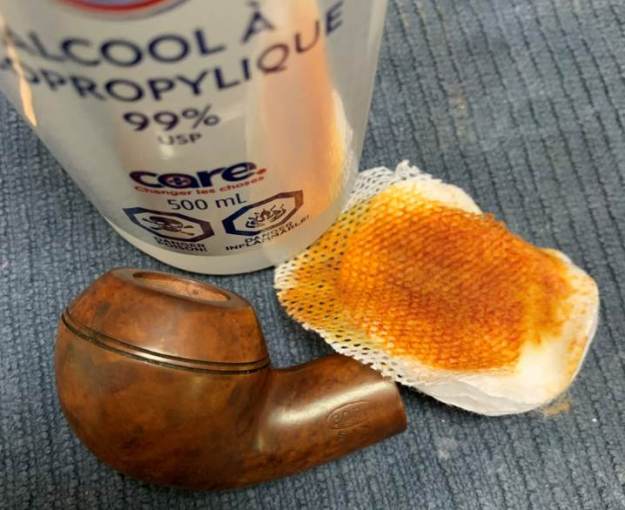
I received an email a while ago from a lady who wanted to have one of her Dad’s pipe cleaned and restored. As we emailed back and forth it was clear that it was one of those pieces that was filled with memories. I pressed to see if she was sure that she wanted it cleaned as it would remove the remnants of debris and tobacco from her Dad’s use of the pipe. She was clear that she wanted it cleaned up to look as good as possible because she was going to make a shadow box to hold the pipe and a photo and other memorabilia of her late Dad. When it finally arrived here in Vancouver I could see why she wanted it clean. The pipe was very dirty and there was a crack in the shank. The pipe had not been smoked for a long time and there was no tobacco smell in it at all. There was a hard thin cake in the bowl and lava on the rim top. The stem was oxidized and had calcification on the button end. It was a filter pipe that had been smoked without a filter so the insides were dirty. The pipe was stamped on the left side and read Crown Duke [over] Dr. Grabow. On the right side it read Imported Briar. There was a blue Grabow Spade on the left side of the taper stem. It was dirty and worn looking with some obvious fills around the bowl. I took some photos of the pipe before I started to work on it.    I took a photo of the rim top and bowl to give a clear picture of what I was dealing with. I also captured the crack in the top of the shank in the photo (I have outlined it in a red box). Other than being incredibly dirty the stem was in decent condition with light tooth chatter and light marks near the button edge.The stamping on the shank sides was faint but readable and reads as noted above.I took a better photo of the crack in the top of the shank and have included it below. It was quite wide open but came to an end in the squiggle at the end toward the bowl. I would need to glue and band it to make it solid again.I took a photo of the pipe with the stem removed to get a sense of the look of the Bent Billiard.I picked a band out of my box of bands. It is far too deep so I will need to take it down for a proper fit on the shank. I started the process by using a topping board. I then used my Dremel and sanding drum to remove the full amount I wanted gone. I finished the shaping of the band on the topping board.Once I had the fit correct, I removed it from the shank and cleaned up the area around the crack with alcohol and cotton swabs. I filled in the crack with clear super glue and clamped the crack shut. Once the glue cured I heated the band and pressed it onto the shank. I took some photos of the repaired shank and band. Now it was time to clean the bowl. I have often done the process in reverse but I really wanted to stabilize the crack before I worked on cleaning the exterior and interior of the bowl and shank. I did not want to chance making the crack worse. I reamed the cake out of the bowl with a Pipnet pipe reamer and took the cake back to bare briar. I cleaned up the reaming with a Savinelli Fitsall pipe knife and sanded the bowl walls smooth with a piece of dowel wrapped with 220 grit sandpaper. I wanted the bowl to be smooth for the display. I scrubbed the exterior of the bowl with undiluted Murphy’s Oil Soap and a tooth brush. I was able to remove the debris and grime around the bowl and clear off the lava on the rim top. I dried the bowl off with a cloth and took these photos. You can see the dark fills and spots around the bowl sides. The largest was a rough fill on the front of the bowl that was pink putty. I repaired the pink, rough fill on the front of the bowl with clear super glue. Once the repair cured I sanded it smooth with 220 grit sandpaper. It was now smooth to the touch. It would be interesting to try to blend it into the surrounding briar once I was staining it. I sanded the entire bowl with 1500 grit micromesh at the same time.I cleaned out the airway in the shank and the stem with cotton swabs, pipe cleaners and isopropyl alcohol. It took quite a few to get the tars and oils out of the airways.I buffed the pipe on the buffer with Blue Diamond and then stained it with a light brown stain. I applied the stain and then flamed it to set it. I used a black and brown Sharpie pen to stain the pinkish fill on the front of the bowl.I set the bowl aside for the stain to cure and turned my attention to the stem. I sanded out the tooth chatter and marks on the stem with 220 grit sandpaper and started the polishing with 400 grit wet dry sandpaper. It is actually beginning to look much better. I polished the stem with micromesh sanding pads – dry sanding with 1500-12000 grit pads. I wiped the stem down after each pad with an Obsidian Oil impregnated cloth to give the pads a little more bite. I polished it with Before & After Stem Polish both Fine and Extra Fine and gave it a final rub down with Obsidian Oil. I set the stem aside to dry and worked on the bowl again. By this time the stain was dry and I was able to tackle the bowl again. I wiped it down with alcohol on paper towels to make the stain more transparent. Because of the fills in the bowl I decided to leave it dark as it did a good job masking them. I buffed the bowl on the wheel with Blue Diamond to further aid the transparency. It is hard to see in the photos but in person the grain is there and not terribly hidden. The fills are hidden and other than the large one on the front of the bowl they look good. I put the stem on the bowl and buffed the pipe with Blue Diamond on the buffing wheel. I was careful when buffing around the stamping and the logo on the stem. I had decided to leave some of the nicks and marks in the briar as they were a part of the story of the pipe and its owner. I wanted it to still bear his definitive marks so that when it was in the shadow box those who knew him would remember the story of the pipe.  I did not want the pipe to look brand new as that would remove the story from it. The nickel band worked well to bind together the crack in the shank. The aluminum spacer on the stem sits up against it and looks quite nice as a joint with the band. It almost gives the band the look of a ferrule. The pipe came out quite well. The darker stain is very similar to what was originally on the pipe when it was new. It also did a good job of masking the fills around the bowl. I will soon be packing it up and sending it back to the pipeman’s daughter so she can build her tribute to her Dad. Thanks for reading the blog.

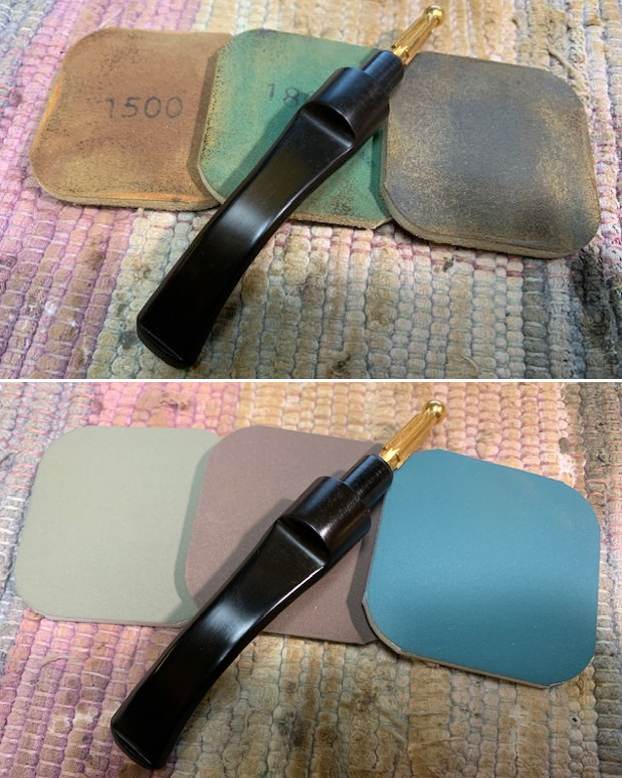
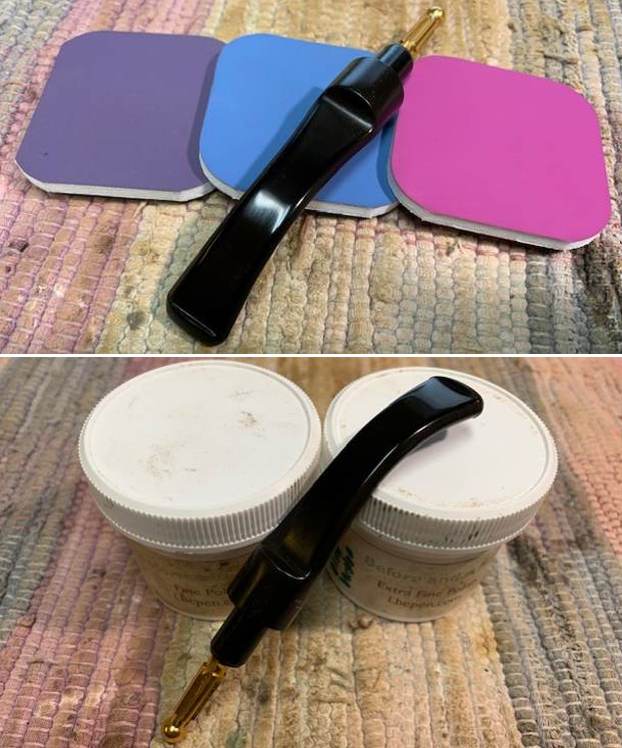
Restaining a Leather Clad Unsmoked Jean Lacroix Bent Billiard


Blog by Steve Laug

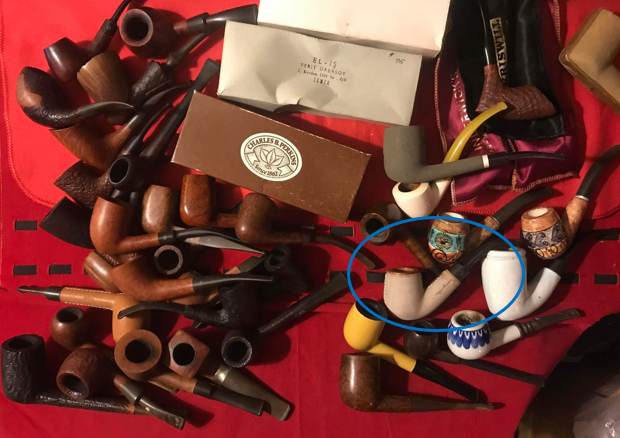
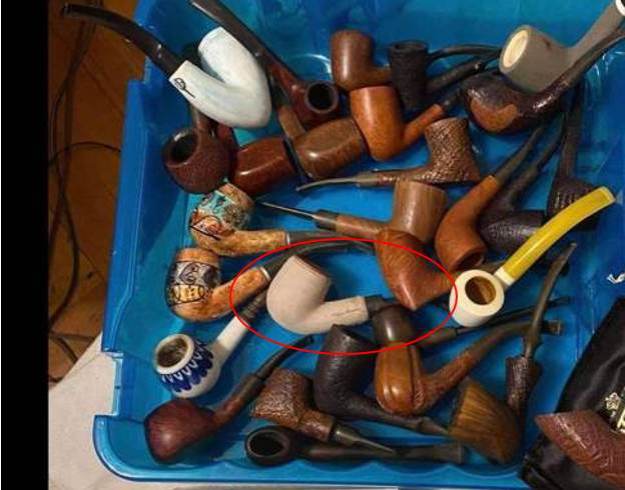
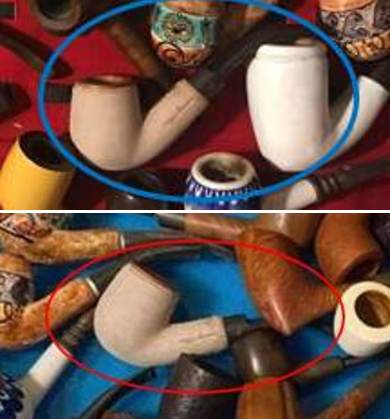
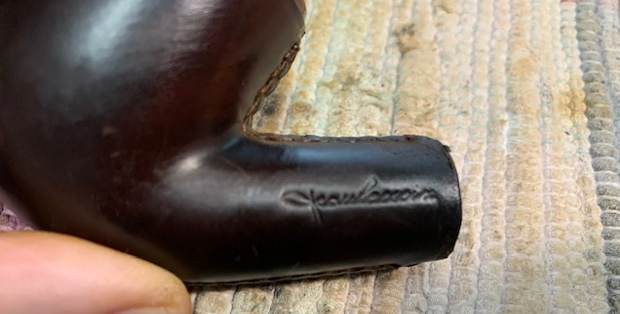
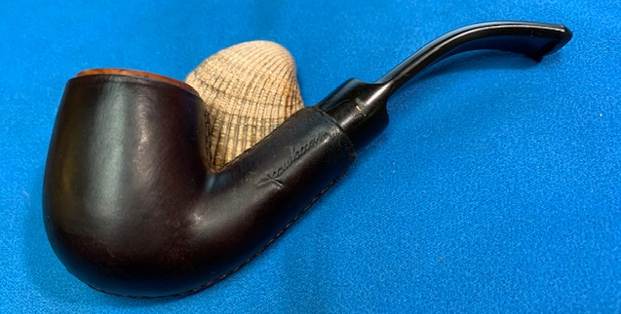
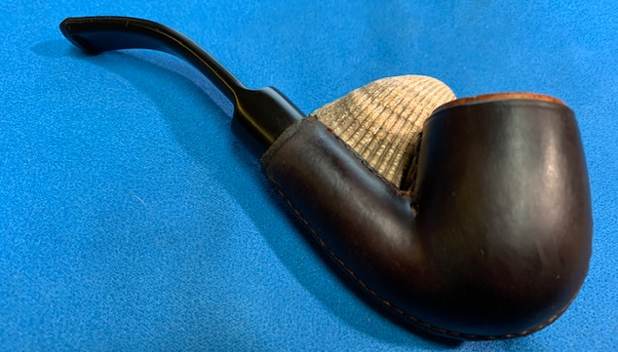
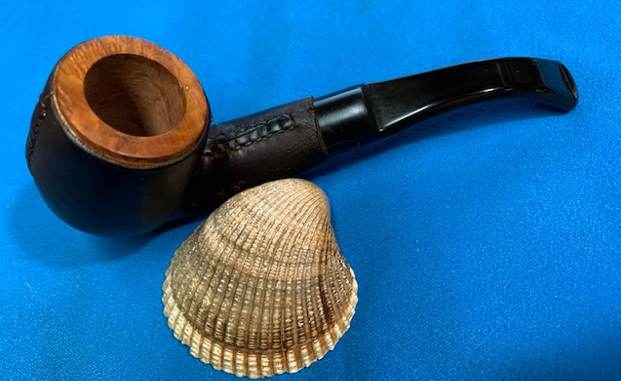
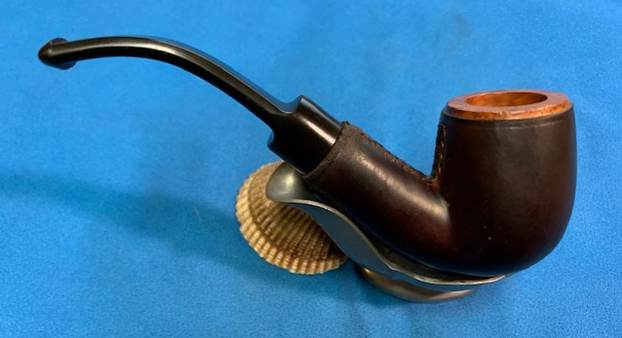
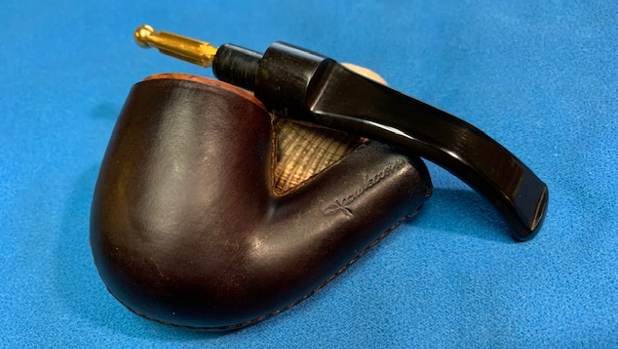
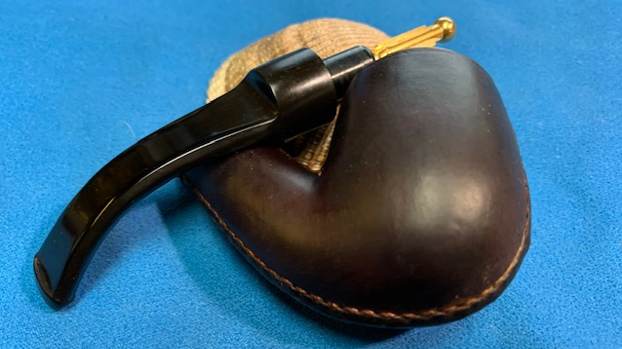
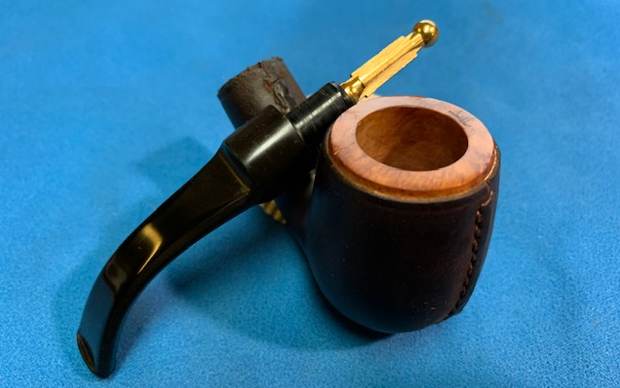
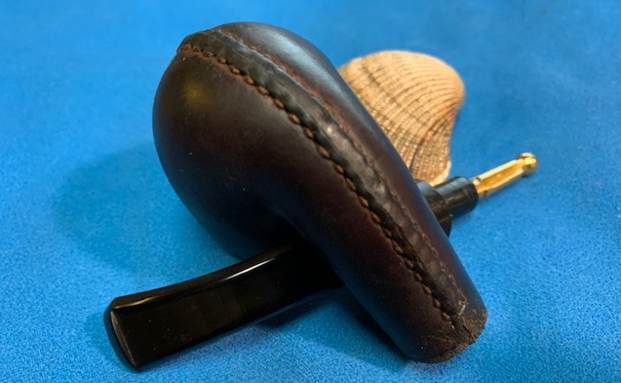
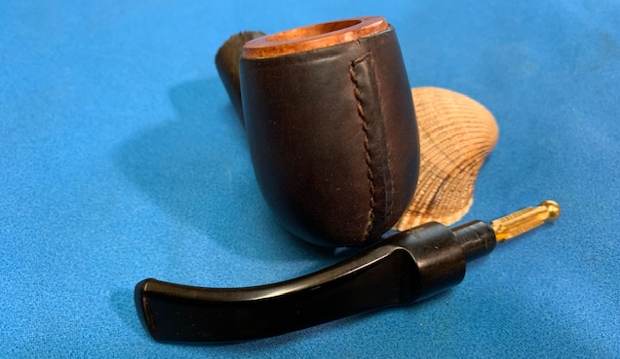
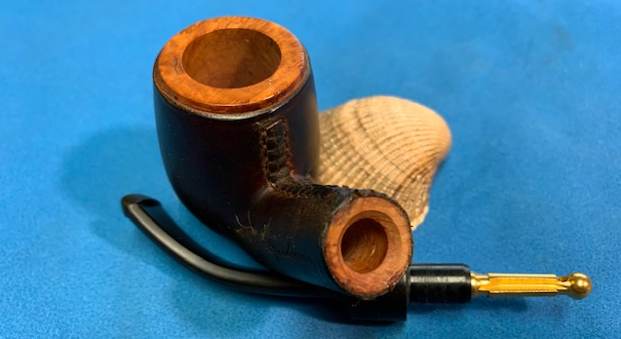
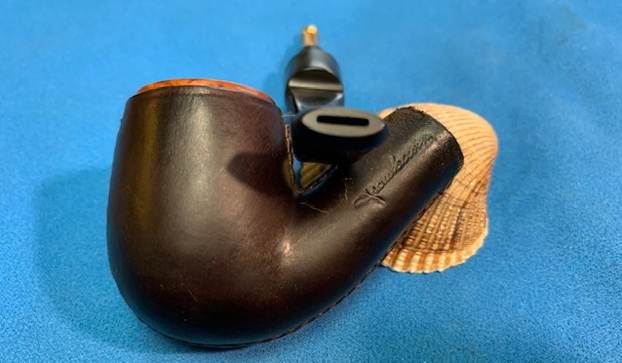
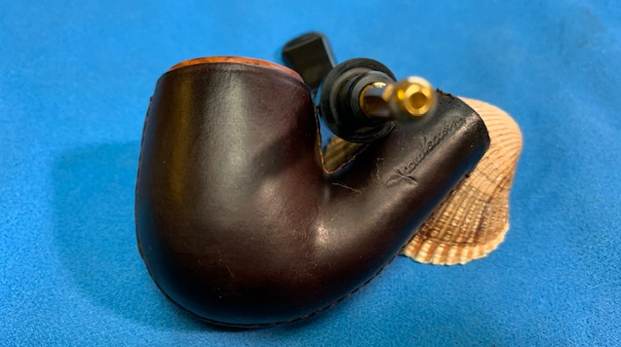
The next pipe I chose to work on is another UNSMOKED/NEW OLD STOCK pipe. This one was a leather clad Bent Billiard. It had a perfectly clean and debris free bowl and rim top that showed that it had never been smoked. The leather was light grey and was dirty from time and had water stains near the shank/stem union. It was stamped a signature Jean Lacroix stamp on the left side of the shank.  At the best of times I don’t like leather clad pipe but this was a clearly awful looking addition. If it had been smoked I would have abandoned it to the grab bags but the unsmoked and quite flawless looking Briar on the rim and in the bowl made me pause. The stitching on the leather was also clean and the edges on the bowl and the shank end were clean. If the stains were not present on the shank I would have just listed it as it is but I will need to do some work on it. I am kicking myself at this point as I forgot to take pictures of the pipe before I started my work on it. Jeff found two photos of a lot of pipes we purchased that included the Jean Lacroix pipe. I have circled it in blue in the first photo and in red in the second one. The stem has the Lacroix signature on the left side of the saddle and it is also on the left side of the shank. I blew up the photo of the pipe from the photos above to try to capture the look and staining to the leather on the shank. The photos are a little blurry but you can see the stains on the shank. The went all the way around and extended inward toward the stamping for about ½ inch.

Once again I am kicking myself as I forgot to take photos of my work to try and remove the stains. I scrubbed the shank with a gentle dish soap and was able to lighten them slightly but they did not come all the way out. I set the pipe aside overnight to think about my next steps. I went through some possible cleaning options and came to the conclusion that all would still leave behind the stain marks. That left only one option – to stain the leather a darker colour and see what that would do.

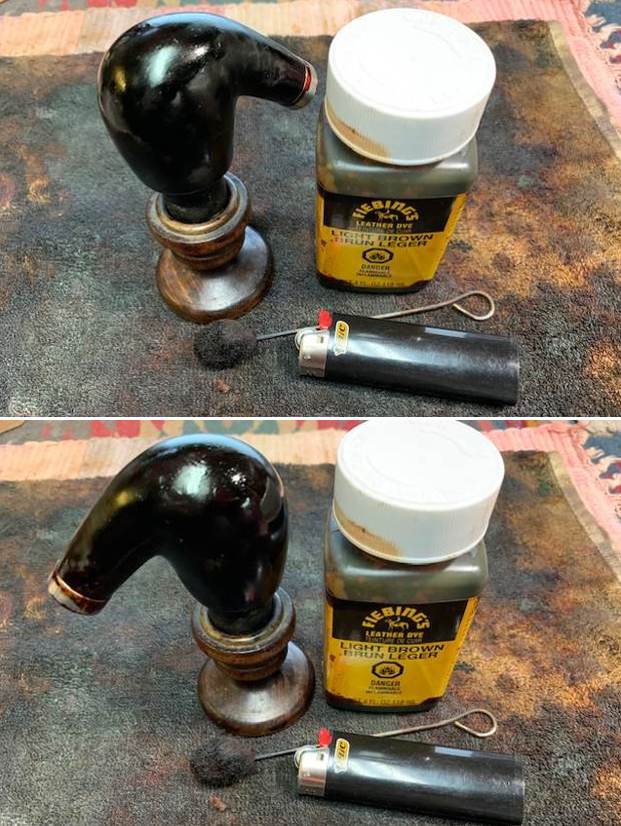
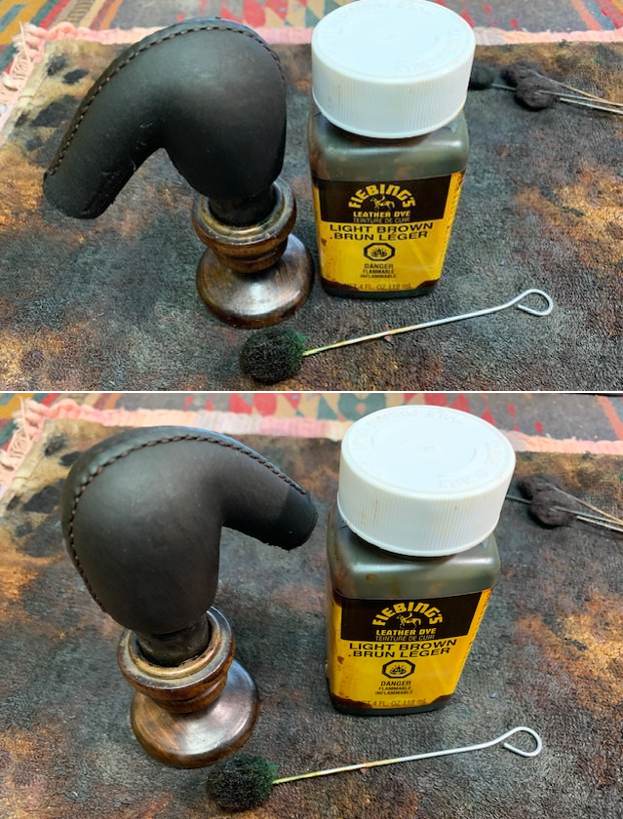
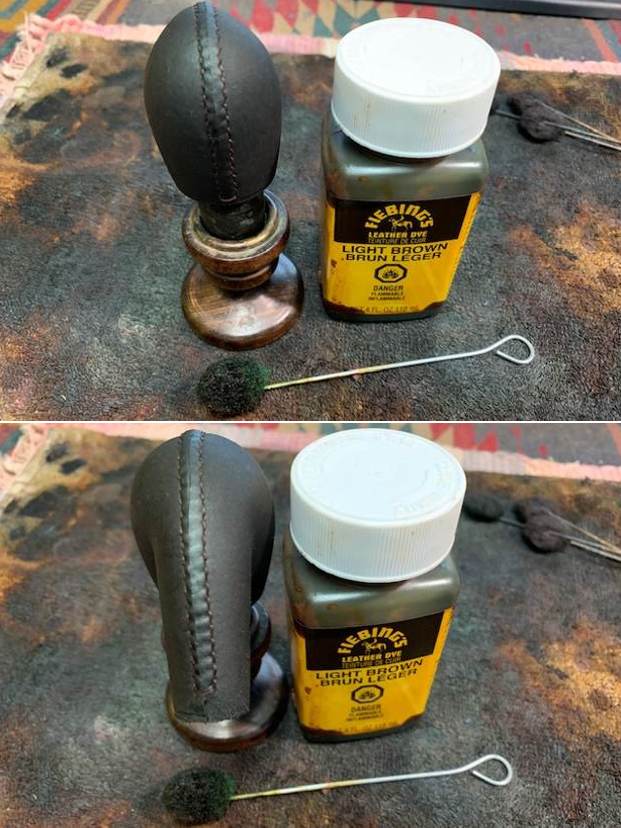
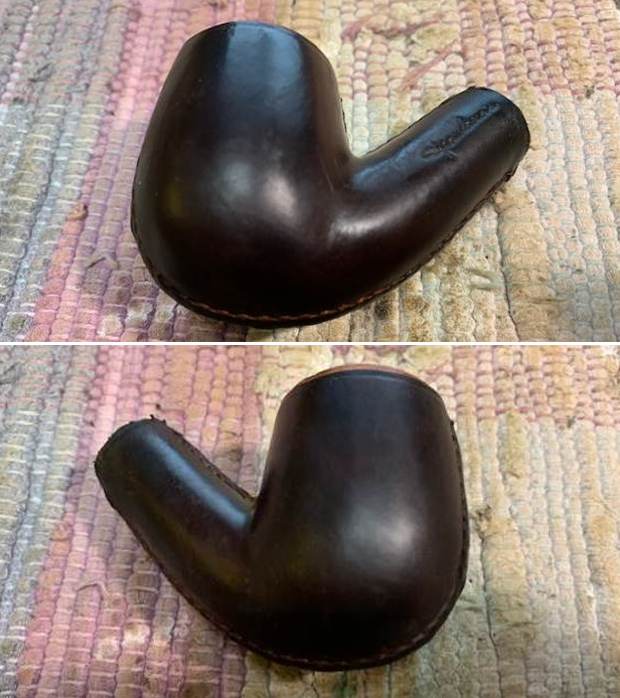
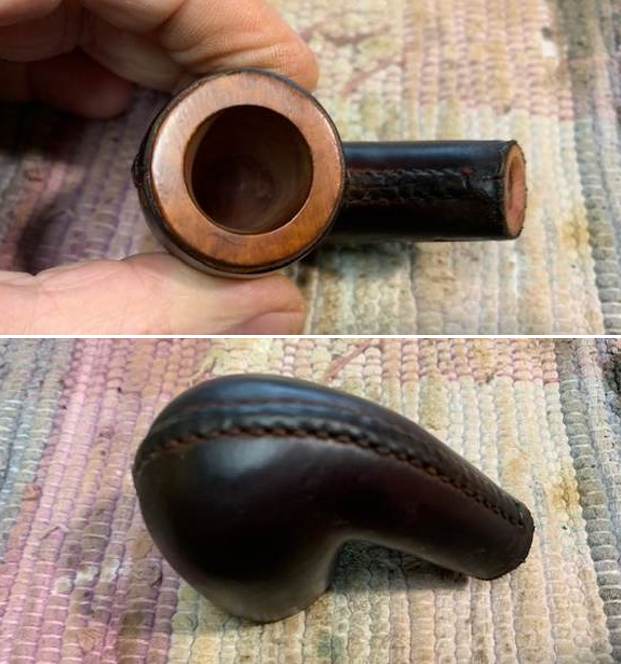
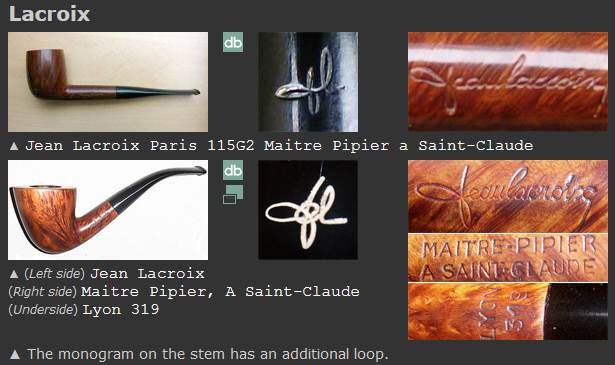
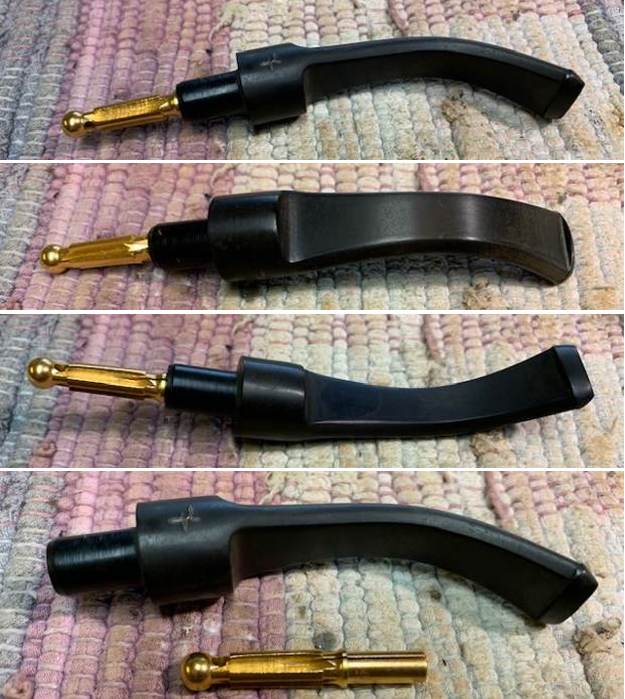
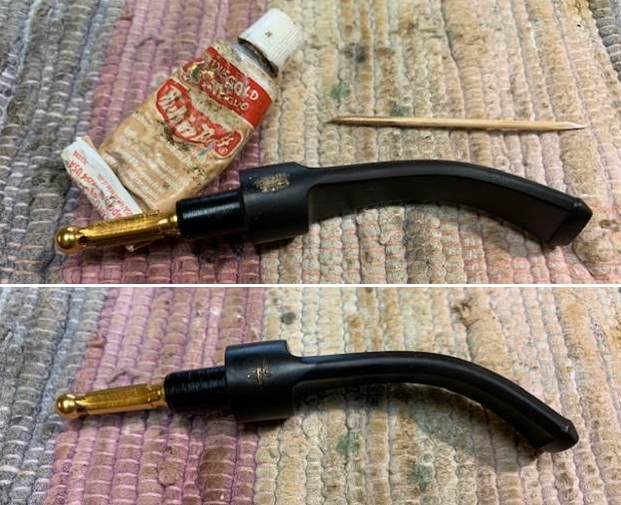
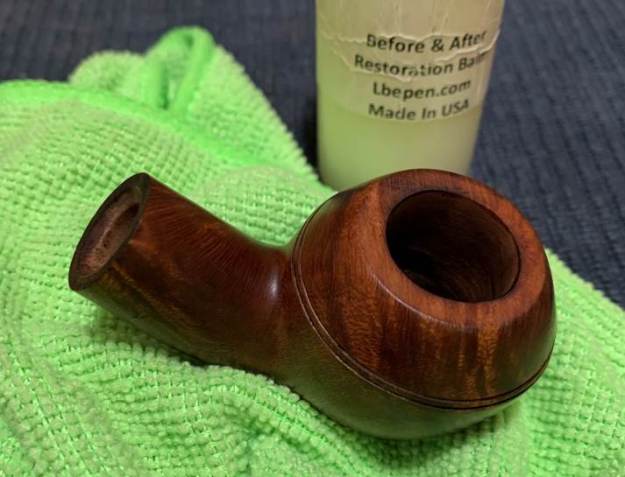
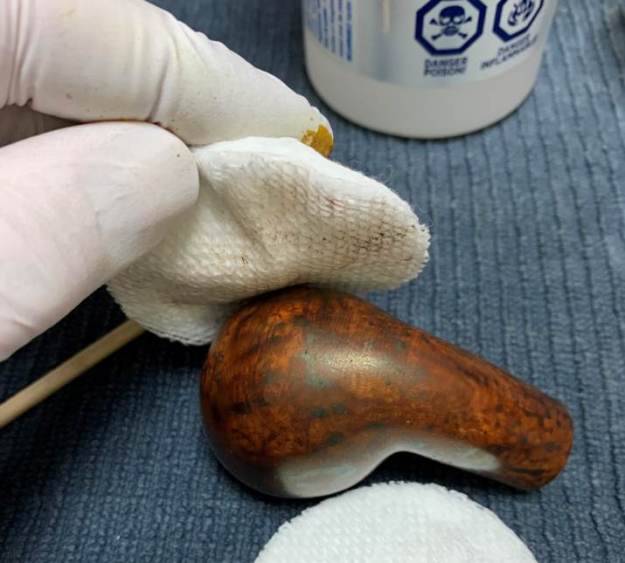
In the afternoon yesterday I made a decision to restain the leather. I figured I had nothing to lose. If it worked it would be great and I would finish restoring the pipe. If it did not work it could be scrapped for parts. I went through my stains to see what colour to use. I knew that the stains darkened considerably on leather so I chose a light brown Feibing’s stain. I applied it with the dauber all around the bowl to make sure the coverage was even. I carefully avoided staining the rim top and edges as I wanted them to remain a contrast to the leather. I set the bowl aside to let the stain cure on the leather. This morning I waxed and buffed the leather on the buffing wheel and the shine came alive. The newly stained leather came out looking quite amazing. The bowl has a rich brown finish that is warm and clean. The stain marks on the shank end have disappeared under the new colour. I think that it is a vast improvement. I took a photo of the stamping on the left side of the shank to show how the stamping had effected that part of the shank. Remember the stains on the shank end extended almost ½ inch up the shank all the way around. The stamp is clear and readable – Jean Lacroix.I turned to Pipephil (http://pipephil.eu/logos/en/logo-l2.html) to confirm the brand stamping. You can see how the stamp on the leather matches the stamp on the briar in the screen capture below.I set the bowl aside and turned my attention to the stem. It was lightly oxidized from sitting around in the store who had stocked it. The logo was faded and once I had removed it from the shank you can see the finned stinger apparatus in the tenon. It is friction fit and easily removable. I took photos of the stem before I started my work.I touched up the stamping on the stem with some Rub’n Buff Antique Gold. I worked it into the stamp with a tooth pick. I let it sit a few minutes then buffed it off with a soft cloth to remove the excess. It looks better in person than it does in the photo but you can get the idea.I polished the stem with micromesh sanding pads – dry sanding with 1500-12000 grit pads. I wiped the stem down after each pad with a cloth impregnated with Obsidian Oil. I polished it with Before & After Stem Polish – both Fine and Extra Fine then gave it a final coat of Obsidian Oil and set it aside to dry. I generally do not like leather clad pipe no matter who the maker is. I always wonder about what is under the leather. This UNSMOKED/NEW OLD STOCK Jean Lacroix Leather Clad Bent Billiard actually came out looking really good. The light brown stain on the leather brought the leather alive and the polished rim top and clean bowl look good. I put the stem on the shank and buffed the pipe with Blue Diamond on the wheel (being careful of the stamping on the stem so as not to damage that). I gave the bowl and the stem multiple coats of carnauba wax and buffed the pipe with a clean buffing pad to raise the shine. I hand buffed it with a microfiber cloth to deepen the shine. The dimensions of this pipe are – Length: 5 inches, Height: 2 inches, Outside diameter of the bowl: 1 ¼ inches, Chamber diameter: ¾ of an inch. The weight of the pipe is 1.62 ounces/46 grams. It is a great looking pipe and one that will be going on the rebornpipes store in the French Pipe Makers section. If you want to add it to your collection let me know via email to slaug@uniserve.com or by message. Thanks for walking through the cleanup with me.

A Third Reincarnation for an Antique Trident System


Blog by Robert M. Boughton

https://www.facebook.com/roadrunnerpipes

Imitation is the greatest form of flattery that mediocrity can pay to greatness.
— Oscar Wilde

In their definitive history of the Irish pipe maker and innovator, The Peterson Pipe: The Story of Kapp & Peterson, Mark Irwin and Gary Malmberg describe the key features of the System pipe: “An army mount, an internal reservoir to collect moisture from the smoke and the graduated bore P-Lip mouthpiece.”  (Quoted from Peterson Pipe Notes.)  The Trident homage to the Peterson System has all three.  If pipes had nine lives as the ancient Egyptians were the first to impute to cats, then the Trident already would have used up four of them, at least that I know about, counting the two prior lives and now this latest I have restored to the interesting pipe.  Its continuing worthiness of restoration shows that not all imitations are mediocre.

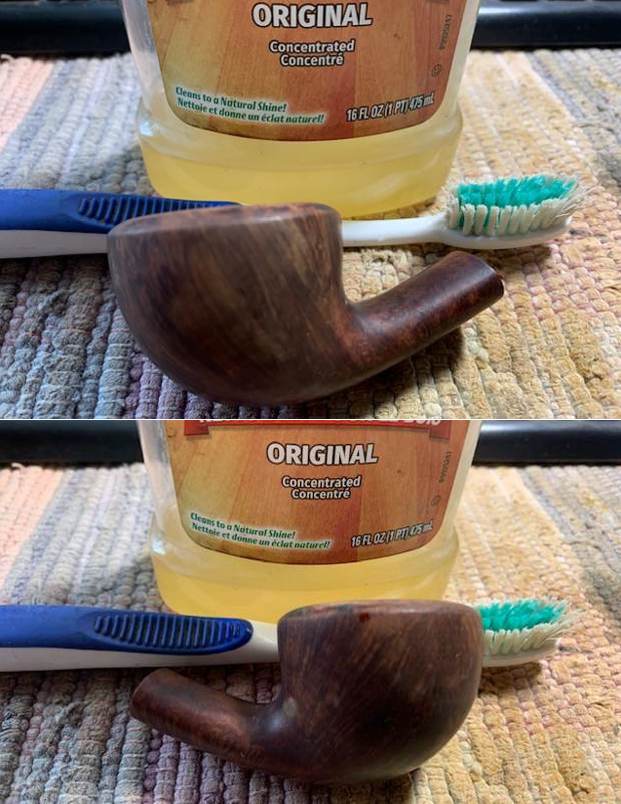
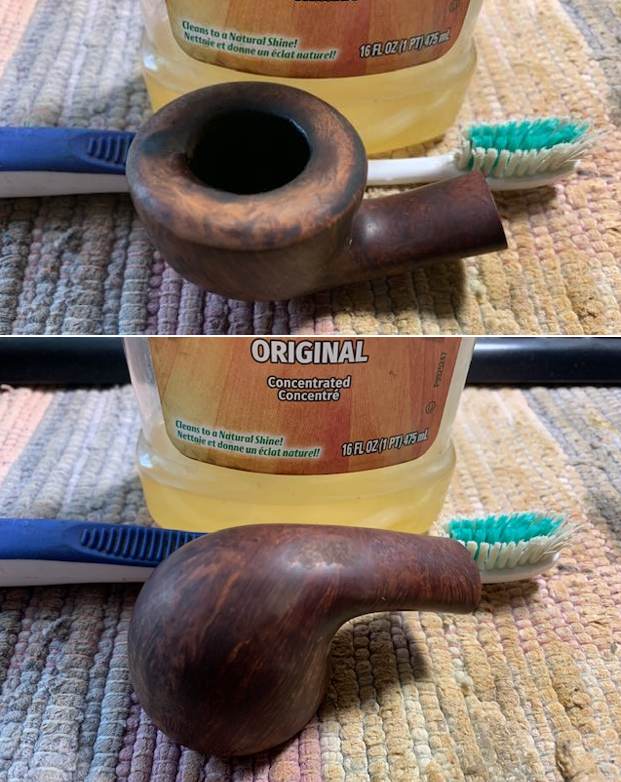
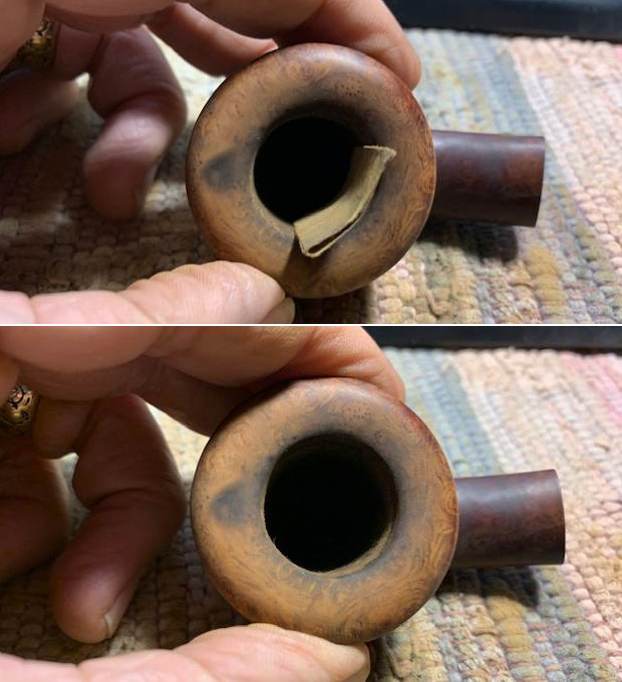
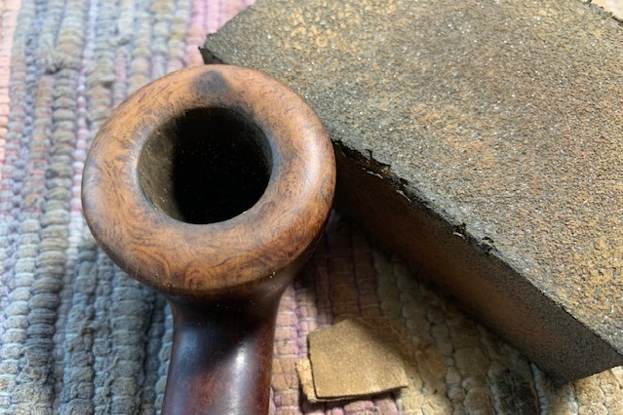
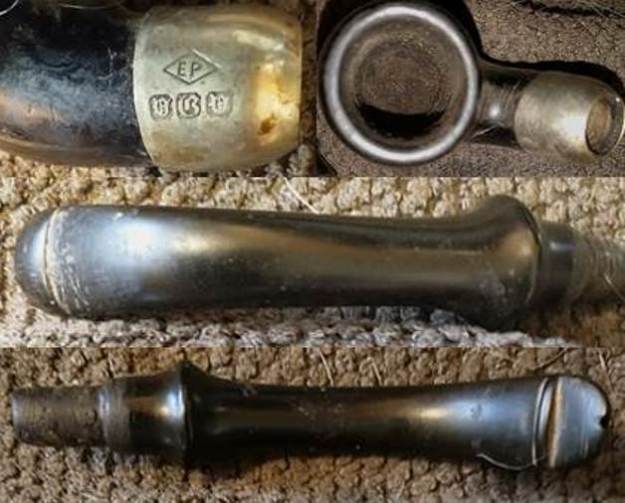
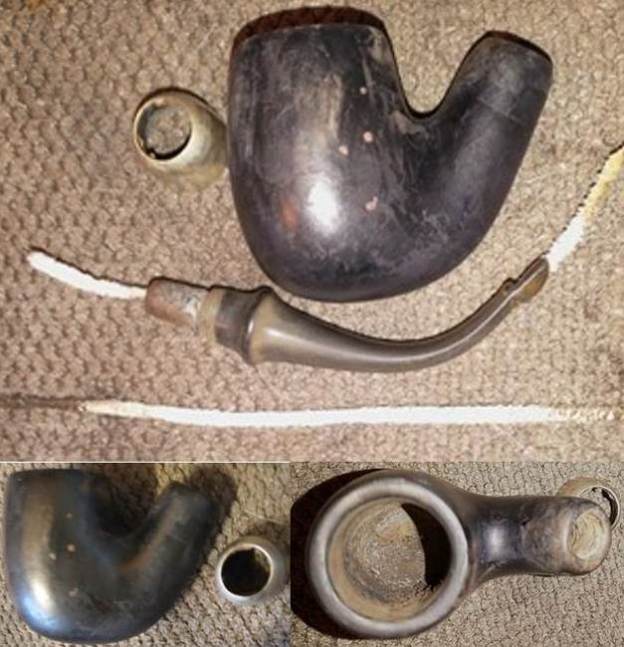
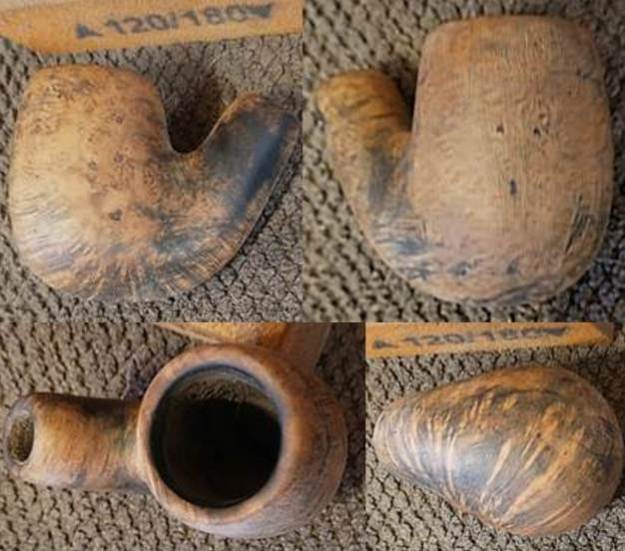
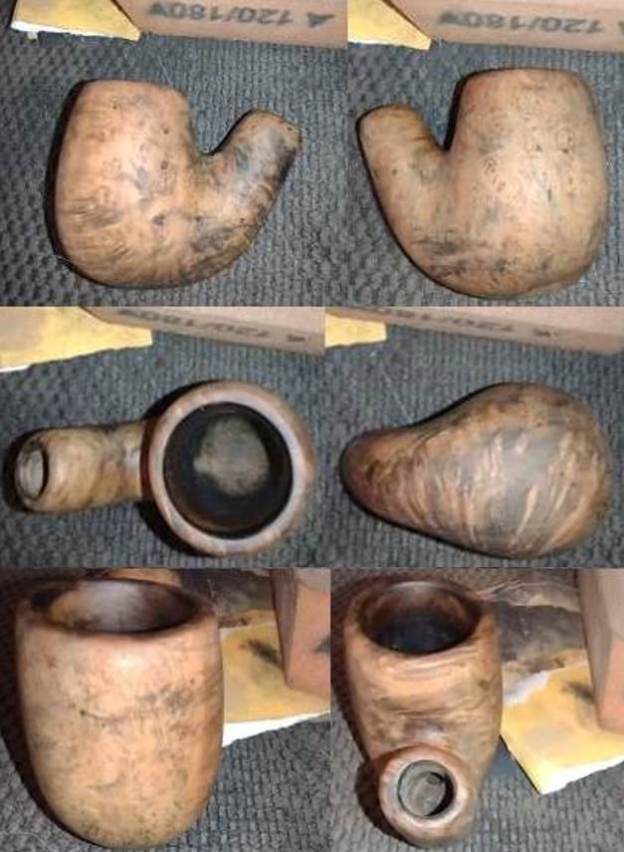
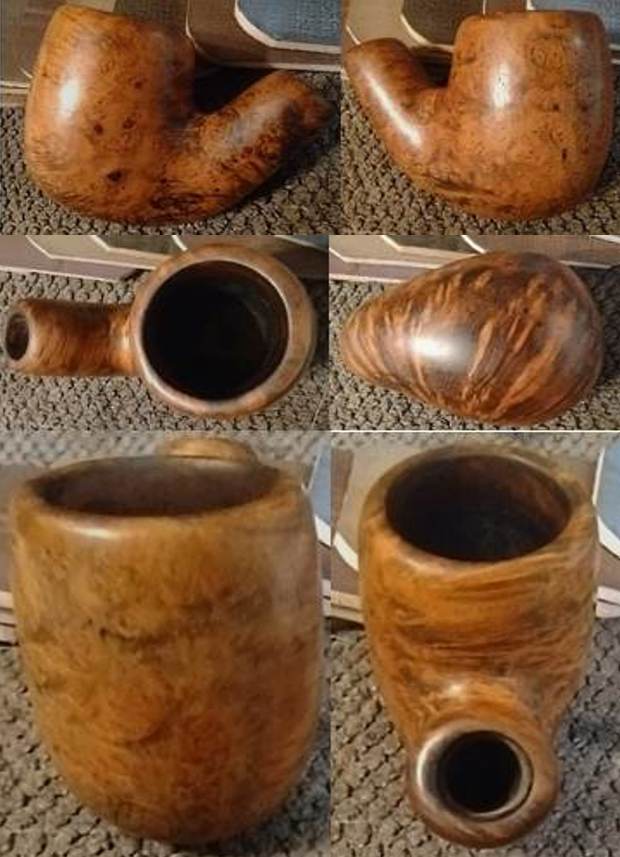
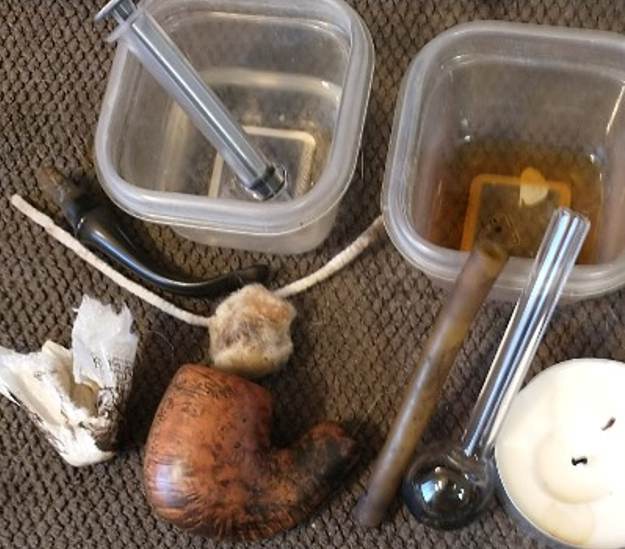
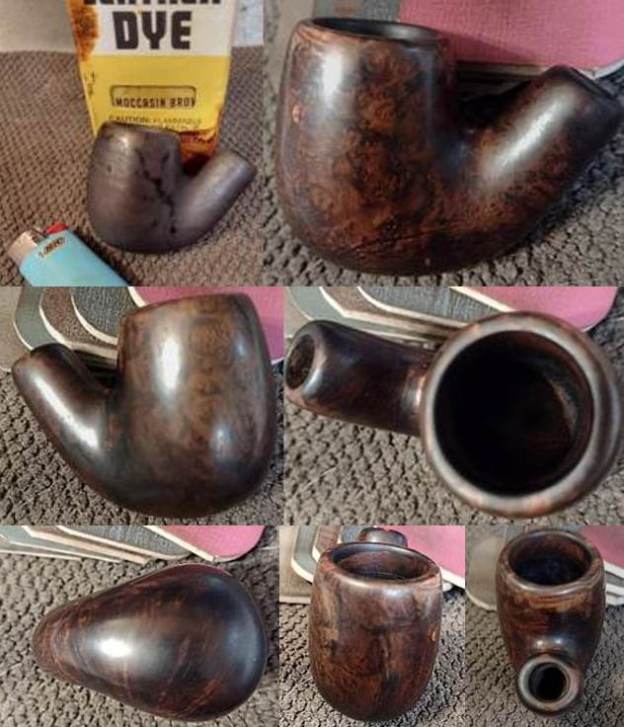
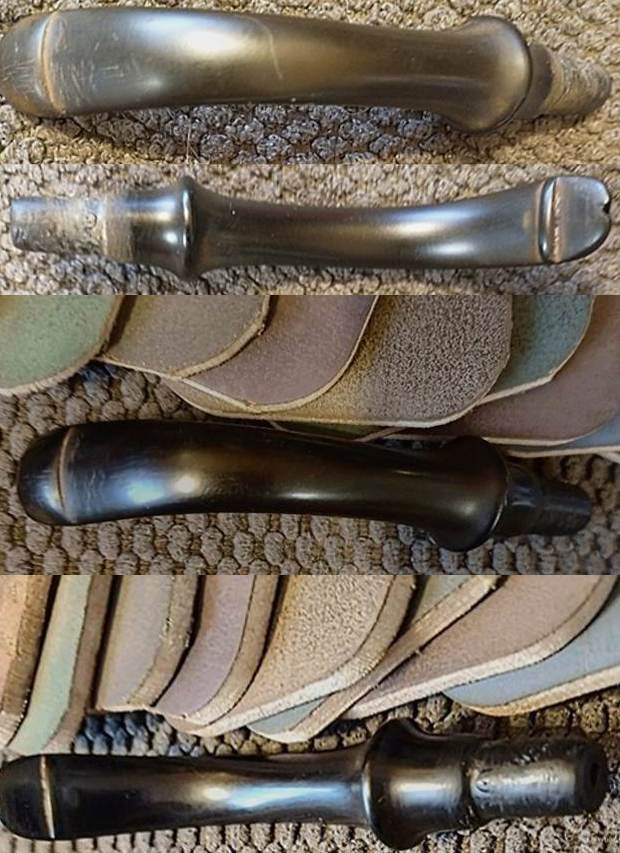
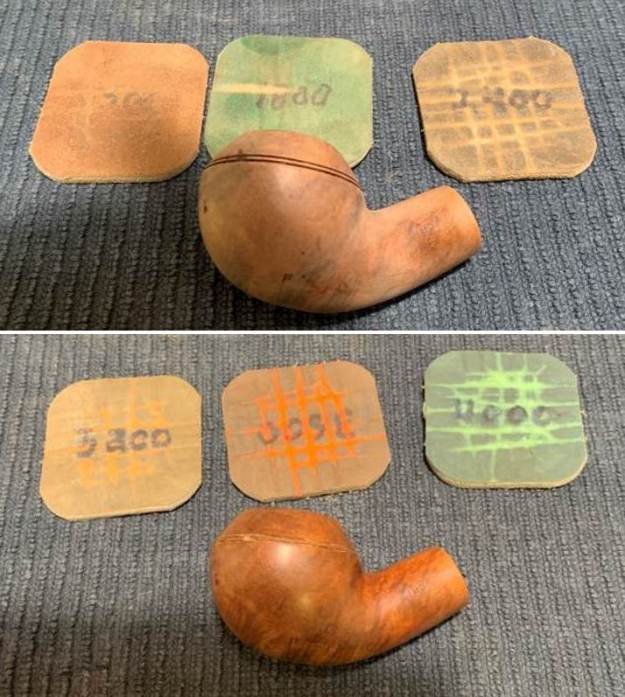
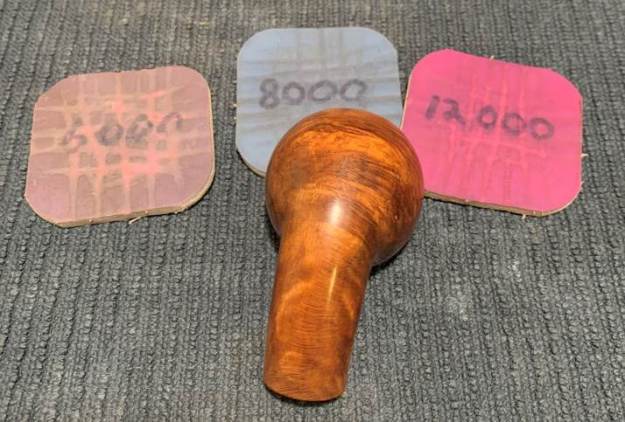
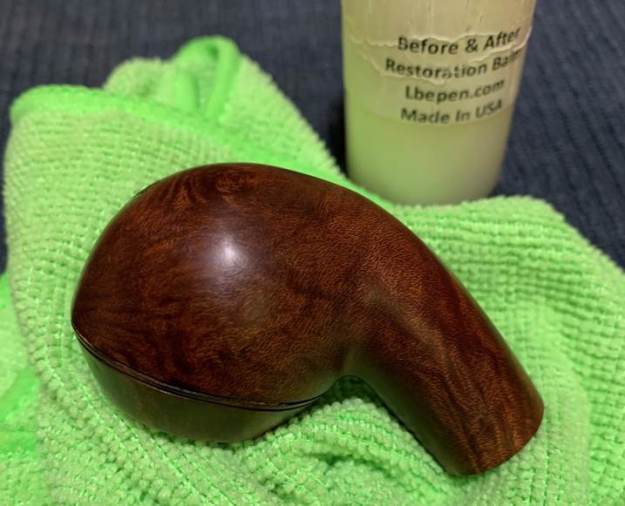
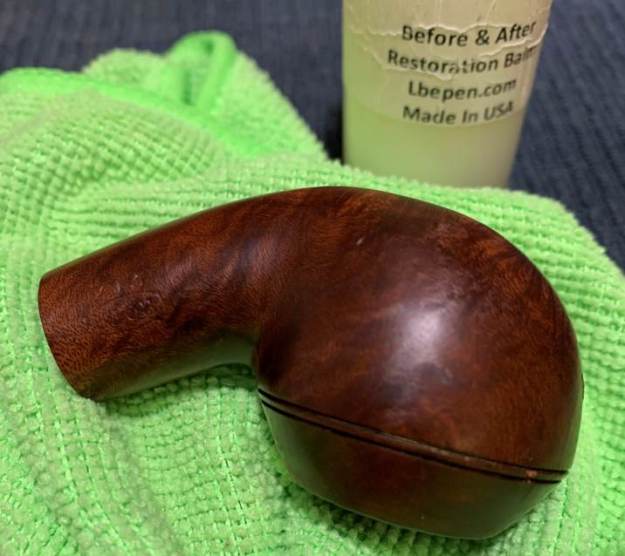
Another indication of the Trident’s quality is its apparent lineage, which in my first two restorations of this well smoked pipe – read abused – I only found misleads to E. Deguingand & Son and Comoy’s, both of England, and even flowery carved pear wood things from Ukraine.  Here is my Trident system pipe as I first found and restored it and again just two months later after rescuing it from the trash, where my second roommate tossed it because “it didn’t work out.”  My best efforts to stifle the flush of outrage I felt as I hastened to my feet at the appalling admission and stomped outside to the garbage bins failed somewhat, to put it in the nicest light I can bring off even at this late date.  While I attribute fatal flaws such as burnouts or through and through cracks to over enthusiastic dedication to a pipe or pipes, I hope I never become inured to the wanton disrespect some pipe smokers unleash on these fine tools in the pursuit of self-gratification. This time, after scouring cyberspace for hours, I lighted upon a Reborn Pipes blog by Dal Stanton, the Pipe Steward, about another fine Trident, a sandblasted bent billiard. Dal’s work on that pipe is remarkable for his skill in enhancing its original beauty and his tireless quest for the Trident’s provenance. An arduous course of leaps, hops and steps led Dal to the conclusion, with little doubt, that the brand was a second of the William Demuth Co. of New York, which lasted from 1835-1911 – making the Trident an antique. Here are before and afters of Dal’s Trident and an early 20th century WDC Wellington Dal compared it to, the latter courtesy of Doug Valitchka and Pipedia. Now I offer one more photo I found, showing another Wellington with the same style of band Dal’s and mine had at our introductions.  This one, from Worthpoint, ends any reservation I had regarding the Trident’s WDC connection.RESTORATION The rounded end cap with which I replaced the original brass band was functional except for three hallmarks that were placed as a charade.  I never cared for the marks, which I considered distracting, but in a misguided fit to make the previous dress version more Petersonian, I went with it.  I have read other blogs discussing the meaning of EP in an oval on certain bands and understood it to stand for Electro Plated, a process of adding a thin layer of silver to the nickel.  I found an online dictionary of silver band makers that claims the EP on the end cap stands for Edward Powers, who with his brother John began operation as the Powers Brothers tobacconist in Dublin in 1900.  The end cap indeed could be called Petersonian (more or less, whatever the true meaning of EP!).  At any rate, the end cap had to go, and I was happy it came off with the 12-hour Isopropyl soak, which removed little else.  That’s the problem with a well-done black stain and shellac coat.My 120/180-grit pad removed all remnants of the dress finish faster and far easier on my hand and arm than paper and revealed the total erosion of the one word of nomenclature. I had checked before using the pad to avoid not leaving even a ghost of the block Trident letters. I did not yet grasp how flawed the wood was with almost bottomless scratches and some pits, so I continued with more of the sanding pad followed by 220-1000-grit paper progression. This turned out to be just the tip of the iceberg. There were some black blotches left on the right shank below the opening that took 60-grit paper to eliminate.  Nine micro mesh pads later, I accepted the fact that no amount of viable sanding magic would make the pits on both sides of the bowl disappear.I mixed some briar shavings with Super Glue, applied dabs (sort of) to the pits and let it dry. I had missed tiny spots of the pits on the right side the first time, so I added fine drops of Super Glue alone.The 320 paper took off the dried glue, and I followed with 400-1000 before a full micro meshing. Next came an Everclear retort.My Fiebing’s Dark Brown leather dye was evaporated from long disuse, so I fell back on the Moccasin Brown for the stain.  With a flick of my Bic, I achieved an excellent flambé effect.  After a cool-off, I got rid of the char and gave the briar a shine with micro mesh from 6000-12000.  As is apparent in the following shots, some areas were too light, although not all of the pics show just how light.  I spot stained under the rim, the difficult to reach space on the back side of the bowl in the curve of the shank and most of the right and front sides.  Okay-okay, I revise “some areas” to more or less all!  Re-flambéeing the corrected places (I know that wasn’t a word until I added it to my MS Word dictionary), and another four-pad micro mesh were easy.  I didn’t bother to memorialize with still more photos the steps that should have been unnecessary.  I think 75 will be quite sufficient.  Despite repeated staining of the small spot bordering the left side and right front views, I made it a tad better but not gone.Finding the best match for a replacement, straight-edged endcap turned out to be the most challenging aspect of this third reincarnation of the Trident, again as far as I know about. I pawed through way too many candidates from a comprehensive collection I obtained from a friend on the Facebook smokers forums a while back, and after much more time than I had anticipated, I found a match that fit snugly on the shank and needed no Super Glue. The good news is that they are all organized in four baggies now.I put off the stem because, for the first time in my pipe refurbishing life, it didn’t need any sanding – just an Oxi bath and micro mesh.I buffed the stem and stummel with Brown Tripoli and carnauba. While I am unhappy with the tiny flaw on the bowl that remains un-darkened, I am pleased with the overall results.  This Trident System, a WDC second made when Peterson’s System was still revolutionary, is a clear tribute to the folks in Dublin.  Maybe it was the giant Irish maker that put an end to Trident because of the matter of a little patent infringement technicality!  Who knows?

SOURCES
https://petersonpipenotes.org/2019/08/27/145-andy-wikes-guide-to-the-system-pipe/
https://pipedia.org/wiki/British_Pipe_Brands_%26_Makers_R_-_T
https://rebornpipes.com/2017/07/17/jens-trove-no-7-a-trident-blasted-bent-billiard-with-a-question-of-history/
https://pipedia.org/wiki/William_Demuth_Company
https://thepipesteward.com/about/
https://rebornpipes.com/2018/09/07/dressing-up-a-dinner-pipe-1-4-the-trident-experiment/
http://www.silvercollection.it/DICTIONARYTOBACCONISTE.html

A Decorated Veteran


Blog by Kenneth Lieblich

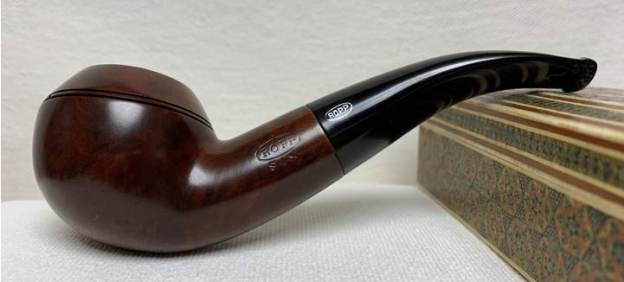
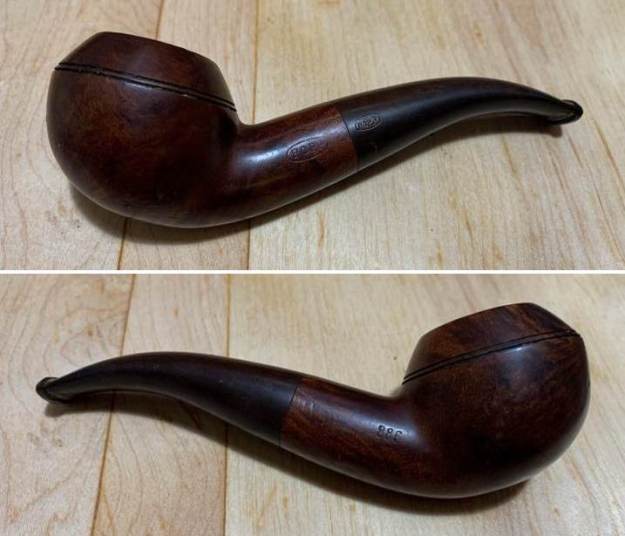
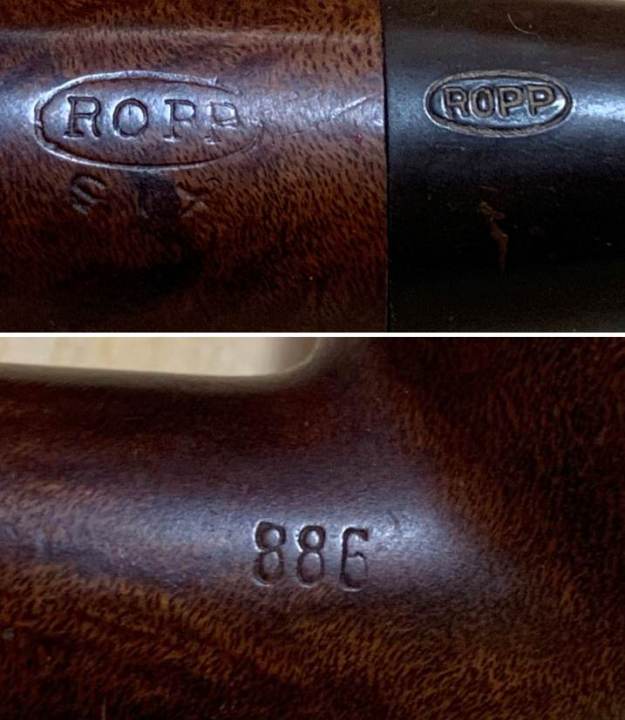
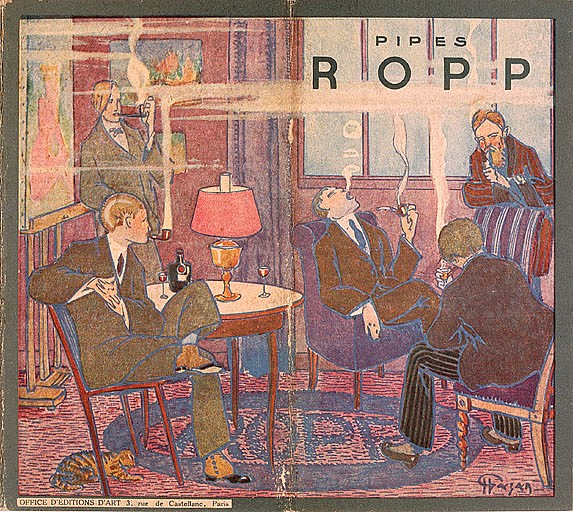
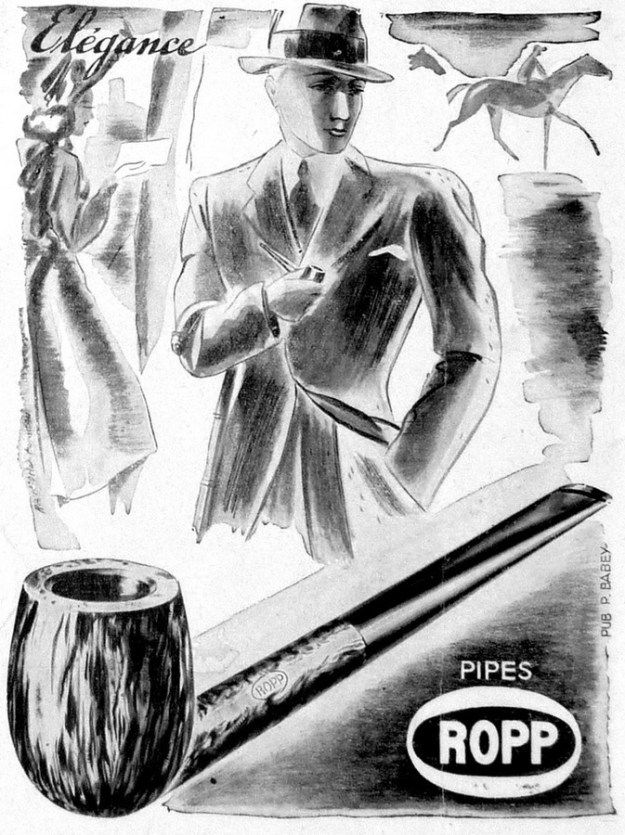
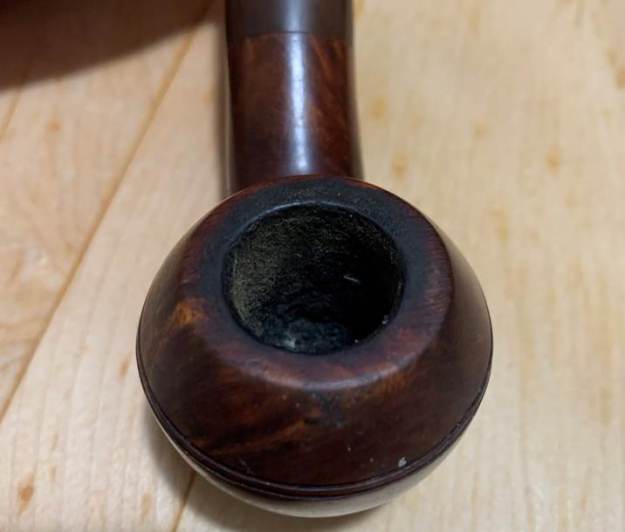
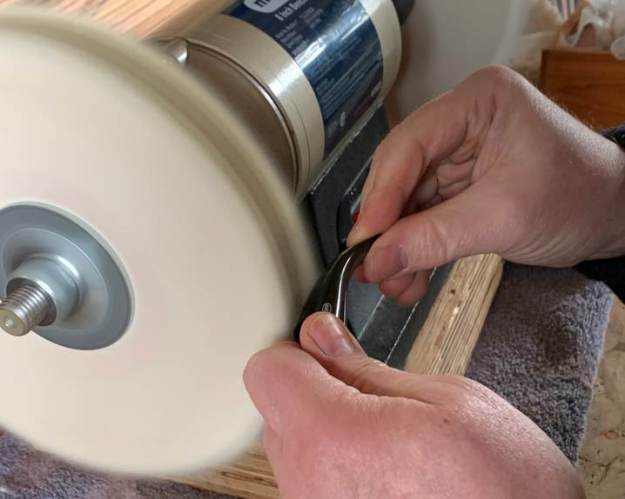
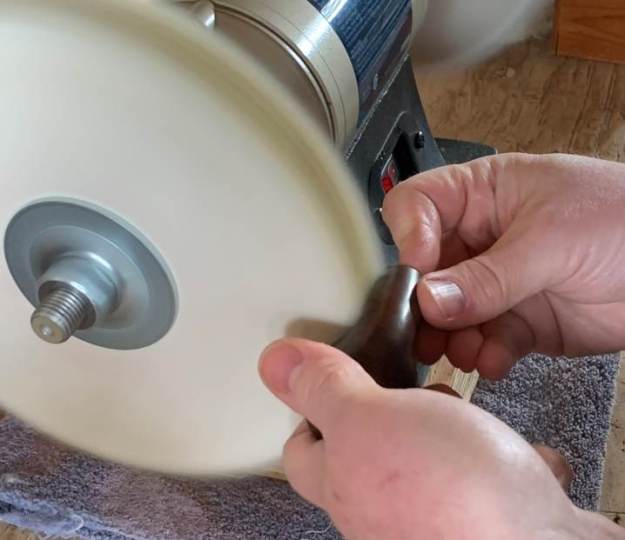
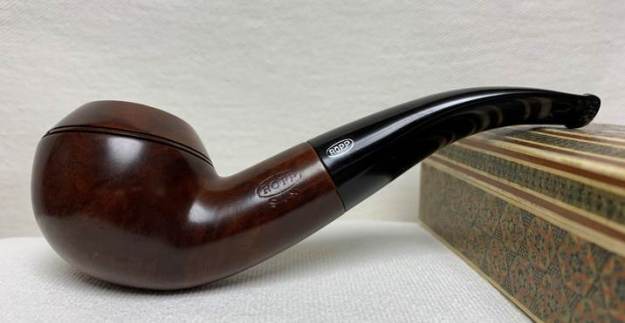
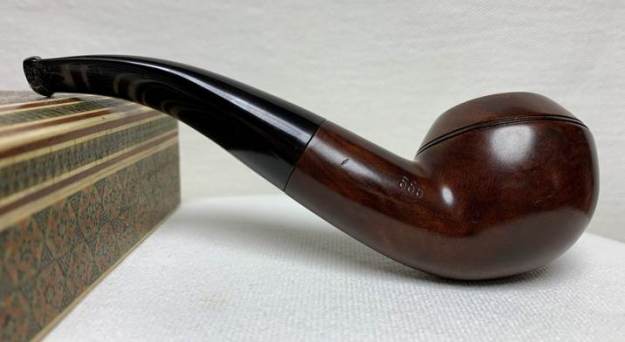
Next on the chopping block is this superb Ropp Six. It comes from a group of pipes I purchased from France. I love this pipe. I have a particular interest in French pipes and pipeworks, and I grabbed this one to restore for my collection. This is an old, old pipe with a few wounds (i.e. a veteran pipe with decorations) and needs just a little help to come back to life. This pipe was made by the venerable French pipe company, Ropp. Ropp has been around for a long time and their early pipes are really quite wonderful (the less said about their modern pipes, the better). The markings on the left-hand side of the shank read Ropp [over] Six. The right-hand side of the shank reads 886, presumably the shape number. Also, on the stem, there is the Ropp logo: Ropp, encircled in an oval.This pipe shape is a Rhodesian – a variation of the classic Bulldog. A Rhodesian will have a cylindrical shaped shank, not a diamond shank like the Bulldog. This is a really pretty pipe and feels very comfortable in the hand.
From Pipedia, here is a very brief history of the Ropp company:

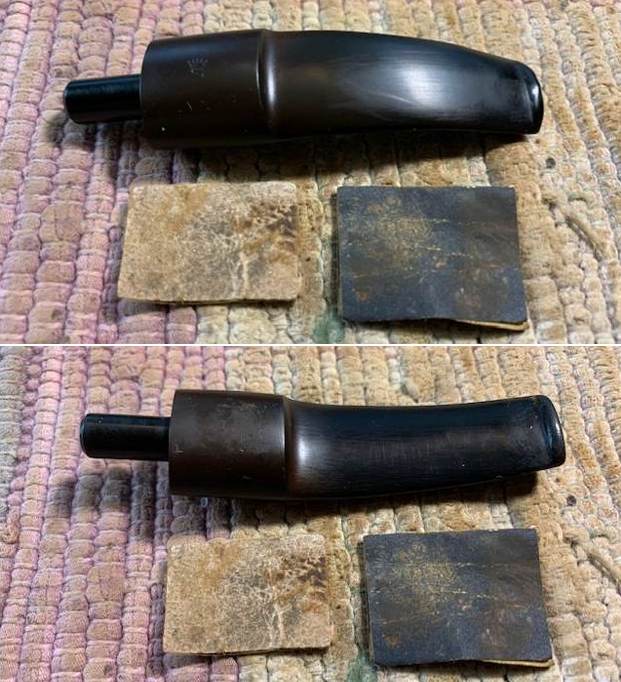
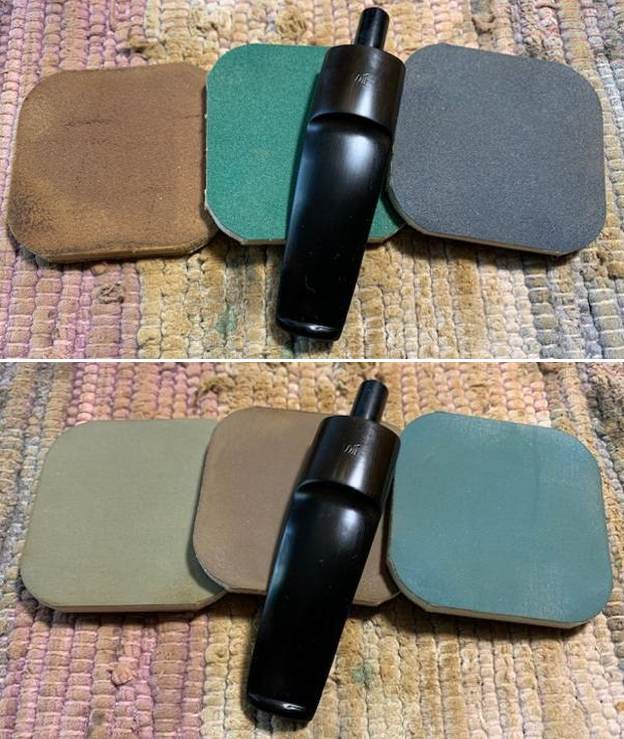
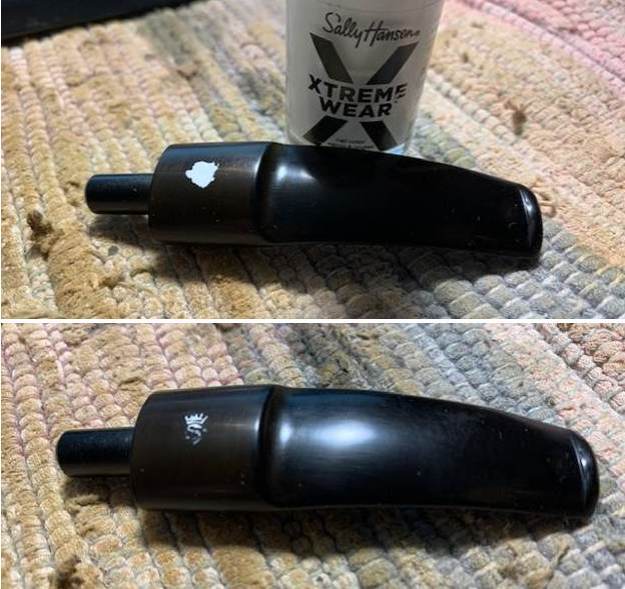
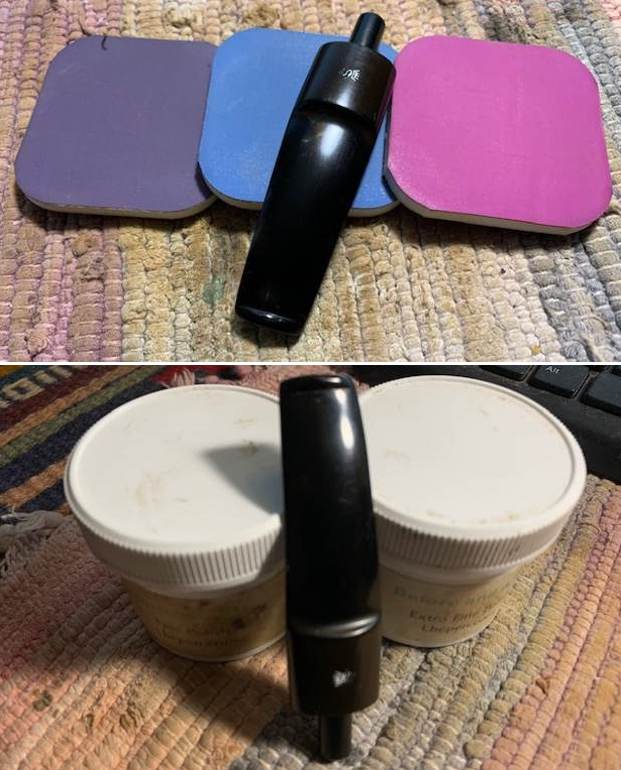
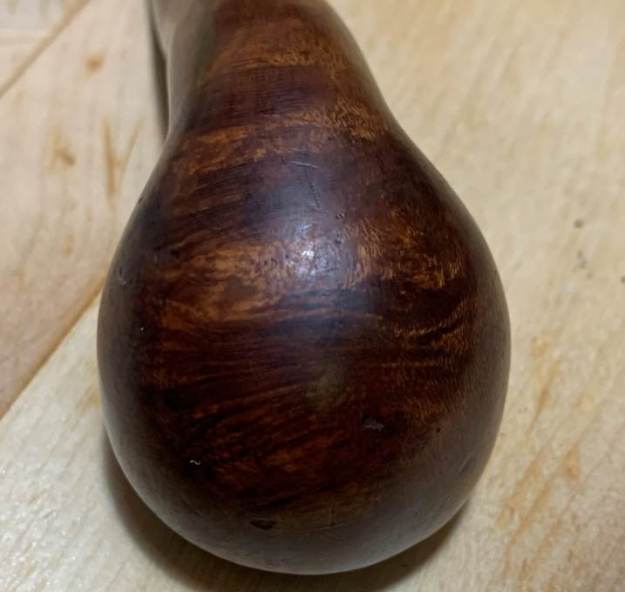
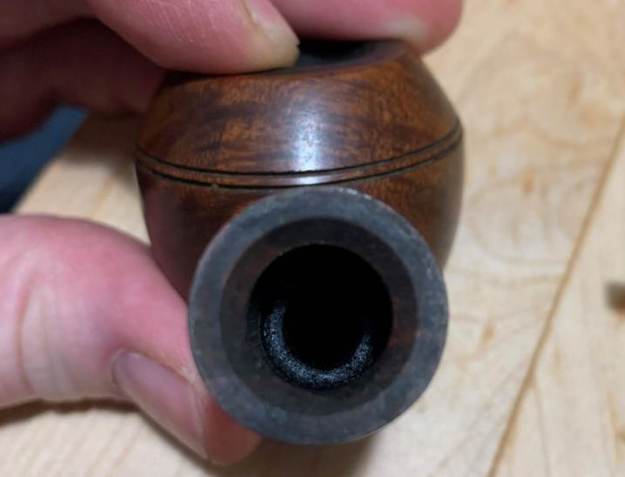
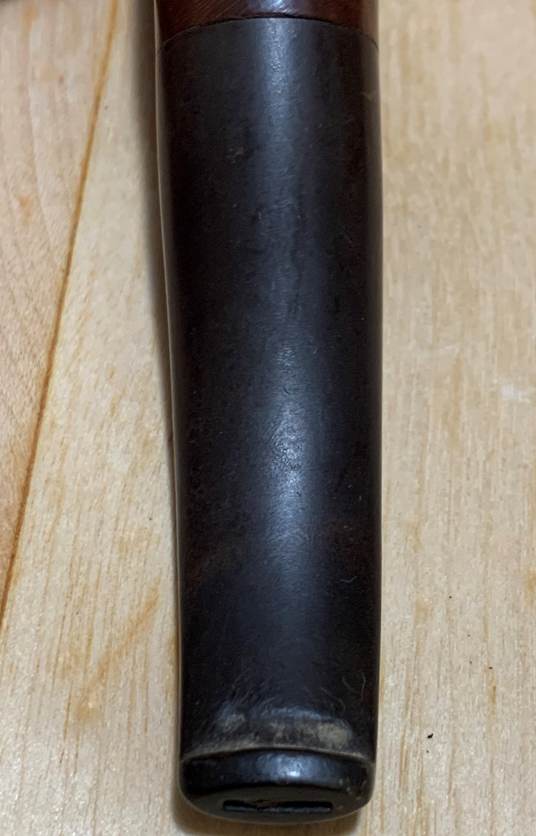
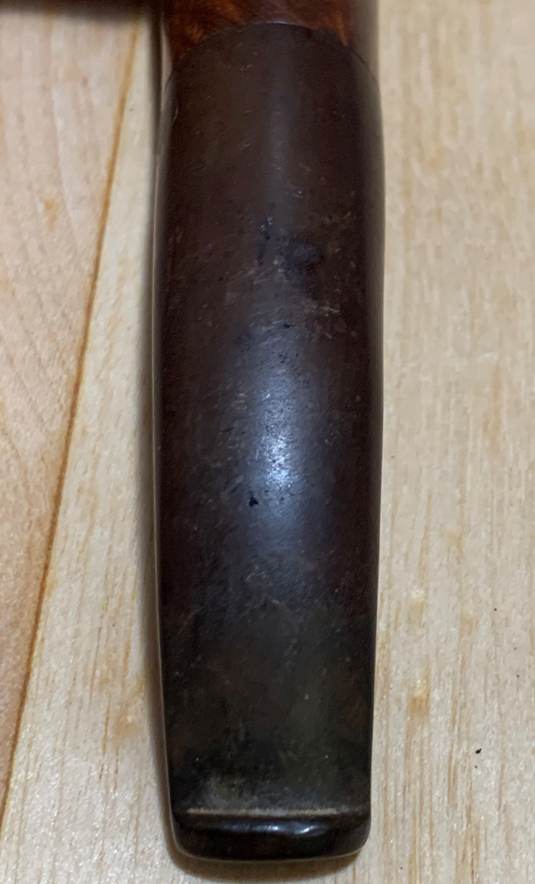
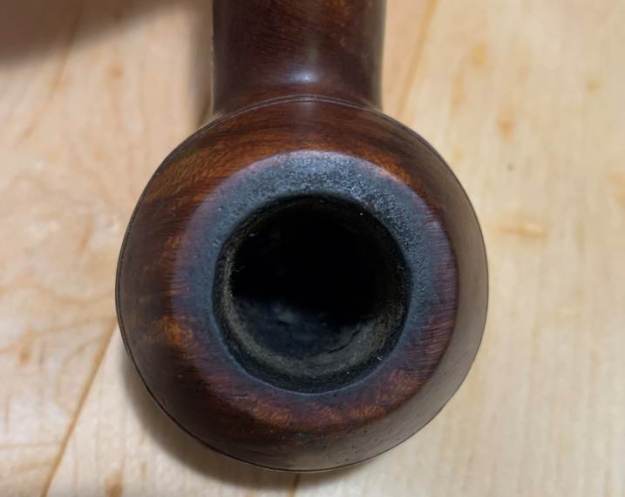
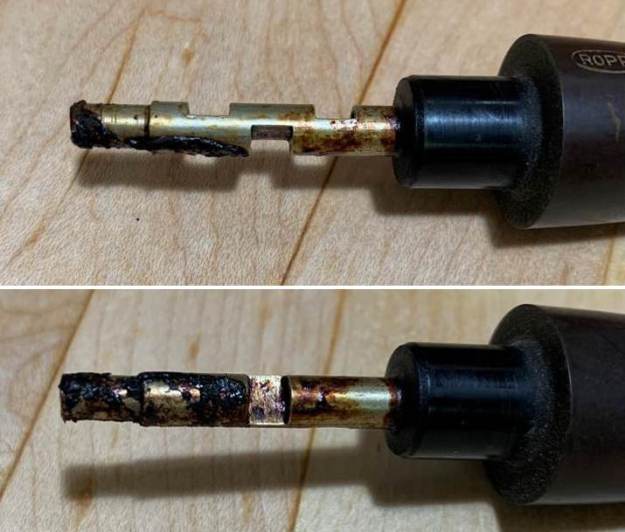
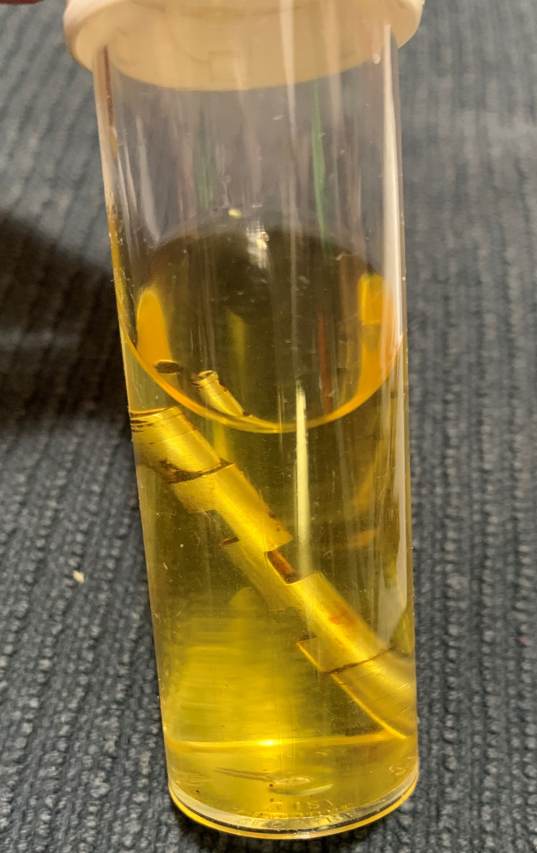
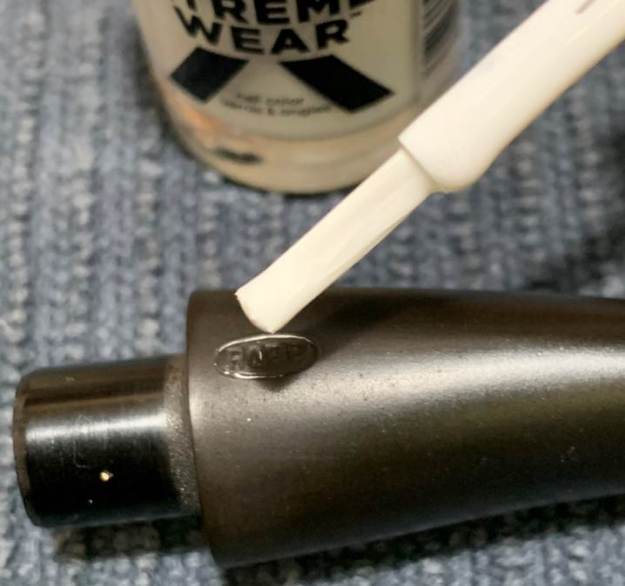
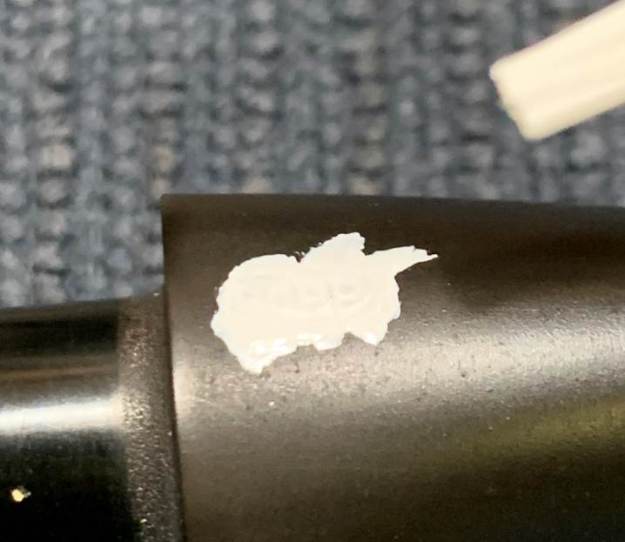
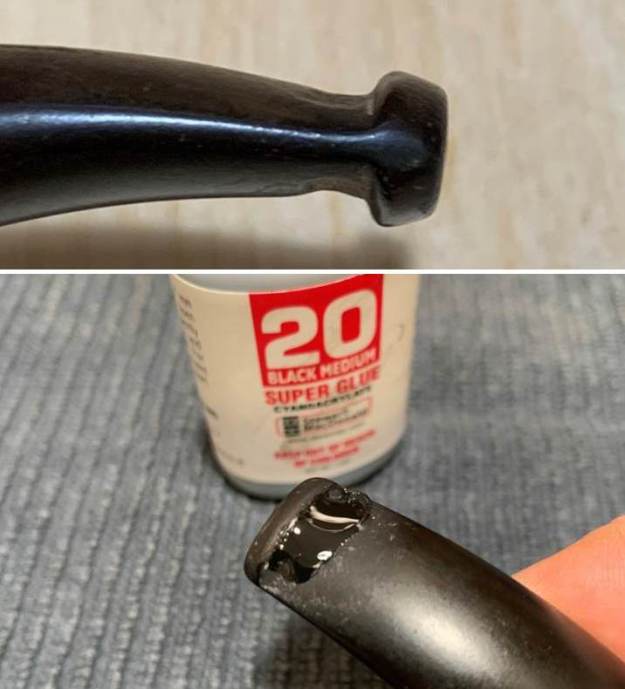
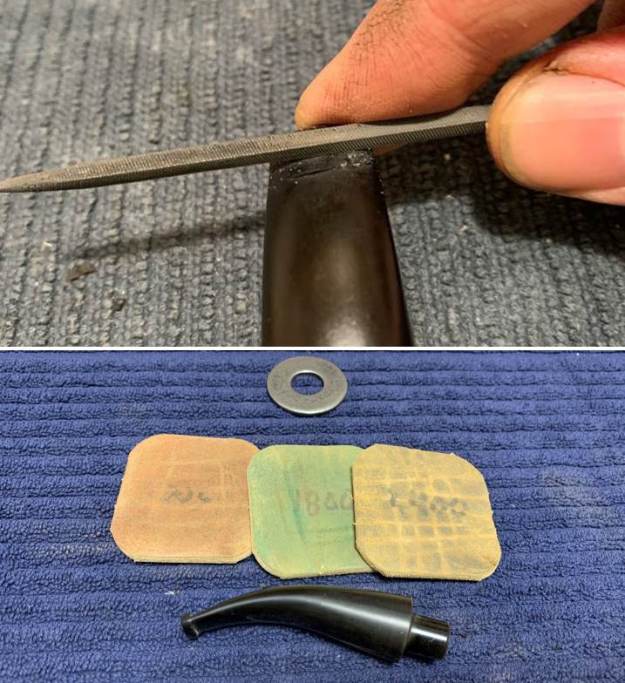
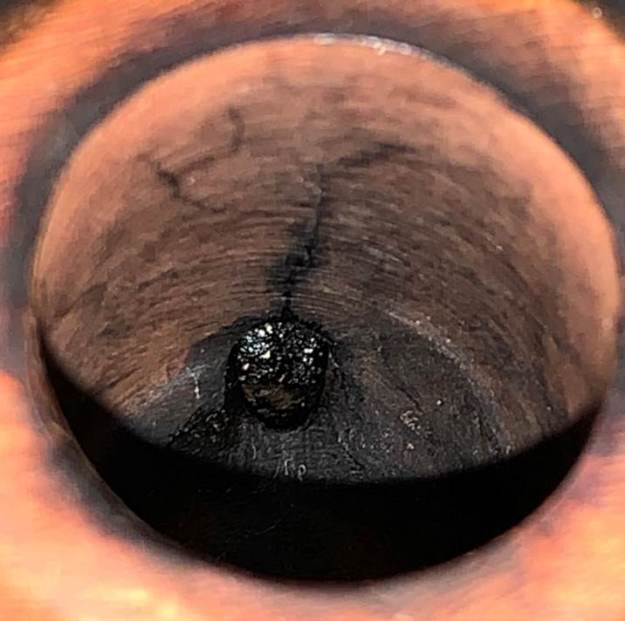
Eugène-Léon Ropp (1830–1907) acquired a patent for the cherrywood pipe in 1869. In 1870, he established a workshop to manufacture such pipes in Bussang, in the Vosges mountains. Around 1893, his business moved into the former mill of Sicard (part of the community of Baume-les-Dames in Upper Burgundy. The pipes were a big success in export as well. Shortly before 1914, Ropp designated A. Frankau & Co. (BBB) to be the exclusive distributor in the UK and its colonies. Probably in 1917, a workshop in Saint-Claude in the rue du Plan du Moulin was acquired to start the fabrication of briar pipes. In 1923, another small building in Saint-Claude, serving as a workshop for polishing, was added. Cherrywood pipes were the mainstay of Ropp until the company finally closed down in September 1991. The company was taken over by Cuty-Fort Entreprises in 1994. On to the pipe: it was in decent shape, but it had a few issues. The stem had a bit of oxidation and calcification, but – mostly notably – it had substantial bite marks, top and bottom. The stummel also had a few issues. The outside of the bowl had some scratches and a couple of fills that needed to be addressed. These are the “decorations” I referred to in the title of this article. There was lava and debris on the rim, and a few burn marks too. The inside was pretty dirty too – it would need a thorough cleaning. The stem was first on my list. This stem has a stinger in it – and it was being quite stubborn about coming out of the tenon! I opted to warm the stem and stinger with my heat gun and this provided just enough softening of the internal goo to allow me to pull it out. The stinger then went for a soak in some lemon-infused isopropyl alcohol. I let it set for several hours and then cleaned it off and it looked much improved. I then finished it with some metal polish and moved on. I wiped down the outside of the stem with Murphy’s Oil Soap on some cotton pads. I also took a BIC lighter and ‘painted’ the stem with its flame in order to lift the bite marks and dents. This was not successful at all in raising the damage. More work would need to be done. Then, I cleaned out the insides with pipe cleaners and isopropyl alcohol. Even the bore was clogged with debris! It took an awful lot of work to get this clean! Once this process was done, the stem went for an overnight soak in the Pipe Stem Oxidation Remover. The following day, I cleaned all of the de-oxidizing mess off with alcohol, pipe cleaners, et cetera. The oxidation had migrated to the surface and would be fairly straightforward to remove. I scrubbed with SoftScrub on some cotton pads to remove the leftover oxidation. After this, I used some nail polish to restore the Ropp logo on the stem. I painted the area carefully and let it fully set before proceeding. I built up the dents on the stem with cyanoacrylate adhesive and let them fully cure. On this occasion, I actually built up several layers of the glue over a few days. I must admit, it was an annoying and frustrating process because, at this stage, it never looked quite right. I then sanded the adhesive down – first with a small file – then with 220-, 400-, and 600-grit sandpapers to meld seamlessly into the stem. I then used all nine Micromesh pads (1,500 through 12,000 grit) to bring out the lovely black lustre on the stem. I also used Obsidian Pipe Stem Oil in between each pad scrubbing. On to the stummel, and the usual cleaning procedures were in order for this pipe. This stummel was a bit of a mess inside, so I first decided to ream out the bowl. I used both the PipNet Reamer and the KleenReem to remove the built-up cake and followed that with 220-grit sandpaper to eliminate as much as I could. I took the bowl down to bare briar, as I wanted to ensure there were no hidden flaws in the walls of the bowl. There were some very thin craze lines inside the bowl, but they were small enough that I elected to leave them as they were. I then proceeded to clean out the insides of the shank with Q-tips, pipe cleaners, and isopropyl alcohol. There was considerable filth inside this stummel and it took a lot of cotton to get it clean. I followed that up by cleaning the insides with some dish soap and tube brushes.
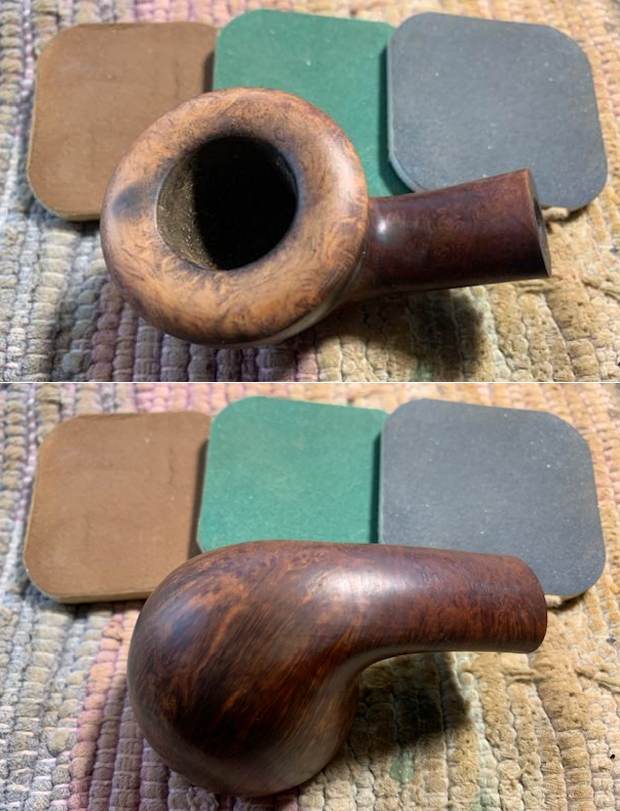
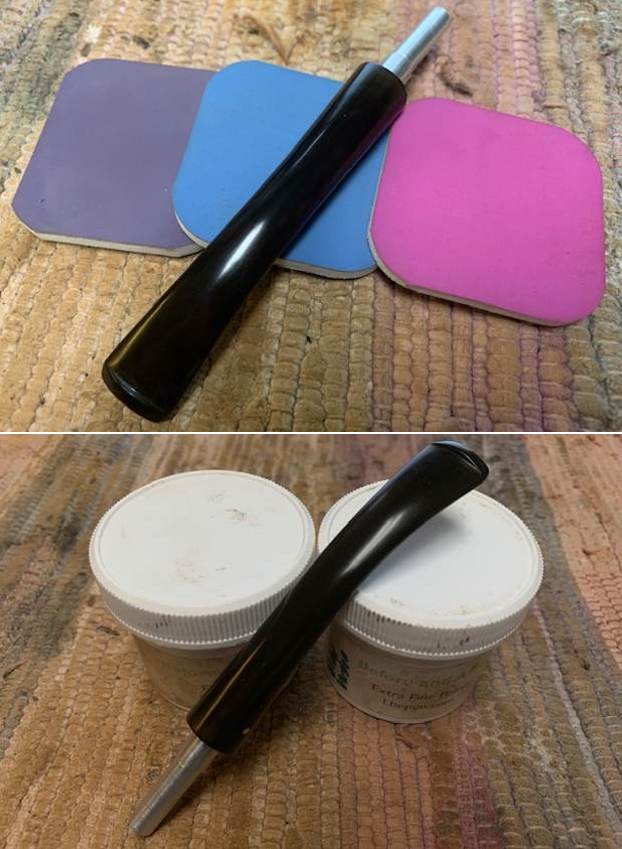
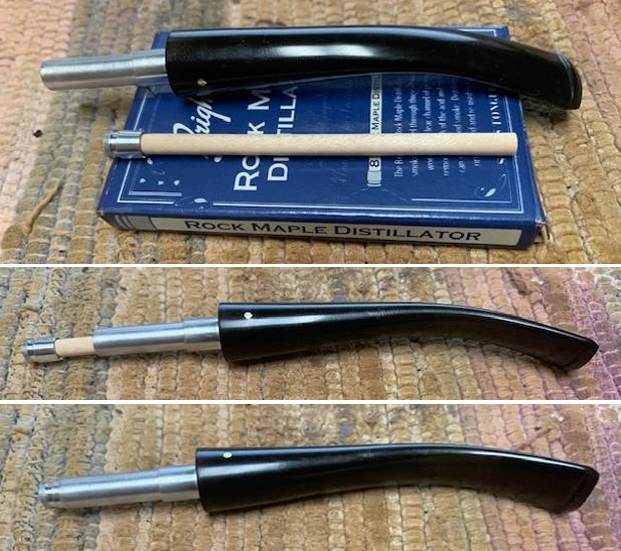
I used a small butter knife to gently chip away at the lava on the rim. I then used more Murphy’s with a scrub brush to remove any remainder. This actually worked quite well. I then moved on to cleaning the outside of the stummel with Murphy’s Oil Soap and some cotton pads. That removed any latent dirt that blighted the wood.

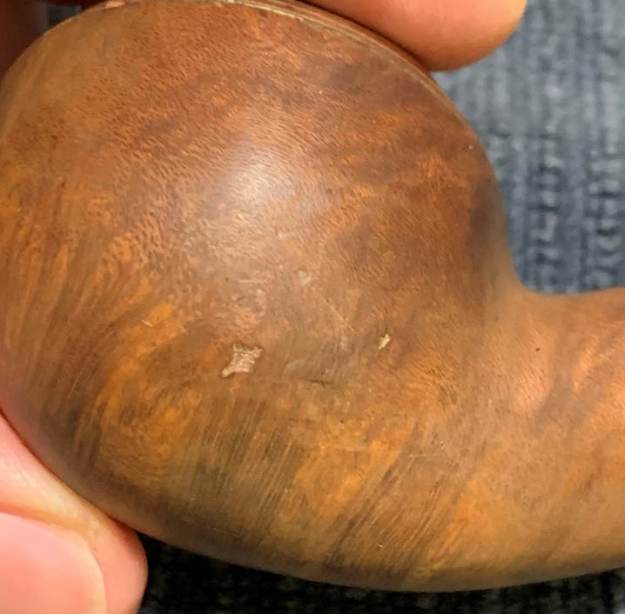
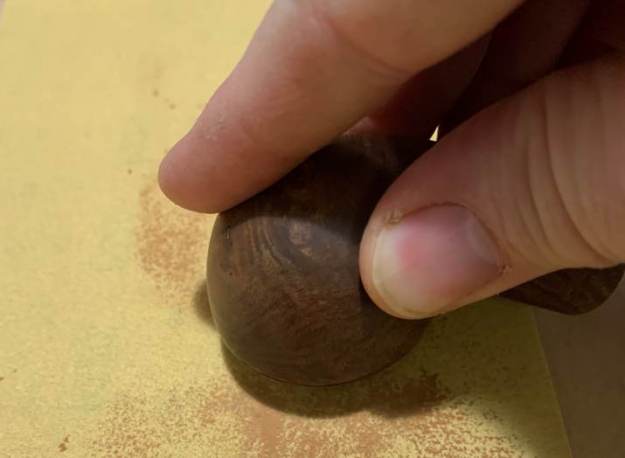
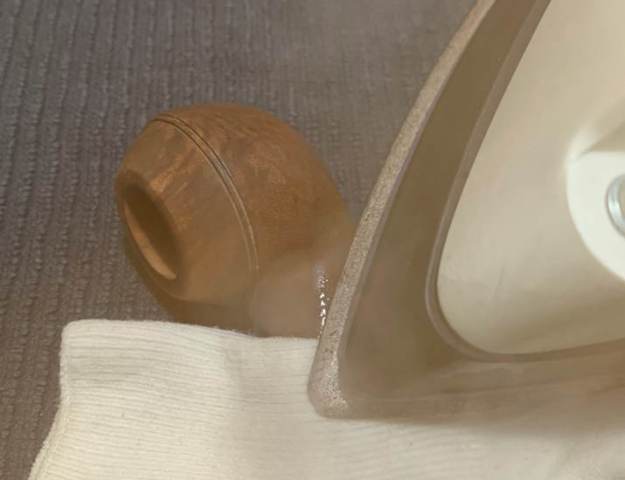
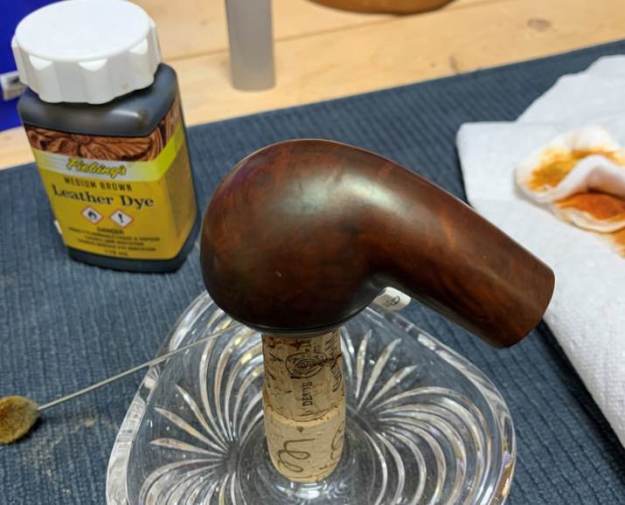
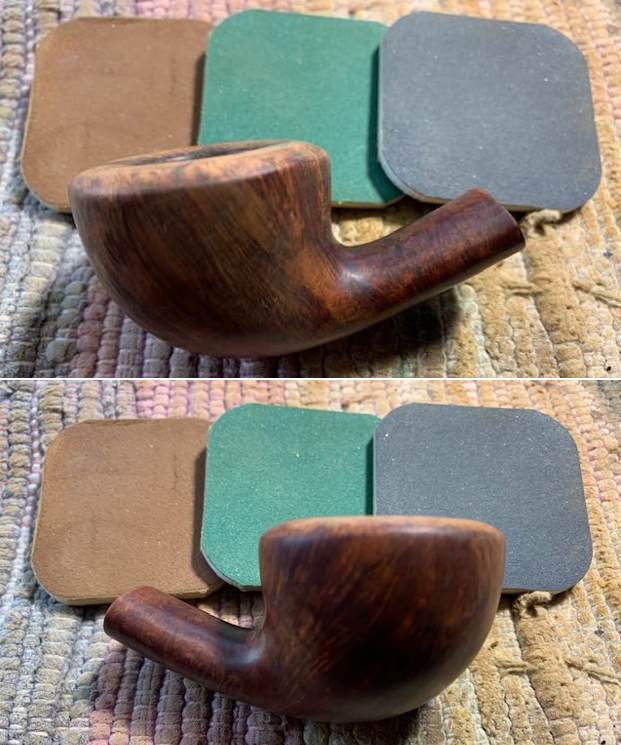
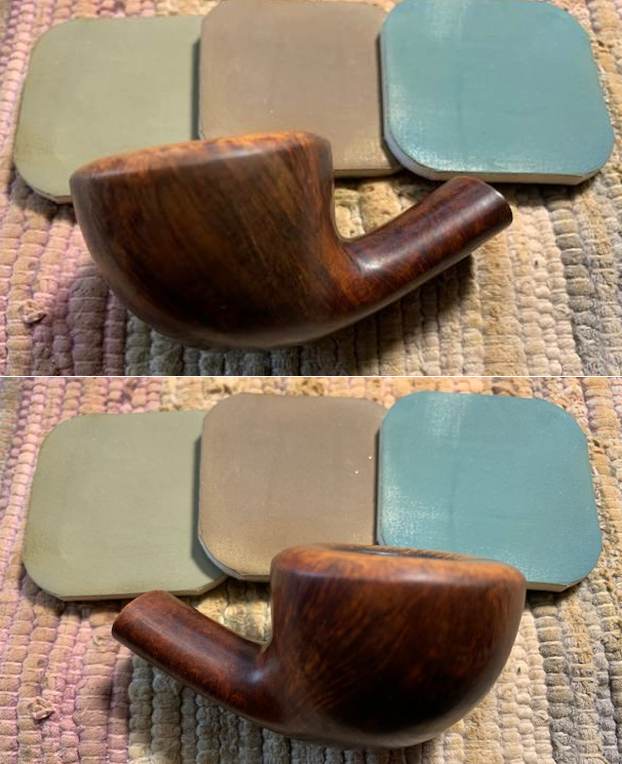
In order to remove the remaining burns and nicks on the rim, I “topped” the pipe – that is to say, I gently and evenly sanded down the rim on a piece of 220-grit sandpaper. This effectively removed the damage, without altering the look of the pipe.Having completed that, I was able to address the small nicks on the stummel. I dug out my iron and a damp cloth to try and raise the nicks. The hot and moist steam can often cause the wood to swell slightly and return to shape. There was some movement – not a lot, but it was better than doing nothing. The repair was not perfect, but the remaining scratches would be improved by sanding.I lined the fills with cyanoacrylate adhesive and briar dust. After letting them cure, I sanded the fill repairs down with 200-, 400-, and 600-grit sandpaper. I then used all nine Micromesh pads (1,500 through 12,000 grit) on the stummel to finish it off. After that, a light application of Before & After Restoration Balm brought out the best in the stummel’s grain. There is some beautiful wood after all. It is a very handsome, decorated veteran. In order to accentuate the external beauty of this pipe, I opted for aniline dye. I applied some of Fiebing’s Medium Brown Leather Dye. As usual, I applied flame from a BIC lighter in order to set the colour. I then added a second coat – just to make sure. What a difference that made! It looked so much better with a fresh coat of stain. I applied some more Before & After Restoration Balm and then it was off for a trip to the buffer. A dose of White Diamond and a few coats of carnauba wax were just what this pipe needed. The lovely shine made the wood very attractive. This is a very handsome pipe and will provide many years of smoking pleasure. This is a wonderfully crafted pipe and has a very elegant feel to it. It took some work, but I am proud of it and the final product suits me to a T. It retains some wounds from battle, but, as Steve would say, they are part of this pipe’s story. This is one pipe that I am keeping for myself and adding to my collection. I am sure that I will be enjoying this one for many years to come. I hope you enjoyed reading the story of this pipe as much I as I did restoring it. If you are interested in more of my work, please follow me here on Steve’s website or email me directly at kenneth@knightsofthepipe.com. Thank you very much for reading and, as always, I welcome and encourage your comments.

A Hardcastle Filter Pipe Well-Smoked


Blog by Robert M. Boughton
https://www.facebook.com/roadrunnerpipes

After some time he felt for his pipe.  It was not broken, and that was something.  Then he felt for his pouch, and there was some tobacco in it, and that was something more.  Then he felt for matches and he could not find any at all, and that shattered his hopes completely..

— J.R.R. Tolkien, The Hobbit, or There and Back Again

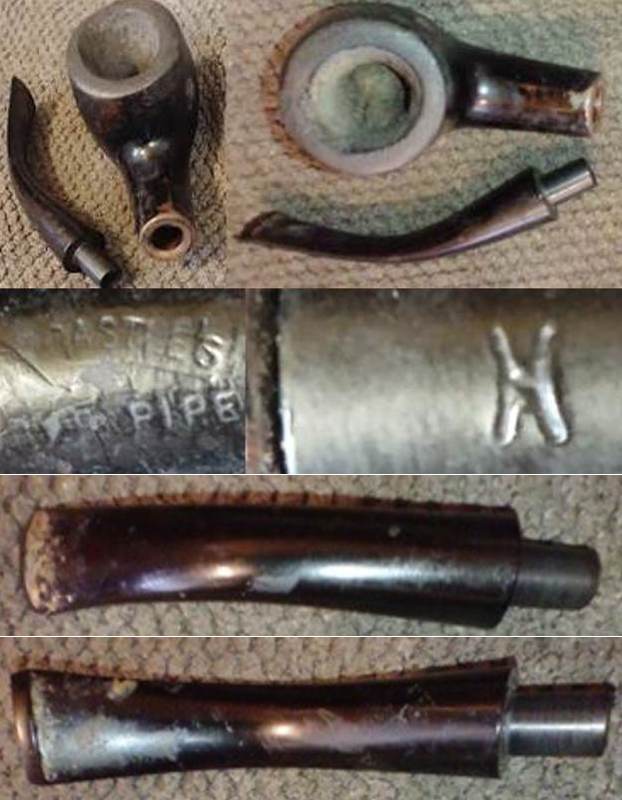
I had no idea where this pipe came from.  It seemed to appear out of thin air on the little stand that serves as a sort of waiting room for my next six appointments needing various degrees of rejuvenation.  The diminutive bent billiard – once a black dress pipe, I could tell – bore such wear and accumulated gunk that it looked more like something washed up on shore after a catastrophic oil spill.  The thought occurred to me that perhaps I should wear latex gloves for the initial inspection, which suggested the pipe was not broken, and that was something, and there were no apparent cracks or burnouts, and that was something more.  The rim of the bowl was wrecked, and that would not have been encouraging were it not for the apparition of the last five letters of an old friend’s name on the left shank.  The classy H on the stem confirmed a Hardcastle shrouded by the grime.  For a chronology of Hardcastle’s transition from its beginning in 1903 to the final stage of its evolution as a Dunhill second, follow the Pipephil link in Sources.

Only after the first two steps of the restoration did I discern that the billiard was a Filter Pipe model.  I was creating a new sub-folder in my restored Hardcastles when a warning appeared on the monitor asking if I wanted to replace the existing Filter Pipe folder with the new one.  This very pipe came to me a few years back with clear nomenclature but a rim that was more abused than most.  At the time, it was the perfect candidate for my experiments in giving pipes a dress finish.  My roommate, a Hardcastle devotee, bought it.  That explained the poor thing’s further decline.

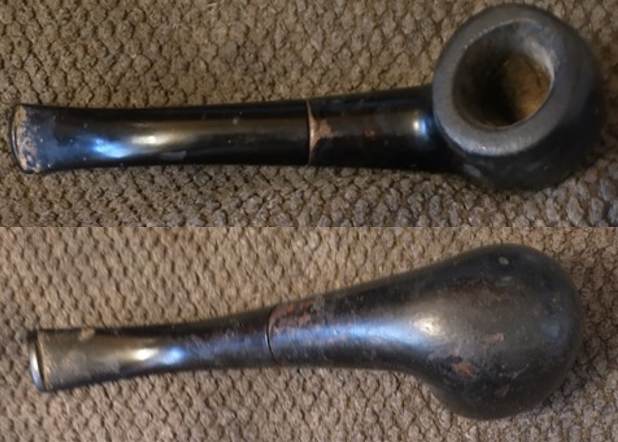
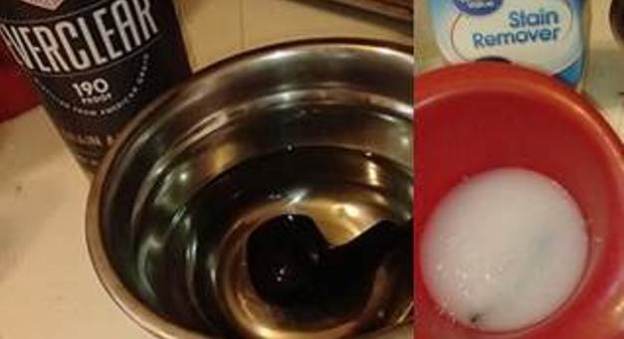
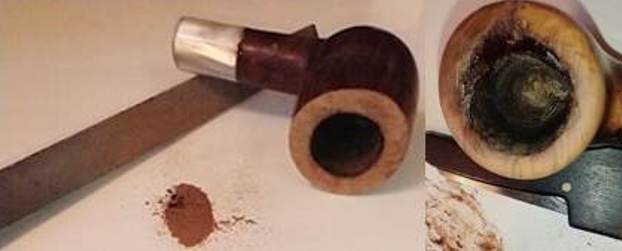
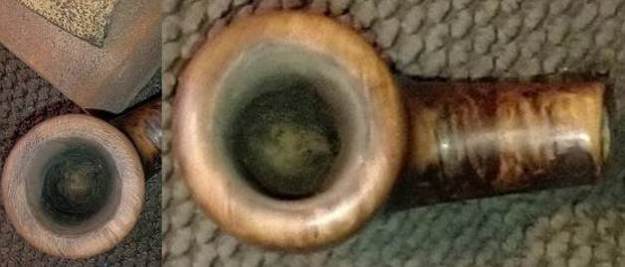
First, the before pics of the dress version.  I never blogged it because I was not happy with the rim work.  I’ve blogged one or two of my failures as cautionary tales, but not this one.Now for the carnage my roommate dumped on me.  This may be the most tortured pipe I have ever encountered.  CAUTION: The following images may be unsuitable for children or squeamish pipe smokers.In most cases, I soak the stummel in Isopropyl alcohol, but this time I chose Everclear to strip the homemade shellac I made for the dress process and the black leather dye beneath it – although not much of either appeared to remain.  I gave the stem a bath in generic stain remover. The stem came out in great shape, but the stummel less so. I used super fine 0000 steel wool to take off the residue from the Everclear soak.  This is when I could discern Filter Pipe.A full micro meshing sharpened the nomenclature and revealed the wood’s rich brown, if erratic, grain. I would like to know just how someone would go about inflicting such damage on a rim, but I couldn’t very well ask my roommate.  In the past, I have been somewhat successful with reversing mangled rims.  In one of the prior cases, for example, I resorted to a rasp.  Here are the before, during and after shots of that pipe, a P&K Everyman.I learned the importance of sanding, filing or grinding in the right direction. To narrow a rim, I move whatever tool I use with, or in the same general direction as the rim’s wall; to widen the rim, I move the tool against the rim, from the chamber outward. Try as I did to avoid resorting to extreme measures to make the Hardcastle rim right again, the time came to use my electric grinder. My main concern with making the misshapen rim at least more even and round again by putting it to an electric sanding wheel was the potential for irreversible damage in a heartbeat. Not being one to avoid a challenge, I went for it. I dare anyone reading this not to laugh at the last photo below. Believe it or not, the wheel sander did what I needed: it made the rim almost level.  I knew I could fix that problem a little later.

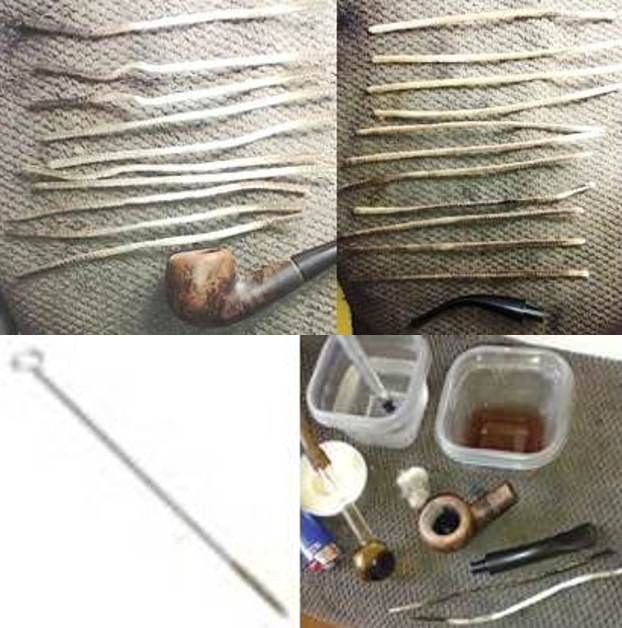
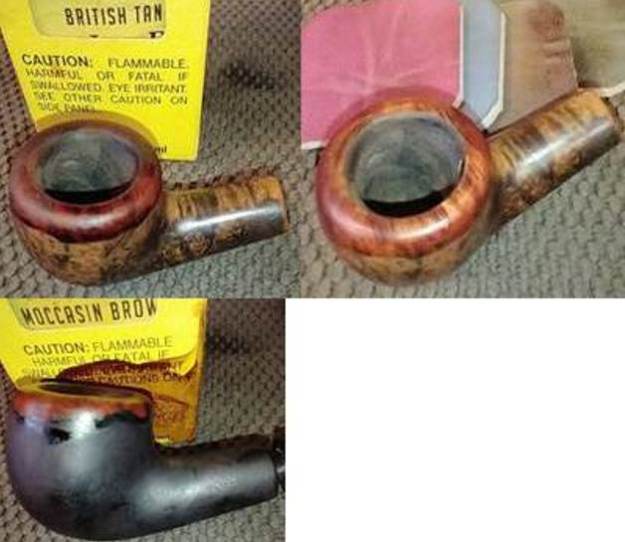
The pre-retort cleaning of the stummel and stem required more regular cleaners and a brass-handled brush with wire bristles, similar to the one below, both dipped in Everclear.  At least my roommate enjoyed the pipe while beating it.  The retort needed three test tubes of alcohol to come out clear.Notwithstanding the relative roundness of the rim, I knew I had to fill the preexisting indentation in the upper corner of the inner wall as shown in the post-electric sander pic.  I did something similar once, but again, I found the solution in one of Steve’s blogs on correcting an off-round rim. I filed off briar shavings from a hopeless pipe and mixed them with Super Glue, then applied the goop to the problem area inside the chamber.  It isn’t pretty, but it worked. Several hours later, I sanded down the remaining hard mess with 60-grit paper followed by a 120/180 pad. Several more hours later, I had reached the point where I knew I could not do better and sanded and micro meshed the stummel in preparation for staining.  I used British tan on the rim and moccasin brown on the rest, then micro meshed off the char with 1500, 8000 and 12000 pads.  That’s a good combination for a subtle contrast.I buffed the stummel with Red Tripoli and carnauba and was finished. SOURCES
https://www.worthpoint.com/worthopedia/hardcastle-filter-pipe-164105369
http://www.pipephil.eu/logos/en/logo-hardcastle.html
https://rebornpipes.com/2017/07/20/another-piece-pipe-history-a-lovely-cpf-french-briar-bent-billiard/

The English Calabash That Wanted to Be a Charatan


Blog by Robert M. Boughton

https://www.facebook.com/roadrunnerpipes

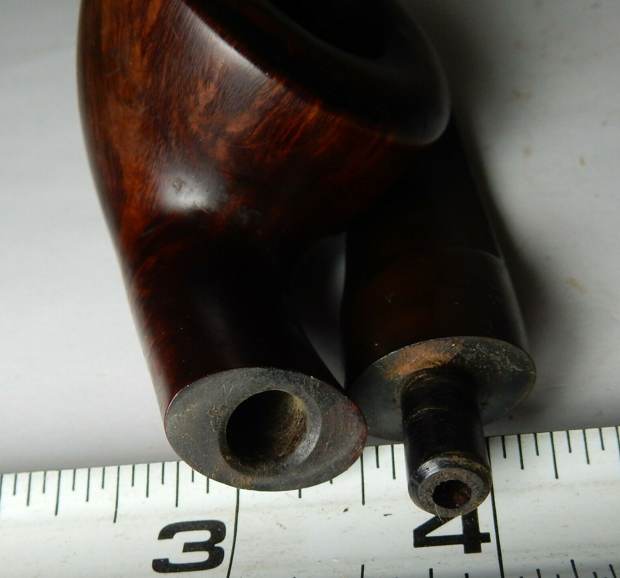
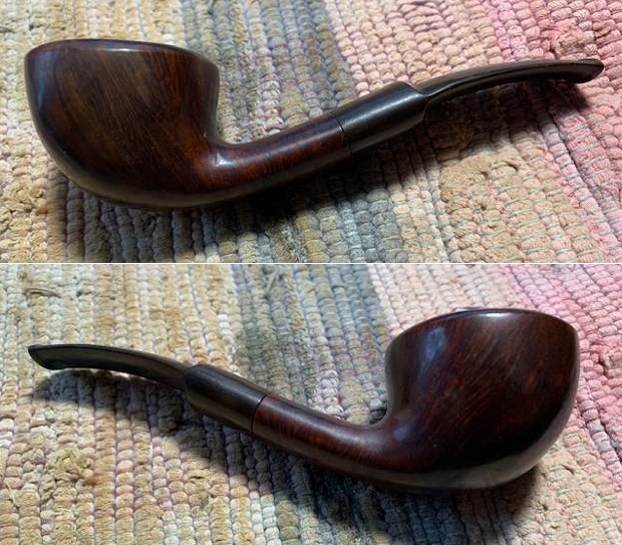
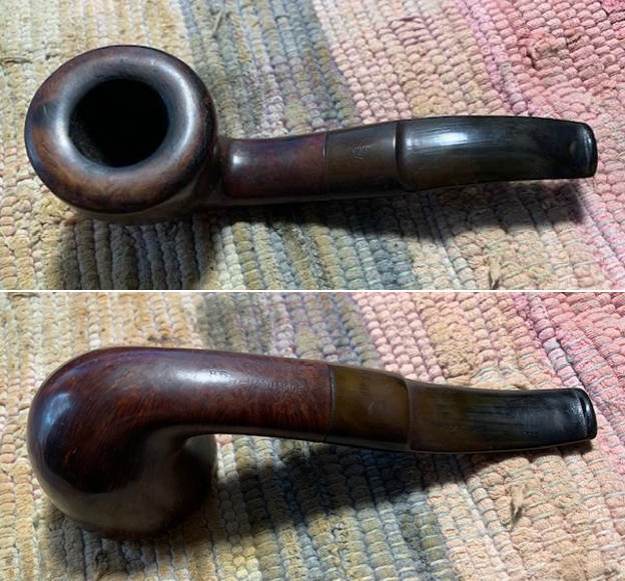
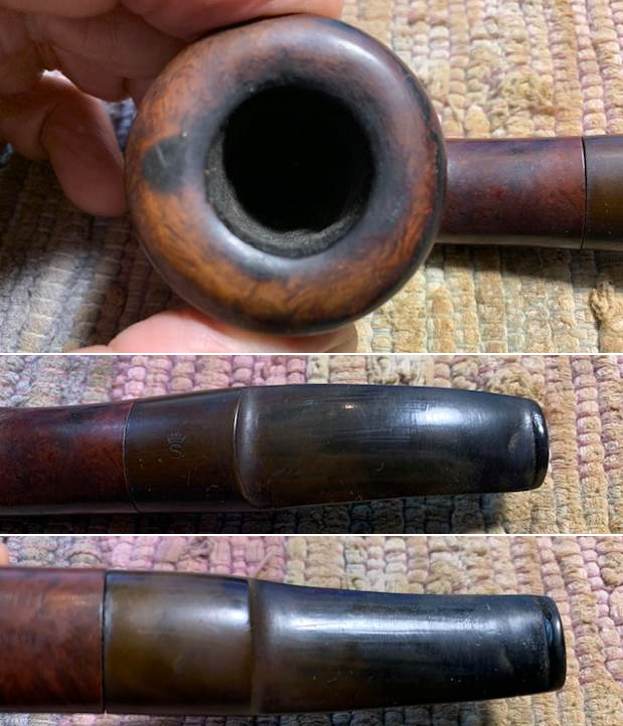
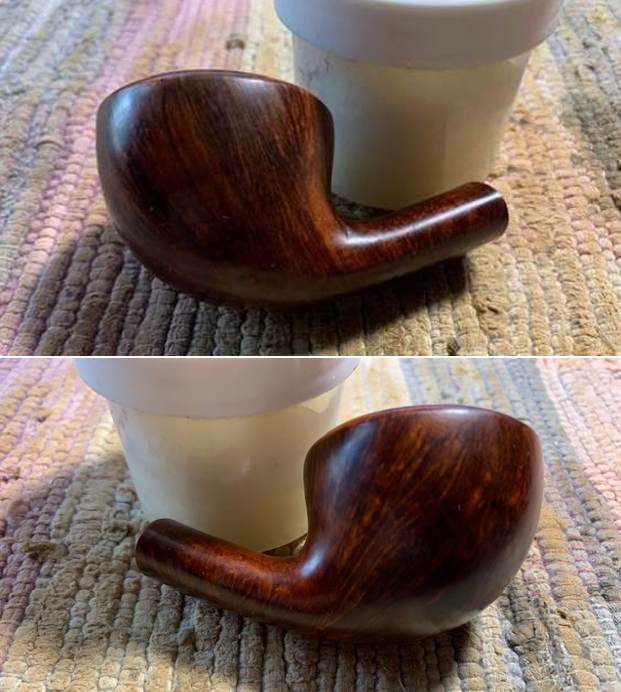
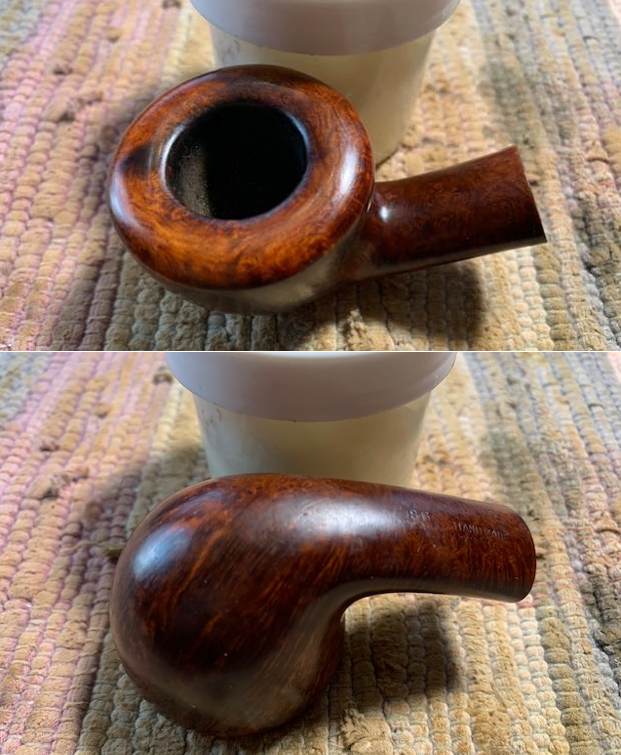
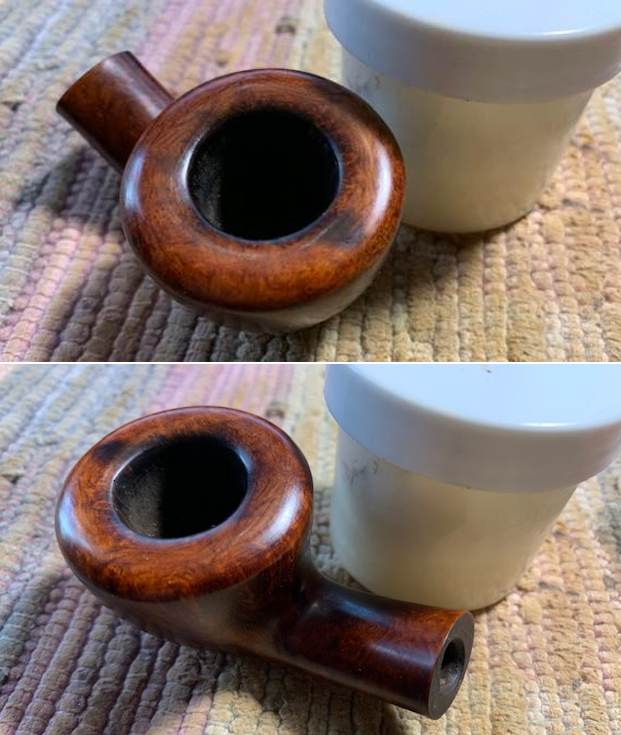
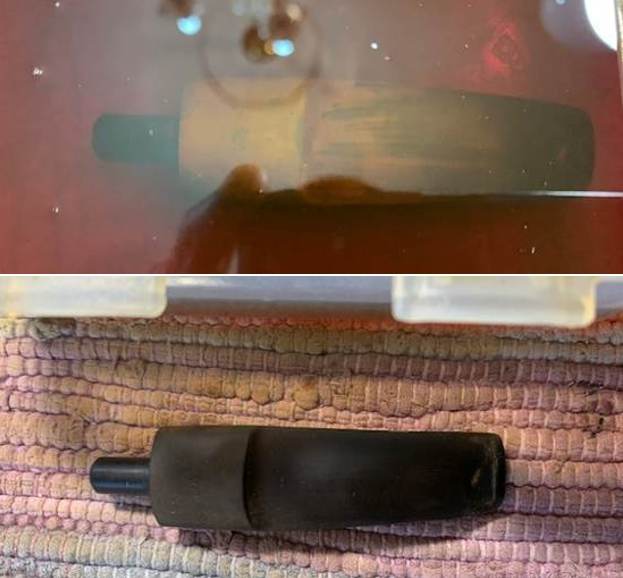
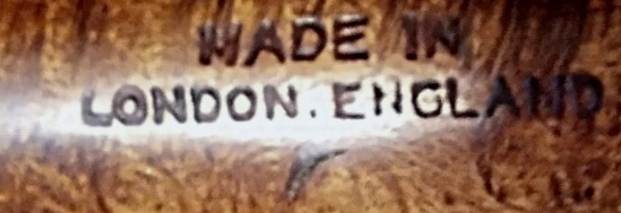
Not even once in a blue moon does a pipe with an uncommon feature – but having no nomenclature other than the county where it was made – find its way into my hands.  The two most recent examples show MADE IN over LONDON ENGLAND on the right shank and did not meet their makers’ exacting standards.  The previous was a Ben Wade celebrating the poker shape with capacious panache, but other than replacing the stem with a smaller, lighter, inappropriate one, there was no way to counter the off-center of gravity and force the poker sitter to sit.  This time it’s a Charatan that looks more akin to a beanpot to me but was called a calabash by the maker.  Had not Steve seen my “beanpot” for what it is, I might have concluded that both pipes began their lives as Ben Wades.  Although Charatan pipes do not include MADE IN, I concluded that the two words were added when the pipe was rejected, maybe to differentiate the rejected from the approved.  Here are two models of Charatan’s Make calabashes from Worthpoint.Based on the seller’s detailed description of the smooth finish calabash, at the first link below, I believe Charatan made these pipes while Dunhill owned the brand (1978-1988). The grain of my pipe is not very good and required a few fills, but I don’t see why it could not have been modified to a sandblasted or relief finish as shown above. Here is mine as I received it. Sanding with 220- and 320-grit paper cleaned it up pretty well. Using 400-, 600- and 1000-grit paper, I was able to give it a first glow. After retorting the pipe, I turned my attention to the stem, which, other than being dirty, looked much better than most. I’ve started giving stems a bath in generic viscous stain remover. So far, I haven’t tried it on a specimen with oxidation, and I doubt it will do more than remove the grime that often goes with estate pipe stems. But I will report back on that.An hour later, I took the stem out of the goop, rinsed it and ran a pipe cleaner through.  Micro meshing it made two small teeth marks stand out.What I should have done was flick my Bic on the annoying little marks, but that didn’t come to me until after I reached the point of no return with another method that’s great on real divots.  Anyway, mixing Super Glue and vulcanite shavings from an old stem that’s perfect for the task was good practice.This method for removing bite marks makes a mess. Cleaning it up took a couple of days of sanding and buffing before the final shots after one more progression of 60-1000-grit sandpaper and all nine micro mesh pads – but the practice and results were worth it.Time to stain.At this point, I would have had only the final wheel buff left.  In fact, that’s what I did.  But the pic I took of the nomenclature revealed a hairline crack just below LONDON, ENGLAND.To mitigate the potential for the crack to spread, I used a touch of Super Glue and let it sit overnight. At least the foul spot was not all the way through the shank. A 120/180 sanding pad followed by a full micro meshing took off the excess dried glue.  I re-stained the effected area with Moccasin Brown and buffed the char off with 8000-12000 micro mesh. I decided to make the rim lighter with 8000-12000 micro mesh, also.Quick wheel buffing of the stem and stummel with Red Tripoli and carnauba on the buffer wheel completed the Charatan’s Make Calabash reject. The best part of this restoration is how close I came with my sweet reject to the stain of a third Charatan’s Make Perfection Calabash I found online.And I didn’t even know it until I copied and pasted the pic from Pipehub.com.  I look forward to finding a loving home for my poor disadvantaged friend here.

SOURCES
https://www.worthpoint.com/worthopedia/charatans-make-london-england-special-495600609
https://www.worthpoint.com/worthopedia/lane-era-charatans-make-relief-grain-412563595
http://www.pipephil.eu/logos/en/logo-charatan.html
http://www.pipephil.eu/logos/en/logo-benwade.html