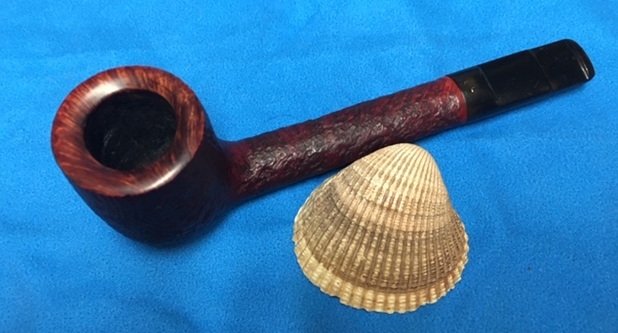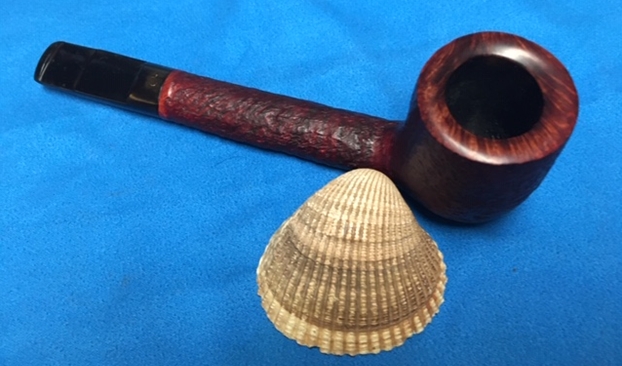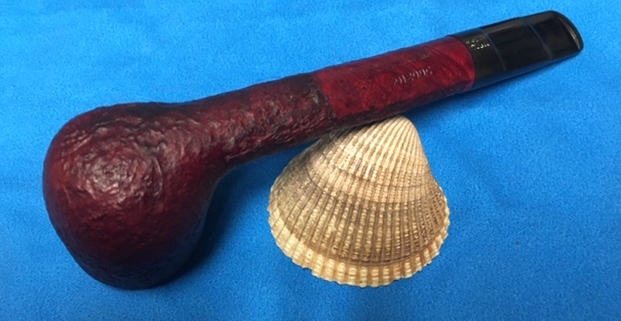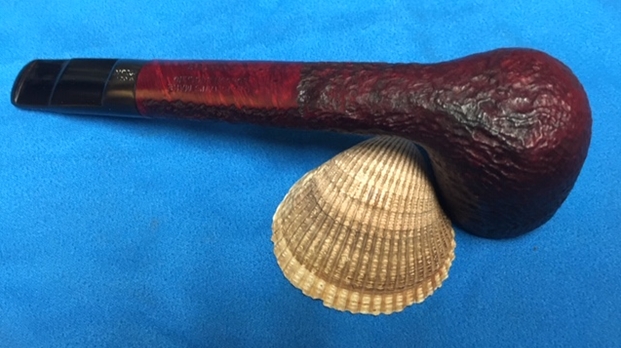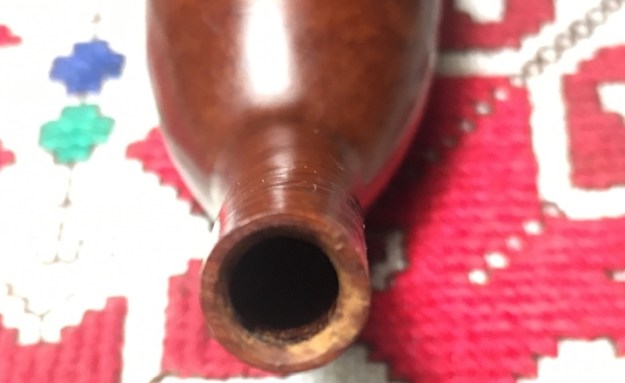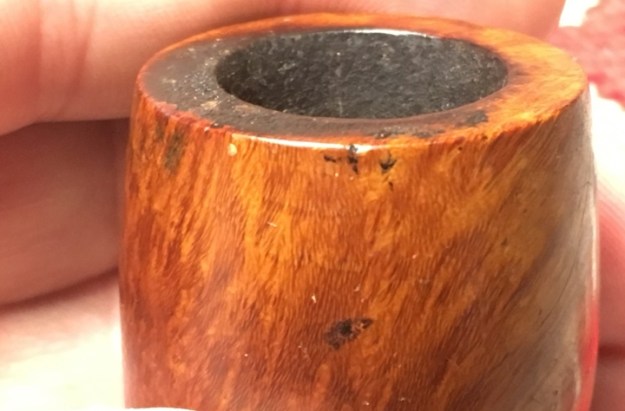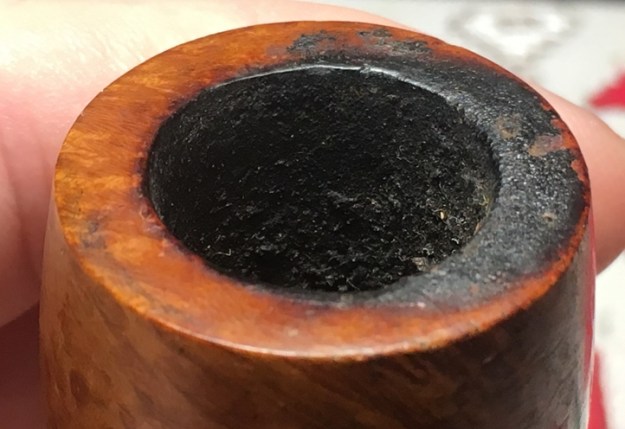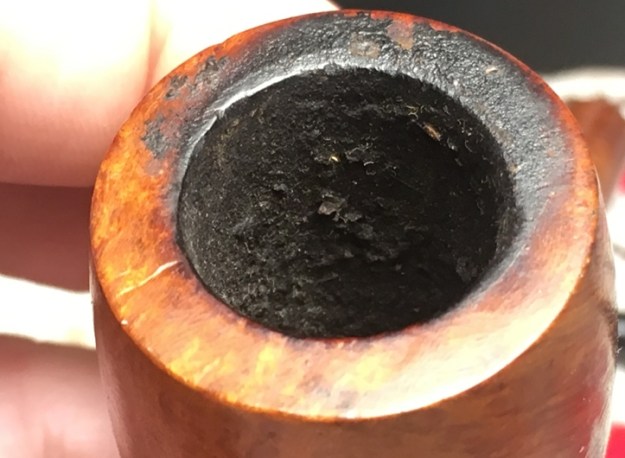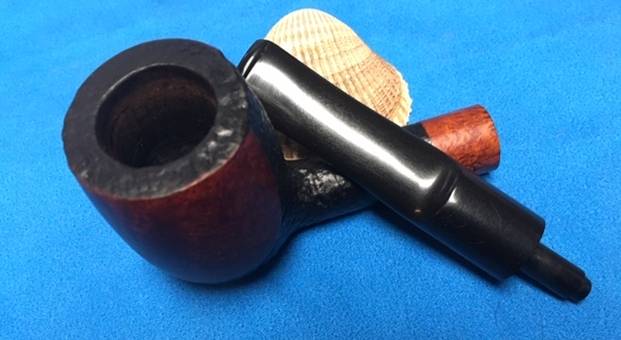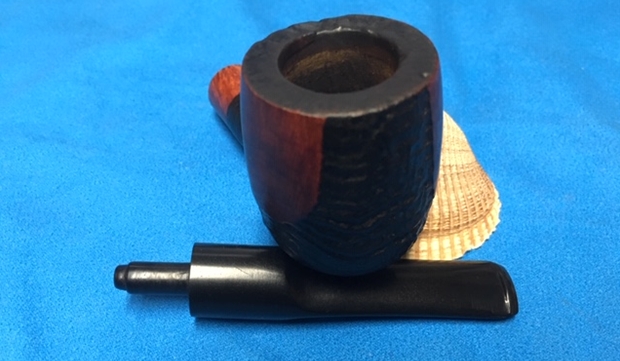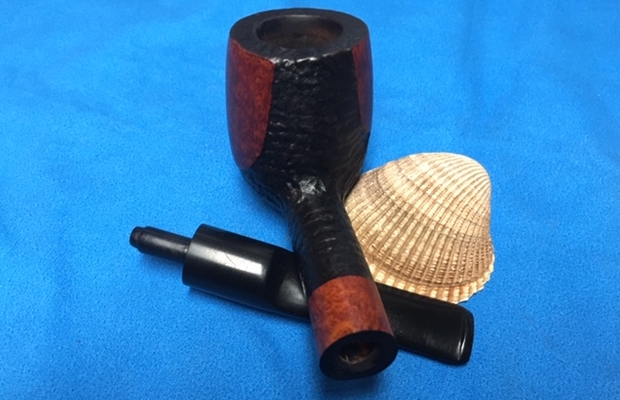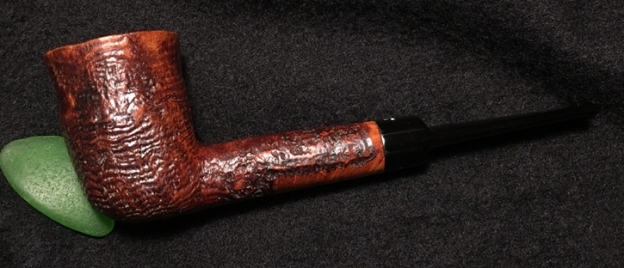
Tag Archives: restaining a bowl and rim

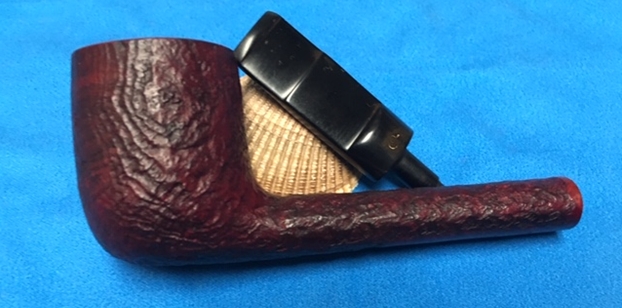
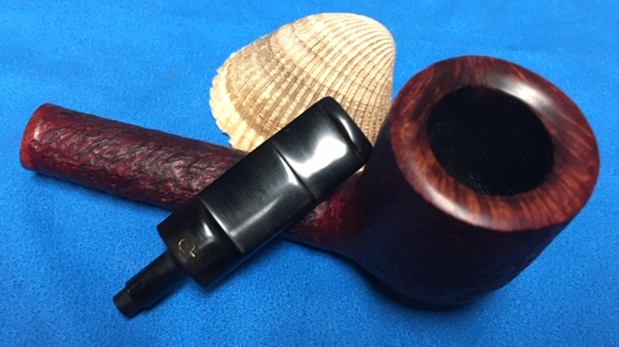
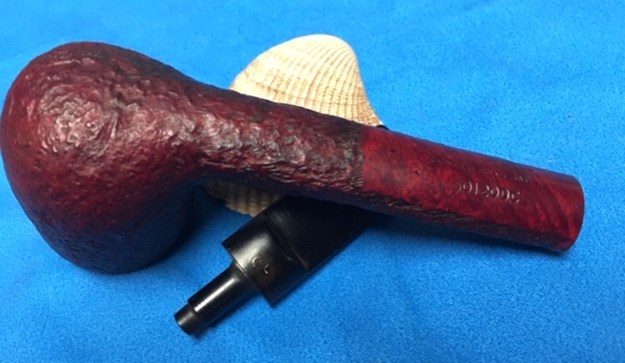
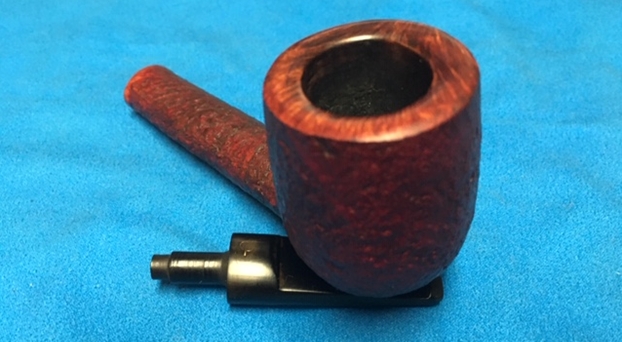
New Life for Farida’s Dad’s Final Pipe – a Dunhill 5203 Shell Billiard


Blog by Steve Laug

I have had the last Dunhill from Farida’s Dad’s estate sitting on a cupboard behind my desk and every time I sit down I look at it and think that I need to finish it up. I sold the rest of the estate and purchased this one myself so that I could have some time to work on it. Yes you are right, read between the lines – I wanted to put off working on it. Well, this morning I sat down at the desk and posted a couple of blogs and then turned and there it was looking at me. I decided then and there to pick it up and do the work to finish this estate.

The pipe came from the estate of an elderly gentleman here in Vancouver. I met with his daughter Farida over a year ago and we looked at his pipes and talked about them then. Over the Christmas 2017 holiday she brought them by for me to work on, restore and then sell for her. There are 10 pipes in all – 7 Dunhills (one of them, a Shell Bulldog, has a burned out bowl), 2 Charatan Makes, and a Savinelli Autograph. This is the last of the lot – a lone Dunhill Billiard with a saddle stem. His pipes are worn and dirty and for some folks they have a lot of damage and wear that reduce their value. To me each one tells a story. I only wish they could speak and talk about the travels they have had with Farida’s Dad. The first photo shows the underside of the shank and its virtual illegibility under the tars and filth on the finish.You can see from the above photo the challenge that the pipe I am working on today will be. The stamping identifies it as a Dunhill Shell Billiard with a saddle stem. It is stamped on the underside of the heel and shank on a smooth flat area. On the heel is the shape number, a 4 digit number – 5203. I looked on Pipephil to get the lowdown on the shape number (http://www.pipephil.eu/logos/en/dunhill/shapes.html). I quote that below:

Dunhill pipes are stamped with a four digit code.

Digit 1: (from 1 to 6) denotes the size of the pipe (the group).

Digit 2: denotes the style of the mouthpiece (0,1=tapered, 2=saddle)

Digit 3 and 4: denote the generic pipe shape (in yellow in the chart on top)

Example: 5102 — (5 = size | 1 = tapered stem | 02 = Bent)

When 5 digits occur, the meaning of the 4 first remain the same

The one I am working on, 5203, is thus a SIZE 5 (Group 5), saddle stem (2) billiard (03) shaped pipe. The rest of the stamping is DUNHILL SHELL over MADE IN ENGLAND with the underlined superscript 34 after the D in ENGLAND. The number 34 tells me the date the pipe was made 1994.

My work on each of these pipes has already caused a lot of discussion on the Facebook Tobacco Pipe Restorers Group. The ongoing debate of Restoration vs. Preservation has filled a lot of ongoing airtime on the group. I do not care to relive or recount that as I am only following the directives of the daughter of the original deceased pipeman. She wanted them restored to usable condition so others can carry on her father’s love of these pipes. She is quite happy with the finished results and others of his pipes are now all over the world being enjoyed by the next generation of pipemen.

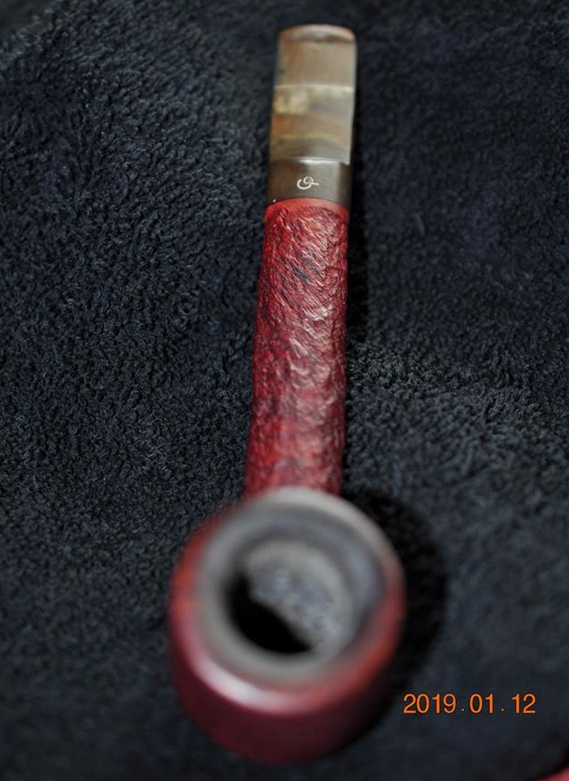
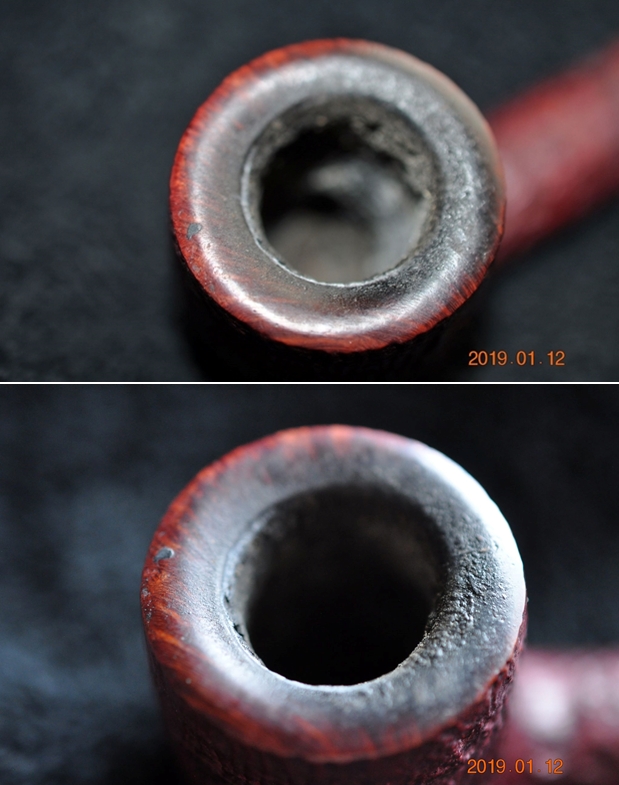
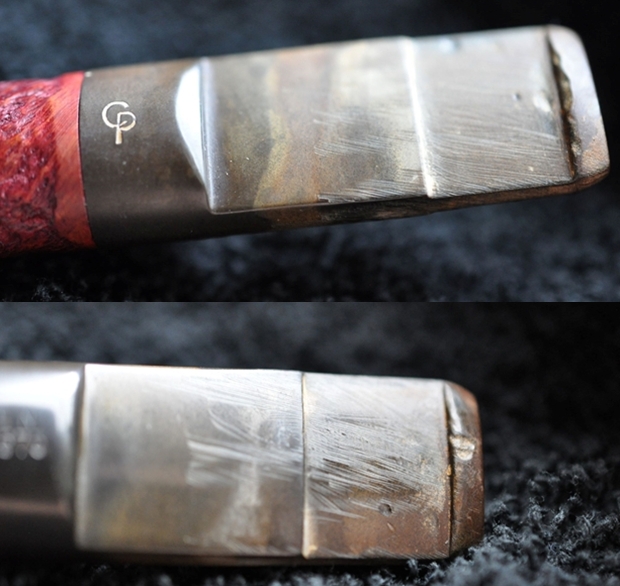
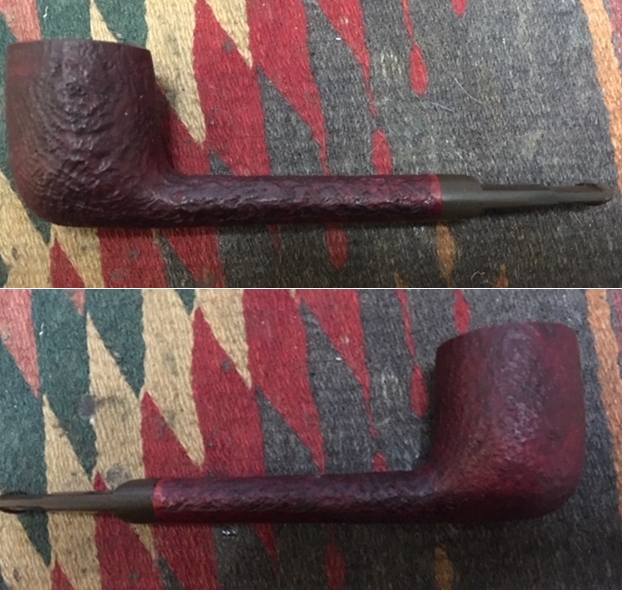
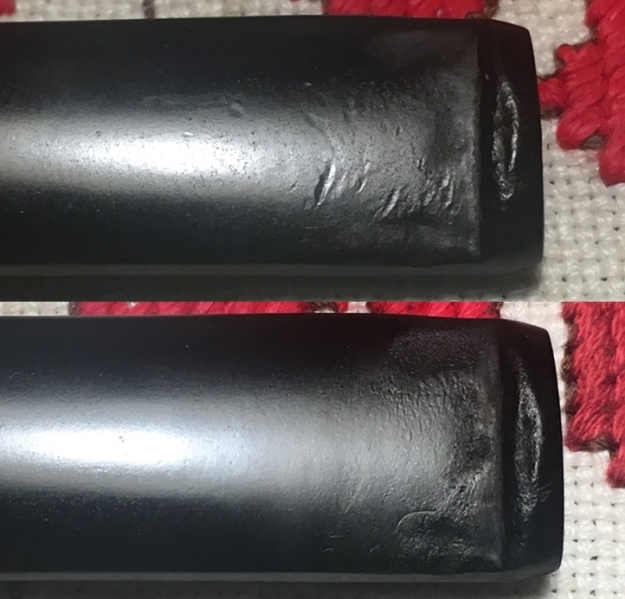
When first looked at the pipe here is what I saw. The bowl was thickly caked and the cake had flowed over onto the sandblast finish on the rim top forming hard lava that made the top uneven. There was a serious burn mark on the front edge of the bowl causing the rim to have a dip in the surface. It was hard to know if there was damage to the inner edge of the rim and I would not know until I removed some of the grime. The outer edge looked far very good all around the bowl except for the front. The finish was invisible under the thick coat of oils and grime that covered the bowl and shank. In fact at this point I had no idea what the stamping looked like because it was covered. I have wondered as I cleaned the other pipes in this lot if the oily build up was just a part of the life lived in the Antarctic. The stem was oxidized and very dirty. There was a thick sticky, oily substance on the surface of the stem and a calcification that I could scrape with my fingernail. There were tooth marks and chatter on both sides in front of the button as well as damage to the edges of the button. I took photos of the rest of the pipe to show what it looked like before I started the cleanup work. I took close up photos of the bowl and rim top as well as the stem. You can see the condition of the rim top and bowl in the first two photos. The damage to the rim top and the front outer edge is very visible even under the grime and lava. The inner edge looks like it has some damage on the backside. I won’t really know the full story until I remove the thick lava overflow on the surface. The stem had tooth chatter and some deep bite marks on the top and the underside of the stem just ahead of the button. The button itself also showed wear and damage. It has been a while since I have worked on the pipes that belonged to Farida’s Dad. I thought it might be helpful to remind us all of the background story of these pipes. Here is the material that I quoted in previous blogs. I have included both the written material and the photo that Farida included of her Dad. Here is what she wrote:

My dad, John Barber, loved his pipes. He was a huge fan of Dunhill and his favourite smoke was St. Bruno. No one ever complained of the smell of St. Bruno, we all loved it. I see the bowls and they’re large because he had big hands. When he was finished with his couple of puffs, he would grasp the bowl in the palm of his hand, holding the warmth as the embers faded. The rough bowled pipes were for daytime and especially if he was fixing something. The smooth bowled pipes were for an evening with a glass of brandy and a good movie. In his 20s, he was an adventurer travelling the world on ships as their radio operator. He spent a year in the Antarctic, a year in the Arctic and stopped in most ports in all the other continents. He immigrated to Canada in the mid-fifties, working on the BC Ferries earning money to pay for his education. He graduated from UBC as an engineer and spent the rest of his working life as a consultant, mostly to the mining companies. Whatever he was doing though, his pipe was always close by.

She sent this photo of him with his sled dogs in the Antarctic sometime in 1953-1954. It is a fascinating photo showing him with a pipe in his mouth. He is happily rough housing with his dogs. A true pipeman, he seems oblivious to the cold. Thank Farida for sending the photo and the story of your Dad. I find that it explains a lot about their condition and gives me a sense of your Dad. If your Dad was rarely without a pipe I can certainly tell which pipes were his favourites. In fact the condition of the billiard I am working on now makes me wonder if it is not the one in his mouth in the photo below.As I looked back over all of her Dad’s pipes that I have restored each of them had rim damage and some had deeply burned gouges in the rim tops. The bowls seemed to have been reamed not too long ago because they did not show the amount of cake I would have expected. The stems were all covered with deep tooth marks and chatter and were oxidized and dirty. The internals of the mortise, the airway in the shank and stem were filled with tars and oils. These were nice looking pipes when her Dad bought them and they would be nice looking once more when I finished.

Here are the links to the previous seven blogs that I wrote on the rest of the finished pipes. The first was a Dunhill Shell oval shank pot (https://rebornpipes.com/2018/02/04/restoring-a-1983-dunhill-shell-41009-oval-shank-pot/). The second was a Dunhill Classic Series Shell Billiard (https://rebornpipes.com/2018/02/08/faridas-dads-pipes-2-restoring-a-1990-lbs-classic-series-dunhill-shell-billiard/). The third pipe was a Savinelli Autograph (https://rebornpipes.com/2018/02/15/faridas-dads-pipes-3-restoring-a-savinelli-autograph-4/).The fourth pipe was a Dunhill Red Bark Pot that was in rough shape (https://rebornpipes.com/2018/03/10/faridas-dads-pipes-4-restoring-a-dunhill-red-bark-pot-43061/). The fifth pipe was a Dunhill Root Briar Bent Billiard (https://rebornpipes.com/2018/07/07/faridas-dads-pipes-5-restoring-a-dunhill-root-briar-56-bent-billiard/). The sixth pipe was a Charatan’s Make Distinction https://rebornpipes.com/2018/08/22/faridas-dads-pipes-6-restoring-a-charatan-make-distinction/. The seventh pipe was a Charatan’s Make Belvedere https://rebornpipes.com/2018/12/05/faridas-dads-pipes-7-restoring-a-charatans-make-belvedere-48dc-pot/.

Like most work the refurbisher does, this walks a fine line between restoration and preservation. The deciding feature for me regarding this pipe was the wishes of the family. They wanted the pipe to be cleaned and smoked by someone who could carry on the pipe man’s legacy of their Dad. None of them was interested in the pipes for themselves. They had no desire to keep them and memorialize their Dad and Grandad in that manner. I understand that to work on this pipe the way they wanted meant changing the current state of the pipe to bring it back closer to the way it was when their Dad bought it.

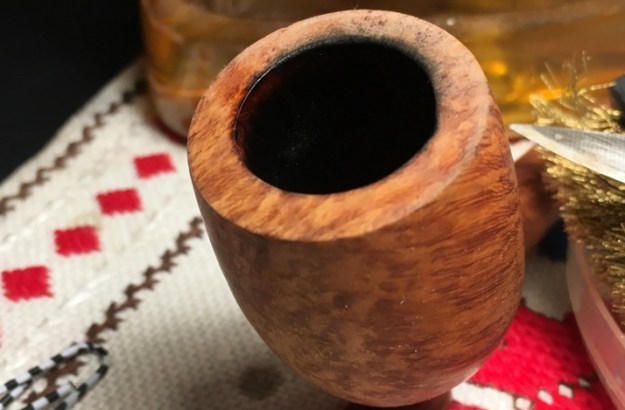
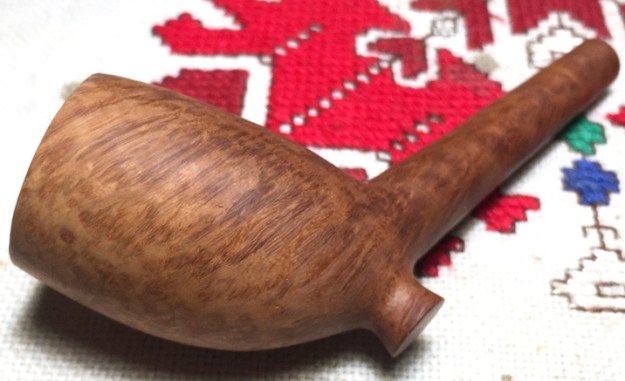
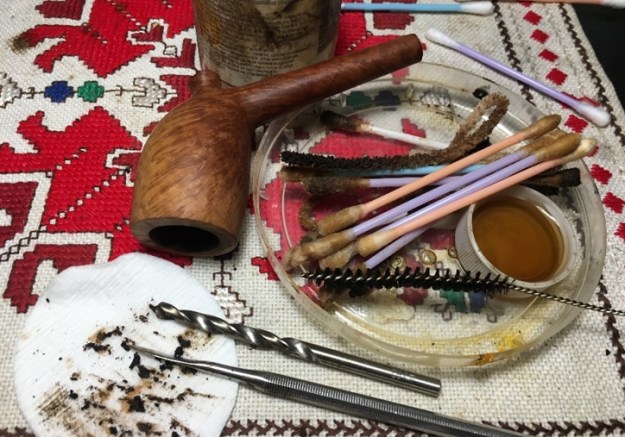
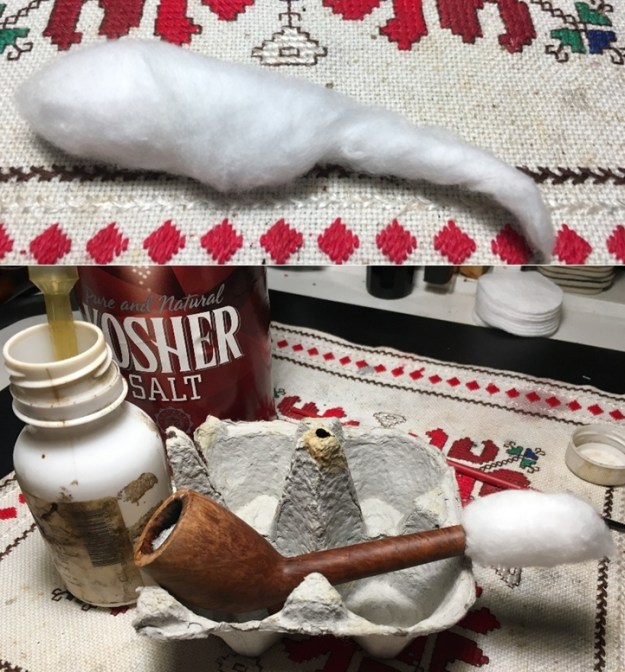
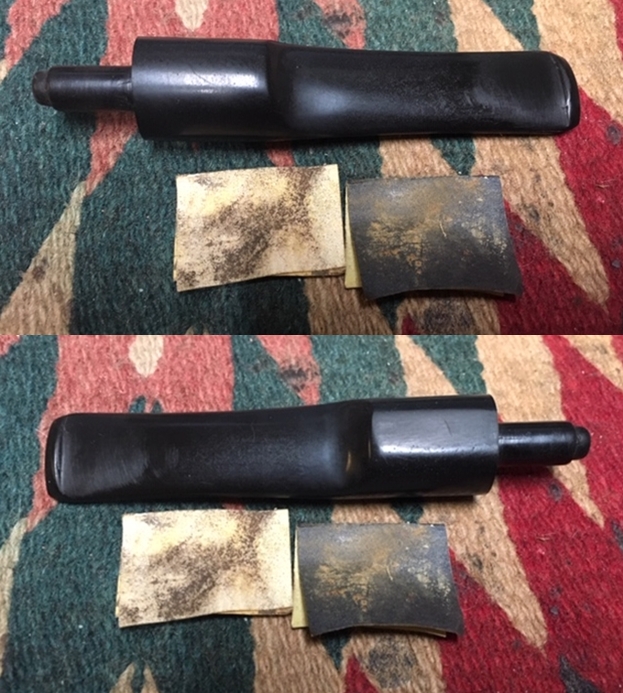
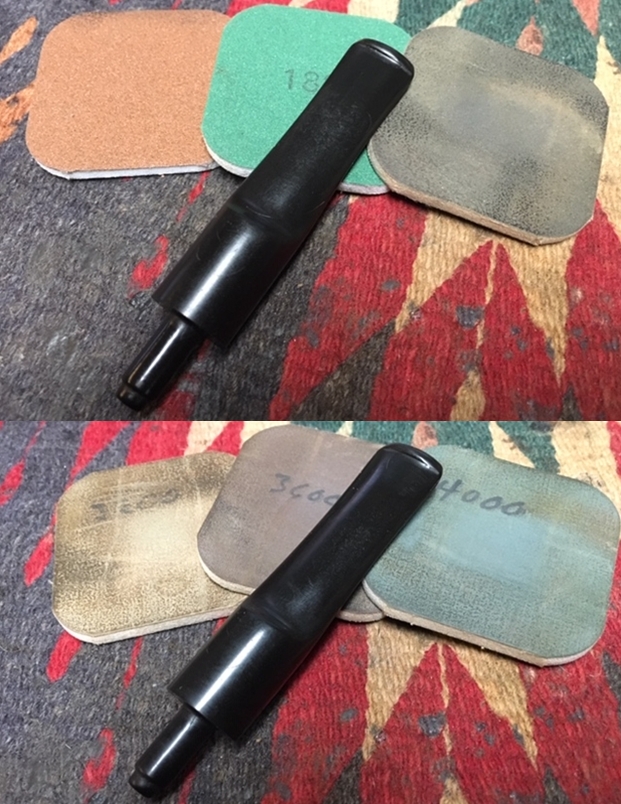
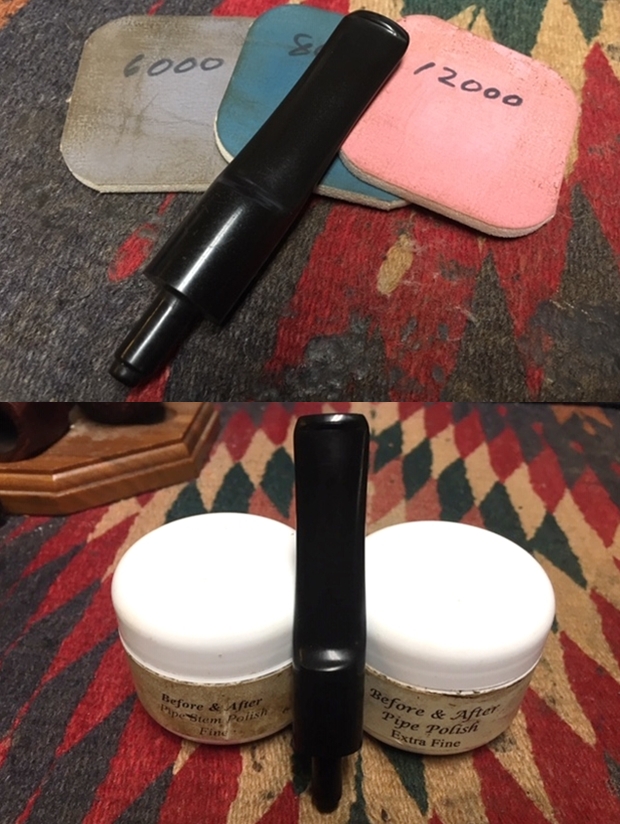
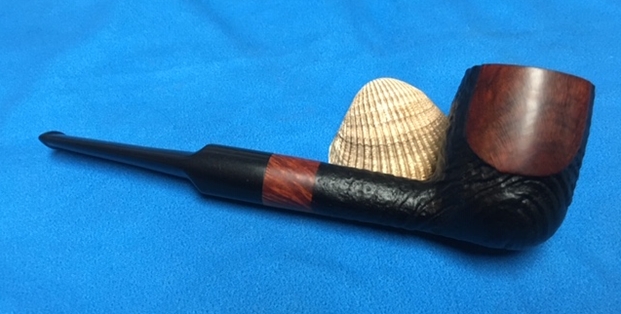
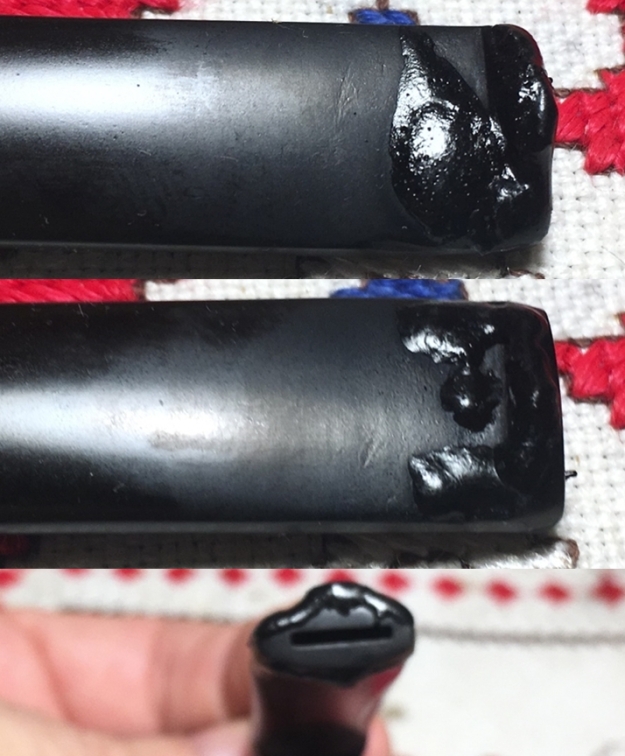
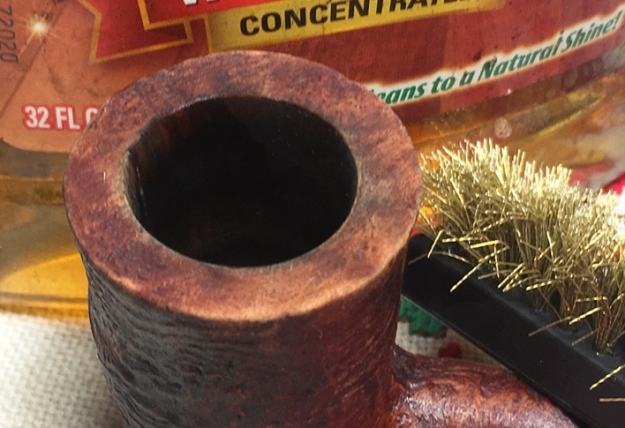
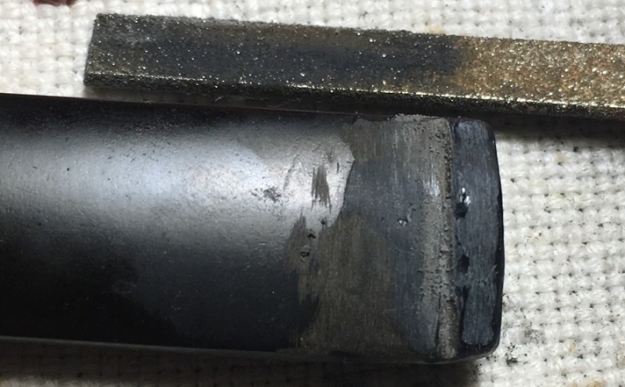
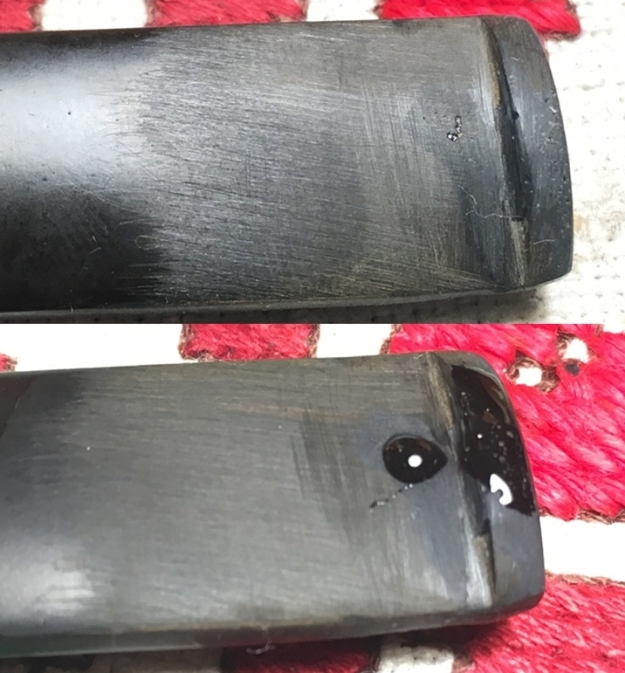
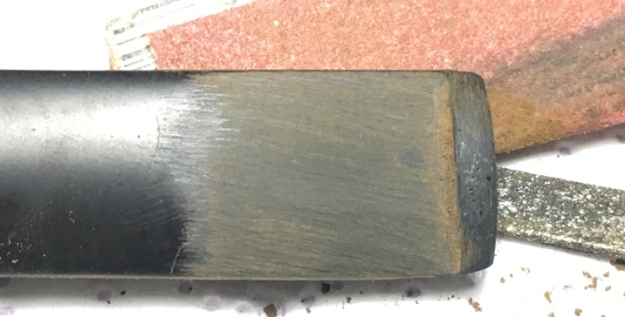
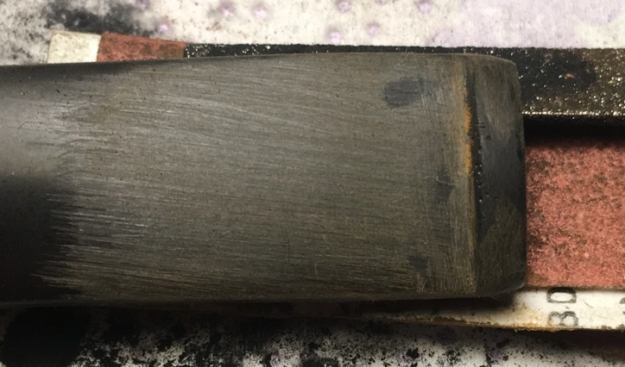
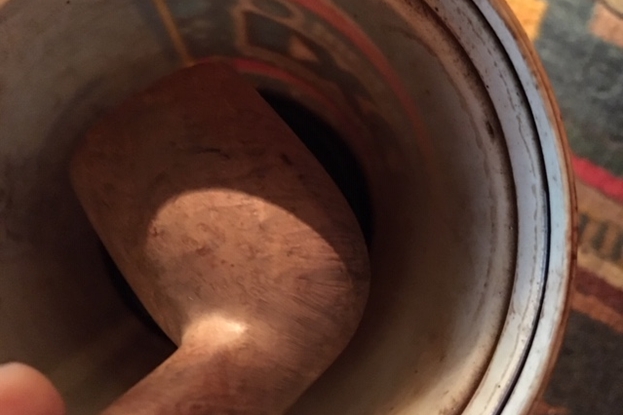
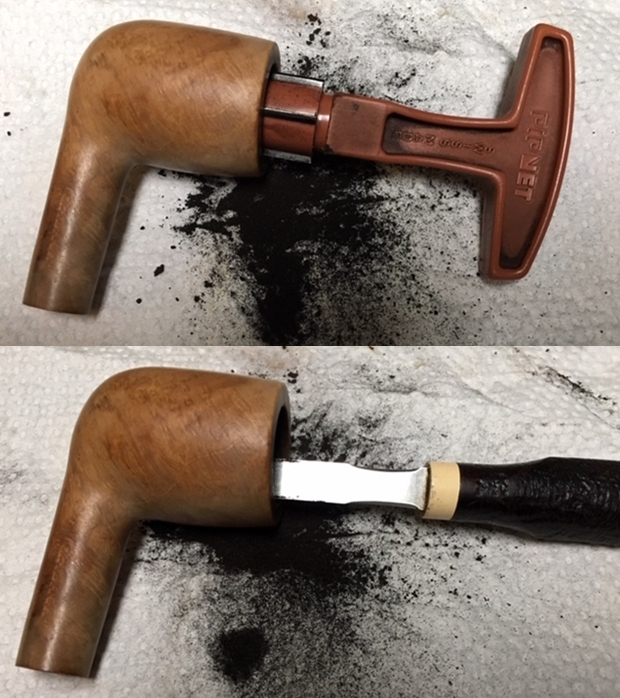
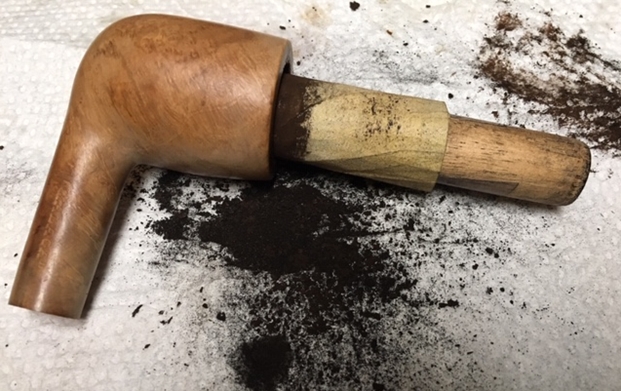
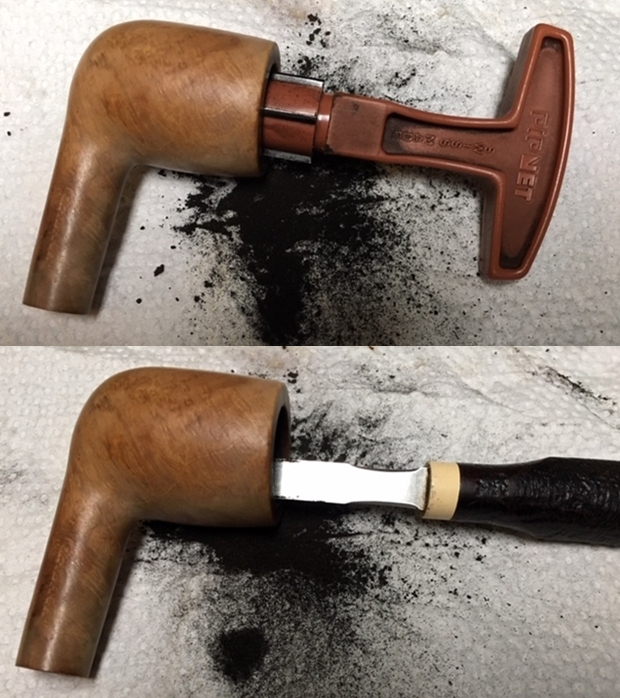
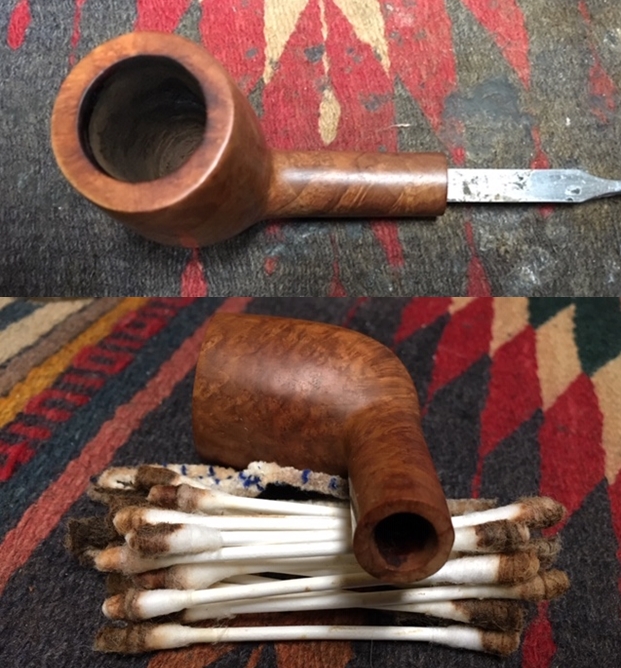
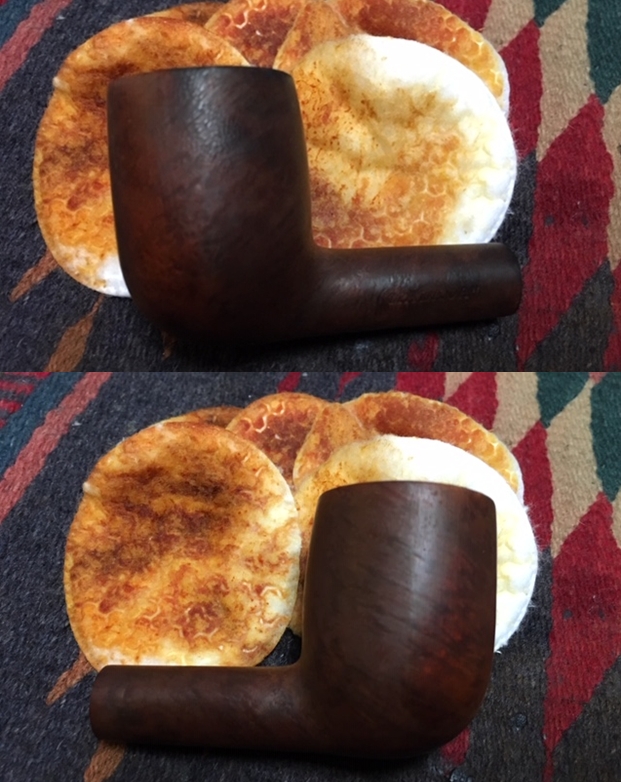
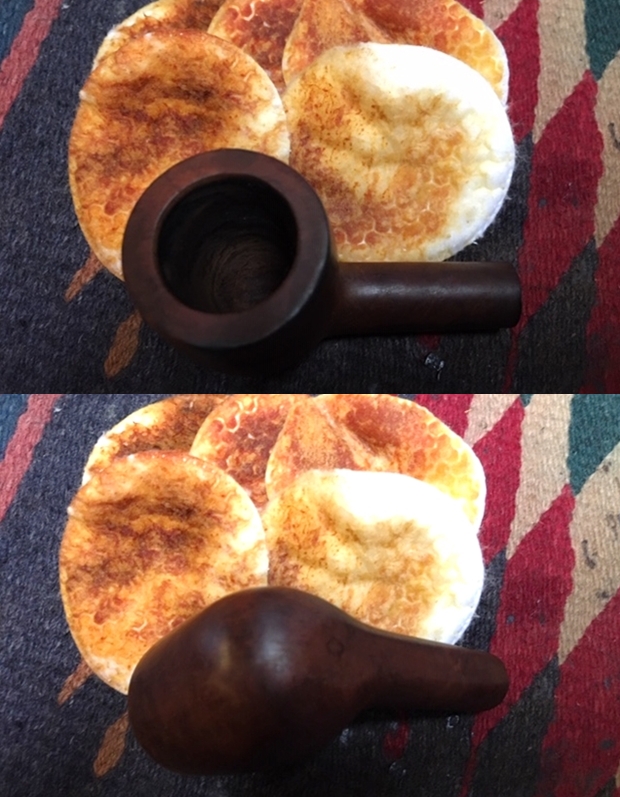
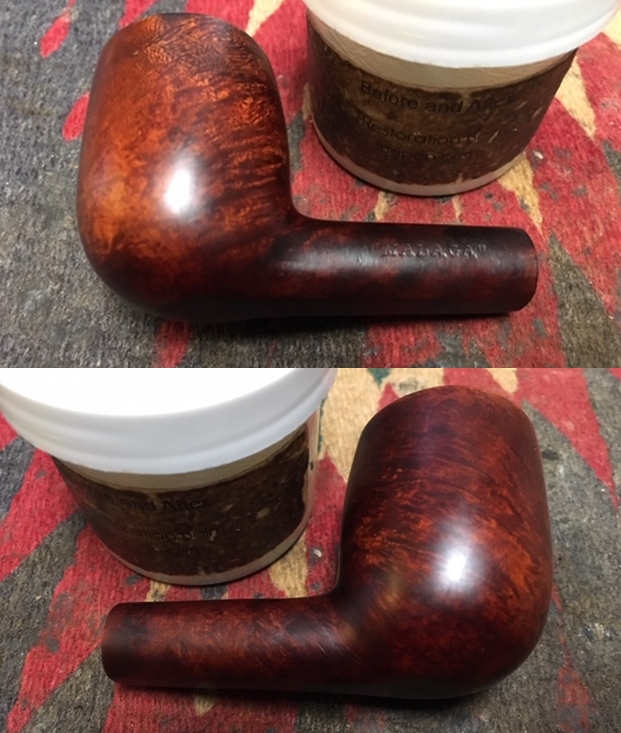
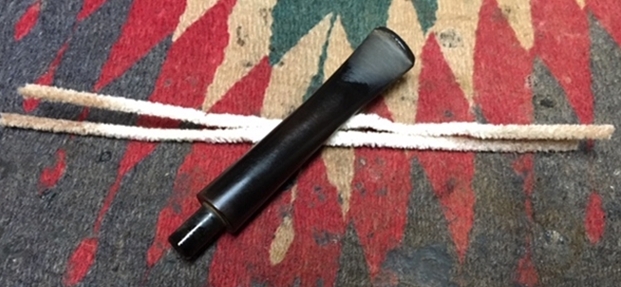
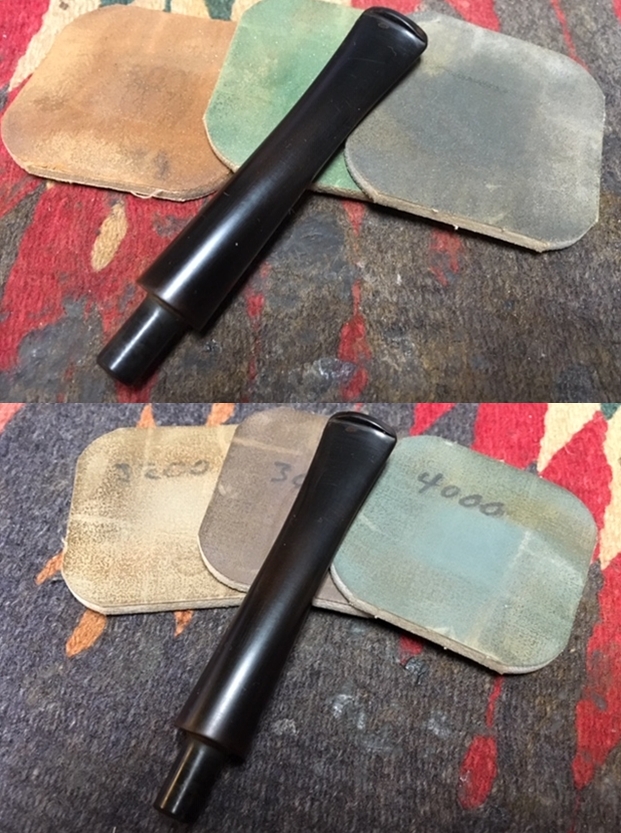
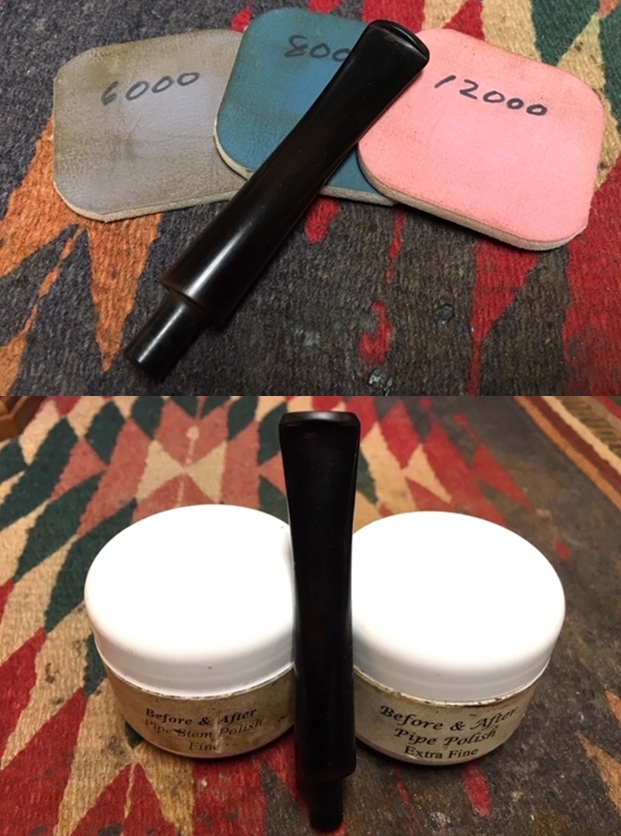
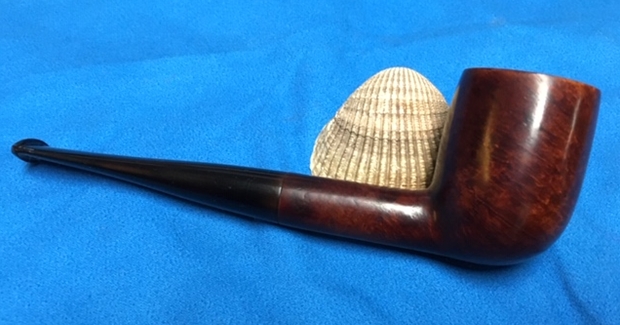
I decided to change things up a bit in the routine on this one. Holding it in my hand to ream and clean was a dirty prospect so I decided to scrub the thick grime off the exterior of the bowl and shank. The grit was deep in the sandblast finish rendering the pipe almost smooth. I scrubbed it with a tooth brush, a brass bristle wire brush and Murphy’s Oil Soap. I worked hard to get the grime out the grooves and crevices of the blast. I also worked on the rim top to remove the tars and oils that had formed a hard lava coat on the rim top. I worked on the burn damage as well on the front top and edge of the bowl. I rinsed the bowl under running water to remove the debris from the scrubbing. I reamed the bowl with a PipNet reamer. I used two of the four cutting heads to clean out the cake. The bowl was thickly caked I started with the smaller of the two and worked my way up to the second which was about the same size as the bowl. I cleaned the remnants with a Savinelli Fitsall Pipe Knife and scraped it back to bare briar. I finished by sanding the inside of the bowl with a dowel wrapped in sandpaper. I scraped the top of the rim with the edge of the Savinelli Fitsall Pipe Knife to remove the lava. I decided to start with the rebuilding of the rim top the bowl. I wiped the rim top down with isopropyl alcohol on a cotton pad to clean off the damaged areas on the front edge and on the rear inner edge. On the damaged front edge I started by laying down a coat of clear super glue on the gouged out burned area. On top of that I layered some briar dust with a dental spatula. I repeated the process of layer until the damaged area was level with the rest of the rim top. I used the brass bristle wire brush to texture the surface of the rim top over the repaired area to match the rest of the rim. I did the same layering process on the inner edge at the back of the bowl. When I had finished the rebuild I textured that area with the wire brush as well. The photos tell the story of the process. I worked over the inner edge of the rim with a folded piece of sandpaper to smooth it out and bring the damaged edges into round. The rim top was beginning to look normal. It would take a bit more texturing but it was looking a lot better.With the externals clean it was time to clean out the mortise and shank and airway into the bowl and the airway in the stem with alcohol, cotton swabs and pipe cleaners. I scraped the mortise with a dental spatula and a pen knife to loosen the tars before cleaning. I worked on the bowl and stem until the insides were clean.I used a needle file to sharpen the edges of the button on both sides of the stem. I sanded the “crud” off the stem and the tooth marks out of the topside of the stem. The underside would take a bit more work so I spent a lot more time cleaning out the large tooth mark on the stem near the button with sandpaper and alcohol and cotton swabs.It took some work to clean out the damaged area on the underside of the stem. Once I had it clear of debris I wiped it down with alcohol. I  filled in the deep tooth mark on the underside and the small tooth mark and rebuilt the button on the topside using clear super glue. I set the stem aside to let the repairs cure.I decided to stain the bowl with a dark brown stain. It would go over the black stain that was in the grooves of the sandblast. Once it had set I would wipe off the excess stain and buff the bowl and rim to get the finish I wanted. The photos tell the story. I applied the stain and flamed it with a lighter to set it in the grain. I repeated the process until I was happy with the coverage. Once the stain had cured I wiped the bowl down with isopropyl alcohol on cotton pads to make it more transparent. I wanted to be able to see the contrast between the dark brown and the black in the crevices of the finish. I rubbed down the briar with Before & After Restoration Balm. I worked it into the nooks and crannies of the sandblast finish to clean, enliven and protect the new finish. It also evened out the stain coat and gave the stain a dimensional feel. I let the balm sit for a little wall and then buffed it with a horsehair shoe brush. I buffed the bowl with a cotton cloth to raise the shine. I set the bowl aside and turned my attention to the stem. I sanded out the repairs on the stem surface on both sides with 220 grit sandpaper to blend them into the surface of the vulcanite.I polished the stem with micromesh sanding pads – wet sanding with 1500-2400 grit micromesh sanding pads and dry sanding it with 3200-12000 grit pads. I rubbed the stem down with Obsidian Oil after each pad. I polished it with Before & After Pipe Polish – both Fine and Extra Fine and buffed it into the vulcanite with a cotton pad. When I finished I gave it a final rub down with the oil and set it aside to dry.  With the stem polished I put it back on the pipe and lightly buffed the bowl with Blue Diamond. I did not want to get the buffing compound in the sandblast finish. I buffed the stem with a more aggressive buff of Blue Diamond. I hand rubbed the bowl several coats of Conservator’s Wax and the stem several coats of carnauba wax and buffed the pipe with a clean buffing pad to raise the shine. I hand buffed it with a microfiber cloth to deepen the shine. The pipe polished up pretty nicely. The finished pipe is shown in the photos below. This is the last of Farida’s Dad’s pipes that I am restoring from his collection. I am looking forward to hearing what Farida thinks once she sees the finished pipe on the blog. This Dunhill Shell 5203 Billiard will soon be on the rebornpipes store if you want to add it to your rack. The dimensions are Length: 6 inches, Height: 1 7/8 inches, Outside diameter of the bowl: 1 1/4 inches, Chamber diameter: 3/4 inches. Thanks for walking through the restoration with me as I worked over the last of her Dad’s pipes. With the completion of this one I have finished this estate. Thanks for walking through the restoration and reclamation of this lot of pipes. It has been an interesting journey for me and a continuance of my education. Cheers

The Gauntlet Thrown: Restoring a ‘New’, Never Smoked RJ ERGI Grand Luxe Horn Stem Billiard


Blog by Dal Stanton

When this pipe came onto my worktable my assumption was that it was French made.  This assumption was formed by it being part of the ‘French Lot of 50’ which I acquired off the French eBay auction block.  Many of the pipes in this Lot bore horn stems which seemed to be the ‘French’ characteristic that formed my assumption that it too, was manufactured in France.  But on my worktable, the only marks stamped onto the Billiard were the ERGI [over] Grand Luxe on the left flank of the shank and an encircled ‘RJ’ stamped on the stem.  Here are the initial pictures of this attractive RJ Billiard with a horn stem and the nomenclature stampings: Intrigued by the question of this pipe’s COM and ‘RJ’ and ‘ERGI’, I went to all my usual places – Pipedia and Pipephil both came up totally empty.  I broadened the search to other blog threads and then to a wide-open Google search campaign.  Nothing.  I posted pictures of the nomenclature on Facebook groups, Gentlemen’s Pipe Smoking Society and Tobacco Pipe Restorers, and received only one response from Mike on GPSS who had this anecdotal information:

Mike: This pipe was made in Paris

Dal: Mike, Thanks. Do you know what RJ is? Company?? Thanks!

Mike: I know that the company closed down in 1998. As for the ERGI I believe it was an abbreviation for where the briar itself was harvested I picked one up years ago while in Paris.  I also remember paying the equivalent of 120 US dollars for it back about 20 years ago.  A really nice smoker. Dense briar.

Armed with Mike’s information about the Paris connection and encouraged by his experience, I Googled more (and a lot!) and also switched over to use Google of France hoping to get different responses.  This did help and I found one other piece of information about another RJ of Paris pipe – formerly on the Worthpoint auction block a Torpedo shape with this scant information.

WONDERFUL VINTAGE TORPEDO PIPE BY RJ PARIS WITH THE MAZE MORTONS PATENT DAMPER

This auction is for a super pipe in a torpedo shape made by RJ Paris (marked to the briar with name) and to the end is a mechanism that allows the damper to open and close – which is marked The Maze Morton’s Patent – a very good and interesting pipe.

An interesting pipe!  Again, a horn stem.  The French must like horn stems or at least ‘RJ’ did.  This confirmed that there was at least one other RJ of Paris pipe out there, but it was also advertised with the “Maze Mortons Patent Damper’.  I then searched again adding this to the search parameters and came up with no additional information – bah!  I’ll keep researching while I work on the pipe and I’m open to anyone reading this write-up to send me a note with more information to add to the scant information I have!

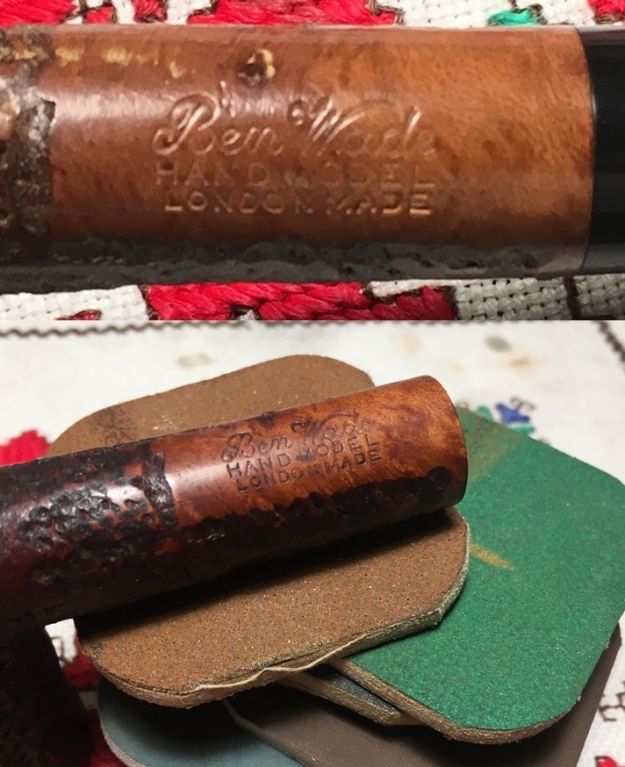
Todd saw this pipe along with two others in the For “Pipe Dreamers” Only! collection – a Ben Wade Hand Model and a very nice GBD Pot with uber grain potential!  Todd is a regular commenter on Rebornpipes and different Facebook pipe groups.  In the past he had offered encouraging words for restorations I had published, so it was great dialoging with him while he chose pipes to commission!  As he whittled his Dreamers list down from 5 pipes to the 3, we discovered we both have 2 grown children living in Denver, a parent living in Florida and connections in the Atlanta area – a small world sometimes in the pipedom community!  Most interesting to me was to discover that Todd is a lawyer and fluent in Mandarin Chinese and who practices both commercial law for corporations and also political asylum cases for individuals.  ‘Political asylum’ cases got my attention and appreciation, especially given our work here in Bulgaria among trafficked women.  Todd’s final three Dreamer’s choices: a Ben Wade, GBD Pot and the RJ on the worktable.With the limited information about the pipe before me and an appreciation for the pipe man who commissioned it, I now look closer at the pipe’s condition.  The interesting thing about this pipe is that it appears to be unsmoked and newish.  The metal tenon appears to be threaded and I’m assuming will take a 5mm filter if one chooses.  The chamber is virgin even though the external briar has some nicks and miniscule pits at places.  The pipe is very attractive, but what strikes me is that the grain of the smooth briar is subdued, even for an unsmoked pipe!  The rim is not marred, but the appearance is sharp and chopped.  Softening the rim presentation would help. The horn stem is in pristine condition and simply needs to be polished.  This ‘restoration’ is primarily a freshening, but my challenge is to show that generally (notice, qualifier!) a good restoration of a ‘new’ pipe will turn out better results than a factory manufactured new pipe.  This is the gauntlet that I’m laying down for myself, and we’ll see! Even though the pipe is unsmoked, I use undiluted Murphy’s Oil Soap and clean the stummel using a cotton pad. Afterwards, I rinse the stummel with cool tap water.  Doing this not only cleans the briar, but I also watch to see how the finish reacts.  As you can see from the results below, the cotton pad picks up some grime.Next, to soften the rim’s ‘cut off’, block look, I introduce both an internal bevel and a gentle external bevel.  At the end, these bevels will soften and will appear simply to be rounded edges, not distinct bevels.  To do the initial shaping, I pinch a tightly rolled piece of 120 grit paper between my thumb and the rim edge and rotate around the circumference.  I follow the 120 with rolled pieces of 240 and 600 grit papers.  In the same way, I introduce a lesser bevel on the external rim edge.  There are some wandering scratches on the rim top that micromesh should erase.Next, to clean up the minor surface imperfections and to tease out the grain, using micromesh pads 1500 to 2400 I wet sand the stummel. I follow by dry sanding using pads 3200 to 4000 and 6000 to 12000.  The grains emerge more distinctly during the micromesh process and I study the patterns.  The block was cut with a primary horizontal cross grain orientation that emerges on the front right and back left bowl quadrants.  On the opposite quadrants, front left and back right – the cross section of the grain emerges in tight bird’s eye patterns.  Very nice – I love the grain!  Decision time.  As I proceeded through the micromesh process, the question I was mulling over in my mind was whether to leave the finish as it is and move on to the compounds and waxing?  Or, to apply a dye and employ the felt buffing wheel technique that will result in heightened grain contrast?  After conferring with my stylistically superior, my wife, I decide to go in the latter direction.  I use Fiebing’s Saddle Tan Pro Dye to do this – an aniline dye.  My aim is not to darken the overall stummel appearance, but to create more contrast in the grains.  I first wipe the bowl with a cotton pad wetted with alcohol to clean it. Then I heat the stummel using the hot air gun which helps expand the briar allowing the grain to be more receptive to the dye.  After heated, using a folded over pipe cleaner, I apply the Saddle Tan dye to the stummel and then fire it with a lit candle.  The alcohol in the dye combusts and sets the pigment in the briar.  After a few minutes, I repeat the process of applying and firing the dye.  I then put the stummel aside to rest for several hours. With the stummel on the resting allowing the dye to fully set, I study the horn stem.  It’s a beautiful piece of horn and the only thing I can do is simply spruce it up.  In the past, I benefited greatly by Steve’s essay on horn stem repair working on my first horn stem, A First Horn Stem on a Throw Away Pipe.  The key thing in repairing horn is to fill the gaps to keep the horn from drying and splintering as horn is very porous.  This stem needs no repairs, but looking closely, I do see normal miniscule porous texture.  The tighter or smoother the horn surface is, helps to guard against the decay of the horn.  I take a few closeups to show this. I treat the horn stem like a vulcanite stem but with greater gentleness 😊.  I run the stem through the micromesh regimen, and I will apply compounds afterward.  I wet sand with micromesh pads 1500 to 2400 and follow by dry sanding with pads 3200 to 4000 and 6000 to 12000.  After each set of three pads, I apply Obsidian Oil to the horn and the horn drinks it up! I’m pleased with the results – even more gloss! While working on the stem, I kept seeing the nickel tenon and thinking that I needed to work on that a bit.  I clean it initially with 0000 steel wool.  After a bit of shining, that’s more like it! The newly stained and fired stummel has been resting for several hours and it’s time to unwrap the fired crust.  I mount a felt cloth buffing wheel to the Dremel and set the speed to the slowest possible, so I don’t scorch the wood with too much friction.  I then apply Tripoli compound to the briar surface which takes quite a bit of time. As the wheel ‘plows’ the crusted dye it loads up quickly requiring me to purge the wheel often.  When finished with Tripoli compound, I wipe the stummel with a cotton pad wetted with isopropyl 95%. I do this to lighten the aniline dye as well as to blend it.  Following this, I mount a cotton cloth buffing wheel to the Dremel, and increase the speed to about 40% full power.  After rejoining the stem and stummel, I apply Blue Diamond compound to both the horn stem and stummel.  When finished, I then wipe the pipe down with a felt cloth to clean it of compound dust before the application of the wax.  The pictures show the process. Before moving to the waxing of the pipe, I apply a mixture of activated charcoal and yogurt (sour cream works too) to form a protective layer for the chamber.  This mixture hardens in the chamber and provides a good starter layer for a cake to develop which protects the briar.  First, I put some natural yogurt in a small dish and then while mixing, I add activated charcoal.  As I add charcoal it thickens.  I want it thick enough, so it doesn’t run after applied to the chamber and I don’t want it so thick that it clumps.  When it looks good, after inserting a pipe cleaner through the draft hole to keep the airway open, I use a cotton bud and paint the chamber wall with the mixture.  With this done, it is late, and I turn out the lights allowing the charcoal/yogurt mixture to cure through the night. The next morning, the chamber coating has cured and I’m ready now to apply the final wax. One more thing to do before applying wax.  I have not seen any other RJ branded pipes that would provide a model informing me about the stem stamp.  The oval-encircled ‘RJ’ appears to have had some color in it, but it’s not clear which.  I decide to dress it up by applying Rub’n Buff European Gold to the stamp.  I apply some over the stamping with a toothpick and after a few minutes, simply scrape most of the excess off using the hard side of a tooth pick and then finish it up by wiping it clean of excess with a cotton pad.  It works exceptionally well and the subtle gold stamping blends well with the horn stem brown and tan hues.  Wow!  I’m liking this. I mount the Dremel with another cotton cloth wheel, maintain 40% full power speed, and apply several coats of carnauba wax to the stummel and horn stem.  After this, I give the entire pipe a good hand buffing with a microfiber cloth to raise the shine.

Earlier, I threw down the gauntlet and made the statement that a well-done restoration has better results than most new, manufactured pipes.  I’ll let you make your own judgement below as I begin with a ‘Before & After’ picture.  John, my fellow GPSC Facebook group member, observed that the RJ pipe he acquired in Paris some years ago had dense briar.  I would say that this ERGI Grand Luxe, if it too is Parisian, displays a grain that could be described the same way.  The bird’s eye is beautiful, tightly wound, and gratuitously showcased throughout the briar landscape – very appealing.  Complementing this beautiful display of briar is the rustic, earthy horn stem with its softly woven brown and tan hues.  I also like the gold embossing of the RJ stamp – it fits well this striking straight Billiard.  This is the first of 3 pipes that Todd commissioned and he will have the first opportunity to acquire it from The Pipe Steward Store.  This pipe benefits our work here in Bulgaria, with the Daughters of Bulgaria – helping women and girls who have been trafficked and sexually exploited.  Thanks for joining me!  Now, ‘Before & After’.  What do you think?


The Third Pipe of a Foursome – A 2nd JR Handmade Canadian


Blog by Steve Laug

My brother Jeff picked up four pipes in classic shapes at an auction in Nampa, Idaho. All four pipes are stamped JR Handmade. Beside the Bulldog there were two Canadians and an Apple. All were stamped the same on the shank JR over Handmade and the opposite side Algerian Briar. I have been researching the brand on the web. I came across a potential pipemaker with the JR initials on Pipedia named J. Rinaldi but from what I can see he did not make classic shaped pipes. He pipes are very well made and have more of a freehand/freeform shape with shank adornments so it makes me wonder if these are his. I enlarged each photo on the Pipedia article but I was unable to see the stamping on his pipes for comparison sake. This leaves me with a lot of questions about the brand. The foursome came from the Boise, Idaho area like the House of Robertson pipes that I worked on last year. Those came from a pipe shop in Boise, Idaho and I wonder if it is not possible that the JR Handmade brand was also a pipe shop brand from a small shop in that area or even somehow connected with the House of Robertson brand. Perhaps I will never know… if any of you readers have any idea about the brand your help would be greatly appreciated.The above photo shows the foursome after Jeff had cleaned them. But before he cleaned each of them he took photos of the pipes as they came to him. I already wrote about the restoration of the Bulldog (https://rebornpipes.com/2019/01/28/the-first-of-a-foursome-a-jr-handmade-bulldog/) and the first Canadian (https://rebornpipes.com/2019/01/30/the-second-of-a-foursome-a-jr-handmade-canadian/). The next pipe is the second pipe down on the left side of the above photo – a classic Canadian with a flat rim top. It is longer than the previous Canadian and also has a longer stem. I have included the photos of the Canadian before cleanup. The pipe is very well made and follows the classic shape of an oval shank Canadian perfectly. The bowl was stained with a slightly different looking finish to the other pipes in the lot. It was more of a medium brown with no black undercoat. Because of that the grain showed up differently on this one. It is a well-shaped pipe that captures the mixture of flame and cross and birdseye grain around the bowl sides and shank. The top of the bowl had some damage on the top and inner edge. The inner edge had some knife marks on the right side at the top that left damage. The bowl had a very thick cake in the bowl. There was a light overflow of lava onto the rim top. The stamping on the top side of the oval shank read JR over HAND MADE. The stamping on the underside read Algerian Briar. The black vulcanite stem had light tooth dents and chatter on the top and the underside of the stem. Otherwise it was in very good condition. It was the most oxidized of the foursome and also had some calcification. Jeff took a close-up photo of the bowl and rim to capture the condition of the pipe pre-cleanup work. The rim top had some lava overflow and a lot of damage to the inner and outer edges of the bowl. The pipe is dirty with thick cake and damage around the rim.He also took a photo of the bottom of the bowl and shank to show the various grains on the pipe. Even though the photo is a bit blurry it show the finish of the bowl and that it is lighter in colour than the other pipes in the foursome. The finish is very dirty but this is another beautiful pipe.

The bowl also has a few fills on the back side of bow and lower right side.Jeff took a photo to capture the stamping on the topside of the oval shank. The photo shows stamping JR over HAND MADE. On the underside it reads Algerian Briar.  The next two photos show the stem surface. There are tooth marks and chatter on both sides near the button. There is also some wear on the sharp edge of the button. There is a thick oxidation and accost of calcification.As mentioned before, Jeff and I have developed a pattern of working on the pipes that has become habit to both Jeff and me. I include it here so you have a sense of that pattern. Jeff reamed the bowl with a PipNet pipe reamer and followed up with a Savinelli Fitsall pipe knife to remove the cake. He scrubbed out the mortise and the airway in the shank and the stem with alcohol, cotton swabs and pipe cleaners. He scrubbed the exterior of the bowl, rim, shank and stem with a tooth brush and Murphy’s Oil Soap to remove the oils and tars on the rim and the grime on the finish of the bowl. He rinsed it under running water. He dried it off with a soft cloth. He was able to remove the lava build up on the rim top and the rim top damage and the damage around the edges – both inner and outer is quite extensive. I took photos of the pipe to show its condition before I started my work on it.   I took close up photos of the bowl and rim top as well as the stem. You can see the condition of the rim top and bowl in the first photo. Jeff was able to remove all of the tar and oils but you can now see the burn damage to the back inner edge of the bowl. The vulcanite stem had light tooth chatter and some tooth marks on the top and underside of the stem near and on the button surface.I took photos of the stamping on both sides of the oval shank. You can see that the stamping on both sides was light toward the front of the pipe. It was still readable but faint nonetheless.I decided to address the rim top damage first. I topped the bowl with 220 grit sandpaper on a topping board to remove the damage to the top and the outer edges of the rim top. I was also able to reduce the damage to the back inner edge of the rim.I also needed to take care of the inner edge so I used a folded piece of 220 grit sandpaper to smooth out the burn marks and darkening around the edge. I gave the edge a very slight bevel to minimize the damage. The pink putty fills bugged me! I used a dental pick to remove them as much as possible and wiped the briar down with alcohol on a cotton pad to remove the dust and debris. I filled in the holes with clear super glue and briar dust to repair the fills.When the repairs had cured I sanded them smooth with 220 grit sandpaper to blend the into the surface of the briar.I sanded the repairs smooth and blended them into the rest of the bowl. It took a bit of work but soon they were blended in. I would need to stain the bowl repairs but first I want to polish the sanding marks out. I polished the rim top, the edge and exterior of the bowl and shank with micromesh sanding pads – wet sanding with 1500-2400 grit pads and dry sanding with 3200-12000 grit pads. I wiped the rim off after each sanding pad to remove the dust. The damage on the rim edges and top looked really good after polishing. I decided to stain the entire pipe with a tan stain. I heated the briar, applied the stain and flamed it to set it in the grain. I repeated the process until I was satisfied with the coverage of the stain.I set the bowl aside overnight to let the stain cure and set in the briar.I buffed the bowl the next evening after work with red Tripoli and Blue Diamond to remove the crust coat of the stain and bring the briar to life. I wiped the bowl down with alcohol on a cotton pad to make it more transparent. Once I finished the cleanup of the stain I worked some Before & After Restoration Balm into the smooth surface of the briar with my fingertips to clean, enliven and protect it. I let the balm sit for a little wall and then buffed with a cotton cloth to raise the shine. The following photos show the bowl at this point in the restoration process. The reworked rim top looks really good and matches the colour of the rest of the pipe. I set the bowl aside and worked on the stem. There were some tooth marks on the top and underside at the button that needed to be addressed. I also needed to do some work on the surface of the button on both sides. I also sanded away some of the surface oxidation.I polished the stem with micromesh sanding pads – wet sanding with 1500-2400 grit sanding pads and dry sanding it with 3200-12000 grit sanding pads. I wiped it down after each sanding pad with Obsidian Oil. I polished it with Before & After Pipe Stem Polish and wiped it down with a last coat of Obsidian Oil. With this third JR Hand Made pipes from the Nampa, Idaho auction I am even more certain that there is some connection to the House of Robertson Pipe Shop in Boise, Idaho. I wonder if it is a seconds line for House of Robertson. Even with the fills and the repairs to the pipe this is another nice pipe. The three of the four JR Hand Made pipes that I have to restore are really well made and shaped. The stain job was done to highlight the mix of grain on the bowl. I polished stem and the bowl with Blue Diamond polish on the buffing wheel. I gave the bowl and the stem multiple coats of carnauba wax. I buffed the pipe with a clean buffing pad to raise the shine. I hand buffed it with a microfiber cloth to deepen the shine. The pipe polished up pretty nicely. The contrasting grain really began to stand out; it seemed to take on life with the buffing. The rich contrasting brown colour works well with the polished black vulcanite stem. This finished pipe has a rich look just like the Bulldog and the other Canadian and it is also quite catching. Have a look at it in the photos below. It is a longer and slimmer looking pipe. The shape, finish and flow of the pipe and stem are very well done. The dimensions are Length: 6 1/2 inches, Height: 2 inches, Outside diameter of the bowl: 1 1/4 inches, Chamber diameter: 3/4 of an inch. I will be putting this newly finished JR Hand Made Canadian on the rebornpipes store shortly if you are interested in adding it to your collection. Thanks for walking through the restoration with me as I worked over the third of the foursome from JR Hand Made pipes.

The Second of a Foursome – A JR Handmade Canadian


Blog by Steve Laug

My brother Jeff picked up four pipes in classic shapes at an auction in Nampa, Idaho. All four pipes are stamped JR Handmade. Beside the Bulldog there were two Canadians and an Apple. All were stamped the same on the left side of the shank JR over Handmade and on the right side Algerian Briar. I have been researching the brand on the web. I came across a potential pipemaker with the JR initials on Pipedia named J. Rinaldi but from what I can see he did not make classic shaped pipes. He pipes are very well made and have more of a freehand/freeform shape with shank adornments so it makes me wonder if these are his. I enlarged each photo on the Pipedia article but I was unable to see the stamping on his pipes for comparison sake. This leaves me with a lot of questions about the brand. The foursome came from the Boise, Idaho area like the House of Robertson pipes that I worked on last year. Those came from a pipe shop in Boise, Idaho and I wonder if it is not possible that the JR Handmade brand was also a pipe shop brand from a small shop in that area or even somehow connected with the House of Robertson brand. Perhaps I will never know… if any of you readers have any idea about the brand your help would be greatly appreciated.The above photo shows the foursome after Jeff had cleaned them. But before he cleaned each of them he took photos of the pipes as they came to him. I already wrote about the restoration of the Bulldog (https://rebornpipes.com/2019/01/28/the-first-of-a-foursome-a-jr-handmade-bulldog/). The next pipe is the first pipe on the right side of the above photo – a classic Canadian with a beveled rim top. I have included the photos of the Canadian before cleanup. The pipe is very well made and follows the classic shape of an oval shank Canadian perfectly. The bowl was stained with a dark brown/black and a medium brown stain over it. It is a well-shaped pipe that captures the mixture of flame and straight grain around the bowl sides and shank. The top of the bowl had some damage on the top and inner and outer edge. There were some chips from the briar on the outer edge on the right and the left side. There was a little darkening at the front outer edge. The inner edge had some knife marks on the right side at the top that left damage. The bowl had a very thick cake in the bowl. There was an overflow of lava onto the rim top. The stamping on the top side of the oval shank read JR over HAND MADE. The stamping on the underside read Imported Briar. The black vulcanite stem had light tooth dents and chatter on the top and the underside of the stem. Otherwise it was in very good condition. It was also lightly oxidized. Jeff took two close-up photos of the bowl and rim with different lighting to capture the condition of the pipe pre-cleanup work. The rim top had some lava overflow and a lot of damage to the inner and outer edges of the bowl. The pipe is dirty with thick cake and damage around the beveled rim.He also took photos of the sides of the bowl and shank to show the various grains on the bowl and shank. The first photo shows the large chip out of the top edge of the bowl. It was quite large and deep. Even though there is damage to this pipe the photos also show the rich colour of the stain that makes the grain just pop. The finish is very dirty but this is another beautiful pipe. Jeff took a photo to capture the stamping on the topside of the oval shank. The photo shows stamping JR over HAND MADE. On the underside it reads Imported Briar.  The next two photos show the stem surface. There are tooth marks and chatter on both sides near the button. There is also some wear on the sharp edge of the button. As mentioned before, Jeff and I have developed a pattern of working on the pipes that has become habit to both Jeff and me. I include it here so you have a sense of that pattern. Jeff reamed the bowl with a PipNet pipe reamer and followed up with a Savinelli Fitsall pipe knife to remove the cake. He scrubbed out the mortise and the airway in the shank and the stem with alcohol, cotton swabs and pipe cleaners. He scrubbed the exterior of the bowl, rim, shank and stem with a tooth brush and Murphy’s Oil Soap to remove the oils and tars on the rim and the grime on the finish of the bowl. He rinsed it under running water. He dried it off with a soft cloth. He was able to remove the lava build up on the rim top and the rim top damage and the damage around the edges – both inner and outer is quite extensive. I took photos of the pipe to show its condition before I started my work on it.   I took close up photos of the bowl and rim top as well as the stem. You can see the condition of the rim top and bowl in the first photo. Jeff was able to remove all of the tar and oils but you can now see the damage to the inner edge of the bowl. The vulcanite stem had tooth chatter and some tooth marks on the top and underside of the stem near and on the button surface.I took photos of the stamping on both sides of the oval shank. You can see that the stamping on both sides was light toward the front of the pipe. It was still readable but faint nonetheless.I decided to address the damage to the rim edges first. I wiped down the outside of the bowl with an alcohol dampened pad and filled in the chipped areas around the edge with clear super glue and briar dust to build up the chips to match the bowl sides.I decided to leave the side repairs for a bit to harden and turned to the rim top. I had to handle the rim repairs a bit differently on this pipe since it had a rim top that was beveled inward. I topped the bowl with 220 grit sandpaper on a topping board to remove the damage to the outer edges of the rim top. I worked the beveled edge to match the outer edge of the bowl and smooth out the transition. I also needed to take care of the inner edge so I used a folded piece of 220 grit sandpaper to smooth out the knife marks there and minimize the damage.   I sanded the repairs smooth and blended them into the rest of the bowl. It took a bit of work but soon they were blended in. I would need to stain the bowl repairs but first I want to polish the sanding marks out. I polished the rim top, the edge and exterior of the bowl with micromesh sanding pads – wet sanding with 1500-2400 grit pads and dry sanding with 3200-12000 grit pads. I wiped the rim off after each sanding pad to remove the dust. The damage on the rim edges and top looked really good after polishing. I stained the rim top and bowl sides with a Cherry stain pen. I gave the sanded edges and repairs several coats of stain and let it cure.I worked some Before & After Restoration Balm into the smooth surface of the briar with my fingertips to clean, enliven and protect it. I let the balm sit for a little wall and then buffed with a cotton cloth to raise the shine. The following photos show the bowl at this point in the restoration process. The reworked rim top looks really good and matches the colour of the rest of the pipe. I set the bowl aside and worked on the stem. There were some tooth marks on the top and underside at the button that needed to be addressed. I sanded the tooth marks and chatter out of the surface of the stem and shaped the button with 220 grit sandpaper.I polished the stem with micromesh sanding pads – wet sanding with 1500-2400 grit sanding pads and dry sanding it with 3200-12000 grit sanding pads. I wiped it down after each sanding pad with Obsidian Oil. I polished it with Before & After Pipe Stem Polish and wiped it down with a last coat of Obsidian Oil. With this second JR Hand Made pipes from the Nampa, Idaho auction I am even more certain that there is some connection to the House of Robertson Pipe Shop in Boise, Idaho. Even with the fills and the repairs to the pipe this is another nice pipe. The two of the four JR Hand Made pipes that I have to restore are really well made and shaped. The stain job was done to highlight the mix of grain on the bowl. I polished stem and the bowl with Blue Diamond polish on the buffing wheel. I gave the bowl and the stem multiple coats of carnauba wax. I buffed the pipe with a clean buffing pad to raise the shine. I hand buffed it with a microfiber cloth to deepen the shine. The pipe polished up pretty nicely. The contrasting grain really began to stand out; it seemed to take on life with the buffing. The rich contrasting brown colour works well with the polished black vulcanite stem. This finished pipe has a rich look just like the Bulldog and it is also quite catching. Have a look at it in the photos below. The shape, finish and flow of the pipe and stem are very well done. The dimensions are Length: 6 inches, Height: 1 7/8 inches, Outside diameter of the bowl: 1 3/8 inches, Chamber diameter: 3/4 of an inch. I will be putting this newly finished JR Hand Made Canadian on the rebornpipes store shortly if you are interested in adding it to your collection. Thanks for walking through the restoration with me as I worked over the second of the foursome from JR Hand Made pipes.

Refreshing an unsmoked 1910-1915 CPF Chesterfield Billiard


Blog by Steve Laug

Not too long ago I was chatting with a friend in New York and he showed me an old unsmoked CPF pipe. He had picked it up and intended to clean it up for resale so I asked him how much he wanted for it and struck a deal. I love older CPF pipes and I really am a sucker for them as I have a small collection of them. This one rang all the bells for me with the unsmoked bowl, the gold stamp on the shank, the brass band and the P-lip style stem. He was pretty sure from his work that the pipe was from the time period of the 1910s and before 1920, which also made it attractive to me. He sent me the following three photos that really sealed the deal for me. He said from his research that the pipe came from the 1910s period before 1920. He picked it up from a fellow who said that it (along with other pipes) came from a clean out of an old retail building that used to be a pipe store in the 1940s. He packed the pipe and put it in the mail to me. It did not take too long for it too arrive on the other side of the continent. And when I opened the box and removed the pipe this is what I saw (it did not disappoint). It was a bit shop worn from sitting – nicks and grime on the finish and a loose band but very clean. The stem was not oxidized but the vulcanite had some small nicks in the surface. The stamping on the left side of the shank read Chesterfield in an arch over the CPF in an oval logo. The band had the CPF logo and some faux hallmarks. The stem read Chesterfield over the CPF oval logo on the topside of the taper. I took photos of the pipe when I received it. The bowl was raw briar and totally looked new and unused. You have to admit this is a beauty – I guess that is subjective but it is to me! I took close up photos of the bowl, rim top and stem to show the overall condition of the pipe. The bowl was pristine as noted above. The rim top had some small scratches and very shallow nicks. The shank ahead of the band was discoloured from the brass band and the band had turned to the left from its original centered location on the top. The stem looked really good – no oxidation. There were a lot of minute scratches in the surface on both sides and a little rounding of the shoulders at the stem/shank junction. The gold stamping on the stem top was faint but still present.The next photos show the stamping on the shank, band and stem. You can see that they are all quite clear.I wrote a piece on the background to the CPF brand earlier on the blog and include the link to that here (https://rebornpipes.com/2013/04/14/some-reflection-on-the-historical-background-on-cpf-pipes/). I quote a pertinent part of the blog below:

From my reading and research it seems to me that CPF brand was discontinued sometime in the 1910-1920 range. Again, turning to Bill Feuerbach I found that he notes the following, which pins down the time frame of the discontinuation of the brand more specifically, “I have a CPF Chesterfield in our office display that has a nametag from way before my time that says 1900 CPF Chesterfield. It looks like most other Chesterfields you’ve seen, including the military type push stem, except this stem is horn and not vulcanite. As far as I have gathered the CPF brand was phased out sometime around 1915.” Interestingly, he noted that the Chesterfield name and style was later introduced in the KB&B, Kaywoodie and Yello-Bole lines. He says that the 1924 KB&B catalog shows KB&B Chesterfields…

From my research I believe that we can definitively assert that the CPF logo stands for Colossus Pipe Factory. The brand was purchased by KB&B sometime between 1884 and 1898 and that it continued until 1915. That time frame gives help in dating some of the older CPF pipes you or I might find. It can be said that prior to the dual stamping it is fairly certain that the pipe is pre-1884 to 1898. After the dual stamping it can be placed post 1898 until the closure of the brand line in 1915. CPF made beautiful pipes.

From that information I could see why my friend in New York put the date where he did. I would further refine his 1910s period to a time between 1910-1915. At any rate it is an old pipe to remain unsmoked for this long. That fact that it was found in a building that originally housed a pipe store that closed in the 1940s gives a bit of a clue as to how it remained unsmoked at least until that time period. From the closure of the store to 2019 the fact that it is still unsmoked is a bit of a mystery to me.

As I examined the pipe closely I could see a lot of pink putty fills. I took photos of the fills to show their number and placement on the bowl. These tend to irritate me and while some purists may question why I removed them I planned to do so. They were placed in such a way that they were directly in my line of site when I held the pipe in my mouth. They really needed to go. I took the stem off the bowl and the band on the shank came off very easily. I turned it to align it and then decided to take it off to clean up the shank end before I reglued it. I wiped off the old glue and sanded the shank end lightly with a 1500 grit micromesh pad to remove the glue debris. I would need to do a bit more work on it before regluing it but it definitely looked better. I also took photos of the mortise chamber to show what it looked like. It is almost a reverse calabash before those were spoken of, however the tenon filled the chamber completely and negated that function. One of the nice features of working on a NOS pipe is that the internals are very clean. I ran a pipe cleaner through the airway in the stem and shank just to remove dust. I did the same in the mortise with a cotton swab and the internals were finished. I directed my attention to the obnoxious pink putty fills. I picked them out with a dental pick to remove as much of the dried and shrunken putty as possible. It takes some careful work so as not to create more issues than I was trying to cure but it did not take long to remove the offending putty. (Note the band on the shank at this point – to be honest I am not sure why I put it back on. Perhaps to protect the shank end while I was working on the fills?)I wiped down the fills with an alcohol dampened cotton pad to remove the debris and filled them in with clear super glue. I used a dental spatula to apply fine briar dust on top of the glue and to press it into the fill area. When the repairs cured I sanded the patches down with 220 grit sandpaper to blend them into the surface of the briar. I sanded the spots smooth and they were already looking better than the pink putty they had replaced. I used a black sharpie pen to touch up the centres of the fills knowing that as I polished and stained the bowl they would blend in quite well. (Note to self: find a dark brown Sharpie pen.)I polished the repaired areas and the rest of the bowl with micromesh sanding pads – wet sanding with 1500-2400 grit pads and dry sanding with 3200-12000 grit pads. I wiped the bowl down after each pad with a damp cloth to remove the dust. I removed the band again after the first three pads and repeated the sanding on the shank with the first three pads. I decided to combine a Maple and Cherry stain pens to match the colour of the original bowl as much as possible. I colour with the lighter stain and then colour over it with the darker stain. I rubbed the bowl and shank down with a coat of Before & After Restoration Balm. I worked it into the surface of the briar to clean, enliven and protect the briar. The old briar was dry and it drank up the balm. I also found that it allows me to blend the stain coats together and give an even finish to the bowl. I buffed the bowl with a soft cloth to raise a shine. I am liking how the pipe looks as this point in the process. I set the bowl aside and started working on the stem. The nicks and scratches in the stem were very surface so I decided to polish the stem with micromesh sanding pads – wet sanding it with 1500-2400 grit pads and dry sanding it with 3200-12000 grit pads. I wiped it down with Obsidian Oil after each sanding pad. I finished the polishing with Before & After Pipe Polish – both Fine and Extra Fine. I gave it a final coat of Obsidian Oil and set it aside to dry. I love these old CPF pipes. There is some serious thought that they were carved by European trained craftsman who were skilled pipemakers. They were brought to the US by the CPF Company to make pipes. Many of the shapes, bands and stems have the kind of workmanship involved that I really think there is truth to this story. This is little chubby billiard with a classic shape that reminds me of some of the BBB Ultima pipes that I have restored. The stem is a pre-Peterson style P-lip with the airway at the end of the stem rather than on the topside. It had a lot of fills that I have repaired and blended into the bowl for the most part. There are a few fills that still show but they are smooth and not pink. I polished stem and the bowl with Blue Diamond polish on the buffing wheel carefully avoiding the stamping on the shank. I gave the bowl and the stem multiple coats of carnauba wax. I buffed the pipe with a clean buffing pad to raise the shine. I hand buffed it with a microfiber cloth to deepen the shine. The pipe polished up pretty nicely. The contrasting grain really began to stand out; it seemed to take on life with the buffing. The rich contrasting brown colour works well with the polished black vulcanite stem. The finished pipe has a rich look that is quite catching. Have a look at it with the photos below. The shape, finish and flow of the pipe and stem are very well done. The dimensions are Length: 5 inches, Height: 1 5/8 inches, Outside diameter of the bowl: 1 1/4 inches, Chamber diameter: 3/4 of an inch. This one will be joining my collection as it fits in the CPF niche group that I have been building. The shape and feel in the hand is perfect. Now I have to make a hard decision – do I leave it unsmoked or do I load it up with some aged Virginia and break it in. Thanks for walking through the restoration with me as I restored and reworked this old billiard from 1910-1915. It is always a treat for me to work on a piece of pipe history especially when I have learned a bit of the story behind it.

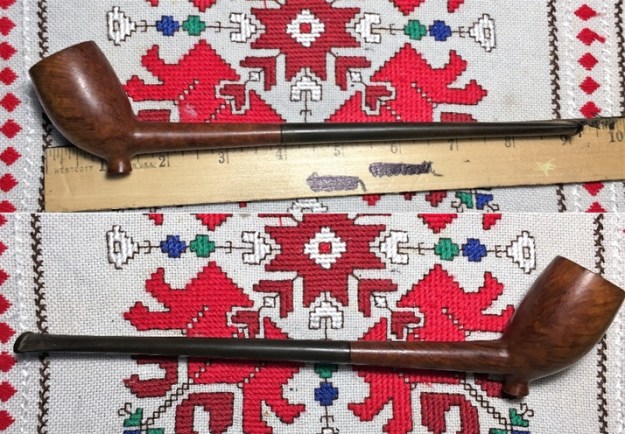
Recommissioning a Vintage French Paul Viou Churchwarden of St. Claude


Blog by Dal Stanton

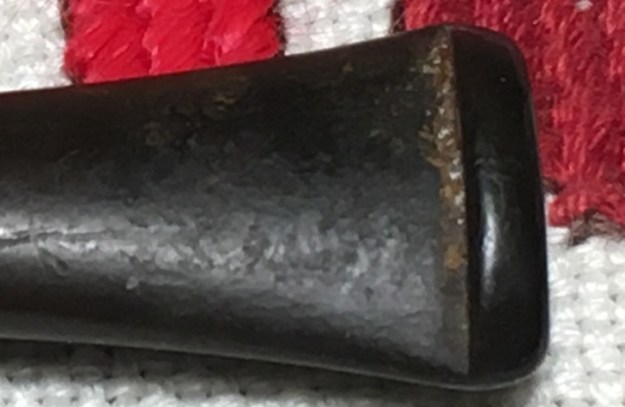
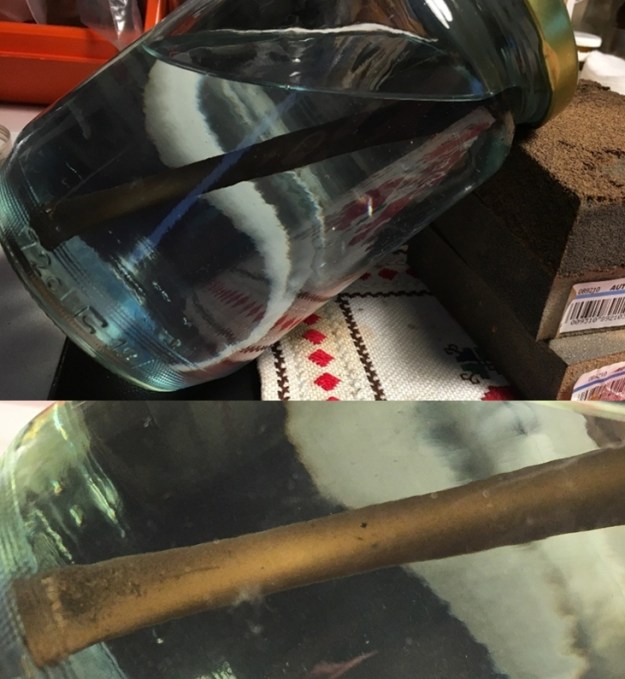
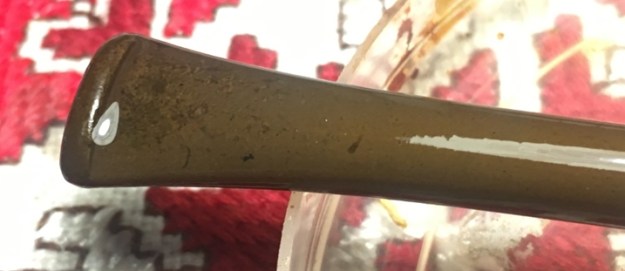
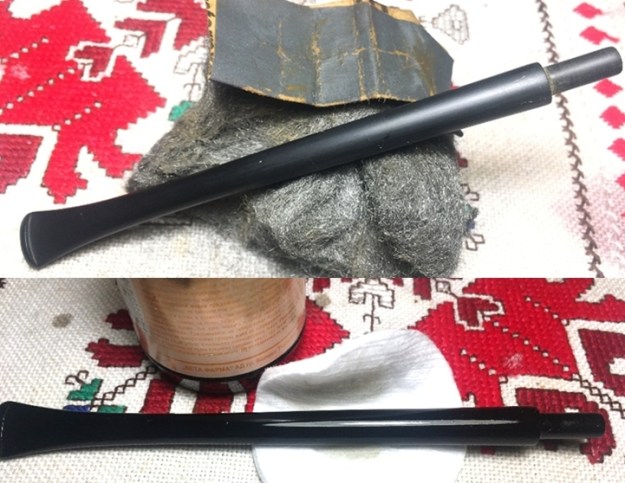
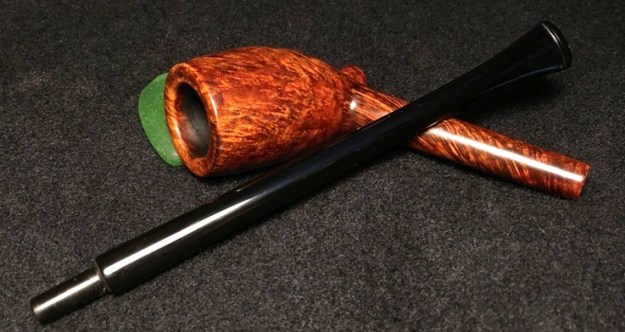
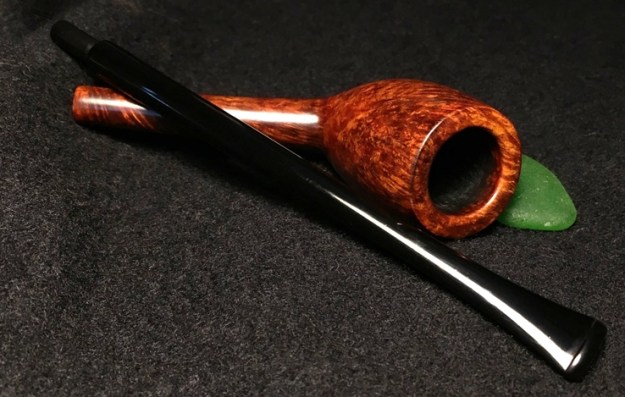
There’s nothing like a Lot picture on the eBay auction block that makes a pipe man salivate with the question, “Are there any treasures in the beautiful, intertwined, chaotic mass of briar, rubber, horn, and acrylic?”  I received a message from my good pipe man friend to the north of Bulgaria in Romania, Codruț (aka: Piper O’Beard on FB), a happy steward of a Peretti Oom Paul Sitter I restored (Recommissioning Another L. J. Peretti of Boston: An Oom Paul Sitter).  Codruț  sent me some links of Lots on the French eBay auction block.  With piqued curiosity I looked.  Codruț was considering getting into the hunt – he had never purchased a Lot before and he wanted to try his had and restoring.  When I saw the French Lot below, I started salivating a bit(!), and asked Codruț if he minded if I went after it.  With his blessing, I placed a bid and was fortunate to land the French Lot of 50 and bring it to Bulgaria.  What drew my attention to this Lot of 50 initially were all the horn stems that caught my eye.  The second was the classy Pencil Stem Cutty Tavern Pipe laying across the top (unbelievably, still available as I write in the For “Pipe Dreamers” Only! collection!!) and the modernistic, deep blue/white Billiard with a fiery blue acrylic stem lying next to the Pencil Stem Cutty Tavern Pipe (available in The Pipe Steward Store as I write!).  Then I saw the Churchwarden.  All pipe picking scavenging requires one to see through the mass to put together the clues of what is hidden.  The P. Viou Warden’s upside-down bowl starts on the left side (just above a horn stem) and you can trace the long stem underneath the mass where it emerges on the far right, upturned – somewhat masked by the star on the print below.  Aw!  My excitement when the bell rang, and the winning bid was mine!When the French Lot of 50 finally made it to Bulgaria, I opened the box like a young boy opening a treasure!  With all my acquisitions, so that I can keep track of everything, I picture and record every pipe and eventually upload them to the ‘For “Pipe Dreamers” Only!’ collection for pipe men and women to see and commission if a pipe happens to choose them.  Here are some of the cataloging pictures I took of the French Lot of 50 with a better look at the 3 pipes that hooked me as well as the plethora of horn! It didn’t take long for the Churchwarden to find a suitor after he was put online in the ‘For “Pipe Dreamers” Only!’ collection.  A new acquaintance, Josh, who visited Bulgaria last summer, saw the Churchwarden and commissioned him and has been waiting so patiently!  The Paul Viou Churchwarden finally made it to my worktable, and I take more pictures to get a closer look. The reach of the P. Viou’s Churchwarden is 10 1/2 inches (even with an inappropriately tucked stem!) and the height of the bowl is 1 7/8 inches.  The nomenclature is a cursive, P. Viou with a flared underline on the left flank of the shank.  On the right, is the well-known stamping of ‘ST.CLAUDE’, the French birthplace of the production of briar pipes and historically, the mega-center of French pipe manufacturing with a plethora of names calling it home.  There is scant information about the Paul Viou name on the internet that I could find.  Pipedia’s article of Paul Viou is brief:

From Pipes, Artisans and Trademarks, by José Manuel Lopes’

Paul Viou was the brand and name of a French artisan who sold his pipes by correspondence and then he was a pipe supplier for military institutions. He also made sculpted pipes and sometime used horn stems.

The brand is currently sold by Jacques Craen and made by Genod in Saint-Claude, after having also belonged to Paul Guilland and Vuillard. They are stamped P. Viou and made primarily for export.

This information is confirmed by Pipephil.eu with the addition of the date of the current holder of the Paul Viou name, Beaud, happening in 2006: Whether the Churchwarden before me was made under the original artisan or under one of the other eventual holding companies (Guilland, Vuillard, or Genod), I’m not sure how to say with certainty.  I have a few other P. Viou pipes in the French Lot of 50, so perhaps I’ll discover more information as I go!

The condition of the overall pipe is good. The bowl is darkened from time and the normal buildup of oils and grime.  The chamber has some cake buildup but not much.  The Warden stem has some oxidation and the bit is in good condition.  I notice also (picture above) that there’s a gap between the stem and shank.  Often, a simple cleaning will restore a flush seating of the stem, but I’ll keep my eye on this.  The main thing that grabbed my attention when I first held the pipe in my hand was the orientation of the stem.  To me, it is over-bent and almost you could say, tucked.  Wardens, I’ve found, have different kinds of bends.  Most often I’ve observed a sweeping bend where almost the entire stem is engaged in the bend.  This P. Viou has a straight extension until it reaches the very end of the stem and then is bent.  I like it, but the final orientation of the bend should more closely reflect a parallel orientation with the plane of the rim.  For a didactic moment, I trace this concept on a piece of paper to illustrate.Before beginning the cleaning process with the stem, I make this adjustment to the stem.  First, just to be on the cautious side, I insert a pipe cleaner into the bit side of the stem to guard the integrity of the airway, which usually isn’t an issue if the bend is being opened instead of tightened. I also trace the original stem orientation on the paper I used above so that when I bend the stem, I can lay it on the flat surface for a straighter result.  I then heat the end of the stem with a hot air gun.  As it heats, the vulcanite becomes supple and the bend gradually starts straightening on its own.  When it expands enough as I eyeball it, holding the stem in place, I take it to the sink and run cold tap water on it to set the bend.  After the first attempt, the bend is still too tight, so I repeat the process again and the second time is enough.  The pictures show the progression.  I like this orientation much better. Before cleaning the stem, I remove the stinger to aid in the cleaning. I heat the stinger with a Bic lighter and after it heats, the vulcanite holding it loosens its grip.  I gently extract it with the help of pliers.  I personally don’t have a lot of affection for stingers and their role in the smoking experience.  I’ll clean the stinger and include it with the finished pipe and allow the future steward to make the call!  I don’t have long pipe cleaners, but I do have a selection of shank brushes that easily reach through the stem.  I use these dipped in isopropyl 95% to clean the internals of the stem. I also use regular pipe cleaners inserting them from both sides.  Well, it didn’t take long after starting to know that this Warden stem had not been cleaned in some time – if ever!  The reality of the less than optimal situation was confirmed when my wife came in and said that something was stinking…. I should have had gloves and my apron on, but hindsight!  After some cleaning, things are looking better but still not pristine! This nastiness helps me decide the next course of action.  I use an OxiClean bath to work on the oxidation in the vulcanite, but it also serves to further sanitize the internals, yes!  I pour the OxiClean into a larger plastic container that will accommodate the stem.  Before putting the stem in the OxiClean bath, I put a little petroleum jelly over the ‘P.Viou’ stamping to protect it and then let the OxiClean to its thing with both internal and external. With the stem in the bath, I turn now to the Paul Viou bowl by reaming the chamber with the Pipnet Reaming kit using two smaller blades.  I then fine tune by scraping the chamber with the Savinelli Fitsall tool and follow by sanding the chamber with 240 grit paper wrapped around a Sharpie Pen.  After wiping the chamber with a cotton pad and alcohol, I look at the cleaned chamber and it looks good – no signs of heating damage. Next, I use undiluted Murphy’s Oil Soap on the external briar surface to work on the bowl and lava flow on the rim. I also use a bristled tooth brush and a brass wire brush on the rim that will not damage the briar.  The cleaning reveals two thing.  First, by looking at the cotton pad in the picture, the old dye came off during the cleaning.  The rim cleaned up well but revealed burn damage from pulling the flame over the rim instead of being over the tobacco!  Lighting a Churchwarden can be a bit more difficult, especially the way the stem was originally bent on this Paul Viou – I doubt if the steward could see the top of the bowl with the way it was tucked under.  Here are the pictures. To complete the general cleaning regimen, I use cotton buds and pipe cleaners dipped in isopropyl 95% to do the job.  With the grungy condition of the stem, it shouldn’t have surprised me to find the mortise and airway internals sharing the same grungy condition.  Oh my, with the help dental probes and spatulas to scrape the mortise and shank brushes coming in to reinforce the cotton buds and rank and file pipe cleaners, some victory was achieved in this skirmish.  With confidence of having total victory, I will later continue the struggle by giving the internals a kosher salt and alcohol bath to further draw the oils and tars out of the internal briar and to remove any lingering odor.  The picture shows the carnage and the arsenal of this war. Next, I take a closer look at the rim damage.  The lighting practice has scorched the forward left side of the bowl resulting in the thinning of the rim at that point.  I’ve had a lot of experience with this when I restored several L.J. Peretti Oom Pauls from the former steward who was a serial burner and discarder (See for an example: Another LJ Peretti Oom Paul Sitter Recommissioned).  My approach is two-fold with the driving value of always trying to save as much briar as possible!  First, I will minimally top the stummel to remove as much damage as possible.  Then, to blend the internal rim lip damage, I introduce an internal bevel, which in my view, looks good anyway.  With the chopping board on my table, I cover it with a sheet of 240 paper.  The following pictures show the graduated progress.  First, the starting point.Interestingly, the topping process reveals a slight inward dropping pitch of the rim.  This is shown by the outer portion only making contact with the flat topping board. When I decide the 240 grit paper has removed enough of the top, I switch the paper to 600 grit and give the topping a few more rotations to smooth out the rim.Now, step two is introducing a bevel to the internal lip to remove more damaged briar and to blend.  I start with a tightly rolled piece of coarser 120 grit paper to cut the initial bevel.  I follow in succession with 240 and 600 grit papers tightly rolled. To soften the sharp outer edge of the rim and to soften the entire rim presentation, I create an external bevel, but a very small bevel using the same progression of sanding papers.  I think it looks good.  The darkened part of the damage is still visible, but it will be mitigated when the rim is dyed and darkened.The condition of the stummel is good.  I don’t see any problem fills or pitting.  I go with the original finish and aim to match the rim to the bowl. What seems to be a good match is the Mahogany dye stick.  After applying it over the rim, I then blend the dye stick coating by wiping it with a cotton pad wetted with alcohol.  I think it looks good at this stage. The Warden stem has been in the OxiClean bath for several hours.  I take a few close-up pictures to show the oxidation which had surfaced.  I wet sand using 600 grade paper to remove the oxidation.  I’m careful to stay clear of the ‘P.Viou’ stamp.  I follow this with Magic Eraser over the entire stem, including the stamping.  The low abrasion of the sponge works well with cleaning up this area.In order to hydrate the vulcanite, I then apply a coat of paraffin oil (a mineral oil) over the stem and set it aside.Next, using micromesh pads 1500 to 2400, I wet sand the stummel to clean it and begin the fine polishing sanding. 

Following the first set of 3 pads, I begin dry sanding with the next set of 3 pads and after finishing with the first of these, I don’t like the way the stummel looks.  After the wet sanding cycles, the stummel has a pink or mauve hue to it – mauve to me, is sick pink.  Just in case you’re wondering what mauve is, from a quick Google search followed by my mauve toned stummel.  This doesn’t work for me! I placed too much trust in the old stain which is not holding up and leaving behind a less than attractive briar presentation – at least as I look at it.  I wipe the stummel with a cotton pad and alcohol and my thoughts are confirmed.  Even after wiping with isopropyl 95%, the stummel has the mauve residue in the grain.  The reality is, I’m not losing too much traction in the process of this restoration except I will take a detour and put the stummel in an acetone soak to make sure I’m proceeding with the natural briar.  This soak in acetone will also preempt the need to do a kosher salt and alcohol soak.  I put the stummel in the acetone soak and turn out the lights.  Another day is done.The next morning, I fish the stummel out of the acetone soak and it is evident that all the remnant finish is gone. I return to the micromesh sanding process and start again by wet sanding with the initial set of 3, 1500 to 2400.  Following this, using pads 3200 to 4000 and 6000 to 12000, I dry sand the stummel, throughout avoiding the stamped areas on the left and right flanks of the shank.  Wow, without the distraction of the finish, the grain I see emerge is nice.  I see an eclectic blend of large bird’s eye on the sides of the bowl and the horizontal ‘connector’ grains of the bird’s eye displayed on the foreside of the bowl. I still have the Warden stem waiting in the wings for fine tuning, but I want to move forward with the stummel so that it can be ‘resting’ during the stem work.  The grain that has emerged is beautiful and to create a little more ‘pop’ to the grain with more contrast between the darker and lighter grain – harder and softer wood, after debating between Dark Brown and Light Brown, I decide to use Fiebing’s Light Brown Leather Dye to provide the base hue in the grain and then through the use of Tripoli compound applied with a felt buffing wheel, the grain is teased out leaving greater contrast.  I can lighten as well by wiping the bowl with a cotton pad and alcohol since I’m using an aniline dye.

I assemble all the components of my desktop dying station. I first assure that the stummel is clean by wiping it with a cotton pad wetted with alcohol.  After inserting a fashioned cork into the shank to act as a handle, I heat the stummel with a hot air gun to heat the briar and by this, expanding the briar to enable the dye to be absorbed more efficiently.  After heated, I apply Fiebing’s Light Brown Leather Dye over the briar surface with a folded over pipe cleaner.  When fully covered, I fire the aniline dye with a lit candle which immediately combusts the alcohol and sets the pigment in the grain.  After a few minutes I repeat the process and put the fired stummel aside to allow the dye to rest.  I discovered that this ‘resting’ process helps to aid the dye to set and not come off on the hands when the pipe initially goes into service and the bowl is heated.Now that I completed the staining, I turn my attention to the Warden stem.  Taking another close look at the bit area reveals that the sanding to remove the oxidation with 600 grit paper, all but erased any tooth chatter on the bit!  On the lower bit (second picture) I do see one very small dimple that I dispatch quickly with 470 then 600 grade papers.  I then follow by using 0000 steel wool on the entire stem.  I like the results – progress. Before moving on to the micromesh phase, I go the extra mile with the Paul Viou Warden stem.  Using Before & After Fine and Extra Fine Polish, in succession, I apply some of the polish on my fingers and then rub the polish into the vulcanite surface.  The Fine polish has more of a gritty feel to it.  With both polishes, they revitalize the vulcanite as well as continue to extract remnants of oxidation from the rubber compound.  I take a picture while the Extra Fine Polish was doing its thing.  After the application of each polish, I use a cotton pad to wipe off the excess polish.Just when everything was going so well….  After I wipe off the Before & After Extra Fine Polish and was admiring the results, I see a pit on the forward third of the stem…ugh.  Just to make sure I was seeing what my eyes were seeing and my brain was arguing that I wasn’t seeing what I was seeing – I took a sharp dental probe and tested. Well, sometimes you simply must punt the ball – American football slang for just doing what you need to do.  So, using Hyper Bond 12000cps Black CA glue, with a toothpick as my drop guidance system, I spot drop some glue on the pit and wait.After the patch cures, I gingerly use the flat needle file to file down the patch mound – trying not to slip off and produce more patch work!  After the filing, I further remove the excess with 240 grit paper followed by 600 and 0000 steel wool.  Finally, in the locale of the patch I again apply Before & After Fine and Extra Fine Polish.  Well, the pit is filled, but the coloring of the fill is not black-black so it doesn’t blend with 100% satisfaction.  Yet, if one doesn’t know the fill is there, he probably would not see it!  Restoration is not perfection, though we try!  The pictures show the detour. Undaunted, moving forward with the micromesh process, I wet sand with pads 1500 to 2400 and follow by dry sanding with pads 3200 to 4000 and 6000 to 12000.  After each set of 3 pads, I apply Obsidian Oil to continue the revitalization of the vulcanite Warden stem.  Admittedly, taking distance pictures of a Churchwarden stem is less than satisfying, but what I’m seeing close-up is looking good!With the stem on the side, I’m looking forward to ‘unwrapping’ the fired stummel.  Using a felt cloth buffing wheel mounted on the Dremel, I set the speed to the slowest setting, so it doesn’t get too hot with friction.  I then begin the process of removing the fired shell revealing the grain below. My wife helps record the process – my hands are full!  I must purge the felt wheel often as it collects the dye crust.  I do this quickly by running the wheel along the edge of the cutting board which is my lap desk as I work.  The process of using Tripoli compound, which is coarser, and with the felt wheel, which creates more friction than a cotton cloth wheel, is that it can buff off much of the dye that is excess and on softer wood – the lighter part of the grain.  The dye pigment tends to be held by the darker grain.  The effect is that the grain almost looks luminescent with the contrasting hues in the grains. After completing the application of Tripoli, I wet a cotton pad with isopropyl 95% and wipe down the stummel – not really to lighten the color, but to help blend the dye.I then mount a cotton cloth buffing wheel to the Dremel, increase the speed to about 40% full power and apply Blue Diamond to stem and stummel.  As I attempt to reunite the stem and stummel, I discover that the fit of the tenon in the shank is too tight – cracking a shank isn’t anything I want to be contemplating now!  It’s not surprising that after soaking the stummel in acetone the wood absorbs and expand somewhat.  To remedy this, I wrap a piece of 240 grit paper around the tenon and rotate the paper, sanding down the tenon a bit.  I follow by doing the same with 600 grit paper.  After a few tries, the tenon finds a good, snug seating.  I then apply Blue Diamond compound to both stem and stummel.  After finishing with the Blue Diamond, I wipe the pipe down well with a felt cloth to clean the compound dust off the surface.Before applying carnauba wax, I will freshen the ‘P.Viou’ stem stamping.  The condition of the stamp imprint seems good so the paint should hold without problem.  Using white acrylic paint, I put some paint over the stamp and then lightly dab the paint with a cotton pad.  This absorbs the excess paint so that the thinned layer left on the stem dries quickly.  I then scrape the excess paint off by gently scraping with the side of a toothpick.  I finish by gently buffing the newly painted stamp with a cotton pad.  The pictures show the progression. As I said I would do earlier, I clean the stinger with a brass brush and alcohol and a dental probe and give it a quick buff with the Dremel using Blue Diamond compound.  I then reinsert it into the tenon.I mount another cotton cloth wheel onto the Dremel, set speed at 40%, and apply a few coats of carnauba wax to the Warden stem and stummel.  After finishing, I hand buff the pipe with a microfiber cloth to raise the shine.

When one first sizes up a Churchwarden, one usually is drawn to the ‘olde world’ sweep of the long, flowing stem with images of Gandalf smoking and blowing magical smoke rings.  Secondarily, one is drawn to the bowl attached to the stem.  But with this Churchwarden, the bowl is drawing attention as well!  The beautiful, distinctive bird’s eye grain interacting with the other grain patterns is mesmerizing.  The correction to the stem’s bend was strategic and the rim repair is now invisible.  This Churchwarden would be a nice addition to anyone’s collection, and since  Josh commissioned the Paul Viou Churchwarden and has the first opportunity to acquire it from The Pipe Steward Store.  This pipe, as well as all pipes commissioned from the For “Pipe Dreamers” Only! collection benefit the Daughters of Bulgaria – women and girls who have been trafficked and sexually exploited.  Thanks for joining me!

New Life for a Unique Kaywoodie Original Imported Briar Freehand Stack


Blog by Steve Laug

Recently my brother Jeff sent me a very interesting pipe. It has a plateau bottom on the shank and bowl with fluted sides merging upward with a stack shape billiard bowl. The shank looks quite normal but it has plateau on the bottom. It is quite unique looking and combines some of the features of a freehand and some of the features of a stack. The left side of the shank was stamped Kaywoodie over Original over Imported Briar. There is no other stamping on the shank or the bowl. When Jeff received the pipe it was in pretty decent condition – dirty but really not too bad. The finish was dusty and dirty with grime worked into the lovely grain of the briar and particularly into the underside plateau. The bowl had a moderate cake in it but it did not go all the way to the bottom of the bowl – in fact the pipe was not even broken in. The rim top was free of lava but there was some darkening on the backside of the rim top. The inner and outer edges of the bowl were in great condition. The stem had a white circle with the Kaywoodie Club on the left side of the taper stem. It had a Kaywoodie 3 hole stinger and a threaded metal shank that screwed into a metal mortise and spacer ring. The stem had some light tooth marks on both sides at the button. It was oxidized but in decent condition. Jeff took these pictures of the pipe to show its condition before he started his cleanup work. On the left side of the shank the stamping was very clear and readable. You can see that the pipe has some interesting grain even on the shank.He took photos of the stem to show the oxidation and tooth marks and chatter on the stem. Surprisingly the marks and chatter were on the surface.Jeff had reamed the bowl with a PipNet pipe reamer and followed up with a Savinelli Fitsall pipe knife to remove the cake. He scrubbed out the mortise and the airway in the shank and the stem with alcohol, cotton swabs and pipe cleaners. He scrubbed the exterior of the bowl, rim, shank and stem with a tooth brush and Murphy’s Oil Soap to remove the oils and tars on the bowl, rim and shank. He rinsed it under running water. He dried it off with a soft cloth. He was able to remove the majority of darkening on the rim top without harming the finish underneath it. Without the grime the finish looked good. There some large and ugly pink fills in the finish. There was one on the rim top on the right side, there was a pair of them on the top of the shank at the joint of the shank and bowl and the final one was in the fluted area to the right of the shank near the bottom of the bowl. Other than the oxidation and chatter the stem was actually in pretty good condition and would only need to be polished. I took photos of the pipe to show its condition before I started my work on it. I took close up photos of the rim top that shows the clean bowl and the light burn damage around the inner edge toward the back of the bowl. (You can also see the small fill on the top of the rim at the top of the photo, right side of the pipe.) The stem was clean and Jeff had used Before & After Deoxidizer to soak and remove much of the oxidation. He rinsed out the inside of the stem and rinsed off the exterior as well. The photos of the stem show how good the stem actually looked after this treatment.I unscrewed the stem to show the three hole stinger and the threaded tenon.I took some photos of the pink putty fills in the briar on the rim top and on the shank and on the lower right side of the bowl near the shank.I picked out the fills on the bowl and shank with a dental pick and a sharp pen knife point to remove as much of the putty as I could.I filled in the freshly dug out fills with briar dust and clear super glue. I put glue in the fills and used a dental spatula to fill briar dust into the glue repairs. When the fills had cured I used a needle file to flatten the repairs and sanded the patches with a folded piece of 220 grit sandpaper. I followed that by sanding with a folded piece of 400 grit wet dry sandpaper. I polished the repaired areas with micromesh sanding pads – wet sanding them with 1500-2400 grit pads and dry sanding with 3200-12000 grit pads. I wiped the areas down with a damp cloth to clean off the sanding dust. I touched up the sanded and polished areas with an Oak coloured stain pen. It matched really well with the rest of the bowl and shank. Once it is waxed and polished they will blend in a lot better than the pink ones.I rubbed the bowl down with Before & After Restoration Balm to deep clean the briar, particularly the sanded areas. I worked it into the plateau on the bottom of the bowl. The product works to clean, enliven and protect the briar. I hand rubbed it with my fingers and wiped it off with a soft cloth. I buffed the bowl with a horsehair shoe brush to polish it. The briar really began to have a rich shine. I took some photos of the bowl at this point to mark the progress in the restoration. I set the bowl aside and turned my attention to the stem. I sanded the stem with 220 grit sandpaper to remove the tooth chatter and marks as well as the oxidation.I polished the stem with micromesh sanding pads – wet sanding it with 1500-2400 grit pads and dry sanding it with 3200-12000 grit pads. I wiped the stem down after each pad with a damp cloth to remove the sanding dust. I used the Before & After Pipe Polish to remove the small minute scratches left in the vulcanite. I finished by wiping the stem down with a final coat of Obsidian Oil and set it aside to dry. I polished the stem and bowl with Blue Diamond to polish out the remaining small scratches. I gave the bowl and the stem several coats of carnauba wax and buffed the pipe with a clean buffing pad to raise the shine. I worked some Conservator’s Wax into the plateau on the underside of the bowl and shank. I hand buffed it with a microfiber cloth to deepen the shine. The pipe polished up pretty nicely. The finished pipe is shown in the photos below. I have never seen a Kaywoodie quite like this one. It is not only unique in having the plateau on the underside but also the fluting on the side of the bowl. The stamping Kaywoodie Original is also a new one for me. The dimensions are Length: 6 1/4 inches, Height: 2 1/2 inches, Outside diameter of the bowl: 1 1/2 inches, Chamber diameter: ¾ of an inch. I will be adding it to the rebornpipes store shortly. If you are interested in adding it to your collection email me at slaug@uniserve.com or send me a message on Facebook. Thanks for walking through the restoration with me as I worked over this Kaywoodie Original.

Restemming and Rebirthing a Landry 2013 Bent Ball


Blog by Steve Laug

Last evening I had a fellow drop by the house with three pipes for repair. Two of them were not worth repairing – broken shanks and Chinese knockoff pipes. Neither was made of briar and one had the beginning of a large burn out on the back of the bowl. I discouraged the fellow from fixing either of those two as the cost of repair would be more than he paid when he purchased them. However the third one was interesting to me. It was a bent ball bowl without a stem. It was a real mess. He had broken the stem in half and lost it. The shank had also been broken but he was a bit of a wood worker and had clamped and glued it. He had done a decent job and the repair was solid. The bowl had a cake that was thick and soft – made from the heavily case aromatic that he smoked. The airway in the shank was clogged with tars and oils and I could not even blow through it. The rusticated finish was rugged and sharp with a smooth rim and shank band. The bowl and rim were very dirty and the briar looked lifeless. The shank flared at the stem/shank junction.

When I examined the pipe while he was there I found that it had a makers stamp on an oval smooth patch on the underside of the shank. It was clearly stamped LANDRY arched at the top of the oval. The year it was made, 2013 was in the middle of the oval and the letters U.I.O.G.D were arched at the bottom of the oval. When I asked the owner of the pipe what those letters were he said that I was some Latin phrase. When I examined it with a loupe I found that there were periods between the letters and that probably I was dealing with an acronym of some kind. I went with his notion of it being Latin, Googled the acronym and found that it stood for the five words making up the Benedictine motto: Ut In Omnibus Glorificetur Dei (translated from Latin it means: So that in all things God may be glorified). That made sense as he had been given the pipe by a Benedictine Priest a while ago when he had first started smoking a pipe and he had broken it after smoking it quite heavily.

I took photos of the bowl before I started to work on it. You can see the repair on the shank. The rustication is very dirty and the rim top is coated with an overflow of lava from the bowl. The entire pipe reeked of a sweet cherry aromatic. The shank was heavily gummed up and I could not blow air through the shank into the bowl. It was clogged. The bowl also appeared to be drilled at an angle and from a quick glance seemed to be drilled crooked. The pipe was a mess! I took a photo of the oval and the stamping on the shank. You can also see the glue repair on the shank. It was a solid repair but a bit sloppy.There were some gaps in the glue around the circumference of the shank so I used a wire brush to clean up excess glue from the repair. I wanted to remove all of the excess glue so that it would look cleaner once I finished. I then filled in the gaps in the repair with clear super glue and filled in those areas with briar dust to build up the area ahead of the smooth band at the shank end.Restemming this old bowl would be a bit tricky. The shank actually flared to a smooth hip at the end where the stem sat. It was wider in diameter than the rusticated shank just below it. It was obvious from the way the shank end and mortise were made that it required a flush fit stem and not a freehand style stem. I would need to find a stem that had a wide enough diameter for me to work with and give the pipe the kind of look that it must have had originally. I went through my can of old stems and found one that was going to work. The tenon was almost perfect. I sanded it lightly with the sanding drum on the Dremel and cleaned it up with a file and the fit was just right. I would need to reduce the diameter of the stem slightly to match the shank but I think it was going to work for me. I took photos of the fit of the “new” stem to show you what I saw. Bear with me for the moment. It was quite ugly and my brother said it looked like a muffin top of a tight belt (or something like that). But I thought it had potential… time will tell. I trimmed the excess diameter of the stem with a sanding drum on my Dremel. I worked on it until the diameter was very close to the right size. I brought it back to the work table and sanded it smooth with a folded piece of 220 grit sandpaper to remove the scratches from the Dremel. I took photos of the stem and shank at this point. I wiped down the stem with Obsidian Oil to clean off the dust and get a sense of how it was looking. I sanded the band around the shank a bit too as it had some glue on it from the repair that had been done. I took photos of the pipe at this point in the process. I decided it was time to set the stem aside for a bit and work on the bowl. I took a photo of the bowl and rim to show what it looked like when I started. The bowl is thickly caked and there was damage to the inner edge of the rim. The lava overflow was quite thick on the rim top as well. I reamed the bowl with a PipNet pipe reamer. You can see the angle of the bowl from the way that the reamer is sitting in the second photo below. I cleaned up the reaming with a Savinelli Fitsall pipe knife and then sanded the walls of the bowl with sandpaper wrapped around a piece of dowel. With the bowl reamed I turned my attention to the dirty exterior of the bowl. I scrubbed it with a tooth brush and undiluted Murphy’s Oil Soap. I worked over the rim top with the tooth brush and a piece of sandpaper to remove the tars and lava there. I rinsed it off with running water to remove the soap and debris in the finish. Now it was time to address the thick tars and oils in the shank and open the airway into the bowl. I worked on the mortise and the airway in the shank with a paper clip, pipe cleaners, cotton swabs and alcohol. Once I had opened the airway I scrubbed it until it was clean. I also cleaned out the airway in the new stem with alcohol and pipe cleaners. It was not nearly as dirty as the shank.I polished the rim top and the smooth shank end with micromesh sanding pads – wet sanding with 1500-2400 grit pads and dry sanding with 3200-12000 grit pads. I wiped the polished areas with a damp cloth after each sanding pad. The rim and shank end began to really look good. I decided to stain the bowl and shank with some Medium Walnut Danish Oil. It has the translucence I wanted to let the natural colour of the briar shine through while allowing me to hide the repairs to the shank. I applied the stain with a cotton pad and daubed it deep into the grooves of the rustication. I kept applying it until the coverage was good. I waxed the bowl with several coats of  Conservator’s Wax and buffed it out with a horsehair shoe brush. The bowl and rim looked really good. I really liked the look of the bowl at this point in the process. The shine and the finish looked very good. I set the bowl aside and turned my attention to the new stem. I sanded it with 220 grit sandpaper to remove the oxidation and the scratch marks from fitting the stem. I wiped the stem down with Obsidian Oil to remove the sanding dust and get a feel for the scratching. I polished the stem with Denicare Mouthpiece Polish. I applied it with my finger and rubbed it in and then off with a cotton pad. I find that it is gritty enough to remove the residual oxidation after sanding (besides I have about three tins of the stuff to get through so I use it on each pipe).I polished the stem with micromesh sanding pads – wet sanding with 1500-2400 grit pads and dry sanding with 3200-12000 grit pads. I wiped the stem down with Obsidian Oil after each sanding pad. I finished polishing the stem with Before & After Pipe Polish – Fine and Extra Fine. I gave it a final coat of Obsidian Oil and set it aside to dry. I bent the stem with a heat gun to get it to follow the lines of the top of the bowl so that it can hang in the mouth with the bowl top straight. I polished the stem with Blue Diamond on the buffing wheel and gave it multiple coats of carnauba wax. I put it back on the shank and buffed the entire pipe with a clean buffing pad to raise the shine on the bowl. The heavy rustication works well with the stain I chose to use on it and the combination looks really good with the polished vulcanite stem. The flared shank end and the thick stem work well together to my mind to create an interesting pipe. The finished pipe is shown in the photos below. Its dimensions are – Length: 6 inches, Height: 2 inches, Outer diameter of the bowl: 1 ½ inches, Chamber diameter: 7/8 of an inch. I will give it another coat of Conservator’s Wax and then call the fellow who dropped it off for repair. I am hoping he likes the look of his pipe. Thanks for reading this blog.

Restoring a Classic British Billiard, “Loewe & Co.” Pipe


Blog by Paresh Deshpande

I was surprised to find a pipe in my old man’s collection which was nicely reamed, free of any overflowing lava, clean stummel and mortise and only light tooth chatter on either surfaces of the stem. As with many of his pipes, or dare I say a majority, this one too was a billiard. I have also observed that most of his British made pipes are classic billiard shaped (though a few of his Danish made pipes are also billiard shaped!!!!). Well, at first glance itself I had anticipated this pipe to a London made and Boy was I correct! The pipe that I am now working on is an enigmatic British brand “LOEWE & Co”.

The first thing that amazed me was how light weight this pipe felt in my hands! The second aspect that I noticed was the beautiful cross grains, interspersed with tight Bird’s eye grains on either side of the bowl, that cover the entire stummel. It is stamped on the left side of the shank as “L & Co” in an oval over “STANDARD” in capital letters. On the right side of the shank, it is stamped as “LOEWE” over “LONDON W”. The bottom of the shank is stamped “KENTON”. The vulcanite stem is surprisingly black and shining and bears the stamp “L & Co” in an oval. These stampings are crisp and clear. To be very honest, I had never ever heard of Loewe & Co brand of pipes before this. Even while surfing eBay and other sites, I had not come across this brand. Now that I have one, I wanted to know more about this brand and establish the vintage of this pipe, if possible. As usual, I visited rebornpipes.com and Lo and behold, there was a very similar sized and shaped pipe that Mr. Steve had researched and worked on in Feb 2017. The similarities were to the extent that the condition of the chamber, the damage to the rim top and the stem condition were identical and matched to a “T”. Even the stamping matched to a great extent, the only difference being that the pipe I am working on bears the “KENTON” shape name on shank bottom and “STANDARD” below the oval enclosed “L&Co” on the left side. Here is the link to the write up by Mr. Steve  https://rebornpipes.com/2017/02 /22/refreshing-a-tiny-lco-billiard/

INITIAL VISUAL INSPECTION
The briar has taken on a layer of aged patina, through which one can make out the beautiful cross grains all around interspersed with tightly packed Bird’s eye. There are a few minor dents and dings on the stummel surface, probably due to rubbing against other pipes while being stored for more that 40 years. However, there is not a single fill in the entire stummel, signifying very high quality of pipe for which Loewe pipes were famous. In all probability, I shall let these minor dents and dings remain and avoid the process of sanding the stummel with sand paper in order to preserve the beautiful patina. Maybe, micromesh polishing will address a few of these dents and scratches. There is a very thin and even layer of cake in the chamber. I do not envisage any damage to the inner walls of the chamber. The rim top has darkened due to a slight overflow of lava. There is significant damage to both the inner and outer edge of the rim in 1 o’clock direction in the form of being badly scorched, a result of frequent, continuous and prolonged exposure to the flames of a lighter. The bowl is completely out of round, both inside and from outside, due to this damage. In addressing this issue, though I absolutely hate it unfortunately, I would be losing some briar estate, a price I am willing to pay to resurrect this beauty. The shank end of the pipe is clean and so is the mortise. The draw is smooth, full and open. The vulcanite stem has minor tooth chatter on the upper and lower surface. Both upper and lower button has minor tooth chatter. Surprisingly, the stem has minimum oxidation and is an even black. The step tenon is also clean and sits snugly in to the mortise with all the right noises. The air way is clear and draw is easy and smooth.THE PROCESS
I reamed the bowl with size 2 head of the PipNet reamer and followed it up with my fabricated knife to clean up the chamber of the bowl. The bowl had already been reamed and there were only slight remnants of a cake in the bowl. I gently scrapped away the remnants of lava overflow from the rim top. I used a 220 grit sand paper, pinched between my thumb and forefinger, to sand the inner walls of the chamber of the pipe. Once I had reached the bare briar, I wiped the chamber with a cotton pad dipped in isopropyl alcohol. This removed all the residual carbon dust and also rid the chamber of all ghost smells. The walls of the chamber are nice and solid with no signs of heat fissures or cracks.I followed up the reaming process by cleaning the mortise and air way of the pipe using hard bristled and regular pipe cleaners, q-tips dipped in alcohol. The mortise and the draught hole were given a final clean with shank brushes dipped in alcohol. I dried the mortise with a rolled paper napkin. The shank internals and the draught hole are now nice and freshened up.I cleaned out the internals of the stem using hard bristled and regular pipe cleaners dipped in alcohol. The bite marks on the stem were flamed using a Bic lighter to raise it to the surface. I sand the stem with a folded piece of 220 grit sandpaper to remove the oxidation, tooth marks and chatter. A little bit of sanding smoothed out the damage to the buttons. I polished the stem with micromesh sanding pads – wet sanding with 1500-2400 grit pads and dry sanding with 3200-12000 grit pads. I rubbed the stem down with Extra Virgin Olive Oil after each set of three pads. I set the stem aside to dry. I highlighted the stamping on the stem with a whitener pen. Now, it was the turn of the stummel to get cleaned up. Using a hard bristled tooth brush dipped in undiluted Murphy’s oil soap, I very deliberately scrubbed the stummel, cleaning the surface thoroughly. I was not satisfied with the rim top had cleaned up. I used a Scotch Brite pad and further cleaned the rim top. I dried the stummel with a cotton cloth a paper napkin. At this stage of restoration, there was only one issue remaining to be addressed, that of the charred front rim and one which I did not want to address as I simply detest loosing briar!!!! But as is known in a battle field, sometimes amputation, though painful and traumatic to a soldier as well as the Surgeon, is the only way to save his life. Thus, with a heavy heart, I began the process of topping the rim to reduce the charred surface and bring the bowl back to round. I use a square piece of 220 grit sand paper and firmly hold it with my hand on my work table. I work the rim top on the sand paper in circular motion, frequently checking the progress as I wanted to keep the briar loss to a bare minimum necessity. Once I was satisfied that the charred surface has been reduced and the roundness of the bowl has been restored to the extent possible, I created an inner edge bevel by pinching a folded piece of 180 grid sand paper between my thumb and forefinger and moving along the inner edge with a constant pressure, to minimize the charring on the inner edge of the rim. Similarly, I created a slight bevel on the outer edge of the rim. Thereafter, I moved to the next stage of polishing and revitalizing the entire rim top and the stummel. Before proceeding on to polishing, I steam out all the minor dents and dings by heating my fabricated knife on a candle and placing it on a wet towel covering the dents. The generated steam pulls the dents to the surface. I even out the discoloration and stummel surface by polishing with micromesh pads, wet sanding with 1500 to 2400 grit pads and dry sanding with 3200 to 12000 grit pads. I wiped the stummel with a moist cloth after each wet pad to see the progress. I rub a small quantity of “Before and After Restoration Balm” in to briar and let it rest for a few minutes. I took some extra efforts to work the balm in to the hand carved rustications of the bowl. The balm almost immediately works its magic and the briar now has a nice vibrant appearance. I further buff it with a horse hair shoe brush. After I was through with the polishing and buffing, I realized that the rim top surface was a lighter shade than the rest of the stummel. I used a Chestnut and a Dark Brown stain pen to blend the colors to match the color of the rest of the bowl. The finish turned out to be darker than the stummel!!!! I wiped of excess stain with a pipe cleaner dipped in alcohol to achieve a perfect match. This also helped to further mask the darkened rim surface. I would buff it and blend it in better once the stain dried. To finish, I re-attach the stem with the stummel. I mount a cotton cloth buffing wheel on to my local machine which is similar to a Dremel. I set the speed at about half of the full power and applied White Diamond compound to each of the three pipes. I wiped/ buffed the pipe with a soft cotton cloth to clear it of any leftover compound dust. I then mounted another cotton cloth wheel on to the polishing machine and applied several coats of carnauba wax over the stummel and the stem. I finished the restoration by giving the pipe a rigorous hand buffing using a microfiber cloth to raise the shine further. The completed pipe, with the beautiful grains on the stummel contrasting with the shiny black stem, looks lovely, fresh and vibrant; the photographs speak for themselves. If only the pipe could tell some of my grand Old man’s stories and why was it so clean as compared to other pipes in his collection.…………… Cheers!!
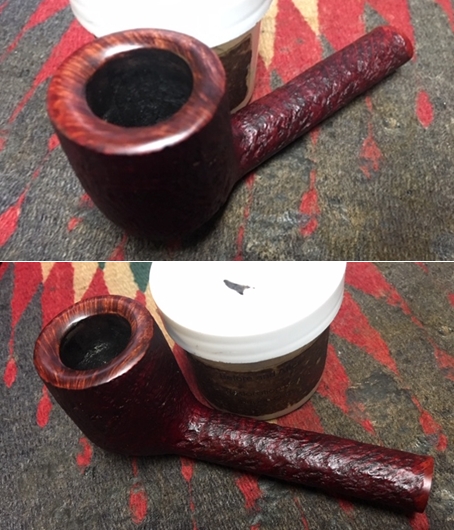
Refreshing a Mastersen Burl Briar Made in France Freehand


Blog by Dal Stanton

My first restoration project of the new year is on my work table!  After visiting family in the US for the holidays, and putting in some overdue ‘Grandpa time’, I’m glad to be back to Sofia, Bulgaria, in our 10th floor flat of a formerly Communist Block apartment building.  I acquired the Mastersen Freehand before me in the Lot of 66 some time ago – an acquisition off eBay that has produced many newly commissioned pipes for stewards around the globe.  And what’s great about this is not only that these pipes were placed in the hands of stewards but that each pipe has benefited the work we do here in Bulgaria with the foundation, Daughters of Bulgaria – helping women and girls who have been trafficked and sexually exploited.  I’m thankful for those pipe men and women who have commissioned the restoration of these pipes from the For ‘’Pipe Dreamers” Only! collection on the ThePipeSteward website.  This is where Paul debated over 4 pipes and in the end commissioned two pipes, this Mastersen Freehand and a very nice Kaywoodie Prime Grain Imported Briar ‘Fancy’ Bulldog, which will be next in the queue.  Now on my worktable, this is what got Paul’s attention. The nomenclature situated on the underside of the shank is worn and thin.  The stamp is MASTERSEN [over] BURL BRIAR [over] MADE IN FRANCE.  Pipedia’s information about Mastersen shows that it was a name originally belonging to the Shalom Pipe Co. of Israel.  The Pipedia article goes on to say, “Shalom was taken over by Robert L. Marx of New York City, later Sparta, NC, then of Mastercraft.”  Mastersen is mentioned also in the Pipedia description of Mastercraft, which was cited from a very interesting 2008 thread devoted to Dr. Grabow pipes from Tapatalk.com – the specific thread was named, Mastercraft Pipes, Grabow Parallel Universe.  The main contributor was Ted, who from 1974 till 1984 had several positions with Mastercraft including Executive Vice President.  Ted’s reminiscences were fun to read, but my main interest was to understand better what happened with the name Mastersen.  Mastersen’s original stamping with the Shalom Pipe Co., would be marked with Israel as the Country of Manufacturing (COM).  Yet, the Mastersen on my table shows a French COM.  Ted’s reflections on those years with the relationship of Mastercraft, the subsequent owner of the Mastersen name, gave some clues.  This short statement was helpful describing Mastercraft’s acquisition of pipes for sale:

It doesn’t appear it was ever a manufacturer and bought pipes from multiple factories — mostly French and English…. Freehand, For M/C Andersen and (a few Mastersen) ….

My guess based upon this scant information is that the original Shalom Mastersen Freehand style was later manufactured in France under Mastercraft ownership (1970s to 1980s?).  The style of the pipe before me is consistent with Pipephil’s example of the Mastersen Freehand produced in Israel.An interesting characteristic of this Freehand is it size.  For a Freehand it could be described as diminutive.  The length is 5 inches, height: 2 inches at the crest, plateau width: 1 1/2 inches, chamber width: 1 inch and chamber depth: 1 1/2 inches (at the middle of the slanted plateau).  I found this description of a similar Mastersen with an Israel COM described for sale on SmokingPipes.com.  Christophor Huff’s description nailed the Mastersen on my worktable as well regarding it size yet plenty of room for tobacco:The condition of the Mastersen on my worktable is good but needs the normal cleaning.  The plateau has minor darkening and the chamber has a very light cake.  I detect one small divot on the right side of the shank that needs attention.  Minor tooth chatter is evident on the bit and some oxidation in the stem.  Perhaps the most noticeable issue is the fancy stem fit – it is quite loose.  The tenon will need to be expanded to make the army style pressure fit snugger.

To begin the restoration of the Mastersen, I run some pipe cleaners wetted with isopropyl 95% through the fancy bent stem to clean the airway and then place it in a bath of Before & After Deoxidizer.  It joins a few other pipes and their stems that are in queue for restoration.  After several hours soaking, I fish out the Mastersen’s stem and drain the Deoxidizer fluid.  I then wipe off the stem removing much oxidation using a cotton pad wetted with alcohol.  I also run pipe cleaners through the airway to remove Deoxidizer from the internals.  After wiping with alcohol, I then apply paraffin oil (a mineral oil) to condition the vulcanite and set the stem aside.  The Before & After did a good job with the oxidation. The pictures show the progress. Turning now to the Freehand bowl, I begin the cleaning process my reaming the chamber using the Pipnet Reaming Kit.  I use the two smaller blade heads of four and then quickly remove the remaining carbon using the Savinelli Fitsall Tool.  I sand the chamber wrapping 240 grit paper around a Sharpie pen and then wipe the chamber with a cotton pad wetted with isopropyl 95% to clear out the remaining carbon dust.  The chamber looks good except that I detect a pit near the top of the chamber – just below the plateau.  I take a couple pictures to get a close look.  My thoughts are that this blemish in the briar is too high to be impacted in a large way by the fire in the chamber.  Just to be on the safe side of things, I will fill it, but will CA do the job, or do I need to apply a touch of the heat resistant J-B Weld putty since it is in the chamber?  I’ll give some thought to this and I decide to send a note to Steve with all his rebornpipes experience to get his input.  The pictures show the progress. From the chamber, I now clean the externals using undiluted Murphy’s Soap.  I scrub with cotton pads on the smooth briar and utilize a bristled tooth brush to clean the plateau – getting into the crevices. The cleaning reveals a very nice piece of briar.  The dimple on the bowl’s left side is attractive as it is in relief to the smooth briar.  Three pictures before and two after the cleaning showing the lightening of the surface. Now to the internals using pipe cleaners and cotton buds dipped in isopropyl 95%.  It did not take too much, and buds and pipe cleaners were coming out clean.Turning now to the stem, the Before & After Deoxidation soak did a good job.  The upper bit has some bite compressions and chatter on both upper and lower.  The button lip has some biting as well.  I start passively by using the heating method to expand the vulcanite compressions.  Using a Bic lighter, I paint the upper- and lower-bit areas.  As the vulcanite heats, physics takes over – it expands and naturally reclaims its original shaping – or at least partially.  This method works well, and I follow easily with sanding out the remaining tooth damage using 240 and then 470 grit papers.  I took before and after pictures and I’ll let you be the judge how effective the heating method often is.

Upper, before and after: I follow the bit sanding by wet sanding the entire stem with 600 grit paper followed by 0000 steel wool.Giving the stem a respite, I look again to the pits that need repair on the stummel.  A very small pit on the right side of the stummel and the larger pit on the upper area of the chamber – just under the edge of the plateau.  After getting a note back from Steve with his input, I will use briar dust and CA glue putty to fill the pits in both places.  With the upper chamber fill, I will follow this later by applying a coat of activated charcoal and sour cream mix to the entire chamber.  This will protect the fill as well as encourage the growth of a new protective cake.  I take a few pictures to get a close-up of each pit and then I mix a batch of briar dust and CA glue.  I mix it gradually until the mixture reaches a thickness or viscosity like molasses.  I then use a tooth pick as a trowel and apply the filler to the pits.  For the upper chamber pit, I give the area an extra tamping to assure that the cavity is filled.  I put the stummel aside for the night, allowing the briar dust putty to fully cure.  The pictures show the process. The next morning, before the demands of the day come, I return to the stummel with the briar dust patches fully cured.  I use a flat needle file and begin removing the excess filler on the smaller patch.  I use the file until nearly to the briar surface then I switch to sanding with a piece of 240 grit paper bringing the patch down flush with the briar surface.  I do the same with the larger fill in the upper chamber, except using a half-rounded needle file I’m able to sand with the contour of the chamber.  I then finish the upper chamber sanding by using 240 grit paper wrapped around a Sharpie pen.  I like the results. With the stummel repair completed, I turn to the revitalization of the fancy stem by wet sanding with micromesh pads 1500 to 2400 and then dry sanding with pads 3200 to 4000 and 6000 to 12000.  I apply Obsidian Oil to the stem between each set of three pads to enrich the vulcanite.  I love the pop of that freshly sanded vulcanite – it looks great! Now we’re close to the homestretch.  Using micromesh pads 1500 to 2400 I wet sand the stummel.  Following this I dry sand using pads 3200 to 4000 and 6000 to 12000.  I enjoy watching the grain surfacing through the micromesh process. I had written Steve before to get his input regarding the chamber pit repair.  The other question I asked was regarding darkening the plateau or leaving it natural and allowing the natural forces of burning tobacco and lava to color the rim surface? His advice was good and something I try to do when restoring pipes that have nomenclature and historical markers.  It is good to restore pipes according to the original intent when the pipe was manufactured.  Most of the examples of Mastersen pipes I have seen online predate the acquisition of the Shalom Pipe Co., by Mastercraft which were manufactured in Israel.  I’ve seen both natural and darkened plateaus – here are a few examples I found.It is difficult to tell by looking at the original picture I took of the plateau before starting the restoration to know what the original was – yet, if I had to guess, originally the inner part of the plateau was darkened some, but not fully.  That is, much natural briar was exposed.  The second picture is the current status of the plateau during this restoration process. Well, decision time has come and gone.  Using a black Sharpie Pen I introduce highlights to the plateau by coloring the crevices.  I start conservatively to get a feel for how it’s looking.  I begin with a fine point Sharpie to draw down the narrow crevices then I use a larger one to stroke the larger areas. After applying what looks like an adequate amount of black, I then fan wipe the rim surface with a cotton pad with only a hint of alcohol.  This has the effect of blending and soften the black hues over the contours of the landscape.Finally, I start with about a mid-range grit micromesh pad, 3600, and I proceed to sand the plateau.  I move from 3600 to the finest grit pad, 12000.  This serves to further blend and to uncover the ridges of the briar.  This gives the look more contrast which I like – the black and the brown briar.  Overall, I think it looks good.Before moving on, I need to take care of the stem fit that I noticed earlier was too loose.  I retry the fit and it remains too loose for comfort.  To remedy this, I find a drill bit that is just the next size larger than what will fit in the airway.  Using a Bic lighter, I fan a flame around the end of the tenon to heat the vulcanite to make it pliable.  My first attempt to push the smooth end of the bit into the hole was not successful – it was still too tight.  I then use a pointed Dremel sculpting bit to help open the hole a bit so that the larger drill bit could be inserted into the airway.  I heated the tenon again and press the pointed Dremel tool into the hole to expand it slightly – which is enough.  I heat the tenon again and when it becomes supple I gradually and gently insert the bit in the airway as far as it will go without great effort.  Leaving the bit in the tenon, I again reheat the tenon as well as the metal of the bit to help the internal movement.  Again, when the vulcanite softens, I push the bit in a little further into the airway.  With this movement of the bit, the tenon is gradually expanding to close the gap making the fit with the shank snugger.  With the last heating and movement of the tenon, without withdrawing the bit, I run the tenon under cool tap water to set the vulcanite to assure that it will remain expanded.  I then heat only the metal of the bit to loosen the vulcanite’s grip on it and withdraw it with the help of pliers.  I try the stem fit again and success!  A very nice, comfortable, snug fit with the tenon inserted into the shank.Next, before moving to the Dremel polishing and waxing phases, I apply Before & After Restoration Balm to the Freehand stummel that is looking very nice.  I like this Restoration Balm because it subtly brings out deeper, richer tones of the natural briar presentation.  I squirt a little of the Balm on my finger and then simply work it into the briar grain.  It starts as a thinner texture and then thickens as the Balm works into the surface.  I apply the Balm on the rim as well.  After letting it set for several minutes to absorb the Balm, I wipe/buff the excess Balm with a microfiber cloth.  I like it. The pictures I take, I’m not sure are able to pick up on the subtle deepening that I perceive with the naked eye.  The pictures are before, during Balm absorbing and then after buffed off. Next, I reunite stem and stummel and mount a cotton cloth buffing wheel to the Dremel and set the speed to about 40%.  I then apply Blue Diamond compound to the entire pipe. To remove compound dust from the surface, I buff the pipe with a flannel rag.  I then mount another cotton cloth wheel to the Dremel, remaining at the same speed, and apply carnauba wax to the entire pipe – stummel and stem.  Completing this, I give the pipe a good hand buffing with a microfiber cloth to raise the shine.  Yet, one more task and this Mastersen Burl Briar Freehand will be completed.  To protect the upper chamber patch and to introduce a starter for the development of a cake to protect the briar surface, I mix a batch of sour cream, or in this case, natural yogurt, and activated charcoal to spread on the chamber walls.  I don’t mix too much sour cream, so the mixture isn’t too liquid and runny.  I insert a pipe cleaner through the draft hole to keep the airway open.  After spreading the mixture over the chamber with a flat dental spatula, I set it aside allowing the charcoal/yogurt mixture to cure and harden.  With this chamber surface, the new steward should not scrape the chamber after use, but use a doubled over pipe cleaner to ‘rub’ the chamber walls to remove ash and remains until a cake develops.   The pictures show this final task.Wow!  This Mastersen Burl Briar Freehand – Made in France is a keeper!  I’m pleased with the presentation of the plateau and the blending of the natural and darkened briar hues.  The flame grain is beautiful as it encompasses the conical Freehand stummel.  As a smaller Freehand, it is light enough to function easily as a ‘hands free’ pipe which is nice – but please use a rubber bite guard! This Mastersen caught Paul’s eye and since he commissioned it, he has the first opportunity to acquire the Mastersen Freehand from The Pipe Steward Store.  This pipe benefits the Daughters of Bulgaria – women and girls who have been trafficked and sexually exploited.  Thanks for joining me!