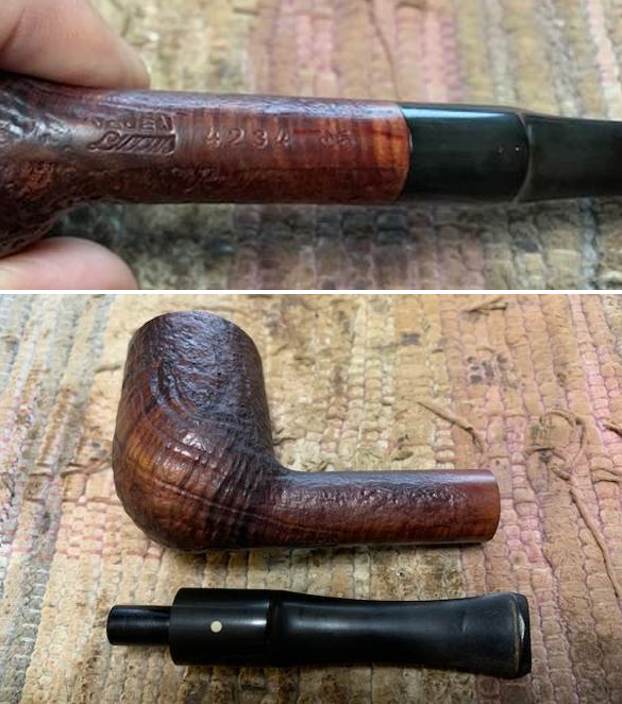
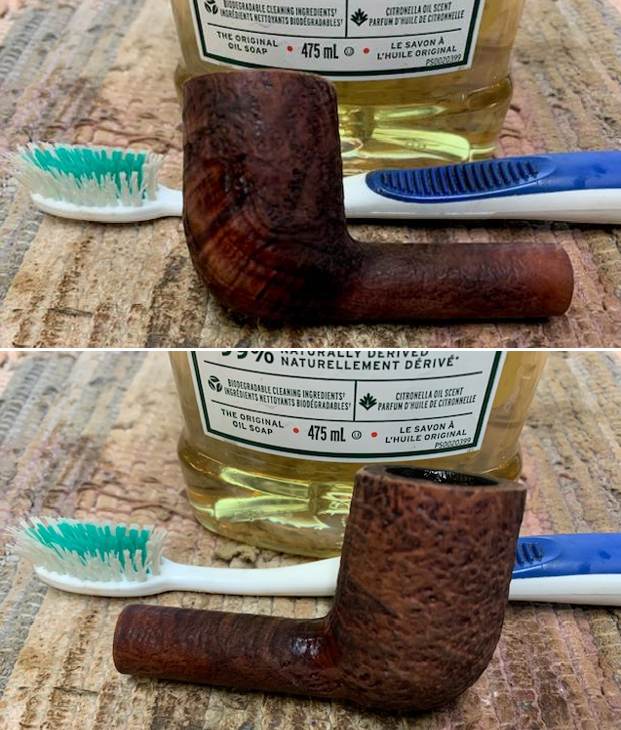
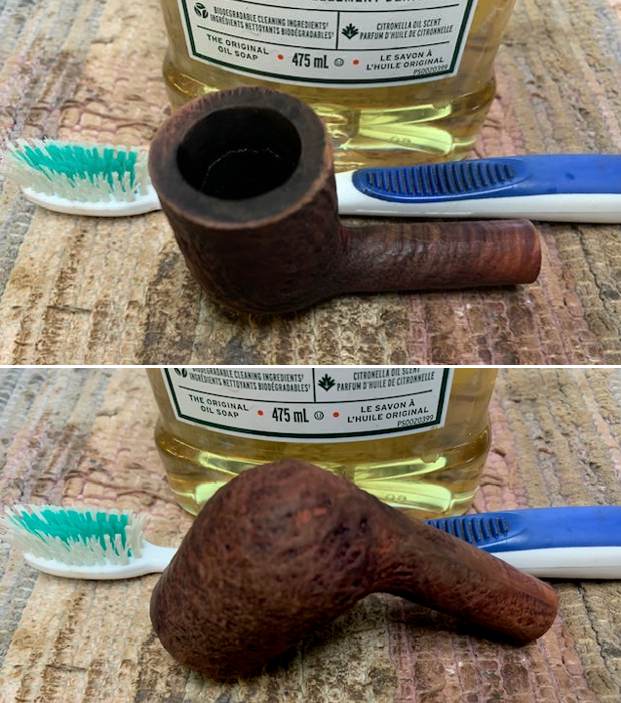
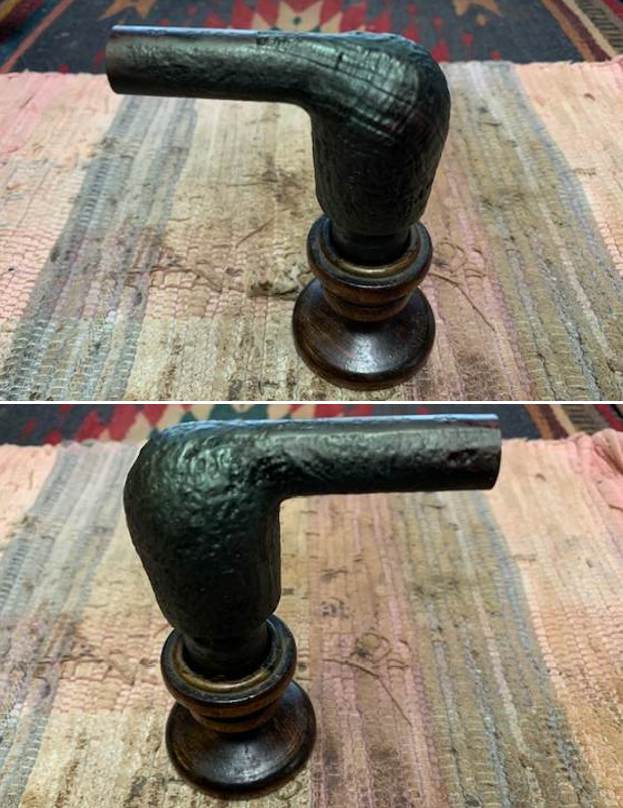
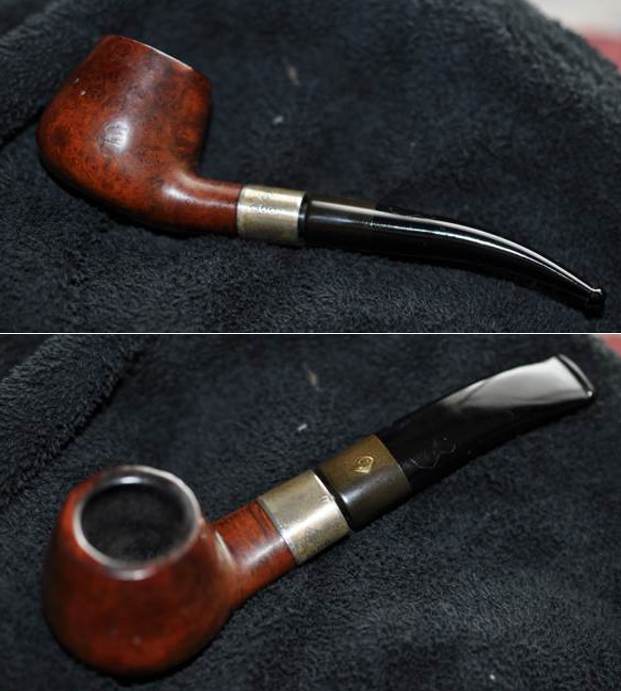
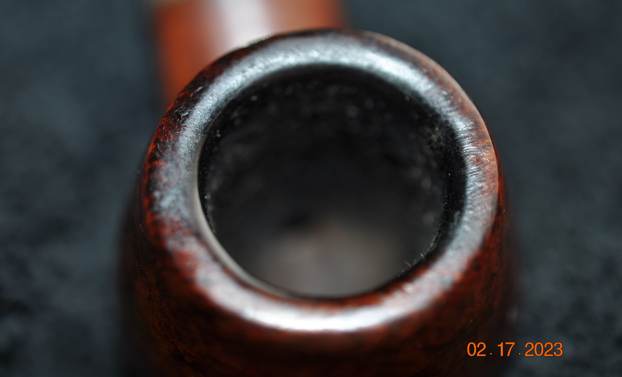
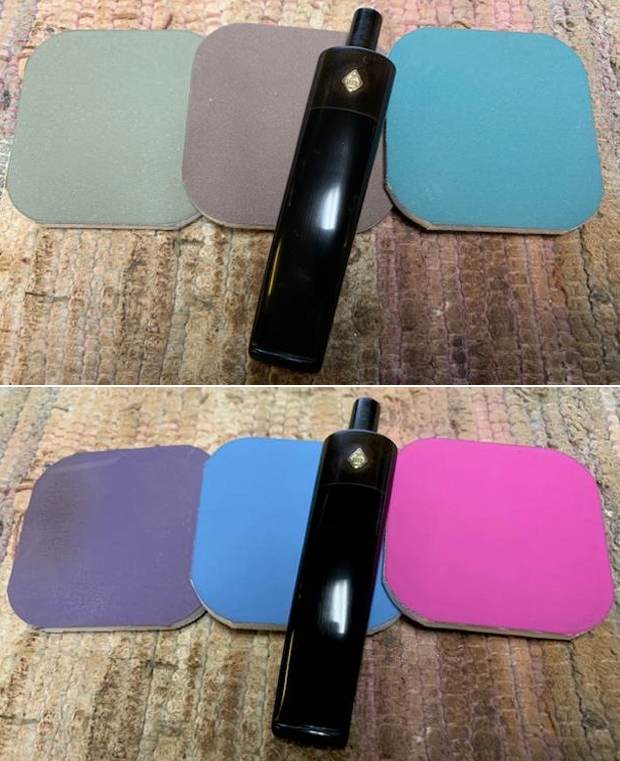
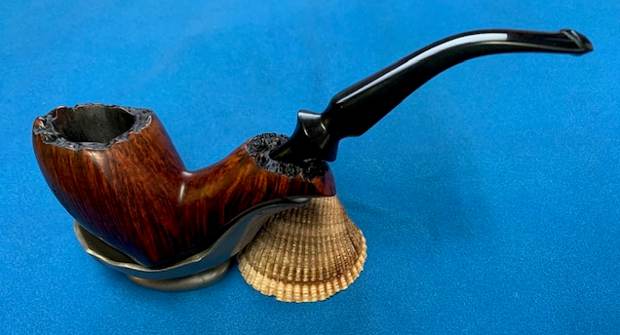
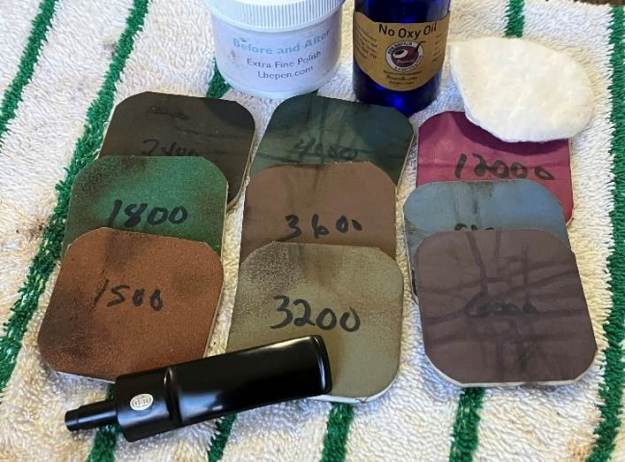
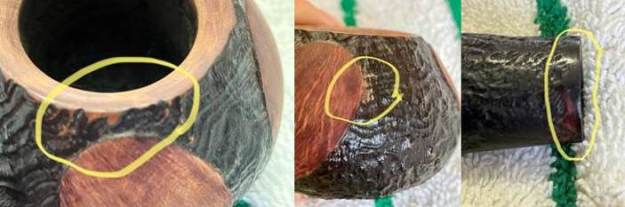
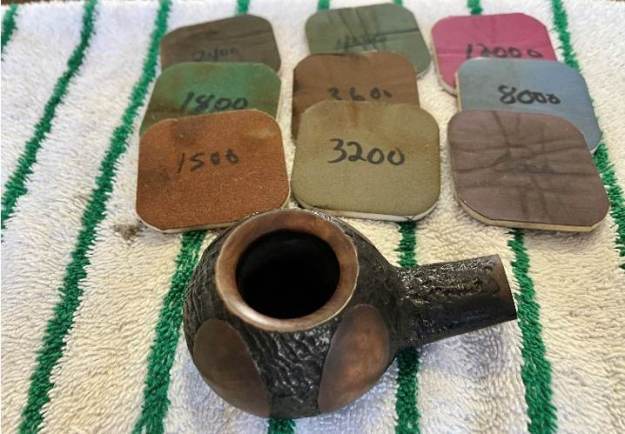
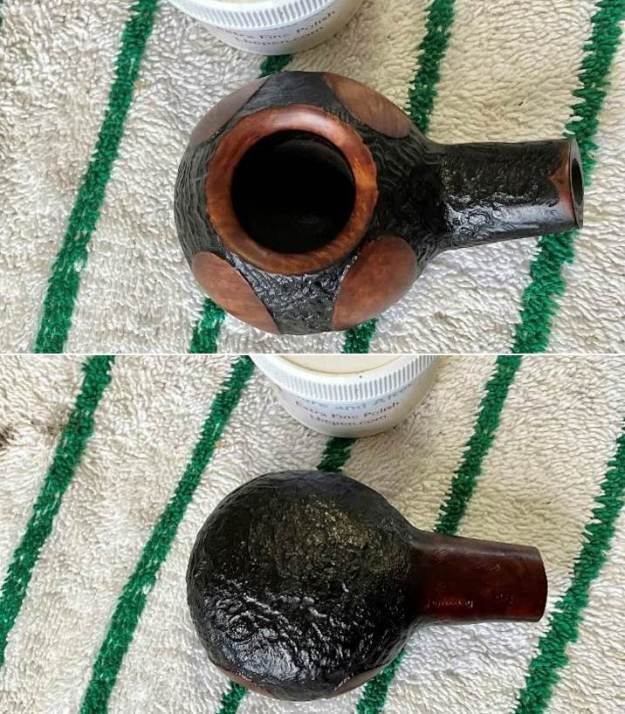
Tag Archives: restaining a bowl and rim

Restoring a Generation 1.5 Kirsten – Made in U.S.A. K


Blog by Steve Laug

This past week I received an email from a fellow named George. He was hunting for a specific Kirsten Pipe that he wanted as a gift for his son. I am including his first correspondence with me about the pipe.

Hi Steve

I am inquiring about the Kristen Companion K Straight Pipe. I read the posting on this pipe and am wondering if there is any place where I can purchase this style pipe. My father had and used this style pipe. It was his favorite of all the pipes he had. He had purchased it because the bowl was replaceable. He was very poor growing up, coming out of the Depression and WWII times and every penny counted. Having a pipe that he could replace just the bowl and not have the expense of purchasing the entire pipe appealed to him. My son is looking for this pipe to remind him of his grandfather and I want to find one for my son. Any leads you could provide me would be deeply appreciated. Thank you.

I wrote him back and sent him a picture of an anodized Kirsten Companion K and polished aluminum Kirsten K both of which I had here in my clean up queue. I asked him to have a look and get back to me on whether one or both would fit his needs.He wrote me back and gave me a bit of the back story on the pipe he was seeking. I have included a portion of that email below.

Hi Steve,

Thank you so very much for getting back to me. As with any pipe, there is always a back story, but I will only relate the Reader’s Digest version.  I have a son who remembers his grandfather’s (my dad’s) pipe of this style and regrets that he was only 14 and too young to speak up and get one of my dad’s pipes when he passed in 1982.  I am trying to surprise my son with this replica of my dad’s favorite pipe.  I am thrilled you have two of this style and are willing to sell one or both… I do like the bowl on the lower one better since my dad had only very plain bowls…

George

I corresponded with George and answered his questions regarding the difference on the two pipes and he wrote back with his choice. I quote from that email as follows.

Steve,

Thank you for your reply and your clear explanation of the difference in the pipes.  I would be interested in the smooth finished as that is the type pipe my dad had.  The less ornate, smooth finished, brown bowl would be the one I would like. Please keep my informed, but there is no rush on getting the pipe to me as I want to send it to my son on my father’s birthday which was on 18 February… Thanks for your help in doing this for my son and my dad’s memory.

George

With his choice made I knew what pipe I was working on next – a Kirsten metal pipe with a smooth briar Dublin bowl with carvings around the smooth finish. It is stamped on the left side of the shank, Kirsten in a cursive script. On the underside it is stamped Made in U.S.A. – K.

Here is some background information on the brand. These pipes were made for a long period of time in the Seattle, Washington area of the US. They came in four generations or iterations – Generation 1, 1.5, 2 and 3. The stamping on this one, the absence of a metal cap to hold the bowl, and the presence of the rubber O rings on the metal valve and on the stem insert, point to it being a Generation 1.5 pipe or a transitional one.

I am thankful to Dave Whitney for the information he provided for an earlier blog on Kirstens to help date this pipe (https://rebornpipes.com/2012/11/03/kirsten-generation-1-1-5-2-3/). The blog gives following information on the Generation 1.5 – transitional period – mid to late 50’s.
This was an experimental stage. Kirsten realized that the bit and insert were prone to seizure as the condensate dried. This model always has O-rings on the metal insert, and later models can have O-rings on both. Same markings, as I remember it. There is no metal cup spacer under the bowl. This generation has O rings either on the valve or mouthpiece but no O rings on the other end. This transitional period is stamped “Pat. Pending” and “Pats. & Pats. Pending” some with “Made in U.S.A. It seems like the company was using surplus parts to combine into this series of pipes. This particular pipe is stamped K after the U.S.A. thus making it a Companion.

With that I knew that the Kirsten K I was working on was a Companion (what George had asked for). It was made from the mid to late 1950s during the transitional period of Kirsten manufacture. It will be a great, smokable piece of both Kirsten history and George’s family history once it is finish. Now it was time to work on the pipe itself.

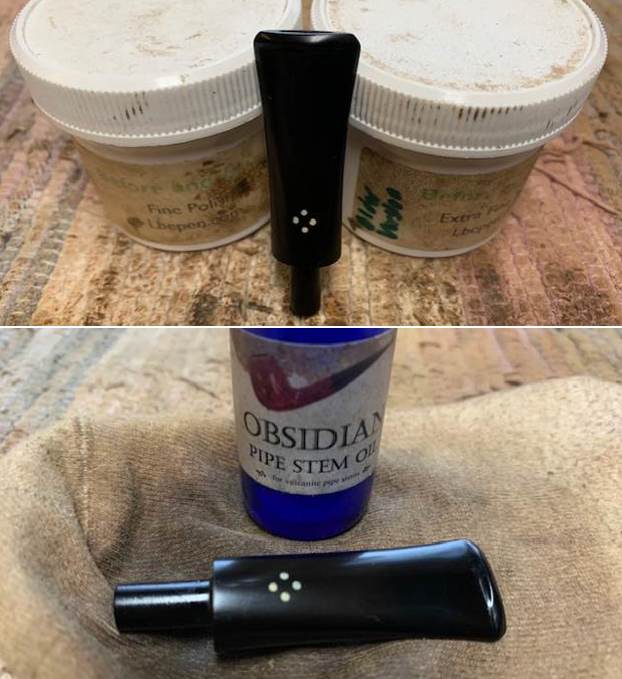
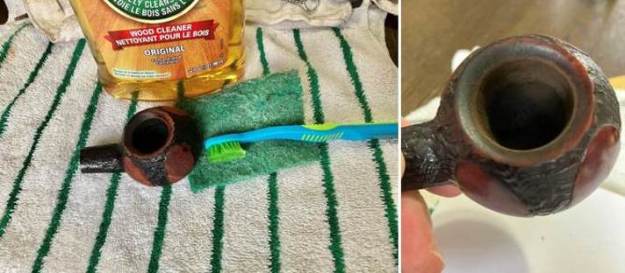
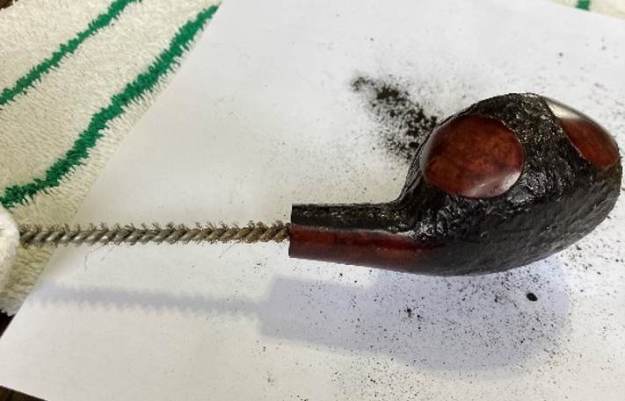
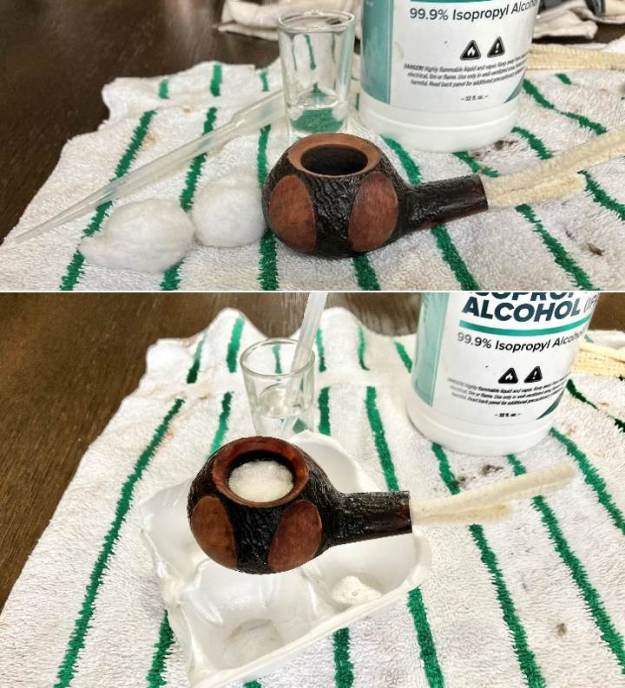
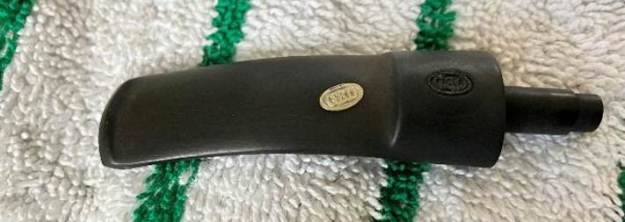
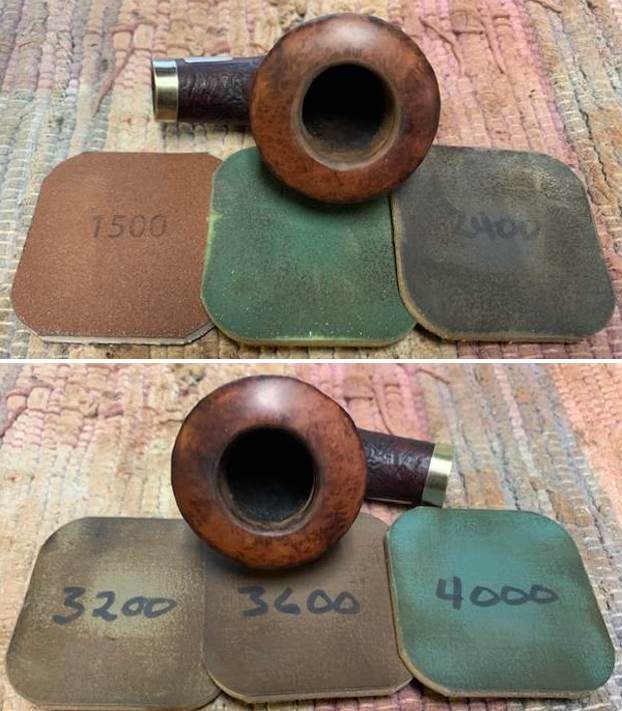
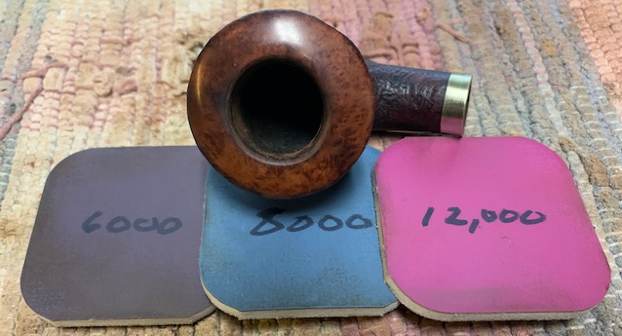
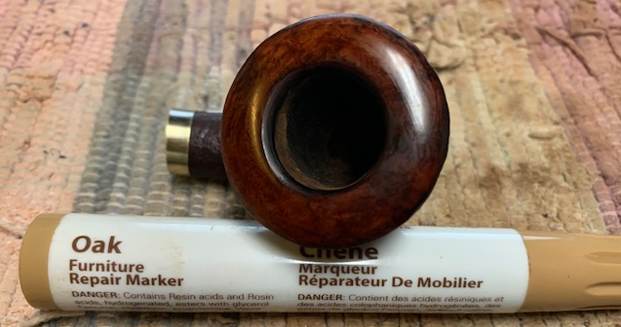
Somewhere along the journey of this pipe Jeff had done a great cleanup on the pipe. He reamed the bowl with a PipNet pipe reamer and followed up with a Savinelli Fitsall pipe knife to remove the cake. He scrubbed out the mortise and the airway in the shank and the stem with alcohol, cotton swabs and pipe cleaners. He scrubbed the bowl exterior and the aluminum barrel with a tooth brush and Murphy’s Oil Soap to remove the grime on the finish of the bowl and the lava from the rim top. He rinsed it under running water. One of the benefits of this scrub is that it also tends to lift some of the scratches and nicks in the surface of the briar. He dried it off with a soft cloth. He cleaned the internals and externals of the aluminum barrel and the vulcanite stem with alcohol, pipe cleaners and cotton swabs. He soaked the stem in Before & After Pipe Stem Deoxidizer and rinsed it off with warm water and cleaned out the airway in the stem with alcohol, pipe cleaners and cotton swabs. I took photos of the pipe as I saw it when I put it on the table.   I took photos of the rim top and stem to show the condition. The rim top and beveled edge looked amazing. The stem was vulcanite and there were tooth marks and chatter on both sides ahead of the button. I took photos of the stamping on the sides of the aluminum barrel. They are clear and readable as noted above.   I removed the stem from the barrel and the flow adjuster valve from the front of the barrel. I removed the bowl from the top of the shank and took a photo of the pipe to give a sense of the components of the pipe.I set the parts aside and worked on the bowl. I removed the screw from the bottom of the bowl so that I could clean up the bowl. I sanded the inside of the bowl and topped the rim top to remove the burning and darkening. I worked on the inner edge with a folded piece of 220 grit sandpaper to smooth out the darkened and damaged inner edge of the bowl. In the photo below there is a mark at the 5 o’clock section of the rim top below. The mark is actually a fill in the rim top. It is solid and undamaged. Once finished, the top and inner edge looked better.I used a Maple stain pen to restain the rim top to match the sides of the bowl. Once it was finished and polished it would look a lot better.I polished the bowl sides and top with micromesh sanding pads – dry sanding with 1500-12000 grit pads. I wiped it down with a damp cloth after each sanding pad to remove the grime. The finish began to look much better. I rubbed the bowl down with Before & After Restoration Balm and worked it into the grooves as well as the smooth surface of the briar. I let it sit for 15 minutes then buffed it off with a soft cloth. The bowl took on a rich glow and the grain shown through the finish. I polished the aluminum valve on the from of the barrel with 4000-12000 grit micromesh pads to polish off the oxidization that was on it when I first took it out of the box. It shined up very well. I coated the rubber gasket on the valve with some Restoration Balm as it worked to bring the rubber back to life. Once it had sat for awhile I wiped it off and put the valve back in the barrel of the pipe and the bowl. The valve was easily adjustable and would act like a flue on a wood stove when the pipe was smoked. I set the bowl and barrel aside and turned my attention to the stem. I “painted” the vulcanite stem surface with the flame to lift the tooth marks. I was able to lift them considerably. I filled in the remaining tooth marks with clear CA glue and set it aside for the repairs to cure. I used a small file to flatten the repairs and start the process of blending them into the surface of the stem. I then sanded them with 220 grit sandpaper to blend them into the surface of the vulcanite stem. I used micromesh sanding pads to polish the stem and bring back the shine. I dry sanded the stem with 1500 – 12,000 grit pads and rubbed it down with Obsidian Oil after each sanding pad. I polished it with Before & After Fine and Extra Fine Polish and then gave it a final coat of Obsidian Oil and let it dry. This Kirsten Gen. 1.5 Made in U.S.A. – K straight pipe with a vulcanite saddle stem has a smooth reddish finish. The rich reds and blacks of the contrasting stain makes the grain come alive with the polishing and waxing. I buffed the barrel lightly with the Blue Diamond and also buffed the bowl. I gave the bowl and barrel several coats of carnauba wax and then lightly buffed it with a clean flannel buffing pad to raise the shine. I put the vulcanite stem back on the bowl and carefully buffed the pipe with Blue Diamond on the buffing wheel using a light touch on the briar and followed that by buffing the entire pipe with a clean buffing pad. I hand buffed the pipe with a microfiber cloth to deepen the shine. This older Kirsten Companion K is a great looking pipe and the Dublin bowl gives it a distinctive look. Give the finished pipe a look in the photos below. The dimensions of the pipe are Length: 5 ½ inches, Height: 1 ¾ inches, Outside diameter of the bowl: 1 ¼ inches, Chamber diameter: ¾ of an inch. The weight of the pipe is 1.66 oz./46 grams. The finished pipe is shown in the photos below. It is ready for George to give to his son in memory of his grandfather. Thanks for reading this blog and my reflections on the pipe while I worked on it. There are many more to come!

New Life and New Look for a Neerup Made in Denmark Bulldog


Blog by Steve Laug

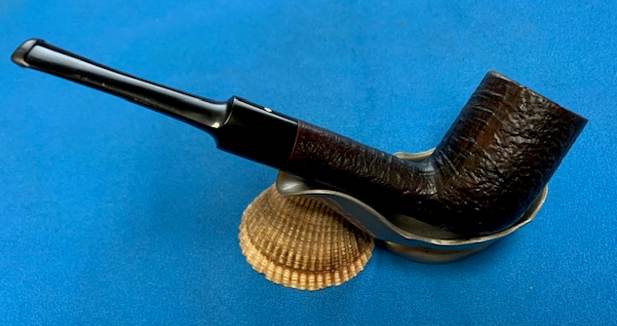
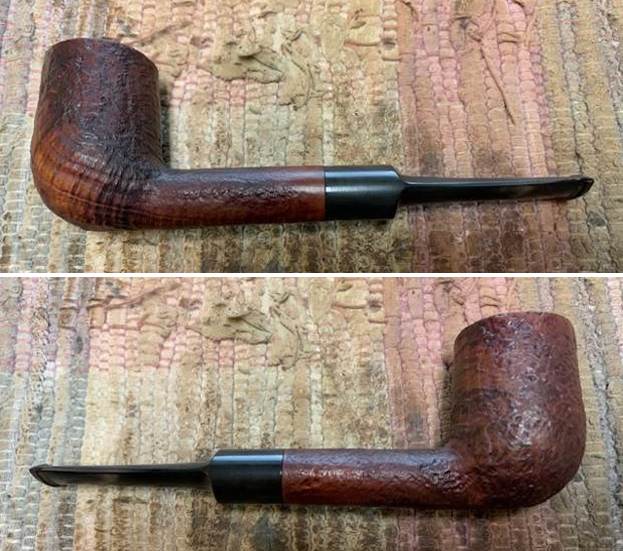
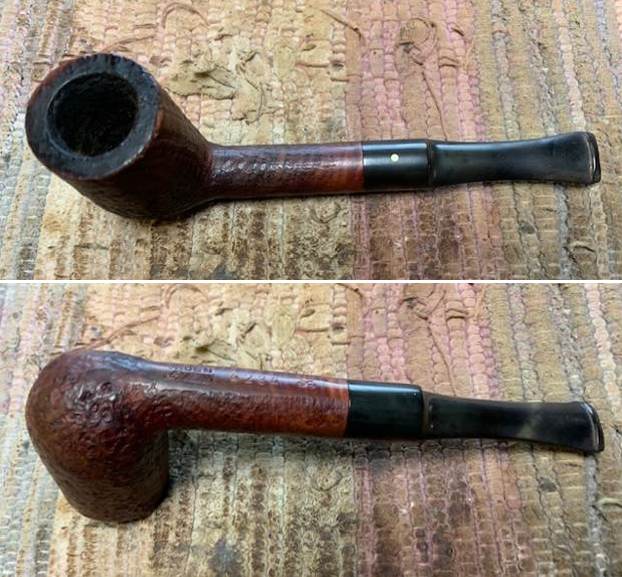
Last week I received a call from Curtis, a gentleman who had been referred to me by City Cigar. He called to inquire if I could repair a broken tenon on a Savinelli Hand Made Estella that was gift from his son and he had dropped it and snapped the tenon off. We chatted and he sent photos and eventually agreed on the repair. He sent the pipe to me through Canada Post and when the box arrived on Monday it also included a second pipe. I talked with Curtis about the second pipe and we decided to restem it as the chip on the top button edge and stem were too big for a repair. The pipe is a sandblast Freehand style Bulldog with a smooth briar band, a black acrylic band and a white acrylic band. It is stamped on the smooth underside of the briar band and reads Neerup followed by Made in Denmark. The stem was vulcanite and had a fitted brass cap above the tenon. It was a slight saddle stem with a gentle bend. It was seriously damaged. There was a large wedge missing from the topside and just ahead of that there was a carved line like a dental bit to facilitate holding it in the teeth. There was a very thick cake in the bowl that took up over half of the diameter of the bowl and the shank was filled with gummy tars and oils. There was an overflow of lava on the rim top and some damage on the back right outer edge from knocking out the pipe. It was a pretty little pipe that looked great. I took photos of the pipe before I started my work on it. I took a close up photo of the bowl and rim top to show the thickness of the cake and the condition of the stem when I received the pipe. It was a bit of a mess. The stem was in rough condition as noted above. You can see the damage on both sides of the stem – the chipped and broken top of the stem and button as well as the tooth damage on the underside of the stem. Looking at it you can see why we chose to restem it.The next two photos showed the stamping on the underside of the shank. It is faint but readable as noted above.I removed the stem and took a photo of the pipe to give a sense of perspective to the parts.I reamed the bowl with a PipNet Pipe Reamer to remove the cake from the bowl – using the #1 and #2 cutting heads to take out the majority of the cake in the bowl. I cleaned up the reaming with a Savinelli Fitsall Pipe Knife and a piece of dowel wrapped with some 220 grit sandpaper. I scrubbed the bowl with Murphy’s Oil Soap and a tooth brush on the sandblast and the a brass bristle brush on the rim top. I rinsed the bowl with warm running water to rinse off the soap and the grime left behind. It looked better. I touched up the nicks and marks on the sandblast bowl and rim top with a black stain pen to blend them into the rest of the bowl. I rubbed the bowl down with Before & After Restoration Balm. I worked it into the sandblast with my fingertips and a horsehair shoe brush to get it deep in the grooves of the sandblast. I let it sit for 15 minutes and buffed it off with a soft cloth. I went through my stem and found this slightly longer taper stem that would need very little adjustment to fit in the shank. I also found a metal ferrule cap in my collection that would fit on the end of the stem and approximate the one that was on the original stem. I took pictures of the old stem with the replacement stem in the photo to show the difference.I glued the polished aluminum ferrule onto the end of the stem – sliding it over the tenon to give a metal end decoration and create a metal look to the stem. I cleaned up the excess glue and took a photo of the finished look of the stem. I liked it.Then I remembered that I had not cleaned out the shank and the internals of the pipe or the new stem. I did it now. I cleaned out the shank and the mortise with pipe cleaners, cotton swabs and isopropyl alcohol to remove the tars and oils. I also cleaned out the airway in the stem I had chosen to use as well.I polished the stem with micromesh sanding pads – dry sanding with 1500-12000 grit sanding pads. I wiped the stem down after each sanding pad with a cloth impregnated with Obsidian Oil. The oil both preserves the rubber and also provides some needed friction for the micromesh pads. I polished it with Before & After Fine & Extra Fine Polish. I rubbed it down a final time with the oil and set it aside. This Neerup Made in Denmark Freehand Bulldog carved by Peder Jeppesen combines a great looking piece of sandblast briar with a multi-banded shank extension and a vulcanite stem to make a beautiful pipe. The removal of the thick shiny coat allows the grain to come alive with the polishing and waxing. I put the stem back on the bowl and carefully buffed the pipe with Blue Diamond on the buffing wheel. I gave the bowl and the stem multiple coats of carnauba wax on the buffing wheel and followed that by buffing the entire pipe with a clean buffing pad. I hand buffed the pipe with a microfiber cloth to deepen the shine. The finished Neerup Made in Denmark Bulldog really is a beauty and fits nicely in the hand and looks very good. Give the finished pipe a look in the photos below. The dimensions of the pipe are Length: 5 1/2 inches, Height: 2 inches, Outside diameter of the bowl: 1 ¾ inches, Chamber diameter: ¾ of an inch. The weight of the pipe is 1.80 ounces/51 grams. Once I finish the second pipe this one will be going back to Curtis to enjoy. Thanks for reading this blog and my reflections on the pipe while I worked on it. There are many more to come!

Paint It Black!


Blog by Kenneth Lieblich

Next on the chopping block is a very pretty, unsmoked bent apple sitter from the French company, Courrieu, based in the Provençal town of Cogolin. A customer of mine wanted an attractive yet inexpensive pipe – he decided on this one, as it was both unsmoked but flawed, and therefore inexpensive. The markings were as follows: on the left side of the shank were the words Vieille Bruyere [over] Courrieu [over] Cogolin. The right side had no markings, but the left side of the stem had the image of a Gallic rooster – a national symbol of France and, subordinately, traditionally associated with Courrieu.Pipephil gave me a brief overview of the Courrieu brand:Ulysse Courrieu started carving pipes in Cogolin in 1802. Courrieu certainly is the oldest French briar pipe factory. The family corporate is managed (2009) by René Salvestrini who married a Courrieu daughter.

This pipe had some fine briar wood and looked like a well-made pipe. However, despite being unsmoked, this pipe still had some issues. The stem was clearly unused but had acquired some minor oxidation over time. The band around the shank was heavily tarnished; so much so that I was unsure if it was tarnished, or actually damaged, and if I would need a new band.There were also some minor abrasions and staining. Most notable, however, was a substantial crack in the shank, as shown in the photographs. The crack extended through the wood into the mortise and would require some careful work to repair successfully. On a pleasant note, the stinger was in immaculate condition. Other than buffing it with a microfiber cloth, it needed nothing else. One of my customer’s stipulations was to stain the pipe black. No problem as far as I was concerned. However, many people don’t quite understand what they will get when they request a black pipe. They often think that the pipe will end up as some sort of shiny lacquered item, but that’s not the way it works with me. I won’t use lacquer on pipes and I need to make it beautiful in other ways. Fortunately, my friend was aware of this and I endeavoured to make it as attractive as possible.

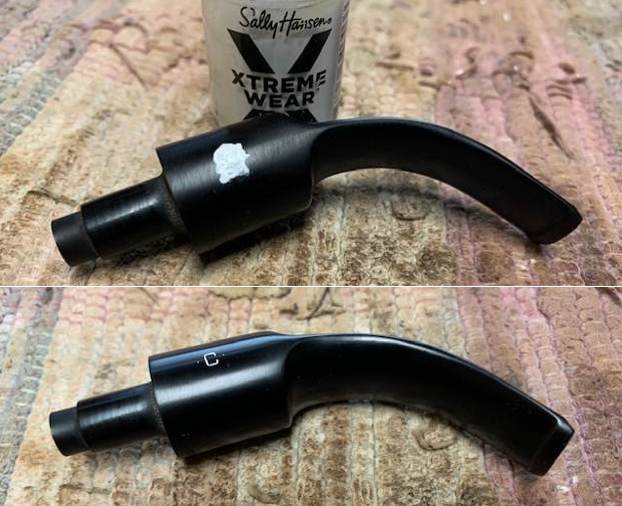
Now to work! As you saw, the band was pretty awful, so I brought out some SoftScrub on a cotton round and duly scrubbed away, taking care not to bend the soft metal. I was delighted at how well that turned out, as I had feared that the band was damaged beyond repair. Once clean, I buffed it with a jewelry polishing cloth and it looked like new. Hurray! Even though the stem had never been smoked, I ran a few pipe cleaners through it to ensure maximum cleanliness. There was some latent dust, but it was easily dealt with. I used some cotton rounds and Murphy’s Oil Soap to remove the top layer of oxidation. Then the stem went for an overnight bath in the Pipe Stem Oxidation Remover. The following day, I cleaned all of the de-oxidizing mess off with alcohol, pipe cleaners, et cetera. The oxidation had migrated to the surface and would be straightforward to remove. I scrubbed with SoftScrub on some cotton pads to remove the leftover oxidation. After this, I used some white nail polish and carefully painted the embossed Gallic rooster on the stem. I painted the area carefully and let it set for a few minutes. I then used all nine Micromesh pads (1,500 through 12,000 grit) to bring out the lovely black lustre on the stem. I also used Obsidian Pipe Stem Oil in between each pad scrubbing. Then I set the stem aside and moved on to the stummel. The next order of business was to scrub the outside of the stummel with some cotton rounds and Murphy’s Oil Soap. Despite being unsmoked, the stummel was reasonably dirty from sitting abandoned for decades.Then it came time to address the crack in the shank. To ensure that any crack repair is successful, I need to make sure that the crack won’t elongate. I took a micro-drill bit and drilled a hole through the wall of the shank into the mortise, at the very end of the crack. By doing this, I prevent the crack from growing any further. Look how tiny the drill bit is! You can also see the drilled hole at the end of the crack. I also removed the old yellow adhesive you can see below. I needed to apply cyanoacrylate adhesive to the crack to seal and repair it. First, however, I stuffed the mortise area with some folded pipe cleaners, coated with petroleum jelly. This would prevent the adhesive from dripping inside the shank and creating further problems. After that, I carefully applied a bead of adhesive to the tiny hole and the length of the crack. Finally, I clamped it shut and let it sit overnight to cure. This was a great success – obviously, the crack would always be there, but I was really pleased with how the repair looked. I then sanded the adhesive down, as well as the stummel. Just like the stem, I used all nine Micromesh pads (1,500 through 12,000 grit). Having completed that, it was time for the staining. First, I brought out my heat gun and spent a couple of minutes thoroughly heating the wood, so it would be as receptive as possible to the stain. I needed the black to penetrate well into the wood, to give the best results. I applied Fiebing’s Black Leather Dye with a cotton dauber. I flamed it with my Bic lighter, let it set, then coated it again with dye, flamed it again, and let that set too. I decided to let the pipe sit overnight. Upon the morrow, I stained and flamed the pipe another two times, always making sure I warmed the pipe with my heat gun first. This dye is alcohol-based, so I used isopropyl alcohol to wipe down the pipe and remove excess stain. I am very happy with the results. Then it was off for a trip to the buffer. A dose of White Diamond and a few coats of carnauba wax were just what this pipe needed. I think the black came out very well on this pipe. I know that the new owner will enjoy smoking it for many years to come. I hope you enjoyed reading the story of this pipe as much I as I did restoring it. The approximate dimensions of the pipe are as follows: length 4½ in. (114 mm); height 3½ in. (89 mm); bowl diameter 1¼ in. (32 mm); chamber diameter ⅝ in. (16 mm). The weight of the pipe is 1½ oz. (43 g). If you are interested in more of my work, please follow me here on Steve’s website or email me directly at kenneth@knightsofthepipe.com. Thank you very much for reading and, as always, I welcome and encourage your comments.

Moving another one of my own – an American Artisan Rusticated Cherrywood Pipe


Blog by Steve Laug

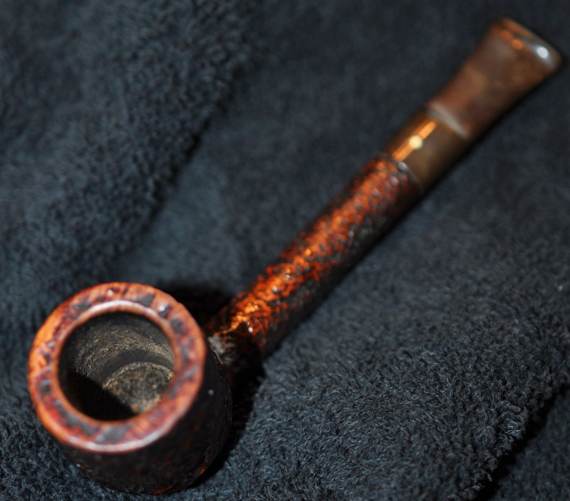
This is another pipe that I have taken out of my personal collection as I just do not use enough to warrant keeping it. This pipe was given to me in a group of pipes and I used it a bit when it came in. It is from a period of my journey where I smoked solely Virginia tobaccos so it is quite clean. The airway in the shank and the mortise were quite clean. The rusticated finish and rim top were in excellent condition. I don’t remember who made the pipe but I do remember it was a relatively new artisan American carver. It is stamped on the heel of the bowl with the letters B/B in a shield. There was a light cake in the bowl but the top and inner edge of the bowl clean and a bit faded. There is a polished steel band on the shank end. It is loose and the attachment is a bit odd. The shank end and stem end are both stepped down to receive the band. The blue and gold/tan acrylic stem is in good condition with some light tooth chatter ahead of the button on both sides. It has a inserted Delrin tenon that is a great fit in the shank. I took photos of the pipe before I did my clean up work on it. I took a photo of the bowl and rim top to verify the description above. I also took photos of the stem surface showing the light chatter on either side.I took a photo of the stamping on the heel of the bowl. It is clear and readable as noted above.  I took the stem off the bowl and took a photo of the pipe to give a sense of proportion of the pipe. You can also see the loose band and the step down area on the shank end and stem end. There was still some bits of glue on the shank end that I would clean off when I reglued the band. I used a toothpick to spread some Weld Bond all purpose glue around the shank end.I pressed the band on the shank end and wiped off the excess glue around the edge of the band.I cleaned up the rustication on the rim top with a brass bristle wire brush. It looked cleaner and more distinct.I touched up the stain on the rim top and worked it into the faded spots on the rim top, working it down into the valleys of the rustication.Now it was time to work on the pipe. I cleaned up the light cake in the bowl with a Savinelli Fitsall Pipe Knife. I sanded the bowl walls with a piece of dowel wrapped in 220 grit sandpaper.I cleaned the mortise and airways in the shank and stem with cotton swabs, pipe cleaners and isopropyl alcohol to remove the debris and tars from my smoking. You can see that it was not too bad as I tend to keep my pipes clean.The bowl was in such good condition that decided to give the bowl and shank a coating of Before & After Restoration Balm. I worked it into the surface of the briar with my fingertips and a horsehair shoe brush to clean, enliven and protect the briar. I let the balm sit for 15 minutes and then buffed with a cotton cloth to raise the shine. The photos show the bowl at this point in the restoration process. Since the stem was in quite good condition other than tooth chatter I polished out the chatter with micromesh sanding pads – dry sanding with 1500-12000 grit pads. I rubbed it down between pads with Obsidian Oil. I polished it with Before & After Fine and Extra Fine Pipe Stem Polish. I wiped it down with some Obsidian Oil and buffed it off. It is a beautiful stem. I am excited to put the final touches on this great looking American Made Artisan BB Rusticated Cherrywood. I put the pipe back together and buffed the stem with Blue Diamond on the buffing wheel. I gave the bowl multiple coats of Conservator’s Wax and the stem multiple coats of carnauba wax. I hand buffed the pipe with a clean buffing pad to raise the shine. It is fun to see what the polished bowl looks like with the rugged rustication all around it. Added to that the polished blue and gold/tan acrylic stem combined with the bowl and make a stunning pipe. This rusticated BB Cherrywood is great looking and the pipe feels great in my hand. It is light and well balanced. Have a look at it with the photos below. The dimensions are Length: 5 inches, Height: 2 inches, Outside diameter of the bowl: 1 ½ inches, Chamber diameter: ¾ of an inch. The weight of the pipe is 59 grams/2.08 ounces. It is a beautiful pipe that I will soon be putting on the rebornpipes store in the American Pipe Makers Section. If you are interested in adding it to your collection send me an email or a message. Thanks for walking through the restoration with me as I worked over this pipe. Thanks to each of you who are reading this blog.

Restoring a Peterson’s System 3 Bent Billiard 3170


Blog by Steve Laug

This is a pipe that I have taken out of my personal collection as I just do not use it too much. It is a classic Peterson’s System Bent Billiard shaped pipe with some nice grain around the bowl and a nickel ferrule. It is another pipe that I smoked solely Virginia tobaccos in so it is very clean. The inside of the shank, the system sump and the shank was quite clean. The smooth rim top has some damage on the inside edge of the bowl and is out of round. The smooth finish was very clean but dull and quite lifeless. The grain is mixed but still quite nice around the bowl and shank. The stamping on the shank is clear and readable. The left side is stamped Peterson’s [arched over] System [over] the number 3 in a circle. On the right side it was stamped with the shape number 3170. The nickel ferrule is dull but stamped K&P [over] three faux hallmarks [over] Peterson [over] Dublin. The stem was quite clean with no oxidation or tooth marks. I took some photos of the pipe before I started my work on it. I took close up photos of the bowl and the stem. You can see the light cake in the bowl and the darkening and damage on the inner edge of the rim top. The stem surface was clean and free of tooth marks or chatter on both sides. I took a photo of the stamping on the sides of the bowl and shank. It is clear and readable as noted above. I removed the stem from the shank and took a photo to give a sense of the proportions of the pipe. It is really quite nice looking. I turned to Pipedia (https://pipedia.org/wiki/Peterson) and read through the article there. It was a great reminder of the history of the brand.

I turned to “The Peterson Pipe” by Mark Irwin and Gary Malmberg to get some background on the Peterson’s System 0 Made in Ireland stamp. On page 301 of the book I found a listing on System pipes that referred to the 0-3 stamps. I quote:

System Pipes (1937-59) The 1937 catalog only slightly changed the grading hierarchy for System pipes. The De Luxe model, described as “the finished possible quality obtainable” would be assigned no grading subscript, but neither would the First Quality. Below these were 0 Grade, 2nd Grade and 3rd Grade, all stamped with numbers and PETERSON’S over SYSTEM or PETERSON’S over DUBLIN. Grades 0 and 2nd were fitted with sterling mounts, 3rd grade with nickel. Each of these grades were sometimes stamped below and sometimes to the right of the model name. Sometimes these numbers were circled, sometimes not. The location of the number and whether it was circled or not was rather random from the onset of its use until discontinued in 1959, and by itself only indicates that a given pipe was made between ’37 and ’59.  

On page 302 there was a listing on the nickel mounted markings. I quote:

Nickel-Mount Markings. Often called faux hallmarks or faux marks by Peterson collectors, this set of three little images of a shamrock, an Irish wolfhound and a round tower appear within rectangular shapes as decorations on nickel mountings. Very early nickel mounts (1891-c. 1920) had no such decorations, only the same stamps used on sterling but without the hallmarks. As a stamp, the set of decorations began to appear at the beginning of the Irish Free State era, sometimes alone but often under K&P and over block lettered PETERSON over DUBLIN, although the  three emblems appeared on K&P’s Irish Carving Shamrocks pipes since 1896. The stamp was used until about 1963, when hand soldered nickel bands and ferrules were replaced by pressed ferrules and premade bands…The shamrock is the emblem of Ireland; the Irish wolfhound has long been used for both hunting and protection, and is an emblem of strength; the round tower a symbol of Ireland’s early religious power. These decorations were stamped at the factory on non-sterling mounts only, and the assay office has nothing to do with…

The information was very helpful. I have highlighted the pertinent reference to regarding the stamping, the circle 3 number and the faux hallmarks above. I knew that I was dealing with a pipe made between 1937 and 1959.

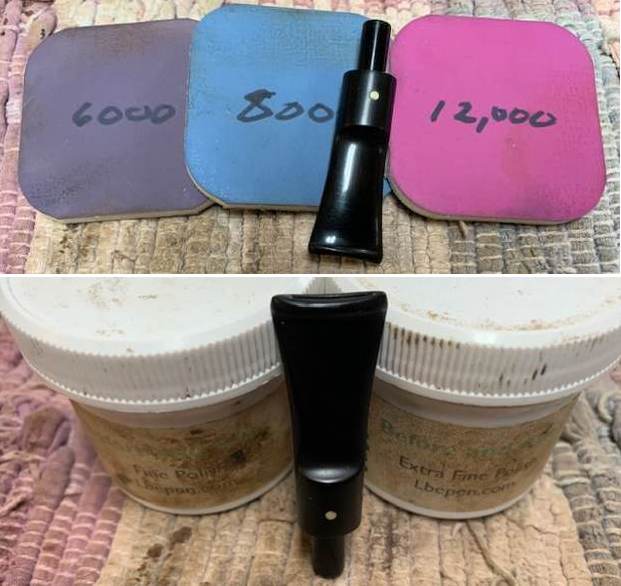
I reamed the bowl with a Savinelli Fitsall Pipe Knife. I sanded the walls on the bowl with a piece of 220 grit sandpaper wrapped around a piece of dowel to take the walls back to smooth once again. I worked on the pipe with a folded piece of 220 grit sandpaper to remove the damage on the rim top and edges of the bowl. It looked better but would need a bit more work.I cleaned out the sump, the shank and the airway in the stem and shank with pipe cleaners, cotton swabs and isopropyl alcohol. The pipe was clean and it smelled significantly better.I polished the rim top and edges with micromesh sanding pads – dry sanding with 1500-12000 grit pads to raise a shine. I wiped it down with a damp cotton pad to wipe off the debris after each sanding pad. I touched up the rim top and inner edge of the bowl with a Walnut stain pen to match it to the rest of the of the bowl. It blends in very well.I polished the nickel ferrule with a  jeweler’s cloth. The cloth is impregnated with polish that not only raises a shine but protects the metal. I worked some Before & After Restoration Balm into the surface of the briar with my fingertips. It works to clean, enliven and protect the briar. I let it sit for 15 minutes then buffed it off with a soft cloth and raised the shine. The bowl looks great at this point.   I polished the stem with micromesh sanding pads – dry sanding it with 1500-12000 grit pads. I wiped the stem down with Obsidian Oil after each pad. I polished it with Before & After Pipe Polish – both Fine and Extra Fine and gave it a final coat and set it aside to dry.  I put the stem back on the Peterson’s System 3 Bent Billiard 3170 and buffed the pipe with Blue Diamond on the buffing wheel. I polished the briar and the vulcanite of the stem until there was a rich shine. This classic Peterson’s shape and finish really highlights a proportionally well carved pipe. Once I buffed the pipe the briar came alive and popped with polishing. The black vulcanite stem has a rich glow. This Peterson’s System 3 Bent Billiard fits well in the hand and sits right in the mouth. Have a look at it with the photos below. The dimensions are Length: 5 inches, Height: 1 ½ inches, Outside diameter of the bowl: 1 inch, Chamber diameter: ¾ of and inch. The weight of the pipe is 1.48 ounces/42 grams. It was one I chose for my own collection and enjoyed, but I am happy to pass it on to the next pipe man or woman. This beauty will be going on the rebornpipes online store in the Irish Pipemakers Section. If you are interested let me know. Thanks for walking through the restoration with me as it was a pleasure to work on.

Restoring a Worn and Tired Peterson’s Tyrone 606 Pot


Blog by Steve Laug

When ever either Jeff or I are pipe hunting we tend to pick up pipes that we like and want to restore. These have included a lot of different pipes of different brands. If you have followed us for long you know that some of these have included Peterson’s, Dunhill’s, and a wide range of Danish and English pipes. The next pipe I chose to work on is another Peterson’s Pipe – a nicely grained Pot shaped pipe. It is stamped on the left side of the shank and reads Peterson’s [over] Tyrone. On the right side of the shank it is a stamped with the shape number 606. There is a triple band shank extension – two brass bands separated by a black acrylic spacer. The bowl was heavily coated with varnish that was shiny under the dirt and grime. There was a heavy lava coat on the rim top and a moderate cake in the bowl. The stem was heavily oxidized and calcified with heavy tooth marks and chatter on both side of the stem and button. It was a nice looking pipe with some great grain around the bowl. I think that once it was cleaned up the grain would really stand out. I took photos of the pipe before I started my clean up work. I took some close up photos of the rim top and also of the stem surface. The rim top had a thick coat of lava protecting the rim top and the cake in the bowl covered the inner edges of the bowl. The outer edges of the bowl appear to be good condition. I would guess that there was some darkening and damage under the lava on the top. It should clean up really well. I also took close up photos of the stem to show oxidation, calcification and tooth marks and chatter on both sides of the stem and button. I took photos of the stamping on the sides of the shank and on the “P” logo on the left side of the stem. It is readable as noted above. I removed the stem and took a photo of the pipe to have a look at the parts and overall look. The tenon on the stem was made for a 9mm filter and actually looked quite good.I am including the link to the Pipedia’s article on Peterson pipes. It is a great read in terms of the history of the brand (https://pipedia.org/wiki/Peterson).

I turned to “The Peterson Pipe” by Mark Irwin and Gary Malmberg to get some background on the Peterson’s System Line. On page 315 it had the following information.

Tyrone (c.1991)- Smooth finish, walnut stain line with brass band with black acrylic inlay, gold hot-foil P stamped on P-lip or fishtail mouthpiece.

I followed some links to Mark Irwin’s Peterson Pipenotes where Mark had written something on the line (https://petersonpipenotes.org/2021/07/10/236-the-new-tyrone-line/). I quote from the article below and have included to pictures that Mark used. The first a brochure and the second a shape guide.

The original iteration of the Tyrone line debuted c. 1991 and was first seen in the early Dublin era’s1992 “Hand Made” brochure.As you can see, the walnut finish has a satin finish revealing quite a bit of grain beneath. The Black Catalog of 1997 gives a better glimpse of the stain, finish and original alternate mounting styles. The last appearance of this version of the Tyrone in the ephemera was in the 2010 Burgundy Catalog, although it was doubtless in production for a few years afterwards.For the Identification Guide:

Tyrone  (c. 1991–c. 2012; 2021–) smooth finish, walnut stain line with shank decoration of black acrylic between 2 brass rings, gold hot foil P stamped on mouthpiece, P-Lip or F/T. Relaunched July 2021 in Heritage finish (smooth dark brown) with original shank decoration and gold hot foil P on elongated F/T acrylic mouthpiece.

That information helps me date the pipe on hand as one of the original pipes from the line introduced between (c.1991-c.2012) rather than the later iteration of the line that came out in July of 2021 in the Heritage Finish. The first Tyrone came out with a smooth walnut stained finish the same as this one. It is a pretty looking pipe in a Pot shape.

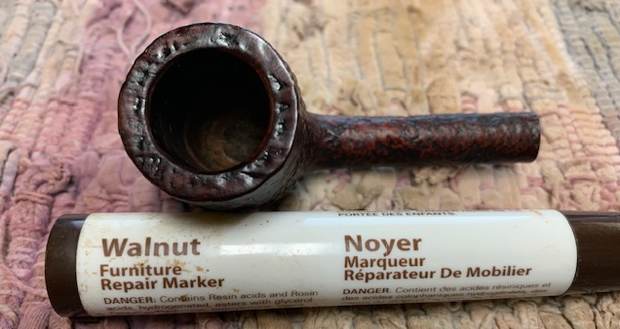
Now it was time to work on the pipe. I started working on it by stripping off the thick varnish coat with acetone and a cotton pad. I reamed the pipe with a Savinelli Fitsall Pipe Knife and cut back the cake back to the bare briar. I sanded the walls of the bowl with a piece of dowel wrapped with 220 grit sandpaper to smooth them out and clean them further. The bowl walls were in excellent condition.I topped the bowl with 220 grit sandpaper on a topping board to remove the marks and damage on the rim top. I carefully cleaned up some of the darkening and burn marks on the front rim top and edges. I used a folded piece of 220 grit sandpaper to give the inner edge of the bowl a slight bevel to minimize the darkening and damage and blend it into the surrounding briar. I restained the sanded rim top with a Walnut stain pen to match the bowl sides and shank.I cleaned out the mortise and airway in the shank with cotton swabs, pipe cleaners and isopropyl alcohol until they came out clean. (I would work on the airway in the stem when I removed it from the soak.)I polished the briar with micromesh sanding pads – dry sanding with 1500-12000 grit sanding pads. I wiped the bowl down with a damp cloth after each sanding pad. The polishing of the rim top and inner edge brought the rim top colour to match the rest of the bowl. I did not need to stain the rim at all. I worked some Before & After Restoration Balm into the surface of the briar with my fingertips to clean, enliven and protect the briar. I let the balm sit for 15 minutes and then buffed with a cotton cloth to raise the shine. The photos show the bowl at this point in the restoration process. I set the bowl aside and put the stem in the Briarville Pipe Stem Deoxidizer overnight and took a break to enjoy a movie. When I took it out of the bath the next morning the dip had removed the  oxidation and calcification. I rinsed it off with warm water and dried the stem with a coarse cloth to remove the surface oxidation. It looked very good and the tooth marks were very visible.I “painted” the surface of the stem with the flame of a lighter to lift the tooth marks on both sides. It lifted them considerably. I filled in what remained with clear CA glue. Once the glue cured I used a small flat file to flatten the repairs and recut the button edges. I sanded the stem with 220 grit sandpaper to blend them into the surface. I started polishing the stem with 400 grit wet dry sandpaper. I cleaned out the filter tenon and the airway in the stem with pipe cleaners, cotton swabs and isopropyl alcohol. I touched up the P stamp on the left side of the taper stem with Antique Gold Rub’n Buff. I applied it and worked it into the stamp with a tooth pick. Once it cured I scraped off the excess. It is definitely better though the stamp is faint in some spots. Strangely the stamping has a white tinge to it.I polished the stem with micromesh sanding pads – wet sanding with 1500-12000 grit sanding pads. I wiped it down after each sanding pad with Obsidian Oil. I polished it with Before & After Pipe Stem Polish – both Fine and Extra Fine. I am excited to put the final touches on this Peterson’s Tyrone 606 Pot with a 9mm Filter stem. I put the pipe back together and buffed it with Blue Diamond on the buffing wheel. I gave the bowl and the stem multiple coats of carnauba wax. I hand buffed the pipe with a clean buffing pad to raise the shine. It is fun to see what the polished bowl looks like with beautiful mixed grain all around it. Added to that the polished black vulcanite stem combined with the bowl and made a stunning pipe. This smooth Classic Peterson’s Tyrone 606 Pot is great looking and the pipe feels great in my hand. It is light and well balanced. Have a look at it with the photos below. The dimensions are Length: 6 inches, Height: 1 ½ inches, Outside diameter of the bowl: 1 ½ inches, Chamber diameter: 7/8 of an inch. The weight of the pipe is 43 grams/1.55 ounces. It is a beautiful pipe that I will soon be putting on the rebornpipes store in the Irish Pipe Makers Section. If you are interested in adding it to your collection send me an email or a message. Thanks for walking through the restoration with me as I worked over this pipe. Thanks to each of you who are reading this blog.

Rebirthing a Lovely Late Republic Era Peterson’s Kapet 14S Saddle Stem Billiard


Blog by Steve Laug

The next pipe I have chosen is a smooth Peterson’s pipe, a straight, saddle stem Billiard. It was also incredibly dirty. This Billiard is a real beauty under the grime with some great grain around the bowl. The grime was ground into the finish on the bowl sides. The contrast of the brown stains gave the grain a sense of depth. It was stamped on the left side of the shank and read Peterson’s [over] Kapet. The right side had the shape number 14S stamped near the bowl. Centered on the right side of the shank is stamped Made in the Republic of Ireland (in three lines). Neither Jeff nor I remember where we got the pipe or when. So we have no photos of the pipe before clean up. Judging from the damage on the rim top and edges I would guess it had been a mess. The stem had tooth marks and some oxidation. But Jeff had done a great job cleaning up the pipe as usual. He reamed the pipe with a PipNet reamer and cut back the cake back to the bare briar. He cleaned up the walls with a Savinelli Fitsall Pipe Knife. He scrubbed the interior of the bowl and shank with pipe cleaners, cotton swabs and alcohol to remove the tars and oils. He scrubbed the exterior of the pipe with Murphy’s Oil Soap and a tooth brush to remove the grime from the finish. He worked on the rim top lava and darkening with the soap and tooth brush. He scrubbed the inside of the stem with alcohol and pipe cleaners. He scrubbed the exterior with Soft Scrub and then soaked it in Before & After Deoxidizer. He washed it off with warm water to remove the Deoxidizer. The pipe looked far better when it arrived. I took some close up photos of the rim top and also of the stem surface. I wanted to show how well it had cleaned up. The rim top photo looks good but there is some burn damage on the inner edge at the back of the bowl and all around the inner edge there is darkening. I also took close up photos of the stem to show the light tooth marks and chatter on the surface near the button. I took photos of the stamping on the sides of the shank. You can see that it is stamped as noted above. It is clear and readable. He took photos of the stamping on the sides of the shank. It is clear and readable and reads as noted above. I took the pipe apart and took a photo of the pipe. It is a good looking pipe and has some great cross grain on the sides of the bowl. I am including the link to the Pipedia’s article on Peterson pipes. It is a great read in terms of the history of the brand (https://pipedia.org/wiki/Peterson). There was a short note toward the bottom of the page about the series. It is definitely referring to the newer line that came out later. I quote:

I turned to Pipedia (https://pipedia.org/wiki/Peterson) to first pin down a date that the pipe was made. I knew that the Made in Ireland stamp would give me that. I quote:

As usual when trying to get accurate facts in regard to Peterson history, something will jump up and get in the way. They are missing many of their records. The following is the best that we can do for a guide to the myriad markings during the period 1922 – 1949. Prior to 1920 it was rare for a country of origin to be stamped on the pipe, just Peterson’s Dublin on the band. After 1921/22, if it is stamped “MADE IN IRELAND” and the “Made in” is stacked over “Ireland” or “MADE IN EIRE” or several other forms, it was made between 1922 and 1938. A considerable number of Peterson pipes were stamped “Irish Free State”. From about 1930 to 1949, most of the pipes (those which were stamped) were stamped “Made in Ireland”.” If the stamp reads “MADE IN IRELAND” in a circle, the pipe was made between 1939 and 1948. These are all “Pre-Republic” pipes. I can tell you that the mark “Irish Free State” was adopted in 1922; and replaced by “Eire” in 1937 and then by “Republic of Ireland” in 1949.

That gave me a date for the pipe – it was made between 1922 and 1938 as can be proved by the Made in Ireland stamp on the right side of the shank.

I turned to “The Peterson Pipe” by Mark Irwin and Gary Malmberg to get some background on the Kapet line. On page 305 it had the following information.

Kapet (1925-87) Line first described in 1925 brochure and featured in occasional catalogs through ’87. Early specimens will be stamped IRISH over FREE STATE. Described in 1937 catalog as available in dark plum or natural finish. Featured an aluminum “inner tube” or stinger until ’45. Mid-century specimens may be stamped MADE IN over IRELAND. Specimens from 1970 on may have mounts with hallmarks.

I knew that I was dealing with a Late Republic Era Kapet. Now it was time to work on the pipe.

I decided to address the rim top damage first. I used a folded piece of 220 grit sandpaper to give the edge a slight bevel to further minimize the damage to the rim. I then used a piece of sandpaper and a wooden ball to even the bevel and give the rim a uniform look. I think that it is definitely better once I finished. I wiped down the bowl and rim top with acetone on a cotton pad to remove the spotty finish on the bowl and make blending in the sanded rim top simpler. I polished the briar rim top and edges along with the rest of the briar with micromesh sanding pads –dry sanding with 1500-12000 grit pads and using a damp cloth after each pad. I worked some Before & After Restoration Balm into the surface of the briar with my fingertips to clean, enliven and protect the briar. I let the balm sit for 15 minutes and then buffed with a cotton cloth to raise the shine. The photos show the bowl at this point in the restoration process. I set the bowl aside and turned my attention to the stem. I “painted” the tooth marks with the flame of a lighter to lift them. They came up significantly. I filled in the tooth marks that remained on both sides with clear super glue. I let the repairs cure. Once they had cured I recut the edge and flattened the repairs with a flat file. I sanded them with 220 grit sandpaper. I started the polishing with 400 grit wet dry sandpaper. I wiped it down with some Obsidian Oil. I touched up the “P” stamp on the stem with an acrylic white fingernail polish. I worked it into the stamp with a toothpick. I let it sit for a few minutes then scraped off the excess.I polished the stem with micromesh sanding pads – wet sanding with 1500-12000 grit sanding pads. I wiped it down after each sanding pad with Obsidian Oil. I polished it with Before & After Pipe Stem Polish – both Fine and Extra Fine. I am always excited to finish a restoration and this Peterson’s Kapet 14S Saddle Stem Billiard is no exception. I put the pipe back together and buffed it with Blue Diamond on the buffing wheel. I gave the bowl and stem multiple coats of carnauba wax. I hand buffed the pipe with a clean buffing pad to raise the shine and hand buffed it with a microfibre cloth to deepen the shine. It is fun to see what the polished bowl looks like with the polished black vulcanite stem. This Classic looking Peterson’s Kapet 14S Billiard feels great in my hand. It is light and well balanced. Have a look at it with the photos below. The dimensions are Length: 5 ½ inches, Height: 1 ½ inches, Outside diameter of the bowl: 1 ¼ inches, Chamber diameter: ¾ of an inch. The weight of the pipe is 30 grams/1.09 ounces. It is a beautiful pipe and one that will be on the Irish Pipe Makers Section of the rebornpipes store soon. If you are interested in adding it to your collection let me know. Thanks for walking through the restoration with me as I worked over this pipe. Thanks to each of you who are reading this blog.

Swapping Bowls on a Peterson’s Cracked and Damaged Belgique


Blog by Steve Laug

I received an email from a fellow in England who was looking for a bowl for a Peterson’s Beligique that he had. His small Beligique was cracked and irreparable and he was looking for a new bowl. Interestingly I had a bowl without a stem in my box of Peterson’s here. I was looking for a stem for it so this was one of those interesting connections. He sent me the bowl and stem of his damaged pipe to me to see if it would work with my bowl. His damaged pipe was severely cracked and was exactly what he had said it was. It was Peterson’s of Dublin Belgique military mount with a P-lip stem. It was stamped on the left side of the shank with the words Peterson’s [arched over] Of Dublin. On the right side of the shank it is stamped London Made [over] England. It has no shape number on them and a vulcanite shank extension bearing the Peterson’s “P”. The stem was in good condition with chatter and tooth marks on both sides ahead of the button. It also has some light oxidation. I took photos of the crack around the bowl – all the way across the back of the bowl and across the left side with a branched crack going down the side of the bowl almost to the heel. It was a nasty crack. There was a thick cake in the bowl that told the story of how the crack had happened. I have a 2010 Peterson Catalogue on rebornpipes that shows the various shapes that Peterson made. There is a page there on Specialty Pipes that shows the pipes that I am working on. The pipes pictured are different from the two that I am working on in that both of these are military mount stem. It states that the Belgique and Calabash are two petite and lightweight Peterson crafted with all the care and know how of century old pipe makers, from finest quality briar in red polish and rustic finishes with Fishtail mouthpieces only. However they are described in the catalogue the two shapes that are extremely lightweight. These two are not red polish but actually a rich matte brown finish. The fishtail mouthpieces are classic military mounts that can easily be removed to fit in the pocket. They represent the best micro-pocket pipe within the Peterson portfolio. I have included the noted page below (https://rebornpipes.com/2015/05/15/).On a previous restoration I did a bit more digging on the Peterson Pipe Notes blog. There I found that Mark had included a photo of the various Specialty pipes. Peterson’s first put these four small pipes on the market in 1945 – Tankard & Barrel, Calabash & Belgique seen in the photo below.  Here is the link to Mark’s Blog (https://www.petersonpipenotes.org/tag/peterson-valentia-pipe/).I did a bit more digging and found some descriptions of the two shapes that I am working on. The various descriptions of the Belgique come from a variety of sites and the final one is quoted on the Brothers of Briar site.

…The Belgique is yet another extremely lightweight, petite pipe. It can be described as a tulip shape, and is fitted… and fishtail mouthpiece. A rich brown hue adorns the briar and makes for an attractive finish to this pocket companion.

…The Peterson Belgique Pipe is a straight cutty, which is a traditional shape derived from the old clay pipes. It is a small un-filtered pipe made from the finest Briar that Peterson have become renowned for. It has a smooth polished finish with a rich Brown stain to show of the natural grain pattern of the Briar.

…I have a pre rep Belgique love it. As you know the bowl is pretty large for the small pipe measuring 5/8″ ID and 1 1/4″ deep. My pipe is just shy of 6″ long and only weighs 11.7 grams. the bowl is not tapered which makes the capacity rather nice. Depending on what tobacco you load you will get a 30- 45 min smoke. The Belgique has thin walls so you have to sip very slowly and tamp more than usuall. The newer models have a fishtail stem which i believe makes the newer pipes not as delicate as my military p lip. If you decide to get the Belgique I am sure you will not be disappointed. (http://www.brothersofbriar.com/t16010-anybody-familiar-with-peterson-s-belgique-model).

…The Belgique is one of our favorite shapes in the Peterson line up. Interestingly, while it was a serious mainstay of the brand in decades past, it sort of faded into obscurity for a few years there, before being seriously revived in the past decade. A particularly small shape, and sort of an oddity in Peterson’s shaping lexicon (a bit like Native American loan words in English), it nonetheless fits the timeless, elegant style for which Peterson is known and loved.             

I took the bowl I had without a stem out and took photos of it. You can that is the same shape and over all size as the cracked bowl. It is stamped on the left side and reads Peterson’s [arched over] Dublin. The right side is stamped Made in the Republic of Ireland (three lines). It is all clear and readable. The bowl had been cleaned and reamed. The rim top was damaged, slightly out of round and had some darkening on the top and edges. I put the two bowls side by side and took photos of them. They are quite similar. The top one in the photo was the cracked original bowl and the bottom one is the new bowl. There is some variation but that is quite normal. The new bowl is a bit thicker and the shank is a bit shorter. But they look similar enough. I took photos of the stamping on the sides of the shank. It was clear and readable on both sides. The ”P” logo stamp was clear on the left side of the vulcanite ferrule. It will need to be touched up but it is clear. I decided to turn my attention to cleaning up the rim top and the inner edge of the bowl. I wanted to remove the burn and darkening damage from both. I used a folded piece of 220 grit sandpaper to work over the edge and the rim top. I also worked on the darkening on the outside edge of the bowl. It looked much better.I used a piece of 220 grit sandpaper to reduce the diameter of the tenon end of the stem to better fit the shank extension. I used a rolled piece of sandpaper and several round and flat files to open the diameter of the shank extension. I worked on it until it matched the diameter of the opening in the shank extension of the cracked bowl.I polished the bowl with 1500-12000 grit micromesh sanding pads to raise a shine on the briar. Each successive pad raised more of a shine on the bowl. Once finished, It looked very good. I touched up the “P” stamp on the shank extension with white acrylic fingernail polish. I filled in the stamping with the white acrylic and worked it into the stamp. Once it dried I used a worn micromesh 1500 grit pad to clean off the excess. It looked very good.I rubbed down the bowl with Before& After Restoration Balm. It works to clean, protect and preserve the briar. I worked it into the surface with my finger tips. I let it sit for 15 minutes then buffed it off with a soft cloth. The bowl looked good and the grain stood out clearly. I set the bowl aside and worked on the stem. I took photos of the stem that came with the damaged bowl. The vulcanite ferrule was the same on both pipes but the opening on the new bowl was slightly smaller than the old one. I would need to open it up for a good fit in the shank. I would also need to reshape the tenon end of the stem for a proper look. There were also tooth marks and chatter on both sides as well as some light oxidation.I “painted” the tooth marks with the flame of a lighter. I filled in the remaining tooth marks with a clear CA glue. Once it cured, sanded the repairs smooth with 220 grit sandpaper. I also worked on the diameter of the tenon end of the stem at the same time. I started to polish it with 400 grit wet dry sandpaper. I polished the stem with micromesh sanding pads – wet sanding with 1500-12000 grit sanding pads. I wiped it down after each sanding pad with Obsidian Oil. I polished it with Before & After Pipe Stem Polish – both Fine and Extra Fine and buffed it off with a final coat of Obsidian Oil. This Peterson’s Speciality Pipe is a great addition. The Belgique shape is classic in every way. It is petite, lightweight and comfortable in the hand. It will be a short smoke. The briar is beautifully grained and the black vulcanite military/stick P-lip stem go well with the briar and the vulcanite shank extension. I polished stem and the bowl with Blue Diamond polish on the buffing wheel. I gave the bowl and the stem multiple coats of carnauba wax. I buffed the pipe with a clean buffing pad to raise the shine. I hand buffed it with a microfiber cloth to deepen the shine. The pipe polished up pretty nicely. The rich stained briar on both bowls took on life with the buffing. The rich brown colour of the briar bowl works well with the polished vulcanite stem. The finished pipe has a rich look that is quite catching. Have a look at it with the photos below. The shape, finish and flow of the pipe and stem are very well done. The dimensions of the Belgique are Length: 5 inches, Height: 1 ½ inches, Outside diameter of the bowl: 7/8 of an inch, Chamber diameter: 5/8 of an inch. The weight of the pipe is .53 ounces/14 grams. I am pleased with how the pipe turned out. It looks very good and shows some signs of age. I will be sending it back to the fellow in England soon. Thanks for reading the blog.

Bringing a Dunhill Shell Briar Back to Its Best


Blog by Kenneth Lieblich

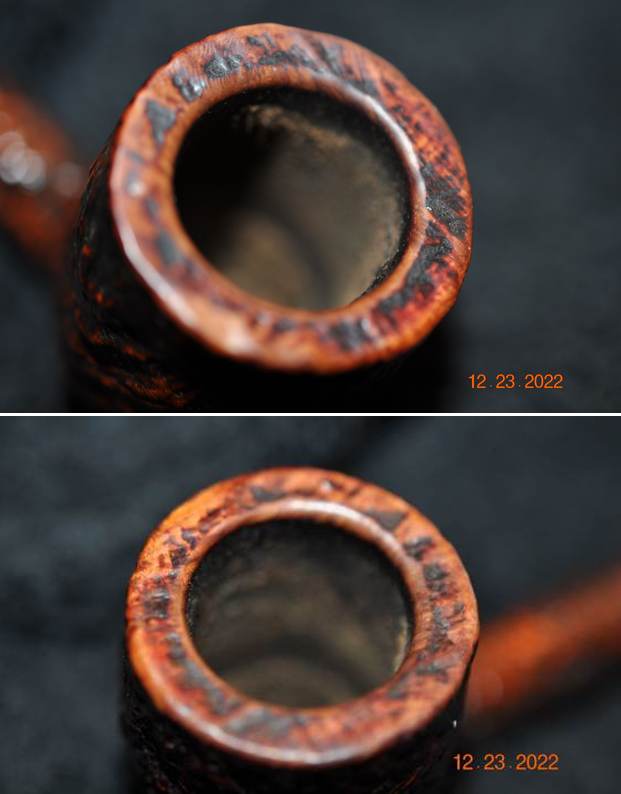
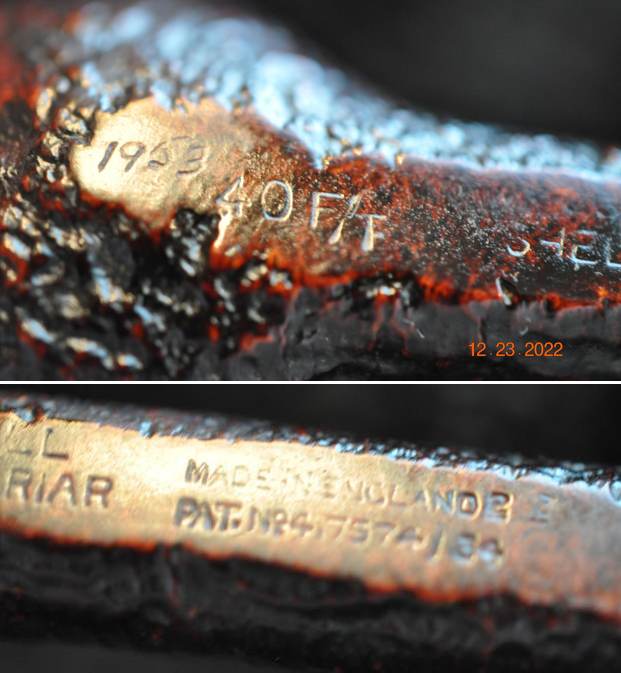
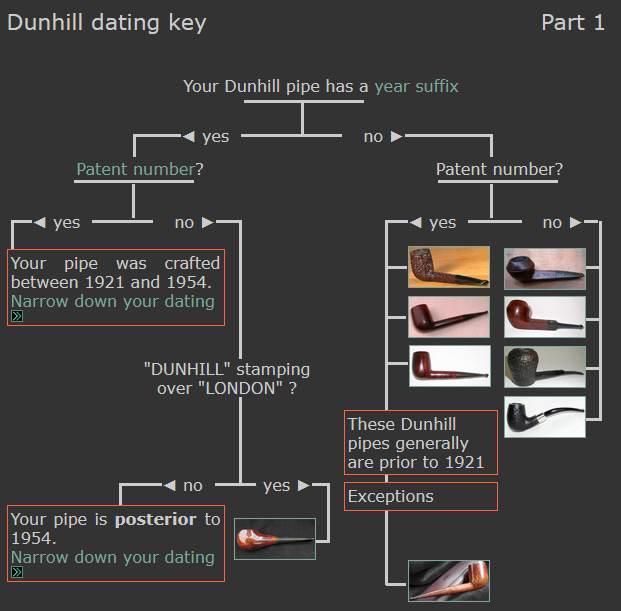
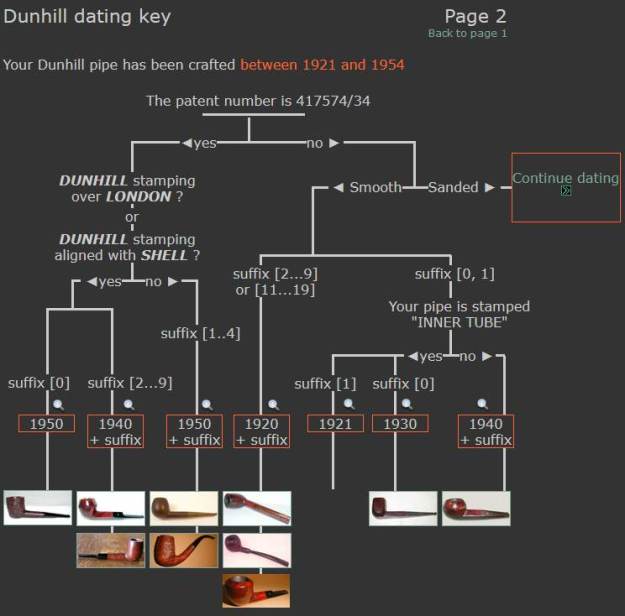
Ah, Dunhill. It is a name that inspires awe and warms the cockles of the hearts of many pipe smokers worldwide. Today, I am pleased to show the restoration of a wonderful shell briar. I acquired it in an auction on the Canadian Prairies. Other than that, I don’t know much of its provenance. What I can say definitively is that this must have been a great smoker and a much-loved pipe – it had been very thoroughly used. Rightly or wrongly, I instinctively have a certain respect for Dunhill pipes, and I am especially keen to restore this one so that the next smoker can enjoy it. As I mentioned this is a Dunhill Shell Briar and the markings confirm this. It is a beautiful, classic billiard shape. One of the ways I can tell that this was a much-loved pipe is that the markings on the underside of the shank were quite worn. As you can see, I can only make out so much. On the left-hand side is the model number, 39. Immediately to the right of this is Dunhill [over] Shell Briar. Then, to the right of that, is Made in [over] England. I cannot make out the year suffix, but my instincts tell me that it’s probably from the 1960s. Steve concurs with this. Additionally, this is a size three pipe. Normally, there would be an encircled 3, followed by an S. In this case, these marks are not visible, but I compared it with other Dunhills of size three and they are identical.The image below from Pipephil seems to confirm my suspicions about this pipe. The history of Dunhill’s shell briar pipes is fascinating. If you are interested in learning more, have a read of this article from Pipedia.This pipe was pretty darn filthy. As you can see, the stem had the usual wear-and-tear – some scratches, etc. There were no notable tooth dents, which pleasantly surprised me. There was some calcification, but not much oxidation. I figured the inside would be dirty because the inner tube certainly was!Meanwhile, the stummel was in lovely condition, but very dirty inside. The shank was dark and dank, and the bowl had lots of cake and lava. Who knows what horrors I might find inside? Spoiler alert: it wasn’t good. The inner tube was first on my list. It was being quite stubborn about coming out of the tenon, so I opted to warm the stem and inner tube with my heat gun. This provided just enough softening of the internal goo to allow me to pull it out. It then went for a soak in some lemon-infused isopropyl alcohol. I let it sit for several hours and then cleaned it off and it looked much improved. I then finished it with a quick polish and moved on. I wiped the stem with Murphy’s Oil Soap on some cotton pads. There was calcification there and I needed to remove it. Fortunately, although the stem was pretty dirty inside, it was not as bad as I had feared. I had no problem cleaning out the inside with pipe cleaners and isopropyl alcohol.I then wiped down the stem with SoftScrub cleaner to remove some surface oxidation. Once this process was done, the stem went for an overnight soak in the Pipe Stem Oxidation Remover. As the name suggests, this liquid removes oxidation, but, more than anything, it helps draw oxidation to the surface of the vulcanite. This allows me to clean the oxidation off in a couple of ways: both by applying a mild abrasive cleaner to the surface, then by sanding the stem. The following day, I cleaned all of the de-oxidizing mess off with alcohol, pipe cleaners, et cetera. The oxidation had migrated to the surface and would be fairly straightforward to remove. I scrubbed with SoftScrub on some cotton pads to remove the leftover oxidation.Then I used a set of nine Micromesh pads (1,500 through 12,000 grit) which gradually erased the ravages of time and brought out the stem’s lovely black lustre. For the last five pads, I also lightly coated the stem with Obsidian Pipe Stem Oil in between each scrubbing. At last, I set the finished stem aside. Off to work on the stummel! It was pretty dirty after all these years, so I used cotton rounds and some Murphy’s Oil Soap to scrub the outside of the stummel and a toothbrush with Murphy’s for the lava on the rim of the pipe. This had the benefit of revealing a bit more of the markings on the underside of the shank.  The bowl needed a thorough reaming, so I used the KleenReem to scrape off the built-up cake and I followed that with 220-grit sandpaper taped to a dowel to eliminate as much as possible. Generally, I prefer to sand the chamber down to bare briar. When restoring, it is important to ensure that there is no damage to the briar in the bowl, under the cake. Normally, there is none, but today…The walls of the pipe were just fine, but – horror of horrors! – the previous owner had clearly cleaned the bottom of the bowl with a jackhammer. There were some deep gouges in the heel. The gouges are hard to make out in the photos, so take my word for it. This is a straightforward fix, just time-consuming.However, before I addressed that issue, I needed to clean the shank and bowl thoroughly. I proceeded to use Q-tips, pipe cleaners, and lemon-infused isopropyl alcohol. Holy moly – this was an incredibly dirty pipe. Not sure it had ever seen a pipe cleaner before. Just look at the pile of Q-tips and pipe cleaners below!Then, to further clean the inside of the pipe, I put the stem and stummel back together and used my pipe retort system. This system uses boiling isopropyl alcohol and a vacuum (i.e. a void, not the household appliance) to clean the interior of a pipe. As you can see by the brownish colour of the alcohol, the retort worked well. I managed to extract lots of otherwise inaccessible filth from inside the pipe. Once I followed that up by cleaning the insides with some Castile soap and tube brushes. Now for the reconstructive surgery. I prepared some J.B. Weld epoxy for the purposes of filling the gouges in the briar. The great thing about J.B. Weld is that, once cured, it is totally inert, heat resistant to well beyond pipe temperatures, and hard as rock. I used a folded pipe cleaner and awkwardly smeared the stuff into the breach – then left it to cure overnight. On the morrow, I needed to remove all the excess epoxy from the bowl. I only wanted epoxy in the repair and nowhere else. This is a tricky and tedious exercise, but I used a combination of techniques to accomplish it. First, I used my Dremel (with different attachments) to remove most of the excess material. Second, I went back to my 200-grit sandpaper on a dowel to sand it down to where I wanted it. Naturally, the bottom of the bowl was much narrower than the top, so I acquired a couple of thinner dowels in order to sand where I needed to. I am very pleased with the results. The repair is exactly as big as it needs to be – and no bigger. After the pipe’s use over the years (and my restoration), the rim had lost some of its colour. I opted to use my furniture stain pens to match the colour of the rest of the stummel. Voilà! Looks terrific.At this point, I rubbed some Before & After Restoration Balm into the briar and left it to sit for 15 minutes or so. I brushed it with a horsehair brush and buffed it with a microfibre cloth. The BARB does wonderful things to the wood, and I really like the sheen on the sandblast. I then coated the entire inside of the bowl with a thin coat of a mixture of activated charcoal and my wife’s homemade yogurt. It hardens overnight and provides a good, slightly rough surface for a new cake to build. Now, the bowl can be used again as if nothing happened. Then it was off for a trip to the bench polisher. A few coats of Conservator’s Wax (from Lee Valley) were just what this pipe needed. Boy – that wax really makes this pipe pop! The lovely shine made the wood look absolutely beautiful. The sandblast looks fantastic and is ready to be enjoyed again by the next owner. I thoroughly enjoyed bringing this Dunhill Shell Briar 39 Billiard back to life and I am pleased to announce that this pipe is for sale! If you are interested in acquiring it for your collection, please have a look in the “British” Pipe Section of the store here on Steve’s website. You can also email me directly at kenneth@knightsofthepipe.com. The approximate dimensions of the Dunhill are as follows: length 5 in. (125 mm); height 1¾ in. (43 mm); bowl diameter 1⅛ in. (29 mm); chamber diameter ¾ in. (19 mm). The weight of the pipe is ⅞ oz. (25 g). I hope you enjoyed reading the story of this restoration as much as I enjoyed restoring it. If you are interested in more of my work, please follow me here on Steve’s website or send me an email. Thank you very much for reading and, as always, I welcome and encourage your comments.

Restoring & Restemming the last the 8 Peterson Bowls – Republic Era System Standard 314


Blog by Steve Laug

Jeff and I often purchase pipe bowl/stummels of brands that we like and want to restore. These have included a lot of different bowls. If you have followed us for long you know that some of these have included Peterson’s, Dunhill’s, and a wide range of Danish and English pipes. Awhile ago Jeff and I were sorting through the bowls in our collection and pulled out eight Peterson’s bowls that were dirty and stemless. A friend referred us to a contact named Silas Walls, of Walls Pipe Repair in Wallace, Idaho, USA as he seems to have a good supply of original Peterson’s stems. Our friend has had him fit stems for some of his Petes and was very happy with the work. We made contact with him and sent him eight bowls for restemming.

In the photo above I show the 8 restemmed pipes. I have marked the 7 I have worked on already with a red X). This eighth one that we cleaned up before mailing them out was a bowl that we received on 06/05/21 from a friend in Chicago, Illinois, USA. It is stamped on the left side of the shank and reads Peterson’s [arched over] System [over] Standard. On the right side of the shank it is stamped Made in the Republic of Ireland (three lines) over the shape number 314. The ferrule is stamped K&P [over] Peterson’s. The before photos of this bowl were on a corrupted memory card and are gone. But needless to say the pipe was just as bad as the rest of this lot.

As with the others before this one I turned to Pipedia (https://pipedia.org/wiki/Peterson) and read through the article before starting on my work. I found an interesting note in the middle of the page. I quote the pertinent section below and have highlights some important information in red below.

From 1950 to the present time, the stamp for this era is “Made in the Republic of Ireland” in a block format generally in three lines but two lines have been used with or without Republic being abbreviated.

During the 1950’s and 60’s the Kapp & Peterson company was still in the ownership of the Kapp family. However 1964 saw the retiral of the company Managing Director Frederick Henry(Harry) Kapp.

Since I found a new stem it was now it was time to work on this final bowl of the lot. Jeff had done a great job cleaning up the pipe as usual. He reamed the pipe with a PipNet reamer and cut back the cake back to the bare briar. He cleaned up the walls with a Savinelli Fitsall Pipe Knife. He scrubbed the interior of the bowl and shank with pipe cleaners, cotton swabs and alcohol to remove the tars and oils. He scrubbed the exterior of the pipe with Murphy’s Oil Soap and a tooth brush to remove the grime from the finish. He worked on the rim top lava and darkening with the soap and tooth brush. It looked much better. I took pictures of the bowl without the new stem. It is a great looking piece of briar even with the gouges and marks on sides, top and heel of the bowl. The nickel ferrule has a few dents but otherwise looks very good. When the pipes came back to Jeff with their new stems they looked great. When the pipes arrived here I checked them out. Here is what I found. The first six pipes from the lot were flawless and quite beautiful. The last two – this 314 and a 313 I reworked previously, looked great at first glance but upon further examination it was clear that the stems were not Peterson’s style stems. The draught on the P-lip portion of the stem is on the top of the stem, but in the case of these two stems the airway came straight out the end of the stem like a Wellington pipe. I was not happy with them. I have already replaced the stem on the 313 and this 314 was the only one I still needed a stem for. Today I was gifted some Peterson’s P-lip stems and one was what I was looking for. It fit well but I would need to give it a bit more of a bend for a perfect look. With the new stem chosen, I turned to work on the damage on the top and the inner edge of the bowl. I used a folded piece of 220 grit sandpaper to clean up the inner bevel of the rim and remove the damage on the rim top. Once I had finished I think that it looked much better. I filled in the deep gouges in the bowl on the right heel and the underside of the heel with CA glue and also briar dust. I sanded them smooth with 220 grit sandpaper to blend them in. They looked significantly better. I stained the sanded areas with a Cherry stain pen to match the surrounding area around the rest of the bowl sides, top and heel.I polished the briar with micromesh sanding pads – dry sanding with 1500-12000 grit pads. I wiped the bowl down after each  pad to remove the grit. The bowl began to take on a rich shine. It is going to be a beauty.   I rubbed the bowl down with Before & After Restoration Balm. I worked it into the briar with my finger tips. I let it sit for 10 minutes and the Balm did its magic. It enlivens, cleans and preserves the briar. It certainly brought this bowl back to life. I buffed it off with a clean cloth and took the following photos.  I set the bowl aside and turned my attention to the stem. Since it was a new stem I did not need to polish it. The stem was looking very good. I heated the stem with a lighter to soften the vulcanite and bent it to the shape that it needed to be for the shape of the bowl. I held it in place to let it cool and set the shape. It looked very good.  This Republic Era Ireland Peterson’s System Standard Bent 314 with a Nickel Ferrule and a vulcanite P-lip stem is a great looking pipe now that it has been restored. The beautiful grain that shines through the polished finish is stunning. As the pipe is smoked the patina should develop and look even better. I put the stem back on the bowl and carefully buffed the pipe with Blue Diamond on the buffing wheel. I gave the bowl and the stem multiple coats of carnauba wax on the buffing wheel and followed that by buffing the entire pipe with a clean buffing pad. I hand buffed the pipe with a microfiber cloth to deepen the shine. The finished Peterson’s System Standard 314 Bent Billiard fits nicely in the hand and feels great. Give the finished pipe a look in the photos below. The dimensions of the pipe are Length: 5 ¾ inches, Height: 1 ¾ inches, Outside diameter of the bowl: 1 1/8 inches, Chamber diameter: ¾ of an inch. The weight of the pipe is 44 grams/1.55 ounces. I will be adding the pipe to the Irish Pipe Makers Section of the rebornpipes store. If you are interested in purchasing this pipe send me a message or an email. Thanks for reading this blog and my reflections on the pipe while I worked on it.