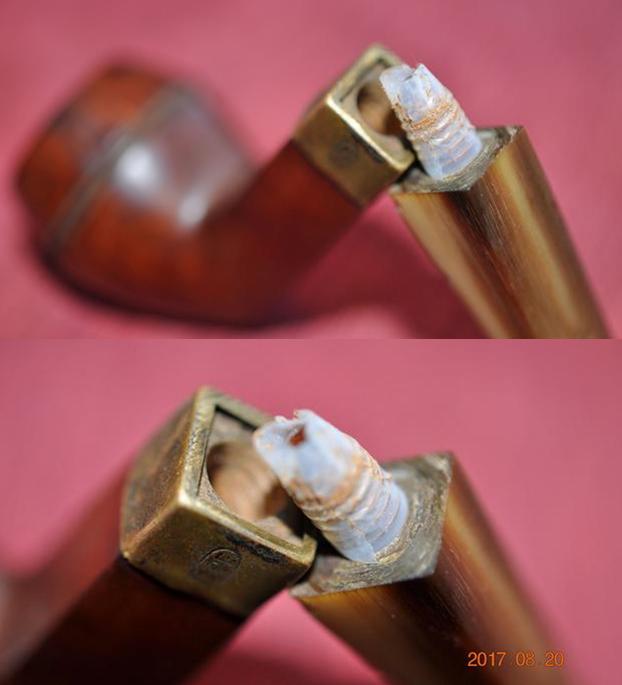
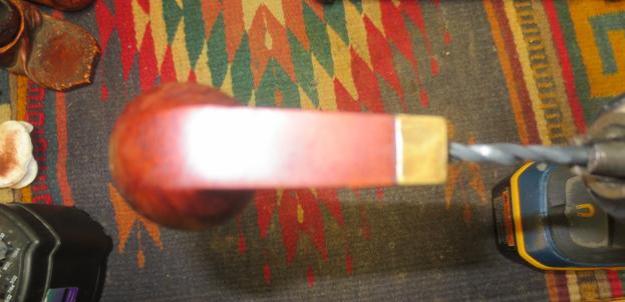
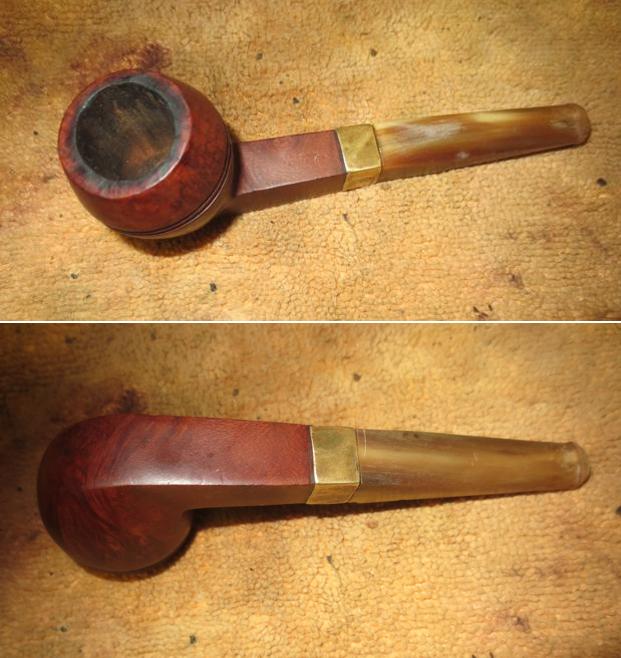
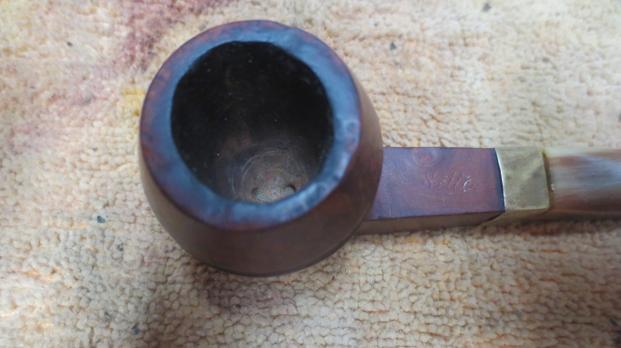
Tag Archives: Repairing a horn stem

Fitting a Shank and Stem to a well Patinaed Meerschaum


by Steve Laug

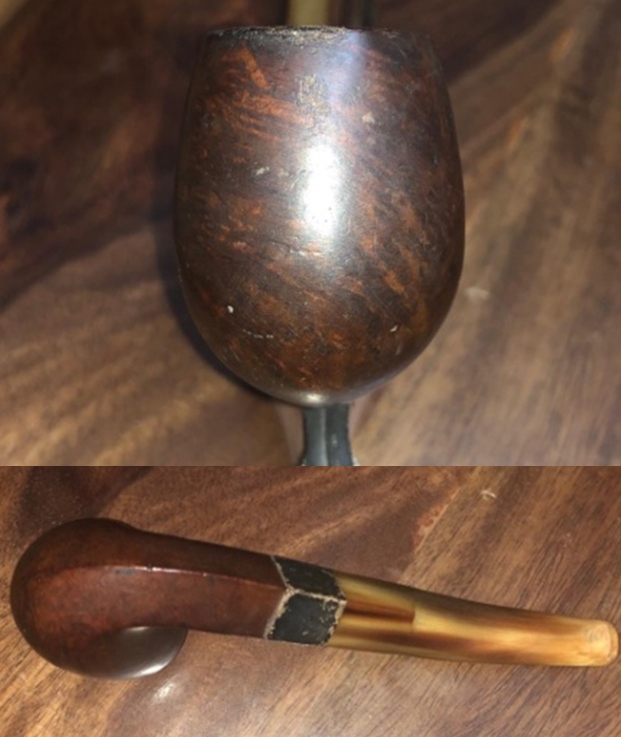
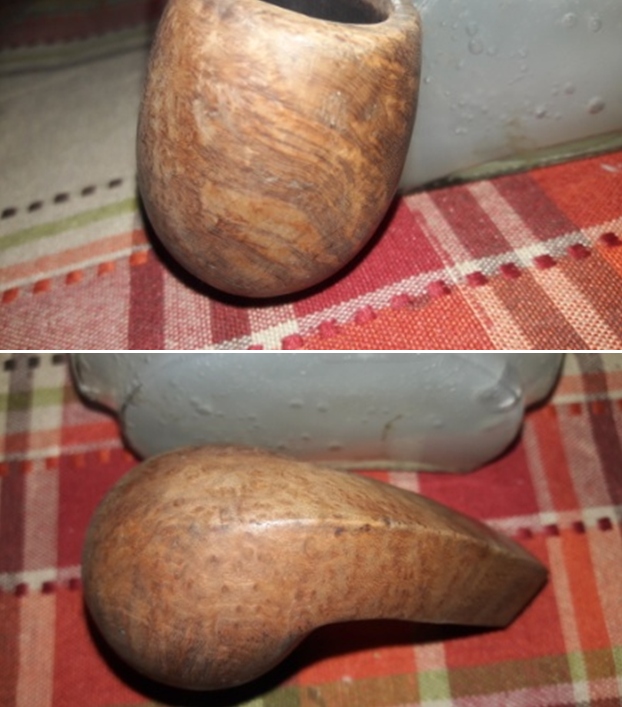
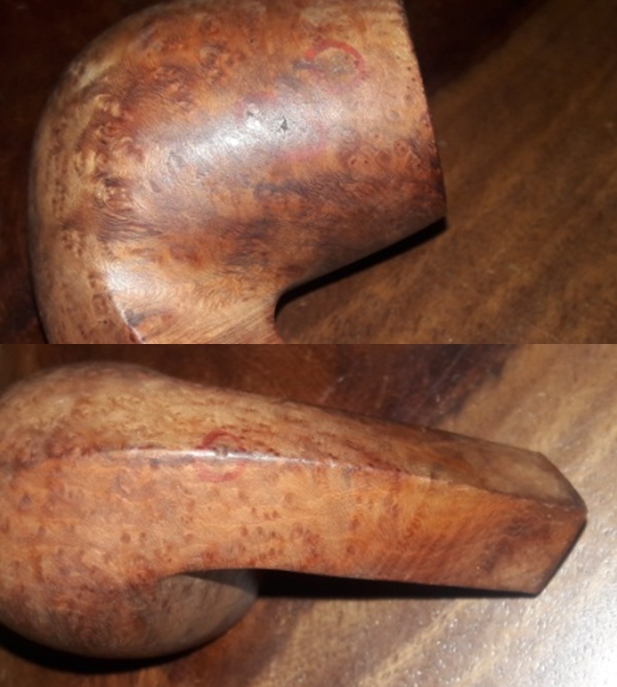
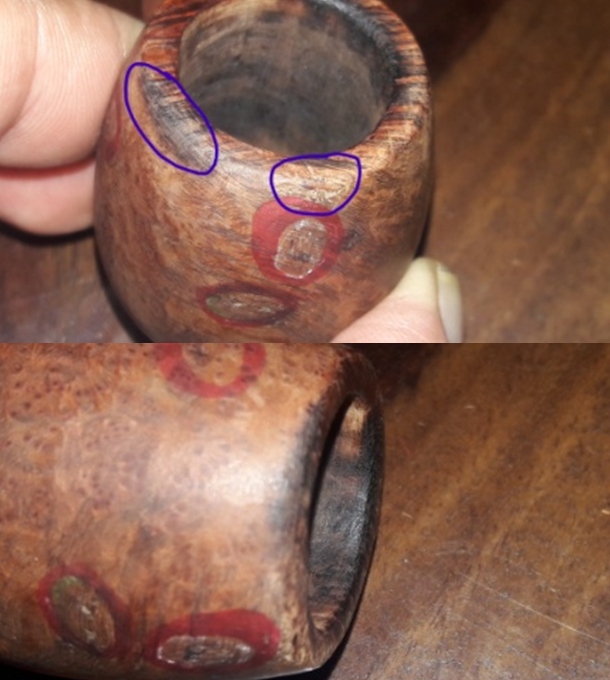
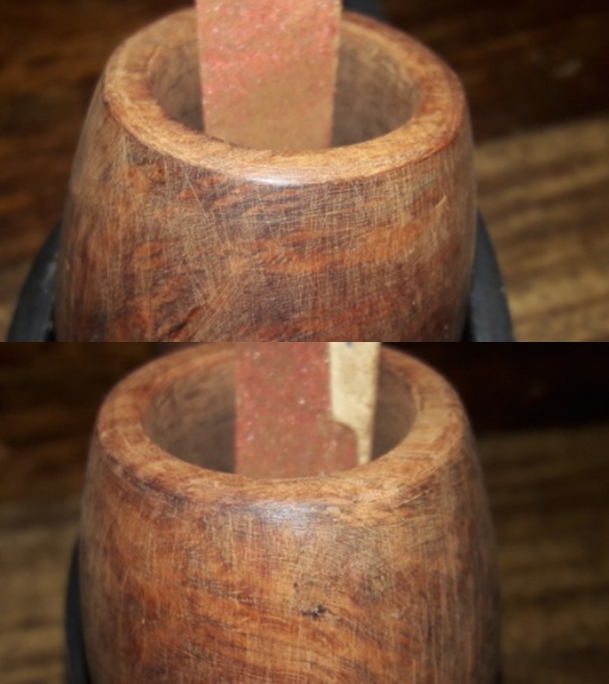
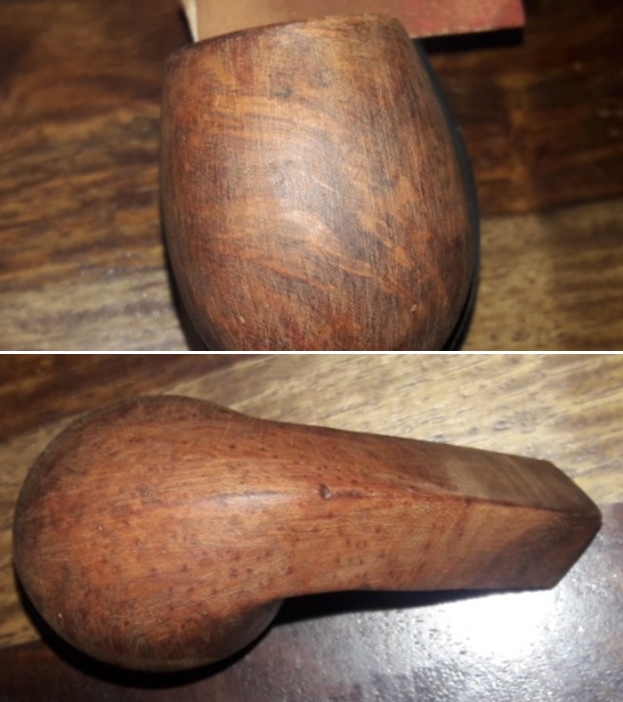
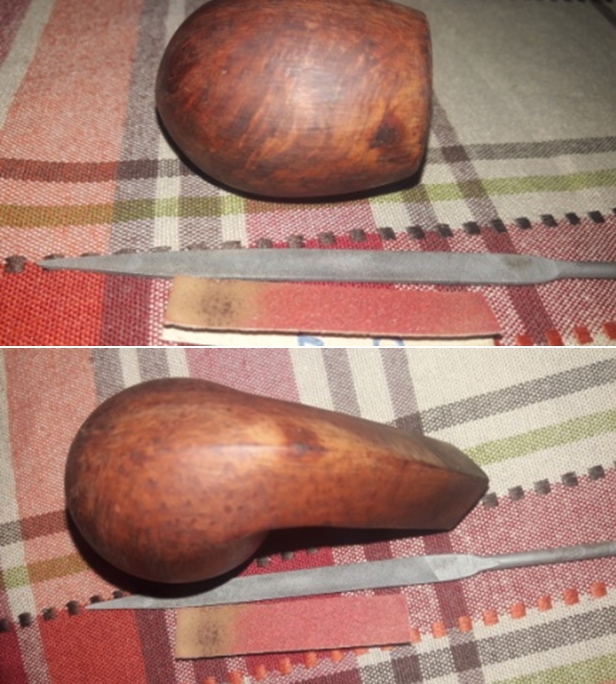
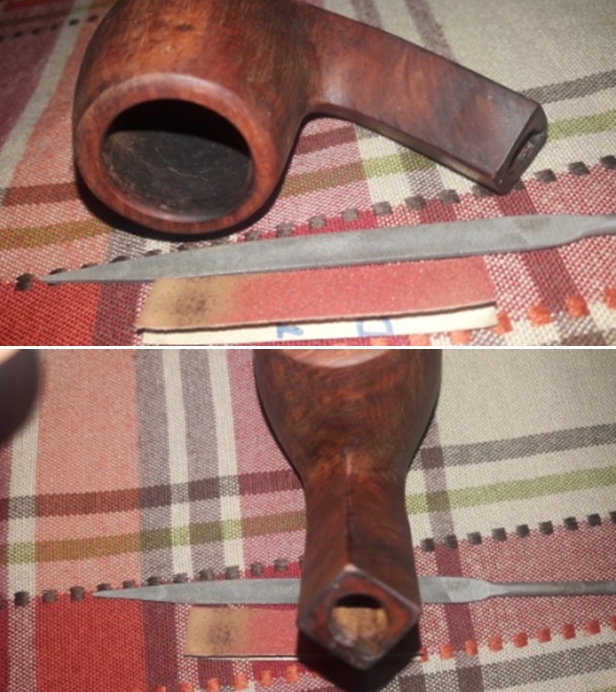
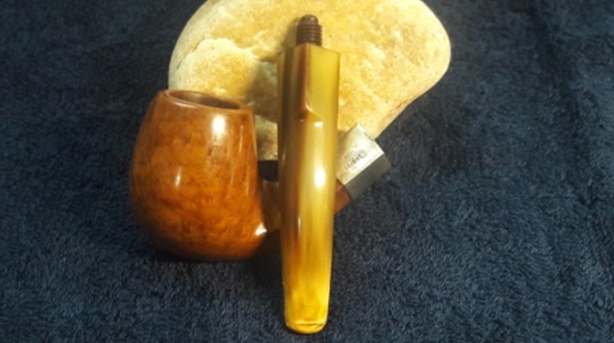
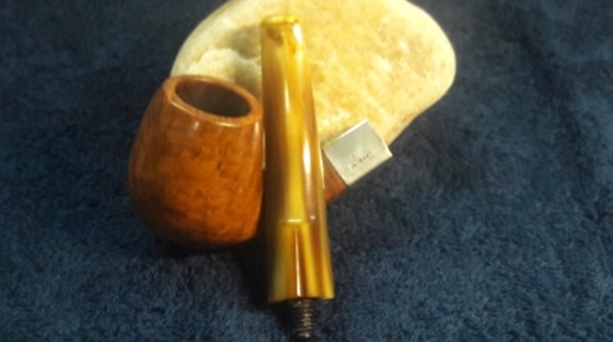
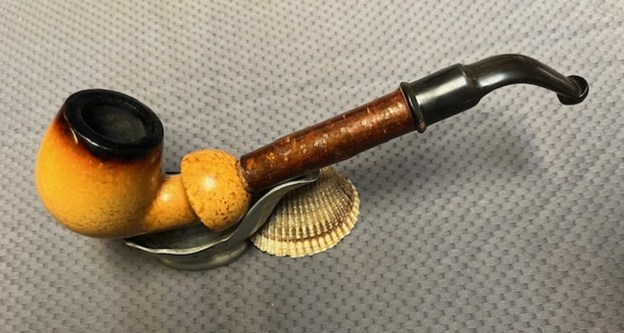
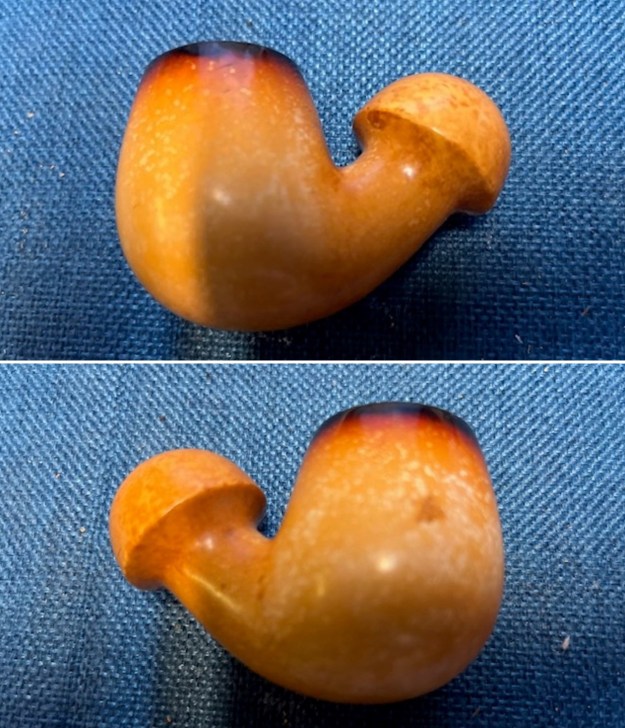
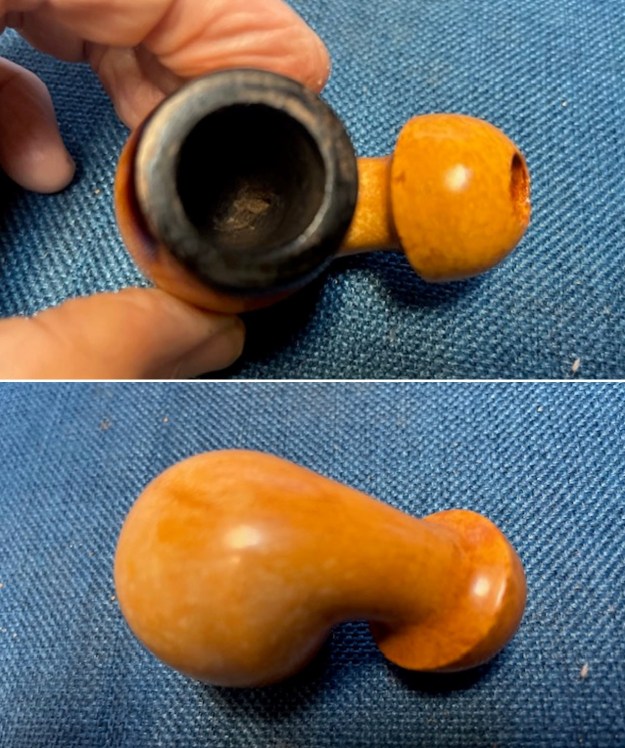
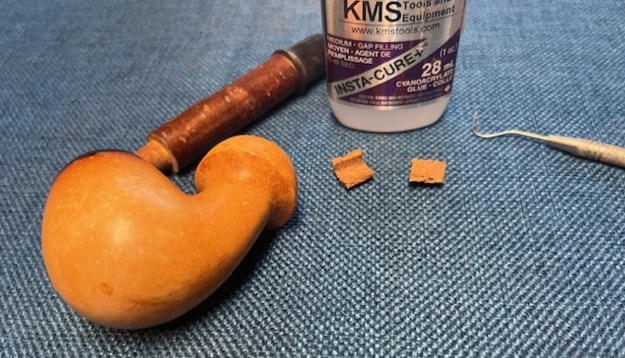
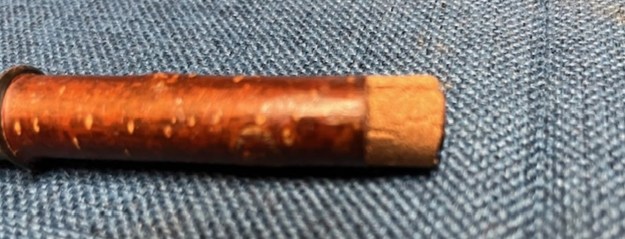
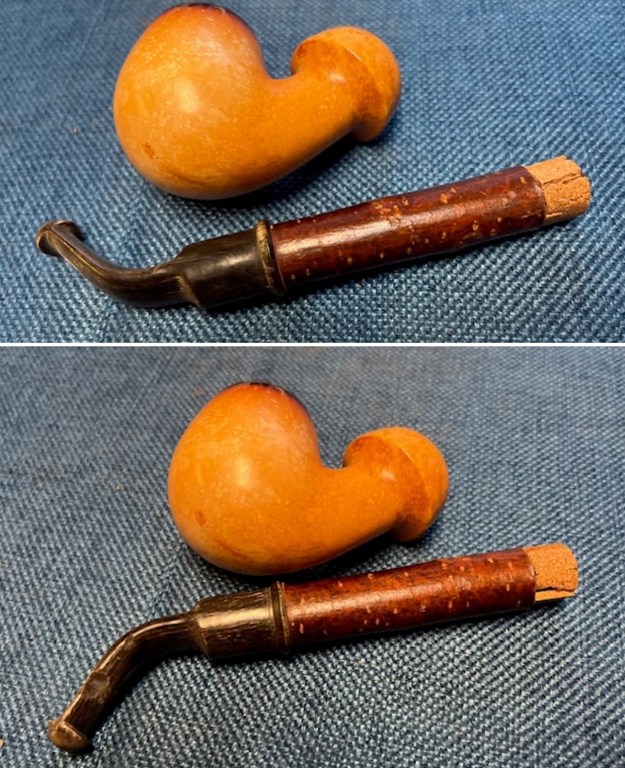
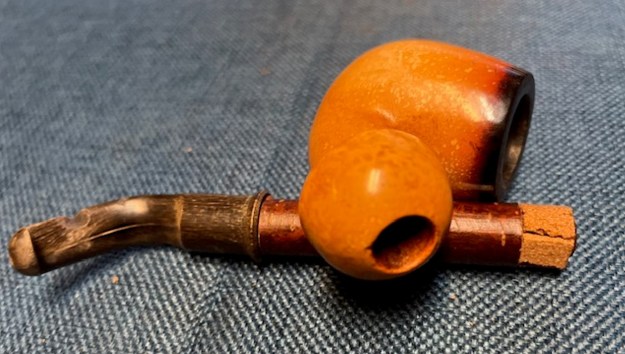
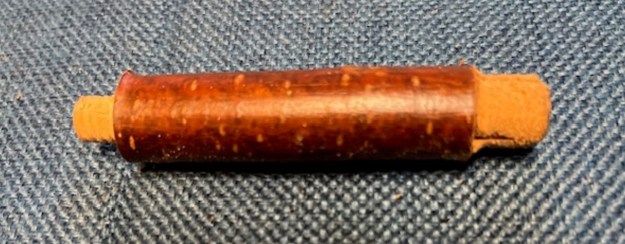
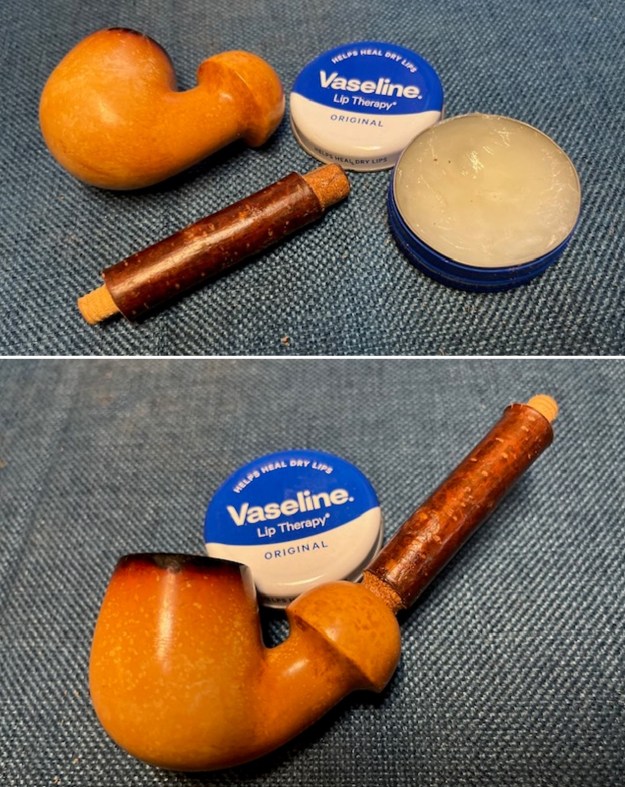
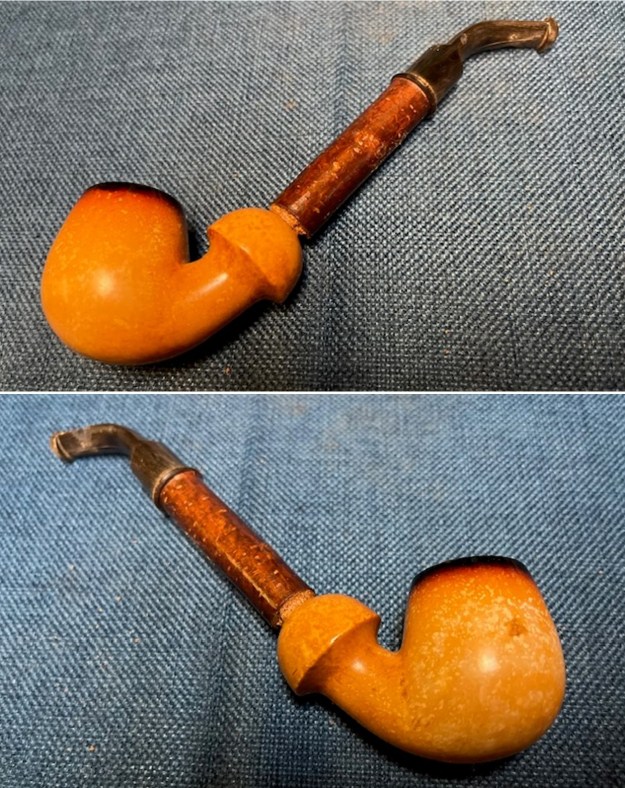
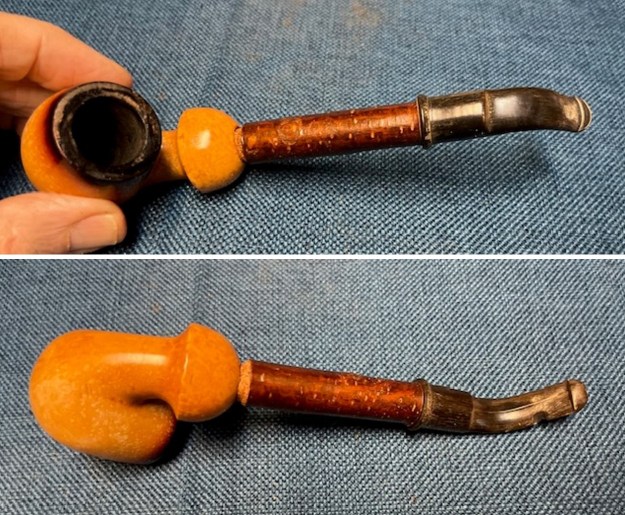
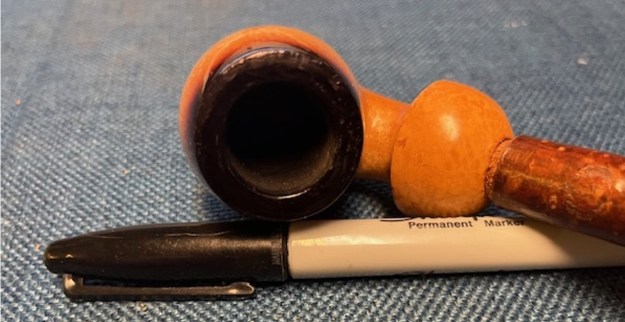
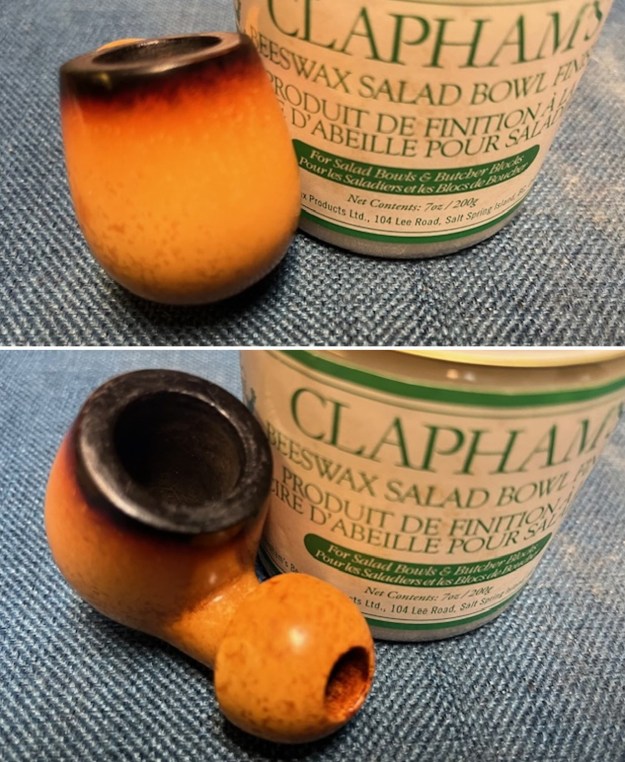
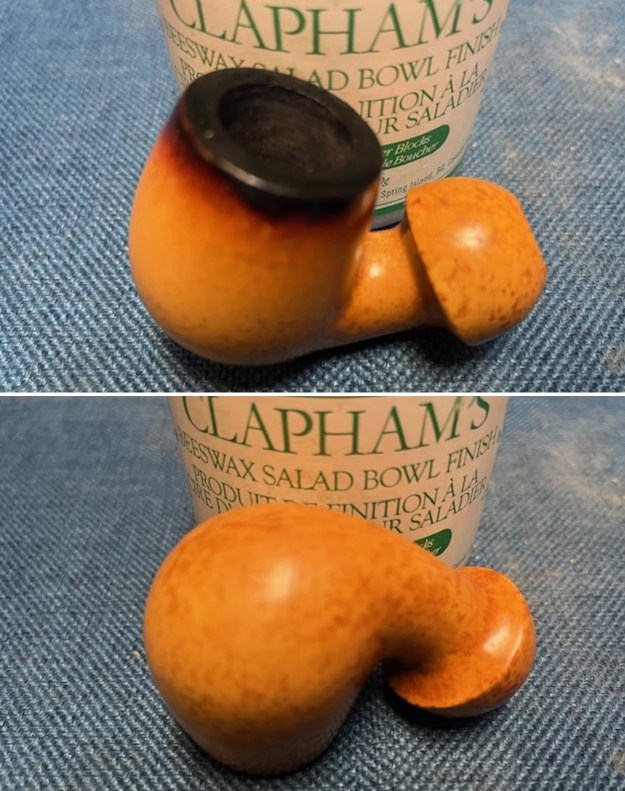
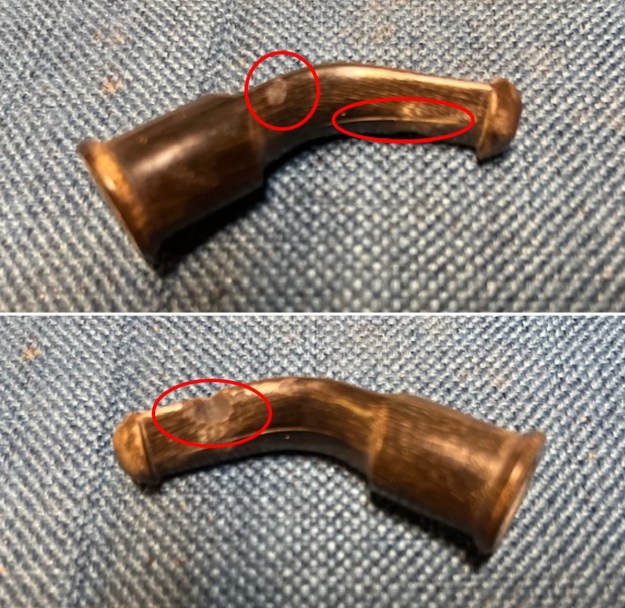
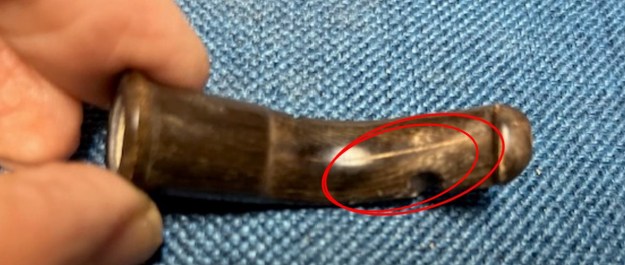
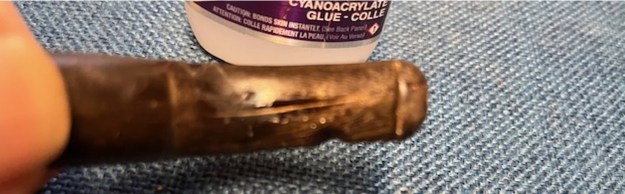
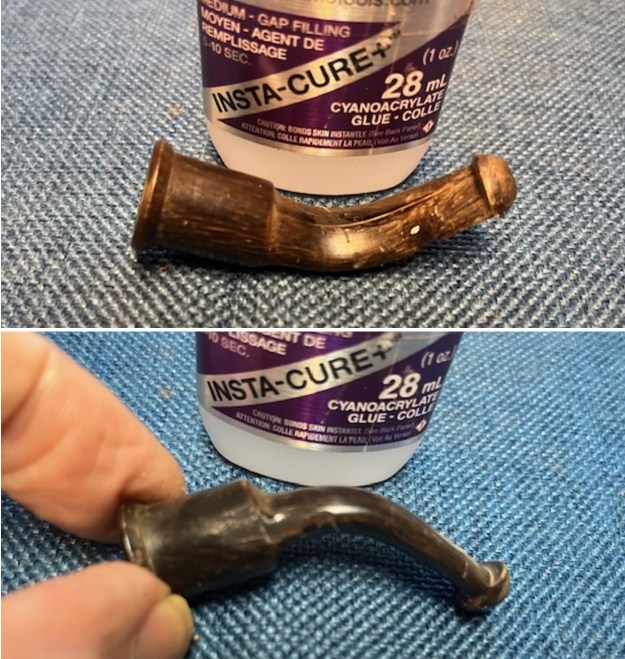
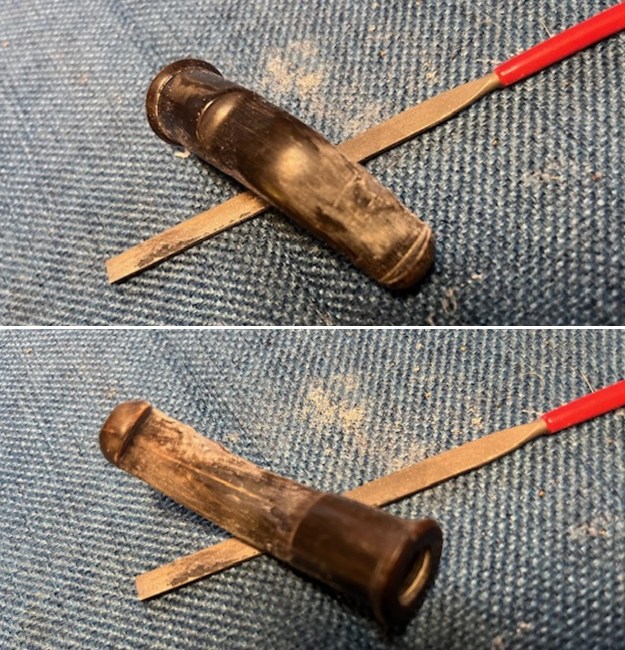
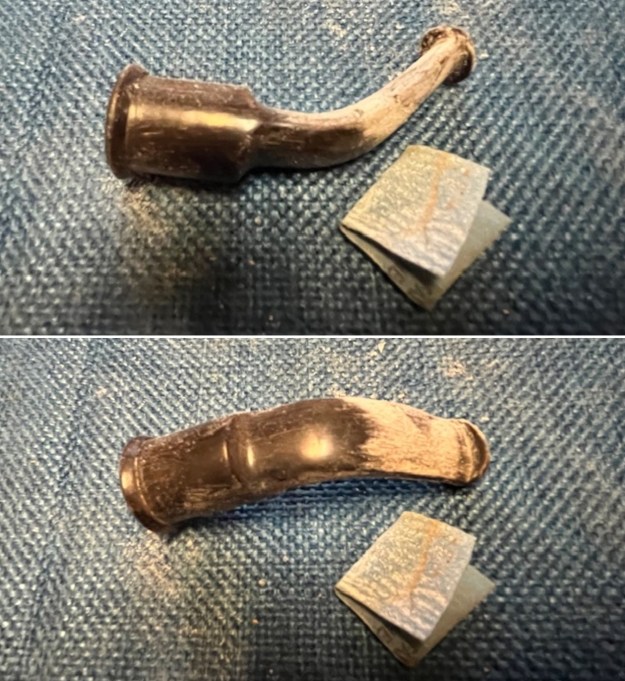
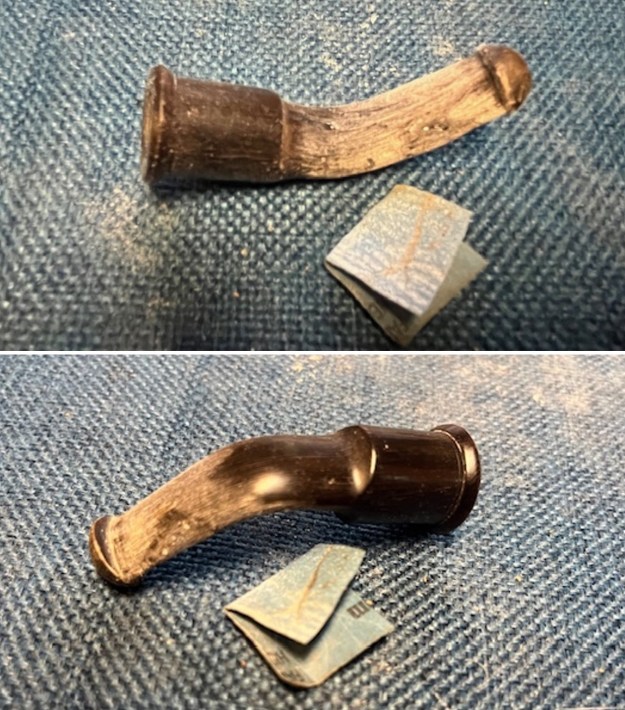
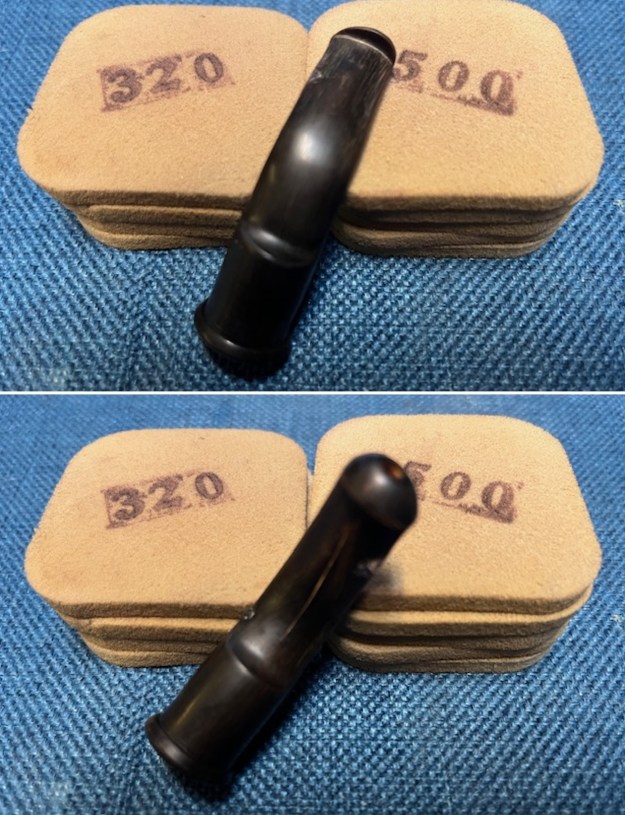
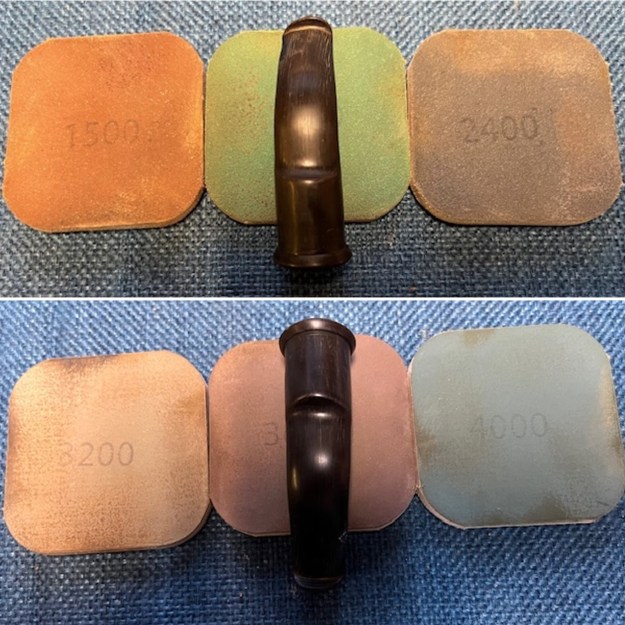
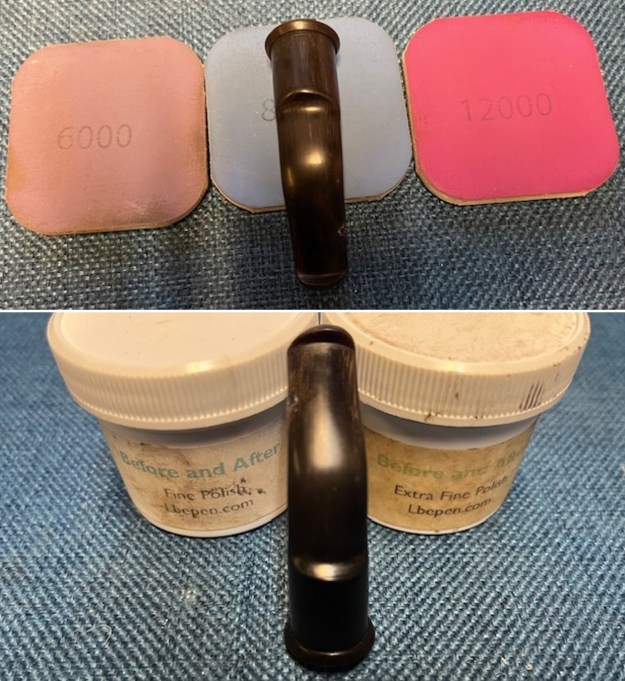
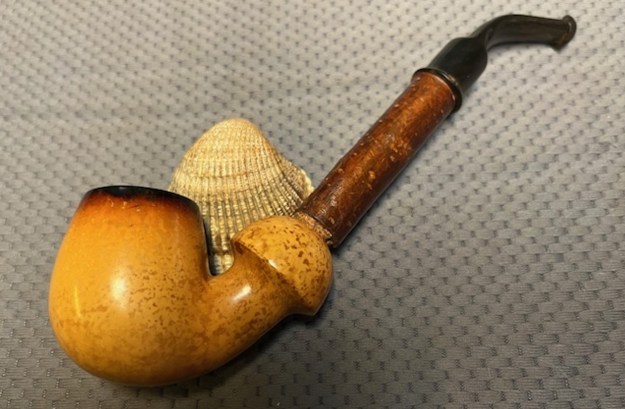
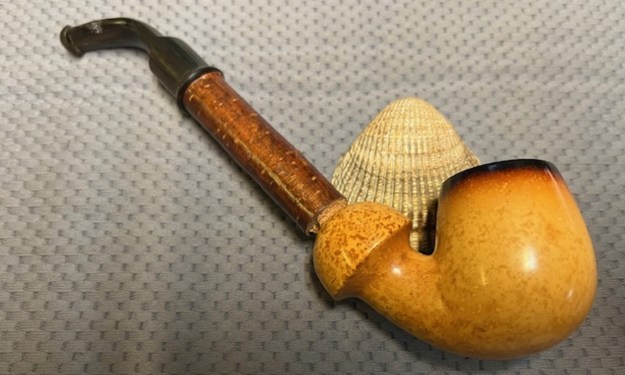
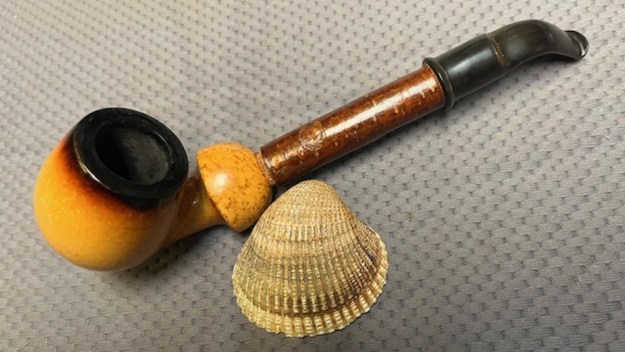
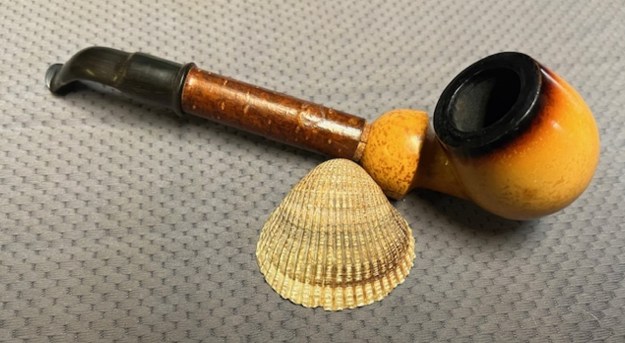
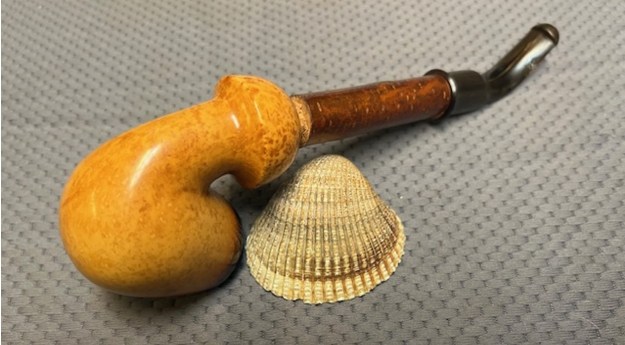
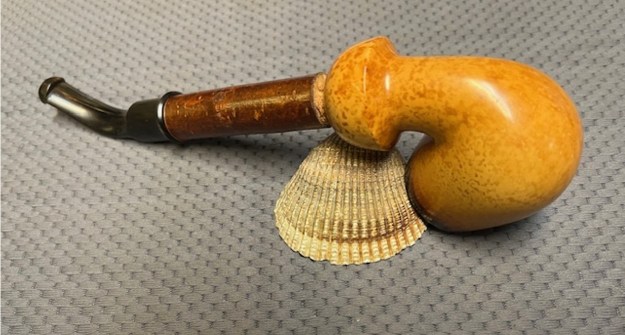
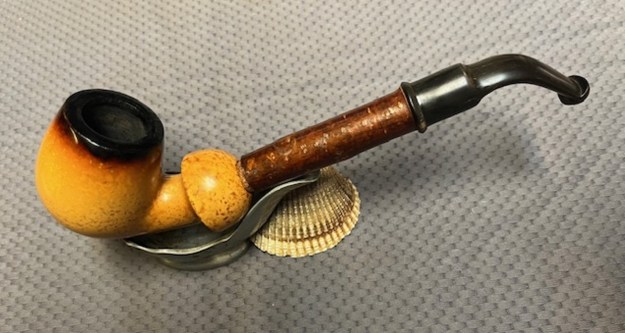
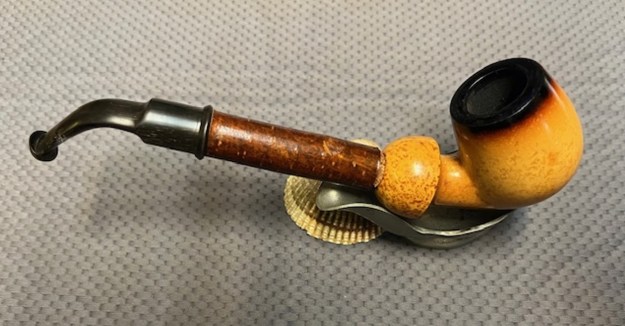
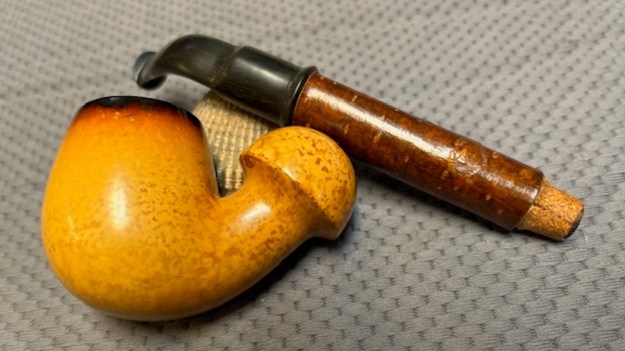
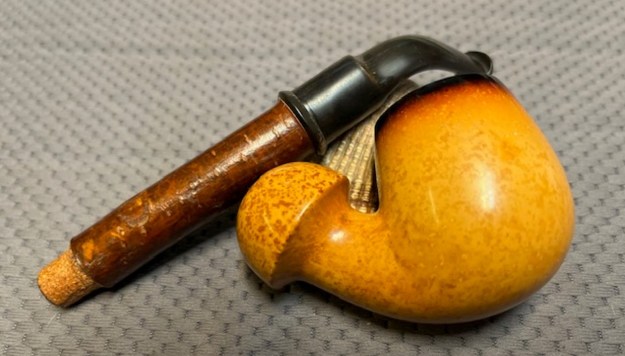
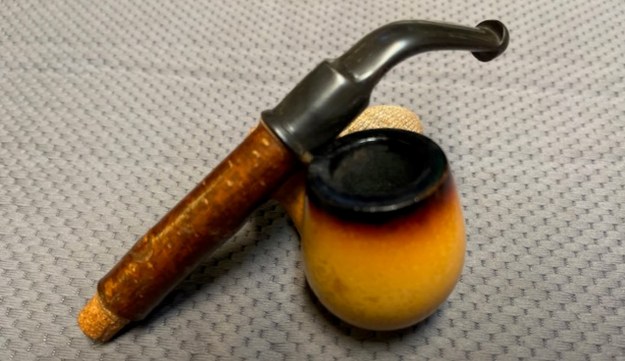
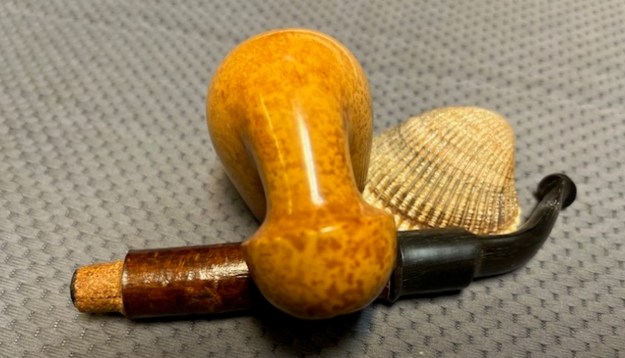
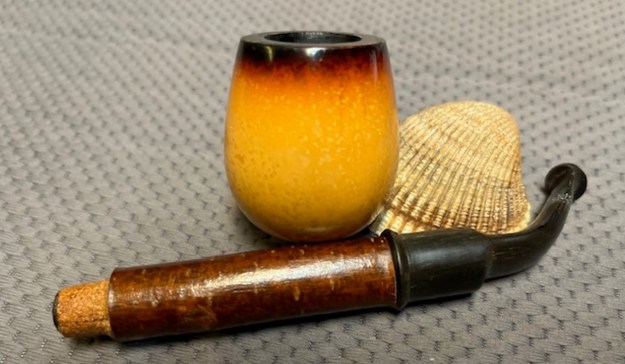
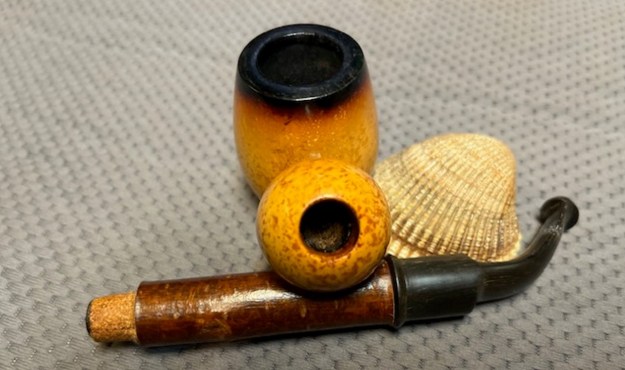
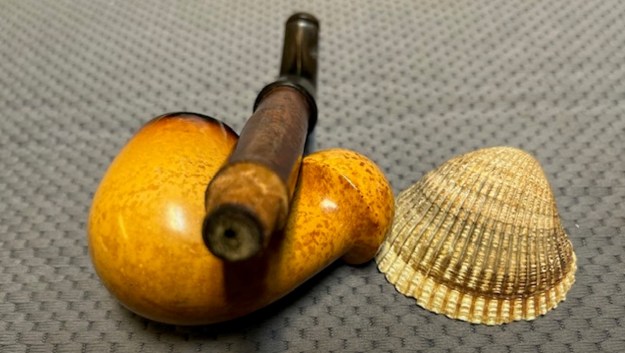
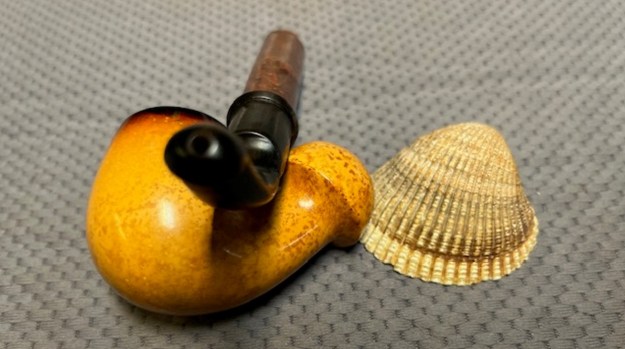
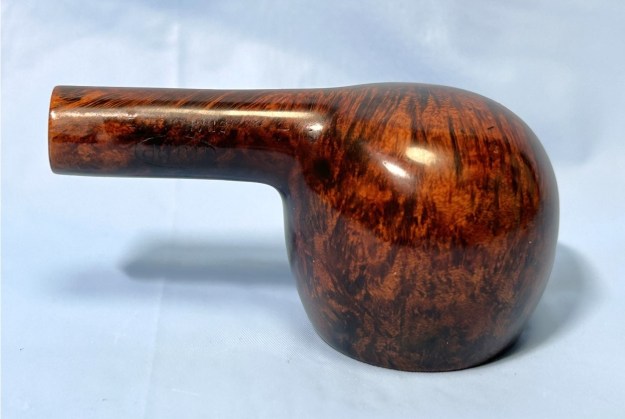
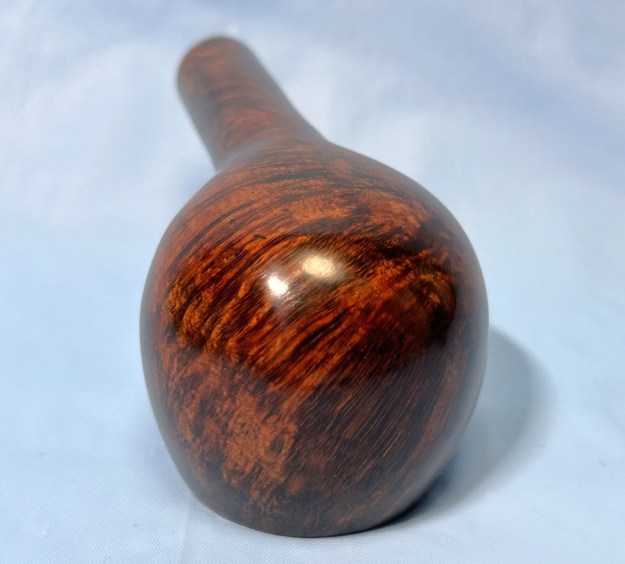
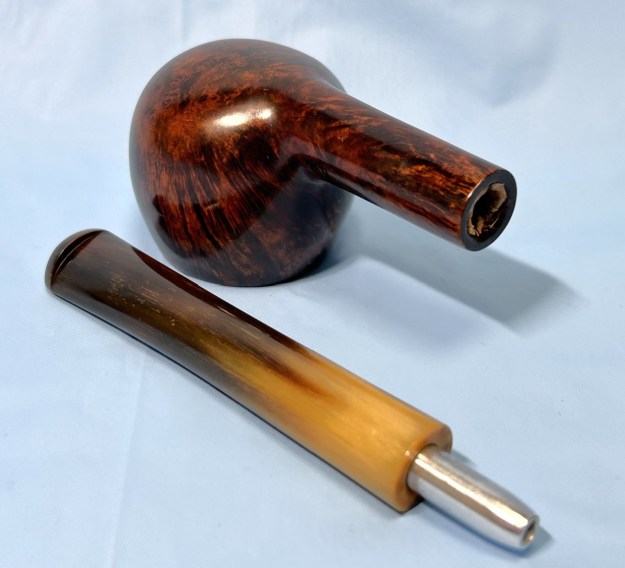
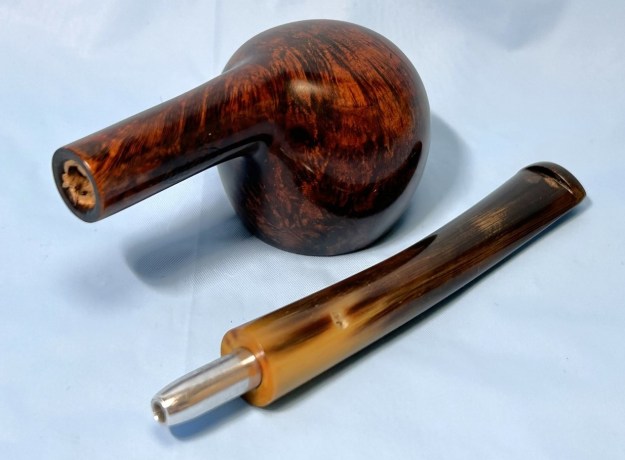
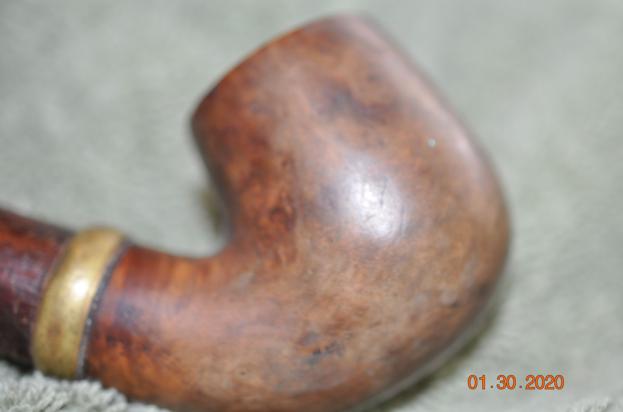
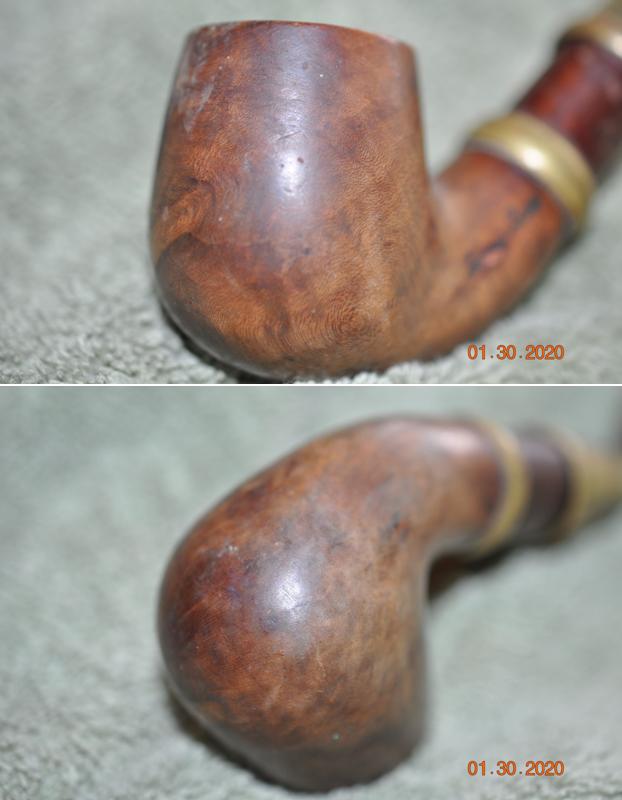
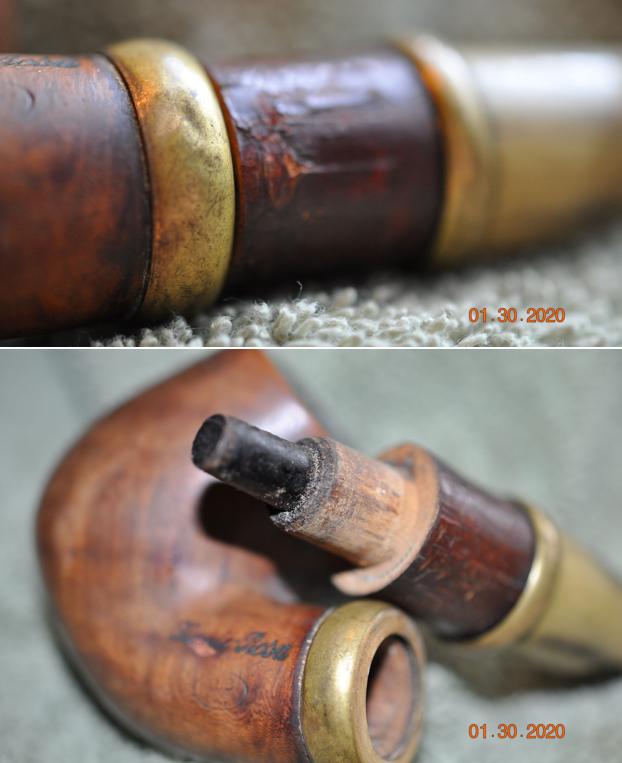
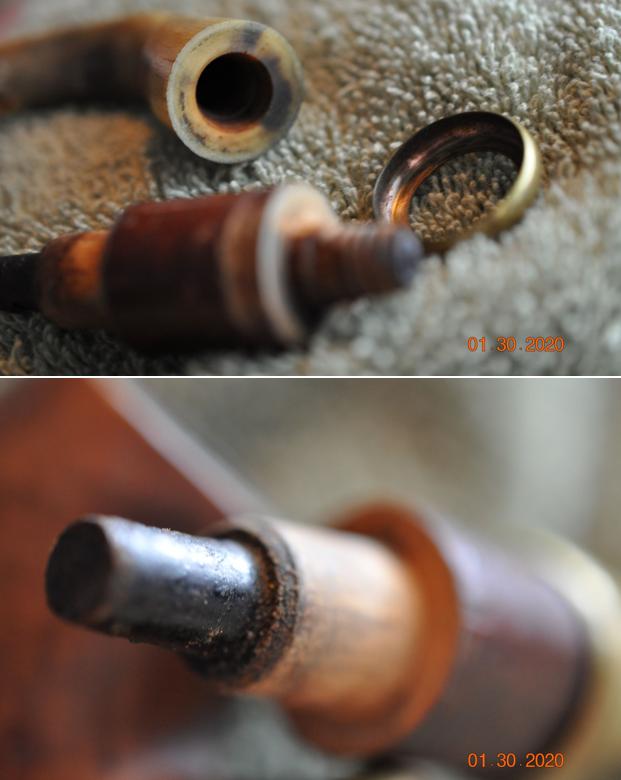
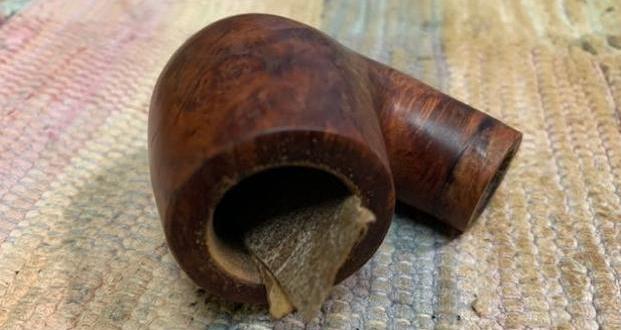
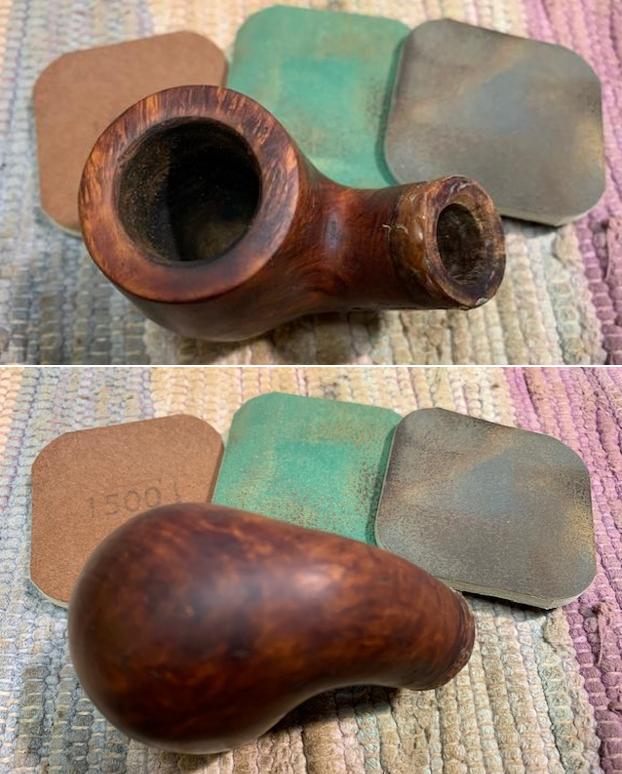
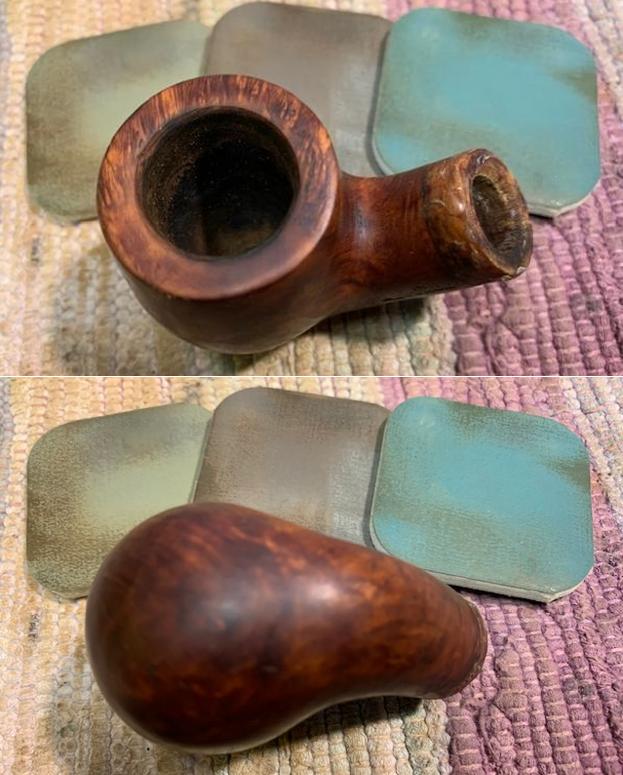
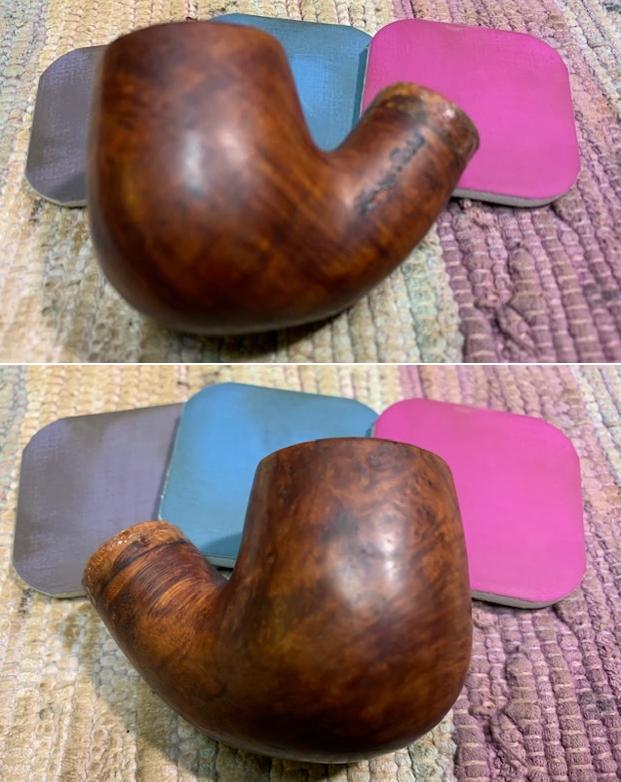
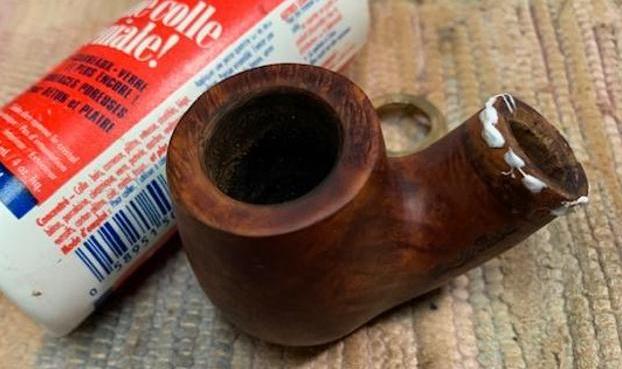
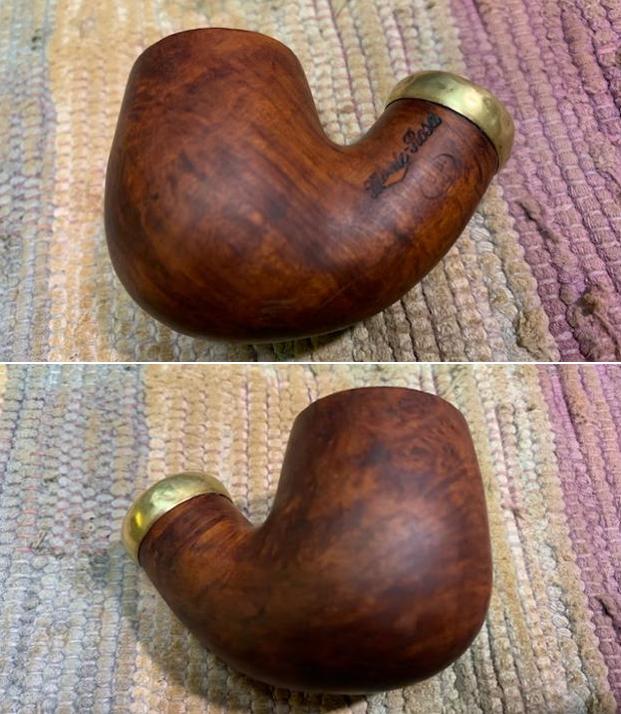
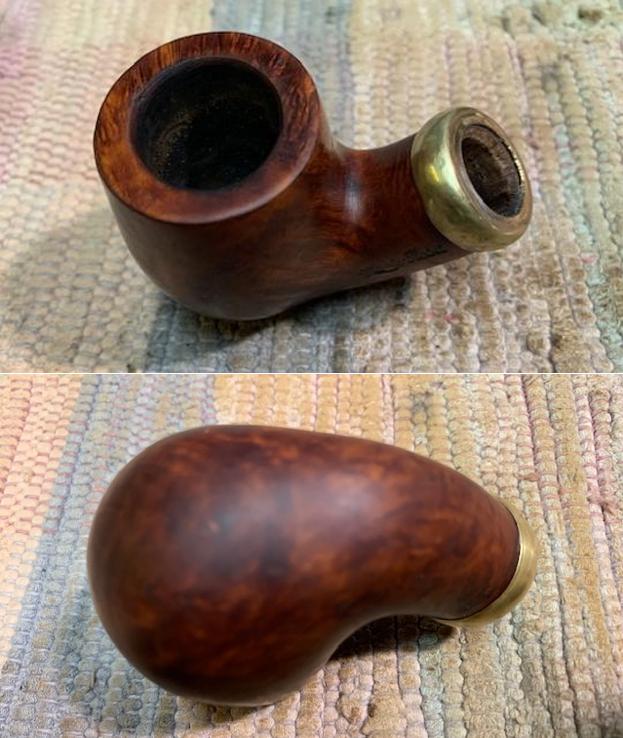
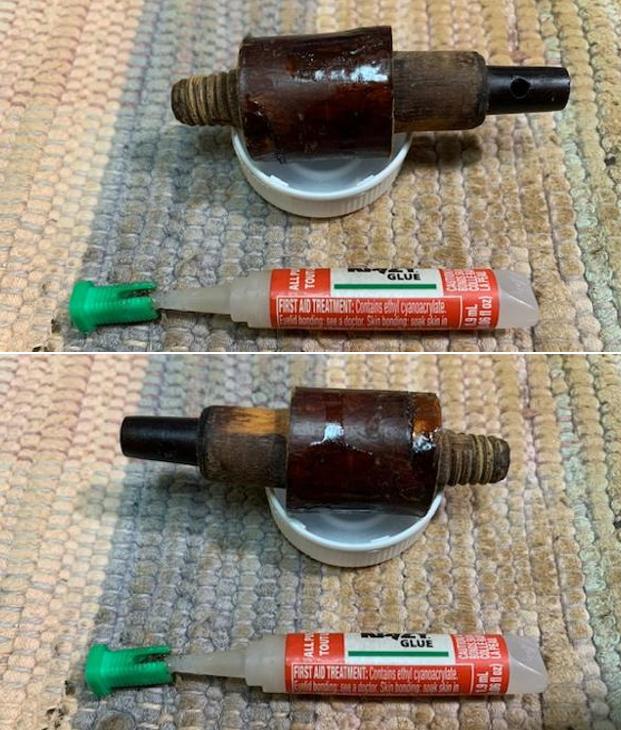
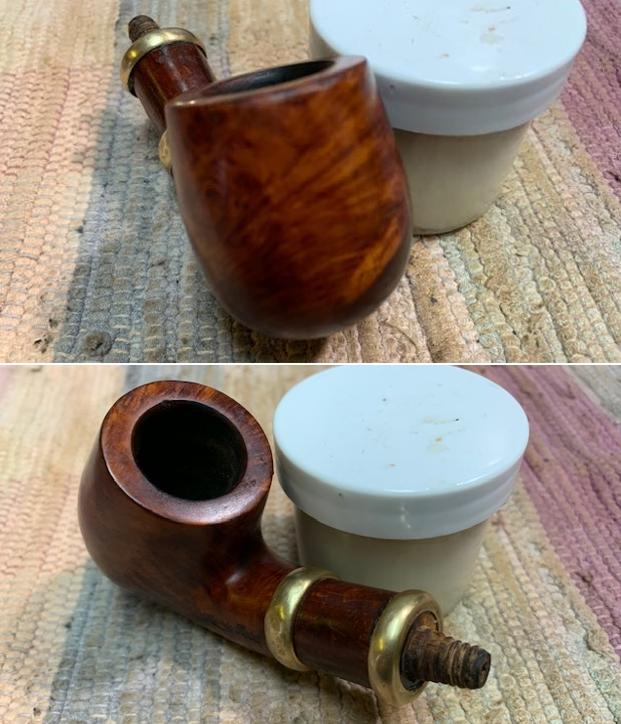
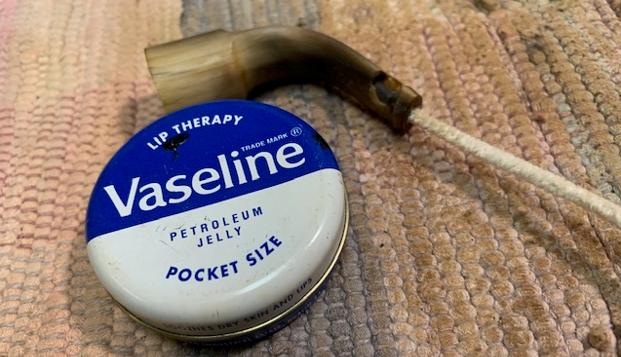
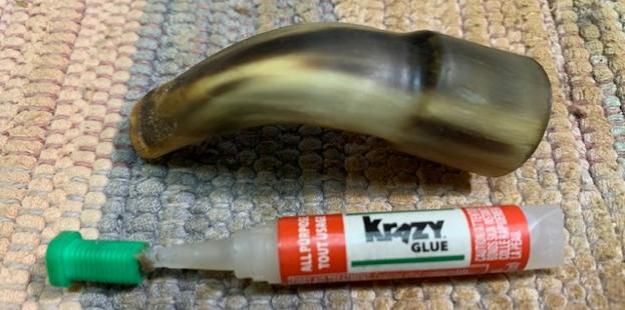
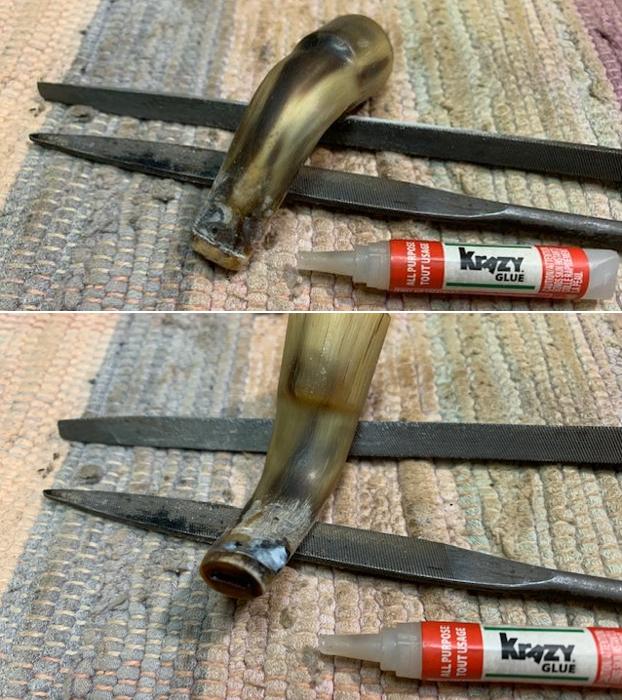
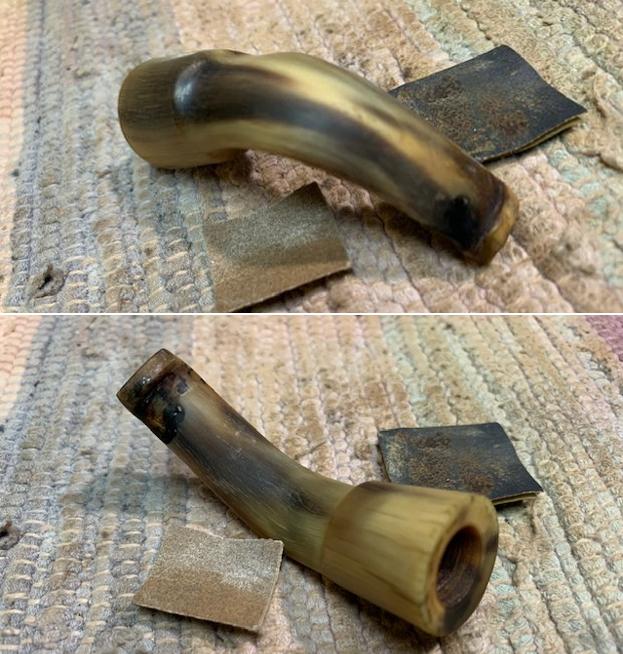
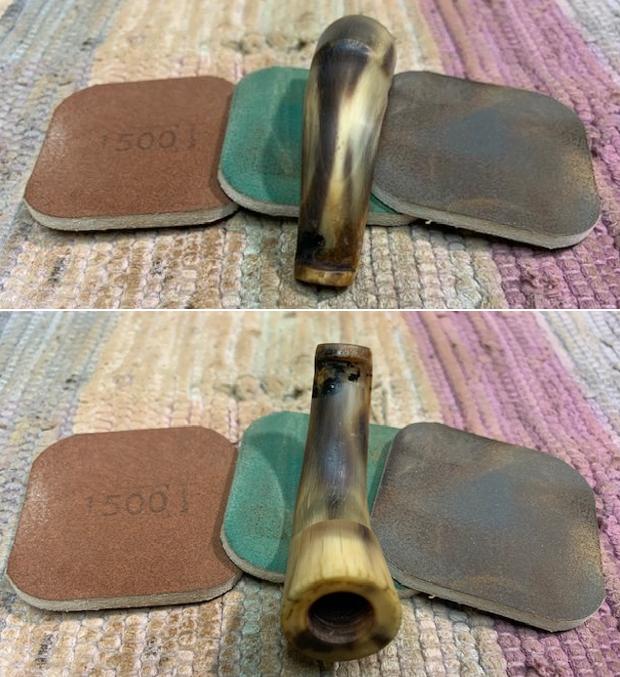
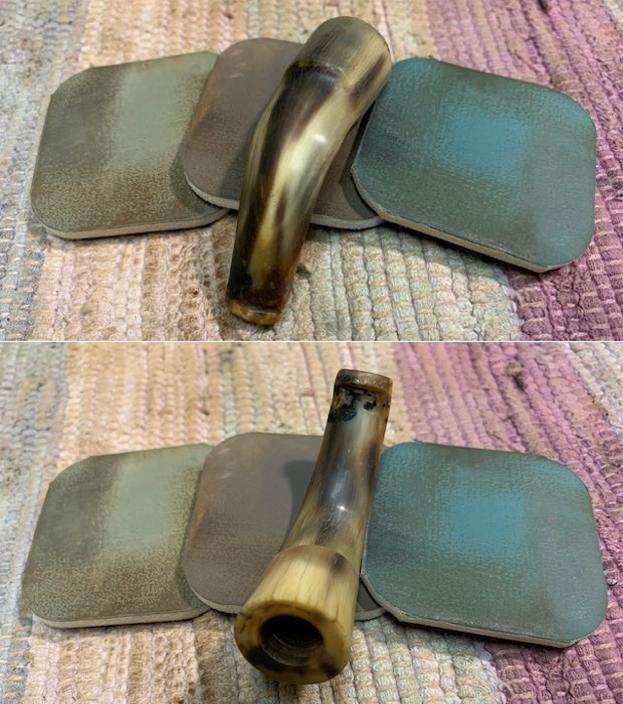
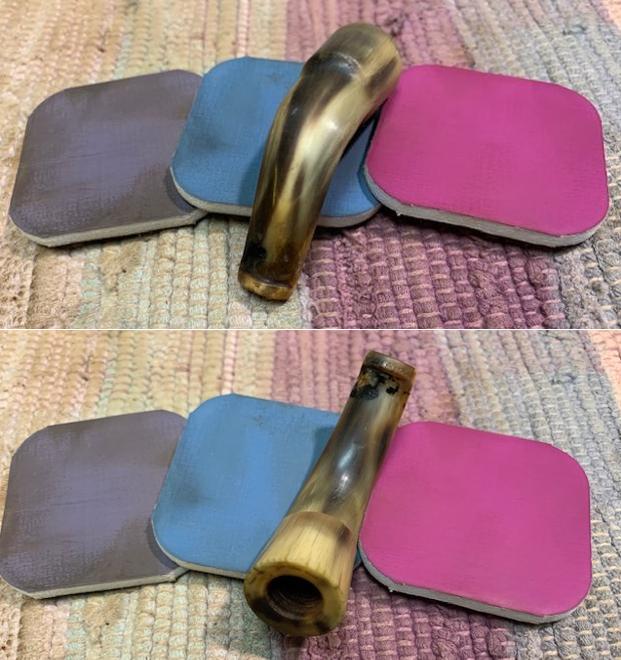
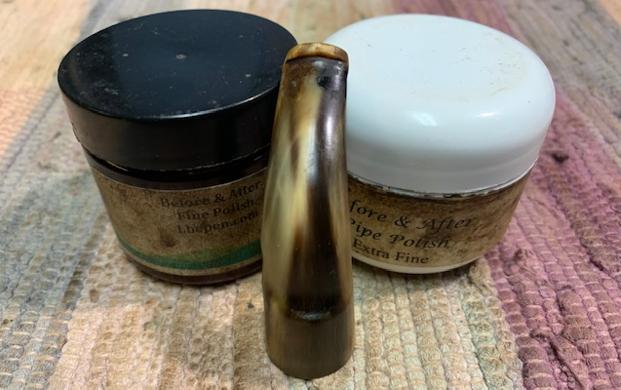
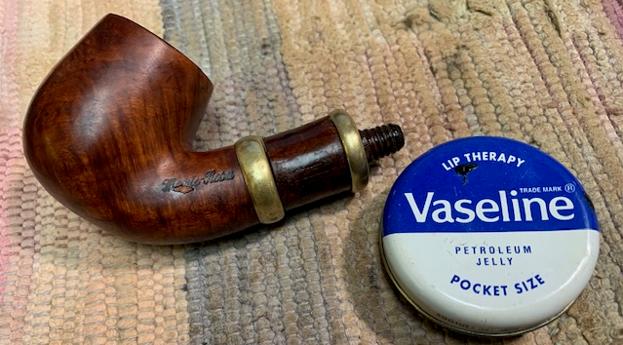
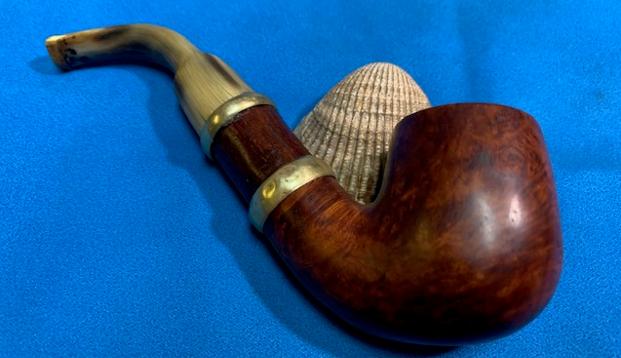
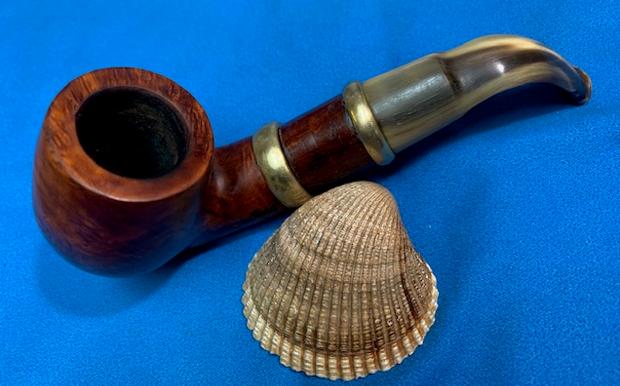
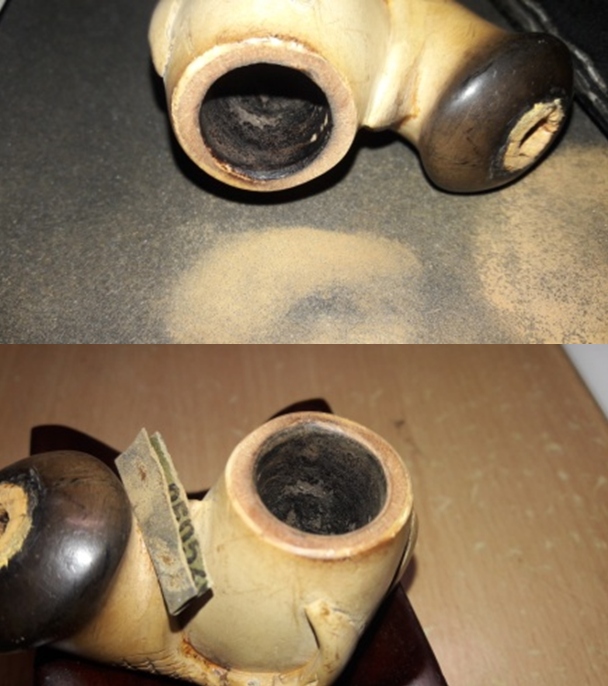
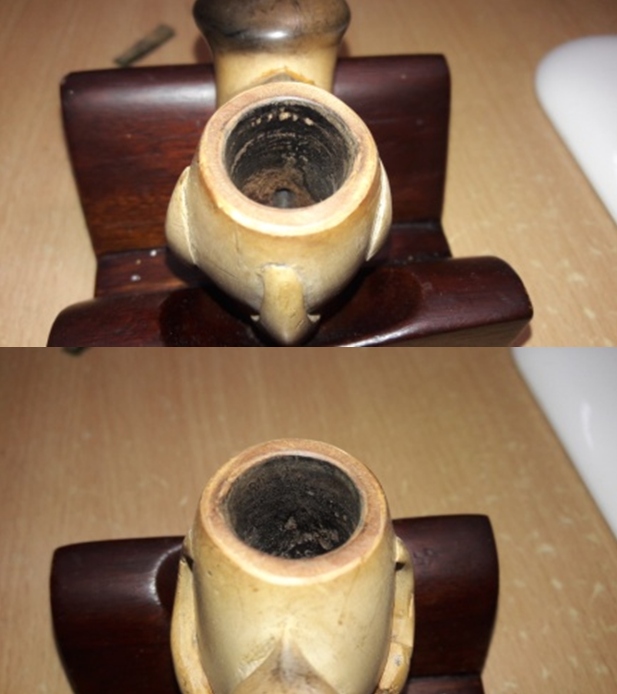
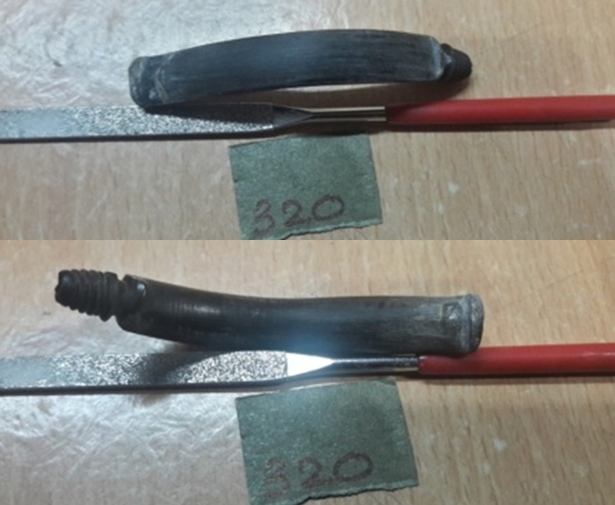
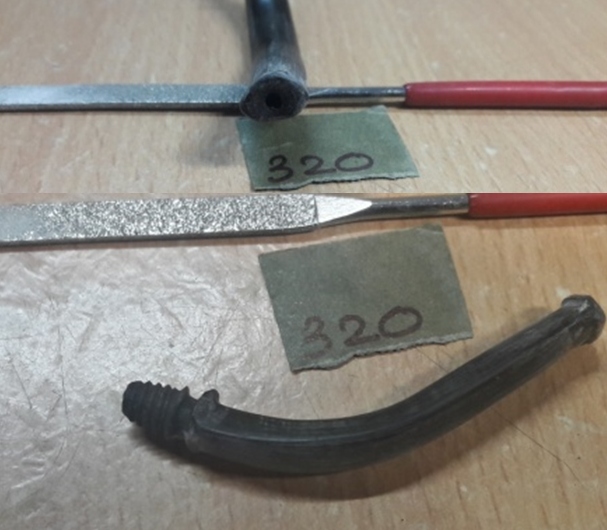
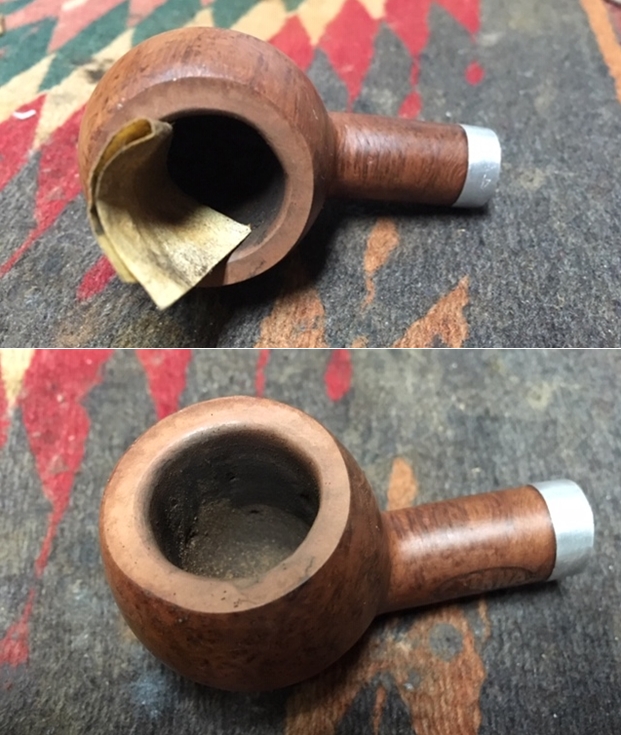
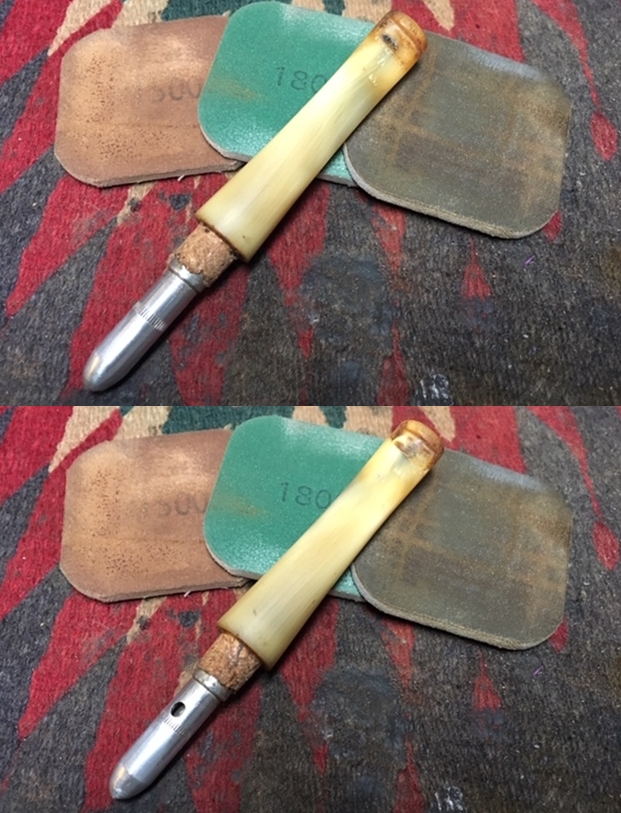
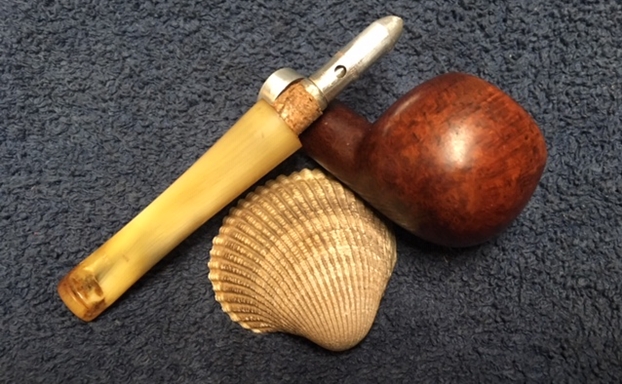
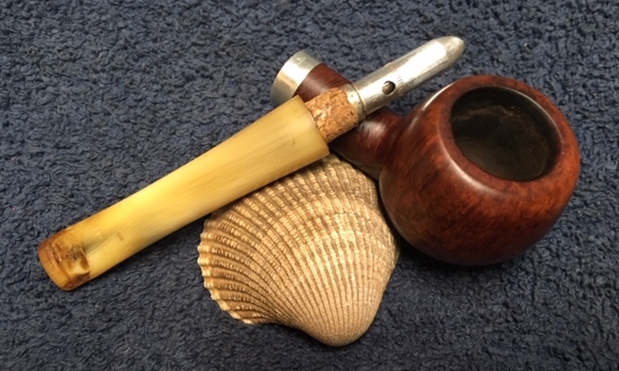
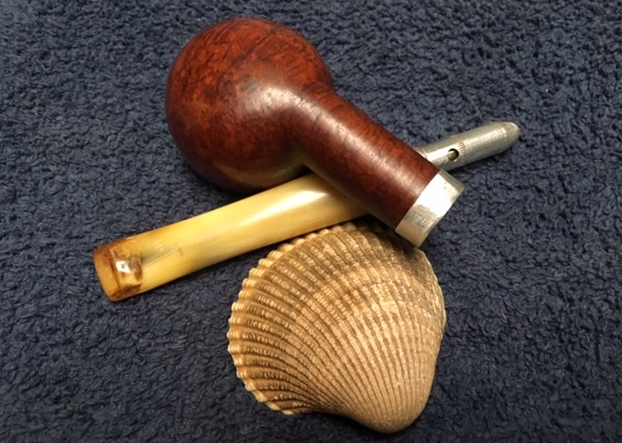
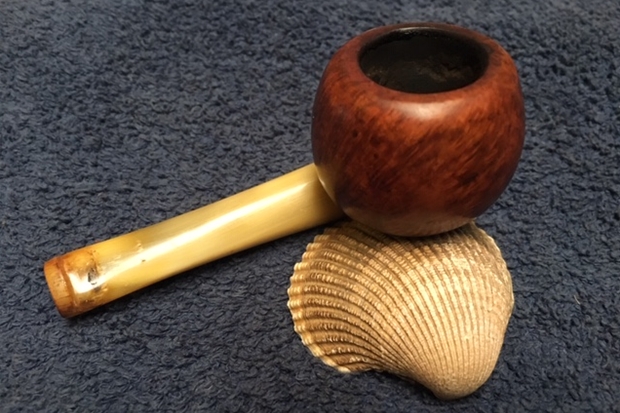
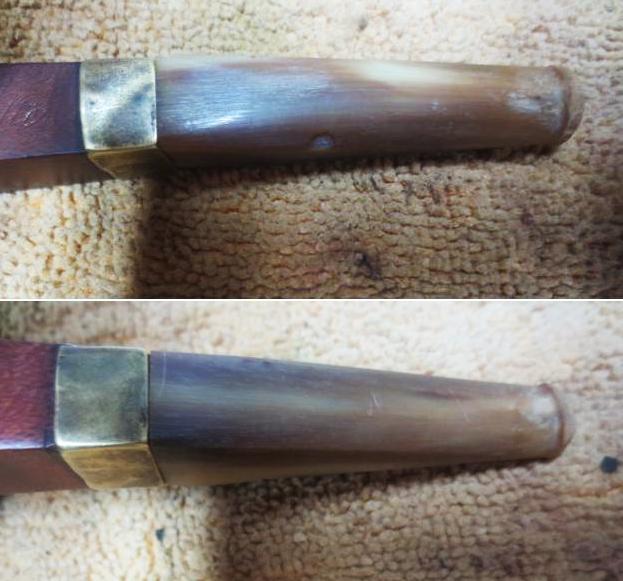
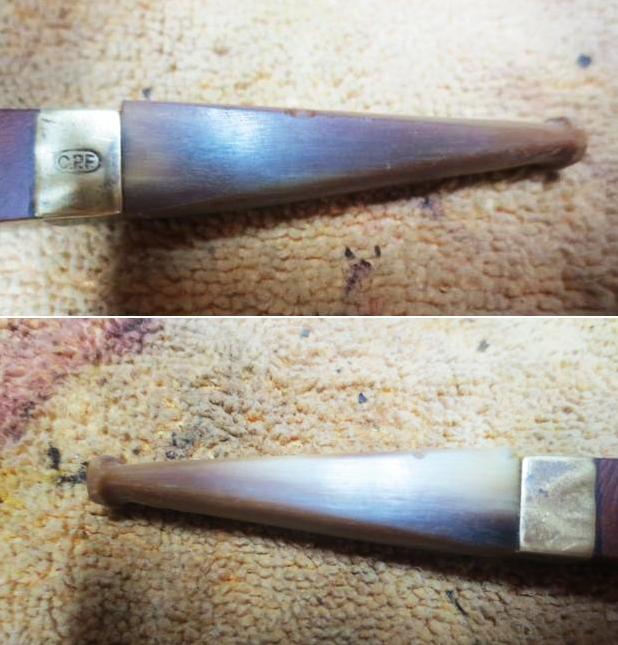
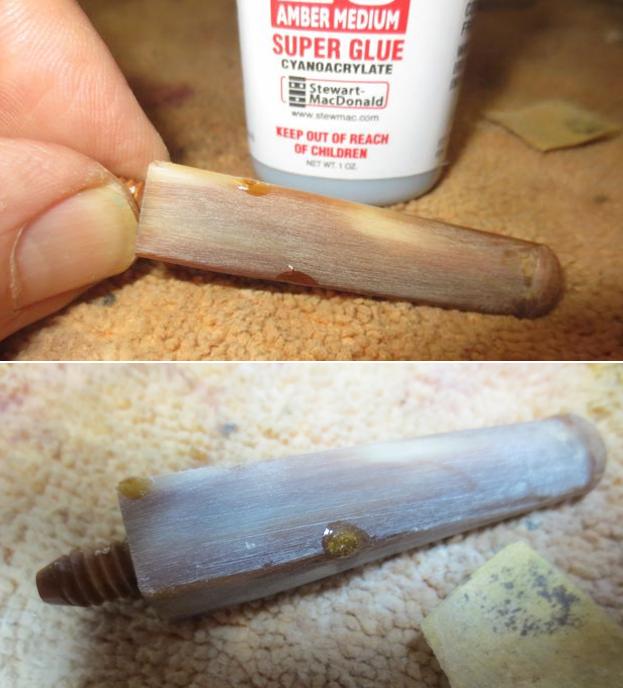
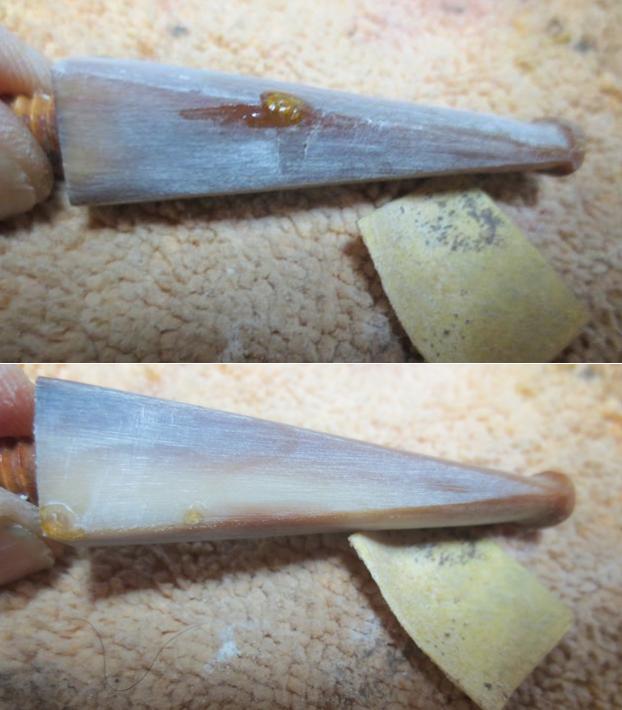
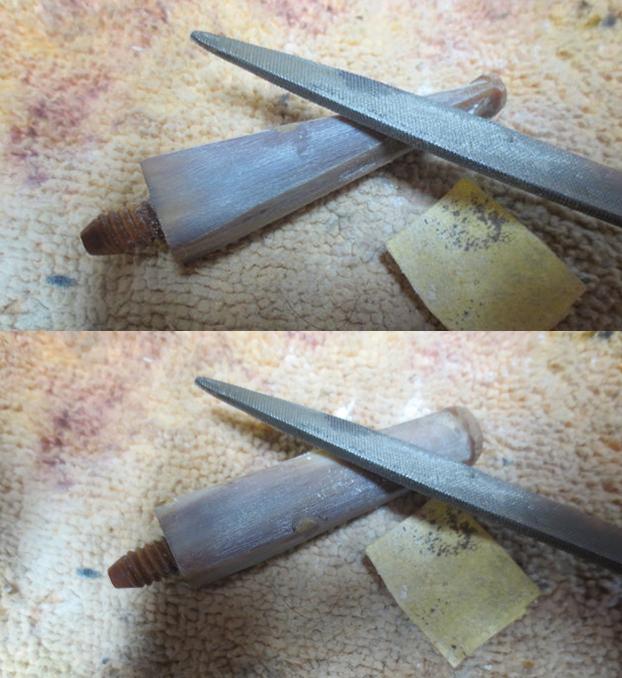
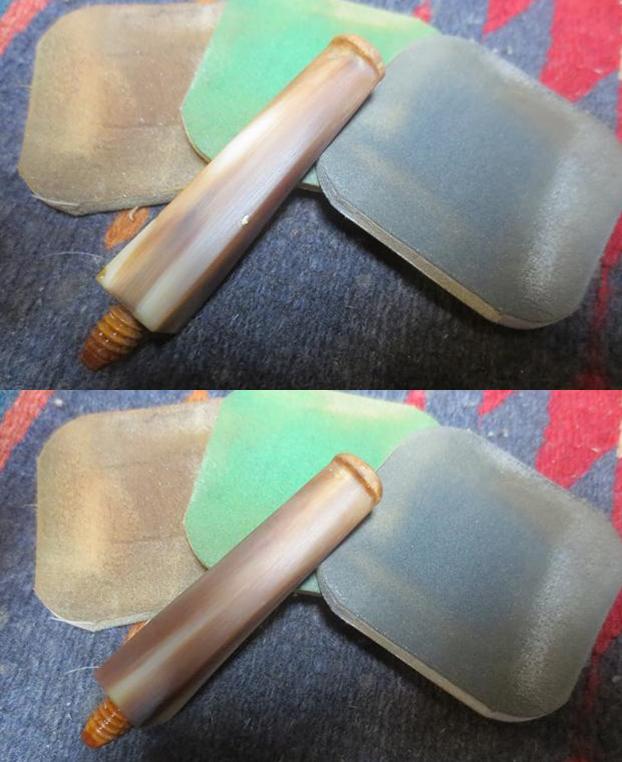
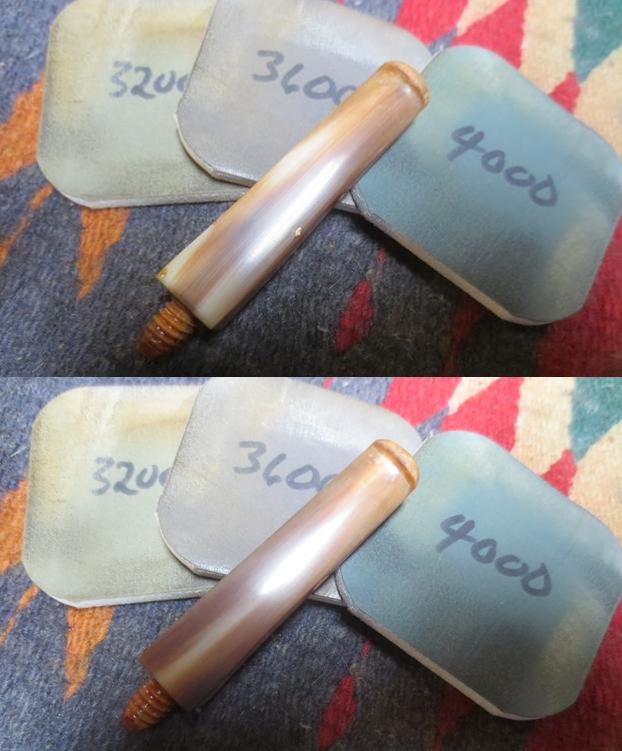
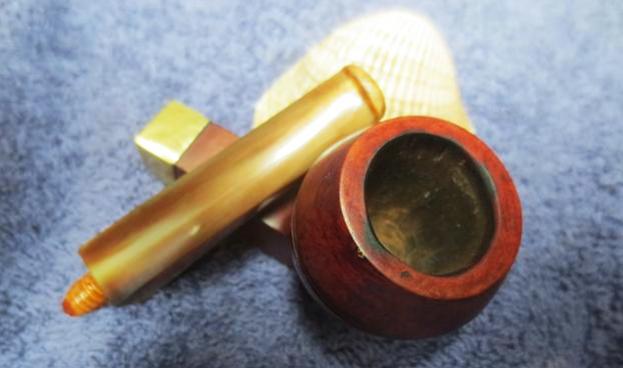
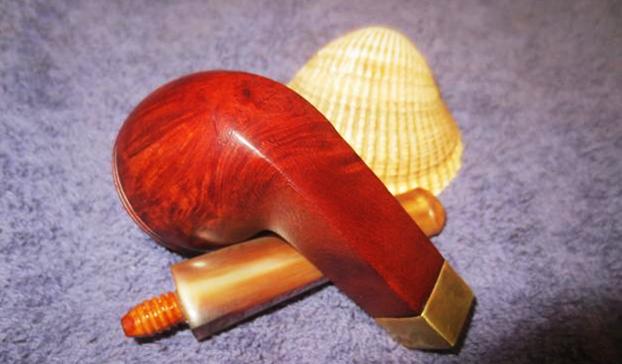
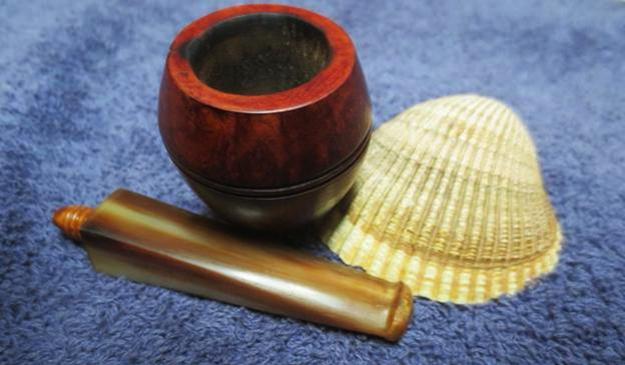
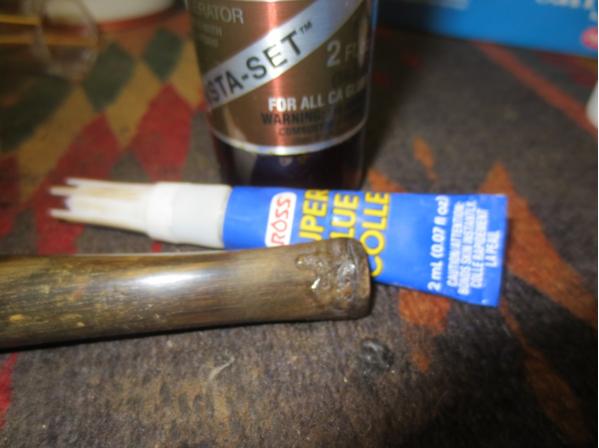
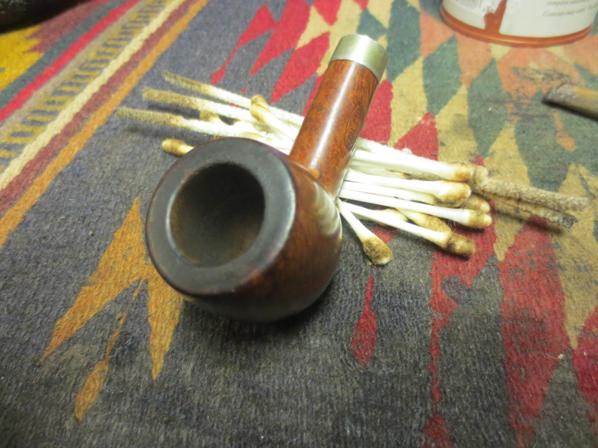
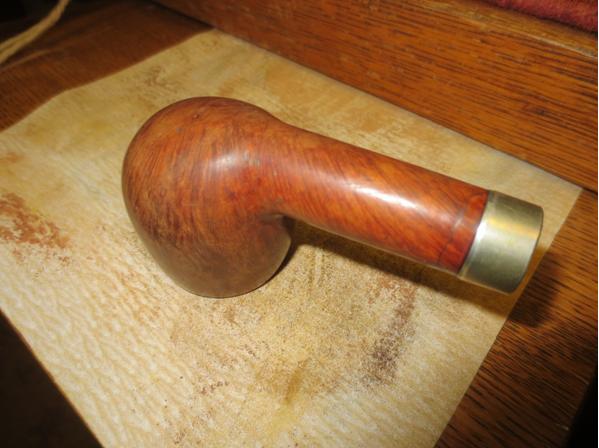
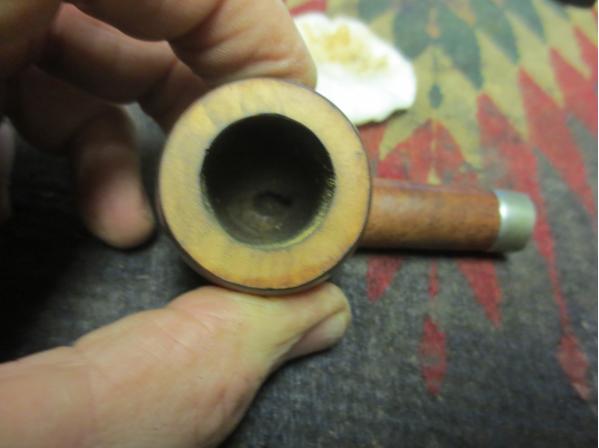
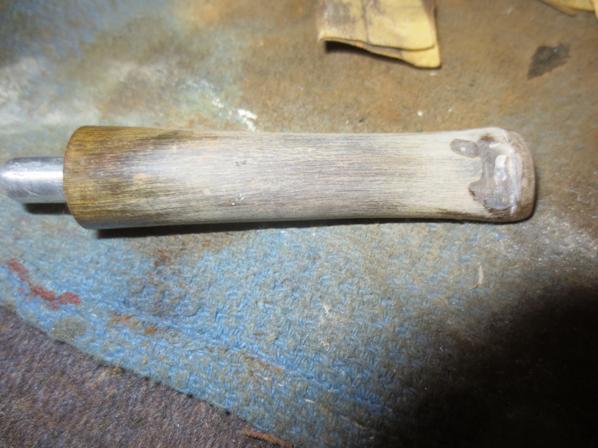
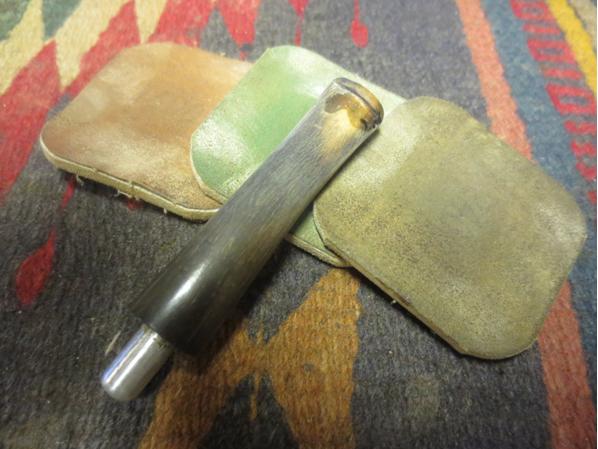
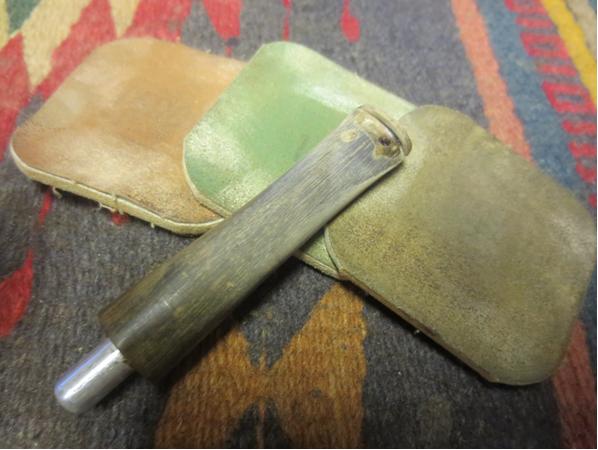
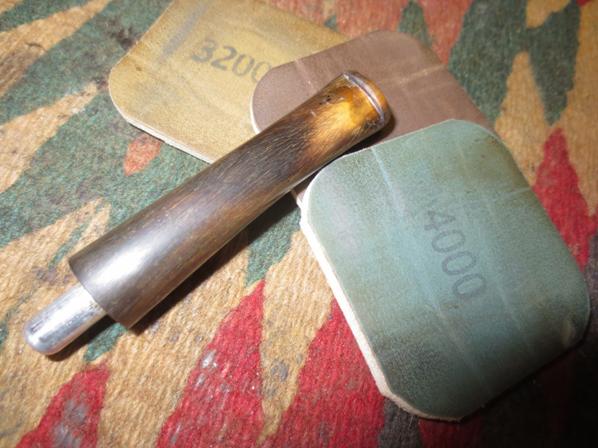
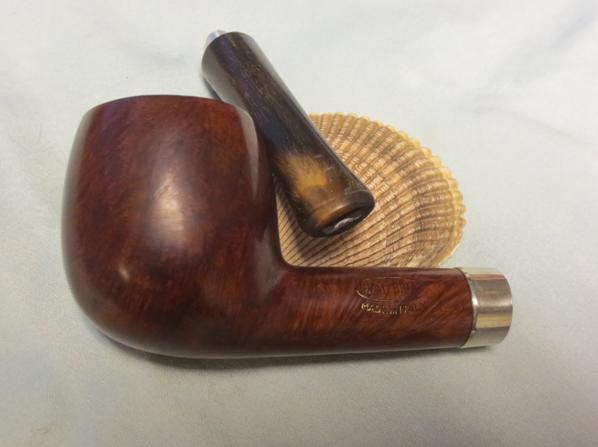
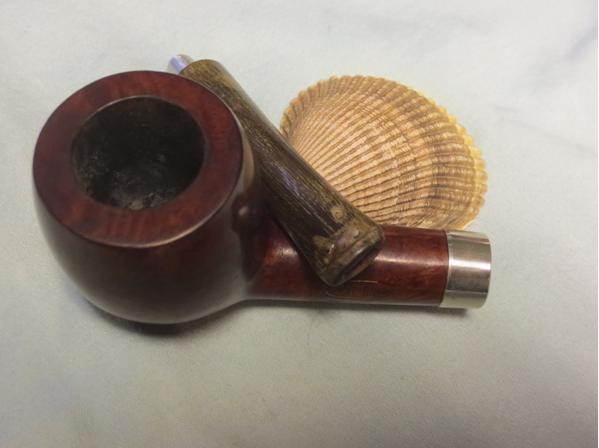
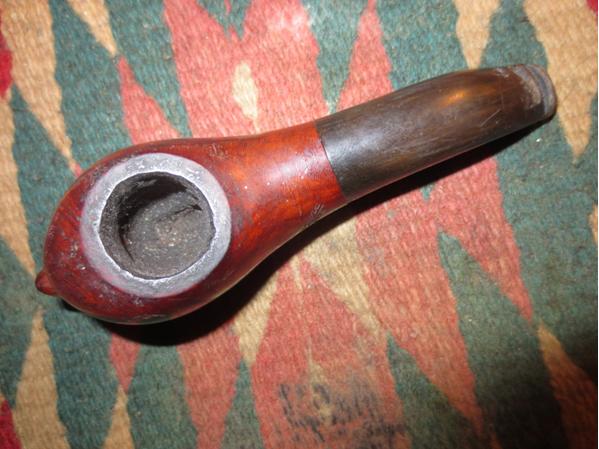
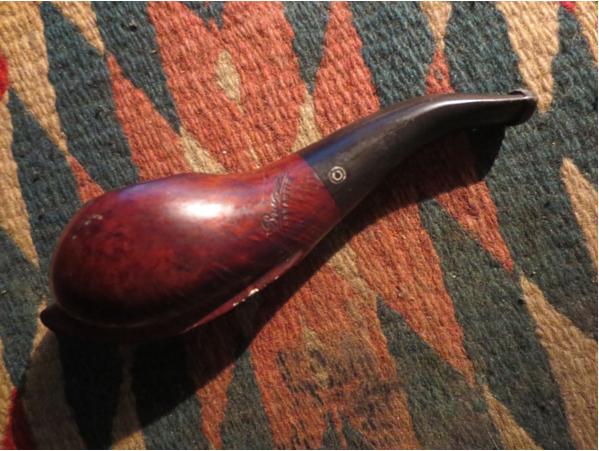
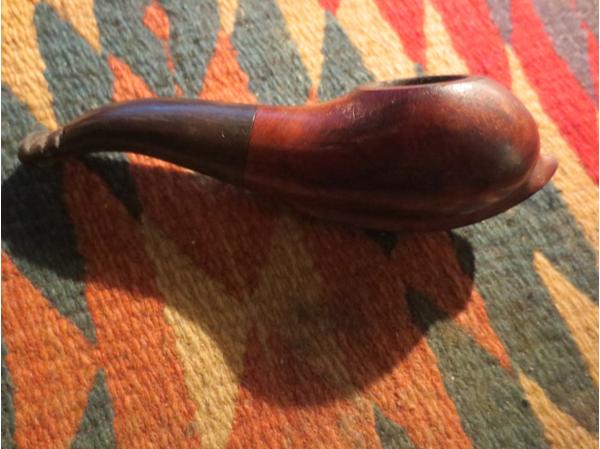
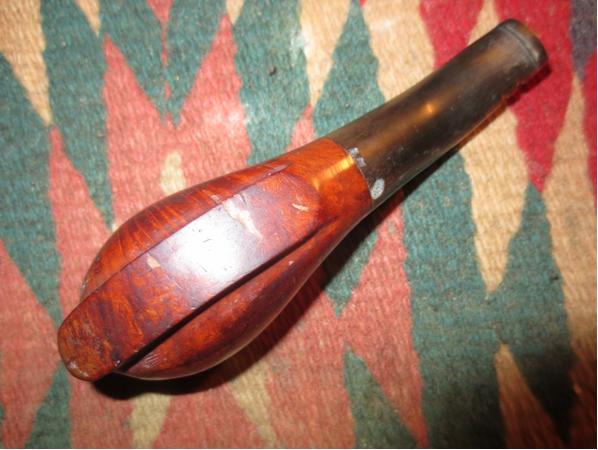
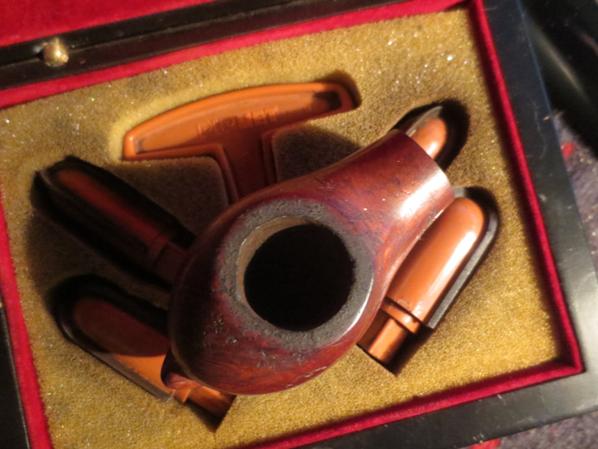
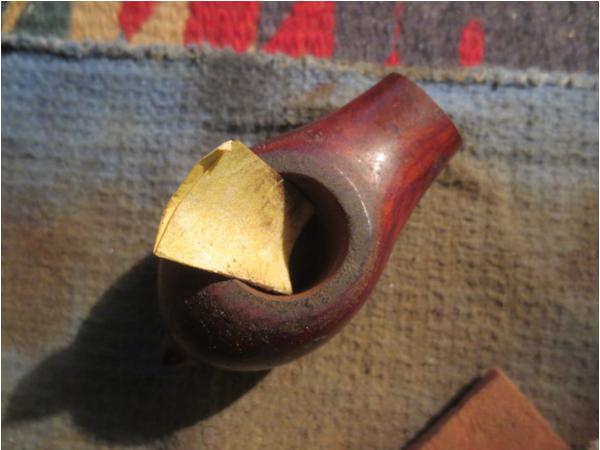
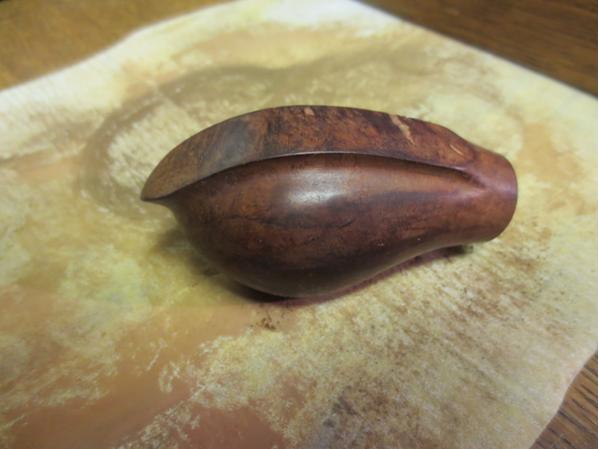
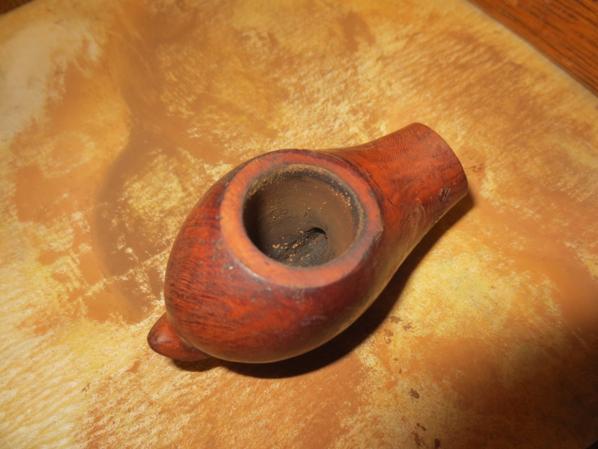
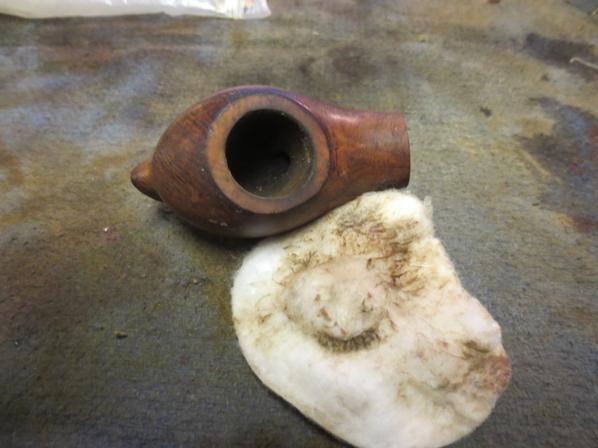
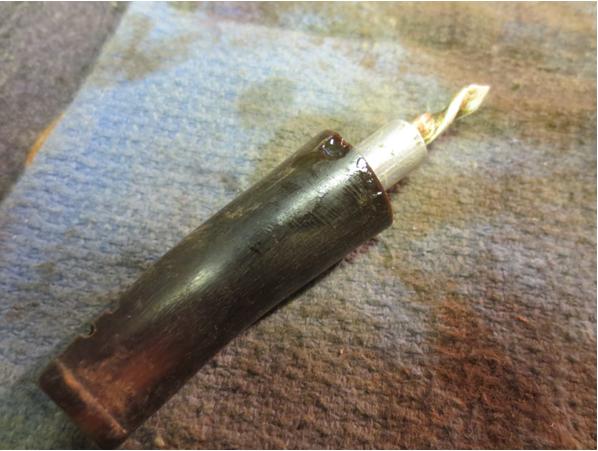
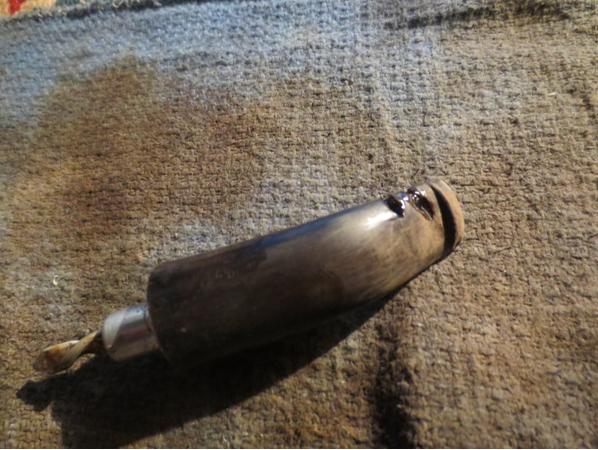
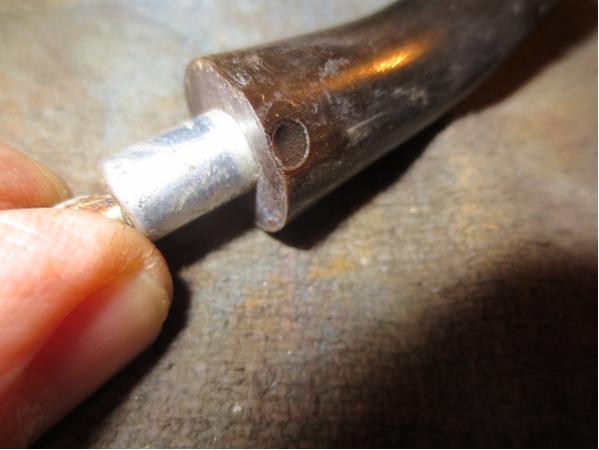
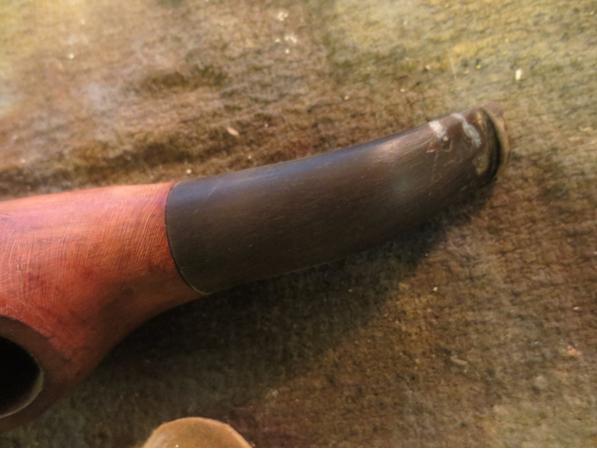
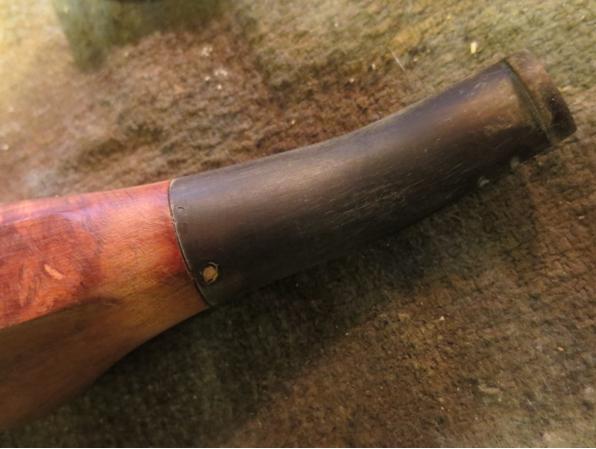
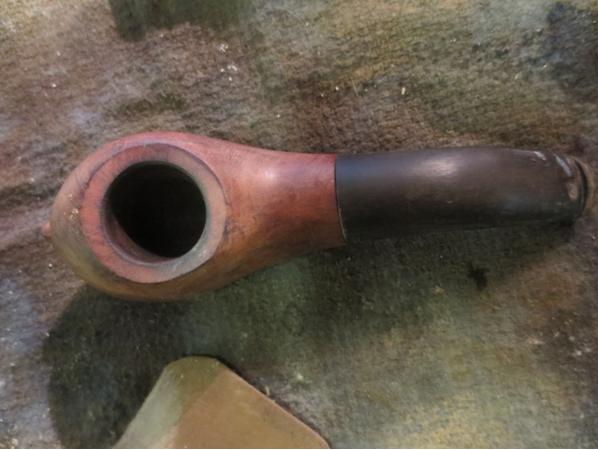
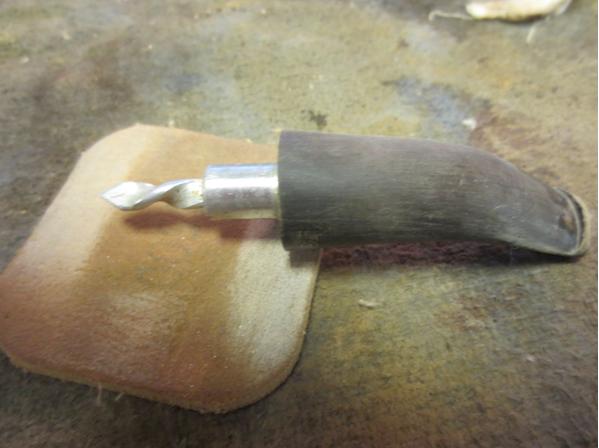
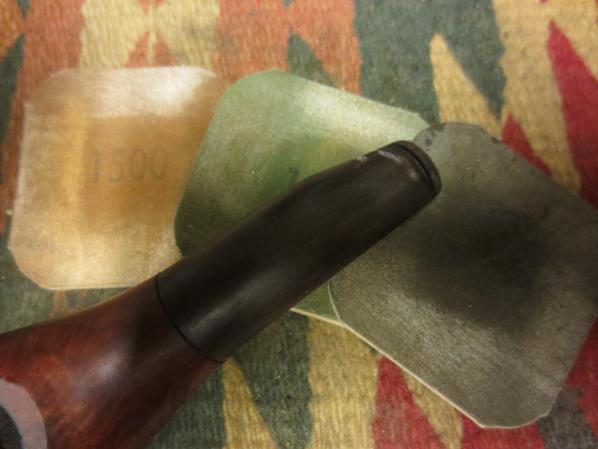
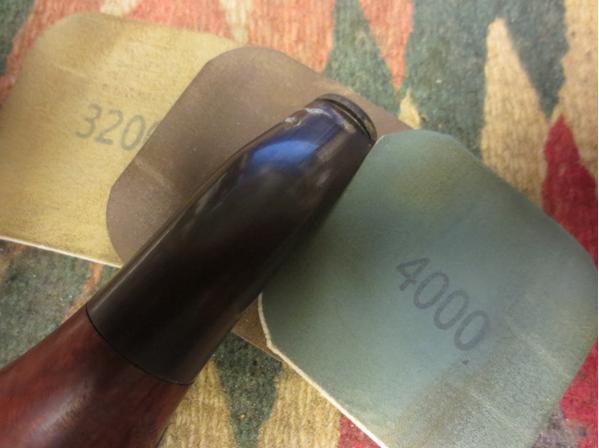
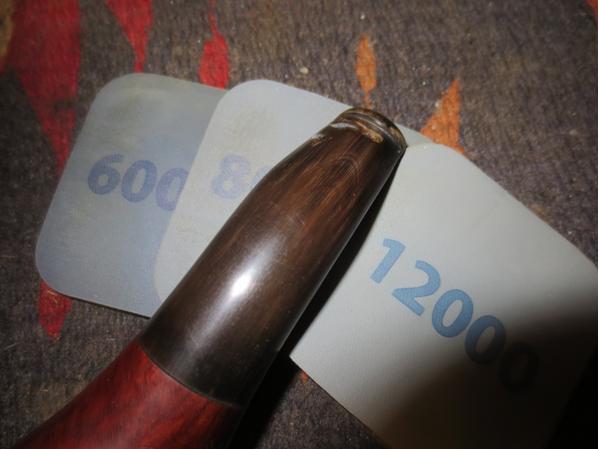
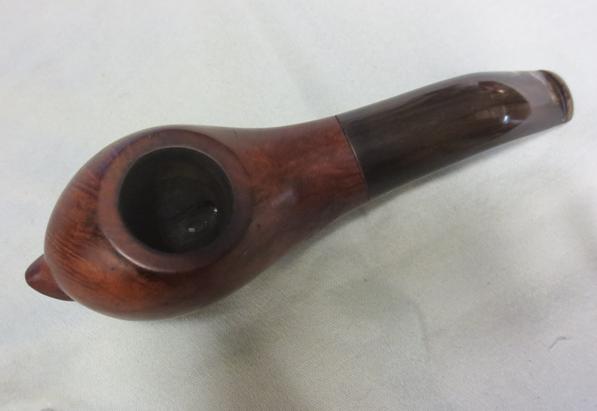
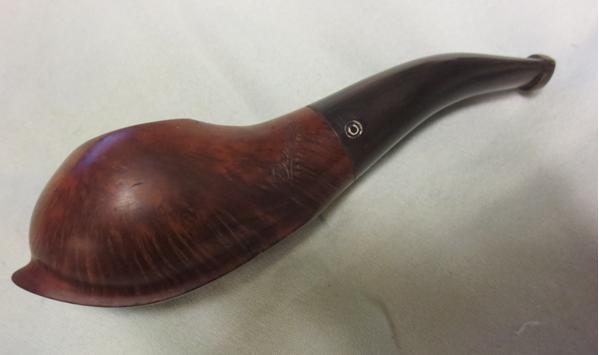
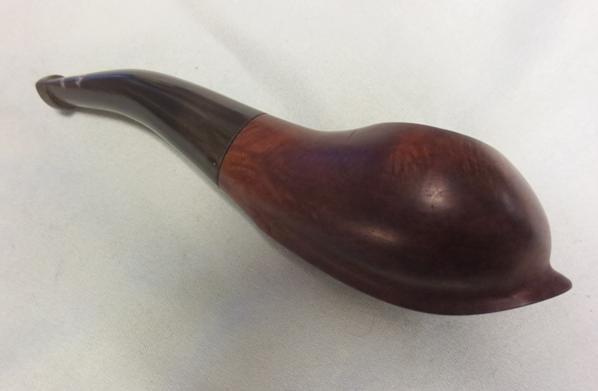
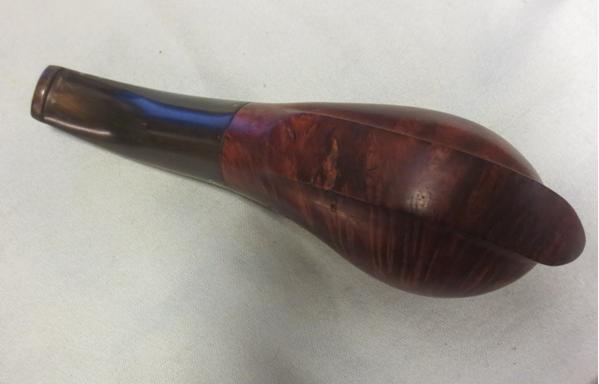
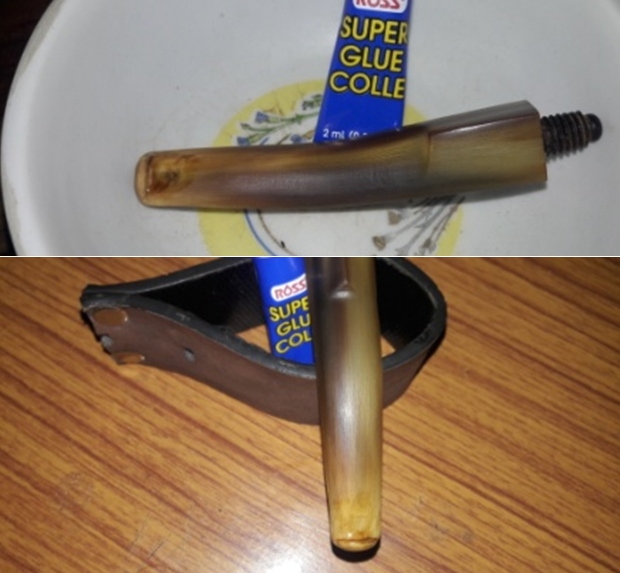
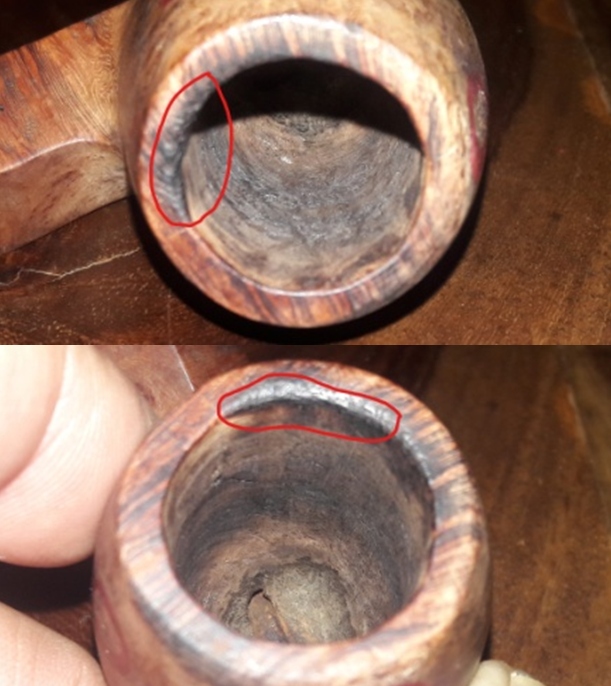
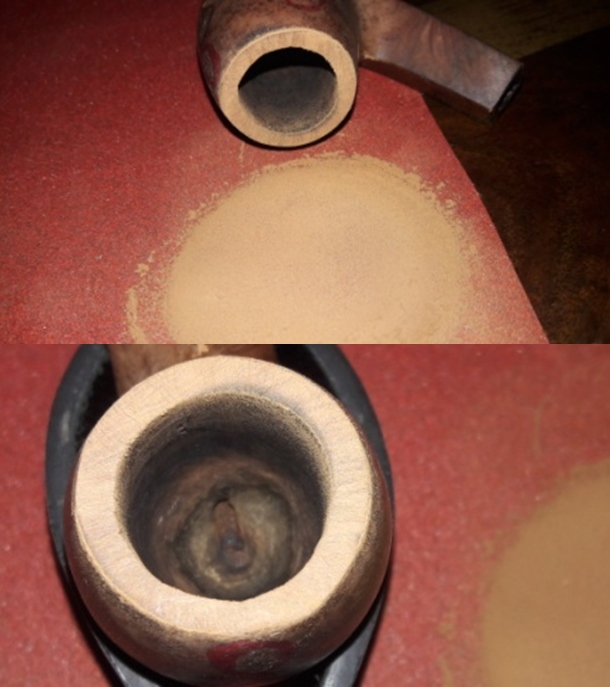
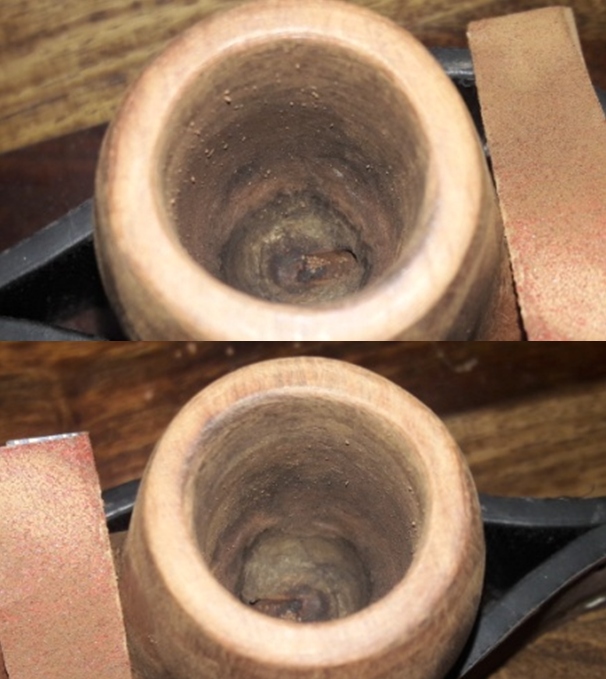
I have had this older meerschaum bowl in my box of pipes to restem for a long time. I have no idea where we picked it up but this older style bowl always catches my attention. The mushroom shaped shank, the patina on the meer and the darkened, or flumed, edge of the bowl all catch my eye. I have worked on quite a few of these in the past and most had cherrywood shanks and horn stems. I was going through my box of bowls the other evening and once again this one really caught my eye. The finish is clean with a very nice patina. The bowl is very clean with no cake build up and appears to have been well maintained. The rim top is clear of debris and lava and the fluming is faded in spots around the top. The shank is also clean and appears to have been cleaned before we set it aside. I don’t know about you all but when you have a lot of pipes to work on sometimes it is easy to forget what has been done on the pipes in boxes. I took some photos of the pipe to give a sense of what it looked like when I removed it from the box. I went through my stems and found a cherrywood shank and horn stem that would work well with the pipe. I would need to glue some cork on the tenon of the stem (normal for this style of shank). The cherrywood was in excellent condition but the stem had some worm damage on the sides and a small split in the underside that would need to be repaired.I gave the cork a coat of clear CA glue and pressed it in place on the shank end. I love working with this glue as it cures quickly and holds very well.I took some photos of the parts of the pipe to show the general proportion of the pipe. You can also see the seams in the cork gasket.  But no worries. I still need to sand down the gasket for a fit in the shank and grease it which will bring the seams together. You can also see the worm damage on the horn stem in the second and third photos below. I used my Dremel and sanding drum to reduce the diameter of the cork gasket until it fit well in the shank ed of the bowl.I used some Vaseline petroleum Jelly to soften and preserve the cork gasket. I worked it into the cork with my finger tips and let it sit. I repeated the process and once finished the cork was soft and pliable. It fit well in the shank and was snug and solid.I screwed the stem on the shank to give a sense of what the pipe would look like once finished. I like the look and feel of this one. I touched up the black flume to the rim top with a black Sharpie Pen. I coloured in the edge and the spots on the rim top and inner edge until it was blended in.I gave the bowl multiple coats of Clapham’s Beeswax/Carnauba wax. I applied it by hand and let it cure then buffed it off with a soft cloth to raise a shine. I removed the stem from the cherrywood shank and set the bowl and shank aside. It was time to address the worm damage in the horn stem. I have circled the damaged areas in red in the photos below. I filled in the split on the underside of the stem and the worm damage spots on each side with clear CA glue. I layered it into he damaged areas until it was smooth. Once the repair cured I shaped and flattened the repairs with a small file. I worked over the shape with a folded piece of 220 grit sandpaper. I wanted the edges and surfaces to be smooth. I sanded the stem with 320-3500 grit sanding pads. I wiped the stem down after each sanding pad to remove the sanding debris and dust. The stem looked very good. I polished the stem with micromesh sanding pads – 1500-12000 grit pads. I wiped it down with an Obsidian Oil cloth after each sanding pad.  I finished polishing it with Before & After Pipe Stem Polish – both Fine and Extra Fine and buffed it off with a cotton cloth. I gave it a coat of Obsidian Oil to preserve and protect the stem. This Old Apple Meerschaum with its new Cherrywood and Horn Stem is a great looking pipe now that it has been restored. The patina on the waxed meerschaum gives a sense of depth to the pipe. The flume on the rim and down the outer edge of the bowl is a nice touch. The Cherrywood shank and the rebuilt horn stem go well with this older classic bowl. I carefully buffed the parts of the pipe with Blue Diamond on the buffing wheel. I gave the bowl and the stem multiple coats of Clapham’s Beeswax carefully buffed the entire pipe with a clean buffing pad. I hand buffed the pipe with a microfiber cloth to deepen the shine. The finished Old Apple Meerschaum with its new Cherrywood and Horn Stem fits nicely in the hand and feels great. Give the finished pipe a look in the photos below. The dimensions of the pipe are Length: 7 inches, Height: 1 ¾ inches, Outside diameter of the bowl: 1 ¼ inches, Chamber diameter: ¾ of an inch. The weight of the pipe is 57 grams /1.98 ounces. I will be adding it to the rebornpipes online store in the Meerschaum Pipe Section shortly. Send me an email or a message if you wish to add it to your collection.

As always, I encourage your questions and comments as you read the blog. Thanks to each of you who are reading this blog. Remember we are not pipe owners; we are pipe men and women who hold our pipes in trust until they pass on into the trust of those who follow us.

Resuscitating Prince Charming


by Kenneth Lieblich

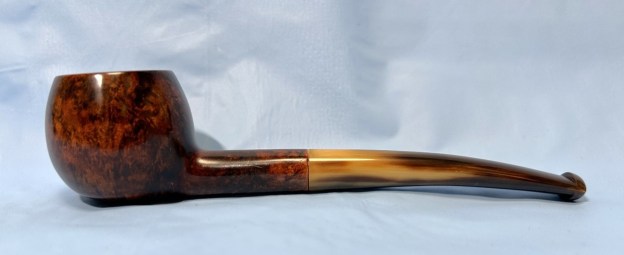
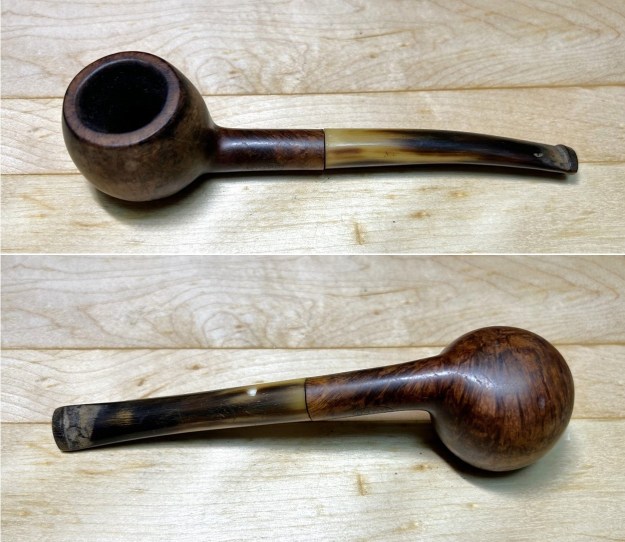
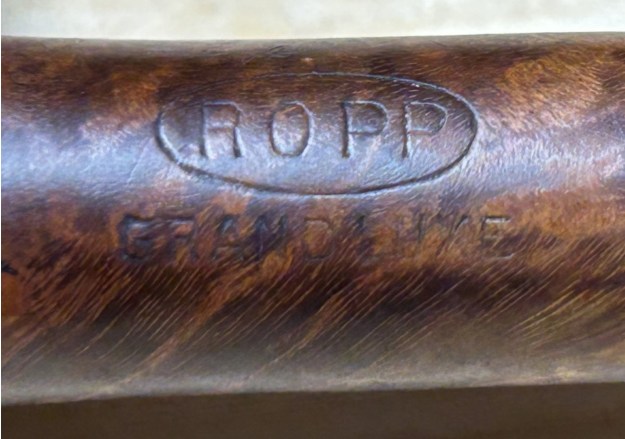
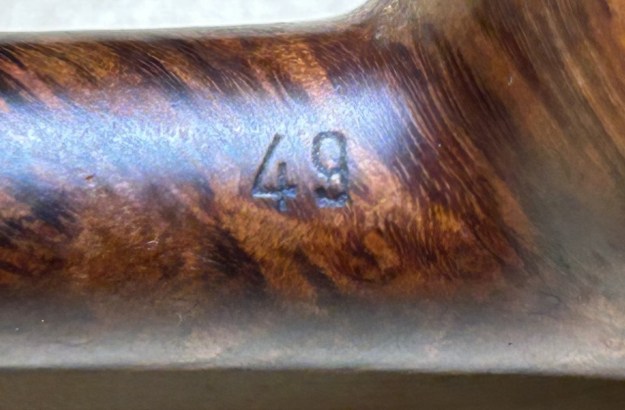
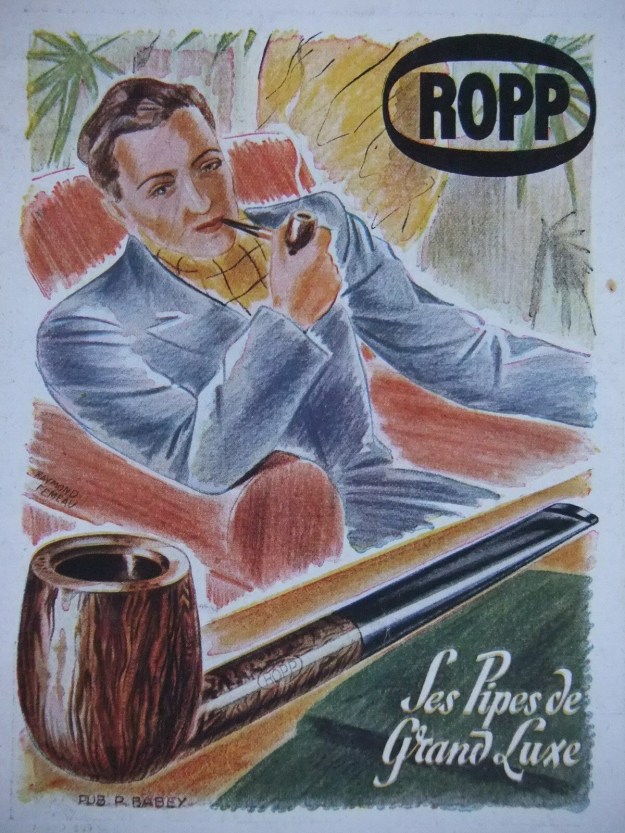
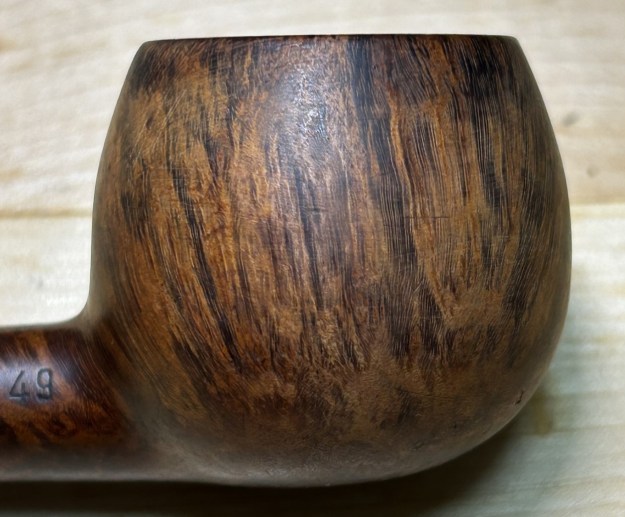
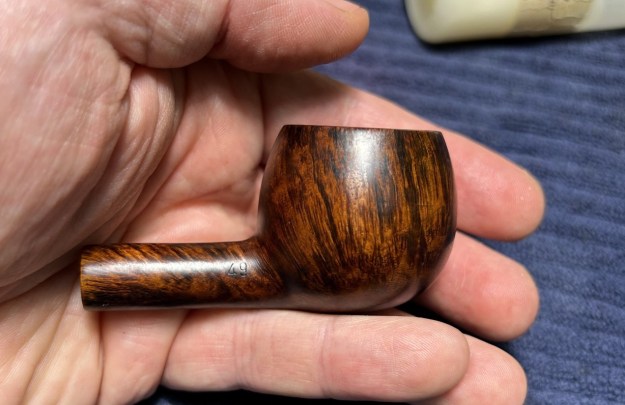
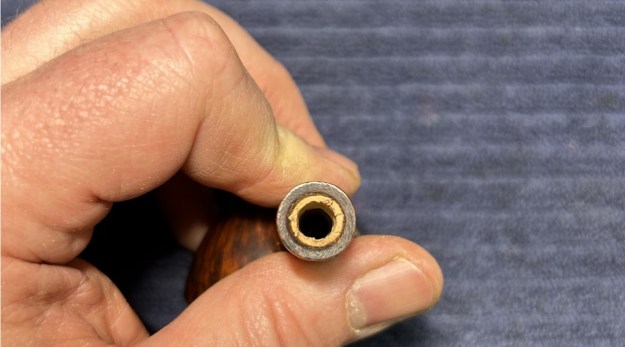
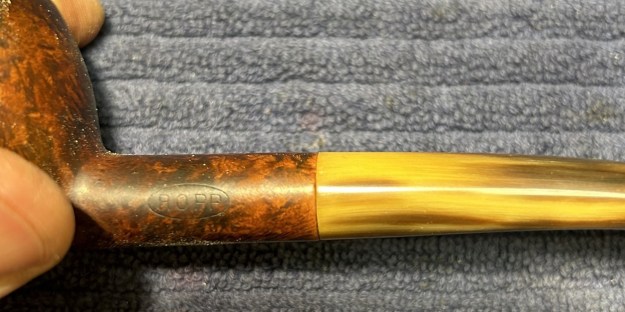
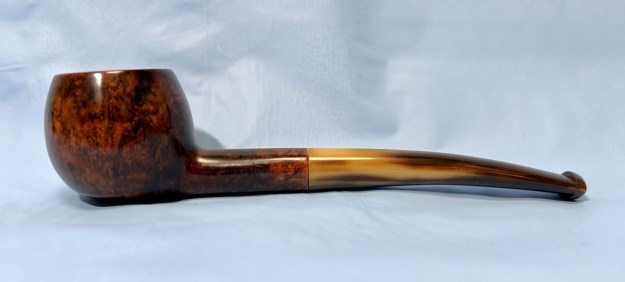
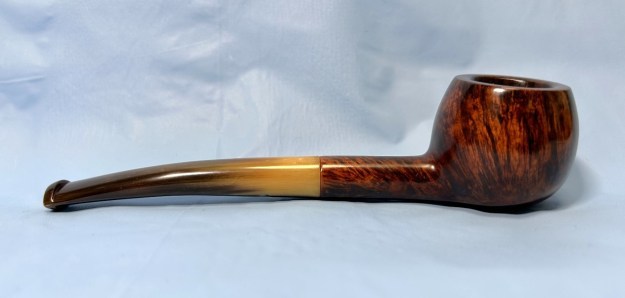
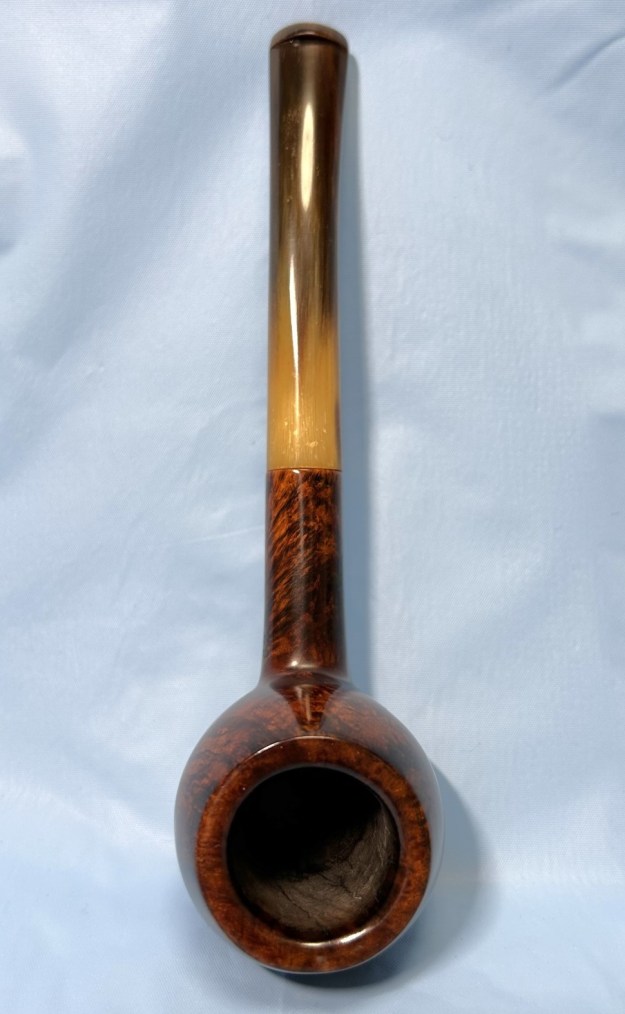
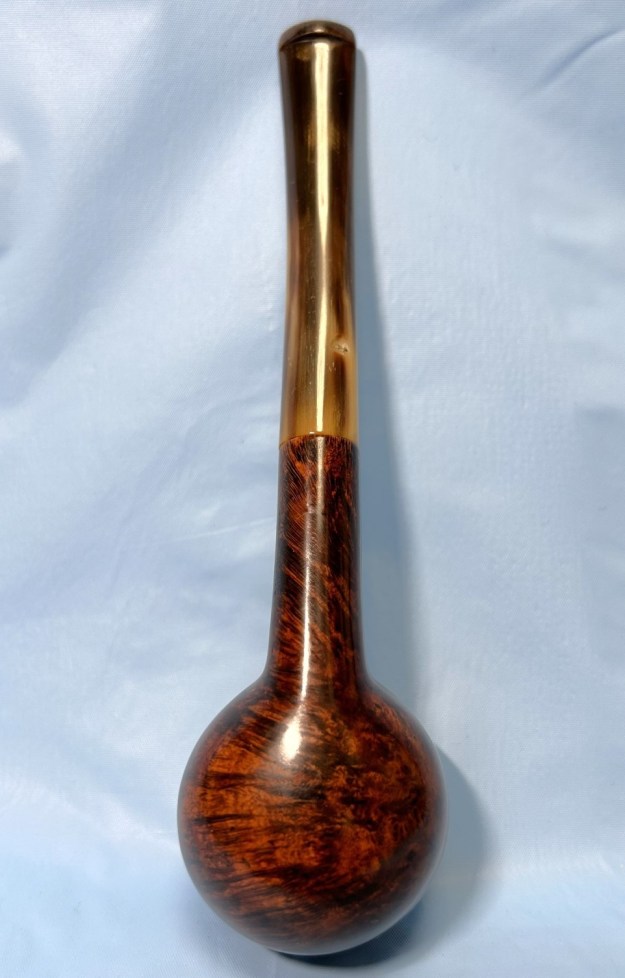
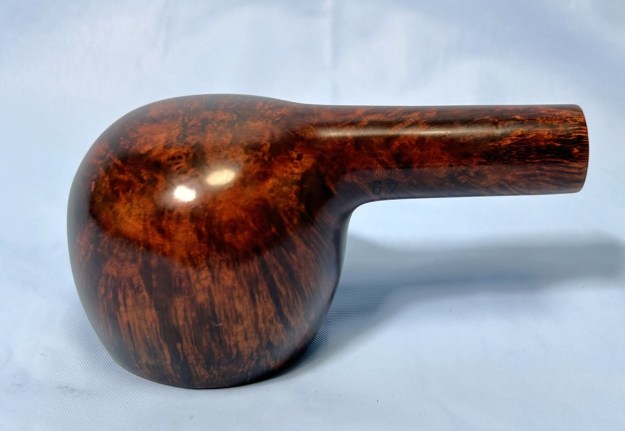
Next on the chopping block is this charming Ropp Grand Luxe 49. It is another pipe in my ongoing “French Collection” and it comes from a group of pipes I purchased recently. I have a particular interest in French pipes and pipeworks, and I grabbed this one to restore since I thought it was quite handsome. This is an old timer with a few wounds and needs just a little help to come back to life. This pipe was made by the venerable French pipe company, Ropp. Ropp has been around for a long time and their early pipes are really quite wonderful. The markings on the left-hand side of the shank read Ropp [over] Grand Luxe. The right-hand side of the shank reads 49, the shape number. There are no other markings. This pipe shape is a prince – a shape I love. This is a really pretty pipe and feels very comfortable in the hand. The stummel is a very nice piece of briar and the stem is made of buffalo horn – which tends to suggest an older piece. The stem has a tenon made of metal – not bone – and a cork-lined mortise. I remember Steve telling me that the fact the tenon is in metal (instead of bone) suggests a date around World War II. The stem has a normal, wide button – not an orific button. This all fits the date quite well.From Pipedia, here is a very brief history of the Ropp company:

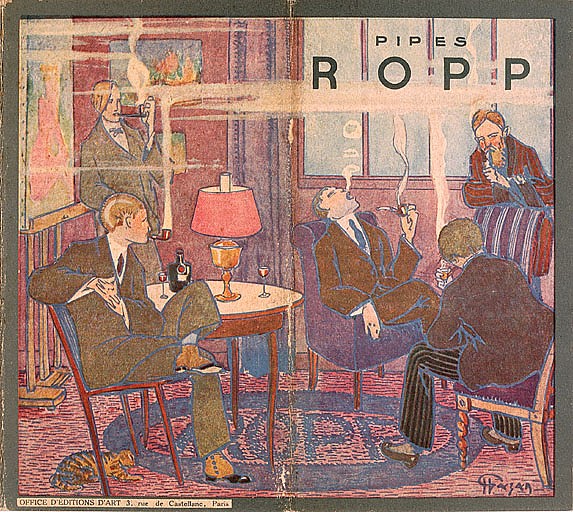
Eugène-Léon Ropp (1830–1907) acquired a patent for the cherrywood pipe in 1869. In 1870, he established a workshop to manufacture such pipes in Bussang, in the Vosges mountains. Around 1893, his business moved into the former mill of Sicard (part of the community of Baume-les-Dames in Upper Burgundy. The pipes were a big success in export as well. Shortly before 1914, Ropp designated A. Frankau & Co. (BBB) to be the exclusive distributor in the UK and its colonies. Probably in 1917, a workshop in Saint-Claude in the rue du Plan du Moulin was acquired to start the fabrication of briar pipes. In 1923, another small building in Saint-Claude, serving as a workshop for polishing, was added. Cherrywood pipes were the mainstay of Ropp until the company finally closed down in September 1991. The company was taken over by Cuty-Fort Entreprises in 1994.I have been working on figuring out the dates of Ropp pipes, based on their logos. This is an ongoing project and I am far from done. However, the logo on this pipe suggests a date that in the interwar period.

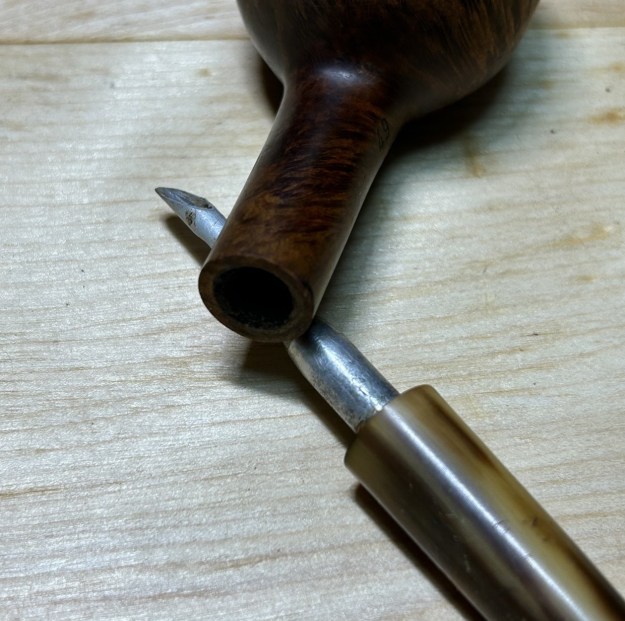
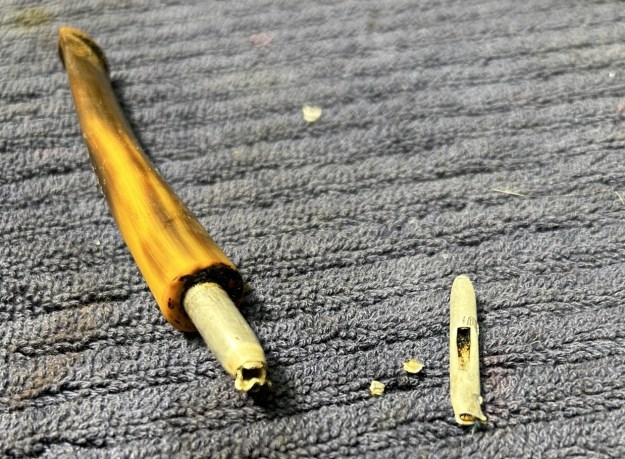
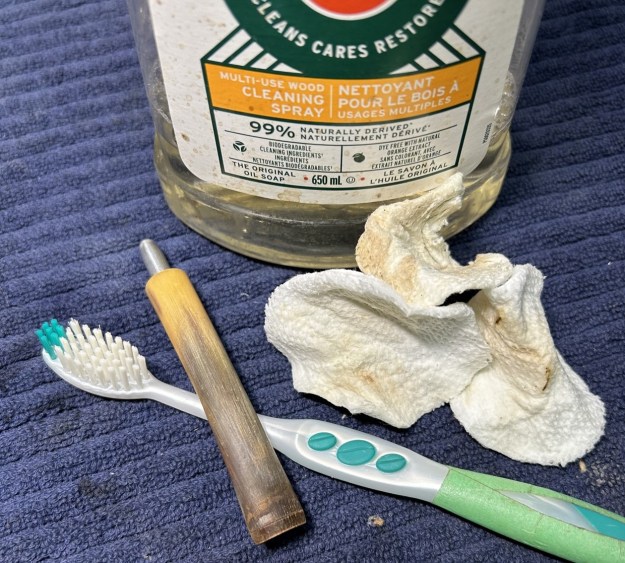
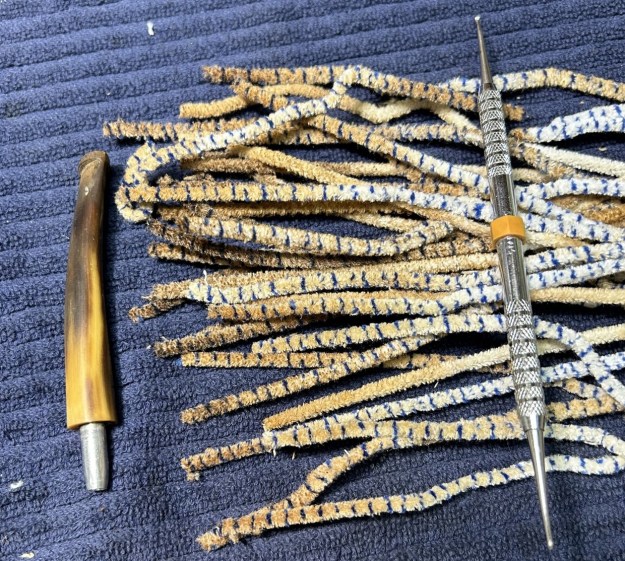
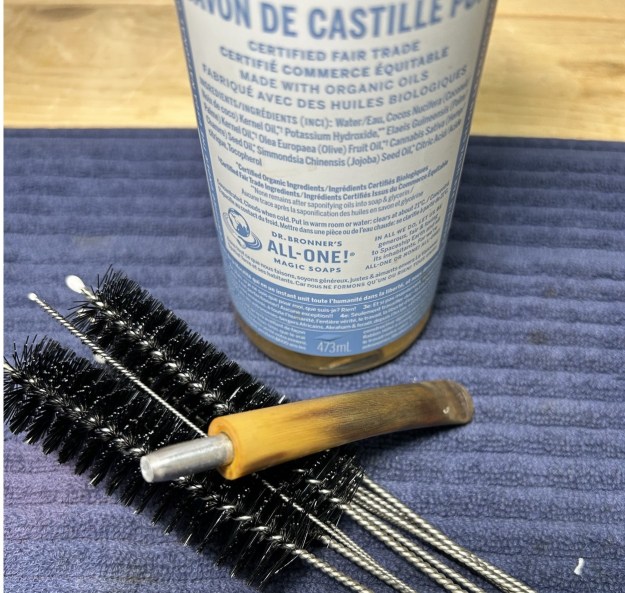
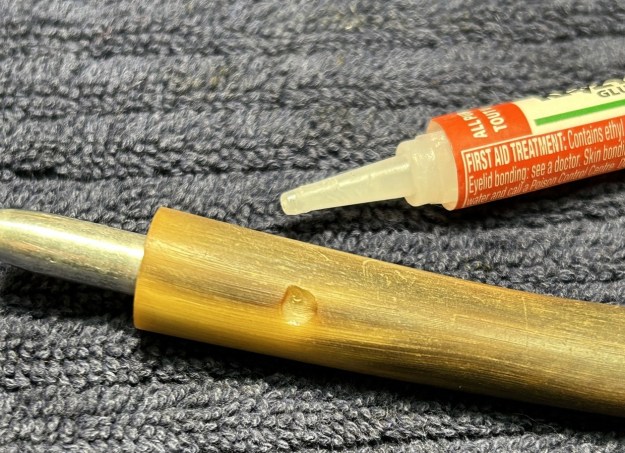
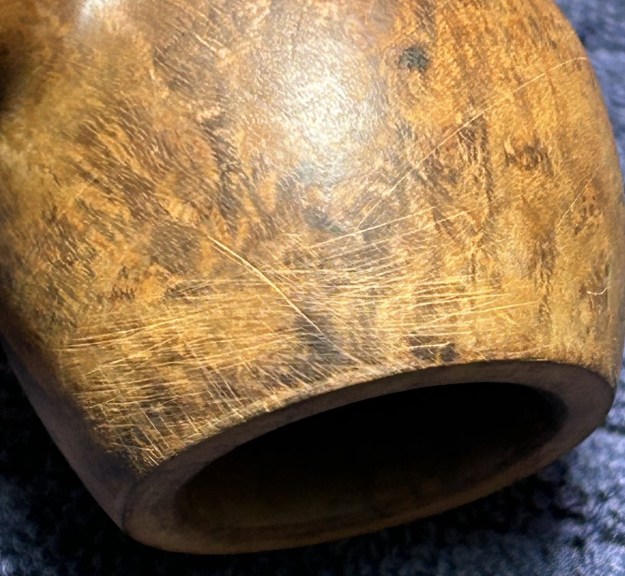
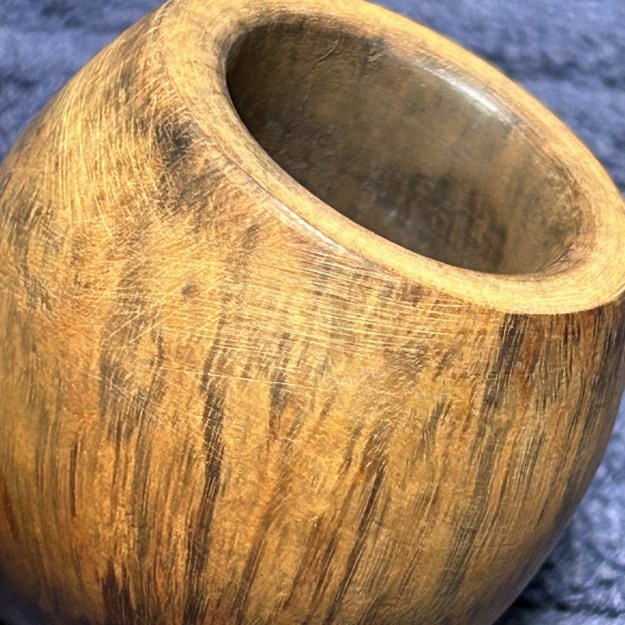
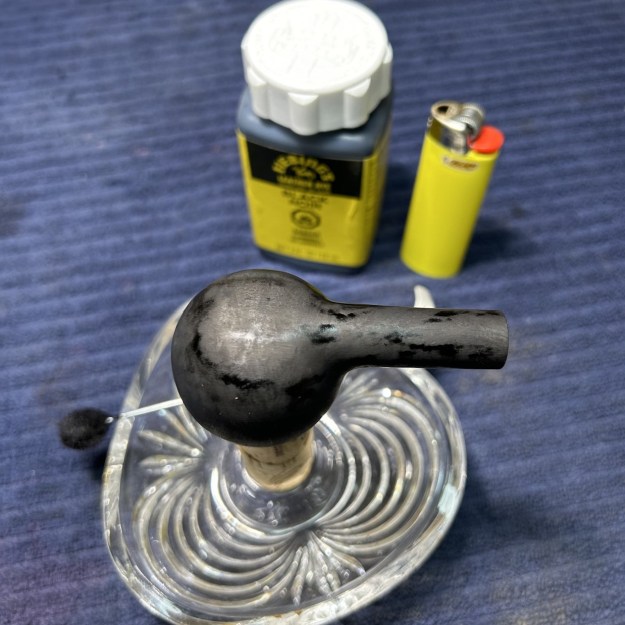
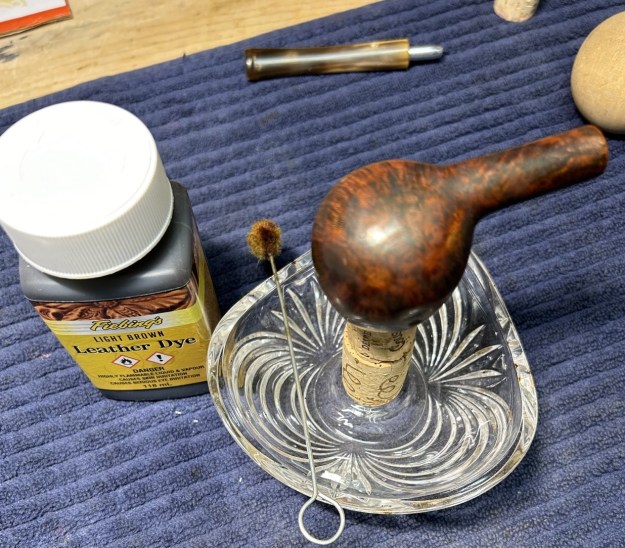
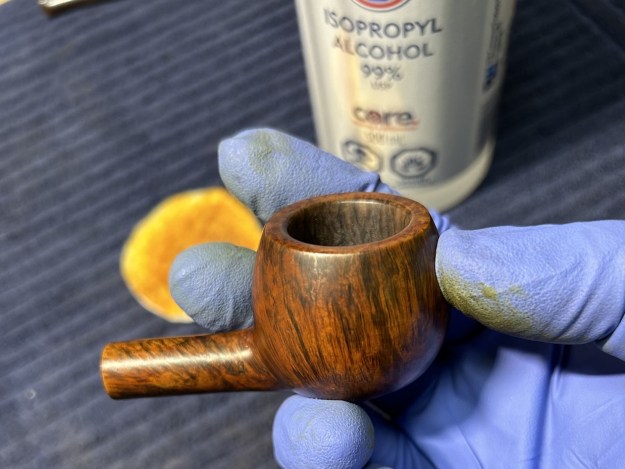
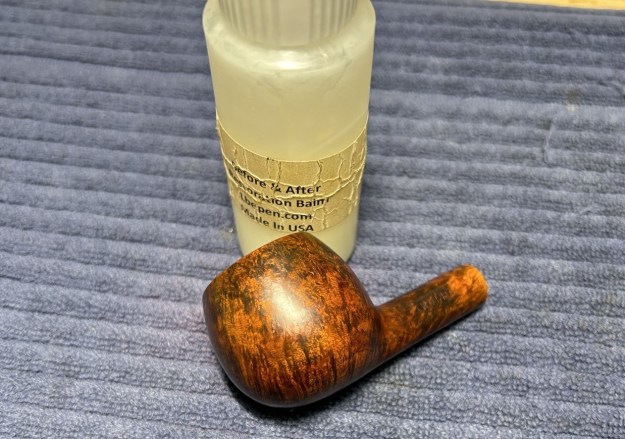
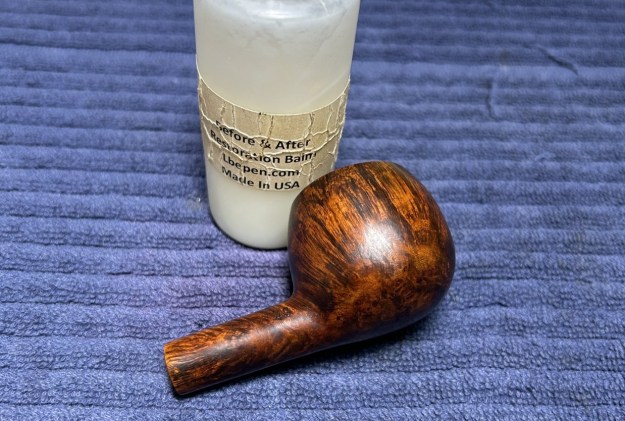
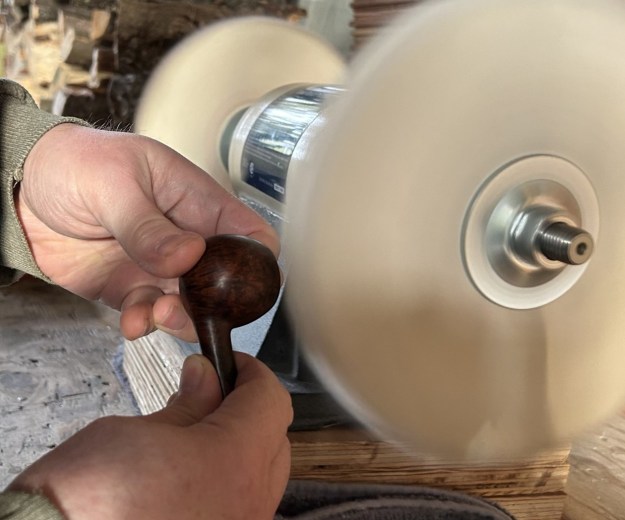
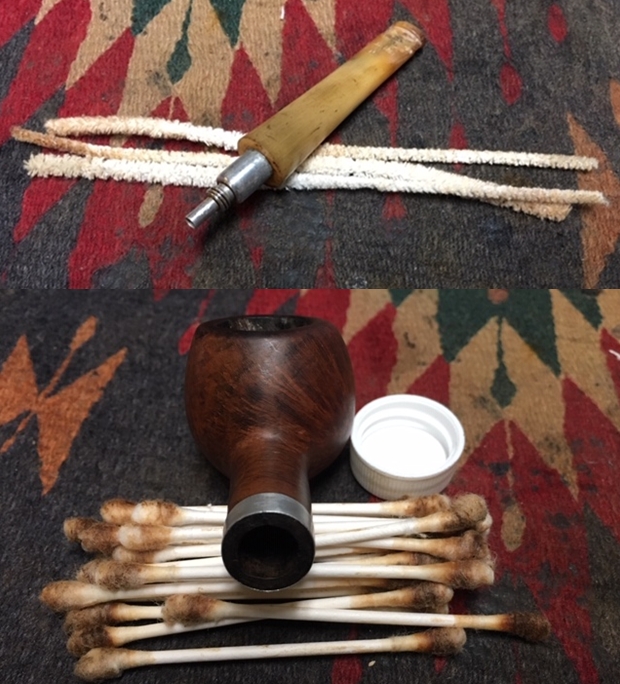
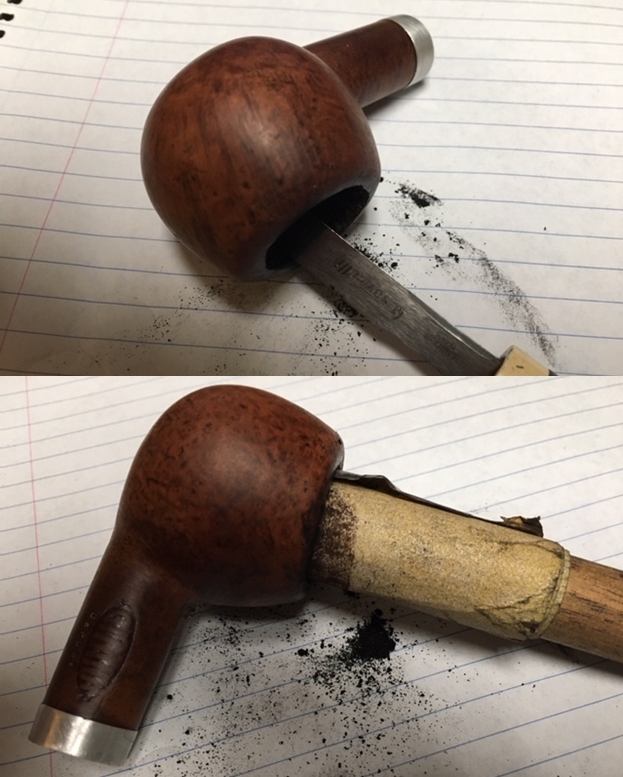
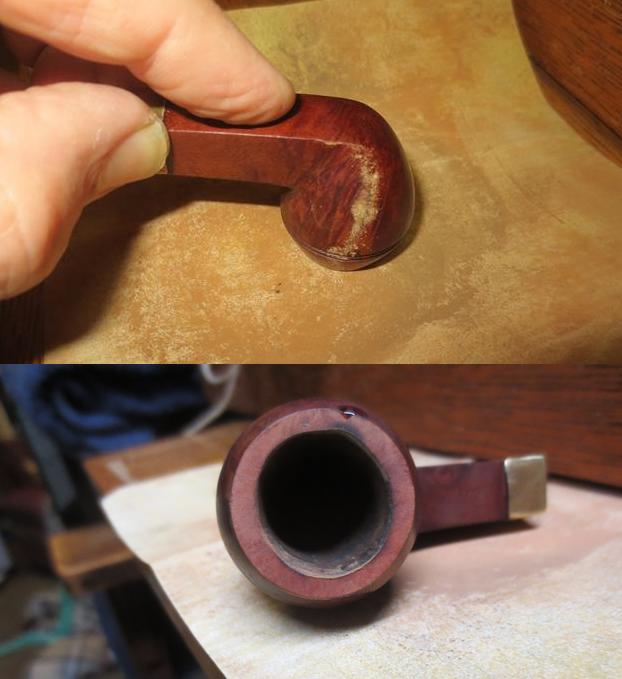
On to the pipe: it was in decent shape, but it had a few issues. The stem had a few bite marks, top and bottom. It also has a natural hole in the horn. The stummel also had a few issues. The rim and the outside of the bowl had some serious scratches. There was lava on the rim and some minor scorching. The inside was pretty dirty too – it would need a thorough cleaning. The stem was first on my list. This stem has a stinger in it – and it was being quite stubborn about coming out of the tenon! I opted to warm the stem and stinger with my heat gun and this didn’t work, surprisingly. I stuck it in the freezer for 20 minutes or so and that didn’t work either. I went back to the heat gun and tried again. Ugh. I successfully managed to break the stinger. Obviously, this wasn’t great, but it’s hardly the end of the world. I took a miniature file, shaped like a cylinder and sanded the hole in the tenon. I wanted to open the aperture a bit and remove the rough metal. Came out perfectly. I wiped down the outside of the stem with Murphy’s Oil Soap on some cotton pads. Then, I cleaned out the insides with pipe cleaners and isopropyl alcohol. It took an awful lot of work to get this clean! In fact, I also used some Castille soap and tube brushes on the inside of the stem. Not something I usually do. I built up the worm hole and tooth marks on the stem with some clear cyanoacrylate adhesive and let them fully cure. I then sanded the adhesive down with 220- and 400-grit sandpapers to meld seamlessly into the stem. I then used all nine Micromesh pads (1,500 through 12,000 grit) to bring out the lovely grain of the buffalo horn on the stem. I also used Obsidian Pipe Stem Oil in between each pad scrubbing. On to the stummel, and the usual cleaning procedures were in order for this pipe. This stummel was a bit of a mess inside, so I first decided to ream out the bowl. I used the KleenReem to remove the built-up cake and followed that with 220-grit sandpaper to eliminate as much as I could. I took the bowl down to bare briar, as I wanted to ensure there were no hidden flaws in the walls of the bowl. Fortunately, there none.I then proceeded to clean out the insides of the shank with Q-tips, pipe cleaners, and isopropyl alcohol. There was considerable filth inside this stummel and it took a lot of cotton to get it clean. I followed that up by cleaning the insides with some Castile soap and tube brushes. One of difficulties I encountered here was that this pipe had a cork-lined mortise and it was in very rough shape. Despite my best efforts, the cork was disintegrating and could not be saved. I took a wire drill bit and, but hand, scraped out the remaining bit of cork with it. I used some Murphy’s Oil Soap and some cotton pads on the outside of the stummel. That removed any latent dirt that blighted the wood. I moved on to de-ghost the bowl. I thrust some cotton balls into the bowl and the shank and saturated them with 99% isopropyl alcohol. I let the stummel sit overnight. This caused any remaining oils, tars and smells to leach out into the cotton. As the photos show, there were some rough scratches on the rim of this pipe. In order to remove them, I “topped” the pipe – that is to say, I gently and evenly sanded down the rim on a piece of 220-grit sandpaper. This effectively removed the damage, without altering the look of the pipe.There were a couple of very tiny pinholes in the wood. I dabbed a bit of cyanoacrylate adhesive and let them cure. I sanded the repairs down with 400-grit sandpaper. I also sanded out the scratches with the same. I felt that this pipe’s wood needed some revivification. In order to accentuate the external beauty of this pipe, I opted for aniline dye. I applied some of Fiebing’s Black Leather Dye. I applied flame from a BIC lighter in order to set the colour. I didn’t want to make the pipe black – I wanted the dye to accentuate the grain of the wood. So I used all nine Micromesh pads (1,500 through 12,000 grit) on the stummel to sand off the majority of the dye and then smooth the wood.I then added a coat Fiebing’s Light Brown Leather Dye to act as a beautiful contrast. I wiped it down with isopropyl alcohol to lighten it a bit. What a difference that made! It looked so much better with a fresh coat of stain. After that, I applied some Before & After Restoration Balm and let it sit for 15 minutes before polishing with a microfibre cloth. There is some beautiful wood after all. It is a lovely pipe! Before finishing up, I needed to address the mortise. Having removed the disintegrated cork, the tenon no longer fit in the mortise. Thanks to Steve’s advice, I fashioned a new cork lining from an old wine-bottle cork. I drilled out a hole through the middle of the cork and then used my Dremel to whittle down the cork until it fit – very tightly – in the mortise. I tested the tenon and it fit perfectly. I was delighted! Then it was off for a trip to the buffer. A dose of White Diamond and a few coats of carnauba wax were just what this pipe needed. The lovely shine made the wood very attractive. This is a very handsome pipe and will provide many years of smoking pleasure. This is a wonderfully crafted pipe and has a very elegant feel to it. It took some work, but I am proud of it. I am pleased to announce that this pipe is for sale! If you are interested in acquiring it for your collection, please have a look in the “France” pipe section of the store here on Steve’s website. You can also email me directly at kenneth@knightsofthepipe.com. The approximate dimensions of the Ropp Grand Luxe 49 Prince are as follows: length 6 in. (153 mm); height 1½ in. (36 mm); bowl diameter 1⅝ in. (40 mm); chamber diameter ¾ in. (20 mm). The weight of the pipe is 1⅛ oz. (36 g). I hope you enjoyed reading the story of this restoration as much as I enjoyed restoring it. If you are interested in more of my work, please follow me here on Steve’s website or send me an email. Thank you very much for reading and, as always, I welcome and encourage your comments.

A Challenging Old BBK Marte-Rosa Reporter with a Cherrywood Shank and Horn Stem


Blog by Steve Laug

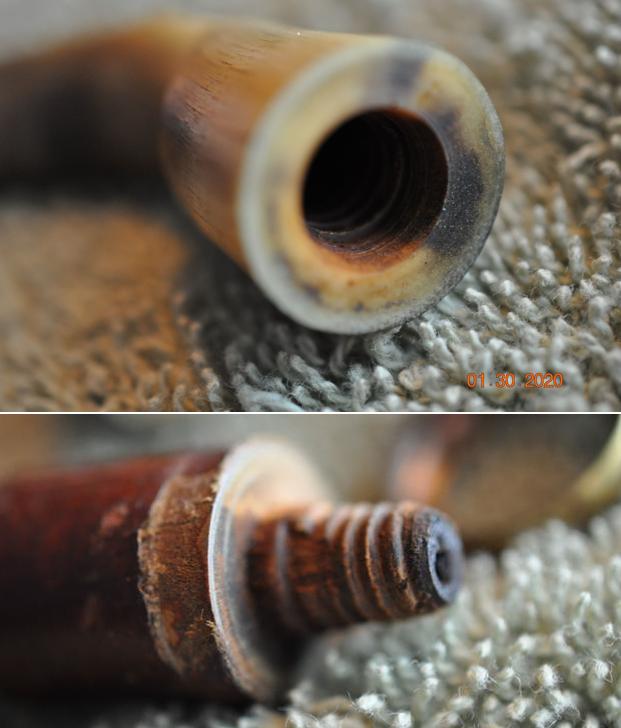
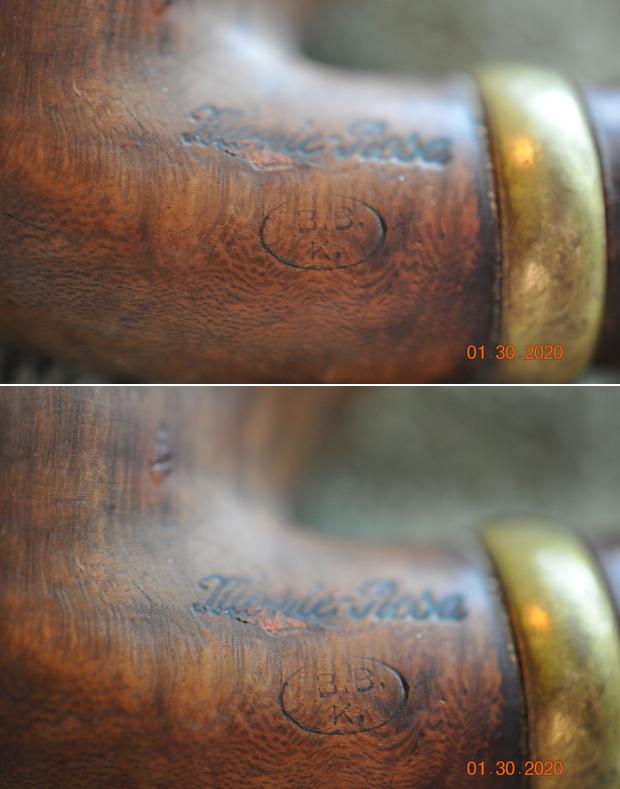
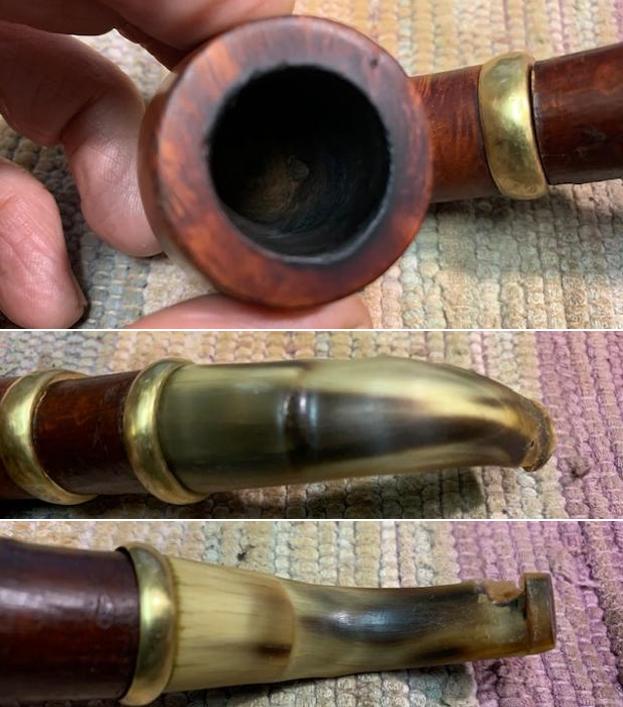
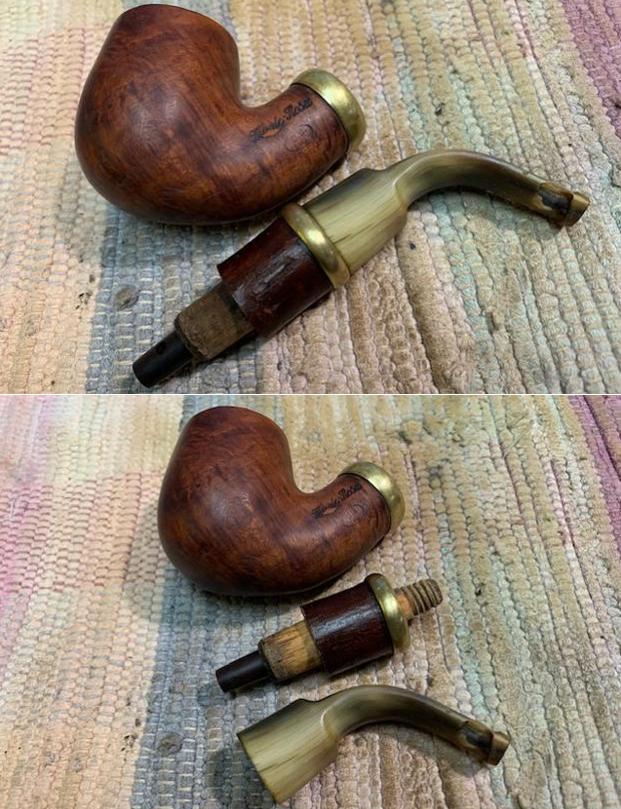
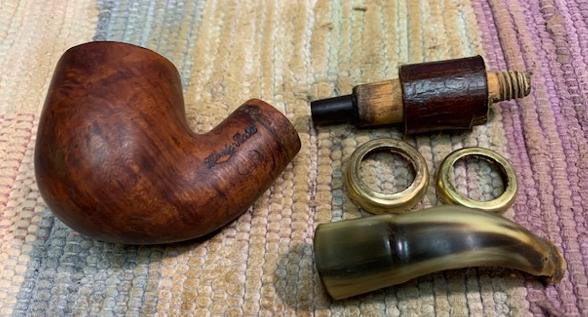
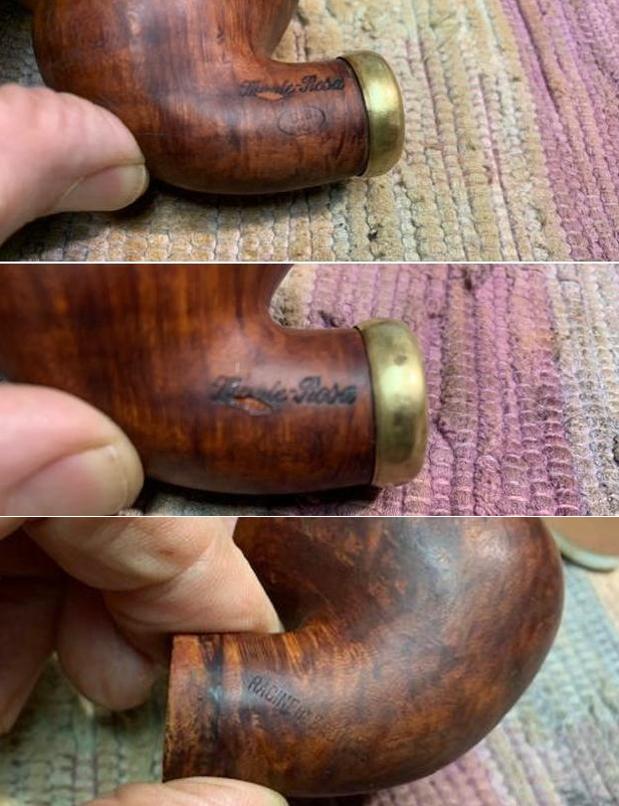
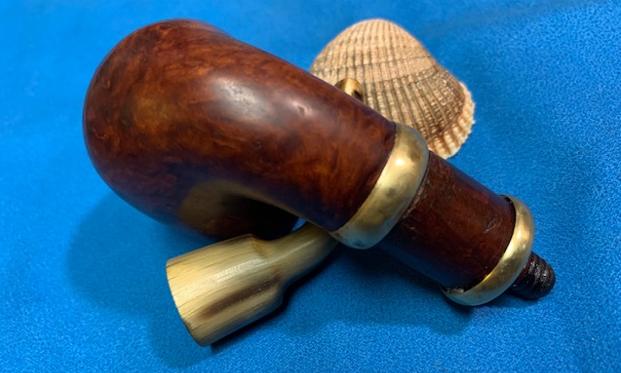
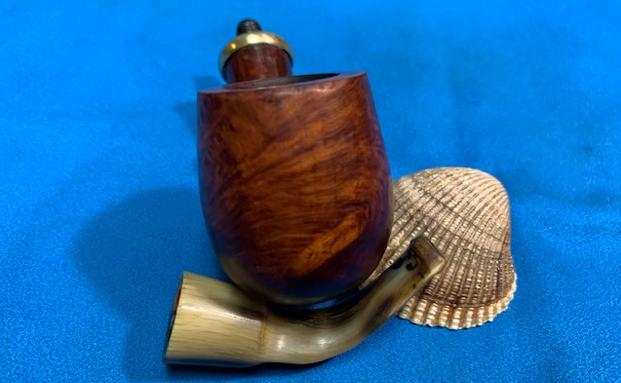
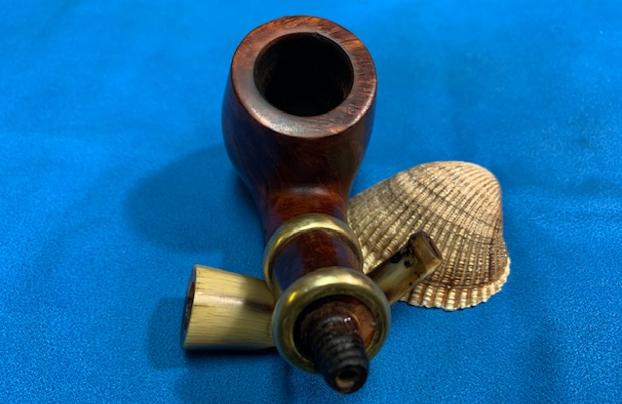
We picked up the next pipe from a fellow in Los Angeles, California, USA. This BBK pipe is a lot like a pipe I have worked on before called a Ropp  La Montagnarde Deposee Reporter (https://rebornpipes.com/2016/08/08/a-ropp-la-montagnarde-deposee-298-horn-cherrywood-briar/). The bowl is an interesting piece of briar with a mix of grain around the bowl and shank. The end of the briar shank has a brass shank cap/ferrule that is dented and dirty. The shank extension is cherry wood and is pressure fit into the mortise with a cherry wood tenon. The top of the cherry wood extension has another brass ring on the end of the extension and a threaded cherry wood tenon that the stem screws onto. The stem is horn and is rough condition. There is a large area on the left side of the stem and half of the underside that has been decimated by worms. The top side has a lot of chewing damage. The pipe is stamped on the left side with the words Marte–Rosa (it is hard to read as there is a flaw through the first word). Underneath that is an oval with the letter B.B.K. stamped in it. On the right side of the shank it is stamped Racine de Bruyere at an angle. The pipe is a real mess. There is a thick cake in the bowl and a thick overflow of lava on the rim top. The inner edge of the rim appears to have some damage but we won’t know for sure until it is cleaned. Jeff took photos of the pipe at this point to capture the condition of the briar and parts. Jeff took photos of the bowl, rim top to show the thickness of the cake in the bowl and the lava on the rim top. This pipe was obviously a great smoking pipe and a favourite. I am hoping that the thick lava coat protected things underneath it from damage to the edges and top. Cleaning it would make that clear! The cherry wood insert was damaged as well with scratches in the bark. He took photos of the top and underside of the stem showing the damage and worm holes in the horn stem material on the left side of the button. The horn stem was a mess. Jeff took photos of the sides and heel of the bowl to show the condition of the briar. You can see the beautiful shape and the grain on the bowl even through the dirt and debris of many years. The brass bands on the shank end and the cherry extension end. At this point in the process it certainly looks its age.   Jeff took photos of the bands and the damaged cherry wood extension. It is a bark covered piece of cherry. The end that fits in the shank of the briar is made of cherry just like the extension. The tenon end that the stem fits on is threaded to receive the threaded stem. The stamping on the left side of the shank read Marte-Rosa and underneath that it is stamped with an oval with the letters B.B. [over] K. On the right side it was stamped The stamping is hard to read on the left side as it has a fill in the middle of the brand name and is faint underneath. The right side is stamped Racine de Bruyere diagonally on the shank which translates as Root Briar or Briar Root.Through the years I have cleaned up several BBK pipes. One of them was a reporter/hunter pipe like this one (https://rebornpipes.com/2016/08/26/an-old-timer-horn-stem-cherrywood-shank-and-briar-bowl-bbk-bosshardt-luzern/). It had a windcap that is a difference from the current pipe I am working on. I quote from that blog below:

When I worked on the BBK Hunter I researched the brand. The BBK was a Swiss made brand as the shanks of all the pipes I had cleaned up and restored were stamped that way. Pipedia was my primary reference in that blog. Here is the link: http://pipedia.org/index.php?title=Bru-Bu. I have included the material from the previous blog below.

“Josef Brunner, oldest son of the farmer Konstantin Brunner from the hamlet Nieder-Huggerwald, belonging to the community of Kleinlützel (Canton Solothurn), was sent in 1871 to a pipe turner in Winkel/Alsace for his apprenticeship. As was usual at that time, Brunner wandered as a journeyman after ending the apprenticeship. Eventually, he went to Saint-Claude, France which was then the world’s stronghold of briar pipe manufacturing. There, Brunner was able to increase and deepen his knowledge in the field of industrial pipe making. When he returned home in 1878, he installed a small turner’s workshop in the house of his father. With the energetic support of his two younger brothers, he began to produce tobacco pipes of his own calculation, taking them to the markets in the surrounding area. In 1893, Bernhard Brunner’s wife inherited the mill in Kleinlützel. At this point, the pipe fabrication was transferred to an annex belonging to the mill. Now it was possible to drive the machines by water power – an important relief to the workers and a considerable innovation compared to the previous pedal-driven system.”

“The business developed so well after the turn of the century even when a lack of workers in Kleinlützel occurred. The problem was solved by founding a subsidiary company in the small nearby town Laufen an der Birs in the Canton of Bern. This plant didn’t exist too long. The disastrous economic crisis in the 1920’s and early 1930’s forced the Brunner family to restrict the fabrication of pipes dramatically. In addition the big French pipe factories in Saint-Claude – although suffering from the same circumstances – flooded the Swiss market with pipes at prices that couldn’t be matched by Swiss producers. By 1931 approximately 150 of 180 Brunner employees had been sacked – the rest remained in Kleinlützel, where the cheap electric energy ensured a meager survival.”

“In 1932, Mr. Buhofer joined the Brunner family. The company was named Brunner-Buhofer-Kompagnie, and, shortly thereafter, Bru-Bu. Buhofer had made his fortune in the United States but, homesick, returned to Switzerland to search for a new challenge. Bru-Bu’s fabrication program was expanded with many handcrafted wooden art articles: carved family coats of arms, bread plates, fruit scarves, and – more and more – souvenir articles for the expanding Swiss tourism industry. Pipes remained in the program continuously, but the offerings changed from traditional Swiss pipes to the more standard European shaped pipes. Bru Bu is widely known as BBK.”

The last paragraph of the Pipedia article linked BBK pipes to Former Nielsen. I have two of Former’s pipes so this stood out to me. “At some point in the late 1970’s, Bru-Bu went out of business. Some of the Brunners, as far as known, continued as timber traders. But in 1986 new life filled the old Bru-Bu pipe workshop, when Dr. Horst Wiethüchter and “Former” Nielsen started to produce the high-grade Bentley pipes there.”

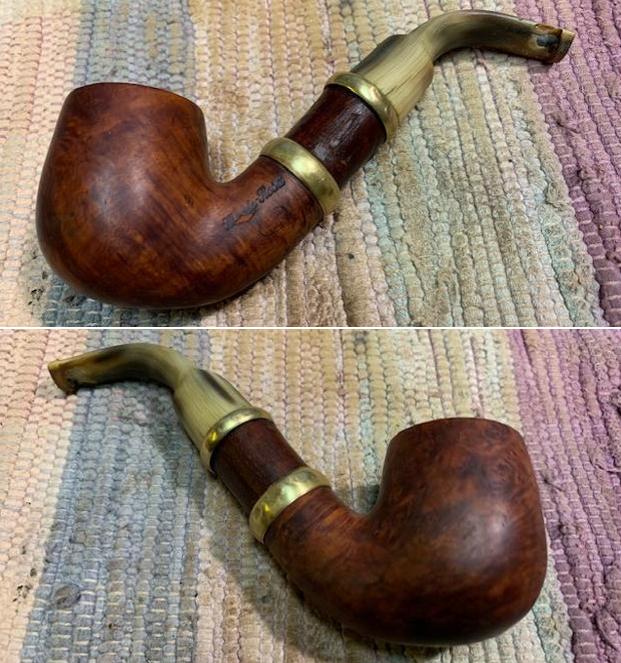
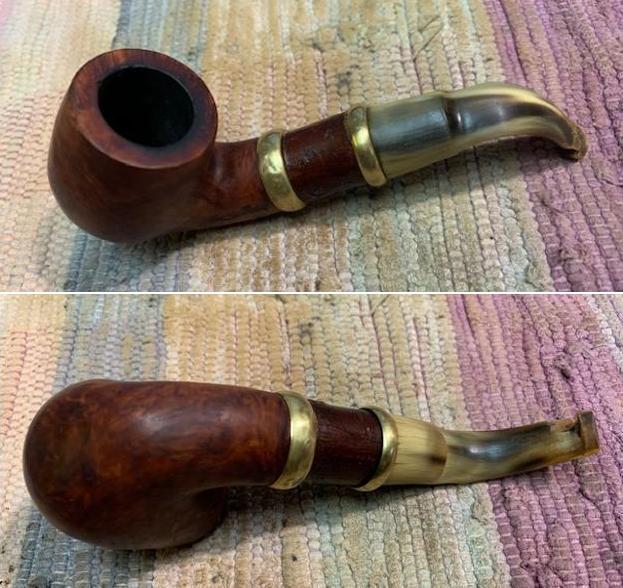
Jeff cleaned up the pipe and reamed the bowl with a Pipnet Pipe Reamer and cleaned up the bowl with a Savinelli Fitsall Pipe Knife. He cleaned out the shank and the airways in the stem, shank extension and the mortise with alcohol, pipe cleaners and cotton swabs. He scrubbed the briar with Murphy’s Oil Soap and a tooth brush to remove the grime and the build up on the rim top. He carefully scrubbed the cherry wood the same way. He cleaned out the airway in the stem with pipe cleaners and alcohol to remove the grime and tars. The horn stem was clean but had on the topside and had a huge worm hole on the left side and left underside of the stem. The brass bands on the shank and the cherry wood were dented and worn but still looked very good. The glue that held them in place on the shank and cherry had given way and they were loose. I took some photos of the pipe when it arrived in Vancouver to show its condition after Jeff had cleaned it. I took a close up photo of the rim top to show the condition of the rim top. It had a few nicks in it and the inner edge of the rim had damage and darkening. I took photos of the stem to show the damage to surface on both sides.I took the pipe apart to show the various components of the pipe. The cherry wood extension in the centre of the photo has a tapered end that fits into the shank and a threaded end that the stem screws onto. The cherry extension has some damage on the sides. There is also a fill that is shrunken on the left side of the shank and in the middle of the stamping. I took photos of the stamping on both sides of the shank. You can see it is readable but damaged.  I cleaned up the inner edge of the rim with a folded piece of 220 grit sandpaper. I brought the bowl back to round. I did not take a photo of the rim top but it is visible in the polishing  photos that follow.I glued the band on the shank but the glue did not hold so I removed it. I polished the briar with micromesh sanding pads – dry sanding it with 1500-12000 grit pads and wiping it down after each pad to remove the dust. I spread white all-purpose glue on the shank end and pressed the band on the shank. This time I used more than the first time and set it aside to cure. Once it cured I took photos of the pipe with the band on the shank. I set the bowl aside and turned my attention to the cherry wood shank extension. I filled in the splits in the bark with clear CA glue. Once the repairs had cured I sanded them smooth with 1500-2400 grit micromesh sanding pads.I used a dental spatula to spread the white all-purpose glue on the end of the extension and pressed the brass band onto the extension. I set it aside to allow the glue to cure. I took a photo of the band on the shank end and on the cherry wood shank extension. The bands look very good. I rubbed the cherry wood down with some Before & After Restoration Balm to protect, clean and enliven the wood. It worked very well. I let it sit for 15 minutes and buffed it off with a soft cloth. I greased the end of the wooden tenon on the cherry wood shank extension with Vaseline. It made the fit in the shank smooth and snug.I put the extension back in the shank and rubbed the bowl down with some Before & After Restoration Balm to protect, clean and enliven the wood. I worked it into the surface of the briar with my fingertips. I set the bowl aside and let it sit for 15 minutes. After it had been sitting I buffed it off with a soft cloth. I set the bowl and shank extension aside and turned my attention to the stem. I greased a pipe cleaner with Vaseline and inserted it in the shank. I wanted to protect the airway when I filled in the damaged area with super glue. I filled in the worm damage with clear super glue. I layered it in with several fills. While it was curing I read Dal Stanton’s blog on mixing in a sprinkling of charcoal powder with the glue to help blend the repair into the horn. I mixed some in and layered more and more glue on top of it. The black of the charcoal did not really blend in well. It migrated together and left a black spot on the top of the stem and a black ring on the underside. In the past I did not use the charcoal and certainly will not do so again. I sprayed the repairs with accelerator to speed the hardening process of the repair. I used a pair of files to flatten out the repairs and to reshape the button on both sides of the stem. Once I had reshaped the button I sanded the stem surface with 220 grit sandpaper and started polishing the stem with 400 grit wet dry sandpaper. I polished the horn stem with micromesh sanding pads – wet sanding with 1500-12000 grit pads. I rubbed the stem down with Obsidian Oil between each set of three pads. I polished it with Before & After Polish – both Fine and Extra Fine. I gave it  a final rubdown with Obsidian Oil to protect it. I gave the threads on the shank end tenon a coat of Vaseline to make it easier to turn the threaded stem onto the end of the shank.With everything finished I put the BBK Marte–Rosa Racine de Bruyere Reporter Pipe back together and buffed it by hand with a microfibre cloth and polished the metal with a jeweler’s cloth. The finished pipe is shown in the photos below. I love the way the grain just pops on this old pipe. The cherry wood shank extension adds not only length but also a touch of rustic to the pipe, though this particular piece of cherry wood has bark that is quite smooth. The dark striations of the horn stem also go well with the wood. The brass bands at the stem and the shank give this old timer a real look of class. The finished pipe is shown in the photos that follow. The repair to the button while not invisible is smooth and solid and should last a long time. It is a beautiful pipe to my eyes. The dimensions are Length: 5 ½ inches, Height: 2 inches, Outside diameter of the bowl: 1 ¼  inches, Chamber diameter: 7/8 of an inch. The weight of the pipe is 70grams/2.47oz. I will be putting it on the rebornpipes store shortly. If you are interested in adding it to your collection let me know. Thanks for walking through the restoration with me as I worked over this pipe. Thanks to each of you who are reading this blog.

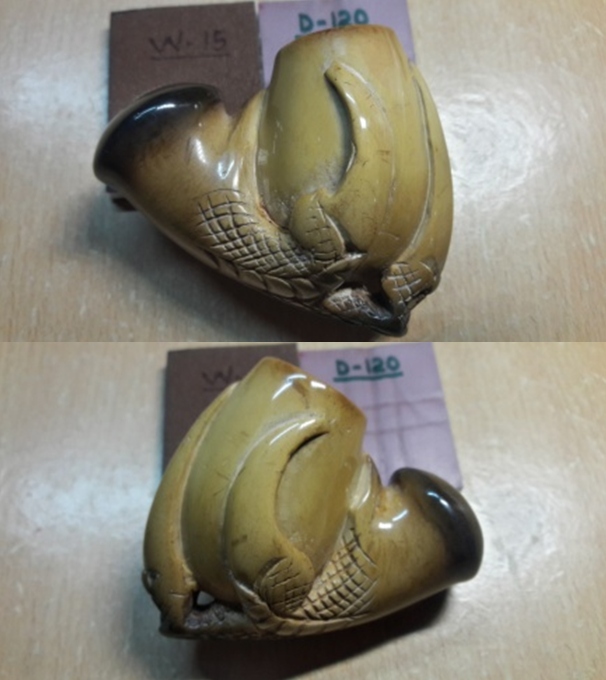
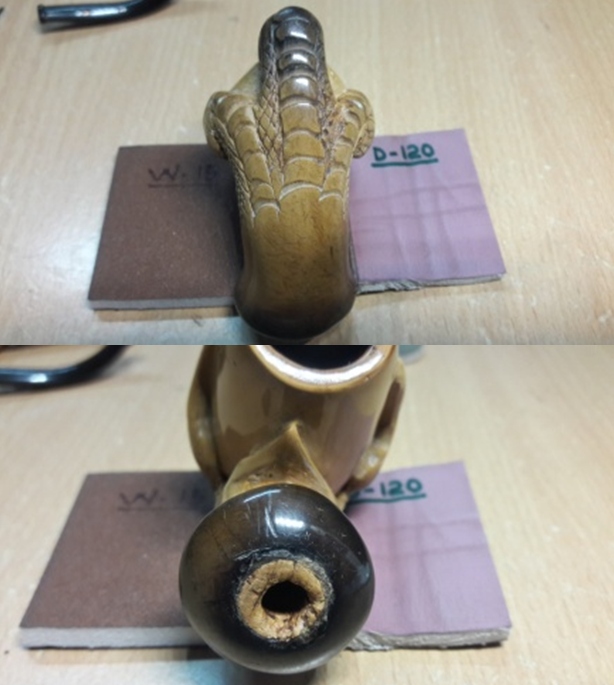
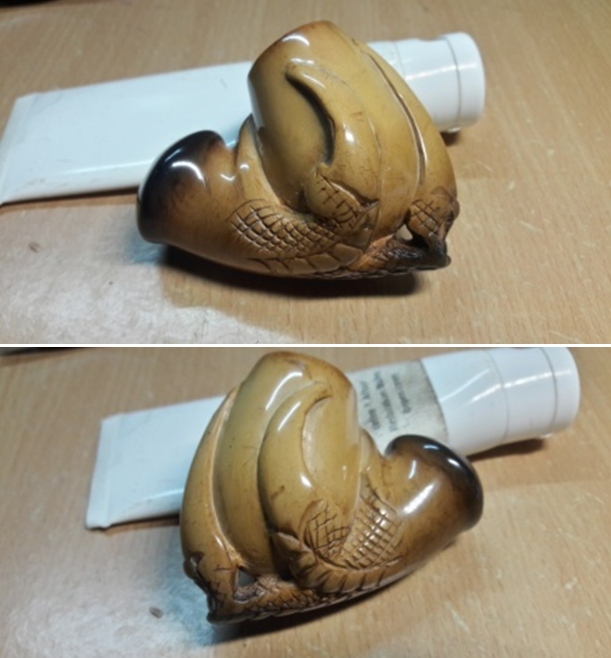
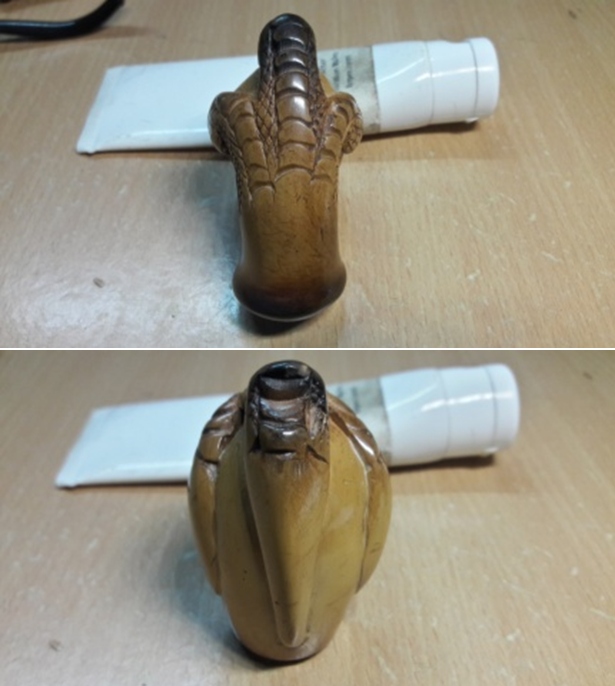
Refurbishing an Intricately Carved Old Meerschaum Eagle Claw Holding an Egg


Blog by Paresh

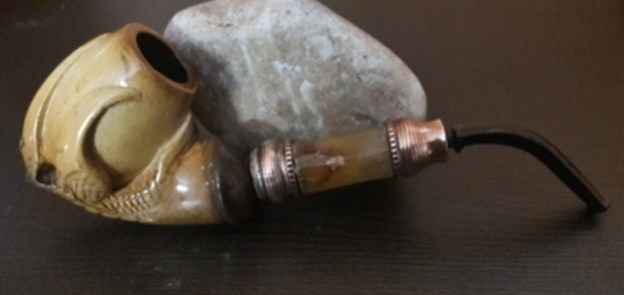
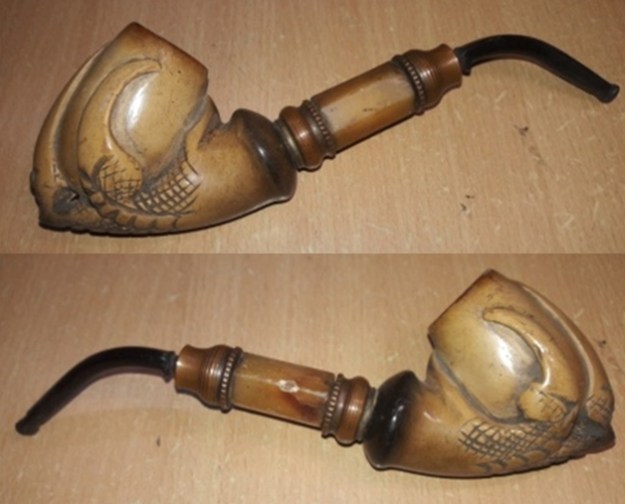
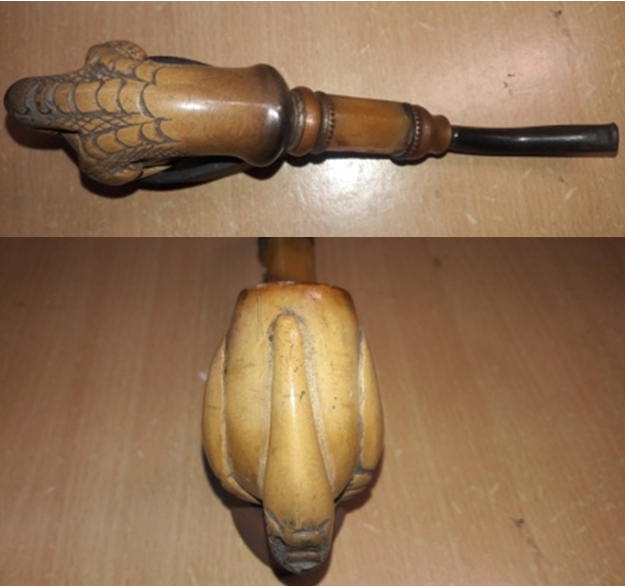
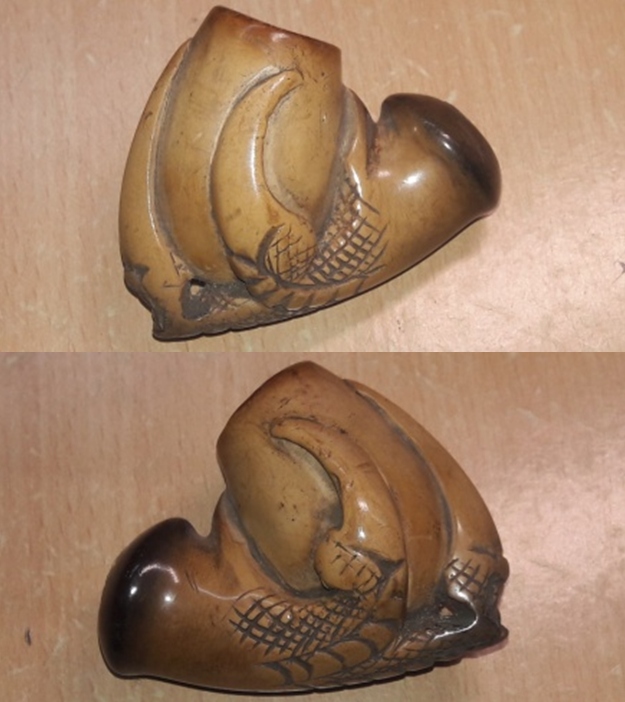
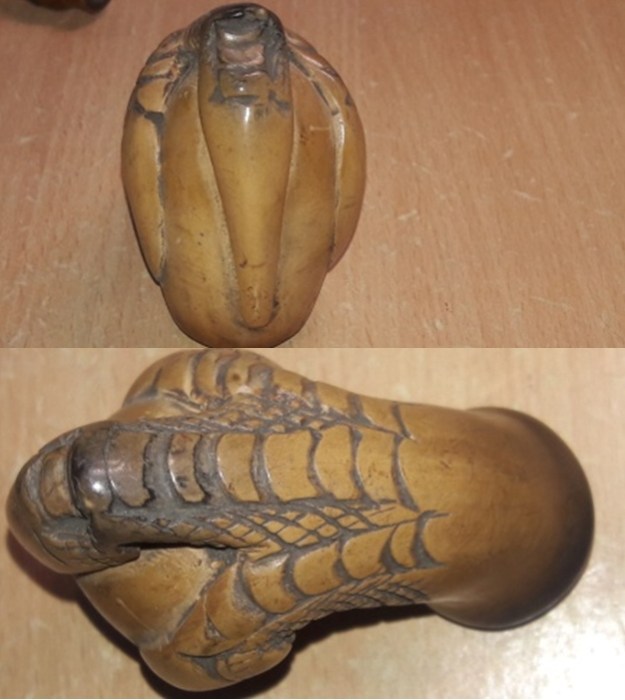
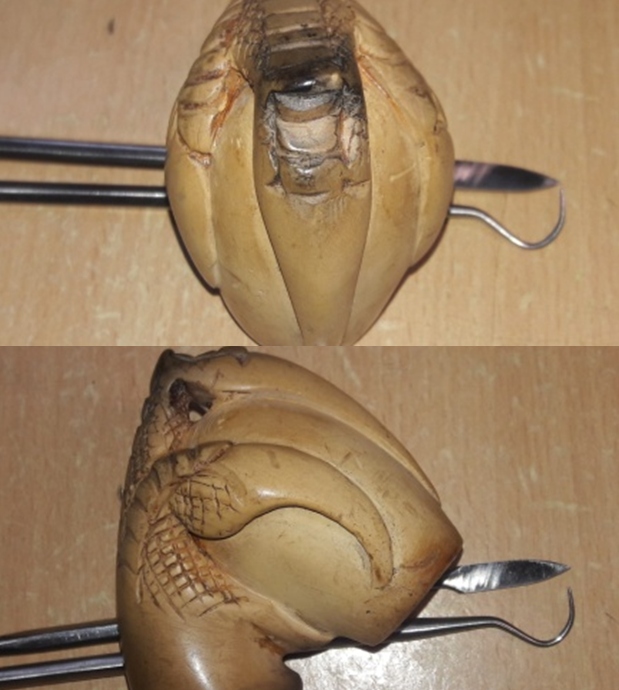
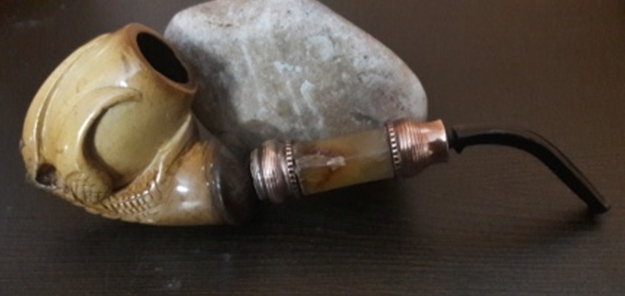
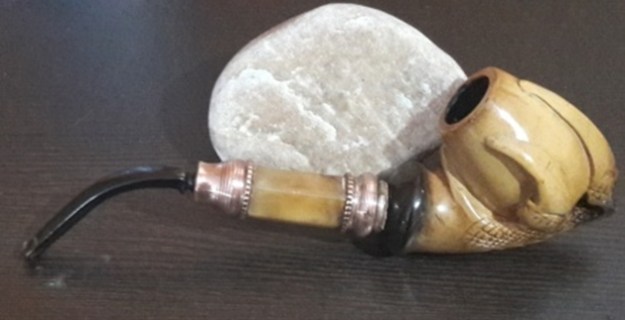
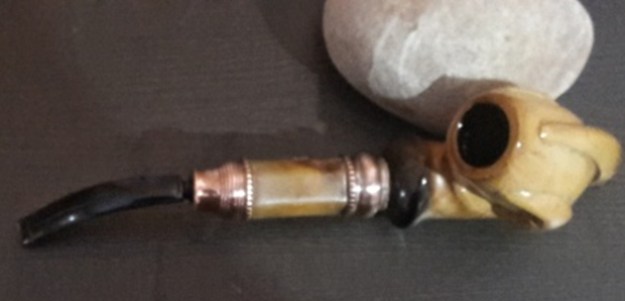
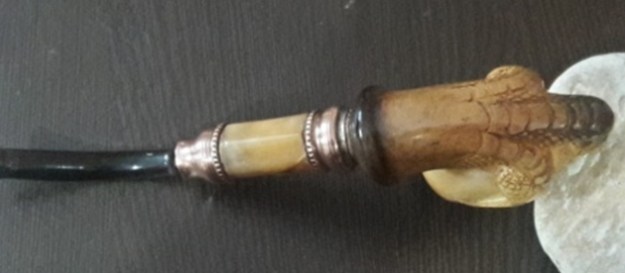
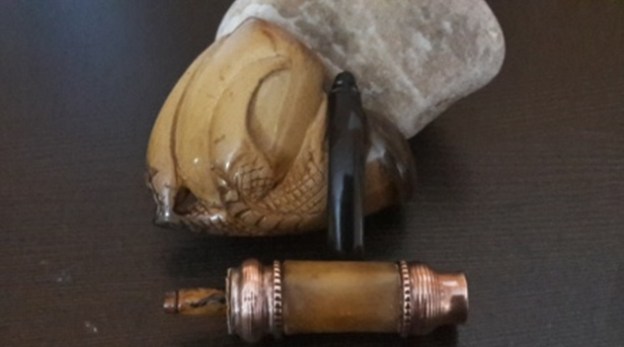
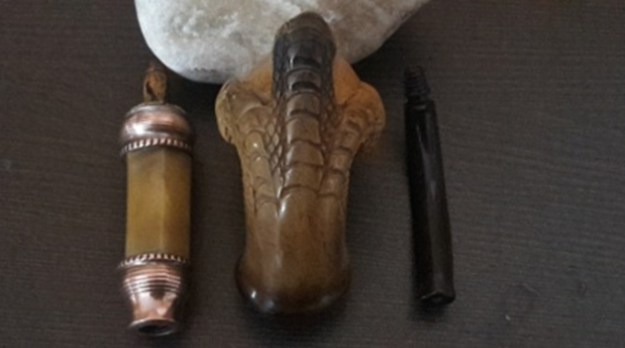
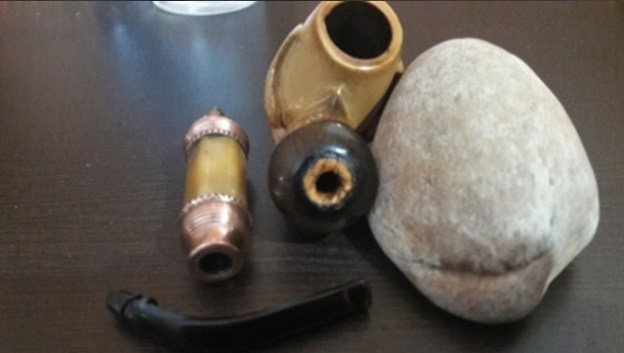
The next pipe on my work table is an old intricately carved meerschaum Eagle claw holding an egg in its talons. The stummel has an intricately carved shape of an eagle claw complete with perfectly carved scales and claw knuckles. The shank extension is a beautiful colored amber hexagonal block with copper end adornments. The delicate thin horn stem has a threaded bone tenon with orifice slot. There is no stamping whatsoever anywhere on this pipe. The lack of stamping makes it impossible to establish the origins of this pipe. However, the intricate carvings and eye for details on this pipe makes me believe this pipe to be Vienna made. Here is the pipe as it sits on my work table. Initial Visual Inspection
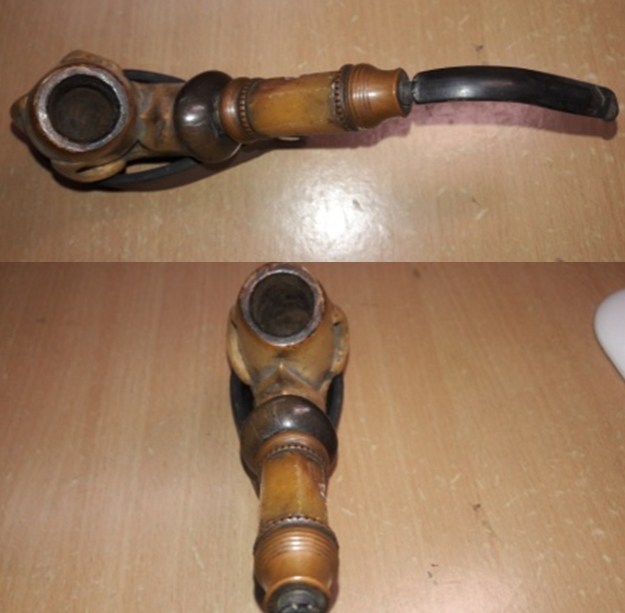
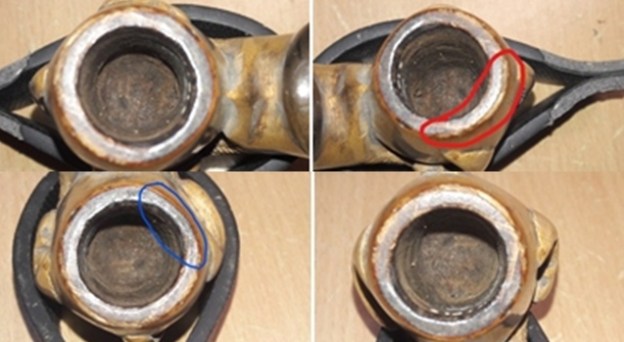
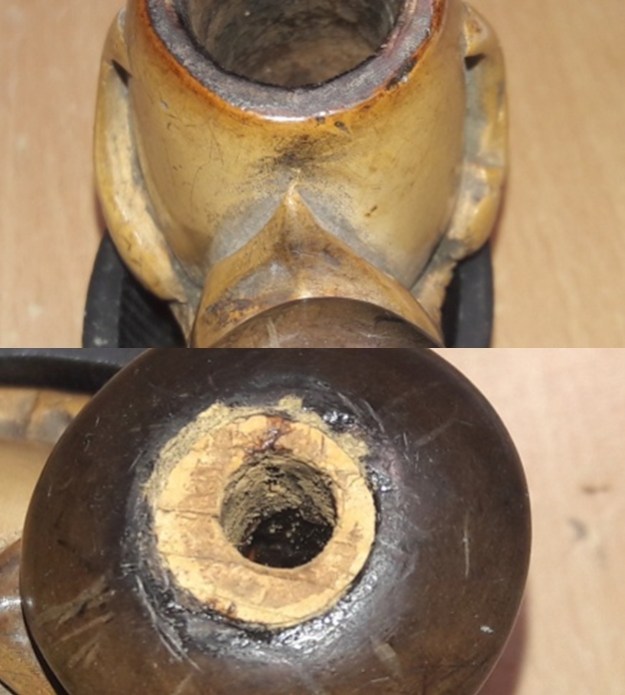
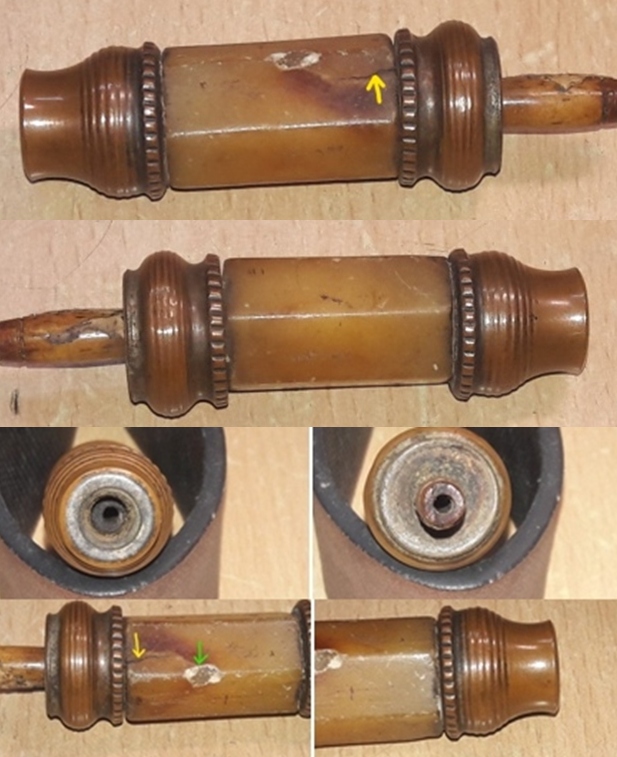
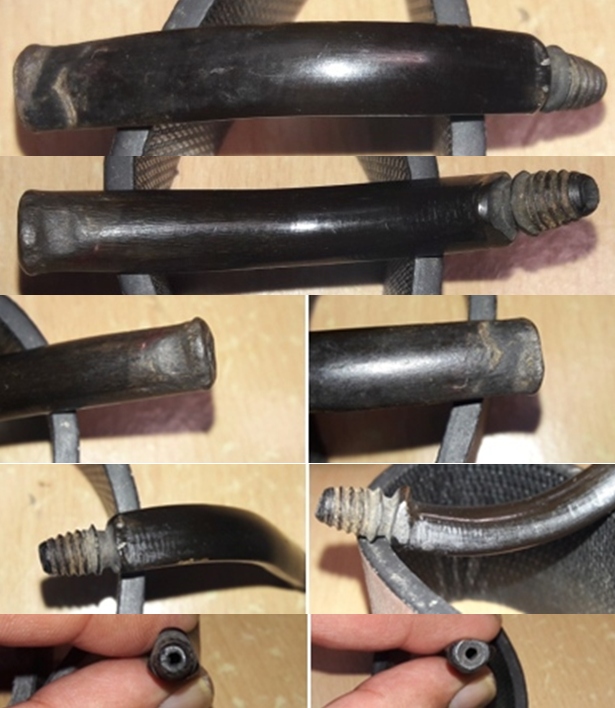
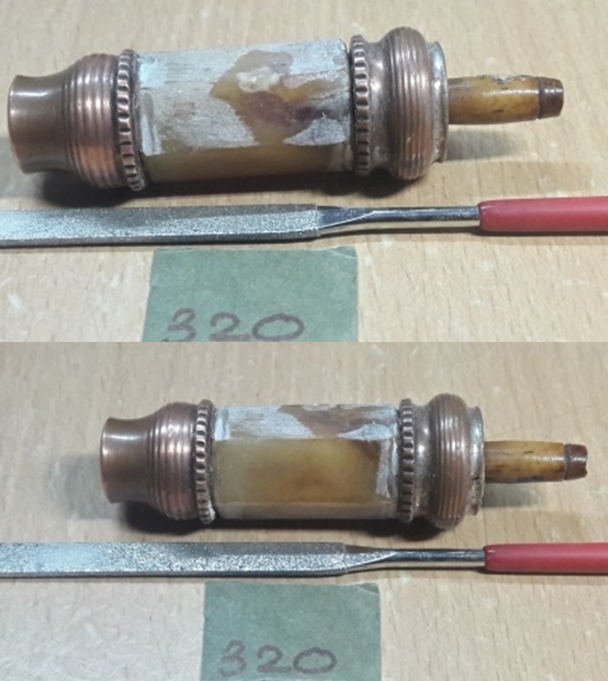
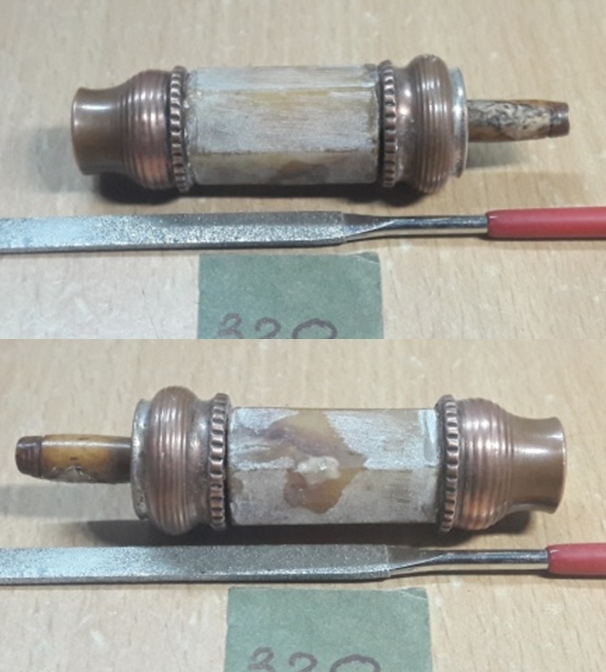
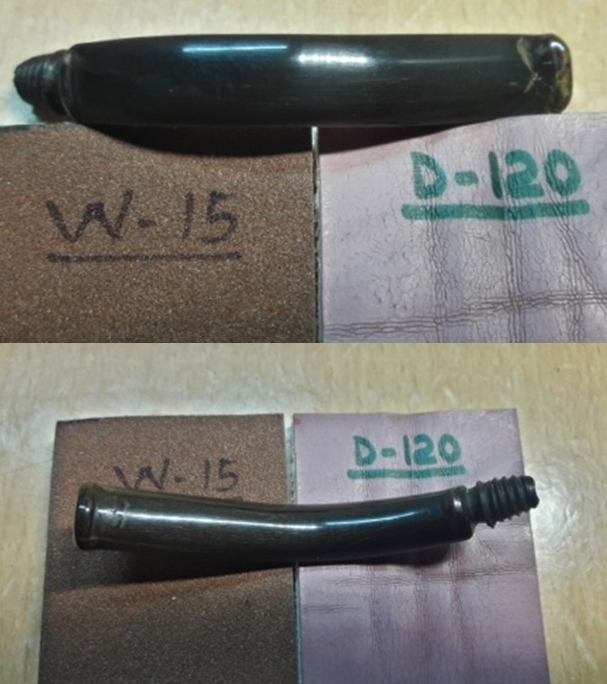
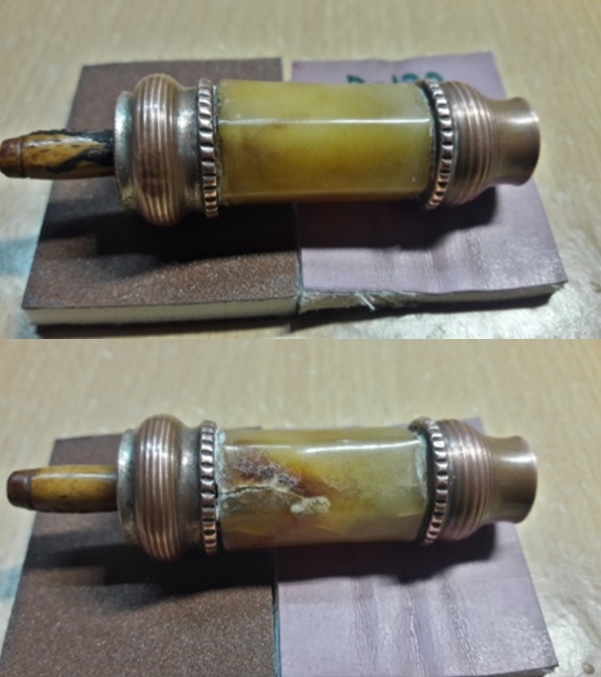
The pipe comes apart in three sections. The first is the meerschaum stummel carved to resemble an eagle’s claw that holds an egg; the second is a block of beautifully colored amber with six chiseled sides. The shank end and the stem end of this hexagonal amber block are adorned with decorated copper end adornments. The airway through the amber shank extension appears to be made of bone which extends out and seats into the mortise. Lastly is the delicate thin bent horn stem with matching threaded tenon end face and the orifice slot end face and appears akin to the triangular head of a grasshopper.There is a light build up of cake in the chamber that has dried and is crumbly due to prolonged storage. The condition of the inner walls of the chamber can be ascertained only after the cake has been removed completely. No apparent cracks or damage to the stummel surface is seen from the outside. The rim top has darkened due to overflow of lava and burn marks. There are a large number of dings and chips to the rim top which are visible through the lava overflow. The right side of the outer edge of the rim is severely damaged (enclosed in red), the result of striking the edge against a hard surface to remove dottle, presenting lop sided appearance to the rim on to the right. The inner edge of the rim on the left side appears thin in 8 o’clock direction (enclosed in blue) and combined with the damaged left outer edge gives the appearance of out of round chamber. The inner rim edge is dented and chipped in few places. Topping the rim surface and creating bevels should address these issues satisfactorily. The stummel is exquisitely carved with intricate details of the scales and knuckles replicated real like!! The four talons are all intact and perfectly shaped. The stummel had developed a nice patina from years of usage. Every nook and cranny of the carvings is filled with dirt and dust from years of uncared for storage giving a very dull and dirty appearance to the stummel. The short shank is a flared round and flumed and there are a few scratches on the surface. The mortise is lined with cork and is intact all around. The mortise has strong odors akin to some sort of soap smell (?), a smell that I have not come across as yet. Cleaning of the stummel to dislodge all the grime and dust from the carving will have to be a deliberate effort. Preserving the old cork lining at the shank end while cleaning the shank and mortise will be a challenge as the cork is susceptible to easy crumbling.   The hexagonal large block of Amber shank extension has developed a crack towards the tenon end (indicated with yellow arrow). This crack is deep but thankfully has not progressed all the way down to the airway. The amber is also chipped (indicated with green arrow) in one place just above the crack. The decorative copper end pieces are decoratively cast and serve the dual purpose of protecting the amber end face while adding a very classic bling to the appearance of the pipe. The copper adornments and the block amber piece are joined by a hollow bone that extends out as tenon. The amber is loose with gap in between the copper adornments and would need to be fixed. The threaded stem end copper adornment is full of old oils and tar accumulations. The tenon end of the copper adornment appears to have had some sort of packing/ separator between the metal and meerschaum shank end that has now worn out and disintegrated.  The horn stem is very delicate and thin that is full bent. The profile of the stem lends the entire pipe a tapered profile that is both delicate and attractive. The peculiarity of this stem is that the tenon end and the slot are identical in shape and size. The bite zone on either surface of the stem has been chewed up and with the horn fibers exposed. The thin delicate buttons on upper and lower stem surface have deep tooth indentations. The tenon end of the stem is heavily scratched. The threaded bone tenon is covered in oils and tars. One of the challenges in this project would be to match the tenon end and orifice slot end profile.The Process
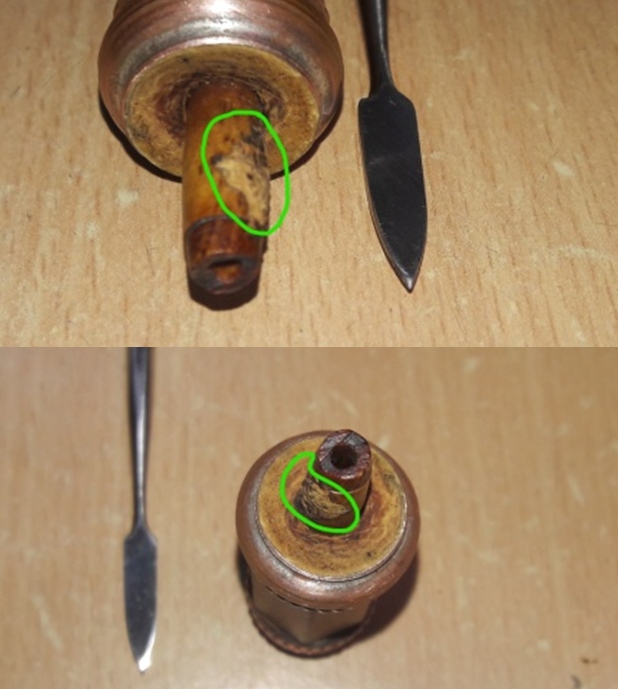
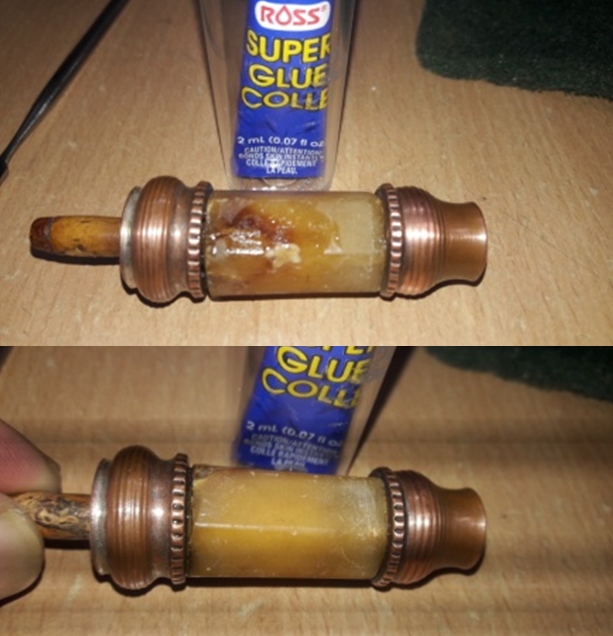
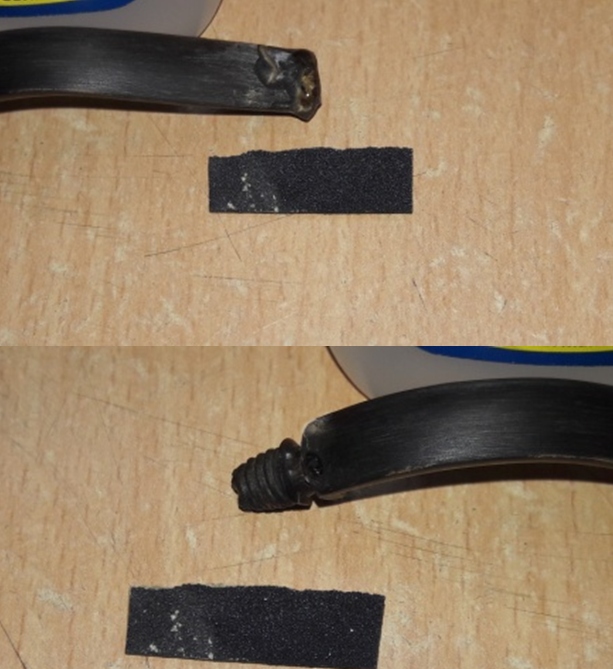
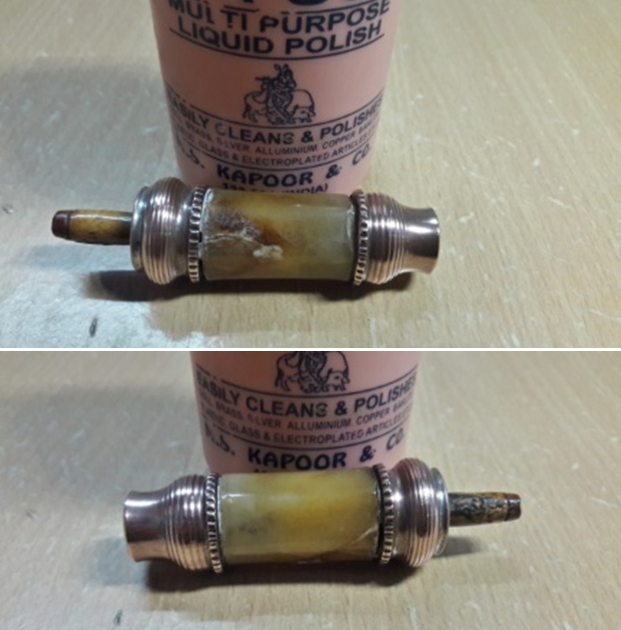
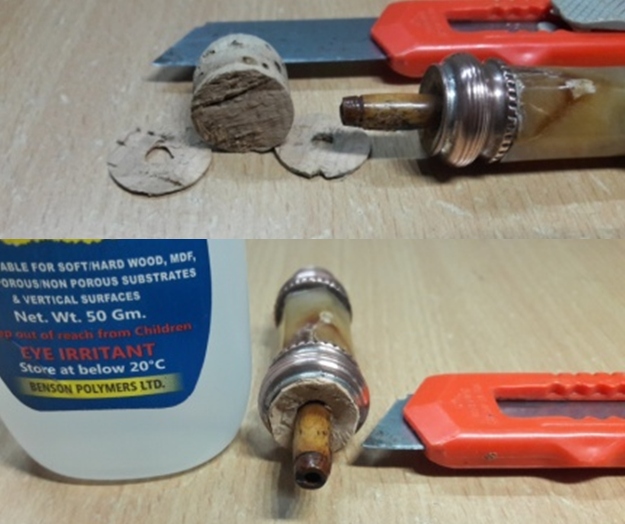
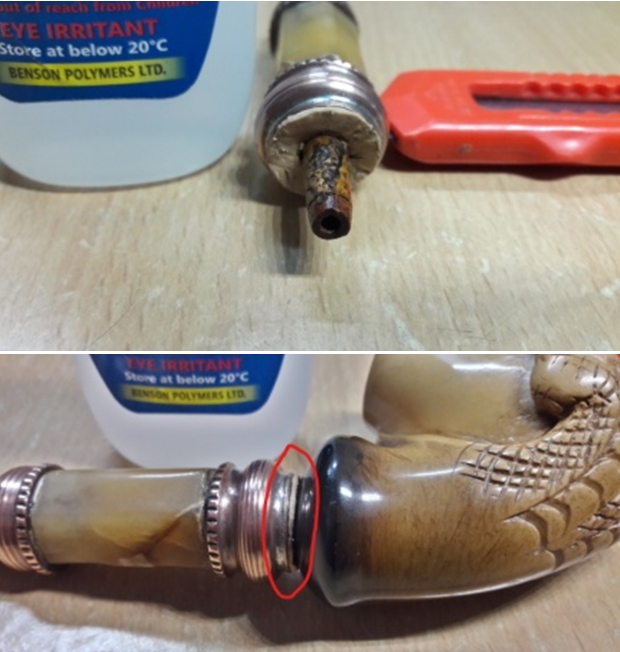
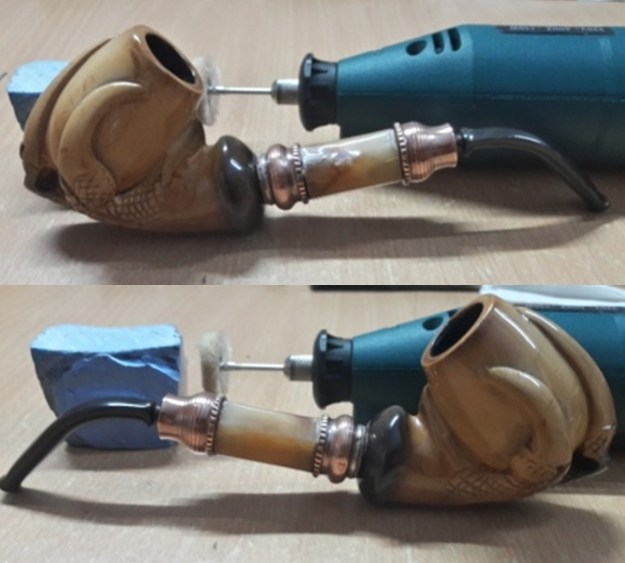
I started this project by reaming the chamber with my smaller fabricated knife and scraped out all the carbon from chamber. I used a 220 grit sand paper, pinched between my thumb and forefinger, to sand the inner walls of the chamber of the pipe. Once I had reached the bare walls, I wiped the chamber with a cotton pad dipped in isopropyl alcohol. This removed all the residual carbon dust and also rid the chamber of all ghost smells. The walls of the chamber are nice and solid with no signs of cracks. Using a sharp knife, I gently scraped out the overflow of lava from the rim top. The dents and chips on the rim surface are now clearly visible and so is the extent of damage to the outer edge of the rim. The inner rim edge too shows a few chipped spots along the edge. I followed up the reaming of the chamber with cleaning of the mortise and air way of the pipe using hard bristled and regular pipe cleaners, q-tips dipped in alcohol. The mortise and the draught hole were given a final clean with shank brushes dipped in alcohol. The shank internals and the draught hole are now nice and clean with an open and full draw. This was easier said than done. The pipe cleaners would not pass through the draught hole for the love of money!! A great deal of poking and prodding with a straightened paper clip got me there.Next I cleaned the internals of the stem and shank extension with pipe cleaners and alcohol. I followed up the internal cleaning of the stummel, shank extension and the stem with external cleaning. I cleaned the external surface of all the three parts with Murphy’s Oil soap and hard bristled tooth brush/ shank brush. The stummel surface cleaned up nicely. The scratches and dents and dings over the stummel and shank extension surface are now clearly visible. The crack in the block amber in the shank extension is wider and deeper than I had anticipated since the dirt and grime which was embedded in the crack has now been cleaned. The external cleaning was followed by carefully removing old and now moistened wax and gunk that remained embedded in the many nooks and crannies of the intricate carvings over the stummel surface using sharp dental tools. The stummel is now truly cleaned and prepared for the next step in restoration.   I scraped off the old remnants of the packing from the tenon end of the shank extension. This would provide a fresh and clean surface for a new packing between the shank extension and the shank end to protect and provide an airtight seal between the shank end cork lining and the copper adornment at the shank extension end. I intend to use a leather gasket (if I can find one!) to seal the joint between the shank extension and the shank end. It was at this stage that while cleaning the tenon of the shank extension that realization dawned on me that the tenon is not bone as I had appreciated but WOOD!! The wood tenon even has part of the old bark covering the tenon (encircled in green). I decided to let the piece of bark remain on the tenon to preserve the originality of the pipe. Next, I decided to address the crack, chipped surface in the amber and also the gaps between the amber block and copper adornments. I filled the crack, chipped portion and the gaps with clear superglue and set the amber shank extension aside for the glue to cure.  With the amber shank extension set aside to cure, I addressed the bit marks on the horn stem. I start by sanding the bite zone with a piece of 180 grit sand paper. I filled the bite marks on both lower and upper surfaces of the horn stem with clear superglue. Once the glue had set, I layered superglue over the button in the bite zone as well as over the tenon end and set the stem aside for the glue to completely cure. Once the glue at the either ends of the stem has cured, I shall sand the fill to match the button in the bite zone and at the tenon end.   Now that the amber shank extension and horn stem had been set aside for the superglue fill to cure, I turned my attention to address the stummel issues. To address the darkened and out-of-round rim as well as the dings to the rim edges,, I first top the rim surface on a folded piece of 180 grit sand paper. Once the darkened areas were addressed, with a folded piece of worn out 180 grit sandpaper pinched between my forefinger and thumb, I create a slight bevel over the inner and outer rim edges till all the dings were removed and the out of round issue was reduced to a large extent.   I set the stummel aside and checked the stem fills. The glue had hardened completely. With a flat head needle file, I sand the fills on upper and lower surface and reconstruct the button edges at either ends of the horn stem. With a folded piece of 320 grit sandpaper, I sand the entire stem surface, including the button edges, to blend and smooth out the repaired surfaces. I rubbed a generous amount of EVO in to the stem to rehydrate it and set the stem aside for the oil to be absorbed.    All the while that I was working on the stummel and the stem, the repairs to the amber shank extension were curing nicely. Once the glue had completely hardened, with a flat needle file, I sand off the excess fill to achieve a rough match with the surrounding amber surface. I further blend in the repairs by sanding the entire amber block with a folded piece of 320 grit sandpaper. Now moving on to the most tedious and time consuming process of polishing the three parts of the pipe with micromesh pads. I wet sand the entire stem and the block amber shank extension with 1500 to 12000 grit micromesh pads. I wiped these parts with a moist cloth to note the progress being made. Once I was done polishing with all the pads, I rubbed a small quantity of EVO in to the stem to rehydrate it. I am happy with the progress being made thus far.    I polished the top of the bowl and rim edges with micromesh pads to remove the dark surface that still remained on the surface. I wet sand the entire stummel with 1500-12000 grit pads. I diligently worked around the intricately carved scales and knuckles of the claw to polish these carvings. I wiped the bowl down with a damp cloth to remove the dust that was left behind by the sanding. I wanted to minimize the scratching but not necessarily remove them. These lacerations and dings must have had a history and I wanted to preserve it.   I rubbed a small quantity of “Before and After Restoration Balm” in to the meerschaum stummel. I rubbed this balm deep in to the nooks and crannies of the carvings with my fingers and let it rest for a few minutes. Though I use the balm on briars, I have seen Steve use it on meerschaums as well and it really helps to bring out the patina that has developed on the meerschaum!! I am very pleased with the way the meer bowl appears at this stage.   Next, I polish the copper adornments at either ends of the block amber shank extension with a multi-purpose polishing liquid. I wiped it clean with a soft cotton cloth and gave a final polish with a jeweler’s cloth. Wow!! These copper adornments are now looking fantabulous and add a very chic and classy look to the appearance of the pipe.The only aspect, and functional aspect at that, to remain unaddressed was the gasket at the tenon end of the shank extension. I had thought of using a soft leather gasket as it is easy to shape and would provide an air tight seal. However, I could not lay my hands on one and neither could fabricate one. I discussed this with Abha, my wife, about the non availability of leather gasket. Always the problem solver, she promptly suggested using cork!! This solution was both practical and most likely original to the pipe. I selected a piece of cork that comes from wine bottle/ whiskey cap. With a sharp paper cutter, I carefully cut a couple of very thin round rings. I cut a hole of the size of tenon in the middle and stuck it to the end of the tenon end face of the copper adornment with superglue. I tried the seating of the tenon in to the mortise. It was snug and a perfect fit.   To complete the restoration of this pipe, I mount a cotton cloth buffing wheel on to my hand held rotary tool and applied White Diamond compound to each of the three pipe parts. I wiped/ buffed the pipe with a soft cotton cloth to clear it of any leftover compound dust.   I then mounted another cotton cloth wheel on to the polishing machine and applied several coats of carnauba wax over the stummel, amber shank extension and the stem. I finished the restoration by giving the pipe a rigorous hand buffing using a microfiber cloth to raise the shine further. Admiring the pipe, it made me wonder, did he really have a spirit which kept him ticking after having suffered the kind of abuse which was evident from all the lacerations, dents and dings and chips. But he has survived his past nonetheless and will continue on his warpath with me…Cheers!! P.S. I wish to thank all the esteemed readers for being a part of my journey as I walked through this project.

Praying for you and your loved ones in these troubled pandemic spread. Stay Home and Stay Safe!!

Refurbishing an 1894 (?) Hallmarked “S & G” Square Shank Bent Billiard With a Horn Stem


Blog by Paresh

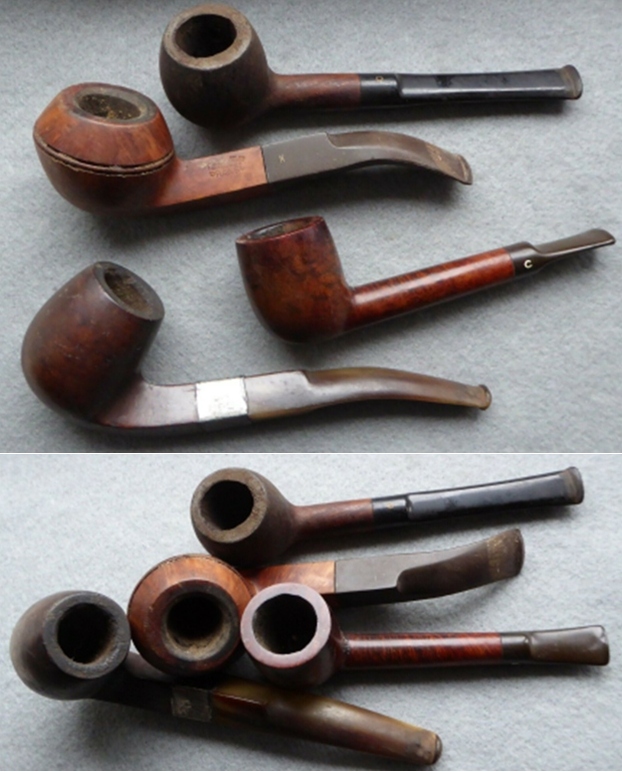
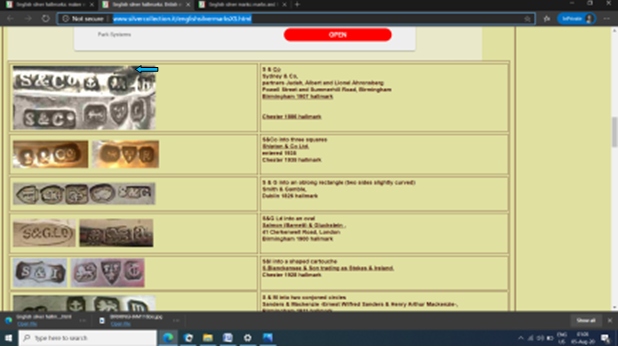
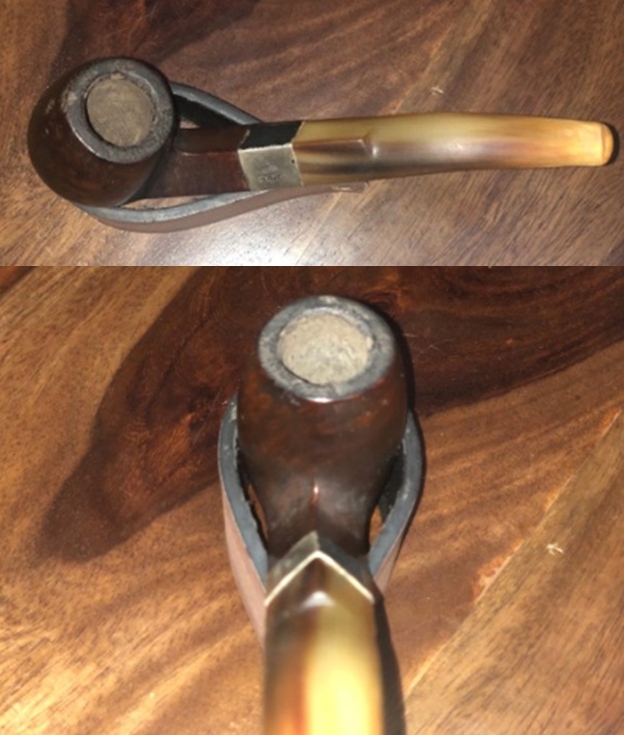
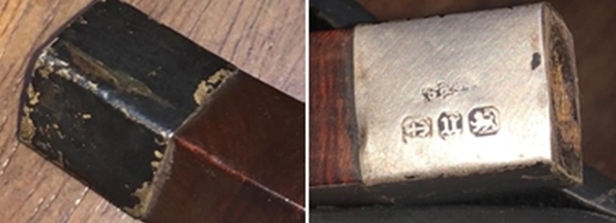
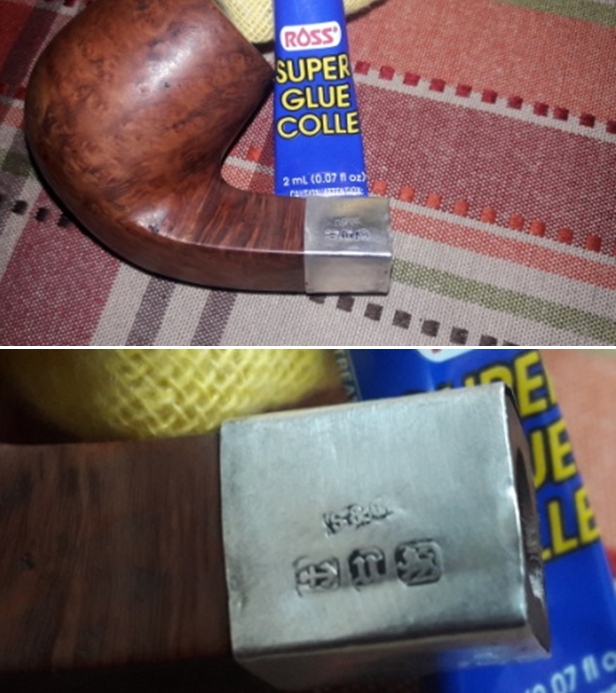
While surfing eBay for estate pipe lot, I came across a job lot that contained four estate pipes. The seller had not included any description for the item other than a simple statement that read “The lot is being sold as is. Pictures are part of description” or words to that effect. The worst part was that there were only two pictures that were posted by the seller!! Here are the pictures that were posted by the seller… I could make out one Orlik with dental stem, a Hardcastle “Drawel” Bulldog, one Comoy’s Lovat, and the last one was unidentifiable but appeared to be fitted with a horn stem. The pipes appeared to be in a decent condition and included some nice brand names. Soon the pipes reached Abha at my home town. When she opened the parcel, the stench that emanated from the box was just unbearable. The origin of the stench was the horn stem on the pipe that was in the lot. It is this pipe that Abha had worked on first (indicated with a red arrow) and thus finds itself on my work table now.The pipe is a classic Bent Billiard with a square shank and a saddle horn stem with a threaded tenon. It is a fairly large sized pipe with a nice hand feel and a surprisingly light weight that makes it comfortable for clenching. It has a hallmarked silver band at the shank end. The silver ferrule at the shank end is stamped as “S & G” in what appears to be a rectangle (?) that has been buffed out along with the other letters following “G” (faint outlining can be made out though!) over three sterling silver hallmarks. From right to left the first cartouche is with a LION PASSANT certifying silver quality followed by a cartouche with date code letter “U” and the last cartouche contains the “Anchor” of the Birmingham Assay Office. The shank and horn stem are devoid of any stampings.I had not come across this brand earlier and the only clue was in the stampings seen in the hallmarked silver band. I visited www.silvercollection.it and upon searching through the index, I came across a stamp that was the closest of all those that were described. The maker’s mark was described as S&G Ltd into an oval Salmon (Barnett) & Gluckstein of 41, Clerkenwell Road, London.
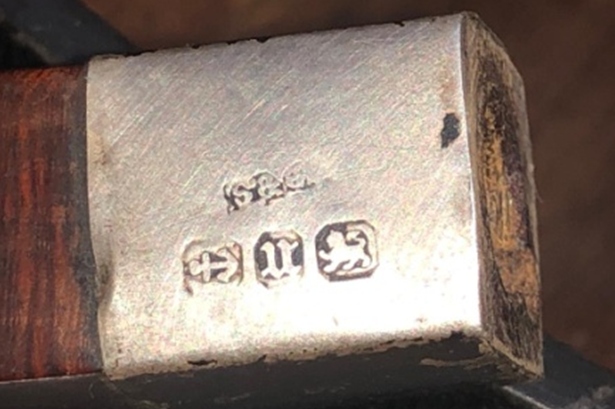
Here is the link to the relevant page followed by a screenshot of the same page with the nearly matching maker’s mark as seen on the pipe and indicated by the blue arrow.

http://www.silvercollection.it/englishsilvermarksXS.htmlThe next step was to date this pipe with the help of the hallmarks as seen on the silver band at the shank end. The Anchor was easy to identify as Birmingham Assay office. The letter “U” closely matched up with the letter that identified it as being assayed by the Birmingham office in 1894!! Given below is the link that will take the readers to the relevant section of dating.
http://www.silvercollection.it/englishsilverhallmarksBIR.html

While researching my previous project, a 1907 “AGE” pipe, Who Made That Pipe by Wilczak and Colwell had indicated towards Salmon & Gluckstein brand as English makers of this pipe.  Further, I remembered that Salmon & Gluckstein brand was brought over by Imperial Tobacco Co. in 1902 and was thereafter continued under the brand name “Bewlay”. I visited pipedia.org to know more about Salmon & Gluckstein. Though there is not much information that is available on the brand; here is the link for those readers interested.

https://pipedia.org/wiki/Salmon_%26_Gluckstein

To summarize, the pipe that is on my work table is by Salmon & Gluckstein, as inferred from the Anchor stamp of Birmingham Assay office and probably dates to 1894. The reason for the doubt is because the date letter is not a perfect match, but the closest that I could identify.

I would be really happy if any of our esteemed readers could either support or refute my appreciated dating of this pipe with necessary evidence.

Initial Visual Inspection
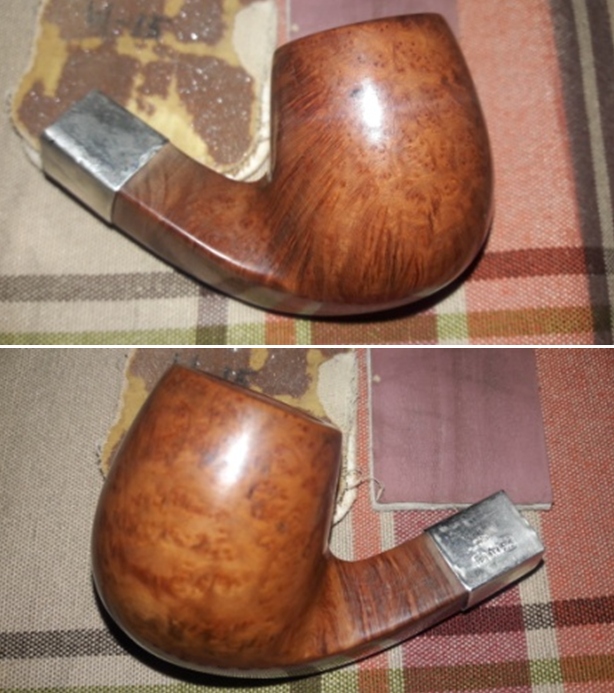
This pipe has the classic Bent Billiard shape with a diamond shank and a fairly large sized bowl. The stummel boasts of some beautiful and cross grains all over the bowl and shank. The stummel surface is covered in dirt and grime of the overflowed lava and grime. There is not a single fill in the briar which speaks of high quality selection of the briar. There is a thick layer of cake in the chamber. The horn stem, with a few bite marks, has a terrible stench emanating from it. The set of pictures below shows the condition of the pipe when it had reached us. Detailed Inspection Of The Pipe And Observations
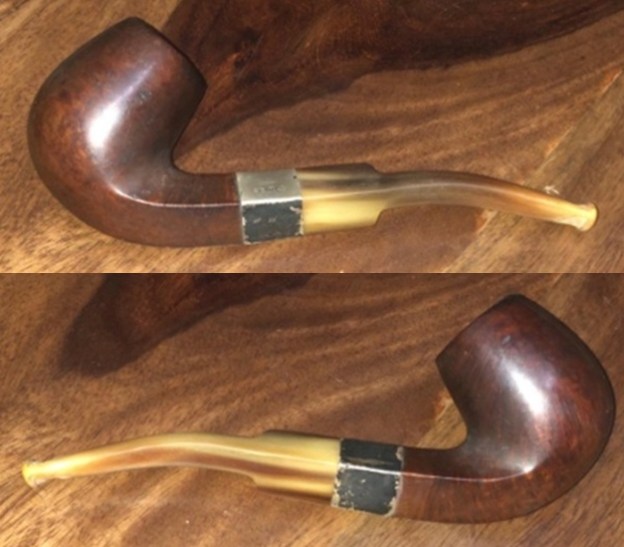
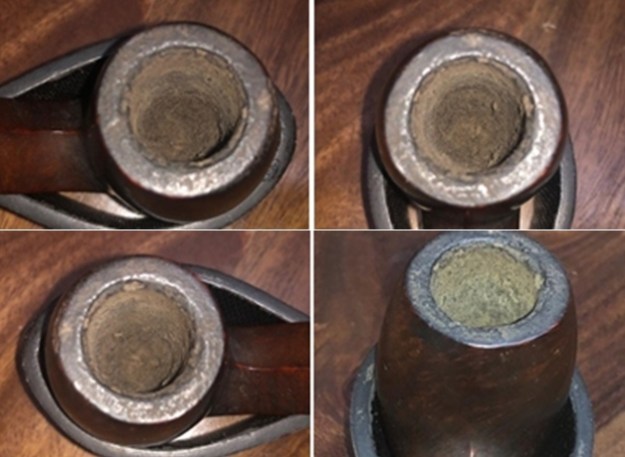
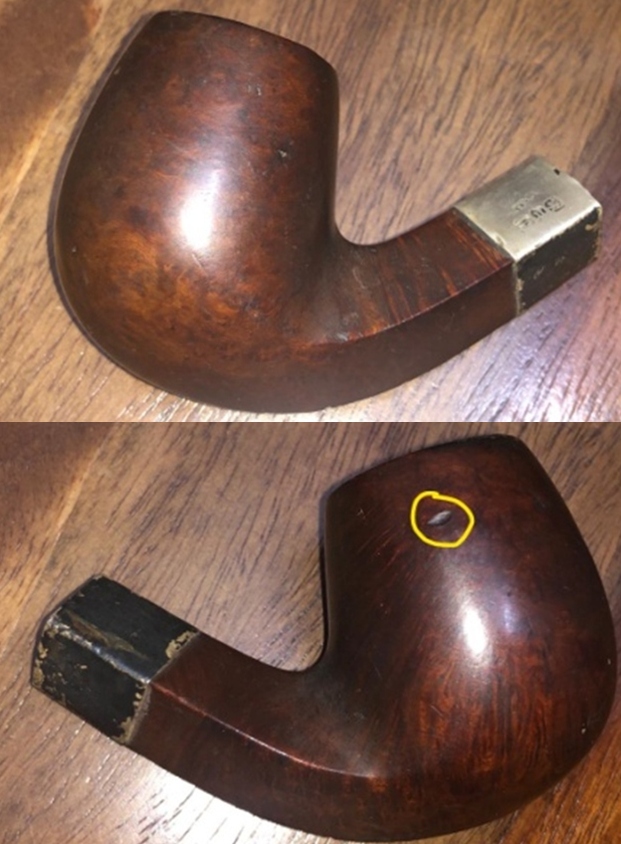
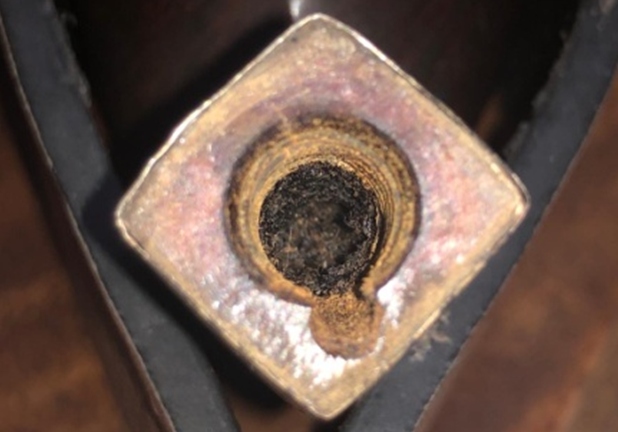
The chamber has an even layer of thick cake. The smooth rim top surface shows a number of dents/ dings and is covered in lava overflow, dirt and grime from previous usage. Both the inner and the outer rim have suffered a few blows on a hard surface resulting in a few minor chipped edge surfaces and with the inner edge being out of round. The condition of the inner walls of the chamber can be commented upon after the cake has been taken down to the bare briar. The chamber exudes a very strong odor of old tobacco. The draught hole is dead center at the bottom of the chamber and that makes me believe that it should great smoke and the thick cake in the chamber lends credence to this observation. The stummel appears solid to the touch all around and hence I do not foresee any serious damage to the walls in the form of burnout/ deep heat fissures/ lines or pits. To address the damage to the inner and outer rim edges, I shall create a slight bevel to both the rim edges. Topping the rim surface should address the dents and dings over the rim top surface. The reaming and subsequent cleaning of the chamber and mortise should reduce the ghost smells from the chamber.The smooth stummel surface is covered in lava overflow which in turn has attracted a lot of dust and dirt. The briar has taken on a layer of aged patina, through which one can make out the tightly packed cross grains that adorns most of the stummel surface and Bird’s eye grain at the foot and bottom of the shank. There are a few dents and chipped areas over the stummel surface (encircled in yellow), probably due to likely falls and or rough, uncared for handling of the pipe. However, there is not a single fill in the entire stummel, signifying very high quality of briar used in carving this pipe. The briar is looking lifeless and bone dry and has taken on dull dark hues. Thorough cleaning of the stummel surface and rinsing it under warm water should highlight the grain patterns. This cleaning will also further reveal any other damage to the surface. In all probability, I shall let these minor dents and dings to the stummel surface remain and avoid the process of filling these up with briar dust and superglue mix while the large one on the right side of the stummel will need a fill. Maybe, micromesh polishing will address a few of these scratches to some extent. The mortise shows heavy accumulation of oils, tars and gunk and due to which the air flow is not full and smooth. The horn stem is in decent condition with no chipped surfaces and sans any worm holes which is common on such old horn stems. The stem surface is covered in dirt/ dust and looks dull and lifeless. The bite zone has deep tooth indentations on either surface. The button edges on both surfaces have minor bite marks. The threaded bone tenon is smeared in oils and tars and grime and so is the orifice slot. The entire stem had a horrendous stench and Abha, my wife, had half a mind to just throw the entire pipe away in some far away trash can. However, she did not and took upon herself the challenge to clean it up. Once the stem surface is cleaned and polished, the dark and light hues of the striations in the horn should stand out giving a new dimension to the appearance of the stem.   The sterling silver ferrule is heavily oxidized and developed a patina commensurate with the vintage. The stamping on the ferrule for most parts is crisp and clear. The stamping in the cartouche that houses the Maker’s mark is buffed out with only the faint outline of the letters still visible. I would need to be very diligent while polishing the silver ferrule, least I end up buffing away rest of the stampings on the ferrule. Once the ferrule has been cleaned up, the shining piece of silver will add an elegant touch to the pipe.The Process
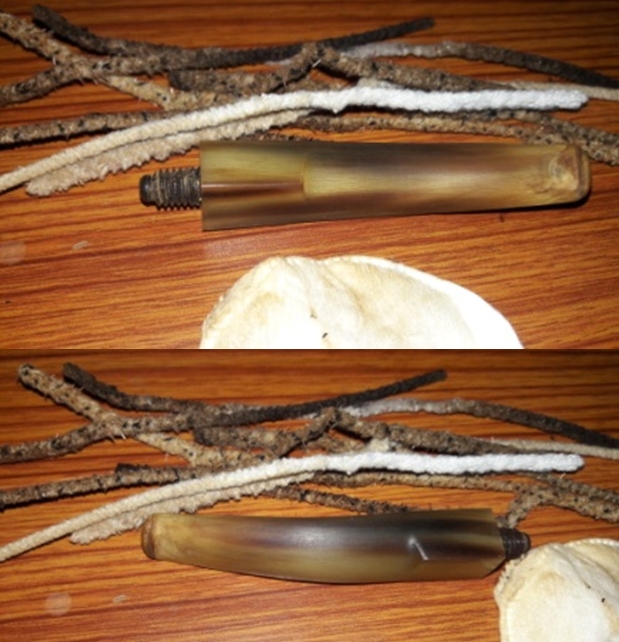
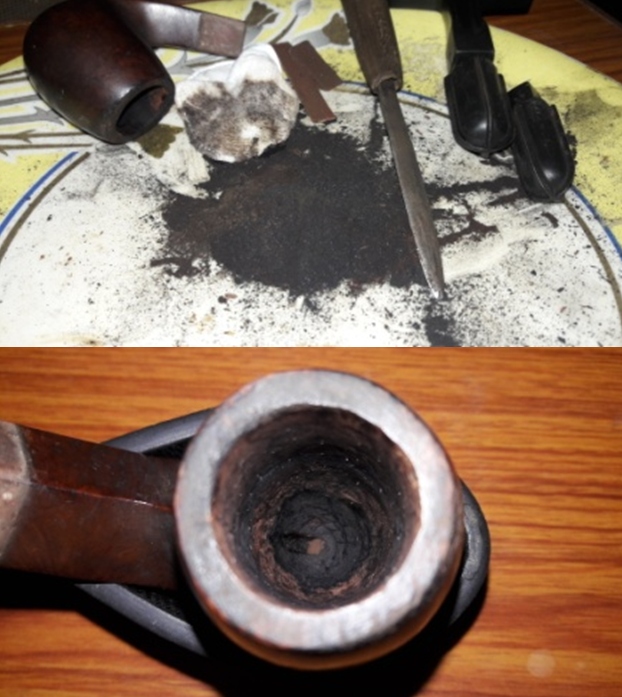
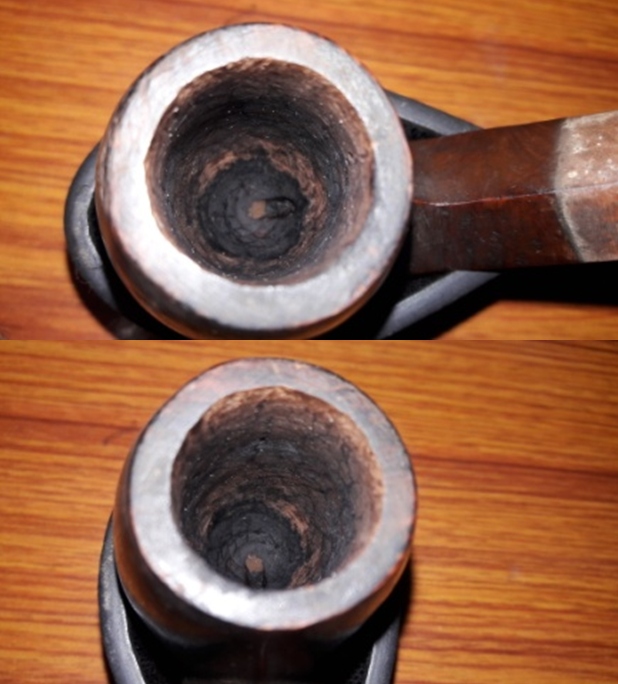
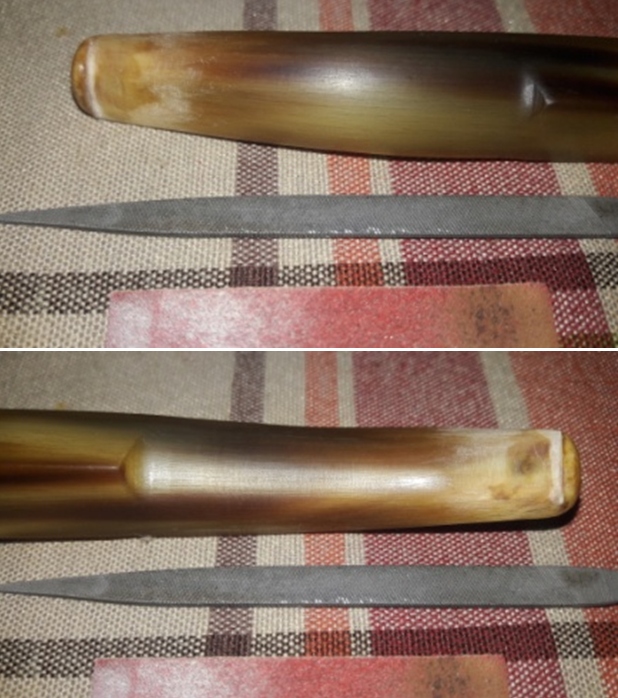
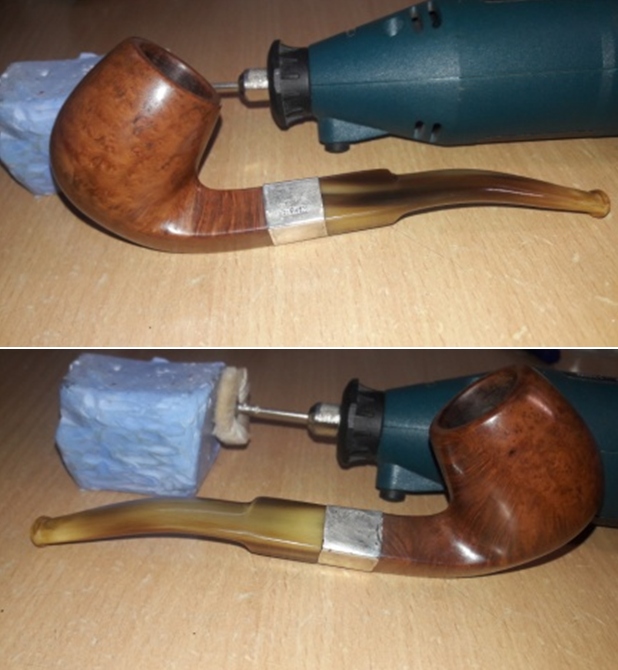
Abha started the restoration of this pipe by first cleaning the external surface of the horn stem with warm water and dish washing soap. Next she cleaned the internals of the stem with bristled pipe cleaners and 99.9% pure isopropyl alcohol. She further cleaned out the stem internals with a shank brush and dish washing liquid soap. She had to repeat the above process a number of times, including drying it out in open air. The stem is now clean with the stench being a distant memory and what a relief that was!! She was careful to rehydrate the stem with EVO every time she cleaned the stem and left it out to dry in open air. While the stem was being cleaned by Abha, I worked on the stummel by first reaming the chamber with size 2 and 3 Castleford reamer heads. With my fabricated knife, I further scraped the chamber walls to remove the remaining carbon deposits and also scraped out the lava overflow from the rim top surface. Once the cake was reamed back to the bare briar, I used a 150 grit sand paper followed by 220 grit sand paper to remove all the traces of remaining cake and also to smooth out the inner walls of the chamber surface. Finally, to remove the residual carbon dust, I wiped the chamber with a cotton pad wetted with 99.9% pure isopropyl alcohol. Few very minor webbing of heat lines can be seen along the heel and walls of the chamber. I am not sure if these are heat lines or remnants of old cake over the wall surface. The outer and inner rim edge is chipped in a few places along the rim top and will be addressed by topping the rim top. The rim top surface itself is peppered with dents/ dings and scratches which too will be addressed during the sanding. The inner rim edge is charred and would need to be addressed. The ghost smells are still strong and may further reduce after the shank/ mortise are thoroughly cleaned. While I was working on the stummel, the sterling silver band at the shank end came off easily since the glue that had held it in place had dried out completely. Closer examination of the shank end revealed a pristine shank end with no signs of cracks or chipped surface.This was followed by cleaning the mortise with q-tips, pipe cleaners and shank brush dipped in isopropyl alcohol. I scraped the walls of the mortise with my fabricated knife to remove the dried oils and tars. The mortise was a bear to clean and the heap of pipe cleaners and q-tips that were used is an indication of the gunk and tars that were removed. The old smells of the tobacco are still strong and would need more invasive methods to get rid of these odors.  With the bowl internals clean, I move to clean the exterior of the stummel. I used a hard bristled tooth brush and Briar Cleaner, a product that has been developed by Mark Hoover, to scrub the stummel and rim top. I set the stummel aside for 10 minutes for the product to draw out all the grime from the briar surface. After 10 minutes, I washed the stummel under running warm water with anti oil dish washing detergent till the stummel surface was clean and dried it using paper towels and soft cotton cloth. I simultaneously cleaned the shank internals with the detergent and hard bristled shank brush and set the stummel aside to dry out naturally. The stummel surface has cleaned up nicely with the beautiful grain patterns on full display. This cleaning has also exposed the many dings and scratches over the surface that were hitherto fore were hidden under the dirt and grime. These will have to be addressed, either by steaming or sanding.  I shall subject the chamber to cotton and alcohol treatment to eliminate the ghost smells completely. I continued the cleaning of the chamber and shank internals with a salt and alcohol bath. I use cotton balls which is an at par substitute as I have realized over the years. I draw out a wick from the cotton and along with a folded regular pipe cleaner; insert it in to the mortise and through the draught hole in to the chamber. Thereafter, I packed the chamber with cotton balls to about quarter of an inch below the inner rim edge and soaked the cotton balls with isopropyl alcohol up to the brim. About half an hour later, the level of alcohol had gone down, having being absorbed by the cotton. I topped it up once again and set it aside overnight. By next morning, the cotton and alcohol had drawn out all the remaining oils and tars from the chamber and mortise, fulfilling its intended task. I removed the cotton balls and ran pipe cleaners through the mortise to clean out all the loosened tars and gunk and further cleaned it with alcohol and q-tips. The chamber now smells clean and fresh. I set the stummel aside to dry out naturally.To begin repairs to the stem, I cleaned the areas in the bite zone with cotton swab and alcohol. Next, I filled the tooth indentations in the lower surface with clear CA superglue and set it aside to cure. After the glue had partially hardened on the lower surface, likewise, I filled the upper surface tooth marks and set the stem aside for the superglue to harden completely. Once the fill has hardened, I shall file and sand the fills to reconstruct the bite zone and the buttons on either surfaces and subsequently match it with the surface of the stem.The stummel had dried out and I decided to have a closer look at all the dents and dings and scratches on the stummel surface. I marked them out with a red felt pen. This step would help me in getting a clearer picture of the extent of damaged areas and identifying the major surface damage which would need to be addressed. I would need to sand the stummel surface to address all the minor scratches and dings while the larger ones will be filled with a mix of superglue and briar dust.   Next I closely examined the inner rim edge. It is charred on the left side in the 7 o’clock direction (encircled in red). Though not very deep, it is significant enough to render the rim out of round. I shall firstly minimize the charred surface by topping the rim surface and thereafter crate a slight bevel to the inner rim edge. To address the outer rim dents and ensure the symmetry of rim top, I shall create a similar bevel to the outer rim edge. With the above observations completed,  I turned my attention to address the damage to the stummel. I decided to address the rim top surface dents/ dings and the out of round inner edge first. I topped the rim top surface on a piece of 220 grit sand paper, checking frequently for the progress being made as I hate to lose briar estate any more than absolutely necessary. The inner and outer edges are still uneven, though much better than before topping. With a folded piece of a 220 grit sand paper pinched between my thumb and forefinger, I create a slight bevel on the inner and outer edges of the rim top surface. This helps to mask and address the minor dents and dings that had remained on the rim edges after topping. I am careful so as not to alter the profile of the stummel by excessive topping or creation of the bevels. I am pretty pleased with the appearance of the rim top and edges at this stage. The following pictures show the progress being made and improvements to the inner and outer rim edges. I sand the entire stummel with a piece of 220 grit sand paper to address the dents and dings to the stummel surface. Though 95% of the scratches and dings have been eliminated, there still remains few dings that will be  required to be filled with a mix of CA superglue and briar dust. Using the layering method, I filled these dings and the chipped stummel surface with a mix of briar dust and CA superglue till the mound of the mix was slightly above the rest of the stummel surface. This helps in a better blending of the fill with the rest of the stummel surface while sanding and reduces the scratches caused by the use of a needle file as you have a correct perspective of the sanding that is required. I set the stummel aside for the fills to cure.  Once the fills had cured, with a flat head needle file, I sand the fills till I had achieved a rough match with the surrounding stummel surface. I again sand the entire stummel with a piece of 220 grit sand paper to address the dents and dings to the stummel surface and also to further match the fill with the rest of the stummel surface. A few minor dents and dings still remained and I accept these dings as part of this pipe’s journey to date. I cleaned the sterling silver ferrule at the shank end with “Pitambari”, a powder that is available all across India that is used to clean and shine brass and silverware. Even Abha uses it to polish her silver and gold jewelry and cutlery. This compound is a very fine powder and is least abrasive with fantastic results. The results were appreciated by Steve during his visit to India. The band is now a nice shining piece of sterling silver and will provide a nice contrast between the shining horn stem and the dark brown stummel.  Prior to proceeding with micromesh polishing cycle, I reattached the sterling silver band to the shank end using superglue.  I followed it by wet sanding the entire stummel with 1500 to 12000 grit micromesh pads, wiping frequently with a moist cloth to check the progress. I really like the looks of the stummel at this point in restoration. The grains and the clean lines of this piece of briar is really appreciable.      Next, I rubbed a small quantity of “Before and After Restoration Balm” deep in to the briar with my finger tips and let it rest for a few minutes. The balm almost immediately works its magic and the briar now has a nice vibrant appearance with the beautiful grain patterns displayed in their complete splendor. I further buffed it with a horse hair brush. The contrast of the dark browns of the Bird’s eye and cross grains with the natural patina of the rest of the stummel adds an interesting dimension to the appearance of the stummel which may be insufficiently described in words and far better seen in person. With the stummel rejuvenation almost complete, save for the final wax polish, I worked the stem. The fill had cured and with a flat head needle file, I worked on the filling till I had achieved a rough match with the surrounding surface and had sufficiently sharpened the button edges. To bring a deep shine to the horn stem, I went through the complete set of micromesh pads, wet sanding with 1500 to 12000 grit pads. I wiped the stem with moist cloth after each pad and rubbed it down with Extra Virgin Olive oil to rejuvenate the horn. I am pretty happy with the way the stem repairs have shaped up and also the buttons have a nice delicate shape to them. The finished stem is shown below.      I have now reached the homestretch in this restoration project. To complete the restoration, I mount a cotton cloth buffing wheel on to my hand held rotary tool and polished the stummel and stem with Blue Diamond compound. This compound helps to remove the minor scratch marks that remain from the sanding.     I mounted another cotton buffing wheel that I have earmarked for carnauba wax and applied several coats of the wax. I finished the restoration by giving the entire pipe a rigorous hand buffing using a microfiber cloth to raise the shine further. The finished pipe looks amazingly beautiful and is ready to join my collection. I only wish it could share with me its life story of the past years while I enjoy smoking my favorite Virginia blend in it or maybe an English blend or maybe just keep admiring it!! Big thank you to all the readers who have joined me on this path by reading this write up as I restored and completed this project.
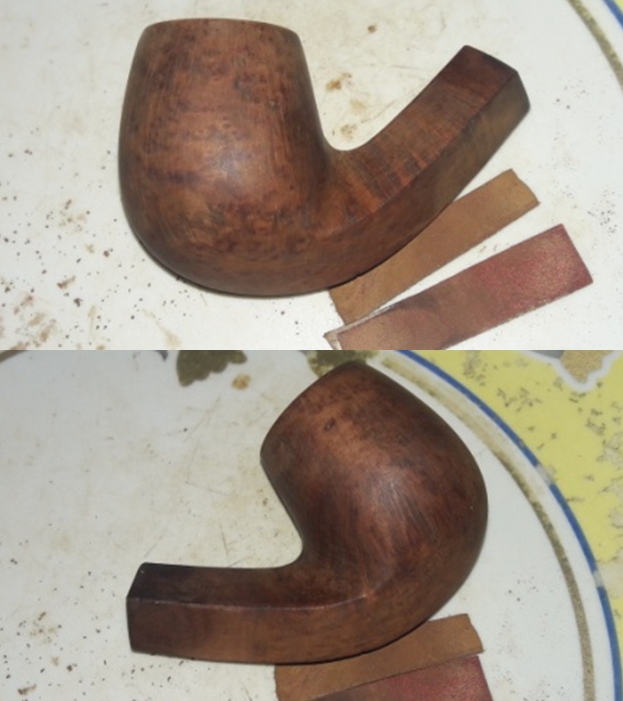
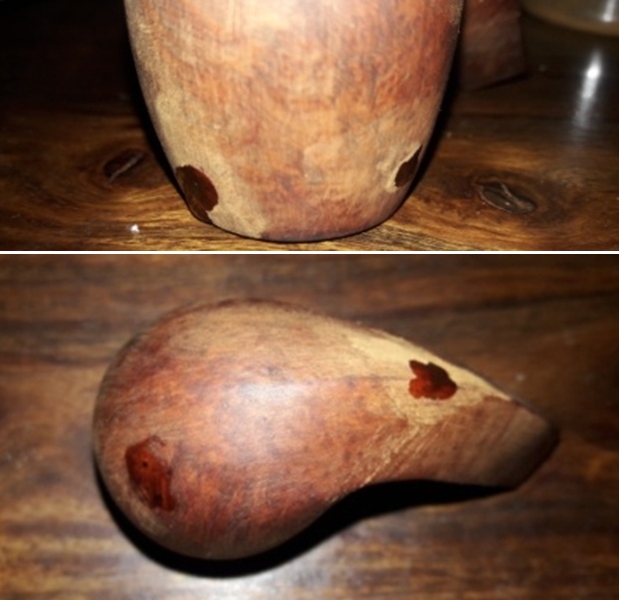
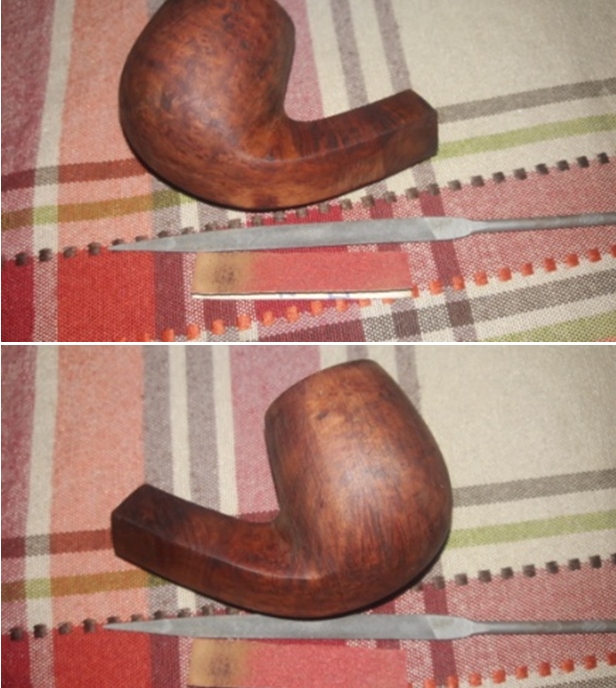
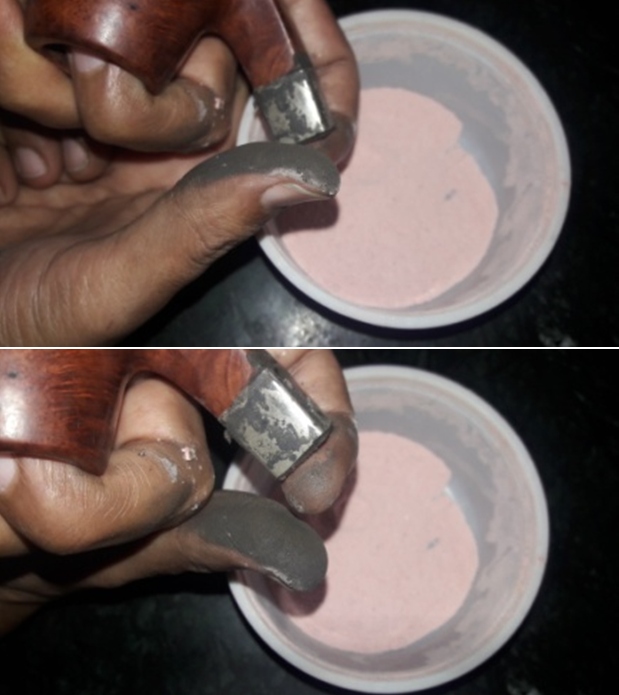
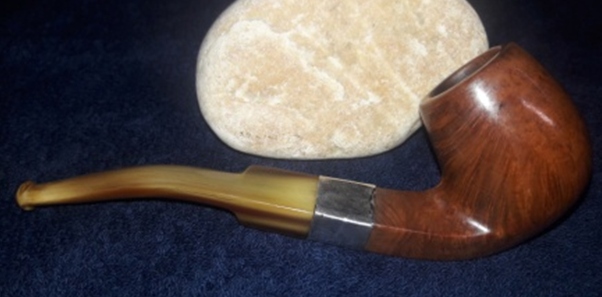
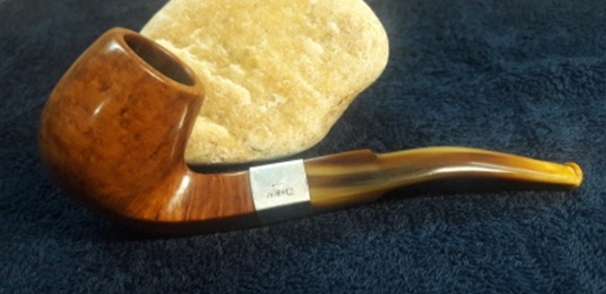
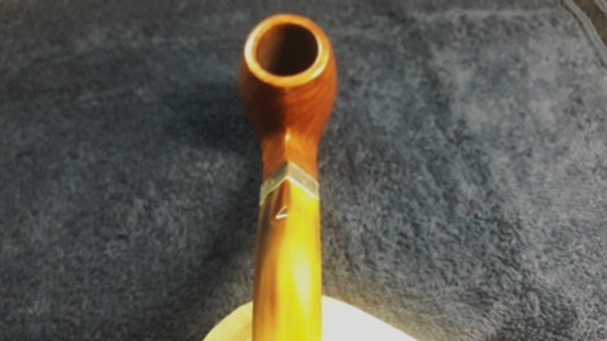
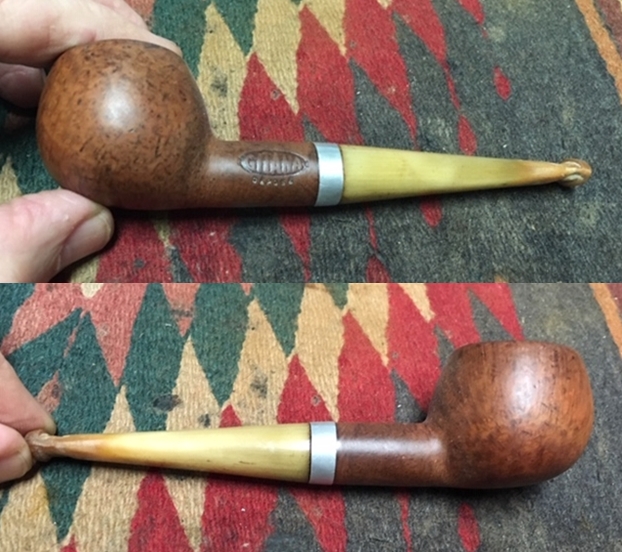
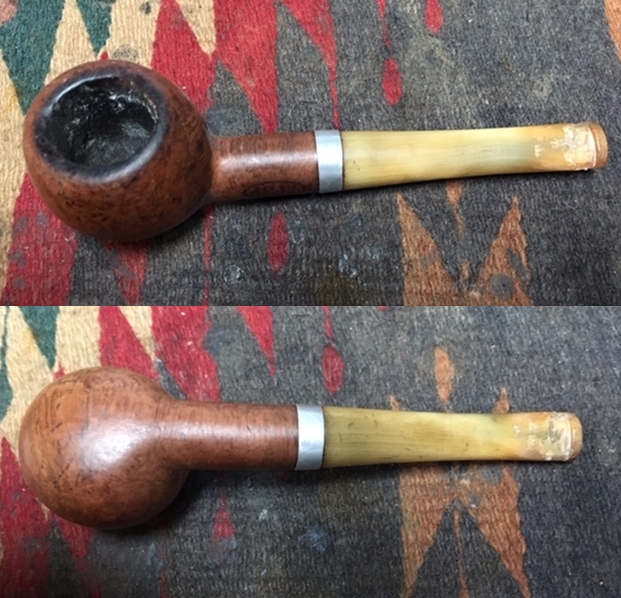
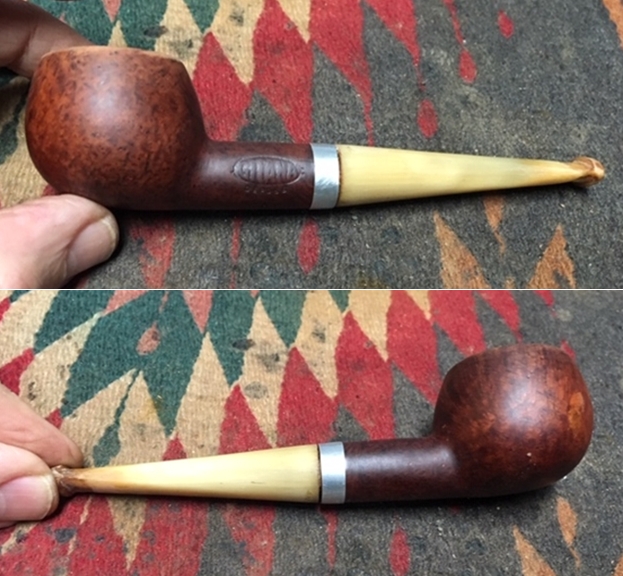
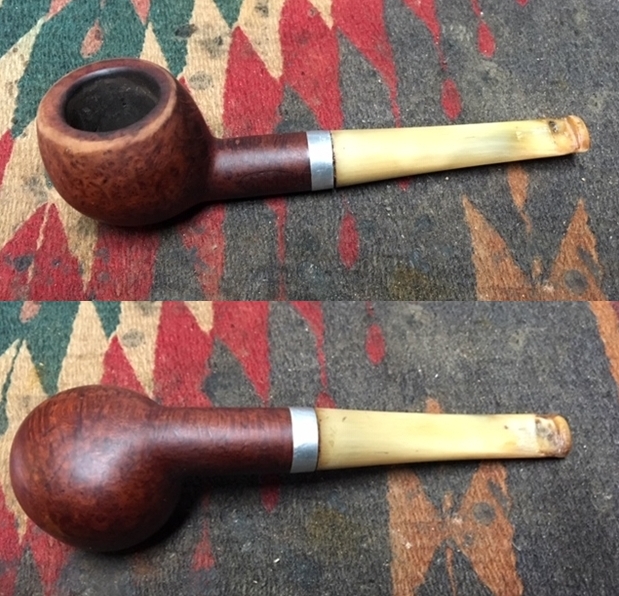
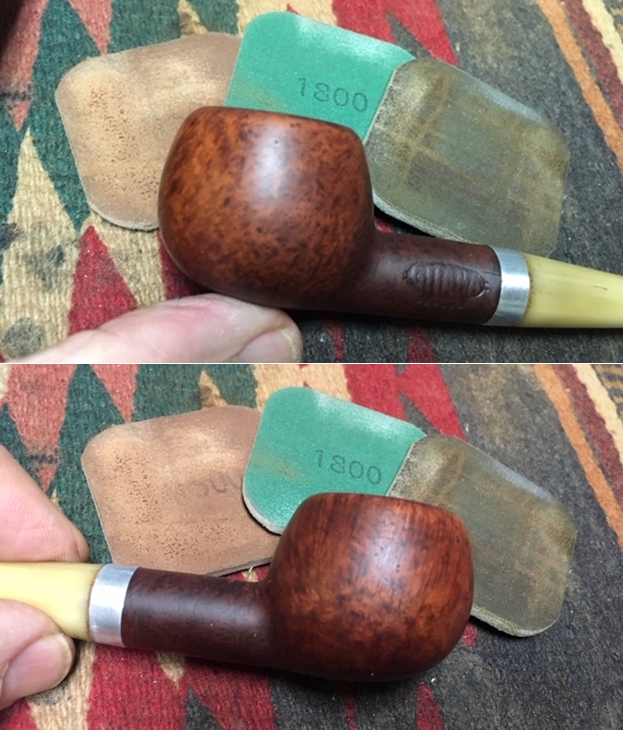
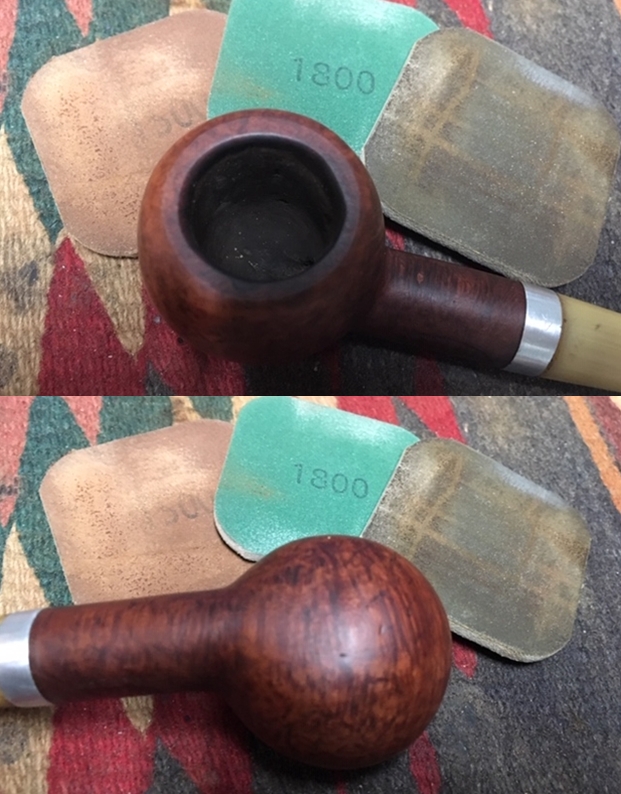
Restoring Life to a Early 20th Century Gitana Depose Apple


Blog by Steve Laug

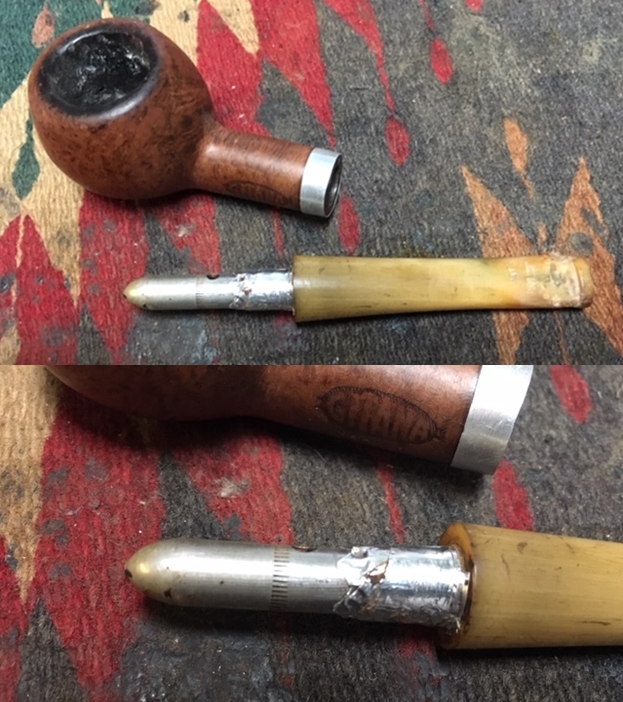
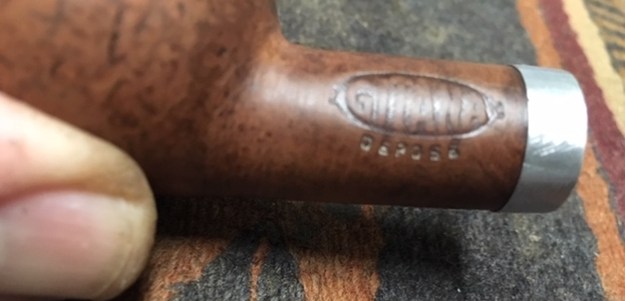
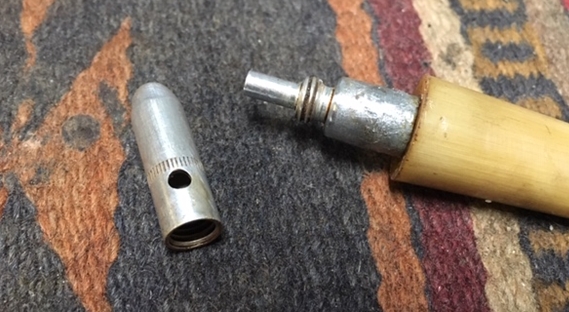
I was going through boxes of old pipes here, sorting and getting them ready to sell as grab bags. In the process I came across this pipe. It is stamped Gitana in an oval with an L on the left of the oval and G on the right side of the oval. Underneath the oval stamp is the word Depose. There is a polished aluminum band on the end of the shank. The briar is quite nice with birdseye around the bowl. The stem is horn and has a lot of tooth damage next to the button on both sides. There are deep troughs carved by the teeth in the horn material on both sides. The rim had a lot of damage from burn marks and the inner edge had been damaged by reaming with a knife. There was a white waxy substance on the inside of the bowl from the edge down about a ½ inch. There was a light cake in the bowl and some light lava on the bowl top. I took a close up photo of the rim top to show the damage to the inner edge of the bowl from the reaming job. The cake on the bowl sides and the tarry oil on the rim top are also visible. The briar at the top is quite damaged and will take some work to remove the knife cuts and deep gouges in the briar. The stem is also shown with the chewed damage on both sides.  I removed the stem from the shank and was a bit surprised by the aluminum system that was inside. The tenon was aluminum and had a bullet shaped cap on the end of it. The cap had a hole in the top that allowed the smoke to be drawn through the airway in the stem. The previous own had wrapped the aluminum portion of the tenon with what looked like aluminum foil to build it up to fit tightly in the shank. The photos below show the tenon and the system. I was unfamiliar with the brand and was surprised by the tenon system. I did some searching online and could find nothing on the Gitana brand or the Gitana Depose brand. I did happen across a similar pipe on Smokingpipes.com. The writer who described the pipe for the site wrote the following which contained some really helpful information. I quote:
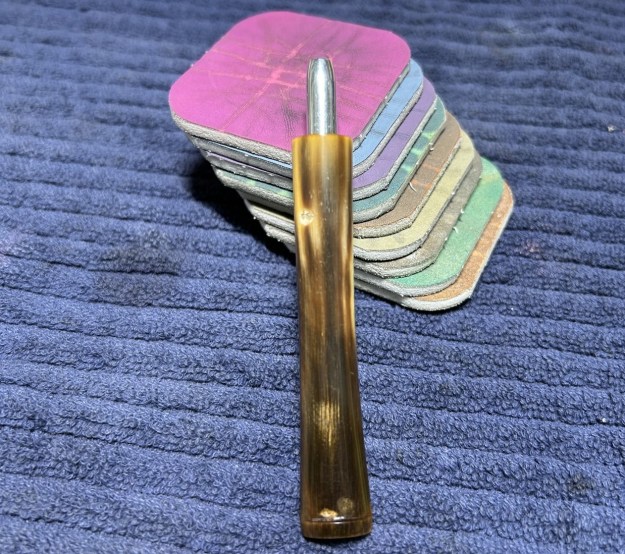
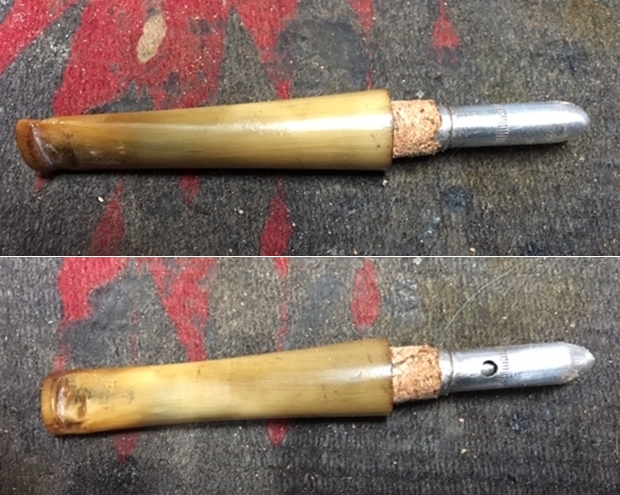
We were able to ascertain a little information about La Gitana, which was a French brand created by Chapel Frés…but this relic from the early 20th century still sports its original horn stem, coupled with a novel aluminum tenon arrangement that we can only assume is meant to trap moisture. Although we aren’t sure how well it achieves this, it does do quite well at looking like an old-school James Bond accessory. It fits securely within a cork-lined mortise, which many briars of this period tended to have. https://www.smokingpipes.com/pipes/estate/france/moreinfo.cfm?product_id=196840

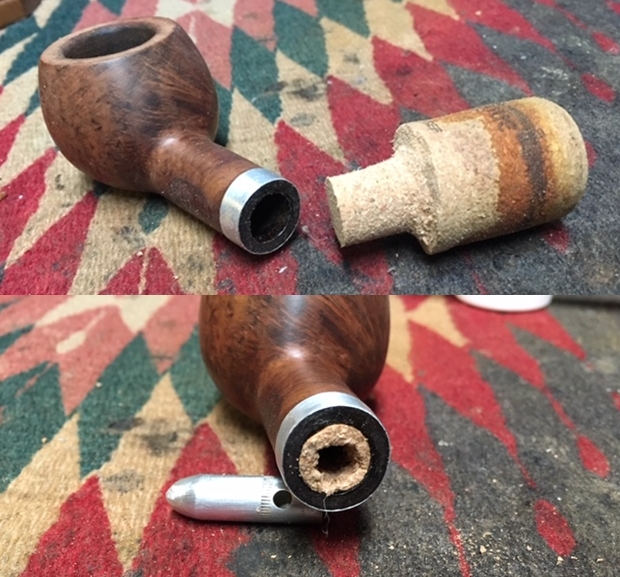
From that I learned that the brand was called La Gitana. It was a French made pipe from a company called Chapel Frés. It was made in the early 20th century and the author had described the tenon system like the one I had.  I also learned that the mortise had originally been cork lined to facilitate holding the tenon snuggly in the shank. This was what was missing in the pipe I had and it had been replaced with the foil mess that is seen in the above photos.

Armed with the name Chapel Frés I looked on Pipedia under French Pipe Companies and found the brand there. It stated that it came from that factory and the brand had been founded in 1904 in Saint-Claude, France. Here is the link https://pipedia.org/wiki/Chapel_Fr%C3%A9s.

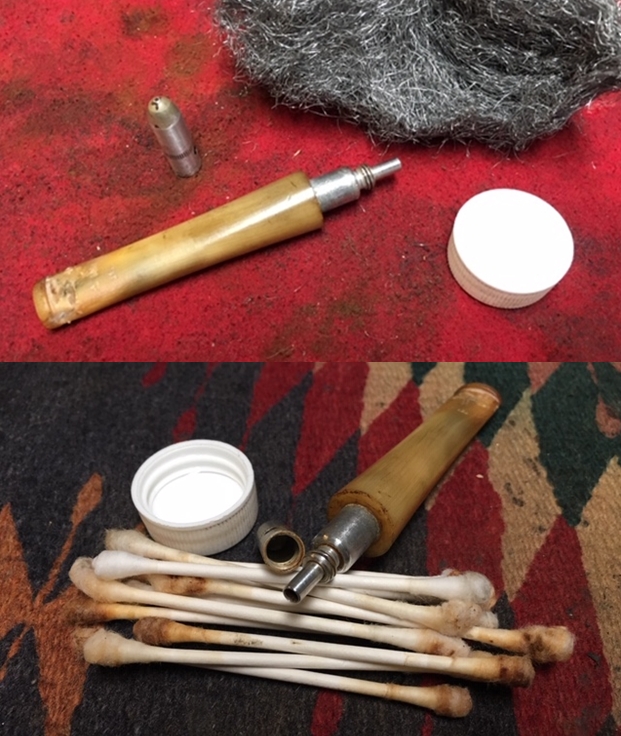
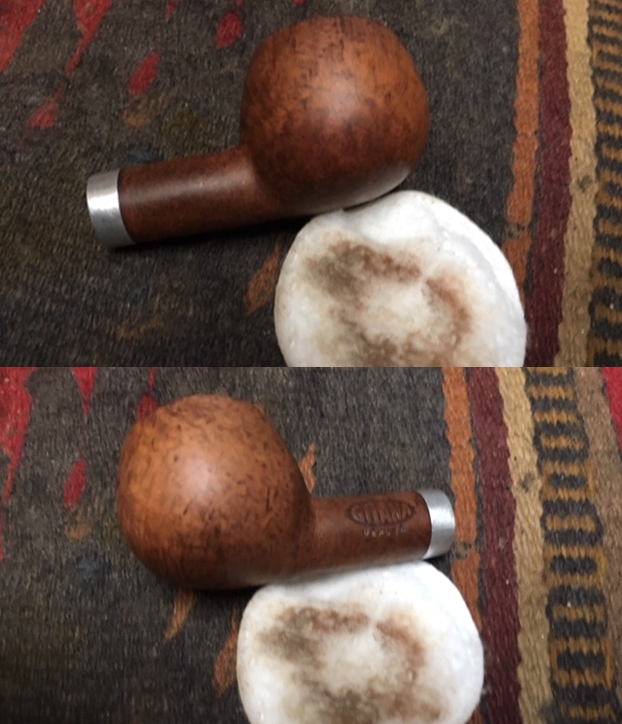
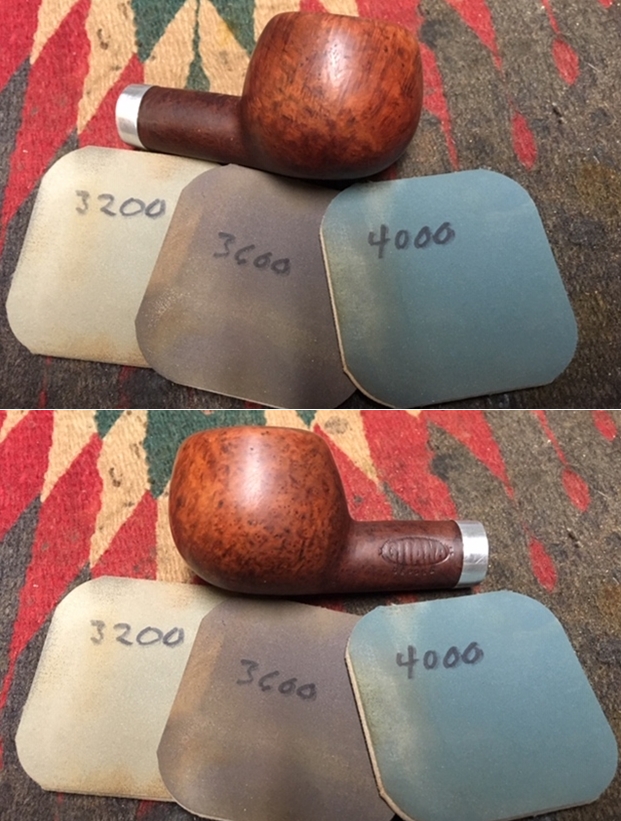
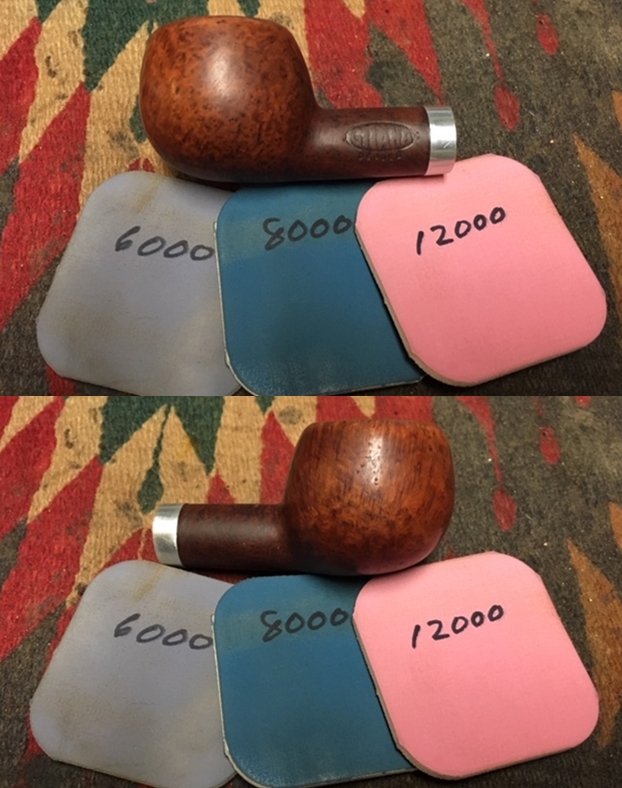
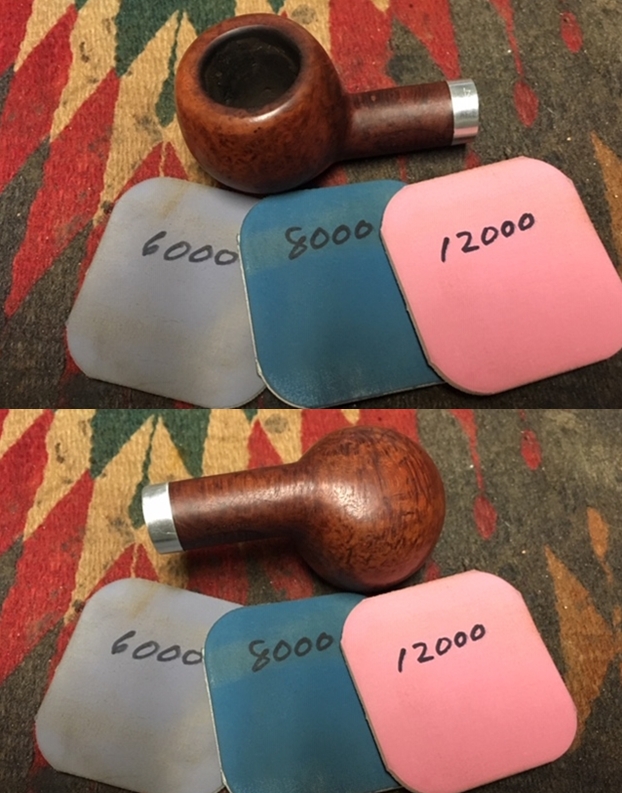
Armed with that information I started my cleanup of the stem. I scraped away the foil that was wrapped around the tenon. I examined the bullet shaped cap on the tenon and figured out that it unscrewed from the tenon. I cleaned the metal underneath alcohol, cotton swabs, pipe cleaners and steel wool. I cleaned out the airway in the shank at the same time. The tube in the end of the tenon looked clean. I used alcohol, cotton swabs and pipe cleaners to clean out the inside of the bullet cap. I cleaned out the walls in the shank with pipe cleaners, cotton swabs and alcohol. It was a very dirty pipe that once it was clean had an interesting look to it. I cleaned up the inside of the bowl with a Savinelli Fitsall Pipe Knife. I scraped the walls clean of the carbon build up. I sanded the walls of the bowl with a piece of dowel wrapped with 220 grit sandpaper.To remove the damage on the rim top I topped the bowl until the damaged areas were removed and the rim top was clean. I used a folded piece of sandpaper to smooth out the inner edge of the rim and bring it back to round as much as I could. I washed down the exterior of the bowl with acetone on a cotton pad to remove the finish and the grim on the briar. The pipe looked really good at this point. I needed to round down the outer edges to bring it back to the shape it was when I started but for now it was clean. I took a photo of the stamping on the left side of the shank. The stamping is quite readable and clear.The tenon had some sticky substance for the glue on the foil on the tenon end. The tenon and threads still needed more cleaning to remove the oils.I filled in the tooth marks and troughs in the surface of the horn with clear super glue. I set the stem aside to dry.I decided to try to fit a cork in the shank to line it as suggested above. I cut away some of the excess cork from a wine cork I had. I trimmed it down with a Dremel and sanding drum until the diameter was close to the inside of the shank. I drilled it out with a series of drill bits starting small and working my way up to one that was close to the size of the tenon. I sanded down the cork exterior until it was a fit in the shank. I pressed it in place in the shank.I used a needle file to thin down the inner walls of the cork lining. It needed to be very thin to allow the tenon to fit in the shank. I tried to put the tenon in the shank. The fit was still not right. The cork was too thick to allow a fit. I pulled it out of the shank and slid it over the tenon. I sanded it down with sandpaper and files until it was a good fit. I glued the cork on the tenon and let it dry. When it cured I rubbed the cork down with Vaseline to soften it and allow it to slide into the shank. The fit was very good. I took some photos to show what the pipe looked like at this point in the restoration (I had also started the shaping on the bowl top). I polished the briar with micromesh sanding pads – wet sanding it with 1500-2400 grit pads and dry sanding with 3200-12000 grit pads. I wiped it down with a clean cloth after each pad. The grain began to pop and really stand out. Once the glue repairs cured I sanded them with 220 grit sandpaper to smooth out the repairs. I sanded them to blend them into the surface of the horn. I polished the stem with micromesh sanding pads – wet sanding with 1500-2400 and dry sanding them with 3200-12000 grit pads. I wiped the stem down with Obsidian Oil after each pad. I gave it a final coat and let it dry. The following photos show both sides of the stem. I worked Before & After Restoration Balm into the briar and the horn stem with my fingertips to clean, enliven and protect the wood and the horn. I let the balm sit for about 20 minutes and buffed it off with a soft cotton cloth. I took photos of the pipe at this point in the process to show what the bowl and stem looked like. I am happy with the look of the pipe. I polished the bowl and stem with Blue Diamond to polish out the scratches in the briar and horn. I gave the bowl and the stem multiple coats of carnauba wax. I buffed the pipe with a clean buffing pad to raise the shine. I hand buffed it with a microfiber cloth to deepen the shine. The pipe polished up pretty nicely. The original patina on the bowl came alive with the buffing and worked well with the polished striated horn stem. The pipe has a rich look. The finished pipe is shown in the photos below. The shape, finish and flow of the pipe and stem work give the pipe a very classic look. The dimensions of the pipe are Length: 5 1/2 inches, Height: 1 1/2 inches, Outside diameter of the bowl: 1 1/2 inches, Chamber diameter: 3/4 of an inch. Thanks for reading this while I worked on it. It was interesting and unusual piece to restore and I really enjoyed the work.

Cleaning up another CPF – this time it is a square shank Bulldog Setter


Blog by Steve Laug

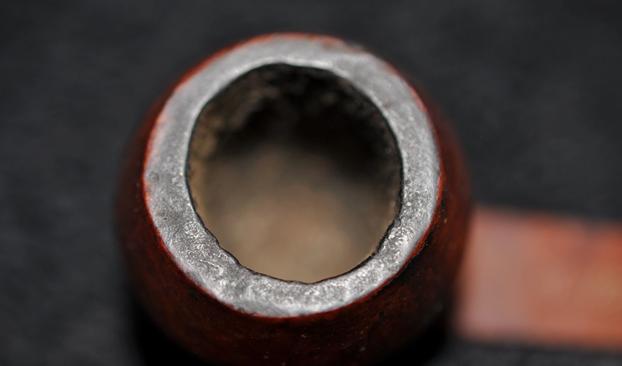
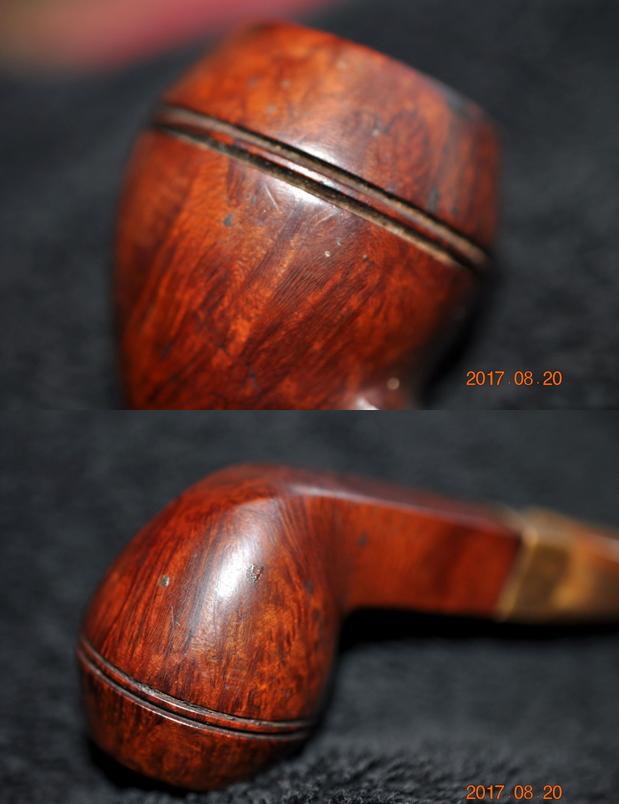
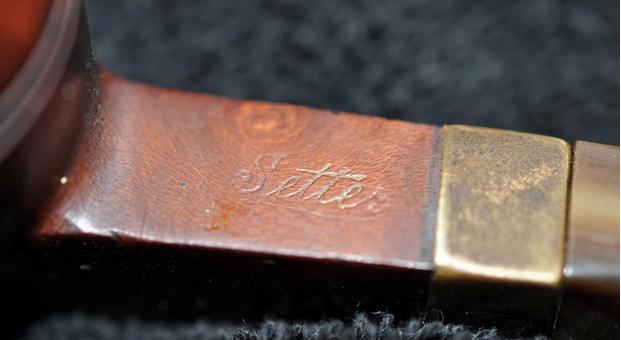
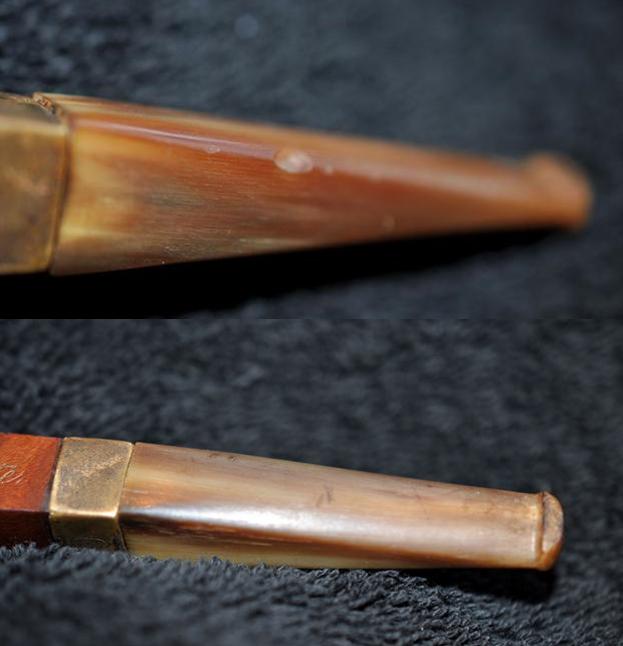
If you have been reading rebornpipes for long, you will have figured out that I really like older C.P.F. pipes (Colossal Pipe Factory). I have quite a few of them in my collection and really like them. The history is an intriguing and enjoyable part of the brand for me. The artisanship and design of these pipes captures my appreciation and admiration. The shapes are always unique; even in the same line the shapes vary from pipe to pipe. The creativity and inventiveness of the smoking delivery systems of their pipes are always a pleasure to study. The variations of Bakelite bases and stems with briar bowls, briar bowls with Bakelite stems, briar bowls with horn and with vulcanite stems. The names the company gave their pipes always has me wondering where they came from. Sometimes they seem to be humorous like the Siamese conjoined stem pipe I just finished and sometimes descriptive like this one – the square shank, horn stem Setter. The pipe came from Jeff in a box he shipped to me just before he left for his European adventure. The box arrived last evening. I was like a kid on Christmas morning. No matter how many boxes he sends my reaction is always the same. There were two C.P.F. pipes that immediately caught my attention. Jeff had shown me these two on FaceTime before he left so I was awaiting their arrival. When he was cleaning them both he somehow switched the stems in a hurry and in the process broke the tenon off the wrong stem in the shank of this pipe. Both pipes had a bone tenon so it is easy to understand what happened. He had put both pipes in individual bags in the box. When I saw this one, I decided it was the next one I wanted to work on.The pipe is a bulldog with a square shank and square tapered horn stem. It has twin rings around the top of the bowl. The shank had a gold coloured ferrule on it with the end turned over to cover the exposed end of the shank. On the left side of the ferrule, it was stamped with the C.P.F. oval logo. There was no other stamping on the metal ferrule. The bowl had a thick cake that lightly overflowed like lava over the top of the rim. The inner edge of the rim shows a lot of damage from what looks like reaming with a knife. The outer edge showed some nicks on the right side and a few on the left front. Jeff took some photos from different angles showing the condition of the bowl. It was a beauty. The grain was quite nice and the twin rings around the rim were in excellent condition with no chips. On the top of the shank there was faint gold lettering reading Setter in a Germanic script that I have come to expect on C.P.F. pipes from this era of the late 1890s to early 1900s. The finish was worn and dirty as expected on a pipe of this age. The two photos that follow that are different views of the shank and the ferrule. The ferrule appeared to have slipped off during its life and there was a dark space just in front of it showing its original position on the shank. The diameter of the stem was larger than the diameter of the shank so it looked a little awkward making me wonder if it was not a replacement horn stem. If not it was poorly fitted and would need to be properly fitted to the shank. There were issues with the stem that might lessen with reshaping but they were present and can be seen in the photos below. These included deep nicks on the edges of the square stem – a chip at the right corner near the shank, a nick on the right side about a ½ inch from the shank end, and another on the left side that looked like a wormhole.The threads in the shank were evidently worn and someone had wrapped the bone tenon in scotch tape to facilitate a tight fit. I have seen this done often so it is not a surprise but it also makes me wonder if the stem is not a replacement. I won’t know until I check out the threads in the mortise when it arrives.The button showed some wear and tear and there was light tooth chatter on both sides of the stem. Fortunately it appeared that there were no deep tooth marks present.Jeff did a lot of cleaning and scrubbing on the pipe before he sent it to me. He reamed the bowl with a PipNet pipe reamer and a Savinelli Fitsall Pipe Knife. He cleaned up the rim and the exterior of the bowl with Murphy’s Oil Soap and removed the grime and debris of the years. He had cleaned out the mortise and the airway in the shank and the stem with alcohol, cotton swabs and pipe cleaners. The bone tenon on the stem was in good condition. The stem damage was clearly visible and the nicks and marks stood out in clarity. I drilled out the broken tenon in the shank of the pipe so that I could put it back together and check out the fit of the stem to the shank. Over the years I have developed my own method of drilling out a broken, threaded tenon. It may be different from the one that you use but it works for me. I followed that procedure on this pipe. I set up a cordless drill on my worktable and put a drill bit a little larger than the airway in the broken tenon. I slowly twisted the stummel onto the drill bit. I wanted it to grab onto the tenon and allow me to either twist it free or break it enough that I can remove it without damaging the threads in the mortis. I repeated this several times until the broken tenon came out on the bit. I blew the dust out of the shank. The pipe was now ready for me to work on.I checked out the threads in the mortise and they were slightly worn but not too severely damaged. They would easily be renewed for a better fit. I screwed the stem on the shank and took the following photos of the pipe before I started my work. These photos are kind of a benchmark for me to compare the finished pipe with the original shown in the photos. Note the fact that the stem is larger in diameter than the shank as noted above. It is the right shape but it sits above and below the top of the ferrule on the shank. The fit on the sides of the shank is perfect. That kind of fit makes me think that perhaps this was a replacement stem. The shape was correct but the fit was off. I have worked on enough C.P.F. pipes to know that they do not send them out of the factory with this kind of sloppy fit. Jeff had managed to clean up the rim quite well. The bowl was clean and the inner edge damage was clear.The next photos show the nicks and worm hole in the stem. These would need to be repaired. The side view photos show the fit of the stem against the shank. You can see from the photo that the top of the stem is significantly higher than the top of the ferrule and shank. I decided to address the nicks and worm hole first. I was not sure how much of the repair would be left once I reshaped the stem but I figured I might as well start with smoothing those out before I started shaping. I sanded the stem to smooth out the tooth chatter and the edges of the damaged areas first. I wanted to see if I had any filling to do around the button before I repaired the damaged areas. Fortunately there were no deep marks at the button. I filled the nicks and hole in with amber super glue. The photos below show the stem repairs from different angles. Note that the damage was on the top and side mid stem on the left and toward the front on the right. Once the glue dried I used a needle file to smooth out the repairs and blend them into the surface of the stem. I sanded the stem with 220 grit sandpaper to further blend them in. I used the Dremel and sanding drum to reduce the height of the stem on the top and bottom at the shank as well as adjust the width on both sides. Once I had it close I sanded it more with the 220 grit sandpaper. I painted the thread on the bone tenon with clear fingernail polish and let it dry. Once it was dry I screwed it into the shank and it was a snug fit. You can see in the photos below that the fit to the shank in terms of height and width is getting much closer. I sanded the stem until I was happy with the transition between the stem sides and the ferrule. I wanted it to be smooth. It took a lot of sanding to get it to the place where I was happy with the flow. I was happy to see that the sanding removed much of the repaired areas from the stem. The right side repairs are virtually invisible and on the left side it was quite small. Once it was there I polished the stem with micromesh sanding pads. I wet sanded with 1500-2400 grit pads and dry sanded with 3200-12000 grit pads. I wiped the stem down with Obsidian Oil after each pad. I polished the stem with Fine and Extra Fine Before & After Pipe Polish to further remove the scratches. I buffed the stem with Blue Diamond on the buffing wheel. I set the stem aside and turned my attention to the damaged rim and edges of the bowl. I lightly topped the bowl to remove the damage on the surface and the outer edges of the rim. I used a folded piece of 220 grit sandpaper to reshape the inner edge of the rim and bring it back close to round. I wiped down the surface of the bowl with alcohol on cotton pads and then put a drop of clear super glue in the damaged spot on the right side edge of the rim and bowl. When the glue dried I sanded it smooth with 220 grit sandpaper and polished it with 1500-4000 grit micromesh sanding pads. I used a dark brown stain pen to blend the repaired area on the side of the rim cap and the top of the rim into the existing colour of the pipe. It did not take much work to get a good match. I tried to add Rub’n Buff European Gold to the stamping on the shank top but the stamping was not deep enough to hold the repairs. I buffed the pipe with Blue Diamond on the buffing wheel to polish the briar and the stem. I gave the entire pipe multiple coats of carnauba wax and buffed it with a clean buffing pad to raise the shine. I hand buffed it with a microfibre cloth to deepen the shine. I am quite happy with the finished pipe. It looks far better than it did when I started the restoration. The fit of the stem to the shank and the overall look of the bowl is better. The small burn mark on the right side of the rim top is a beauty mark of the past life of the pipe. The rim and bowl look very good. The finished pipe is shown in the photos that follow. Thanks for looking and enduring my obsession with these older C.P.F. pipes.
Recorking and Refurbishing a Ceramic German Wine Pipe


Blog by Steve Laug

This is the second old German style hunters pipe that I was asked to refurbish for a fellow who dropped them by. I wrote about the first restoration – Swiss Walnut Hunters Pipe Marked Lucerne at this link: https://rebornpipes.com/2017/06/03/restoring-and-repairing-a-walnut-lucerne-hunters-pipe/. This one was ceramic and German. It was a pretty pipe. The ceramic bowl was in great shape – dirty inside but undamaged. The silver rim cap and wind cap were tarnished but not damaged. The cherry wood shank extension was in good shape but the end had shrunk and would not stay in place in the base reservoir. There was no cork in the base to keep the bowl in place. In essence the pipe was three unconnected parts held together by a piece of string. The horn stem was worn and had tooth damage.

The scene on the front of the pipe is a hunt scene. It shows two men and a dog poised in the sunlight on the edge of a dark forest. The painting on the ceramic shows the fear on the faces of the hunters and in the hesitancy of the dog at the edge. These old scenes tell a story and leave a lot of room for the pipe man to fill in the details of the story.

When the pipe arrived the bowl and the cherry wood shank were in the wrong portion of the base unit. The rubber portion and horn sections were oxidized and worn. The ceramic was dirty on the surface of the finish, though the painting on the base and the bowl were in excellent condition. The strings that held the parts together were tangled and dirty. I took photos of the pipe before I did any work on it. I photographed it from front, back and side angles to give a clear picture of how the pipe looked when I received it.I took the part apart and photographed all of the parts. The base of the cherry wood shank had been tapered and carved to give it a better fit in the base. It was still too big for the portion that it had been shoved into. The base itself had a deer painted on the surface of the ceramic. From the perspective of the deer the forest was not dark but beautiful and pastoral. The base unit is what makes up the filtering portion of the hunter or wine pipe. A small portion of wine was poured into the bulb at the bottom of the pipe and it acted as a filter for the smoke that was drawn through the airway on the bottom of the bowl and up the shank and into the mouthpiece. Generally these are very dirty with dried debris composed of dried wine and tobacco juices. This base was no exception. I scraped out the bulb with a sharp pen knife and remove the majority of the tars and build up. The photo below shows the results of that work.I filled the bulb with isopropyl alcohol and placed it upright in an old ice-cube tray to soak overnight. I hoped to soften the remaining material in the bulb and finish cleaning it in the morning. The next morning I scrubbed out the remaining grime with pipe cleaners, cotton swabs and more alcohol. When I finished it was clean but stained. The inside of these bulbs is raw ceramic so it discolours easily.While the base soaked in the tray and before I called it a night I decided to prep a wine cork that I had here to use in the bowl side of the base once it was cleaned. I cut off the top portion of the cork and shortened the length to match the depth of the base. I shaped that portion of the cork with a Dremel and sanding drum. I drilled out the centre of the cork with a burr on the Dremel to the size of the bowl end that fit there. The photos below show the progress in the shaping of the cork.When I had finished cleaning out the base the next morning I tried the freshly cut cork in the end where the bowl sat. I sanded off more of the excess until it fit snuggly in the ceramic.I cut off the excess length of the cork and pressed it into place. I cleaned up the drilled opening in the cork with a burr on the Dremel. I shaped it until the opening in the cork was even. I inserted the end of the bowl in the cork and took two photos. While I worked on the stem I found that I was able to take the stem apart a bit more. I cleaned out the inside of the shank parts with alcohol, pipe cleaners and cotton swabs. When I worked on the cherry wood part I was surprised. I cleaned a ridge of tar out of the inside of the cherry and a filter fell out. It was a fascinating piece of work. There was a roll of parchment style paper with a cap on each end and pin through the middle. Each end cap was slotted so that the air could be drawn through the inside of the shank. I was quite surprised to find a double filter system on this pipe – the wine cup on the bottom of the base and the filter in the shank. I scrubbed the paper filter with a cotton swab and alcohol and sanded the brass end caps.I cut a slice of cork and glued it to the end of the cherry wood with clear super glue. I let it dry and then used a Dremel and sanding drum to smooth out the cork and reduce the diameter around the carved end of the cherry wood shank.I cleaned out the cherry wood with alcohol, pipe cleaners and cotton swabs. I took a photo of the parts showing the filter. I polished the horn and rubber end caps on the cherry and the fabric tube. I rubbed them down with Obsidian Oil to raise a shine.I polished the horn and rubber portions of the shank with micromesh sanding pads – wet sanding with 1500-2400 grit pads and dry sanding with 3200-12000 grit pads.I put the filter in the shank and screwed the two parts together. The pipe was beginning to look very good.Now it was time to work on the tooth marks on the top and underside of the stem. I filled the tooth marks in with clear super glue and set the stem aside to dry.I sanded the repair smooth with 220 grit sandpaper and polished the horn stem with micromesh sanding pads – wet sanding with 1500-2400 grit pads and dry sanding with 3200-12000 grit pads. I buffed the horn stem on the buffing wheel to raise the shine and hand buffed it with a microfibre cloth. I polished the silver cap and rim cap with a jeweler’s polishing cloth and wiped down the painted scene on the porcelain. I hand buffed the entire pipe with a microfibre cloth. The finished pipe is shown in the photos below. It is a solid pipe now and it will smoke very well for its owner once he picks it up. I can’t wait to hear what he thinks of his pipes once he has them in hand. Thanks for walking through the restoration with me.
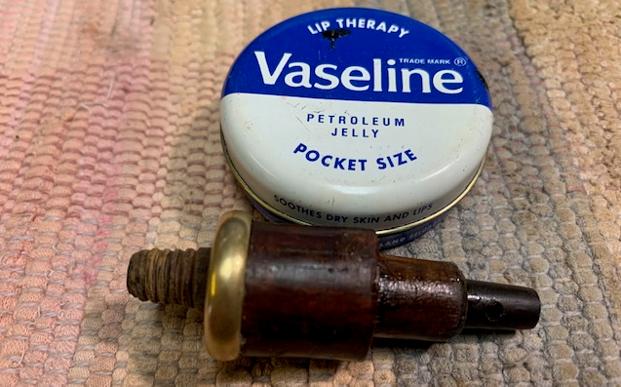
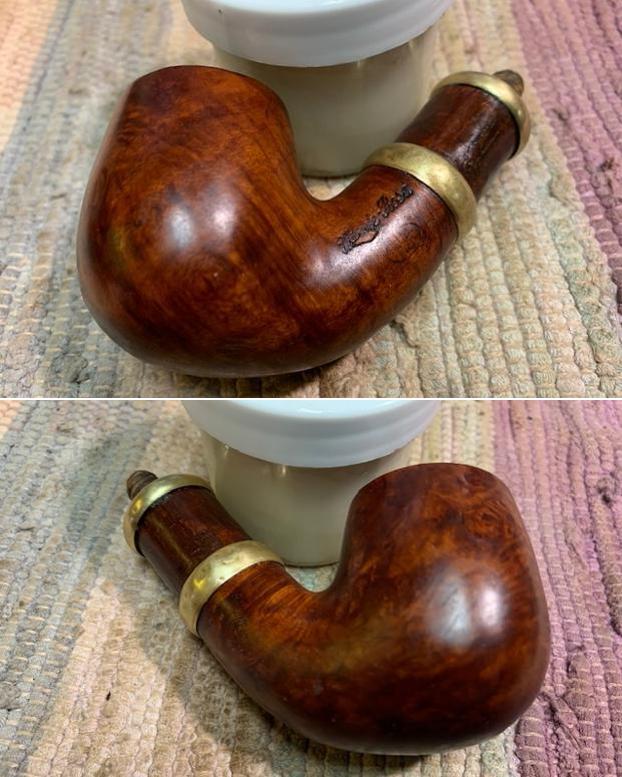
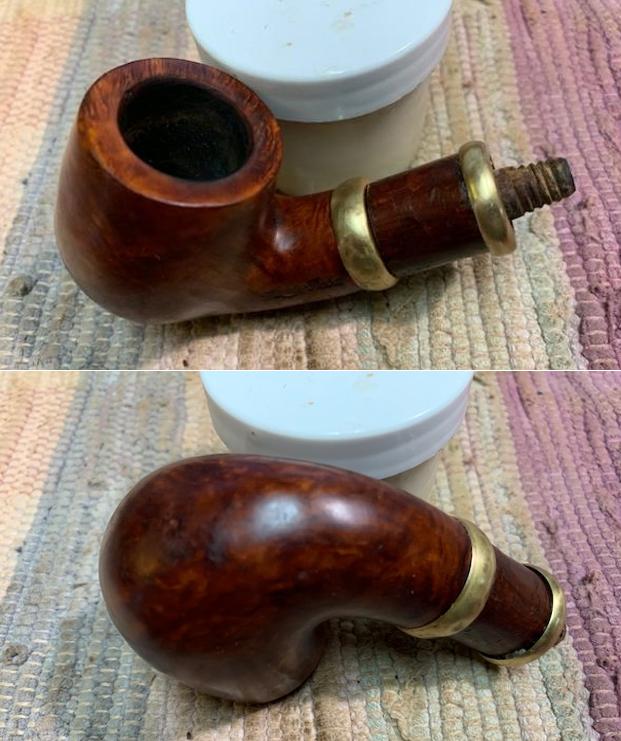
More Work than I thought – A Real Briar Billiard with a horn stem


Blog by Steve Laug

When I saw this pipe on eBay when my brother and I were searching for pipes in the estate pipe area I thought it would be a simple restoration. The briar appeared to be in decent shape and the finish looked very good. The rim was dirty but looked undamaged under the grime and tars. The horn stem did not look too damaged and should also be an easy repair. When the pipe arrived at my brother’s home he took the following photos and sent them to me to have a look at the pipe. It still looked pretty straight forward to me.RB1

RB2

RB3

RB4

RB5 When the pipe arrived here in Canada I was in for a surprise. It definitely looked good but the more I dug deeper the more issues that I found. The rim was tarred and covered with lava and underneath the outer edges were rounded over. The bowl had a light cake at the top and half way down and a deep groove had been cut in the bottom of the bowl by aggressive insertion of the pipe cleaner. The groove or pit was below the airhole entry to the bowl. The shank had been repaired and the crack that I noted in the pictures had been well repaired and the band put in place to strengthen the shank. It would not take much to clean it up. The finish which at first glance looked good had deep gouges in the bottom of the bowl and on the left side of the bowl near the shank union. These were sharp cuts and could not be steamed out. There was a large fill on top of the shank where it met the bowl. It appeared to be pink putty but it was solid and tight. The stem was also nicked quite a bit on the top mid stem and on the left side near the band. The top and bottom sides had some deep tooth marks on them that I could not see from the photos. The stem was very tight in the shank and took some persuasion to remove.RB6

RB7 The next two photos show the repair work on the underside of the shank. It was very well done and would not need to be further dealt with. The third photo shows the rim with the rounded outer edge.RB8

RB9

RB10 I removed the stem from the shank with a bit of pulling and found that the metal tenon was covered with tar and had been stuck in the shank by the tars.RB11 I reamed the bowl back to bare wood to bring the rest of the bowl in line with the bottom half. I used a PipNet reamer with the second cutting head. In the second photo you can see the deep pit in the bottom of the bowl.RB12

RB13 I cleaned out the stem and the tenon with alcohol, cotton swabs and pipe cleaners.RB14 The next two photos show the tooth marks on both sides of the stem. They are quite deep and they will need to be repaired.RB15

RB16 I wiped down the stem with a cotton pad and alcohol and then put drops of super glue in the tooth marks. I sprayed them with accelerator.RB17

RB18 I scrubbed out the mortise, shank and bowl with alcohol, pipe cleaners and cotton swabs. I scrubbed until the pipe cleaners and cotton swabs came out clean.RB19 I topped the bowl to remove the damage to the bowl top and to clean up the round outer edge of the rim. Once again, note the deep pit in the bottom of the bowl that is visible in the second photo.RB20

RB21 I scrubbed the exterior of the bowl with cotton pads and acetone to remove the finish and the grime that was ground into the briar. I was going to need to do some work on the gouges on the bowl sides and bottom so I wanted it clean.RB22

RB23 The stem never sat completely tight against the shank so I beveled the inner edge of the mortise to accommodate the tenon/stem junction.RB24 With the externals cleaned I decided to do the repairs on the gouges on the bowl side and bottom. I put a drop of clear super glue in the divot and then pressed briar dust into the hole with a dental spatula. I pressed the dust deep into the glue to get a good fill. The second photo below shows the bowl side and bottom with what looks like a pox. The briar dust and glue fills are dry at this point and ready to sand. I sanded them with 220 grit sandpaper and then with 1500-2400 grit micromesh sanding pads.RB25

RB26

RB27

RB28 I used a light brown stain pen to give the fresh sanded briar on the bowl bottom and the rim an initial coat. I then stained the entire bowl with a dark brown aniline stain, flamed it and repeated the process. I set it aside to dry for about 30 minutes before buffing with Blue Diamond on the wheel.RB29

RB30

RB31

RB32 I mixed a batch of pipe mud (cigar ash and water) to fill the pit in the bottom of the bowl. I put a pipe cleaner in the airway with just the tip extending into the bowl. I used the spatula to put the mud in the bottom of the bowl and pressed it into the pit with the hand of the spatula. I added the pipe mud until the bowl bottom was level.RB33 I set the bowl aside to so that the pipe mud would cure and worked on the stem. I sanded the stem with 220 grit sandpaper to smooth out all of the nicks and scratches as well as blend in the super glue fills. It took a lot of sanding to smooth out the stem surface and remove as many of the scratches and dents as I could and still keep the profile. The super glue dried hard and the clear glue looks shiny and raises colour in the horn so it is very visible at this point.RB34

RB35 When I had smoothed out the surface of as many flaws as possible I worked on it with micromesh sanding pads. I wet sanded it with 1500-2400 grit pads. The repairs are starting to blend in. They will never be invisible but they are smooth. I rubbed the stem down with Obsidian Oil before continuing.RB36

RB37 I wet sanded the stem with 3200-4000 grit micromesh and then dry sanded with the same grit pads. I gave it another coat of the oil.RB38

RB39 I finished by dry sanding the stem with 6000-12000 grit micromesh sanding pads and then buffing the stem with Blue Diamond on the wheel. I gave it a final coat of Obsidian Oil and set it aside to dry.RB40

RB41 I polished the silver band with silver polish and brought the parts together. I gave the pipe a final buff on the wheel and gave it multiple coats of carnauba wax. I buffed it with a clean buff and the with a microfibre cloth to raise the final shine. The finished pipe is shown in the photos below. While the patches in the stem still show they are shiny and smooth to the touch and will give protection to the stem. The repairs to the cuts and gouges in the bowl look really good and virtually disappear under the stain and the polish. The pipe should live through at least another life time before it needs this kind of attention again.RB42

RB43

RB44

RB45

RB46

RB47

RB48

RB49

RB50

Cleaning up a Bruyere Garantie Pocket Pipe with a Horn Stem


Blog by Steve Laug

This pipe reminds me of the Mokin Pocket Pipe that Anthony restored and wrote about in an earlier blog. When I saw it on eBay I put a bid in and actually won it. The pipe needed a lot of work. From the photo it looked as if it had a thick coat of varnish or some shiny topping. That would need to go. The finish was spotty and appeared to have some flecks of paint on the top and on the skate at the bottom of the bowl. The rim was darkened and hard to tell whether it was burned or just tarry. The bowl was slightly out of round but it also had a cake that would need to be reamed out before addressing the out of round inner wall of the rim.The stamping was clear and distinct and read Bruyere Garantie on the left side of the shank. The stem had a double circle on the left side. The stem also appeared to be horn. There were two deep cuts on the right side of the stem near the button that would need work and with those marks I was sure there were other issues. The first two photos are the ones included in the seller’s description of the pipe on eBay. I had no idea what the other side or bottom of the bowl or stem looked like or if there would be more issues that would need to be addressed.Bruyere1

Bruyere2 When the pipe arrived I was both encouraged by what I saw and concerned by several other issues that had not been shown in the photos above. The encouraging thing was that there was no shiny coat of varnish or lacquer on the bowl. All that was present was a very dirty, grimy natural finish that seemed to have a reddish-brown colouring to it. The concerns involved the fills on the underside of the bowl. What had appeared to be paint flecks on the skate at the bottom turned out to be part of the fill on the bottom and a missing piece of briar. The bowl was indeed caked and the cake was crumbling and uneven. Looking at it initially I wondered if there would not be burned spots in the walls of the bowl once the cake was removed. The inner edge of the rim was also more damaged than I had expected from the seller’s photo. The cuts in the stem were dangerously close to the airway but fortunately had not broken through. The fact that the airway was unharmed was a small miracle given the depth of the cuts. The fact that they angled probably save the airway from damage. On the underside of the stem there were also large chips missing from the stem at the shank stem union. It appeared that someone had tried to pry the stem away from the shank rather than twisting it off. There was also tooth chatter on the top and underside of the stem near the button. The button however was clean and sharp as was the slot in the in the end of the button. The stem had some beautiful striations of colour that I had not seen in the photos and I looked forward to seeing if I could bring them out.Bruyere3

Bruyere4

Bruyere5

Bruyere6 I took some close up photos of the damage to the rim and the stem. The first photo below shows the damage to the inner edge of the rim and the crumbling cake in the bowl. Looking closely at the top of the photo and the bottom of the bowl you can see the cause for my concern regarding the potential burn out damage. The second and third photos below show the cuts in the stem and the missing chips. You can see how close the cut closest to the button came to the airway in that photo.Bruyere7

Bruyere8

Bruyere9 The next photo shows the stamping on the side of the shank and the logo on the stem. It is hard to see but much of the depth of the stamping on the stem is gone so restoring that with new white colouring will not be possible.Bruyere10 When I removed the stem the tenon was inset aluminum and there was a stinger apparatus in place. It was a twisted piece that had a slot in the top for the airflow that followed the twist to the airway. It was stuck in the tenon and would need to be loosened before I could properly clean out the airway in the stem. I included some extra photos of the stem to show the cuts and chips from a different angle.Bruyere11

Bruyere12

Bruyere13 I reamed the bowl with a PipNet reamer. I started with the smallest cutting head and cleaned things up with it first. I then used the second cutting head which was pretty close to the diameter of the bowl. I cut the cake back to nothing so that I could examine the interior walls of the bowl. I was pleasantly surprised to find that once the cake was gone the interior walls of the bowl were solid and there was no burning.Bruyere14

Bruyere15 I worked on the out of round bowl with a folded piece of sandpaper to smooth out the damaged areas and bring it back to as close to round as I could get it. I then topped the bowl on my topping board to smooth out the rim and clean up the damage on the surface. I will often do this just to bring the damage on the inner edge of the rim closer to the top so that I can smooth it out further with sandpaper.Bruyere16

Bruyere17

Bruyere18 I wiped down the bowl with acetone on a cotton pad to remove the grime and the remnants of the finish. There appeared to be some damage to the front of the bowl that I wanted to have a closer look at once the bowl was cleaned up.Bruyere19 I wiped down the horn stem with cotton pads and some alcohol to clean up the surface so that I could begin the repairs. I debated on whether to use black super glue or clear super glue for the repairs to the chipped areas but decided to go with the clear hoping that once it dried the colour would come through the repair and blend it into the horn better. I layered the repair to the chipped areas on the underside and the cuts on top side of the stem. I wanted each layer to dry before I added another layer of glue.Bruyere20

Bruyere21

Bruyere22 After many layers of glue I was disappointed that glue did not cure clear but rather had a cloudy white appearance. The fills on the cut areas dried hard but looked like two white slashes. I was hoping that as I polished the stem these would blend in a bit more. The fills in the chips were a mixed bag. The smaller ones dried perfectly and blended in well. The larger divot was also white. I cleaned that area once again and added a drop of black superglue to the top of the repair to see if I could hide it better.Bruyere23

Bruyere24 I sanded the bowl and stem with 220 grit sandpaper and then medium and fine grit sanding sponges to clean up the repairs and the scratches in the briar. I carefully avoided the area of the stamping and the logo so as not to harm them. I also cleaned up the stinger and was able to remove it from the tenon. It was threaded and after cleaning up the joint I was able to unscrew it and clean it and airway of the stem. I wet sanded the bowl and stem with a 1500 grit micromesh sanding pad. The striations of colour are beginning to show on the stem and the bowl is looking far better than when I started.Bruyere25

Bruyere26

Bruyere27 I wiped the stem down with a light wipe of alcohol to remove the sanding dust and then continued to wet sand it with 1500-2400 grit micromesh pads. I rubbed it down with Obsidian Oil and then dry sanded with 3200-4000 grit pads. I rubbed it down again with the oil and then finished sanding it with 6000-12000 grit pads. I gave it a final coat of Obsidian Oil and let it dry.Bruyere28

Bruyere29

Bruyere30 I buffed the bowl and stem with White Diamond and Blue Diamond on the wheel. I then cave the bowl and stem multiple coats of carnauba wax and buffed it with a clean buffing pad. I hand buffed the stem and the bowl with a microfibre cloth. The first photos below are of the polished stem. You can see the repairs from the cuts. For some reason the glue dried white – even though it is clear. I did a patch on the chip on the underside with black super glue and it does not quite match… ah the frustrations of repairs. This one is staying with me so I will not mind as the stem is now smooth and polished. The cuts and the chips are repaired and are smooth to the touch. The fit of the stem to the shank is good with no missing stem parts.Bruyere32

Bruyere33

Bruyere34

Bruyere35 The final four photos show the finished pipe. The bowl polished up very nicely with just carnauba wax. The polished stem shows the striations that are one of my favourite parts of horn as a stem material. The deep shine is a bonus.Bruyere36

Bruyere37

Bruyere38

Bruyere39