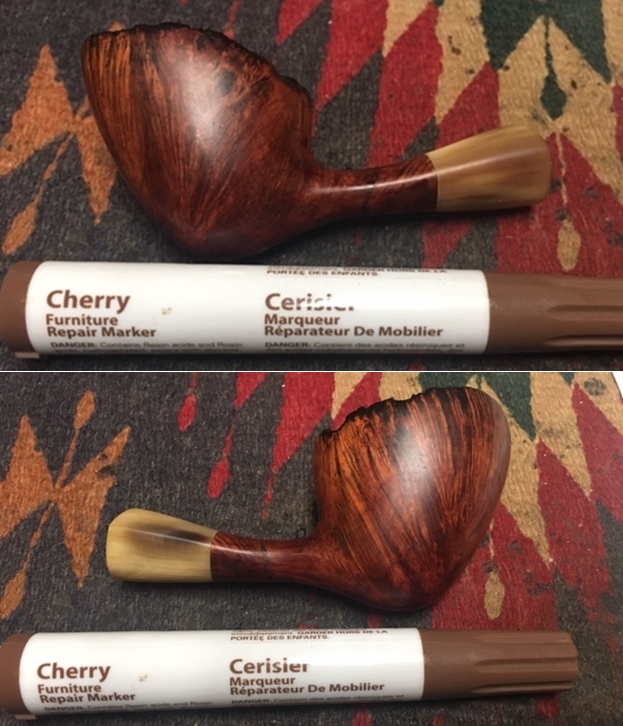
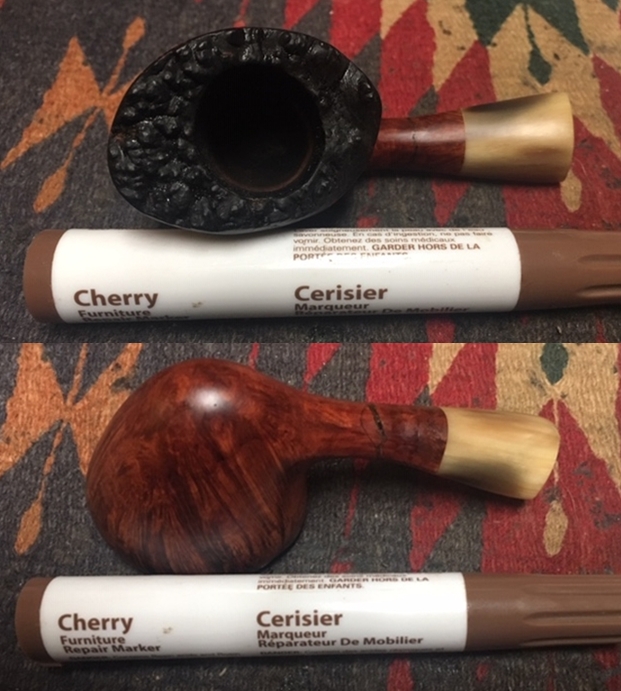
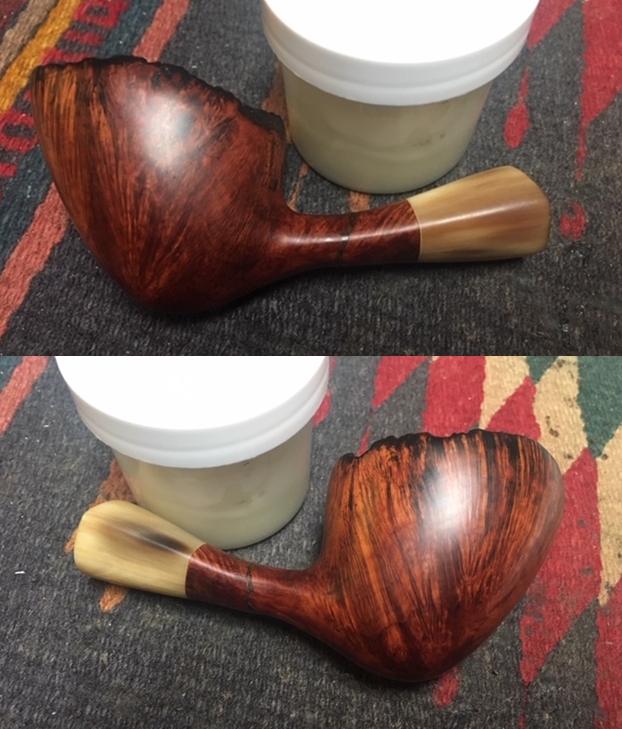
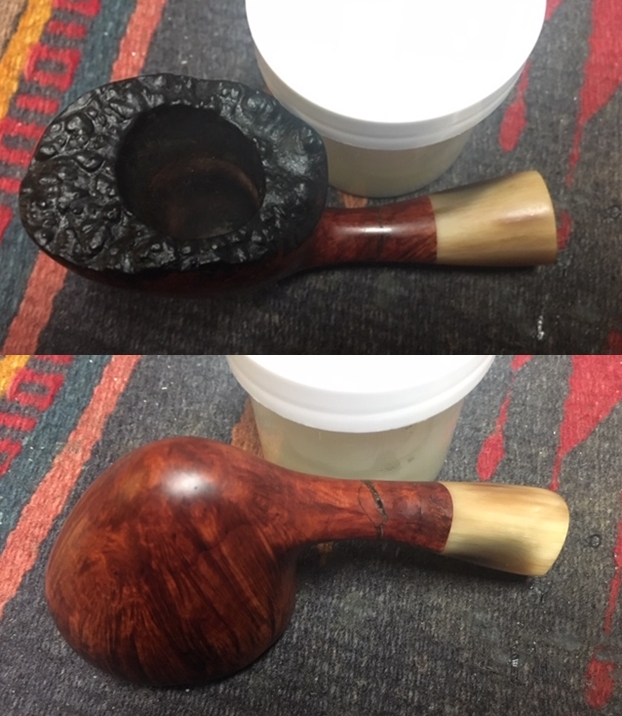
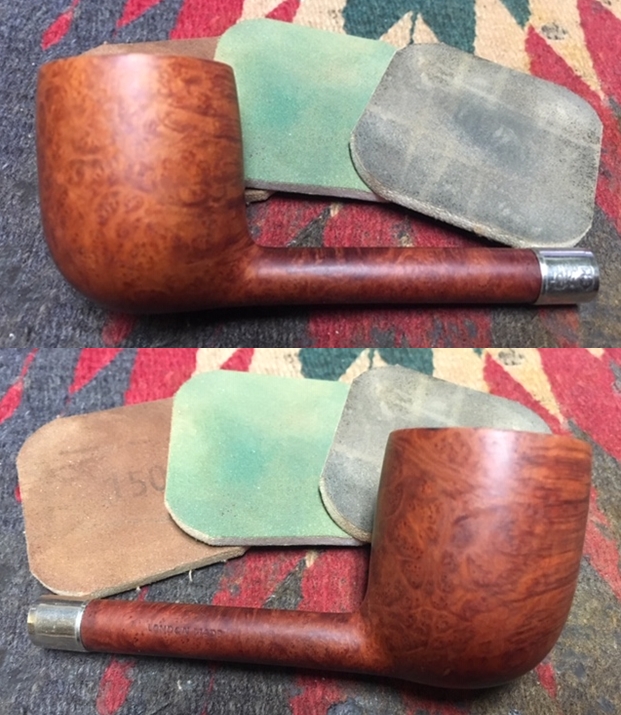
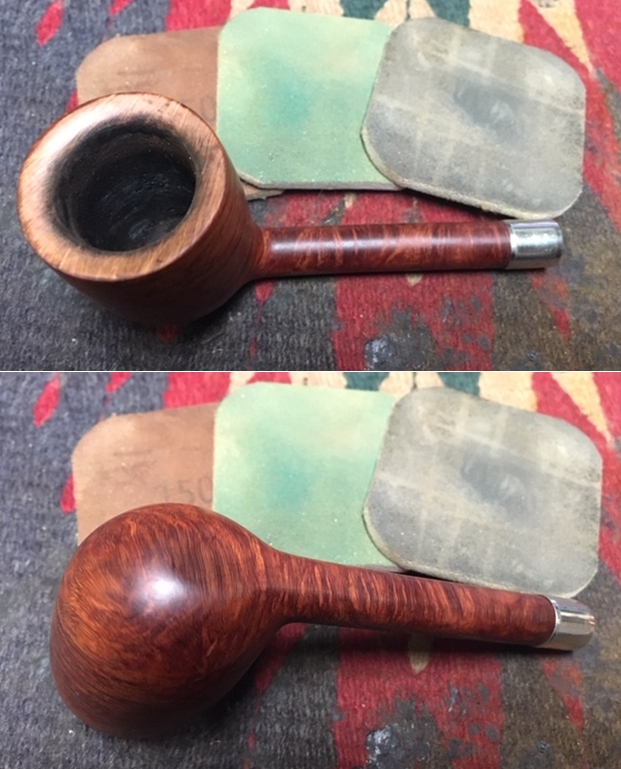
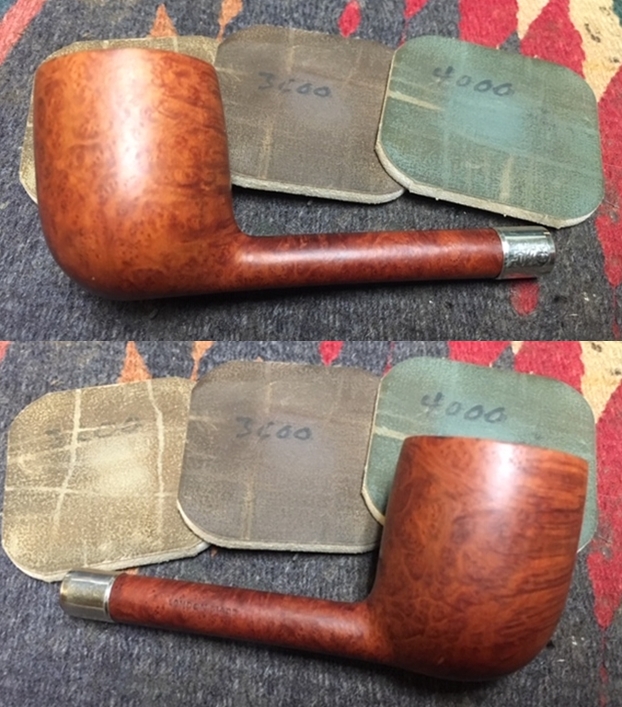
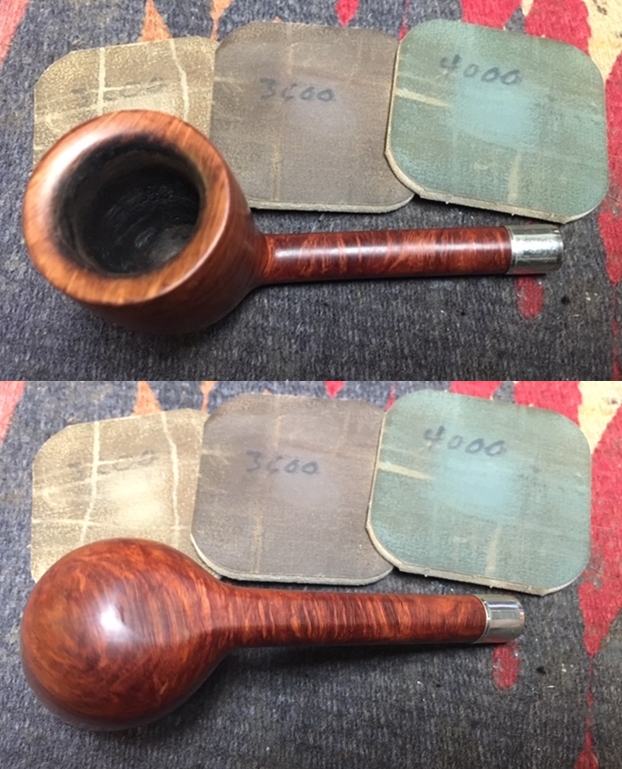
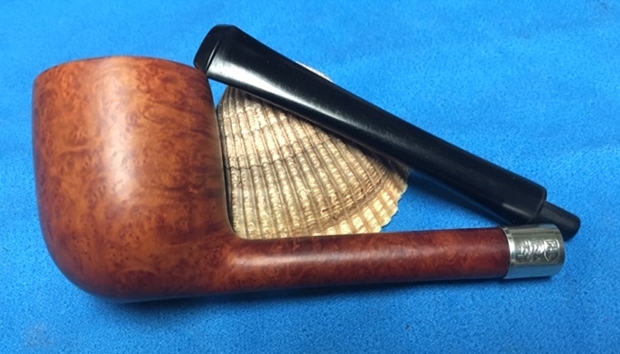
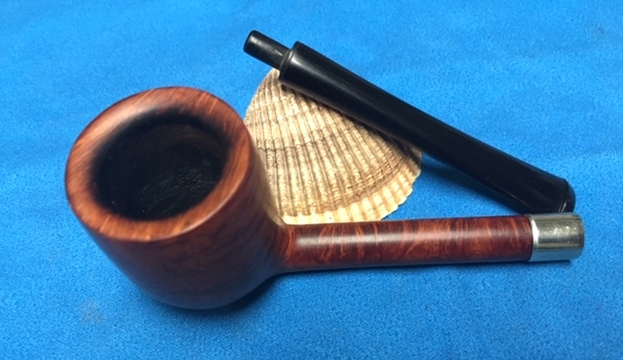
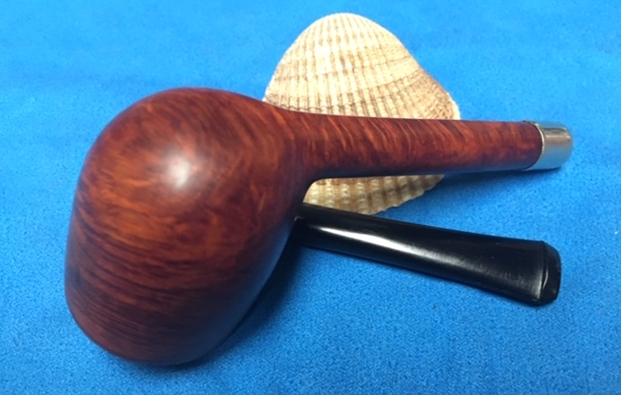
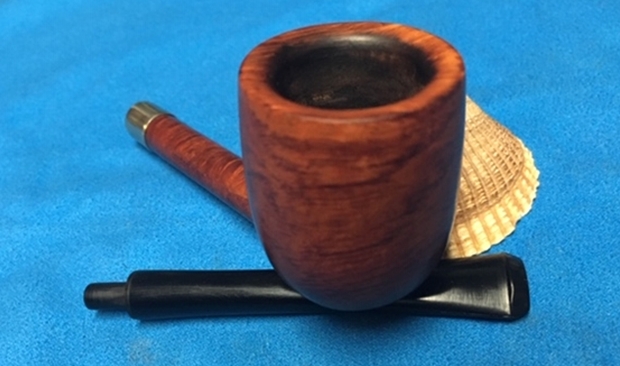
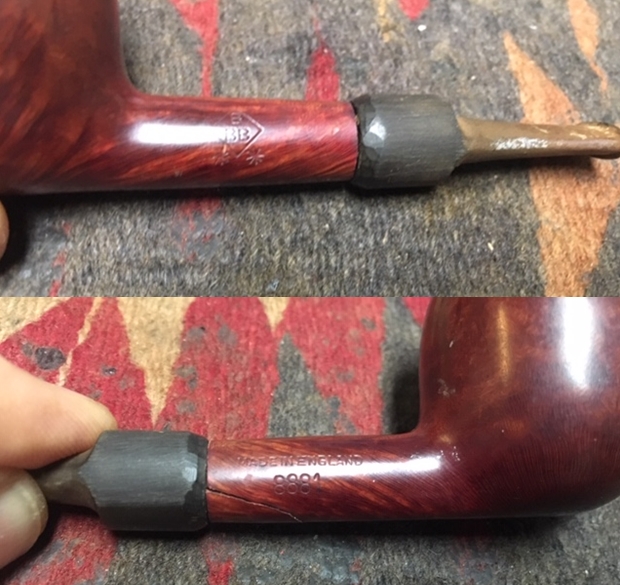
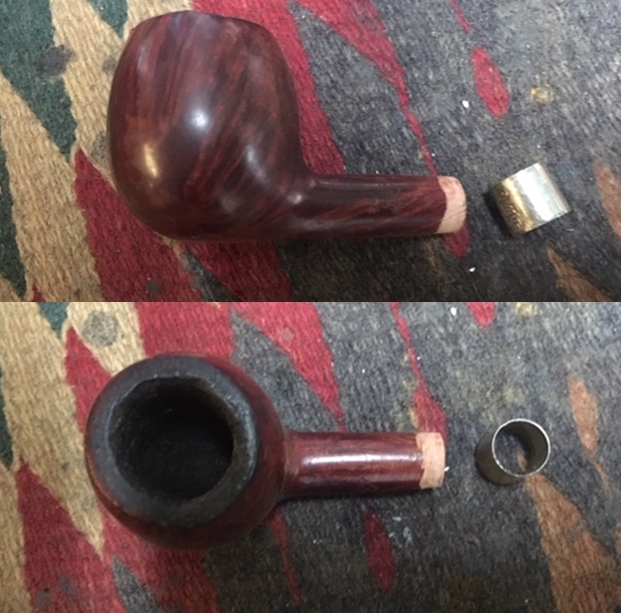
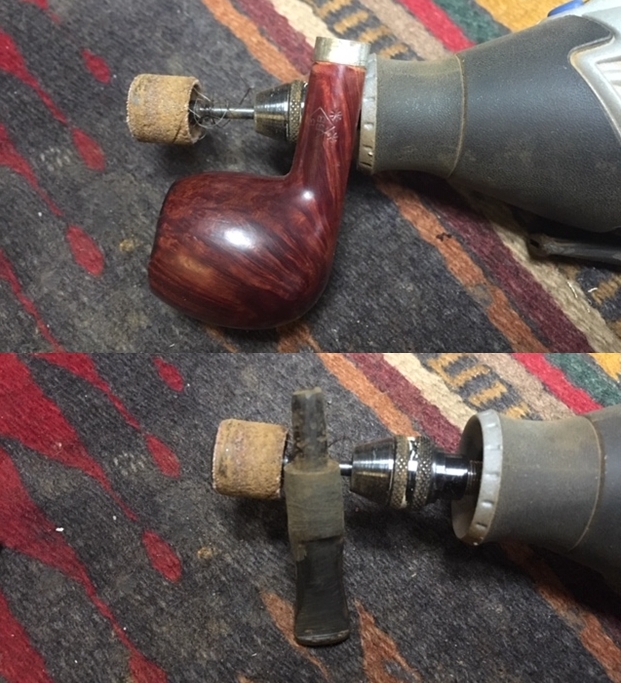
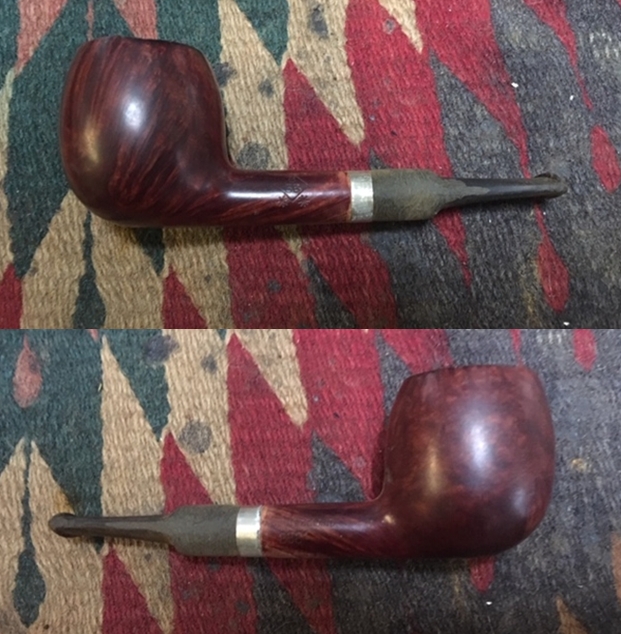
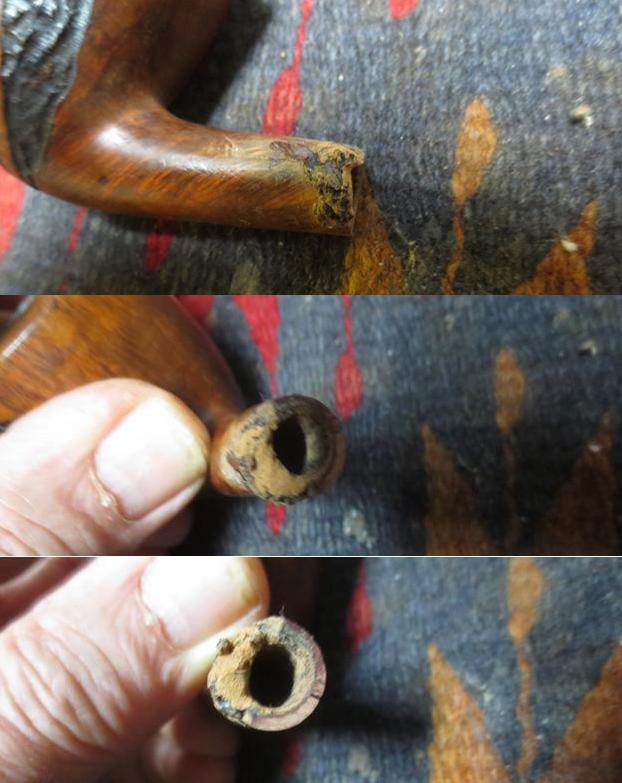
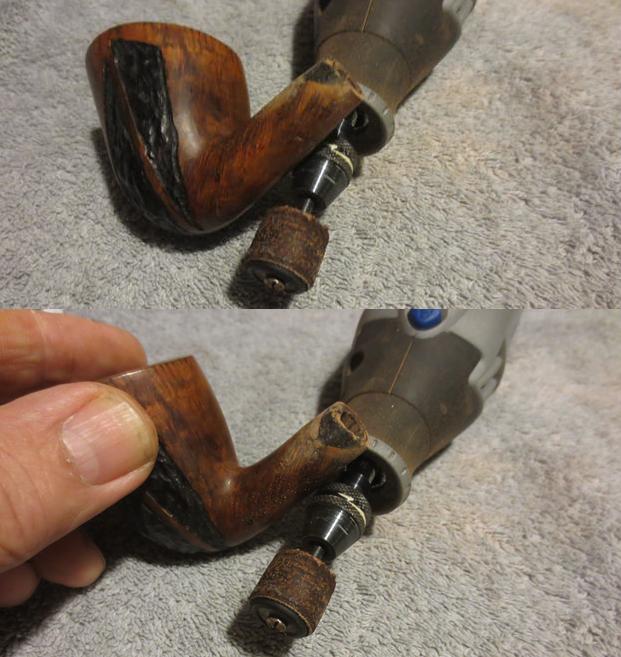
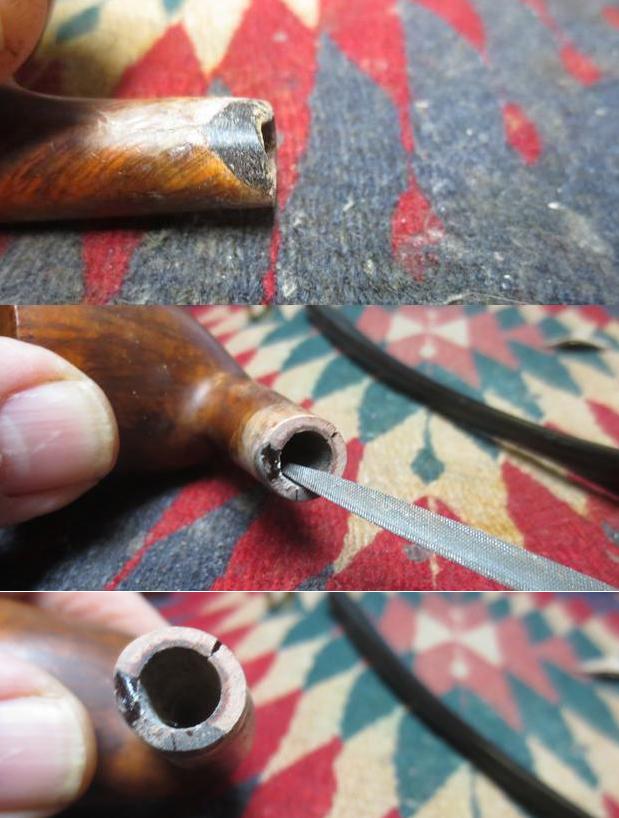
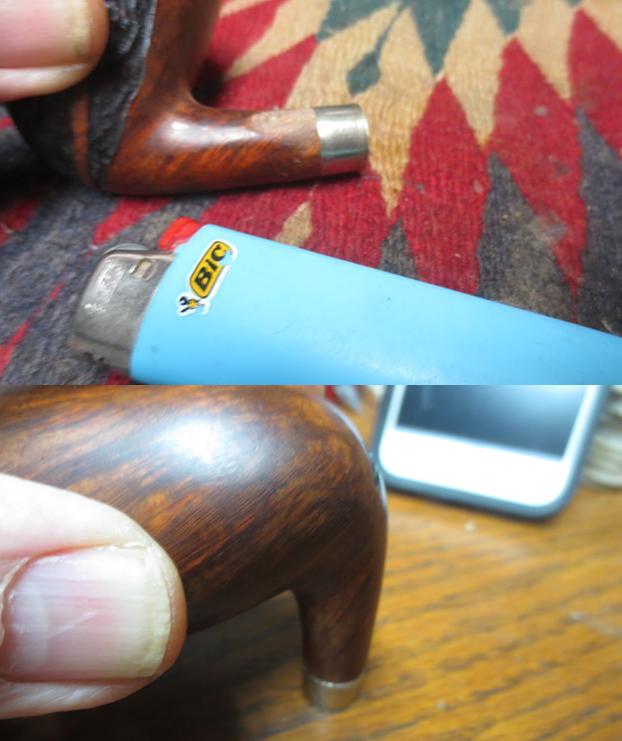
Tag Archives: repairing a cracked shank

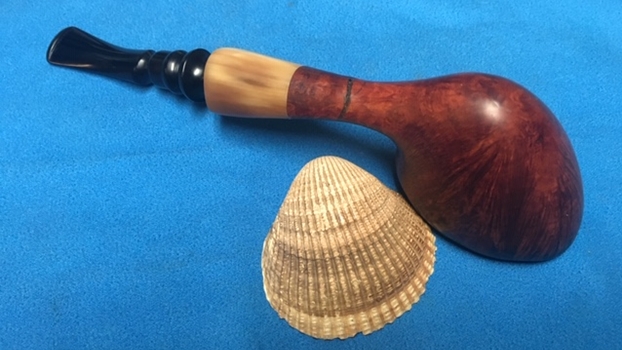
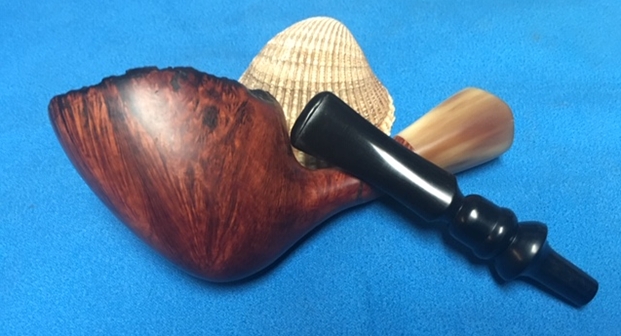
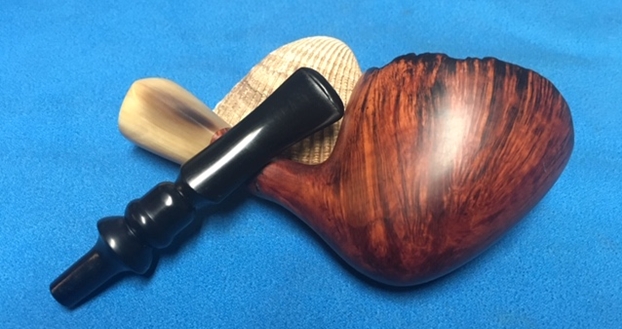
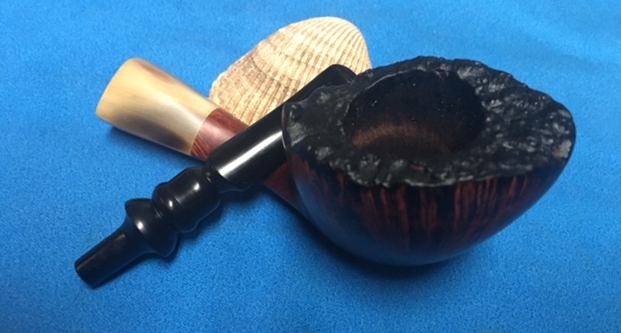
Reworking and Restemming What Looked Like a Lost Cause


Blog by Ryan Thibodeau

I have been following Ryan’s work on FaceBook’s Tobacco Pipe Restorers Group and have been impressed with his work. When he posted the work on this old Canadian stummel with a lot of issues I wrote and asked if he would be willing to post it on rebornpipes. He said sure and sent me the following write up. I am happy to welcome Ryan to the pages of the blog. It is a pleasure to have you here. Without further ado I will let Ryan introduce himself to you all. — Steve

My name is Ryan Thibodeau, I live in the Hamilton Ontario region I stumbled upon this hobby by accident. When my Father learned of my new hobby, he gave me his 1959 Dunhill shell briar pipes. They hadn’t been smoked in 38 years and needed some TLC. I had them restored and they were the first two pipes in my rack.

From there I joined various Facebook Groups and happened upon Steve’s blog “Reborn Pipes”, I was inspired immediately. Since that time I’ve been collecting tired worn out pipes and testing my ability to return them to a condition that I would be proud of. It is a wonderful hobby, that doesn’t require a lot of space to do.

Every pipe has a story! Usually the smoker who owned it, and their story, is more interesting than the pipe itself.

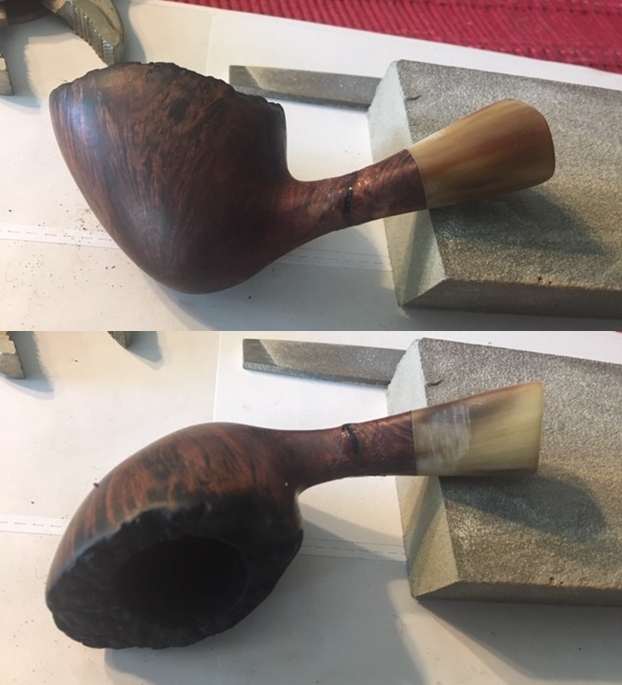
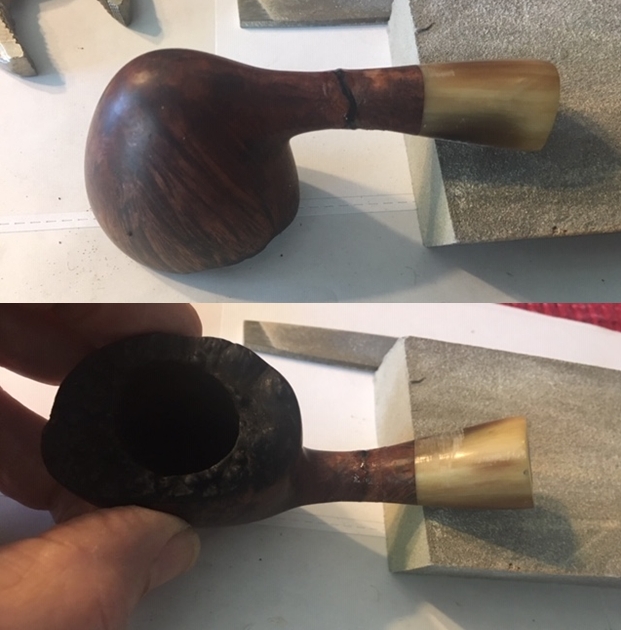
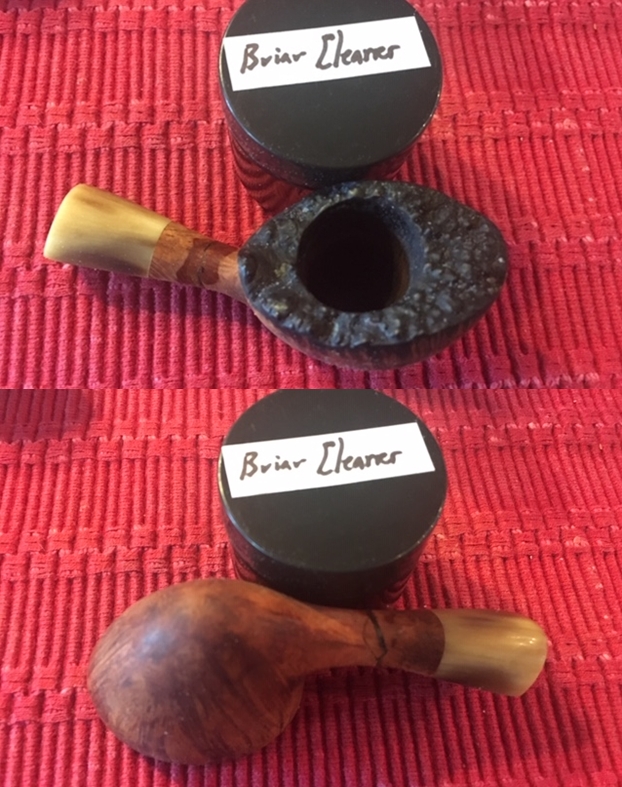
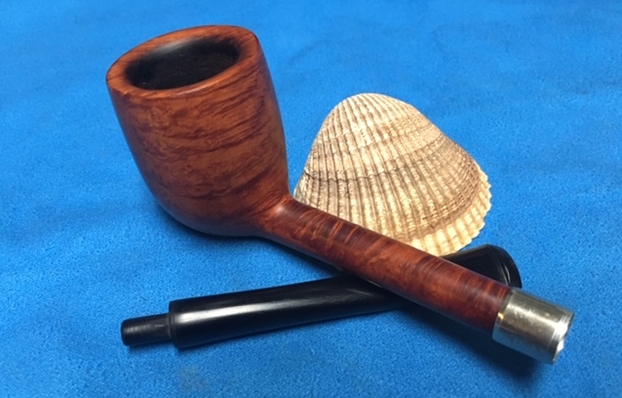
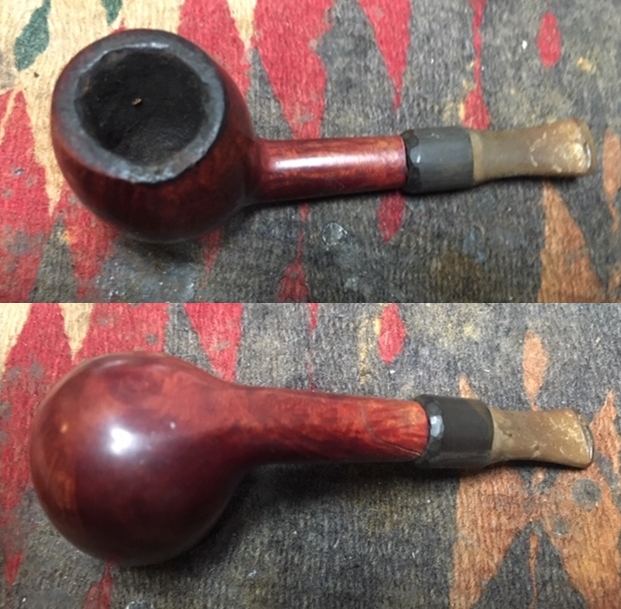
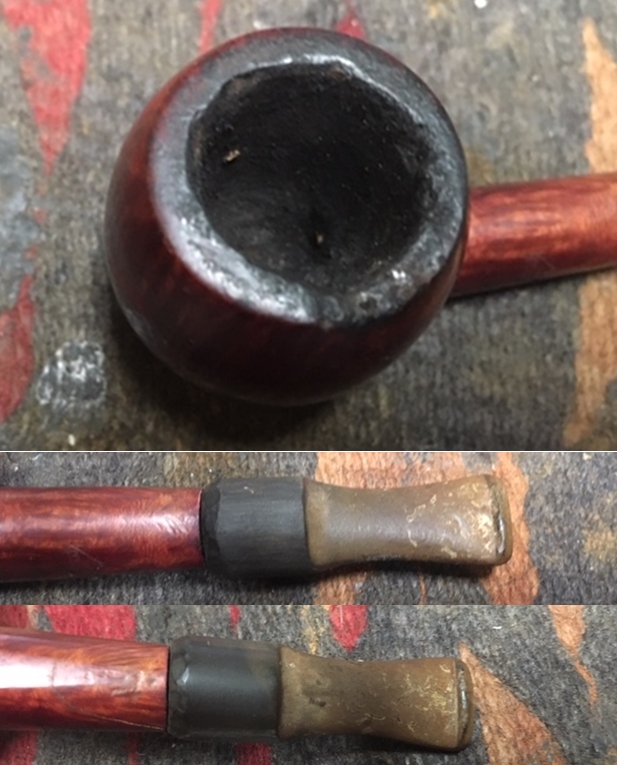
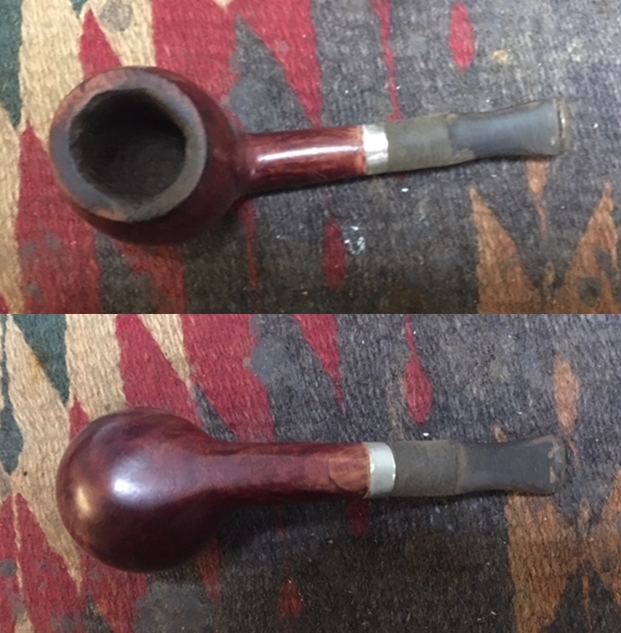
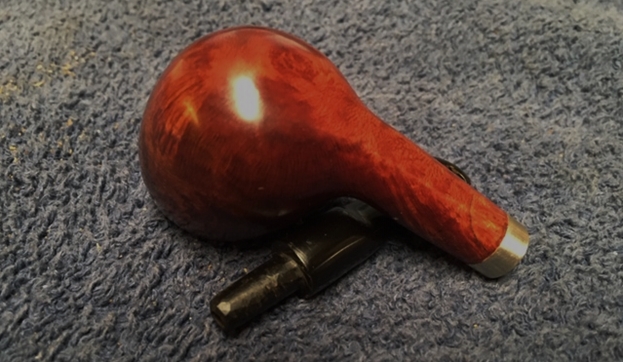
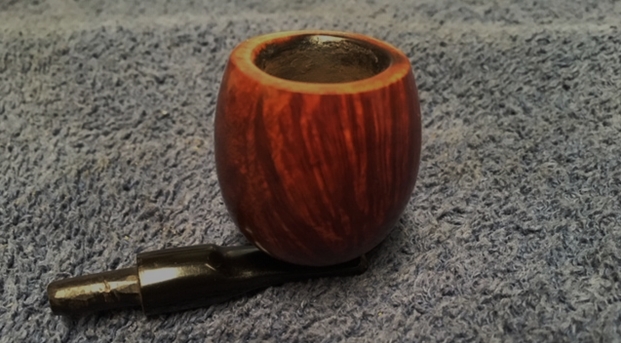
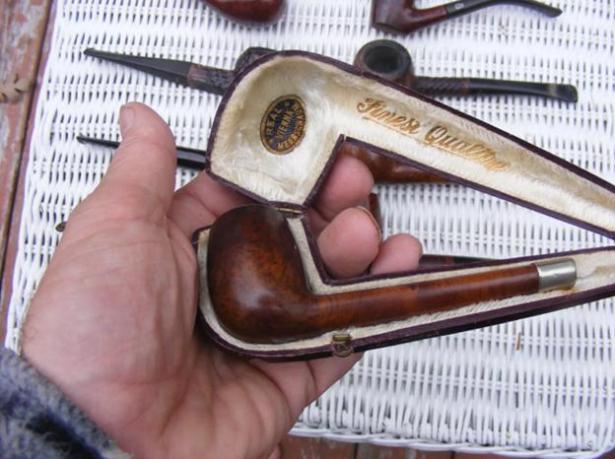
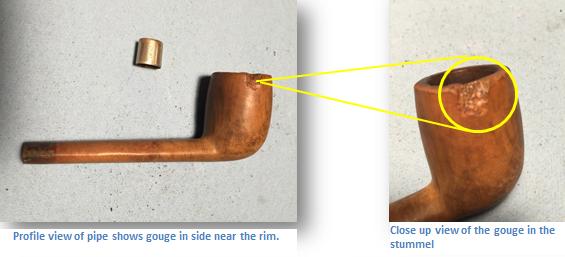
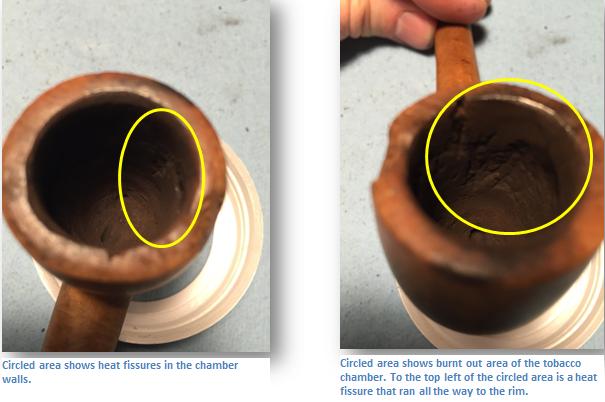
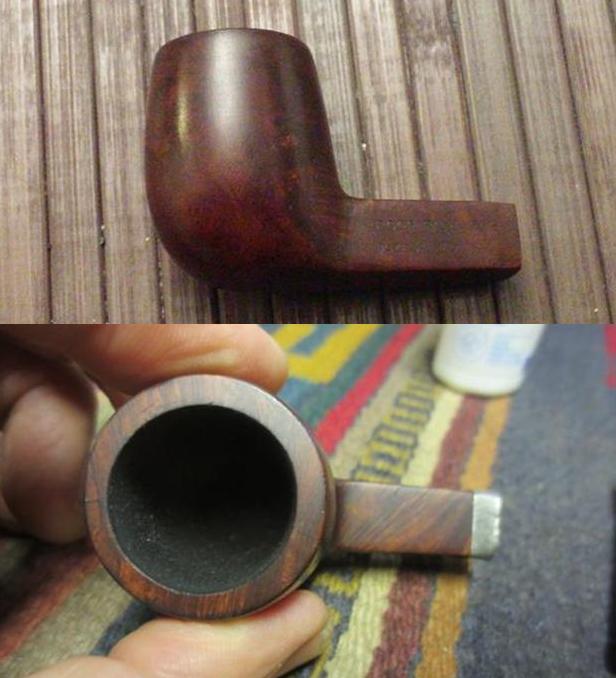
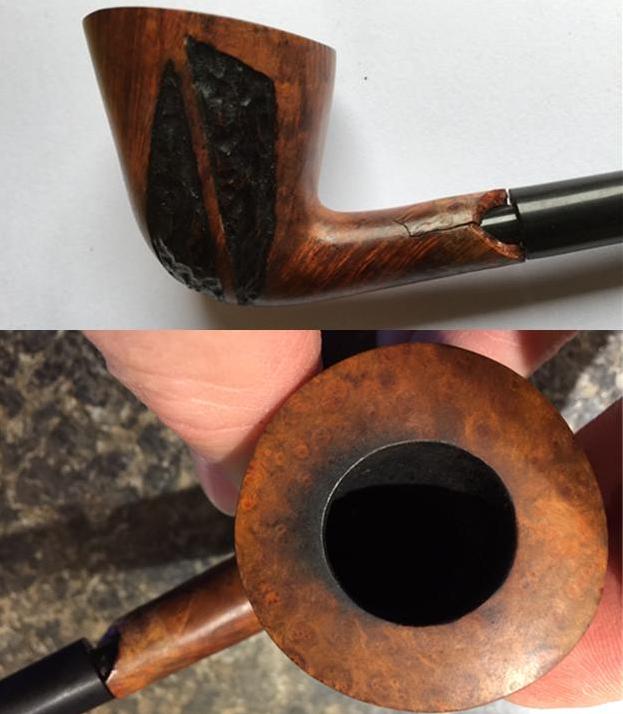
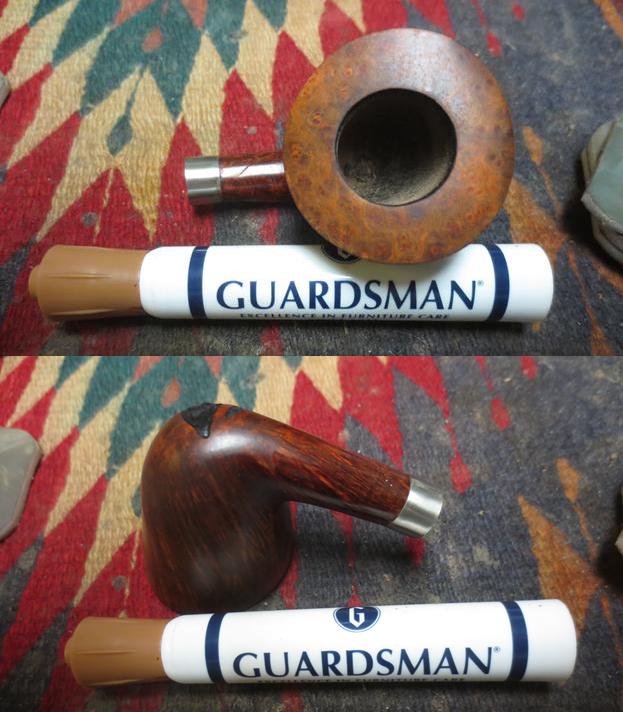
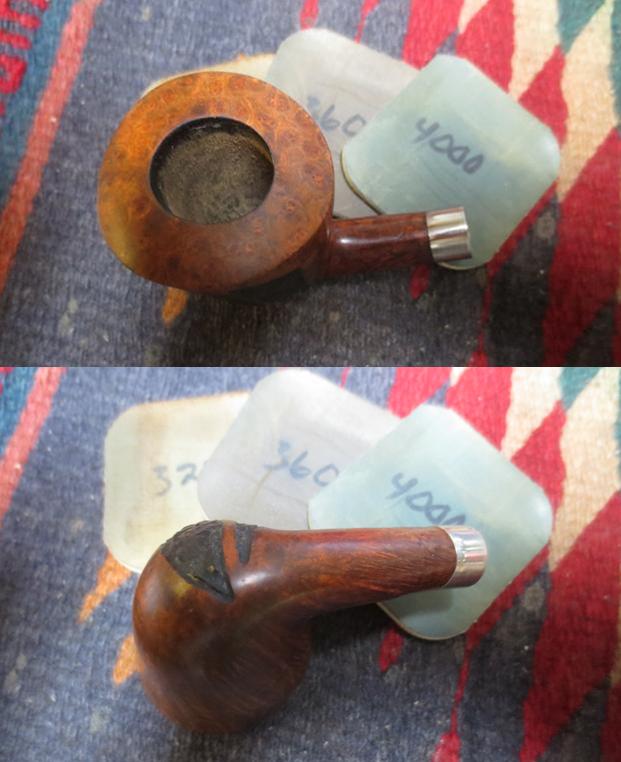
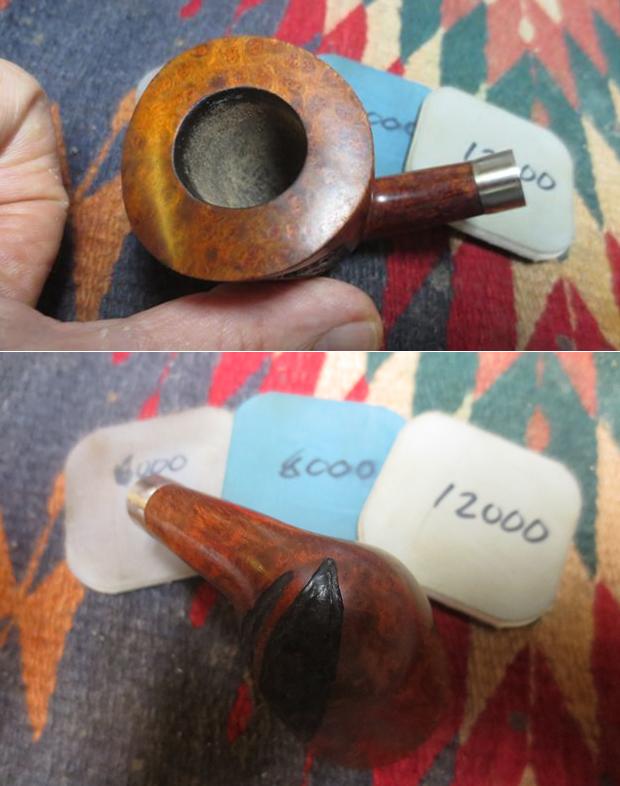
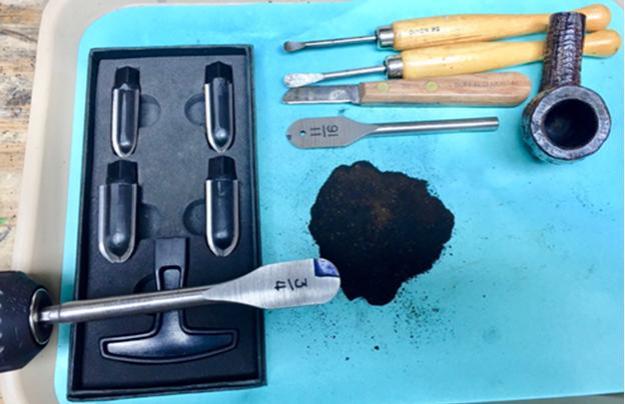
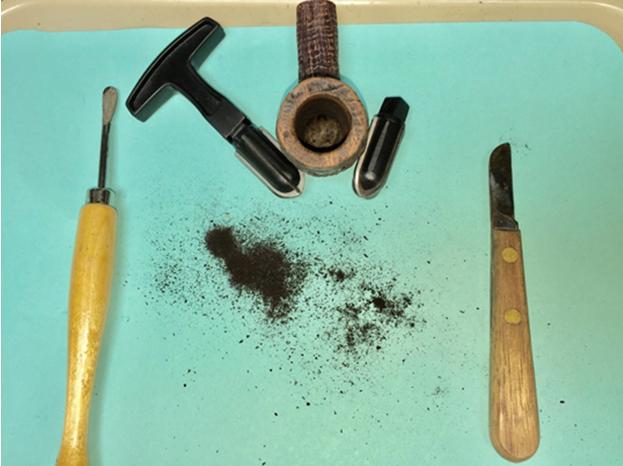
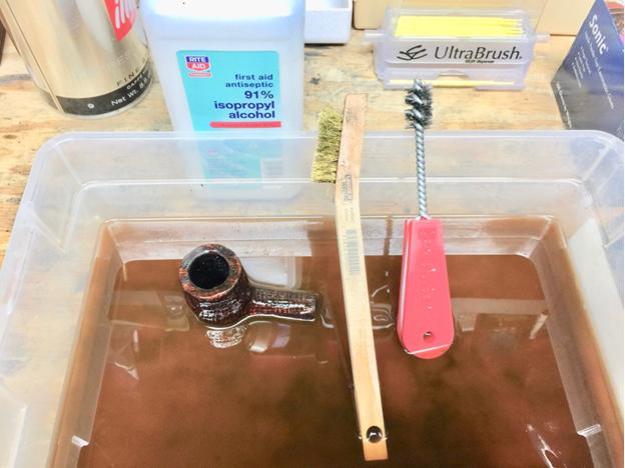
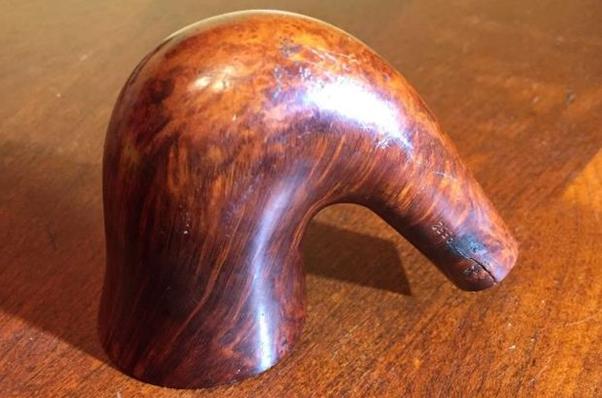
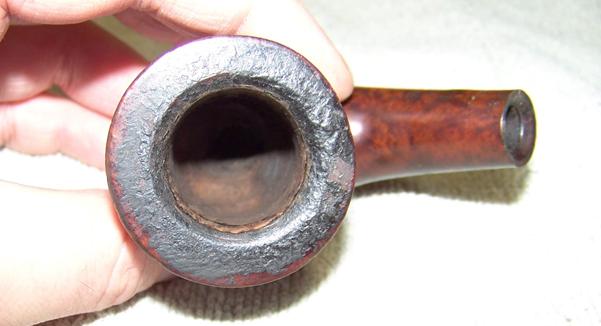
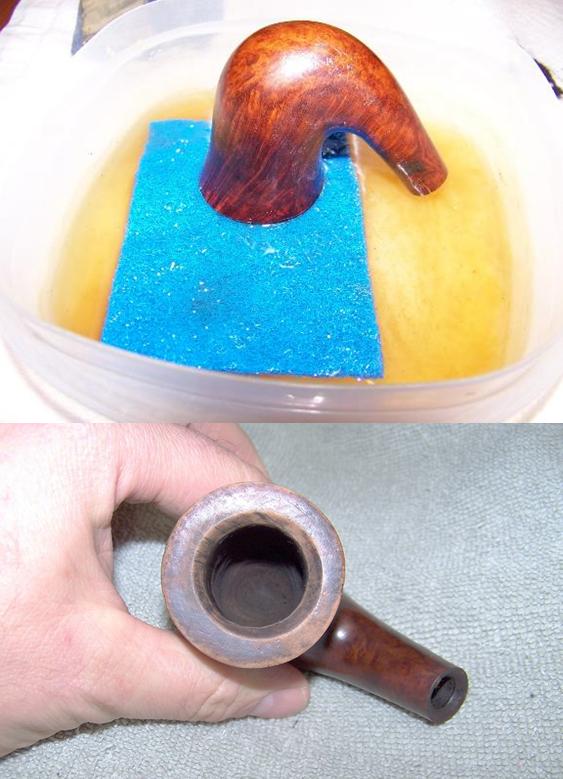
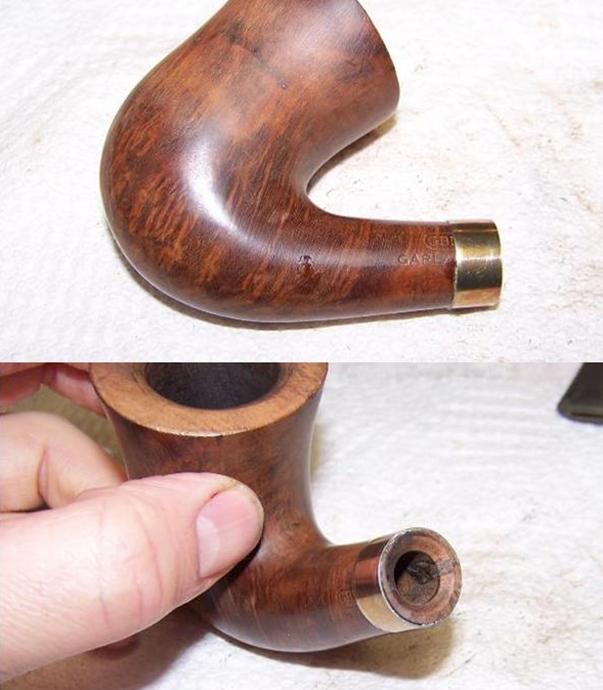
I purchased this pipe in a lot of 12. There were only one or two pipes in the lot that I really wanted and the price was right, so I wasn’t heartbroken if the rest came to rest in the bottom of my box of pipes. One of them came in a case that was meant for a meerschaum, and it looked decent when in the picture, but further investigation revealed a lot of issues that would need to be repaired. I started by removing the silver band, which came off without any effort and used Heirloom Stripper to remove all the dirt, grime, old finish and lift some of the stain. This allowed me to get a real good look at the damage to this pipe. Next I used my Castleford reamer to remove all the cake out of the bowl. There was very little cake lining the bowl, however; once I removed the cake I found that walls of the tobacco chamber were severely charred. I suspect this pipe was smoked very hot and the briar was charred to charcoal. I wanted to see how much of the chamber was damaged ( I prefer to ream my bowls right back to fresh briar. This way I can see if there are any heat fissures or major issues that would make a restoration go sour after the first smoke)

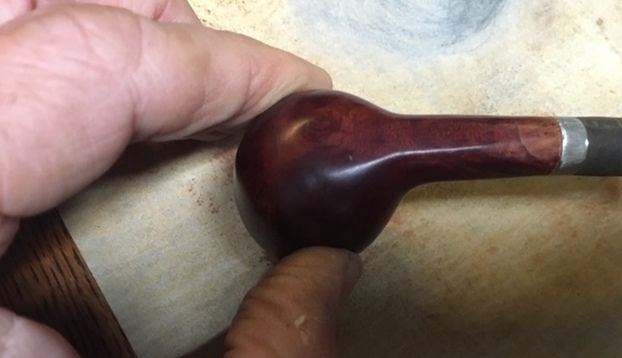
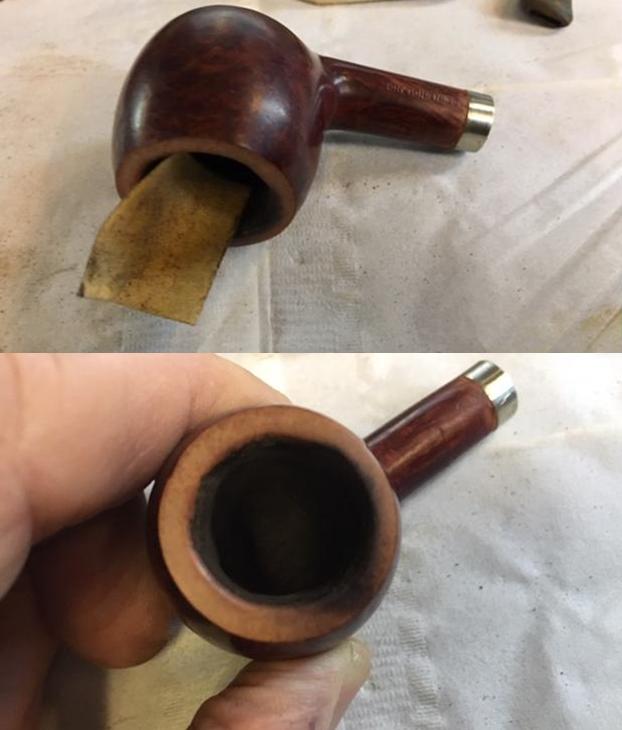
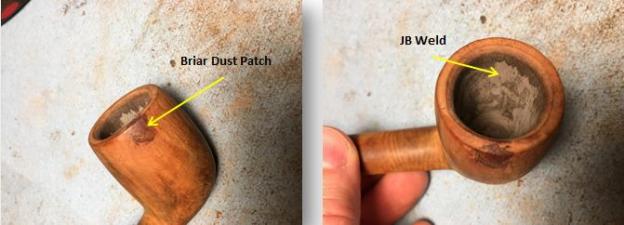
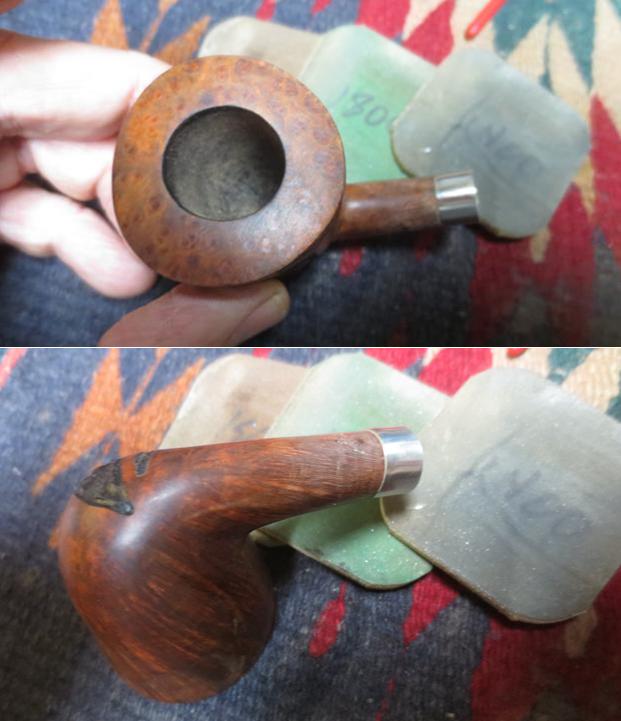
I removed the charred wood. The reamers will shave away the charred wood, once you feel the resistance of the blades rubbing the fresh briar you know you’ve removed the charring.I used a combination of Briar dust and CA Glue to create a patch for the gouge on the side of the bowl. Using a flat file, I filed the patch down to the profile of the pipe. Afterwards I topped the bowl to level out the rim and the patch. The bowl was also over reamed by its previous owner so I added a bevel to the inside of the bowl at the rim to blend everything in.

There was a lot of filing and sanding through this process to get it just right. Unfortunately I get hyper focused during this process and forgot to take step-by-step pictures.

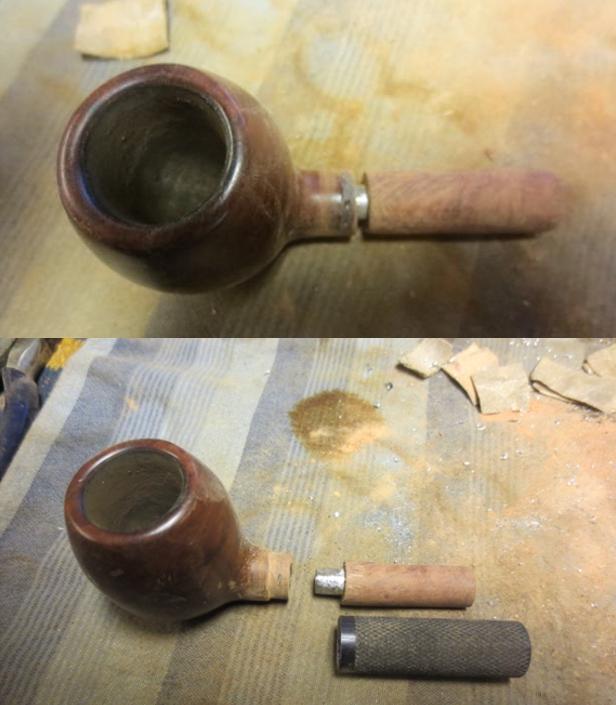
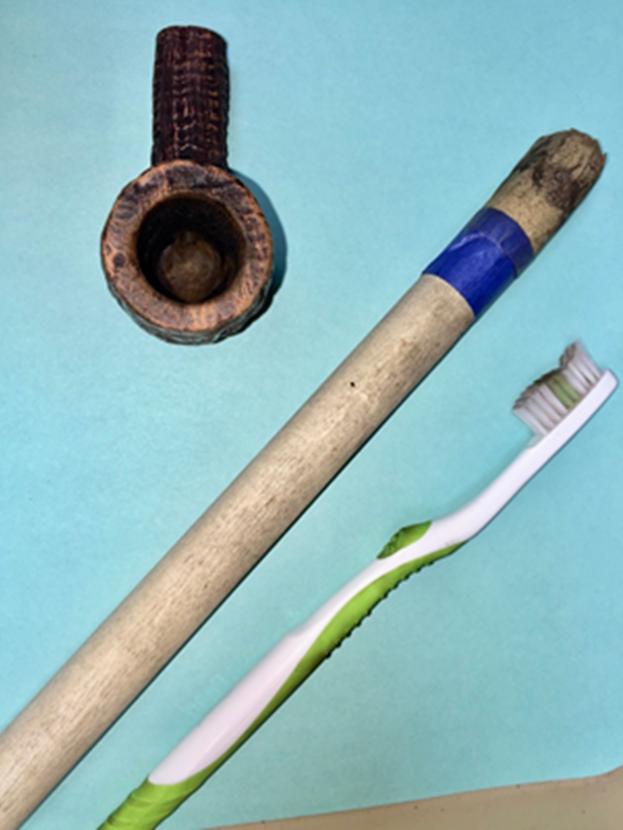
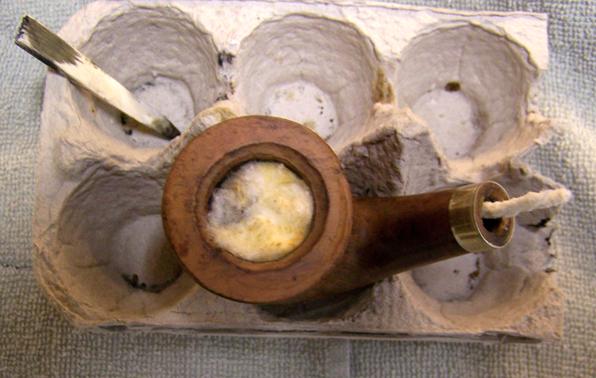
The grey patches you see inside the bowl is a product called JB Weld. I mixed up a batch and filled the problem areas in the chamber, afterwards I sanded it down to blend with the rest of the chamber. In my experience the product is completely inert once cured. It is handy for a reconstruction of this kind, but I’d recommend adding a bowl coating as an added barrier.This pipe came to me without a stem. Fortunately I had a stem that would be the perfect length, I just needed to shape the tenon to fit the pipe. For this I used the Pimo Tenon cutter from Vermont Freehand.

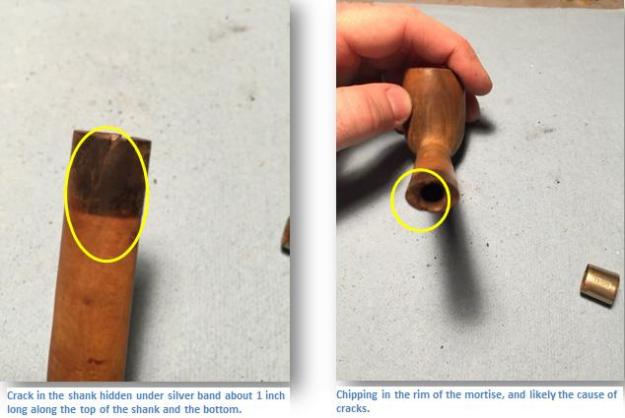
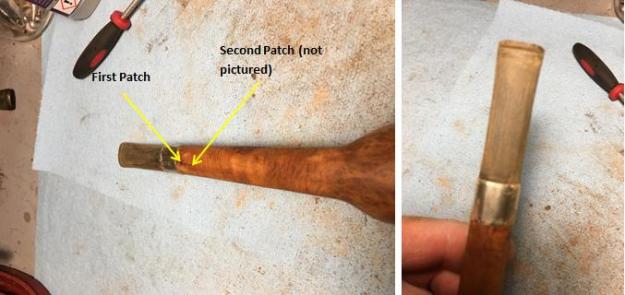
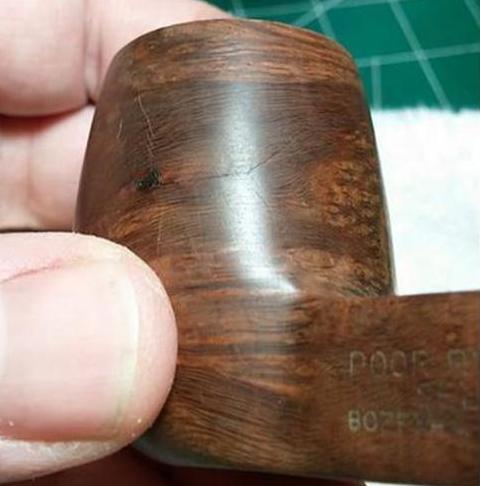
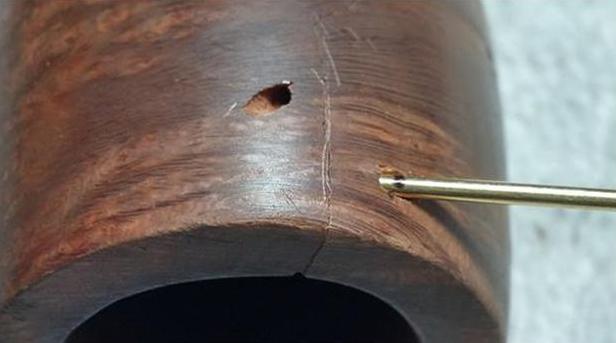
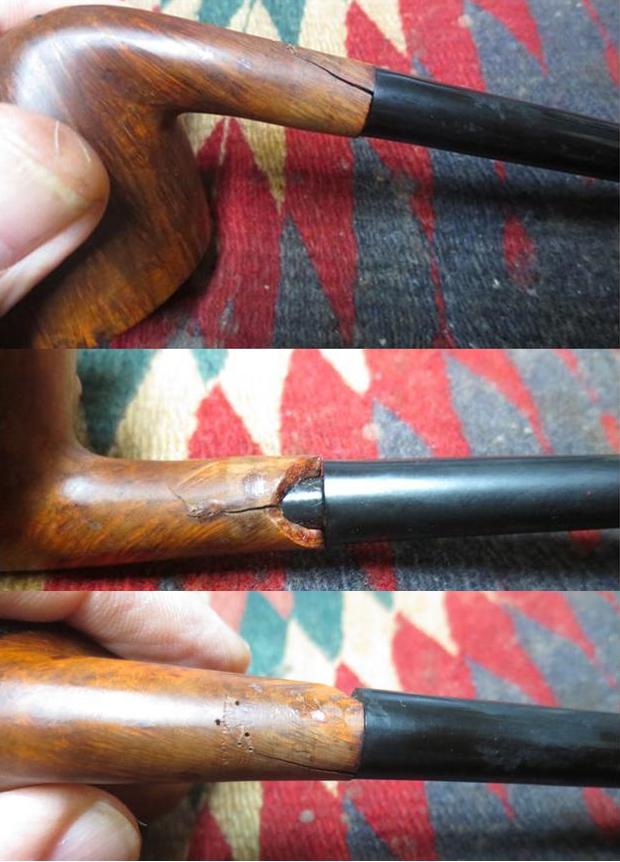
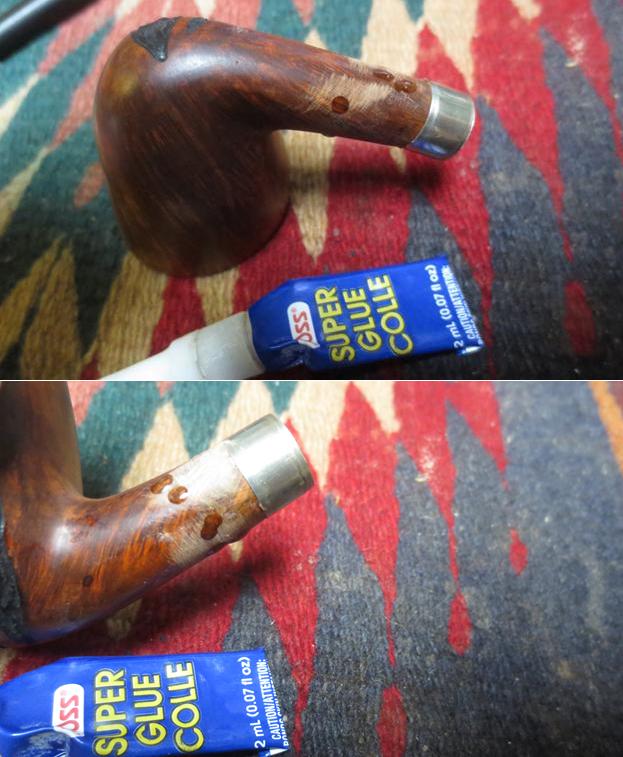
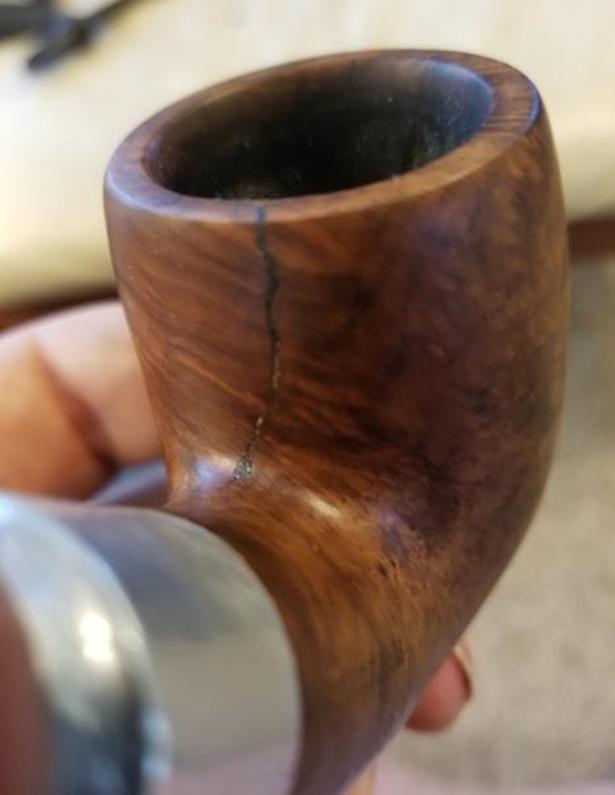
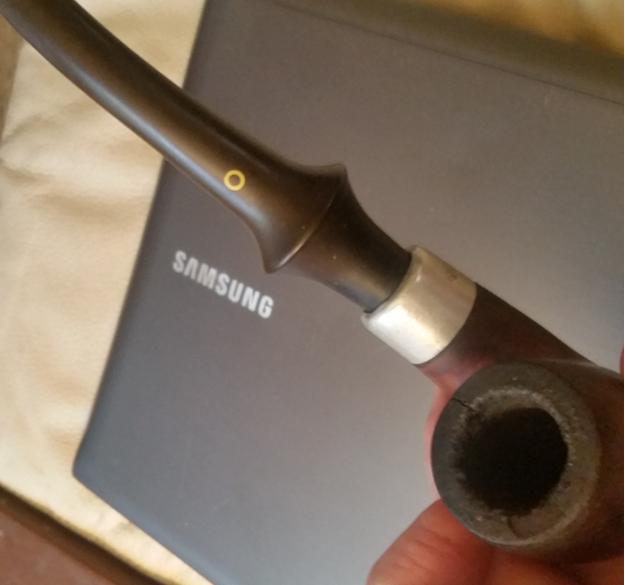
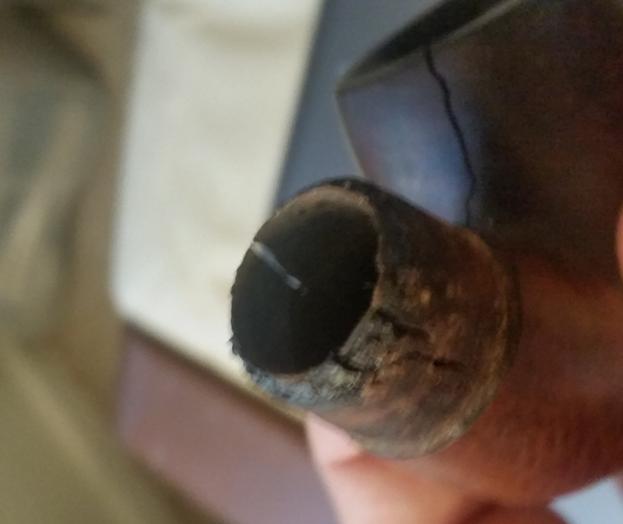
I also used the opportunity while I was at this end of the pipe to drill a hole ahead of the crack in the shank and filled used briar dust and CA Glue. As sometimes happens with restorations, I thought I stopped the crack from spreading, well I was wrong and it continued from the patch further up the shank about ¼ of an inch. So I drilled another hole and patched it again. This time I seemed to have everything under control.

The stem was quite simple to shape to the profile of the pipe and was a welcome change from the frustrations of the other repairs that didn’t go according to plan.

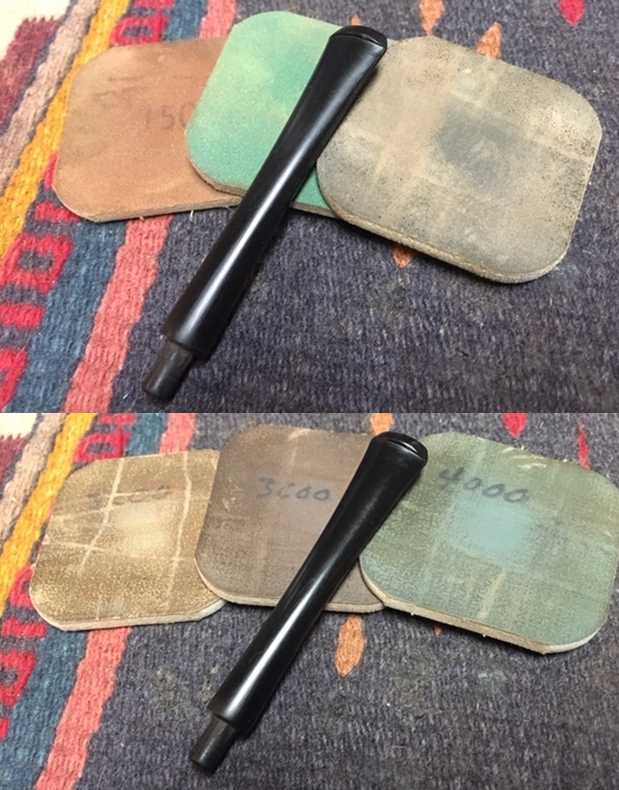
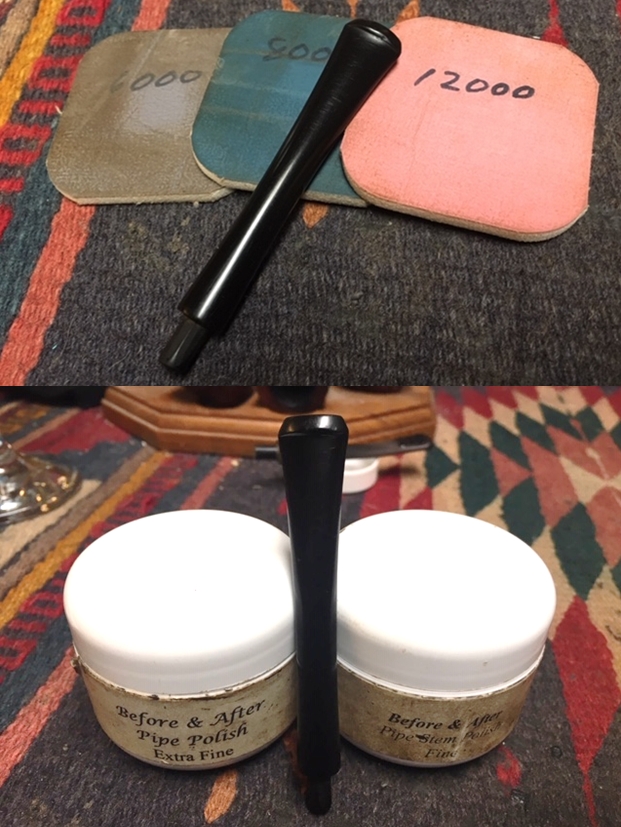
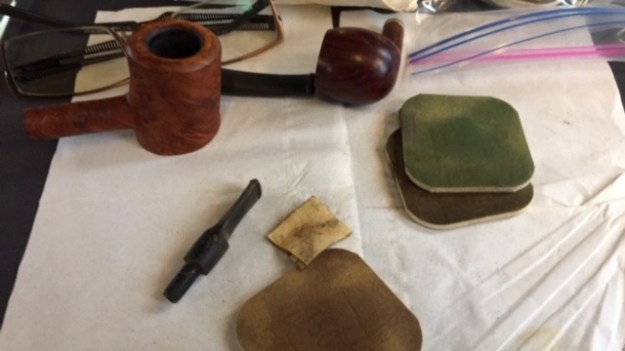
Once I had all the parts and repairs completed. I sanded the entire pipe and stem with 320 grit sandpaper up to 8000 grit (1500-8000 with micro mesh pads) Rustication

At this point I had to consider how I was going to finish this pipe. Originally this was a smooth finish Canadian Billiard, but those days were long behind this tired old pipe. I originally thought of using a really dark stain to hide all the imperfections, polish it and call it a day, then I thought I’d take a risk and create something new, and breath new life into this pipe. For all the effort I put into this pipe up to this point I figured I’d let my creativity flow.

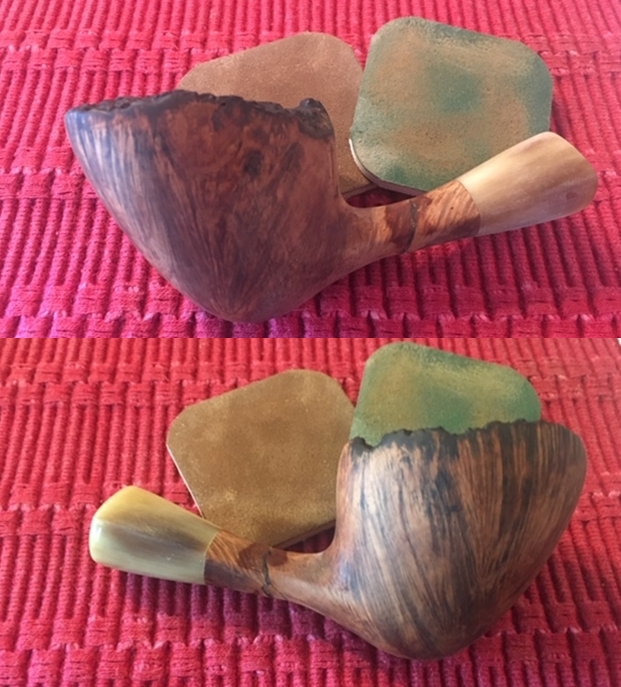
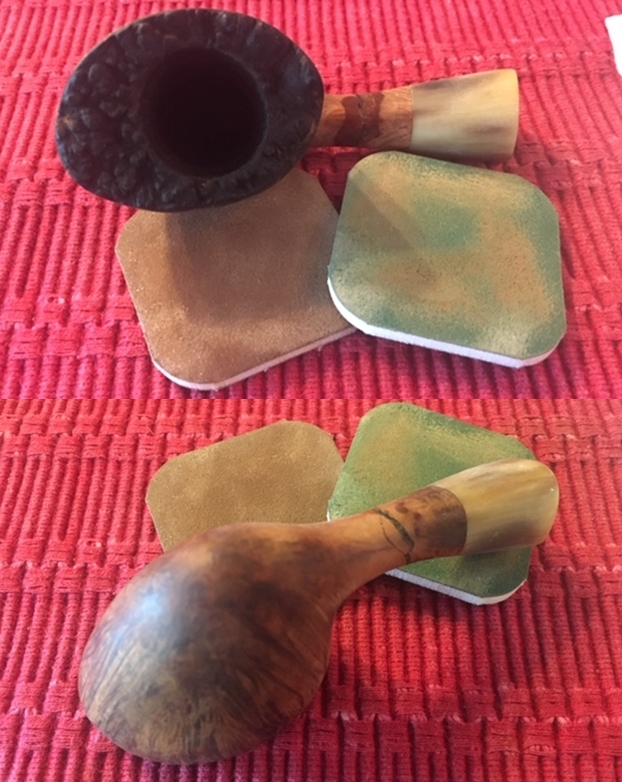
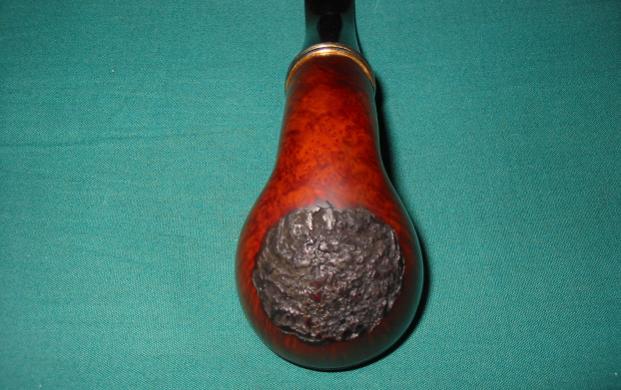
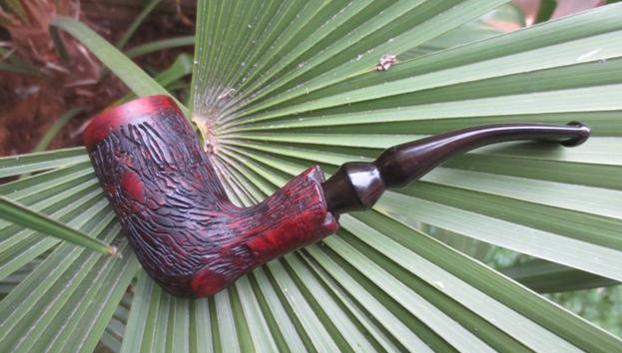
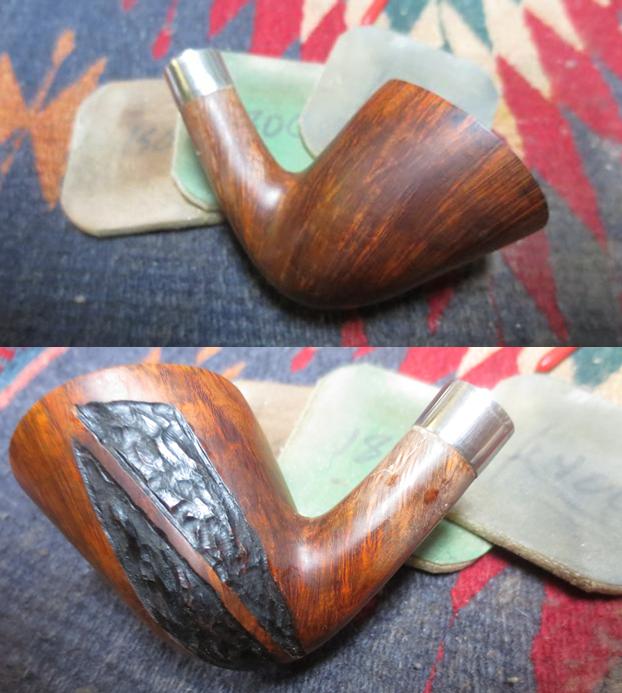
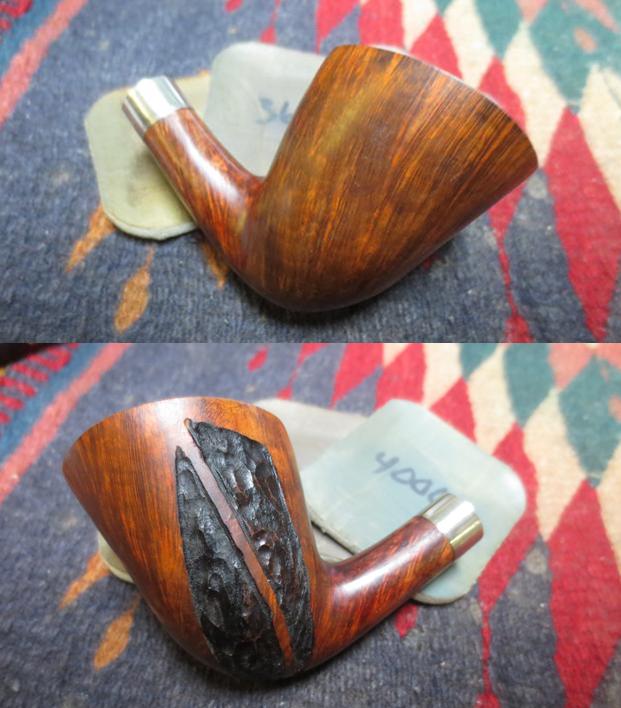
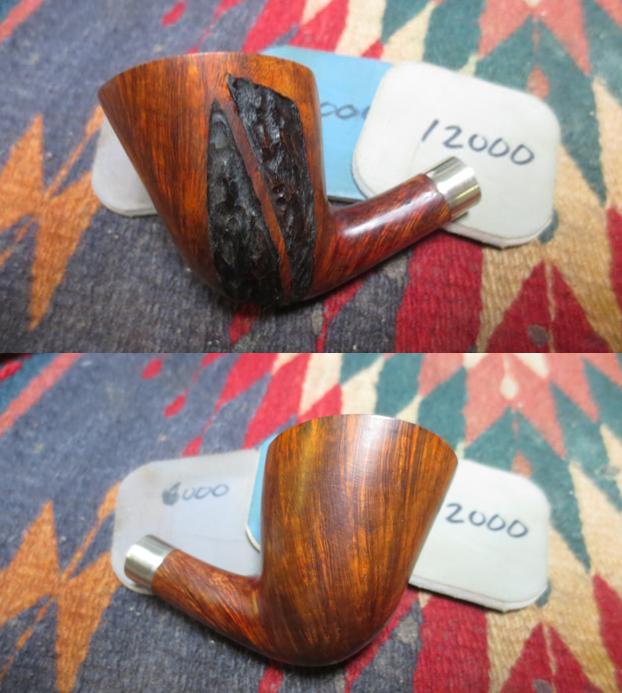
I decided that I would rusticate this pipe and leave a smooth patch somewhere, where I hadn’t determined yet. Using a Dremel and a 107 Carving bit I started to rusticate the shank and worked my way to the heel, then up the stummel. Halfway up the stummel the pipe revealed its final design-leave the top of the bowl smooth! I wasn’t sure at first because it would mean I had to blend in that CA patch, but I now avoided trying to rusticate it.

I was very pleased with the result.

Staining & Finishing

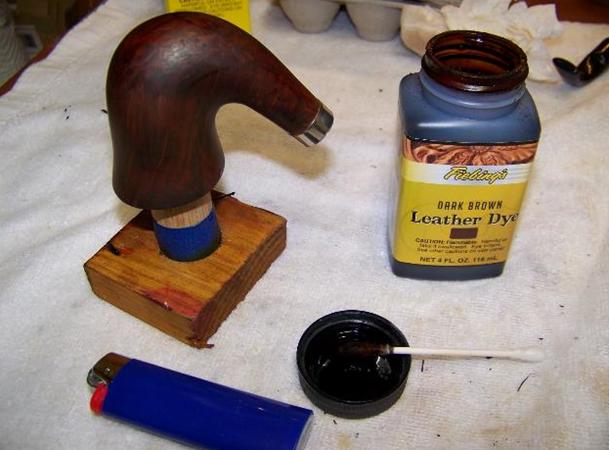
I used Fiebings Dark Brown alcohol based dye over the entire pipe as a base, then wiped on Fiebings Oxblood till I achieved the colour I wanted. To seal the stain in the pipe I applied a thin layer of shellac which gave it a glossy look I didn’t like. I left it, and just stayed the course with this experiment to see how it turned out.

In the morning the Shellac had cured. I began the polishing process at this point. I don’t have a buffing wheel yet, so I use cotton wheel buffing bits that fit to my dremel.

I started with Tripoli and thoroughly went over the entire pipe and stem. The tripoli did a good job of taking down the shellac, and making it less pronounced. I followed that up with white diamond and then finally carnauba wax.  I used a fluffy felt bit to polish the whole pipe.

Bowl Coating

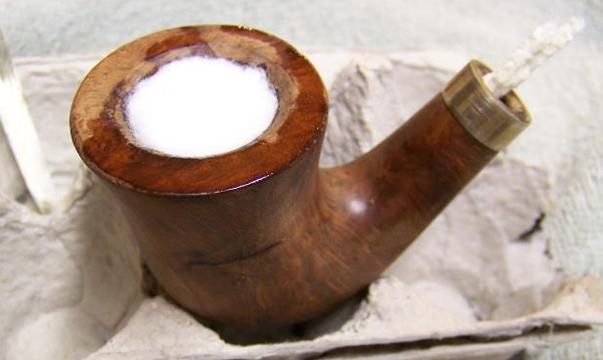
You will find a variety of recipes and opinions on bowl coatings. I use them when needed and I prefer the waterglass recipe that a pipe maker shared with me. It is a combination of Sodium Silicate, Activated Charcoal and White Pumice. Once cured it provides a refractory layer on the inside of the bowl, and it feels like 800 grit sandpaper which promotes new cake build up without putting a lot of heat stress on the worn out briar.

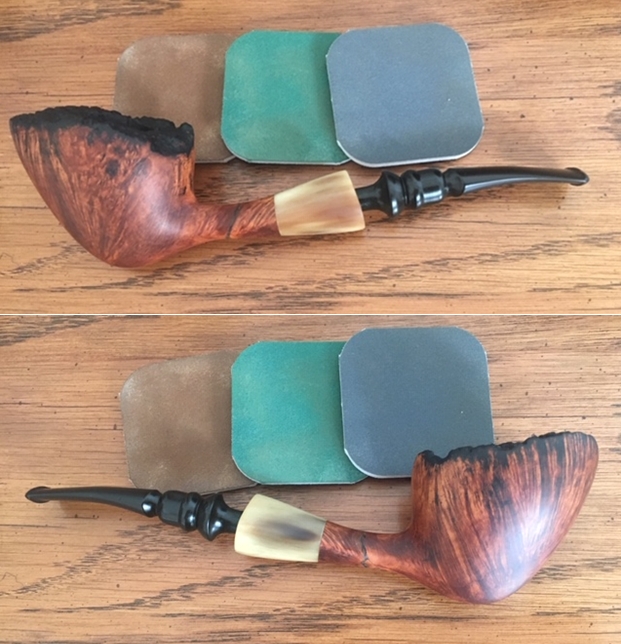
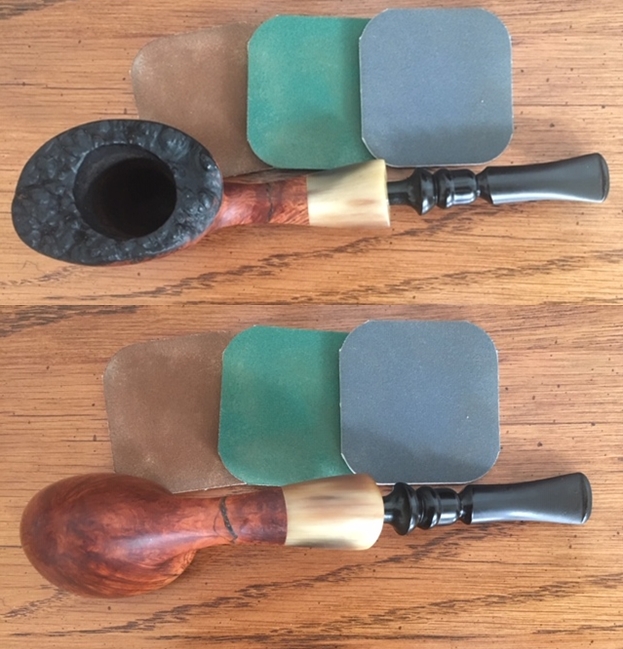
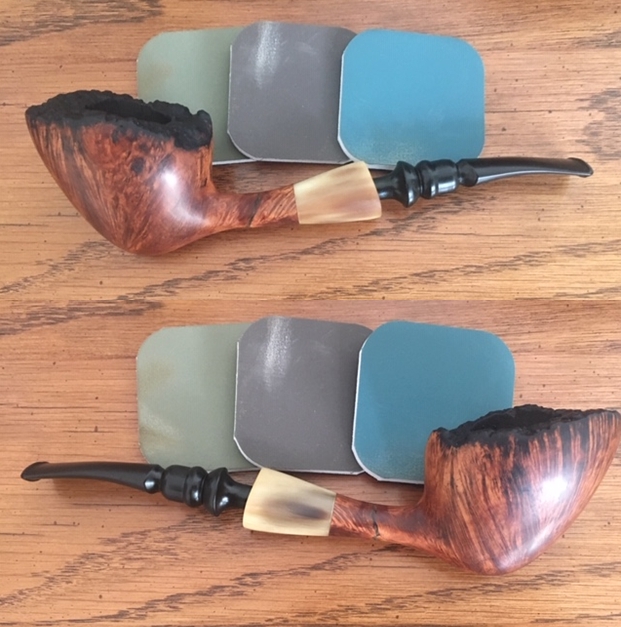
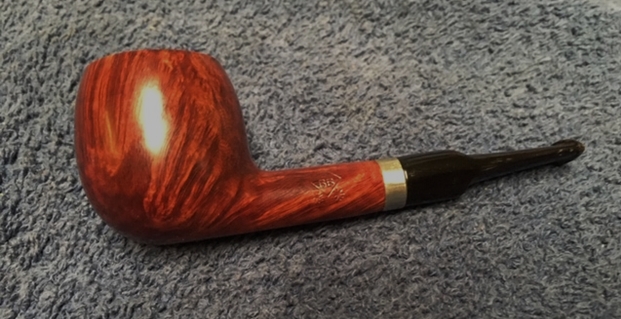
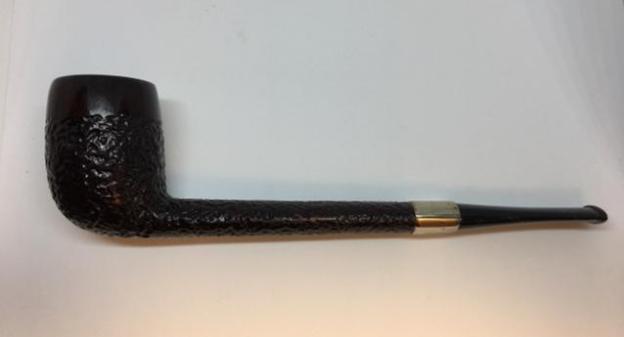
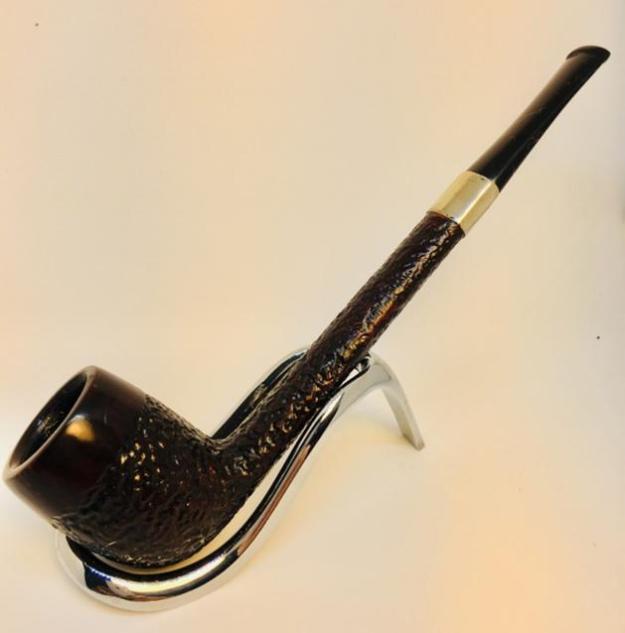
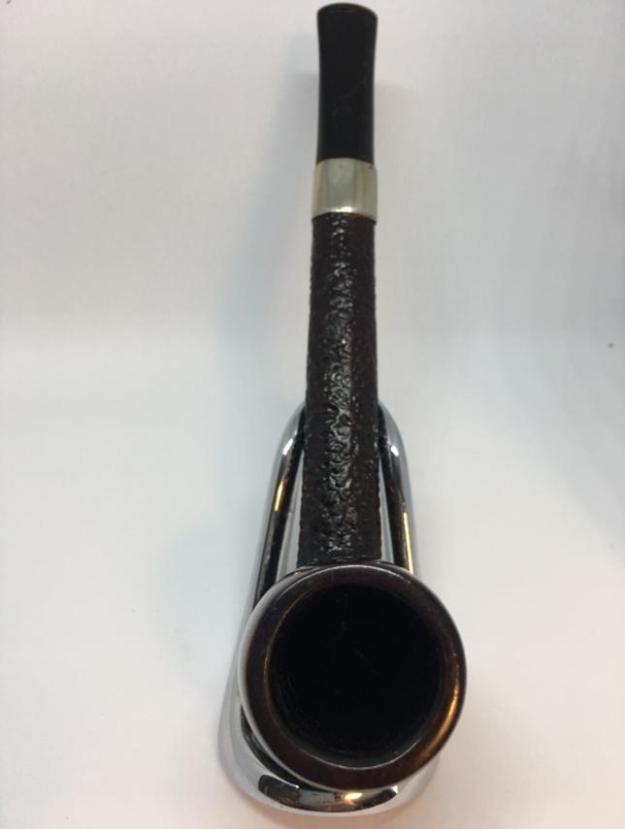
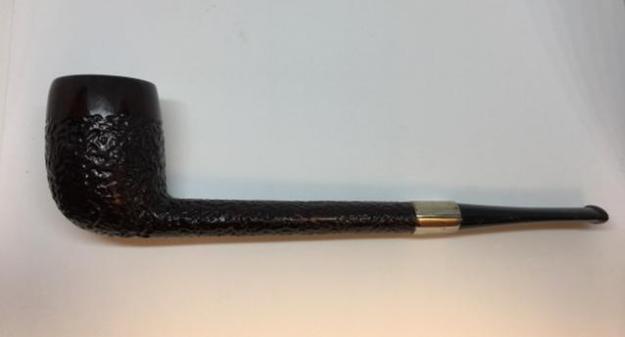
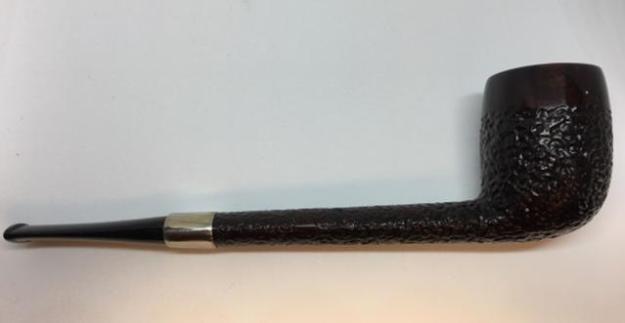
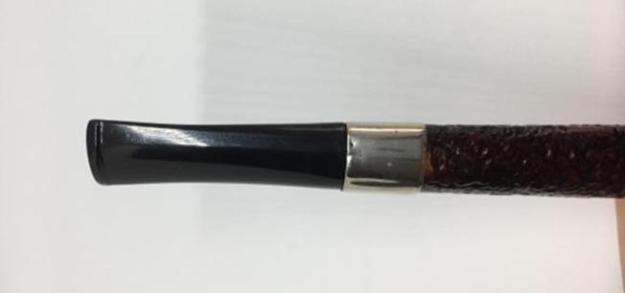
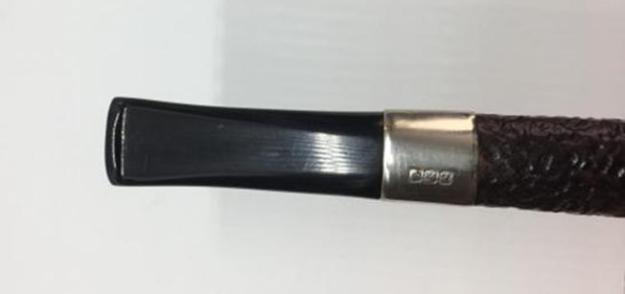
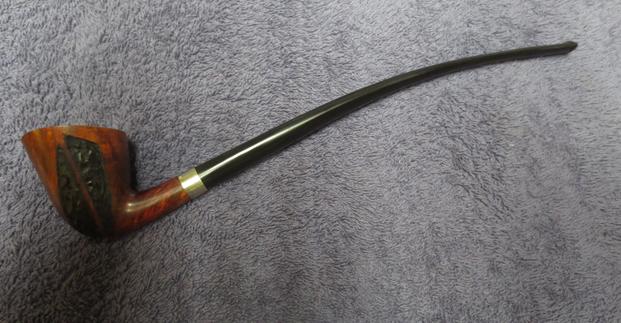
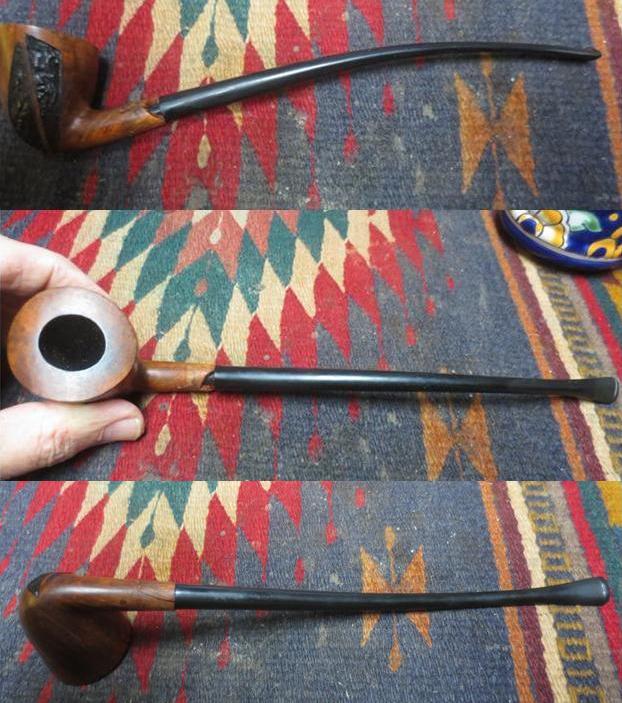
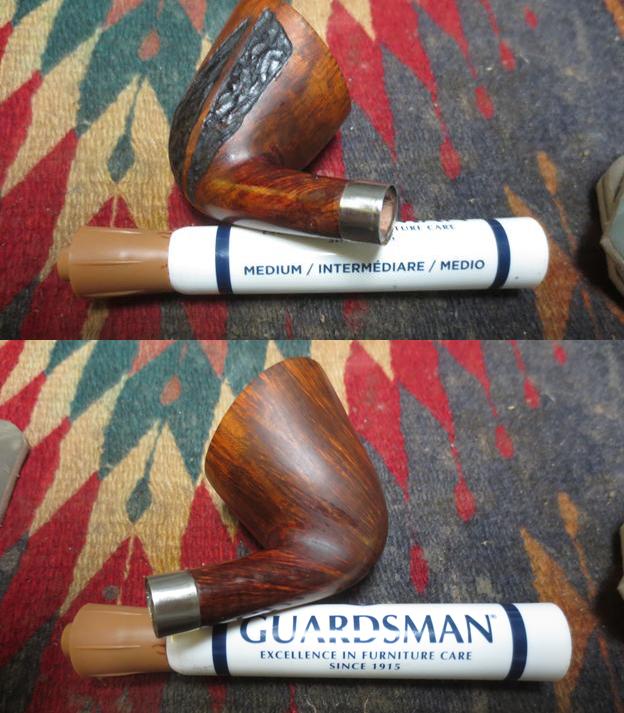
This pipe definitely tested the limits of my abilities  and I learned some new techniques that I had only seen others use. Here’s the finished pipe!


ANSWERS TO QUESTIONS – Is this pipe repairable?


Blog by Steve Laug

In this next installment of the Answers to Questions blogs, I want to address a question that comes to me via email, the contact button on the blog or through Facebook. I receive photos and descriptions of pipes in a variety of conditions asking if I think the pipe is repairable. I have learned over time that the question has a variety of possible answers. I think that questioner thinks it will be a yes or no question. Really, I suppose that is what they want to hear. Yes I think it can be repaired or No, it cannot be repaired. Often when I answer yes, they want me to do the work, and sometimes when I answer, no they want to send it me to “dispose” of properly. But really the question is not a yes or no question. Every pipe gives multiple options for how to proceed.

I think the right question to ask is, “How badly do you want to keep this pipe?” or “How much work are you willing to put into this pipe?” These questions determine what a person will do and what lengths they will go to in order to keep or return the pipe to smokable condition. If the question is merely a simple yes or no then many pipes will end up in the tinderbox destined for the fire. However, if the question is as I have spelled it out above then the answer will lead to the next steps of restoration. Let’s talk about some of the pipes that have come across my desk or my email address that can illustrate this variation on the question.

A Beautiful older Peterson 999 with a huge burned out hole in the lower left side of the bowl. Many would have simply said good-bye to this old friend because you could put your index finger through the side of the bowl. It appeared to be a goner. When I looked at it I remembered an old Blatter and Blatter pipe that I had picked up on eBay that had a burn out on the back side of the bowl. I had talked to the shop in Montreal and they had me send it back to them. They drilled out the burned out area until they had solid briar. Then they cut a chunk of new briar and fit it into the drilled out hole. They glued it in place and once it had set, they rusticated the patch to match the rest of the bowl. They gave the inside of the bowl a bowl coating to protect it until a cake had formed and sent it back to me. I have had that pipe for over 20 years now and it is still going strong. You would be hard pressed to find the repaired area.

With that living memory I said yes to the burned out Peterson. In days past, I would have walked away and left it for firewood but I had learned. I drilled out the burned out area with a drill bit until the surrounding briar was solid. I cut a plug from a piece of briar and adjusted it to fit into the hole. I glued it in place and rusticated the area around the plug and lower part of the bowl until it blended in well. I stained the lower half of the bowl with a dark brown stain and the upper half with a medium brown stain. The finished exterior looked very good. I coated the inside of the bowl with bowl coating to protect it. The fellow still smokes the pipe I believe and the repair has held up well. Here is the link to the blog: https://rebornpipes.com/2014/02/06/plugging-a-burnout-on-a-petersons-irish-whiskey-999/

You can see from that example that a simple yes or no question would have probably sacrificed what turned out to be a repairable bowl. The question was whether I wanted to take the time and invest the work to make it smokable again. In this case the invested work was worth the results in my opinion.

An Ardor Urano Fancy with a ½ inch deep chunk broken out of the right side edge of the rim. This is one that caught my eye on Ebay. Many would have simply passed it up and said it was not worth repairing. The large broken out chunk of briar from the back right side of the bowl near the top and the general wear and tear on the bowl would have easily made it a pass. But to me something about the rugged rustication and the blue of the shank end and stem just caught my eye and made me want to give it a try. So I put in the only bid on the pipe – no surprise there and picked it up for a decent price. This was a pipe that would go in my collection and not be sold and it was a pipe that would provide more schooling for me in the art of pipe repair.

I had it shipped to Idaho and my brother cleaned it up for me. When it finally came to Canada I was excited to see what could be done with it. I cleaned out the damaged area with alcohol and cotton swabs until the surface was clear. I smoothed out the edges of the break to make fitting a new piece of briar a little easier. I cut a piece of briar from the side of one of my sacrificial briar bowls that I keep just for this purpose. I shaped the piece of briar with my Dremel and a sanding drum until I had it close to fitting. I used the Dremel to give the inner edge a bit of a curve that would match the wall of the pipe around it. Once I was close I used a file and 80 grit sandpaper to bring to the size that I could press it into the damaged area. I coated the edges with epoxy and pressed the chunk in place. I filled in around the patch with clear super glue to ensure that the seal was tight. I set it aside to cure.

The next day I used the Dremel with various burrs to rusticate the repaired area to match the surround bowl sides. There was an uneven smooth area around the rim top so I left that smooth on the repair as well. Once the rustication was complete and I was satisfied with the match I washed the area down with a cotton pad and alcohol. I mixed a batch of JB Weld and coated the wall of the repaired area. Once it dried I used the Dremel and sanding drum to carefully smooth out the inside of the bowl. I gave it a thick coat of pipe mud and let it dry. I stained it with a dark brown aniline stain and washed it lightly with alcohol to blend it in. I gave the bowl multiple coats of Conservator’s Wax and buffed it with a clean buffing pad to raise a shine. I have had the pipe now for almost a year and it smokes really well and looks pretty good for a repair. Here is a link to the full blog: (https://rebornpipes.com/2016/02/26/with-just-a-little-work-i-now-have-a-dr-ardor-urano-fantasy-apple/) The next three examples show very different repairs and issues with old pipes that I have dealt with. I decided to use two of them as examples in this blog. https://rebornpipes.com/2016/09/03/what-to-do-with-a-cracked-bowl-options-for-their-repair/. The first was cut off and the job was done very poorly. It had originally been a GBD 9438 in a previous life and someone had cut off the entire top half of the bowl. They had restained the bowl but had not sanded it so there were saw marks and file marks and a very rough look to the pipe. This is another pipe that could easily have been relegated to the dust bin. My brother Jeff picked it up in a bunch of pipe from a fellow on Ebay who called himself a refurbisher. This pipe came as one that had been restored. It had a lot of problems. Not only had he cut the bowl off he had also used a Dremel and took it straight down the bowl leaving a mess in the bottom of the bowl. I figured that maybe there was something redeemable in the pipe. I used a Dremel and sanding drum to reshape the top and round it over giving some form to the damaged bowl. I decided to round it over leaving a rounded top edge to the rim. It took a lot of sanding and shaping but I think in the end I had a smokable pipe with a bit of charm that previously had been severely lacking. You be the judge. Was it worth the effort to do the work on the bowl?

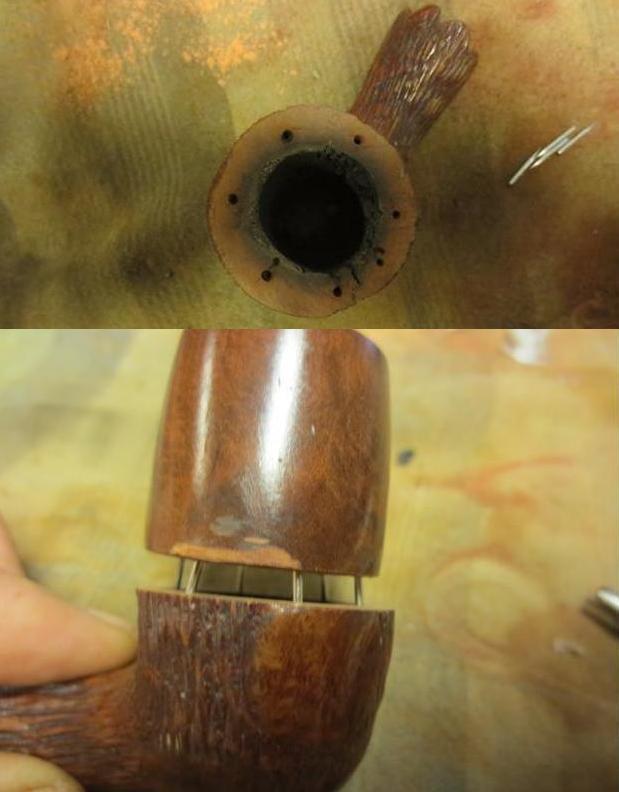
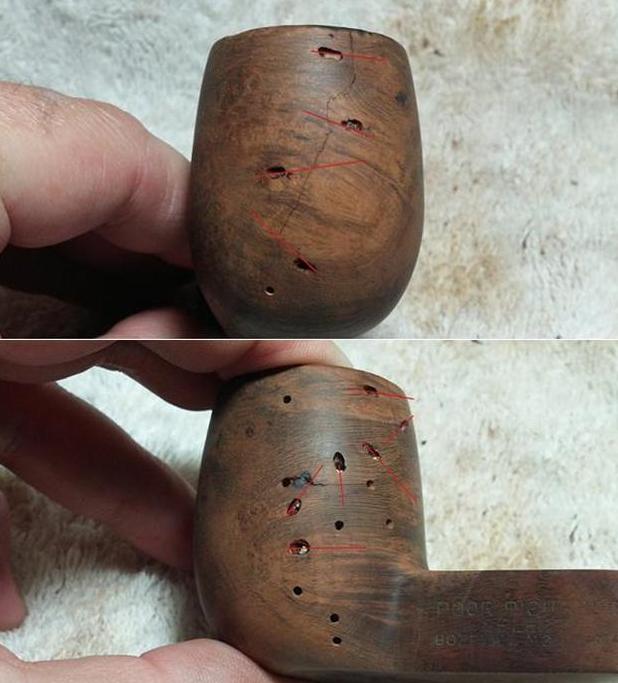
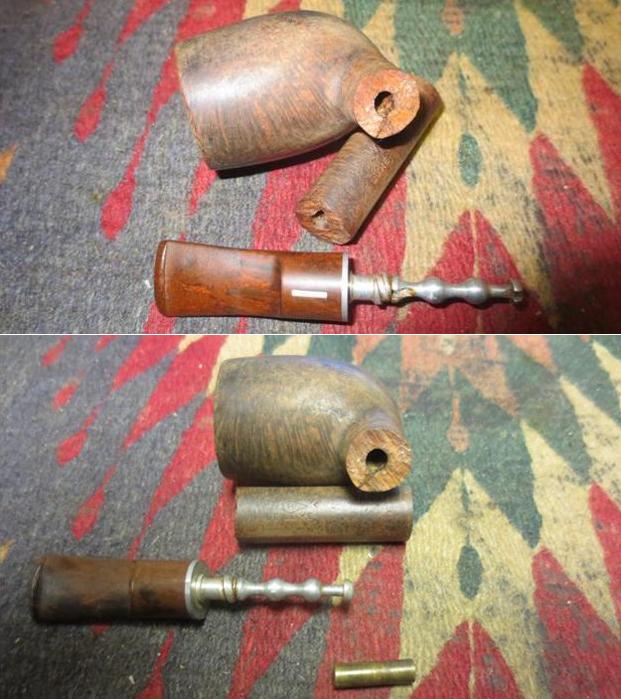
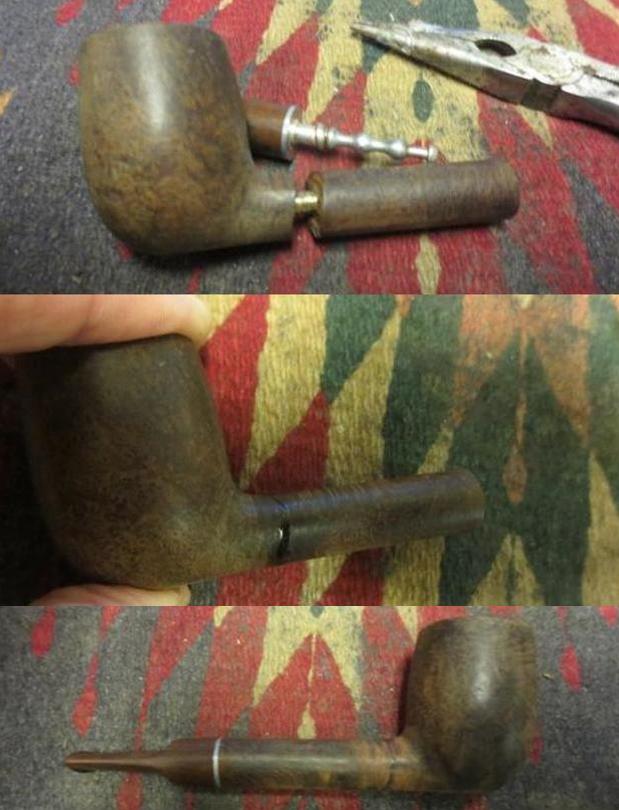
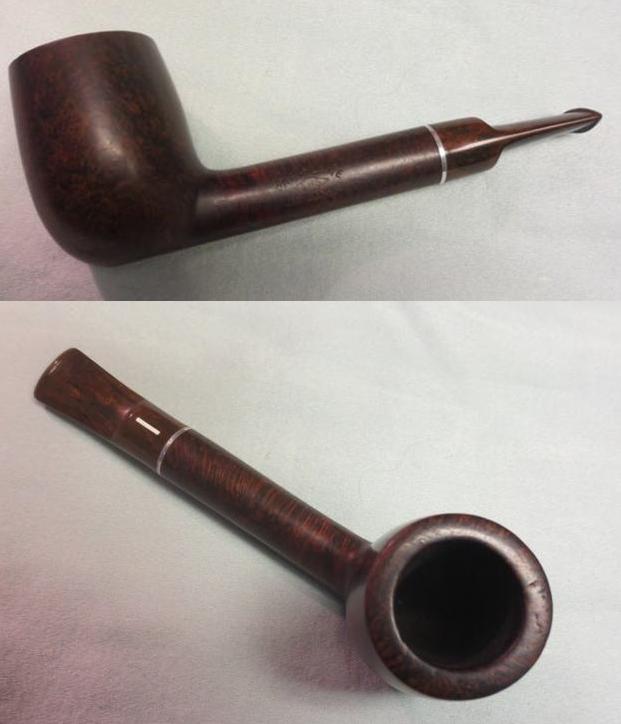
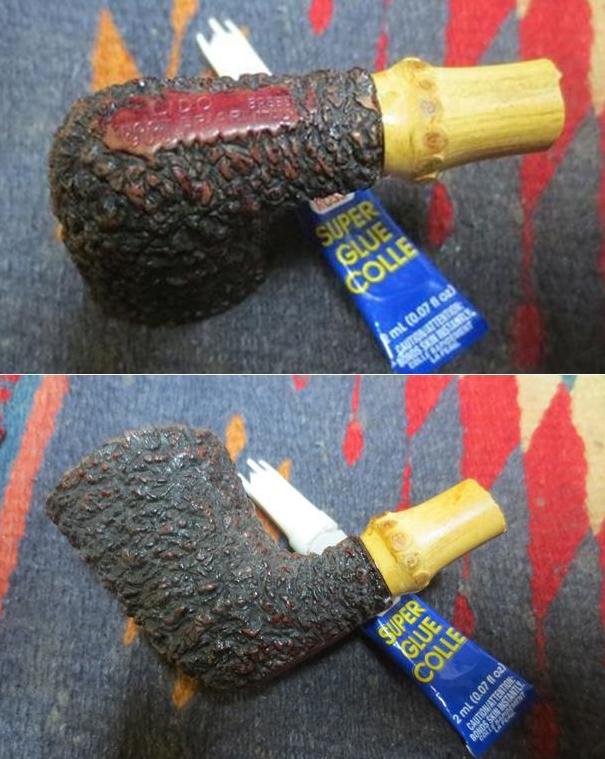
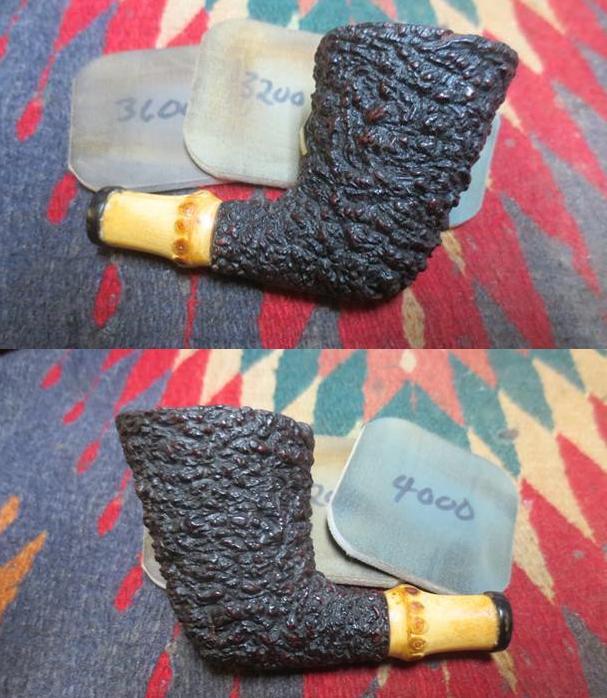
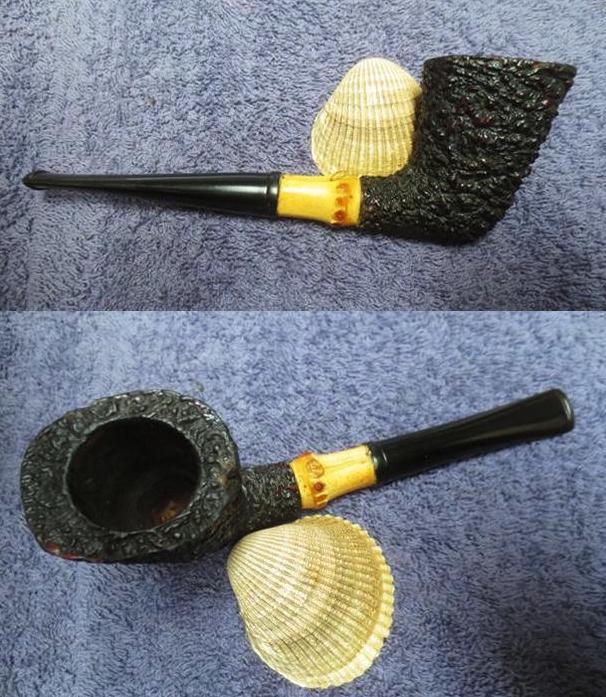
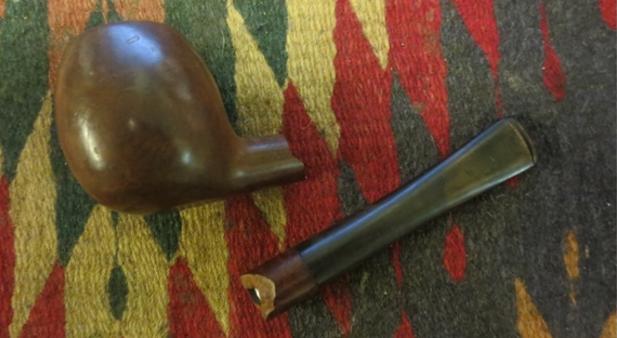
The second pipe in the lot was an Alpha freehand rusticated shape that someone had done the same hack job to the bowl was very short and held a mere thimble full of tobacco. It had thick walls on the portion of the bowl that was left so I decided to experiment. If the experiment did not work there would be no loss. I had a bowl with the shank missing and damage to the bottom side that could easily be salvaged and the two parts connected to make a new pipe. I cut off the damaged (cracked) bottom of the sacrificial bowl in preparation for the new union. I drill small holes in the top of the bowl and the base that matched each other and cut some stainless pins that would join the two parts. I glued the pins in the base and coated the surface of each part with epoxy and pressed them together until the surfaces joined. I filled in the gaps and crevices joining the two bowls with briar dust and super glue. Once everything had set I reshaped the bowl so that the joint was less visible and then rusticated the new top half to match the base. I coated the inside of the bowl sealing the area where they joined with JB Weld and when dry sanded it out with my Dremel leaving the JB Weld only in the joint. I coated the bowl with a bowl coating of sour cream and charcoal powder. I restained the bowl with a dark brown stain. Once the pipe was finished I had an interesting chimney pipe that would give many more years of service. Was this worth it? To me it was worth the education for me. GBD Made Square Shank Poor Richards Pipe Shop with a lot of cracks around the bowl. This one was a challenge that Charles Lemon of Dad’s Pipes Blog and I took on together. We were experimenting with the question, “When was a pipe no longer redeemable.” https://rebornpipes.com/2016/03/06/a-humpty-dumpty-cross-canada-project-could-this-poor-richards-select-square-shank-billiard-9489-ever-be-whole-again/. The pipe was one my brother had picked up that was stemless. The bowl was a mess with cracks on all sides of the bowl. Charles and I had been chatting on Skype about repairing pipes and I told him about it and we decided to make it a joint effort. Charles was experimenting with using rods to stitch a cracked bowl back together again and this was just the one to do that on. He drilled angled holes on each side of the crack and pushed a rod through. The angles of each set of holes was drilled in opposition to the previous one so that it acted to pull the crack together. The next series of photos show the process of stitching the bowl together, filling in the holes and refinishing the bowl. Putting the shank back on a broken LHS Park Lane DeLuxe — Lovat 12. The next one was a fun pipe to work on. It was one that I would have thrown in the bin for parts in the past. The shank was completely broken off leaving a short section on the bowl. I liked the look of the Cumberland stem and the Lovat is one of my favourite shapes so I figured it was worth a try. You can read the details on the blog here: https://rebornpipes.com/2015/09/29/repairing-a-broken-shank-on-an-lhs-park-lane-de-luxe-lovat-12/ I cleaned up the broken ends of the shank and bowl and used a brass tube to insert, glue and bind the two parts together. I filled in the gaps in the crack with clear super glue and briar dust to make things smooth. The crack virtually disappeared into the grain once I stained the pipe with a dark brown stain. The finished pipe is shown in the last two photos. The repair has held up for several years now without any sign of the joint failing. Crafting a Frankenpipe from a cut off Brebbia Lido Bowl and a piece of bamboo. The next example is a Brebbia Lido that my brother picked up on one of his trips. Someone had glued a stem in the shank and the shank itself had been cut off crooked so the entire pipe curved toward the right. The short shank also did not work well with the stem that had been put on the bowl. We removed the stem during the cleanup process and cleaned off the glue and crud in the shank. It looked like another broken pipe but I thought that the shank had enough length that a piece of shank could be added. I checked out the look with a piece of briar, acrylic and bamboo. The bamboo worked for me the best. I used a topping board to square up the shank end on the Lido and both ends of the piece of bamboo. When I put the two together the junction was smooth and tight. I joined the bamboo to the shank of the pipe using a piece of Delrin tenon that I glued into the shank first and then into the bamboo. I filled in the small gaps around the joint with super glue to seal it tight. Once it had cured, I glued a drilled out acrylic button on the end of the bamboo to keep it from fraying or splitting when the stem was in put in and taken out repeatedly. The longer stem worked well with the rustication and the bamboo the contrast of finishes and colours made the pipe a beautiful addition to my rack. What had been a throwaway was rescued and given a new look. It is now a pipe that I enjoy smoking. If you wish to read more about the process, I have included the link to the blog on the restoration of the pipe. https://rebornpipes.com/2017/10/09/another-frankenpipe-salvaging-a-lido-root-briar-dublin-bowl/

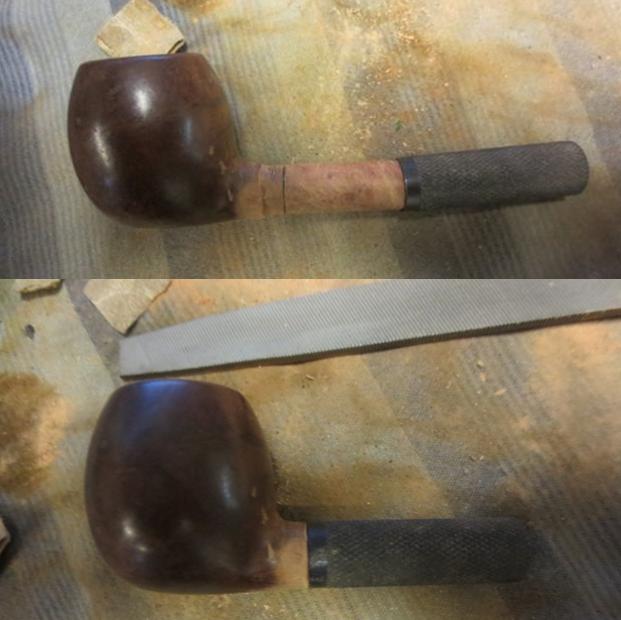
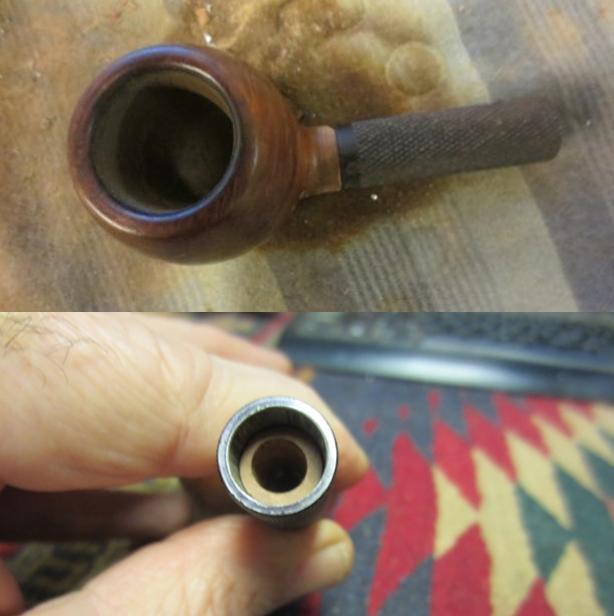
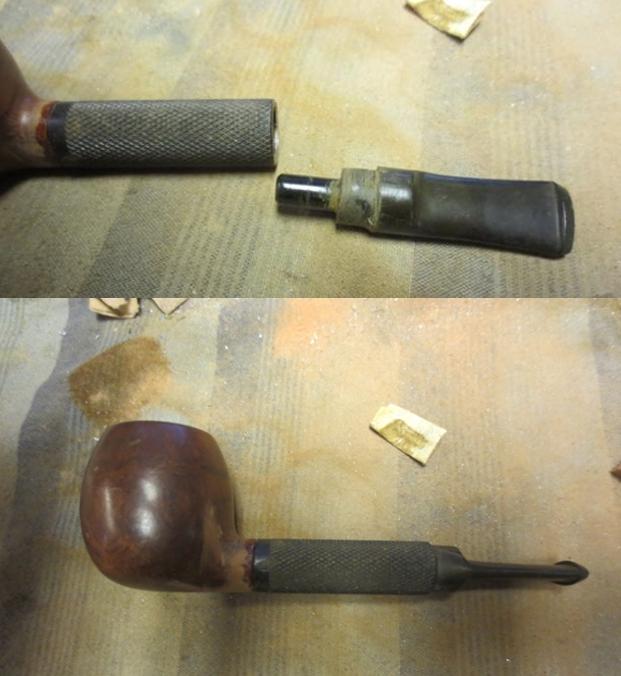
Crafting another Frankenpipe from a broken shanked apple, a piece of briar and a metal tube. The final example is another broken shanked apple. It was a no name pipe with a nice shape on the bowl and a jagged broken shank. I decided to take a totally different tack on this one. I had an old metal flashlight tube that had a cross hatch pattern on the metal. It was an open tube. I had a sacrificial pipe that had a long shank that I cut off and used to make this more of a Lovat style apple. I wanted a pretty indestructible pipe to use while I was working in the yard or the garden. I cut off the broken shank on the apple and topped it to square it up. I turned the other shank that I was using so that it would fit into the metal tube and allow me to use the mortise for a new shorter stem. I joined the bowl and the shank with a piece of stainless tubing. I scored the tubing and epoxied it in the bowl end first then added the shank end to it. Once it cured I used a file to step down the end of the shank on the bowl end so that the tube would fit closer to the bowl staggering the new joint and giving it more stability. I pressed the metal tube on the shank piece until the end was flush with the briar of the bowl. I filled in the gaps with clear super glue to make the transition seamless. I wanted the transition between the metal and the stem to be seamless so I stepped down the end of the stem just past the tenon to sit inside the metal tube. I restained the bowl and polished the vulcanite and the pipe was ready to smoke and it was pretty indestructible. This is yet another example of the lengths that I will go to salvage a pipe that I like or that I see promise in. Here is the link to the blog if you would like to read about the process in detail. https://rebornpipes.com/2015/02/07/pipe-resurrection-from-a-broken-shank-to-another-frankenpipe/

Looking at the various examples above of pipes that have crossed my worktable you can see how I chose to answer the question, “How badly do you want to keep this pipe?” or “How much work are you willing to put into this pipe?” In each case, my decision was that the pipe was worth saving and investing time in whether it was for the sake of repairing a beautiful old pipe or for learning new skills that I could use on other pipes that came to my desk. The decision was not quick or foolish it was made with full awareness of the extent to which I would have to go to bring the pipe back to useable condition. With that I bring this Answers to Questions blog to a close. I hope that this installment has been helpful to you. Have fun crafting what you can out of the broken pieces of the pipes that come your way. Think hard before you throw the pipe in the fire and look beyond the pieces and see if you can imagine a way to make it work. Thanks for reading.

A Few Firsts on a GBD Garland II Calabash 9552


Blog by Aaron Henson

Before you get into this write up, I need to confess that despite my best efforts, I did a poor job of photo documenting this repair and restoration.  I had good intentions, but the project was spread out over two months, working on it as I had time. Because of this, some of the pictures were taken out of sequence and others were chosen that best show a repair but also show repairs that have not yet been covered in the write up.

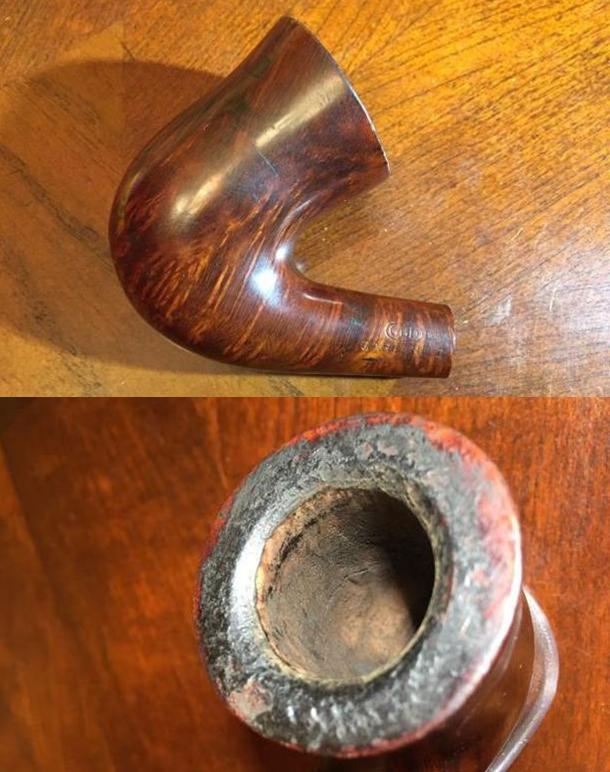
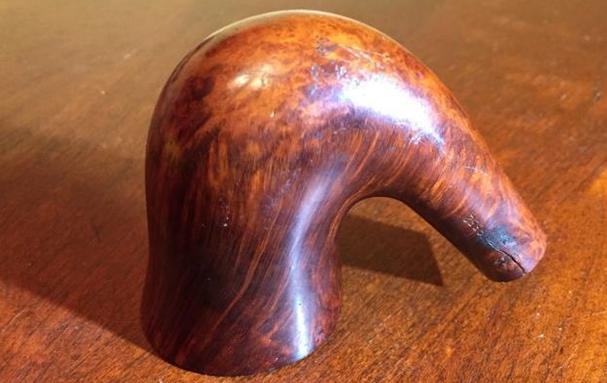
I realized a while back, that I had not restored a pipe recently that I was really excited about.  There have been a number pipes that have crossed my work table and some have even posed some new challenges but the pipes themselves were hardly memorable. With the pickings at the second hand store in my area being slim – I turned to eBay to see if I could find a project pipe that would peak my interest.  After a few hours of browsing I, found just what I was after: a stemless, GBD Garland II stummel – shape 9552.  I submitted my bid and picked it up for a price that I thought was reasonable.

I don’t typically like to buy pipes on eBay.  I prefer to be able to see them first hand so I know what I am getting myself into.  But in this case the seller was forthcoming in the auction description, revealing that the pipe had a major crack in the bowl and another in the shank and of course, it lacked a stem.  But what really fascinated me was the shape of the stummel and what promised to be some beautiful grain patterns.

The following pictures were from the seller auction page: Wanting an idea of what kind of stem was originally on the pipe, I headed on-line to see what I could find.  My first stop was here at Reborn Pipes.  In a 2016 article, our host, Steve, restored a GBD Colossus Fantasy 9552.  I found additional examples of the 9552 shape in the GBD’s Prehistoric, Prestige and Virgin lines.  In all cases the 9552 originally came with a bent saddle bit – some fancier than others.
These next two pictures are of a Garland II I found online.  I was not going to try to duplicate the band in the stem, but knew I was going to need a band on the shank and that wouldn’t look too bad. Then I ended up at a Pipedia article for GBD Models where I learned that the Garland is a seconds line from GBD. I found this surprising because the Garland that I have and the ones I have seen online are excellent specimens of briar.  Admittedly, my eye is not that experienced, but just from the quality of the briar and the lack of fills and pitting I would guess that the Garland line is GBD’s higher end seconds consisting more of fabrication errors rather than materials flaws.  Can anyone confirm my guess?
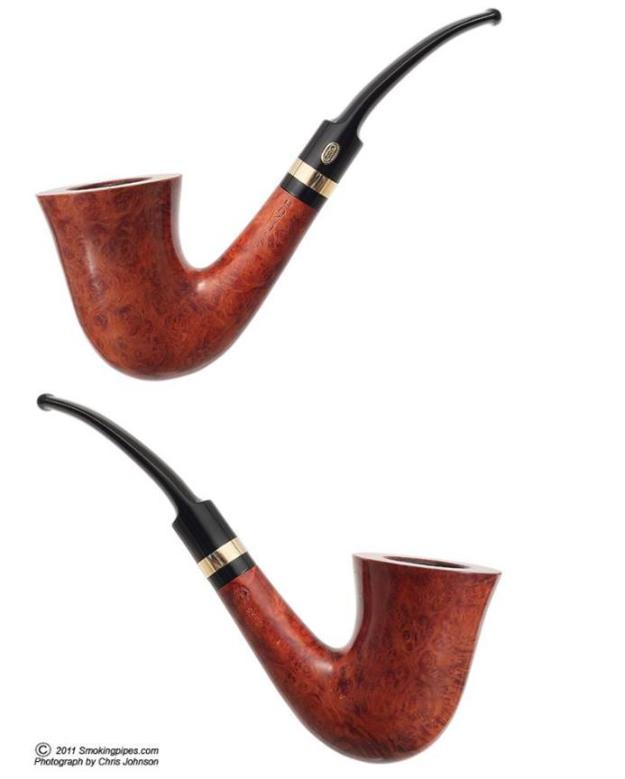
Another interesting fact that I note is that the 9552 shape is often stamped with “Colossus”.  The term Colossus was used by GBD as plus sized pipe designation.  This size designation is used on all the GBD lines of pipes, but is lacking on this particular Garland II stummel. When the stummel arrived, I eagerly open the package and began to inspect the damage up close, fearing that some of the worst damage may not have been disclosed.  But the seller’s pictures and description were accurate and I didn’t find hidden issues.  The pipe was indeed big; the bowl height is 2.4 inches and the outside diameter is 1.75 inches. The chamber is 0.96 of an inch in diameter and 1.9 inches deep.
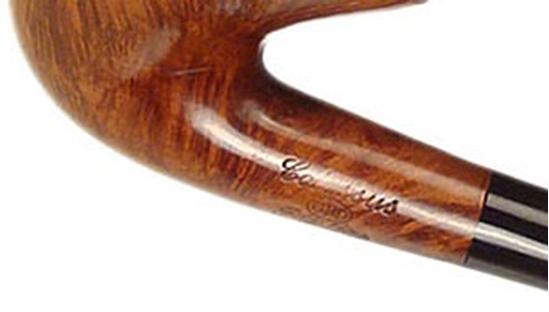
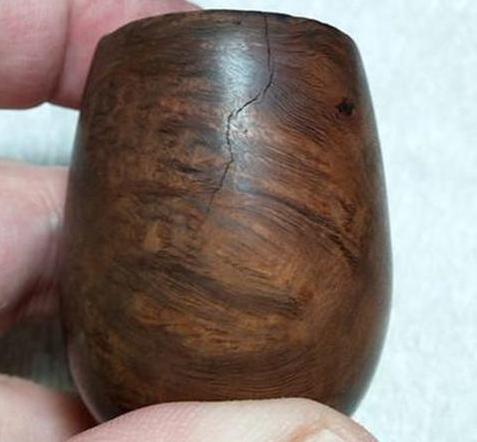
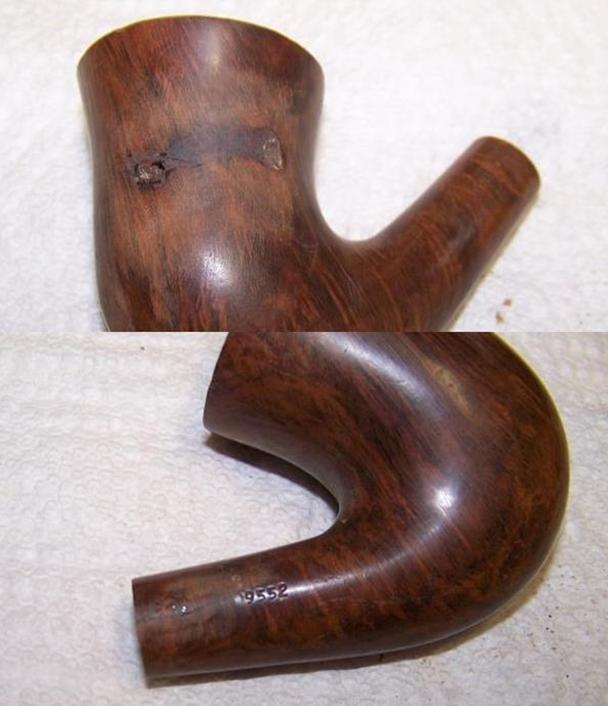
The left side of the shank is stamped GBD in an oval over Garland II.  The left side has the COM (Country of Manufacture) stamp: MADE IN LONDON in a circle over ENGLAND and the shape number to the right: 9552. There was a heavy amount of the lava on the rim and the bevel at the edge of the chamber was a little distorted.  The chamber too seemed to be drilled a little off center.  Perhaps this was the why it was a second?  The chamber had been reamed but not back to briar. The horizontal crack in the bowl was located on the left side and was a little over an inch long.  I suspected that it went all the way through bowl wall but I could not be certain until I finished reaming the chamber.  The crack in the stem was about half an inch long from the end of the shank right through the COM stamp but missing the shape number. Looking the pipe over closely, I noted quite a few dents in the heel of the stummel and handling scratches on the sides of bowl and the rim.  I guessed that this piece of briar had been rattling around in a drawer for some time.Now that I had the stummel in hand I could measure the shank diameter (.610” at the end) and estimate the length that I wanted the new stem to be; about 3-1/4 inches. I took these measurements to the Vermont Freehand website and selected a stem that best fit.  I chose the vulcanite stem blank number 722, a round saddle bit 21/32” diameter and 3-1/16” inches long.  I always order two in case I ruin the first one.  I also ordered four nickel plated shank rings, two 15.5 mm and two 16 mm not being sure which would be the better fit. With the parts on order, I started cleaning up the interior of the stummel.  I reamed the chamber back to bare wood with my Castleford reamer and Decatur pipe knife. I also cleaned the shank alternating with bristled and soft pipe cleaners dipped in 91% isopropyl alcohol.  The last person who tried reaming the chamber must have also ran a pipe cleaner or two through it because it only took five or six pipe cleaners before they started coming out as clean as they went in. The mortise I cleaned with cotton swabs. In all, the stummel was relatively clean. I wiped down the outside of the stummel with alcohol and acetone to remove the grime.  Underneath the dirt and oils was some beautiful straight grain with a birds-eye heel.  I looked closely and could not find any fills.  Next, I addressed the thin crust of dried tars on the rim.  I wetted down a green pad (mine was actually blue and did not work as well as the original green ones) with a mixture of tap water and granulated Oxy-clean.  Placing the pad in a shallow dish, I pressed the rim of the pipe down on the pad and scrubbed in a circular motion.  A little elbow grease and the moist Oxy-clean solution did its job. I dried the stummel with a paper towel and set it aside to dry for a bit.Next, I wanted to remove the ghosts of the previous tobacco that I could still smell in the chamber with an alcohol soak.  I use the cotton ball method because it seems to do the job and is easier to clean up than the salt method. This chamber needed three cotton balls and I used 98% grain alcohol for the soak. I placed a cap over the top of the bowl for the first couple of hours to keep the alcohol from evaporating too fast then I removed the cap so the evaporative action can draw out the tars from the briar.When I got back to it the next day I was disappointed (though not surprised) that the crack in the bowl was wet where alcohol had been seeping through.  At lease now I knew for sure that the crack went all the way through the bowl wall.  The good news was I could easily see the ends of the hairline crack.  I used a dental pick to mark the ends so I could find them later, then I removed the cotton balls and wiped out the chamber with a dry paper towel. I began the crack repair by using a small drill bit (0.5 mm) and hand drilled the stopper holes at the location I marked with the dental pick. Since the crack went completely trough the chamber wall I also drilled the hole all the way through the wall.  I have not dealt with a crack that was this deep before so I was on unfamiliar ground.  I packed the hole the half full with briar dust using a tooth pick then placed a drop of clear CA glue into the hole – coaxing it in with the tooth pick.  I filled the holes up the rest of the way and dripped more glue.  I used a magnifying glass to locate the end of the shank crack and gave it the same treatment.
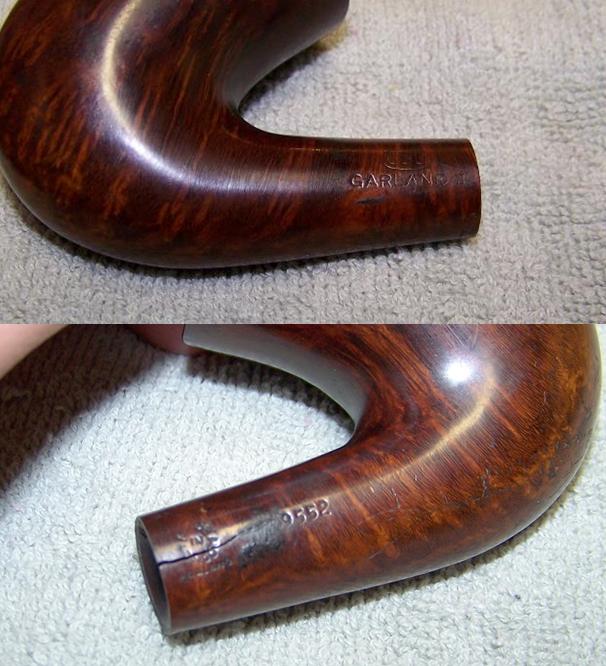
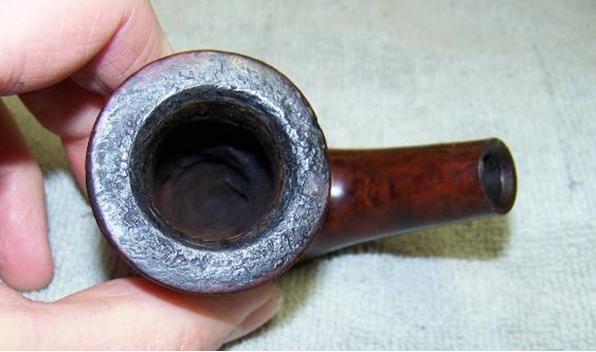
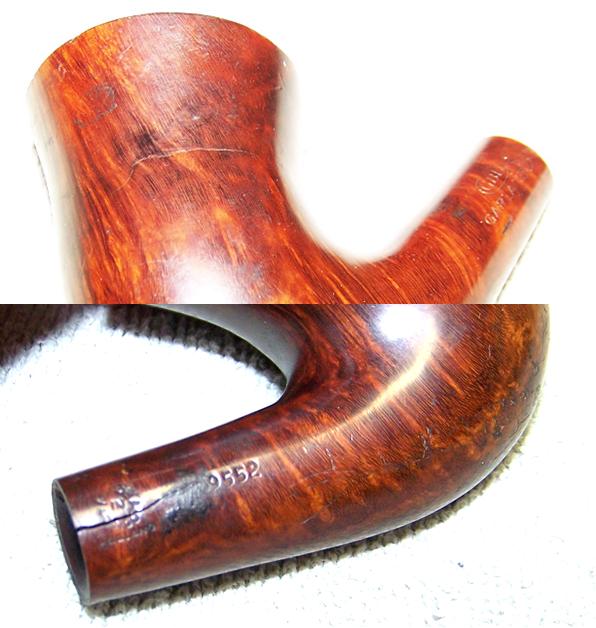
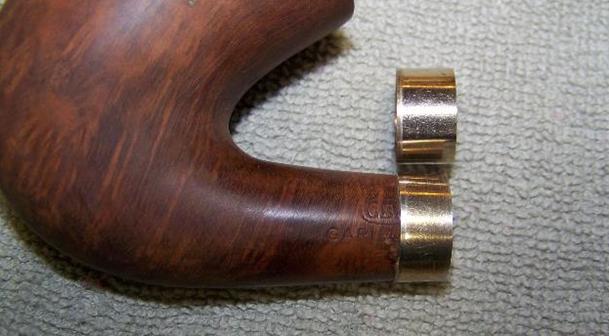
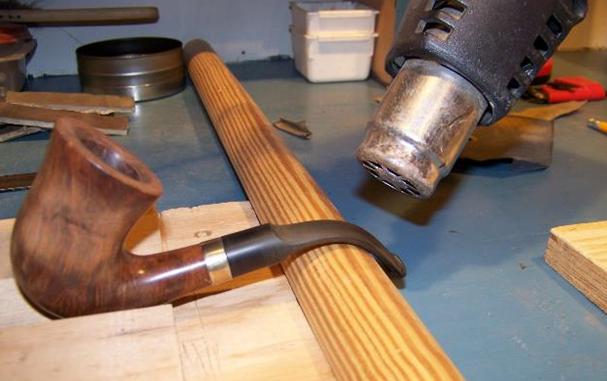
I unsuccessfully tried working some CA glue into the bowl crack. The glue just seemed to set too fast and did not penetrate the crack.  The shank crack on the other hand I could work open and get the glue to flow into it.  I put a clamp on the shank while the glue set.  Then when dry, I sanded the glued repairs smooth with 220 grit paper, careful not to over sand and change the shape of the pipe or damage the stamping on the shank. I resolved to repair the bowl crack by applying coat of heat resistant epoxy to the inside of the chamber.  In this case I used the two part JB Weld – not the Quick Weld, which is useful for other pipe repairs.  For pipe chamber repairs, I like the original JB Weld epoxy, it is easy to use and when cured it has a 550 degree (F) heat resistance.  It is also easy to sand smooth.  I apply it with my finger because it is much easier to get an even coat.  I highly recommend wearing a pair of powder free Nitrile blue gloves for this operation! By this time the parts from Vermont Freehand arrived and wanted to band the shank. I have fixed a few banded pipes before but never put a band on an unbanded pipe. I tried dry fitting the two different sized bands I had bought.  The smaller band would only just slip on the first fraction of an inch so I was glad I had ordered the next size up. The bands were a bit wider than I wanted because I did not want it to cover up too much of the stamping.  Not sure what to do about the band width, I kept focusing on the seating of the band.  I used a heat gun to heat up the band and get it to expand.  Then with the band resting on a wood block, I pressed the shank down into the ring. The first attempt didn’t go well. The band was a bit cocked and only seated about a quarter of an inch.  I realized that the shank’s taper was going to prevent the band from going on much farther and that was going to resolve the width issue; I was going to have to trim the band.
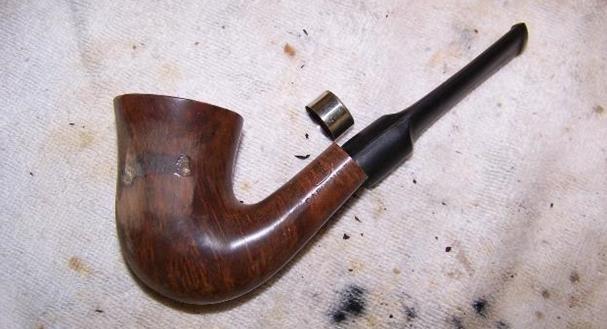
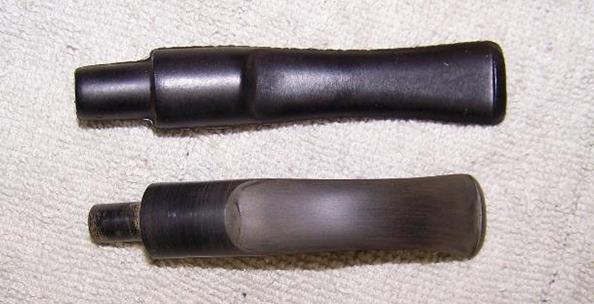
I removed the band and heated it up again.  I smeared a little CA glue around the end of the shank and was able to seat the band squarely.  This time about 3/8” onto the shank.  Once cool, I used a skinny wheel on a rotary tool to trim of the excess band material and flush it up to the end of the shank.  Although the band covered up the COM stamp and ‘AND II’ of ‘GARLAND II’ it was necessary and it gives the stummel a touch of class. I was pleased that the replacement stem I had chosen seemed to be a good fit although it was going to need some work.  I started by using a fine tooth file to square up the face of the stem so it sits flush to the shank and removing the casting burrs.The tenon on the blank was way oversized as was the body of the stem.  I don’t have a tenon turning tool, so I use my drill press to turn the stem.  Wedging a bamboo skewer into the air hole at the tenon end, I leave about an inch of skewer exposed that I can secure into the chuck of the drill.  Setting the drill to about 1300 RPM I use small pieces of 60 grit sand paper to slowly reduce the diameter of the tenon and the stem until it the correct size. The drill press method works well in theory.  Once in a while the stem slips loose from its friction fit with the skewer and I have to reseat it.  I work the vulcanite with 60, 120 and 220 grit sand paper, leaving the polishing to be done by hand with micromesh pads.
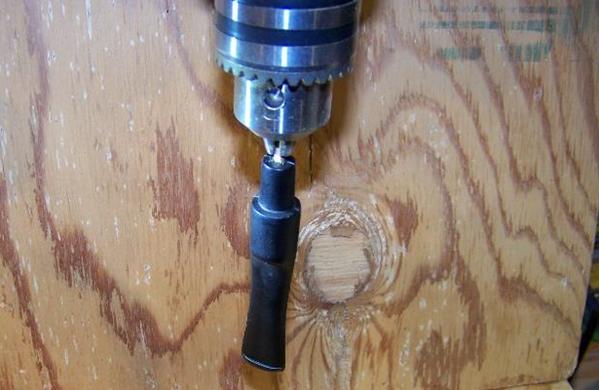
I kept a caliper nearby set at the correct tenon diameter to check my progress.  As I got closer to the correct size, I switched to 120 and 220 grit paper.  But I didn’t switch soon enough!  By the time I got some of the deep scratches of the 60 grit out I had overturned the tenon and it was a hair too small.  I finished turning the body of the stem before addressing the tenon issue.I thought at first that a little bee’s wax on the tenon would be enough to tighten the fit but in the end I had enlarge the tenon.  To do this, I heated the tenon and inserted a drill bit into the air hole to enlarge the tenon.  Letting the tenon cool with the bit in it I checked the fit:  A little too big.  I didn’t want to take anymore material off the tenon because if the tenon gets hot during a smoke it will return to its original size, vulcanite has a memory.  I looked around my tool box and found a small punch that had a slightly smaller diameter than the drill bit and repeated the heating process.  This time the fit was much better.
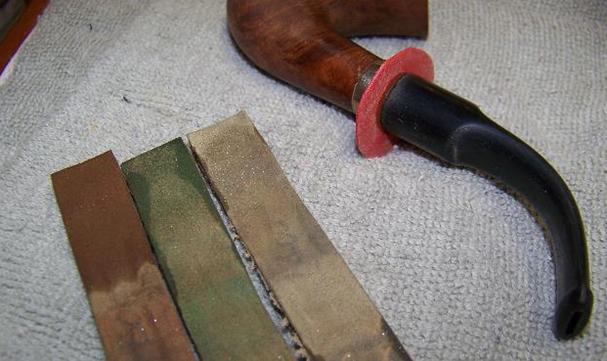
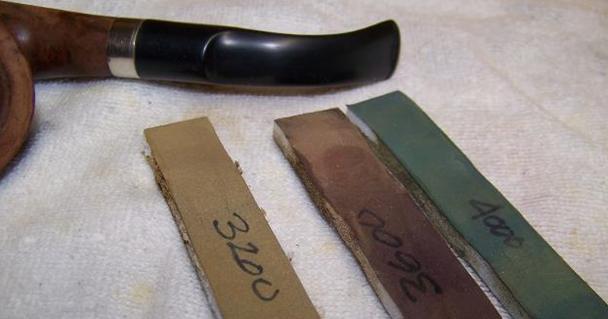
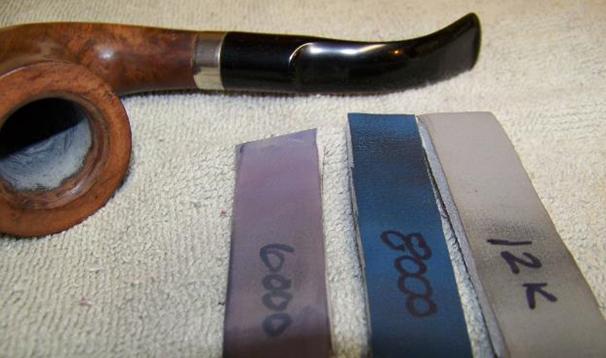
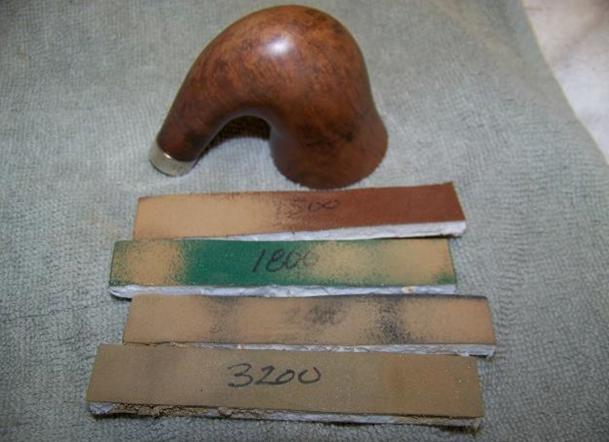
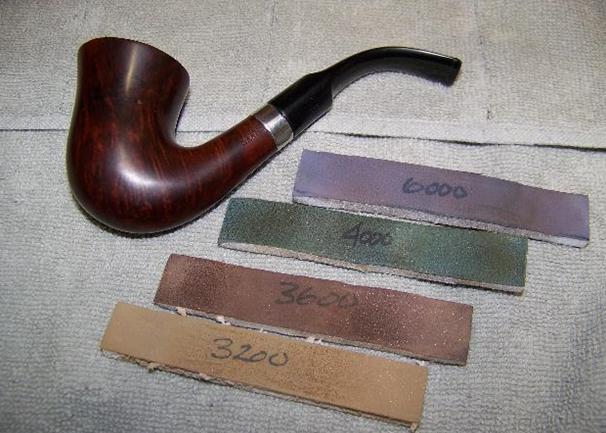
With the stem fitted it was time to bend the stem.  I have jig for holding round stock and I used this to hold the assembled pipe steady with the bit resting on a 1-1/4” round dowel.  Using my heat gun, I heated the bit until it draped over the dowel.  I dipped the bent stem in water to cool the vulcanite and set the shape.  Then I checked the angle of the bend and had to repeat the process a couple of times until I had what I thought was the original stem shape just right.Stem polishing started with 220 grit to remove the remainder of the casting burrs.  Then I wet sand with micromesh pads 1500 – 4000.I removed the plastic guard after the 2400 pad.  I used the 3200 and higher micromesh pads to also polish the band.After the 4000 pad I coated the stem with mineral oil and let it sit for a few hours.  Then I finish polishing with pads 6000 to 12000. I started finishing the stummel by giving it a steam treatment to raise the dents and handling damage.  Holding a wet terry cloth rag on the briar I press a hot iron on to it.  This method works very well but I have two points of caution: 1) don’t burn your fingers in the steam; and 2) do not press the iron near the stamping, it will ruin stamping very quickly.  I only apply the iron around the bowl body and the heel where the dents are the worst anyway.
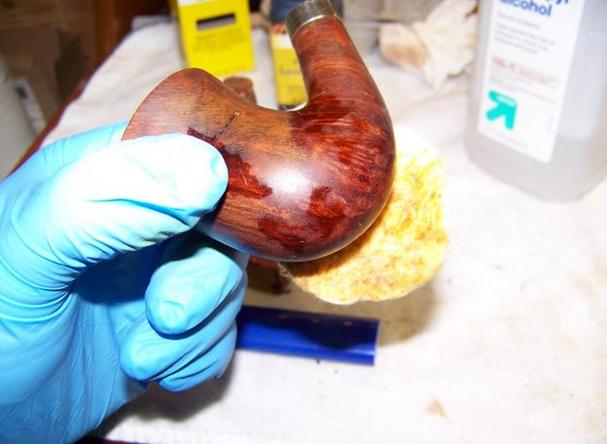
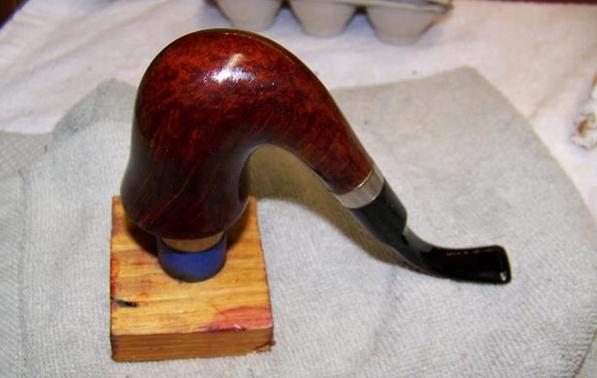
I sanded the stummel with micromesh pads 1500 through 3200, with special attention paid to the rim to make sure it was smooth.  I selected Fiebing’s dark brown aniline dye to better hide the repairs and applied the stain, without dilution, using a cotton swab straight from the bottle.  I used a flame to heat and set the stain.  I wiped down the stummel with isopropyl alcohol on a cotton pad to remove the excess stain.  I kept wiping it down until the level of color was what I thought it should be. After staining the stummel I like to refresh the briar with a light coat of mineral oil and let the oil soak in overnight.  All of the alcohol in the stain and the wiping down tends to dry out the stummel and I find the mineral oil helps to bring some of the life back to the briar.  It also seems to give the finished pipe a healthy look.After the oil soaked in, I polished the briar with the 3200 – 6000 micromesh pads.  Wiping it down with a clean cloth when finished.I took the assembled pipe back to my drill press/buffing station and ran over the entire pipe with red diamond polishing compound.  Two or three passes of the pipe seems to prepare the pipe well for the final finish.  I wiped the pipe down with a microfiber cloth to remove the buffing compound and then changed the buffing wheel for the waxing wheel.  Three coats of carnauba wax put a nice shine on the pipe.
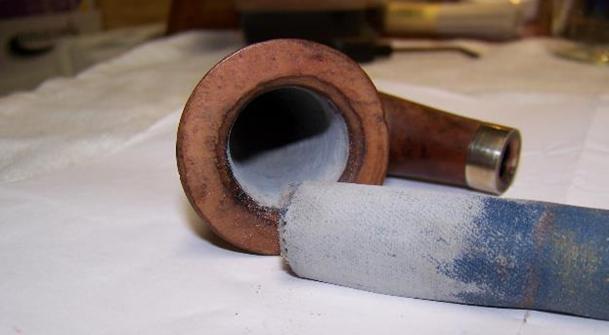
The last step in this restoration was the bowl coat.  I had earlier sanded the epoxy chamber repair and wiped out the bowl with alcohol so the inside was relatively smooth.  I mixed up a small batch of bowl coat using 2 teaspoons of sour cream and about three activated charcoal capsules.  This made a thick, black, creamy paste that I spooned into the chamber with a wood spatula made from a popsicle stick. Donning the Nitrile gloves again, I used my finger to evenly spread the coating around the inside of the chamber. Wiping the excess coating off the rim with a cotton pad I set the pipe aside to dry for a few days.

Now am I looking forward to the weather warming up so I can break in this pipe.  I think it might become one in my regular rotation. Thank you for sharing in my adventure. If you like the tamper in the picture above, it is one that I made and is for sale.  Please see the Reborn Pipes Store page for it and other tampers.  All proceeds go to charity.


Repairing a cracked shank on an older Brigham 117 Patent Rhodesian


Blog by Steve Laug

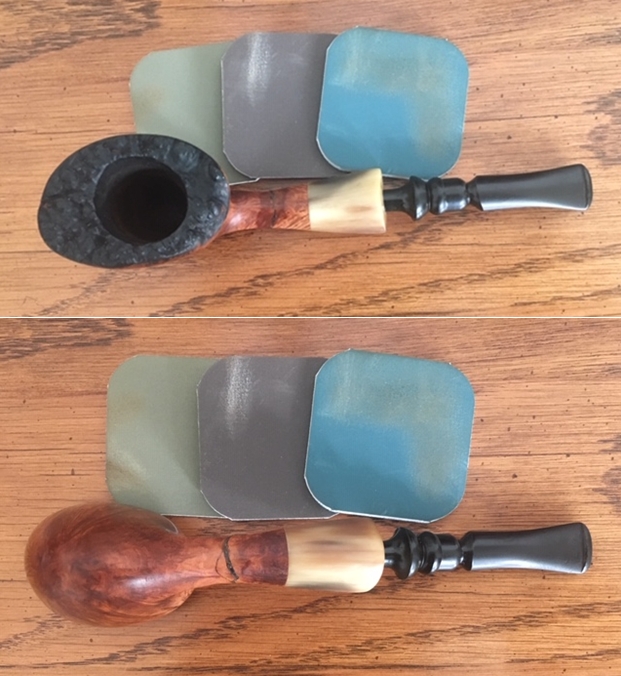
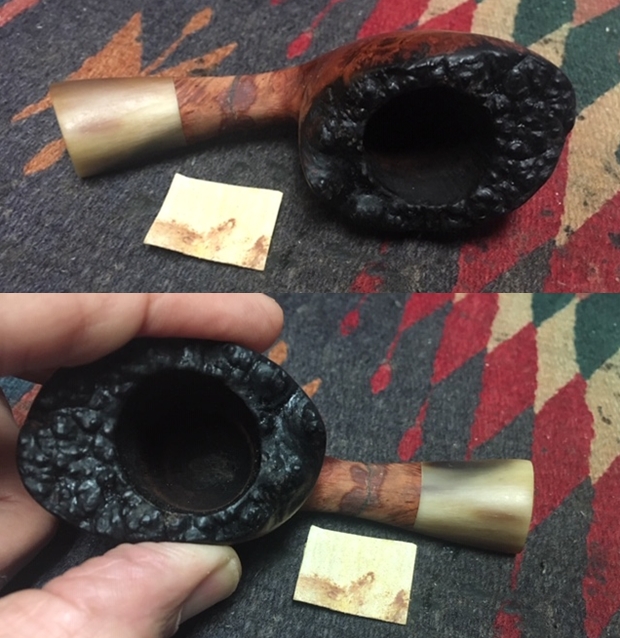
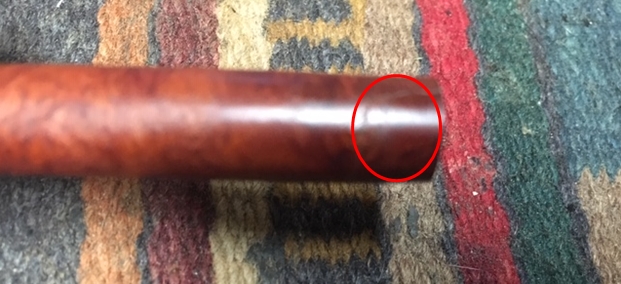
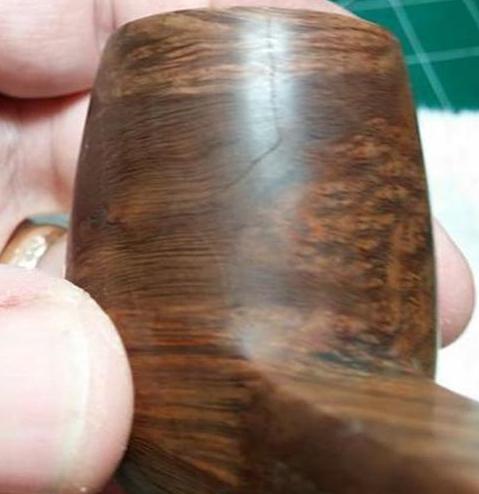
Not long ago I received a message on the blog from a pipeman in Alberta regarding an older Brigham pipe that he had that was in great shape and had a long hairline crack in the shank from the bottom of the left side up through the stamping into the middle of “i” in Brigham. It caused the stem to be loose and he was worried about it continuing to crack across the rest of the shank. I was pretty certain it could be fixed but would need to be banded. The pipe is stamped Brigham over Can. Pat. 372982 on the left side of the shank and shape number 117 on the flattened underside of the shank near the bowl/shank junction. He sent me the following three photos to show the position of the crack in the shank. He circled them in red to make them clear. He took photos of the side of the shank against a green and a black background to make the crack very visible. He also sent an end shot to show the crack from that vantage point. Almost incidentally he also did made the patent number also visible in his photos. I wrote Charles Lemon of Dadspipes as he is my go to source for all things Brigham and asked him about the pipe. He said that the patent stamp dates it between 1938-1955. Based on it being a one dot and a smooth finish, he said it was probably closer to 38 than 55. He also said that the shape 17 (or in this case 117) is what Brigham called a round Bulldog. I took photos of the pipe when I took it out of the box. It was well restored and very clean. The finish was in great shape. The stamping was very clear with a little wear at the middle of the Brigham stamp. The single brass dot on the stem side was clear. The vulcanite stem looked very clean and polished. There was a little rounding to the side of the stem at the stem/shank union but it was really pretty clean. There were some small tooth dents in the stem but the stem looked good. The rim top was clean and the entire pipe was clean and ready to smoke. I took photos of the bowl/rim top and the stem to show the condition it was in when it arrived. It really looks good. You can see the damaged areas on the inside edge of the rim and the marks on the stem but it still is very nice. I took two photos to show the crack as it appeared without a lens. The first shows the end of the shank. It is on the lower left side of the photo. The second shows it on the side of the shank. I circled them in red to highlight the location.Looking it over in a bright light with a lens I knew that I would need to drill a small hole at the end of the crack. The hard thing was that the end of the crack was in the letter “i” on Brigham. I would also need to band the shank to keep it from splitting and fortify the shank when the stem was inserted. I took a band that was the right diameter for the shank out of my box of bands.I used the end of a small screw, pressed into the end of the crack to mark the pilot hole for the drill. I inserted a tiny microdrill bit in the chuck of my Dremel and set the speed to 5. I started the drill and slowly drilled the hole in the middle of the letter to stop the crack from spreading further.I used the tip of a dental pick to place a small drop of Krazy Glue (CA) in the hole I had drilled in the shank. It was a tiny hole so it did not take too much glue to fill in the hole. I put a tiny drop of glue on the crack that was going to be covered by the band and pressed it together to bind the crack and seal it.I used a very small sanding stick to spot sand the repair on the shank. I was able to smooth out the repair without damaging the surrounding letters on the stamping. I put a little all-purpose glue on the surface of the shank that would be covered by the band and pressed the band in place. I pressed it far enough onto the shank to provide the strengthening of the shank but did not cover up any of the stamping on the side of the shank. I used the Dremel and sanding drum to sand the excess length of the band back until it extended just beyond the end of the shank. I topped the band edge with the topping board to smooth it out. I used micromesh sanding pads to smooth out the sharp edge of the band and to polish the band. I took a photo of the shank end and repair after the band had been pressed in place. The crack on the shank end is invisible now. The crack on the shank side and up into the Brigham stamp is pressed tightly together making it less visible.The repair was finished. The stem now fit snug in the shank. The new band on the shank looked really good and dressed up the pipe. I polished the pipe on the buffing wheel using Blue Diamond to remove scratches on the bowl, shank, band and stem. I gave the bowl and stem multiple coats of carnauba wax and buffed the pipe with a clean buffing pad to raise the shine. I hand buffed it with a microfiber cloth to deepen the shine. The finished pipe is shown in the photos below. It looks better than it did in the beginning. The pipe is finished and I will be sending it back to Alberta a little later this week. I am hoping the pipeman there enjoys it. Thanks for looking.

Repairing a broken shank and crooked alignment on a Joh’s Churchwarden


Blog by Steve Laug

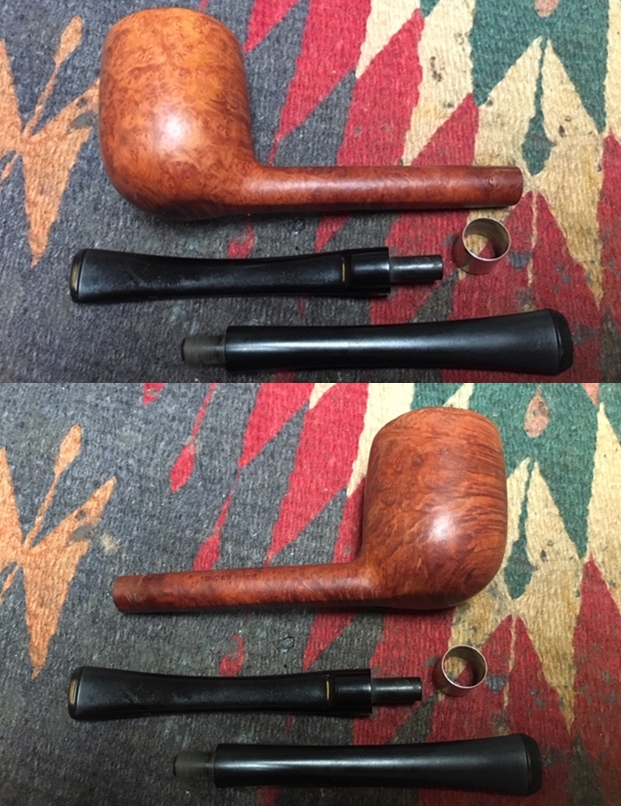
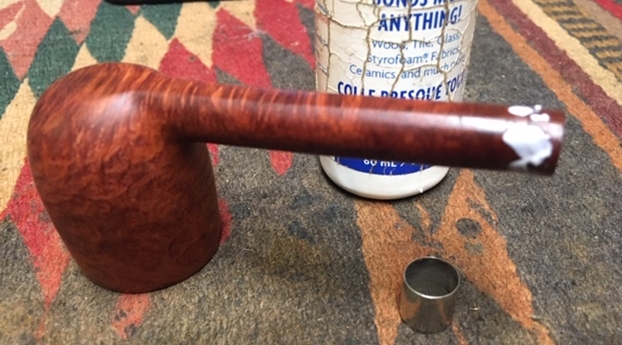
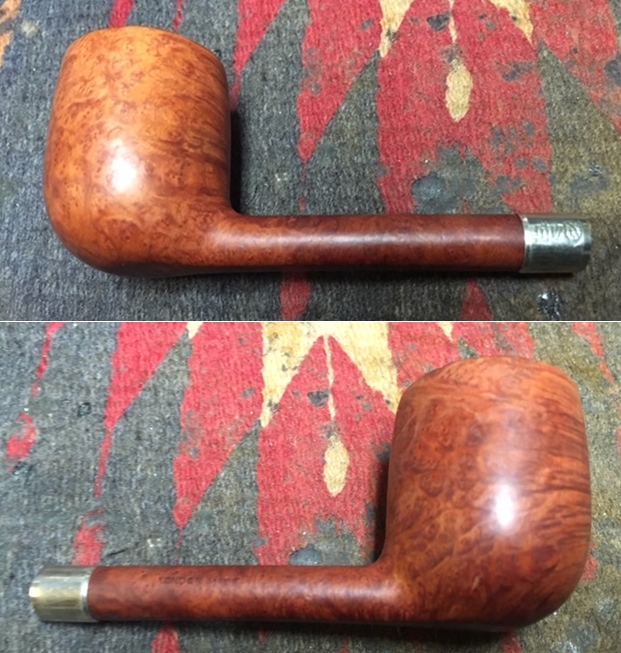
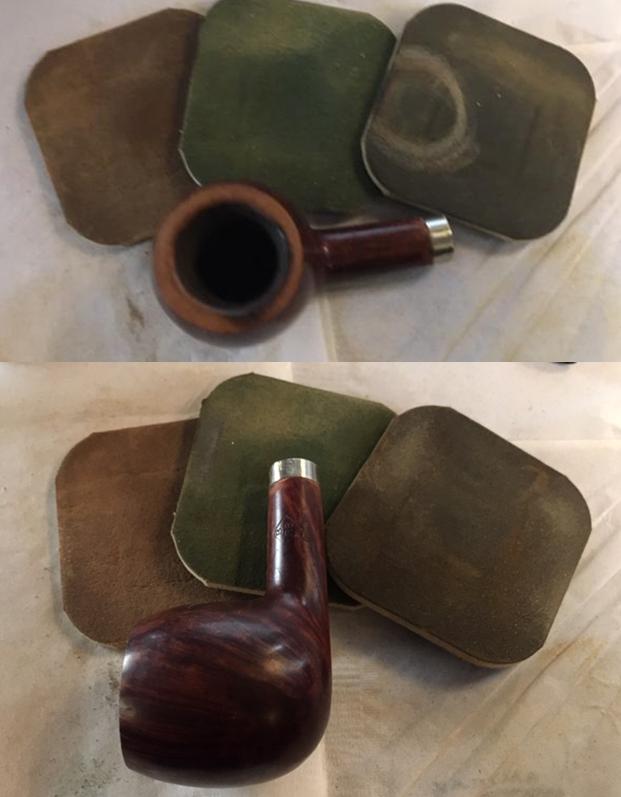
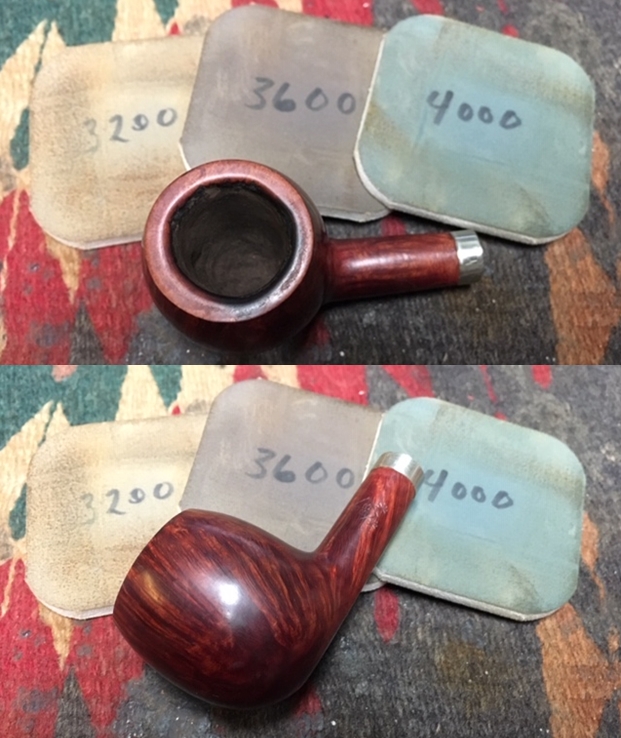
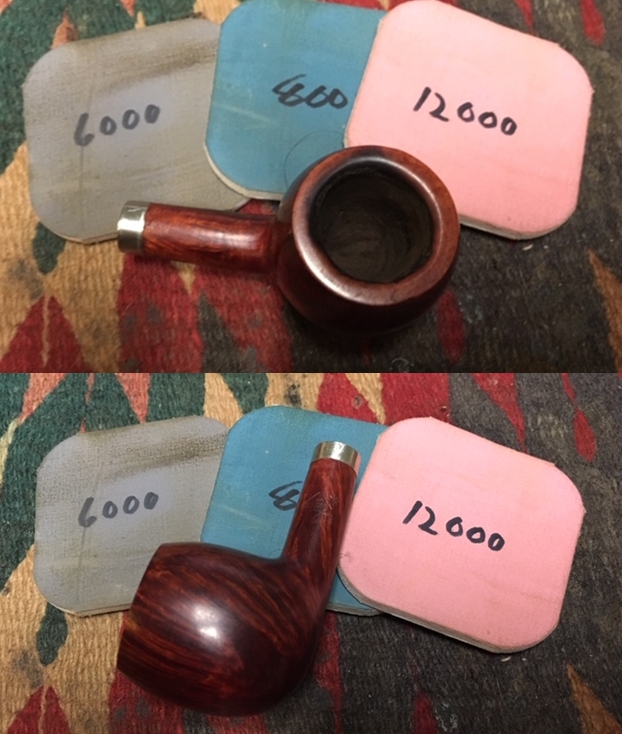
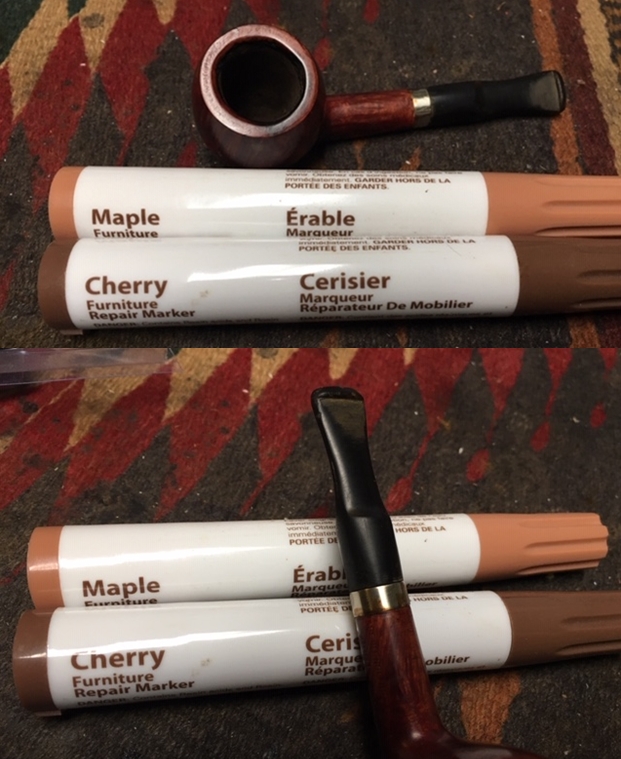
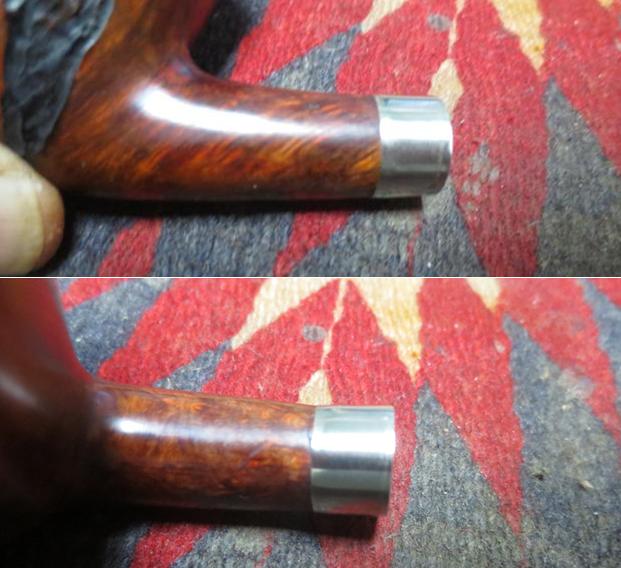
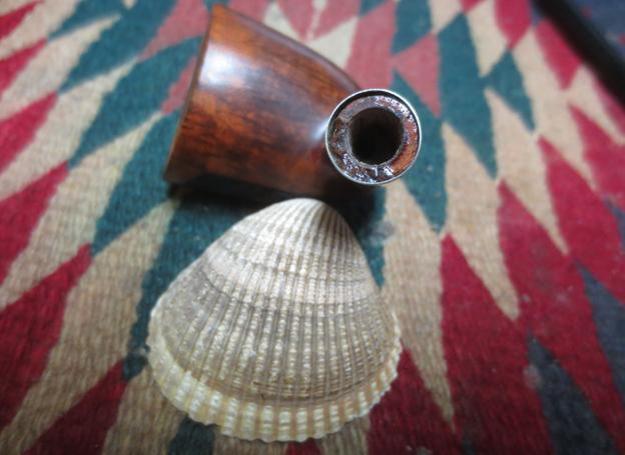
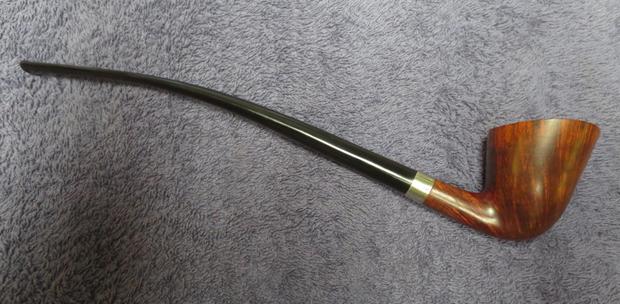
I received an email a few weeks ago from a fellow in Vancouver named Chris, asking if I would have a look at a cracked shank on his Joh’s churchwarden. He figured that it was not repairable but wanted to know if I would cut back the broken shank and refit the stem. I asked him to send me some photos of the damaged shank so I could see it myself. He sent me two photos of the pipe – one from the left side and the other from the top. The photos showed some extensive damage to the shank. There were cracks on the top, the bottom, the right and the left side of the shank. There was a large chunk of briar missing on the left side of the shank. It also appeared to me that the diameter of the stem was smaller than the diameter of the shank and that the stem sat toward the left side of the shank.Chris brought the pipe by my office for me to have a look at. We sat in my office and he went over the pipe with me. It was a nice looking pipe with two rusticated panels on the left side of the bowl and the rest of the bowl and rim were smooth. The pipe was in good shape other than the broken shank. The rim had some darkening and oils on the back side. The stem was in excellent condition with no tooth marks at all on either side. We made the decision to work on it and see what I could do repairing the damage. I took photos of the pipe when I brought it home from work and put it on the work table.I took close up photos of the cracked and broken shank. You can see the extensive damage and the difference in the diameter of the shank and the stem. I used a microdrill bit on the Dremel and drilled pin holes at the end of each crack to stop the cracks from spreading further.I used a combination of super glue and briar dust applied in layers to build up area where there was a missing chunk of briar in the left side of the shank. I built it up until the missing chunk was replaced with the mixture. It was not pretty but it was better than it was when I started the process.I sanded the repair with a sanding drum on my Dremel. The sanding drum smoothed out the repair on the exterior of the shank. The next series of three photos show the repaired area of the shank. I used a needle file to smooth out the inside of the mortise and to begin to return it to round. I would do more work on that once I had pressure fit a nickel band on the shank. I heated the nickel band with a Bic lighter to expand it and pressed it onto the shank of the pipe until the edge of the band and the edge of the shank end were even.I remembered that I had not filled in the pinholes that I had drilled. I used clear super glue and a tooth pick to put a bead of glue on top of each pin hole. When the glue had dried I sanded the shank repairs smooth with 220 grit sandpaper until they were blended into the surface of the briar.I polished the sanded areas of the briar and the dirty top of the bowl with 1500-2400 grit micromesh sanding pads. I wiped the shank down with a damp cotton pad to remove the dust. I used a medium brown stain pen to touch up the sanded areas around the shank. The medium brown blended perfectly with the existing stain. I polished the bowl and shank with 3200-12000 grit micromesh sanding pads and wiped it down with a damp cotton pad to remove the sanding dust on the surface after each pad. Before I took photos of the polished stummel after using the 12000 grit pad, I gave the bowl multiple coats of Conservator’s Wax and buffed the pipe on the buffer with a clean buffing pad to give it a shine. The polished pipe is shown in the photos below. I took close up photos of the shank repair and band to show the look of the repaired shank. If you look closely you can see the repaired cracks and the tiny pinholes but the pipe looks very good with the new nickel band and blended stain. I reshaped the mortise with needle files and built up the left side of the tenon with clear super glue to move the stem toward the centre of the shank. Once I had finished the alignment was far better than when I started and the stem looks more centred in the shank. I used a tooth pick and super glue to fill in the gap between the band and the right side of the shank. You can see from the photo that the shank was not round but more oval and slanted to the left. With the band and the repair the shank is round and the mortise end looks far better.I buffed the bowl and stem with Blue Diamond on the buffing wheel and gave the bowl and stem multiple coats of carnauba wax to protect it. I used a very light touch on the rusticated portions of the left side of the bowl. I buffed the pipe with a clean buffing pad to raise a shine and hand buffed it with a microfiber cloth to deepen the shine. The pipe is well proportioned with the following dimensions Length: 10 inches, Height: 2 inches, Bowl diameter: 1 ¾ inches, Chamber diameter: ¾ inches. The finished pipe is shown in the photos that follow. I think Chris will be happy to see one of his favourite pipes returned to his rotation looking better than when he left it with. Chris if you read this – tell us what you think. Enjoy. Thanks for looking.

Giving New Life to a KBB Yello Bole Imperial 3068C


Blog by Mike Rochford

In the last two weeks, I have been corresponding with Mike about a pipe he had. He wrote and sent photos of it and asked if I thought it was repairable. Those of you who have been reading the blog for a while know that I rarely put a pipe in the bin to burn. We wrote back and forth as he did the work and he sent photos along the way. I asked if he would mind doing a blog on the refurb job he did. He sent me the following. Without further introduction, I will let Mike tell you about himself and then share his work with us. Welcome Mike.

First a bit about me. I am a retired FBI Special Agent of 30 years. My grandfather had a wood pattern shop in downtown Chicago. I always enjoyed woodworking projects, but never had much time for complicated projects. This project was pretty easy as long as I did not hurry each step. Patience and your guidance helped me a lot. I am now pretty confident that I can handle another project if one comes along. – Mike

My brother Tim bought me a very worn out KBB YELLO Bole Imperial 3068C pipe. He knew I loved its look. But its issues were many: gaping hole in bowl, rotting wood on ferrule, bite marks on stem, and a slight tool mark on the crowned our area of the stem below the Yellow circle.

I was prepared to throw the pipe out or just relegate it to a shelf. But I found Steve Laug on rebornpipes. He advised me step by step how to restore and make my pipe smokeable again.

First, I completely cleaned out the inside of bowl down to the briar in order to relieve pressure on the crack in the bowl. Then I used a 1/32 drill bit to drill out the bottom of the crack.  I stripped and cleaned the outside of the pipe and combined briar dust with super glue and filled in the crack on the outside of the bowl. I was surprised that the chemical reaction caused a flash fire on my first try. But I worked through that. The paste dries very fast so I had to apply it to the crack quickly, using a Popsicle stick.  I then let it set. Then I applied JBWeld for wood to the cracked area inside of the bowl. I put a pipe cleaner inside the opening to ensure no weld found its way into the airway blocking up my smoking end of the bowl. I let that dry and set it aside for the evening. Then I used 500 grit sand paper on the outside and inside of my bowl. Once I was satisfied, I applied Aniline dye stain to the outside of the bowl and painted the inside of my bowl with a charcoal powder/ sour cream paste.Next, I worked on the cracked and damaged shank end using the 1/32nd inch bit on the end of the cracks in wood and my super glue briar dust paste to fix the damaged areas. Sanding it after it set.I then used the charcoal powder and super glue paste to patch up the bite marks on my stem, using a pipe cleaner with Vaseline on it to ensure it did not super glue my stem closed. I used some 800 grit sand paper to buff the entire stem clean of oxidation and to clean off excess super glue charcoal powder once it dried. I also used the 800 grit sand paper to clean up the tool marks on my stem below the Yellow circle. I did not have any obsidian oil, so I used some sesame seed oil on my stem to slick it up. I also super glued the silver metal ferrule on the end of the shank as it was much too loose. I then resanded and repasted the inside of my pipe bowl.

I sent before and after pictures to Steve. I am very pleased and thankful to Steve Laug for guiding me through this process. My pipe is truly “Reborn!” Thanks!

Stem Button TIME SAVER on a 1940’s Dunhill LB


Blog by Henry Ramirez

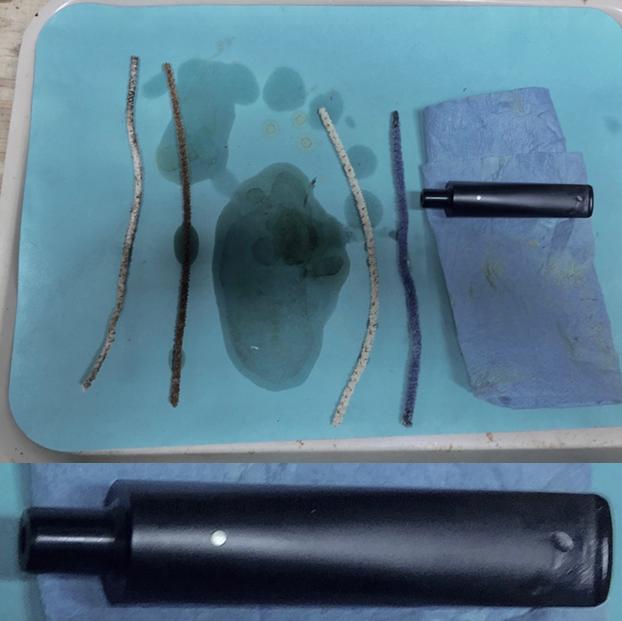
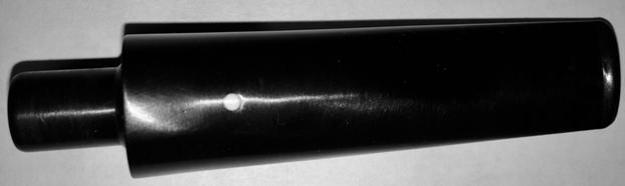
I was ghosting through Ebay listings looking for a cracked shank to experiment with when this old classic appeared.  The auction was won for a song because in addition to a cracked shank, the year stamping had been buffed off the shank. The usual whole lotta cake and dented stem story.I started with the stem, which was really in great shape.  I have come to love the stumpy profile of the patent LB’s with their constricted contour button.  An Oxyclean bath was followed by an isopropyl alcohol scrubbing with a shank brush and pipe cleaners. I wanted to use heat to raise the bite marks as much as possible to not only decrease my work load but to minimize the inclusion of foreign filler. To this end I also wanted to learn the proper temperature needed to reproduce my results consistently.

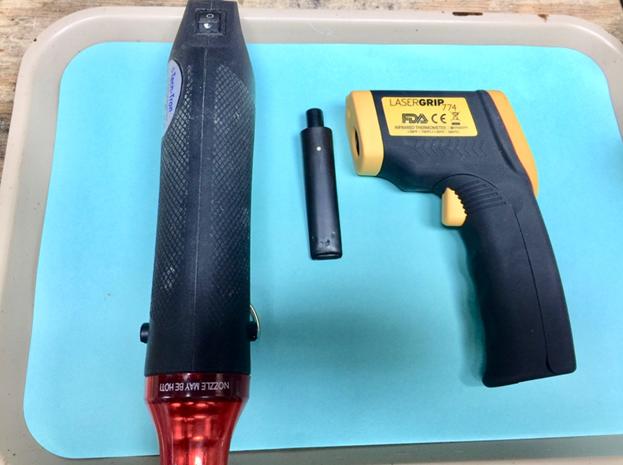
Using a heat gun, I took my time and warmed up the vulcanite until my nose told me it was getting close to burning.  If that happens the surface becomes a porous charred stinky mess!  I quickly used a laser temperature gun to obtain a surface reading of 275 degrees F.  Amazing how quickly the surface cooled off once the heat was removed.I was not impressed by the amount of rebound and it looked like filling and filing was in my future.

Having nothing to lose, I pressed my wife’s oven into service, knowing that I could set the temperature substantially higher than previous attempts without fear of ruination. I set the oven temperature at 265 degrees F to have a 10 degree safety zone and watched as the whole stem “stretched out”.  This was more like it! The dents were now depressions that needed the light to shine just so to be seen.  Little CA and polishing was needed.

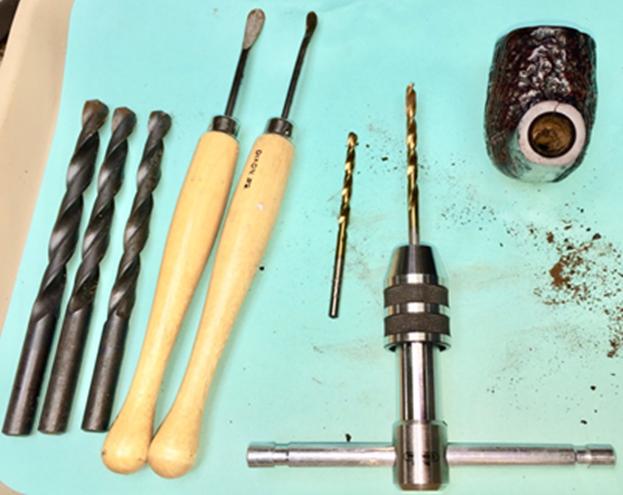
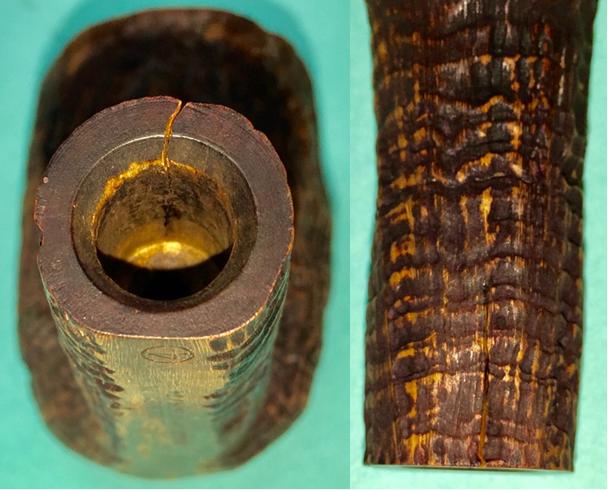
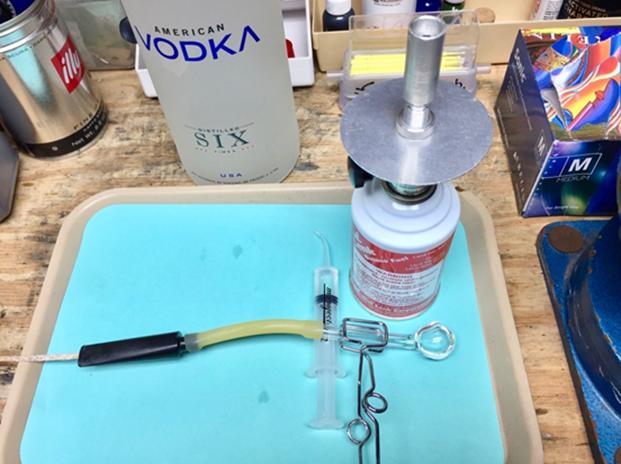
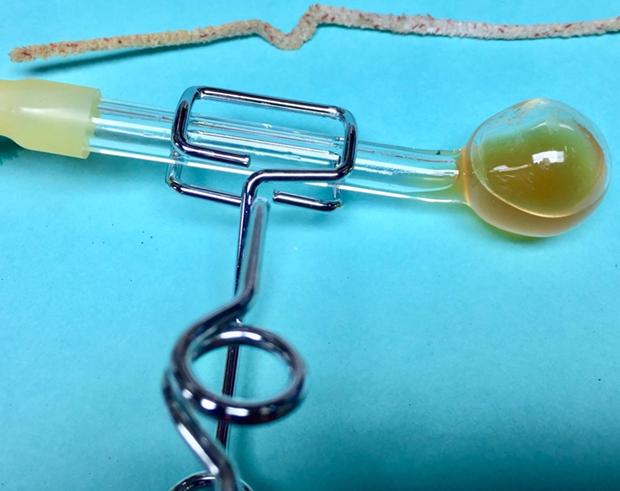
I should mention that these values are for older Dunhill vulcanite only.  The composition of vulcanite has changed over the years, according to some posts I’ve read, and I’ve noticed it in the depth of polish ability.Now it was the time to clean and evaluate the briar. While I ream the mortise and bowl I am wishing that I had Steve’s magical Savinelli Pipe knife. Boy, those things are rarer than hen’s teeth and this old cake is super hard. That is followed by total immersion in an isopropyl bath with various scrub brushes stripping the briar. I couldn’t save the original finish because the shank crack needed to be clean and open as much as possible for the bonding. One of the perks of the alcohol bath is that after the bowl dries out, if there is any residual cake stuck to the chamber walls, it shrivels up and is easily removed.The shank crack was now very evident but the year stamping was not.Getting back to the stem, I wanted to know if the alcohol retort was worth the hassle.  I had been as meticulous as possible with the pipe cleaners and cold alcohol.  The color of the used alcohol in the distillation flask tells the story, close but no banana! I could now address the cracked shank.  I had previously repaired such a problem using a micro-screw and bonded dental composite resin.  I was concerned that threading the screw into old dry briar could start micro-fractures and crazing.

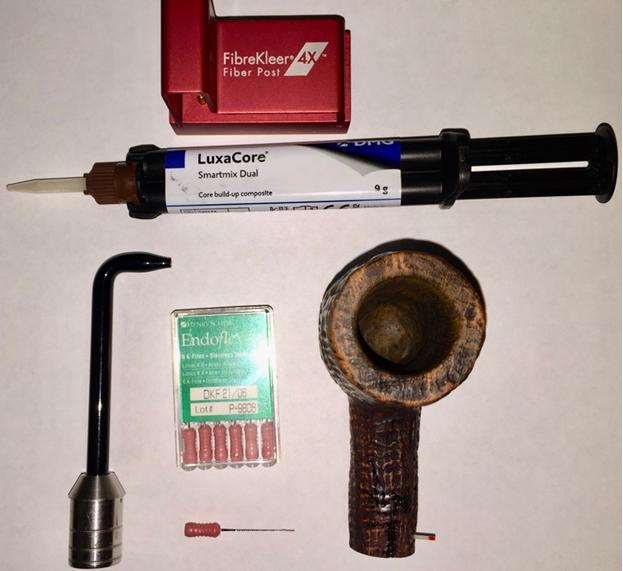
This time I elected to drill a channel spanning the crack and passively bond a post fabricated from longitudinal glass fibers encompassed in a strong composite resin matrix.  This would also provide some flex in the repair to accommodate the dimensional changes that briar goes through because of temperature changes during smoking.

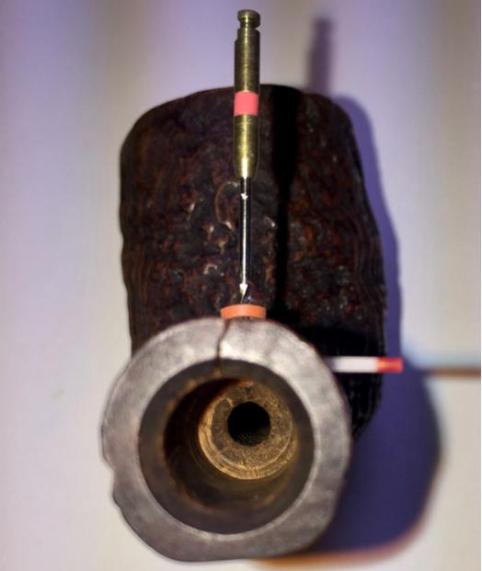
At this time I also drilled a post hole at the end of the crack to prevent further spidering.  Because the crack was significantly wide I made sure to introduce my resin with a size 06 endodontic file.  I had planned to use a C clamp to close the gap but I chickened out when finger pressure did nothing.  Not sure how to make briar temporarily more flexible….

After filling the post hole and cementing the fiber post with dual cure composite resin, I trimmed off the post and blacked out the white resin with black CA.

Before beginning to start the staining process I wanted to open the pores of the cellulose to not only gain greater absorption of the dye but also improve the briar’s capacity to absorb tars for a sweeter smoke.  I had noticed such a phenomenon with the Missouri Meerschaum corn cob pipes.

I found that this particular wheel had already been invented by the folks who refinish wooden decks.  I tracked down some relatively non-toxic materials which did the job and whose run off wouldn’t hurt plants.

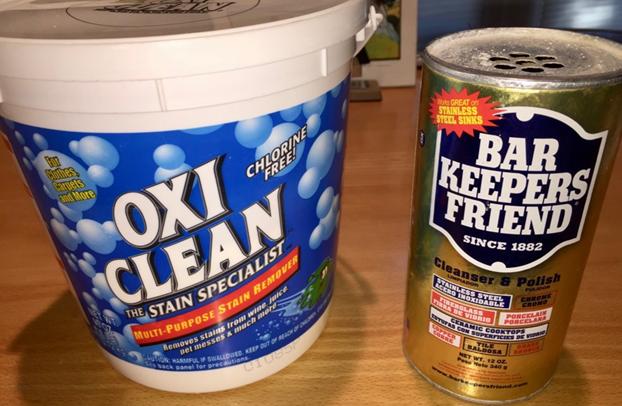
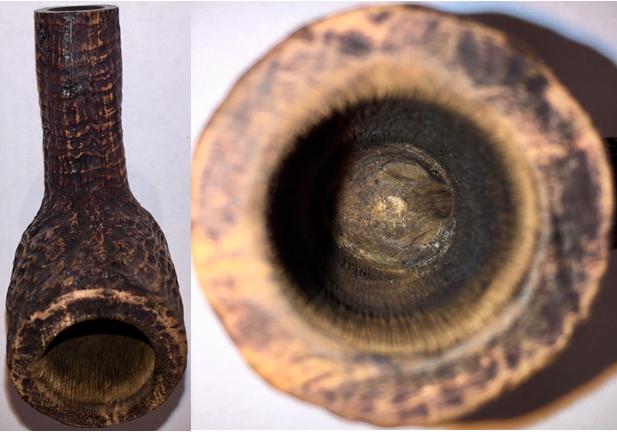
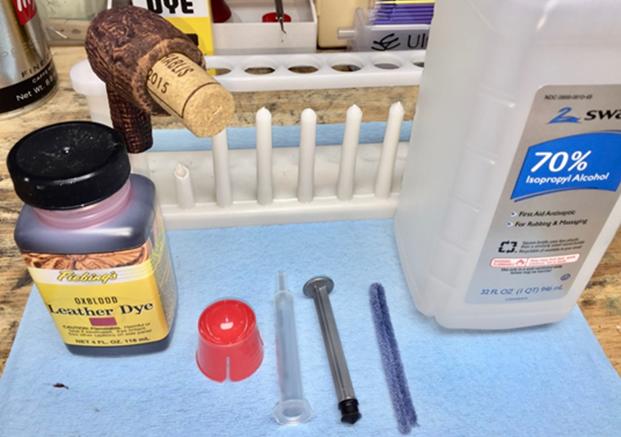
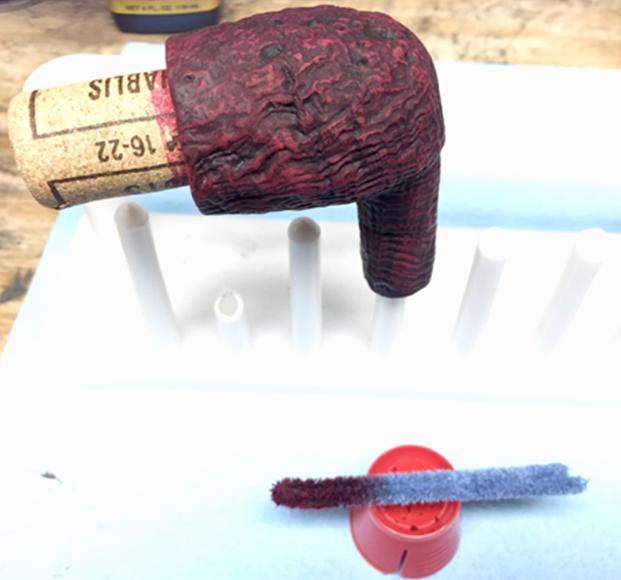
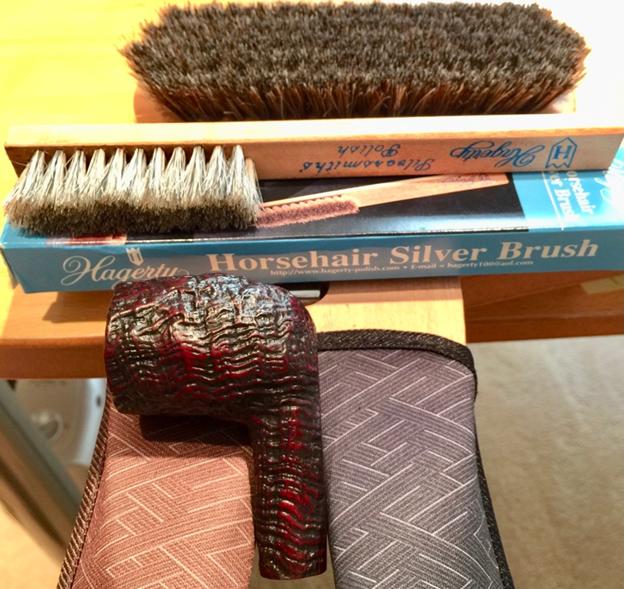
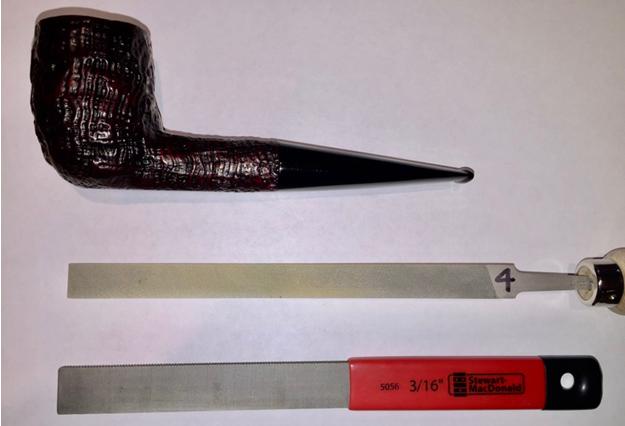
Sodium percarbonate does the cleaning and oxalic acid removes the smear layer, thus opening up the wood’s pores.  Looking around online for a source I realized that I already had both chemicals in the laundry room!  Oxyclean is the percarbonate and states on the container that it’s great for wood decks, siding and lawn furniture.  Bar Keeper’s Friend has oxalic acid as its active ingredient and states on the container that it works on teak wood.Indeed after scrubbing with both and rinsing with water, I noticed that the chamber’s surface looked and felt less dense.Now it was time to stain the briar with Oxblood diluted 50% with isopropyl alcohol in two coats, both flamed with the micro-torch.I was lucky that the original black stain in the depths of the blast remained.An overlay stain of light brown was applied in 2 coats.After a rub down with an old t-shirt to remove any xs dye, I applied 2 coats of Halcyon wax.  A quick buff on the lathe and then a hand strapping with a shoe bristle brush brought the shine up.  I want to mention that my wife gifted me her silver brush which is narrow and has long soft bristles which easily accesses the crotch of the pipe without fear of collision. This has proved most useful on bent pipes.Another very helpful tip came from a pipe maker’s blog about dead-faced files to add crispness to the button area.  They are the dead faced nut seating file by Stewart MacDonald, a luthier’s supply house and the pillar files which have the dead side on the edge from OttoFrei, a clock makers source.Well I’m now satisfied with the pipe but not finished. They say we abandon these projects because we reach a point where better becomes an enemy of good. Boy that was fun and I hope to share more adventures with these fabulous old pipes!  Regards, Henry


Cracked Shank Repair on a Dunhill CK12 Author


Blog by Henry Ramirez

Henry and I have been emailing back and forth on all things pipe repair and I have to say I enjoy each missive he sends me. He is a creative guy who is using his dentistry expertise to work on pipes. The kind of repairs he does and the equipment he has both built and gathered is unique and certainly adds some new ideas to the hopper for refurbishers like me. I don’t want to bore you with all kinds of introduction on Henry. I will let his restoration of this old Dunhill speak for itself. Welcome and thank you for your contribution Henry. – Steve Laug, rebornpipes

I’d seen this old pipe bought and sold several times on Ebay, each time gussied up a little more but still tap dancing around the issue of the split shank repair band. Being the sucker that I am for gnarly old patent Shell Dunhill’s, I decided that this was the perfect opportunity to see what was under the band and possibly date this old codger.

Using 10x’s loupes with a parallel headlight source, I sectioned the band to find, to my lucky surprise, NO CEMENT! Just popped off, pretty as you please with no clean-up necessary. I used a fine carborundum wheel to initially trough the metal and then finished with a sharp new #2 carbide round but in an electric lab hand piece by Kavo. The Kavo or less expensive Medidenta hand pieces are ergonomic and very smooth running when compared with dremels. I would not try such a procedure for fear of scaring the briar without a hand piece I fully trusted.The newly exposed underside of the shank was faintly stamped with an incomplete patent number starting with 116(989/17) which would place this pipe from 1925-1934. No closure here since the date stamp was completely sanded off when the band was fitted.I was also pleased with the stem’s sizing to the shank. Still there was enough of a suggestion of the shell finish to complement the rest of the pipe.The 8mm stem orifice leads me to think this was a filtered pipe.The usual chamber cake removal (different pipe). I also use drill bits by hand to router out the mortise to bowl.When I want to conserve the original briar’s finish, I plug the bowl with a cork after stretching a latex or nitrile glove over the rest of the pipe. I then snip the tip of one of the fingers and poke the shank through the finger and out the hole. I tie off the glove and scrub the mortise and shank submerged in a Tupperware container filled with 91% isopropyl alcohol or vodka. Black muck floats out with every agitation of the shank brush.Drilling the micro-pin channel across the fissure. Once threaded into place, the pin shears off and the driver/carrier is removed. Of course I want the pin in the center of the thickest part of the shank through which the crack runs.The X-ray below shows not only the pin but also some of the composite plug. The composite plug was done at the end of the crack to prevent propagation.Pin hole back filled with black CA. Also spread some for aesthetic purposes on the composite plug. The stem was then buffed with four of pumice, Tim West’s green & red abrasive bars, White Diamond, Bendix plastic polish, Paragon wax and then a clean wheel and micro fiber towel. The bowl rim was gently micro-etched (Danville sand blaster) and polished with a Robinson bristle wheel brush. Luckily, the pipe was dark in general and the wax darkened the rim so that it blended. I flamed the wax to melt it into the rustications and buffed using a shoe polish brush supported by the bench pin. I ozonated the pipe for a night to remove any ghosting.Hope I don’t bore you with my Magnificent Obsession of resurrecting old pipes with the tools at hand. BTW, the light spot on the shank is an artifact of my flash. I’m going to deep six my crummy point and shoot and use my iPhone camera now that my MacBook can again see it as a drive. If you’re having the same problem, download Sierra operating sys from Apple for free.

Yours faithfully, Henry.

A difficult trust: Gift of a Grandfather – A BBB Double Star Made in England


Blog by Dal Stanton

When I study the venerable pipe on my work table, it is not a glamorous display of briar and silver bands.  Some might call it a basket pipe.  The two stars imprinted on the shank were an indication of a working man’s pipe – not high quality, but among those pipes accessible to normal, if not common, people who work, live, love and as is the case with us all, die.  This unremarkable Apple shaped, BBB [diamond over] Double Star, MADE IN ENGLAND [over] 152, is remarkable because of the story it represents.   I enjoy restoring ‘estate’ pipes because they were left to others and these pipes carry with them stories and memories of loved ones who once befriended and valued them.  Greg heard from my son, Josiah, who are college buddies, that Josiah’s old man (my words not theirs!) restored ‘old’ pipes.   This ‘old’ pipe came to Greg from his grandfather through his mother.  Josiah’s email came to me asking what I could do with these pictures from Greg. My understanding is that Greg was a bit reluctant at first to send his pipe off to Bulgaria to be restored, but after Josiah directed him to some of the restorations I’ve done, he felt he could trust me with the heirloom that had come to him.  Knowing that this pipe was from his grandfather I asked that Greg send me information about his grandfather so that I not only could place the pipe better in history, but Greg’s grandfather as well.  This is the letter he sent me:

Hi Mr. Stanton,

Thank you so much for agreeing to restore my grandfather’s pipe. I am sorry for the delay in getting you the below information, but it’s been a crazy couple of weeks.

My mother inherited the pipe from my grandfather when he passed away in 1998. I saw it in the china cabinet one day and asked her if I could have it, since I had taken up pipe smoking. She kindly agreed. She doesn’t really know when my grandfather got the pipe, but she said he must have bought it in Hong Kong.

My grandfather was from Hong Kong, and only emigrated to the United States in the 1980s. He was a malaria inspector for the Hong Kong government for his entire working career. He must have gotten the pipe at the latest in the late 1940s or early 1950s, as my mother remembers him having it when she was a child. He never smoked the pipe when I knew him, but from its condition, I assume it was well used at an earlier period in his life.

Having graduated from the University of Georgia Law School in Athens, Georgia, passed his bars and currently serves as a law clerk to a federal magistrate judge in Augusta, Georgia, AND as a young married man, I can understand why Greg “took up” smoking pipes!  Pipes are wonderful companions for blooming attorneys!  His letter concluded with an agreement to the cost of the restoration would benefit our work with the Daughters of Bulgaria!  Thank you, Greg!

The information Greg received from his mother was invaluable for placing this BBB in time and space.  Pipedia’s article about BBB is helpful.  BBB in the mid-1800s originally stood for “Blumfeld’s Best Briars”, but after the death of Blumfeld, the Adolph Frankau Company took over the company and BBB gradually became “Britain’s Best Briars”.

The “BBB Two Star” rating also is referenced in the same article in a discussion of quality descriptors for BBB pipes:

In the Thirties, the top-of-the-range one becomes “BBB Best Make” with alternatives like “Super Stopping” and “Ultonia Thule”. The BBB Carlton, sold with the detail with 8/6 in 1938, is equipped with a system complicated out of metal, system which equipped the BBB London Dry too. Blue Peter was not estampillées BBB but BBB Ultonia, and the BBB Two Star (* *) become the bottom-of-the-range one. 

When Greg’s pipe arrived in Bulgaria, thanks to a visitor’s willingness to carry it across the Atlantic and European continent, I unwrapped it and put it on my work desk and took these pictures to fill in the gaps. At PipePhil.eu an example of the BBB Two Star marking is pictured along with the stinger/tube style extending into the chamber as Greg’s grandfather’s BBB does ( as seen above).In Pipes Magazine, I found a thread discussing the dating of the BBB Two Star.  One threader’s opinion, ‘jguss’ corroborates Greg’s mother’s recollections:

My guess is that the Two Star line started at the end of WWII; the first mention I’ve found so far is dated 1945, which at least gives a tpq (that is, an approximate dating). I know the line lasted at least into the early sixties.

It is not too difficult to speculate about the provenance of Greg’s pipe.  During WW2, briar became a scarce commodity throughout Europe and pipe manufacturing companies made do with what they could acquire.  Two Star BBBs would be lower end but more than likely during this time, a very close second when rations were short.  Added to this backdrop is the origin of our story in Hong Kong.  Hong Kong, a British holding since 1841 (see LINK), lost control of Hong Kong during WW2 to Japan in 1941 during the Battle of Hong Kong.  Undoubtedly, Greg’s grandfather would have experienced this first hand.  When Japan unconditionally surrendered in 1945, the British regained control of Hong Kong, but to counter Chinese pressures to control Hong Kong, reforms were introduced that broadened and increased the stake of local inhabitants of Hong Kong:

Sir Mark Young, upon his return as Governor in early May 1946, pursued political reform known as the “Young Plan“, believing that, to counter the Chinese government’s determination to recover Hong Kong, it was necessary to give local inhabitants a greater stake in the territory by widening the political franchise to include them.[19] (Link)

During the years following the Second World War, the same article describes unprecedented economic development which resulted in the economic powerhouse that Hong Kong became.  This period would have been while Greg’s grandfather was working as a malaria inspector for the government of Hong Kong and during which he acquired this BBB Two Star.  The smaller Apple shape would have served him well as he performed his inspection duties but given the ‘stem forensics’ pictured above, he probably chewed on it a bit as well while he worked!

With a greater sense of the story that this BBB Two Star tells, from England, to Hong Kong, to America, and now to Bulgaria, I’m anxious to restore this precious family gift from Greg’s grandfather.  At Greg’s request, he’s hoping for a pipe that is as good as new and ready for a new lifetime of service.  Yet, with all restorations, undoubtedly there will be some marks and blemishes remaining – these an ongoing testament to the memory of those who those who went before.

The first order of approach is with the stinger.  When the pipe arrived, the stinger was already separated from the stem.  The stinger extends from the stem through the mortise into the chamber itself through a metal tube air draft hole.  Using a pair of plyers, I wrap a piece of cloth around the end to pull gently to dislodge the stinger from the mortise.  I can see in the mortise that there appears to be a metal sheath that the stinger is lodged in – at least, that is what it appears to be.  The stinger is not budging and I do not want to break the stinger off.  To try to loosen things up, I pour some isopropyl 95% in the chamber to allow it to soak into the draft hole.  Hopefully, in time, this will loosen the stinger. The alcohol soak did not work.  In fact, a few weeks have transpired since writing the words above.  This stinger has given me quite the challenge.  In the back of my mind constantly, is the concern that I not leverage too much pressure pulling on the stinger.  I’m concerned about damaging the shank.  After soaking the internals for some time with alcohol, I pulled with plyers hoping to break the grip.  I also attempt heating the stummel with a heat gun in hope of dislodging the stinger.  I also heat the protruding part of the stinger with a candle, hoping that this would break the bond.  It did not.   I also was concerned about the candle flame close to the briar while trying to heat the stinger.  I craft a tinfoil shield, but this was not successful.  Unfortunately, I singed the end of the shank and had to remove the damage by ‘topping’ the shank end, which leads to a bit of work lining up the stem and shank later.  As you might expect, the protruding end of the stinger did not hold up under the pressure and eventually broke off. After the stinger protrusion broke off, and after a second email to Steve for input, I’m at the point of using a drill bit in another attempt to remove the bonded stinger.  Starting with a very small bit, I hand turn the bit to allow the drill to find the center of the stinger and gradually, remove the stinger introducing the next larger drill bit.  The end of the broken stinger begins at about 1/4-inch-deep into the mortise.  Unfortunately, this method is not working either because the drill bit will not bite into the metal and remain straight.  At the end of the stinger slot that I’m boring into with the drill bit, my efforts are flummoxed by the stinger’s design.  It has a slanted metal airflow deflector that causes the drill bit to veer off mark.  After breaking the end of the drill bit in the slot (ugh!), and digging it out with needle nose pliers, I sit and begin to think I was facing failure.  Nothing was working.  I’m introducing more problems to the restoration as I try unsuccessfully to solve the stuck stinger problem.  I can’t move forward and I’m stuck and begin to compose an apology letter to Greg in my mind.  UNTIL, on a fancy, I insert a small flat head screw driver into the slot at the end of the broken stinger 1/4-inch-deep in the mortise and I twist it gently counter-clockwise, and it snaps.  Suddenly, it was loose and I easily extract the ‘middle’ of Grandpa’s old stinger – I’m sure he was the last one to see this artifact!  I see daylight through the mortise and I’m hoping that it might also be a metaphoric ‘light at the end of the tunnel’!  I’ve not forgotten that the other end of the stinger remains lodged in the draft hole tube at the foot of the chamber.  Thankfully, a larger drill bit was the perfect size and it reaches into the mortise and hand turning the bit, it clears the rest of the stinger shrapnel.  Finally!  Oh my….  I’ll be saving the stinger debris for Greg.  This BBB will continue without difficulty stingerless.  The pictures show the results. In the interest of full disclosure, these words are coming weeks after.  Why the hiatus?  Life’s normal twists and turns, work, some wonderful travel to Crete for an organizational conference, to Athens (not in Georgia) for a consultation on the Eastern Orthodox Church, AND my growing frustration with Greg’s grandfather’s pipe’s restoration as more complications arrived!  I’ll try to catch you up to the present:
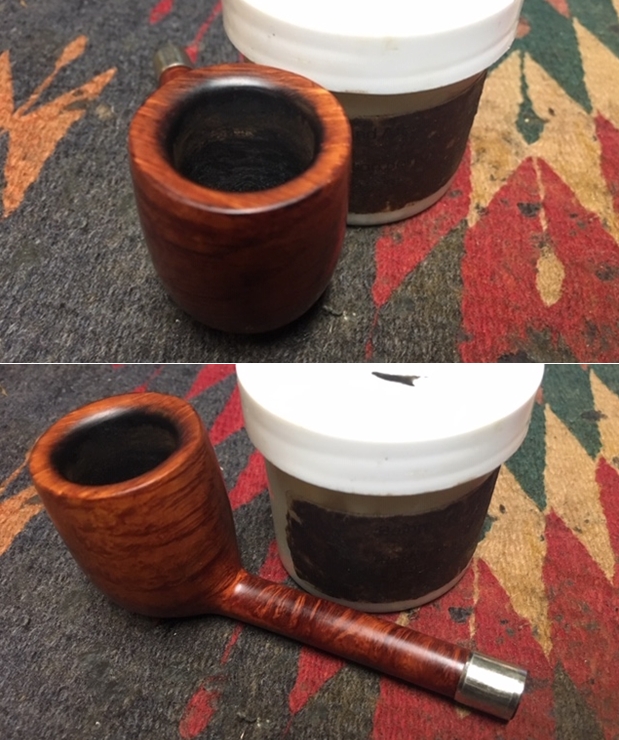
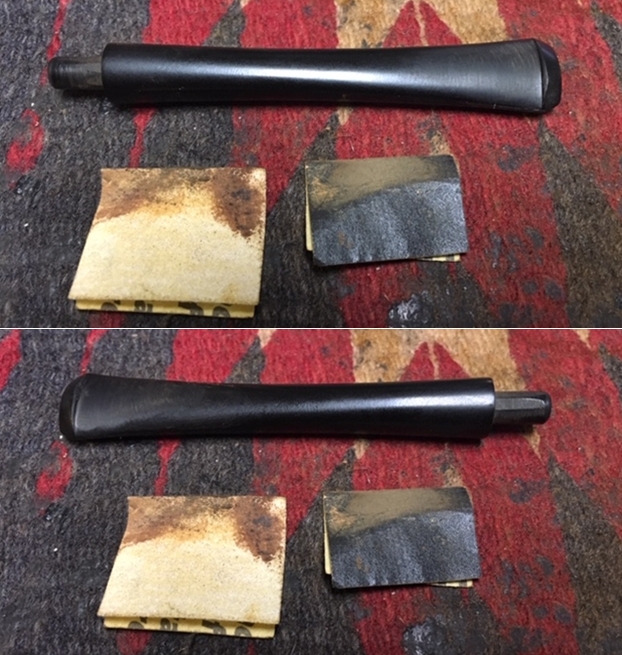
With the stinger removed, I was anxious to continue the restoration with a ‘normal’ pattern – the stem goes into the Oxi-Clean bath to deal with the oxidation in the stem.  After some hours, the stem is removed from the bath and I wet sand with 600 grade sanding paper removing the raised oxidation followed by 0000 steel wool. To clean and protect the BBB stamping on the stem, I use a non-abrasive Mr. Clean ‘Magic Eraser’ sponge.  The pictures show the progress.The next step is to re-seat the tenon into the mortise.  After the arduous process of removing the stinger, and after singing the shank end with a candle flame, and after ‘topping’ the shank to remove the damaged briar, the tenon and mortise needed to be re-wedded with the new realities.  The tenon was too large for full insertion into the shank.  Using a combination of reducing the tenon size with sanding paper and steel wool, sanding and filing the throat of the mortise, and using a rounded needle file to cut a new internal mortise openning bevel to accommodate the broader tenon base, I patiently, slowly, methodically worked to re-seat the tenon in the mortise which included working and then testing the new fit – GENTLY!  I suppose the fact that I said to myself, ‘Dal, careful, don’t crack the shank’, at least a 1000 times only made the sinking feeling more intense when I heard the sickening sound during what proved to be my last, ‘gentle testing’ of the tenon inserted into the mortise.  The hairline crack is pictured below that I took only a day ago – I couldn’t bear to take it then, when it happened.  I was sickened and put Greg’s pipe aside.  I needed some time to work through my own sense of failure of the trust given me to restore this family heirloom.  Now, after several weeks, I’ve regrouped and have taken up Greg’s pipe again.  The travels that I described above during this time in some ways felt more like Jonah running from Nineveh not wanting to face the scene of his calling and his sense of failure!  Though, my trip did prove beneficial – I sold some of my finished pipes to colleagues to benefit and raise the awareness of the Daughters of Bulgaria that The Pipe Steward supports.  I’ve included my Nineveh travels below for you who may not be familiar with ‘my world’, the Balkans – Sofia to Crete to Athens and back. Before moving forward, I needed to repair the cracked shank.  With the help of a magnifying glass, I locate the terminus of the crack and mark it by creating an indentation with a sharp dental probe.  The arrow to the left below marks this.  Using the Dremel tool, I mount a 1mm sized bit and drill a hole at that point – but not going through!  This hole acts like a controlled back-fire to stop the progress of a forest fire.  This will not allow the crack to continue creeping.  With the use of a toothpick, I spot-drop Hot Stuff CA Instant Glue in the hole and along the line of the crack which I expanded microscopically by partially inserting the tenon into the mortise.  This allows the CA glue better penetration to seal the crack.  I remove the stem immediately after the application of CA.  With the CA glue still wet, I apply briar dust to/in the hole and along the crack to encourage better blending.  The pictures show the progress. After some hours allowing the CA glue to cure on the shank repair, using a round grinding stone bit mounted on the Dremel, I reestablish an adequate and uniform internal bevel on the end of the shank to accommodate the base of the tenon when it is fully inserted into the mortise.  My theory is this is what caused the crack – lack of a sufficient internal bevel giving room for the slightly enlarged tenon as it merges with the stem proper.  With the Dremel engaged at the slowest setting, I’m careful to apply minimal pressure as I rotate the ball a bit to make sure it’s centered.  It looks good – the pictures show the progress.Due to a lapse of sorts and the intensity of my focus on re-seating the stem again without re-cracking the shank, I failed (or perhaps, had little desire) to take any pictures.  The short of it is, the stem and stummel have been reunited after some difficult times.  Also, not pictured are some of the basic steps: reaming the fire chamber of carbon cake buildup, cleaning the internals of the stummel and stem with cotton swabs and pipe cleaners wetted with isopropyl 95%, and cleaning the externals of the stummel with Murphy’s Soap.  Again, picking up the trail, pictured below is the micromesh pad process with the stem.  Using pads 1500 to 2400, I wet sand the stem, followed by dry sanding with pads 3200 to 4000 and then 6000 to 12000.  I follow each cycle with an application of Obsidian Oil to revitalize the vulcanite.  The stummel surface shows quite a bit of pitting in the first picture shown again below.  The rim also shows nicks. On the larger pits shown below on the heel of the stummel, I spot-fill with a toothpick using CA glue and shorten the curing time by using an accelerator spray on the fills.  After filing and sanding the fills to the briar surface, using a progression of 3 sanding sponges from coarse, medium to light, I work out most the remaining pitting over the stummel surface.  Using 600 grit paper on the chopping block, I also give a light topping to the rim to remove nicks and create fresh lines for the rim.  Following the topping, I introduce an internal bevel to the rim, first using a coarse 120 paper rolled tightly, then with 240 and 600.  The internal rim bevel to me, always adds a touch of class but also helps create softer lines which enhances this Apples shape.  The pictures show the unhindered progress! I now take micromesh pads 1500 to 2400 and wet sand the stummel followed by dry sanding with micromesh pads 3200 to 4000 and then 6000 to 12000 taking a picture after each set to mark the progress.  I am careful to guard the BBB nomenclature on the shank sides.  As I move through these cycles, I realize that I have been so wrapped up in the technical aspects of this restoration for Greg, that I failed to see the beauty of this diminutive Apple shape.  The grain that emerges from Grandpa’s old timer is truly beautiful. Flame grain and swirls, with a few bird’s eyes accenting the whole – totally eye-catching for a Two Star sub-mark BBB I would say! To see the big picture to help determine the next steps, I reunite stem and stummel and stand back and take a good look.  This BBB Made in England is looking real good – in spite of everything!  I can see by the way the BBB Apple naturally sits on the surface, leaning slightly like a listing ship, but remaining upright, provides some clues regarding the significant pitting on the heel of the stummel – just off center. Greg’s grandfather undoubtedly and conveniently placed his pipe on a table or counter surface, or perhaps on a nearby crate, as he made his rounds as a malaria inspector for the province of Hong Kong.  The original BBB coloring leaned toward the favored darker hues of English pipe makers and client proclivities. I decide not to go that dark, but to stain the stummel using a light brown base with a touch of dark brown to tint it down that track a bit.  This will make for better blending, especially for the darker briar around the nomenclature on the shank.  Using Fiebing’s Light Brown Leather Dye as the base, I add a touch of Fiebing’s Dark Brown.  Using a folded pipe cleaner in the shank as a handle, I begin by warming the stummel with a hot air gun to expand the briar making it more receptive to the dye.  After heated, I apply the dye mixture to the stummel generously aiming for total coverage.  I then fire the wet stummel with a lit candle igniting the aniline dye, burning off the alcohol and setting the pigment in the grain.  After a few minutes, I repeat the process concluding with firing the stummel.  I put the stummel aside to rest for several hours.  The pictures show the staining process – yes, you can see my blue fingers – I’ve started wearing latex gloves when I’m staining. After some hours, I’m looking forward to ‘unwrapping’ the fired stummel to reveal the stained briar beneath.  Using a felt buffing wheel mounted on the Dremel, set at the slowest speed, I use Tripoli compound to remove the initial layer.  Moving in a methodical, rotating pattern, I work my way around the stummel not apply a great deal of down-pressure on the wheel, but allowing the RPMs of the felt wheel and the compound to do the work. After removing the crusted layer with Tripoli, I wipe the surface with a cotton pad wetted with isopropyl 95%.  I do this not so much to lighten the finish, but to blend and even out the stain over the surface.  Following this, I mount a cotton cloth wheel on the Dremel, increase the speed slightly, and apply Blue Diamond – a slightly less abrasive compound.  After both compounds, I use a clean towel to hand buff the stummel to remove excess compound dust before applying the wax.  Pictures show the progress. Reattaching the stem and stummel, I apply several coats of carnauba wax to both.  Using a cotton cloth wheel, I set the speed of the Dremel to 2 with 5 being the fastest, I apply the carnauba and I like what I see.  With the carnauba wax applied, I mount a clean cotton cloth buffing wheel on the Dremel and again buff the stummel and stem.  Finally, I apply a rigorous hand buff using a micromesh cloth to raise the shine more.
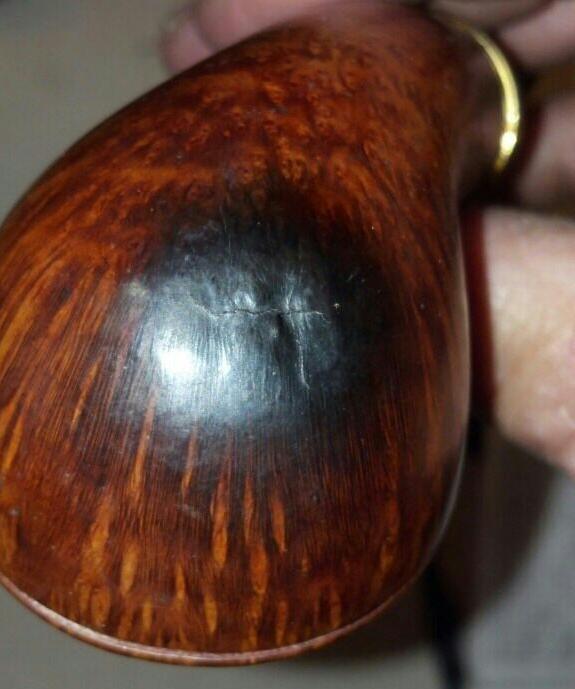
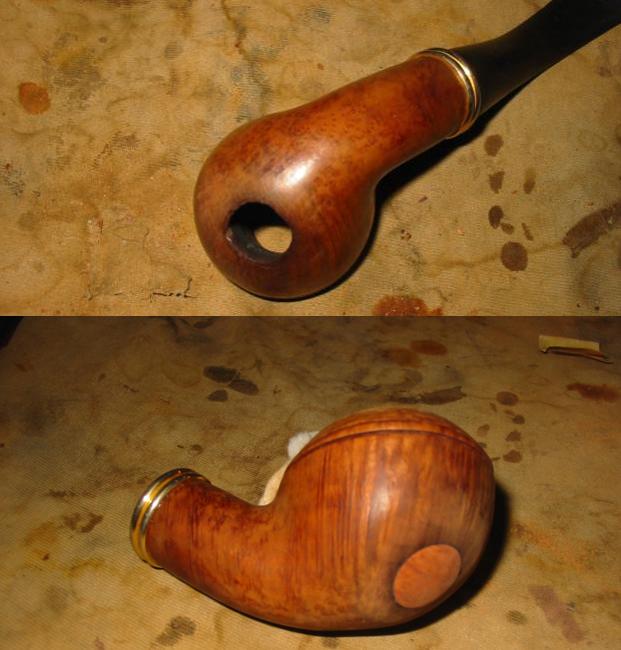
This BBB Double Star Apple has come a long way from England to Hong Kong to the US to Bulgaria, and now it’s ready to return to its new steward.  This restoration was a bit bumpy, but then, so is life.  I’m glad to help give this pipe a new lifetime and I hope Greg not only enjoys it, but that it provides a special connection with his past.  I’m sure Grandpa would be proud.  Thanks for joining me!

Banding and Restoring a Radford Ravel Rhodesian


Blog by Steve Laug

I am working on the second pipe I chose to work on in the lot of nine pipes I am restoring for the pipe smoker who dropped by a box of pipes that badly needed attention. This one was stamped Radford Ravel and had a mixed finish of smooth top and sandblasted shank and bottom part of the bowl. It is a Rhodesian and the cap is smooth and the rest is sandblast. It was finished in a dark brown stain. The finish was very dirty and there were quite a few sandpits and nicks in the smooth portion of the bowl cap. The shank was crack on the lower right side and extended from the shank end up the shank about a ¼ inch. The stem was a replacement and had a brass washer on the tenon and glued against the shank. When the new stem was made the maker put a space on the tenon to add colour to the stem. I figure that the new stem is what cracked the shank. When I received the pipe the stem did not fit tightly. There were tooth marks, tooth chatter and a lot of oxidation on the stem. There was also a bead of glue around the washer on the tenon.

There was something about the brand on the pipe that rang a bell for me. I have a tin of their Sunday’s Fantasy Tobacco in my cellar and I wondered if they might have made pipes as well.

I did a bit of digging and found the picture on the left that showed some of the tobaccos made by the company and also a great figurine with the name Thomas Radford mild premium pipe tobacco on the base. On Pipedia I found that Radford’s Private Label Pipes were crafted by Chacom for the Pöschl Tabak GmbH & Co. in Germany. This information was from “Pipes, Artisans and Trademarks”, by José Manuel Lopes. The pipes were mass produced with ebonite and acrylic stems and were introduced by Butz-Choquin, Chacom, and Nording. On the stem there is generally an embossed logo that was a stylized R. The pipes were made to use 9mm filters and are moderately priced and very attractive. The following three links were the sources I used for this information.

https://pipedia.org/wiki/Radford%27s

http://www.poeschl-tobacco.com/en/products/

http://www.pipephil.eu/logos/en/logo-r1.html

I also looked on another website and got a little more information on the brand. The Radford’s pipe appears in 6 models in 3 variations 1x time a year in autumn. The so called Radford’s Depot contains a minimum of 1 dozen pipes of the actual running collection. Connected to the depot is a listing of the depot holder in Radford’s News.

This particular brand RADFORD’S SERIE RAVEL was a series of 6 elegant models within Radford’s Collection. They are made from good briar wood, sandblast, black/brown with a polished head’s border in dark-red shade. Very nice rich-in-contrast ring at the shaft’s finish. Mouthpiece from Acryl for 9 mm filter. http://cigar.supersmokers.biz/radfords/

With all of this information I now knew that the pipe was originally made for a 9mm filter. The mortise was drilled deep in the shank to contain the 9mm filter. The replacement stem was a regular push stem without a filter tenon. I took some photos of the pipe before I started working on it. The finish was in really rough shape. You can see the glue and sticky material on the stem near the shank band. I took a photo of the inside of the shank to show the thick tars that had built up on the walls of the shank. The space in the mortise between the end of the tenon and the extra depth for the end of the original filters was filled with tar and oils. It was thick and sticky.I took a close up photo of the bowl to show the thick cake that lined the walls of the tapered bowl. The photo also shows the damage to the front of the bowl where the pipe had been tapped out against a hard surface. The second photo below shows the crack on the right underside of the shank. It appeared to me from the smooth area and the look of the stain that someone had tried to glue the crack and do a repair but it was not done well.The next two photos show the damage to the stem. The calcium build up on the button end of the stem, the oxidation and glue that is globbed on the stem to hold the washer in place on the tenon and the deep tooth marks on both sides near the button show in the photos.I scrubbed down the surface of the bowl with acetone on cotton pads to remove the damaged finish and the grime and oils in the grooves and crevices of the sandblast. I wanted the surface clean so that I could drill a hole to stop the crack before binding it together with glue and a nickel band on the shank. I drilled two pin holes at the end of the shank with a microdrill bit on a Dremel. The first one was slightly short of the end of the crack so I had to drill a second one.I heated the band to make the fit easier on the shank. I painted the shank end with some slow drying super glue and pressed the band in place against the topping board.I scrubbed the bowl with alcohol on a cotton pad to remove that last of the dust. I took pictures of the bowl with the new bling addition. I reamed the bowl with the PipNet reamer to take back the cake to the bare walls of the bowl. I finished the reaming using a Savinelli Fitsall Pipe Knife to scrape the inside of the bowl smooth. I rolled some 180 grit sandpaper around the end of my finger and sanded the walls of the bowl smooth.To remove the damage to the top of the bowl and to clean up the rough front edge of the bowl cap I lightly topped it on a topping board with 220 grit sandpaper.With the bowl exterior cleaned and the damaged rim top repaired I worked on the inside of the mortise and the airway from the mortise end into the bowl. I used the drill bit that is in the handle of the KleenReem pipe reamer to ream out the airway into the bowl. I turned the bit into the bowl using the knurled end to press it through. I cleaned off the drill bit and used the dental spatula to scrape the walls of the mortise all the way to the end where the airway entered the bowl. The amount of grit and oils that came out with the scraping was phenomenal.I wiped the bowl cap down with alcohol and filled in the sandpits around the outer walls of the cap with clear super glue.I cleaned out the shank and mortise once again with alcohol, cotton swabs and pipe cleaners until I had removed all of the loose debris left in the shank.I sanded the repaired patches on the cap with 220 grit sandpaper until the repairs were blended into the surface of the briar. I used a black Sharpie Pen to darken the spots and then wiped the bowl and cap down with alcohol to blend in the black. I scraped the area around the washer and the tenon with a sharp knife and funneled the end of the tenon to facilitate better airflow in the stem. I cleaned out the airway in the stem with pipe cleaners, alcohol and cotton swabs.I sanded the stem with 220 grit sandpaper to clean up the stem surface and wiped the tooth marks down with alcohol. I filled in the tooth marks with black super glue and set the stem aside to let the glue cure.I stuffed a cotton ball into the bowl and rolled a cotton pad into the shank. I set the pipe in an ice cube tray and used an ear syringe to fill the bowl with alcohol and let it sit during the day. I left it sitting all day while I worked on the slot in the stem. At the end of the day the cotton had yellowed the cotton and the alcohol had pulled out tar and oil from the bowl walls.I used needle files to open up the slot in the button. I used a flat, flattened oval and regular oval file to open the slot. I folded a piece of sandpaper and sanded out the inside of the newly opened slot. After sanding it the slot was open enough to easily take a pipe cleaner. By this time the alcohol/cotton ball soak in the bowl was finished. I pulled the cotton balls out of the bowl and the pad out of the shank and threw them away. I cleaned out the shank and airway once again with cotton swabs and pipe cleaners. Once it was clean I stained the bowl with dark brown aniline stain cut 50/50 with alcohol. I flamed the stain to set it in the grain. I repeated the process until the coverage was what I was looking for.I rubbed bowl down with olive oil on a cloth and hand buffed the bowl with a rough cotton cloth. I took some photos of the new look of this old Radford Ravel pipe. The bowl is starting to look really good and shows some promise. I polished the stem with micromesh sanding pads to remove the scratches and raise a shine on the vulcanite. I removed the brass washer on the stem and polished it with sandpaper. I reglued it onto the tenon with super glue. I wet sanded the stem with 1500-2400 grit pads and rubbed it down with Obsidian Oil. There were still scratches and also some oxidation. I repeated the sanding with those pads and then moved on to dry sanding with 3200-12000 grit pads. I rubbed it down with the oil after each set of three pads. After the final pad I gave it a final coat of the oil and set it aside to dry. I buffed the stem with Red Tripoli to try to remove the remaining oxidation and then buffed the entire pipe and stem with Blue Diamond polish on the buffing wheel. I polished the metal band with a jeweler’s polishing cloth. I gave the stem and bowl multiple coats of carnauba wax and buffed the pipe with a clean buffing pad to raise a shine. I hand buffed it with a microfibre cloth to deepen the shine on the briar. The finished pipe is shown in the photos below. It has come a long way from the way it looked when I received it to work on. I really like the looks and the shape of the pipe. I have now finished two of pipes that the pipe smoker dropped off for me to restore before he left on holiday. I look forward to seeing what he thinks of his pipes.