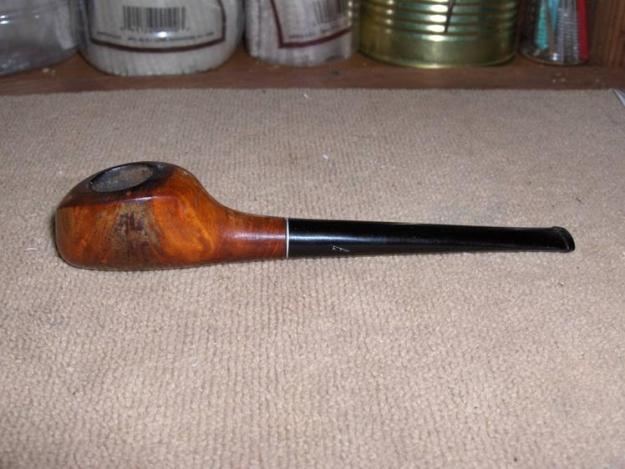
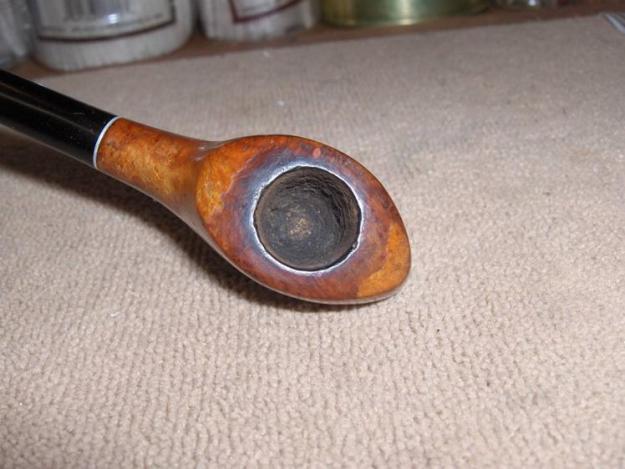
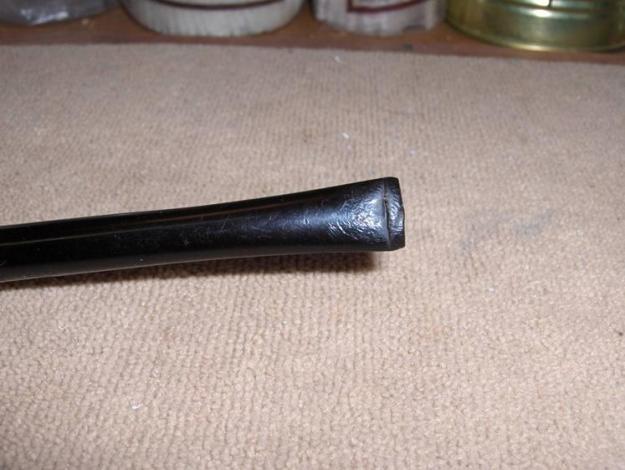
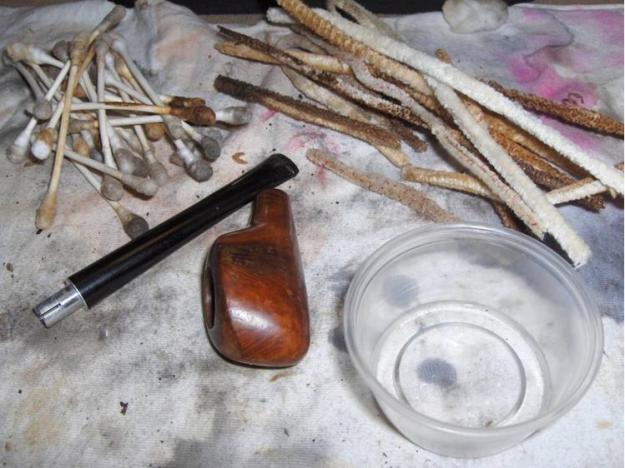
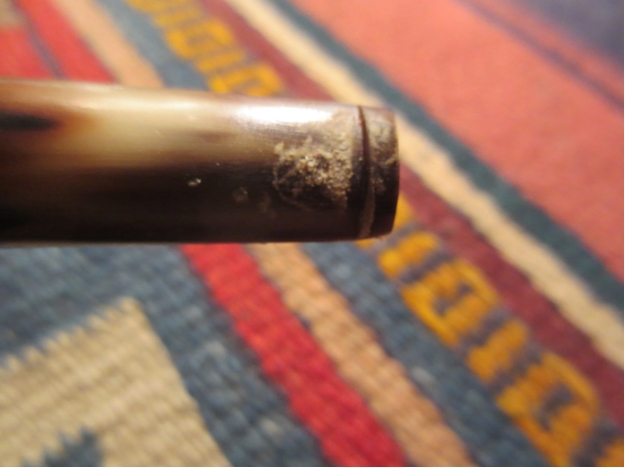
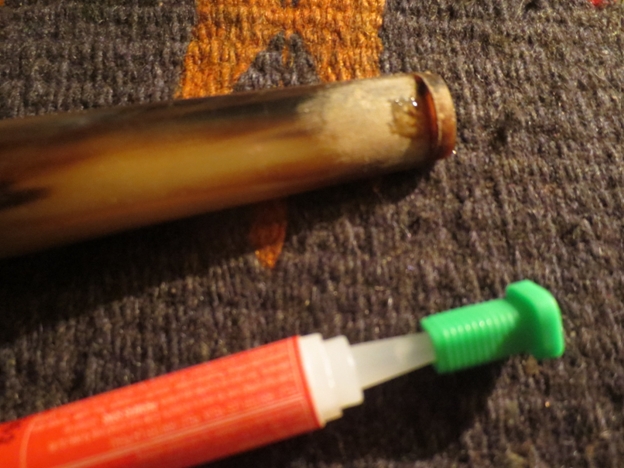
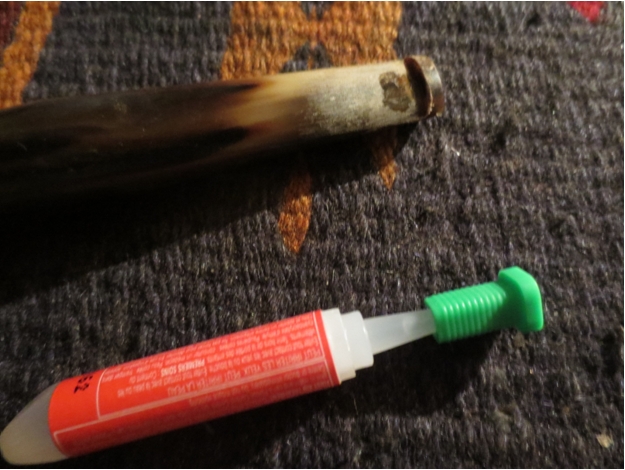
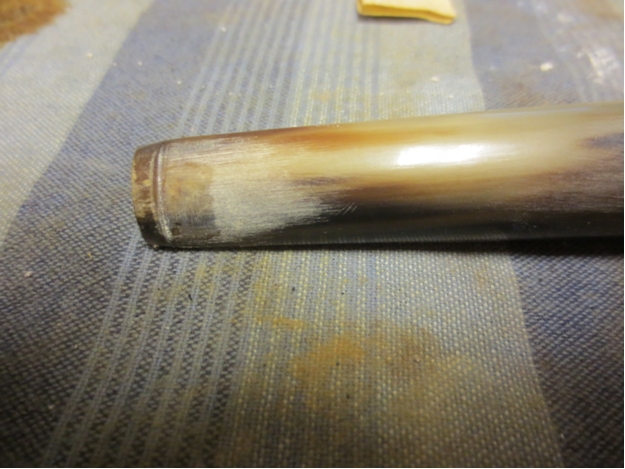
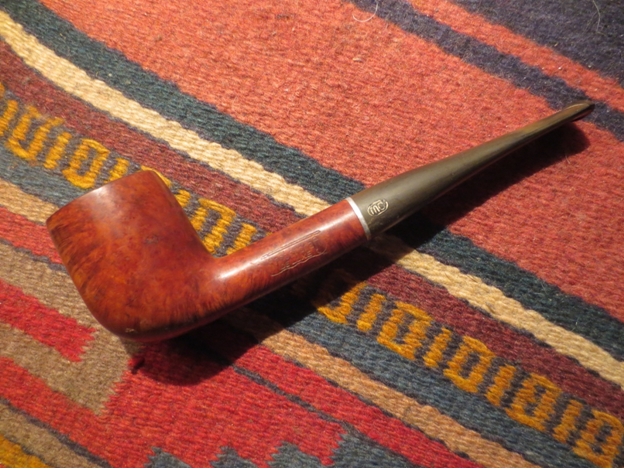
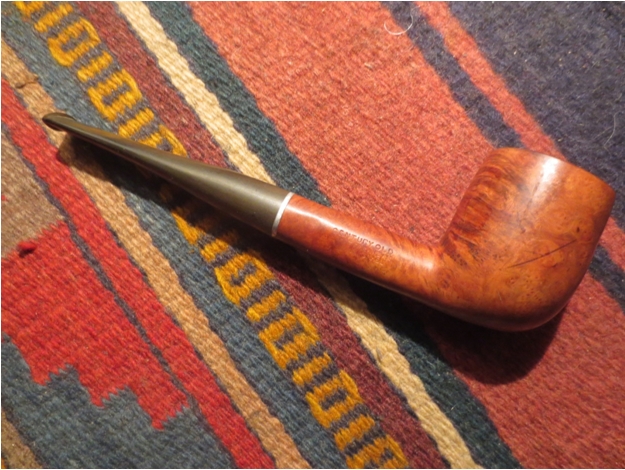
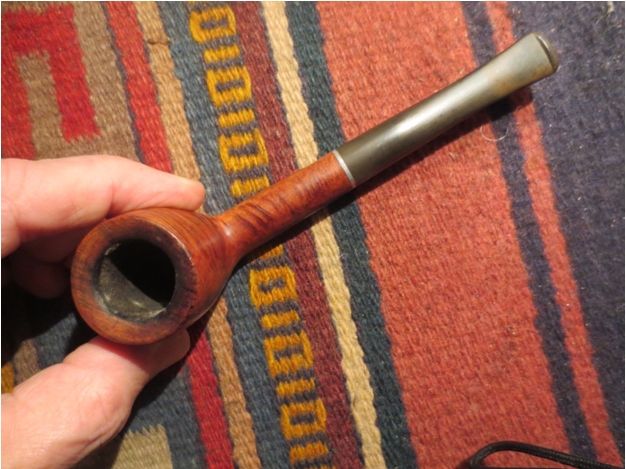
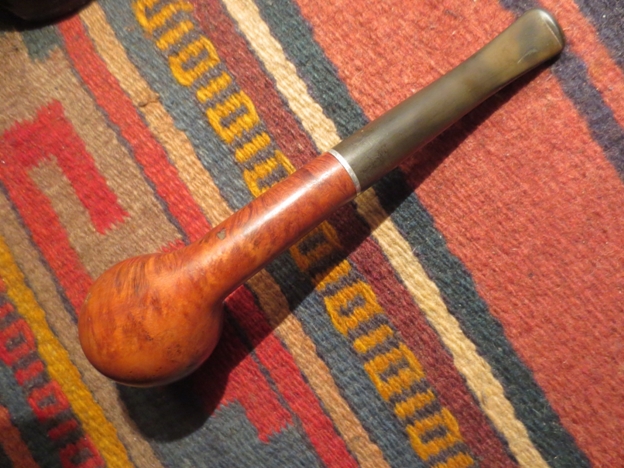
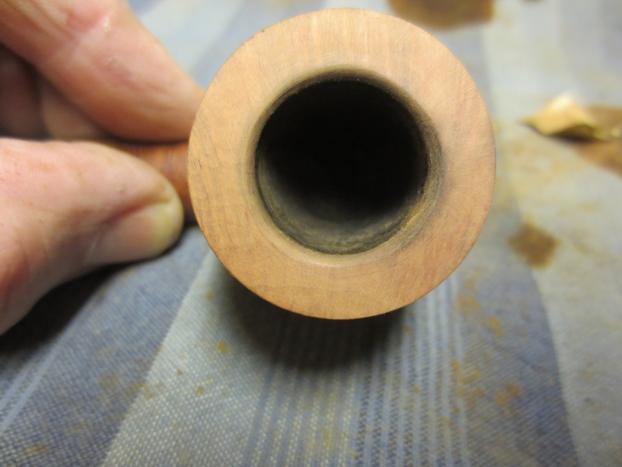
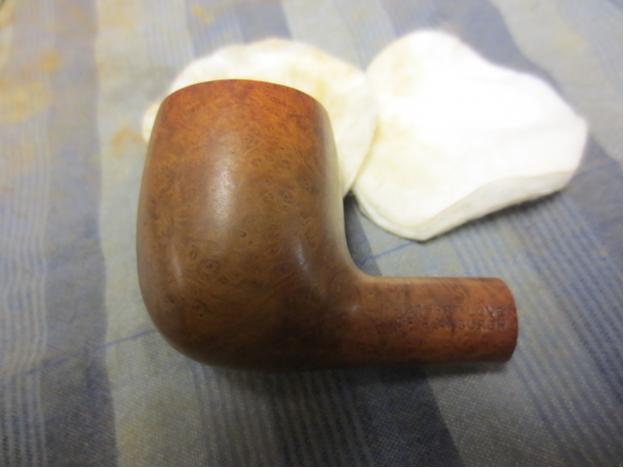
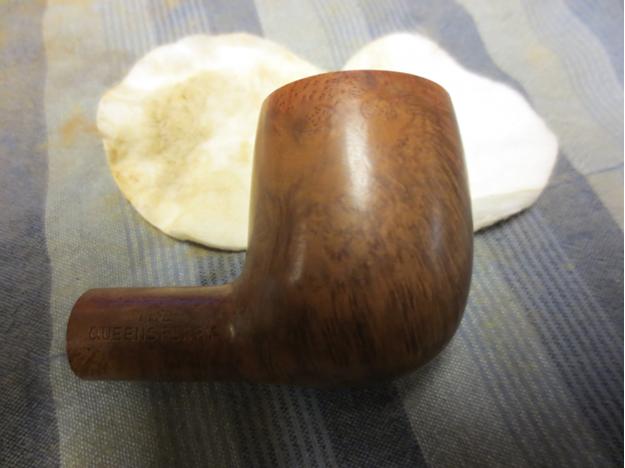
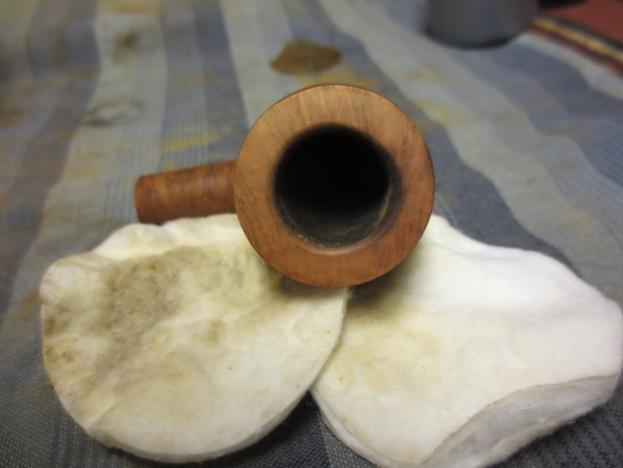
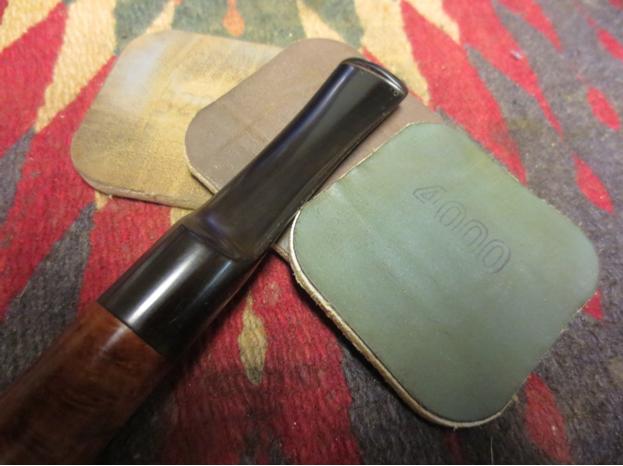
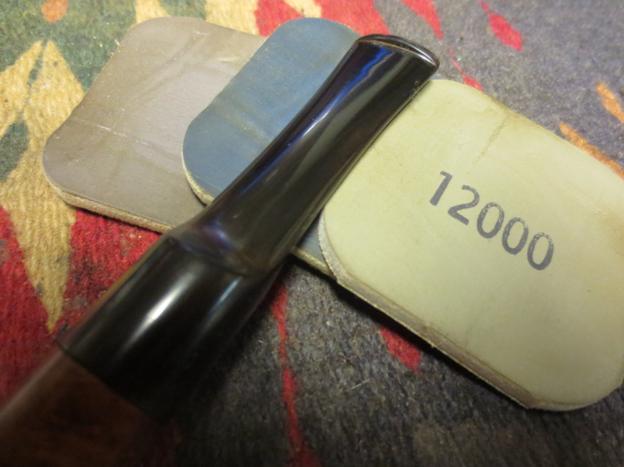
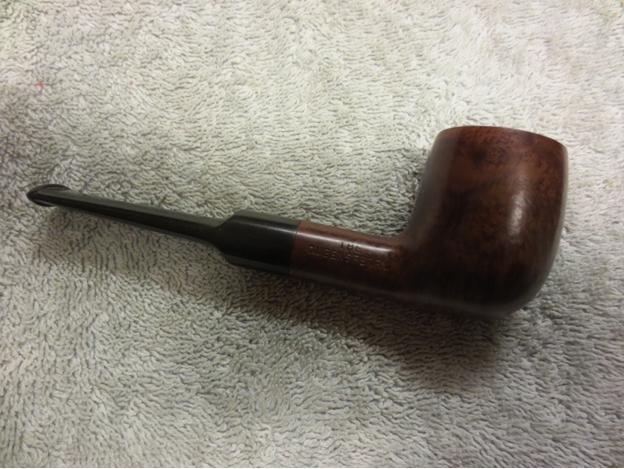
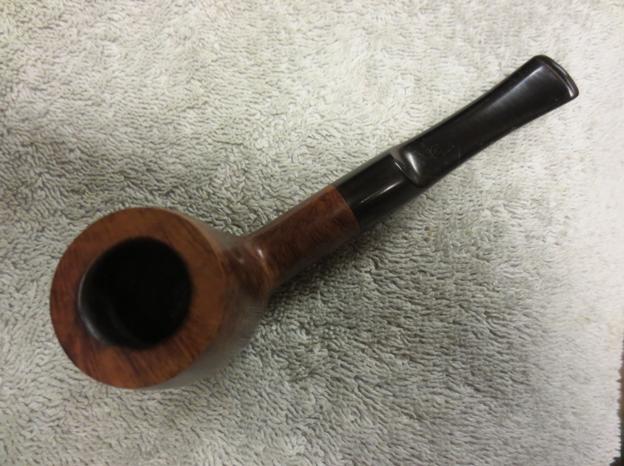
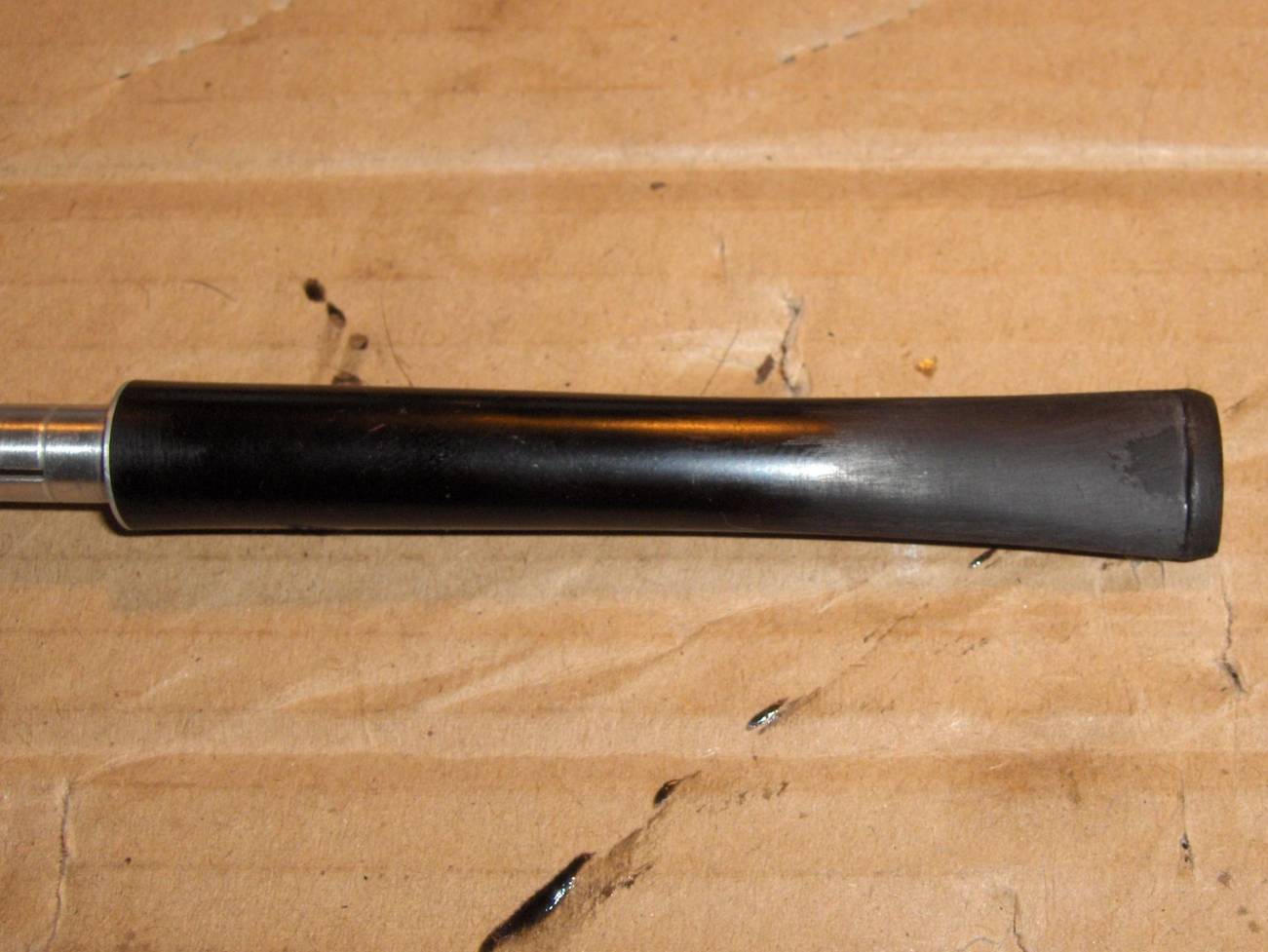
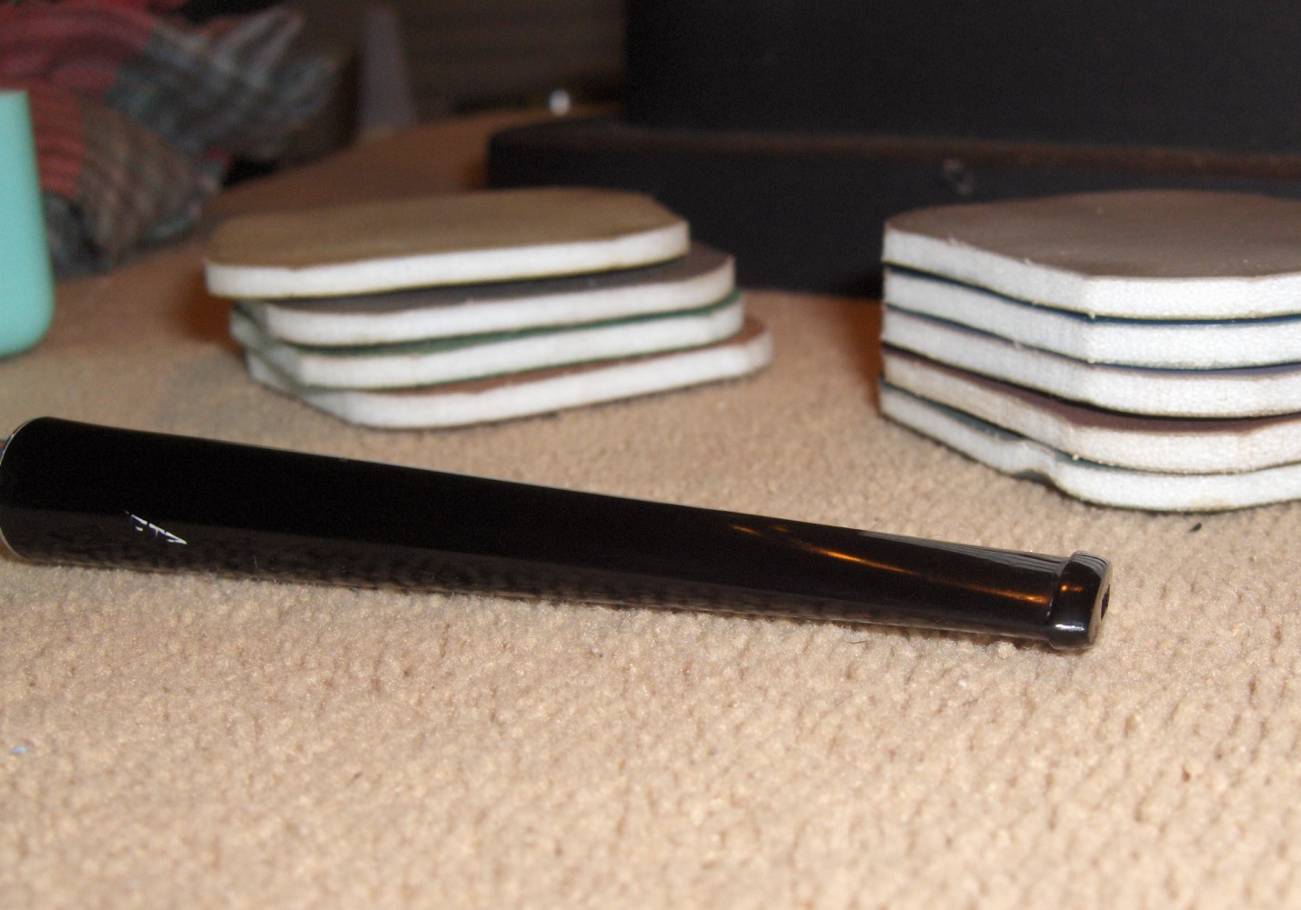
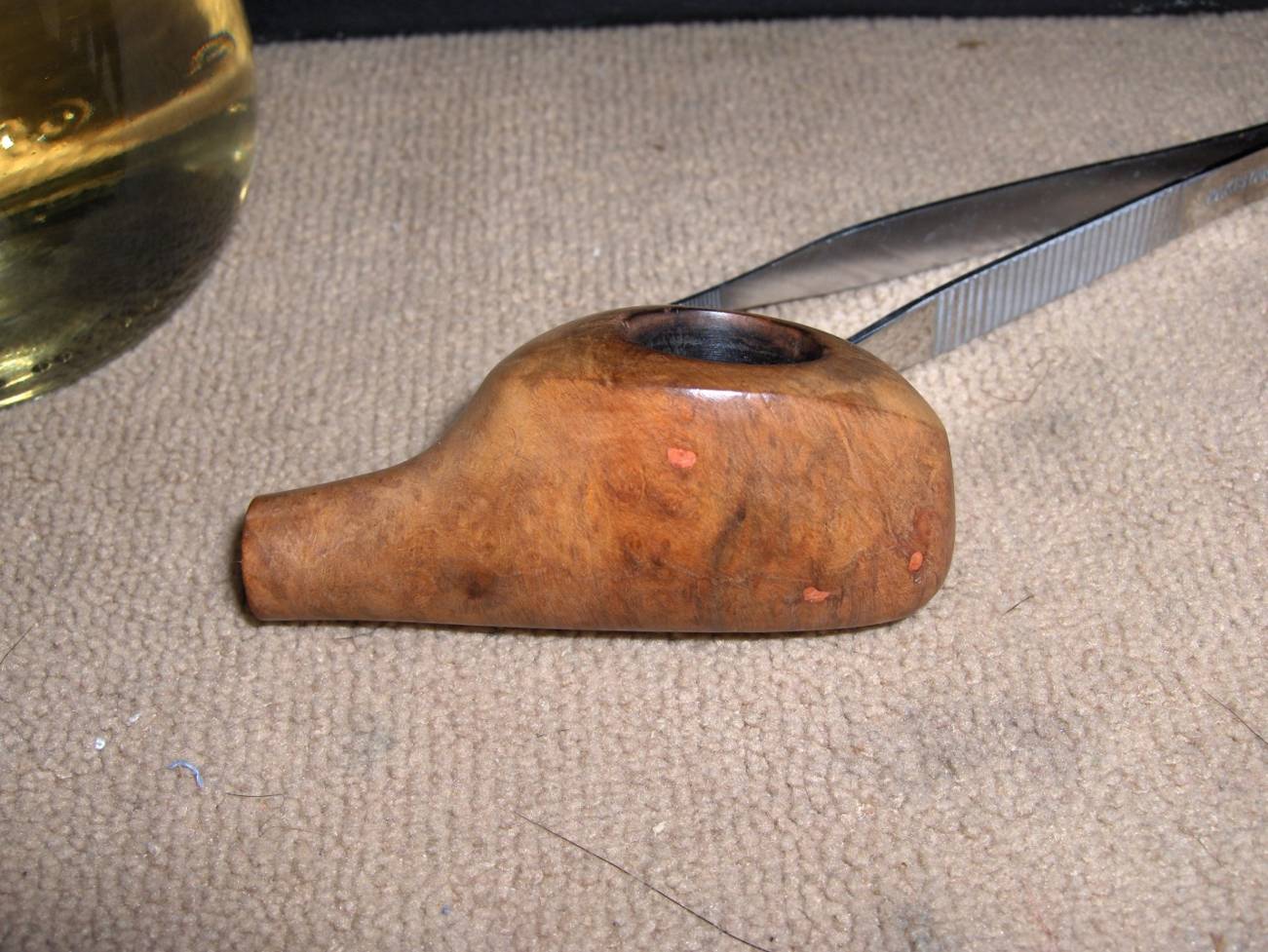
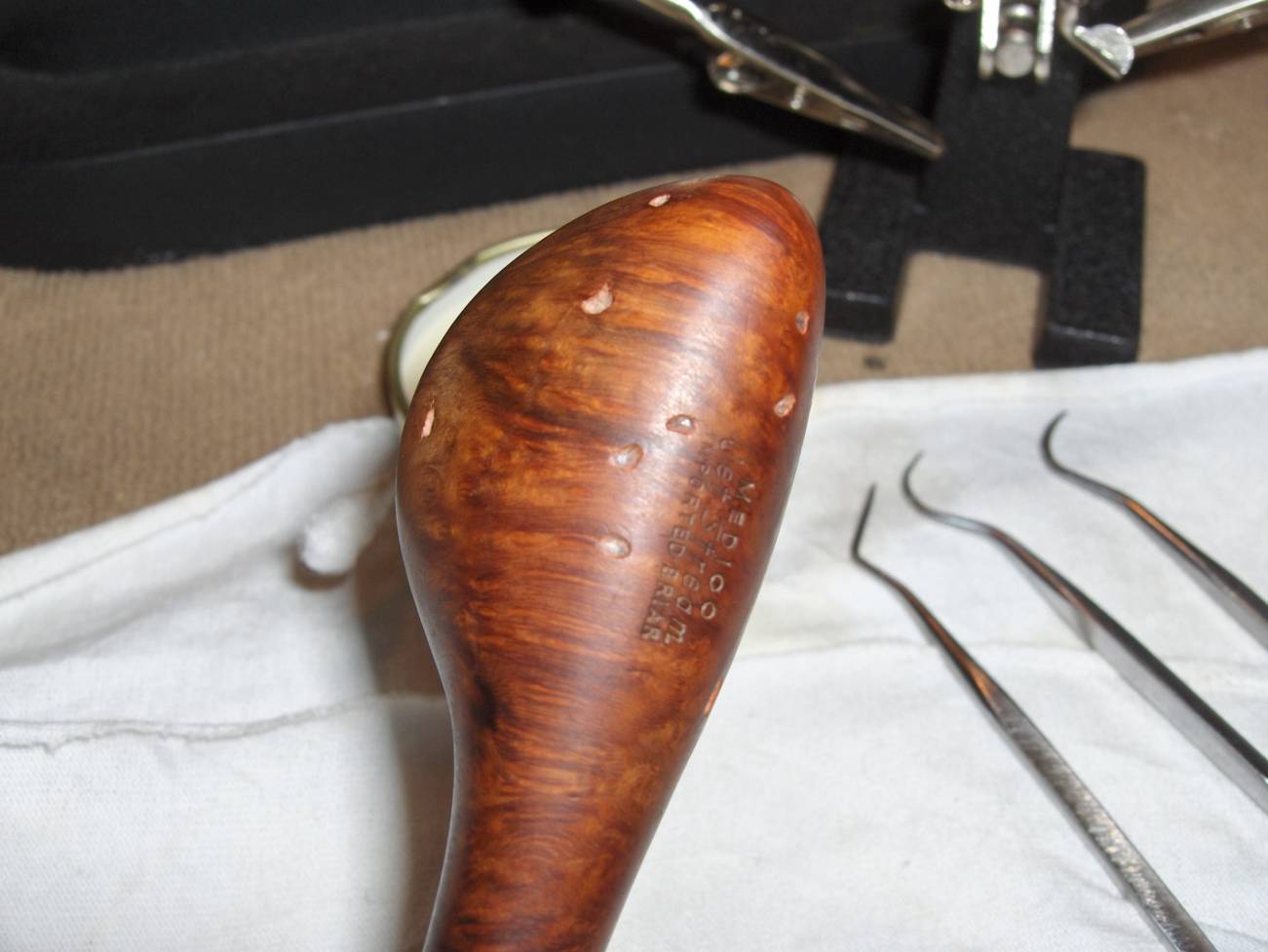
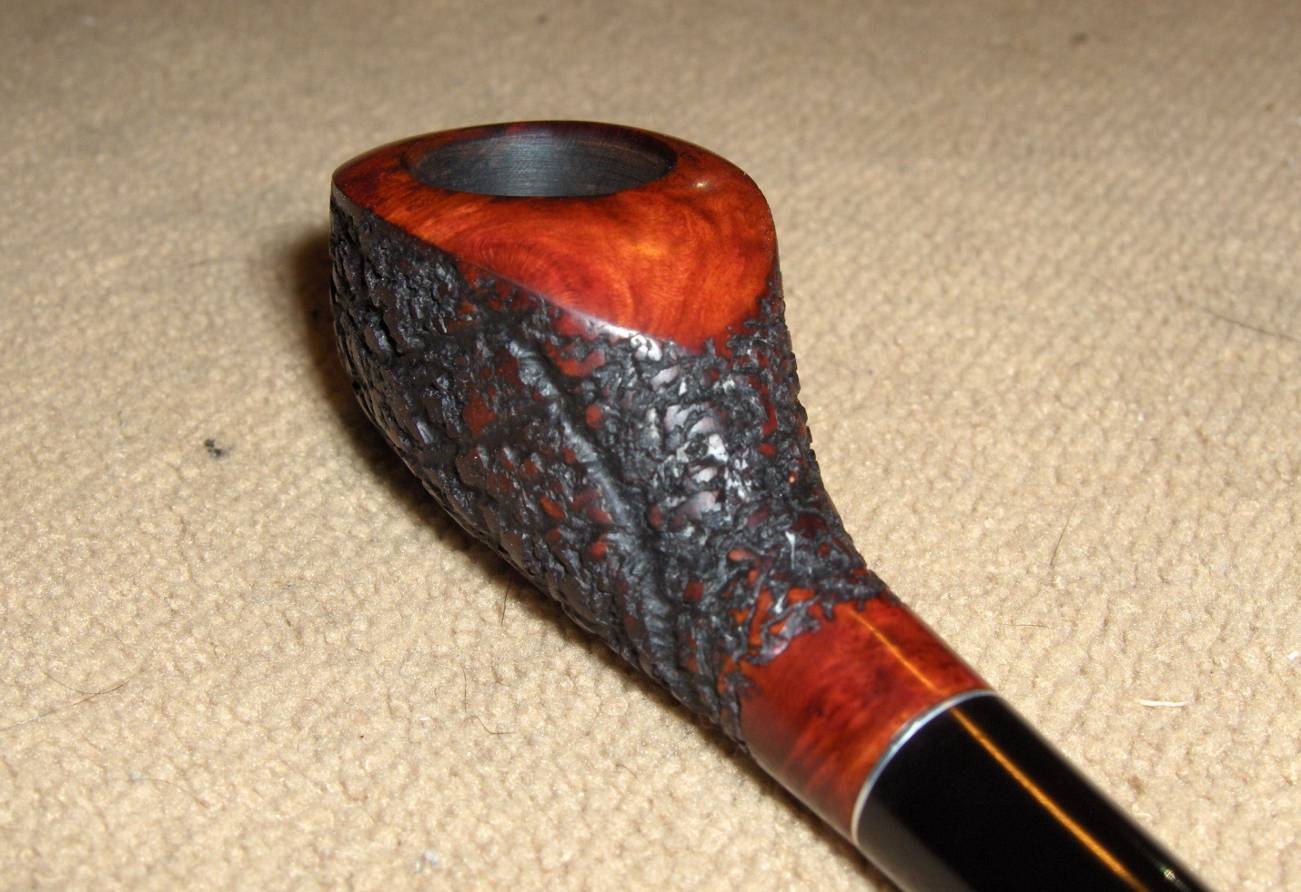
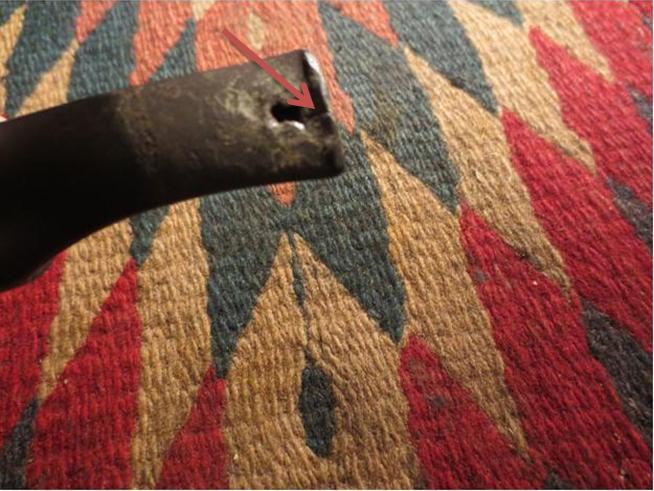
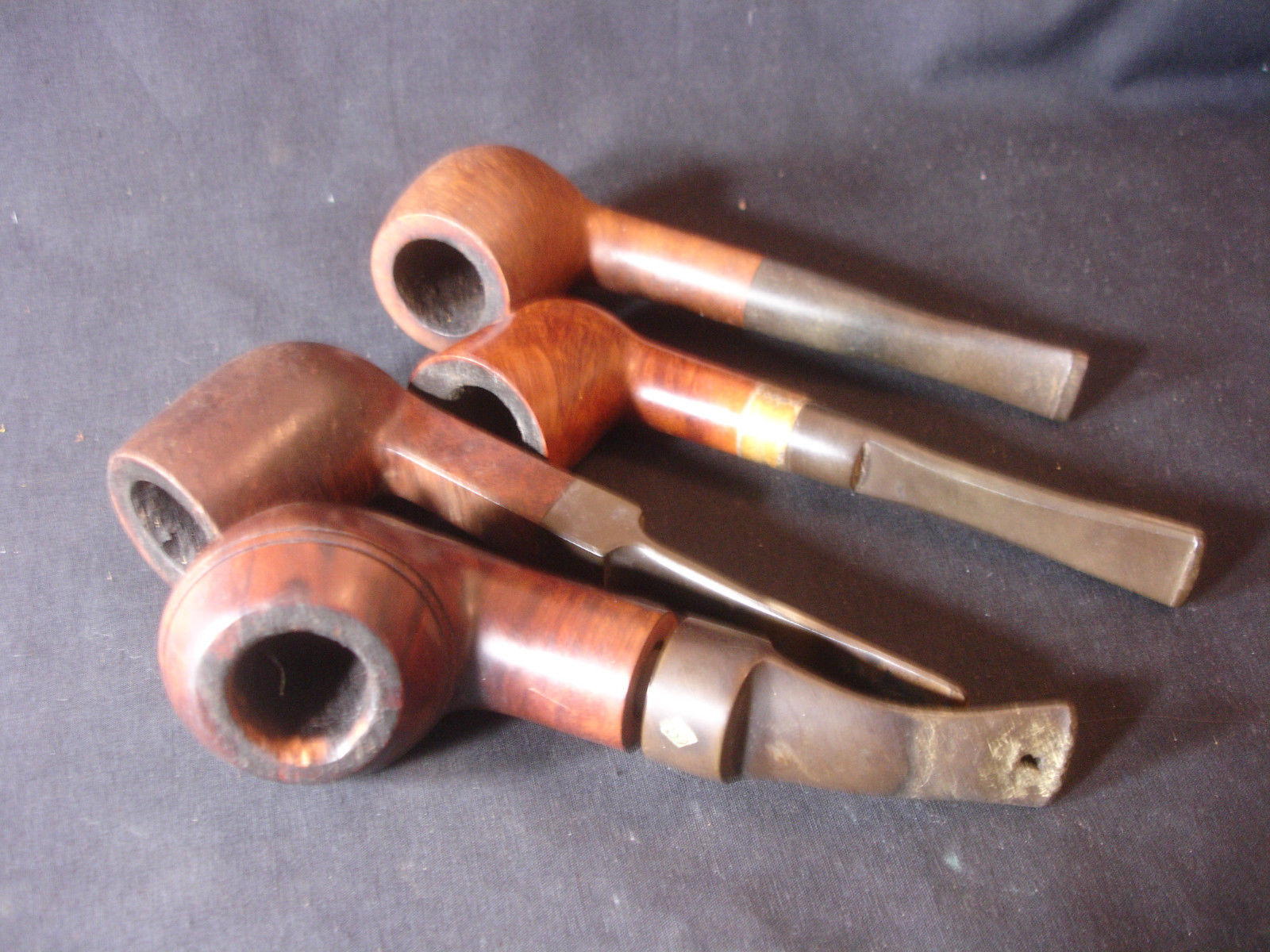
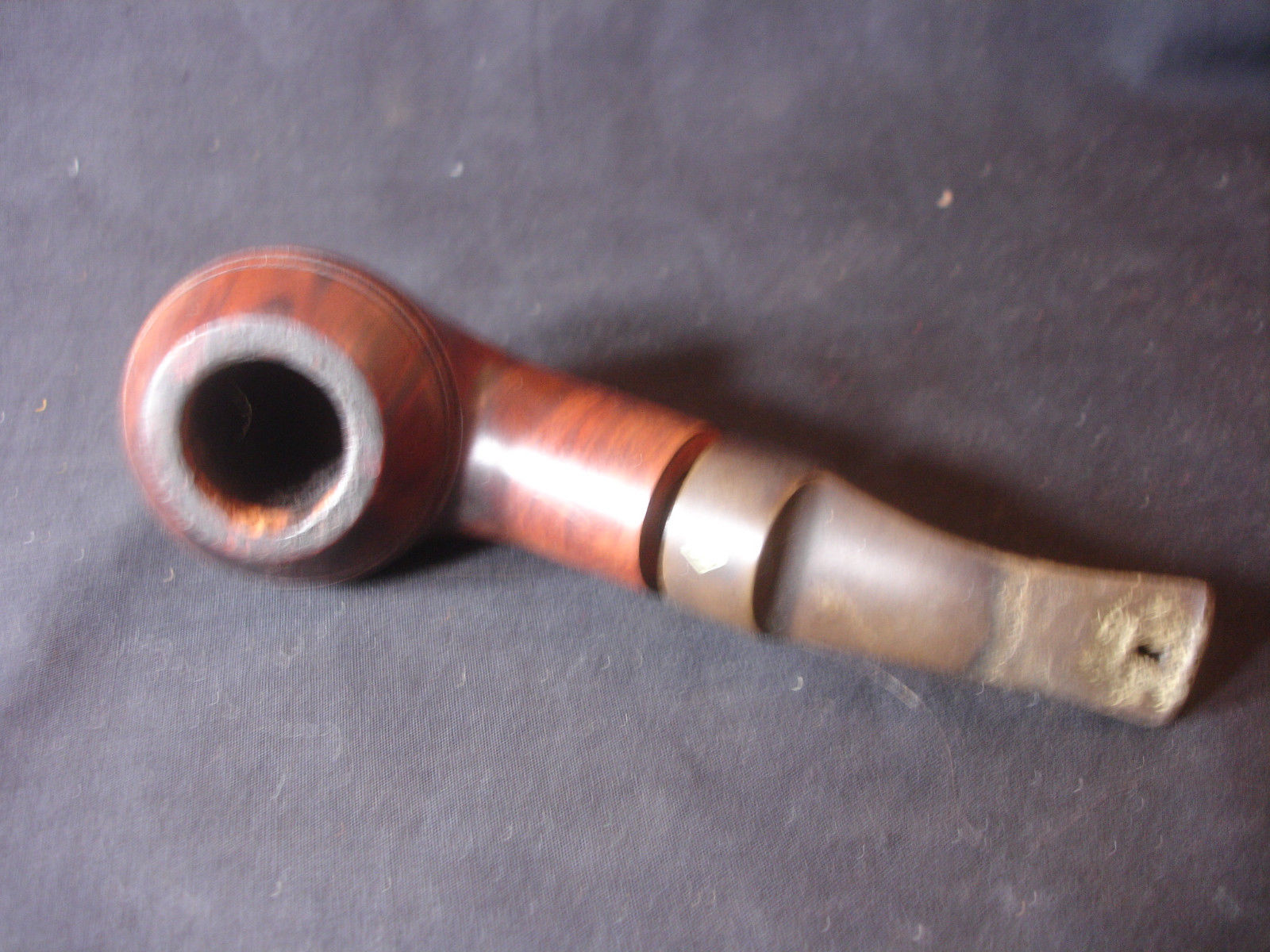
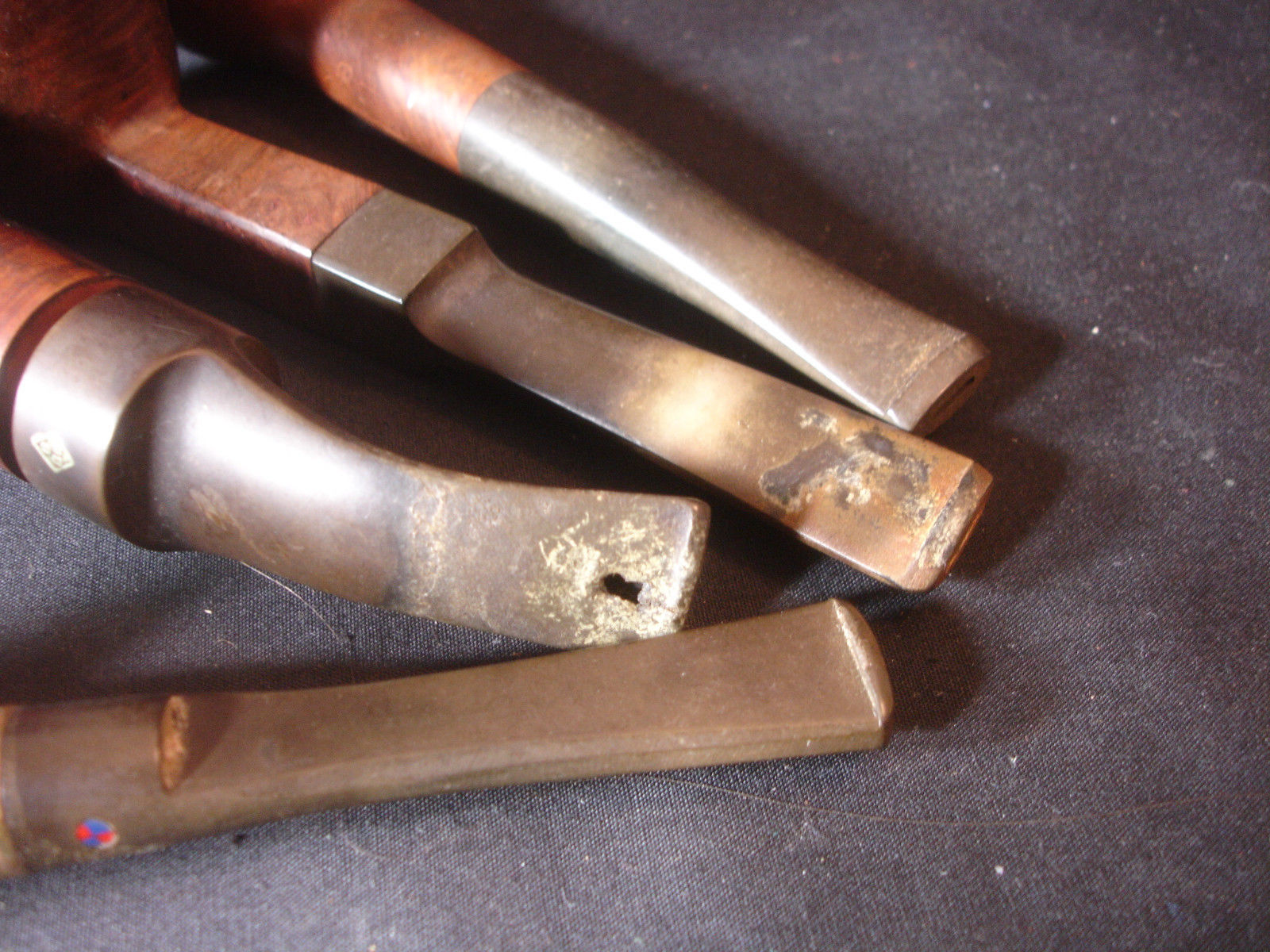
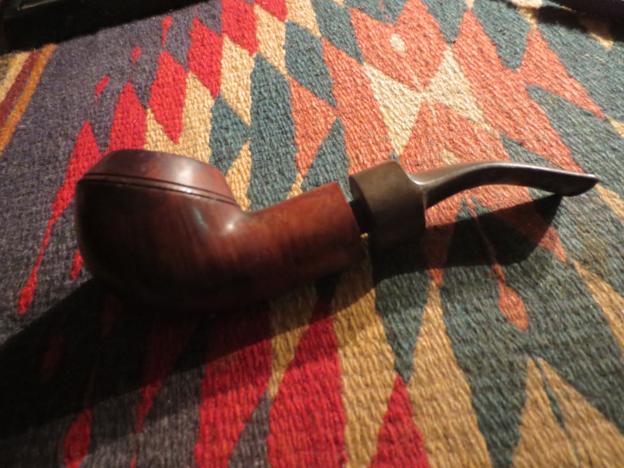
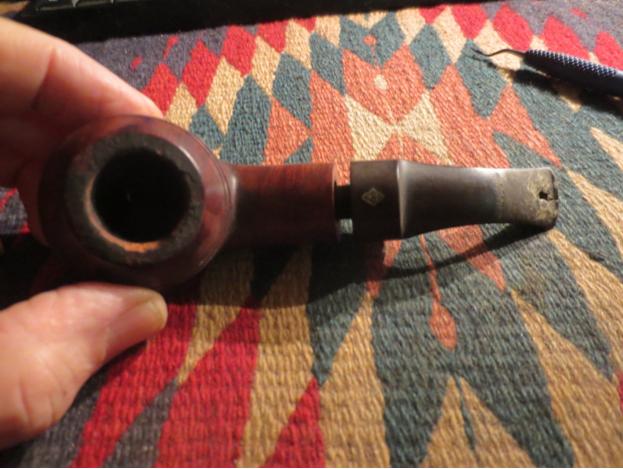
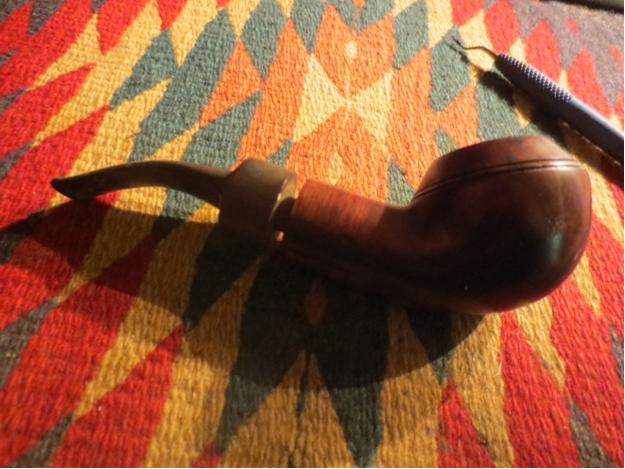
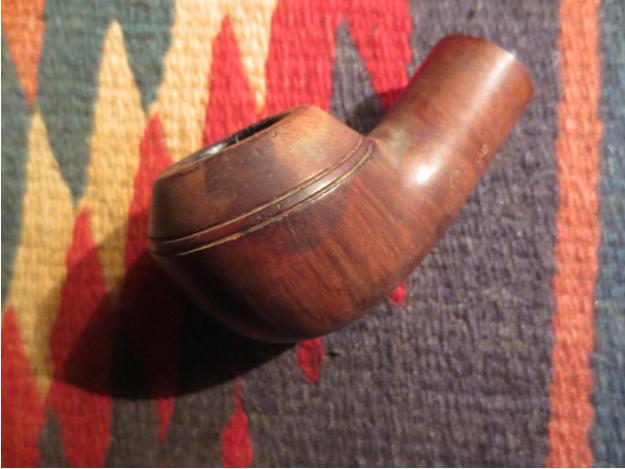
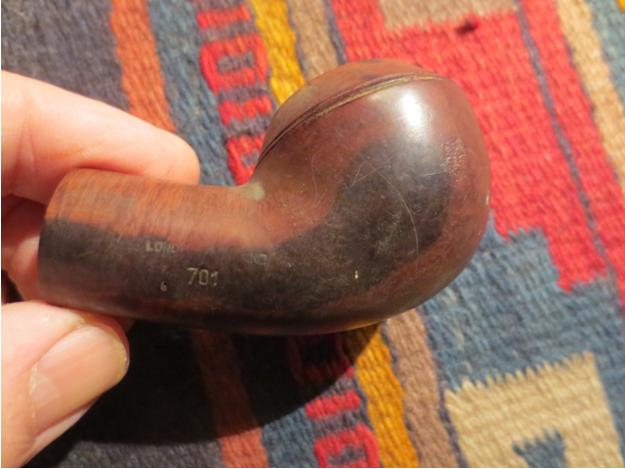
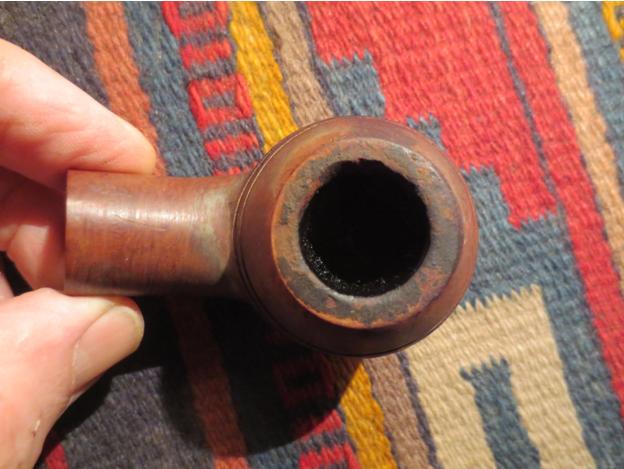
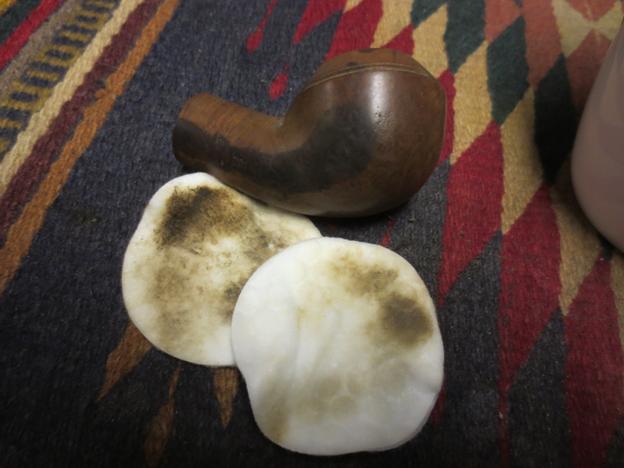
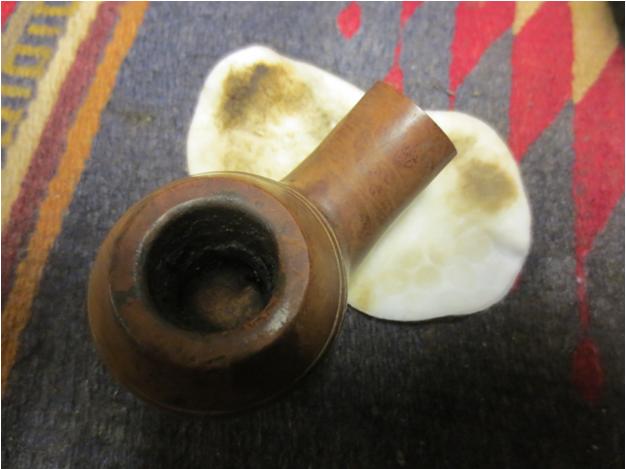
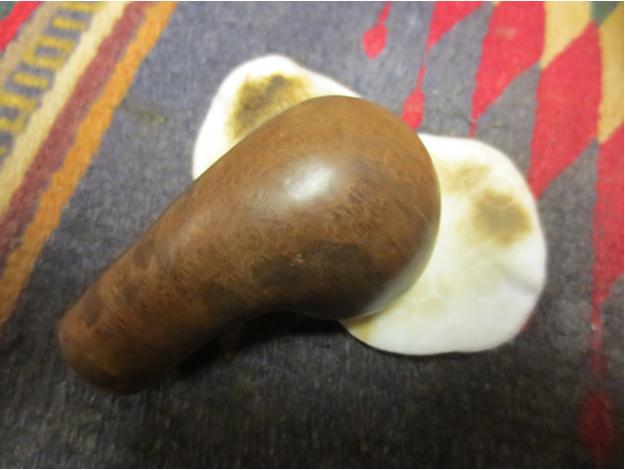
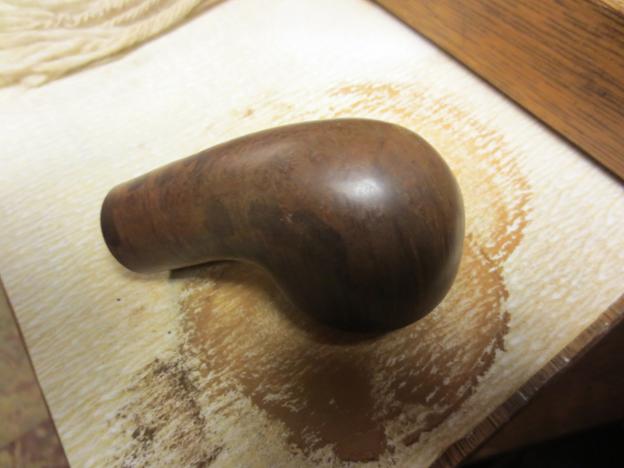
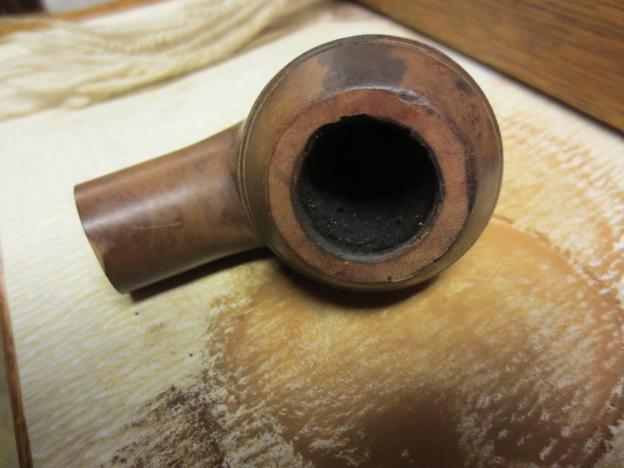
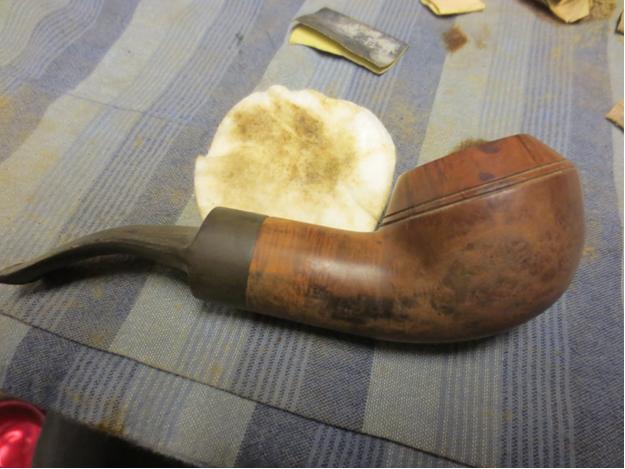
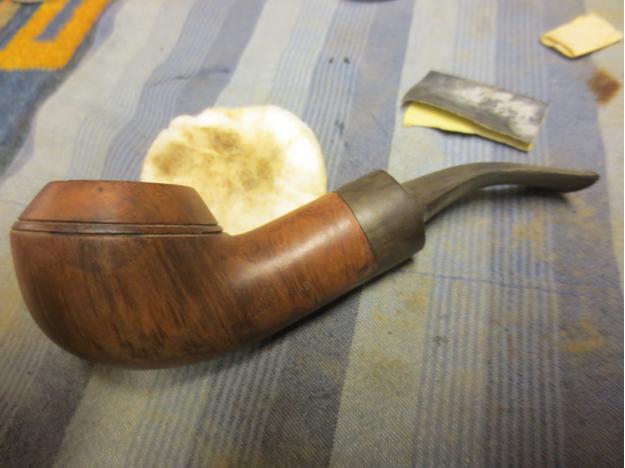
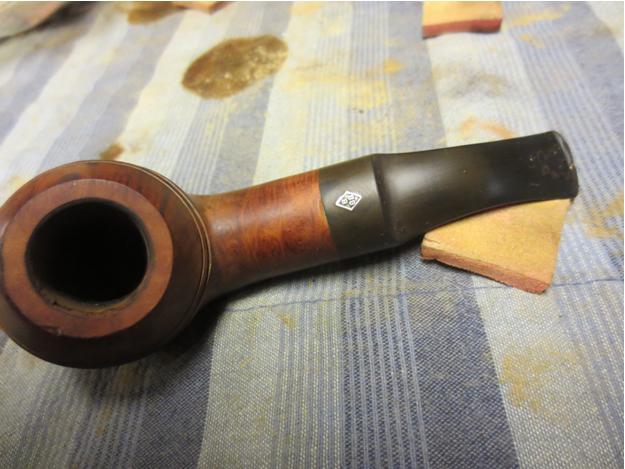
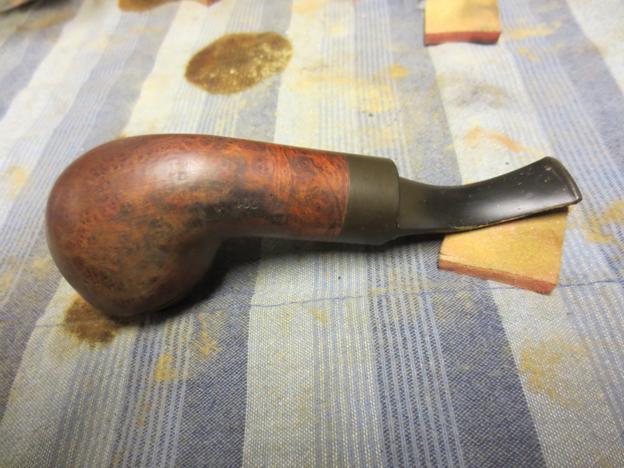
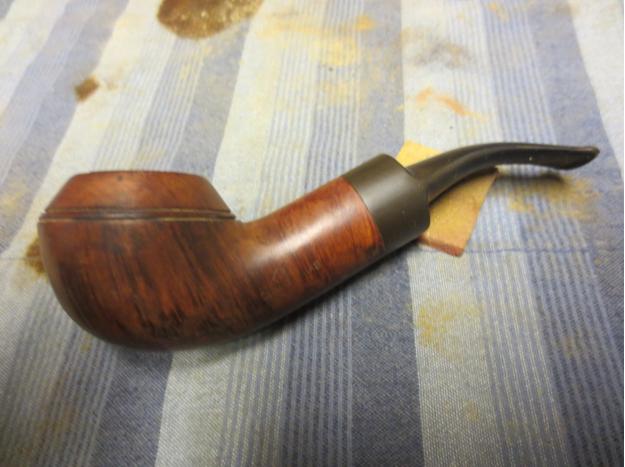
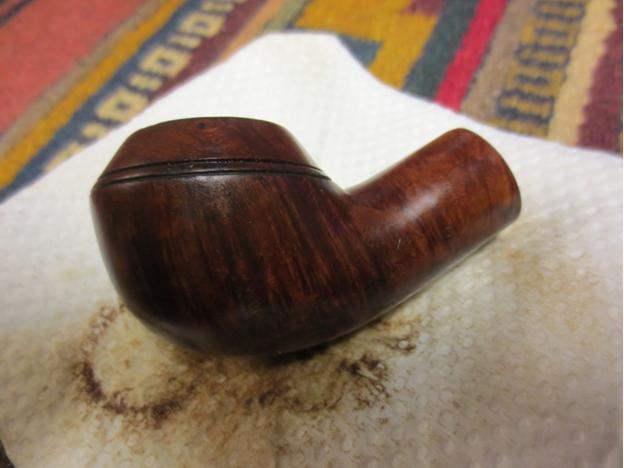
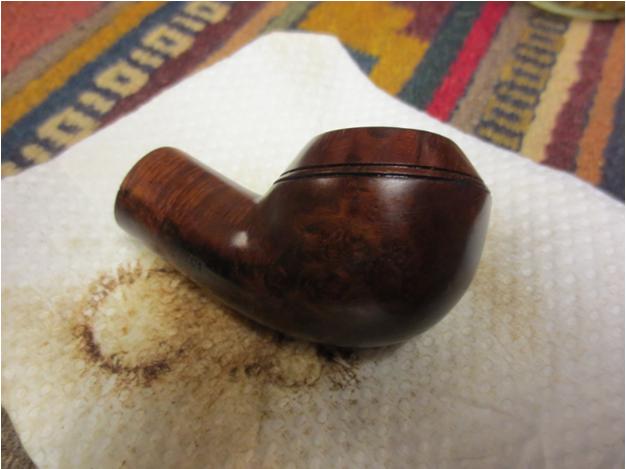
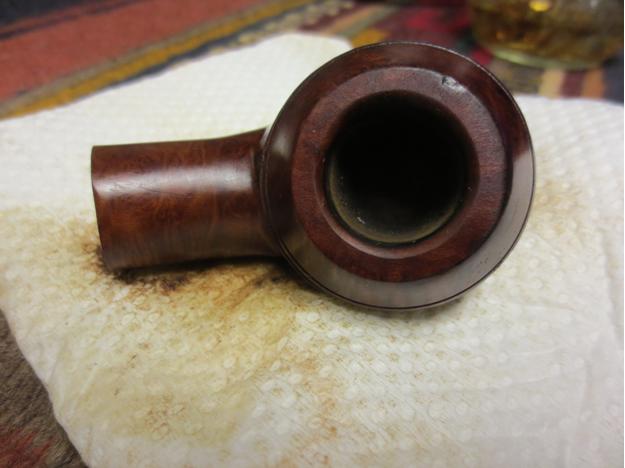
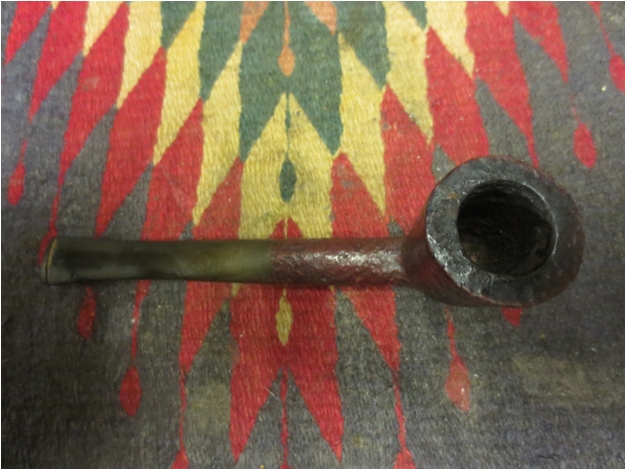
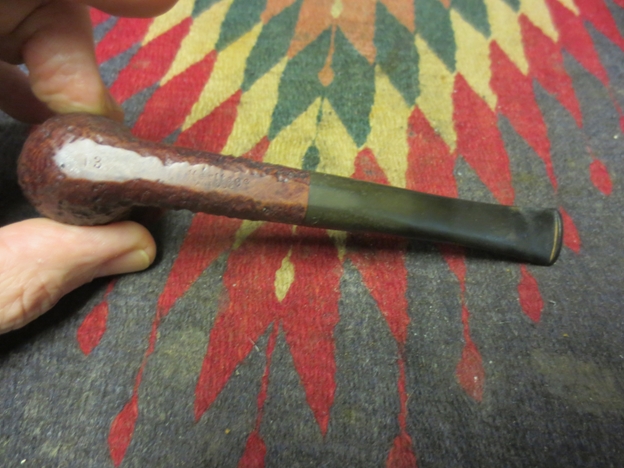
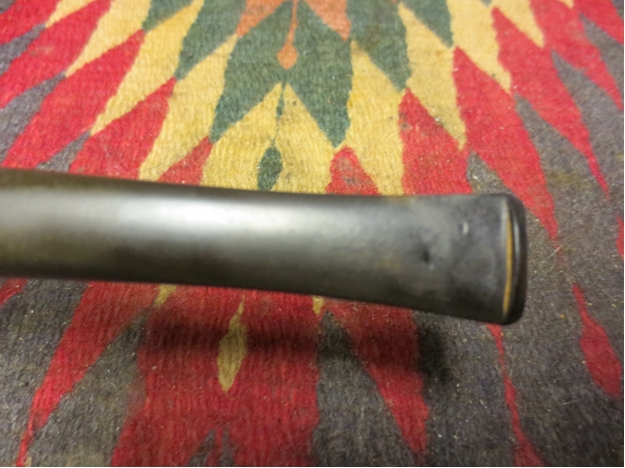
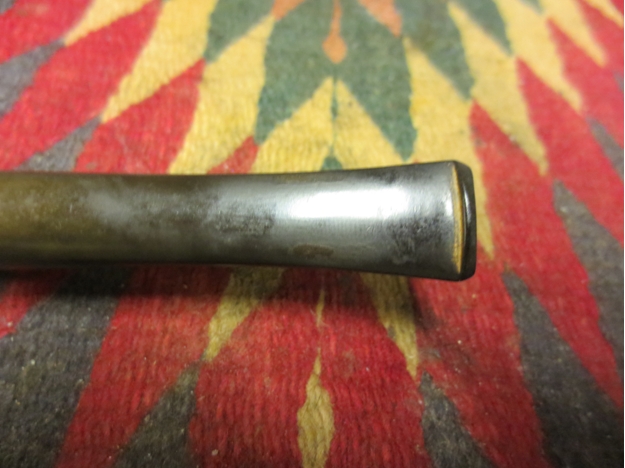
Tag Archives: removing tooth marks

Restoring a Dunhill Shell Billiard 42121


Blog by Steve Laug

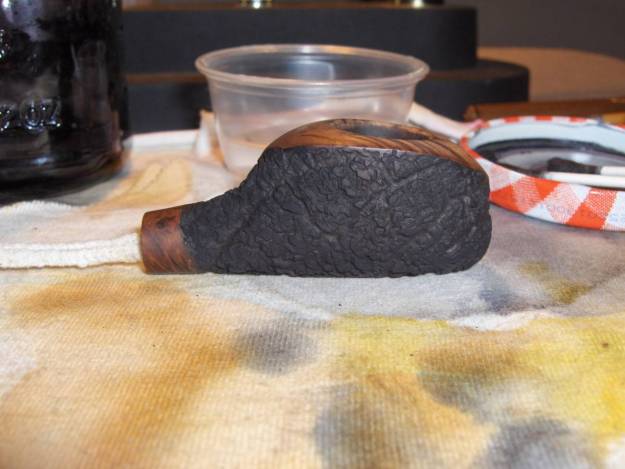
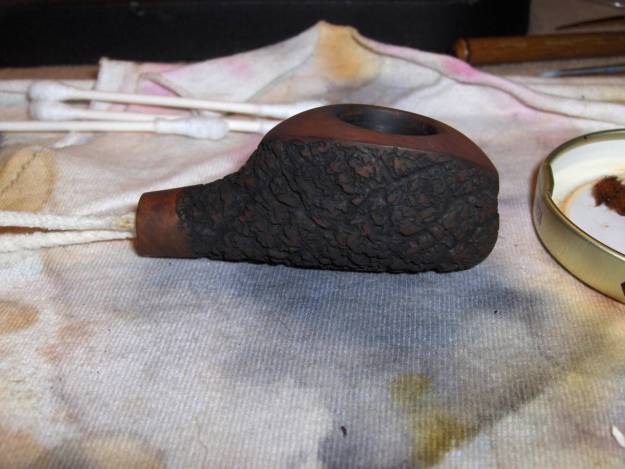
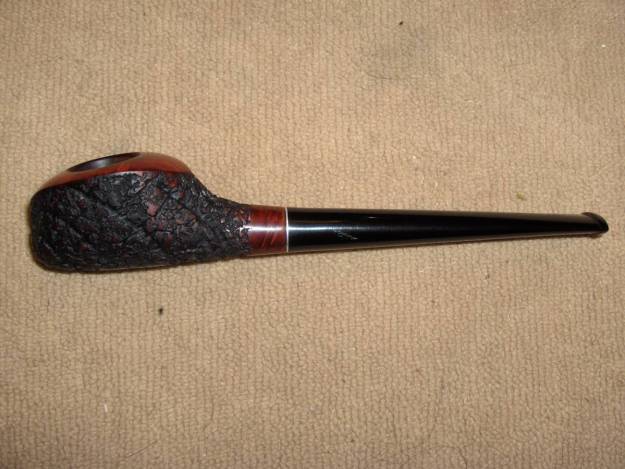
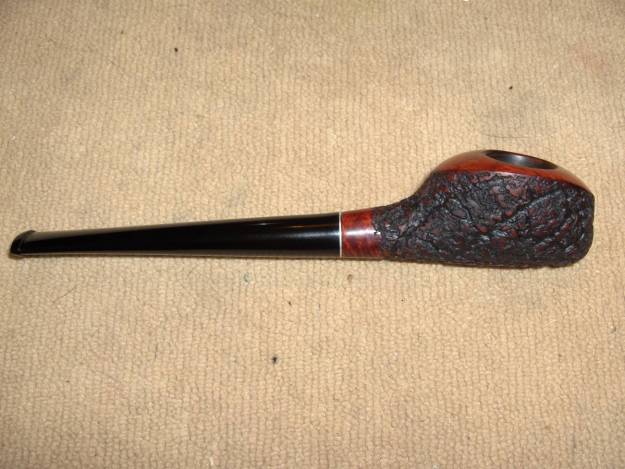
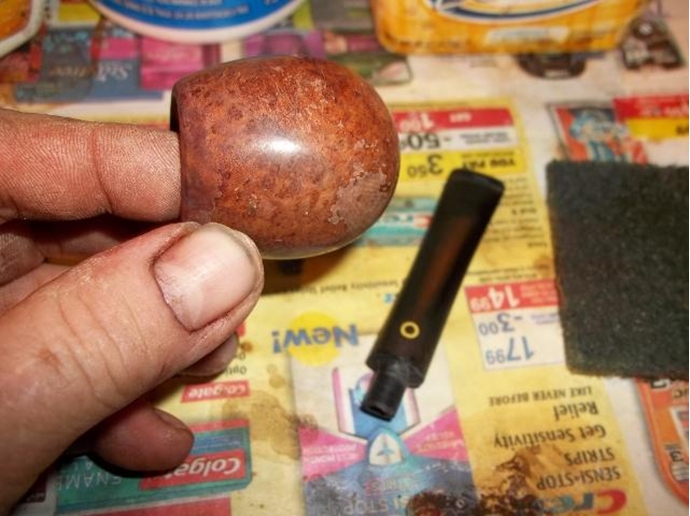
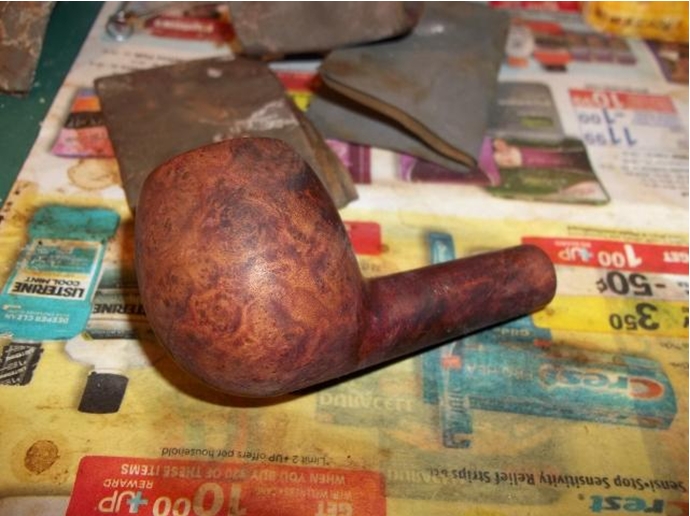
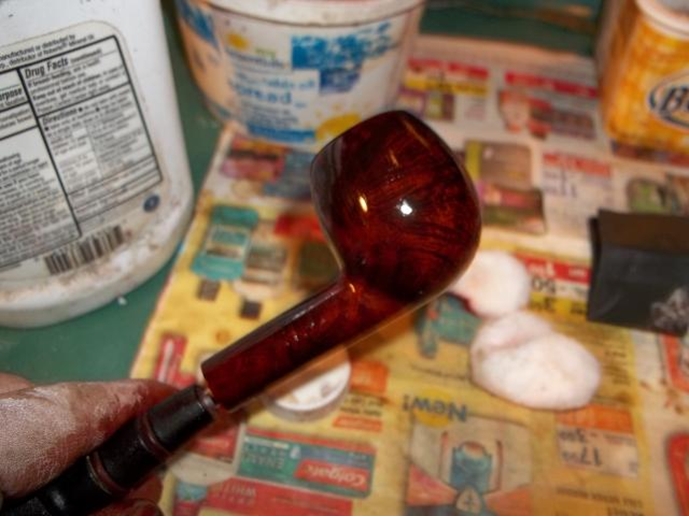
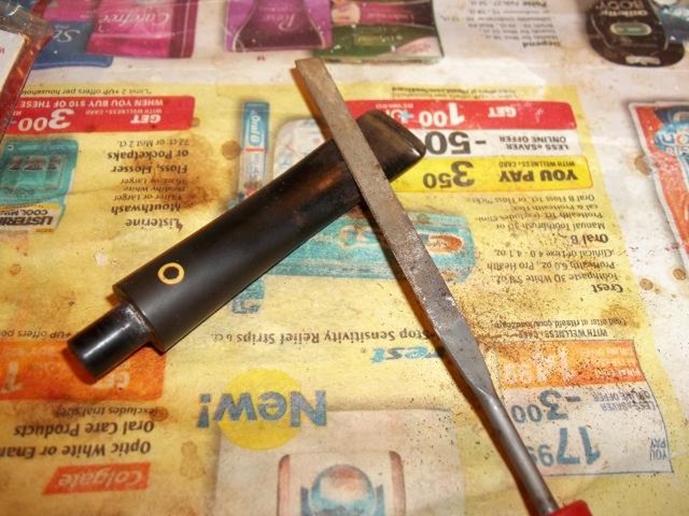
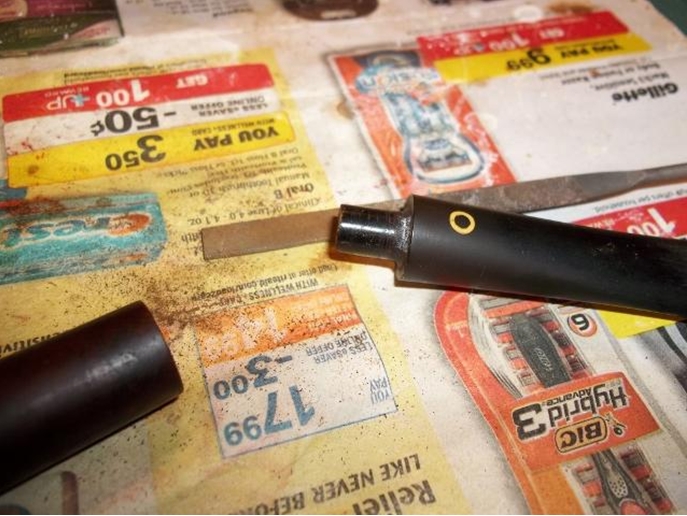
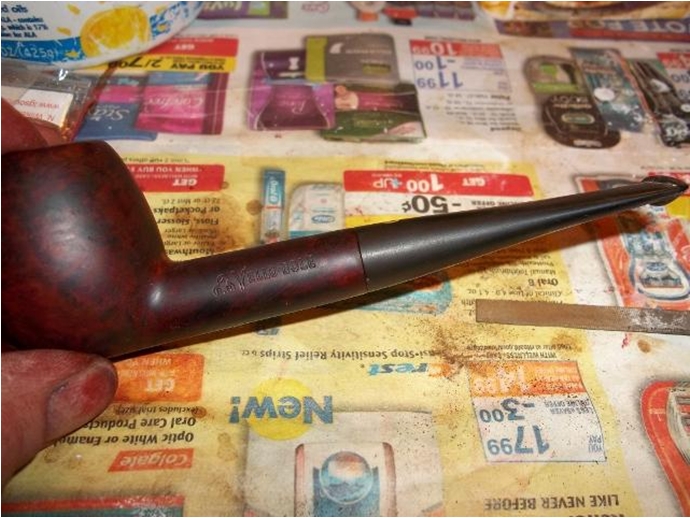
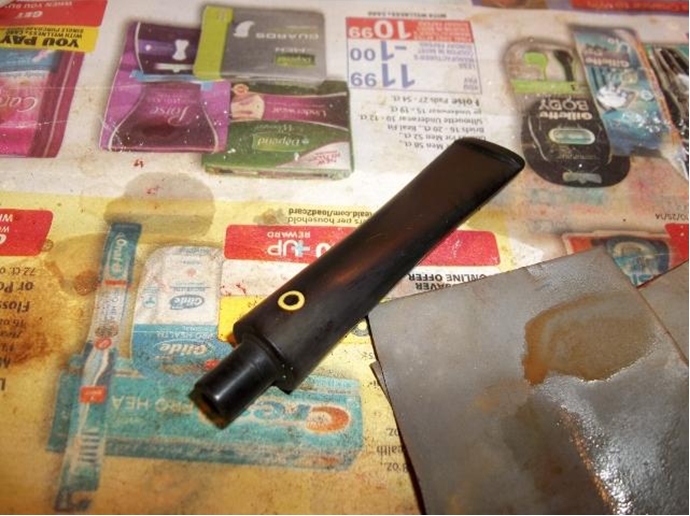
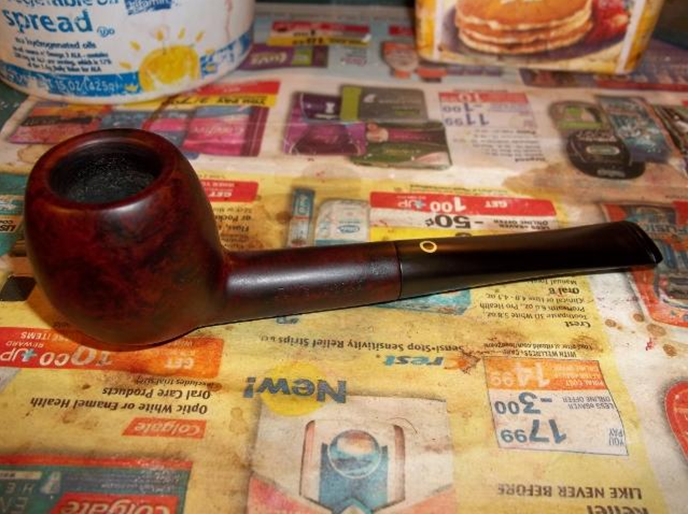
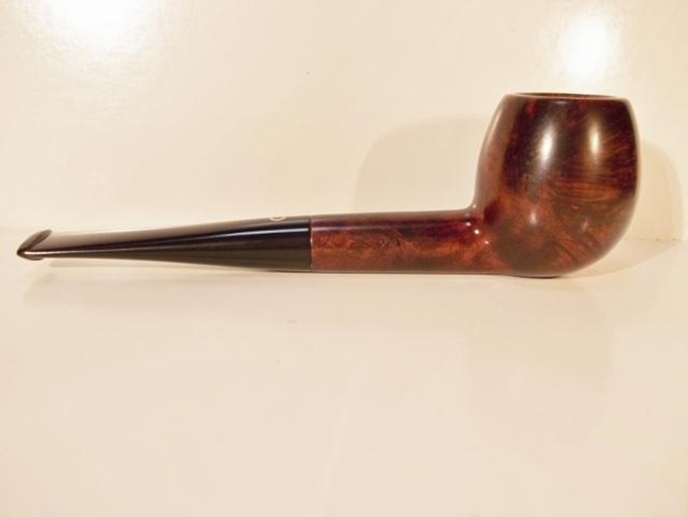
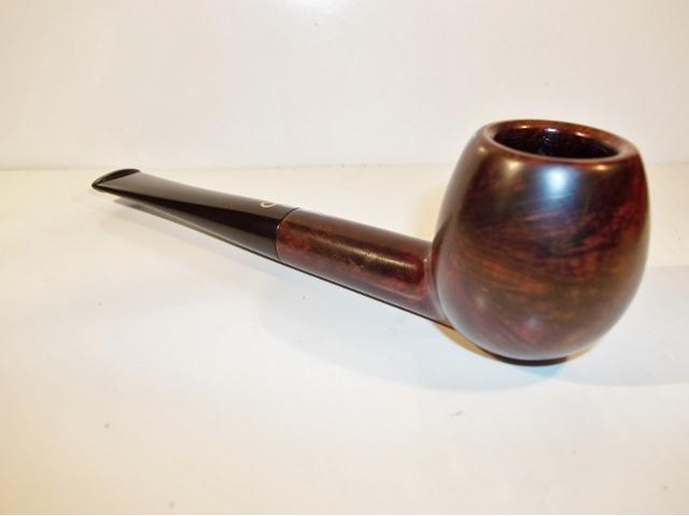
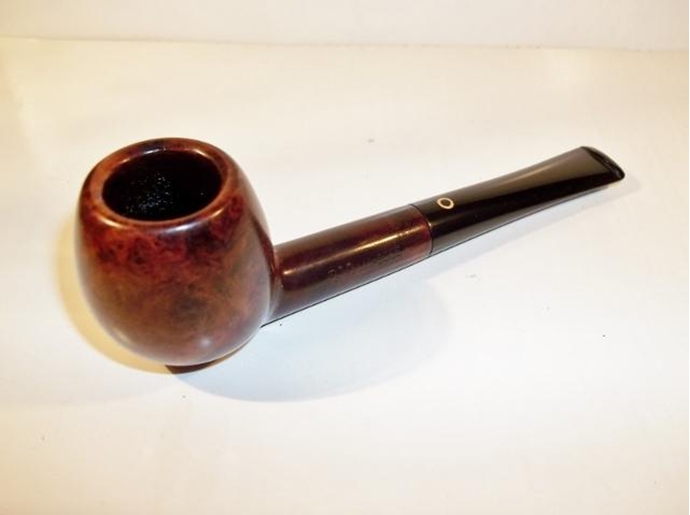
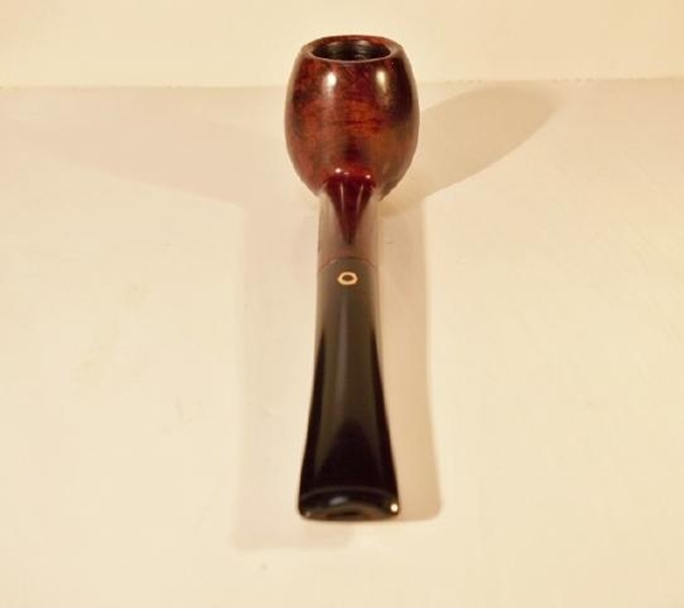
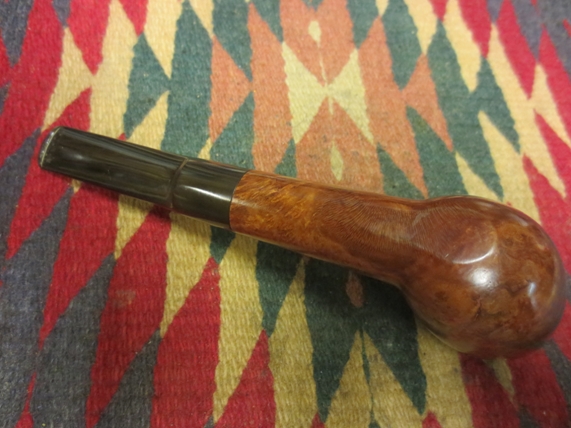
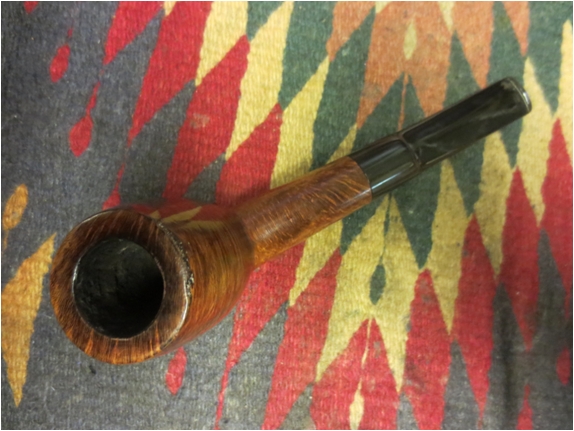
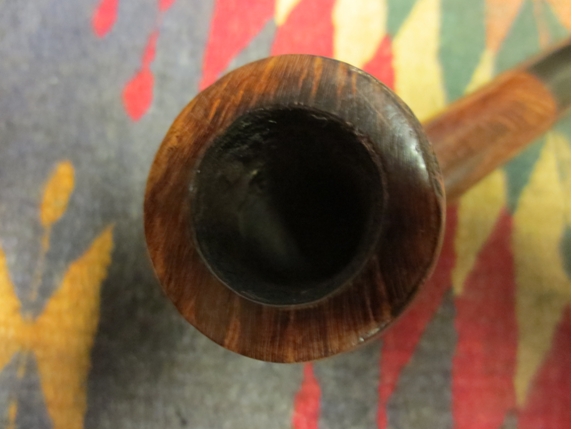
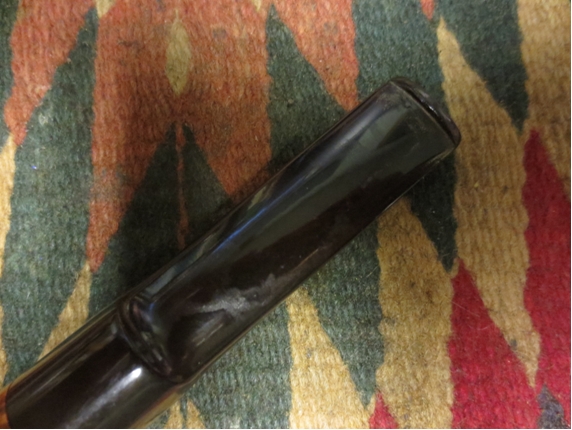
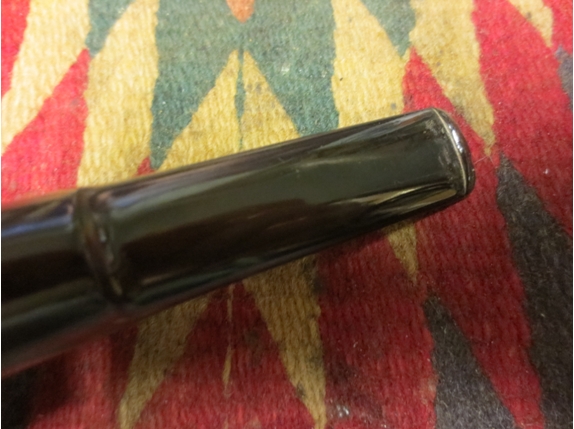
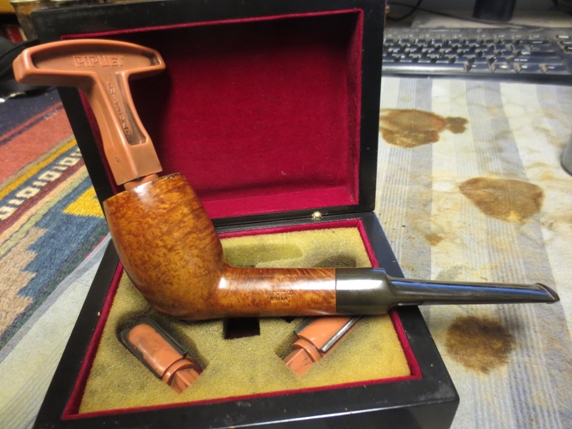
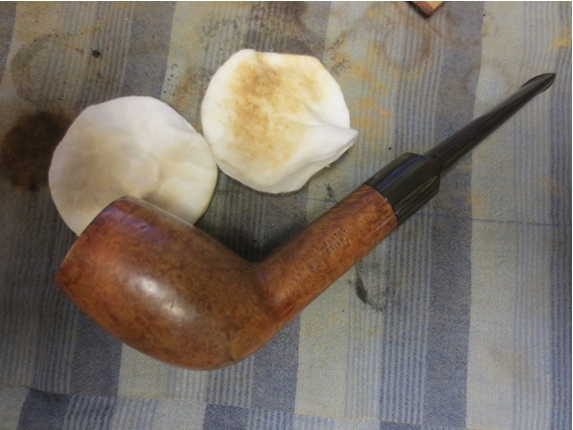
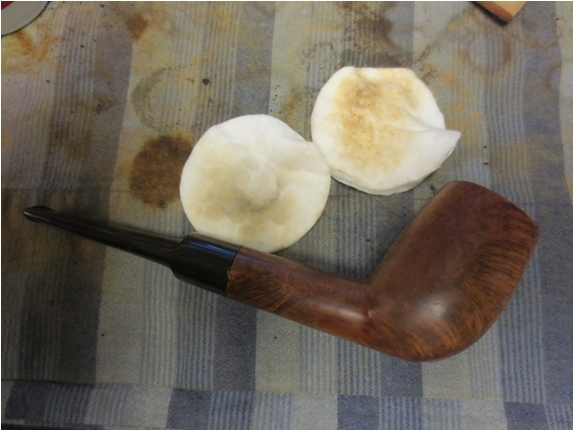
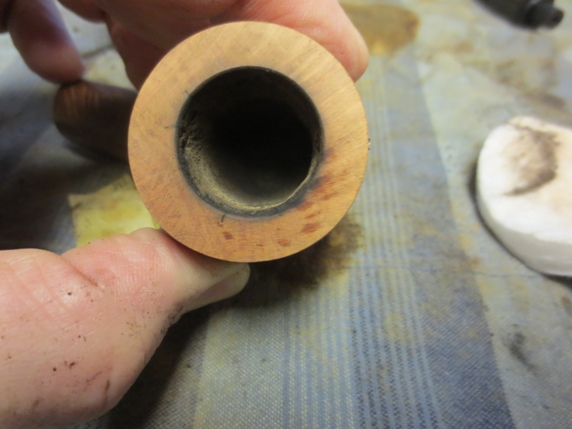
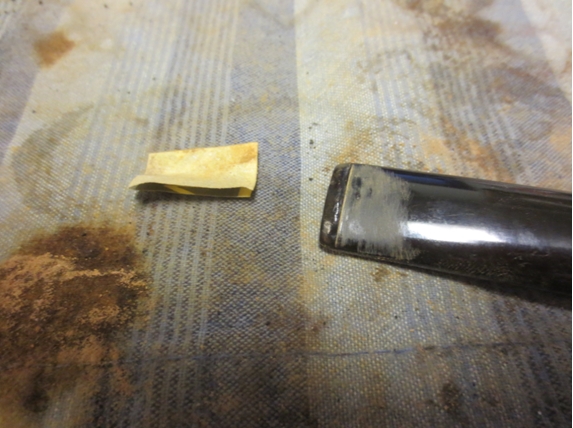
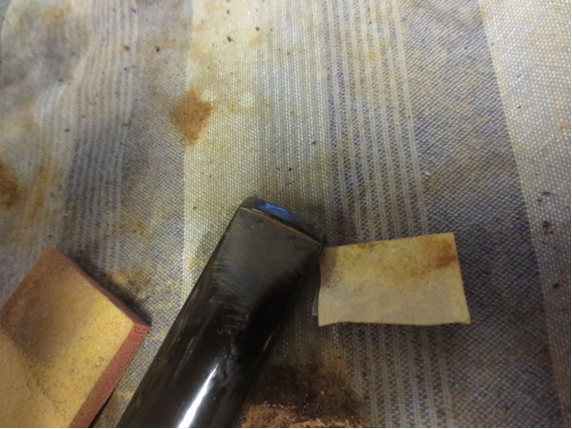
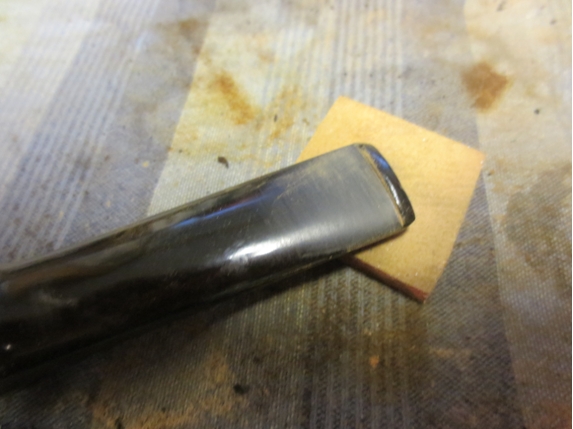
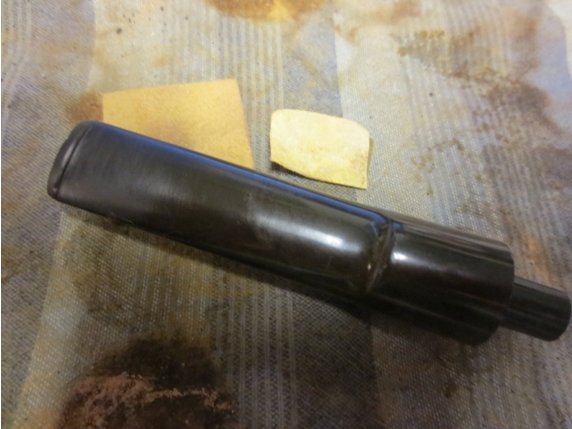
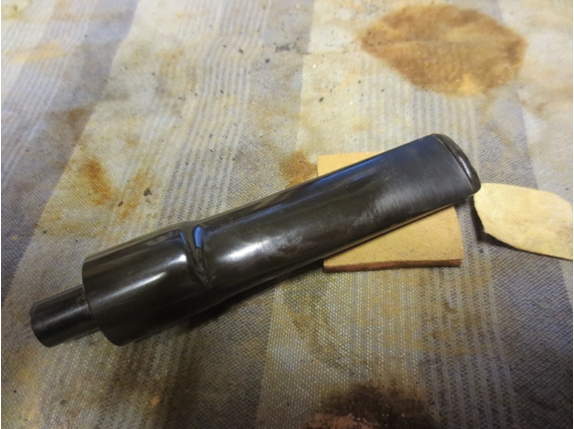
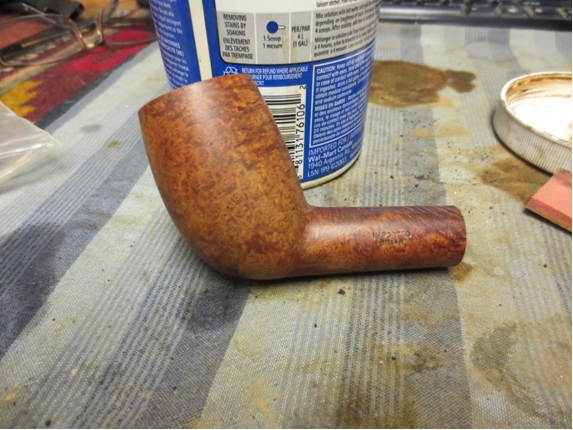
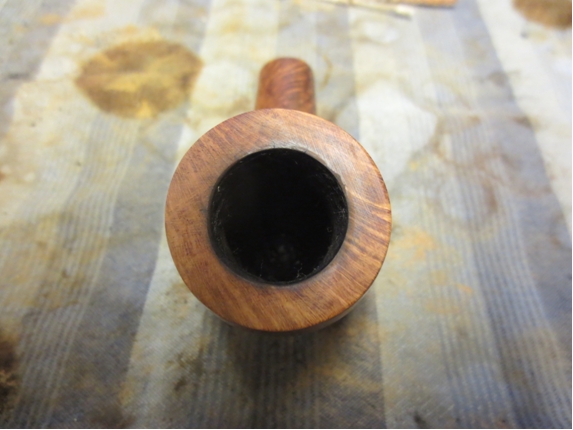
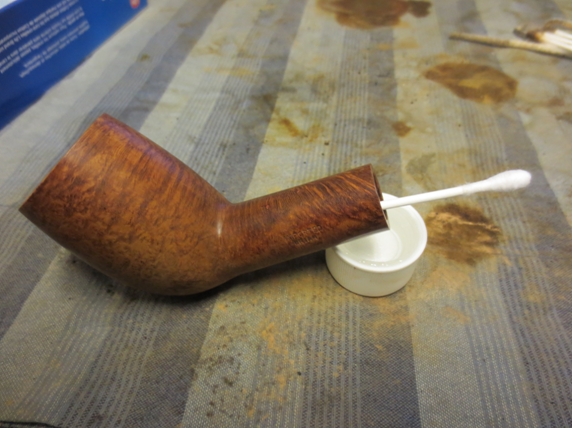
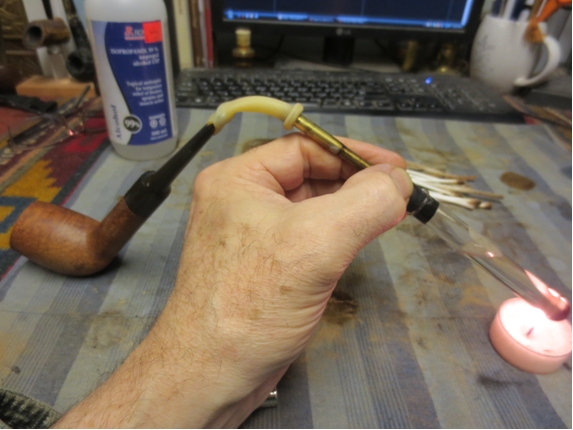
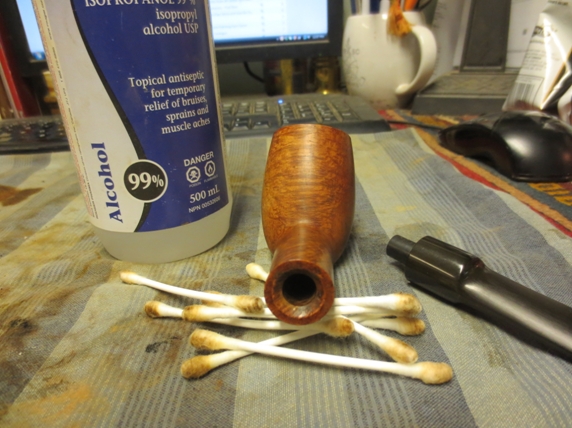
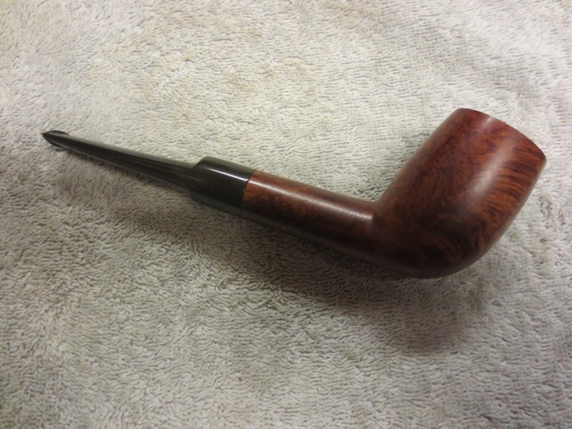
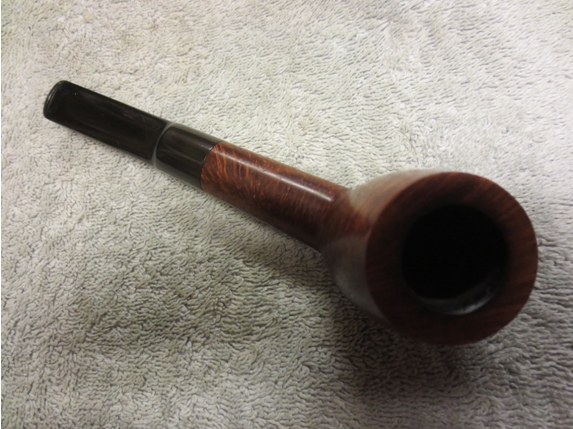
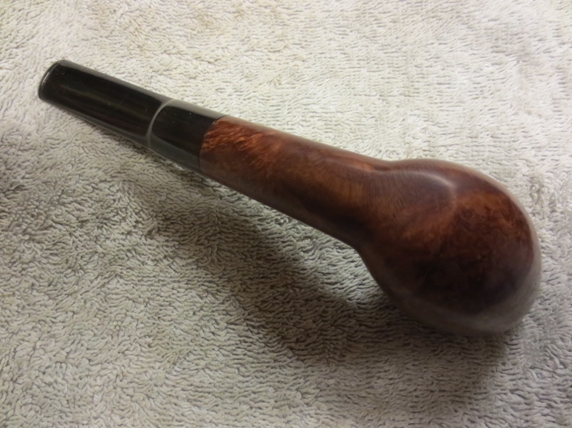
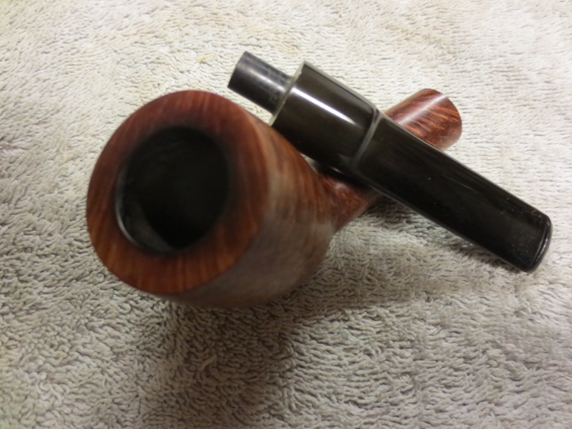
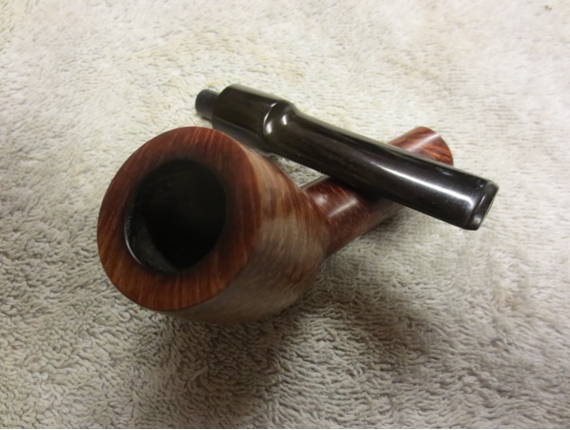
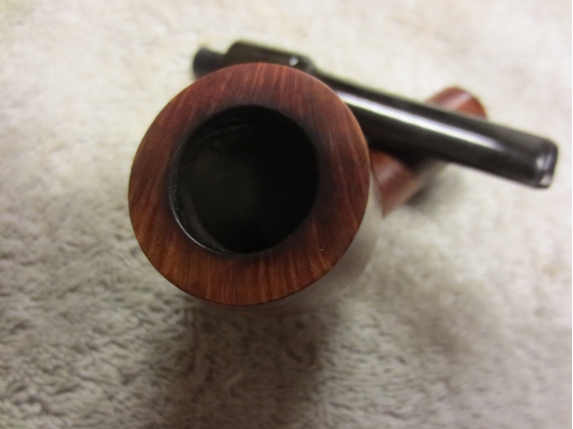
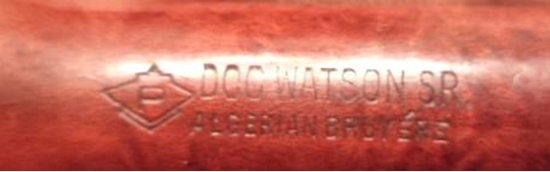
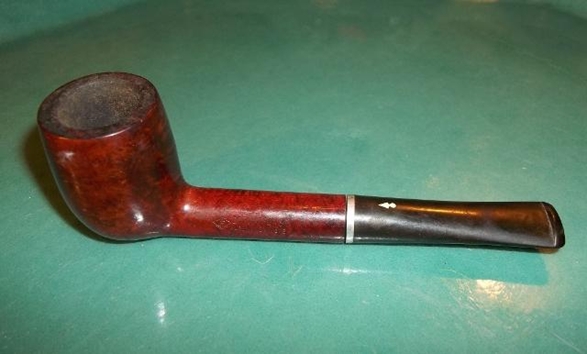
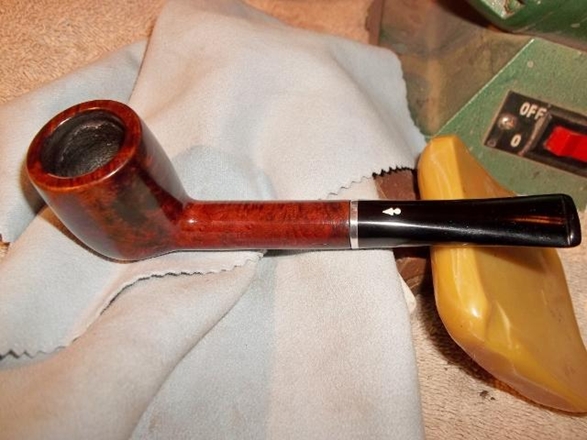
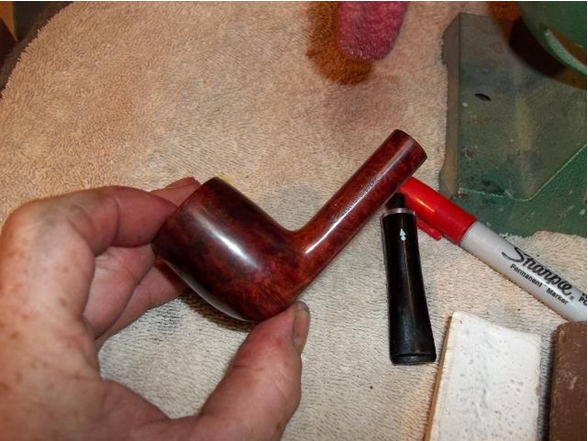
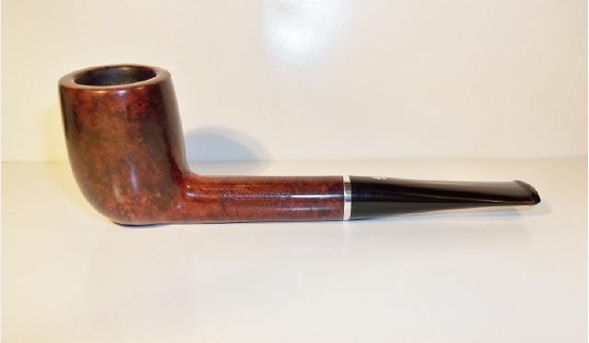
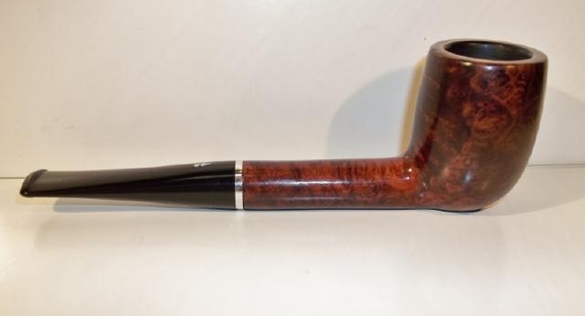
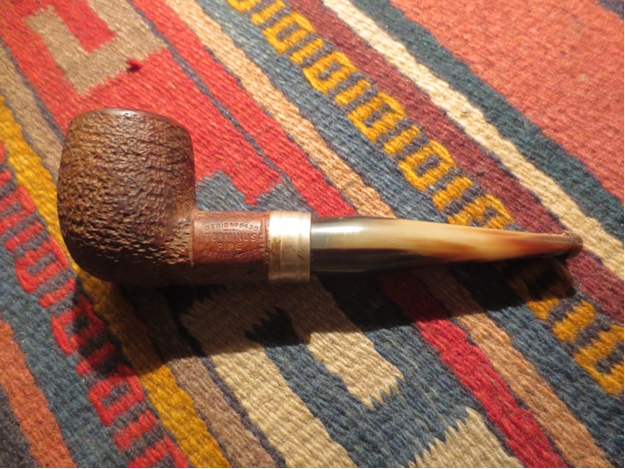
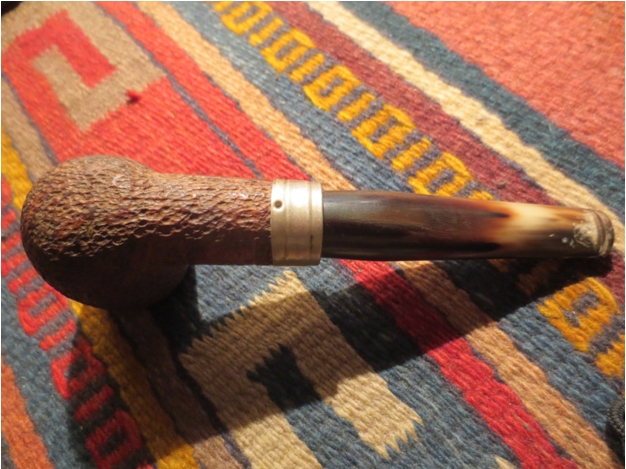
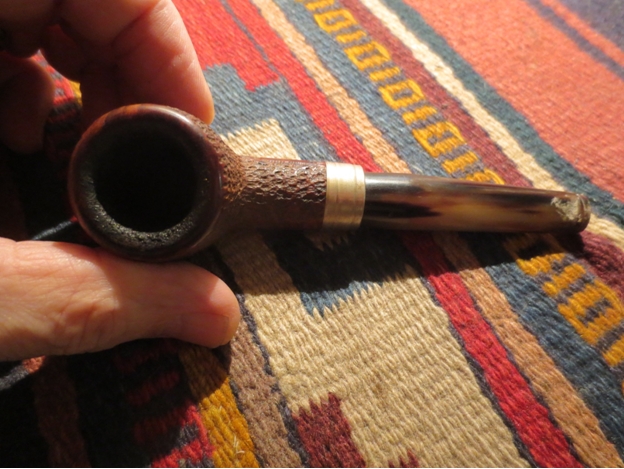
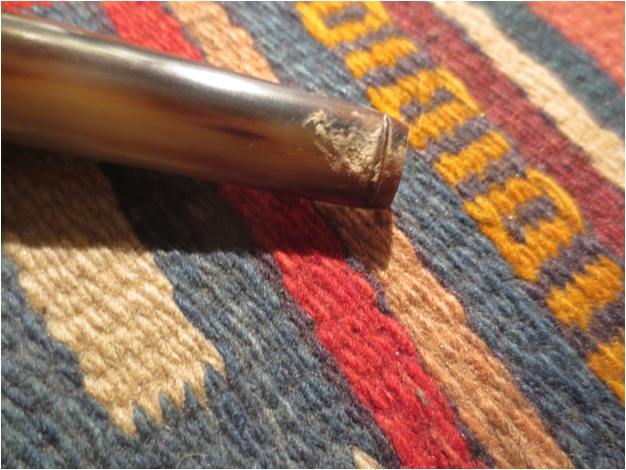
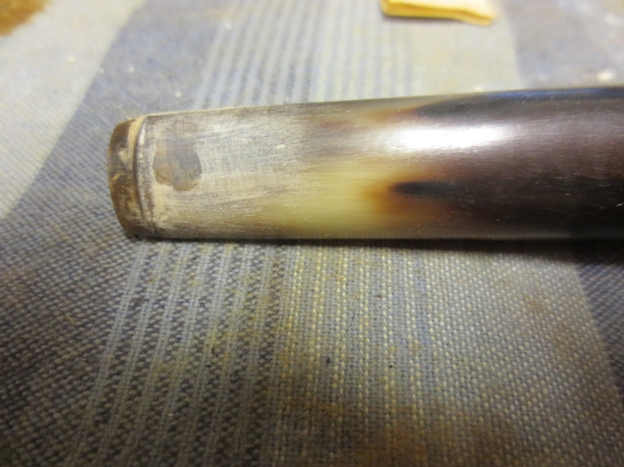
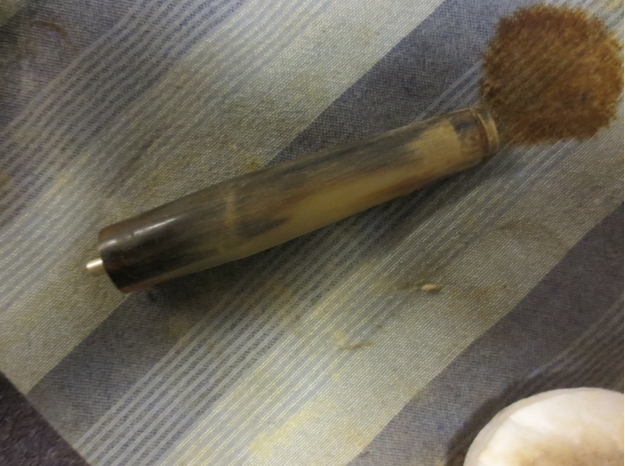
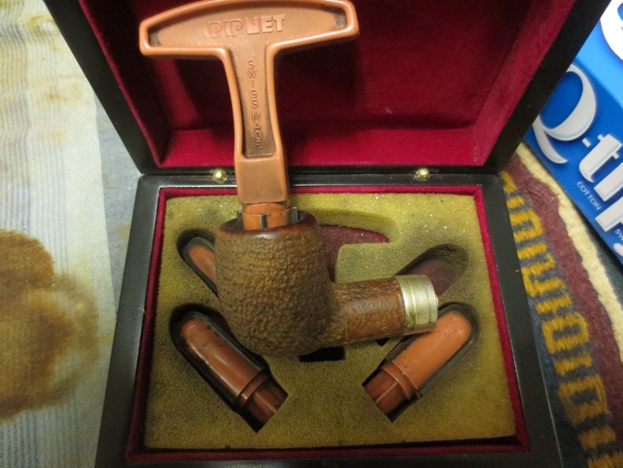
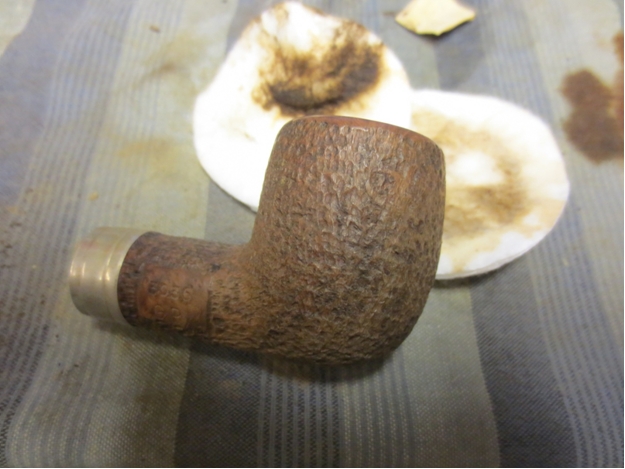
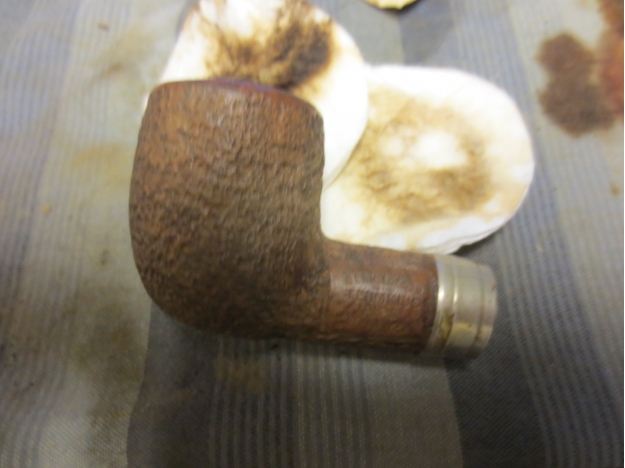
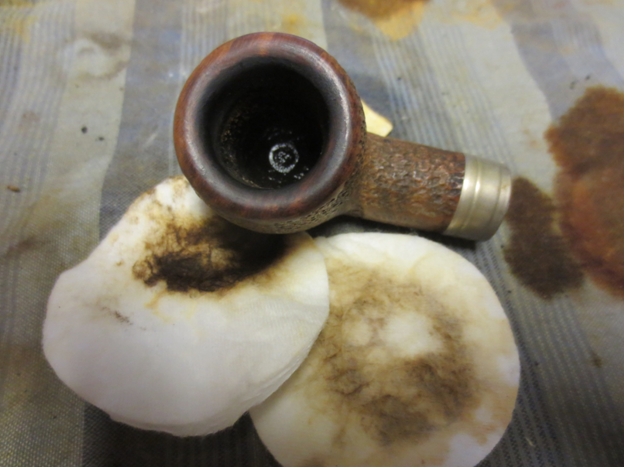
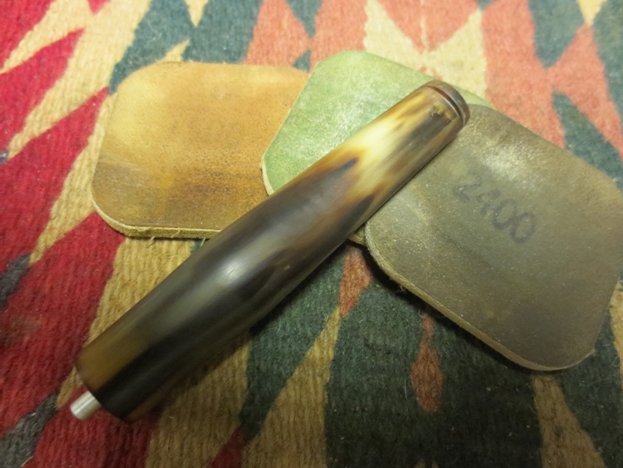
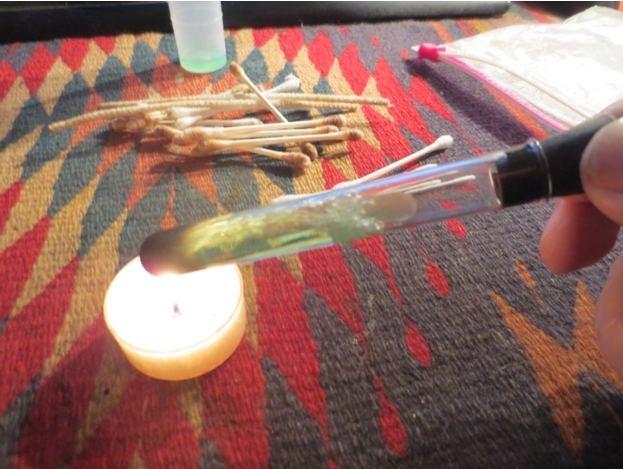
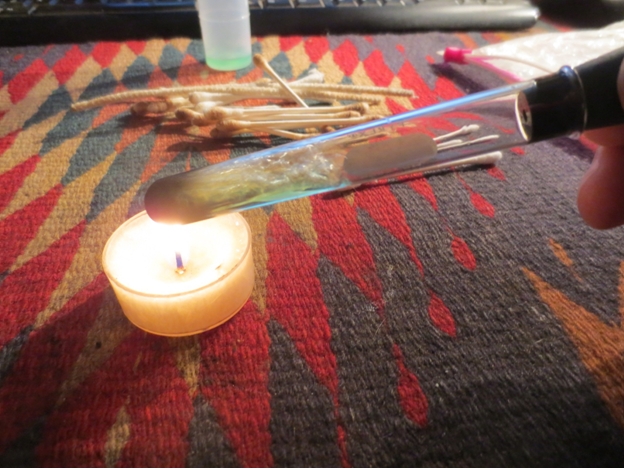
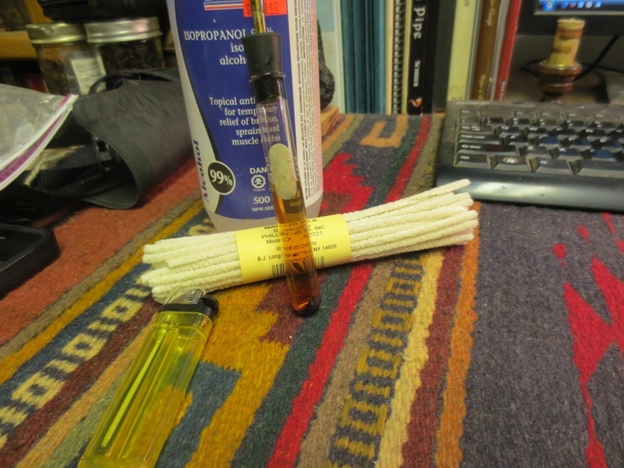
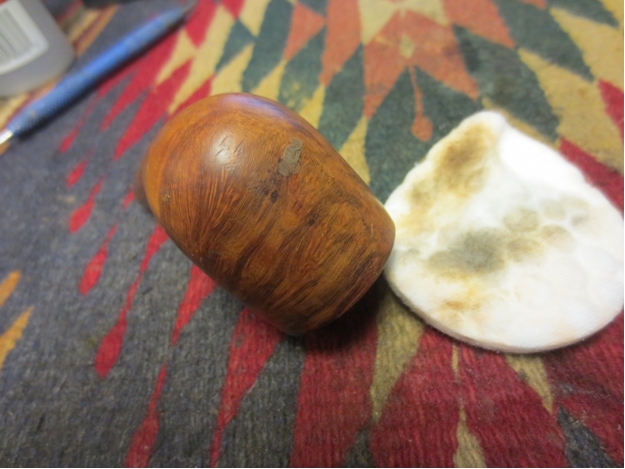
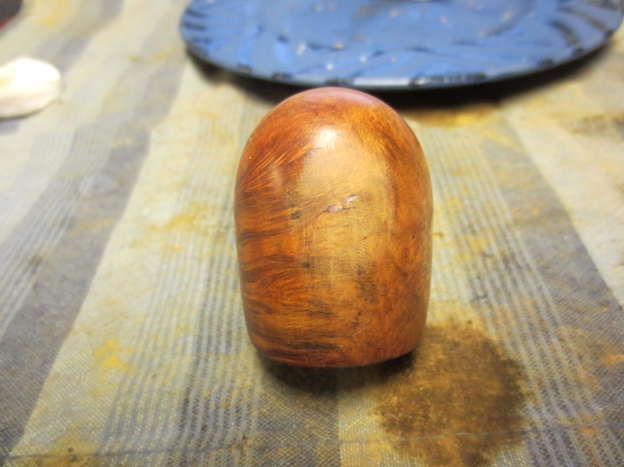
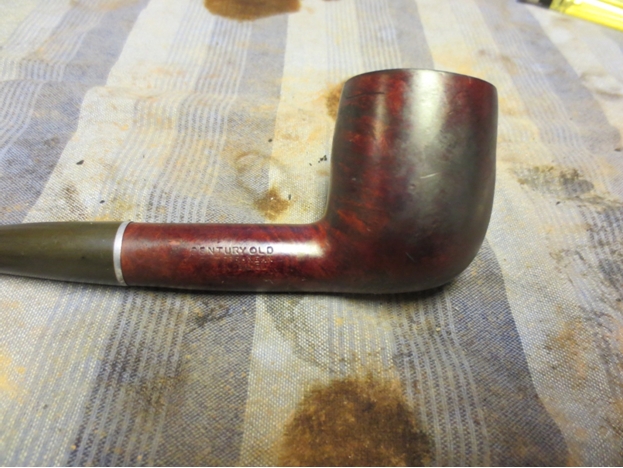
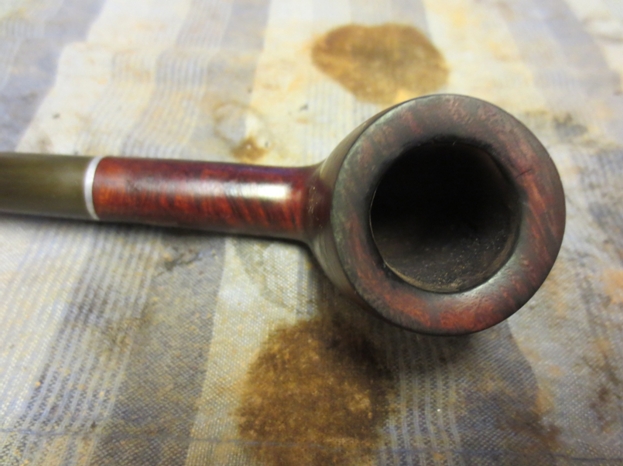
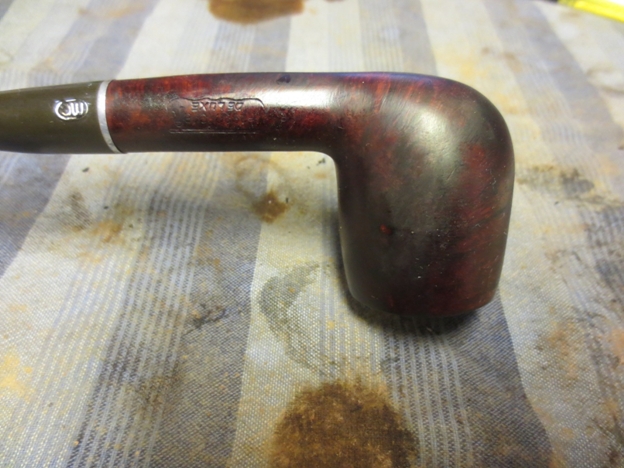
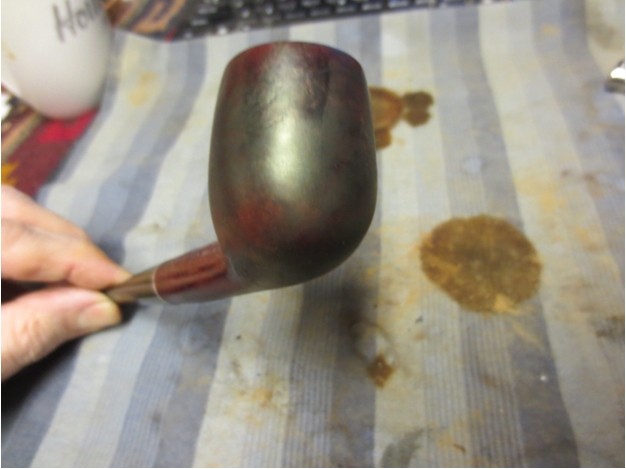
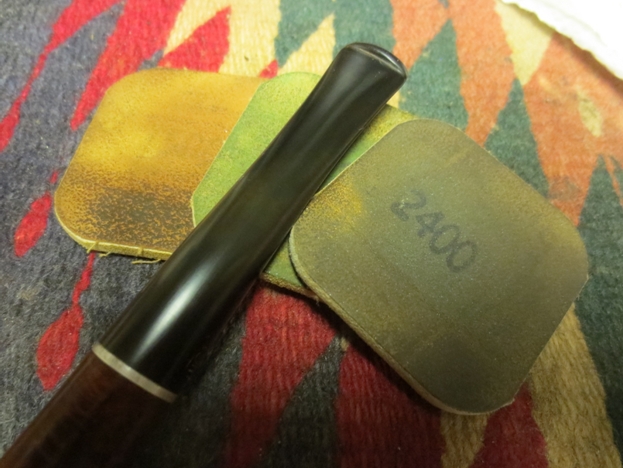
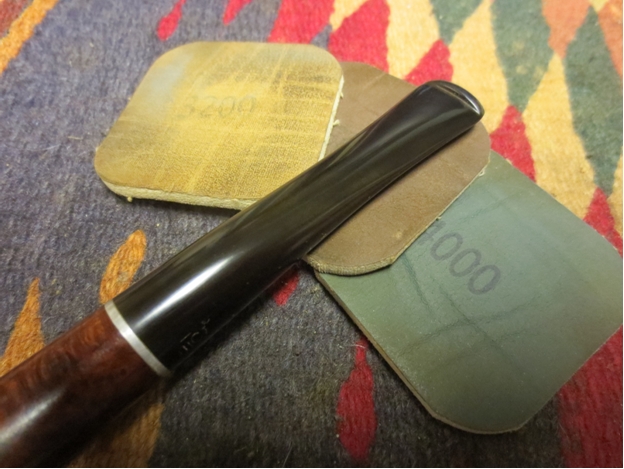
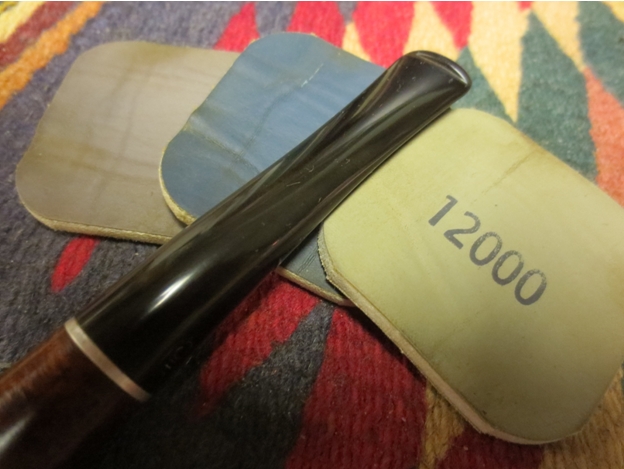
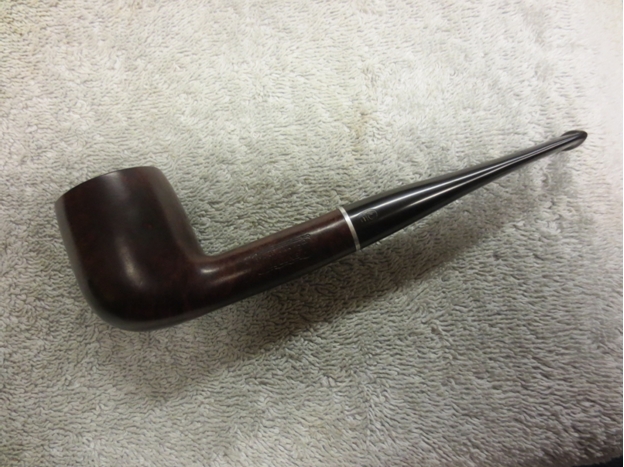
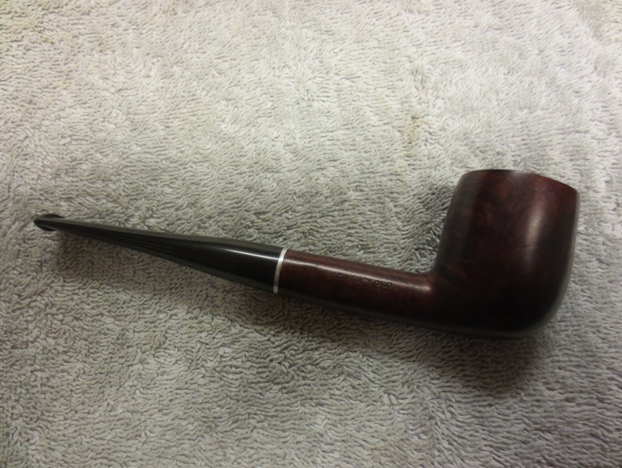
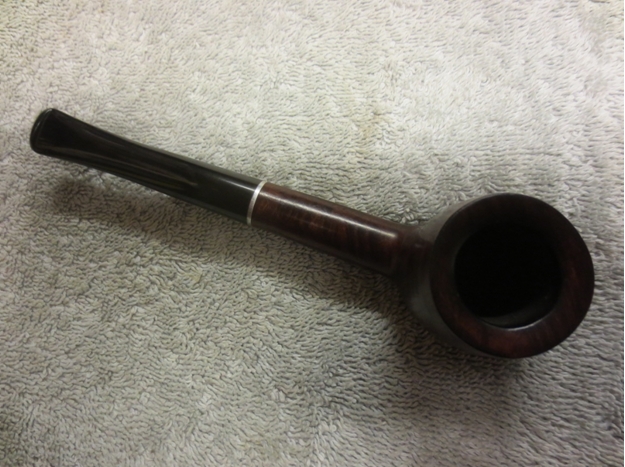
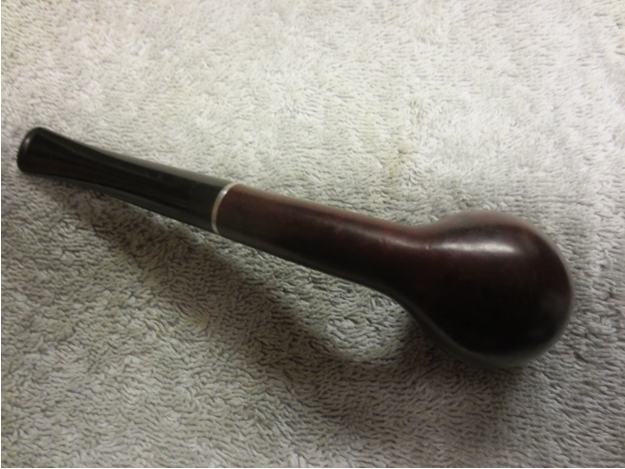
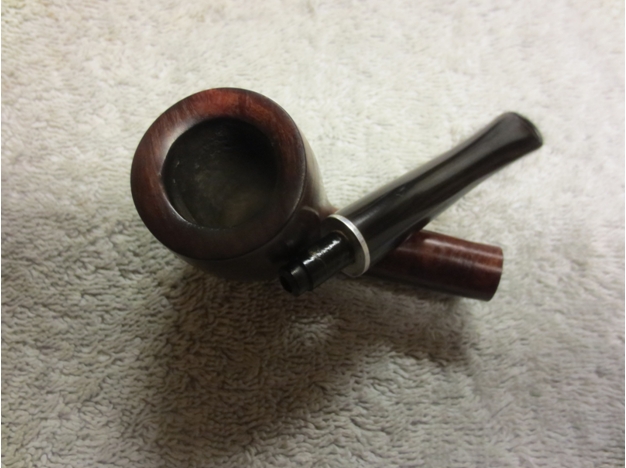
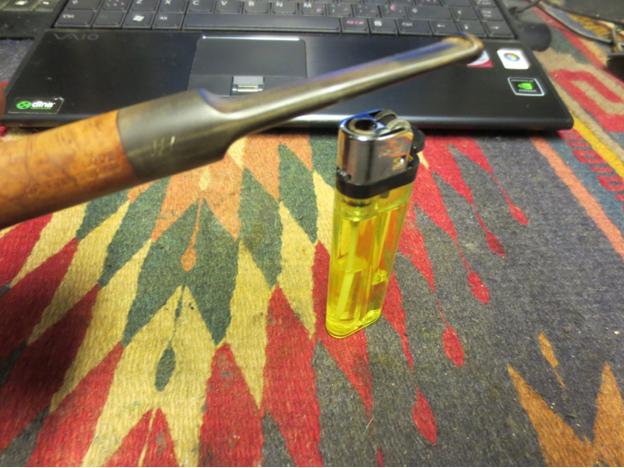
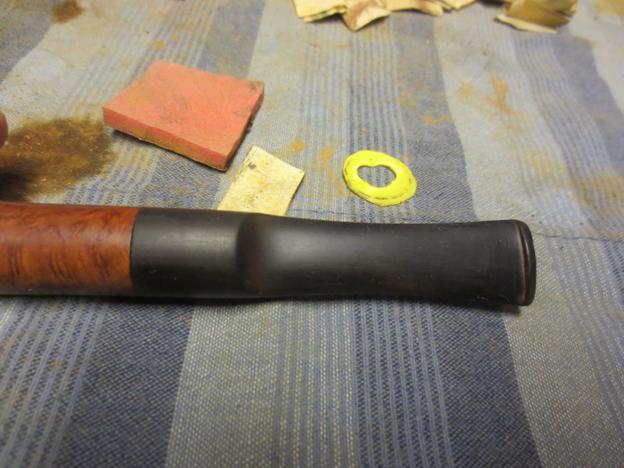
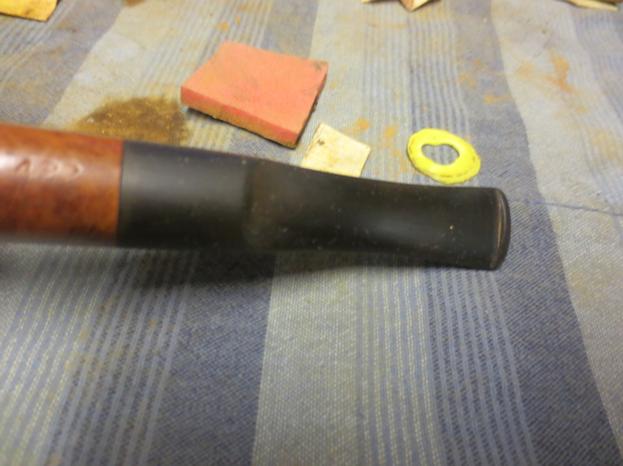
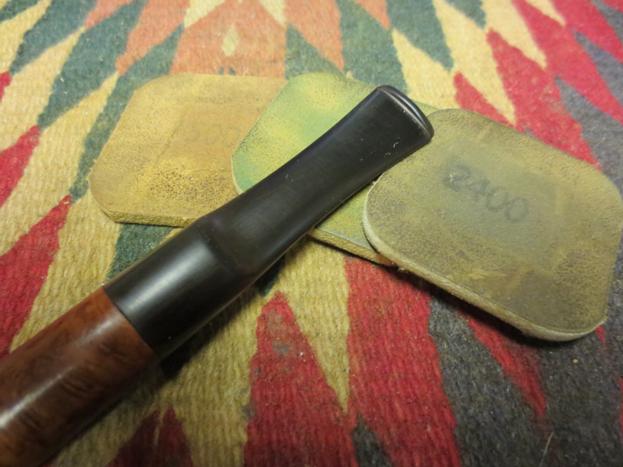
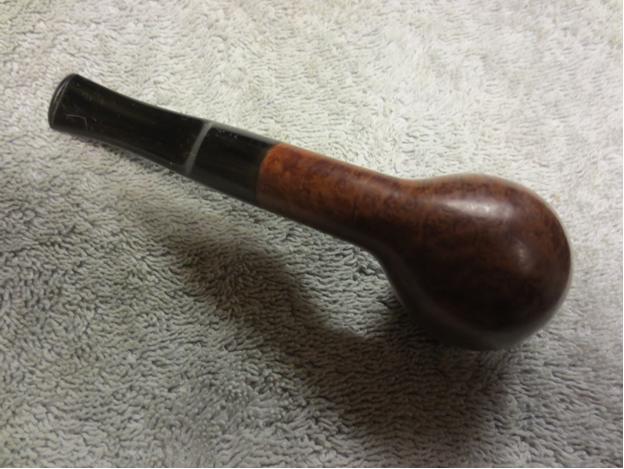
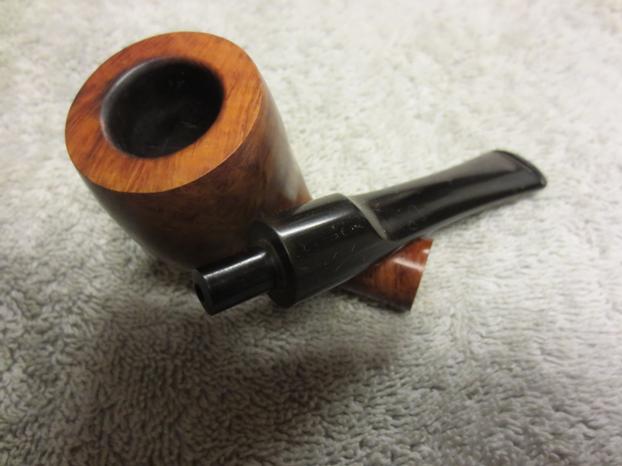
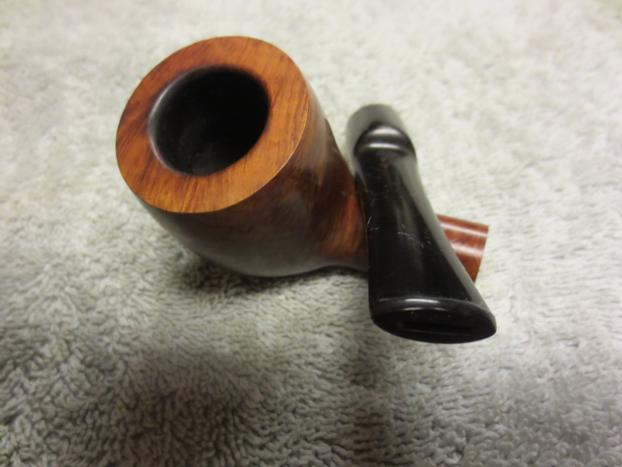
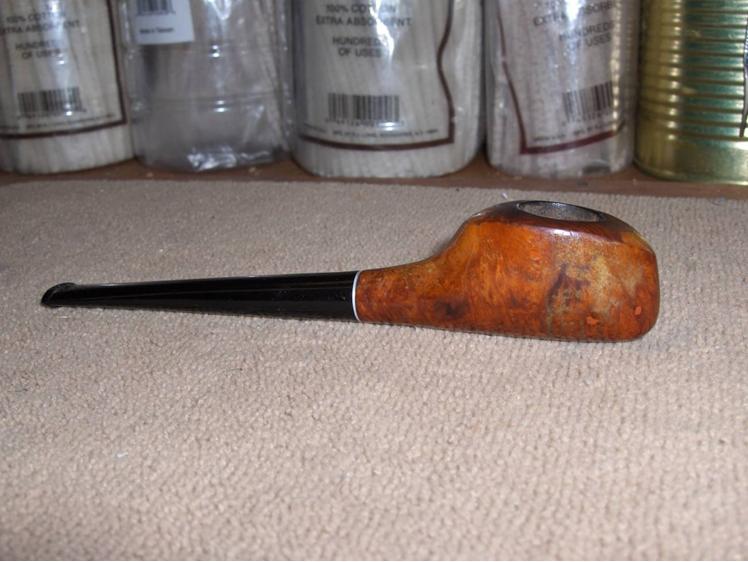
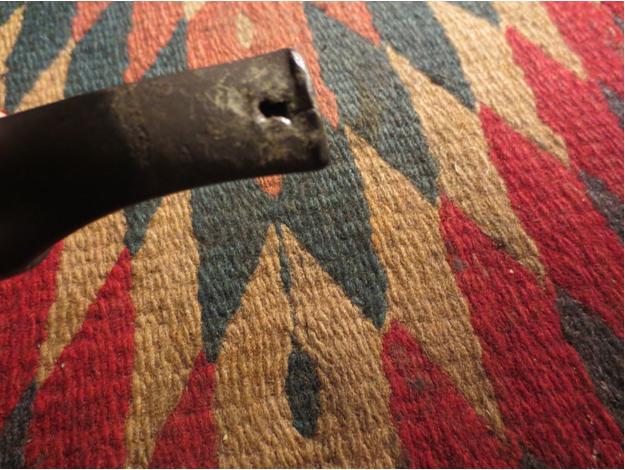
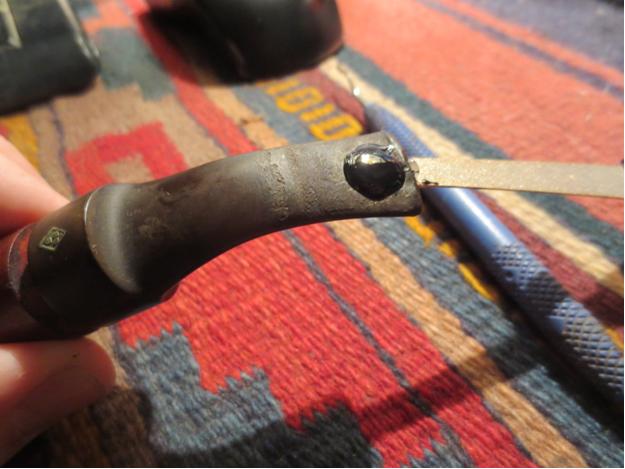
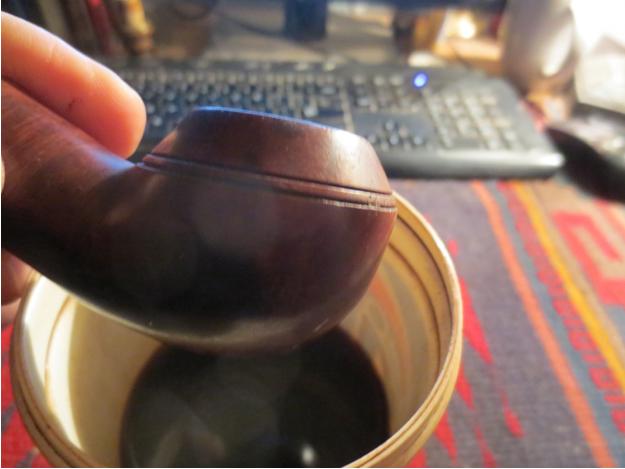
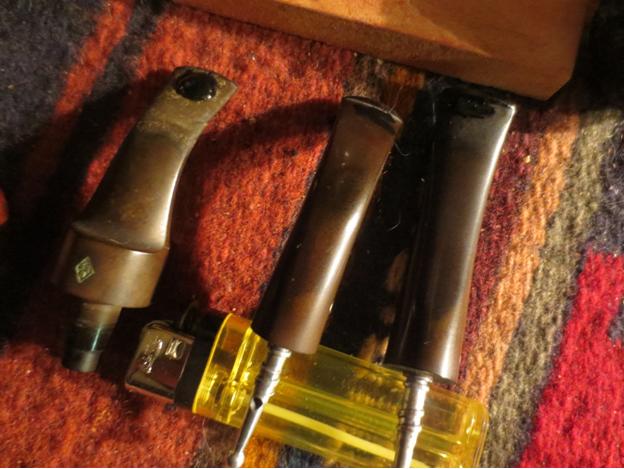
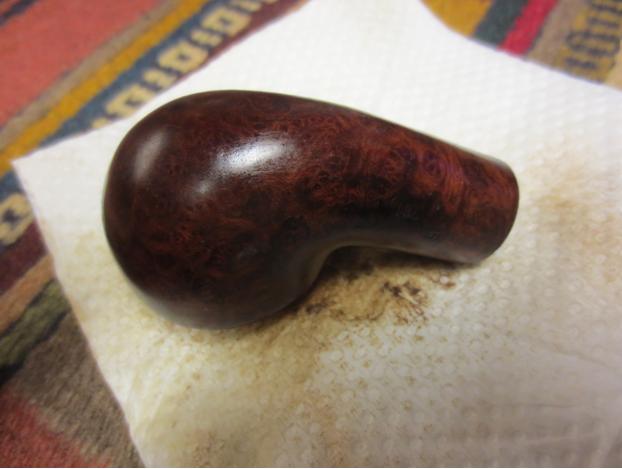
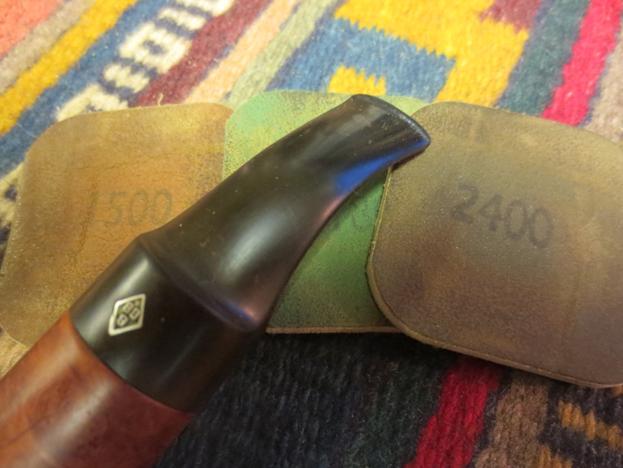
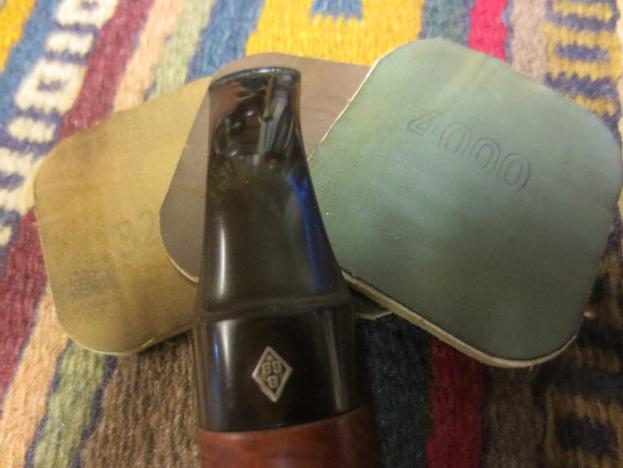
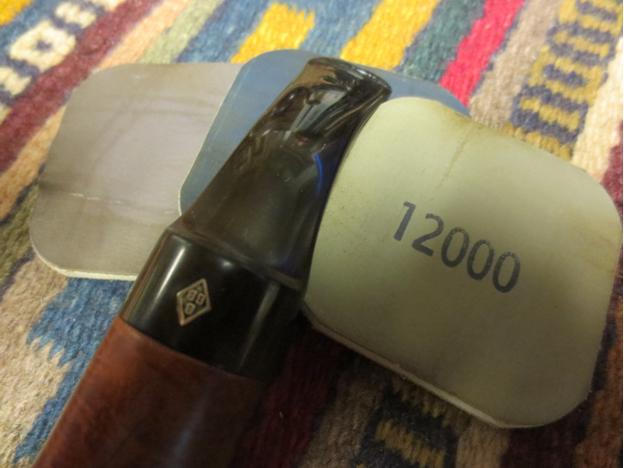
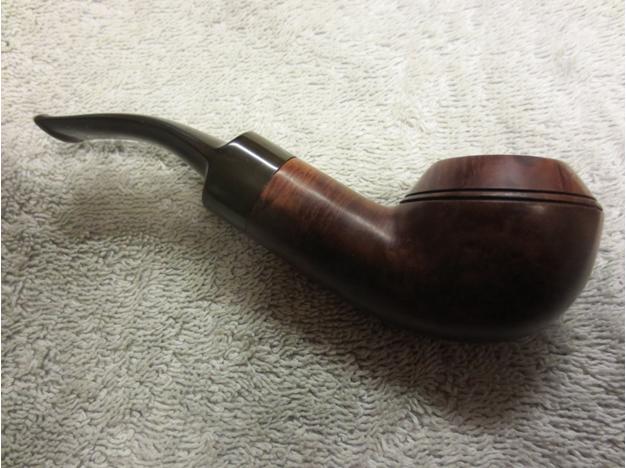
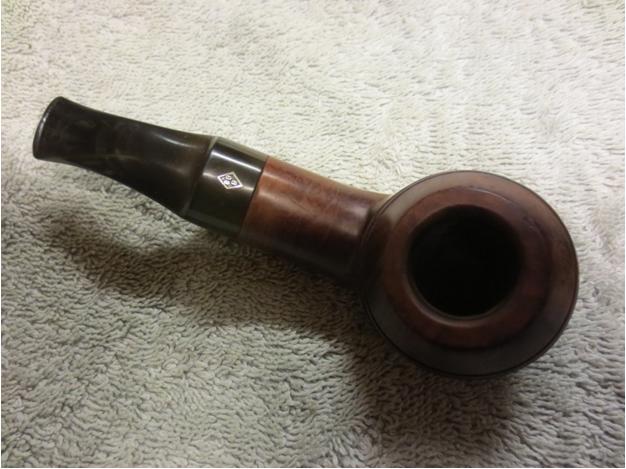
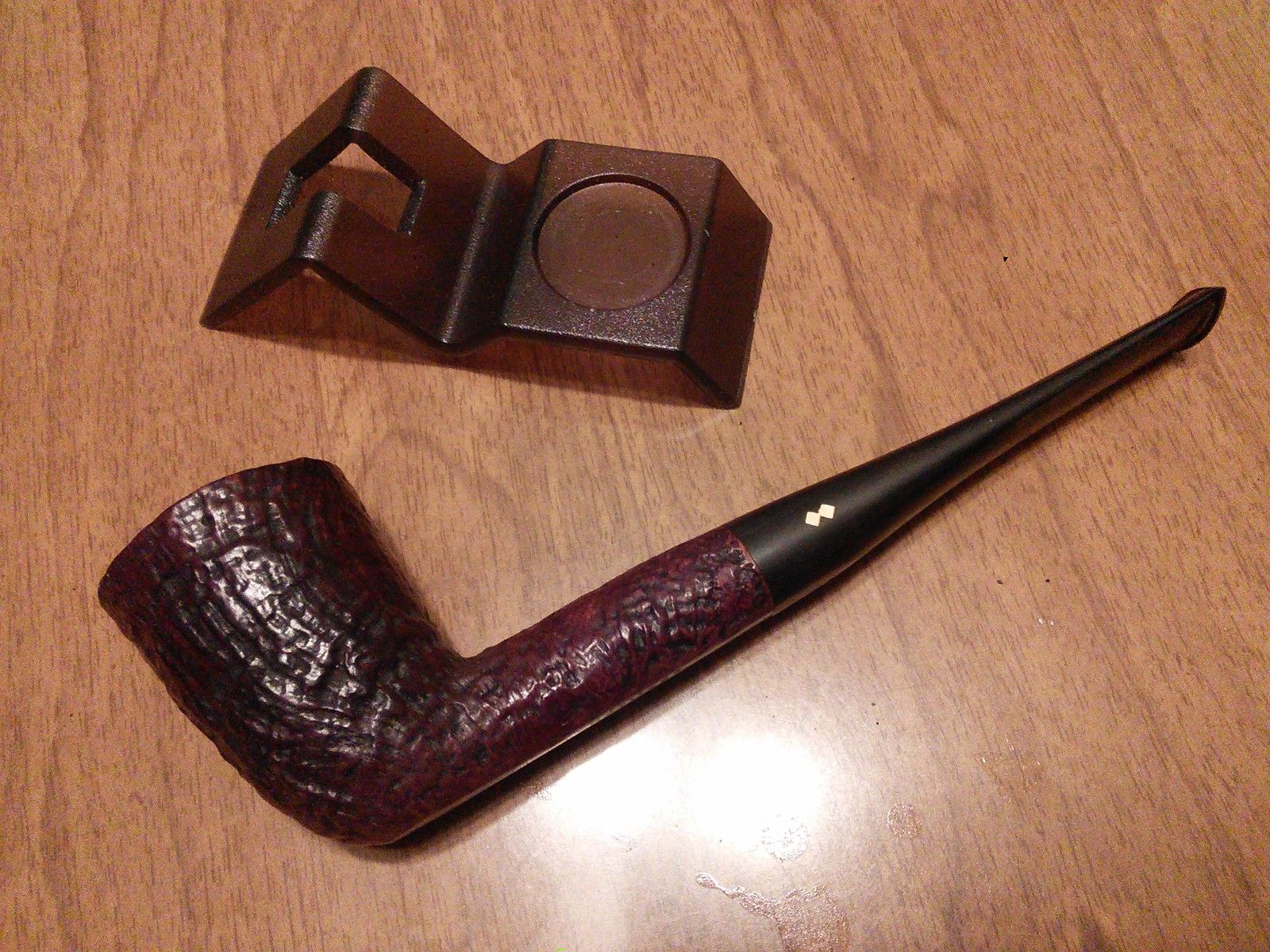
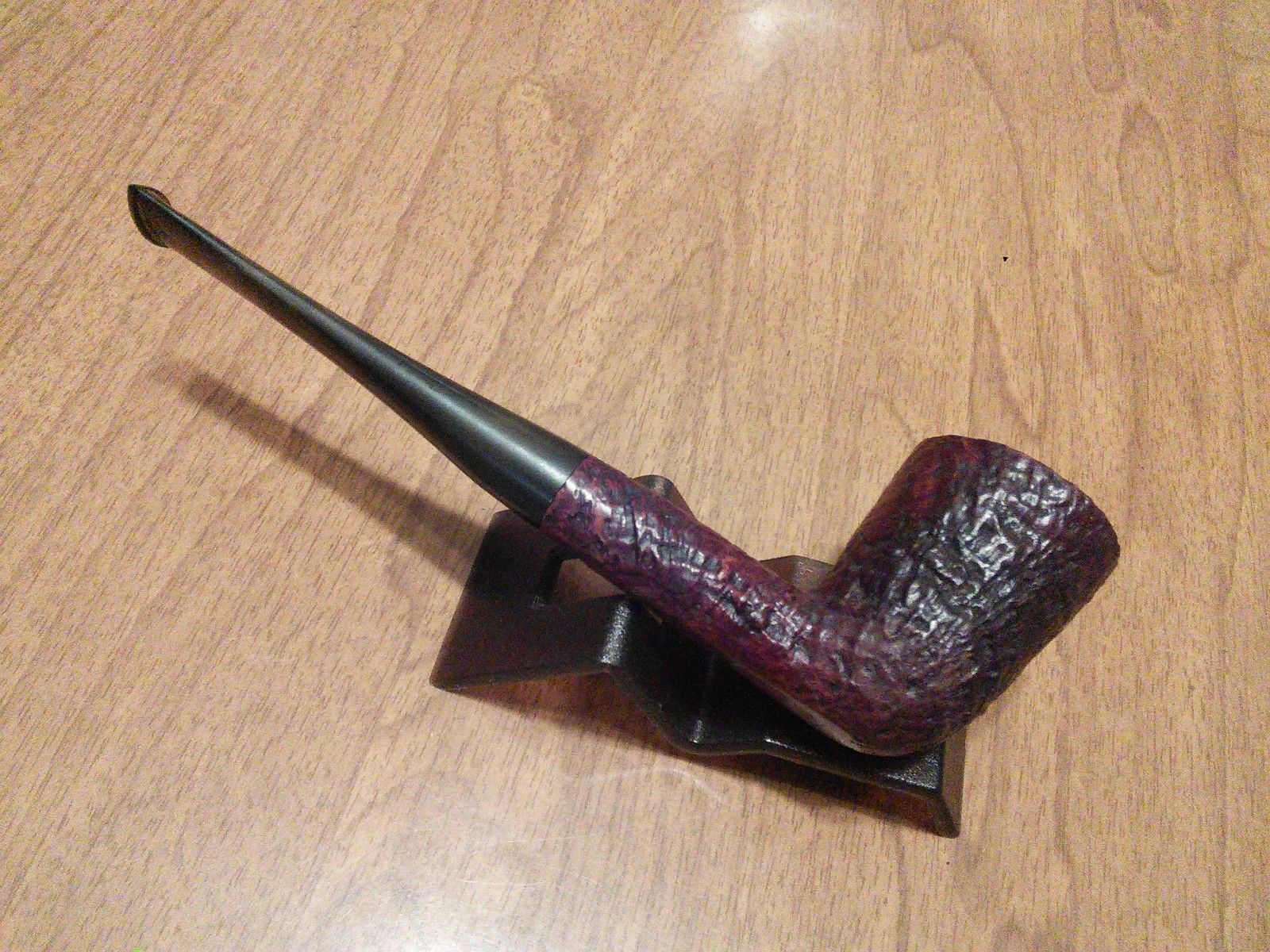
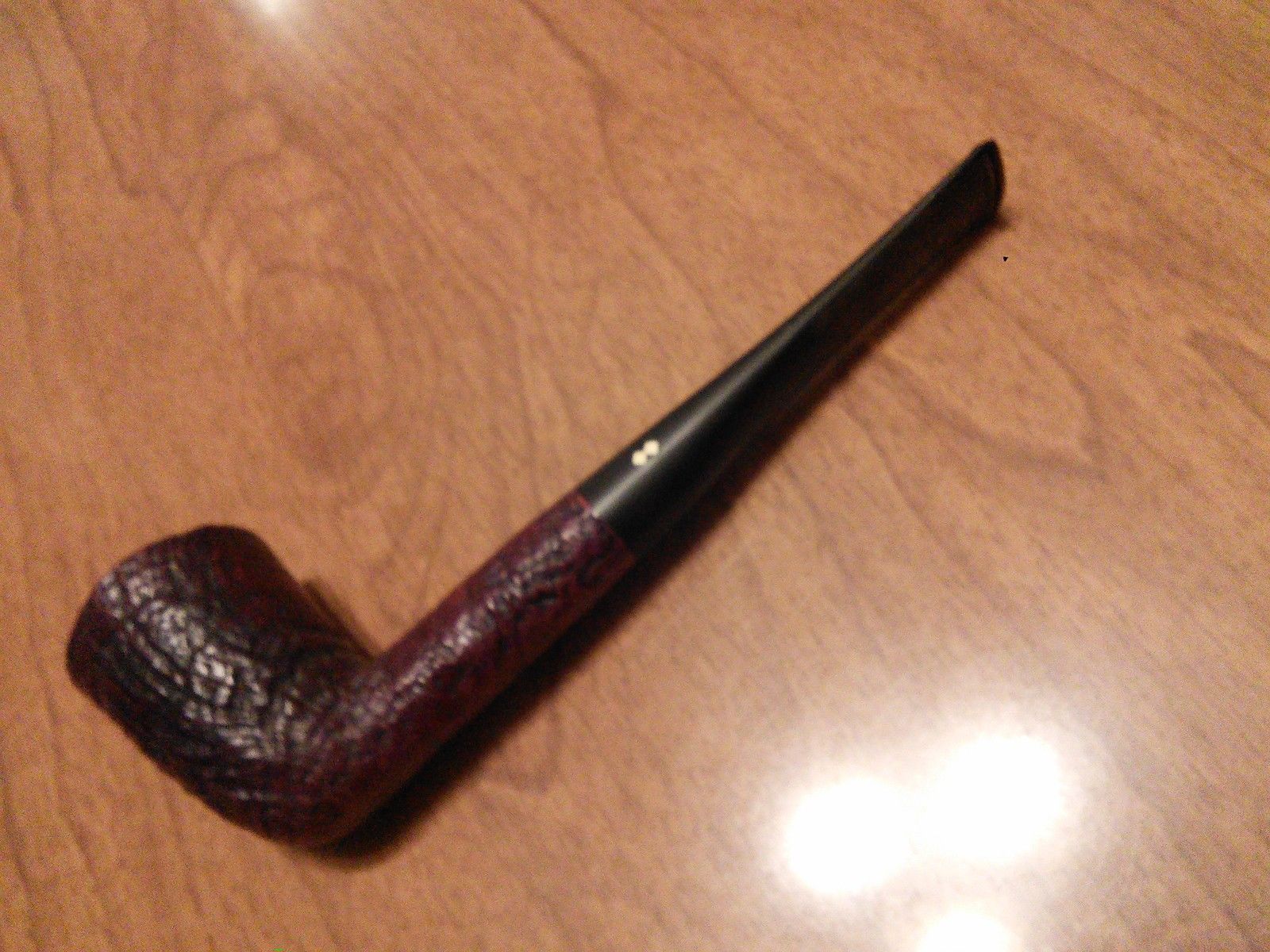
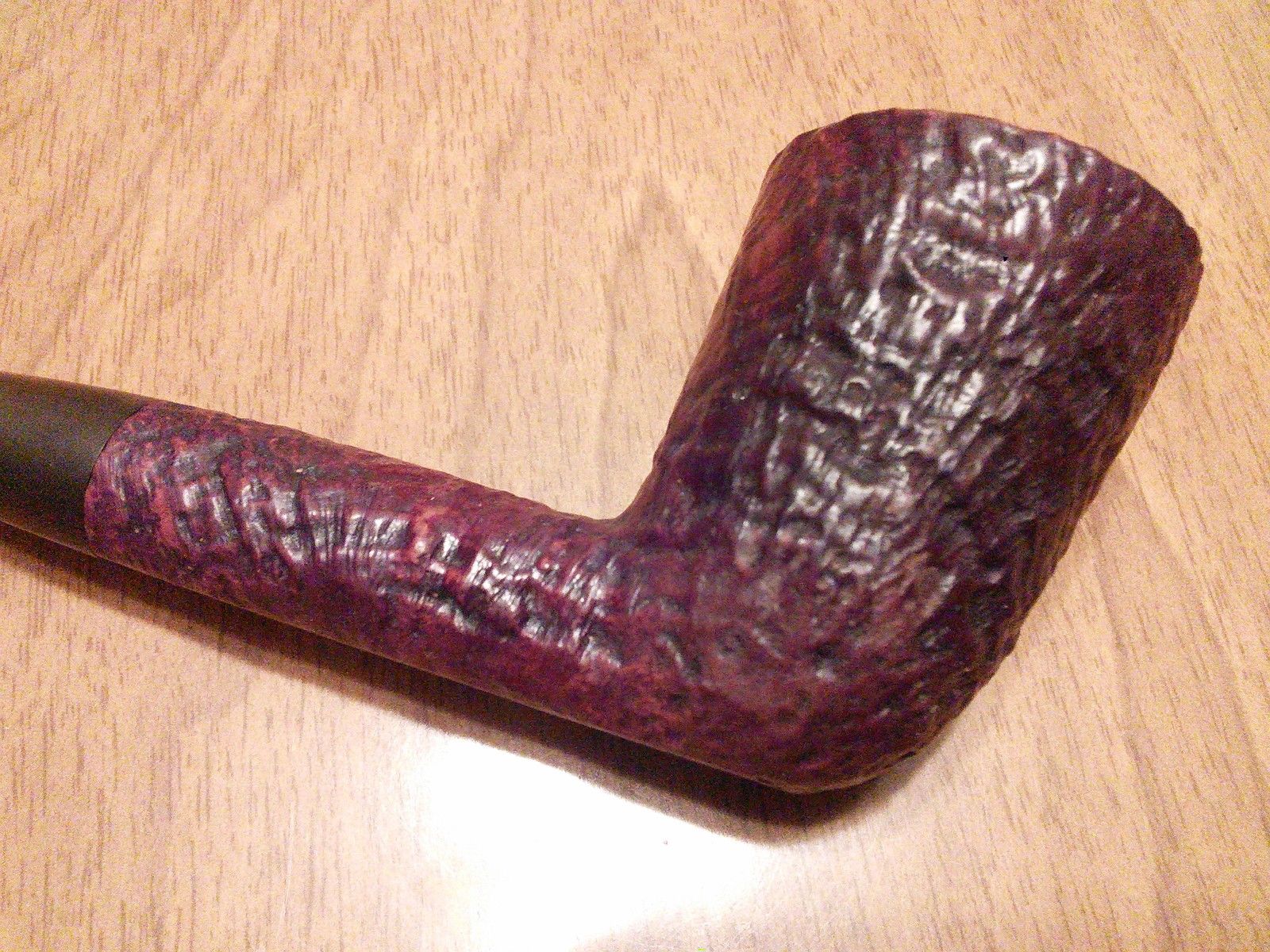
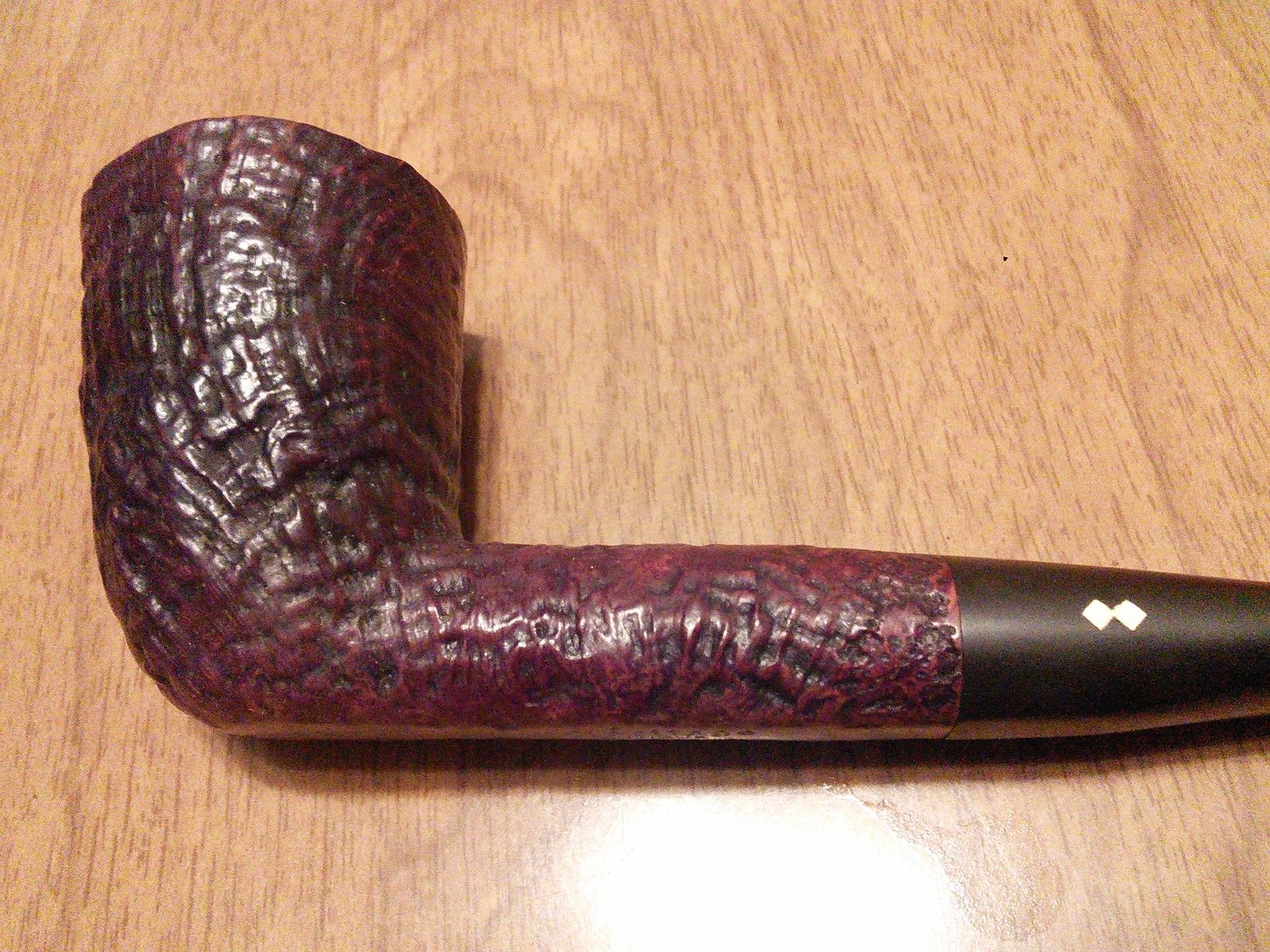
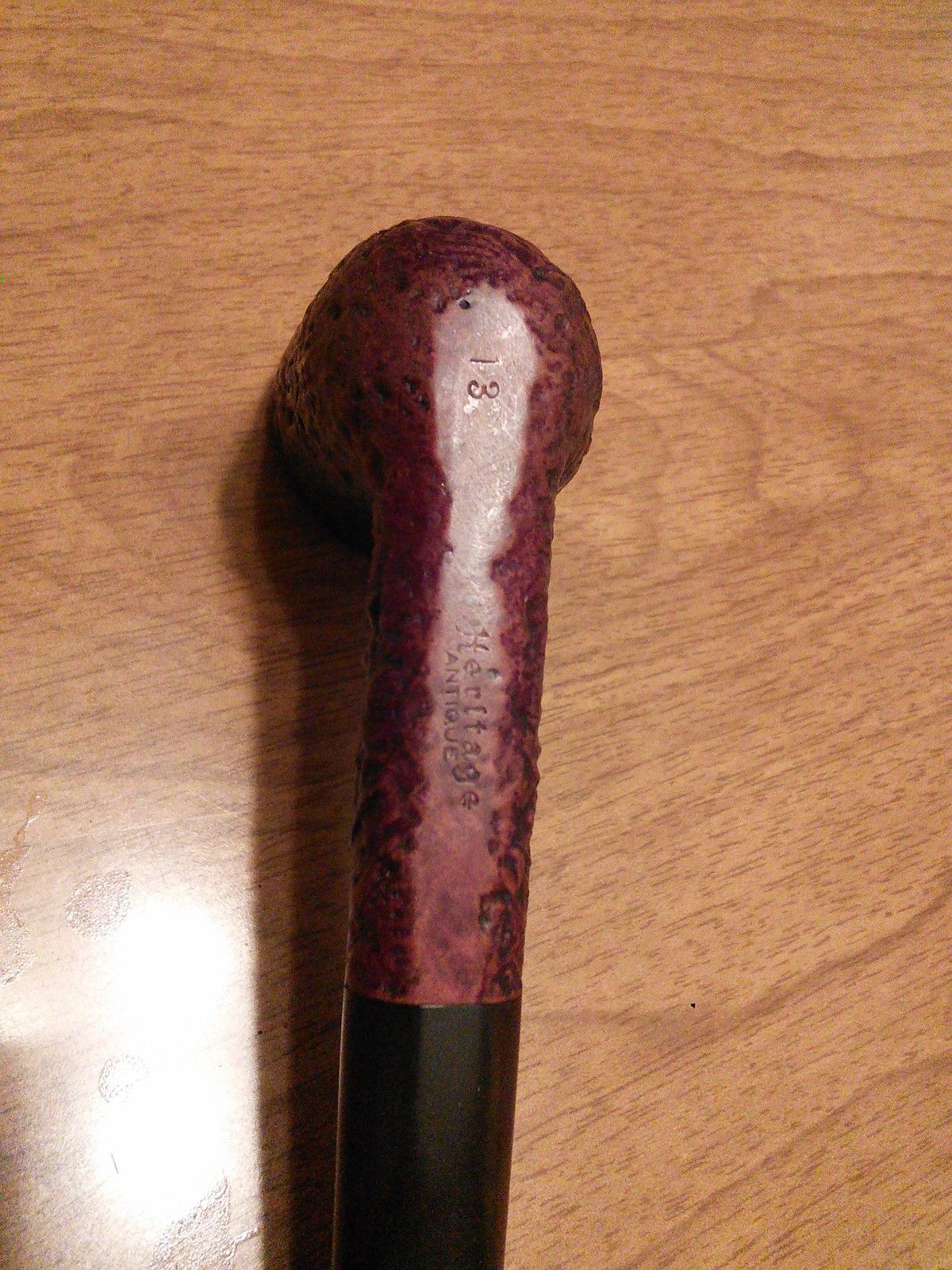
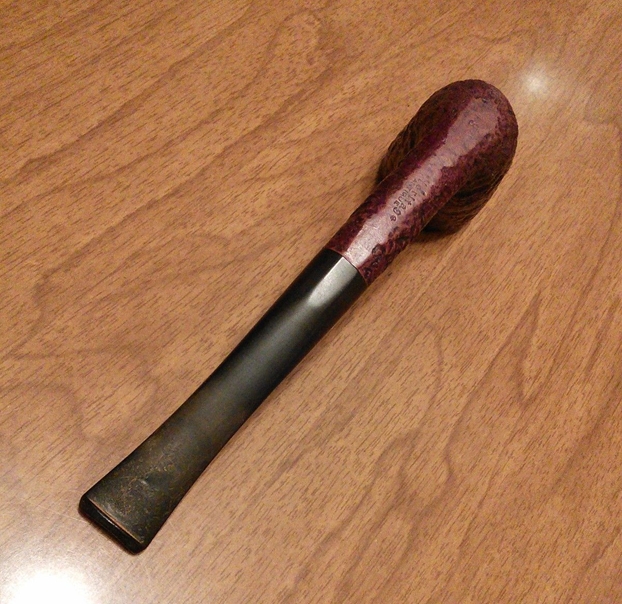
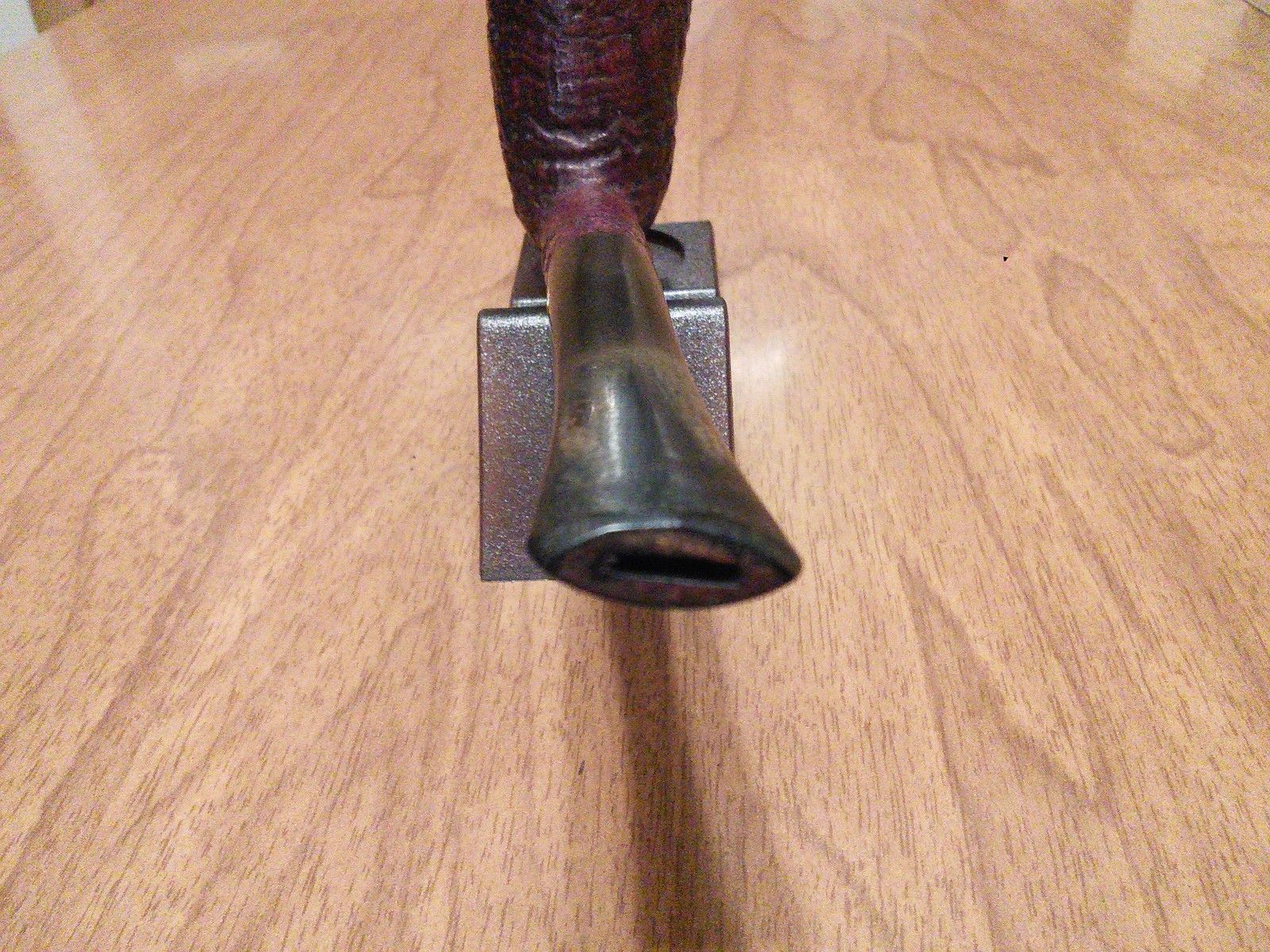
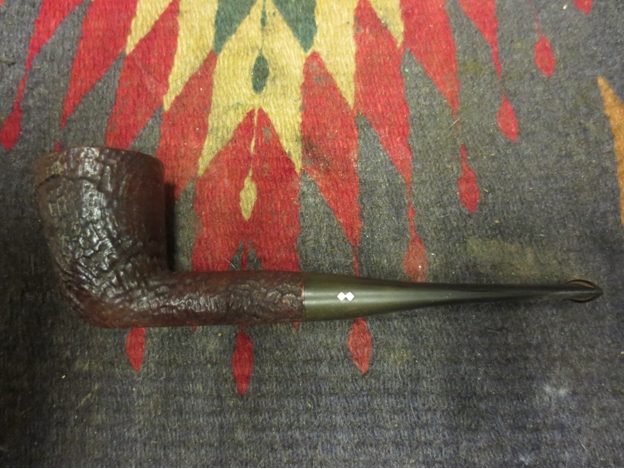
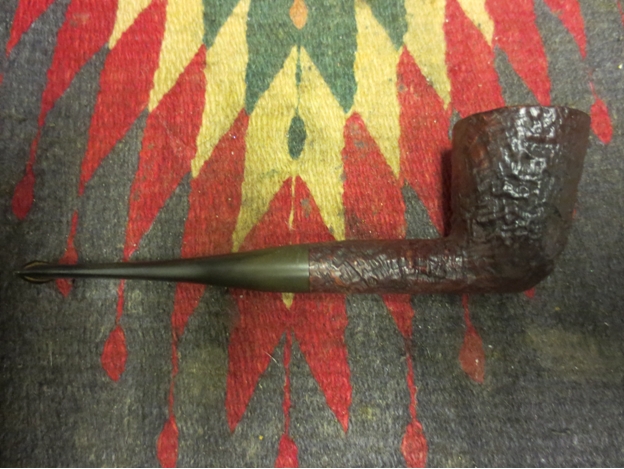
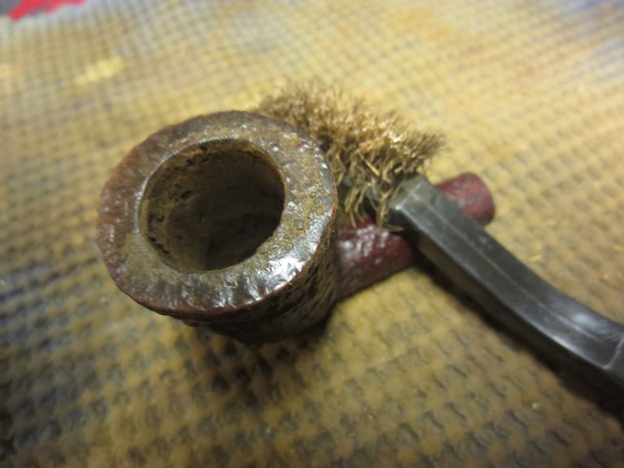
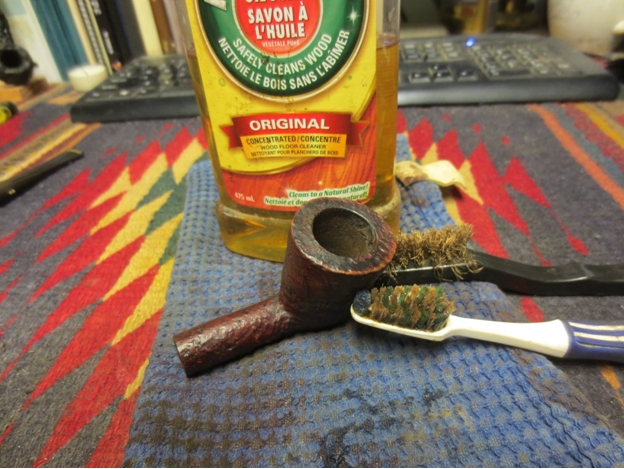
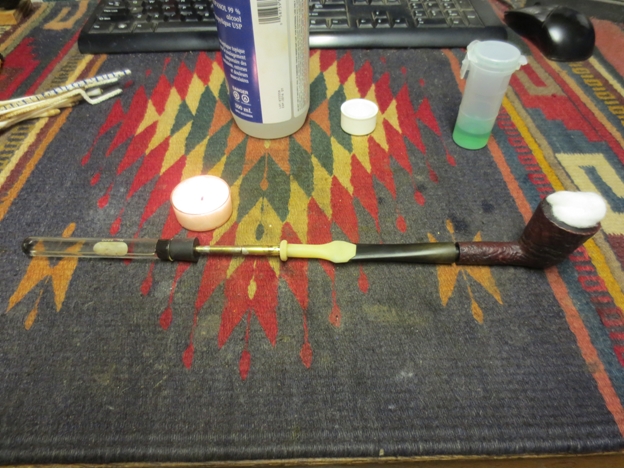
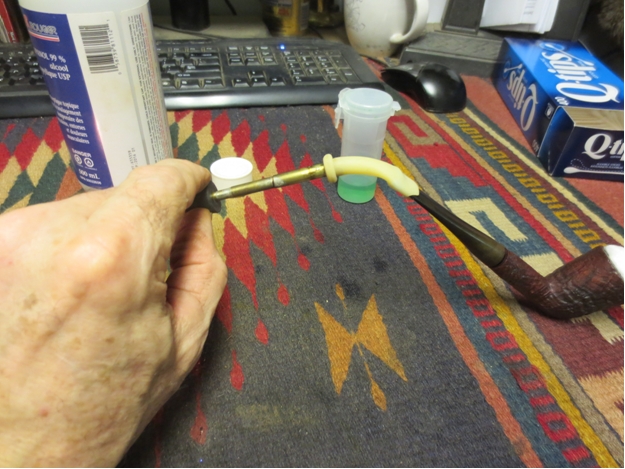
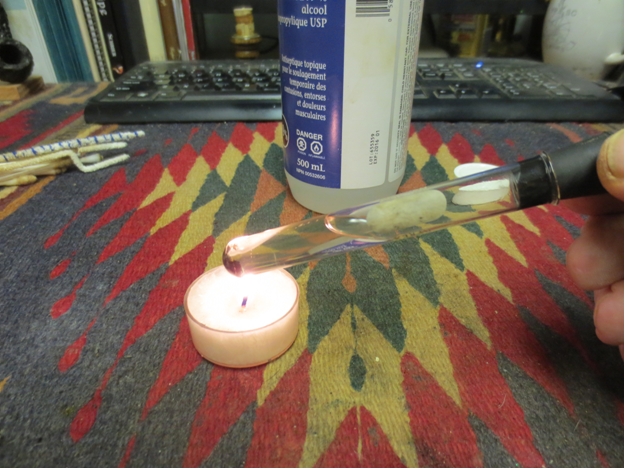
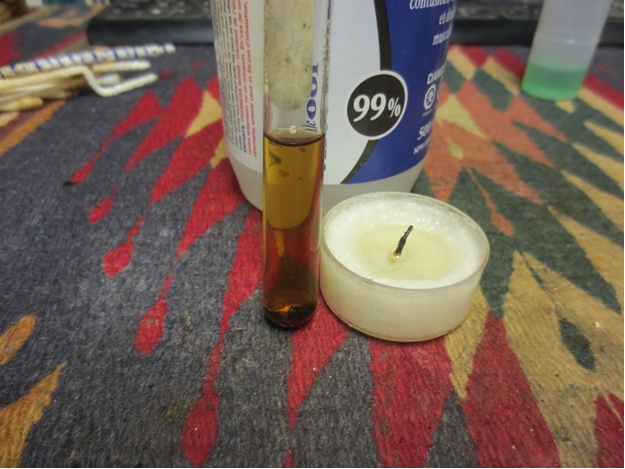
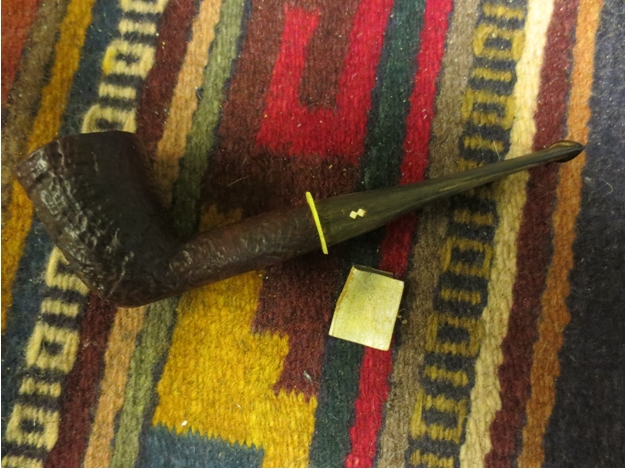
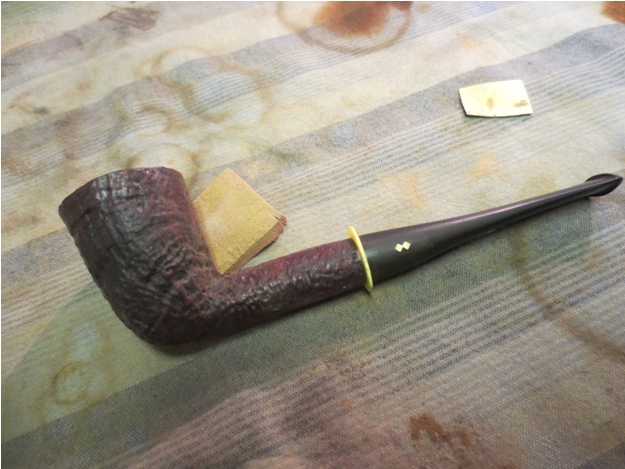
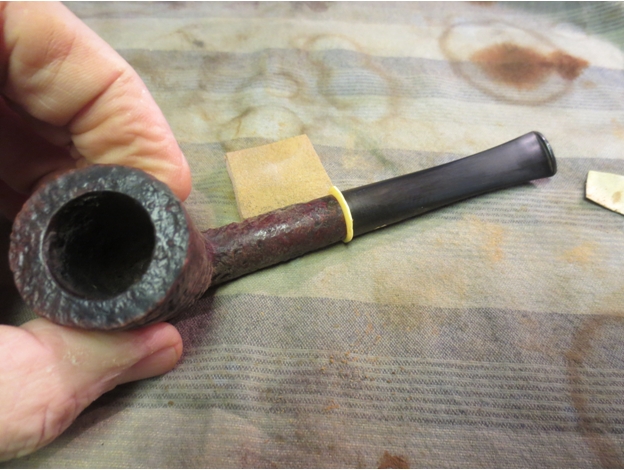
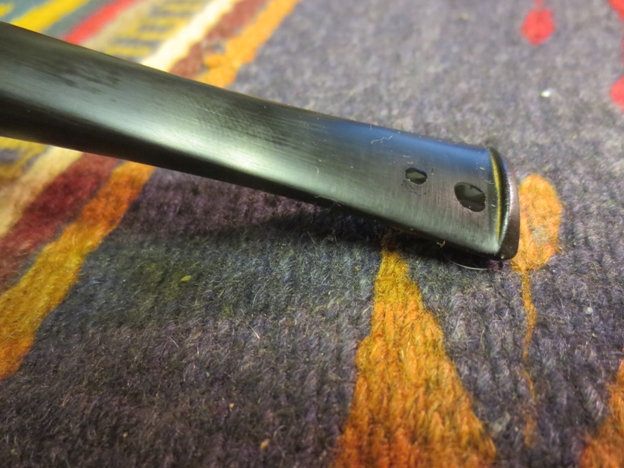
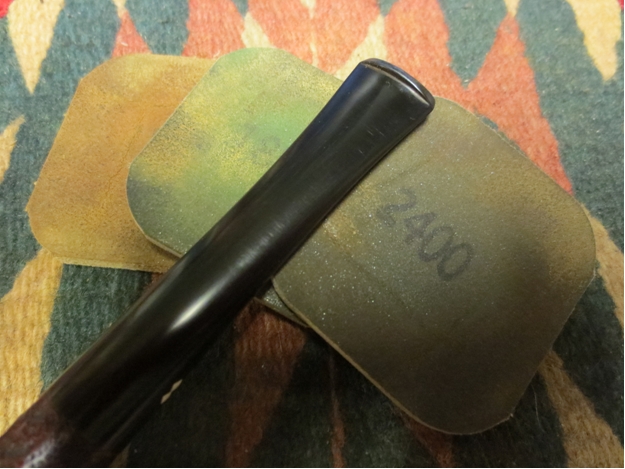
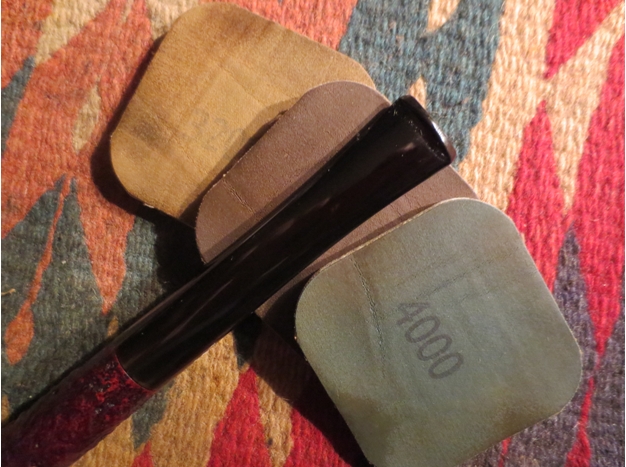
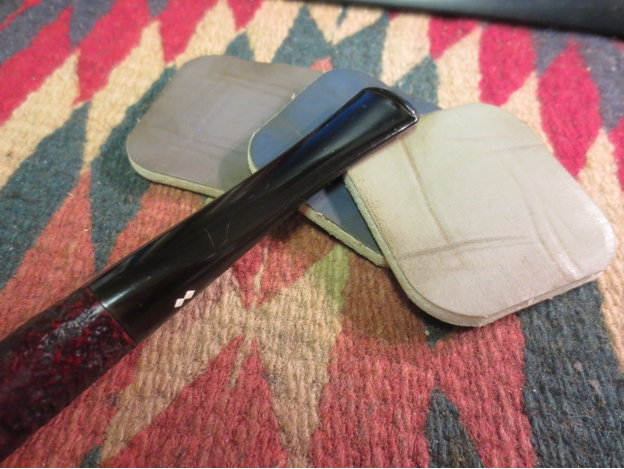
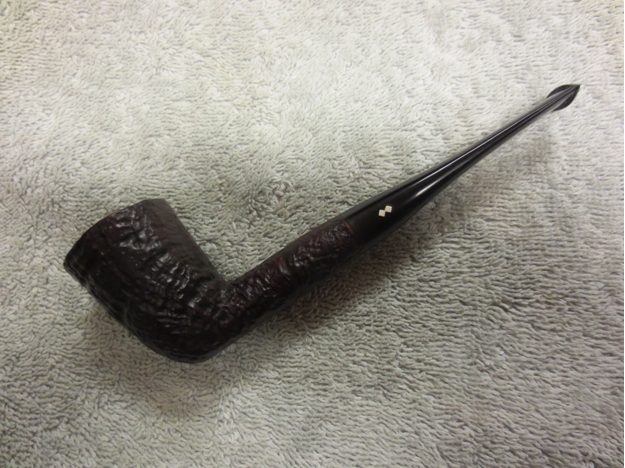
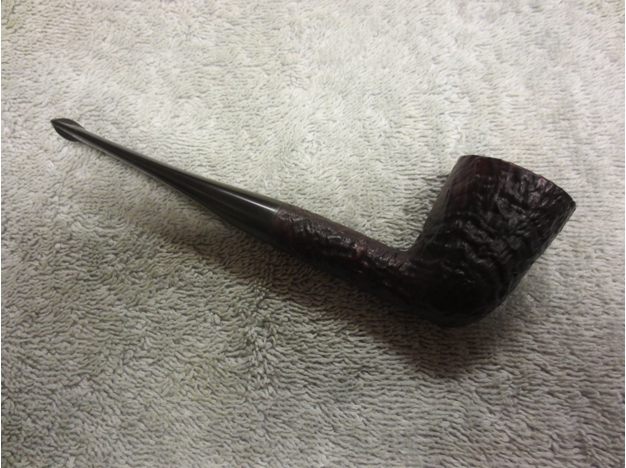
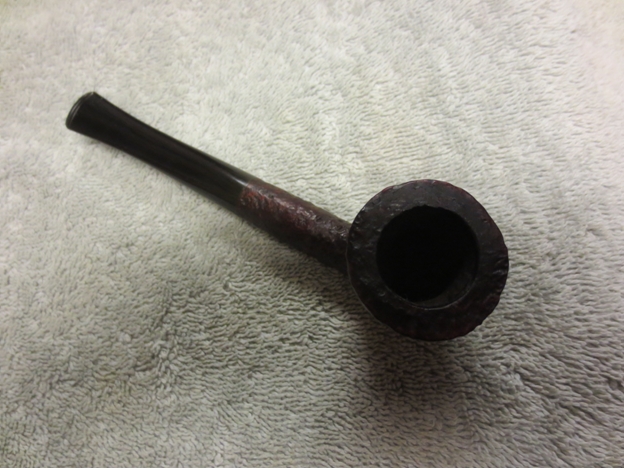
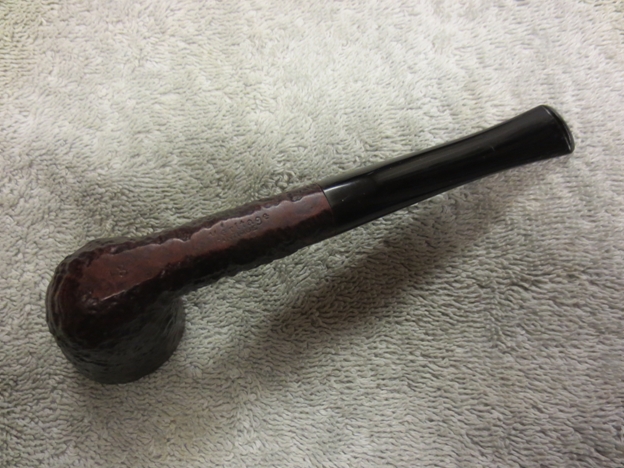
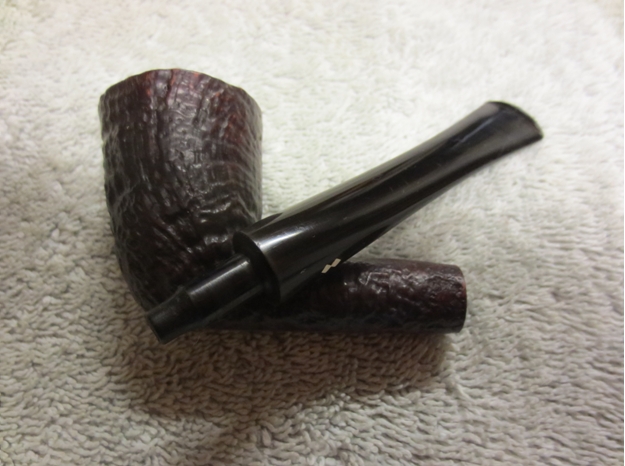
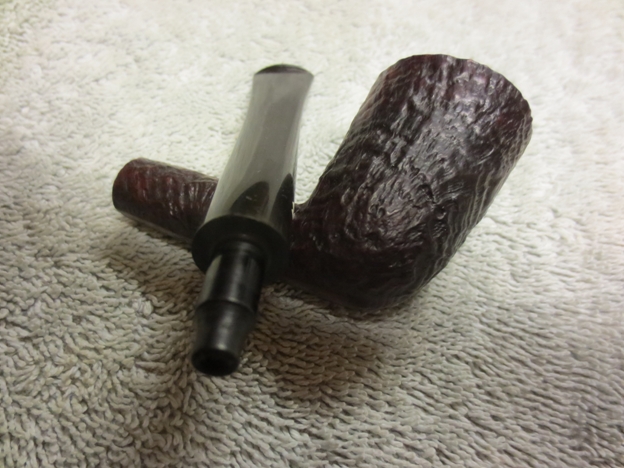
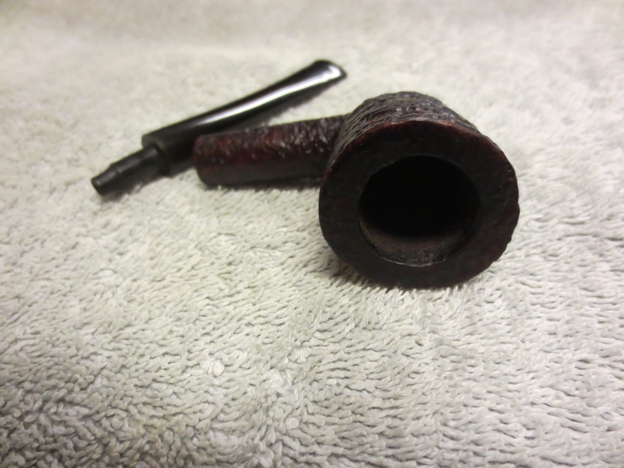
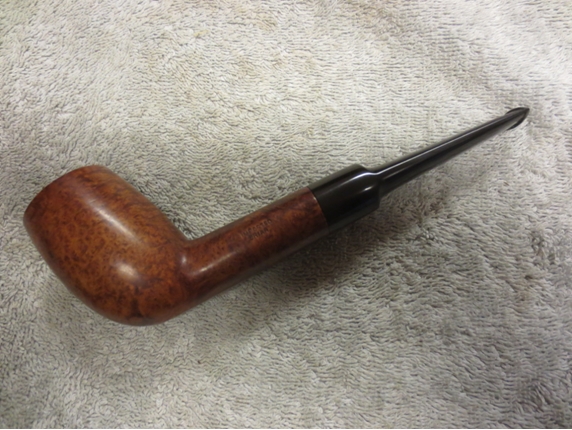
Of all my finds on my recent pipe hunt this little Group 4 Dunhill Shell is one of the favourites. It has a great sandblast that really had some nice craggy grain. The finish was in good shape. The rim was dirty and had a slight build up of oils and tars. The bowl was caked with a thick cake. The stem was oxidized and also had a calcium buildup for the first inch of the stem. The stem had an inner tube inside that was slightly bent that kept the stem from seating correctly in the shank. There were several shallow bite marks on the top and bottom sides of the stem near the button. Internally the stem and shank were surprisingly clean.IMG_2201 IMG_2202 IMG_2203It is stamped on the underside of the shank with 42121 Dunhill Shell over Made In England and next to the D of England was an underlined and superscript 20 next to that was an underlined 23. Using John Loring’s Dunhill Briar Pipe book the dating is 1980 as seen by the underlined 20 slightly elevated and following the D. The underlined 23 indicate that it was sold in 1983, due to the one year guarantee.IMG_2204The next photo shows the buildup on the rim that needed to be dealt with in a cleanup and restoration of the pipe.IMG_2205I cleaned out the shank and the stem with pipe cleaners, cotton swabs and 99% isopropyl alcohol until the cotton swabs and pipe cleaners came out clean.IMG_2206 IMG_2207I scrubbed down the bowl with undiluted Murphy’s Oil Soap on cotton pads and then rinsed it off with running water. I dried it with a cotton towel.IMG_2208IMG_2209IMG_2210IMG_2211IMG_2212I scrubbed the rim with a soft bristle brass tire brush to clean off the tars and oils and open up the sandblast on the rim. I scrubbed it with a soft cotton pad and alcohol to remove the pieces left behind by the wire brush.IMG_2213I touched up the finish around the edges of the bowl rim and the end of the shank. I also touched up spots on the sides of the bowl and the bottom of the shank. I used the Guardsman Stain pens that Greg sent me to do the touch up work. I chose to use the lightest stain pen as it matched the colour of the bowl precisely. When I use these pens I always start with the lightest stain and work toward the darkest until I get a match.IMG_2214 IMG_2215 IMG_2216 IMG_2217I sanded the stem with 220 grit sandpaper and then with medium and fine grit sanding sponges to remove the oxidation and the calcium deposits. I “painted” the tooth marks with the flame of a Bic lighter to lift them closer to the surface and then sanded what remained with 220 grit sandpaper and the sanding sponges.IMG_2218Taking a cue from Al Jones I made a plastic washer to put between the shank and the stem to make the sanding of the saddle simpler. I could sand right up to the edge without damaging the end of the stem and rounding the edges.IMG_2219 IMG_2220 IMG_2221I sanded the stem with my usual array of micromesh sanding pads – wet sanding with 1500-2400 grit pads and dry sanding with 3200-12,000 grit pads. Between each set of three pads I rubbed down the stem with Obsidian Oil before moving on to the next set of three. When I had finished with the 12,000 grit pad I took the pipe to the buffer and buffed the stem with White Diamond.IMG_2222 IMG_2223 IMG_2224I lightly buffed the bowl and the stem once again with the White Diamond and then used Halcyon II wax on the bowl and carnauba on the stem. I hand buffed the pipe with a shoe brush and raised the shine. The finished pipe is shown below. I am looking forward to loading an aged bowl of McClellands 5100 and having the inaugural smoke in this beauty.IMG_2225IMG_2226IMG_2227IMG_2228

John’s First Restoration – A Danish Sovereign Peewit #30


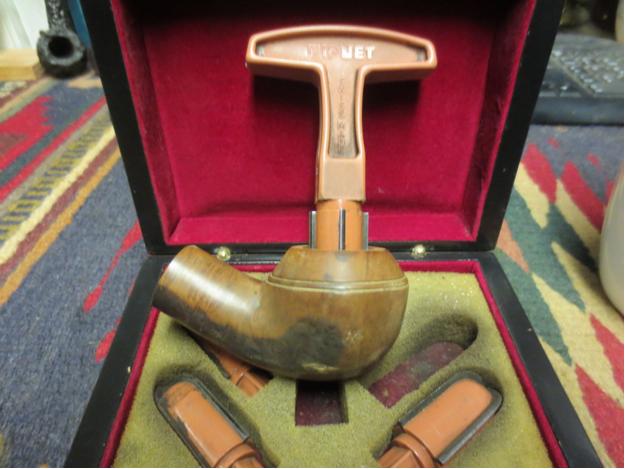
When John and I got home from our pipe hunt we spent the evening and the next morning working on the pipes he had found. We figured that the best way for him to learn how to refurbish pipes was to work on this lot together. That way he would learn as he worked with me on the pipes and we could discuss any issues that might arise during the process of the cleanups. He was intrigued with the idea and liked working with his hands so it seemed like this might be a part of the pipe smoking hobby that he could use to unwind and clear his thoughts from the heavy work of his day to day work as a Presbyterian minister. For his first pipe to refurbish he chose to restore a Danish Sovereign Peewit Shape #30. It is shown in the picture below and is the second pipe in the first row at the top. Walking through the entire process with him on this pipe and one of the others that he did taught him everything from removing the cake, cleaning the finish on a bowl and restaining it to cleaning and polishing a stem to the point that it shone. IMG_2050 Once again I forgot to take photos of the pipe before we started but remembered after I had reamed it with a PipNet reamer. The bowl was badly caked and the rim had a thick buildup of tars and oils. The briar had a nice blast on it and the stain was worn in quite a few spots. The stem was odd on this particular pipe. The tenon had a sleeve on it that added diameter. It appeared that somewhere along the way the shank had been redrilled larger than the original tenon so the sleeve was a necessity. The bowl was drilled way off centre to the right so the airway entered the bowl on the right side of the bottom of the bowl. The bowl itself was round but the pipe itself was way out of round with far more briar on the right side than the left. Danish1 Danish2 Danish3John scrubbed the bowl with a tooth-brush and Murphy’s Oil Soap to remove the grime and the old finish. He used a dental pick to remove the remainder of the buildup on the top of the rim. He rinsed it under running water to remove the soap and grime and dried it with a soft cloth. He used a dark brown stain pen (thanks Greg) to match the stain on the bowl in those areas on the shank and rim where the stain had worn off. He buffed the bowl with White Diamond and then gave it several coats of carnauba wax and hand buffed it with a shoe brush. Danish4 Danish5 Danish6The stem needed a lot of attention. There were some tooth dents in the surface of the stem on the top and bottom side. We set up the heat gun and heated the vulcanite to lift the dents. We also adjusted the bend in the stem while we were at it with the heat gun.Danish7 Danish8 The next photo of the end of the tenon shows the sleeve that had been added to the tenon to increase the diameter. Danish9John sanded the stem with 220 grit sandpaper to remove the calcification and the oxidation. He also used that to sand out the remnants of the tooth marks after we heated the stem. He then sanded the stem with a medium and fine grit sanding sponge to remove the scratch marks left behind by the sandpaper. Once finished he moved on to sand with micromesh sanding pads – wet sanding with 1500-2400 grit pads and dry sanding with 3200-12,000 grit pads. I had him rub the stem down with Obsidian Oil between each set of three pads. He buffed the stem with White Diamond and then we waxed it with some Renaissance Wax (he will not have access to a buffer at home so I was trying work as much as possible without one).Danish10 Danish11 Danish12 Danish13I had John give the pipe another coat of Renaissance Wax and buff it with a shoe brush to raise the shine. The finished pipe is shown below in all of its new sheen. I think John will enjoy smoking this one. I know when I refurbished my first pipe it seemed to smoke exceptionally well. I think it is the time spent bringing it back to life that makes this happen. Great job on this one John, it is a refurbished pipe to be proud of. Be sure to let us know how it smokes when you fire it up.Danish14 Danish15 Danish16 Danish17

Restoring a Peterson Dunmore #72


Blog by Steve Laug

The Dunmore line from Peterson really is a stripped down pipe. The one that I worked on this weekend was in essence a system pipe. The lack of a ferrule is made up for by a stylized carving around the shank end. The stem sits snugly against the end of the shank but is not flush with the diameter of the shank. The saddle on the stem has a different flair than a regular Peterson pipe. The one we found had a Plip stem. This particular Dunmore was found by my friend John when we went pipe hunting this weekend. We had a blast as can be seen from the haul of pipes that he picked up below. The Dunmore is picture at the top left of the first column in the photo below. below. IMG_2050 While John worked on restoring the oak pipe rack that he had found I worked on his Peterson Dunmore. This old pipe had some beautiful grain – birdseye on both sides and cross grain front and back. The bowl almost perfectly aligned with the grain on this one. I forgot to take pictures of the pipe before I began cleaning it up so the only one that is left of the pre-clean is shown in the group photo above. I reamed the bowl with a PipNet reamer and then cleaned out the sump and the internals of the bowl and stem with pipe cleaners, cotton swabs and isopropyl alcohol until all came out clean. Dunmore1 The finish on the bowl was virtually non-existent as it had worn away. I wiped it down with acetone to clean the briar and remove the oils and marks that had settled on top of the wood. The acetone pads came away dirty with the grime more than with any previous colour or stain. Cleaning the surface revealed even more clearly the marvelous grain that was on this pipe. Dunmore2 The top of the bowl and rim had some damage from tapping out the pipe. The outer edge of the rim particularly had taken a beating. The bowl was still in round so the inner edge was fine. To minimize the damage to the top and the outer edge I set up a topping board with 220 grit sandpaper and worked on the bowl top. (The whole time I was working on this pipe I gave a running commentary to John as he wanted to know the process so that he could clean up some of the other pipes once he had finished the rack). Dunmore3 Dunmore4 After topping the bowl I sanded the outer edge with a folded piece of 220 grit sandpaper to remove some of the darkening around the bowl top. I resanded it with medium and fine grit sandpaper to remove scratches and did the same to the rim top. I sanded the entirety of the rim and edges with 2400 grit micromesh to smooth it out. After wiping down the briar with alcohol to remove the dust from the surface of the bowl John and I decided not to stain the pipe but to keep it natural. I rubbed it down with a bit of olive oil to give some life to the wood and then buffed it with White Diamond. I was careful to not buff the areas around the stamping so as not to damage them. I chose rather to buff these areas by hand with a shoe brush. I gave the bowl several coats of carnauba wax and buffed it with a soft flannel buff to shine it. Dunmore5 Dunmore6 Dunmore7 There were two small crevices that showed up on the inside of the bowl on the right side about ¼ inch below the rim. I mixed a batch of pipe mud and filled the small crevices and smoothed the mud over the surrounding area of the bowl. I set it aside to dry while I worked on the stem.

The stem had a lot of tooth chatter and a few shallow tooth marks on the top and the bottom next to the button. It also had a deep oxidation that required a lot of elbow grease to remove. I sanded the stem with 220 grit sandpaper to remove the surface oxidation and the calcification near the button. I “painted” the stem with my Bic lighter to raise more of the oxidation to the surface and also to raise the small tooth marks on the stem. I sanded it some more with the 220 grit sandpaper followed by a medium and a fine grit sanding sponge. That work brought it to the condition shown in the next two photos below. Dunmore8 Dunmore9 I sanded it with micromesh sanding pads – wet sanding with 1500-2400 grit pads and dry sanding with 3200-12,000 grit pads. I rubbed the stem down between each set of three pads with Obsidian Oil. After finishing with the 12,000 grit pad I buffed it lightly with White Diamond on the wheel and then rubbed it down one more time with the oil. When it had dried I gave the stem multiple coats of carnauba wax and buffed it to a shine. Dunmore10 Dunmore11 Dunmore12 I hand buffed the completed pipe with a bit more wax and a shoe brush to finish the polish. The finished pipe is shown below in all of its beauty. I am really glad we decided to leave the wood natural and only give it a light oil finish before waxing. The grain stands out well and the feel of the pipe in hand is very nice. John loved the finished pipe. I am looking forward to hearing from him once he has smoked it a few times. Dunmore13 Dunmore14 Dunmore15 Dunmore16

Restoring a Jobey Stromboli 160


jobeylogo I have been looking for a Jobey Stromboli for quite a while now but never found the shape I wanted. I love the rustic almost Sea Rock look of the Stromboli finish and the Jobey link system has intrigued me. So when I saw this one on EBay it only took a minute to make a bid and lock in the end price I was willing to pay for the pipe. The shape, the wavy rim surface and the flow of the stem attracted me. The Lucite stems on many of these pipes was quite thick and cumbersome looking but this one is nice and streamlined looking and reminds me of the GBD chairleg stems on some of their pipes. The seller says that it was in good shape and that the stem was a green colour. The bowl exterior looks odd to me and definitely the finish has taken a bit of a beating. The rusticated finish is quite forgiving however so I am hopeful that a good scrub and restain will do the trick. The stem appears to be in good shape with minimal tooth chatter on the top and bottom sides near the button. The six photos below were included by the seller in the EBay listing. Jobey1 Jobey2 Jobey4 Jobey5 Jobey6 Jobey7 Since I know next to nothing about Jobeys in general and more specifically about their claim to fame Link System I decided to do a bit of digging on the web. I have included a picture of the link taken from the web to give an idea of what the actual part looks like. link Chris beat me to it and posted this patent applied for and issued for the bowl and shank connection I have included the entire patent document in the text of this article because it is fascinating to me to read how the designer worded his application and how the cutaway pictures show the connector both in terms of side views and end views.

Smoking pipe bowl shank and stem connection
US 3537462 A
Images(1)
Jobey links Description (OCR text may contain errors)
United States Patent Peter V. Genna Inventor Brooklyn, New York Appl. No. 802,170 Filed Feb. 25, 1969 Patented Nov. 3, 1970 Assignee Wally Frank, Ltd. New York, New York a corporation of New York SMOKING PIPE BOWL SHANK AND STEM CONNECTION 1 Claim, 4 Drawing Figs. US. Cl 131/225 Int. Cl A24f 1/00, A24f 7/02 Field of Search 131/225 [56] References Cited V UNITED STATES PATENTS 1,168,481 l/1916 Combs 131/225 2,461,905 2/1949 Lavietes 131/225 3,044,472 7/1962 Keyser 131/225 FOREIGN PATENTS 274,743 7/1927 Great Britain 131/225 Primary ExaminerJoseph S. Reich Attorney-Harry B. Rook ABSTRACT: A coupler to separately connect the bowl shank and the stem of a smoking pipe, has one end threaded to screw into the shank bore. The other end portion is cylindrically smooth and the stem is frictionally longitudinally and rotatablyslidable thereon. Between said end portions the coupler has a circumferential flange that is disposed wholly in a counterbore of said shank and firmly seats on the bottom wall of the counterbore.

SMOKING PIPE BOWL SHANK AND STEM CONNECTION BACKGROUND OF THE INVENTION
In one type of shank and stem connection, the stem has a cylindrical tenon at one end which is longitudinally slidable and rotatable in a bore in the shank.

Another type of shank and stem connection comprises a screw threaded tenon on the stem and a complementary screw-threaded bore in the shank.

The first-mentioned type of connection has the objection that it is difficult to obtain a tight nonseeping joint between this shank and the stern, and it is practically impossible to maintain a snug connection between the parts because of the wear incident to frequent removal and replacement of the stem.

The second-mentioned connection has the objection that due to wear of the screw threads looseness in the connection of the parts occurs and results in seepage of moisture through the connection. Also attempts to tighten the connection by screwing the stern more firmly into the shank results in a displacement of the bit or mouthpiece of the stem with respect to the bowl and sometimes causes a stripping or damaging of the threads in either or both of the shank and tenon.

SUMMARY
One object of the present invention is to provide a connection between a bowl shank and a stem which shall overcome the above-mentioned objections to the prior art.

More particularly the invention contemplates a construction and a combination of a bowl shank, stem and coupler wherein the coupler has one end screw threaded into the bore, and the stem is frictionally longitudinally and rotatably slidable on the other end portion of the coupling; and said coupler has a circumferential flange between said end portion that is disposed wholly in a counterbore of the shank and firmly seats on the bottom wall of the counterbore, whereby the stem can slide longitudinally and rotate on the coupler and the coupler can be tightly screwed into the shank bore without danger of stripping the threads and with practical insurance of a seepage-proof joint between the coupler and the shank.

A BRIEF DESCRIPTION OF THE DRAWINGS
For a complete understanding of the invention, reference should be had to the following description in conjunction with the accompanying drawings in which:

FIG. 1 is a central vertical longitudinal sectional view through portions of the bowl shank and stem and showing the coupler in side elevation;

FIG. 2 is an enlarged central, vertical longitudinal sectional view with portions of the bowl and the stem omitted;

FIG. 3 is an end view of the coupler; and

FIG. 4 is a similar view on the plane of the line 4-4 of FIG. 2.

BRIEF DESCRIPTION OF THE PREFERRED EMBODIMENTS OF THE INVENTION
The reference character A designates the smoking pipe bowl which has a shank B provided with a smoke duct 1 and a bore 2 to receive the coupler C which serves to separately connect the shank B to the stem D.

The shank bore 2 is entirely screw threaded at 3-to receive the threads 4 on one end portion of the coupler C the other end portion of which is smoothly cylindrical as indicated at 5 and on which is longitudinally slidable and rotatable the stem D. Preferably the coupler is formed of a moldable plastic material, for example hard rubber or Bakelite, and the stem is preferably formed of the same material. Between its said end portions, the coupler has a circumferential flange 6 which is adapted to be wholly disposed within a counterbore 7 at the end of the bore in the shank. The depth of the counterbore is greater than the thickness of the flan e. When the screwthreaded end of the coupler IS screwed into the bore of the shank, the flange 6 firmly or tightly abuts the bottom wall 8 of the counterbore. For convenience in screwing the coupler into the shank and unscrewing it from the shank, the coupler is provided with a diametrical kerf 9 in the stem-receiving end thereof.

However, in accordance with the invention the stem has a sufficiently tight frictional fit on the coupler so that the coupler can be screwed into and out of the shank bore by simple rotation of the stem. The stem has at one end a cylindrical smooth-walled socket 12 which receives the cylindrical end 5 of the coupler and the stem and is frictionally rotatable on the coupler so that the stem can be easily adjusted into the proper relation to the bowl, and the stem is also longitudinally slidable on the coupler so that the inner end 10 of the stem can be kept in neat and tight abutment with the end surface 11 of the shank. FIG. 2 shows the stem slid away from the end of the shank while FIG. 1 shows the stern and shank in their normal relation to each other.

It will be seen readily that the flange-limits the screwing of the coupler into the shank and thus protects against stripping of the threads. At the same time, the flange abutting the bottom wall of the counterbore provides a seepage-proof joint between the coupler and the shank. To compensate for wear of the threads or of the abutting surfaces of the flange and the counterbore, the coupler can be screwed farther into the bore, and the stem can be slid on the coupler to maintain the neat and tight joint between the end 10 of the stem and the end 11 of the shank.

Claim:
l. A smoking pipe comprising a bowl having a shank which has an internally screw-threaded bore at the outer end of which is a counterbore, a stem having at one end a cylindrical smooth walled socket providing a bottom wall therein, and a coupler having a cylindrical smooth end portion frictionally received in said socket for relative longitudinal movement and rotation, said coupler having its other end portion screwthreaded to mate with said screw-threaded bore and having a flange between said end portions wholly disposed in said counterbore and in firm abutting contact with the bottom wall of said counterbore, the depth of the counterbore being greater than the thickness of the flange.

Classifications
U.S. Classification 131/225
International Classification A24F7/00, A24F7/02
Cooperative Classification A24F7/02
European Classification A24F7/02

Further digging led me to learn that Jobey has had three homes throughout its existence. The pipes were originally made in England circa 1920 and then the company moved to the US. The Jobey Dansk version of the pipes was made in Denmark. Now the pipes are produced in Saint-Claude, France by Butz-Choquin since 1987. Under these broad time lines I was able to find a listing of the owner/distributor and manufacture of the brand during the time period that the brand was in the US.The list below was what I was able to find in several spots on the web. Each time I read the list it was cited that the dates are/were approximate.(The majority of the information below comes from Pipedia.)

Owners/Distributors/Manufacturers of Jobey Pipes from 1942-the late 80s

George Yale Pipes & Tobacco, New York (1942)
Norwalk Pipe Co., New York (1949)
Arlington Briar Pipes Corporation, Brooklyn (when?)
Hollco International, New York (1969).
Weber Pipe Co., Jersey City, NJ (1970’s)
The Tinderbox (1970’s – 80’s).

“Throughout decades Jobey pipes were mainly sold in the USA, Canada and England but remained almost unknown in continental Europe. The bulk of Jobeys was predominantly made according to classical patterns and mainly in the lower to middle price range. The predominant judgment of the pipe smokers reads: “A well made pipe for the price.” So there is hardly anything very special or exciting about Jobey pipes although a flyer from ca. 1970 assures: “The briar root Jobey insists upon for its peer of pipes is left untouched to grow, harden and sweeten for 100 years. […] Jobey uses only the heart of this century old briar and only one out of 500 bowls turned measures up to the rigid Jobey specifications.”99.80% of cull… that makes the layman marveling!”

“Yet then there are partially really exciting Freehands mainly in the seventies, that Jobey – Weber owned back then – bought from Danish pipe genius Karl Erik (Ottendahl). These pipes were offered as Jobey Dansk – ’70’s pure! (BTW waning sales caused Ottendahl to discontinue exports to the United States in 1987.)”

In the very same year – obviously only as a ghost brand – Jobey was transferred to Saint-Claude, France to be manufactured by Butz-Choquin.

There must have been an abandonment of the fabrication, because in 2002 the message was spread, the current proprietor of the brand F&K Cigar Co. from St. Louis, MO had recently re-introduced the Jobey very successfully again…”

I thought that the information might give me some idea as to when the pipe I had was made. However there was no information on the stamping distinctives of the various makers. Judging from the style of the stem and the thick, coloured Lucite it is made from my assessment would be that the pipe came from the period of the late 60s or 70s. It is not a Danish style Dansk so it is not from the period that Ottendahl carved the pipes so that would preclude it being Danish made. I am thinking it was American made. That is about as certain as I can be on the dating of this pipe.

When it arrived I was pleased with the overall look of the pipe. The deep rustication reminded me of Castello Sea Rocks. The finish was worn and the stain was missing on some of the high spots on the rustication. The rustication on the rim was filled in with a buildup of tars and oils. The bowl had been reamed and was clean. The photos from the seller had an almost green tint in some portions of the bowl. I was glad to see that the finish did not have any mold problems. The interior of the shank was quite dirty. The threaded mortise was filled with black tars and oils. The stem had tooth chatter on the top and bottom near the button but there were no tooth marks or dents that were deep in the surface. The fit of the stem to the shank was clean and tight. I am not sure whether the threaded tenon actually is to remain in the shank or the stem. I was unable to remove it from the stem so it acts like a threaded tenon fixed to the stem. The tenon had the same black buildup around the base of the piece and the threads had the same. The pipe was in fair shape and needed a thorough cleanup. The pipe smelled strongly of aromatic tobaccos.

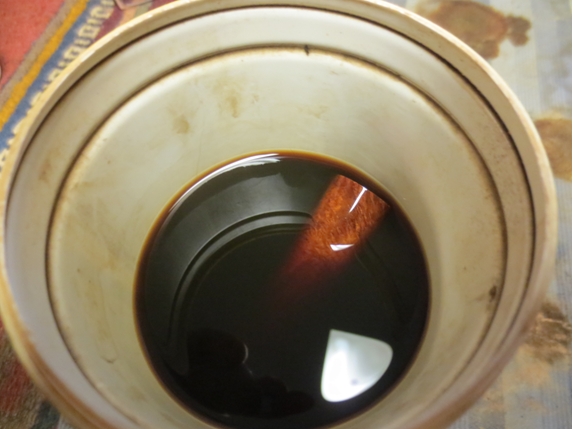
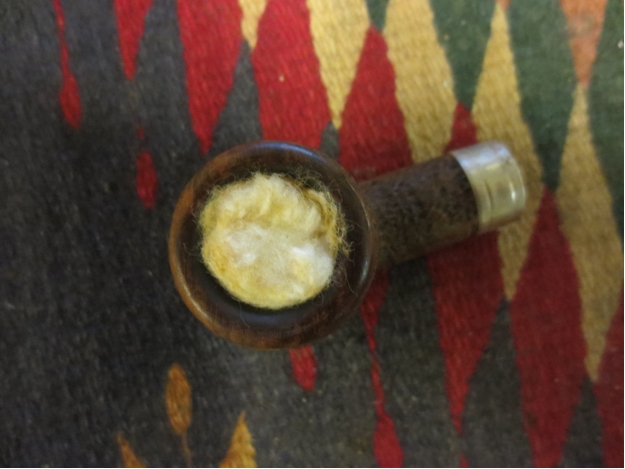
I began the cleanup by scrubbing the exterior of the pipe with a tooth-brush and Murphy’s Oil Soap. I used it undiluted and scrubbed until the soap was dark. I picked the buildup on the rim with a dental pick and cleaned out the grooves there. I rinsed it with lukewarm running water to remove it from the nooks and crannies of the finish. IMG_1979 IMG_1980 Once it was rinsed off I dried it with a cotton towel. The state of the finish is shown in the next three photos. There are spots where the stain is gone but the finish is very clean and ready to be stained. IMG_1981 IMG_1982 IMG_1983 I cleaned out the internals of the bowl and shank with pipe cleaners, cotton swabs and isopropyl alcohol. I scrubbed out the threaded mortise with the cotton swabs and alcohol until they came out clean. The airway ahead of the threaded mortise was scrubbed with pipe cleaners. I also gave the stem an initial cleaning. IMG_1984 Once the grime was off the stem the tooth chatter was very evident on the top and bottom sides of the stem. I would need to sand the stem to remove the tooth chatter and restore the shine to the stem. The airway would also need to be cleaned out thoroughly as when I held it to the light it was still black on the inside. IMG_1985 IMG_1986 IMG_1987 I wiped the bowl down with alcohol to prepare it for staining. I used a Dark Brown Aniline stain and applied it with the provided wool dauber. I flamed the stain and repeated the process until the coverage was even across the bowl. IMG_1988 IMG_1989 IMG_1990 IMG_1991 While the bowl was drying I sanded the tooth chatter on the stem with 220 grit sandpaper to remove the marks from the surface of the Lucite. Once the tooth chatter marks were removed I sanded it with a medium and a fine grit sanding sponge to remove the scratching left behind by the sandpaper. The third photo below shows the stem after the sanding sponge has been used. IMG_1992 IMG_1993 IMG_1995 The next step in the sanding process for me has always been to sand with the micromesh sanding pads. I wet sanded with the 1500-2400 grit pads and dry sanded with 3200-12,000 grit pads. Each successive grit of micromesh brought a deeper shine to the auburn/hazel coloured Lucite. IMG_1996 IMG_1997 IMG_1998 Once the stain was dry on the exterior of the pipe I wiped it down with a cotton pad wetted with alcohol to lighten the finish slightly. I then gave the pipe a light buff with White Diamond and a shoe brush to raise the shine. I rubbed on some Halcyon II wax to protect the finish from my next step in the process. No matter how much I cleaned the pipe it still smelled of heavy “caramel like” aromatic tobacco. I decided to give it the cotton ball and alcohol treatment. I pressed two cotton balls into the bowl making sure they were not touching the rim and used an ear syringe to fill the bowl with isopropyl alcohol. I wanted to leach out the tars and oils that were in the briar and eradicate the smell. I filled the bowl and set it in an old ice-cube tray overnight. IMG_1999 Within the first 30 minutes the cotton was already turning brown along the edges. This told me that the process was working. IMG_2000 In the morning when I got up the cotton was a medium to dark brown as shown in the photo below. I picked it out carefully with a dental pick. The alcohol had evaporated so the cotton was not soggy, just damp. I wiped out the bowl with cotton swabs and cleaned out the shank once again with pipe cleaners to remove any of the remaining oils and tars from the surface. I lightly buffed it once more with a soft flannel buffing pad to polish the briar and stem. IMG_2001 The finished pipe is shown in the final four photos. It has been waxed with Halcyon II Wax and buffed with a shoe brush and lightly with a soft flannel buffing pad. The stem has multiple coats of carnauba wax and also was buffed with a soft flannel buffing pad. I generally let a bowl that I have given the cotton ball and alcohol or salt and alcohol treatment dry for several days before loading it up and giving it an inaugural smoke. IMG_2010 IMG_2011 IMG_2012 IMG_2013

Restoring a Dr. Grabow Meerschaum-Lined Stack


Blog by Steve Laug

Another of the bowls I was gifted was a tall Meerschaum lined rusticated stack with a smooth spot on both sides of the bowl and the end of the shank. It is stamped on the underside of the shank, MEERSCHAUM-LINED over Dr. Grabow. The bowl exterior had some darkening on the back side of the bowl and the grooves of the bowl were caked. The rim had damage and the meerschaum lining was rough on the inside edge of the bowl. There were cracks in the meerschaum bowl insert on the rim. The bowl itself was cracked and missing from about mid bowl to the bottom of the bowl. The meerschaum pieces were lying in the bottom of the bowl and there was no stem for the pipe.

I did not know anything about the meerschaum lined Dr. Grabows and this one had a distinct look of an Italian made pipe. I went to my source on line for Grabow information the Dr. Grabow Forum (http://drgrabows.myfreeforum.org/sutra238.php). There I found a post on the meerlined pipes. It read in part as follows… “Meerschaum lined pipes were originally imported from M. Gasparini in Italy for Grabow. Sparta finally figured out how to do them and only imported the “plugs”. Early Grabow Meerschaum lined pipes were stamped Italy with no spade. After 1989 Dr. Grabow got rid of Italy and added the spade.” So, my sense of it being Italian was correct. It also dates this pipe as pre-1989. IMG_1848 IMG_1849 IMG_1850 IMG_1851 I had an old stem in my can of stems that would be a good fit for this pipe. I needed to sand the tenon slightly to get a snug fit against the shank. The diameter of the stem was slightly larger than the diameter of the shank and would need to be sanded down to make a matched fit. IMG_1852 IMG_1853 I used a pen knife to clean up the inside of the bowl. There was carbon build up on the lower part of the bowl about mid bowl that was holding together the broken pieces of the meer lining. I scraped away the carbon and removed the broken pieces of meerschaum that remained on the lower edge of the bowl insert. IMG_1854 I topped the bowl with a topping board and 220 grit sandpaper to remove the damage to the rim and the lining top. IMG_1855 I did not remove much of the bowl top but took off enough to make the bowl top and the rim top flush and smooth. In the photo below the cracks in the bowl insert are visible around the top edge of the bowl. IMG_1856 I used clear superglue to fill the cracks on the top edge of the insert and sanded them down. I mixed a batch of plaster of Paris and used the dental pick, the cuticle tool that I was gifts and a pipe nail to build up the interior of the bowl and replace the bottom half of the insert that was missing. I inserted a pipe cleaner in the shank and then packed in the plaster around the airway and tamped it in place on the bottom with the pipe nail and on the sides with the cuticle tool. I used one of the stain pens that I have to stain the rim to match the bowl. IMG_1857 IMG_1858 IMG_1859 I inserted my damp index finger into the bowl and rubbed down the sides of the bowl to smooth them out. I also pushed the plaster on the bottom of the bowl to more thoroughly pack it in place. I sanded the stem with 150 grit sandpaper to reduce the diameter of the stem and then 220 grit sandpaper to smooth out the stem. IMG_1860 I scrubbed the bowl down with acetone on a cotton pad to remove the finish and clean up the exterior of the bowl. I then rubbed it down with olive oil and let it soak into the finish. I also rubbed down the stem with the oil as I find that it makes sanding the stem easier to do. IMG_1861 IMG_1862 IMG_1863 IMG_1864 I sanded the stem with micromesh sanding pads – wet sanding with 1500-3200 grit pads and dry sanding with 3600-12,000 grit pads. I wiped it down between each of the sets of three pads with Obsidian Oil. Once it was dry I buffed the stem with White Diamond and then with carnauba wax. IMG_1865 IMG_1866 IMG_1867 I put the stem back on the pipe and buffed it with White Diamond. I lightly buffed the bowl with carnauba wax and the stem more heavily. I finished by buffing the pipe with a soft flannel buffing pad to raise the shine. The finished pipe is shown below. The thin shank and the thin diameter of the stem give the pipe a delicate look. It is very light weight and fits well in the hand. I am going to let the plaster of Paris repair dry and cure for several days before I load a bowl and give it an inaugural smoke. IMG_1868 IMG_1869 IMG_1870 IMG_1871 IMG_1872 IMG_1873

UPDATE: I just smoked this one after it had cured for two days. I loaded a bowl of The Malthouse Founder’s Reserve in the bowl and smoked it to the bottom of the bowl. It smoked cool and dry. The plaster of Paris is darkening nicely and will soon match the rest of the meer lining of the bowl.
IMG_1874 IMG_1875 IMG_1876

Rejuvenating a Willard Straight Rhodesian


Another of the bowls from the gift box was this Willard Rhodesian. It was in pretty good shape other than being dirty and stemless. The bowl had a broken cake at the top of the bowl and remnants of tobacco left in the bowl. The rim was dirty and lightly caked with some damage caused from tapping the rim on something. The outer and inner edges of the bowl were undamaged. The interior of the shank was dirty. The shank was fitted with a threaded mortise that would take a threaded stem. I had a stem in m can of stems that fit well in the shank, was overturned but workable. The diameter of the stem was larger than the shank. The photo below shows the stem on the pipe in the middle of the threesome. IMG_1750 I set up a heat gun and held the stem about three inches above the heat. The first photo below shows the stem in place. To heat it I removed it from the bowl and heated the metal tenon. When it was warm I screwed it back in place and twisted it. I had to reheat it several times to get the alignment correct. The second photo shows the aligned stem. IMG_1752 IMG_1755 I sanded the stem with 150 grit sandpaper to reduce the diameter of the stem. I also sanded the slope to the button to highlight the tooth marks on the stem. IMG_1809 IMG_1810 IMG_1811 I used a needle file to sharpen the inner edge of the button and make the angles more distinct. IMG_1812 I wiped down the bowl with acetone to remove the grime and clean up the finish. I did not want to lighten the finish as much as to clean off the light coat of varnish on the briar. IMG_1814 IMG_1813 I lightly topped the bowl to clean up the rim damage. I used a sanding board and 220 grit sandpaper to remove the damaged briar and then followed that by sanding with a medium and a fine grit sanding block. IMG_1815 IMG_1816 I continued to sand the stem to match it to the diameter of the shank. I used 220 grit sandpaper to finish the sanding and shaping of the stem. I worked on the tooth marks on the top side and underside of the stem with 220 grit sandpaper until they were no longer visible. IMG_1817 IMG_1818 IMG_1819 IMG_1820 I reamed the bowl with a PipNet pipe reamer beginning with the smallest cutting head and working up to the one that was the same diameter as the bowl. I reamed the bowl back to bare wood. IMG_1821 IMG_1822 I sanded the stem with a medium and fine grit sanding sponge to reduce the scratches left behind by the 220 grit sandpaper. IMG_1823 There was one stubborn tooth mark that I could not get out on the underside of the stem next to the button. I cleaned the area with alcohol and then used clear super glue to repair it. I sprayed the path with an accelerator so that I could sand the patch sooner. IMG_1824 IMG_1825 IMG_1826 IMG_1827 I sanded the stem with micromesh sanding pads – wet sanding with 1500-3200 grit pads and dry sanding with 3600-12,000 grit pads. I rubbed down the stem with Obsidian Oil between each group of three micromesh sanding pads and then when I finished sanding with the 12,000 grit pad I buffed it with White Diamond. IMG_1828 IMG_1829 IMG_1830 I buffed the bowl and shank with White Diamond and then gave it a coat of Danish Oil and walnut stain to protect and preserve the finish. When it was dry I buffed the pipe with White Diamond and then gave it several coats of carnauba wax. IMG_1835 IMG_1836 IMG_1837 IMG_1838 The finished pipe is shown in the photos below. The new stem fits well. In fact it looks like it came with the pipe. The repairs to the stem are not visible. The bowl itself dried well and buffing the finish gave it a softer look. The finished pipe was given several more layer of carnauba wax and then buffed with a soft flannel buffing pad. It is now ready for many more years of service to another pipeman. IMG_1844 IMG_1845 IMG_1846 IMG_1847

Giving New Life to a Kaywoodie Connoissuer Dublin Shape 45C


This is the third old-timer I received in my gift box from Jim. It is stamped Kaywoodie over Connoissuer on the left side of the shank and 45C on the right side near the bowl. It was in rough shape. The finish was gone and the bowl was almost black with grit and grime. There were places on the sides and bottom of the bowl that had black spots of a sticky, oily substance. The rim was heavily caked and damaged as well. There were rough outer edges on the rim on the back right side and the front as well. The bowl was badly caked and appeared to be out of round from reaming with a knife. The stem was in pretty decent shape however. There was a buildup of calcium on the end of the stem about ½ inch from the button forward but there was only minimal tooth chatter and no deep bite marks. The stem even fit correctly and was not over turned in the shank.IMG_1710 IMG_1711 IMG_1712 IMG_1713 IMG_1714 I looked up an old Kaywoodie shape chart to make sure the shape number 45C was indeed a Dublin, in fact a Large Dublin. I found it in the second column, third entry down that column in the chart below. I think that the name is quite relative as the size is not that large and would easily be a group 3 sized bowl in Dunhill terms. I also found that the Connoisseur line was the top of the line (at least in this chart of pipes). Read the notes on the bottom of the page, the last line that shows a price of $27.50 – the highest priced KW on this chart. Kaywoodie_shapes70_71 When I removed the stem the stinger was black with buildup but was not damaged. It only had two holes in it, a flattened head rather than a ball and a space on the top of the stinger where the air went through. This was obviously a pre-Drinkless stinger. IMG_1715 I reamed the bowl with a PipNet pipe reamer and used a dental pick to clean out some of the scale around the edges of the airway. IMG_1716 IMG_1717 I started with the smallest reaming head and worked up to one approximately the size of the bowl. I wanted to try to minimize the rim damage and bring the bowl back to as close to round as possible with the reamer. IMG_1718 The amount of damage to the edges of the outer rim and the broken spots on the inner rim required that I top the bowl. I set up a topping board and 220 grit sandpaper and sanded the top of the bowl. I press the bowl into the sandpaper, taking care to keep the rim flat against the board so as not to slant the top of the bowl. I worked it until the top was clean and the outer edge was sharp once again. The second photo shows the topped rim and the damage down to the roundness of the bowl inner edge. It was going to take some work to work this back to round as much as possible. IMG_1719 IMG_1720 I sanded the inner edge with a folded piece of 220 grit sandpaper to even it out and give it more of a round shape once again. I wiped the bowl down with acetone on cotton balls to remove the grime on the finish. I decided against using the oil soap this time around as the finish was basically gone any way so the acetone would make short work of removing the finish. I scrubbed it longer and harder than I expected to remove the grime. The next series of photos show the bowl after scrubbing. There was some nice grain under the blackness. IMG_1721 IMG_1722 IMG_1723 I sanded the bowl and the stem with 220 grit sandpaper and also with a medium and fine grit sanding sponge and fine grit sanding block to further clean things up on the surface of the bowl and stem. IMG_1724 IMG_1725 IMG_1726 The photo below shows the bowl after the work on the inner edge of the rim. It certainly has come a long way from the beat up inner edge pictured above. IMG_1727 IMG_1728 I dropped the bowl into the alcohol bath to soak out some more of the grime from the briar. I turned my attention to the stem. I cleaned up the stinger with alcohol, pipe cleaners and cotton balls until the aluminum shined once again. I continued to sand the stem with the medium and fine grit sanding sponges to remove the surface scratching. I cleaned out the area around the slot with a dental pick and finally after many pipe cleaners was satisfied with the cleanness of the internals of the stem. IMG_1729 I sanded the stems with micromesh sanding pads – wet sanding with 1500-2400 grit pads and dry sanding with 3200-12,000 grit pads. I rubbed the stems down with Obsidian Oil between each set of three pads. I buffed the stem with White Diamond and polished it with a coat of carnauba wax to raise a shine. IMG_8249 IMG_8250 IMG_8252 I took the bowl out of the alcohol bath and dried it off with a cotton cloth. I sanded it lightly with a fine grit sanding sponge to remove the last of the grit and grime softened by the bath. The bowl is shown in the photo below. It is cleaned and ready for staining. IMG_8253 There were two areas that were dark on the bowl – the left side midbowl toward the front and the right side midbowl toward the back. I cleaned and stained the bowl with some Danish Oil and walnut stain and in the dark spots two small minor cracks showed up. At this point the cracks are not visible in the inside walls of the bowl. They may well be there and not seen in the darkening of the interior walls. Once the oil dried I exposed the two cracks with a dental pick to make them accessible. I then used superglue and briar dust to repair the cracks. I overfilled them with the glue and briar dust to ensure that the repair is solid and would have no pits in the surface once I sanded them. I sanded the repairs with a well used piece of 220 grit sandpaper and followed that with a fine grit sanding sponge and 1500-2400 micromesh sanding pads.IMG_1730 IMG_1731 I wiped the sanded bowl down and then gave it a coat of Danish Oil with Walnut stain to touch up the repairs and the entire bowl. IMG_1732 IMG_1733 IMG_1735 IMG_1734
When the pipe was dry I buffed it with White Diamond and polished the bowl and stem. I gave it multiple coats of carnauba wax to protect and give it a shine. I buffed it with a soft flannel buff. The pipe is finished. It has come a long way from the pipe that I started with when I took it from the box. The repairs, though visible look pretty good. I expect them to hold for a long time and provide a quality smoke in an old Kaywoodie for whoever ends up with this old pipe. It is cleaned and ready for the next pipeman. IMG_1741 IMG_1742 IMG_1743 IMG_1744

Restoration of a Barclay Rex HGP Briar Root Labelled “THE DUKE”


I read a post by dmcmtk on Pipe Smokers Unlimited Forum regarding a pipe he picked up that was a Barclay Rex with a white spot on the stem. He had written to the store and received a response that the pipe was made for them by Dunhill. I had no idea that Dunhill had made pipes for the NY shop so I began to hunt down some of these pipes looking for the tell-tale white dot on the stem. I found some on Ebay under the Barclay Rex shop store there and one stood out to me and seemed to call my name. The write-up on the ad read:

“This is a HGP Stubby Briar Root estate pipe that has been carefully restored on-site.The stem is in excellent condition and has very little visible wear; there are a few nicks on the bowl. This pipe was made by hand for Barclay Rex and likely dates to before 1960. The letters HGP actually stand for the craftsman’s initials.”

The story and the shape intrigued me and it had the white spot on the stem. I was hooked. It had a buy it now price so I went for it. I contacted the store and paid the bill and the pipe was mine. I was not too concerned about the condition as I would work on it anyway. The ad said that it had been carefully restored on-site so I would see what that meant when it arrived. The photos below were on Ebay and give a good idea of why the shape caught my attention. $_57 $_58 $_59 $_60 $_61 $_62 $_63 $_64 $_65 $_66 I wrote to Barclay-Rex to find out a little background information on this pipe and the stamping it showed in the pictures. I received this email response:

Dear Steve,
This was made by a pipe maker who worked for Barclay Rex for a time in the mid-20th century. His initials were HGP and he would stamp his pipes as such. We are unsure why the maker decided to place a white dot on his stem, but we have come across one or two more of his with the same combination. Unfortunately, his full name has been forgotten with time.
– barclayrex1910

When the pipe arrived it was in good shape. The stamping indeed was HGP over Briar Root on the left side of the shank and The Duke on the bottom of the shank. Part of the shank and bottom of the bowl was flattened so that it was a sitter. I took it apart to examine it more closely. It was anything but cleaned and restored. The stem was rough – there was oxidation next to the band that went quite deep. There was a gouge on the right side of the stem that was quite deep. The top and the bottom of the stem from the taper to the button had obviously been modified to make a more pronounced taper. The file marks were still evident in the vulcanite. The width of the button end of the stem had also been modified and was narrower than originally designed as the sides of the stem also showed file marks. The button itself had a orific opening but someone had modified it into a poorly shaped slot. The stem had deep tooth marks on the surface of top and bottom near the button. There was a bite through on the top side next to the button. The angle of the taper was very abrupt and sharp with distinct cut marks. The tenon was fit for a filter by the appearance of it and the inside was very tarry. A filter would not have fit with all of the buildup in the stem. The bowl was another story. It was out of round with burn marks on the inner edge that needed some work. It had been reamed so that was not an issue. Then inside of the shank was filthy. The tars and oils were thick against the end of the mortise.

I decided to work on the stem first. I wanted to address the taper of the stem and cleanup the file marks and gouge in the top portion. I sanded the stem with 220 grit sandpaper to remove the scratches and reshape the taper. This took quite a bit of sanding to reshape the angles and edges of the stem. There was a slight hip on both sides of the stem that needed to be sanded out to get a smooth flow to the lines of the sides. The next series of photos show the progress in reshaping and repairing the stem. I worked on the taper first to remove the sharp angles of the sides and top of the taper and work on a flow to the profile of the stem. IMG_8158 IMG_8159 I sanded the gouge on the top right side of the stem until it disappeared and also worked on the transition from the flattened top and bottom of the taper and the round end next to the shank. The wet spot on the first photo next to the button highlights the spot where the small hole in the top of the taper was. At this point the taper is smooth and the transition is beginning to look right. The profile shot below shows the work that has been done. IMG_8163 IMG_8164 I continued to sand and smooth out the taper to give it a look similar to a Peterson tapered stem. The first photo shows the taper after all of the shaping. I rubbed some Vaseline on a pipe cleaner and inserted it in the orific slot in the button so that I could patch the hole in the top side of the stem. The second photo below shows the size and placement of the hole. IMG_8178 IMG_8180 I used black super glue for the repair and sprayed it with the accelerator to harden it more quickly. I found that the accelerator allows me to sand more quickly but curing actually takes longer. I sanded it with sanding sticks to smooth it out and then build it up several more times to give more thickness to the stem at the button. I reshaped the sharp inner edge of the button with a needle file. Superglue patch IMG_8181 After sanding with the sticks I sanded the patched area with 220 grit sandpaper and then with medium and fine grit sanding sponges to smooth out the scratches and blend in the superglue patch with the rest of the stem surface. IMG_8182 I finished sanding the stem with micromesh sanding pads – wet sanding with 1500-3200 grit pads and dry sanding with 3600-12,000 grit pads. I rubbed the stem down with Obsidian Oil between each three grit sequence of pads and let it sit until absorbed before continuing with the next set of three pads. When I finished sanding with the last three grits of micromesh I rubbed it down with a final coat of Obsidian Oil and when dry put the back on the pipe and gave it a buff with White Diamond. IMG_8187 IMG_8188 IMG_8189 I set the stem aside and turned my attention to the bowl. I decided to top the bowl to even out the rim as most of the inner rim damage did not go too deeply into the bowl. Topping it would smooth out the rim and allow me to correct the damage that made it out of round. I set up the topping board with the 220 grit sandpaper and sanded the top until the rim was smooth and the burn damage was minimized. I sanded the inner edge with a folded piece of 220 grit sandpaper to further mask the damage to the inner rim. IMG_8161 IMG_8162 I sanded the topped bowl with medium and fine grit sanding sponges and then with 1500-4000 grit micromesh sanding pads. I cleaned out the sanding dust from the bowl with a damp cloth and wiped down the top of the bowl with an alcohol wipe to prepare it for restaining. I decided against restaining the whole bowl and to just stain the rim. Thanks to Greg I have a set of staining pens that make this kind of thing quite easy. I started with the lightest stain pen and then used the medium stain pen to match the colour of the bowl. I buffed it with White Diamond and then gave the bowl and rim a quick buff with carnauba wax. After the buffing I sanded the band with the micromesh sanding pads and then polished it with a polishing cloth. The finished bowl is shown in the photos below. IMG_8167 IMG_8168 IMG_8169 IMG_8171 IMG_8172 The next photo shows what I did next, though in retrospective I probably should have done this first, I did not. I cleaned out the inside of the shank with isopropyl alcohol, cotton swabs and pipe cleaners to remove the tarry buildup in the mortise and airway of the pipe. IMG_8175 Once I finished cleaning out the inside of the pipe I gave it a quick buff with White Diamond and then gave it multiple coats of carnauba wax, buffing with a soft flannel buff between coats. The finished pipe is shown below. The restoration and refurbishment are complete and now it can be honestly said that it has been “restored”. The amount of work it took to bring this pipe back to a finished look was far more than I expected when I bid on it. I honestly was surprised at how dirty and unfinished it was when it arrived. Now I have a pipe that I can be proud of and enjoy smoking. The look and feel in the hand is exactly what I like and I look forward to firing up the first bowl in it very soon. IMG_8192 IMG_8193 IMG_8194 IMG_8196
Restemming and Rejuvenating a Pipe for my Son-in-Law


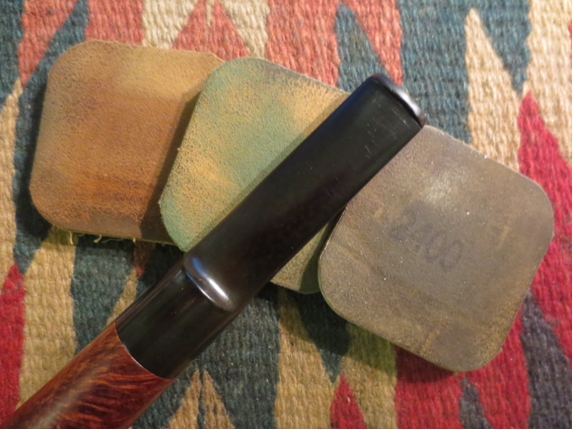
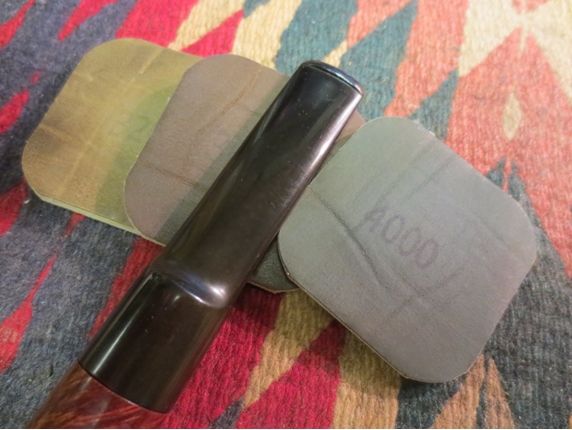
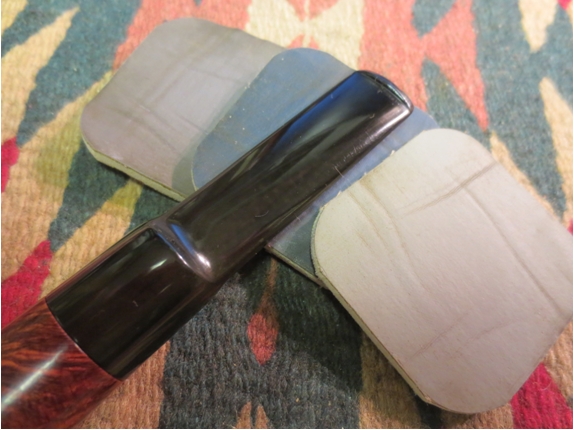
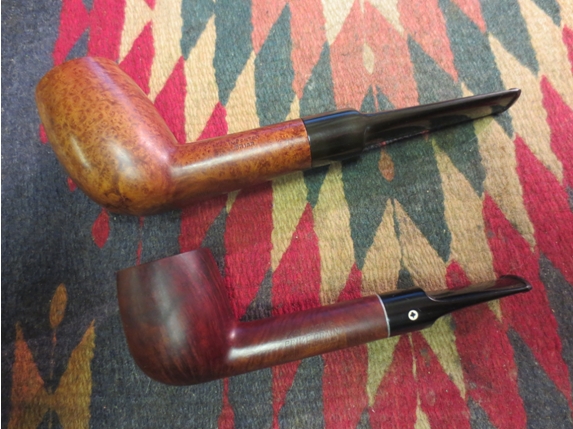
Last evening my daughter and her husband had us over for a wonderful meal of pulled pork and salads. My daughter is a great cook but this time around her husband made the main course. My daughter called just before we went and asked that I bring my pipe and some tobacco to share. I could relax on the back porch and her husband, Lance and I could share a few bowls. It was a great evening and we shared a few bowls. I looked over his pipes and realized that most of them had come from me. In fact the first pipe he had ever smoked came from me – many years ago now. His brother had worked for me and I had introduced them both to the pipe. Anyway, as we spoke he said he had one with a broken stem. The pipe was an Italian basket pipe and had a hard Lucite stem. Somehow he had stepped on it and the stem had snapped in half. In the photo below you can see the break in the stem. It had been sitting with the stem out of the shank for a long time and the tenon no longer fit into the shank. The edges of the stem had been rounded to give it an interesting look, but it did nothing for me. The shank itself was also rounded so it would not take a stem the same diameter as the shank. IMG_8143 To take out the rounded end would have shortened the shank by almost ½ inch so I decided to leave that detail alone and restem it with a stem similar to the original. I also decided to use vulcanite instead of Lucite. The new stem is shown below. It is the same diameter as the previous stem and would have a similar look to it. I would not round the end of the stem but rather leave it flat to sit flush against the top of the crowned shank. IMG_8144 The stem was one from my stem can that had previously been on a different pipe. It was bent the proper angle already so I would not need to bend it or shape it. I just need to clean it up and remove the oxidation from the outside and clean out the interior as well. I also use some 220 grit sandpaper and worked on the tenon so that it had a good snug fit in the shank. I twisted it into place in the shank and took the photo below to get an idea of the new look. IMG_8145 The next two photos give a picture of just a few of the pipe cleaners I used to clean out the stem. I also used a sharp knife to bevel the end of the tenon into a funnel. The previous stem had been drilled off centre and did not match the airway in the end of the mortise. It was well drilled and centered so the funnel on the tenon end would encourage good airflow through the pipe. A quick draw on the stem demonstrated that the draught was good and open now as opposed to the tight draw that it had before. I sanded the calcification on the stem with 220 grit sandpaper and then with medium and fine grit sanding sponges to remove the scratches and the oxidation at the end of the stem. IMG_8146 IMG_8147 I took the pipe to the buffer and gave it a quick buff with Tripoli and White Diamond to clean off the rim and also clean up the stem some more. I still need to sand the stem around the shank junction to remove stubborn oxidation and then polish it. I sanded the stem with 220 grit sandpaper and medium and fine grit sanding sponges to remove the oxidation near the shank. Then I used my usual array of micromesh pads – wet sanding with 1500-2400 grit pads and dry sanding with 3200-15,000 grit pads. IMG_8150 IMG_8151 I wiped the stem down with Obsidian Oil and when it dried I buffed it with red Tripoli and worked on the area near the tenon. I buffed it with White Diamond after than to polish it. Then I took it back to the work table and sanded it with the last three micromesh sanding pads. IMG_8154 I polished the stem with Meguier’s Scratch X2.0 and then buffed a final time with White Diamond. I gave the stem multiple coats of carnauba wax and buffed it with a soft flannel buff. I lightly buffed the bowl with wax and a soft buff as well. The finished pipe is shown below. On Wednesday evening I will deliver it to my son in law so he can fire it up after several years of not using it. I look forward to hearing what he thinks of the new stem. photo 1 photo 2 photo 3 photo 4
Restoring an older KBB Yello-Bole Imperial Dublin


Blog by Steve Laug

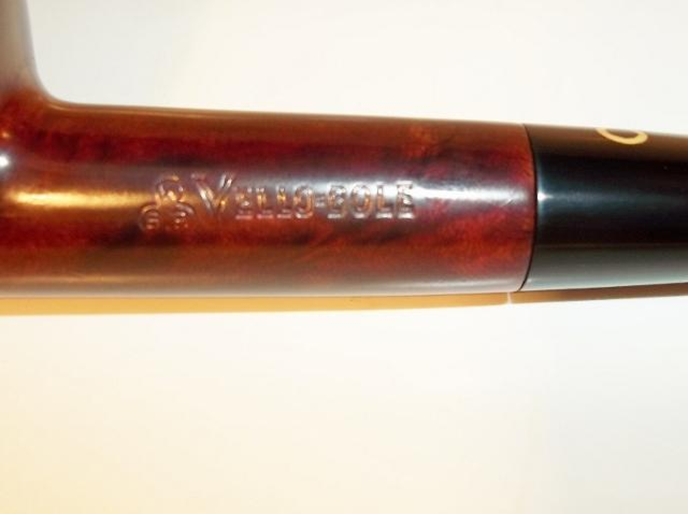
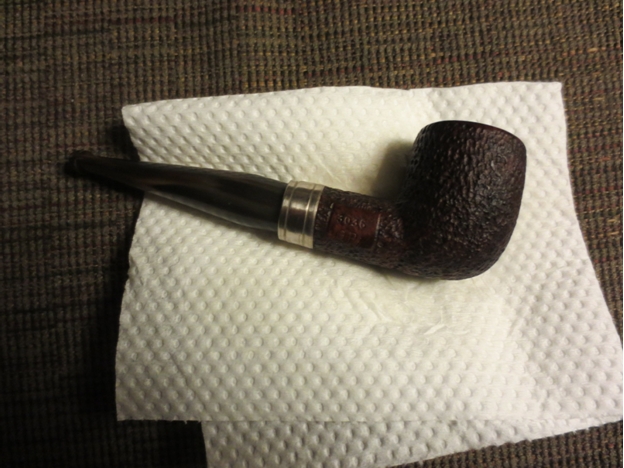
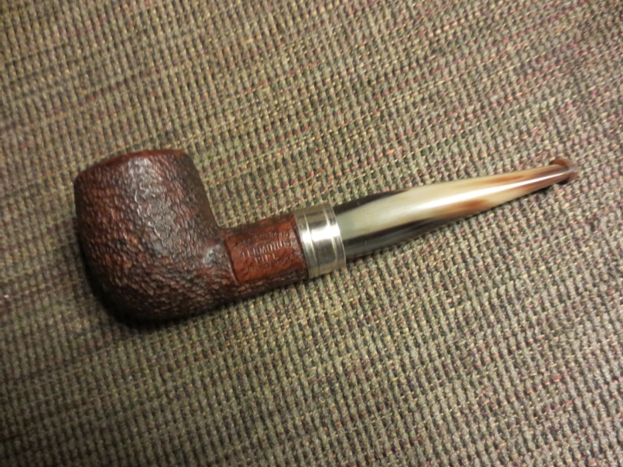
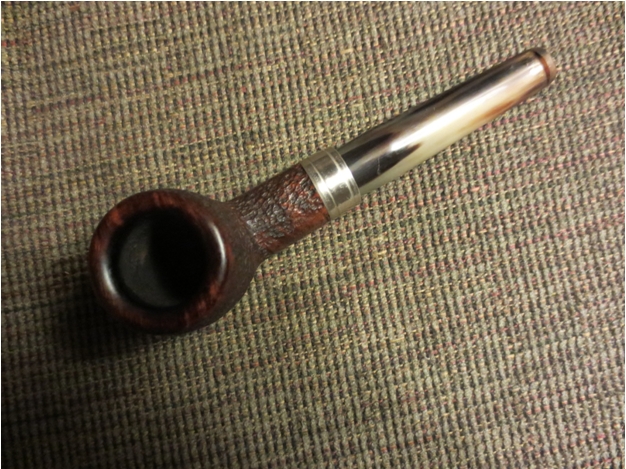
This is the last of the pipes I picked up when I was down in Washington State with my wife for 38th Anniversary. It is an older KBB (no ampersand between the two B’s). It had no shape numbers on the right side of the shank, but on the left side it had the KBB in the cloverleaf/club and next to it was stamped Yello-Bole over Imperial over Imported Briar. The Imperial stamping had been over-stamped with a cross hatch pattern. The bowl was in decent shape. The finish had dark soiling and oils on both sides of the bowl. There were also some dark spots on the sides of the bowl. There was a heavy coat of varnish over the bowl except for the worn spots where the oils and darkening was. The rim was heavily caked with tars and oils. The bowl was caked from the top half way down the bowl, though the yellow honey coating was still visible on the bottom half of the bowl. There were some burn marks along the outer edge and top of the rim.

Again since Yello-Bole is one of my favourite older US brands I did some more reading online to see if I could narrow down when this one was made. I have come to understand that these older Yello-Boles are great smoking pipes and underrated. I turned to one of my go to sources of information on all things KBB and Kaywoodie – the Kaywoodie forum http://kaywoodie.myfreeforum.org/ftopic13-0-asc-0.php. There I found a very helpful article by Dave Whitney that helped narrow down the date. The pipe I have has the shovel drinkless mechanism, the KBB-in-a-clover logo on the left side of the shank and the yellow circle on the stem. From what I can ascertain from Dave’s information it seems to have been produced between the years of 1938-42. I am fairly certain that it did not come from the later period of 1945-50 (World War II) since it did not have the aluminum stem ring and the aluminum drinkless mechanism which came out during those years.

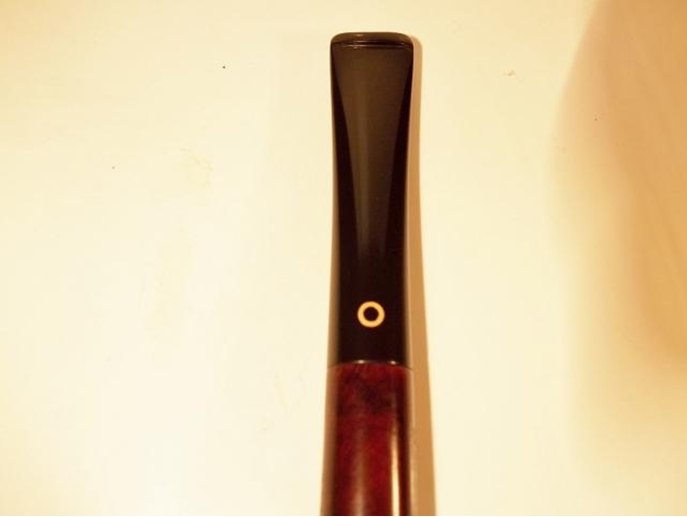
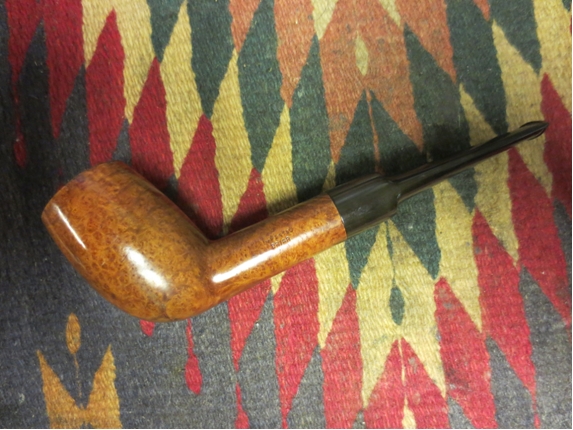
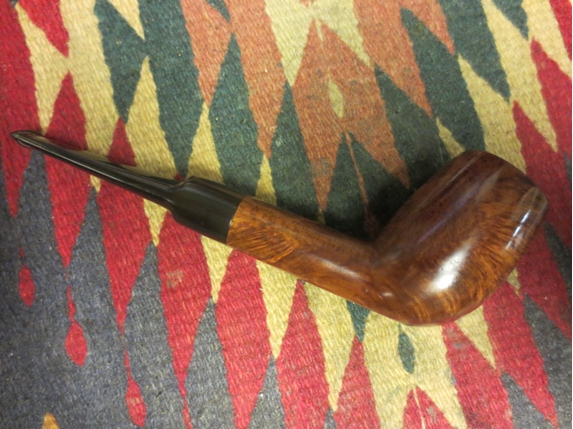
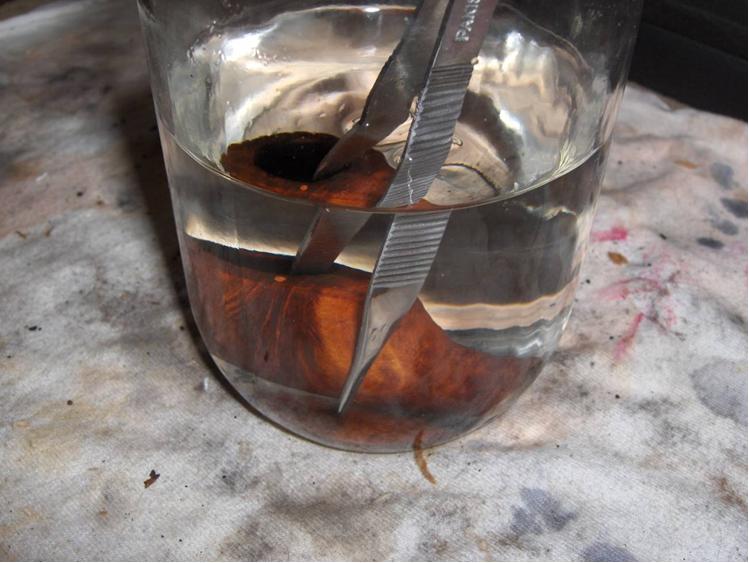
The photos below show the pipe as it was when I found it in the antique shop. IMG_7924 IMG_7926 IMG_7923 IMG_7927 The stem is made of nylon rather than vulcanite. It has the yellow circle inset in the top near the shank of the pipe. The button area was chewed and dented. There was a shallow dent on top of the stem and deeper ones on the underside of the stem next to the button. The button had been chewed down and had deep dents on the underside while the slot had been dented in so that it was not longer straight. IMG_7920 IMG_7922 I sanded the stem down and was able to remove the dents on the topside. The underside tooth mark was too deep to sand or even heat and raise. IMG_7929 I sanded it with 220 grit sandpaper to clean up the chatter further up the stem and then picked the area clean around the large dent with a dental pick. I wiped the stem down with alcohol to clean off the dust and then filled it with black super glue that I purchased from Stewmac online. I filled it the first time and sprayed it with an accelerator. Once it dried it had shrunken and left a divot in the stem surface. I refilled it with the glue and then sprayed it again with the accelerator. I set it aside overnight to cure and worked on the bowl. IMG_7928 IMG_7942 The bowl and rim were caked with an uneven cake so I reamed it with a PipNet pipe reamer to take it back to the briar. The cake was soft and once I removed it from the middle portion of the bowl I could see the yellow coating on the bottom half and partway down from the rim. The only portion that was darkened was in the centre of the bowl. IMG_7930 IMG_7931 I set up my topping board to remove the hard tars on the rim and also the burn damage. Fortunately the burn damage did not go too deep but merely sat on the surface under the tar coat. IMG_7932 I wiped down the bowl with acetone on cotton pads to remove the finish and as much of the dark staining on the side of the bowl as possible. The dark spots were deep in the finish of briar so I was not sure I would be able to remove them. IMG_7937 IMG_7934 IMG_7936 IMG_7939 Even after wiping down the bowl repeatedly the dark stains on the sides remained, lighter though still present. The dark spots appeared to be ink stains and they too remained. I decided to let the bowl soak in an alcohol bath overnight and address it again in the morning. IMG_7941 The next morning I removed the bowl from the alcohol bath and found that it had done its magic. The stains were gone and the ink stains were significantly lighter. I cleaned out the shank with cotton swabs, pipe cleaners and alcohol. I kept cleaning until the pipe cleaners and swabs came out clean. IMG_7946 I stained the bowl with Fiebings Dark Brown aniline stain. I applied the stain and then flamed and repeated the process until the coverage was even. IMG_7947 IMG_7948 I wiped it down with alcohol on cotton pads to remove some of the opaque colour of the stain and to make the grain more visible. IMG_7949 IMG_7950 IMG_7951 I buffed the bowl with White Diamond. The next three photos show the bowl at this point in the process. IMG_7953 IMG_7954 IMG_7957 Once I had finished the work on the bowl to this point I decided to work on the stem. I used a coarse grit sanding stick to cut the sharp edge of the button. While it worked relatively well I could see that the hardened super glue needed something with more teeth to cut into the repair. I used a file to take off the overfill on the repair and then followed that with the sanding stick and 220 grit sandpaper. IMG_7963 IMG_7964
IMG_7965 I sanded the stem further with the 220 grit sandpaper and then with medium and fine grit sanding sponges to remove the scratches in the surface. I wet sanded with 1500-2400 grit micromesh sanding pads and dry sanded with 3200-12,000 grit pads. Between each grit of micromesh I wiped the stem down with olive oil. I have found that the olive oil allows the micromesh sanding pads to really cut into the surface of the nylon stem. I cleaned up the stinger with alcohol and cotton pads and then 0000 steel wool. IMG_7972 IMG_7979 IMG_7983 I gave the bowl a coat of walnut stain and boiled linseed oil to bring out a shine. I wanted the pipe to have a similar shine to what it originally had when it left the factory but did not want to use a varnish coat. I wiped it on the bowl with a cotton pad and then set it aside to air dry. IMG_7975 Once the finish had dried I buffed the pipe with White Diamond and then gave it several coats of carnauba wax and buffed to a shine with a soft flannel buff. I hand waxed the stem with Paragon Wax as I find that the nylon stems are hard to buff. Without a light touch the wheel can do irreparable damage to the nylon stem. The heat generated by the buffer will actually cause the stem to melt. The final photos below show the finished pipe cleaned, polished and ready to enter into the next years of its life. I think that this one will outlive me if properly cared for by the next pipeman after me. IMG_7986 IMG_7987 IMG_8003 IMG_8008