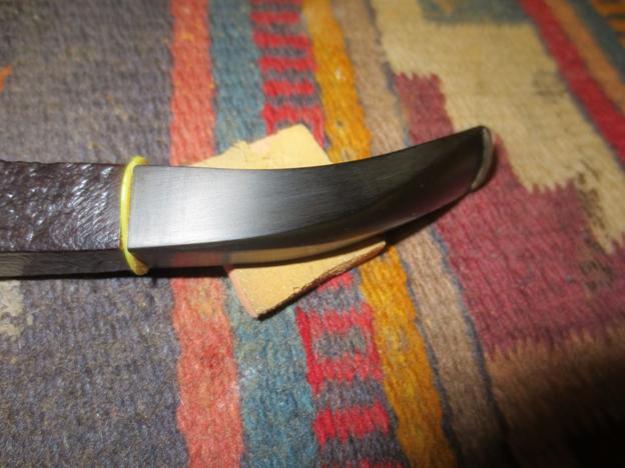
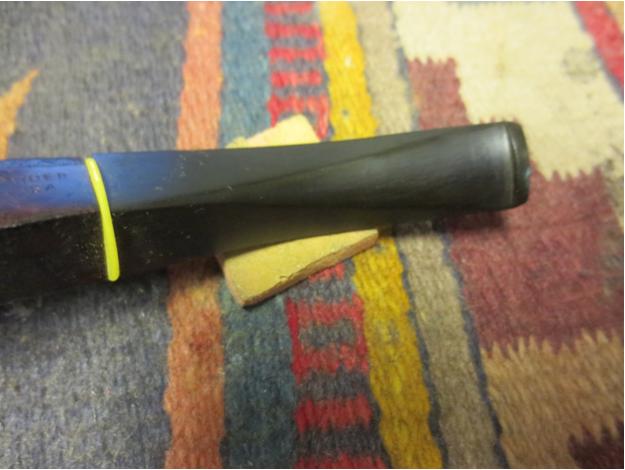
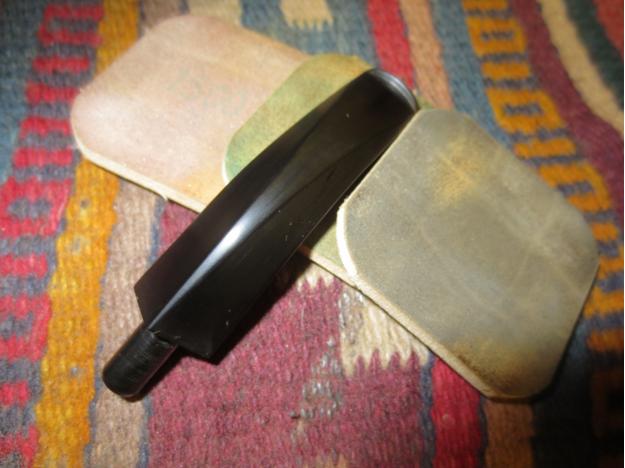
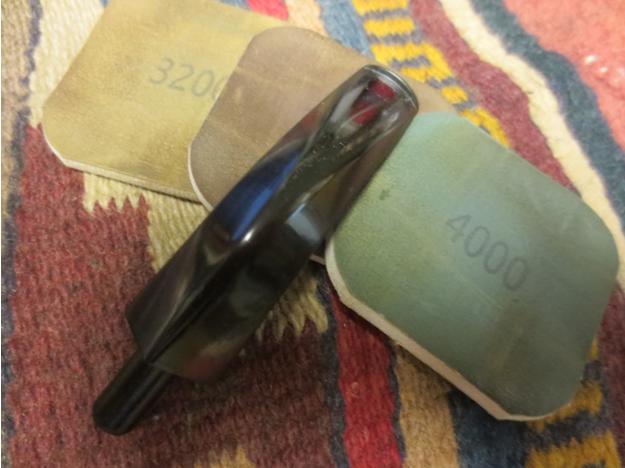
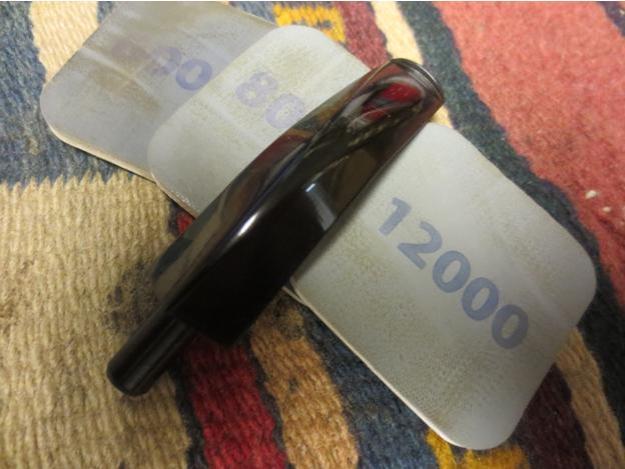
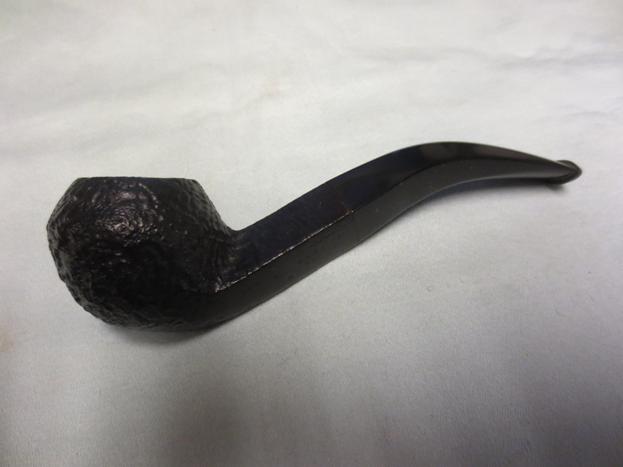
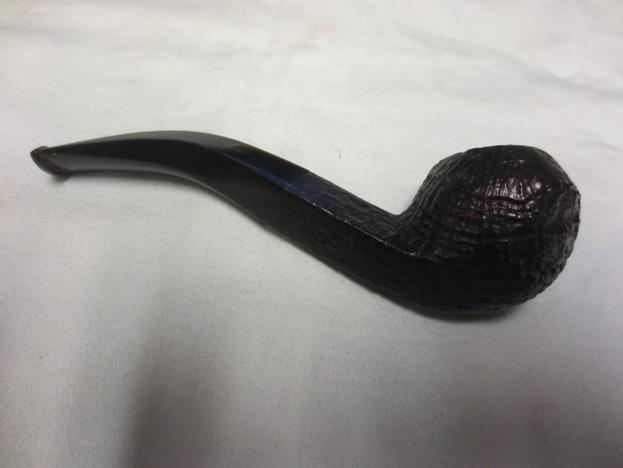
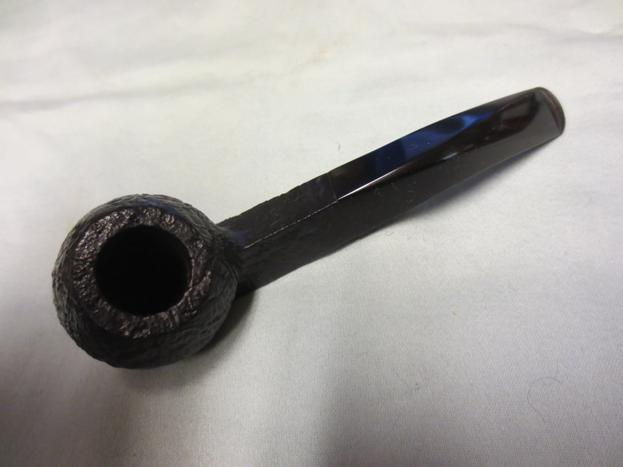
Tag Archives: polishing stems

Reworking a Couple of Pipes with my Son in Law on a Grey Vancouver Day


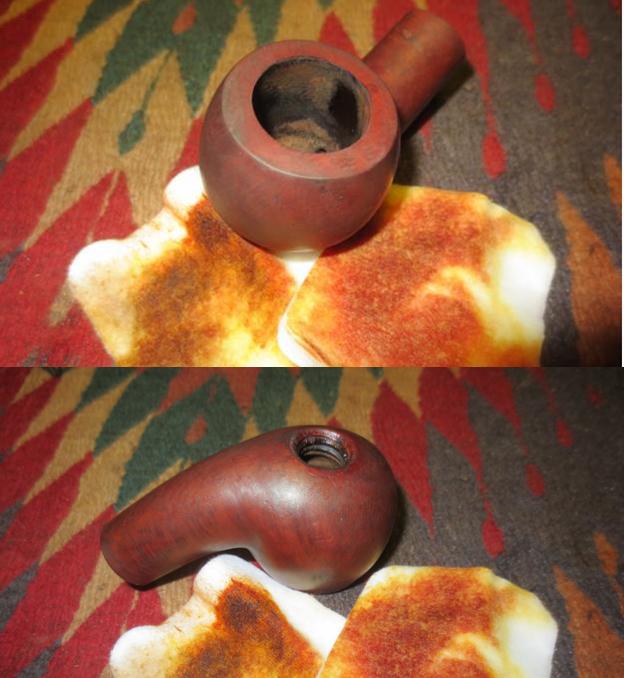
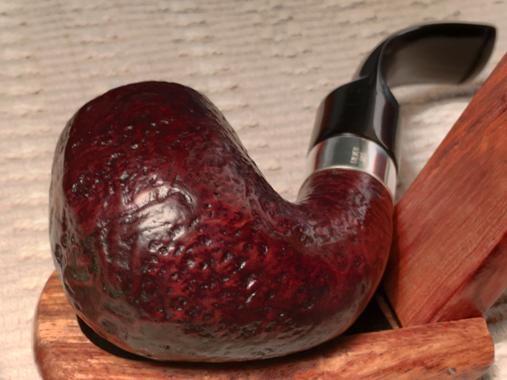
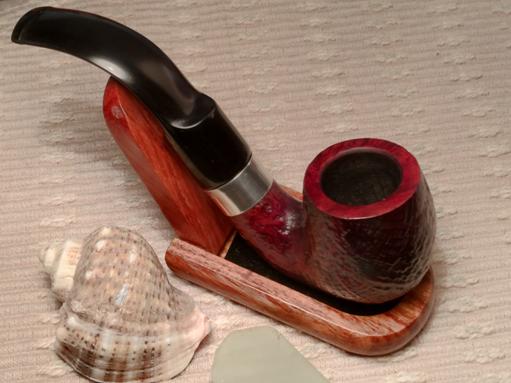
On a recent pipe hunt my son in law went with me and picked up a couple of pipes of his own. The first one was an interesting little Medico VFQ apple with a red stem. The stem was not too badly damaged. It was a filter pipe and still had the old paper Medico tube in the shank. The bowl was a mess. The rim had been burned and chipped and the bowl was badly caked and it looked as if the previous owner had smoked gooey aromatics in it that left behind a heavy residue of tar in the bottom of the bowl. It had hardened into lava like material. He liked the stem colour and the shape of the old pipe so I said to go ahead and pick it up and the two of us could work on it and bring it back for him. So he shelled out the $12.50 for the pipe and it became his first estate purchase of the trip.
IMG_3549

IMG_3551

IMG_3553

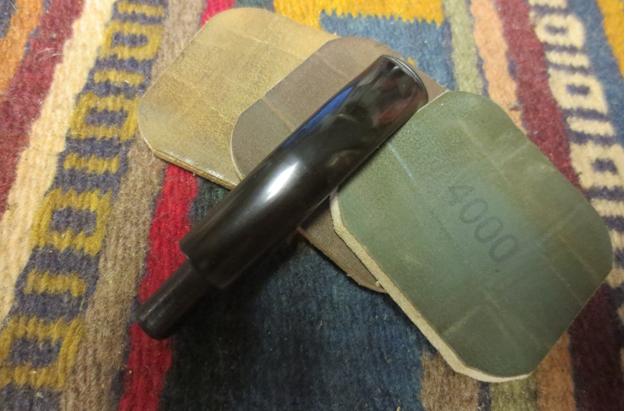
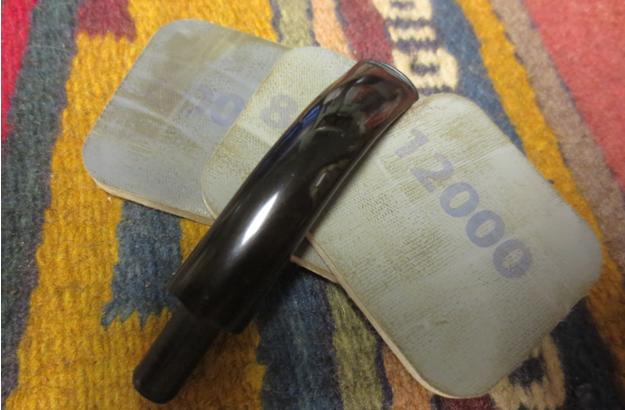
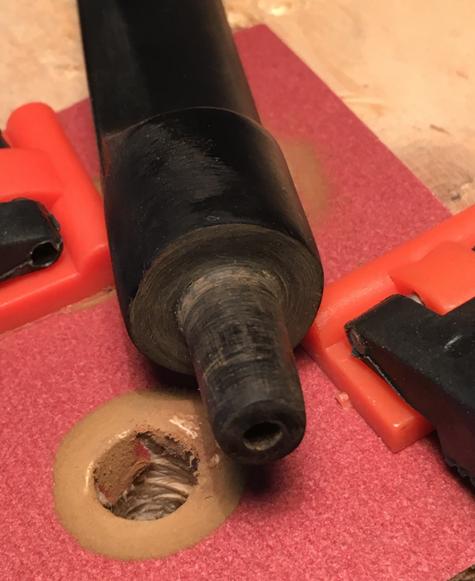
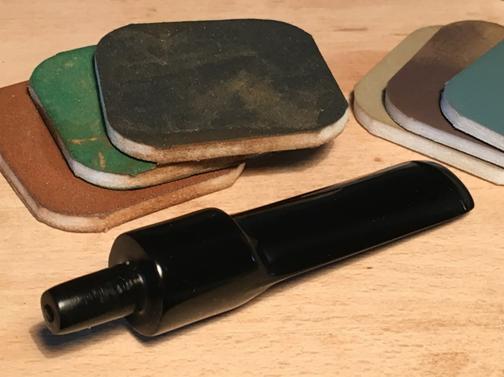
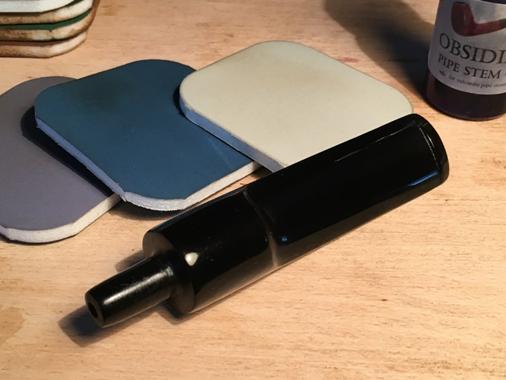
This old pipe took every trick I had up my sleeves to refurbish. The stem was nylon not rubber so it was fussy to clean up. Every scratch shows in nylon and it cannot be buffed except with a very gentle hand. Everything had to be done by hand. I worked on the stem while Lance worked on the bowl. I sanded the stem from the button up the stem for about an inch to remove the calcification on the end and remove the tooth chatter on the top of the stem. On the underside there were a couple of deeper tooth marks that needed attention. I heated the nylon carefully with a lighter to try to raise the dents in the stem. I moved quickly across the surface so as not to melt the nylon. All but one of them lifted nicely – it remained a stubborn part of the sanding process. I sanded the stem with 220 grit sandpaper and then with a medium grit sanding sponge. I finished by sanding the stem with micromesh sanding pads from 1500-12,000 grit – wet sanding with the first three grits and then dry sanding with the remaining grits. I rubbed the stem down with Obsidian Oil. I also sanded the aluminum tenon with the 2400 grit micromesh pad to remove the oxidation on it. I polished it with a silver polishing cloth.

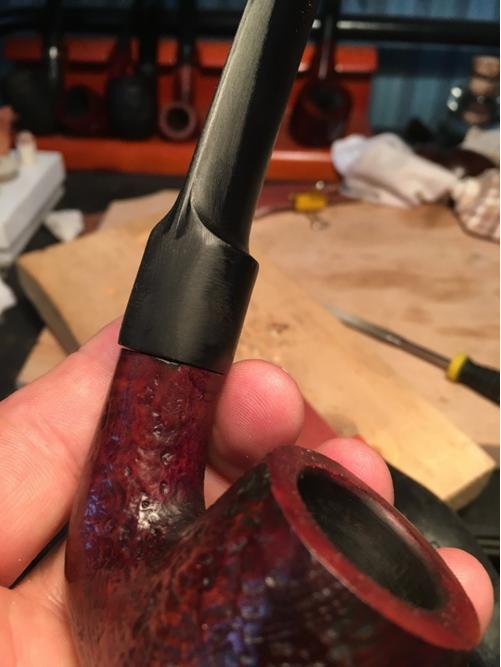
In the mean I had Lance top the bowl and flatten out the rim surface. Then he beveled the outer edge to give the pipe a rounded look like it had previously. He gave the inner edge a slight bevel as well. There were three flaws in the rim surface where the fills were missing. I had him repair these with briar dust and super glue. He then topped the bowl lightly a second time to smooth out the fill repairs. He wiped the bowl down with acetone and sanded it with the sanding sponge. He gave it a quick sand with 1500-2400 grit micromesh as well and then stained it with a black undercoat making sure that the stain went into the grooves that were carved in the bowl surface. He then wiped it down with acetone and sanded it again to remove the black stain from the surface of the bowl leaving it deep in the grooves and around the rim. The black feathered out down the bowl sides and at the tenon shank union. He sanded the aluminum band with a 3200 grit micromesh sanding pad to polish it and then restained the bowl with a red mahogany Miniwax stain. We buffed the pipe with White Diamond and then gave the stem very lightly making sure to not let it heat up. We gave the entirety several coats of carnauba wax. Here is the first pipe he had ever refurbished after it was finished.
IMG_3565

IMG_3566

IMG_3567

IMG_3570

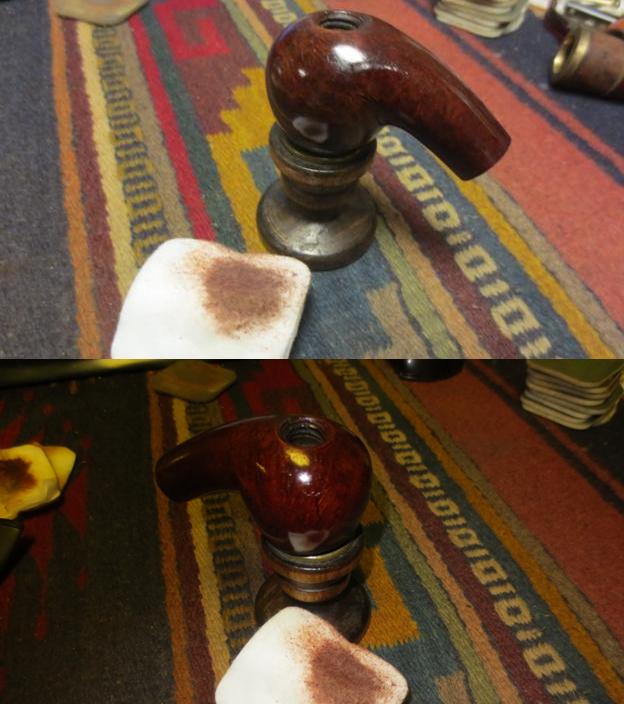
The second pipe was less of a challenge and it was found second on the hunt. It is a Kirsten SX. With a little research we found out that the X designation added to the shape and size S usually meant Brass but that during the 1960’s there was a brief period of time where the SX was an antiqued black and silver finish. That is what he had! Thus we were able to date the pipe a bit for him. The bowl was unsmoked new stock and was probably a replacement. The stem was oxidized and covered with tooth chatter. The barrel was oxidized and much of the antiquing had worn of the finish. The valve at the end was stuck in place. The ramrod was oxidized and dirty. It would be a very easy refurbishing job. Considering the pipe cost him $15 it was well worth the effort.
IMG_3554

IMG_3555

IMG_3556

IMG_3557

Lance took the pipe apart unscrewing the bowl and removing the stem and ramrod from the barrel. The valve at the end was stuck so we had to drive it out with piece of rod I have here. Once it was apart we each went to work cleaning the parts. Lance worked on the barrel and the valve cleaning the outside and the inside of the parts. I worked on the ramrod and the stem. He cleaned out the valve with cotton swabs, pipe cleaners and Everclear and also cleaned out the inside of the barrel with the same. He polished the barrel with silver polish to remove the oxidation and then we washed the barrel with a wash of black aniline stain to give it a bit of an antique look. I sanded out the tooth marks on the stem and polished the ramrod. Lance then sanded the stem with micromesh sanding pads from 1500-12,000 grit. Once the stem was polished he rubbed it down with Obsidian Oil and then we gave the stem a quick buff with White Diamond on the buffer. We rubbed Vaseline into the O-rings on the valve and the stem/ramrod then reassembled the pipe. We gave the entire pipe a light buff with carnauba wax and a soft flannel pad to polish it. Here is the finished pipe.
IMG_3559

IMG_3560

IMG_3561

IMG_3562

IMG_3564

When we finished we filled a bowl with well aged Balkan Sobranie Virginian No. 10 and retired to the porch to have a bowl and a visit. It was a great way to spend a grey Vancouver day and get to know my son in law a bit better. We are already planning more hunts and pipe refurbishing sessions. It is great to have someone working with me who is interested in learning the tricks of the hobby living so close by.

Giving a Smokemaster Bard Billiard a Facelift


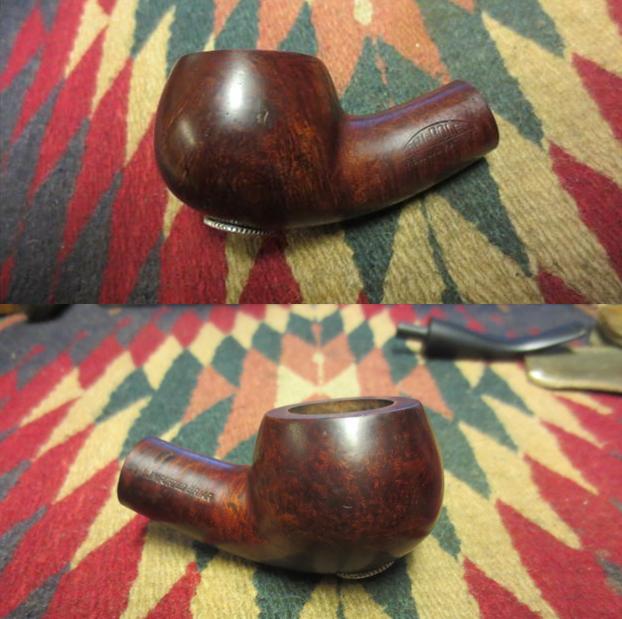
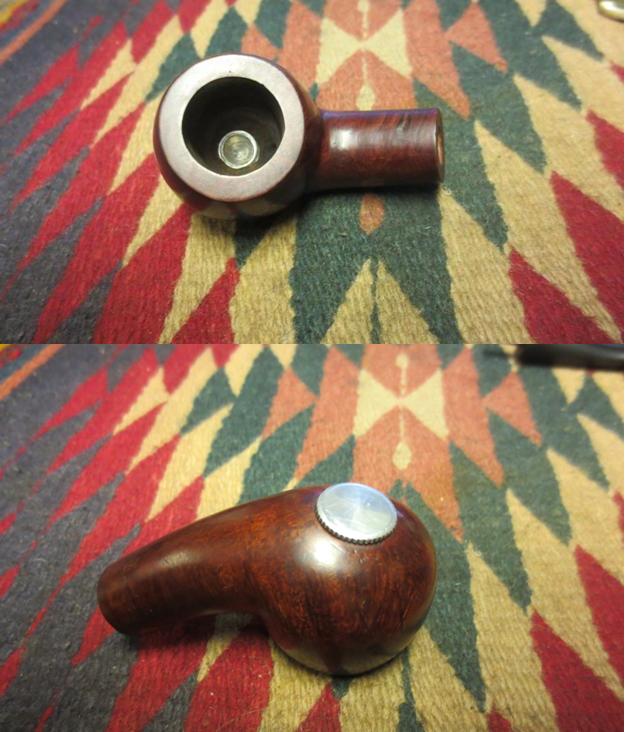
I am down to the bottom of my box of pipes to be refurbished. I have three left. In the bottom of my box was a pipe bowl stamped Smokemaster Bard on the left side of the shank and on the right side of the shank stamped Imported Briar. I found a stem in my can of stems that fit the shank after I adjusted the tenon. The diameter of the stem was slightly larger than the shank but that would be an easy adjustment. The bend would need to be straightened but that would be a simple process. The bowl was lightly smoked and the finish was a very shiny Varathane coating that made the bowl look like plastic. The shank was clean and took very little work to remove the dust that had built up in it.
IMG_3191

I knew nothing about Smokemaster pipes and had no idea who made them. The finish and shape reminded me a lot of Dr. Grabow pipes that I have reworked but that was not enough for me. As has become my habit with pipes I don’t know about, I did a bit of research on the web and found out that the pipe was made by the Briarcraft Pipe Company. The Company was very prosperous between 1920 and 1940. They produced both Briarcraft pipes and a line of seconds under the following names: Airo, Arcadian, Briarmeer, Smokemaster, Cavalcade, Hallmark, Sterling Hall, Filter Kleen and Wimbledon. They closed their doors in 1950. The pipe that I had was definitely not made pre-1950 and the stamping was wrong for it to be made by them. The original Briarcraft stamping was more stylized and had a Germanic script for the stamp. This one was italicized.

Further digging uncovered the fact that around 1967 Dr. Grabow acquired the name and system rights to the Smokemaster line, and was produced until the mid 1990’s. Thus my initial thought of it being a Grabow was correct. It turned out that Dr. Grabow made three series of Smokemaster pipes – the 100, 200, and 300. I have restored and restemmed several of these over the years but never found one that had the original stem intact. Dr. Grabow also made a line of Smokemaster pipes for L.L. Bean. Below are two photos – one of the stem logo which is a shield and the other is the stamping that is on the pipe that I refurbished.
smokemaster

I found out that the Smokemaster had a very unique filter system and was distinct from other filter systems in that it did not include a stinger apparatus. Rather it used a slotted tube that had two special holes in it. A folded pipe cleaner was inserted into the two holes and extended the length of the shank. It collected the tars and moisture of the smoke and could be easily changed and replaced by the pipe smoker. The diagram below shows the design from the end of the tenon.
smokemaster1
I did a patent search and it gave me the following information. This includes both the original description by the inventor and also a diagram submitted at the time of the patent application. I found it at this site: https://www.google.com/patents/US2166537?dq=2166537&hl=en&sa=X&ei=r2u4UtPOHI_ZoAT9moHYCg&ved=0CEAQ6AEwAQ

Description
1939 – B. M. SHOEMAKER 2,166,537
TOBACCO PIPE Filed Oct. 12, 1934 crnar B.M. Shoemaker INVENTOR v ATTORNEY Patented July 18, 1939 UNITED STATES PATENT OFFICE 1 Claim.
My invention relates to tobacco pipes and more particularly to the type in which the bit and bowl portions are separately united to each other.
The principal object of my invention is to maintain the smoke passage in the pipe substantially free of solid deposits, making for general cleanliness in the interior of the pipe and sweet, cool smoking qualities.
I accomplish this object by arranging within the pipe a readily replaceable absorptive member which is designed to receive condensate and solid matter from the smoke as it passes through the pipe. The preferred form of such absorptive member is an ordinary pipe cleaner which, as is well known in the art, comprises a highly flexible metallic core portion carrying a large number of bristles extending there from.
One embodiment of the invention is illustratively exemplified in the accompanying drawing in which Fig. 1 is a longitudinal sectional view of a pipe; Fig. 2 is a transverse sectional view on the line 22 of Fig. 1; Fig. 3 is a transverse sectional view on the line 3-3 of Fig. 1; Fig. 4 is a broken elevation view of a metallic tube or liner constituting one of the pipe elements; Fig. 5 is an elevation view broken intermediate its ends, of the form of absorptive member used in the present construction.
Referring to the drawing, and more specifically to Figs. 1 to 3, denotes the pipe bowl, 1 the bowl stem, 2 the bit and 3 the tenon by which the bit and bowl stem are separately united. The bowl stem has the usual well l4 and the bit the usual smoke or draft passage 15. The bit 12 is further provided with three bores, 15b, c, d, and forming a continuation of the smoke passage 16. A metal tube 16 is provided which is longitudinally slotted at its lower portion and through the slot l8 the products of well be omitted. The tube l6 lies in the bore 15b. The pipe cleaner is doubled upon itself and the two legs or branches of the pipe cleaner enter the bores 15c and l5d and rest there during use of the pipe. The bores 15c and l5d parallel the bore 15b at opposite sides of its longitudinal centre. The embodiment of the invention described is a very desirable construction inasmuch as it receives a standard length pipe cleaner, which in its folded position in the passage 14 is offset from the axis thereof, and which when rotated or twisted with the tenon to seat the same the folded strands of the cleaner engage and brush or clean the wall of the bore.
The operation of the device is very simple. The pipe is sold complete with the pipe cleaner in position. After the pipe has been used for a length of time it will be found that the pipe cleaner is practically saturated with deposited matter. Thereupon the pipe cleaner is simply removed from the pipe and a new one inserted in its place. If desired, the cleaner may also be used in the ordinary manner, naturally before it has become fouled, by moving it back and forth once or twice through the draft passage l5 and/or tube.
What I claim is: In a tobacco pipe, a bowl portion having a stem provided with a central bore, and a bit portion for said stem, the bit having a centrally disposed smoke passage and grooves arranged in the bottom of said passage, a tubular liner mounted in the smoke passage and adapted to project into the bore of the stem, said liner having its underside provided with a longitudinal slot opening into the grooves and bottom of the central bore of the stem beyond the bit, and an absorptive member mounted in said grooves and arranged under the liner throughout its length to receive condensate from the liner and to wipe the wall of said bore when the bit is turned.
BERNARD M. SHOEMAKER.
Classifications

U.S. Classification 131/184.1, 131/203

International Classification A24F1/00

Cooperative Classification A24F1/00, A24F2700/03

European Classification A24F1/00

US2166537-0

I find that kind of information fascinating and am always intrigued by the designers urge to provide a cooler and cleaner smoke for the pipeman who uses his invention. I was not able to find out if Dr. Grabow continued to use the patented design when it took over the line from Briarcraft but I am assuming so until it is shown otherwise by information from those who read this or by a pristine stem that still has the apparatus intact on one of the Grabow Smokemaster pipes.

So armed with that information I went to work on the pipe. I began with the newly fitted stem and heated it with a heat gun to straighten the bend. Vulcanite has memory so with heat the stem returns to its original shape. I held the stem about 6 inches above the heat source, ran the gun on high and watched as the stem began to return to normal. It is important not to hold the vulcanite too close to the heat as it burns and to not rush the bend by helping it as it can snap if not properly heated.
IMG_3192

IMG_3193

The straightened stem is pictured below. It can also be seen in the next three photos that the diameter of the stem is slightly larger than the diameter of the shank. I also left a slight bend to the stem as I liked the look of it on this pipe.
IMG_3194

IMG_3195

IMG_3196

I used a Dremel with a sanding drum to reduce the diameter of the stem to match the shank. This has to be done slowly and with a steady hand so as not to nick the shank of the pipe. I move the Dremel slowly along the diameter of the stem and also backward toward the button to keep the lines accurate and not bulge after the sanded area. I sand it as close as possible to the correct diameter and then hand sand it to fit.
IMG_3197

IMG_3198

IMG_3199

I took it back to the work table and sanded the stem with medium grit emery cloth to smooth out the finish and fit of the stem. I then used 220 grit sandpaper and continued to sand until the stem fit was smooth. At this point I also began to use a sanding block to make the transition between the new stem and the shank smooth. I did not worry about sanding the stem as I intended to remove the plastic finish and rework the entire pipe with a new finish. I also sanded the top of the bowl to remove the two burn marks that were present on the inner edge of the rim. This is visible in the last of the series of photos below.
IMG_3200

IMG_3201

IMG_3202

IMG_3203

IMG_3204

I wiped down the bowl with acetone on a cotton pad to try to remove the plastic like finish that was on the pipe. The acetone succeeded in dulling the finish but not in removing it from the briar. I continued to wipe it down until I was through the finish coat. I sanded the bowl with a medium grit sanding sponge between the acetone washes. (I had previously tried the alcohol bath on pipes with this type of finish and found that they did not penetrate the finish.)
IMG_3205

IMG_3206

IMG_3207

Once the finish was removed I sanded the pipe with a fine grit sanding sponge to remove the scratches as much as possible. I was not overly worried at this point in removing them all as I intended to do a two part stain and sand between the stain coats. I stained the pipe with a black aniline stain, flamed and stained and flamed again. I also heated the bowl to drive the black stain deep into the grain of the pipe so that when I sanded it the grain would show well.
IMG_3208

IMG_3209

IMG_3210

I wiped the bowl down with Everclear on a cotton pad to remove the topcoat of the stain. I knew that the stain would have penetrated deep enough into the grain to leave the parts present that I wanted highlighted.
IMG_3211

IMG_3212

I buffed the pipe with red Tripoli to further remove the black stain. The next four photos show the bowl after buffing. I still wanted to remove more of the stain from the pipe to get the desired effect and differentiate the grain for the finished look of the pipe.
IMG_3213

IMG_3214

IMG_3215

IMG_3216

I wet sanded the bowl and the stem with 1500-2400 grit micromesh sanding pads to further remove the black stain from the surface of the bowl. The sanding also served to remove the scratches left behind by the fine grit sanding sponge before staining. The first four photos below show the finish after I had sanded the bowl with these grits of micromesh. I then dry sanded the bowl and stem with the remaining grits of micromesh pads from 3200-12,000. The state of the bowl and stem can be seen in the last two photos below.
IMG_3217

IMG_3218

IMG_3219

IMG_3242

IMG_3243

IMG_3244

Once I had removed as much of the black as I wanted I stained the pipe with the second stain – an oxblood aniline stain. I heated the bowl, applied the stain, flamed it and reapplied and reflamed it until the coverage was even around the bowl. Once it was dry I buffed the bowl and stem with White Diamond to polish the finish and the stem. I rubbed the stem down with Obsidian Oil to protect the vulcanite and when dry gave the bowl and the stem multiple coats of carnauba wax to polish and protect the pipe. The finished pipe is pictured below. I really like the contrast stain and the matte like finish on the pipe. The two step stain process highlighted the grain on the pipe and gives it a far more polished and finished look than the previous plastic coat had down. This piece of briar, though not stellar, did not have fills or flaws that are visible. It should make someone a great addition for their pipe rack.
IMG_3245

IMG_3246

IMG_3247

IMG_3248

NOTE: I was just reading on PSU and saw a post there that had this photo of the filtration system on these pipes. http://pipesmokerunlimited.com/showthread.php?4015-Smokemaster-Filter-Pipe Thanks to the poster, Hammerhead (Terry Swope???maybe) for posting the photo for us to see.
Smokemaster_zps5e85a518

A Piece of Tobacciana – Restoring an Old Nylon Cigarette Filter/Holder


Somewhere along the way in one of the pipe lots I bought off EBay this old cigarette holder was included as a pipe stem. I put it in a drawer and forgot about it for several years at least. The other evening I was cleaning out a drawer of pipes that I had already refurbished getting them ready for my daughter to catalogue and came across the old holder. At first glance it appeared to be a cigarette holder. There was no filter apparatus present and the mouthpiece was short and condensed so I did not think there would be one inside the stem itself. I sanded down the casting marks on the side of the stem and also cleaned the stem of debris. There was one burn spot on the underside of the stem near the metal holder end. The metal holder was brass and quite clean with a slight nicotine and tar build up on the inside. The airway on the stem was plugged and no air could pass through it.
IMG_3182

IMG_3183

I twisted the end cap and it came free from the stem itself. Inside was a filter apparatus similar to the different stingers that one finds in American made pipes of days gone by. This apparatus was a single unit. There was a rubber o-ring around the top just below the holder top. This held the cap unit snugly in place in the stem.
IMG_3181

Once I had removed the apparatus from the stem the stinger design was visible. It extended half way down the shank of the stem. Behind the o-ring was a cut/slit half way through the aluminum of the stinger. It was clogged with tars and oils. In the middle of the slit was an opening. One on the o-ring side and one on the stem side of the slit. The aluminum then funneled down to tube that at first glance appeared to be solid. At the end of the tube were two solid rings around the tube. Between the rings there were holes on two sides in the groove. When it was inserted and clear the air would be pulled through the holder and into the stinger slit. It would circulate in the stem to cool and then move through the slit and down the tube and out the two holes. These would then disperse the smoke through the remainder of the stem and out the slot in the button. In many ways it was like an inverted stinger in shape and function to those found on pipes.
IMG_3177

The hole in the end of the stinger does not go through the stinger but rather is like a small cup on the end. It was for collecting moisture and tars if the grime buildup was any indication.
IMG_3178

IMG_3180

The holder cap pictured in the photo below is the depth of the filter on a modern cigarette and also the dame diameter as the end of the cigarette. I cleaned the entire apparatus and soaked it in a bath of Everclear to try to open the airway. I was able to clean out the cut in the aluminum, the holes in the end and in the cut itself using a dental pick. I scrubbed down the apparatus with a tooth brush and Everclear. I was unable to get air to pass through due to a clog in the end of the holder. In the photo below it is visible as a small hole in the bottom of the cup. It was plugged and the dental pick was too thick to go through it. I tried a thin paper clip and a needle with no success. I finally was able to open it with a tiny micro drill bit on the Dremel and pushed it through at a very slow speed. The bit came with a plastic guide that fit inside the cup perfectly and kept the drill straight as it opened the airway. Once it pushed the clog through I cleaned the inside of the airway with Everclear and was able to push air through with no effort.
IMG_3179

I repaired the burned spot on the stem with superglue and sanded the stem until the patch blended with the rest of the stem surface. I sanded the stem with 220 grit sandpaper and then with a medium grit sanding sponge to smooth out the scratches in the surface of the nylon stem.
IMG_3135

IMG_3136

I wet sanded the stem with micromesh sanding pads from 1500-2400 grit and then dry sanded with 3200 – 12,000 grit sanding pads. I used a plastic polish to further shine the stem once I was finished with the micromesh pads.
IMG_3184

IMG_3185

IMG_3187

I rubbed down the stem with Obsidian Oil and gave it a very light buff with White Diamond. You have to exercise a very light touch when buffing nylon as it melts with the heat of the buffing wheel. I finished by giving the stem multiple coats of carnauba wax to give it a shine. I hand buffed the shine with a soft cotton cloth. The finish filter is pictured below in the final three photos. It is not something I will ever use but it is an interesting piece of tobacciana for the collection. I have no idea of the maker of the piece or of the age but I am fascinated by the ingenuity of the product.
IMG_3188

IMG_3189

IMG_3190

Refurbishing and Restemming an Unsmoked Small Paneled Rhodesian


I am scraping the bottom of the box for pipes to refurbish. It is clear that I am going to have to go on the hunt again soon. At the bottom of the box I have a few small/tiny pipe bowls that have come to me from a variety of sources. I believe this little one came from Mark Domingues as well. It is unsmoked and stemless. The bowl was in pretty fair shape though the finish coat was varnish of some sort. The stain was spotty under the varnish coat. There was one dominant fill on the left side of the bowl on one of the panels. The drilling is a bit of centre in the bottom of the bowl – slightly to the left of centre. The drilling was wide open and the draught on the bowl was very good. The bowl did not have a ring around the top before the bevel to the rim. It was a smooth transition. I have had several of these older Rhodesian and Bulldogs in the past and they generally had horn stems. This one did not have any stamping on it so I have no idea as to the maker. There was also no stem present. I had a smaller nylon stem in my box of stems that took very little work on the tenon to make for a snug fit in the shank.
IMG_2798

IMG_2799

Once the stem fit well in the shank I sanded the shank and stem to get a good smooth transition between stem and shank. I used 220 grit sandpaper to do the rough work and then used a medium grit sanding sponge to clean up the shank and stem. The stem had casting marks on both sides of the stem and also heavy tobacco stains around the button and in the slot. The airway was virtually clogged and I could barely get a straightened paper clip through before I worked on it with Everclear and bristle pipe cleaners.
IMG_2800

IMG_2801

IMG_2802

I decided to sand the stain off the shank and rework the taper on the pipe from button to bowl. I sanded it with 220 grit sandpaper to remove the excess briar and nylon and smooth out the taper. What I wanted was a clean smooth line from button to bowl. The next four photos show the shank and the stem after sanding with the 220 grit sandpaper. The flow is smooth and even and the lines are very graceful. The casting marks are gone from both sides of the stem and the button is cleaned of the majority of the stains.
IMG_2803

IMG_2804

IMG_2805

IMG_2806

I wiped the bowl and shank down with acetone on a cotton pad to remove the varnish finish and some of the stain on the bowl in order to make it easier to match the stain on the newly sanded shank and the bowl. I also sanded the bowl, shank and stem with a fine grit sanding sponge to remove scratches left behind by the sandpaper and to prepare the stem for sanding with micromesh sanding pads.
IMG_2807

IMG_2808

I sanded the entire pipe and stem with micromesh sanding pads. I wet sanded the stem and the bowl with 1500-2400 grit sanding pads and dry sanded the bowl alone with 3200-12,000 grit pads. I did not want to make the briar to smooth to take a good coat of the stain.
IMG_2809

IMG_2810

IMG_2811

IMG_2812

I stained the bowl with a medium brown aniline stain mixed 2 parts stain with 1 part isopropyl alcohol to get the colour I wanted. I was going for more of a wash than a deep coat. I wanted the grain on the shank and bowl to come through the colour. I used a black permanent mark to draw grain marks on the two fills and to make it easier for the stain coat to blend in and hide the putty marks.
IMG_2813

IMG_2814

IMG_2815

IMG_2816

Once the stain was dry I buffed the bowl with White Diamond to give it a shine and then reinserted the stem and lightly buffed the stem with White Diamond as well. The nylon stems take a very soft touch or they are easily damaged. I gave the bowl and stem several coats of carnauba wax to protect them and then lightly buffed the pipe a soft flannel buffing pad. The finished pipe is pictured below. It is not a big pipe in any sense but should be a great flake pipe. The second photo below gives an idea of proportion by the inclusion of my hand with the pipe. The yellow nylon stem approximates the unique colour and look of the horn stem that must have originally graced this little bowl. The stem is thin and the new taper gives a very delicate look to the new pipe.
IMG_2817

IMG_2818

IMG_2820

IMG_2821

Restemmed and Restored Imported Genuine Briar Billiard


This is another bowl from my refurbishing box. It is stamped Imported in an arc over Genuine Briar on the left side of the shank. The finish was varnished and dirty. I intended on stripping it so when I restemmed it I block sanded the stem fit. I had an old Erhlich stem that fit very well and gave the pipe a nice line. The rim had a strange rustication pattern on it that did not match the carvings on the front of the bowl. It was tarred and the varnish coat had bubbled on it. So I decided I was going to top it and give the bowl a smooth rim to match the smooth portions of the bowl. I sanded the shank and stem junction to make sure that the transition was smooth. I sanded with 220 grit sandpaper, a medium grit sanding sponge and then a medium grit sanding block.
IMG_2714

IMG_2715

IMG_2716

IMG_2717

I reamed the bowl with a PipNet reamer and cleaned out the old stem and the shank with cotton swabs and pipe cleaners dipped in Everclear. I cleaned it until both came out white. I then continued to sand the union of the stem and shank with the 220 grit sandpaper until the transition was very smooth. I was careful around the stamping as I wanted to leave that intact and clear. Some nice grain began to come out once I had the finish removed at the junction. It bode well for what would be under the varnish coat once I stripped that away.
IMG_2718

IMG_2719

IMG_2720

IMG_2721

I used my usual method for topping the bowl – a piece of 220 grit sandpaper on a board and twisted the bowl rim into the sandpaper being careful to keep the rim flat against the board. I kept sanding until all of the carved grooves on the rim were gone and the rim was smooth. I also sanded the rim with a medium grit sanding sponge and then a medium grit sanding block to smooth out the scratches left by the 220 grit sandpaper. I finished the rim sanding with 1500-2400 grit micromesh sanding pads in preparation for the new stain coat.
IMG_2722

IMG_2723

I wiped the bowl and shank down with acetone on a cotton pad to remove the varnish coat and as much of the stain as possible so that blending the stain on the sanded areas into the overall finish would be simpler.
IMG_2727

IMG_2728

IMG_2729

With the finish removed I restained the bowl with a medium walnut stain in a linseed oil mixture. I think it was Mark who asked in a comment on the Dr. Grabow Royal Duke write up why I did not use the aniline stains on the past few pipe restorations. The answer is quite simply that I am out of brown aniline stain so I have been using this walnut stain until I can get time to replenish my supplies. I used cotton pads to apply the stain to the bowl and wiped it down until it was an even colour on the pipe. I repeated the process until it met my expectations. When it had dried I took it to the buffer and buffed the bowl and rim with White Diamond.
IMG_2734

IMG_2735

IMG_2736

IMG_2737

I then worked on the stem with micromesh sanding pads. I wet sanded with the 1500-2400 grit sanding pads and then dry sanded with 3200-12,000 grit pads. Each of the photos below shows the progressive shine to the vulcanite becoming more pronounced.
IMG_2738

IMG_2739

IMG_2740

With the bowl finished and the stem polished I took the pipe to the buffer and buffed it with White Diamond and then gave it multiple coats of carnauba wax. I finished by buffing it with a clean flannel buff. The finished pipe is pictured below. The colour on the rim appears lighter than the bowl in the photos. In real life it is a good match. The new look of the pipe is much better than the original in my opinion. This one should make someone a great smoking pipe in the future. The stem is a comfortable one and the light weight of the briar will make it a good yard pipe.
IMG_2741

IMG_2742

IMG_2743

IMG_2744

Restoring An Interesting Piece of Pipe History – An Art Deco C.B. Weber Streamliner


Blog by Steve Laug

In a recent EBay purchase I picked up a unique pipe that has a flowing look to it. I was intrigued to figure out the history and any information I could find regarding it so I went on a hunt on the web. One of the first articles I came across is found in the link below. http://streamlinesdeluxe.wordpress.com/2012/06/01/weber-streamliner-pipe-2/ The author of the blog makes a brief reference the pipe I found and even has a picture of it. He speaks of the stem being made of something other than vulcanite. Other references I found in online pipe forums spoke of the fact that the bowl was not made of briar but of some composite material. Others said that the bowls were made of American hardwoods. Interestingly no one spoke of what hardwoods were used. I have hunted high and low on the web and can find nothing definitive on the pipe’s manufacture or composition.

I broadened my search to information on finned pipes. I did not want information on Porsche design pipes or metal finned pipes but was looking for anything on wooden finned pipes. I came across the following information on a patent taken by a carver/designer named Wayne Leser. His diagrams and patent application is included below and it can be seen that it is actually very close to CB Weber’s Streamliner. His patent was applied for through the US Patent Office in January of 1941. I assume the patent was granted as it is on the Patent website. Weber’s design seems to be elongated a bit more than the Leser design but the tear drop shape of the outer bowl and the similarly tear drop shape of the drilling match quite well.

I can find no further information on Wayne Leser so I have no idea if he sold his concept to Weber, or worked for Weber. If anyone has further information on that connection it would be great to learn about it. Please post a response below.
Leser Patent Drawings

Leser Patent Application

The pipe I picked up is pictured below in photos from the EBay seller. The photos were not very clear so I could not see the condition of the pipe very well but I was intrigued by it nonetheless. It looked like the bowl was in good condition. The stem however, appeared to be a replacement stem and the fit was poorly done. In the second photo below it is evident that the junction of the stem and shank does not meet.
pipes2

Streamliner

When the package arrived from the seller I took the pipe to my worktable and photographed the condition of the pipe. The pipe was in fairly decent condition. The left side of the bowl was clean. It is stamped Streamliner in script over C.B. Weber & Co.
Streamliner logo3

Streamlinerlogo2
There were two small divots in the shank just below the stamping. I thought at first these might be dents but they are actually spots where the wood is missing. The right side of the bowl is also in good shape. The fins are intact all the way around the bowl with no chips or breakage. The rim was tarred and had a small burn spot on the point at the front of the bowl. The stem was definitely a replacement stem. In my reading I had found copies of the logo that was originally on the stem and also the fact that the stem had a stinger apparatus as part of the fitments. This stem had neither and the fit was wrong. The diameter of the stem was bigger; the tenon was off center therefore the fit was out of line with the left side being too large and the right side too small. The length of the stem was also too long and did not match the dimensions that I had found online regarding the overall length of the pipe. The bowl was in pretty decent shape though there was some kind of bowl coating on it that had broken free of the walls. It is a tear drop shaped bowl with a downward angle on the front portion so reaming it would be tricky. The wood on this one was definitely not briar. The bottom of the bowl has a foot that makes it a sitter and there is a rusticated pattern on the bottom of the bowl.
IMG_2425

IMG_2426

IMG_2427

IMG_2428

IMG_2429

I carefully reamed the bowl to remove the bowl coating and the slight cake that was there. I used two different cutting heads on the PipNet reamer. The first head was the same diameter as the main portion of the bowl. For the angle teardrop end I used the smallest cutting head. Between the two of them I was able to clean up the bowl and remove all of the coating.
IMG_2430

IMG_2431

Removing the tars from the rim was a bit of a challenge and combined with burn mark on the point I decided to sand off the rim with a medium grit sanding sponge. I would then have to restain the bowl. I sanded it with the medium grit sponge and then with a fine grit sanding block to work on the burn mark and the darkening of the rim.
IMG_2432

IMG_2433

IMG_2434

IMG_2435

I finished the sanding by wiping down the bowl with acetone on a cotton pad. I was able to even out the finish on the bowl and rim so matching stain would be much easier to do. I was also able to lighten the burn spot with the same process to the point that a good coat of oxblood stain would make it fade into the surface of the rim.

I then set the bowl aside and went to work on fitting a new stem to the bowl and shank. In the first photo below I have the new stem blank fit to the shank. It still needs work to make the diameters match. The stem is about an inch shorter and brings the pipe back to the original length as noted from my online work. I also think that proportionally it works better with the elongated bowl and shank than the one that came with it.
IMG_2436

In order to get the fit good and tight I used a sanding block to make sure that the transition between the bowl and shank was smooth. This entailed sanding the shank slightly in the process. In the next series of four photos below the fit is finished. The transition is smooth and the fit is good and tight.
IMG_2437

IMG_2438

IMG_2439

IMG_2440

I wiped the pipe down with acetone once again to even out the finish on the shank. The grain in the original wood is quite visible in these photos and it is not briar.
IMG_2441

IMG_2442

IMG_2443

The flow of the taper on the stem was still too chunky in my opinion to match the Streamline concept of the pipe. I used 220 grit sandpaper and files to change the slope of the stem. When I had it the way I envisioned I sanded it with 220 grit sandpaper, a medium grit sanding sponge and also a fine grit sanding block. The angle was right and the profile looked much more “streamlined”.
IMG_2445

IMG_2446

I sanded the stem, bowl and shank with micromesh sanding pads. I wet sanded them with 1500-2400 grit sanding pads and dry sanded with 3200-12,000 grit pads.
IMG_2447

I decided to try to match the original stain using a Danish Oil (linseed oil with a cherry stain). I applied the stain with a cotton pad and wiped it down. When it had dried I was not happy with the coverage and appearance so I removed the stain with acetone to try a different stain.
IMG_2448

IMG_2449

IMG_2450

Once I had the finish removed I restained it with an oxblood aniline stain. I had to apply it and flame it several times to the top of the bowl and shank to get the stain to set deeply and match the rest of the bowl. This was a hard one to get a good stain on. I decided to not apply the stain in the grooves of the fins but just on the surface of the bowl. It worked quite well with the original stain in the fins matching the surface colour really well.
IMG_2452

IMG_2453

IMG_2454

IMG_2455

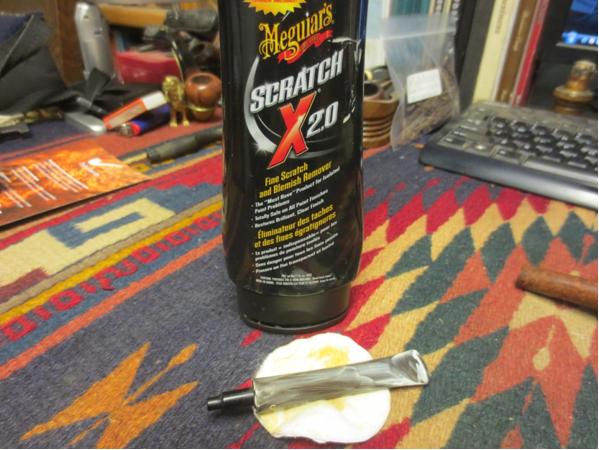
I did some further polishing on the stem with the higher grits of micromesh from 3600-12,000. Once I had finished the sanding I polished the stem with Maguiar’s Scratch X2.0 to deepen the shine. I coated the stem with Obsidian Oil and then buffed it with carnauba wax to seal it and protect it. The final buff on the stem was done with a soft flannel pad.
IMG_2457

IMG_2458

I reinserted the stem and gave the pipe a final buff with carnauba wax and a soft flannel buffing pad. The finished pipe clearly shows some of the grain pattern of the alternative wood on the shank and the top and bottom of the bowl. The stem came out fitting nicely and giving the overall pipe a new “streamlined” appearance more accurately approximating the original stem. The bowl feels great in the hand and is uniquely attractive as a piece of pipe history. Time will tell if I smoke this one or just keep it around for display purposes. Below are photos of the finished pipe.
IMG_2463

IMG_2464

IMG_2465

IMG_2466

Medico Ventilator — Unventilated (Thanks Ed for the idea)


When I read this post by Ed James (Ozark southpaw) on Pipe Smoker Unlimited. This is the link to his post: http://pipesmokerunlimited.com/showthread.php?3186-Medico-Ventilator-unventilated I thought I would love to try that as well. Here is Ed’s first post in that thread that got me started thinking about the project. Ed also is a refurbisher of long standing and does excellent work. Here is his website: http://www.ozarksouthpawpipes.com/index.html

On PSU Ed wrote; “I’ve had a few of these and they smoke fine, although sometimes it was hard to get the filter seated so the pipe will draw as it should. If you’re not familiar with the Ventilators, they cannot be smoked without a filter. I smoke mostly filtered pipes, but thought I would see if I could make a Ventilator filterless. Accomplished it by turning a piece of briar the length of the shank and epoxying it in place. For the stem I used a vulcanite blank after replacing the tenon with delrin and adding a ring of tortoise shell acrylic. On my third bowl in it and it is smoking fine.”

Here is the pipe – pictured below. It is a nice looking sandblast that Ed “unventilated”.
Un-Ventilated Ventilator 2013-08-27 001 (1280x960)

Un-Ventilated Ventilator 2013-08-27 003 (1280x712)

Un-Ventilated Ventilator 2013-08-27 005 (1280x1013)

So today was the day that I got to finally work on “unventilating” one of my own. Mark Domingues (dogtalker) recently sent me a few old bowls and pipe parts that needed some work. In that package was a Medico Ventilator. It was not as nice as the one Ed worked on, pictured above, but it was a Ventilator sans stem nonetheless and it was the opportunity I was looking for to try my hand at unventilating the Ventilator. This bowl was absolutely clean. I don’t think that it had been smoked other than maybe the first light or so. The bottom 2/3s of the bowl was still virgin briar. The bowl had the typical Medico lacquer coat and there were carved leaves all around the outside of the bowl. I decided to leave the finish alone and rework it as it stood. One day I may remove the finish but for now it will remain as it is.
IMG_2148

I have kept a few unredeemable bowls around in my box of stuff and they came in handy this time. I took two different bowls out of the box and used a hack saw to cut off the shank as close as I could to the back side of the bowl. My plan was to follow Ed’s instructions noted above about turning a piece of briar to fit inside the Ventilator tube. I do not have a lathe so I decided to repurpose some briar shanks to do the same job.
IMG_2151

IMG_2152

IMG_2153

IMG_2154

After cutting them off the bowl they were ready for me to begin shaping them. I used a Dremel and sanding drum to take the diameter of the cut off shanks down to the diameter of the tube on the Medico. The next seven photos show the process of removing the excess briar. I used two different pieces of slightly different lengths that could be used depending on the stem I chose to use. The one pictured in the first seven photos below was about ½ inch shorter than the length of the tube. I thought about using a plug in the bottom of the tube but later decided to use the longer of the two briar tubes.
IMG_2155

IMG_2156

IMG_2157

IMG_2174

IMG_2171

IMG_2172

IMG_2173

I used both the Dremel and 220 grit sandpaper to shape the briar tube to fit in the Ventilator. The first one was just briar. The second one was off of a screw mount shank. I decided to leave the aluminum in the shank and use that to but up against the aluminum seat in the Ventilator tube.
IMG_2158

IMG_2159

IMG_2160

I sanded both tubes so that I could try both and see which one I wanted to use. I chose the long of the two with the aluminum base. I inserted it in the shank of the Ventilator with the aluminum end in first. I pressed it into place in the tube. It is a pressure fit so I did not need to glue it to fasten it in place. I chose not to use epoxy or glue to hold it in place and opted instead for a tight fit. Once in place it was slightly longer than the tube. The aluminum was tight against the interior and could go no further. I used the Dremel with the sanding drum on it to remove the excess briar. Once was flush against the aluminum it was time to fit a new stem to the shank.
IMG_2161

IMG_2162

I had several saddle stems in my can of stems that would work on the new shank insert. I turned the tenon down with a PIMO tenon turner until it was close to the right size and then finished with sandpaper and files. I used a file to shape the seat in the insert so that the stem would sit well against the tube. The next three photos show the newly seated stem in place.
IMG_2164

IMG_2165

IMG_2168

I took the photo below to show the fit of the briar tube in the aluminum shank. There was a small divot out of the edge that is visible at about the ten o’clock position on the shank. This would be smoothed out as I beveled the inner edge of the shank inward.
IMG_2169

I beveled the shank inward with small round needle files to give the stem a proper seat in the shank. I used some cherry aniline stain to stain the briar shank inset in the fins on the aluminum. I applied the stain with a cotton swab and wiped it off. I sanded the aluminum with micromesh sanding pads. I used the 1500 and 1800 grit to polish the aluminum and remove the scratches that were present on the shank.
IMG_2170

I sanded the stem with a Dremel and sanding drum and then with 220 grit sandpaper to bring the diameter down to match the shank. I continued to sand until the scratches were minimized. Then I progressed to sanding with the micromesh sanding pads. I wet sanded with 1500 and 1800 grit and then dry sanded with the remaining grits of pads from 2400-12,000 grit. I decided to fit an acrylic ring on the stem with a slight ridge to match the slight ridge at the junction of the aluminum and the briar near the bowl. I liked the look of the black blue ring so I epoxied it in place. It began as a square piece of acrylic that had been a spacer on another stem. I shaped it with a Dremel to build a slight ridge that would parallel the one on the front of the aluminum shank.
IMG_2177

IMG_2178

IMG_2179

IMG_2180

IMG_2183

IMG_2184

IMG_2185

With the spacer glued in place the new look of the stem was more complete to my eye. The stem still needed a lot of sanding and shaping. I used the 1500 and 1800 grit micromesh sanding pads once again to sand the newly added ring and the stem. I worked through 2400 and 3200 grit sanding pads to give yet more polish to the stem. I wet sanded right through 3200 grit this time, something I rarely do to polish the ring and the stem. I continued to dry sand the stem to a shine with the remaining grits of micromesh sanding pads (3600-12,000).
IMG_2186

IMG_2187

Once the sanding was finished I buffed the stem with White Diamond on the buffing wheel and then gave the pipe and stem several coats of carnauba wax and buffed with a clean flannel buff to give it a shine. The finished pipe is pictured below. It is now a working pipe – an “unventilated” Ventilator. Thanks Ed, for the great idea on doing this Ed. It was fun to figure out how to make it work. Your “groundbreaking” made it much easier however!! Again I say thank you.
IMG_2188

IMG_2189

IMG_2190

IMG_2191

Reworking an Old Pal Pencil Shank Pot


I just finished cleaning up another of the old pipes I found on my trip. It is a petite pot shaped pipe with a pencil shank. The overall length is barely over 5 inches and the weight is negligible. It is stamped on the left side of the shank in arc – Old Pal, over an Eagle with spread wings and then underneath Made in France.
oldpal2b
On the right side of the shank it is stamped 5 which I assume is the shape number. The stem is also stamped with the words OLD PAL on the left side of the saddle portion. On this particular pipe it is faint. In checking on the background information on “Who Made That Pipe” I found that it had two French makers for Old Pal listed. The first of those is Marechal Ruchon and Cie. (Incidentally it is the company that owned the GBD brand). The second maker listed is Rubinovich & Haskell Ltd. The bird emblem is probably the key, but I can find no reference to it. My own thinking is that the brand was made by Marechal Ruchon & Cie. I was able to dig up this brief summary of the MR&C brand. Ganeval, Bondier and Donninger began making pipes in 1850 and rapidly gained prominence in briar pipe making. Of the three, Bondier survived the others by 30 years, but new partners took their places. The name of the company changed to Bondier Ulrich & Cie, then Bine Marechal & Cie and finally to A Marechal, Ruchon & Cie. August Marechal and Ferdinand Ruchon saw the firm into the 20th century, their names being used for the company for well over 50 years.
Prior to 1899, Marechal, Ruchon & Co. became A. Oppenhiemer’s sole agent for cigarette papers but still remained in the pipe making business. Then in 1902, Marechal, Ruchon & Co.. owners of GBD and referred to as French pipe makers, merged with A. Oppenhiemer. In the 1915 London Directory of briar pipe makers one will find: “”Marechal, Ruchon & Co. – 38 Finsbury Sq. E.C.; London works, 15 & 16 Featherstone St. E.C. and Oppenhiemer, A. & Co. – 38 Finsbury Sq. E.C. listed separately.

With that background information I worked on this old pipe to clean it up and restore it. When I picked it up the bowl was badly caked and packed full. The rim was dirty and tarred with what appeared to be a fill on the top of the rim right side. The entire right side of the pipe was full of fills of various sizes and shaped. There was one fill on the left side as well. The grain on the bowl was mixed and the finish was pretty beat up. The fills were shrunken and they left small pits in the surface of the pipe. The stem was oxidized and had tooth chatter on both sides near the button. The shank and airway were dirty and tarry. When the stem was removed there was an interesting flared tube that extended into the shank from the end of the tenon. The end looked like the bell of a horn. This was badly tarred and the inside of the tube was packed with debris.
IMG_2048

IMG_2049

IMG_2051

IMG_2052

I separated the stem and the bowl. The bowl was reamed with a PipNet pipe reamer back to a thin cake. Then I dropped the bowl in an alcohol bath to soak away the grime and to soften the fills. I drop the stem in an Oxyclean bath to raise the oxidation and soften it. I scrubbed both while in their respective baths to loosen the grime and buildup on the surfaces. I removed the bowl from the alcohol bath after two hours of soaking. I cleaned out the inside of the shank and the bowl as well as the inside of the stem. The trumpet like tube came out of the tenon and I cleaned it inside and out and reset it in the tenon. It is an interesting contraption as it is flared and the flared end rests against the end of the mortise directing the smoke directly into the mouthpiece. I have not seen that design before (see the photo below after the stem cleanup paragraph).
IMG_2067

IMG_2053

IMG_2066

IMG_2068

IMG_2071

I used a dental pick to dig out the fills that had softened in the bowl. My objective was to remove them altogether and replace them with a briar dust and superglue fill that turns black and gives a different look than the red putty fills.
IMG_2079

After removing the fills I wiped down the bowl with acetone on a cotton pad to remove the finish from the bowl and to remove extraneous dust from the holes where the fills used to be. I repeated this process until the bowl was clean. Once finished I used a drop of superglue in each pit and then pressed briar dust into the holes using a dental pick. I repeated the process until the fills were repaired. I then sanded the bowl to remove the excess briar and superglue fill material with 220 grit sandpaper, medium grit sanding sponges and a fine grit sanding block.
IMG_2081

IMG_2082

IMG_2089

IMG_2090

IMG_2091

IMG_2092

IMG_2093

The black marks on the right side of the bowl highlight the fills in the bowl. I have often used a permanent black marker to blend in the fills to the grain. I decided to try that with this pipe as well.
IMG_2094

IMG_2095

I gave the bowl several coats of dark brown aniline stain mixed 1:1 with alcohol. I applied the stain, flamed the bowl, reapplied and reflamed until the colour was even over the entire surface. I then took it to the buffer and buffed the bowl with red Tripoli and White Diamond to polish the stain. I also wanted to see how well the fill material was working. I have found that as it dries it can still shrink.
IMG_2098

IMG_2099

IMG_2100

IMG_2101

I brought it back to the work table and gave it a coat of linseed oil.
IMG_2102

IMG_2103

IMG_2104

The fills had shrunk and left divots in several spots so I reapplied the superglue and briar dust (less this time around). I sanded the bowl with a sanding sponge and a fine grit sanding block to smooth out the surface. I reapplied the stain and the linseed oil and then buffed the bowl.
IMG_2105

IMG_2110

IMG_2109

IMG_2108

IMG_2107

IMG_2106

I took the stem out of the bath and wiped it down. The majority of the oxidation wiped off with a damp cloth and then I polished it with Meguiar’s Scratch X2.0 and wiped it off the stem. I wiped the stem down with a polishing cloth and buffed it with White Diamond.
IMG_2080

IMG_2111

I applied a coat of Obsidian Oil and when dry rubbed it off. I reinserted the stem and buffed the stem with multiple coats of carnauba wax. I took the pipe to the buffer and buffed the entirety with carnauba wax and a soft flannel buff to a shine. The following pictures show the finished pipe.
IMG_2112

In the bright flash of the camera the fills on the right side of the bowl appear to stand out more than they do in the natural light. They tend to look dark spots in the birdseye of the grain. They do not stick out as badly as they appear in the photo below.
IMG_2113

IMG_2115

IMG_2114

The final picture I have included is one of the Old Pal pipe with a package of Old Pal Pipe Cleaners that I picked up at an antique shop in Edmonton. The two form a nice complement to one another.
IMG_2117

A Schulte deLuxe Reborn – by Joey Bruce


Blog by Joey Bruce

Joey has been a reader of the blog for a while now. Then about a month ago now I received and email from him with some questions on an old pipe he had picked up. It turned out to be a WDC bulldog that was in rough shape. We exchanged a few emails and over the course of reworking that old-timer I could see that Joey was hooked on this hobby! I invited him to do a write-up on some of his work and post it here for others to be encouraged and challenged. Last evening he sent me this article on an old Schulte deLuxe that through his efforts had been reborn. What follows is his article and photos. Thank you Joey for taking the time to write this up and send a copy to me. It is great to have you posting on the blog as a writer. Enjoy his work readers.

Hello all. Just dipping my toes into the pipe refurbishing world. I’ve been reading the posts here obsessively for a while now and couldn’t resist trying it for myself. I’ve always loved restoring things whether it’s, old bikes, cars or motorcycles. All the way to obscure things like pens and sewing machines. So it was a natural move into this. Hopefully I won’t bore you. At the very least you’ll be able to see the difference between and amateur like me and the real deal like Steve and Greg.
I recently bought a few estate pipes off eBay. Most were in such great shape they didn’t need anything more than a spit shine. A few I used as practice. Trying out different techniques I’ve read here and see what I like the best. This weekend I went to a flea market and grabbed a bunch of old cheapos that were laying in a box for a few bucks. Figured I’d get more practice and this time actually take pictures.
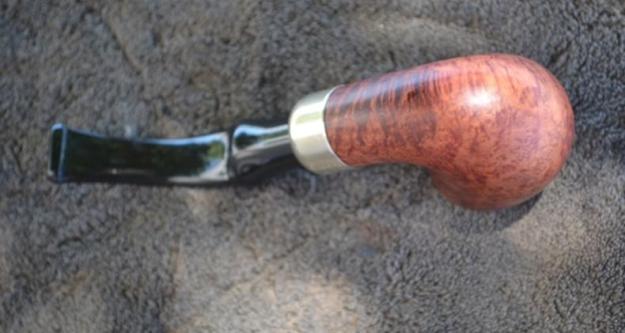
Schulte1

Schulte3

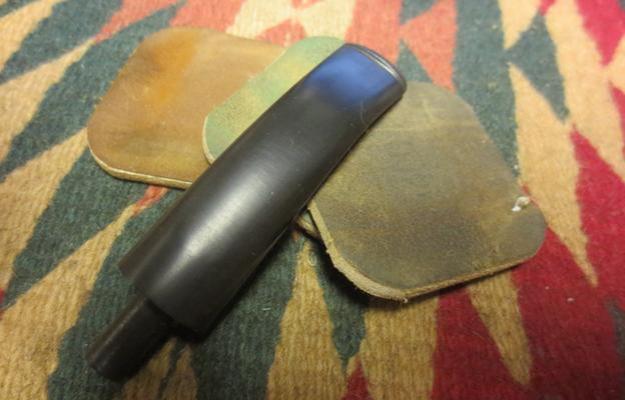
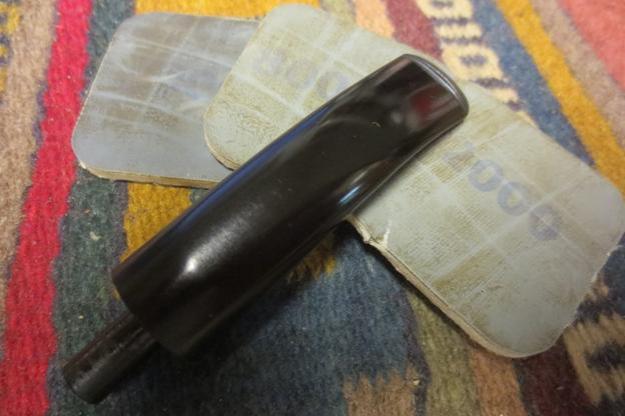
I grabbed the Schulte deLuxe first as that one seemed like it would be the easiest. First I soaked the stem in an Oxy Clean and water solution (no real ratio. Just about half a tbs to 3/4 water. But really just guessed) to bring out the oxidation. Then I wet sanded it with 1500 grit sandpaper (all I had. Would have been easier to work my way up to that but I just went with what was here) until all the oxidation was removed. After a little elbow grease I took it over to the polishing wheel (Ryobi bench grinder with two 6″ polishing wheels) and hit it up with some red rouge. Working it back and forth until it had a nice smooth shine. Then moved to the other wheel with Eastwood Supply’s version of White Diamond. Working it with a much gentler touch. Wiped off the residue and voila. Better than new.

Schulte2

Schulte4

Schulte5

I moved onto the bowl. This time I decided to try wet sanding the bowl just to see what would happen. I hypothesized that a quick wet sand might just remove the grit and grime. Turns out it quickly moved right past that and into the stain. I probably won’t do that again unless the bowl needs serious work but it was worth a shot. Wet sanding did work well on the top of the bowl to remove the tar. Much quicker than the spit shine method.

Schulte6

Schulte7

You can see how one turn on the bowl with the red rouge turns the wet sand into a nice shine. Probably my favorite part of this whole thing is when you break it all down to its base and start to rebuild it.

Schulte8

Schulte11

Schulte10

Schulte9

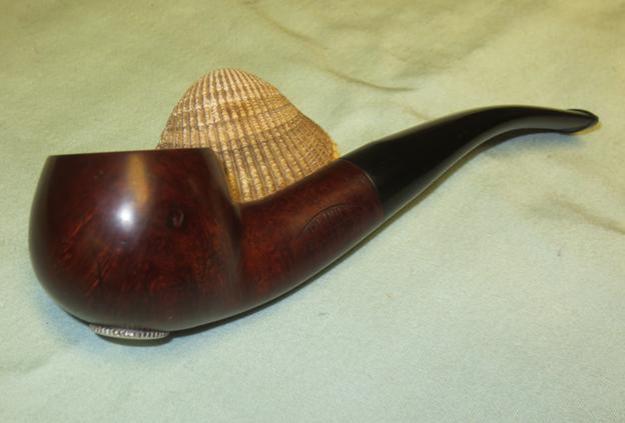
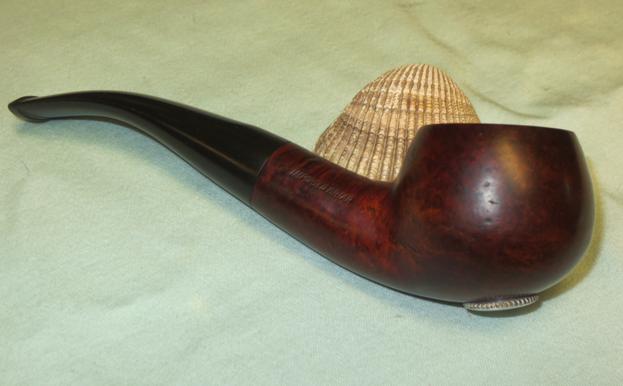
I did the same to the bowl as I did to the stem. Took about an hour on the wheel for both. And I’m pretty happy with how it turned out. I have yet to polish them with any wax to keep the shine up. I just haven’t picked any carnauba wax up and I’ve noticed the super bright shine dulls after a few days so I’ll be sure to grab some wax ASAP.

If you’re reading still thanks and I hope this helps anyone who is just getting started.

Cheers.

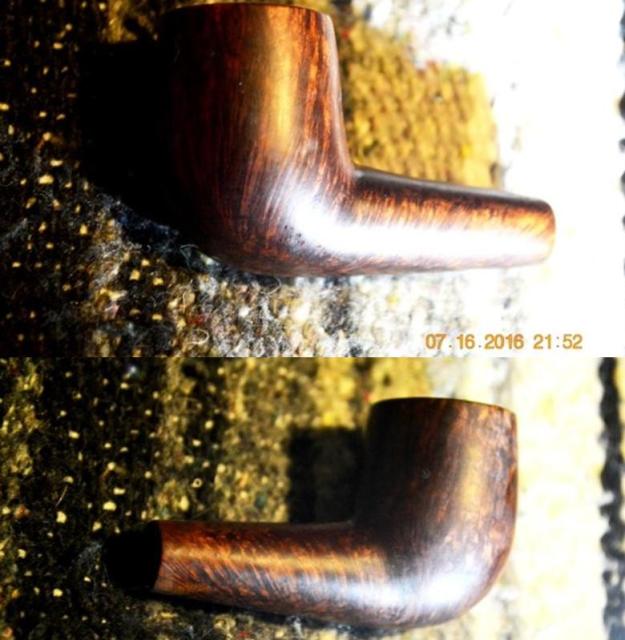
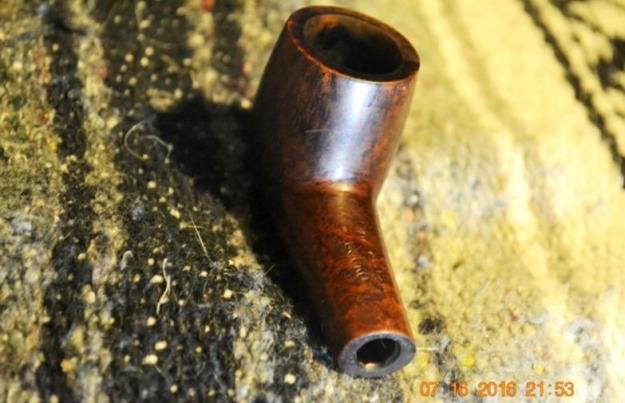
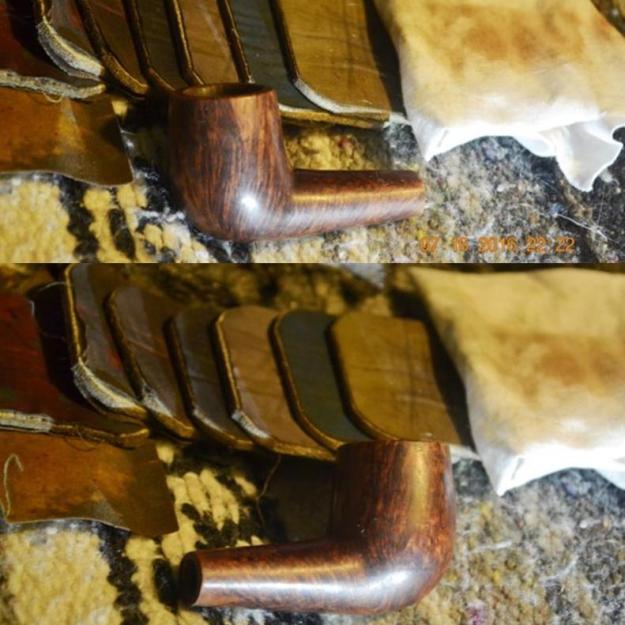
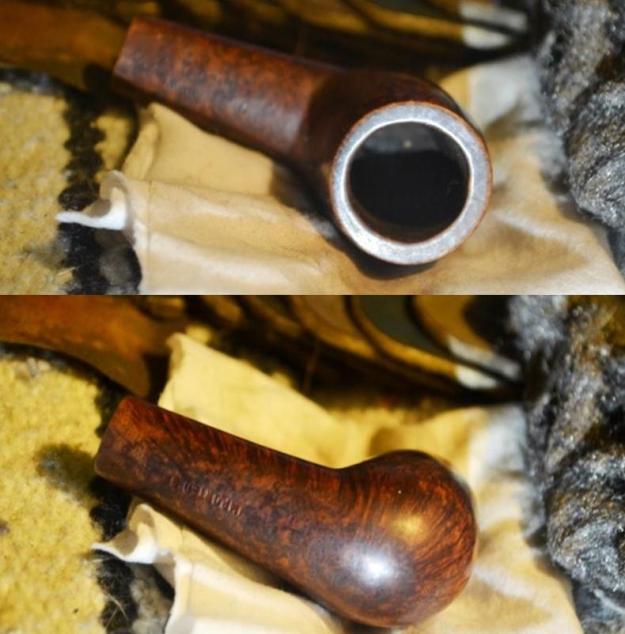
’63 Dunhill 552 Restoration


Blog by Al Jones

I found this 1963 Dunhill shape 552 on Ebay last week. The auction ended early in the week at an odd time and it went largely unnoticed. It looked to be in pretty decent shape, but with some bite marks on the bottom of the stem. It is a Group 4 pipe in Bruyere finish (A = Bruyere) At first, I thought it was a Rhodesian, then later thought it looked more like a tomato. Neill Archer Roan commented that it had some Diplomat DNA.

The pipe was delivered today. It was pretty much as pictured, but I also discovered it is a 6 mm filter pipe. The briar was in great shape, with a little tar and rim darkening. There were no dings or bruises to deal with. The stem was also in decent shape and only lightly oxidized. There were a few light teeth marks on both sides of the stem, and all but one lifted out with some heat from a lighter flame.

Dunhill_522_Before (1)

Dunhill_522_Before (3)

Dunhill_522_Before

dunhill_rhodesian-5dunhill_rhodesian-4Dunhill_522_Before (2)

The bowl had a fairly thick cake and I reamed it with my Castleford bit set. The bowl was then soaked with Everclear and sea salt.

I polished the stem with some 800 grit wet paper, followed by 1500 and 2000 grade. Then I moved to the micromesh, 8000 and 12000 grades were used. I gave the stem a light buff (mounted to the briar) with some White Diamond. I have a bar of jewelers “Red” rouge on order and I’m curious to see how it compares to the White Diamond for finish work. The stem has some odd marks in the vulcanite, almost like an imperfection. I could not remove them by sanding or buffing.

I polished briar lightly with some 8000 grade micromesh, keeping away from the weak nomenclature. I then buffed the bowl, again lightly with White diamond and then several coats of carnuba wax.
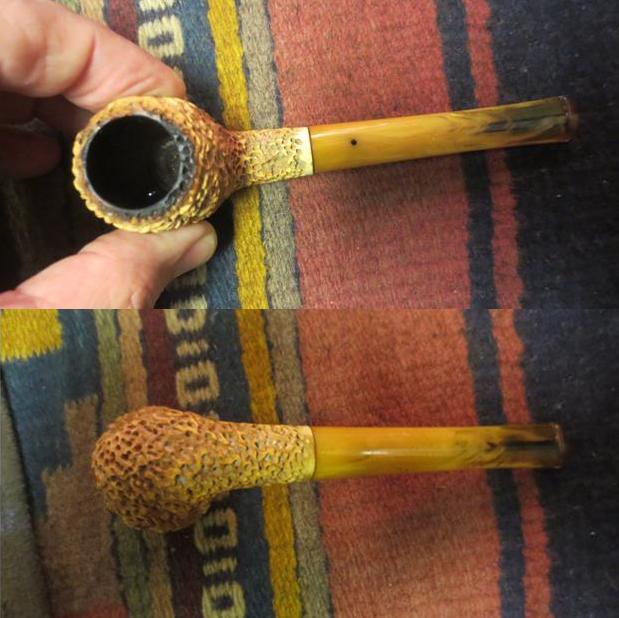
After searching online for several days, I couldn’t find out much about this shape. I found only one other shape 552, a shell finish pipe sold at an Ebay auction in 2007. The 552 is also not on any Dunhill shape chart (Loring, etc.). On the SmokersForums.uk in the “Streets of London” social group, one member there, dmcmtk (Dave) said he has a shape 556 from 1963. He had heard Dunhill was experimenting with shape variations at this time and perhaps my 552 was part of that experimentation. I have emails out to several Dunhill collectors, but haven’t yet received a reply. If you know anything about this shape number, please comment.

Here’s the finished pipe.

Dunhill_522_Finished_Gallery

Dunhill_522_Finished (3)

Dunhill_522_Finished (4)

Dunhill_522_Finished (5)

Dunhill_522_Finished (1)

Dunhill_522_Finished (2)