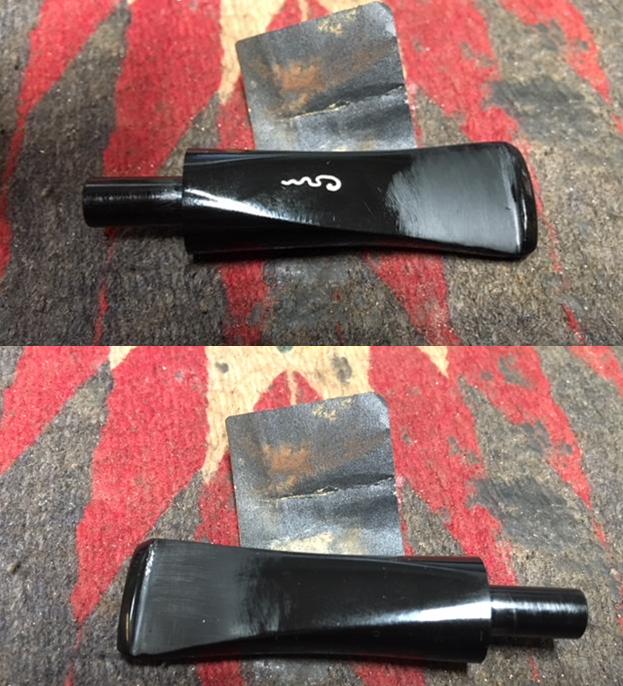
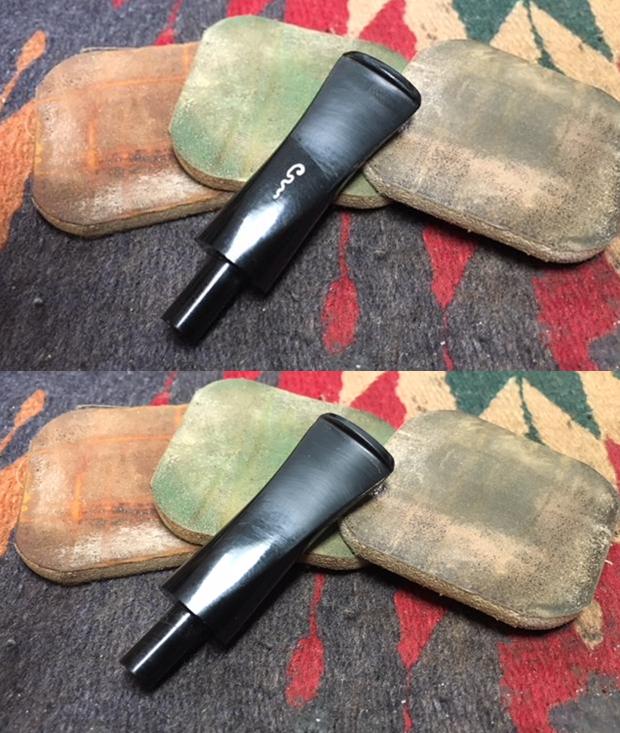
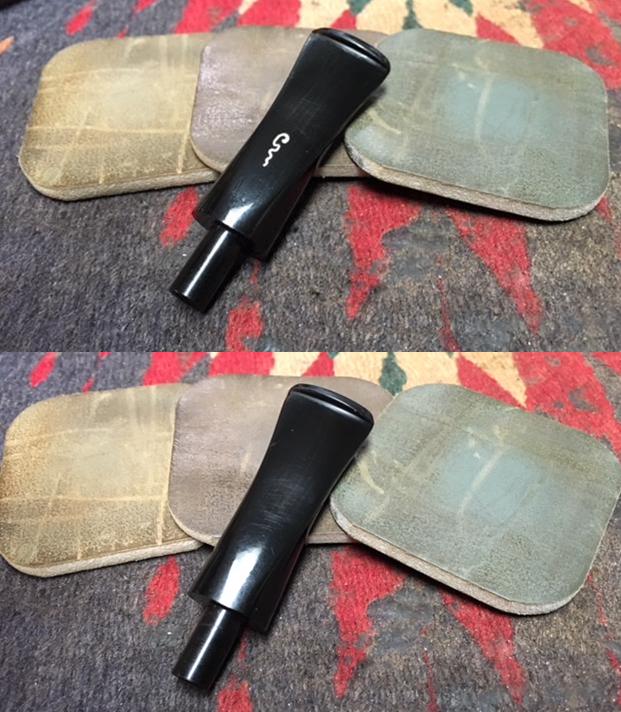
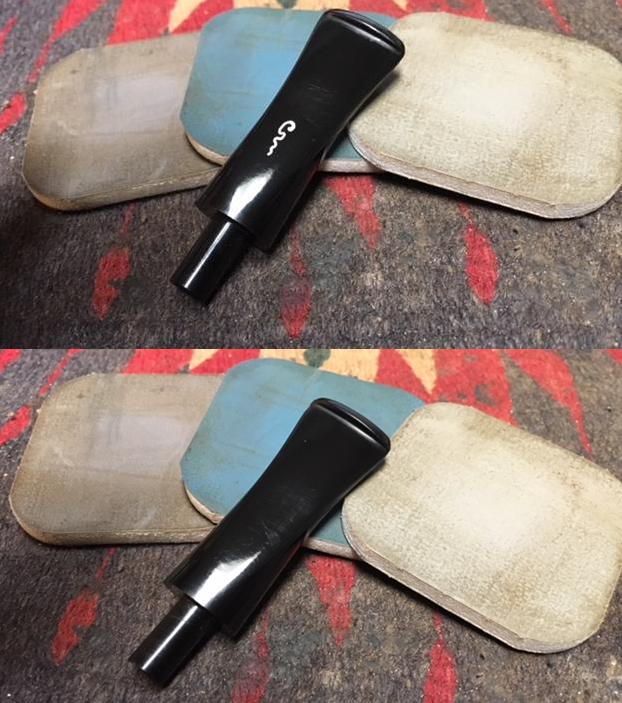
Tag Archives: polishing stems

Chasing the Grain and Restoring a Ben Wade by Preben Holm, Part 2


Blog by Robert M. Boughton
With special thanks for the contributions of Lon “Pipe Lon” Schwartz
Copyright © Reborn Pipes and the Author except as cited

His hands are miracles.  I can watch them for hours, transforming wood into something it never dreamed of being. *
— Katja Millay, in The Sea of Tranquility (2012)

INTRODUCTION

Happenstance often plays a major part in major historical, cultural and business changes.  A 25-year-old American named Lon Schwartz, who owned a shop called Pipe Lon on St. Thomas in the Virgin Islands, was in Copenhagen, Denmark pursuing a rather nebulous search for “distinctive” pipes.  Coming upon a certain provision store, Lon went inside and saw 18 pipes fashioned in the newly exploding freehand style.  The young pipe entrepreneur, who now lives in Florida and still puffs on cigars, knew at once that he wanted all of them and more.  Lon’s warm and generous insights made this blog possible.

“I never saw anything like them,” Lon told me.  “I was in the right place at the right time.”

More accurately, as Preben Holm, who had carved the pipes and was 18 at the time and off performing his mandatory military service, which lasts from four to 12 months, Lon was in the right place at almost the right time.  Upon the awaited arrival, Lon met the teenage pipe crafter and was so impressed with the youthful artisan’s work that he repeated his offer to buy all 18 pipes in stock and added that he would like as many more as Holm could produce.  Persistence and determination to make the deal inspired the independent pipe distributor during that frigid winter to visit the Danish capital three times, staying in a small, uncomfortable room when he wasn’t prowling the city for pipes.  One of Copenhagen’s stronger beers helped Lon sleep.

“One or two Carlsberg Elephant Beers, and you’d be out,” Lon said, remembering the 12% ABV content.  Apparently, the alcohol level has been reduced to 7.2% in the intervening 53 years.

Popular with tourists from around the U.S. and elsewhere, St. Thomas was an outstanding starting point for the sale of such unusual pipes exclusively by Pipe Lon, the shop’s name from its beginning in the early 1960s until Lon’s retirement in 1986.

“I sold millions of pipes and had the largest open display of pipes in the world, about 300 feet of them,” Lon said.  Now, for those who are not sports-oriented, that’s the length of a football field, or a 100-yard dash in track and field.

“I had the Virgin Islands rights to all of the brands that were big in the U.S. and Europe,” Lon added.  “They included English makers like Charatan, Barling, GBD and Comoy; some French brands, and Danish names such as Criswell and Stanwell.”

Lon pointed out that most people still don’t know where the U.S. Virgin Islands are, and I will hazard a guess that the same folks would not imagine any one of the three main islands – St. Croix, St. John and St. Thomas – and about 15 minor islands is big enough to hold a football stadium.

Lon’s chance encounter brought about the ensuing wild success of freehand pipes, by Holm and others, in the U.S.  One word I came across in several sources described the resulting introduction to the U.S. market as hype, which translates in the best sense to hoopla, a term I’m sure Holm would have embraced.

Holm wrote of the experience: “I could simply not have had any better starting point, because the taste changes quite a lot from one place in the U.S.A. to another, but here came, as mentioned, pipe-smokers from all the States.  It was wonderful to feel how something one enjoyed making really was accepted.”

That was a tremendous understatement.  By the 1970s, every major Danish pipe maker and more were engaged in business in the U.S. and many on an international basis.

If anyone deserves the esteemed if a tad cliché designation of late great artist, as I have called him before in this forum, it is Holm (1947-1989).  Then again, the best clichés are truths propagated across generations within cultures.  Holm dedicated almost the entirety of his all too brief 42 years to the practice and innovation of pipe craftsmanship, his most outstanding accomplishment.  His vocation pushed those wild vertical and horizontal lines as far as he could during the short time he spent in this dimension; his legacy is the part he played in advancing the style that was called “Unfinished” by Sixten Ivarsson and other names by different early artists.  Now this wonder of woodwork and engineering is known throughout the pipe world as the Danish freehand.

Poul Winslow, another master freehand carver, cut his teeth in pipe making starting when he was 16 and began training under Holm.  Winslow had this to say about his early mentor:  “Preben was a genius.  Maybe a bit wild, always flying from idea to idea and impatient for results.  But could he turn a pipe!  Some of the most extreme freehands came out of our workshop in the ’70s, and whatever his critics say, they sold like crazy, mostly in America.  And when it came to finishing, he was the best in the business.”Many old-schoolers throughout the pipe world, in Denmark and everywhere else, considered the “crazy” shapes offensive.  “They thought these wild new pipes were funny, or stupid,” Lon said.  “It took some time to realize their potential, artistically and financially.”

Maybe if I had been a codger in the 1960s I would have agreed, but as a child then I had already learned to deal with stranger things: Flower Children in their VW Love Vans, Hasbro’s Twister and the Slinky, for example (which was, in fact, introduced in 1945).  Later, as a young man, I added news of the soiled clothes saved by a certain White House intern to the list.

A series of autobiographical articles by Holm, written from 1983-1984, was published later online and in The Pipe Smoker’s Ephemeris magazine (TPSE).   The first article concerns Holm’s earlier years and offers fascinating details of the young boy’s immersion into his father’s large provision shop in Copenhagen, the capitol of Denmark and one of the world’s cultural hubs.  Then there are the blank spots, like spaces in the New York Times daily crossword, that can tell still more about the man   Some can be penciled in with tentative answers to erase and correct from clues provided later in the disjointed narrative; others are enigmatic, parts of tight knots jumbled in Down and Across clusters of cross-questions within questions.

Tom Dunn’s founding of The Universal Coterie of Pipe Smokers (T.U.C.O.P.S.) in 1964, at the time a rag-tag group of pipers held together by Dunn’s untiring work in his Queens, New York apartment, led in short order to TPSE.  As becomes the fate of many pipers, Dunn’s life was plagued by avid collections of books and pipes.  As many, but not all, of the books no doubt concerned pipes, the dual diagnosis would seem to be Book and Pipe Acquisition Disorder (BPAD) and its fraternal twin, Pipe Book Acquisition Disorder (PBAD), or just BPBAD.  Hardbound editions of every TPSE issue from the magazine’s inception in 1964 as an irregular quarterly through 2004 were published by T.U.C.O.P.S./TPSE.  Book Two [1994, pp 670-673] contains the article relied upon most for this part of the essay and was cited by Pipedia in its re-print of the text that I found.

Mindful that, as an autobiographical work, the series called “The Story of My Firm” is written from Holm’s perspective, I took his suggestion that he was behind the transition of old Danish designs into the revolutionary freehand technique with a reporter’s mandatory skepticism, no matter how much I would like to believe.  Here is the passage I didn’t wish to question but had to do so, describing Holm’s life when he was 18 or 19 – in the late-1960s.

“One day while making the rather traditional hand-carved pipes as we had to in order to come by some money, I took a fancy to make something completely untraditional at that time.  From the very beginning I had only worked with the finest Bruyere that could be provided, and on the whole it all had very pretty grain patterns, and that gave me the idea to try something novel.  Contrary to what was done so far I started to form some of the pipes according to the grain pattern, and out of this I got some quite particular models…I began also to let the raw bark-top be part of the design.” 

Considerable research now under the bridge, I found numerous sites suggesting earlier origins of the style, but they were all vague and inconclusive.  Lon confirmed my suspicion that Holm, despite his great achievements as a carver, was not the father of the freehand.

“There were people playing around with new shapes and using the bark in the 1940s and ’50s, before it really got going in the ’60s” Lon said.  Sixten Ivarsson (1910-2001), “the grand old man of Danish pipe making, was just one of these chasers, but many cite him as the rightful patriarch of the now large family.  The truth may never be known, but Ivarsson started repairing pipes after the end of World War II and was soon asked to make them.  The results that at first followed the classic English shapes evolved into variations that were sleeker and curvier, and eventually freeform.

CHILDHOOD’S COST

Holm’s account of his childhood working in his father’s provision shop is conflicted, to say the least, and offers no truly personal insights into the man whatsoever.  As an adult, the son gives alternate descriptions of his father as “somewhat mean” and “altogether a very wise man.”  There are other signs that the boy might have been confused by what he saw as contradictory strictures of his father’s.  For example, Holm’s father forbade the smoking of cigarettes but was not opposed when the boy took to pipes around the age of 13-14.  And in at least the first installment of the series of articles he later wrote, there is the absence of a single mention of the elder Holm’s given name or having a mother much less any other family.  Lon filled in some of the family gaps as well.

“Preben’s mother sewed the pipe pouches, and he had a brother he didn’t talk about,” Lon said.  Holm also had a wife, still alive in Denmark, from whom he was divorced.  “We were very close also.  She came to the Virgin Islands with him.  He was a very odd person, a bit disturbed, and he let all of it out in his pipe making.”

Any concrete conclusions from these signs, however tempting to wade into, I will leave to psychologists.  Furthermore, the overall nature of his youth, other than being a bit precocious with adult duties and interests, may have been more a product of his generation and culture than an outright unpleasant upbringing.

At any rate, the store had three departments – wine; magazines, cigarettes and other convenience items, and the part of the shop that in a short time drew young Preben into its irresistible mysteries, the pipe and tobacco department.  Best of all, the tobacco shop included a small repair service area that Preben soon took over.

Holm’s prodigious start and rapid rise in his father’s family business

Starting as an errand boy when he was 12-13, Holm possessed a pragmatic maturity which led him to the early conclusion that his wage was “a sixth of what I could earn somewhere else, but [continuing with my father], I think, was very sound.”  That young Preben already was considering his advancement options seems clear.  Even as a youngster, Holm saved the tips he made running about town, depositing them in the bank and using his meager wages to purchase fine tobacco that was much more expensive than the lesser Danish blends at the time available at his father’s shop and most other places.  Although at first his father thought this practice “crazy,” so charismatic and business-like was his son, and one can only imagine just as persuasive the samples of superior tobacco mixes provided to the elder Holm by the boy, that the master of the shop was won over and began offering a wide selection of foreign pipe tobacco.  Most of the higher quality blends were English, meaning made in England.

Even before he was put in charge of pipe and tobacco purchases when he was only 14, Holm writes, he had a large role and the adult demeanor to fill it.  “Most likely I was not always popular with the sellers of pipes who considered me too critical, but I thought that necessary in order to live up to the confidence our customers of pipes gradually placed in me.”

In most cultures, the notion of a child manufacturing tobacco pipes would be frowned upon.  Not so in Denmark, where a cursory survey of the Who’s Who of that craft reveals many such examples.  At the age of 15 in Holm’s case, his obsession with pipes had grown so overwhelming that he became fascinated with “an elderly gentleman, who himself made hand-carved pipes.”  The unidentified man visited the shop to sell them and ended up offering to help young Preben obtain the machines he would need.  Holm’s hard-earned savings of 1,400 kroners (USD231.00 today) proved to be enough, again with the guidance of the gentleman, who also supplied other tools.  [I can’t find a handy inflation calculator for Denmark prior to 1981.  Perhaps someone could give me an educated conversion for kroners to kroners starting earlier.] 

 With the equipment installed in a Spartan 13.5 square foot room in the basement, Holm began experimenting late into the nights – after the demanding work of his day job.  But the daily practice paid off, and just short of his 16th birthday, Holm handed over his first batch of pipes he deemed acceptable for sale in the shop.  Without delay, the confident boy decided it was time to tackle the biggest seller in Copenhagen, Pipe Dan, who offered to buy 20-30 pipes every week.  The most Holm ever earned from Pipe Dan, which was quite a bit, was 500kr, or USD83.00 today, for one exceptional pipe – an elaborate freehand.  Holm suspected Pipe Dan didn’t believe the lad could pull it off when he described his plan and made the deal.

Before the end of his partnership with Pipe Dan, Holm and one “journeyman” were able to produce 50-60 pipes per week that the venerable middleman sold.  Holm was one of the most promising pipe crafters to produce the freehand style.  Of still more significance, however, is that he was the crafter responsible for the spread of the new form’s popularity to the U.S. and elsewhere.

Before Holm’s 22nd birthday in 1969, he and his 45 employees at the time were outproducing the sales he and Lon could handle, and the two concluded something needed to change.  The choice of a distribution outfit called Snug Harbour in New York had mixed results, to be nice.  Although sales increased, Holm ended up never seeing much of the money due to the distributor’s eventual failure to pay its bills.  Holm had a hefty supply of pipes ready for export and nobody to move them.

GOING DANISH WITH LANE LTD.

“I set up a meeting with Holm and Herman Lane in New York where I was present,” Lon said.  “Lane and I were very close friends.”  That turning point was in February 1971.

Herman G. Lane was the enormous ego behind Lane Ltd., a continuation of the original pipe and tobacco interest opened in Dresden, Germany in 1890 by Herman’s grandfather and resurrected in Manhattan by the emigrant grandson in 1938.  The Lane Ltd. empire distributed some of the world’s foremost pipe brands, including Dunhill, Charatan and for a while Dr. Grabow, as well as many more, and had made Captain Black tobacco since the family business first opened in Germany.

To say the least, the chance to “team” with the pipe giant was an opportunity for young Holm that he could not have been expected to let slip away.  For the ambitious Lane, on the other hand, the talented but not very business savvy Dane was an easy conquest.  In raising the price of Holm’s pipes higher than they already were, Lane’s goal, of course, was to make money.  That the two did, leading to the aforementioned hoopla.

THE BEN WADE CONNECTION

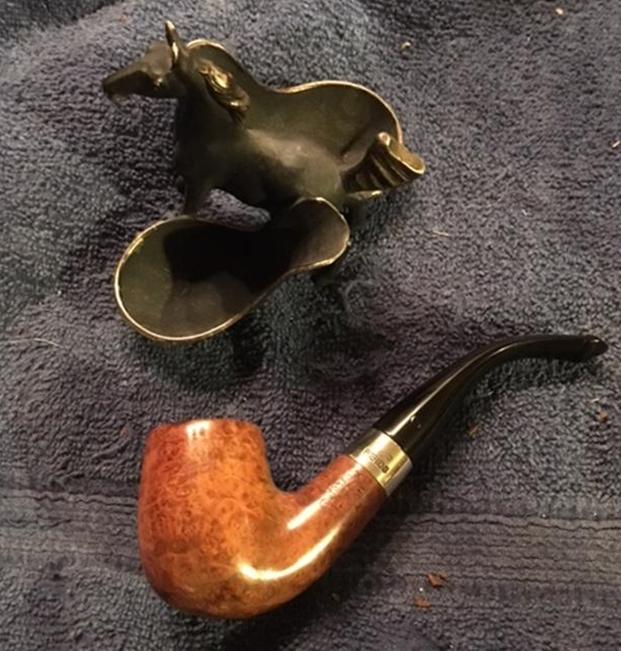
Lane was only interested in Holm’s freehands, and there was one snag to overcome: Snug Harbour retained a stockpile of Holm’s pipes and could be expected to sell them at cut-rate prices.  To avoid this contingency, Lane and Holm made an exclusive rights deal for distribution of the freehand pipes and agreed the use of Holm’s name was inadvisable.  As Lane Ltd. owned the Ben Wade name, Herman Lane suggested marketing Holm’s Golden Walnut Hand Made in Denmark line under that brand.  One fine example of Holm’s traditional Danish pipes is the following example.Pipedia notes that “Within a very short time Ben Wade Handmade Denmark sold in much larger quantities and at higher prices than they had ever dreamed of.”

Advertisements hiked the prices well higher than Holm’s pipes ever sold for before, and one key campaign was a New York Times full-page spot for an elegant Seven-Day’s Set.  The set, no surprise, is now difficult to find.

When I began work on these two blogs, I expected to accomplish the task in a single essay.  Becoming bogged down by the complexity of pulling together so much information and realizing the result was becoming massive even by my wildest discourses, I knew I had to do a two-parter.

This installment started as the re-stemming of the first Danish freehand I bought for a pittance on eBay, in January 2015, as a sort of New Year’s excuse to make another P.A.D. gift to myself.  Besides, it was a Buy Now deal for no more than $25 with shipping included, and no other watchers seemed to know it was something special.  I wrote the original “Grooming a Ben Wade Golden Walnut Freehand” blog in 2015 because, until then, I never received an estate pipe from that online source that was anywhere close to being ready to smoke.  The clean-up, in my mind, would be easy, just sanitizing the insides, removing a few petty scratches and deciding what to do with the rough rim and shank opening that were coated black, a condition I pretty much disliked.  I modify the fact that the pipe was the first I bought, as I already had a couple of other freehands, as noted in Part 1.

In hindsight, I recognize how, in the easier process of cleaning the freehand, I preserved what I now consider to be an unpleasant though common black finish for the natural, radiant, lighter golden hue of the walnut that was, furthermore, left with what I considered an inappropriate dark brown finish.  And so, instead of the sole re-stemming idea, I found myself with the option of removing the black stain where it was added and lightening the original dark brown stain on the rest as well as the minuscule scratches.  Even though I intended the pipe for my own personal use, I had a compulsion to do the job as I would for sale to a customer.

RESTORATION

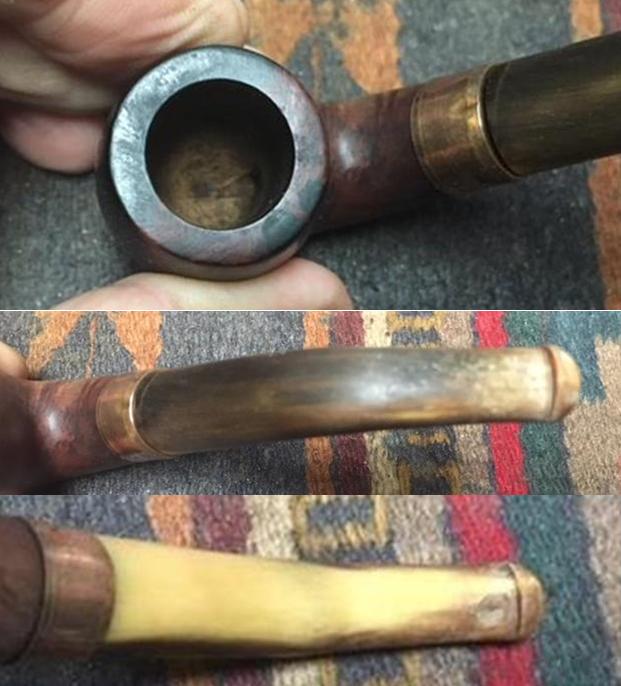
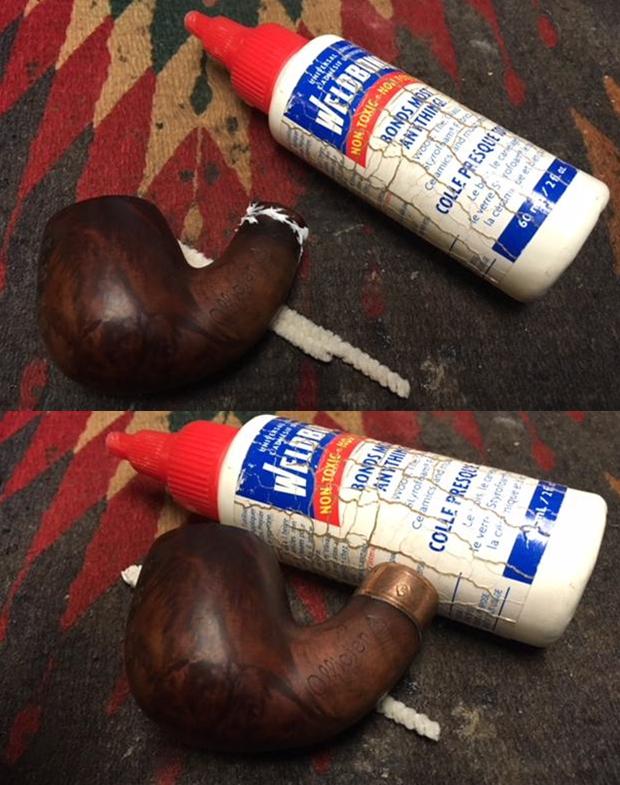
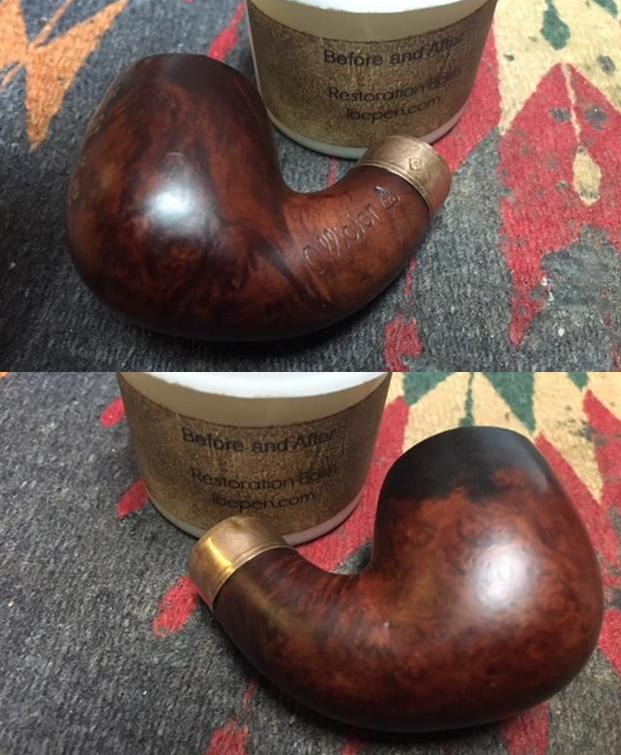
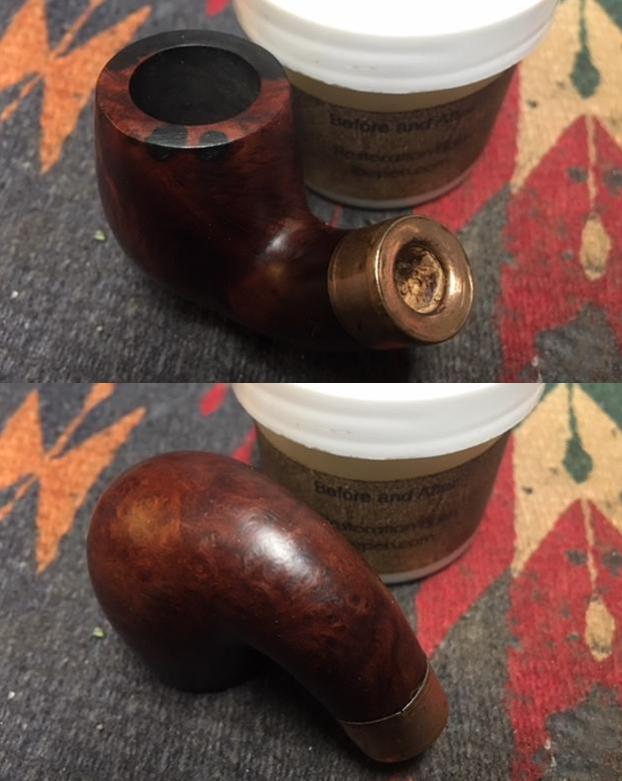
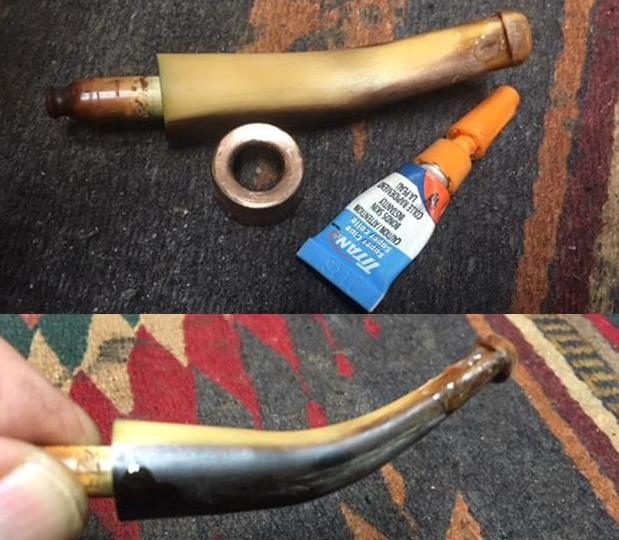
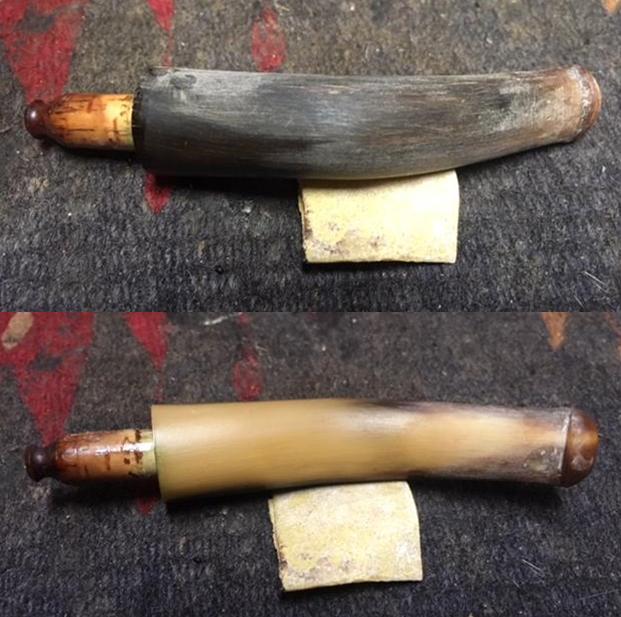
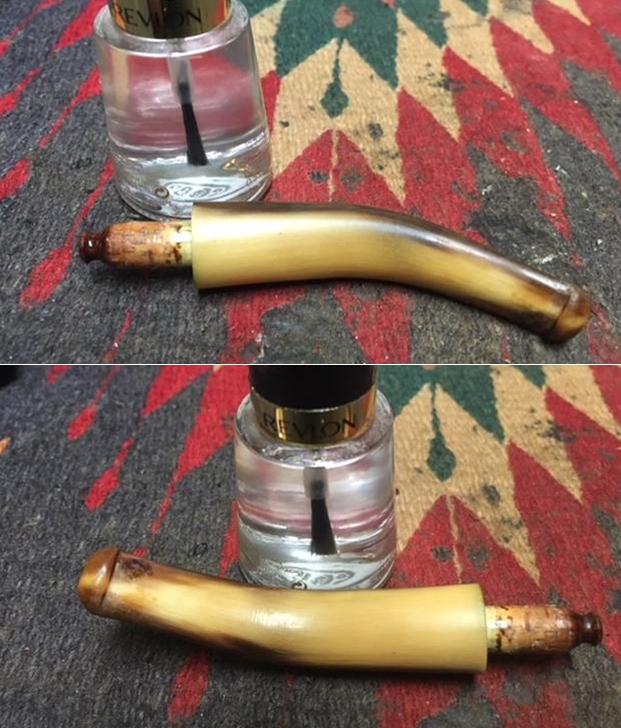
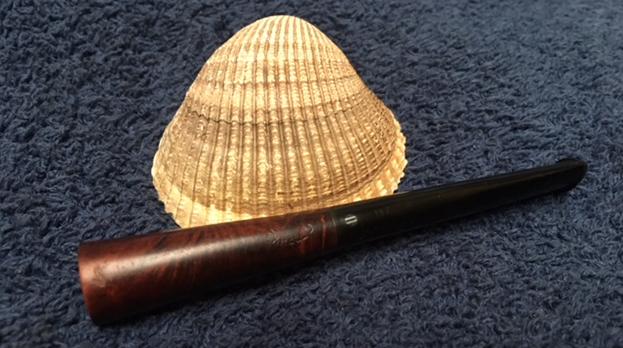
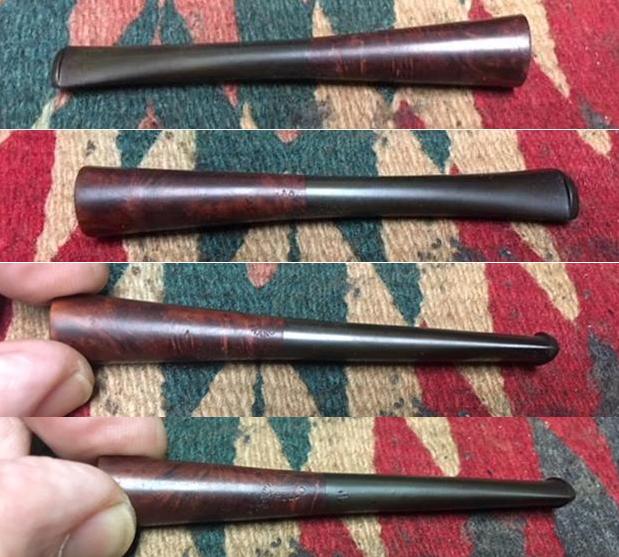
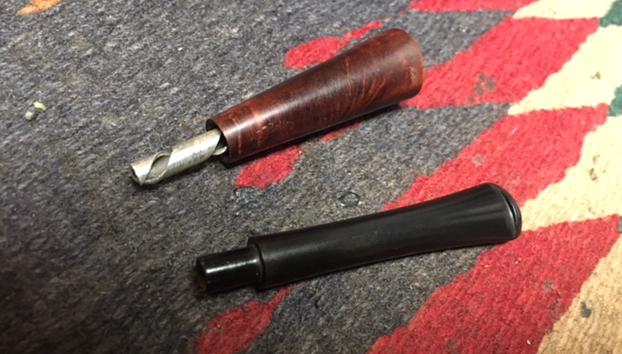
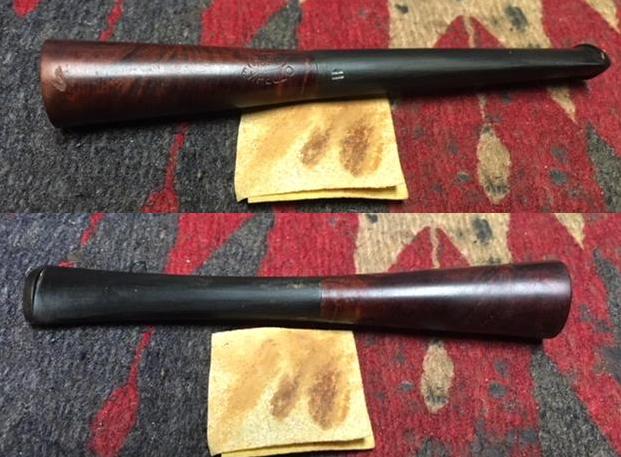
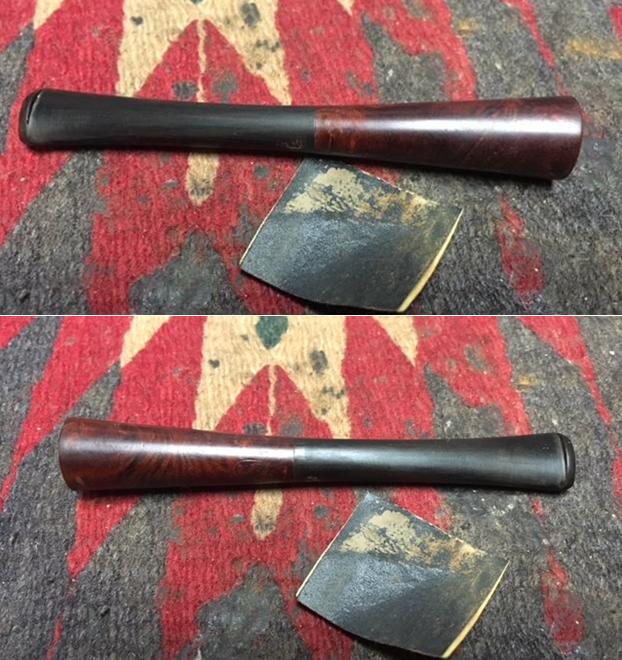
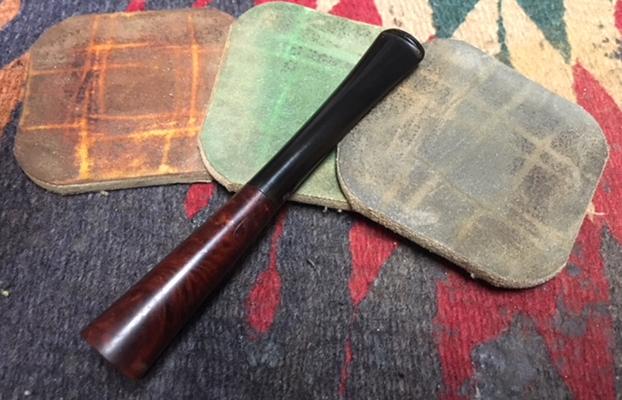
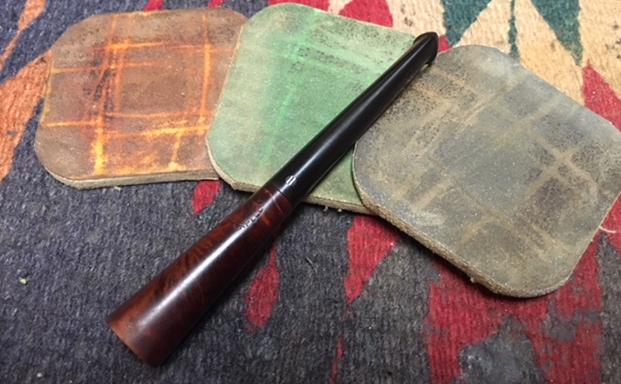
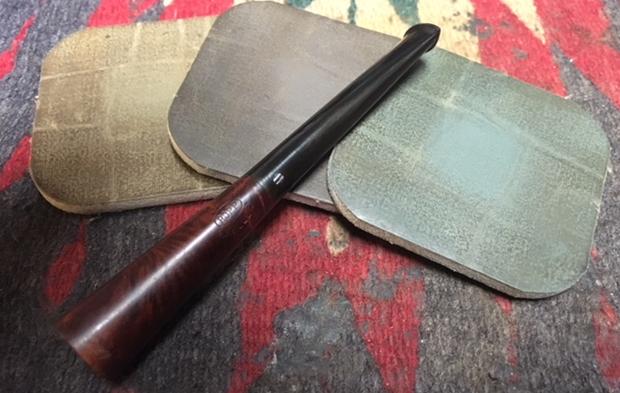
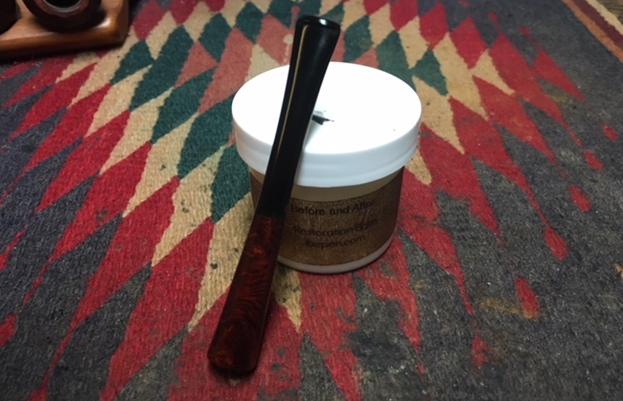
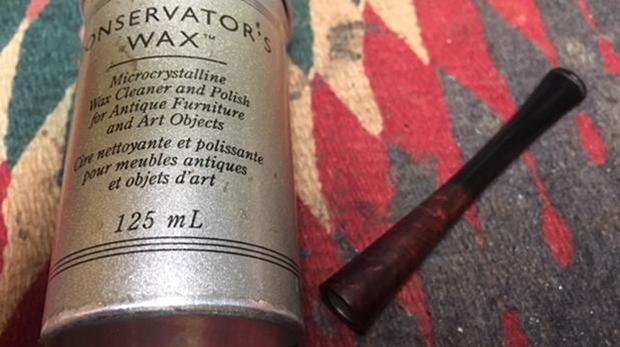
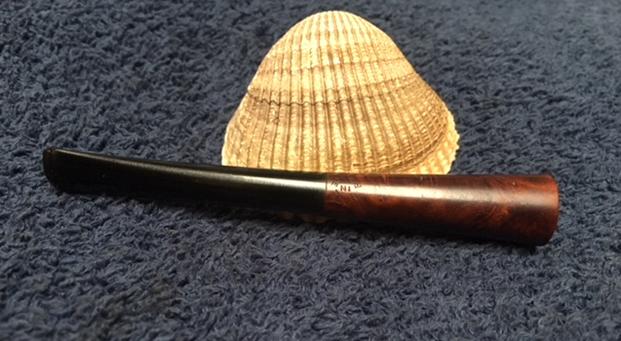
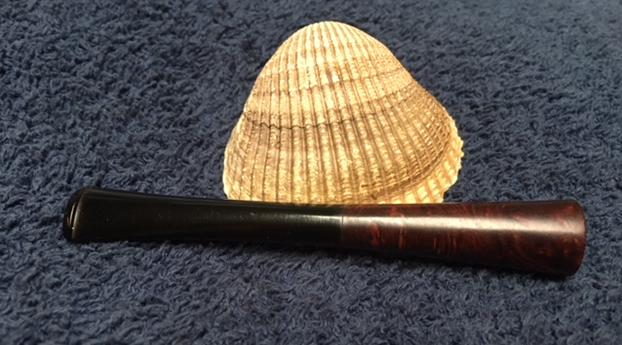
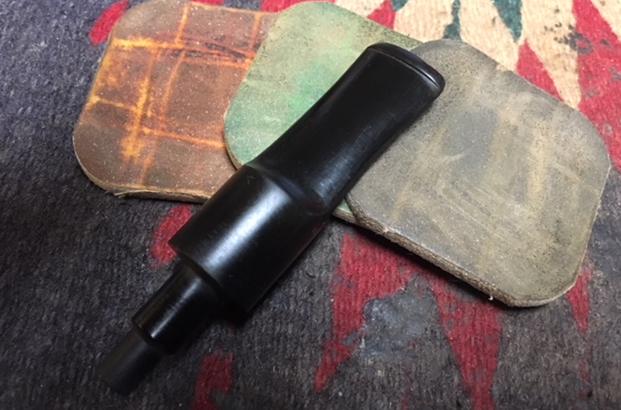
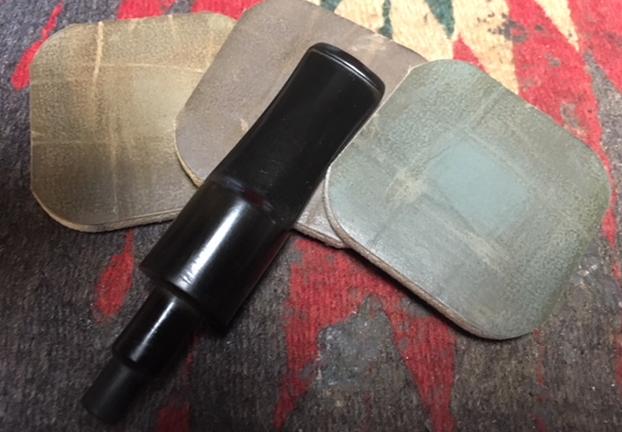
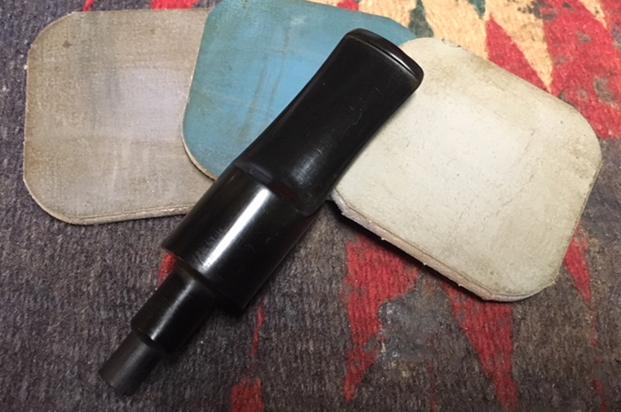
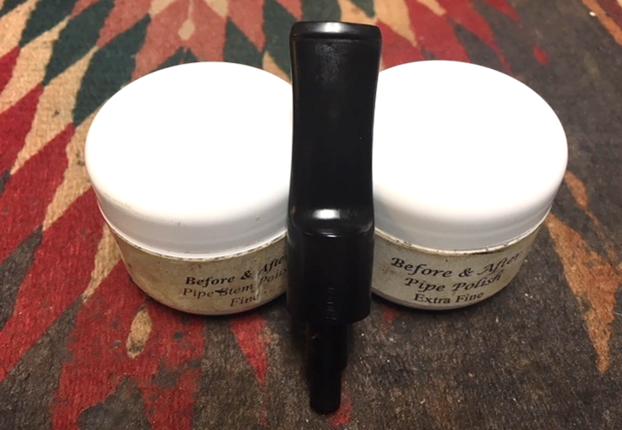
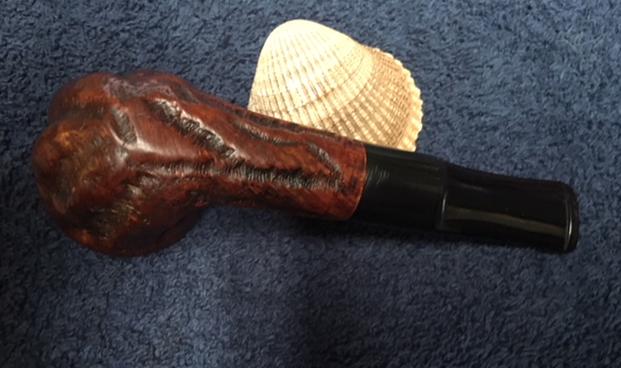
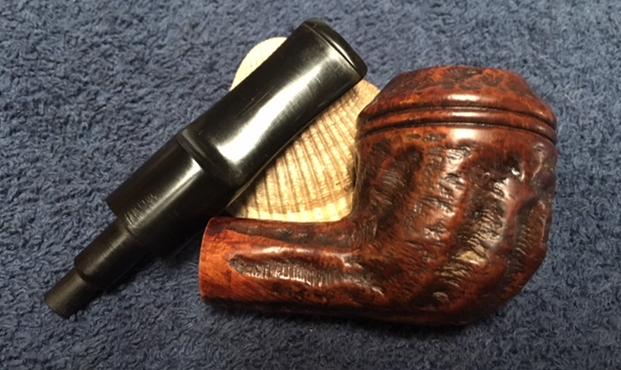
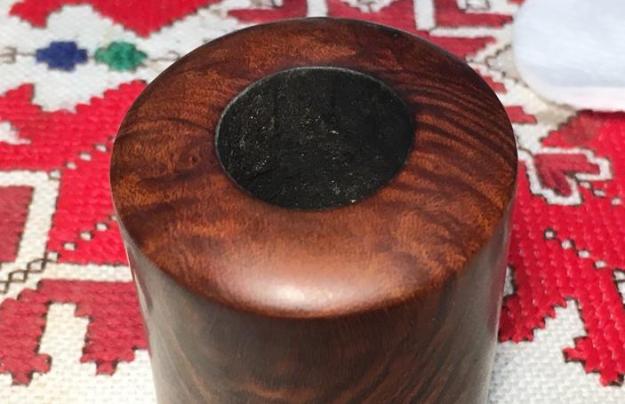
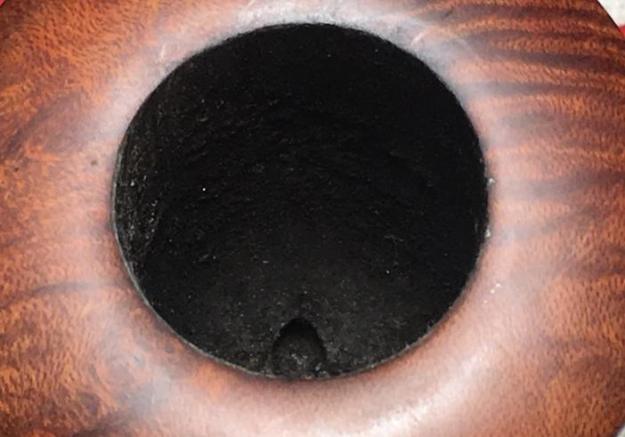
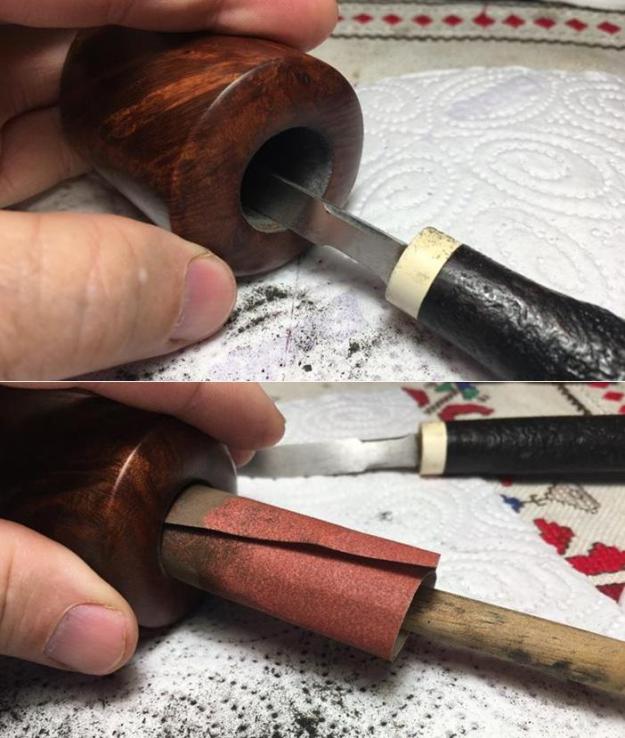
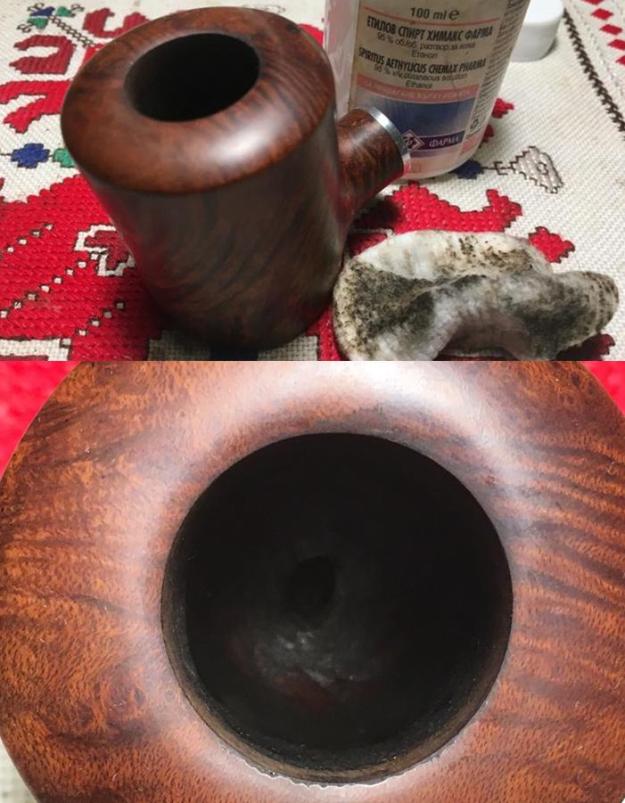
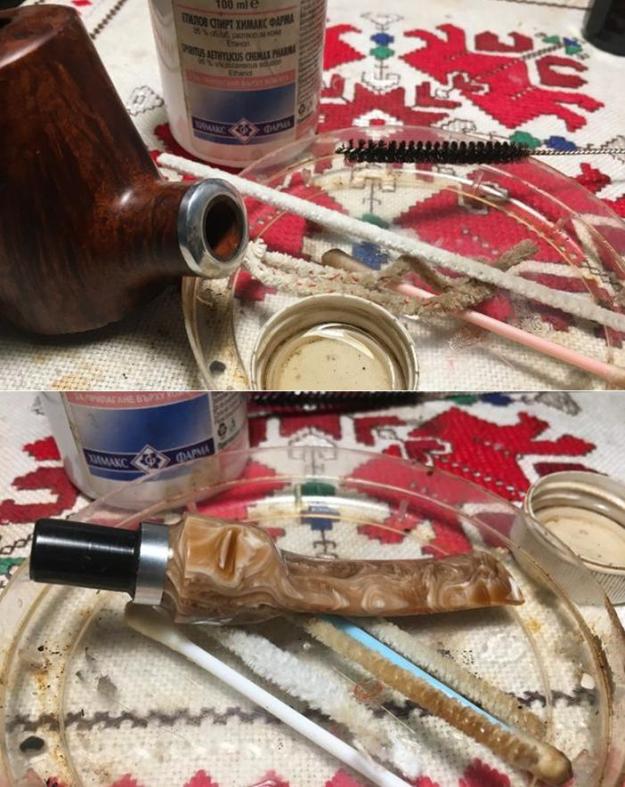
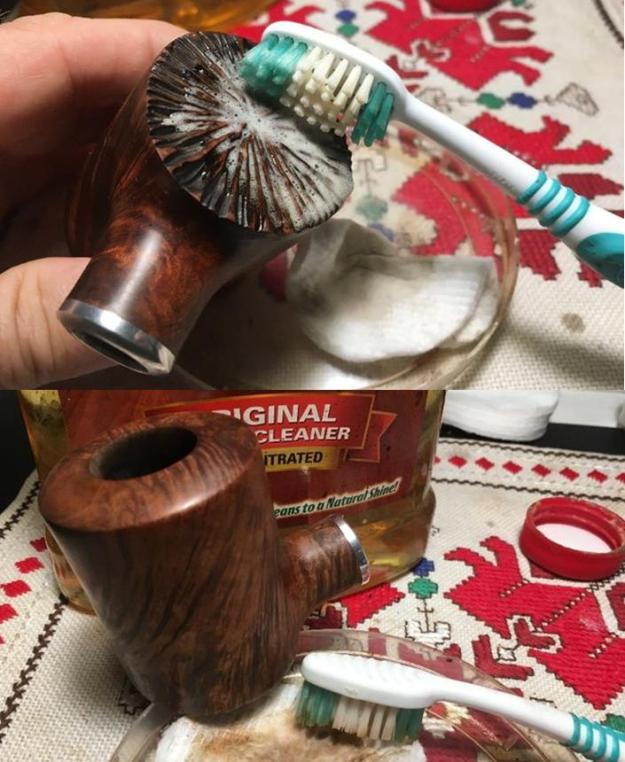
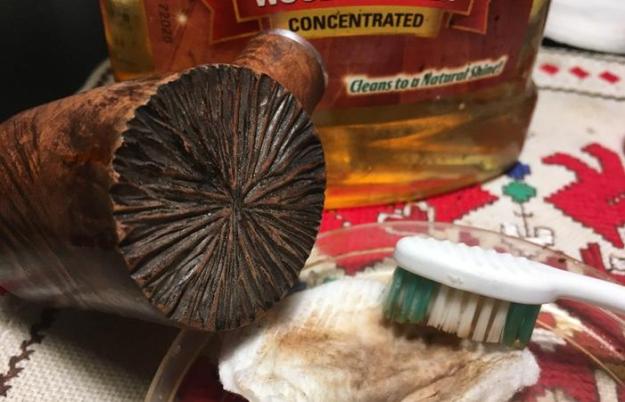
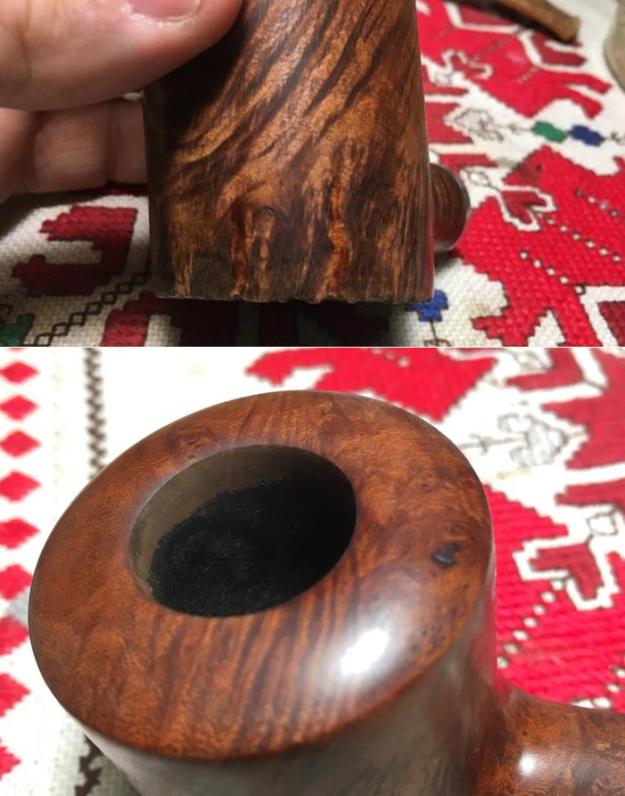
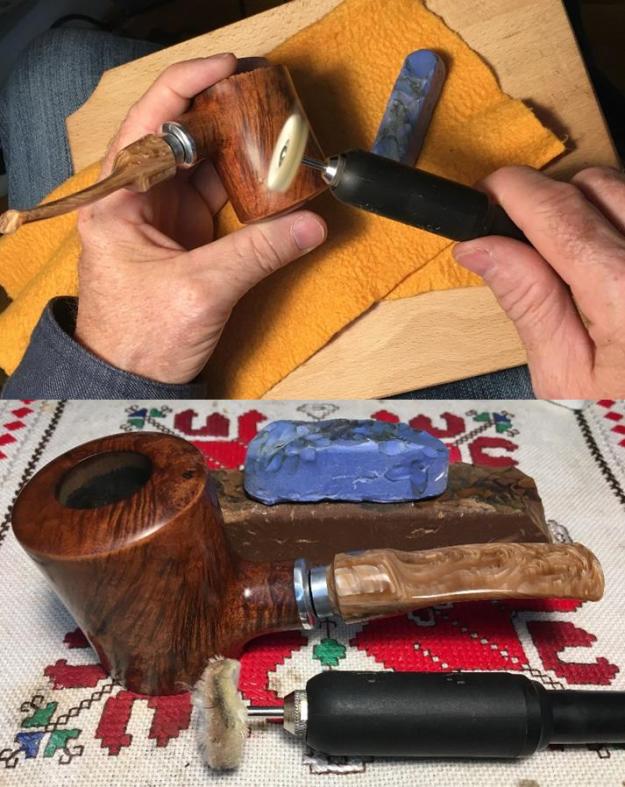
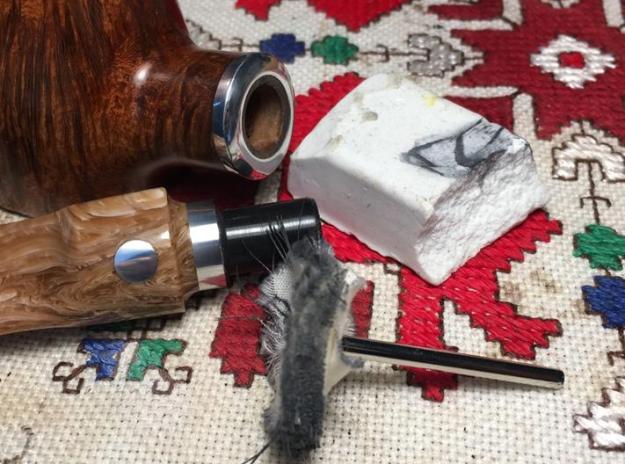
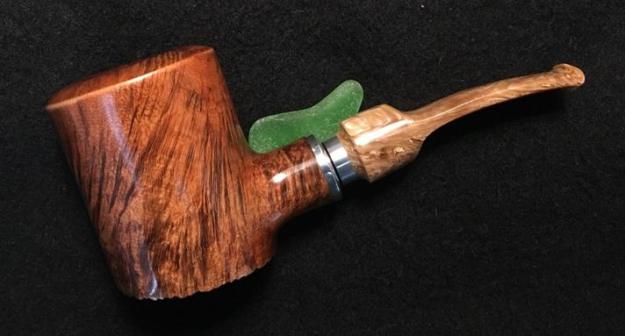
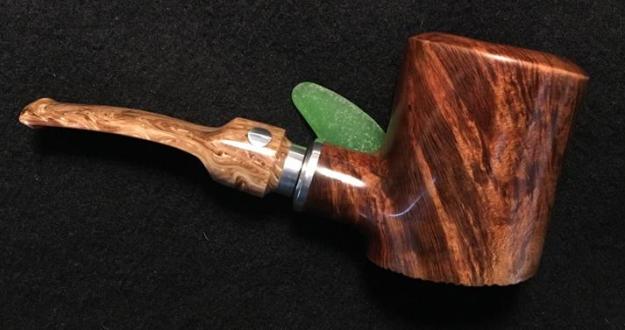
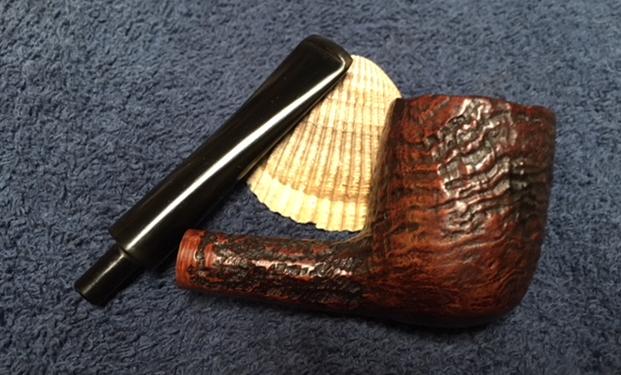
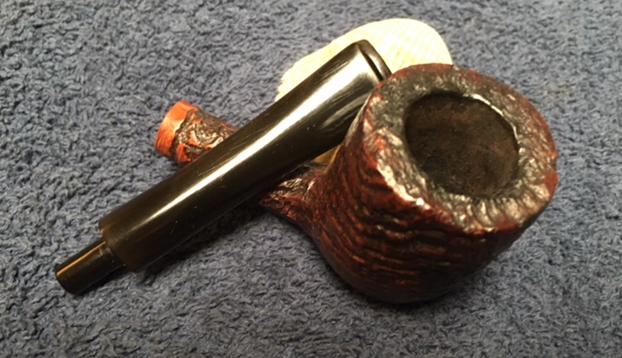
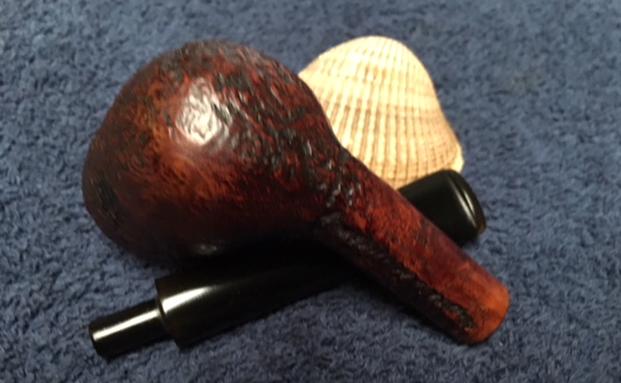
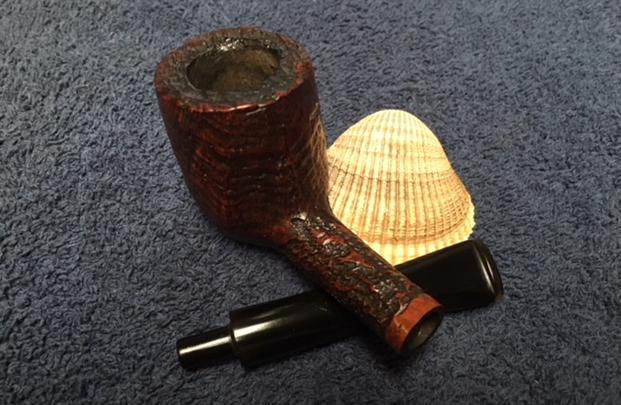
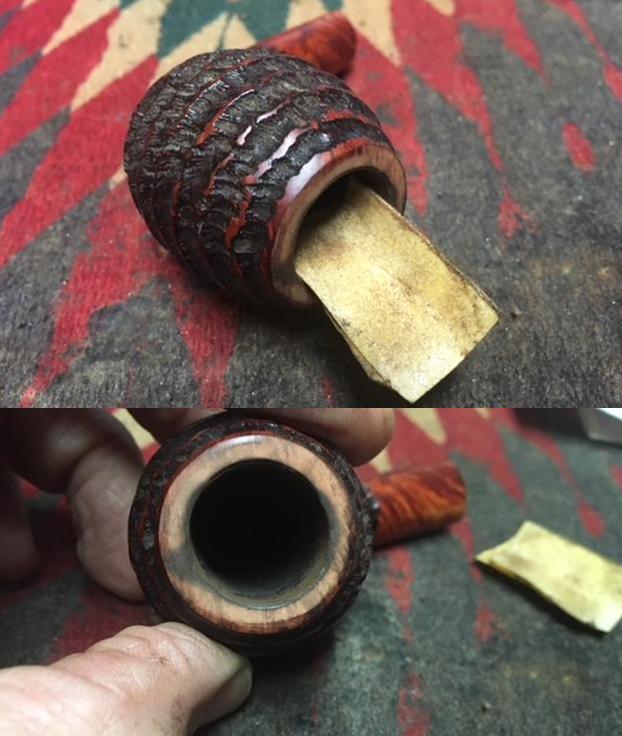
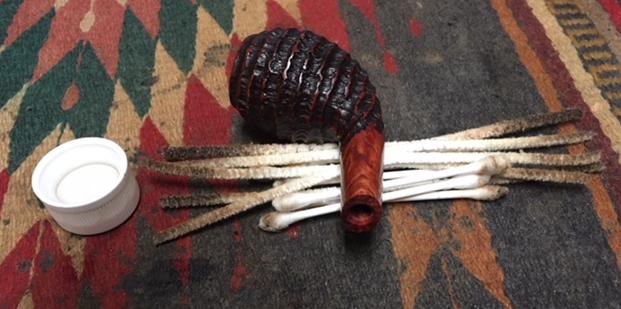
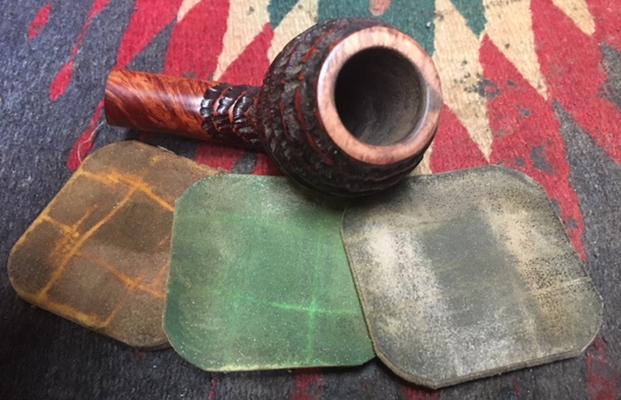
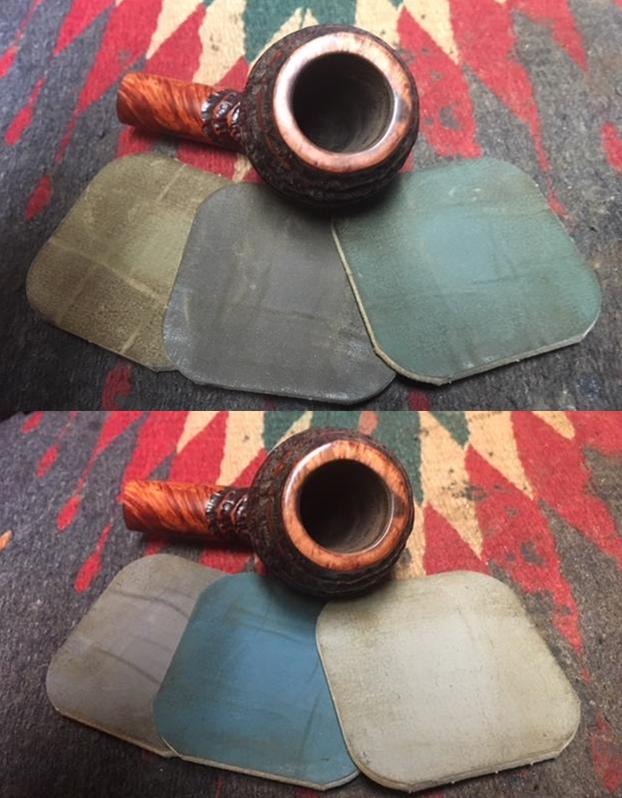
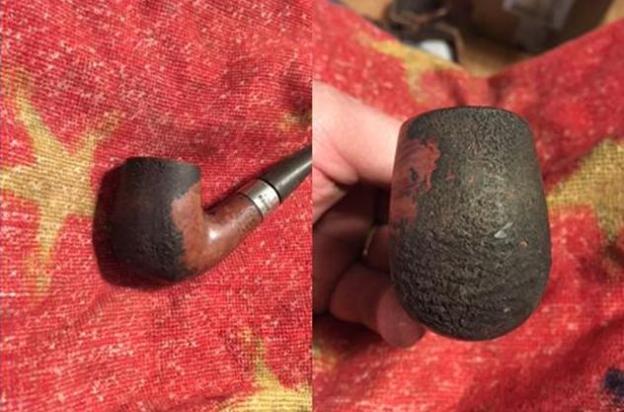
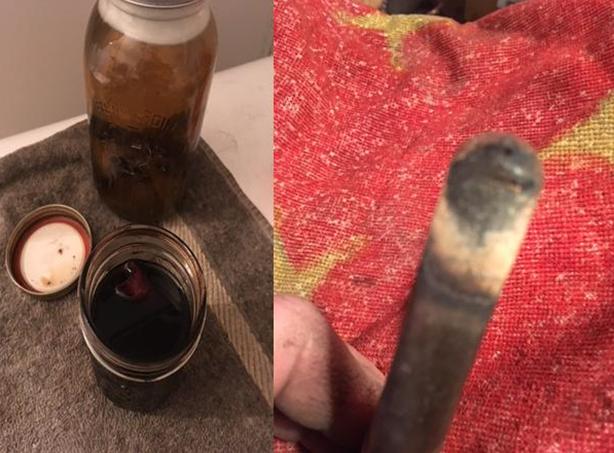
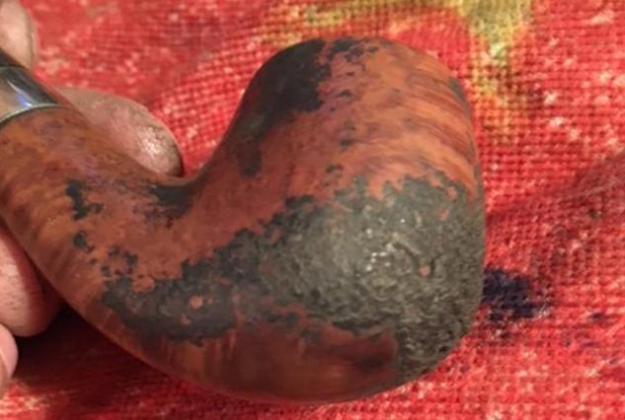
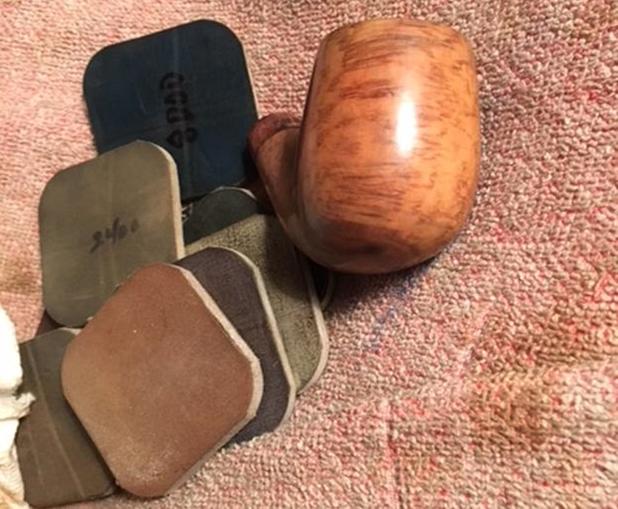
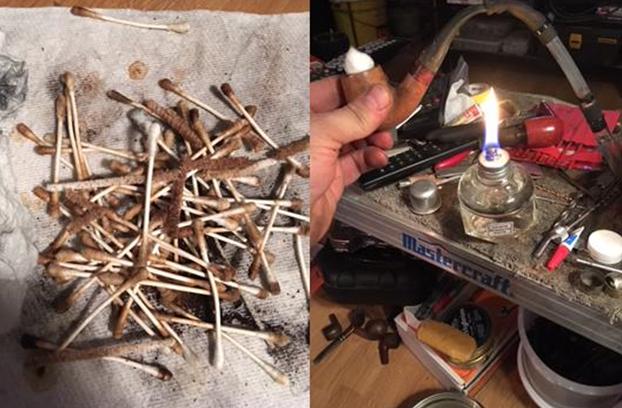
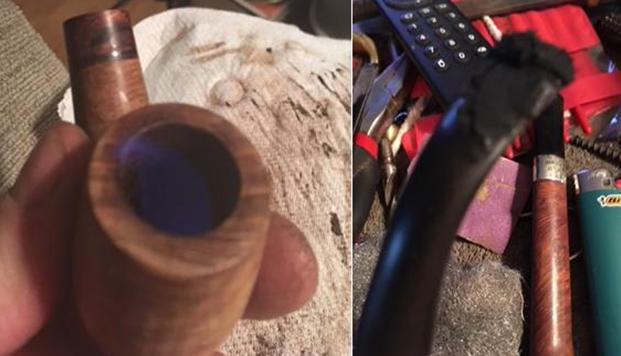
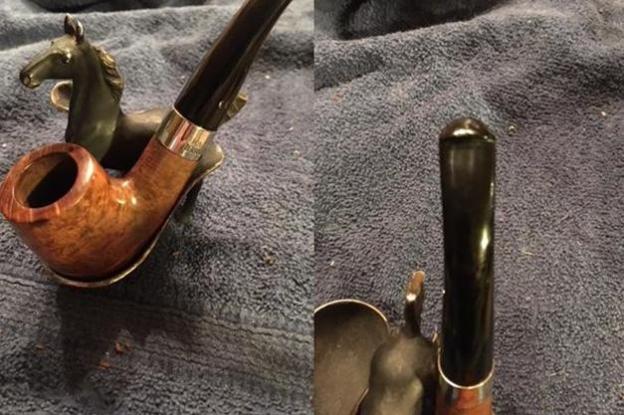
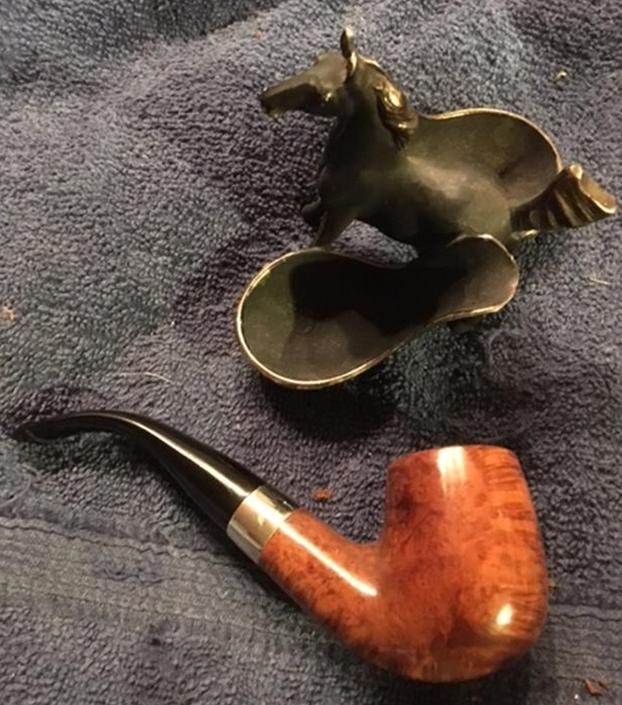
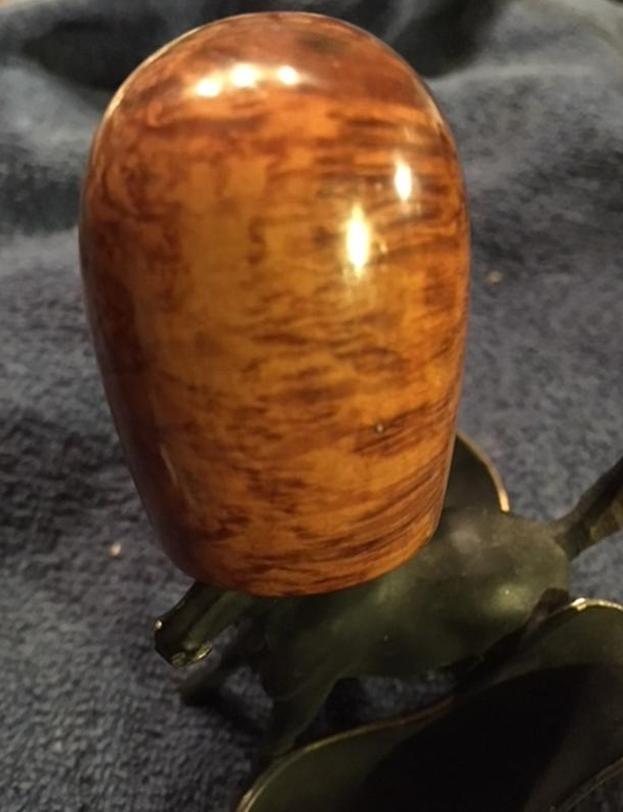
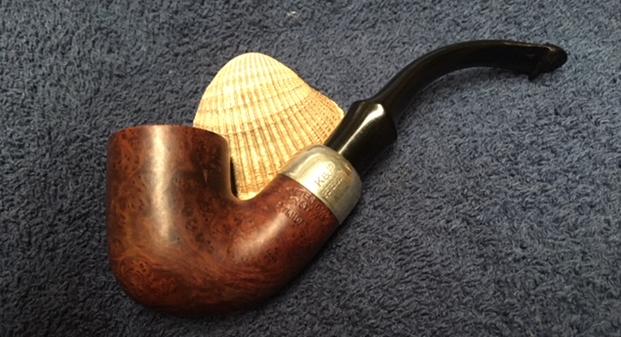
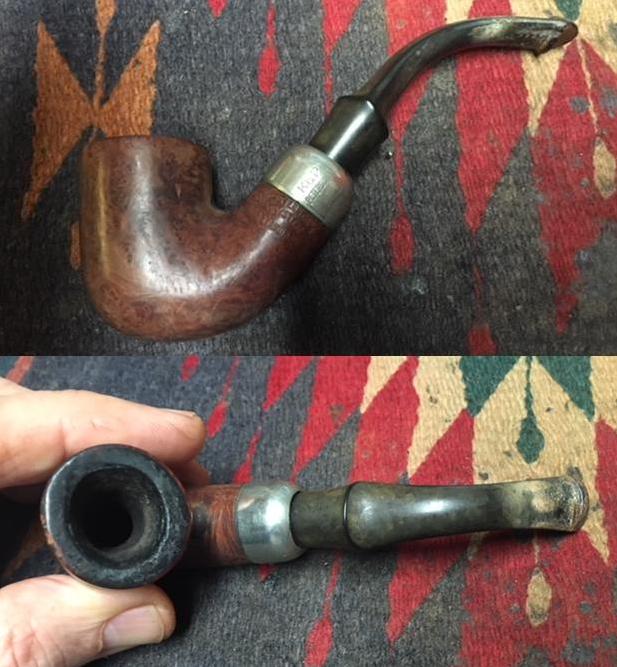
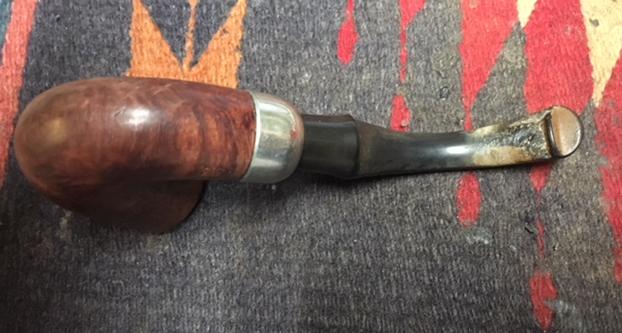
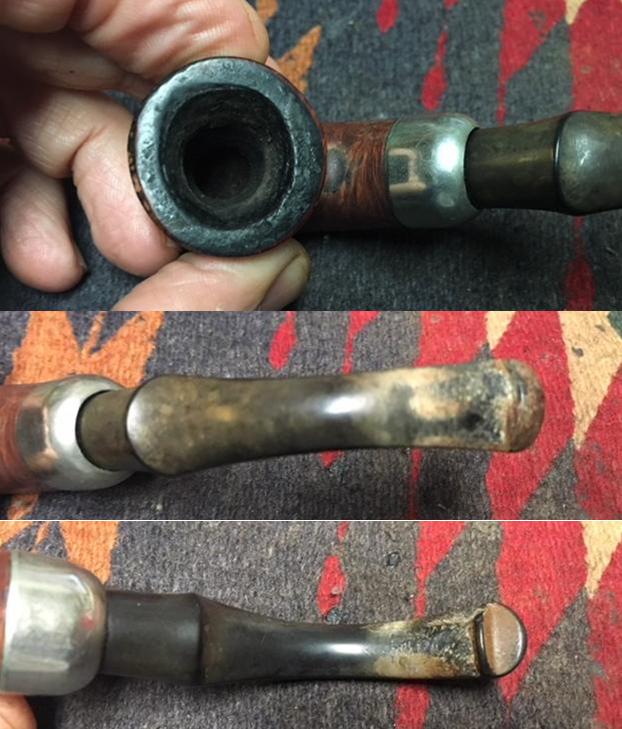
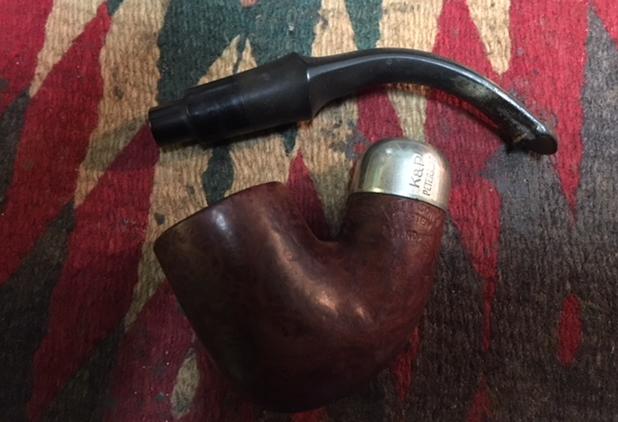
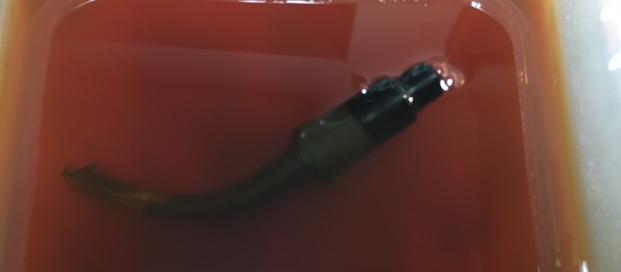
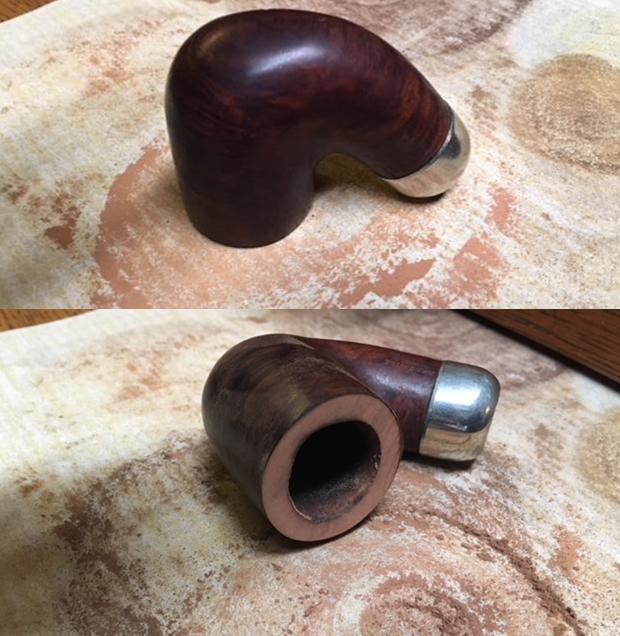
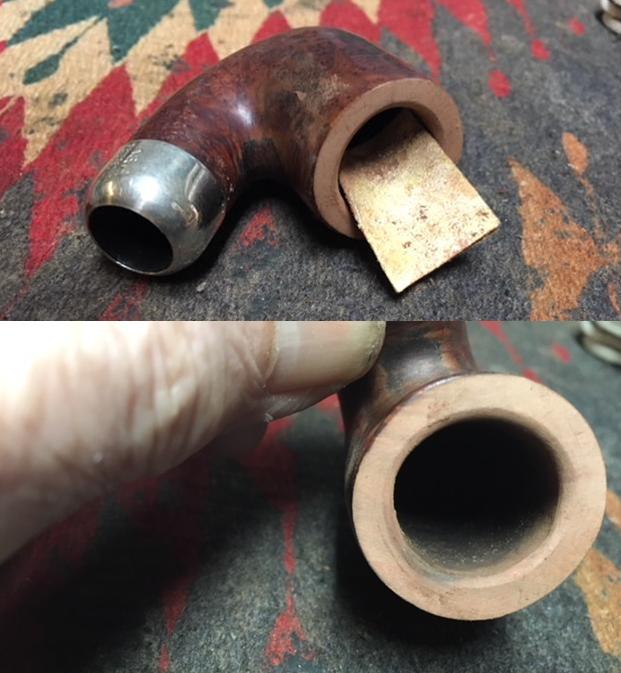
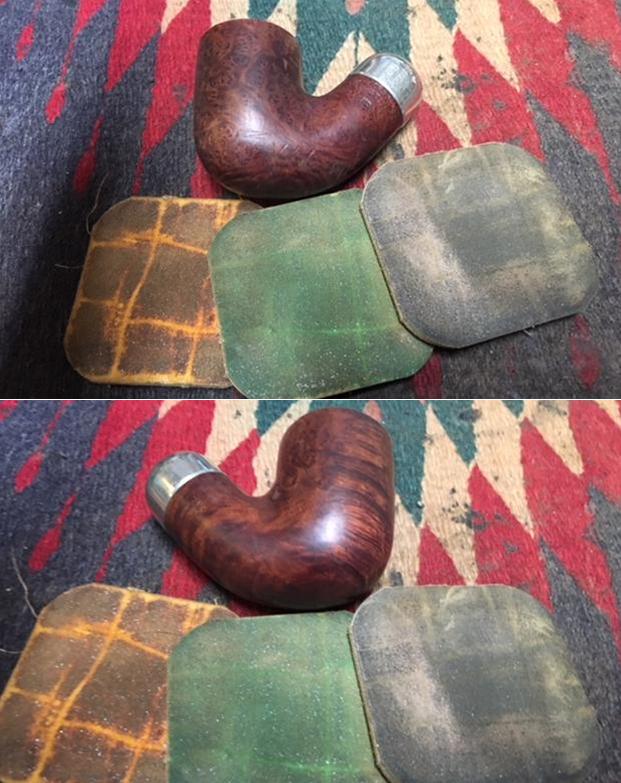
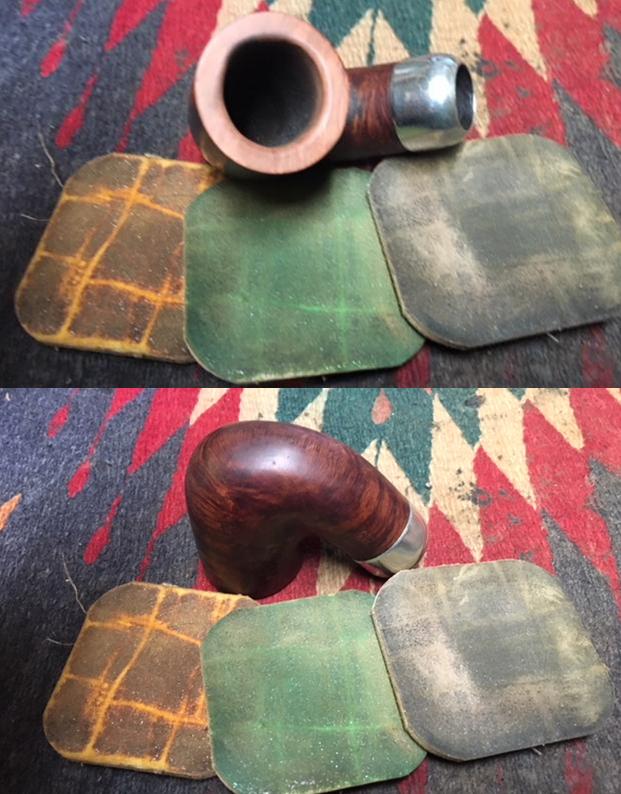
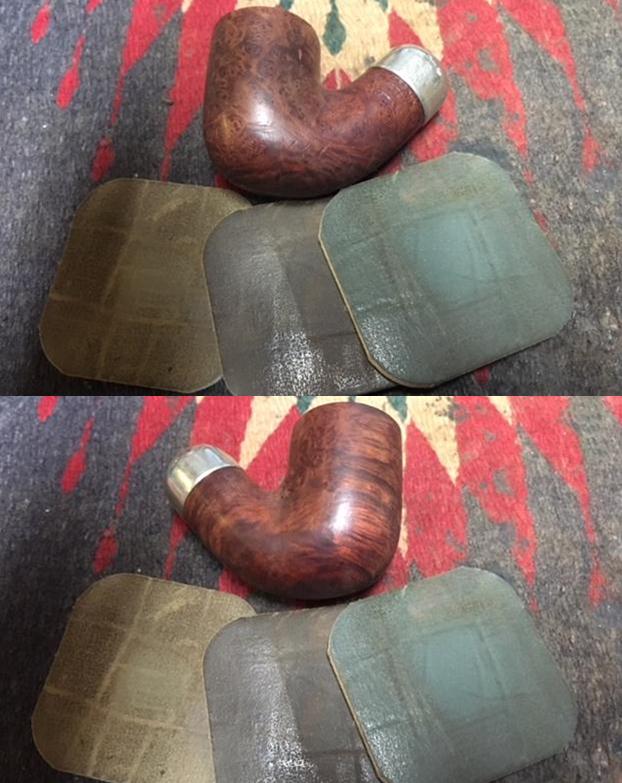
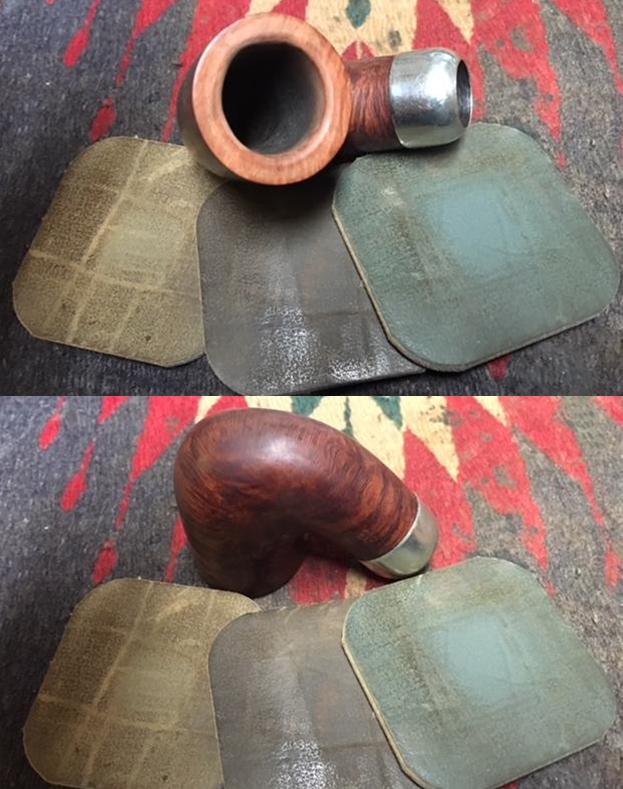
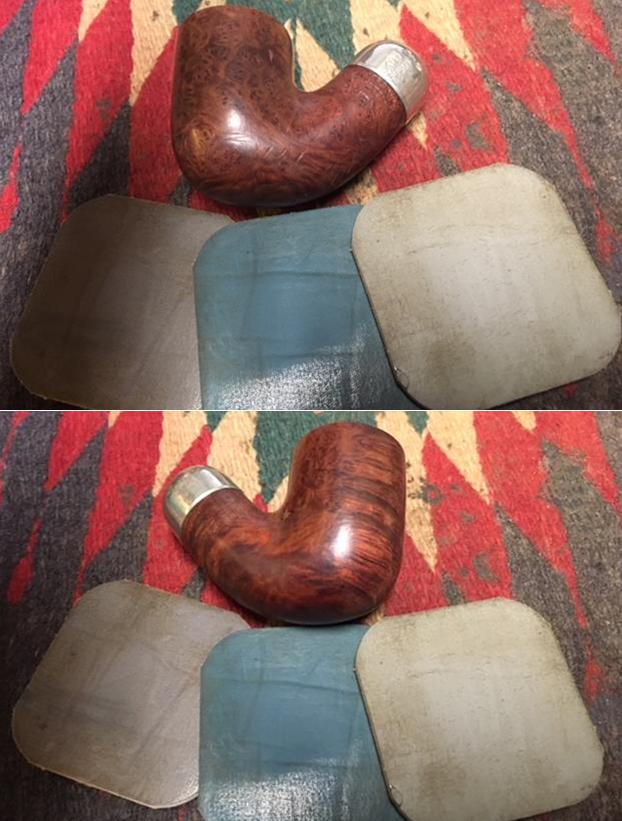
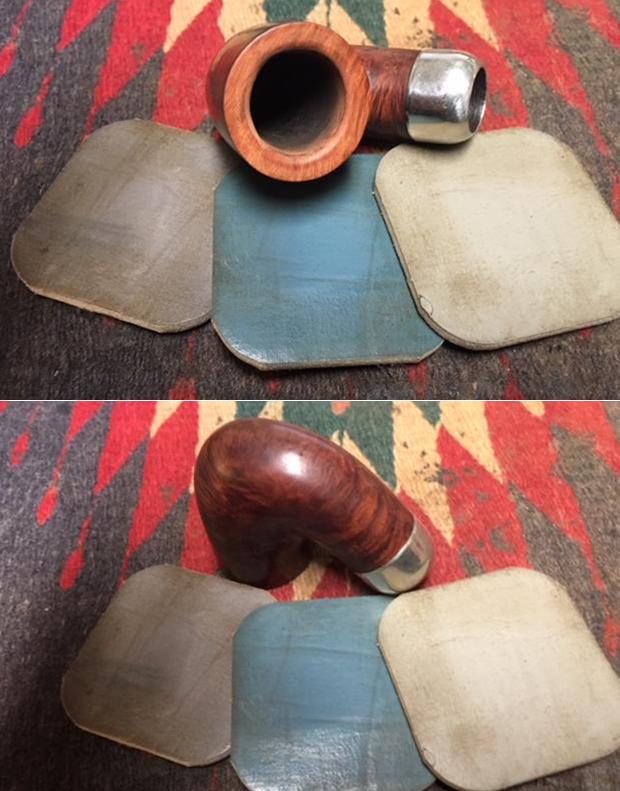
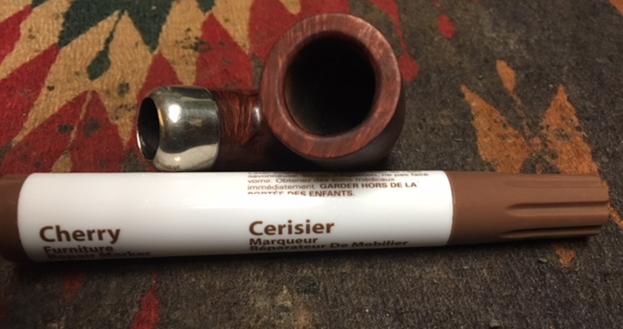
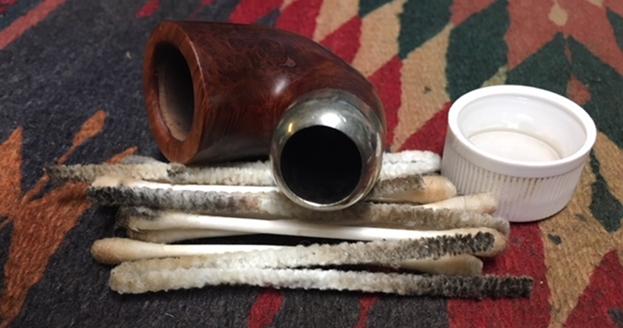
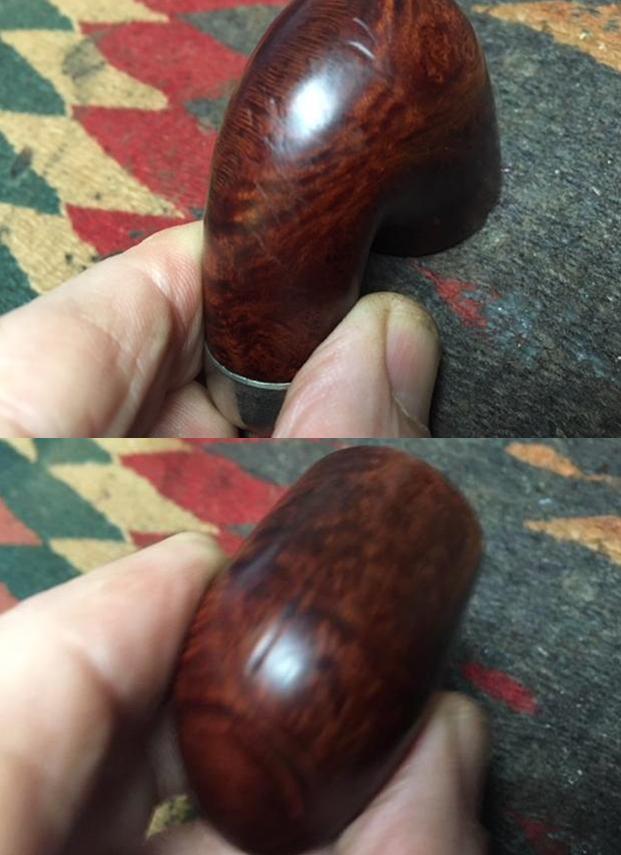
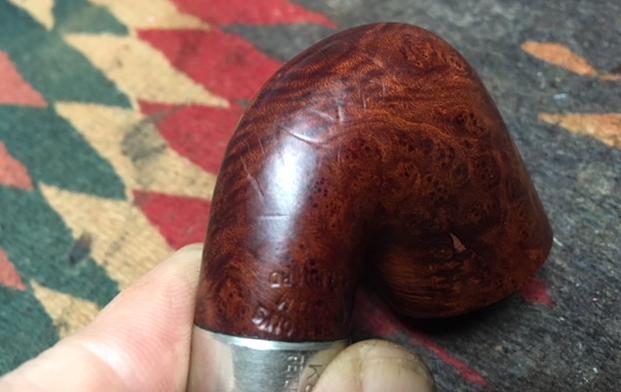
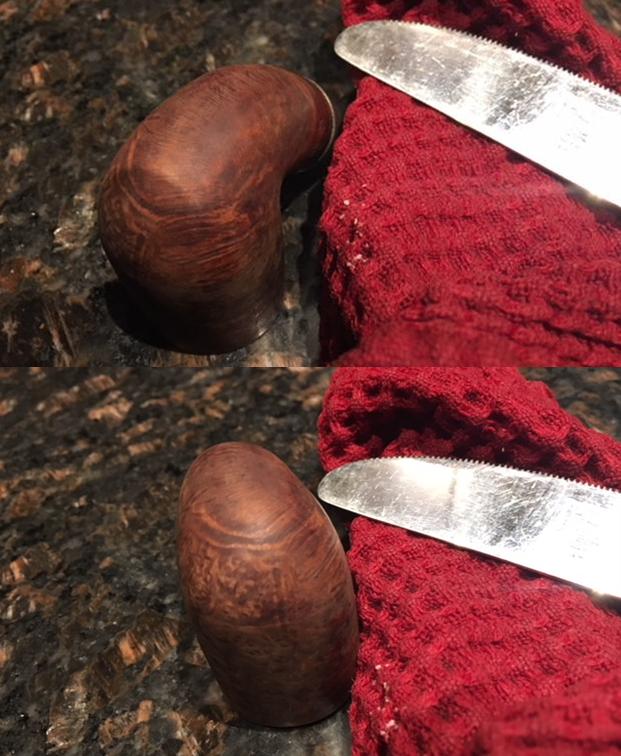
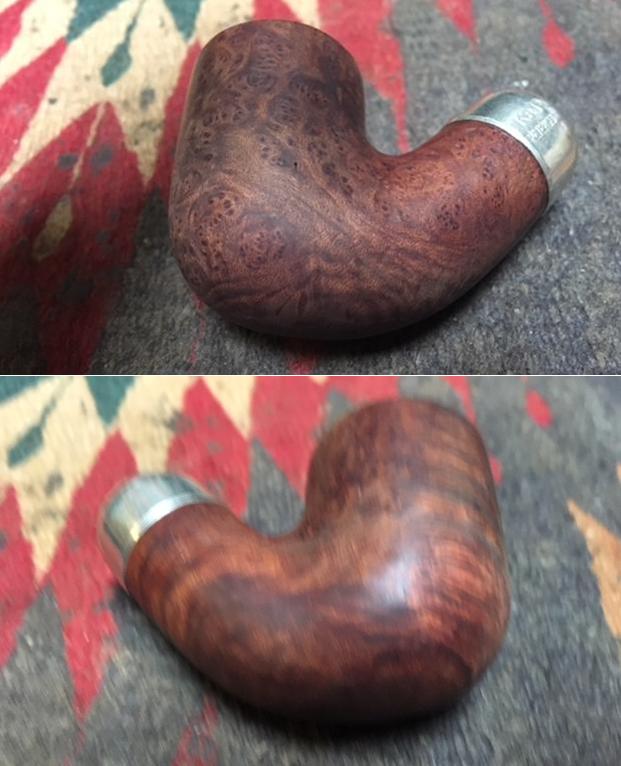
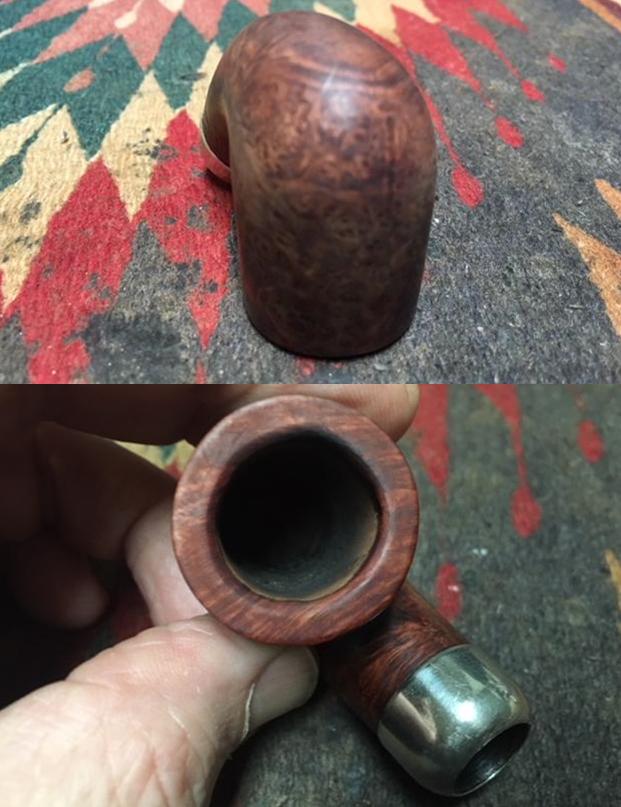
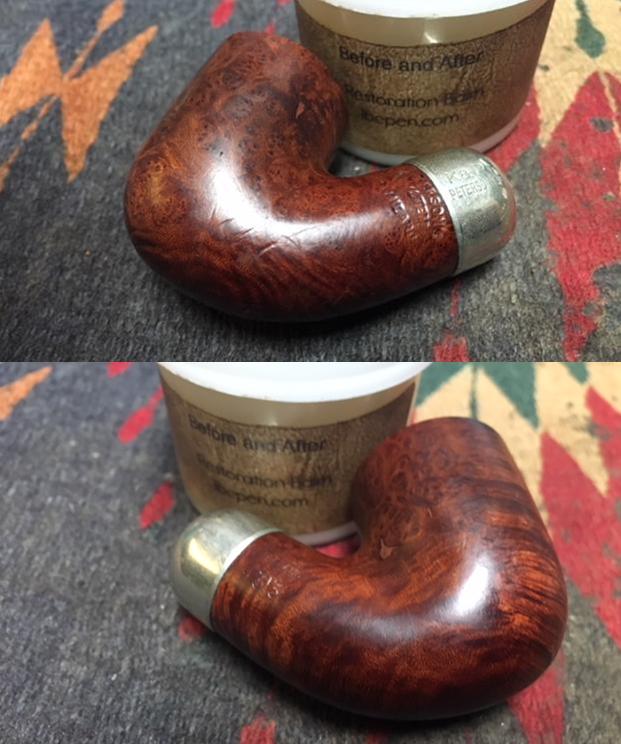
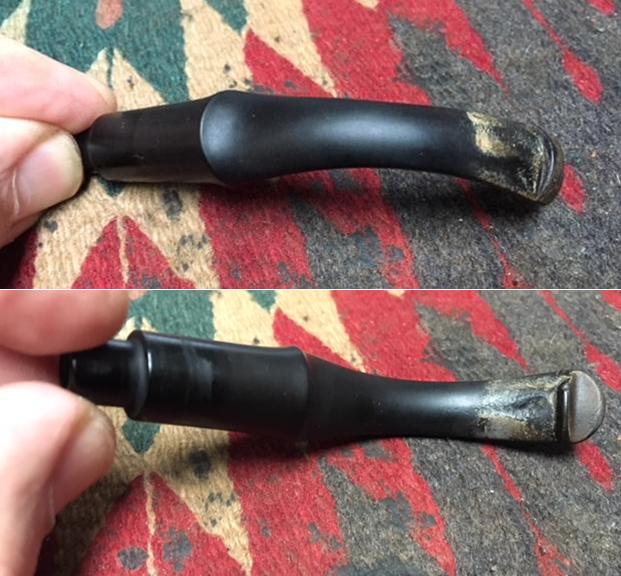
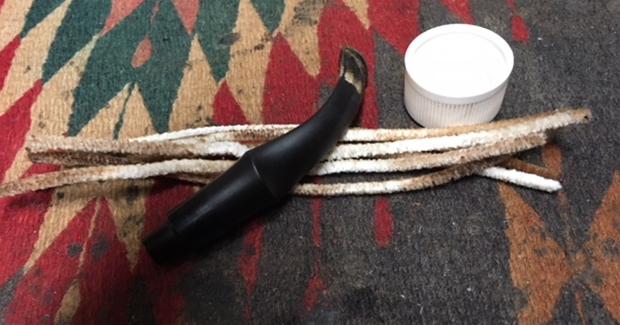
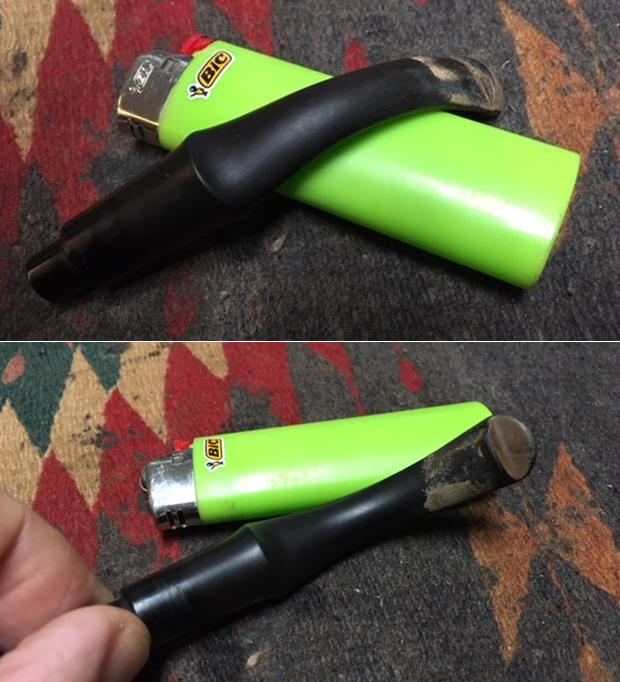
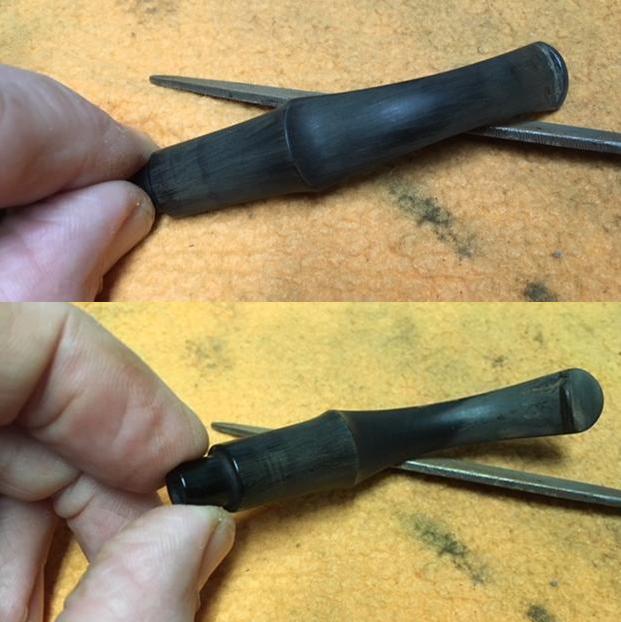
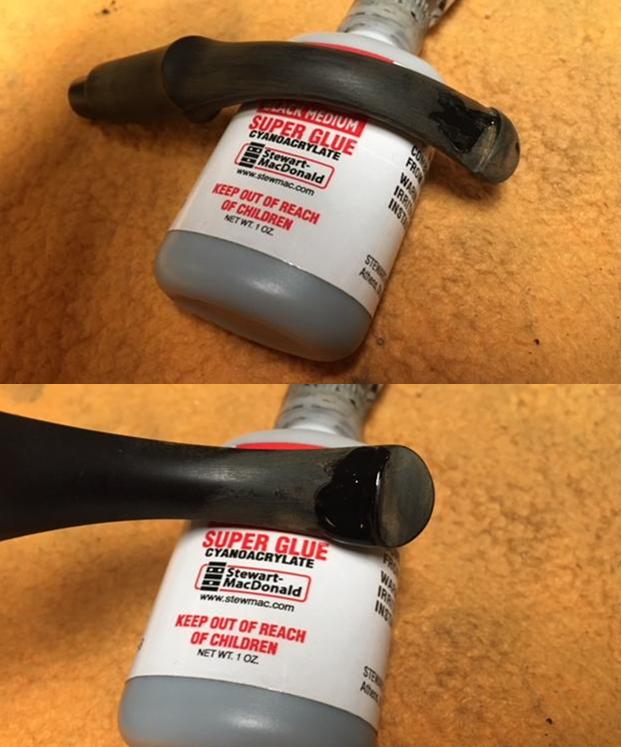
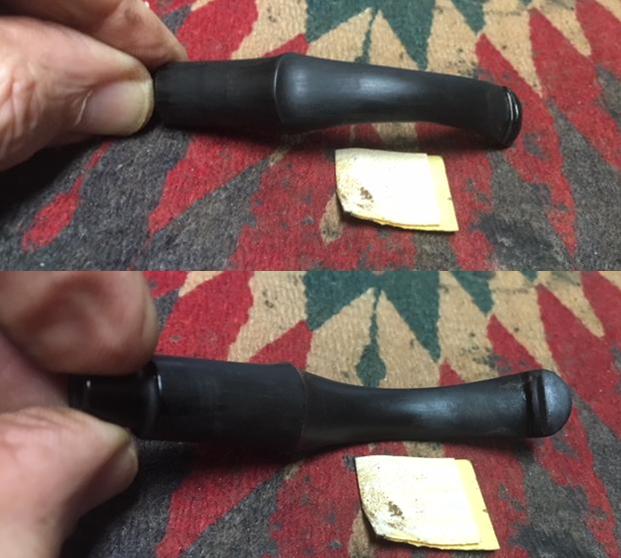
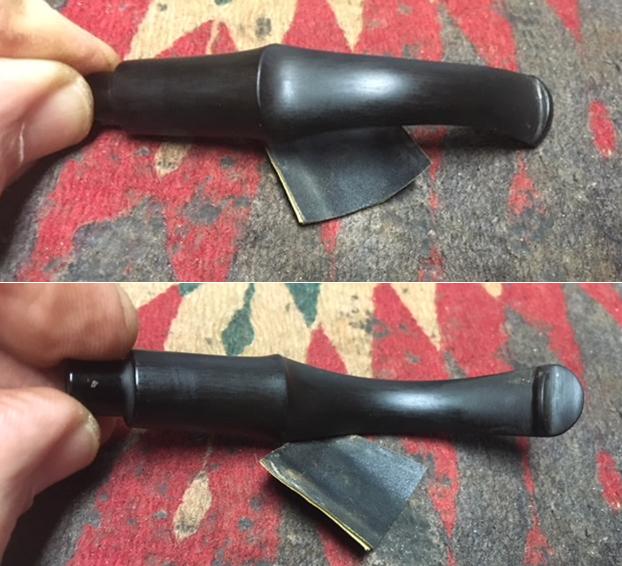
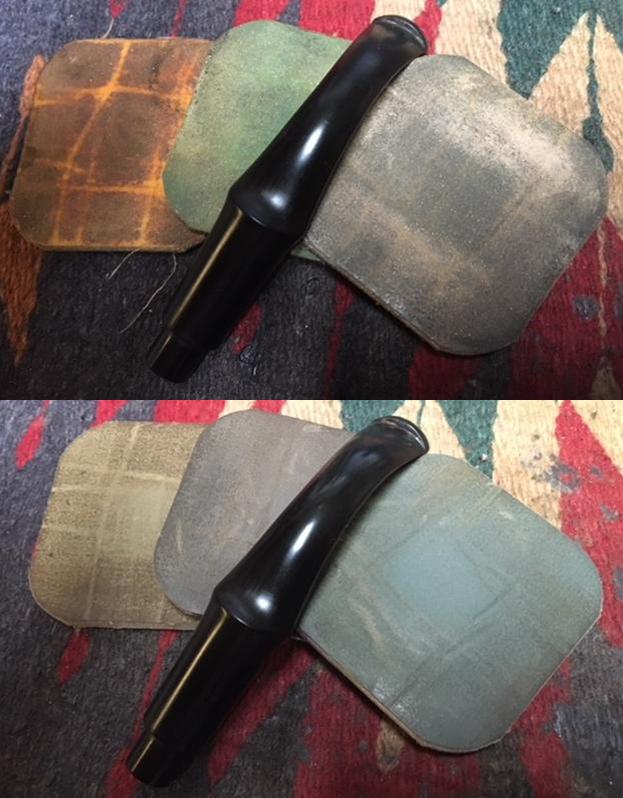
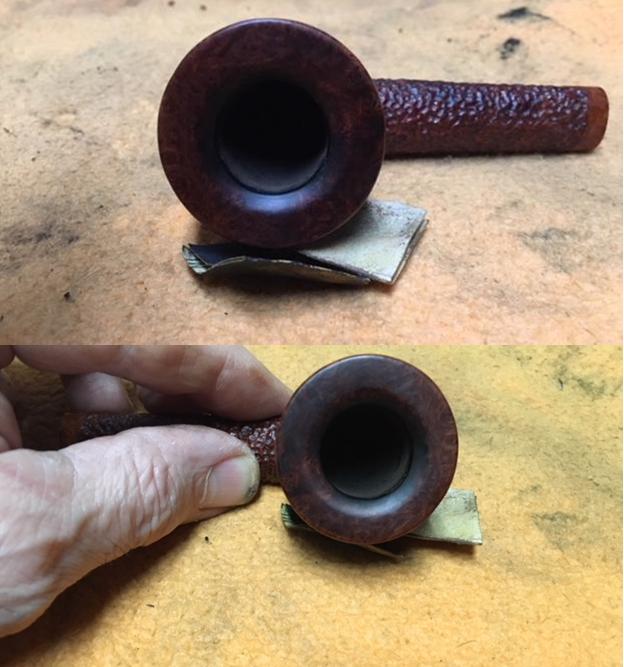
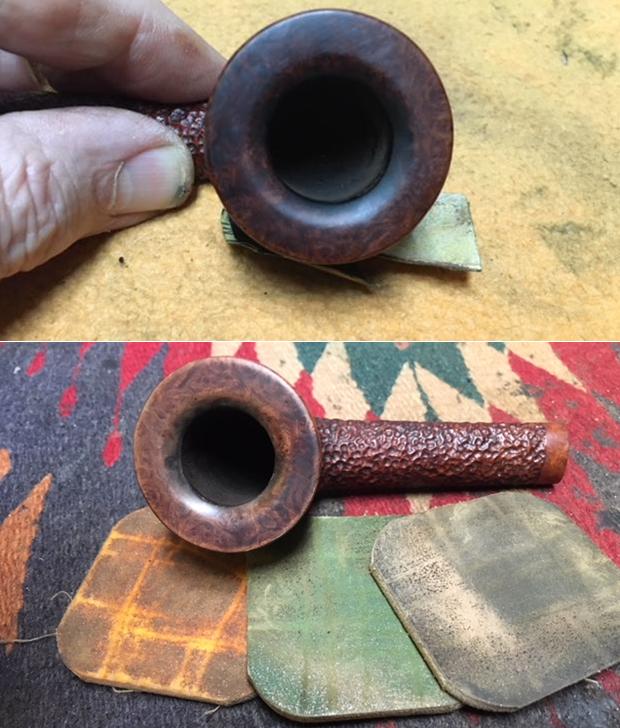
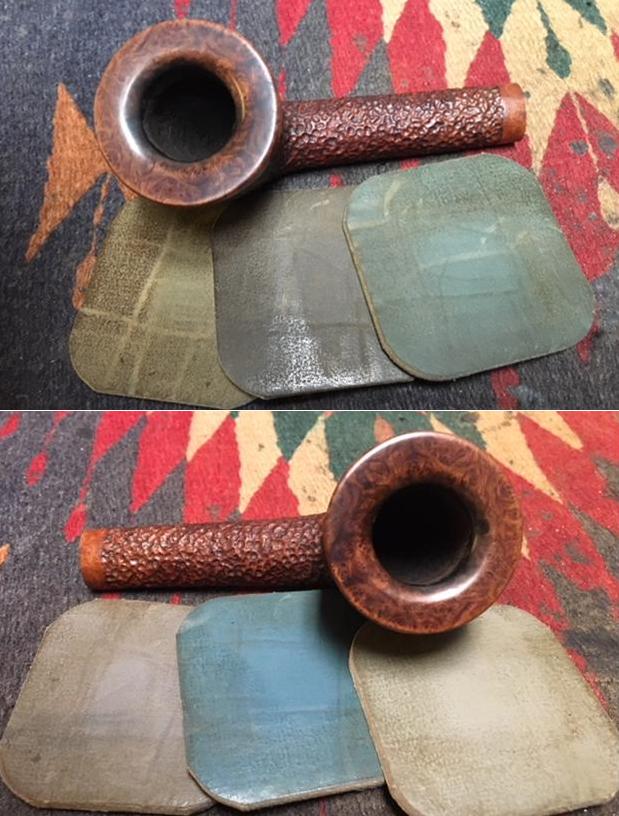
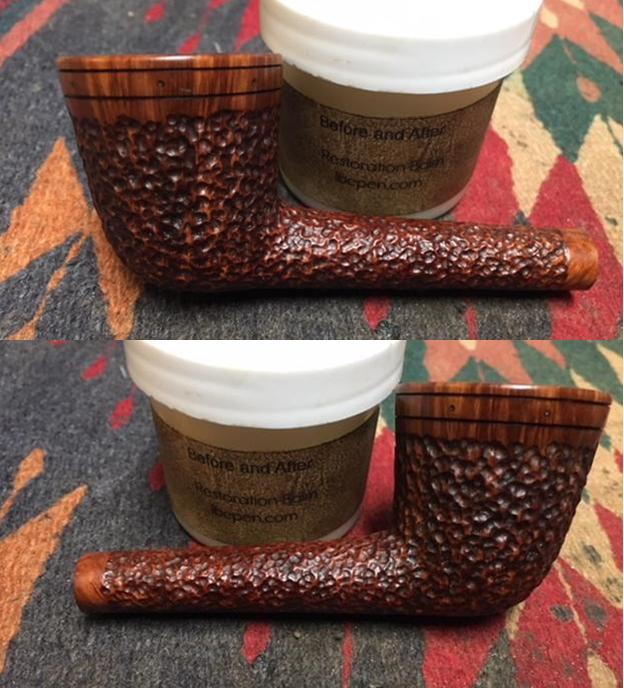
After choosing the full refurbish course, I began with the replacement of the original Vulcanite bit that had broken during a harried move using my car.  The photos below show the bit as it was before I smoothed it out when I first bought the pipe.Here’s a similar new Lucite bit as it came in the mail, showing the huge 9mm tenon that was almost the same diameter as the one I used.If I owned a proper, electric stem turner, the job of fitting the tenon of the fancy Lucite bit to the shank opening would have been easy.  But I had the pleasure of doing it by hand, and after previous experiments I didn’t want to mess it up with a single miscalculated stroke of a file.  That left the sandpaper method.  And now the fancy replacement, after hours of going over with 150-grit paper and smoothing with a steady, ascending progression, ready to heat in the oven for about 20 minutes at 210° F., and again after bending. I micro meshed the stummel, other than the rim, from 1500-12000.I was ready to soak the stummel in isopropyl alcohol. Micro meshing again, the wood was nice and smooth, and the rim and shank opening only needed some work with the 180-grit side of a sanding pad.Reaming and sanding the chamber from 150-600-grit paper, that part looked much better.Just for good measure, I retorted the pipe, and the result was magnificent.Having re-thought my initial desire to lighten the wood, I used red and brown Tripoli and several coats of carnauba in the buffing. CONCLUSION

Wanting more than anything else to get an idea of what Holm was like as a person, I put the question to Lon.  His answer came back with almost no delay.

“Preben once bought a 1960s Chevy Camaro – a muscle car – for about $3,000.”  After a pause, Lon finished.  “He shipped it back to Denmark.  It cost him crazy money, at least $100,000, to do this, but that’s how he was: a rock star.  He was the only person in Denmark with that kind of car!”

Perhaps because I am a recovered alcoholic with 30 years of sobriety, something in the pervasive silence concerning the cause of Holm’s early death made me suspect that alcohol was involved.  Looking at various photos of Holm, I couldn’t help noting the sadness of his face and eyes.  At last, I found a single comment in a thread about Holm’s Ben Wade pipes on a popular smoker’s forum that read in part, “Preben literally drank himself to death…after his wife bolted with the kids.”

And so, again, but with difficulty, I turned for an answer to the man who might have been the best friend Holm ever had.  There was a long pause before Lon replied.

“When he was very strong working, making crazy money from his pipes, he was drinking a lot, as a youngster will, with everything that goes with that,” Lon said with great care and delicacy.  I didn’t ask him to expand on the last part.  “He was a rock star!  He didn’t know what to do with that.  He was getting everything he wanted and was bored.”

We both fell silent for a moment before Lon concluded, “I think we’ve said everything that needs to be said about that.”

I agree.

My hope is that this two-part essay will inspire future pipe makers, hobbyists and artisans alike to take up Chasing the Grain.  I, for one, intend to try my hand and imagination at the noble goal, even if the results are less than spectacular.

I want to express my deep gratitude to Lon, a consummate gentleman, for his invaluable help filling in details of Preben Holm’s life, craft and various business adventures.  Lon was unstinting in taking the time to share his reminiscences, not one but three times.  The only protest I have is that Lon ignored my repeated requests for a photo of himself of his choosing.  That’s why I was forced to track down, with great difficulty, the one I used.  So, Lon, don’t blame me if you don’t like it!

Lon also opened up about himself.  Born in 1940 in New York and now retired as a pipe buyer and seller, Lon described himself as the only child of highly educated parents who considered him “an idiot” because of his dyslexia.

“That was my motivation to leave home when I was 17 and look for work in the city,” Lon said in a matter-of-fact tone.

The uncontrollable condition, which causes written letters to become jumbled beyond sense, places Lon in the company of such historical and cultural figures as Leonardo da Vinci, Albert Einstein, Tom Cruise, Walt Disney – and even at least three U.S. presidents: George Washington, John F. Kennedy and George W. Bush.

The idea horrifies me, the more so because, when I was a child, I suffered from another optic disorder that mimicked dyslexia but proved curable.  I’ll never forget the shame of not being able to read or write until I turned 10 and moved to Shaker Heights, Ohio, where I was blessed to meet a woman who loved children and teaching more than anything else.  Sonia Golden was an innovator in special education and knew how to do her job when my so-called teachers in California had dismissed me as “borderline retarded.”

On his own in the Big Apple, Lon started out as a sales clerk for Wally Frank, earning $37.50/week.  That’s $321.63 in today’s dollars – not bad for a start, but a long way from the ultimate success he had after discovering Holm, for all intents and purposes, first partnering with the brilliant pipe maker and later, as a friend, guiding him to bigger distributors.

The shop known as Pipe Lon was only for a relatively short time, but the quality pipes he sold there can still be found online.  Lon told me he was in the habit of stamping various pipes he sold, whether they also bore the makers’ marks or not, with the following nomenclature.  In some cases, only the best guesswork can predict the actual craftsman.* The opening quote strikes me as an elegant example of the habit of personifying wood that I discussed in Part 1.

SOURCES

https://www.cia.gov/library/Publications/the-world-factbook/geos/vq.html
https://www.google.com/search?q=poul+winslow&rlz=1C1CHBF_enUS769US769&oq=poul+winslow&aqs=chrome..69i57j0l5.17027j0j4&sourceid=chrome&ie=UTF-8
http://www.danishpipemakers.com/forside/2006/1update/sixten/sixten.html
https://www.finepipes.com/danish
https://pipedia.org/wiki/Holm,_Preben
http://www.scandpipes.com/info.asp?text=3
http://www.pipephil.eu/logos/en/logo-benwade.html
https://pipedia.org/wiki/Ben_Wade
https://pipedia.org/wiki/Lane,_Ltd.
http://www.nytimes.com/1982/08/05/business/business-people-lane-ltd-gets-outsider-lane-tobacco-maker-places-outsider-helm.html
https://trademarks.justia.com/722/75/snug-harbour-72275082.html
http://pipesmagazine.com/forums/topic/ben-wade-by-preben-holm
https://rebornpipes.com/2015/01/24/grooming-a-ben-wade-golden-walnut-danish-freehand/

Restoring a Rusticated House of Robertson War Club


Blog by Steve Laug

After my brother Jeff found an assortment of House of Robertson pipes at an auction in Wilder, Idaho which is an area in the greater Boise, Idaho area. He kept an eye out for more of the brand on his weekly pipe hunts. He found several others that are quite unique in an antique mall near where he lives. There were two large long shanked pipes – one round shanked and one square shanked. The third of the batch that he finds is a nice little classic apple shape. It looks tiny with the size of the other two. The two larger pipes are a combination of smooth and rusticated. They both have smooth panels on the sides or front of the pipes. Both of the large ones are banded with a sterling silver band. It seems to me that the bands on both the square shank and the round shank are decorative rather than a repair for a cracked shank. I will be restoring them in the days ahead. He picked them up for us to restore. They all have the name House of Robertson roughly hand-etched on the side or underside of the shank with an engraving tool. I am including the information that I found when I received my first of the House of Robertson Pipes. I found a link on Pipedia that gave me the only information I could find on the brand. I include that in total as it is interesting to read.

“House of Robertson” was in business for many years, but alas, closed their doors in 1999. They were located in Boise, Idaho. They are noted for making rather large and interesting pipes. Thayne Robertson was a Master Mason, AF & AM, and started the shop about 1947 and his son Jon started working there in 1970 when he finished college, along with Thayne’s daughter. Thayne and his son started making the big pipes at that time, and made them together until 1987 when Thayne passed away. Jon kept the store and his sister moved on to other things. The House of Robertson appears to have closed around 1999. https://pipedia.org/wiki/Robertson

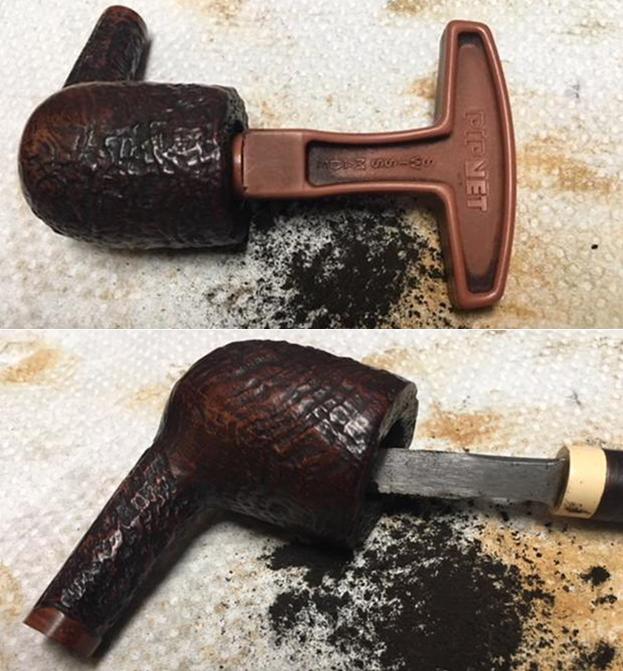
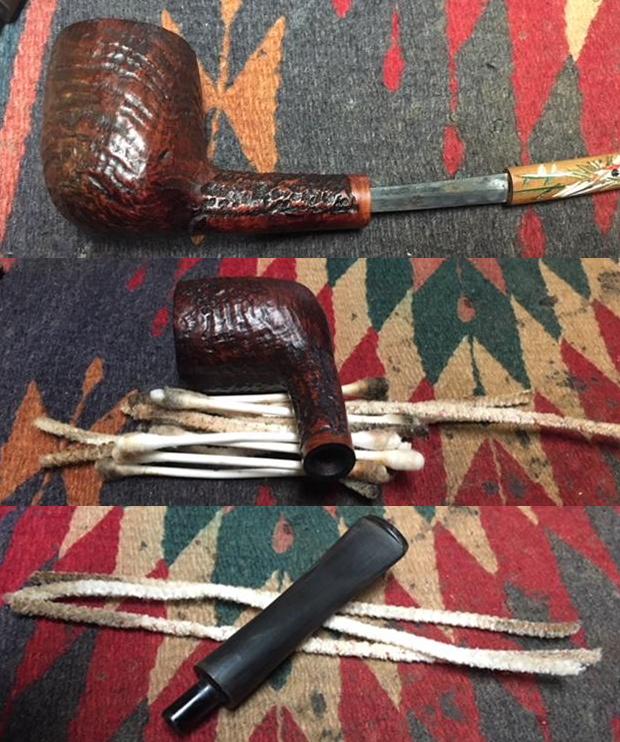
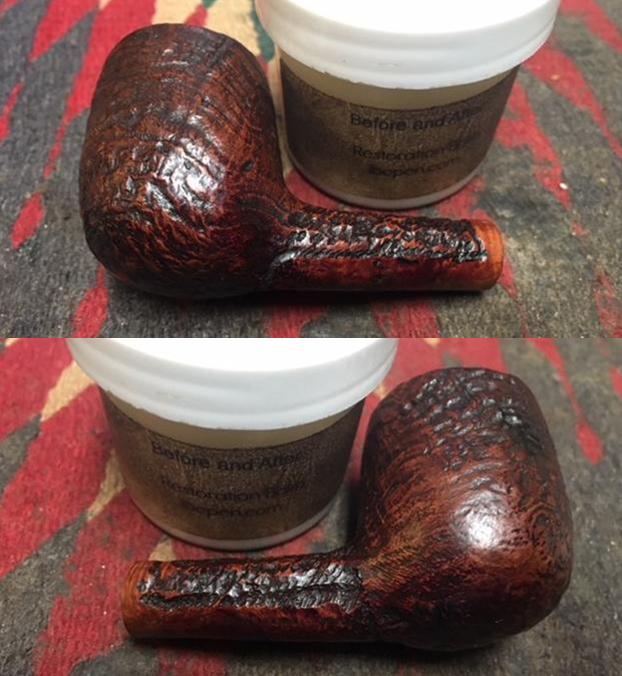
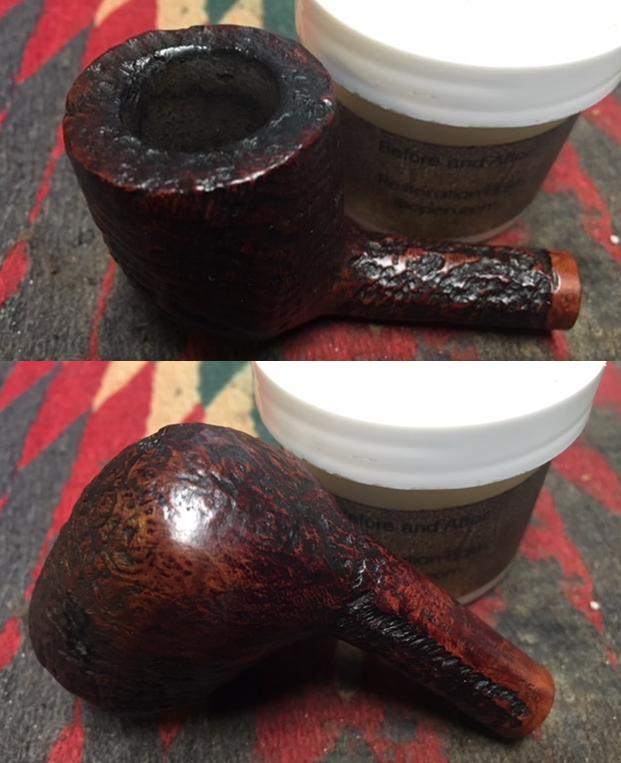
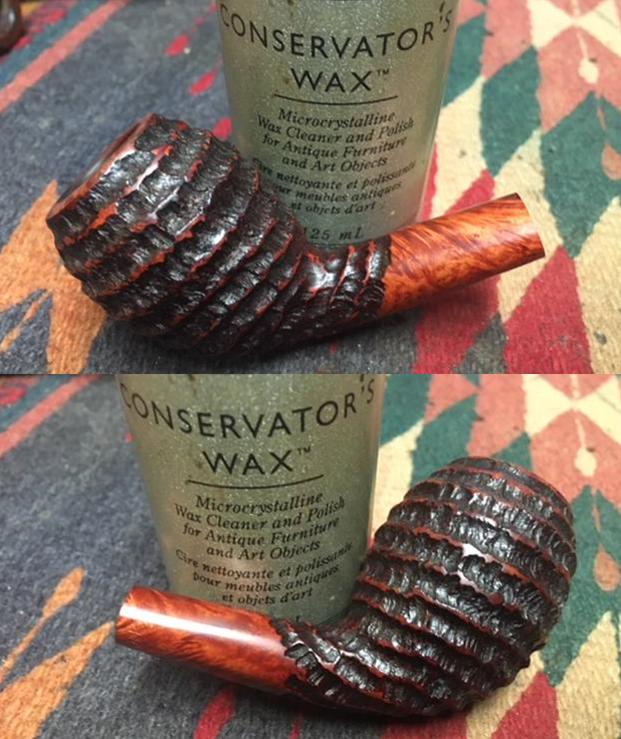
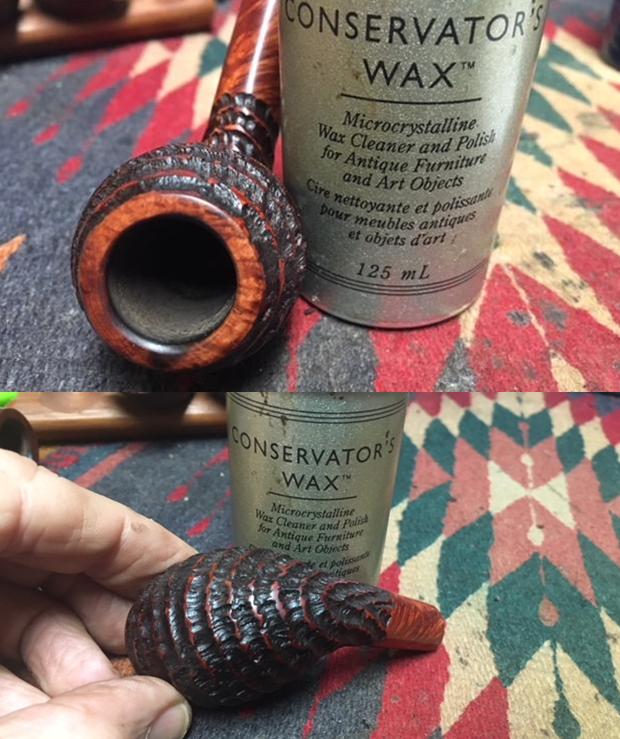
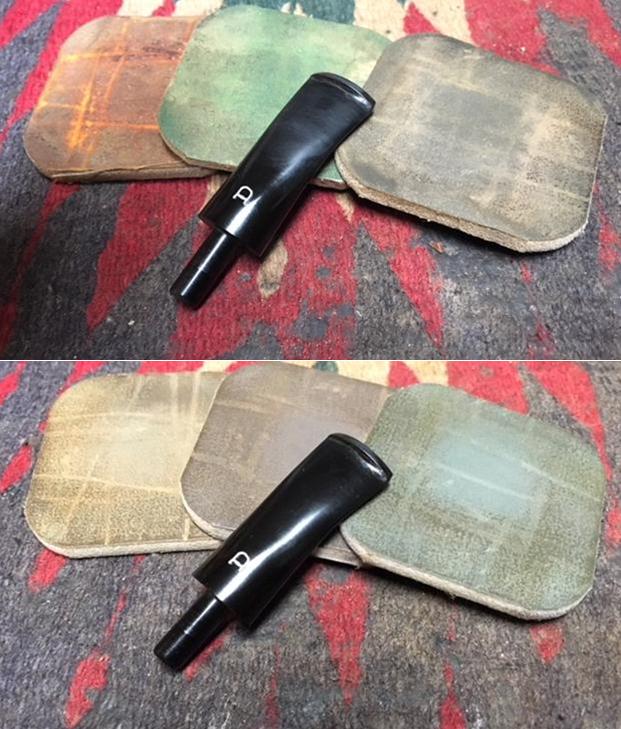
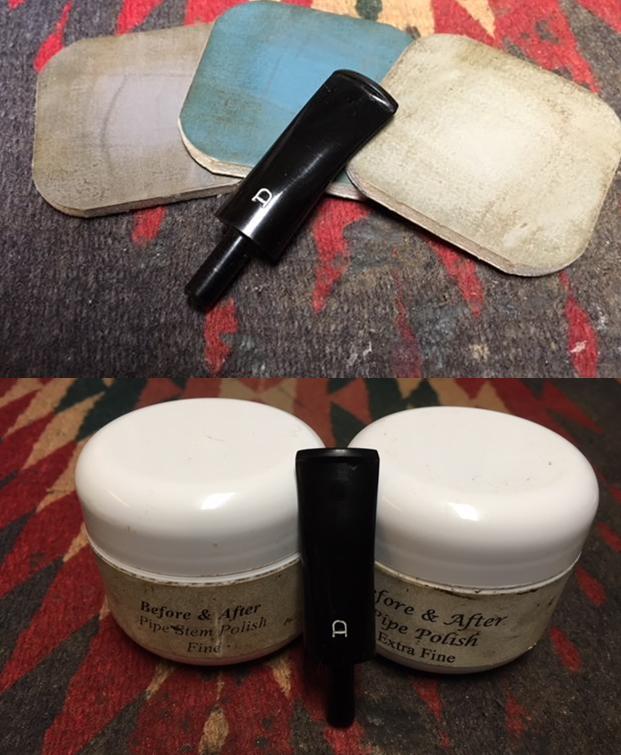
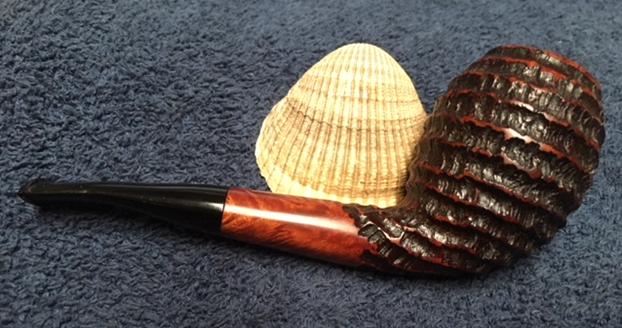
This large, long square shank, flat bottom sitter is the next House of Robertson pipe I chose to work on. It is quite different from the other pipes from this Boise based store. It is large – 7 ¼ long with a bowl that is 2 inches tall. It is engraved with the House of Robertson signature on a smooth panel on the left side of the shank just ahead of the band. On the top of the shank it is etches P.L.F.S. I have no idea what that etching stands for. There is a smooth band of briar just ahead of the silver band. There is also a smooth panel on the front of the bowl and two smooth areas on the rim top. The pipe was dirty but underneath all of the grime it appears to be in excellent condition. The rustication on the shank was quite light and had the look of a sandblast finish. The sides of the bowl were deeply rusticated, almost like roots and then it is almost like it was also sandblasted over the top. The bottom of the bowl and shank also appeared to be sandblasted. It is definitely an interesting pipe and should clean up very well. The narrow silver band is stamped Sterling Silver on the top side. There were some nicks in the edge of the silver at the stem/shank junction. The fit of the stem to the shank was good. The square stem was oxidized and had some small tooth marks and chatter on both sides of the stem near the button. Jeff took photos of the pipe before he started the cleanup. The next close-up photos show the finish on the top and the underside of the bowl. The first photo shows cake in the bowl and the lava overflowing onto the rim top. The grain on the top of the bowl and the inner and outer edge of the rim looks really good. The finish on the rim top was appeared to be in great condition under the lava coat. The next two photos show the front, side and underside of the pipe. It has a very interesting finish. The next photo shows the etched name on the left side of shank on a smooth panel of briar. It reads House of Robertson. On the top of the shank on a narrow smooth panel it reads P.L.F.S. The final two photos show square shank and band. You can also see the general condition of the grime in the rustication of the briar. The tapered stem was oxidized and had tooth chatter and marks on both sides of the stem near the button. The edge of the button had some dents in it as well.This unique pipe was really dirty with a thick cake, overflow of lava on top the rim and dust and debris in the heavy rustication on the sides of the bowl. He reamed the bowl with a PipNet pipe reamer and cleaned up the remnants with the Savinelli Fitsall Pipe Knife. He scrubbed out the mortise and the airway in the shank and the stem with alcohol, cotton swabs and pipe cleaners. He scrubbed the exterior of the bowl, rim and shank with a tooth brush and Murphy’s Oil Soap to remove the dust in the rustication on the bowl and shank as well as the smooth portions. He rinsed it under running water. He dried it off with a soft cloth. Once the dust and debris were removed the finish was dull but appeared to be in excellent condition. I took photos of the pipe to show its condition before I started my work on it. I took a photo of the bowl and rim top to show the condition it was in once it was cleaned off. It has an interesting combination of rusticated and smooth finishes on the top of the bowl. The unique square stem was oxidized and had tooth marks and chatter on both sides. You can also see the nicks in the edge on the top and underside of the Sterling Silver band.I worked Before & After Restoration Balm deep into the nooks and crannies of the rusticated finish to clean, enliven and protect the briar. I hand rubbed it with my fingers and worked it into the finish with a horsehair shoe brush. I wiped it off with a soft cloth. I buffed the bowl with a cotton cloth to polish it. It really began to have a deep shine in the briar. I took some photos of the bowl at this point to mark the progress in the restoration. The grain on the smooth portions stands out, while the deep grooves of the rustication look almost undulating. It is a unique and strangely beautiful pipe. I sanded the stem with 220 grit sandpaper to remove the oxidation on both sides of the tapered stem and remove the tooth marks and chatter on the top and bottom sides at the button.I polished out the sanding scratches and marks in the vulcanite with micromesh sanding pads – wet sanding it with 1500-2400 grit pads and dry sanding it with 3200-4000 grit pads. I wiped the stem down with Obsidian Oil after each sanding pad. I buffed the stem with Blue Diamond on the buffing wheel. I brought it back to the table and sanded it with the final three 6000-12000 grit pads. I polished it further with Before & After Pipe Polish –using both the Fine and Extra Fine Polishes. I gave it a rubdown with Obsidian Oil one last time and set it aside to dry. I put the stem back on the bowl and worked the pipe over on the buffing wheel using Blue Diamond to lightly polish the stem. I buffed the bowl with a light touch so as not to get any of the buffing compounds in the grooves of the rustication. I buffed the stem to raise the gloss on the vulcanite. I gave the bowl multiple coats of Conservator’s Wax and gave the stem multiple coats of carnauba wax. I buffed the entire pipe with a clean buffing pad to raise the shine. I hand buffed it with a microfiber cloth to deepen the shine. The finished pipe is shown in the photos below. The medium brown stains on the rusticated square shanked poker shaped bowl with a smooth bands and rim works well with the rich black of the vulcanite stem. The polishing and the reworking of the stem material left this a beautiful and interesting looking pipe. The dimensions of the pipe are: Length: 7 3/8 inches, Height: 2 inches, Outside Diameter: 1 5/8 inches, Diameter of the chamber: 7/8 inches. This one will be heading back to Idaho. A House of Robertson collector who used to frequent the Boise shop is adding it to his collection. Thanks for looking.
Kathy’s Dad’s Pipes #9– Restemming & Restoring George Koch’s “Malaga” Banker


Blog by Steve Laug

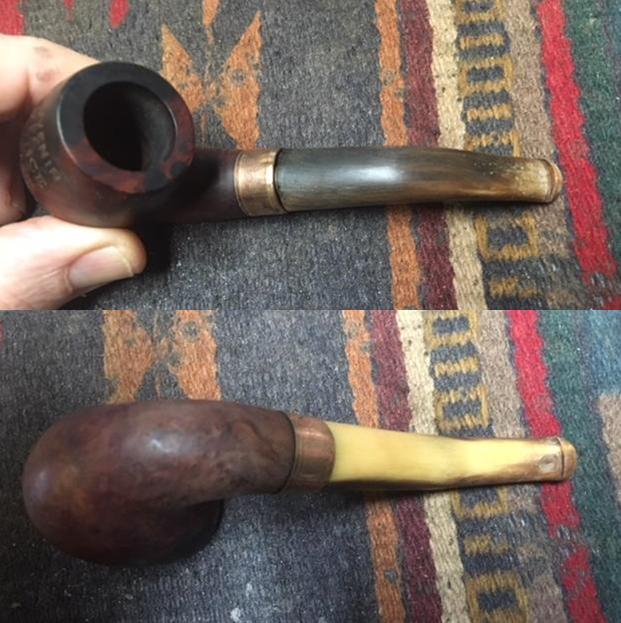
This is the ninth of the “Malaga” pipes that I am working on from Kathy’s Dad’s pipes. I will retell the story of the estate. Last fall I received a contact email on rebornpipes from Kathy asking if I would be interested in purchasing her late Father, George Koch’s estate pipes. He was a lover of “Malaga” pipes – all shapes and sizes and she wanted to move them out as she cleaned up the estate. We emailed back and forth and I had my brother Jeff follow up with her as he also lives in the US and would make it simpler to carry out this transaction. The long and short of it is that we purchased her Dad’s “Malaga” pipes. There are some beautiful pipes in that lot. I have never seen this many “Malagas” together in one place in all of my years of pipe restoring and refurbishing. They varied from having almost pristine to gnawed and damaged stems that will need to be replaced. These were some well used and obviously well loved pipes. Cleaning and restoring them will be a tribute to this pipeman. (Here is a link to some history of the Malaga Brand if you are interested: https://rebornpipes.com/tag/malaga-pipes/. There are also links there to a catalogue and the maker George Khoubesser.)Knowing about the pipeman who held the pipes in trust before me gives another dimension to the restoration work. This is certainly true with this lot of pipes. I can almost imagine George picking out each pipe in his assortment at the Malaga shop in Michigan. I may well be alone in this, but when I know about the person it is almost as if he is with me work on his pipes. In this case Kathy sent us not only information but also a photo of her Dad enjoying his “Malagas”. Once again, I am including that information so you can know a bit about the pipeman who held these pipes in trust before they are passed on to some of you. I include part of Kathy’s correspondence with my brother as well…

Jeff…Here is a little about my dad, George P. Koch…I am sending a picture of him with a pipe also in a separate email.

Dad was born in 1926 and lived almost all his life in Springfield, Illinois. He was the youngest son of German immigrants and started grade school knowing no English. His father was a coal miner who died when Dad was about seven and his sixteen year old brother quit school to go to work to support the family. There was not much money, but that doesn’t ruin a good childhood, and dad had a good one, working many odd jobs, as a newspaper carrier, at a dairy, and at the newspaper printing press among others. He learned to fly even before he got his automobile driver’s license and carried his love of flying with him through life, recertifying his license in retirement and getting his instrumental license in his seventies and flying until he was grounded by the FAA in his early eighties due to their strict health requirements. (He was never happy with them about that.) He was in the Army Air Corps during World War II, trained to be a bomber, but the war ended before he was sent overseas. He ended service with them as a photographer and then earned his engineering degree from University of Illinois. He worked for Allis Chalmers manufacturing in Springfield until the early sixties, when he took a job at Massey Ferguson in Detroit, Michigan. We lived in Livonia, and that’s where his love for Malaga pipes began. After a few years he returned to Allis Chalmers and we moved back to Springfield. I remember that when we went back to Michigan to visit friends, Dad had to go to the Malaga store and acquire a few new pipes. Many a year I wrote to Malaga and they picked out a pipe for me to purchase that I could give Dad for a Christmas or birthday present. He was always pleased. His favorites were the straight stemmed medium sized bowl pipes, but he liked them all.  He had some other pipes, but the Malagas were his favorites. I remember him smoking them sitting in his easy chair after work, with feet up on the ledge by the fire burning in the fireplace.  Growing up it was my job to clean them and he liked the inner bowl and stem coated with Watkins vanilla, leaving a little of that liquid in the bowl to soak in when I put them back on the rack. Dad quit smoking later in life and so they’ve sat on the racks for many years unattended, a part of his area by his easy chair and fireplace. Dad passed when he was 89 years old and it finally is time for the pipes to move on. I’m very happy they are being restored by you and your brother and hope they find homes who enjoy them as much as Dad did. Thank-you for your care and interest. — Kathy, the oldest daughter

Kathy, once again I thank you for providing this beautiful tribute to your Dad. We will appreciate your trust in allowing us to clean and restore these pipes. I am also trusting that those of you who are reading this might carry on the legacy of her Dad’s pipes as they will be added to the rebornpipes store once they are finished.

The ninth of the pipes that I chose to work on is another “Malaga” Banker (Author??). This one is a mixed finish smooth and rusticated pipe with same mixed finish on the rim top. I really like the shape and the mix of rustication and smooth straight grain on this pipe. The vulcanite stem had lots of tooth chatter and some tooth marks. Some great grain peeks through the grime around the bowl. The warm brown finish on the bowl appeared to be good condition under the dust and tars of time. I am certain that Malaga pipes were oil cured. The uniform finish and the light weight lead me to think that is the case. Once more there are no fills in the bowl or long shank. I have yet to find a fill in any of the bowls I have worked on in this lot and looking through what remains I think it is fair to say I won’t find any in them either.

The mixture of rustication and smooth on the rim top of this Baker was originally covered and the rustication was almost filled in with an overflow of lava from the thick cake in the bowl. The rim top was in good condition and the inner edge of the bowl had some light damage and was out of round. The outer edge of the bowl was in good condition. The stamping was on the underside of the shank and was clear and read “Malaga” on a smooth panel near the shank/stem junction. The black vulcanite stem had tooth dents and chatter on the top and the underside of the stem. The interior of the pipe was dirty. I could see that George thoroughly enjoyed this pipe along with the others as is evidenced by the wear that all of them show. Jeff took these photos before he started the cleanup work on the pipe. Jeff took close up photos of the bowl and rim to show the condition of the pipe before he started to work his magic on it. The exterior of the bowl and shank were dirty. You can see the lava on the rim top, the cake and remnants of tobacco in the bowl and the nicks on the rim top and bowl around the outer edge of the rim. The second rim top photo shows the thick cake and debris in the bowl. It is dirty but in otherwise good condition. He also took photos of the backside and of the side to show the condition of the finish. He also took a photo of the shank to show the stamping on the panel on the underside of the shank. You can see the dust and grime in the rustication on the shank before cleanup.The next photos show the tooth chatter and dents on both surfaces of the stem near the button. There were also some dents in the top and underside of the button edge itself.Working on this ninth pipe followed the same pattern as all of these pipes. Jeff had reamed the bowl with a PipNet pipe reamer and followed up with a Savinelli Fitsall pipe knife to remove the cake. He scrubbed out the mortise and the airway in the shank and the stem with alcohol, cotton swabs and pipe cleaners. He scrubbed the exterior of the bowl, rim, shank and stem with a tooth brush and Murphy’s Oil Soap to remove the oils and tars on the bowl, rim and shank. He rinsed it under running water. He dried it off with a soft cloth. The lava mess on the rim was thoroughly removed without harming the finish underneath it. Without the grime the finish looked really good. As noted above the stem would need to be worked on. I took photos of the pipe to show its condition before I started my work on it.    I took a photo of the rim top to show the condition it was in after the cleanup. Jeff was able to remove all of the lava on the rim top and edges. You can see the contrast between the rusticated portion of the rim and the smooth. The inner edge of the bowl is chipped and damaged slightly but a little sanding would smooth that out. It is a nice looking finish. The stem was clean and you can see the tooth chatter and marks on the surface of the stem and on the edges of the button.I “painted” the surface of the stem with the flame from a Bic lighter to heat and lift the dents in the vulcanite. This is one of those times that I am glad vulcanite has memory. The marks lifted to the surface and a bit of sanding would smooth things out.I repaired the small dips in the top surface of the stem with clear super glue. When it had cured I sanded the surface of the stem smooth with 220 grit sandpaper. I sanded the rest of the stem at the same time and removed some of the oxidation on the surface.I rubbed the bowl down with Before & After Restoration Balm to deep clean the briar and particularly the reshaped areas. The product works to clean, enliven and protect the briar. I hand rubbed it with my fingers and wiped it off with a soft cloth. I buffed the bowl with a horsehair shoe brush to polish it. The briar really began to have a rich shine. I took some photos of the bowl at this point to mark the progress in the restoration. I got a little ahead of myself in using the balm. I had not cleaned up the damage to the rim edge. I used a folded piece of 220 grit sandpaper to smooth out the inner edge of the rim. I worked on it and gave it a slight bevel to cover for the damage and the burn marks. Once it was finished I reworked the balm into the rim top and edges.I polished the stem with micromesh sanding pads – wet sanding with 1500-2400 grit pads and dry sanding with 3200-12000 grit pads. I wiped the stem down after each pad with a damp cloth to remove the sanding dust. I used the Before & After Pipe Polish to remove the small minute scratches left in the vulcanite. I finished by wiping the stem down with a final coat of Obsidian Oil and set it aside to dry. I the polished stem and bowl with Blue Diamond to polish out the remaining small scratches. I gave the bowl multiple coats of Conservator’s Wax and the stem several coats of carnauba wax and buffed the pipe with a clean buffing pad to raise the shine. I hand buffed it with a microfiber cloth to deepen the shine. The pipe polished up pretty nicely. The finished pipe is shown in the photos below. This is the eighth of the many “Malaga” pipes that I am restoring from Kathy’s Dad’s collection. I am looking forward once again to hearing what Kathy thinks once she sees the finished pipe on the blog. This one is staying with me. I look forward to carrying on the trust from her father. The dimensions are Length: 5 ½ inches, Height: 1 1/2 inches, Outside diameter of the bowl: 1 1/4 inches, Chamber diameter: 3/4 inches. Thanks for walking through the restoration with me as I worked over this Malaga from George’s estate. More will follow in a variety of shapes and sizes. 
Restoring a NOS Rusticated House of Robertson Hawkbill


Blog by Steve Laug

My brother Jeff found an assortment of House of Robertson pipes at an auction in Wilder, Idaho which is an area in the greater Boise, Idaho area. He picked them up for us to restore. I had forgotten that I had mentioned the brand in passing in a blog on Leonard’s Pipe Shop in Portland, Oregon. Here is the link to that blog where I mention it as one of the brands that Leonard’s sold: https://rebornpipes.com/2013/06/06/leonards-pipe-shop-portland-oregon/. It is a fascinating brand that really I had never had the privilege of seeing first hand. He cleaned them all up and on a recent trip to Idaho, I picked them up and brought them back to Canada. I took pictures of the lot of them to show the wide variety of pipes that they made in terms of both size and style. The craftsmanship is very good with the fit of the stem and shank well done and the finish both rusticated and smooth exemplary. Jeff picked up three more of the brand in Pocatello, Idaho so I will be working on more of these pipes in the future. They all have the name House of Robertson roughly hand etched on the side or underside of the shank with an engraving tool. I did a bit of hunting for information about the brand and found a link on Pipedia that gave me the only information I could find on the brand. I include that in total as it is interesting to read.

“House of Robertson” was in business for many years, but alas, closed their doors in 1999. They were located in Boise, Idaho. They are noted for making rather large and interesting pipes. Thayne Robertson was a Master Mason, AF & AM, and started the shop about 1947 and his son Jon started working there in 1970 when he finished college, along with Thayne’s daughter. Thayne and his son started making the big pipes at that time, and made them together until 1987 when Thayne passed away. Jon kept the store and his sister moved on to other things. The House of Robertson appears to have closed around 1999. https://pipedia.org/wiki/Robertson

The third of the six pipes I chose to work on was rusticated Hawkbill shaped pipe. It is NOS (new old stock) and is unsmoked. It is engraved with the House of Robertson signature on a smooth panel on the right side of the shank. The rusticated finish on the pipe had a smooth band around the rim and the rim top was smooth. There were also smooth bands on the left, front and right sides of the pipe moving up from a smooth circle on the bottom of the bowl. The pipe was in excellent condition other than being dusty from time. The deep grooves in the rustication were very dusty. I have circled the pipe in red in the above group photos. It is an interesting pipe. The bowl is clean and unsmoked briar. The drilling on the pipe is different to me – it looks like the airway came out below the bottom of the bowl. It is still very smokable but the look is quite unique. The stem was lightly oxidized but clean. The fit of the stem to the shank was good. The vulcanite appeared to have been a pre-formed stem that was shaped to fit this pipe. Jeff took photos of the pipe before he started the cleanup. The next close-up photos show the finish on the top and the underside of the bowl. The first two photos show clean bowl and the rim top. The grain on the top of the bowl and the inner and outer edge of the rim looks really good. The finish on the rim top was in great condition. The next two photos show the sides and underside of the pipe. The next photo shows the etched name on the right side of shank on a smooth panel of briar. It reads House of Robertson.The tapered stem was oxidized and pitted from the oxidation. It was otherwise very clean and unsmoked.This unsmoked pipe was an easy cleanup for Jeff. After all of the heavily caked and dirty pipes he has cleaned it was a nice break to clean off the dust and oxidation from a pipe that had been sitting in storage for a long time. He scrubbed out the mortise and the airway in the shank and the stem with alcohol, cotton swabs and pipe cleaners. He scrubbed the exterior of the bowl, rim and shank with a tooth brush and Murphy’s Oil Soap to remove the dust in the rustication on the bowl and shank as well as the smooth portions. He rinsed it under running water. He dried it off with a soft cloth. Once the dust and debris were removed the finish actually looked to be in excellent condition. I took photos of the pipe to show its condition before I started my work on it. I took a photo of the bowl and rim top to show the NOS condition of the pipe. The stem was clean but pitted and oxidized.I rubbed the bowl down with Before & After Restoration Balm to deep clean the nooks and crannies of the rusticated finish, enliven and protect the briar. I hand rubbed it with my fingers, worked it into the finish with a horsehair shoe brush. I wiped it off with a soft cloth. I buffed the bowl with a horsehair shoe brush to polish it. It really began to have a deep shine in the briar. I took some photos of the bowl at this point to mark the progress in the restoration. The birdseye grain stands out on the two sides bands and the cross grain stands out on the rim top, the smooth base and the front band. I sanded the stem with 220 grit sandpaper to remove the oxidation on both sides of the tapered stem.I polished out the sanding scratches and marks in the vulcanite with micromesh sanding pads – wet sanding it with 1500-2400 grit pads and dry sanding it with 3200-4000 grit pads. I wiped the stem down with Obsidian Oil after each sanding pad. I buffed the stem with Blue Diamond on the buffing wheel. I brought it back to the table and sanded it with the final three 6000-12000 grit pads. I polished it further with Before & After Pipe Polish –using both the Fine and Extra Fine Polishes. I gave it a rubdown with Obsidian Oil one last time and set it aside to dry. I put the stem back on the bowl and worked the pipe over on the buffing wheel using Blue Diamond to lightly polish the stem. I buffed the bowl with a light touch so as not to get any of the buffing compounds in the grooves of the rustication. I buffed the stem to raise the gloss on the vulcanite. I gave the bowl multiple coats of Conservator’s Wax and gave the stem multiple coats of carnauba wax. I buffed the entire pipe with a clean buffing pad to raise the shine. I hand buffed it with a microfiber cloth to deepen the shine. The finished pipe is shown in the photos below. The medium brown stains on the rusticated Hawkbill shaped bowl with a smooth bands and rim works well with the rich black of the vulcanite stem. The polishing and the reworking of the stem material left this a beautiful and interesting looking pipe. The dimensions of the pipe are: Length: 5 3/4 inches, Height: 1 3/4 inches, Outside Diameter: 1 1/2 inches, Diameter of the chamber: 3/4 inches. This one will be going on the rebornpipes store shortly if you want to add it to your collection. Even with an under drilled airway it should still smoke very well. It will be priced accordingly for seconds pipe. Why not take this opportunity to add a House of Robertson pipe to your rack. Thanks for looking.

Restoring the last of three Jobey Gourd Calabashes with a Briar Shank Extension


Blog by Steve Laug

As I have mentioned before my brother Jeff has really gotten good at finding Gourd Calabash pipes when he is pipe hunting. He picked up this batch recently. I posted about the large calabash in the middle of the right hand column recently and it is available on the rebornpipes store. It is by far the largest of the five calabash pipes that he found. The second one I am working on is the pipe at the bottom right of the photo. It is another unique looking Calabash to me in that it is a nicely shaped gourd with a briar shank extension on the end of the gourd. It bears the Jobey brass oval logo on the side of the briar extension. The third of the calabash pipes that I worked on was a second Jobey calabash. It is the one on the bottom left of the photo below. As I mentioned before, when I first looked these Jobey calabashes I wondered if any of them had the Jobey system tenon that I have come to expect on Jobey pipes. However, this was not the case on any of the three Jobey Gourd Calabashes in the bunch. All of them have the mortise drilled in the briar extension and is made for a push stem. Once again, I had never seen Jobey Gourd Calabashes before learned that they were probably made by Wally Frank. Here is the link to the first of the pipes I worked on – the one circled in red in the photos below:  https://rebornpipes.com/2018/01/09/restoring-a-full-bent-jobey-gourd-calabash-with-a-briar-shank-extension/. Here is the link to the second of the three circled in blue: https://rebornpipes.com/2018/01/28/restoring-the-second-of-three-jobey-gourd-calabashes-with-a-briar-shank-extension/. Today I am working on the third of the Jobey Calabash pipes and the fourth of the lot. It is the pipe on the top left of the photo below.

Once again Jeff took some photos of the pipe before he did his cleanup work on it. The photos below show it in the condition he found it in on one of his hunts. The gourd was dull looking and generally dirty. It had spots of sticky label material on the sides of the bowl. The briar shank extension was also dull and lifeless looking and there was a gummy substance in the brass logo on the shank extension. The meerschaum bowl on this pipe was light weight and appeared to be block meerschaum. There was a thick cake in the bowl and the rim had a coat of lava that went almost all the way around the inner edge of the chamber onto the rim top. The chair leg style stem was oxidized and dirty. There were tooth marks and tooth chatter on both sides of the stem at the button. The next photo shows the condition of the meerschaum cup. The cup of the meer was had some lava overflow from the bowl on the inner edge and top. There is also darkening around the inner edge of the bowl and cake in the bowl.The next two pictures show the condition of the underside of the bowl and the tars and oils on the walls of the gourd. The underside of the meerschaum cup was dirty but in good condition. The cork gasket on the inside edges of the gourd was in good condition but dried out. It needed some grease to liven it up.The briar shank extension was dirty and there was debris around the outside of the oval and in the letters stamped in the brass.The stem had light oxidation and tooth marks and chatter on both sides near the button. It also had the same price tag glue on the top and underside of the stem.Jeff did a thorough cleanup on the meerschaum bowl, the inside of the gourd and the stem. He carefully scraped the cake in the bowl with a Savinelli Fitsall Pipe Knife. He cleaned the internals with alcohol, pipe cleaners and cotton swabs – scrubbing out the mortise as it was dirty. He scrubbed the exterior of the meerschaum cup and the gourd with Murphy’s Oil soap and a tooth brush and was able to remove all of the oils and dust ground into the gourd. He was able to remove all of the lava and overflow from the top of the meerschaum bowl and left it looking very clean. Once he had removed the lava on the rim top and inner edge they were cleaner than I expected. The scratches in the meerschaum were quite shallow and would be easy to polish out. He cleaned internals of the stem with alcohol. When it arrived I took some photos of it to show how it looked before I did the restoration.   He did a great job of cleaning up the rim top including the tars and lava. The bowl is clean and smooth with all cake removed. The photo below shows the condition of the bowl and rim at this point. The inner edge of the bowl is clean but there is some wear and damage to the edge. The stem had cleaned up nicely with relatively little oxidation. The tooth marks on the top and underside along with the chatter were still present.I took the bowl off the gourd to have a look at the inside of the pipe. The gourd was very clean. The cork gasket was dry but that could be remedied easily enough. The mottled appearance carried through to the inside of the meerschaum bowl and can be seen in the photos.I used my fingers to rub the gourd and briar extension down with Before & After Restoration Balm to bring life to both and to remove any residual dust or dirt in the surface of the calabash. I wiped it off with a cotton cloth and buffed it with a shoe brush. The next few photos show the gourd at this point in the process. I used some Vaseline petroleum jelly to lubricate the cork gasket and soften it. I have done this for years and I really like the effect of the jelly on the cork. I used 1500 grit micromesh sanded off the spots along the surface of the meerschaum cup where it sat against the cork and the top of the gourd to ensure a smooth fit.I checked the pliability of the cork gasket, rubbed a little more Vaseline into it and put the bowl back on the gourd. The fit of the cup against the gasket was snug but not hard to insert. It was perfect. The pipe was beginning to look finished. The shine on the gourd and the rim looked good. The briar extension had its own shine as well. I took the cup off the gourd and polished it with micromesh sanding pads – wet sanding with 1500-2400 and dry sanding with 3200-12000 grit pads. I wiped the bowl down after each sanding pad with a damp cloth to remove the sanding dust. I buffed the cup with a microfiber cloth to polish it. I sanded the stem with 220 grit sandpaper to remove the tooth marks and chatter on the top and underside near the button. The rest of the stem was in decent condition. I rubbed the stem down with Obsidian Oil at this point and let it sit for a little while.I cleaned out the airway in the stem with pipe cleaners and alcohol to remove any residual bath and also the sanding dust from the work on the stem surface and tooth chatter.I polished the vulcanite stem with micromesh sanding pads – wet sanding with 1500-2400 grit pads and dry sanding with 3200-12000 grit pads. I rubbed the stem down with Obsidian Oil between each sanding pad. After using the 12000 grit pad I buffed the stem with Blue Diamond to give a deep and rich shine. I polished the stem with Before & After Pipe Polish using both the fine and the extra fine product. I gave it a final coat of Obsidian Oil and set it aside to dry. Normally at this point I put the stem back on the bowl and take the pipe to the buffing wheel to work it over. This time I took the parts to the buffing wheel. I gently buffed the meerschaum cup and rim with Blue Diamond to lightly polish the meer. I carefully buffed the gourd base and briar shank extension with Blue Diamond being cautious about the pressure I put on the gourd. I buffed the stem with Blue Diamond to raise the gloss on the vulcanite. I took the pipe back to the work table and gave the gourd multiple coats of Conservator’s Wax. I gave the stem several coats carnauba wax. I buffed the parts of the pipe with a clean buffing pad to raise the shine. I hand buffed it with a microfiber cloth to deepen the shine. The finished pipe is shown in the photos below. The dimensions of the pipe are, Length: 9 inches, Height: 3 ½ inches, Diameter of the cup: 2 ½ inches, Diameter of the chamber: 7/8 inches. I will be adding this one to the rebornpipes store shortly if you are interested in adding it to your collection. Thanks for looking.
Refurbishing a CAO Meerschaum Bent “Teacup” Sitter


Blog by Steve Laug

Jeff sent me this CAO Meerschaum Bent Sitter not too long ago. I am guessing it is from the 80s as it has that particular style of bent, thick Lucite stem. The shape is similar to the teacup shape that I have seen in briar pipes. Others might call it an egg shape. The finish is quite clean. The egg portion of the bowl is colouring toward the bottom of the bowl and the base. The base and the shank are more of a butterscotch colour. The rim top had some lava on the back edge of the bowl that had overflowed from the cake in the bowl. The stem is a swirled pearl colour varying from golds to creams colours. The button and slot itself were clean. There was some light tooth chatter on both sides of the stem near the button and there were light tooth marks as well. Jeff took some photos of the pipe from various angles before he started the cleanup. He did his usual thorough cleanup of the pipe. He reamed the bowl with a Savinelli Fitsall Pipe Knife to scrape out all of the cake. He scrubbed the internals of the pipe with pipe cleaners, cotton swabs and alcohol. He scrubbed the exterior with Murphy’s Oil Soap and a tooth brush to remove the grime in the finish of the bowl. He was able to get much of the lava off the top of the rim. He rinsed the pipe with warm water to remove the soap and dried it off with a soft cloth. I took photos of the pipe when I received it to show its general condition. It is an interesting pipe. I took close up photos of the bowl, rim and the tooth marks on both sides of the stem just ahead of the button. The first photo below shows the clean bowl and rim. There are some small remnants of lava on the rim but the edges of the bowl are clean. The second and third photos show the tooth marks. They were not very deep but were visible. The fourth photo shows the circular CAO brass medallion on the left side of the saddle stem. I removed the stem from the bowl. At first I thought the tenon was threaded, but I knew that generally CAO Meerschaum pipes had a push stem. As I examined it I could see that the Delrin insert had unscrewed from the shank of the pipe and that the push tenon was inside of it. I screwed the stem back on the pipe and turned the stem the opposite direction and it came out easily. The photos below show both views of the stem and tenon.I polished the rim top and bowl with micromesh sanding pads. I wet sanded with 1500-2400 grit pads and wiped the bowl down with a damp cloth after each pad. I dry sanded with 3200-12000 grit pads. Again, I wiped it down with a damp cloth. I buffed it with a microfiber cloth. I sanded out the tooth marks on the stem with 220 grit sandpaper until they were not visible any longer.I ran a few pipe cleaners with alcohol through the stem to clean out the sanding dust that had gotten into the airway. I cleaned out the slot with the pipe cleaners to remove grime from the corners.I polished the scratches left behind by the sandpaper with micromesh sanding pads. I wet sanded with 1500-2400 grit pads and dry sanded with 3200-12000 grit pads. I wiped it down with a damp cloth after each pad. I put the stem back on the bowl and lightly buffed it on the buffing wheel using Blue Diamond to lightly polish it. I buffed the stem to raise the gloss on the acrylic. I gave the stem multiple coats of carnauba wax. I buffed the entire pipe with a clean buffing pad to raise the shine. I hand buffed it with a microfiber cloth to deepen the shine. The finished pipe is shown in the photos below. The variegated colours of the meerschaum progressing from a golden brown to a light tan colour go well with the rich variations of the brown, gold and tan acrylic stem. The polish and the reworking of the stem material left this a beautiful looking pipe. I will be posting this pipe on the rebornpipes store very soon. It should make a nice addition to the next pipeman’s rack and in purchasing it you can add your story to the ongoing story of the pipe. The dimensions of the pipe are: Length: 6 inches, Height: 2 inches, Outside Diameter: 2 1/4 inches, Diameter of the chamber: 3/4 inch. If you are interested in purchasing this pipe email me at slaug@uniserve.com or send me a message on Facebook. Thanks for walking through the restoration with me.  

Restoring a Rusticated House of Robertson Rhodesian


Blog by Steve Laug

My brother Jeff found an assortment of House of Robertson pipes at an auction in Wilder, Idaho which is an area in the greater Boise, Idaho area. He picked them up for us to restore. I had forgotten that I had mentioned the brand in passing in a blog on Leonard’s Pipe Shop in Portland, Oregon. Here is the link to that blog where I mention it as one of the brands that Leonard’s sold: https://rebornpipes.com/2013/06/06/leonards-pipe-shop-portland-oregon/. It is a fascinating brand that really I had never had the privilege of seeing first hand. He cleaned them all up and on a recent trip to Idaho, I picked them up and brought them back to Canada. I took pictures of the lot of them to show the wide variety of pipes that they made in terms of both size and style. The craftsmanship is very good with the fit of the stem and shank well done and the finish both rusticated and smooth exemplary. Jeff picked up three more of the brand in Pocatello, Idaho so I will be working on more of these pipes in the future. They all have the name House of Robertson roughly hand etched on the side or underside of the shank with an engraving tool. I did a bit of hunting for information about the brand and found a link on Pipedia that gave me the only information I could find on the brand. I include that in total as it is interesting to read.

“House of Robertson” was in business for many years, but alas, closed their doors in 1999. They were located in Boise, Idaho. They are noted for making rather large and interesting pipes. Thayne Robertson was a Master Mason, AF & AM, and started the shop about 1947 and his son Jon started working there in 1970 when he finished college, along with Thayne’s daughter. Thayne and his son started making the big pipes at that time, and made them together until 1987 when Thayne passed away. Jon kept the store and his sister moved on to other things. The House of Robertson appears to have closed around 1999. https://pipedia.org/wiki/Robertson

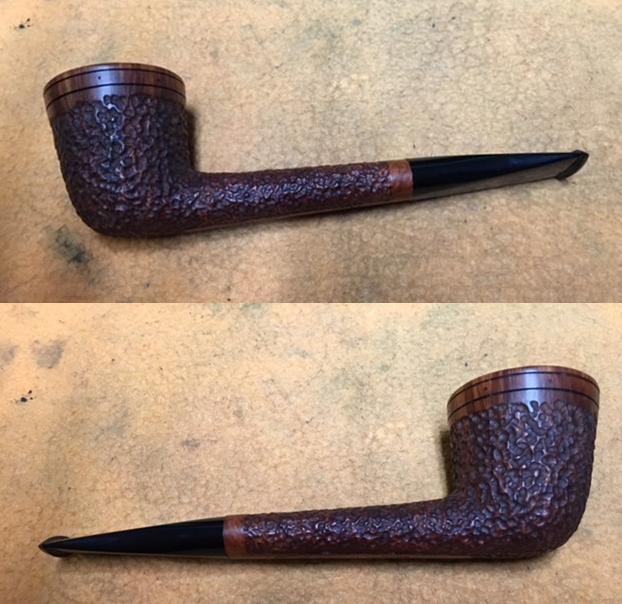
The second of the six pipes I chose to work on was rusticated Rhodesian/Bulldog shaped pipe. It is engraved with the House of Robertson signature on a smooth panel on the left side of the shank. The rusticated finish on the pipe was in good shape – just dusty and dirty. The deep grooves in the rustication were very dirty. The smooth rim cap was separated from the rusticated bowl by twin bands. It had two rusticated patches on it that match the rustication on the bowl and give the rim top an interesting look. I have circled the pipe in red in the above group photos. It is an interesting pipe. The bowl had a thin cake but it did not go all the way to the bottom of the bowl. The pipe is about a Group 5 size but it is very light weight. The stem was oxidized but did not have tooth marks or chatter on the surface. The fit of the stem to the shank was good. The vulcanite appeared to have been a pre-formed stem that was shaped to fit this pipe. The internals of the shank and stem had some tars and oils. Jeff took photos of the pipe before he started the cleanup. The next close-up photos show the finish on the top and the underside of the bowl. The first photo shows that the bowl had a thin cake and some slight rim darkening and lava on the rear edge of the rim top where the previous owner had repeatedly lit the pipe. The inner and outer edge of the rim looks really good. You can also see the two rusticated patches on the rim top. The finish on the rim top was in great condition. The two photos that follow the rim view show the underside of the pipe. The next photo shows the etched name on the left side of shank on a smooth panel of briar. It reads House of Robertson.The round saddle stem was oxidized and pitted from the oxidation. There were no tooth marks on the stem top or underside.Jeff out did himself on the cleanup of this pipe. He reamed the bowl with a Savinelli Fitsall pipe knife to remove the thin cake. He scrubbed out the mortise and the airway in the shank and the stem with alcohol, cotton swabs and pipe cleaners. When he had finished, the bowl looks almost new on the inside (Once again I don’t think it has ever been smoked to the bottom of the bowl as it is raw briar in the bottom quarter). He scrubbed the exterior of the bowl, rim and shank with a tooth brush and Murphy’s Oil Soap to remove the oils and tars on the bowl, rim and shank. He rinsed it under running water. He dried it off with a soft cloth. The light lava mess on the rim and the dust deep in the rustication was thoroughly removed without harming the finish underneath it. Once the grime was removed the finish actually looked to be in excellent condition I took photos of the pipe to show its condition before I started my work on it. I took a photo of the rim top to show the great condition it was in after the cleanup. Jeff was able to remove all of the darkening and tar on the right side of the rim top and the back edge of the rim. The stem was clean but pitted and oxidized.I rubbed the bowl down with Before & After Restoration Balm to deep clean the nooks and crannies of the rusticated finish, enliven and protect the briar. I hand rubbed it with my fingers, worked it into the rings with a cotton swab and buffed it with a horsehair shoe brush. I wiped it off with a soft cloth. I buffed the bowl on the wheel with a horsehair shoe brush to polish it. It really began to have a deep shine in the briar. I took some photos of the bowl at this point to mark the progress in the restoration. I sanded the stem with 220 grit sandpaper to remove the oxidation on both sides and in the angles of the saddle stem.I polished out the sanding scratches and marks in the vulcanite with micromesh sanding pads – wet sanding it with 1500-2400 grit pads and dry sanding it with 3200-4000 grit pads. I wiped the stem down with Obsidian Oil after each sanding pad. I buffed the stem with Blue Diamond on the buffing wheel. I brought it back to the table and sanded it with the final three 6000-12000 grit pads. I polished it further with Before & After Pipe Polish –using both the Fine and Extra Fine Polishes. I gave it a rubdown with Obsidian Oil one last time and set it aside to dry. I put the stem back on the bowl and worked the pipe over on the buffing wheel using Blue Diamond to lightly polish the stem. I buffed the bowl with a light touch so as not to get any of the buffing compounds in the grooves of the rustication. I buffed the stem to raise the gloss on the vulcanite. I gave the bowl multiple coats of Conservator’s Wax and gave the stem multiple coats of carnauba wax. I buffed the entire pipe with a clean buffing pad to raise the shine. I hand buffed it with a microfiber cloth to deepen the shine. The finished pipe is shown in the photos below. The medium brown stains on the rusticated Rhodesian shaped bowl with a smooth cap works well with the rich black of the vulcanite stem. The polish and the reworking of the stem material left this a beautiful and well-made pipe. The dimensions of the pipe are: Length: 6 1/2 inches, Height: 1 ½ inches, Outside Diameter: 2 inches, Diameter of the chamber: 7/8 inch. This one sold before I finished it. It will soon be on its way to pipeman in Utah who has a growing collection of House of Robertson Pipes. Thanks for looking.

Kathy’s Dad’s Pipes #8– Restemming & Restoring George Koch’s “Malaga” Freehand


Blog by Steve Laug

This is the eighth of the “Malaga” pipes that I am working on from Kathy’s Dad’s pipes. I will retell the story of the estate. Last fall I received a contact email on rebornpipes from Kathy asking if I would be interested in purchasing her late Father, George Koch’s estate pipes. He was a lover of “Malaga” pipes – all shapes and sizes and she wanted to move them out as she cleaned up the estate. We emailed back and forth and I had my brother Jeff follow up with her as he also lives in the US and would make it simpler to carry out this transaction. The long and short of it is that we purchased her Dad’s “Malaga” pipes. There are some beautiful pipes in that lot. I have never seen this many “Malagas” together in one place in all of my years of pipe restoring and refurbishing. They varied from having almost pristine to gnawed and damaged stems that will need to be replaced. These were some well used and obviously well loved pipes. Cleaning and restoring them will be a tribute to this pipeman. (Here is a link to some history of the Malaga Brand if you are interested: https://rebornpipes.com/tag/malaga-pipes/. There are also links there to a catalogue and the maker George Khoubesser.)Knowing about the pipeman who held the pipes in trust before me gives another dimension to the restoration work. This is certainly true with this lot of pipes. I can almost imagine George picking out each pipe in his assortment at the Malaga shop in Michigan. I may well be alone in this, but when I know about the person it is almost as if he is with me work on his pipes. In this case Kathy sent us not only information but also a photo of her Dad enjoying his “Malagas”. Once again, I am including that information so you can know a bit about the pipeman who held these pipes in trust before they are passed on to some of you. I include part of Kathy’s correspondence with my brother as well…

Jeff…Here is a little about my dad, George P. Koch…I am sending a picture of him with a pipe also in a separate email.

Dad was born in 1926 and lived almost all his life in Springfield, Illinois. He was the youngest son of German immigrants and started grade school knowing no English. His father was a coal miner who died when Dad was about seven and his sixteen year old brother quit school to go to work to support the family. There was not much money, but that doesn’t ruin a good childhood, and dad had a good one, working many odd jobs, as a newspaper carrier, at a dairy, and at the newspaper printing press among others. He learned to fly even before he got his automobile driver’s license and carried his love of flying with him through life, recertifying his license in retirement and getting his instrumental license in his seventies and flying until he was grounded by the FAA in his early eighties due to their strict health requirements. (He was never happy with them about that.) He was in the Army Air Corps during World War II, trained to be a bomber, but the war ended before he was sent overseas. He ended service with them as a photographer and then earned his engineering degree from University of Illinois. He worked for Allis Chalmers manufacturing in Springfield until the early sixties, when he took a job at Massey Ferguson in Detroit, Michigan. We lived in Livonia, and that’s where his love for Malaga pipes began. After a few years he returned to Allis Chalmers and we moved back to Springfield. I remember that when we went back to Michigan to visit friends, Dad had to go to the Malaga store and acquire a few new pipes. Many a year I wrote to Malaga and they picked out a pipe for me to purchase that I could give Dad for a Christmas or birthday present. He was always pleased. His favorites were the straight stemmed medium sized bowl pipes, but he liked them all.  He had some other pipes, but the Malagas were his favorites. I remember him smoking them sitting in his easy chair after work, with feet up on the ledge by the fire burning in the fireplace.  Growing up it was my job to clean them and he liked the inner bowl and stem coated with Watkins vanilla, leaving a little of that liquid in the bowl to soak in when I put them back on the rack. Dad quit smoking later in life and so they’ve sat on the racks for many years unattended, a part of his area by his easy chair and fireplace. Dad passed when he was 89 years old and it finally is time for the pipes to move on. I’m very happy they are being restored by you and your brother and hope they find homes who enjoy them as much as Dad did. Thank-you for your care and interest. — Kathy, the oldest daughter

Kathy, once again I thank you for providing this beautiful tribute to your Dad. We will appreciate your trust in allowing us to clean and restore these pipes. I am also trusting that those of you who are reading this might carry on the legacy of her Dad’s pipes as they will be added to the rebornpipes store once they are finished.

The eighth of the pipes that I chose to work on is another “Malaga” Freehand. This one is a smooth pipe with a carved faux plateau top on the rim and on the shank end. It has a look that is similar to an Alpha Freehand. It had a chewed and ruined vulcanite stem. Some great grain peeks through the grime around the bowl. The warm brown finish on the bowl appeared to be good condition under the dust and tars of time. I am even more certain that Malaga pipes must have been oil cured. The uniform finish and the light weight lead me to think that is the case. Once more there are no fills in the bowl or long shank. I have yet to find a fill in any of the bowls I have worked on in this lot and looking through what remains I think it is fair to say I won’t find any in them either.

The plateau style rim top on this Freehand was originally covered and almost filled in with an overflow of lava from the thick cake in the bowl. The rim top and the inner and outer edge of the bowl were in good condition. The stamping was on the underside of the shank and was clear and read “Malaga” near the shank/stem junction. The black vulcanite stem was ruined with bite marks on the top and a large hole on the underside of the stem. It would need to be replaced. The interior of the pipe was dirty. I know that George thoroughly enjoyed his pipes as is evidenced by the wear that all of them show. Jeff took these photos before he started the cleanup work on the pipe. Jeff took close up photos of the bowl and rim to show the condition of the pipe before he started to work his magic on it. The exterior of the bowl and shank were dirty. You can see the lava on the rim top, the cake and remnants of tobacco in the bowl and the nicks on the rim top and bowl around the outer edge of the rim. The second rim top photo shows the thick cake and debris in the bowl. It is dirty but in otherwise good condition. He also took photos of the side and of the faux plateau on the shank end. He also took a photo of the shank to show the stamping on the underside of the shank. You can see the overall condition of the shank before cleanup.The next photos show the damage to both surfaces of the stem near the button, the worn and chewed down button and the missing underside of the stem. The stem is a write off – misshapen and ruined.Working on this eighth pipe followed the same pattern as all of these pipes. Jeff had reamed the bowl with a PipNet pipe reamer and followed up with a Savinelli Fitsall pipe knife to remove the cake. He scrubbed out the mortise and the airway in the shank and the stem with alcohol, cotton swabs and pipe cleaners. He scrubbed the exterior of the bowl, rim, shank and stem with a tooth brush and Murphy’s Oil Soap to remove the oils and tars on the bowl, rim and shank. He rinsed it under running water. He dried it off with a soft cloth. The lava mess on the rim was thoroughly removed without harming the finish underneath it. Without the grime the finish looked really good. As noted above the stem was a write off and would need to be replaced with a suitable one. I took photos of the pipe to show its condition before I started my work on it.    I took a photo of the rim top to show the condition it was in after the cleanup. Jeff was able to remove all of the lava on the rim top and edges. You can see the faux plateau that has been carved into the top of the rim. It is a nice looking finish. The stem was clean and you can see the tooth chatter and marks on the surface near the button and the bite through on the underside.I went through my can of scavenged stems and found one that was suitable for a replacement for this chewed Freehand stem. It was similar in terms of shape and less than a ¼ inch shorter than the chewed through original. Once it was cleaned up it would work nicely. The tenon was very close to the right size which was a bonus. I took photos of the replacement stem to show the condition it was in. It was lightly oxidized and had some light tooth chatter and dents. I painted the surface of the stem with the flame from a Bic lighter to heat and lift the dents in the vulcanite. This is one of those times that I am glad vulcanite has memory. The marks lifted to the surface and a bit of sanding would smooth things out.There was a nick out of the top of the button on the inner left side. I filled it in with a drop of clear superglue. Once it was dry I sanded it smooth with 220 grit sandpaper. I sanded the rest of the stem at the same time and removed some of the oxidation on the surface.Finally I had a pipe to restem that was quite easy. The only thing I did was smooth out the tenon and then build it up with a light coat of clear nail polish. When the coat dried I put the stem in the pipe and took the following photos to show the progress. I kind of like the look of the stem. It works with the pipe quite well. I polished the briar with micromesh sanding pads – wet sanding with 1500-2400 grit pads and dry sanding with 3200-12000 grit pads. I wiped the briar down after each pad with a damp cloth to remove the sanding dust. I rubbed the bowl down with Before & After Restoration Balm to deep clean the briar and particularly the reshaped areas. The product works to clean, enliven and protect the briar. I hand rubbed it with my fingers and wiped it off with a soft cloth. I buffed the bowl with a horsehair shoe brush to polish it. The briar really began to have a rich shine. I took some photos of the bowl at this point to mark the progress in the restoration. I cleaned out the stem with alcohol, pipe cleaners and cotton swabs. This replacement stem was in far better condition than some of the others I have been using. It did not take much scrubbing  before the airway was clean.I polished the stem with micromesh sanding pads – wet sanding with 1500-2400 grit pads and dry sanding with 3200-12000 grit pads. I wiped the stem down after each pad with a damp cloth to remove the sanding dust. I used the Before & After Pipe Polish to remove the small minute scratches left in the vulcanite. I finished by wiping the stem down with a final coat of Obsidian Oil and set it aside to dry. You may have noticed the roughness of the tenon in the above photos. It is smoother than it looks but I polished it some more to finish it for the final photos.I the polished stem and bowl with Blue Diamond to polish out the remaining small scratches. I gave the bowl multiple coats of Conservator’s Wax and the stem several coats of carnauba wax and buffed the pipe with a clean buffing pad to raise the shine. I hand buffed it with a microfiber cloth to deepen the shine. The pipe polished up pretty nicely. The finished pipe is shown in the photos below. This is the eighth of the many “Malaga” pipes that I am restoring from Kathy’s Dad’s collection. I am looking forward once again to hearing what Kathy thinks once she sees the finished pipe on the blog. This one is heading to India to a pipeman there who will carry on the trust from her father. The dimensions are Length: 5 ½ inches, Height: 2 inches, Outside diameter of the bowl: 1 ½ inches, Chamber diameter: 7/8 inches. Thanks for walking through the restoration with me as I worked over this Malaga from George’s estate. More will follow in a variety of shapes and sizes.
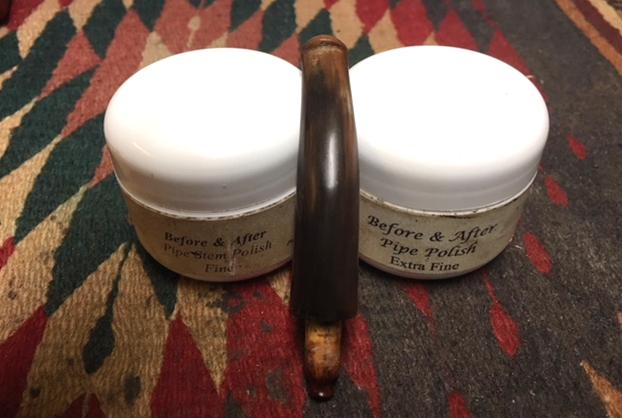
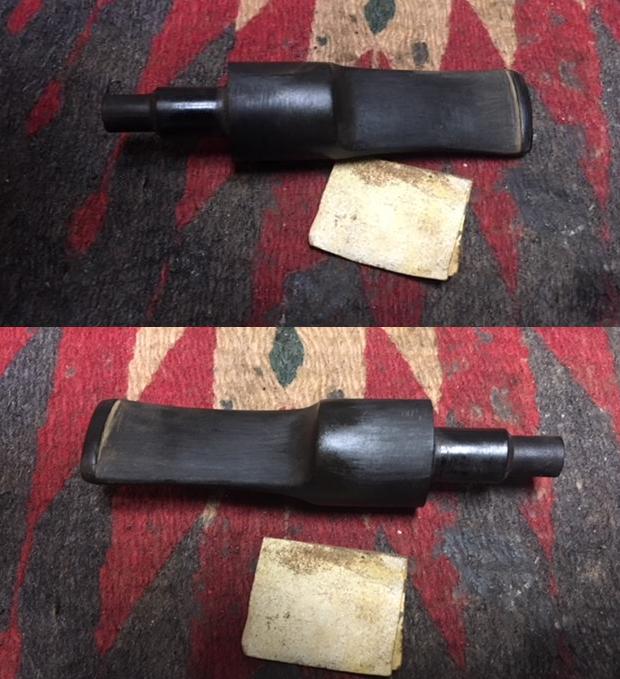
Kathy’s Dad’s Pipes #7– Restemming &Restoring George Koch’s “Malaga” Canadian


Blog by Steve Laug

This is the sixth of the “Malaga” pipes that I am working on from Kathy’s Dad’s pipes. For those of you who have not read the other blogs let me tell the story. Last fall I received a contact email on rebornpipes from Kathy asking if I would be interested in purchasing her late Father, George Koch’s estate pipes. He was a lover of “Malaga” pipes – all shapes and sizes and she wanted to move them out as she cleaned up the estate. We emailed back and forth and I had my brother Jeff follow up with her as he also lives in the US and would make it simpler to carry out this transaction. The long and short of it is that we purchased her Dad’s “Malaga” pipes. There are some beautiful pipes in that lot. I have never seen this many “Malagas” together in one place in all of my years of pipe restoring and refurbishing. They varied from having almost pristine to gnawed and damaged stems that will need to be replaced. Many of the pipes already had replacement stems or maybe George had the staff at the Malaga shop in Michigan put Lucite stems on them because he was such a gnawer. I don’t know if we will ever know the answer to that as Kathy did not know for sure. She did know though that he loved the brand and that most of the pipes he smoked he purchased from the shop. These were some well used and obviously well loved pipes. Cleaning and restoring them will be a tribute to this pipeman. (Here is a link to some history of the Malaga Brand if you are interested: https://rebornpipes.com/tag/malaga-pipes/. There are also links there to a catalogue and the maker George Khoubesser.) Knowing about the pipeman who held the pipes in trust before me gives another dimension to the restoration work. This is certainly true with this lot of pipes. I can almost imagine George picking out each pipe in his assortment at the Malaga shop in Michigan. I may well be alone in this, but when I know about the person it is almost as if he is with me work on his pipes. In this case Kathy sent us not only information but also a photo of her Dad enjoying his “Malagas”. Once again, I am including that information so you can know a bit about the pipeman who held these pipes in trust before they are passed on to some of you. I include part of Kathy’s correspondence with my brother as well…

Jeff…Here is a little about my dad, George P. Koch…I am sending a picture of him with a pipe also in a separate email.

Dad was born in 1926 and lived almost all his life in Springfield, Illinois. He was the youngest son of German immigrants and started grade school knowing no English. His father was a coal miner who died when Dad was about seven and his sixteen year old brother quit school to go to work to support the family. There was not much money, but that doesn’t ruin a good childhood, and dad had a good one, working many odd jobs, as a newspaper carrier, at a dairy, and at the newspaper printing press among others. He learned to fly even before he got his automobile driver’s license and carried his love of flying with him through life, recertifying his license in retirement and getting his instrumental license in his seventies and flying until he was grounded by the FAA in his early eighties due to their strict health requirements. (He was never happy with them about that.) He was in the Army Air Corps during World War II, trained to be a bomber, but the war ended before he was sent overseas. He ended service with them as a photographer and then earned his engineering degree from University of Illinois. He worked for Allis Chalmers manufacturing in Springfield until the early sixties, when he took a job at Massey Ferguson in Detroit, Michigan. We lived in Livonia, and that’s where his love for Malaga pipes began. After a few years he returned to Allis Chalmers and we moved back to Springfield. I remember that when we went back to Michigan to visit friends, Dad had to go to the Malaga store and acquire a few new pipes. Many a year I wrote to Malaga and they picked out a pipe for me to purchase that I could give Dad for a Christmas or birthday present. He was always pleased. His favorites were the straight stemmed medium sized bowl pipes, but he liked them all.  He had some other pipes, but the Malagas were his favorites. I remember him smoking them sitting in his easy chair after work, with feet up on the ledge by the fire burning in the fireplace.  Growing up it was my job to clean them and he liked the inner bowl and stem coated with Watkins vanilla, leaving a little of that liquid in the bowl to soak in when I put them back on the rack. Dad quit smoking later in life and so they’ve sat on the racks for many years unattended, a part of his area by his easy chair and fireplace. Dad passed when he was 89 years old and it finally is time for the pipes to move on. I’m very happy they are being restored by you and your brother and hope they find homes who enjoy them as much as Dad did. Thank-you for your care and interest. — Kathy, the oldest daughter

Kathy, once again I thank you for providing this beautiful tribute to your Dad. We will appreciate your trust in allowing us to clean and restore these pipes. I am also trusting that those of you who are reading this might carry on the legacy of her Dad’s pipes as they will be added to the rebornpipes store once they are finished.

The seventh of the pipes that I chose to work on is another “Malaga” Canadian. This one is a smooth pipe with a flat bottom so that it is a sitter. It had a chewed and ruined vulcanite stem. Some great grain peeks through the grime around the bowl. The warm brown finish on the bowl appeared to be good condition under the dust and tars of time. I am pretty certain that Malaga pipes must have been oil cured. The uniform finish and the light weight lead me to think that is the case. Once more there are no fills in the bowl or long shank. I have yet to find a fill in any of the bowls I have worked on in this lot and looking through what remains I think it is fair to say I won’t find any in them either.

The rim top on this Canadian was originally smooth and flat but it was covered with an overflow of lava from the thick cake in the bowl. The rim top at the back of the bowl was more thickly caked than the front. The rim top, along with the inner and outer edge of the bowl was heavily damaged. There were some nicks and rounding of the outer edge and there was some darkening on the inner edge. The bowl was out of round from previous reaming. The rim top and outer edge showed signs of being knocked against a hard surface to empty the dottle from the bowl. The stamping on the topside of the shank was clear and read “Malaga” and on the flat underside it read Imported Briar. There were no shape numbers on the pipe. The black Lucite stem was ruined with bite marks on the top and a long slice on the underside of the stem. It would need to be replaced. The interior of the pipe was dirty. I know that George thoroughly enjoyed his pipes as is evidenced by the wear that all of them show. Jeff took these photos before he started the cleanup work on the pipe. Jeff took close up photos of the bowl and rim to show the condition of the pipe before he started to work his magic on it. The exterior of the bowl and shank were dirty. You can see the lava on the rim top, the cake and remnants of tobacco in the bowl and the nicks on the rim top and bowl around the outer edge of the rim. The second rim top photo shows the damage on the front edge of the rim. It is dirty but in otherwise good condition. He also took photos of the sides and underside of the bowl and shank. He also took a photo of both sides of the shank to show the stamping on both the topside and the underside. You can see the overall condition of the shank before cleanup.The next photo shows the fit of the stem against the shank. The stem was obviously a replacement and was poorly fit. The second and third photo shows the damage to both surfaces of the stem near the button, the worn and chewed down button and the missing underside of the stem. The stem is a write off – misshapen and ruined.Working on this seventh pipe followed pretty much the same pattern as all of these pipes. Jeff had reamed the bowl with a PipNet pipe reamer and followed up with a Savinelli Fitsall pipe knife to remove the cake. He scrubbed out the mortise and the airway in the shank and the stem with alcohol, cotton swabs and pipe cleaners. He scrubbed the exterior of the bowl, rim, shank and stem with a tooth brush and Murphy’s Oil Soap to remove the oils and tars on the bowl, rim and shank. He rinsed it under running water. He dried it off with a soft cloth. The lava mess on the rim was thoroughly removed without harming the finish underneath it. The slight bevel to the rim was visible once the pipe was clean. Without the grime the finish looked really good. As noted above the stem was a write off and would need to be replaced with a suitable one. I took photos of the pipe to show its condition before I started my work on it.   I took a photo of the rim top to show the condition it was in after the cleanup. Jeff was able to remove all of the lava on the rim top and edges. There is still some darkening on the rim top. You can see the damage on the top itself and around the outer edges from knocking out the pipe on a hard surface. The inner edge of the bowl had a lot of nicks and cuts and was out of round. The stem was clean and you can see the tooth chatter and marks on the surface near the button and the large deeper tooth mark on the underside.I went through my can of extra stems and found one that was suitable for a replacement on this Canadian. It was the same shape and size as the replacement that had been chewed through. Once it was cleaned up it would work nicely. The tenon was the right size which was a bonus. I put the stem on the shank and took the following photos. This is the part of restemming that is always a challenge. Like the sixth pipe I finished a bit ago it needed to be shaped. The new oval stem is always slightly off because the shank is never truly oval or round. Either the shank needs to be taken down slightly to accommodate the fit of the new stem or the stem needs to be taken down to meet the shank. In this case you can see from the following photos that the stem was a poor fit on the sides while the top and the underside of the shank were very close. In the photo of the top side you can see that it is slightly smaller. That tells you that the shank is not perfectly oval and adjustments will need to be made.I sanded off all of the calcification on both sides of the stem with 220 grit sandpaper and cleaned up the area around the button edge. I sanded the surface of the button to reshape it on both the top and underside.I decided to work over the rim top next. I topped the bowl to remove the damaged areas on the top of the rim and minimize the damage to the inner and outer edges. Once that was finished there was still some damage to the rim from previous reaming and lighting. I took care of it by reshaping the bevel and the inner and outer edge of the rim with 220 grit sandpaper. I was able to remove all of the damage to the rim surface and reshape both then inner and outer edge of the rim. The gentle bevel that was originally present was restored. With the rim reshaped I turned my attention to fitting the stem to the shank. I carefully sanded the shank to reduce the diameter to match the stem. It was interesting that most of the work had to be done on the sides of the shank with a little on the top and bottom. In essence I made the shank more oval to match the stem. The photos below show the fit of the new stem at this point. I sanded the rim top repairs and the stem/shank junction with a medium and a fine grit sanding sponge to make sure that the scratching was reduces but more importantly that the transition at the shank and stem was smooth and flowing. It is easy to create issues with a folded piece of sandpaper (in terms of dips in the briar or vulcanite) because the two mediums have different hardness. The sanding sponge minimizes that for me. I polished the briar with micromesh sanding pads – wet sanding with 1500-2400 grit pads and dry sanding with 3200-12000 grit pads. I wiped the briar down after each pad with a damp cloth to remove the sanding dust. I rubbed the bowl down with Before & After Restoration Balm to deep clean the briar and particularly the reshaped areas. The product works to clean, enliven and protect the briar. I hand rubbed it with my fingers and wiped it off with a soft cloth. I buffed the bowl with a horsehair shoe brush to polish it. The briar really began to have a rich shine. I took some photos of the bowl at this point to mark the progress in the restoration. I cleaned out the stem with alcohol, pipe cleaners and cotton swabs. It took a bit of scrubbing but before too long the airway was clean.I polished the stem with micromesh sanding pads – wet sanding with 1500-2400 grit pads and dry sanding with 3200-12000 grit pads. I wiped the stem down after each pad with a damp cloth to remove the sanding dust. I used the Before & After Pipe Polish to remove the small minute scratches left in the brass and the vulcanite. I finished by wiping the stem down with a final coat of Obsidian Oil and set it aside to dry. I the polished stem and bowl with Blue Diamond to polish out the remaining small scratches. I gave the bowl multiple coats of Conservator’s Wax and the stem several coats of carnauba wax and buffed the pipe with a clean buffing pad to raise the shine. I hand buffed it with a microfiber cloth to deepen the shine. The pipe polished up pretty nicely. The finished pipe is shown in the photos below. This is the seventh of the many “Malaga” pipes that I am restoring from Kathy’s Dad’s collection. I am looking forward once again to hearing what Kathy thinks once she sees the finished pipe on the blog. I will be posting it on the rebornpipes store very soon. It should make a nice addition to the next pipeman’s rack and in purchasing it you can carry on the trust from her father. The dimensions are Length: 6 inches, Height: 1 3/4 inches, Outside diameter of the bowl: 1 1/4 inches, Chamber diameter: 3/4 inches. Thanks for walking through the restoration with me as I worked over this Malaga from George’s estate. More will follow in a variety of shapes and sizes.
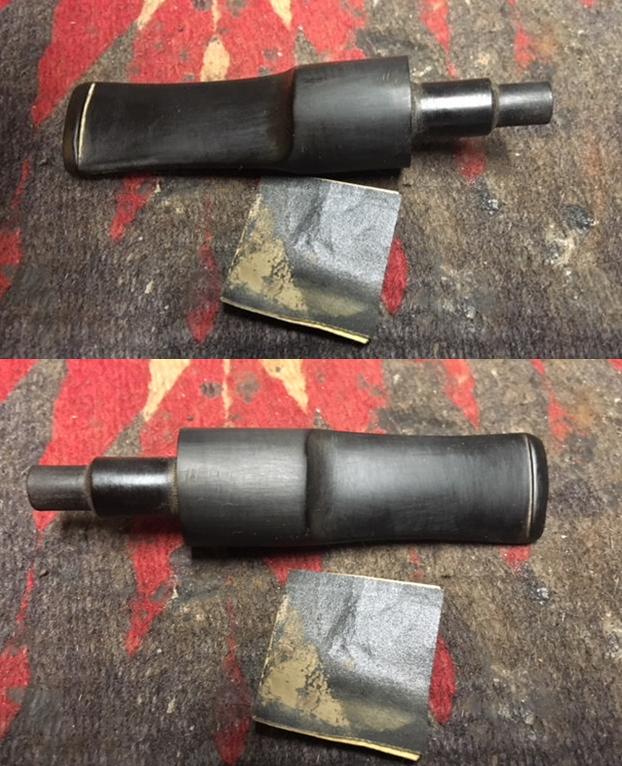
 

Kathy’s Dad’s Pipes #6– Restemming &Restoring George Koch’s “Malaga” Carved Canadian


Blog by Steve Laug

This is the sixth of the “Malaga” pipes that I am working on from Kathy’s Dad’s pipes. For those of you who have not read the other blogs let me tell the story. Last fall I received a contact email on rebornpipes from Kathy asking if I would be interested in purchasing her late Father, George Koch’s estate pipes. He was a lover of “Malaga” pipes – all shapes and sizes and she wanted to move them out as she cleaned up the estate. We emailed back and forth and I had my brother Jeff follow up with her as he also lives in the US and would make it simpler to carry out this transaction. The long and short of it is that we purchased her Dad’s “Malaga” pipes. There are some beautiful pipes in that lot. I have never seen this many “Malagas” together in one place in all of my years of pipe restoring and refurbishing. They varied from having almost pristine to gnawed and damaged stems that will need to be replaced. Many of the pipes already had replacement stems or maybe George had the staff at the Malaga shop in Michigan put Lucite stems on them because he was such a gnawer. I don’t know if we will ever know the answer to that as Kathy did not know for sure. She did know though that he loved the brand and that most of the pipes he smoked he purchased from the shop. These were some well used and obviously well loved pipes. Cleaning and restoring them will be a tribute to this pipeman. (Here is a link to some history of the Malaga Brand if you are interested: https://rebornpipes.com/tag/malaga-pipes/. There are also links there to a catalogue and the maker George Khoubesser.)Knowing about the pipeman who held the pipes in trust before me gives another dimension to the restoration work. This is certainly true with this lot of pipes. I can almost imagine George picking out each pipe in his assortment at the Malaga shop in Michigan. I may well be alone in this, but when I know about the person it is almost as if he is with me work on his pipes. In this case Kathy sent us not only information but also a photo of her Dad enjoying his “Malagas”. Once again, I am including that information so you can know a bit about the pipeman who held these pipes in trust before they are passed on to some of you. I include part of Kathy’s correspondence with my brother as well…

Jeff…Here is a little about my dad, George P. Koch…I am sending a picture of him with a pipe also in a separate email.

Dad was born in 1926 and lived almost all his life in Springfield, Illinois. He was the youngest son of German immigrants and started grade school knowing no English. His father was a coal miner who died when Dad was about seven and his sixteen year old brother quit school to go to work to support the family. There was not much money, but that doesn’t ruin a good childhood, and dad had a good one, working many odd jobs, as a newspaper carrier, at a dairy, and at the newspaper printing press among others. He learned to fly even before he got his automobile driver’s license and carried his love of flying with him through life, recertifying his license in retirement and getting his instrumental license in his seventies and flying until he was grounded by the FAA in his early eighties due to their strict health requirements. (He was never happy with them about that.) He was in the Army Air Corps during World War II, trained to be a bomber, but the war ended before he was sent overseas. He ended service with them as a photographer and then earned his engineering degree from University of Illinois. He worked for Allis Chalmers manufacturing in Springfield until the early sixties, when he took a job at Massey Ferguson in Detroit, Michigan. We lived in Livonia, and that’s where his love for Malaga pipes began. After a few years he returned to Allis Chalmers and we moved back to Springfield. I remember that when we went back to Michigan to visit friends, Dad had to go to the Malaga store and acquire a few new pipes. Many a year I wrote to Malaga and they picked out a pipe for me to purchase that I could give Dad for a Christmas or birthday present. He was always pleased. His favorites were the straight stemmed medium sized bowl pipes, but he liked them all.  He had some other pipes, but the Malagas were his favorites. I remember him smoking them sitting in his easy chair after work, with feet up on the ledge by the fire burning in the fireplace.  Growing up it was my job to clean them and he liked the inner bowl and stem coated with Watkins vanilla, leaving a little of that liquid in the bowl to soak in when I put them back on the rack. Dad quit smoking later in life and so they’ve sat on the racks for many years unattended, a part of his area by his easy chair and fireplace. Dad passed when he was 89 years old and it finally is time for the pipes to move on. I’m very happy they are being restored by you and your brother and hope they find homes who enjoy them as much as Dad did. Thank-you for your care and interest. — Kathy, the oldest daughter

Kathy, once again I thank you for providing this beautiful tribute to your Dad. We will appreciate your trust in allowing us to clean and restore these pipes. I am also trusting that those of you who are reading this might carry on the legacy of her Dad’s pipes as they will be added to the rebornpipes store once they are finished.

The sixth of the pipes that I chose to work on is a “Malaga” Carved Canadian with some different rustication. There are trails around the pipe and the top of the shank is rusticated in an unusual and interesting pattern. It had a chewed and ruined vulcanite stem. Some great grain peeks through the grime between the trails carved around the bowl. The warm brown finish on the bowl appeared to be good condition under the dust and tars of time. I am pretty certain that Malaga pipes must have been oil cured. The uniform finish and the light weight lead me to think that is the case. Once more there are no fills in the bowl or long shank. I have yet to find a fill in any of the bowls I have worked on in this lot and looking through what remains I think it is fair to say I won’t find any in them either.

The rim top on this Canadian was lightly beveled inward and was covered with an overflow of lava from the thick cake in the bowl. The bevel was almost invisible. The rim top at the back of the bowl was more thickly caked than the front.  The rim top along with the inner and outer edge of the bowl was damaged. There were some nicks on the outer edge and there was some darkening on the inner edge. The bowl was out of round from previous reaming. The rim top and outer edge showed signs of being knocked against a hard surface to empty the dottle from the bowl. The stamping on the underside of the shank was clear and read “Malaga” near the stem/shank junction. There were no shape numbers on the pipe. The black vulcanite stem was ruined with bite marks on the top and a major portion of the underside of the stem missing. It would need to be replaced. The interior of the pipe was dirty. I know that George thoroughly enjoyed his pipes as is evidenced by the wear that all of them show. Jeff took these photos before he started the cleanup work on the pipe. Jeff took close up photos of the bowl and rim to show the condition of the pipe before he started to work his magic on it. The exterior of the bowl and shank were dirty. You can see the lava on the rim top, the cake in the bowl and the nicks on the rim top and bowl around the outer edge of the rim. It is dirty but in otherwise good condition. He also took a photo of the sides and underside of the bowl and shank. He also took a photo of both sides of the shank to show the rustication pattern on the topside and the stamping on the underside. You can see the overall condition of the shank before cleanup.The next photo shows the damage to both surfaces of the stem near the button, the worn and chewed down button and the missing underside of the stem. The stem is a write off – misshapen and ruined.Working on this sixth pipe followed pretty much the same pattern as all of these pipes. Jeff had reamed the bowl with a PipNet pipe reamer and followed up with a Savinelli Fitsall pipe knife to remove the cake. He scrubbed out the mortise and the airway in the shank and the stem with alcohol, cotton swabs and pipe cleaners. He scrubbed the exterior of the bowl, rim, shank and stem with a tooth brush and Murphy’s Oil Soap to remove the oils and tars on the bowl, rim and shank. He rinsed it under running water. He dried it off with a soft cloth. The lava mess on the rim was thoroughly removed without harming the finish underneath it. The slight bevel to the rim was visible once the pipe was clean. Without the grime the finish looked really good. As noted above the stem was a write off and would need to be replaced with a suitable one. I took photos of the pipe to show its condition before I started my work on it.   I took a photo of the rim top to show the condition it was in after the cleanup. Jeff was able to remove all of the lava on the rim top and edges. There is still some darkening on the rim top. You can see the damage on the top itself and around the outer edges from knocking out the pipe on a hard surface. The inner edge of the bowl had a lot of nicks and cuts and was out of round. The stem was clean and you can see the tooth chatter and marks on the surface near the button and the large deeper tooth mark on the underside.I went through my can of extra stems and found one that was suitable for a replacement on this Canadian. It was the same shape and size as the replacement that had been chewed through. Once it was cleaned up it would work nicely. The tenon was the right size which was a bonus. I put the stem on the shank and took the following photos. This is the part of restemming that is always a challenge. The new stem is always slightly off because the shank is never truly oval or round. Either the shank needs to be taken down slightly to accommodate the fit of the new stem or the stem needs to be taken down to meet the shank. In this case you can see from the following photos that the stem fit the underside of the shank perfectly. In the photo of the top side you can see that it is slightly smaller. That tells you that the shank is not perfectly oval and adjustments will need to be made.I sanded off all of the calcification on both sides of the stem with 220 grit sandpaper and cleaned up the area around the button edge. I sanded the surface of the button to reshape it on both the top and underside.I decided to work over the rim top, reshaping the bevel and the inner and outer edge of the rim with 220 grit sandpaper. I was able to remove all of the damage to the rim surface and reshape the inner edge of the rim. The rounded flowing bevel that was originally present was restored.With the rim reshaped I turned my attention to fitting the stem to the shank. I carefully sanded the shank to reduce the diameter to match the stem. It was interesting that most of the work had to be done on the sides of the shank with a little on the top and bottom. In essence I made the shank more oval to match the stem. The photos below show the fit of the new stem at this point. I polished the briar with micromesh sanding pads – wet sanding with 1500-2400 grit pads and dry sanding with 3200-12000 grit pads. I wiped the briar down after each pad with a damp cloth to remove the sanding dust. I rubbed the bowl down with Before & After Restoration Balm to deep clean the nooks and crannies of the rustication paths and patches as well as the smooth areas. The product works to clean, enliven and protect the briar. I hand rubbed it with my fingers and wiped it off with a soft cloth. I buffed the bowl with a horsehair shoe brush to polish it. The briar really began to have a rich shine. I took some photos of the bowl at this point to mark the progress in the restoration. I cleaned out the stem with alcohol, pipe cleaners and cotton swabs. It took a bit of scrubbing but before too long the airway was clean.I polished the stem with micromesh sanding pads – wet sanding with 1500-2400 grit pads and dry sanding with 3200-12000 grit pads. I wiped the stem down after each pad with a damp cloth to remove the sanding dust. I used the Before & After Pipe Polish to remove the small minute scratches left in the brass and the vulcanite. I finished by wiping the stem down with a final coat of Obsidian Oil and set it aside to dry. I the polished stem and bowl with Blue Diamond to polish out the remaining small scratches. I gave the bowl multiple coats of Conservator’s Wax and the stem several coats of carnauba wax and buffed the pipe with a clean buffing pad to raise the shine. I hand buffed it with a microfiber cloth to deepen the shine. The pipe polished up pretty nicely. The finished pipe is shown in the photos below. This is the sixth of the many “Malaga” pipes that I am restoring from Kathy’s Dad’s collection. I am looking forward once again to hearing what Kathy thinks once she sees the finished pipe on the blog. I will be posting it on the rebornpipes store very soon. It should make a nice addition to the next pipeman’s rack and in purchasing it you can carry on the trust from her father. The dimensions are Length: 6 inches, Height: 1 7/8 inches, Outside diameter of the bowl: 1 3/8 inches, Chamber diameter: 3/4 inches. Thanks for walking through the restoration with me as I worked over this Malaga from George’s estate. More will follow in a variety of shapes and sizes.