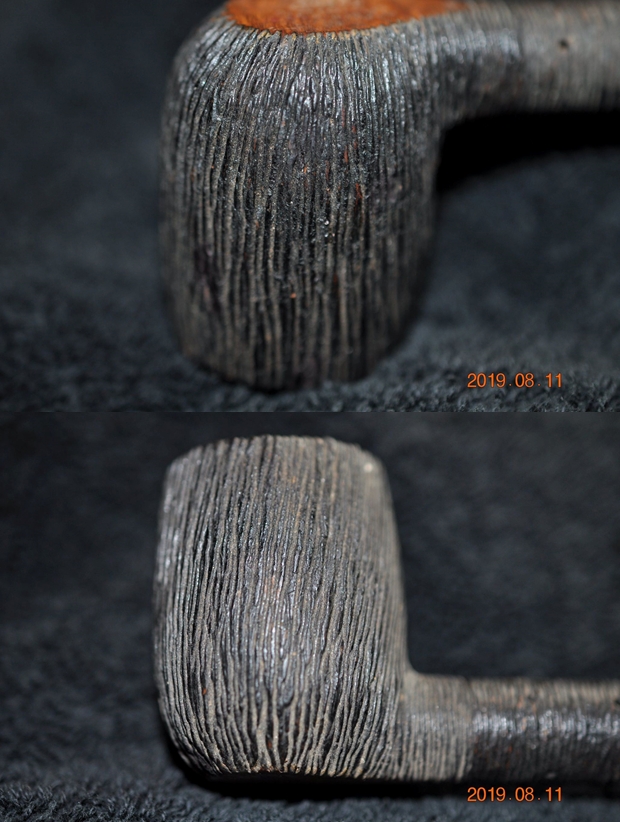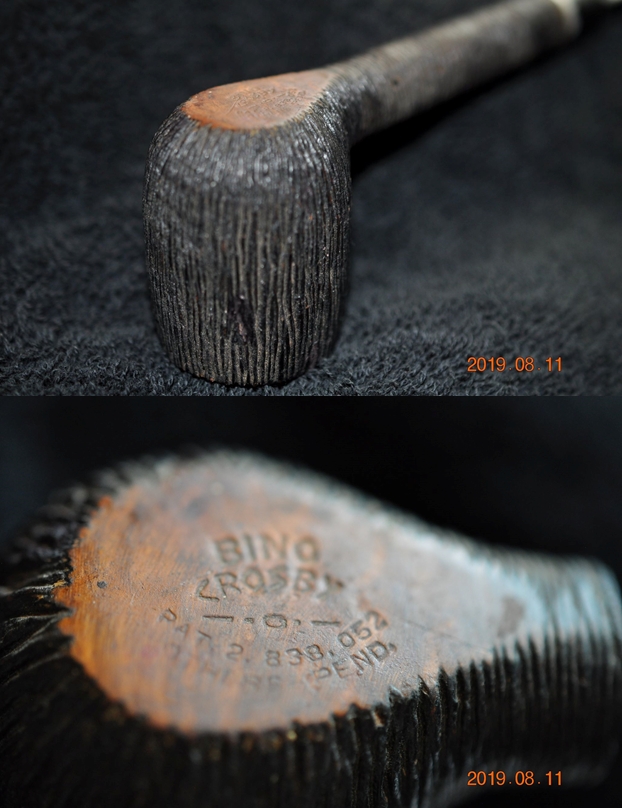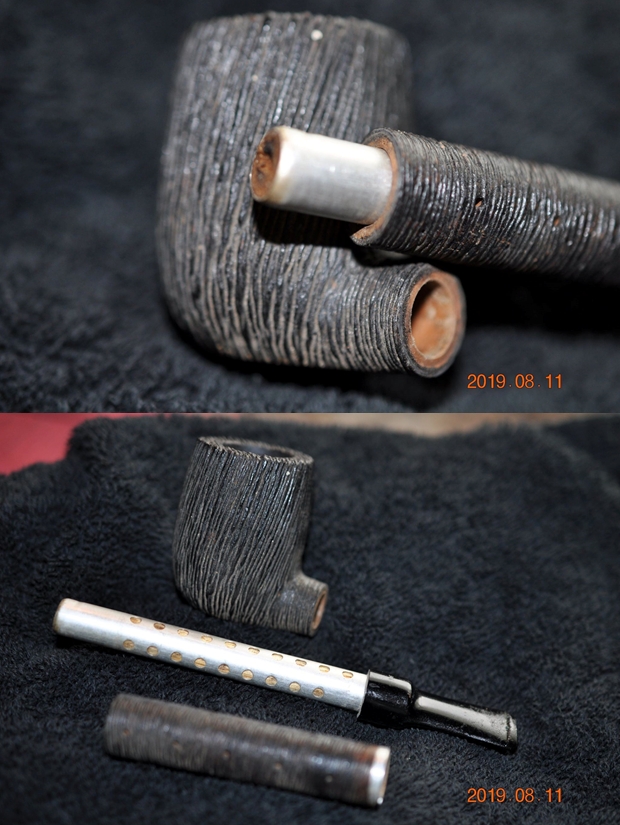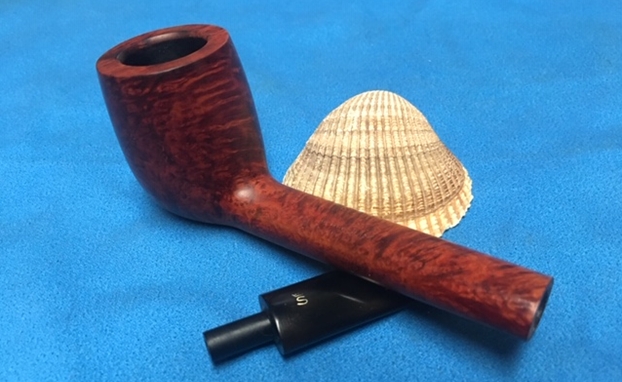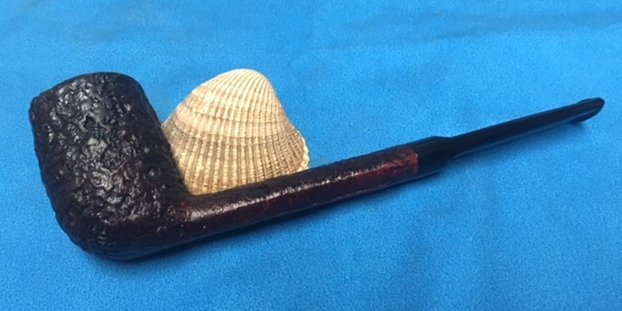
Tag Archives: polishing stems

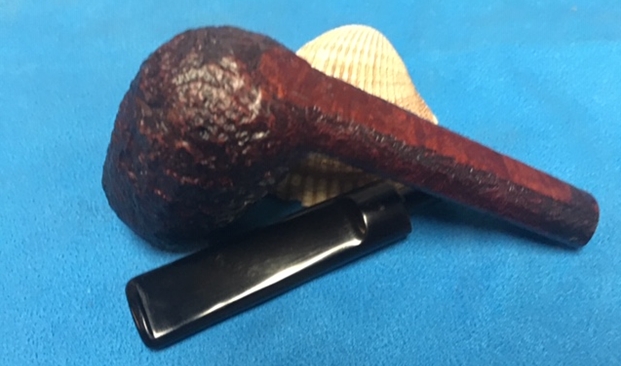
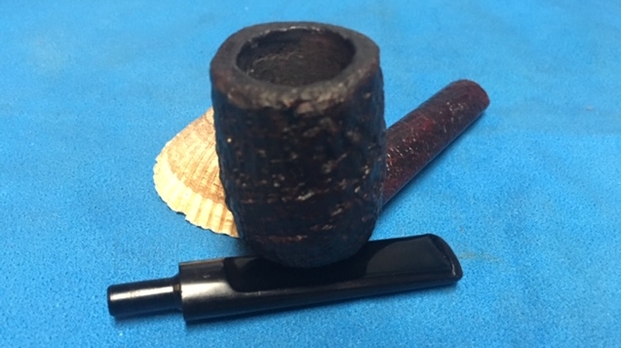
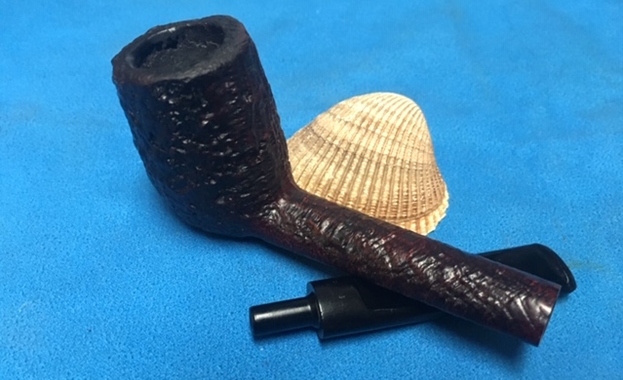
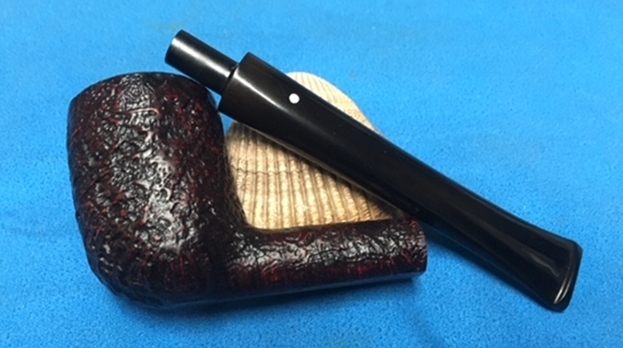
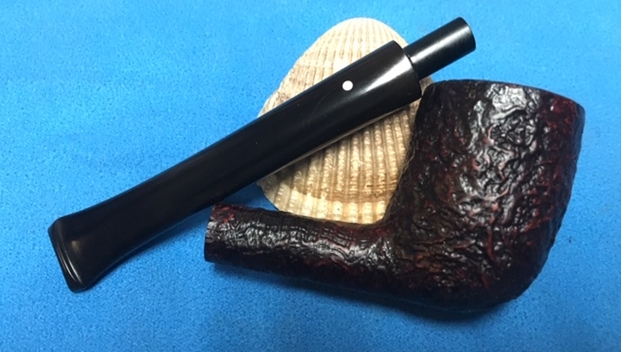
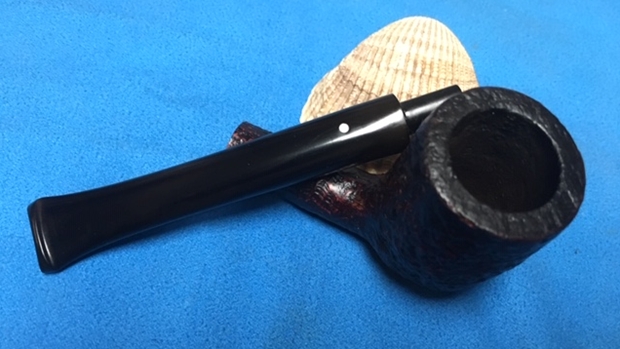
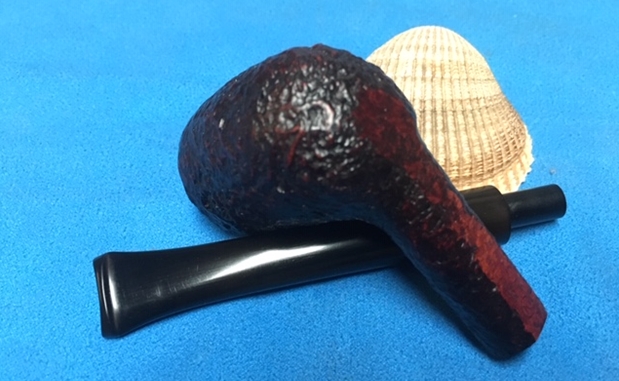
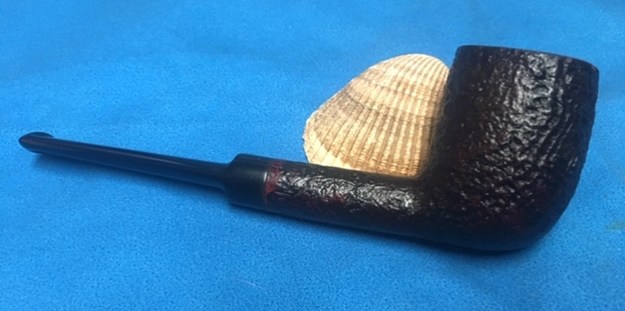
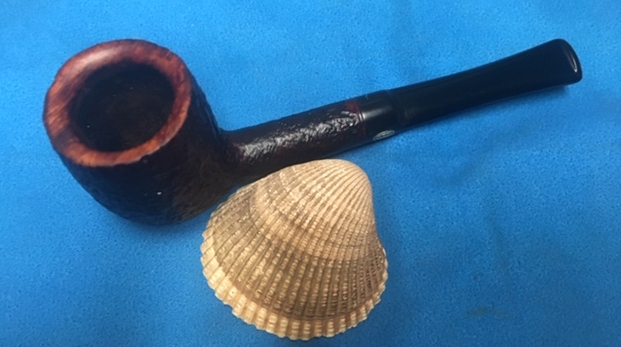
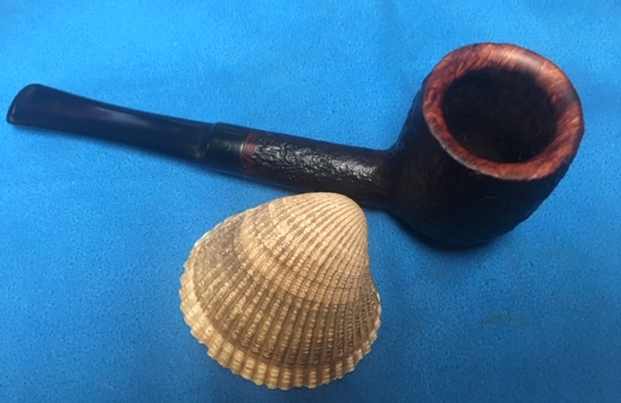
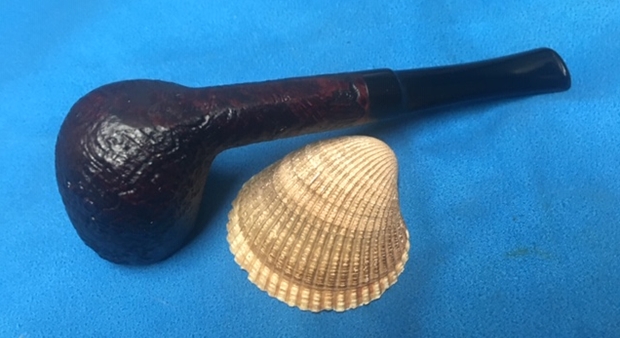
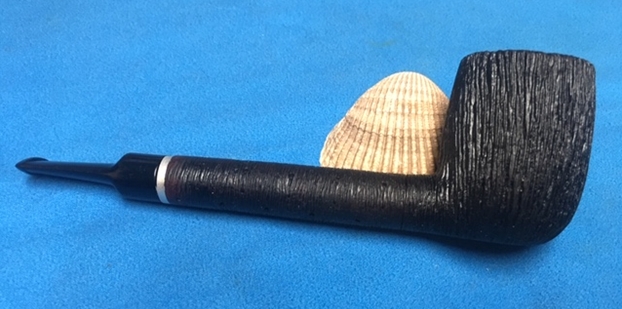
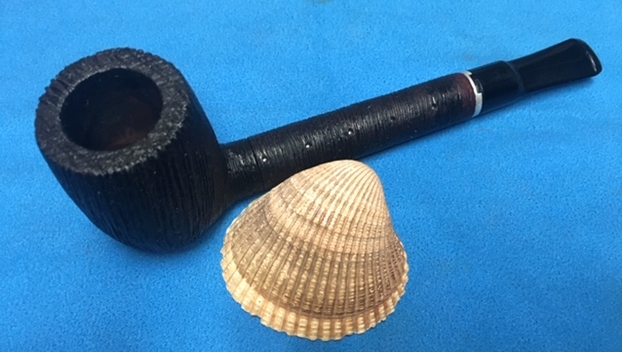
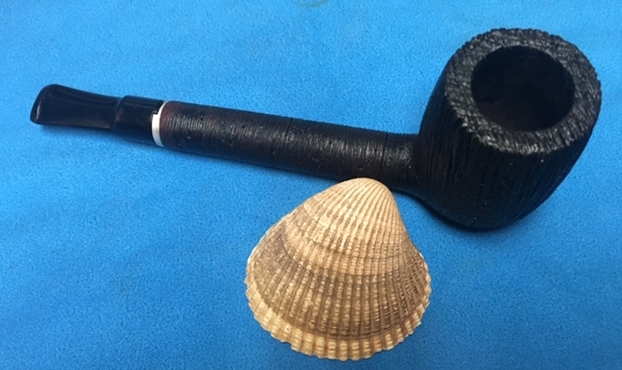
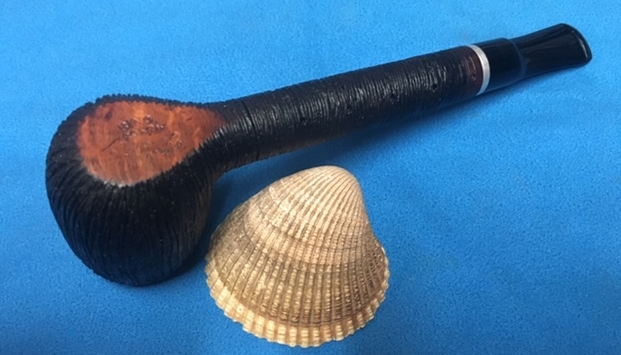
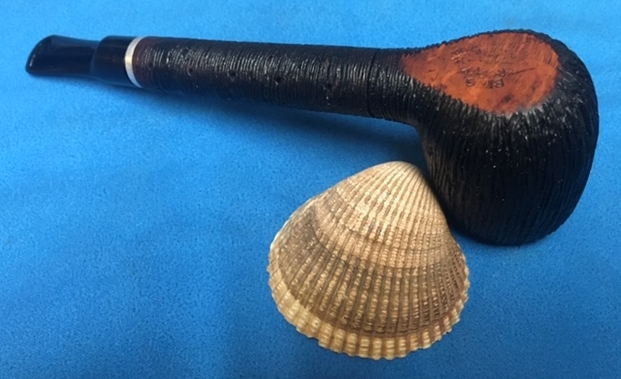
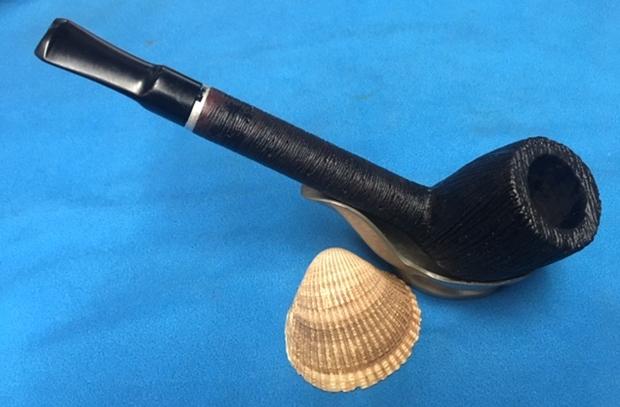
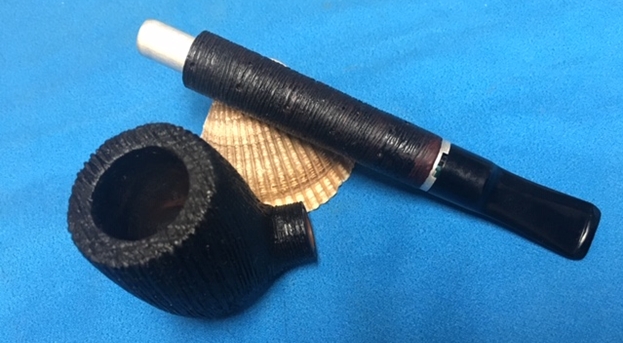
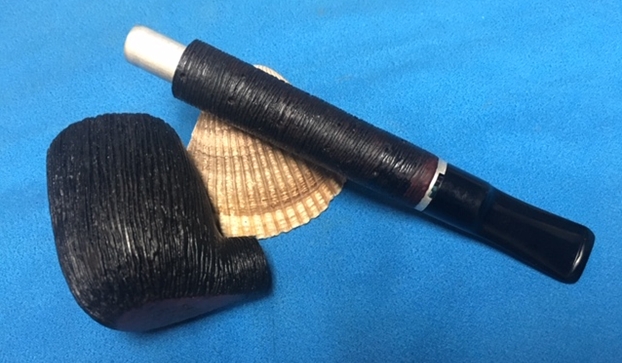
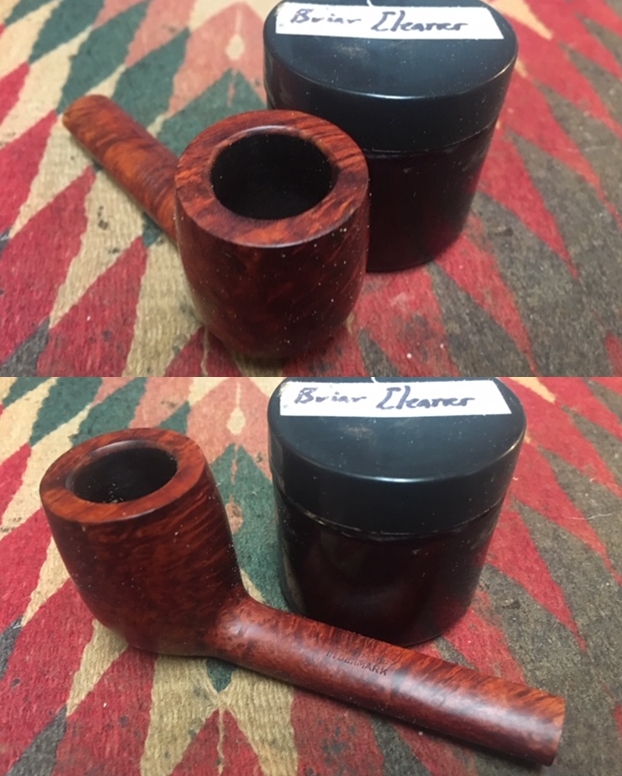
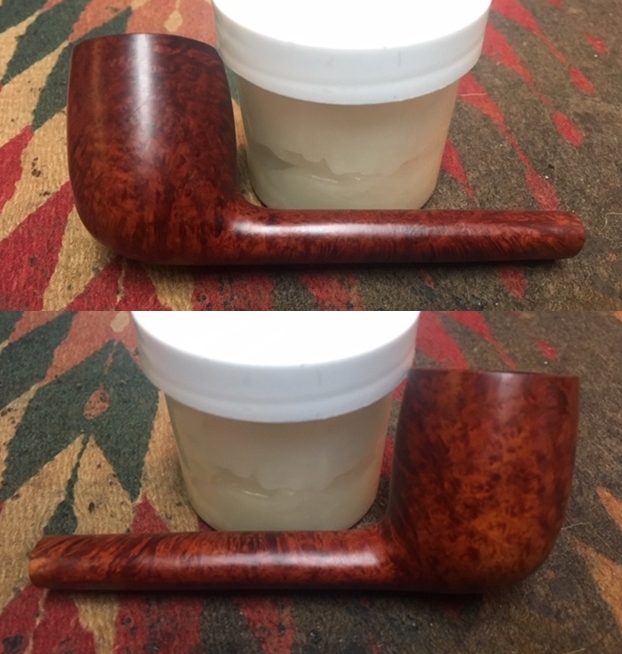
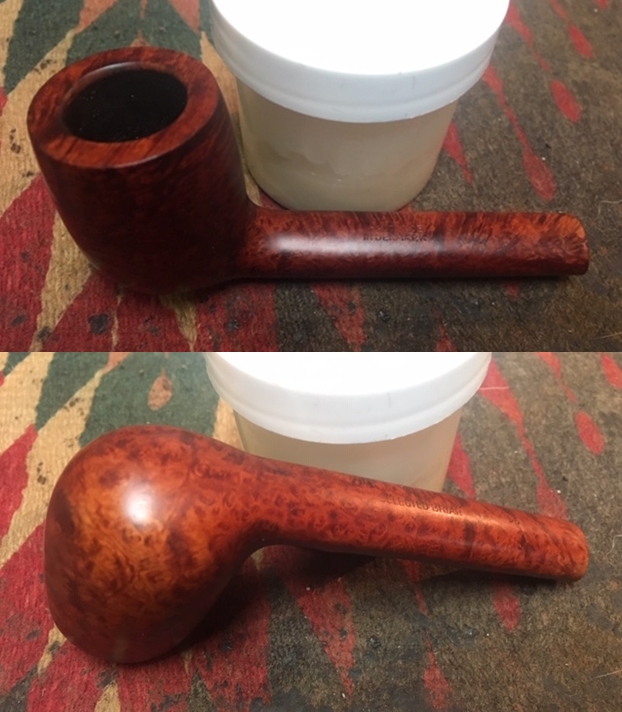
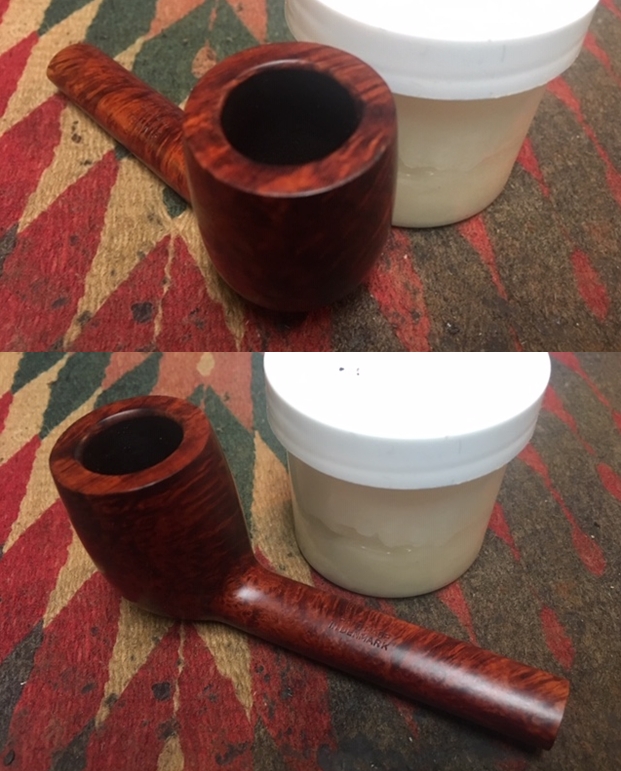
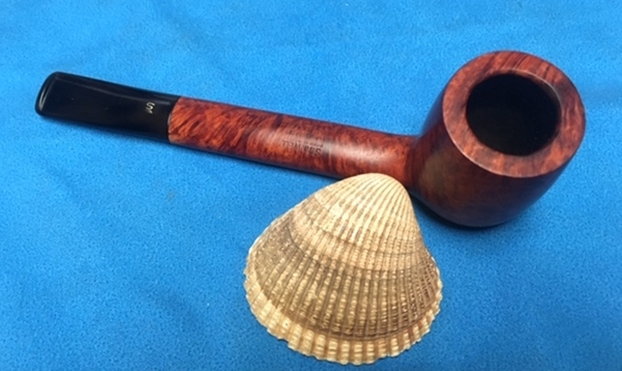
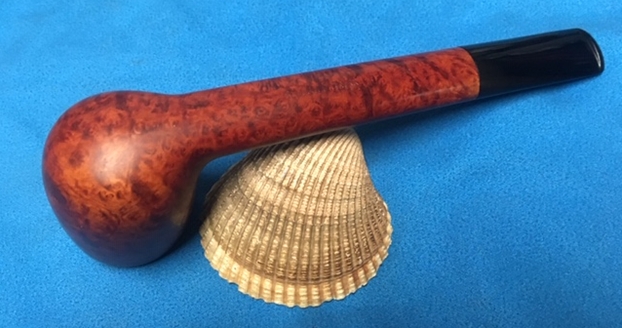
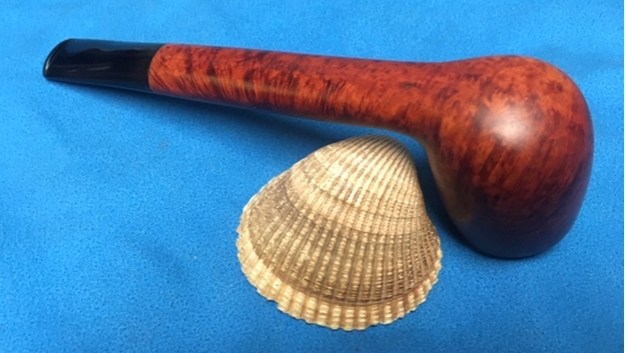
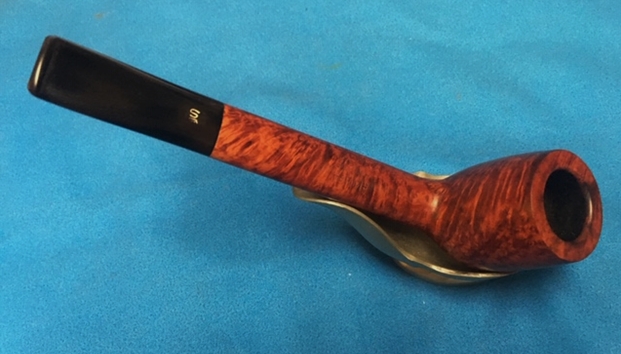
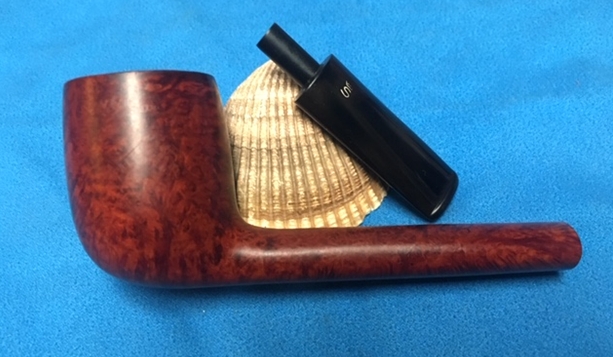
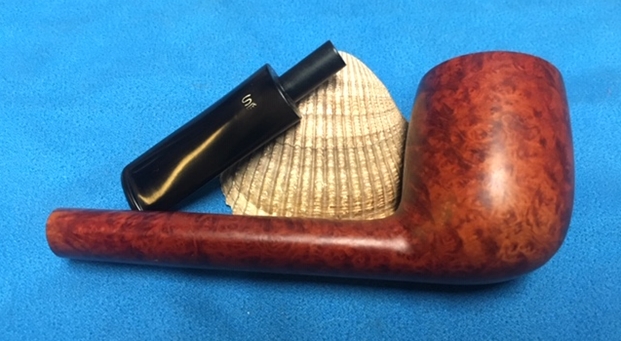
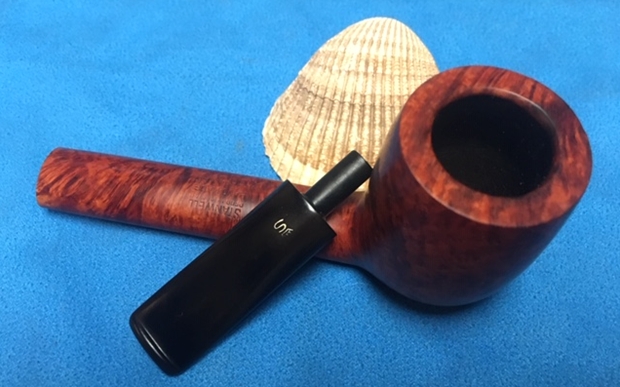
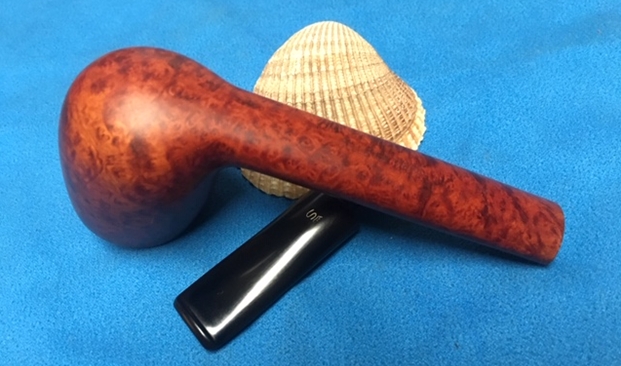
New Life for a Barling’s Make Ye Olde Wood “Fossil” EL 437 Canadian


Blog by Steve Laug

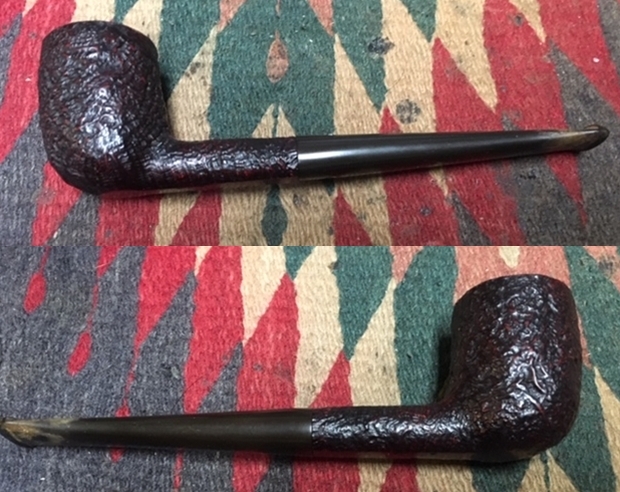
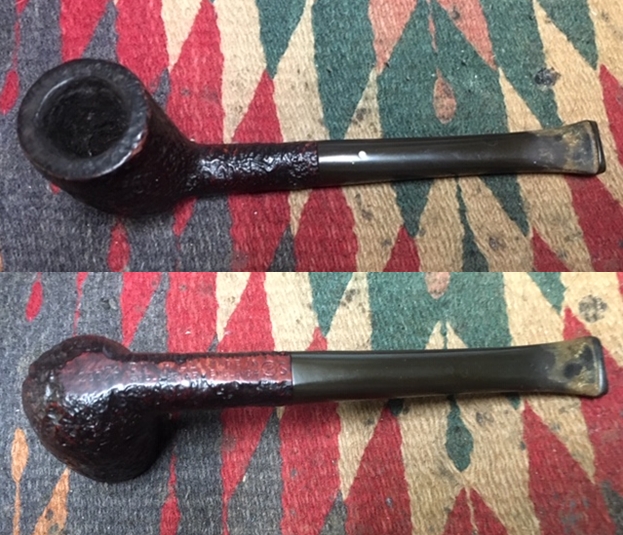
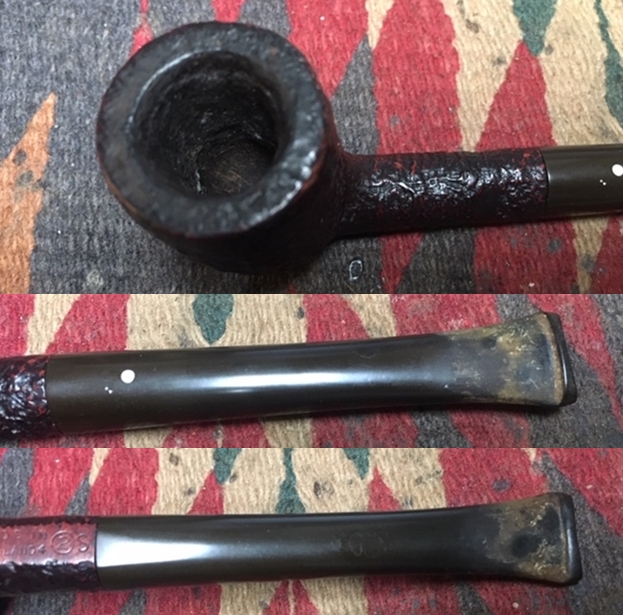
Not too long ago I received an email from a fellow in California who I have repaired a few pipes for over the years. He said he was sending me a couple of pipes to work on. The box arrived a few weeks ago and when I opened it I found this message in the box.

Hi Steve — Here are the two pipes as promised. The Dunhill Shell should be an easy resto, but the Barling’s Fossil is another story. This pipe appears to have been someone’s favorite and smoked pretty hard. Might involve a little reconstructive surgery as the inside of the rim has been chipped due to knocking on a hard surface. Looks like the cake has held it together. The stem is upside down and seized into the shank as well. Would like to keep the original finish on the stummels and shanks of both if possible… thanks — Scott

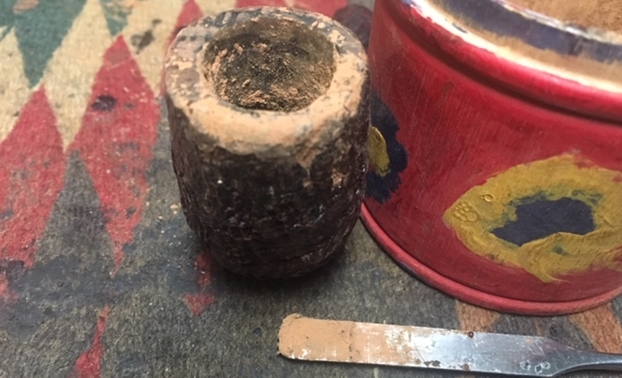
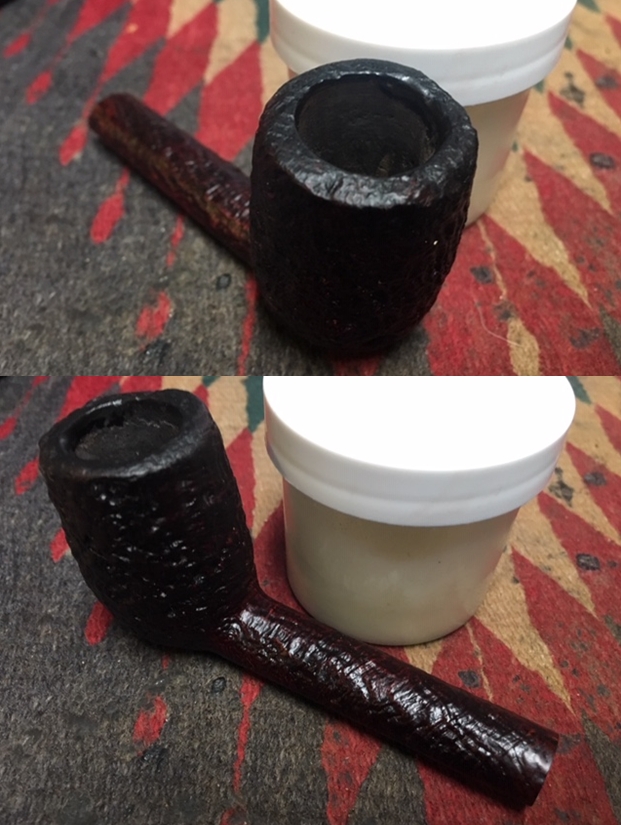
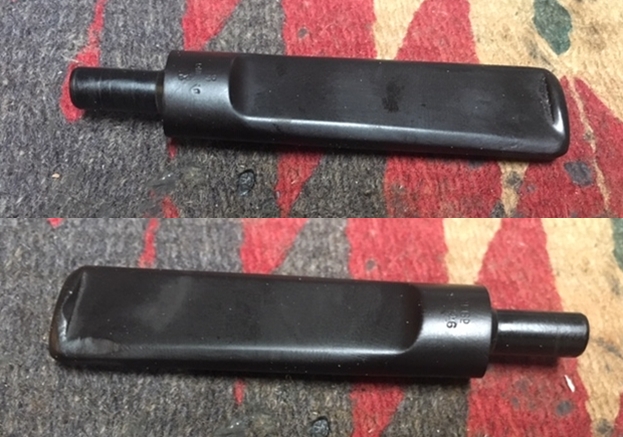
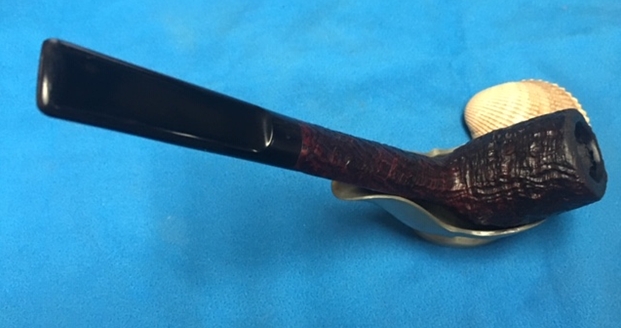
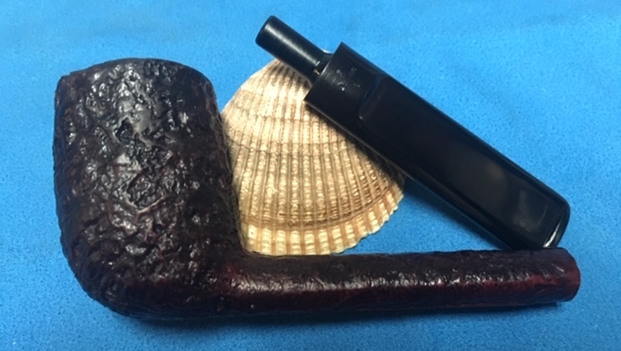
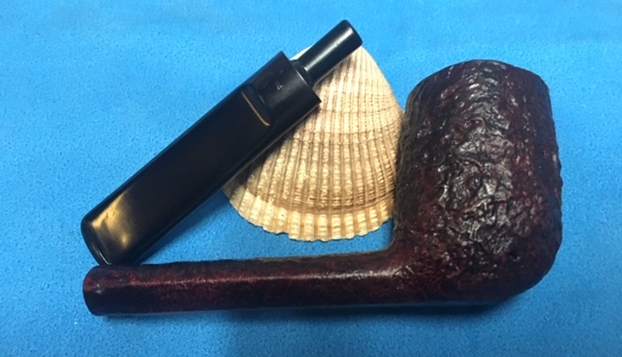
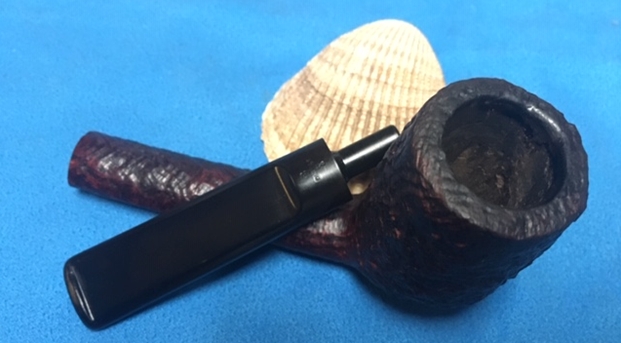
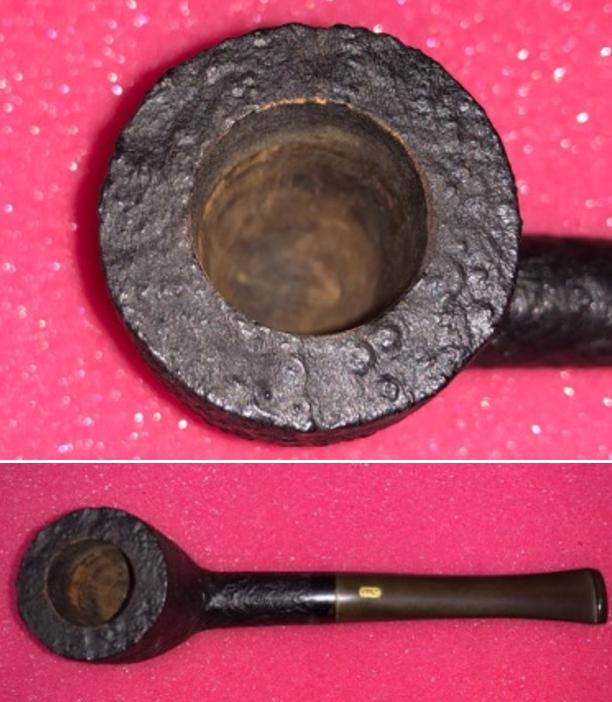
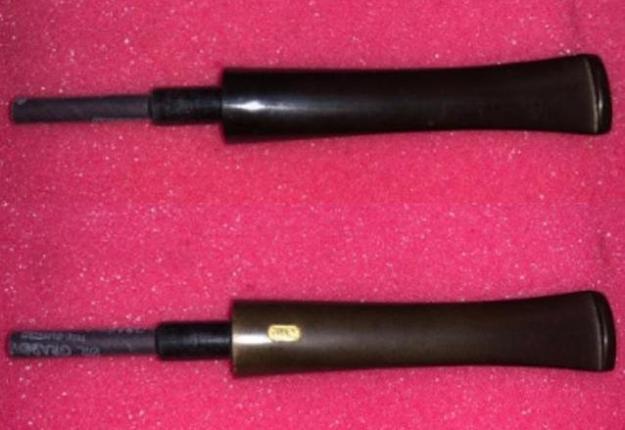
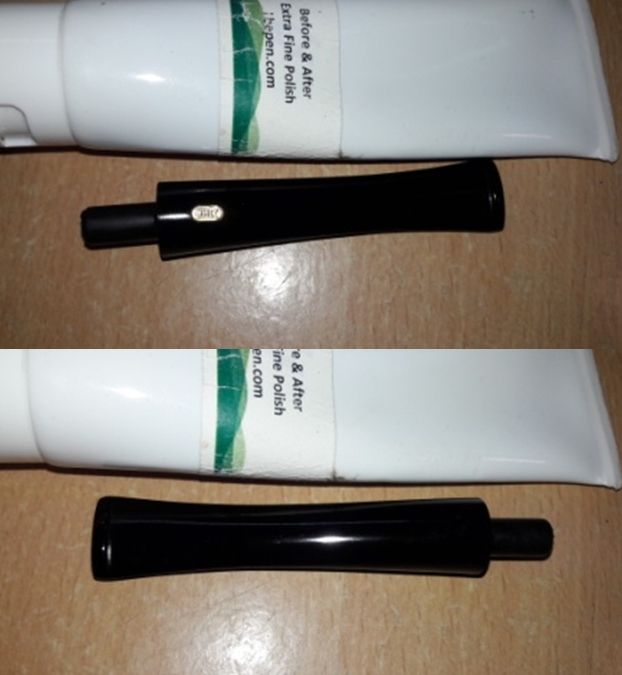
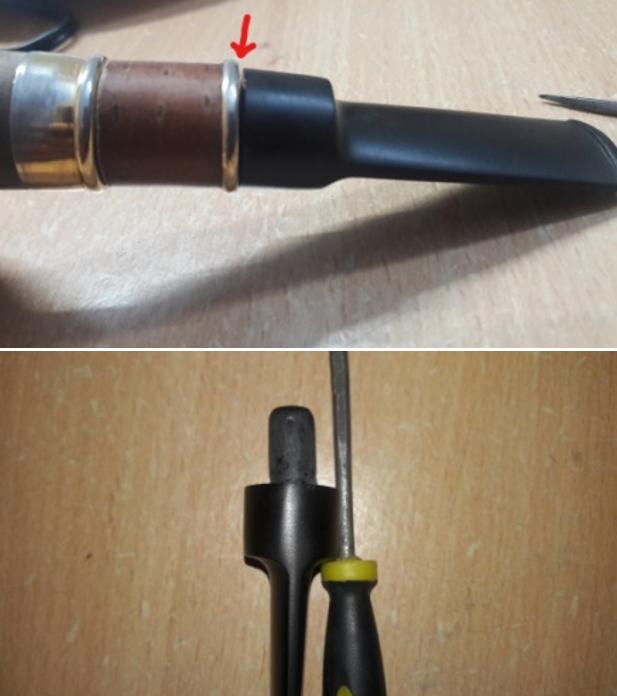
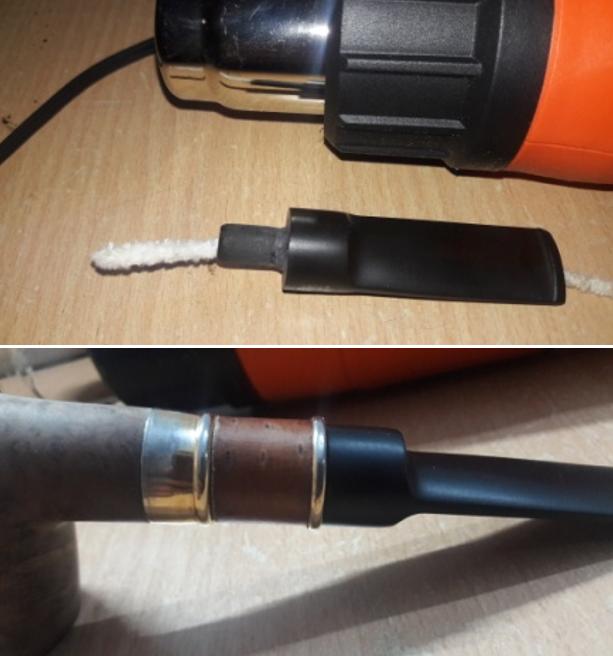
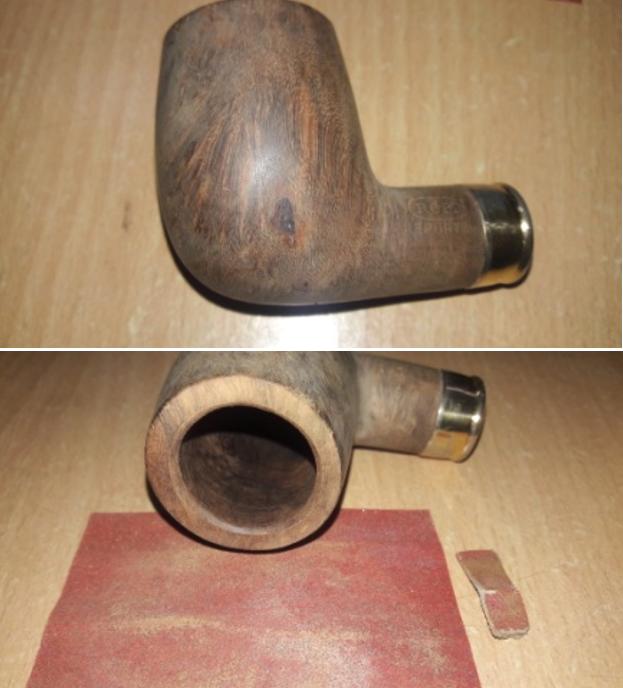
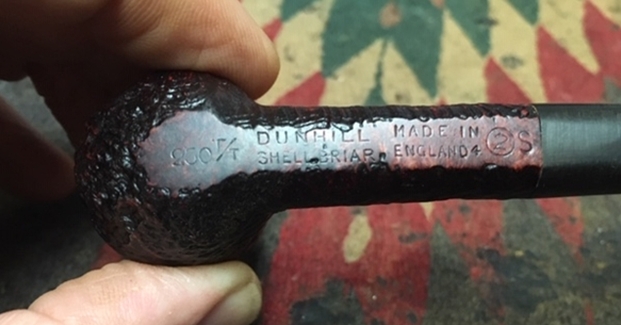
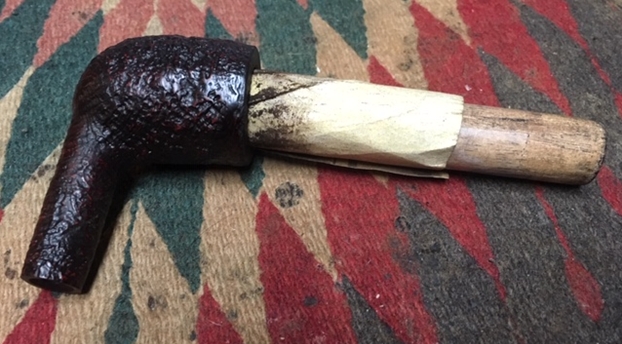
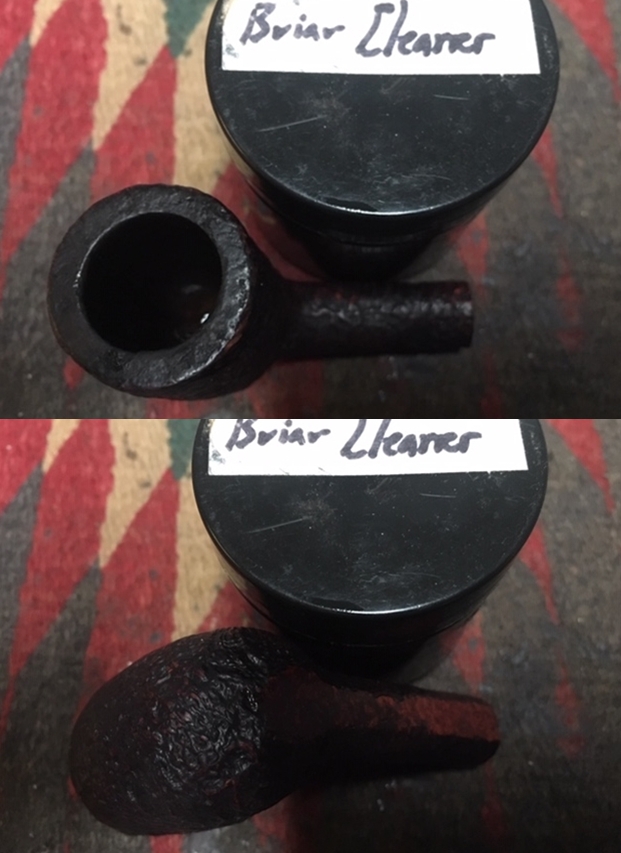
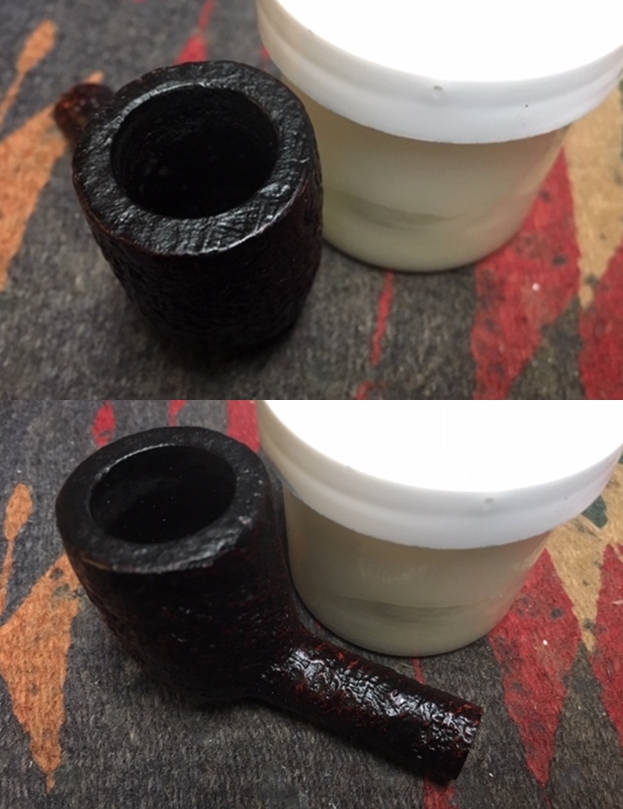
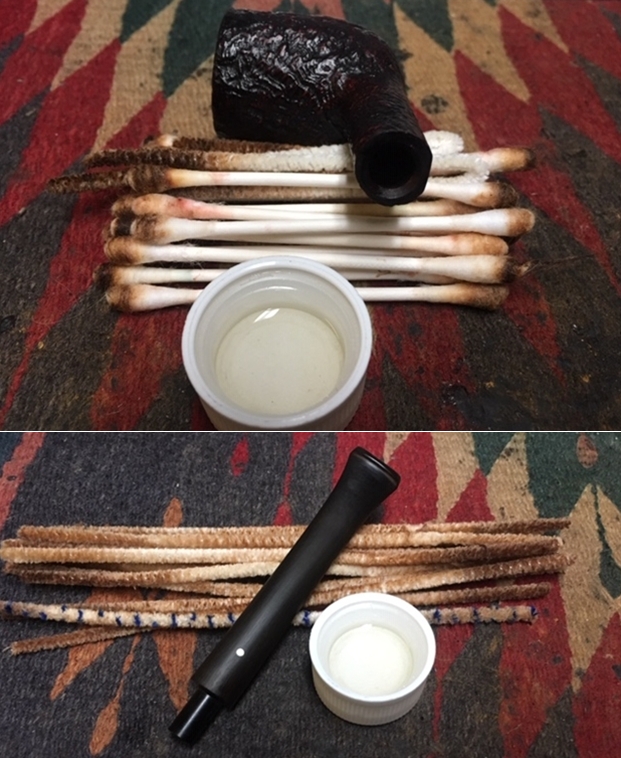
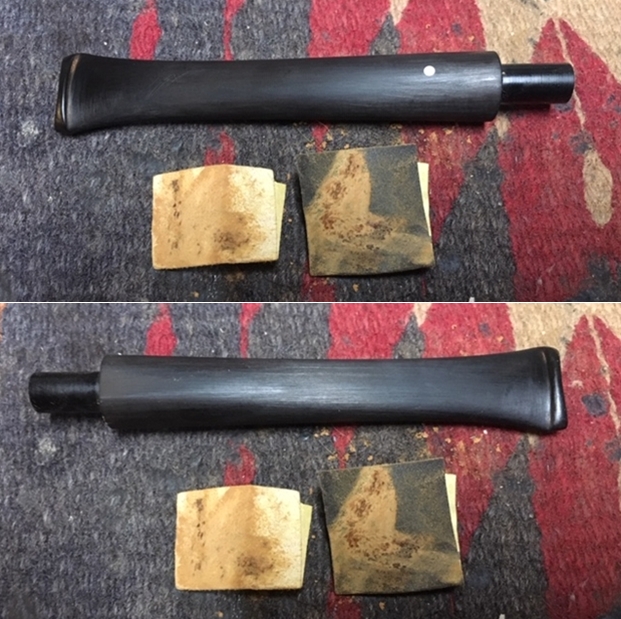
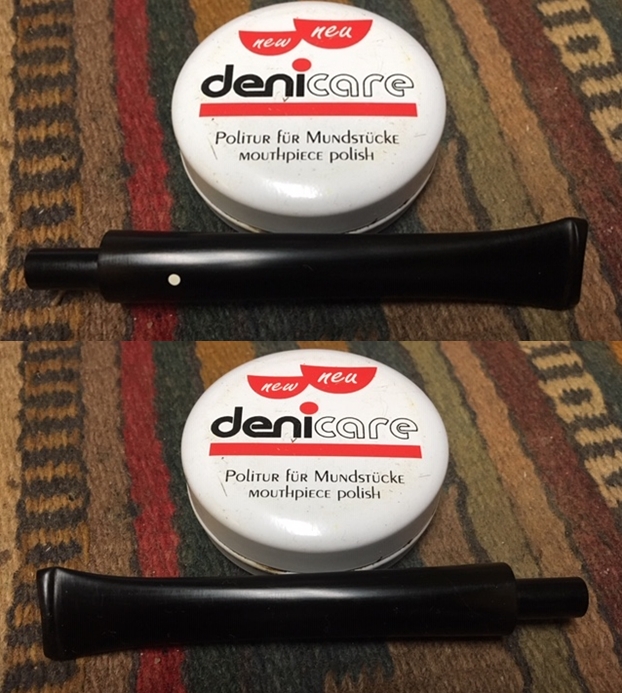
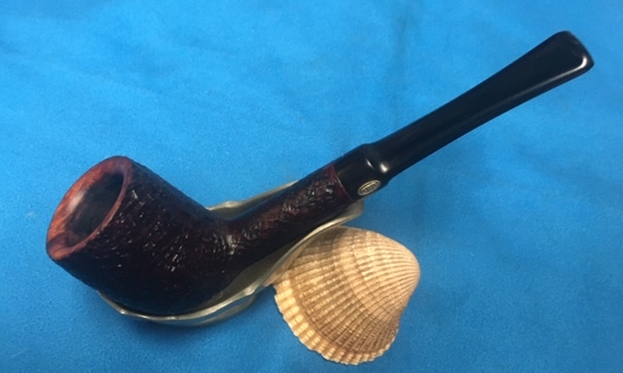
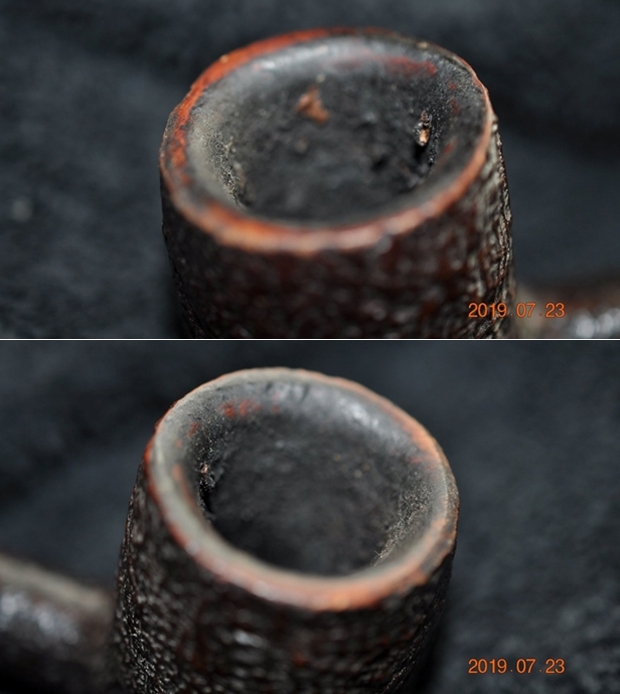
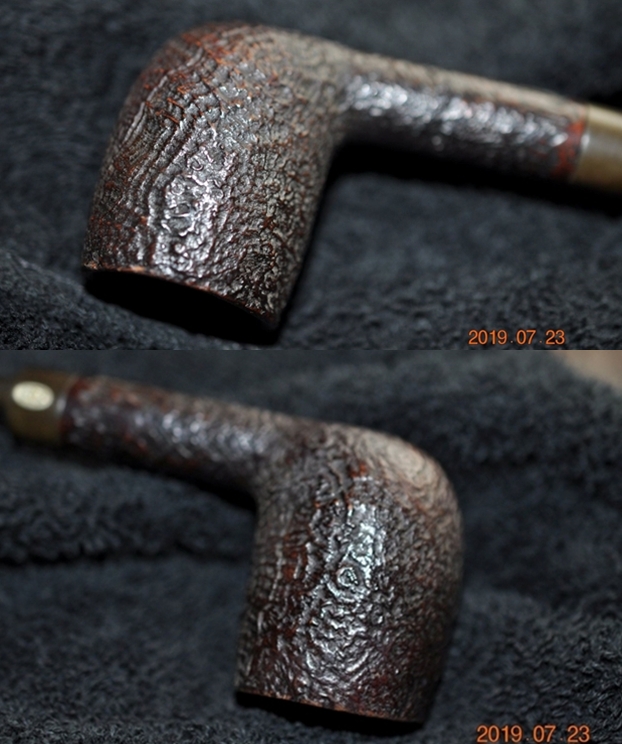
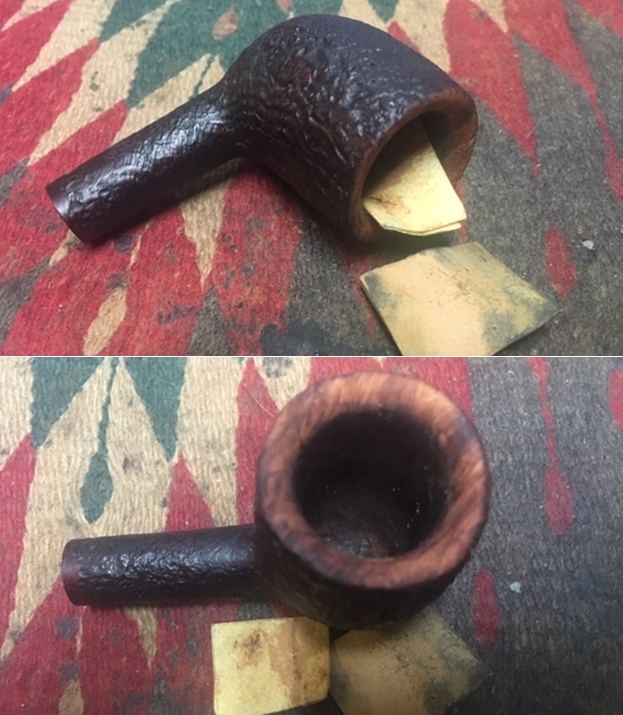
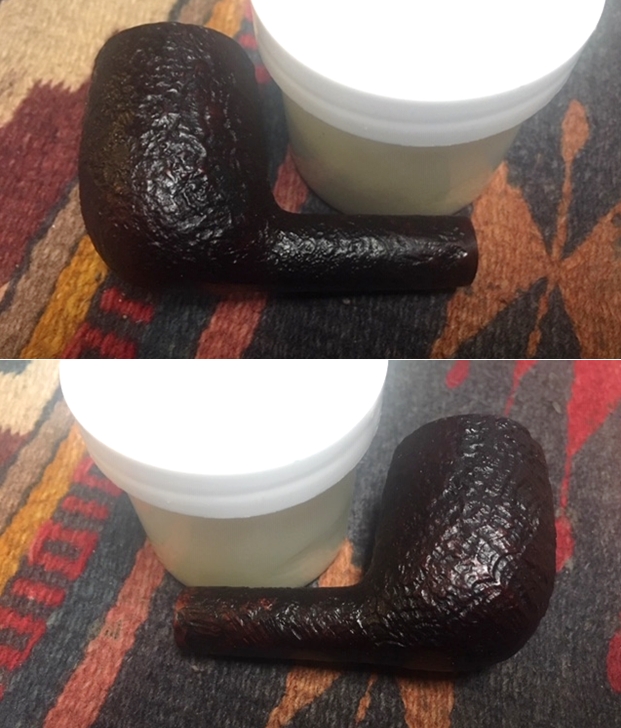
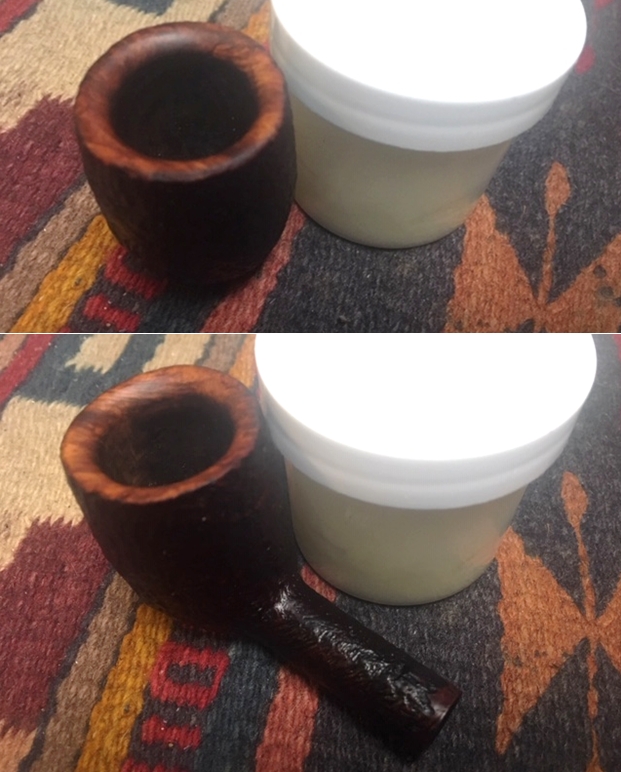
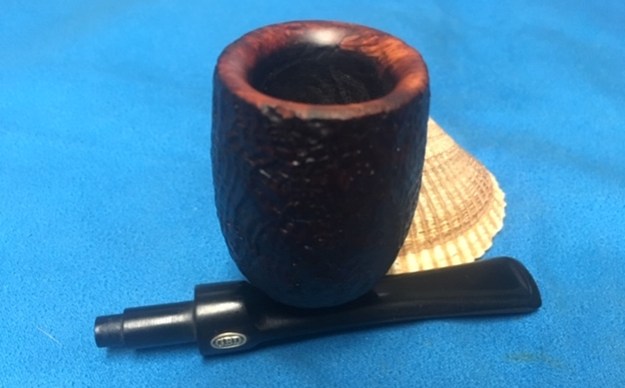
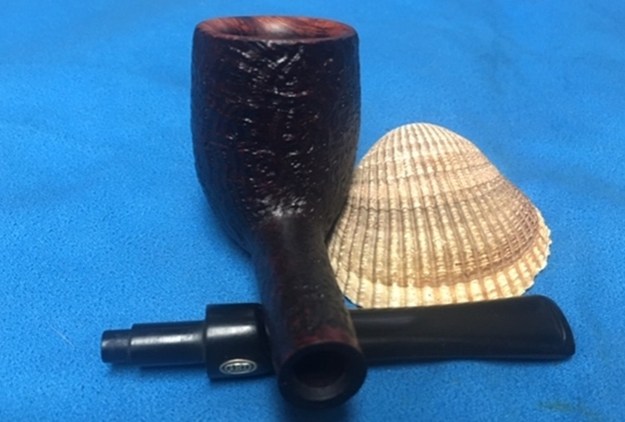
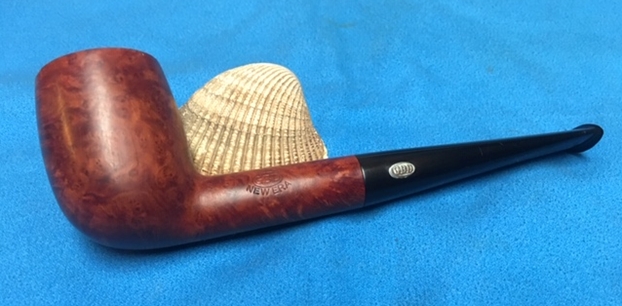
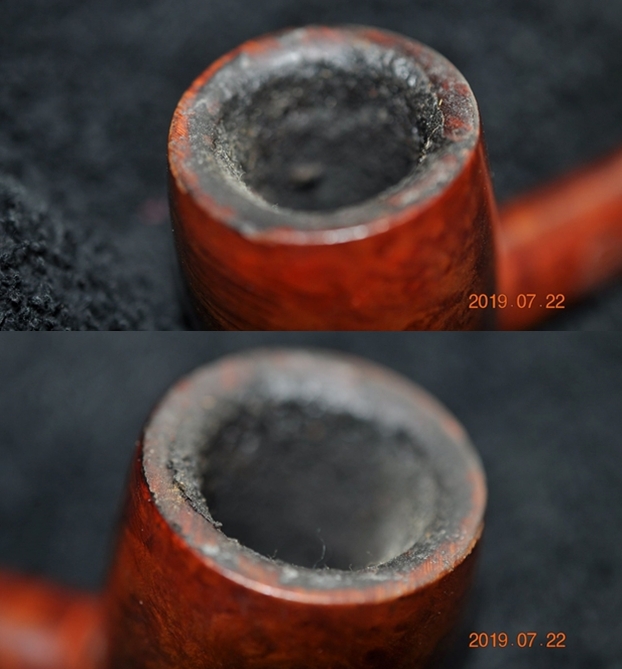
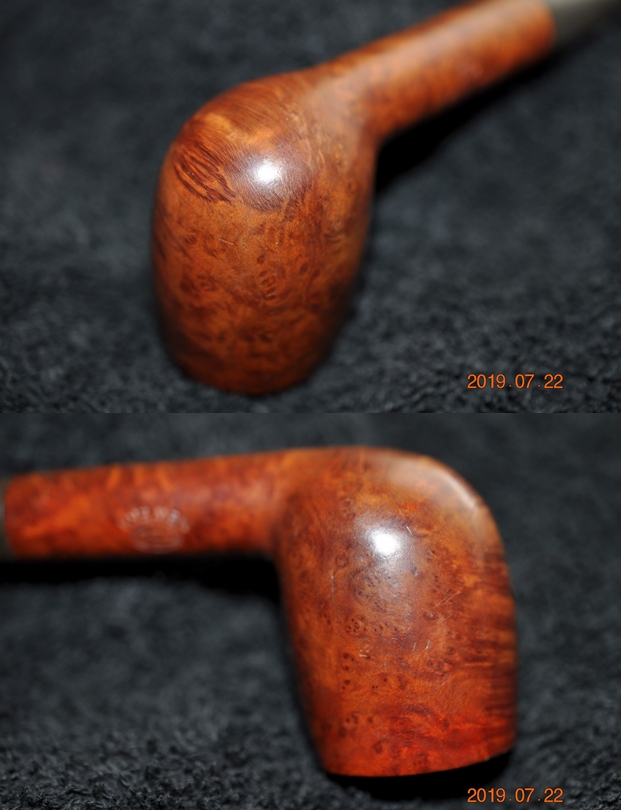
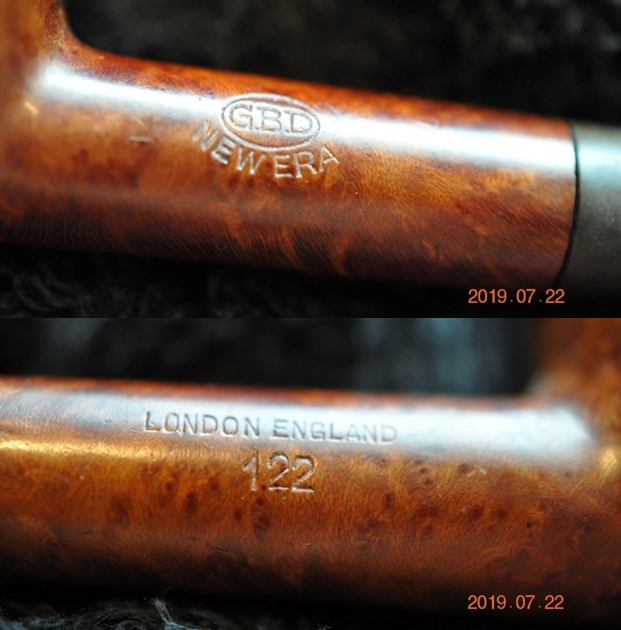
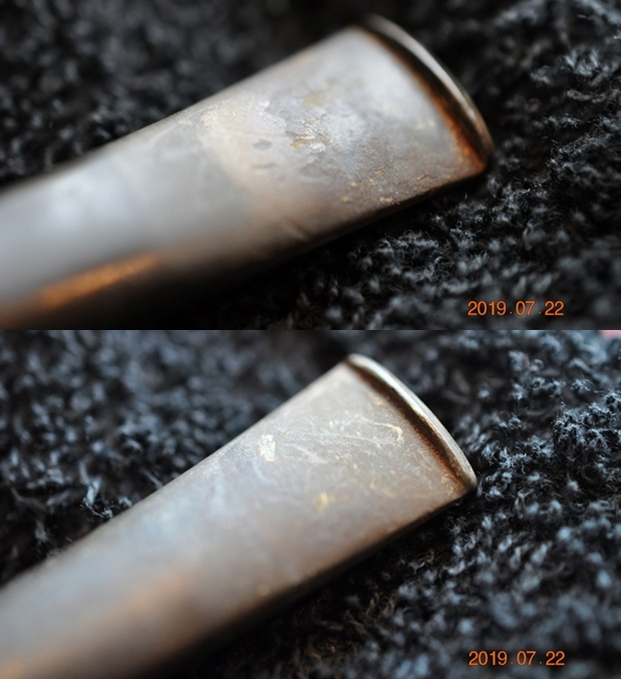
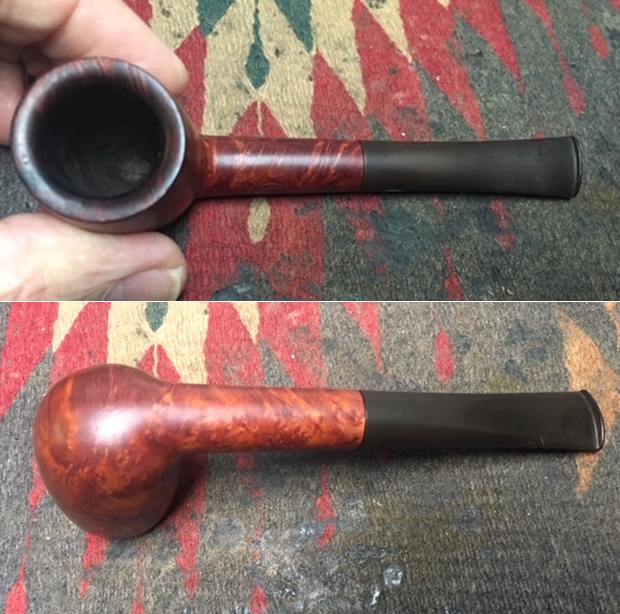
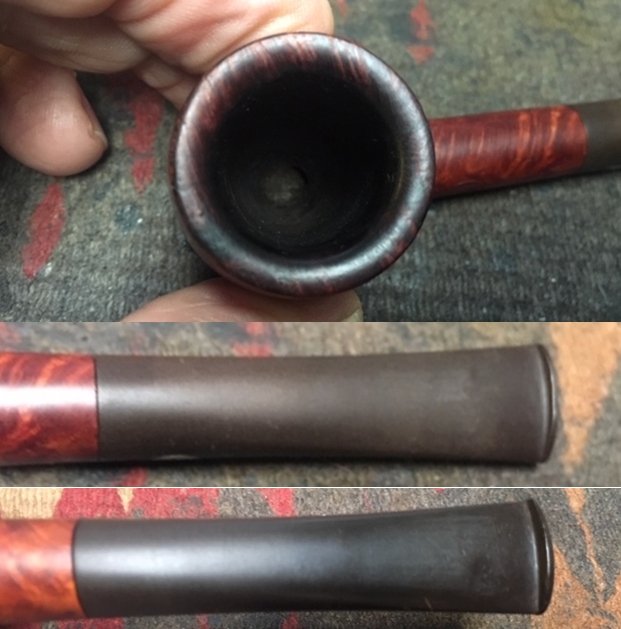
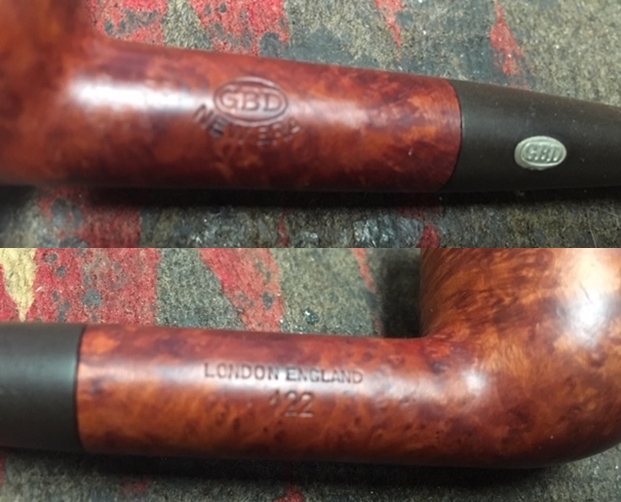
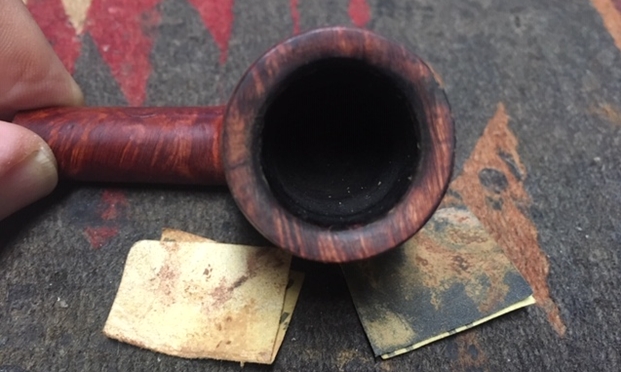
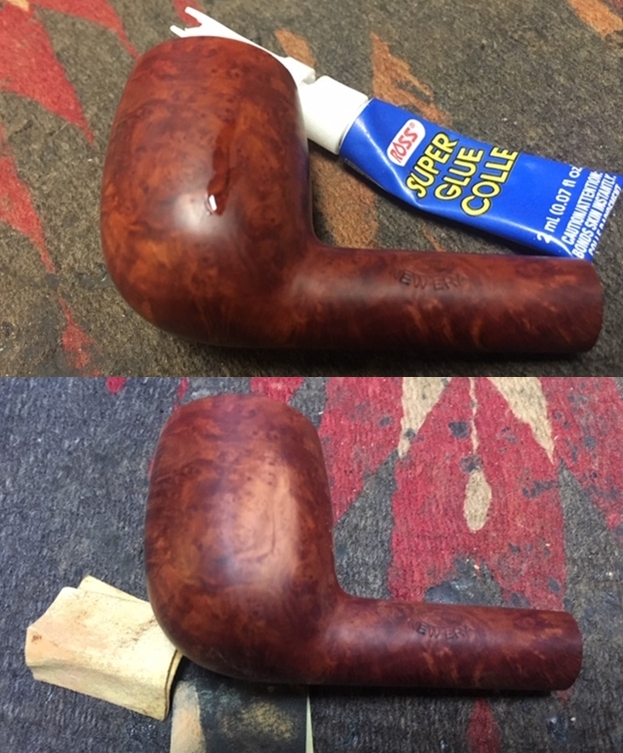
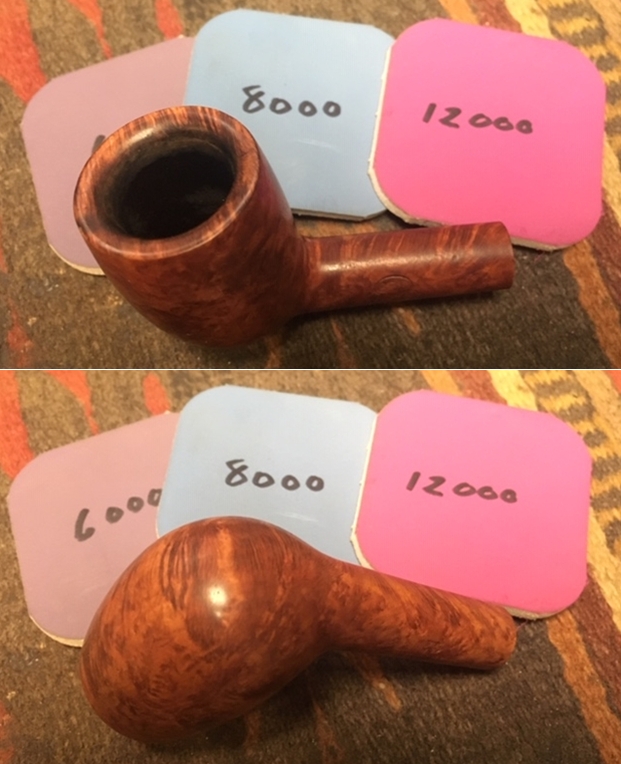
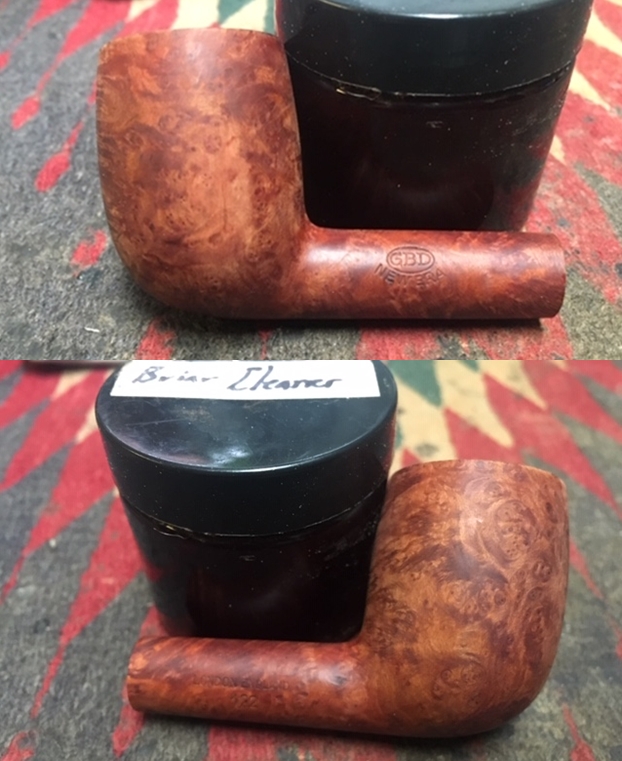
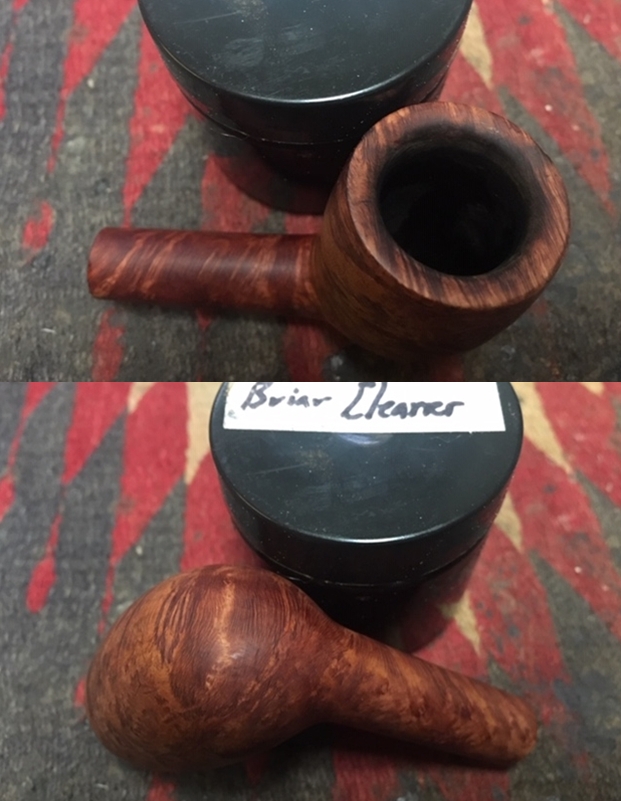
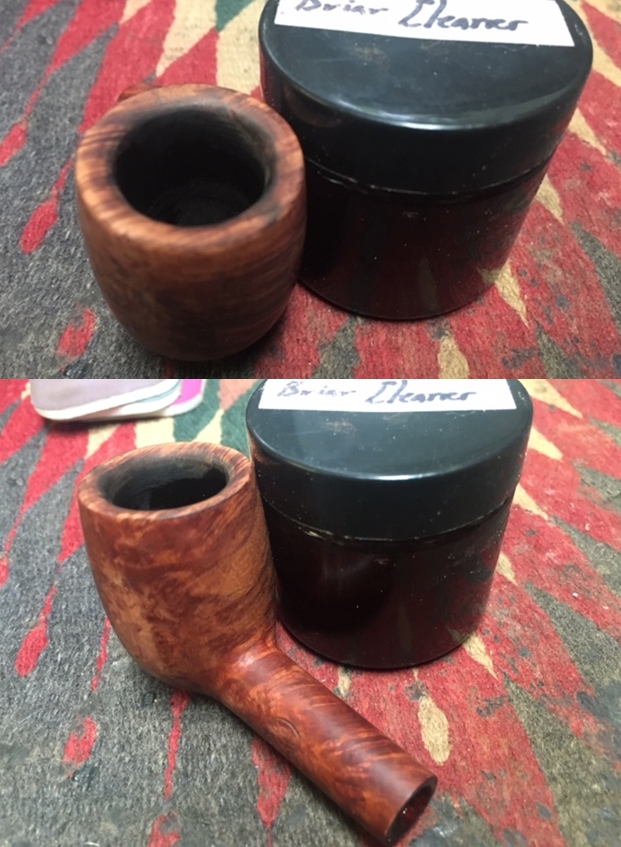
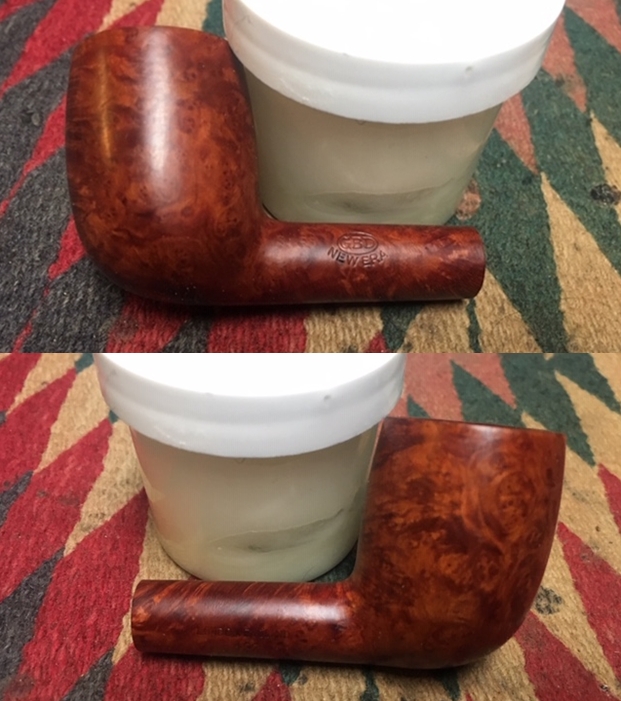
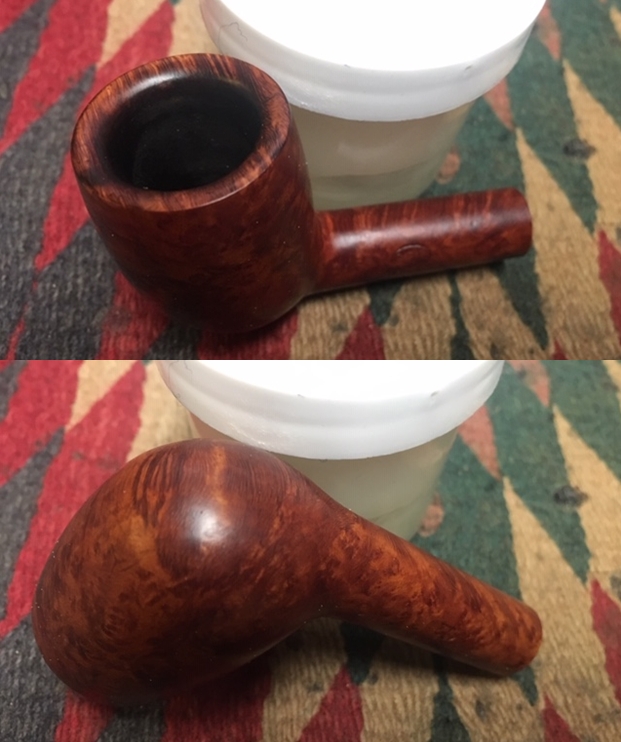
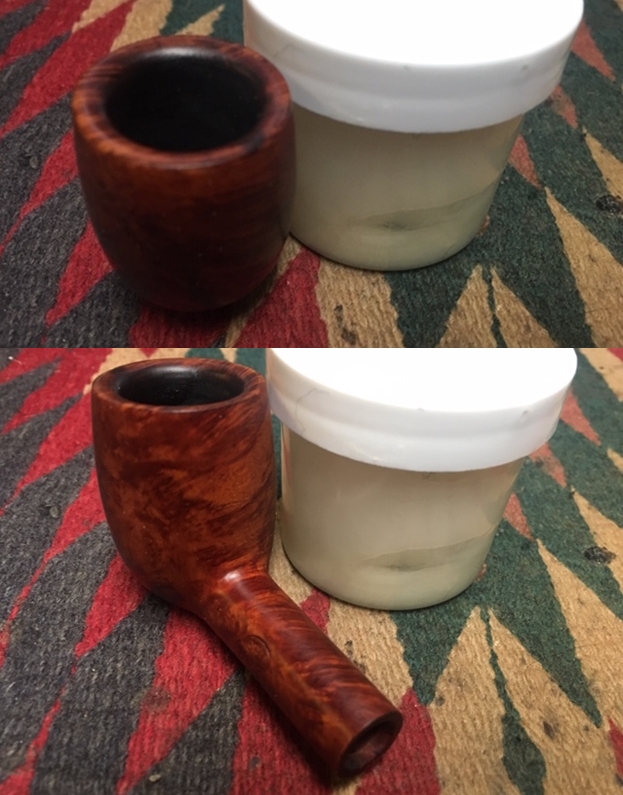
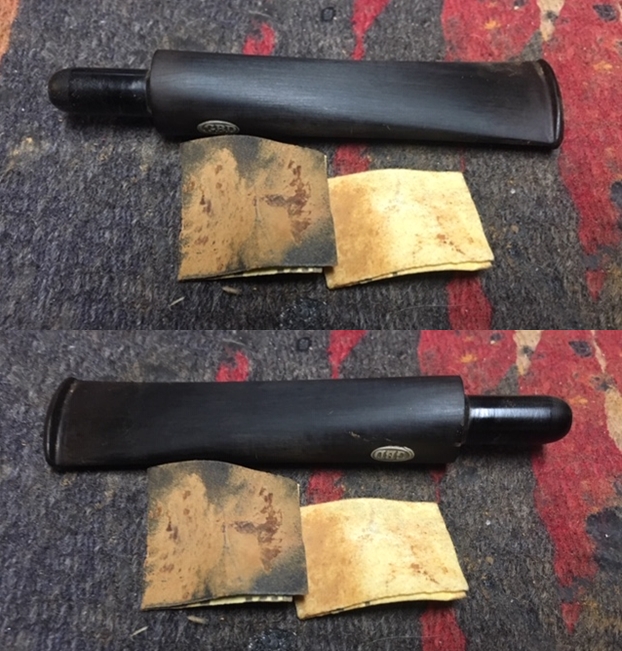
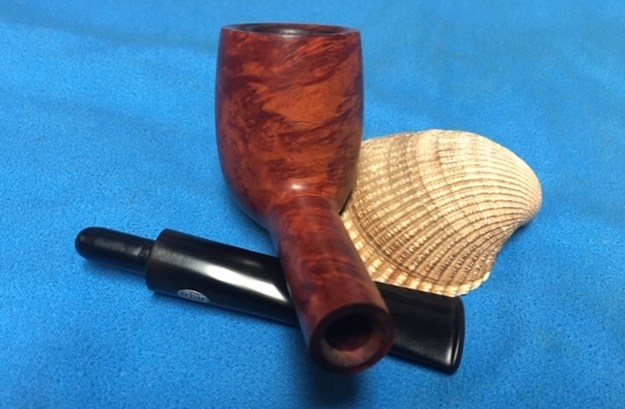
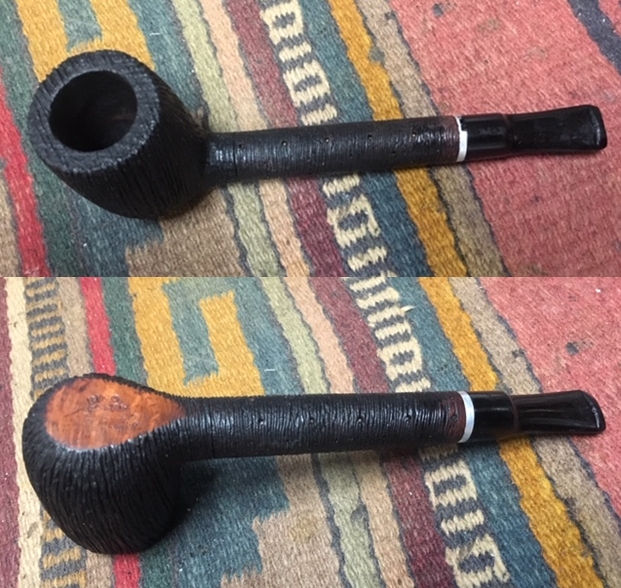
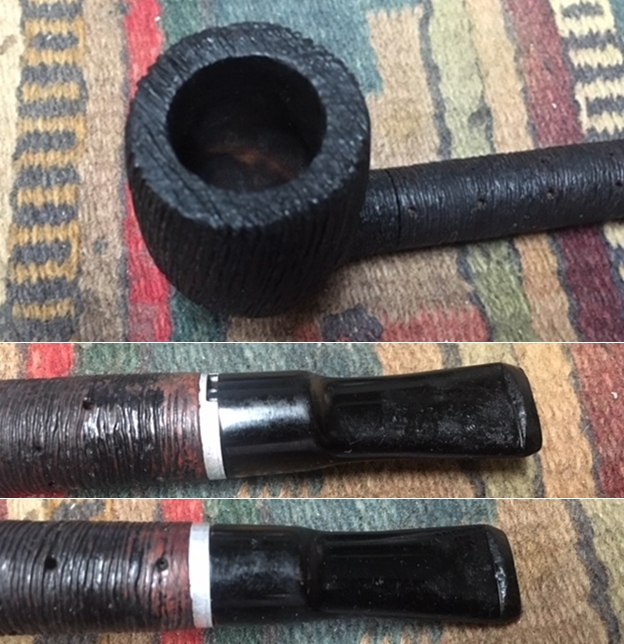
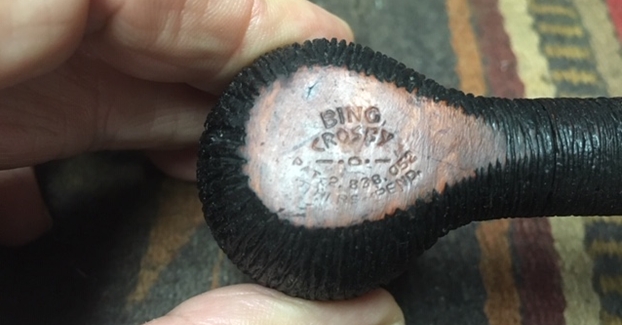
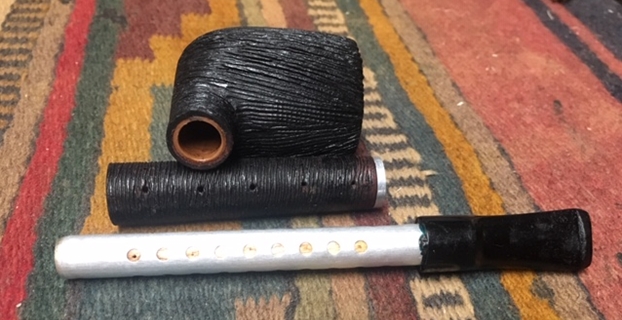
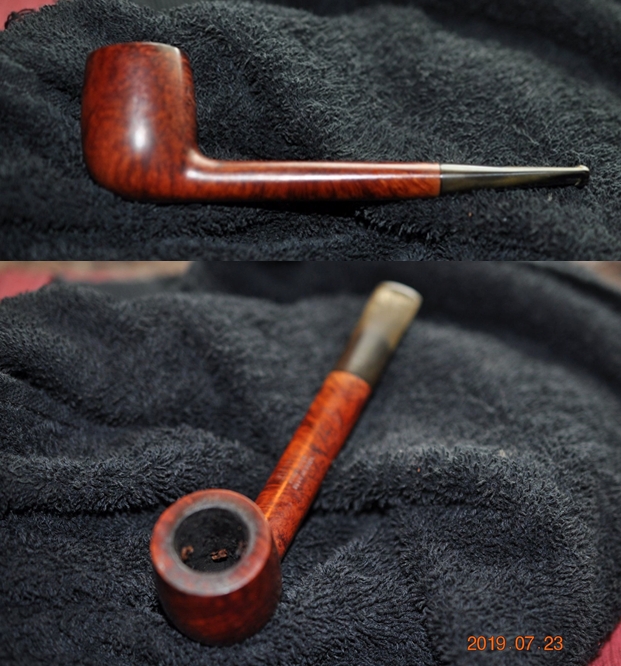
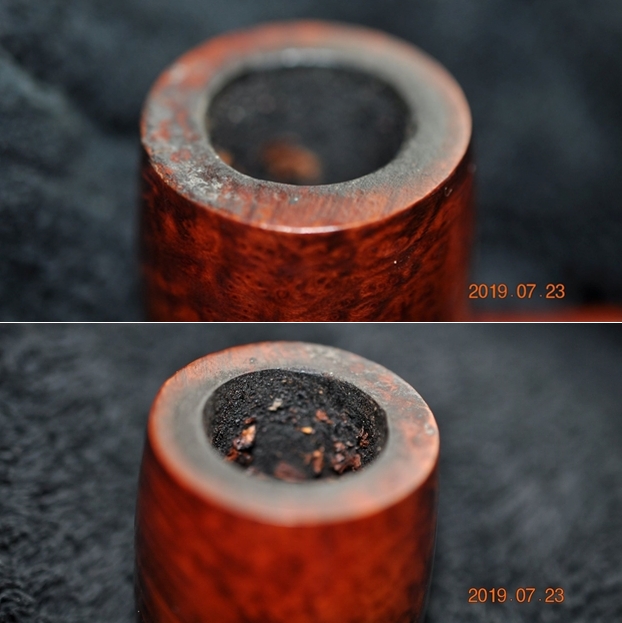
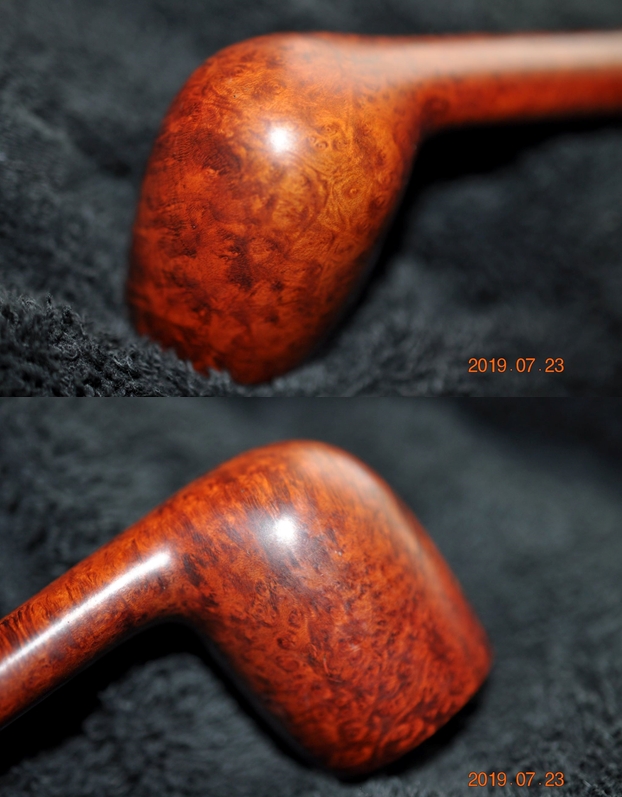
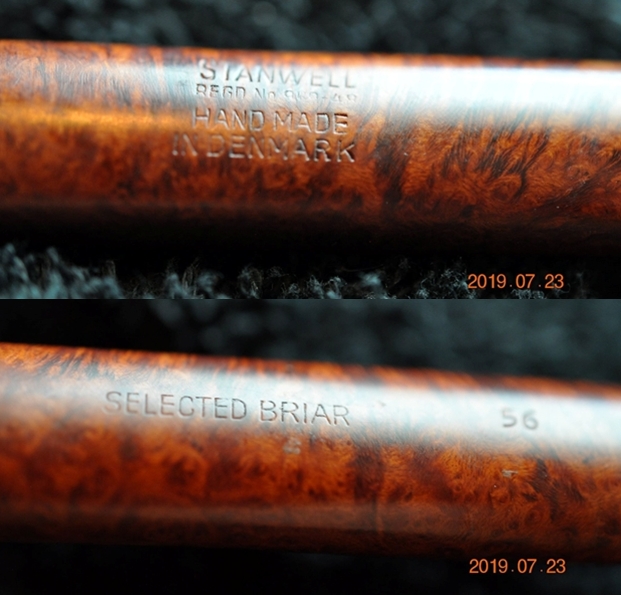
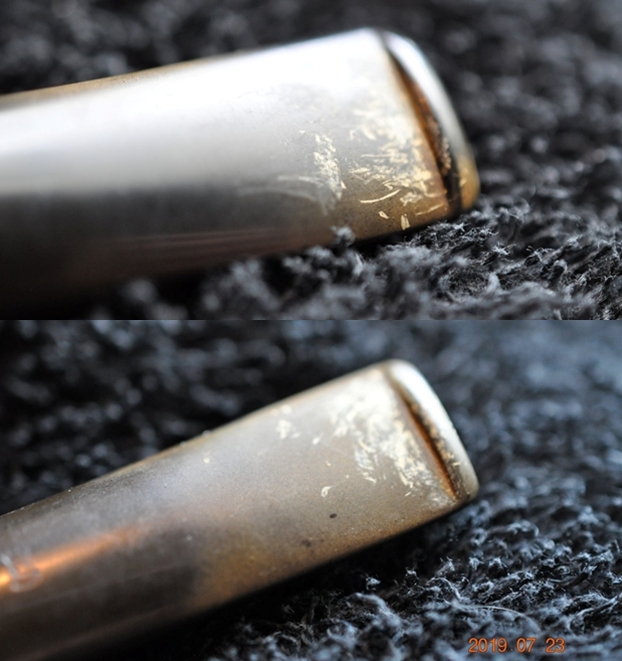
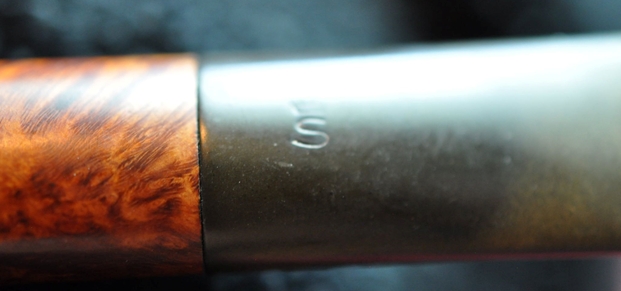
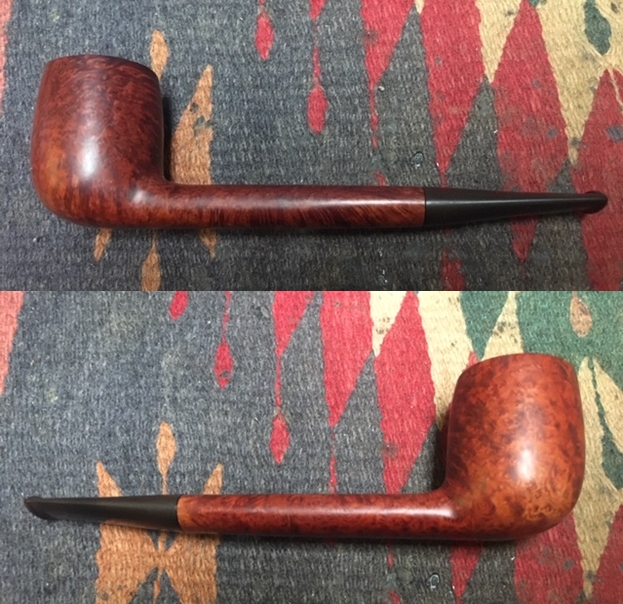
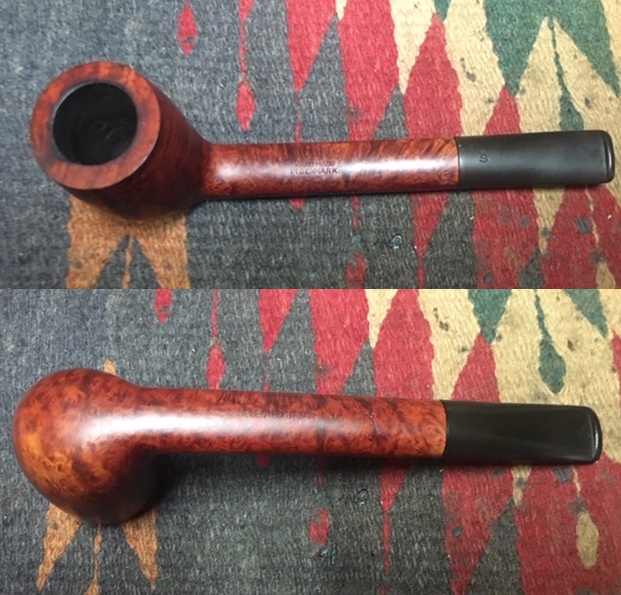
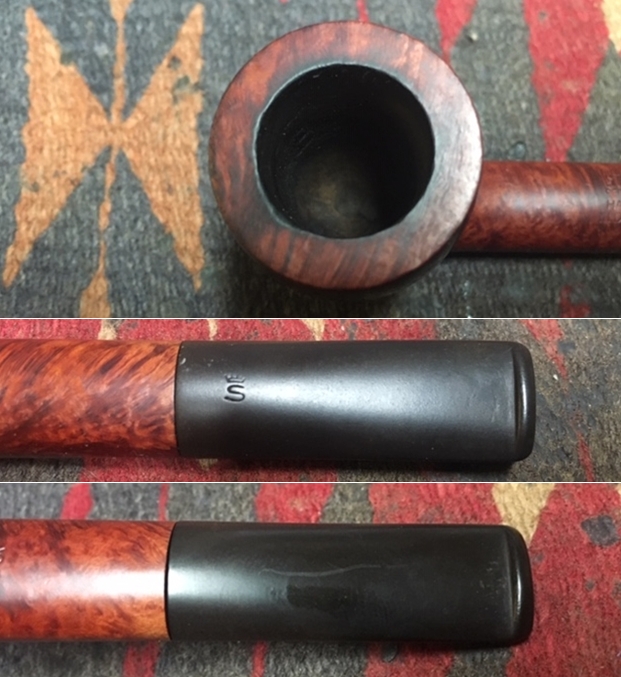
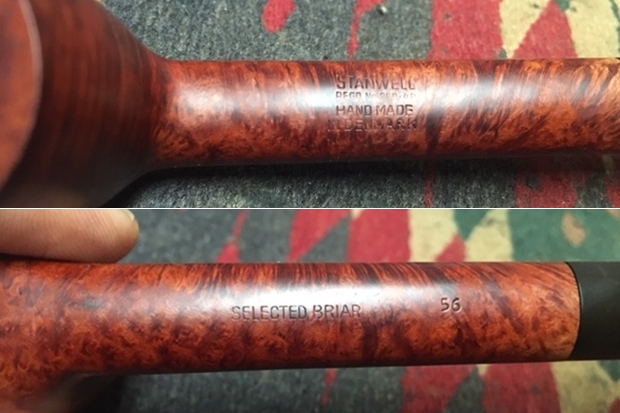
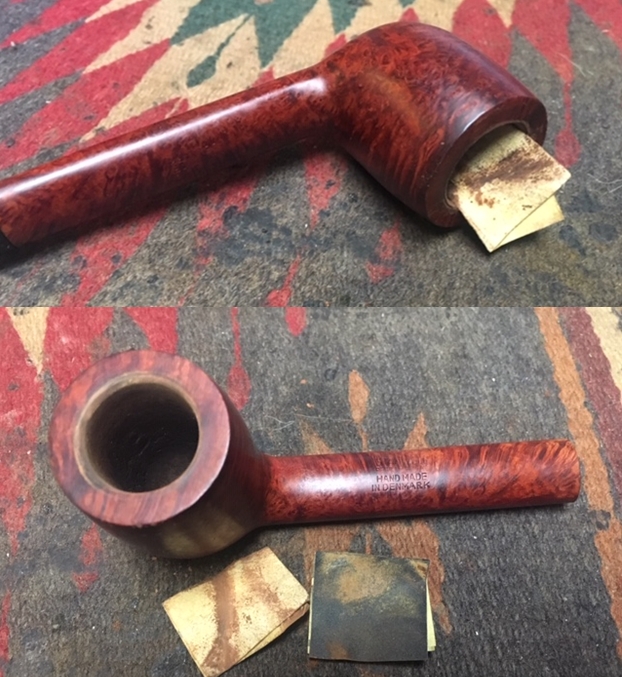
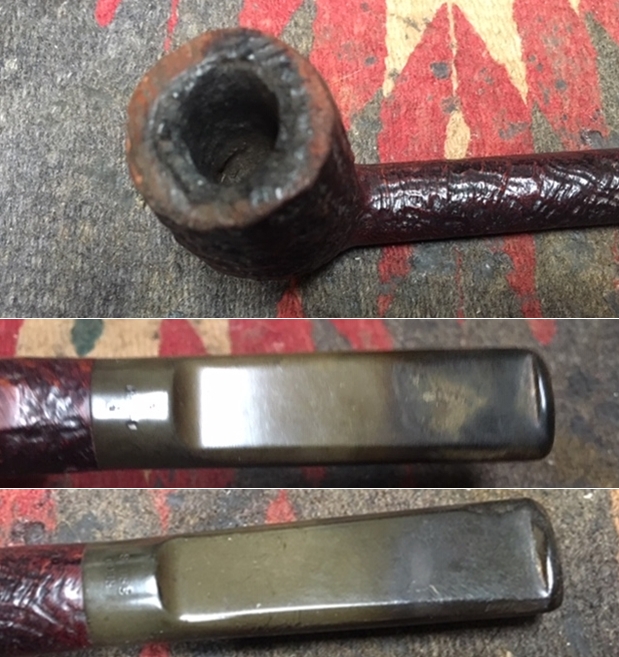
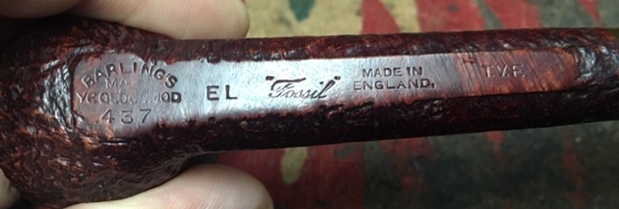
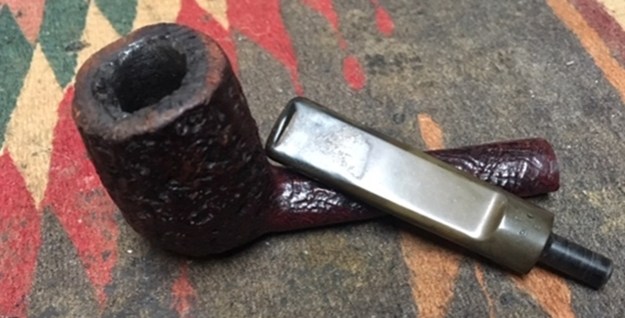
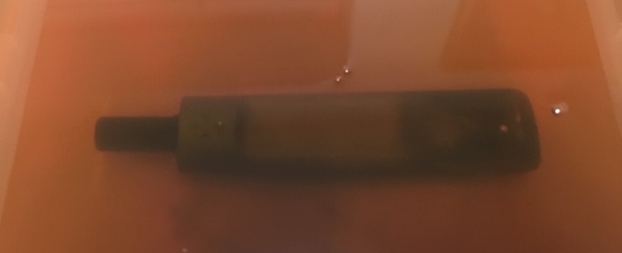
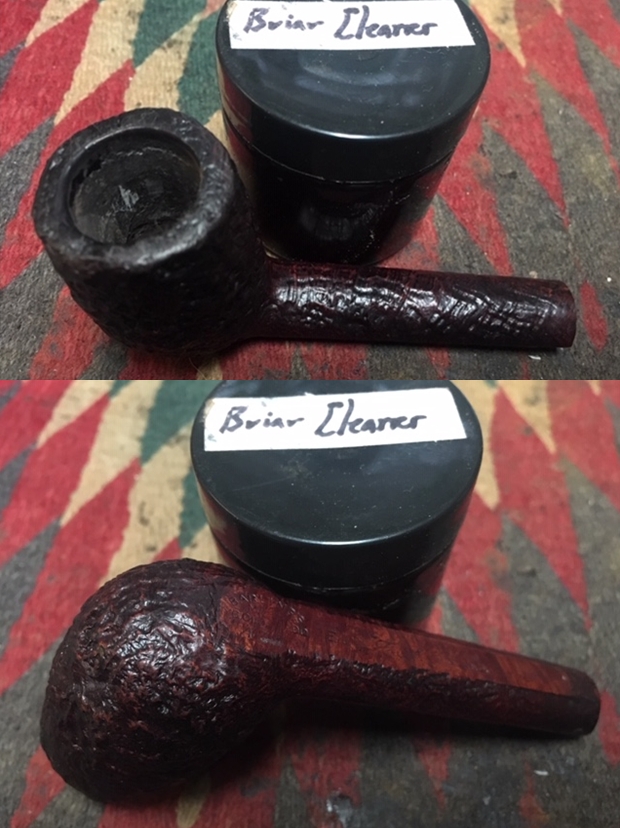
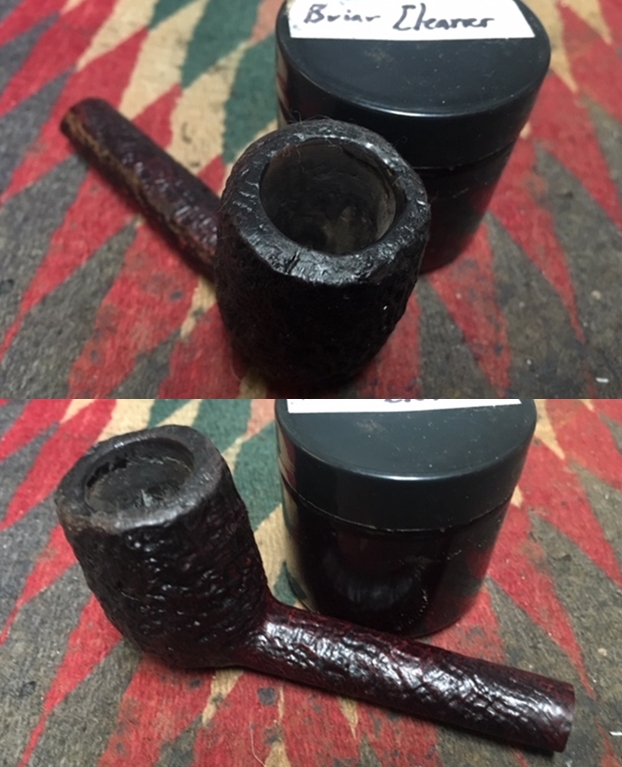
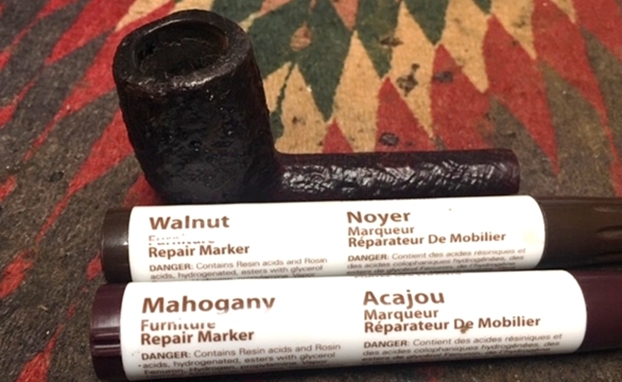
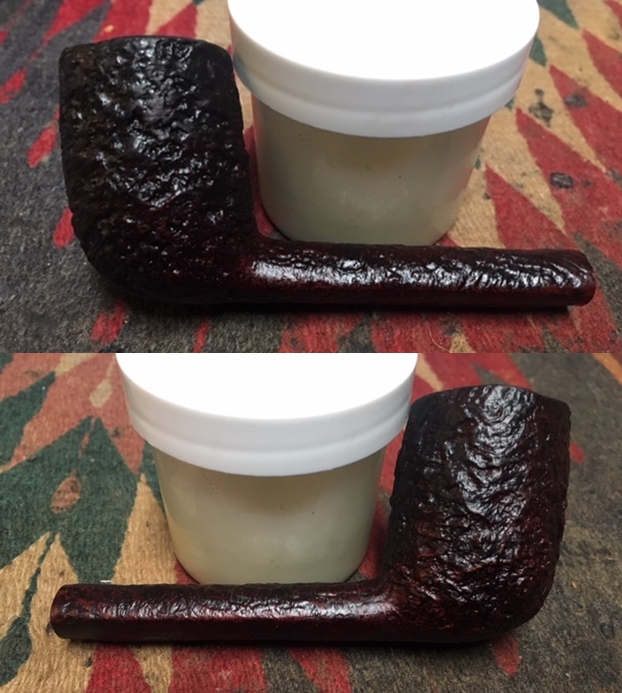
I decided to take a break from Bob Kerr’s Estate for a bit and work on Scott’s pipes. I took the Dunhill out first and did the restoration on it. It was pretty straight forward and cleaned up nicely. Give that blog a read if you are interested (https://rebornpipes.com/2019/08/28/new-life-for-a-1964-dunhill-shell-briar-250f-t-2s-billiard/). But now it was time to work on the second pipe – the Barling’s Make Fossil Canadian. I looked it over to check out its condition and what needed to be done with it. The finish was dirty but underneath all of the grime it appeared to be in decent condition. The edges of the rim top were virtually ruined on the front right side of the bowl. There were chips on the inner edge and damage on the outer edge. The rim top itself was scratched and nicked as if it had been knocked about.  The bowl had a thick hard cake inside and remnants of tobacco stuck to the walls. I could not even put my little finger in the bowl it was so clogged. The stem was stuck in the shank and was upside down. It was unmovable. I could still see the Barlings Cross on the top of the stem and Regd number on the underside. There was some calcification on the first inch of the stem on both sides. The stem was also oxidized and dirty. The stamping on the stem is very faint. The slot in the button was almost clogged up with tars and debris. There were tooth marks and chatter on both sides and the button. There was a worn notch on the top right side of the stem just ahead of the button. I took photos of the pipe before I started my cleanup work. I took some close up photos of the rim top and also of the stem surface. I wanted to show the condition of the bowl and rim before I started working on it. The rim top was a disaster – it looked as if it was ruined and destroyed. There is some thick lava filling in the sandblast of the rim. The inner edges were very rough with large chips out of the right front. The outer edge was worn from being beaten against something hard knocking out dottle. The cake in the bowl is quite thick and hard so the bowl walls should be in good condition. I also took close up photos of the stem surface before I did the cleanup. You can see the faint stamping on the topside – a Barling Cross. On the underside it was also stamped and was faint – Regd over 98046 . The stamping on the underside of the shank is in great shape. It reads Barling’s arced over Make and underneath that it reads Ye Olde Wood with the shape number 437 on the heel of the bowl. That is followed by EL “Fossil” in script. That is followed Made in England and T.V.F. When I received the pipe the stem was stuck in the shank and was upside down. I put the pipe in the freezer for 30 minutes and when I removed it the stem turned easily in the shank. I removed it so that I could work on the bowl and soak the stem.I put the stem in a bath of Before & After Deoxidizer and left it to soak while I turned my attention to the bowl.I turned to Pipedia’s article on Barling pipes (https://pipedia.org/wiki/Barling) and specifically read the section on the “Ye Olde Wood Stamp”. I quote as follows:
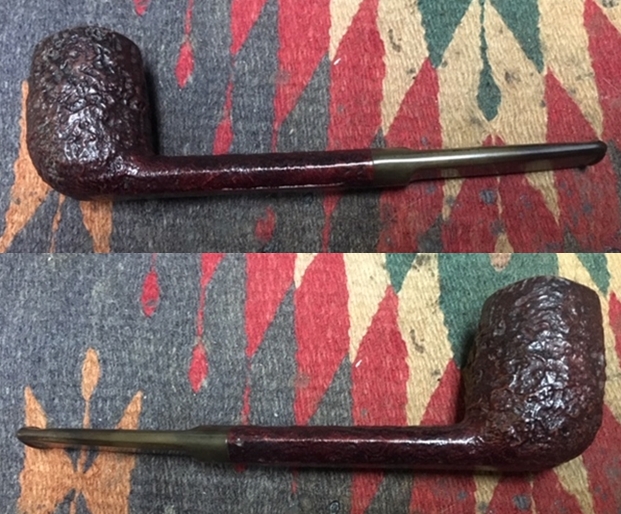
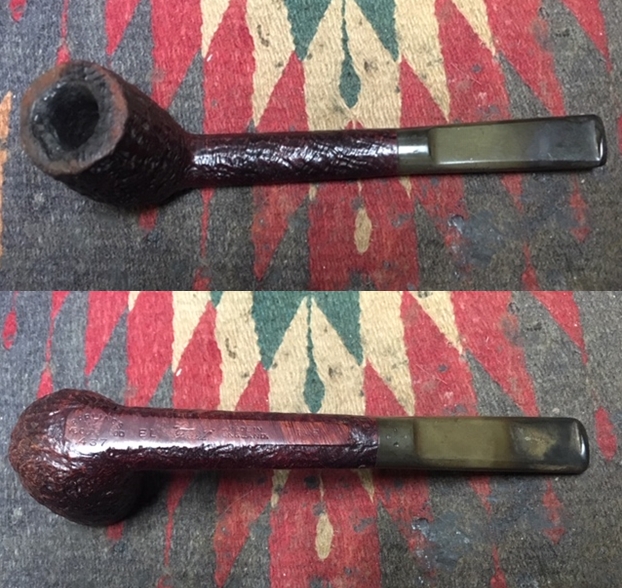
Sometime around 1913, the “Ye Olde Wood” stamp made its appearance on selected pipes. An example exists stamped on a 1913 date hallmarked pipe.

This logo will continue to be used in the decades to come. Initially it was used to designate a higher grade than the average, much as the “Special” grade would after the Second World War. Price lists show the “Ye Olde Wood” pipes as a separate grade from the basic BARLING’S MAKE pipe. Eventually, “Ye Olde Wood” came to represent the company to the world. The use of “YE OLD WOOD” as a stamp prior to 1940 was haphazard, at best, although the company used the slogan in advertising materials from the early teens onward. (Gage)

I also did further reading to understand the 3 digit model numbers which were designated on the site as Nichols Numbers. The article had this information:

Pipes intended for the US Market have a 3 digit model number. However, Family Era Barlings may have two numbers, not just three, and they may also have a letter following the model numbers. For example, the letter “M” following a model number would indicate that the bowl is meerschaum lined.

To further define the time period of the pipe I looked further in the article to the COM stamping on the pipes. This pipe is stamped MADE IN ENGLAND with a period at the end. Here is what the article said.

The “MADE IN ENGLAND.” stamp was in use in the 1930’s thru 1962. As with all things related to Barling nomenclature there are variations. Sometimes there is no “MADE IN ENGLAND.” stamp. Examples exist with a “MADE IN LONDON” over “ENGLAND” stamp. And, there are examples with “MADE IN ENGLAND” with no period after the word “ENGLAND”.

I also read the section on the size stampings and quote the pertinent part.

…In 1941 the published range of sizes expanded. Going from the smallest to the largest, they are SS, S, S-M, L, EL, EXEL, and EXEXEL. There is no “G” for giant. Giant pipes, or magnums, which are oversized standard billiards, were not stamped “G” but are commonly identified by collectors as such because they are obviously large relative to even EXEXEL pipes, and carried no size stampings (Gage).

There was a further section on Family Era Grades and Lines. This pipe was stamped Ye Olde Wood – sometimes referred to by collectors as YOW, which the article says may have a dark or plum stain. It is also stamped “Fossil” which denoted a sandblast finish. Most likely this stamping came into existence after WW2. The 1943 product line lists “sandblast” not “Fossil”.

This pipe was definitely made in the Family Era which ran from 1912 – 1962 and included pipes made by the Barling family while it either owned or managed B. Barling & Sons. I know that it was made after WW2 because of the “Fossil” stamp and before the close of the era in 1962. That appears to be as close as I can get to a date on this old timer.

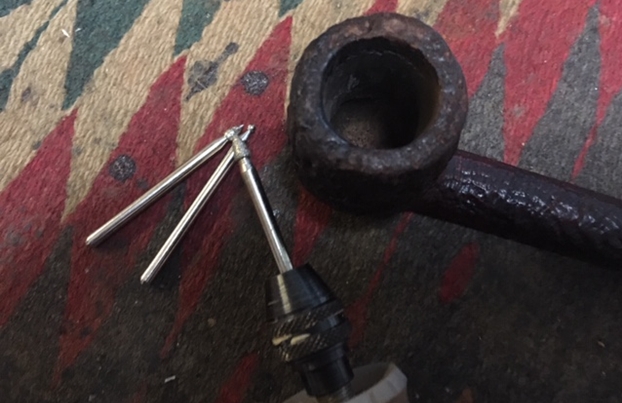
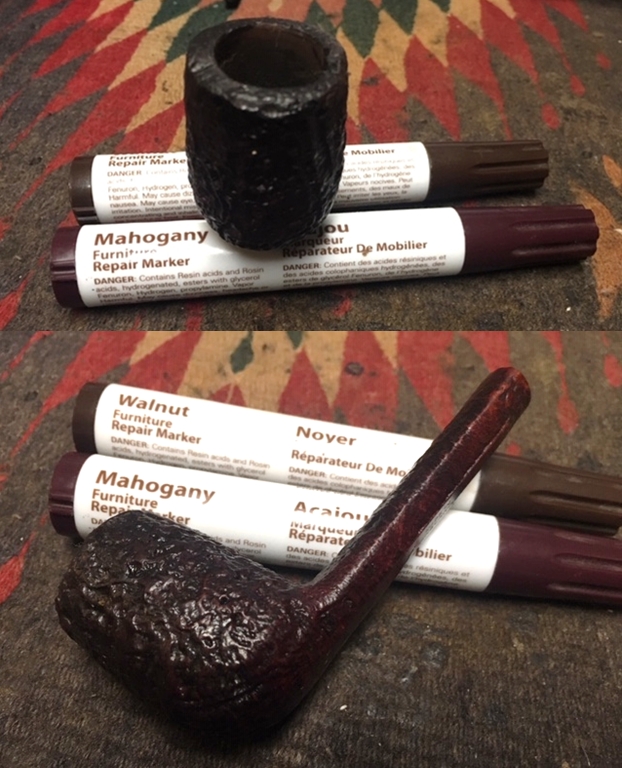
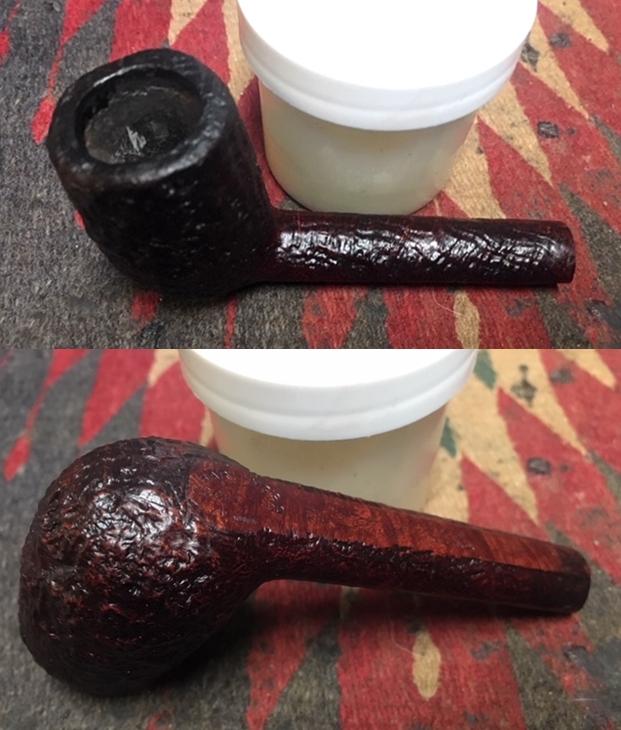
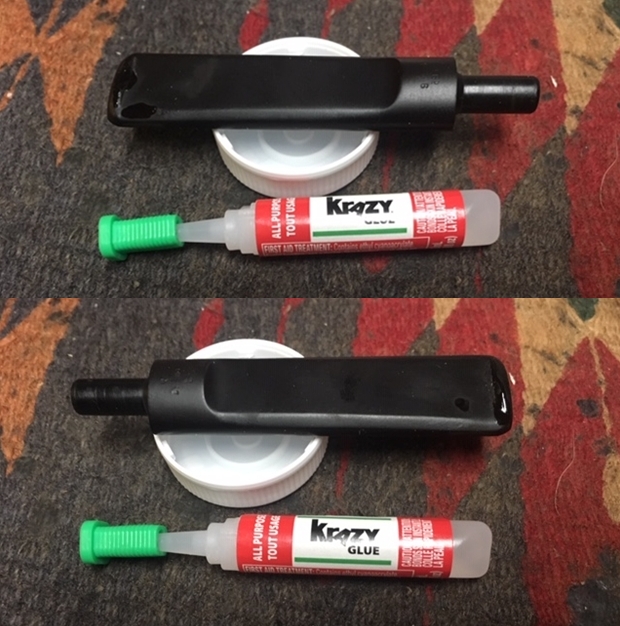
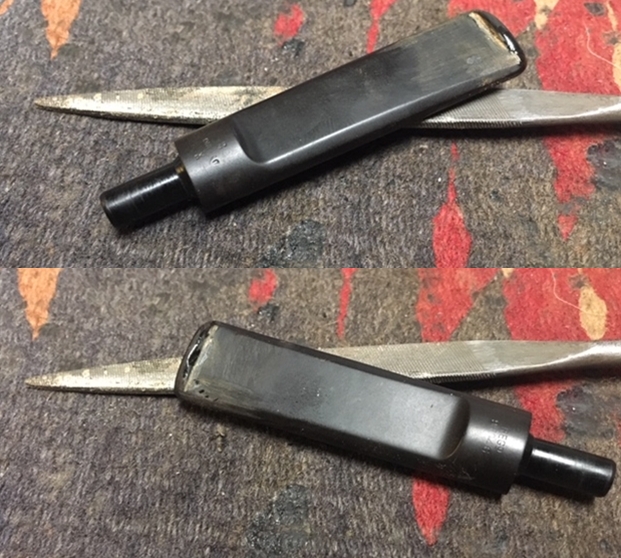
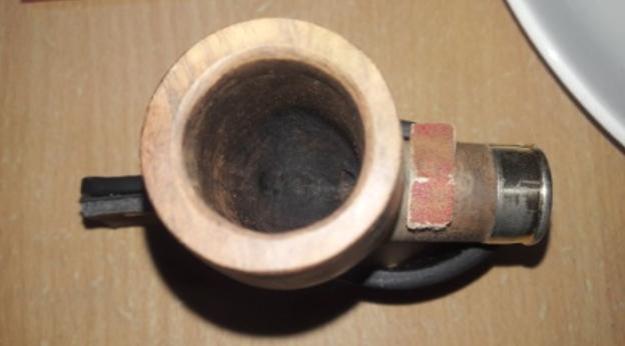
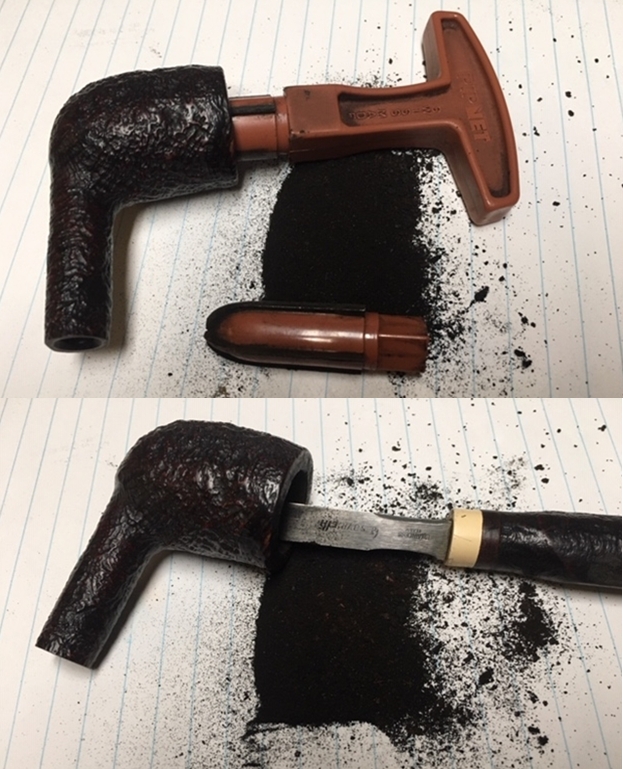
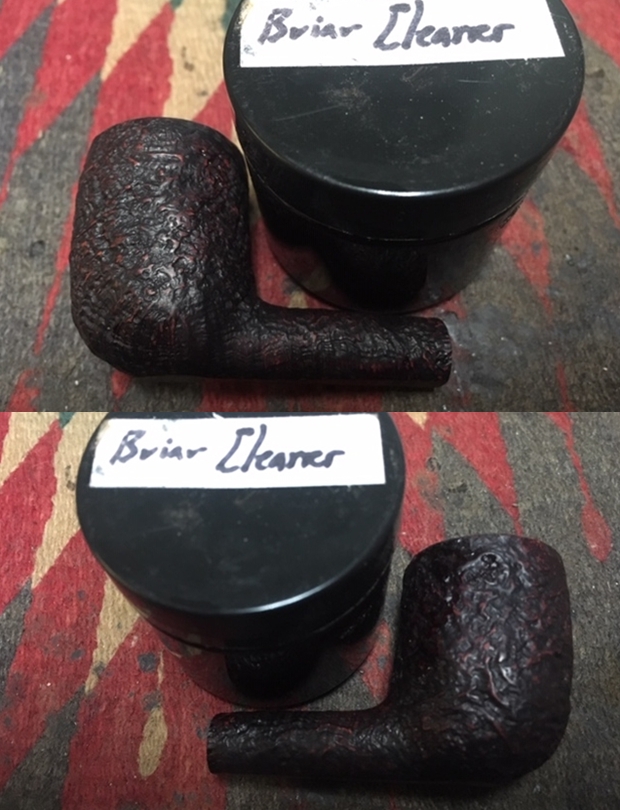
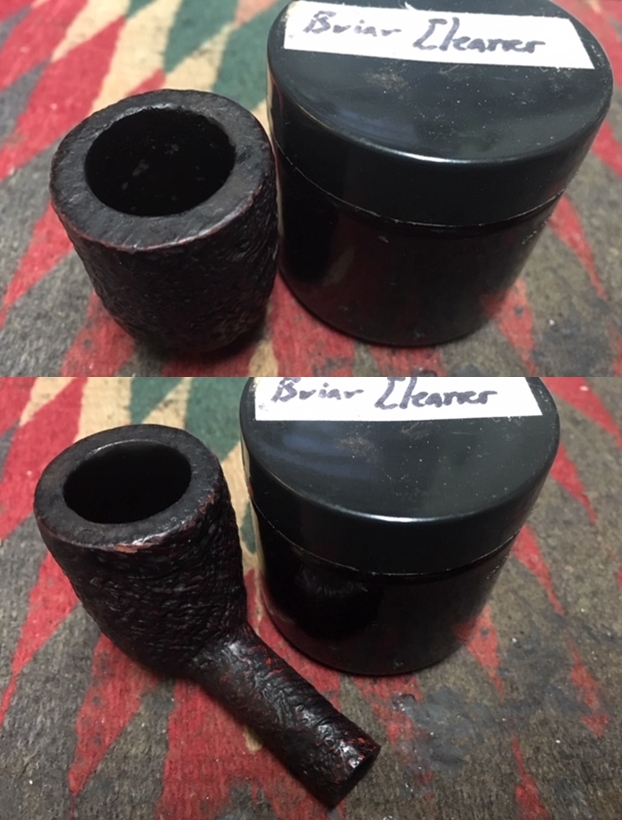
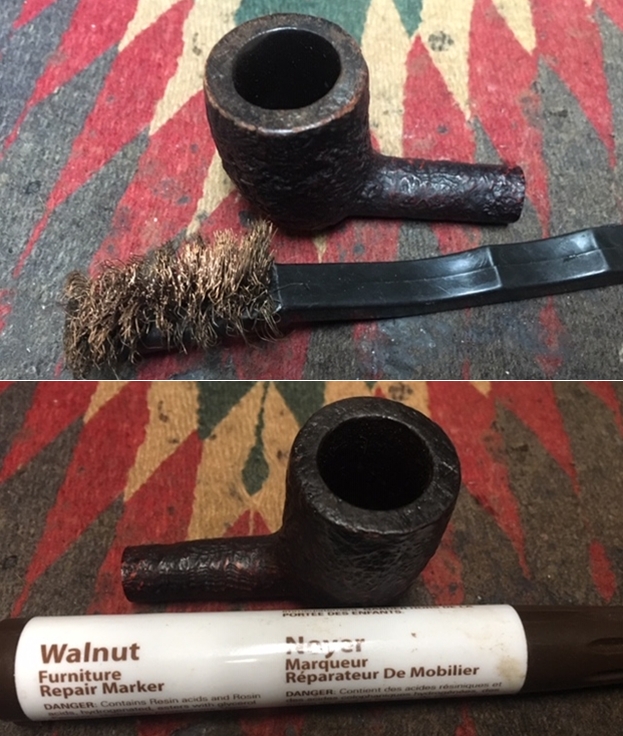
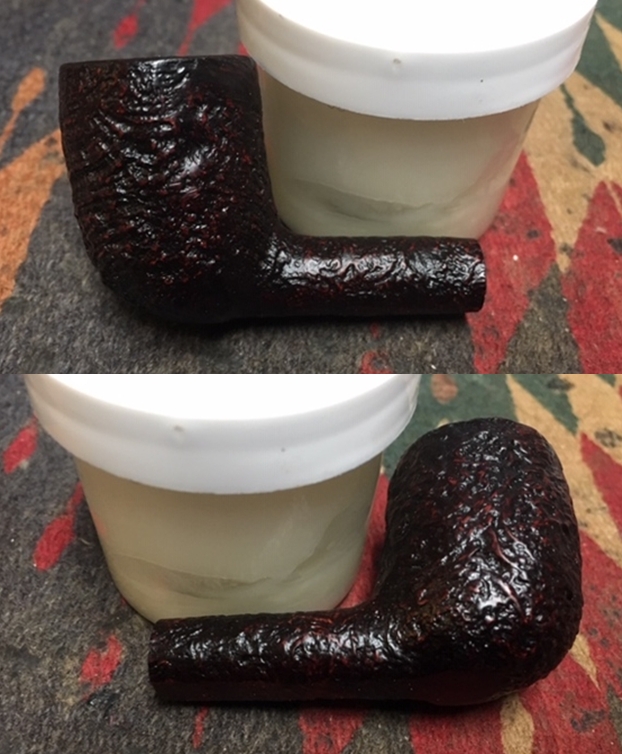
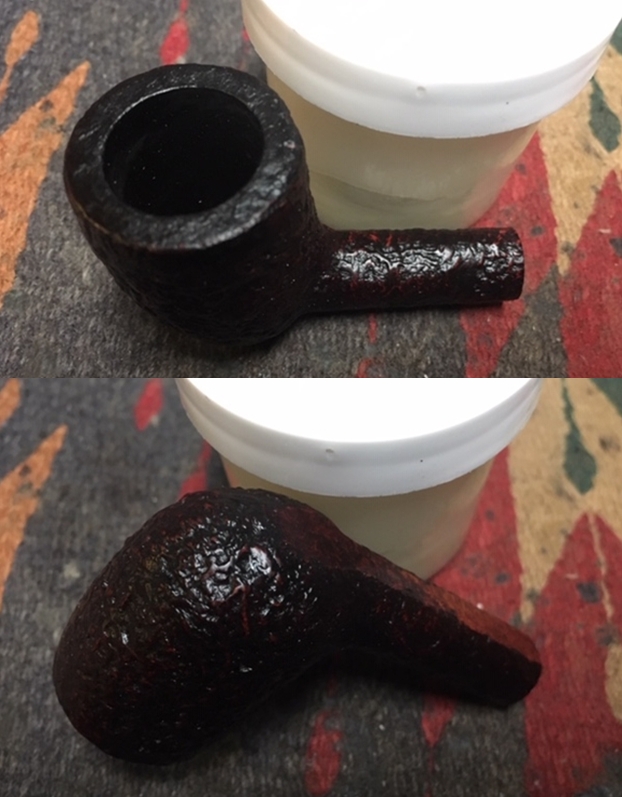
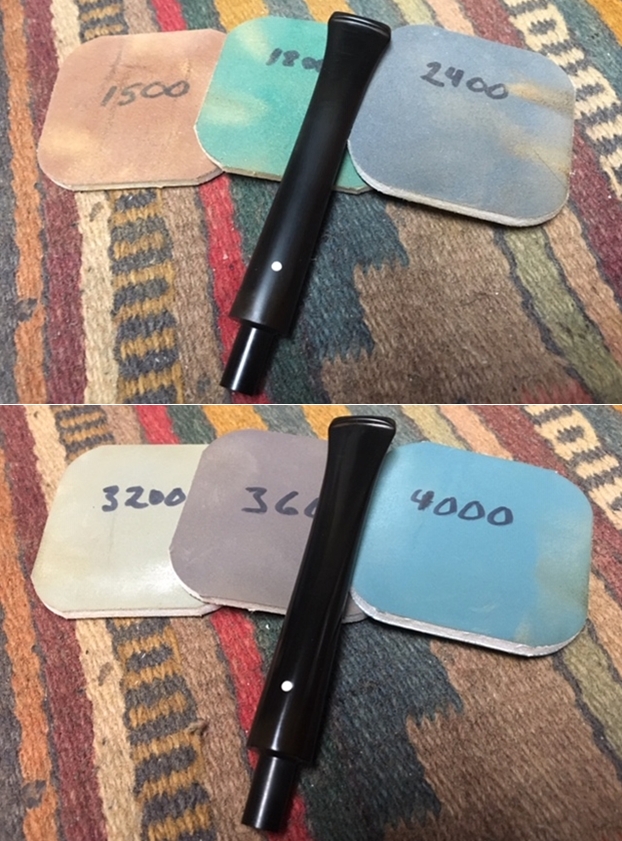
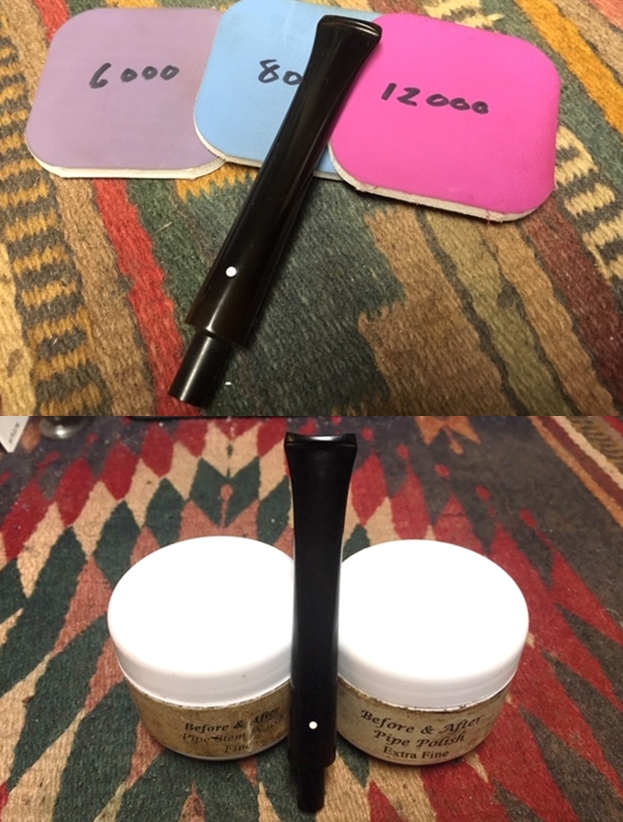
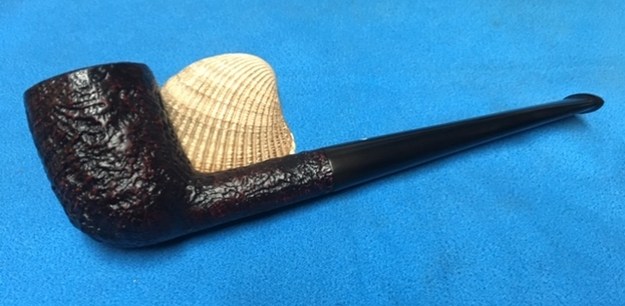
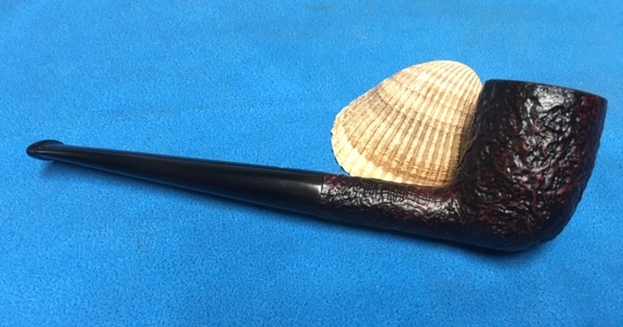
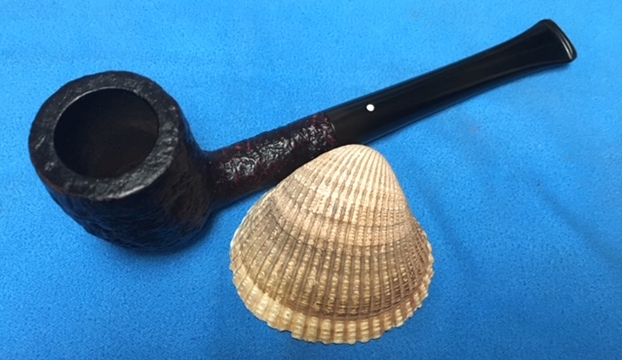
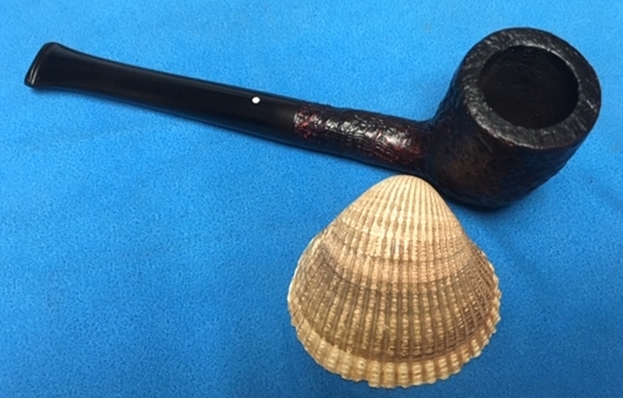
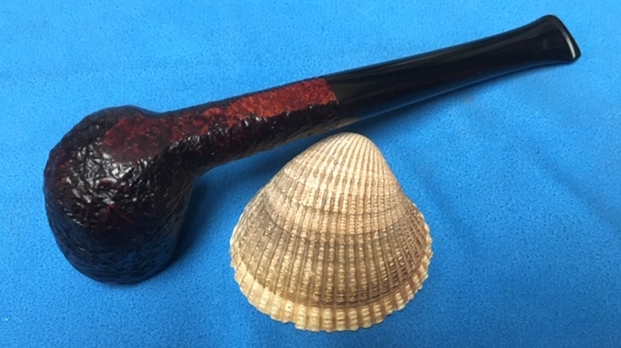
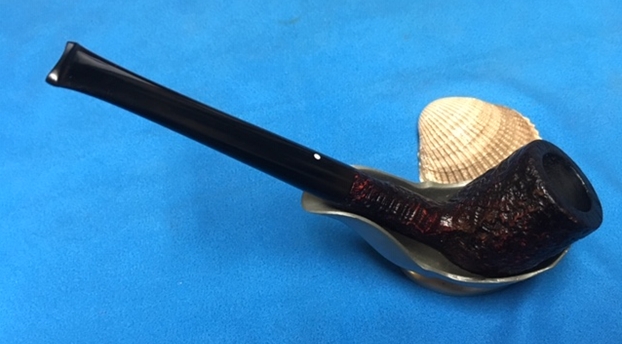
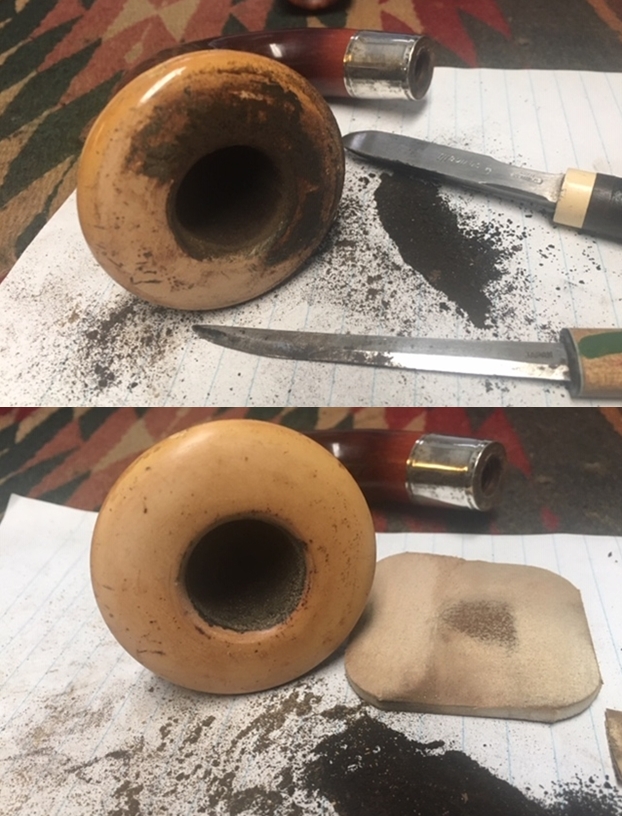
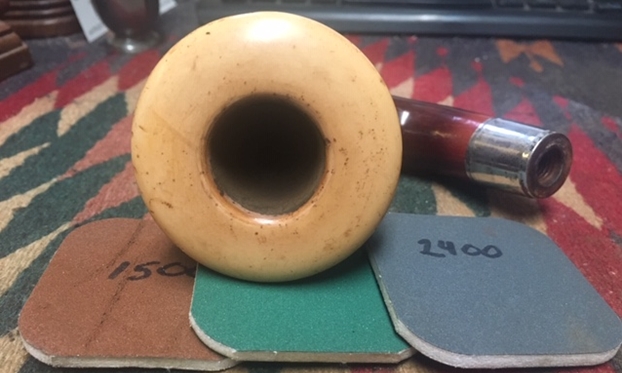
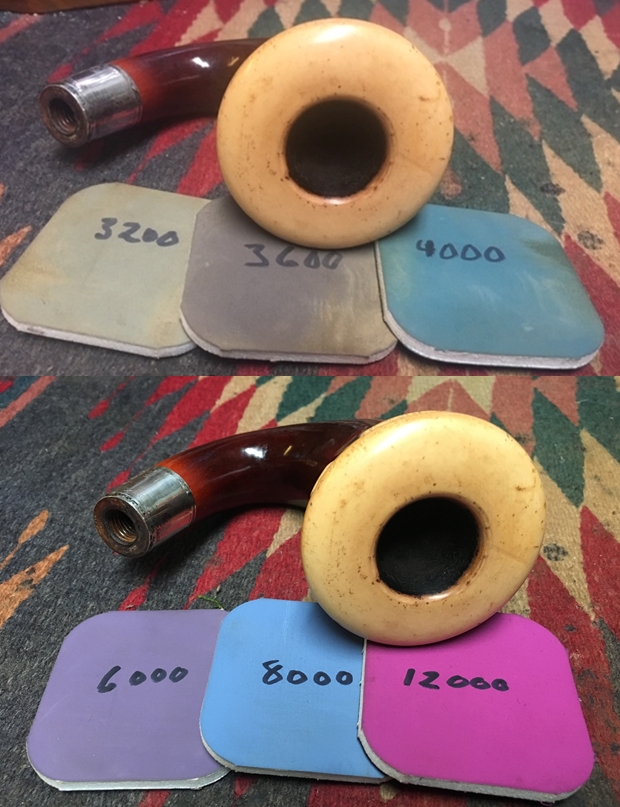
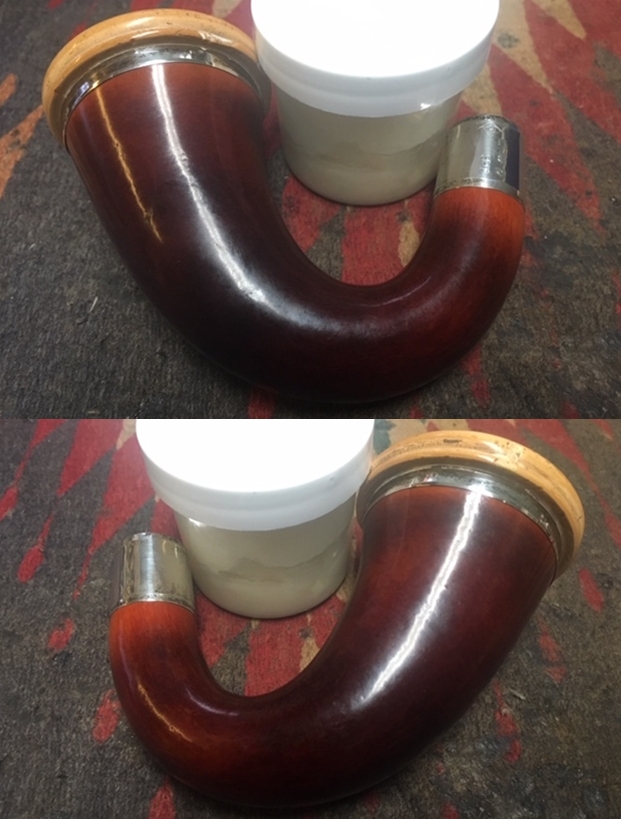
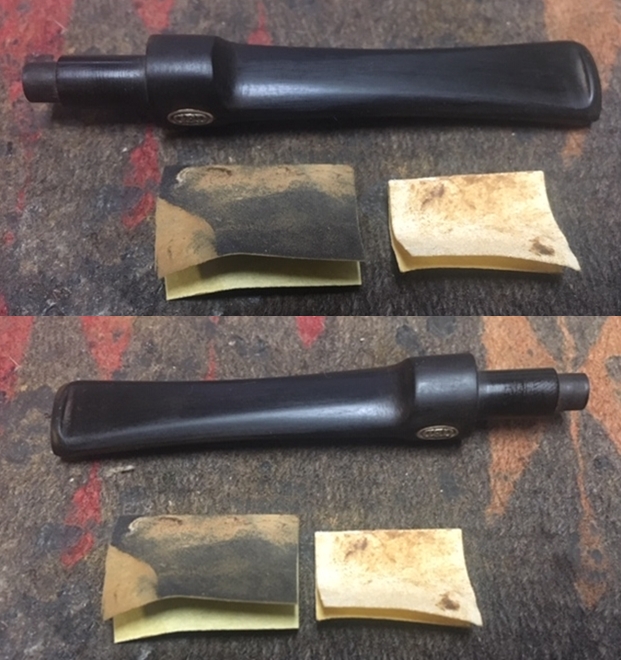
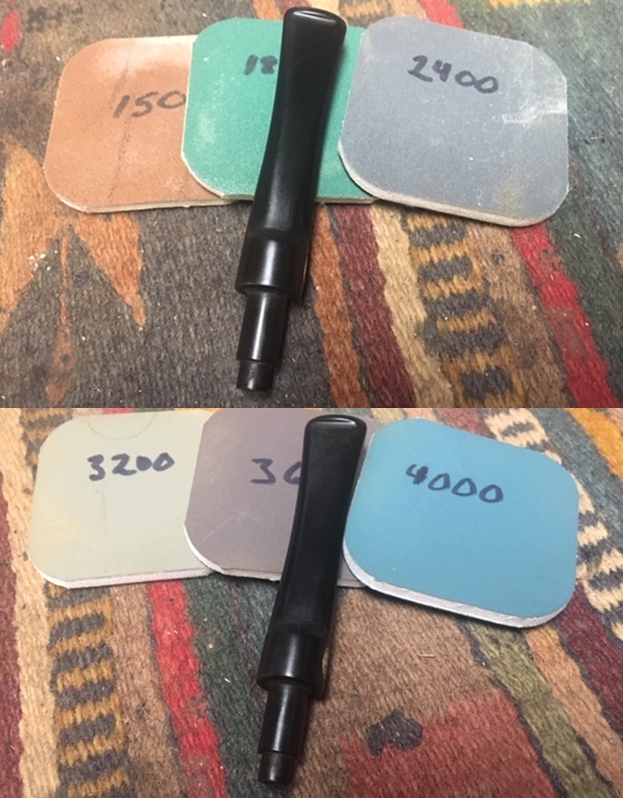
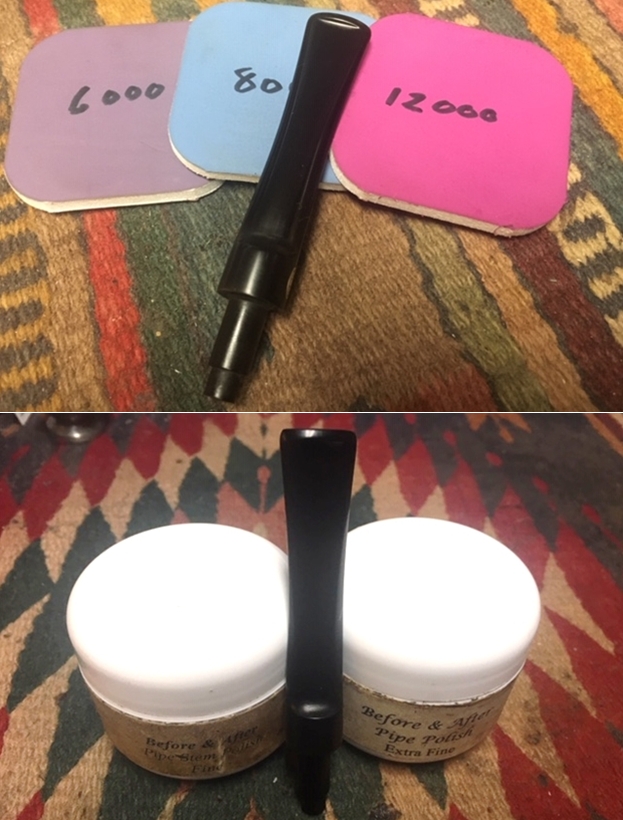
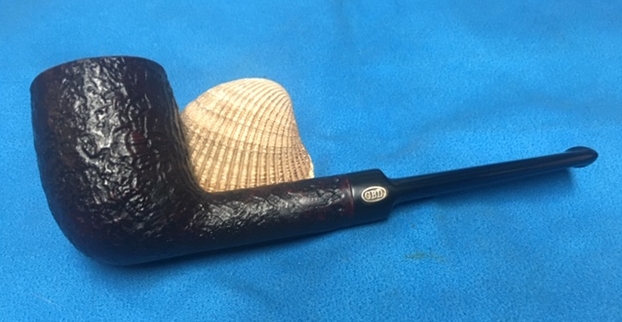
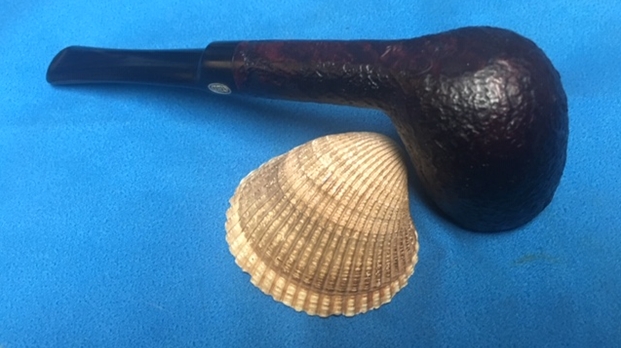
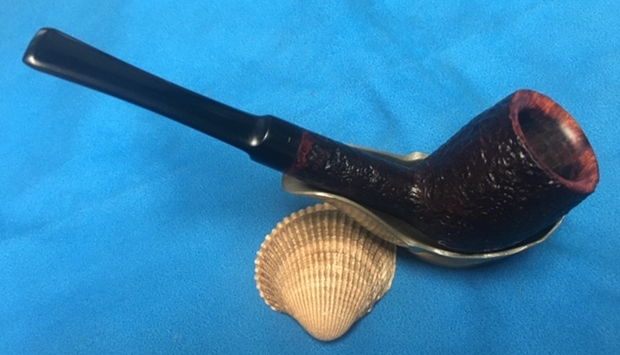
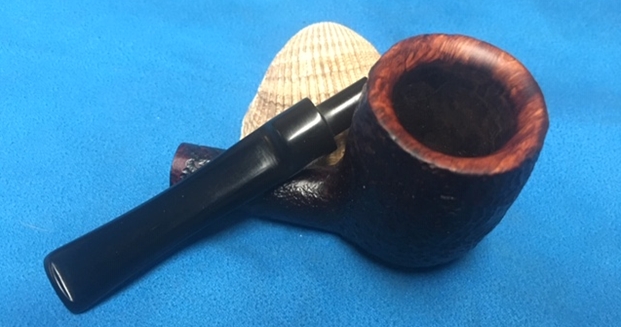
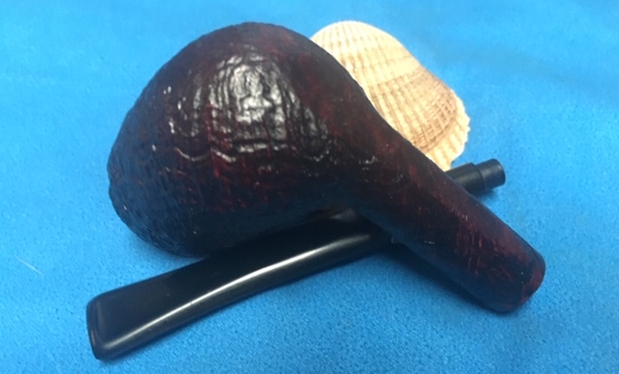
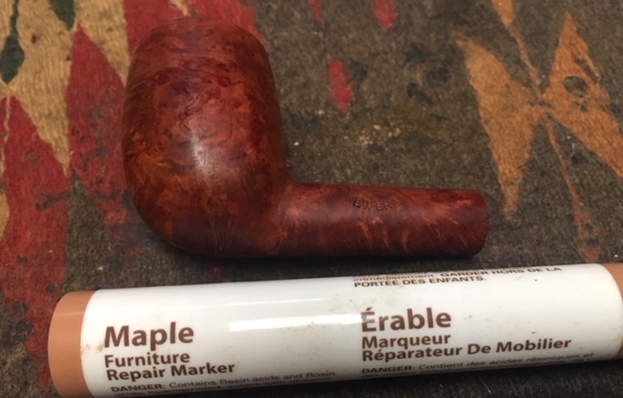
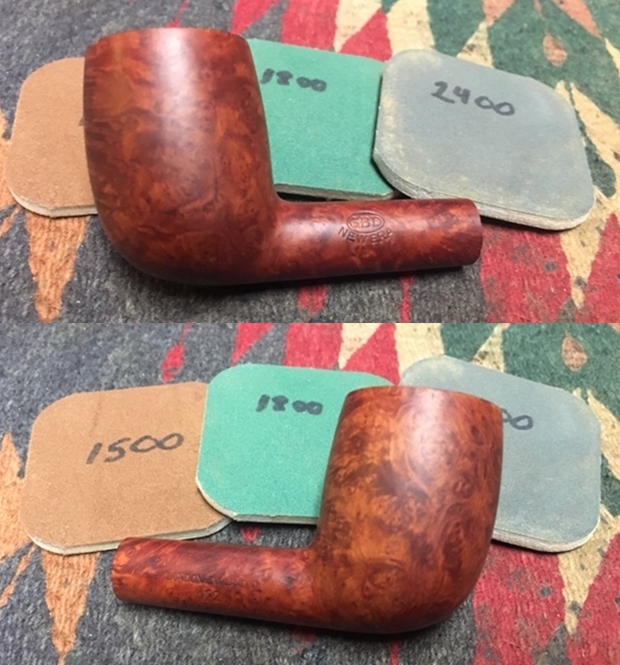
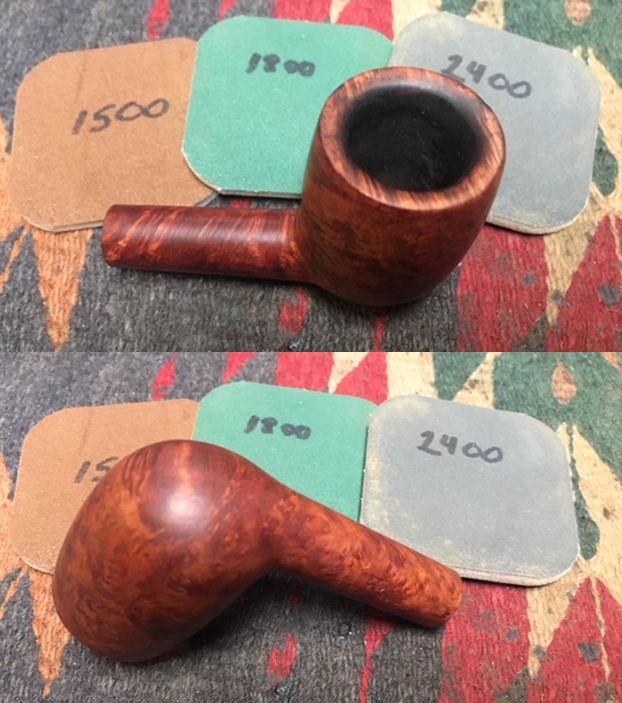
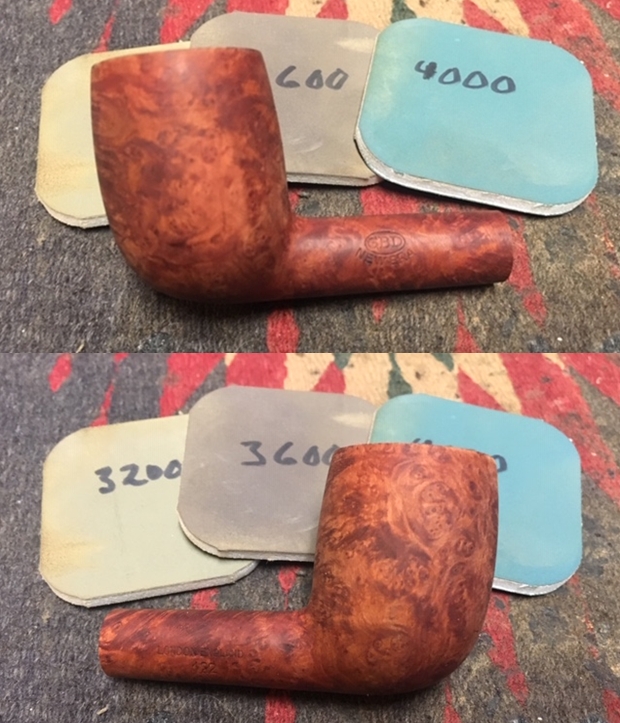
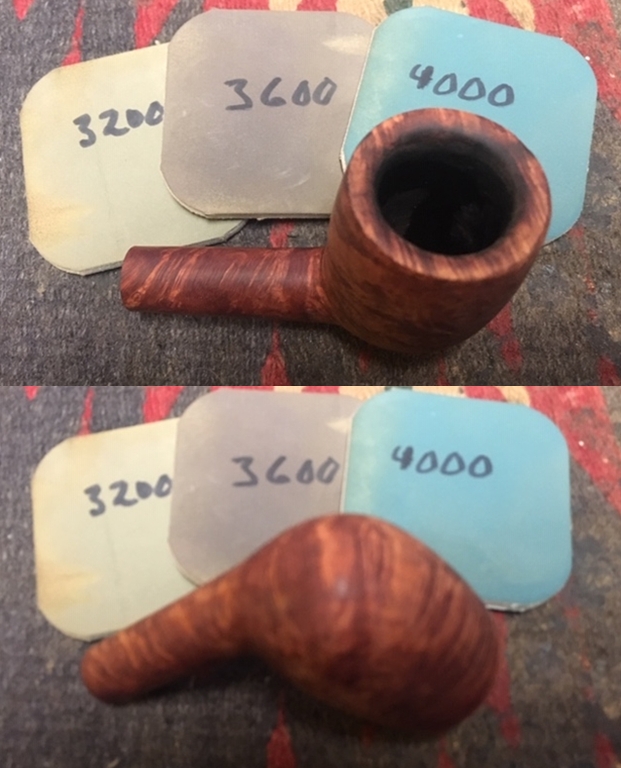
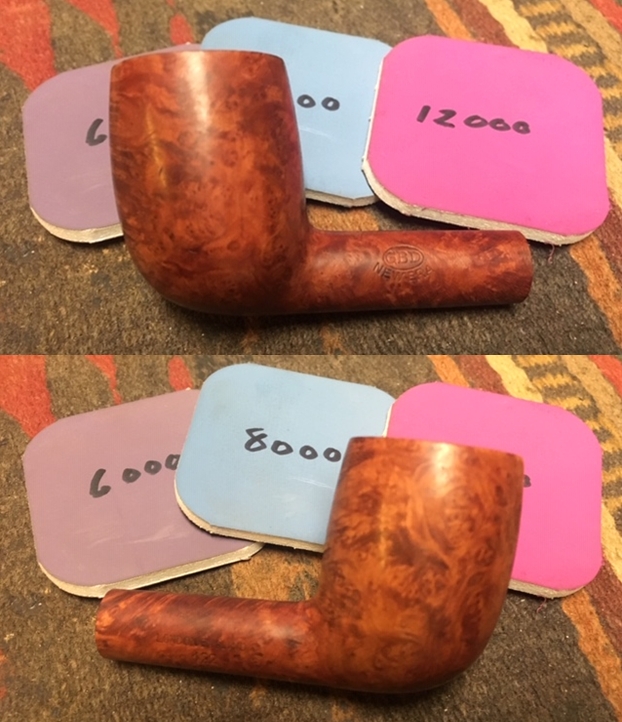
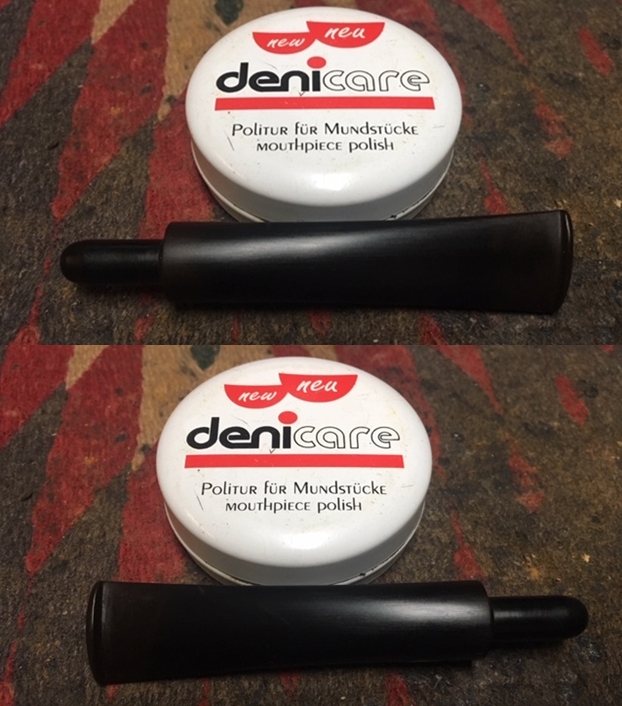
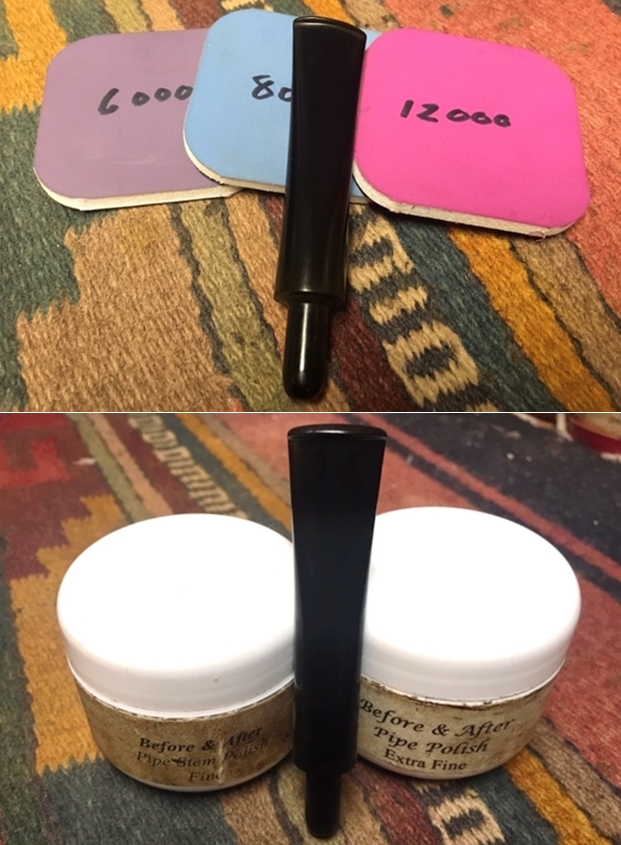
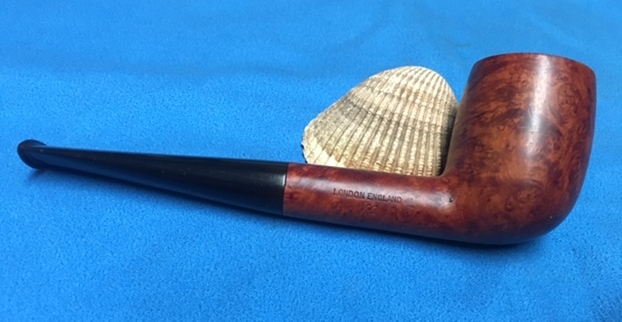
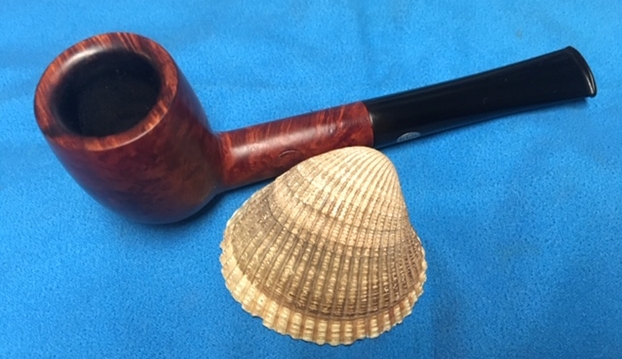
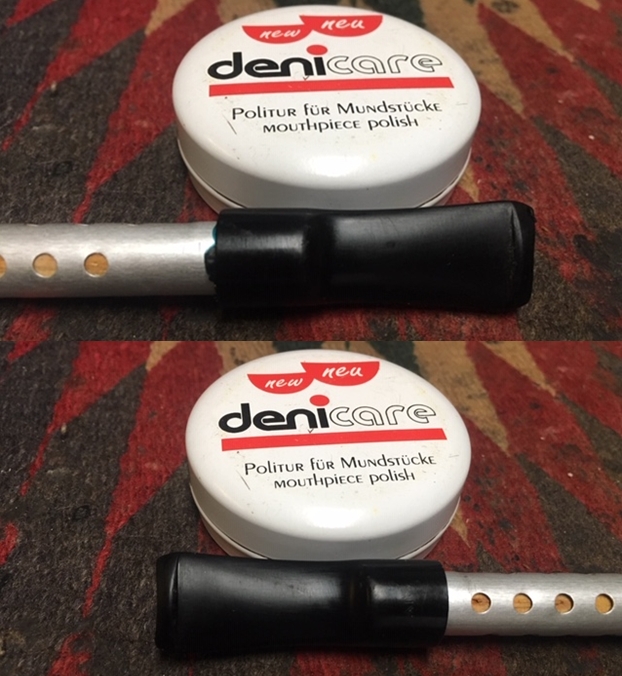
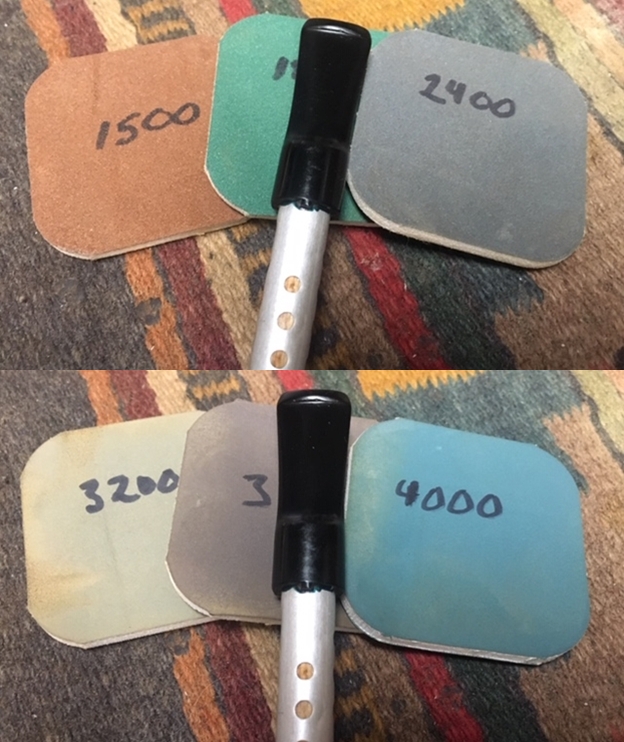
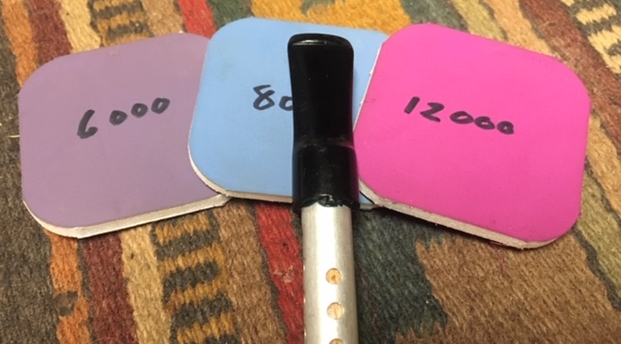
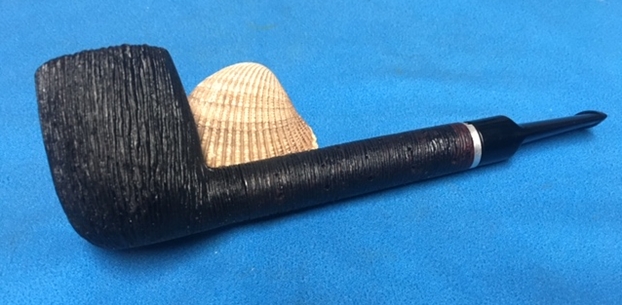
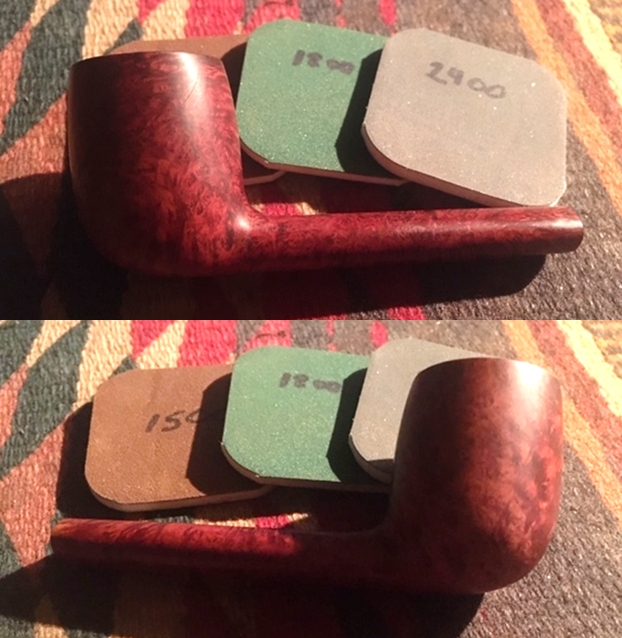
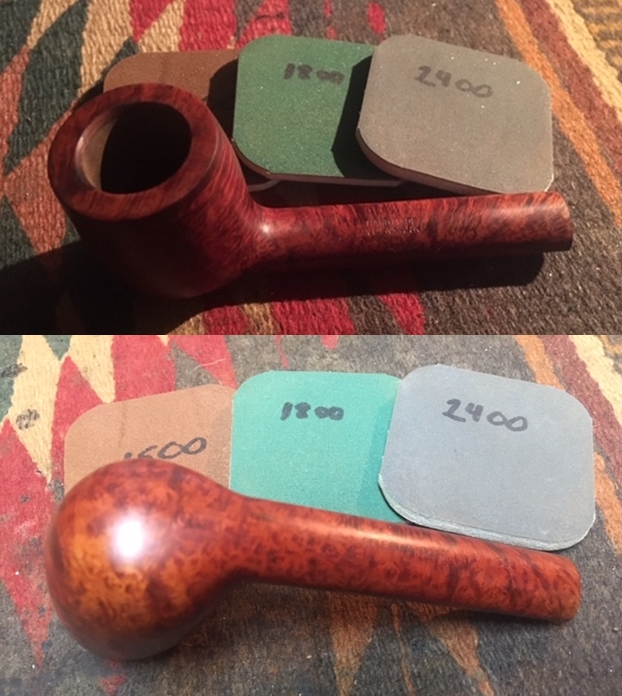
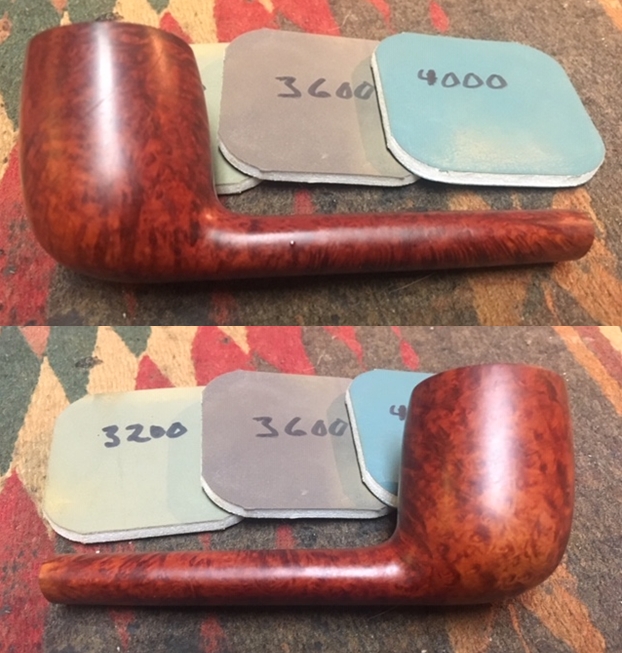
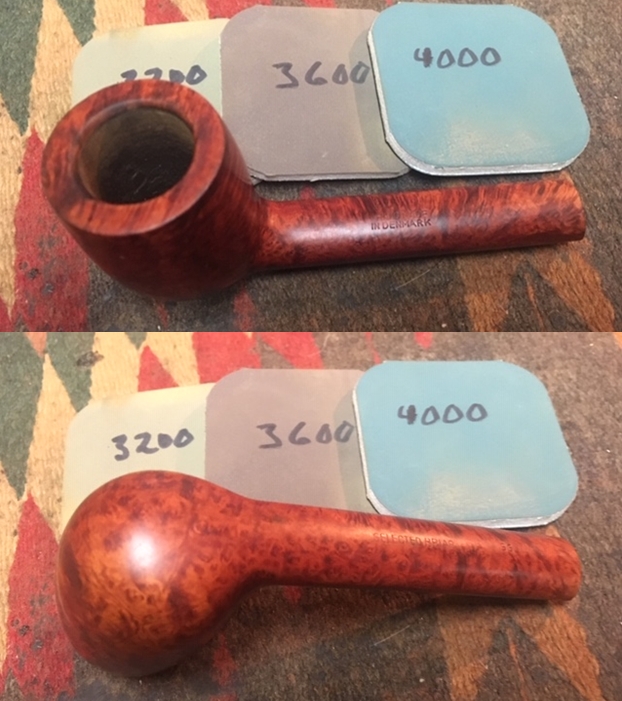
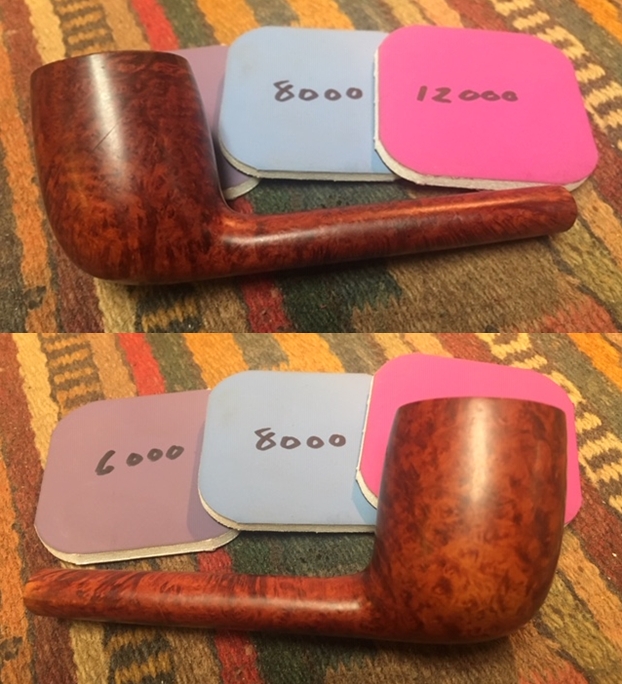
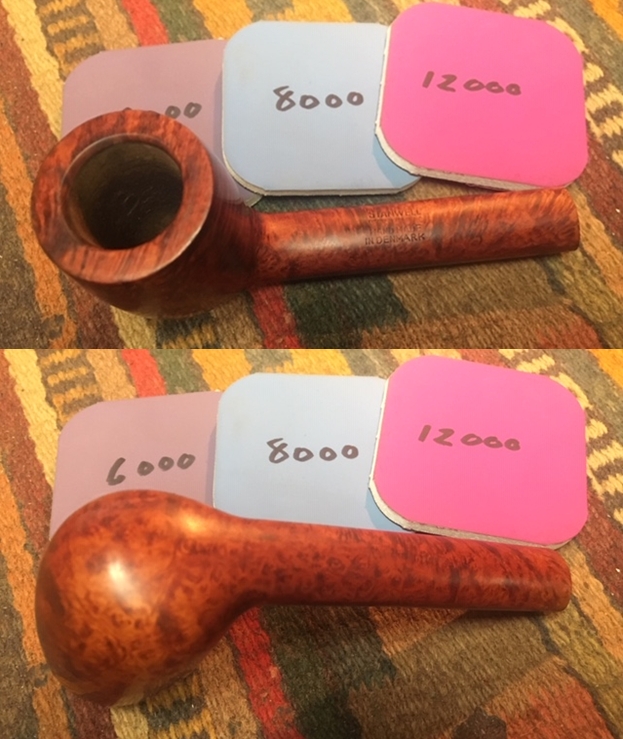
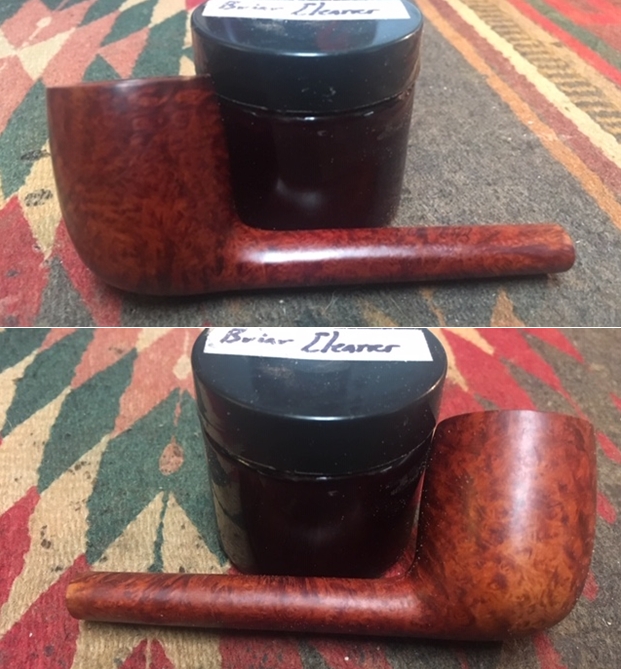
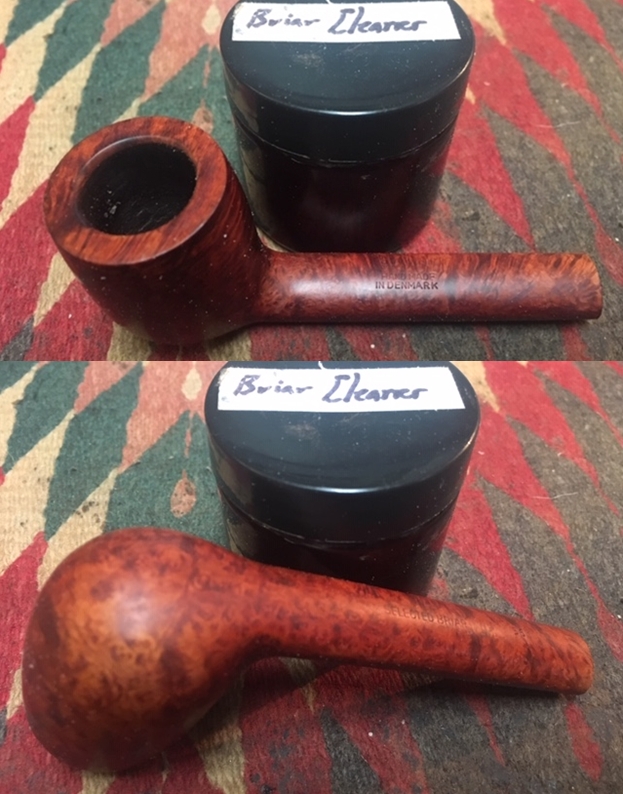
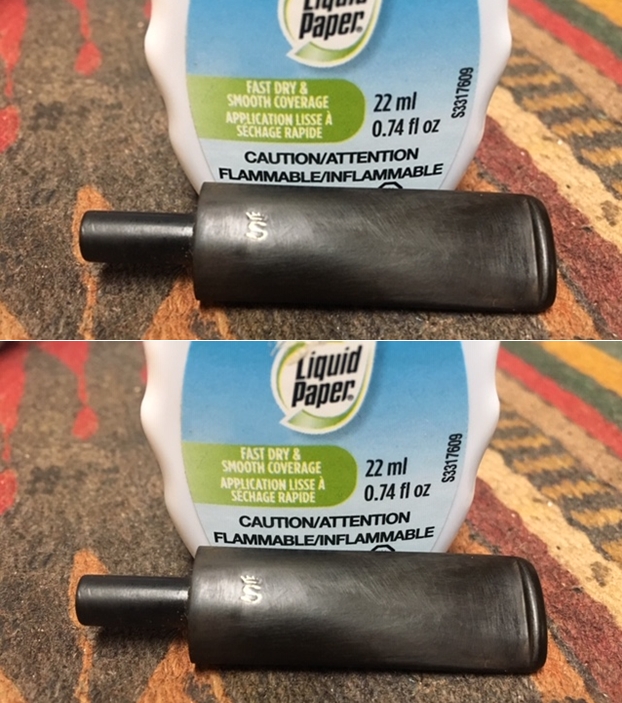
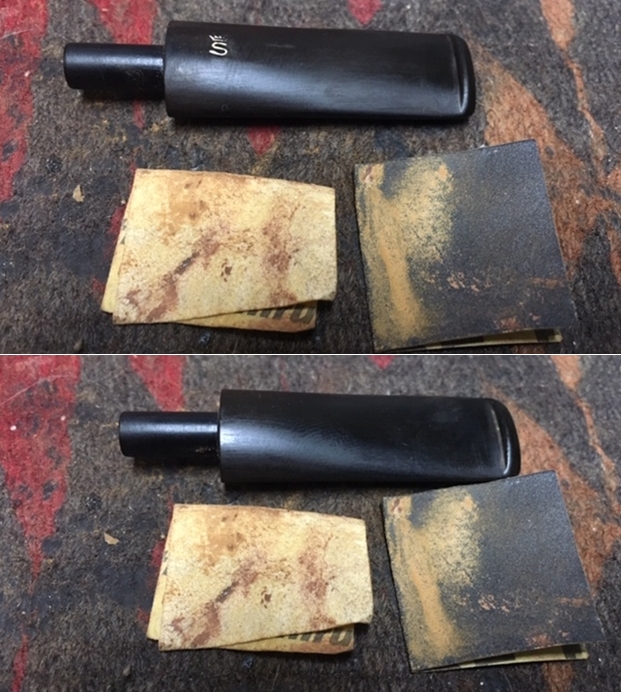
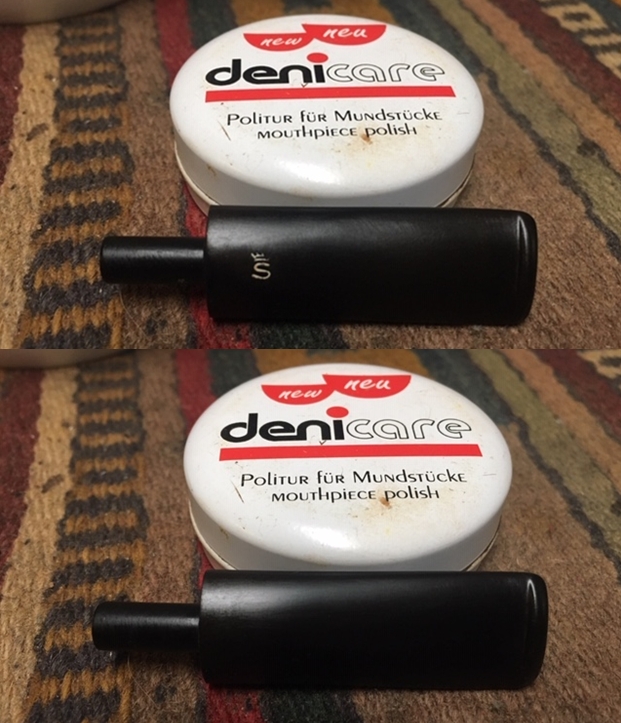
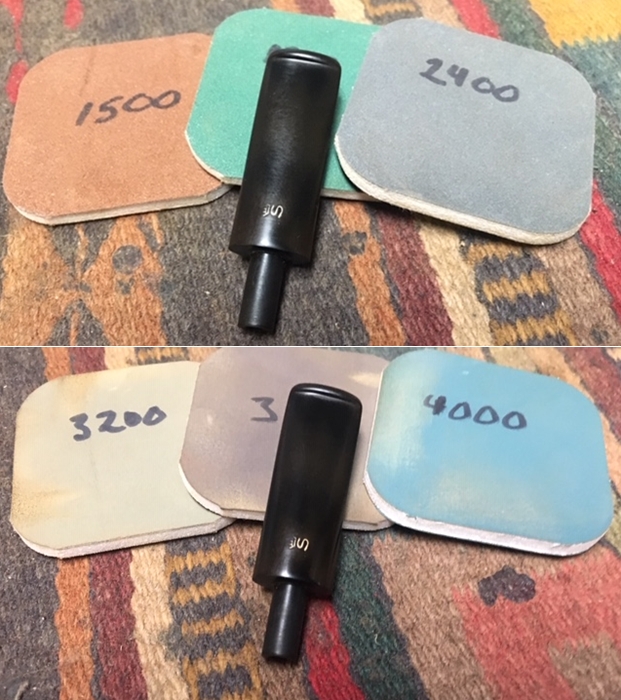
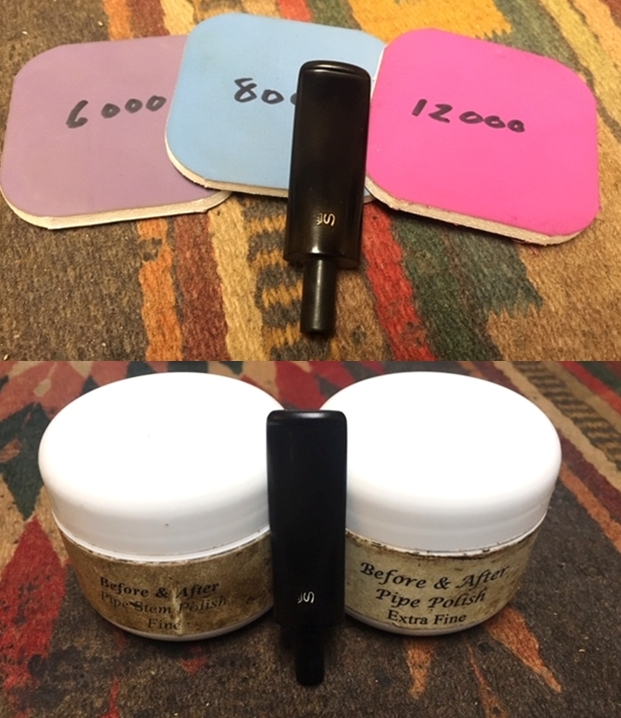
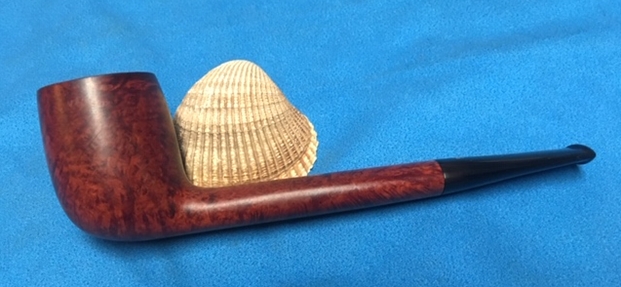
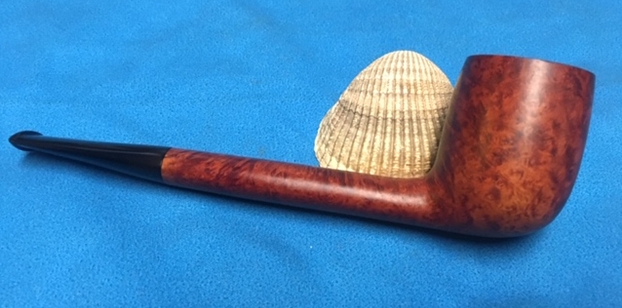
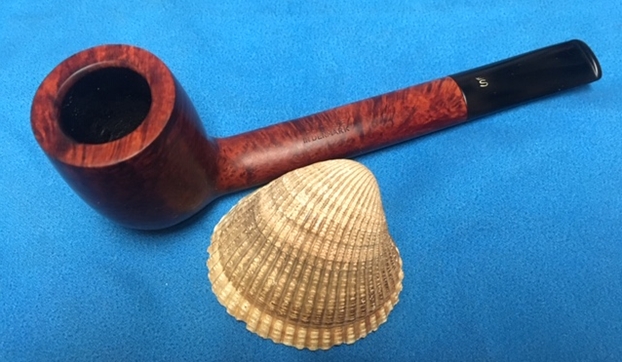
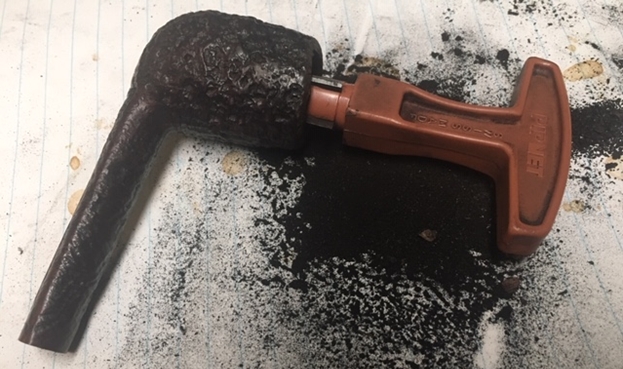
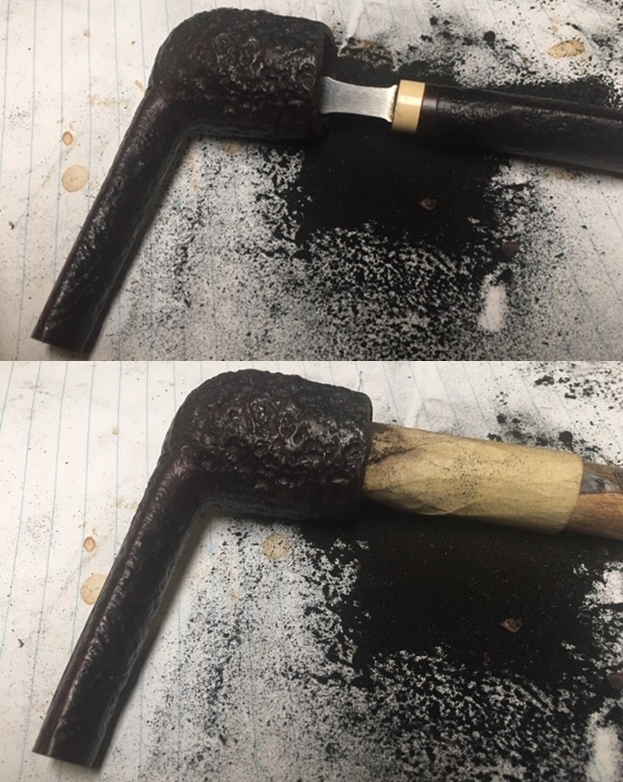
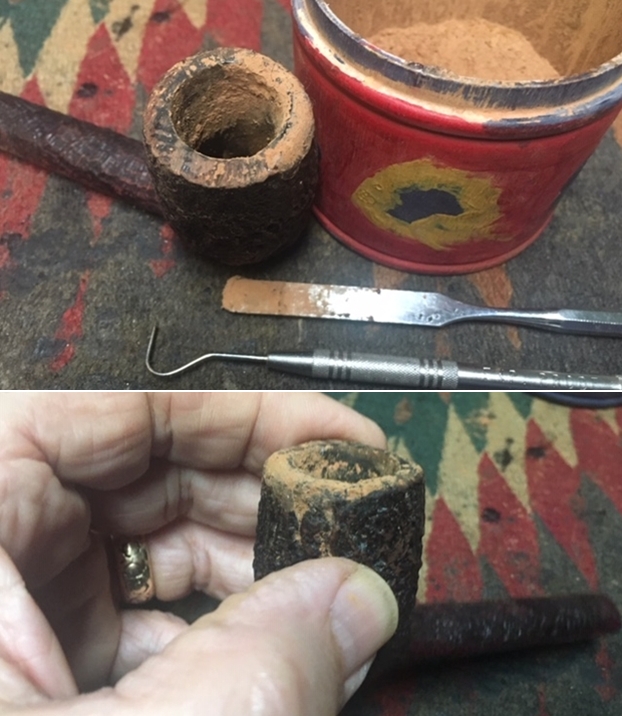
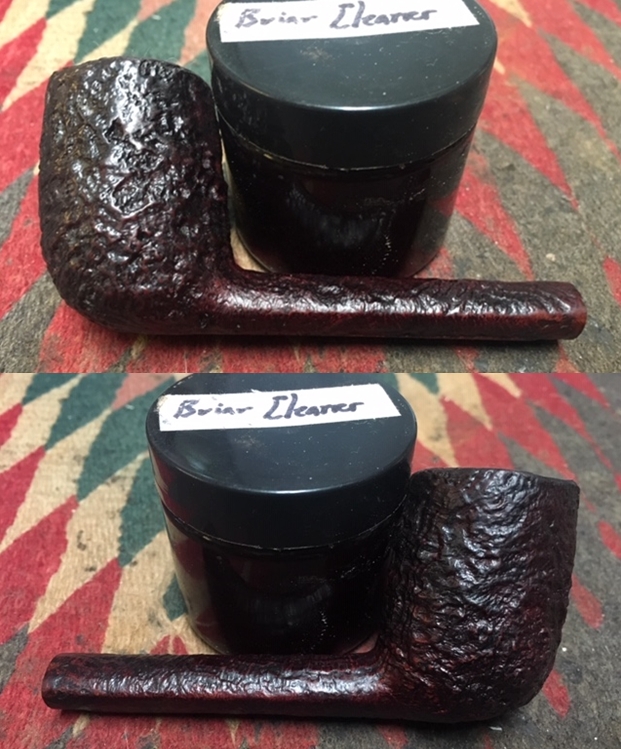
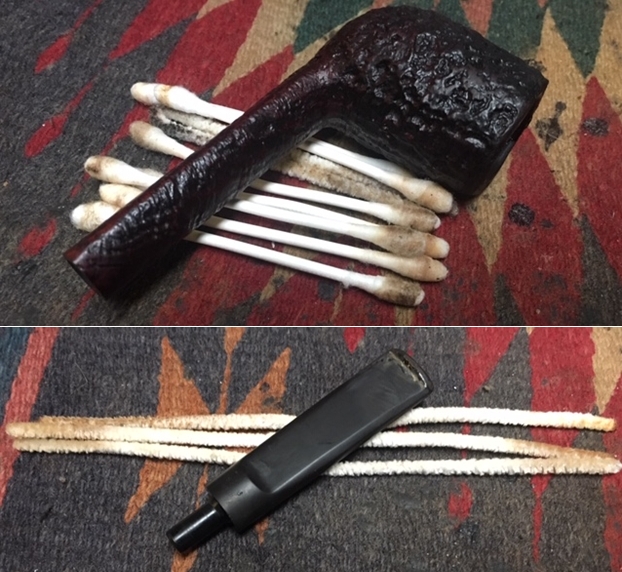
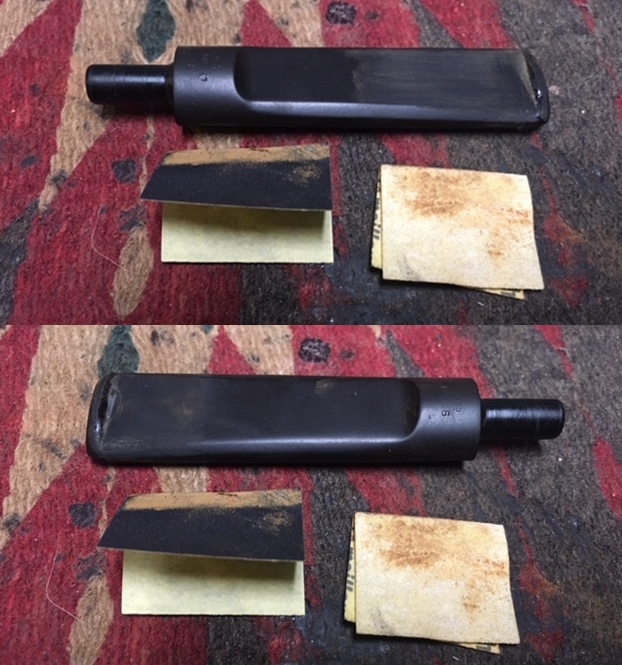
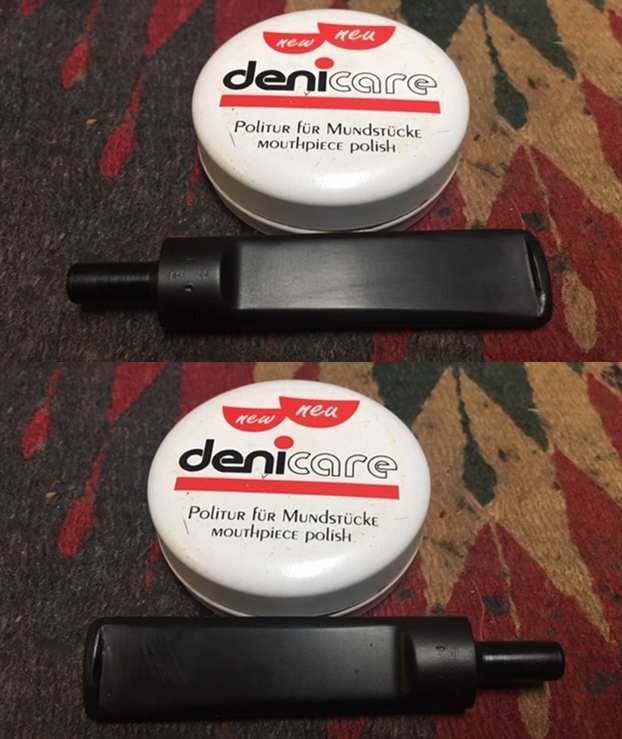
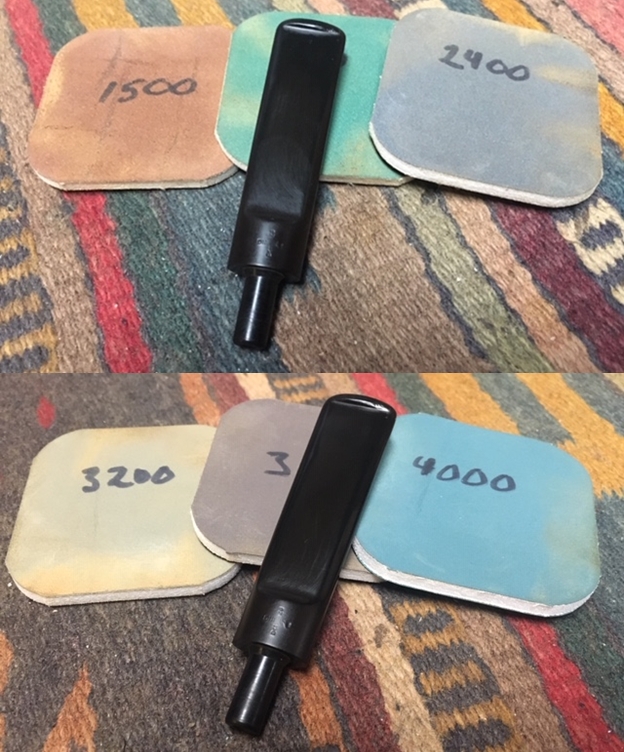
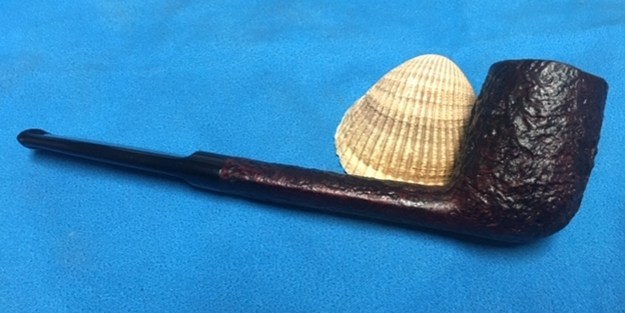
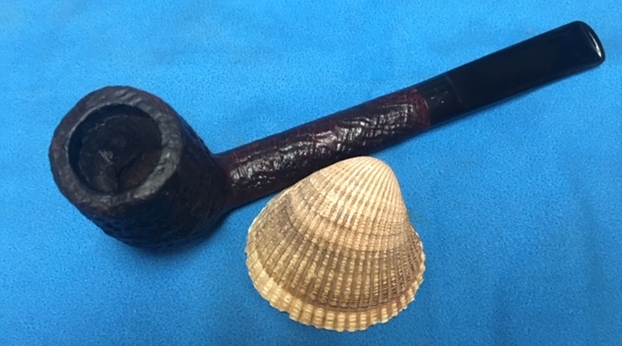
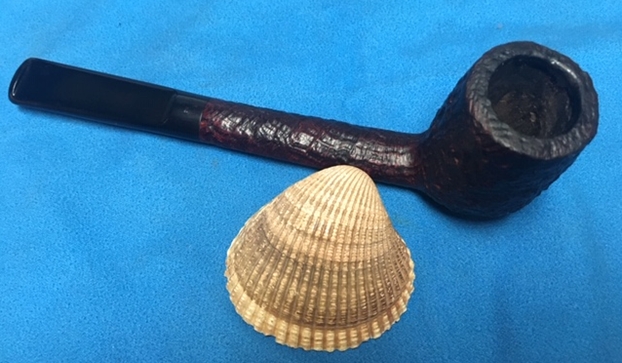
Armed with that information I turned to work on this pipe. The cake was very hard and took a lot of elbow grease to ream it. I started by reaming the bowl to remove as much of the cake on the walls and the debris of tobacco shards as possible. I switched back and forth between that PipNet reamer with the first two cutting heads and the Savinelli Fitsall Pipe Knife to break away more of the rock hard cake. Once I finally got the thick cake removed I sanded the bowl with 220 grit sandpaper wrapped around a piece of dowel and also a Sharpie Pen to smooth out the walls and clean up some of the  damage to the inner edge of the bowl. I used a brass bristle wire brush to clean off the debris on the damaged rim top in preparation for rebuilding the damaged edge on the front right side. There were chips on the inner and outer edge of the rim as well as burn damage on the top at that point. Once I had it cleaned up I wiped the rim down with a cotton pad and alcohol to remove the remaining debris. I layered on a bit of clear super glue and used a dental spatula to add briar dust to the top of the glued areas. I pushed the dust deep in the chipped areas with a dental pick. I repeated the process until the damage rim top matched the height of the remaining rim top. The photos look far more intrusive than they really were. Once the repair had cured I wiped the excess dust off with a cloth (the dust in the bowl is just that dust and was cleaned out upon completion of the repair). I used a little more of the clear super glue to even out the top inner edge of the bowl. Once it had cured it was time to clean up the surface of the bowl. I continued my ongoing experiment with Mark Hoover’s Before & After Briar Cleaner to remove the dust and debris in the grooves of the blast on the bowl and the rim top. I rubbed it into the surface of the briar and let it sit for 10 minutes. I rinsed the bowl off with warm running water to remove the product and the grime. The grain really began to stand out clearly. It was a beautiful piece of briar. I used a Dremel with some sharp and round burrs to match the repaired rimtop to the rest of the rim. The key was to not do too much but just enough to blend it into the sandblast that remained on the rest of the rim top. Once I had finished I used a brass bristle wire brush to clean off the debris left behind by the Dremel.I used a Walnut and a Mahogany stain pen to touch up the stain on the worn outer edges of the bowl and the rim top. I mixed in some black Sharpie pen to blend it to match the bowl colour. I worked some Before & After Restoration Balm into the finish of the bowl and the rim top. I worked it into the surface with my fingertips and a horsehair shoe brush to clean, enliven and protect the wood. I let the balm sit for about 10 minutes and buffed it off with a soft cotton cloth. I took photos of the pipe at this point in the process to show what the bowl looked like at this point. I am happy with the blend of the stain on the right side and the overall look of the bowl at this point. Now the bowl was finished except for the final polishing. I took the stem out of the Before & After Deoxidizer and rinsed it under warm water. I ran a pipe cleaner through the airway to remove the deoxidizer from the airway in the stem. The deoxidizer had done a good job removing the oxidized stem surface. You can see that the stamping is quite weak on the top and underside of the saddle. There is were on the edge of the button on the top side and few tooth dents. On the underside the edge of the stem there was a notch on the side of the stem near the button. There was also wear on the button surface.Once the externals of the stem were cleaned I turned my attention to the internals. I cleaned out the mortise and airway to the bowl and in the stem with 99% isopropyl alcohol, cotton swabs and pipe cleaners. I cleaned both until the cleaners came out white. It was a dirty pipe.I set the bowl aside and turned my attention back to the stem. I built up the deep dents and gouges in the button and the edge of the stem with clear super glue. I set it aside to cure.Once the repairs had cured I used a needle file to recut the edge of the button and smooth out the button edges.I also sanded out the tooth marks and chatter on the surface of the vulcanite and removed the rest of the oxidation on the vulcanite with a folded piece of 220 grit sandpaper. I followed the 220 grit sandpaper with 400 grit wet dry sandpaper to minimize the scratching. I polished the stem with Denicare Mouthpiece Polish to take out the oxidation at the button edge and on the end of the mouthpiece. I buffed the stem with a microfiber cloth.I polished out the scratches with micromesh sanding pads – wet sanding with 1500-12000 grit pads. I wiped the stem down after each sanding pad with Obsidian Oil. I polished it with Before & After Pipe Stem Polish – both Fine and Extra Fine. Once I had finished the polishing I gave it final coat of oil and set it aside to dry. Scott was correct in his note that this was a more difficult restoration. Even so, I am finally on the homestretch with this pipe as well and I really look forward to the final look when it is put back together and polished and waxed. I put the bowl and stem back together. I polished the bowl and stem with Blue Diamond to polish to begin the shine. I gave the bowl multiple coats of Conservator’s Wax and the stem multiple coats of carnauba wax. I buffed the pipe with a clean buffing pad to raise the shine. I hand buffed it with a microfiber cloth to deepen the shine. The pipe polished up pretty nicely. The deeply blasted grain on this old Barling’s Make Ye Olde Wood “Fossil” Canadian looked good with the polished black vulcanite. This Family Era “Fossil”sandblast Canadian shape 437 was a challenging pipe to work on. I really like the look of the Barling Sandblast finish on this one and will need to keep an eye out for one for me. The combination of red and black stains really makes the pipe look attractive. It is a comfortable pipe to hold in the hand and I think that as it heats with smoking that over time the finish will develop even a darker patina as Scott smokes it and it will look even better. The finished pipe is shown in the photos below. The dimensions of the pipe are Length: 6 ¼ inches, Height: 1 7/8 inches, Outside diameter of the bowl: 1 1/8 inches, Chamber diameter: ¾ of an inch. I look forward to hearing what Scott thinks of it once he receives it. I now will need to pack up the two pipes and get them in the mail to him. Thanks for reading this blog and my reflections on the pipe while I worked on it. This is an interesting estate to bring back to life.
A Simple Restoration of a “Jobey Filtersan # 690”


Blog by Paresh Deshpande

I am in a rush to complete as many pipes as I can before Abha, my wife, sends me another batch of 30-40 pipes to restore!! Her pace of completing the initial cleaning of the pipes is very difficult for me to match by completing the remaining restorations aspects of these pipes.

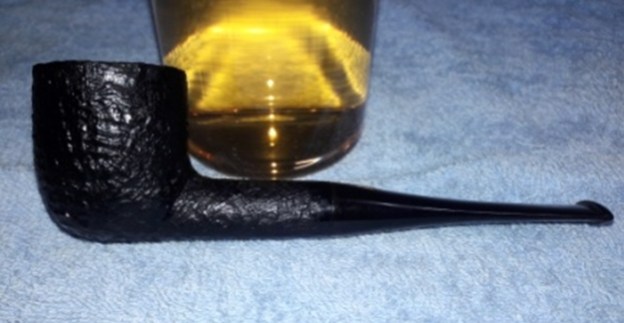
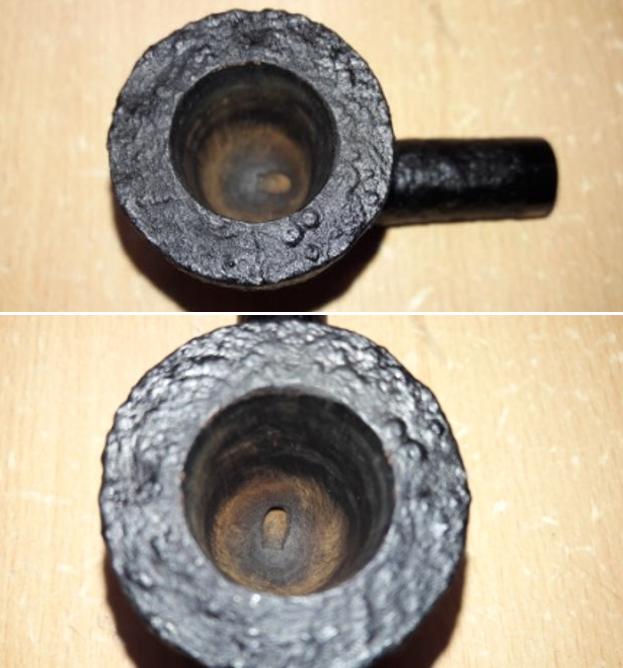
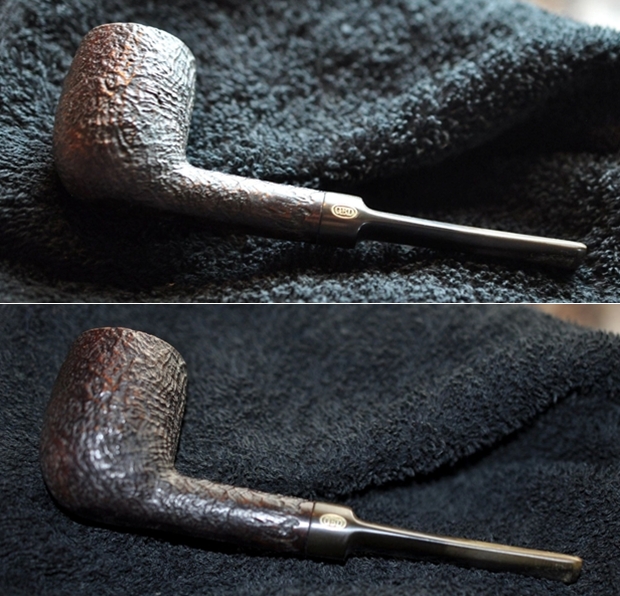
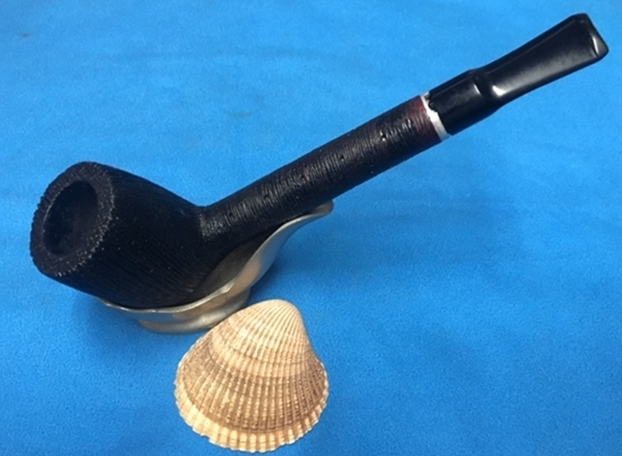
Well, the next pipe that I decided to work on is a straight pot (actually I feel it is cross between a Billiard and a Pot what with the bowl height of a Pot and the width of a Billiard!!),  Jobey Filtersan pipe in a beautiful black stained sandblast finish. The beautiful sandblast patterns can be seen all around the stummel and rim top surface, save for smooth surfaces at the bottom of the shank which bears the stamping on this pipe and the second that forms a band at the shank end. The pipe is stamped “Jobey” in cursive hand over “FILTERSAN” in block letters. Adjacent to these stampings, is another set of stamps in line with the above and reads “FRANCE” over “690”. The stampings are all crisp and prominent. I had previously worked on an interestingly shaped Jobey Original Bent Dublin Sitter; here is the link to write up (https://rebornpipes.com/2018/09/14/jobey-original-t1/), and had researched this brand then. To refresh my memory, I revisited the write up and also included some information from pipedia.org. Here are some interesting excerpts from pipedia.org…

Jobey

English – American – Danish – French… Sadly, solid information about Jobey is scant…

Probably established in England around 1920(?) the brand hiked into the USA later. In the course of time owner, distributor and manufacturer changed repeatedly. As far as is known the following companies have been involved with the brand:

Throughout decades Jobey pipes were mainly sold in the USA, Canada and England but remained almost unknown in continental Europe. The bulk of Jobeys was predominantly made according to classical patterns and mainly in the lower to middle price range. The predominant judgment of the pipe smokers reads: “A well made pipe for the price.” So there is hardly anything very special or exciting about Jobey pipes although a flyer from ca. 1970 assures:

“The briar root Jobey insists upon for its peer of pipes is left untouched to grow, harden and sweeten for 100 years. […] Jobey uses only the heart of this century old briar and only one out of 500 bowls turned measures up to the rigid Jobey specifications.” 99.80% of cull… that makes the layman marveling!

Yet then there are partially really exciting Freehands mainly in the seventies, that Jobey – Weber owned back then – bought from Danish pipe genius Karl Erik (Ottendahl). These pipes were offered as Jobey Dansk – ’70’s pure! (BTW waning sales caused Ottendahl to discontinue exports to the United States in 1987).

In the very same year – obviously only as a ghost brand – Jobey was transferred to Saint-Claude, France to be manufactured by Butz-Choquin.

There must have been an abandonment of the fabrication, because in 2002 the message was spread, the current proprietor of the brand F&K Cigar Co. from St. Louis, MO had recently re-introduced the Jobey very successfully again…

From the above information and correlating the stampings on this pipe, it is safe to conclude that this pipe is definitely post 1987 and made by Butz-Choquin when the brand was transferred to France. With rough idea of the origins of this pipe, I move ahead to the next step in the process of restoration that I follow.

INITIAL VISUAL INSPECTION
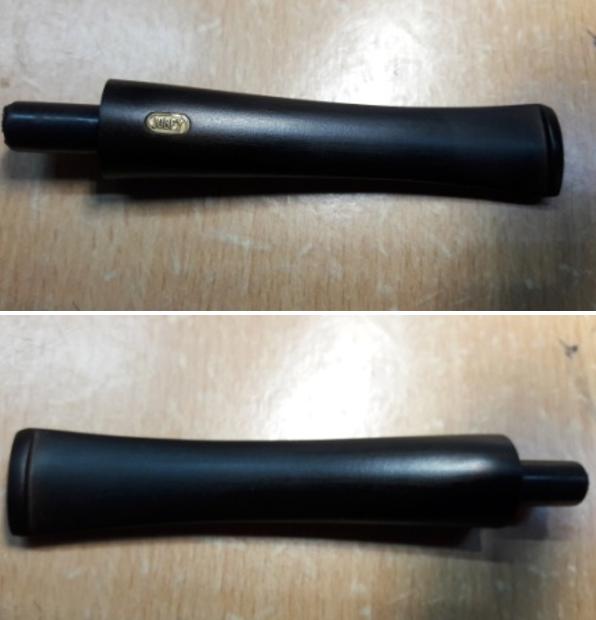
The pipe came to us in an excellent condition when compared to most of the pipes that I have worked on till date. It was maybe smoked a couple of times at best. The chamber is in pristine condition with a very thin layer of cake which is soft and crumbling. For Abha, my wife, this should be a breeze to clean. The sandblast rim top has a little dust and tar accumulation. The rim outer and inner edges are in excellent condition and without any damage.The sandblasted stummel surface has beautiful patterns with the cross grains and vertical grains forming a grid pattern. The stummel surface has dulled a bit and appears lifeless due to accumulation of dust and dirt within these sandblast patterns. A small quantity of accumulation of oils and grime is seen in the mortise and a thorough cleaning with pipe cleaners and alcohol should address this issue. The vulcanite stem is lightly oxidized and without any bite marks or tooth chatter on either surface. The tenon is made of plastic and houses a 6mm filter (came with a new filter!!). The insides of the slot and tenon have signs of accumulated gunk. The brass roundel with embossed logo of the pipe brand is intact, albeit oxidized. This should polish up nicely. INITIAL CLEANING BY ABHA…

The initial cleaning on this pipe was done by Abha, my wife (she has cleaned up around 40-50 pipes and these have now reached me for further restoration). She reamed out the complete cake and further smoothed out the chamber walls with a folded piece of 220 grit sand paper. She further cleaned out the internals of the shank with pipe cleaners and alcohol and cotton buds. She followed the internal cleaning of the shank with external cleaning of the stummel using Murphy’s Oil soap and hard bristled tooth brush and dried it with paper napkins and cotton cloth.

Next she cleaned out the internals of the stem air way and immersed it in “Before and After Deoxidizer” solution along with the stem of other pipes in line for restoration. Once the stem had soaked overnight, she cleaned the stem under running warm water and scrubbed the raised oxidation from the stem surface using Scotch Brite pad. She further removed the oxidation by scrubbing the stem with 0000 grade steel wool and applied a little olive oil to rehydrate the stem. She had removed the stinger from the tenon and cleaned it with cotton swabs, pipe cleaners and alcohol.

ONCE THE PIPE IS ON MY WORK TABLE……
Now that the cleaned up pipe is on my work table, I proceed to carry out my appreciation of the work that needs to be done on this pipe to restore it.

The chamber is odorless and the walls are solid without any signs of damage. The sandblast rim top surface is in decent condition with the inner and outer rim edge in excellent condition. I could still see remnants of the accumulated dirt and grime in the sandblasts of the rim top surface (hope Abha does not read this post!!). I shall remove this crud with a soft brass wired brush. The mortise and shank internals are nice and clean. The stummel is nice and clean. Once the stummel was cleaned up by Abha, I could see a small crack on the left side of the shank close to the smooth briar band at the shank end (marked in red circle). I probed it with my dental tool and found it to be solid without any give. I think this could be a flaw in the briar. However, to ally my worst fears, I shared the pictures of this flaw with Steve for his opinion and to my great relief, he concurred with my assessment. I would just fill it up with a drop of superglue and use a black sharpie marker to mask this flaw. There is, in fact, not much work to be done here save for some spit and polishing to make it nice and shiny again. The oxidation on the vulcanite stem has been greatly reduced, thanks to all the efforts put in by Abha. A bit of sanding to remove the deeper oxidation followed by micromesh polishing cycle should add a nice shine to the stem.THE PROCESS
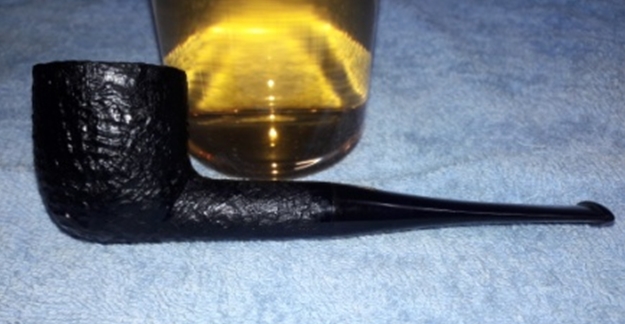
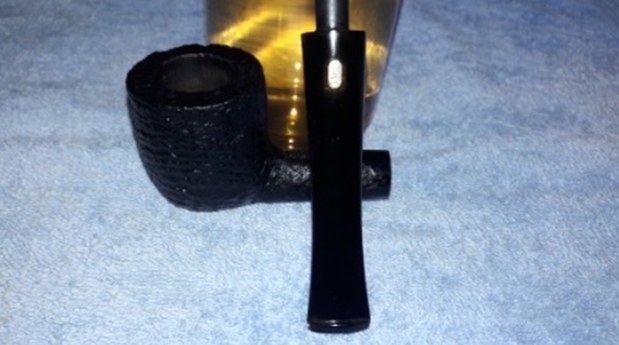
The first issue I addressed was that of the flaw that I had observed during my inspection of the stummel. I spot filled the flaw with a drop of superglue and set it aside to enter in to whatever gaps that may exist internally and harden.While the shank fill was curing, I sand the stem with a folded piece of 220 grit sandpaper and followed it up by sanding it with 400, 600 and 800 grit sand papers. This serves to remove the deep seated oxidation from the stem surface and also reduces the sanding marks of the more abrasive sand papers. I wiped the stem with a moist cloth to remove all the oxidation from the surface.I followed up the sanding regime with micromesh polishing to bring a shine on the stem surface. I wet sand the stem with 1500 to 2400 girt micromesh pads. Continuing with my experimentation that I had spelled out in my previous post on ROPP REPORTER # L-83 pipe, I mount a cotton buffing wheel on my hand held rotary tool and polish the stem with Red Rouge polish as I had read that this polish has grit in between 2400 to 3200 grit pads of the micromesh pads. Further, I mount a fresh buffing wheel on the rotary tool and polish the stem with White Diamond polish as it has grit equivalent to 3800- 4000 of micromesh pads. I finish the stem polish by wet sanding with 6000 to 12000 grit pads of the micromesh. I rub a small quantity of olive oil in to the stem surface to hydrate it and set it aside. I am really happy with this process of stem polishing as the results are excellent while saving me huge amounts of time and effort. The shank fill had cured in the intervening period and I sand the excess superglue with a worn out piece of 220 grit sand paper. I further mask it with a permanent black marker. The fill should be impossible once the stummel has been polished and buffed.Next, with a soft bristled brass wired brush, I gently scrub the sandblasted surface of the rim top and dislodged the dried up gunk. The rim top surface is now nice and clean and the stummel is prepped for the next stage in the restoration.Next, I rub a small quantity of “Before and After Restoration Balm” in to the briar with my finger tips and let it rest for a few minutes. The balm almost immediately works its magic and the briar now has a nice vibrant appearance with the beautiful black sandblast patterns on full display. I further buff it with a horse hair shoe brush. With the stem well hydrated at this point with absorption of olive oil, I wiped it dry with a paper napkin and removed any excess oil from the stem surface. I applied a small quantity of “Before and After Extra Fine” stem polish and rubbed it deep in to the vulcanite stem. This polish, purportedly, is supposed to remove the finer sanding marks left behind by the abrasive grit papers.Now, on to the homestretch!! I mount a cotton cloth buffing wheel on to my hand held rotary tool and apply a coat of Blue Diamond to the stummel, shank extension and the stem to polish out the minor scratches.With a cotton buffing wheel that I use for carnauba wax, I apply a coat of carnauba wax and continue to work on it till the complete coat of wax had been polished out. I mount a clean cotton cloth buffing wheel and give the entire pipe a once over buff. I finished the restoration by giving the entire pipe a rigorous hand buffing using a microfiber cloth to raise the shine further. The finished pipe looks beautiful and should be an ideal combination with a black suit or a black tuxedo!! P.S. This pipe has already found a new piper to carry forward the trust posed in him by the previous piper and I am sure that this pipe will provide the new piper many years of happy smokes and will remind him of our association.

I cannot thank Abha, my wife, enough who not only supports my hobby of pipe restoration, but actively helps in this work by doing all the dirty work of initial cleaning and providing me a clean platform to work further.

Thank you all readers of rebornpipes who have spared a moment of their invaluable time in reading through this write up and as is always, your suggestions and advice on my experimentation is always welcome as this would also help the new pursuers of this art.


An Interesting Pipe to Work On- “Ropp Reporter”


Blog by Paresh Deshpande

Even though the work on my last project which I had mentioned in all my previous couple of blogs as one that I was keen to work on, has been more or less completed, the write up is pending for one simple reason, there was an issue which was pointed out by Steve when I shared pictures of the finished pipe with him. To address the issue, I need to travel back to my home town where services of a very special artisan are needed to be sought. Well, unraveling of this mysterious pipe will happen only in October 2019 and in the meanwhile I move ahead with my other restorations!!

The next pipe on my work table is a French pipe, makers of which trace back their history to 1870s!! Most of the learned readers would have guessed it right, it’s indeed a ROPP!

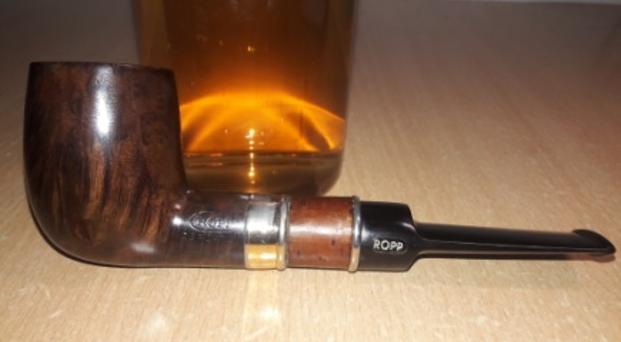
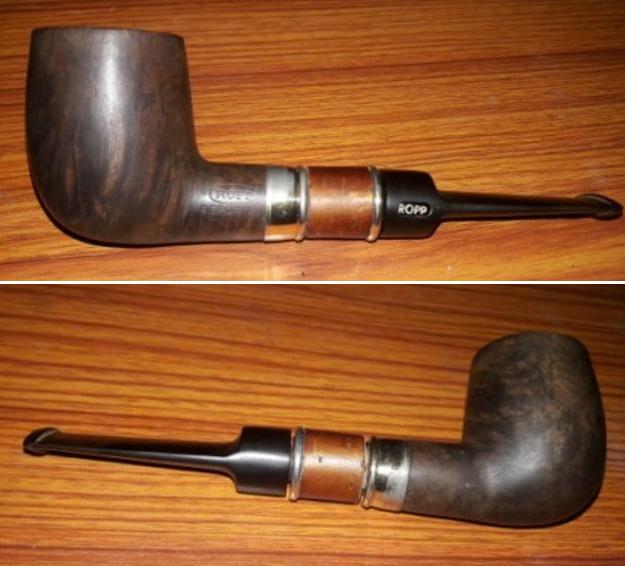
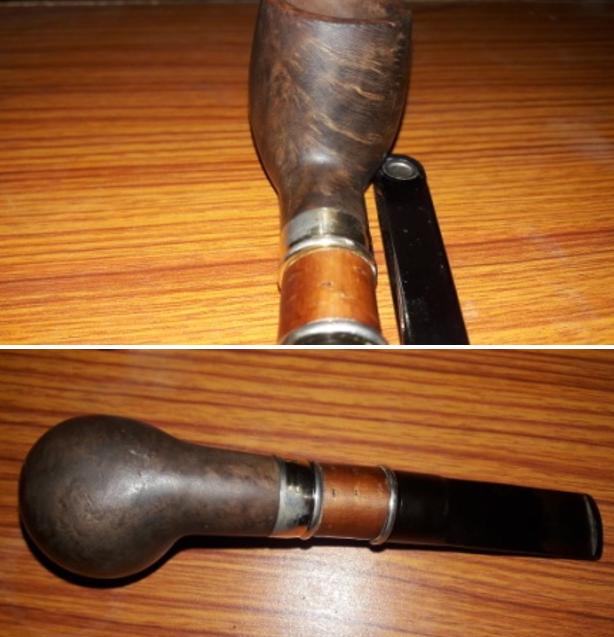
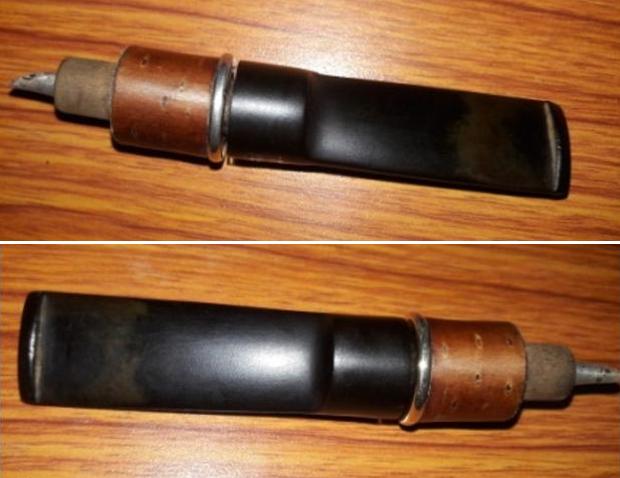
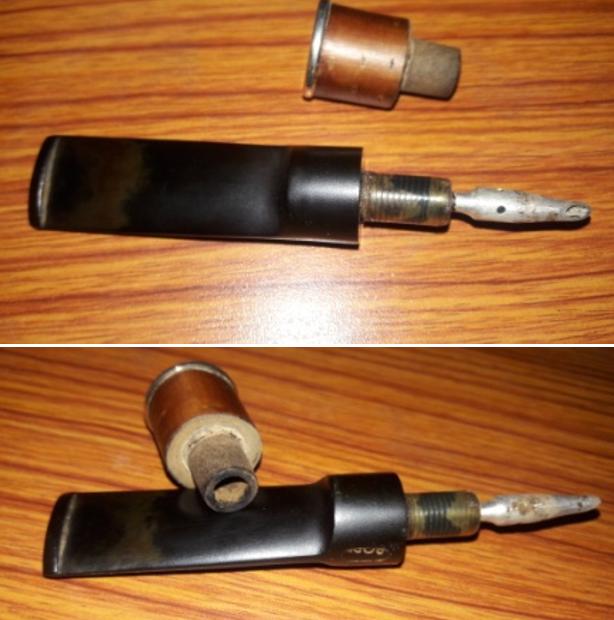
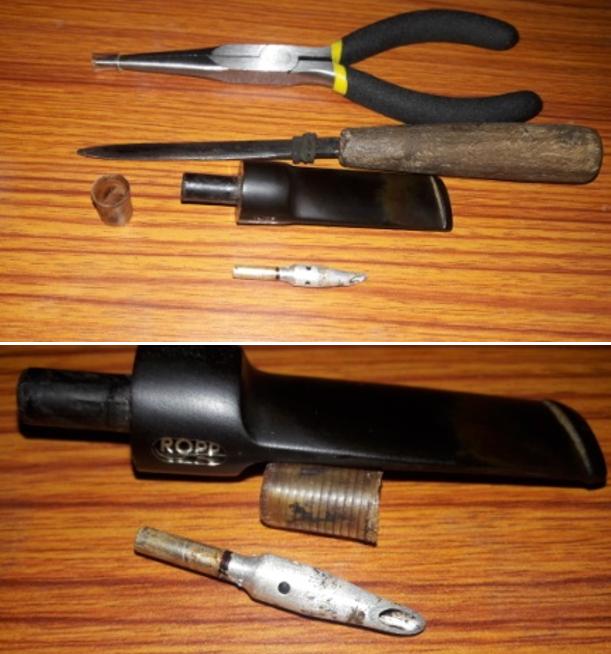
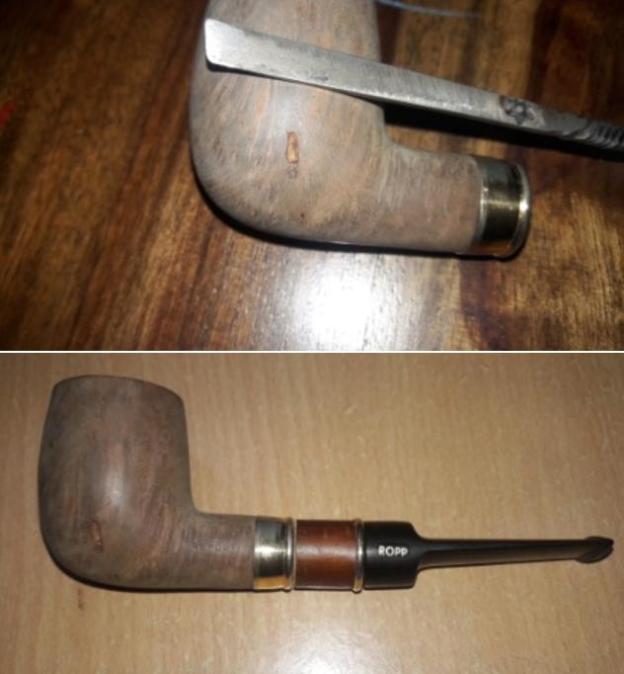
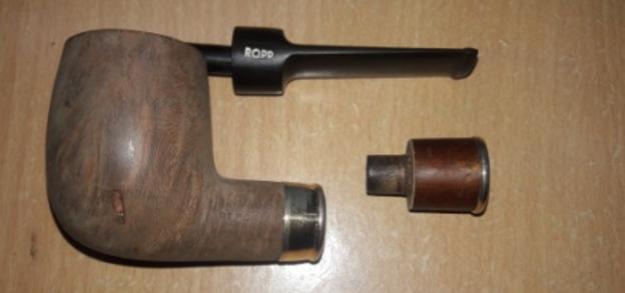
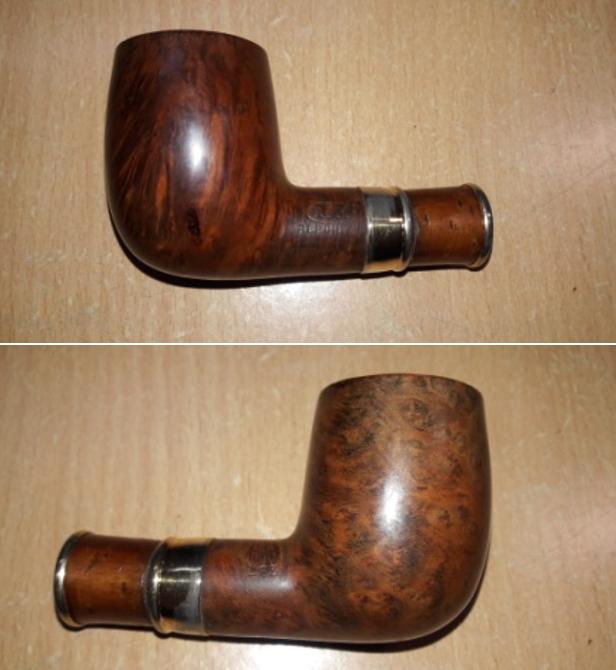
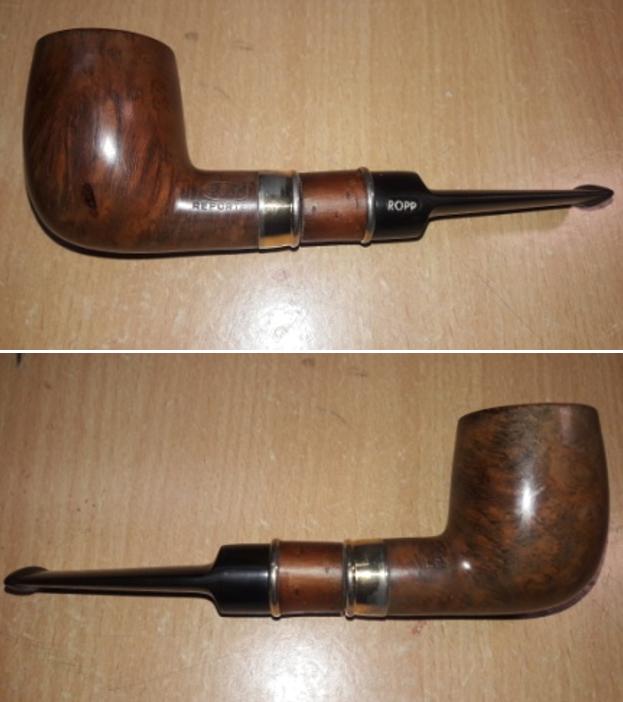
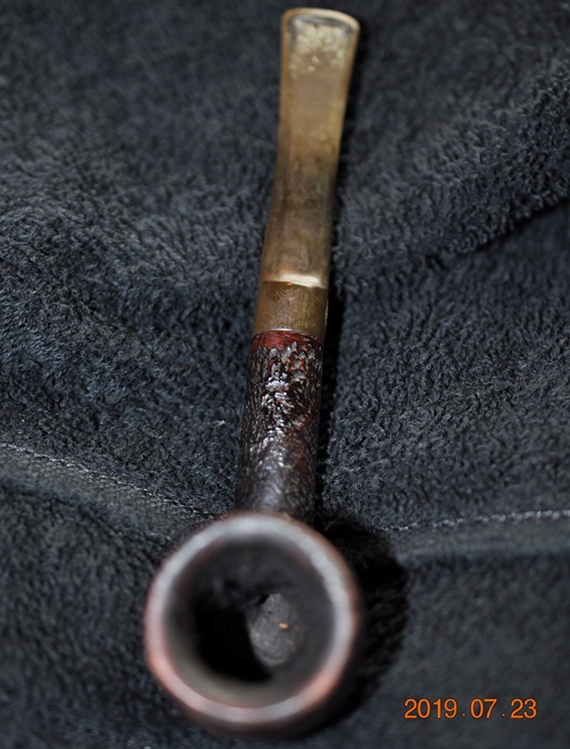
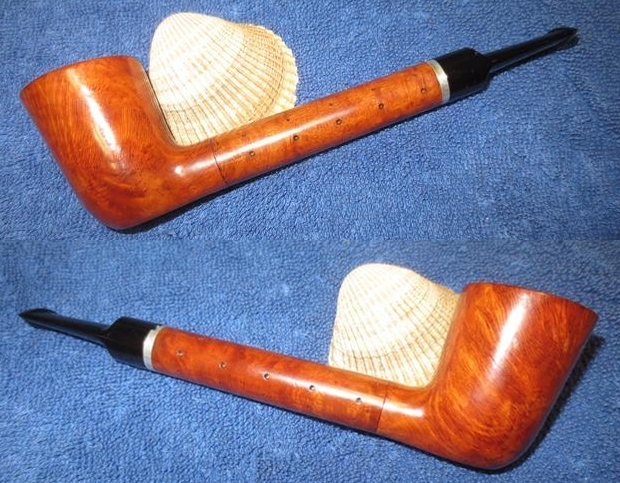
The pipe is a large bowl straight billiards with shiny golden colored shank end band with a bright burnt orange cherry wood (?) shank extension. The stem end of this extension too has the golden colored thin metal ring. The vulcanite stem has a corn cob shaped aluminum stinger. The pipe is stamped on the left side of the shank as “ROPP” in an oval over “REPORTER”, all in block capital letters. The right side of the shank bears the stamp “L 83” probably denotes the size (L- large) with shape code # 83. The vulcanite saddle stem has the logo “ROPP” in white letters, embedded deep in to the saddle and covered in a transparent high quality plastic cover.I searched pipedia.org to know about the brand as it is a first for me. The site has very scant information about the brand, but what is available makes it an interesting read (https://pipedia.org/wiki/Ropp)

Eugène-Léon Ropp (1830 – 1907) had acquired a patent for a cherrywood pipe (wild cherry, lat.: Prunus avium) in 1869. In 1870 he established a workshop to manufacture such pipes in Büssingen (Bussang, Vosges mountains). Around 1893 the business moved into the former mill of Sicard (part of the community of Baume-les-Dames – Département Doubs, Upper Burgundy – from 1895 on).

The pipes were a big success in the export as well. Shortly before 1914 Ropp designated A. Frankau & Co. (BBB) in to be the exclusive distributor in the UK and it’s colonies.

Probably in 1917 a workshop in Saint-Claude in the Rue du Plan du Moulin 8 was acquired to start the fabrication of briar pipes. In 1923 a small building in the environment of Saint-Claude, serving as a workshop for polishing, was added.

Even though cherrywood pipes were the mainstay of Ropp until the company finally closed down in September 1991. The company was taken over by Cuty-Fort Entreprises (Chacom, Jeantet, Vuillard, Jean Lacroix…) in 1994.

There are some nice old flyers advertising these pipes which are always interesting to go through, but unfortunately my understanding of French is as good as that of the readers who can read, write and understand Devnagiri script (origins of which is Sanskrit), my mother tongue!! Admiring the pictures (but not understanding the text…LoL!!), the only conclusion I could draw was that this pipe is certainly post 1994 as it is more contemporary looking. The complete appearance of the pipe is that of desiring/ seeking attention! It really has that kind of appearance and bling.

INITIAL VISUAL INSPECTION
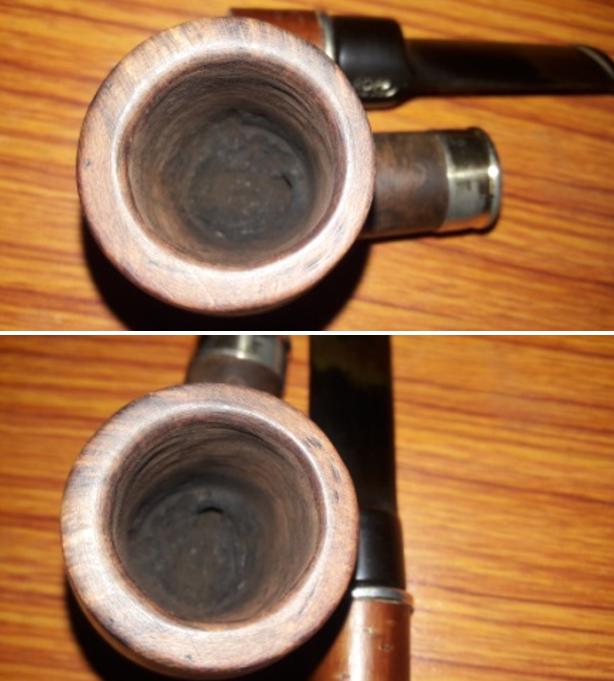
This pipe was received by Abha, my wife, and she liked the funky and bright looks of it. The first thing she noticed was the fit of both the stem tenon in to the shank extension and that of the shank extension in to the mortise was extremely loose. The stummel shows some nice mixed straight, cross and bird’s eye grains all across. The stummel had dirt and grime accumulated over the surface and appeared dull and lifeless. A couple of dents/ dings are visible on the foot of the stummel. I shall address this by steaming out these dents followed by sanding and micromesh polishing. The chamber had a thin even layer of cake in the lower half of the chamber and appeared to have been well looked after. The rim top surface is without any serious damage, save for some minor (and could have been ignored!!!) dents. The inner rim edge has a nice delicate bevel which has been made uneven with reaming with a knife. However, the outer edge has a few very minor dents and dings. The broad vulcanite saddle stem is oxidized and had a couple of minor tooth indentations and chatter on both the surfaces in the bite zone. The corn cob shaped aluminum stinger is covered in dried oils and tars. The button edges showed very slight deformation from tooth marks. The tenon was covered in a hard plastic cap to tighten the fit of the stem in to the shank extension. The burnt orange cherry wood (?) extension is in very good condition except that the ring has discolored in patches but not corroded. The fit of all these pieces of pipes in to each other was extremely loose and would be the biggest challenge to address on this pipe. INITIAL CLEANING BY ABHA…
The initial cleaning on this pipe was done by Abha, my wife (she has cleaned up around 40-50 pipes and these have now reached me for further restoration). She reamed out the complete cake and further smoothed out the chamber walls with a folded piece of 220 grit sand paper. She further cleaned out the internals of the shank with pipe cleaners and alcohol and cotton buds. She followed the internal cleaning of the shank with external cleaning of the stummel using Murphy’s Oil soap and hard bristled tooth brush and dried it with paper napkins and cotton cloth.

Next she cleaned out the internals of the stem air way and immersed it in “Before and After Deoxidizer” solution along with the stem of other pipes in line for restoration. Once the stem had soaked overnight, she cleaned the stem under running warm water and scrubbed the raised oxidation from the stem surface using Scotch Brite pad. She further removed the oxidation by scrubbing the stem with 0000 grade steel wool and applied a little olive oil to rehydrate the stem. She had removed the stinger from the tenon and cleaned it with cotton swabs, pipe cleaners and alcohol.

ONCE THE PIPE IS ON MY WORK TABLE…
Now that the cleaned pipe is on my work table, I proceed to carry out my appreciation of the work that needs to be done on this pipe to restore it.

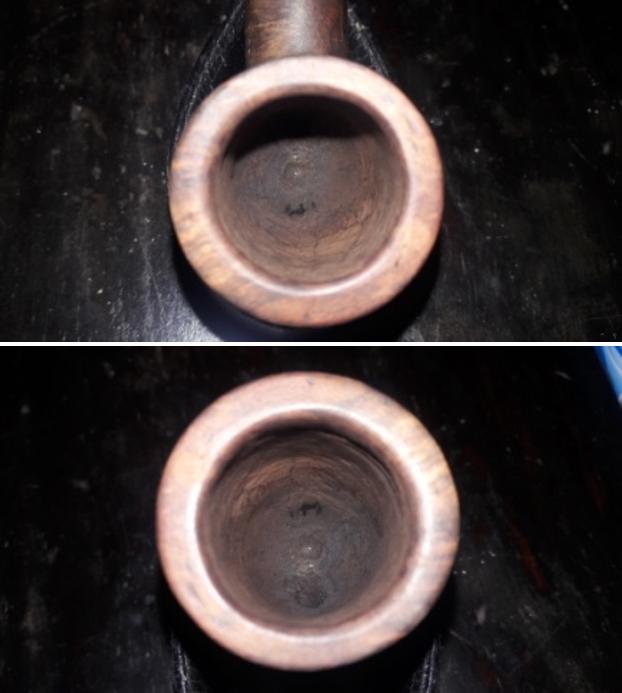
The chamber show very minor and superficial heat lines all along the walls, however, the stummel appears to be solid to the feel. The rim top surface is in decent condition with the inner rim edge bevel in slightly worn out condition. The outer rim edge does show very minor dents and dings. I could either top the rim top to address this issue or let them be since these dents and dings are very minor and hardly noticeable. The stummel was clean and free of any accumulated grime. One fill that Abha had noticed, was picked clean with a thin sharp edged knife and would need to be filled. After I have polished the stummel with micromesh pads, would I be able to decide if I would stain it or let it be in its natural finish.The stem has only one deeper bite mark which would need to be repaired with a fill of activated charcoal and superglue mix. Whatever, little oxidation remains, will need to be removed by sanding with a folded piece of 220 grit sand paper and follow it up with polishing with micromesh pads. The aluminum stinger is clean.The one major issue I need to sort out at the outset is to make the 3 pieces of this pipe stick together to be called a pipe!! The stummel, shank extension and the stem tenon are so loose that it does not fit in to each other and cleaning of all these parts has not helped the matters either.THE PROCESS
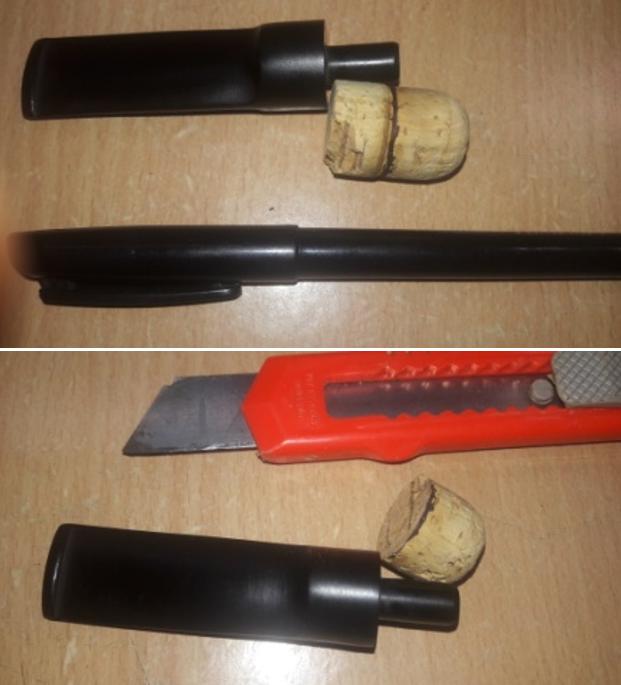
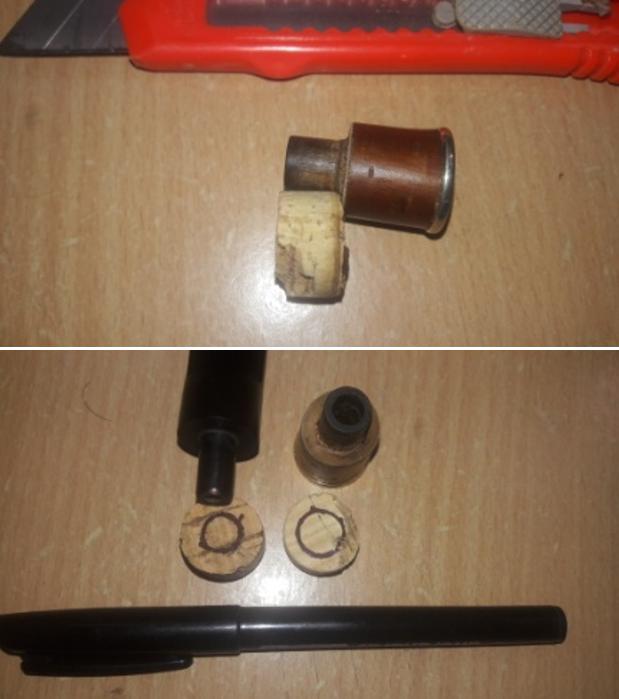
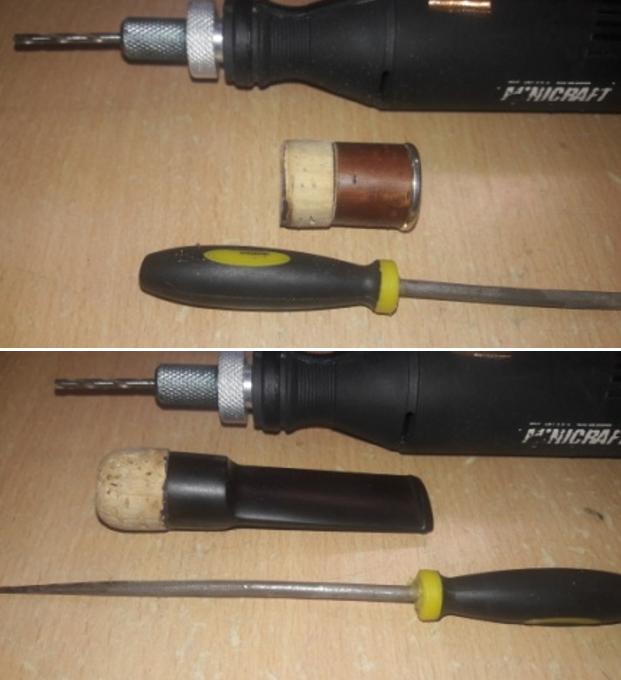
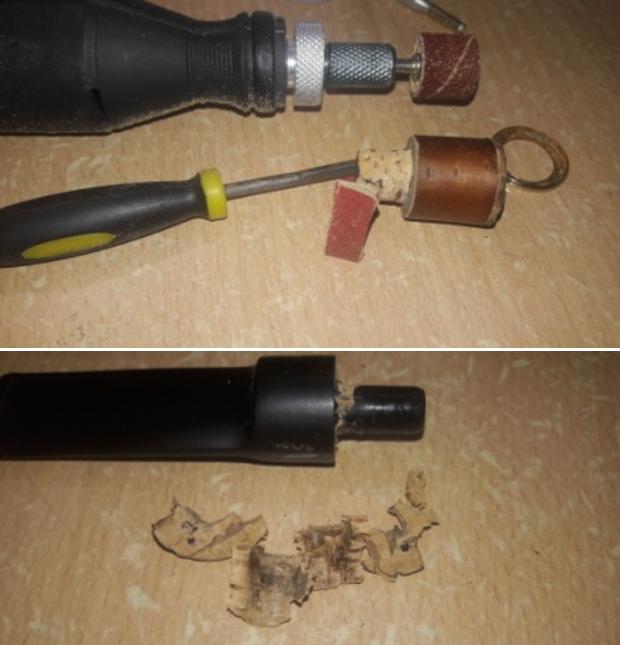
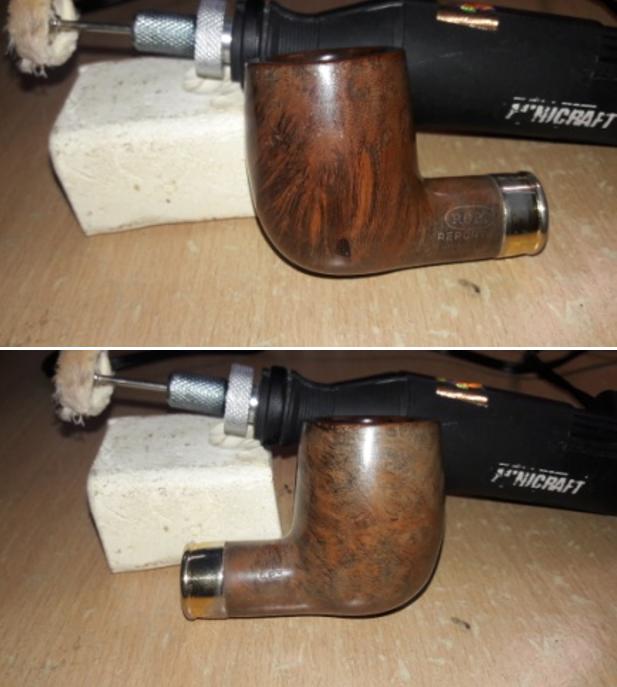
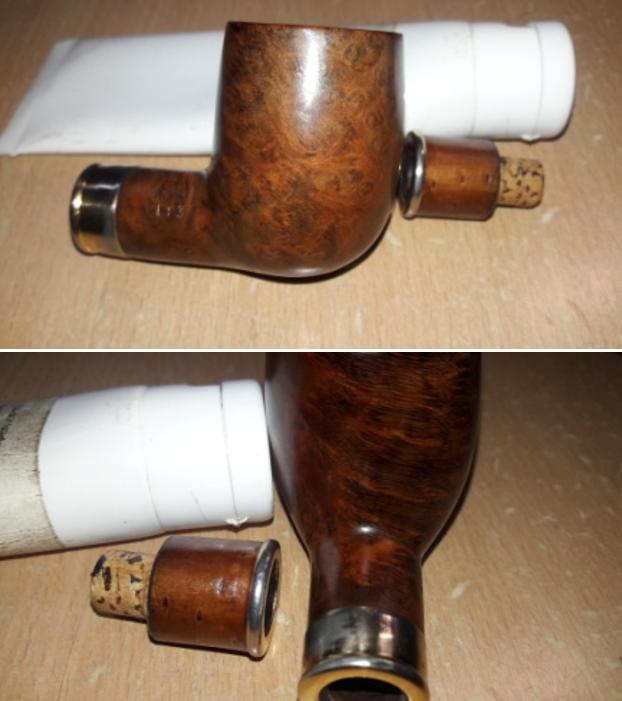
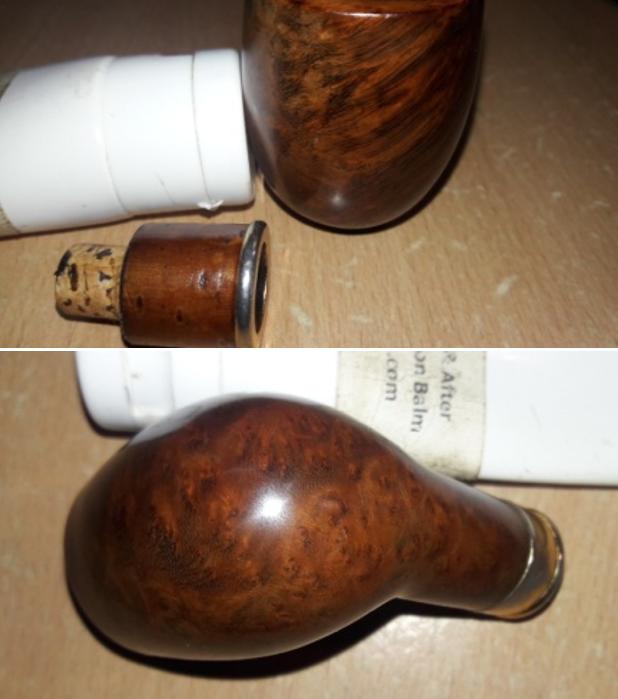
The first issue on the agenda that I decided to tackle was to get the pipe together by making the three parts of this pipe to affix firmly in their designated places. For the stem tenon fit, I had an option to either increase the tenon size by heating and thereafter enlarging it with a larger diameter drill bit and coating it with a clear nail polish. I decided against this process since firstly, this would make the seating of the stinger in to the tenon too loose and secondly, the gap between the tenon and shank extension seat was so large that it would not be possible to expand the tenon to this extent. Similarly, there was no way that I could ensure a snug fit of the shank extension in to the mortise other than by making a packing insert. This brought me to the only option of creating a packing insert using a cork and this is exactly what I proceed to do. Theoretically, I would measure the length that needed to be cut off from the cork to fit the stem tenon and the tenon of the shank extension and sand it down to achieve a snug fit, simple. Well, theoretically it sounds easy, practically not so much.I decided that I would address the shank extension first. I pried out a couple of corks from wine bottle caps (Oh my, I have plenty of them!!!) and measured the length that needed to be cut off from the cork to fit the tenon of the shank extension. With my hand held drilling tool and a smaller drill bit, I drilled a through hole. I progressively increased the diameter using progressively bigger drill bits till I had achieved a snug fit of the cork piece on the tenon. Once I was satisfied with the fit, I fixed the cork packing with superglue on to the tenon. I replaced the drill bit on my tool and mounted a sanding drum. Next, I sand the drilled cork with the sanding drum till I had achieved a rough fit of the shank extension tenon in to the mortise. I fine tuned the fit by hand sanding it with a piece of 220 grit sand paper. I decided on fixing this packing on to the tenon so that it will be easier to clean the mortise and shank extension in future after each use. It required a great deal of patience and diligent work to achieve a perfectly snug fit of the shank extension tenon in to the mortise.

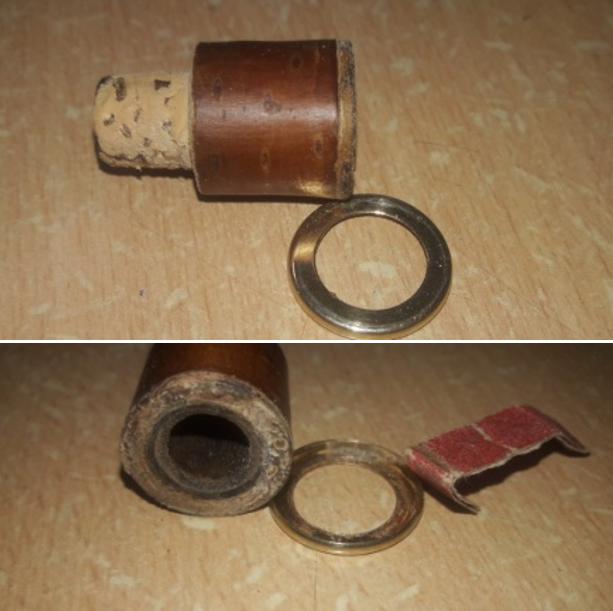
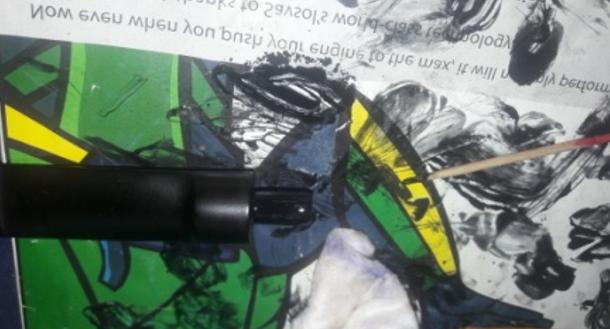
However, the moment I started to fit the drilled out cork for the stem tenon, I noticed that the cork had started to split along the fault lines. I tried to stick them together with CA superglue, but to no avail. The more I tried to push, the more the cork disintegrated!! Finally I had to shelve this idea of a cork packing for the stem tenon. The following pictures will give a clearer picture of the steps, results and the failures of this process. While working on the shank extension, the metal band came loose and revealed all the corrosion on the insides of the band and patches of old glue on the shank extension itself. With a folded piece of 220 grit sand paper, I removed all the corrosion from the metal band and evened out the shank extension surface which seated the metal band. I stuck this band flushed with the shank extension stem end surface with CA superglue and set it aside.To address the fit of the stem tenon in to the shank extension, I decided to go the tried and tested path of increasing the girth of the tenon by using a mix of activated charcoal and superglue. I applied the same in layers, till I had achieved a snug fit. I had to set the stem aside after each layer for the mix to cure.In between all the layering and curing process on the stem tenon, I simultaneously worked on the stummel surface. The one fill which was seen and readied for a fresh fill was patched up with a mix of briar dust and superglue and set aside to cure.While, the stummel fill was set aside to cure, I started work on the stem tenon. Using a flat heat needle file, I lightly sand the rebuild tenon surface. As I started to sand with a piece of 220 grit sand paper, I frequently checked the seating of the tenon in to the shank extension. It was at this point in time that I observed that the seating was skewed. There was a prominent gap (indicated by a red arrow) towards the right side between the edges of the stem and the shank extension. On careful observation, I noticed that the fit of the tenon itself in the stem is not aligned straight!! It was this misaligned tenon that caused the stem to seat incorrectly in to the shank extension. To straighten the stem tenon, I inserted a pipe cleaner through the stem and heated the tenon with my heat gun till pliable. Pulling the tenon end of the pipe cleaner, I achieved a straight alignment of the tenon with the stem and cooled the tenon by holding it under cold running tap water. I checked the seating of the stem in to the shank extension and it was perfect. Turning my attention back to the stummel, I matched the fill with the rest of the stummel surface by sanding the fill with a flat head needle file followed by sanding the fill with a folded piece of 220 grit sand paper. For a perfectly smooth rim top surface, I top it on a piece of 220 grit sand paper. This also addressed the minor dings on the outer rim edge.  I sharpened the inner bevel with a folded piece of 220 grit sand paper, pinched between my fingers. It was at this stage that a colleague of mine saw the pipe and wanted it for himself. He liked the grains and the overall aesthetics of this pipe. I explained to him the amount of work remaining that was required to restore this pipe, including the steaming out of the dents and dings at the foot of the stummel. He did not like the idea of steaming out the dents from the foot and vehemently opposed this process. No amount of persuasion on my part that this process will not cause any damage but on the contrary repair it, could convince him. Since he is the new owner of this pipe, with great reluctance, I gave in to his request.

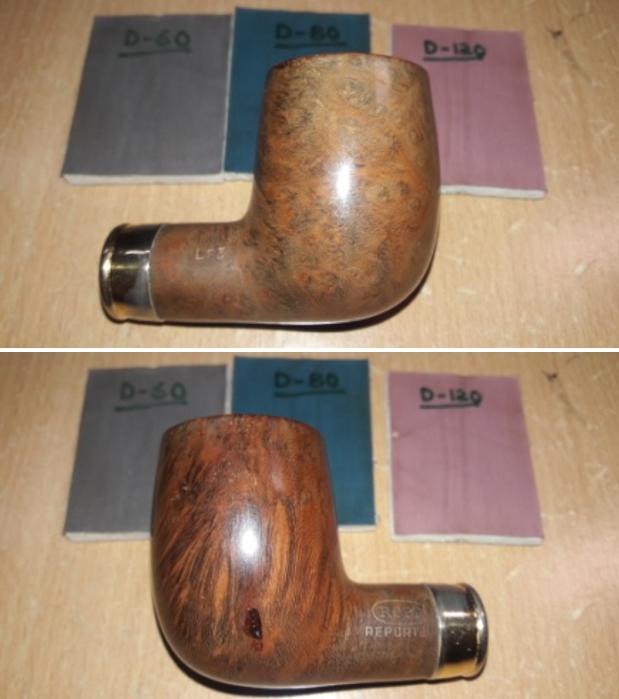
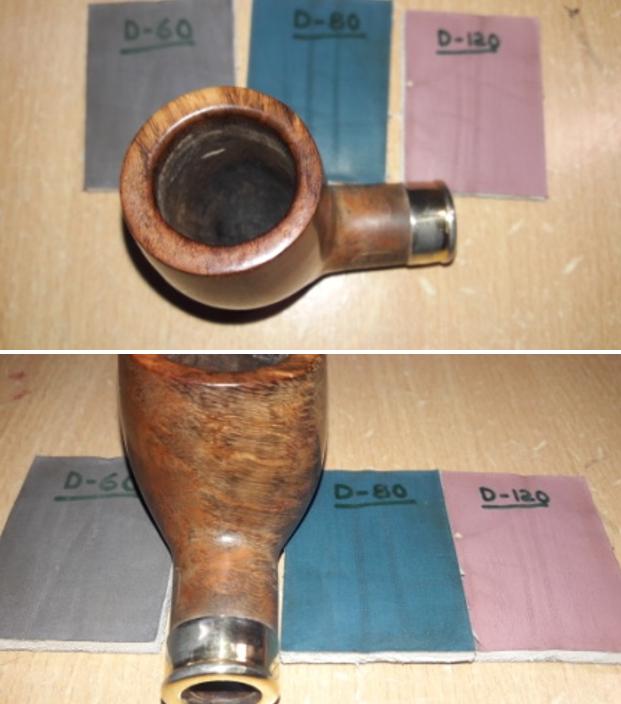
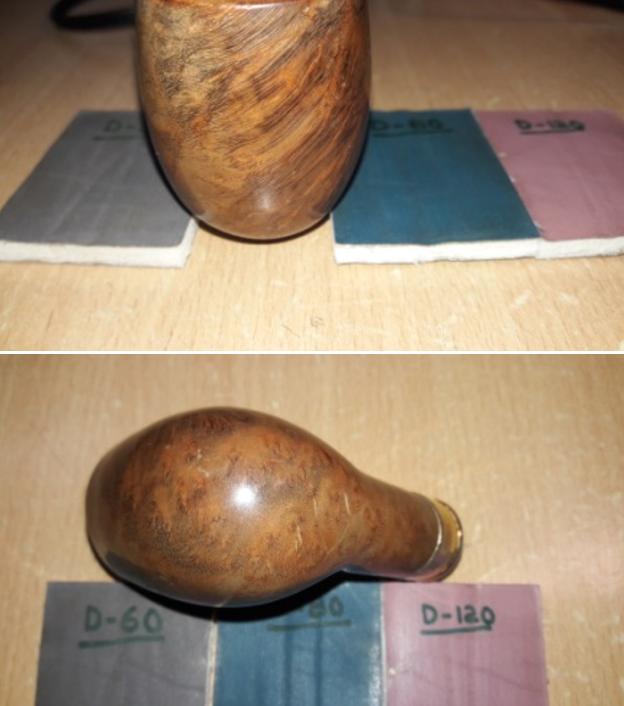
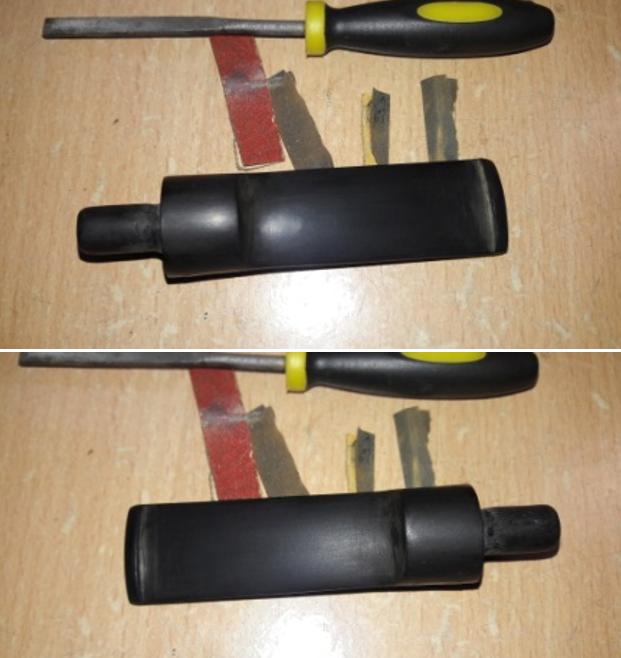
The stem tenon had completely cooled off by now and was perfectly straight. I flamed both the stem surfaces with a lighter to raise the deep bite mark and followed it up with sanding the surface with a 220 grit sand paper followed by 0000 grade steel wool. This helps to remove what little oxidation remained on the stem surface and at the same time addresses minor tooth chatter in the bite zone. I fill the deeper bite area and the button edges with a mix of superglue and activated charcoal powder and set it aside to cure. While the stem fill was curing, I moved ahead with micromesh polishing of the stummel surface. Now, here is a slight departure from the usual polishing process that I have followed on all previous restorations. I had read that White diamond polish falls between 3400 to 4000 grit micromesh pads and so to experiment, I polished the stummel with white diamond after wet sanding with 1500 to 3400 micromesh pads. I finished the polishing cycle by wet sanding with remaining grit micromesh pads. In all honesty, I found the finish not much different from the routine polishing of wet sanding with 1500 to 12000 micromesh pads. I shall continue with this experiment on a few more pipes and then decide to continue with this process or revert back to only micromesh pads. I followed up the polishing by applying “Before and After Restoration” balm. This balm protects and enriches the briar surface and is highly recommended for use in any restoration of briar pipe. I rubbed it deep in to the stummel surface and also in to the shank extension and set it aside to be absorbed for 20 minutes. I also applied petroleum jelly to the cork on the tenon of the shank extension to hydrate and moisten it. I am pleased by the appearance of the stummel (less the dents and dings on the foot of the stummel) and the deep burnt orange hue of the shank extension. At this point in restoration the only other issue, other than the dents and dings on the foot of the stummel, that I need to address is that the burnt orange color of the shank extension merges with the coloration of the stummel. I would love to impart a bit of a contrast between the stummel, shank extension and the shining black of the vulcanite. Well, I shall see to it when I get there!! The following pictures will bring better clarity to what I am commenting on.With the stummel nice and clean and attractive, I worked the stem of the pipe. The fill on the stem had cured nicely and I sand it down with a flat head needle file. I sharpened the lip edges using a needle file and sand the entire stem with 220 followed by 400, 800 and 1000 grit sand paper. This helps to reduce the sanding marks left behind by the more abrasive 220 grit paper. To bring a deep shine to the vulcanite stem and the tenon, I went through the complete set of micromesh pads, wet sanding with 1500 to 12000 grit pads. I wiped the stem with a moist cloth after each pad and rubbed it down with Extra Virgin Olive oil. The pictures of the final results are shown below. I applied a small quantity of “Before and After Extra Fine” stem polish and rubbed it deep in to the vulcanite stem. This polish, purportedly, is supposed to remove the fine sanding marks left behind by the abrasive grit papers.This is how the pipe appears at this stage. The shank extension completely merges with the stummel and looks out of sync with the overall appearance of the pipe. The shank extension was most likely meant to provide a contrast between the stummel and in the process, add some bling to it. At this stage my colleague again interfered and wanted the natural finish. He is one person who loves natural finish of the briar with the grains being seen. However, I was not ready to compromise this time around. We struck an understanding between us that if the finished pipe is not liked by him, I would get it back to the natural finish. Now with this stalemate sorted out, I contemplated my next step.

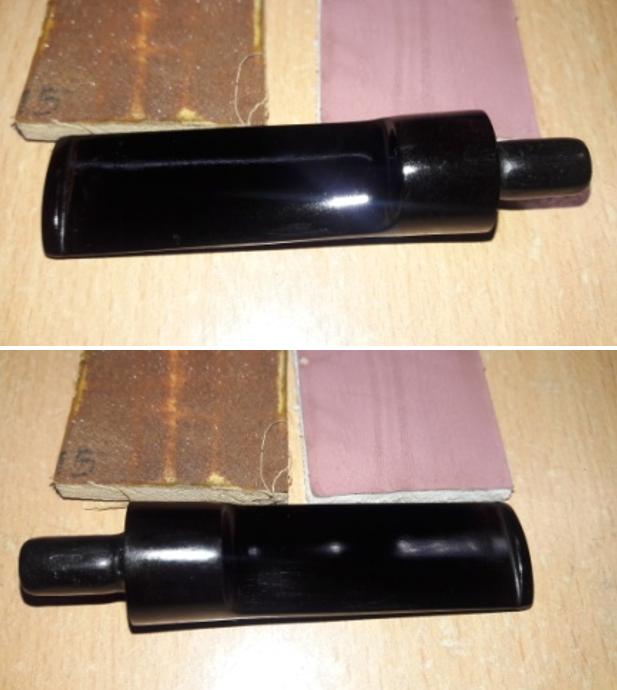
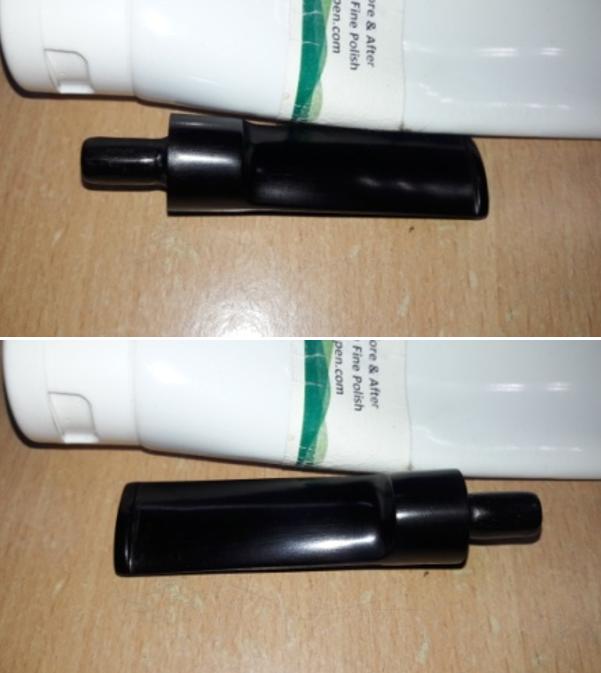
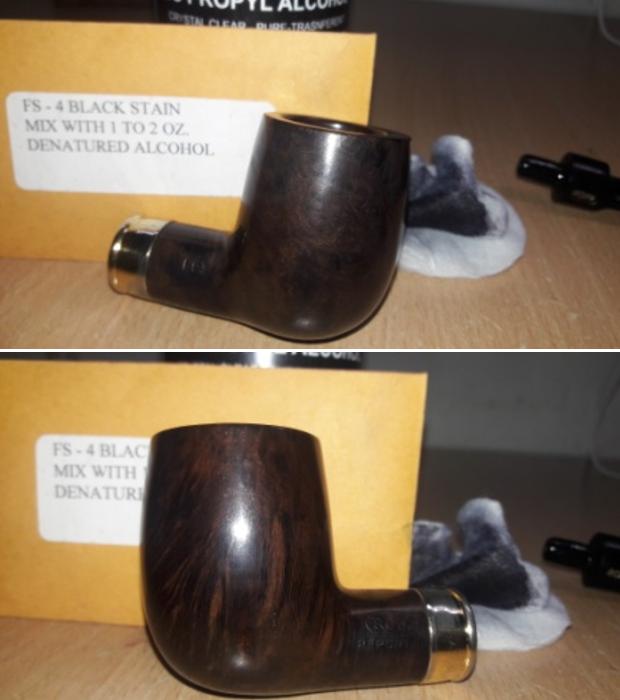
I felt that the burnt orange of the shank extension would provide a nice contrast between the shining black vulcanite and a light black stained stummel. I shared this thought with Steve, my mentor, and he concurred with my view. He suggested that I should give the stummel a light black stain wash and thereafter bring it up to a nice high gloss finish. I mixed a small quantity of black stain powder with isopropyl alcohol to a very watery consistency and applied it to the stummel with a cotton swab. I let this stain wash set for a minute and vigorously wiped it down with a clean cotton swab. I repeated this process a couple of times till I was satisfied with coloration of the stummel. Here are the pictures and the end result of this stain wash. I liked it immensely. To complete the restoration, I mount a cotton cloth buffing wheel on to my hand held rotary tool and apply a coat of Blue Diamond to the stummel, shank extension and the stem to polish out the minor scratches. With a cotton buffing wheel that I use for carnauba wax, I apply a coat of carnauba wax and continue to work on it till the complete coat of wax had been polished out. I finished the restoration by giving the entire pipe a rigorous hand buffing using a microfiber cloth to raise the shine further. I buffed the gold colored band/ ring at the shank end and at the stem end of the shank extension with a jeweler’s cloth and bring it to a nice shine. I mount a clean cotton cloth buffing wheel and give the entire pipe a once over buff. Boy, am I happy with the look of this pipe. The burnt orange provides a striking contrast with the darker hues of the stummel and shining black of the highly polished vulcanite stem. The finished pipe is shown below. Cheers!! P.S. The completed pipe actually looks more stunning in person than in pictures. Even my colleague loved the finished pipe and he is all set to enjoy this beauty with his favorite tobacco, Autumn Evening, from 4noggins!! Thank you all for walking with me through this restoration which was a combination of some new processes and experiments.


New Life for a 1964 Dunhill Shell Briar 250F/T 2S Billiard


Blog by Steve Laug

Not too long ago I received an email from a fellow in California who I have repaired a few pipes for over the years. He said he was sending me a couple of pipes to work on. The box arrived a few weeks ago and when I opened it I found this message in the box.

Hi Steve — Here are the two pipes as promised. The Dunhill Shell should be an easy resto, but the Barling’s Fossil is another story…. Would like to keep the original finish on the stummels and shanks of both if possible… thanks — Scott

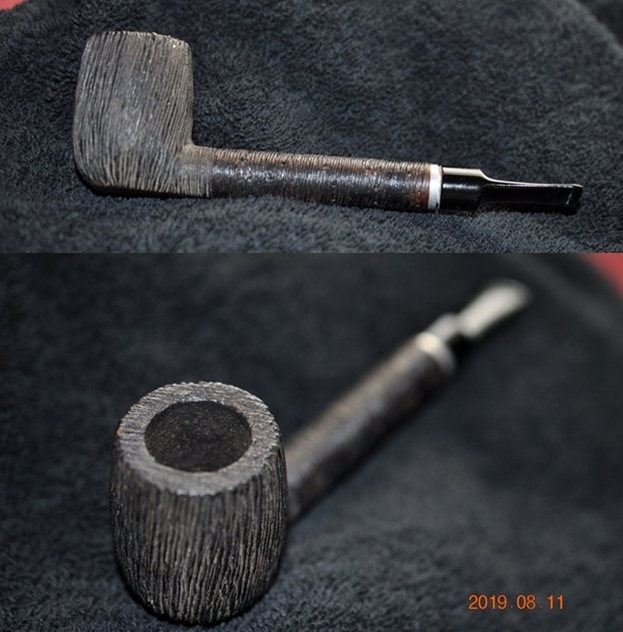
I decided to take a break from Bob Kerr’s Estate for a bit and work on Scott’s pipes. I took the Dunhill out first. I looked it over to check out its condition and what needed to be done with it. The finish was dirty but in decent condition. The edges of the rim top were in good condition though the top itself was caked in lava overflow from the bowl. The bowl had a thick cake inside and remnants of tobacco stuck to the walls. The stem looked good – not a tooth mark of note and only a bit of tooth chatter. There was some calcification on the first inch of the stem on both sides. The stem was also oxidized and dirty. The slot in the button was almost clogged up with tars and debris. I took photos of the pipe before I started my cleanup work. I took some close up photos of the rim top and also of the stem surface. I wanted to show the condition of the bowl and rim before I started working on it. The rim top looks pretty good. There is some thick lava filling in the sandblast of the rim but the edges look very good. The cake in the bowl is quite thick and hard so the bowl walls should be in good condition. I also took close up photos of the stem surface before I did the cleanup.    The stamping on the underside of the shank is in great shape. It reads 250F/T on the heel of the bowl. That is followed by DUNHILL over SHELL BRIAR. That is followed by Made in England with the superscript 4 and a Circle 2S.Using the information on pipephil’s site I was able to interpret the stamping on the underside of the pipe (http://pipephil.eu/logos/en/dunhill/shell-briar1.html). The 250 F/T stamp tells me the pipe is a shape number 250 while the F/T tells me that the stem is a fish tail stem. The Shell Briar stamp refers to the sandblast finish. The number 4 following the Made in England stamp identifies the date as 1964. The circled 2 is the Group bowl size. The S is the stamping for the Shell Briar finish. http://pipephil.eu/logos/en/dunhill/shell-briar1.html

With that in mind I turned to work on this pipe. I reamed the bowl to remove the cake on the walls and the debris of tobacco shards that still remained. I used a PipNet pipe reamer with the first two cutting heads to start the process. I followed that with a Savinelli Fitsall Pipe Knife to clean up the remaining cake in the bottom portion of the bowl and near the entry of the airway into the chamber. I sanded the bowl with 220 grit sandpaper wrapped around a piece of dowel. It smooths out the walls and also cleans up any light damage to the inner edge of the bowl. The bowl surface was dirty so I decided to clean the briar with Mark Hoover’s Before & After Briar Cleaner to remove the debris in the finish and the lava in the grooves of the blast on the rim top. I rubbed it into the surface of the briar and let it sit for 10 minutes. I rinsed the bowl off with warm running water to remove the product and the grime. The grain really began to stand out clearly. It was a beautiful piece of briar. I used a brass bristle wire brush to clean off the debris that was still in the grain on the rim top. Once I had it clean I wiped it off with alcohol on a cotton pad. I used a Walnut stain pen to touch up the stain on the worn outer edges of the bowl and the rim top. I mixed in some black Sharpie pen to blend it to match the bowl colour.I worked some Before & After Restoration Balm into the finish of the bowl and the rim top. I worked it into the surface with my fingertips and a horsehair shoe brush to clean, enliven and protect the wood. I let the balm sit for about 10 minutes and buffed it off with a soft cotton cloth. I took photos of the pipe at this point in the process to show what the bowl looked like at this point. I am happy with the blend of the stain on the right side and the overall look of the bowl at this point. Now the bowl was finished except for the final polishing. Once the externals of the stem were cleaned I turned my attention to the internals. I cleaned out the mortise and airway to the bowl and in the stem with 99% isopropyl alcohol, cotton swabs and pipe cleaners. I cleaned both until the cleaners came out white. It was a dirty pipe. I set the bowl aside and turned my attention back to the stem. I also sanded out the tooth marks and chatter on the surface of the vulcanite and removed the rest of the oxidation on the vulcanite with a folded piece of 220 grit sandpaper. I followed the 220 grit sandpaper with 400 grit wet dry sandpaper to minimize the scratching.    I polished the stem with Denicare Mouthpiece Polish to take out the oxidation at the button edge and on the end of the mouthpiece. I buffed the stem with a microfiber cloth.I polished out the scratches with micromesh sanding pads – wet sanding with 1500-12000 grit pads. I wiped the stem down after each sanding pad with Obsidian Oil. I polished it with Before & After Pipe Stem Polish – both Fine and Extra Fine. Once I had finished the polishing I gave it final coat of oil and set it aside to dry. Scott was correct in his note that this was a straight forward restoration. Even so, I am finally on the homestretch with this pipe and I really look forward to the final look when it is put back together and polished and waxed. I put the bowl and stem back together. I polished the bowl and stem with Blue Diamond to polish to begin the shine. I gave the bowl multiple coats of Conservator’s Wax and the stem multiple coats of carnauba wax. I buffed the pipe with a clean buffing pad to raise the shine. I hand buffed it with a microfiber cloth to deepen the shine. The pipe polished up pretty nicely. The cross grain and birdseye grain that show up in the polished sandblasted bowl looked good with the polished black vulcanite. This 1964 Dunhill Shell Briar  250F/T Straight Group 2 Size Billiard was a fun pipe to work on. It really has that classic Dunhill Billiard look in a Shell Briar finish that catches the eye. The combination of red and black stains really makes the pipe look attractive. It is a comfortable pipe to hold in the hand and I think that as it heats with smoking that over time the finish will darken and look even better. The finished pipe is shown in the photos below. The dimensions of the pipe are Length: 5 ¾ inches, Height: 1 5/8 inches, Outside diameter of the bowl: 1 1/8 inches, Chamber diameter: ¾ of an inch. I look forward to hearing what Scott thinks of it once he receives it. I have one more of his pipes to finish before I mail them to him. Thanks for reading this blog and my reflections on the pipe while I worked on it. This is an interesting estate to bring back to life.
Breathing New Life into a BBB Gourd Calabash with an Ambroid Stem


Blog by Steve Laug

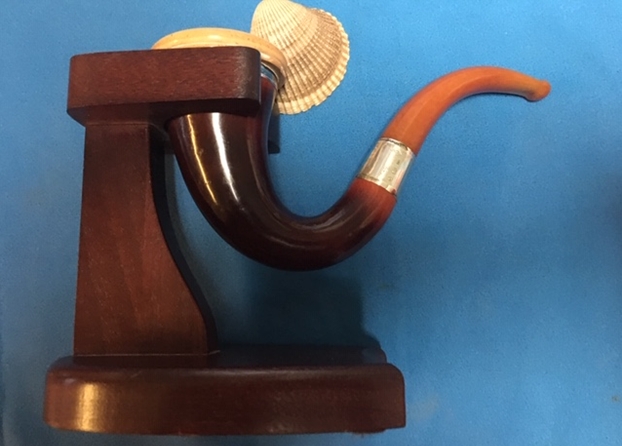
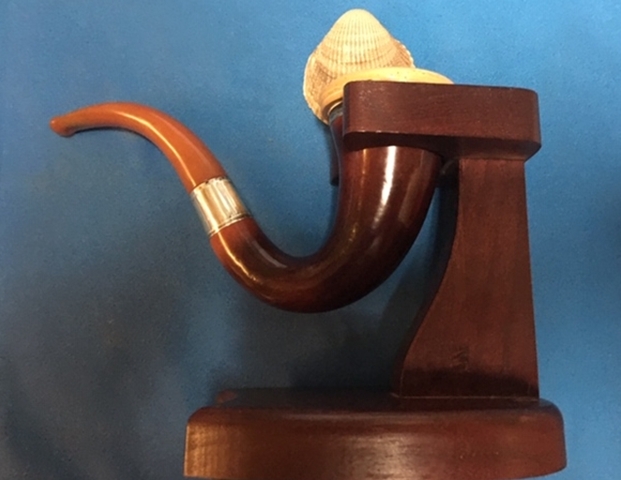
Not long ago I received an email from a lady named Pat on Vancouver Island about some pipes that she had that had belonged to her late husband as well as an old Gourd Calabash with a Meerschaum bowl that had belonged to her Great Grandfather. She sent me photos of the pipes and they were definitely interesting to me. There were some John Calich pipes and three other lower end pipes from her late husband and the cased Gourd Calabash. I was hooked and ready to be reeled in! After a few email exchanges we made a deal that was acceptable to us both. The payment was e-transferred to Pat and the pipes were shipped to me in Vancouver. Pat sent me two photos of the pipe before she shipped them to me.

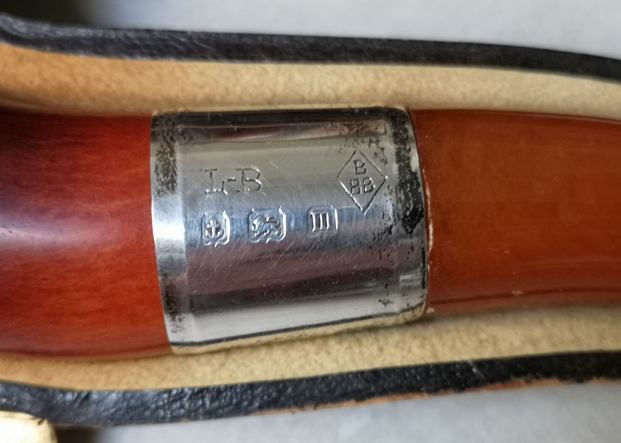
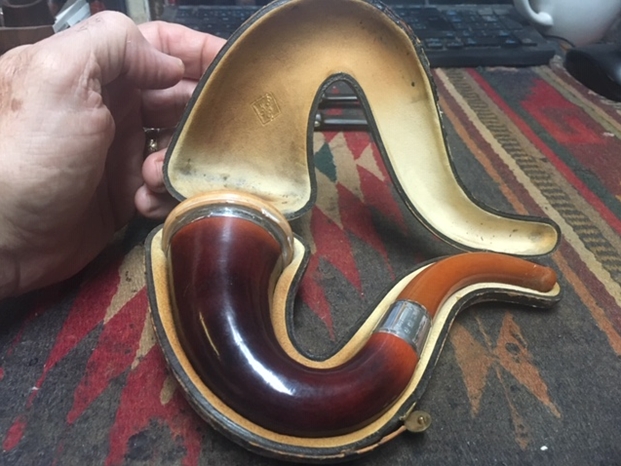
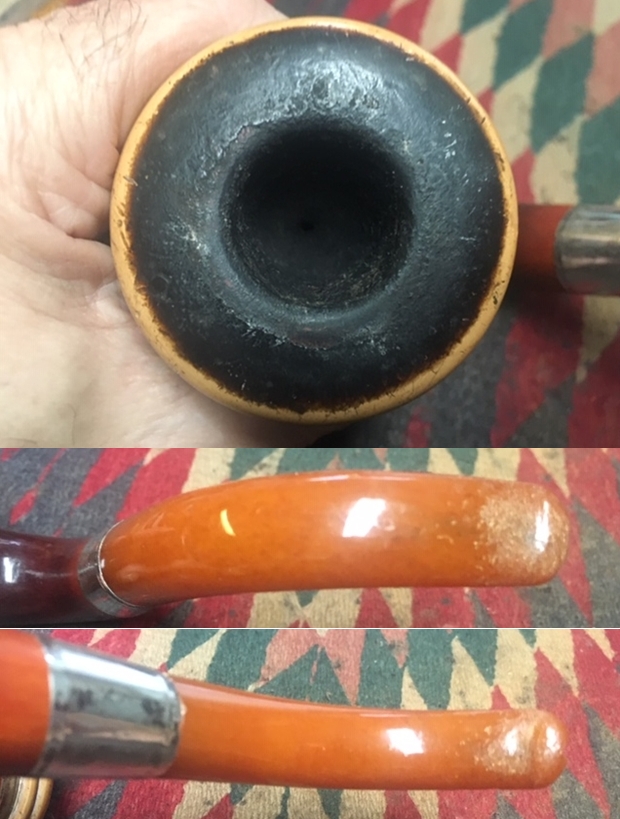
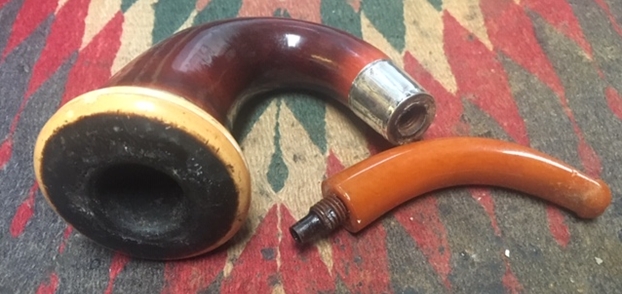
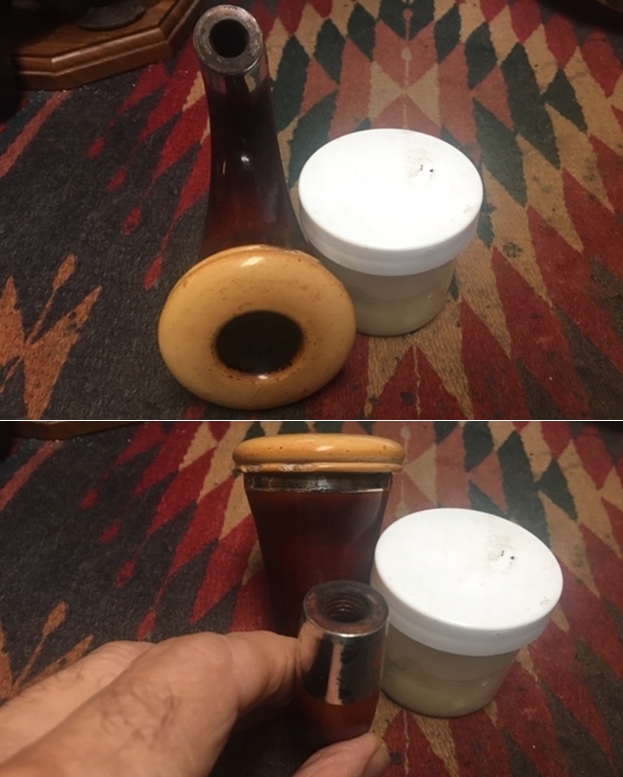
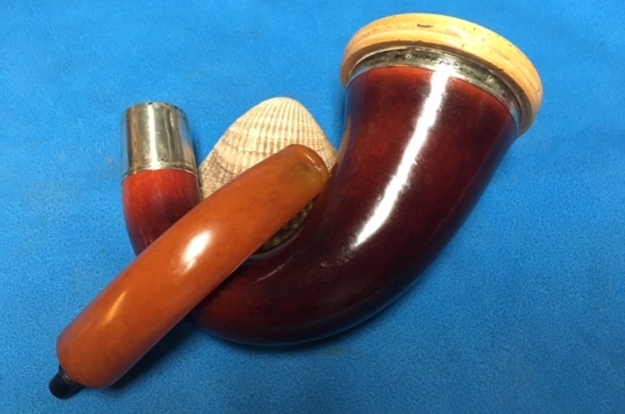
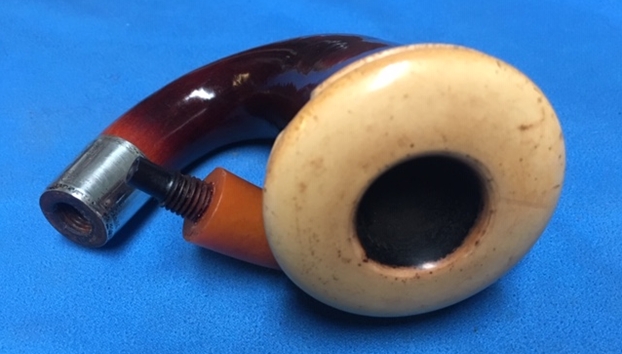
The first photo shows the cased pipe. The Gourd Calabash was a BBB as can be seen by the triangle stamped in gold on the cover of the case and the silver band in the photos below. The Gourd had some beautiful patina and had turned a rich reddish brown colour. There was a silver band on the shank with what looked like hallmarks. There was also a silver band around the top of the gourd under the meerschaum bowl insert. The bowl had a lot of colour and it had a ring around the meerschaum bowl. There were a couple of chipped areas on the lower ring of the bowl. The amber coloured stem looks intact and does not show any obvious damage. The colour of the stem and the cloudiness of the material makes me wonder if it truly amber or some form of ambroid. I will know soon enough.

The second photo is a close up that shows the silver band on the shank of the pipe. It is in good condition and lightly tarnished. The stamping is very readable and it clearly showed the following marks: L-B and BBB in a triangle. There were also three hallmarks on the band. The first was an Anchor (which is the symbol for the Birmingham Assay Office). The second was a rampant lion (which is the symbol for .925 silver). The third one was the lower case letter “m” (which is the date letter that I would use to date the pipe as I worked on it). I did some searching through the British Silver Hallmark Charts that are online. I went through them comparing them to the “m” stamp on the band. I found two possible dates for the stamp. On the shape charts that I use most of the time when I am looking for information on the date stamps there was a lack of clarity as to whether the “m” stamp pointed to 1853 or to 1911. I wanted to see if I could get any clarity from others who were familiar with silver bands on BBB pipes.

I sent a quick message to a Facebook Messenger Group that I am part of that includes others who collect BBB pipes. I posted a picture of the band with the hallmarks that I included above on the group. Both Paresh Deshpande and Victor Nadeo immediately answered that the pipe was from 1911 from the charts that they use. I responded with my question as to the shape of the cartouche (the frame) around the “m”. Pretty quickly after that Victor sent me the link to the chart that he uses and included a screen capture of the list from 1900-1917 shown to the left (http://www.silvercollection.it/englishsilverhallmarksBIR.html).

I quote Victor’s response: I think the frame (cartouche) is only slightly erased. But I’m pretty sure it’s really 1911. They’d hardly miss anything like that, as they passed an Assay Office, such a serious government agency. And in view of the frame around the other hallmarks, I think they leave no doubt that it’s a 1911.

That set the date for me. It also worked well with the L-B stamp which stood for Louis Blumfeld. That L-B stamp fits that time frame perfectly. Now I knew that the pipe was hallmarked to 1911 and that it was an old timer. I could not wait to see it once it arrived in Vancouver.

While I waited for Canada Post to deliver it I did a bit of reviewing on the history of the brand from Pipedia (https://pipedia.org/wiki/BBB). I quote some of the pertinent parts of the article below:

The initials once stood for Blumfeld’s Best Briars after Louis Blumfeld, who took over the management of the Adolph Frankau Company in 1856. After his death, the BBB gradually became known as Britain’s Best Briars. Soon to be the oldest English trademark in current use and the first pipe ever to have a registered trade mark. “Britain’s Best Briars”, often called BBB, is one of the oldest brands still in production and has always been the most popular foreign brand in Denmark. Earlier pipes included a metal rondel with a diamond shape including BBB imbedded in the stem top, and later post-Cadogan went to a stamped on logo, similar to the GBD pipes…

…Adolph Frankau & Co Ltd In 1847, Adolph Frankau arrived in London and quickly understood opportunities that the market of tobacco presented, in full expansion. He created the company “Adolph Frankau & Co” and became an importer of meerschaum pipes and supplies in connection with the tobacco. It takes under its wing young a 14 year old boy, Louis Blumfeld. The business thrives quickly until the death of Adolph Frankau in 1856. His widow prepares to sell the company.

Enter in scene Thomas Carlyle (1795-1881), author of “Hero and worship of the heroes”. This last advises with Mrs. Frankau not to sell, but to entrust the future of the company to the hands of the young person Louis Blumfeld, then 18 years old. Carlyle was to have a very high opinion of the Louis young person, and this confidence was justified by its assumption of responsibility of the business, its enthusiasm and its inexhaustible energy. Louis realizes quickly, like others, great potential of briar, from which the interest comes to be recognized.

Louis Blumfeld develops from the very start of important international trade, with a particular success in Canada, in Australia, in Zealand News, India and in the extrème Is Europe, in Switzerland and, with a special mention, in Denmark…

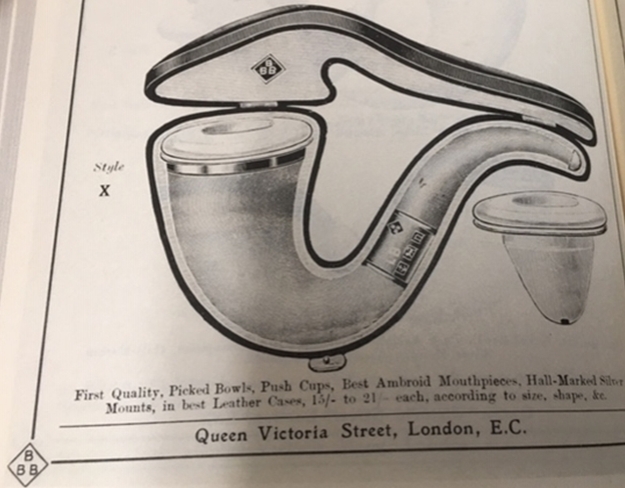
I took out my Briar Books Press reproduction of the Adolph Frankau & Co. BBB Catalogue XX from 1912 and did a bit of reading to see what I could find out from the source. Sure enough I found the pipe in the catalogue. It is marked as a Style X Genuine South African Calabash Pipe. Underneath the print of the pipe it reads First Quality, Picked Bowls, Push Cups, Best Ambroid Mouthpieces, Hall-Marked Silver Mounts in best Leather Case. You can see the two rings around the bowl insert, the silver band around top of the gourd and the silver band on the shank. It is also clear that the stem is marked as an Ambroid mouthpiece. The leather case is the same one as the one I am working on with the BBB logo on the top side of the case and the same latch setup as the case I have.I now had a verification that the L-B stamp stood for Louis Blumfeld as I expected. He took over the company at the death of Adolph Frankau in 1856. He took the brand to its zenith as BBB (Blumfeld’s Best Briars and later Britain’s Best Briars). That time table fit the dating of this pipe very well. The 1912 Pipe Catalogue has the same pipe for sale. Now it was time to work on the pipe itself.

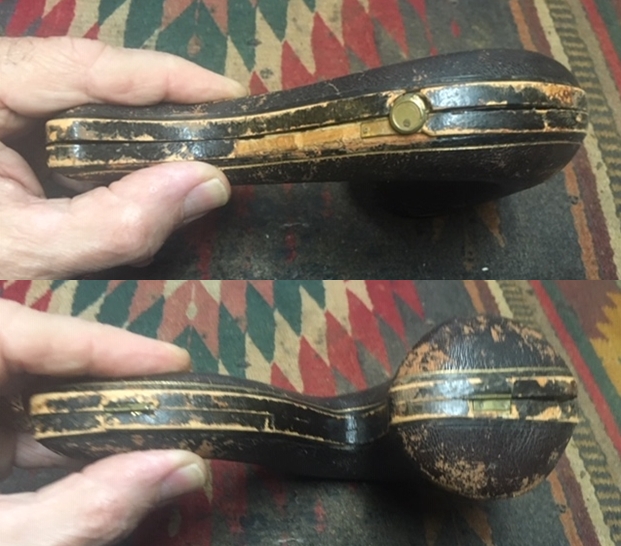
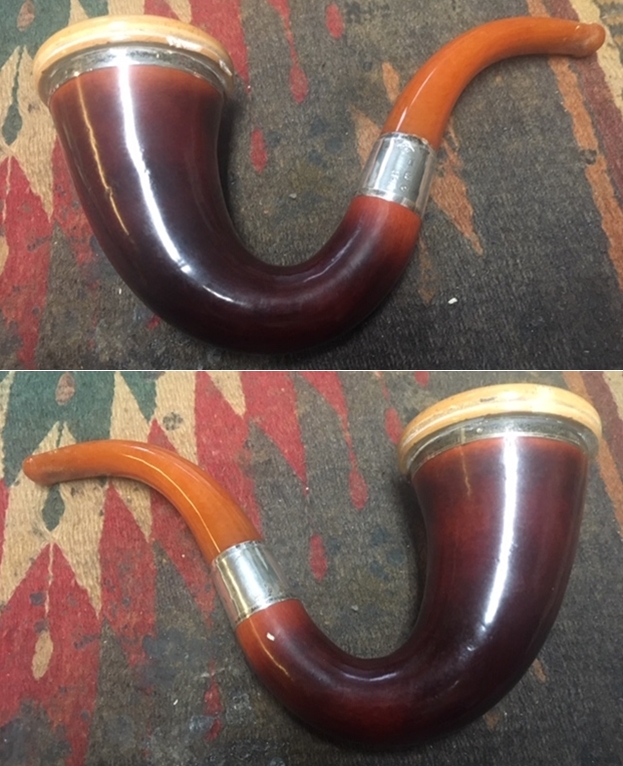
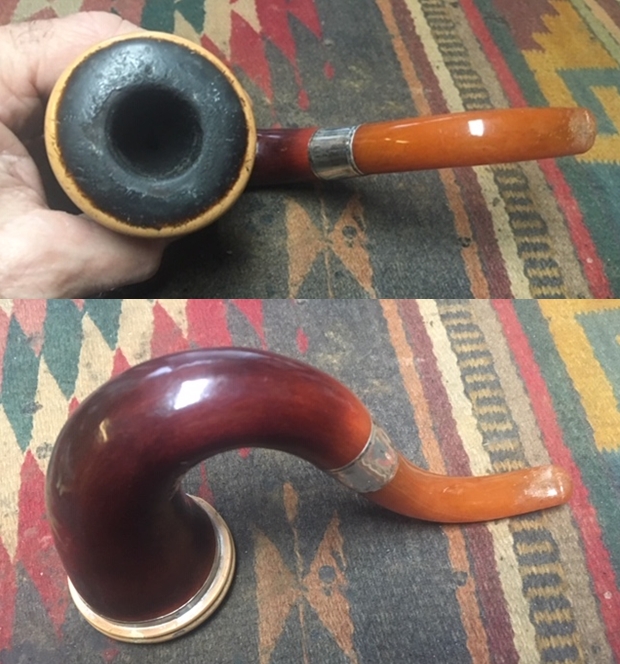
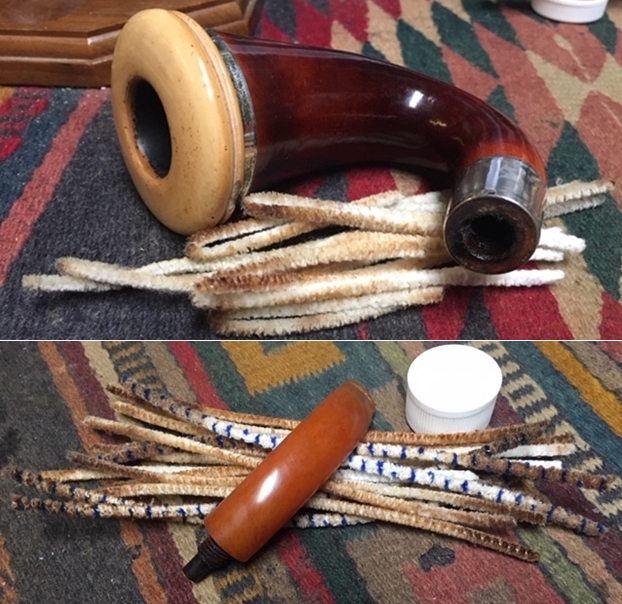
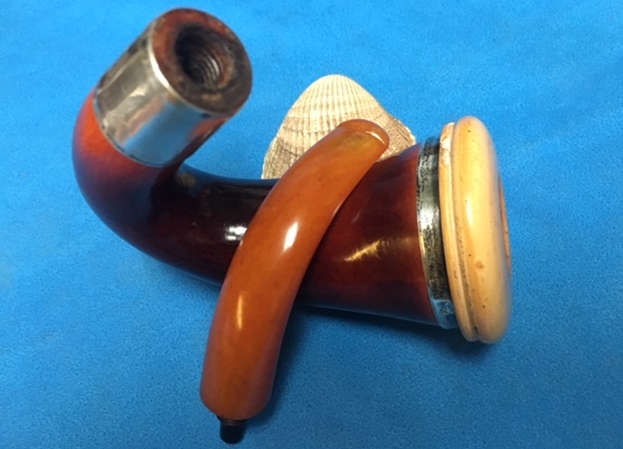
I brought the worn leather clad case to my work table and took some photos of it before I opened it and took out the pipe. It was worn but well made. Some of the leather was peeling but the brass hinges on the back edge and the flip clasp on the front were all in good order. I took photo of the unopened case to give you a sense of my own expectancy. I opened the case and took a photo of the pipe in the case. You can see the gold embossed stamp on the inside of the case – a triangle with BBB against the cream coloured lining.I took the pipe out of the case and did a quick assessment of the condition of the pipe. The gourd calabash was in excellent condition and showed a patina of solid use for the 100+ years that it has been in Pat’s family. The silver band around the top of the gourd and the band on the shank are clean but oxidized. The one around the rim top is more oxidized than the shank band. I think the shank band was polished for the photo that Pat sent me. The edges of the meerschaum cup looked very good except for two chipped areas on the bottom ring of the bowl. The upper edges of the bowl appeared to be in very good condition. The stem is in good condition other than tooth marks and chatter on the top and underside near the button. The rest of the stem is in excellent condition. As I examine the stem I am becoming convinced that it may not be amber.    I took photos of the top of the bowl. There was a thick cake in the bowl that overflowed onto the rim top. It appears to me that the bowl was never cleaned during life of the pipeman who held in trust. The buildup of lava on the rim top was very thick and extended to the downward curve of meer cup on the edges. You can also see the tooth marks on the top and underside of the stem.I took some close up photos of the bowl and rim to show the thickness of the cake and the lava on the rim top. The lava top was thick and you can see the layers and flakes on the top photo below. I also took close up photos of the stem to show the tooth marks and chatter in the surface of the stem. There is also some serious wear on the button edge. The look of the damage on the stem surface made me more uncertain that it was amber. I unscrewed the stem from the shank and took a photo. The threaded bone tenon was anchored in the stem and screwed into the shank. The threads tenon was in excellent condition even though they were darkened from the tars of the tobacco.Once I had the date figured out and had a chance to look the pipe over I wrote a quick note to Pat and asked her if she would be willing to write a brief piece on her Great Grandfather. She was quick with her answer and sent me brief sketch, a photo and an article about her Great Grandfather. I include those now.

Hi Steve,

My great grandfather’s pipe was always a mystery. No one ever smoked it after he died, yet it got passed down through the generations. I always imagined it had magical powers like Sherlock Holmes’s pipe. When I was young, it sat beside my bed as I read The Hound of the Baskervilles. It has journeyed with me until your received it.

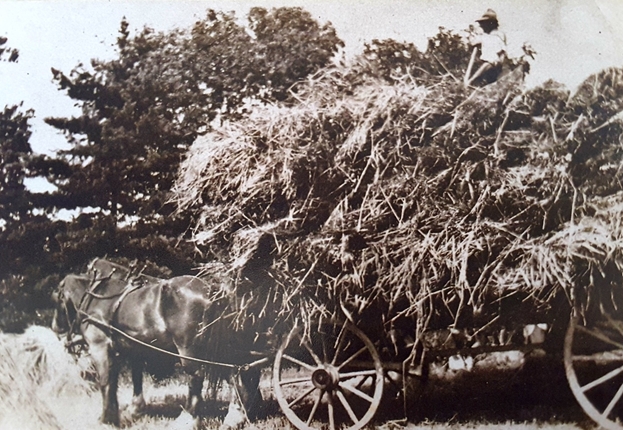
My great grandfather, John Milne Senior, immigrated to Canada from Scotland around 1875. He had a good sized farm on the edge of Toronto, Ontario in Weston (now a suburb), where he farmed and raised prize winning livestock, and raised 6 children. He was generous with extended family and neighbours supplying food during hard times in depression, and fresh garden produce for the local hospital during Second World War.

Attached is the only photo I have of him on top of his hay wagon on the farm. Also attaching an article written during the Second World War with details about the air show beside his farm, and his and my grandmother’s first flights in their 80’s. From all accounts he was a good hearted man that didn’t shy away from adventure.

Cheers,

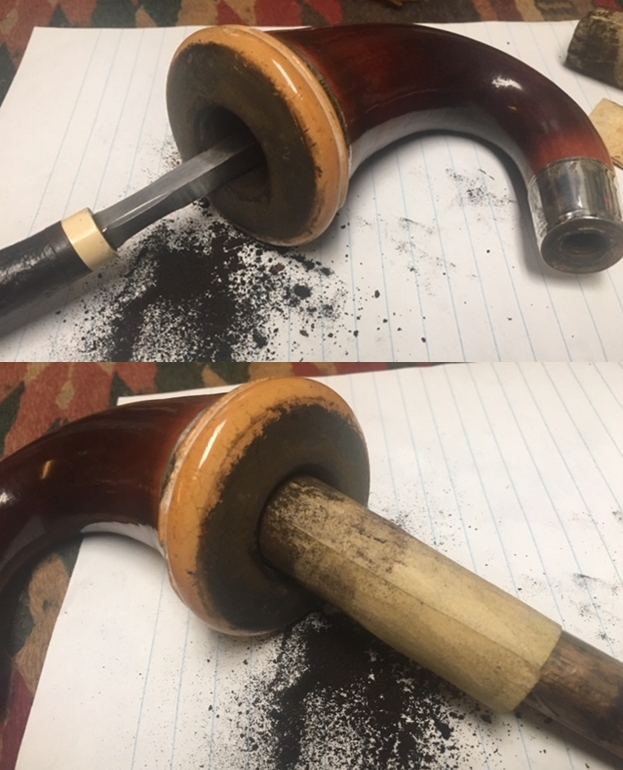
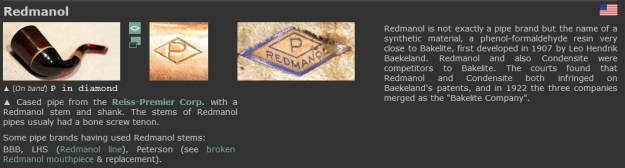
Pat Now that I had a pretty clear picture of John Milne Senior I was ready to start working on his pipe. As noted above in Pat’s email the pipe had been sitting unsmoked since his death. It was time to bring it back to life. I carefully reamed the bowl with a Savinelli Fitsall Pipe Knife. I scraped the cake back to the bare walls. I sanded the walls with a piece of dowel wrapped with 220 grit sandpaper to smooth out the interior of the bowl.I carefully scraped the rim top with the edge of the Savinelli Fitsall Pipe Knife and a sharp pen knife. It took a while to scrape back the cake until I got to the meerschaum cap. I followed that up with a 1500 grit micromesh sanding pad to remove the remaining bits that were left on the top of the rim.  I scrubbed the cap of the bowl with Before & After Briar Cleaner. I have used it in the past on meerschaum and found that it does a great job removing the grime but leaving the patina in good condition. I polished the cap and edges of the meerschaum bowl with micromesh sanding pads – wet sanding it with 1500-12000 grit pads. Each successive grit pad gave the meerschaum finish more of a shine. There were some nicks and scratches in the meer that I decided to leave as they are fitting of a pipe of this age. I rubbed the Gourd Calabash bowl down with Before & After Restoration Balm. I worked it into the surface of the gourd with my fingertips to clean, enliven and protect it. I let the balm sit for a little while and then buffed with a cotton cloth to raise the shine. Mark Hoover’s Balm is a product that I have come to appreciate on a variety of bowls – briar, meer and gourd. I polished the silver on the rim of the gourd and the silver band on the shank with a jeweler’s polishing cloth until it removed the black tarnish that had built up around the silver. There are small silver brads holding the band around the top of the gourd.   With the externals cleaned it was time to work on the internals. I was not able to remove the meerschaum bowl so I left it in place and cleaned the gourd through the hole in the bottom of the bowl and up the shank. I used alcohol and pipe cleaners to remove the grime that was built up and worked on it until the cleaners came out clean and the gourd smelled fresh.The more I handled and worked on the stem the more I was certain that I was dealing with something other than amber. From the BBB Catalogue from 1912 I knew that I was dealing with Ambroid which is in essence manmade amber. My first thought was that the Ambroid was Redmanol so I turned Pipephil to have a look at that product to see if they made material for BBB (http://www.pipephil.eu/logos/en/logo-r3.html). I found in a note below the photos said that BBB used Redmanol stems. I have included a screen capture of the section on pipephil’s site.I also noted there that L&H Stern used Redmanol as well. I turned to an article on Pipedia about about LHS pipes (https://pipedia.org/wiki/LHS). I found a picture of the exact stem colour as the BBB that I was working on. I quote:

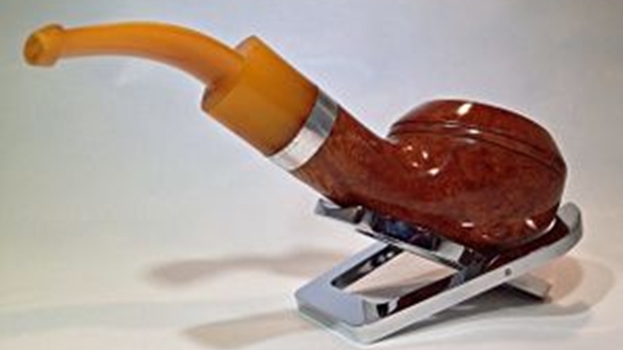
LH Stern is known to every important wholesaler and jobber in the country. LHS manufactures a complete line of briar pipes. Ginmetto wood pipes are also made, as well as Redmanol goods, the man-made amber. The first substitute for amber. Everything, even down to the sterling silver and other metal trimmings are made under one roof.

Example with Redmanol Stem (man-made amber)

I checked the dates on Redmanol and it was developed and was linked to an article on Bakelite on Wikipedia (https://en.wikipedia.org/wiki/Bakelite).

Bakelite (/ˈbeɪkəlaɪt/ BAY-kəl-eyet; sometimes spelled Baekelite) or polyoxybenzylmethylenglycolanhydride was the first plastic made from synthetic components. It is a thermosetting phenol formaldehyde resin, formed from a condensation reaction of phenol with formaldehyde. It was developed by the Belgian-American chemist Leo Baekeland in Yonkers, New York, in 1907.

Bakelite was patented on December 7, 1909. The creation of a synthetic plastic was revolutionary for its electrical nonconductivity and heat-resistant properties in electrical insulators, radio and telephone casings and such diverse products as kitchenware, jewelry, pipe stems, children’s toys, and firearms.

It seems that the inventor of Bakelite ended up merging his company with Redmanol who developed a similar product. I now knew that the stem I was working on was Redmanol/Bakelite. The more I worked on it the more apparent it became that I was dealing with a manmade product rather than natural amber.

Armed with that information I turned my attention to the stem. I wiped the stem surface down with soap and water to remove any oils on the stem surface. I filled in the tooth marks with clear super glue and set the stem aside until the repairs had cured.When the repairs had cured I sanded them smooth to blend them into the surface with 220 grit sandpaper and polished it with 400 grit wet dry sandpaper.     You can see the discolouration of the stem material from the sanding. It is pretty typical of Redmanol and Bakelite stem… I went on to polish the stem with micromesh sanding pads – wet sanding 1500-12000 grit sanding pads. I wiped the stem down after each sanding pad with Obsidian Oil. I gave it a final coat of Obsidian Oil after the last sanding pad.  BBB pipes have always been a favourite of mine. I love firing up a bowl in one and I love feel and craftsmanship that went into each of them. This 1911 Gourd Calabash is a beautiful example of the craftsmanship that went into each of the pipes that came out of Louis Blumfeld’s BBB factory. These calabash pipes put together the gourd from South Africa with a meerschaum cup from Turkey and a stem supplied by Redmanol. It is truly an international pipe that ended up in Canada on the farm of a Scottish immigrant and lived far beyond his life time in the hands of his granddaughter who cherished it and cared for it. I am honoured to carry on the trust of this noble calabash. I put the bowl and stem back together.

I carefully polished the bowl, the meer cap and stem with Blue Diamond to polish out the scratches in the briar and the vulcanite. I gave the gourd and stem multiple coats of carnauba wax. I buffed the pipe with a clean buffing pad to raise the shine. I hand buffed it with a microfiber cloth to deepen the shine. The pipe polished up pretty nicely. The rich reddish brown patina of the gourd, the shine of the aging meer, the silver band and ring and the Redmanol stem really popped with buffing showing the contrast colours of the pipe. The polished Redmanol stem went really well with the colours of the bowl. The rim top, though slightly damaged looked very good. This old BBB Gourd Calabash was another fun pipe to work on. It is an old timer that will hold a place in my BBB collection. The finished pipe is shown in the photos below. The dimensions of the pipe are Length: 7 inches, Height: 4 inches, Outside diameter of the bowl: 2 ¼ inches, Chamber diameter: ¾ of an inch. Thanks to John Milne Senior for his care of his pipe. Thanks to Pat for her care of it through the years and for passing it on to me to hold in trust as the next pipeman to own it. Thanks for reading this blog and my reflections on the pipe while I worked on it. This is an interesting estate to bring back to life. 
Working on a GBD Historic 115 Sandblast Billiard from Bob Kerr’s Estate


Blog by Steve Laug

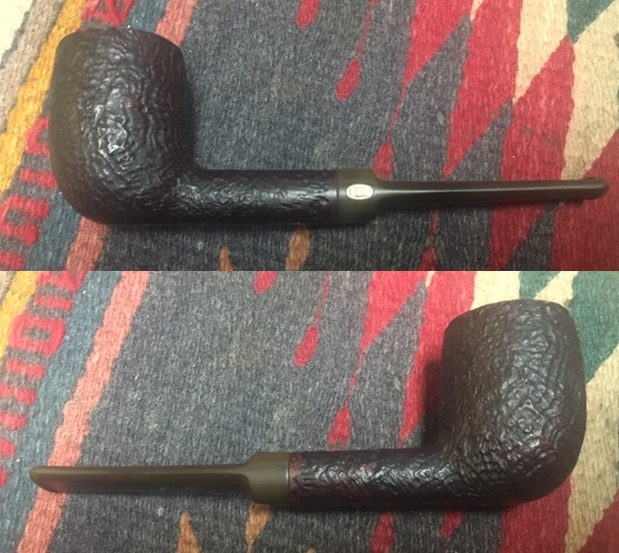
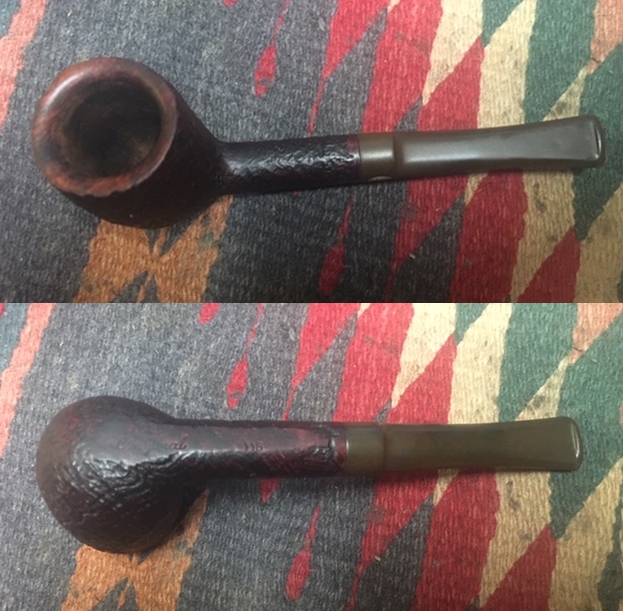
I am continuing to work through Bob Kerr’s estate. The next pipe on the table is a GBD Historic Billiard, sandblasted bowl and shank and a smooth panel on the underside of the shank with the stamping. It is a Prehistoric with a black vulcanite stem. I am continuing to cleanup Bob’s estate for his family and moving them out into the hands of pipemen and women who will carry on the trust that began with Bob and in some pipes was carried on by Bob. In the collection there were a total of 125 pipes along with a box of parts. This is the largest estate that I have had the opportunity to work on. I put together a spread sheet of the pipes and stampings to create an invoice. I was taking on what would take me a fair amount of time to clean up. I could not pass up the opportunity to work on these pipes though. They were just too tempting.

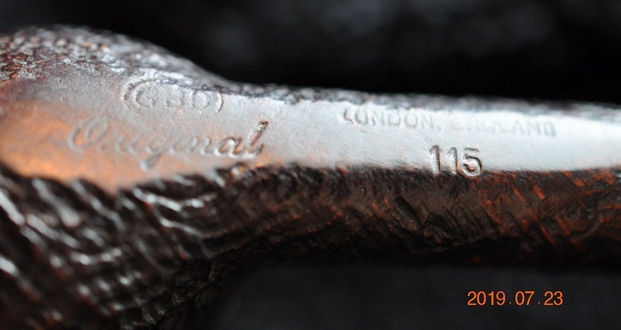
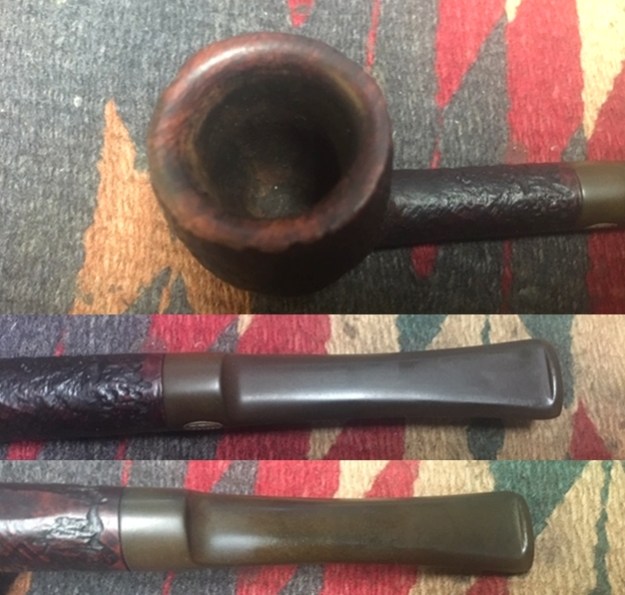
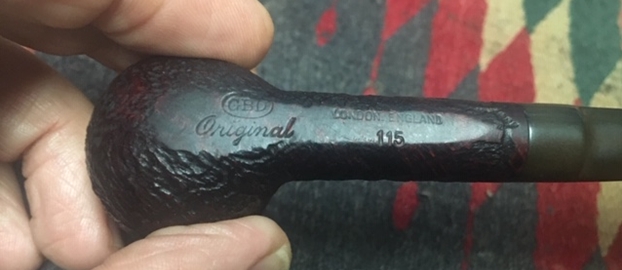
I have been collecting and restoring GBD pipes for as long as I have worked on pipes. This one also has a beautiful mix of grain under the grime on the sandblast finish. It is quite beautiful! The pipe is stamped GBD in an oval over Historic on the underside of the shank. That is followed by stamping London, England and the shape number 115. It had a rich mix of black and dark brown stain that does not look too bad. There was a thick cake in the bowl with remnants of tobacco stuck on the walls. There was a lava overflow on the rim. The inner edge of the rim and top are dirty and had a thick lava coat. The edges appear to have a bit of burn damage on the front inner edge and the front outer edge has a bit of wear damage. It was a beautiful pipe that was dirty and tired looking. The stem was oxidized and calcified toward the end. Again, surprisingly did not have the tooth marks that I have come to expect from Bob’s pipes. Jeff took photos of the pipe before he started his cleanup work on it. Jeff took photos of the bowl and rim top to show the cake in the bowl and the lava build up on the edges of the bowl. It was thick and hard but hopefully it had protected the rim and edges from damage. There appears to be a little damage on the left front inner and outer edges of the bowl. Otherwise it looks pretty good. Jeff took photos of the sides and heel of the bowl to show the condition of the finish. You can see the beautiful grain through the sandblast – both birdseye and cross grain. The finish was very dirty.   Jeff took photos of the stamping on the smooth panel on the underside of the shank. The stamping was readable as you can see from the photos. On the underside it read GBD in an oval over Historic. That was followed by London, England over the shape number 115. On the left side of the saddle stem was an inlaid GBD rondel.Jeff took photos of the top and underside of the stem showing the tooth chatter, scratching and oxidation on the stem surface and wear on the edges of the button.       I turned to Pipedia’s article on GBD to see if I could find any information on the Historic line. I have heard of Prehistoric pipes but I have never seen one stamped Historic. It is another one that is a mystery in terms of the line. The article gives a lot in terms of the history of the brand (https://pipedia.org/wiki/GBD). There is nothing specific on the Historic line.

I also turned to the reference page on the site for GBD shapes and numbers and found the one for the 115 shape but it called it a Prince of Wales and said that the saddle stem had a 1/8 bend. To me a Prince of Wales is a Prince shape pipe and the one that I was working on is definitely a billiard (https://pipedia.org/wiki/GBD_Shapes/Numbers). The vagaries of clearly pinning down GBD Shapes is evident in this seeming contradiction. I also did a screen capture of the section and from the various Model information. That also was an interesting conundrum in that the pipe in my hand was not smooth but had a sandblast finish like the Prehistoric with a smooth beveled rim top. I combined the screen captures in one picture below (https://pipedia.org/wiki/GBD_Model_Information).  All of my research did not really help pin anything down. The shape number was a dead end contradiction as was the line description. I was dealing with a bit of anomaly – a Sandblast Billiard stamped Historic not Prehistoric with a straight thin bit stem. In terms of dating the pipe I can only guess that it fits in with the late 50s to late 60s of Bob’s other pipes but I cannot know for sure. Now it was time to work on the pipe.

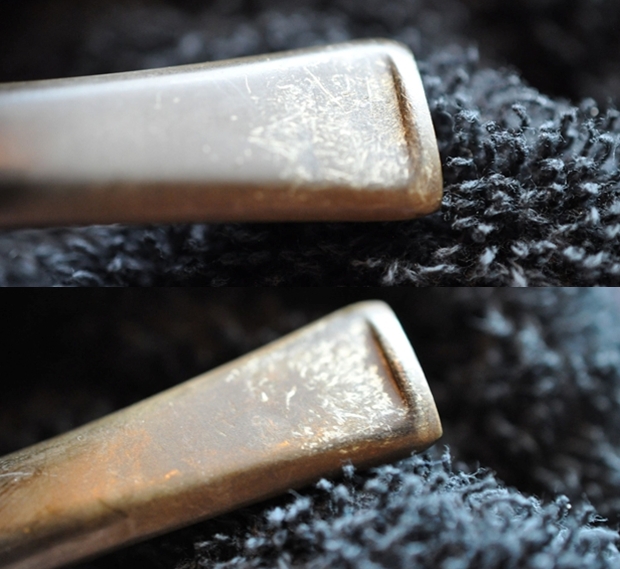
With over 125 pipes to clean from Bob’s estate I took a batch of them to the states with me on a recent visit and left them with Jeff so he could help me out. Jeff cleaned the pipe with his usual penchant for thoroughness that I really appreciate. This one was a real mess and I did not know what to expect when I unwrapped it from his box. He reamed it with a PipNet pipe reamer and cleaned up the reaming with a Savinelli Fitsall Pipe Knife. He scrubbed out the internals with alcohol, pipe cleaners and cotton swabs until the pipe was clean. He scrubbed the exterior of the bowl with Murphy’s Oil Soap and a tooth brush to remove the grime and grit on the briar and the lava on the rim top. The finish looks very good with good looking grain around the bowl and shank. Jeff soaked the stem in Before & After Deoxidizer to remove the oxidation on the rubber. When the pipe arrived here in Vancouver for the second stop of its restoration tour it looked good. The stem still sported some deep oxidation but otherwise it was clean. I took photos before I started my part of the work. I took some close up photos of the rim top and also of the stem surface. I wanted to show what an amazing job Jeff did in the cleanup of the rim top. The rim top looks pretty good. There is some darkening on the top edge and a burn mark on the inner edge at the front. There is also some damage on the outer rim on the rim. The photos show a few small dents on the surface of the stem. You can also see the remaining oxidation on the stem surface.    I am going to keep posting the next paragraph because of the importance of protecting the stamping/nomenclature.

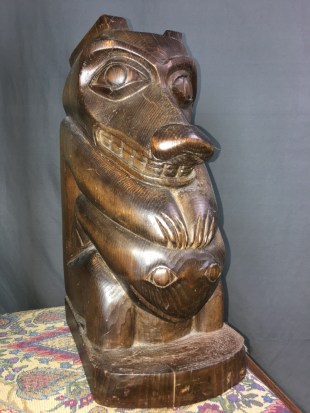
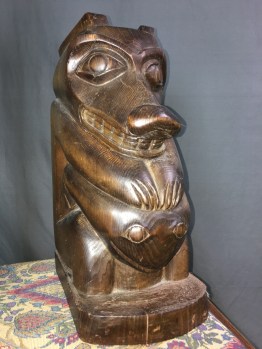
One of the things I appreciate about Jeff’s cleanup is that he works to protect and preserve the nomenclature on the shank of the pipes that he works on. The stamping on this one was very faint to start with so I was worried that it would disappear altogether with the cleanup. He was not only able to preserve it but it is clearer than shown in the earlier photos. I took some photos to show the clarity of the stamping. I have noticed that many restorers are not careful to protect the stamping in their cleaning process and often by the end of the restoration the nomenclature is almost destroyed. I would like to encourage all of us to be careful in our work to preserve this as it is a critical piece of pipe restoration!   Since this is another pipe Bob’s estate I am sure that some of you have read at least some of the other restoration work that has been done on the previous pipes. You have also read what I have included about Bob Kerr, the pipeman who held these pipes in trust before I came to work on them (see photo to the left). Also, if you have followed the blog for long you will already know that I like to include background information on the pipeman whose pipes I am restoring. For me, when I am working on an estate I really like to have a sense of the person who held the pipes in trust before I worked on them. It gives me another dimension of the restoration work. I asked Brian if he or his wife would like to write a brief biographical tribute to her father, Bob. His daughter worked on it and I received the following short write up on him and some pictures to go along with the words including one of Bob’s carvings. Once again I thank you Brian and tell your wife thank you as well.

I am delighted to pass on these beloved pipes of my father’s. I hope each user gets many hours of contemplative pleasure as he did. I remember the aroma of tobacco in the rec room, as he put up his feet on his lazy boy. He’d be first at the paper then, no one could touch it before him. Maybe there would be a movie on with an actor smoking a pipe. He would have very definite opinions on whether the performer was a ‘real’ smoker or not, a distinction which I could never see but it would be very clear to him. He worked by day as a sales manager of a paper products company, a job he hated. What he longed for was the life of an artist, so on the weekends and sometimes mid-week evenings he would journey to his workshop and come out with wood sculptures, all of which he declared as crap but every one of them treasured by my sister and myself. Enjoy the pipes, and maybe a little of his creative spirit will enter you!

Now, on to the rest of the restoration on this GBD Historic 115 Billiard. Since Jeff had done such an amazing clean up job on the bowl it was going to be a very easy job for me. There was some darkening and damage on the inner edge of the rim that needed to be addressed. I sanded it with a folded piece of 220 grit sandpaper to remove and minimize the damage to the edge. I continued by starting to polish it with 400 grit wet dry sandpaper. I wiped the rim edge down with a damp cloth to remove the sanding dust on the briar. The finished rim top looked much better than when I started. I was able to minimize the damage on the front inner edge of the rim. It is still damaged but it looks considerably better. Once I clean it and stain it the rim edge will look better.  I stained the rim top and edges with a Walnut and Black stain pen. I blended the colours to match the rest of the bowl colour. I also stained the shank end with the two pens to blend them into the flow of the colour on the shank and bowl.     I rubbed the bowl down with Before & After Restoration Balm. I worked it into the surface of the briar with my fingertips and a horsehair shoe brush to clean, enliven and protect it. I let the balm sit for a little while and then buffed with a cotton cloth and shoe brush to raise the shine. Mark Hoover’s Balm is a product that I have come to appreciate and one I use on every pipe I have been working on.      I set the bowl aside and turned my attention to the stem. I sanded the stem with 220 grit sandpaper to break up the oxidation. I started the polishing with 400 grit wet dry sandpaper to remove the scratching. It is starting to look good.       I have one more tin of Denicare Mouthpiece Polish left from a few that I have picked up over the years. It is a coarse red pasted that serves to help remove oxidation. I polished the stem with that to further smooth out the surface of the vulcanite (and to be honest – to use it up).      I polished the stem with micromesh sanding pads – wet sanding with 1500-12000 grit pads. I wiped the stem down after each sanding pad with Obsidian Oil. I polished it with Before & After Pipe Stem Polish – both Fine and Extra Fine. Once I had finished the polishing I gave it final coat of oil and set it aside to dry.    I can’t tell you how great it feels to be moving through these 125 pipes – about 35 done so far! It seemed like an overwhelming task that can only be achieved one pipe at a time. So each time I finish one of the pipes from Bob Kerr’s Estate I look forward to what it will look like when it is put back together, polished and waxed. I put the bowl and stem back together. I polished the bowl and stem with Blue Diamond to polish out the scratches in the briar and the vulcanite. I gave the bowl and stem multiple coats of carnauba wax. I buffed the pipe with a clean buffing pad to raise the shine. I hand buffed it with a microfiber cloth to deepen the shine. The pipe polished up pretty nicely. The rich dark brown and black sandblast finish really popped with buffing showing the contrast colours of stain on the pipe. The polished thin black vulcanite stem went really well with the colours of the bowl. The sandblast rim top, though slightly damaged looked very good. This old GBD Historic Sandblast 115 Billiard was another fun pipe to work on thanks to Jeff’s cleanup work. It really has the classic GBD Billiard shape that is very recognizable. The combination of various stains really makes the pipe look attractive. It is another comfortable pipe to hold in the hand. The finished pipe is shown in the photos below. The dimensions of the pipe are Length: 5 ½ inches, Height: 1 ¾ inches, Outside diameter of the bowl: 1 ¼ inches, Chamber diameter: ¾ of an inch. If you are interested in carrying on Bob’s legacy with this pipe send me a message or an email. I have a lot more to work on of various brands. Perhaps one of those will catch your attention. Thanks for reading this blog and my reflections on the pipe while I worked on it. This is an interesting estate to bring back to life.
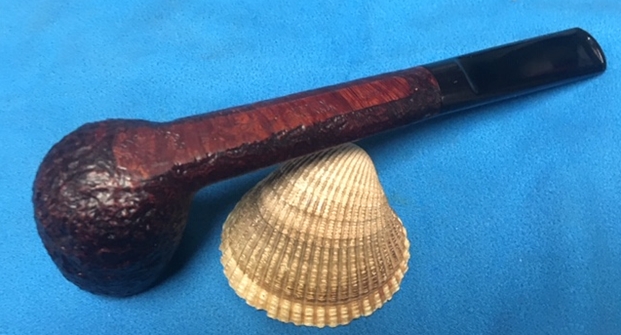
Working on a GBD Original 115 Beveled Rim Billiard from Bob Kerr’s Estate


Blog by Steve Laug

I am continuing to work through Bob Kerr’s estate. The next pipe on the table is a GBD Original Billiard, sandblasted bowl and shank with a smooth beveled rim and a smooth panel on the underside of the shank with the stamping. I am continuing to cleanup Bob’s estate for his family and moving them out into the hands of pipemen and women who will carry on the trust that began with Bob and in some pipes was carried on by Bob. In the collection there were a total of 125 pipes along with a box of parts. This is the largest estate that I have had the opportunity to work on. I put together a spread sheet of the pipes and stampings to create an invoice. I was taking on what would take me a fair amount of time to clean up. I could not pass up the opportunity to work on these pipes though. They were just too tempting.

I have been collecting and restoring GBD pipes for as long as I have worked on pipes. This one also has a beautiful mix of grain under the grime on the sandblast finish. It is quite beautiful! The pipe is stamped GBD in an oval over Original on the underside of the shank. That is followed by stamping London, England and the shape number 115. It had a rich mix of black and dark brown stain that does not look too bad. There was a thick cake in the bowl with remnants of tobacco stuck on the walls. There was a lava overflow on the rim. The inner beveled edge of the rim and top are dirty and had a thick lava coat. The edges look pretty pristine under the grime. It was a beautiful pipe that was dirty and tired looking. The stem was oxidized and calcified toward the end. Again, surprisingly did not have the tooth marks that I have come to expect from Bob’s pipes. Jeff took photos of the pipe before he started his cleanup work on it. Jeff took photos of the bowl and rim top to show the cake in the bowl and the lava build up on the edges of the bowl. It was thick and hard but hopefully it had protected the rim and edges from damage. The edges look pretty good.     Jeff took photos of the sides and heel of the bowl to show the condition of the finish. You can see the beautiful grain through the sandblast – both birdseye and cross grain. The finish was very dirty.     Jeff took photos of the stamping on the smooth panel on the underside of the shank. The stamping was readable as you can see from the photos. On the underside it read GBD in an oval over Original. That was followed by London, England over the shape number 115. On the left side of the saddle stem was an inlaid GBD rondel.  Jeff took photos of the top and underside of the stem showing the tooth chatter, scratching and oxidation on the stem surface and wear on the edges of the button. I turned to Pipedia’s article on GBD to see if I could find any information on the Original. It was a line of GBD pipes that was new to me. The article gives a lot in terms of the history of the brand (https://pipedia.org/wiki/GBD). There is nothing specific on the Original line.

I also turned to the reference page on the site for GBD shapes and numbers and found the one for the 115 shape but it called it a Prince of Wales and said that the saddle stem had a 1/8 bend. To me a Prince of Wales is a Prince shape pipe and the one that I was working on is definitely a billiard (https://pipedia.org/wiki/GBD_Shapes/Numbers). The vagaries of clearly pinning down GBD Shapes is evident in this seeming contradiction. I also did a screen capture of the section and from the various Model information. That also was an interesting conundrum in that the pipe in my hand was not smooth but had a sandblast finish like the Prehistoric with a smooth beveled rim top. I combined the screen captures in one picture below (https://pipedia.org/wiki/GBD_Model_Information).     All of my research did not really help pin anything down. The shape number was a dead end contradiction as was the line description. I was dealing with a bit of anomaly – a Sandblast Original Billiard with a straight thin bit stem. In terms of dating the pipe I can only guess that it fits in with the late 50s to late 60s of Bob’s other pipes but I cannot know for sure. Now it was time to work on the pipe.

With over 125 pipes to clean from Bob’s estate I took a batch of them to the states with me on a recent visit and left them with Jeff so he could help me out. Jeff cleaned the pipe with his usual penchant for thoroughness that I really appreciate. This one was a real mess and I did not know what to expect when I unwrapped it from his box. He reamed it with a PipNet pipe reamer and cleaned up the reaming with a Savinelli Fitsall Pipe Knife. He scrubbed out the internals with alcohol, pipe cleaners and cotton swabs until the pipe was clean. He scrubbed the exterior of the bowl with Murphy’s Oil Soap and a tooth brush to remove the grime and grit on the briar and the lava on the rim top. The finish looks very good with good looking grain around the bowl and shank. Jeff soaked the stem in Before & After Deoxidizer to remove the oxidation on the rubber. When the pipe arrived here in Vancouver for the second stop of its restoration tour it looked good. The stem still sported some deep oxidation but otherwise it was clean. I took photos before I started my part of the work.    I took some close up photos of the rim top and also of the stem surface. I wanted to show what an amazing job Jeff did in the cleanup of the rim top. The rim top looks good. There is some darkening on the top edge and a few light nicks and scratches on the surface. The bowl looked very good. I also took close up photos of the stem to show the few small dents on the surface of the stem. You can also see the remaining oxidation on the stem surface.       I am going to keep posting the next paragraph because of the importance of protecting the stamping/nomenclature.

One of the things I appreciate about Jeff’s cleanup is that he works to protect and preserve the nomenclature on the shank of the pipes that he works on. The stamping on this one was very faint to start with so I was worried that it would disappear altogether with the cleanup. He was not only able to preserve it but it is clearer than shown in the earlier photos. I took some photos to show the clarity of the stamping. I have noticed that many restorers are not careful to protect the stamping in their cleaning process and often by the end of the restoration the nomenclature is almost destroyed. I would like to encourage all of us to be careful in our work to preserve this as it is a critical piece of pipe restoration!Since this is another pipe Bob’s estate I am sure that some of you have read at least some of the other restoration work that has been done on the previous pipes. You have also read what I have included about Bob Kerr, the pipeman who held these pipes in trust before I came to work on them (see photo to the left). Also, if you have followed the blog for long you will already know that I like to include background information on the pipeman whose pipes I am restoring. For me, when I am working on an estate I really like to have a sense of the person who held the pipes in trust before I worked on them. It gives me another dimension of the restoration work. I asked Brian if he or his wife would like to write a brief biographical tribute to her father, Bob. His daughter worked on it and I received the following short write up on him and some pictures to go along with the words including one of Bob’s carvings. Once again I thank you Brian and tell your wife thank you as well.

I am delighted to pass on these beloved pipes of my father’s. I hope each user gets many hours of contemplative pleasure as he did. I remember the aroma of tobacco in the rec room, as he put up his feet on his lazy boy. He’d be first at the paper then, no one could touch it before him. Maybe there would be a movie on with an actor smoking a pipe. He would have very definite opinions on whether the performer was a ‘real’ smoker or not, a distinction which I could never see but it would be very clear to him. He worked by day as a sales manager of a paper products company, a job he hated. What he longed for was the life of an artist, so on the weekends and sometimes mid-week evenings he would journey to his workshop and come out with wood sculptures, all of which he declared as crap but every one of them treasured by my sister and myself. Enjoy the pipes, and maybe a little of his creative spirit will enter you!

Now, on to the rest of the restoration on this GBD Original 115 Billiard. Since Jeff had done such an amazing clean up job on the bowl it was going to be a very easy job for me. There was some darkening on the inner beveled edge of the rim that needed to be addressed. I sanded it with a folded piece of 220 grit sandpaper to remove and minimize the damage to the bevel. I continued by starting to polish it with 400 grit wet dry sandpaper. I wiped the rim edge down with a damp cloth to remove the sanding dust on the briar. The finished rim top looked much better than when I started.I rubbed the bowl down with Before & After Restoration Balm. I worked it into the surface of the briar with my fingertips and a horsehair shoe brush to clean, enliven and protect it. I let the balm sit for a little while and then buffed with a cotton cloth and shoe brush to raise the shine. Mark Hoover’s Balm is a product that I have come to appreciate and one I use on every pipe I have been working on.     I set the bowl aside and turned my attention to the stem. I sanded the stem with 220 grit sandpaper to break up the oxidation. I started the polishing with 400 grit wet dry sandpaper to remove the scratching. It is starting to look good.    I have one more tin of Denicare Mouthpiece Polish left from a few that I have picked up over the years. It is a coarse red pasted that serves to help remove oxidation. I polished the stem with that to further smooth out the surface of the vulcanite (and to be honest – to use it up).    I polished the stem with micromesh sanding pads – wet sanding with 1500-12000 grit pads. I wiped the stem down after each sanding pad with Obsidian Oil. I polished it with Before & After Pipe Stem Polish – both Fine and Extra Fine. Once I had finished the polishing I gave it final coat of oil and set it aside to dry.   I can’t tell you how great it feels to be moving through these 125 pipes – about 35 done so far! It seemed like an overwhelming task that can only be achieved one pipe at a time. So each time I finish one of the pipes from Bob Kerr’s Estate I look forward to what it will look like when it is put back together, polished and waxed. I put the bowl and stem back together. I polished the bowl and stem with Blue Diamond to polish out the scratches in the briar and the vulcanite. I gave the bowl and stem multiple coats of carnauba wax. I buffed the pipe with a clean buffing pad to raise the shine. I hand buffed it with a microfiber cloth to deepen the shine. The pipe polished up pretty nicely. The rich dark brown and black sandblast finish really popped with buffing showing the contrast colours of stain on the pipe. The polished thin black vulcanite stem went really well with the colours of the bowl. The smooth beveled rim top really stood out and gave the pipe a bit of class. This old GBD Original Sandblast 115 Billiard was another fun pipe to work on thanks to Jeff’s cleanup work. It really has the classic GBD Billiard shape that is very recognizable. The combination of various stains really makes the pipe look attractive. It is another comfortable pipe to hold in the hand. The finished pipe is shown in the photos below. The dimensions of the pipe are Length: 5 ½ inches, Height: 1 ¾ inches, Outside diameter of the bowl: 1 ¼ inches, Chamber diameter: ¾ of an inch. If you are interested in carrying on Bob’s legacy with this pipe send me a message or an email. I have a lot more to work on of various brands. Perhaps one of those will catch your attention. Thanks for reading this blog and my reflections on the pipe while I worked on it. This is an interesting estate to bring back to life.
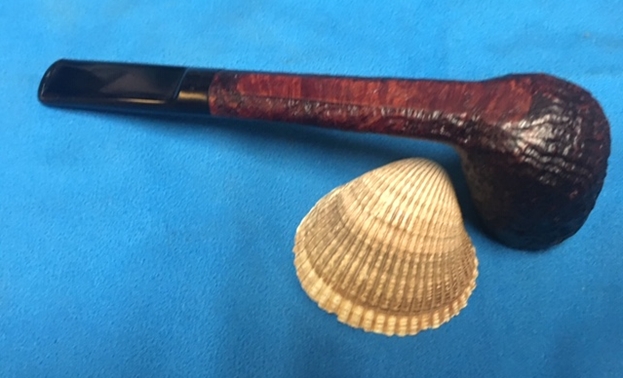
Working on a GBD New Era 122 Beveled Rim Billiard from Bob Kerr’s Estate


Blog by Steve Laug

I am continuing to work through Bob Kerr’s estate. The next pipe on the table is a GBD New Era Billiard. I am continuing to cleanup Bob’s estate for his family and moving them out into the hands of pipemen and women who will carry on the trust that began with Bob and in some pipes was carried on by Bob. In the collection there were a total of 125 pipes along with a box of parts. This is the largest estate that I have had the opportunity to work on. I put together a spread sheet of the pipes and stampings to create an invoice. I was taking on what would take me a fair amount of time to clean up. I could not pass up the opportunity to work on these pipes though. They were just too tempting.

I have been collecting and restoring GBD pipes for as long as I have worked on pipes. This one also has some beautiful mixed grain underneath the grime. It is quite beautiful! The pipe is stamped GBD in an oval over New Era on the left side of the shank. On the right side it is stamped London, England over the shape number 122. It had a rich medium brown stain that does not look too bad. There was a thick cake in the bowl with remnants of tobacco stuck on the walls. There was a lava overflow on the rim. The inner beveled edge of the rim and top are dirty and had a thick lava coat. The edges look pretty pristine under the grime. It was a beautiful pipe that was dirty and tired looking. The stem was oxidized and calcified toward the end. Again, surprisingly did not have the tooth marks that I have come to expect from Bob’s pipes. Jeff took photos of the pipe before he started his cleanup work on it.Jeff took photos of the bowl and rim top to show the cake in the bowl and the lava build up on the edges of the bowl. It was thick and hard but hopefully it had protected the rim and edges from damage. The edges look pretty good.      Jeff took photos of the side and heel of the bowl to show the condition of the finish. You can see the beautiful grain – both birdseye and cross grain. The finish was very dirty.    Jeff took photos of the stamping on the smooth panel on the underside of the shank. The stamping was readable as you can see from the photos. On the left side it read GBD in an oval over New Era. On the right side it is stamped London, England over the shape number 122. On the left side of the tapered stem was an inlaid GBD roundel. Jeff took photos of the top and underside of the stem showing the tooth chatter, scratching and oxidation on the stem surface and wear on the edges of the button.    I turned to Pipedia’s article on GBD to see if I could find any information on the Popular. It was a line of GBD pipes that was new to me. The article gives a lot in terms of the history of the brand (https://pipedia.org/wiki/GBD). I have included a paragraph from the site below as well as a page from a catalogue.

The claims after the 1st World War demanded further distinctions. First of all was the London Made, which became the Standard London Made, followed by the New Era– in 1931 the top model asking 12½ Shilling. The Pedigree, although sketched around 1926, was not produced until the later 1930s. The New Standard was introduced in order to give the popular Standard of the 20s a higher rank in value. The Prehistoric, a deeply sandblasted black pipe, that still carried the small GBD Xtra stamp, was entirely new and unusual.There was a fellow on Facebook Tobacco Pipe Restorers Group who picked up some booklets and pamphlets on GBD pipes. I messaged him and asked him to send me info on the New Era line. This photo gives a pretty good description. Combined with the one above it is an interesting mystery. The first document above says that the pipe has “a rich ruby finish” while the one below says it is “accentuated by a warm brown two-tone finish.” The pipe I am working on definitely sits somewhere between these two descriptions – it has a reddish brown finish.I also turned to the reference page on the site for GBD shapes and numbers and found the one for the straight bulldog that I was working on (https://pipedia.org/wiki/GBD_Shapes/Numbers). I did a screen capture of the section and from the various Model information. I combined them below (https://pipedia.org/wiki/GBD_Model_Information).   The fellow on Facebook also included the next photo that shows the shape and description of the 122. GBD calls it a Long Billiard with a Taper Mouthpiece.I now knew I was dealing with a well-made hand chosen piece of briar that had gone through a period of long seasoning. In terms of dating the pipe I figure that it fits in with the late 50s to late 60s of Bob’s other pipes but I cannot know for sure. Now it was time to work on the pipe.

With over 125 pipes to clean from Bob’s estate I took a batch of them to the states with me on a recent visit and left them with Jeff so he could help me out. Jeff cleaned the pipe with his usual penchant for thoroughness that I really appreciate. This one was a real mess and I did not know what to expect when I unwrapped it from his box. He reamed it with a PipNet pipe reamer and cleaned up the reaming with a Savinelli Fitsall Pipe Knife. He scrubbed out the internals with alcohol, pipe cleaners and cotton swabs until the pipe was clean. He scrubbed the exterior of the bowl with Murphy’s Oil Soap and a tooth brush to remove the grime and grit on the briar and the lava on the rim top. The finish looks very good with good looking grain around the bowl and shank. Jeff soaked the stem in Before & After Deoxidizer to remove the oxidation on the rubber. When the pipe arrived here in Vancouver for the second stop of its restoration tour it looked very good. I took photos before I started my part of the work.     I took some close up photos of the rim top and also of the stem surface. I wanted to show what an amazing job Jeff did in the cleanup of the rim top. The rim top looks good. There is some darkening on the top edge and a few light nicks and scratches on the surface. The bowl looked very good. I also took close up photos of the stem to show the scratches and lack of tooth marks on the stem. You can also see the remaining oxidation on the stem surface.     I am going to keep posting the next paragraph because of the importance of protecting the stamping/nomenclature.

One of the things I appreciate about Jeff’s cleanup is that he works to protect and preserve the nomenclature on the shank of the pipes that he works on. The stamping on this one was very faint to start with so I was worried that it would disappear altogether with the cleanup. He was not only able to preserve it but it is clearer than shown in the earlier photos. I took some photos to show the clarity of the stamping. I have noticed that many restorers are not careful to protect the stamping in their cleaning process and often by the end of the restoration the nomenclature is almost destroyed. I would like to encourage all of us to be careful in our work to preserve this as it is a critical piece of pipe restoration!Since this is another pipe Bob’s estate I am sure that some of you have read at least some of the other restoration work that has been done on the previous pipes. You have also read what I have included about Bob Kerr, the pipeman who held these pipes in trust before I came to work on them (see photo to the left). Also, if you have followed the blog for long you will already know that I like to include background information on the pipeman whose pipes I am restoring. For me, when I am working on an estate I really like to have a sense of the person who held the pipes in trust before I worked on them. It gives me another dimension of the restoration work. I asked Brian if he or his wife would like to write a brief biographical tribute to her father, Bob. His daughter worked on it and I received the following short write up on him and some pictures to go along with the words including one of Bob’s carvings. Once again I thank you Brian and tell your wife thank you as well.

I am delighted to pass on these beloved pipes of my father’s. I hope each user gets many hours of contemplative pleasure as he did. I remember the aroma of tobacco in the rec room, as he put up his feet on his lazy boy. He’d be first at the paper then, no one could touch it before him. Maybe there would be a movie on with an actor smoking a pipe. He would have very definite opinions on whether the performer was a ‘real’ smoker or not, a distinction which I could never see but it would be very clear to him. He worked by day as a sales manager of a paper products company, a job he hated. What he longed for was the life of an artist, so on the weekends and sometimes mid-week evenings he would journey to his workshop and come out with wood sculptures, all of which he declared as crap but every one of them treasured by my sister and myself. Enjoy the pipes, and maybe a little of his creative spirit will enter you!

Now on to the rest of the restoration on this GBD New Era Billiard. Since Jeff had done such an amazing clean up job on the bowl it was very easy for me. There was some darkening on the inner beveled edge of the rim that needed to be addressed. I sanded it with a folded piece of 220 grit sandpaper to remove and minimize the damage to the bevel. I continued by starting to polish it with 400 grit wet dry sandpaper. I wiped the rim edge down with a damp cloth to remove the sanding dust on the briar. The finished rim top looked much better than when I started.There was a deep cut or groove in the briar on the left side of the bowl. It looked like someone had scratched it against hard surface leaving a deep gouge. I filled in the gouge with clear super glue. Once the glue had dried I sanded it smooth with 220 grit sandpaper and blended it with 400 grit wet dry sandpaper.  I used a Maple stain pen to touch up the sanded area to match the rest of the bowl. It looked very good and would completely blend once the bowl was polished with micromesh.I polished the briar with micromesh sanding pads to blend in the stain and to polish the briar and remove the scratches in the surface of the bowl, heel and shank. I wet sanded with 1500-12000 grit pads and wiped the bowl down between each pad with a damp cloth.   I decided to clean the briar with Mark Hoover’s Before & After Briar Cleaner to clean up the sanded surface of the briar and blend sanded rim edge. I rubbed it into the surface of the briar and let it sit for 10 minutes. I rinsed the bowl off with warm running water to remove the product and the grime.       I rubbed the bowl down with Before & After Restoration Balm. I worked it into the surface of the briar with my fingertips to clean, enliven and protect it. I let the balm sit for a little while and then buffed with a cotton cloth and shoe brush to raise the shine. Mark Hoover’s Balm is a product that I have come to appreciate and one I use on every pipe I have been working on.     I set the bowl aside and turned my attention to the stem. I sanded the stem with 220 grit sandpaper to break up the oxidation. I started the polishing with 400 grit wet dry sandpaper to remove the scratching. It is starting to look good.    I have one more tin of Denicare Mouthpiece Polish left from a few that I have picked up over the years. It is a coarse red pasted that serves to help remove oxidation. I polished the stem with that to further smooth out the surface of the vulcanite (and to be honest – to use it up).   I polished the stem with micromesh sanding pads – wet sanding with 1500-12000 grit pads. I wiped the stem down after each sanding pad with Obsidian Oil. I polished it with Before & After Pipe Stem Polish – both Fine and Extra Fine. Once I had finished the polishing I gave it final coat of oil and set it aside to dry.       I am excited to be finishing another one of Bob Kerr’s Estate pipes and as usual I look forward to what it will look like when it is put back together, polished and waxed. I put the bowl and stem back together. I polished the bowl and stem with Blue Diamond to polish out the scratches in the briar and the vulcanite. I gave the bowl and stem multiple coats of carnauba wax. I buffed the pipe with a clean buffing pad to raise the shine. I hand buffed it with a microfiber cloth to deepen the shine. The pipe polished up pretty nicely. The rich reddish brown finish really popped with buffing showing the contrast colours of stain on the pipe. The polished black vulcanite stem went really well with the colours of the bowl. This old GBD New Era 122 Billiard was another fun pipe to work on thanks to Jeff’s cleanup work. It really has the classic GBD Billiard shape that is very recognizable. The combination of various stains really makes the pipe look attractive. It is a comfortable pipe to hold in the hand. The finished pipe is shown in the photos below. The dimensions of the pipe are Length: 5 ¼ inches, Height: 1 ¾ inches, Outside diameter of the bowl: 1 ¼ inches, Chamber diameter: ¾ of an inch. If you are interested in carrying on Bob’s legacy with this pipe send me a message or an email. I have a lot more to work on of various brands. Perhaps one of those will catch your attention. Thanks for reading this blog and my reflections on the pipe while I worked on it. This is an interesting estate to bring back to life.
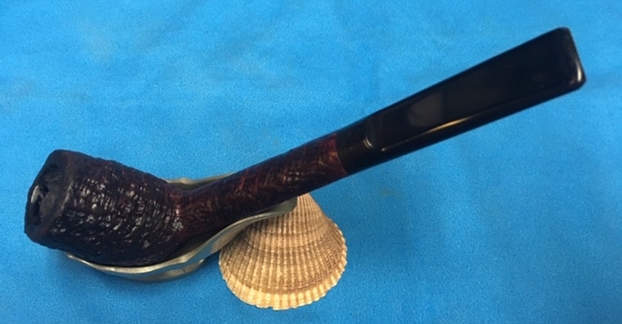
I knew I had seen this brand before – another Bing Crosby Thermostatic Filtration System Pipe


Blog by Steve Laug

Jeff’s pipe package arrived last evening and I opened it and went through the pipes in the package. There were a lot of interesting pipes but it is hard to set them aside and keep working on Bob’s pipes. There was one that Jeff showed me on Facetime that had my attention and I wanted to work on it. The deal was clinched when I saw this pipe in person for the first time. There was something very familiar about it. I recognized both the style of the pipe and the Bing Crosby Thermostatic Filtration System. A quick search of rebornpipes revealed why it was familiar (https://rebornpipes.com/2017/07/18/a-unique-bing-crosby-thermostatic-filtration-system-pipe/). Here is a photo of the pipe I had restored before – it is an interesting Dublin. I reread the blog to remind myself of the history and background on the brand before I started work on it.Jeff took the following photos before he cleaned it up. The wire rusticated finish on the bowl and shank were filthy and filled in with grime and dust. The bowl had a thick cake lining the walls and there was some tobacco stuck in the cake. The rim top also had some lava overflow into the grooves of the rustication. The finish on the shank was also very dirty and some of the varnish was peeling off the wood. Many of the air holes in the shank were plugged. The aluminum end to the shank was in good condition. The shank slides off the stem and tube that is inside the shank. The internals were dirty but they were a Balsa wood filter that was connected to the stem. Surrounding the filter was an aluminum tube. The stem was oxidized with tooth chatter on both sides. The stem twists from side to side allowing the pipe smoker to adjust the airflow. With some clean up this rusticated Lovat will make a great partner to the long shank Dublin shown above.Jeff took photos of the bowl and rim top to show the cake in the bowl and the lava build up on the edges of the bowl. The grime and grit in the wire rusticated finish were heavily built up but even so the inner and outer edges looked very good.    Jeff took photos of the sides and heel of the bowl to show the condition of the rusticated finish. There is a lot of dust and grime on the surface of the briar but it looks pretty interesting.  Jeff took a long view photo of the smooth heel on the bowl to give a feel for the overall look of the stamped area. He also took a photo of the stamping on the heel. It reads Bing Crosby over -0- over PAT.2.838.052 over Other Pats. Pend.   Jeff took the pipe apart and took pictures of the pipe. You can see the debris in the end of the filter in the first photo. The photos that follow show different shots of the pipe parts.   Jeff took photos of the top and underside of the stem showing the tooth chatter and marks on the stem surface and wear on the edges of the button. The stem is not vulcanite if it is like the other. It seems like a mixture of rubber and plastic of some kind. Before I picked up my part of the restoration I went back and reread the pertinent parts of the blog mentioned above. I was particularly interested in the background information I had previously found on the brand and on the patent number itself.

I had found that one of my favourite go to sites, SmokingMetals had information on the brand during my previous research (http://www.smokingmetal.co.uk/pipe.php?page=114). I have included the information from the site and some photos from there as well.

Several variants, but basically the inner stem consists of a filtering device integral with the bit. The outer sleeve comes in several designs. Twisting the perforated outer stem alters the smoke flow/air mixture. These examples here under the Bing Crosby name, but another derivative came under the name of Trailblazer, by “Pipes by Lee Inc.”. The Medico Ventilator appears to incorporate the same principle.In the previous blog I dug a little deeper in the web and found that there was a thread on the Pipesmokers Forum. Here is the link if you would like to follow the entire discussion on the thread. https://pipesmokersforum.com/community/threads/a-bing-crosby.45689/.  I quote two of the respondents regarding the pipe.

It’s my understanding that the “Swiss cheese stem” was designed to give the pipe a cooler smoke. When you twist the pipe shank it either closes the holes or opens them – thus providing a cooler or warmer smoke. I am more interested in knowing if Bing really had a hand in its design or if the whole thing was a gimmick

…SO – the filtration system is called “thermostatic” – and the wood inside the aluminum sleeve on mine definitely looks to be balsa wood. Now if I could just get one of those magnetic drying chamber thingies.

I was excited again with this pipe. In the thread quote above there were several links in the thread referring to articles and information on Bing Crosby himself and one that took me to an advertisement that appears to come from a Mastercraft Pipe Catalogue or from a magazine that included this pipe along with a selection of Mastercraft pipes. http://www.ebay.ca/itm/1971-ADVERTISEMENT-Bing-Crosby-Smoking-Pipes-Rolls-Royce-Bank-Tie-Rack-/151568646383?rmvSB=true. I have included the catalogue page and highlighted specific pipe with a red box. I included a blow up of that portion of the page so you can read it more clearly.You can see it to the left. It reads: Bing Crosby pipes with thermostatic controls and balsa wood filtration combined with fine Briar for dependable new pleasure for every pipe smoker. In the photo item (J) and (K) show variations on the Crosby Pipe. The first is a presentation set with a pipe and 6 interchangeable filter stems and a magnetic drying chamber case where the stems and filters can be stored. Interestingly both sets bear the designation that the pipes are offered by Crosby Research.

I had also previously used the patent number on the bottom of the bowl to hunt down the patent on the US Patent website. I have included the patent drawing and documentation that was submitted with the descriptions of the innovations of this pipe. The pipe was invented by Rosario Crisafulli of Jamaica Estates North, New York and was filed with the US Patent Office on July 12, 1956. The patent was granted almost two years later on June 10, 1958. Having reread the above information and more I moved on to work on the pipe. I took some close up photos to confirm the condition of the pipe. The first shows the bowl, rim top and edges. They were in pretty good shape. There was some minor denting on the rim top. The second shows the stamping on the bottom of the bowl, confirming the information that was given above. Jeff cleaned the pipe with his usual penchant for thoroughness that I really appreciate. This one was a real mess and I did not know what to expect when I unwrapped it from his box. He reamed it with a PipNet pipe reamer and cleaned up the reaming with a Savinelli Fitsall Pipe Knife. He scrubbed out the internals with alcohol, pipe cleaners and cotton swabs until the pipe was clean. He scrubbed the exterior of the bowl with Murphy’s Oil Soap and a tooth brush to remove the grime and grit on the briar and the lava on the rim top. The finish looks very good with good looking grain around the bowl and shank. Jeff soaked the stem in Before & After Deoxidizer to remove the oxidation on the stem. When the pipe arrived here in Vancouver for the second stop of its restoration tour it looked very good. I took photos before I started my part of the work. The next photos show the rim top and the stem surfaces. The rim top cleaned up amazingly and looks very new with no damage to inner or outer edges. The stem cleaned up well but the tooth chatter and marks cover both surfaces and the button. It will need to be cleaned and reshaped.One of the things I appreciate about Jeff’s cleanup is that he works to protect and preserve the nomenclature on the shank of the pipes that he works on. The stamping on this one was very faint to start with so I was worried that it would disappear altogether with the cleanup. He was not only able to preserve it but it is clearer than shown in the earlier photos. I took some photos to show the clarity of the stamping. I have noticed that many restorers are not careful to protect the stamping in their cleaning process and often by the end of the restoration the nomenclature is almost destroyed. I would like to encourage all of us to be careful in our work to preserve this as it is a critical piece of pipe restoration!The shank encloses an aluminum tube with matching perforations to the shank. It is an integral part of the stem. Inside of the tube is a hollow balsa wood filter much like the hard maple filter found in Brigham pipes. In this case the smoke is drawn through the shank and air from outside is mixed with the smoke to either keep it warm or cool it so a clean dry smoke is enjoyed by the pipe smoker. In the earlier noted advertisement the stem and filter unit were one unit and were sold with replacements. The next photos show the pipe taken apart. I rubbed the bowl down with Before & After Restoration Balm. I worked it into the surface of the briar with my fingertips and a horsehair to clean, enliven and protect it. I let the balm sit for a little while and then buffed with a cotton cloth to raise the shine. Mark Hoover’s Balm is a product that I have come to appreciate and one I use on every pipe I have been working on. I set the bowl aside and turned my attention to the stem. I sanded the stem with 220 grit sandpaper to break up the oxidation. I started the polishing with 400 grit wet dry sandpaper to remove the scratching. It is starting to look good. I rubbed the stem down with Denicare Mouthpiece Polish. I have a few tins of this laying around so I am trying to use them up. It does a pretty good job polishing the stem.I polished the stem with micromesh sanding pads – wet sanding with 1500-12000 grit pads. I wiped the stem down with Obsidian Oil after each pad and set the stem aside to dry after the final wipe down with oil.    I put the bowl, shank and stem back together. I polished the bowl and stem with Blue Diamond to polish out the scratches in the briar and the stem. I gave the bowl and the stem multiple coats of carnauba wax. I buffed the pipe with a clean buffing pad to raise the shine. I hand buffed it with a microfiber cloth to deepen the shine. The pipe polished up pretty nicely. The wire rustication on the bowl and shank looked really good with the polished black stem. This Bing Crosby Thermostatic Filtration Lovat was another fun pipe to work on thanks to Jeff’s cleanup work. It really has an interesting and unique look that catches the eye. The combination of various brown stains really makes the pipe look attractive. It is another comfortable pipe to hold in the hand. The finished pipe is shown in the photos below. The dimensions of the pipe are Length: 6 inches, Height: 2 inches, Outside diameter of the bowl: 1 ¼ inches, Chamber diameter: ¾ of an inch. This pipe is joining the Bing Crosby Dublin in my own collection. Thanks for reading this blog and my reflections on the pipe while I worked on it.

Restoring a Handmade Denmark Stanwell Selected Briar Canadian 56 Regd. No. 969-48


Blog by Steve Laug

The next pipe I chose to work on from Bob Kerr’s estate is part of his collection of Danish made pipes. I have worked on the restoration of others in this collection including a Stanwell Jubilee Shape 118 (https://rebornpipes.com/2019/08/11/another-bob-kerr-estate-a-stanwell-jubilee-1942-1982-shape-118/); a Stanwell de Luxe Shape 812 (https://rebornpipes.com/2019/08/10/back-to-bob-kerrs-estate-changing-up-and-working-on-a-danish-made-stanwell-de-luxe-812-billiard-regd-no-969-48/); a WO Larsen (https://rebornpipes.com/2019/01/13/restoring-pipe-17-from-bob-kerrs-estate-a-w-o-larsen-super-15-bent-stack/); a Danish Sovereign Bulldog variation (https://rebornpipes.com/2019/08/11/another-bob-kerr-estate-a-danish-sovereign-305-bulldog-variant/) and a Danmore Deluxe Volcano (https://rebornpipes.com/2019/08/20/restoring-a-petersons-dunmore-70-bent-apple-sitter-from-bob-kerrs-estate-2/).

To this list of Danish pipes I am adding the next – a Handmade in Denmark Stanwell Selected Briar Canadian 56 Regd. No. 969-48. Like the others it is part of Bob’s estate that the family asked me to clean up and move out to others who will carry on the trust that began with Bob. In the collection there were BBBs, Peterson’s, Dunhills, Comoy’s and Barlings as well many others – a total of 125 pipes. This is the largest estate that I have had the opportunity to work on. I created a spread sheet to track the pipes, restoration and sales. This job would take a fair amount of time to clean up. I could not pass up the opportunity to work on these pipes and help the family.

When I took the Stanwell Handmade Canadian out of the box of cleaned up pipes that Jeff sent back I could see that it was stamped Stanwell over the Regd. No. 969-48 over Handmade in Denmark on the topside of the shank and Selected Briar followed by the shape number 56 on the top side of the shank. It has birdseye on the sides of the bowl and cross grain on the front and rear of the bowl. The grain mixes on the heel and the shank. The finish was dirty like the rest of the pipes in this estate. There was a thick cake in the bowl with remnants of tobacco stuck on the walls. There was an overflow of lava on the rim. The top and edges of the rim were dirty. I could see a beautiful pipe underneath all of the grime and buildup of years of use. The stem was oxidized with tooth chatter on both sides. There was an S with a Crown on the topside of the taper stem. Surprisingly it had none of the deep tooth marks that I have come to expect from Bob’s pipes. Jeff took photos of the pipe before he started his cleanup work on it.   Jeff took photos of the bowl and rim top to show the cake in the bowl and the lava build up on the edges of the bowl. It was thick and hard but hopefully it had protected the rim and edges from damage. The edges look pretty good.    Jeff took photos of the sides and heel of the bowl to show the condition of the finish. You can see the beautiful swirls of the birdseye. There is a lot of dust and grime on the surface of the briar.    Jeff took photos of the stamping on the top and the underside of the shank. The stamping was readable as you can see from the photos. It read Stanwell Regd. No. 969-48 Handmade in Denmark. On the underside it reads Selected Briar and the shape number 56.    Jeff took photos of the top and underside of the stem showing the tooth chatter, scratching and oxidation on the stem surface and wear on the edges of the button. The Crown “S” on the stem was in good condition. The crown was a little worn on the right side.   I turned first to Pipephil’s site to get a quick idea of when this pipe was made by reference to the Regd. No. on the underside of the shank (http://www.pipephil.eu/logos/en/logo-stanwell.html). I quote what I found there. The “Regd. No.” stamping discontinued in late 1960s to very early 1970s.

I also turned to Pipedia’s article on Stanwell but it did not add any further information. It is a great read in terms of the history of the brand (https://pipedia.org/wiki/Stanwell).

With that information in hand I knew what I was dealing with in terms of the stamping and the age of this pipe. I knew from the information from Pipephil that the Regd. No. stamping was discontinued in the late 60s to very early in the 70s. Most of Bob’s pipes were purchased between the 50s and late 60s so my guess is that this pipe fits that time frame. Now it was time to work on the pipe.

With over 125 pipes to clean from Bob’s estate I took a batch of them to the states with me on a recent visit and left them with Jeff so he could help me out. Jeff cleaned the pipe with his usual penchant for thoroughness that I really appreciate. This one was a real mess and I did not know what to expect when I unwrapped it from his box. He reamed it with a PipNet pipe reamer and cleaned up the reaming with a Savinelli Fitsall Pipe Knife. He scrubbed out the internals with alcohol, pipe cleaners and cotton swabs until the pipe was clean. He scrubbed the exterior of the bowl with Murphy’s Oil Soap and a tooth brush to remove the grime and grit on the briar and the lava on the rim top. The finish looks very good with good looking grain around the bowl and shank. Jeff soaked the stem in Before & After Deoxidizer to remove the oxidation on the rubber. When the pipe arrived here in Vancouver for the second stop of its restoration tour it looked very good. I took photos before I started my part of the work. I took some close up photos of the rim top and also of the stem surface. I wanted to show what an amazing job Jeff did in the cleanup of the rim top. The rim top looks very good. The sandblast finish is very nice. The bowl looked very good. I also took close up photos of the stem to show the lack of tooth marks and the remaining oxidation on the stem surface.   One of the things I appreciate about Jeff’s cleanup is that he works to protect and preserve the nomenclature on the shank of the pipes that he works on. The stamping on this one was very faint to start with so I was worried that it would disappear altogether with the cleanup. He was not only able to preserve it but it is clearer than shown in the earlier photos. I took some photos to show the clarity of the stamping. I have noticed that many restorers are not careful to protect the stamping in their cleaning process and often by the end of the restoration the nomenclature is almost destroyed. I would like to encourage all of us to be careful in our work to preserve this as it is a critical piece of pipe restoration! Since this is another pipe Bob’s estate I am sure that some of you have read at least some of the other restoration work that has been done on the previous pipes. You have also read what I have included about Bob Kerr, the pipeman who held these pipes in trust before I came to work on them (see photo to the left). Also, if you have followed the blog for long you will already know that I like to include background information on the pipeman whose pipes I am restoring. For me, when I am working on an estate I really like to have a sense of the person who held the pipes in trust before I worked on them. It gives me another dimension of the restoration work. I asked Brian if he or his wife would like to write a brief biographical tribute to her father, Bob. His daughter worked on it and I received the following short write up on him and some pictures to go along with the words including one of Bob’s carvings. Once again I thank you Brian and tell your wife thank you as well.
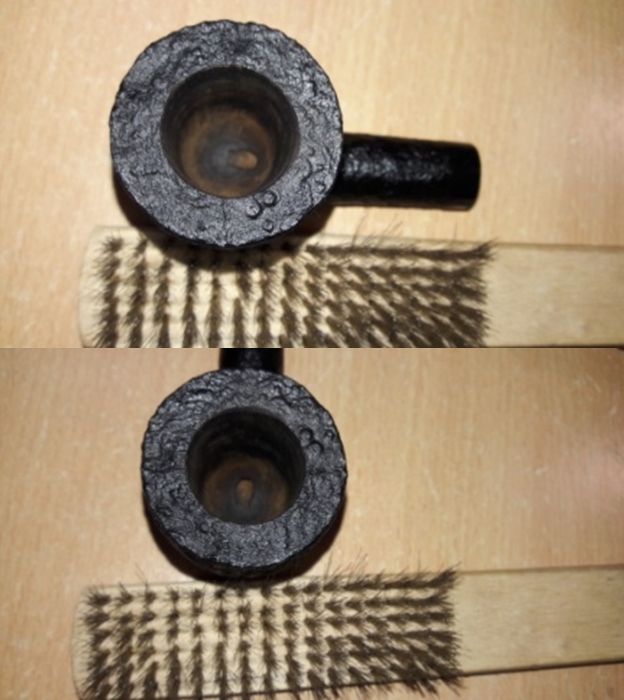
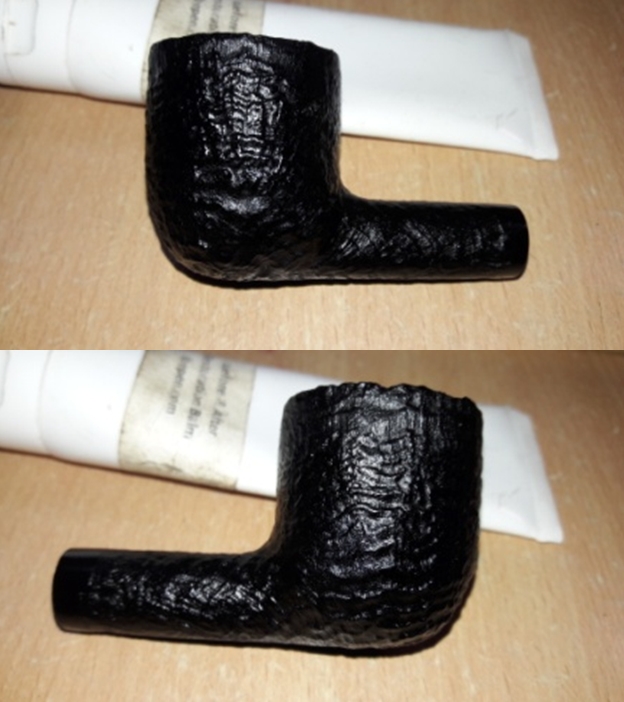
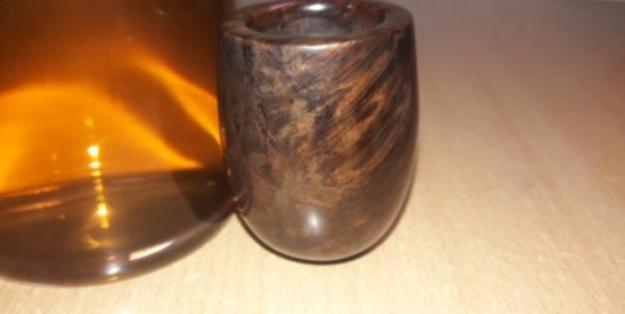
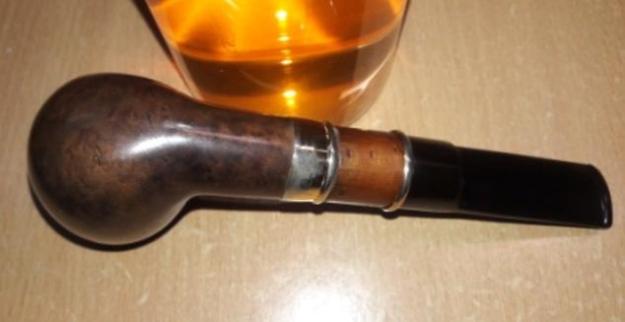
I am delighted to pass on these beloved pipes of my father’s. I hope each user gets many hours of contemplative pleasure as he did. I remember the aroma of tobacco in the rec room, as he put up his feet on his lazy boy. He’d be first at the paper then, no one could touch it before him. Maybe there would be a movie on with an actor smoking a pipe. He would have very definite opinions on whether the performer was a ‘real’ smoker or not, a distinction which I could never see but it would be very clear to him. He worked by day as a sales manager of a paper products company, a job he hated. What he longed for was the life of an artist, so on the weekends and sometimes mid-week evenings he would journey to his workshop and come out with wood sculptures, all of which he declared as crap but every one of them treasured by my sister and myself. Enjoy the pipes, and maybe a little of his creative spirit will enter you!

Now on to the rest of the restoration on this Stanwell Selected Briar 56 Canadian! I decided to begin the restoration of the bowl by addressing the inner edge surface itself. There was some burn damage on the front inner edge of the bowl. I used a folded piece of 220 grit sandpaper to bevel the edge inward to take care of the damage and thin the rim edge to its earlier dimensions. I followed that by sanding the rim top and edge with 400 grit wet dry sandpaper. I polished the briar with micromesh sanding pads to blend in the stain and to polish the briar and remove the scratches in the surface of the bowl, heel and shank. I wet sanded with 1500-12000 grit pads and wiped the bowl down between each pad with a damp cloth.  I cleaned the briar with Mark Hoover’s Before & After Briar Cleaner to remove the debris left behind by the sanding of the rim top and to blend the repairs into the briar. I rubbed it into the surface of the briar and let it sit for 10 minutes. I rinsed the bowl off with warm running water to remove the product and the grime. The grain really began to stand out clearly. It was a beautiful piece of briar.     I rubbed the bowl down with Before & After Restoration Balm. I worked it into the surface of the briar with my fingertips to clean, enliven and protect it. I let the balm sit for a little while and then buffed with a cotton cloth to raise the shine. Mark Hoover’s Balm is a product that I have come to appreciate and one I use on every pipe I have been working on.   I set the bowl aside and turned my attention to the stem. I wiped the stem down with some alcohol to clean off any debris and then I used liquid paper to fill in the Crown S stamp on the top of the tapered stem. I applied it with a tooth pick and scraped of the excess with the same tooth pick.    I sanded the stem with 220 grit sandpaper to break up the oxidation. I started the polishing with 400 grit wet dry sandpaper to remove the scratching. It is starting to look good. I carefully worked my way around the Crown S stamp. You can see the worn portion on the crown to the right of the S.  I rubbed the stem down with Denicare Mouthpiece Polish. I have a few tins of this laying around so I am trying to use them up. It does a pretty good job polishing the stem.    I polished the stem with micromesh sanding pads – wet sanding with 1500-12000 grit pads. I wiped the stem down after each sanding pad with Obsidian Oil. I polished it with Before & After Pipe Stem Polish – both Fine and Extra Fine. Once I had finished the polishing I gave it final coat of oil and set it aside to dry.   Once again I am excited to be on the homestretch with another of Bob’s pipes. This is the part I look forward to when it all comes back together, polished and waxed. I put the bowl and stem back together. I polished the bowl and stem with Blue Diamond to polish out the scratches in the briar and the vulcanite. I gave the bowl and the stem multiple coats of carnauba wax. I buffed the pipe with a clean buffing pad to raise the shine. I hand buffed it with a microfiber cloth to deepen the shine. The pipe polished up pretty nicely. The birdseye and mixed grain on the smooth finish look really good with the polished black vulcanite. This Stanwell Select Briar 56 Canadian with a Regd. No. was another fun pipe to work on thanks to Jeff’s cleanup work. It really has that classic Stanwell look that catches the eye. The combination of various brown stains really makes the pipe look attractive. It is another comfortable pipe to hold in the hand. The finished pipe is shown in the photos below. The dimensions of the pipe are Length: 5 ¾ inches, Height: 1 ¾ inches, Outside diameter of the bowl: 1 ¼ inches, Chamber diameter: ¾ of an inch. If you are interested in carrying on Bob’s legacy with this pipe send me a message or an email. I have a lot more to work on of various brands. Perhaps one of those will catch your attention. Thanks for reading this blog and my reflections on the pipe while I worked on it. This is an interesting estate to bring back to life.