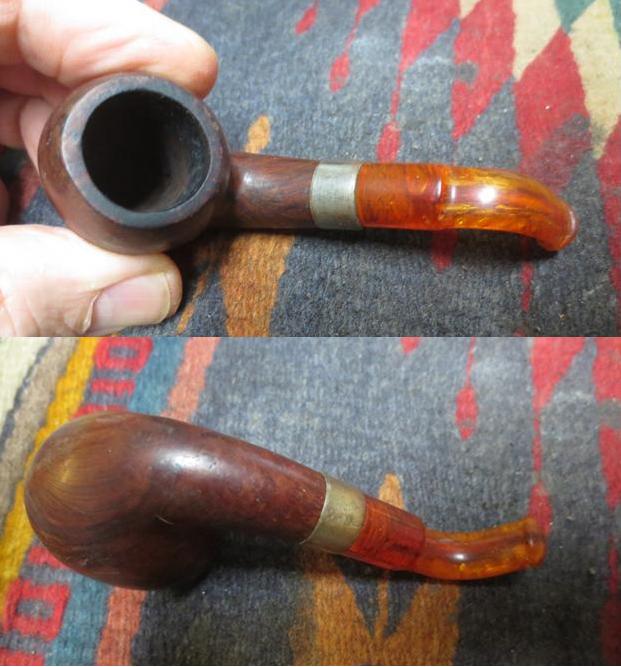
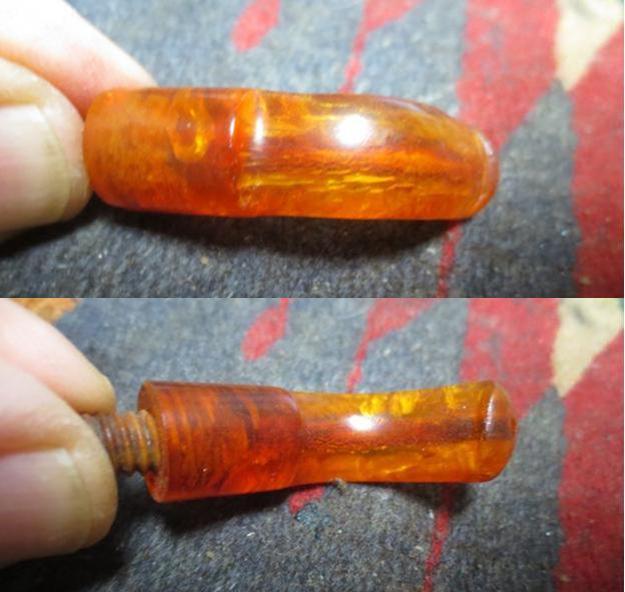
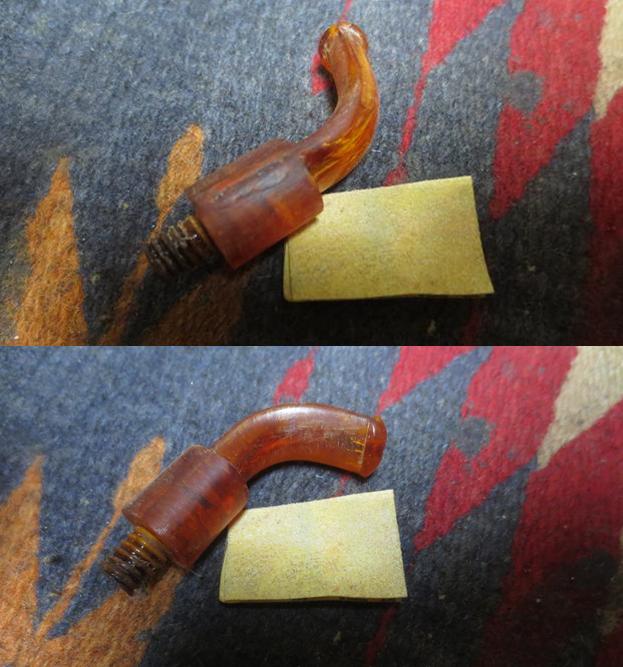
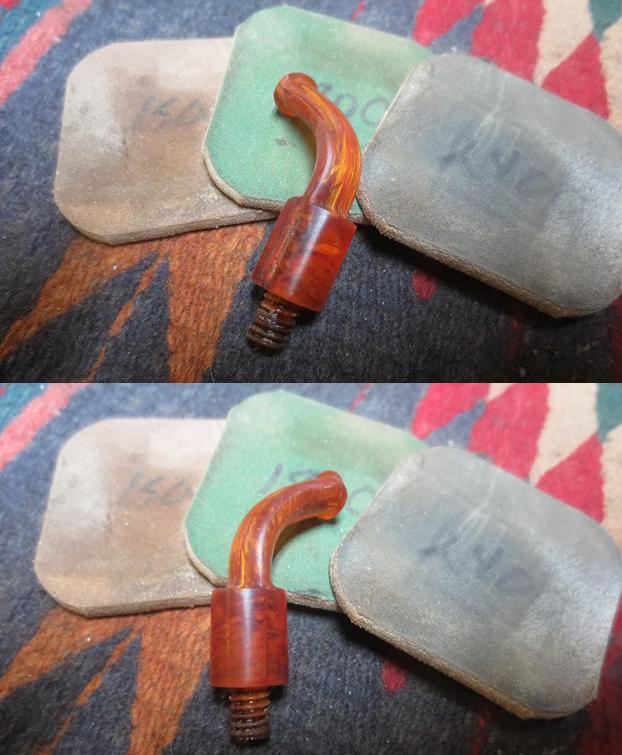
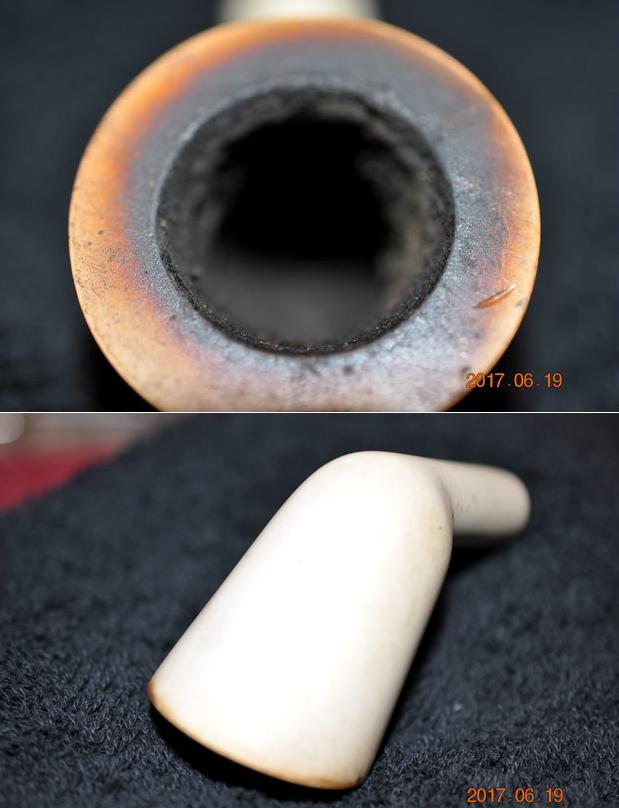
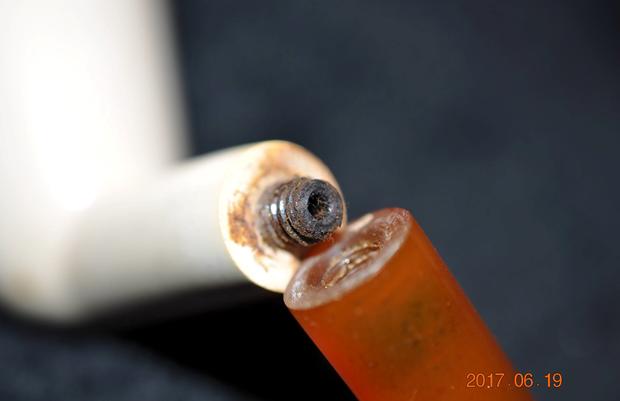
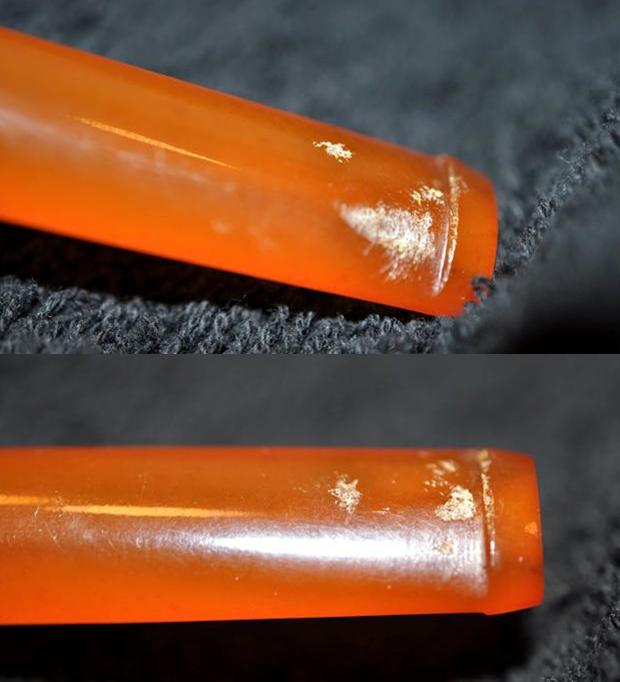
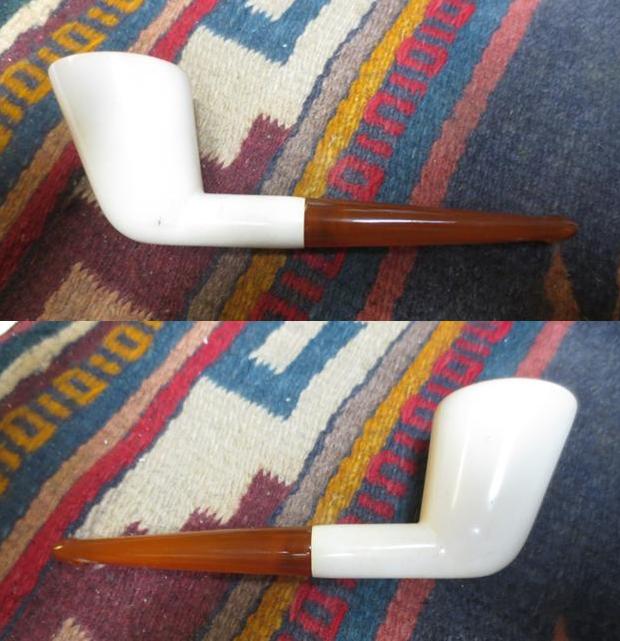
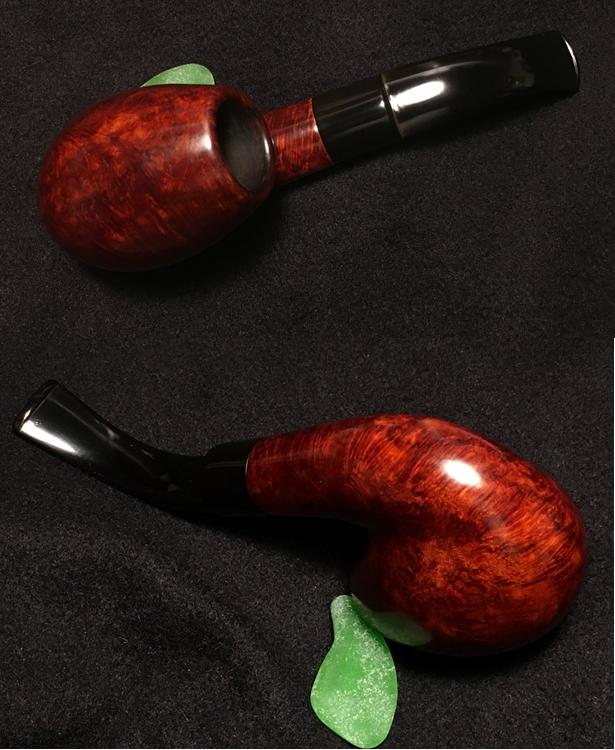
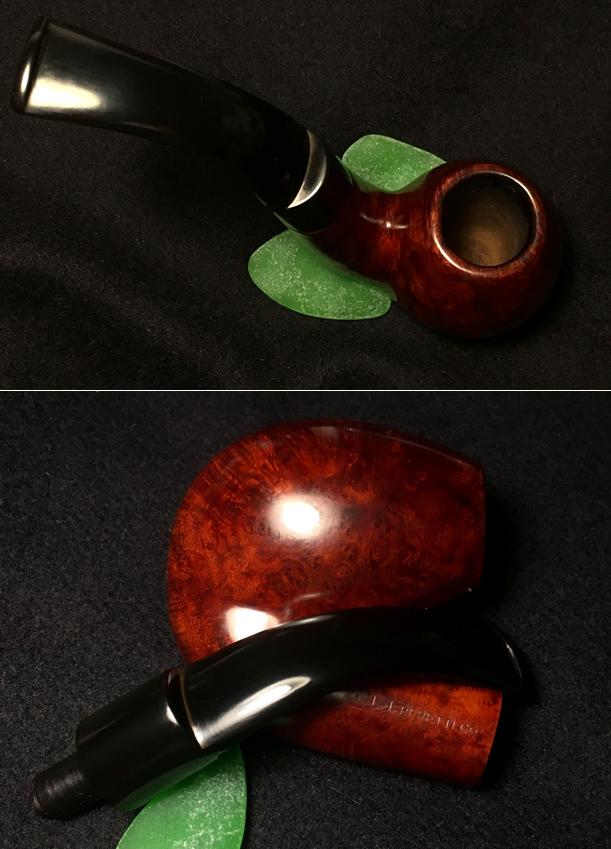
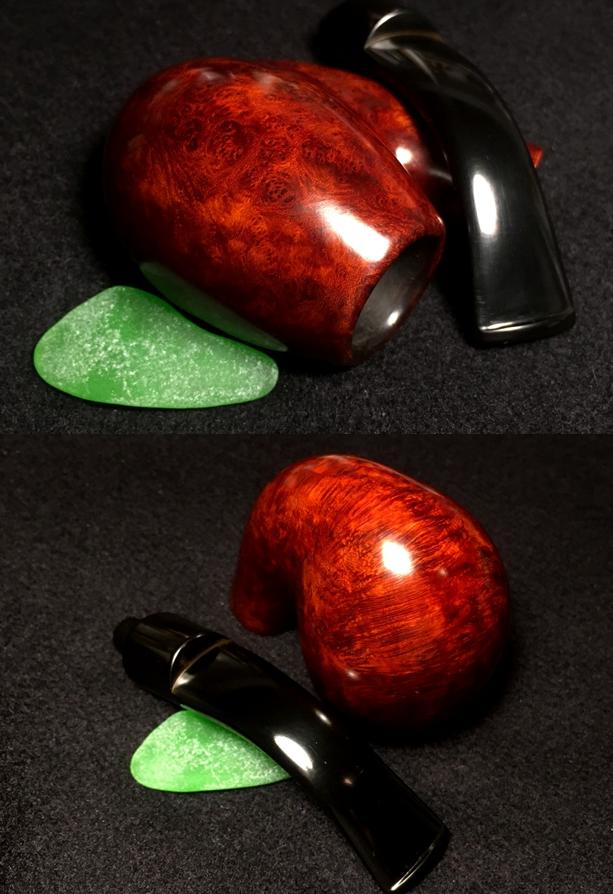
Tag Archives: polishing a stem

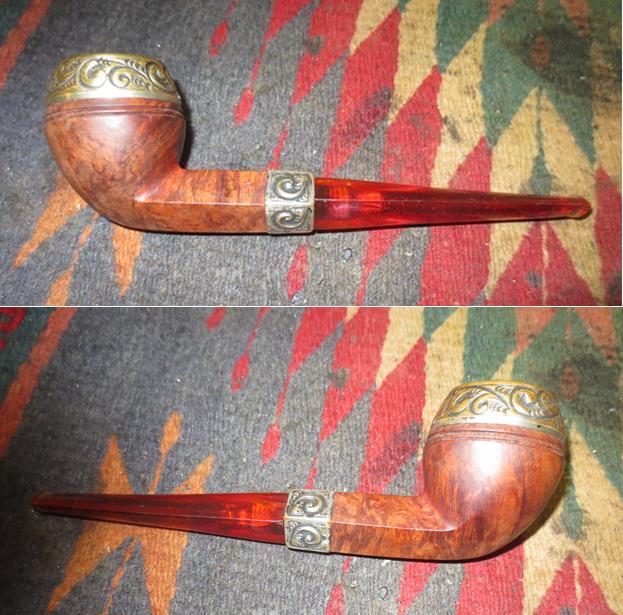
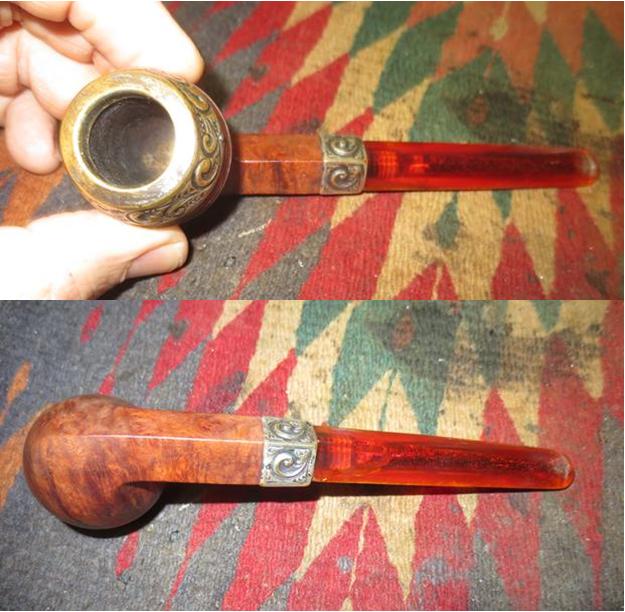
A Small C.P.F. French Briar Horn captured my attention


Blog by Steve Laug

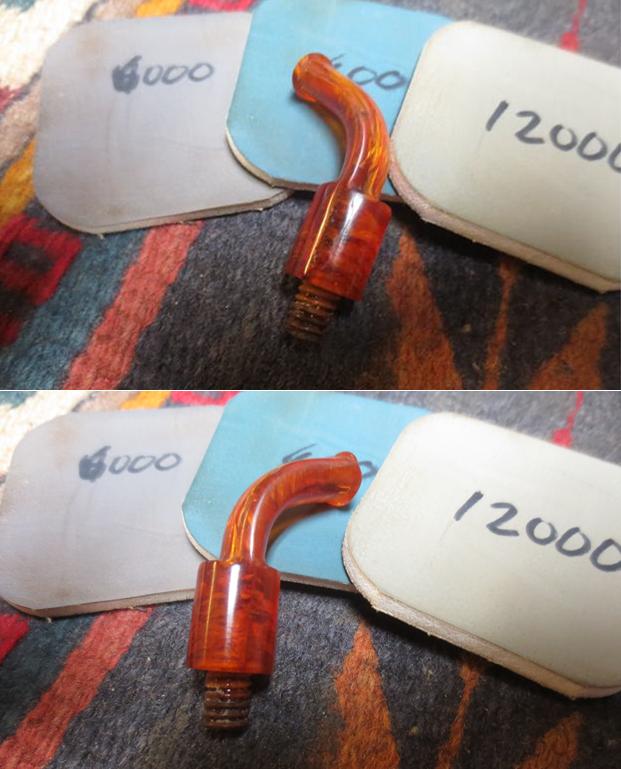
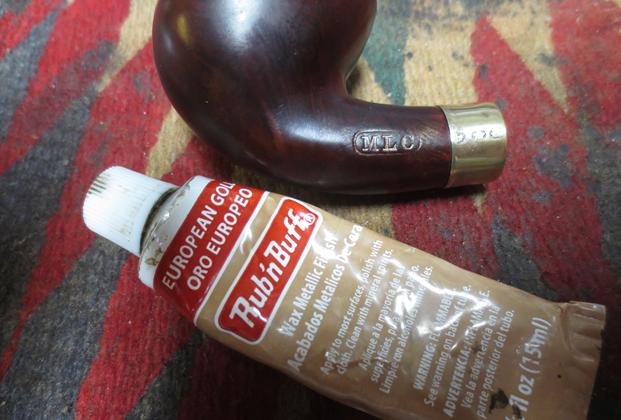
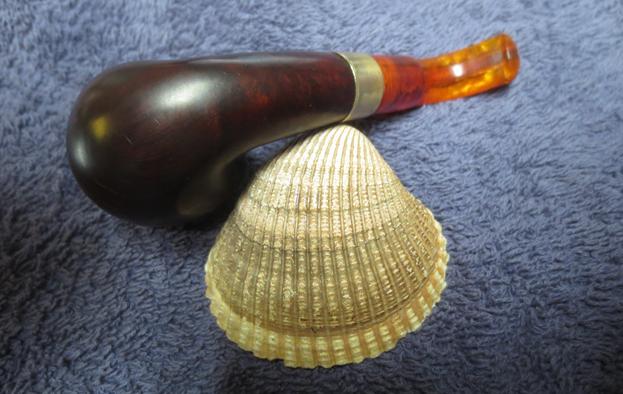
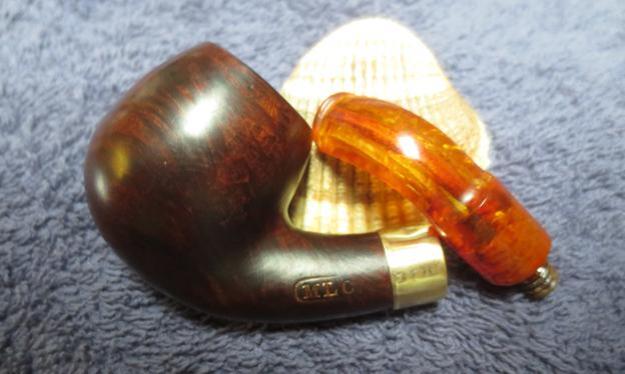
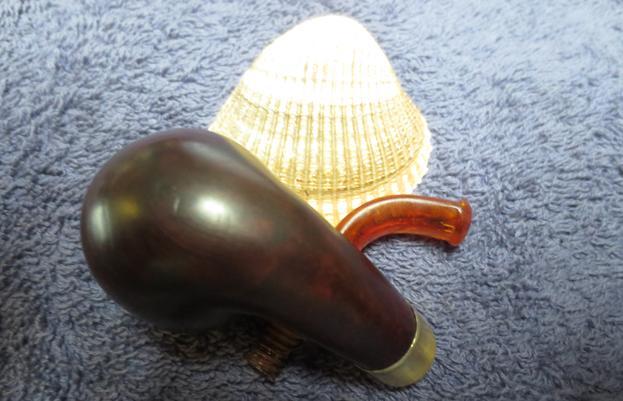
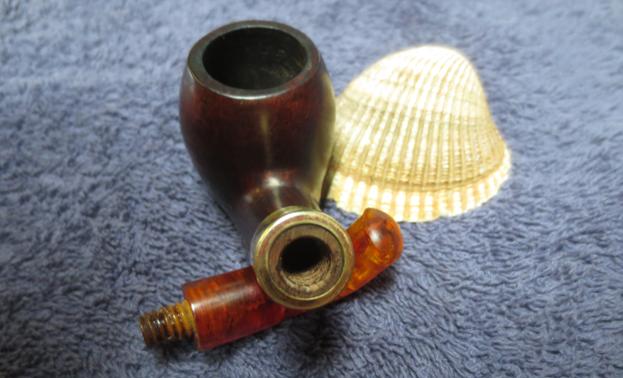
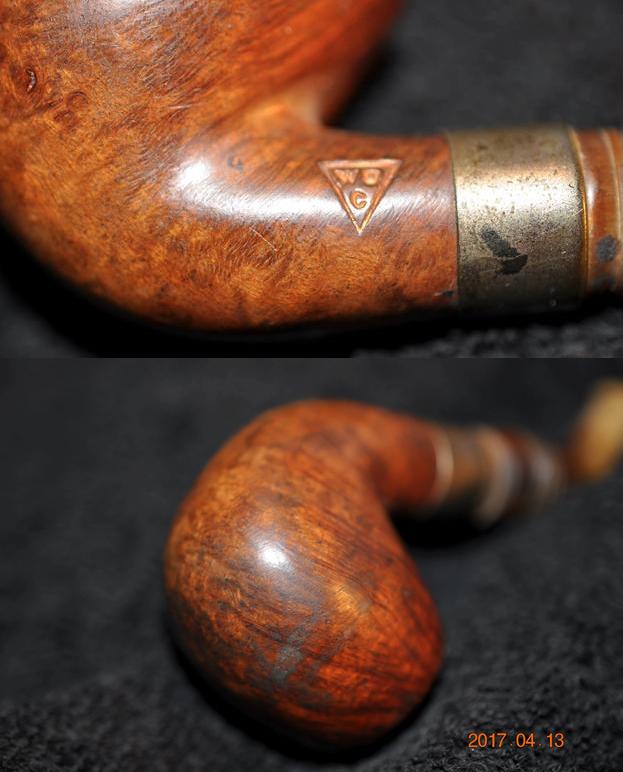
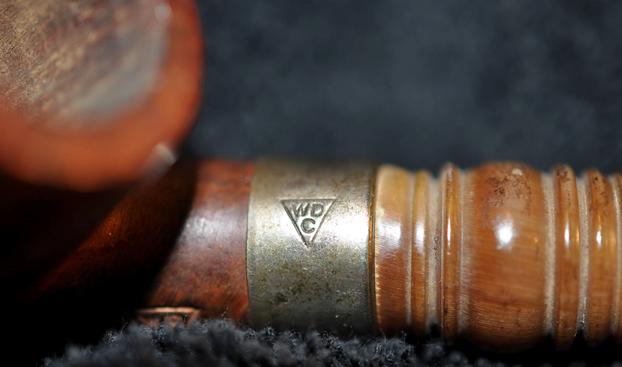
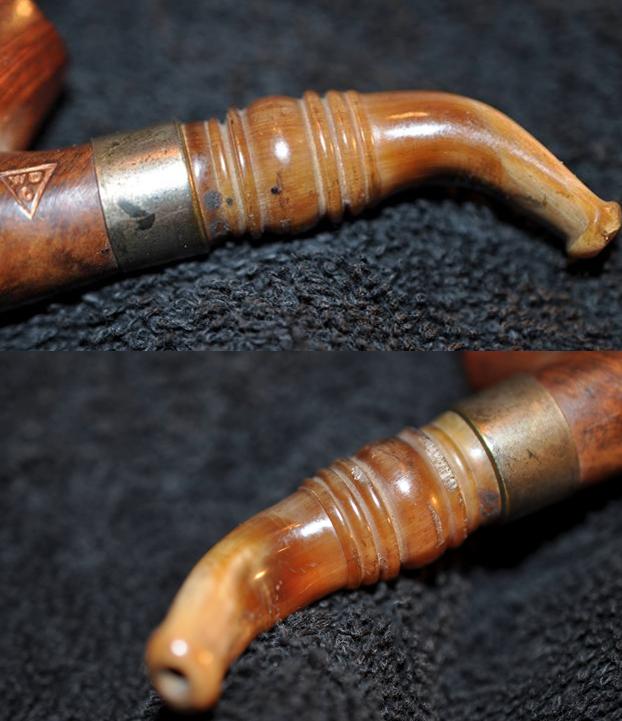
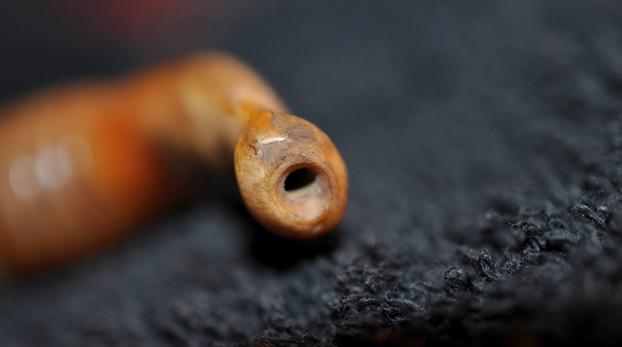
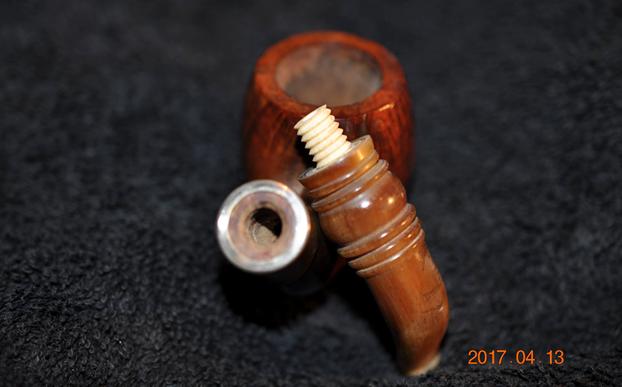
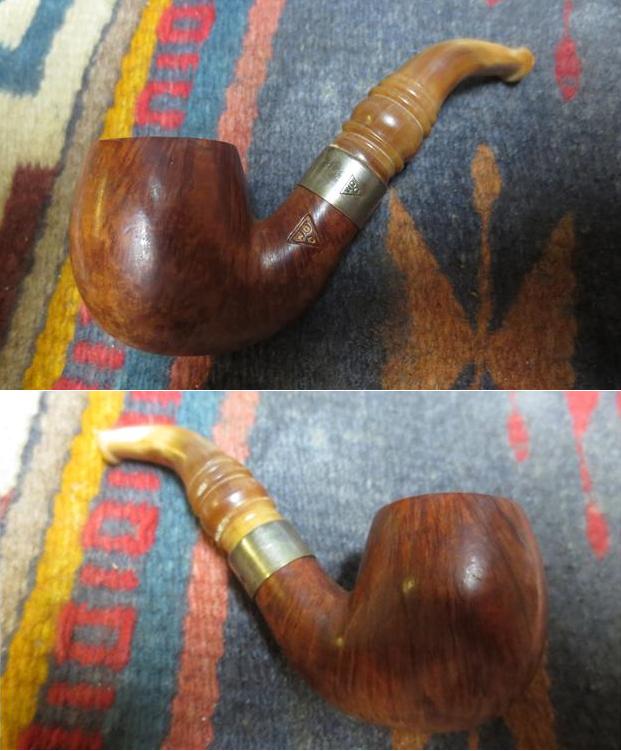
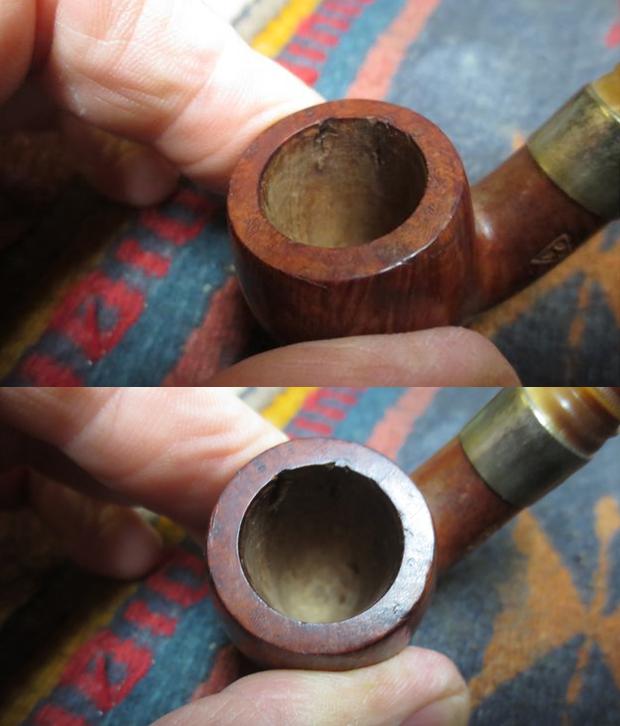
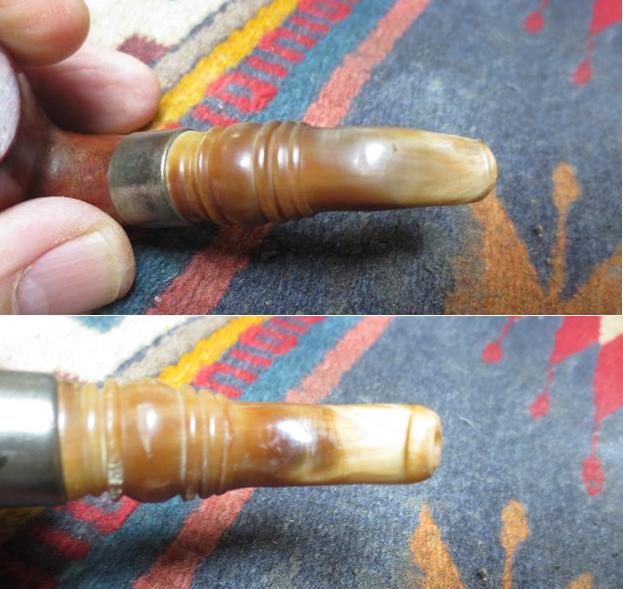
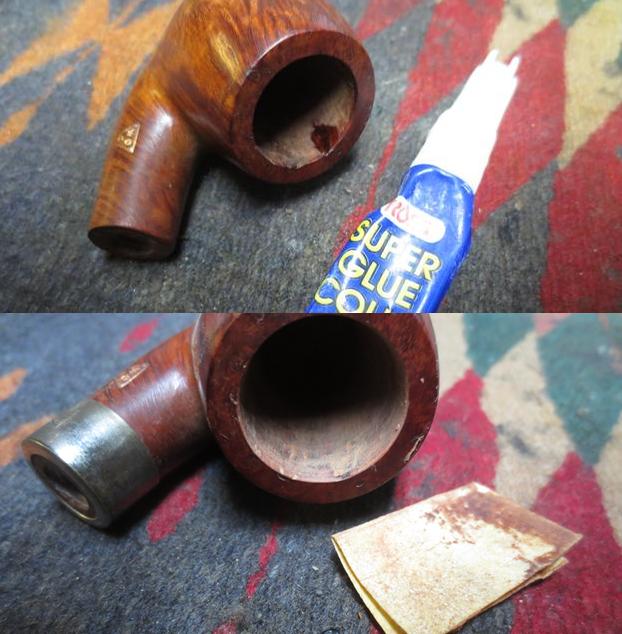
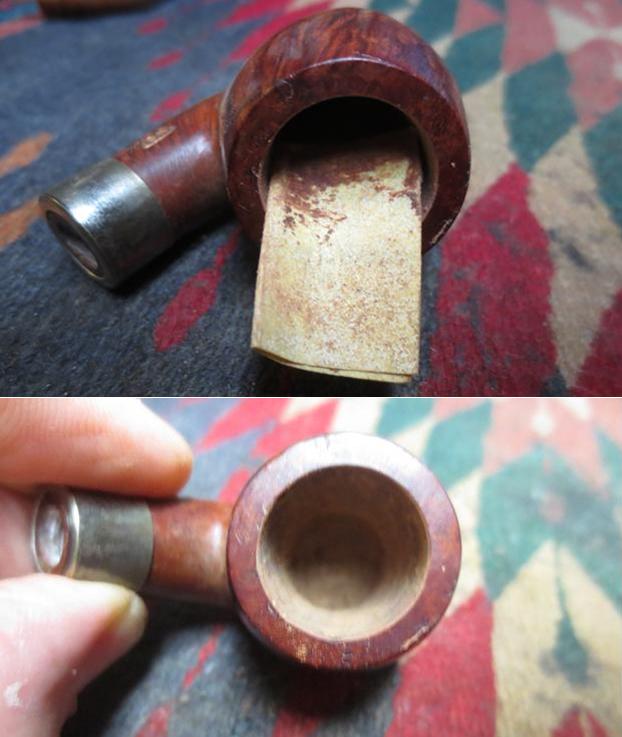
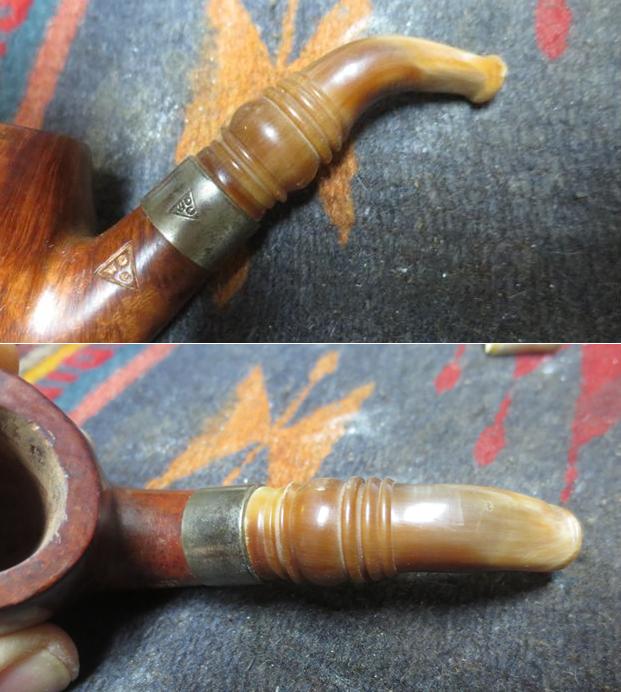
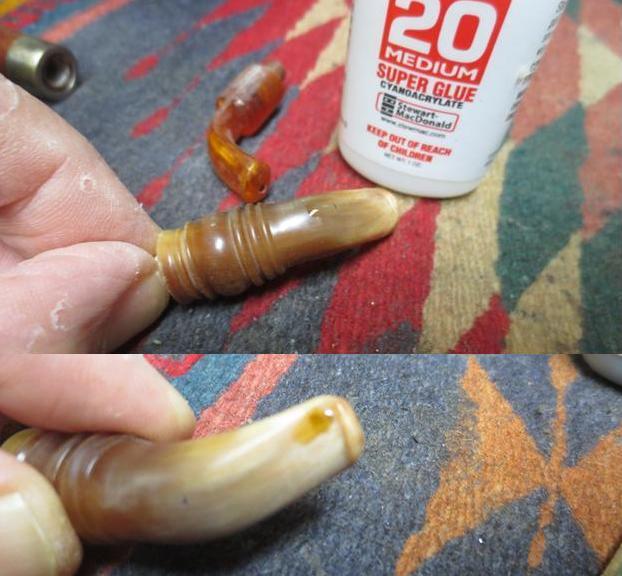
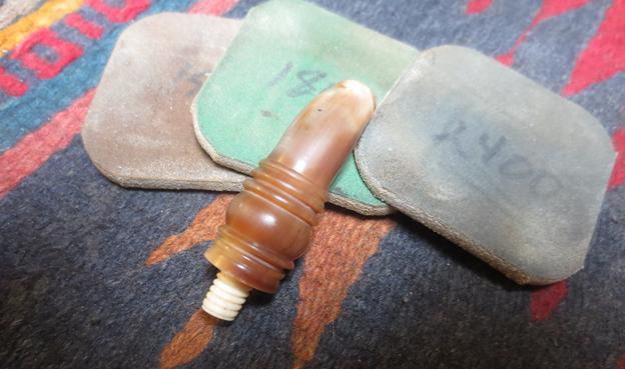
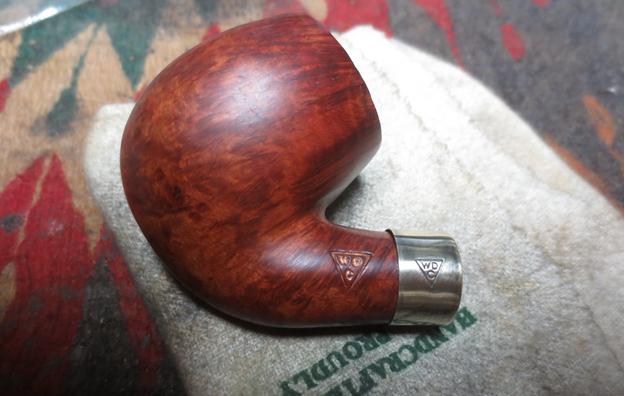
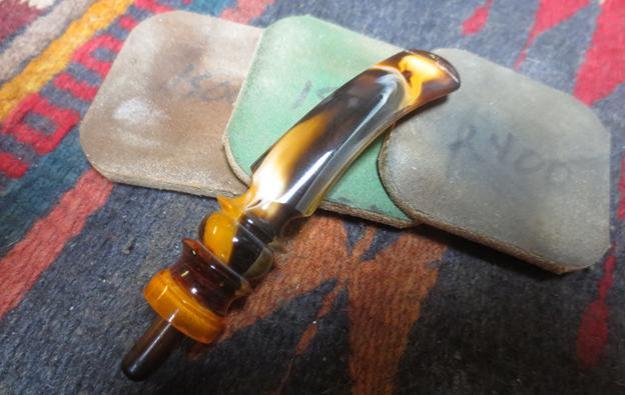
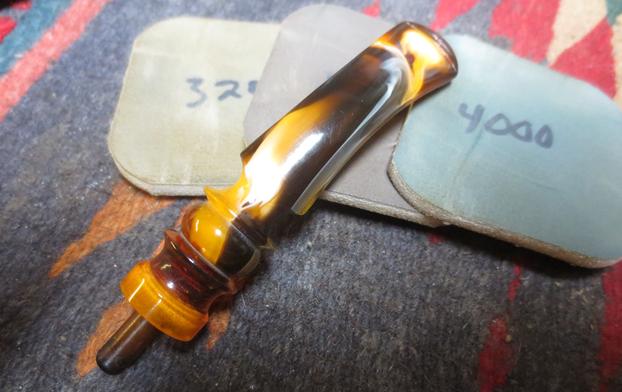
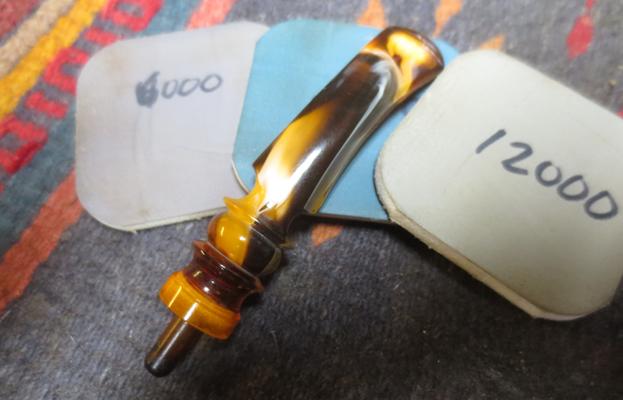
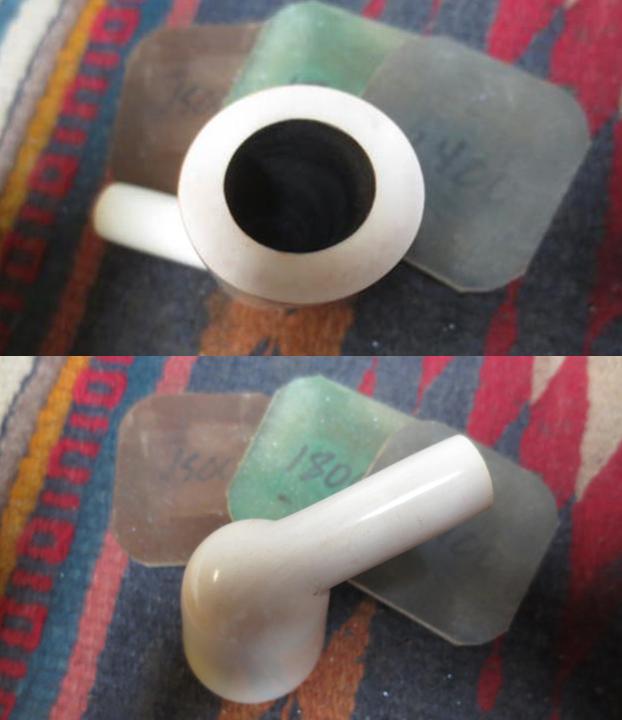
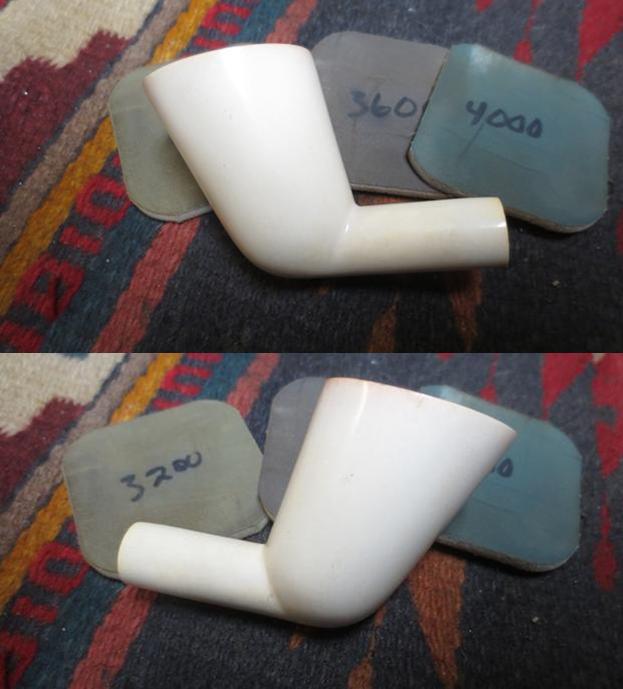
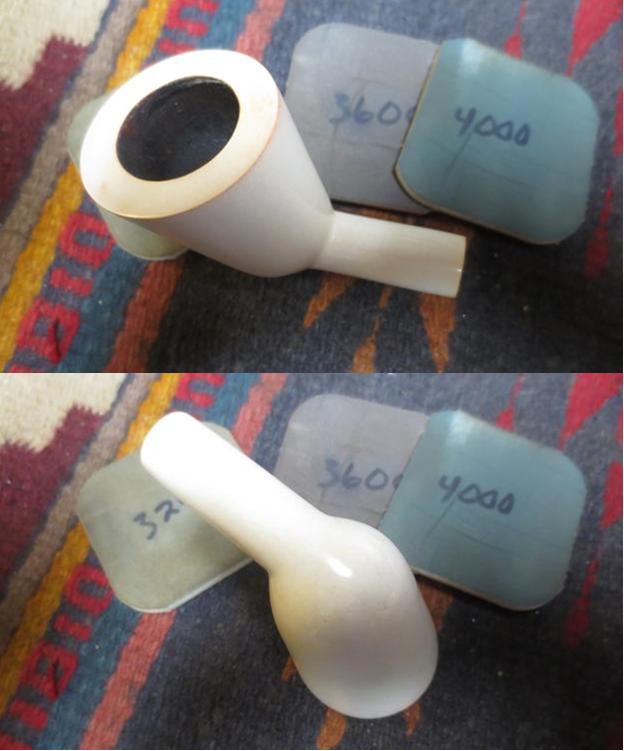
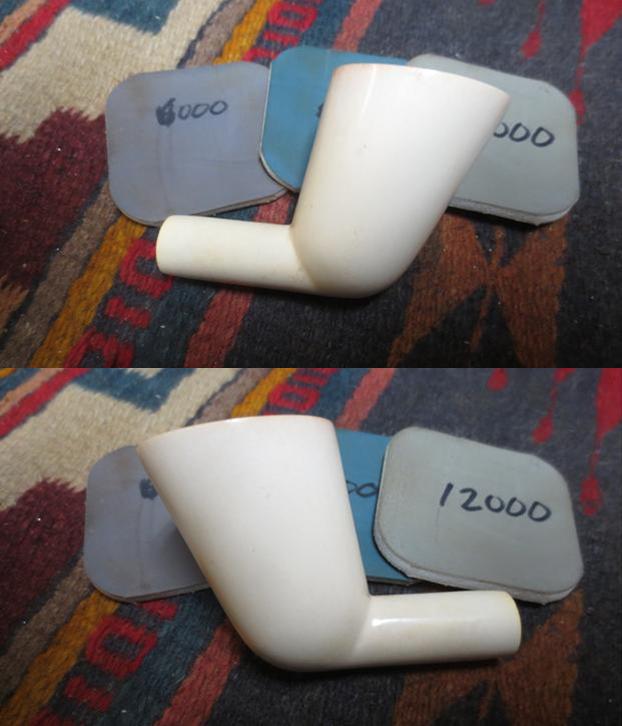
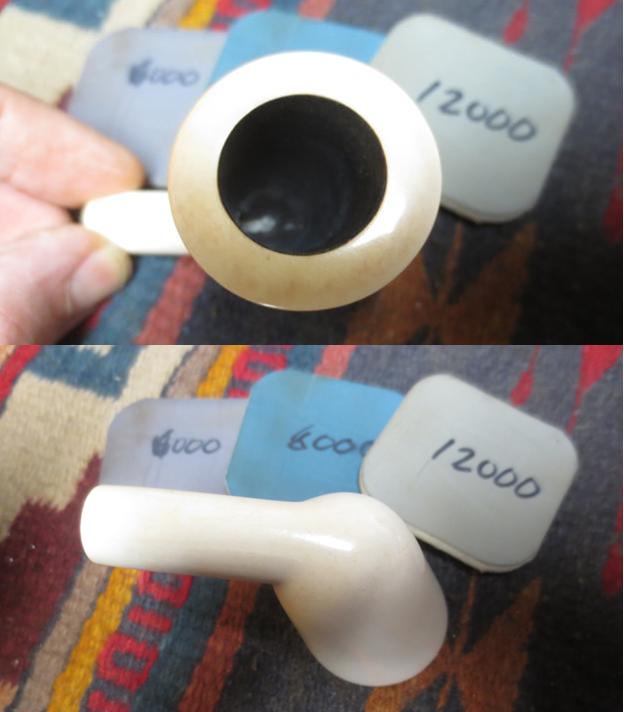
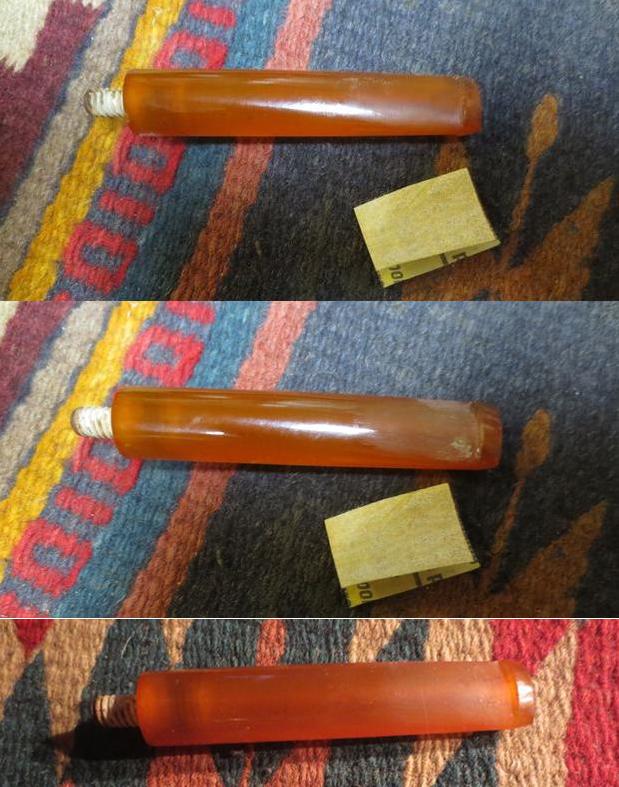
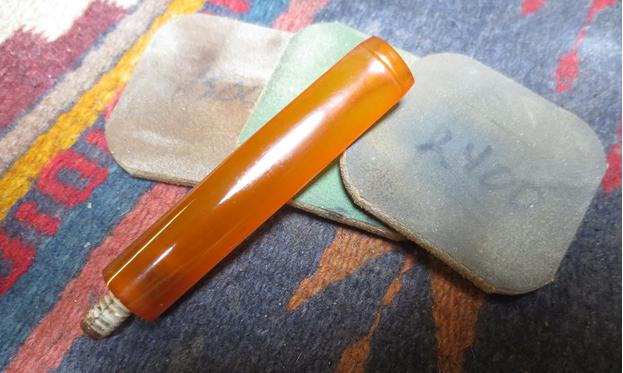
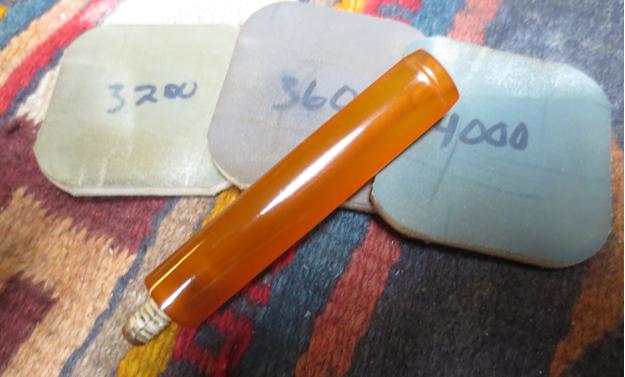
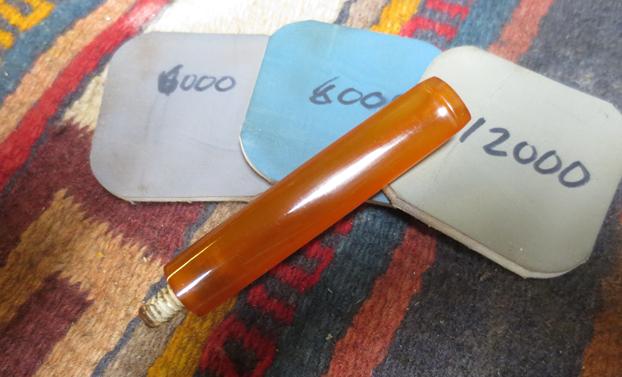
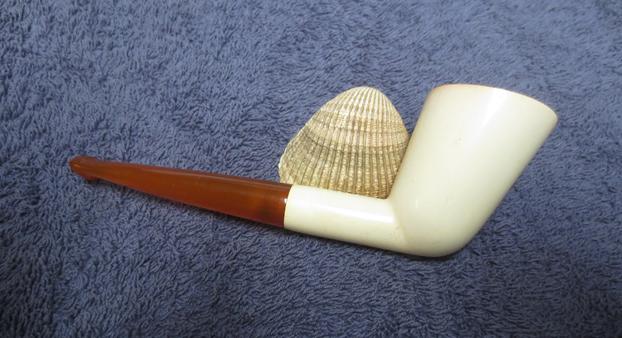
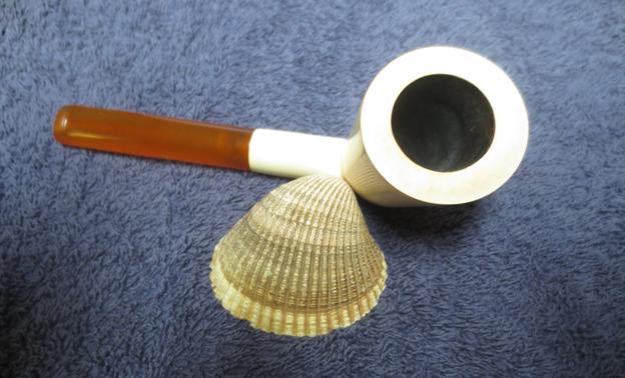
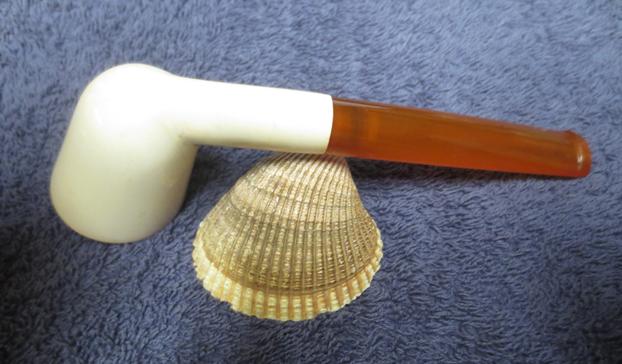
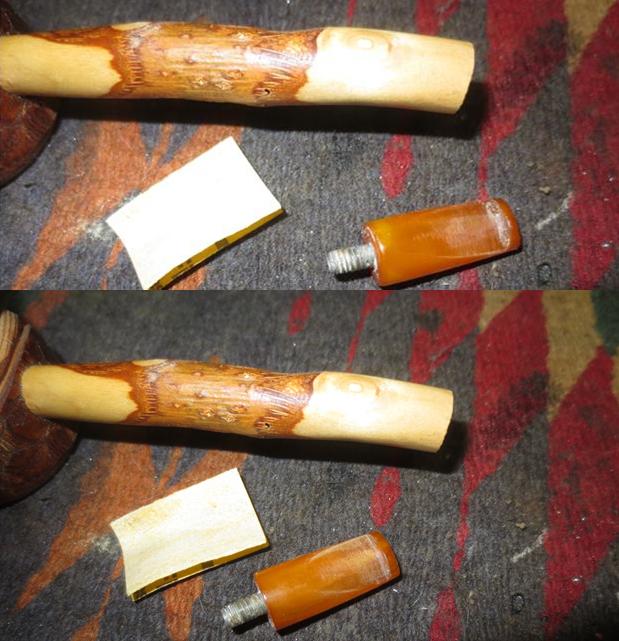
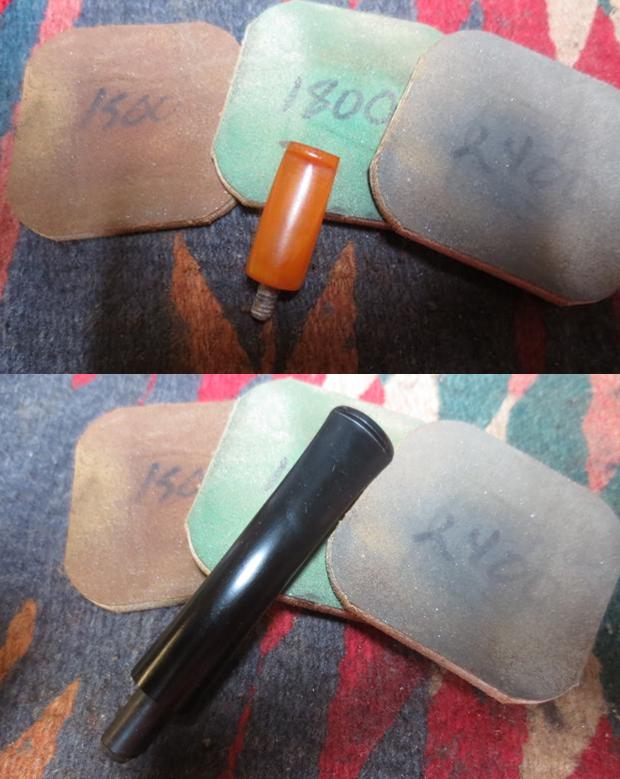
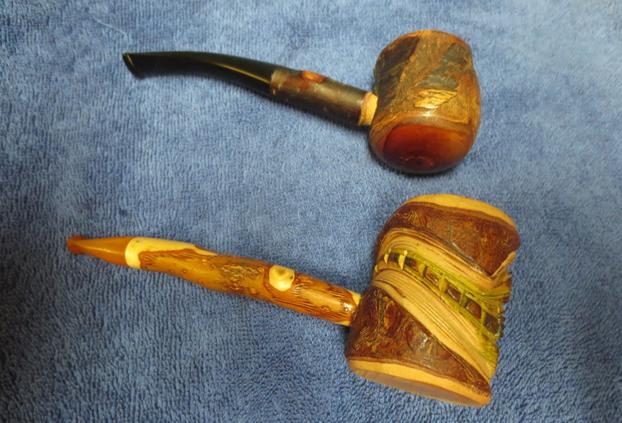
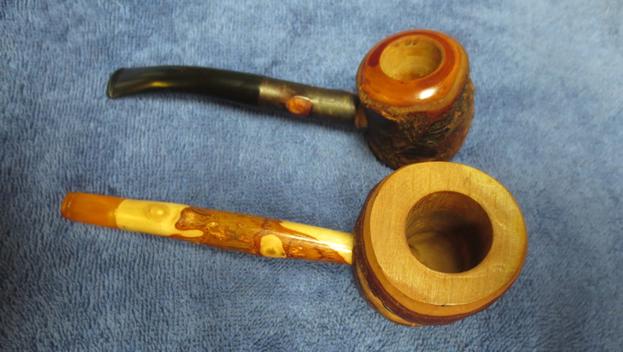
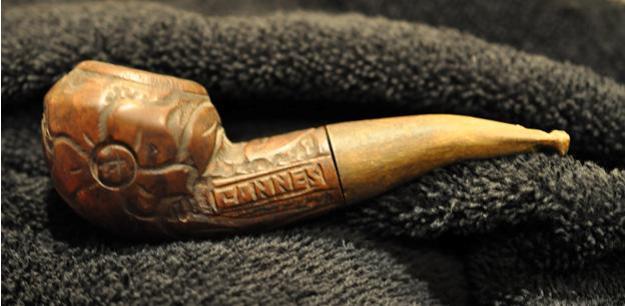
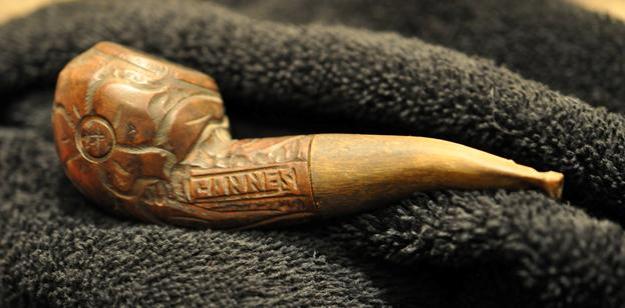
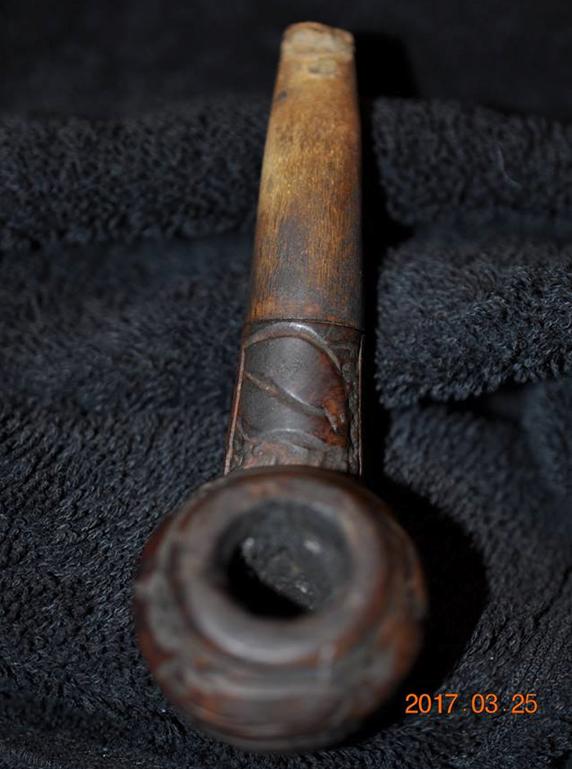
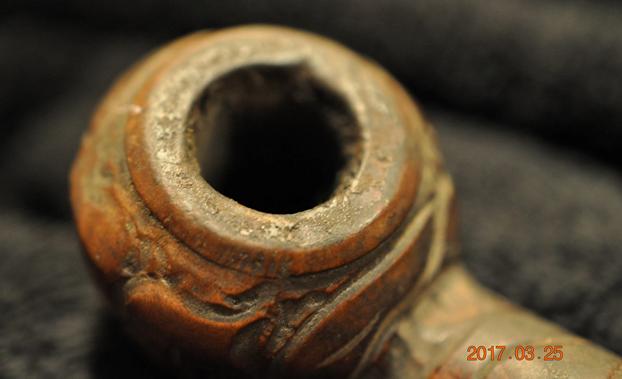
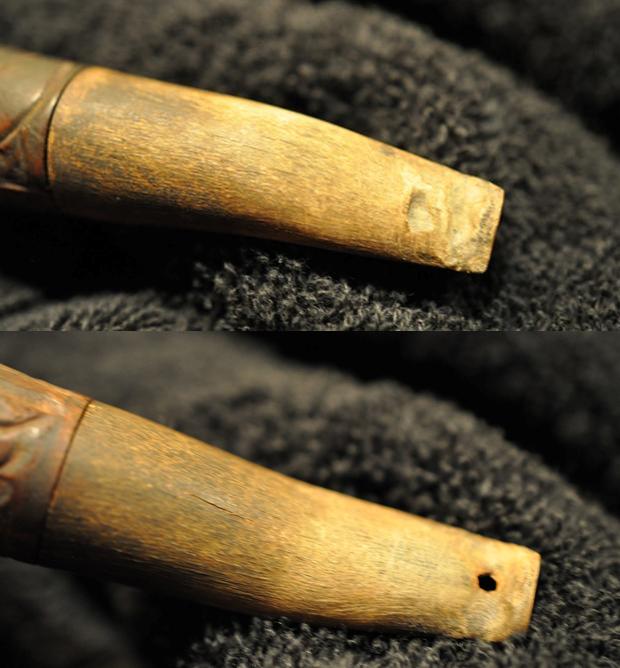
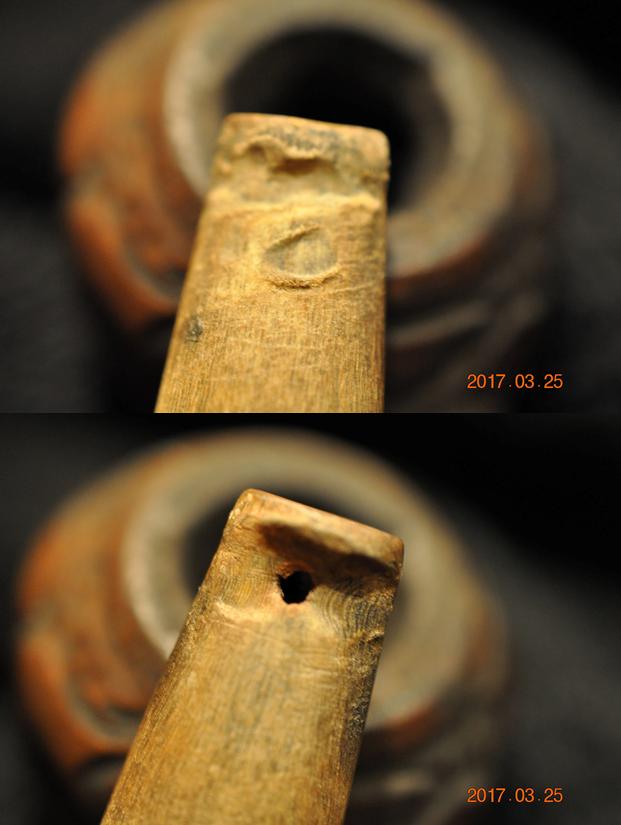
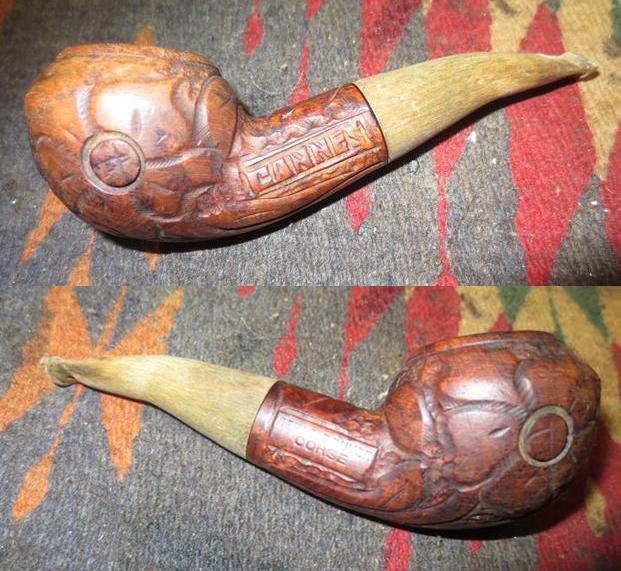
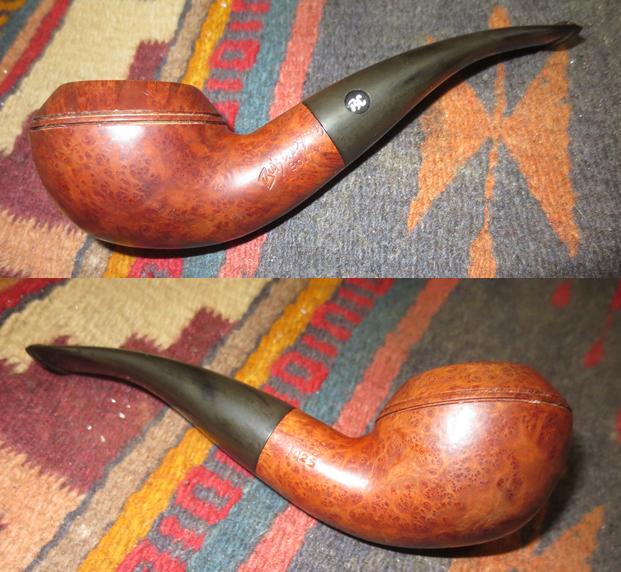
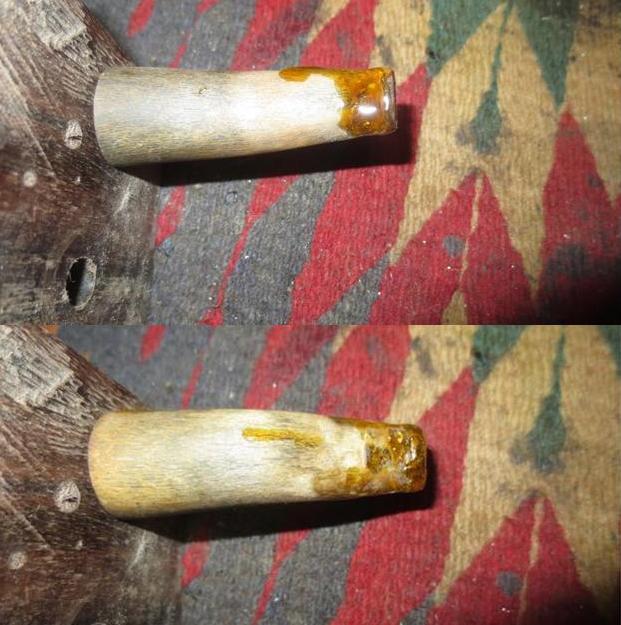
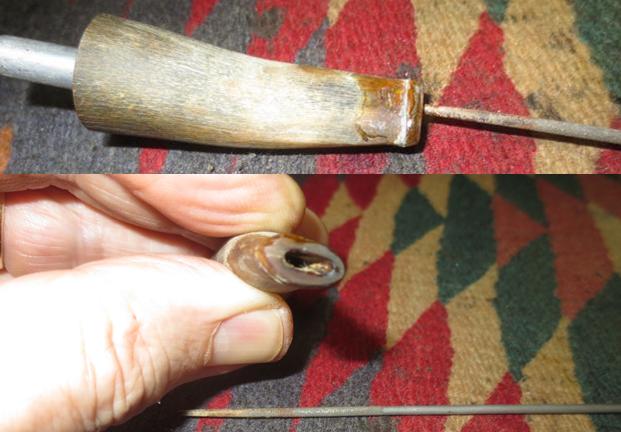
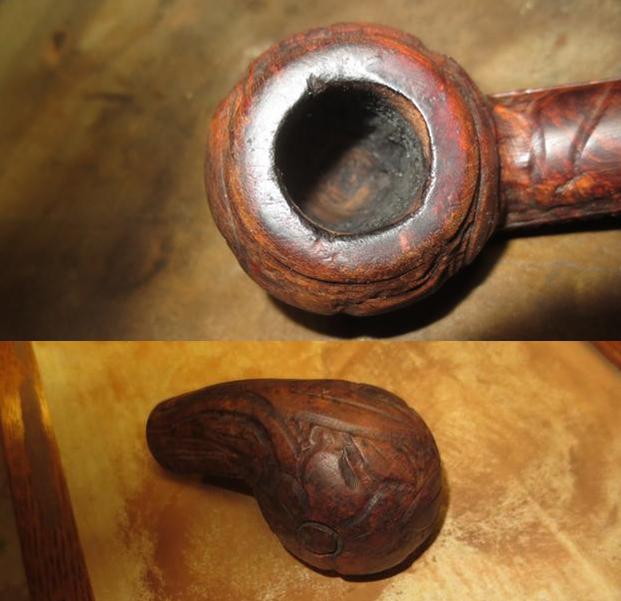
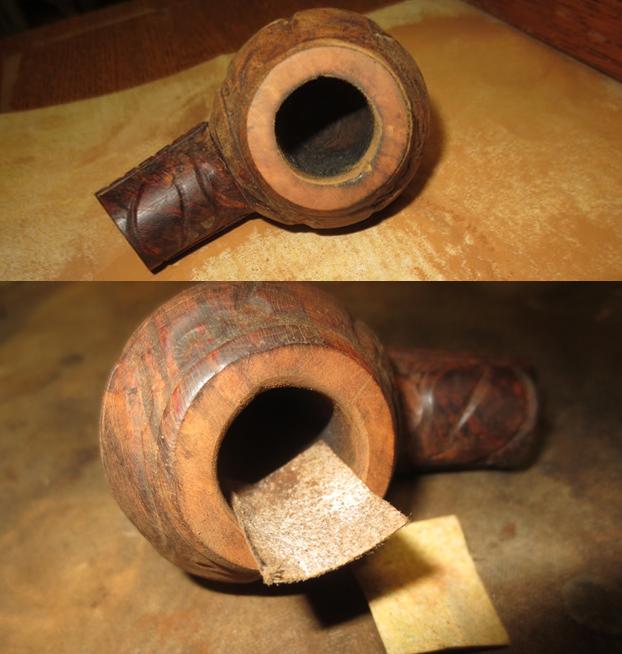
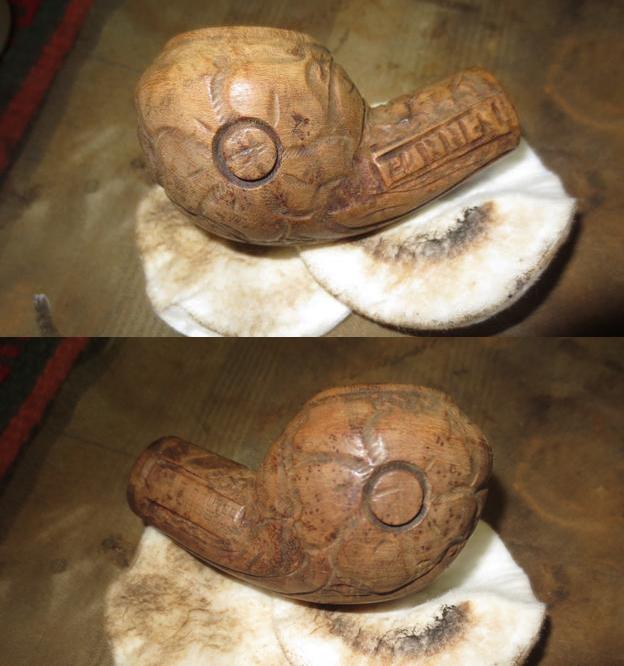
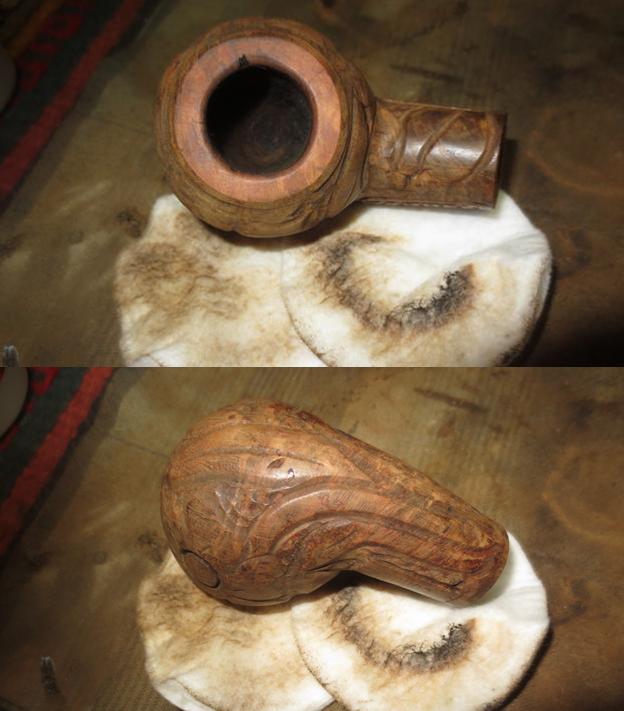
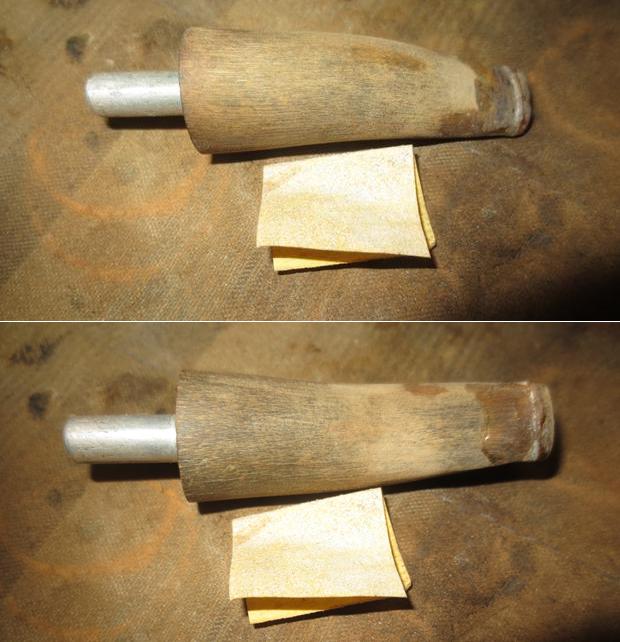
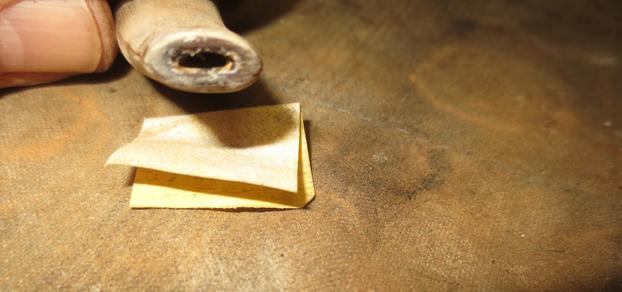
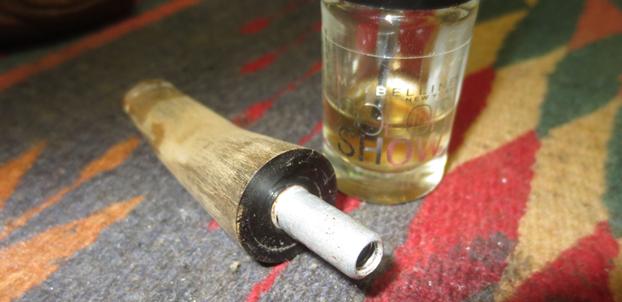
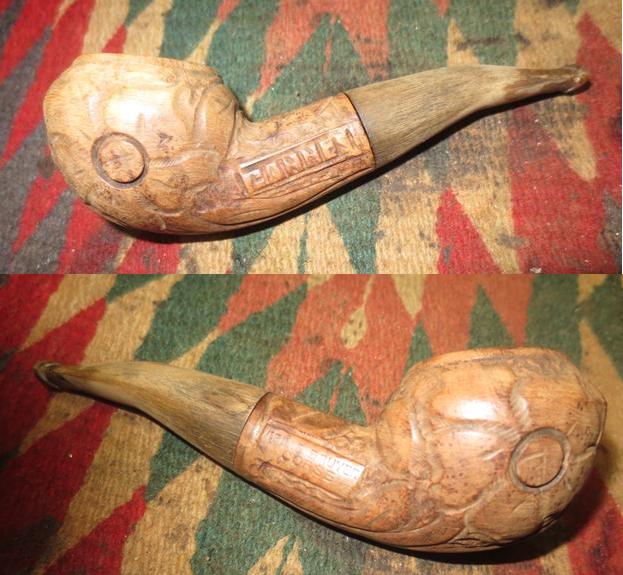
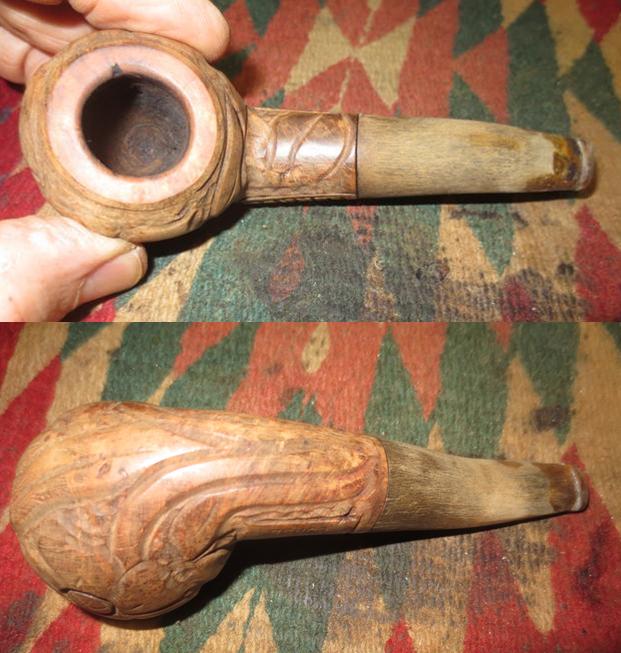
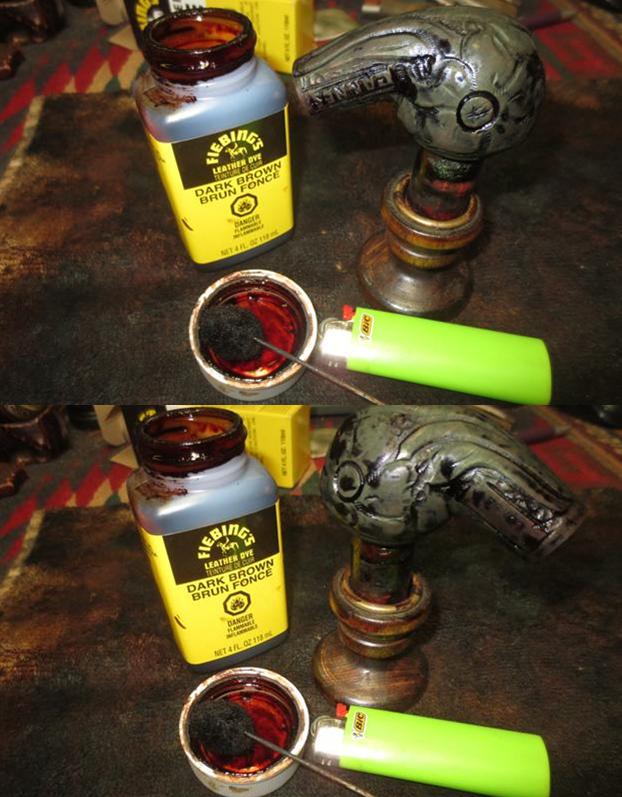
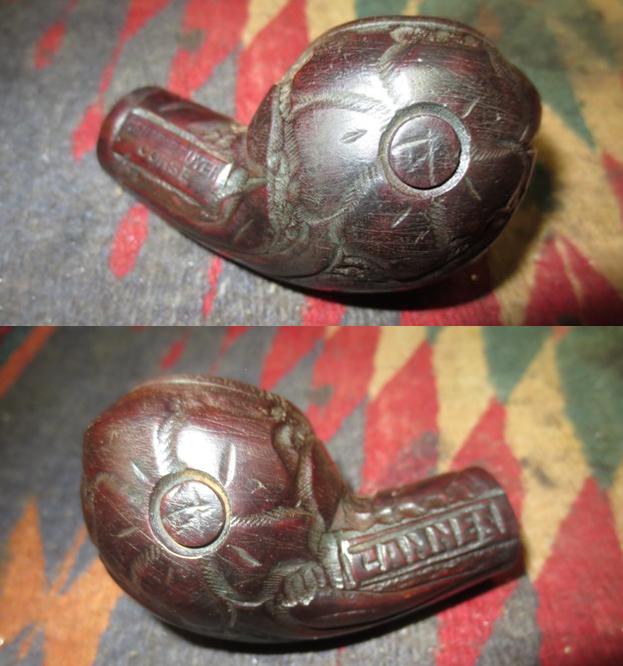
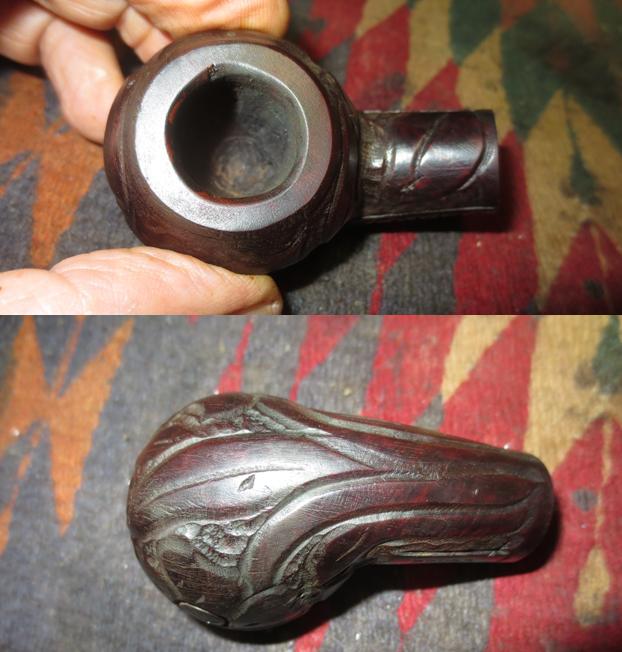
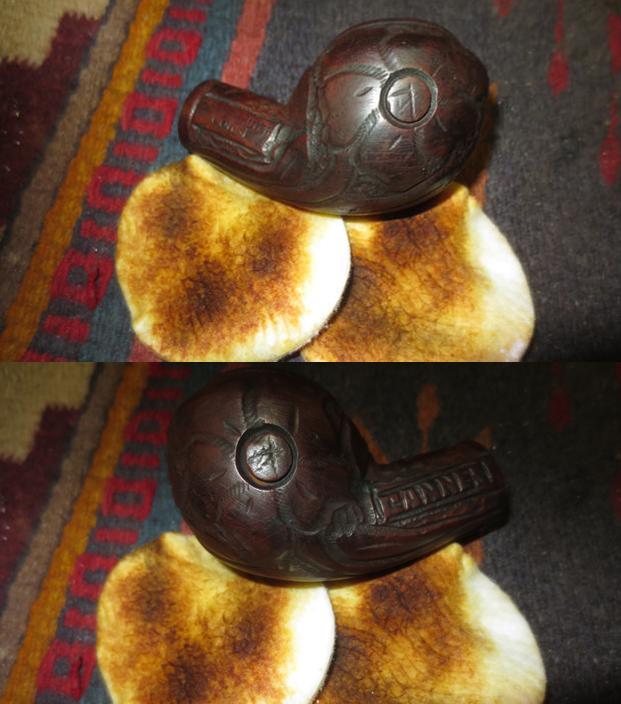
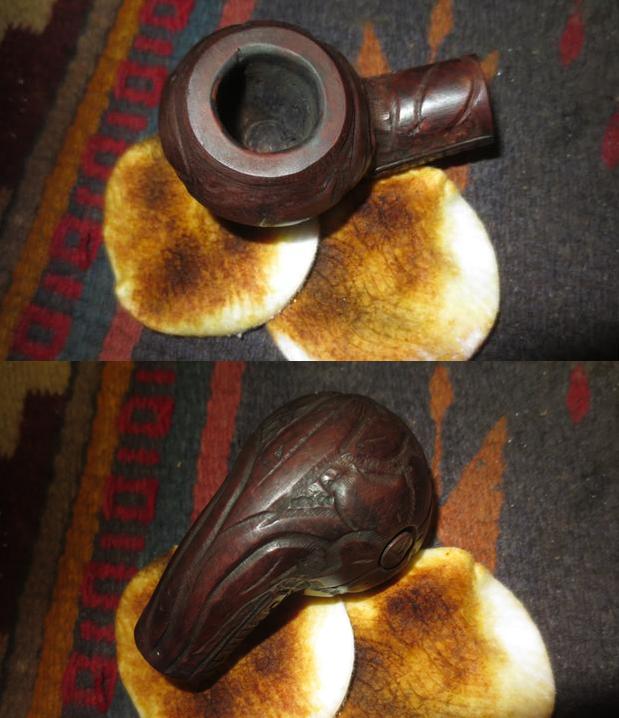
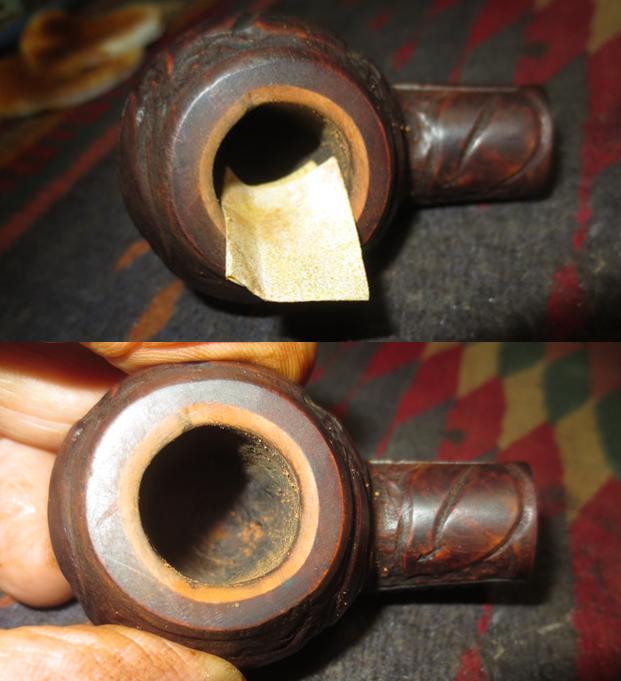
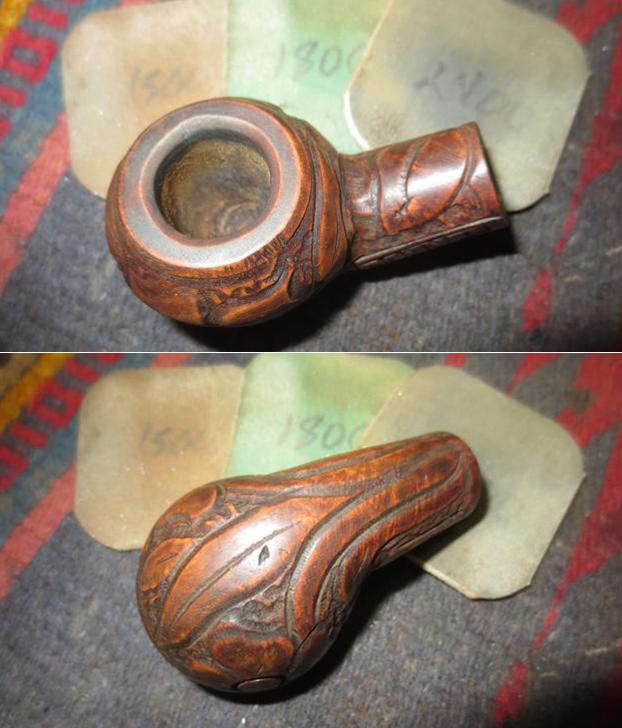
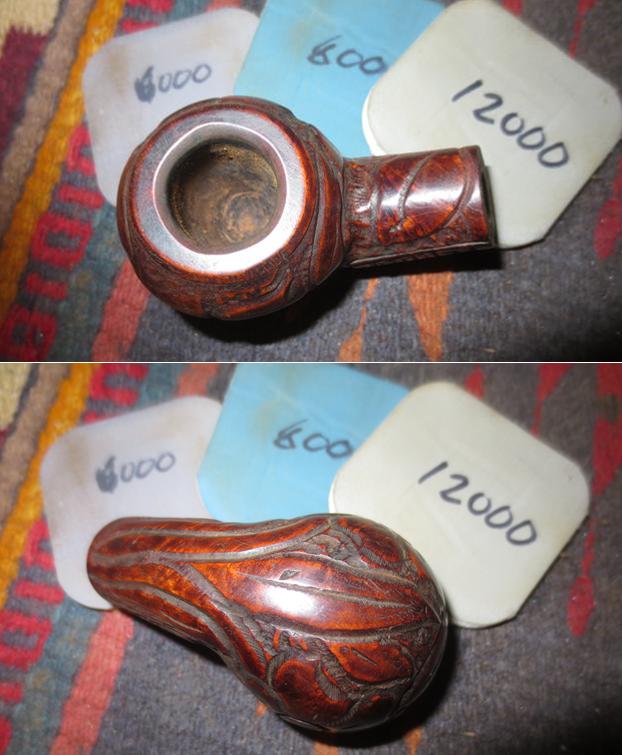
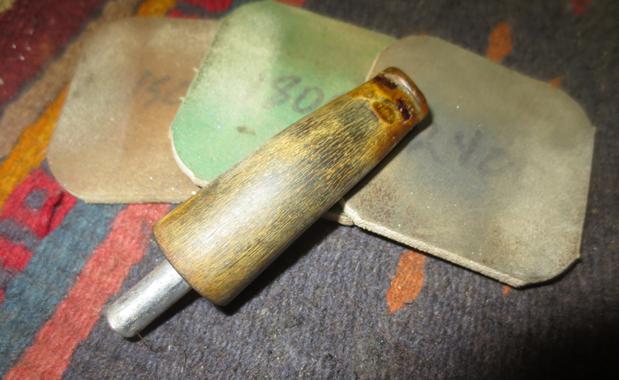
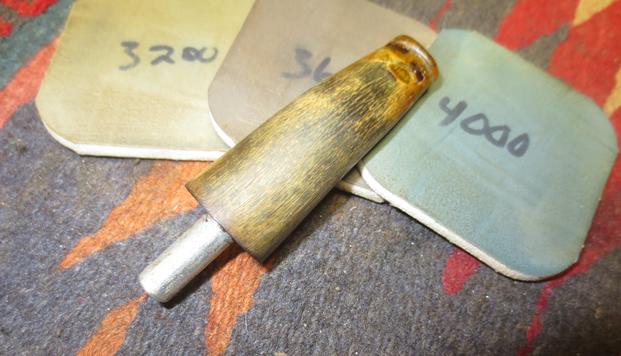
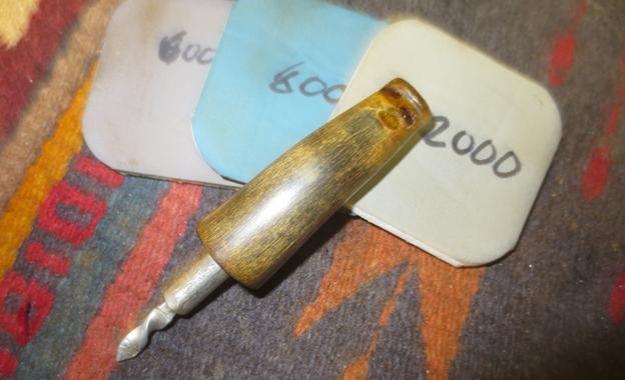
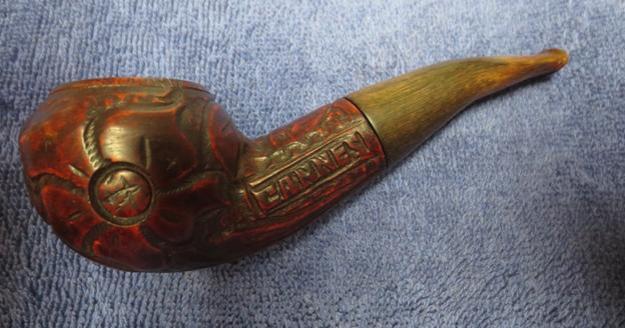
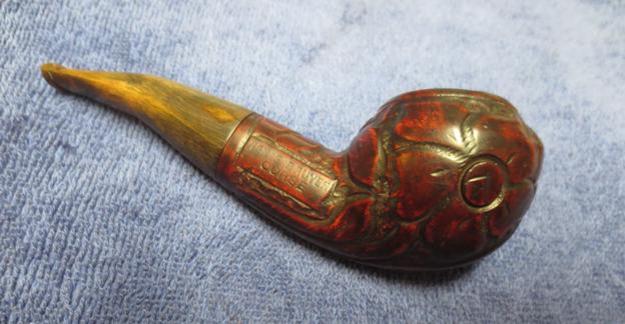
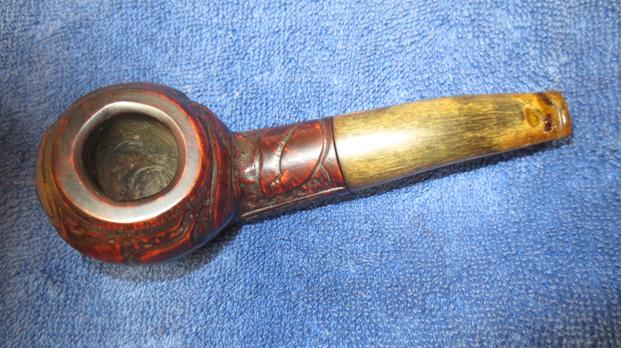
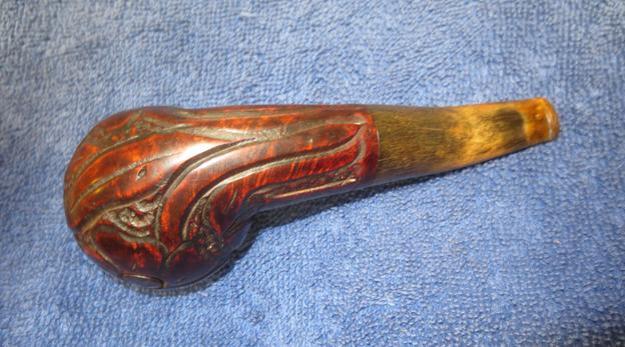
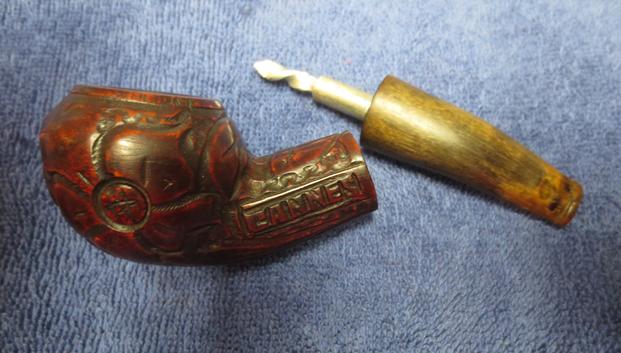
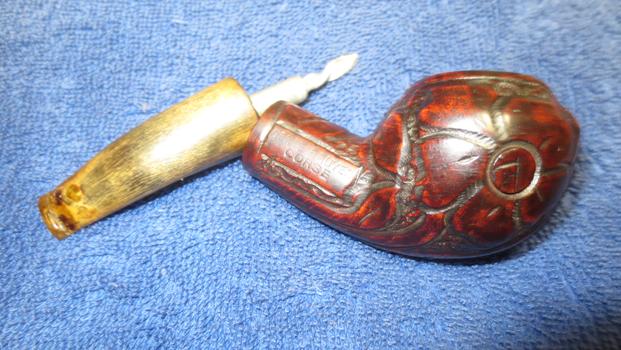
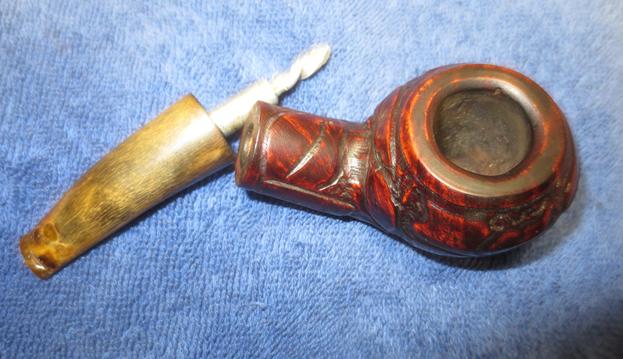
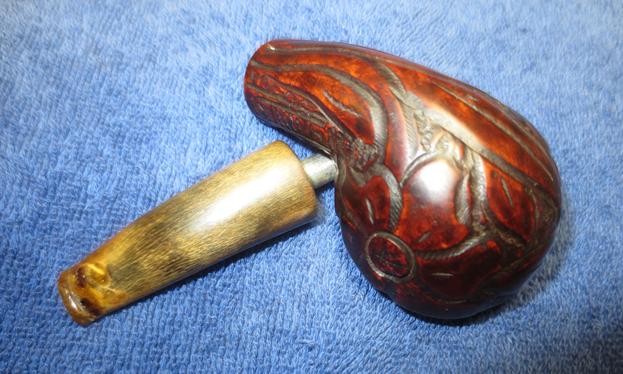
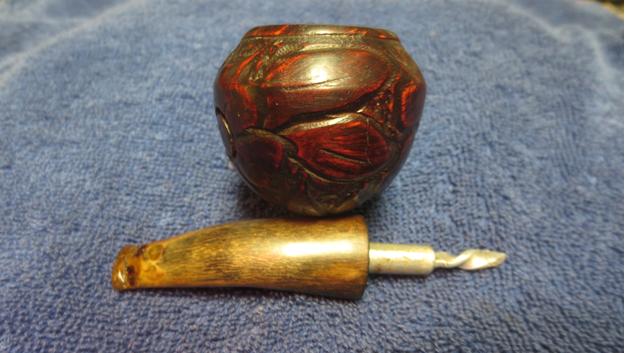
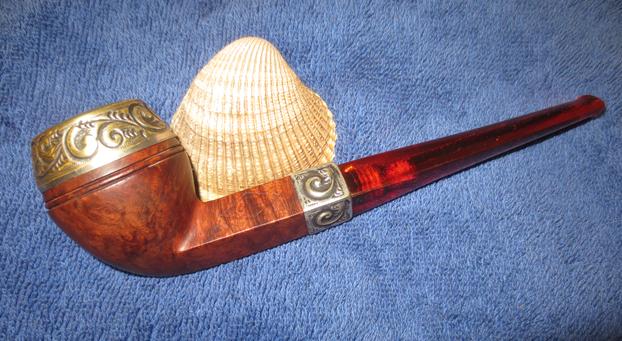
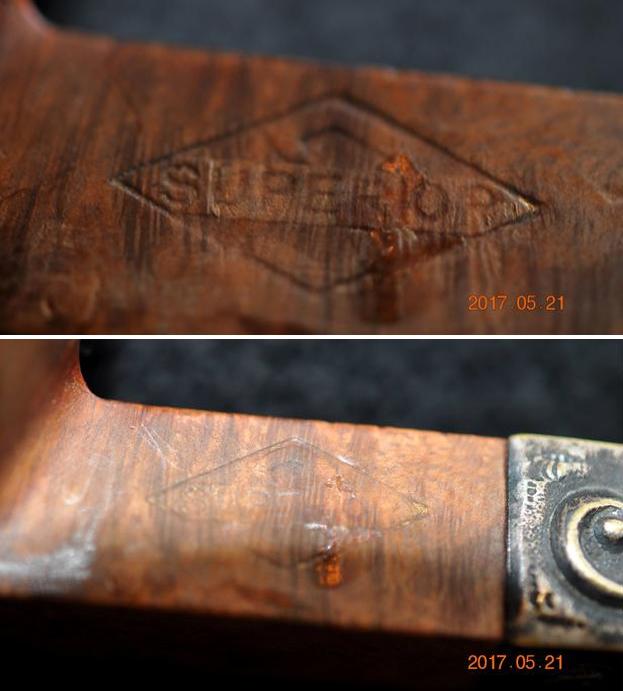
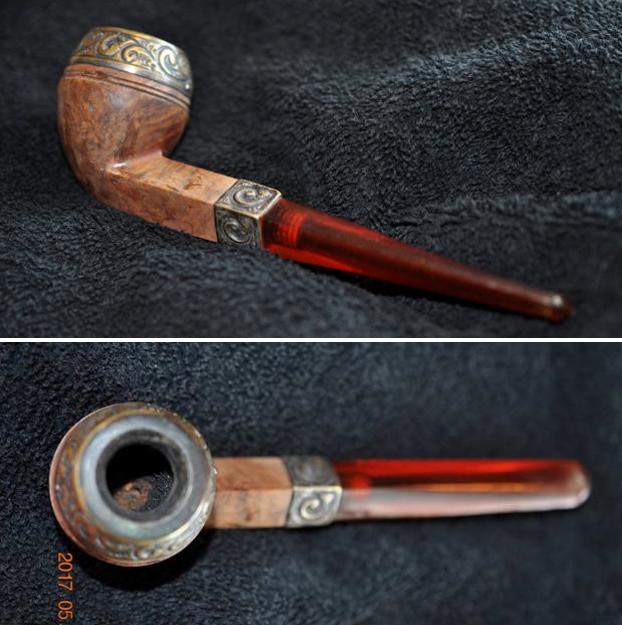
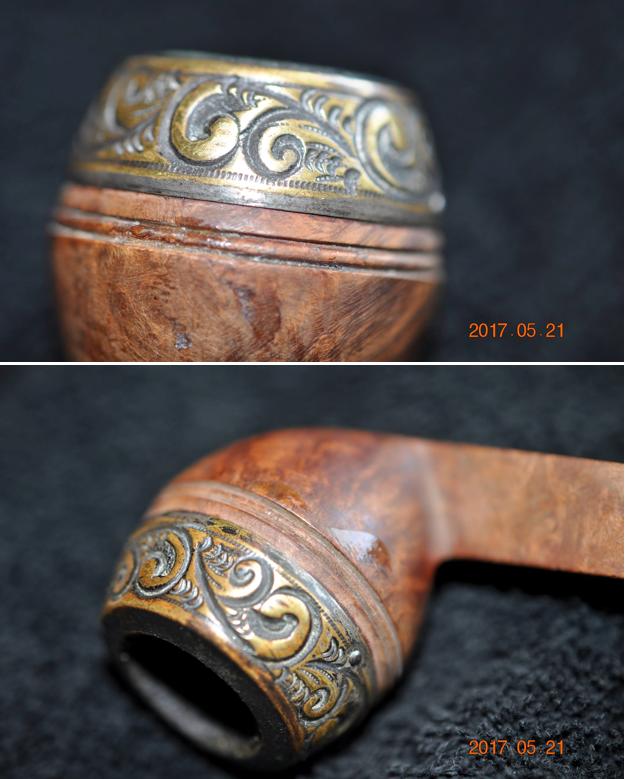
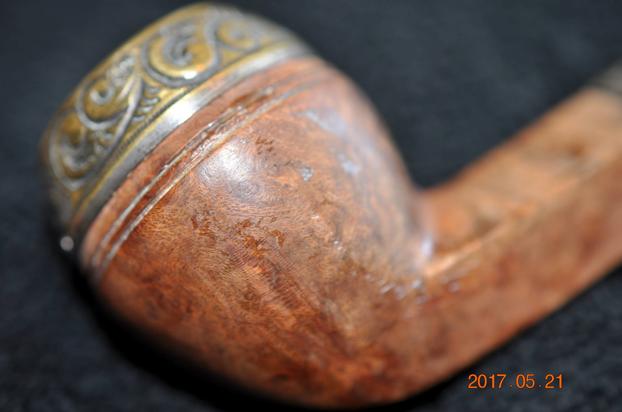
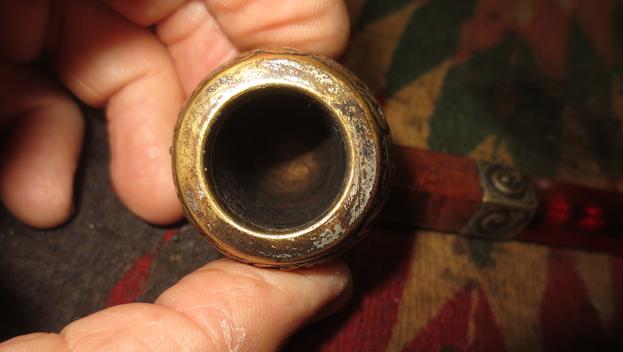
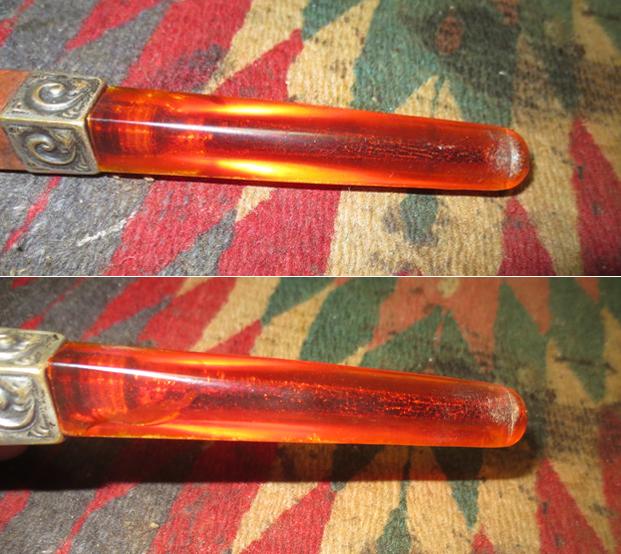
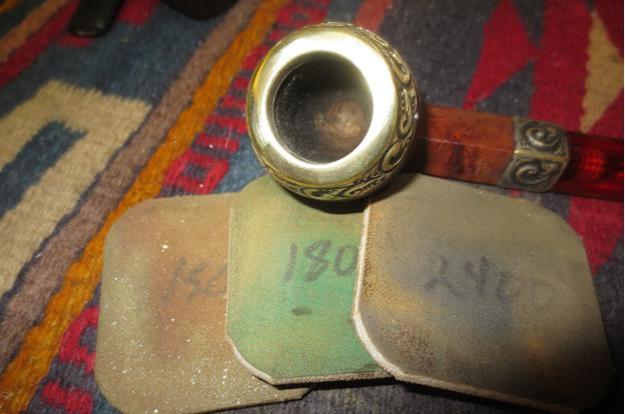
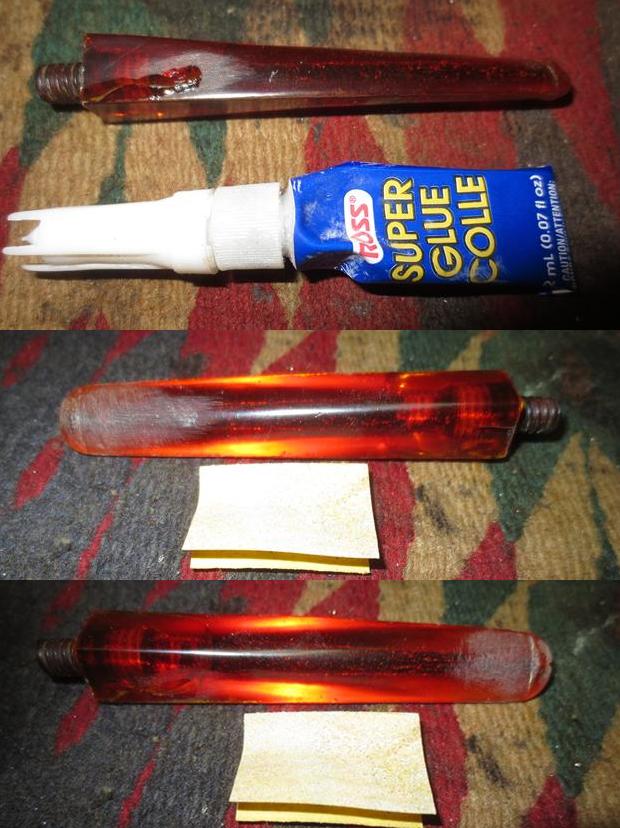
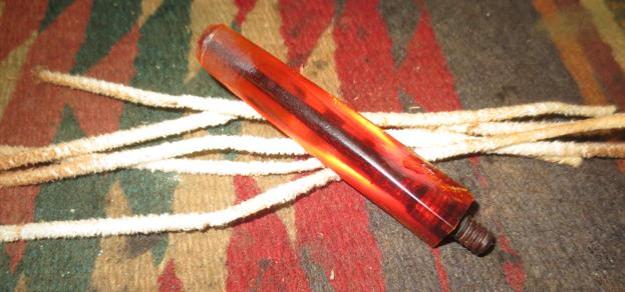
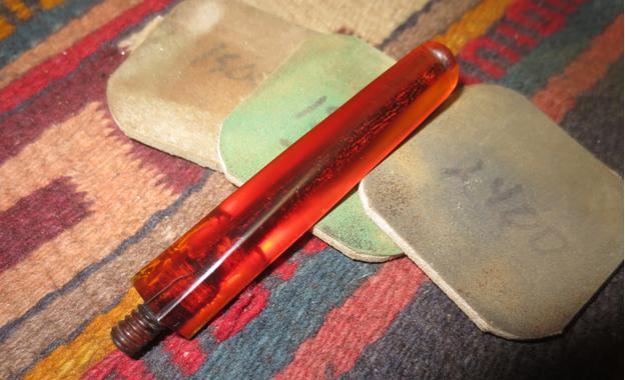
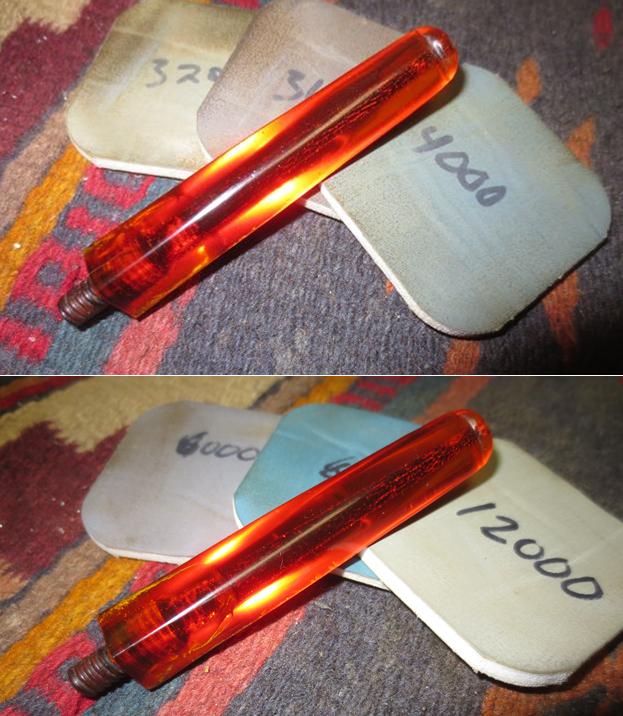
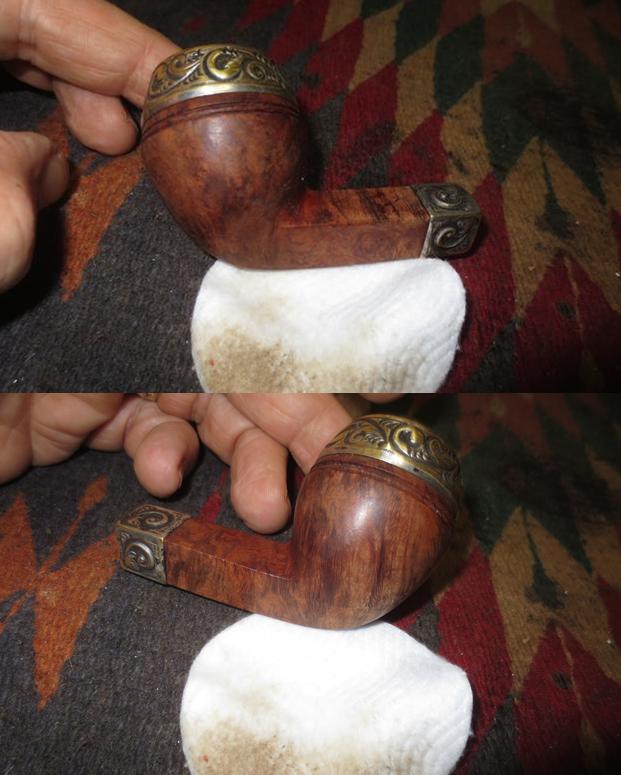
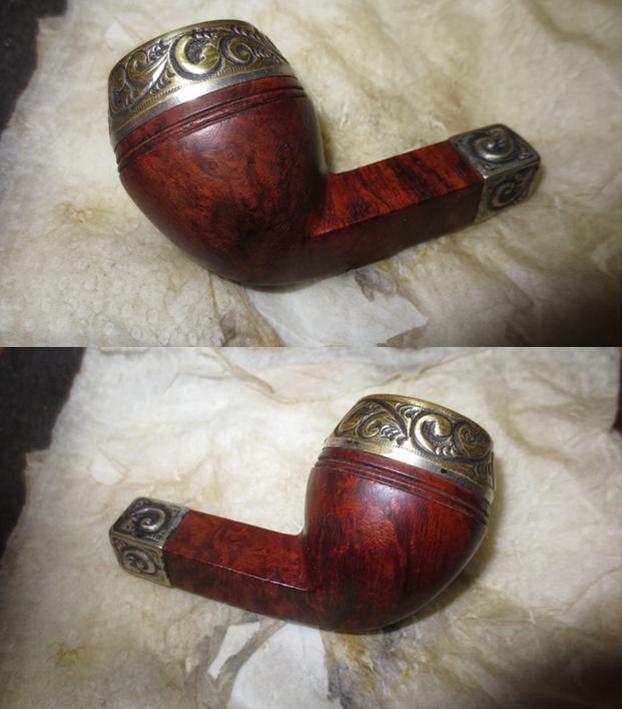
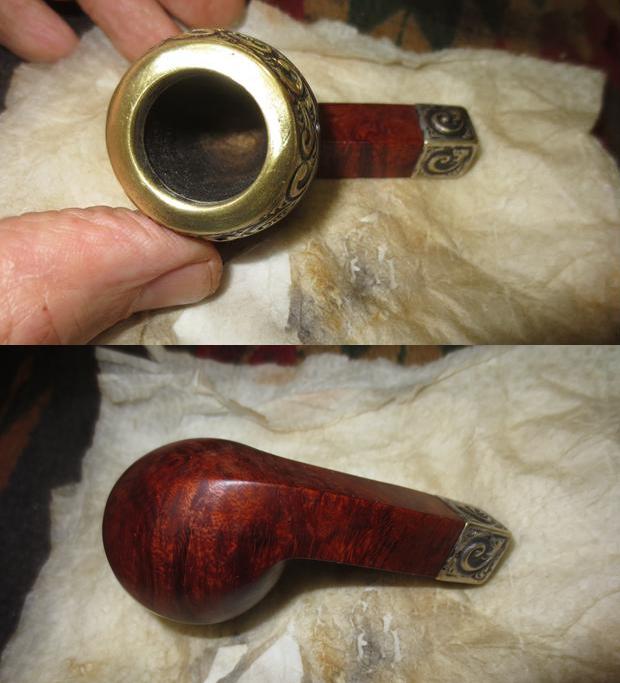
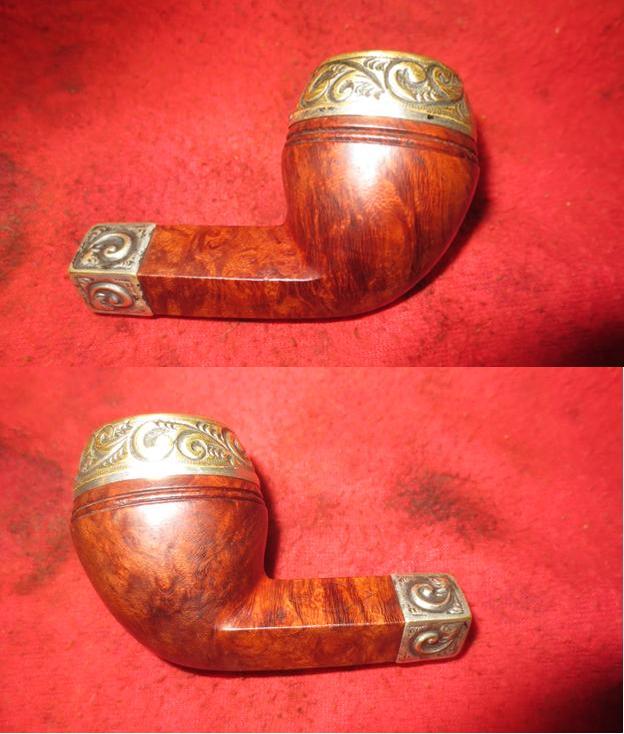
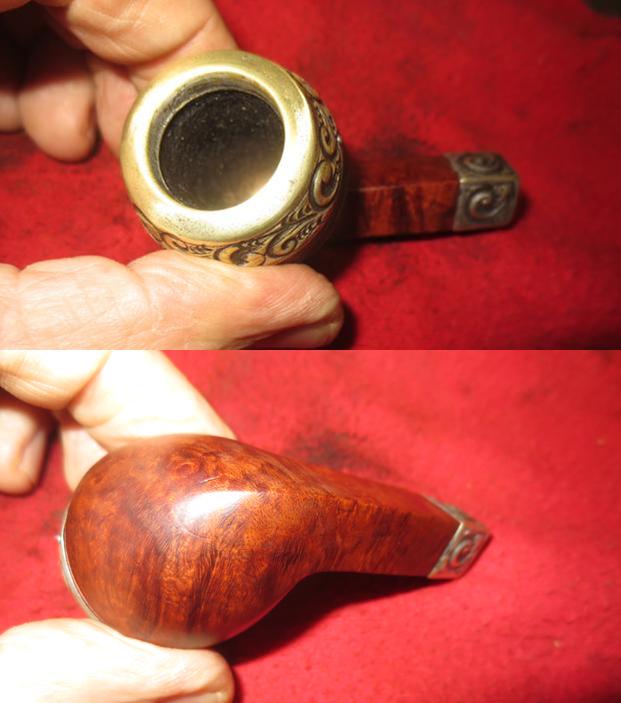
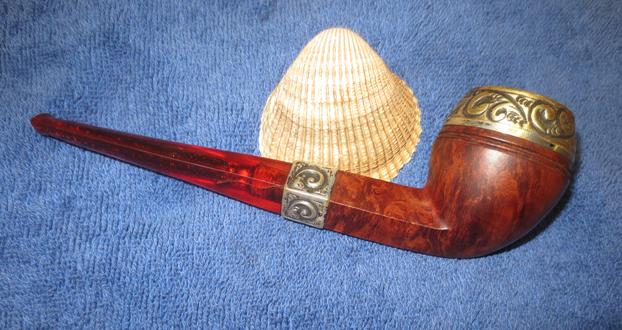
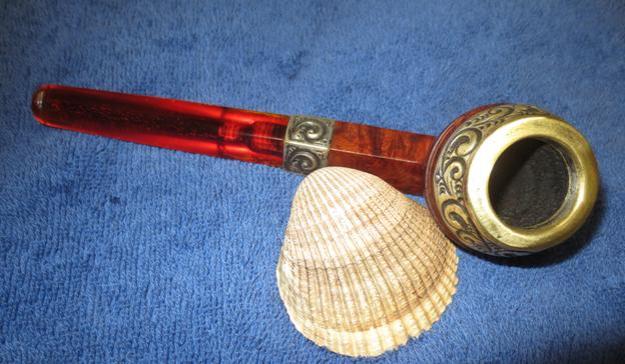
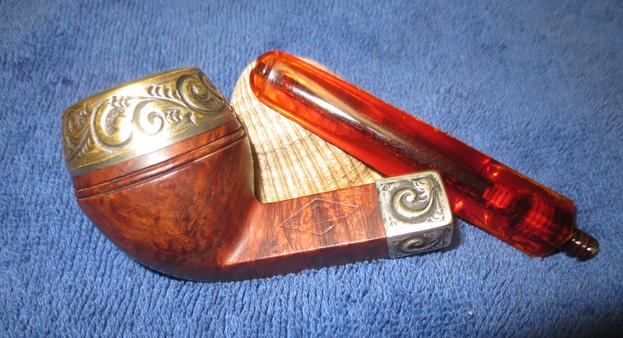
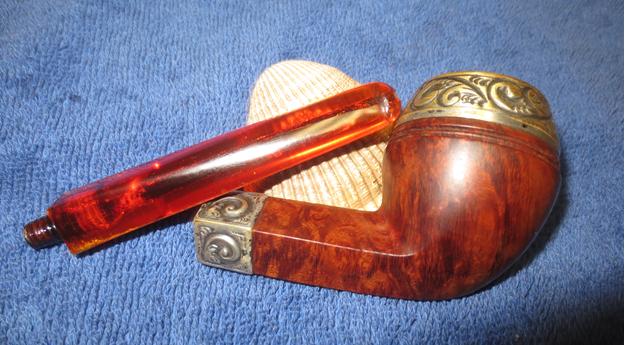
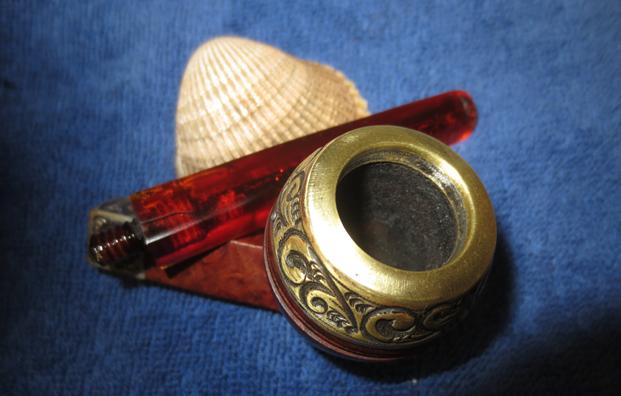
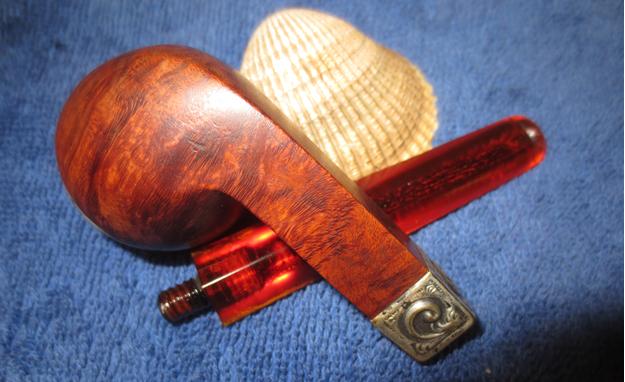
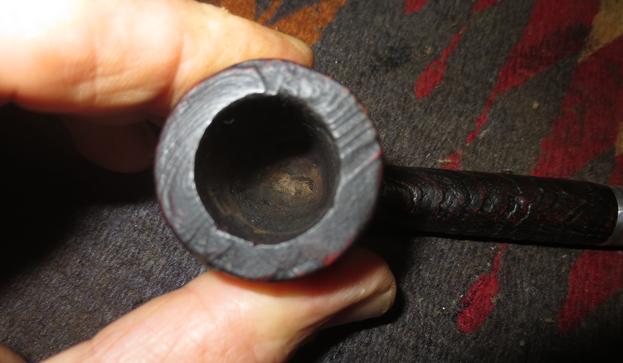
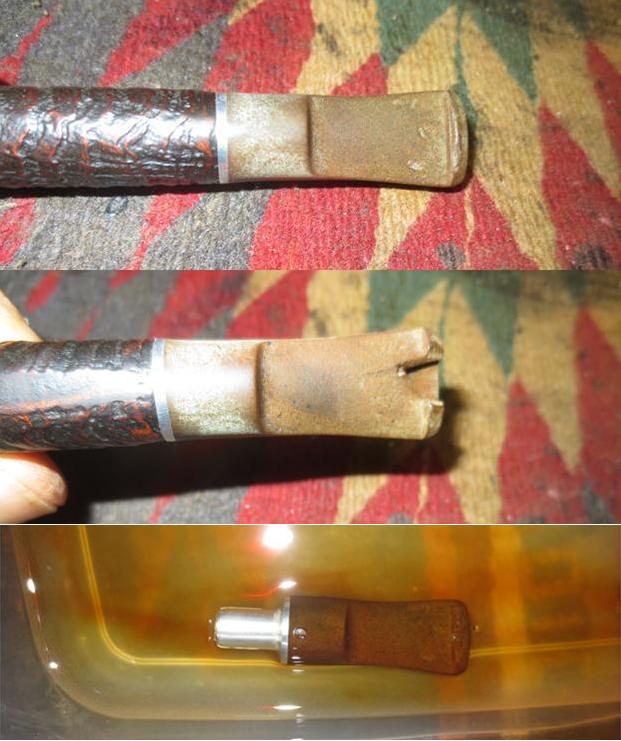
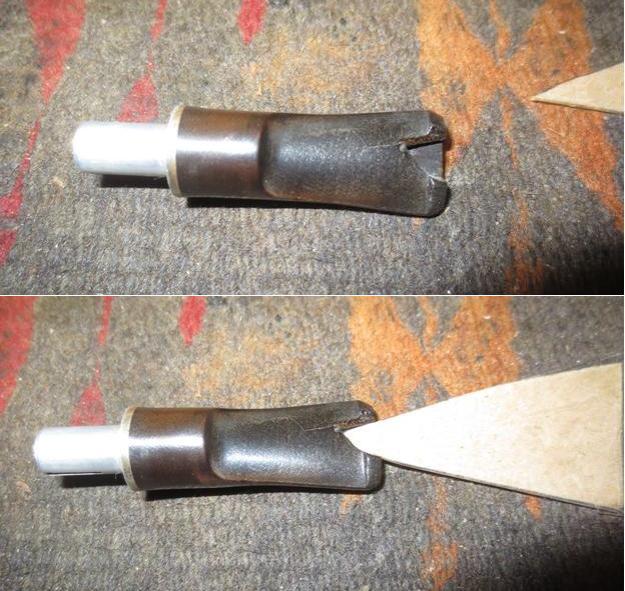
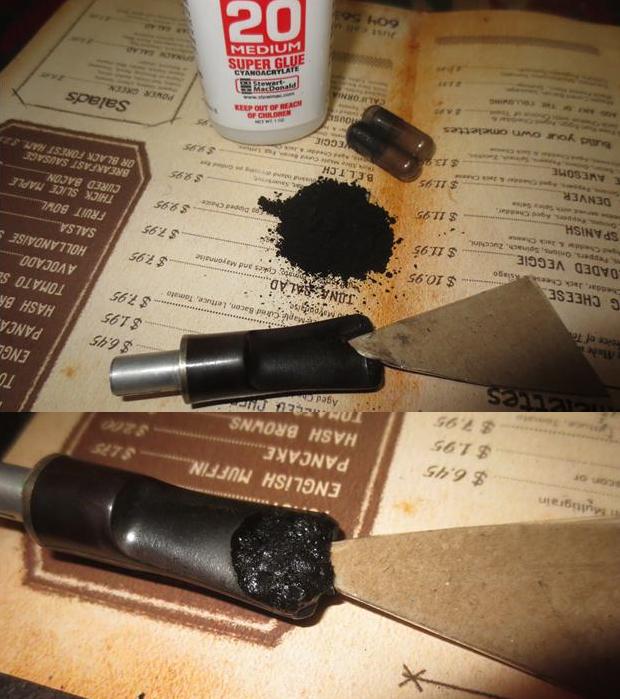
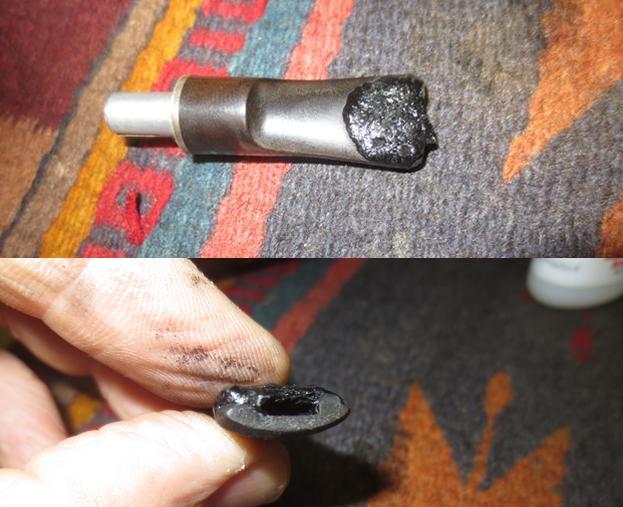
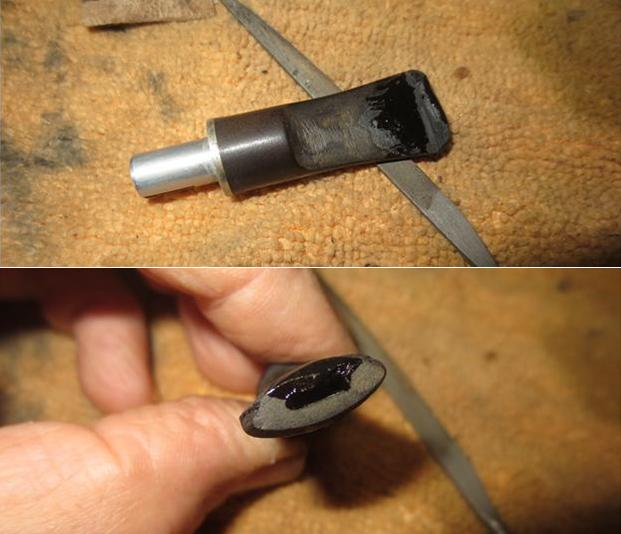
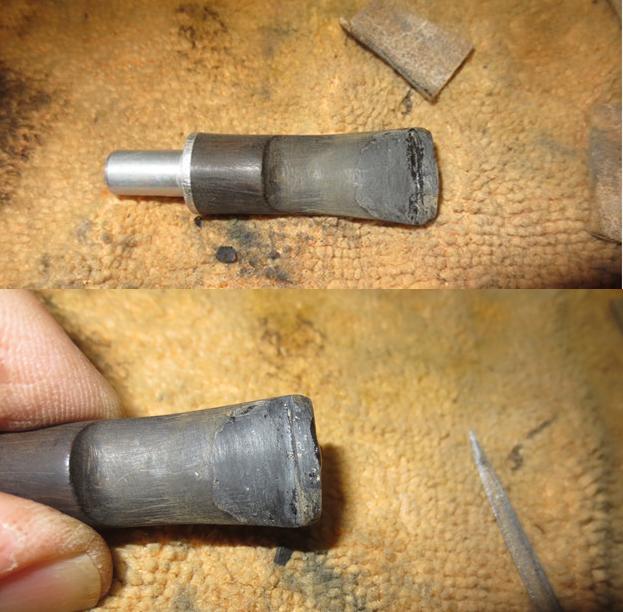
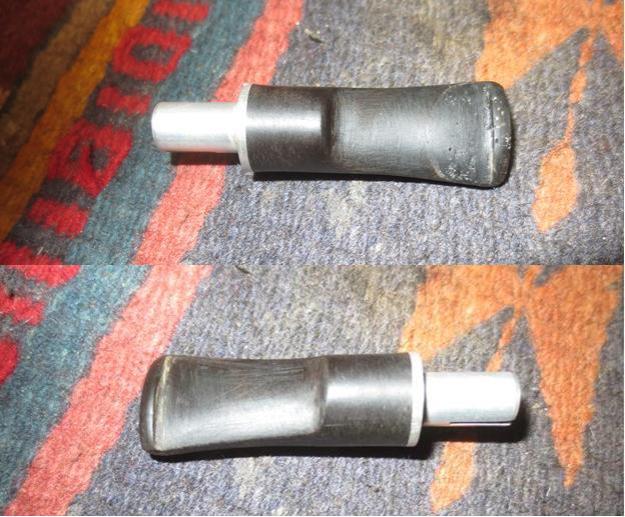
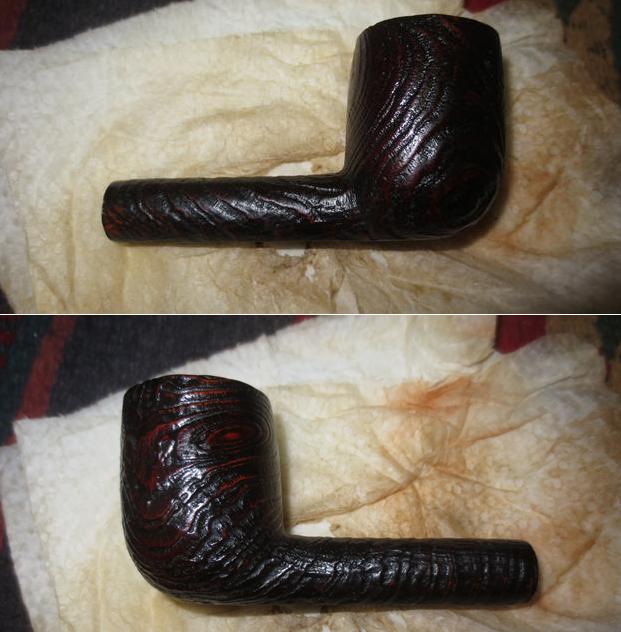
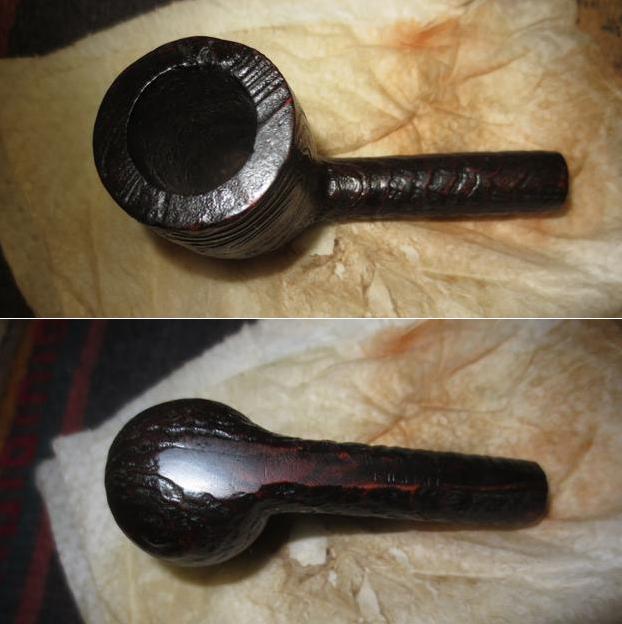
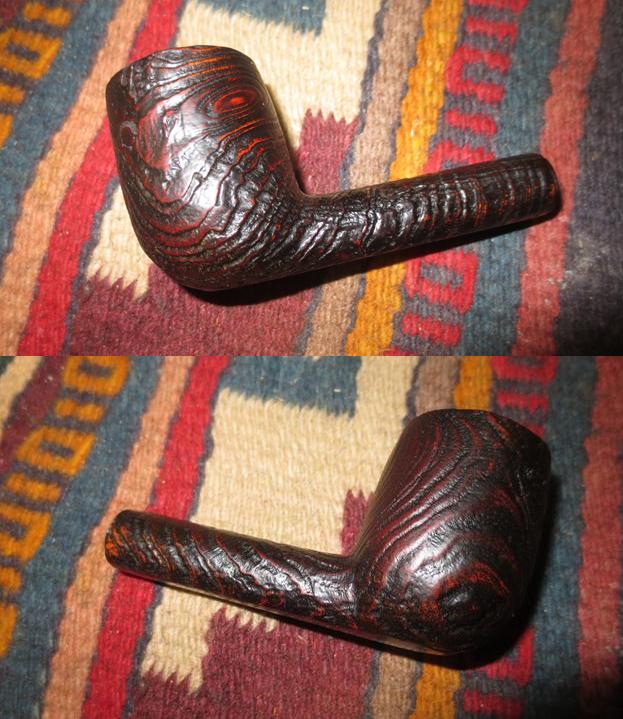
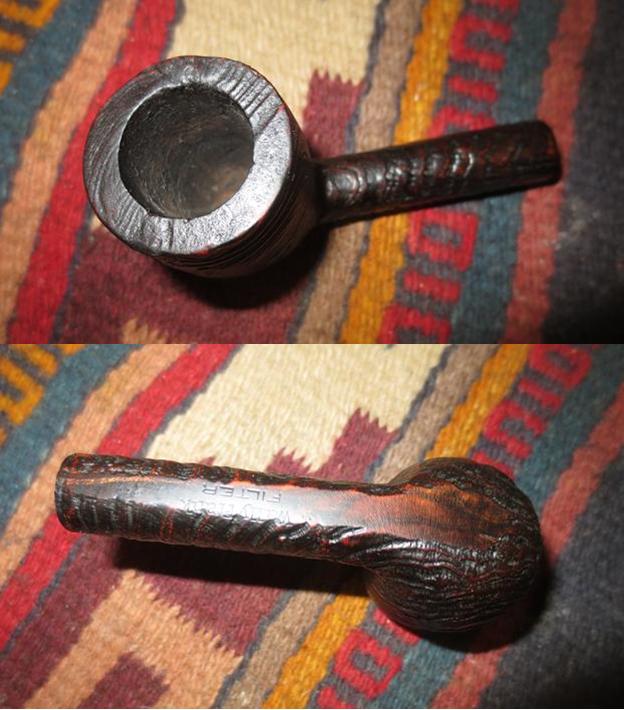
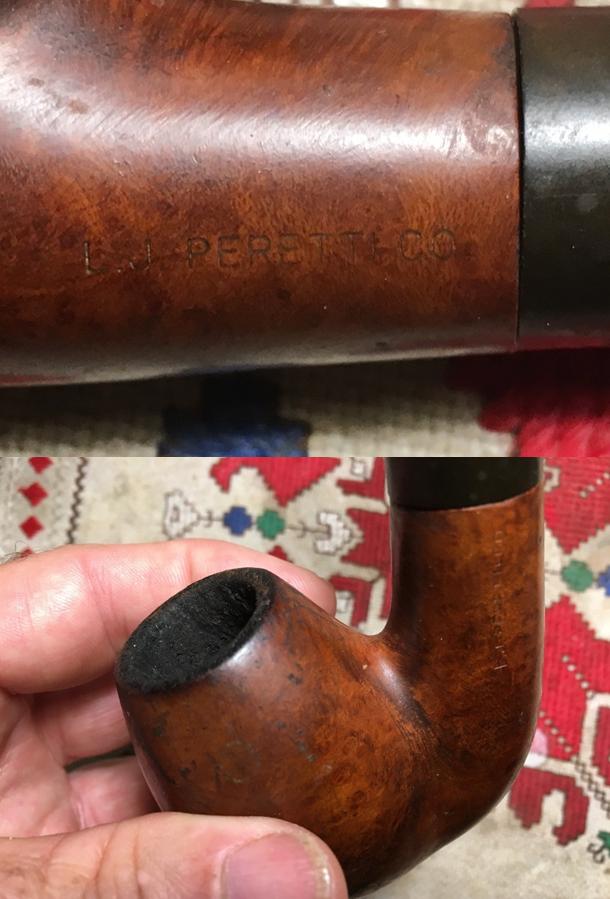
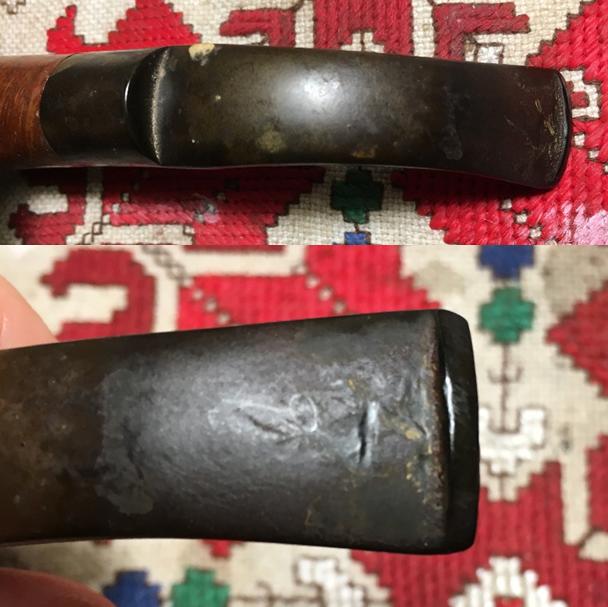
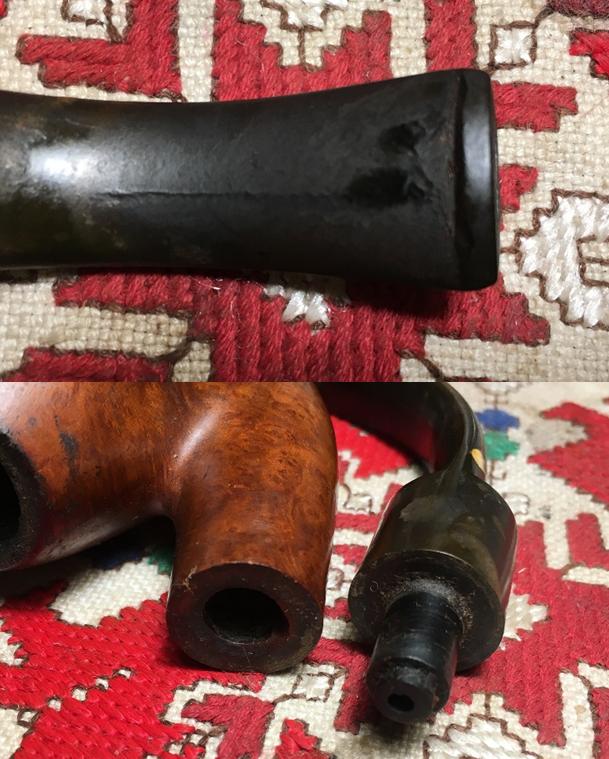
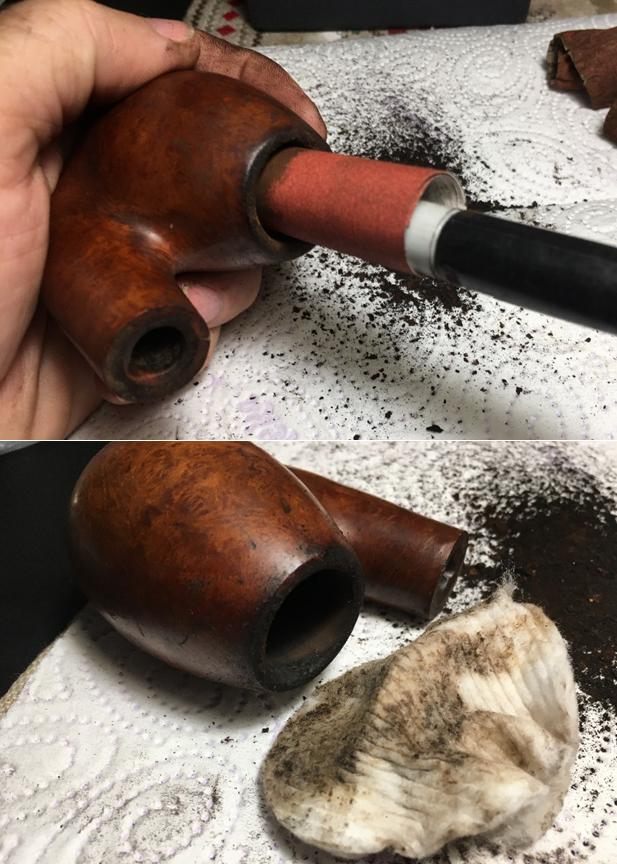
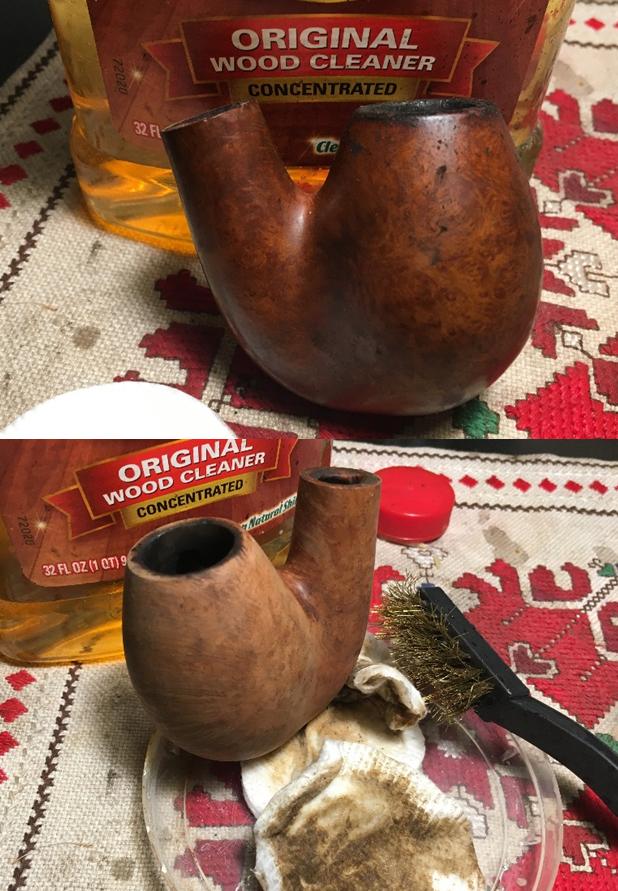
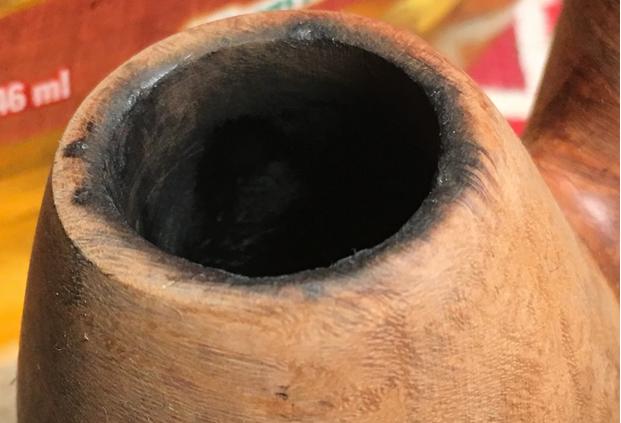
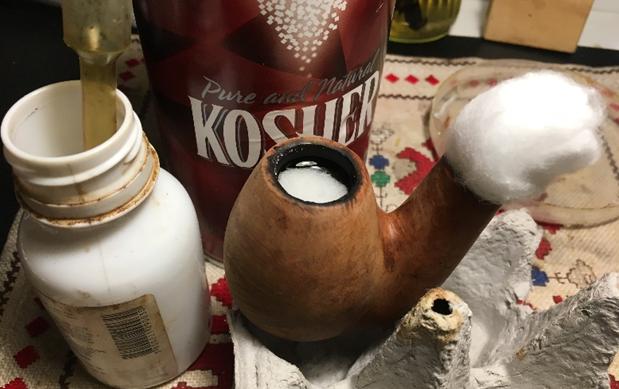
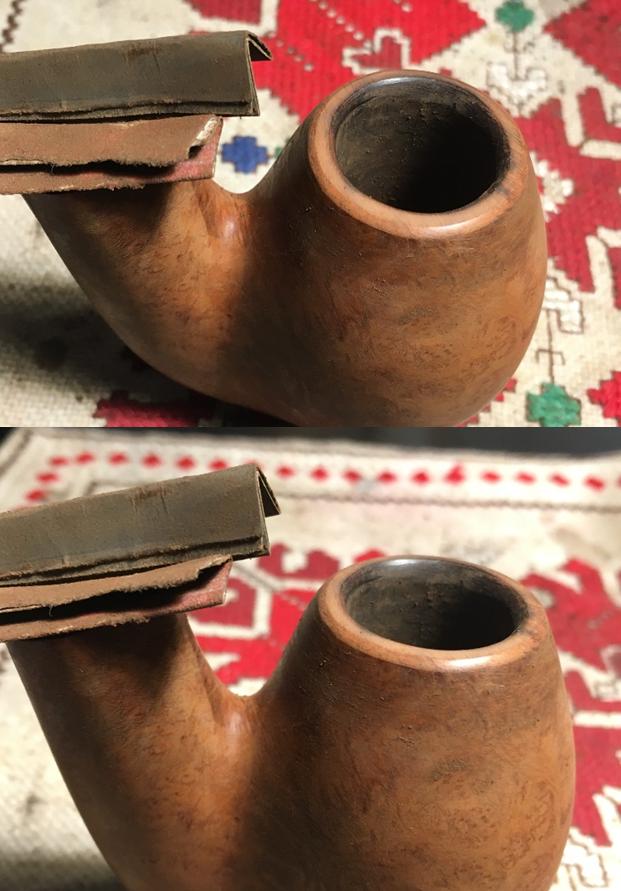
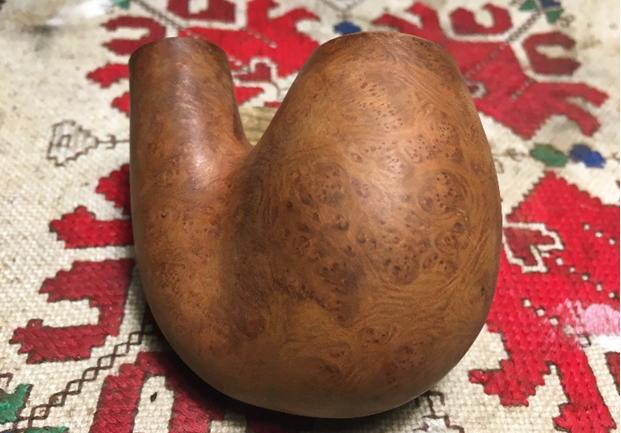
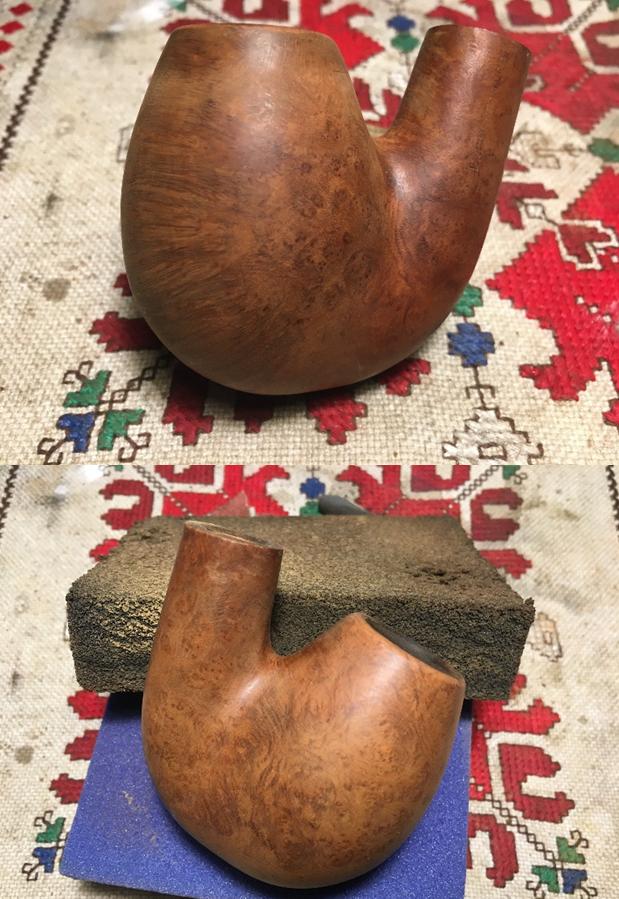
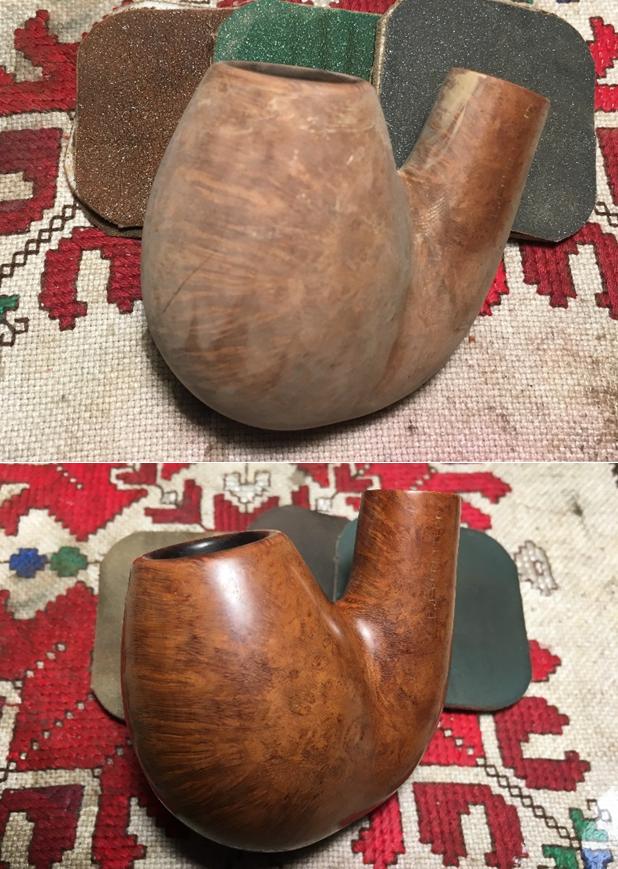
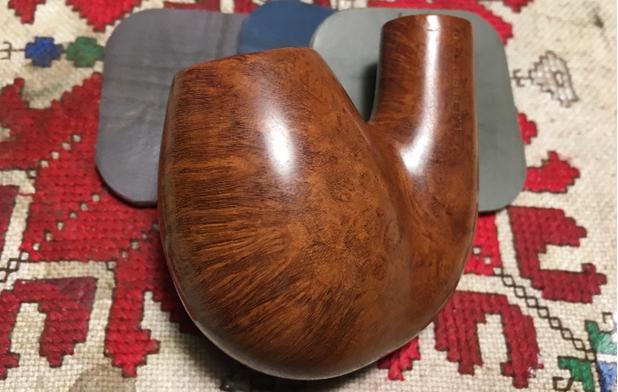
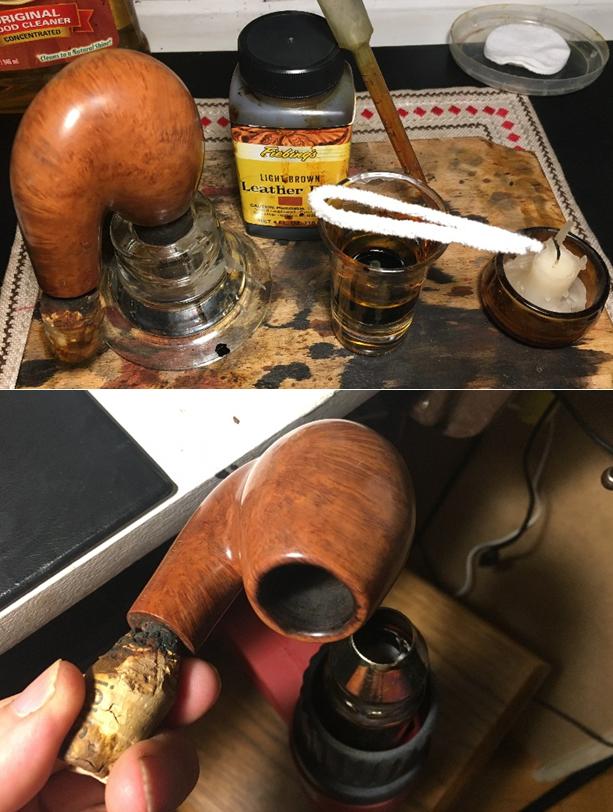
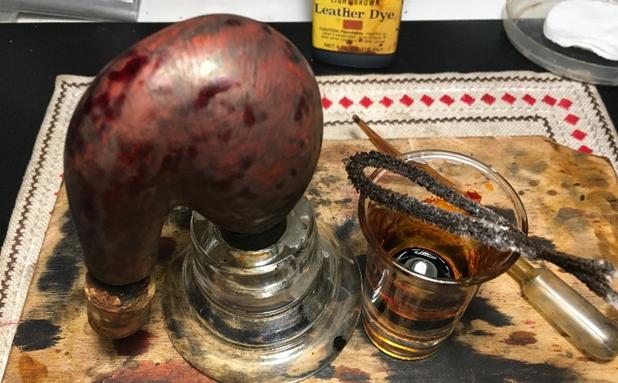
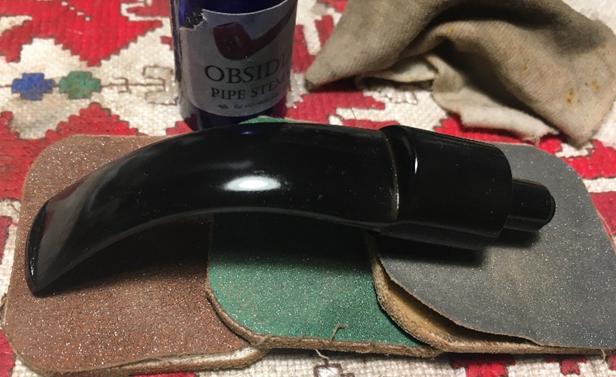
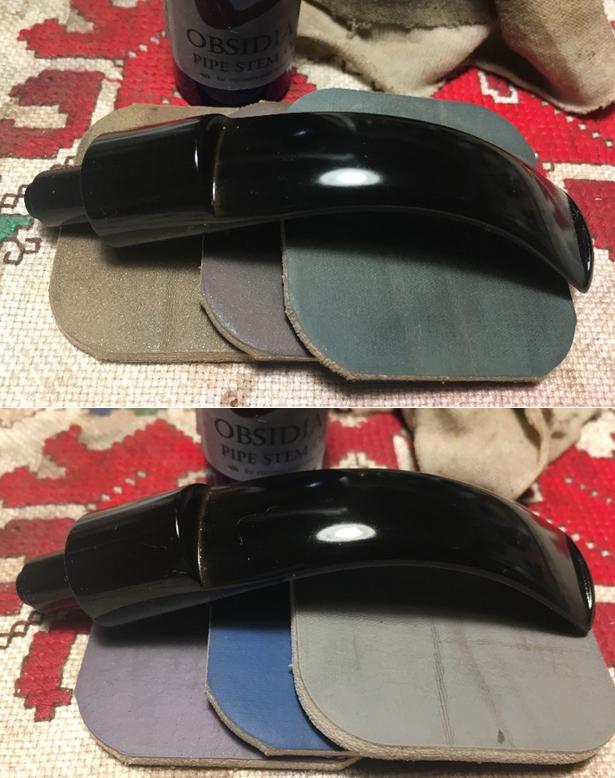
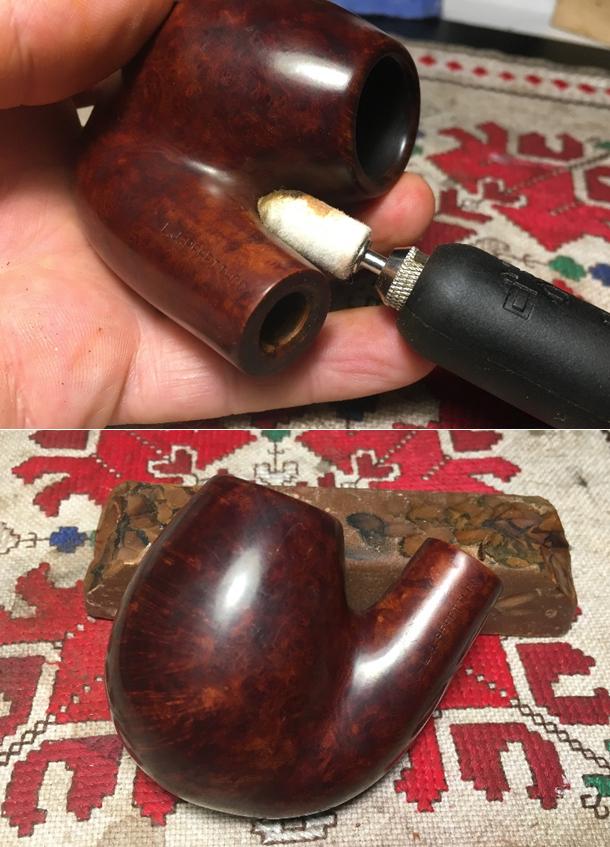
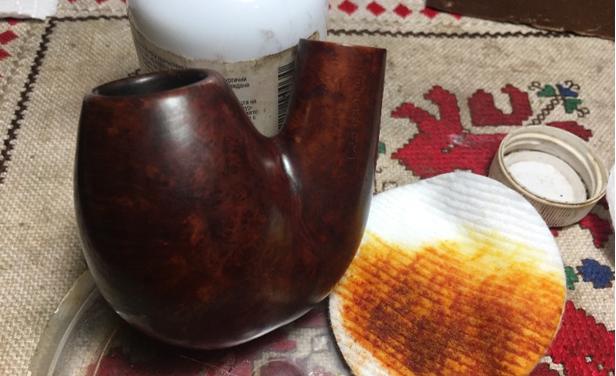
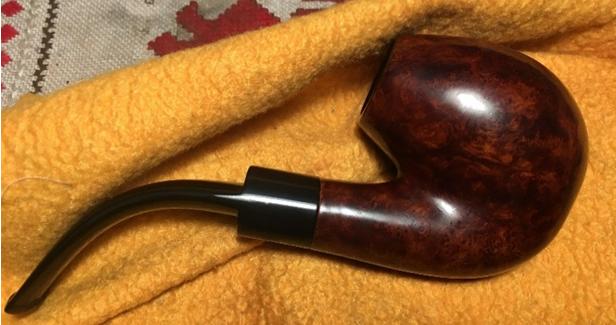
The next pipe I chose to work on from the lot of pipes my brother and I picked up on our virtual pipe hunt in Montana is another C.P.F. French Briar. This one is a classic horn shape with a chubby shank and a horn stem. It is delicate in terms of size (4 inches long and 1 ½ inches tall) but chunky feeling at the same time. Like the other banded pipes in this lot the band on the shank is loose and has turned so that the faux hall marks are on the other side. The finish is very dirty and the rim is damaged around the inner and outer edges. The horn stem is worn and there is tooth chatter on the top and underside of the stem near the button. The stem is overturned in the shank. The photos below show what it looked like before my brother did his clean up on it. If you would like to read about some of the others I have restored I have written about them in individual blogs. They include a CPF horn stem bulldog, a CPF French Briar bent billiard, a CPF Remington French Briar military mount billiard and a CPF French Briar Rhodesian. Just a reminder – CPF stands for Colossus Pipe Factory. The brand was made in the late 1880s and 1890s.Jeff took the above photos as well as the photos that follow to show the condition of the pipe before he cleaned it up. This sad little Horn comes from the same era as the other pipes in this find – the late 1880s – early 1890s. The finish was worn dirty but the grain underneath showed promise. There one large sandpit on the bottom left side of the bowl toward the front. The rim of the bowl and top edge of the pipe were in rough shape. The outer edge had been beat up pretty good by someone knocking their pipe out against something hard (if you are tempted to knock out your pipe on a railing or a garden rock please think twice before you do so). The inner edge of the rim appeared to be out of round and carved up by the same person who had used a knife to ream the others in this lot. There was a thick, crumbling cake buildup in the bowl and the lava from the bowl overflowed onto the damaged top of the rim. The band on the shank end was oxidized and the stamping on it was almost illegible. The horn stem had tooth marks on the top and underside near the button. Jeff took close up photos of the rim top to show how bad it looked before he started the cleanup. The thick cake and lava overflow on the rim filled in a lot of the damage. The full extent of the damage would be revealed once the cake was removed and the lava was cleaned.The next photos show the condition of the bowl sides and the flaking finish. The damage on the rim edge also can be seen in the pictures. The third picture shows the sandpit on the bottom left side of the bowl. You can also see the potential in the lovely grain that is peeking through the grime and flakes of old finish peeling off. The stamping on the left side of the shank is readable – it has the C.P.F. logo in an oval with the words French Briar above and below the oval. The stamping on Briar is fainter than the rest of the stamping. The silver band on the shank has the faux hallmark stamps that I have come to associate with C.P.F. pipes. The horn stem had some great looking striations and colour underneath the wear and tear. There was some tooth chatter and bite marks on both the top and underside at the button. I am very spoiled due to the excellent cleanup work that my brother Jeff does on these old pipes before I ever get them here in Vancouver. He has a pattern to his work and it rarely varies. Jeff thoroughly cleaned the pipe reaming the bowl with a PipNet reamer and tidying up with a Savinelli Fitsall Pipe Knife. He scrubbed out the mortise and the airway in the shank and the stem with pipe cleaners, cotton swabs and alcohol. He scrubbed the exterior of the pipe with Murphy’s Oil Soap to remove the grime and grit on the bowl. He scrubbed the rim top with a tooth brush and the oil soap. He scrubbed the band and stem at the same time to clean it. I took photos of the pipe to show the condition it was in when it arrived in Vancouver. I took a close up photo of the rim top and the sandpit on the lower left side. You can see the damage along the inner and out edges of the rim and the size and location of the sandpit in the photos. The general condition of the briar is rough though the grain patterns are promising.The horn stem is dry and lacklustre but it seems to be solid. There was no delamination happening along the sides or length of the stem and the tooth marks and chatter at the button were relatively minor. This horn stem was in the best condition of all of the horn stems I have worked on in this lot from Montana. The stem was overturned to the right due to wear on the mortise and the threaded bone tenon.I repaired the sandpit with a few drops of super glue and let it dry. Once the glue had dried I sanded the repair with 220 grit sandpaper to blend it into the surface of the briar.I topped the bowl on a topping board with 220 grit sandpaper to remove the damage and minimize the damage to inside and outside edges of the rim. I did not have to take off too much so I checked as I worked over the rim. Once I had the rim smooth I stopped sanding and wiped the bowl down with alcohol on cotton pads to clean off the dust from the surface. I filled in the nicks around the outer edges of the bowl with clear super glue. I carefully over filled the spots around the rim so that I could sand it smooth and leave a smooth flow to the rim. I sprayed the repairs with an accelerator so that I could sand it sooner. The next photos show the repair process and the end results.I gently topped the rim again on the topping board to smooth out the repairs on the rim top and sanded the outer edge of the bowl and inner edge of the bowl with 180 and 220 grit sandpaper. I was able to remove the excess repair material and smooth out the rim edges on both the inside and outside. The overall look was far better than when I started the restoration and it was minimally intrusive.I polished the band with a 1500 grit micromesh sanding pad to remove the tarnish and corrosion (I would use the other grits of micromesh pads later in the process to polish the band). Underneath the film and corrosion the band was gold in tint just like the other C.P.F. pipes that I have been restoring. I coated the shank end with white all-purpose glue and pressed the band in place. I aligned the faux hallmarks with the stamping on the shank. I wiped down the glue that squeezed out around the edge of the band before it dried so that it would not hamper staining the shank end when I was ready.I carefully heated the bone tenon with a Bic lighter, moving the flame constantly and not letting it get to hot. My purpose was to loosen the tenon and turn the stem straight once again. I repeated it several times and was able to get quite a bit of turn on the stem but not enough. I backed it off and let the glue in the stem harden again. I would need to come up with another method to address the worn threads in the mortise and on the tenon.I set the stem aside for a bit and turned my attention to polishing the briar in anticipation of staining it. I went through the full range of micromesh sanding pads – wet sanding with 1500-2400 grit pads and dry sanding with 3200-12000 grit pads. I wiped the bowl down with a damp cotton pad between pads. The pictures show the way the polishing brings the grain out on the bowl. I needed to stain it to blend the repairs into the rest of the bowl surface. The trick would be to stain it with light enough colour to highlight the grain and not mute it. I mixed 1 part of dark brown aniline stain with about 3 parts of isopropyl alcohol to make a medium brown wash for the bowl. I stirred it to get a good mix. I heated the briar and applied the mixture to the bowl. I flamed it and repeated the process until I was happy with the coverage on the bowl.Once the stain dried I wiped it down with alcohol and cotton pads to remove the excess and make it more transparent. I still found that the colour was too dark so I decided to polish it with micromesh sanding pads. I wet sanded with 1500-2400 grit pads and wiped it down with alcohol on cotton pads to remove the finish I had sanded free. I touched up the shallow gold stamping with Rub’n Buff European Gold using a cotton swab. I rubbed of the excess with a cotton pad. I finished polishing the bowl by dry sanding it with 3200-12000 grit pads. I wiped it down with alcohol after each pad to clean it. The pictures tell the story of the process and the end. With the bowl finished it was time to work on the stem. I sanded the tooth marks out and smoothed the flow of the stem with 220 grit sandpaper. I polished it with micromesh sanding pads – wetsanding with 1500-2400 grit pads and dry sanding with 3200-12000 grit pads. I rubbed the stem down with Obsidian Oil after each pad. After the last pad I gave it a final coat of oil and set it aside to dry. I painted the tenon with clear fingernail polish to build up the threads. I layered it on until the threads sat well in the mortise. I put the stem on the shank and it lined properly. I buffed the bowl and stem with Blue Diamond on the buffing wheel to polish out the scratches in those surfaces. I buffed the brass coloured band with Blue Diamond as well. I gave the pipe multiple coats of carnauba wax to protect the aged briar and the horn. The finished pipe is shown in the photos below. It is a beautiful piece of pipe history and I only wish it could tell its story so I could know a bit of its travels. Until such a time that pipes can talk I am left to my own imagination. Thanks for walking with me through the process of the restoration.

This Old CPF French Briar Rhodesian was in rough shape


Blog by Steve Laug

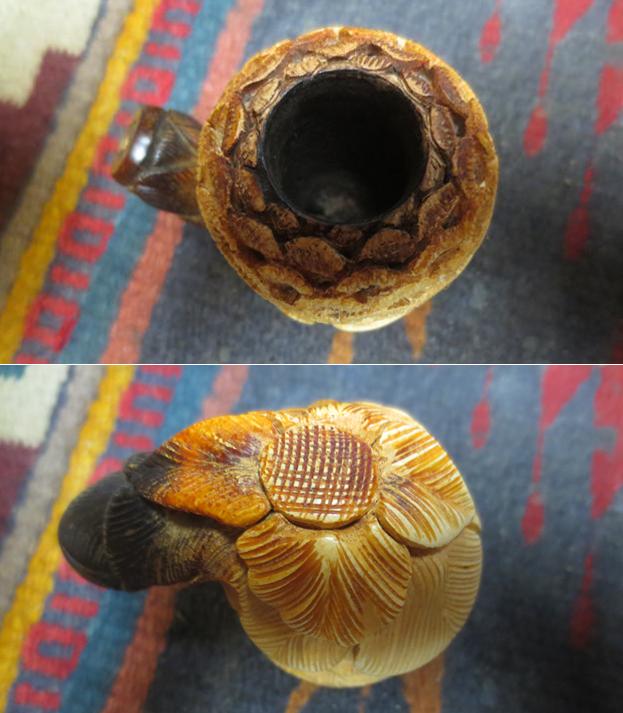
The next pipe I chose to work on from the lot of the lot of pipes my brother and I picked up on our virtual pipe hunt in Montana is another C.P.F. French Briar. This one is a Rhodesian shape with a chubby shank. It is an interesting shape and the carving around the band separating the cap from the body of the bowl. The band on the shank is loose and has turned so that the C.P.F. stamp on the band is on the other side. The finish is very dirty and the rim cap and top is heavily damaged. The horn stem is worn and there is tooth chatter on the top and underside of the stem near the button. There is a wrinkle in the horn on the underside mid stem. The stem looks like someone has either wrapped it or there is a gasket to keep it in place. The photos below show what it looked like before my brother did his clean up on it. If you would like to read about some of the others I have restored I have written about them in individual blogs. They include a CPF horn stem bulldog, a CPF French Briar bent billiard and a CPF Remington French Briar military mount billiard. (You can access them by clicking on the CPF Name above for a hyperlink to the blog). Just a reminder – CPF stands for Colossus Pipe Factory. The brand was made in the late 1880s and 1890s.Jeff took the above photo and the photos that follow to show the condition of the pipe before he cleaned it up. This sad little Rhodesian comes from the same era as the other pipes in this find – the late 1880s – early 1890s. If I thought the silver mount billiard was in bad shape this one was in worse condition than any of previous pipes I had worked on from this lot. It was worn and was in rough condition. The finish was worn off and appeared to be flaking in place. There were a lot of nicks, scratches around the outside of the bowl. The outside of the bowl was covered with grime, grit and was peeling. The rim of the bowl and top edge of the pipe were in abysmal condition. The rim had been knocked out on hard surfaces and burned. There were huge chunks missing all around the rim top. The front of the bowl was in worse condition than the back and sides. The height of the top cap was different all the way around. Once again there was a thick, crumbling cake buildup in the bowl and the lava from the bowl overflowed onto the damaged top of the rim. The band on the shank end was oxidized and the stamping on it was almost illegible. The horn stem had tooth marks on the top and underside near the button. There is a wrinkle in the horn on the underside mid stem.Jeff took close up photos of the rim top to show how bad it looked before he started the clean up. The thick cake and lava overflow on the rim filled in a lot of the damage. The full extent of the damage would be revealed once the cake was removed and the lava was cleaned. The third photo below shows the rim from one side and you can see the damage on that side. The next two photos show the condition of the bowl sides and the flaking finish. The damage on the rim edge also can be seen in the pictures.The stamping on the left side of the shank was readable – it had the C.P.F. logo in an oval with the words French Briar above and below the oval. The band on the shank end had the faux hallmark stamps that I was familiar with as well as the C.P.F. oval. The second photo shows something in between the shank and the stem. The first photo below shows the stem and the wrapping or gasket between the shank and stem. It is followed by photos that Jeff took when he removed the stem showing the wrapping – a thread of twine wrapped around the tenon to hold it in place in what appeared to be worn out threads in the mortise itself.The horn stem showed some tooth chatter, bite marks and what looked like wrinkles on the underside, but it was in better condition than the other previous horn stems I had worked on.Following his usual pattern, Jeff thoroughly cleaned the pipe. He reamed the bowl with a PipNet reamer and tidied up with a Savinelli Fitsall Pipe Knife. He scrubbed out the mortise and the airway in the shank and the stem with pipe cleaners, cotton swabs and alcohol. He scrubbed the exterior of the pipe with Murphy’s Oil Soap to remove the grime and grit on the bowl. He scrubbed the damaged rim top with a tooth brush and the oil soap. He scrubbed the band and stem at the same time to clean it. I took photos of the pipe to show the condition it was in when it arrived in Vancouver. You can see the damaged rim top and edges and the fill on the right side of the bowl. The condition of the briar is rough and the stem is oxidized. The band was loose so I removed it from the shank to clean it. I took a photo of the pipe parts.I took a close up photo of the rim top to show how great a job my brother did on it but also the extent of the damage that would need to be addressed in the repair.The stem was clean in decent shape. Very few tooth marks were on the top and bottom sides and those would be easy to deal with. The button was in excellent condition.I mixed a putty of super glue and briar dust to use for rebuilding the rim on the bowl and the top edge. The damage was quite significant so the repair would be extensive. I was hoping that it would work. Once it dried I topped the bowl on the topping board with 220 grit sandpaper and worked the inner edge with a folded piece of the same sandpaper. The repair came out quite well and gave me something to work with in the finished pipe. I polished the band with 1200-12000 grit micromesh sanding pads to remove the tarnish and corrosion from the surface. It worked really well and left behind a polished brass band. When I finished polishing the band I used an all purpose glue to glue it in place on the shank with the stampings aligned with those on the briar. I wiped down the bowl with alcohol on a cotton pad to remove the remaining sanding dust from the bowl and any grit that had accumulated in the carvings from my sanding. I polished the briar with micromesh sanding pads – wet sanding with 1500-2400 grit pads and dry sanding with 3200-12000 grit pads. I wiped the bowl down with a damp cotton pad to remove the dust after each set of pads. I stained the bowl with a dark brown aniline stain mixed with isopropyl alcohol in a 50/50 ratio. I flamed it and repeated the process until I was happy with the finish. I wiped the bowl down with cotton pads wetted with isopropyl to thin the stain and give it more transparency. When I finished that I buffed it with red Tripoli and sanded it down with 1500-12000 grit micromesh pads to polish it and give it the look that I was aiming for. The pictures tell the story. With the bowl done, except for the final buffing I turned my attention to the stem. The first thing I had to deal with was the worn threads in the mortise. I decided to fill in the threads on the tenon with super glue and make the stem a push stem. I could have removed the threaded tenon and inserted a new push tenon like those on meerschaum pipes but I wanted to keep the original look of the tenon and mortise so I figured that I could convert the stem to push status by simply building up the threads. I layered on clear super glue until I had the build up shown in the photos below. I still needed to sanded it smooth and reapply a final coat but you can see the process.I sanded out the tooth marks in the stem and worked on the “wrinkles” in the underside of the stem with 220 grit sandpaper until they were smooth. I worked on some of the marks at the tenon end of the stem at the same time as it seemed rough to touch.I polished the stem with micromesh sanding pads – wet sanding with 1500-2400 grit pads and dry sanding with 3200-12000 grit pads. I rubbed the stem down with Obsidian Oil after each pad to give the horn some needed oil to help with the dry feel that it had after over a hundred years of smoking. You can follow the development of the shine in the photos that follow. I love the feel and look of polished horn. There is nothing quite like it for translucency and feel. I had forgotten to touch up the gold leaf in the stamping on the shank up to this point so I applied some Rub ‘n Buff European Gold to the stamping with a cotton swab and rubbed off the excess. The stamping on this pipe was in excellent condition so it came out really readable.I buffed the pipe and stem with Blue Diamond on the buffing wheel to polish out the scratches that remained and to give it a shine. I was careful to avoid damaging the gold stamping on the shank. I gave the pipe multiple coats of carnauba wax to protect the horn and the briar. I buffed it with a clean buffing pad to raise the shine on the horn and the stem. I hand buffed it with a microfiber cloth to deepen the shine. The finished pipe is shown below. I am pretty happy how it came out considering what I started with. The rim and cap look the age of the pipe but the damage is gone and the pipe is ready for another 100 years. Thanks for going through the process with me on this challenging restoration.
Restoring another CPF French Briar – a Remington Silver Mount Billiard


Blog by Steve Laug

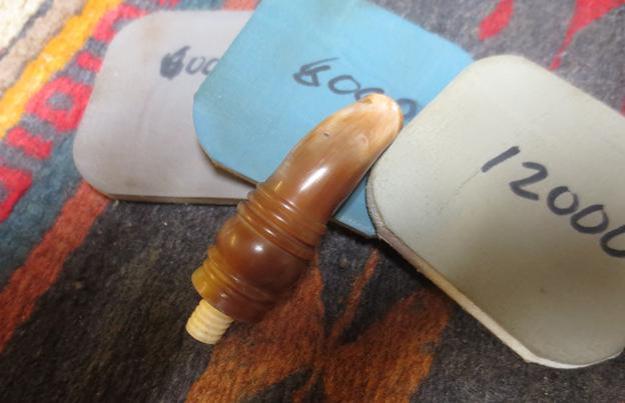
The next pipe I chose to work on from the lot of the lot of pipes my brother and I picked up on our virtual pipe hunt in Montana is a C.P.F. French Briar Silver Mount Billiard. It is a classic billiard shape, while the silver ferrule and cap on the stem end give it a feeling of elegance. The photos below show what it looked like before my brother did his clean up on it. It is another one from the lot of pipes my brother and I picked up on our virtual pipe hunt in Montana. I have written about several of the other CPF finds with the latest being a CPF horn stem bulldog and a CPF French Briar billiard. Just a reminder – CPF stands for Colossus Pipe Factory. The brand was made in the late 1880s and 1890s.Jeff took the above photos and those that follow to show the condition of the pipe before he cleaned it up. This little billiard comes from the same era as the other pipes in this find late 1880s – early 1890s. It was in worse condition in many ways than the previous pipes I had worked on from this lot. It was worn and was in rough condition. The finish was worn off and there were a lot of nicks, scratches around the outer rim of the bowl and top edge of the pipe. The outside of the bowl was covered with grime and grit. Once again there was a thick, crumbling cake buildup in the bowl and the lava from the bowl overflowed over the top of the rim. The damage to the outside of the rim made me think that the inner edge of the bowl was also damaged from the same kind of knife reaming. But I could not be certain until the cake was gone. The silver ferrule on the shank end was damaged and torn on end with what looked like small cracks in the silver. The tenon endcap was worn, scratched and some brass colour showed through the finish. The vulcanite stem had small tooth marks on the top and underside near the button and was oxidized.Jeff took the next two close up photos of the rim top and bowl. You can see the thick cake in the bowl and the chipped overflow on the rim top. The damage to the inside edge and the chips on the outer edge are visible under the cake. The next three photos show the grain under the dirty and damaged finish on the bowl sides. There are also scratches and nicks in the bowl and around the rim. The stamping on the sides of the shank was very readable. The left side read The Remington and the right side read French Briar. The silver ferrule is stamped with three faux hallmarks and the logo of C.P.F. in an oval. Some of the cracks and tears on the ferrule are also visible in the third photo. Jeff took photos of the condition and tears in the ferrule. It was in very rough shape and would take some work to repair and smooth out. But was it worth the effort. The bite marks, chatter and wear on the both the top and underside of the stem surface are visible in the next photos.Following his usual pattern, Jeff thoroughly cleaned the pipe. He reamed the bowl with a PipNet reamer and tidied up with a Savinelli Fitsall Pipe Knife. He scrubbed out the mortise and the airway in the shank and the stem with pipe cleaners, cotton swabs and alcohol. He scrubbed the exterior of the pipe with Murphy’s Oil Soap to remove the grime and grit on the bowl. He scrubbed the metal ferrule and stem end at the same time to clean it. I took photos of the pipe to show the condition it was in when it arrived in Vancouver. You can see the damaged rim top and edges and the fill on the right side of the bowl. The condition of the briar is rough and the stem is oxidized. Jeff had cleaned up the rim top and what was underneath was sad. The rim was chipped and damaged. The inner and outer edge of the bowl was badly damaged. The inner edge was out of round and the cuts in it seemed like they had been down when a previous owner had reamed the bowl with a knife. The outer edge was beat up with large chips and nicks going down the side of the bowl.The next photos of the stem and end cap show the brass shining through and the oxidation on the surface of both sides. The tooth marks and chatter are also visible. Fortunately they do not appear to be deep.I topped the bowl on the topping board using 220 grit sandpaper to remove the surface damage and clean up the edges from the top view. I did not have to top it too much to smooth out the rim. Topping the bowl also removed much of the damage to the edges as well.I used clear super glue and briar dust to repair the rough outer edge on the bowl top and the damaged fill on the back right side. I sanded the repairs smooth with 220 grit sandpaper to remove the excess repair and blend it into the surface of the briar.I sanded the repairs smooth and repaired the light bevel to the inner edge of the rim with a folded piece of 220 grit sandpaper to repair the damages to the inner edge.I polished the briar rim and the sides of the bowl with micromesh sanding pads – wet sanding with 1500-2400 grit and dry sanding with 3200-4000 grit pads. I wiped the bowl down after each pad with a damp cotton pad. The photos tell the story of the polishing process on the bowl. I heated the briar and stained it with dark brown aniline stain thinned by 50% with isopropyl alcohol. I flamed it to set it in the briar and repeated the process until the stain coverage was even all around the bowl.Once the stain had dried I wiped it down with isopropyl alcohol to thin the stain and make it more transparent. When I finished wiping it down I buffed it with red Tripoli to reduce the stain even more. The pictures that follow show the process of reducing the opacity of the stain. I touched up the gold leaf on the stamping using European Gold Rub’n Buff. I applied it with a cotton swab and rubbed off the excess with a cotton pad. The repaired stamping is shown in the next two photos.I decided to experiment with a repair to the tears in the ferrule using clear super glue. I had never tried this before but I had a hunch that the hardened glue would fill in the gaps and then I could sand it smooth. I applied the glue in layers until the edge was even with the end of the ferrule. I sanded the repairs after each application of glue until the surface of the repair matched the rest of the ferrule. While the glue is slightly visible it bound the tears together and I was able to sand it smooth and blend it into the silver. I polished the repair with micromesh sanding pads – wet sanding with1500-2400 grit pads and 3200-12000 grit pads. The following photos show the progress of the ferrule repair. With the bowl and ferrule restored and functional I turned my attention to the stem. I polished the metal end cap with Blue Diamond on the buffing wheel. I polished the vulcanite with micromesh sanding pads – wet sanding with 1500-2400 grit pads and dry sanding with 3200-12000 grit pads. I rubbed the stem down with Obsidian Oil after each pad and after the final pad I set it aside to dry. I buffed the pipe with Blue Diamond on the buffing wheel to polish the briar and the stem. I gave the bowl and stem multiple coats of carnauba wax and buffed it with a clean buffing pad to raise the shine on the pipe. I hand buffed it with a microfiber cloth to deepen the shine. The finished pipe is shown in the photos below. It has come a long way from the sad and damaged pipe that I started with when I began the restoration. What do you think? Was it worth the effort? Seems to me that it was more than worth it. Thanks for walking with me through this process.
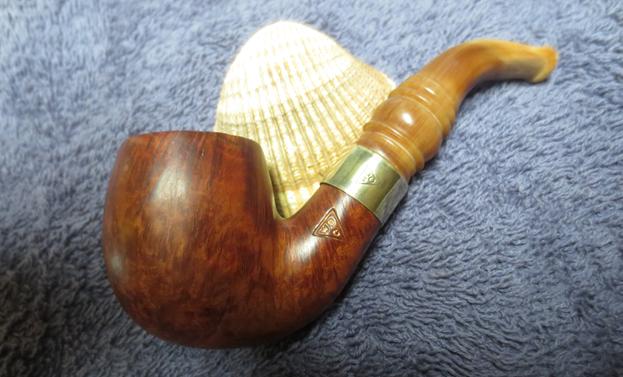
Another Piece Pipe History – a Lovely CPF French Briar Bent Billiard


Blog by Steve Laug

The next pipe I brought to the work table was a little bent CPF French Briar billiard. The photos below shows what it looked like before my brother did his clean up on it. It is another one from the lot of pipes my brother and I picked up on our virtual pipe hunt in Montana. I have written about several of the other CPF finds with the latest being a nice little CPF horn stem bulldog. Just a reminder – CPF stands for Colossus Pipe Factory. The brand was made in the late 1880s and 1890s. This little bent billiard comes from the same era as the other pipes in this find. It was very worn and looked to be in rough condition. The finish was non-existent and there were a lot of nicks, scratches and grime on the surface all around the bowl. There was a thick, crumbling cake buildup in the bowl and it overflowed on to the top of the rim. It looked like the inner edge of the bowl was damaged from reaming with a knife but I could not be certain until the cake was gone. The gold band on the shank was so badly oxidized that it was impossible to see what was under the grime and sticky debris on it. The horn stem had tooth marks on the top and underside near the button and looked like it was delaminating along the edges and the bend on the underside. The horn was very dry. Jeff took some close up photos of the bowl and rim from the top. You can see the crumbling condition of the cake in the bowl and the thick overflow on the rim top. It was really hard to see the condition of the inner edge of the bowl.The grain underneath all of the grim on the sides of the bowl was really quite stunning, even through the debris, grime and buildup. The birdseye and cross grain stain out really well even through the dirty surface. The oxidation on the band was also heavy and very rough. It is hard to know what is underneath the corrosion.The stamping on the left side of the shank has the standard C.P.F. logo in an oval with French arched over the oval and Briar arched underneath. The stamping on the C.P.F. is fainter than the stamping on French Briar. The second photo shows the junction between the band and the horn stem. The horn looks rough and grainy.The next four photos show the stem from various angles. The first and second photos show what looks like delaminating on the left side near the button. The third and fourth photos show tooth marks on the top and underside of the stem at the button. The tooth marks on the top are deep. Jeff thoroughly cleaned the pipe. He reamed the bowl with a PipNet reamer and cleaned it up with a Savinelli Fitsall Pipe Knife. He scrubbed out the mortise and the airway in the shank and the stem. He scrubbed the exterior of the pipe with Murphy’s Oil Soap to remove the grime and grit on the bowl. He scrubbed the tenon with a tooth brush and removed the tars and oils. I took photos of the pipe to show the condition it was in when it arrived in Vancouver. I took a close up photo of the rim top to show the condition it was in after my brother had cleaned it up. It is amazing to me that he was able to remove the thick buildup on the rim top and the crumbling cake in the bowl and leave no debris behind. It was better than I had expected. The rough spots would be easy to sand out and smooth the ridges and bring it back to round. It appeared that the pipe had never been smoked to the bottom of the bowl as the bottom of the bowl is raw briar.The next two photos show the condition of both sides of the stem after the cleanup. Note the roughness on the underside of the stem and the tooth marks/chatter on both to top and the bottom near the button.You can see the oxidation on the band in the photos above. It is not clear what colour it is. The sticky grime was cleaned off but the oxidation would need to go. I sanded the band with 1500-2400 grit micromesh pads to remove all of the sticky substance and the oxidation on the surface. It came off really easily with some polishing. I glued the band in place on the shank with white glue and let it dry.I smoothed out the damage on the inner edge of the rim with 220 grit sandpaper and gave it a light bevel to minimize the damage. I stained the beveled edge on the bowl with a black Sharpie pen to blend it in with the inside walls of the bowl. I wet sanded the bowl and rim with 1500-2400 grit micromesh pads and dry sanded it with 3200-12000 grit pads.  I wiped it down with a damp cotton pad to remove the sanding grit. I polished the band while I worked on the bowl with the same grits of micromesh pads. The following photos showed the polishing on the briar. I touched up the gold leaf on the CPF French Briar logo with European Gold Rub’n Buff. I applied it with a cotton swab and wiped down the excess gold. The light of the flash showed more of the gold buff that needed to come off.I stained the bowl with a 50/50 mix of dark brown aniline stain and isopropyl alcohol. I applied the stain and flamed it with a lighter. I repeated the process until I felt the coverage was even. Once it dried I took some photos of the stained bowl. It is too dark to my liking but the coverage was even. I wiped the bowl down with alcohol on cotton pads to make it more transparent and let the grain show through. I polished the briar with micromesh sanding pads to further remove the stain and make the grain show through. The process of unveiling the grain is shown in the photos that follow.With the bowl finished I worked on the stem. I used some small drops of super glue to fill in the tooth marks on the stem surface and the button. Once the repairs had dried I sanded them smooth to blend them into the surface of the stem. I polished the stem with micromesh sanding pads. I wet sanded it with 1500-2400 grit pads and dry sanded it with 3200-12000 grit pads. I wiped the stem down after each pad with Obsidian Oil on a cotton cloth. I gave it a final coat after the last pad and set it aside to dry. I buffed the stem and bowl with Blue Diamond polish on the buffing wheel to polish it. I gave the stem and bowl multiple coats of carnauba wax. I buffed the waxed bowl and stem with a clean buffing pad to raise the shine. I hand buffed it with a microfiber cloth to deepen the shine. The finished pipe is shown in the photos that follow. The old timer looks really good and should have long years of life in it. I look forward to enjoying this pocket sized pipe. Thanks for walking with me through the process of the restoration.

Breathing life into an 1890’s era CPF French Briar Horn Stem Bulldog


Blog by Steve Laug

I decided to work on another one of the older 1890s CPF (Colossus Pipe Factory) pipes that my brother and I found on our virtual pipe hunt in Montana. That antique mall had just received a large estate of older CPF and WDC pipes. We picked up 30 pipes and one pipe case. There were 11 unique CPF brand pipes. Included were the following pipes (the three pipes that I have already restored are listed as hyperlinks below and you can click on any of them to read about the restoration. The rest will be finished in the near future). I chose to work on the French Briar Bulldog for this blog.

CPF military mount Oom Paul
CPF The Remington, French Briar, (military mount)
CPF French Briar with Hallmarked band and horn stem. Filigree carving around bowl
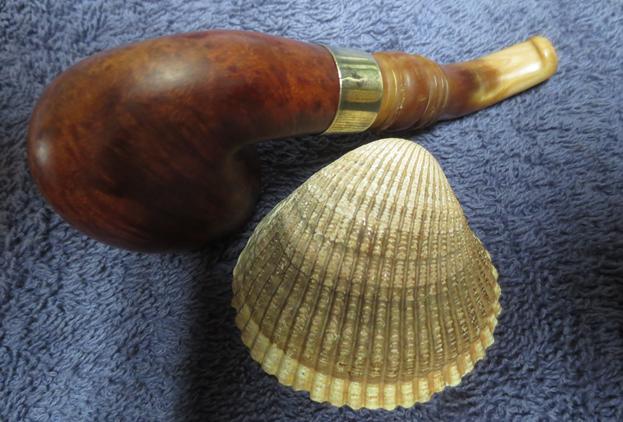
CPF Pullman with Horn Stem
CPF Siamese with twin horizontal stems
CPF Cromwell with twin vertical stems
CPF Olivewood Bowl Sitting on Petals- Horn Stem
CPF French Briar Bulldog with Horn Stem (the pipe in this blog)
CPF French Briar with tarnished metal band and a Horn Stem (looks like mini-Wellington)
CPF French Briar Horn Shaped Pipe with metal band and Horn Stem
CPF Colon French Briar with Black Meer Bowl and Amber stem

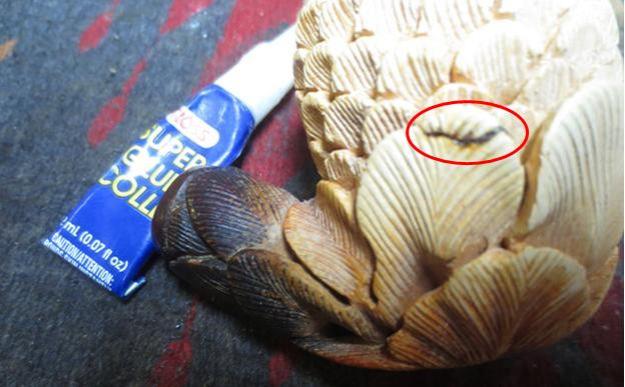
It is a beautifully grained, long shank Bulldog with a horn stem. It is stamped with the C.P.F. in an oval logo. Arched above and below the logo it is stamped French Briar. There is a small flaw in the briar at the end of the Briar stamping. The finish was worn but the pipe was in otherwise good shape. There was a thick cake in the bowl and an overflow of lava on the rim top. The inner edge of the rim top appeared to have some damage but otherwise it was in good shape. The double ring around the bowl under the cap was undamaged and the center ring was unbroken. The horn stem was worn at the button and had been well chewed on both the top and bottom sides. The stem appeared to be underclocked in the pictures that follow but once my brother cleaned it up I would have a better idea with regard to that.
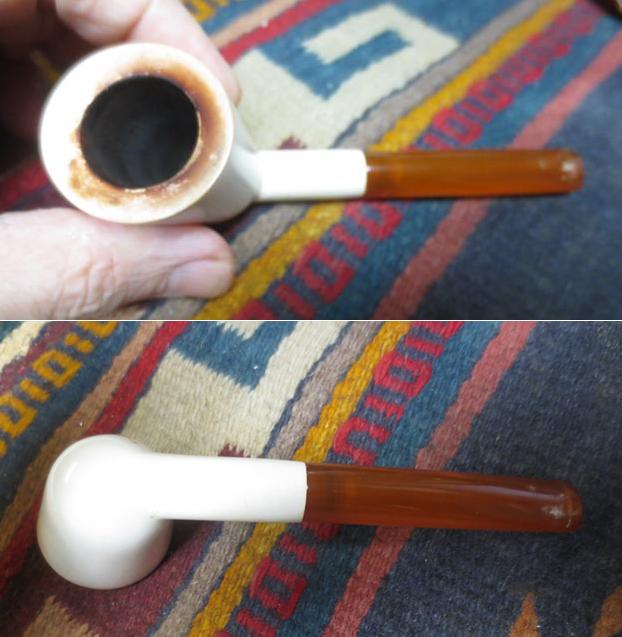
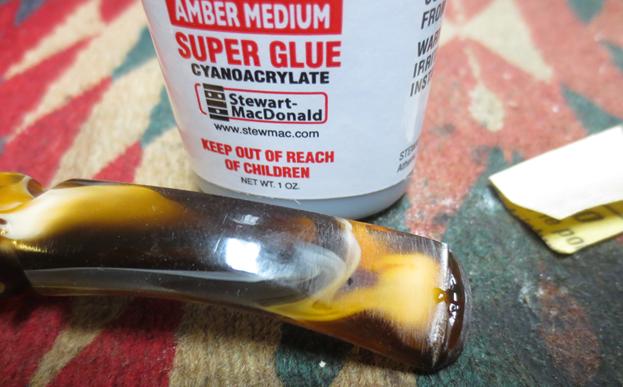
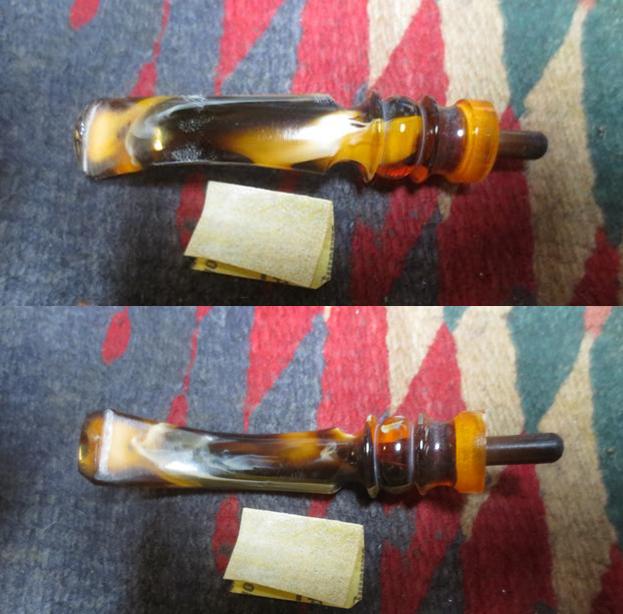
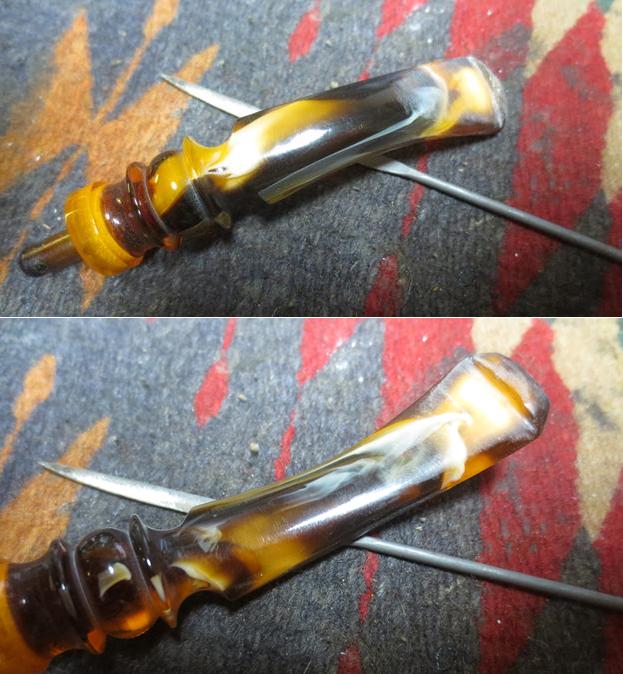
My brother took the following photos of the pipe before he started cleaning it. They give an overall picture and also close up pictures of the pipe from a variety of angles. He included a photo of the stamping on the left side of the shank. It was originally stamped with gold filigree in the letters but that had pretty much worn out. You can see the flaw or gouge going through the AR on the word Briar.The next four photos show the grain on the bowl from a variety of angles. The finish is very worn and dirty but the grain is quite nice and there are no fills in the briar. The close up photo of the rim top shows the scratches and lava on the top and the slight damage to the inner edge of the bowl. A fairly thick cake lines the walls of the bowl and is peeling on the front edge.The next two photos show the underclocked horn stem and what appears to be red thread that had been used to align the stem. It had obviously not worked.The next four photos show the condition of the horn stem. It is dried, chewed and delaminating at the button on both sides of the stem. The button itself also has some tooth damage to the top and underside. There appears to be a lot of colouration to the striations of the horn and it should clean up and be beautiful once polished. My brother did an amazing job on the cleanup of this old timer. His work keeps getting better and better and does not damage the old briar or horn. He reamed the bowl with a PipNet Reamer and cleaned it up with the Savinelli Fitsall Pipe Knife. He scrubbed the airway through the tenon and into the shank with pipe cleaners, cotton swabs and alcohol until it was clean. He scrubbed the externals with Murphy’s Oil Soap and was careful around the remaining gold filigree in the stamping on the left side of the shank. He was able to remove the tar and lava build up on the rim top and showed that inner edge was just lightly damaged. And low and behold once he had removed the thread on the metal tenon the stem lined up perfectly. I took the next four photos of the pipe when it arrived in Vancouver. I took a close up photo of the rim top and bowl to show how thoroughly Jeff had cleaned it. It would take very little work with a folded piece of sandpaper to smooth out the remaining damage to the inner edge of the bowl.He had been able to clean out the debris from inside the stem and also smooth out the exterior of the stem. The delamination of the horn would need to be stabilized and the deep tooth wear would need to be rebuilt to restore the taper of the stem.I decided to change my normal routine a bit and used amber coloured super glue from Stewart MacDonald to stabilize the horn around the button and up the surface of the stem for about an inch. This would bind together the strands of the horn and build up the tooth damaged areas on the surface. Once it dried I would be able to smooth out the repaired surface and blend it into the rest of the stem. I had an idea that the amber super glue would blend in better with the colours of the horn in this particular stem.I sanded the repairs with 220 grit sandpaper to blend them into the surface of the horn. I wanted a smooth transition between the repair and the rest of the horn. I also wanted to see if I had covered the damaged area of the stem surface well enough. I was pleased by what I saw once I had smoothed the repairs out. I polished the stem with micromesh sanding pads – wet sanding with 1500-2400 grit pads and rubbing the stem down with Obsidian Oil after each pad. I dry sanded the stem with 3200-4000 grit pads to further polish it and gave it more oil after each pad. The oil serves to give life to the dried horn. I buffed the stem with Blue Diamond on the buffing wheel before finishing polishing it with 6000-12000 grit micromesh sanding pads. I rubbed it down with Obsidian Oil after each of the micromesh sanding pads and let it dry after the final pad.With the stem finished I worked on the inner edge of the bowl. I used a folded piece of 220 grit sandpaper to smooth out the damage on the bowl edge. It did not take too much work to make it smooth once again. I sanded the top of the rim with micromesh sanding pads – wet sanding with 1500-2400 grit pads and dry sanding with 3200-12000 grit pads (I forgot to take photos of the work on the rim top with the 3200-12000 grit pads).I used some European Gold Rub’n Buff to rework the stamping on the shank side. I applied it to the stamping with a cotton swab and then wiped off the excess. The photo below shows the stamping with the gold applied.I put the stem back on the shank and buffed the pipe with Blue Diamond on the buffing wheel. I carefully worked over the shank so as to not damage the stamping. I gave the entire pipe multiple coats of carnauba wax to protect the briar and the horn. I buffed it with a clean buffing pad to raise the shine and hand buffed it with a microfiber cloth to deepen the shine. The finished pipe is shown in the photos below. It is a classic piece of pipe history. The shape and the finish of the pipe are exceptionally well done and show European craftsmanship that Colossus Pipe Factory was famous for. This is one of those pipes that will have a place in my own collection. It is just too beautiful to part with!
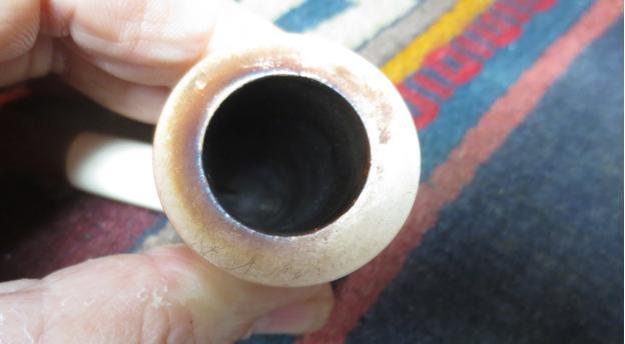
Refurbishing a Boswell 2003 Spiral Twist Bent Billiard


Blog by Steve Laug

Another interesting pipe that Jeff picked up was a Boswell Spiral Twist Bent Billiard made in 2003 by the Boswell father and son team. It was in excellent condition and came in its original packaging. It had some beautiful grain and was well laid out on the piece of briar. The stem was vulcanite and was lightly oxidized on the left side and top. It looked like it had been on display and the sun had oxidized the stem over time. The spiral of the cut in the briar worked itself across the bowl and around the shank. The gracious curves of the pipe are highlighted by the spiral pattern of the carving.My brother took some photos of the pipe to show the condition before he started his clean up work on it. The pipe had been smoked and had a light cake but it had been well cared for by the previous pipe man. There was also some tooth chatter on the stem on the underside near the button though the top side was clean of chatter. The rim top was very clean without any tar or lava overflow from the bowl. The stamping on the underside of the shank was clear and readable. It read Boswell in script over 2003 USA. The pipe was made in 2003.The close up of the shank stem junction shows a clean, tight fit. The close up photos of the stem shows its overall condition. (The oxidation on the top and left side of the stem does not show up well in the stem photos but it is present.) I did some reading to reacquaint myself with Boswell pipes. I read their website and also the entry on Pipedia (https://pipedia.org/wiki/J.M._Boswell). I find that reading the information on a pipe brand before I work on it gives me a sense of the passion and art of the craftsmen who made the pipe. That was true of this pipe as well. I quote from that entry now to give you a sense of the information that I found on the Boswells and their craftsmanship.
Photo courtesy of the Boswell’s Pipes Website

J.M. Boswell is considered to be one of the finest Master pipemakers in the world. His reputation is exemplary, and his craftsmanship is legendary. Working from sun up till the midnight hours, 7 days a week for most of the past 40 years, J.M. has produced thousands of handmade pipes for folks to enjoy. His dream, back in the 70s, was to make the best smoking pipes with the highest quality briar wood at an affordable price. J.M. Boswell has succeeded in doing so.

The Chambersburg store is located on the historic Lincoln Highway (rt 30), about 20 miles west of Gettysburg.

J.M. became a U.S. importer for Briar wood so that he could supply briar to other pipemakers. By doing this, he was able sell his own pipes at an affordable price. With the finest quality Briar available in the world, years of skill and his pipe master’s hands working to form the most beauty from a block of prime briar, a Boswell pipe is born…

J.M. and his son, Dan take great pride in making high quality handcrafted, American made smoking pipes. Admired for their craftsmanship, their handmade pipes are created for the rigors of everyday use and truly made to last.

Boswell’s is a family – owned business with a family environment. Every family member has a role within the business. J.M.’s wife Gail takes all of the photos – for the website, Instagram, and Pinterest; she also maintains the museum and store. Daughter Rachel manages estate pipes online, while Dan’s wife Julie takes the phone orders, and runs the shipping department.

J.M. and Dan, who work full time, side by side together, have created pipes that range from the smallest to the largest smoking pipes made in the world. Dan has known he wanted to follow in his fathers’ footsteps since he was a young boy, helping J.M. after school and during summer vacation. He has been working for the family business full time since he graduated high school, and plans on continuing the proud family tradition for many years to come.

Gail’s family background has involved pipes since long ago- her Father, Uncles, and Aunt made pipes in the late 1930s for the Weber Pipe factory in Jersey City, New Jersey. Her father’s family lived on Cator Avenue, the same as the factory, and they would walk to work each day. Their family history brings an incredible depth and passion for pipemaking!

“Over 70 years of pipe history in our family, and still continuing.”

The pipe arrived in Vancouver after my brother had done a thorough cleaning. He had reamed out the thin cake from the bowl with a Savinelli Fitsall Pipe Knife. He had cleaned out the internals – the mortise and the airways in the shank and the stem. I scrubbed off the grime on the surface of the briar and lightly buffed it with a cloth to dry it. It was ready for a very easy refurbishing. When I brought it to my work table I started by taking a photo of the box.The backside of the box reads:

Dear Pipe Smoker: J.M. Boswell crafts each of his pipes exclusively by hand! From the bare briar block to the final stain and polish, each step is a hands on procedure in old world tradition. Boswell pipes feature individual craftsmanship and style.

Additionally, J.M. Boswell has developed an exclusive bowl coating that greatly shortens the “break-in” time of a Boswell pipe and gives a sweet smoke from the very first bowl full. This coating is applied to each new pipe that Boswell makes.

One more compelling feature of Boswell pipes: “Their cost”! Boswell pipes can be had at a fraction of what most import pipes are. This is a feature pipe smokers find gratifying.

Our second feature is repairs by Boswell. J.M. Boswell has no peers in the quality and speed in which he gives “Turn-around” on pipe repairs, from stem replacement to banding, to reaming and cleaning.

I will be glad to answer any questions that you have regarding all the features of Boswell’s pipes, my repair work, plus the crafting process which can be witnessed first hand at our store and pipe making shop at 586 Lincoln Way East in Chambersburg, Pennsylvania.

Cordially J.M. Boswell, Owner.

Here is what the pipe looked like when I opened the box at my work table. The stain and the finish are really well done. The shape is quite compelling and the hand feel is very good. I took a close up photo of the rim and bowl to show the condition. The rim and inner and outer edges are very clean. There are remnants of the Boswell bowl coating mentioned on the box that can be seen in the photo.The next two photos show the oxidation on the topside and the tooth chatter on the underside of the stem.Since the bowl was in such great condition I started with the stem. I sanded out the tooth chatter on the underside of the stem and the oxidation on the top and left side with 220 grit sandpaper being careful not to damage the thin edge of the saddle that sat against the shank. I polished it with micromesh sanding pads – wet sanding with 1500-2400 grit pads and dry sanding with 3200-12000 grit pads. I rubbed it down with Obsidian Oil after each pad and after the final pad I set it aside to dry. I ran a pipe cleaner and alcohol through the mortise and shank to see if there were any issues there. My brother’s cleaning job was excellent so there was only dust from my clean up in the shank and mortise.I decided to give the bowl a coat of Conservator’s Wax to see if there were any spots that needed a bit more attention. I applied the wax, let it dry and buffed the pipe with a microfiber cloth. The next photos tell the story. The pipe was in excellent condition. I put the stem back in place on the shank and buffed the pipe with Blue Diamond polish on the buffing wheel. I gave the bowl and stem multiple coats of carnauba wax and buffed it with a clean buffing pad to raise the shine. I hand buffed it with a microfiber cloth to deepen the shine. The pipe is a beauty and one that is tempting to hold onto for my own collection. The dimensions are Length: 5 ½ inches, Height: 2 inches, Diameter: 1 ½ inches, Chamber diameter: ¾ inches. The finished pipe is shown in the photos below. I will soon be adding it to the rebornpipes store. If you would like to add it to your collection send me an email at slaug@uniserve.com or a private message on Facebook. Thanks for walking through the refurb with me.

Restoring a Unique Motorist Patent Bulldog


Blog by Steve Laug

My brother Jeff has an eye for unique pipes. He seems to find more of them than I ever picked up on my own. The next pipe on my work table is classic example of one of his finds. It is a beautiful Bulldog with nice grain around the bowl and when the top cap is in place it looks like it was not drilled. It is stamped Motorist on the left shank in script and Patent on the right shank. On the underside of the right shank it is stamped Italy. I can find no information on the make of the brand but it is possible that it was made in Italy for either Wally Frank or Mastercraft, both had a broad reach of makers that they imported. I am not sure it will ever become clear who made the pipe but it is an interesting piece of pipe history that is well worth restoring. There was a cake in the bowl and lava on top of the bowl once the cap was removed. The inside of the cap was also dirty. The threads on both the cap and the bowl were not damaged. The next set of photos came from the seller’s EBay listing.It has always puzzled me why sellers do not align the stem before they take photos. Often a crooked stem can be a problem but this one appears to have been misaligned. We will know more once it arrives.The finish on the pipe looks to be in pretty good shape underneath the grime and paint specks on the surface.On the top of the rim there were two drilled holes that went through from the rim (first photo below) to the bottom front edge of the bowl (second photo below). I believe they were drilled to draw air into the bowl and help the tobacco burn. The first photo shows the cake in the bowl and the buildup on the rim top. It is a dirty pipe.On the front underside of the bowl you can see the other end of the holes in the rim. They go straight down from the rim and out the front bottom edge. They run between the outer and inner bowl for the airflow into the bowl. I wonder if in some strange way they also cool the bowl.The threaded cap is much the same shape as the cap above the twin rings on a regular bulldog pipe. The cap has threads on the inside that match the threads on the bowl itself. The briar is a pretty piece. There is a small fill on the front edge that blends in very well. The inside of the cap has some tars and carbon on the top portion but there is no burning to the briar.The bowl is stamped Motorist on the left side as shown in the first photo below. The second photo shows the stamping Patent on the right side of the shank.The stem was oxidized and there were some deeper tooth marks and chatter on the underside near the button and chatter on the top side near the button. The edge of the button was worn on the top side.When the pipe arrived in Idaho my brother took some better photos of it to show the finish and the condition of the pipe. You can see the paint flecks on the briar and the general grime that is even in the stamping on the shank sides.His photo of the rim top and the cake in the bowl is clear and shows that the cake is quite thick. The lava overflow on the rim top is also thick and continues onto the shelf that the cap rests on when it is screwed in place.The first two photos below show the sides of the bowl and also show the drilled air holes in the bowl sides on the left and right. The third photo below shows the underside of the bowl and both air holes. The grain on the briar is really nice and follows the flow of the bowl. Jeff took close up photos of the rim top and the inside of the cap to show the carbon buildup on those two areas.The next three photos show the stamping on the pipe as noted above. Notice the debris that is ground into the grooves of the stamping.He took photos to show the condition of the stem. The chatter on the top side was not as bad as I had expected but the marks on the underside were very deep and had sharp edges.Jeff did his usual thorough clean up and when I received the pipe there was little for me to work on in terms of cleaning. He reamed the bowl with a PipNet reamer and cleaned it up with a Savinelli Fitsall Pipe Knife. He scrubbed out the mortise and the airway in the shank and stem with pipe cleaners, cotton swabs and alcohol. He scrubbed the surface of the bowl with Murphy’s Oil Soap and rinsed it with warm water. He soaked the stem in OxiClean to soften the oxidation and bring it to the surface. All that remained was for me to breathe some life into it through the restoration process. I took the following photos to show the condition of the pipe when it arrived in Vancouver. The oxidation on the stem was now on the surface, thanks to the OxiClean soak. The tooth marks were also very clear so now it would not take much to repair them and restore the stem to its original black lustre.The lovely grain on the bowl cap and the bowl are well laid out. There are some small sandpits on the cap that do not detract from the beauty. The twin air holes in the bottom front of the bowl are aligned well and are a distinctive feature of the pipe.When I removed the cap from the top of the bowl I could see how well my brother had cleaned up the inside of the bowl, the rim top and the inside of the cap.I wiped the stem down with Before & After Pipe Stem Deoxidizer to remove some of the oxidation and though it did not work well it did clean up the area around the tooth marks. I “painted” the bite marks with the flame of a Bic lighter to raise them as much as possible. Many of the surface bite marks lifted, but the deeper ones I filled in with Black Super Glue. I sprayed it with an accelerator to dry it and allow me to work on it more quickly. Once it had dried I was ready to clean up the stem and smooth out the repair. I ran a pipe cleaner dipped in isopropyl alcohol through the mortise and the airway in the shank and stem and worked on the slot with a dental pick. It did not take too much work to leave both the bowl and the stem clean.I scrubbed the stem surface with Brebbia Stem Polish and a cotton pad to remove more of the oxidation. While it removed a lot more of the oxidation there was still some in the curves of the saddle stem that needed more work. I worked those over with 220 grit sandpaper to get more of the oxidation off the stem.I polished the curved portion of the saddle on the stem with micromesh sanding pads to remove the oxidation further. I wet sanded it with 1500-2400 grit sanding pads. As I cleaned up the underside of the stem at the saddle there was a small piece of metal embedded in the rubber which pointed to a wartime manufacture date for the pipe (WW2). I have read that they used rubber from old tires to make stems in that era. I rubbed the stem down with Obsidian Oil and let it sit to dry.I polished it more with 3200-4000 grit pads and rubbed it down with Obsidian Oil. There was still some oxidation in the curves on the transition between the saddle and the blade of the stem.I buffed the saddle area with red Tripoli and Blue Diamond on the buffing wheel to remove the last of the oxidation and to polish it. I polished it further with 6000-12000 grit micromesh sanding pads. I finally had conquered the oxidation and the stem shone.I buffed the finished pipe with Blue Diamond once more to polish the pipe and gave it multiple coats of carnauba wax. I buffed it with a clean buffing pad to raise the shine on the pipe. I hand buffed it with a microfiber cloth to deepen the shine. The finished pipe is shown in the photos that follow. It is not only an interesting piece of pipe history it is also a beautifully made pipe. The contrast between the rich reddish, brown stain and the black of the vulcanite stem work really well together. Thanks for walking with me through the restoration process.

A Unique Bing Crosby Thermostatic Filtration System Pipe


Blog by Steve Laug

I am a fan of Bing Crosby and have watched most of his films over the years. A tradition in our family during the Advent Season and over New Year’s involves enjoying White Christmas, The Bells of Saint Mary’s and Holiday Inn. As a pipeman I enjoy watching how he incorporates his pipe into the ebb and flow of the movies. On top of that the crooner can sing! I have a number of his albums in my collection and follow him on Spotify. The variety of music he sings has always been fun to listen to.

Over the years I have seen quite a few long, pencil-shanked Bing pipes – made by diverse makers from Savinelli to various artisan made renditions. All of them have the characteristic look of the pipe in the photo to the right. My research for blogs on Mastercraft pipes led me to information that Bing had been involved in the business of the pipe company and certainly could be seen in many of their advertisements. I have included one of them I found on Pipedia from 1945 advertisement courtesy Doug Valitchka.When my brother sent me some pictures of the next pipe he had picked up on EBay I was hooked before I even had it in hand. The seller had described the pipe as follows: A Rare Bing Crosby Swiss Cheese Pipe Made in Italy. There it was – a Bing Crosby Pipe. However it was unlike any other Crosby pipe I had ever seen. He continued his description as follows: Stem rotates to open holes and to produce a cooler smoke. Stem is stamped Italy. Pipe is stamped Bing Crosby with some kind of Maker’s Mark Pat 2.838.052 Others Pend.

Here are the photos the seller included. The pipe appeared to be in excellent condition. The finish looked like it was flawless. The bowl was lightly caked and the perforated shank looked really interesting. There was a silver band on the end of the shank and the stem was clean except for light tooth marks and chatter on the top and the underside near the button. The seller included a close up photo of the perforated shank that he said rotated. It had 20 larger perforations that ran in four columns the length of the shank. There were also 20 smaller perforations between the larger columns. The band had a notch and the stem had a raised portion that rotated in the notch to align the various air holes and control the airflow into the shank of the pipe. The seller did not include any photos of the internal parts of the pipe. That would have to wait until I had it in hand to find out. The close up of the rim gave a clear picture of the thickness of the light cake in the bowl and the condition of the rim top. He also included a close up photo of the stamping on the underside of the bowl. It was clear and readable. The left side (toward the front of the bowl bottom) stamping is lighter but still readable. It reads: Bing Crosby in an arch over a symbol spacer. Arched underneath that spacer it reads: Pat. 2,838,052 over Others – Pend. Italy is stamped on the underside of the stem. I am not sure if it refers to the vulcanite coming from there or the manufacture of the pipe itself being done in Italy.As expected, information was somewhat scarce on the pipe. I did find that one of my favourite go to sites, SmokingMetals had information on the brand. I quote the information and have included the photos that I found on that site:

Several variants, but basically the inner stem consists of a filtering device integral with the bit. The outer sleeve comes in several designs. Twisting the perforated outer stem alters the smoke flow/air mixture. These examples here under the Bing Crosby name, but another derivative came under the name of Trailblazer, by “Pipes by Lee Inc.”. The Medico Ventilator appears to incorporate the same principle. I dug a little deeper in the web and found that there was a thread on the Pipesmokers Forum. Here is the link if you would like to follow the entire discussion on the thread. https://pipesmokersforum.com/community/threads/a-bing-crosby.45689/ I quote two of the respondents regarding the pipe.

It’s my understanding that the “swiss cheese stem” was designed to give the pipe a cooler smoke. When you twist the pipe shank it either closes the holes or opens them – thus providing a cooler or warmer smoke. I am more interested in knowing if Bing really had a hand in its design or if the whole thing was a gimmick

…SO – the filtration system is called “thermostatic” – and the wood inside the aluminum sleeve on mine definitely looks to be balsa wood. Now if I could just get one of those magnetic drying chamber thingies.

The information I was finding in my research on the pipe was fascinating. I was getting excited about being able to work on it when it arrived in Vancouver. I was beginning to wonder if the pipe was not sold by Mastercraft. There were several links in the thread referring to articles and information on Bing Crosby himself and one that took me to an advertisement that appears to come from a Mastercraft Pipe Catalogue or from a magazine that included this pipe along with a selection of Mastercraft pipes. http://www.ebay.ca/itm/1971-ADVERTISEMENT-Bing-Crosby-Smoking-Pipes-Rolls-Royce-Bank-Tie-Rack-/151568646383?rmvSB=trueI have inserted a red box around the description of the pipe in the catalogue page and also included a magnified photo of the section that I highlighted. You can see it to the left. It reads: Bing Crosby pipes with thermostatic controls and balsa wood filtration combined with fine Briar for dependable new pleasure for every pipe smoker. In the photo item (J) and (K) show variations on the Crosby Pipe. The first is a presentation set with a pipe and 6 interchangeable filter stems and a magnetic drying chamber case where the stems and filters can be stored. Interestingly both sets bear the designation that the pipes are offered by Crosby Research. (That organization will be something I will look into at a later date.)

I used the patent number on the bottom of the bowl to hunt down the patent on the US Patent website. I have included the patent drawing and documentation that was submitted with the descriptions of the innovations of this pipe. The pipe was invented by Rosario Crisafulli of Jamaica Estates North, New York and was filed with the US Patent Office on July 12, 1956. The patent was granted almost two years later on June 10, 1958. I made an unexpected trip to Idaho last week to visit my parents and brothers and brought the pipe back to Vancouver with me last evening. I took some photos of it before I cleaned it up. I took some close up photos to confirm the condition of the pipe. The first shows the bowl, rim top and edges. They were in pretty good shape. There was some minor denting on the rim top. The second shows the stamping on the bottom of the bowl, confirming the information that was given above.The next two photos show the perforated shank from the left side and the top (the other two sides are identical). In the second photo of the top of the shank you can see the notch and slot for adjusting the airflow into the stem.The stem was in excellent condition except for a tooth mark on the top and the underside next to the button. They are hard to see in the photos but they are not too deep. The underside of the stem is also stamped Italy as noted earlier in the blog.The shank encloses an aluminum tube with matching perforations to the shank. It is an integral part of the stem. Inside of the tube is a hollow balsa wood filter much like the hard maple filter found in Brigham pipes. In this case the smoke is drawn through the shank and air from outside is mixed with the smoke to either keep it warm or cool it so a clean dry smoke is enjoyed by the pipe smoker. In the earlier noted advertisement the stem and filter unit were one unit and were sold with replacements. The next photos show the pipe taken apart. I used a Savinelli Fitsall Pipe Knife to scrape out the light cake in the bowl and clean up the inside edge of the rim.I cleaned out the inside of each part of the pipe with pipe cleaners, cotton swabs and alcohol. In the mortise in the short shank on the bowl there was quite a bit of tarry buildup that came out quite quickly. In the outer tube of the shank there was also some tars. I used a sharp dental pick to clean out each perforation in the shank tube. I cleaned out the airway in the stem and the filtration tube with pipe cleaners and alcohol. I cleaned the end of the filter with cotton swabs and alcohol. I used cotton swabs to clean each spot of balsa wood that was underneath the perforations in the aluminum tube. I sanded out the tooth marks on both sides of the stem with 220 grit sandpaper and polished it with micromesh sanding pads. I wet sanded with 1500-2400 grit pads and dry sanded with 3200-12000 grit pads. I wiped the stem down with Obsidian Oil after each pad and set the stem aside to dry after the final wipe down with oil. I buffed the pipe and stem with Blue Diamond on the buffing wheel and gave the pipe multiple coats of carnauba wax. I was careful in buffing the shank so as not to fill the perforations in the shank with polish or wax. I buffed the pipe with a clean buffing pad to raise the shine and then hand buffed it with a microfiber cloth to deepen the shine. The finished pipe is shown in the photos below. It is truly an oddity but it is an interesting piece of pipe history. It is one more unique attempt to deliver the perfect cool and flavourful smoke. Thanks for walking with me through this refurb and through the associated information I was able to find. Cheers.


Jen’s Trove No. 7 – A Trident Blasted Bent Billiard with a Question of History


Blog by Dal Stanton

This pipe represents the 7th of 8 pipes that Jen rescued from my ‘Help Me!’ baskets.  She’s leaving Bulgaria very soon returning to the US after working with us for a few years.  She is not returning without gifts!  She has chosen a trove of pipes that have garnered her attention to give as gifts to the men in her family.  Each of these gifts has the added benefit of helping the Daughters of Bulgaria, our work here in Bulgaria with women and girls who have been sexually exploited and trafficked in Europe.  My love of restoring pipes as The Pipe Steward is a way of shining a light on the tragedy of those caught in this modern-day slavery.

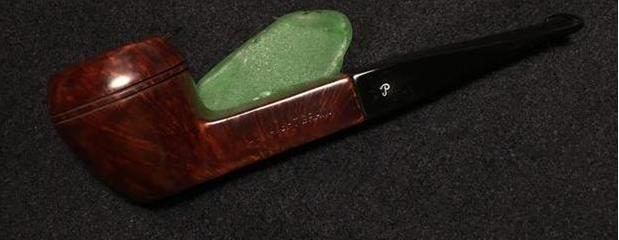
The ¾ Bent Billiard got Jen’s attention I believe, because of the blasted finish.  The only stamping is under the shank and it is marked, “TRIDENT”.  However, when I saw this pipe from an eBay seller in the UK, my attention was drawn also to the old-style P-Lip military stem and the old vintage feel of the pipe overall.  Here’s what I saw on eBay UK:This seller had other offerings which I also placed bids to take advantage of combined shipping from UK to Bulgaria.  With the Trident, I added a Hardcastle ‘Deluxe’ No. 12, and a Bewlay ‘The General’ to my basket for restoration.  Now, on my work table on the 10th floor apartment of a formerly Communist apartment block, I look at the Trident with the question, ‘Is this pipe actually vintage old or does it just look old?’  I take more pictures to fill in the gap. My first action was to look in my autographed copy of my eBay acquired copy of, ‘Who Made That Pipe?’ by Herb Wilczak & Tom Colwell.  It’s not autographed to me, but still cool!In ‘WMTP?’ the name ‘TRIDENT’ was associated with two names, ‘E Deguingand & Son/ H. Comoy’.  Country of origin, ENGL.  First looking at Pipedia’s article on Comoy’s, I discover that ‘Trident’ is a second made by Comoy’s – one among many!  Looking at PipePhil.eu, I found an example of this Comoy second which still displayed the ‘Comoy’s’ stamping and nomenclature.  The Trident before me carries no other markings and for this reason, I’m dubious of it being from the Comoy’s line of seconds.Then I turn to ‘E Deguingand & Son’ to see what I can find.  Pipedia has a helpful article that collates information about the name.

Deguingand & Son

Emile Deguingand & Son, Ltd. was a briar pipe maker in London at the end of the 19th and beginning of the 20th centuries. Originally they manufactured pipes in London, on Hamsell Street in Cripplegate, but that entire area was destroyed in the fire of 1897. Deguingand began selling at 5 Colonial Avenue, Minories, East London beginning in 1897. That same year Emile Deguingand purchased a pipe factory built by Charles Cayron in 1885 and 1886 at a place called Sur les Etapes in St. Claude, France. The factory in St. Claude was raised and enlarged in 1900 and 1902.

In 1906 Deguingand was granted a patent in France for a pipe consisting of a removable combustion chamber over a lower chamber filled with asbestos into which the airway ran.

In 1910, E. Deguingand & Son, known in France as E. Deguingand et Fils, became S.A. des anciens Etablissements Deguingand et Fils with Francis and Paul Deguingand’s entry into the business. While the plant doubled in size in approximately 1926, it was closed around 1930 and later converted to a commercial warehouse.

One pipe line known to have been sold by Deguingand was the Trident.

The last line is interesting in terms of the exclusivity it seems to imply.  The article is helpful but leaves out much and creates more questions.  When Deguingand opened operation in St. Claude, France, 1897, the same year opening another location in London after the fire of 1897, the assumption I believe, that is true, is that operations continued in both London and St. Claude under the Deguingand name.  The indication is that the operation in France closed in 1930, but there is no indication that operation in London ceased as well.  The challenge I am left with is that I can find precious little about production of Deguingand pipes or ‘Trident’ through the 1900s other than this early century reference by Pipedia.  If theories can be developed from silence, the E. Deguingand & Son Company is NOT listed in the 1949 Tobacco Retailers’ Almanac found at Chris’ Pipe Pages.  Can one deduce from this that pipes were no longer produced under the name?

The only other finding in my research that sheds some light on the E. Deguingand & Son name, comes from ‘Company Search Made Simple’ website. Here I find that E. Deguingand & Sons was incorporated, at least as an English entity, 3/12/1912, and was dissolved 7/30/1996.  The address was listed as 20 VANGUARD WAY, SHOEBURYNESS, SOUTHEND ON SEA, ESSEX, SS3 9RA.  The Director of the corporation was listed a John James Adler, from 8/1/1991 to 7/30/1996 – the same date as the dissolution of the corporation.  Of interest to me, but probably not a surprise for others more informed (!), was when I was trolling around the corporate bones of the corporate umbrellas created to manage sales and acquisitions of pipe names in much of pipedom in England and France – I discovered, Cadogan.  On this site, I compiled this list of well-known names in the pipe world that were started at different times, but all were, 1) dissolved on the same date (7/30/1996, with the exception of Kaywoodie, a few weeks later), 2) who shared the same address (Southend On The Sea) and, 3) had the same Director.  Here’s the list I compiled.What this tells me is that E. Deguingand & Son, Limited, existed at least as a corporate entity in the Cadogan consortium until 1996, but I have no indication that pipes were produced under the corporate name from the 1930s to 1996.  I’m growing in my understanding of the name, but is the Trident before me of a vintage that dates to the early 1900s?  I’m not sure, but one thing about the Trident that creates question – Does the P-Lip Military style stem help place this pipe?  It looks older to me, but my question lingers.

When the well runs dry in my research, I send questions to Steve to help prime the pump.  I share with him some of the research related above and some pictures of the Trident, but my specific question is, “Can a P-Lip stem indicate the age of a pipe – or contribute to its age placement?”  Steve’s first response was helpful in clueing me into the probability that the Trident before me could very well be of an early 1900s vintage.  His response was: “It looks a lot like the Wellington that WDC made in the early 1910-1920s.”  It was not difficult to find these artifacts in Pipedia’s article about the William Demuth Co. and the WDC Wellington – a WDC mainstay over the years. With the uncannily similar Wellington pictured above, courtesy of Doug Valitchka from Pipedia, the Trident lookalike before me could very well be of an early century vintage and a product of E. Deguingand & Son, Limited.

My second inquiry to Steve was how it all worked.  Did WDC make pipes (Wellington styled) for E. Deguingand and E. Deguingand marked them with ‘Trident’ though made by WDC?  Steve’s next response was even more to point questioning the accuracy of attributing the Trident to E. Deguingand.  He said,

I wonder if the E. Deguingand is correct. I wonder if WDC in NYC did not make a Trident pipe. I would do some digging in old WDC catalogues and see if you can’t find it. It has the same style band, same style faux p-lip with the air hole in the end of the button rather than on top. WDC did that I think to avoid issues with Peterson.

I did as Steve recommended and looked at several old WDC catalogs I could find online.  One forum was helpful in providing a WDC Master List.  Unfortunately, no ‘Trident’ listing was evident there or anywhere else I looked indicating a William Demuth Company source. I come up empty finding a direct connection between WDC and the Trident.  If anyone can help solve this mystery, I would be grateful!

I approach the restoration of this Trident as an early vintage 1900s vintage and will seek to maintain that.   Not knowing at this point if this is an early E. Deguingand Trident or a WDC made Trident, I appreciate the fact that I do have an ‘Ole Timer’ and will handle him with care!  The ‘faux’ P-Lip Military style stem is heavily oxidized and this will be addressed.  The chamber has moderate cake and this will be removed to reveal fresh briar.  The rim has some lava but is in good shape overall.  The stummel needs cleaning of the grime and band polished.  With an appreciation for the Trident before me, I begin the clean-up by putting the P-Lip stem into the OxiClean bath to start dealing with the heavy oxidation. With the stummel in hand, the fire chamber has light carbon cake build up.  I use the Savinelli Pipe Knife to ream the chamber.  It does the job very quickly.  I then wrap 240 grit sanding paper around a Sharpie Pen and sand the chamber wall to remove more residue carbon.  I conclude the chamber clean up by wiping with a cotton pad wetted with alcohol to remove residue carbon dust.  The pictures show the progress. With the chamber reamed and cleaned I turn to the internals.  Using cotton swabs, pipe cleaners dipped in alcohol and needle files to scrape the edge of the mortise, I work on cleaning the internals of the stummel.  The internal architecture of the mortise has two internal holes drilled.  The upper hole is the airway leading to the draft hole.  Underneath this, a hole is drilled to create a reservoir for moisture to collect.  I take a picture of this and include a cut-away of a WDC Wellington from The Briar Files discussion of WDC Wellingtons After some effort working on the gunk removal, and with the growing need to attend to other obligations not having to do with pipes or their restorations, I decide to continue the cleaning job using the kosher salt/alcohol soak.  I fill the chamber with kosher salt that leaves no aftertaste, and twist and stretch a cotton ball to insert into the mortise, acting as a wick to draw out the oil and tar.  I use a large eye dropper and fill the bowl with alcohol until is surfaces over the salt.  I set it aside and let it do it work.Later, I remove the very oxidized P-Lip Military stem from the OxiClean bath and the bath did the job of raising the oxidation to the surface.  The stem is now a light grey color not the usual dark olive green.  I go to work removing the oxidation using a barrage of tools.  I wet sand the stem in warm to hot water for about 30 minutes using 600 grit paper!  Oxidation is very stubborn in the edges of the P-Lip orific button lips.  I utilize hard edges to wedge the sand paper in the corners.  I then use 0000 grade steel wool to work over the entire stem including the hard to reach corners and curves.  Finally, I use Mr. Clean MagicEraser to put the oxidation to rest.  This phase looks good – it didn’t come easily!I go directly to cleaning the internals of the stem with pipe cleaners dipped in isopropyl 95%.  It did the job quickly.After some time, I return to the stummel that is having a salt/alcohol soak. The salt has darkened showing that it has done its part.  I remove the expended salt and cotton wick and clean the stummel with paper towel to remove residue salt.  I return to cotton swabs and pipe cleaners, also using long bristled brushes to finish the job. With internals clean, I take another look at the stummel surface.  I use undiluted Murphy’s Oil Soap to remove the grime in the crevices of the blast and on the rim top.  I utilize cotton pads and a bristled tooth brush.  The rim has mild cake and I use a mild kitchen scrub pad to gently clean it.  I also clean and polish the band while I was at it. Because there was normal wear around the rim, the cleaning leaves lightened areas devoid of finish, though the blasted architecture of the rim is intact.  Using the lightest stain stick I have in the basket (Furniture Repair Marker – Oak), I color in the rim.  I like the way it darkened and complimented the texture of the hues.  I decide to use the stick on the stummel as well to highlight and deepen the peaks of the blasted surface.  I like how it turns out overall – nice.  I set the stummel aside to dry thoroughly. I take the stem to begin the micromesh pad cycles and to my chagrin, I see that the oxidation is peeking through – mainly around the curves leading to the crest of the military stem (I’m not sure if there is a technical name for that part of the stem!).  Ugh!  It’s already late so I elect again to put the stem in the OxiClean bath to see if it will do the job.  I heat the OxiClean solution in the microwave until it’s warm and plop the stem back in and turn out the lights!The next morning, I go straightaway to the stem in the bath, fish it out, wet sand the problem, oxidized areas with 600 grit paper then with 0000 steel wool.  I’m hoping that the oxidation is now removed as much as it can be removed.  I move on to wet sanding using micromesh pad 1500 to 2400, then dry sanding with pads 3200 to 4000 then 6000 to 12000.  I follow each cycle with an application of Obsidian Oil to revitalize the once oxidized Military, Faux P-Lip style stem.  I’m pleased with the pop of the vulcanite – it looks good. I put the stem aside to fully absorb the Obsidian Oil and to dry. Next, I apply Museum Wax to the bowl with a small cotton cloth – working the wax in the blasted surface landscape.  Then, I buff the bowl with a shoe brush to assimilate the Museum Wax into the surface and begin the shining process.  Turning to the Dremel, I mount a clean cotton cloth buffing wheel and set at speed 2 (40% full power) and more fully buff the stummel.  The buffing wheel does a good job working the wax in more thoroughly and bringing out a deep, resonate shine.  The pictures show the progress. With the Dremel already in use, I load the cotton cloth wheel dedicated to applying Blue Diamond compound. Using the wheel, I apply the compound to the nickel-plated band to bring out the shine.  As hoped, the buffing does the job well.  The Trident is dressing up well! Taking the stem, I mount the cotton cloth buffing wheel dedicated to applying carnauba wax.  I apply the wax to the stem to bring out the shine and protect it.  After applying a few coats of carnauba wax, I then reunite the stummel with the Military style stem and give the entire pipe a rigorous hand buffing using a microfiber cloth to raise the shine of the Trident even more.

Only two things leave me a bit wanting with the restoration and recommissioning of this Trident Blasted 3/4 Bent Billiard – the distinguished Military stem still holds some small traces of oxidation around the concave curves of the stem’s crown or horn.  Yet, my, my, it looks good mounted on the blasted stummel with its newly polished band!  The other item was not being able to identify clearly the maker of this Trident – whether E. Deguingand according to Wilczak and Colwell or the Wm. Demuth Co. as Steve suspects because of the preponderance of similarities between the Trident and WDC’s mainstay of the same style pipe, the Wellington.  In whatever way this question is ultimately settled, the Trident’s vintage status seems to place him in the 1910 to 1930 age range.  Truly, an ole timer who is now ready for another lifetime serving a new steward – gifted to one of Jen’s family members as she soon returns to the US from Bulgaria.  Her gifting helps to benefit the Daughters of Bulgaria, our work here in Bulgaria with those women and girls who have been sexually exploited and trafficked in Europe.  For more information about this, and why I do what I do, check out my blog at The Pipe Steward.  Thanks for joining me!

A Messy Cleanup on a Brial System Pipe


Blog by Steve Laug

Over the years, I have always wanted to pick up a Brial system pipe but always have been outbid on them on Ebay. I put in what I think is a fair bid and at the last minute the pipe was always sniped and I lost out. I mentioned it to Jeff one time in a conversation and he snagged one for me to work on. I was excited to get a hold of it when he sent it to me. He took some photos of the pipe to show its condition and to whet my appetite. I have included those in the first part of this blog.The pipe was in surprisingly good shape. The briar was not too bad with a few sandpits on the sides that gave it character. The finish was dirty and worn. The bowl had a thick cake and lava had flowed onto the rim top. There was also damage to the inner edge of the rim leaving the bowl slightly out of round. The damage appeared to be from reaming with a knife to cut back the cake. The alloy body was oxidized and scratched but looked quite sound. The stem was worn and dirty but very restorable.Fortunately the pipe came apart fairly easy. Sometimes these metal pipes get “welded” together with the dried tobacco juices and tobacco making them virtually impossible to take apart. The first photo below shows the shank end of the alloy tube with the mouthpiece coming out at the top. The cap is stamped Brial over Patent Pending.With a little work, my brother was able to remove this end of the tube. Inside the tube was a bent wire and wrapped around that was a lot of tissue paper that acted as a filter. It was dirty by at least it was dry. The next series of photos tell the story of the unraveling of the packing in the tube. It held a lot of tissue paper or as I later found out “toilet” paper. The next photos show bent wire that the toilet paper is wrapped around as well as the end of the tenon sitting in the end cap. It appears to be a nut that is threaded onto the tenon of the stem. The buildup of tars, oil sand dried tobacco “lacquer” is thick in the tube, on the end cap and the tenon nut. Jeff took the bowl off the alloy tube at this point and took the following photos. I appears to have a hollow screw in the bottom of the bowl that turns onto the top of the alloy tube. There is a bump on either side of the base tube to stabilize the bowl when it is in place.The next two photos show the condition of the bowl and the rim top. You can see the cake in the bowl, the lava on the rim top and the damage to the inner edge of the bowl.I remember when I first started looking at getting a Brial pipe I Googled and found a write up on the brand on the Smoking Metal Website. It was that brief description, the photos and printed advertisement that hooked me and set me on the hunt to acquire one of them. I have included that write up for you. If you wish to read it on the website here is the link – http://www.smokingmetal.co.uk/pipe.php?page=70.

The BRIAL pipe is basically an alloy cylinder to which the briar bowl is screwed through the base of the bowl. The front end is permanently sealed with an alloy endpiece. The cylinder is filled with a tissue to act as an absorption media. This can be tamped in or extracted by means of the probe attached to the mouthpiece plate.

To enable the pipe to stay upright on a table, two dimples have been made in the underside of the cylinder to act as ‘feet’ as shown in the photos above (my edit).

Brials were available in natural aluminium, brass anodized finish or black as shown in photo below.

The pipe was patented and manufactured by Salimar Oden in Jefferson Historic District, Muskegon, Michigan. It is believed he continued to market them until his move to Florida in 2000.

Smoking Metal also had a copy of this advertisement sheet on their site. Personally, I love the wording and descriptions on these older advertising flyers. The way they speak of the pipes and what they deliver always gives me cause to laugh. This one is no exception. I include it below. Make sure to give it a read.I posted a note on the Facebook Metal Pipe Smokers Group asking about information on the pipe and potential patent information. One of the members, Cody Easom posted some pictures of a new old stock, unsmoked Brial with the various inserts that came with the pipe. The first photo shows the new pipe with the box and the insert. The second photo shows the insert itself. The third and fourth photos show the inside of the new pipe. Now, the goal is in front of me – to get the old pipe on my table to look like this one. My brother did an amazing job cleaning out the inside of the pipe. He reamed the bowl with a PipNet reamer and took the cake back to bare briar. He cleaned out the inside of the tube/cooling chamber and the airway in the screw in the bottom of the bowl and the stem with pipe cleaners, cotton swabs and alcohol. He scoured out the inside of the chamber with steel wool, cotton swabs and alcohol until the inside shone. When I brought it to my work table I was so intrigued by the pipe that I forgot to take photos and just jumped into the refurbishing of the pipe.

I ran a cotton swab and pipe cleaner through the bowl and the stem and it came out perfectly clean. I wiped out the inside of the bowl with a cotton pad and alcohol and it also was clean. I twisted a cloth into the tube/chamber and it too was very clean.

The bowl was out of round when all of the grime and tars had been removed from the rim top and bowl. I used a folded piece of 220 grit sandpaper to smooth out the damage on the inner rim edge. It took some careful sanding with the paper to even out the edges and bring the bowl back into round.Once I had the rim edge cleaned up I worked over the entire bowl with micromesh sanding pads to polish it. I started sanding it with the 1500-2400 grit pads and worked on the rim top and edge as well as the sides and bottom of the bowl. I continued to polish it with 3200-4000 grit pads and finished it with 6000-12000 grit pads. I gave the bowl a coat of Conservator’s Wax and buffed it with a soft cloth. I polished the exterior of the aluminum tube/chamber with micromesh sanding pads. I used worn pads that I have an excess of at present to polish the scratches in the aluminum. I polished it with 1500-12000 grit pads and wiped it down with a jeweler’s polishing cloth after each set of three pads. The photos show the progress. While there are still scratches there is a deep shine to the aluminum that really glows. The stem had some tooth marks and chatter on the top and bottom sides near the button. They were not deep so I sanded the stem with 220 grit sandpaper to remove the marks. I polished the stem with micromesh sanding pads – wet sanding with 1500-2400 grit pads and dry sanding with 3200-12000 grit pads. I rubbed the stem down with Obsidian Oil after each pad. After the 12000 grit pad I gave it a final coat of oil and set it aside to dry. I buffed the bowl and tube with Blue Diamond on the buffing wheel and carefully buffed the stem. The stem appears to be nylon so I wanted to be very careful to not buff it to hard and make work for myself. I gave the entire pipe multiple coats of carnauba wax and buffed it with a clean buffing pad. I hand buffed the pipe with a microfiber cloth to deepen the shine. The finished pipe is shown in the photos below. It is truly a unique piece of pipe history and certainly a pipe that I am going to have to try – I want to see if it delivers what it promises. Thanks for walking with me through this refurb.