Tag Archives: Kaywoodie Pipes

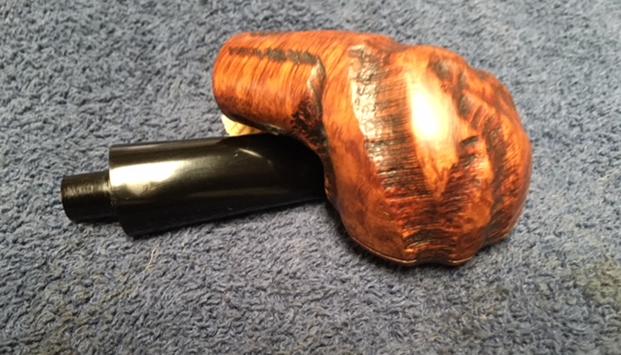
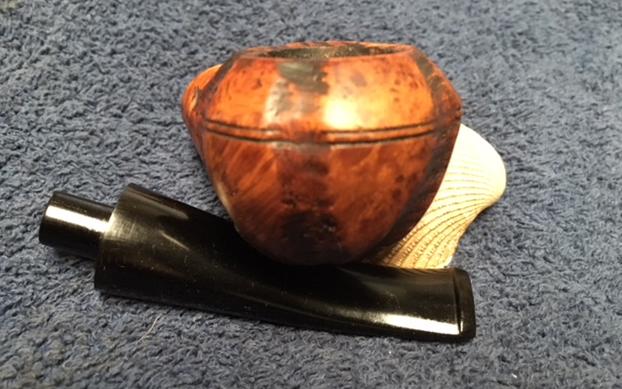
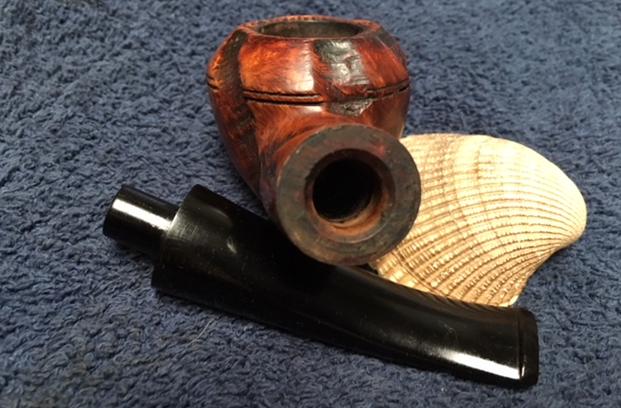
Bringing to Life a Unique Kaywoodie Natural Burl 33 – Another Legacy Pipe of a Great Grandfather


Blog by Dal Stanton

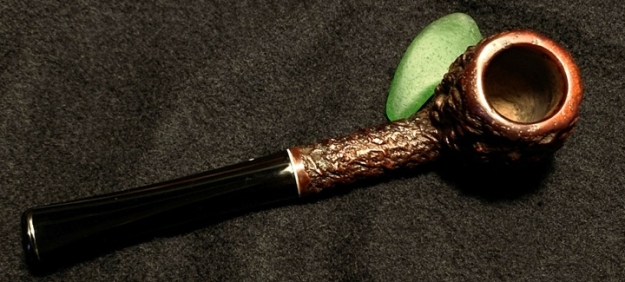
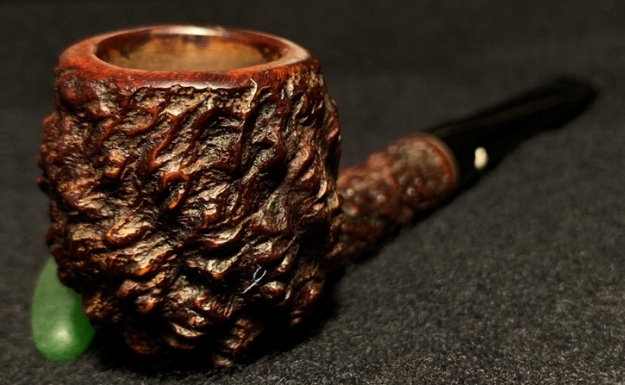
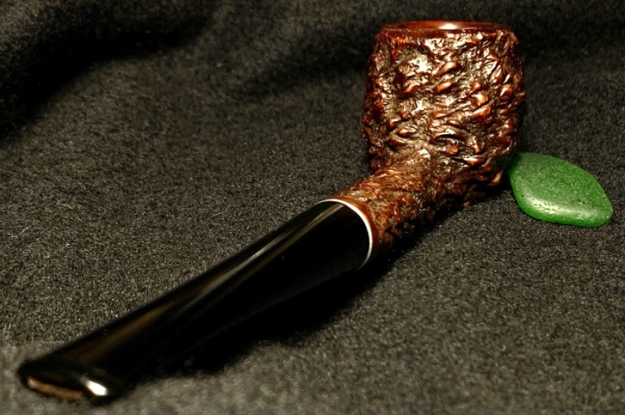
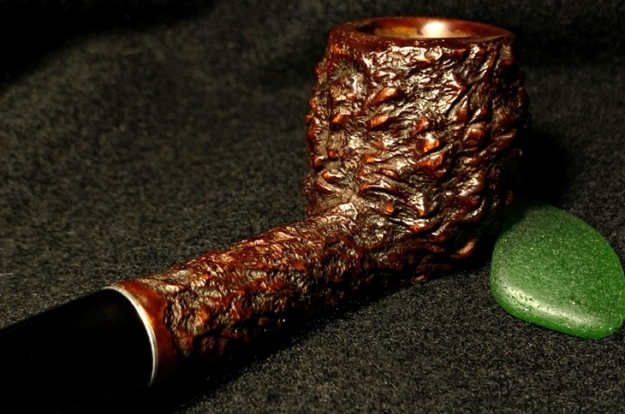
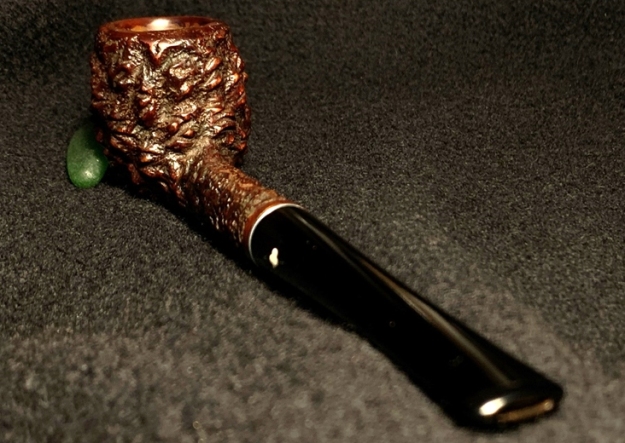
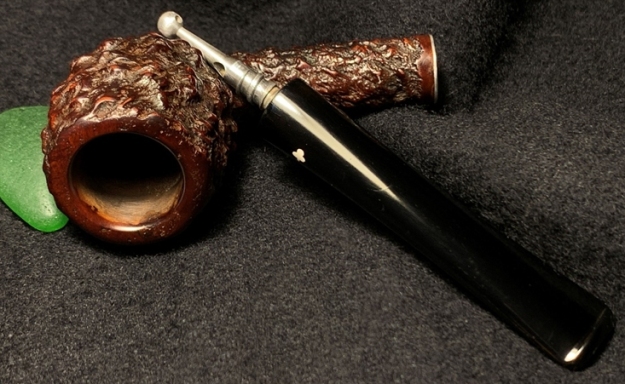
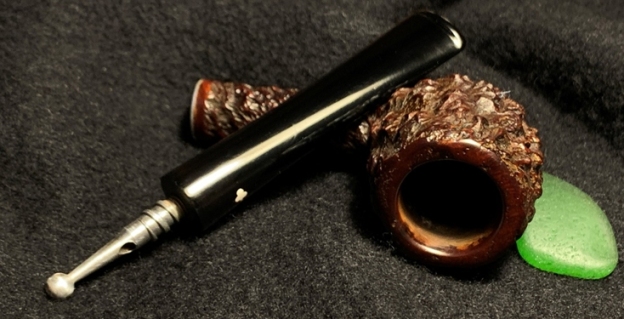
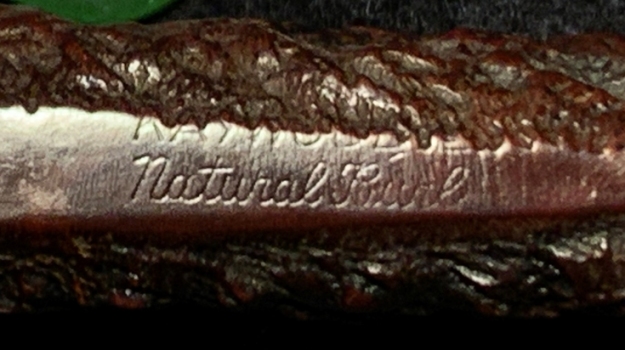
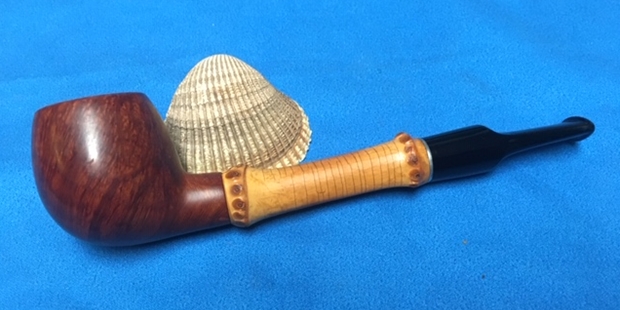
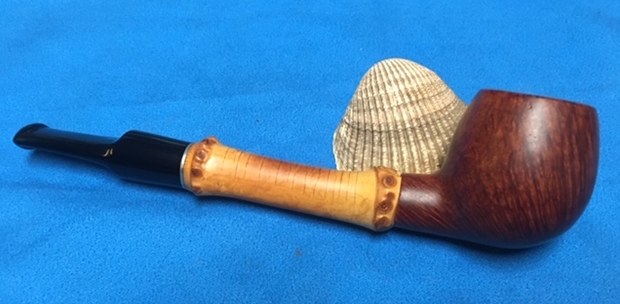
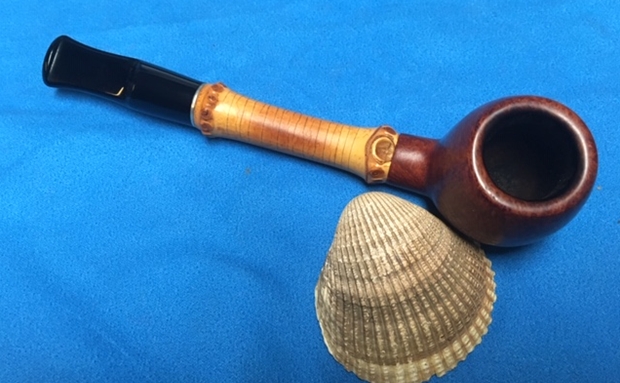
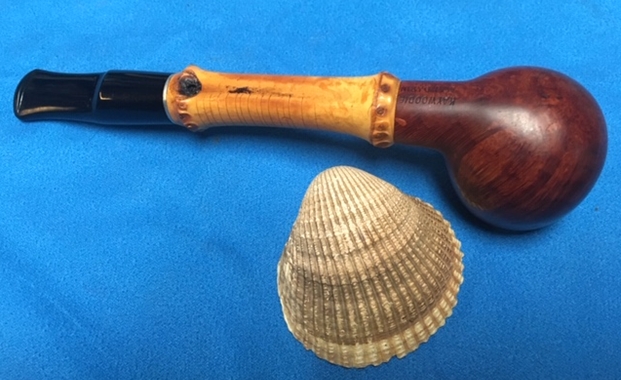
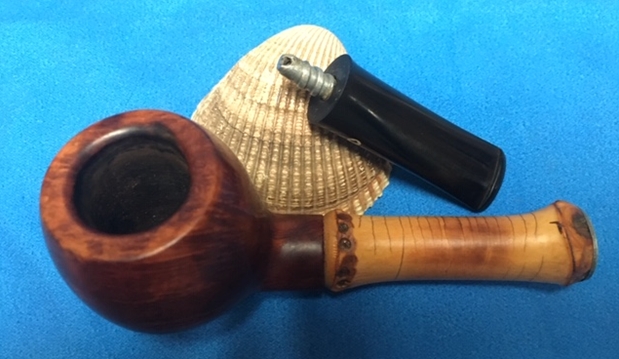
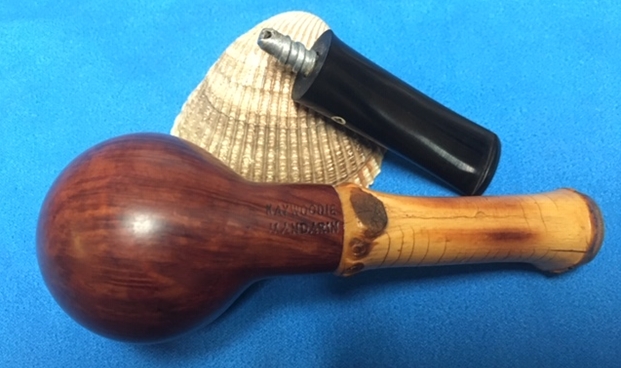
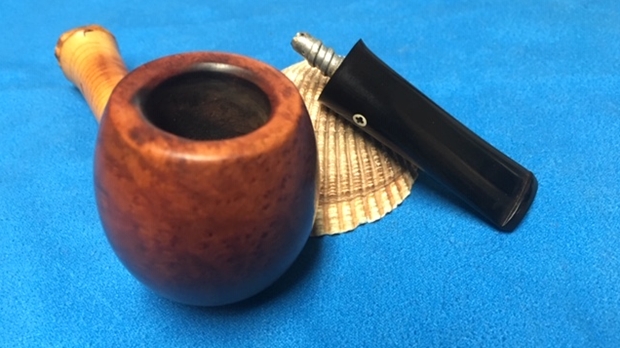
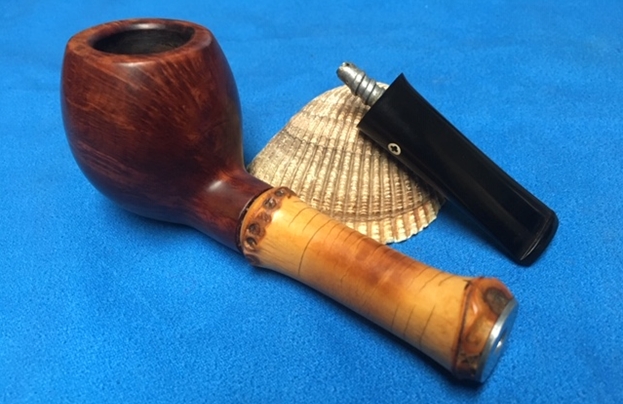
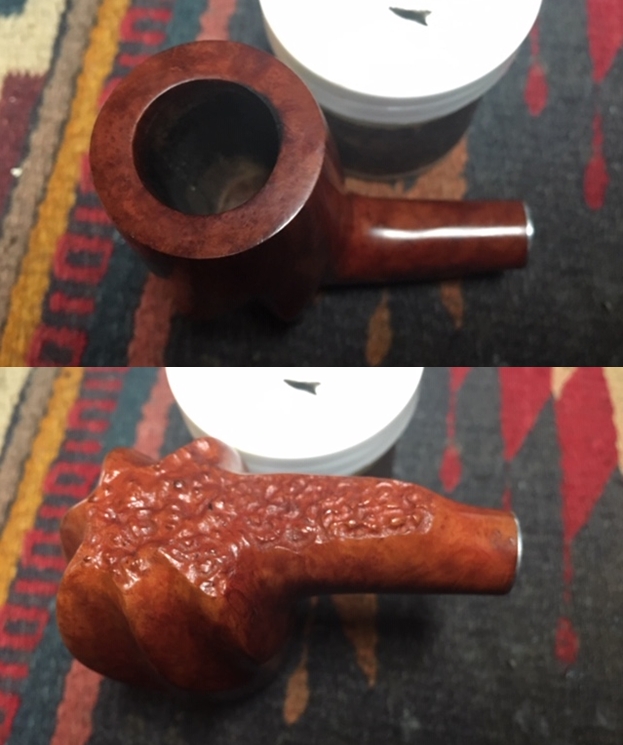
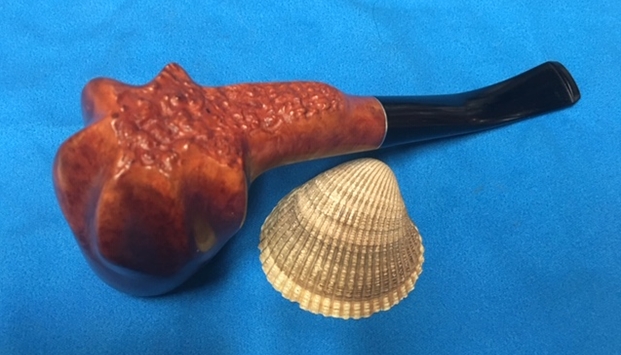
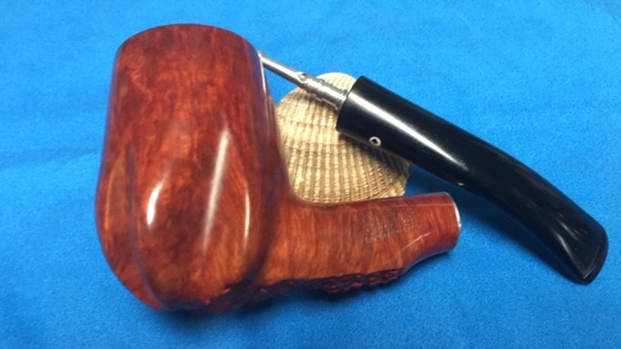
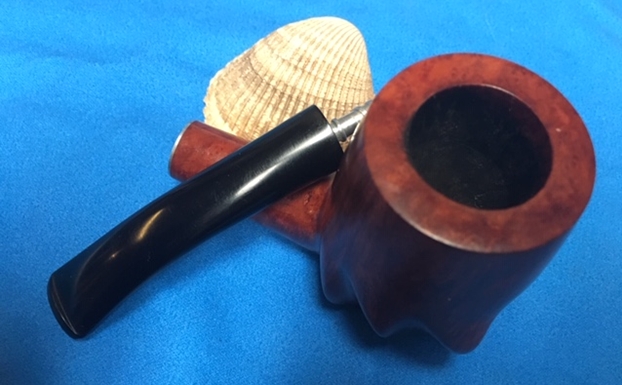
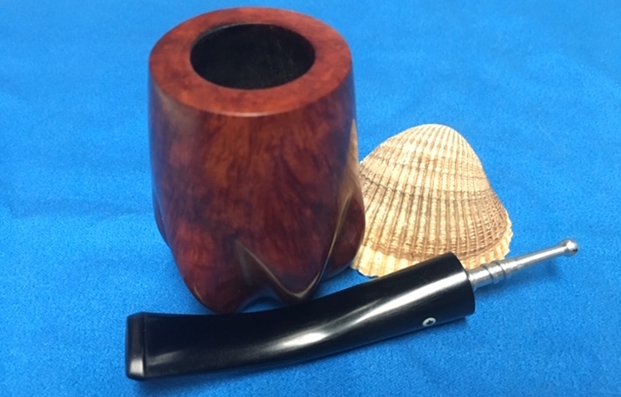
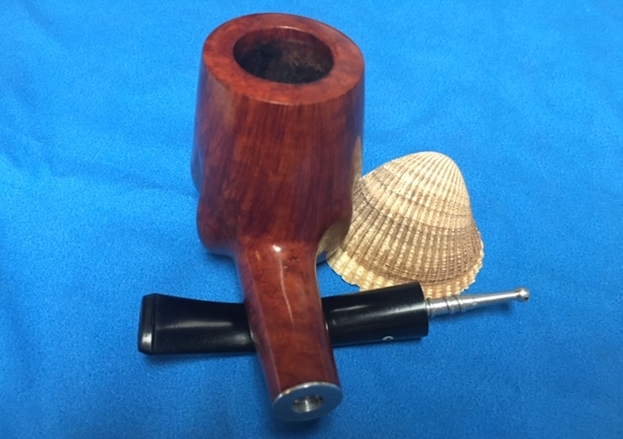
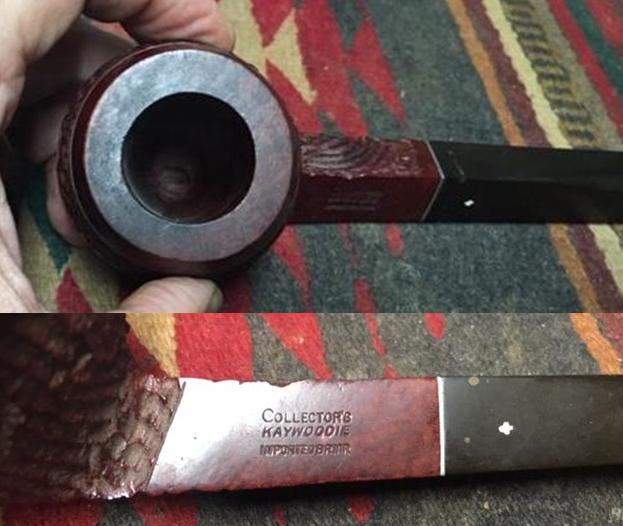
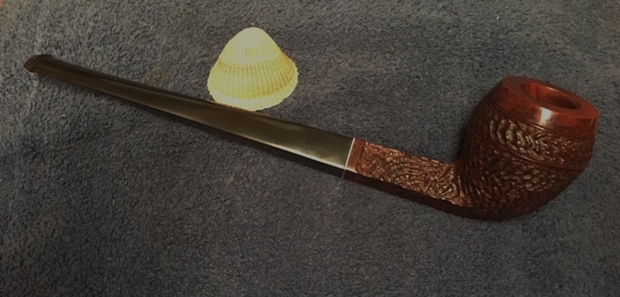
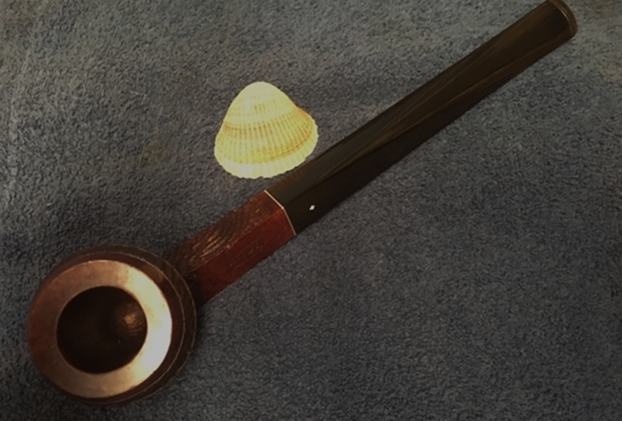
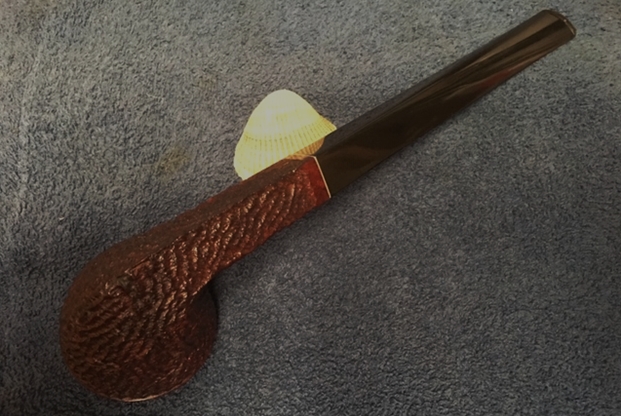
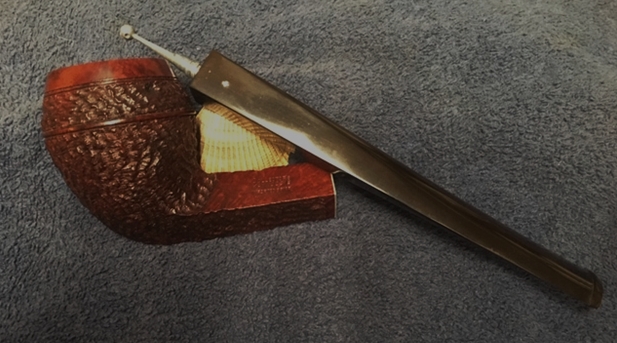
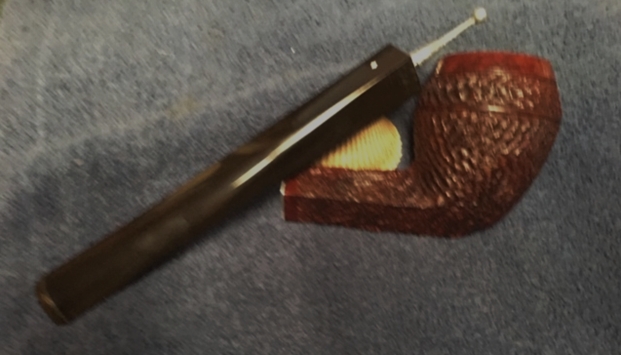
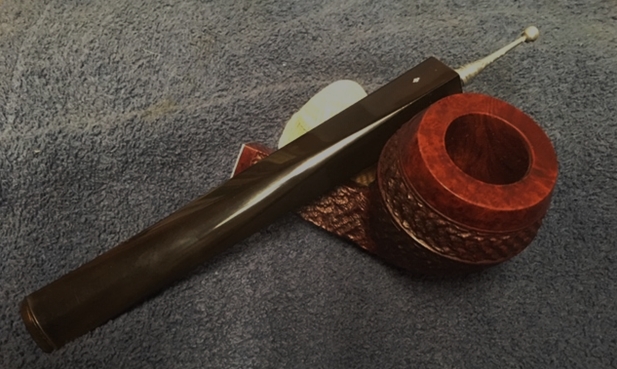
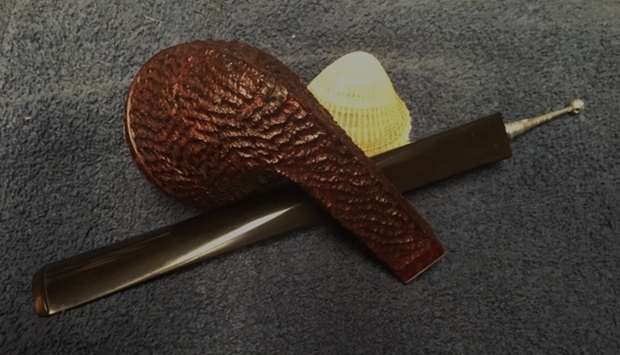
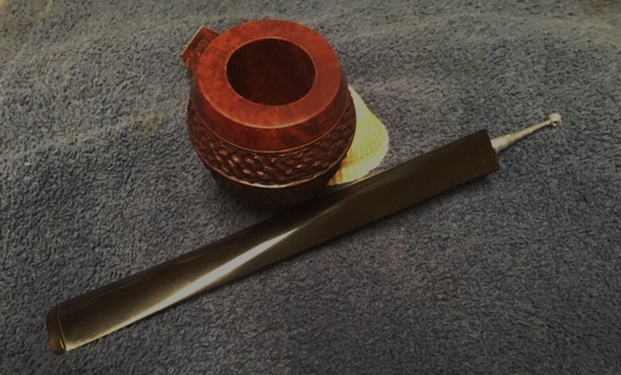
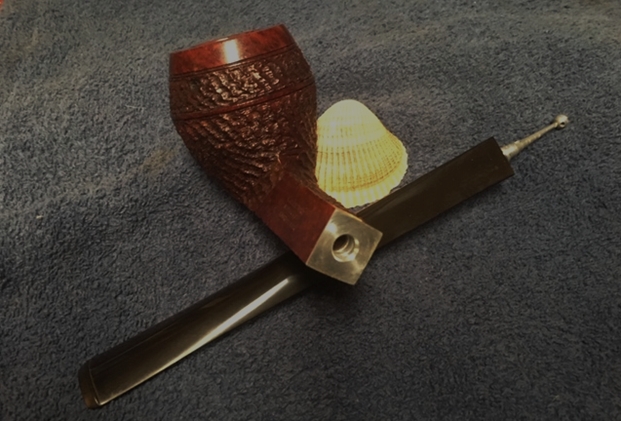
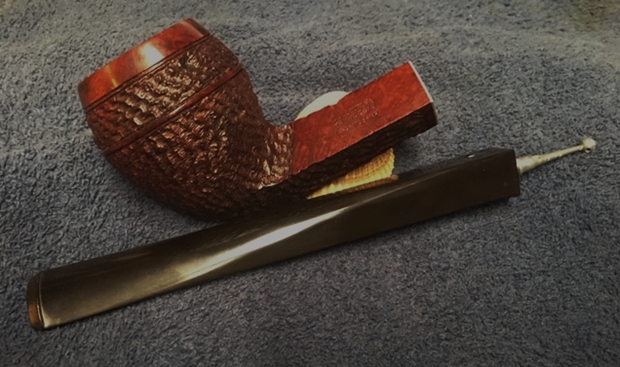
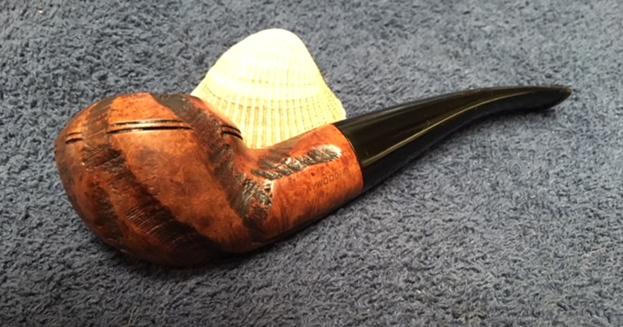
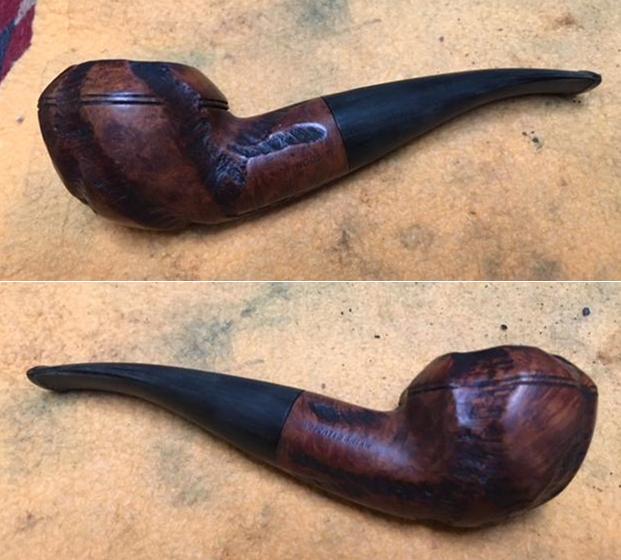
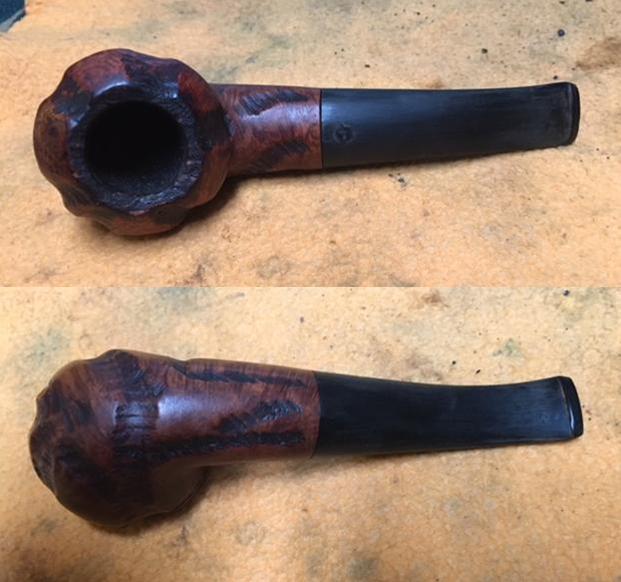
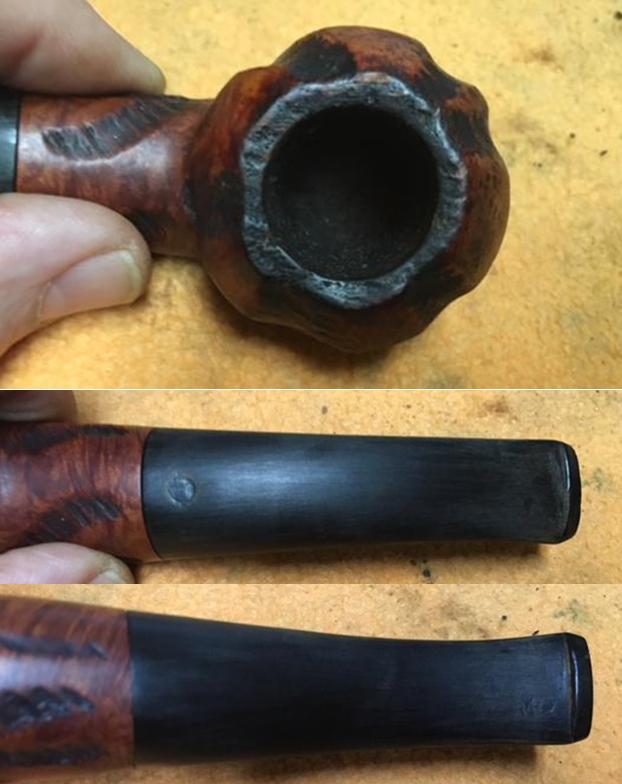
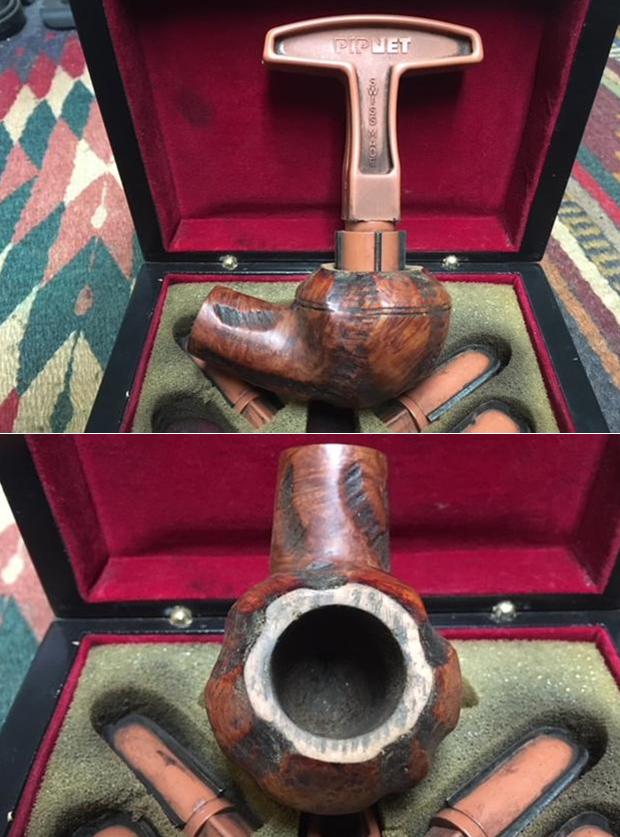
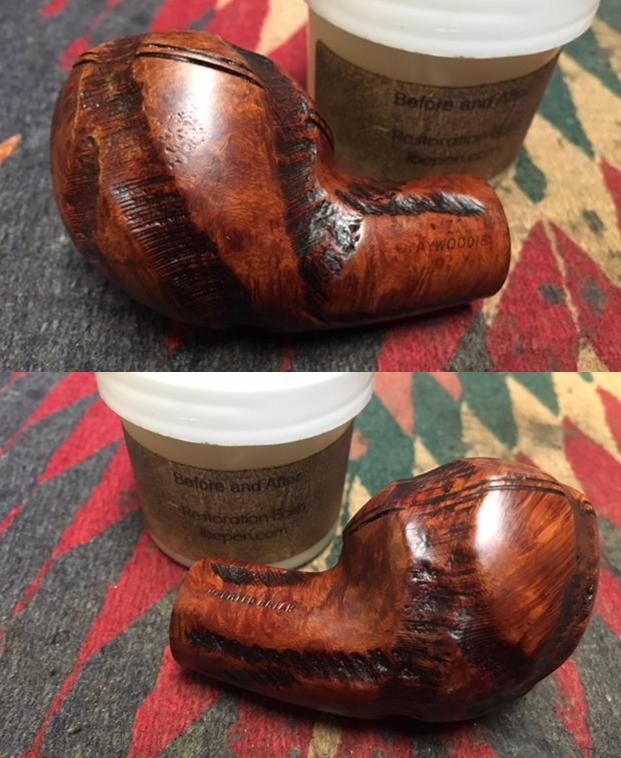
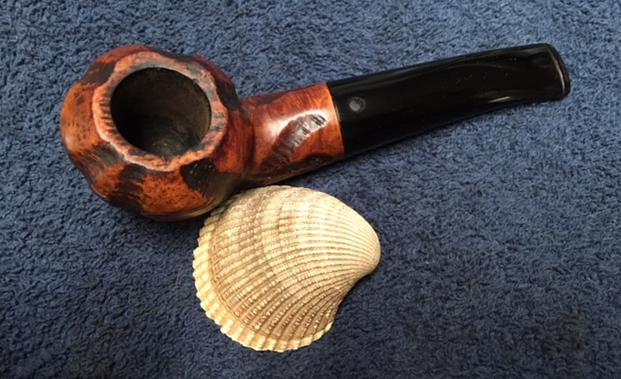
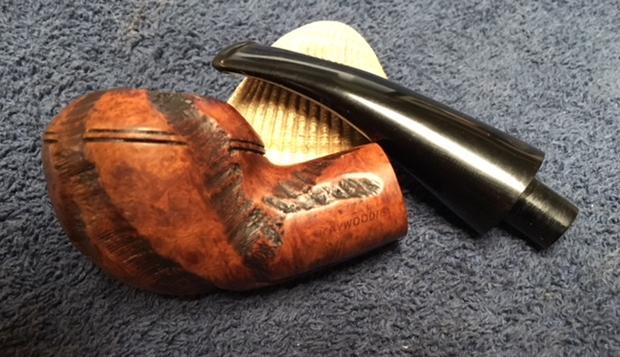
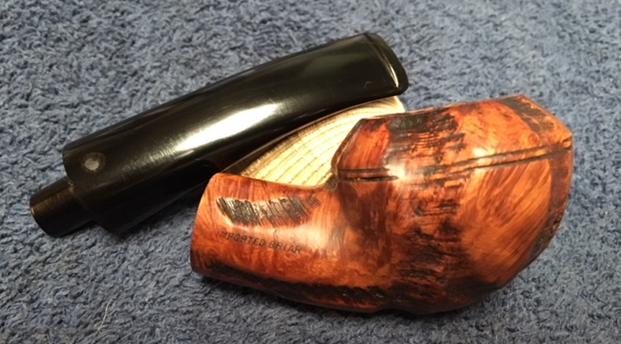
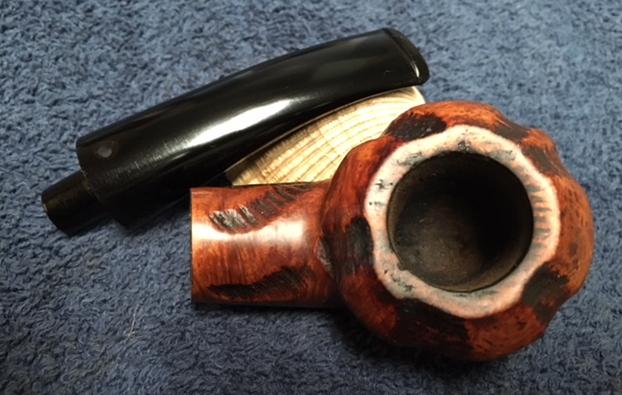
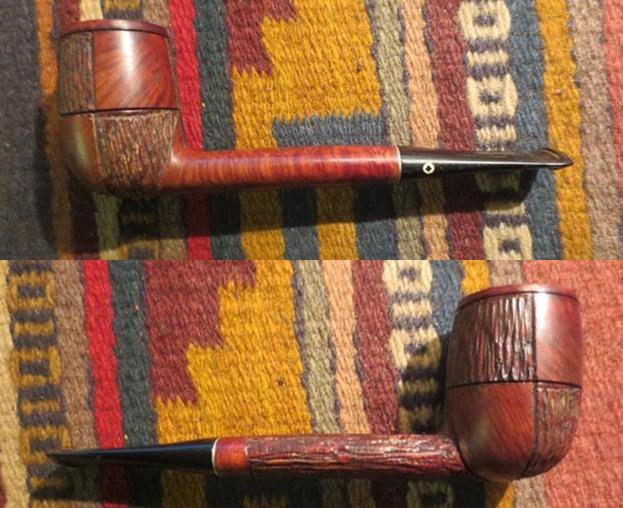
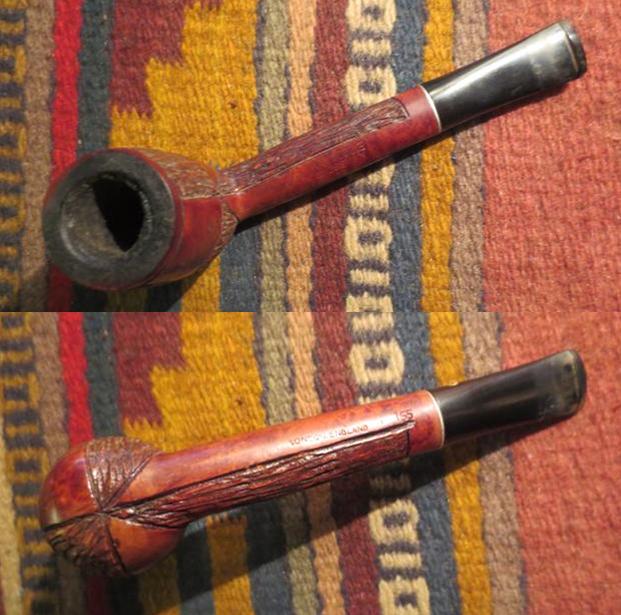
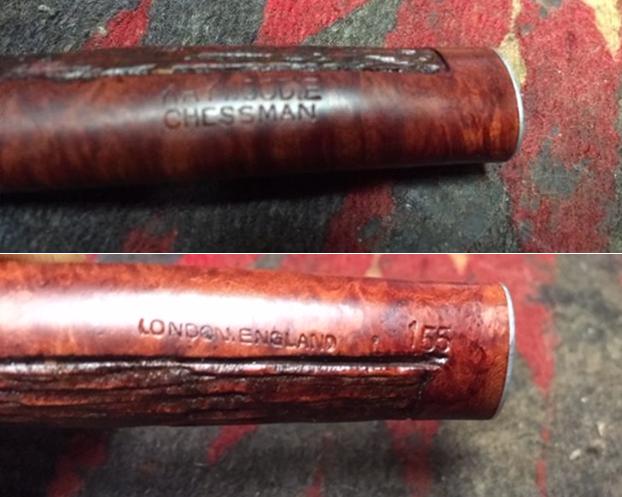
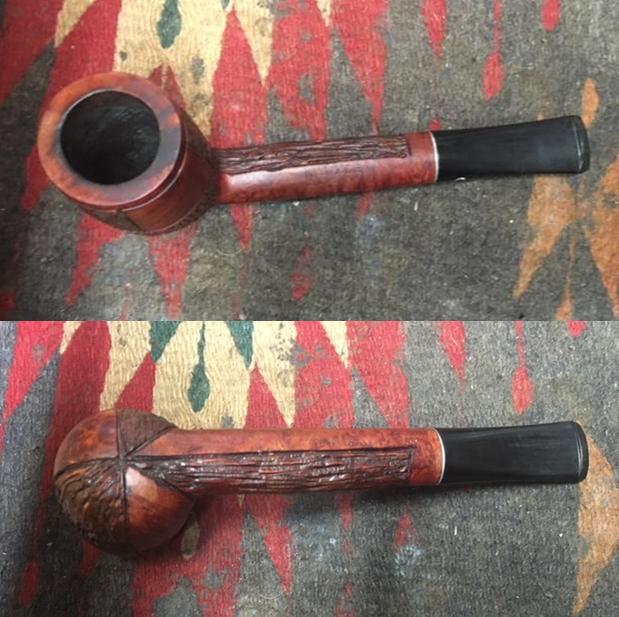
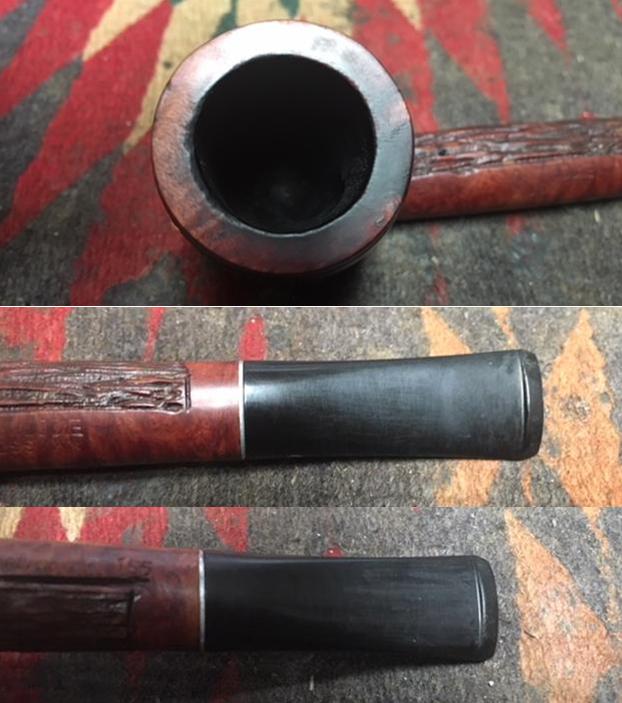
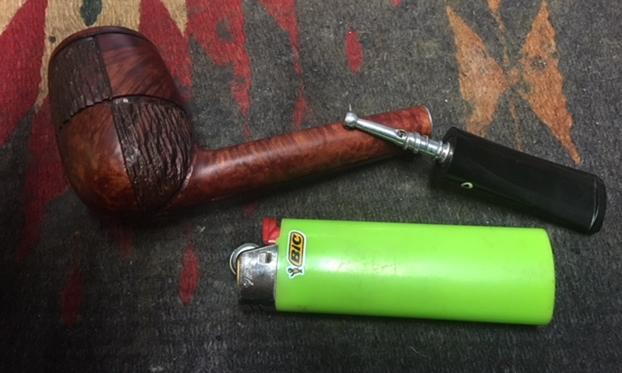
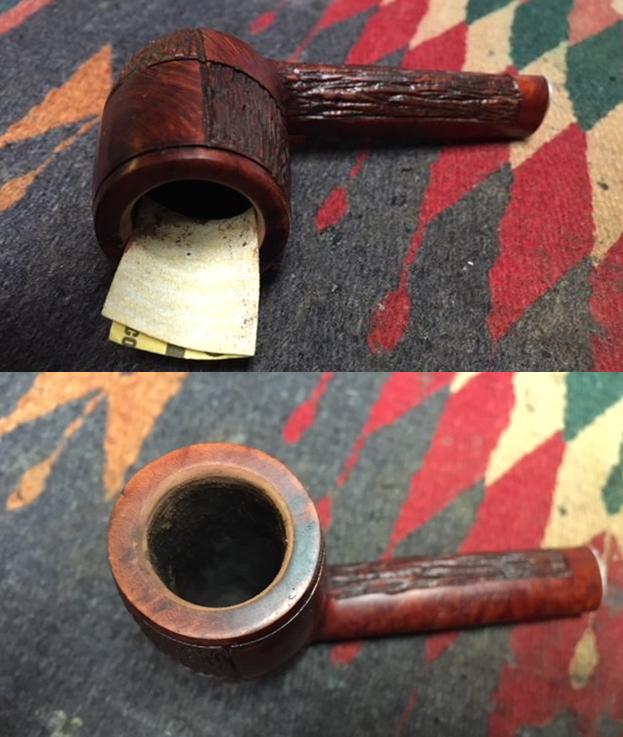
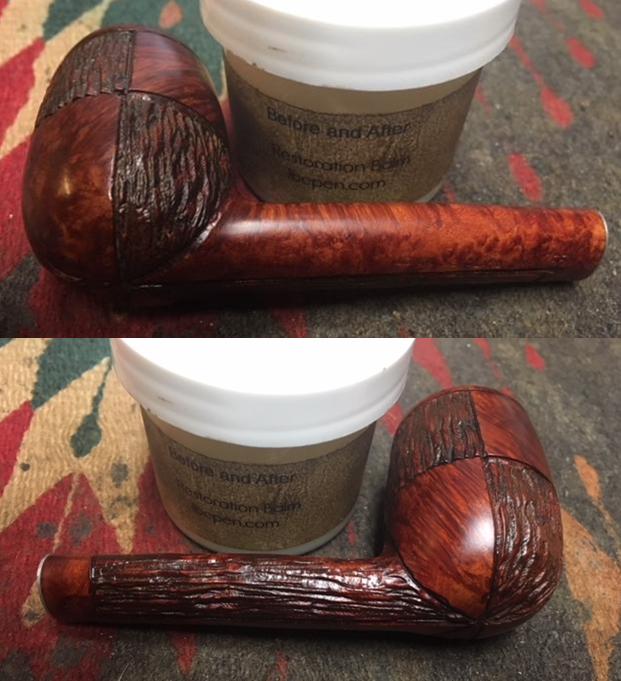
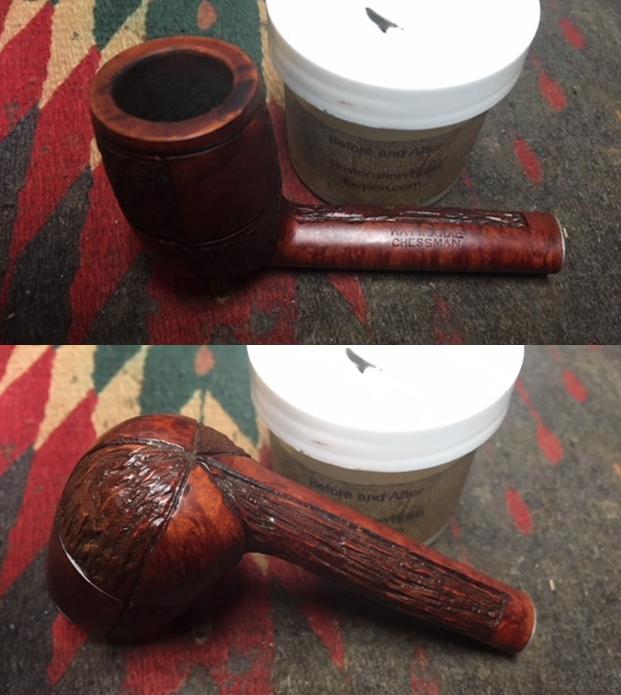
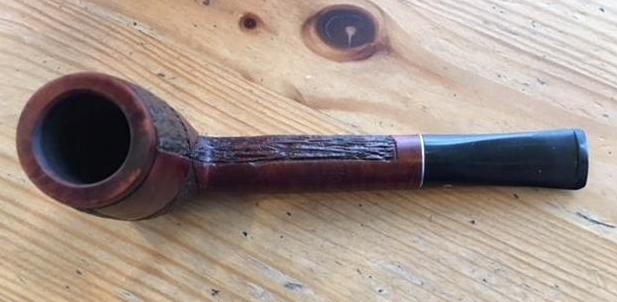
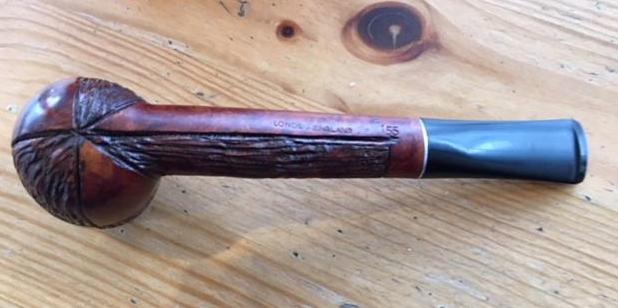
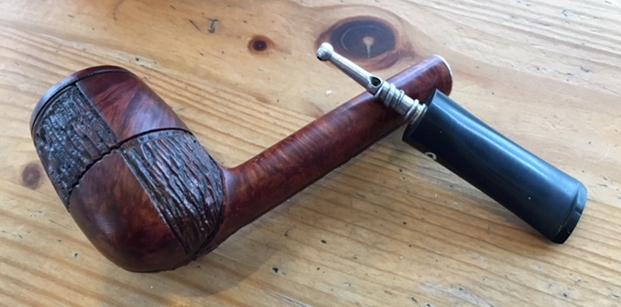
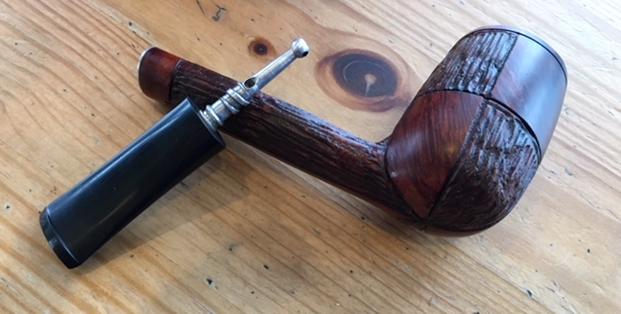
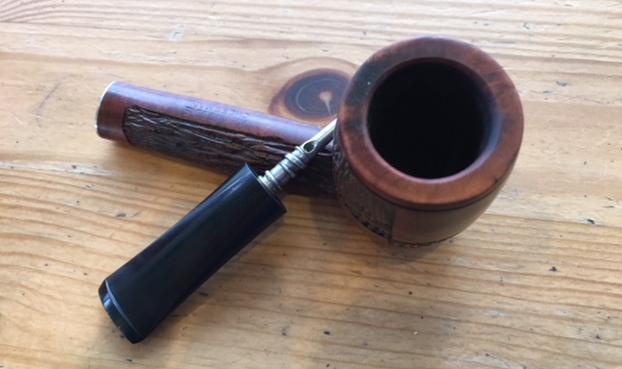
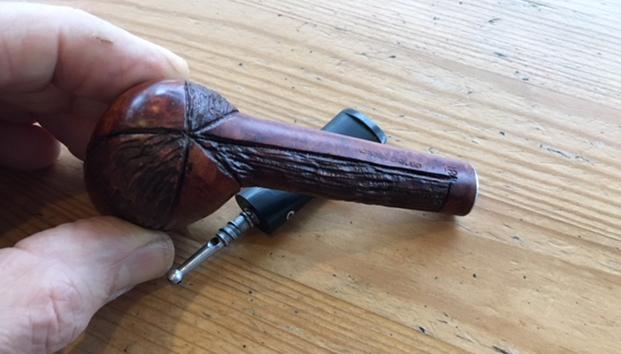
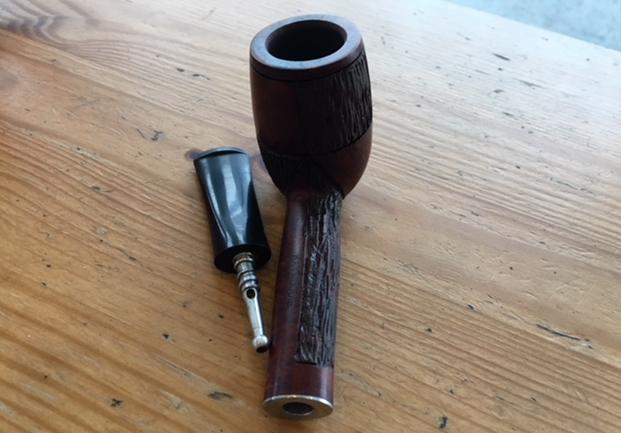
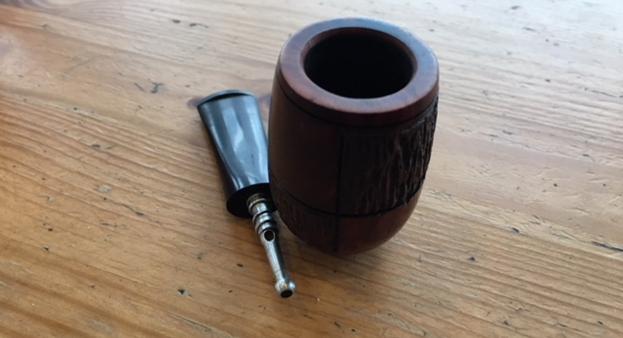
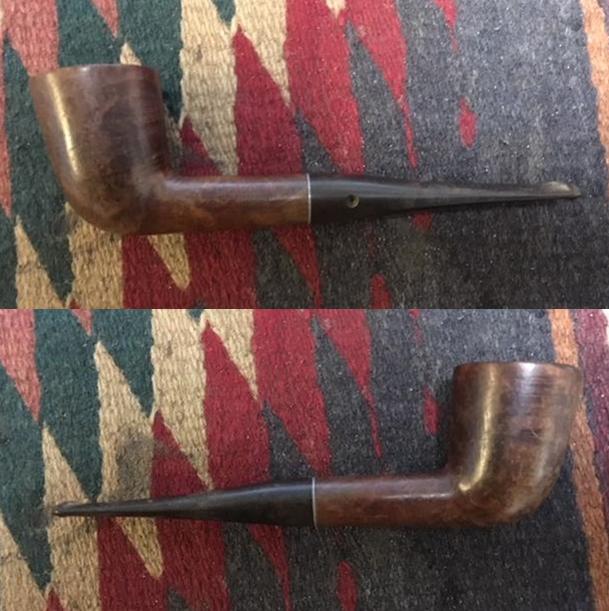
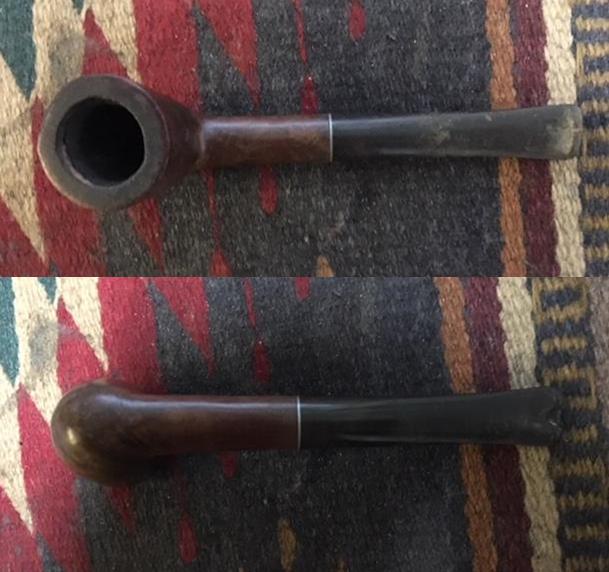
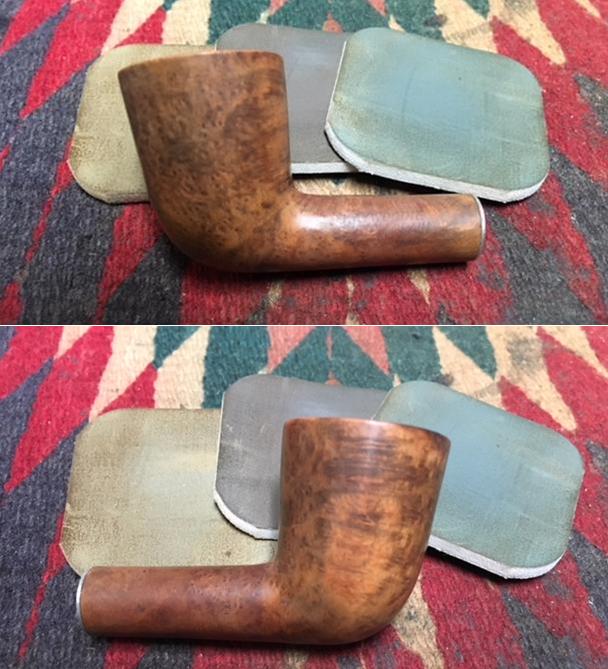
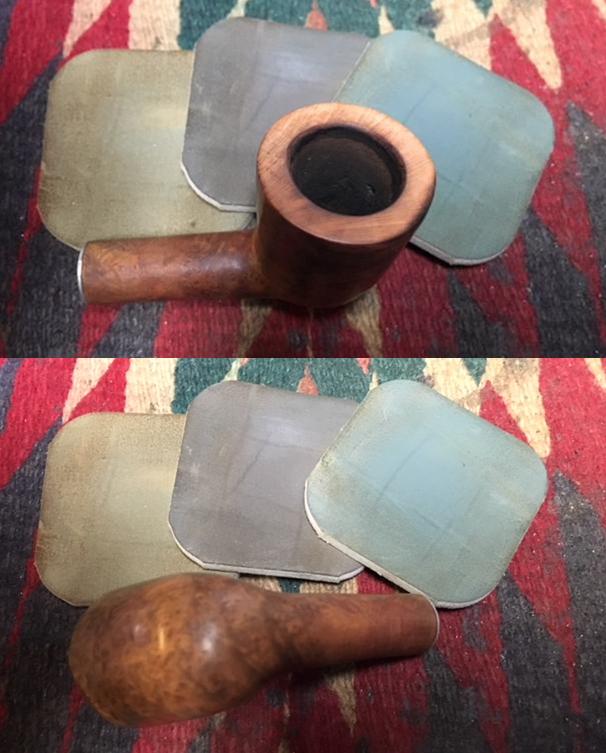
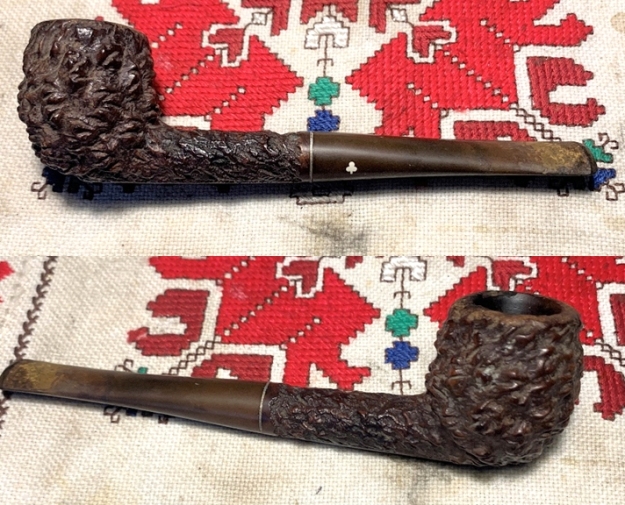
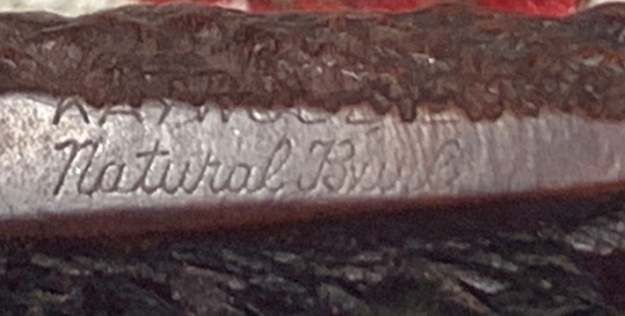
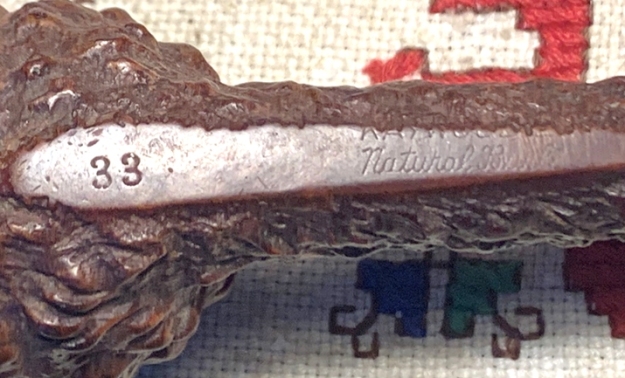
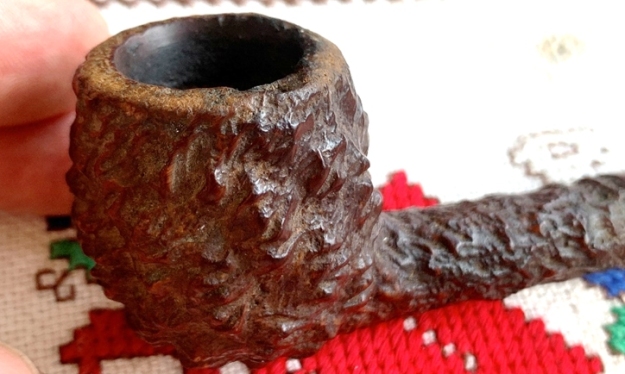
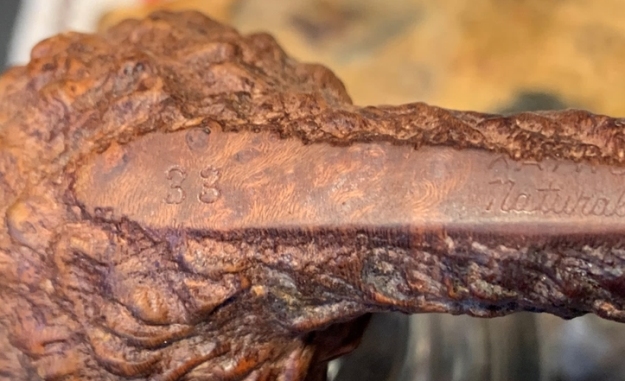
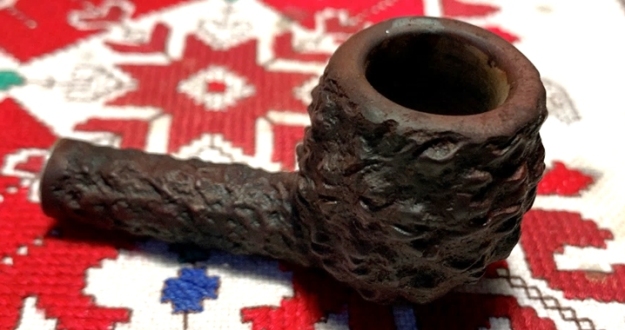
This is the second of 3 of Paw’s pipes that Joe sent to me from Athens, Greece, where he and his wife, Hannah, live and work.  Paw is Hannah’s great grandfather who left behind several pipes that Joe has asked me to restore for the family.  Paw, also known as, ‘2-Page Sam’ by those who knew him as a salesman of over 40 years of the tobacco giant, Brown & Williamson Tobacco, Corp, has a fascinating story that was described in an article in B&W’s company magazine that I included in the write up of Paw’s Medico Apollo Brylon, which I just completed that turned out well (See: Another Legacy Pipe of a Great-Grandfather: Challenges Working with ‘Brylon’ on a Medico Apollo).  Next, two Kaywoodies remain to be restored – a Kaywoodie “500” and the one on my worktable now, a Kaywoodie Natural Burl 33.  Here are pictures to take a closer look. The nomenclature is on the underside of the shank’s smooth briar panel with ‘KAYWOODIE’ (as most of it is not legible as the upper half of ‘Kaywoodie’ bleeds into the craggy rusticated landscape) [over] ‘Natural Burl’ in fancy cursive script. To the left of the nomenclature is stamped the Kaywoodie shape number of 33.  In Pipedia’s listings of Kaywoodie shape numbers, 33 is listed as: “Large apple, rounded top” that was used as a shape designator from 1937 to 1972.The dating indicators of this Kaywoodie are good.  The Natural Burl has a 4-holed stinger which were phased out at the end of the 1950s, though they still show up some in the 60s according to Pipephil.eu’s discussion about Kaywoodie’s stinger evolution.  The inlaid white shamrock also points to an earlier period.I found nothing specific in Pipedia or Pipephil.eu about Kaywoodie’s ‘Natural Burl’ line.  Expanding my search, I did find very helpful anecdotal information in a February, 2013, thread by ‘kwguy’ on a Kaywoodie discussion group on Tapatalk.com:
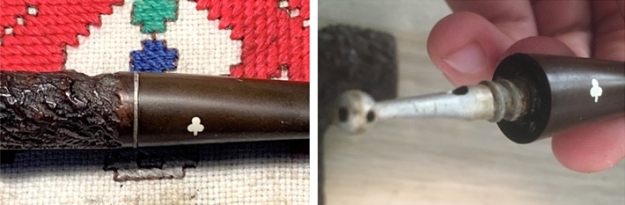
Natural Burls are in the catalogs from 1957 to 1962. They were $4.00 when they first came out and $5.00 by the time they were discontinued.  They were basically a stained version of the Coral White Briar, which also debuted in 1957.  The overall rough texture was described in the catalogs as having a rough texture like the outside of the burl.  The rough texture in theory would create more surface area for a cooler feeling bowl.  Carving of this type was done on bowls of less desirable grain and with excessive surface imperfections.  On the lower side of the quality scale, Natural Burls would have had the white cloverleaf.  There may have been the occasional higher grade pipe that was downgraded during production and hence would have the round logo, but I think you’ll mostly see them with the white logos.

Based upon the information of this thread, the Natural Burl Apple before me dates from 1957 to 1962, when they were featured in Kaywoodie catalogs. I looked for a catalog during this period online, but unfortunately, I was unable to find one.  The rusticated or carved surface theoretically provides a cooler feeling bowl.  This pipe fits Sam’s low budget approach to his pipes.  When the Natural Burl Apple first hit the market, it was in a working man’s modest budget range, $4!  I’m hopeful that after I’ve completed working on Paw’s vintage Kaywoodie it will look like a million bucks!

The above thread from ‘kwguy’ also mentions that the ‘Natural Burl’ line was featured in Kaywoodie catalogs from 1957 to 1962.  There are Kaywoodie catalogs and adds referenced on Pipedia and the Chris Keene Directory of Pictures, but I could find nothing in these ‘go-to’ places for catalogs or listing between 57 and 62.  Emails to Steve and rebornpipes contributor, Al Jones, also came up empty.  However, Al encouraged me to reach out to Bill Feuerbach, the current president of S.M. Frank with Kaywoodie production in New York.  Al said that Bill had always been helpful and had seemed to enjoy providing info.  Nothing like going to the top of the pipe food chain!  I sent a note to Bill through the S.M. Frank website as well as to the ‘kwguy’ in the Natural Burl thread with the hope of getting a response and perhaps a historical Natural Burl add!

Al’s suggestion to me paid off!  In a few days I received a response from Bill Feuerbach, president of S.M. Frank since taking over the role from his father in 1990 as the fourth generation of Feuerbachs overseeing the company.  Bill’s note to me:

Dal 

I’d love to be able to help you out with that. I’ve looked through what I have at the shop and most of those catalogs are later 60’s to later 70’s.  I’m sure I’ll have those older catalogs from that range at home.  I’ll try and check tonight.

Best regards

Bill

After arriving home that night, Bill sent an additional note that he hadn’t found anything at his home and would redouble his efforts the following day at the shop to find the sought after ’57 to 62’ catalog pages.  Then, this note came in and the treasure hunt ended with success!

Dal

Success!!  I found the catalogs at home.  They were in a storage tub in the downstairs closet. Funny I don’t remember putting them there. It’s probably been 4 years since I referenced them. It is hell getting old, CRS is kicking in.

Anyway, I’ve attached three images from the 1958, 1960 and 1962 catalogs.  I was only using my phone to take pictures and it was difficult not to get any flash or glare.  Are they ok?  You can tell the year by the retail prices for the Natural Burl.

1958- $4.00

1960- $5.00

1962- $5.95

Let me know when you’ve posted this and the link. I’d like to take a look.  If you have any other questions let me know. If in the future you need other images from the catalogs, let me know.

Best regards

Bill

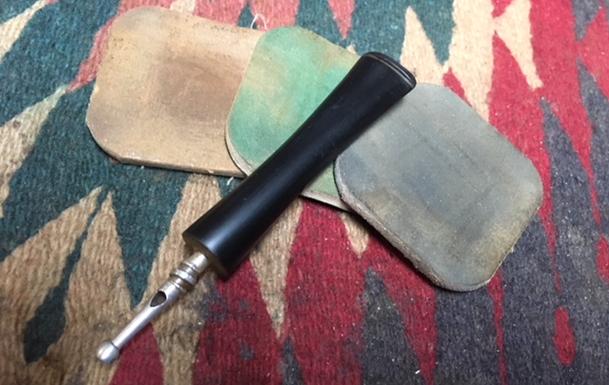
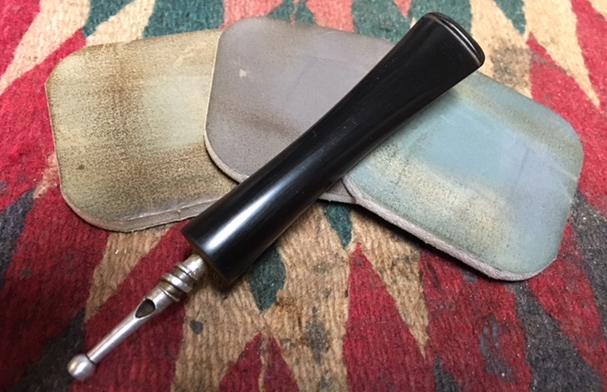
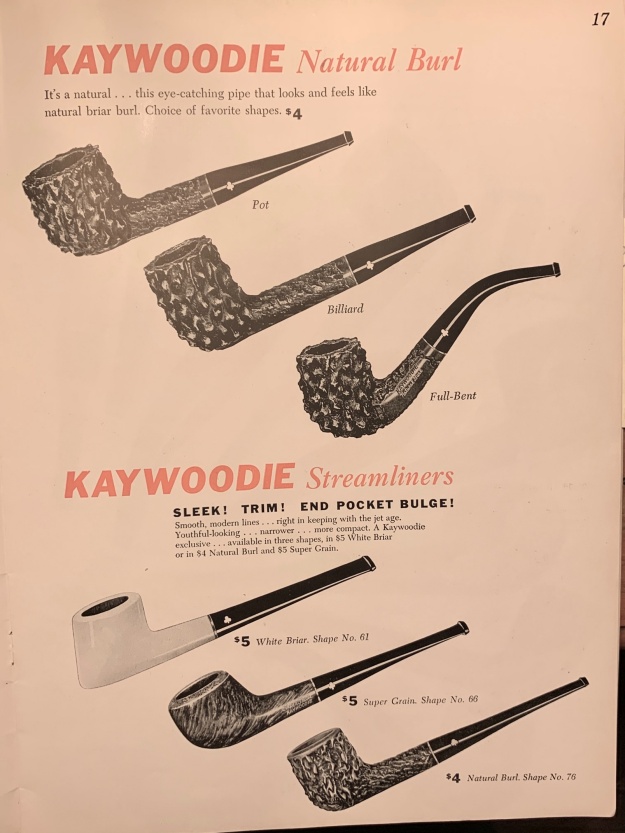
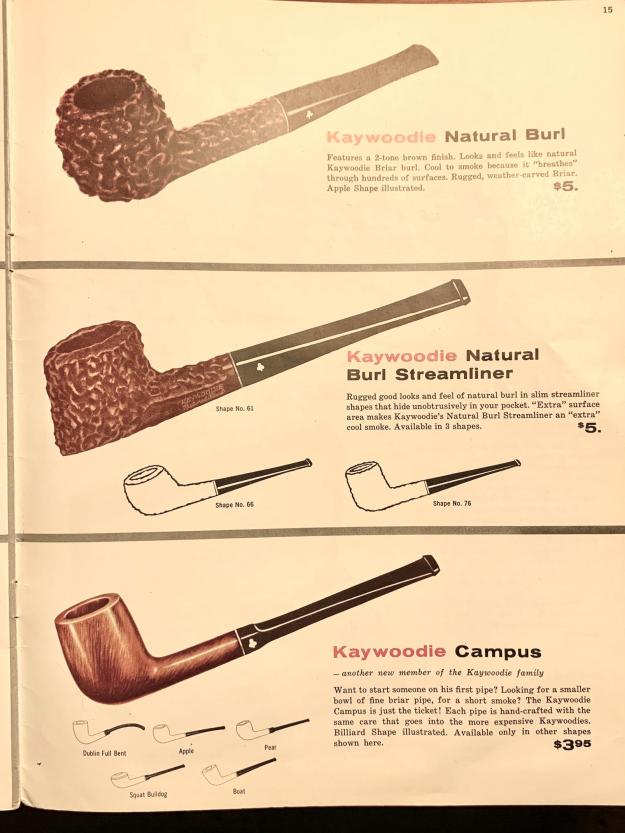
The images Bill sent were great depicting the Kaywoodie presentation of the Natural Burl line.  Both the 1960 and 1962 pages, second and third below, showcase the Large Apple on my worktable.  The pictures and descriptions are great helping to wrap Paw’s pipe in its historical context! I appreciated the help of Bill Feuerbach, president of the S. M. Frank Co. & Inc. based in New Windsor, New York.  The Frank website not only showcases the Kaywoodie, Yello-Bole and Medico brand lines, but has other interesting information as well.  In my email response to Bill, I offered to digitize the ‘treasure tubs’ of Kaywoodie catalogs and adds if I only lived a bit closer to his neighborhood!  Oh my….
As I was waiting for word from Bill before he found the catalogs, I reread the Pipedia article on the S.M Frank Co. and discovered at the bottom of the article a reference to Brian Levine’s interview of Bill on the Pipes Magazine Radio Show.  I tuned in to learn more about Bill and the Kaywoodie name.  I was interested to hear in the interview that not only is Bill the CEO of the company, but he is an accomplished freehand pipe maker himself, likes single malts and owns and enjoys pipes in his rotation other than Kaywoodies!  It was a great interview and I encourage readers to tune in too!

The name for this Kaywoodie series, ‘Natural Burl’, harkens back to a pipe’s origins – or at least its bowl.  The Natural Burl adds above from Bill describe the ‘rugged, weather-carved briar’ that breathes more because of the increased surface of the bowl.  Briar comes from a bush-like plant that grows in arid lands.  The Kaywoodie motif focuses on the rough state of the burl in its natural form sporting rusticated or carved bowls to emulate a natural harvested burl.  The burl is the base of the briar bush that is cut into blocks, each becoming the raw material for fashioning each unique bowl. I found this example online of the burl texture which looks very much like the pipe on my worktable! This interesting information was added about the process at the WorthPoint site:
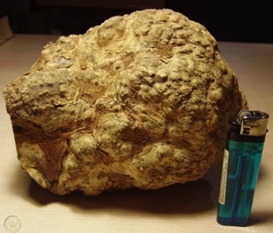
The mother of briar is Erica Arborea, an evergreen bush / tree, that grows in all forests of the Mediterranean area, preferring acid soils (Cyprus, Greece, Italy, Spain, France, Portugal, Morocco, Algeria- these are the countries where it is found). The bush has a typical height of 3 – 12 feet. But not the visible parts are the wanted ones, the ball-like roots are the pipe makers desire. These are the raw material for the briar wood, which is cut in blocks (plateaux and ebauchons) by real specialists. After a long process of boiling them in clear water and drying periods, these briar blocks will be ready for the experienced hands of a pipe maker.

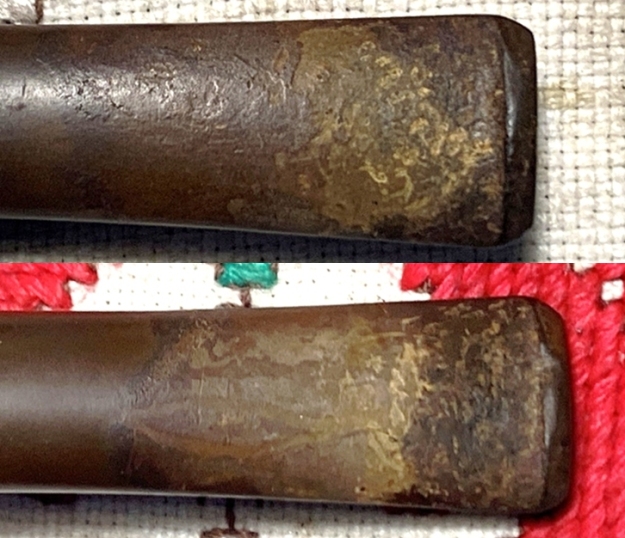
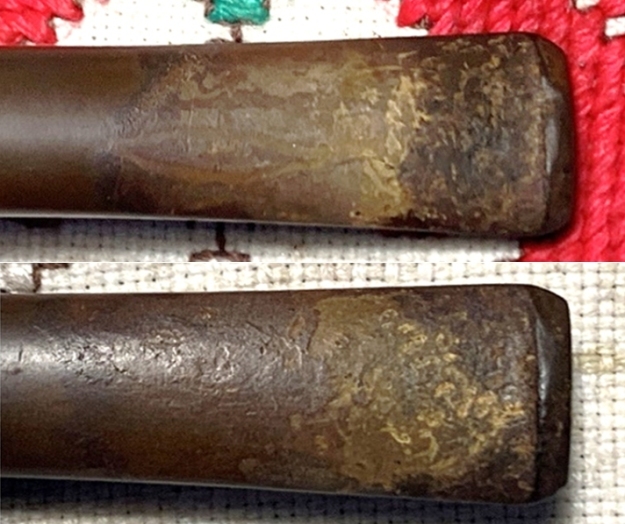
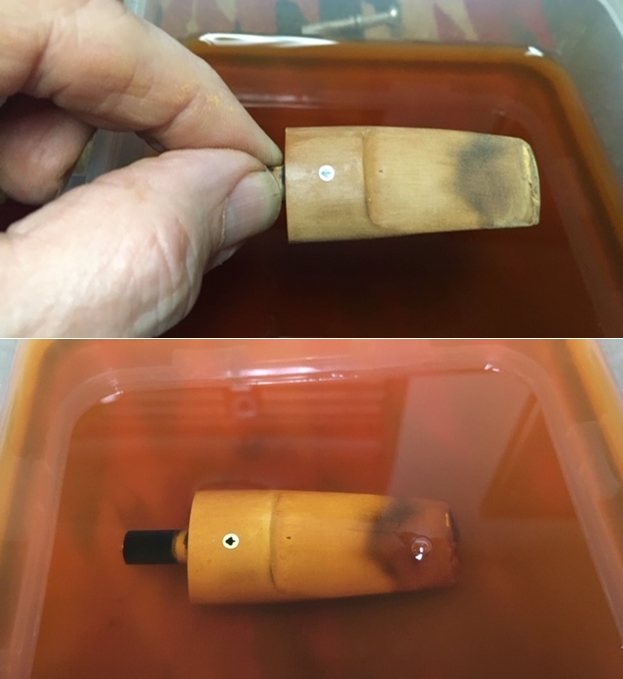
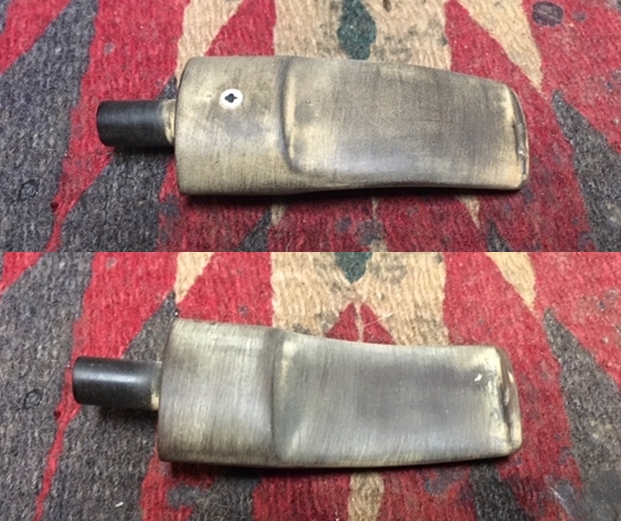
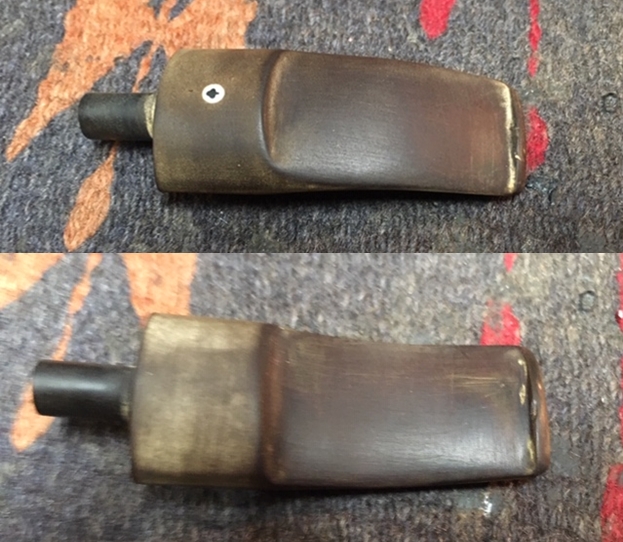
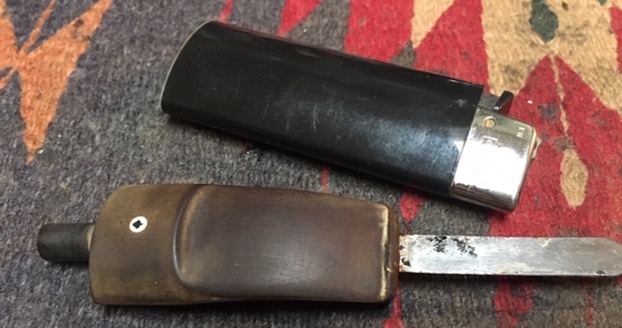
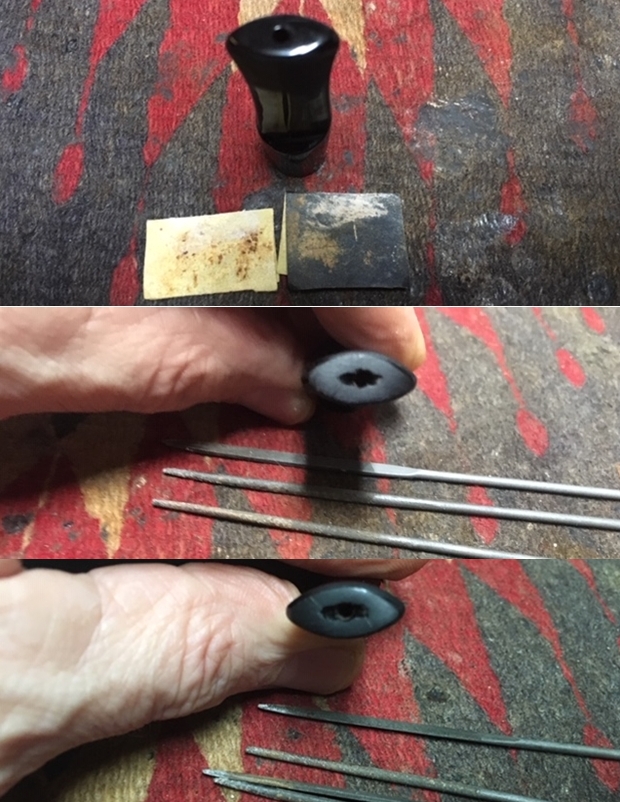
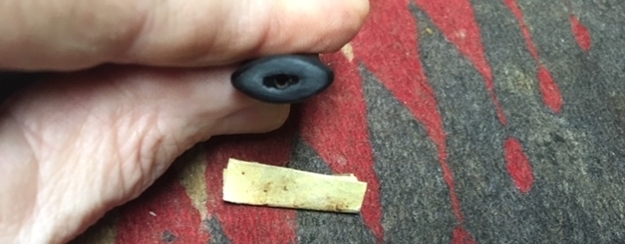
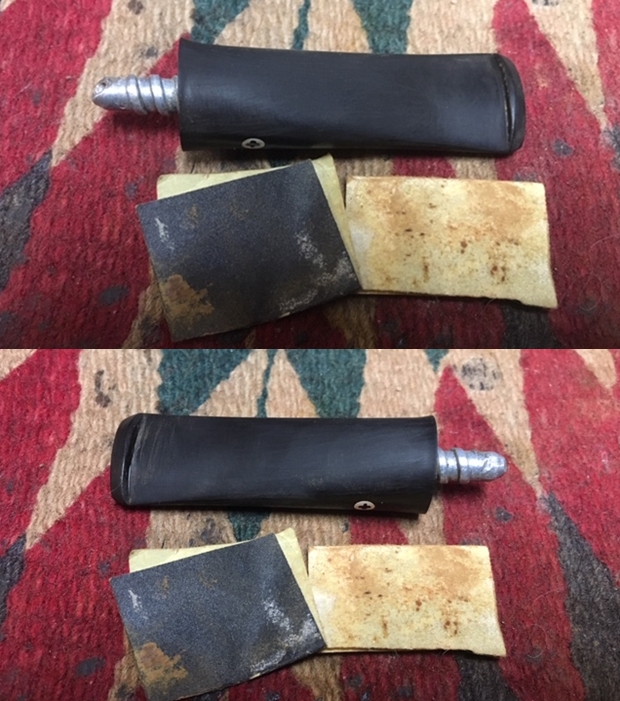
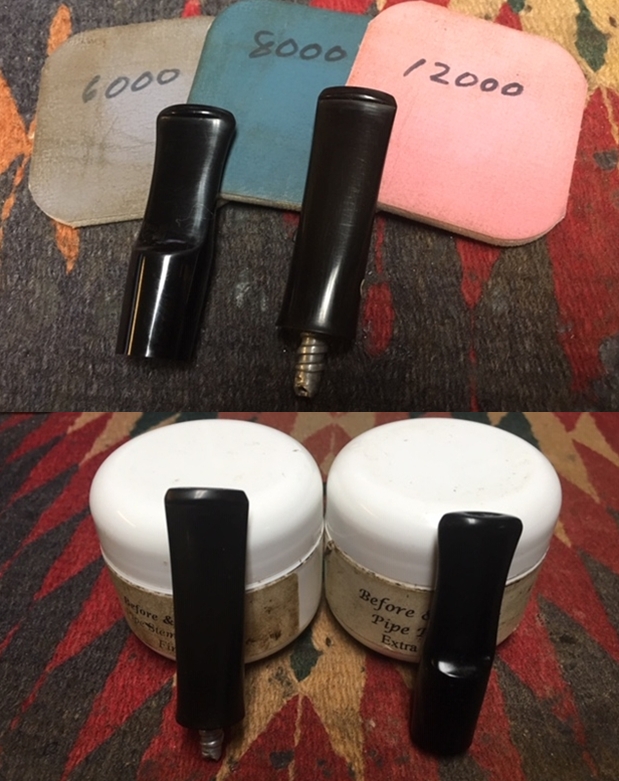
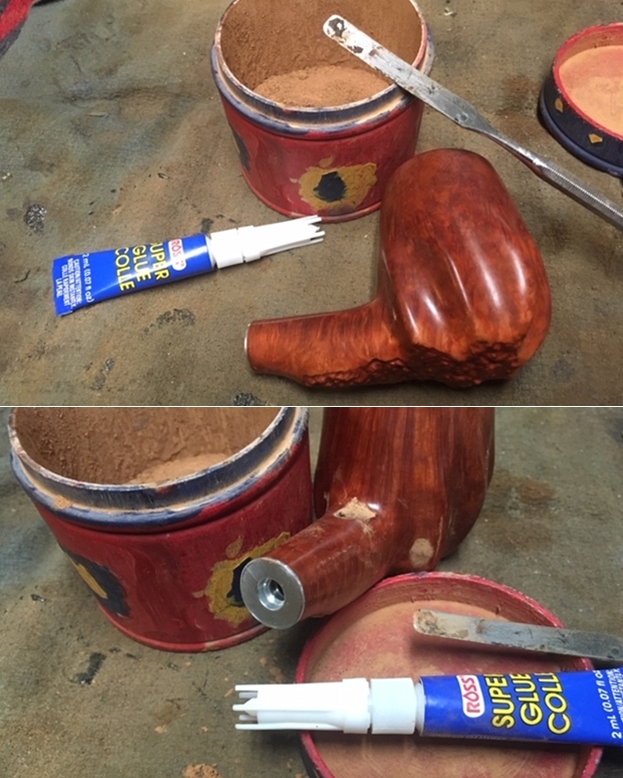
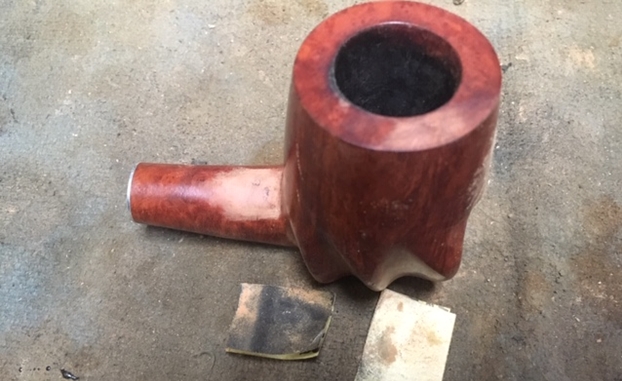
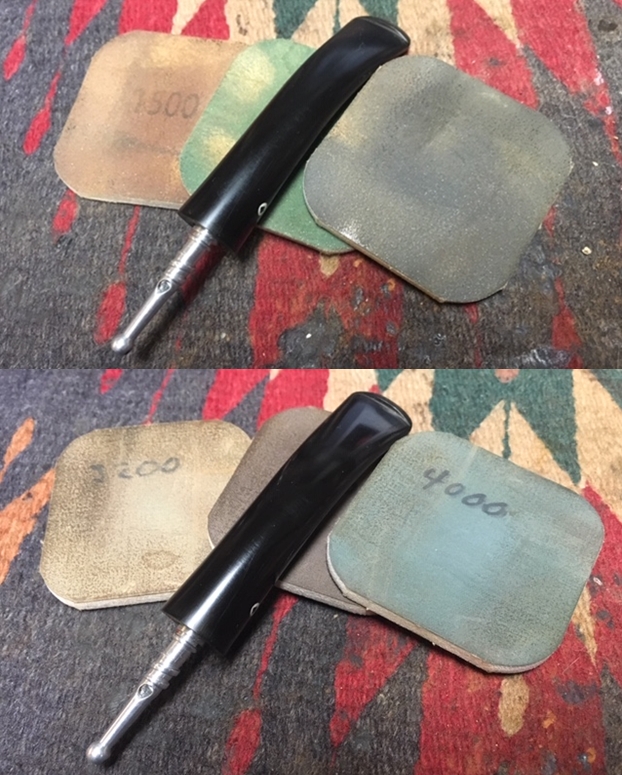
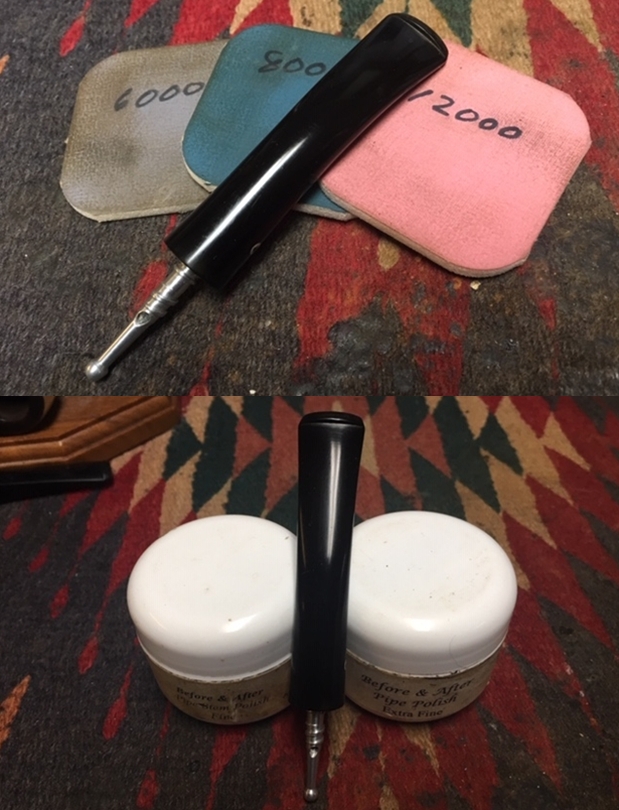
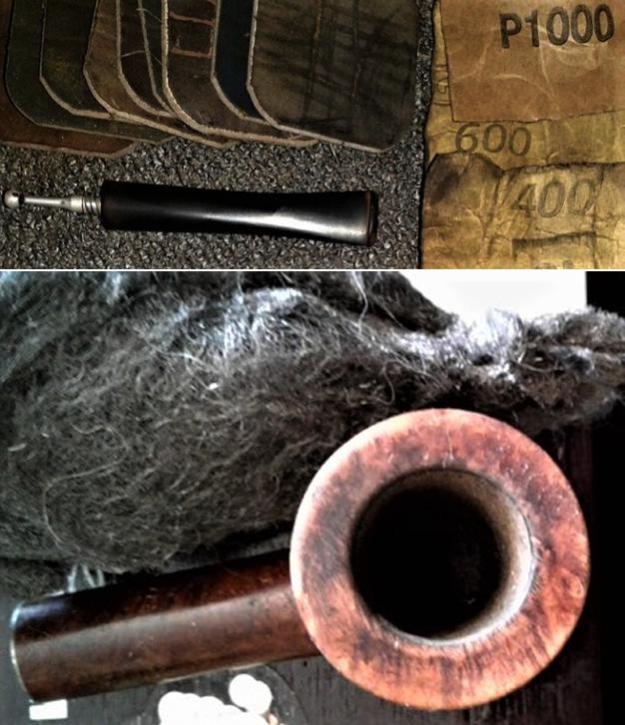
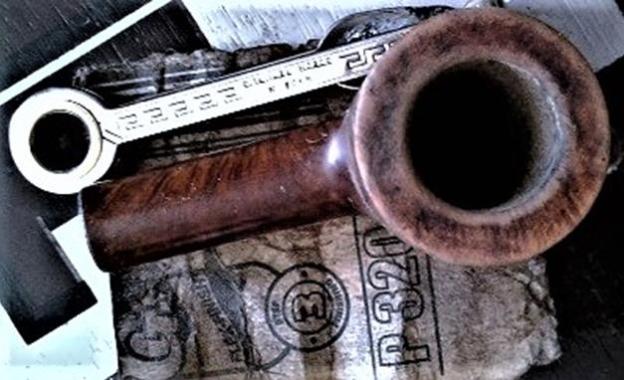
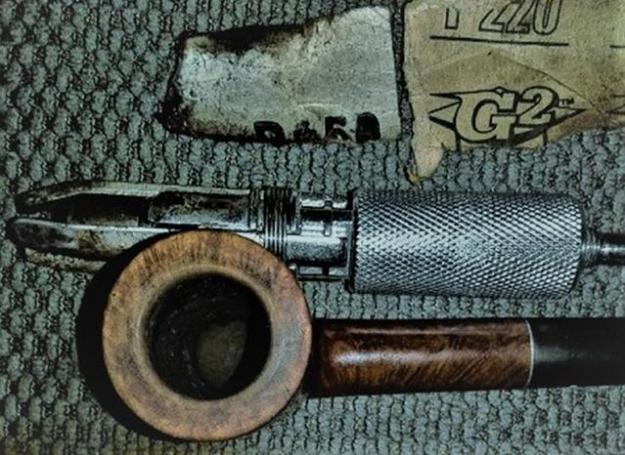
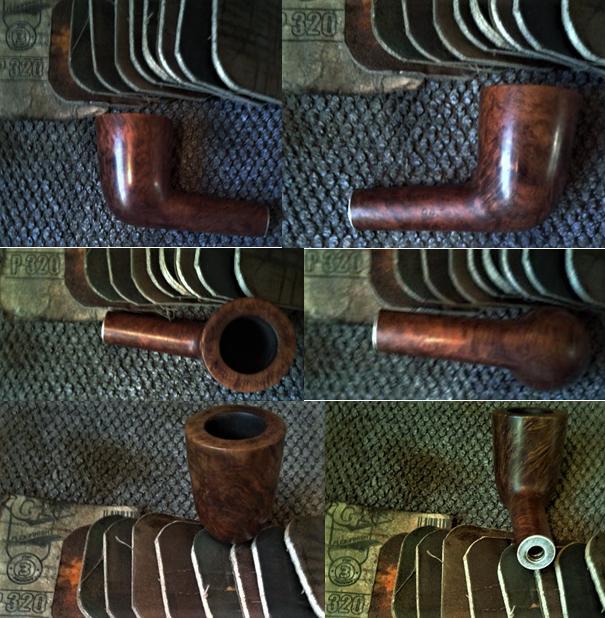
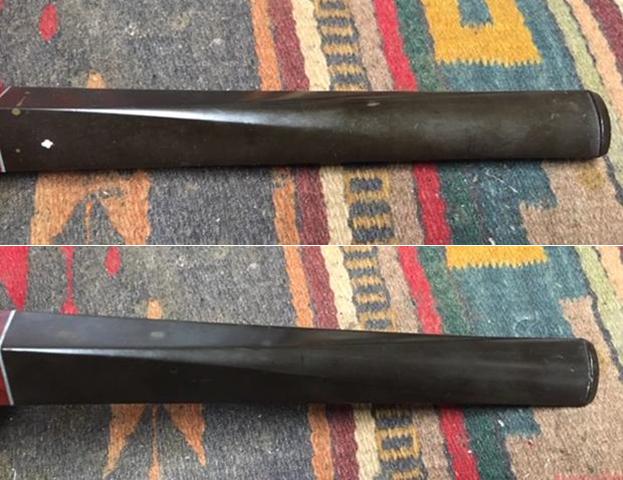
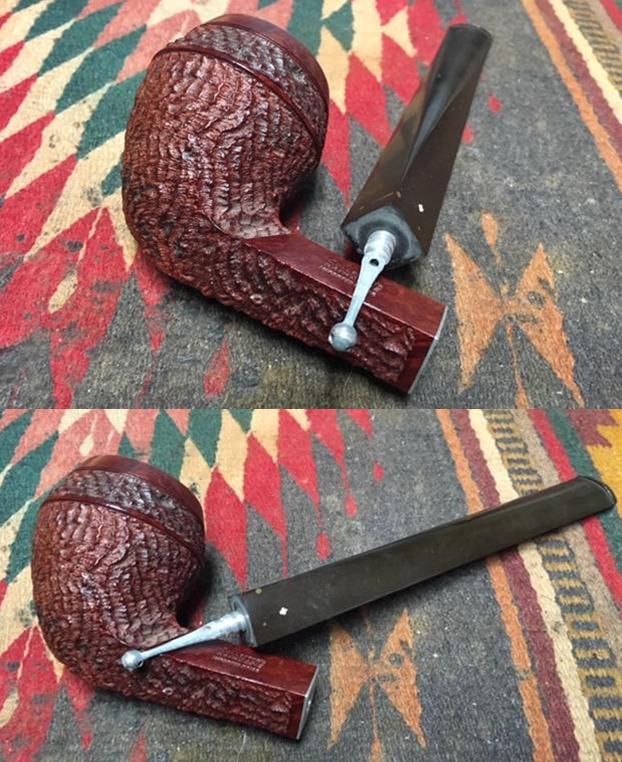
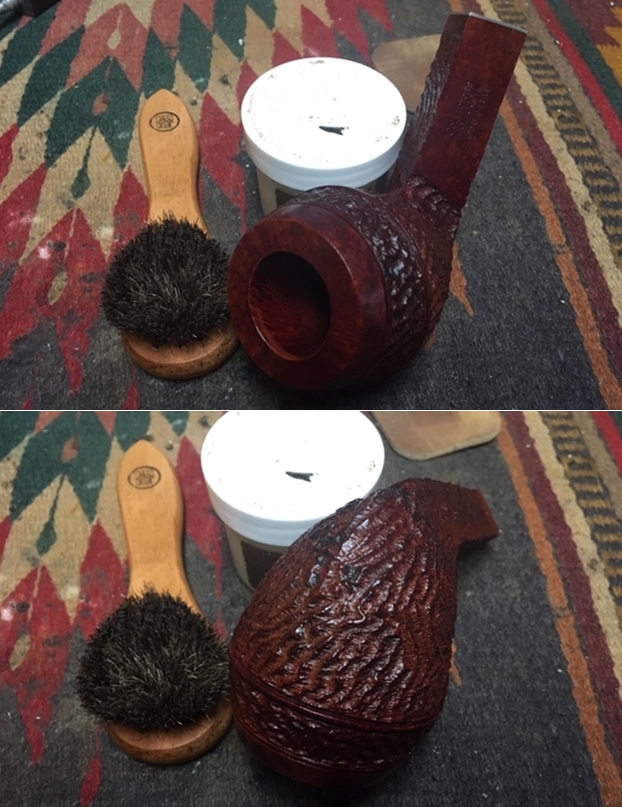
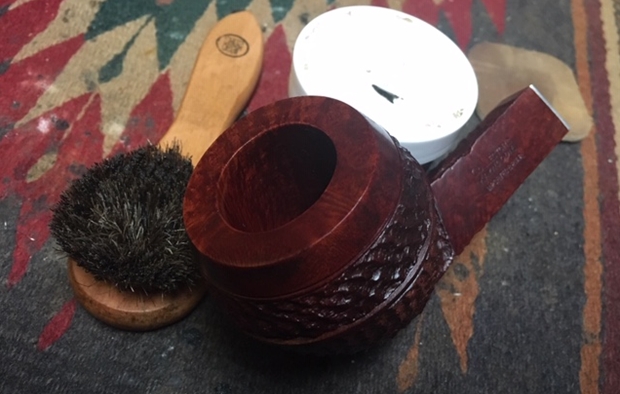
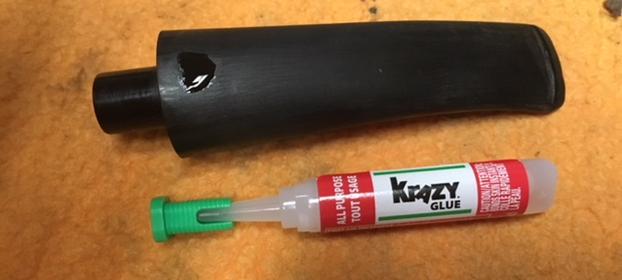
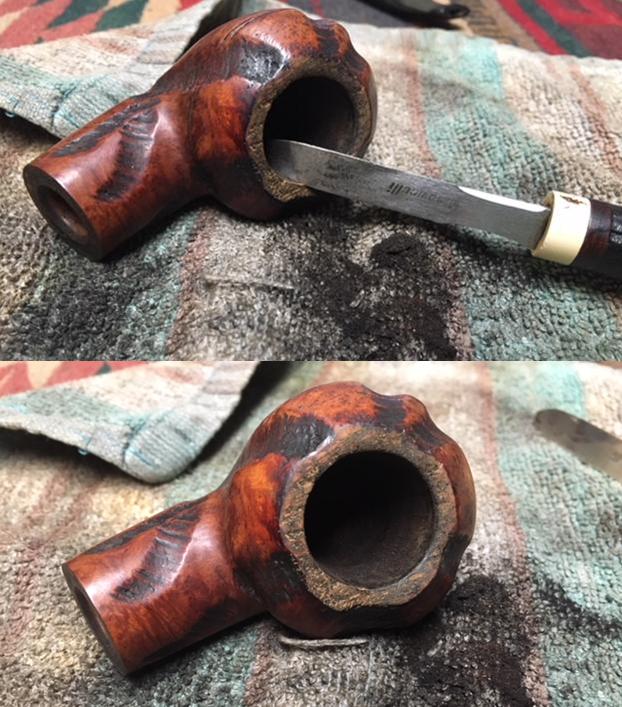
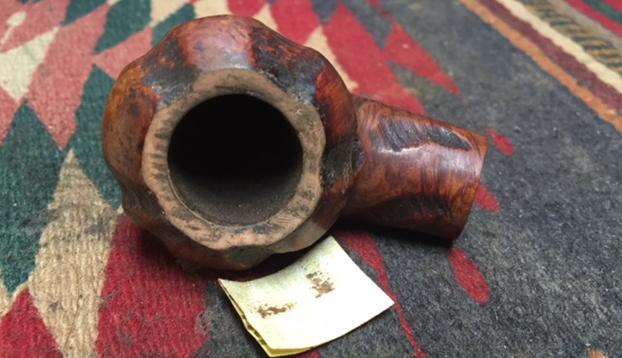
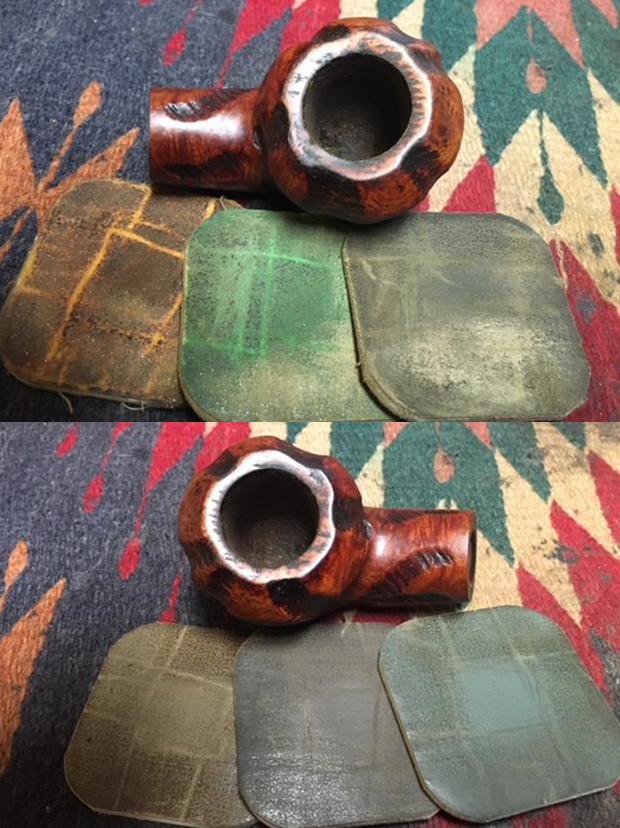
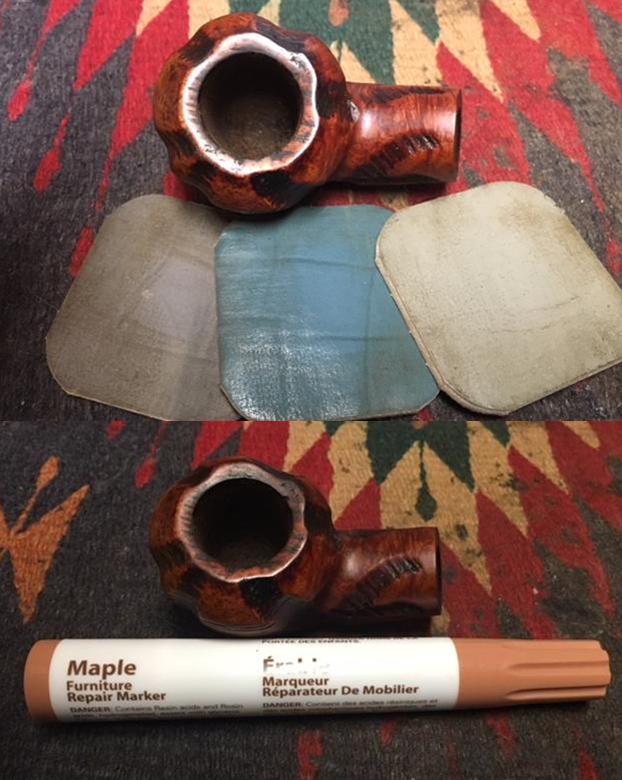
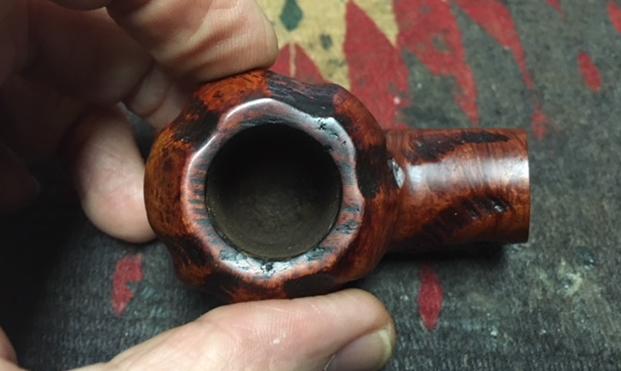
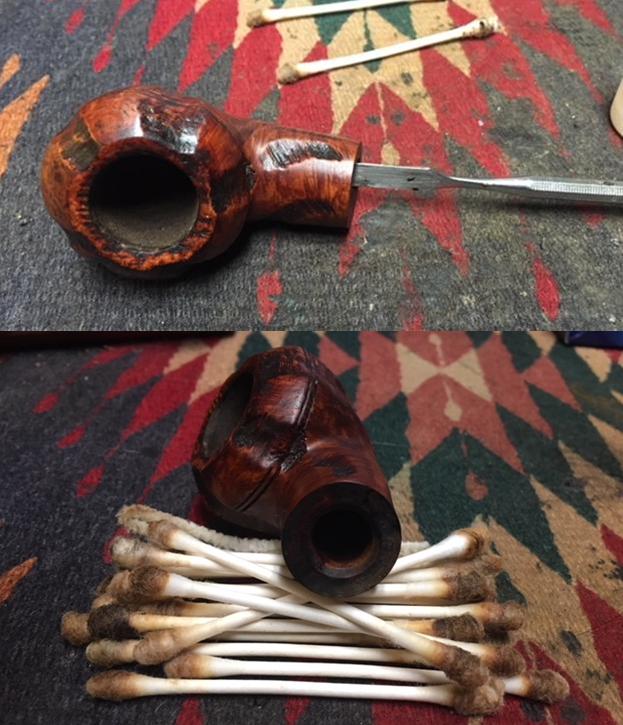
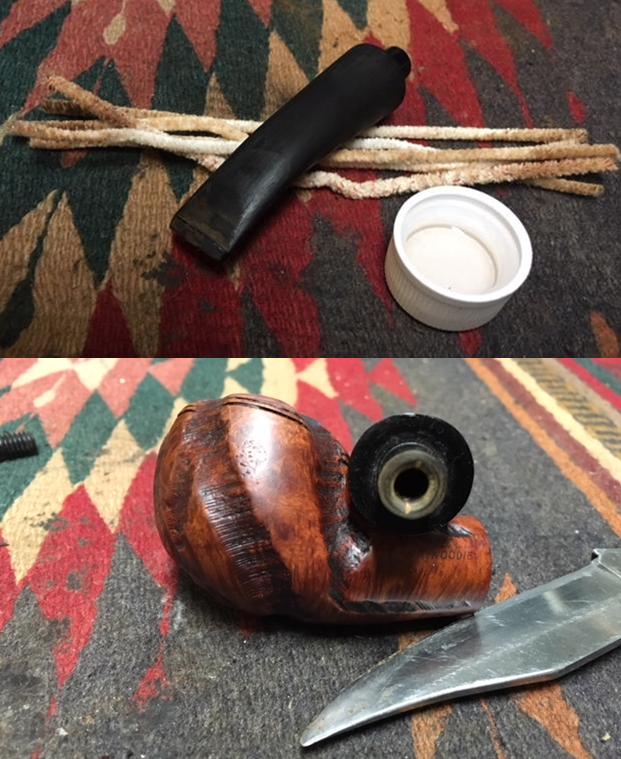
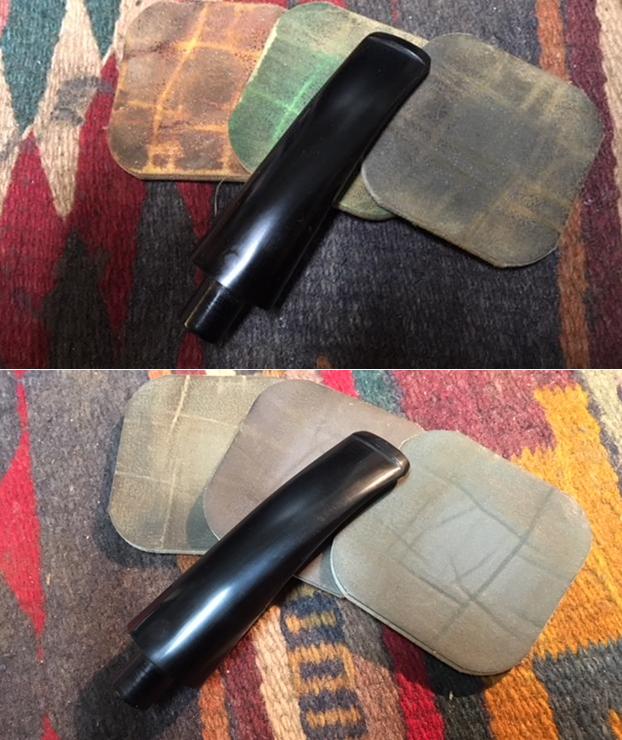
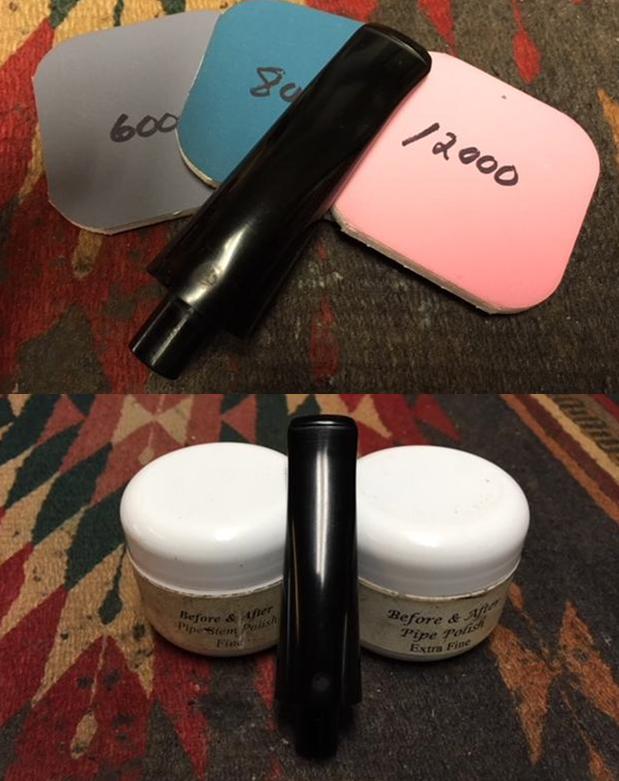
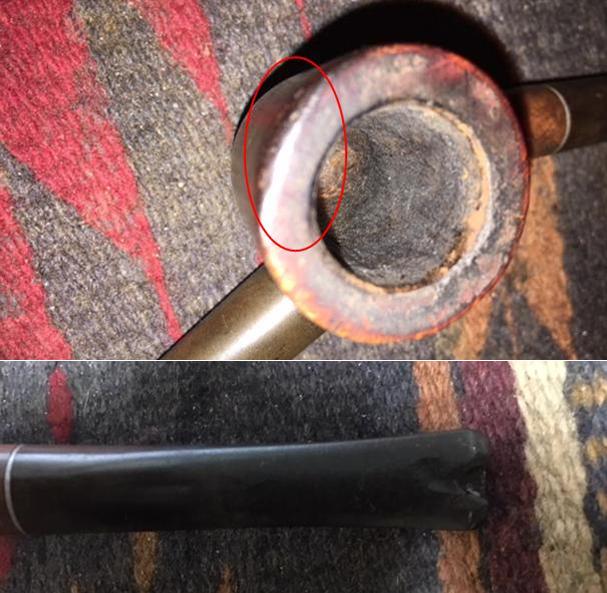
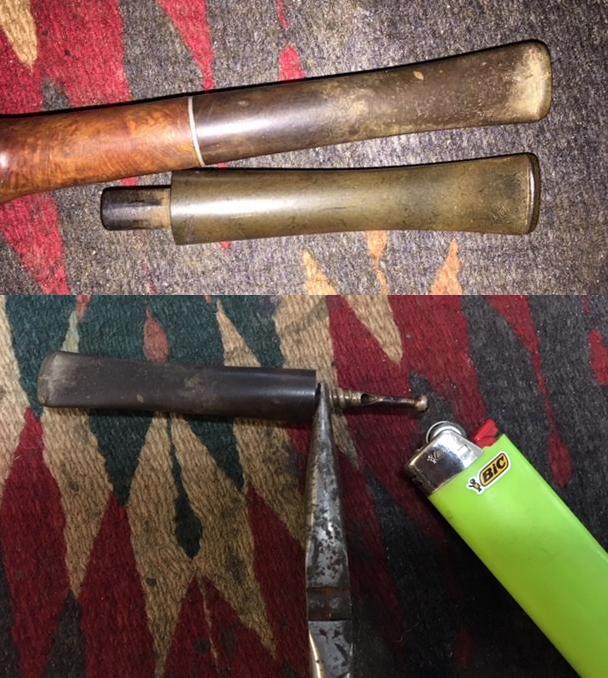
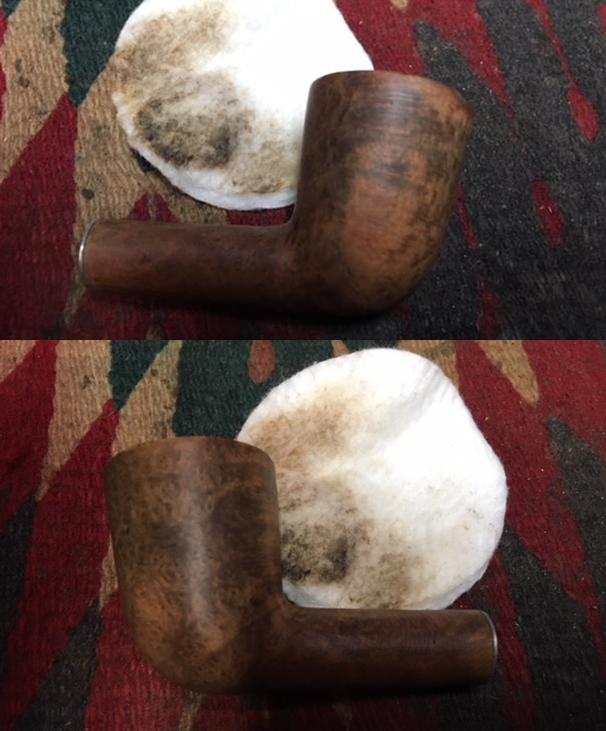
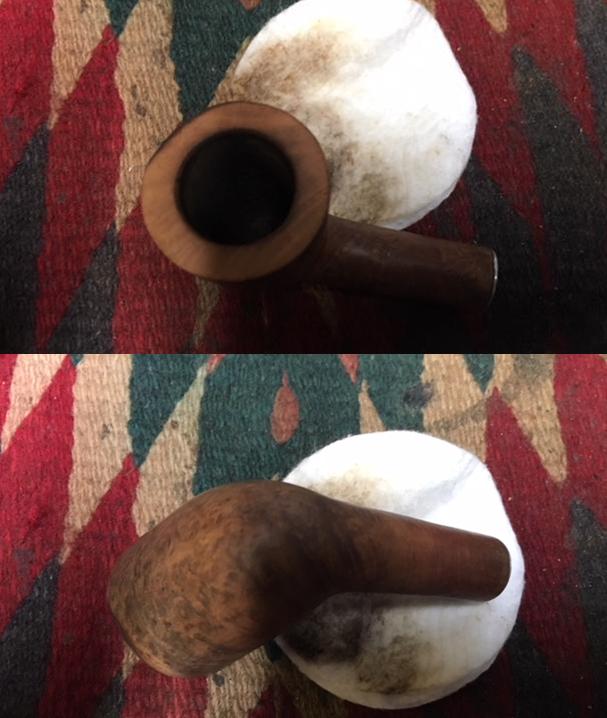
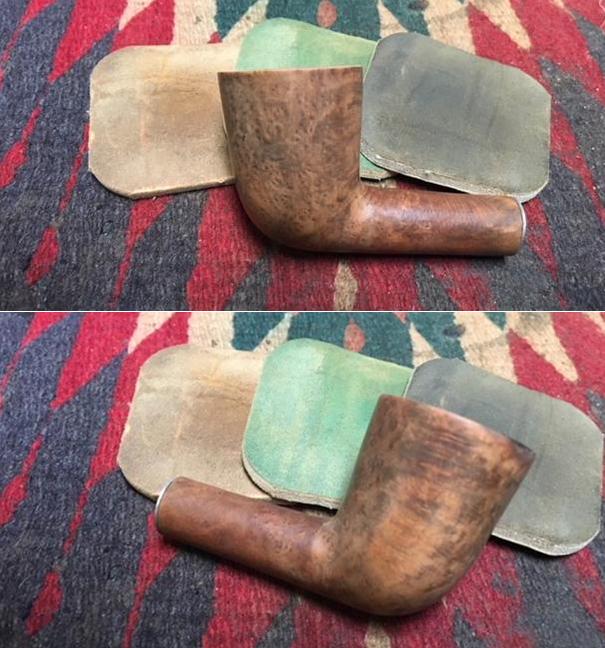
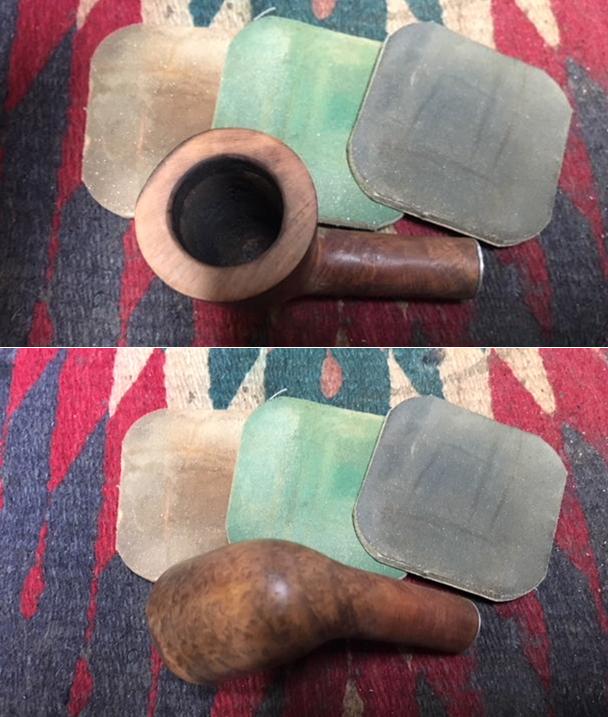
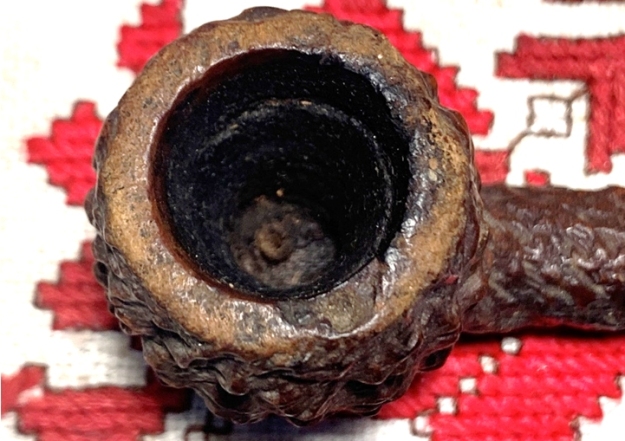
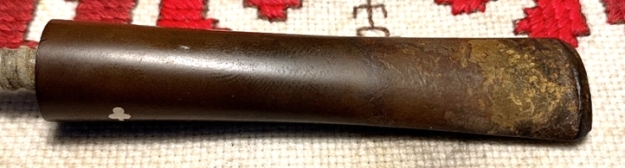
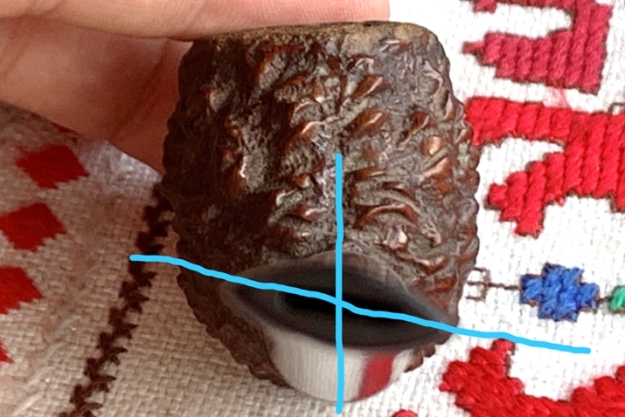
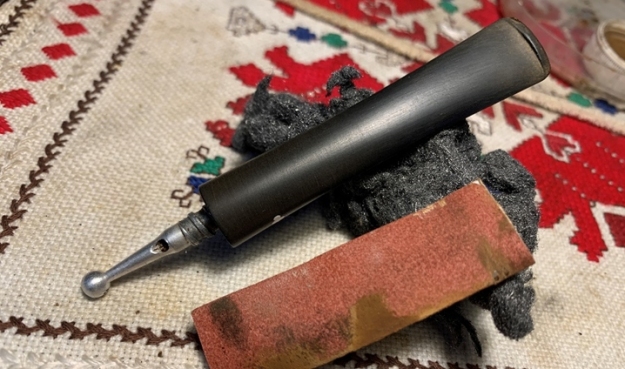
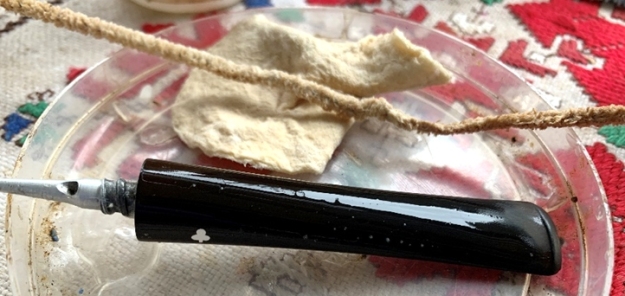
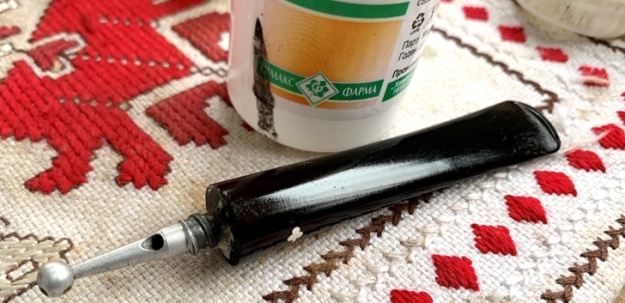
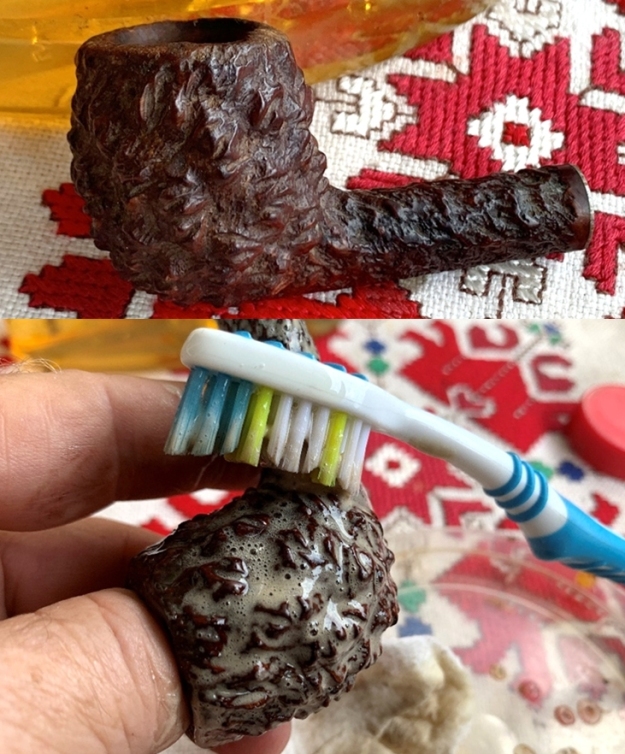
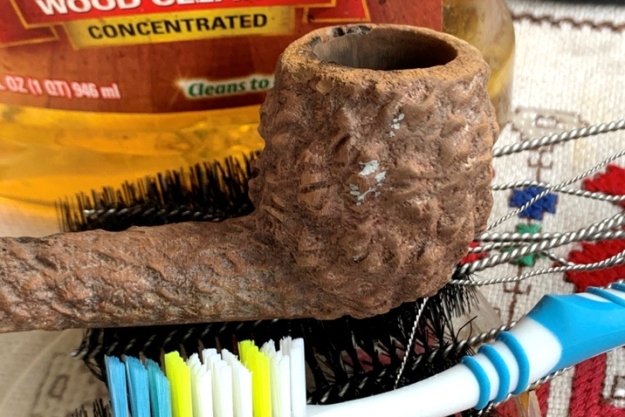
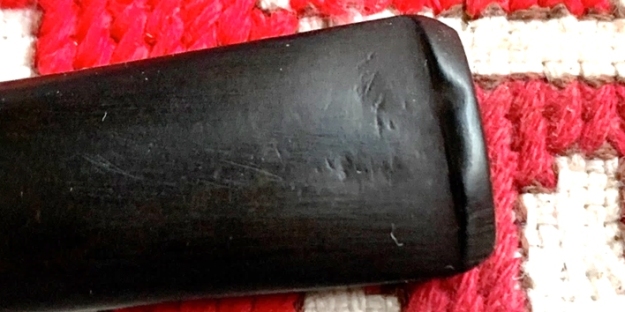
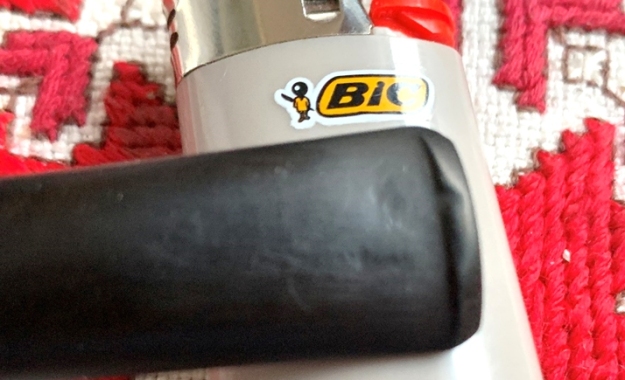
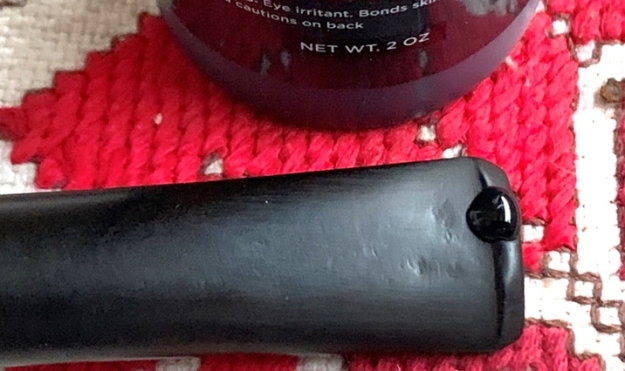
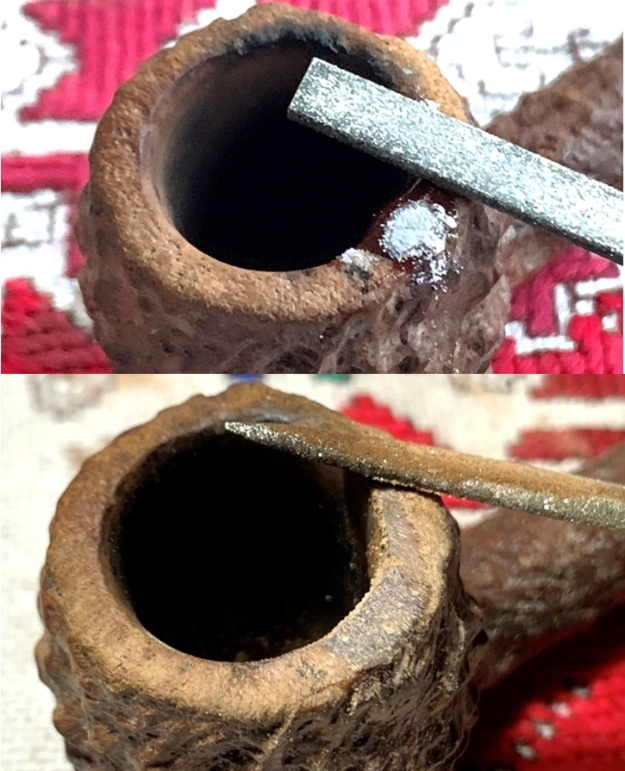
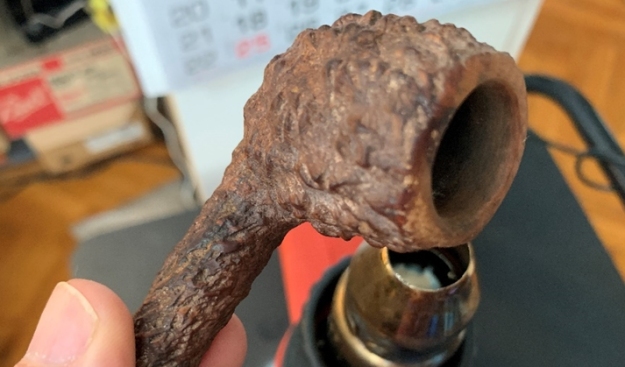
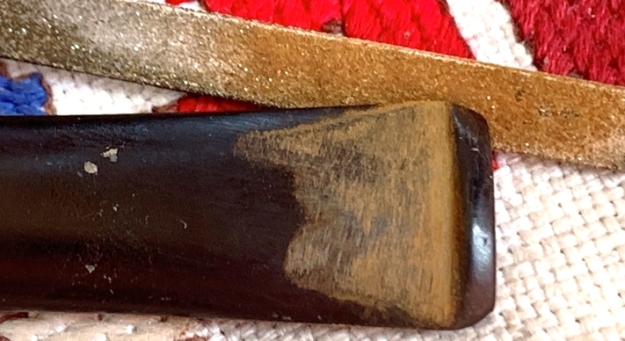
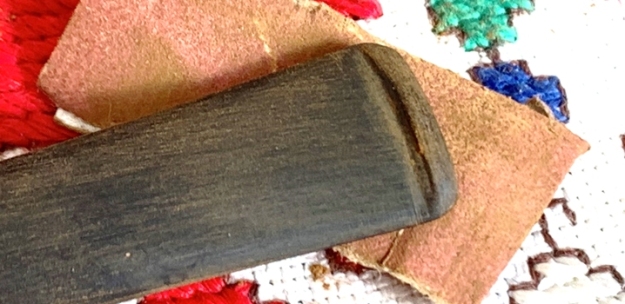
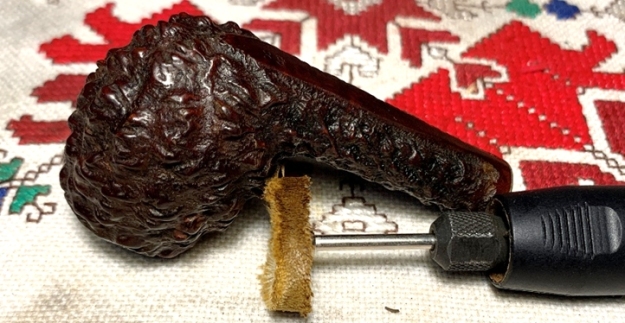
With a deepened understanding and appreciation for Paw’s Kaywoodie on my worktable, I look more closely at the issues it brings from its years of service. As one would expect, the craggy Burl bowl is full of grime.  The chamber has thickening cake as you go down toward the floor.  This needs to be cleaned out as well to inspect the chamber wall and to give the briar a fresh start. The rim has evidences of Sam’s penchant for knocking the stummel on the back side of the rim.  It is worn and tapers away from the chamber. The rim was fashioned to be somewhat rough complementing the craggy bowl motif, but there is a large chip or divot out of the rim that will need to be filled and then blended. The bowl itself, along with the rim, is faded and skinned up.  I suspect that the original finish bent toward a light brown, but it is now thin and will need refreshing with new dye to blend the rim and bowl.  The 1962 add above describes a ‘2-tone brown finish’ characterizing the ‘Natural Burl’ line.  This is helpful information that hints at the depth of the final finish.The stem is in rough shape.  The oxidation is thick and deep.  The bit has calcium caked on it and some lower tooth compressions – not as bad as I’ve seen on Paw’s previous pipes! The stem orientation is also over-clocked which is a normal phenomenon with Kaywoodie screw in stems that happens over years of use with repeated loosening and tightening.  This will need to be adjusted as well. I begin the restoration of Paw’s Kaywoodie Natural Burl Large Apple by addressing the severe oxidation in the stem.  Before placing the stem in a soak of Before & After Deoxidizer, I get a head-start on removing the oxidation by pre-sanding the stem.  I use both 240 grade sanding paper and 000 grade steel wool to sand the stem to remove as much oxidation and caked calcium as possible.  The nickel 4-hole stinger also is cleaned up with the steel wool.After the sanding, the stem joins other pipes in the queue in a soak of Before & After Deoxidizer. After a few hours, the Kaywoodie’s stem is extracted from the Deoxidizer and after draining, I squeegee the liquid off the stem with my fingers.  I then run a pipe cleaner wetted with isopropyl 95% through the airway to clear the Deoxidizer.  Using a cotton pad and alcohol, the stem is wiped to remove the raised oxidation resulting from the soak.After cleaning the stem, paraffin oil is applied to help condition the vulcanite.  I put the stem aside to absorb the oil.  The stem looks great compared to where it started. It’s cleaning up nicely.Next, I turn the attention to the stummel.  I begin by reaming the Kaywoodie’s chamber to remove the cake.  Using the Pipnet Reaming Kit, I use two of the four blade heads available in the Kit.  I don’t know how long this cake has been waiting to be removed, but it is as hard as a brick.  I’m careful not to force the blades beyond their torque endurance level – simply allowing the scraping action to wear away the brick cake.  When both blades do what they can, the Savinelli Fitsall Tool continues the scraping of the chamber walls. Finally, to remove the last remaining carbon remnants, a 240 grade sanding paper is wrapped around a Sharpie Pen to sand the chamber getting down to fresh briar. After wiping the chamber with a cotton pad wetted with alcohol, and inspection reveals a perfectly healthy chamber.  The picture on the 10th floor Man Cave balcony where I’m working, does not allow a very good picture of the chamber, but it looks good.  Moving on.Next, using undiluted Murphy’s Oil Soap, I go to work on the wonderfully craggy but grime-filled surface of the Natural Burl bowl.  I use a cotton pad a bit, but transfer to using a bristled toothbrush which gets into the nooks and crannies of the landscape much more effectively.Next, after transferring the bowl to the kitchen sink, I continue to clean the surface and use shank brushes and liquid anti-oil dish soap and warm water to work on the internals.  After rinsing thoroughly, back on the worktable I take some pictures of the results.  The cleaning has totally removed what was left of the old finish – not unexpected.  The cleaning reveals some white fills on the right side of the stummel which are fully embraced in the craggy landscape cover and seem to be solid after testing them with a sharp dental probe.Next, I focus again on the internal cleaning using pipe cleaners and cotton buds wetted with isopropyl 95%.  Cleaning Kaywoodie pipes tends not to be easy.  Working through the threaded metal shank facing makes access to the mortise difficult.  Along with pipe cleaners and buds, the full arsenal added the use of shank brushes, and a dental spoon to scrape the mortise walls.  After quite a bit of time and effort, the buds start to emerge lighter and a cease fire is called. I’ll continue the cleaning later with a kosher salt and alcohol soak to work through the night to further clean and freshen the internals of the Kaywoodie stummel.Turning now to the rim, the next step is to fill the divot, or perhaps, the crater on the rim.  I go along with the ‘rough’ motif of this Kaywoodie Natural Burl.  The rim is rough and the only repair I plan for the stummel is this divot.  The damage of Paw’s knocking will remain – it simply adds to the rough rustic look and will be a remembrance of Paw when it is put into service by the family.I place a small mound of briar dust on the mixing palette that I’ve covered with scotch tape for ease of cleaning.  Next to the briar dust a small amount of BCI Extra Thick CA glue is puddled.Using the toothpick, briar dust is pulled into the glue and mixed as it is added.  As more is added, the resulting briar dust putty thickens.  When it reaches the thickness of molasses, with the toothpick the putty is troweled to fill the rim divot.With the briar putty applied, I place the stummel aside for several hours for the putty to cure.Turning now to the stem, the upper bit is in good shape after the ‘pre-sanding’ that was done before putting the stem into the Deoxidizer.  The lower bit, pictured below, has some compressions and a button bite compression that need addressing.I start by using the heating method with a Bic lighter.  Using the flame of a Bic lighter, I paint the bit using a back and forth motion heating the vulcanite.  As the vulcanite heats, it also expands to regain the disposition of the stem before the compressions were made by Paw.  The picture below is after the heating and the process has helped the bit compressions so that only sanding should be needed to remove the damage.  However, the button is still in need of additional steps.To fill the button lip bite, after wiping the area with alcohol to clean it, I spot drop black CA glue on the compression and put the stem aside for the patch to cure.The patch on the rim is now ready for filing.  I use both the flat and half-rounded needle files to remove the excess putty and to shape the internal curve of the rim. I put a stop on sanding and further cleaning the rim because the hour is late, and through the night I want to use a kosher salt and alcohol soak to advance the cleaning of the internals of the stummel.  I first fashion a cotton ball into a ‘wick’ by pulling and twisting it.  It is then inserted down the mortise into the airway with the help of a stiff wire. The wick helps to draw out the latent residue of tars and oils.The bowl is then filled with kosher salt, which leaves no aftertaste as with regular iodized salt.  After placing it in the egg carton to keep it stable, I then fill the chamber with isopropyl 95% until it surfaces over the salt. After a few minutes, as the alcohol is drawn into the stummel, the alcohol is topped off and it is set aside to work through the night. The next morning, the salt and wick are slightly soiled which hopefully means that the internals are already clean from earlier. After dumping the expended salt and wiping the bowl with a paper towel, I blow through the mortise to make sure all the salt crystals have been dislodged. To make sure that the internals are clean, and nothing has been left behind after the soak, I use only one pipe cleaner and cotton bud as confirmation of the cleaning. Moving on.I return now to the rim.  I plan to apply a fresh color to the stummel and the only preparation for applying the new stain to the stummel is on the rim.  I plan to leave it in the rough motif of the Natural Burl line, but I want the rim cleaned.  I lightly sand the internal rim edge as well as lightly around the rough external rim edge as it transitions into the Burl landscape.  I’m looking for ‘rough’ and ‘rustic’ but ‘fresh’ to give this unique Kaywoodie a fresh start.I follow the 240 paper with 600 grade paper with the same approach – keep the rustic but refresh the rim.Before moving to the next step, I notice that the nickel shank facing after the cleaning had not been spruced up.  A quick revolution of 000 steel wool takes care of this.  This is the only bling this Kaywoodie has and I’m making the most of it!As I think about applying a fresh color to Paw’s Kaywoodie, I have only one picture of another Natural Burl online and it is no help in hinting at the original 2-toned brown coloring Kaywoodie used.  The best clue I have is on Paw’s pipe. The smooth briar panel on the underside of the shank holding the nomenclature holds a clue.  To guard the stamping on the panel I’ve not sanded it – only cleaned with the rest of the stummel.  I’m guessing that the coloring of the panel leans toward a light brown.  I’m thinking that Kaywoodie’s approach was straightforward with this less expensive line of pipes.  Yet, the craggy surface now is so dry and bare, showing pristine briar, that applying even a light brown dye will probably darken considerably as the thirsty briar drinks it in.Looking at the craggy landscape in the picture above brings the next question in my mind about applying a new finish.  My normal way of staining with aniline dye is to flame it to combust the alcohol which encourages a deeper embrace of the dye by the briar grain.  My normal follow-up to this is then to apply compounds to remove the crusting the combustion creates and to further shine the surface with the fine abrasives of Tripoli and Blue Diamond compounds.  The roughness of this stummel causes me to question my normal approach.  My concern is that if compounds are used on this craggy rough surface, I will forever be trying to clean out the compound residue lodged in the rough surface!  I think I can utilize buffing wheels on the Dremel without too much problem, but without compounds.  I decide in the end to apply a dye wash instead of flaming the dye because of this concern.
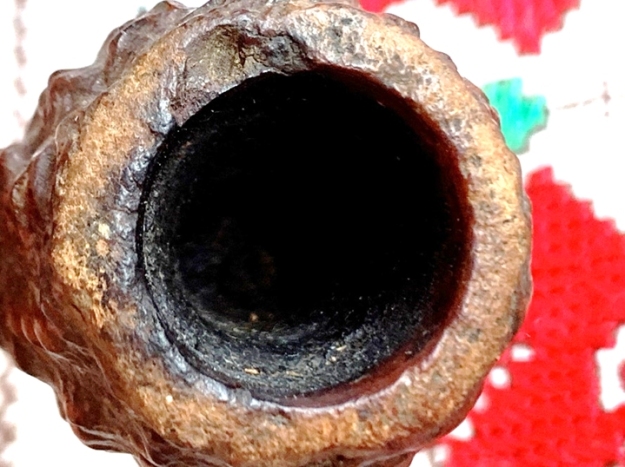
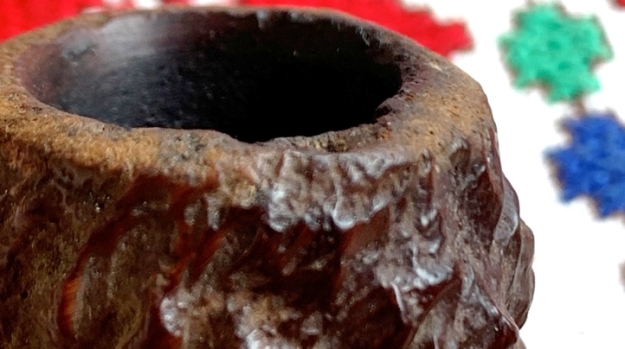
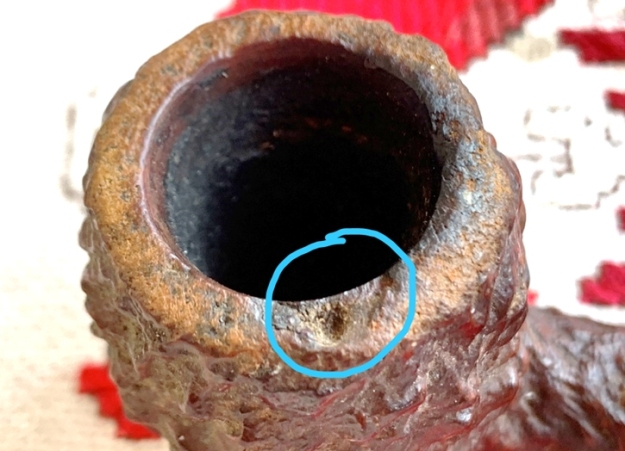
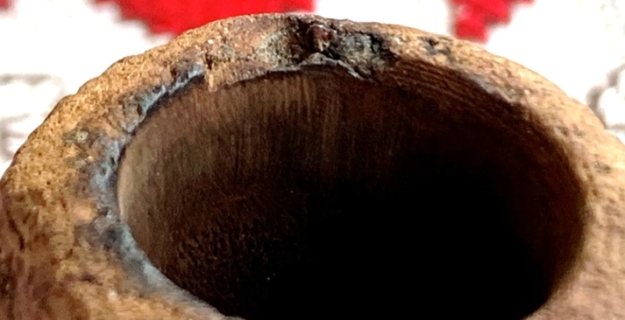
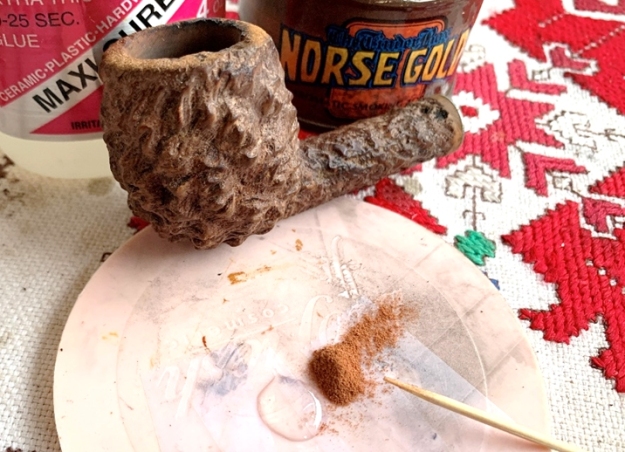
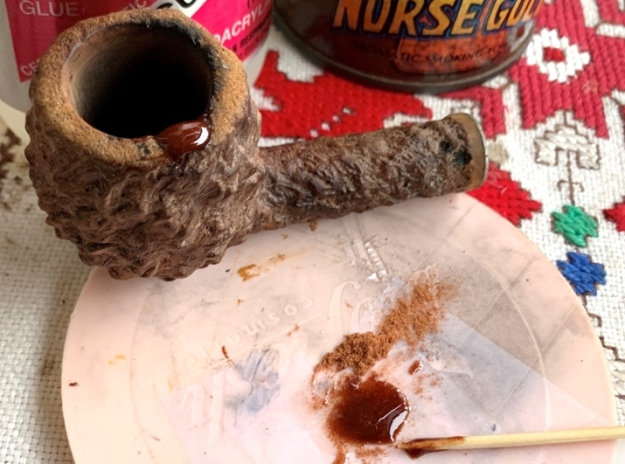
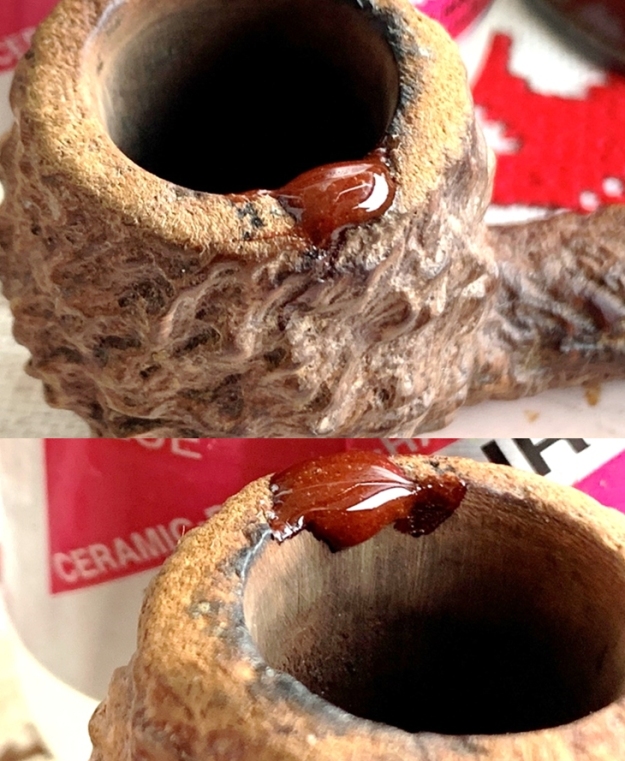
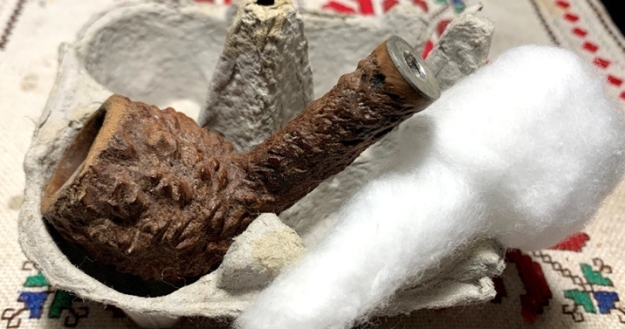
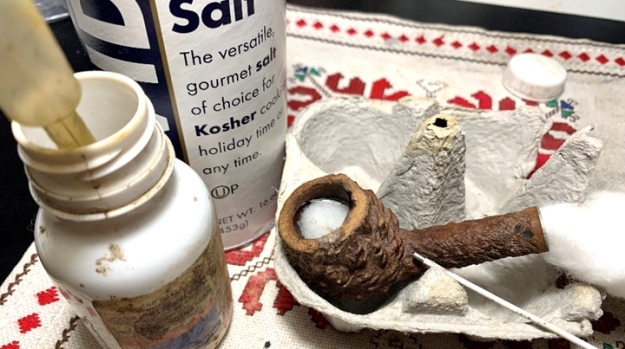
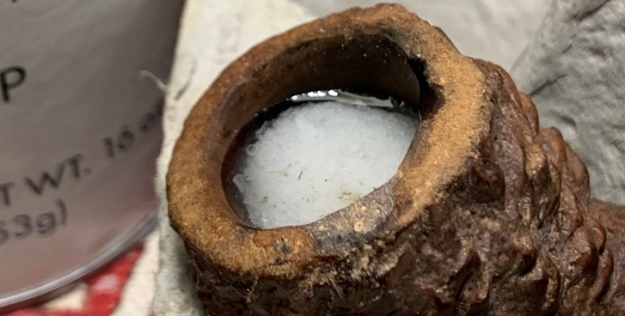
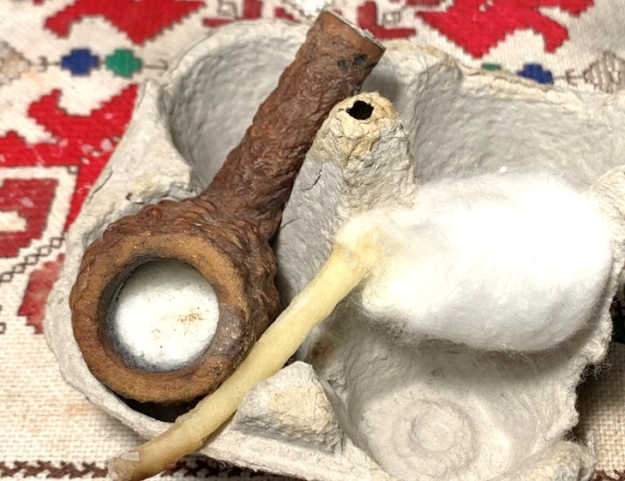
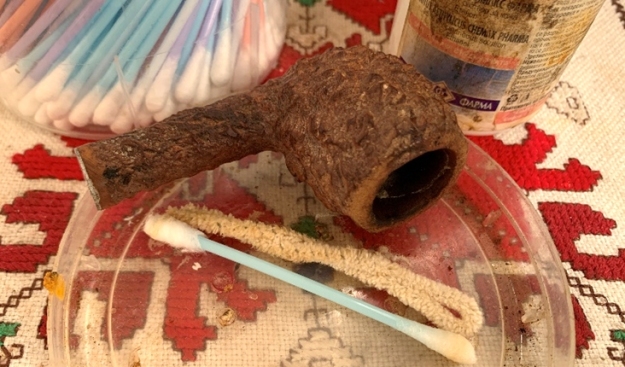
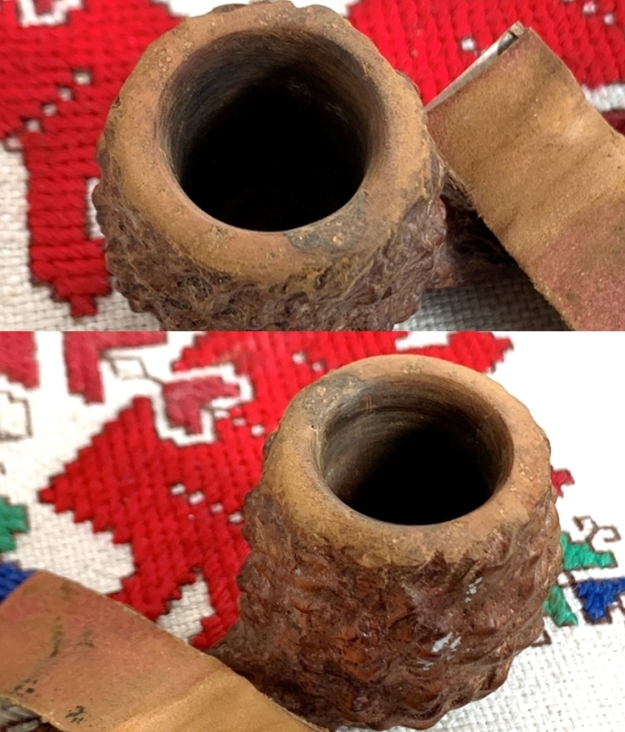
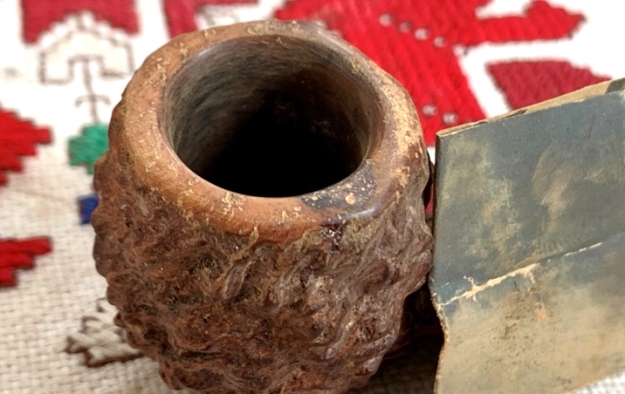
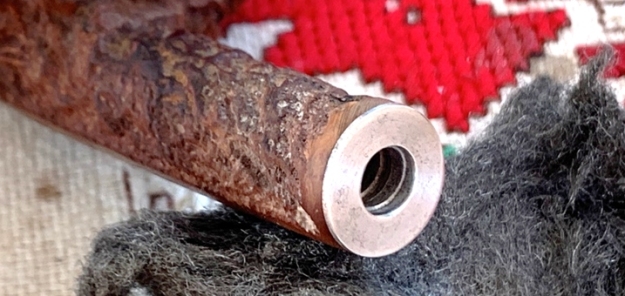
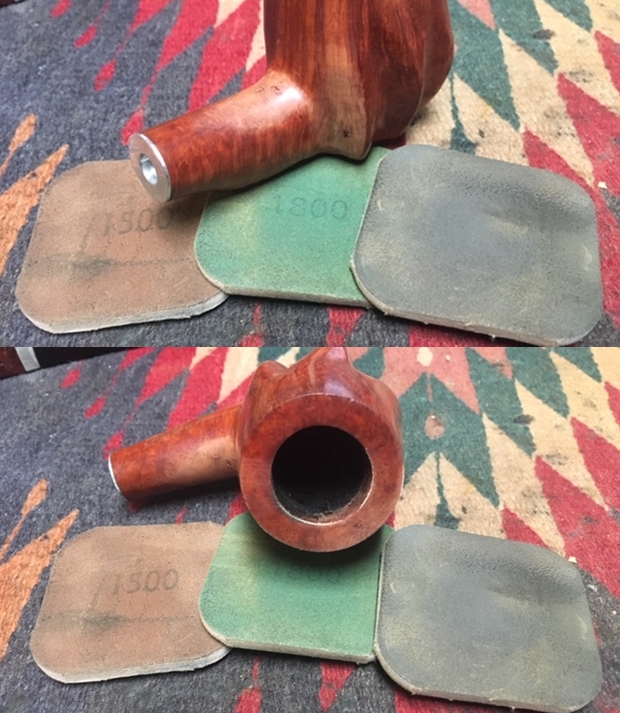
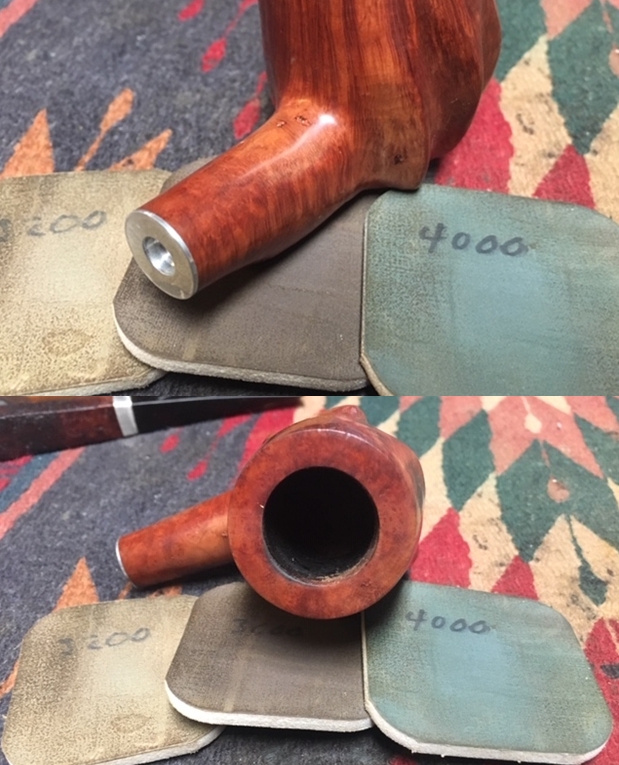
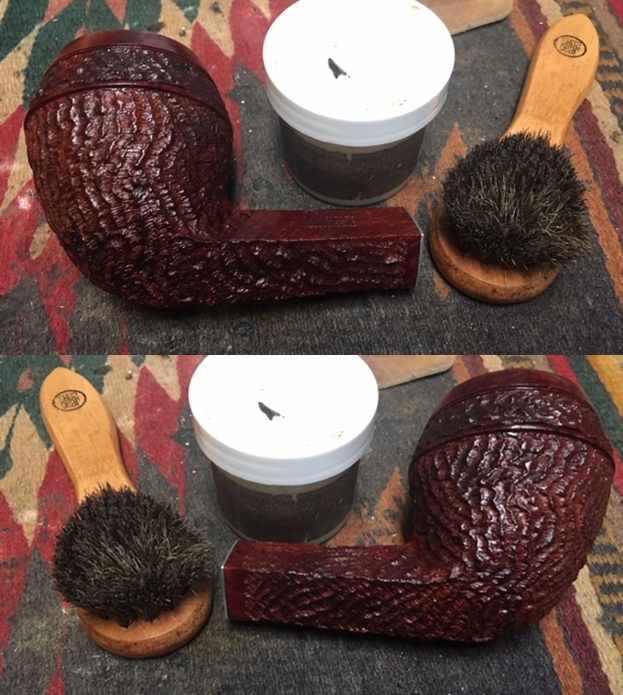
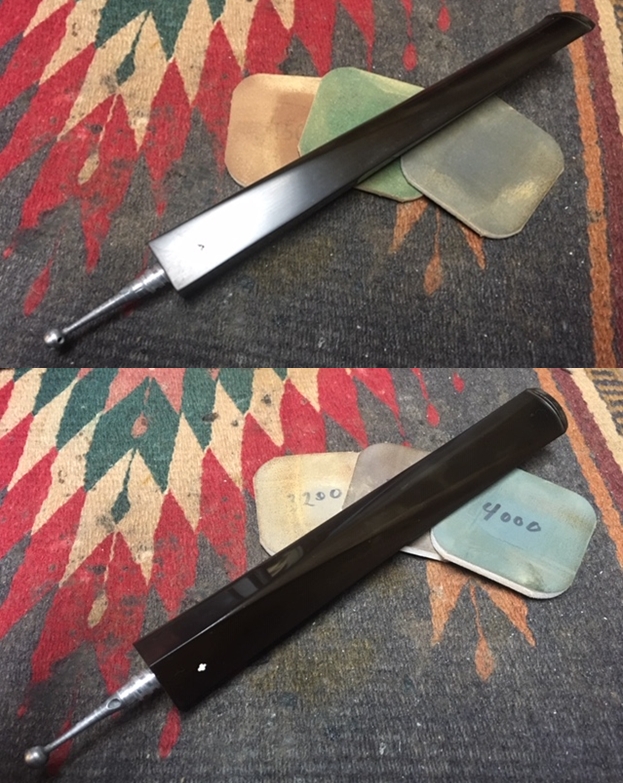
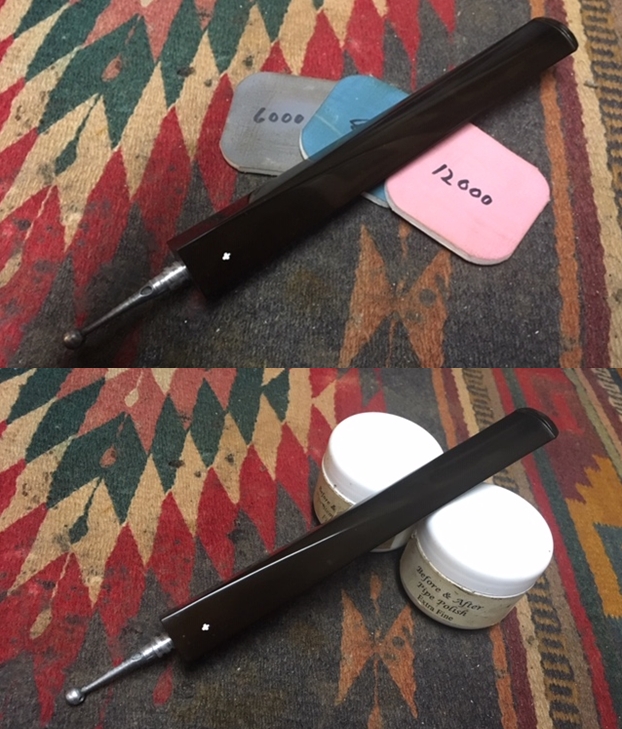
After wiping the stummel down with a cloth and alcohol to clean it the best I could, the stummel is heated with the hot air gun to open the briar.Then, with the use of a folded pipe cleaner, the surface is painted with Fiebing’s Light Brown Leather Dye.  I make sure the dye is getting into all the cracks, crevasses, nooks and crannies.  The rim also receives the dye.After the dye is applied, the stummel is set aside to rest for several hours before continuing with the next steps of finishing.  This ‘rest’ helps the new dye to stabilize in the briar.Turning back to the stem, the patch applied to the lower button lip is cured and I use a flat needle file to remove the excess patch material and to shape and refresh the button lip.  I also file the bit area to remove any residual tooth compression.Flipping over to the upper bit, I file residual compressions as well as refresh the button lip.  Refreshing the button lip is helpful to allow a better ‘hang’ grip of the pipe without biting and clenching, and extreme chewing!Continuing now with 240 grade sanding paper on the upper side, the file scratches are removed, and the button is smoothed further.  The same is done on the lower bit and to further blend the button patch.   I expand the 240 sanding to the entire stem to make sure that residual oxidation has been addressed. Following the 240 sanding, I wet sand the entire stem with 600 grade paper and follow with applying 000 steel wool. The nickel stinger is also a benefactor of the steel wool polishing again.Moving on, the full regimen of 9 micromesh pads are applied by first wet sanding with pads 1500 to 2400 and dry sanding with pads 3200 to 4000 and 6000 to 12000.  Between each set of 3 pads, Obsidian Oil is applied to condition the vulcanite and to guard against oxidation. I love the glossy pop of newly micromeshed vulcanite! I had observed earlier that the Kaywoodie screw in stem was over clocked a few degrees.  This happens over time with tightening and loosening.To correct this problem and to bring the stem back to an accurate orientation, a Bic lighter is used to heat the nickel 4-hole stinger.  Since the stinger is gripped by the vulcanite of the stem, the goal is to warm the stinger so that the vulcanite gripping the stinger heats and loosens its grip allowing the stinger to rotate. After heating the stinger, I quickly re-screw the stem into the threaded shank facing and when it tightens to the orientation pictured above, I continue to apply clockwise pressure and the heated vulcanite releases its grip and it allows me to turn the stem one full revolution to line it up correctly.  I had to heat the stinger twice as the first try did not loosen the grip.  After lining the stem orientation correctly, I leave the stem in place and as the vulcanite cools, the grip on the stinger is re-engaged holding the stem again in the proper orientation.Time to address the dyed stummel.  It has been resting for several hours to help stabilize the dye in the briar.I use a cotton pad wetted with alcohol to wipe down the dyed stummel.  I do this to remove excesses of dye on the surface and to lighten and blend the new dye.Next, I mount a cotton cloth buffing wheel onto the Dremel and simply buff the stummel.  I do not use any compounds so that the compound dust does not fowl up the surface getting lodged in the plethora of hiding places on the Burl surface causing me to have to clean it!  The Dremel is a great tool for getting into the nooks and crannies of the Natural Burl landscape. I’m able to rotate and move up and down ridges and to reach into crevasses.  The newly dyed surface responds well to the buffing wheel.  The coloring of the wheel shows that new dye is leeching out of the surface.  The more I’m able to remove now, less likely to come off on hands later!Next, I use the 1500 grade micromesh pad and lightly sand over the Burl surface.  The aim is to ‘scalp’ the peaks of the mountain tops on the craggy surface to lighten them.  The lightening of the peaks creates more contrast and depth definition to the landscape.  I follow the scalp sanding by running the Dremel’s buffing wheel over the surface again.  This, I believe, achieves the ‘2-toned’ look of Kaywoodie’s design for the ‘Natural Burl’ line.In the homestretch – next, I mount another buffing wheel onto the Dremel setting the speed at about 40% full power.  After reuniting the Kaywoodie’s stem and stummel, Blue Diamond compound is applied to the rim and smooth briar surface on the underside and end of the shank.  The compound is also applied to the stem.  After applying the Blue Diamond compound, the pipe is buffed with a felt cloth to remove the compound dust from the areas on the stummel and from the stem.  Next, another cotton cloth buffing wheel is mounted and set at the same speed and carnauba wax is applied to the entire pipe.  I’m careful to apply with a very light touch of wax to the Natural Burl surface not to allow wax to build up in the crannies.  Wax is applied to both stummel and stem and then the pipe receives a rigorous hand buffing with a microfiber cloth to raise the shine.
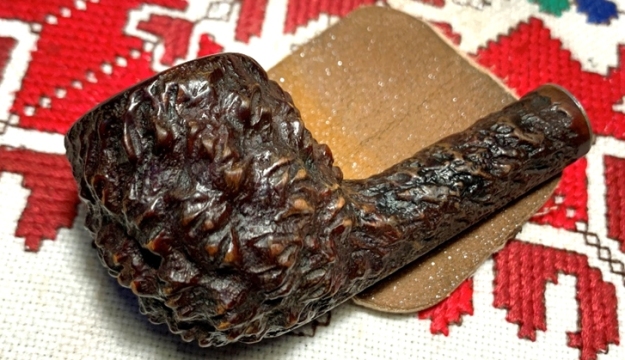
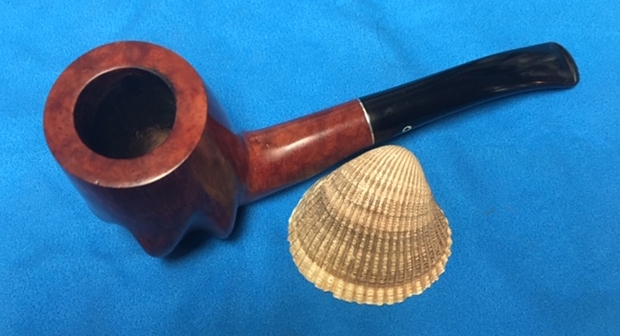
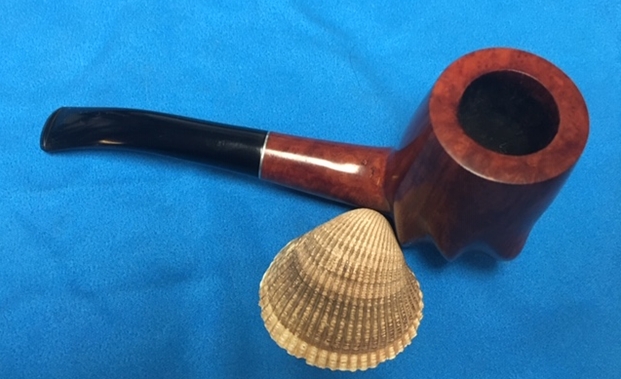
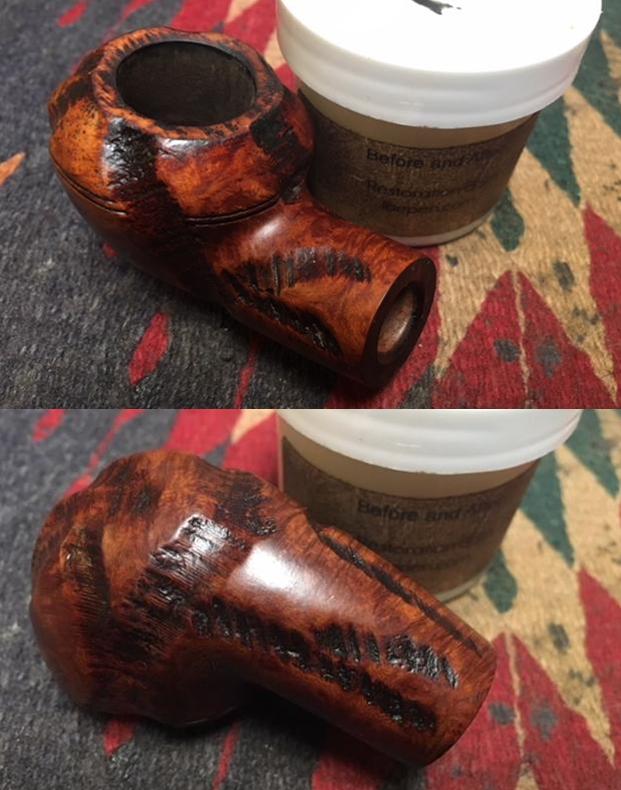
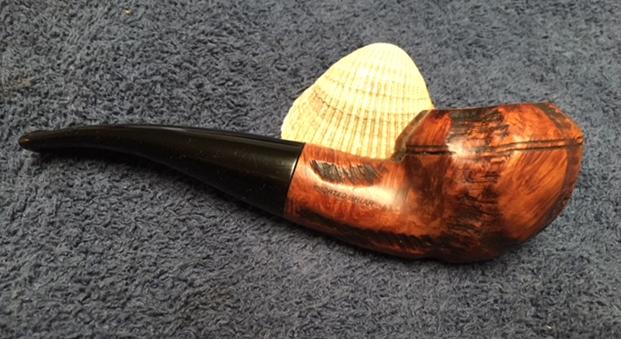
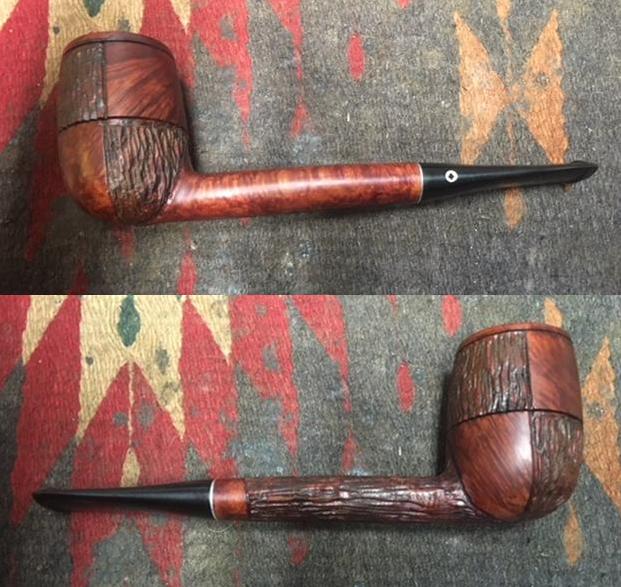
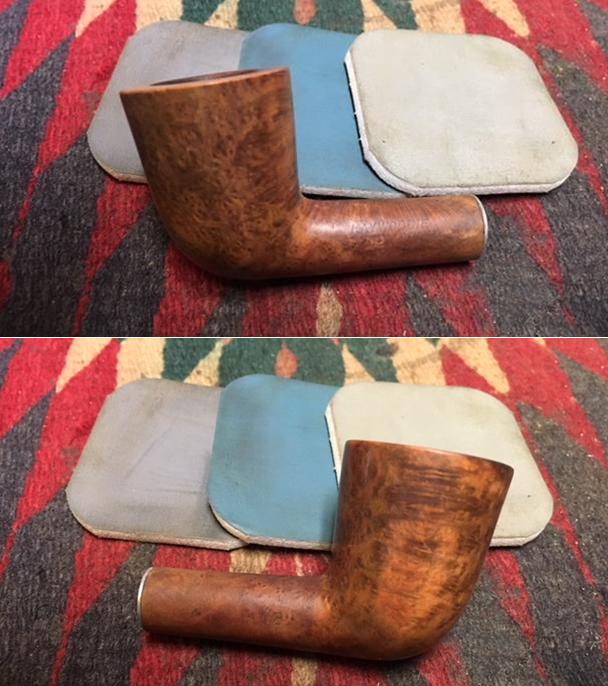
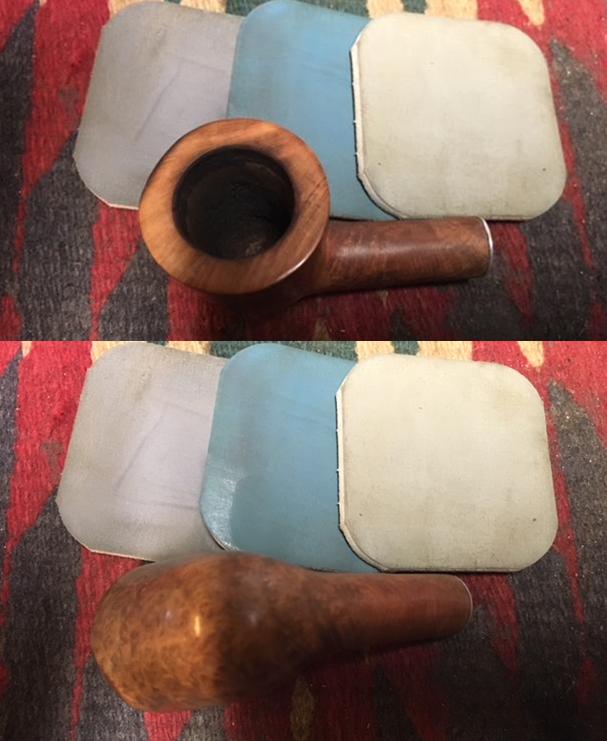
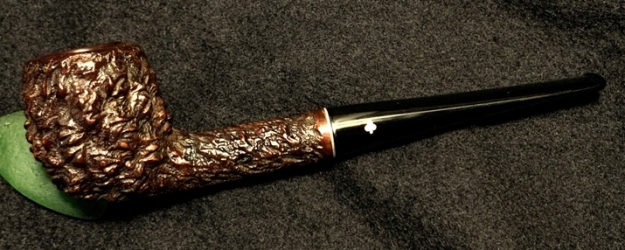
Wow!  I’m very pleased with how this Kaywoodie Natural Burl Apple shaped up.  The brown craggy finish is flecked with shade differences that give it a depth and warmth – a rustic knobby feel.  I always enjoy the contrast nuances that the coalescing of rough and smooth briar creates. The smooth briar underside and shank ring alongside of the Burl texture is nice.  I’m amazed that this pipe occupied the lower shelf on Kaywoodie’s offerings back in the day when Sam chose it and added it to his rotation of pipes.  The TLC it has received has enhanced the briar presentation with this unique Natural Burl finish. I appreciate the collaborative help from Bill Feurbach who even as the president of the S.M. Frank Co., was not hindered from helping with the recommissioning of this one vintage Kaywoodie – a pipe man at heart.  Thanks, Bill!  I like the Natural Burl a lot and I trust that Joe likes it too.  Paw’s Kaywoodie Natural Burl 33 – Large Apple, that was put into production in the mid-50s/early 60s, is a venerable 60-year-old(!), and is starting a new lifetime in the loving care and stewardship of Paw’s family.  Adding frosting to the Kaywoodie cake, Joe’s commissioning of this restoration of Paw’s Natural Burl also benefits the Daughters of Bulgaria – women and girls who have been trafficked and sexually exploited.  Thanks for joining me!
Cleaning up an English Made Kaywoodie Air-way 707 Diplomat


Blog by Steve Laug

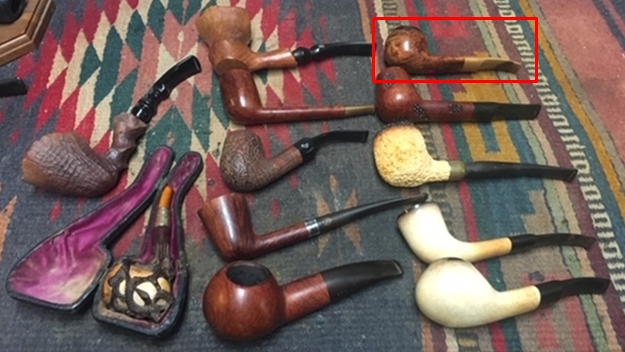
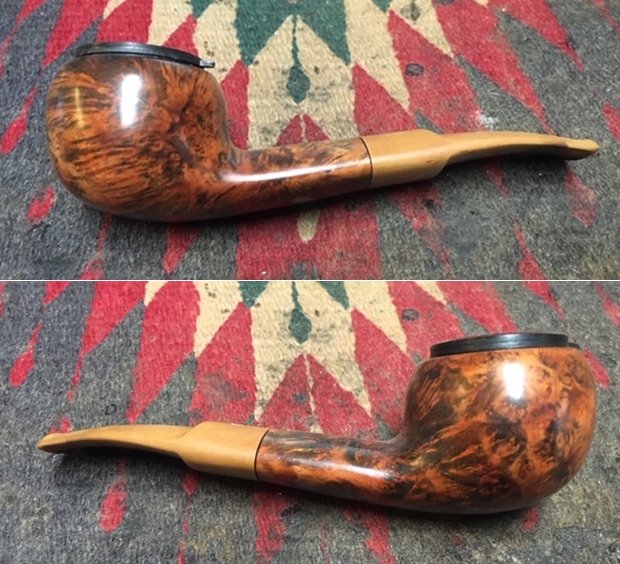
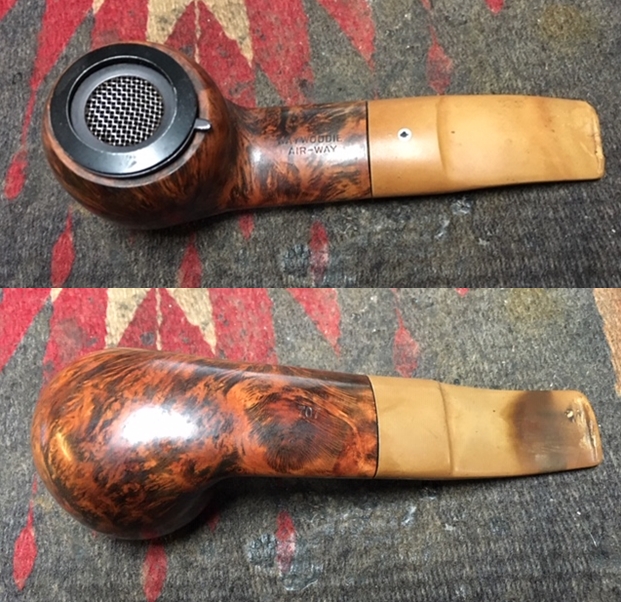
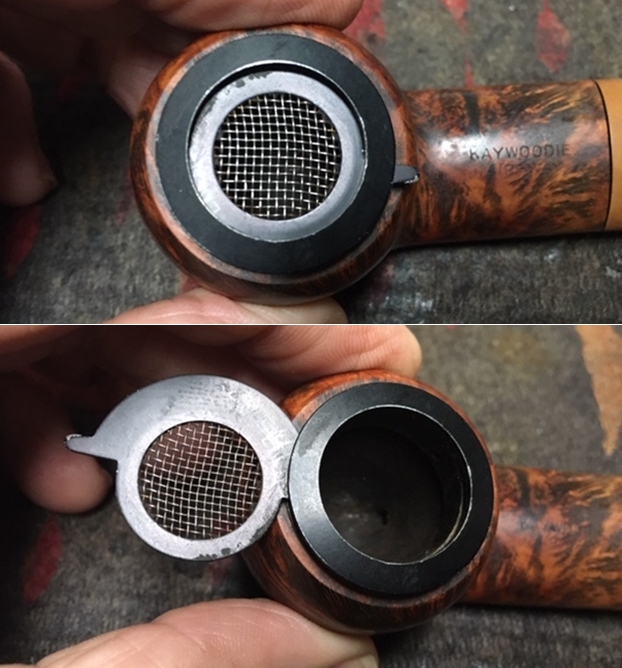
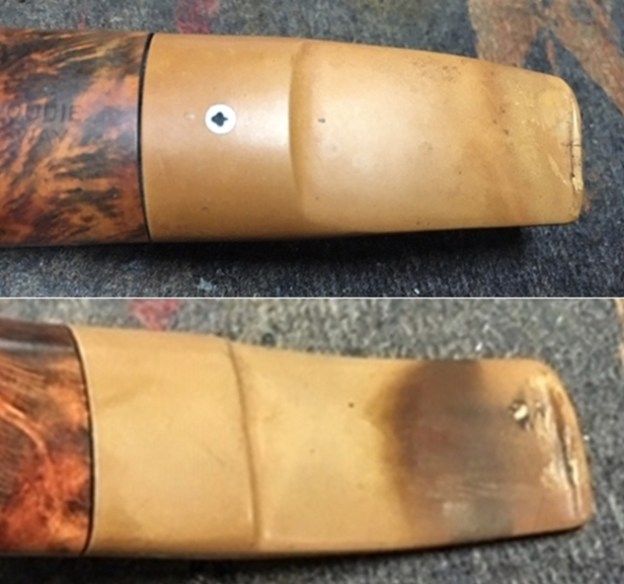
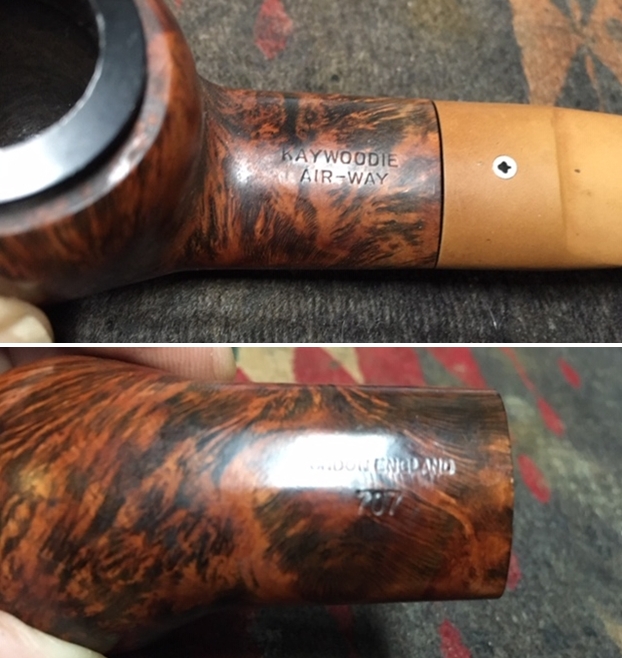
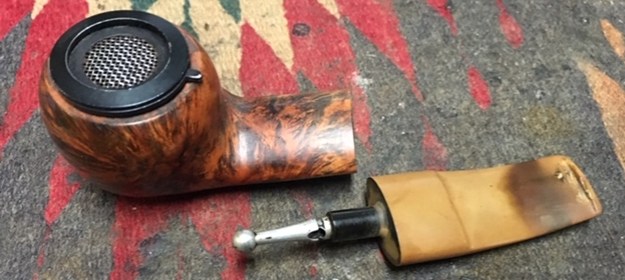
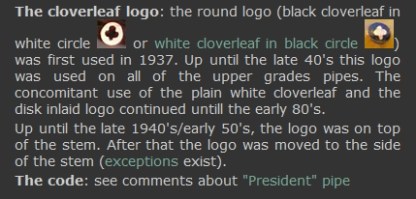
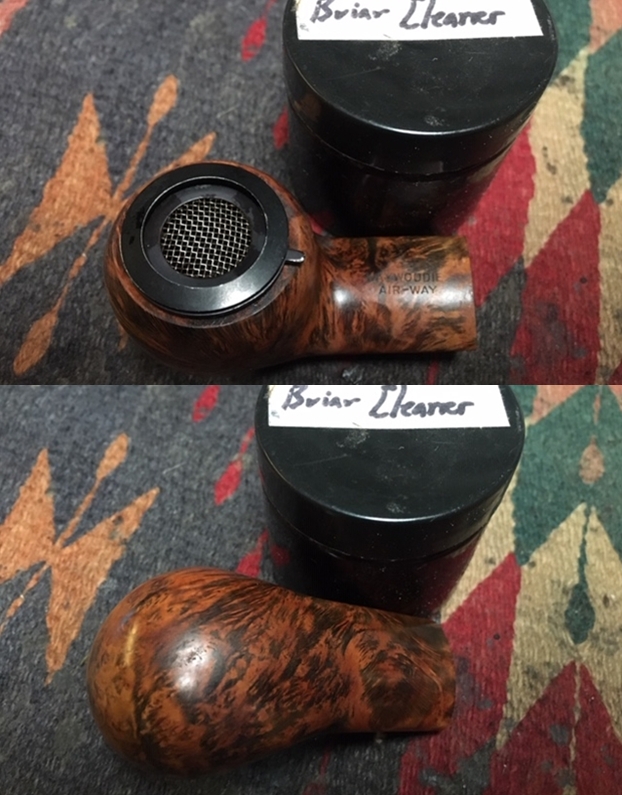
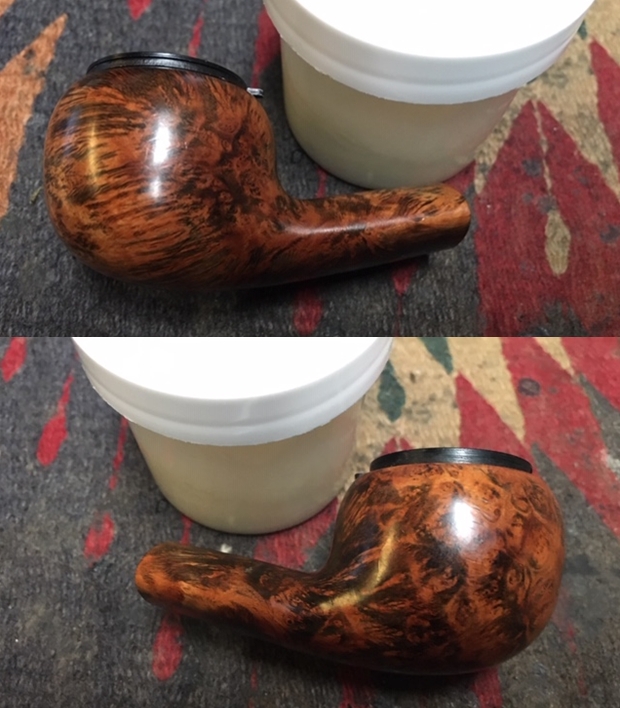
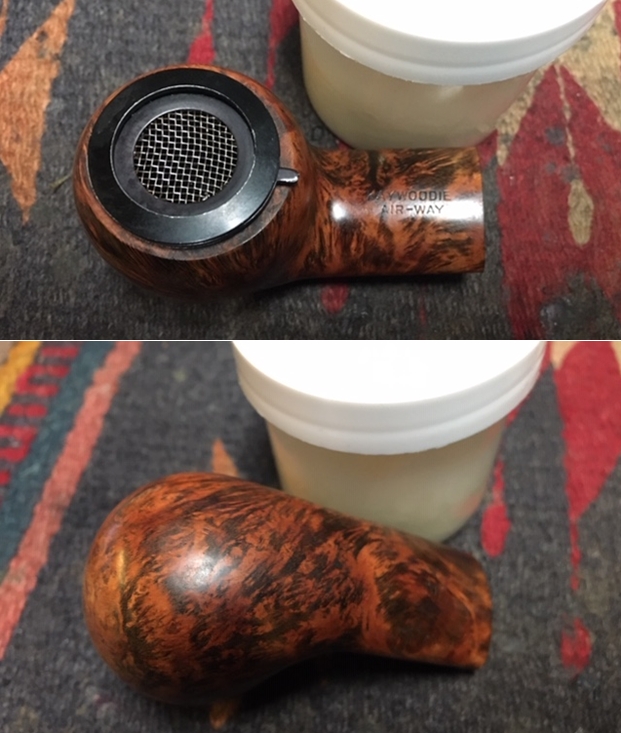
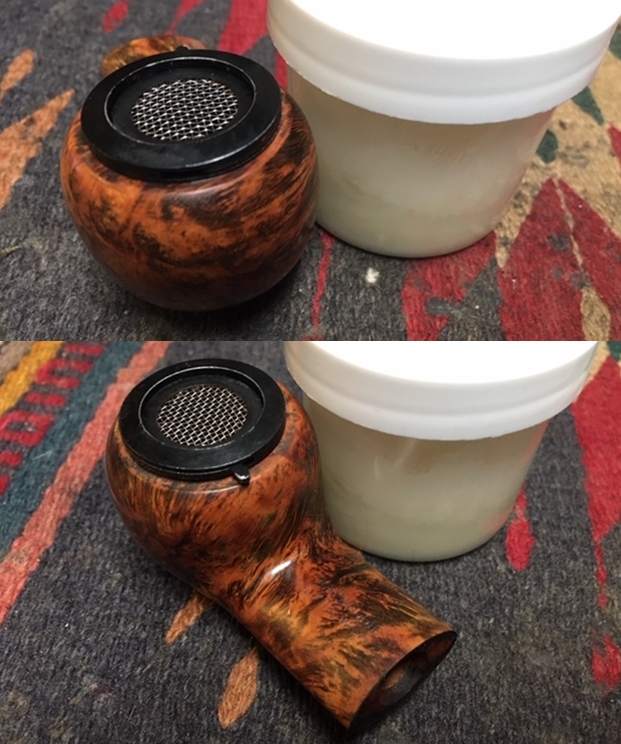
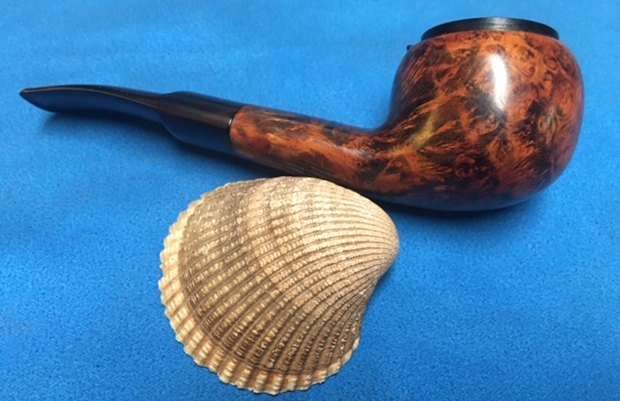
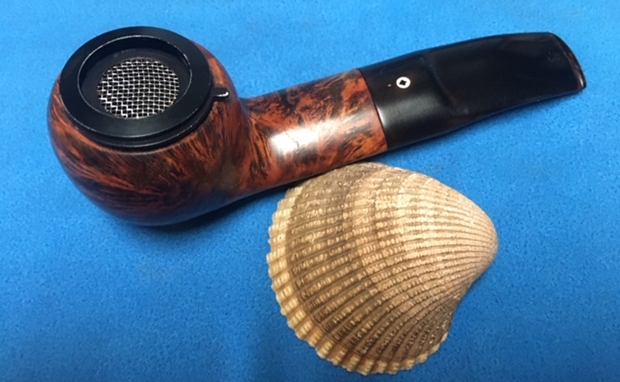
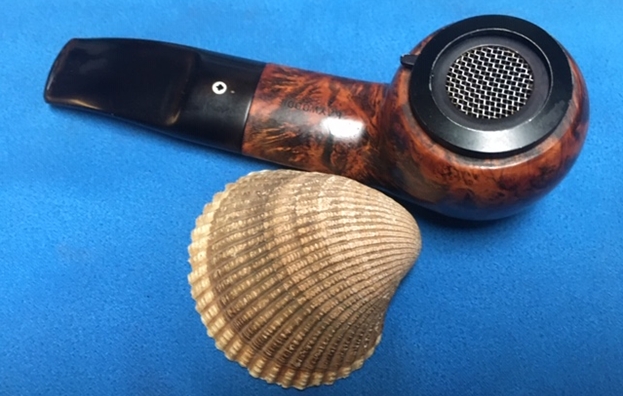
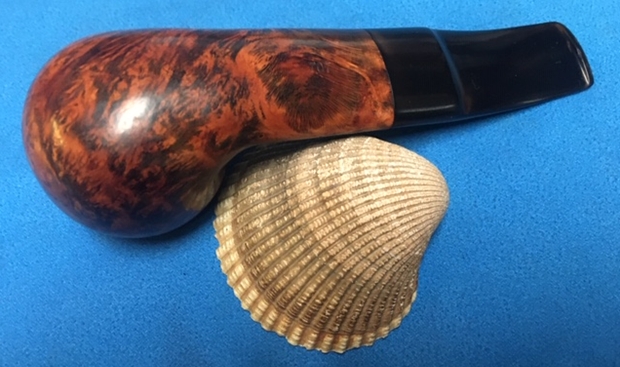
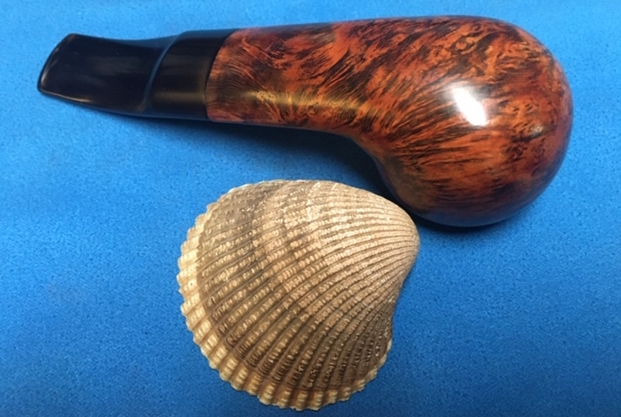
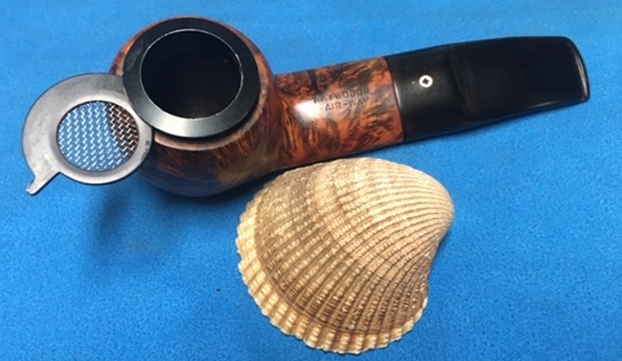
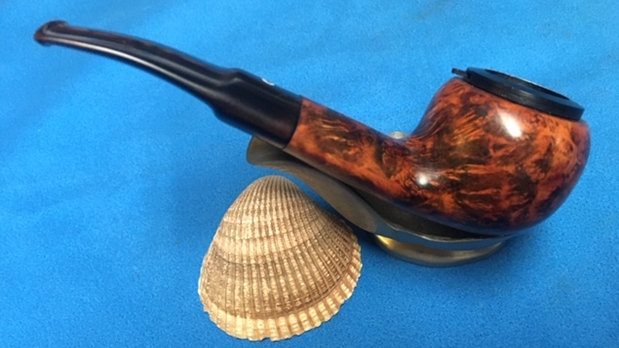
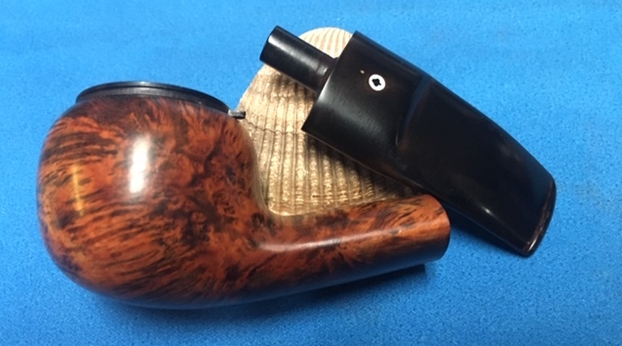
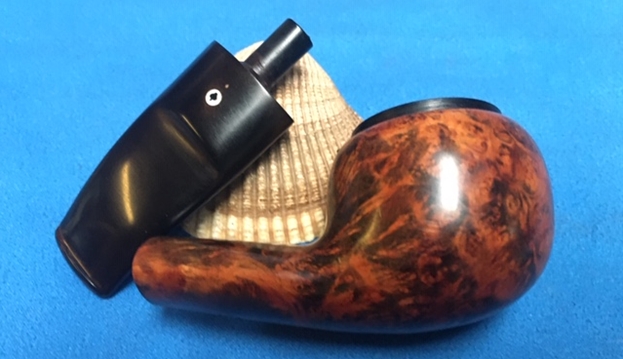
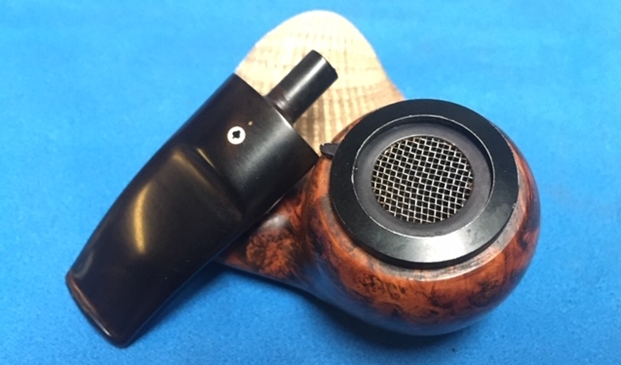
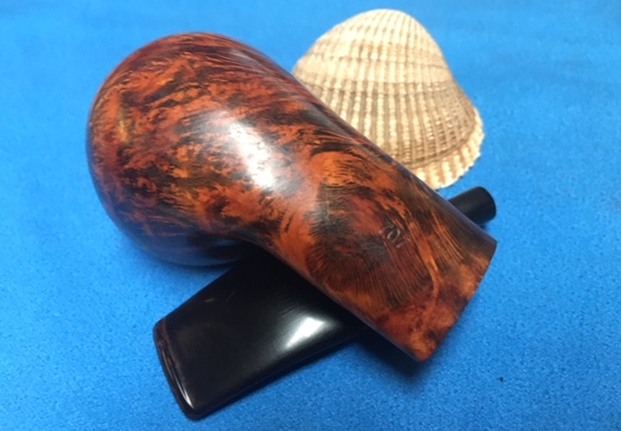
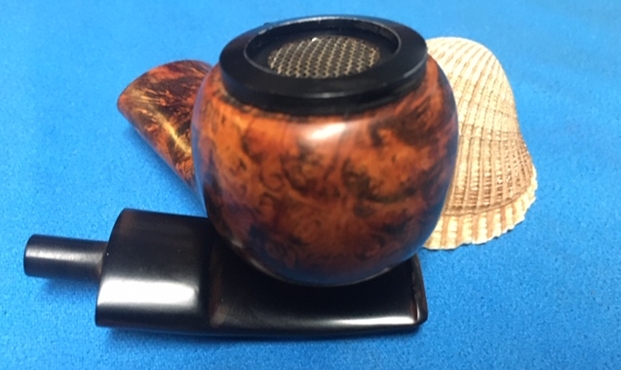
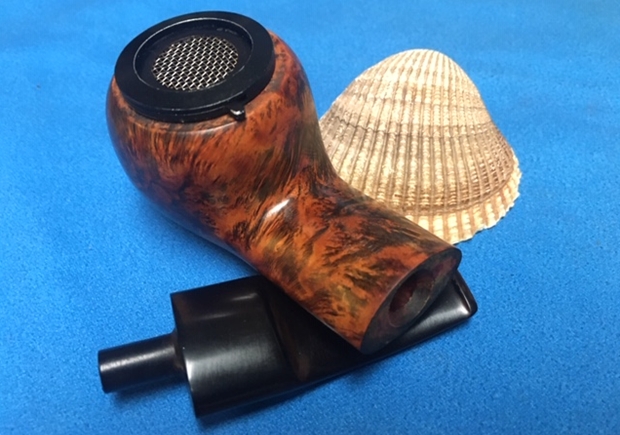
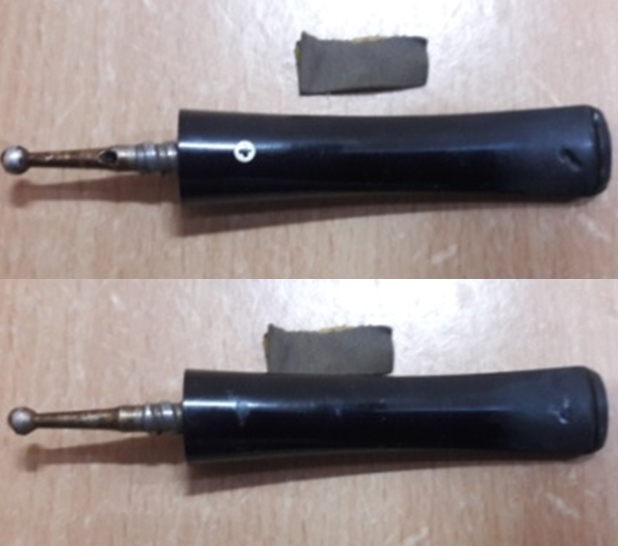
On our recent trip to Alberta we picked up quite a few pipes that were really nice. Some of them were brands we were familiar with and some were pipes that were unknown and unidentifiable. But if you are a pipe hunter you know the feeling when you are holding a particular pipe, no matter what the brand and it just speaks to you. That is what happened with this next pipe. It was in a display case at an antique mall in Edmonton. The shape of the pipe, the wind cap that was an integral part of the rim top and the interesting staining that highlighted some unique grain called my name. The stamping on the top of the shank read Kaywoodie over Air-way and on the underside it was stamped London, England and the shape number 707. It was a shape I had not seen before and the wind cap mechanism was a new one for me as well. The fact that it was an English made Kaywoodie also insure that it was going home with me. I have drawn a red box around the pipe at the top of the column on the right.The grain under the dirty finish was unique and the finish was interesting. The diplomat shape is one that I enjoy smoking and it has a good feel in the hand. The rim top was truly unique. The wind cap was fascinated on the rim top and the screen can be swiveled to the left to open the bowl. The bowl itself had a think cake in the bowl and the inside of the bowl and rim edges looked very good. The finish was dirty but still in good condition under the grime. The vulcanite stem was so heavily oxidized that it was butterscotch colour. It had some tooth marks and chatter on both sides near the button. There were some small cracks and the slot was slightly collapsed on the left side. The Kaywoodie club logo on the top of the saddle stem was a white circle with a black club inside. I took close up photos of the wind screen mechanism on the rim top with it open and closed to show how it worked. You can see the condition of the bowl in the second photo below.I took photos of the stem showing the deep oxidation and tooth chatter on both sides near the button. You can also see the small cracks on the top side of the button. It is thin so it easily was chipped and cracked when clenched.I took some photos of the stamping on the shank. The first photo shows the Kaywoodie Air-Way stamp and the white circle/black club insert on the stem top. The second photo shows the London, England and shape number 707 on the underside of the shank.I took a closer look at the inside of the bowl and took a photo. It was dirty but very lightly caked.I took a photo of the pipe with the push stem removed from the shank. The stinger was different from the usual Kaywoodie stinger. It had a ball on the end of the stinger but no holes in it. There was a ring around the stinger just above the tenon insert and a slotted hole. Before doing cleanup work on the pipe I decided to do some research on the pipe. I looked first on the Pipephil website and found some information on the white circle/black club stamp on the top of the stem. I did a screen capture of the pertinent information on the logo itself (http://www.pipephil.eu/logos/en/logo-kaywoodie.html). From there I learned that the logo was used first in 1937 and up until the late 1940s for the higher grade pipes. Also until the late 40s early 50s the logo was on top of the stem.

There was no other information on the Air-way line on the site and nothing under the section on the London/British made Kaywoodie pipes. That meant I would need to turn elsewhere to find that information. This would be an interesting hunt and restoration.

I turned to Pipedia (https://pipedia.org/wiki/Kaywoodie) and read the section on the rough outline on the history of the brand that links the brand with the English section of the company. I quote:

Again, demand for KBB pipes and especially Kaywoodie prompted another move for both the manufacturing facilities and the corporate offices. In 1930 the corporate office moved into the Empire State Building on Fifth Avenue in New York. By 1935, the manufacturing operations moved from Union City to 6400 Broadway in West New York, New Jersey which, at the time, was touted as the largest pipe making facility in the world. At the height of production, there were 500 employees producing up to 10,000 pipes per day.

The corporate offices were relocated in 1936 to the International Building, Rockefeller Center, 630 Fifth Avenue, New York. The invitation to visit the new office reads, “Kaywoodie is now on display at the world’s most famous address – Rockefeller Center. Here Kaywoodie takes its place among the leaders of industry and commerce.” The move to Rockefeller Center coincided with The Kaywoodie Company’s emergence as a subsidiary of KBB. All of the pipes manufactured by KBB including the Yello-Bole line were also on display here. By 1938 Kaywoodie had opened an office in London to meet worldwide demand. Kaywoodie of London was jointly owned with another famous pipemaker, Comoy’s of London.

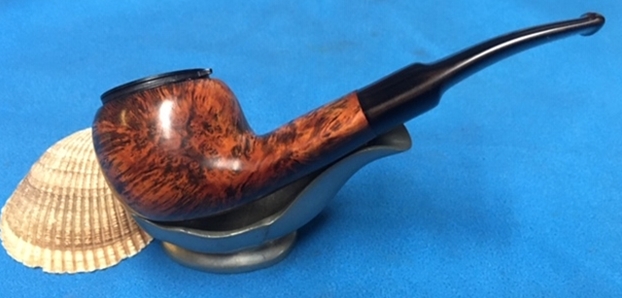
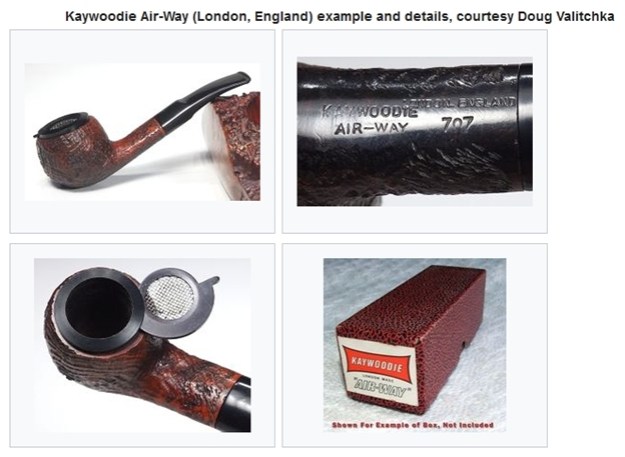
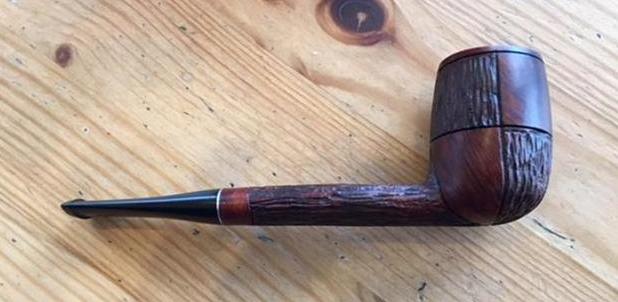
I am also including a screen capture of a picture of a pipe that is the same shape as the one that I am working on. Thanks to Doug Valitchka for the photo.From there I turned to a link on the article to a section called Guide to Kaywoodie Pipes (https://pipedia.org/wiki/Collector%27s_Guide_to_Kaywoodie_Pipes#NOTES_ON_.22OTHER.E2.80.9D_KAYWOODIE_PIPES).  It gave some pertinent information on the Air-way line. I quote two sections from that article below. I have highlighted the Air-way brand name in the second paragraph.

English Kaywoodies. All of the catalogs reviewed in this research contained the following copyright notification: Printed in U.S.A., Kaufmann Bros. and Bondy, Inc., New York and London. Kaywoodie Pipe cases and smoker’s accessories were also marked with “New York and London”. The catalogs, however, do not present any information concerning Kaywoodie’s London operations, or how the English Kaywoodies might have differed from those manufactured and marketed in the U.S. Lowndes notes that he has several English Kaywoodies acquired in

Vaduz and Zurich. English Kaywoodies are now made by Oppenheimer pipes. Lowndes notes that English Kaywoodies with the “screw-in bit” come in Ruby Grain, Custom Grain, Standard, and Relief Grain grades. The traditional push-bit models come in Continental Plain and Relief, London Made, Minaret, Air-way Polished No. 707, and Lightweight grades. Prices in 1985 ranged from 9.50 (pounds) to 26.00 (pounds). Lowndes notes that the Super Star was a special edition English Kaywoodie made of finest briar with a handmade silver band. Lowndes has two: one from Zurich with a large white-outlined logo, and beautifully cased; and one in walnut finish with the black-­in-white logo. A recent catalog shows the Super Star without a band and the ordinary small white logo. A 1985 letter from Oppenheimer states that the black-in-white logo has been discontinued and only the regular white logo is now used.

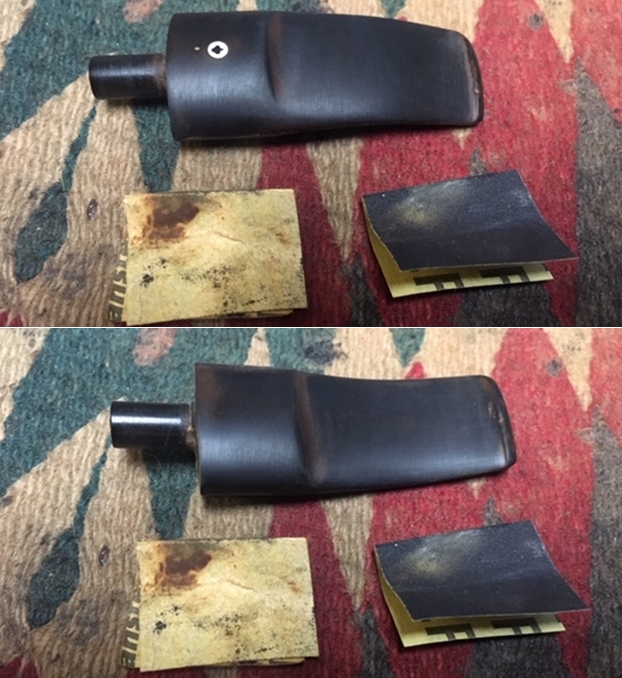
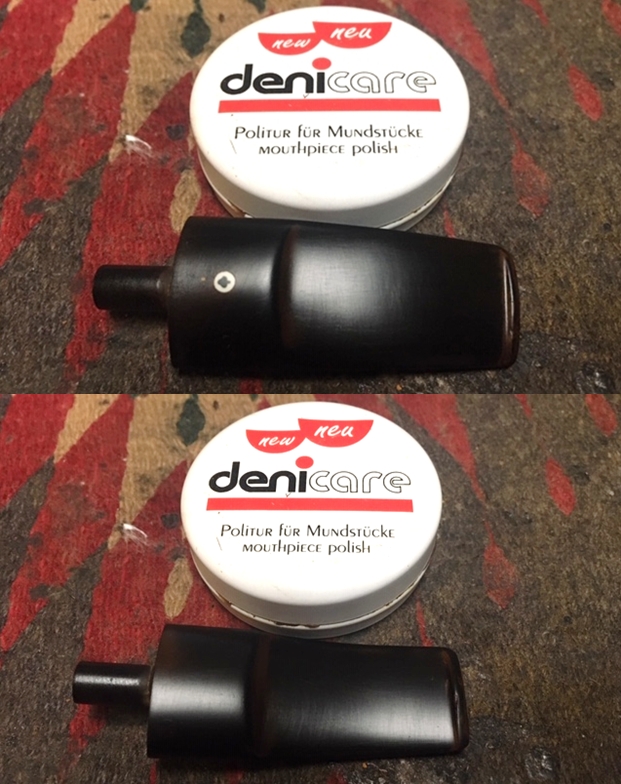
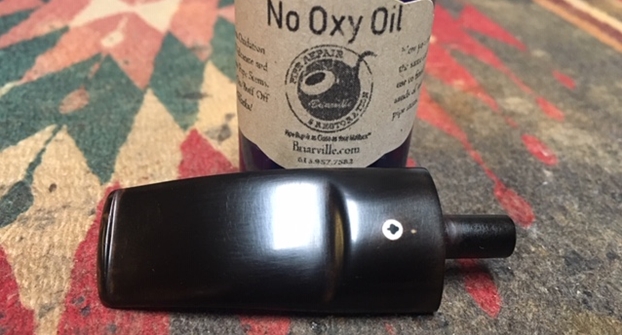
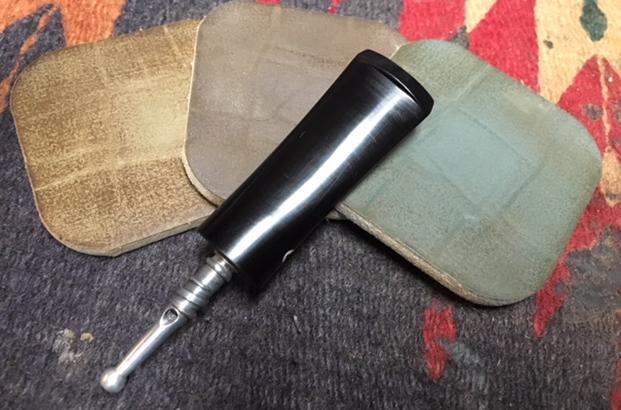
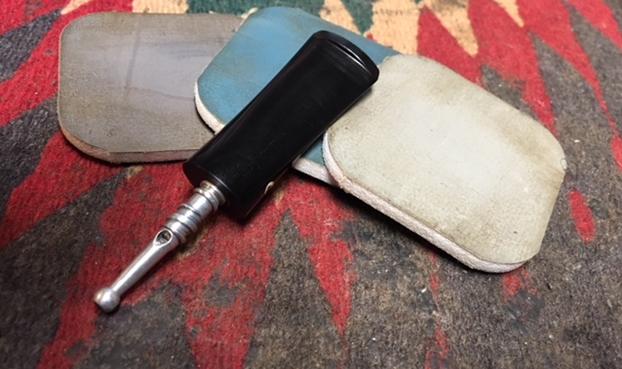
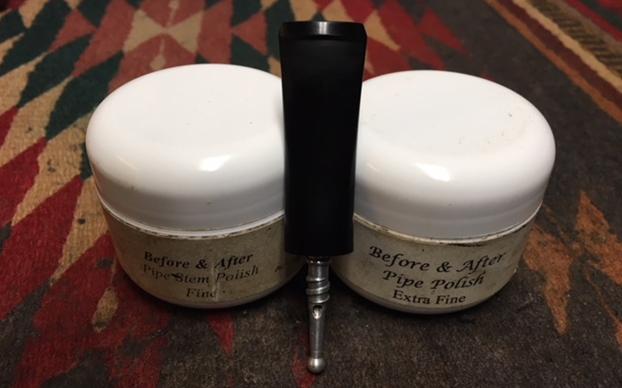
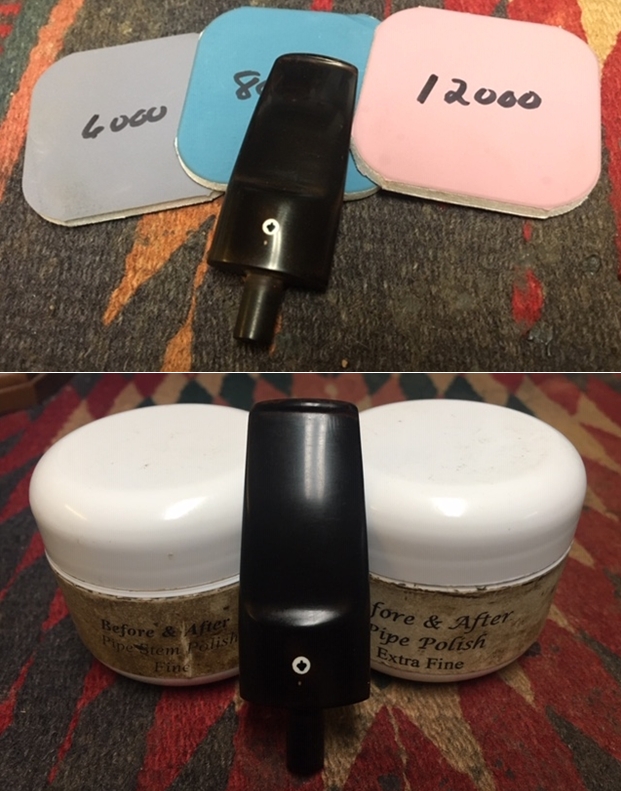
From that information I now knew that the pipe in hand was made prior to 1985 in London by Oppenheimer. It had a traditional push-bit rather than the threaded screw in bit. After 1985 Oppenheimer discontinued the black in white logo. It was time to work on the pipe now. I scraped the shank with a pen knife to remove the tarry buildup that did not allow the stem to seat properly. I cleaned out the mortise and the airway in the shank and the stem with alcohol, cotton swabs and pipe cleaners. I took some close up photos of the cleaned button and slot to show how it had a crack and had been collapsed slightly on the left side of the top.I scrubbed the exterior of the bowl with Before & After Briar Cleaner. I worked it into the surface of the briar with my finger tips and let it sit for a short time to absorb the grime. I rinsed it down under warm water to remove the grime debris that was collected in the cleaner. At the same time I used a tooth brush to scrub out the inside of the bowl and rinsed it. I dried the bowl off with a soft cotton cloth and lightly polished it. I worked some Before and After Restoration Balm into the surface of the briar. I rubbed it into the briar to restore, preserve and polish the briar. I let it sit on the bowl for about 10 minutes and buffed it off with cotton cloth. It was getting late so I set the polished bowl aside for the night and put the stem into a bath of Before & After Pipe Stem Deoxidizer to soak overnight. In the morning I would take it out and start working on the stem.I took it out of the bath in the morning and wiped it down with a microfiber cloth. Much of the oxidation on the surface came off. I used a Scotch Brite pad to scrub off the oxidation. You can see from the photos that some still remained.I put it back in the bath overnight again to see what would happen. When I took it out it looked better but there was still a lot of work to do with it.I decided to address the damaged button on the top edge. The top edge of the button had collapsed partially into the slot. There were small cracks on the surface. I have used clear super glue in the past to address this but I had an idea for an experiment. I heated the blade of a dental spatula and inserted it into the slot. I repeated the process several times until I had the slot opened and lined up. I touched the heated blade to the cracks on the top of the button and stem and to the tooth mark on the underside. The tooth marks disappeared and the cracks were sealed with the heat welding the pieces together. Whereas before the repair I could not insert a pipe cleaner, I now could slide it in and out with ease.I sanded the stem surface with 220 grit sandpaper to remove the oxidation and tooth chatter. I started polishing it with 400 grit sandpaper to remove the scratches.I polished the stem surface with Denicare Mouthpiece Polish to polish out the scratches left behind by the sandpaper. It also works well to remove stubborn oxidation in the saddle and along the edge of the button. It worked really well to remove the oxidation and leave the stem looking far better.I polished out the remaining scratches in the stem material with micromesh sanding pads. I wet sanded with 1500-12000 grit sanding pads. I wiped down the stem after each pad with some Obsidian Oil. Once I used the last pad – 12000 grit – I polished the stem with Before & After Pipe Stem Polish, both Fine and Extra Fine. I used a new product I am trying for Briarville called No Oxy Oil to give the stem a final wipe down and polish. I put the stem back on the pipe and polished both pipe and stem with Blue Diamond on the buffing wheel. I avoided the wind screen with the buffing wheel. I gave the pipe several coats of Carnauba Wax and buffed it with a clean buffing pad to raise a shine. I hand buffed it with a soft cotton cloth to deepen the shine. The finished pipe is shown in the photos below. The original stain looks really good and the polishing brought the grain back to life. The contrasting rich brown finish highlight the grain and contrasts well with the black vulcanite stem. The Air-way Diplomat is a beautiful pipe that really has the look of an English made pipe. The tie to Oppenheimer is clear in looking at the shape of the pipe and the finish. The black metal wind screen with the flip screen cover is unique and seems very functional. The dimensions of the pipe are – Length: 4 ¾ inches, Height: 1 ½ inches, Outside diameter of the bowl: 1 ½ inches, Chamber diameter: ¾ of an inch. I left the stinger out of the shank because I plan keeping this unique English made Kaywoodie for my own collection. It tics all the boxes for me – shape, finish, grain, etc.  I am looking forward to loading a bowl in it and enjoying a great smoke. I will carry on the legacy! Thanks for reading the blog.


New Life for a Pair of Kaywoodie Bamboo Shank Mandarins


Blog by Steve Laug

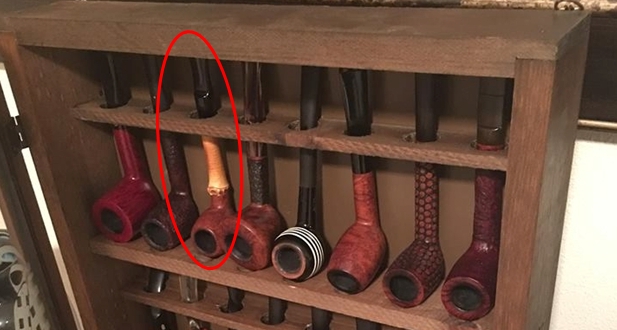
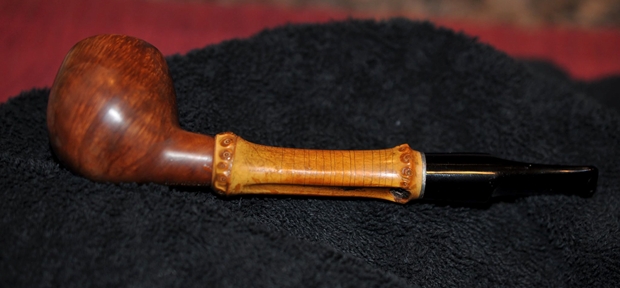
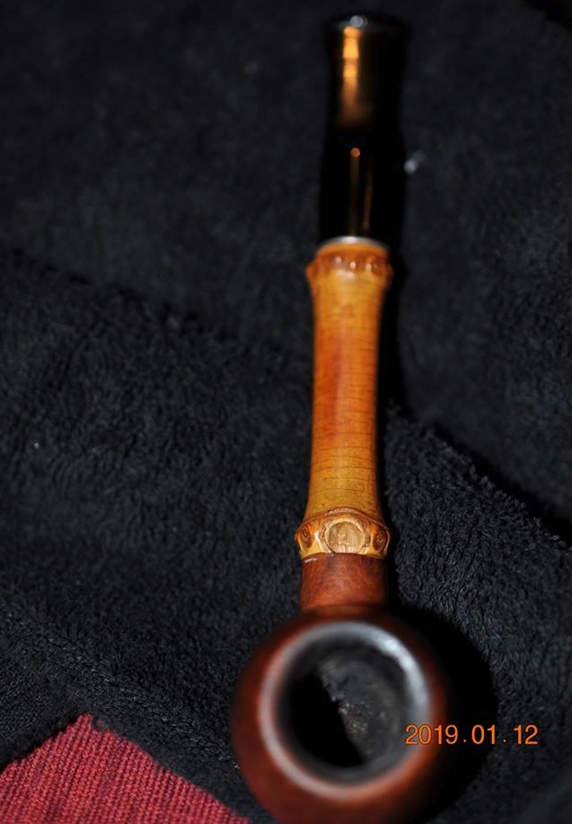
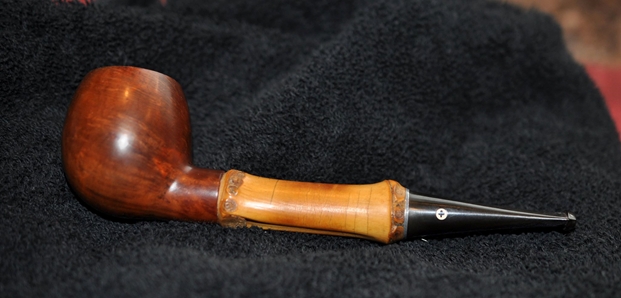
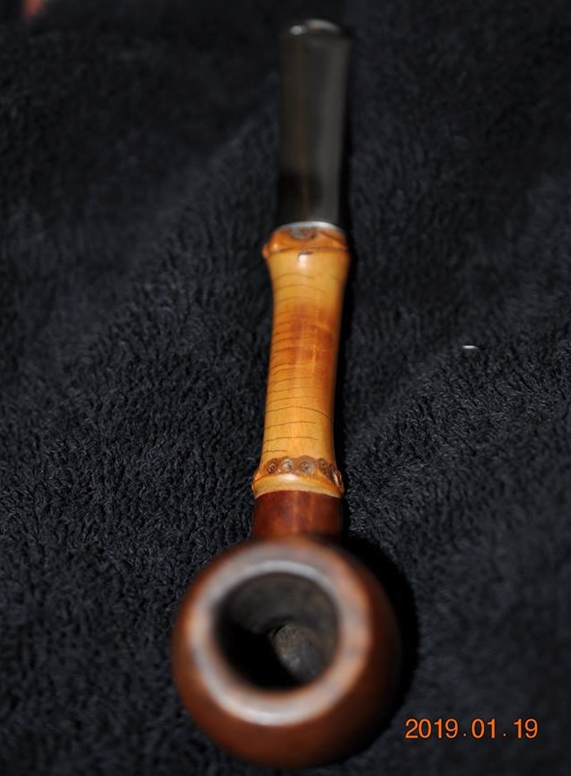
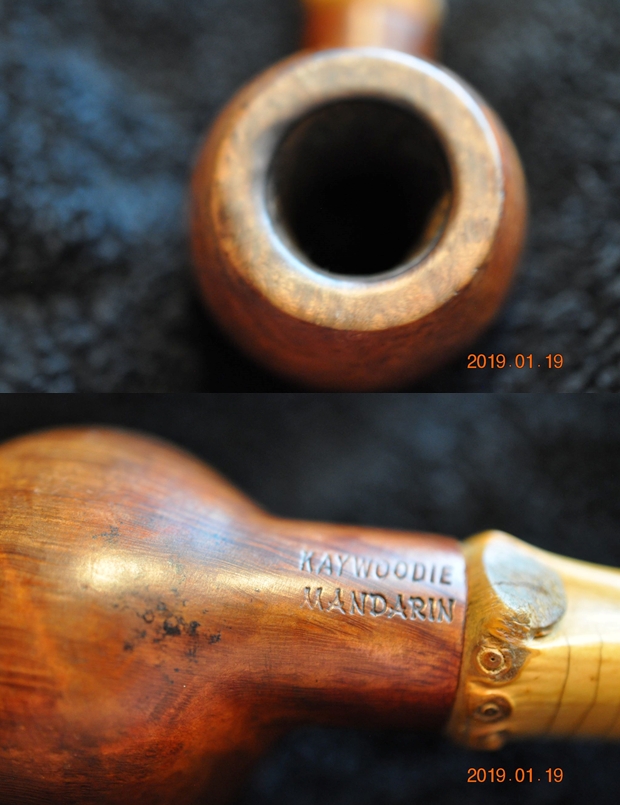
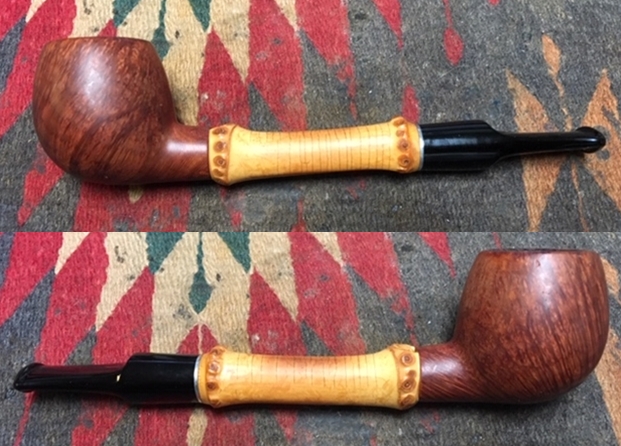
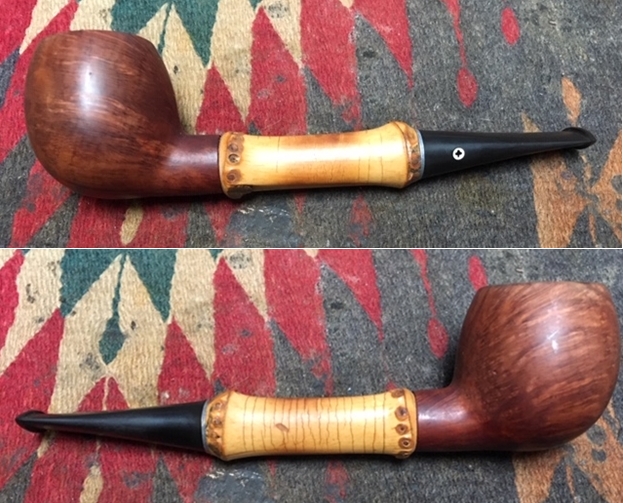
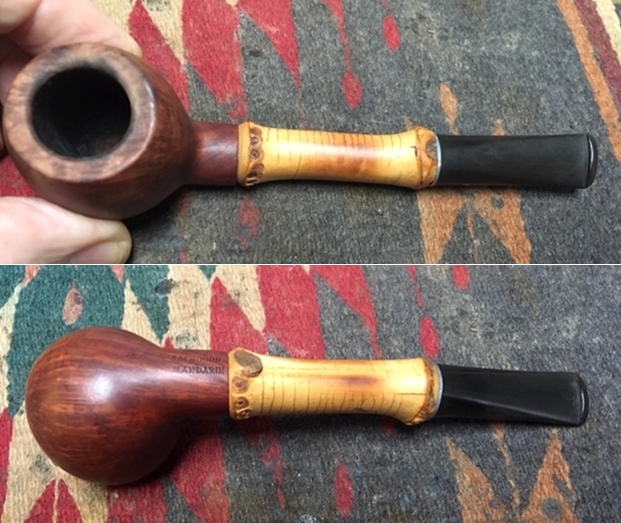
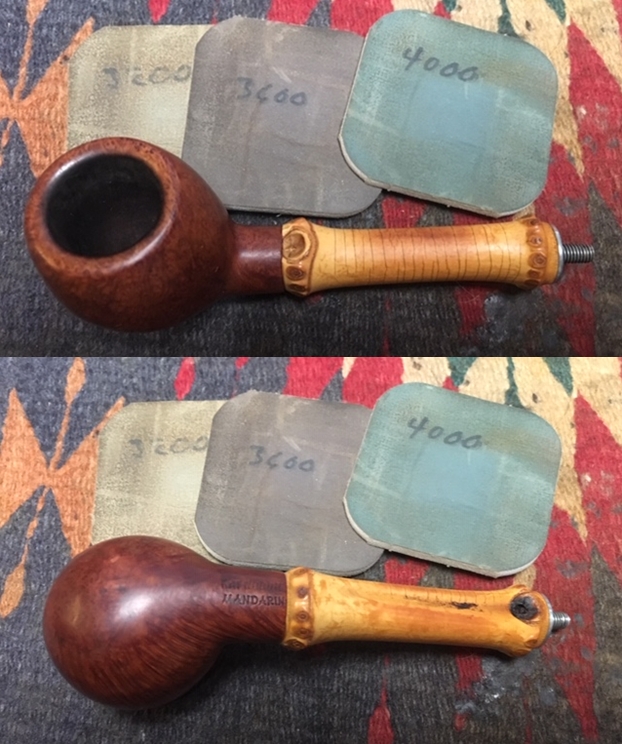
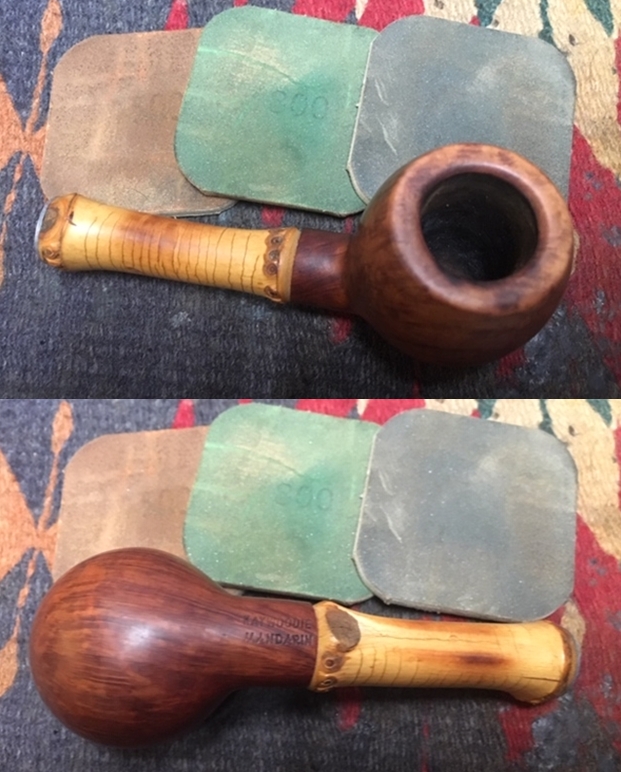
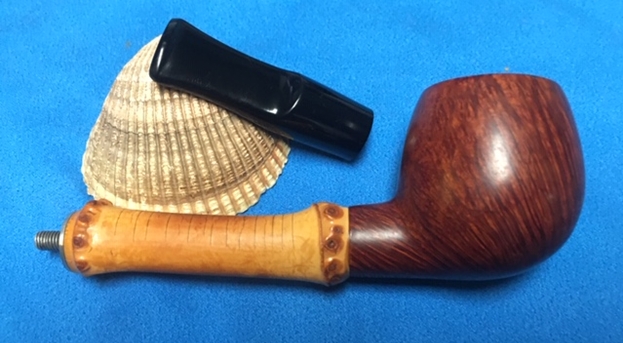
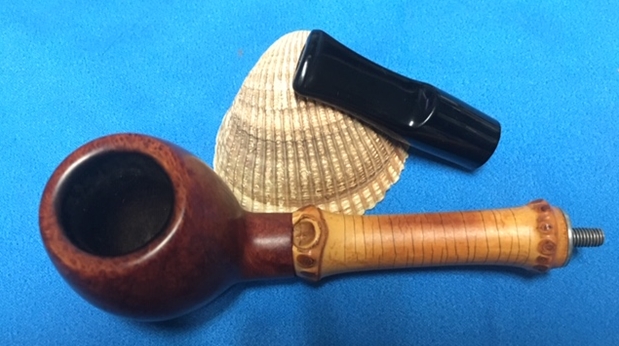
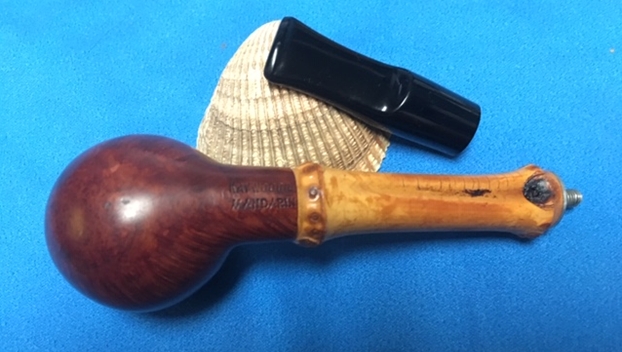
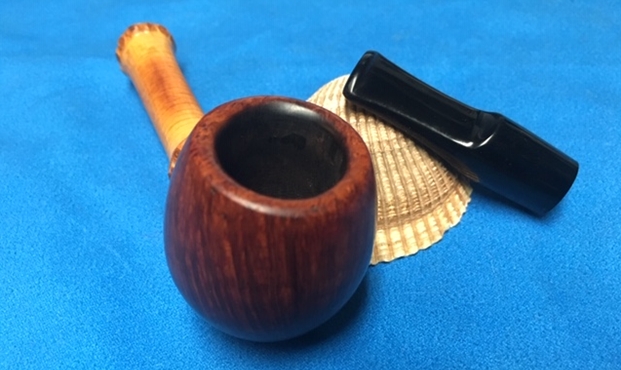
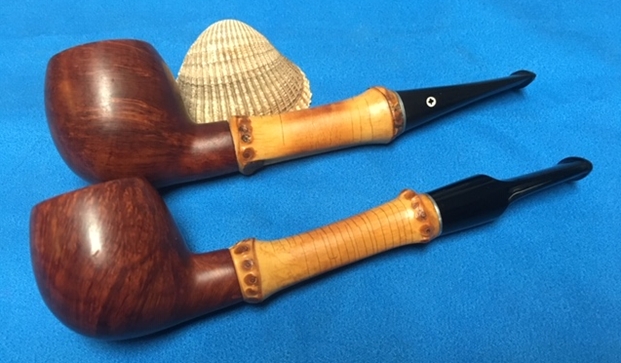
The next pair of pipes on the work table is another relatively new acquisition. The Mandarin with the acrylic stem comes from a collection Jeff and I purchased from Michigan. It included a pipe cabinet and 21 pipes that is pictured below. The second one came from a friend of Jeff’s who is always on the lookout for pipe he thinks we might be interested in the New York area. This one has the original stem. I have circled the first Mandarin in the photo below – third pipe from the left on the first shelf of the rack.In the last box Jeff sent me he included both of these pipes. Both have the bamboo shank, both have an apple shaped bowl. Both are stamped Kaywoodie Mandarin on the underside of the bowl. Both had threaded stems and a metal space at the end of the shank. The first pipe from the rack above had a thinner diameter bamboo shank while the second was thicker – both were two knuckle bamboo pieces. The first pipe had a black acrylic replacement stem with a saddle while the second one had the original tapered stem with the Kaywoodie Club in a white circle on the left side of the stem.

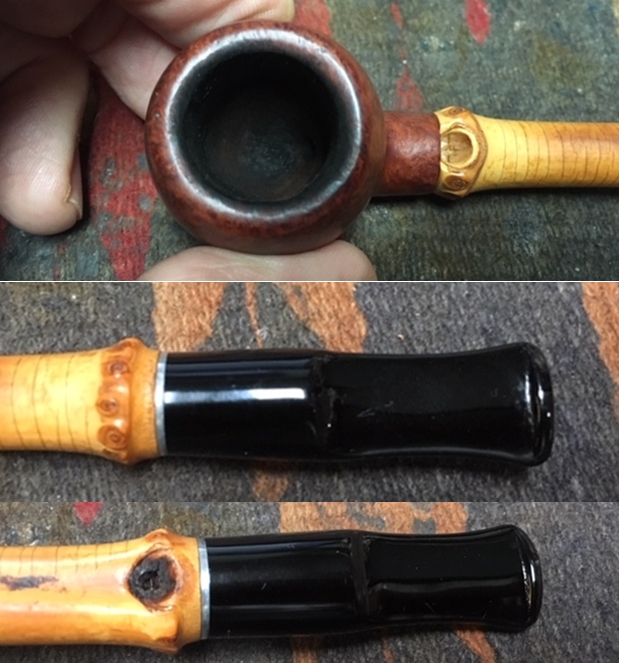
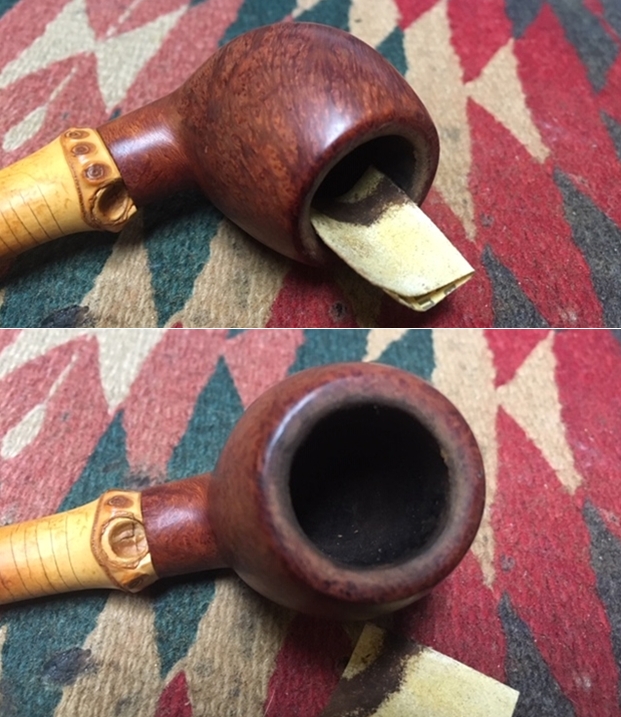
Both pipes were quite dirty which seems to be the case when working on pipes that were obviously someone’s favourite.  Jeff took photos of both pipes before his cleanup work. The first pipe from the Michigan collection is shown first. There was a thick cake in the bowl and lava overflowing onto the rim top. The inner and outer edges of the bowl looked very good. The stem had some tooth marks and chatter on both sides near the button and some tooth damage to the sharp edge and top of the button. The photos below show the first pipe. The next photo shows a close up of the bowl. You can see the thick cake in the bowl and the overflow of lava on the rim top. He also took photos of the bottom of the bowl to highlight the condition of the pipe. It had some great grain all around the bowl and some nicks. It was a dirty pipe and obviously well smoked. The bamboo shank extension had a nice patina and a crackle like look that had developed as the pipe was smoked.  The next photo shows the stamping on the underside of the shank. It is quite clear and legible.  Jeff also took a photo of the shank and the fit of the replacement stem to the shank end. It is well done and the alignment is very good.The close up photos of the stem show the tooth marks in the surface near the button and the damage to the button itself on both sides. The tooth marks and chatter were repairable and the button could be reshaped.The pipe from the New York purchase is shown second. There was a thin cake in the bowl and very little lava on the rim top. The inner and outer edges of the bowl looked very good. The original Kaywoodie vulcanite stem had some light tooth marks and chatter on both sides near the button and some light wear on the sharp edge of the top and the bottom of the button. The photos below show the second pipe. The next photo shows a close up of the bowl. You can see the cake in the bowl and the light burn marks on the right side of the inner edge of the rim top.  The second photo below shows the stamping on the underside of the bowl – clear and readable Kaywoodie Mandarin.The Kaywoodie Club logo looks great and the fit of the stem to the metal spacer on the shank end is very good.He took close up photos of the stem top and bottom at the button. You can see the tooth chatter on both sides and the slight wear to the sharp edge of the button. Generally the stem is in very good condition.Jeff reamed both bowls with a PipNet pipe reamer and followed up with a Savinelli Fitsall pipe knife to remove the cake. He scrubbed out each mortise and the airway in the shanks and the stems with alcohol, cotton swabs and pipe cleaners. He scrubbed the exteriors of the bowl, rim, shank and stem with a tooth brush and Murphy’s Oil Soap to remove the oils and tars on the rim and the grime on the finish of the bowl of each pipe and bamboo shank. He rinsed them under running water. He dried them off with a soft cloth. He was able to remove most of the lava build up on the rim top of the first pipe and the little bit oon the second one. I took photos of the pipes to show its condition before I started my work on them. The first one is the Mandarin with the acrylic stem. Here are the photos of the second pipe. I took close up photos of the bowl and rim top as well as the stem on each of the pipes. You can see the condition of the rim top and bowl in the first photo of each pipe. Jeff was able to remove almost all of the tar and oils but there was darkening and damage on the inner surface of the rim on the first pipe and the surface and inner edge of the second pipe. The acrylic stem on the first pipe had tooth chatter and some tooth marks on the top and underside of the stem near and on the button surface. The vulcanite stem on the second pipe had some chatter but otherwise was in very good condition. The first set of photos show the first acrylic stem Mandarin. The second set shows the original vulcanite stem Mandarin.

The first pipe.The second pipe.I wanted to confirm a possible date for both of these pipes. I turned to Pipephil to see what he had to say about the brand (http://www.pipephil.eu/logos/en/logo-kaywoodie-2.html). I have included a screen capture of the listing on the site. It appears to have been made between 1958-1967.I turned next to Pipedia to check out the Kaywoodie Collector’s Guide to see if I could get some more information on the Mandarin line. I found an interest monograph there called Notes on Kaywoodies Introduced between 1955 and 1968. It included reference to the Mandarin line. I include that in part below (https://pipedia.org/wiki/Collector%27s_Guide_to_Kaywoodie_Pipes). I have highlighted and underlined the Mandarin in the list below. Both of the pipes I am working on are the smooth versions.

NOTES ON KAYWOODIES INTRODUCED BETWEEN 1955 AND 1968

The material presented in this monograph is extracted from 1936, 1947, 1955, 1968-69, and four undated Kaywoodie catalogs. Based on a comparison of prices in the 1955 and 1968-69 catalogs, the four undated catalogs appear to span the period from the late 1950’s to the late 1960’s (i.e., after 1955 but before 1968). This section presents a brief summary of the Kaywoodie Pipes that appeared in these undated catalogs, but did not appear in either the 1955 or 1968-69 catalogs…

Here is a list of pipes from this time period.

…Hi-Bowl. Tall, tapered bowl in six shapes (see Table 5). Available in smooth or “rough” finish ($10).

Mandarin. Smooth or relief grain finish with burnished-bamboo shank ($10).

Setter. No shank, just a ridged hole for a slender, filter-free, push-bit. Available in “flat bottom” (hence, “Setter”) panel, billiard, and poker shapes. Smooth or textured finish ($10).

Tuckaway. The 1955 catalog shows a Drinkless Tuckaway that was simply a smaller version of other Kaywoodie styles. The Tuckaways of the 1955-1968 period had military mountings, filter-free see-thru bits, and were packaged in a leatherette case. Available in Standard, Relief Grain, and Super Grain grades ($6-$8, depending on grade). Miniatures. Two-inch miniature replicas of “their big brother”, complete with the Drinkless fitment and Synchro Stem. The catalogs show these as individually-cased pipes but multiple pipe sets were apparently available. Price: $5.

Miniatures. Two-inch miniature replicas of “their big brother”, complete with the Drinkless fitment and Synchro Stem. The catalogs show these as individually-cased pipes but multiple pipe sets were apparently available. Price: $5.

Colossal Super Grains. Available in three “oversize” shapes (see Section 3.2) in hand-carved or smooth finishes ($5).

Now I knew that both pipes came from this time period. They were made between 1955-1968. Somewhere along the way the first pipe had been repaired and given an acrylic stem (this was the Michigan pipe). The other pipe from the NY connection had the original stem and threaded tenon though the stinger apparatus had been clipped off.

I started by working on the rim top of both pipes. The first pipe had a more classic apple shaped rim that came to a rounded top curved into the bowl. The second one had a flat rim top that I suppose could have come from a restoration sometime in its life but I could not be sure of that.

To smooth out the damage on the rim of the first pipe I sanded out the burn damage and the nicks with a folded piece of 220 grit sandpaper. I sanded the inner edge of the rim and the rounded top to remove the damage.On the second pipe I used a folded piece of 220 grit sandpaper to give the inner edge of the rim a slight bevel to remove the burn marks and smooth out the rim top and outer edge.I polished the bowls and the rim top on both pipes with micromesh sanding pads – wet sanding with 1500-2400 grit pads and dry sanding with 3200-12000 grit pads. I wiped the surface down after each sanding pad with a damp cotton cloth.

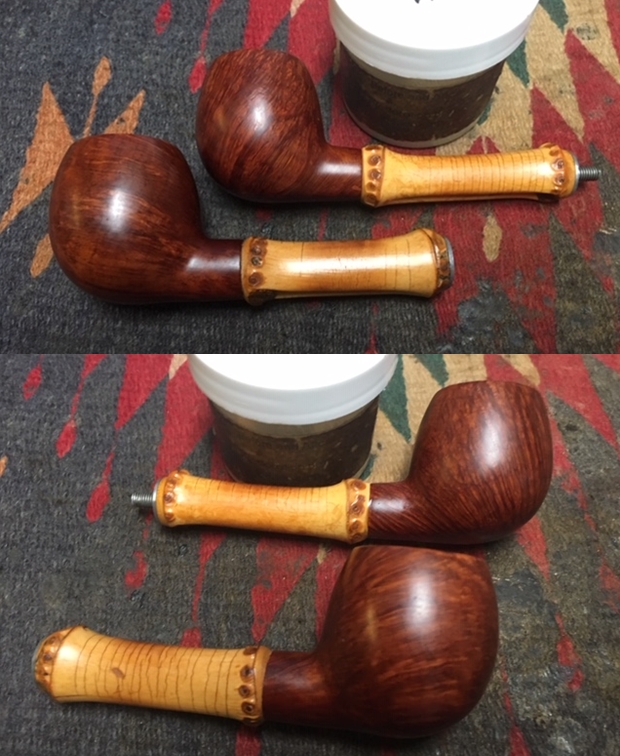
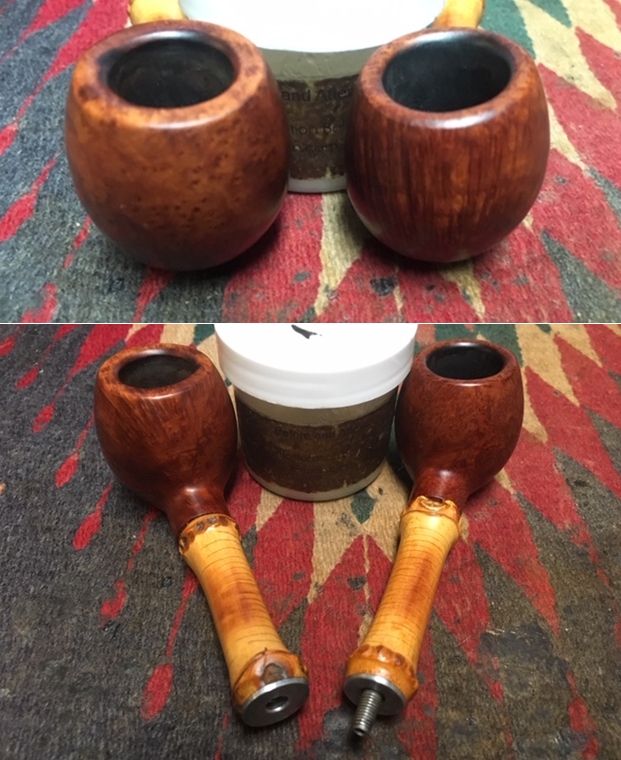
The first pipe. The second pipe. With the rim top cleaned, polished and restored on both of the pipes I worked some Before & After Restoration Balm into the surface of the briar with my fingertips to clean, enliven and protect it. I worked it into the bamboo on both pipes as well to enliven it as well. It took some time to really get it into the grooves and valleys of the bamboo but I was able to work it in. I used a shoe brush to make sure it was deep in the grooves. I let the balm sit for a little while and then buffed with a cotton cloth to raise the shine. The following photos show the bowls at this point in the restoration process. The bowl and the rim top on both pipes look really good and the darkening and lava are gone. The grooves and patina on the bamboo also look really nice with the new finish. I am very happy with the results. (Hopefully by now you can tell which is which. If not the pipe with the threaded metal tenon sticking out is the one with the acrylic stem from the Michigan collection.)I set aside the bowls at this point and turned my attention to the stems. I started with the acrylic replacement stem from the Michigan collection. I sanded out the tooth marks on the button surfaces on both sides with a folded piece of 220 grit sandpaper. I sanded it with a folded piece of 400 grit sandpaper to sand out the scratches. Once I was finished the tooth marks and chatter were gone.As I finished the stem I noticed that the end of the stem had an unfinished slot – merely a round hole that comes standard on replacement stems. It needed to be shaped and a slot cut in the end. I used a series of needle files to cut open the slot and shape it. I still needed to sand the slot but it was starting to look good. I folded a piece of 220 grit sandpaper and sanded the edges of the button to further shape it. The photos tell the story. I moved onto the original Kaywoodie vulcanite stem from the New York find. I sanded out the tooth marks on the button surfaces on both sides with a folded piece of 220 grit sandpaper. I sanded it with a folded piece of 400 grit sandpaper to remove the scratches. Once I was finished the tooth marks and chatter were gone.I polished both stems with micromesh sanding pads – wet sanding with 1500-2400 grit sanding pads and dry sanding with 3200-12000 grit sanding pads. I wiped them down after each sanding pad with a damp cloth. I polished them with Before & After Pipe Stem Polish and wiped them down a last time with the damp cloth and some Obsidian Oil and set them aside to dry. This beautiful pair of Kaywoodie Mandarin Smooth Apples really are unique and special pipes. The bamboo shank and the smooth well grained bowls make them quite stunning. I have a pair of these in my own collection and they are great smoking pipes. The patina on the old bamboo is very nice. You have to figure at the earliest these pipes come from the mid to late 50s and early 60s and at the latest they come from 1968. That means that they may be 64 years old at the earliest and then at the latest 51 years old. Either way they are old pipes. They have a lot of life left in them that is for sure and will definitely outlive most of us. I polished the bowls and stems with Blue Diamond polish on the buffing wheel. I gave the bowls and stems multiple coats of carnauba wax. I buffed both pipes with a clean buffing pad to raise the shine. I hand buffed them with a microfiber cloth to deepen the shine. The pipes polished up pretty nicely. The rich grain shining through the medium brown stain came alive with the buffing. The rich contrasting brown colour works well with the polished black vulcanite stem. The finished pipes are beautiful and feel great in the hand. Have a look at them in the photos below. The dimensions of the first pipe with the replacement Lucite stem are Length: 6 inches, Height: 1 1/2 inches, Outside diameter of the bowl: 1 1/4 inches, Chamber diameter: ¾ of an inch. The dimensions of the second pipe with the original Kaywoodie vulcanite stem are Length: 6 inches, Height: 1 1/2 inches, Outside diameter of the bowl: 1 3/8 inches, Chamber diameter: ¾ of an inch. I will be putting both Mandarin pipes on the rebornpipes online store individually and they can be purchased individually or as a pair. The patina on the bamboo of both pipes is a bonus on these beauties. Thanks for walking through the restoration with me on this pair of oldtimers.

New Life for a Unique Kaywoodie Original Imported Briar Freehand Stack


Blog by Steve Laug

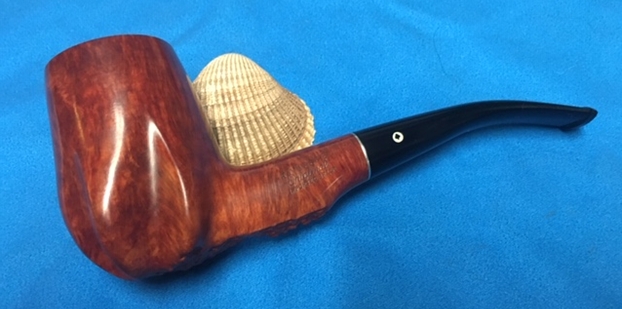
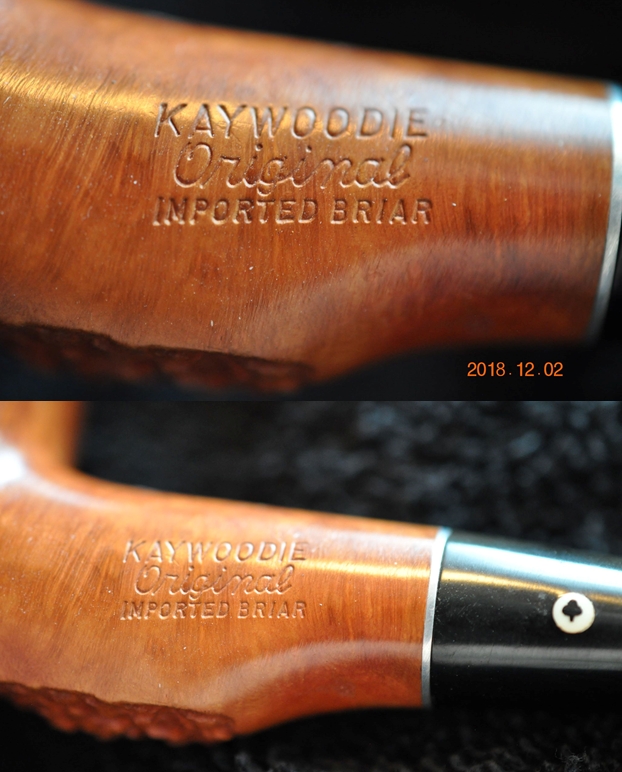
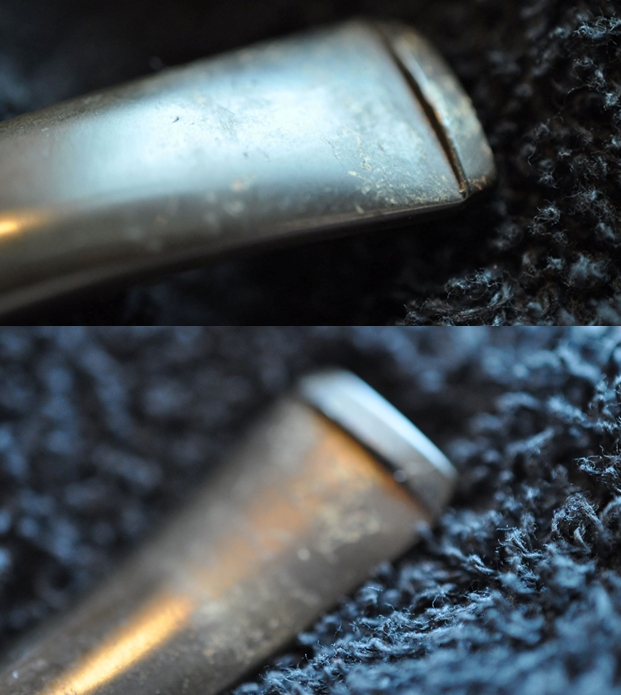
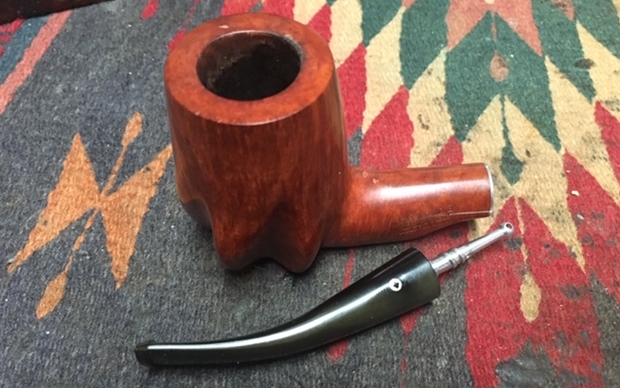
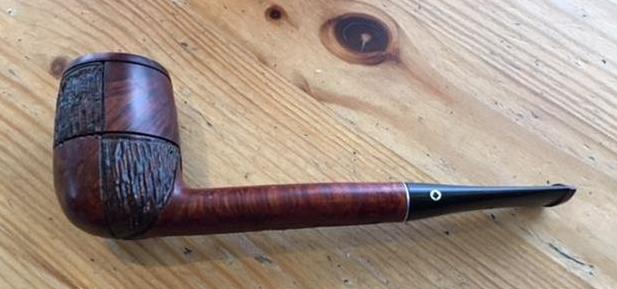
Recently my brother Jeff sent me a very interesting pipe. It has a plateau bottom on the shank and bowl with fluted sides merging upward with a stack shape billiard bowl. The shank looks quite normal but it has plateau on the bottom. It is quite unique looking and combines some of the features of a freehand and some of the features of a stack. The left side of the shank was stamped Kaywoodie over Original over Imported Briar. There is no other stamping on the shank or the bowl. When Jeff received the pipe it was in pretty decent condition – dirty but really not too bad. The finish was dusty and dirty with grime worked into the lovely grain of the briar and particularly into the underside plateau. The bowl had a moderate cake in it but it did not go all the way to the bottom of the bowl – in fact the pipe was not even broken in. The rim top was free of lava but there was some darkening on the backside of the rim top. The inner and outer edges of the bowl were in great condition. The stem had a white circle with the Kaywoodie Club on the left side of the taper stem. It had a Kaywoodie 3 hole stinger and a threaded metal shank that screwed into a metal mortise and spacer ring. The stem had some light tooth marks on both sides at the button. It was oxidized but in decent condition. Jeff took these pictures of the pipe to show its condition before he started his cleanup work. On the left side of the shank the stamping was very clear and readable. You can see that the pipe has some interesting grain even on the shank.He took photos of the stem to show the oxidation and tooth marks and chatter on the stem. Surprisingly the marks and chatter were on the surface.Jeff had reamed the bowl with a PipNet pipe reamer and followed up with a Savinelli Fitsall pipe knife to remove the cake. He scrubbed out the mortise and the airway in the shank and the stem with alcohol, cotton swabs and pipe cleaners. He scrubbed the exterior of the bowl, rim, shank and stem with a tooth brush and Murphy’s Oil Soap to remove the oils and tars on the bowl, rim and shank. He rinsed it under running water. He dried it off with a soft cloth. He was able to remove the majority of darkening on the rim top without harming the finish underneath it. Without the grime the finish looked good. There some large and ugly pink fills in the finish. There was one on the rim top on the right side, there was a pair of them on the top of the shank at the joint of the shank and bowl and the final one was in the fluted area to the right of the shank near the bottom of the bowl. Other than the oxidation and chatter the stem was actually in pretty good condition and would only need to be polished. I took photos of the pipe to show its condition before I started my work on it. I took close up photos of the rim top that shows the clean bowl and the light burn damage around the inner edge toward the back of the bowl. (You can also see the small fill on the top of the rim at the top of the photo, right side of the pipe.) The stem was clean and Jeff had used Before & After Deoxidizer to soak and remove much of the oxidation. He rinsed out the inside of the stem and rinsed off the exterior as well. The photos of the stem show how good the stem actually looked after this treatment.I unscrewed the stem to show the three hole stinger and the threaded tenon.I took some photos of the pink putty fills in the briar on the rim top and on the shank and on the lower right side of the bowl near the shank.I picked out the fills on the bowl and shank with a dental pick and a sharp pen knife point to remove as much of the putty as I could.I filled in the freshly dug out fills with briar dust and clear super glue. I put glue in the fills and used a dental spatula to fill briar dust into the glue repairs. When the fills had cured I used a needle file to flatten the repairs and sanded the patches with a folded piece of 220 grit sandpaper. I followed that by sanding with a folded piece of 400 grit wet dry sandpaper. I polished the repaired areas with micromesh sanding pads – wet sanding them with 1500-2400 grit pads and dry sanding with 3200-12000 grit pads. I wiped the areas down with a damp cloth to clean off the sanding dust. I touched up the sanded and polished areas with an Oak coloured stain pen. It matched really well with the rest of the bowl and shank. Once it is waxed and polished they will blend in a lot better than the pink ones.I rubbed the bowl down with Before & After Restoration Balm to deep clean the briar, particularly the sanded areas. I worked it into the plateau on the bottom of the bowl. The product works to clean, enliven and protect the briar. I hand rubbed it with my fingers and wiped it off with a soft cloth. I buffed the bowl with a horsehair shoe brush to polish it. The briar really began to have a rich shine. I took some photos of the bowl at this point to mark the progress in the restoration. I set the bowl aside and turned my attention to the stem. I sanded the stem with 220 grit sandpaper to remove the tooth chatter and marks as well as the oxidation.I polished the stem with micromesh sanding pads – wet sanding it with 1500-2400 grit pads and dry sanding it with 3200-12000 grit pads. I wiped the stem down after each pad with a damp cloth to remove the sanding dust. I used the Before & After Pipe Polish to remove the small minute scratches left in the vulcanite. I finished by wiping the stem down with a final coat of Obsidian Oil and set it aside to dry. I polished the stem and bowl with Blue Diamond to polish out the remaining small scratches. I gave the bowl and the stem several coats of carnauba wax and buffed the pipe with a clean buffing pad to raise the shine. I worked some Conservator’s Wax into the plateau on the underside of the bowl and shank. I hand buffed it with a microfiber cloth to deepen the shine. The pipe polished up pretty nicely. The finished pipe is shown in the photos below. I have never seen a Kaywoodie quite like this one. It is not only unique in having the plateau on the underside but also the fluting on the side of the bowl. The stamping Kaywoodie Original is also a new one for me. The dimensions are Length: 6 1/4 inches, Height: 2 1/2 inches, Outside diameter of the bowl: 1 1/2 inches, Chamber diameter: ¾ of an inch. I will be adding it to the rebornpipes store shortly. If you are interested in adding it to your collection email me at slaug@uniserve.com or send me a message on Facebook. Thanks for walking through the restoration with me as I worked over this Kaywoodie Original.

Restoring a Kaywoodie Meerschaum Dublin


Blog by Paresh Deshpande

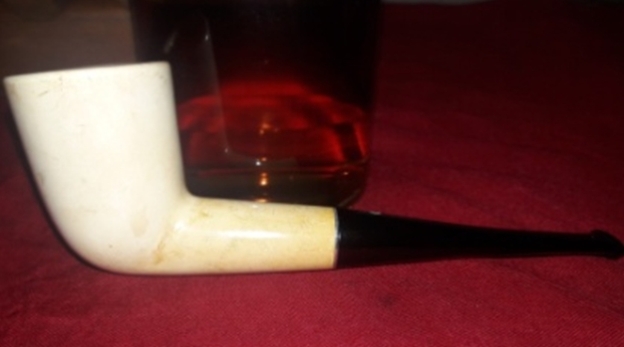
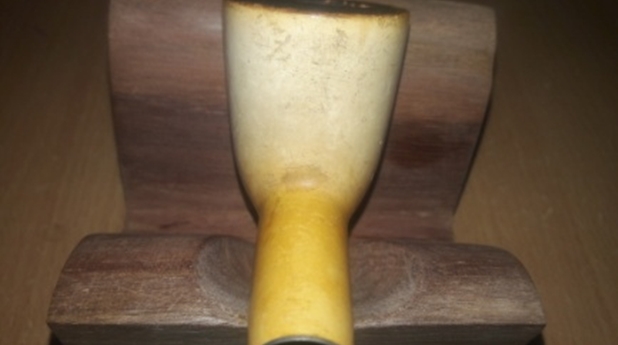
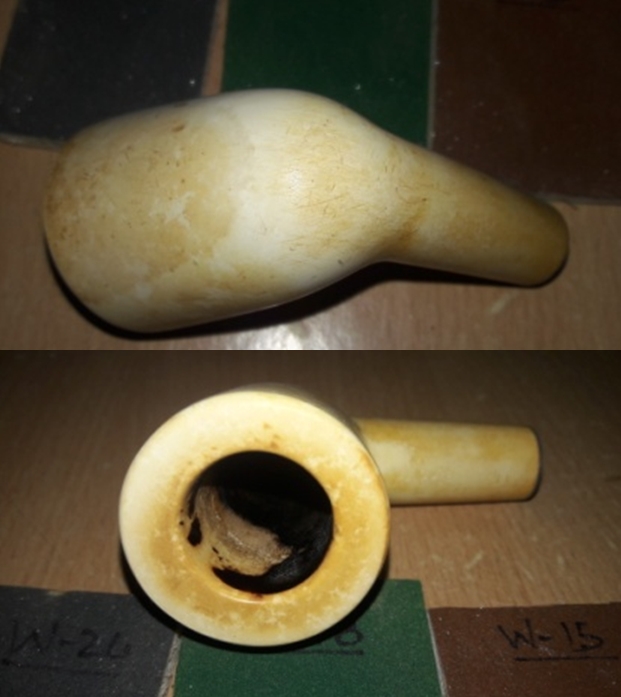
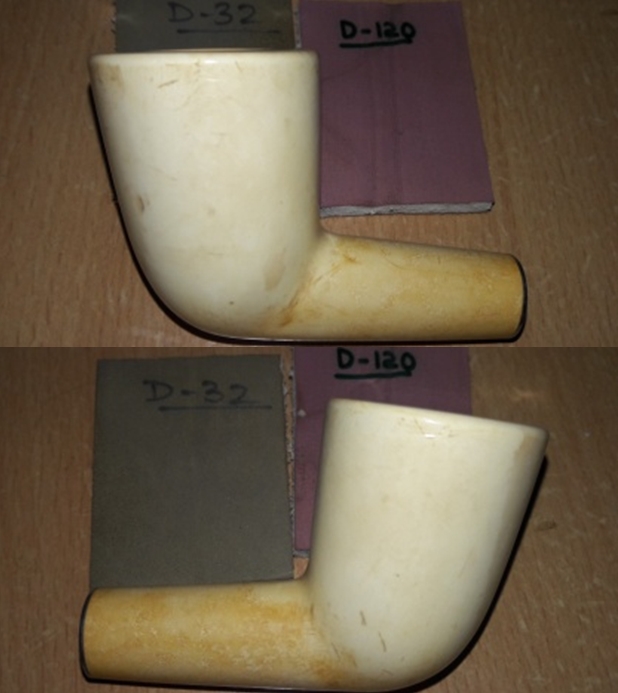
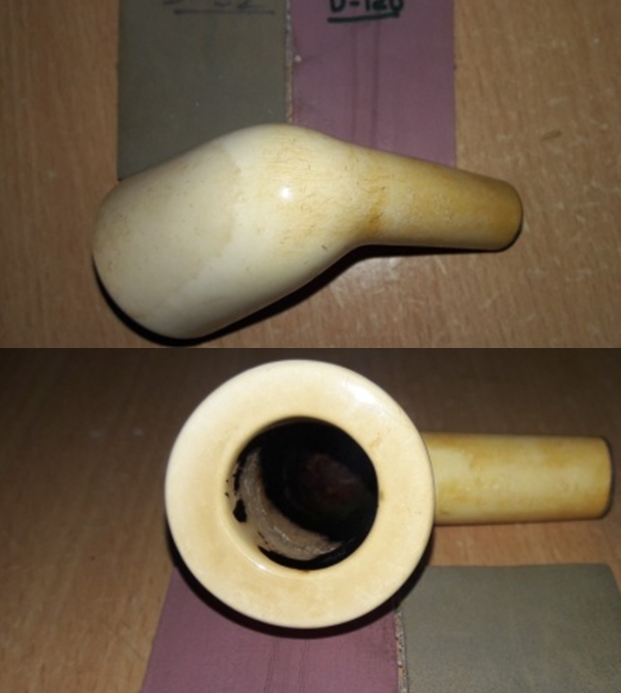
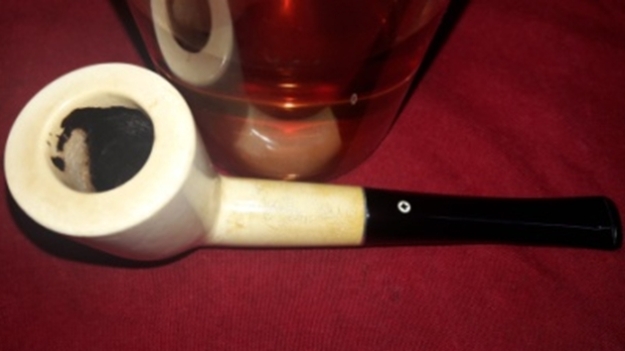
Another surprise pick from my grandfather’s collection is this pipe which I have selected to work on. John Bessai in Rhodesian shape, which I had recently restored, was also a surprise pick in his collection since he had never been to USA, let alone Cleveland, Ohio and this is where most of the Bessai pipes were sold. Well, this pipe now on my work table is a Kaywoodie made from block meerschaum!! I was aware that KBB made briar pipes with meerschaum insert, but block meerschaum pipes, that I was not aware of.

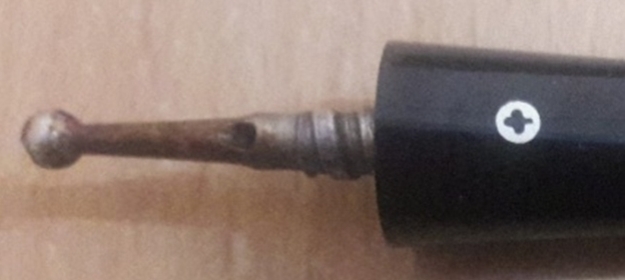
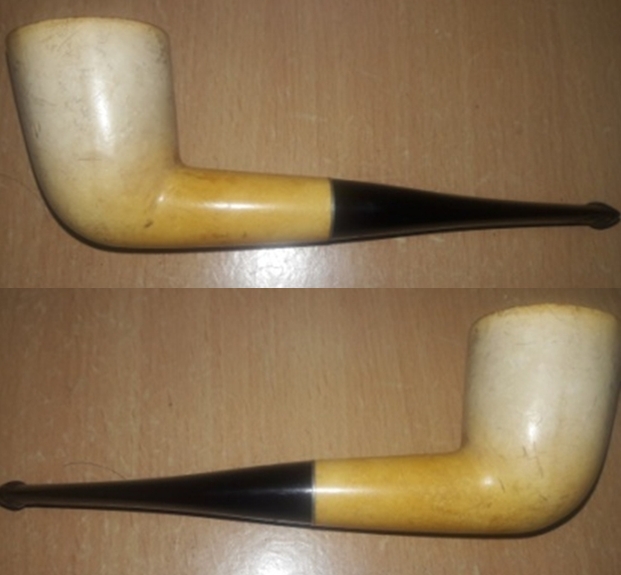
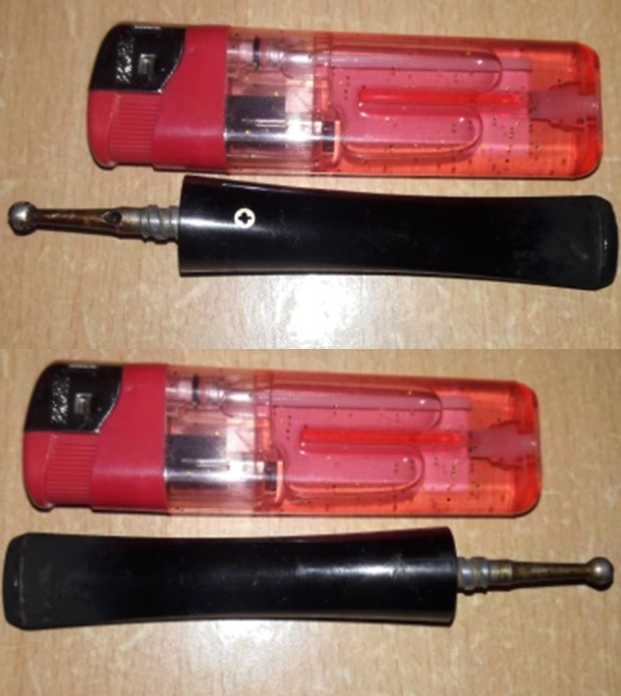
The meerschaum on my work table is a classic Dublin with a stout meerschaum shank and a vulcanite stem. The stummel is sans any stampings and the only way it can be identified as being a Kaywoodie is the trademark cloverleaf insert on the stem and the four holed stinger tenon. However, the cloverleaf insert in this stem differed from the other Kaywoodie stems that I have previously worked on in that here the stem is marked with a “black cloverleaf inside a white dot” as against the white cloverleaf in other Kaywoodie pipes.I searched the internet for more information on Meerschaum line of Kaywoodie pipes. I visited the website, brothersofbriar.com and came across this valuable piece of information from one member, kwguy, who probably, from his comment, appears to have worked for KBB. I have extracted below, the relevant portion of the thread.

“Kaywoodie Block Meerschaums were made from 1938 to the mid 1960’s. The meerschaum pipe business by Kaywoodie was revitalized when Paul Fischer was hired and emigrated from Austria to run the meerschaum pipe department. Kaywoodie meerschaums were available in earlier years but not as prominently as when Paul Fischer came on board. He left in 1960 to make meerschaums under his own name. We continued to make them for several years after he left until we could no longer import meerschaum from Turkey”. (http://www.brothersofbriar.com/t21079-kaywoodie-block-meerschaum)

Another piece of information was available on pipedia.com which I have reproduced below.

HINTS ON COLLECTING, DATING AND PRICING KAYWOODIES
Examine Logo, Stampings and Fitment. The pre-WWII Kaywoodies had elongated white cloverleaf logos and large screw-in fitments (with the possible exception of the pre-1925 and “export” Kaywoodies, which had no fitments). Some of the pre-1936 Kaywoodies were stamped (on the shank) with a cloverleaf around KBB. Sometime between 1936 and 1947, the better pipes were marked with a black cloverleaf inside a white dot. However, because many of the pipes in the 1968-69 catalog still show this type of logo, the black-in-white logo merely indicates a “post 1936” vintage.

Based on the information gleaned from the above sources, it is safely concluded that the Kaywoodie meerschaum pipe presently on my work table is from the period between 1936 to late 1960s.

INITIAL VISUAL INSPECTION
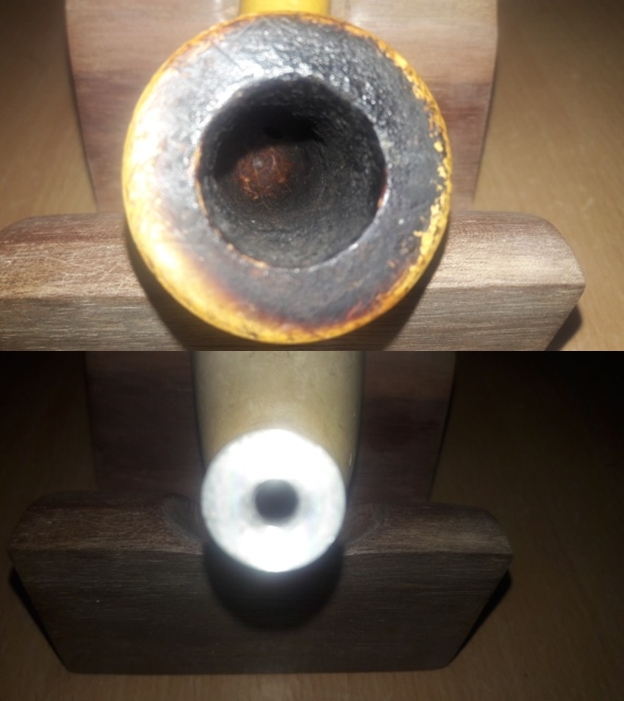
The stummel has developed a nice coloration on the surface, darker on the lower half of the stummel and darkest on the shank. The entire stummel is covered in minor nicks and scratches with slightly deeper ones seen on the front and behind the bowl. There is a patch, similar to what would be seen on a briar when exposed to water, on the front of the bowl. Since this would be my first inherited meerschaum pipe restoration, I shall tread very carefully in addressing these issues. There is thick build up of cake in the chamber with a thicker layer at the bottom half of the chamber. The condition of the inner walls of the chamber can be ascertained only after the cake has been removed completely. No apparent cracks or damage to the stummel surface is seen from the outside, save for a few scratches and nicks/ dents. The rim top has darkened due to thick overflow of lava. There are a large number of dings and chips to the rim top which are visible through the lava overflow. This will be a challenge to address. The inner and outer edge shows minor chips, the result of striking the edges against a hard surface to remove dottle. The shank end of the pipe has an aluminum threaded spacer ring which extends in to the mortise, separating the shank end from the stem end when threaded in. This spacer ring is in pristine condition. The mortise is blocked due to accumulated dried oils, tars and remnants of ash, greatly restricting the air flow.The vulcanite stem has deep tooth indentations and minor tooth chatter on upper and lower surfaces as well on both the button edges. The stem shows minimal signs of oxidation which really is surprising. The air flow through the stems is laborious to say the least. The four holed metal stinger tenon is covered in dried oils and tars with a blocked breather hole near the threads. The alignment of the stem logo and stummel is off center when the stem is fully threaded in to the mortise with a slight overturn. These issues will need to be addressed.THE PROCESS
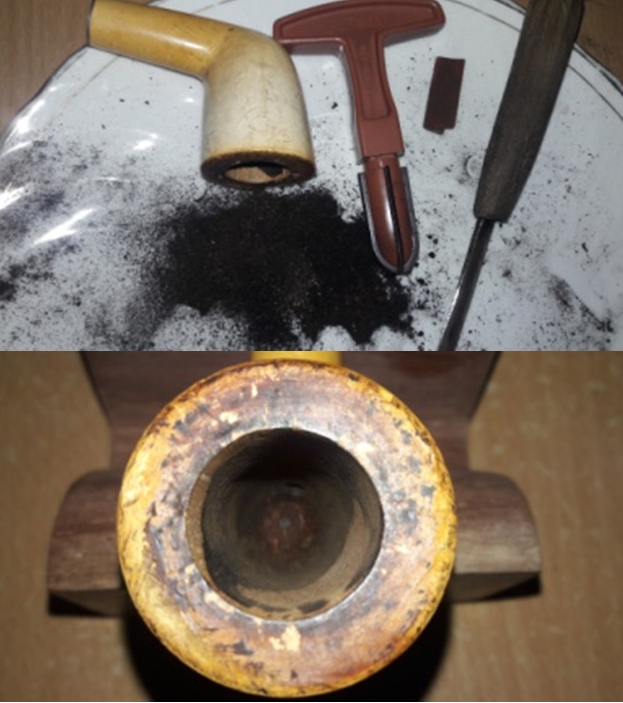
I started this project by reaming the chamber with size 1 followed by size 2 head of PipNet reamer. With my smaller fabricated knife, I scraped out all the carbon from difficult to reach areas. I used a 220 grit sand paper, pinched between my thumb and forefinger, to sand the inner walls of the chamber of the pipe. Once I had reached the bare walls, I wiped the chamber with a cotton pad dipped in isopropyl alcohol. This removed all the residual carbon dust and also rid the chamber of all ghost smells. The walls of the chamber are nice and solid with no signs of heat fissures or cracks. Using a sharp knife, I gently scraped out the overflow of lava from the rim top. The dents and chips on the rim surface are now clearly visible.I followed up the reaming by cleaning the stummel surface. I sand the stummel with a folded piece of 220 grit sandpaper followed by 600 and 800 grit papers. This was done with utmost care and diligence as I did not want to sand away a lot of meerschaum material from the surface and also wanted to preserve the nice golden hued color taken on by the meer from being smoked. A few deeper chips and gouges were left unaddressed as it would have led to loss of lot of meerschaum material. Also these dents and dings appear like a soldier’s battle scars and worn with pride!! Similarly, I worked the rim top and addressed the dents and scratches from the surface. The chipped inner and outer edge was leveled by creating a slight bevel on either edge with 220 grit sandpaper. I cleaned the mortise and air way of the pipe using hard bristled and regular pipe cleaners, q-tips dipped in alcohol. The mortise and the draught hole were given a final clean with shank brushes dipped in alcohol. I dried the mortise with a rolled paper napkin. The shank internals and the draught hole are now nice and clean with an open and full draw.I polished the top of the bowl and rim edges with micromesh sanding pads to remove all of the tar and lava that was on the surface. I wet sanded it with 1500-2400 grit pads and dry sanded with 3200-12000 grit pads. I wiped the bowl down with a damp cloth to remove the dust that was left behind by the sanding. While I was working on the bowl top I also worked over the sides and bottom of the bowl to polish them as well. I wanted to minimize the scratching but not necessarily remove them all. I cleaned out the internals of the stem using hard bristled and regular pipe cleaners dipped in alcohol. The deep bite marks on the stem were flamed using a Bic lighter. However, this did not work. From my experience, I have learnt that getting rid of the oxidation from and around the surface to be filled helps in subsequent better blending of the fill with the stem surface. With a folded piece of used 150 grit sand paper, I sand the area that is required to be filled. I cleaned the sanded portion of the stem with cotton pad dipped in alcohol and spot filled the damaged area with a mixture of activated charcoal and clear superglue. I set the stem aside for the fill to cure. Once the fill had cured, I sand the fills to match the surrounding stem surface with a flat head needle file. I sharpened the lip edges using a needle file and sand the entire stem with 220 followed by 400, 800 and 1000 grit sand paper to achieve an exact match. This also helps to reduce the sanding marks left behind by the more abrasive 220 grit paper as well as eliminated the oxidation seen on the stem. I was so engrossed and preoccupied with the task at hand that I missed out on taking pictures of this process.

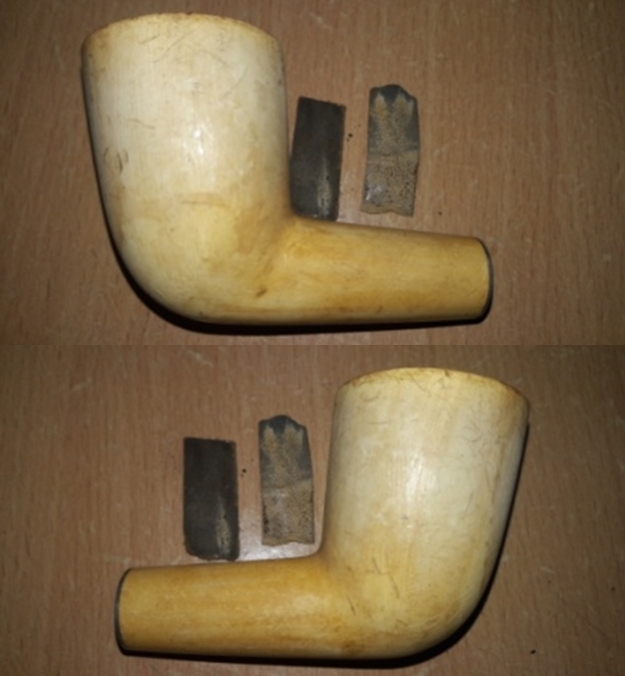
To bring a deep shine to the stem, I went through the complete set of micromesh pads, wet sanding with 1500 to 2400 grit pads and dry sanding with 3200 to 12000 grit pads. I wiped the stem with alcohol after each pad and rubbed it down with Extra Virgin Olive oil. It was at this stage that I addressed the issue of overturned four holed stinger by heating it with the flame of a Bic lighter. This loosens the glue and I under-turn the stinger. I let the stinger cool down and re-harden the glue. I re-heated the stinger and fitted the stem in to the mortise, tightening it till the stem and shank were perfectly aligned. I let the stinger sit in this position till it had cooled down and the glue had hardened again. Now the fit of the stem and the shank is perfectly aligned. To finish, I re-attach the stem with the stummel. I mount a cotton cloth buffing wheel on to my local machine which is similar to a Dremel.  I set the speed at about half of the full power and applied White Diamond compound to each of the three pipes. I wiped/ buffed the pipe with a soft cotton cloth to clear it of any leftover compound dust. I then mounted another cotton cloth wheel on to the polishing machine and applied several coats of carnauba wax over the stummel and the stem. I finished the restoration by giving the pipe a rigorous hand buffing using a microfiber cloth to raise the shine further. The completed pipe, with the shining white and golden hued meerschaum stummel, contrasting with the shiny black stem, looks lovely, fresh and vibrant; the photographs speak for themselves. Thanks for the read…………..Cheers!!

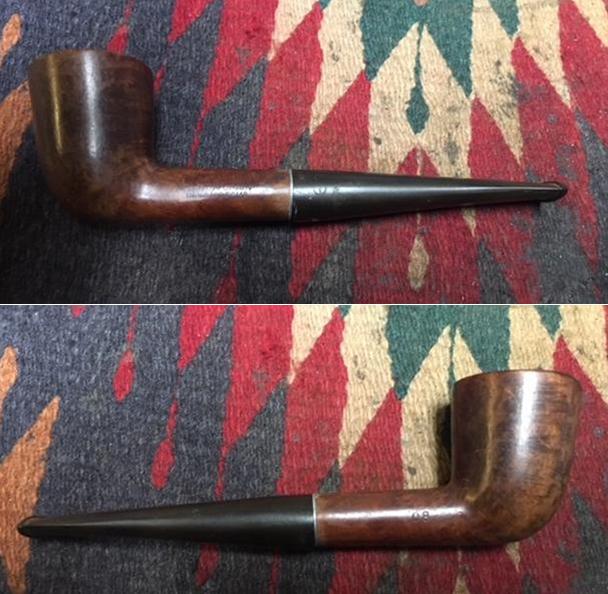
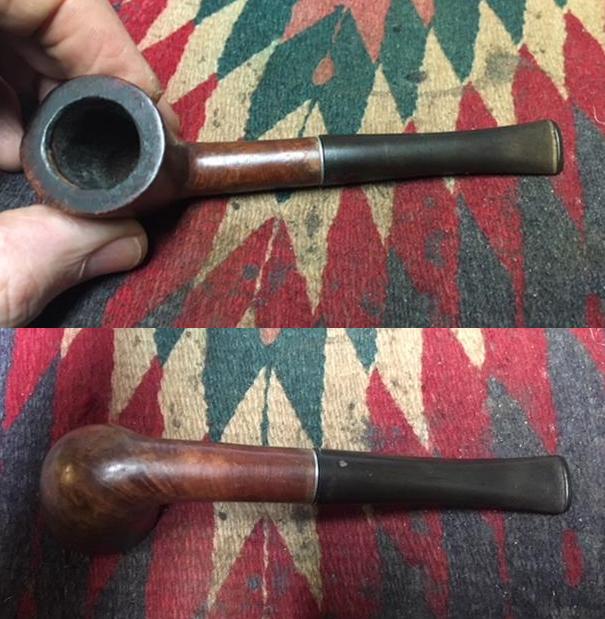
About a Super Grain Kaywoodie Medium Dublin #08 Almost as Old as My Dad


Blog by Robert M. Boughton

Copyright © Reborn Pipes and the Author except as cited
https://www.roadrunnerpipes2k.com/
https://www.facebook.com/roadrunnerpipes/

FOR MY DAD
E. MICHEAL BOUGHTON
2/23/1933-10-16-2018

my father moved through dooms of love
through sames of am through haves of give,
singing each morning out of each night
my father moved through depths of height 
— e.e. cummings, “my father moved through dooms of love,” from 50 Poems, 1940

INTRODUCTION
I was going to start with the dedication and for once leave out the opening quote.  Then the last stanza of Dylan Thomas’ “Do not go gentle into that good night” came to me.  I even had it typed in a few seconds.  Upon reflection, however, the idea of Thomas’ great, impassioned cry to his father, there on the sad height, seemed a little too close to my own feelings and therefore by definition selfish.  Any notion of beginning with words from Thomas, albeit brilliant and stirring, was belayed by the sudden and vivid recollection of my dad and me having a rare pleasant conversation.  The Cold War was raging hotter than ever at the time, and that was more or less what our normal interactions resembled

Out of nowhere, it seemed, the pleasant remembrance filled my mind, from lifetimes ago when I was 16 or so and reading books almost every spare moment I had.  I used books back then the way I later turned to alcohol more than I already had, to escape reality, except the books were good for me.  I could see the two of us, my dad and me, standing in the entryway to the house, golden-orange beams of late afternoon sunlight filtering through the windows.  My knapsack was stuffed, as tight as an overfilled laundry machine, with schoolbooks and other implements of learning, while cradled in my arms were about five diverse and serious reads I had bought for my own pleasure.  As my tastes were then and remain now rather eclectic, but with several main themes at the time, there was probably one each classic, sci-fi, fantasy, quirky crime fiction like Elmore Leonard’s Mr. Majestyk or anything having to do with spies by The Master, John le Carré, and of course someone’s, anyone’s, biography.

My dad made a point of coming out of his room and stopping me to talk, the subject of which I’m sure now didn’t make any difference to him.  He saw the load of new books I was holding and asked what I was reading those days.  I just handed them to him so that he could see for himself.  He was impressed, but what he said really struck me in a good way, as I had been thinking more or less the same thing.  He asked if I read any poetry.

All that came to mind back then were two poems, starkly different in style, that now seem to me interesting examples of poetry to compare and contrast.  But worry not, I won’t try it here!  They were Thomas’ perhaps best-remembered work that, years later, I compared to my dad in an essay I wrote for the English Comp AP course I took at NMSU in Las Cruces, and Alfred, Lord Tennyson’s “Tears, Idle Tears.”  While the former was and remains a favorite example of the artform I consider the highest to which any writer can aspire, I used to make my friends laugh with my lachrymose recitations of the latter.  I didn’t even consider the obvious, that my memorization of both and occasional sensitive spoken interpretations of Thomas’ masterpiece yet crass and venomous performances of Tennyson’s work of equal value were reflections of the mirror I gazed into every time I spoke his beautiful, insightful words in immature lampoonery.

My dad is the person who turned me on to e.e. cummings, and to him I now owe the fact I remembered the lines from the opening quote.  In fact I owe so much more to the man, parts of it good and others not so.  But all things considered, I turned out okay.  Now I miss him more than ever and feel his irrecoverable absence like a horrible sting.

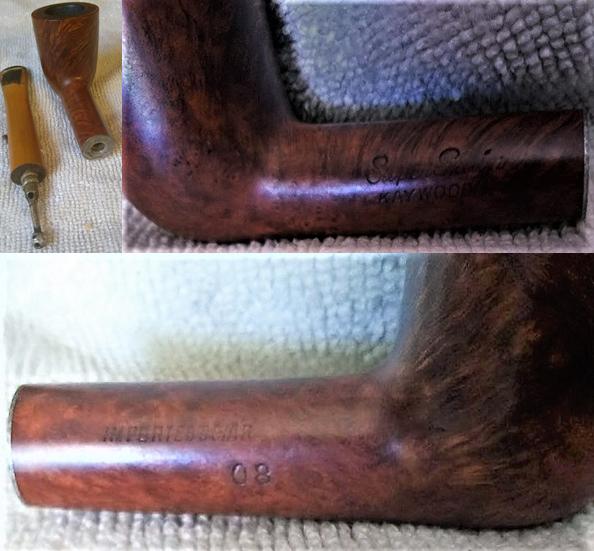
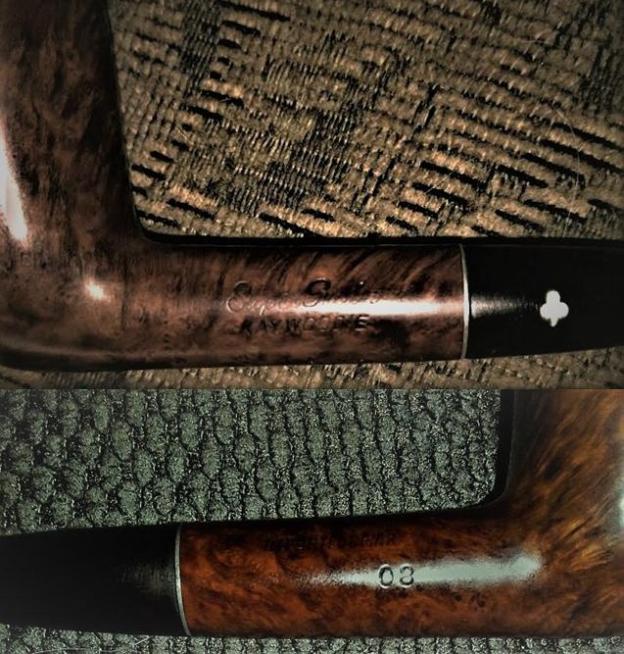
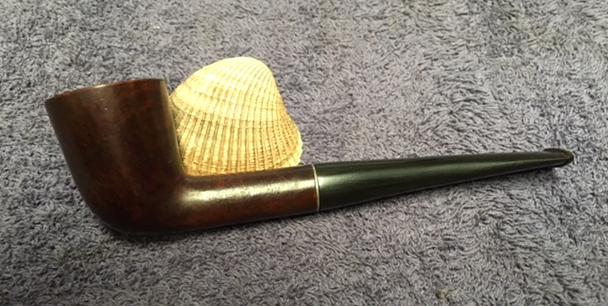
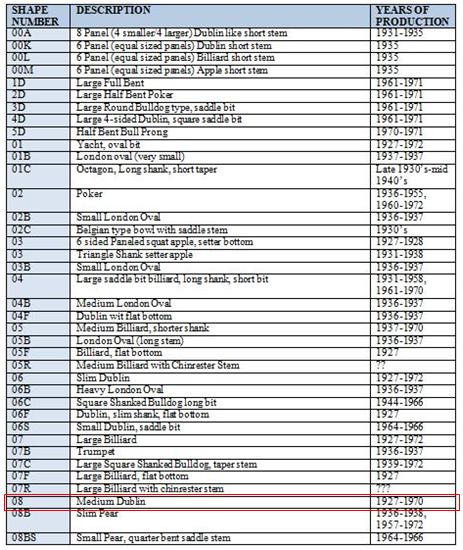
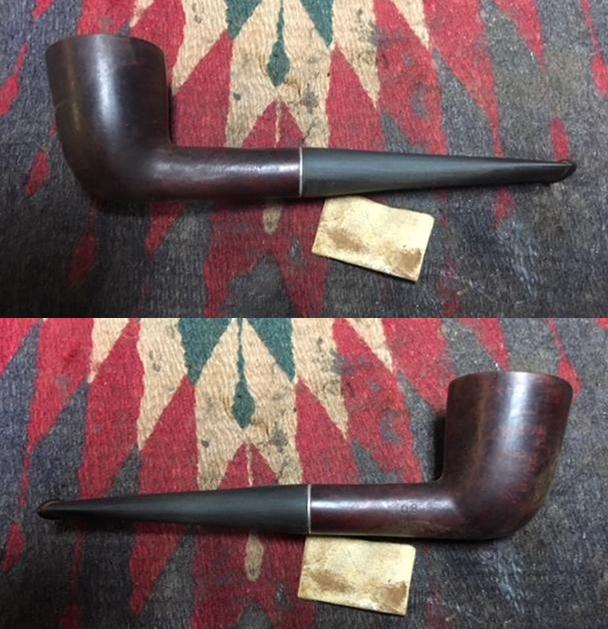
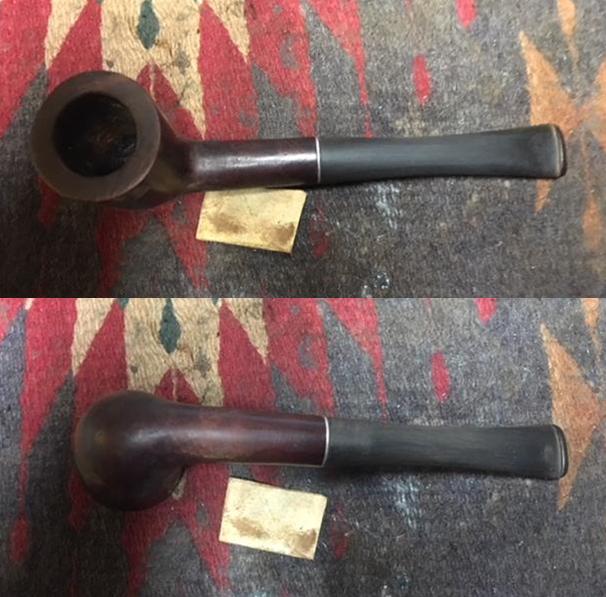
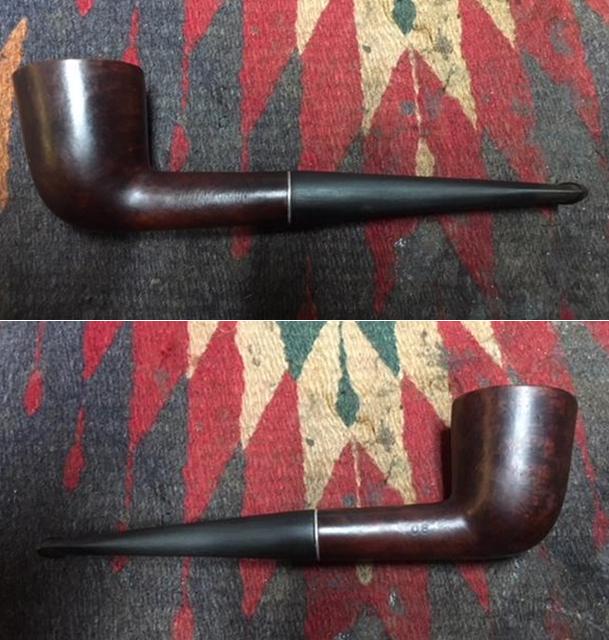
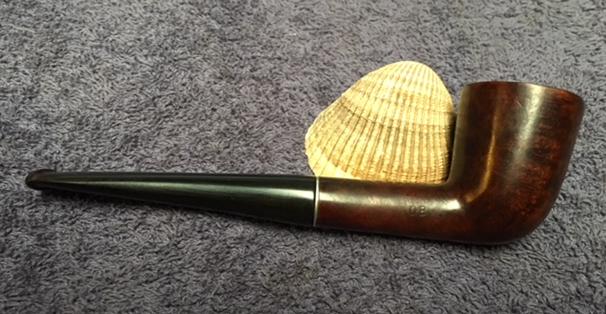
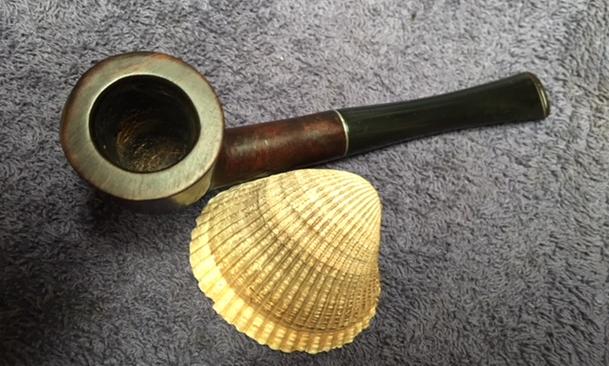
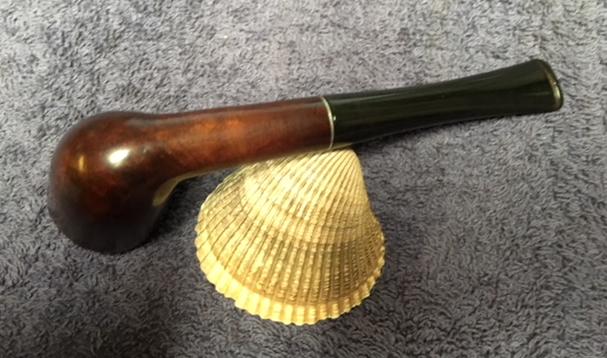
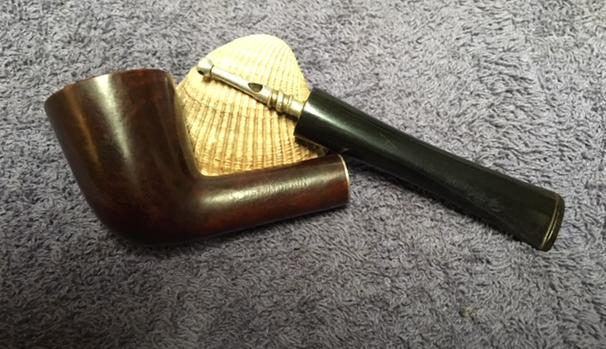
At any rate, this blog is about a Kaywoodie Super Grain Dublin #08 that is almost as old as my dad was.  The left shank nomenclature approximates its age to the 1930s with the placement of SUPER GRAIN above KAYWOODIE, and the right shank imprints of IMPORTED BRIAR and 08 narrow the timeline to 1935-1938.  Every part of this beautiful pipe is original, including the stem and patented Drinkless stinger with the word etched into it.  If this pipe was around in 1936, its price would have been $5.  But more than the absence of the usual four-digit shape number connected with Kaywoodie pipes from this period, I’m having trouble imagining my dad no bigger than a boy of five.

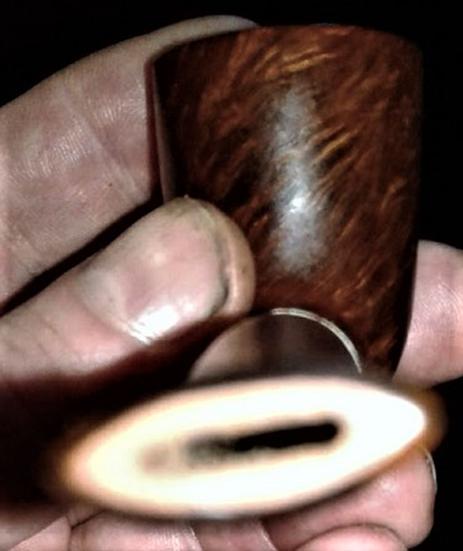
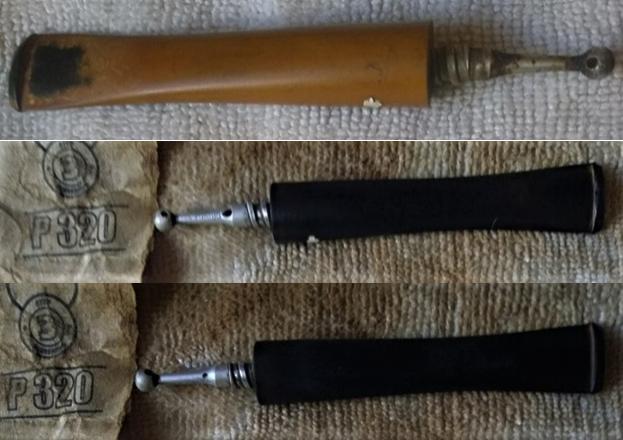
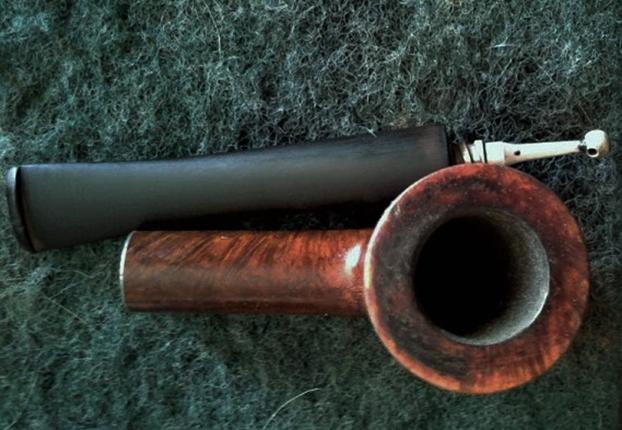
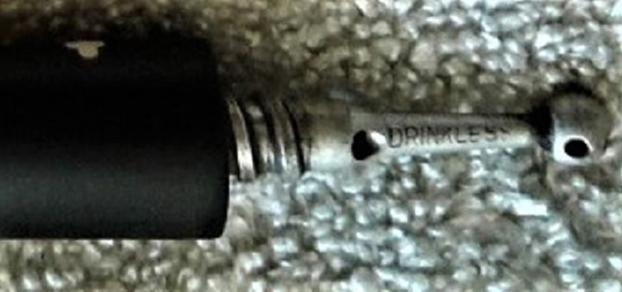
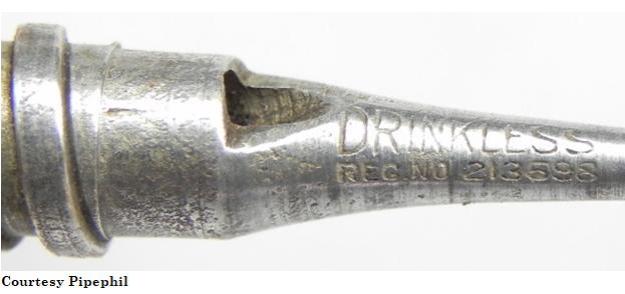
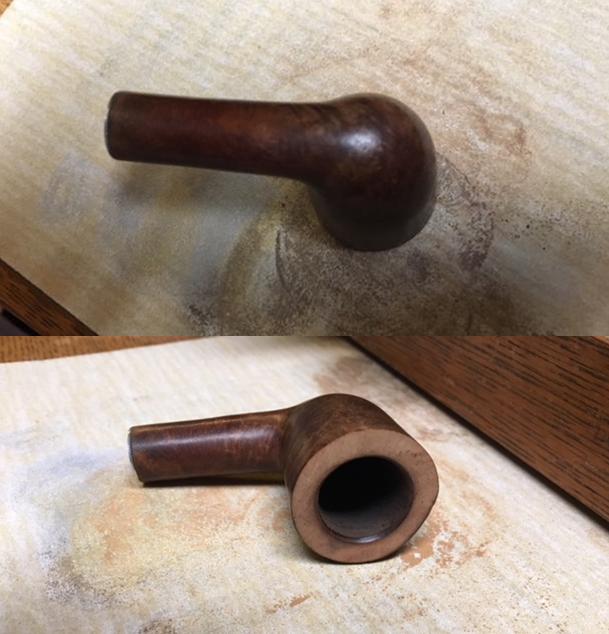
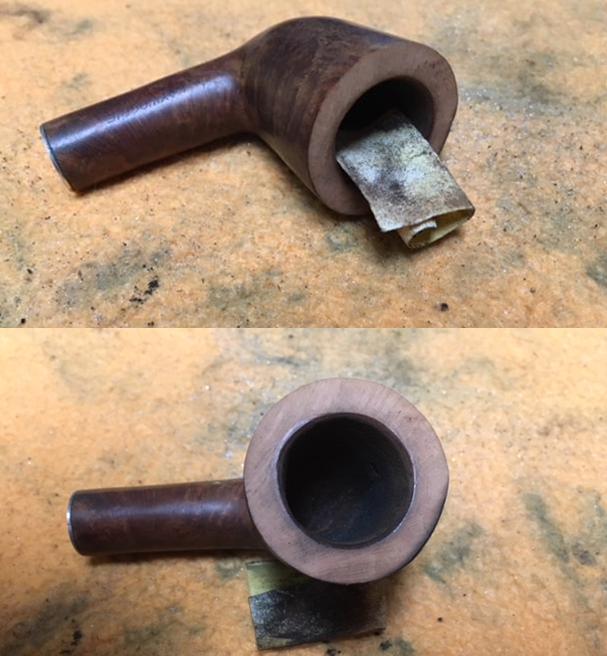
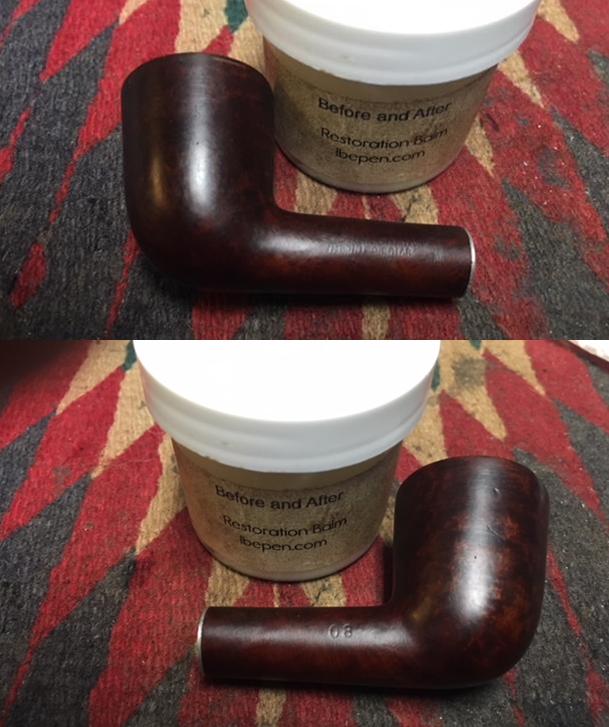
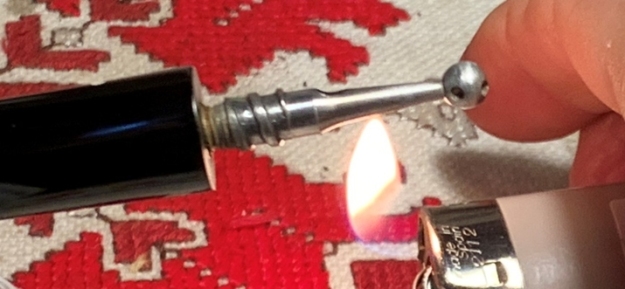
RESTORATION This Super Grain was in amazing condition for a pipe well into its 80s!  The only problems presenting were normal rim char, well-maintained cake buildup and the almost mandatory, for Kaywoodies, mis-clocked stem.  Something told me that might more or less fix itself before the project was complete.I dunked the stem in an OxiClean bath and planned on letting it stay there longer than usual, given that the old Vulcanite was almost solid yellow-green, whatever that color is called.  I also had errands to run.  When I returned home a couple of hours later, I removed the stem from the nasty, dark bathwater, ran a pipe cleaner through the airhole, rinsed and scrubbed it with my thumbs and fingers and dried it off.  A little piece of 320-grit paper made it solid black again.  [I restored this pipe not long ago, but as I noted in my last blog, I had not yet learned how effective going straight to 1000-grit paper can be.  That’s where I’ll start from now on.  This time I lucked out.]I continued work on the stem and started on the rim burn with a soft green Brillo pad that brought out a soft shine on the stem, which may very well be the first one I’ve come across with no scratches that needed removing, much less tooth chatter or even a chink in the lip, top or bottom.  For the rim, the Brillo was a beginning.Finishing the stem with 400-, 600- and 1000-grit papers followed by a full run of micro mesh from 1500-12000, I turned to a piece of super fine “0000” steel wool for the remainder of black on the rim.Again, not being aware of how great a job 1000-grit paper does, I continued work on the rim with 320-grit.  Everything worked out in the end, but really, I had no idea how much extra work I’ve been doing!  In fact, I understand now how bad was the habit into which I had fallen.Smoothing the rim with 400- to 1000-grit papers, and in the process returning the grain to normal since I didn’t use the least abrasive grade in the first place, I finished that stage in anticipation of a spot stain there after micro meshing.  In the meantime, I reamed the chamber and sanded with 150- and 220-grit papers.  That was supposed to be just the start, but the mature and venerable Dublin was so loved and respected by its previous (and, I think, only other) owner that the chamber wall was baby smooth to the touch.I had forgotten the wonderful quality of briar and other woods to reacquire their original hue after being sanded down to a lighter shade and then worked back up with finer and finer grades of paper.  Therefore I was surprised but happy to see the lovely, mottled, somewhat leopard-like spots and blotches on the rim, and the natural shiny dark brown color that matched the whole surface, with the following full micro mesh of the stummel.  The thought occurred to me that when the pipe was first crafted, no stain might have been applied.The only thing left to do was retort the pipe.  This step further revealed that whoever was the guardian of this magnificent specimen of pipehood was also good enough to enjoy it quite often.  Four test tubes full of alcohol had to be boiled through the inner passageways from the lip of the stem to the top of the chamber before it was almost clear.Don’t take this as bragging because I know I had nothing to do with the skill and care that went into the very vintage Kaywoodie’s genesis – all I did was make it show again – but the color and shine of the wood were perfect as-is at that point and, as far as I could see, needed no further help.  And so, I didn’t even buff it on the wheel for the first time in my experience with pipes.  But to return the stem to the same sheen, I buffed it on the electric wheel with White and Red Tripoli. Oh, and I just remembered the other two aspects of the pipe I noted earlier but almost forgot to address, because, as with some other aspects of the restoration, I forgot to snap a shot of one and deleted the other considering its apparent superfluousness.  The stinger that was misaligned at first indeed did correct itself, with a small nudge, or firm but careful twist, rather, from me. And then there was my mention of the almost incredible fact that the Drinkless stem, with its four-holed ball at the end to be inserted into the shank – which ball, by the way, resembles an antique naval mine with its detonator legs removed, or is it just me? – was etched with the word DRINKLESS.   The shot above, enhanced by photo editing software with which I am at last becoming more adept, illustrates both the screwed-up (pun intended) aspect of the stinger and the etching.  Worth mentioning, to me at least, are Pipephil’s details that include such tidbits as these: the original Drinkless patent (No. 213598) had a push-in design that was used from 1924-1931; the updated version with the same patent number became the longer screw-in and is stated as being used from 1929 until as recently as the 1960s, and in 1932 the SynchroStem patent was granted in favor of the Drinkless.  The newer Drinkless stingers also had the words “REG. NO. 213598 etched under the Drinkless designation, although I didn’t look closely enough or take a good enough photo to show it.But – and here is where all the confusion reaches its zenith – Kaywoodie decided to move toward a three-hole stinger at an “indeterminate date.”
Ah, the joys of dating a pipe!  The Super Grain in this blog, however, is a definite match for the period 1935-1938.  I’m beginning to think pipes, like some people, should only be enjoyed, never dated. 😊
CONCLUSION
My dad was an avid pipe smoker until my mother, sister and two step-sisters put an end to that.  I say they did it, but the sad truth I still regret to this day is that I let them drag me into the brouhaha: the incessant reminding him, every time he sat down to relax and light up, of what the ninth U.S. Surgeon General, a well-meaning and for the most part dead-on man by the name of Luther L. Terry, MD, had reported two years after I was born, to wit, that smoking tobacco tends to have “an adverse impact…[on] health worldwide,” and the steady buildup to more snide comments such as the amount of time every use of tobacco deprived people of life (not counting the comments about second-hand smoke).  By the end, the unwarranted and downright cruel attacks on my dad by all of us had escalated to all-out war.  In the end, my dad surrendered and vowed to stop smoking his impressive collection of the beautiful briar works of art and implements of deep contemplation.

In my defense, this was all going down around 1968, when I was a mere lad of six.  But I can still picture the vast assortment of mostly smooth, easy bent billiards he favored, though there were some that were sandblasted also, and even more interesting, longer, straight ones I now understand were Canadians or others of that family.  In my mind I can see them now with such clarity that, given the experience I have had in some of the intervening years, I am positive they were all created by the greatest English makers of those times and these.

In other words, my dad was not keen on American brands the likes of Kaywoodie.  But he was a man whose tastes changed, like most of us, and I suspect that had we left him alone to his peaceful enjoyment of his pipes, his collection would have evolved.  If only we had not badgered him into submission, if only he had stood his ground and just said no, if only we had not grown apart – I might very well have given him this pipe for his last birthday.  And I’m sure he would have lived just as long as the 85 years he lasted before dementia and other non-smoking-related problems took him.

In a letter, Dylan Thomas described his approach to writing this way: “I make one image—though ‘make’ is not the right word; I let, perhaps, an image be ‘made’ emotionally in me and then apply to it what intellectual & critical forces I possess—let it breed another, let that image contradict the first, make, of the third image bred out of the other two together, a fourth contradictory image, and let them all, within my imposed formal limits, conflict.”

That’s my dad, to a tee.  Still, I love him and miss him more now than I did the long years he decided not to communicate with me anymore.  So now, as still another great poet wrote, I sound my barbaric yawp.

He wasn’t big on crying, so I’m going to have to stop here.

SOURCES
https://www.poets.org/poetsorg/poem/my-father-moved-through-dooms-love-0
https://genius.com/Dylan-thomas-do-not-go-gentle-into-that-good-night-annotated
https://www.poetryfoundation.org/poems/45384/the-princess-tears-idle-tears
http://www.pipephil.eu/logos/en/logo-kaywoodie-2.html
https://pipedia.org/wiki/Kaywoodie_Shape_Numbers
https://pipedia.org/index.php?title=Collector%27s_Guide_to_Kaywoodie_Pipes&mobileaction=toggle_view_mobile#1936_Kaywoodie_Shape_Numbers_and_Descriptions
http://www.pipephil.eu/logos/en/infos/kaywoodie-drink.html
http://www.pipephil.eu/logos/en/infos/kaywoodie-synchro.html
http://www.pipephil.eu/logos/en/infos/kaywoodie-3stinger.html

Restoring a Collector’s Kaywoodie Massive War Club


Blog by Steve Laug

This is one big pipe that came to me in an estate that I purchased from a fellow in Arizona. When I looked over the pipes he was selling with my brother I don’t think the size of this brute really registered with us. It was just another larger Kaywoodie Bulldog. The stamping on the left side of the shank which read Collector’s Kaywoodie Imported Briar did not mean anything to me at this point in the process. It had a rugged sandblast finish that was a large and craggy as the pipe itself. It had a smooth rim top, a smooth top ring and sandblast ring between that and a second ring around the bowl. The bowl was dusty but I was amazed that it was unsmoked and showed a well grained and STAINED bowl interior. There was a spacer on the shank that separated the bowl from the stem and contained the threaded mortise insert for a Kaywoodie threaded stinger. The stem was lightly oxidized and had some water spots that had oxidized spots on the stem. There was some light tooth chatter on the button end on both sides that must have come from people “trying the pipe on”. It had the Kaywoodie Club insert on the left side of the stem. When I unscrewed the stem it had a large four hole stinger. The aluminum was dull from having been sitting. I took photos of the pipe before I started my cleanup process to show the condition it was in when we received it. I included the moon rock finished pipe that I just finished in the photo to give a sense of the massiveness of this pipe. The moon rock is a little over 5 ½ inches long and 1 ¾ inches tall. It is an average sized pipe that is dwarfed by this monster. The Kaywoodie is truly one I would call a magnum pipe. I was unfamiliar with the Collector’s line so I did some digging and had Jeff do the same to see what we could come up with on the brand. I found it listed on the Pipephil site but the pipe shown was obviously a newer one and I found a matching pipe on eBay that showed that it had a three hole stinger. That one was dated as a 1960s era pipe which fits the stinger arrangement on the threaded tenon.

Jeff found a listing on eBay for a 10 inch long Collector Billiard that bore the same stamping as the one I have and had a four hole stinger. The seller described it as “One Very Rare Magnum and a True Kaywoodie Collectors 10 Inch Long pipe.” He went on to say that even to see a Kaywoodie Magnum Smooth Cross Cut Swirled Smooth Grained that is an Extra Large Series of the Collector’s Billard is rare. He dates the pipe to 1951-1954 which is where I would place the one that I have in my hand. This pipe is new – truly NOS that is in excellent condition and though it is large, it feels light and well balanced in the hand. The sandblast finish is very tactile and feels good but I think it would even feel more amazing with fire in the bowl. This huge magnum is 11 inches long and over 3 inches tall. It is a true Magnum Sized pipe. The craggy grained sandblast finish holds a perfectly drilled and centered airway in the bottom of the bowl. The long, large Drinkless Balled Kaywoodie 4 Hole Stinger System is flawless and the stem aligns perfectly.

I took a photo of the top of the bowl to show the condition of the rim and the unsmoked bowl. The rim top had a bit of grime from sitting unused for the past 64+ years. The photos of the stamping and Kaywoodie Club logo show the condition of the rest of the pipe. The nomenclature is crisp and readable. The Club is in good condition. The photos of the stem show the light oxidation and what I called tooth chatter from people “trying on the pipe”. I unscrewed the stem from the mortise to have a look at the stinger and tenon apparatus. I took photos of the set up to show the condition of the internals of the pipe.I started my restoration of this pipe by rubbing the bowl down with Before & After Restoration Balm to deep clean the briar bowl and the rim top as well as the briar shank. The product works to clean, enliven and protect the briar. I hand rubbed it with my fingers, working it into the exterior of the pipe. I worked it into the sandblasted surface of the briar with a horsehair shoe brush. After it had been sitting for a little while, I buffed it with a soft cloth to polish it. The pipe really began to have a rich shine. I took some photos of the bowl at this point to mark the progress in the restoration. I worked over the vulcanite stem with micromesh sanding pads to remove the marks, scratches and oxidation – wet sanding with 1500-2400 grit sanding pads and dry sanding it with 3200-12000 grit sanding pads. I wiped it down after each sanding pad with some Obsidian Oil. I polished the stem with Before & After Pipe Polish – Fine and Extra Fine polishes. I wiped the stem down with a final coat of Obsidian Oil and set it aside to dry. I the polished stem and bowl with Blue Diamond to polish out the remaining small scratches and stubborn patches of oxidation. It also does a great job raising a shine in the hard rubber stems. I gave the bowl several coats of Conservator’s Wax and the stem several coats of carnauba wax and buffed the pipe with a clean buffing pad to raise the shine. I hand buffed it with a microfiber cloth to deepen the shine. The pipe polished up pretty nicely. This turned out to be a beautiful pipe in terms of shape and finish for one that is so large. The finished pipe is shown in the photos below. This huge magnum from 1951-1954 is 11 inches long and over 3 inches tall. The outside diameter of the bowl is 2 inches and the chamber diameter is 1 inch. It is a true Magnum Sized pipe. The craggy grained sandblast finish holds a perfectly drilled and centered airway in the bottom of the bowl. The long, large Drinkless Balled Kaywoodie 4 Hole Stinger System is flawless and the stem aligns perfectly. The fact that the inside of the bowl has been sanded smooth and has a light stain coat is just proof of the NOS (New Old Stock) condition of this beauty. Thanks for walking through the restoration with me as I worked over this older Collector’s Kaywoodie. I am still undecided what I am going to do with this pipe. In all my years of pipe restoring I have never come across a Collector’s Edition pipe like this and probably never will again. That alone makes me hesitate in selling it too soon. Thanks for looking.

Restoring a Kaywoodie Hand Made Rusticated Rhodesian


Blog by Steve Laug

Last Fall I took a trip for work to Gainesville, Georgia in the US and during that time had a day free to do a bit of roaming. The friends I was staying with took us to a couple antique malls to have a bit of a pipe hunt. I found a few good pipes that I will be working on in the days ahead. This is the first of them – a Kaywoodie Hand Made Rhodesian. The stamping on the left side of the shank is faint but readable with a bright light and a lens. It reads Hand Made over Kaywoodie. On the right side of the shank it reads Imported Briar. The bowl had a light cake lining the walls and bottom while the rim top had a coating of lava that made the rim top look like it was rusticated or knocked about. The rim top is beveled slightly inward and was probably originally smooth. The carved worm trails pm the bowl sides and shank have angled slash marks across each of the grooves. The grooves on the bowl sides are more worn than those on the shank. There are twin rings around the bowl separating the cap from the bottom portion of the bowl. The finish was dirty and many of the grooves were filled in with dust and debris of the years. The stem had some nicks and scratches in the vulcanite and was lightly oxidized. There was also a spot on the top side near the shank where there must have been a logo insert that was lost many years ago and had been filled in with glue. There was light tooth chatter on both sides of the stem at the button but no deep tooth gouges. I took close up photos of the bowl, rim top and both sides of the stem to show the condition prior to cleaning. The buildup on the rim top is a combination of thick lava and damage to the surface of the briar. There appears to be some rustication on it but at this point I am not certain it is actually rusticated or just damaged.On the top side of the stem was a round spot that I think had originally held a Kaywoodie logo. It was missing and there was a slight divot in the stem. I filled it in with a clear super glue and set it aside to cure.I cleaned up the rim top with a Savinelli Fitsall Knife blade. I scraped the surface of the rim and also the inner edge of the bowl to smooth things out. Once the rim was cleaned off the damage to the surface of the rim was visible. It was rough to touch. I reamed the bowl with a PipNet pipe reamer starting with the second cutting head and finishing with the third head which was the close to the same size as the bowl itself. I reamed the cake back to smooth briar. I worked over the beveled rim top with a folded piece of 220 grit sandpaper to smooth out the rough surface and remove as much of the damage as possible.I worked Before & After Restoration Balm deep into the rusticated patterns of the briar to clean, enliven and protect it. I worked it into the rustications with my fingertips and with cotton swabs. I worked it into the rim and shank end. I set it aside for a few minutes to let the balm work. I wiped it off with a soft cloth and buffed it with a horsehair shoe brush to polish it. The briar really began to have a deep shine. I took some photos of the bowl at this point to mark the progress in the restoration. The grain on the bowl is really beginning to stand out and will only do so more as the pipe is waxed.  I wiped down the rim top and polished it with micromesh sanding pads – wet sanding with 1500-2400 grit pads and dry sanding with 3200-12000 grit pads. I wiped the rim top down with a damp cloth after each sanding pad. I restained the rim top to match the contrasting stains on the rest of the bowl. I used a black Sharpie pen to colour in the grooves on the top of the rim to match the grooves around the bowl. When I had finished I like the final look of the pipe.I used a dental spatula to clean out the hard tars and oils on the walls of the mortise. It did not take too much work to remove the hard build up. I scrubbed out the shank after that using cotton swabs, pipe cleaners and isopropyl alcohol. I cleaned out the airway in the stem with pipe cleaners, cotton swabs and alcohol. The airway in the end of the tenon was slightly out of round because somewhere along the way the stinger had been removed and the airway damaged. I used a knife to bevel the edge of the airway in the tenon and then sanded it with a folded piece of sandpaper to smooth it out. I polished the stem with micromesh sanding pads – wet sanding with 1500-2400 grit sanding pads and dry sanding with 3200-12000 grit pads. I wiped the stem down with Obsidian Oil after each sanding pad. I finished polishing the stem with Before & After Pipe Stem Polish both Fine and Extra Fine to remove the last of the scratches. I gave it a final coat of Obsidian Oil and set it aside to dry. With the stem polished I put it back on the pipe and lightly buffed the bowl with Blue Diamond. I buffed the stem with a more aggressive buff of Blue Diamond. I gave the bowl multiple coats of Conservator’s Wax and the stem several coats of carnauba wax and buffed the pipe with a clean buffing pad to raise the shine. I hand buffed it with a microfiber cloth to deepen the shine. The pipe polished up pretty nicely. The finished pipe is shown in the photos below. I will be posting it on the rebornpipes store very soon. It should make a nice addition to your pipe rack if you have been looking for a reasonably priced older Kaywoodie Hand Made Rhodesian carved in an almost classic Custombilt style. It should be a great smoking pipe with a good hand feel. The dimensions are Length: 5 3/4 inches, Height: 1 1/2 inches, Outside diameter of the bowl: 1 3/4 inches, Chamber diameter: 7/8 inches. Thanks for walking through the restoration with me as I worked this pipe over.


Restoring an English Made Kaywoodie Chessman Canadian


Blog by Steve Laug

The next pipe on the work table came to me from the estate of a Vancouver pipe smoker whose widow left them with RJ Clarke’s Pipe Shop after he died. I was asked to clean them up and sell them for the shop as it has since closed. The photos below show both pipes as they were when I brought them to my work table. It is an interesting looking piece – kind of a checkerboard pattern of rustication and smooth around the bowl. Nice grain on the smooth portions and on the left side of the shank. The right side and half the top and bottom sides of the shank are rusticated. The bowl was heavily caked with a lava coat on the top of the rim. It was hard to tell how the inner and outer edge of the rim actually looked until the bowl was reamed. The rusticated portions were filled in with dust and debris. The stem was under-clocked and had tooth chatter and marks on the top and underside near the button. The tenon was threaded and had a three hole stinger that was intact. It had promise but it was very dirty. Since it was an English made Kaywoodie I did a bit of research to refresh my memory regarding the English branch of Kaywoodie. On Pipedia I found just a short line in the Kaywoodie write up that referenced the London office. It read; “By 1938 Kaywoodie had opened an office in London to meet worldwide demand. Kaywoodie of London was jointly owned with another famous pipemaker, Comoy’s of London.”

On Dad’s Pipes (https://dadspipes.com/2016/01/24/smartening-up-an-english-kaywoodie-standard/) I found that Charles Lemon had done some research as well: There’s not much information out there about English-made Kaywoodies. Production started in about 1938 as a joint venture between Kaywoodie USA and Comoy’s of London. This relationship lasted until the early 1970’s when Comoy bought out its partner. According to Pipedia, Comoy continues to produce a few pipes marked as Kaywoodie. My guess is that this particular English Kaywoodie dates from the 1960’s.

On Pipephil’s site (http://www.pipephil.eu/logos/en/logo-kaywoodie-notus.html) I found a photo and listing for the same pipe as the one that I was working on. The following screen capture shows the stamping that is the same as the one I am working on. I took photos of the stamping on the shank to show how it matched the stamping in the screen capture above. The top photo shows the topside of the shank and the second the underside of the shank. The pipe is a shape 155.When I went back to the States after Christmas to visit my parents and brothers I took a box of these pipes to Jeff to clean up for me. He reamed this old Chessman with a PipNet pipe reamer and cleaned it up with a Savinelli Fitsall Pipe Knife. He scrubbed the exterior with Murphy’s Oil Soap and a tooth brush to clean off the grime in the rustication and the heavy overflow of lava on the rim top. He cleaned up the internals of the shank, mortise and stem with pipe cleaners, cotton swabs and alcohol to remove all of the oils and tars in the pipe. When it came back to Vancouver it was a quite different pipe. I took photos of it before I started the restoration. I took photos of the rim top and the stem to show their condition. Jeff was able to clean out the bowl completely and the rim top. He removed the tars and lava to reveal a little darkening on the top toward the back of the bowl and the damage to the inner edge of the bowl. The stem scratches and light tooth chatter on both sides near the button. It was also slightly under clocked.I heated the stinger with a lighter to soften the glue and realigned the stem properly. That took care of the under clocking problem.I worked over the edge of the rim with a folded piece of 220 grit sandpaper to remove the damaged portions of the inside edge of the rim. It took a little work to remove the damage.I rubbed the bowl down with Before & After Restoration Balm to deep clean the rusticated briar patches in the Chessboard squares, half the shank and the smooth briar squares, rim and half the shank. The product works to clean, enliven and protect the briar. I hand rubbed it with my fingers and worked it into the rustication with cotton swabs. I wiped it off with a soft cloth. I buffed the bowl with a horsehair shoe brush to polish it. The briar really began to have a rich shine. I took some photos of the bowl at this point to mark the progress in the restoration. I set the bowl aside and worked on the stem. I sanded out the tooth marks and chatter with 220 grit sandpaper until both sides were smooth at the button.I polished the stem with micromesh sanding pads – wet sanding with 1500-2400 grit pads and dry sanding with 3200-12000 grit pads. I wiped the stem down after each pad with a damp cloth to remove the sanding dust. I used the Before & After Pipe Polish to remove the small minute scratches left in the vulcanite. I finished by wiping the stem down with a final coat of Obsidian Oil and set it aside to dry. I put the stem back on the pipe and worked it over with Blue Diamond to polish out the remaining small scratches. I gave the bowl several more coats of Conservator’s Wax and the stem several coats of carnauba wax and buffed the pipe with a clean buffing pad to raise the shine. I hand buffed it with a microfiber cloth to deepen the shine. The pipe polished up pretty nicely. The finished pipe is shown in the photos below. This uniquely finished Kaywoodie has the shape and look of an English made pipe and with the restoration has been brought back to life. This one is going to a friend to keep the memory of the pipeman from whose estate it came. The dimensions of the pipe are Length: 6 inches, Height: 1 1/2 inches, Outside diameter of the bowl: 1 3/4 inches, Chamber diameter: 3/4 inch. Thanks for walking through the restoration with me as I worked over this English made Kaywoodie. It was a pleasure to work on this one.

Reworking & Restemming Last of Mark’s Uncle’s Pipes – a Kaywoodie Custom Grain Dublin


Blog by Steve Laug

This is the last one of Mark’s uncle’s pipes and when I finish this one the lot of seven are complete and ready to go back to him. This last one is another Kaywoodie. I have repeatedly written how much I am enjoying working on these pipes for Mark. For me an important part of the restoration project is to know the history behind the pipe I am working on. When I find out the story it really adds another dimension to the pipe repair or restoration work.

I have finished six of the seven pipes that Mark sent me and have written about them. As I have worked on each pipe the pipeman who originally owned these pipes was with me through Mark’s story of his life. The links to the blog on each pipe is listed below if you want to read about the work on each of them.

  1. The Ropp Cherrywood De Luxe (https://rebornpipes.com/2018/01/17/cleaning-and-restoring-a-ropp-cherrywood-de-luxe-805/)
  2. The Doodler (https://rebornpipes.com/2018/01/19/restoring-a-beautiful-the-doodler-bullmoose/)
  3. A newer three hole stinger Kaywoodie Super Grain Billiard S-L (https://rebornpipes.com/2018/01/21/restoring-marks-uncles-third-pipe-a-kaywoodie-super-grain-s-l-billiard/)
  4. a Savinelli Churchwarden (https://rebornpipes.com/2018/01/22/restoring-marks-uncles-savinelli-churchwarden-aged-briar-2002/).
  5. A Tally Ho 33 Pot made by Hardcastle’s (https://rebornpipes.com/2018/01/25/restoring-and-restemming-marks-uncles-5th-pipe-a-tally-ho-33-pot/)
  6. A Kaywoodie Signet Rhodesian/Round shank Bulldog https://rebornpipes.com/2018/01/27/reworking-marks-uncles-6th-pipe-a-kaywoodie-signet-rhodesian/

Here are some pictures of the pipes.The pipe I am working on now is the fourth pipe down in the above photo and the fourth from the left in the photo below. It is a Dublin shaped pipe with a major piece missing from the button on the stem and the Kaywoodie logo missing from the stem. One last time I am going to include a bit of what Mark’s sent me about his uncle. I have included much of this in each of the past pipe restorations to give you a sense of the information that always in behind the desire to clean up and restore this set of old pipes. Mark wrote…

…My Uncle John, raised in an Appalachian Mountain family (think Hatfield and McCoy), was a large man with an affable personality – although this had limits and he could be quite formidable.

During WWII he left home and enlisted in the US Army where he was assigned to Patton’s 3rd Army as an ambulance driver.  After Germany surrendered, he was transported back to the US on a converted ocean liner troop ship (I believe it was the Queen Mary).  Upon reaching the US, his unit was immediately sequestered on a troop train for transport to the West Coast to be shipped to the Pacific for the invasion of Japan.  About half way across the country (possibly somewhere in Texas), the train stopped and the troops informed that Japan had capitulated – WWII was over.

Before the Korean War began, my uncle re-enlisted in the US Air Force.  He as assigned to a Photo Mapping unit as an Aircraft Mechanic.  He worked his way up to Crew Chief and served in Photo Mapping until he medically retired in the mid 60’s due to heart problems.

Being part of an Air Force family, I did not get to spend much time with my uncle while growing up.  However, I was able to stay a couple of summers with him at his West Palm Beach home while in my teens.  On a desk in his Florida Room sat collection of old used pipes in a walnut pipe rack / humidor combo (very similar the Decatur Industries 6 pipe Rack and humidor combination shown in the rebornpipes store).  There were a couple of packages of old dried up commercial brand tobacco in the humidor – one was cherry, I think.  I never saw my uncle smoke and never discussed the pipes with him, but I was intrigued by the pipe collection.  They were old, dirty, and well used – some with chewed through stems.  Obviously, the pipes had been smoked by a devoted pipe enthusiast.  As a young boy, I loved the smell of pipe tobacco, which you could occasionally smell in public way back then.  I started smoking an occasional pipe in college.  When my uncle passed away a few years later, I asked for his pipe collection and have stored it away since then.  The pipes are just as I received them some thirty years ago.

While I will never know for sure, I believe my uncle purchased the pipes in various PX’s and smoked them while an Air Crew Member.  The PX’s would have sold common commercially available pipe brands at a good price, nothing too expensive or exotic – consistent with the pipes in my uncle’s collection.  As a Photo Mapping Air Crew Member / Chief my uncle traveled the world extensively, and was stationed at many bases  – including “permanent” stations in West Palm Beach, Warner Robins, and Goose Bay Labrador, to name a few.  Smoking a pipe would have been a relaxing way to spend a few monotonous hours on the flight line or in the air.  After his heart problems, he must have given up pipe smoking and the pipes sat unused thereafter.  If the bowls look like they were recently scraped, it would have been over fifty years ago, most likely with a Case hardware store folding knife. If dirty, it is due to sitting for many years in the back room.  If well used and chewed it is due to many hours of smoking enjoyment.

I’m looking forward to seeing my Uncle John’s pipes in restored condition.  I know they are not “collectors” items, but they bring back priceless memories of my uncle and the times we spent together sharing “war stories”…

With the old pipeman almost standing over my work table, I turned my attention to the last of his pipes – a Kaywoodie Custom Grain Dublin shaped pipe. The pipe was stamped on the left side of the shank with the word Kaywoodie over Custom Grain over Imported Briar. On the right side of the shank is the shape number 08. I wrote about the various shape numbers of Kaywoodie and Yello-Bole pipe on the blog. I include that link now if you would like to have a look. https://rebornpipes.wordpress.com/wp-admin/post.php?post=39480&action=edit. I am also including the portion of the chart on the blog that shows the shape number of this old pipe and the years it was produced. I have boxed the shape number in red for quick reference. The exterior of the pipe was dirty and grimy with a few small dents in the sides of the bowl. The rim top was dirty and had some tar and lava overflowing the inside of the bowl. The right front of the bowl had burn damage where it looked like Mark’s uncle had repeatedly lit his pipe. The bowl itself did not have a thick cake but there was a still a thin cake in the bowl. The pipe looked like it had been reamed not too long before the last bowls were smoked. Overall the finish was in the worst condition of all of the pipes in this lot. It was dirty and dusty. The stem was oxidized and there was a large chunk of the vulcanite missing on the top end of the stem where it had been chewed through or broken off. The logo was missing from the inset on the left side of the stem. I took photos of the pipe before I started restoring it. I took a close up photo of the rim top to show the remnants of cake in the bowl and the lava buildup on the rim top. I took the photo at a bit of a different angle to show some of the damage to the rim top. The inner and outer edges were in rough shape. The front right outer edge was very worn. I have circled it in red to highlight it in the poor photo below. The top of the rim was also spotty and had tars and lava as well as nicks and scratches. I took some close up photos of the stem to show the size of the missing vulcanite chunk near the button on the underside. The oxidized metal three hole stinger on the stem needed polishing but otherwise it looked good.Since the stem was not only chomped on the underside but in examining it I found it was also cracked. I went through my can of stems and found one that was close to the same diameter and length. I had a decision to make – drill out the mortise to receive a push stem or transfer the stinger from the damaged stem and fitting it to the new stem. I chose the latter. I heated the tenon with a lighter while holding it with a pair of pliers. It did not take too long for the glue to heat up enough for me to turn the stem off of the stinger. I used a brass bristle brush to polish off the tars and oils that had hardened on the stinger. With the stinger removed it was time to work on the new stem to make it ready to take the stinger. Notice that the crack in original stem gave way in the first photo. The first thing that had to go on the new stem was the tenon. I cut it off with a hack saw as close to the end of the stem as possible. Once the tenon was gone I faced the end of the stem on the topping board to smooth out any rough or high spots that remained. I wanted a flush fit against the shank of the pipe. Once the tenon was gone I needed to drill the airway open to receive the stinger apparatus. The base of the stinger had a diameter of ¼ inch but I did not start drilling with that. I started with a bit slightly larger than the airway in the stem and worked my way up. I marked the bit with a permanent marker so that I would not drill too deep. I used a cordless drill at slow speed. To pull the bit out I reversed the drill and let it work it out slowly. This leaves a clean wall on the inside of the new stem.I cleaned out the new hole with cotton swabs and alcohol to remove all of the dust from drilling. I blew air through the stem to dry it out. I swabbed it with a clean and dry cotton swab. I lined the stinger upright with the hole on top and glued it in place with all-purpose glue. While it was still soft I threaded it into the shank and lined everything up so that it would dry straight. I set it aside and worked on something else while the glue dried. I took photos of the pipe to show the new stem in place after the glue dried. After the glue in the stem had set I removed the bowl from the stem and worked on it. It needed a lot of work. I wiped the bowl down with acetone on cotton pads to remove the remnants of the finish. Once I had the briar cleaned off I topped the bowl on the topping board with 220 grit sandpaper. I wanted to minimize the damage from the burn on the right front. I could not take it down to remove all of the burn without compromising the shape. I worked until it was less visible and then called it quits.The bowl was out of round and the inner edge of the bowl was damaged. I worked it over with a folded piece of sandpaper to minimize the damage and bring it back to round. I also worked on the outer edge of the rim to smooth it out as well. The second photo below shows the cleaned up rims – both inner and outer.I wiped the bowl down again with acetone on a cotton pad to remove the rest of the finish and clean up the briar. I took photos of the bowl at this point to show its condition. I polished the bowl with micromesh sanding pads – wet sanding it with 1500-2400 grit pads and dry sanding with 3200-12000 grit pads. I wiped the bowl down after each pad with acetone to clean off the sanding dust. The photos show the progress of the polishing. I wiped the bowl down with alcohol and then stained it with a medium brown aniline stain. I flamed the stain to set it and repeated the process until the coverage was what I was looking for. I washed down the bowl with alcohol on a cotton pad to make the stain a bit more transparent. I wanted to blend in the burn mark and still leave the grain showing through. I worked some Before & After Restoration Balm into the surface of the briar with my finger tips to deep clean the finish, enliven and protect the wood. I worked the balm into the rim top and inner bevel of the rim to polish the cleaned up area. I let it sit for a few minutes and then buffed it with a cotton cloth. The grain in the wood came alive and there was a rich shine to the briar. I took some photos of the bowl at this point to mark the progress in the restoration. I set the bowl aside and worked on fitting the stem to the shank. I repeatedly put it on the shank to check the diameter and clean up the fit. I worked on it with 180 grit sandpaper and 220 grti sandpaper to shape the stem to match the diameter of the shank all the way around. I wiped it down each time I finished sanding and then tried the fit. I repeated the process until the transition was smooth between the shank and the stem. It took a lot of sanding to get the fit correct but once it was there the stem was ready to polish with micromesh sanding pads. I gave the bowl several coats of Conservator’s Wax to clean it and give it a light shine. I rubbed the stem down with Obsidian Oil to highlight what I needed to work on.  I also wanted to get an idea of what the pipe was going to look like once it was finished. I worked over the stem with micromesh sanding pads. I polished out the sanding scratches and marks from the reshaping work. I wet sanded it with 1500-2400 grit pads and dry sanded it with 3200-12000 grit pads and wiped it down with Obsidian Oil after each one. When I finished with the 12000 grit pad I gave it a final coat of oil and let it dry. With the stem replaced and polished I put it back on the pipe and buffed the entire pipe again with Blue Diamond polish on the buffing wheel. I carefully buffed the new button with a light touch so as not to damage it. I gave the entire pipe several coats of carnauba wax and buffed it with a clean buffing pad to raise the shine. I hand buffed it with a microfibre cloth to raise the shine. The new stem and the original stem looked good to me and the bend was just right. The bowl polished up pretty nicely. The finished pipe is shown with the original stem in the photos below. This is the final pipe – number seven of Mark’s uncle’s pipes. Now I just need to pack these up as well as he did when he sent them to me and get them out to him. I am looking forward to what he will think once he has them in hand. Thanks for walking through these seven restorations with me. I am thinking Mark’s uncle would be proud of his pipe and glad that his nephew is carrying on the pipeman’s trust with them. Cheers.