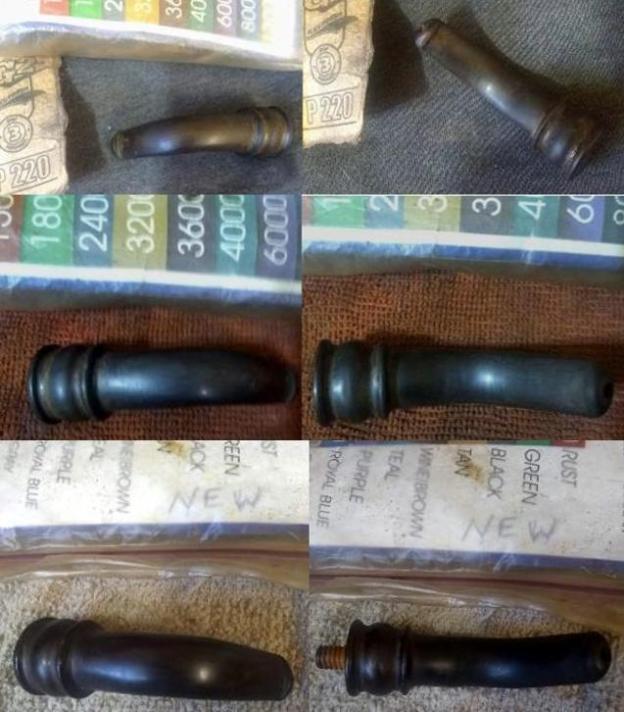
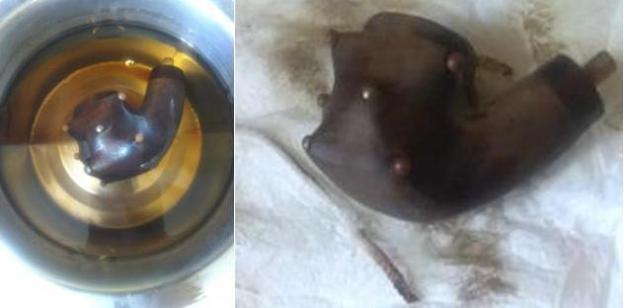
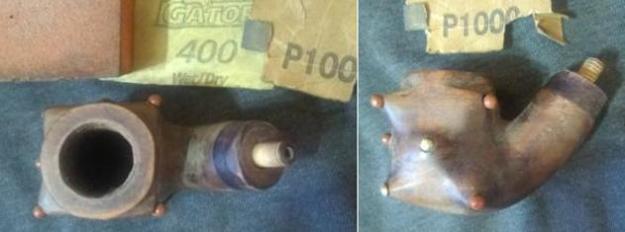
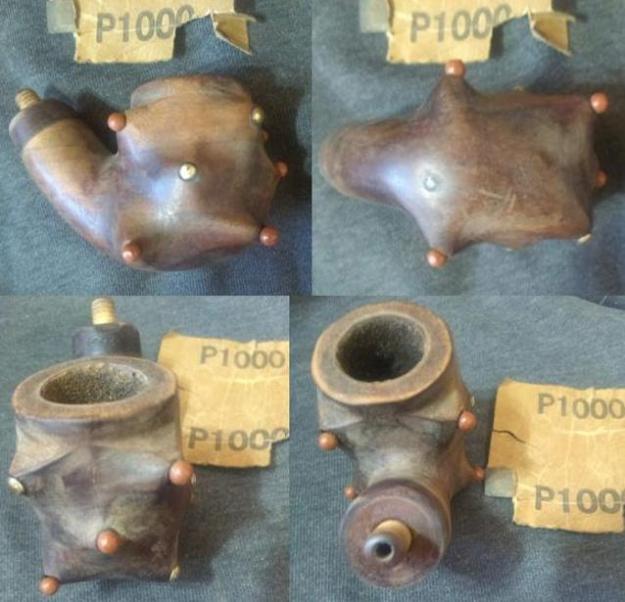
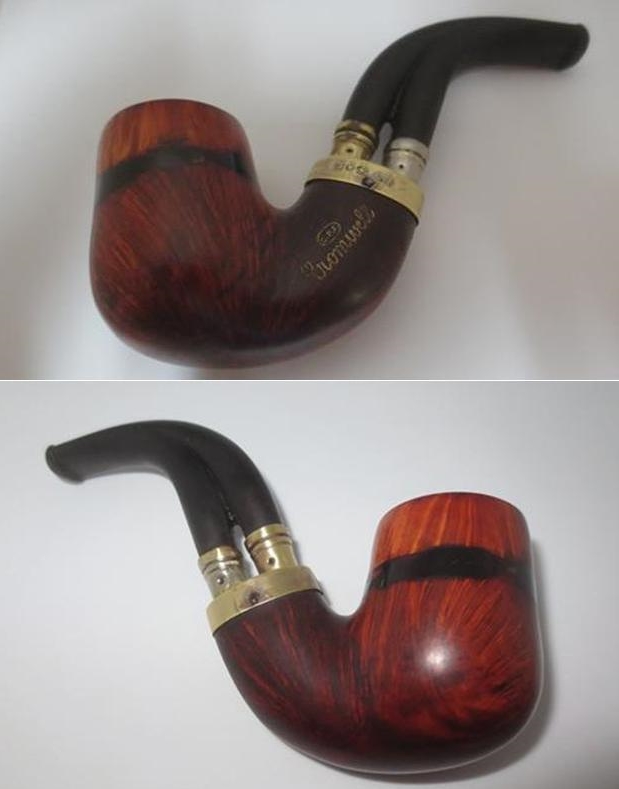
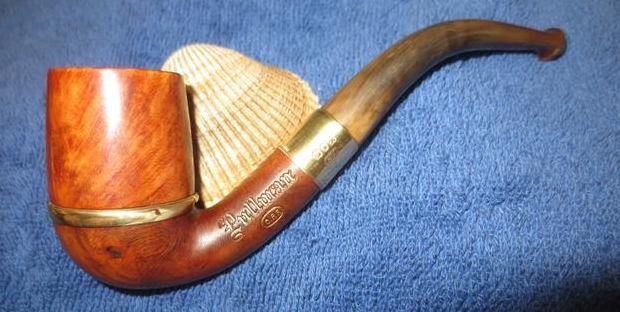
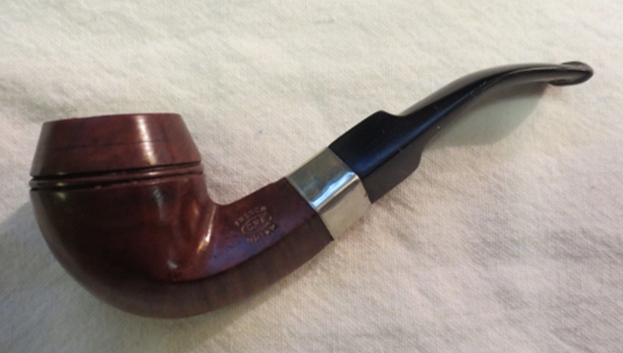
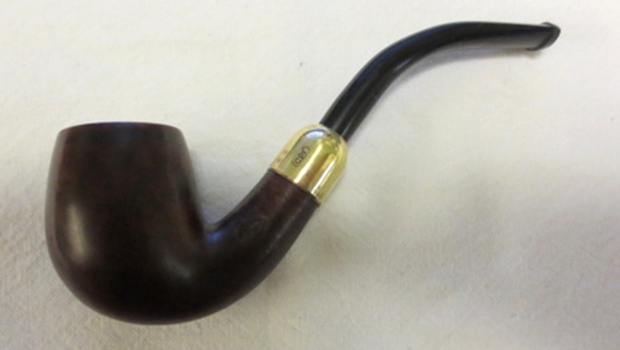
Tag Archives: Horn stems

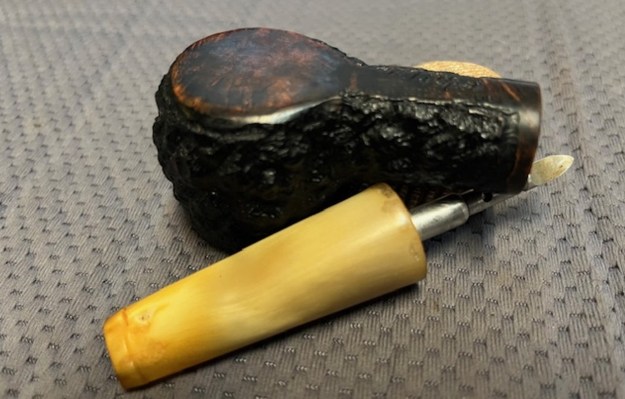
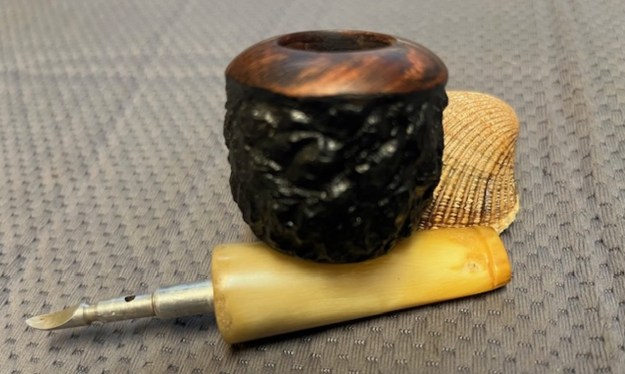
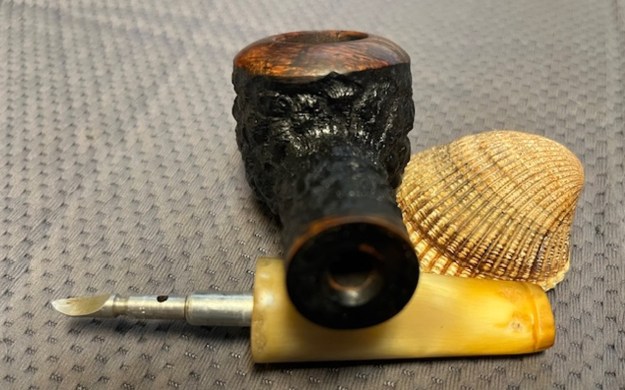
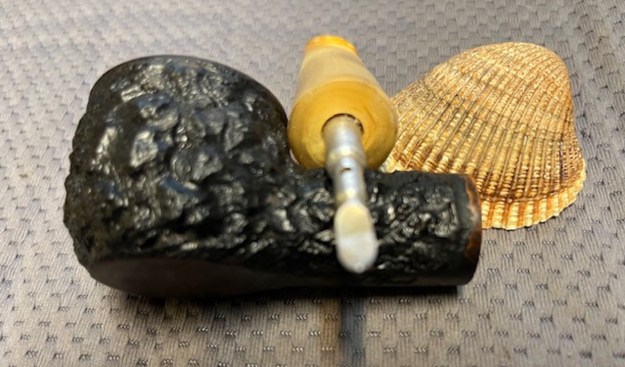
Fitting a Shank and Stem to a well Patinaed Meerschaum


by Steve Laug

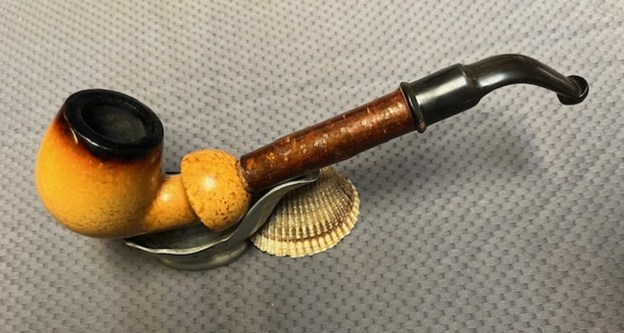
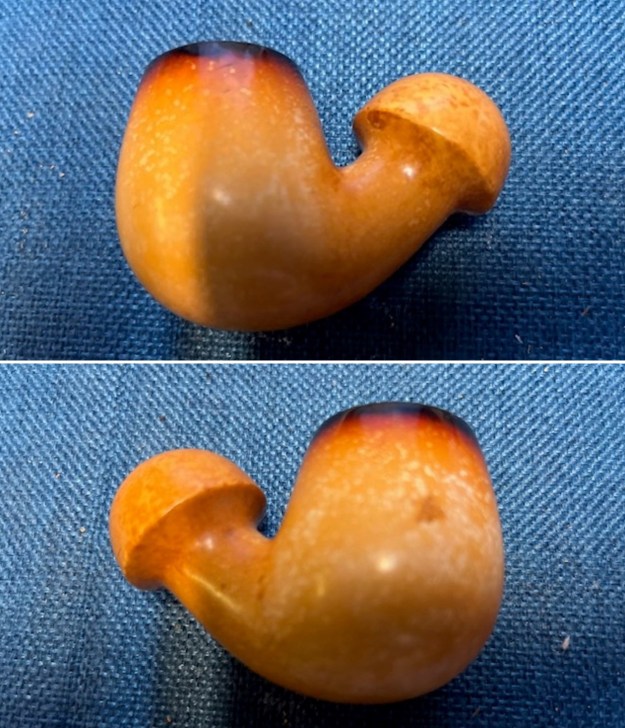
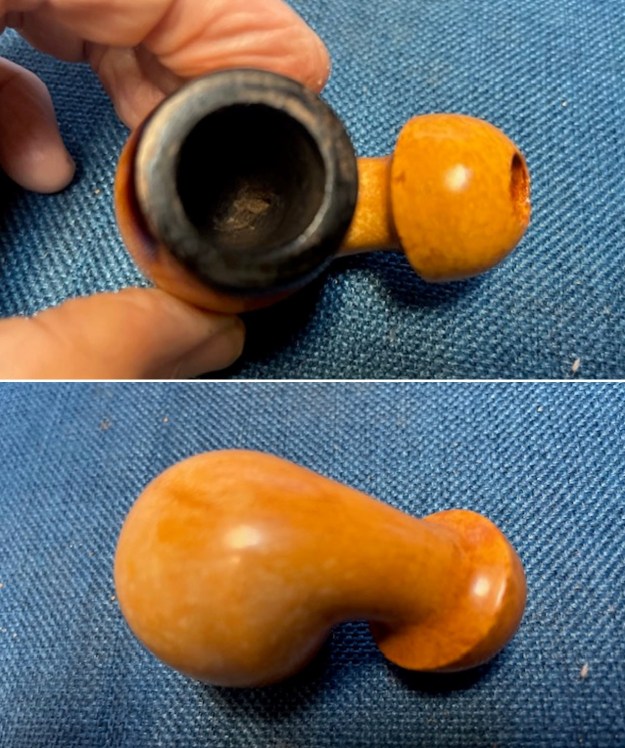
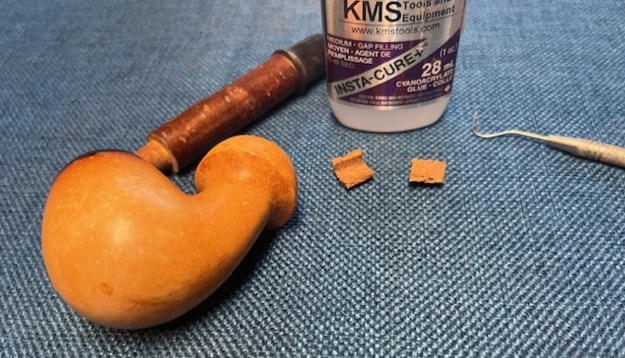
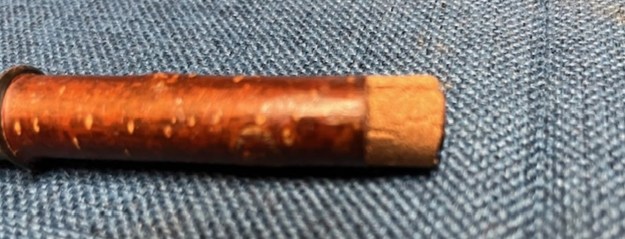
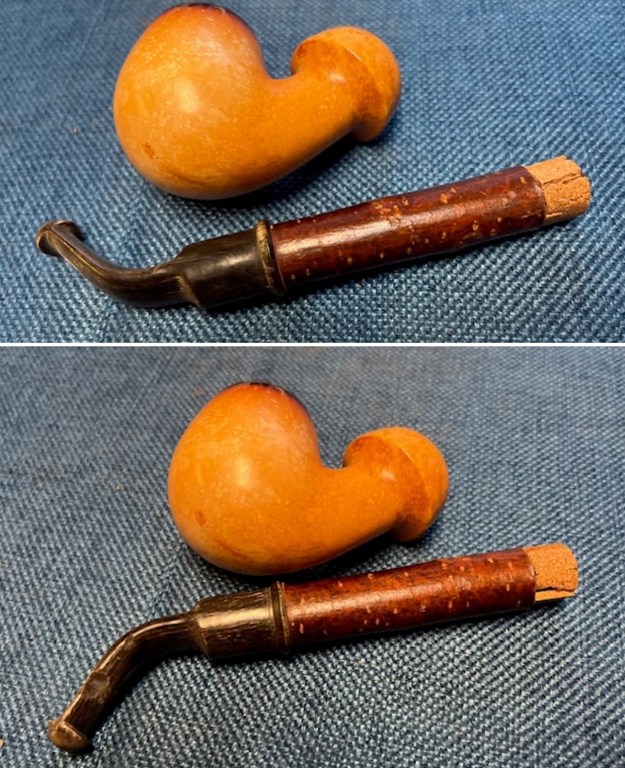
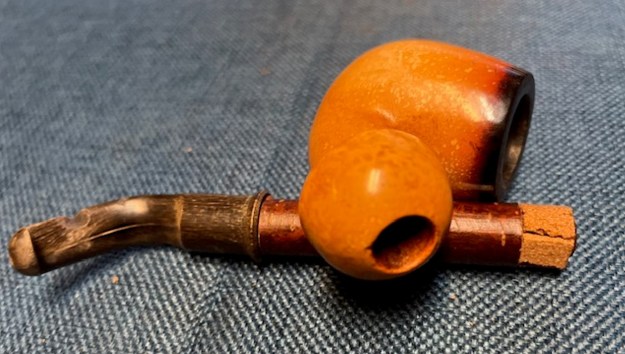
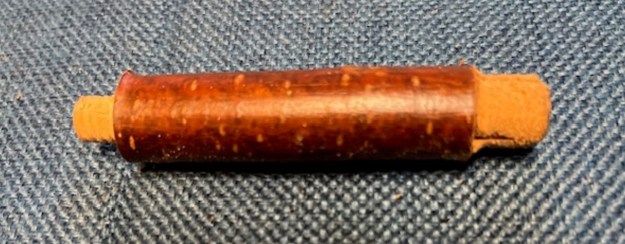
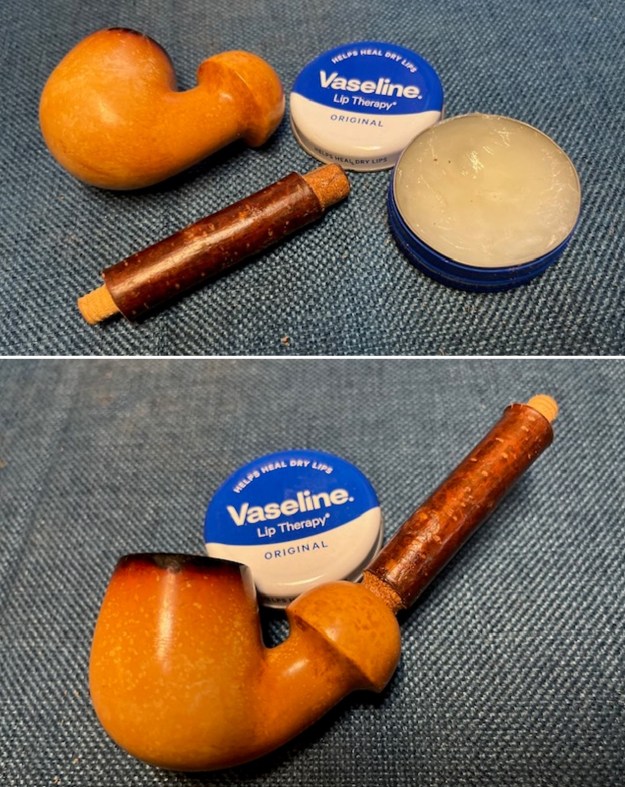
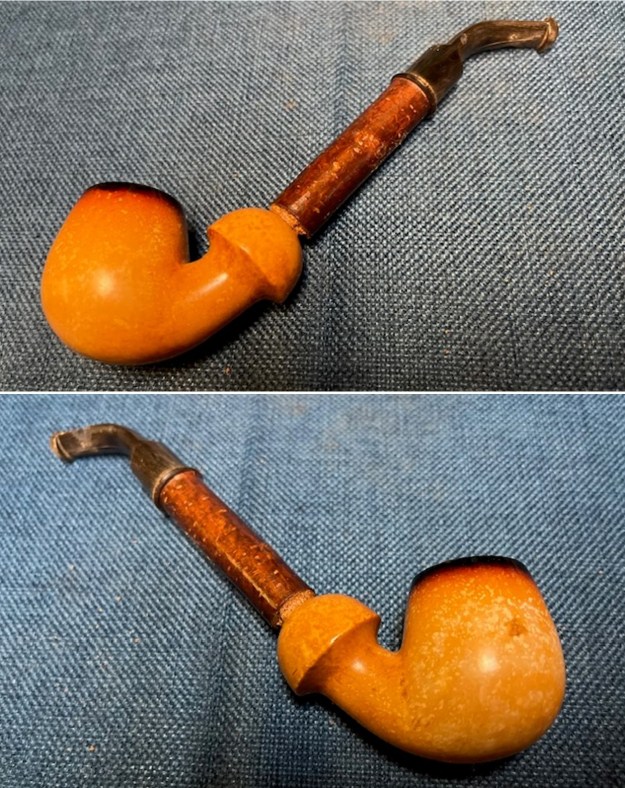
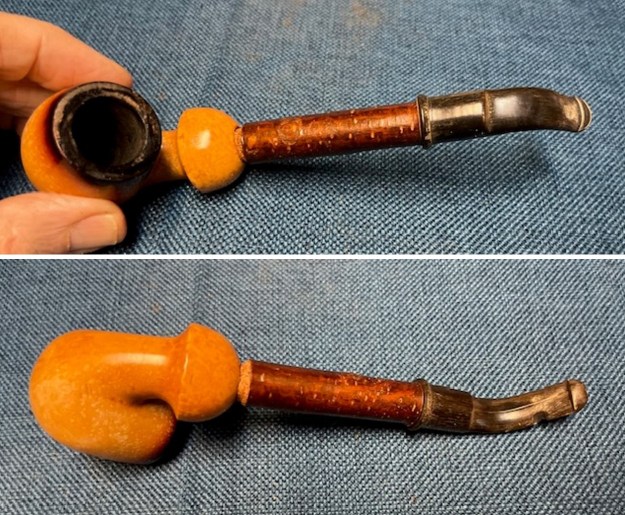
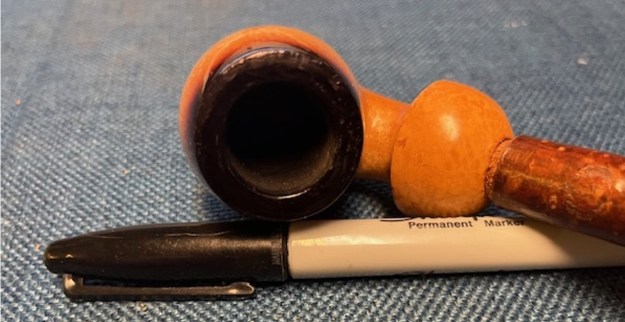
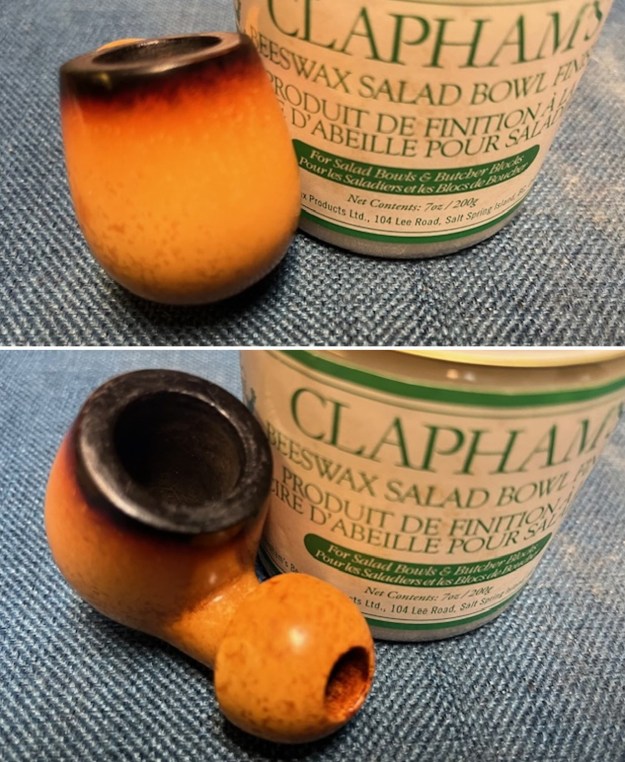
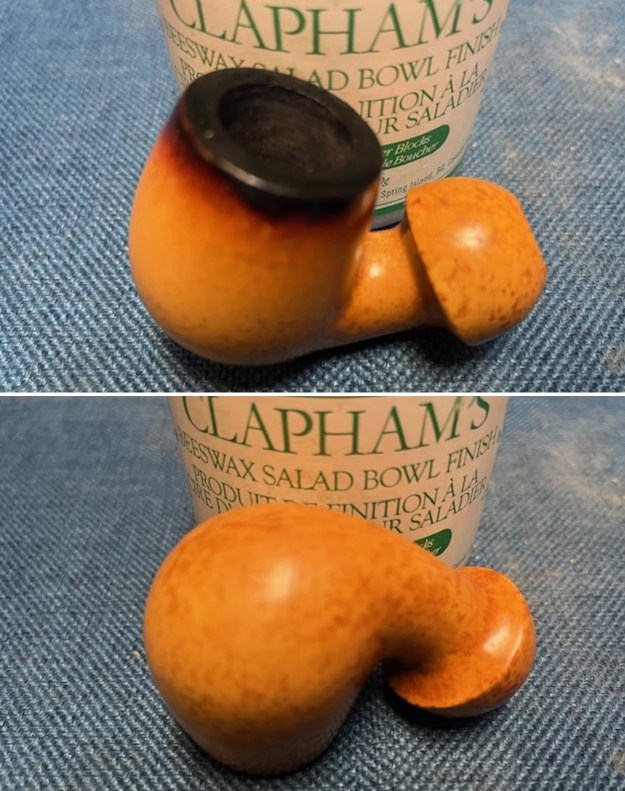
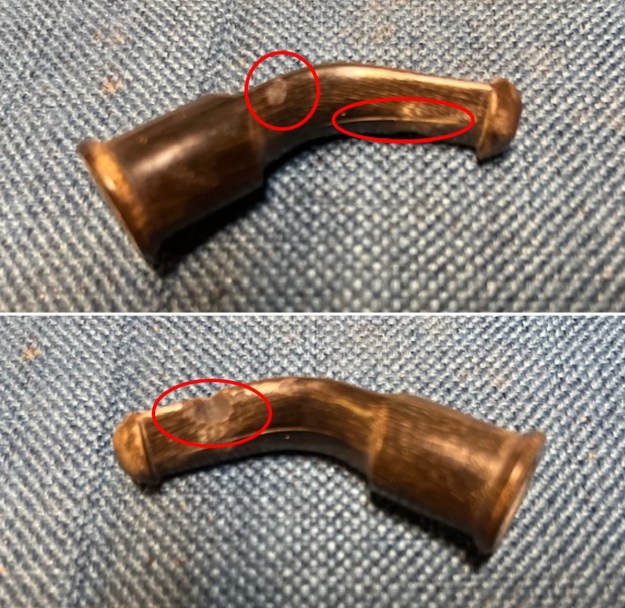
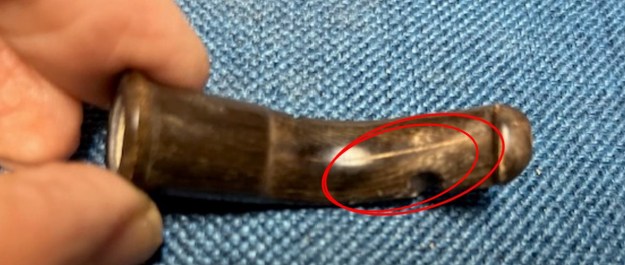
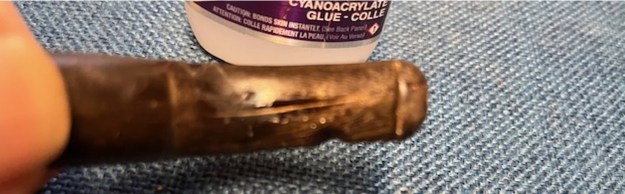
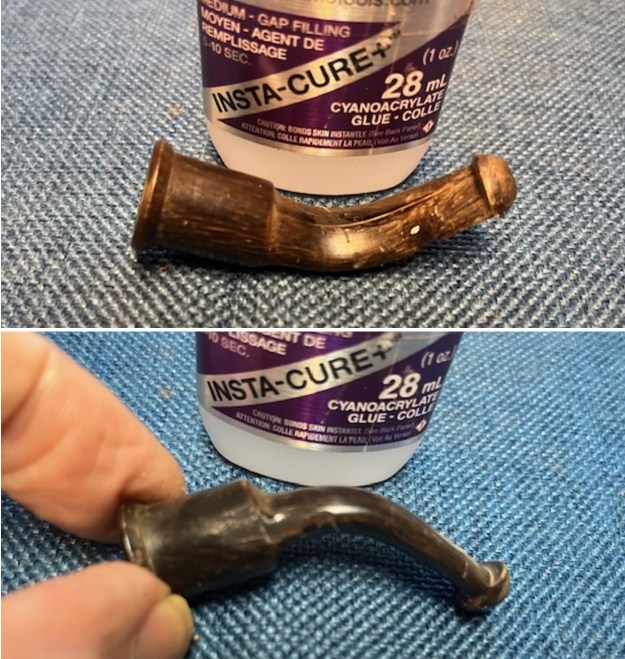
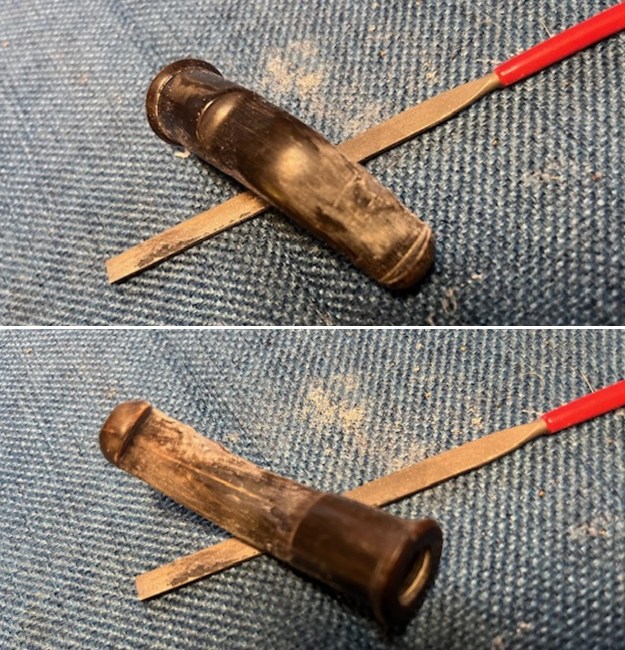
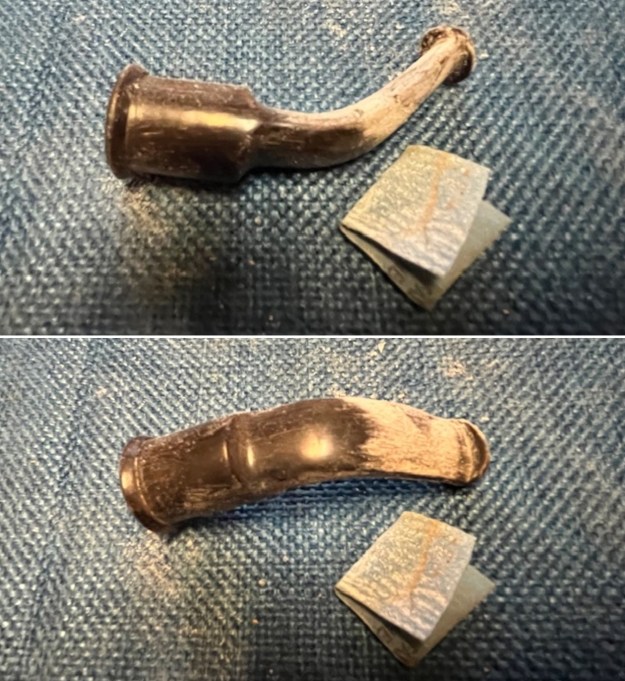
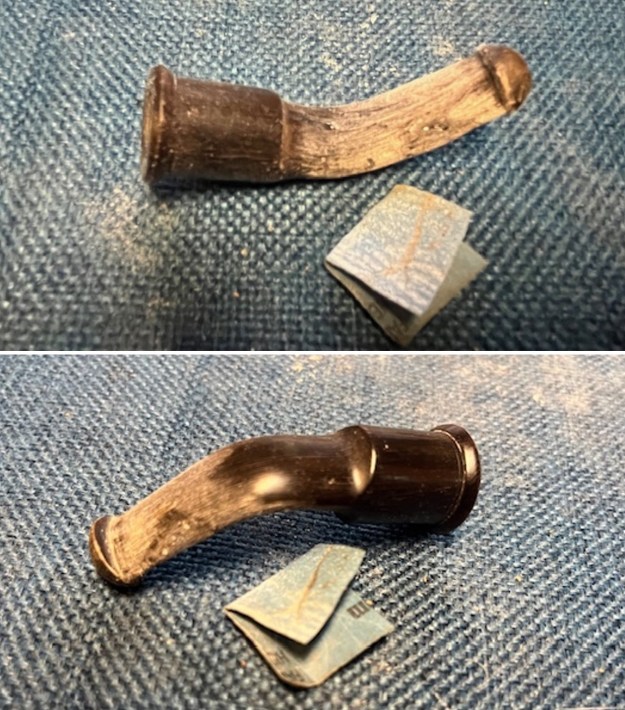
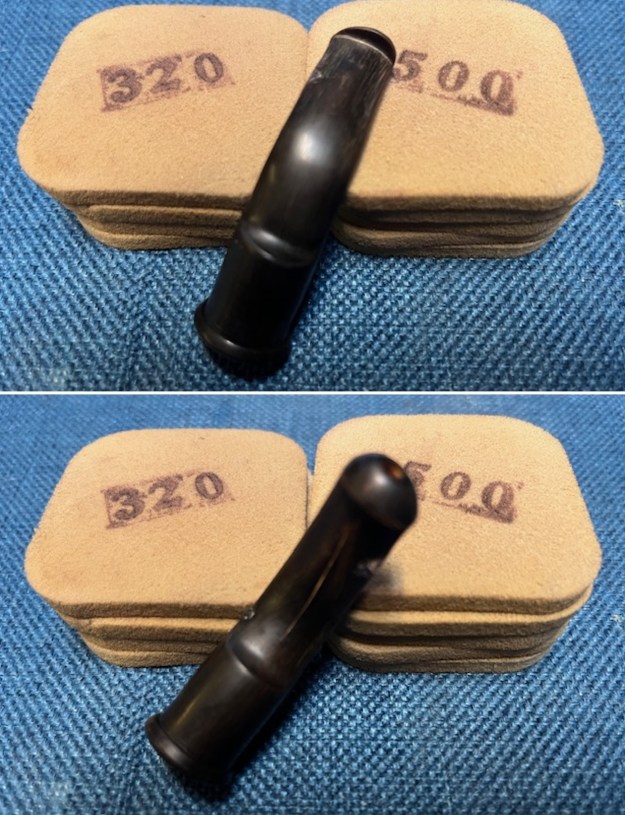
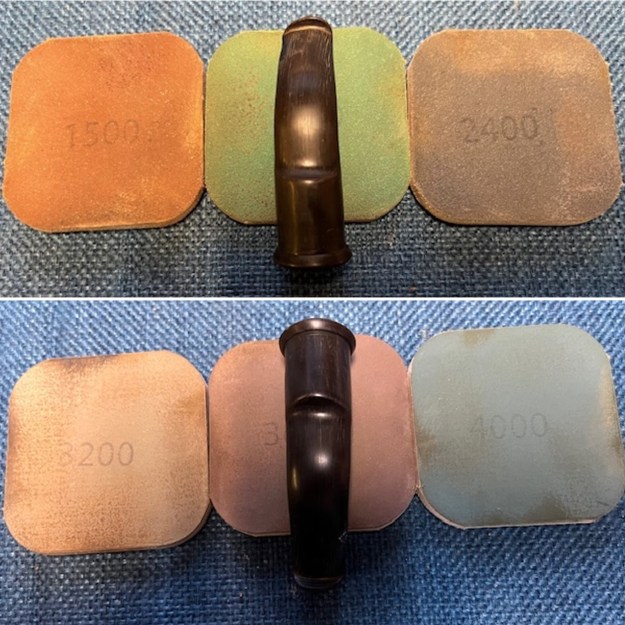
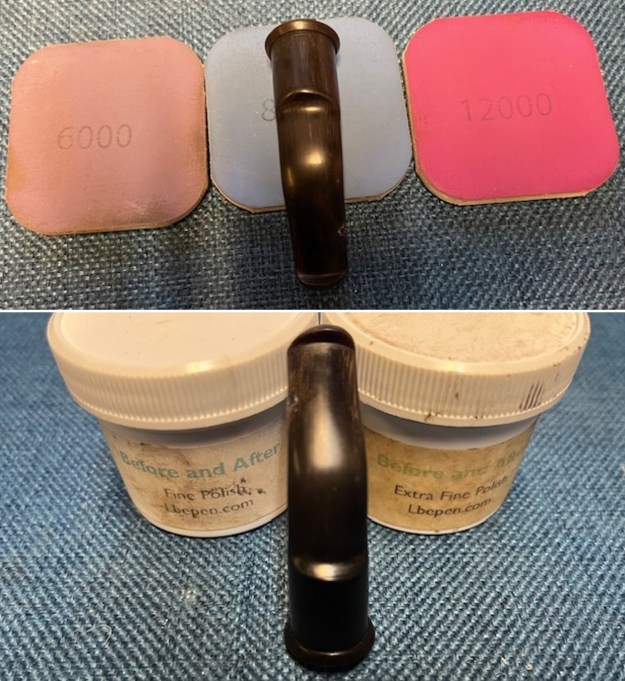
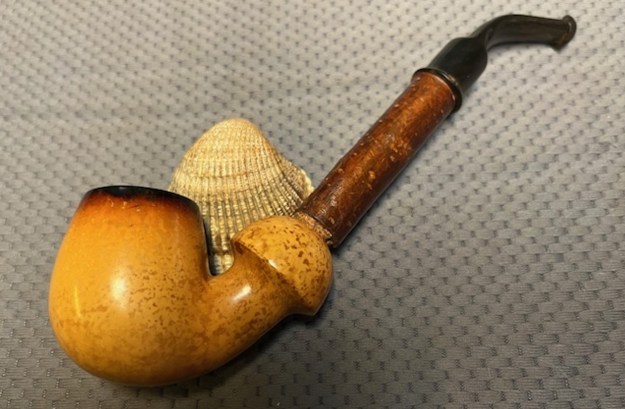
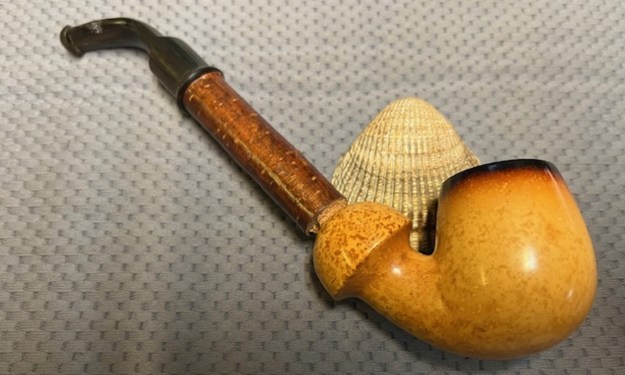
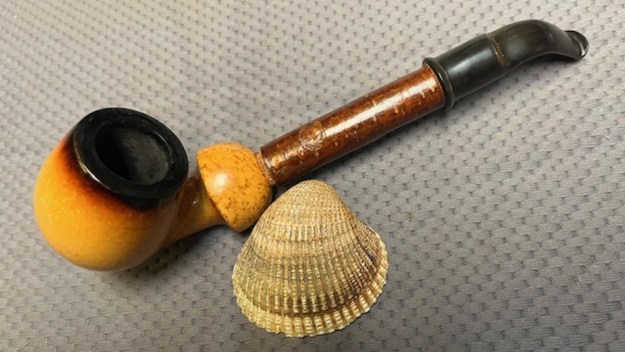
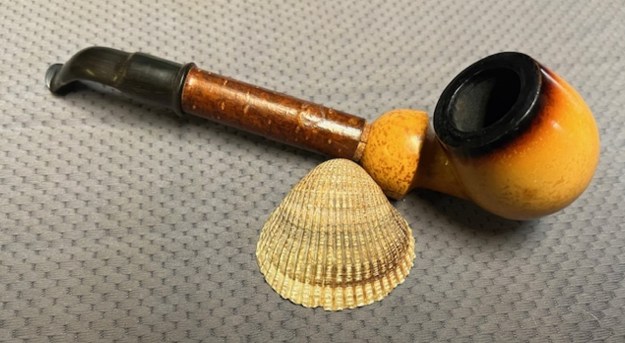
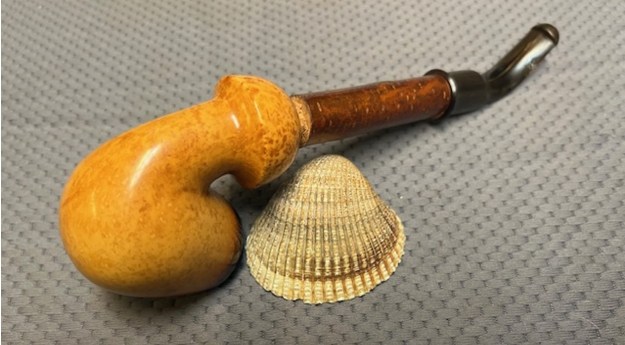
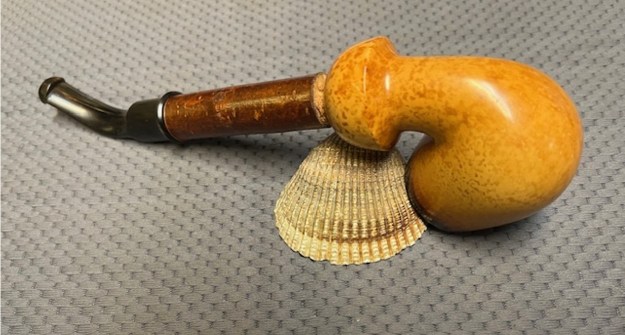
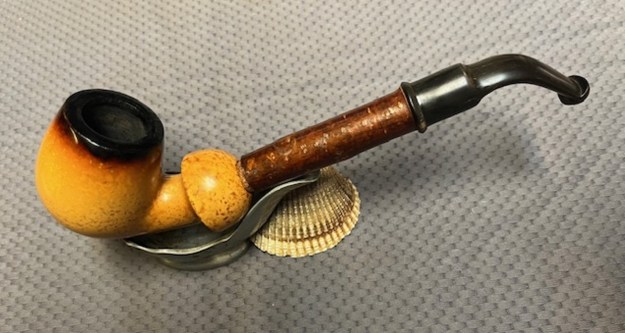
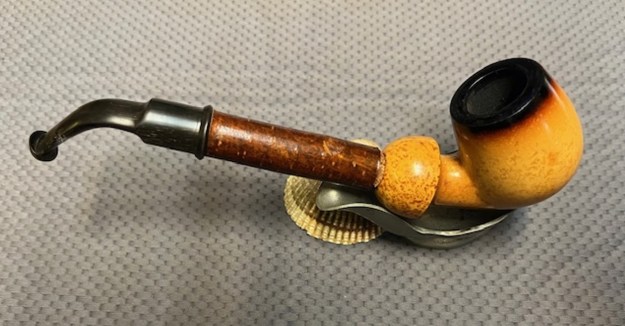
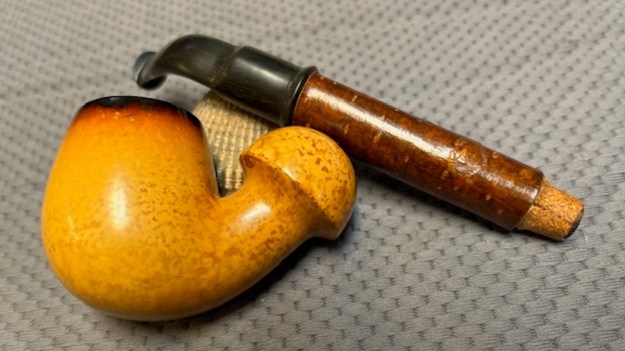
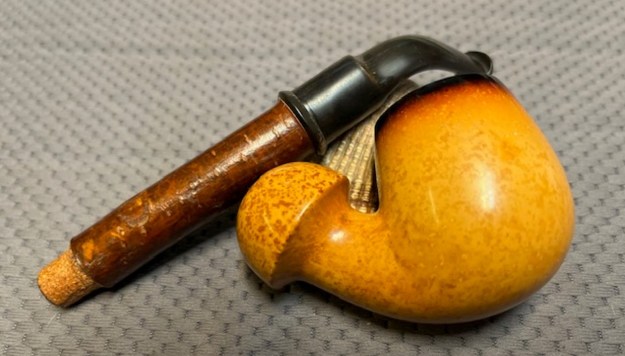
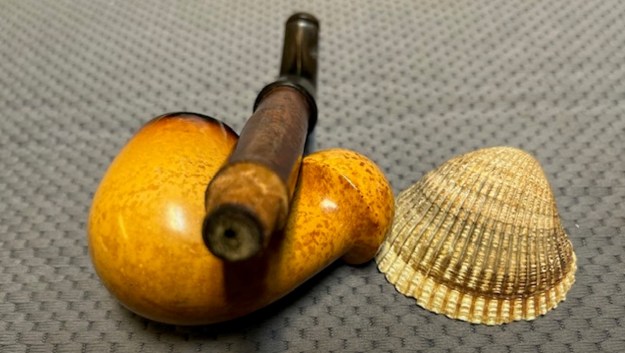
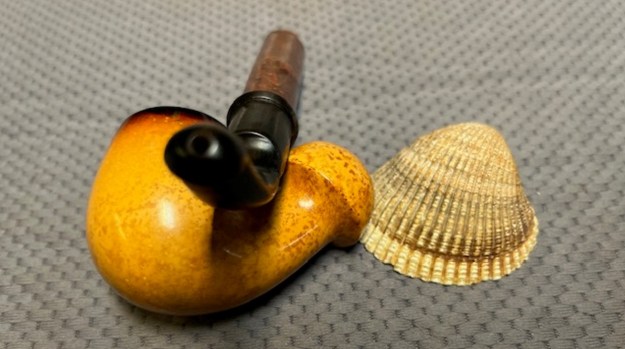
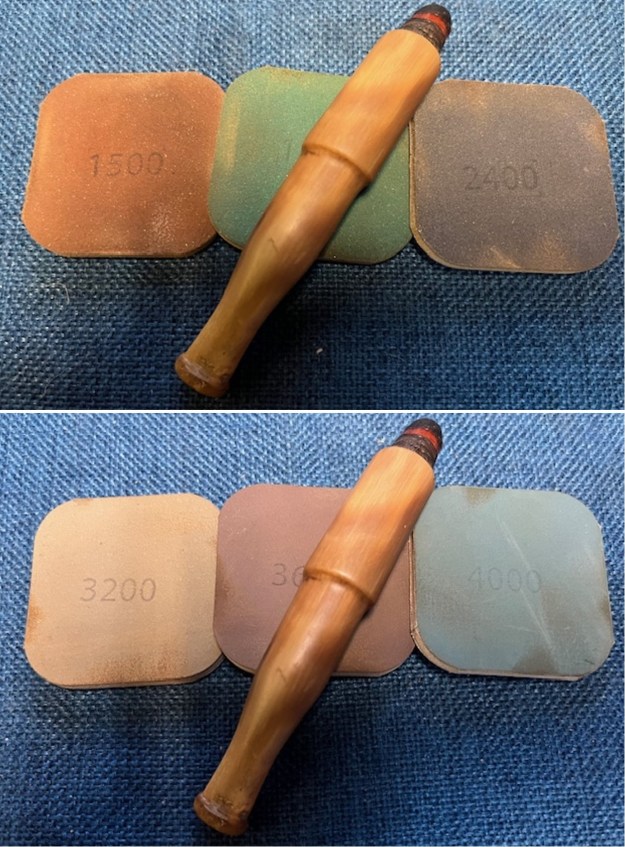
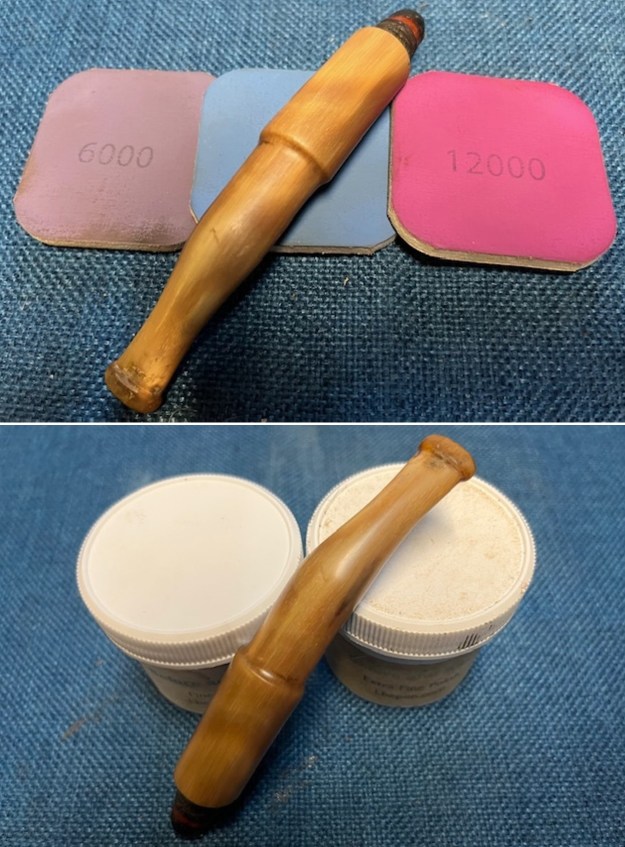
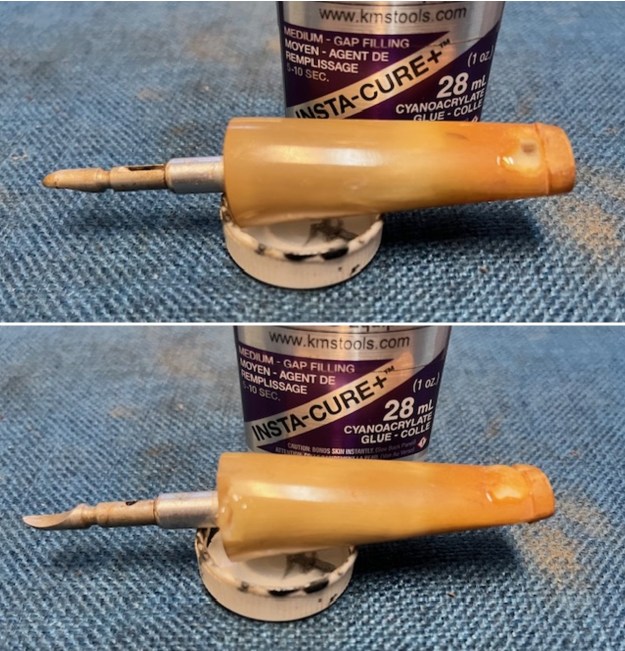
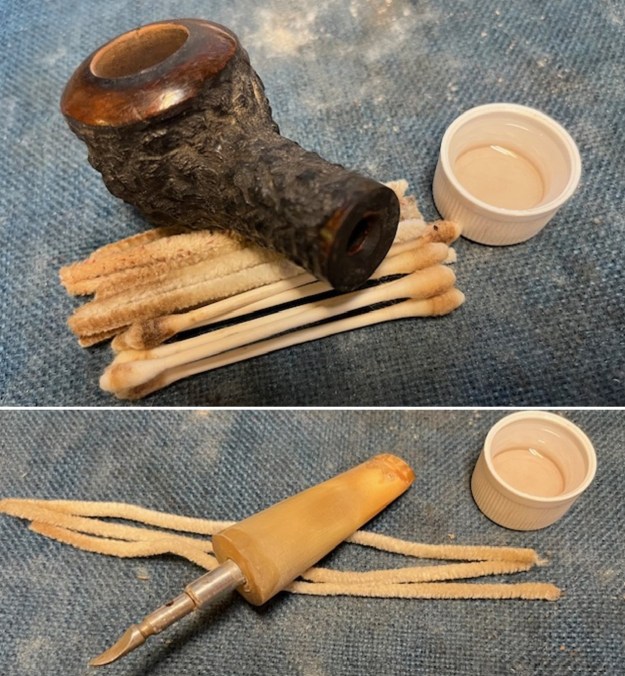
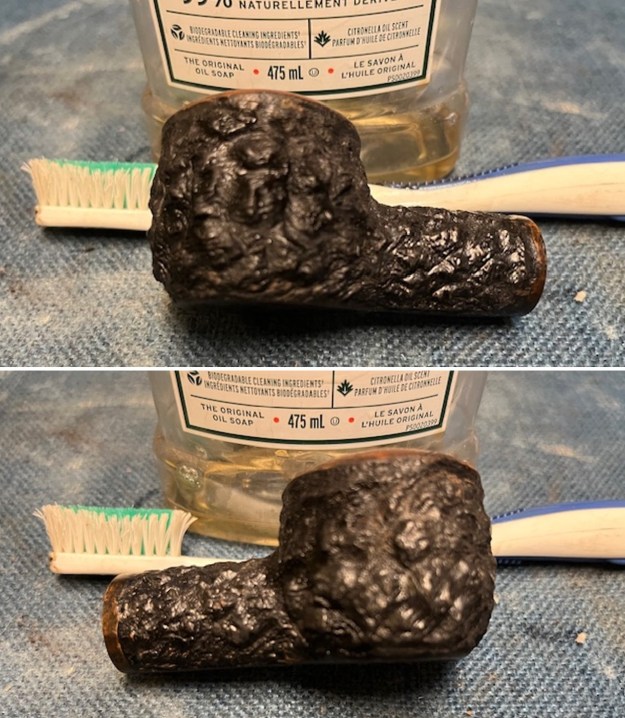
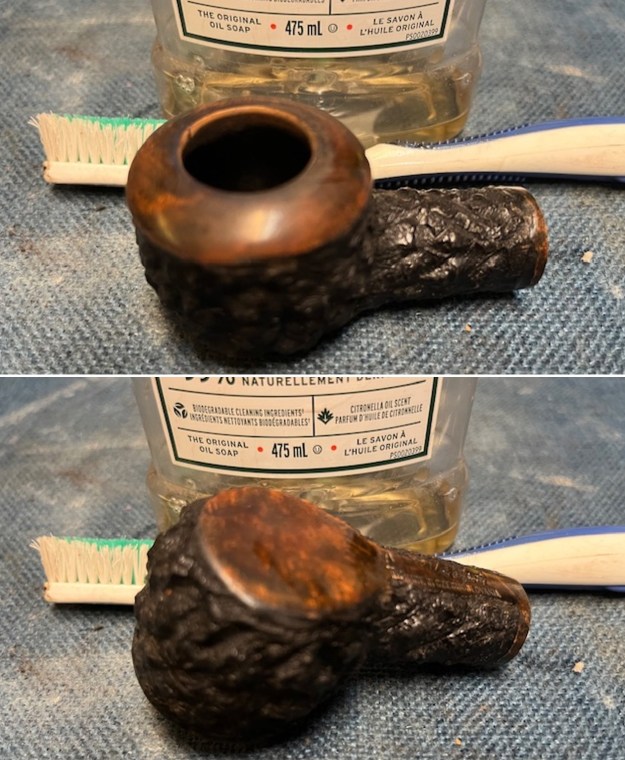
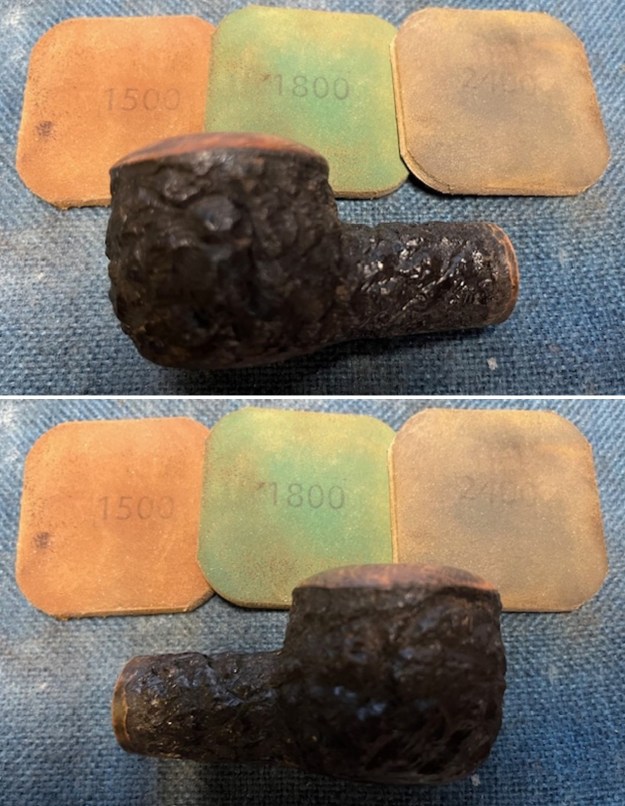
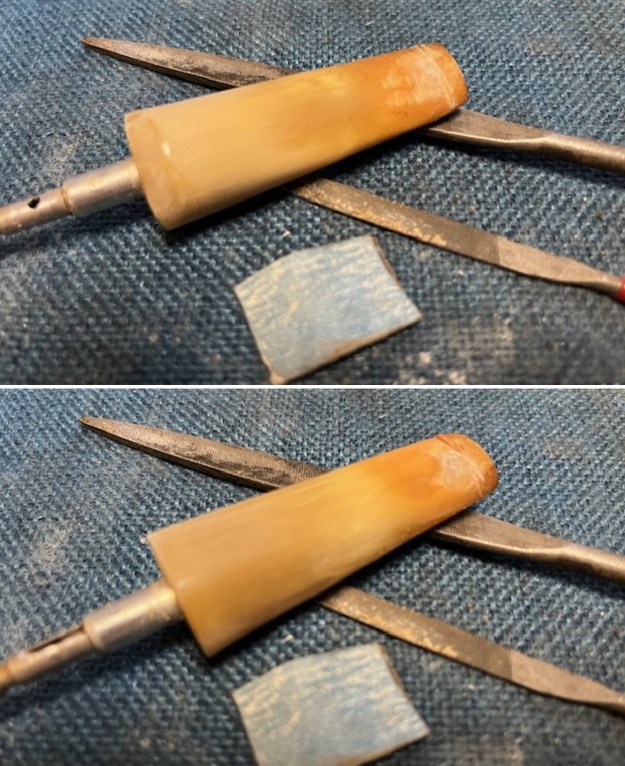
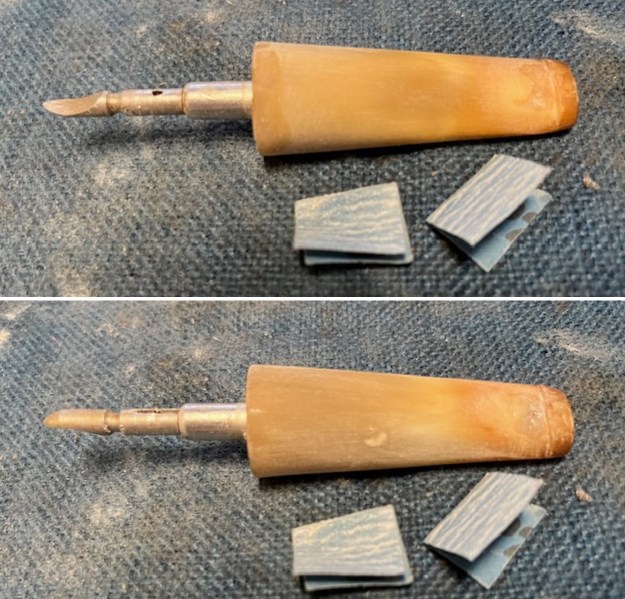
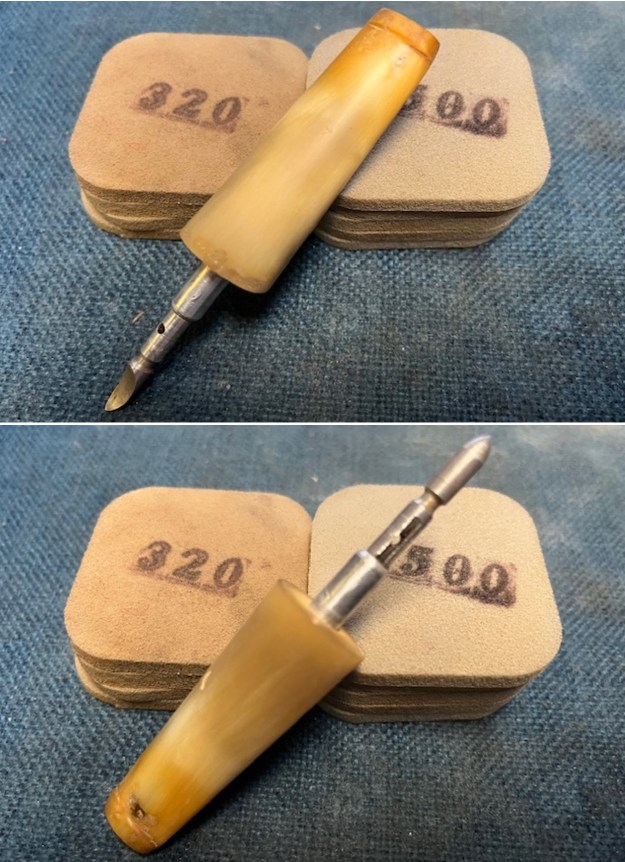
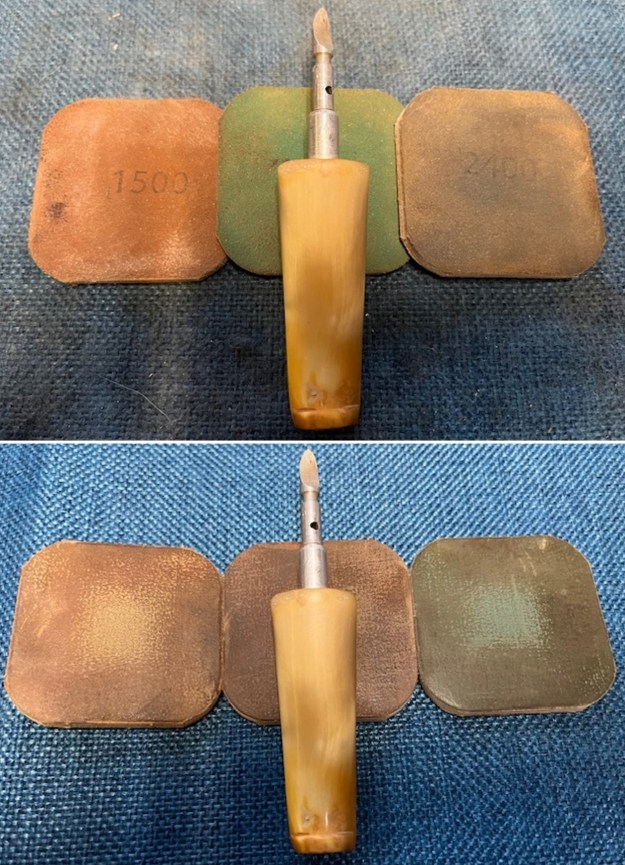
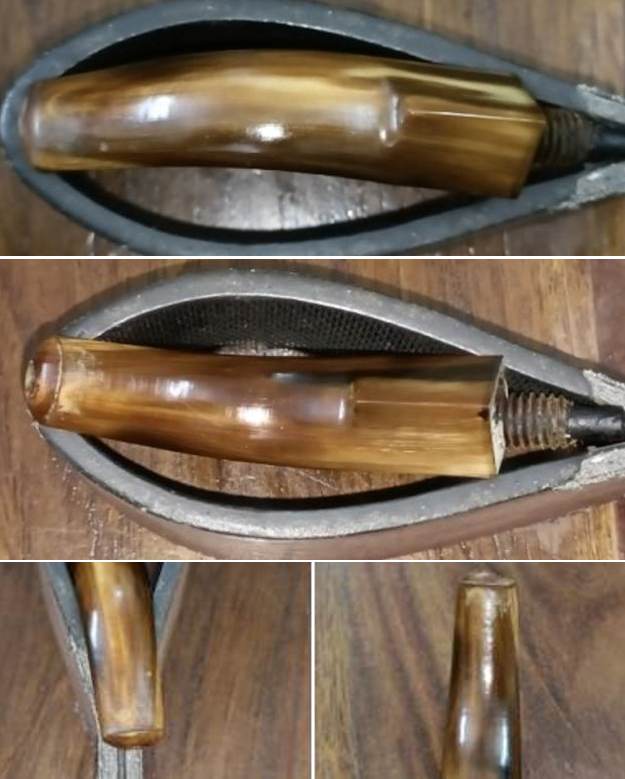
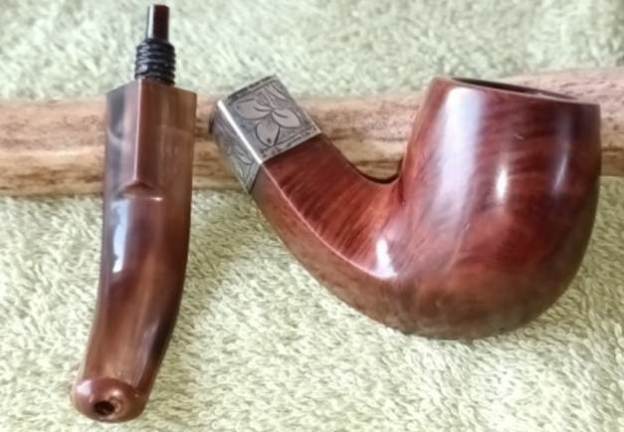
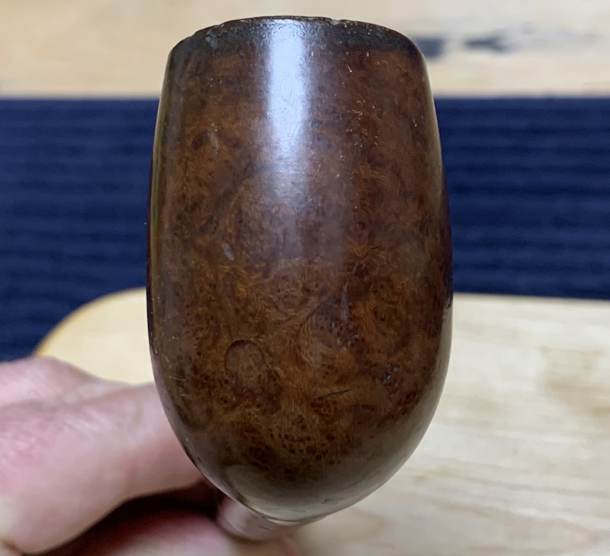
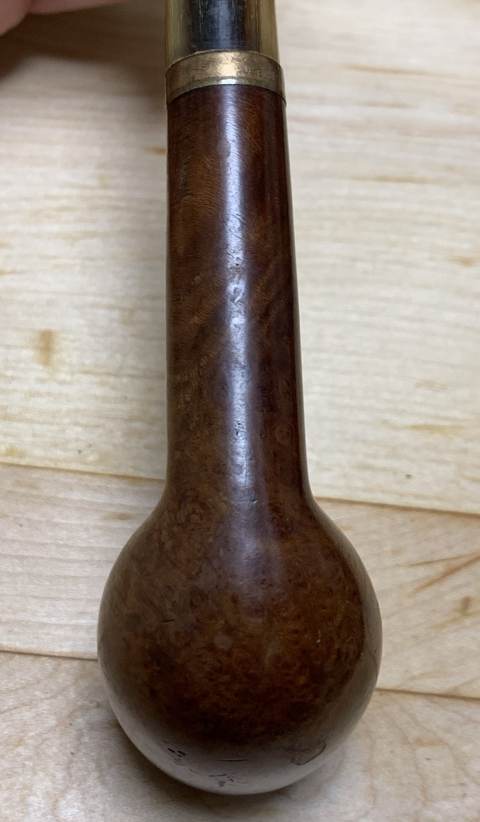
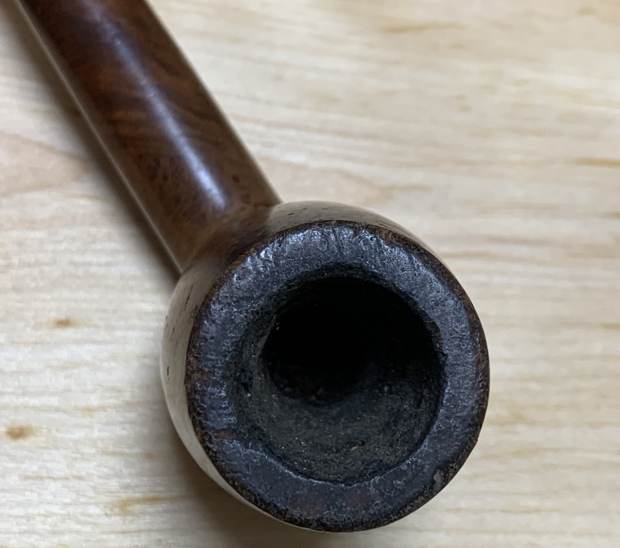
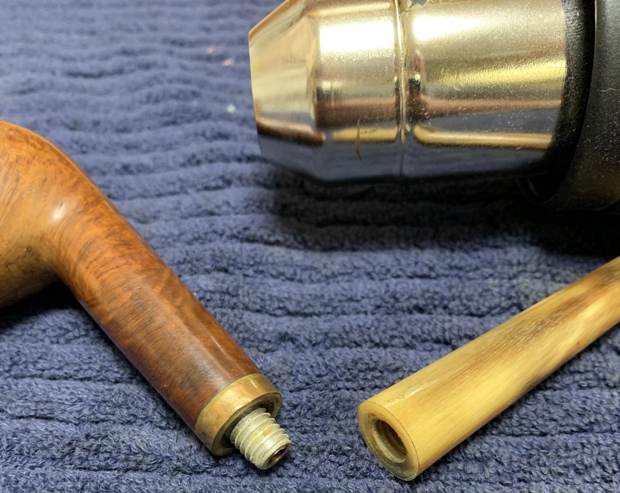
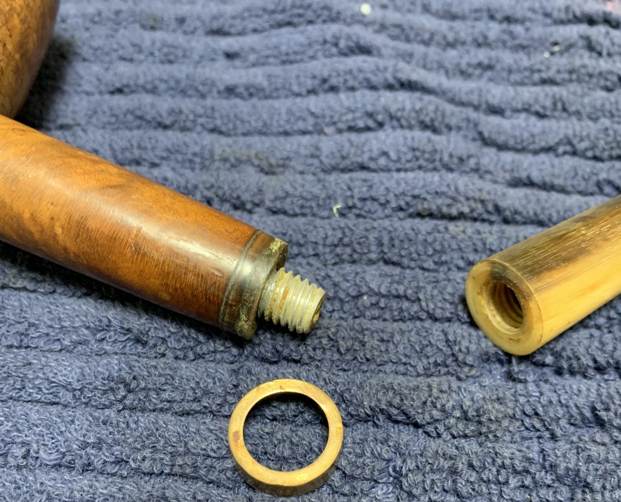
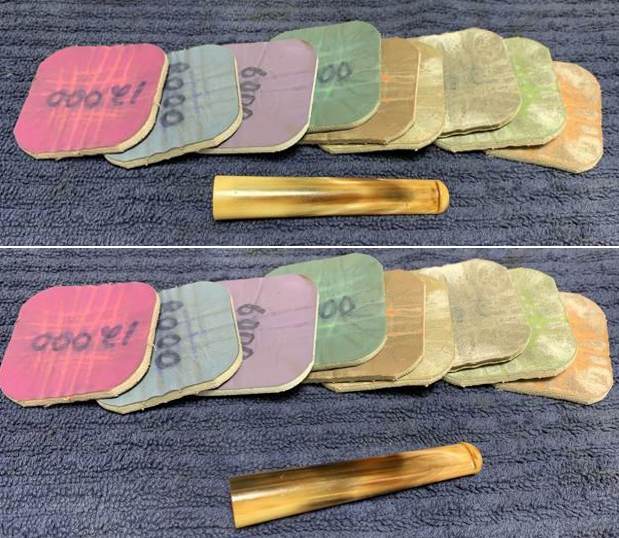
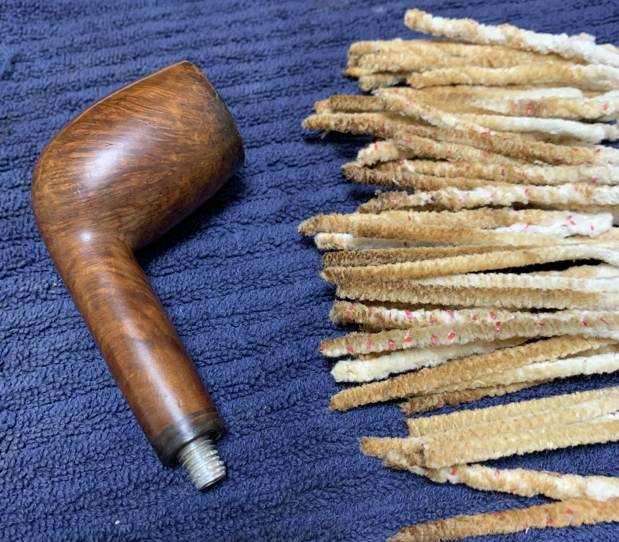
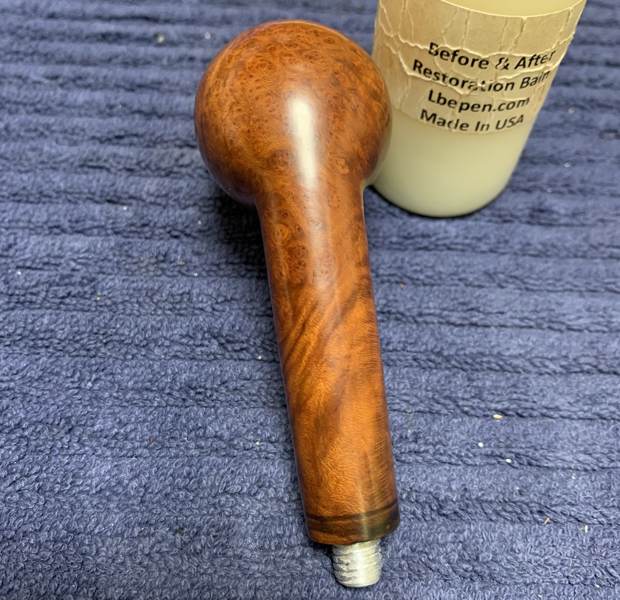
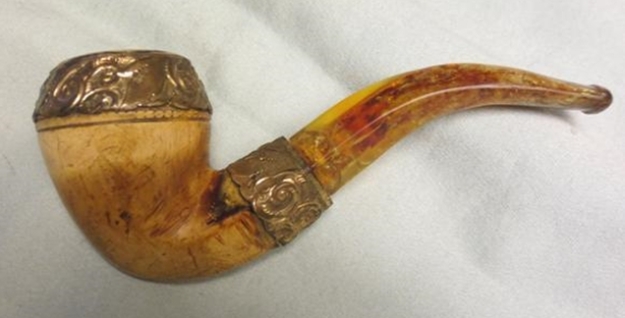
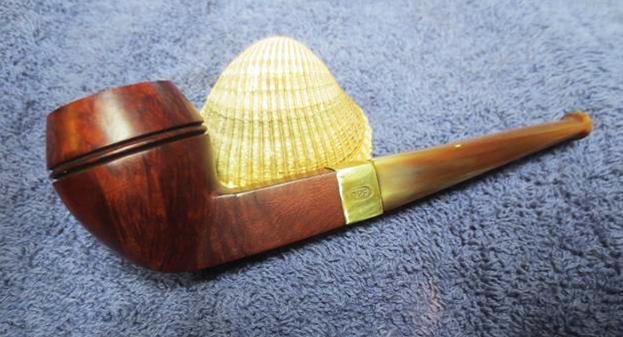
I have had this older meerschaum bowl in my box of pipes to restem for a long time. I have no idea where we picked it up but this older style bowl always catches my attention. The mushroom shaped shank, the patina on the meer and the darkened, or flumed, edge of the bowl all catch my eye. I have worked on quite a few of these in the past and most had cherrywood shanks and horn stems. I was going through my box of bowls the other evening and once again this one really caught my eye. The finish is clean with a very nice patina. The bowl is very clean with no cake build up and appears to have been well maintained. The rim top is clear of debris and lava and the fluming is faded in spots around the top. The shank is also clean and appears to have been cleaned before we set it aside. I don’t know about you all but when you have a lot of pipes to work on sometimes it is easy to forget what has been done on the pipes in boxes. I took some photos of the pipe to give a sense of what it looked like when I removed it from the box. I went through my stems and found a cherrywood shank and horn stem that would work well with the pipe. I would need to glue some cork on the tenon of the stem (normal for this style of shank). The cherrywood was in excellent condition but the stem had some worm damage on the sides and a small split in the underside that would need to be repaired.I gave the cork a coat of clear CA glue and pressed it in place on the shank end. I love working with this glue as it cures quickly and holds very well.I took some photos of the parts of the pipe to show the general proportion of the pipe. You can also see the seams in the cork gasket.  But no worries. I still need to sand down the gasket for a fit in the shank and grease it which will bring the seams together. You can also see the worm damage on the horn stem in the second and third photos below. I used my Dremel and sanding drum to reduce the diameter of the cork gasket until it fit well in the shank ed of the bowl.I used some Vaseline petroleum Jelly to soften and preserve the cork gasket. I worked it into the cork with my finger tips and let it sit. I repeated the process and once finished the cork was soft and pliable. It fit well in the shank and was snug and solid.I screwed the stem on the shank to give a sense of what the pipe would look like once finished. I like the look and feel of this one. I touched up the black flume to the rim top with a black Sharpie Pen. I coloured in the edge and the spots on the rim top and inner edge until it was blended in.I gave the bowl multiple coats of Clapham’s Beeswax/Carnauba wax. I applied it by hand and let it cure then buffed it off with a soft cloth to raise a shine. I removed the stem from the cherrywood shank and set the bowl and shank aside. It was time to address the worm damage in the horn stem. I have circled the damaged areas in red in the photos below. I filled in the split on the underside of the stem and the worm damage spots on each side with clear CA glue. I layered it into he damaged areas until it was smooth. Once the repair cured I shaped and flattened the repairs with a small file. I worked over the shape with a folded piece of 220 grit sandpaper. I wanted the edges and surfaces to be smooth. I sanded the stem with 320-3500 grit sanding pads. I wiped the stem down after each sanding pad to remove the sanding debris and dust. The stem looked very good. I polished the stem with micromesh sanding pads – 1500-12000 grit pads. I wiped it down with an Obsidian Oil cloth after each sanding pad.  I finished polishing it with Before & After Pipe Stem Polish – both Fine and Extra Fine and buffed it off with a cotton cloth. I gave it a coat of Obsidian Oil to preserve and protect the stem. This Old Apple Meerschaum with its new Cherrywood and Horn Stem is a great looking pipe now that it has been restored. The patina on the waxed meerschaum gives a sense of depth to the pipe. The flume on the rim and down the outer edge of the bowl is a nice touch. The Cherrywood shank and the rebuilt horn stem go well with this older classic bowl. I carefully buffed the parts of the pipe with Blue Diamond on the buffing wheel. I gave the bowl and the stem multiple coats of Clapham’s Beeswax carefully buffed the entire pipe with a clean buffing pad. I hand buffed the pipe with a microfiber cloth to deepen the shine. The finished Old Apple Meerschaum with its new Cherrywood and Horn Stem fits nicely in the hand and feels great. Give the finished pipe a look in the photos below. The dimensions of the pipe are Length: 7 inches, Height: 1 ¾ inches, Outside diameter of the bowl: 1 ¼ inches, Chamber diameter: ¾ of an inch. The weight of the pipe is 57 grams /1.98 ounces. I will be adding it to the rebornpipes online store in the Meerschaum Pipe Section shortly. Send me an email or a message if you wish to add it to your collection.

As always, I encourage your questions and comments as you read the blog. Thanks to each of you who are reading this blog. Remember we are not pipe owners; we are pipe men and women who hold our pipes in trust until they pass on into the trust of those who follow us.

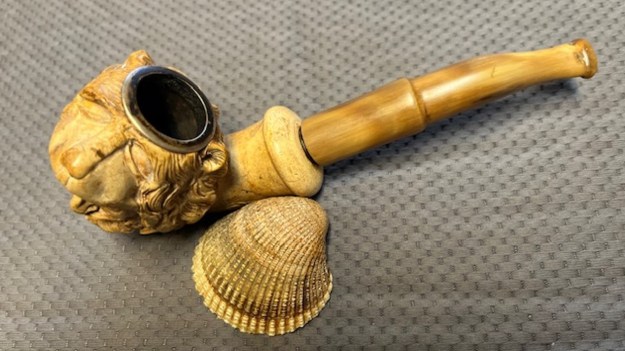
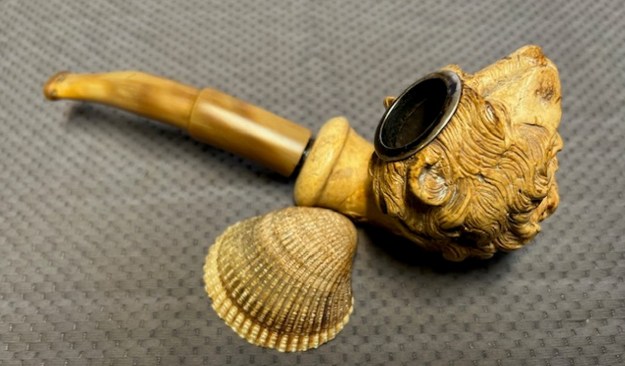
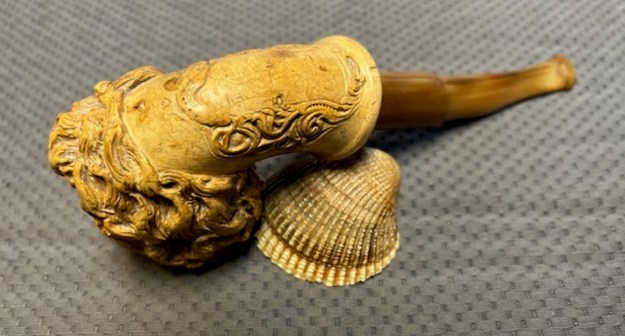
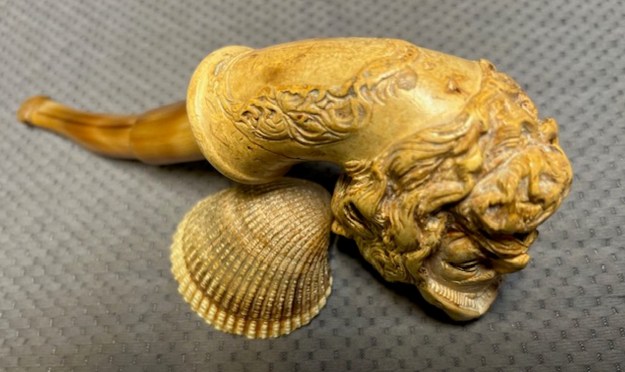
Restoring a Horn Stemmed Meerschaum Figural


by Steve Laug

In November I received an email from Mario about working on some of his Dad’s pipes. Here is what he wrote to me.

I am desperately seeking help restoring and repairing some of my dad’s smoking pipes. I have tried reaching out to the only two known pipe repair establishments I could find in the entire country but one is not currently taking repair orders and the other said she didn’t want to try to repair these pipes without having even seen them. Would you be willing to take on the repairs or can you recommend anyone? Thank you much!!!—Mario

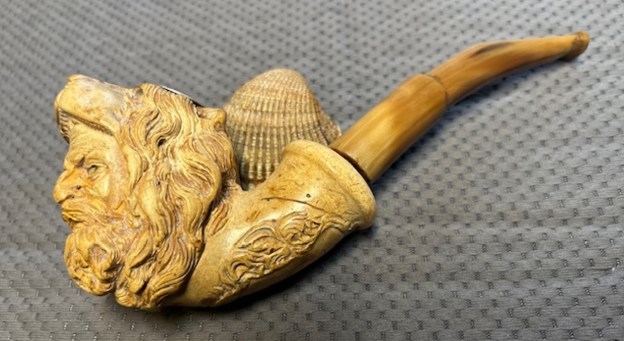
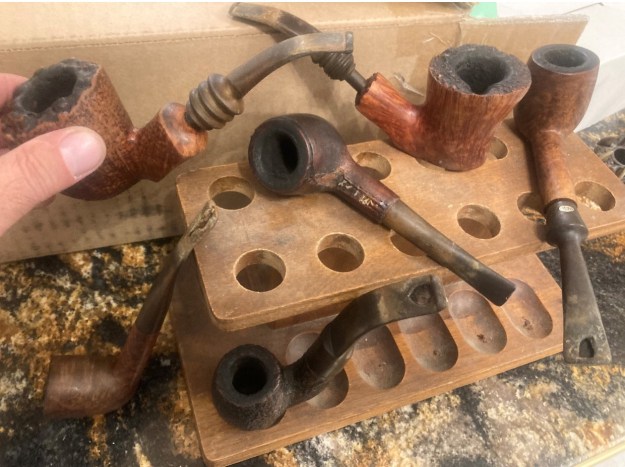
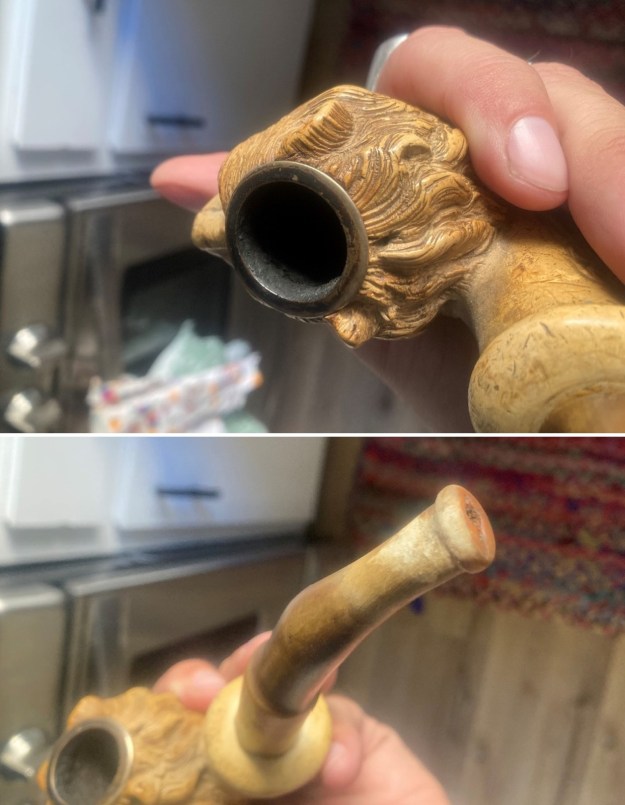
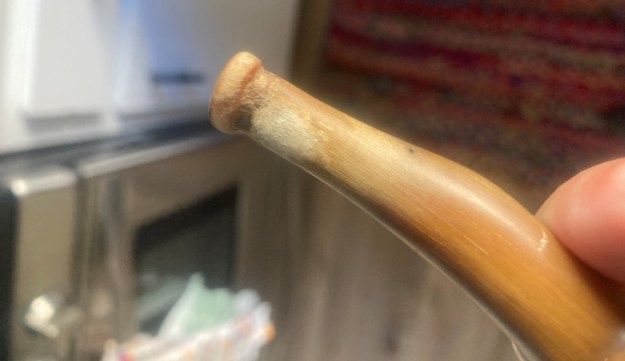
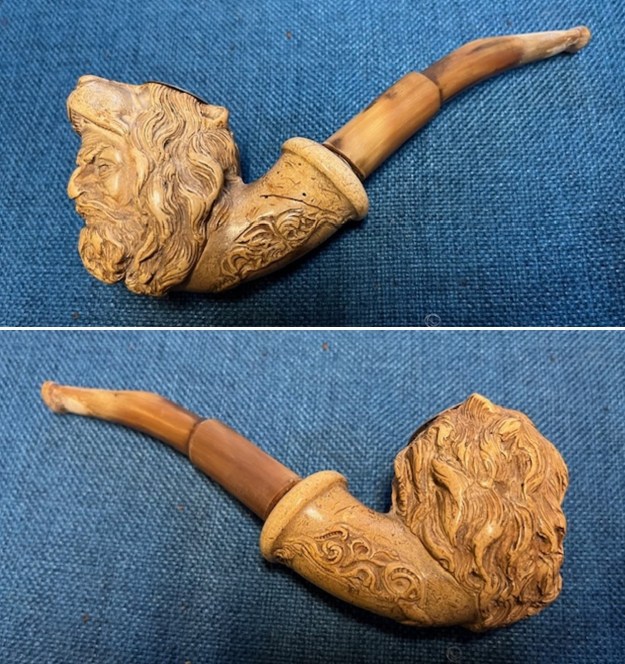
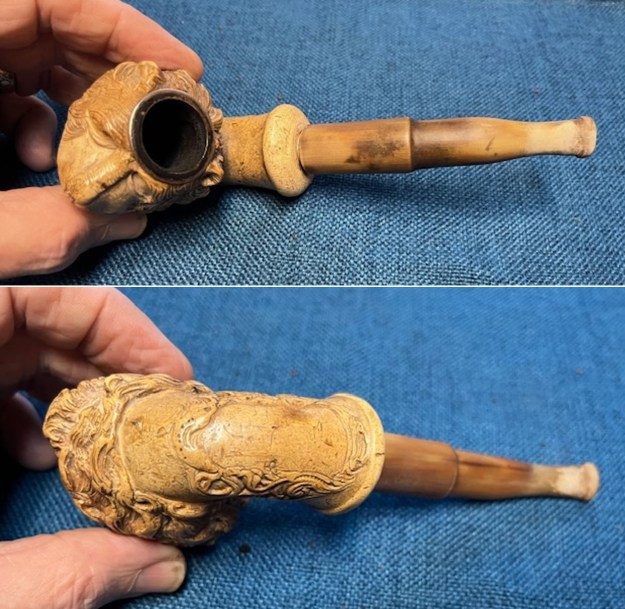
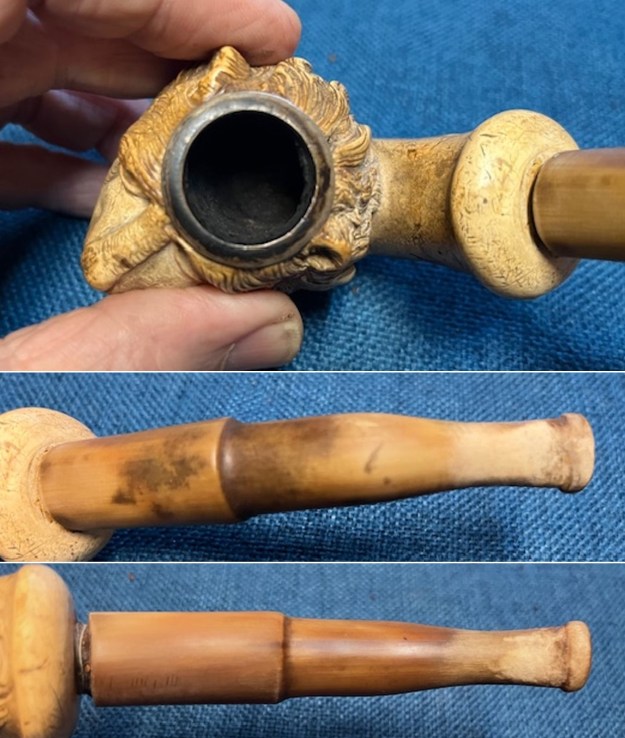
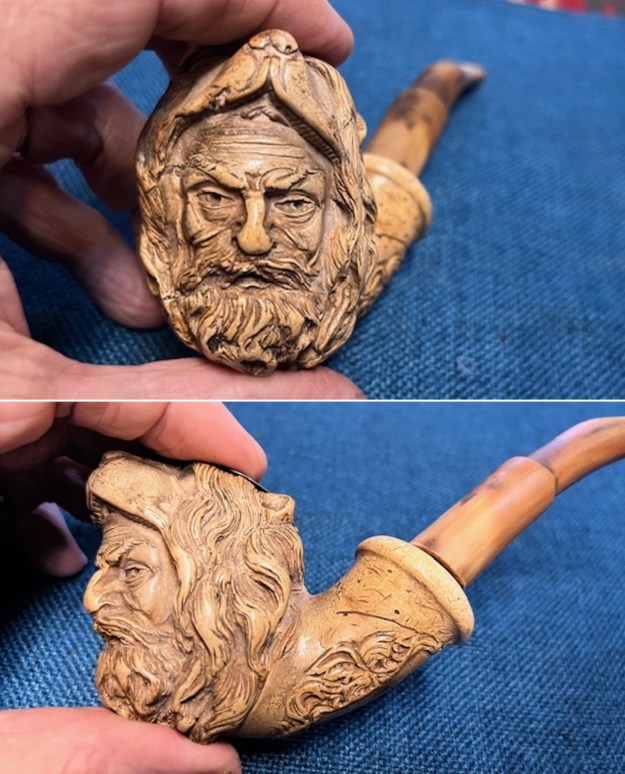
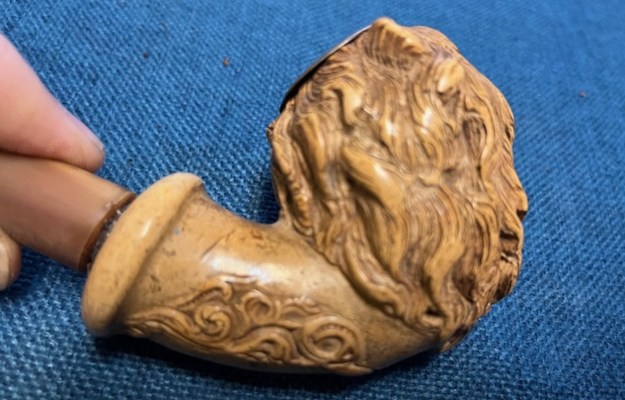
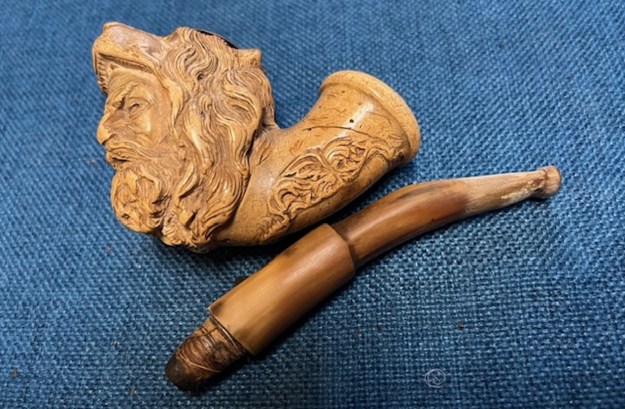
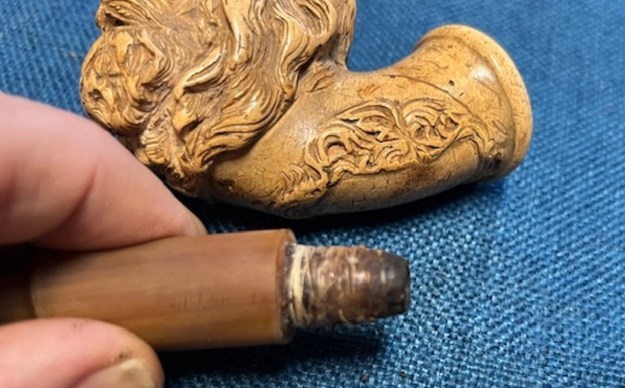
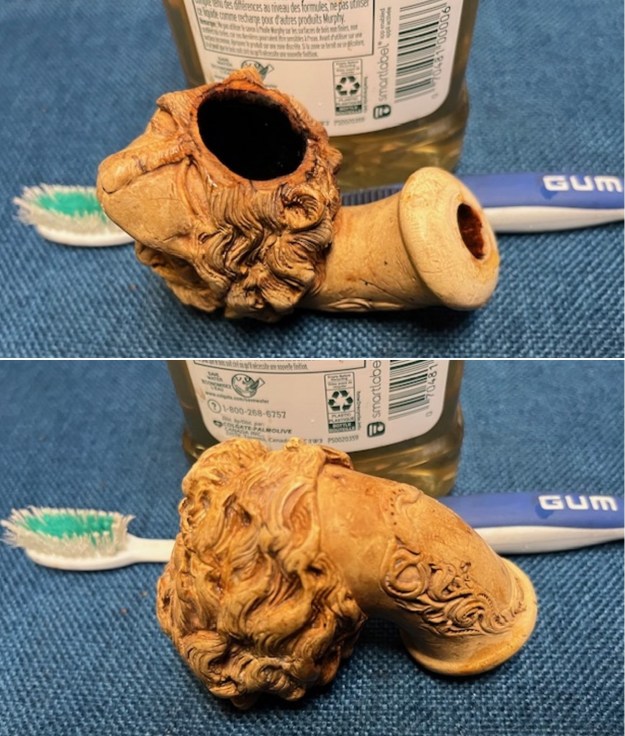
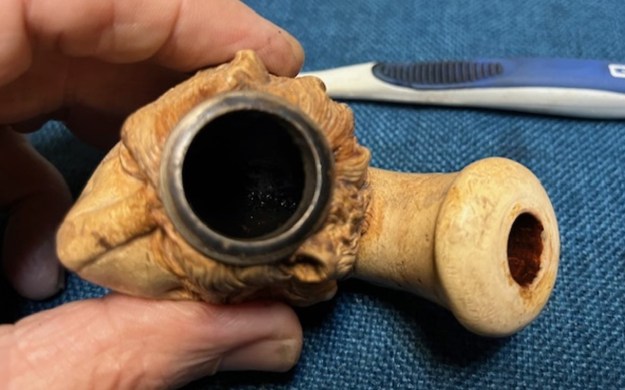
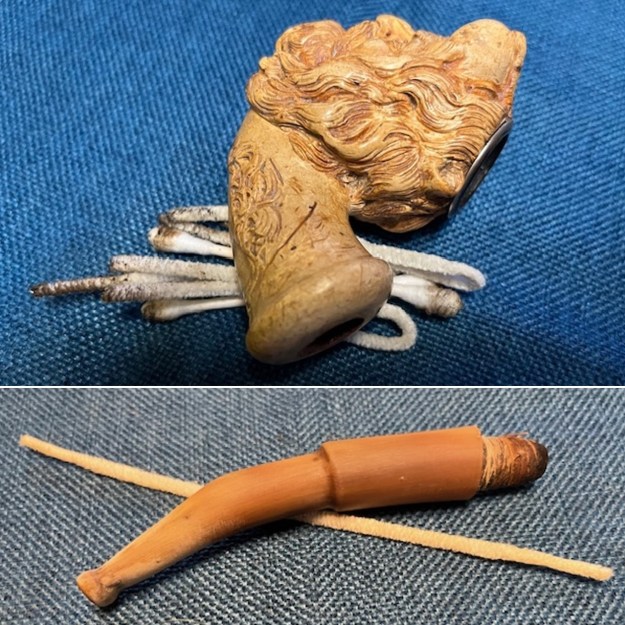
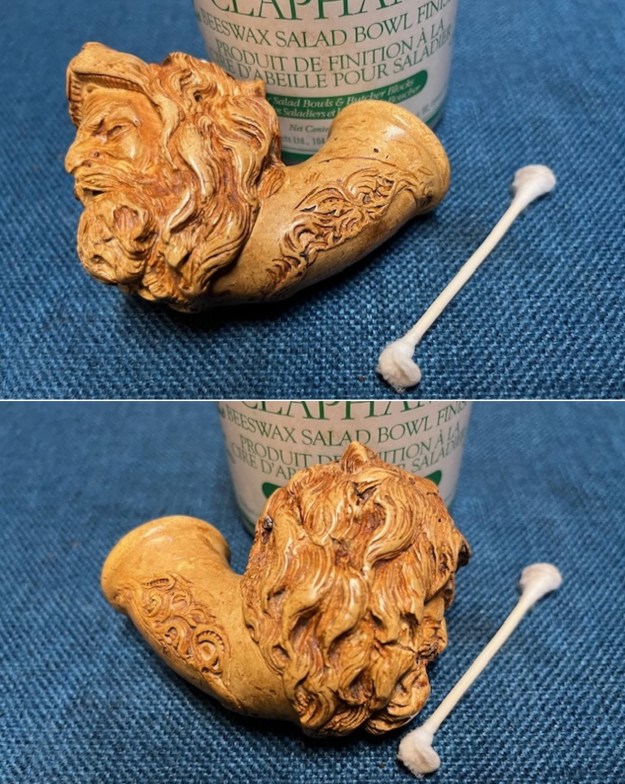
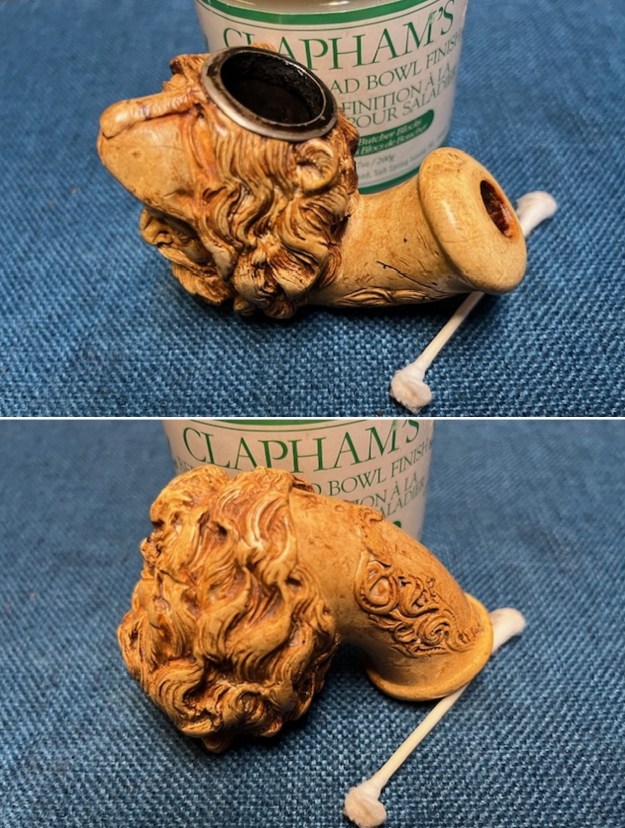
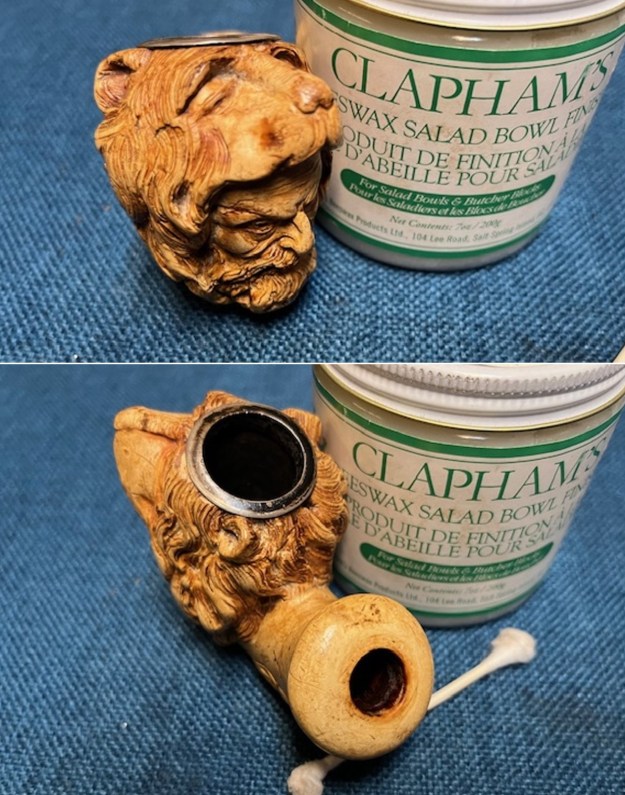
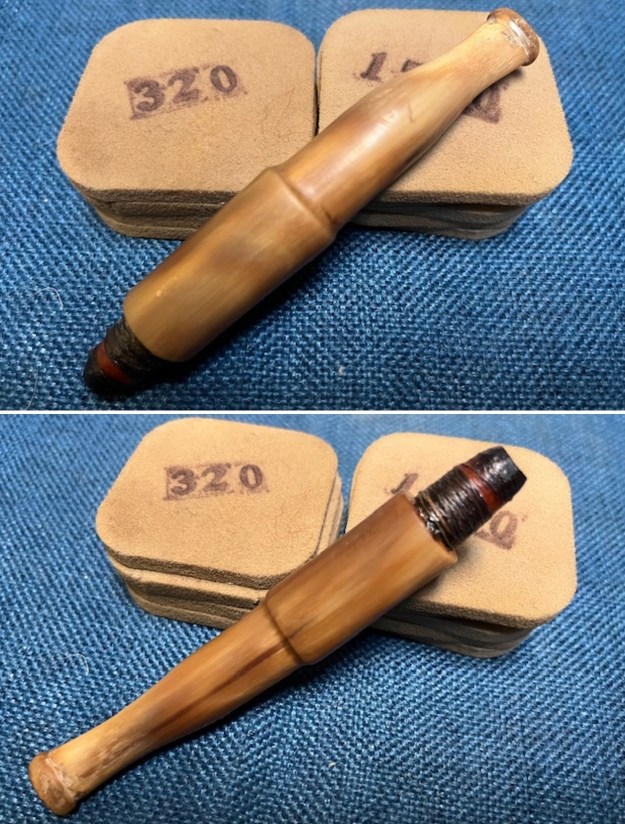
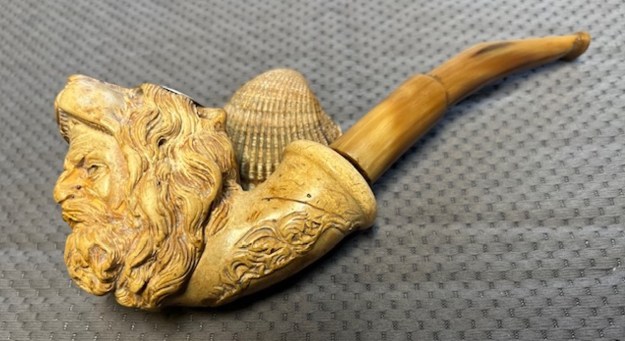
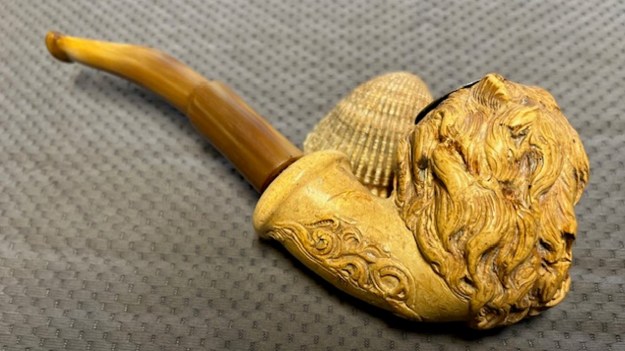
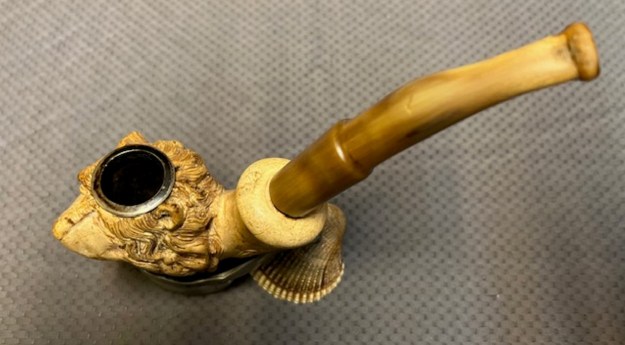
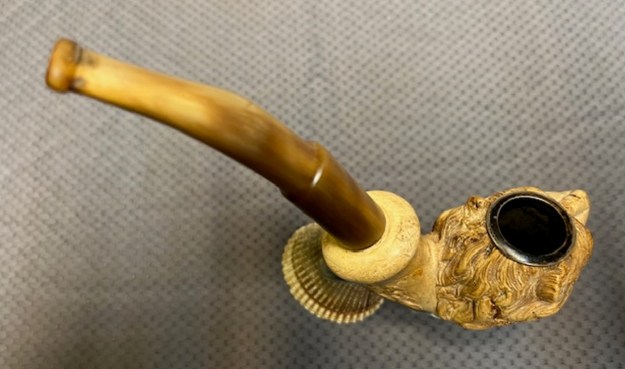
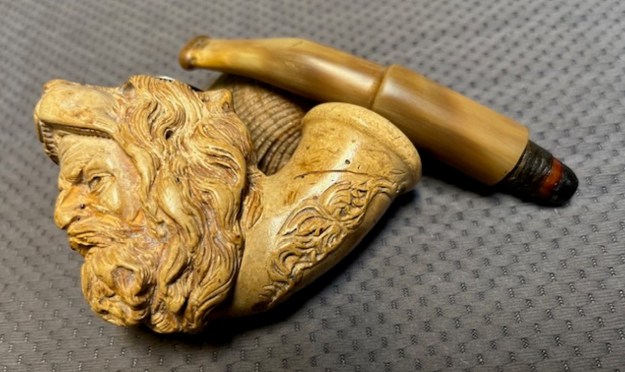
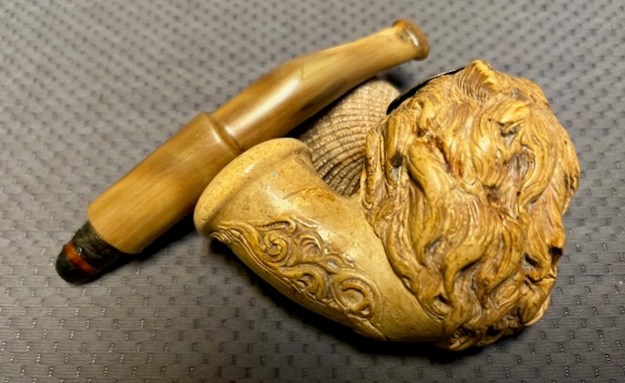
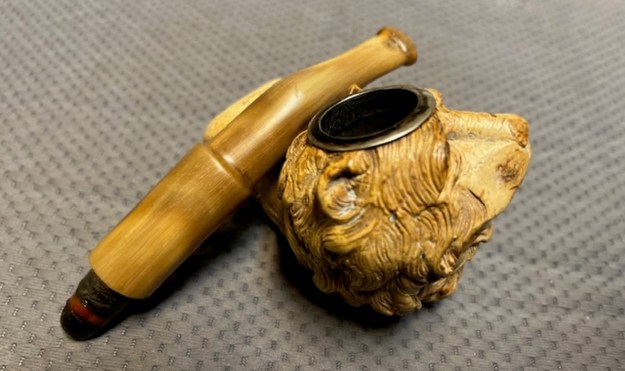
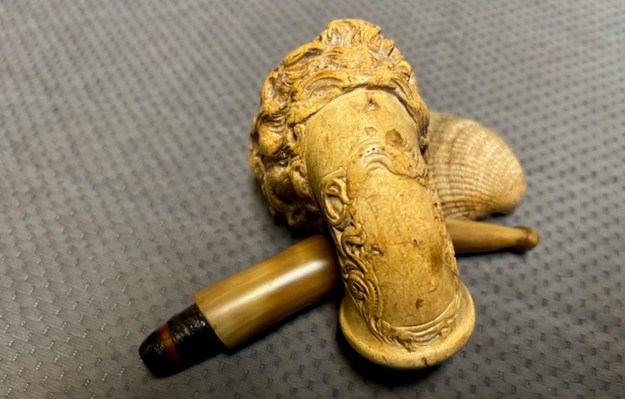
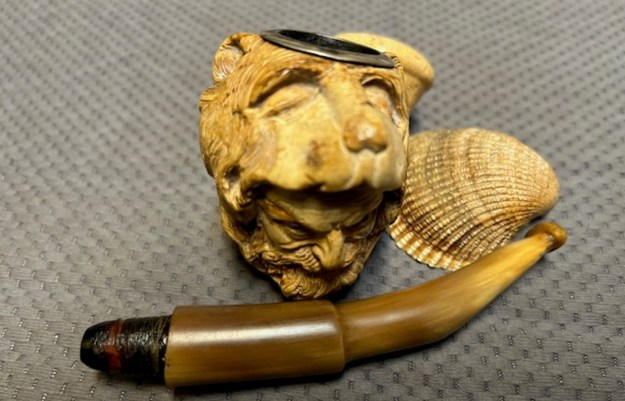
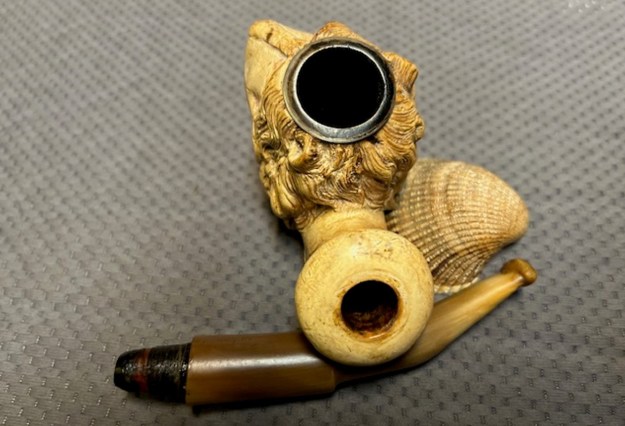
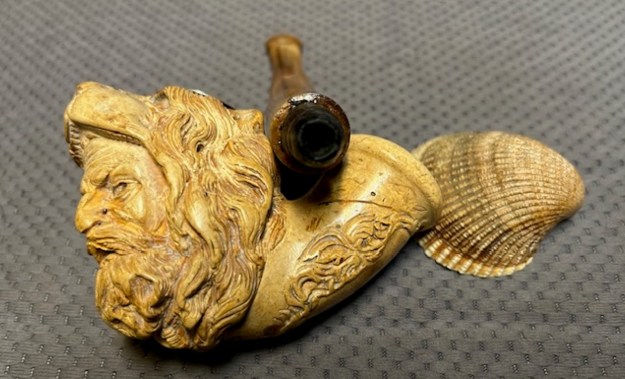
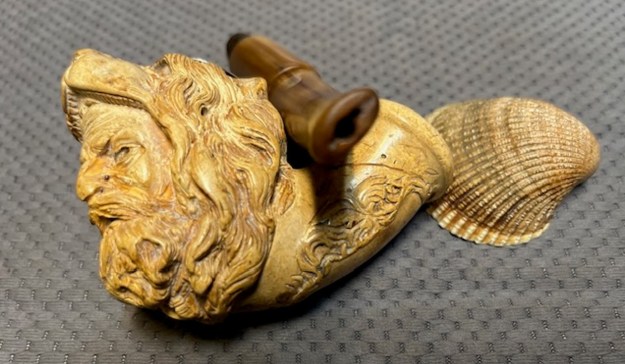
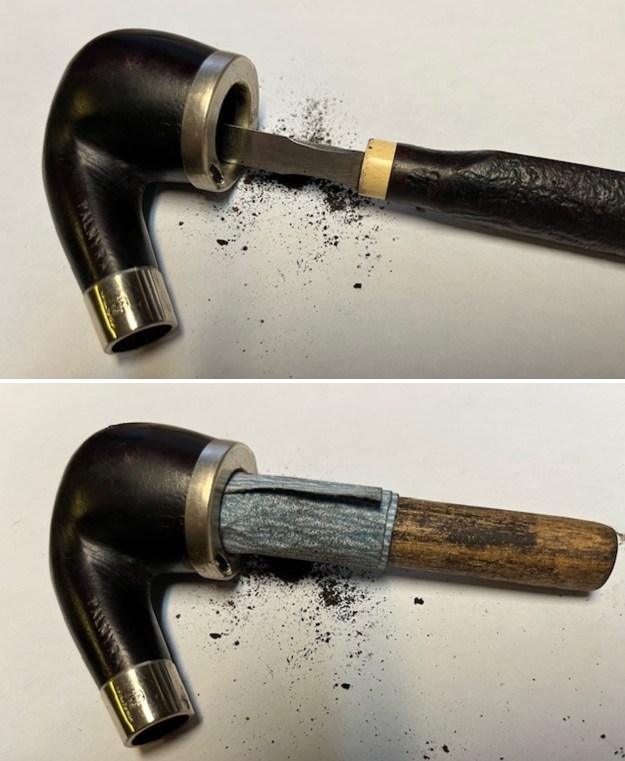
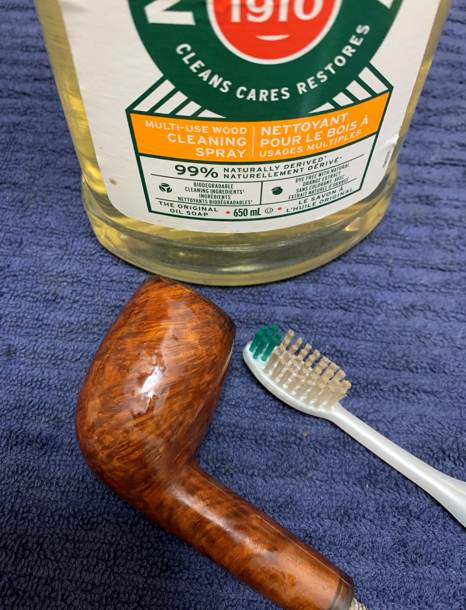
I wrote him back and asked him to send me photos of the pipes. He sent some single photos of the meerschaum bowl and stem, several of the leather clad Canadian and the photo of the rack and six pipes shown below. I looked through the photos and this is what I saw. There were two leather clad pipes a Canadian and a Pot. Both of them were cracked on the shanks and had been self-repaired with wire to hold the cracked shank together. The leather cladding was torn and the stitching was rotten and broken around the bowl. To me they were both irreparable. There was a lovely older Meerschaum figural with a horn stem that needed a good cleaning and repairs to the horn stem. There were two Knute Freehand pipes with original stems that were dirty but fixable. The plateau on the smooth one had a large chunk of briar missing. There was a Wilshire Dublin with a chewed and misfit stem. Finally, there was a billiard that had been restemmed with a fancy GBD saddle stem on it. They were a messy lot but I told him to send them on to me. They arrived yesterday and the condition of the pipes in the photos was confirmed. They were a mess and needed much work. I have included Mario’s group photo below to show the lot.I have also included three of the photos of the meerschaum that Mario sent to me as well. The first of the photos show the bowl top and what is either a metal cup lining the bowl or at least a metal rim top/cap. The meerschaum shows some great colour/patina as well as some chips and scratches and perhaps some repaired cracks in the surface. The horn stem also shows some wear and tear on the horn surface and some roughening. This afternoon I decided to start working on the fifth of the pipes from Mario – a figural carved freehand. It was a figural with a richly carved bearded man wearing a lion’s head as a cap on his head and a metal rim cap. The stem was made of horn that had lots of tooth marks and chatter on both sides near the button. The stem is dry and some of the striations are separating at the button end. The tenon has been wrapped with waxed thread to soften the fit of the stem in the mortise of the meerschaum. The bowl had a thick cake on the walls and a heavy lava coat the metal insert or the rim top. Which one is true will become clearer as I work on it. It was internally a mess. The finish was dirty and had grime ground into the sides of the bowl. That in many ways obscured the beauty of the patina on the bowl. There were nicks and deep scratches in the beard and in the smooth parts of the bowl but otherwise it seemed sound. The carving and filigree as well as scratches and nicks. There was no stamping or identifying marks on the meerschaum shank. I took photos of the pipe when I unpacked it to examine it. I have included those below. I took a photo of the bowl and rim top to show the condition of both. You can see the darkening on the metal insert rim top. There was a heavy cake in the bowl. The grooves in the carved meer are very dirty with debris. I also took photos of the stem showing the tooth marks and chatter on both sides ahead of the button.I took photos of the carving around the bowl. To me it looks like a mountain man wearing a bear’s head hat. The beard and carving are well done. The eyes even have lots of character.  The side profile shows the bear’s head hat or head dress. I removed the stem from the shank and took a photo of the parts. It is a well-proportioned pipe.I noted the tenon on the horn stem was wrapped with thread and then waxed. It would need to be cleaned up but it was interesting. It certainly was a self repair of the fit of the stem.It was now time to clean up the pipe. II checked the metal rim cap and found it was not a bowl insert but rather just a rim cap. It was dirty but easily removed.I scraped the bowl with a Savinelli Fitsall Pipe Knife to remove the thick cake on the walls. I sanded the bowl walls with 220 grit sandpaper wrapped around a dowel to smooth out the bowl walls. The walls were clear of damage and felt smooth to touch. I scrubbed the externals of the bowl and shank with undiluted Murphy’s Oil Soap and a tooth brush. I worked over the bowl, shank and rim top with the soap and then lightly rinsed it off warm water. The bowl looked extremely good. The grime was gone and the existing patina looked very rich and variegated. It is a beautifully carved pipe. I cleaned the metal rim top with 0000 Steel wool and a tooth brush and reset it in the bowl and rim top. It looked much better and smelled cleaned.I cleaned out the internals of the shank and the airway in the stem with pipe cleaners, cotton swabs and alcohol. The shank was quite dirty but the airway in the stem was surprisingly clean. For awhile now I have been using Clapham’s Beeswax Salad bowl finish for waxing meerschaums. It is a combination of Beeswax and Carnauba. I worked it into the grooves with a shoe brush and into the deep grooves with cotton swabs. I let it harden then buffed it with a soft cloth to raise the shine. The patina looked very good. I set the bowl aside and turned my attention to the horn stem. I sanded it with 320-3500 grit sanding pads. I wiped it off between pads with an Obsidian Oil impregnated cloth to remove the debris of the sanding.I polished the stem with micromesh sanding pads – 1500-12000 grit pads. I wiped it down with an Obsidian Oil cloth after each sanding pad. I used Before & After Pipe Polish – both Fine and Extra Fine to further polish the stem. I gave it a final coat of Obsidian Oil. I put the horn stem back on the Figural Carved Mountain Man Meerschaum pipe and buffed the pipe. I gently buffed waxed bowl with a clean microfibre cloth to raise the shine. I gave the stem several coats of carnauba wax and buffed it with a clean buffing pad to raise the shine. I hand buffed the stem with a microfiber cloth to deepen the shine. The pipe polished up really nicely and the patina gave depth to the carving. The finished pipe is shown in the photos below. This is a beautiful Figural Carved Mountain Man Meerschaum – the horn saddle stem and patinaed meer combine to give the pipe a great look. The dimensions of the pipe are Length: 6 ½ inches, Height: 2 ¼ inches, Outside diameter of the bowl: 1 ¾ inches wide x 2 inches long, Chamber diameter: ¾ of an inch. The weight of the pipe is 3.56 ounces/101 grams. This is the fifth of six pipes that am restoring for Mario from his Dad’s collection. I look forward to hearing what he thinks of this newly restored pipe. One more to go then the lot will go back to him. Thanks for reading this blog and my reflections on the pipe while I worked on it!

New Life for a Czechoslovakian Gold Spot Rusticated Pot Sitter with a Horn Stem


By Steve Laug

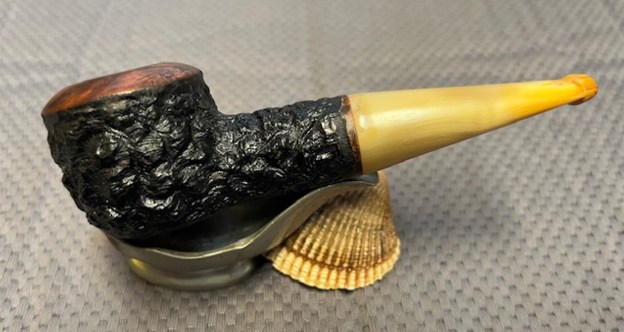
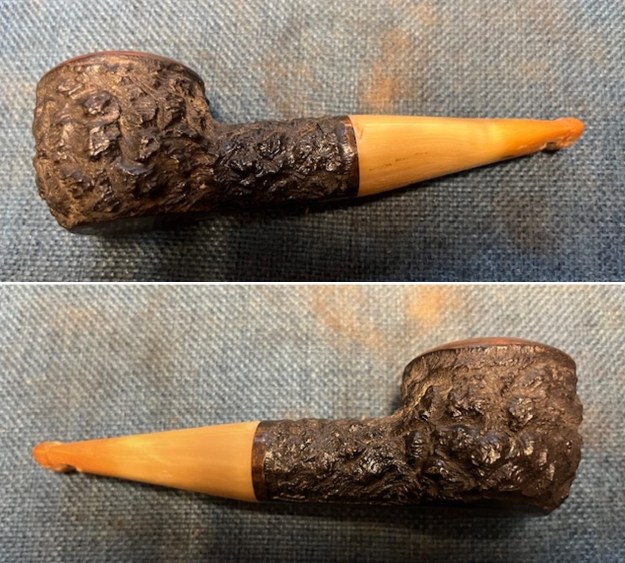
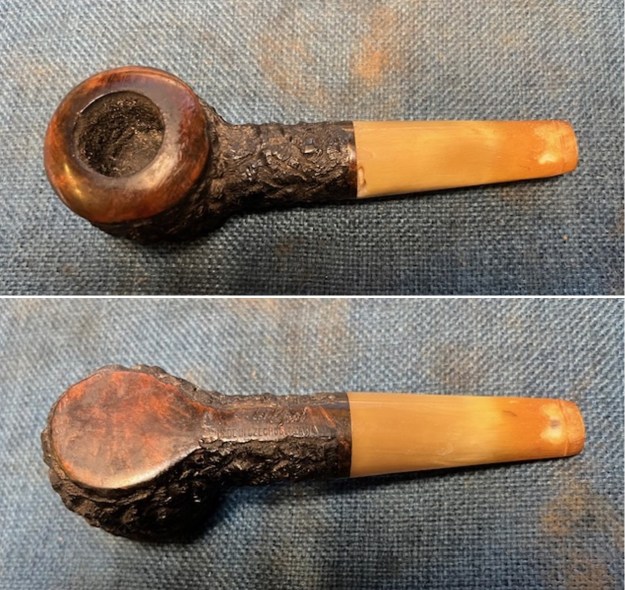
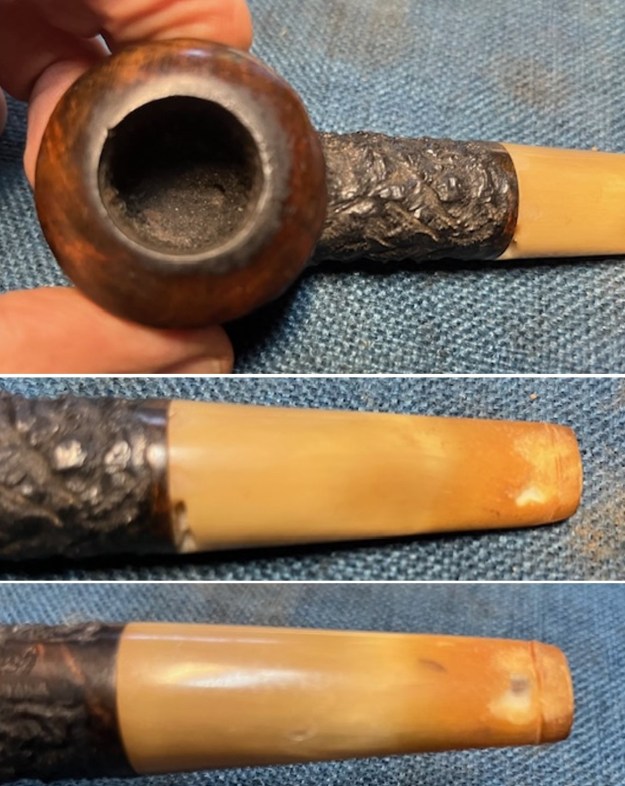
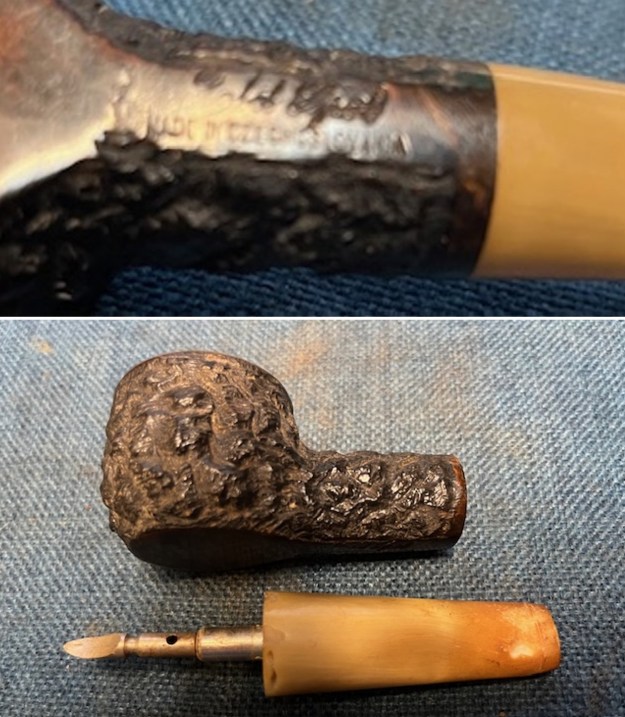
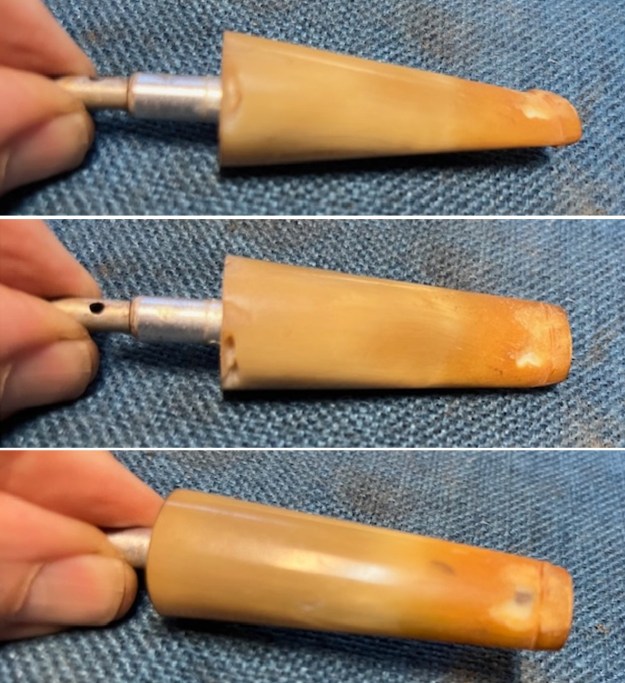
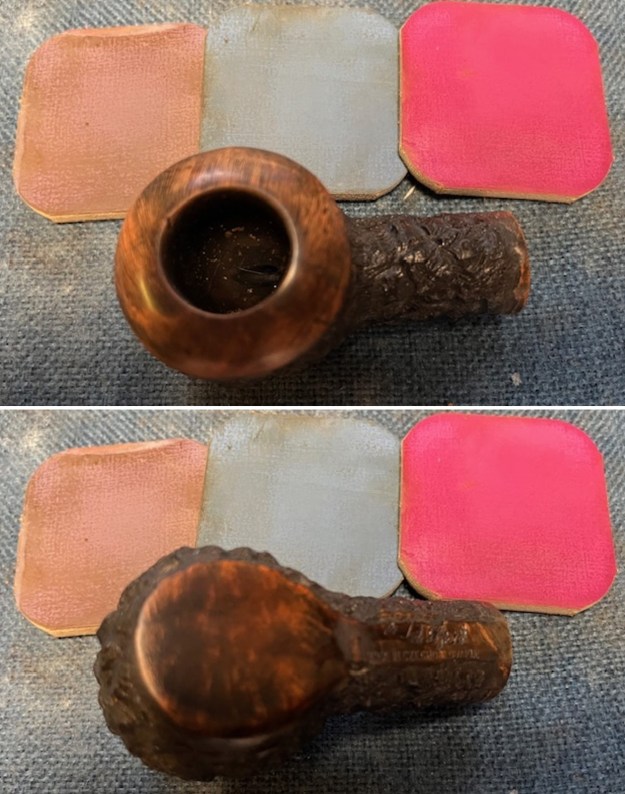
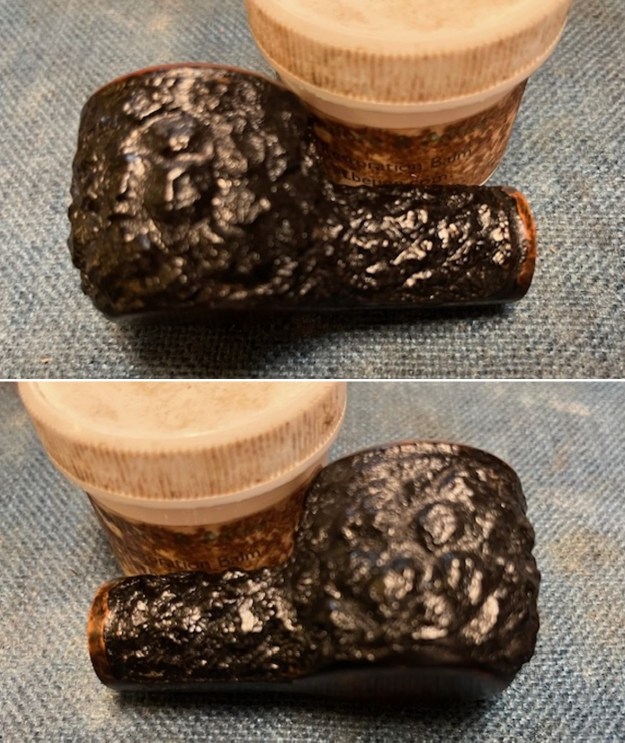
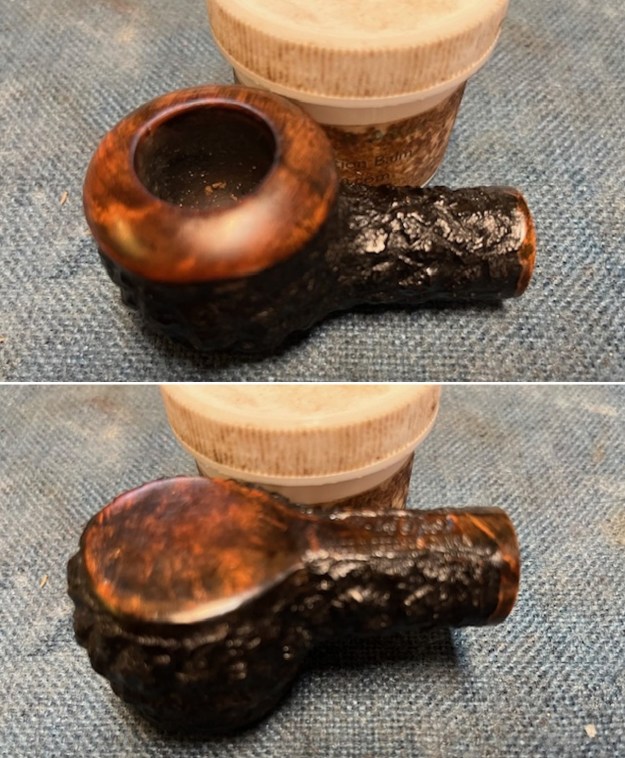
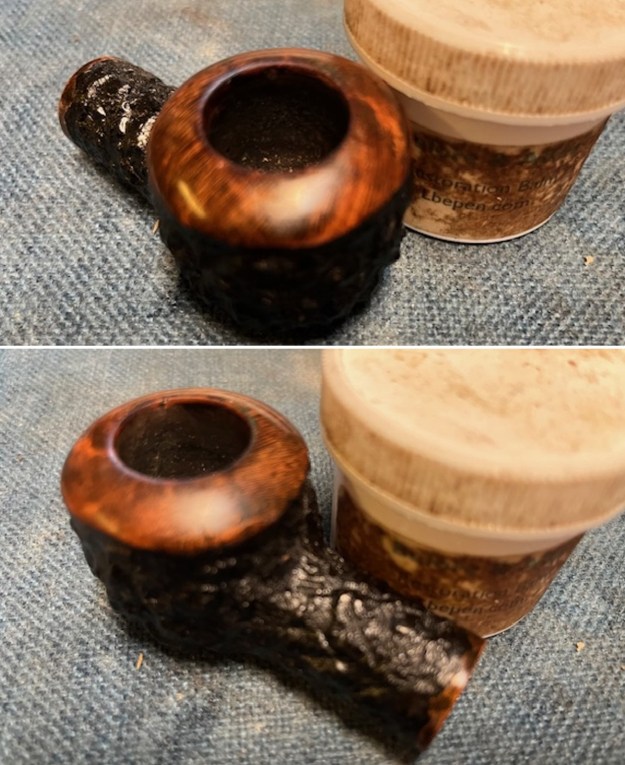
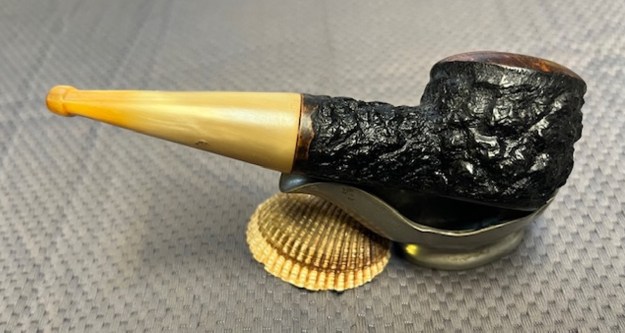
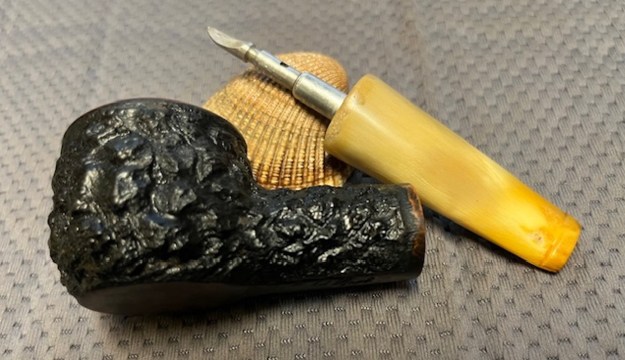
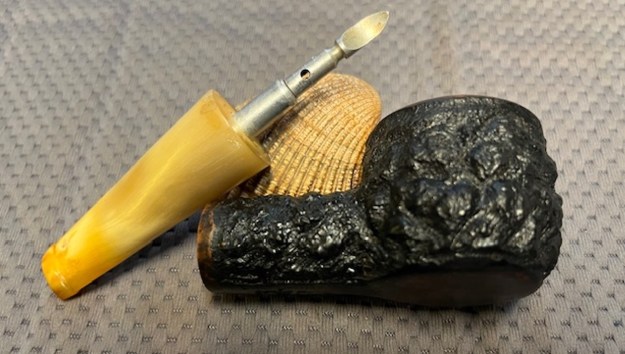
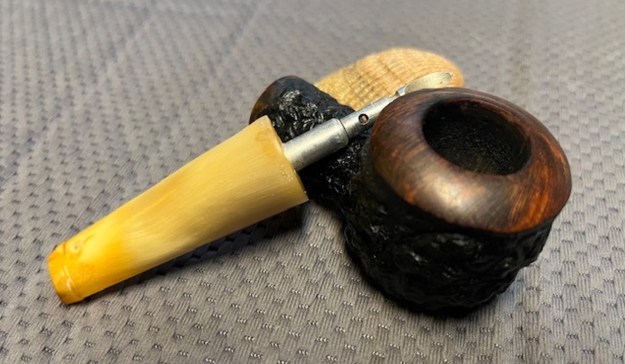
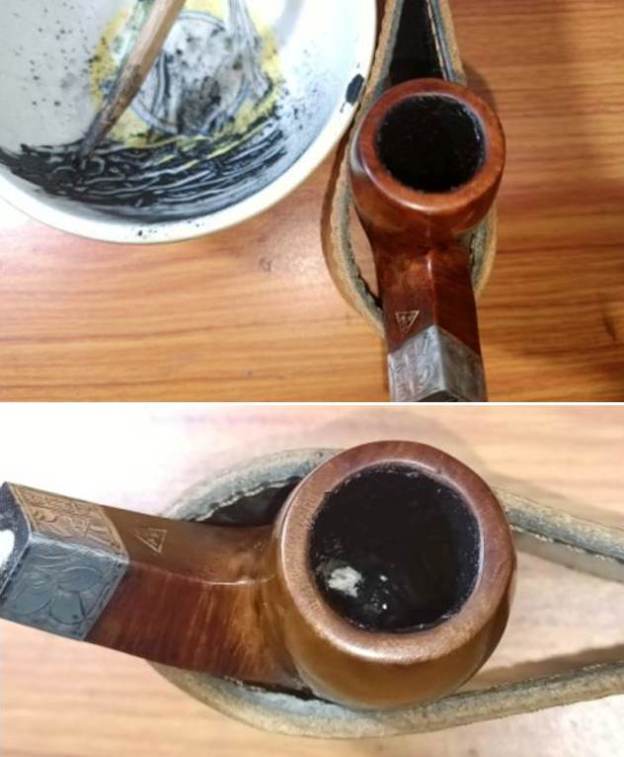
A few weeks ago, I visited my Dad and family in Idaho Falls, Idaho. I stayed with Jeff and we went through pipes he had in boxes that needed clean up. I pulled a few of them out that caught my eye and brought them home with me. The next pipe on the table is one of those. We purchased it on 05/20/24 from an estate in Long Island, New York, USA. It is a rusticated pot with a smooth crowned rim cap. It is stamped on a smooth panel on the underside of the shank and read Gold Spot [over] Made in Czechoslovakia. The stamping of the Gold Spot brand had been done multiple times and was a bit hard to read. The finish was heavily rusticated with a finish even rougher than the Sea Rock finish. It was very dirty with a lot of grime built up in the valleys and ridges of the rustication. The bowl had a moderate cake in it and the rim top had a thick coat of lava built up. The inner edge of the bowl had lava on it and it appeared to have some damage. The horn stem had a push tenon. The tenon was metal/aluminum and had a stinger apparatus in the end. The stem was in rough condition with a lot of worm holes around the left side where it met the shank. There were also a lot of worm holes on both sides of the stem ahead of the button. There was also a worm hole on the underside of the stem mid stem. I took a few photos of the pipe in the car on the way home and have included them below. I took a photo of the rim top and bowl to show the condition of both of them. The bowl had a thick cake and lava build up on the rim top. The inner edge was coated in lava but also appeared to be rough from previous reaming. The photos of the horn stem show the worm holes on the top at the stem/shank junction and on the underside mid stem. There were deep worm holes and tooth damage on both sides just ahead of the button.I took a photo of the stamping on the underside of the shank. The stamping, though double stamped was readable as noted above. I removed the stem from the shank and took a photo to show the proportions of the pipe.I decided to do a bit of digging on the brand of the pipe. The rustication on the bowl and the stamping Made in Czechoslovakia is the same style as a pipe I did back in April of 2016. That one was an Old River is a stylized signature and this one is a Gold Spot in the same style of signature. I am including the information I gather on the blog I wrote on the Old River pipe. I had asked for information on the brand and was able to gather a lot of help. Here is the link to the blog (https://rebornpipes.com/2016/04/28/restoring-an-old-sea-slug-or-an-old-river-chubby-bent-apple/).

I received some responses on the blog. One of the most helpful ones was from a fellow named Tomas. Here is what he wrote to me:

Hello Rebornpipes, I am your big fan from Czech Republic in Europe. Old River pipes comes from Czechoslovakia, made in factory in “Prosec u Skutce”. This factory still works under name BPK.

Having that information was a great boost on identifying this pipe maker. I checked on Pipedia and found a link to BPK (https://pipedia.org/wiki/BPK). I quote:

A long tradition of producing pipes. BPK company exports pipes to more than 40 countries. The production of pipes has been traditionally connected with small town Prosec u Skutce since 1842. Prosec is situated in the heart of Czech Republic, approximately 150 km (93 miles) far from Prague. Since the change of political situation in 1989 the company BPK, Ltd has been continuing in the traditional production.

I Googled BPK pipes and found this link (https://www.pipeshop-saintclaude.com/bpk-343). I quote what it told me about the brand below:

Located in the town of Proseč, Czech Republic, the BPK workshop makes pipes since 1842. The firm succeeded at a time when pipe market was growing. At first, BPK pipes were actually not made with briar, but with other types of wood: alder, maple or pear tree. M. Zabor Bernard Kopperle (officer of the company) will only begin to use briar in 1910 for his pipes. The result is stunning because of the briar properties, particularly for tobaccos combustion: more heatproof and better for smokers when it comes to the tasteThe BPK pipes success was immediate, and pipes were therefore exported in numerous neighbor countries. In the late 30s, more than 600 craftspeople worked for the production of BPK pipes! Nowadays, these pipes are still liked by smokers thanks to their classical designTheir silhouettes are simple and without any flourishes. Last criterion, and an important one: BPK pipes are proposed at an affordable price!

That gave me history on the brand and some connection to present pipes that are made by BPK but I still wanted to find a connection to the older company before the 1992 separation of Czechoslovakia into the Czech Republic and Slovakia. That gave me a possible end date for the pipe. Though I cannot definitively prove it I am fairly certain that the pipe was made by BPK. I cannot find any listings for Gold Spot Made in Czechoslovakia pipes. The similarities to the finish on this one and the rustication on the various Old River pipes made by BPK lead to make the connection.

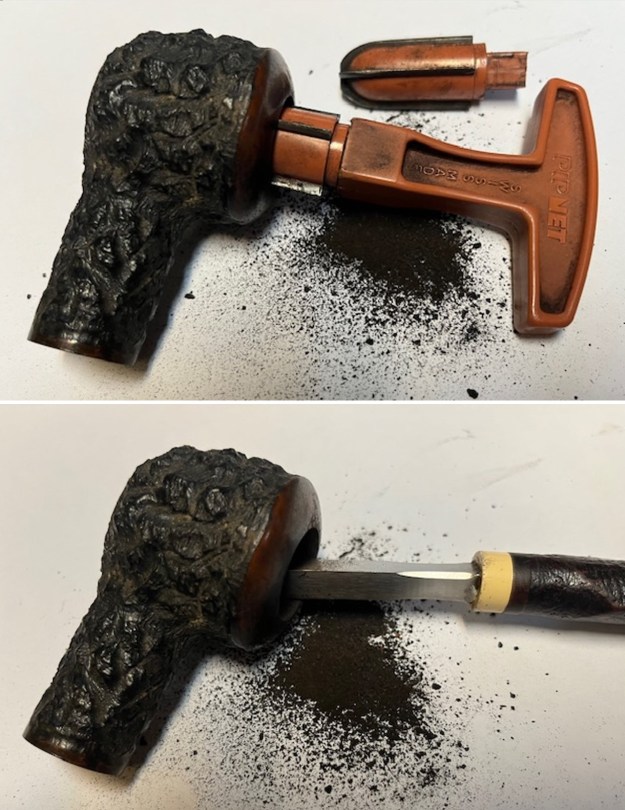
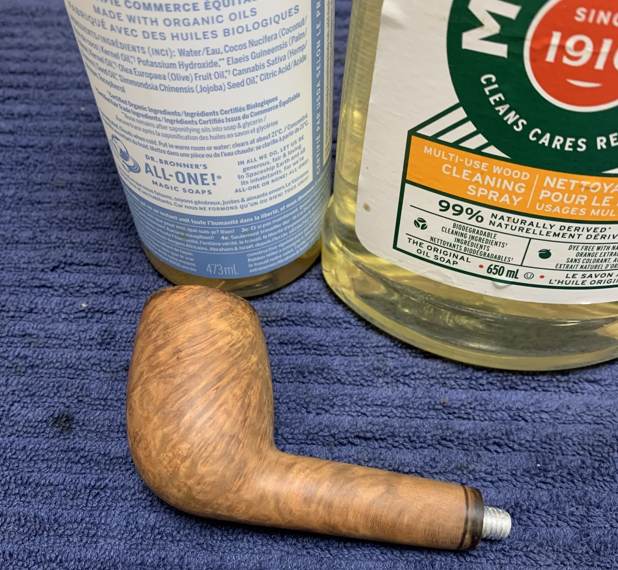
Now it was time to work on the pipe itself. I decided to do some work on the stem first. There were a significant number of worm holes in the material as visible in the pictures below. There were also some worm holes and tooth marks on the top and the underside of the stem ahead of the button. I wiped down the stem surface with alcohol on a cotton swab to remove any oils or debris from the worm holes or tooth damage areas. Once they were clean I filled them in with several layers of clear CA glue and set the stem aside to let the repairs cure.While the stem repairs cured I turned my attention to the bowl. I used a PipNet Pipe reamer first to take out the majority of the cake. It was a deep bowl so I used a Savinelli Fitsall Pipe Knife to clean up the remaining cake in the bowl and to scrape off the lava on the rim top. I used a dowel wrapped with 220 grit sandpaper to smooth out the walls of the bowl. I checked for damage on the bowl walls and it was in good condition. I scraped the rim top with a Savinelli Fitsall Pipe Knife. I cleaned up the inner edge of the bowl with a folded piece of 220 sandpaper. I scrubbed out the inside of the shank, mortise and the airway in both the stem and the bowl. I used pipe cleaners, cotton swabs and isopropyl alcohol. It cleaned up very well.I scrubbed the exterior of the briar with a tooth brush and undiluted Murphy’s Oil Soap to remove the build up on the surface of the briar and clean off the lava on the rim top. I scrubbed it and then carefully rinsed the bowl with warm water. I dried it with a soft cotton cloth. It certainly looked significantly better and the patina remained in the wood. I polished the smooth briar with micromesh sanding pads to minimize the scratches in the briar. I dry sanded with 1500-12000 grit pads and wiped the bowl down after each pad with a damp cloth to remove the sanding debris. By the end of the nine pads the briar took on a rich shine and the rim top looked very good. I rubbed the bowl down with Before & After Restoration Balm. It is a paste/balm that works to deep clean the finish, enliven and protect the briar. I worked it into the briar with my finger tips o make sure that it covered every square inch of the pipe. I set it aside for 10 minutes to let it do its work. I buffed it with a cotton cloth. The briar really began to have a deep shine. The photos I took of the bowl at this point mark the progress in the restoration. I set the bowl aside and turned my attention to the stem. The repairs to the stem surface had cured. I used several files to flatten the repaired areas ahead of the mouthpiece and around the shank end. I cleaned up the file areas with a folded piece of 220 grit sandpaper to blend them into the stem surface. I sanded the stem with 320-3500 grit sanding pads to break up the remaining oxidation. I wiped it down after each sanding pad with an Obsidian Oil impregnated cloth. It began to look good.I polished the stem with micromesh sanding pads – dry sanding with 1500-12000 grit pads. I wiped the stem down after each sanding pad with Obsidian Oil. I polished it with Before & After Pipe Stem Polish – both Fine and Extra Fine. Once I had finished the polishing I gave it final coat of Obsidian Oil and set it aside to dry.  I put the Gold Spot Made in Czechoslovakia Rusticated Pot bowl and stem back together. I polished the bowl and stem with Blue Diamond to polish out the scratches in the briar and the repaired horn stem. I gave the bowl multiple coats of Conservator’s Wax and the stem multiple coats of carnauba wax. I buffed the pipe with a clean buffing pad to raise the shine. I hand buffed it with a microfiber cloth to deepen the shine. The pipe polished up pretty nicely. The reddish/brown stains worked amazingly well with the polished horn taper stem. The grain around the bowl and shank and looks quite remarkable. This is truly a beautiful BPK Gold Spot Rusticated Pot. The finished pipe is shown in the photos below. The dimensions of the pipe are Length: 5 inches, Height: 1 ½ inches, Outside diameter of the bowl: 1 ½ inches, Chamber diameter: ¾ of an inch. The weight of the pipe is 1.98 ounces/55 grams. For now, this one will join the Old River Pipe in my collection and be enjoyed with some good Virginia very soon. Thanks for walking through the restoration with me. Cheers.

As always, I encourage your questions and comments as you read the blog. Thanks to each of you who are reading this blog. Remember we are not pipe owners; we are pipe men and women who hold our pipes in trust until they pass on into the trust of those who follow us.

Restoring a Beautiful Ropp Pneumatic Brevete S.G.D.G # 9105


Blog by Paresh Deshpande

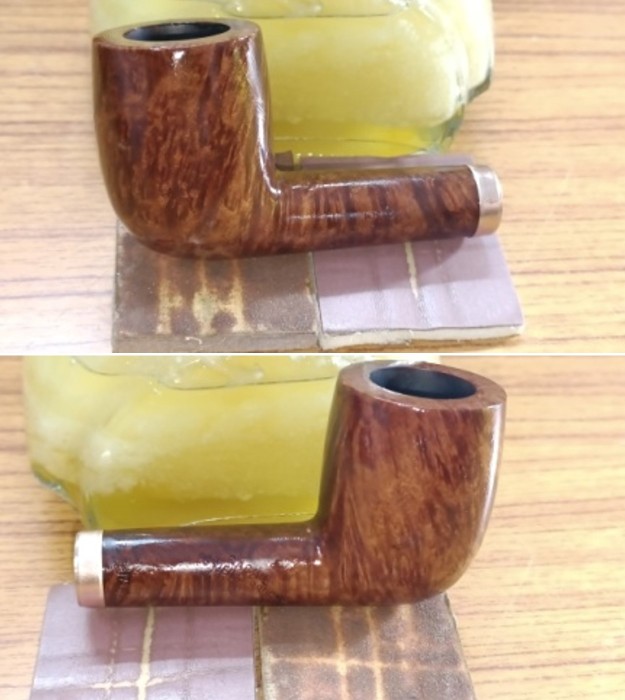
This pipe now on my work table came to me from a lot of 40 pipes that I had purchased from a French seller on etsy.fr just before the outbreak of the pandemic. It’s a beautiful classic billiard shaped pipe with a bone stem and beautiful flame grains along the sides of the stummel and bird’s eye grain over the rim top and the foot of the stummel.

This perfectly proportioned light weight pipe has a medium sized bowl, equivalent to a size 4 Dunhill. The piece of briar is without a single fill and oozes very high quality. The copper band at the shank face adds a classy bling to the appearance of the pipe. The stampings on this pipe is one of the most elaborate that I have come across with “PNEUMATIC” over “BREVETE S.G.D.G” stamped across the left side of the shank at an upward angle. This is followed by “ROPP” in an oval towards the shank end. The right side of the shank is stamped as “RACINE” over “DE VIEILLE SOUCHE” in a downward incline. The shape code “9105” is stamped at its end on the right surface of the shank. The shank opening is lined by a metal ring that extends inside the mortise and is stamped on the metal face as “ROPP” over the upper portion and the lower surface bears the stamp “BREVETE S.G.D.G.”.I had worked on ROPP pipes before and had a fair idea of this French marquee. But it was the stampings which intrigued me and I also knew that I was working on a very early era ROPP and had to know more specific details of this line from ROPP.

I searched the internet and came across this site that had the exact same pipe for sale. The information I got from the description with a link to the website is reproduced below:

https://www.delcampe.net/en_US/collectibles/tobacco-related/pipes-accessories/heather-pipes/tres-rare-pipe-ropp-pneumatic-brevete-s-g-d-g-virole-en-argent-date-1897-ou-1898-a-loccasion-de-linstallation-a-baume-1103869216.html

VERY RARE PIPE ROPP PNEUMATIC patented S.G.D.G silver ferrule dates 1897 or 1898, on the occasion of the installation in Baume

This “Pneumatic” model dates from the very last years of the 19th century: 1897 or 1898, on the occasion of the installation in Baume.

I decided to break down my search parameters to get a better understanding of the stampings as seen on the pipe. I searched for BREVETE S.G.D.G and this is what Wikipedia revealed:-

https://en.wikipedia.org/wiki/Brevet%C3%A9_SGDG

Breveté SGDG was a French type of patent that ceased to exist in 1968. The name was a common abbreviation for “Breveté Sans Garantie Du Gouvernement“ (patent without government guarantees).

In France, the law of 1844 states that patents are issued “without prior examination, at the risk of the applicant and with no guarantee of function, novelty and merit of the invention also in terms of precision or accuracy of the description”.

I also visited various forums to know more about this line of pipes from ROPP. Here is an interesting conversation that I chanced upon on placedelours.superforum.fr and contained a thread discussing a ROPP pipe with similar stampings that were stamped in the exact same way as seen on the pipe currently on my worktable. I have reproduced an English translation of the thread below:-

http://placedelours.superforum.fr/t33004-pipe-ropp-pneumatic

vidu52
Hello to all of you,
For a long time I have been looking for this ROPP brand pipe, marked : PNEUMATIC patented S.G.D.G and with a diamond-shaped punch.

The ROPP brand I find many, but not a single marked “PNEUMATIC” ??
Long : 14 cm approx High 4.5 cm approx, Weight: 42 Grams
I turn to you to try to help me identify this pipe and if possible its degree of rarity.
In advance Thank you….

Nucingen
Very nice pipe, with silver ferrule

this “Pneumatic” model dates from the very last years of the XIXe century: 1897 or 1898, on the occasion of the installation in Baume.
You will know everything about the “Pneumatic” by reading pages 21, 29 and 34 of this very beautiful and interesting book :
https://issuu.com/romainbassenne/docs/ropp_livre_maquette_issuu

However, the link is either no longer active or may not be accessible from my location. In any event, if anyone is able to access it, it is requested to share the information therein on Pneumatic line of pipe from ROPP for info of readers.

https://pipedia.org/wiki/Ropp

Eugène-Léon Ropp (1830 – 1907) had acquired a patent for a cherrywood pipe (wild cherry, lat.: Prunus avium) in 1869. In 1870 he established a workshop to manufacture such pipes in Büssingen (Bussang, Vosges mountains). Around 1893 the business moved into the former mill of Sicard (part of the community of Baume-les-Dames – Département Doubs, Upper Burgundy – from 1895 on).

The pipes were a big success in the export as well. Shortly before 1914 Ropp designated A. Frankau & Co. (BBB) in to be the exclusive distributor in the UK and it’s colonies.

Probably in 1917 a workshop in Saint-Claude in the Rue du Plan du Moulin 8 was acquired to start the fabrication of briar pipes. In 1923 a small building in the environment of Saint-Claude, serving as a workshop for polishing, was added.

Even though cherrywood pipes were the mainstay of Ropp until the company finally closed down in September 1991. The company was taken over by Cuty-Fort Entreprises (Chacom, Jeantet, Vuillard, Jean Lacroix…) in 1994.

I was still not satisfied with the research of this pipe. This pipe has some of the most detailed stampings that I have seen on any pipe. I have deciphered the stampings of ROPP, PNEUMATIC and BREVETE S.G.D.G. The stampings of RACINE, DE VIEILLE SOUCHE yet remains to be understood. Now, my French is what my mother tongue Marathi is to you. I searched the internet for translation and this is what I found.

(a) RACINE: – Root.

(b) DE VIEILLE: – Old stock.

(c) SOUCHE: – Stump.

These stampings together do make sense implying that the briar used to carve this pipe is an old stock briar root stump.

Though the discussion thread and description of the similarly stamped pipe stated above places this pipe to be from the period 1897/ 98, the lack of pictures of the tenon on that pipe and being unable to access the link leading to the book on the PNEUMATIC line of ROPP, I cannot conclusively place the pipe on my work table to be from the period 1897/ 98.

The aluminum tenon in a bone stem with an elliptical slot makes me inclined to place this pipe from during the WW II era, which is from 1940 to 1945/ 6.

That said this pipe is definitely an old timer and is being added to my personal collection.

Initial Visual Inspection
The pipe, as it sits on my work table, is dirty with a thin layer of cake in the chamber, a stummel that is covered in dust and grime and a tapered bone stem that has tooth indentations on either surface in the bite zone. Here are a few pictures of the pipe before I proceed with a detailed visual inspection of each part of the pipe. Detailed Visual Inspection
A thin layer of cake lines the walls of the chamber. There is no accumulation of overflowing crud over the rim surface but slight darkening is seen to the aft of the rim surface. The rim edges, both outer and inner, are sans any dents and dings. The rim top surface, however, shows a number of dents and dings likely caused due to either strikes against a hard edge or due to uncared for storage of the pipe.The stummel surface has attracted dust and dirt giving it a dull lackluster and lifeless appearance. There are a few scrub marks over the surface but these should be easily addressed during the polishing process. The briar wood has taken on a nice dark patina from the years of handling and smoking. It will be my endeavor to preserve and highlight this aspect. The stampings on the shank surface are all crisp and clearly discernible. The shank end of the stummel is adorned with a copper band. The unique feature of this pipe is a metal spacer that is stamped on the face as BREVETE and S.G.D.G as mentioned above. This spacer extends in to the mortise and is lined with cork extending up to an inch or so. The mortise is relatively clean with minor traces of residual ash and oils/ tars. The horn stem has a nice light and bright appearance with bite marks and tooth indentations on either surface in the bite zone. There are a couple of superficial cracks over the stem surface and should be addressed once the stem is sanded and polished. I think these superficial cracks are primarily the result of drying of the bone material. The long aluminum tenon is tapered and cinched at the tenon end to match the mortise opening. The tenon surface is clean but would benefit from some cleaning and polishing. The elliptical slot and tenon end shows traces of old residual oils and gunk. The button edges show a couple of minor teeth marks and would need to be sharpened. The Restoration Process
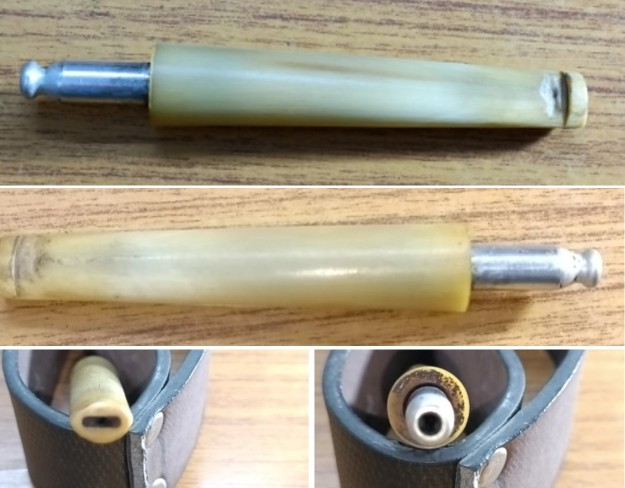
Whether to start with stem or the stummel refurbishing has always being a source of conflict for me as stem repairs and refurbishing almost always takes the longest time and efforts and hence prudent to be worked on first while the allure of unrevealing the beautiful grains of the briar weighs in favor for its refurbishing first. Well in ibid case, the lovely patina and straight grains won and I decided to start working on the stummel.

I started the process of refurbishing by reaming the chamber first. Using reamer head sizes 1 and 2 of the PipeNet pipe reamer, I took the cake down to the bare briar. The amount of carbon that was dislodged from the chamber was really surprising as I had appreciated a thin layer of carbon and the quantity of carbon that was removed was anything but a thin layer. With my fabricated knife, I removed all the cake and took it down to the bare briar. I further sand the chamber wall with a folded piece of 180 grit sandpaper to smooth out the wall and remove the last bit of stubborn carbon that remained stuck to the chamber. To finish the reaming process, I wiped the chamber walls with a cotton swab dipped in alcohol to clean the last traces of residual carbon dust. I was happy to note a clean and well seasoned solid chamber.Next, I cleaned out the shank internals. Early on, I realized that I could not pass a pipe cleaner trough the draught hole due to blockages in the shank airway. I used a modified poker tool to push through and dislodge this block of dried oils and gunk. I further scraped out all the dried and crumbly oils and tars from the walls of the mortise with my dental tool. I cleaned out the mortise and shank walls with pipe cleaners dipped in alcohol. I shall continue further cleaning of the shank and mortise while going through the other processes.Now on to de-ghosting the pipe…. I packed the chamber with cotton balls and drew out a wick from the cotton and along with a folded regular pipe cleaner, inserted it into the mortise and through the draught hole into the chamber. I tightly packed cotton balls in to the remaining portion of the mortise. Thereafter, I soaked the cotton balls with isopropyl alcohol up to the brim. About half an hour later, the level of alcohol had gone down, having being absorbed by the cotton. I topped it up once again and set it aside overnight. By next afternoon, the cotton and alcohol had drawn out all the remaining oils and tars from the chamber and mortise. I removed the cotton balls and ran pipe cleaners through the mortise and draught hole to clean out all the loosened tars and gunk that was lodged in the draught hole and mortise. The chamber and mortise now smelled clean, fresh and looked it too. I set the stummel to dry out naturally.With the night still being young and not wanting to break the momentum of work as the stummel soaked in cotton and alcohol bath, I decided to use the time to address the stem issues. I first ran a few pipe cleaners dipped in alcohol through the stem airway and they came out very dirty. To conserve pipe cleaners, I put off further cleaning of the airway and would continue the internal cleaning using shank brushes and oil soap under warm water. With a sharp dental tool, I scraped out the dried oils and gunk from the slot end and tenon face. I also cleaned the aluminum tenon surface with a cotton swab wetted with isopropyl alcohol.Continuing with the stem cleaning, I followed the internal cleaning of the stem with cleaning the airway using thin shank brushes and anti oil dish cleaning soap. I ran a couple of pipe cleaners to clean and dry out the airway. Using Scotch Brite pad and oil soap; I cleaned out the entire gunk from the aluminum tenon, elliptical slot end and the stem surface.The last agenda for the day before I turned in for the night was to address the bite marks on either surface in the bite zone. I cleaned the surface with alcohol on a cotton swab in preparation of the surface for a fill. I filled the deep tooth indentation in the bite zone on the upper stem surface with clear medium CA superglue. Once the fill had hardened sufficiently, I similarly filled the tooth indentation in the lower stem surface. I set the stem aside for the fills to cure.By the time I again sat at my work table the next evening, the alcohol and cotton had leached out all the old oils from the chamber walls and the stem fills had cured too.

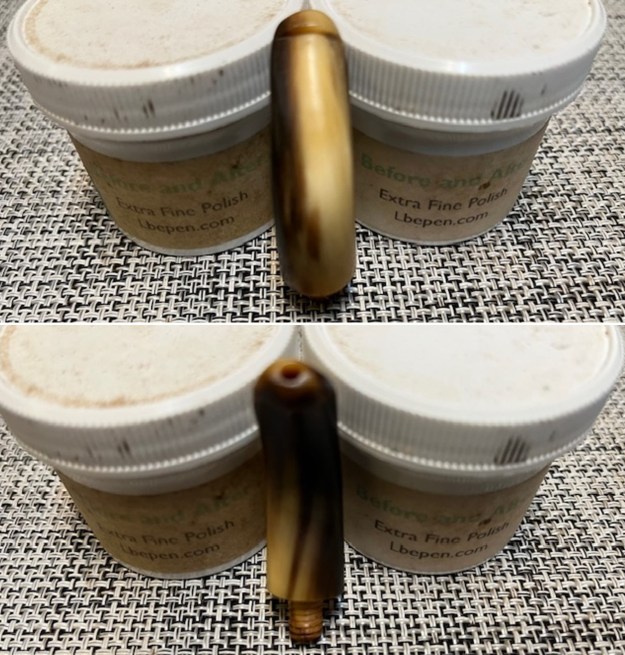
Next, I proceeded to clean the exterior of the stummel. I used a hard bristled tooth brush, Scotch Brite pad and Murphy’s Oil soap to scrub the stummel and rim top. For this stummel cleaning, I used Murphy’s Oil soap as I wanted to preserve the old patina that had developed on the stummel and this product really helps in cleaning the briar surface. After the scrub with oil soap, I washed the stummel under running warm water with anti oil dish washing detergent till the stummel surface was clean and dried it using paper towels and soft cotton cloth. I simultaneously cleaned the shank internals with the detergent and hard bristled shank brush and set the stummel aside to dry out. That the shank end is internally lined with cork is now apparent after the cleaning and this further restricts the cleaning process, adding caution to the equation while further cleaning the shank internals. I was fortunate that the alcohol bath has not loosened and removed this cork lining. To aid in the drying process, I heat the stummel under a 100 watt filament bulb as it is very important that the briar is completely dry as presence of slight moisture leads to growth of fungus over the surface subsequently.With the stummel set aside for drying, I used a needle file to sand the stem fill to achieve a rough match of the filling with the rest of the stem surface. To achieve a better blend, I sand the fill with a folded piece of 180 grit sandpaper. I also worked the button edges to a crisp edge with the file. By no means is the blending complete and shall be continued with during the sanding and polishing process.To bring a deep shine to the horn stem, I went through the complete set of micromesh pads, wet sanding with 1500 to 12000 grit pads. I wiped the stem with moist cloth after each pad and rubbed it down with Extra Virgin Olive oil to rejuvenate the horn which is very prone to drying and developing cracks over the surface. The finished stem is shown below.Remember the stummel that had been set aside to dry out under the bulb? Well, in the while that I completed the repairs and initial polishing of the stem, the briar had completely dried out and was ready to be worked on further.

The issue that needed immediate attention was the number of dents and dings over the rim top surface. To address it, I topped the surface over a piece of 220 grit sandpaper till these damages all but disappeared. I am quite pleased with the appearance of the rim top at this stage.I followed it by wet sanding the entire stummel with 1500 to 12000 grit micromesh pads, wiping frequently with a moist cloth to check the progress. I really like the looks of the stummel at this point in restoration. The grains and the clean lines of this piece of briar is really appreciable. Next, I rubbed a small quantity of “Before and After Restoration Balm” deep in to the briar with my finger tips and let it rest for a few minutes. The balm almost immediately works its magic and the briar now has a nice vibrant appearance with the beautiful grain patterns displayed in their complete splendor. I further buffed it with a horse hair brush. The contrast of the dark browns of the Bird’s eye and straight grains with the dark natural patina of the rest of the stummel adds an interesting dimension to the appearance of the stummel that cannot be insufficiently described in words and be rather seen in person. I have now reached the homestretch in this restoration project. To complete the restoration, I mounted a cotton cloth buffing wheel on to my hand held rotary tool and polished the stummel and stem with Blue Diamond compound. This compound helps in polishing and also in removing the minor scratch marks that remained from the sanding process. I mounted another cotton buffing wheel that I have earmarked for carnauba wax and applied several coats of the wax. I finished the restoration by giving the entire pipe a rigorous hand buffing using a microfiber cloth to raise the shine further. The finished pipe looks amazingly beautiful and is ready to join my collection. I only wish it could share with me its life story of the past years while I enjoy smoking my favorite Virginia blend in it or maybe an English blend or maybe just keep admiring it!!!! Big thank you to all the readers who have joined me on this path by reading this write up as I restored and completed this project. P.S.: I came across an interesting flyer/ advertisement bearing the stamp  “RACINE, DE VIEILLE SOUCHE” in French language. I have included the same here and would be happy to receive any information on the pipe in English for the sake of enhancing my knowledge on this pipe.Thank you once again for your time and assistance.

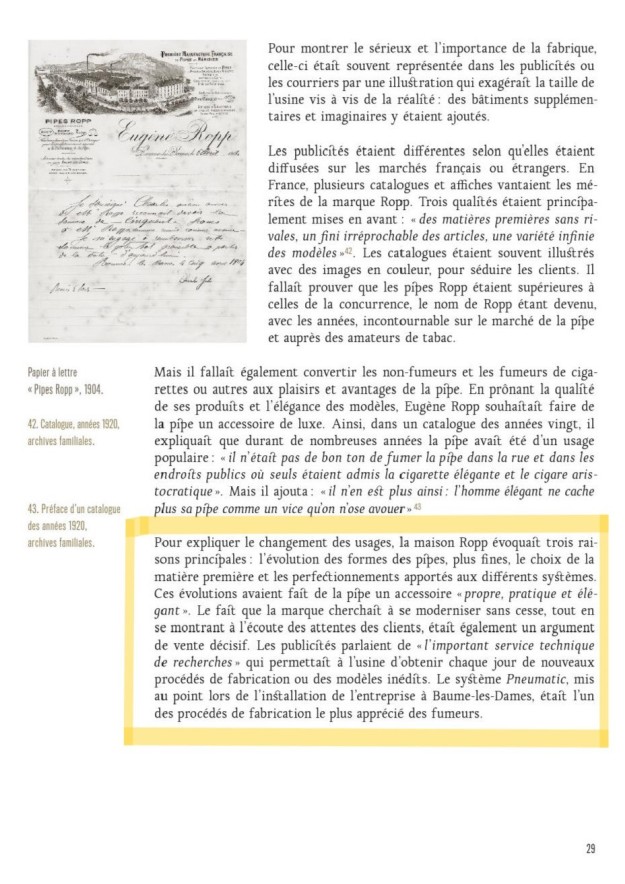
ADDENDUM – Pages 21,29 and 34 of the French Ropp Book (Ropp, ça ne fume plus). Kenneth Lieblich scanned the pages and translated them for Paresh.

Translation of the highlighted parts of page 21

Trademarks were registered for each of his creations: La Cosaque, La Pneumatic and La Norvégienne appeared at the beginning of the century, between 1904 and 1908. According to the INPI records, these brands were intended to be affixed to the pipes, smoking accessories and other handmade items as well as cases, boxes, packaging of pipes… The reasons for choosing most of these names are unknown.

Regarding La Pneumatic, we can see a link with current events. In fact, the tire was invented in 1888 by Irishman John Boyd Dunlop and the removable tire by Michelin in 1891. Its use became widespread at the beginning of the 20th century. Another pipe was named Pipe des aviateurs (1909) when, on July 25, 1909, Louis Blériot succeeded in crossing the Channel by plane for the first time.

Each pipe had several varieties of shapes, sizes and ornaments. La Pneumatic could be fitted with a fancy band: gold, silver or other metal; in straight or bent models; of medium to very large size; and with oval or round bowls. Then, the types of briar evolved with the appearance in 1910 of Cum-mer root, Cum-mer briar, blood briar and blood root, recalling both the raw material used and its particular red grain.Translation of the highlighted parts of page 29

To explain the changes, Ropp cited three main reasons: moving towards thinner pipes, the choice of raw materials and the improvements made to the different systems. These developments had made the pipe a “clean, practical and elegant” accessory. The fact that the brand sought to constantly modernize itself, while paying attention to consumer demand, was also an important selling point. The ads spoke of “the important technical research” which allowed the factory to frequently employ new manufacturing processes or new models. La Pneumatic system, developed when the company set up in Baume-les-Dames, was one of the manufacturing processes most appreciated by smokers.Translation of the highlighted parts of page 34

At the start of the 20th century, system pipes and other inventions aimed at better health were very popular with French smokers. Concerns about the harmful effects of tobacco and nicotine were in vogue, as were concerns about hygiene: pipes were sometimes difficult to clean and maintain. These were different from filter pipes since the piece inserted into the stem did not absorb the condensation but only stopped it. These system pipes, with different variations, appeared healthier and more hygienic. La Pneumatic is one of the system pipes that Ropp put on the market and patented. A separate ferrule was housed inside the stem while a piece of cork, providing friction, made it easier to separate the stem from the stummel and also made cleaning easier.

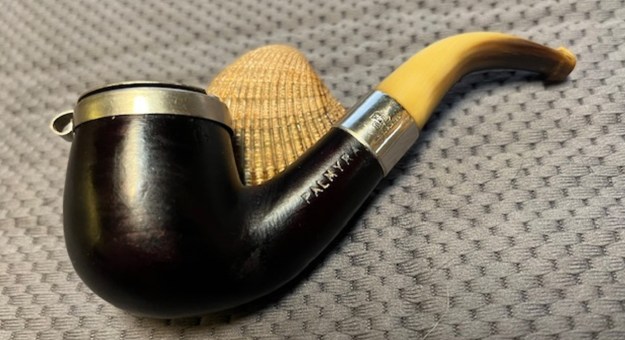
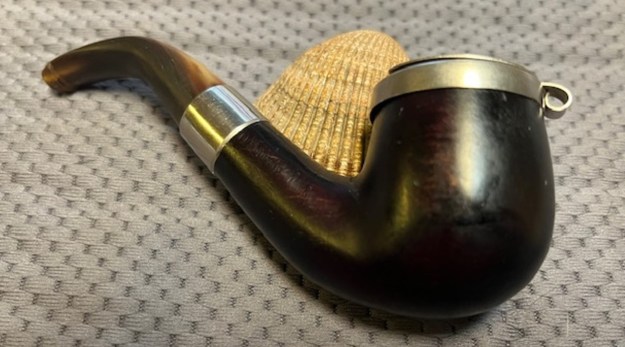
Restoring an Old KBB Palmyra Horn Stem Bent Billiard with a Wind Cap


Blog by Steve Laug

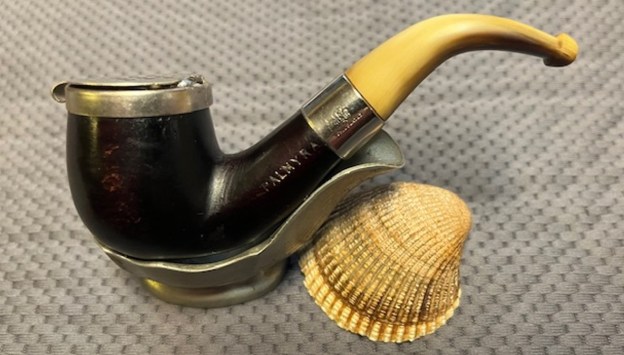
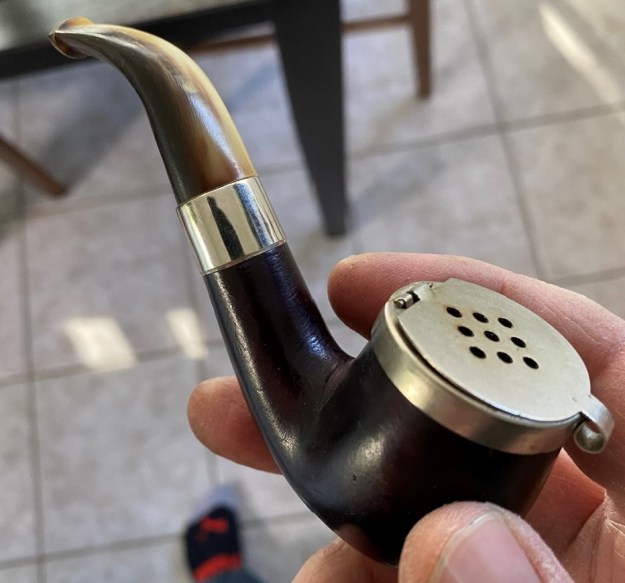
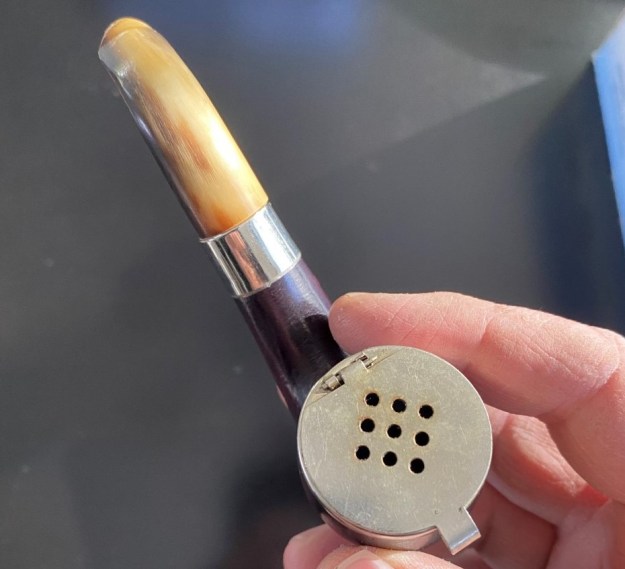
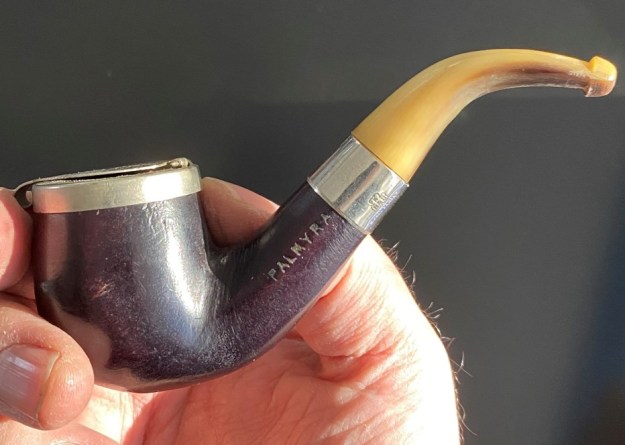
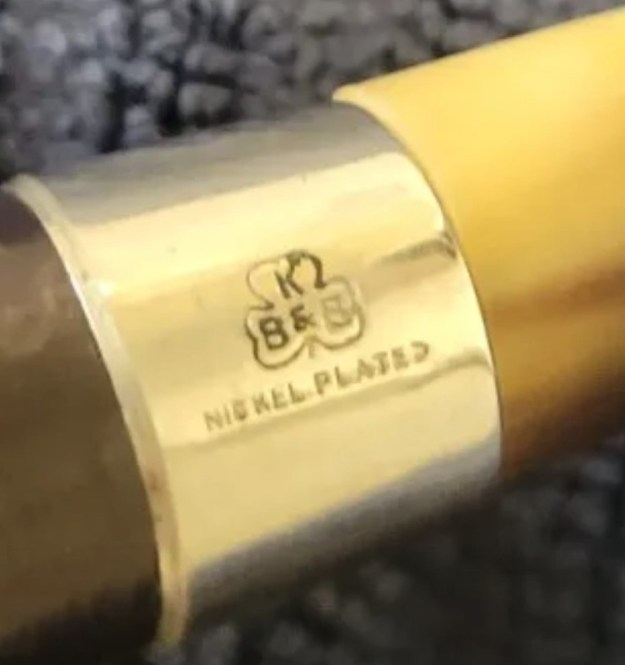
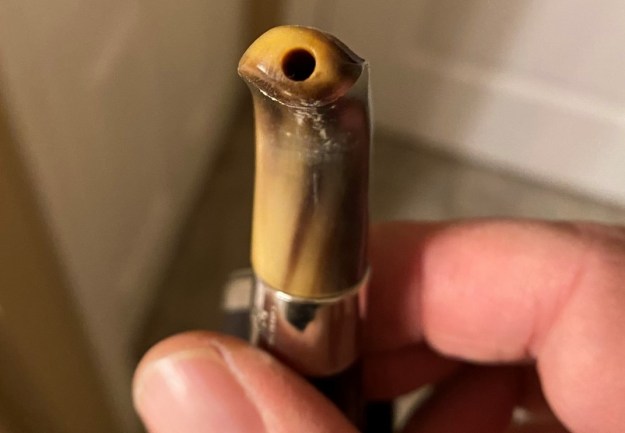
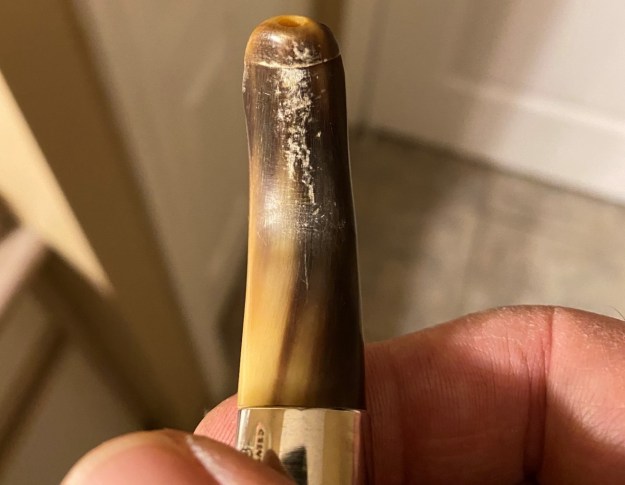
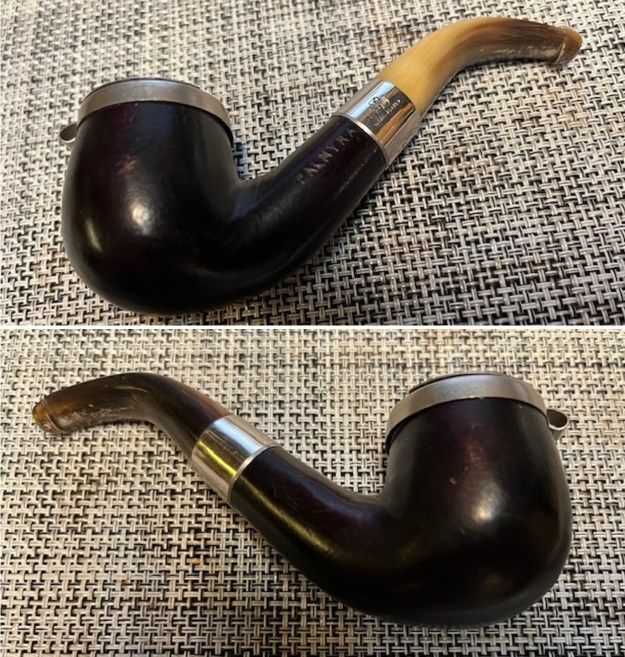
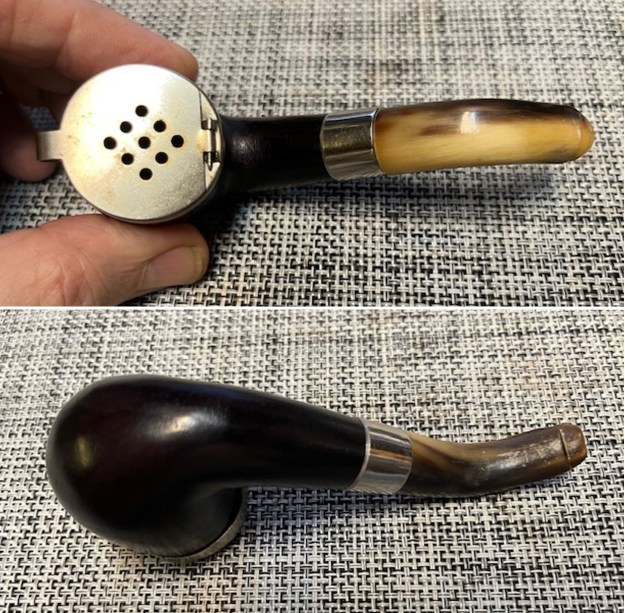
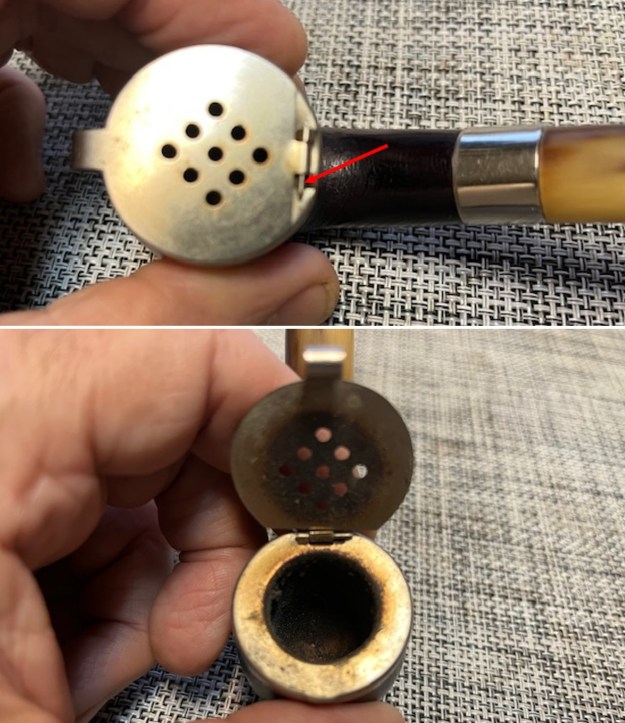
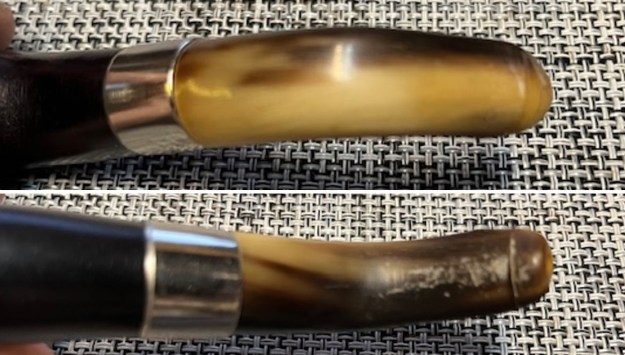
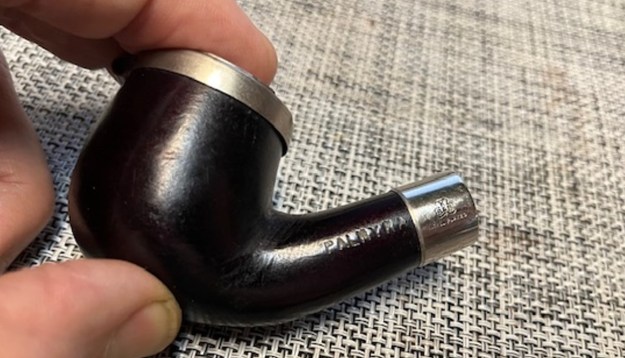
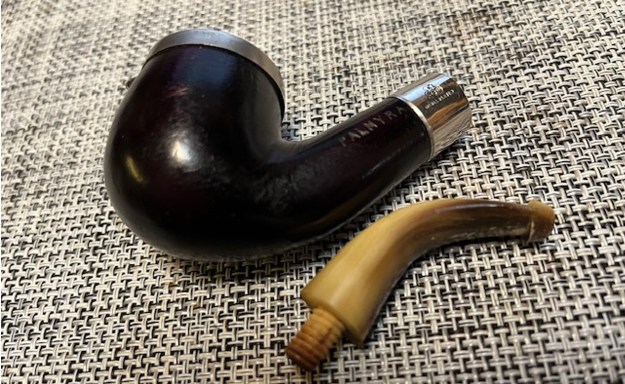
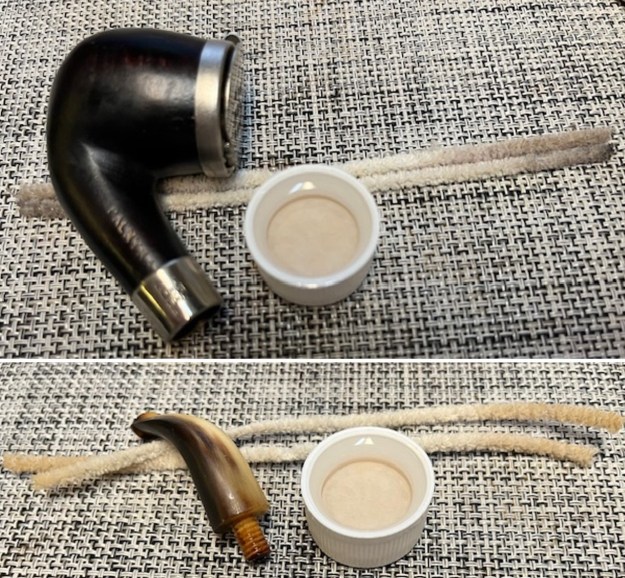
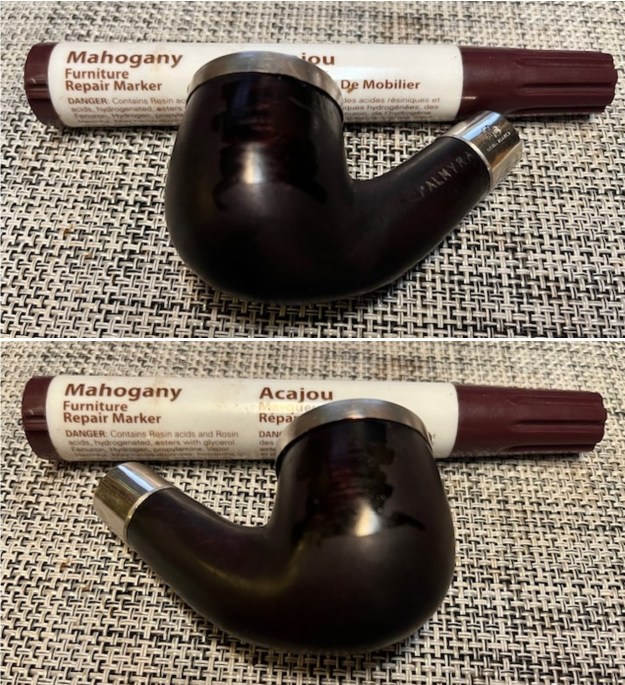
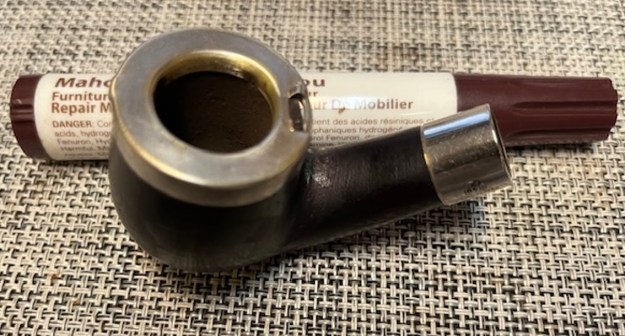
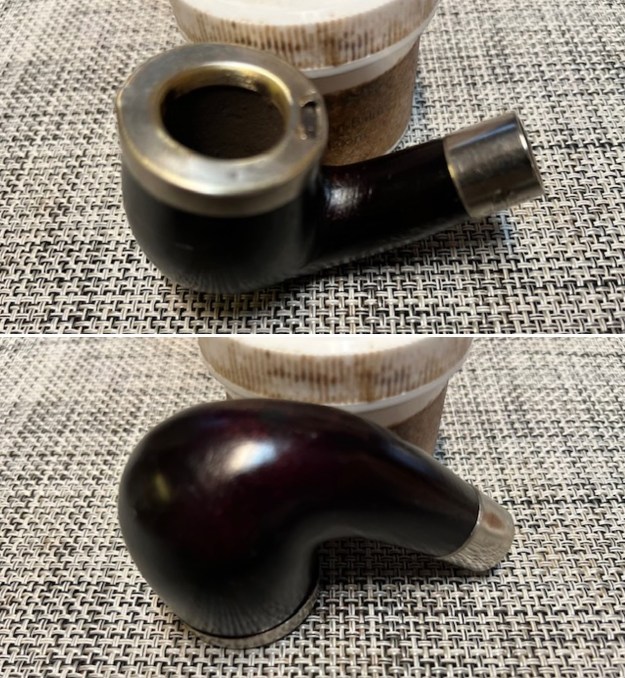
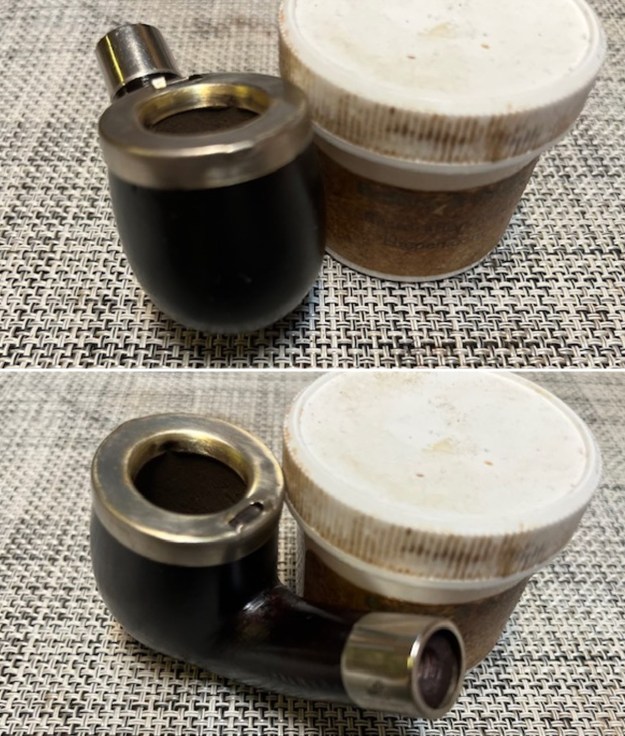
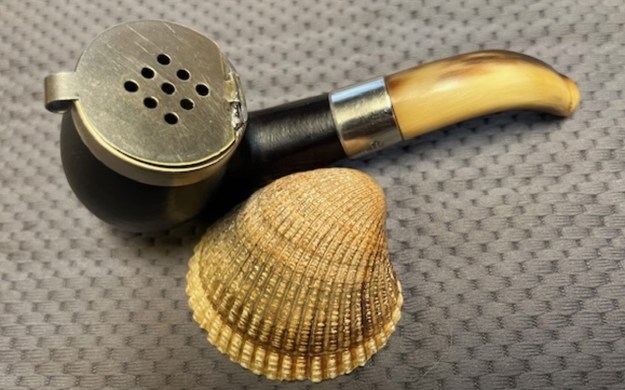
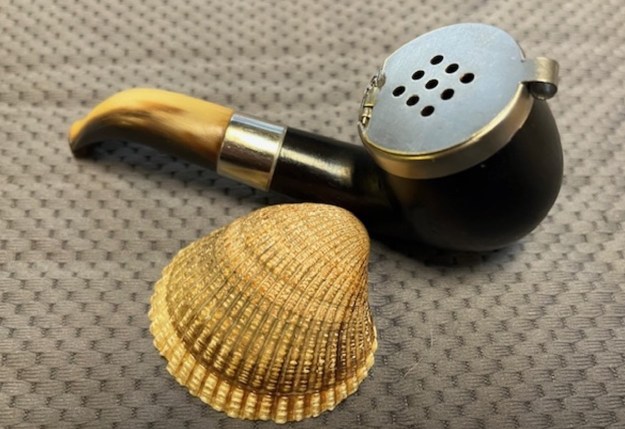
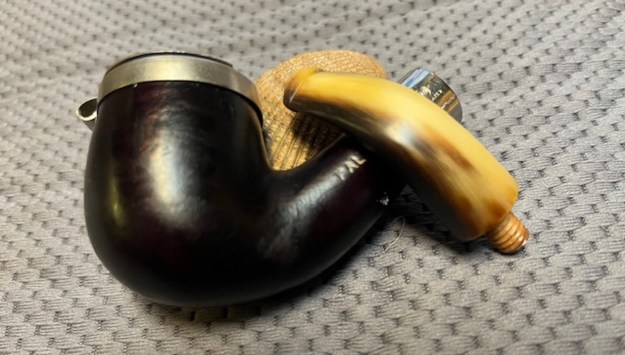
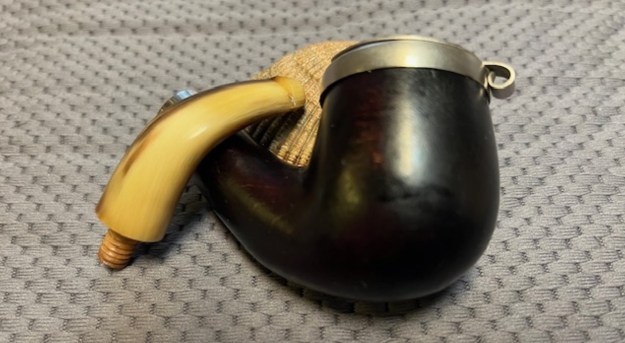
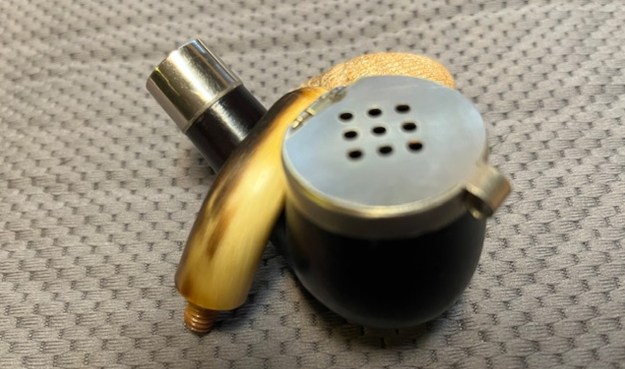
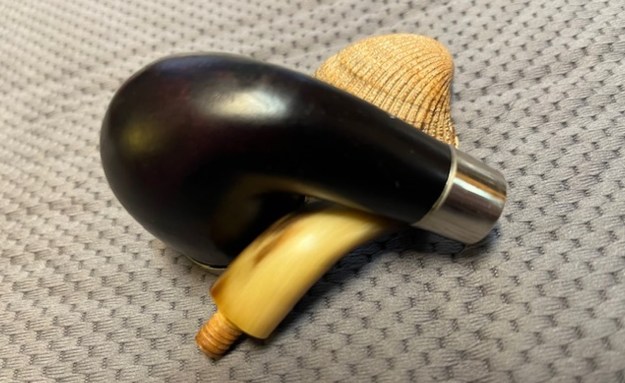
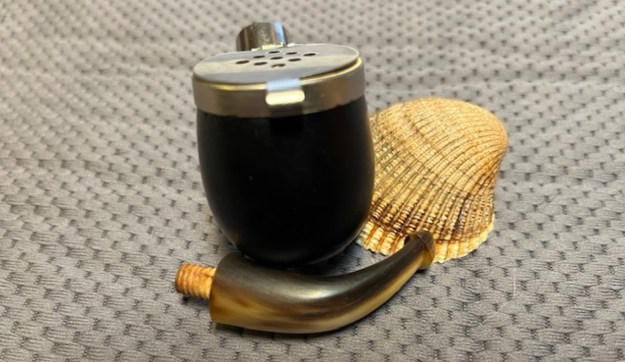
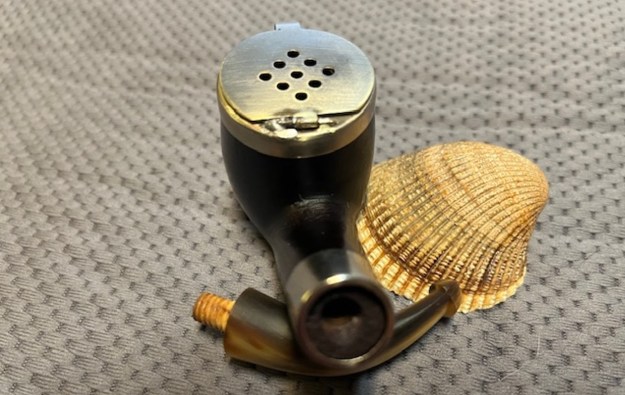
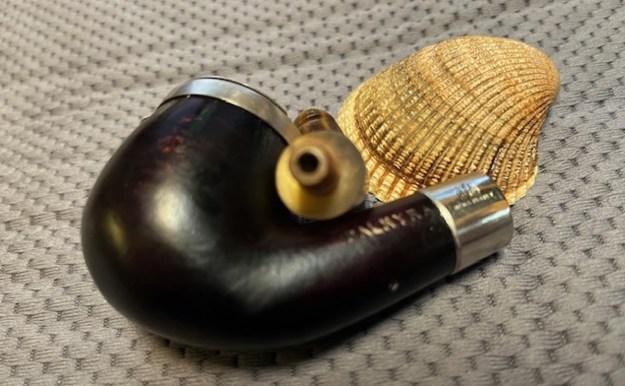
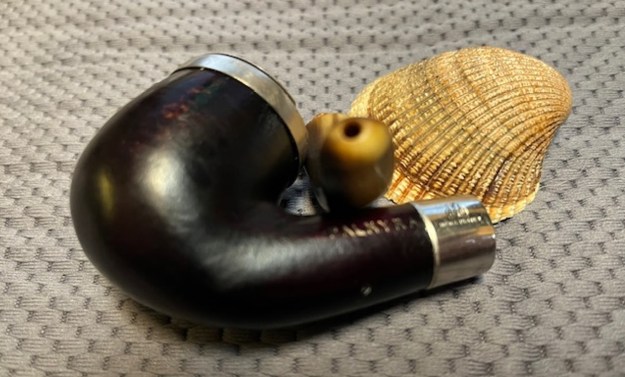
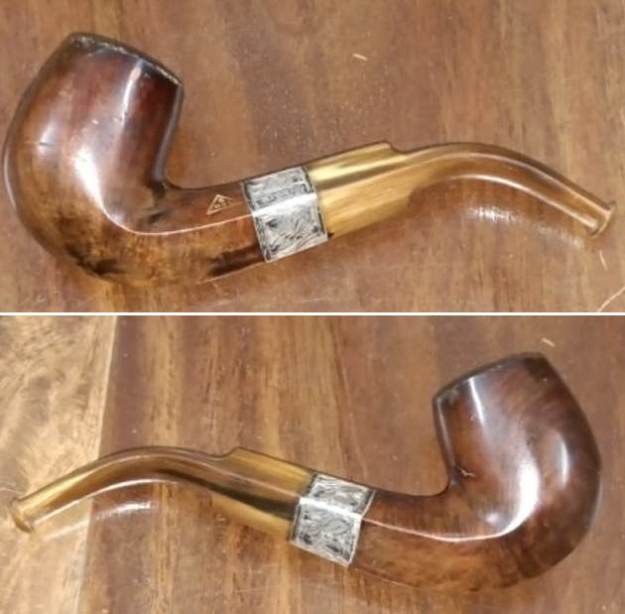
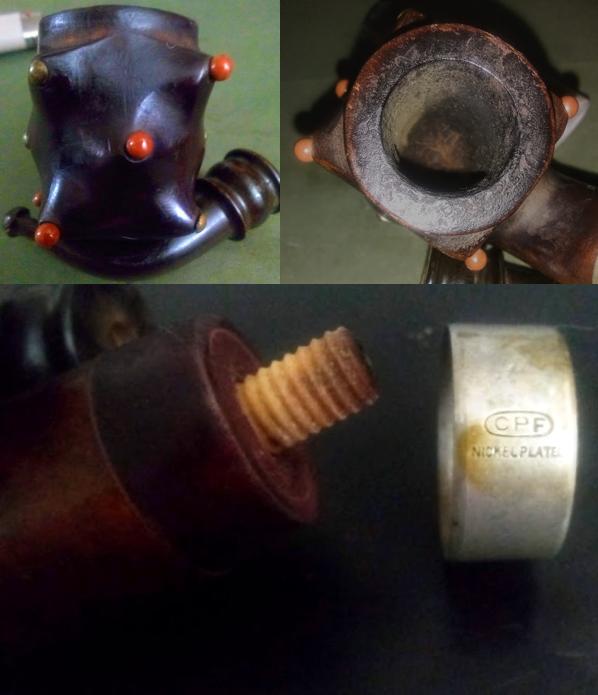
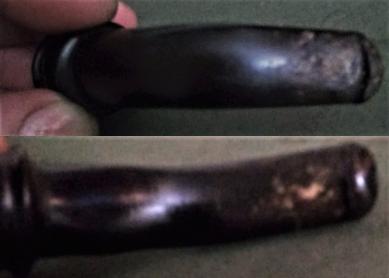
The next pipe on the table is an older KBB Pipe with a horn stem that a friend, Rob sent me. It has a nickel band on the shank and a nickel rim and wind cap. The briar has been stained with a dark purple stain and is a great contrast to the polished nickel and the horn stem. The finish was dirty and there are scratches in the finish. The nickel rim cap is dirty on the underside with tars and darkening. The hinge holding it on the cap is missing one of the anchors holding it in place. I am quite amazed that the hinge pin is not missing. The bowl has a moderate cake in the bowl and around the metal inner edge of the rim. It is quite dirty on the inside. The pipe is stamped on the left side of the shank and reads PALMYRA. On the polished nickel band it is stamped with KB&B in a cloverleaf over NICKEL PLATED on the left side. The horn stem is held in place by a threaded bone tenon that is excellent shape. The stem had tooth marks and chatter on the top and underside of the stem. The horn stem was worn and dry looking. Rob wrote me an email about the pipe asking if I would work on it. I have included the email below.

Hi Steve! 

Greetings from Kamloops… hope you had a great holiday season. A while back, I picked up a KBB Palmyra on EBay (pictures attached) and I was looking into having it restored. It’s a cool little pipe with a horn stem… I think it’s 1920s era? I don’t mind fixing up estates now and again, but I’d like this one to be restored by someone with a little more know-how than me. It basically needs a thorough cleaning, minor repairs, and a repair to the hinge of the wind cap. Would you be interested in restoring it? And do you know what it might cost, offhand?

Have a great weekend, Rob

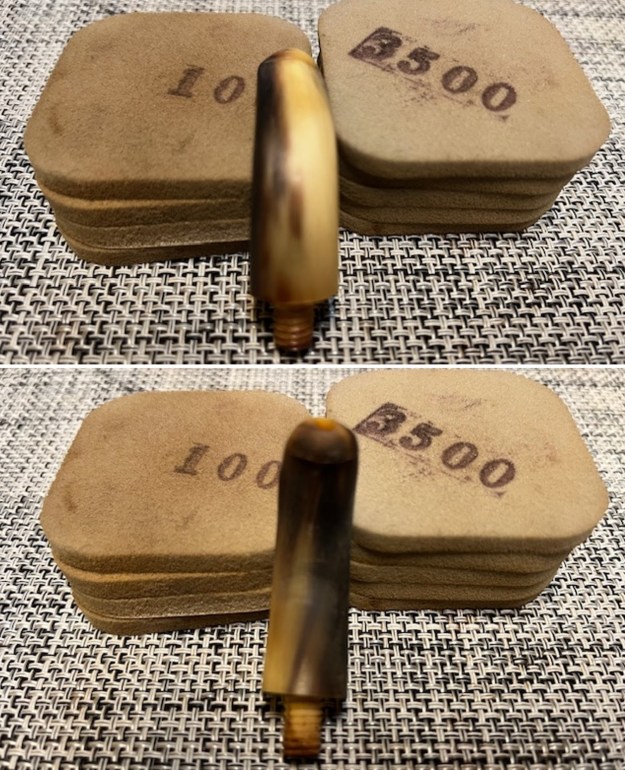
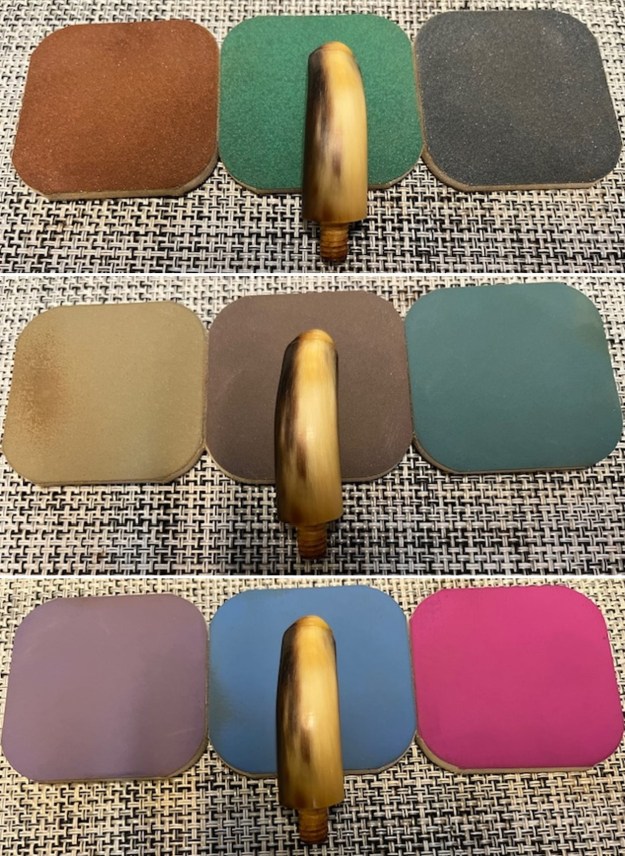
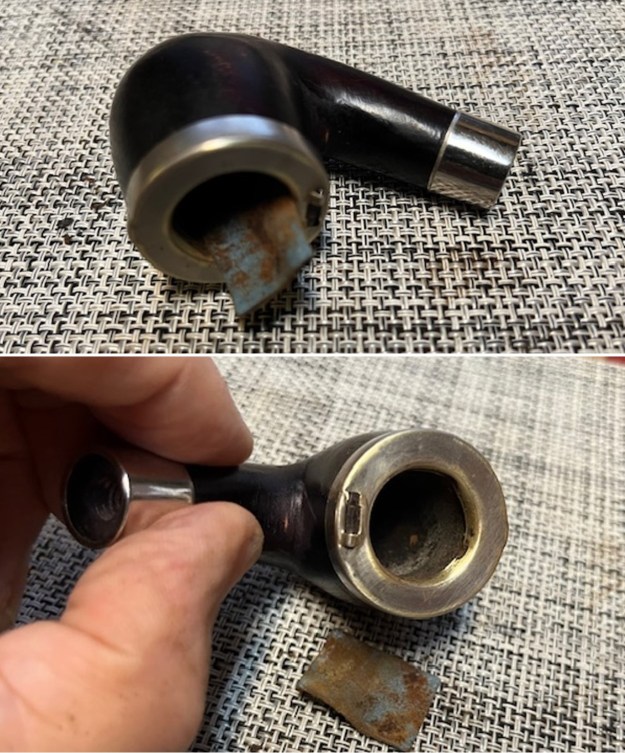
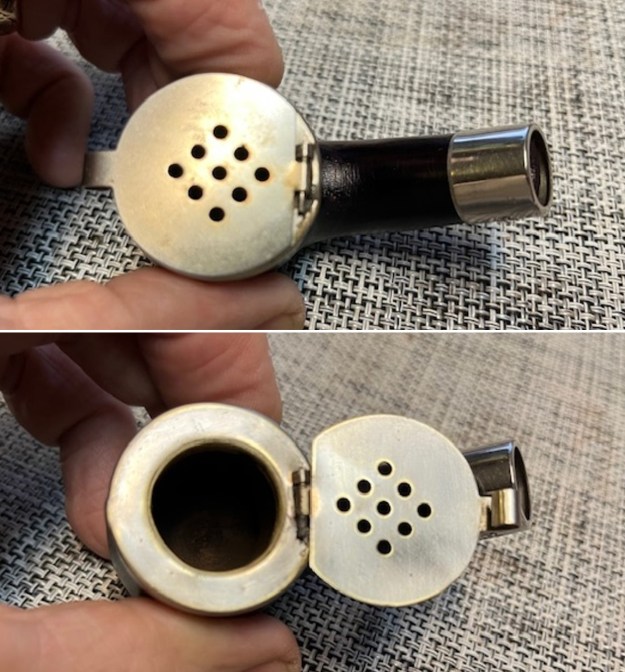
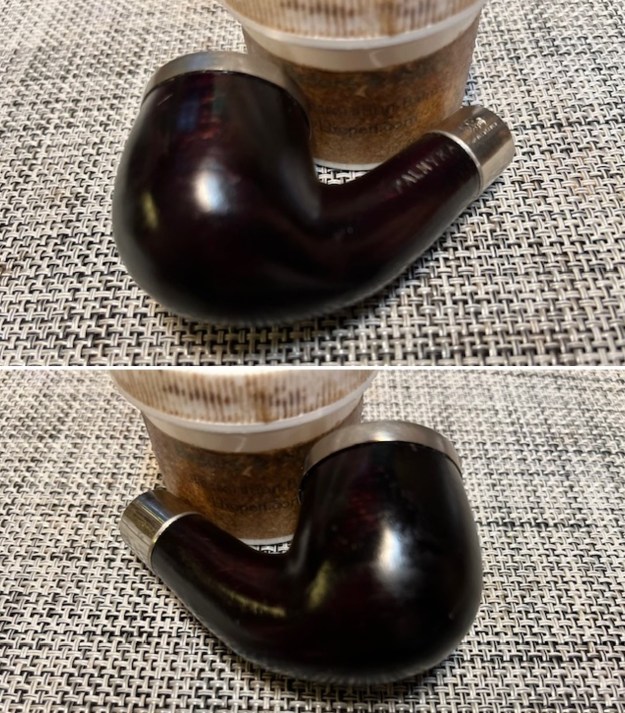
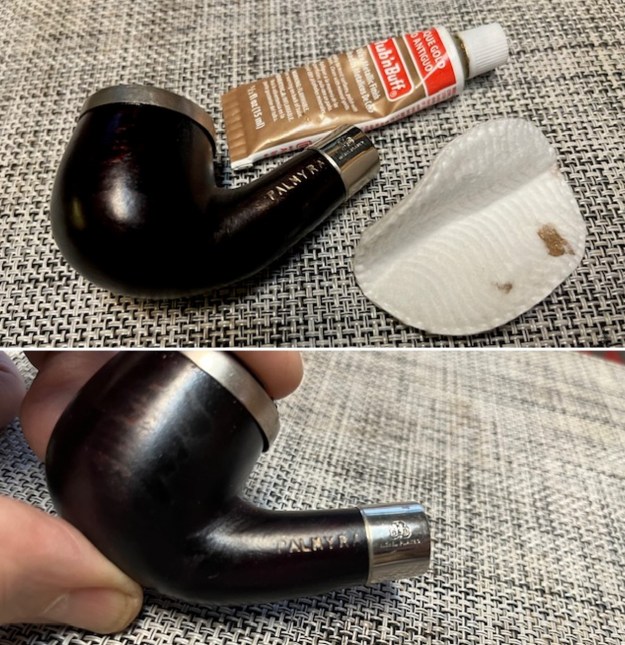
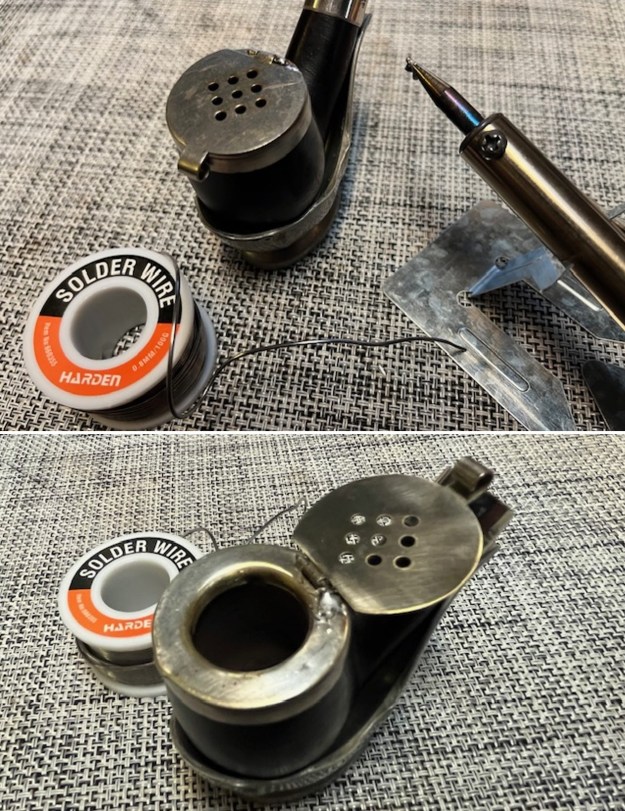
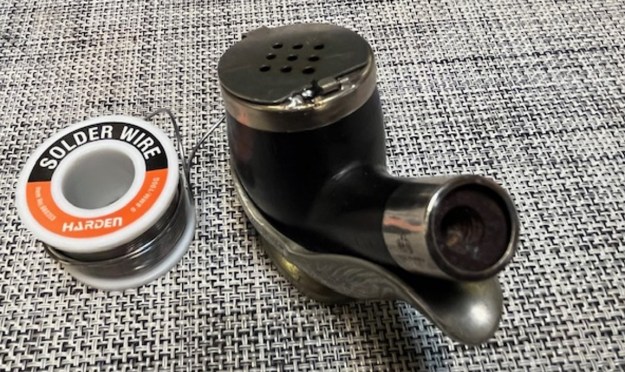
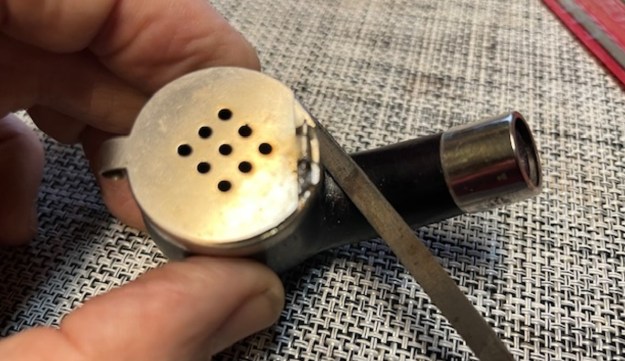
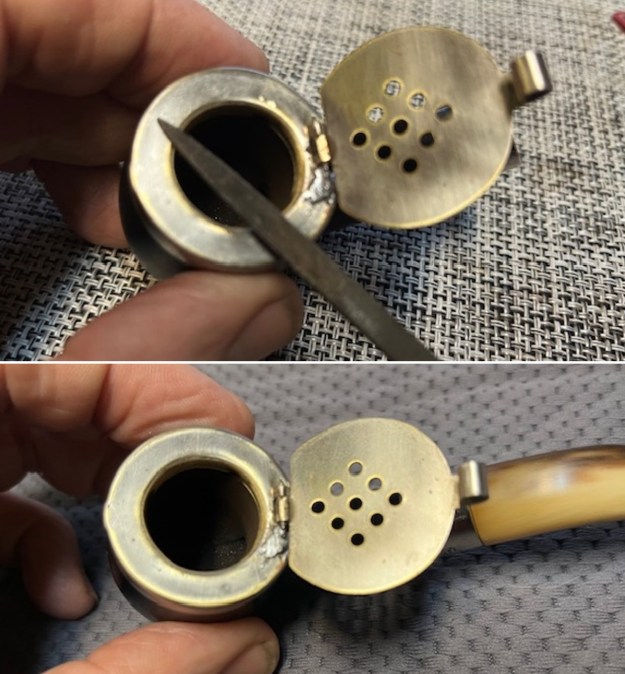
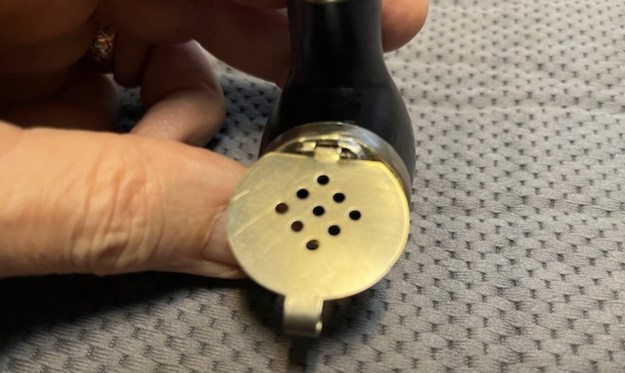
He sent the following photos which I have included below. They reveal the condition of the pipe and gave me a sense of what would be needed. When the pipe arrived yesterday I took it to the worktable. I took it out of the box and took photos of it before I started working on it. The pictures that Rob sent above told the story very clearly. The finish looked okay but there were some nicks and dents in the briar. The stain was a dark purple/oxblood colour that hid the grain but it is the classic stain that was on the bowl when it was made. The nickel on the band and rim edge were clean. The cap needed polishing and the inside of the cap was dirty with tars, oils and build up. The horn stem had tooth marks on the top and underside ahead of the button. I took a photo of the rim top and cap to show the condition. You can see that part of the hinge material is missing at the bottom edge of the pin below. I have inserted a red arrow in the photo below showing the missing hinge piece. I opened the cap and took a photo of the inside. The top of the cap is dirty as noted above and quite rough. The rim cap is also dirty and will need to be cleaned. I also took photos of the stem to show the tooth marks in the surface. I took a photo of the stamp on the shank side. There is some gold leaf still in the stamp that I would touch up after the clean up. I took a photo of the stem and bowl to give a sense of the size and proportion of the pipe. I decided to start with the stem work. I sanded out the tooth marks on the stem surface with 320-35000 grit sanding pads to remove the tooth marks in the surface of the stem. Once I was able to remove the marks in the stem surface and started polishing the horn surface. It looked much better.I polished the vulcanite stem with micromesh sanding pads – dry sanding it with 1500-12000 grit pads. I wiped the stem down after each sanding pad with Obsidian Oil and set it aside to dry.I polished it further with Before & After Pipe Polish – using both the Fine and Extra Fine Polishes. I gave it a rubdown with Obsidian Oil one last time and set it aside. I set the stem aside and turned my attention to the bowl. I removed the cap and the hinge pin from the one side of the cap to free it from the bowl so that I could work on it.  I used a folded piece of 220 grit sandpaper to clean up the metal lined inner edge of the bowl. I also cleaned up the rim cap top at the same time.I scraped the bowl with a Savinelli Fitsall Pipe Knife. I removed all of the cake on the bowl walls. I sanded the bowl walls smooth with a piece of dowel wrapped with 220 grit sandpaper. The bowl was smooth and undamaged.I cleaned up the top of the wind cap with a worn 1200 grit micromesh sanding pad to remove the grime on the top of the cap. I also worked on the build up on the inside of the cap with the same piece of 1200 grit micromesh. It removed the grime but did not damage the polished nickel.I cleaned out the internals in the shank and the airway in the stem and shank with pipe cleaners and isopropyl alcohol. It was surprisingly clean and it took very few cleaners to leave it clean.I touched up the light spots on the bowl sides and on the joint of the shank and the bowl with a Mahogany stain pen. The colour matched perfectly. Once it had cured I would polish it and blend it further. I worked Before & After Restoration Balm deep into the smooth finish to clean, enliven and protect the briar. I hand rubbed it with my fingers and worked it into the finish then set it aside to dry for 10-15 minutes. I wiped it off with a soft cloth. I buffed the bowl with a cotton cloth to polish it. It really began to have a deep shine in the briar. I took some photos of the bowl at this point to mark the progress in the restoration. The grain on the bowl stands out with interesting lines moving across the sides of the bowl and the shank. I touched up the gold gilt in the stamping on the left side shank with Rub’n Buff Antique Gold. I worked it into the stamping with a tooth pick and buffed off the excess with a cotton pad. It looked quite good with the retouched stamp.Now it was time to work on the broken hinge on the cap. The right side of the hinge cap was present as was the hinge pin. The right side had broken off somewhere in the life of the pipe. I used a soldering iron and some solder wired to build up a cap over the left side end of the hinge pin. I opened the lid and soldered the end over the pin on the inside of the cap first. I closed the lid and built it up on the outside of the hinge. I used a small flat file to flatten out the hinge end on the inside and the outside of the cap. I finished it up with a Dremel and a sanding drum to further flatten it out. I screwed the horn stem back on the KB&B Palmyra Bent Billiard and carefully worked the pipe over on the buffing wheel using Blue Diamond to lightly polish the stem. I buffed the bowl and stem to raise the gloss on the briar and the vulcanite. I gave the pipe multiple coats of carnauba wax. I buffed the entire pipe with a clean buffing pad to raise the shine. I hand buffed it with a microfiber cloth to deepen the shine. The finished KB&B Palmyra Bent Billiard is shown in the photos below. The purple/oxblood stains on the smooth Billiard shaped bowl works well with the polished nickel band and the polished horn stem. The dimensions of the pipe are: Length: 4 ½ inches, Height: 1 ¾ inches, Outside Diameter: 1 ¼ inches, Diameter of the chamber: ¾ of an inch. The weight of the pipe is 1.38 ounces/39 grams. This is an interesting pipe with the dark stain on the bowl, the gold stamp on the left side of the shank and shank, the nickel wind cap and band all work with the polished horn stem. I really like how well the parts work together. This one will soon be on its way back to Rob. I think he will enjoy himself with this beautiful little old timer. I look forward to hearing what he thinks of it once he sees it.

As always, I encourage your questions and comments as you read the blog. Thanks to each of you who are reading this blog. Remember we are not pipe owners; we are pipe men and women who hold our pipes in trust until they pass on into the trust of those who follow us.

Another Piece Of Pipe History Restored To It’s Former Glory; A c.1901 Samuel Mclardy”


Blog by Paresh Deshpande

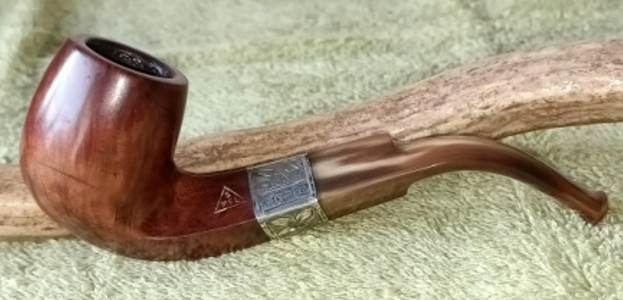
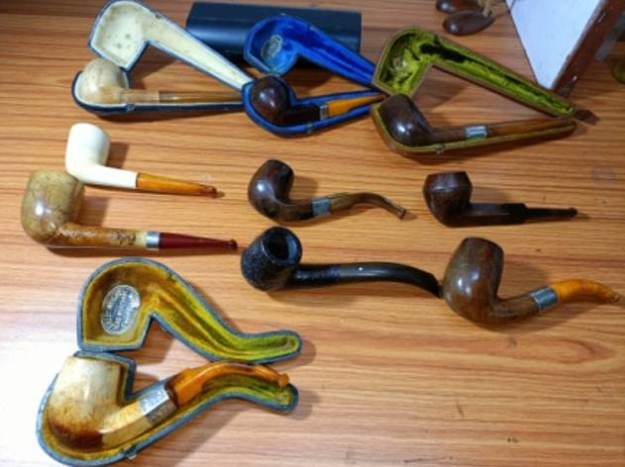
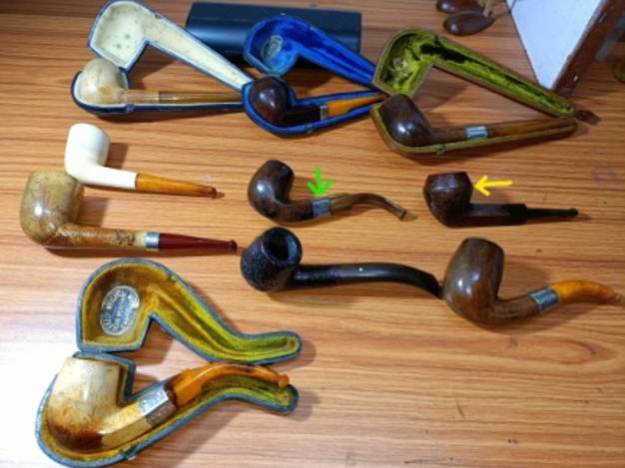
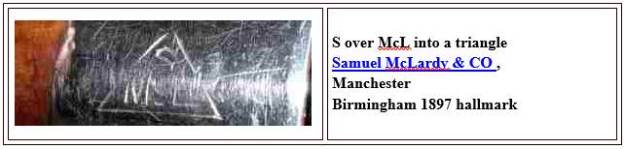
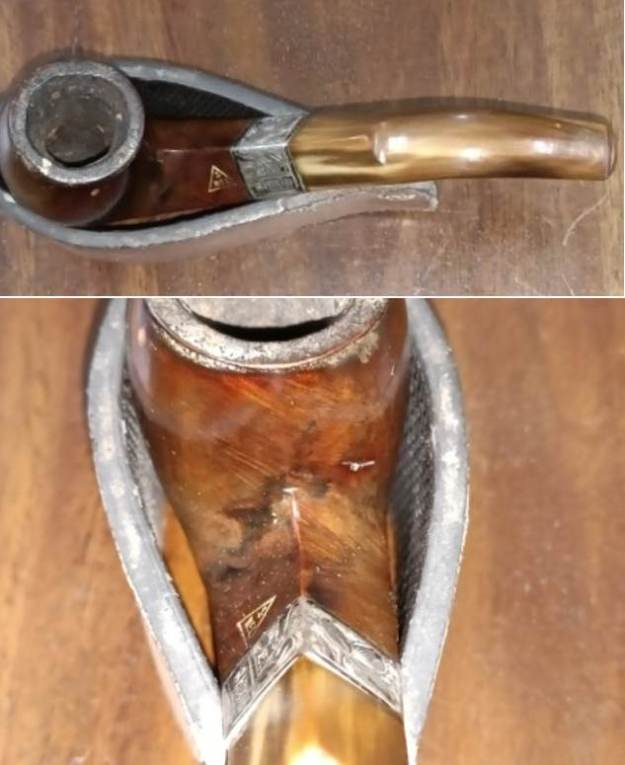
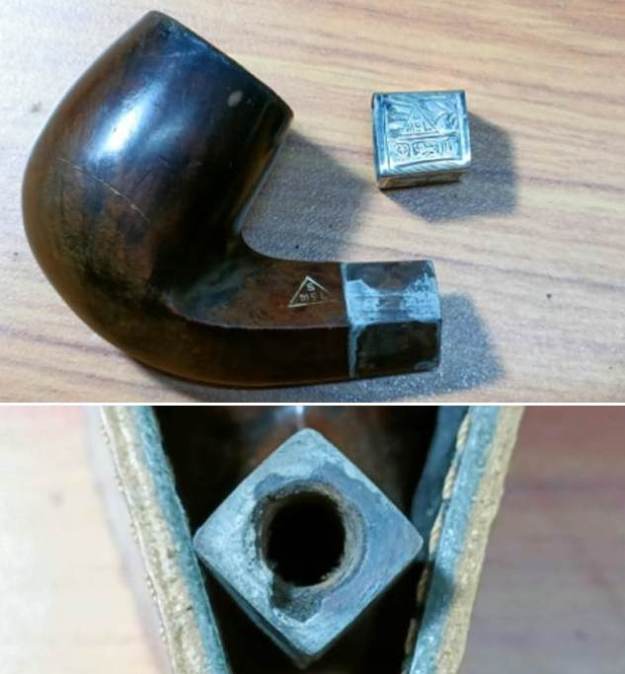
During the summer of last year while browsing on Pinterest, I came across pictures of some beautiful pipes and following the links led me to an old gentleman from the UK who was willing to sell these pipes either single or as a lot. There were around 60 odd pipes. I went through the pictures that were sent along with the rates and selected 10 pipes. After a prolonged and interesting interaction, we managed to arrive at a price point. Soon these pipes landed on the shores of India and went in to Customs hold for nearly a month. Finally, it was released and I laid my hands on these pipes after a wait of nearly 3 months! Here is a picture that I had taken moments after opening the parcel.I had restored a BARLING’S MAKE pipe from this lot earlier (indicated with a yellow pointer) and the next pipe that I have selected, again from this lot is a SMcL (indicated with a fluorescent green pointer) bent billiards with squared shank and horn stem.The pipe is a classic Bent Billiards with a square shank and a saddle horn stem with a threaded tenon. It is a typical English shaped quaint sized pipe with a nice hand feel and a light weight that makes it comfortable for clenching. It has a hallmarked silver band with filigree at the shank end. The silver filigree is stamped as “SMcL” in a triangle over three sterling silver hallmarks. From right to left the first cartouche is with a date code letter “b” followed by a cartouche with LION PASSANT certifying silver quality and the last cartouche contains the “Anchor” of the Birmingham Assay Office. The shank is likewise stamped with SMcL in a triangle in golden color while the horn stem is devoid of any stampings.This brand though faintly familiar to me through various reads and mentions, I haven’t ever worked on a pipe from this manufacturer and neither researched this old British marquee. I decided to follow the trail along the silver filigree ferrule at the shank end bearing the hallmarks. I visited www.silvercollection.it and upon searching through the index, I came across a maker’s mark that was as seen on the pipe in my hands. The maker’s mark was described as SAMUEL McLARDY & Co. Here is the link and screen shot of the details and relevant details are highlighted.

https://www.silvercollection.it/englishsilvermarksXS3.htmlThe next step was to date this pipe with the help of the hallmarks as seen on the silver filigree band at the shank end. The Birmingham City mark was easy to identify. The letter “b” perfectly matched up with the letter that identified it as being assayed by the Birmingham Assay office in 1901. Given below is the link that will take the readers to the relevant section of dating and the picture that I have taken with the date code letter marked in red.

https://www.silvercollection.it/englishsilverhallmarksBIR.html

I visited pipedia.org to know more the brand Samuel McLardy & Co. Given below is the link to the article on pipedia.org and have reproduced relevant information about the brand.

https://pipedia.org/wiki/Samuel_McLardy

The McLardy company thanks its existence to the entrepreneurial spirit of 1 person: Samuel McLardy, born in Glasgow in 1842. He was the son of a tobacconist who also produced his own clay pipes. In the paternal shop he must have learned the profession of pipe-maker. Shortly after his 20th birthday he decided to move to Manchester to start his own company. There is remarkably little known about the history of the factory. On an old advertisement it says “established 1865” so since then there must have been a steady growth. Within a couple of decades there was a massive production of clay pipes. Around 1895 the factory owned over 500 moulds which meant yearly production was around 5 million pipes! Similar to that of Dutch factory P. Goedewaagen & Zoon in that period. Over time we find Samuel McLardy at different locations. Before 1880 that was Miller Street number 16 in Manchester and it is there where the shop grew to the size of a factory. In 1890 the company moved to Shudehill number 67 where it remained active until after 1910.

The production of clay pipes was a large part of the McLardy operation and this interesting Pipe Manufacturers Catalogue shows several clay models displayed for sale. Duco’s article, referenced above, examines the historical realities impacting the Samuel McLardy Co., (typical of other UK pipe companies) by navigating through relatively prosperous years leading up to the turn of the century, the decline of interest in clay pipes, diversification of other product lines to cope with falling revenues, WWI, the growing economic bubble of the 20s leading ultimately to the collapse of the McLardy, Co., soon after the stock market crashes in September (for UK) and October (for US), 1929. I found this last statement regarding the Samuel McLardy, Co., as a matter of public record published in archives of The London Gazette regarding the liquidation of the company. Reflective of the times, there were several companies listed in the Gazette which were being “wound up”:

The Companies Act, 1929.

Special Resolution of SAMUEL McLARDY & CO. Limited.

Passed 13th January, 1930.

AT an Extraordinary General Meeting of the Members of the above named Company, duly convened, and held at No. 20, Swan-street, Manchester, on the 13th day of January, 1930, the following Resolution was duly passed as a Special Resolution: –

” That the Company be wound up voluntarily; and that Mr. George Elder, Chartered Accountant, of Edwin Collier & Co., 3, York-street, Manchester, be appointed Liquidator for the purposes of such winding-up”.

Thus to summarize, Samuel McLardy & Co. was established in 1865 by Mr. Samuel McLardy at the age of 23. This company was an established clay pipe maker and produced about 5 million pipes a year. By 1920s, the business was no longer profitable due to WW I, declining interest in clay pipes and financial meltdown of 1929. Samuel McLardy & Co was “wound up” on 13 Jan 1930 after 65 years of its existence.

With the provenance of the pipe established beyond doubts, it was logical for me to move ahead with restoration proper of this pipe.

Initial Inspection
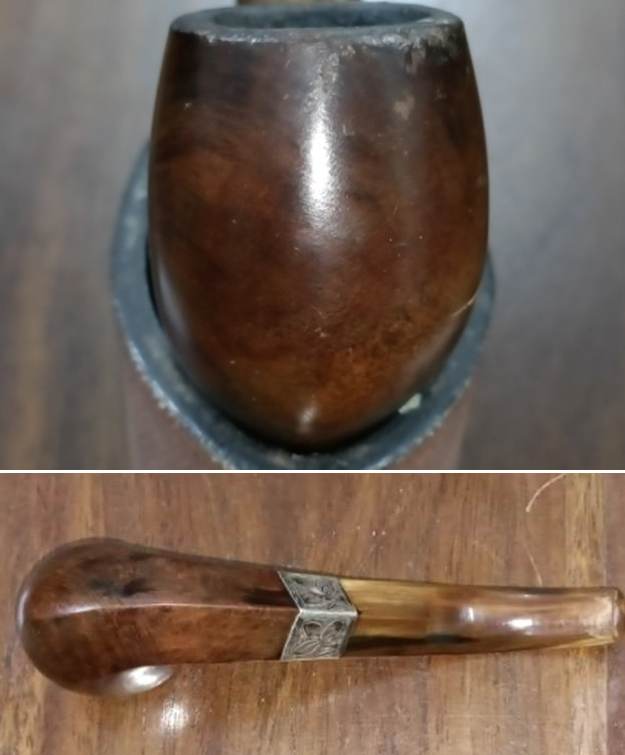
This pipe has the quintessential quaint size and shape that is nearly always seen on old British made pipes. The well seasoned briar is covered in dirt, dust and grime from decades of use. There are a couple of deep scratches on the stummel surface. There is a thick cake in the chamber with heavy overflow of cake, oils and tars over the rim top surface. The inner rim edge is uneven and charred. The outer rim edge, likewise, is peppered with dents and dings. The horn stem is in good condition with minor tooth chatter on both surfaces in the bite zone. The draw through the pipe is labored and constricted. This project should be an easy restoration, unless some gremlins are lurking unbeknown to me around the corner! Here are a few ‘before’ pictures of the pipe. Detailed Inspection
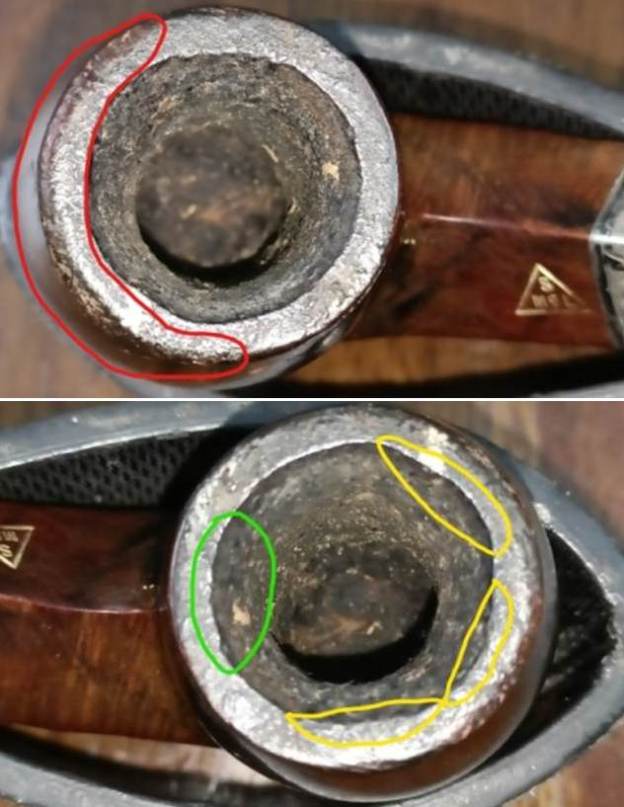
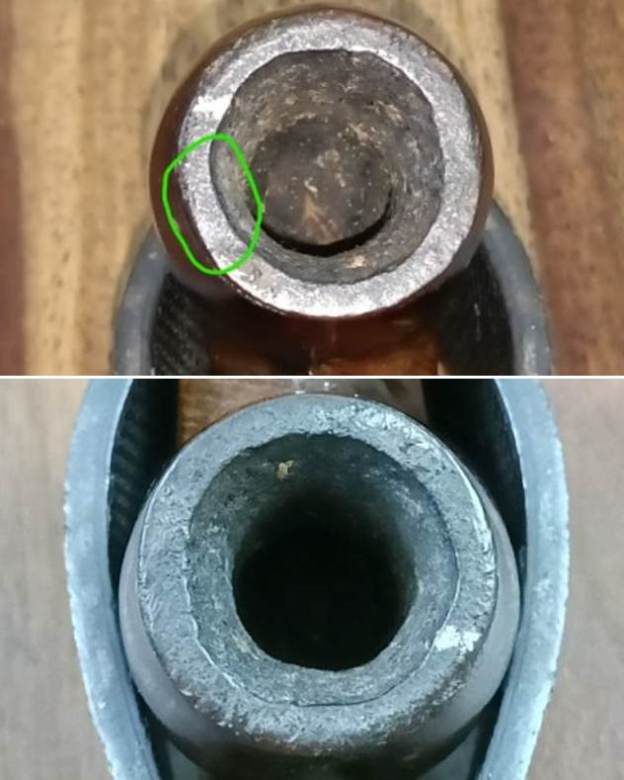
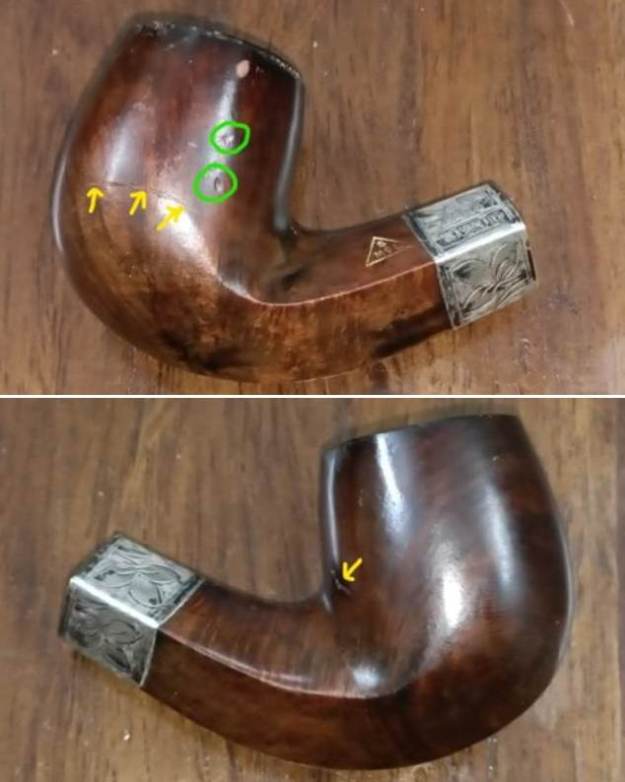
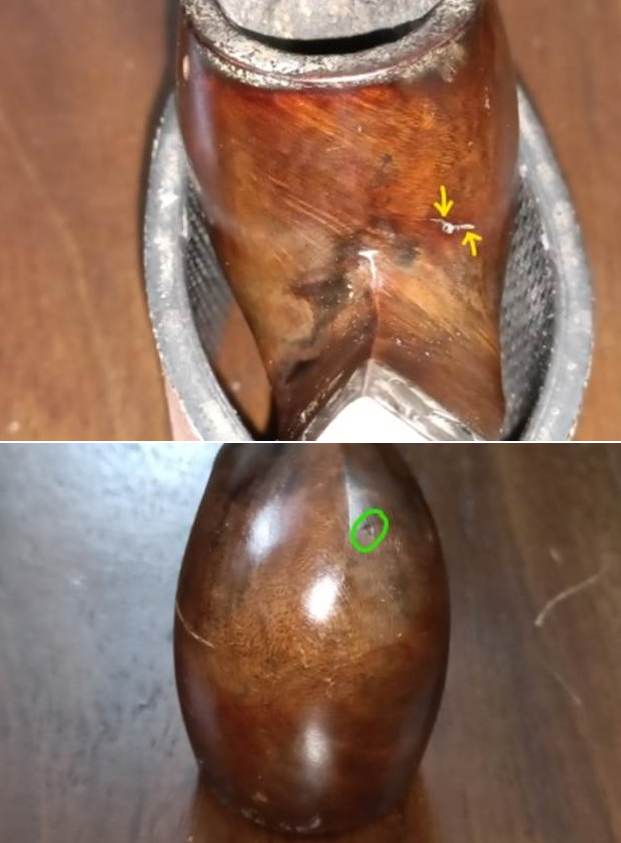
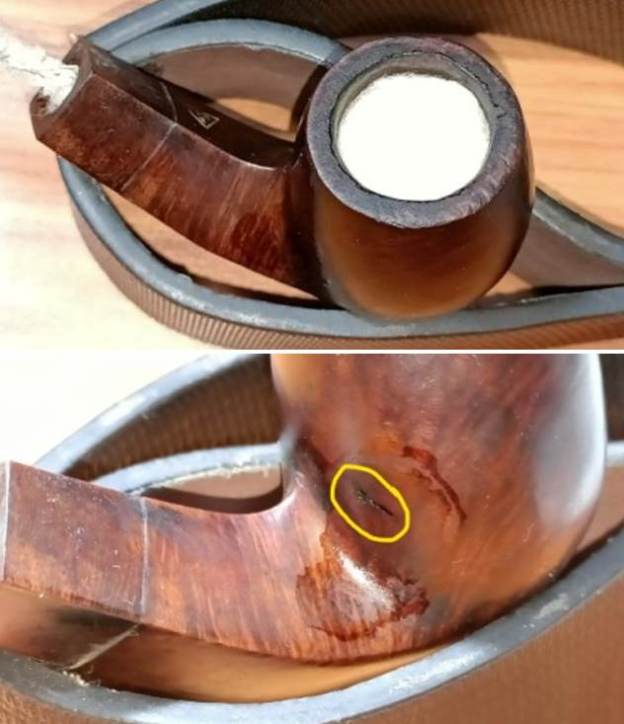
The chamber has a thick hard cake that has spilled over the rim top surface. The cake is thicker around the upper half of the chamber. The outer rim edge has dents and dings all around but is most severely damaged along the front half portion (encircled in red), a damage that can result only due to repeated strikes against a hard edged surface. The inner rim edge is unevenly gouged, probably due to use of a sharp knife to clean up the rim of the charring damage (encircled in yellow). The rim appears thinned out in a couple of places and is encircled in green. The condition of the inner walls of the chamber can be commented upon after the cake has been taken down to the bare briar. There is a strong ghost smell in the chamber which is all pervading. The stummel surface is covered in dust, dirt and grime giving a dull, lifeless and lackluster appearance to the pipe. However, the briar has taken on a nice dark patina, a result of more than 120 years of usage which would be worth preserving. However, eliminating/ addressing the deep scratches (indicated with yellow arrows) on both side of the stummel and the few dents and dings (encircled in green) would entail sacrificing the patina. This is a call that I would need to take at some stage in the restoration process. The mortise is chock-a-block with old oils, tars, ashes and grime making for a labored draw. The thick cake and blocked mortise hides the draught hole from view. These issues need to be addressed. The horn stem itself appears dull and lifeless and has some minor tooth chatter on both the surfaces of the stem. The slot is perfectly round and correct for the time period of the pipe and shows accumulation of dried tars and dirt. The threaded bone tenon also shows traces of deposition of gunk and grime within the threads and at the tenon end. The button edges are sharp and sans any major damage with a little dirt embedded at the bottom of the edges and some minor tooth chatter over the lower and upper button in the bite zone. The dark and light hues taken on by the stem over the years should polish out nicely and will add an additional touch of class to this already classy pipe. The Process
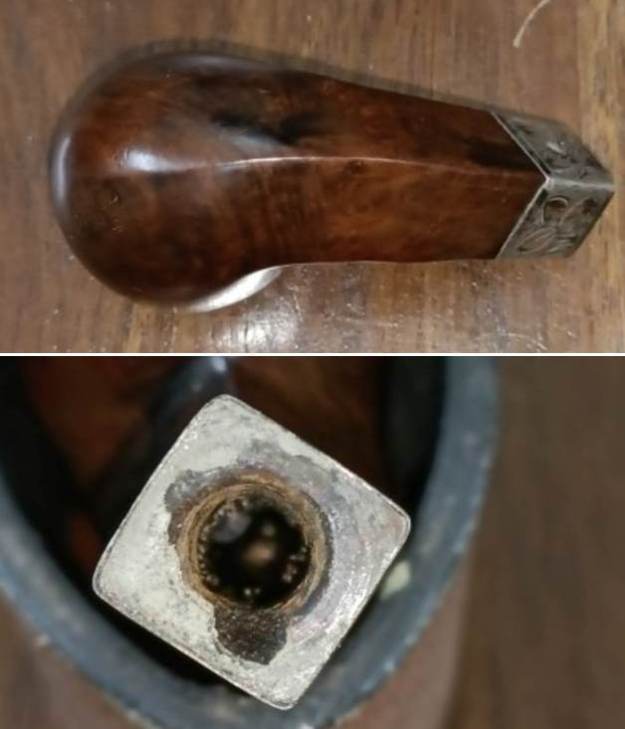
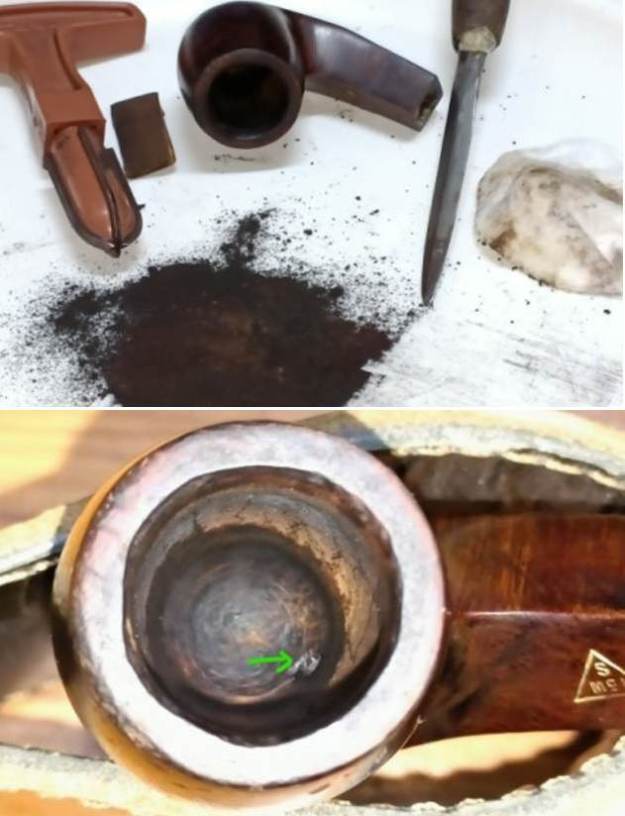
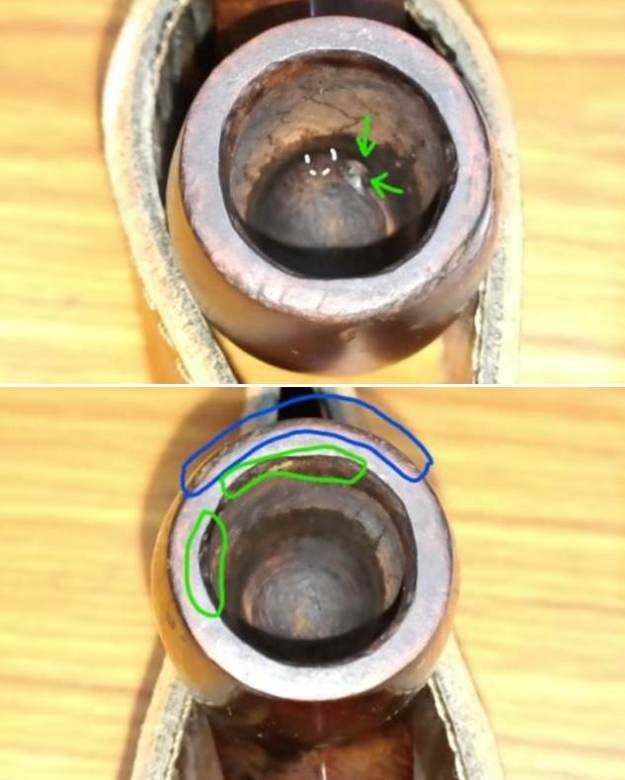
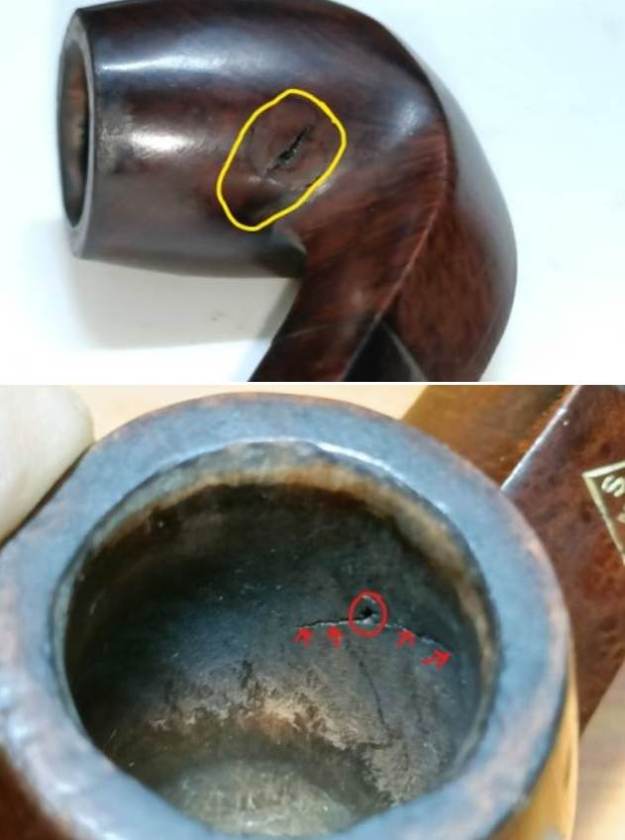
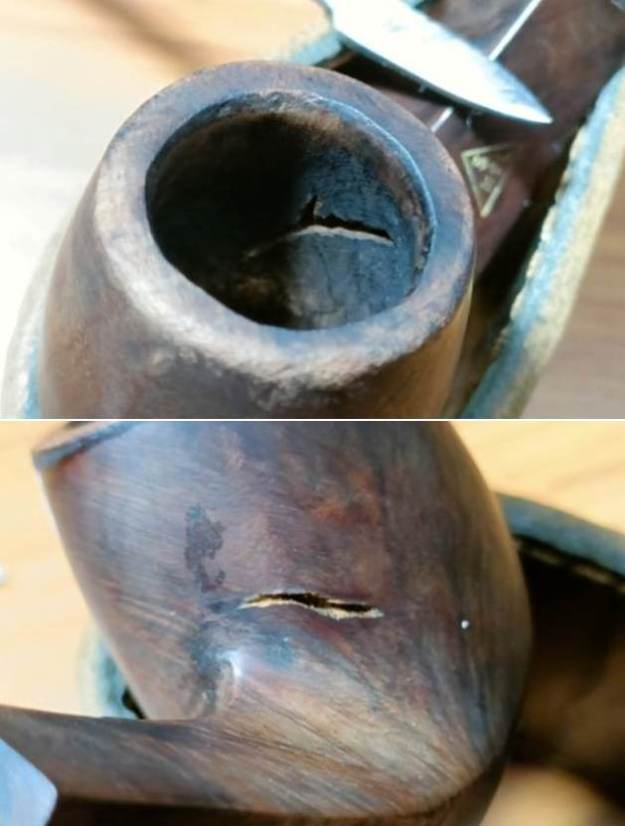
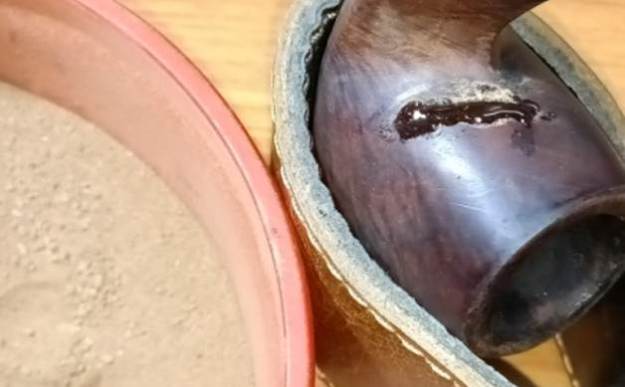
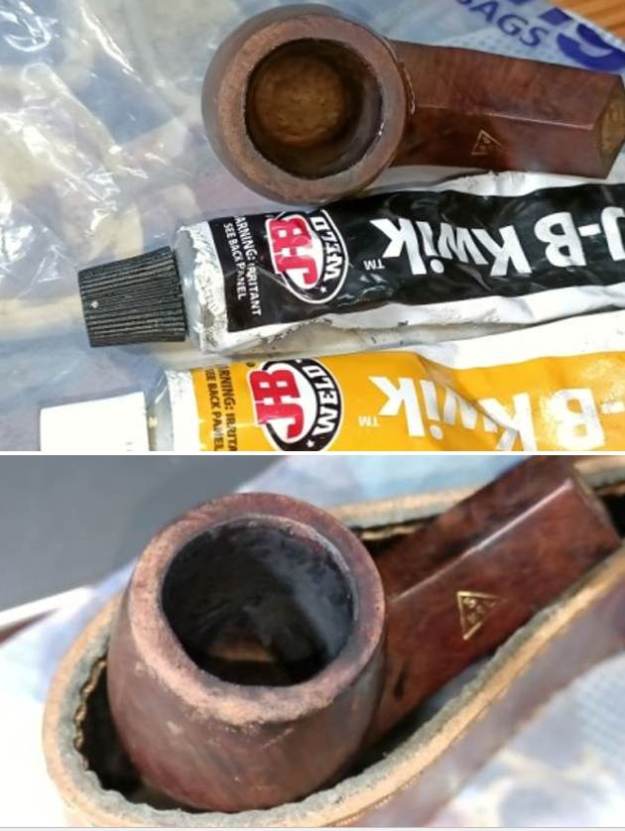
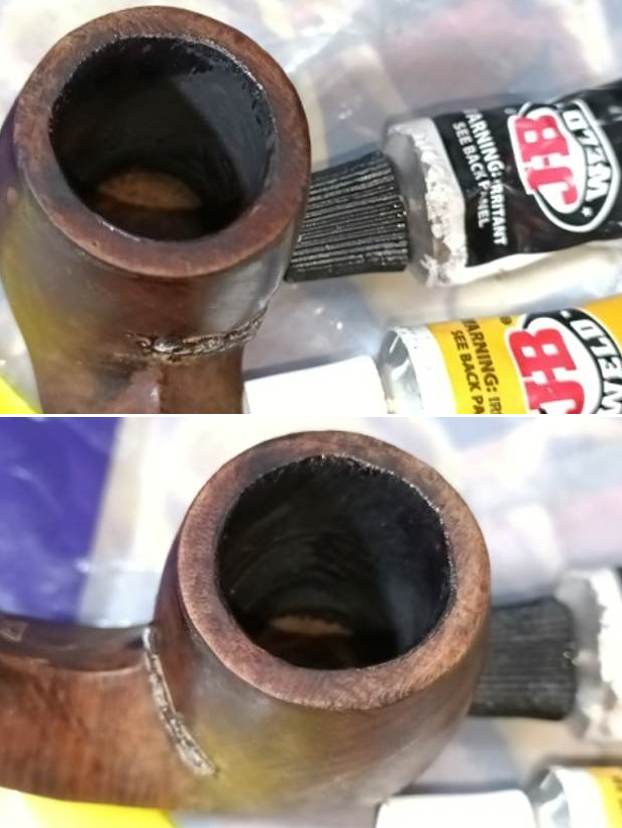
I first tried to remove the silver filigree band to check for any hidden gremlins over the shank end surface. The band came off quite easily and it was a relief to note that there were no cracks or chipped areas underneath the band as evidenced from the shank end face.Since the stummel is where maximum restoration efforts are needed, this was where I started my process to restore this pipe. I began the process of refurbishing this pipe by reaming the chamber with a PipNet reamer tool, using the second head. Using my fabricated knife; I further took the cake down to the bare briar. With a 220 grit sand paper, the walls of the chamber were rid of all the remnants of the cake, revealing smooth chamber walls. I further wiped the chamber with a cotton swab wetted with isopropyl alcohol to completely remove the sanding dust. I gently scraped the lava overflow from the rim top. Close observation of the chamber after the clean up revealed that the draught hole is not centered (centre position encircled in white) but towards the left side (indicated with green arrows). This being a manufacturing issue, there is nothing that I can do to right this wrong and even if there is something that can be done, I wouldn’t recommend it as it had previously over the last century served its owner well as can be seen from the thick cake in the chamber. The damage to the front outer edge (encircled in blue) and the out of round chamber due to damaged inner rim edge (encircled in green) can now be seen clearly and would need to be addressed. Using cotton buds, bristled and regular pipe cleaners wetted with 99.9% pure alcohol, I carried out the preliminary cleaning of the mortise. I shall continue deeper cleaning of the chamber and mortise with salt and alcohol treatment.Moving on to deeper cleaning of the chamber and the mortise…….. I use cotton balls which is an at par substitute to Kosher salt as I have realized over the years. I draw out a wick from the cotton and along with a folded regular pipe cleaner; insert it in to the mortise and through the draught hole in to the chamber. Thereafter, I pack the chamber with cotton balls to about quarter of an inch below the rim inner edge and soak the cotton balls with isopropyl alcohol up to the brim. About half an hour later, the level of alcohol had gone down, having being absorbed by the cotton. It was here that I noticed seepage on the right side of the stummel through what I had initially assumed to be a scratch. However, this patch of seepage points to a through crack which if left unattended would lead to a burn-out.  I topped it up once again with alcohol and set it aside overnight. By next afternoon, the cotton and alcohol had drawn out all the remaining oils and tars from the chamber and mortise, fulfilling its intended task. I removed the cotton balls and ran pipe cleaners through the mortise to clean out all the loosened tars and gunk. I set it aside to dry out naturally. It is such unexpected curve balls that are thrown at you which make any restoration a challenging one. Once the stummel had dried out completely, using my fabricated tool I scraped out the entire loosened gunk from the mortise and further cleaned it with alcohol and q-tips. I cleaned out all the debris and gunk in the crack from the outside (encircled in yellow). I also scraped the chamber walls to remove all the loosened cake and charred briar; especially form the corresponding insides of the external crack. A closer examination of the chamber walls shows the extent of damage (indicated by red arrows) and most likely this is a result of some flaw in the briar wood which was exposed during previous use and reaming to maintain cake. I would love to hear about your opinions on what had caused this damage. This issue needs to be addressed immediately to avoid ruining this 122 year old specimen of pipe history.Before moving on to addressing the above, I decided to clean the exterior surface of the stummel. I used a hard bristled tooth brush and Murphy’s oil Soap, to scrub the stummel, chamber walls and rim top. I washed the stummel under running warm water with anti oil dish washing detergent till the stummel surface was clean and dried it using paper towels and soft cotton cloth. The deep scratch on the left and the ‘now determined’ through crack on the right (indicated by green arrows) are all too clearly visible. I simultaneously cleaned the shank internals with the detergent and hard bristled shank brush and set the stummel aside to dry out naturally.With the stummel now clean both internally and externally, it was time for me to address the issue of the through crack on the right stummel surface. Using a sharp dental tool, I removed the charred and damaged briar from along the chamber wall until I reached the hard solid briar underneath. Similarly, I cleaned out the crack from the outside by clearing out the debris and grime and the damaged briar using the sharp dental tool. Next, I drilled counter holes at either ends of the crack using a 1mm drill bit. These counter holes will prevent spread of the crack any further in either direction. I was careful in ensuring that the counter holes are drilled at the exact end points of the crack and that these holes were not drilled through and through. I filled this crack and counter holes with a mix of briar dust and CA superglue and set it aside to cure.Next I decided to fill only the heat fissure from where I had removed the charred briar with layer of J B Weld. J B Weld is a two-part epoxy Cold Weld in two tubes; hardener and steel which are mixed in two equal parts (ratio of 1:1) with hardening time of 5-6 minutes and complete curing time of 6-8 hours. I poured the contents of the two tubes and mixed it well. I applied this mix, pressing as deep and as evenly as possible, over the heat lines in the chamber wall surface. As I was applying the mix, I decided to apply this coat over the entire chamber surface as I had some of the mix remaining and it wouldn’t harm in any which way. I worked fast to ensure an even coat before the weld could harden. I set the stummel aside for the application to harden and cure overnight. Once the external crack fill had cured completely, using a flat head needle file, I sand this fill to achieve a rough match with the rest of the stummel surface. I further fine tuned the matching of the fill by sanding fill surface with folded piece of 220 grit sandpaper. The stummel surface was now clean and even.Next, with a folded piece of 150 grit sandpaper, I sand the coat of J B Weld from the internal walls of the chamber keeping just a thin layer of coat along the wall; just enough to provide an inert and heat resistant layer between the burning tobacco and the damaged briar. I shall further enhance this separation by adding a bowl coat of activated charcoal and yogurt.Next I addressed the issue of the uneven rim top, damaged outer rim edges and out of round chamber. I began with topping the rim over a 220 grit sand paper, frequently checking for the progress being made. I stopped once the damaged outer rim edge was evened out to an acceptable- to- me level and the thickness of the rim top was close to even all round. To get the chamber back to round, I created a bevel over the inner and outer edge with a folded piece of 220 grit sand paper. I am pretty pleased with the progress being made thus far. I followed it by sanding the entire stummel surface using a piece of 320 grit sandpaper to address the scratches and the dents and dings. This was a decision which I had deliberated for a while. One of the major considerations in favor of sanding was the deep scratch on the left side which could be minimized by using sandpaper to sand it down to an acceptable level. Sanding will also help in addressing the few dents and dings and minor scratches from the surface. I had decided that the sanding would be kept to bare minimum and the scratches, dents and dings that remain shall be maintained as part of the pipe’s journey thus far. To remove the sanding marks and bring a deeper shine, I polished the stummel with micromesh pads, dry sanding with 1500 to 12000 pads. I wiped the surface with a soft cloth at the end of the micromesh cycle. The stummel looks amazing with a deep shine. Next, I rub a small quantity of “Before and After Restoration Balm” in to the briar with my finger tips and let it rest for a few minutes. The balm almost immediately works its magic and the briar now has a nice vibrant appearance with the beautiful darkened grain patterns on full display. I further buff it with a horse hair shoe brush. Now that the stummel repairs/ refurbishing are completed save for the final polish, it was time to work the stem. I cleaned the internals of the stem with a thin shank brush and anti-oil dish washing soap. This ensures a thorough cleaning of the stem airway while saving me number of pipe cleaners, elbow grease and most importantly, time. With the stem internals cleaned, I scrubbed the external surface with the dish soap and Scotch Brit pad. I was particularly careful while cleaning the threaded tenon surface as the old residual oils and tars were deeply embedded in to the threads. I rinsed the stem under warm running water and wiped it with a paper napkin to dry it.I addressed the minor tooth chatter in the bite zone by sanding the bite zone with a folded piece of 400 grit sand paper. I could have filled the tooth indentation with clear superglue, sanded and polished the stem, but decided against this since the stem was thick and the tooth chatter was superficial enough to be addressed just by sanding it out. To eliminate the sanding marks and also bring a deep shine to the bone stem, I wet sanded the entire stem surface with 600, 800, 1000, 1500 and 2000 grit sandpapers. I rubbed a small quantity of EVO in to surface and set it aside to be absorbed by the bone stem. To bring a deep shine to the horn stem, I went through the complete set of micromesh pads, wet sanding with 1500 to 12000 grit pads. I wiped the stem with moist cloth after each pad and rubbed it down with Extra Virgin Olive oil to rejuvenate the horn.   I completed the mundane but equally important task of polishing the Sterling Silver filigree band. I used a local product that is available only in India to polish the band. The liquid polish was applied to the band and wiped it out after a few seconds. The polish completely removed the oxidation and gave a nice shine to the band which was further improved by polishing it with a jeweler’s cloth. Using CA superglue, I reattached the band at the shank end.To complete the restoration, I mount a cotton cloth buffing wheel on to my hand held rotary tool and polished the stummel and stem with Blue Diamond compound. This compound helps to remove the minor scratch marks that remain from the sanding. I mounted another cotton buffing wheel that I have earmarked for carnauba wax and applied several coats of the wax. I finished the restoration by giving the entire pipe a rigorous hand buffing using a microfiber cloth to raise the shine further. The finished pipe looks amazingly beautiful and is ready to join my collection. I only wish it could share with me its life story of the past years while I enjoy smoking my favorite Virginia blend in it or maybe an English blend or maybe just keep admiring it!! P.S. There was only one more issue that needed to be addressed and one that could not be ignored, being a functional issue. After I had applied and sanded down the JB WELD to a thin coat, I wanted to further protect the chamber briar while adding another layer between the JB WELD and burning tobacco. I addressed this by mixing activated charcoal and plain yogurt to a thicker consistency, just enough that it would spread easily and applied it evenly all along the chamber walls after inserting a folded pipe cleaner through the draught hole to keep it open. Once dry and set, this will not only protect the walls but also aid in faster build up of cake.Big thank you to all the readers who have joined me on this path by reading this write up as I restored and completed this project.

The French Collection


Blog by Kenneth Lieblich

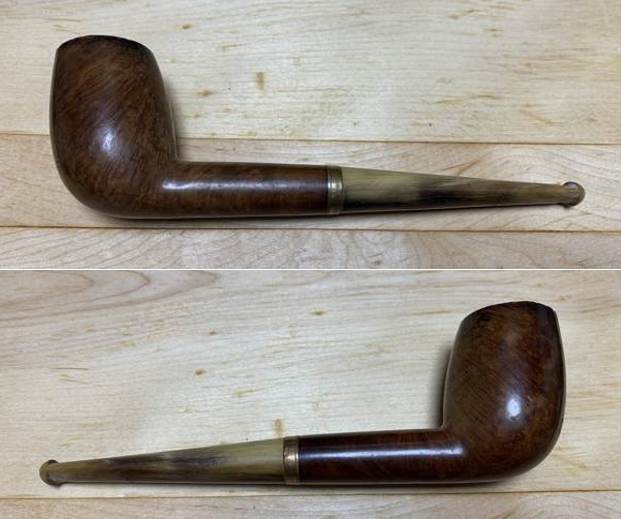
No, not the French Connection – but French Collection! I have long had an interest in French pipes and pipemaking. In recent decades, French pipes have received a fair amount of derision – and deservedly so. However, early French pipes are very often beautiful, well-made, and – best of all – good smokers. In my own small way, I am aiming to resurrect the reputation of early French pipes. There are superb pipes to be had from France. This blog post is about the restoration of the first pipe that is going into my “French Collection”.

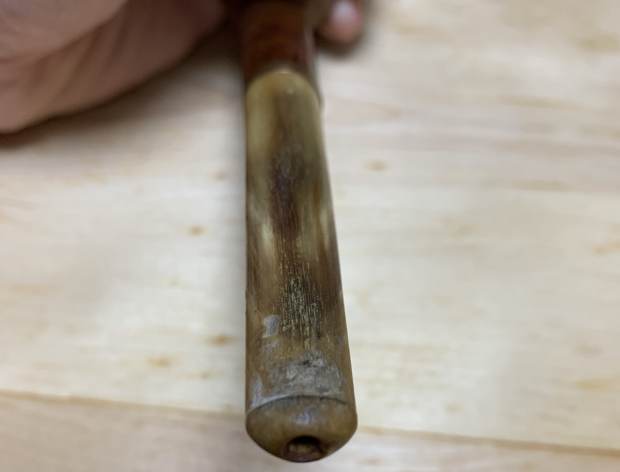
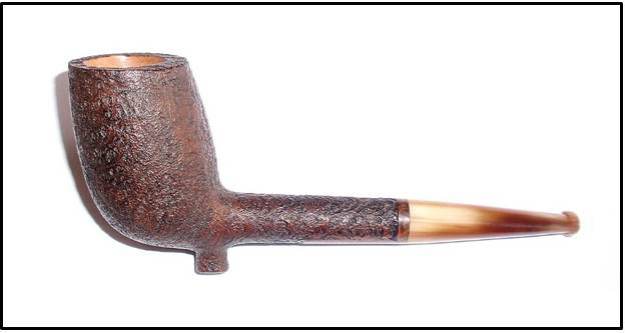
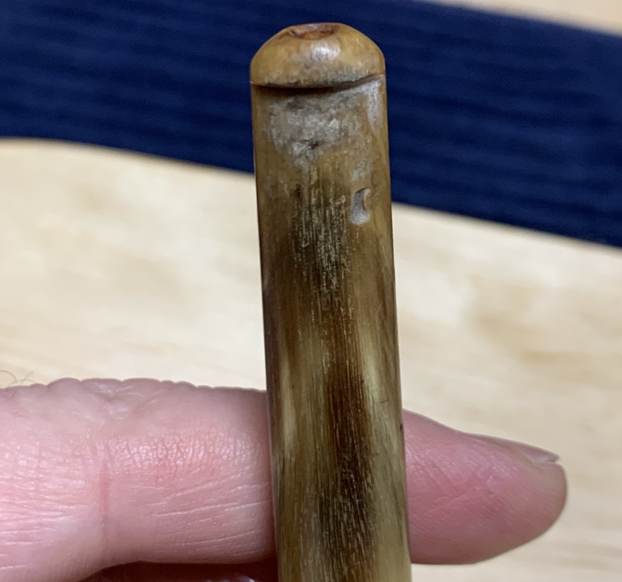
The pipe in question has no markings whatsoever. So how do I know it’s French? Well, I don’t have absolute proof, but I’ve got good circumstantial evidence: the pipe has a very French look to it, it smells like old French tobacco, it came in a lot of exclusively French pipes from France, and – most definitively – Steve thinks it’s French too.  As the photos show, this is a cutty-shaped pipe, albeit without the spur. However, it shows the distinctive, canted bowl of the cutty. It is a handsome pipe with a jaunty look to it, and I liked the pipe straight away. As I mentioned, this pipe has no marks of any kind. This obviously makes identification trickier. I know that Georges Vincent-Genod company used to make pipes similar to this once upon a time, but I cannot, in good conscience, definitely ascribe this pipe to the GVG company. Having said that, the following pipe from Genod certainly has its similarities…The age of this pipe is quite interesting. As you can see, the stem of the pipe is made of horn and has an orific button at the end. For more information on the orifice button, take the time to read Steve’s interesting article on the subject. This type of button is a feature that apparently disappeared by the 1930s, so the pipe must be around a hundred years old, right? Not so fast. The stummel has a threaded tenon made of metal – not bone (as one might expect from a century ago). Steve, my walking encyclopedia, informed me that the fact the tenon is in metal (instead of bone) suggests a date closer to World War II. He figures that the stem itself could be significantly older, but that it was left over in the factory and married to a ”newer” stummel. Therefore, we can surmise that the pipe is about 80 years old.

Let’s have a closer look at the condition of the pipe. The stem was dirty and worn, with plenty of evidence of tooth marks and dents. The insides were dirty too, but nothing too unusual. Meanwhile, the stummel was incredibly dirty.The bowl was so full of cake and the rim so overwhelmed with lava, that I couldn’t really tell what the condition of the wood inside was. Certainly, there was some lovely patina on the old wood on the outside of the bowl.I wanted to work on the stem first, but needed some help to unscrew it! I brought out the heat gun and gave a quick blast to loosen the goo holding the pipe together. That loosened the stem sufficiently to unscrew it. I wiped the stem with Murphy’s Oil Soap on some cotton pads. There was some filth there and I needed to remove it. I attacked the inside of the stem with pipe cleaners, cotton swabs, and isopropyl alcohol. It required a good amount of cotton to come clean. Now work on repairing the tooth marks, etc. on the outside of the stem. I built up the bite marks on the stem with cyanoacrylate adhesive and let it fully cure. There were a couple of small worm holes (or something similar) on the stem and I filled them the same way. Upon closer inspection, the button on the stem was a bit mangled. Simply doing the normal sanding wouldn’t do. I opted to use a small file and rework the horn to ensure a proper shape.Following that, I sanded the adhesive down with 220- and 400-grit sandpapers to meld seamlessly into the stem. I then used all nine Micromesh pads (1,500 through 12,000 grit) to bring out the beautiful designs in the horn, with some Obsidian Pipe Stem Oil in between each pad scrubbing. Now for the stummel. The brass ferrule came off very easily. I set it aside for now and would return to clean it later. First, I decided to ream out the bowl. I used the KleenReem and the PipNet to remove the built-up cake and followed that with 220-grit sandpaper taped to a dowel to eliminate as much as I could. Wow, there was a lot of debris! I took the chamber down to bare briar to ensure there were no hidden flaws in the wall. Fortunately (and surprisingly), there were none.Following this, I cleaned the insides with the requisite pipe cleaners, Q-tips and isopropyl alcohol. As the stack of cleaning materials show, it was a mess!I also took this opportunity to wash the stummel with Murphy’s Oil Soap and remove as much grime as I could. The pipe’s rim was so caked with filth that I opted to soak it in a jar-lid of Murphy’s to soften it. Then I used a brush to work out all the gunk on the rim. As the pictures show, the rim was badly worn. There were gouges and burn marks. Additional work would need to be done. Before that, however, I decided the pipe needed some additional TLC and I chose to de-ghost it. I thrust cotton balls in the bowl (and plugged up the shank) and saturated it with isopropyl alcohol. I left it overnight and let all the evil spirits in the pipe leech into the cotton. Once complete, the pipe looked great and smelled even better.I was, at first, very reluctant to “top” the pipe – that is to say, gently and evenly sanding down the rim on a piece of 220-grit sandpaper. I was reluctant because I loved the height of the bowl and didn’t want to change it. However, I did decide to do it – it just didn’t look right without it. I was especially careful this time, so as to remove the bare minimum from the rim.As I mentioned earlier, there were some burns on the inside of the rim that also needed to be addressed. I took some oxalic acid on a cotton swab and rubbed and rubbed. The burn improved but not sufficiently, in my opinion. So, I took a solid wooden sphere, wrapped sandpaper around it, and sanded until such time as the burns were removed. I proceeded very carefully, as I had to ensure that I was not removing too much. I think I got it just right and the rim looked much improved. After this, I used all nine Micromesh pads (1,500 through 12,000 grit) to sand the stummel smooth.I then applied some Before & After Restoration Balm which I massaged into the wood and let sit for 15-20 minutes. After that, I rubbed it with a microfiber cloth. The balm brings out the best in the beautiful wood. It makes things shine and really shows the lustre. I came back to the brass ferrule. It was pretty dirty too. I used some SoftScrub on a cotton pad and scrubbed it clean. Then I buffed it with a microfibre cloth and made it shine. I reattached it to the stummel with some glue and let it set.Finally, it was off for a trip to the buffer. The more I look at this pipe, the more I really like the elegant lines and the old-time feel of the wood. At the buffer, a dose of White Diamond and a few coats of carnauba wax were just what this pipe needed to shine properly. All finished! This is a wonderfully crafted pipe and has a very sporty feel to it. It took some work, but I am proud of it and the final product suits me to a T. It retains some wounds from battle, but, as Steve would say, they are part of this pipe’s story. This is one pipe that I am keeping for myself and adding to my newly-founded French Collection. I am sure that I will be enjoying this one for many years to come. The approximate dimensions of the pipe are as follows: length 6½ in. (165 mm); height 2 in. (51 mm); bowl diameter 1¼ in. (30 mm); chamber diameter ¾ in. (19 mm). The weight of the pipe is ⅞ oz. (25 g). I hope you enjoyed reading the story of this restoration as much as I enjoyed restoring it. If you are interested in more of my work, please follow me here on Steve’s website or send me an email. Thank you very much for reading and, as always, I welcome and encourage your comments. I hope you enjoyed reading the story of this pipe as much I as I did restoring it. If you are interested in more of my work, please follow me here on Steve’s website or email me directly at kenneth@knightsofthepipe.com. Thank you very much for reading and, as always, I welcome and encourage your comments.

The CPF Arcadia: A Pipe Out of Time


Blog by Robert M. Boughton
Copyright © Reborn Pipes and the Author except as cited
https://www.roadrunnerpipes2k.com/
https://www.facebook.com/roadrunnerpipes/
Member, North American Society of Pipe Collectors

Be careful what you wish for, you may get it.
— Anonymous, quoted in “The Monkey’s Paw,” W.W. Jacobs, from The Lady of the Barge, 1902

INTRODUCTION
Whatever inspiration led Cliff Edwards to write the lyrics to the song that became Disney’s theme, “When You Wish upon a Star” – in which one’s heart need only be in the dream for no request to be too extreme, and fate will be kind – must have been, to be gentle to all of the Mouseketeers out there, in an alternate reality to mine.  I’ve long had two rules: be careful what you ask for, lest you get it, and above all, never ask for what you deserve, because everyone has done things that should have had stiffer consequences.  I’m not being cynical.  From my experience, it’s just the way whatever Higher Power we call by various names helps us humans avoid being selfish and greedy, at least those who ask for guidance now and then if not more.

Of course, I’m not perfect, in fact, far from it.  I found myself during the past two months or so becoming more and more fixated on acquiring not just any new pipe, but one made by the Colossus Pipe Factory.  Then I began my hunt in earnest, with eBay searches and general Googling, but to no avail.  At last I got a hit with a pair of pipes titled, in a somewhat jumbled way, “Vintage Smoking Pipe Tobacco Lot of 2 Arcadia CPF London England Briar.”  From that description alone I thought maybe I was going to see something made by an Arcadia brand and a rare English CPF.  There were enough photos, however, and they were good, to determine without doubt that a big, smooth poker stamped on the right MADE IN/LONDON ENGLAND was one mixed-up part of the seller’s heading, and CPF Arcadia was the other.  The disarray of the title and the low price I paid – about $45 – told me the seller didn’t know what he had and the other bidders were not sure enough that the CPF was real to risk going higher.

Before bidding anything and after studying the pics of the alleged CPF – and I mean I really poured over every detail of them – I was certain it had to be a fake, except for the band on the shank.

From the photos that I snapped when it arrived in the mail with the poker I believe is a Ben Wade reject, the only authentic-looking parts of a CPF are the band, bone tenon and stem.  Otherwise, honestly, I could see where the basic chunk of wood could have been fashioned into a stummel long ago before some Flower Child got ahold of it and turned the bowl into a psychedelic pin cushion, but I could not imagine anyone alive more than a century ago, especially the Old World masters employed by CPF, fashioning such a monstrosity, as I saw the pipe before its comic beauty grew on me.  I even used the “m” word in an email I sent to Steve, with a link to the eBay sale, in which I more or less implored him to tell me it wasn’t real, meaning a genuine CPF.

Needless to say, I was shocked when Steve not only replied that the Arcadia was real and “very old,” an age distinction he had never before made to me, but that he had worked on a meerschaum like it a couple of years ago.  Here are some before and after shots of Steve’s meerschaum, which indeed bear a scary resemblance to my old briar.

A.F. & Co./BBB Spotted Meerschaum photos courtesy Steve Laug.

The severe chicken pox-like similarities are undeniable, and I scrutinized every word and photo of Steve’s blog in hopes of connecting the dots (I’m so sorry, that just popped out) of the definitely funky tobacco pipe specimens.  Struck by a gung-ho fit to research the abbreviation “AF&C0” in Steve’s third photo above, I interrupted my reading to find the answer before continuing and learning Steve already had done so: Adolph Frankau & Co. of England.  Steve’s work restoring the meerschaum that he also dated to 1905, thanks to great detective work tracing the unique hallmarks on the sterling silver band, was phenomenal, in particular the addition of a Bakelite stem that he not only fitted to the shank but made look as old as the original stummel.

Now, in case anyone thinks my choice of details a mere glut of disconnected trivia, I’ll make my point.  Steve took one look at the weird pipe for sale on eBay, flashed on the A.F. & Co./BBB meerschaum he gave new life and instinctively sensed a connection.  I have to say, I had doubts despite the almost genetic resemblance.  After all, there was no indication my CPF Arcadia was a Frankau import.  By the time Steve and I connected on the phone to discuss the two pipes and other matters, I had restored the Arcadia and warmed to its charms.  Although lacking any proof of the pipe’s date of manufacture such as Steve dug up for the meerschaum, certain minute observations and research led me to conclude it was created in the latter part of the 19th century.  Steve concurred.

In particular, I finally figured out that the stem was not Vulcanite but black horn, and the metal band boasted that it was “Nickel Plated.”  What kind of pipe brags about having a nickel plated band?  Nowadays, that’s the bottom of the barrel.  So I looked up nickel plating history online and learned that in 1837 the first crude electrochemical nickel plating of platinum was accomplished.  Really?  Someone thought to cover up the most precious metal with nickel?  You bet he did, and in 1869 a better process that became the industry standard for 70 years was discovered.  The purpose of nickel plating certain other metals, of course, remains nickel’s resistance to tarnishing and corrosion.  The only logical explanation for the proud “NICKEL PLATED” stamp on the band of my CPF, therefore, is that the process was still relatively new.  Given that point and the use of black horn stems being much less common in the late 19th and early 20th centuries, when amber and Bakelite predominated, I am satisfied the pipe was created in the waning years of the Victorian Era.

Returning to Steve and his inspired flash that the “knobby meer,” as he called it, and the CPF Arcadia are related, Steve told me he now questions whether the meerschaum is a real BBB, owing to certain unstated problems with the band.  Steve is the expert, but this time I have to disagree and urge him to stick with his instincts.  The notion of the meerschaum, knobs and all, being a bona fide BBB is no wilder than my briar, with its gaudy plastic bulbs and brass studs, being a genuine CPF, and I do not mean to suggest in a roundabout way that neither is the truth.  Granted the extremity of different materials used to make the pipes, and the necessity of alternate methods for achieving the knobby looks, and still further suspending disbelief because of the admitted implausibility of the idea, I nevertheless can’t help thinking that the connection is the actual crafter of the two pipes.  To be blunt, I think the same person made both of them.  Of course, I will never be able to prove the theory.  Well, isn’t that convenient, as the Church Lady used to say.

With a little more research, I was pleased to settle with much more certainty a question that nagged Steve in his blog of the unusual meerschaum: was there a connection between it and BBB?  As several of the sources below show, the link is clear.  Frankau, who started business in 1847, died in 1856.  At that time, his widow was persuaded to continue operation of A.F. & Co. under the control of Frankau’s very young assistant, Louis Blumfeld, who was then only 18.  Blumfeld started BBB (for Blumfeld’s Best Briar, later Britain’s Best Briar), the famous triangular symbol for which he trademarked in 1905 – again, the year Steve’s meerschaum was made – under the A.F. & Co. banner.  BBB seems to be the first pipe maker with a trademark.  And so the connection, if I haven’t made it obvious, is that A.F. & Co. owned BBB.

Arcadia, part of the modern-day Peloponnese, a peninsular region of southern Greece (capital, Tripoli), is also a reference to Greek mythology.  The mythological Arcadia was named for Arcas, a hunter who became king of the utopic wilderness and is best remembered for teaching the skills of baking bread and weaving.  In Arcadian myth, Pan, the god of shepherds, hunters and the wilds, is said to have roamed the region with dryads, nymphs and other spirits.  The name, therefore, is an odd one for this pipe, unless it’s a reference to the Calydonian Boar killed by the king’s daughter, Atlanta.

CPF had an ephemeral but brilliant run from 1851 to c. 1915, producing with the unparalleled skill of its Old World craftsmen some of the most astounding pipes, meerschaum and briar, ever created.  That’s all I need tell of CPF’s history, as Steve’s account in the sources below is the definitive authority.  Another link to a few of the CPF beauties in Steve’s Wonderland collection shows examples that are far closer to what I had in mind when I was wishing for a pipe of that great brand to find its way to me.

But that’s what can happen to someone who wishes for something.

RESTORATION
A few close-ups show the peculiarities and problems I found.  The first, featuring the front of the bowl, makes the little, round, plastic bulbs – which I did not yet know the means of connection to the bowl – appear red instead of their actual light brown.  Scratches all over the uneven surface that is spotted with the bulbs and brass studs presented awkwardness to remove.  The second shot, of the rim and chamber, has the correct color of the bulbs and at a glance seems the hardest part of the pipe’s repair but in fact was the easiest. The third pic made me happy the band was already spinning on the shank so I could leave it out of an early alcohol soak.  The grime and stains would come off, but I knew I could not fill in the missing patches of nickel.  Then there was the stem, top and bottom, with moderate tooth damage that would typically be no hassle to eliminate if it were Vulcanite.Before I continue, take a close look at the bowl and count the bulbs and brass studs.  There are seven bulbs and four studs, and the arrangement may seem random.  But look again, and you’ll see a very odd order: on the left side, the bulbs start on the top left to right and then down to the bottom right; the studs move diagonally from the lower left to the middle.  On the right side, the opposite is true: the bulbs go from top left down to bottom left and then bottom right, and the studs are diagonal from top right to middle.  On the front, three bulbs form a diagonal, tic-tac-toe line from top right to bottom left, or vice versa if you prefer.  Finally, the back shows all four corners with bulbs.   The person who crafted this pipe had a very playful sense of order.

Thinking the Arcadia stem was Vulcanite but knowing it would do no harm anyway, I tossed it and the one from the Ben Wade reject candidate in an OxiClean bath.  The usual old dirt and tobacco residue came off both.  The first pictures after the bath show the stem not yet fully dried, and the next three dry. This was when I snapped that perhaps the stem material was not Vulcanite and Googled black horn, although if I had ever heard of such a variety of that organic material, it was dredged up from my subconscious.  I emailed Steve somewhat stupidly without photos.  He replied that horn has striations that are visible under a magnifier, so I shot him back the above photos and asked if the last showed the kind of marks he meant.  His brief response was, “Definitely horn.”  In the meantime, I had followed up with 220-grit sanding and wet and dry micro meshing from 1500-12000.While the stem had been taking a bath, I soaked the stummel in Isopropyl alcohol.  I was worried about the possible effects of the alcohol on the bulbs, but somewhat less catastrophic in the potential result than the Trinity Tests of the atom bomb south of Albuquerque nearing the end of World War II, I took a gamble.I started the next longer part by sanding the rim with 400- and 1000-grit papers, then the rest with 1000. Smoothing the chamber with 60- and 320-grit papers, I followed up with a full micro mesh of the rim and rest of the outer stummel.I thought Fiebing’s Dark Brown leather stain would be good for the stain.I performed the retort and decided to add a coat of Fiebing’s Burgundy.  I was satisfied with the color result, but in the process of flaming and micro meshing after the latter stain, a couple of the bulbs went M.I.A. Faced with the not altogether unanticipated contingency of somehow having to replace a bulb or two, as I still considered them, I had already considered using small push pins, the kind for wall maps, and had found a couple of places online that carried close to the same shade of brown in case it became necessary.  Hoping to avoid the time waiting for them to arrive by mail, however, I scoured this wannabe big city that is lacking in so many of the amenities found in the real thing.  The best I could find was the following box of 200 map pins in every color but brown (any shade of it!).  The good news was that they only cost $2.99 minus tax at a hobby store.  I concluded it would be necessary to replace all seven of the bulbs for the sake of consistency and suppose I might have opted for a conservative dark blue or even black, but as Tom Cruise’s high school character in Risky Business put it, “Sometimes you just have to say what the @#$*!”  Besides, Christmas is coming up.  The smaller brown pin below was an original I twisted out.The one prospect I didn’t even consider until I examined the holes left by the missing “bulbs” was that some antique version of map pins might have been used when the pipe was adorned in such an unconventional way by its maker.  But when the time came to remove the bulbs that were still intact, I found out they were indeed nothing more than map pins from more than a century ago.  All I had to do was snip off the longer metal ends of the new ones and Super Glue them into the slots.  I still don’t know how the brass studs are attached because I didn’t want to mess with them.  I’m curious by nature, but I have limits.  My dad always said, if it works, don’t fix it.

And so, without further ado, here is the finished CPF Arcadia. CONCLUSION
I’ve come to love this pipe out of time that should have been made in the Art Deco period, which didn’t really get rolling until 1925 and hit its peak in the 1930s art scenes of Europe and the U.S. – or even the hippie  (or psychedelic, counterculture and what-have-you) movement of the 1960s into the ’70s).  If this restoration taught me anything, it’s that sometimes wishing for something vague can lead to a happy ending.  I’ve come to love this pipe and will happily keep it if it doesn’t sell.  And it is for sale, for the right price on my site, or a good trade.

SOURCES
https://rebornpipes.com/2017/07/30/enlivening-a-mysterious-old-knobby-oval-shank-meerschaum-bowl/
https://rebornpipes.com/2019/02/22/reflecting-on-a-few-of-my-cpf-pipes-colossus-pipe-factory-pipes/
https://rebornpipes.com/2013/04/14/some-reflection-on-the-historical-background-on-cpf-pipes/
https://www.thomasnet.com/articles/metals-metal-products/nickel-plating-history/
https://www.google.com/search?q=when+you+wish+upon+a+star+lyrics&rlz=1C1CHBF_enUS857US857&oq=when+you+wish+upom+&aqs=chrome.2.69i57j0l5.7556j0j4&sourceid=chrome&ie=UTF-8
https://www.gracesguide.co.uk/Adolph_Frankau_and_Co
https://adolphs.weebly.com/blog/adolph-frankau-tobacco-pipes
https://pipedia.org/wiki/BBB
https://trademark.trademarkia.com/bbb-71008248.html

The Final Restoration while in Pune, India – a no name Cavalier


Blog by Steve Laug, Jeff Laug, Paresh, Abha and Pavni Deshpande

The final restoration project with Paresh and his family was this tired and worn Cavalier pipe. When we looked at it together we were all pretty certain that it was never going to amount to much no matter how much we worked on it. We purposely saved this pipe to the end of the visit to use it to pull together all that we had learned over the week together. The only sad part of the restoration was that Dal Stanton had already left to go back to Bulgaria. It was yet another East and West adventure in pipe restoration. As I mentioned in the previous blog on the Preben Holm, my brother Jeff and I had traveled to Pune, India where we met Dal Stanton of Pipe Steward and had an incredible visit with Paresh Deshpande, his wife Abha and his daughters Mudra and Pavni. With that cast of players – from the US, Canada, Bulgaria and India it was a special and memorable week of fellowship and pipe restoration. Each of us (minus Dal) played a role in this restoration. I will try to include the contribution of each in the story as it unfolds.

Lest you might think that all we did was work on pipes, I must remind you you that while staying in Pune we enjoyed the sights of the city, fellowship and great food along with working on pipes together even after Dal left. Paresh and his family did a magnificent job of hosting the event and making us all feel like we were part of his family. The hospitality, the amazing food provided by Abha and the joy and laughter of Mudra and Pavni were all part of making this an unforgettable visit. In the next weeks there will be several blogs written about the pipes that we worked on. Dal is working on a blog about the restoration of a BBB bent billiard that had belonged to Paresh’s grandfather that was a real group effort. Both Paresh and I will also be posting blogs on some of the other pipes that we worked on together including meerschaums and briars. We thoroughly enjoyed the time together while smoking our pipes and sharing beer and scotch to celebrate each restoration and to close each day. We exchanged tips and processes that we used. It was a time of sharing and learning for all of us.

The blog I am writing now was on the restoration of a worn and tired Cavalier that came from Paresh’s Grandfather’s collection. Like the rest of the pipes in his Grandfather’s collection the pipe was very dirty but to me it showed some promise. I had never seen a pipe like this with detachable briar parts, a metal shank and a horn stem. It was an interesting piece that showed an interesting grain under the grime. The stain colour was a contrast of browns and the brass band on the top of the shank was a nice addition. The rim top was almost destroyed. There were cracks and a portion of the top was burned away. The bowl was out of round and had a thick cake. The inner and outer edge of the bowl showed the damage of burning and poor reaming. The exterior of the bowl and shank showed a lot of wear and dirt. There was a metal tube pinched on between the bowl and the upright shank. It was hard to know what the tube was and if it matched the brass band. There was also a bone ball cap on the end of the shank in front of the bowl that was worn but still whole. The horn stem had some tooth marks and chatter on the top and underside and some wear on the button edge but otherwise it should clean up nicely. Paresh, Abha, Pavni and Jeff and I all turned the pipe over in our hands wondering what we were going to do with it. It needed a lot of work and would never be flawless. But we decided to go ahead with the restoration anyway and see what we would get. We took photos of the pipe at this point in the process to show the parts and the condition. I took a photo of the top of the bowl to capture the damage to the rim top and the cracks in the bowl radiating down the sides. I took photos of the shank extension and the horn stem on the end to show its condition as well. The shank extension and stem were in decent condition so that was a blessing to be thankful for at this point in the process. I took photos of the sides of the bowl to show the cracks that surrounded the pipe – both width and depth. We took the pipe apart and took photos of all of the parts. It later became clear that the cap on the bottom of the shank also was removable but at this point it was solidly in place and could not be removed.I started the cleanup process by topping the bowl on this old timer before Paresh and his family arrived at the apartment for the day. I topped it on topping board with 220 grit sandpaper. I scrubbed the exterior of bowl with undiluted Murphy’s Oil Soap and a cotton pad to remove the grime. I rinsed it off with warm water to remove the soap and grime. About that time Paresh and his family arrived for the day’s work. He and Abha looked the bowl over and Pavni agreed to sand it out on the inside. But before any of that could happen we needed to drill small holes at the end of each crack. Paresh used his magnifying glass and a black permanent marker to put spots on the end of each of the holes. These would guide us as we drilled each of them. It turned out that each crack had several branches radiating from them and would require a lot of drilling. After marking each crack Paresh drilled a small hole in the end of each one. I wiped the holes down with a cotton swab and alcohol to remove the debris. We filled in each of the holes and the cracks with clear super glue and briar dust. We packed the glue into the holes, repeated the glue and added more dust as necessary to build up the repairs. When the repaired areas had dried I used a needle file to smooth out the repair and blend it into the surface of the briar. I sanded the repaired areas with a folded piece of 220 grit sandpaper to further blend them into the surface of the surrounding briar. Overall the patches and repairs were looking pretty good. I was surprised by how good the pipe looked.
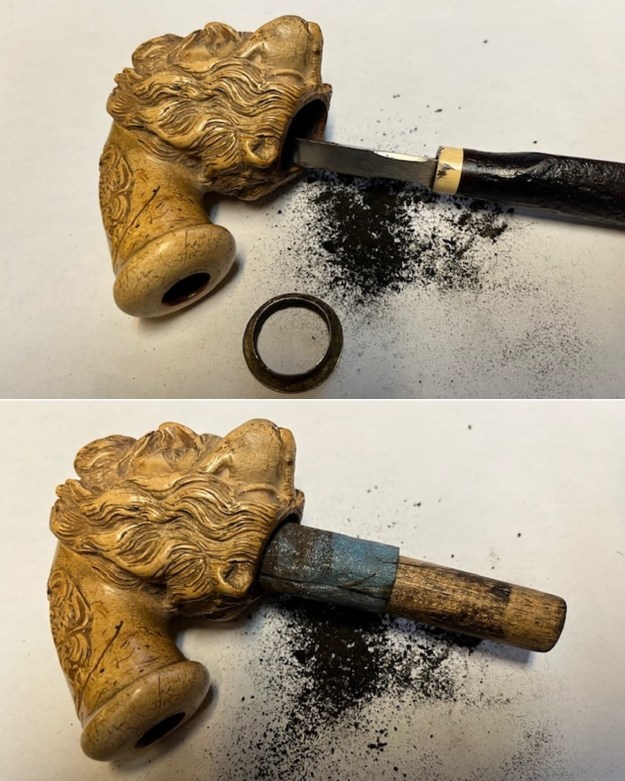
While I was working on the bowl Paresh addressed the issues with the stem. He cleaned the interior with pipe cleaners and alcohol and scraped the buildup on the stem surface with the blade of an exacto knife. He cleaned up the straight edges of the button with a needle file and reshaped the surface of the button at the same time. He followed that by sanding it with a folded piece of 220 grit sandpaper to smooth out the file marks. He filled in the deep tooth marks on the stem surface and on the button top with clear super glue. When the repair had dried he sanded it with 220 grit sandpaper to smooth it out. While Paresh was working on the stem, I finished the repairs and sanding on the bowl. Then I turned my attention to the shank piece. I cleaned it out with alcohol, cotton swabs and pipe cleaners. I wiped down the outside of the shank with Murphy’s on cotton pads. I finished this section about the same time that he finished the stem work.I worked on that and simultaneously to Paresh and my work, Jeff was working on the shank portion. He scrubbed the briar and the metal with oil soap. He worked over the metal shank piece with 0000 steel wool and we were all surprised with the copper that was under the oxidation. The shank band was also loose so he cleaned that as well. It was brass. Abha and Jeff went to work on cleaning the inside of the parts of the shank. Many pipe cleaners, cotton swabs and alcohol later the interior was pretty clean. They tried to remove the knob at the end of the shank but it did not come loose at all. No matter how much they worked on it the knob was still tightly in place.Paresh decided to give the knob a try. He painted the edges around the know with alcohol and scraped the crud that was built up around the joint between the two parts. He kept at it and then low and behold the knob turned and came off in his hands. What was revealed was a lot more of the crud that Jeff and Abha had been removing. Abha cleaned out the inside of the cap and the threads with cotton swabs and alcohol. Once the inside was cleaned and the threads were cleaned they were able to finish cleaning out the inside of the shank.I put the shank pieces together and glued the clean brass band on the top of the shank. The pipe shank and parts were looking pretty good at this point. There was still a lot of polishing to go but the  Cavalier was going to look very good. We took the pipe apart and began the process of polishing the briar and stem. I worked on the shank and stem. For ease of sanding I put the stem on the shank and  polished the stem and shank with micromesh sanding pads – wet sanding with 1500-12000 grit pads and wiping it down with a cloth after each pad. Paresh carefully reamed the bowl with a Castleford Reamer. We worried as he turned the cutting heads that the bowl would split but all remained intact as he cleaned it out. Pavni polished the inside of the bowl with 220 grit sandpaper to smooth out the walls and give them a shine. Paresh polished the bowl with micromesh sanding pads – wet sanding with 1500-12000 grit pads. He wiped it down with a cloth after each set of pads. The photos show the growing shine of  the bowl. I polished the cleaned knob with micromesh sanding pads – wet sanding with 1500-12000 grit sanding pads. Paresh polished the shank  parts with micromesh sanding pads – wetsanding with  1500-12000 grit pads. The briar began to come alive again. With all the parts polished it was time to take the next step. We rubbed down all of the parts with Before & After Restoration Balm. We buffed it by hand with a microfibre cloth. We put all the polished and “balmed” pieces together on a background and showed what the pipe looked like now.We put the pieces back together and took photos of the pipe at this point. We called it a day and Paresh took the pipe home with him. He wanted to polish it and wax it with his Dremel. He buffed it with White Diamond and gave it multiple coats of carnauba wax. When he brought it back the next morning it was a beauty. We took pictures of the finished pipe to show its beauty. The pipe really looked more alive, with the grain popping through. We decided not to stain it but left it as it stood after using the balm. The polished wax made the grain stand out. What started out as a possibility now became a reality. Paresh could now smoke and enjoy both the history of the pipe and carry on its legacy. The photos below tell the story. Thanks for looking.

Reflecting on a Few CPF pipes in my collection – Pipes from the Colossus Pipe Factory


Blog by Steve Laug

I don’t remember much about the first CPF pipe I picked up or even where I found it, but I do remember loving the shape, size and feel of it in my hand. It seems to me that it was a diamond shank straight bulldog pipe and I remember it being very old – over 100 years of age. I remember turning it over and looking at the Old World style craftsmanship, the fine briar and the metal work that was on the shank end and rim top. I remember the gold stamping on the side of the shank – CPF in an oval over Genuine Briar. That first pipe I came across was the beginning of a side collection of CPF, American made pipes coming out of the Colossus Pipe Factory in New York. Over the past 7-8 years I have been picking up CPF pipes on Ebay and in shops around the country to add to my personal collection. My brother Jeff also continues to pick them up for me.
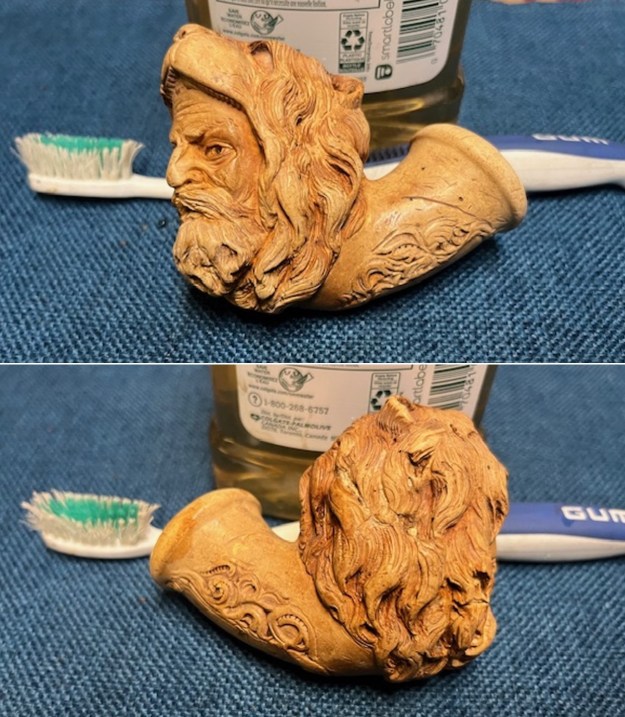
It is a brand that has been shrouded in some mystery through the years even in terms of what the CPF initials mean. Some have interpreted it to me Consolidated Pipe Factory while others have taken it to mean Colossus Pipe Factory. Because of that it has been virtually impossible to trace the brand. I have written about the history of the brand in previous blogs but here is the link should you want to go and check it out. In the link that follows I give the rationale and proof for the brand being Colossus Pipe Factory. Give the blog a read if you are interested in the background (https://rebornpipes.com/2013/04/14/some-reflection-on-the-historical-background-on-cpf-pipes/). I quote the concluding paragraph of that blog in the following as it gives a quick overview of the history of the brand with the mergers and finally the demise of the brand as a whole.

From my research I believe that we can definitively assert that the CPF logo stands for Colossus Pipe Factory. The brand was purchased by KB & B sometime between 1884 and 1898 and that it continued until 1915. That time frame gives help in dating some of the older CPF pipes you or I might find. It can be said that prior to the dual stamping it is fairly certain that the pipe is pre-1884 to 1898. After the dual stamping it can be placed post 1898 until the closure of the brand line in 1915. CPF made beautiful pipes. I believe Sam Goldberger was correct in his assertion of the potential carvers that made the pipes being of European training and the classic shapes and well aged briar. That coincides with all the CPF pipes that I have come across.

I collected the links and various blogs I have done on CPF pipes in my collection and chosen some representative photos of each of the pipes. I think as you flip through the photos you will see the beauty I see in them and hopefully it will kindle a love for the preservation of these old timers for generations ahead of us.

The first pair of pipes that I have pictured below is stamped CPF Cromwell on the left side of the shank. They both are vertical twin stemmed – twin shank pipes. Both came to me in very rough condition. The stems were damaged and repaired with a white putty material and the bowls were very worn. The first one is in the best condition. The second I worked a bit of Frankensteining on to resurrect it to be smokeable again. https://rebornpipes.com/2017/07/01/out-damn-spots-a-c-p-f-cromwell-double-vertical-stem-bent-billiard/https://rebornpipes.com/2017/08/27/frankensteining-a-badly-damaged-c-p-f-cromwell-double-stem-pipe/The third pipe came to me from the same lot as the two above. Where there both had vertical twin shanks and stems this one has a horizontal twin shank and stem. Like the others above it has the same damage and repair to the stem – white putty to make it smokeable again. https://rebornpipes.com/2017/09/28/bringing-new-life-to-a-c-p-f-siamese-parallel-twin-stem-billiard/. The fourth pipe in my collection is an alternative wood in both the bowl and the base. The bowl is detachable – unscrewing from the base. The polished band and the horn stem are beautiful touches to this unique pipe. If you would like more information be sure to follow the link below and read about the restoration of this beauty. It is one of the more unique pieces from CPF that I have. https://rebornpipes.com/2017/07/03/restoring-a-unique-alternative-wood-c-p-f-tulip/.The next pipe is a small pocket sized horn shape with a horn stem. It is stamped like the others with the CPF oval on the shank and on the band. The horn stem has a captivating pattern of swirls and striations that make it a pleasure to hold and look at while smoking. https://rebornpipes.com/2017/07/22/a-small-c-p-f-french-briar-horn-captured-my-attention/.The next pipe is another detachable bowl pipe. This one is a CPF Pullman. The bowl is separated from the base by a brass ring that adds a touch of class. The briar base has a brass band with CPF logo and stamp on the left side. The bent horn stem gives a touch of colour to the look of the beautiful old pipe. Give the blog a read if you are interested, but clicking on the link that follows: https://rebornpipes.com/2017/08/06/repairing-renewing-and-rejuvenating-a-removable-bowl-c-p-f-pullman-bent-billiard/.The next one is another pocket pipe. It has a Bakelite stem and a rectangular vertical shank that sets of a nicely shaped apple pipe. The yellow of the stem works well with the rich red of the briar. https://rebornpipes.com/2017/10/01/restoring-a-wreck-of-a-c-p-f-rectangular-shank-bent-egg/.The next pipe came to me as a damaged bowl. It is a nicely shaped bent bulldog with a diamond shank. The bowl originally had an ornate metal rim cap that had disappeared long before it came to me. I am keeping an eye open for a replace rim cap to see if I can bring it back to its original shape. https://rebornpipes.com/2013/03/31/cpf-french-briar-bulldog-restemmed-and-refurbished/.The next pipe is also one that came to me without a stem. The shank cap or ferrule was oxidized and green in colour when I started the restoration on it. I also worked an old vulcanite stem to fit the shank that has the same orific button as the original. The fit and size of the stem makes this another pocket pipe. It is distinguished looking and I only wish it could tell its story for us. Here is the link to the restoration: https://rebornpipes.com/2013/04/01/restored-cpf-bent-billiard-a-reclamation-project/.The next straight shank billiard also came to with the two above bowls. This one was by far in the worst condition. It had nail holes around the rim top and the rim cover was oxidized to a dark green and was crumbling. Originally this pipe would have had a built in wind cap with a hinged top but that had long since disappeared by the time I worked on it. I crafted a new stem for it and banded the shank to clean up the disintegrating briar on the shank end. It is an interesting piece https://rebornpipes.com/2013/04/07/reworking-and-reshaping-an-old-french-briar-cpf-billiard/.This next little pocket pipe has a horn stem and a great looking briar bowl. The shape is a small bent billiard. The band is original and bears the CPF logo and stamping. The shank has the CPF logo the look of the bowl and shank is quite stunning. I was able to work on it and bring it back to life. https://rebornpipes.com/2015/06/08/bringing-a-pre-1884-era-cpf-bent-billiard-back-to-life/After I first wrote about CPF pipes I received email from a fellow who had a trio of CPF pipes that he had picked up.   There were two unsmoked bulldogs – a bent and straight with amber stems that he wanted me to clean up. In exchange he would give me the CPF bent meerschaum bulldog in the photo. I took him up on the trade and soon had the threesome in hand to work on. I finished his two pipes and sent them back to him and turned my attention to an almost worn out looking meerschaum bulldog.I cleaned up the bowl inside and out and worked over the brass shank end and bowl cap. I rebuilt the amber stem that had bit throughs on the end at the button and some crystalizing and crumbling on the stem as a whole. I was able to stabilize it and make it useable once again. It is a light weight durable little meerschaum that is a sweet smoke. Read bout the restoration on the blog by clicking on the following link: https://rebornpipes.com/2015/12/25/taking-a-swing-at-reconstructing-and-refurbishing-an-old-cpf-meerschaum-bulldog/.The next pipe is a CPF Best Make Straight Bulldog. This one is a beauty with its silver filigree rim cape and shank end. It is stunning with the brown briar and the orange amber stem. This one just came to life as I cleaned and polished all the parts and did the repairs on the amber stem and silver bowl cap. Give it a read by clicking on the following link: https://rebornpipes.com/2016/12/02/cpf-best-make-bulldog-with-a-silver-rim-cap-and-ferrule/.Over the years of collecting and working on CPF pipes I have seen quite a few classic shaped meerschaums but had not seen very many carved figurals. My brother Jeff came across this interesting figural featuring a horse and knowing my love for CPF pipes picked this one up for me. It is a true beauty. There are some small cracks around the bowl but nothing that is an open fissure. I was glad to add it to the collection. Even so you can feel the energy of the racing horse as it turns around the tree stump on its right side. Give the blog a read if you want to see more photos and read about the restoration. https://rebornpipes.com/2016/12/05/against-a-stump-a-carved-cpf-best-make-horse-meerschaum/.My brother wrote to tell me that this old CPF Giant was found in an antique store in Idaho Falls, Idaho. The owner had told him that the pipe was owned by an artist who strictly used it as an art prop… never smoked it. It is about 130 years old and is a large bent billiard. It is a large pipe – over 11 inches long and similar to the older Wellingtons that I have worked on of similar size. It was a great addition to my collection. If you want to get a feel for the history of the pipe and restoration it went through click on the link that follows: https://rebornpipes.com/2016/12/25/refreshing-an-old-giant-cpf-french-briar-bent-billiard/. The next pipe was a unique one that Jeff picked up. It is a CPF that was different from any others that I had ever seen or worked on before. It was a briar calabash with a black Bakelite screw bowl/cup. The shank was darkened and appeared to have originally had a band that had been lost somewhere along the way. That is pretty common on these old CPF pipes. The stem was amber and needed some work to bring it back to usefulness. The pipe is stamped on the left side of the shank with the words COLON in an arch over the CPF logo in an oval. Underneath that, is stamped French Briar in a reverse arch thus encircling the CPF logo. I replaced the missing band with a polished nickel one to give it a more complete look. I am always on the lookout for old bands and rim caps so I may find one that fits this old pipe. Give the blog a read to see detailed pictures of the pipe. https://rebornpipes.com/2017/06/27/new-life-for-an-unusual-cpf-colon-calabash-pipe/.When I received the next pipe I was excited to look it over and add it to the collection. The beautiful briar with swirls of birdseye and cross grain flowing around the long shank bulldog was stunning. The horn stem fit well in the shank and it would clean up nicely. Have a look at the blog for details but this is one of the better pieces I have added. https://rebornpipes.com/2017/07/19/breathing-life-into-an-1890s-era-cpf-french-briar-horn-stem-bulldog/.The next little bent billiard is another beauty – it is a chubby bent pocket billiard. The grain on the bowl is quite stunning and the restored horn stem and brass band give the pipe a touch of old country charm and class. Give the blog a read to see what the pipe looked like when we found it and the steps in its restoration. https://rebornpipes.com/2017/07/20/another-piece-pipe-history-a-lovely-cpf-french-briar-bent-billiard/.The next beauty is a silver military mount billiard. The ferrule and stem cap are both silver. The pipe is a CPF Remington and the grain and finishing touches on the old pipe give it a sense of timeless class. The pipe is in rough condition when it came to me and with some careful restoration it is back to looking lovely. Give the blog a read to see what it looked like when I receive it. It is a beauty.  https://rebornpipes.com/2017/07/21/restoring-another-cpf-french-briar-this-one-a-remington-silver-mount-billiard-blog-by-steve-laug-the-next-pipe-i-chose-to-work-on-from-the-lot-of-the-lot-of-pipes-my-brother-and-i-picked-up-on-our-vi/.This Rhodesian was in very rough shape when I received it. It took a lot of work to bring it back to this point. The bowl had a lot of damage and the horn stem was very worn and tired. I did a lot of reconstruction on the rim top and edges of the bowl and tried to bring life back to the damaged bowl without loosing the shape. https://rebornpipes.com/2017/07/21/this-old-cpf-french-briar-rhodesian-was-in-rough-shape/.The square shank straight bulldog with the double ring around the bowl cap is a beauty. Instead of the usual diamond shank and stem this one has a square shank and stem. The horn stem is very stunning with the colours of the horn and the briar. Have a look at the blog to read about the restoration process on this one. https://rebornpipes.com/2017/09/29/cleaning-up-another-cpf-this-time-it-is-a-square-shank-bulldog-setter/.The last pipe I am including in this blog is my latest addition. It is an unsmoked CPF Chesterfield that is in excellent condition. It came to me from a good friend in NY who picked it up in a recent purchase. The grain and the shape are quite nice. It is a stubby billiard with a P lip style stem. The stem is hard rubber and it is old. Give the blog a read to get the back story on this pipe. https://rebornpipes.com/2019/01/29/refreshing-an-unsmoked-1910-1915-cpf-chesterfield-billiard/.With the above pipe I will close my reflections on some of the CPF brand pipes in my collection. Hopefully you can understand what I love about them as you scroll through unique pipes in the above collection. I am always on the lookout for more CPF pipes and excited to find and work on them. If you come across one and want to “help” me out let me know. Thanks for reading this blog.