Tag Archives: contrast staining

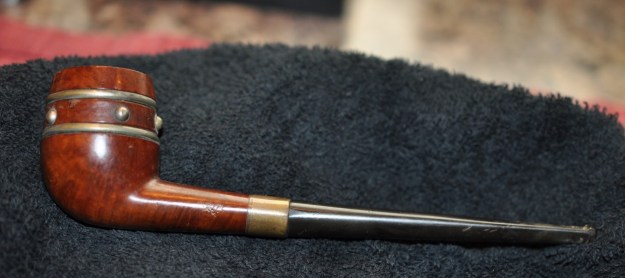
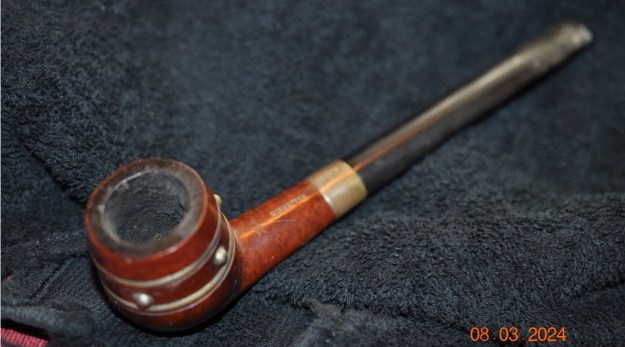
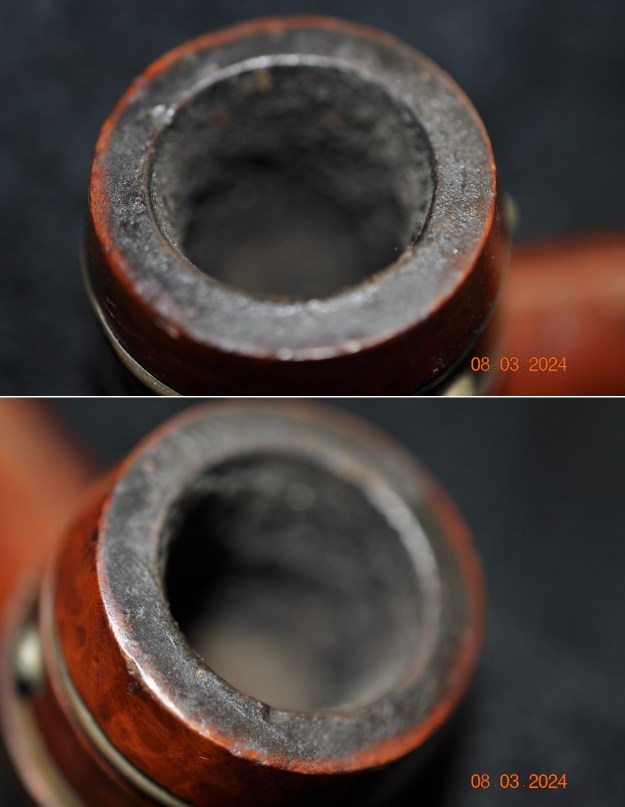
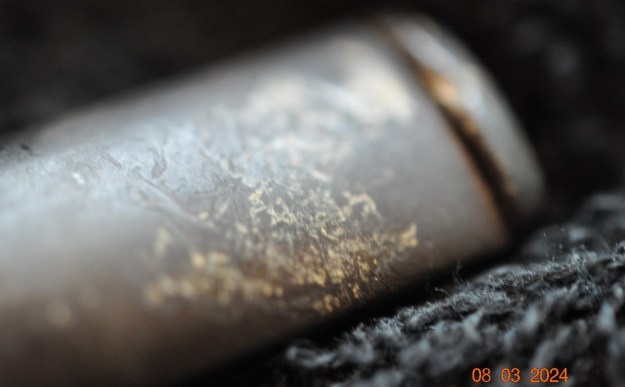
Restoring a Carey Magic Inch Pat. No. 3267941 Mediterranean Briar Israel Calabash


by Steve Laug

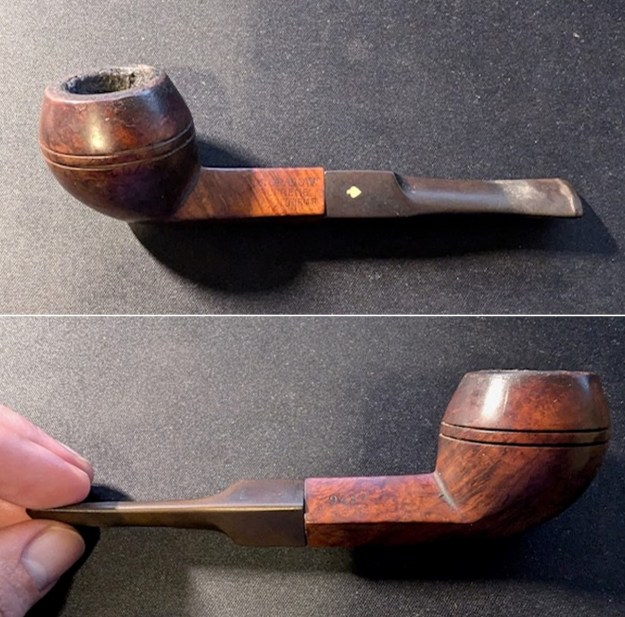
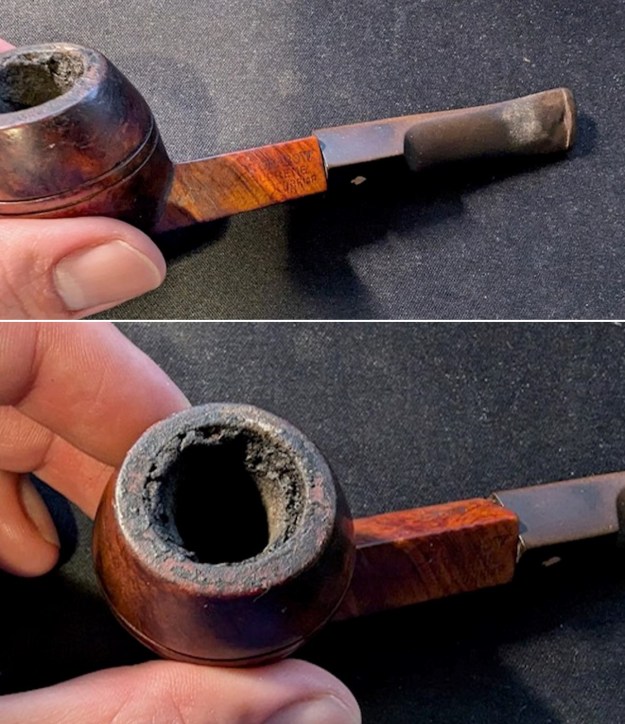
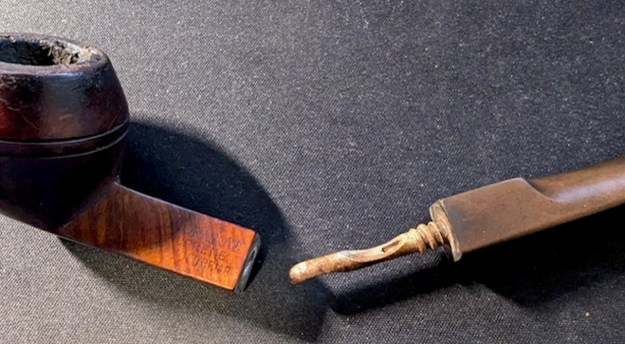
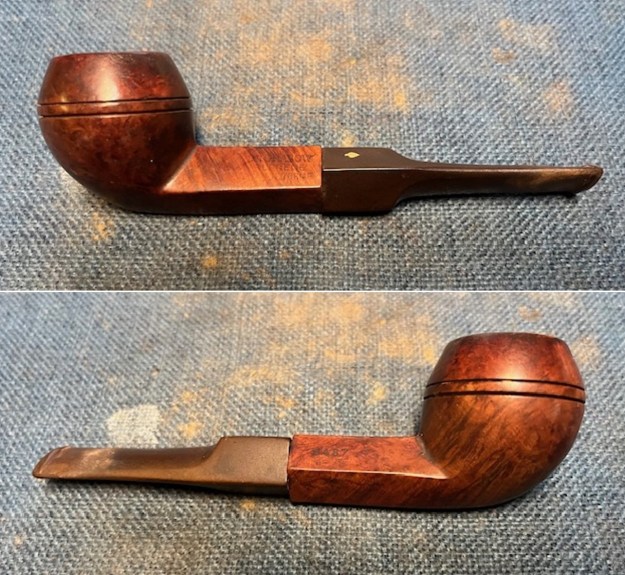
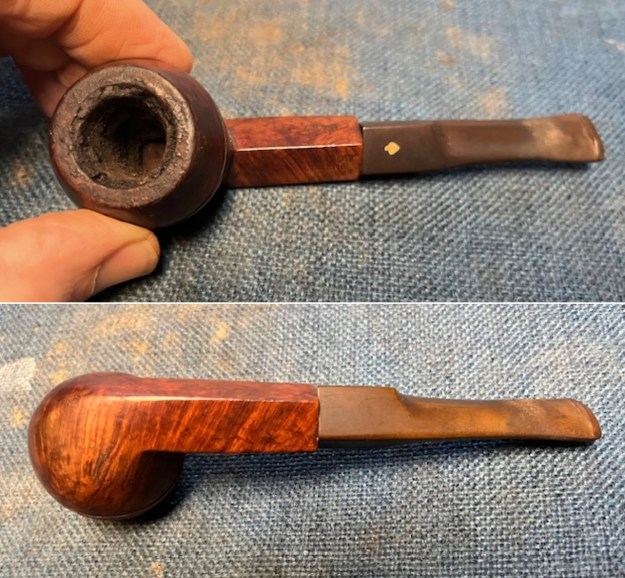
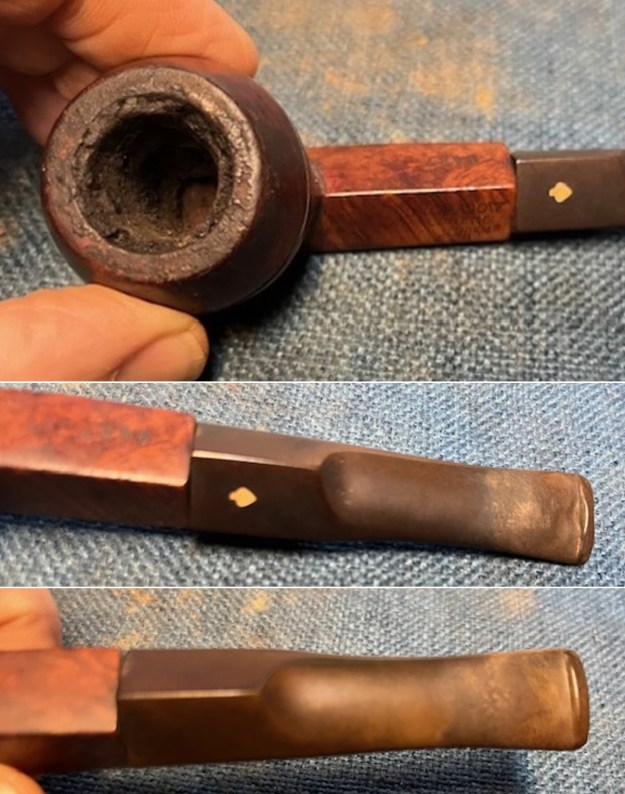
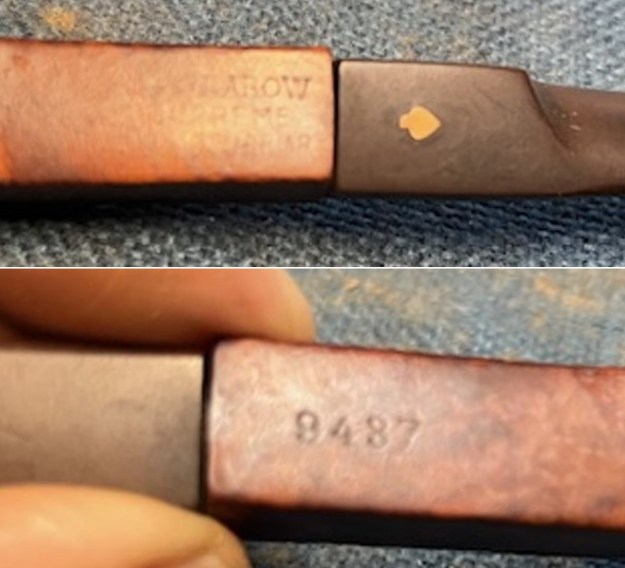
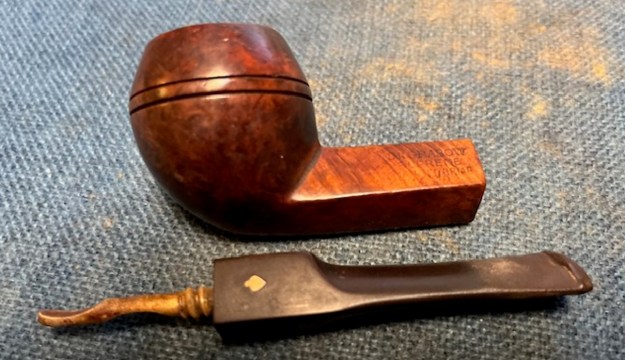
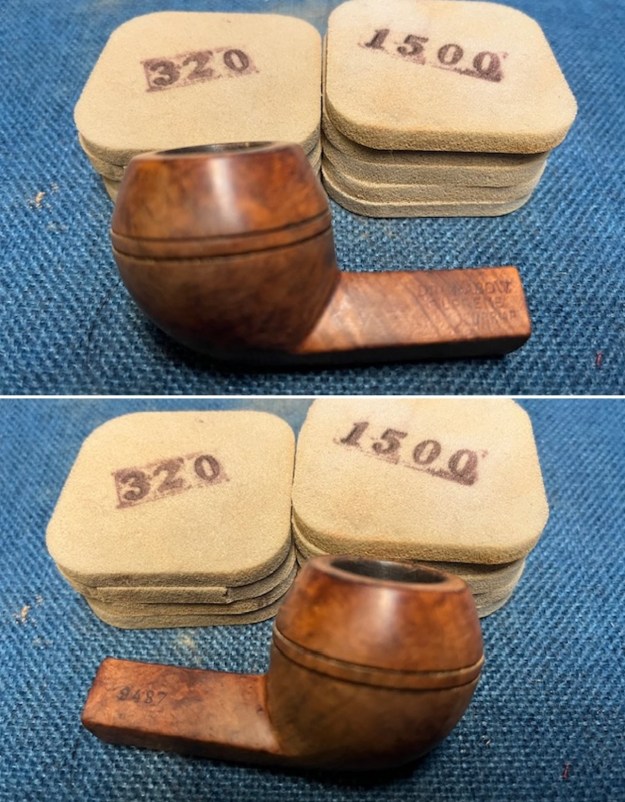
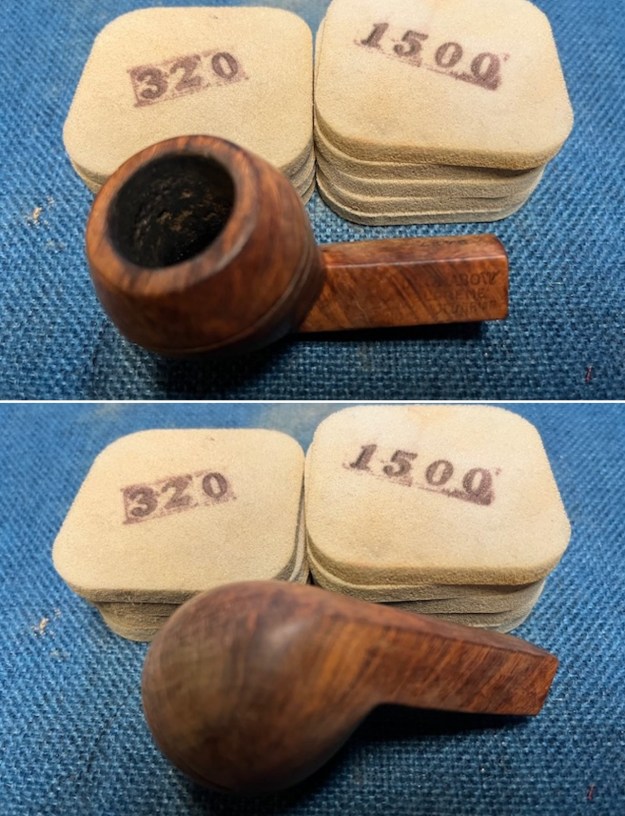
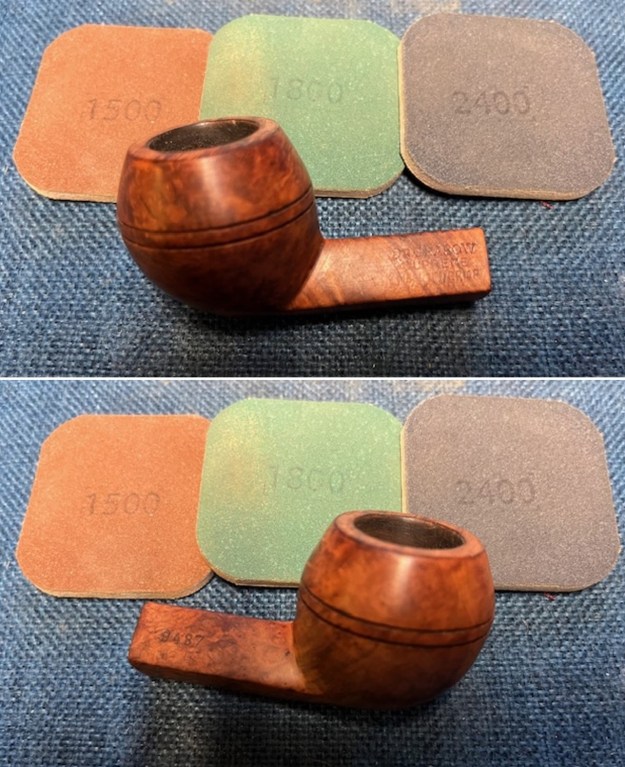
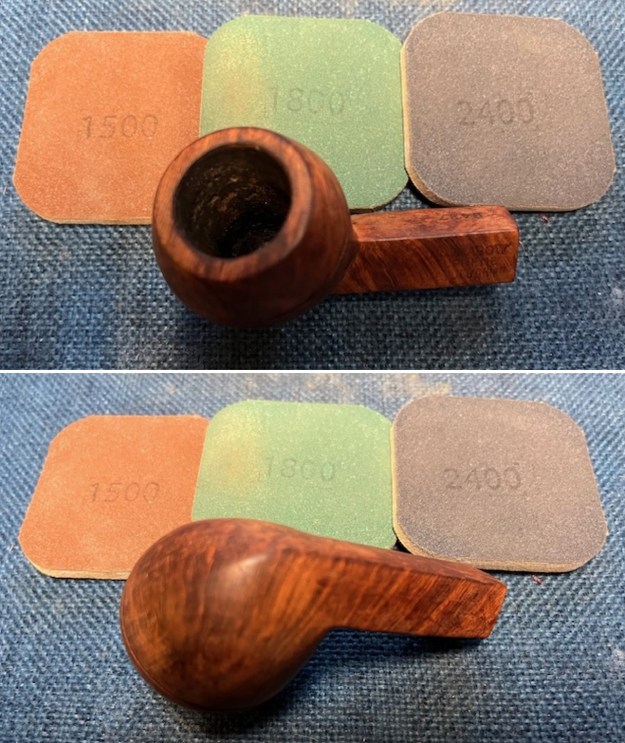
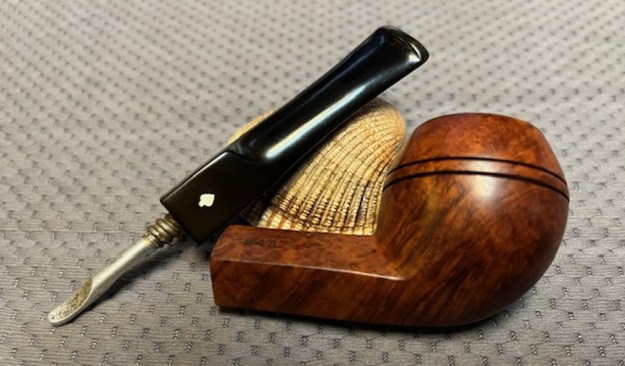
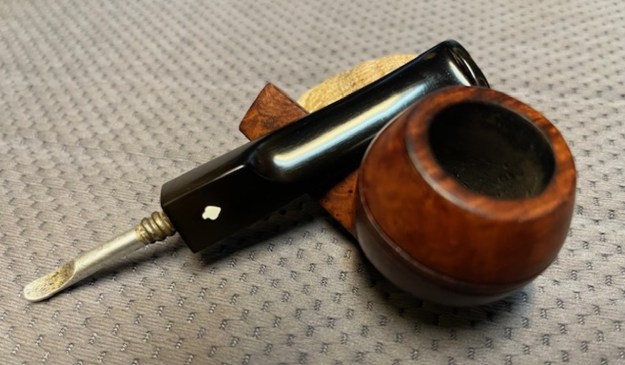
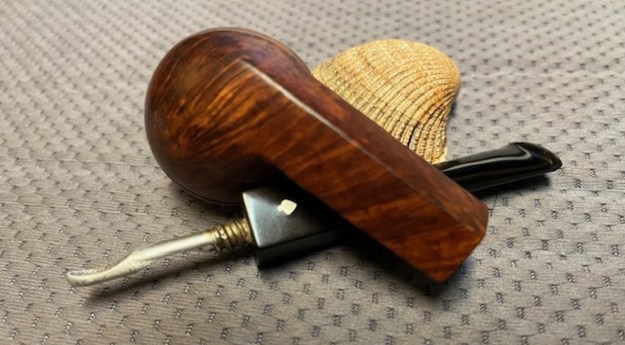
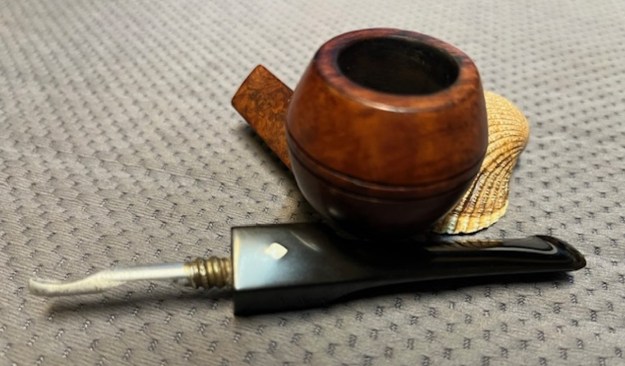
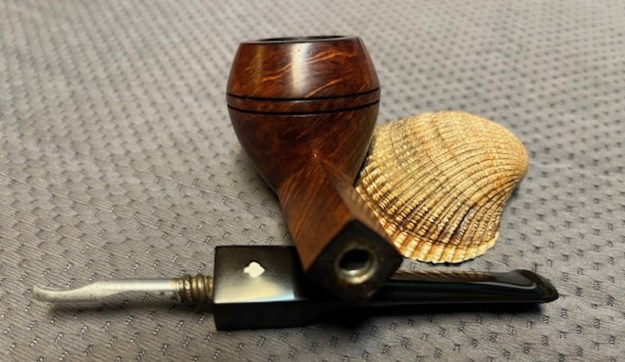
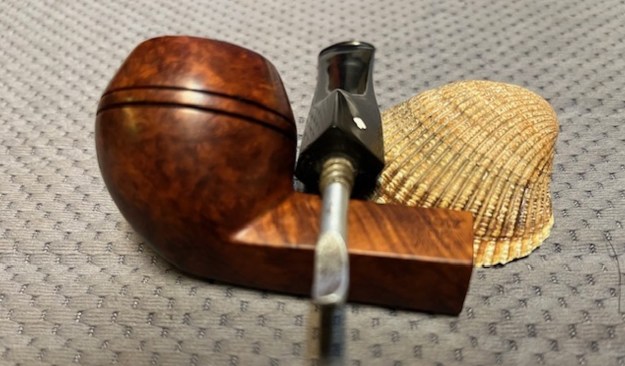
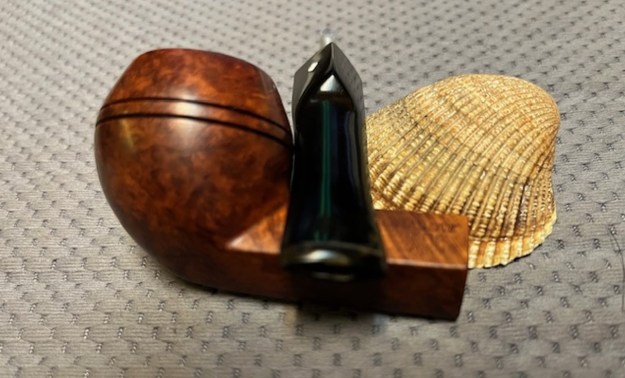
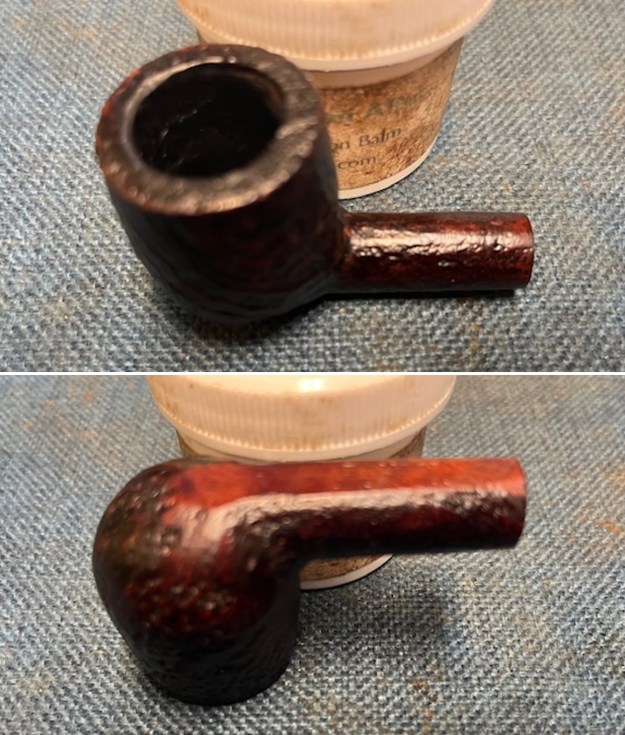
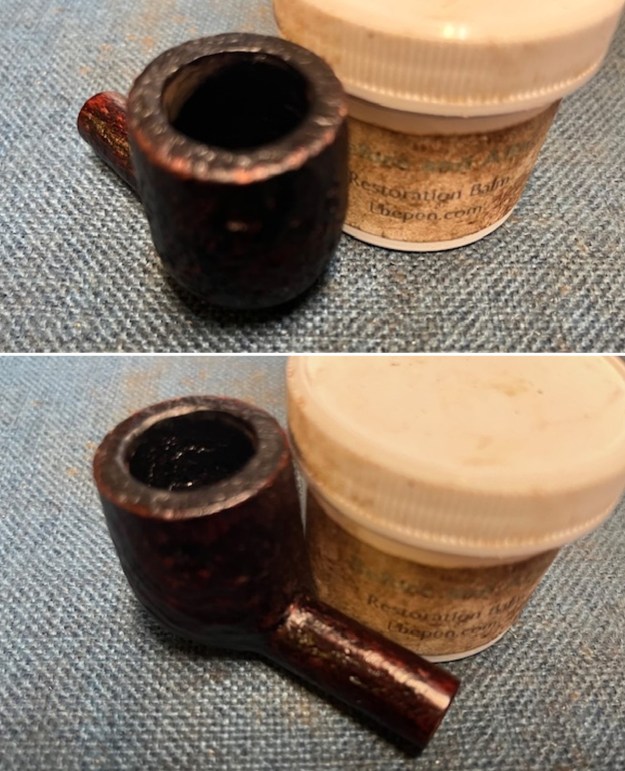
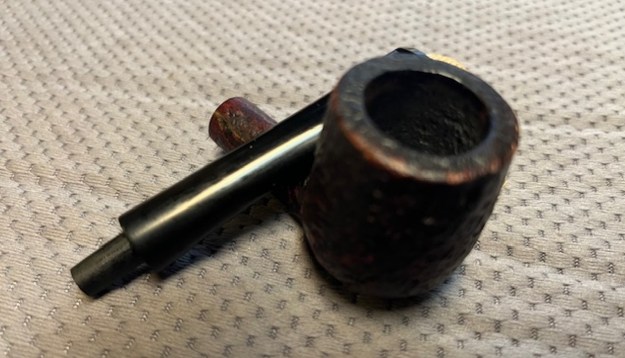
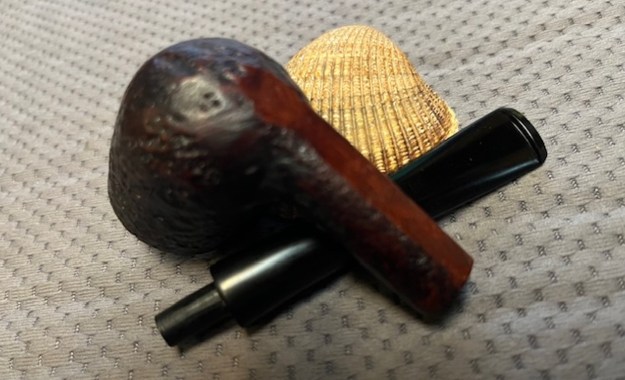
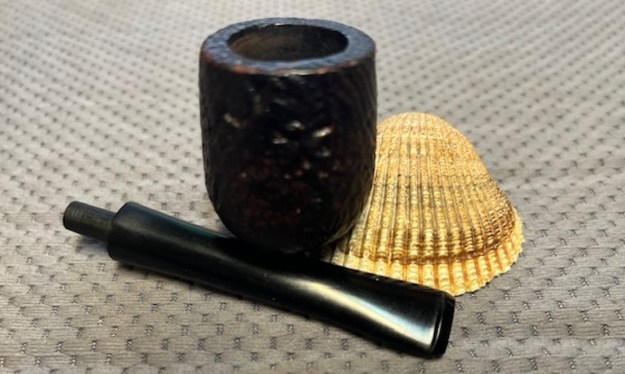
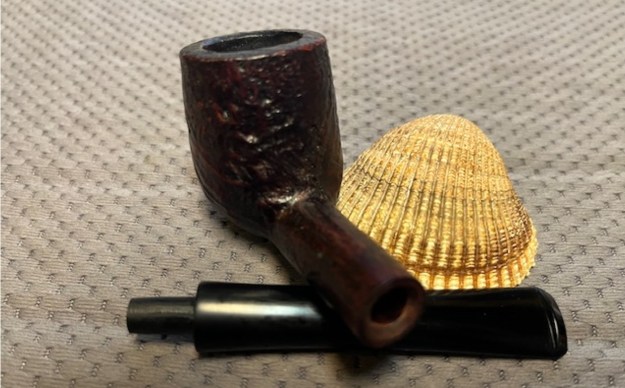
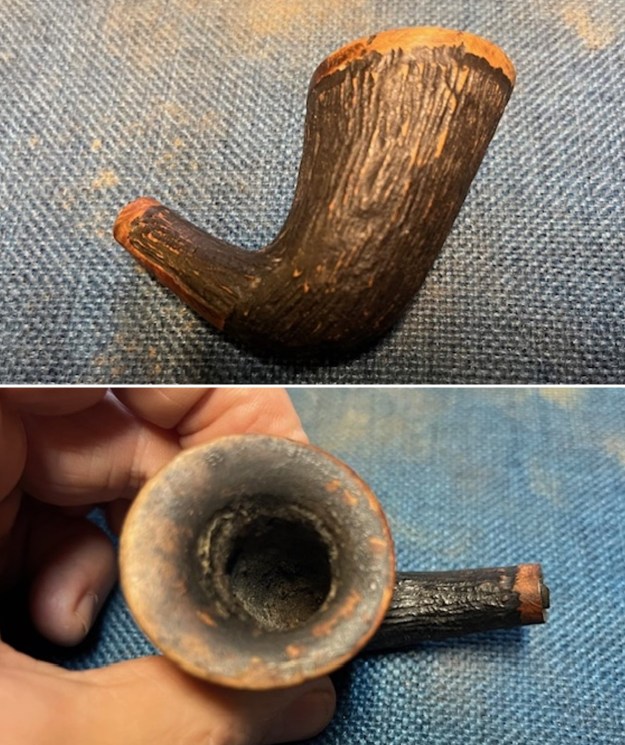
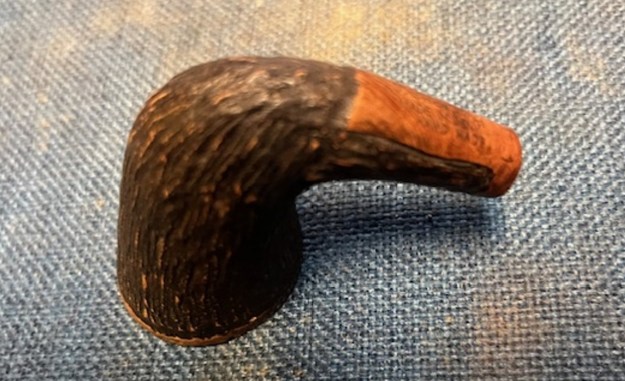
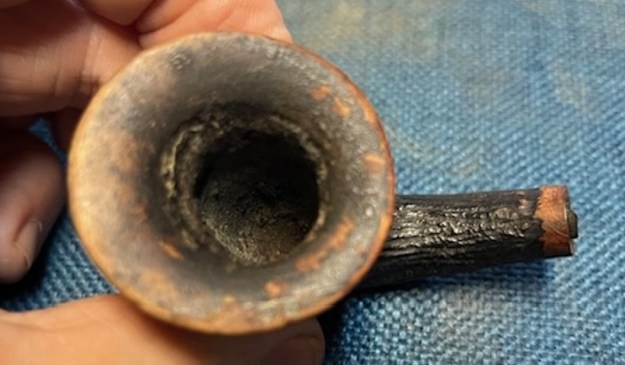
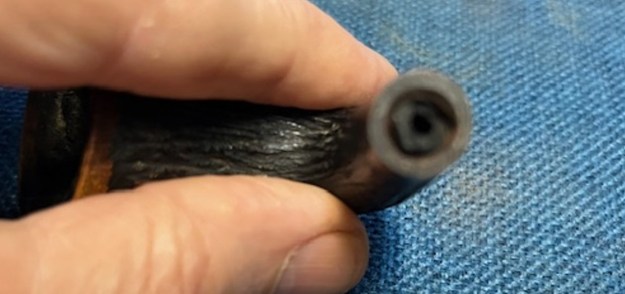
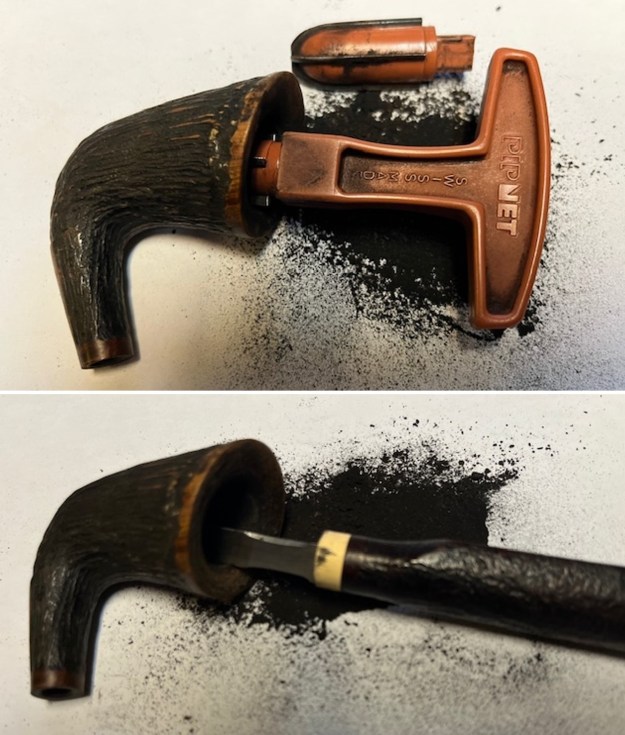
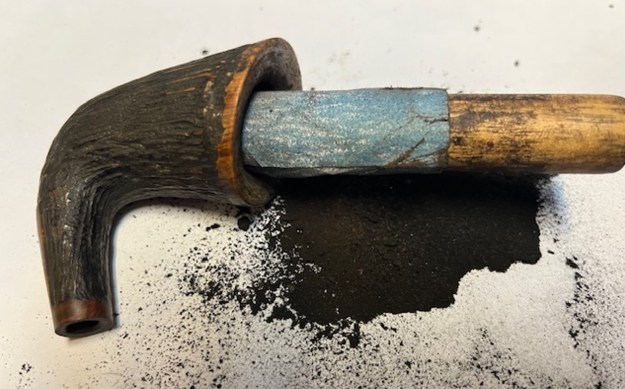
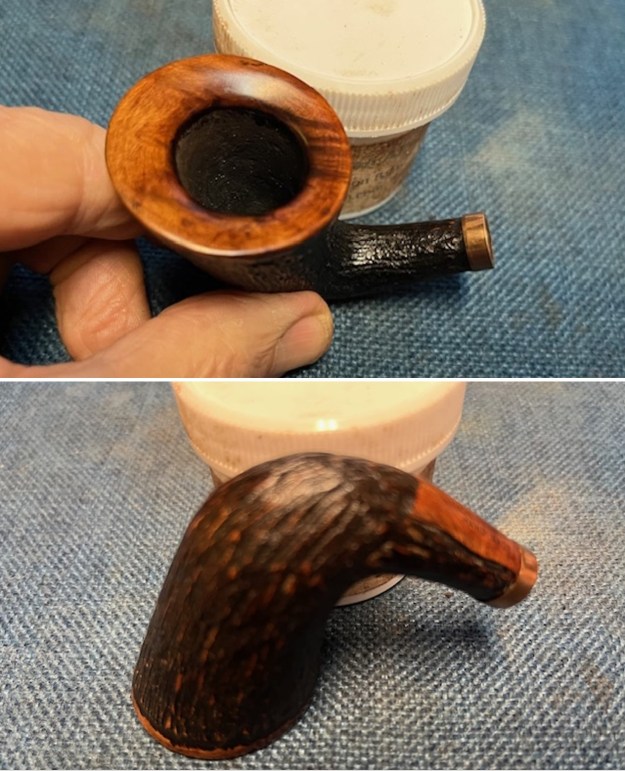
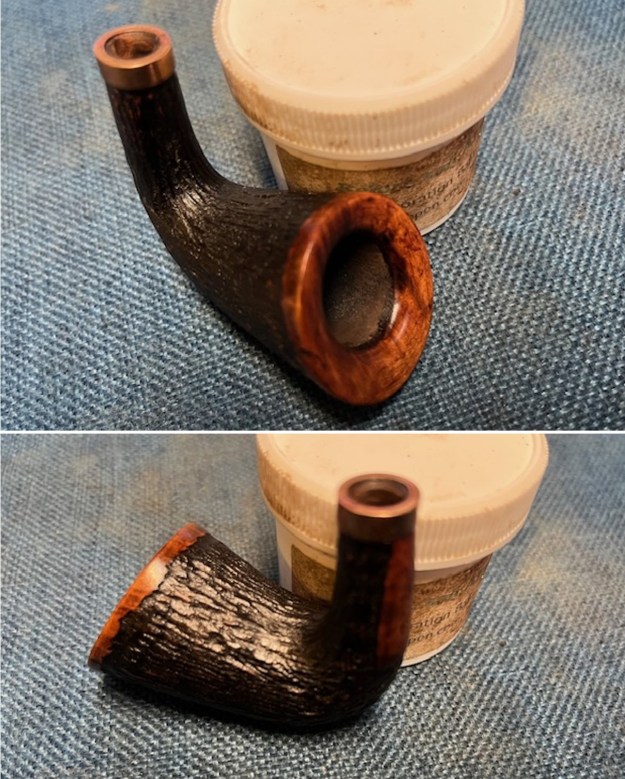
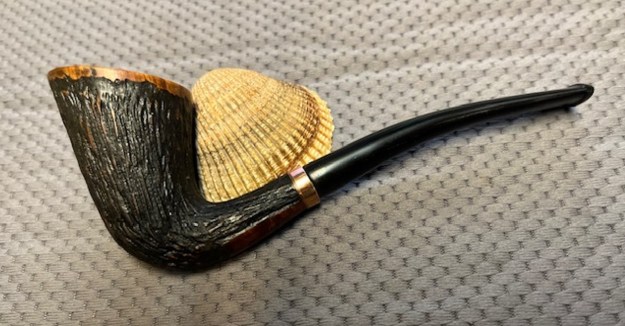
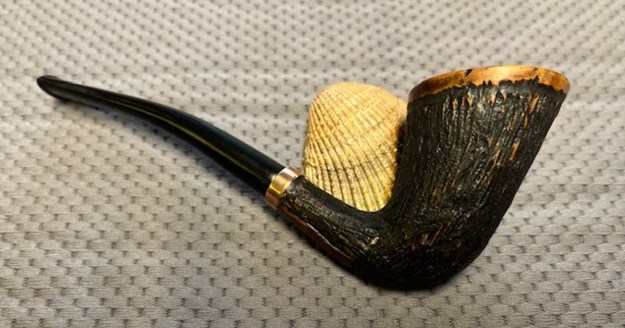
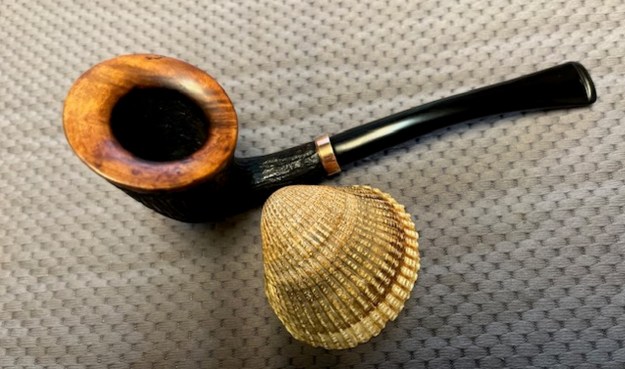
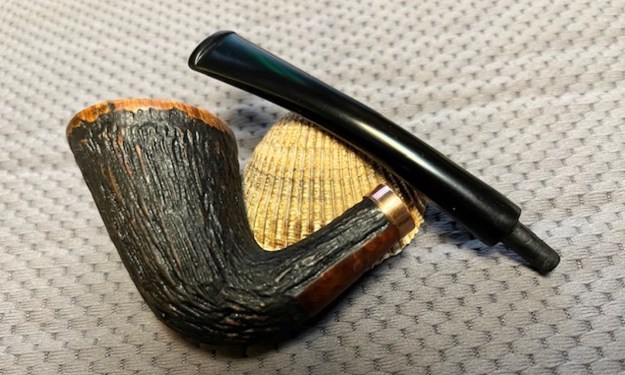
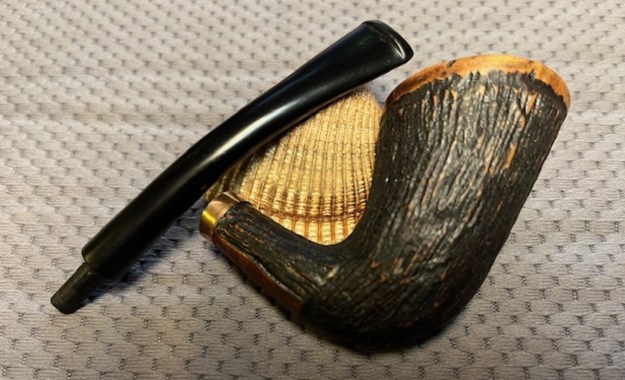
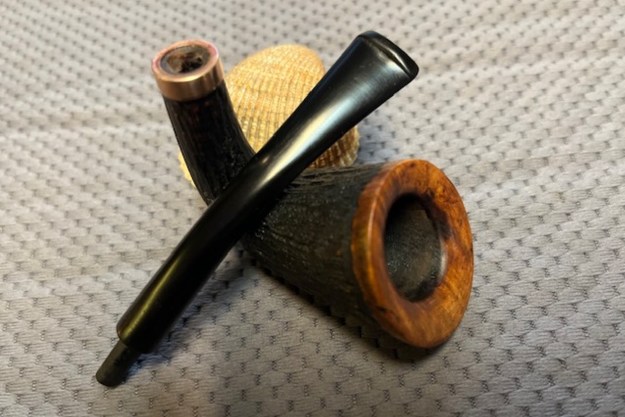
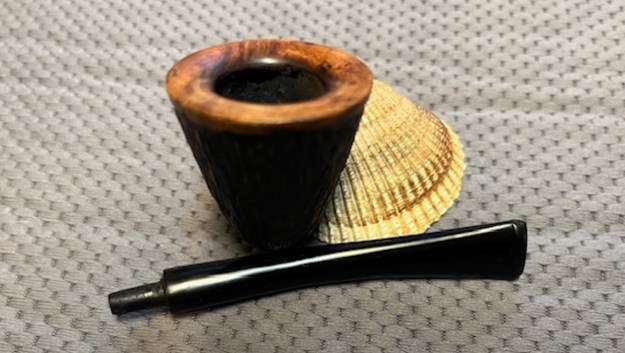
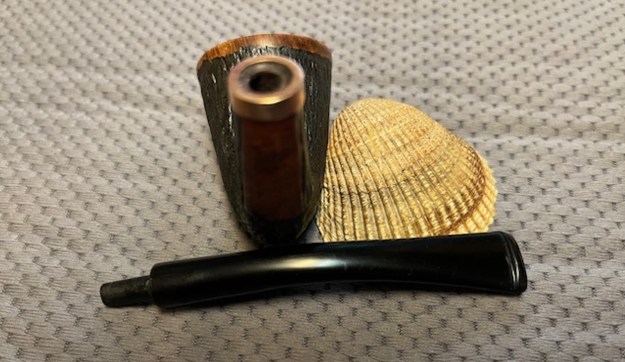
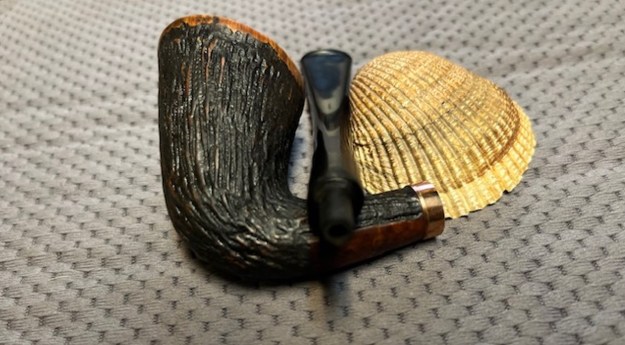
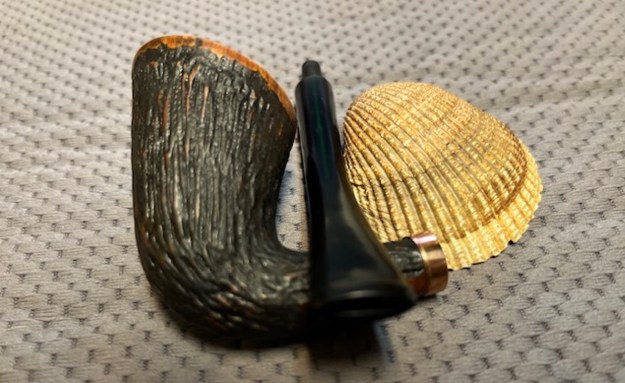
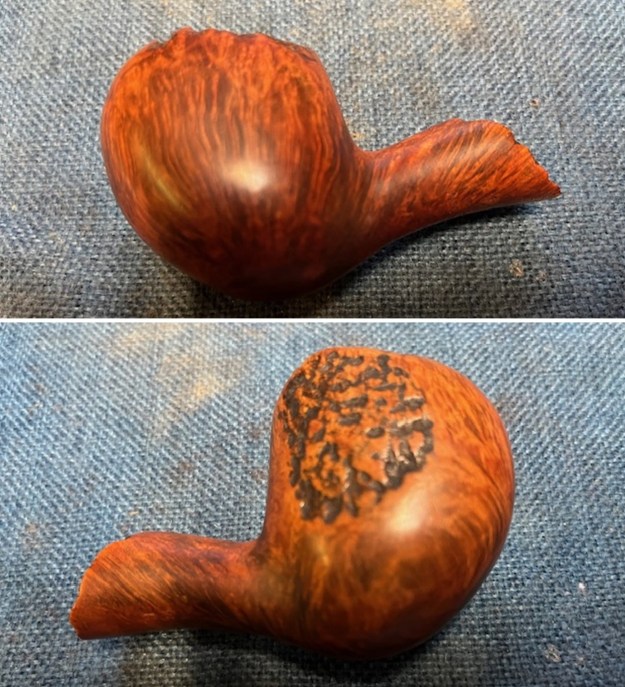
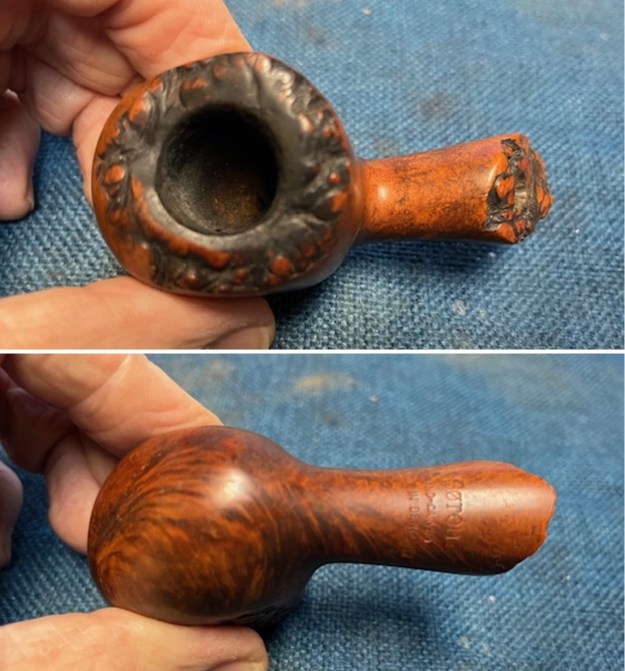
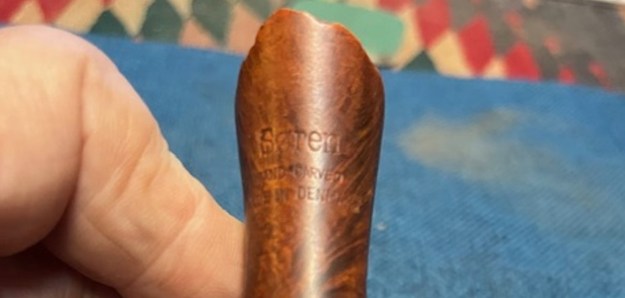
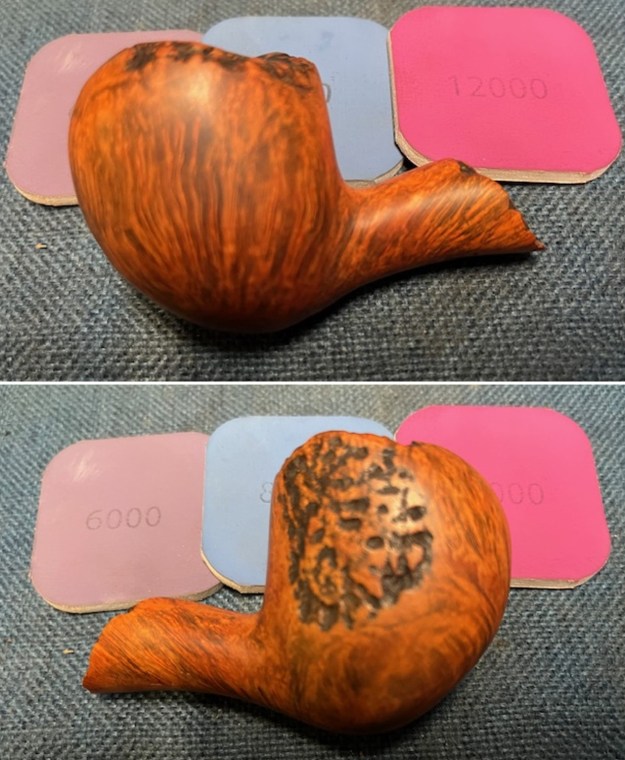
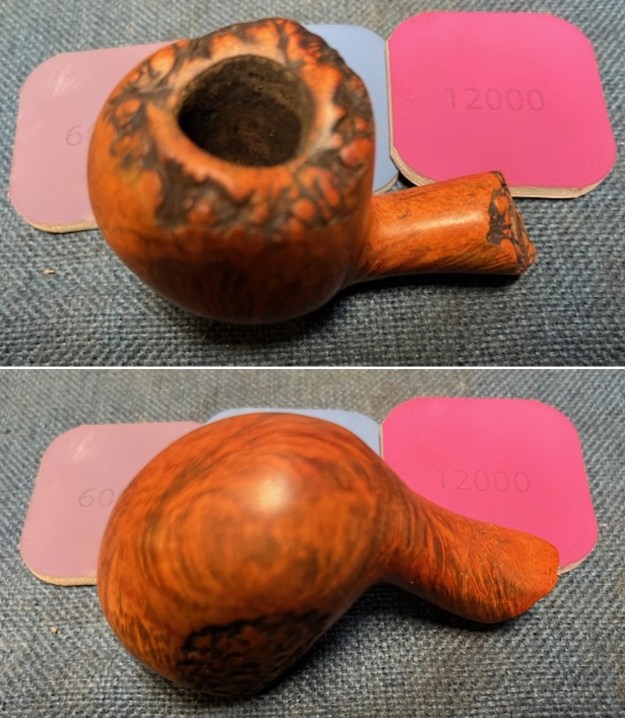
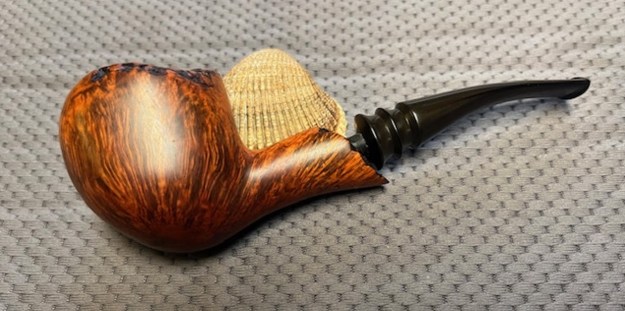
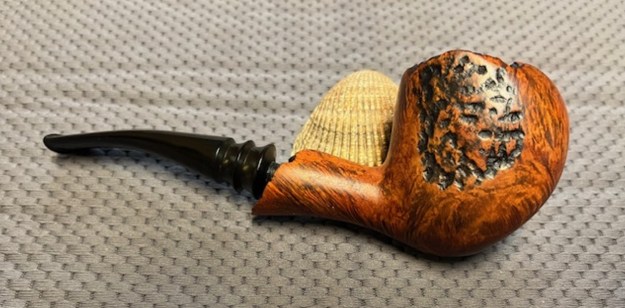
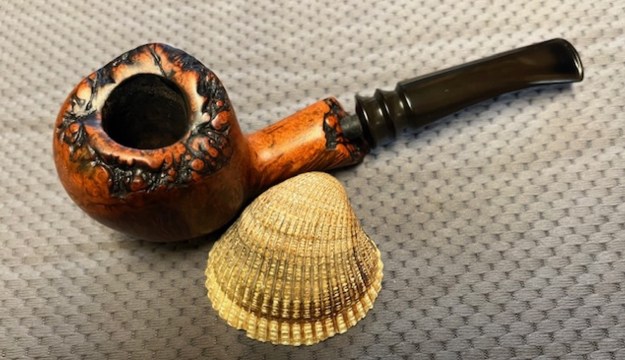
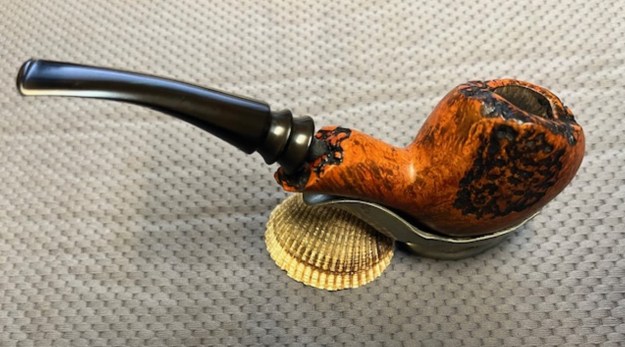
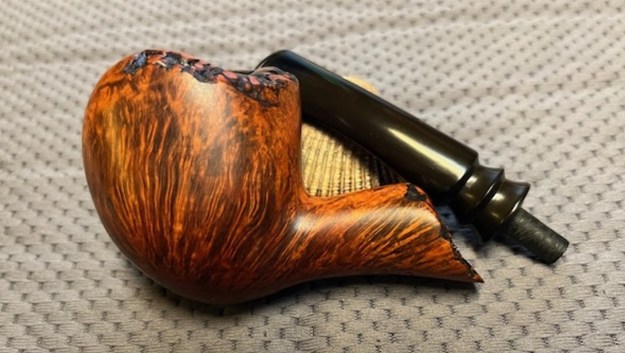
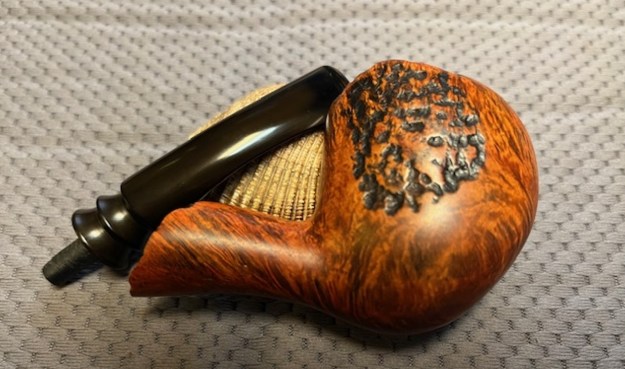
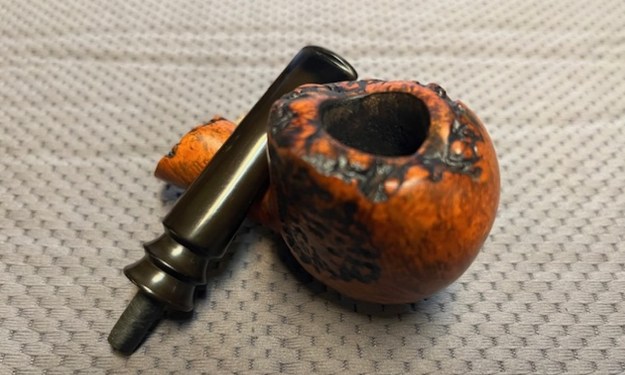
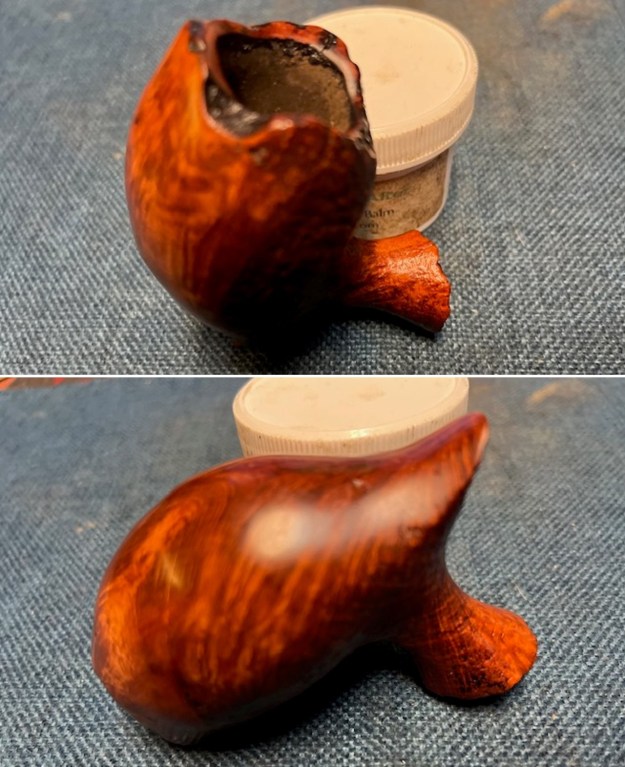
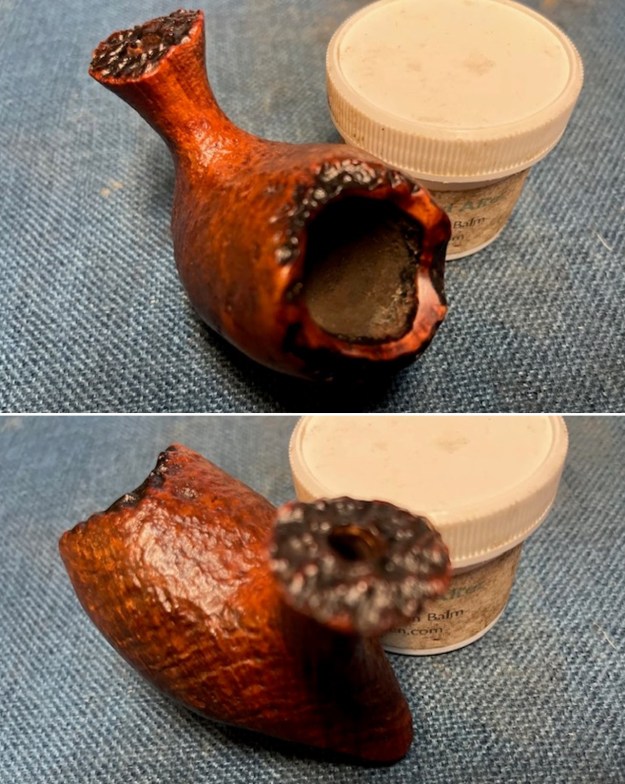
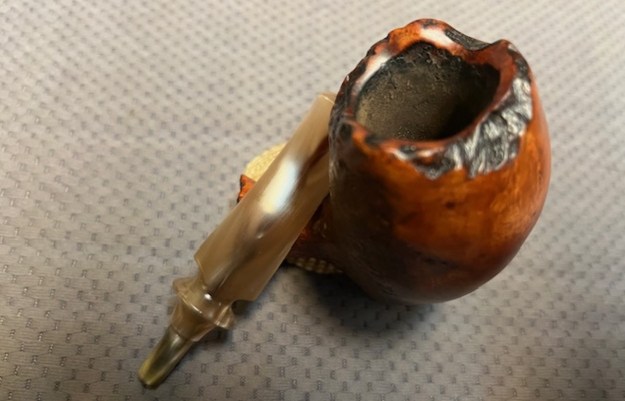
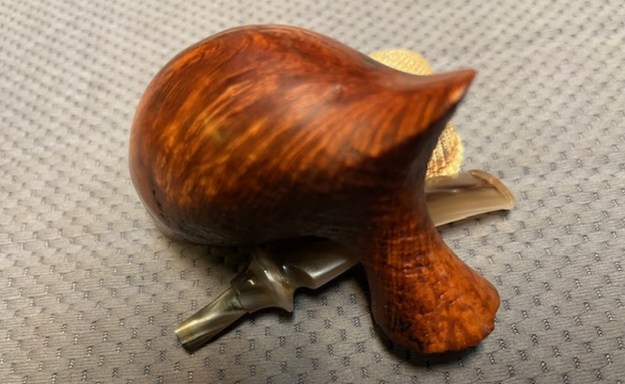
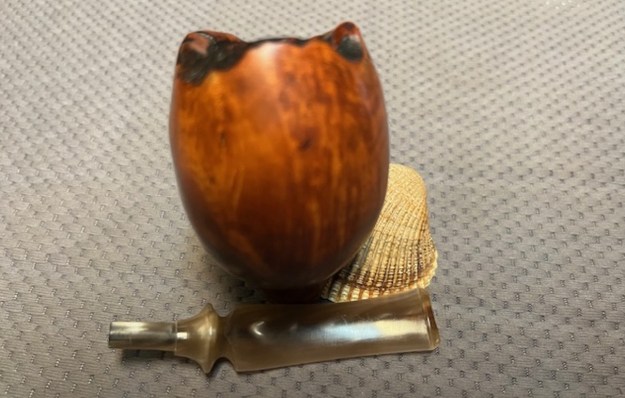
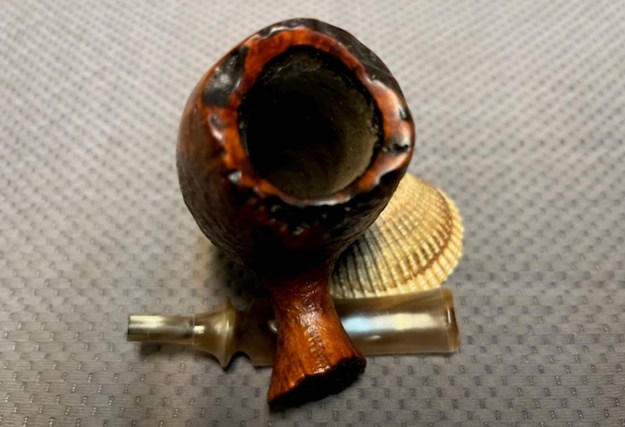
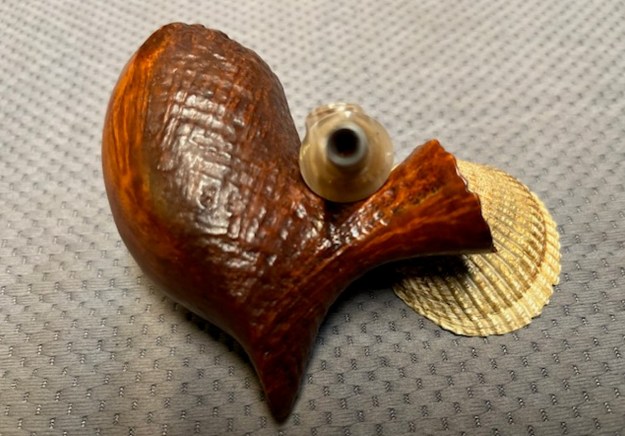
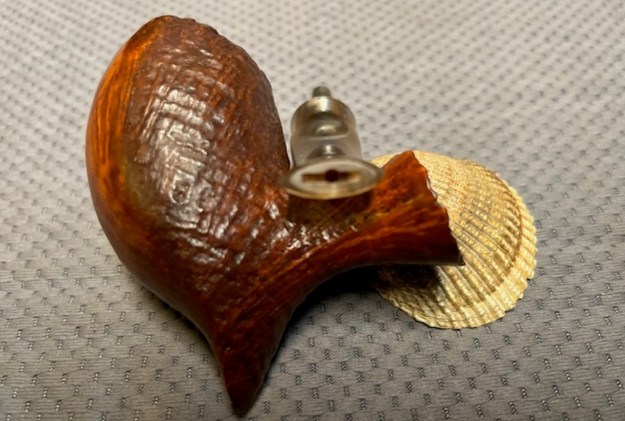
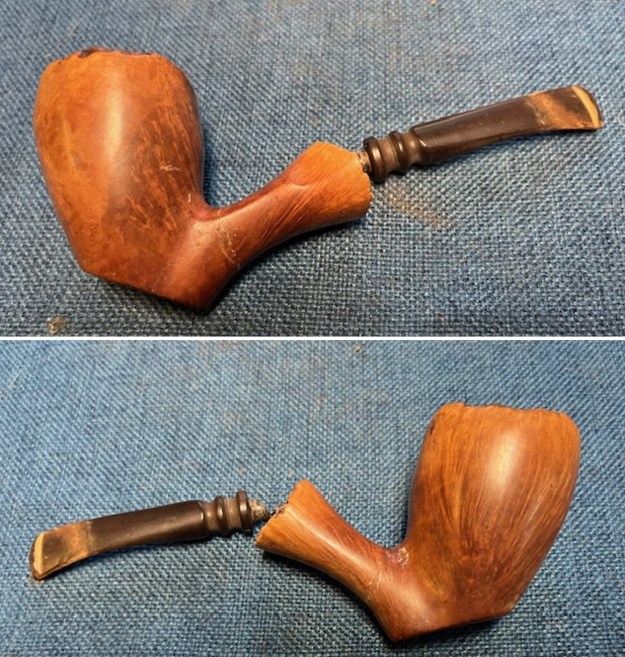
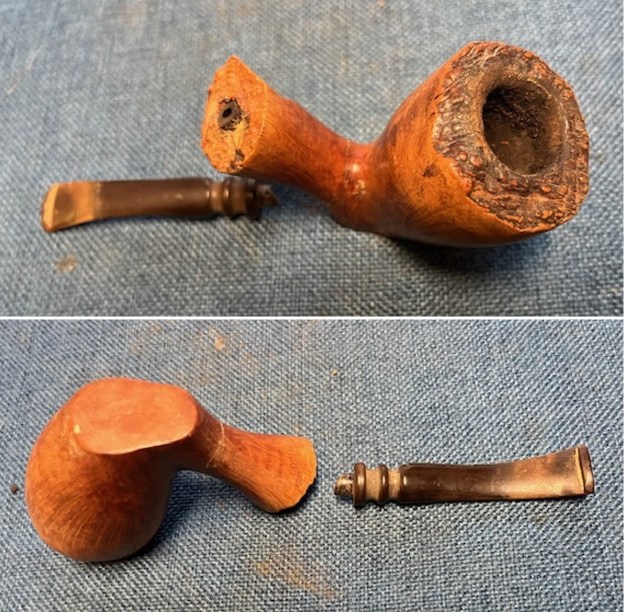
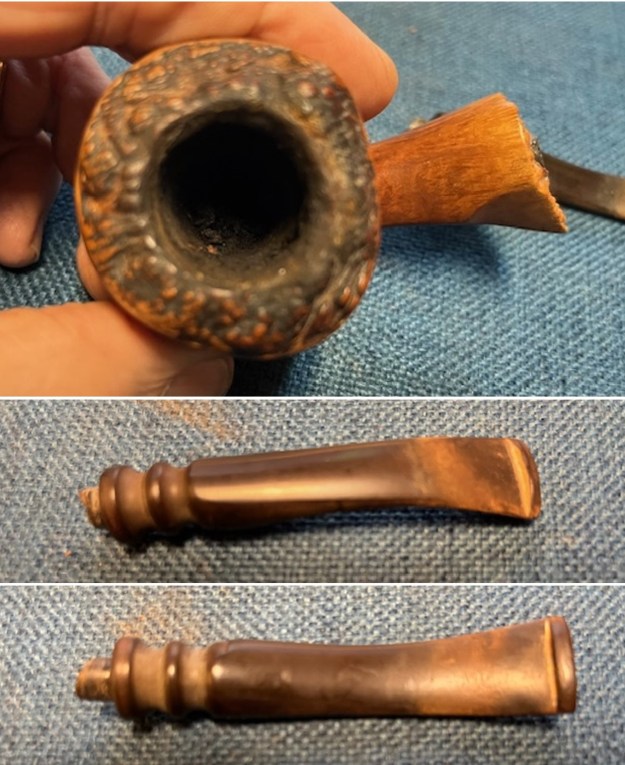
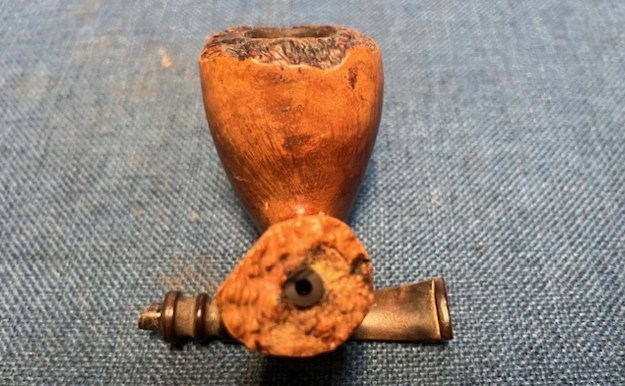
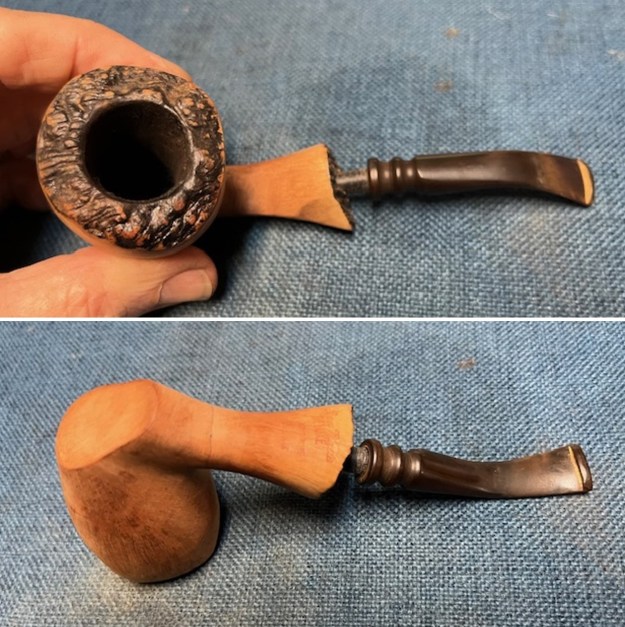
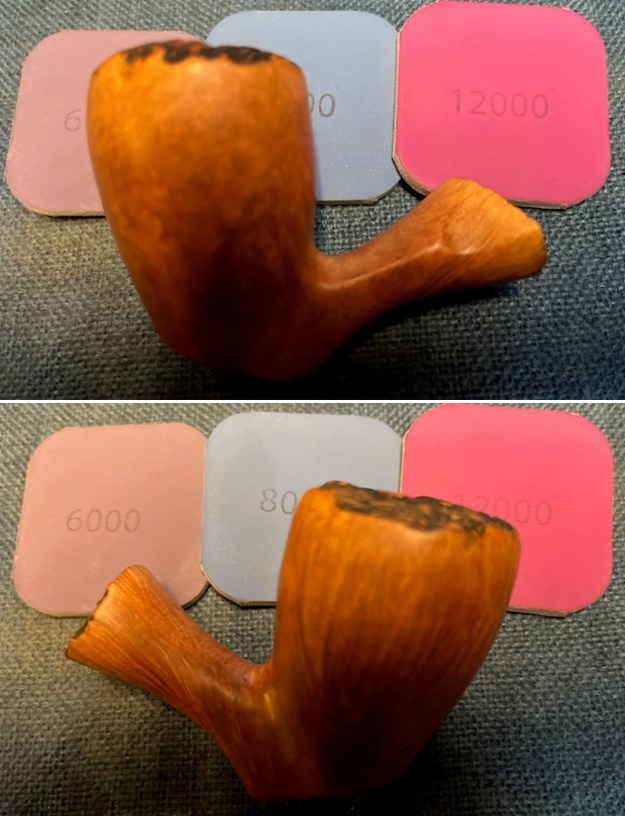
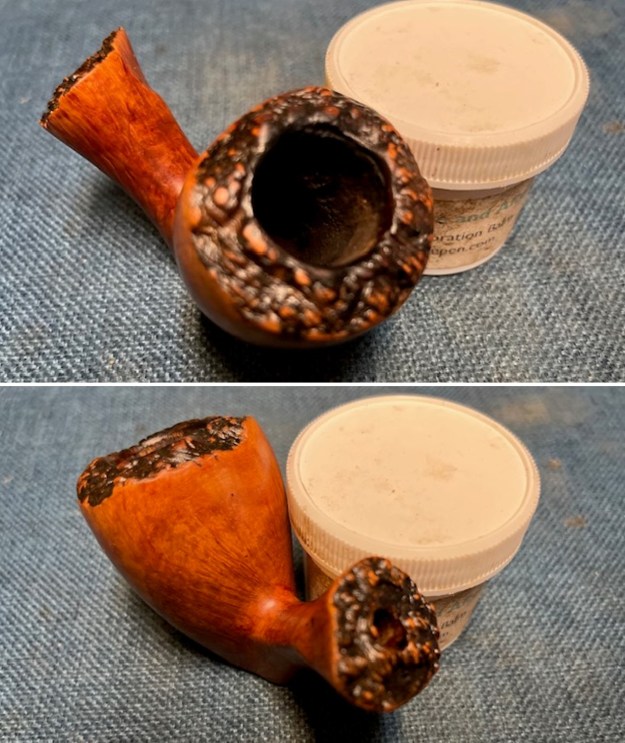
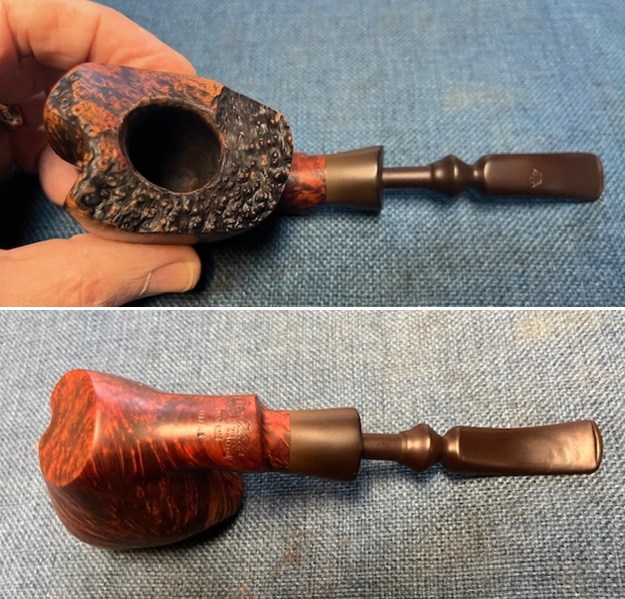
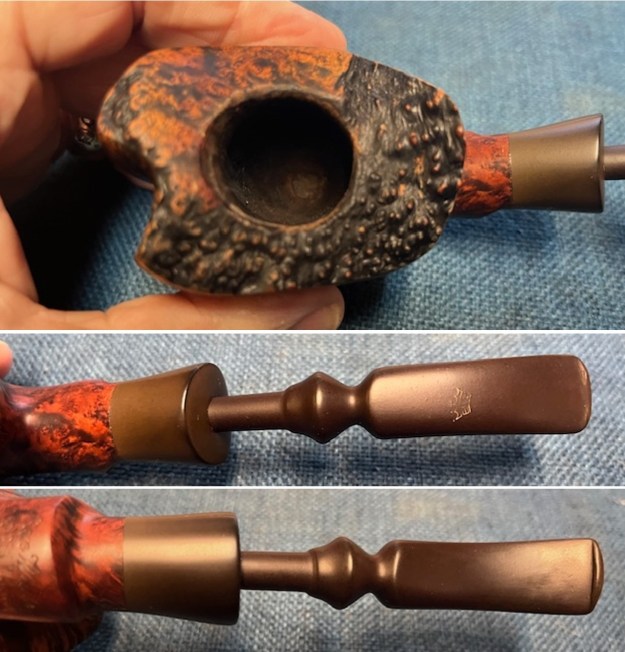
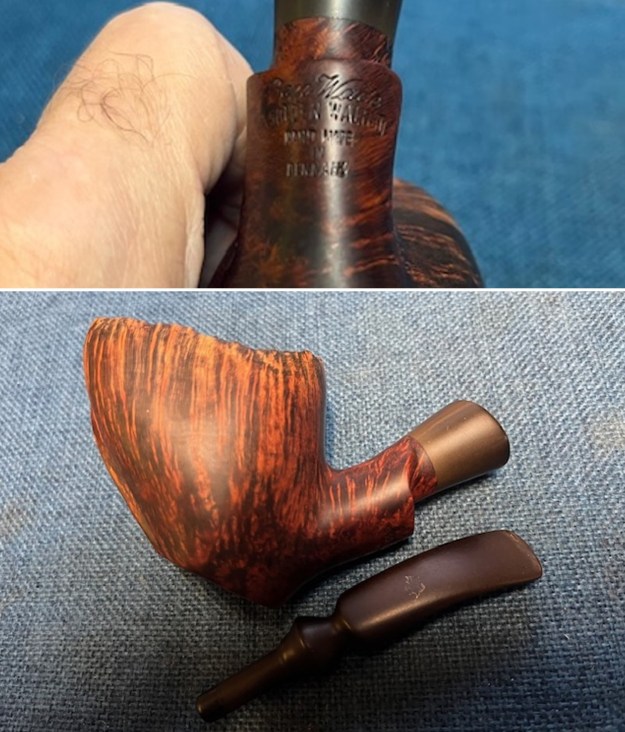
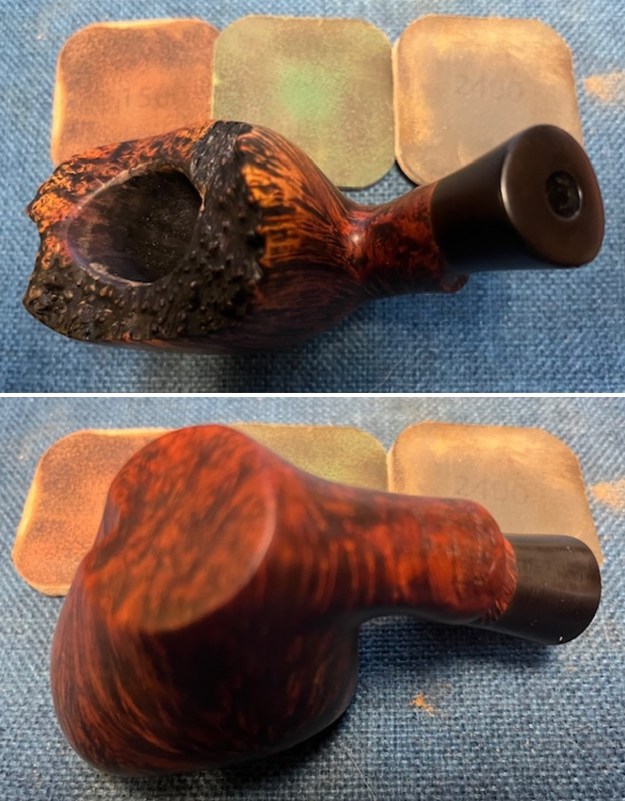
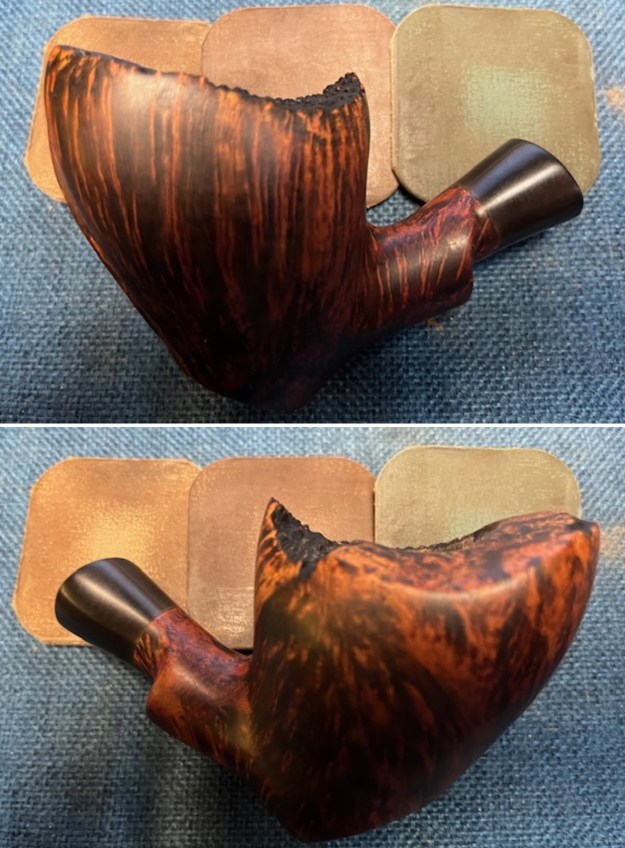
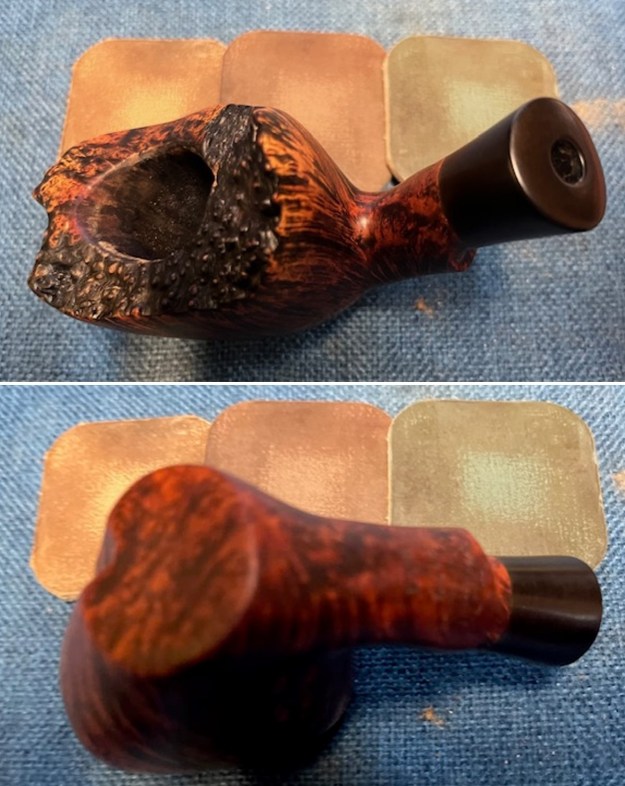
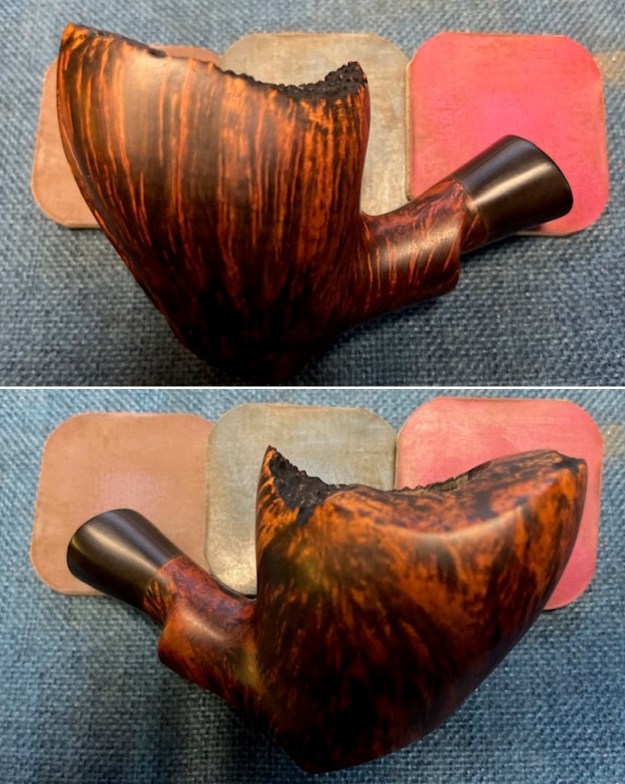
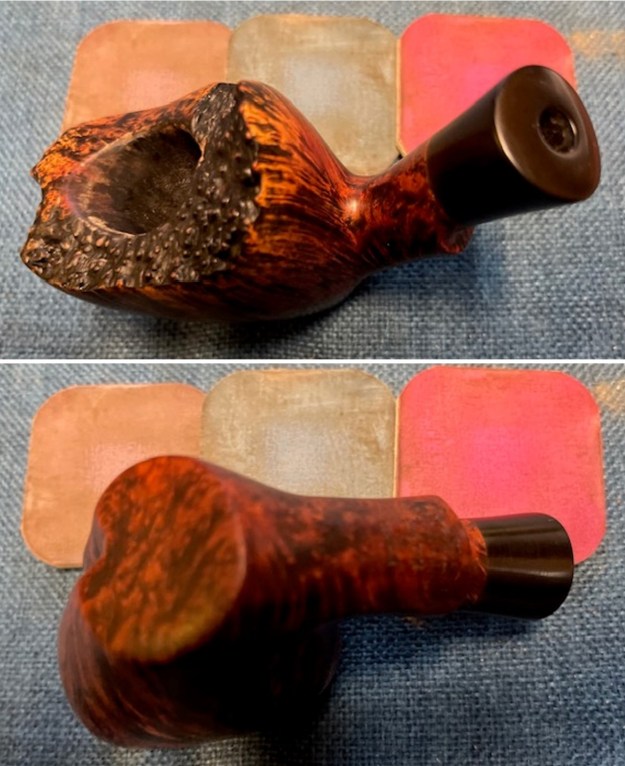
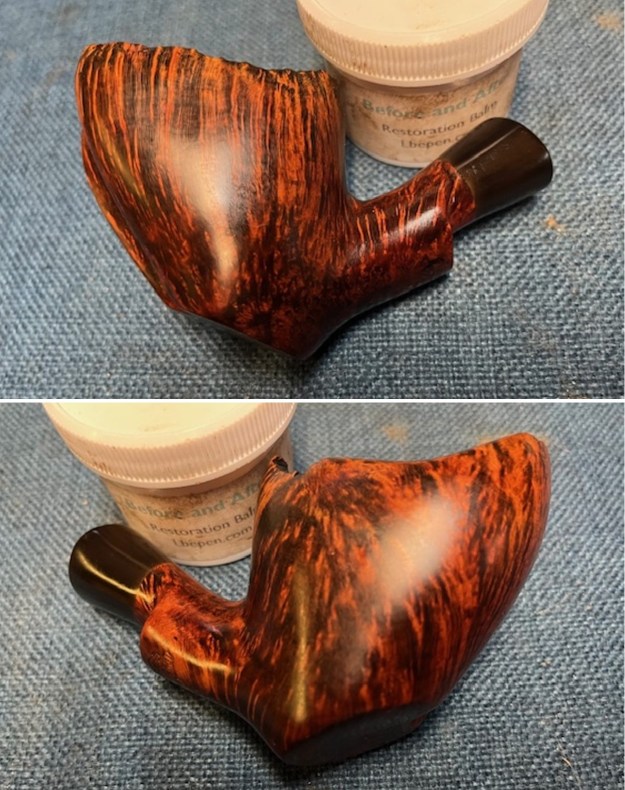
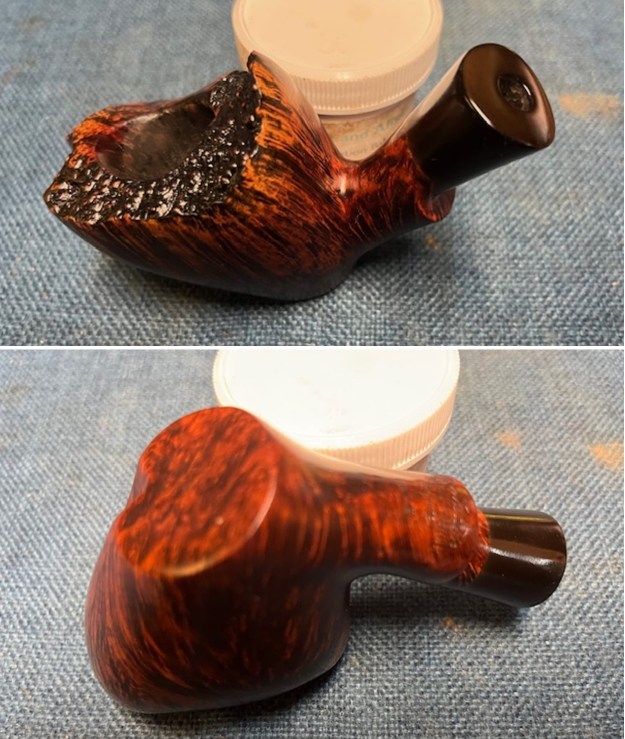
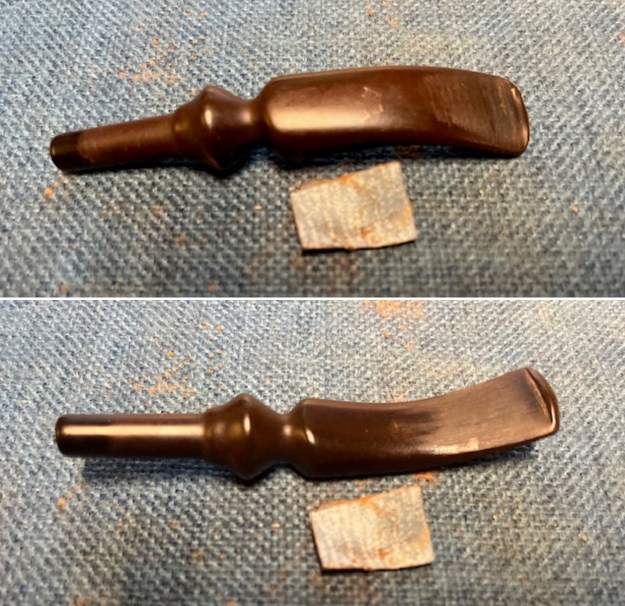
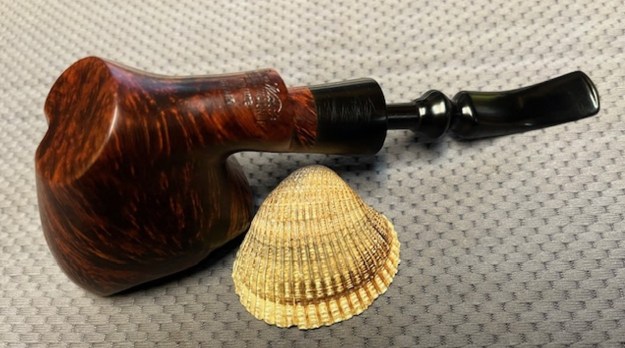
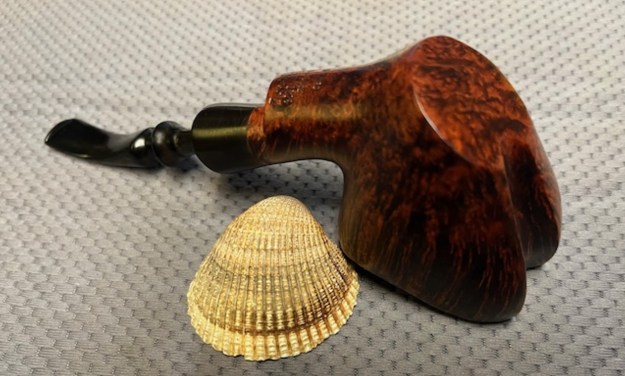
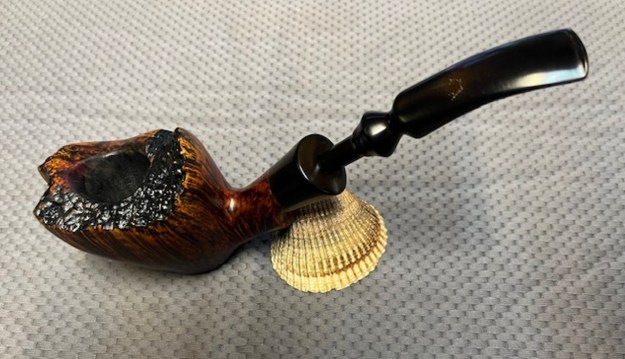
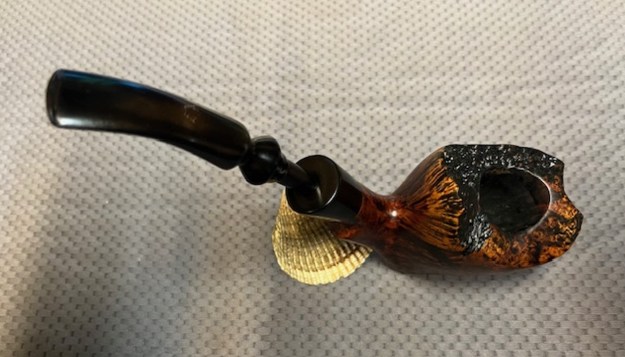
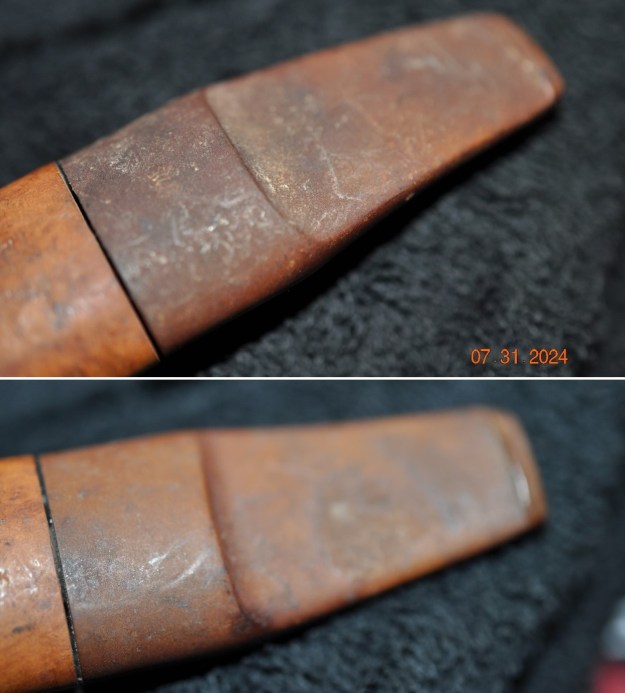
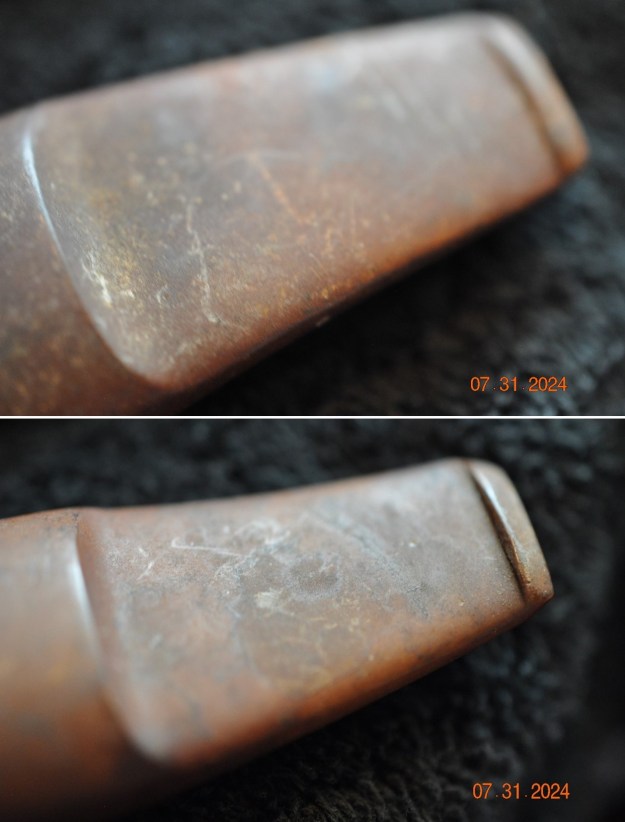
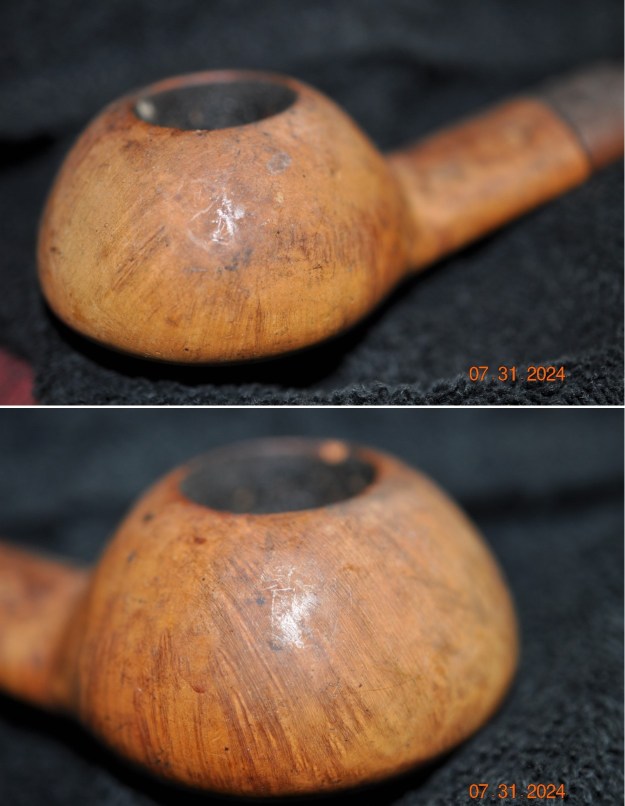
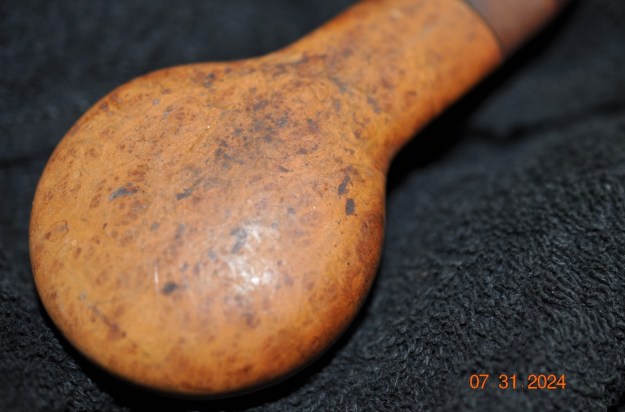
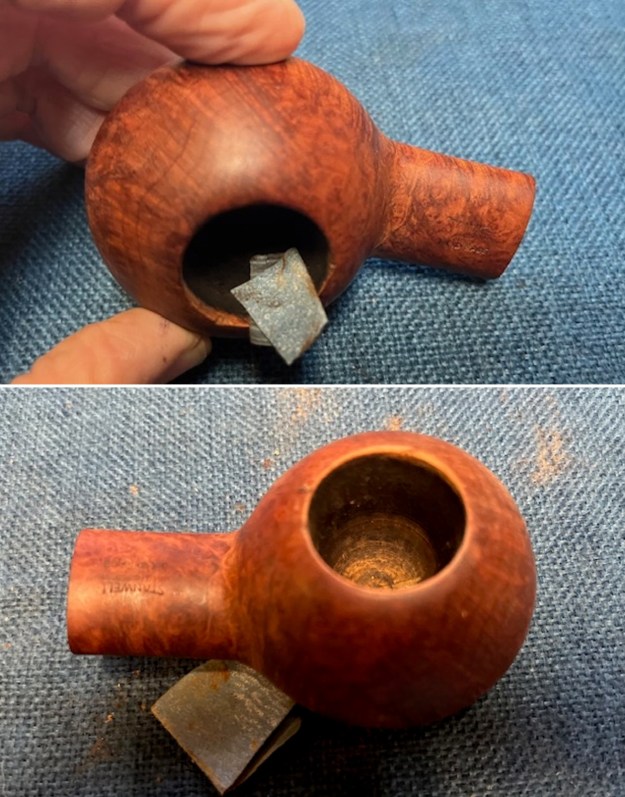
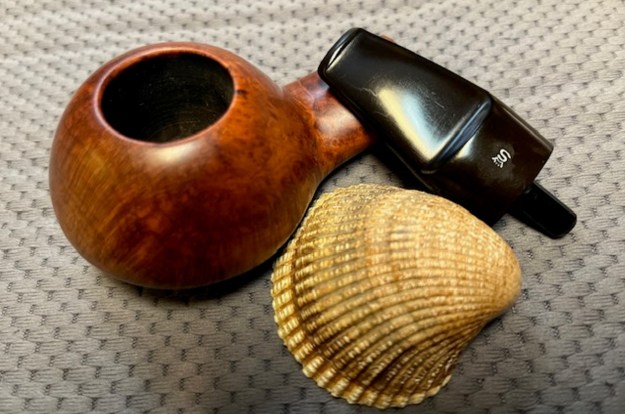
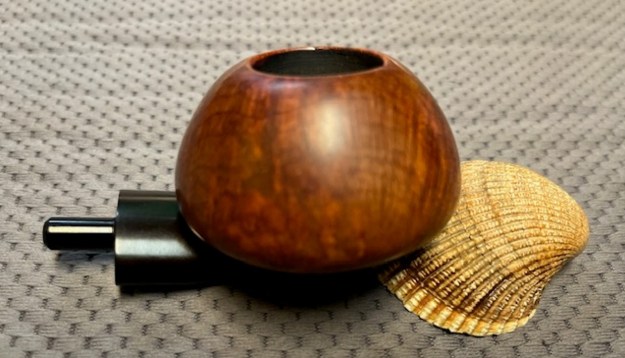
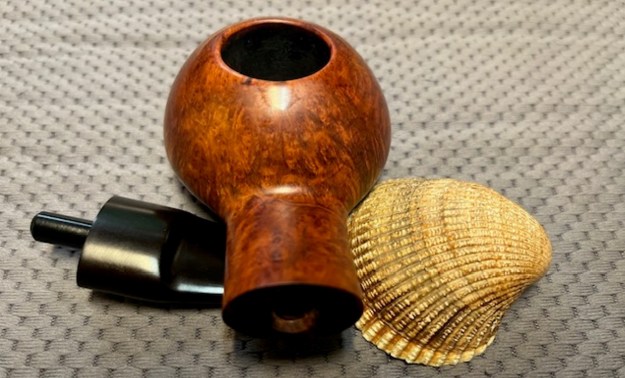
The next pipe on the table is an interesting looking Carey Magic Inch Calabash pipe. It is unique for several reasons. The first is that it comes with a flat piece of briar that is shaped to the base of the pipe. It has some great grain on the base and plateau on the edges. The second is that the left side and back of the bowl and shank are smooth and the right side and part of the front of the bowl is sandblast. The pipe is stamped on the left side and reads Carey [over] Magic Inch [over] Pat. No. 3267941. The stamping on the right side reads Mediterranean [over] Briar Israel. The stem has the Carey Logo “C” in a box on the topside. We purchased the Carey from an estate sale in Idaho Falls, Idaho, USA on 08/05/2018. The finish on the pipe was dirty with grime and oils ground into the briar. There was a thick cake in the bowl that overflowed on to the rim top and inner beveled edge. They both have a coat of lava on them. There is a vulcanite shank extension on the shank end that is quite polished. The stem is a Carey Magic Inch stem that tells me that the pipe has the Carey filtration system in the shank. A slim tube or Papyrite slips over the tube and filters out the oils. The stem has three slots in the top to aid airflow. The stem is the typical Carey special mix of vulcanite and plastic of some sort and in this case, I am thankful that it is not chewed. Jeff took photos of the pipe before he started his work on it. He took photos of the rim top to show the moderate cake in the bowl and the thick lava coat and debris on the rim top and inner edge. He took photos of the stem to show the tooth chatter and marks on the surface. None are too deep and I am thankful for that. He captured the finish and grain on the sides of the bowl. The left side shows the sandblast and the others show the smooth nicely grained finish. It is a beauty. He captured the stamping on the sides of the shank and it is clear and readable. The stamping reads as noted above. The Patent Number is interesting.The stamping gives me pause. I know that Carey Magic Inch pipes were typically made in the USA and for a short time in Great Britain. This one is stamped Mediterranean Briar Israel which I had not seen before. I am also pretty sure it is made by the Shalom Pipe Factory for Carey. But now to do a bit of study on the brand.

I first did a quick Google search of the brand and Israel to see what I could learn of the connection. There I found a discussion on Pipesmagazine forum. In the last line of the section I am quoting from the poster, Briar Lee I found what I was looking for. I have highlighted it in red in the text below for ease. I quote the entire section and have attached the link as well (https://pipesmagazine.com/forums/threads/e-a-carey-pipes-for-new-pipe-smokers.102325/).

A Carey Magic Inch pipe uses a paper sleeve on a ventilated tube in the stem. When smoking a tiny bit of air is metered into the smoke stream.

This air doesn’t materially change the flavor but it significantly cuts back on mouth burn and tongue bite and somehow prevents prevent gurgling and soggy pipes, how I’ve not ever been able to quite figure out. But the system works.

After you become an old leather tongued pipe addict and want the full blast of the smoke stream, use a piece of plastic drinking straw to replace the paper tube.

Carey pipes have been made all over the world through the years, and I have them from the USA, London, Italy, Greece, and Israel.

From there I turned to Pipephil’s site (http://pipephil.eu/logos/en/logo-c2.html). And found a listing for Carey. It gave me a pipe with the same patent information but it was made in England so that did not help much. I have included a screen capture below.I turned next to Pipedia (https://pipedia.org/wiki/Carey_Magic_Inch). The site had a short article that gave a basic description of the Magic Inch system. It also provided a link to the EA Carey Website which I would look at next. I quote from the Pipedia article below as it is a simple description of the system and the pipe.

The “Magic Inch” System has been a Carey’s tradition for over 50 years, with over 1,000,000 sold. The “Magic Inch” is an air chamber inserted between the imported briar bowl and the vented mouthpiece which allows cool outside air to enter and mix with the warm tobacco smoke inside the “Magic Inch” chamber. Tobacco tars, oils and moisture, are squeezed out of the smoke. The residue drops to the bottom of the chamber and is absorbed by the Papyrate sleeve. From its rich tradition and thousands of satisfied customers, this pipe is sure to be your smoking favorite for life. Carey Magic Inch pipes can be readily identified by a boxed letter C on the stem, along with a distinctive series of three vent slits and the Carey Magic Inch name stamped into the side of the bowl.

That lead me to the Carey Site as noted above (https://www.eacarey.com/magicinchinfo.html). I did a screen capture of the page defining the Magic Inch system. The diagram is helpful to capture the mechanics of the pipe.The site also had testimonials from satisfied customers about the system and hidden in the bottom of one of the sidebars was the Patent info. I have included that screen capture below as it is very interesting (https://www.eacarey.com/careyclassics.html).Now I knew that the pipes were made in many countries and that Israel was on the list. There was no direct link to the Shalom Pipe Company but I am still confident they made this pipe and Carey added the plumbing.

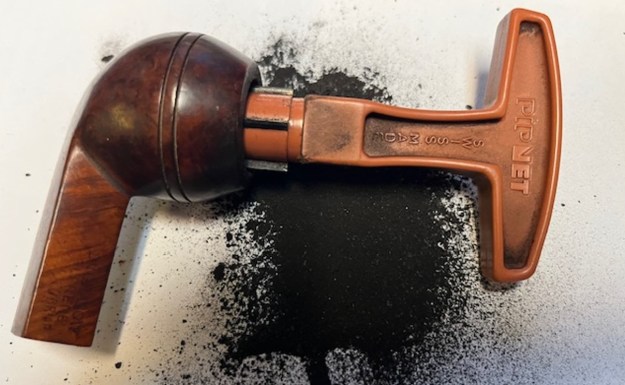
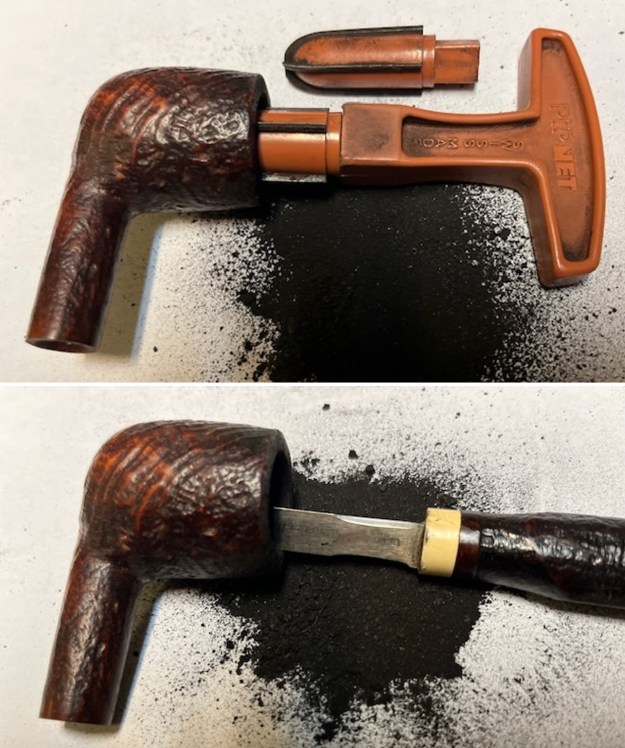
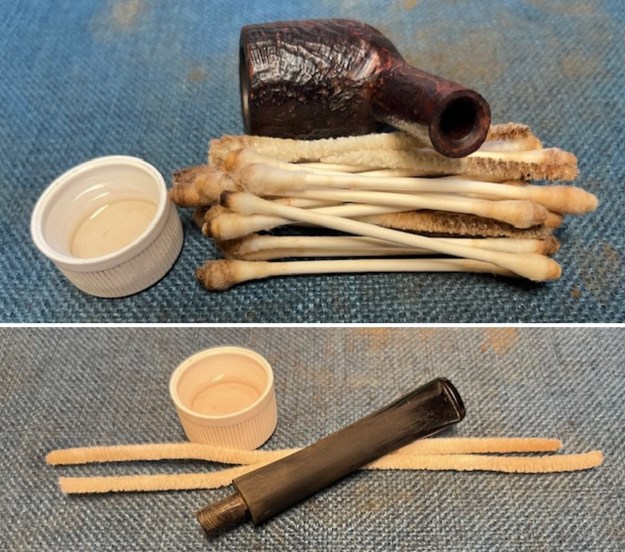
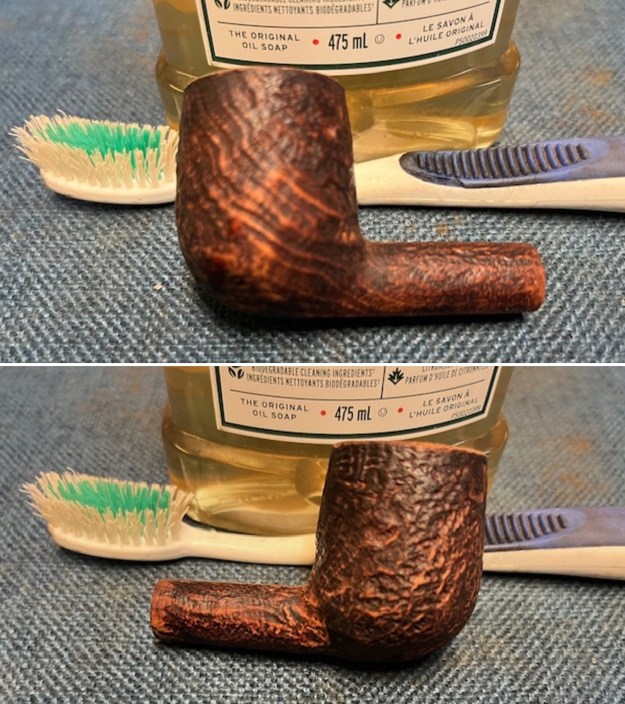
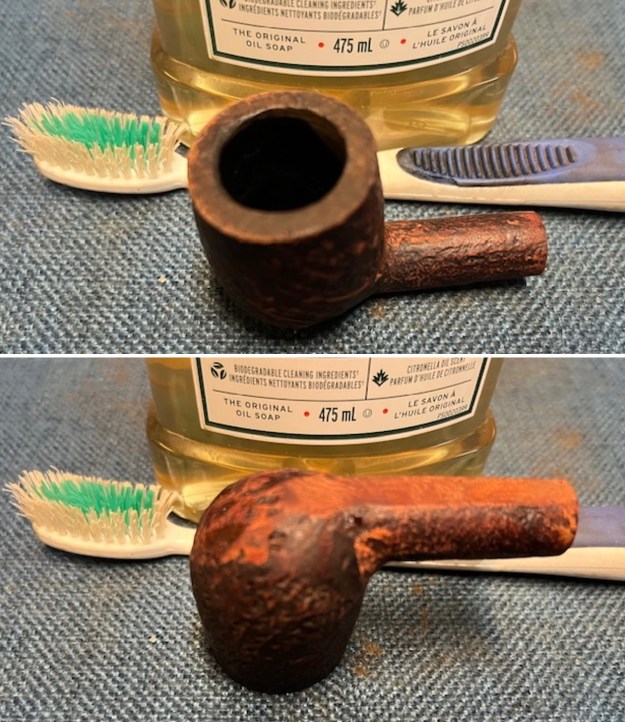
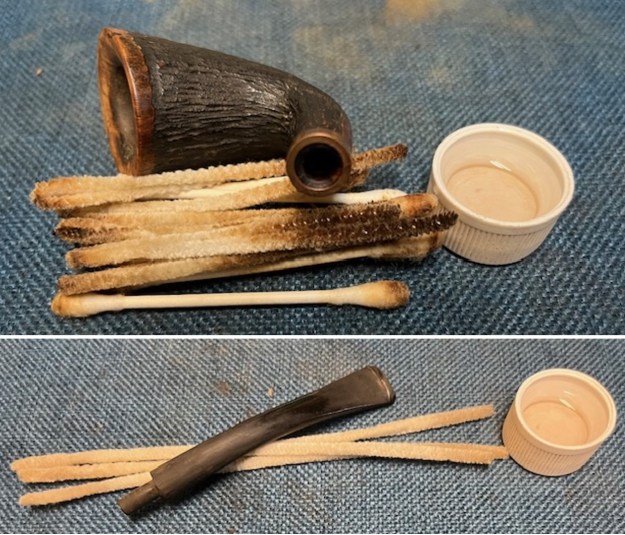
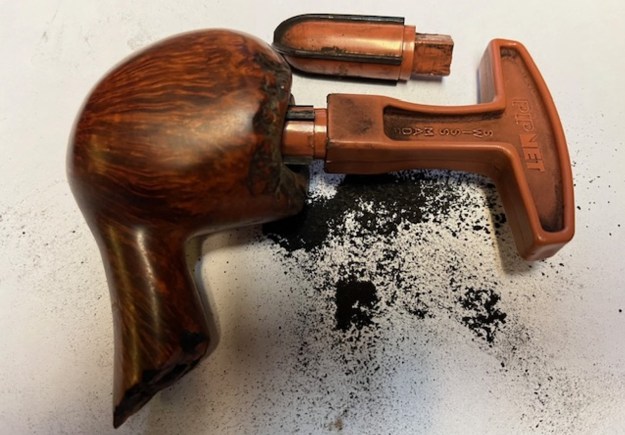
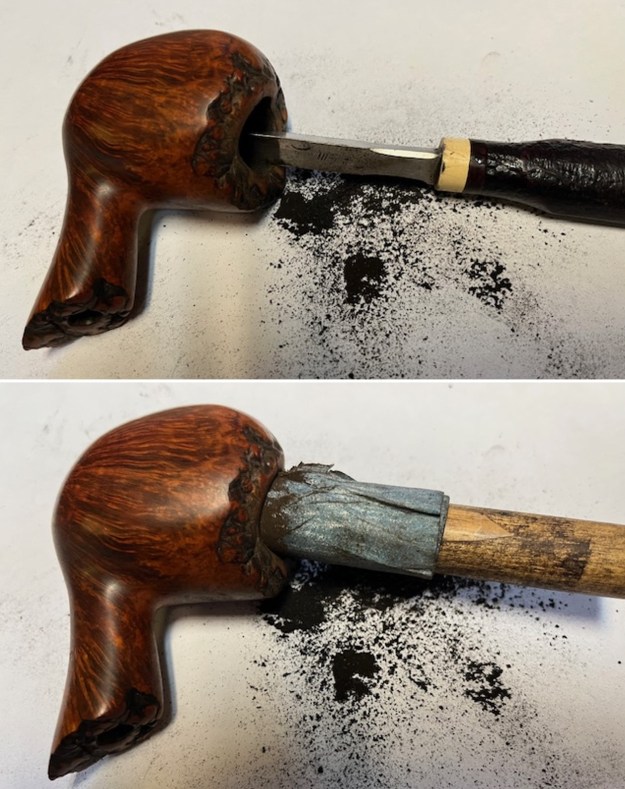
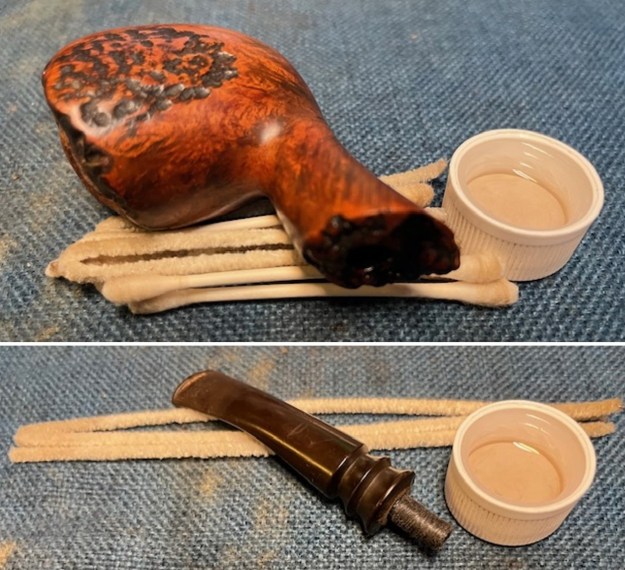
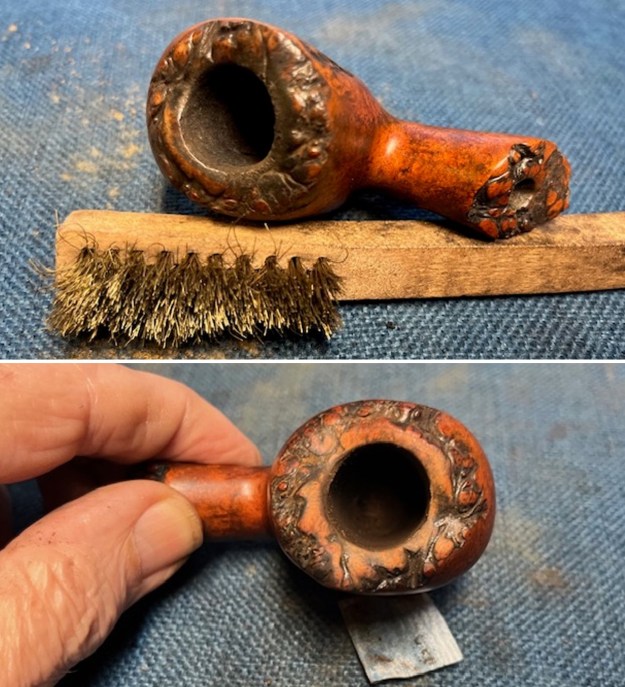
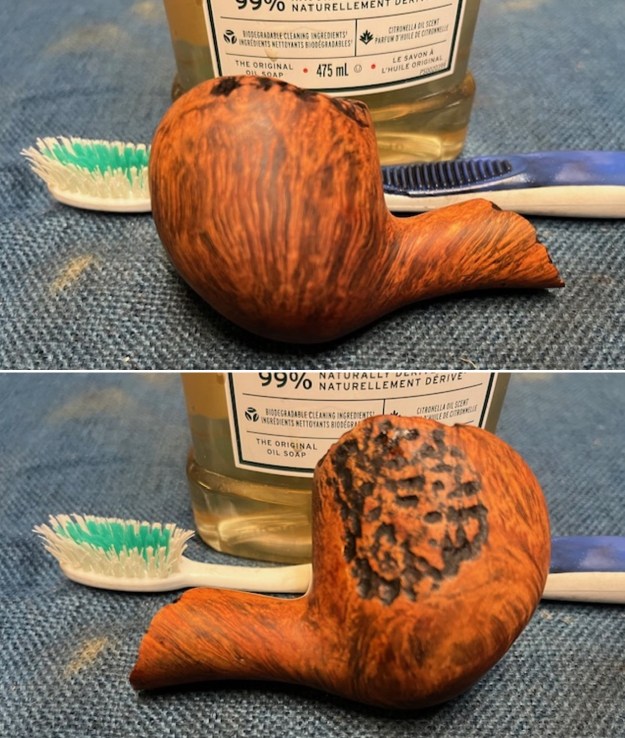
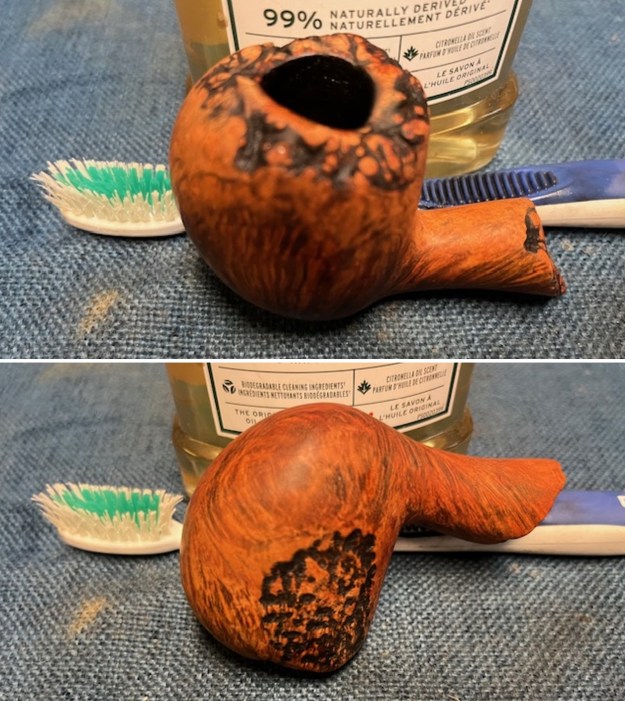
I was ready to start working on this pipe. As usual, Jeff had thoroughly cleaned up the pipe. I probably don’t say enough about how much I appreciate him doing the hard clean up work before I even get the pipes. He does an amazing job. He had reamed the pipe with a PipNet pipe reamer back to bare briar and removed the remnants of the cake with a Savinelli Fitsall Pipe Knife. He used a small blade to pick out the thick lava on the rim top. He scrubbed the bowl with undiluted Murphy’s Oil Soap and a tooth brush. He rinsed it under running warm water to remove the soap and grime. He cleaned out the inside of the shank and the airway in the stem with alcohol, cotton swabs, pipe cleaners and shank brushes. He soaked the stem in Briarville’s Pipe Stem Deoxidizer and rinsed it off with warm water. I took photos of the pipe and the stem that came with it before I started my part of the restoration work. I took photos of the bowl and rim top to show the clean condition. The bowl walls look very good. The rim top had some remnants of what looked like varnish – almost rings or swirls on the top. The stem looks very clean and when I run my fingers along the edges it still has the casting marks on it.
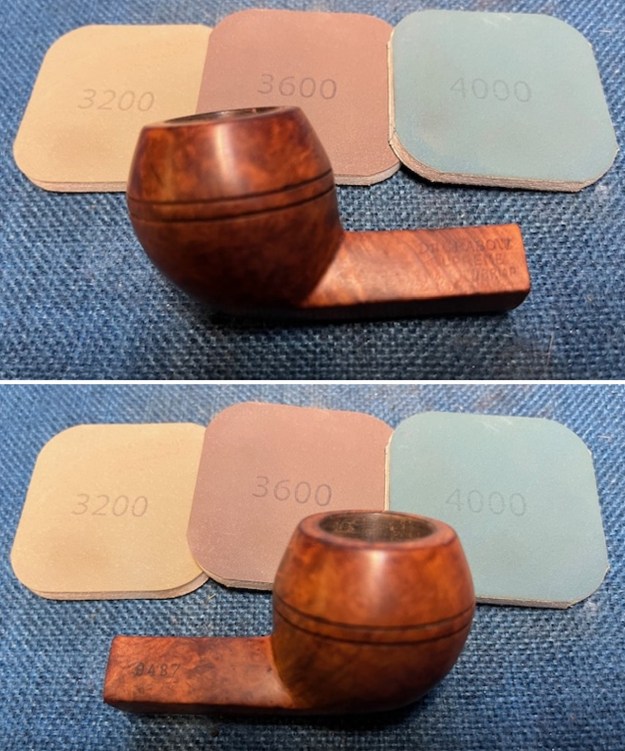
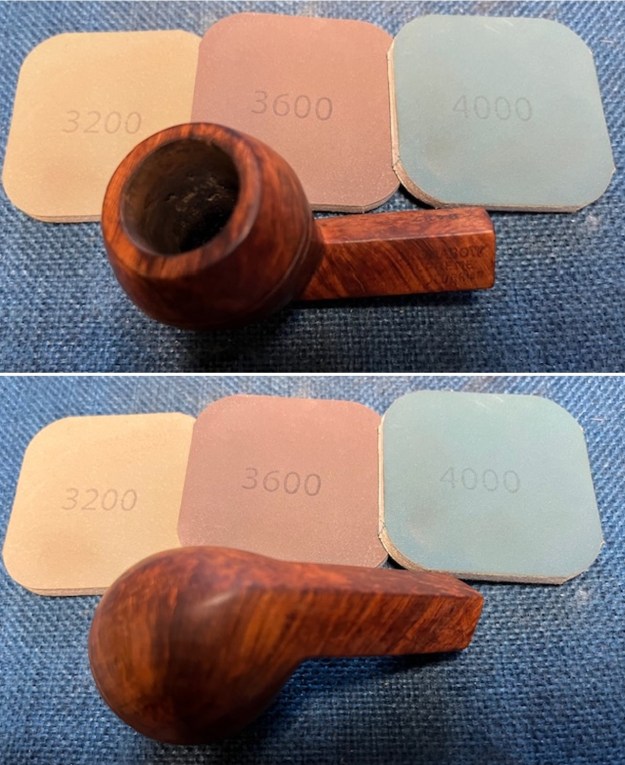
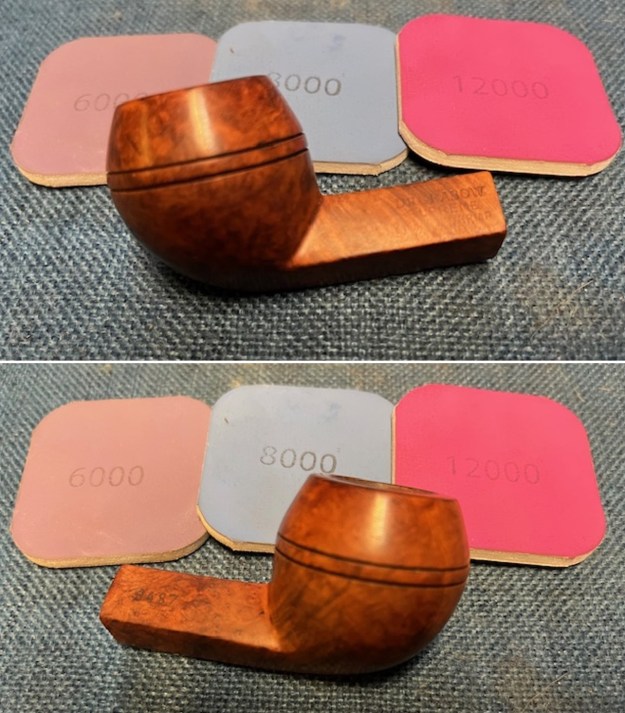
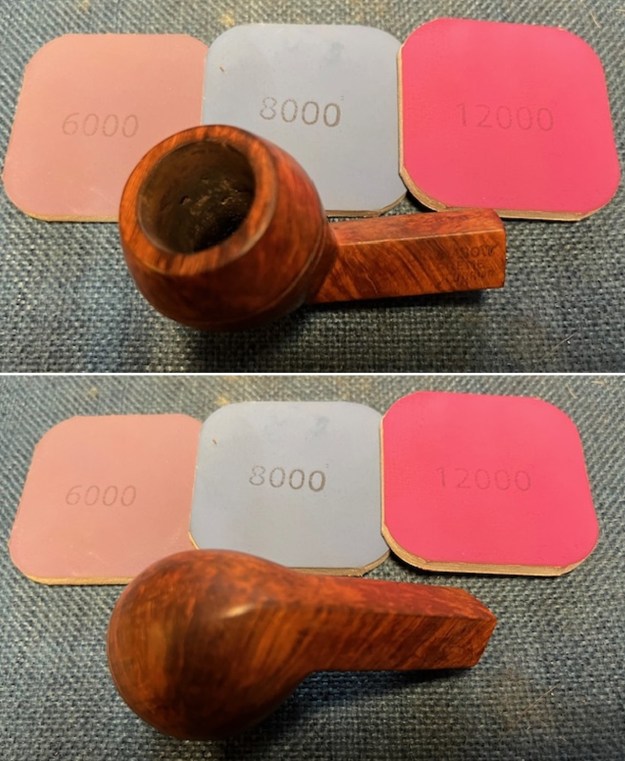
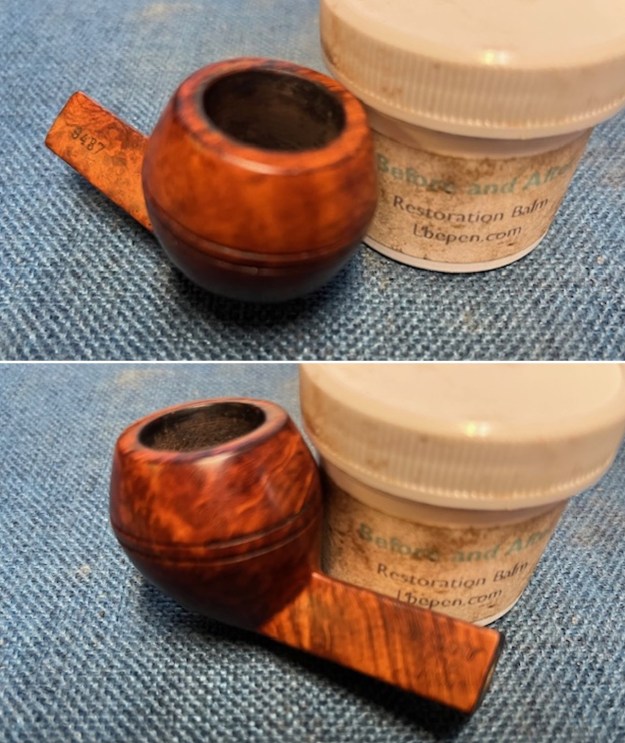
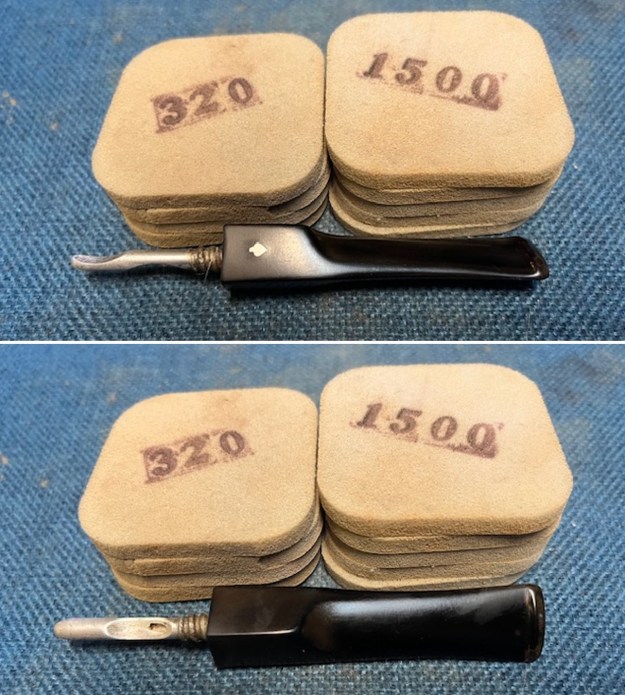
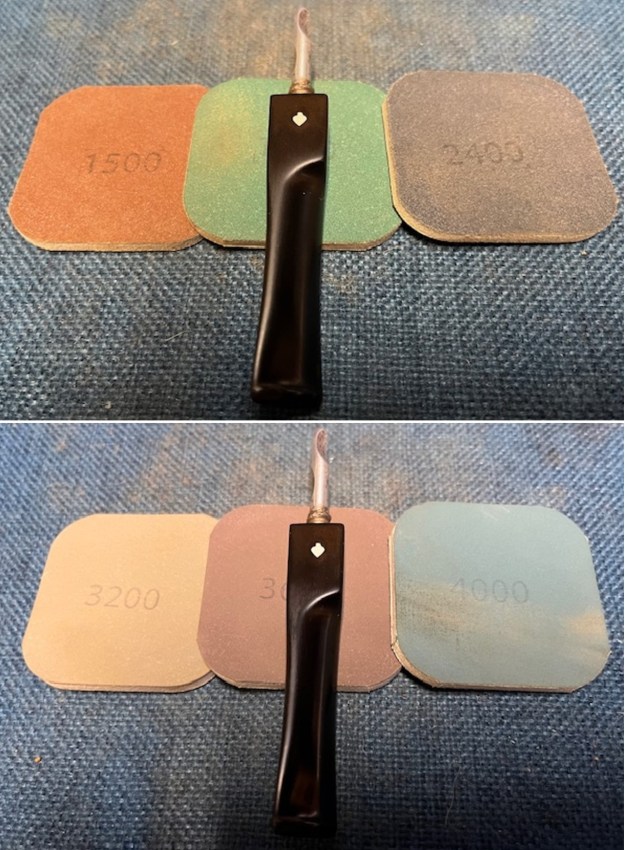
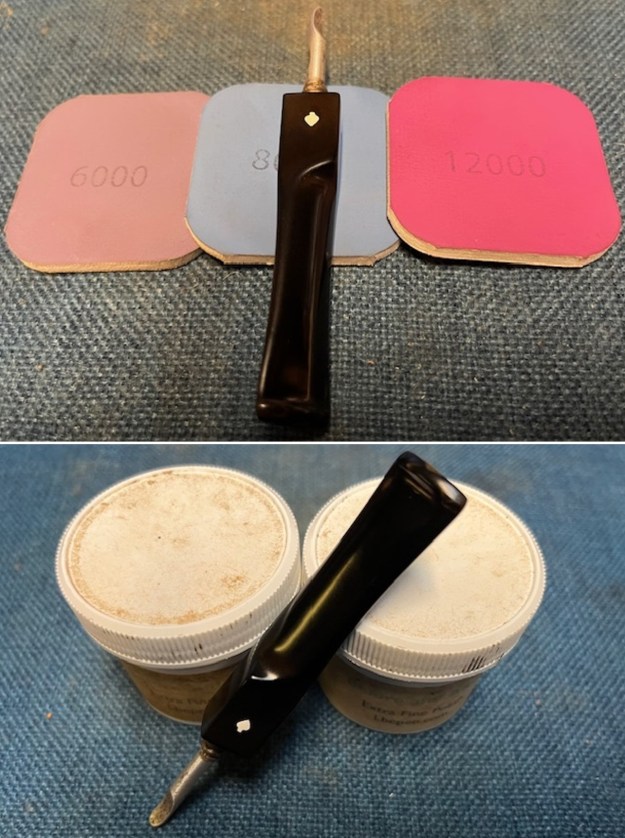
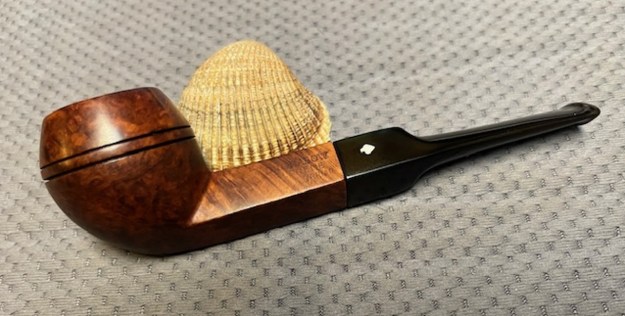
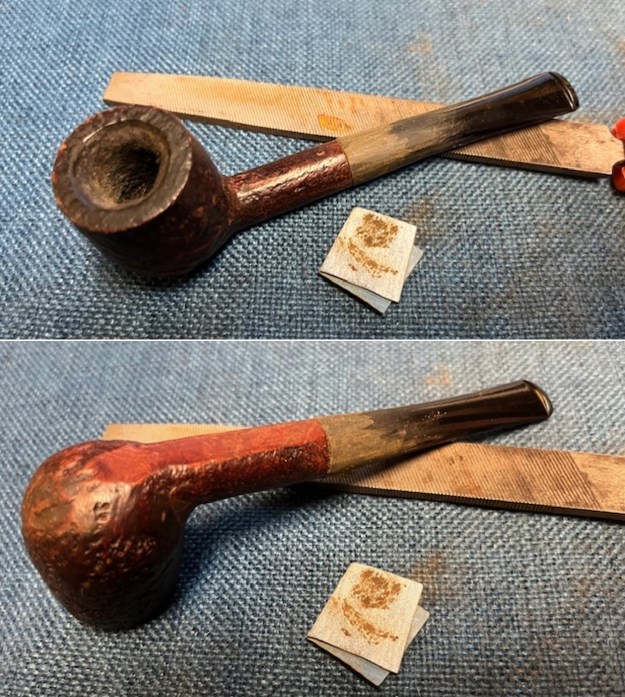
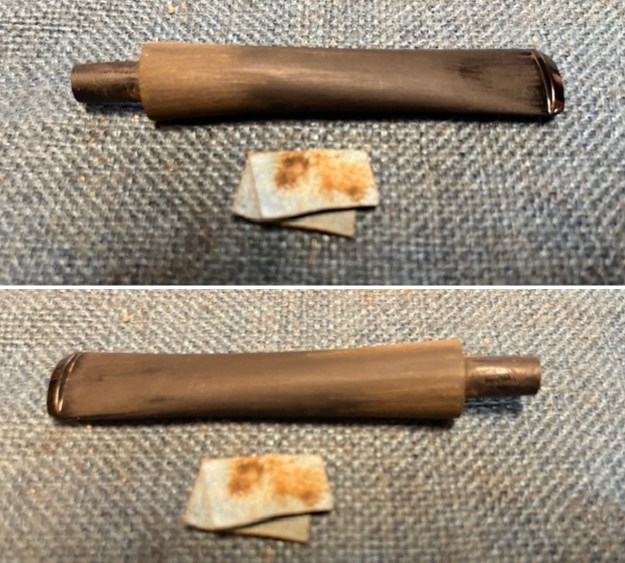
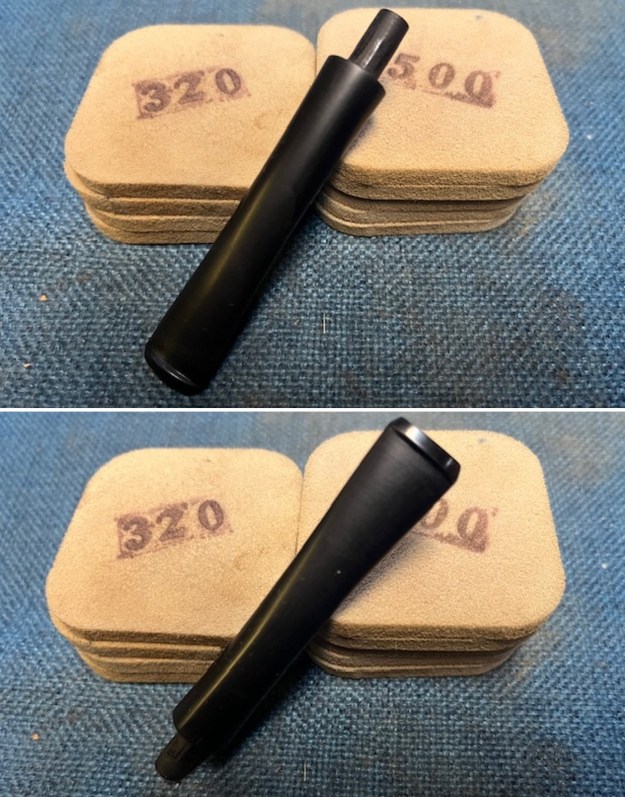
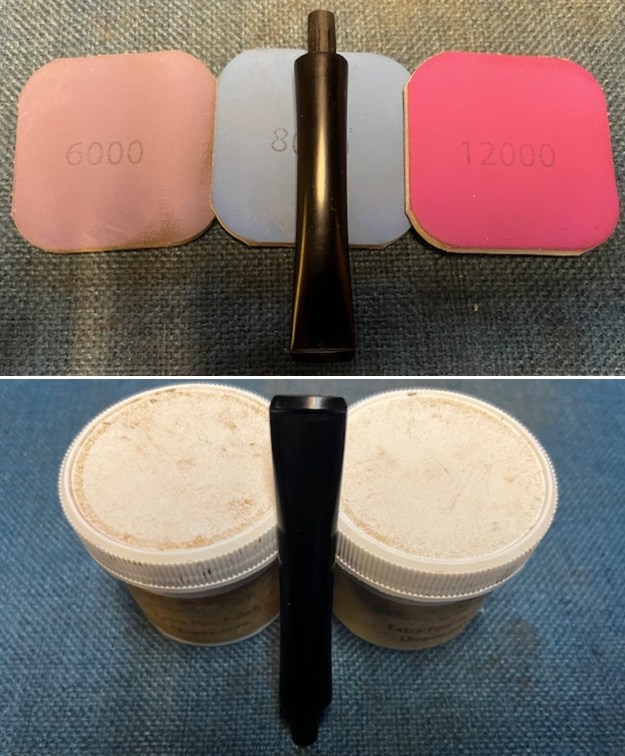
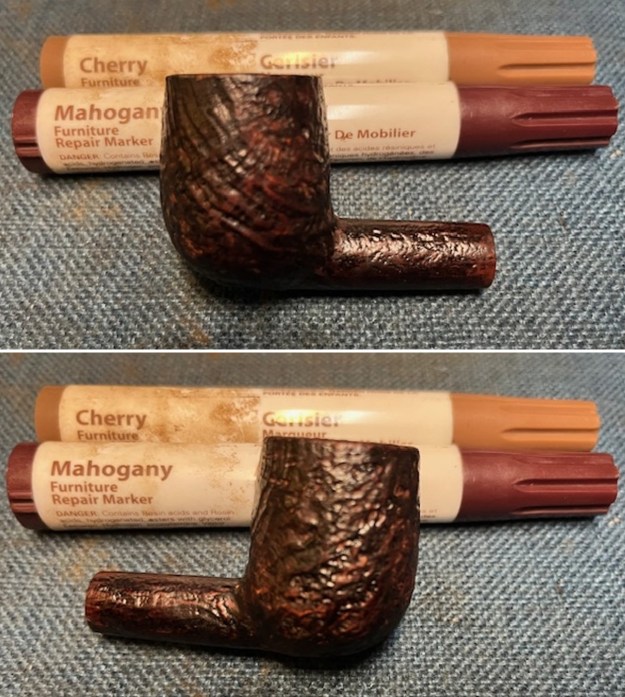
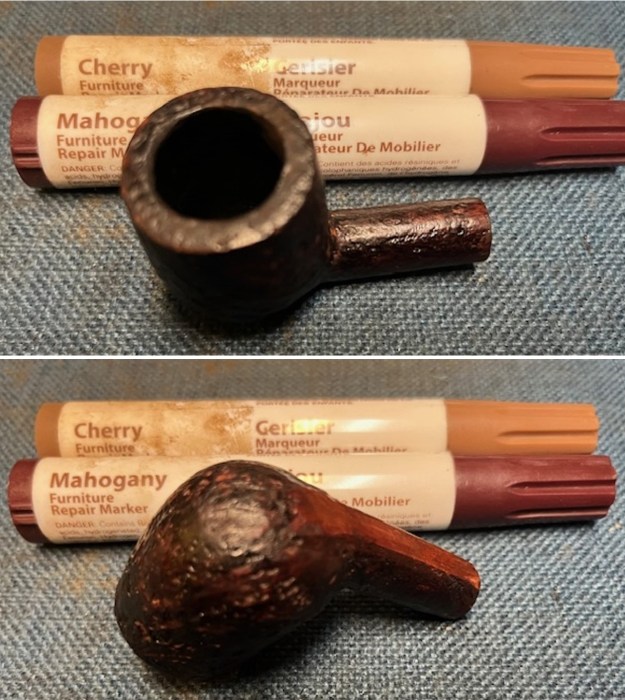
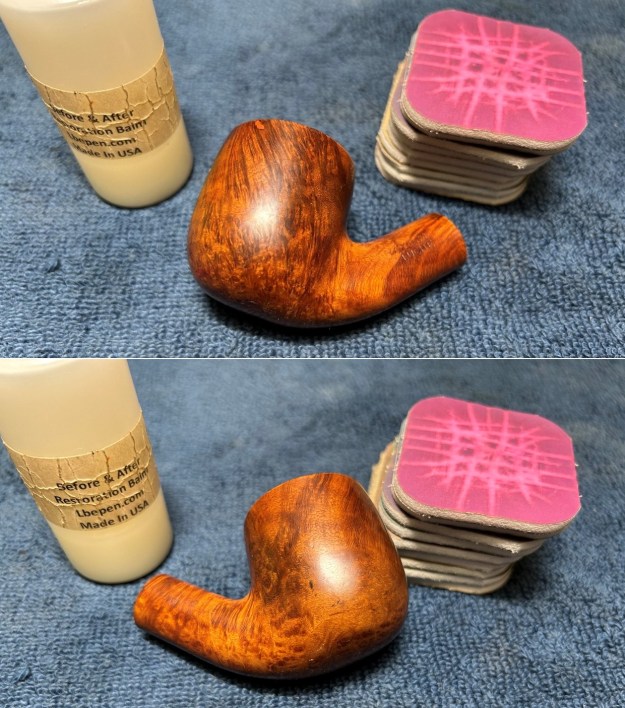
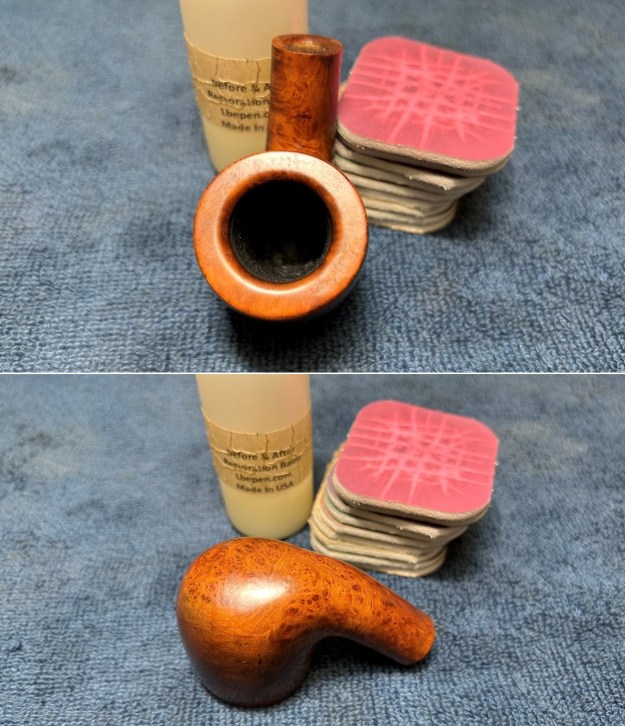
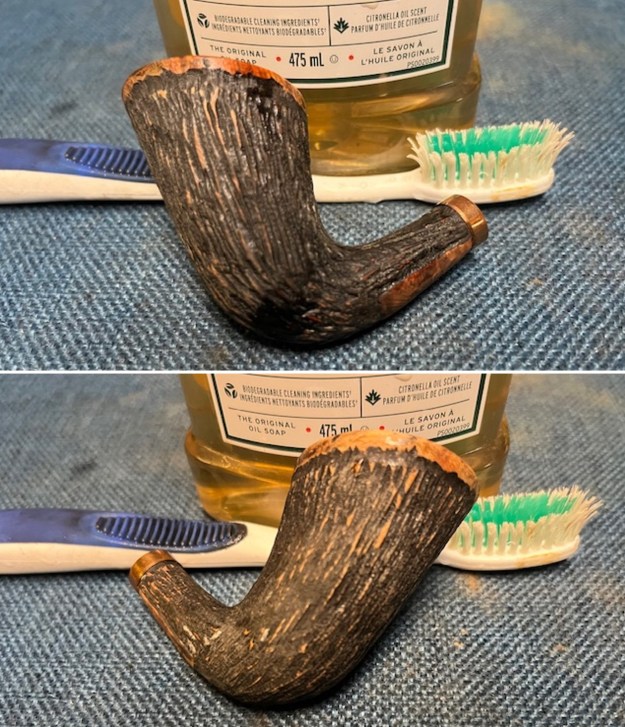
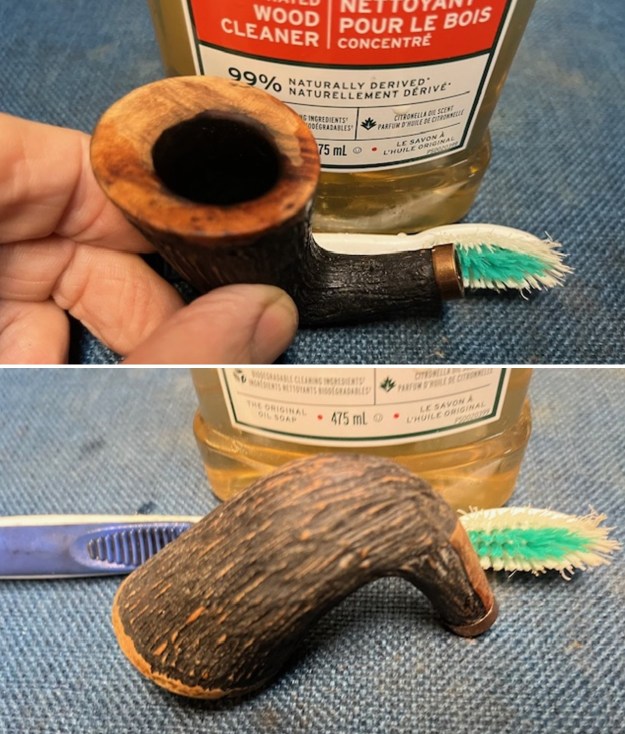
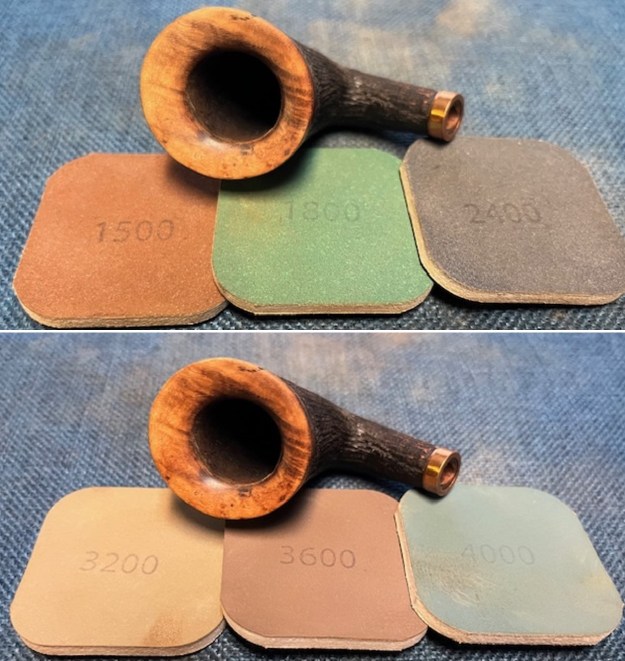
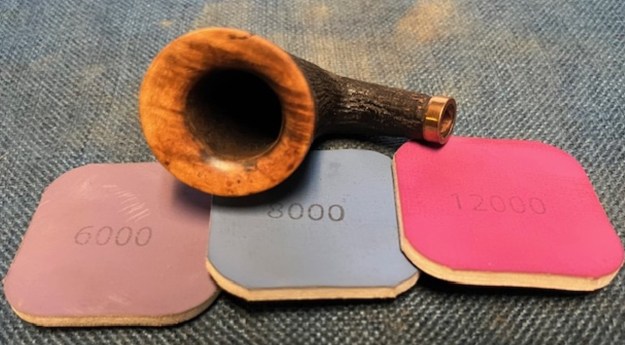
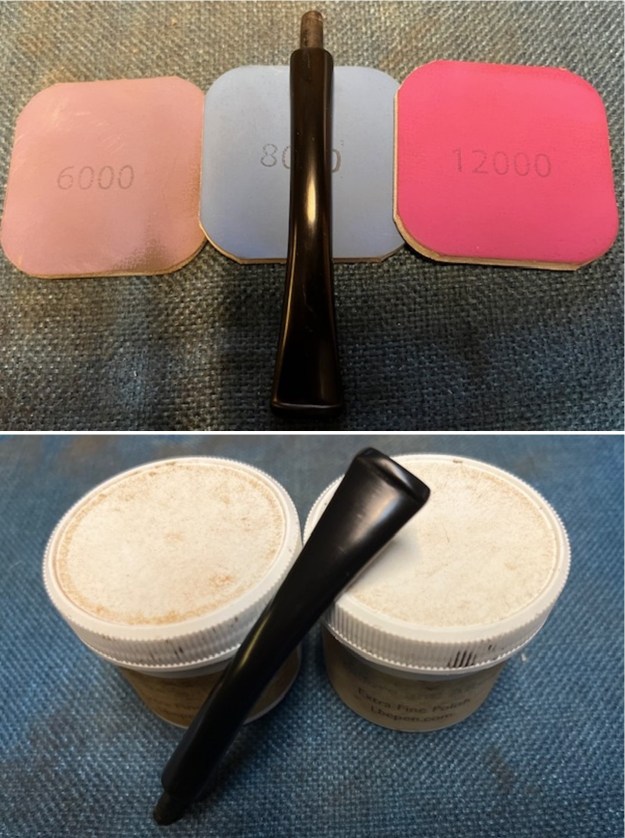
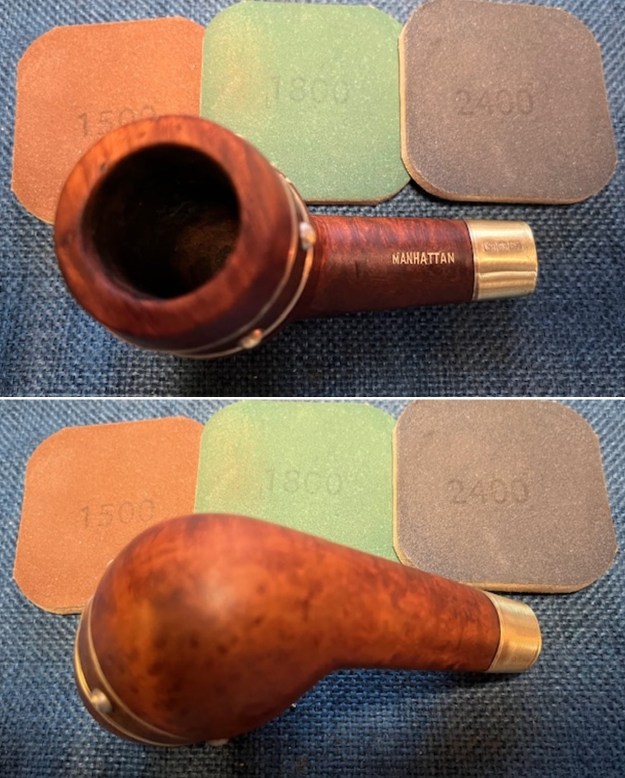
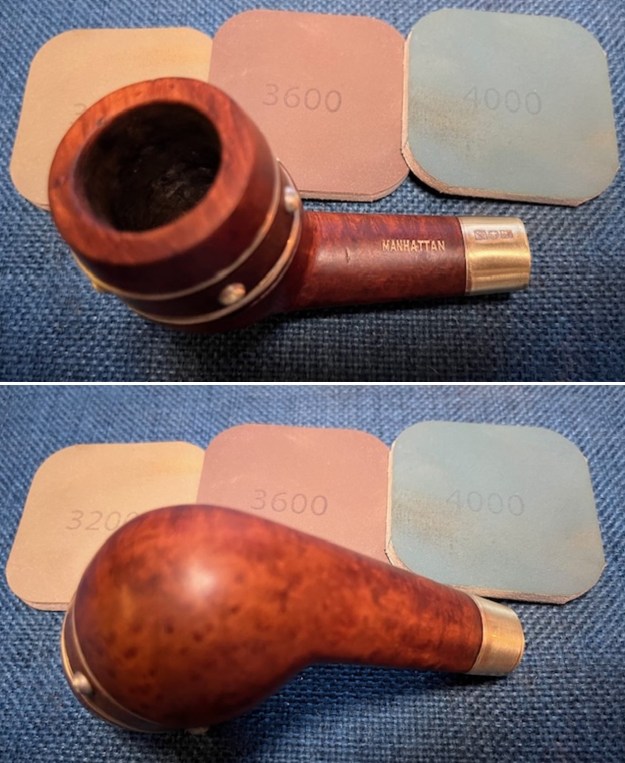
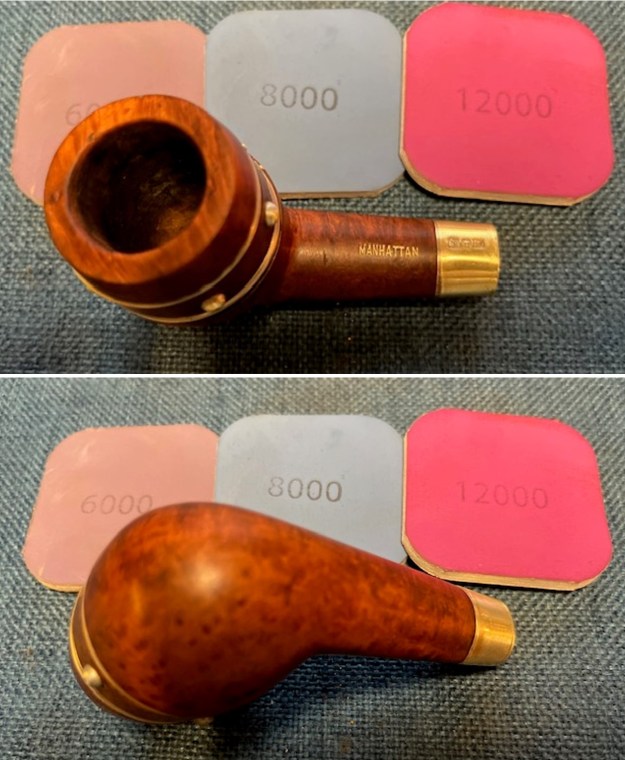
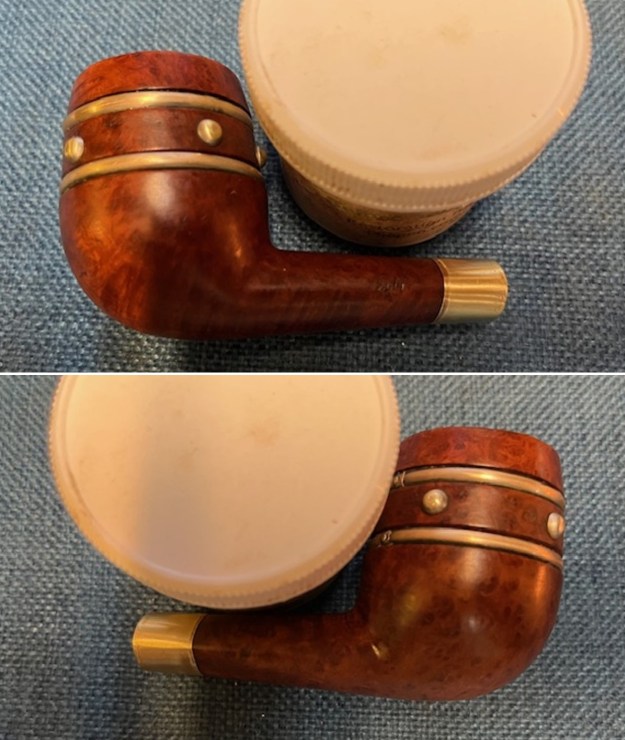
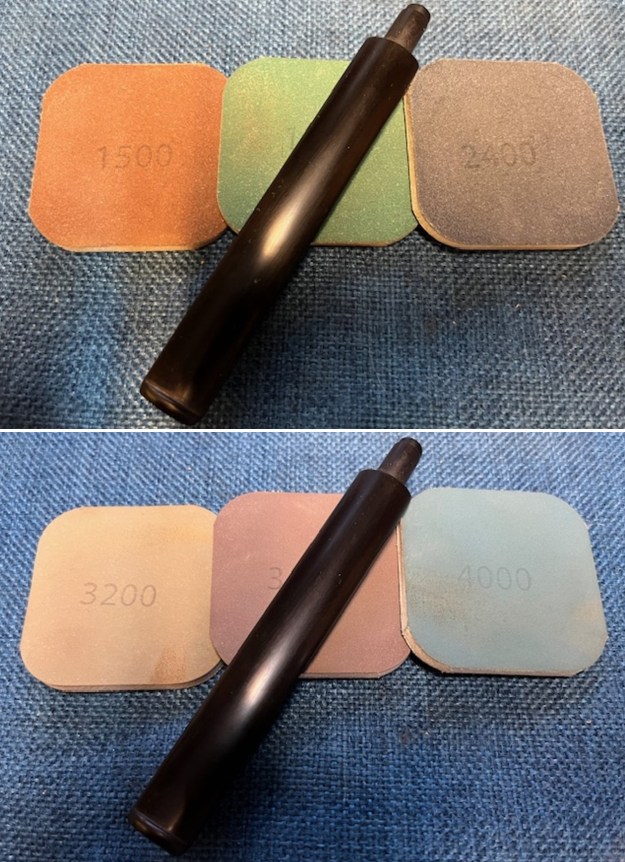
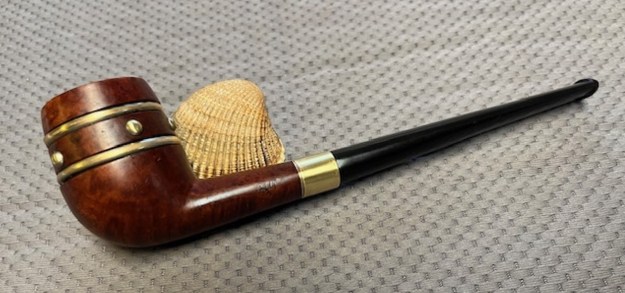
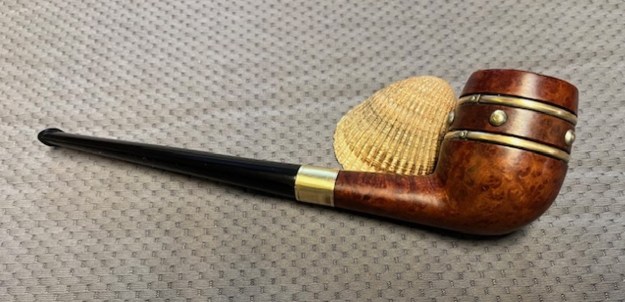
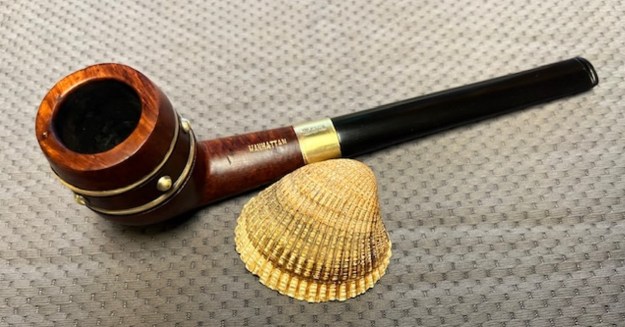
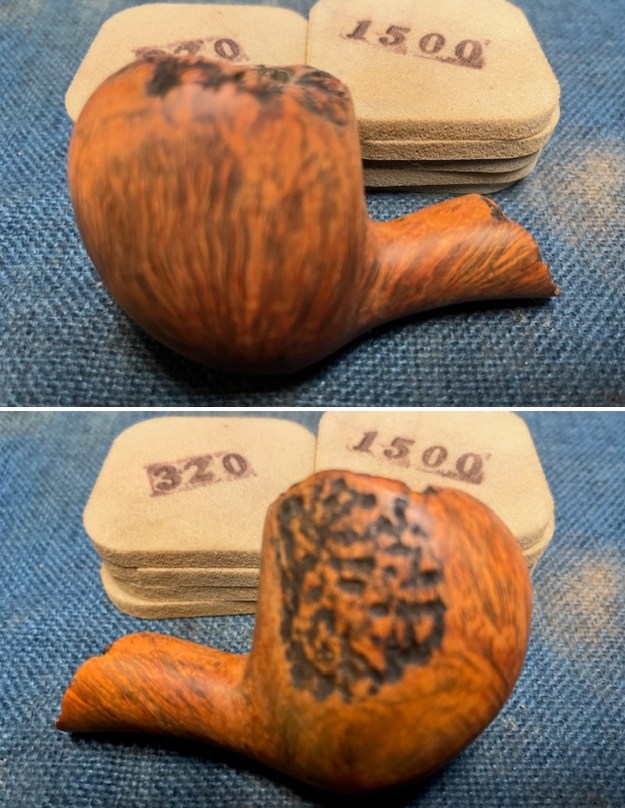
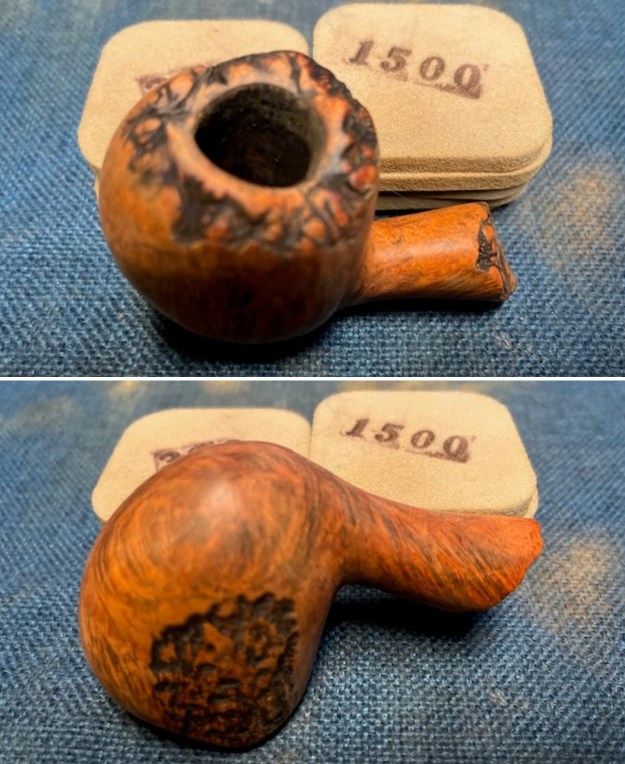
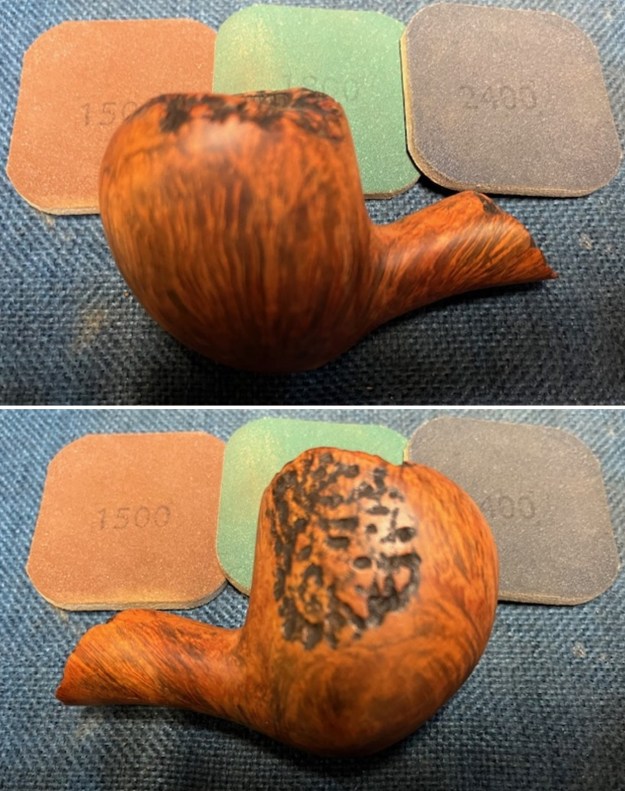
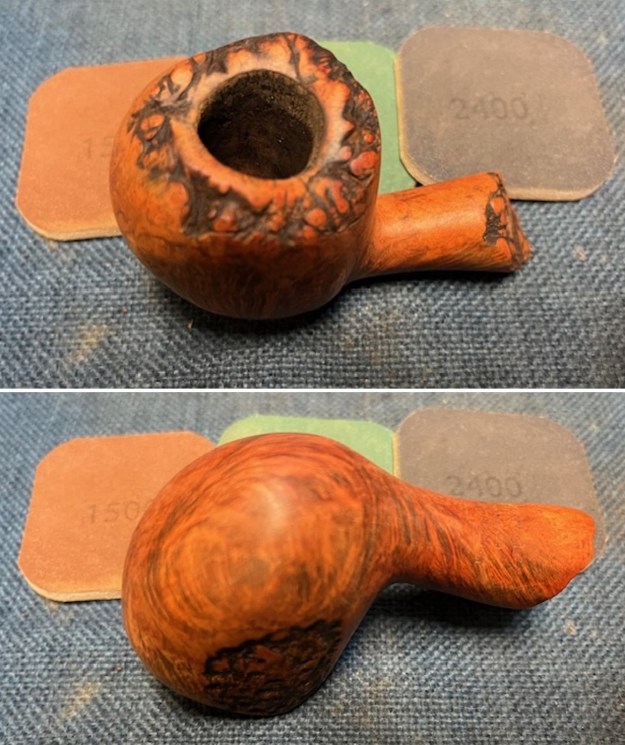
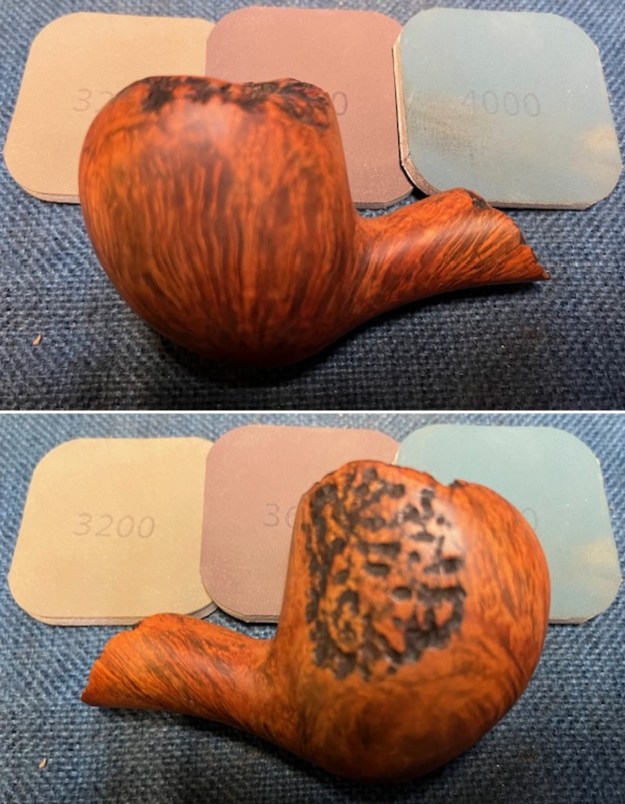
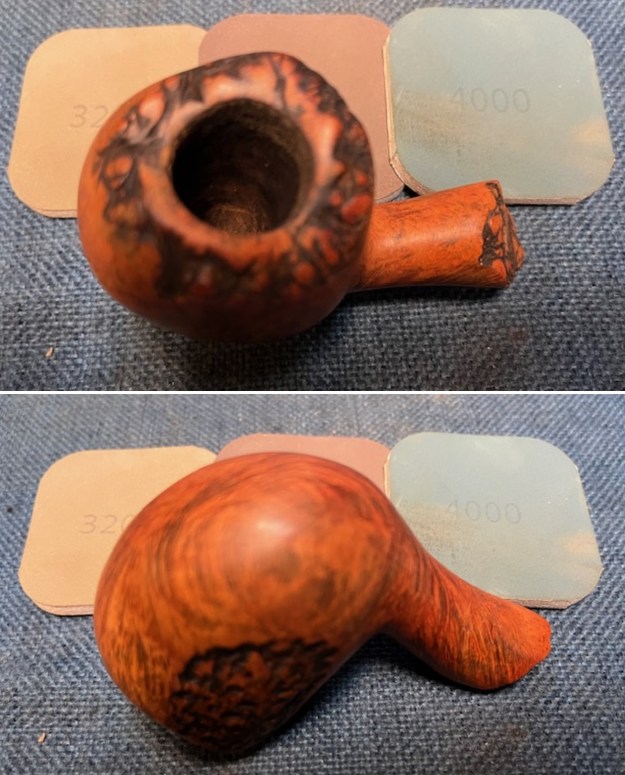
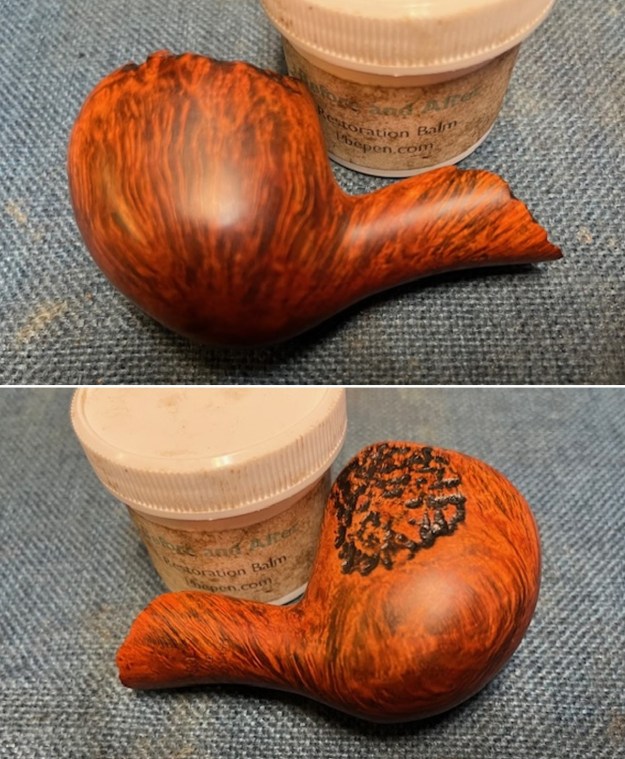
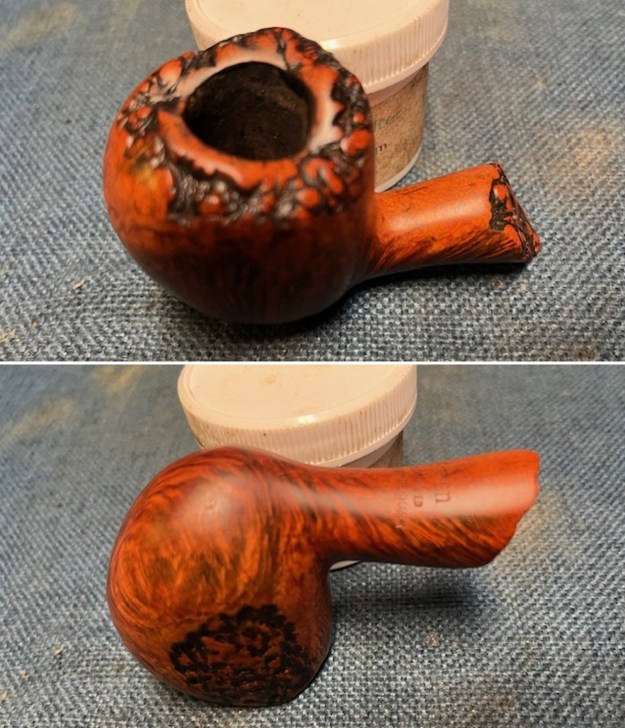
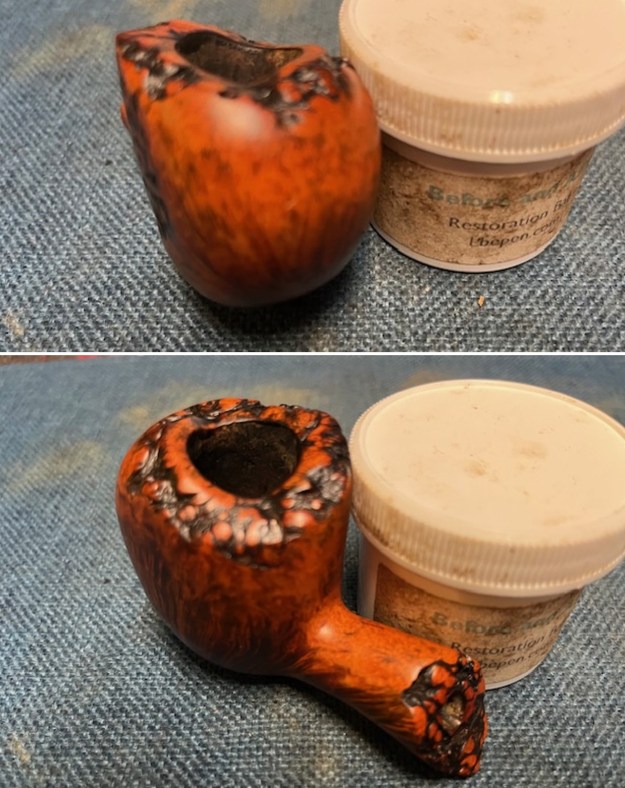
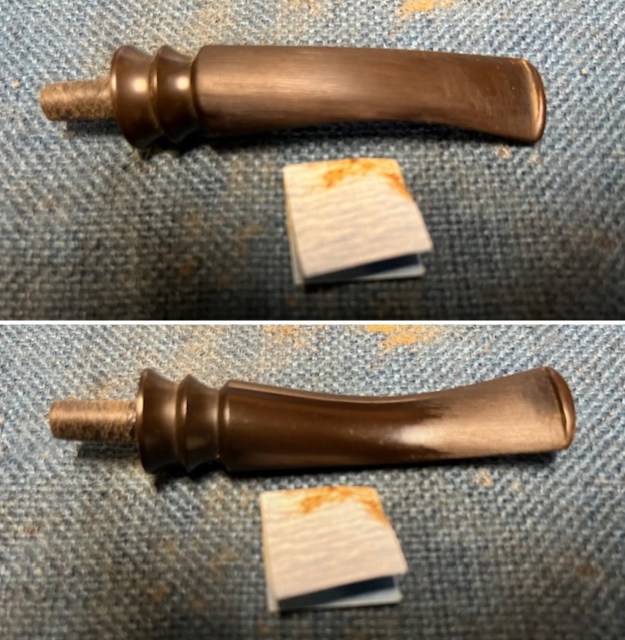
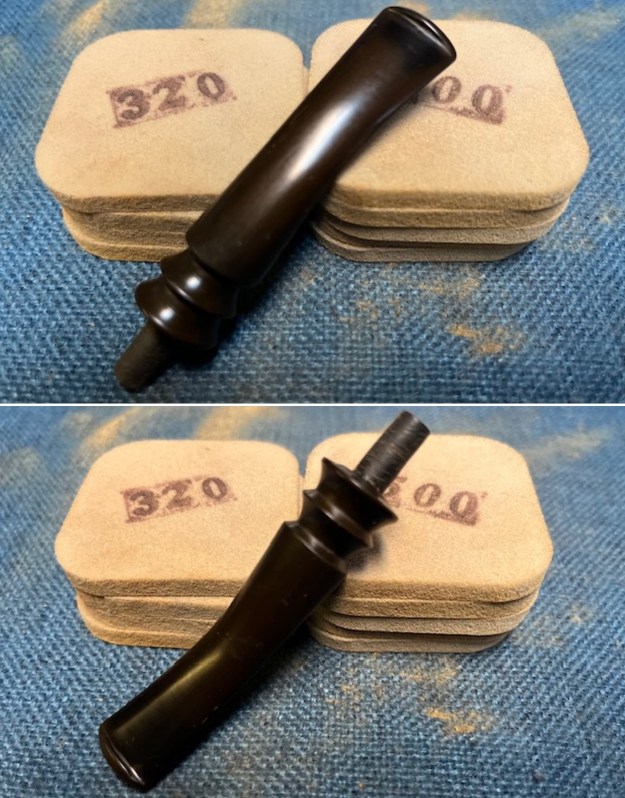
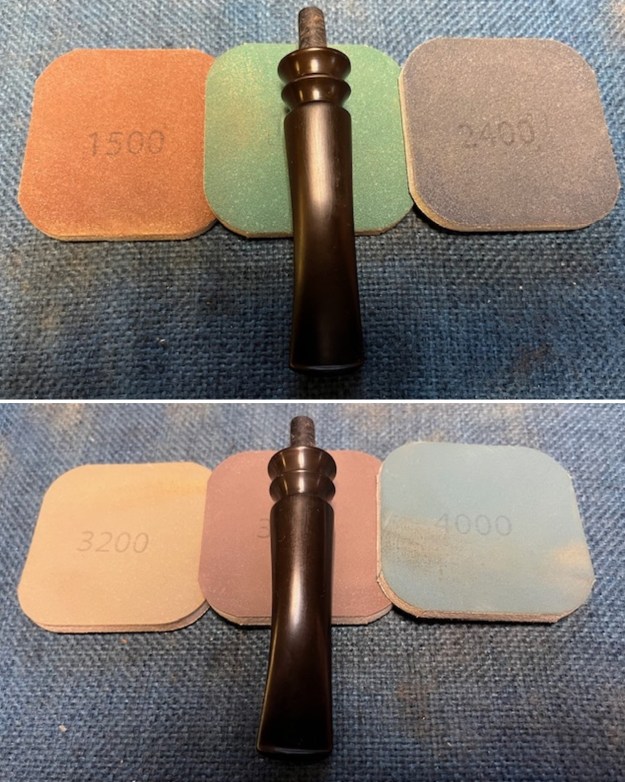
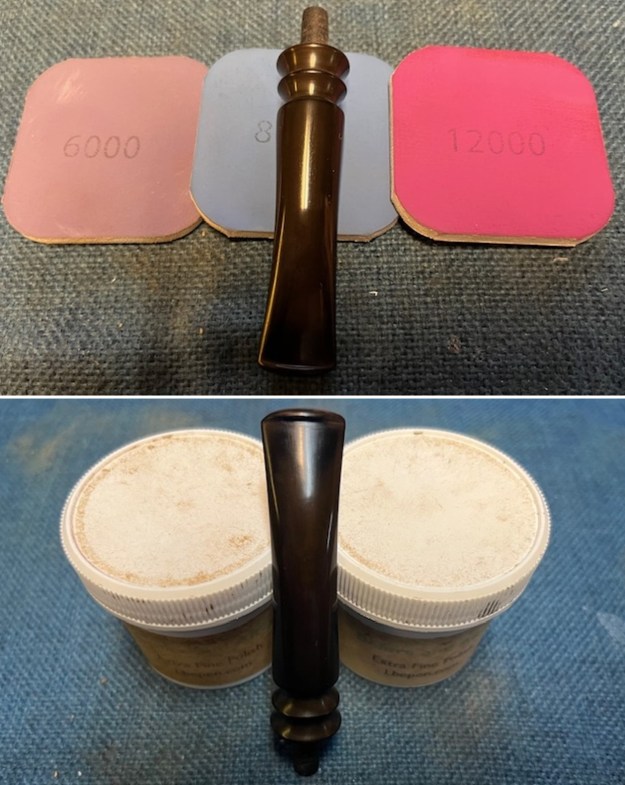
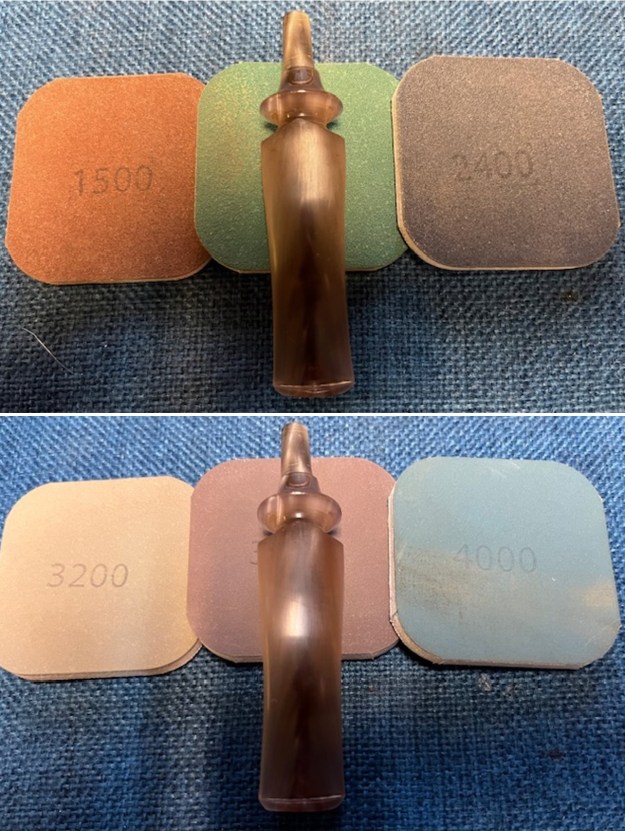
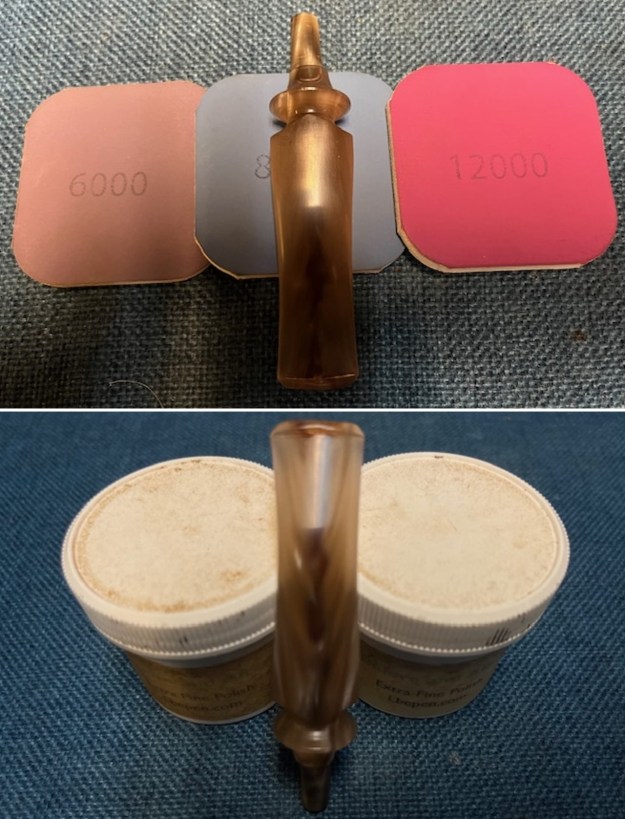
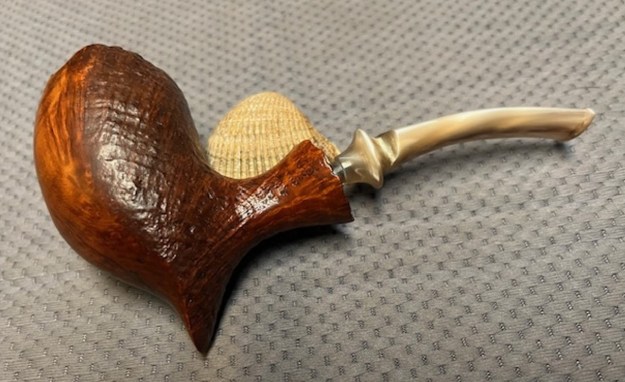
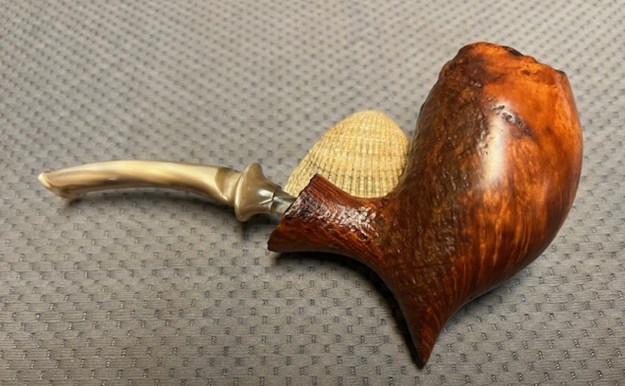
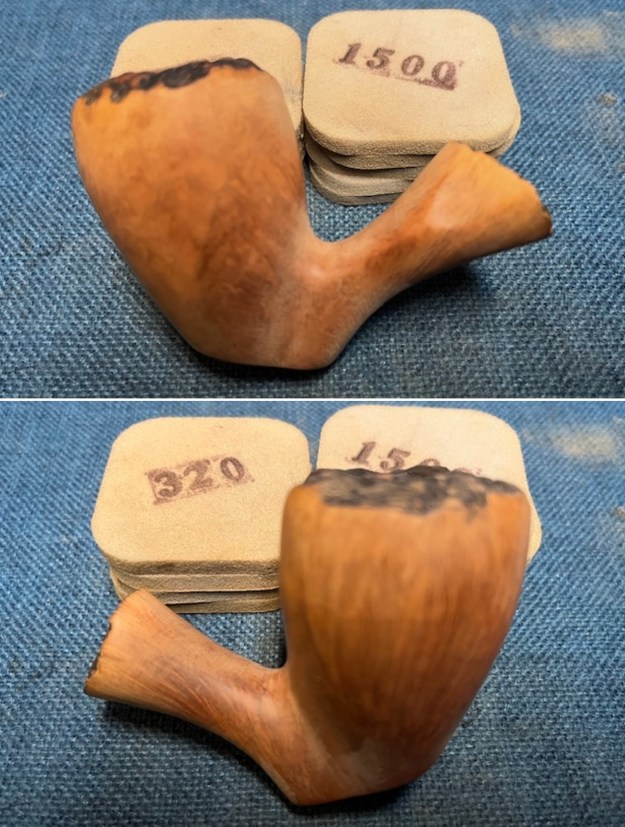
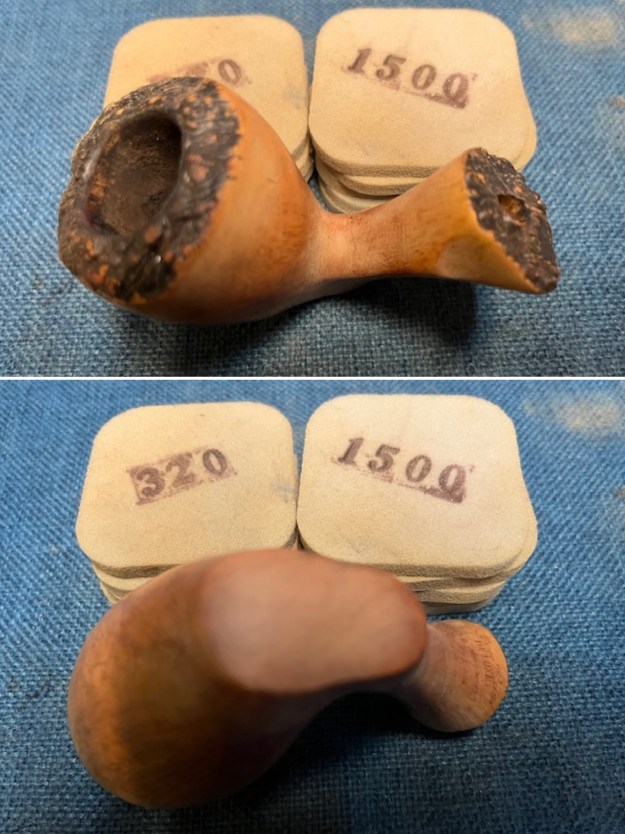
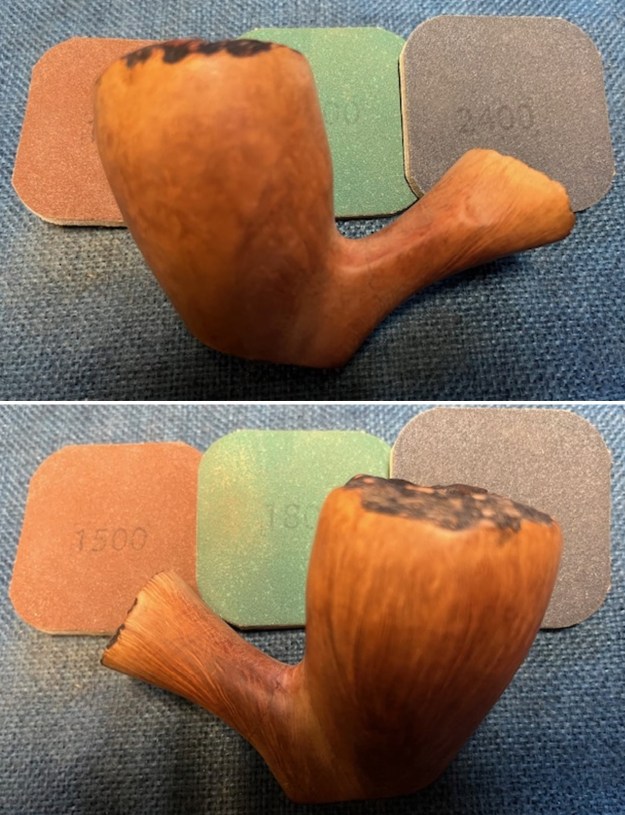
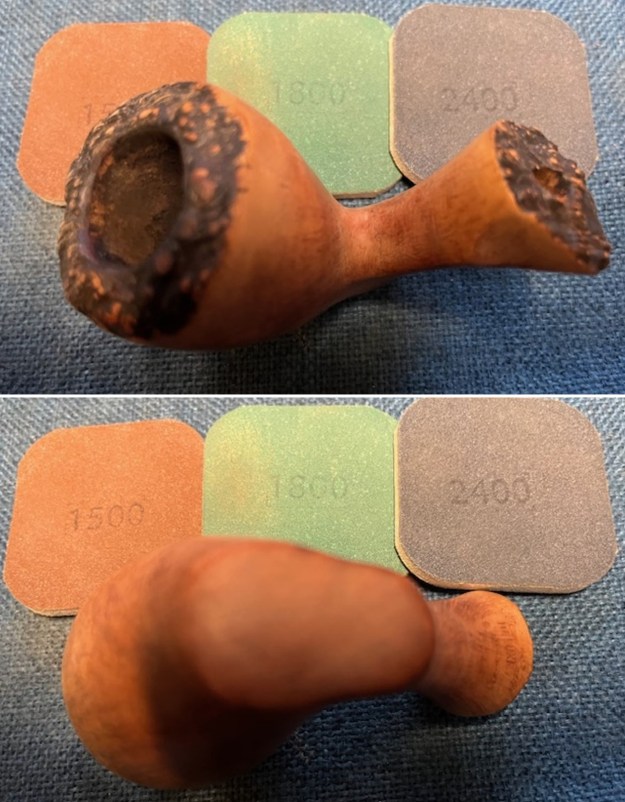
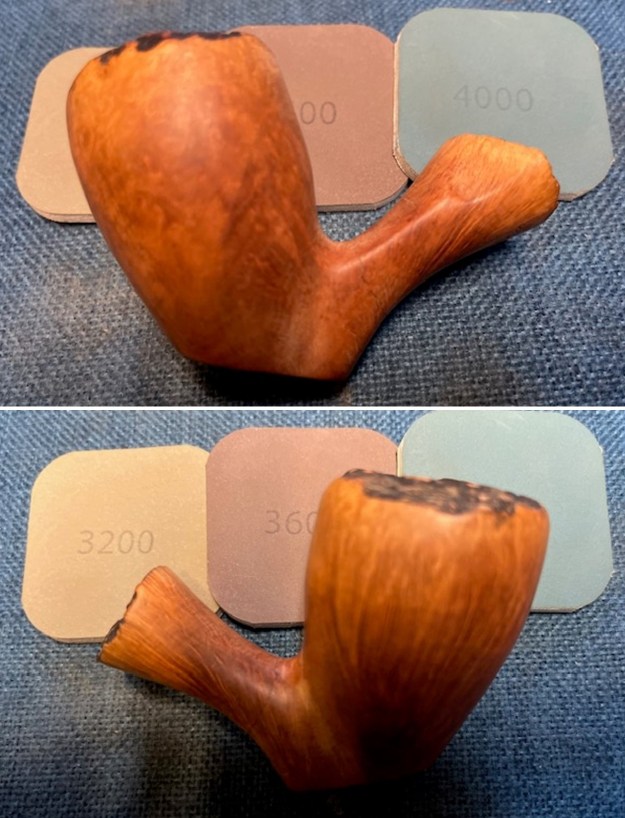
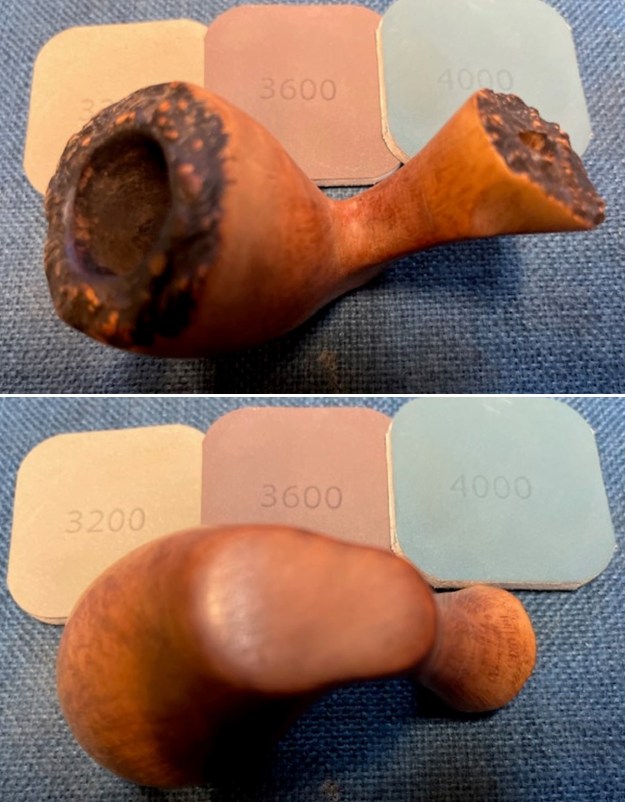
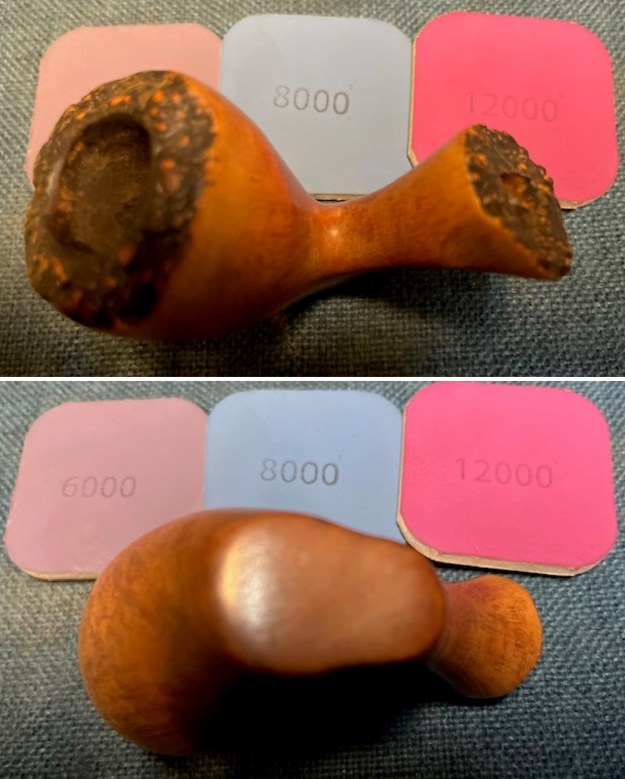
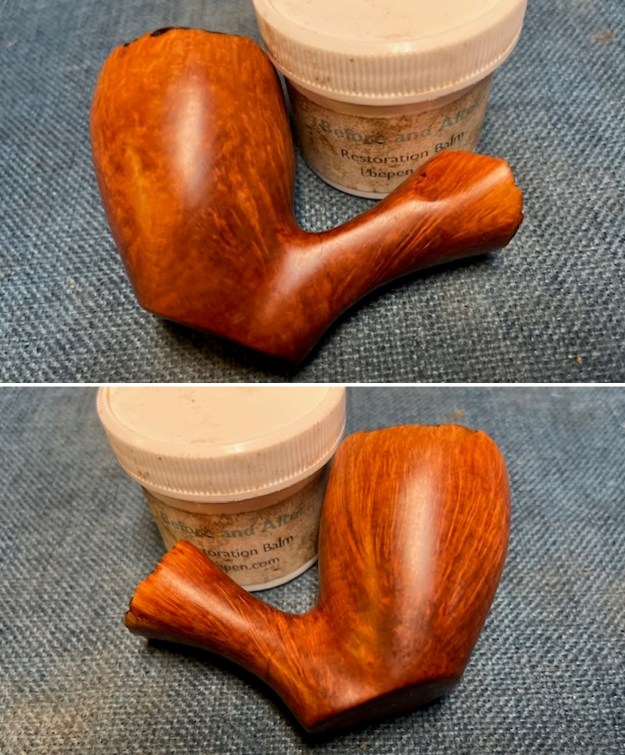
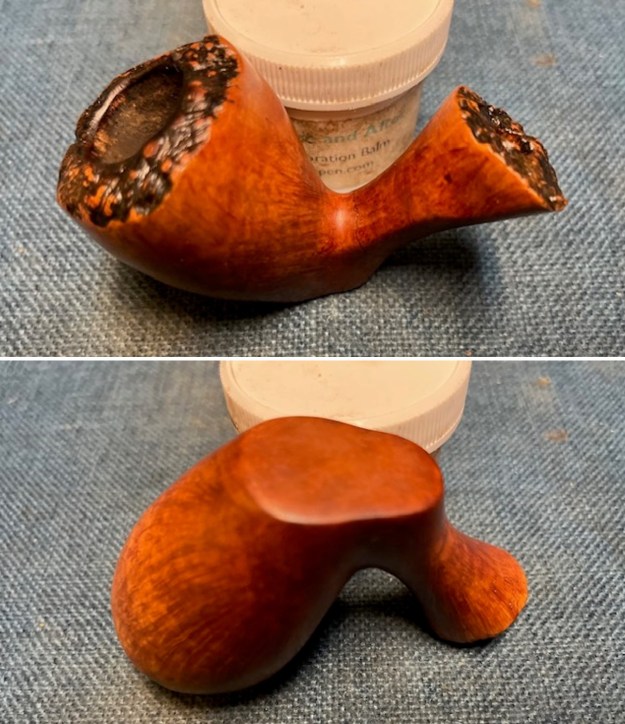
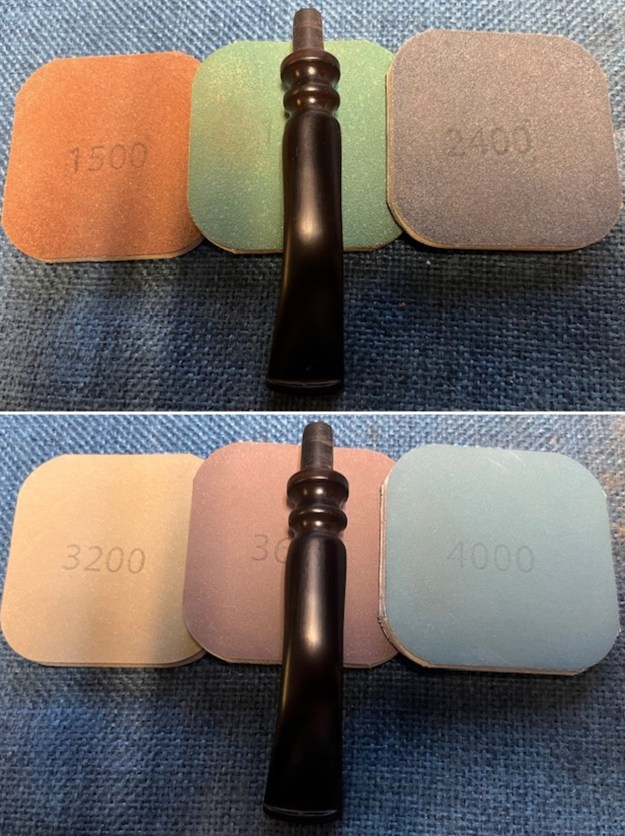
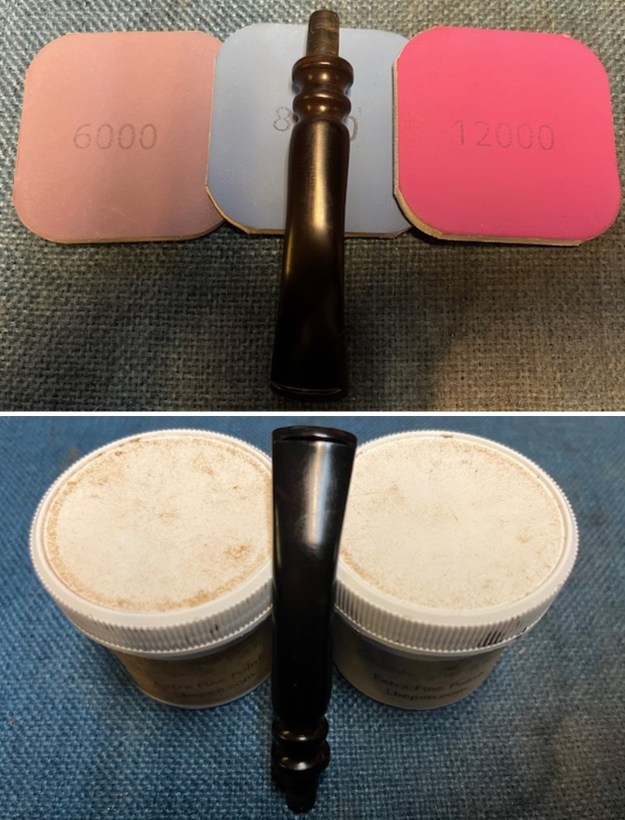
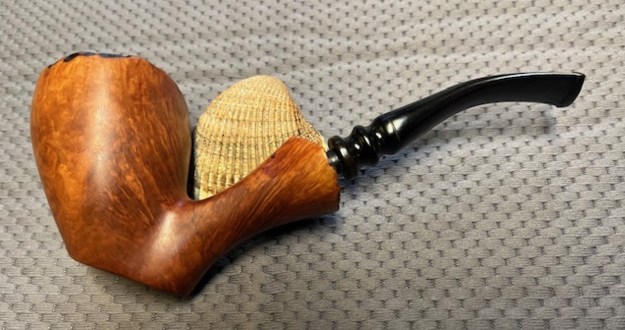
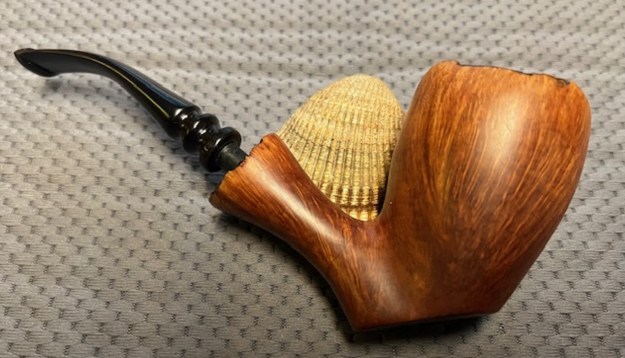
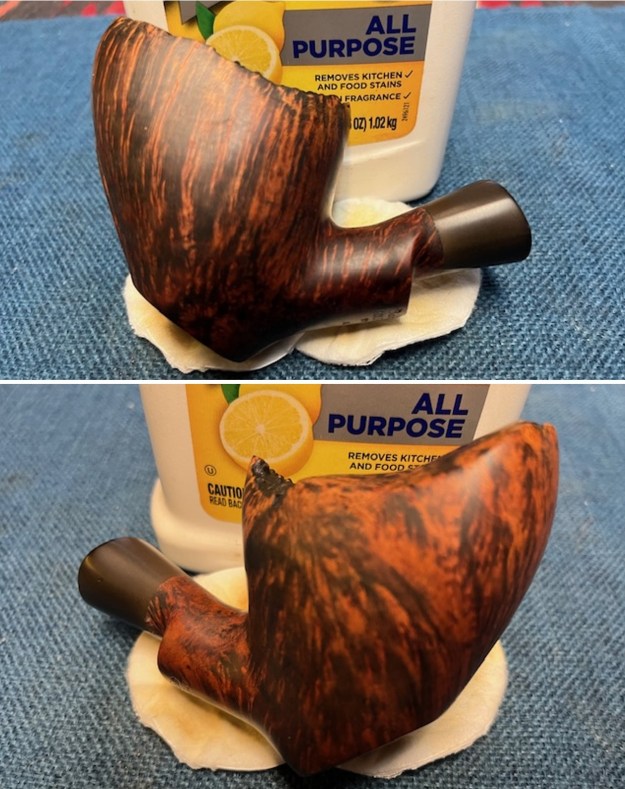
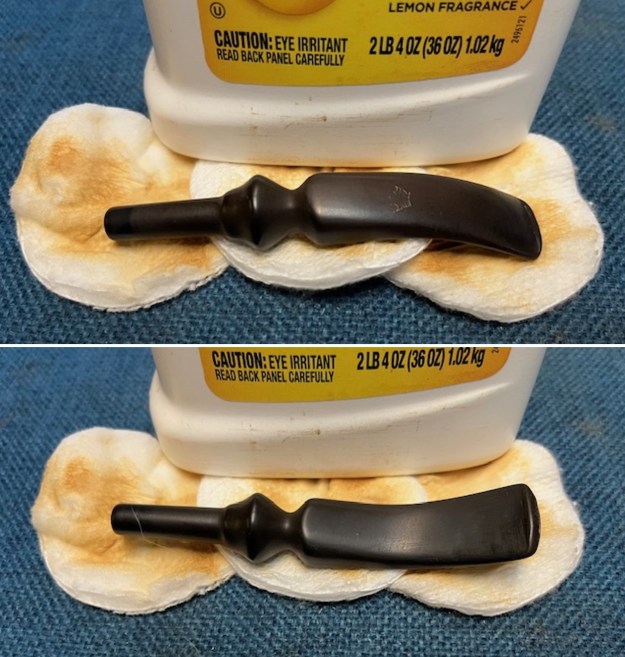
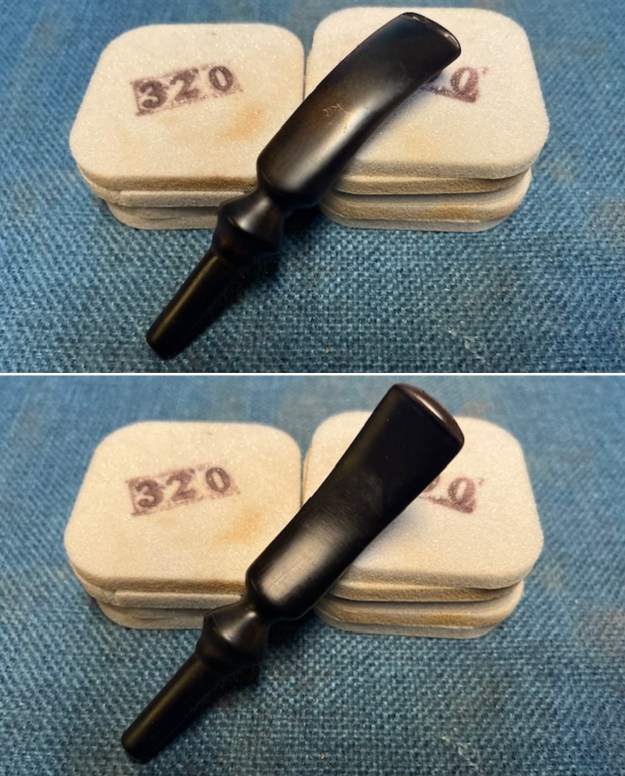
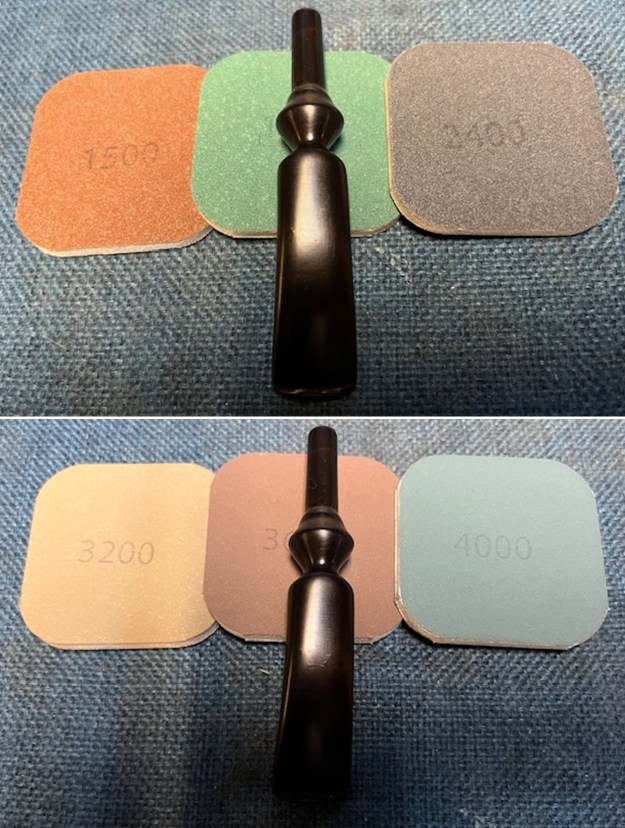
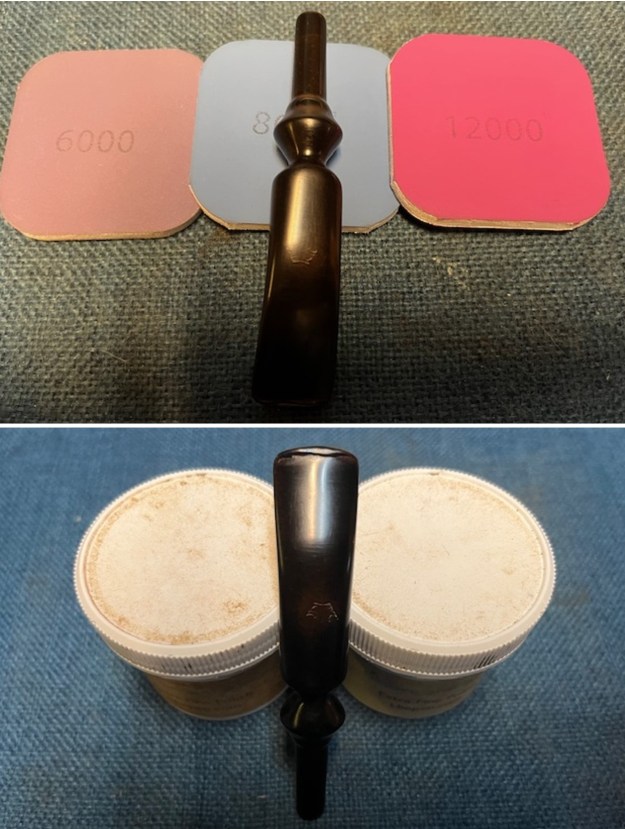
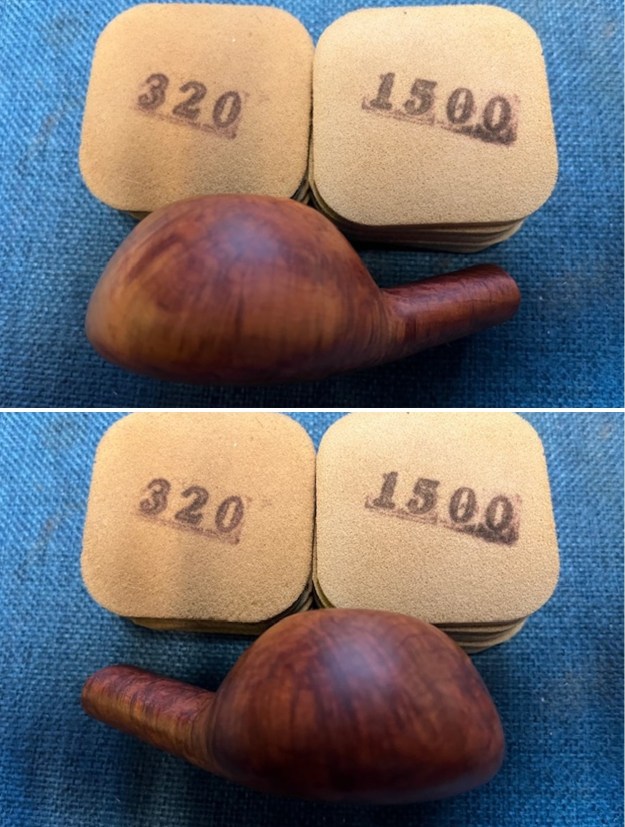
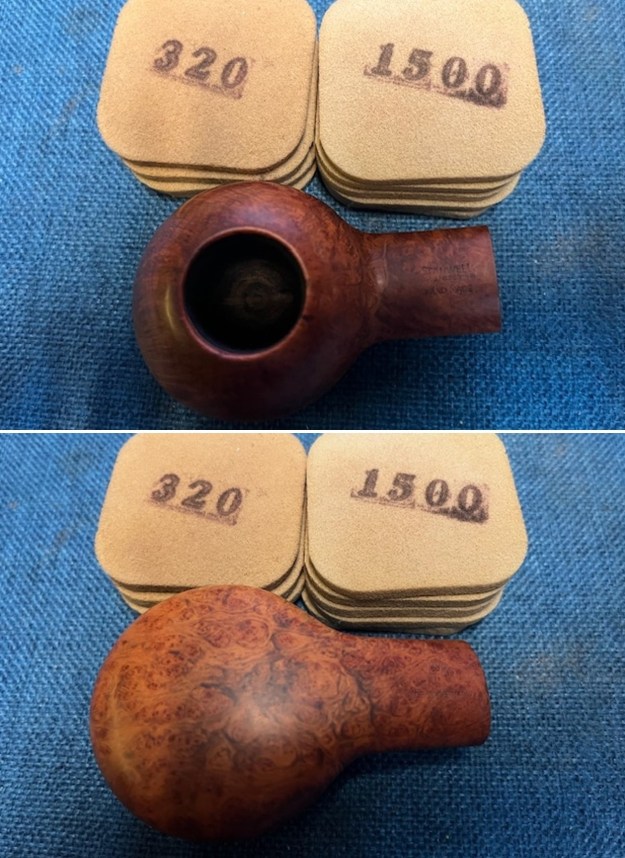
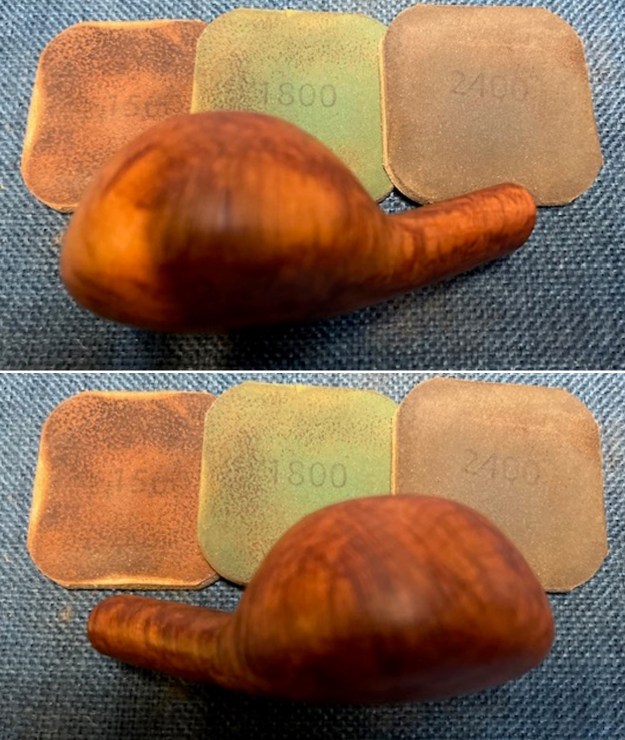
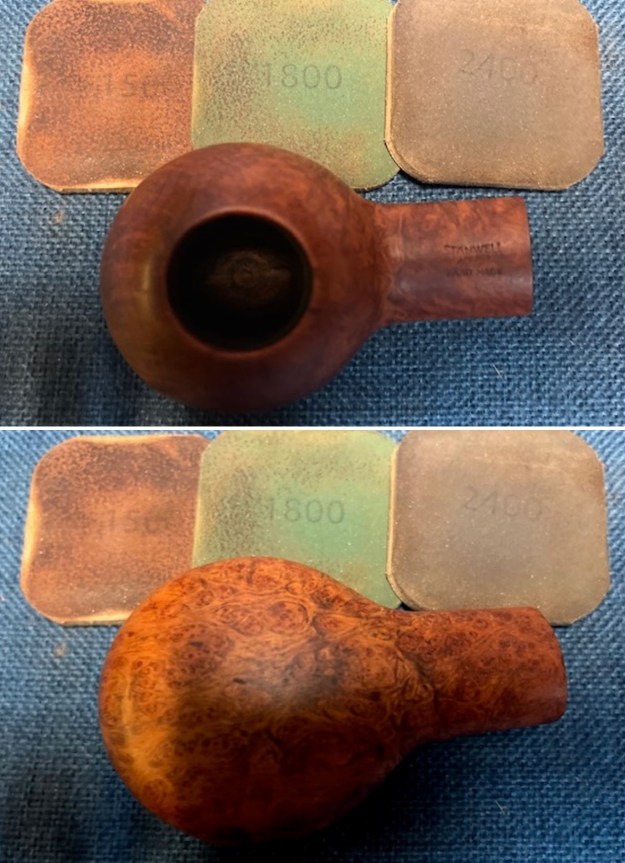
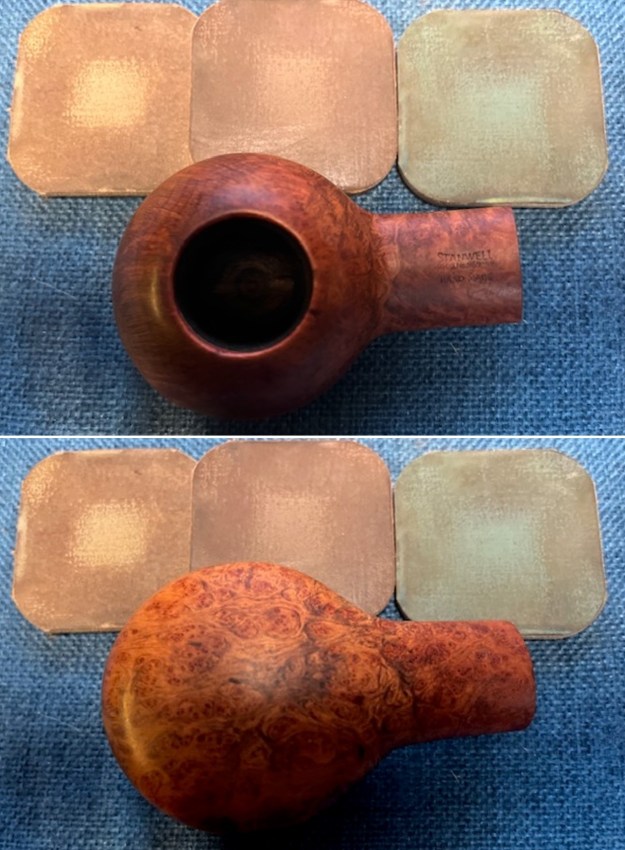
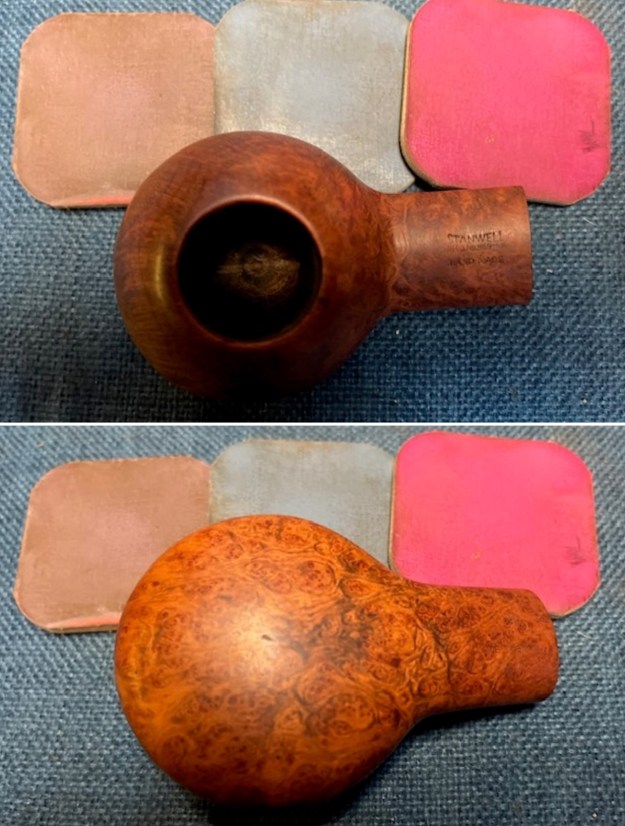
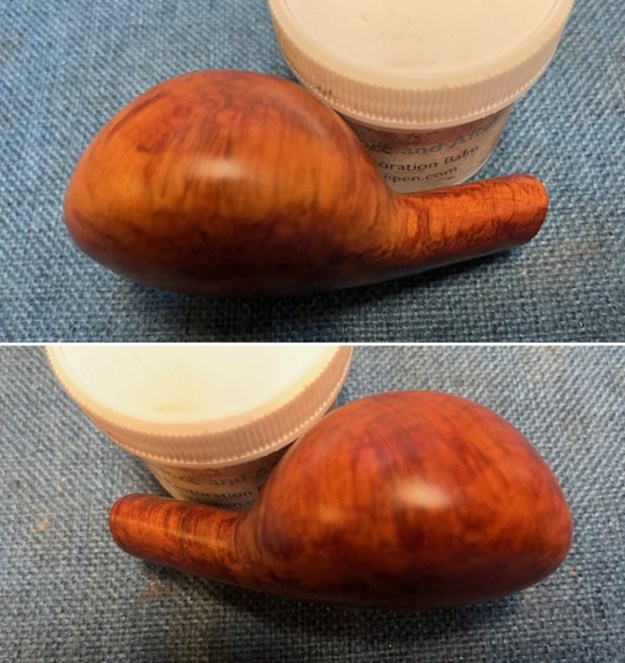
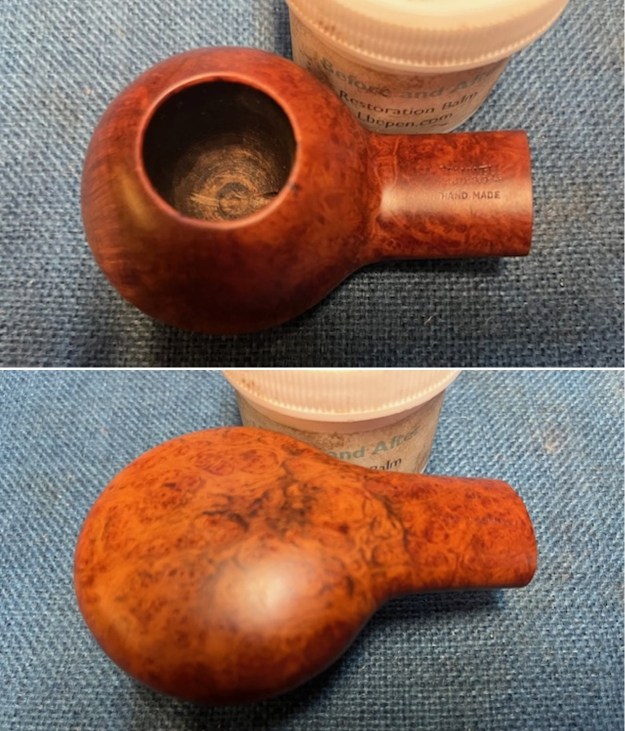
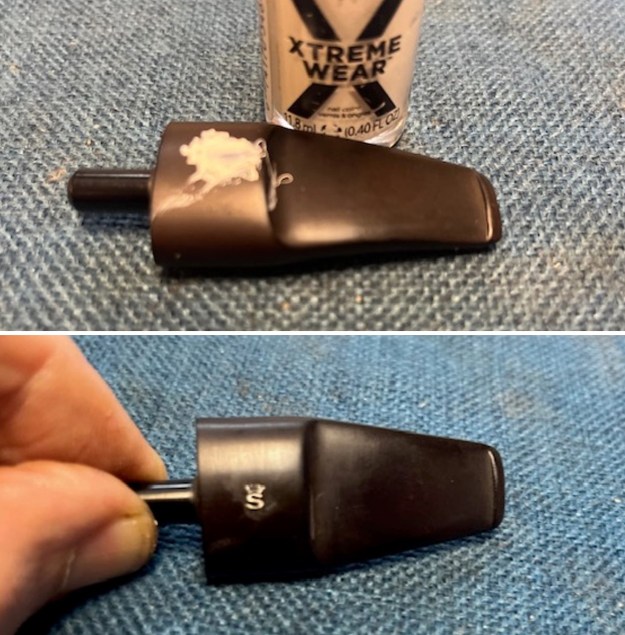
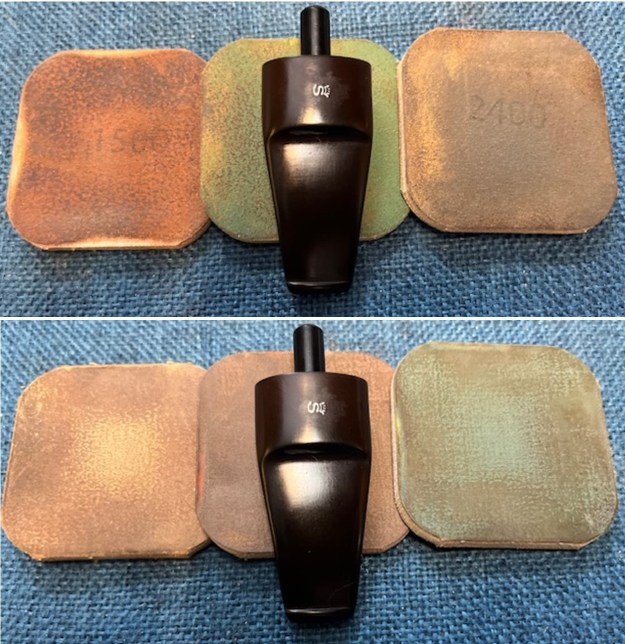
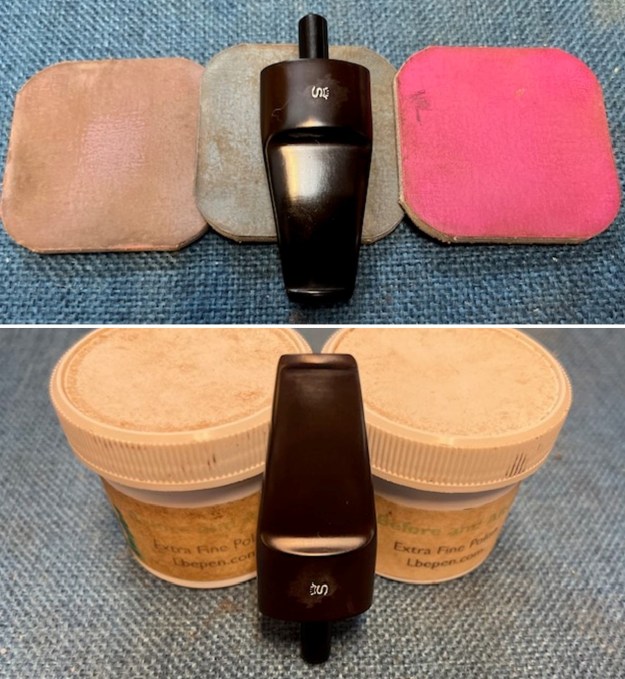
I tried to capture the stamping on the shank underside. It is readable and clear as noted above. I took a photo of the pipe with the stem removed. I started by working on the rim top. I wiped the bow and rim top down with acetone to remove the varnish run marks on the rim top. Once it was wiped down the marks still remained on the top and turned out to be marks from when the bowl was finished (poorly finished on the top). I sanded the rim top with 320-3500 grit sanding pads and wiped it down between pads with a damp cloth to check the progress. It looked much better and was smooth. The scratches were sanded out and feel the way it should feel. I restained the sanded rim top and edges with an Oak stain pen to blend it into the surround colour of the briar. The match was perfect and once the pipe was polished more it would be a great match.I polished the smooth portions of the briar and the vulcanite shank extension with micromesh sanding pads – dry sanding with 1500-12000 grit sanding pads. I wiped the bowl down with a damp cloth after each pad. I wiped the shank extension down with Obsidian Oil. I take photos of the three groups of pads for my own viewing primarily as I am looking for progress in polishing. Once again, by the end of the process it looked quite good. I rubbed the bowl and shank down with Before & After Restoration Balm. I worked it into the surface of the bowl sides and shank with my fingertips. I worked it into the sandblast portions of the finish with a shoe brush. It works to clean, enliven and protect the briar. I let the balm sit for 15 minutes and buffed with a cotton cloth to raise the shine. The grain came alive.  With the bowl finished I decided to put a Papyrate filter on the apparatus at the end of the shank. I took one from the box and carefully slid it in place. The fit is snug and the look is perfect. Now I turned to the stem. I love watching the shine develop on the mixed Carey vulcanite as I polish it with micromesh sanding pads – dry sanding with 1500-12000 grit pads. I wiped it down after each pad with Obsidian Oil. I finished this part of the polishing by using Marks Hoover’s Before & After Pipe Stem Polish – both Fine and Extra Fine. I wiped it off with a soft cloth and gave the stem another coat of Obsidian Oil. This Carey Magic Inch Pat. No. 3267941 Bent Calabash is a great looking pipe with some interesting sand blast on the front and right side of the bowl and vulcanite shank extension. The fact that it is stamped Israel fits as I have worked on Alpha Pipes of similar shape and style. The beautiful grain around the smooth portions and sandblast on the other portions of the bowl is quite stunning and works well with both the shape and the polished vulcanite shank extension and the polished Carey Magic Inch style stem. I put the stem back on the bowl and carefully buffed the pipe with Blue Diamond on the buffing wheel using a light touch on the briar. I gave the bowl and the stem multiple coats of carnauba wax on the wheel and followed by buffing the pipe with a clean buffing pad. I hand buffed the pipe with a microfiber cloth to deepen the shine. The finished Carey Magic Inch Calabash fits nicely in the hand and feels great. Give the finished pipe a look in the photos below. The dimensions of the pipe are Length: 6 ½ inches, Height: 2 ½ inches, Outside diameter of the bowl: 1 ¾ inches, Chamber diameter: 1 inch. The weight of the pipe is 63 grams/2.22 ounces. I will be putting the pipe and the briar pipe rest on the rebornpipes store in the Pipes From Various Makers Section shortly. If you wish to add this interesting pipe to your rack it is a great addition. Send me a message or an email. Thanks for reading this blog and my reflections on the pipe while I worked on it. I appreciate your support and time!

Restoring an older MLC Redmanol French Briar Crosby Style Pipe with a Redmanol Stem


by Steve Laug

This older MLC billiard (almost a Bing Crosby shape though certainly a predecessor) is early 20th century pipe. It came to us from Mark in Missoula, Montana, USA and was a pipe from his Grandfather’s collection. He sent us a cigar box of pipes from that collection that included a lot of interesting pipes for us to work through. Mark also included a biographical sketch on his Grandfather, W.B. Bollen (written by Mark’s Father). His Grandfather, WB Bollen was quite involved in the state of Oregon and the Pacific Northwest of the USA in the field of agriculture through Oregon State University in Corvallis, Oregon. The sketch is called Recollections of W.B. Bollen and I am in the midst of reading it while I work on the first of these pipes – the MLC Billiard. According to Pipedia, (https://pipedia.org/wiki/M._Linkman_%26_Co) the initials MLC stand for M. Linkman Company which was thought to mean Mary Linkman Company. They were a Chicago based company that produced both briars and meerschaums. The company was named for the mother of the same Linkman who branded pipes under that same name and then eventually became the Dr. Grabow pipe manufacturer with which we are familiar. Pipephil’s site gave a little more information at this link (http://www.pipephil.eu/logos/en/logo-l4.html). M. Linkman and Co. was established by Louis B. Linkman and August Fisher in 1898. The company closed down in the 1950s and the Dr Grabow branch was sold to Henry Leonard and Thomas Inc.(HLT), There was also a note that early Linkman’s pipes were stamped MLC in an oval.

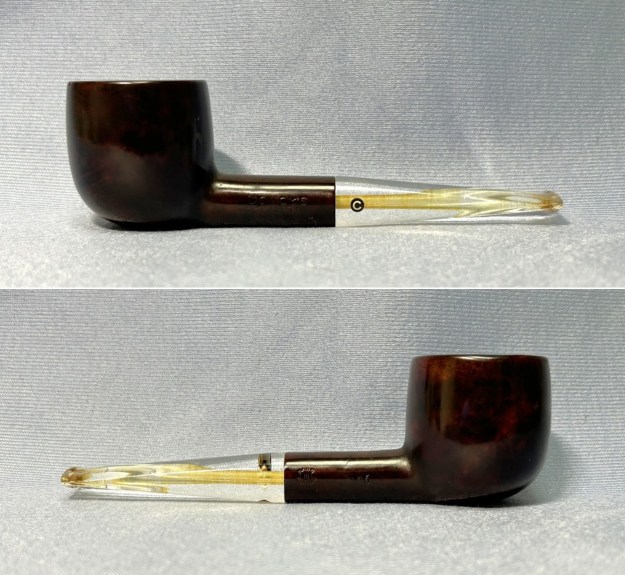
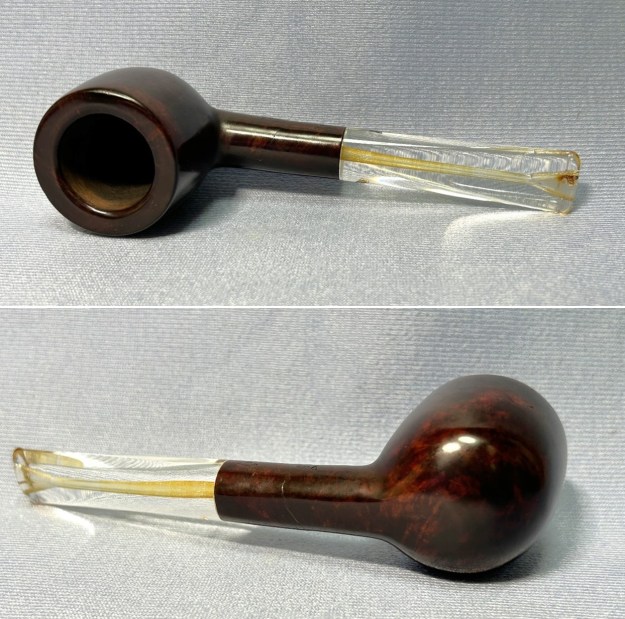
I have written a bit more about the MLC brand on several early blogs (https://rebornpipes.com/2016/11/12/an-interesting-the-nuvo-mlc-italian-briar-hidden-in-a-wdc-case/ https://rebornpipes.com/2017/08/17/restoring-a-sad-old-mlc-bent-billiard/). The second link included this older photo of the Linkmans that is really fascinating. I am including it below.If you have followed this blog for a while you have come to know that I love really old pipes and this one fits into that category of pipes. It is stamped MLC in an oval over Redmanol over French Briar on the left side of the shank. The stamping is faint but readable with a light and lens. There are no other stampings on the briar. The band is Sterling Silver and is dented and worn but also bears the MLC oval logo stamped on the topside. It is a pencil shank billiard with a thin “unbreakable” tube lined Redmanol stem. The bowl exterior was absolutely filthy. There was darkening and oils ground into the briar. The thick cake in the bowl and the lava coat on the edges and rim top made it hard to know what the condition of the rim edges. There also appeared to be a thin hairline crack on the backside of the bowl from the rim edge about 2/3 of the way down to the shank. There was also a large silver “O” on the front of the bowl which I believe refers to Oregon Agricultural College (which later became Oregon State University). As with other schools in the 1920s pipes were made honouring the institution and were available to graduates and students. This fits the time frame for this pipe. W.B. Bollen received his BS in Horticulture in 1921 and an MS in Soil Bacteriology in 1922, both from Oregon Agricultural Colledge. I am fairly certain that this dates the pipe that I am working on. The Redmanol Stem was in good condition with the usual chips, nicks and tooth marks of a pipe that is over 100 years old. Jeff took the photos that follow before started the cleanup. You can see from the photos the condition of the pipe.He took photos of the rim top and bowl to show the condition of the pipe. You can see the thick cake, the lava on the rim top, an out of round inner edge and a potential crack on the rim top at the back of the bowl. He also took photos of the Redmanol stem to show its condition as noted above. He took photos of the sides of the bowl to show the grain underneath the dirt and grime ground into the finish. You can also see the nicks in the briar and the oxidized silver O that is on the front of the bowl. There is a lot of beauty underneath the grime. While he was unable to capture the stamping on the shank side he was able to capture the stamping on the silver band. Underneath the oxidation and scratches, it is still clear and reads MLC in an oval over Sterling.Now that I knew a bit of the history of the pipe both in terms of the maker and the pipeman who enjoyed it, I turned to work on the pipe itself. Jeff had thoroughly cleaned up the pipe. He had reamed the pipe with a PipNet pipe reamer back to bare briar and removed the remnants of the cake with a Savinelli Fitsall Pipe Knife. He scrubbed the bowl with undiluted Murphy’s Oil Soap and a tooth brush. He rinsed it under running warm water to remove the soap and grime. He cleaned out the inside of the shank and the airway in the stem with alcohol, cotton swabs, pipe cleaners and shank brushes. He soaked the stem in Briarville’s Pipe Stem Deoxidizer and rinsed it off with warm water. I took photos of the pipe before I started my part of the restoration work.  I took photos of the bowl and rim top to show the clean condition. The damage on the inner edge of the bowl is evident as is the crack on the rim top above the crack on the back of the bowl. The crack extends across the rim top and just slightly into the bowl. That is to be expected. The bowl walls look very good. The Redmanol Stem looks very clean and the chips and nicks are visible the length of the stem. The silver band looks far better.I tried to capture the stamping on the shank side and band in the photos below. They are faint and very hard to capture. It is there but hard to see with out a lens. I removed the stem from the shank and took a photo of the parts of the pipe. It is a beautiful pencil shank pipe. I also took a photo of the Silver “O” on the bowl front. It is nicely done and the tarnish is gone. I decided to address the out of round inner edge of the bowl first. I used a folded piece of 220 grit sandpaper to smooth out the damage on the edge and to give it a slight bevel to bring it back to round. I sanded out the damage on the rim top to smooth it as well. It definitely looks better.I turned to deal with the crack in the back of the bowl that I mentioned above. The first photo sows the crack. It is hairline and starts on the rim top as shown above and extends down the bowl about 2/3 of the distance to the shank. It is a single crack so I used a small micro Drill bit on my Dremel and put a small hole at the bottom of the crack to stop it from going further. You will notice some small nicks in the surface of the briar where the drill hit as I guided it to the crack end.I wiped the back of the bowl down with alcohol on a cotton pad to clean up any debris from the drilling and any that might be in the fine crack. I ran a thin bead of clear CA glue down the crack and in the drill hole and nicks. I used a dental spatula to press fine briar dust into the crack through the glue. Once it cured I sanded the repaired area with a folded piece of 220 grit sandpaper to smooth out the repair. I polished it with a 400 grit sanding pad and then stained the area with a Cherry stain pen to match the rest of the surrounding briar. I polished the briar with micromesh sanding pads – dry sanding with 1500-12000 grit sanding pads. I wiped the bowl down with a damp cloth after each pad. I take photos of the three groups of pads for my own viewing primarily as I am looking for progress in polishing. Once again, by the end of the process it looked quite good. I rubbed the bowl and shank down with Before & After Restoration Balm. I worked it into the surface of the bowl sides and shank with my fingertips. It works to clean, enliven and protect the briar. I let the balm sit for 15 minutes and buffed with a cotton cloth to raise the shine. The grain came alive. I set the bowl aside and turned my attention to the stem. The scratches, tooth chatter and marks easily were addressed by dry sanding the stem with 320-3500 grit sanding pads. I wiped it down after each pad with Obsidian Oil. It looked very good at this point in the process.I polished the Redmanol stem with micromesh sanding pads – 1500-12000 grit pads to further remove the remaining scratches. I wiped the stem down with Obsidian Oil after each sanding pad. I used Before & After Pipe Polish – both Fine and Extra Fine to further polish the stem. I rubbed it down with a final coat of Obsidian Oil and let it dry. This 1920s MLC Redmanol French Briar Pencil Shank Billiard with a Redmanol stem is a great looking pipe with some interesting scalloping around the sides of the bowl. An added bonus if you are an Oregon Agricultural College Fan there is a silver “O” on the front of the bowl. The beautiful grain around the bowl is quite stunning and works well with both the shape and the polished silver band and “O” and the Redmanol taper stem. I put the stem back on the bowl and carefully buffed the pipe with Blue Diamond on the buffing wheel using a light touch on the briar. I gave the bowl and the stem multiple coats of carnauba wax on the wheel and followed by buffing the pipe with a clean buffing pad. I hand buffed the pipe with a microfiber cloth to deepen the shine. The finished MLC Redmanol French Briar Billiard fits nicely in the hand and feels great. Give the finished pipe a look in the photos below. The dimensions of the pipe are Length: 6 ¾ inches, Height: 1 ½ inches, Outside diameter of the bowl: 1 ¼ inches, Chamber diameter: 7/8 of an inch. The weight of the pipe is 24 grams/.85 ounces. I will be putting it on the rebornpipes store in the American Pipemakers Section shortly. If you are an avid Oregon fan or know one then this is the piece of history for you. Send me a message or an email. Thanks for reading this blog and my reflections on the pipe while I worked on it. I appreciate your support and time!


Is this what you would call an English Walnut Shape on this House of Robertson Pipe?


By Steve Laug

The next pipe on the work table is a unique House of Robertson pipe we picked up. It was purchased from a seller on eBay from Long Beach, California, USA on 07/13/2024. It is a Billiard or maybe an Egg with a rusticated finish that makes it look like the shell on an English Walnut. The name House of Robertson is roughly hand-etched with an engraving tool on the underside of the shank on a smooth panel. This pipe is shaped somewhere between and Egg and a Billiard but really does capture the shape of a Walnut. As you look at the following photos you will see why I am not sure what to call it. The pipe has a unique rustication on the sides of the bowl and shank. The bowl is thickly caked with some lava overflow on the rim top. The outer and inner edges of the rim look to be in good condition. There is some darkening and nicks on the inner edge but nothing horrible. The pipe was dirty but underneath all of the grime it appears to be in excellent condition. It had an oxidized silver band on the shank that is stamped Sterling but I am certain it is cosmetic as there are no cracks showing on the shank end. It is definitely an interesting pipe and should clean up very well. The fit of the stem to the shank was good. The vulcanite taper stem was oxidized and calcified. There are light tooth marks and chatter on both sides near the button. Jeff took photos of the pipe before he started the cleanup. Jeff took photos show the condition of the bowl and the stem. The photos of the bowl and rim show the cake in the bowl and the lava overflowing onto the rim top. The rustication on the top of the bowl and the inner and outer edge of the rim are pretty well covered in lava. It was hard to know what the inner edge and top really looked like until we cleaned it. The silver cosmetic band was heavily oxidized and almost black. The taper stem was oxidized, calcified and had tooth chatter and marks on both sides of the stem near the button. The photos of the sides and heel of the bowl show some stunning and unique rustication all around the pipe. The finish makes the bowl and shank have an almost walnut texture. The next photo shows the etched or engraved with a name on the underside of shank. It reads House of Robertson. The silver band has a faint Sterling Silver stamping on it.I am including the information that I found when I received my first of the House of Robertson Pipes. I found a link on Pipedia that gave me the only information I could find on the brand. I include that in total as it is interesting to read.

“House of Robertson” was in business for many years, but alas, closed their doors in 1999. They were located in Boise, Idaho. They are noted for making rather large and interesting pipes. Thayne Robertson was a Master Mason, AF & AM, and started the shop about 1947 and his son Jon started working there in 1970 when he finished college, along with Thayne’s daughter. Thayne and his son started making the big pipes at that time, and made them together until 1987 when Thayne passed away. Jon kept the store and his sister moved on to other things. The House of Robertson appears to have closed around 1999 (https://pipedia.org/wiki/Robertson).

Since then I have worked on a lot of House of Robertson pipes and have been able to track down more information. I am including a link to a Catalogue that I picked up on eBay. Click on the link and have a look at this interesting book of information on the brand and the pipe maker himself (https://rebornpipes.com/2022/12/11/a-house-of-robertson-catalogue-filled-with-great-examples-of-thayne-robertsons-work/).

I am also including a biography of Thayne Robertson that I found on Facebook from a fellow in Boise, Idaho. It is an interesting read into the mind of the pipe maker. Make sure to take time to read it (https://rebornpipes.com/2021/10/31/house-of-robertson-pipes-boise-pipe-carver-thayne-robertson/).

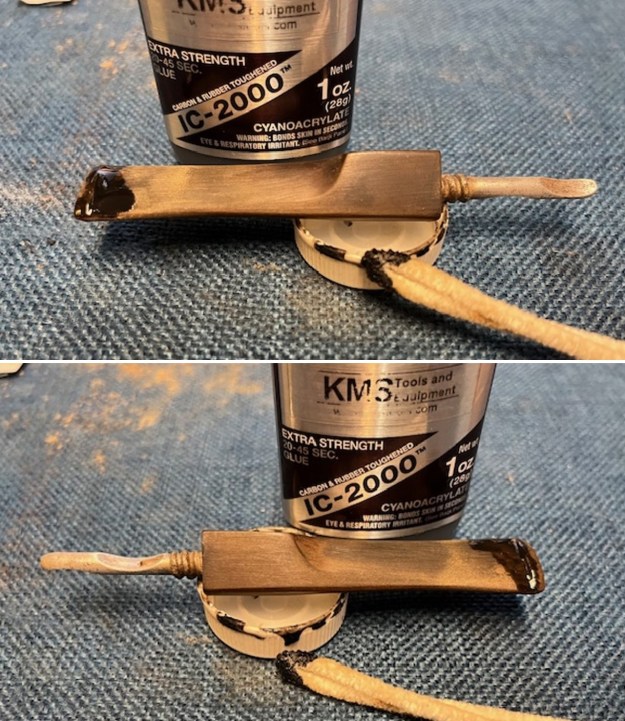
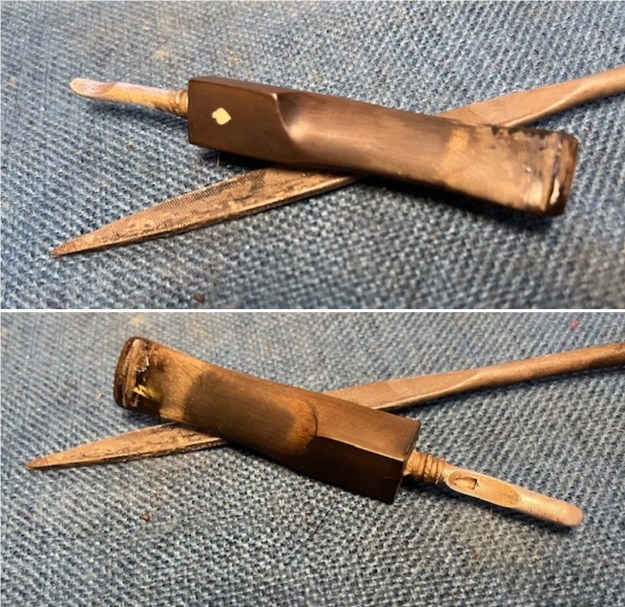
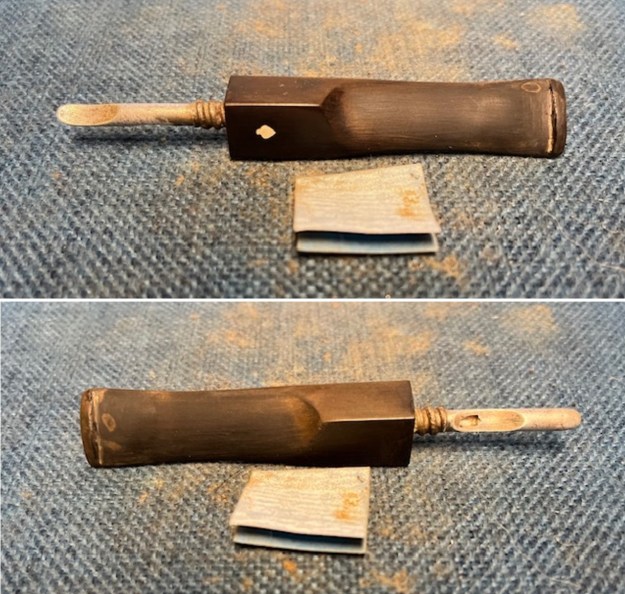
Now it was time to work on the pipe itself. When it gets to Vancouver it my turn to contribute to its restoration. Jeff did a great job cleaning the pipe on the inside and outside. He reamed the bowl with a PipNet pipe reamer and cleaned up the remnants with the Savinelli Fitsall Pipe Knife. He scrubbed out the mortise and the airway in the shank and stem with alcohol, cotton swabs and pipe cleaners. He scrubbed the exterior of the bowl with a tooth brush and Murphy’s Oil Soap to remove the dust in the rustication on the bowl and shank as well as the smooth portions. He rinsed it under running water. He dried it off with a soft cloth. Once the dust and debris were removed the finish was dull but appeared to be in excellent condition. He soaked the stem in Briarville’s Pipe Stem Deoxidizer and rinsed it under warm water to remove the deoxidizer gel solution. I took photos of the pipe to show its condition before I started my work on it. I took a photo of the bowl and rim top to show how well it had cleaned up. There is some rim darkening but you can see the rustication on the top of the bowl. The stem tooth marks and chatter are very light.I took a photo of the engraving on the underside of the shank. It is clear and reads as noted above. I also took the stem off the pipe and took a photo of the parts to give a sense of the proportions of the pipe. It is a beauty.I started my work on the pipe by dealing with the darkening on the inner edge of the rim and the darkening on the rim top with a folded piece of 220 grit sandpaper. It looked much better when finished. However, there was still some darkening in the rustication on the back of the rim top. I scrubbed it with Mark Hoover’s Before & After Briar Cleaner and was able to remove a lot more of the darkening. I put it on the area with my finger tips and worked it into the surface with a tooth brush. I worked over the area with a brass bristle wire brush and then rinsed it off with warm water. The end result is far better than when I started though there is still a bit of darkening. I used an Oak stain pen to touch up the rim top and the cleaned area and the finish look good. I worked Before & After Restoration Balm deep into the smooth finish to clean, enliven and protect the briar. I hand rubbed it with my fingers and a shoe brush to work it into the finish then set it aside to dry for 10-15 minutes. I wiped it off with a soft cloth. I buffed the bowl with a cotton cloth to polish it. It really began to have a deep shine in the briar. The rim top is looking much better. I took some photos of the bowl at this point to mark the progress in the restoration. The rustication on the bowl stands out with interesting lines moving across the sides of the bowl and the shank. I set the bowl aside and turned my attention to the stem. I “painted” the vulcanite surface with the flame of a lighter – constantly moving the flame over the tooth marks and was able to lift many of them. I filled in those that remained with black rubberized CA glue. Once it cured I flattened the repairs with needle files. I sanded the stem with 220 grit sandpaper to blend the repairs into the surface. I sanded the stem with the 2 inch square 320-3500 grit sanding pads. I wiped down the stem after each sanding pad with Obsidian Oil. I polished out the scratch marks left behind by the sandpaper. The stem looked very good.I polished the vulcanite stem with micromesh sanding pads – dry sanding it with 1500-12000 grit pads. I wiped the stem down after each sanding pad with Obsidian Oil and set it aside to dry. I polished it further with Before & After Pipe Polish – using both the Fine and Extra Fine Polishes. I gave it a rubdown with Obsidian Oil one last time and set it aside. I put the House of Robertson Rusticated Walnut with a taper stem back together and worked the pipe over on the buffing wheel using Blue Diamond to lightly polish the stem. I buffed the bowl and stem to raise the gloss on the briar and the vulcanite. I gave the pipe multiple coats of carnauba wax. I buffed the entire pipe with a clean buffing pad to raise the shine. I hand buffed it with a microfiber cloth to deepen the shine. The finished the House of Robertson Walnut is shown in the photos below. The medium brown stains on the rusticated walnut shaped bowl works well with the rich black of the vulcanite stem. The dimensions of the pipe are: Length: 6 inches, Height: 2 inches, Outside Diameter: 1 ½ inches, Diameter of the chamber: ¾ inches. The weight of the pipe is 42 grams/1.45 ounces. This is an interesting piece of briar with a rustication that looks like a walnut shell on the bowl and shank. I really like how the briar and the vulcanite work well together. This one will soon be on the rebornpipes store. If you are interested in adding a House of Robertson to your collection this may well be the one for you. Thanks for walking with me through the restoration process.

Restoring a Castello Old Antiquari KKKK Swan Neck Bent Billiard


By Steve Laug

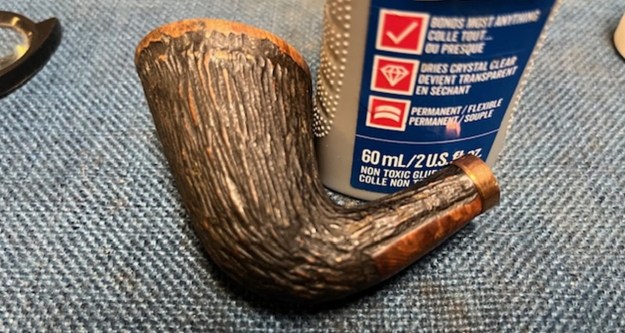
A week or so ago I traded some pipes for the two Castello Pipes below. The fellow I traded them with and I both felt we got a great trade. I chose to work on the bottom pipe in the photos below next. It is a sandblast finished Castello that is quite stunning. It is stamped on a smooth panel on the underside of the shank and reads US [followed by] Castello [over] Old Antiquari [followed by] Made in Cantu [over] Italy. That is followed by Kino in script in an oval. The bowl had a light cake and smelled primarily of Virgina tobaccos. There was some light lava on the smooth rim top but the inner and outer edge looked very good. The sandblast finish was dusty but the sandblast grain was beautiful. The acrylic stem has a white Castello bar on the topside of the taper. On the underside it is stamped Hand Made [over] Castello. There was a Softee Bit protector on the stem that had bite marks in it so I was a bit worried what might be underneath. When I removed it there was some light build up along the inner edge of the rubber bit guard but the acrylic was free of any bite marks or chatter. When the pipe arrived, it was in the Castello original box with the rich wood colour. The box is hinged on the back of the box and has no damage on the box but a tear on the back right corner of the lid. The hinge was in good condition. The top of the box has the Castello Castle logo with Trade on the left side and Mark to the right of the mark. Underneath that it is printed Castello [over] Artigianato Della Pipa – Cantu. On the end of the box it is stamped with the Castle logo followed a box with CASTELLO [over] a box for a shape or pipe shape/line designation. Underneath it is stamped Made in Italy.I opened the box and took a photo of the pipe inside. The inside of the cover it is stamped with the logo over PIPA CASTELLO [over] Made in Italy. The box had a cream coloured yellowish suede leather material with the same logo and stamp. The stem had a Softee Bit in place that I removed before I took the photo below.I took photos of the pipe itself to give a sense of what was needed in the cleanup of the bowl and shank. I would need to ream and clean the internals of the bowl and shank. The stem had grime on it where the edge of the Softee Bit was on the stem. There was no tooth damage or chatter on the acrylic surface. I took a photo of the bowl and the rim top. You can see the light lava on the rim top, slightly heavier toward the backside. You can also see the cake in the bowl. It is light to moderate in terms of thickness. The stem surface is undamaged on both sides ahead of the button. Other than the grime left behind by the Softee Bit the stem looks very good.I took a photo of the stamping on the underside and stem. It is clear and readable as noted above. I removed the stem from the shank and tried to capture a bit of the beauty of the birdseye grain on this lovely piece of briar. The grain is the same on both sides with cross grain on the front of the bowl, the back of the bowl and the underside of the shank at the end.I checked on Pipephil’s site (http://www.pipephil.eu/logos/en/logo-castello.html) and found a section on the Old Antiquari. It also had some information on the family line of the Scottis. I included that information below the screen capture of one of the pipes.Castello PIPA CASTELLO di Carlo Scotti & C. was founded in 1947 by Carlo Scotti († 1988). Franco Coppo (AKA “Kino”) who married Carlo Scotti’s daughter Savina, manages (2012) the corporate since 1985.

A great history of the brand is available on Pipedia (https://pipedia.org/wiki/Castello). It is worth a read.

I did a google search on the Castello Old Antiquari Swan Neck Billiard and found a link to an apple shaped Castello Old Antiquari pipe with a very similar profile along the underside of the shank (https://www.smokingpipes.com/pipes/new/castello/moreinfo.cfm?product_id=345891). Chuck Stanion has a brilliant description of the pipe that easily applies to the pipe that I have in hand here. I quote:

The heel of this Castello Apple is quite long, adding to the goose-neck quality of the shape’s silhouette, but it has not been flattened for sitting, so you’ll need a pipe stand. The smooth rim matches the highlights of the sandblast perfectly, and is brightly contrasted by the pure-white mouthpiece. The blast is craggy and deep, offering substantial hand comfort for long smoking sessions. – Chuck Stanion

Now it was time to work on the pipe. I started my work by reaming the pipe. I scraped out the light cake with a Savinelli Fitsall Pipe Knife. I took the cake back to bare briar. I sanded the walls smooth with 220 grit sandpaper wrapped around a piece of dowel. The bowl walls looked very good with no burn damage or checking on the walls. I scraped the smooth rim top with the Fitsall Knife edge. I was able to get the thick grime off. I scrubbed it down with a damp paper towel and it looked much better.I cleaned out he internals of the shank, mortise and airway in the shank and the stem with alcohol, cotton swabs and pipe cleaners.I polished the rim top with micromesh sanding pads. I dry sanded with 1500-12000 grit sanding pads. I wiped the rim top down after each pad with a damp cloth to remove the debris. I touched up the rim top with a Cherry stain pen to match the smooth patch on the bottom of the shank. I scrubbed the externals of the bowl with undiluted Murphy’s Oil Soap and rinsed it off with warm water to remove the soap and the grime. I dried it off with a soft cotton towel. It looked much better at this point and the grain really stood out on the bowl sides. I rubbed the briar down with Before & After Restoration Balm. I worked it into the smooth surface with my fingertips. The product works to clean, enliven and preserve the briar. I let it sit for 10 minutes then I buffed it with a cotton cloth to deepen the shine. The briar really comes alive with the balm. The stem was in such good condition that I polished the acrylic stem with the higher grit micromesh sanding pads – 3200-12000 grit pads. I wiped it down with Obsidian Oil after each sanding pad. I used Before & After Pipe Stem Polish – both Fine and Extra Fine to further polish the stem. This beautiful Castello Old Antiquari Sandblast KKKK Swan Neck Bent Billiard with a taper acrylic stem looks amazing after the work on it. The briar is clean and the blast really came alive. The rich brown stains gave the finish a sense of depth with the polishing and waxing. The finish really popped. I put the stem back on the bowl and buffed the pipe with Blue Diamond on the buffing wheel using a light touch on the briar. I gave the bowl and the stem multiple coats of carnauba wax on the buffing wheel. I buffed the pipe with a clean buffing pad to raise the shine. I hand buffed the pipe with a microfiber cloth to deepen the shine. The finished Castello Old Antiquari Swan Neck Billiard really is a beauty and feels great in the hand and looks very good. Give the finished pipe a look in the photos below. The dimensions of the pipe are Length: 6 inches, Height: 2 inches, Outside diameter of the bowl: 1 ¼ inches, Chamber diameter: ¾ of an inch. The weight of the pipe is 46 grams/1.62 ounces. I will soon be putting this pipe on the rebornpipes store in the Italian Pipe Makers section. It should make a great smoker that the next steward will enjoy. Thanks for reading this blog and my reflections on the pipe while I worked on it. It was a fun one to work on.

Restoring a Piece of Danish Pipe History – a Suhr Kobenhavn Bruyere Extra Dublin


By Steve Laug

The next pipe on the table is an interesting short stemmed, sandblast Dublin that I found in a display cabinet. We purchased it from an Antique Mall in Lincoln City, Oregon, USA on 08/24/2024. The pipe is stamped on the underside of the shank Suhr [over] Kobenhavn. That is followed by Bruyere [over] EXTRA. The band covers some of the next portion of the stamp but it looks like it reads By Hand [over] a shape number beginning with 9. The band is stamped Birmingham Sterling Silver and has a T date stamp. The shank is cracked and I assume that someone put an English band on it that in no way reflects the country of origin. The bowl had a thick cake and lava overflowing on the rim top and inner edge. The sandblast finish was dirty with grime in the sandblast. The stem is worn and has been cut off and a button shaped at the end. There was no bother taken on the slot and it is uneven and rough. It leaves a short snorter of a pipe that does not quite look right.  I took photos of the pipe before I started my clean up work. I have included them below. I took a photo of the rim top, bowl and the surfaces of the stem to give a sense of the condition of the pipe. The bowl is out of round toward the front of the bowl. There was a thick lava coat on the rim edges or top filling in the sandblast. The stem is heavily oxidized, calcified and dirty. It has also been cut off a bit crooked and the button is not clean. The Sterling Silver shank band is dented, scratched and oxidized. It has also been cut at an angle.I took photos of the stamping on the sides of the shank. It is clear and readable and read as noted above. I took a photo of the pipe with the stem removed. It is definitely dirty and very oxidized on the shank extension and the stem.While I was looking at the pipe in the Antique Mall I looked up the Suhr brand on Pipephil’s helpful site where he has some great resources on stamping (http://pipephil.eu/logos/en/logo-s13.html). I had a fleeting memory of the name but I could not give it any data. I read about the brand and looked at the shape of the pipe shown on the site which was very similar to the pipe I was looking at. I was pretty convinced that the pipe at the shop was made by the same Suhr as shown on Pipephil’s site. The photos included also gave a clear picture of what the original stem may have looked like on the pipe when it left the maker. I bought it based on that information and added it to the purchase.

I have added the information, photos and a screen capture of the section below for the purpose of putting the information together with the restoration. Suhr’s Pibemageri (pipe workshop) was owned by Teophil Suhr. Poul Rasmussen († 1967), Svend Axel Celius or Sven Knudsen used to produce the pipes proposed in the shop.

It is not established the red-white dot is Suhr’s original logo. it may be the symbol used by Poul Rasmussen himself. See also: Anne Julie (widow of Poul Rasmussen)

When I got home and before I began working on the pipe I reread PipePhil’s info included above and turned to Pipedia for more (https://pipedia.org/wiki/Suhr%27s_Pibemageri). I quote from that site below.

Suhr’s Pibemageri was a pipemaking workshop started by Teofil Suhr in Copenhagen central to the birth of the modern Danish pipe. When Sixten Ivarsson, then a debt collector newly moved to Copenhagen, broke his pipe, it was to Suhr’s he went for a repair, only to find a broken lathe and no pipemaker. Soon after, he was working as the foreman at Suhr’s, where, among others, Peter Micklson got his start and Sven Axel Celius learned pipemaking from Poul Rasmussen and his then foreman Sven Knudsen. Pipes from Suhr’s were stamped with the workshop name Suhr, and on occasion carried the same red and white dot used by Anne Julie to this day.

While it is said to be a disagreement with Suhr’s that led Ivarsson to leave for Stanwell, and all of these names went on to greater fame in later years, it would be impossible to overstate the importance of Suhr’s to the evolution of the modern smoking pipe.

I googled Suhr to find more information. I found some on the Smokingpipes.com web site (https://www.smokingpipes.com/pipes/new/suhr/). I quote the information on the brand there.

Suhr is a venerable name, tracing back to the 1940s in Copenhagen, where it was primarily a pipe repair shop before picking up pipe manufacturing. Sixten Ivarsson served as foreman there in the 1940s before moving on to Stanwell. When he left, Poul Rasmussen became foreman and made Suhr pipes until his death in 1967. His widow, Anne Julie, started making pipes at that time, and eventually trained other carvers, including Tom Eltang.

The grandson of famous pipe makers Poul Rasmussen and Anne Julie, Johannes Rasmussen trained with Tom Eltang for years before carrying on the Suhr name.

When Johannes decided to pursue pipe making, he went full circle in his family history and contacted Tom Eltang for an apprenticeship. While at the Eltang workshop, he learned the basics and began exploring his own creative voice, expanding his artistic reach until confident about breaking out on his own.

It was natural to resurrect the Suhr name for his pipes. Johannes credits his grandparents and Tom Eltang for his inspiration, and they were all part of Suhr history. He maintains a keen understanding of his place in the historical legacy of pipe making, in which he stands on the shoulders of giants.

I also turned to another site listed by google called Worthpoint. The site also showed a Suhr pipe and the description is very similar to mine (https://www.worthpoint.com/worthopedia/bruyere-extra-suhr-kobenhavn-hand-1864270360). I quote the site’s description below.

No cracks or rim chips. Reads “2085 BRUYERE EXTRA SUHR KOBENHAVN BY HAND ” on the shank.

The shape number 2085 is the only difference in the stamp. The order of the stamp is slightly different but the data is the same. From that it helped me interpret what is partially hidden under the silver band. I now knew that it read By Hand and the shape number starting 9.

Now it was time to work on the pipe. I started my work by reaming the cake and debris in the bowl. I reamed it with a PipNet pipe reamer using the 1st and 2nd cutting heads to remove the cake. I took it back to bare briar. I followed that by scraping out what remained on the bowl walls with a Savinelli Fitsall Pipe Knife. I sanded the walls smooth with 220 grit sandpaper wrapped around a piece of dowel. The bowl walls looked very good with no burn damage or checking on the walls. I scraped the rim to with the Fitsall knife to remove the thick lava coat. I went over it with a brass bristle brush to clean out the grooves in the sandblast rim and it was starting to look better.I cleaned out he internals of the shank, mortise and airway in the shank and the stem with alcohol, cotton swabs and pipe cleaners. I hard started shaping the new stem (an older worn Stanwell saddle stem seemed a fitting one to use). I paused to clean it at this point.I scrubbed the dirty bowl with a tooth brush and undiluted Murphy’s Oil Soap. I rinsed it off with warm water and dried it with a cotton cloth. It did a great job removing the oils and tars and overall the bowl looked much better. I touched up the outer edge where it was worn and the top of the rim with a Maple Stain Pen. The colour was a perfect match. The only frustration was the burn damage on the front of the inner edge now really is visible. I think I will need to go back and work on that area. I worked over the inner edge again with a folded piece of 220 grit sandpaper to give it a bevel and try to minimize the damage. Once finished I restained it with the Maple Stain Pen.I rubbed the briar down with Before & After Restoration Balm. I worked it into the sandblast finish with my fingertips and a shoe brush. The product works to clean, enliven and preserve the briar. I let it sit for 10 minutes then I buffed it with a cotton cloth to deepen the shine. The briar really comes alive with the balm. The blog is slightly out chronological order as I worked on the stem fit before I worked on the bowl but I decided to write it this way. Using your imagination walk with me through the stem fitting process. I had to search for a stem in my collection of stems that would work with this pipe. I wanted a saddle stem that had some more length on it and would require a minimum of shaping and contouring. I had a tired older Stanwell saddle stem that I think looked very similar to the Suhr in the photos on PipePhil. I think it is quite appropriate to use a Stanwell stem on this Danish piece of history. I would need to reshape the saddle portion and clean up the tenon but the stem would do the trick. Before I cleaned up the pipe I ft the stem to the shank to get a sense of what it looked like. It would take a lot of shaping and sanding to get the fit right but I liked the look. Whoever had banded the pipe in the past had put the band on crooked so the shank end was no longer straight It was off to the left side and the stem would not face against the shank well. Since I was going to make a mess with the stem I decided to do the fitting work before I cleaned up the pipe. I used a Dremel and a Sanding drum to shape the saddle portion to fit the follow of the shank. It took a bit of work but I was able to get a rough fit. I heated the band with my heat gun to loosen the band. It was tightly in place. I used some acetone to try and it to failed. It seemed that the band had been glued in place on the shank with epoxy during the repair. It refused to move! So, the Danish Pipe would be permanently joined with a British Sterling band from Birmingham made in either 1943 or 1968. The stamping on the band was not altogether clear though it was a T. The only I am sure of is that it was added after market as a repair using a band that was handy. Left with that unmovable nature I had to work with what I had. I used a topping board with 220 grit sandpaper and hand sanding to flatten the shank end and square it up for a better stem fit. The stem fit better against the shank. Now I needed to sand the sides to shape them to match the shank curves. I worked over the stem with 220 grit sandpaper while I sat on my front porch. I shaped it in place on the shank just to make sure the fit was right. The shape of the shank appears to be oval but it is flat on the bottom and domed on the top. It took a lot of sanding and shaping to get the fit right but the photos show where it is after much sanding. Chronologically it was at this point in the process that I removed the stem and went back and scrubbed the bowl to clean up the mess. I cleaned it and used the Balm on it. While it sat doing its magic I started the polishing process on the stem. I sanded it with 320-3500 grit sanding pads. I wiped it down after each sanding pad with an Obsidian Oil impregnated cloth. It really began to take on a finished look.I polished the vulcanite stem with micromesh sanding pads – 1500-12000 grit pads. I wiped it down with Obsidian Oil after each sanding pad. I used Before & After Pipe Stem Polish – both Fine and Extra Fine to further polish the stem. I gave it a final coat of Obsidian Oil and let it dry. This beautiful Suhr Kobenhvn Bruyere Extra Zulu with a newly fit saddle looks amazing. The briar is clean and the finish really came alive. The rich brown stains gave the finish a sense of depth with the polishing and waxing. I put the stem back on the bowl and buffed the pipe with Blue Diamond on the buffing wheel using a light touch on the briar. I gave the bowl multiple coats of Conservator’s Wax and the stem multiple coats of carnauba wax on the buffing wheel. I buffed the pipe with a clean buffing pad to raise the shine. I hand buffed the pipe with a microfiber cloth to deepen the shine. The finished Suhr Kobenhvn Zule really is a beauty and feels great in the hand and looks very good. Give the finished pipe a look in the photos below. The dimensions of the pipe are Length: 5 ¼ inches, Height: 2 inches, Outside diameter of the bowl: 1 ¼ inches, Chamber diameter: ¾ of an inch. The weight of the pipe is 28 grams/.95 ounces. This beautiful pipe will reside in my collection at least for a while as I enjoy this piece of Danish Pipe History. If the condition of the pipe when it was found is any indicator, the pipe should be a great smoker. Thanks for reading this blog and my reflections on the pipe while I worked on it. It was a fun one to work on.

Restoring a Ferndown Bark L&JS Briars Silver Spigot Billiard


By Steve Laug

The next pipe on the table is a beautiful rusticated Billiard with a silver ferrule and silver spigot stem. We purchased it from an Antique Mall in Lincoln City, Oregon, USA on 08/24/2024. The pipe is stamped on a smooth panel on the underside of the shank and reads Ferndown [arched over] Bark followed by L&JS Briars [over] Hand Made In [over] England. There was a thin cake in the bowl and the rim top and inner edge had been scraped and was faded. There was grime ground into the rusticated finish around the bowl and shank. There was also some fading on the right side of the bowl toward the front running down from the rim edge to about midbowl. It was faded as if by sun or perhaps whatever had stripped the rim top. The pipe was someone’s obvious favourite and was well care. The inner edge looked to be in good condition. The oxidized ferrule and spigot end on the stem are both Sterling Silver. The ferrule bears the stamp L&JS followed by 925 on the left side. There is an LJS logo stamped in gold on the left side of the taper stem. The stem is heavily oxidized and calcified. There appears to be some light tooth chatter on the top and underside of the stem ahead of the button. I took photos of the pipe earlier this morning before I started my clean up work. I have included them below. I took a photo of the rim top, bowl and the surfaces of the stem to give a sense of the condition of the pipe. The walls of the bowl had a thin cake with no lava on the rim edges or top. The stem is heavily oxidized, calcified and dirty. There are light tooth marks on both sides ahead of the button.I took a photo of the stamping on the smooth panel on the underside the heel and the shank. It is clear and readable and read as noted above. The silver ferrule and the left side of the taper both have clear stamping under the oxidation that reads as noted above.I took some photos of the fading on the front and the right side of the bowl extending half way down the rusticated surface. It is wash out and matches the washed out rim top on the bowl. I took a photo of the pipe with the stem removed. It is definitely dirty and the silver and the stem both are oxidized. To gather backgound on the brand I turned to Pipephil’s site to see what was included in the listing there (http://www.pipephil.eu/logos/en/logo-f1.html). I have included both the screen capture and also the side bar below the photo I have included.Artisan: Leslie (Les) Wood. He was the master silver smith at Alfred Dunhill Ltd. before starting L. & J.S. Briars. Pipes for the European market are stamped “L. Wood” while those for US are stamped “Ferndown”. Production: ~ 2000 pipes/year (Ferndown + L.Wood) See also Elwood

The first pipe pictured in the screen capture above is stamped similarly to mine. The pipe I had in hand did not have the stars on the heel so there was no size designation on the pipe. This is a large pipe. The Bark finish is a designation used for both sandblasted and rusticated. The stem on the pipe I am working on is also not Cumberland but rather black vulcanite with a silver spigot ending.

I turned to Pipedia next (https://pipedia.org/wiki/Ferndown). There is a great article there on the carver, the pipes and the workshop. It is worth the time to give it a read. I am quoting the section on the pipes below for the information included.

Due to the vagaries of international trademark law, he sold his earlier pipes as ”L.&J.S Briars”, “Ellwood”, “Les Wood” or “L. Wood”. Until recently, an average of 1500 – 2000 pipes a year were sold as “Ferndown” — named for the mansion he lives in — in the UK and US, but as “L. Wood” pipes in Germany

…To many pipe smokers, Les Wood’s pipes embody the revival of great English pipe making initiated by Ashton in the early 1980s. The high-grade Italian and Spanish plateau he prefers is oil-cured in the tradition of both Dunhill and Ashton. The pipes are renowned for their pleasant, slightly nutty flavor and remarkable smoking characteristics. They feature impeccable craftsmanship extending to very good stem/bit work, though many pipes are often a bit heavier. The hallmark of his work, of course, is the excellent silver work. Almost all of his pipes feature rings or ferules for spigot stems. Grading is by finish: “Bark” (ca. 90%, rusticated, dark brown and black), “Antique Bark” (tan rusticated), “Reo” (brown and red, smooth), “Root” (orange, smooth), and “Tudor Root” (orange and brown smooth) and by size (one to four stars). He also designates straight grains with SG.

The pipe I am working on is as noted above a Ferndown which identifies it as a pipe named after his mansion and as a pipe made for the UK and the US. It is also as noted in red above stamped Bark which identifies it as a dark brown and black rusticated pipe.

Now it was time to work on the pipe. I started my work by reaming the pipe. I scraped out the light cake with a Savinelli Fitsall Pipe Knife. I took the cake back to bare briar. I sanded the walls smooth with 220 grit sandpaper wrapped around a piece of dowel. The bowl walls looked very good with no burn damage or checking on the walls. I worked on the fading and damage to the rim top with 320-3500 grit sanding pads. It looked much better when I had finished with the last of the pads.At this point I stained the rim top and the faded areas around the bowl with a Mahogany stain pen. It blended well with the surrounding briar on the bowl sides. The rim top looked better but I would need to polish it and clean up the finished look of the rim top. I cleaned out he internals of the shank, mortise and airway in the shank and the stem with alcohol, cotton swabs and pipe cleaners.I polished the smooth rim top with micromesh sanding pads. I dry sanded it with 1500-12000 grit sanding pads and wiped the bowl down after each pad with a damp cloth. By the final pads the briar really had a shine. I rubbed the briar down with Before & After Restoration Balm. I worked it into the smooth rim top surface with my fingertips and into the heavy rustication with a shoebrush. The product works to clean, enliven and preserve the briar. I let it sit for 10 minutes then I buffed it with a cotton cloth to deepen the shine. The briar really comes alive with the balm. I polished the silver ferrule and the spigot end on the stem with a jeweller’s cloth to clean up and prevent further oxidation in the future. The contrast between the silver and the heavy rustication is very nice. I set the bowl aside and turned my attention to the stem. I scrubbed the oxidation on the stem surface with Soft Scrub and cotton pads until it was much cleaner.I sanded the surface with 320-3500 grit sanding pads. I wiped the stem down after each pad with Obsidian Oil. I was able to remove the remnants of oxidation and the stem looked better.I touched up the LJS stamp on the left side of the taper stem with Rub’n Buff Antique Gold. I rubbed it on and worked it into the stamp with a tooth pick. I buffed it off with an Obsidian Oil cloth. It looks very good.I polished the vulcanite stem with micromesh sanding pads – 1500-12000 grit pads. I wiped it down with Obsidian Oil after each sanding pad. I used Before & After Pipe Stem Polish – both Fine and Extra Fine to further polish the stem. This beautiful Ferndown Bark Rusticated L&JS Briars Silver Spigot Billiard with a taper vulcanite stem looks amazing after the work on it. The briar is clean and the grain really came alive. The rich brown stains gave the finish a sense of depth with the polishing and waxing. The grain really popped. I put the stem back on the bowl and buffed the pipe with Blue Diamond on the buffing wheel using a light touch on the briar. I gave the bowl multiple coats of Conservator’s Wax and the stem multiple coats of carnauba wax on the buffing wheel. I buffed the pipe with a clean buffing pad to raise the shine. I hand buffed the pipe with a microfiber cloth to deepen the shine. The finished Ferndown Bark Silver Spigot Billiard really is a beauty and feels great in the hand and looks very good. Give the finished pipe a look in the photos below. The dimensions of the pipe are Length: 6 ¾ inches, Height: 2 inches, Outside diameter of the bowl: 1 ½ inches, Chamber diameter: 7/8 of an inch. The weight of the pipe is 66 grams/2.33 ounces. This beautiful rusticated pipe will soon be on the rebornpipes store in the British Pipemakers Secton. It should make a great smoker for the next trustee. Thanks for reading this blog and my reflections on the pipe while I worked on it. It was a fun one to work on.

Renewing an UNSMOKED Briarcraft Smokemaster Custom Made Patent Apple


By Steve Laug

The next pipe is one that has been sitting here for quite awhile in a box of unsmoked/new old stock pipes that I have here. I went through them yesterday and sorted the out. I put all of them on the rebornpipes store but this one. There was just something about it that grabbed my eye. It is a classic apple shaped pipe that is stamped on the left side of the shank and has a white hollow star next to the shank followed by the Briarcraft logo – a B in a diamond. Next to that it is stamped Custom [over] SMOKEMASTER [over] Made. On the right side of the shank it was stamped Pat. 2.166.537. The was a white letter B on the left side of the shank – the Briarcraft logo. We picked up the pipe on 11/09/2023 from a seller in Nampa, Idaho, USA. The pipe is unsmoked and the bowl is fresh. The finish on the bowl and shank is very shiny with varnish or possibly shellac but it is peeling and cracking in places. The grain on the pipe was quite stunning and would really shine through once the finish was gone. It was an incredibly lightweight pipe to hold. The stem is dirty with some sticky stuff from possibly a price tag and some nicks and scratches from laying around a long time somewhere. I took photos of the pipe to show its condition before I started working on it. It was going to be a pretty simple cleanup. I took closeup photos of the unsmoked, new briar bowl and rim top to clearly show the condition of both. The condition matches what I described above. I also took photos of the stem to show the sticky spots and scratches on the stem surface ahead of the button on each side. I took photos of the stamping on the sides of the shank. It is clear and readable as noted above. The varnish around the stamping and the white star is peeling and crackled. The B logo on the left side of the stem is clear and in good condition. I removed the stem and took a photo of the pipe to give a sense of the proportions of the pipe. I tried to capture the three holes in the end of the tenon. I laid the stem on the shank to try to capture it and I held it and took a photo of the tenon end. It is an interesting drilling that almost looks like a mouse head with the two ears.I had cleaned up a Smokemaster Bard Billiard in the past but it did no have the original stem like this one. I went back and reread the blog to remind myself of what I had learned in the process of working on that pipe (https://rebornpipes.com/2013/12/23/giving-a-smokemaster-bard-billiard-a-facelift/). I have included a bit of the information that I had included on that blog below:

I knew nothing about Smokemaster pipes and had no idea who made them. The finish and shape reminded me a lot of Dr. Grabow pipes that I have reworked but that was not enough for me. As has become my habit with pipes I don’t know about, I did a bit of research on the web and found out that the pipe was made by the Briarcraft Pipe Company. The Company was very prosperous between 1920 and 1940. They produced both Briarcraft pipes and a line of seconds under the following names: Airo, Arcadian, Briarmeer, Smokemaster, Cavalcade, Hallmark, Sterling Hall, Filter Kleen and Wimbledon. They closed their doors in 1950.

The pipe that I was working on currently was definitely made pre-1950 and the stamping was clearly made by Briarcraft. The beauty of that is that the pipe was clearly made between between 1920-1950 when they closed their doors. Perhaps when I check the patent information I will learn more and be able to pin down the date a bit more.

I turned to the article on Pipedia (https://pipedia.org/wiki/Smokemaster) to see what I could learn there. I was expecting a bit of info on both Briarcraft and Dr.Grabow. So it would take a bit of filtering.

Smokemaster pipes are unusual in that they had two different makers in different time periods, and in the style of their tenon.

The tenon had a single aluminum inner tube and two holes which were meant to hold a pipe cleaner folded in half, one end in each hole. The pipes were first made by Briarcraft, in lines including the Custom-made, Standard, and Bard. That company went out of business in the 1950s. In 1967 Dr. Grabow bought the rights to the name and the system, and began producing Smokemasters in three lines, stamped 100, 200 and 300. These pipes had a red diamond logo on the stem.

In addition, both Briarcraft and Dr. Grabow made Smokecraft pipes which were not stamped with that name, but with L. L. Bean. The pipes continued to be produced into the 1990s in Sparta, North Carolina, and were offered as a mail order pipe on packets of Dill Pipe Cleaners at one point. They are no longer produced.

I have included two advertisements from the site that had helpful information on the special filter system using pipe cleaners. Read over the first advertisement below. It has the same patent number as the pipe I am working on. It also has a clear explanation of the unique pipe cleaner filter system in the stem. The second advertisement show the same pipe with the specifics of an L.L. Bean pipe that has the same pipe cleaner filtration system. I then turned to Pipephil’s site (http://pipephil.eu/logos/en/logo-s9.html) to have a look at the information included there. I have included a screen shot of the information there. The logo on the stem of the shank of the pipe I am working on is identical to the one shown in the first photos below. I have included only the section on the Briarcraft version of the pipe made prior to the buyout by Dr. Grabow.I found out that the Smokemaster had a very unique filter system and was distinct from other filter systems in that it did not include a stinger apparatus. Rather it used a slotted tenon/tube that had two special holes in it (shown in red in the drawing below of the tenon end). A folded pipe cleaner was inserted into the two holes and extended the length of the shank. It collected the tars and moisture of the smoke and could be easily changed and replaced by the pipe smoker. The diagram below shows the design from the end of the tenon.I did a patent search and it gave me the following information. This includes both the original description by the inventor and also a diagram submitted at the time of the patent application. I found it at this site:

https://www.google.com/patents/US2166537?dq=2166537&hl=en&sa=X&ei=r2u4UtPOHI_ZoAT9moHYCg&ved=0CEAQ6AEwAQ

I have included that information below on the same patent number:

Description
1939 – B. M. SHOEMAKER 2,166,537
TOBACCO PIPE Filed Oct. 12, 1934 crnar B.M. Shoemaker INVENTOR v ATTORNEY Patented July 18, 1939 UNITED STATES PATENT OFFICE

1 Claim.

My invention relates to tobacco pipes and more particularly to the type in which the bit and bowl portions are separately united to each other.

The principal object of my invention is to maintain the smoke passage in the pipe substantially free of solid deposits, making for general cleanliness in the interior of the pipe and sweet, cool smoking qualities.

I accomplish this object by arranging within the pipe a readily replaceable absorptive member which is designed to receive condensate and solid matter from the smoke as it passes through the pipe. The preferred form of such absorptive member is an ordinary pipe cleaner which, as is well known in the art, comprises a highly flexible metallic core portion carrying a large number of bristles extending there from.

One embodiment of the invention is illustratively exemplified in the accompanying drawing in which Fig. 1 is a longitudinal sectional view of a pipe; Fig. 2 is a transverse sectional view on the line 22 of Fig. 1; Fig. 3 is a transverse sectional view on the line 3-3 of Fig. 1; Fig. 4 is a broken elevation view of a metallic tube or liner constituting one of the pipe elements; Fig. 5 is an elevation view broken intermediate its ends, of the form of absorptive member used in the present construction.

Referring to the drawing, and more specifically to Figs. 1 to 3, denotes the pipe bowl, 1 the bowl stem, 2 the bit and 3 the tenon by which the bit and bowl stem are separately united. The bowl stem has the usual well l4 and the bit the usual smoke or draft passage 15. The bit 12 is further provided with three bores, 15b, c, d, and forming a continuation of the smoke passage 16. A metal tube 16 is provided which is longitudinally slotted at its lower portion and through the slot l8 the products of well be omitted. The tube l6 lies in the bore 15b. The pipe cleaner is doubled upon itself and the two legs or branches of the pipe cleaner enter the bores 15c and l5d and rest there during use of the pipe. The bores 15c and l5d parallel the bore 15b at opposite sides of its longitudinal centre. The embodiment of the invention described is a very desirable construction inasmuch as it receives a standard length pipe cleaner, which in its folded position in the passage 14 is offset from the axis thereof, and which when rotated or twisted with the tenon to seat the same the folded strands of the cleaner engage and brush or clean the wall of the bore.
The operation of the device is very simple. The pipe is sold complete with the pipe cleaner in position. After the pipe has been used for a length of time it will be found that the pipe cleaner is practically saturated with deposited matter. Thereupon the pipe cleaner is simply removed from the pipe and a new one inserted in its place. If desired, the cleaner may also be used in the ordinary manner, naturally before it has become fouled, by moving it back and forth once or twice through the draft passage l5 and/or tube.

What I claim is: In a tobacco pipe, a bowl portion having a stem provided with a central bore, and a bit portion for said stem, the bit having a centrally disposed smoke passage and grooves arranged in the bottom of said passage, a tubular liner mounted in the smoke passage and adapted to project into the bore of the stem, said liner having its underside provided with a longitudinal slot opening into the grooves and bottom of the central bore of the stem beyond the bit, and an absorptive member mounted in said grooves and arranged under the liner throughout its length to receive condensate from the liner and to wipe the wall of said bore when the bit is turned.

BERNARD M. SHOEMAKER.
Classifications

U.S. Classification 131/184.1, 131/203

International Classification A24F1/00

Cooperative Classification A24F1/00, A24F2700/03

European Classification A24F1/00
I find that kind of information fascinating and am always intrigued by the ongoing urge of pipe designers to provide a cooler and cleaner smoke for the pipeman who uses their inventions. The patent information helped me to also pin down the date of manufacture. In this case I now knew that the pipe I had in hand was made between 1939 and 1950, a nice 11 year window. It was a real beauty and with the clean up it would only look better. Now it was time to work on the pipe itself.

I began by removing the peeling and spotty varnish coat with acetone on a cotton pad. What made this a bit tricky was the white stamped star outline on the left side of the briar next to the bowl. It had been painted and I did not want to damage that colour. Once the varnish coat was removed I polished the briar with micromesh sanding pads – dry sanding with 1500-12000 grit sanding pads. I wiped the bowl down with a damp cloth after each pad. By the end of the process it looked quite good. I rubbed the bowl and shank down with Before & After Restoration Balm. I worked it into the surface of the bowl sides and shank with my fingertips. It works to clean, enliven and protect the briar. I let the balm sit for 15 minutes and buffed with a cotton cloth to raise the shine. The grain came alive. I polished the vulcanite stem with micromesh sanding pads – 1500-12000 grit pads. I wiped it down with Obsidian Oil after each sanding pad. I used Before & After Pipe Polish – both Fine and Extra Fine to further polish the stem. I rubbed it down with a final coat of Obsidian Oil and let it dry. With the stem cleaned up it was time to fit the tenon with the folded pipe cleaner filter as shown in the photos of the advertisements and also patent information. I took photos of the process. This Unsmoked Briarcraft Smokemaster Custom Made Pat. 2.166.537 is quite a stunning pipe now that it has been stripped and restored. The beautiful grain around the bowl works well with both the shape and the polished vulcanite taper stem. I put the stem back on the bowl and carefully buffed the pipe with Blue Diamond on the buffing wheel using a light touch on the briar. I gave the bowl and the stem multiple coats of carnauba wax on the wheel and followed by buffing the pipe with a clean buffing pad. I hand buffed the pipe with a microfiber cloth to deepen the shine. The finished Briarcraft Smokemaster Custom Made Apple fits nicely in the hand and feels great. Give the finished pipe a look in the photos below. The dimensions of the pipe are Length: 6 inches, Height: 1 ½ inches, Outside diameter of the bowl: 1 inch, Chamber diameter: ¾ of an inch. The weight of the pipe is 22 grams/.78 ounces. I will be putting this interesting old timer in my own collection of unique pipes. Thanks for reading this blog and my reflections on the pipe while I worked on it. I appreciate your support and time!

Reworking another trade, a Borlum KB&B Italian Briar Unbreakable Stem Bent Billiard


by Steve Laug

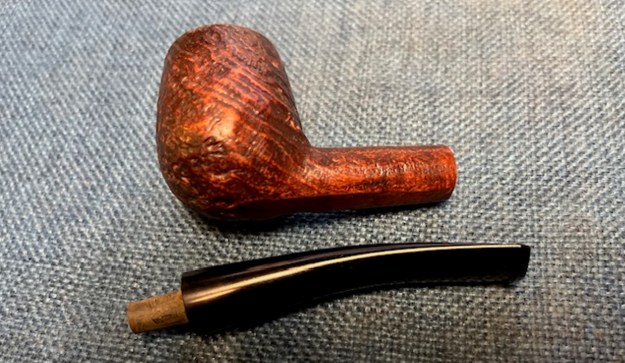
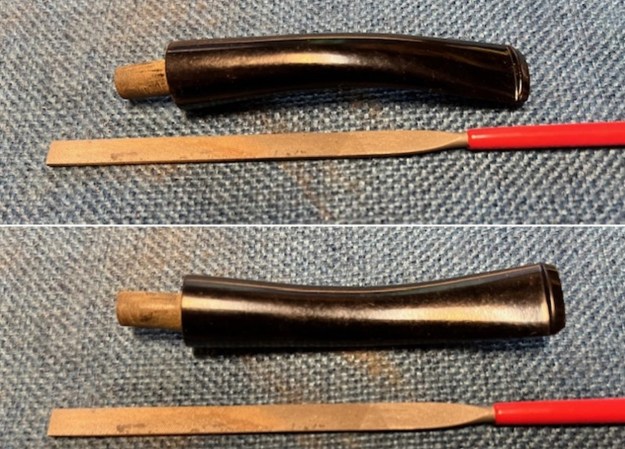
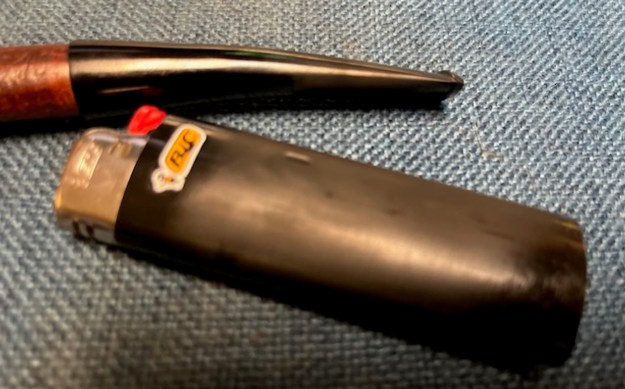
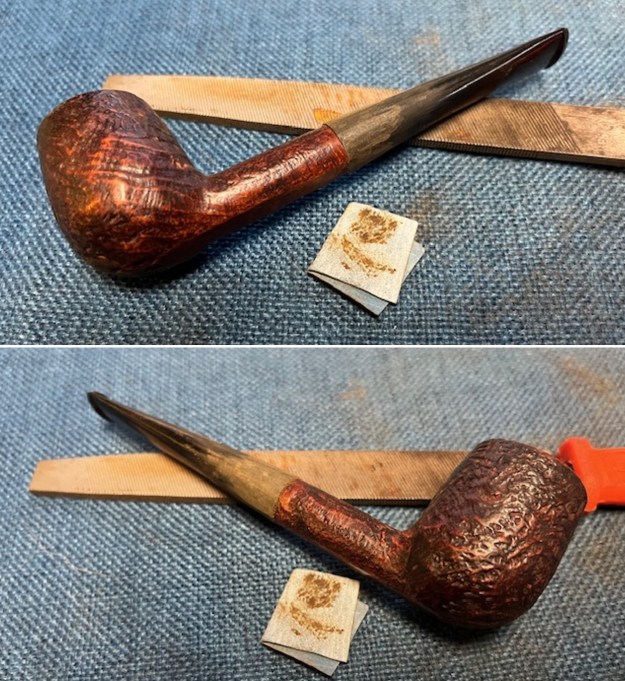
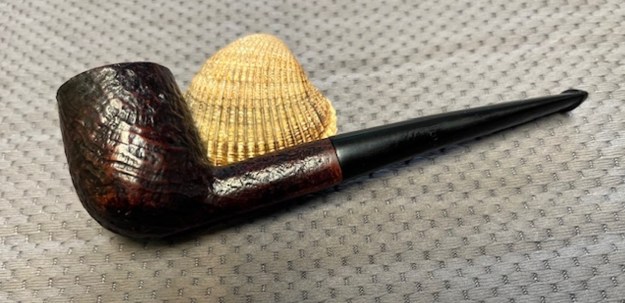
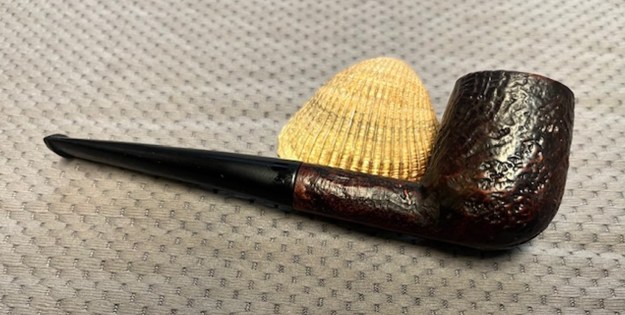
A month or so ago I received an email from a fellow in Japan who had some pipes he wanted to sell. We came to an agreement and he sent me a few. One of them was this interesting smooth finish Bent Billiard. This pipe is stamped on the left side of the shank with the words BORLUM in an arc over KB&B in a cloverleaf. Underneath that it is stamped ITALIAN BRIAR in a reverse arc. On the right side of the shank it is stamped UNBREAKABLE BIT. The stamping was clear and readable. The band on the shank is cosmetic and original and reads KB&B in a cloverleaf [over] Nickel Plated. The bowl had been reamed and the pipe cleaned. The shank is very clean inside and the pipe smelled very clean. It was so clean that I don’t think the pipe had been smoked since the fellow in Japan picked it up. The rim top was clean though there were some scratches and darkening and the inside edge of the rim showed some nicks. There was no damage to the outer edges. The finish around the bowl was in decent condition with great grain under some of the grime and scratching. The stem looked good, though it was not centred on the shank. The diameter of the stem extended beyond the band on the right side and a little above the top and underside. I would need to reduce the stem diameter to fit the shank band. There were some light tooth marks and chatter on the top and underside ahead of the button. Overall, I am happy with it but I will need to rework the stem fit to the shank and clean up the rim top and edges. I took photos of the pipe before I started my work on it.  I took a photo of the rim top to show the condition of the bowl and the top. You can see clean bowl and marks on the rim top. The inner edge is slightly out of round. The stem looks good with light tooth damage and no oxidation on the surface of the hard rubber. It will look much better once I trim down the top, underside and the right side of the stem.I took photos to show the stamping on the sides of the shank and the nickel band. It is clear and readable as noted above. You can also see the fit of the stem to the shank on the top and the right side. I took the stem off and took a photo of the pipe to show its condition.

From an earlier Borlum pipe that I had refurbished back in 2014, I had learned a lot about the background of the manufacturer of the brand. I quote from that blog to summarize the historical background of the pipe (https://rebornpipes.com/tag/kbb-borlum-pipes/). The italicized portions of the text come from the blog with minor edits.

I already knew that Kaufmann Brothers and Bondy was the oldest pipe company in the USA, established in 1851. The Club Logo predated Kaywoodie with the “KB&B” lettering stamped within the Club, and a multitude of KB&B lines were in production long before “Kaywoodie” first appeared in 1919. Therefore, I knew that the pipe I had was a pre-1919, pre-Kaywoodie KB&B Made BORLUM.

As noted above, this particular pipe is stamped on the left side of the shank with the words BORLUM in an arc over KB&B in a cloverleaf. Underneath that it is stamped ITALIAN BRIAR in a reverse arc. On the right side of the shank it is stamped UNBREAKABLE BIT. As stated above it was made before Kaywoodie became the flagship name for pipes from Kaufman Brothers & Bondy (KB&B). It was made before the Kaywoodie invention of the “Stinger” was added, and even before shank logos, model stamps and other features invented by Kaywoodie came to be standards of the pipe making industry. It comes from a time when names like Ambassador, Heatherby, Melrose, Suez, Rivoli, Cadillac and Kamello dominated the pre-Kaywoodie scene. Borlum is one of those names.

I learned while researching for that blog and rediscovered while working on this one that the Borlum pipe featured some innovations that were new for the time but commonplace to us. These included (1) a solid rubber bit (vulcanite, ebonite), (2) an aluminum inner-tube construction in the stem that stabilized and strengthened the stem explaining the stamping of “Unbreakable Bit” on the right side of the shank, (3) a standard nickel-plated band (marked KB&B) to strengthen the shank connection for the stem. The stem features the older style more rounded bit tip/orific button, and you can see the aluminum inner-tube fitting just inside the tip.

I have included several pictures that I found on the internet that show the unique stem tube in the Borlum that gives rise to the claim that it has an Unbreakable Bit. The first photo shows the bent stem, third from the left with the same metal tube showing at the button. The second photo shows the other end of the tube in the tenon in the Borlum stem. That told me that the pipe I had was made after 1851 and before 1919. I am guessing that because of the other pipes in this lot dating in the late 1890s to about 1905 this one is probably from that same era. Not too bad for a 100+ year old pipe. During the hunt for information, I also found the next photo of a Borlum display and sales card. What is particularly interesting to me is the diagram at the top of the card showing the interior of the stem in place in the shank. It also includes the claim, “Guaranteed against Breakage”. I love the advertisements and sales brochures of these old pipes. The descriptive language that promises so much and the prices the pipes sold for are a nostalgic journey to the past. Note the $1 and up price tag on the sales card. The pipe that I am working on presently is identical to the bottom pipe on the right side of the photo. I have circled it in red. It has the identical shape, curved shank but has a nickel-plated band like mine. It has the hard rubber stem with an orific button. It is more rounded than the modern flat stem but it is still a comfortable feeling stem in the mouth.Now it was time to work on the pipe. I decided to deal with the diameter of the stem against the shank first. I used a folded piece of 220 grit sandpaper to take off the extra diameter of the stem on the right side and the top and bottom. I also sanded the tooth marks and chatter on the stem surface. It was a lot of handwork and fussing to get the fit correct. Once finished it looked much better. I worked over the stem with 320-3500 grit sanding pads to smooth out the scratches left in the hard rubber surface of the stem. Once finished the stem had a deep shine and really looked much better.I polished the stem surface with micromesh sanding pads. I dry sanded it with 1500-12000 grit pads. I wiped it down between pads with an Obsidian Oil impregnated cloth. I finished polishing it with Before & After Pipe Stem Polish – both Fine and Extra Fine. It looked much better. I set the stem aside and turned my attention to the bowl. I smoothed out the damaged inner edge of the bowl with a folded piece of 220 grit sandpaper. It looked much better. I started polishing out the damage on the rim top with the 220 grit sandpaper. It looked much better.I wiped the bowl down with isopropyl alcohol on a cotton pad to remove the shiny wax or shellac coat on the bowl surface. It cleaned up very well. There was a deep sandpit/flaw on the lower front left side of the bowl. I filled it in with a combination of CA glue and briar dust. I sanded the repair with 220 grit sandpaper and smoothed it out into the surrounding briar. I touched up the sanded spot on the bowl front with a Walnut stain pen. It matched the rest of the bowl surface. Once I polished it some it would blend in very well.I polished the bowl and the shank with 1500-12000 grit micromesh sanding pads. I dry sanded with each pad and wiped the briar down with a damp cloth after each pad. I paused the polishing and touched up the stain on the bowl front and the rim top. It really was looking much better at this point. Once it cured I went back to polishing with the micromesh. I worked some Before & After Restoration Balm into the finish of the bowl, rim top and shank with my fingertips and a shoe brush to get it in to the crevices and valleys. The product works to clean, enliven and protect the briar. I find that the balm really makes the briar come alive again. I let the balm sit for 15 minutes and then buffed with a cotton cloth to raise the shine. The bowl really looks good at this point. I polished the nickel ferrule on the shank end with a jeweller’s cloth. It works to polish and protect the metal from further oxidation. It is a great looking addition to the pipe. With the bowl and the stem finished I put the Borlum KB&B Italian Briar Bent Billiard with an unbreakable stem back together and buffed it on the wheel using Blue Diamond to give it a shine. I gave the bowl and the stem multiple coats of carnauba wax on the wheel. I buffed it with a clean buffing pad to raise the shine. I hand buffed it with a microfiber cloth to deepen the shine. It really is a great looking pipe. The dimensions of the pipe are – Length: 4 ½ inches, Height: 1 ½ inches, Outside diameter of the bowl: 1 1/8 inches, Chamber diameter: ¾ of an inch. The weight of this large pipe is 1.20 ounces /33 grams. This Borlum KB&B Italian Briar Bent Billiard is another great looking pipe. It is much more beautiful in person than these photos can capture. I will be putting it in my older American Pipe Collection to enjoy in the future.  This is another pipe that has the possibility of transporting the pipe man or woman back to a slower paced time in history where you can enjoy a respite. Thanks for walking through the restoration with me.
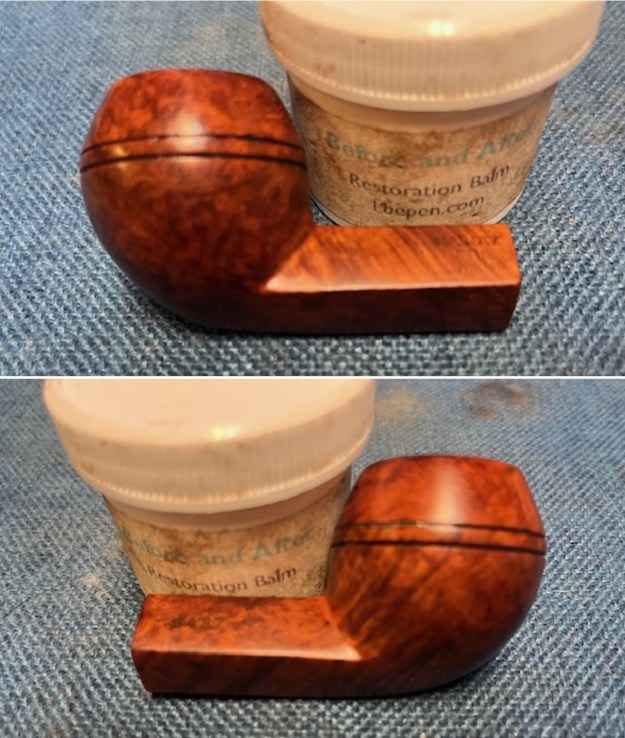
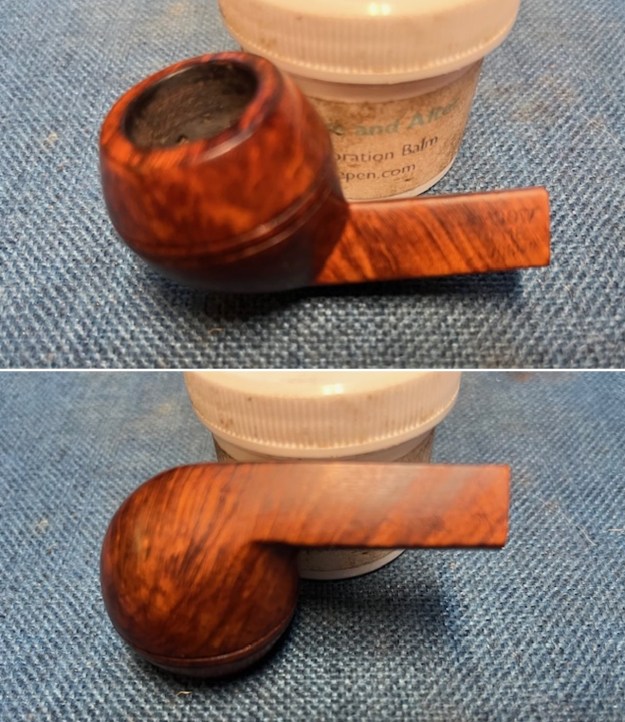
Restoring a tired and worn Dunhill Shell 41111 Lovat


Blog by Steve Laug

I took a second Dunhill to the work table. It was I picked up while I was in Idaho. It was one that we had purchased from a friend in Denmark on May 22, 2024. It is a petite and worn Dunhill Shell Lovat. The stamping on the underside of the shank read 41111 on the heel of the bowl. That is followed by Dunhill Shell [over] Made in England followed by a number 18 to the right of the D in England that will help me date the pipe. The bowl had been reamed not long ago. There was some dust and debris in the light sandblast on the rim and the inner edge had some darkening. The outer edge looked very good. The sandblast finish was worn and dirty but it could not hide the lovely blast around the bowl and shank. There were some very worn areas on the left side of the shank. The oxidized and tarnished silver band on the shank appears to be cosmetic as there are no visible cracks in the shank. The band is stamped with AD in a diamond which is the Alfred Dunhill stamp. It also reads .925 which is the quality of sterling silver. The stem was clean and there were light tooth marks on the top and underside ahead of the button. There also appeared to be a hairline crack in the middle of the button on the topside. The classic Dunhill White Spot was on top of the saddle stem. I took a few photos of the pipe before I started my work on it. I sent the photos to Paul and he is excited about it. I took a photo of the rim top and bowl to show the condition of both of them. The bowl itself had been recently reamed. The rim top showed a coat of lava and some darkening around the edge. The inner edge looked rough but a cleaning would make that clear. The outer edge looked very good. The photos of the stem show light oxidation and tooth marks/chatter on both sides ahead of the button. The first photo shows a tiny hairline crack mid button and just over the edge.I took a photo of the stamping on the underside of the shank. The photos are blurry but you can see the shadow of the stamping. In person it is very readable. The stamp on the silver band is also very readable once the oxidation has been removed. I removed the stem from the shank and took a photo to show the proportions of the pipe. As is my regular practice, before I started my work on the pipe, I turned to Pipedia’s section on Dunhill Shell Pipes to get a bit of background on the Dunhill finishes (https://pipedia.org/wiki/Dunhill#Root_Briar). I quote:

Shell

A deep craggy sandblast with a black stain finish (usually made using Algerian briar) – the color of the stain used has varied over the years. Although there is some doubt as to them being the first to sandblast pipes, Dunhill’s Shell pipes, and the sandblasting techniques developed to create them are considered one of Dunhill’s greatest and most lasting contributions to the art of pipe making.

The documented history of Dunhill’s inception of the Shell is largely limited to patent applications — there are no catalog pages or advertisements promoting blasted pipes at the time. The preliminary work on the English patent (No. 1484/17) was submitted on October 13, 1917. The patent submission was completed half a year later, on April 12, 1918, followed by the granting of the English patent on October 14, 1918. This was less than a month before the end of The Great War on November 11th.

In 1986 Dunhill released a line of premium Shell finish pipes – “RING GRAIN”. These are high-quality straight grain pipes which are sandblasted. Initially only Ring Grain, but now in two different finishes. In 1995 the “Shilling” was introduced with Cumberland finish – it is an extremely rare series. These pipes exhibit a deeper blast characteristic of that of the 1930’s – mid-1960’s (and the limited ‘deep blast’ pipes of the early 1980s) and show a fine graining pattern. These are considered the best new Dunhills by many enthusiasts today and are very rare. The finish is sometimes described as tasting like vanilla at first, with the taste becoming more normal or good as the pipe breaks in.

There was also a link to a catalogue page that gave examples and dates that the various finishes were introduced (https://pipedia.org/wiki/File:Dunnypipescatalog-1.png).I turned to Pipephil’s dating guide to show how I arrived at the date of manufacture for this pipe (http://www.pipephil.eu/logos/en/dunhill/cledat-en1a.html). I am including the chart that is provided there for the dating a pipe. I have drawn a red box around the section. Since the pipe I am working on has a superscript suffix 18 after the D in England it points to the 1960 line on the chart below. To date it just add 1960 +18 for a date of 1978. I have drawn a red box around the pertinent section in the chart.I now knew that I was working on a Shell that came out in 1978 as far as I could tell by the date stamp. The shape of the pipe is 41111. From the shape chart on the site I could know that I was dealing with a Lovat (http://www.pipephil.eu/logos/en/dunhill/shapes.html). I quote below for the interpretation

Dunhill pipes are stamped with a four digit code.
Digit 1: (from 1 to 6) denotes the size of the pipe (the group).
Digit 2: denotes the style of the mouthpiece (0,1=tapered, 2=saddle)
Digit 3 and 4: denote the generic pipe shape (in yellow in the chart on top) 

Example: 5102
(5 = size | 1 = tapered stem | 02 = Bent)

When 5 digits occur, the meaning of the 4 first remain the same

The pipe in hand is stamped 41111 which is a size/group 4 pipe, the 1 is for taper but on a Lovat it is a saddle as noted in the chart on the link above, the 111 is the shape of a Lovat.

Now it was time to work on the pipe. I cleaned up the oxidized silver band with a jeweller’s cloth to remove the tarnish and protect it from further tarnish. There was more work to do but at least at this point I could read the stamping on it clearly. I used a brass bristle wire brush to knock off some of the debris and lava on the rim top. I did this in preparation for scrubbing it with Murphy’s Oil Soap.I scrubbed the exterior of the bowl with a tooth brush and undiluted Murphy’s Oil Soap to remove the grime and debris in the finish. I scrubbed out the mortise and tenon with small tube brushes and soap to remove the oils and tars in the shank area. I rinsed it with warm water to remove the grime and oils in the finish and shank. I dried it off with a soft cotton cloth. One of the benefits of doing this is that the briar in the nicks and dents on the bowl sides swell and virtually disappear. The pipe has a fresh look that really highlights the depths of the sandblast on the briar. I used a Walnut and a Mahogany stain pen to touch up the fading on the bowl sides. There were spots where the stain had faded and it added to the worn look. I restained it with these two stain pens and then used a black stain pen to touch up the spaces. The combination of the stains is very close to the colour on the Shell Briar. I let it dry and once it did it looked much better. I rubbed the bowl down with Before & After Restoration Balm. It is a paste/balm that works to deep clean the finish, enliven and protect the briar. I worked it into the briar with my finger tips to make sure that it covered every square inch of the pipe. I set it aside for 10 minutes to let it do its work. I buffed it with a cotton cloth. The briar really began to have a deep shine. The photos I took of the bowl at this point mark the progress in the restoration. I set the bowl aside and turned my attention to the stem. The first photo shows the hairline crack on the top side of the button forward about 1/8 of an inch. I filled in the cracked area on the stem with rubberized black CA glue. I set the stem aside to let the repair cure.Once the repair had cured I sanded it smooth with a folded piece of 220 grit sandpaper. I was able to blend in the repair on the top of the stem. It looked much better and the repair was solid.I sanded the stem with 320-3500 grit sanding pads to break up the remaining oxidation. I wiped it down after each sanding pad with an Obsidian Oil impregnated cloth. It began to look good.When I finished polishing the stem with the sanding pads it dawned on me that I had not cleaned the internals of the shank and stem. My routine had been broken as this restoration was spread over the better part of a week. No excuse but that is what happened. So I paused the polishing and scrubbed out the inside of the shank, mortise and the airway in both the stem and the shank. I used pipe cleaners, cotton swabs and isopropyl alcohol. It cleaned up very well.I polished the stem with micromesh sanding pads – dry sanding with 1500-12000 grit pads. I wiped the stem down after each sanding pad with Obsidian Oil. I polished it with Before & After Pipe Stem Polish – both Fine and Extra Fine. Once I had finished the polishing I gave it final coat of Obsidian Oil and set it aside to dry.  I put the 1978 Dunhill Shell 41111 Lovat bowl and stem back together. I polished the bowl and stem with Blue Diamond to polish the briar and the vulcanite. I gave the bowl multiple coats of Conservator’s Wax and the stem multiple coats of carnauba wax. I buffed the pipe with a clean buffing pad to raise the shine. I hand buffed it with a microfiber cloth to deepen the shine. The pipe polished up pretty nicely. The Shell Briar stains worked amazingly well with the polished vulcanite saddle stem. The grain around the bowl and shank and looks quite remarkable. This is truly a beautiful Dunhill Shell 41111 Lovat. The finished pipe is shown in the photos below. The dimensions of the pipe are Length: 5 inches, Height: 1 ¾ inches, Outside diameter of the bowl: 1 ¼ inches, Chamber diameter: ¾ of an inch. The weight of the pipe is 1.16 ounces/33 grams. I will be adding this to the rebornpipes store in the British Pipemakers Section soon. It will be a definite good deal is you have been looking for a Dunhill. Let me know if you wish to add it to your rack. Thanks for walking through the restoration with me. Cheers.

As always, I encourage your questions and comments as you read the blog. Thanks to each of you who are reading this blog. Remember we are not pipe owners; we are pipe men and women who hold our pipes in trust until they pass on into the trust of those who follow us.

New Life for a Czechoslovakian Gold Spot Rusticated Pot Sitter with a Horn Stem


By Steve Laug

A few weeks ago, I visited my Dad and family in Idaho Falls, Idaho. I stayed with Jeff and we went through pipes he had in boxes that needed clean up. I pulled a few of them out that caught my eye and brought them home with me. The next pipe on the table is one of those. We purchased it on 05/20/24 from an estate in Long Island, New York, USA. It is a rusticated pot with a smooth crowned rim cap. It is stamped on a smooth panel on the underside of the shank and read Gold Spot [over] Made in Czechoslovakia. The stamping of the Gold Spot brand had been done multiple times and was a bit hard to read. The finish was heavily rusticated with a finish even rougher than the Sea Rock finish. It was very dirty with a lot of grime built up in the valleys and ridges of the rustication. The bowl had a moderate cake in it and the rim top had a thick coat of lava built up. The inner edge of the bowl had lava on it and it appeared to have some damage. The horn stem had a push tenon. The tenon was metal/aluminum and had a stinger apparatus in the end. The stem was in rough condition with a lot of worm holes around the left side where it met the shank. There were also a lot of worm holes on both sides of the stem ahead of the button. There was also a worm hole on the underside of the stem mid stem. I took a few photos of the pipe in the car on the way home and have included them below. I took a photo of the rim top and bowl to show the condition of both of them. The bowl had a thick cake and lava build up on the rim top. The inner edge was coated in lava but also appeared to be rough from previous reaming. The photos of the horn stem show the worm holes on the top at the stem/shank junction and on the underside mid stem. There were deep worm holes and tooth damage on both sides just ahead of the button.I took a photo of the stamping on the underside of the shank. The stamping, though double stamped was readable as noted above. I removed the stem from the shank and took a photo to show the proportions of the pipe.I decided to do a bit of digging on the brand of the pipe. The rustication on the bowl and the stamping Made in Czechoslovakia is the same style as a pipe I did back in April of 2016. That one was an Old River is a stylized signature and this one is a Gold Spot in the same style of signature. I am including the information I gather on the blog I wrote on the Old River pipe. I had asked for information on the brand and was able to gather a lot of help. Here is the link to the blog (https://rebornpipes.com/2016/04/28/restoring-an-old-sea-slug-or-an-old-river-chubby-bent-apple/).

I received some responses on the blog. One of the most helpful ones was from a fellow named Tomas. Here is what he wrote to me:

Hello Rebornpipes, I am your big fan from Czech Republic in Europe. Old River pipes comes from Czechoslovakia, made in factory in “Prosec u Skutce”. This factory still works under name BPK.

Having that information was a great boost on identifying this pipe maker. I checked on Pipedia and found a link to BPK (https://pipedia.org/wiki/BPK). I quote:

A long tradition of producing pipes. BPK company exports pipes to more than 40 countries. The production of pipes has been traditionally connected with small town Prosec u Skutce since 1842. Prosec is situated in the heart of Czech Republic, approximately 150 km (93 miles) far from Prague. Since the change of political situation in 1989 the company BPK, Ltd has been continuing in the traditional production.

I Googled BPK pipes and found this link (https://www.pipeshop-saintclaude.com/bpk-343). I quote what it told me about the brand below:

Located in the town of Proseč, Czech Republic, the BPK workshop makes pipes since 1842. The firm succeeded at a time when pipe market was growing. At first, BPK pipes were actually not made with briar, but with other types of wood: alder, maple or pear tree. M. Zabor Bernard Kopperle (officer of the company) will only begin to use briar in 1910 for his pipes. The result is stunning because of the briar properties, particularly for tobaccos combustion: more heatproof and better for smokers when it comes to the tasteThe BPK pipes success was immediate, and pipes were therefore exported in numerous neighbor countries. In the late 30s, more than 600 craftspeople worked for the production of BPK pipes! Nowadays, these pipes are still liked by smokers thanks to their classical designTheir silhouettes are simple and without any flourishes. Last criterion, and an important one: BPK pipes are proposed at an affordable price!
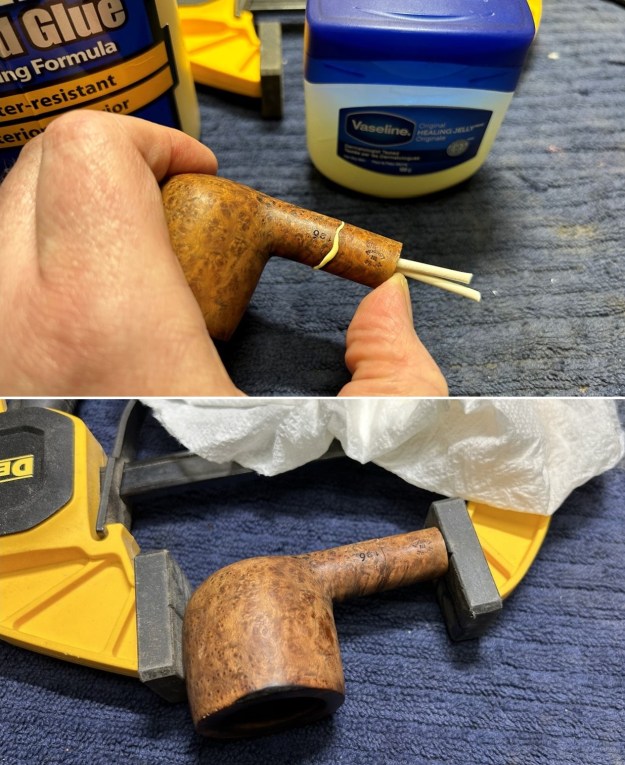
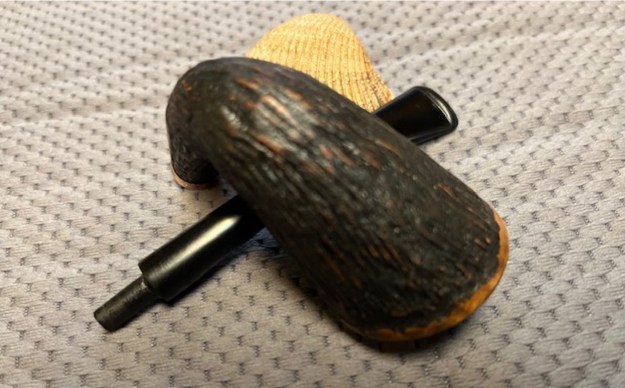
That gave me history on the brand and some connection to present pipes that are made by BPK but I still wanted to find a connection to the older company before the 1992 separation of Czechoslovakia into the Czech Republic and Slovakia. That gave me a possible end date for the pipe. Though I cannot definitively prove it I am fairly certain that the pipe was made by BPK. I cannot find any listings for Gold Spot Made in Czechoslovakia pipes. The similarities to the finish on this one and the rustication on the various Old River pipes made by BPK lead to make the connection.

Now it was time to work on the pipe itself. I decided to do some work on the stem first. There were a significant number of worm holes in the material as visible in the pictures below. There were also some worm holes and tooth marks on the top and the underside of the stem ahead of the button. I wiped down the stem surface with alcohol on a cotton swab to remove any oils or debris from the worm holes or tooth damage areas. Once they were clean I filled them in with several layers of clear CA glue and set the stem aside to let the repairs cure.While the stem repairs cured I turned my attention to the bowl. I used a PipNet Pipe reamer first to take out the majority of the cake. It was a deep bowl so I used a Savinelli Fitsall Pipe Knife to clean up the remaining cake in the bowl and to scrape off the lava on the rim top. I used a dowel wrapped with 220 grit sandpaper to smooth out the walls of the bowl. I checked for damage on the bowl walls and it was in good condition. I scraped the rim top with a Savinelli Fitsall Pipe Knife. I cleaned up the inner edge of the bowl with a folded piece of 220 sandpaper. I scrubbed out the inside of the shank, mortise and the airway in both the stem and the bowl. I used pipe cleaners, cotton swabs and isopropyl alcohol. It cleaned up very well.I scrubbed the exterior of the briar with a tooth brush and undiluted Murphy’s Oil Soap to remove the build up on the surface of the briar and clean off the lava on the rim top. I scrubbed it and then carefully rinsed the bowl with warm water. I dried it with a soft cotton cloth. It certainly looked significantly better and the patina remained in the wood. I polished the smooth briar with micromesh sanding pads to minimize the scratches in the briar. I dry sanded with 1500-12000 grit pads and wiped the bowl down after each pad with a damp cloth to remove the sanding debris. By the end of the nine pads the briar took on a rich shine and the rim top looked very good. I rubbed the bowl down with Before & After Restoration Balm. It is a paste/balm that works to deep clean the finish, enliven and protect the briar. I worked it into the briar with my finger tips o make sure that it covered every square inch of the pipe. I set it aside for 10 minutes to let it do its work. I buffed it with a cotton cloth. The briar really began to have a deep shine. The photos I took of the bowl at this point mark the progress in the restoration. I set the bowl aside and turned my attention to the stem. The repairs to the stem surface had cured. I used several files to flatten the repaired areas ahead of the mouthpiece and around the shank end. I cleaned up the file areas with a folded piece of 220 grit sandpaper to blend them into the stem surface. I sanded the stem with 320-3500 grit sanding pads to break up the remaining oxidation. I wiped it down after each sanding pad with an Obsidian Oil impregnated cloth. It began to look good.I polished the stem with micromesh sanding pads – dry sanding with 1500-12000 grit pads. I wiped the stem down after each sanding pad with Obsidian Oil. I polished it with Before & After Pipe Stem Polish – both Fine and Extra Fine. Once I had finished the polishing I gave it final coat of Obsidian Oil and set it aside to dry.  I put the Gold Spot Made in Czechoslovakia Rusticated Pot bowl and stem back together. I polished the bowl and stem with Blue Diamond to polish out the scratches in the briar and the repaired horn stem. I gave the bowl multiple coats of Conservator’s Wax and the stem multiple coats of carnauba wax. I buffed the pipe with a clean buffing pad to raise the shine. I hand buffed it with a microfiber cloth to deepen the shine. The pipe polished up pretty nicely. The reddish/brown stains worked amazingly well with the polished horn taper stem. The grain around the bowl and shank and looks quite remarkable. This is truly a beautiful BPK Gold Spot Rusticated Pot. The finished pipe is shown in the photos below. The dimensions of the pipe are Length: 5 inches, Height: 1 ½ inches, Outside diameter of the bowl: 1 ½ inches, Chamber diameter: ¾ of an inch. The weight of the pipe is 1.98 ounces/55 grams. For now, this one will join the Old River Pipe in my collection and be enjoyed with some good Virginia very soon. Thanks for walking through the restoration with me. Cheers.

As always, I encourage your questions and comments as you read the blog. Thanks to each of you who are reading this blog. Remember we are not pipe owners; we are pipe men and women who hold our pipes in trust until they pass on into the trust of those who follow us.