Tag Archives: contrast staining

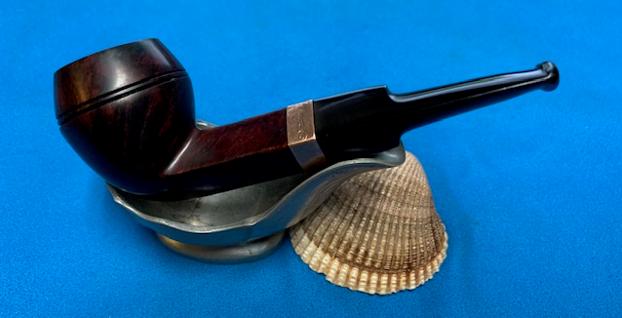
What a Tired and Worn Pair of Cased 1919 Charles Mass Pipes – Part 2: An Exhausted Billiard


Blog by Steve Laug

This restoration is Part 2 of one that started with an email from a reader of the blog name Tim. He had written the following email to me with a request. I have included that email below.

Hello Steve, I have a cased set of 1919 Charles Maas pipes that have been smoked hard and put away wet. Can I send them to you to have them restored? I’m a huge fan of your work and use your site often as inspiration, but these are outside my ability. – Tim

I finished the restoration of the Bulldog first and have written about the work on the blog already. Here is the link (https://rebornpipes.com/2021/05/30/what-a-tired-and-worn-pair-of-cased-1919-charles-mass-pipes-part-1-a-weary-bulldog/).

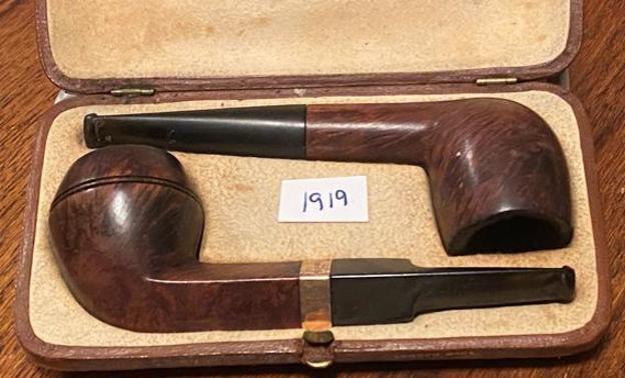
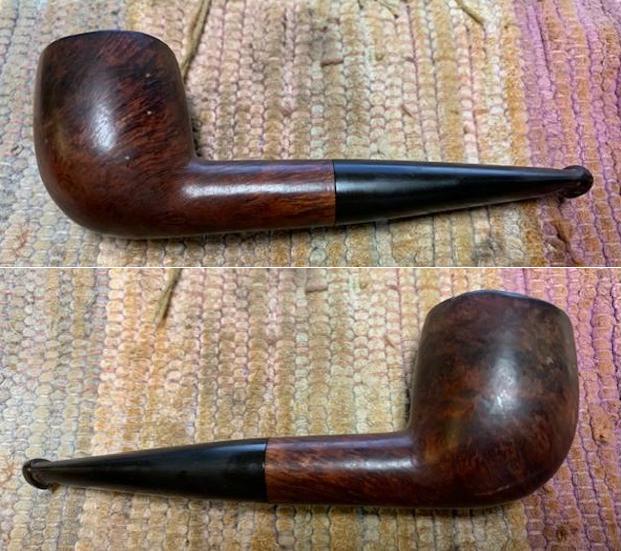
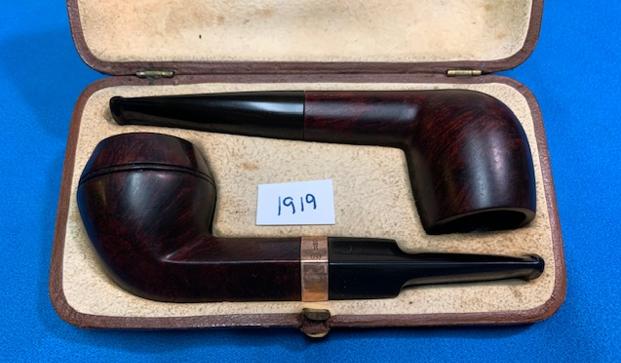
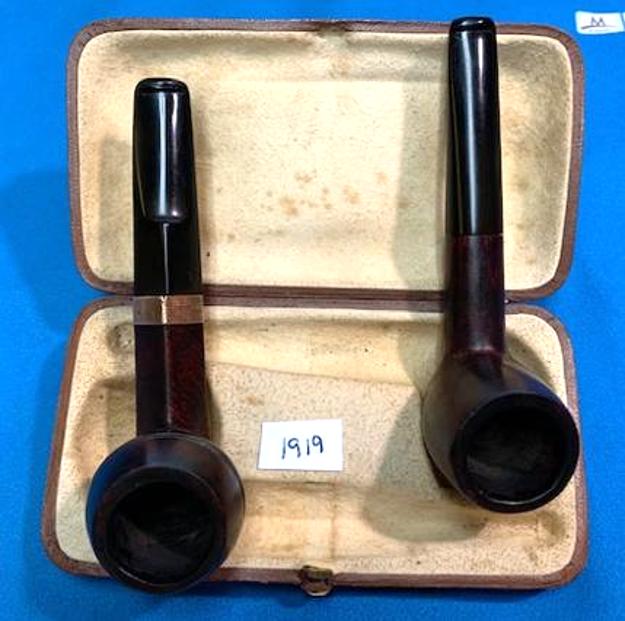
I am including the photos that Tim Sent me so you can see them if you have not read Part 1 of the blog on the Bulldog. Tim’s package arrived on Thursday and when I got home from work I opened it to have a look at the pipes first hand. I took the case out of the well packed box and this is what I saw. The case was suede with a fine leather edge around the sides. There was a thin gold line around the case edges. When I opened it I saw Tim’s 1919 label and the two pipes. There was a gold banded Bulldog and a nice stubby billiard. Both were nicely carved bowls and both had been heavily used and worn.

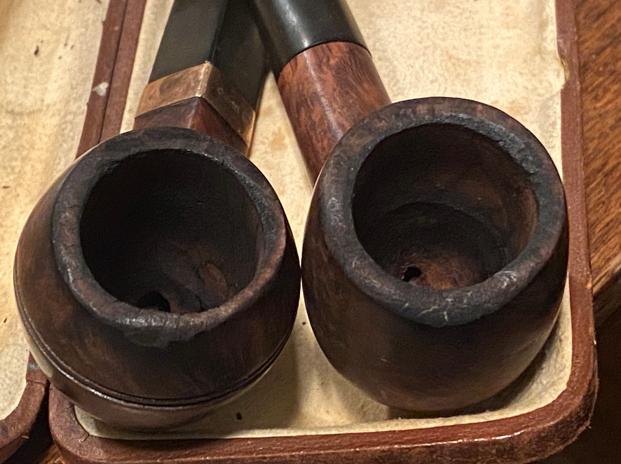
I sent Tim the following list summarizing the damages on the Billiard (a similar list is on the blog about the Bulldog). There is a lot of work to do to bring these back to life.

The billiard:
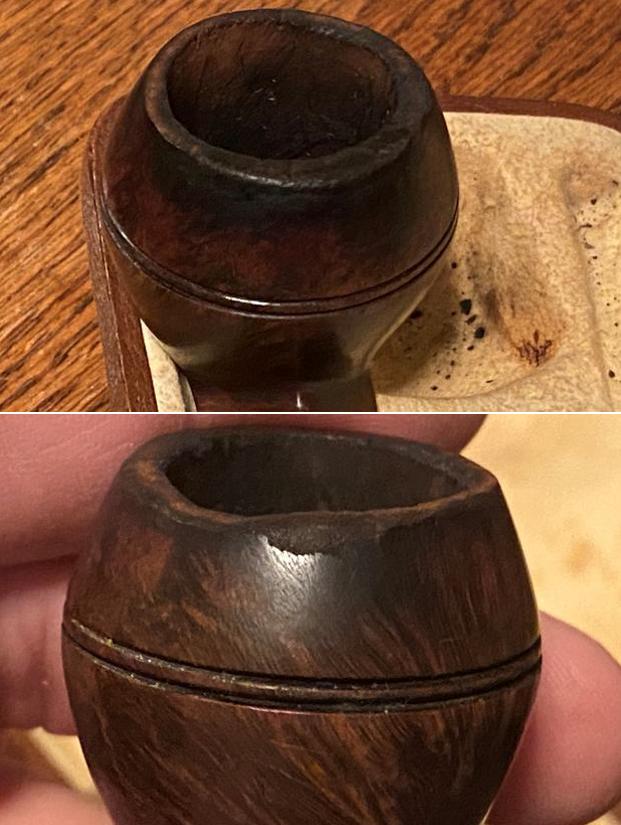
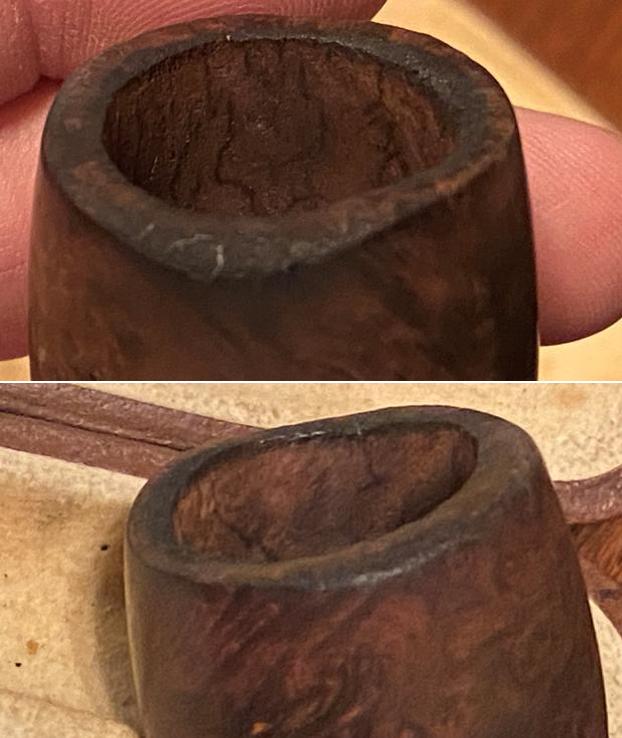
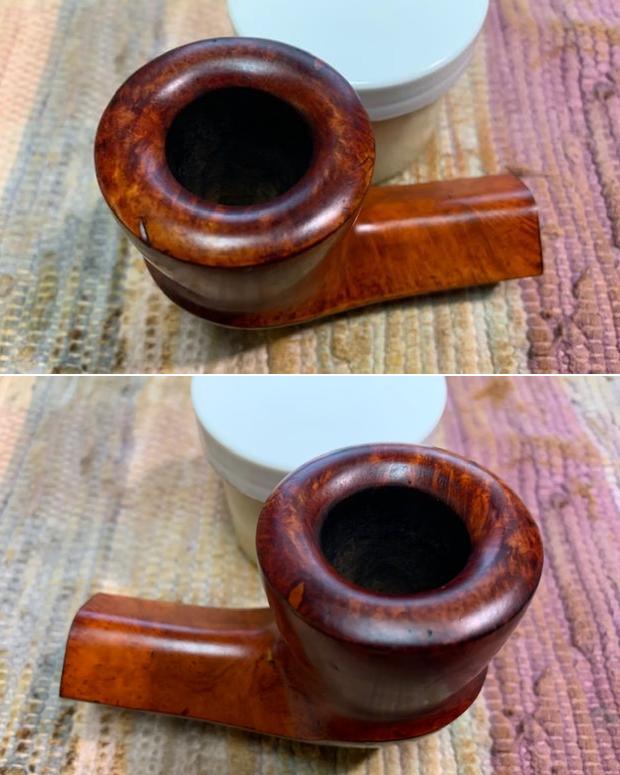
1. The rim top is badly damaged leaving the top uneven and thicker/taller toward the back of the bowl and more damaged than even the Bulldog.
2. The inner edge of the bowl is thicker than the bulldog but still thinner on the front side than the rest of the bowl. It is still thick enough.
3. The outer edge is chipped and uneven on the bowl front showing some burn marks.
4. The finish is worn and damaged with paint marks on the surface.
5. The bowl is slightly out of round with chips and marks on the inner edge
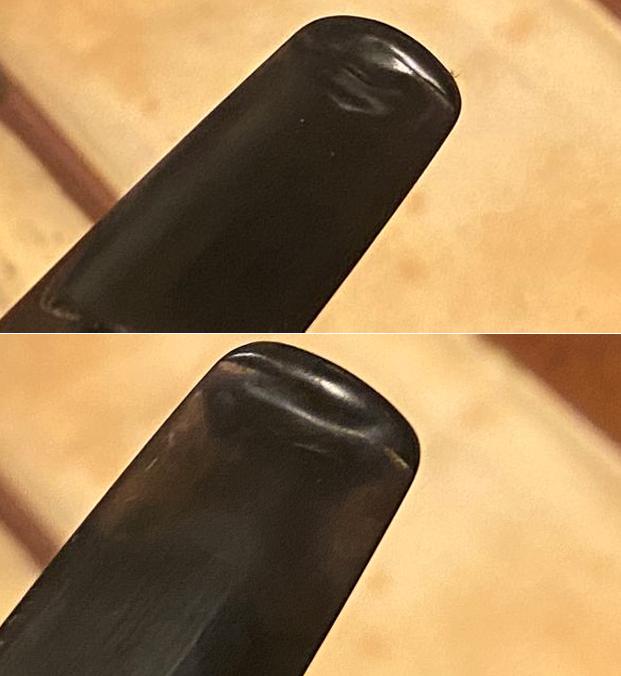
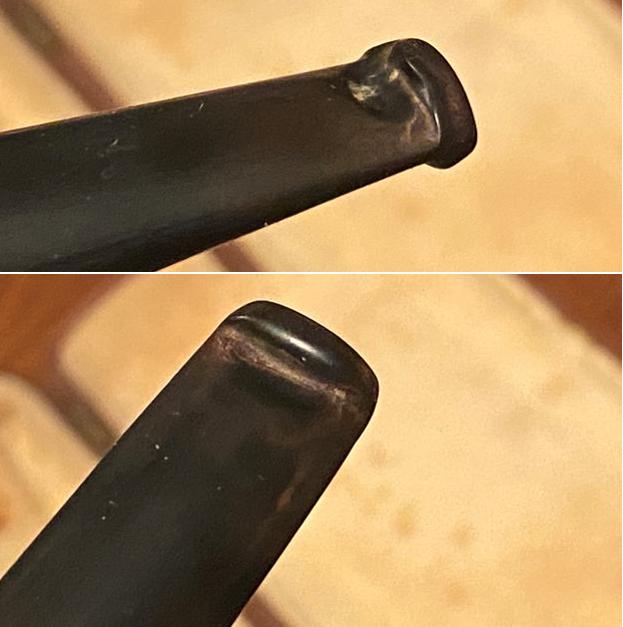
6. The stem has deep compressions from tooth marks on both sides at the button.                        7. The inside of the bowl is badly checked and will need to examined for integrity.

Both pipes had been reamed and they were quite clean inside. It appeared that previous earlier reaming somewhere along the way had left the inner edge chipped and damaged. That is the assessment of the Billiard and it is clear from the list that there is a lot of work to do on it.

For background on the Charles Maas brand read the previous blog to get a clear idea of the history of the company. I will not include it again at this point. Here is another copy of the link for ease of reference (https://rebornpipes.com/2021/05/30/what-a-tired-and-worn-pair-of-cased-1919-charles-mass-pipes-part-1-a-weary-bulldog/).

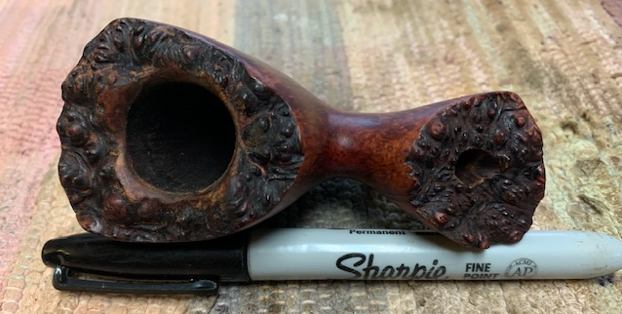
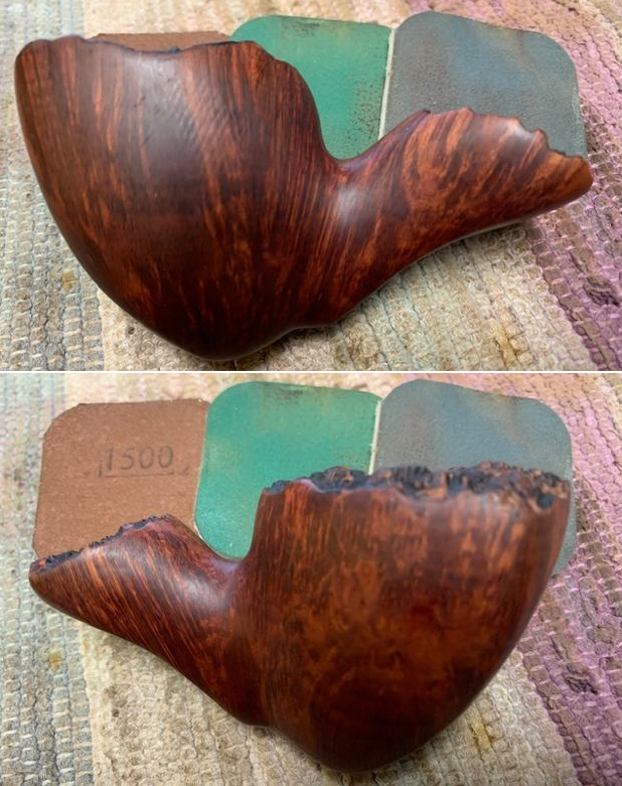
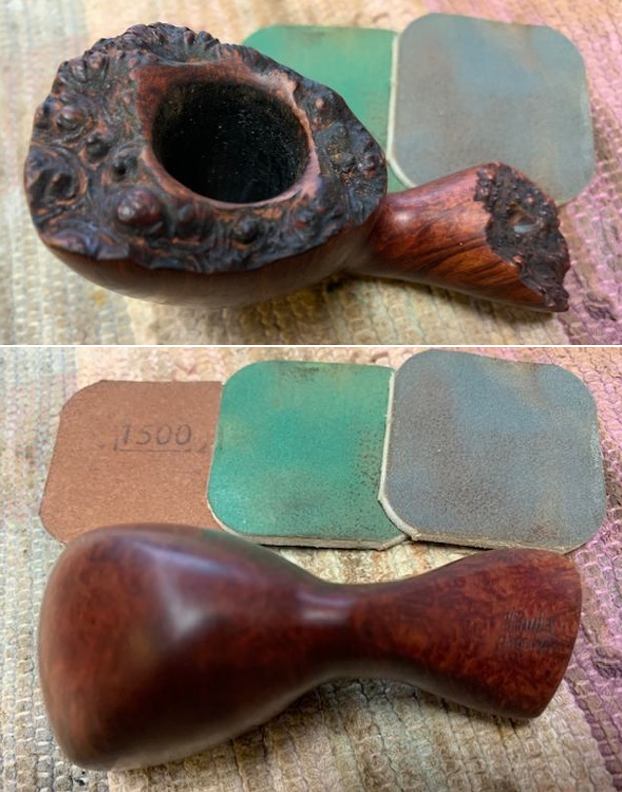
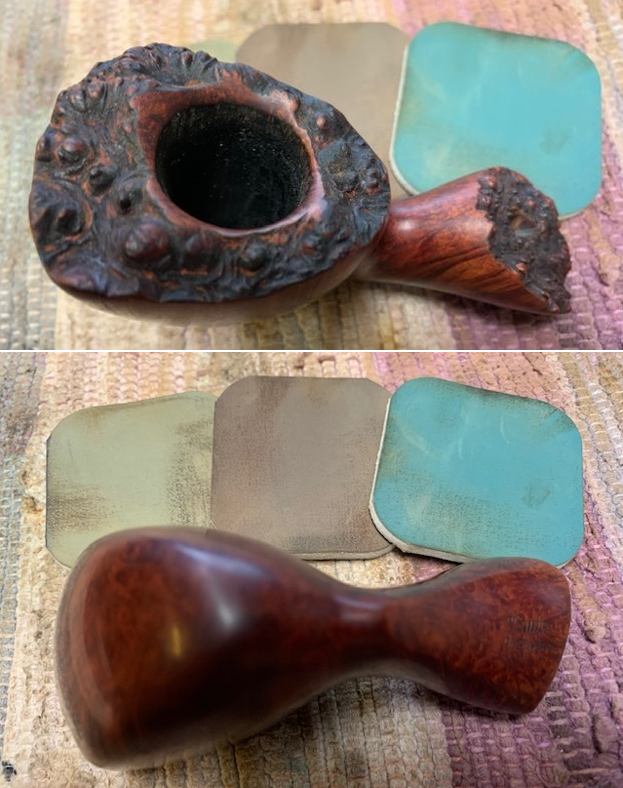
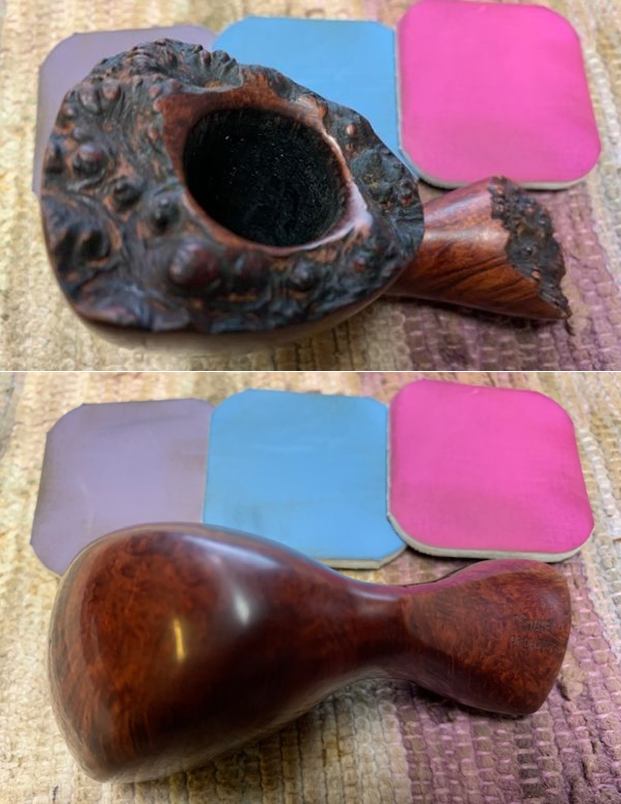
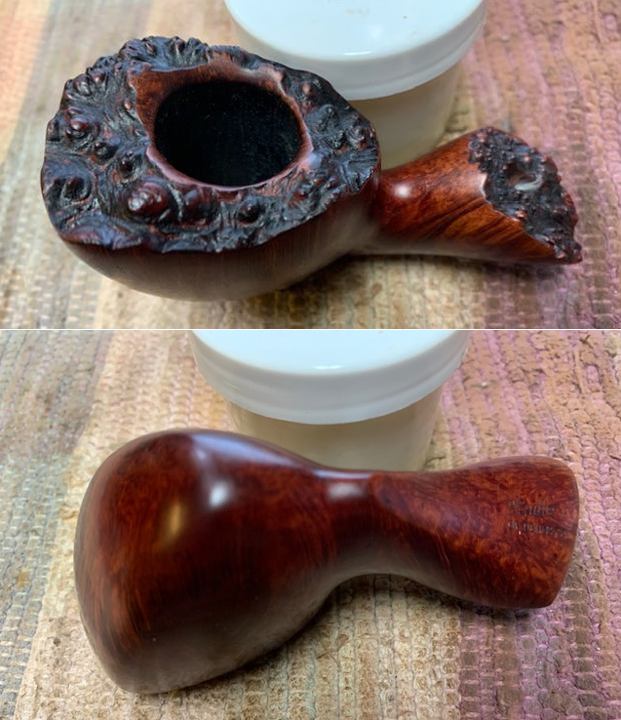
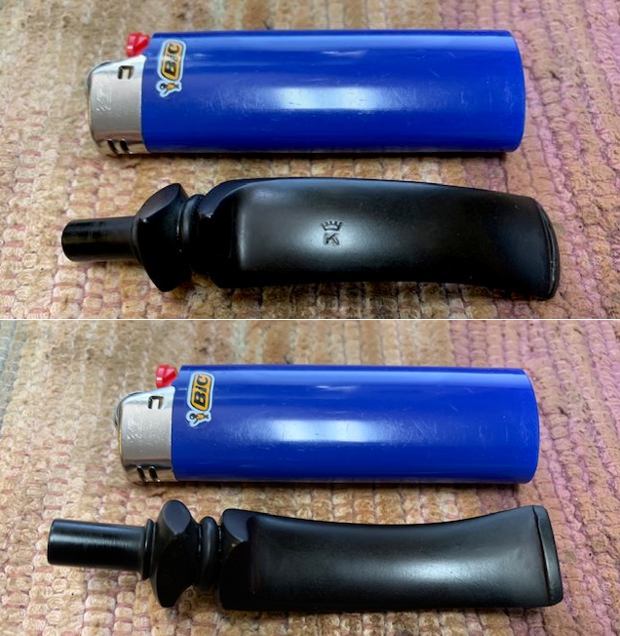
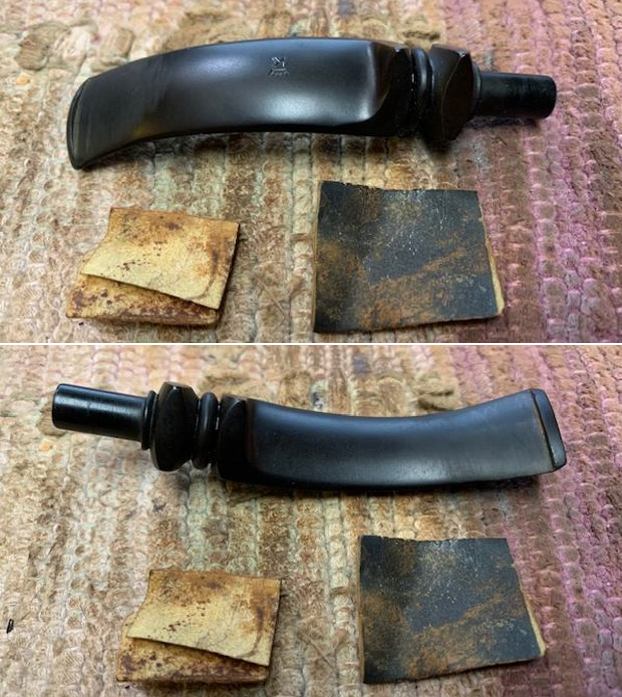
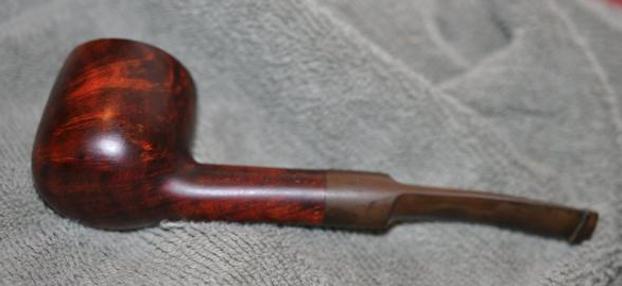
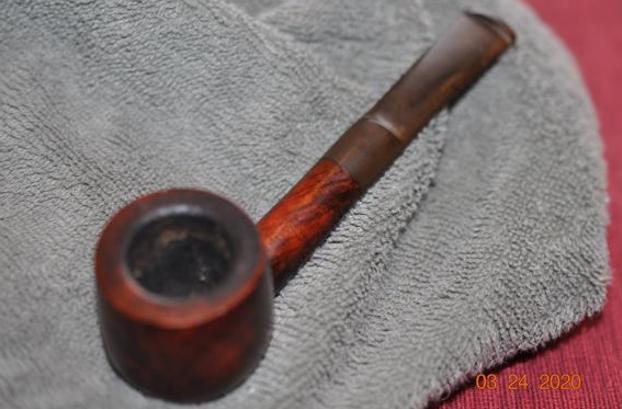
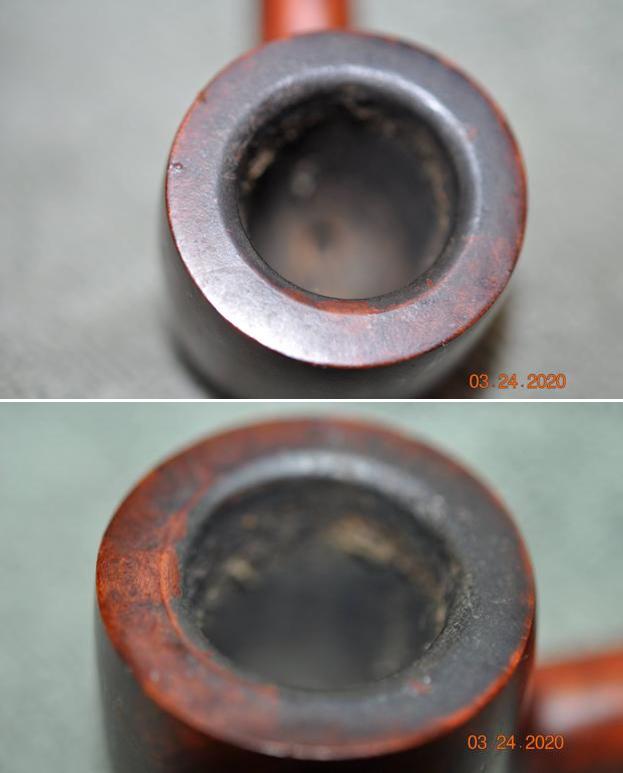
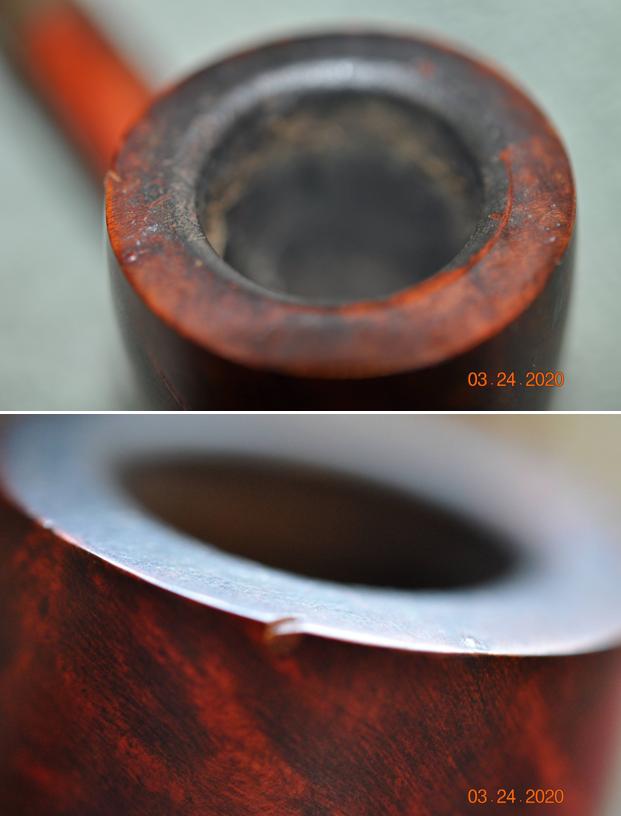
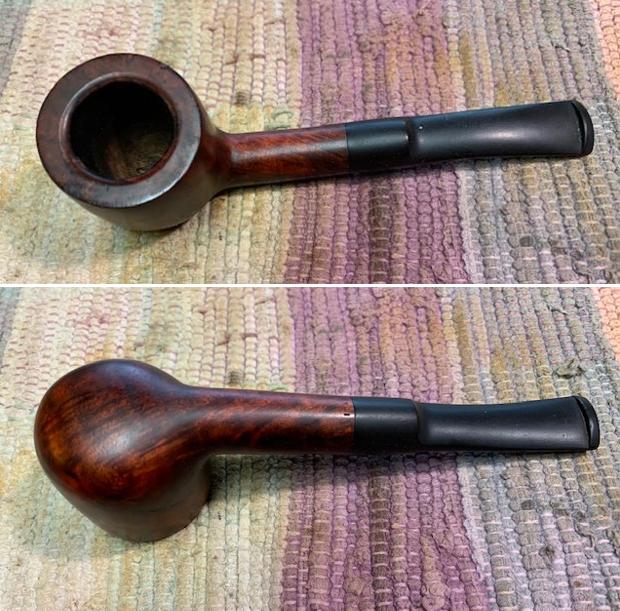
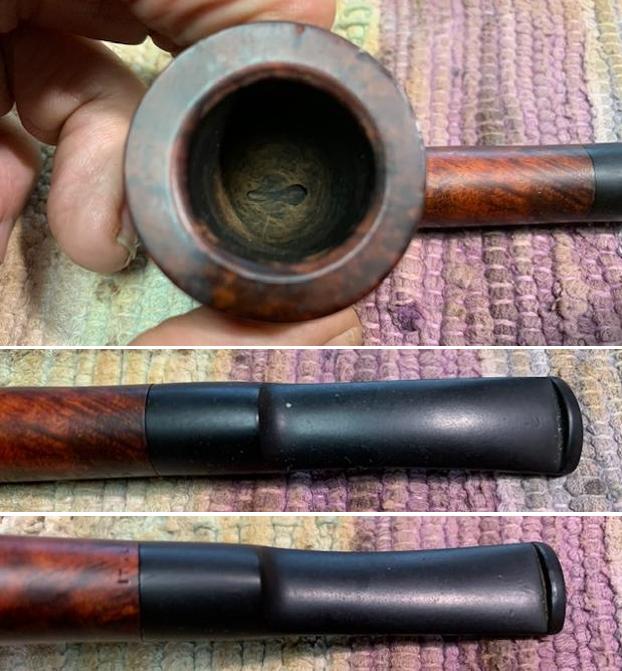
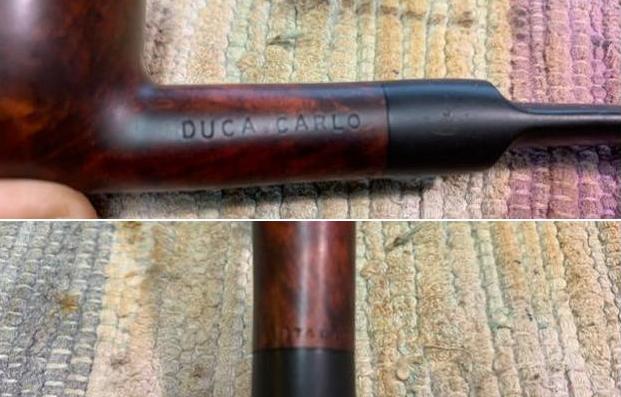
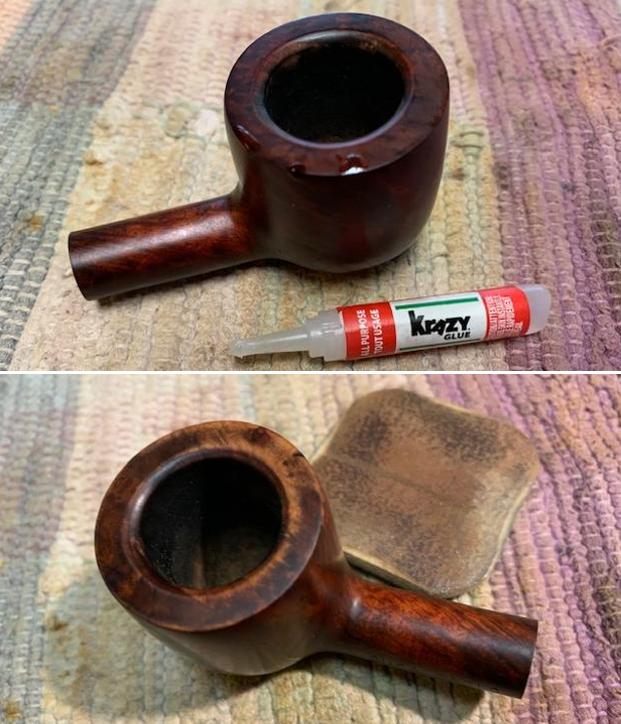
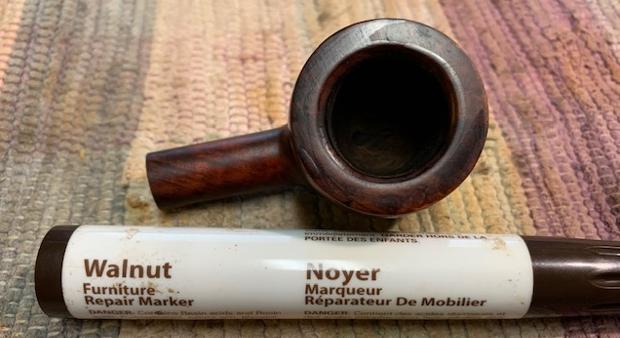
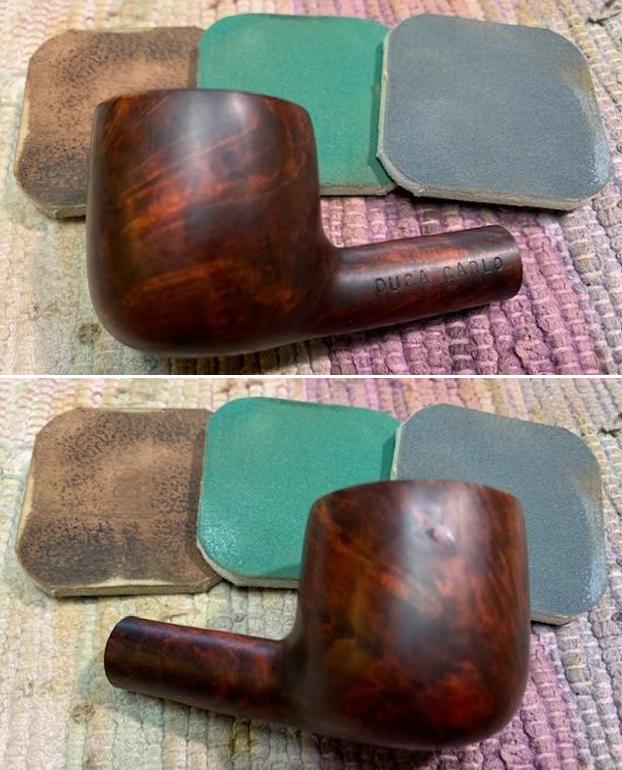
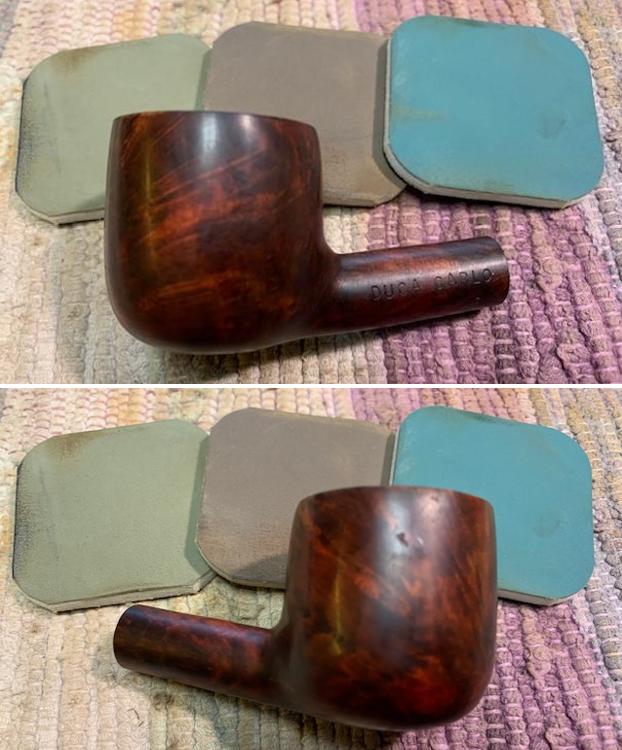
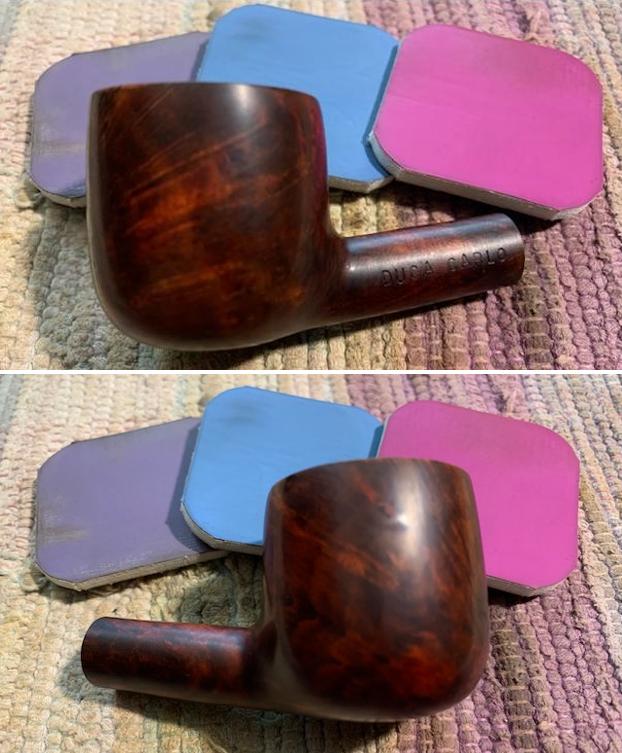
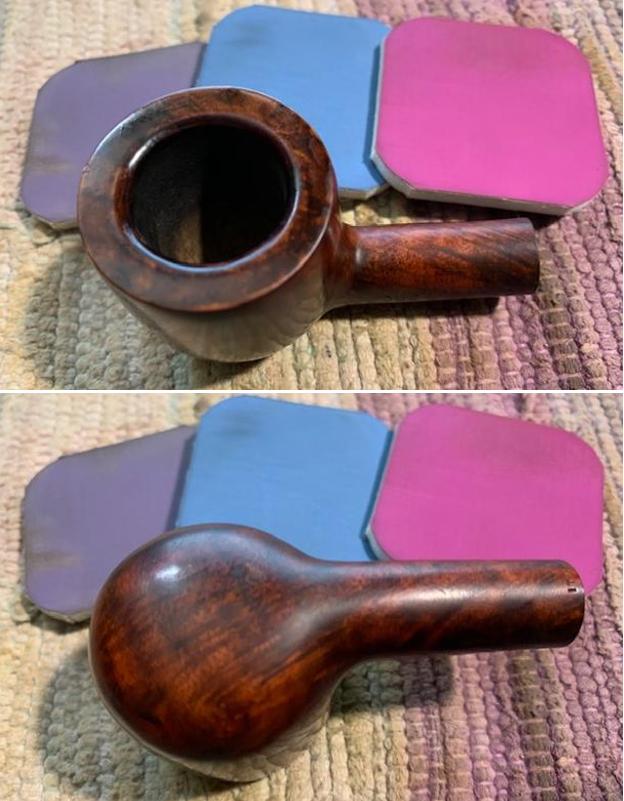
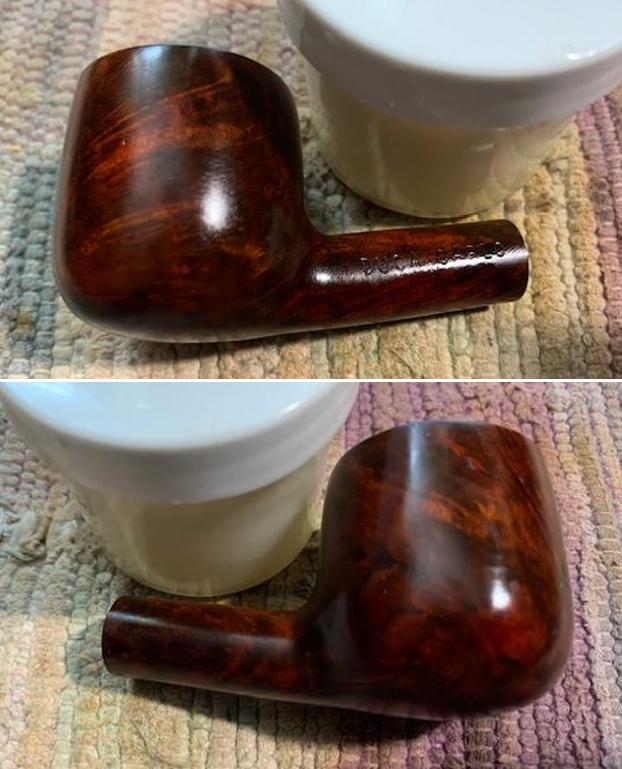
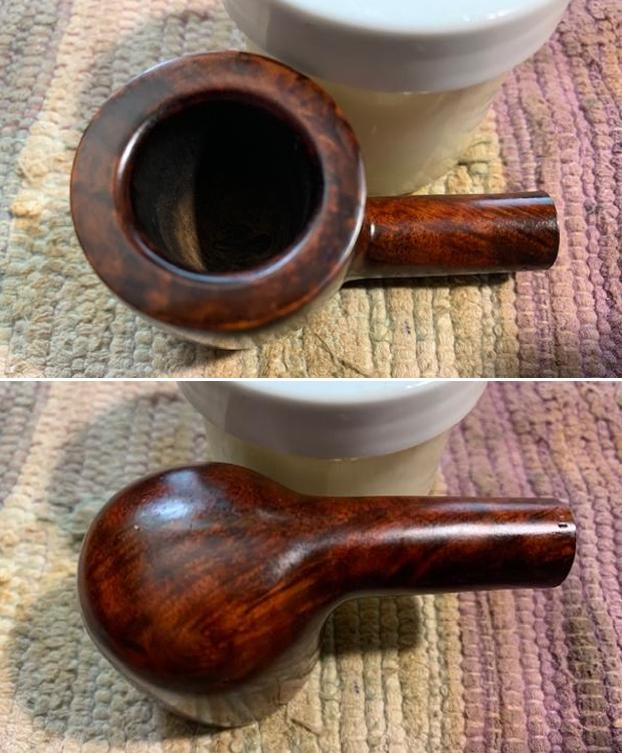
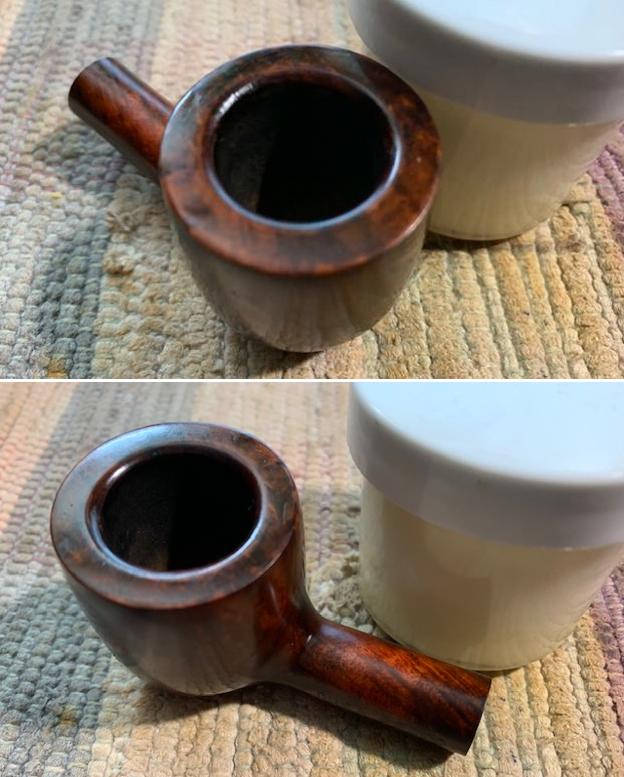
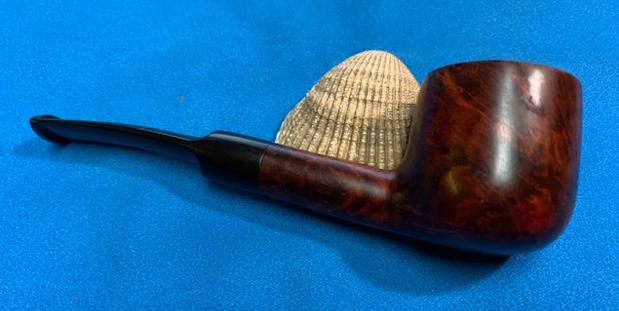
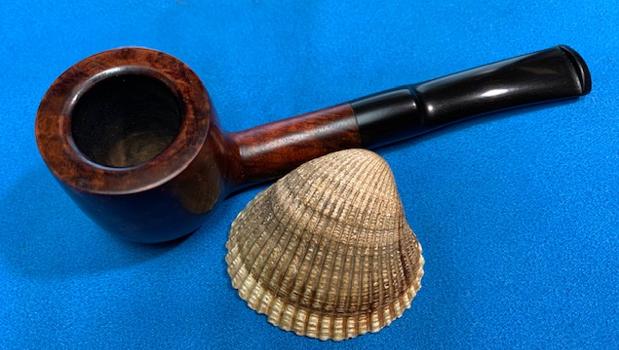
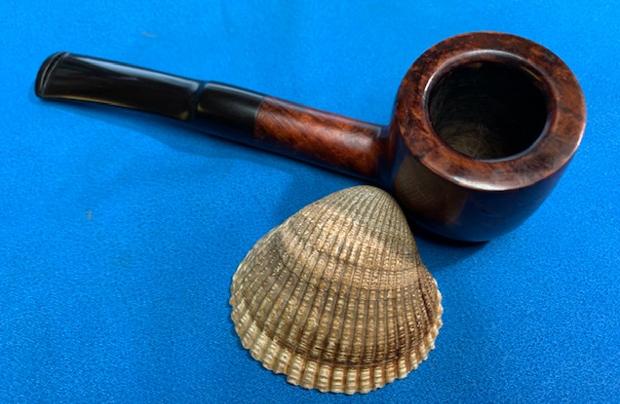
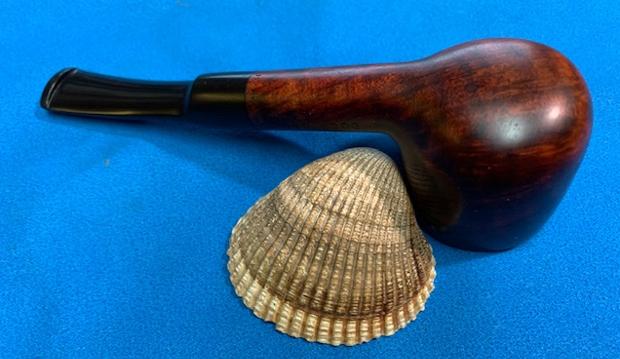
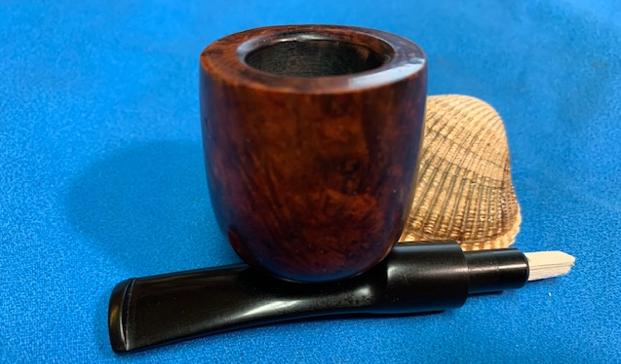
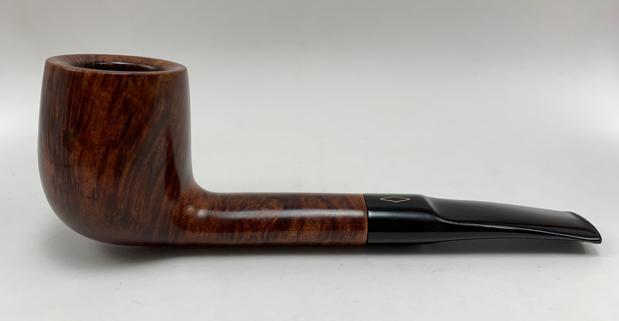
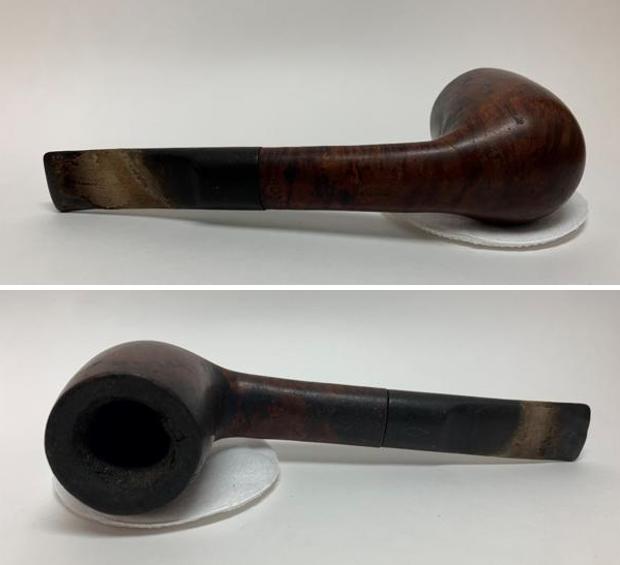
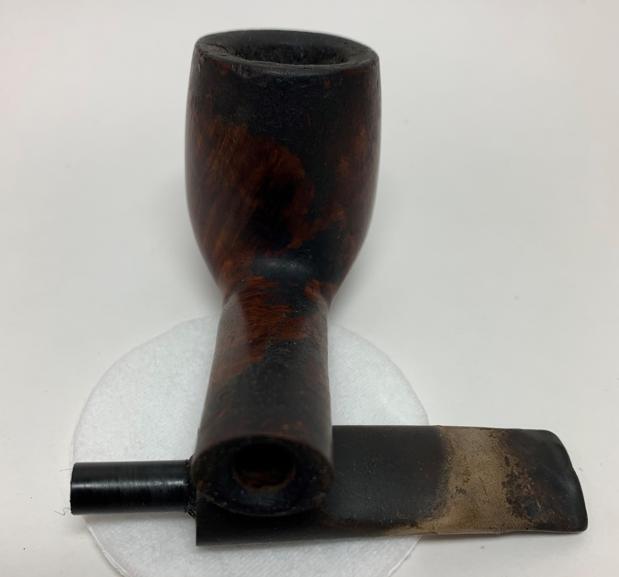
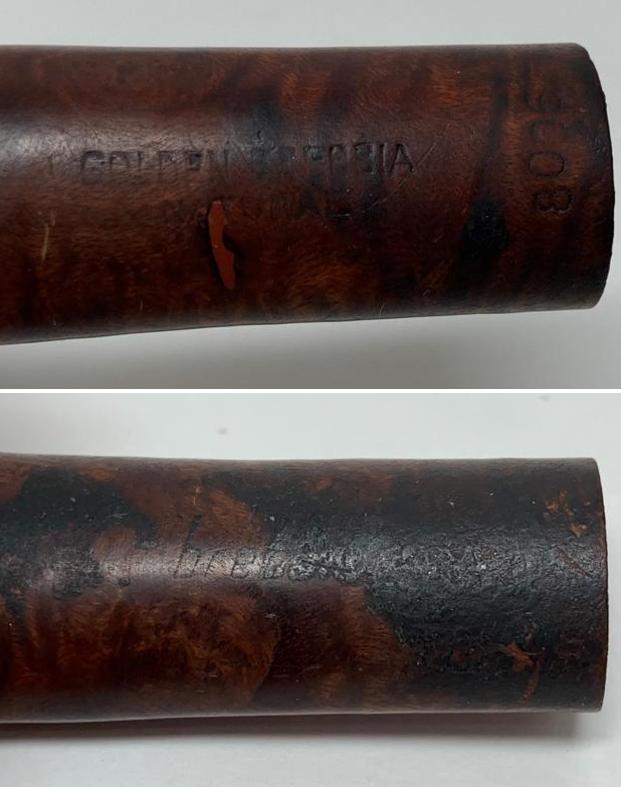
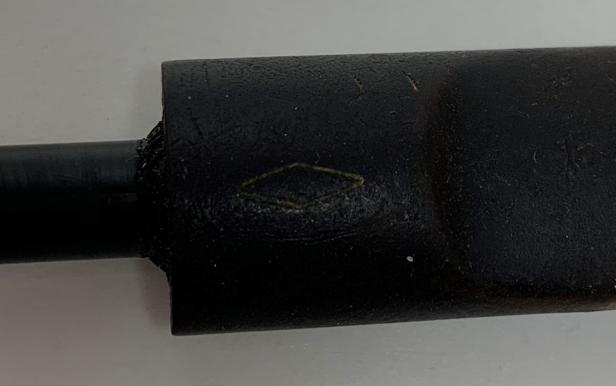
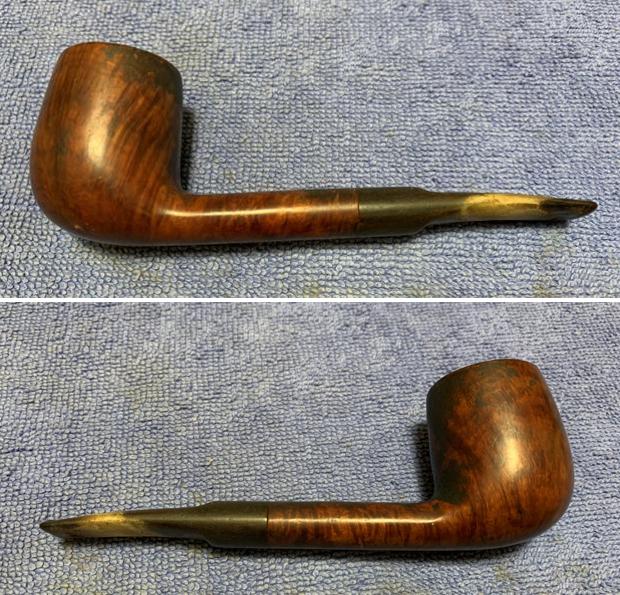
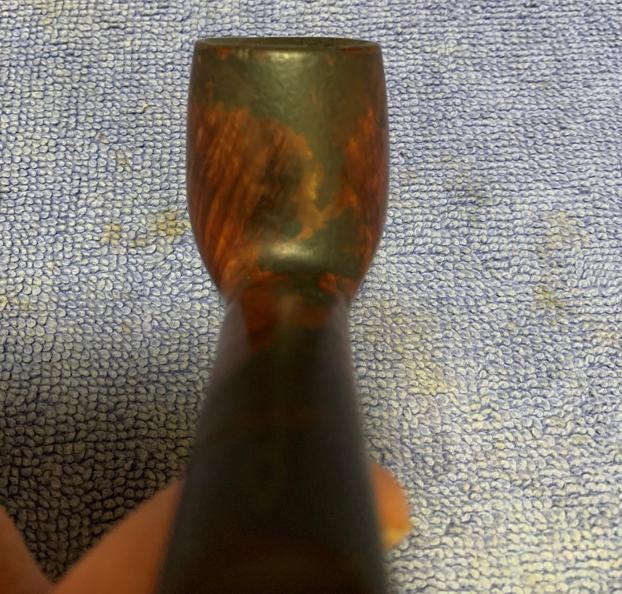
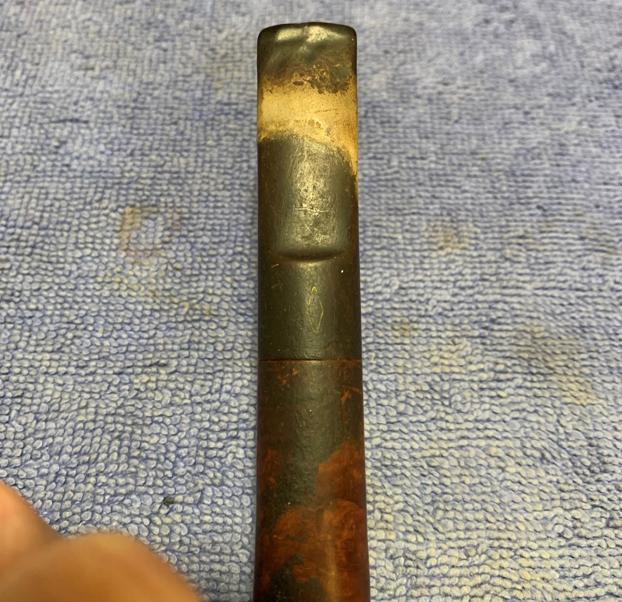
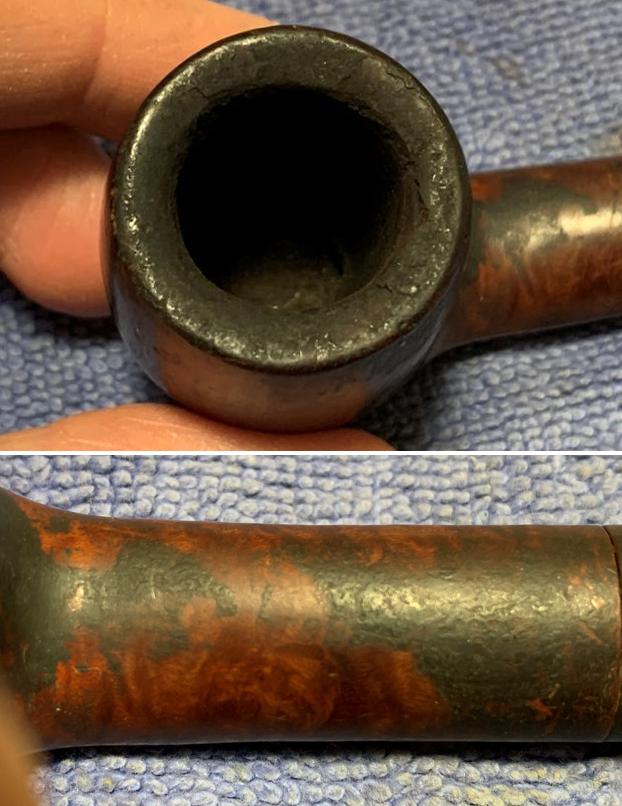
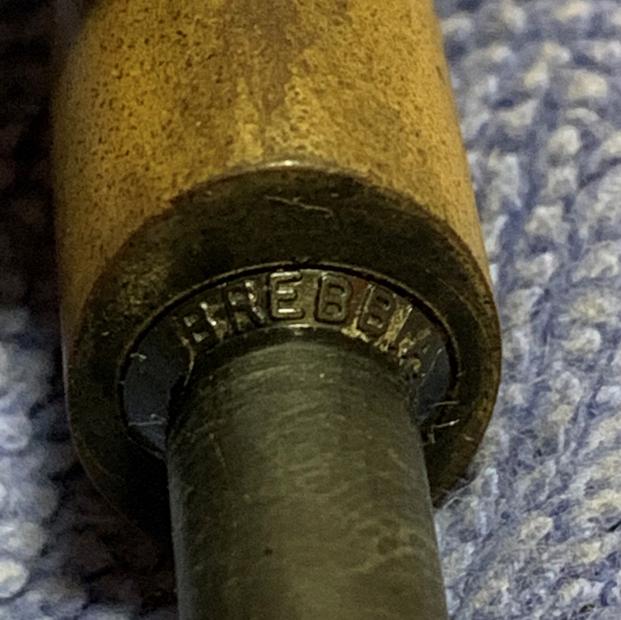
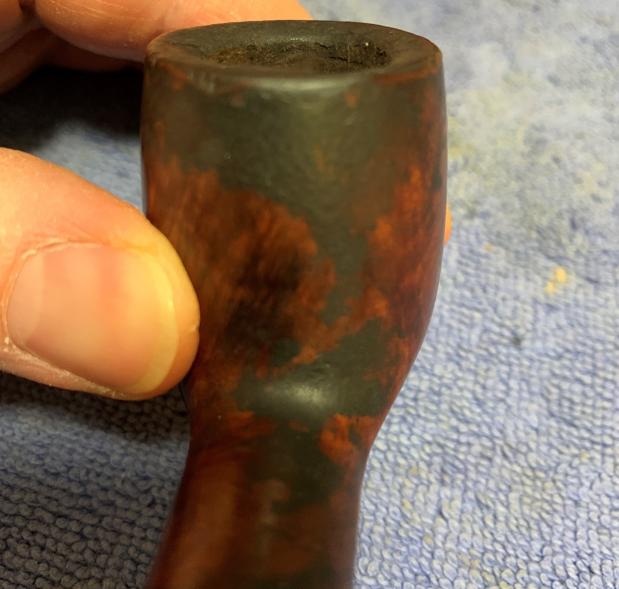
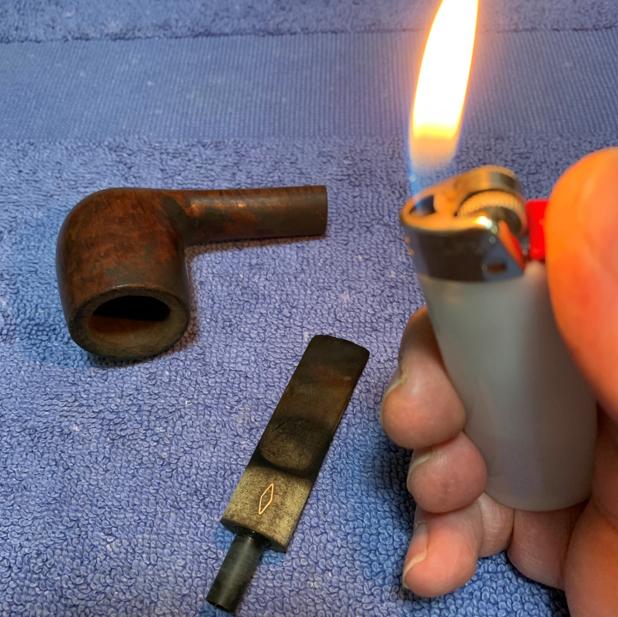
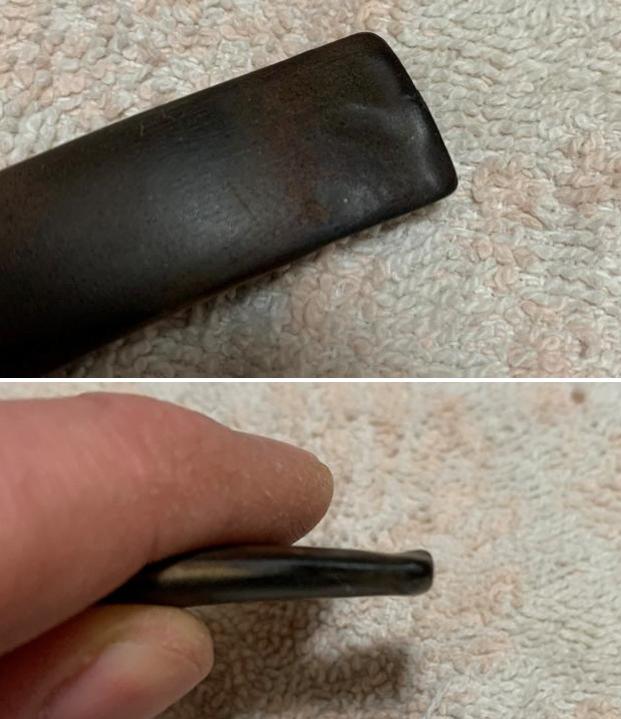
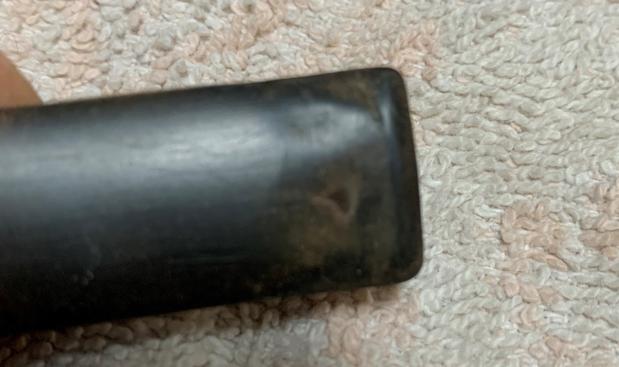
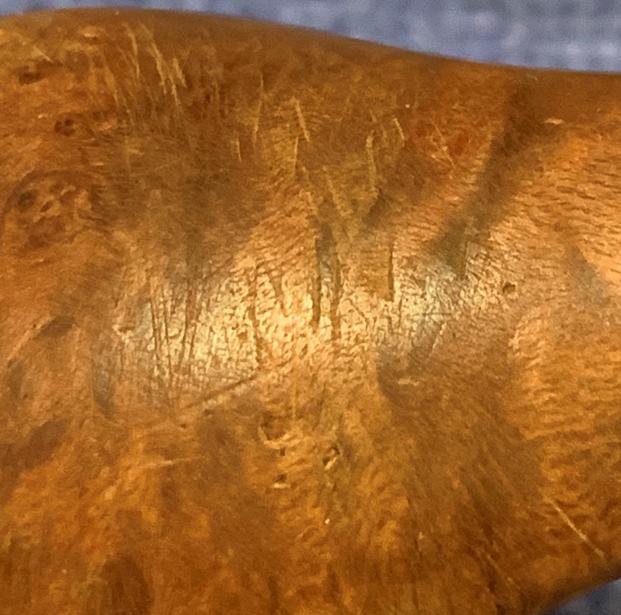
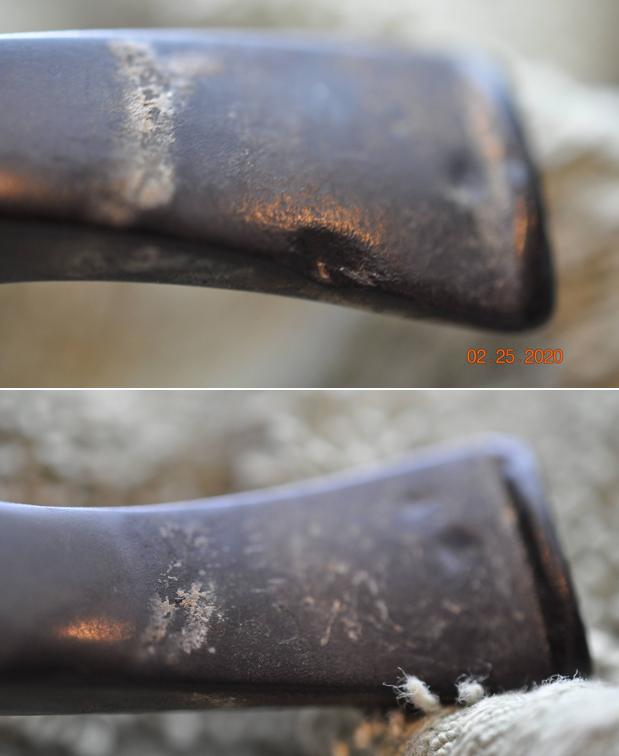
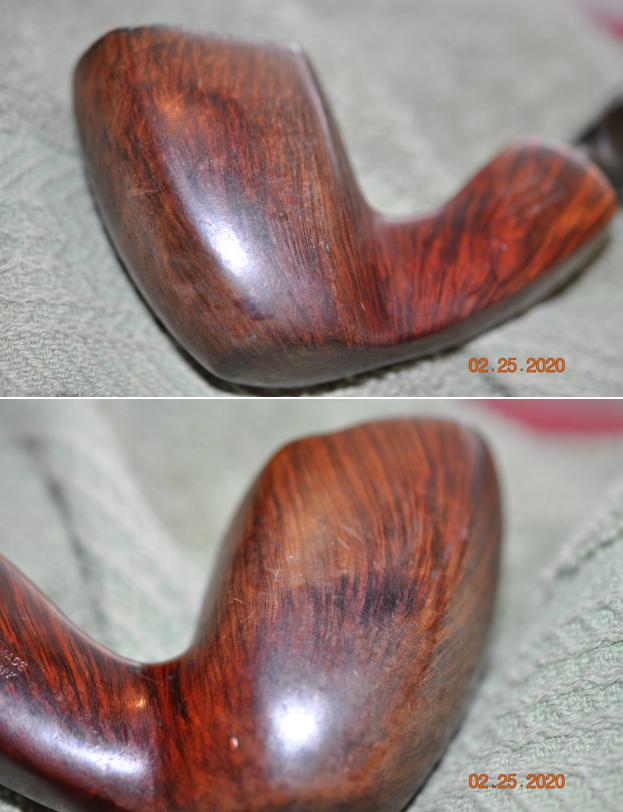
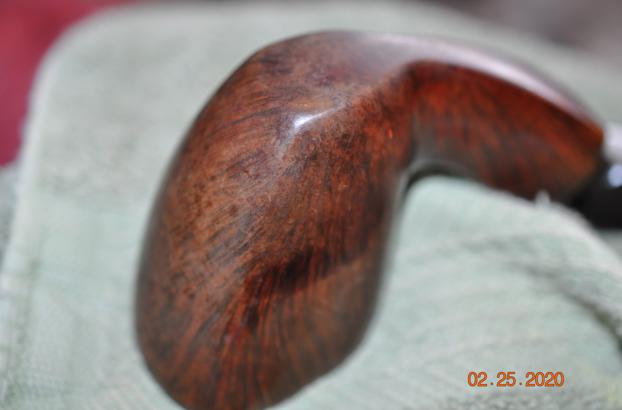
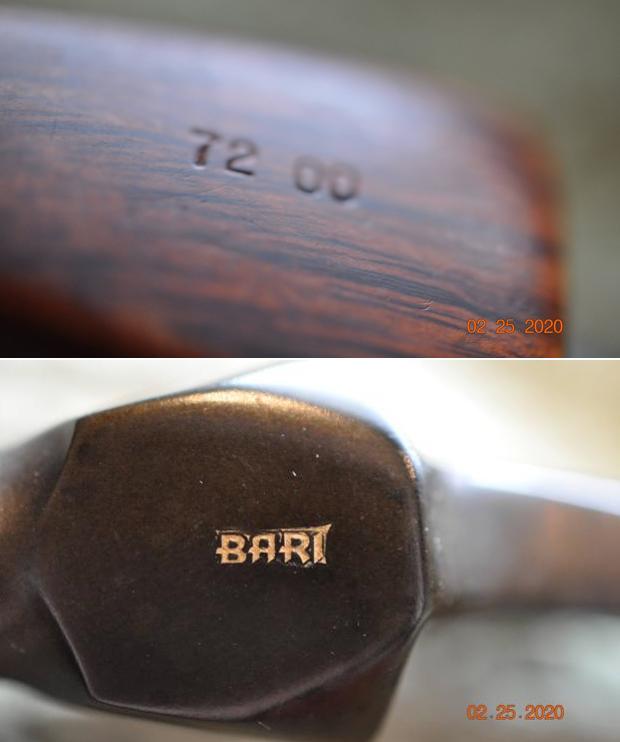
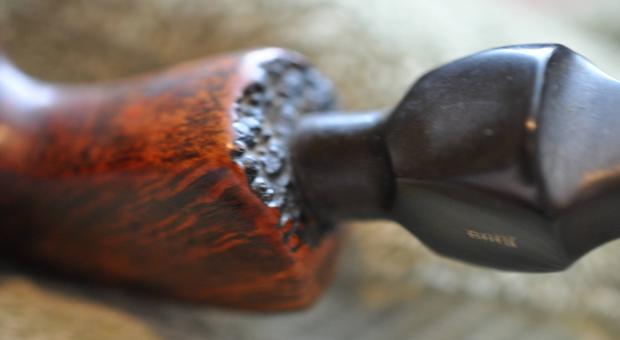
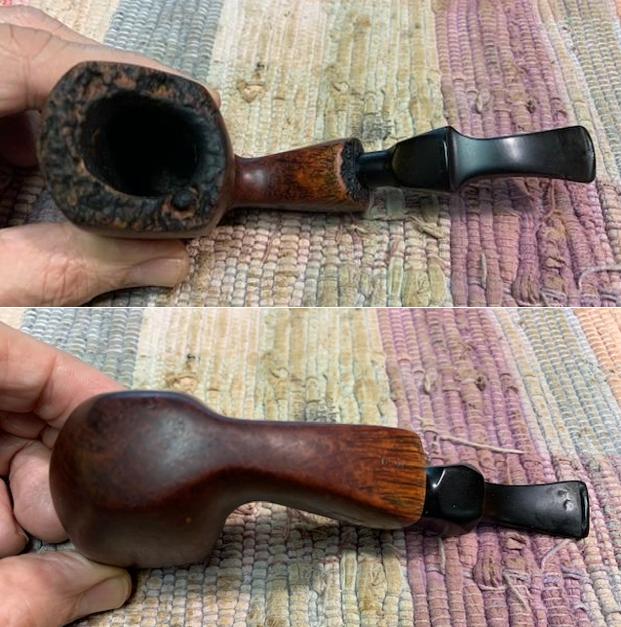
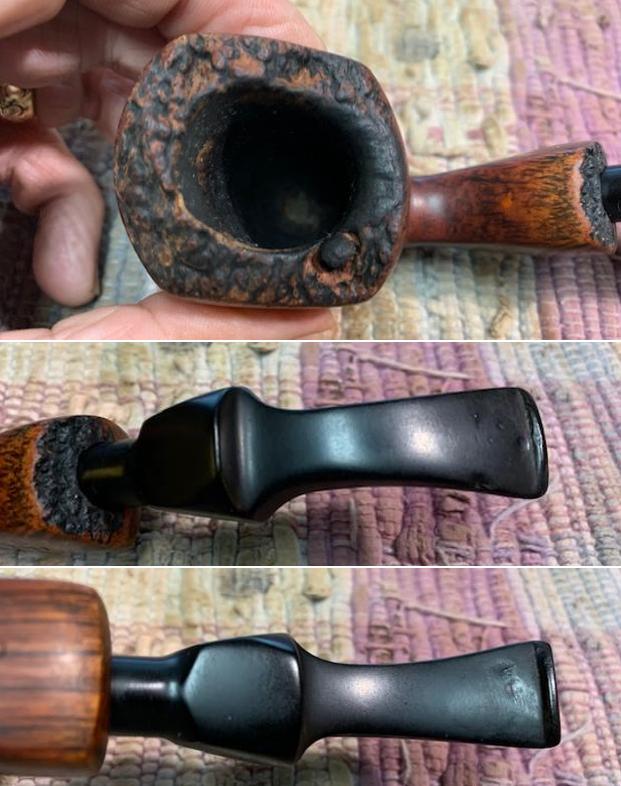
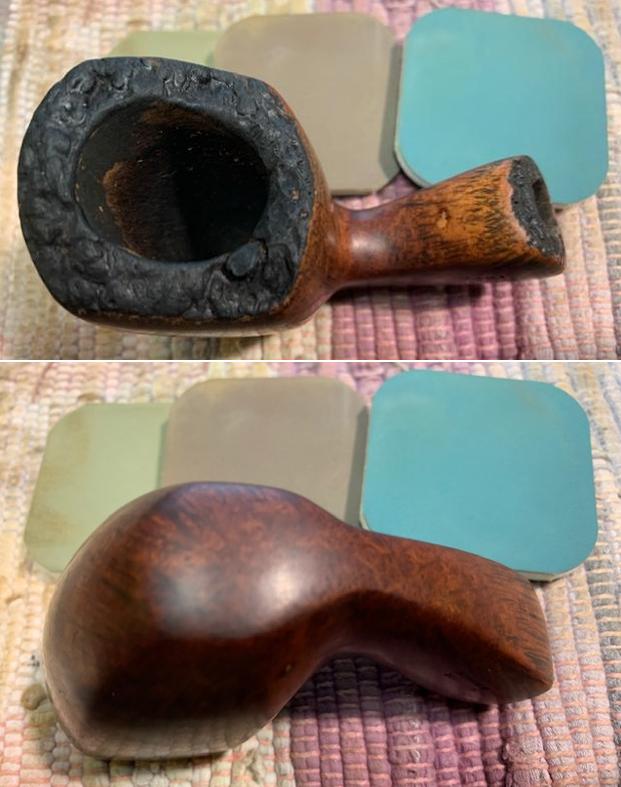
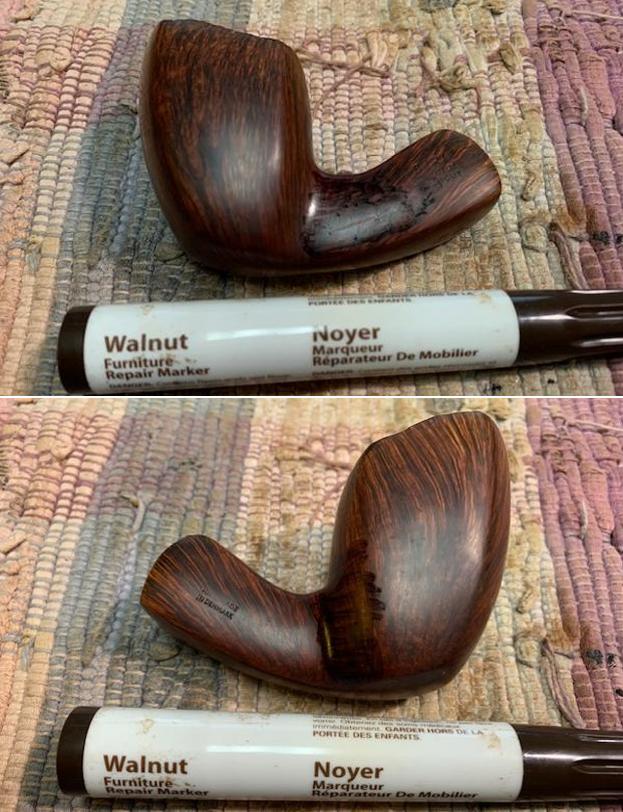
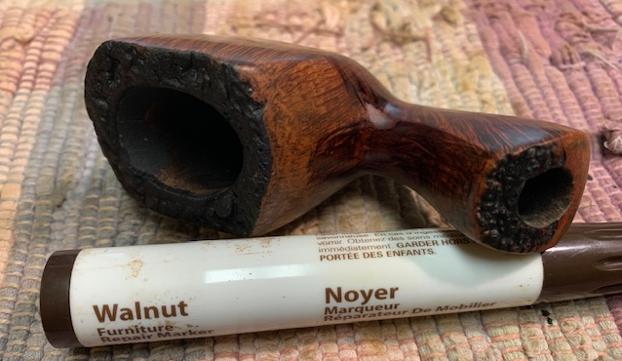
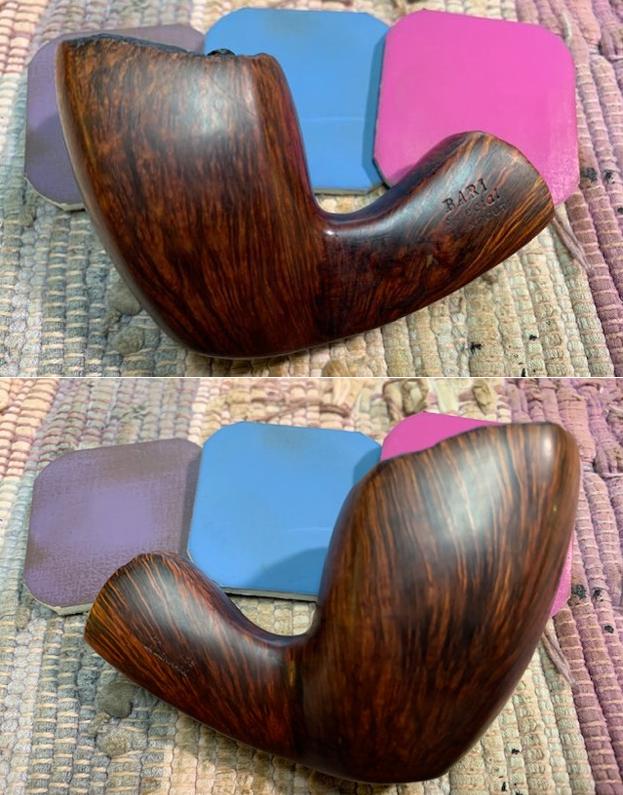
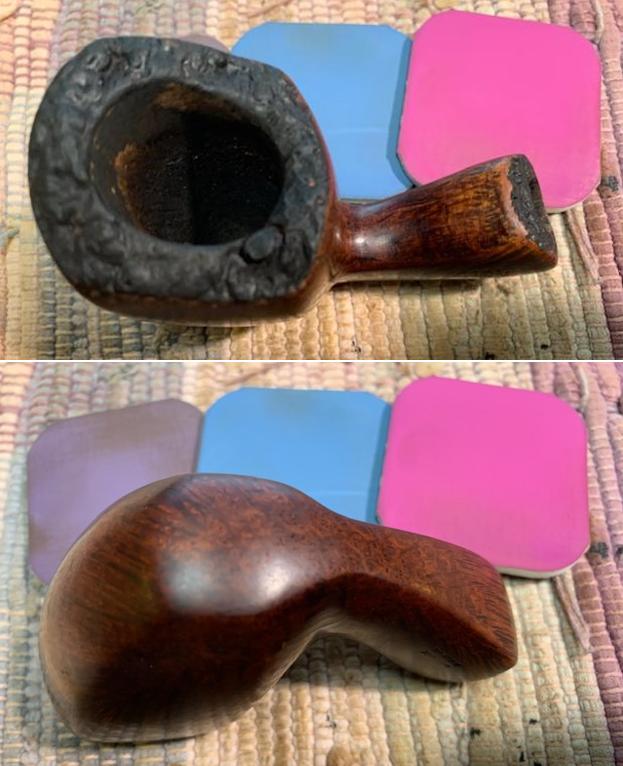
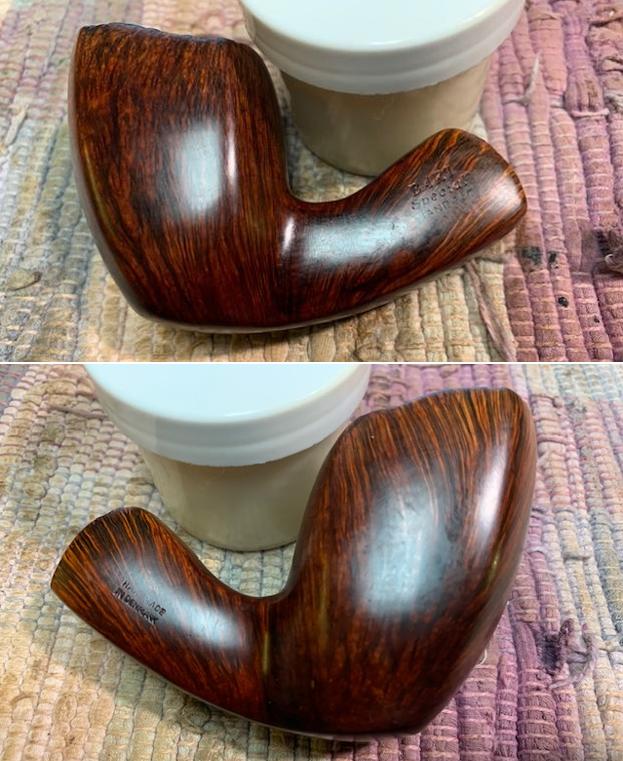
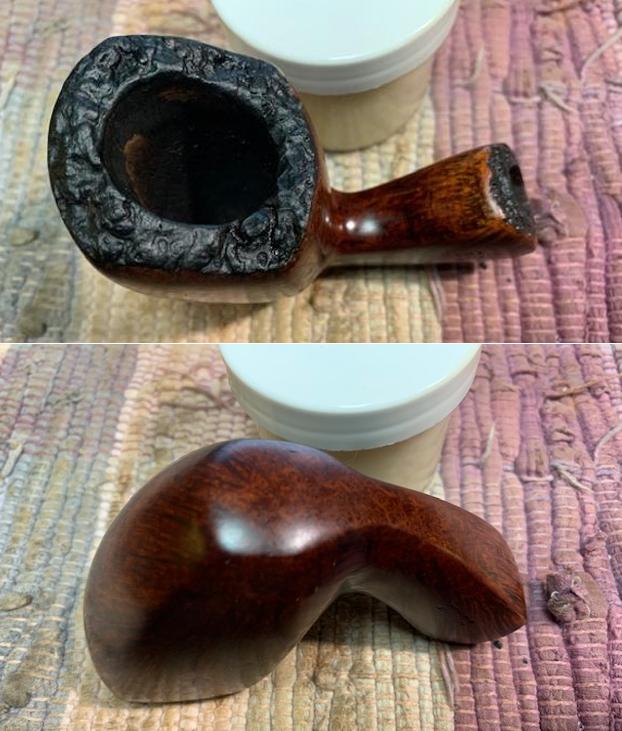
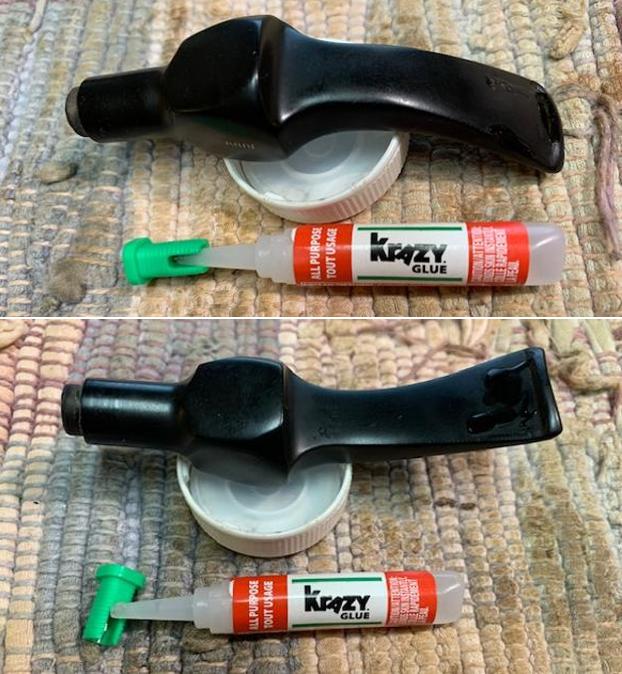
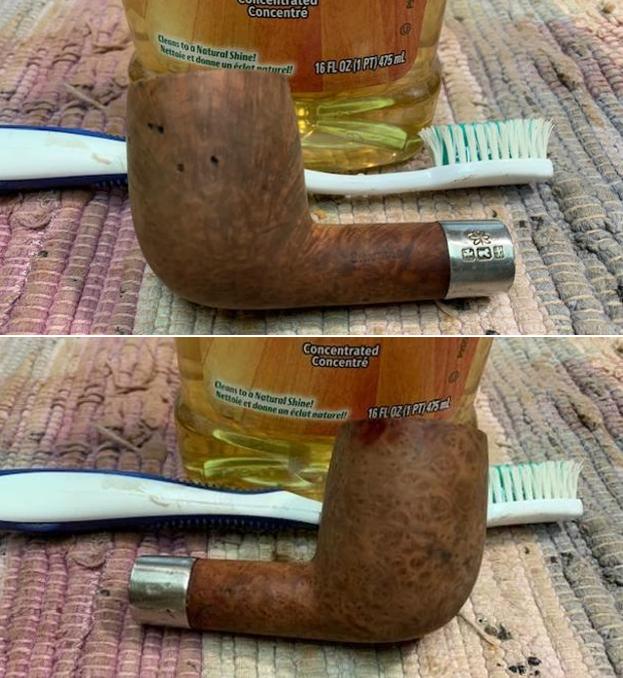
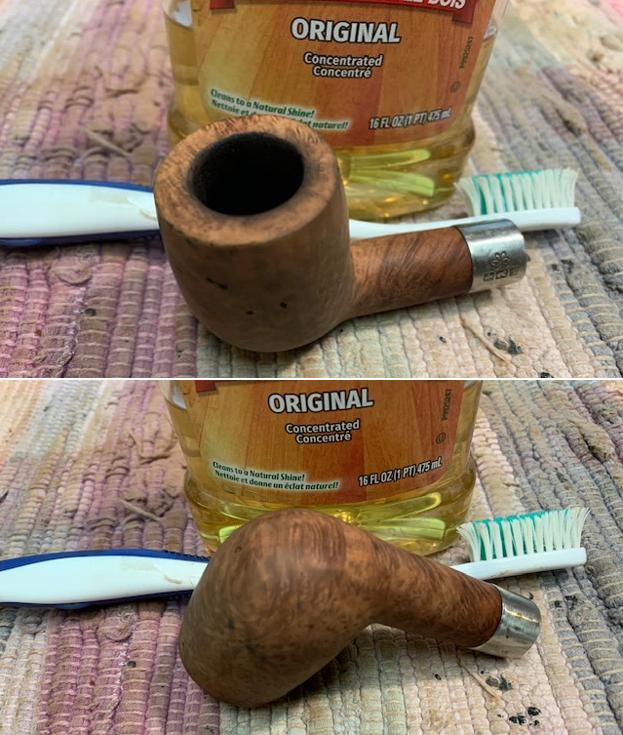
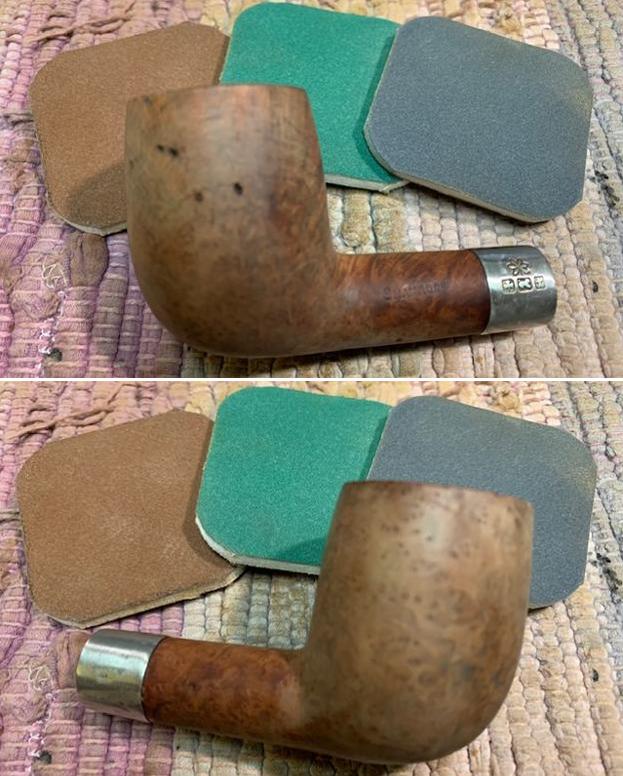
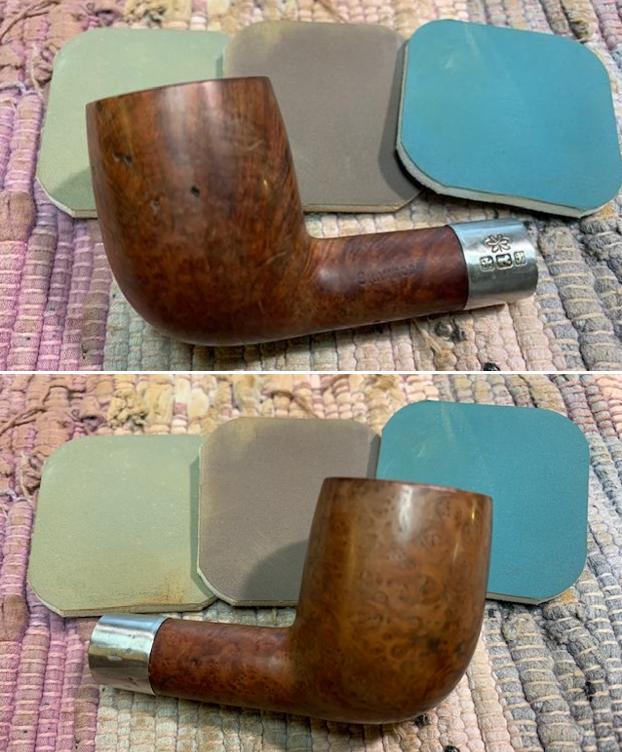
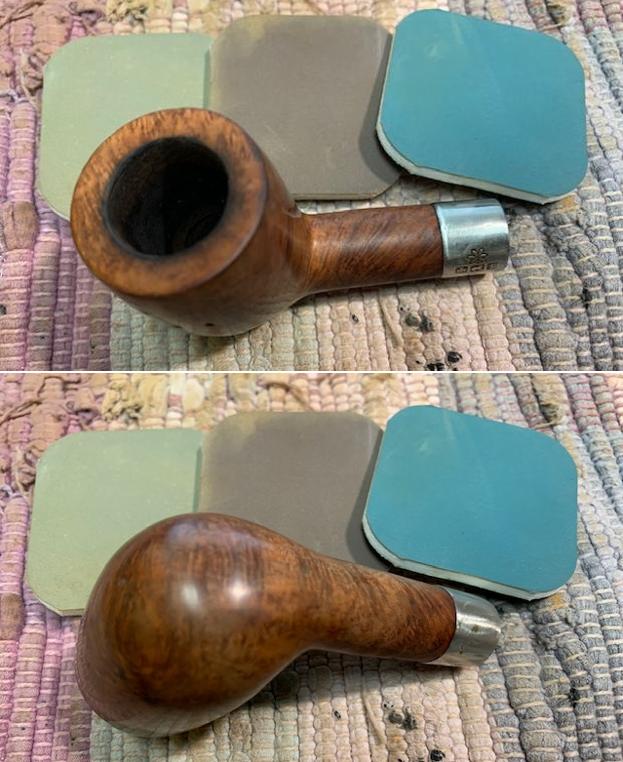
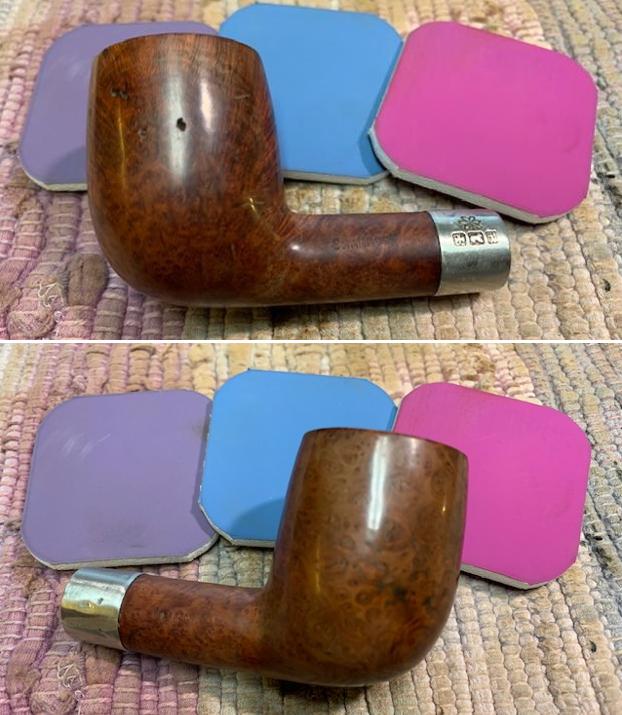
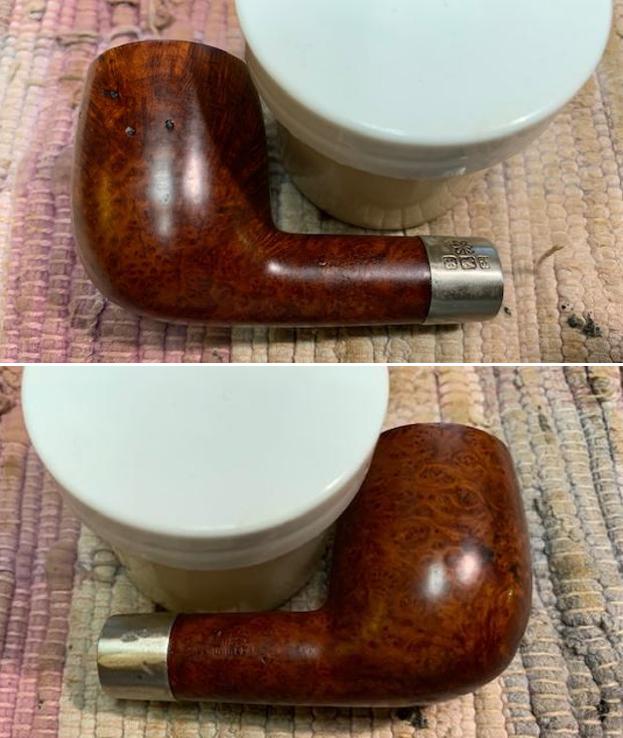
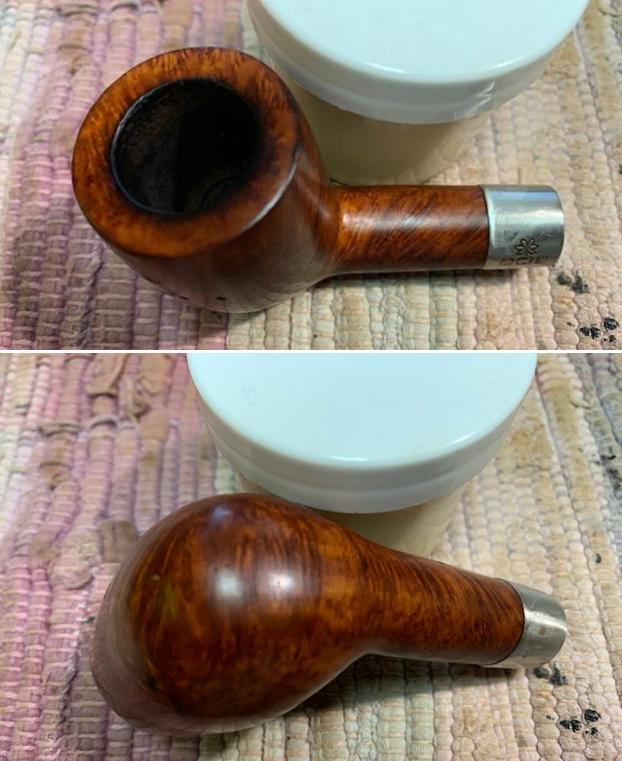
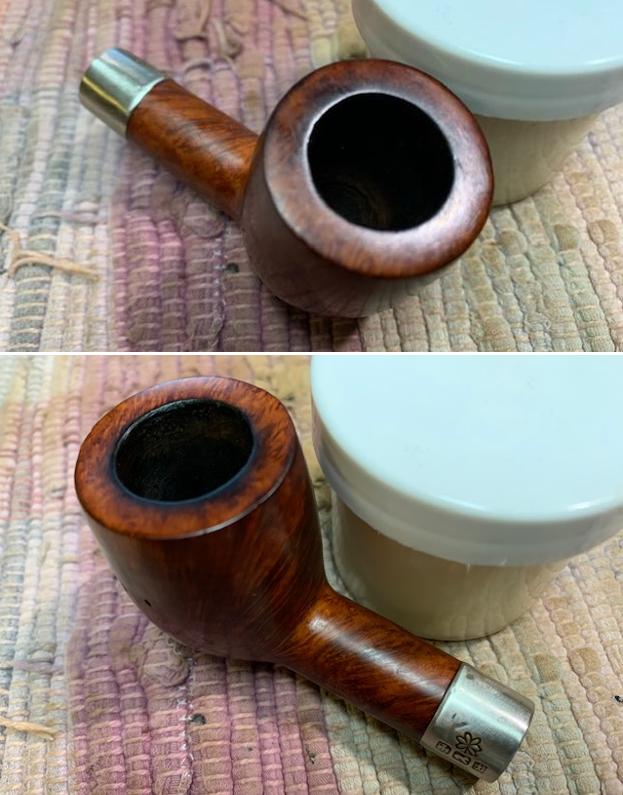
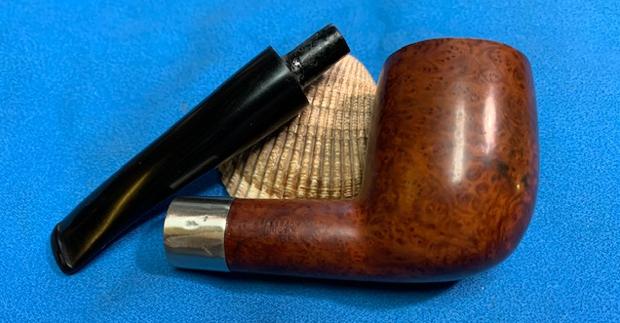
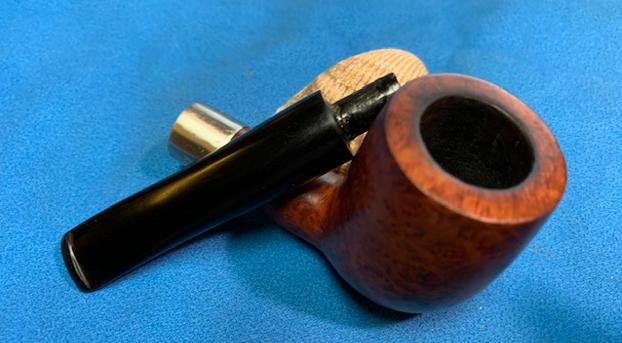
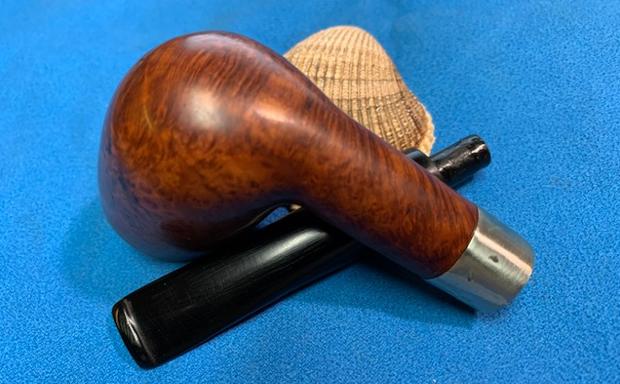
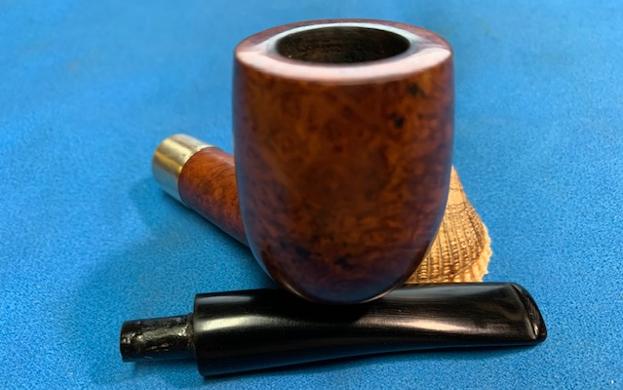
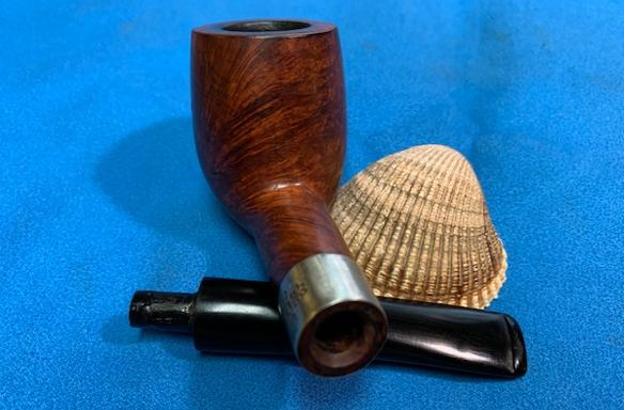
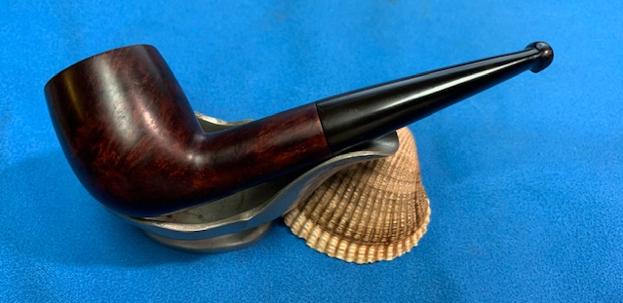
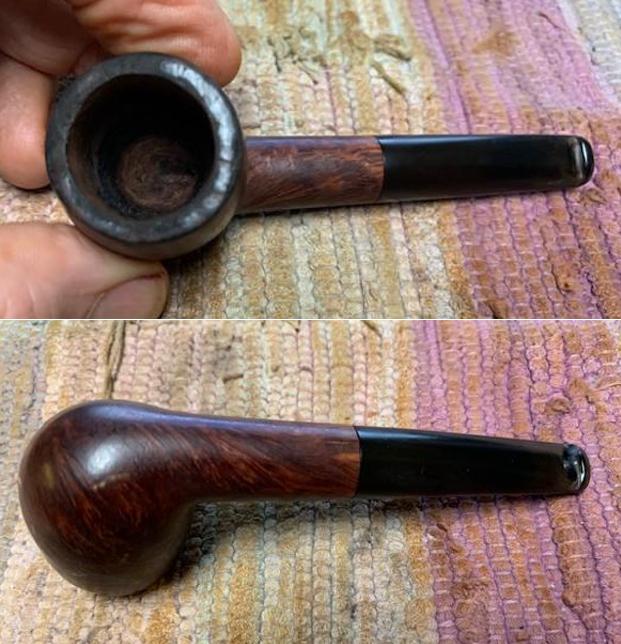
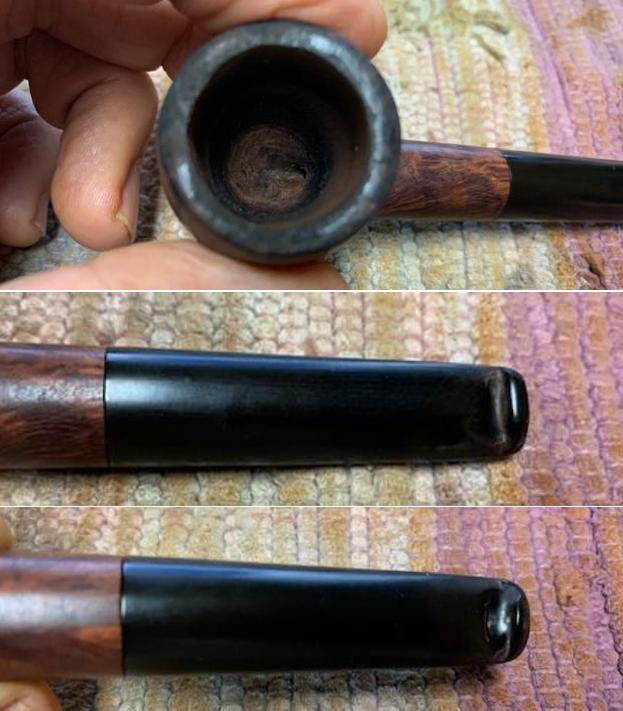
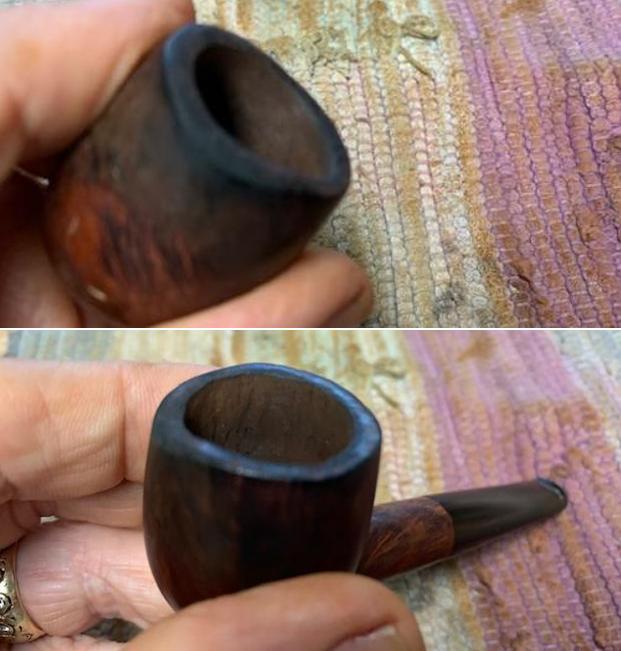
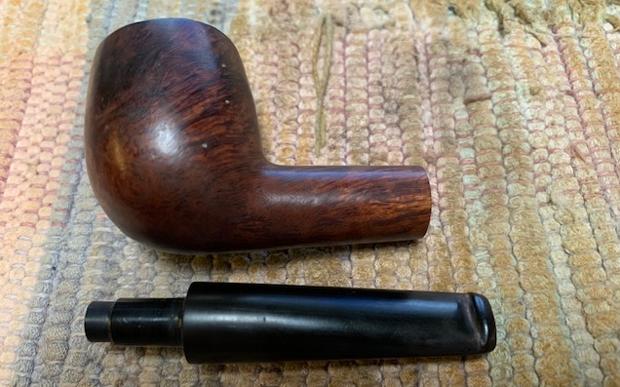
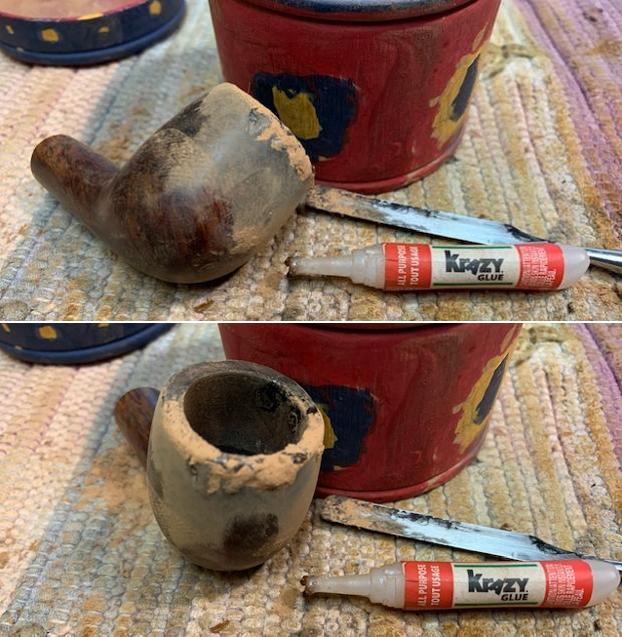
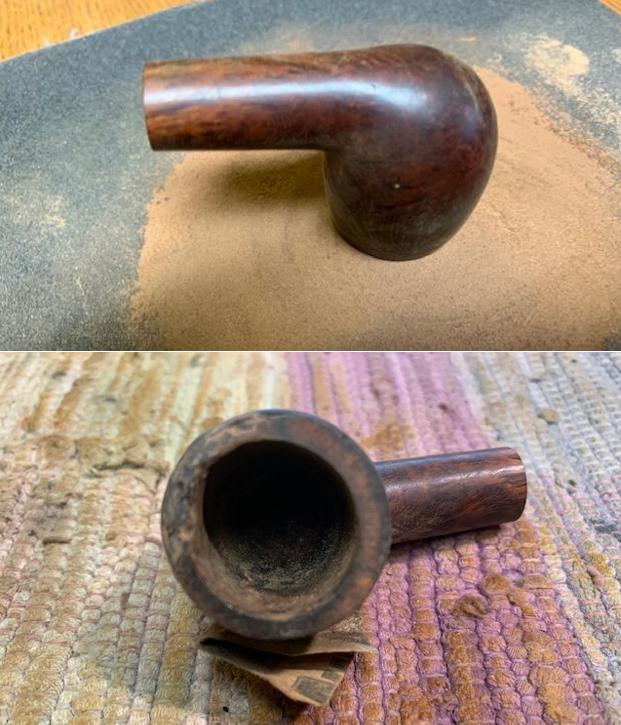
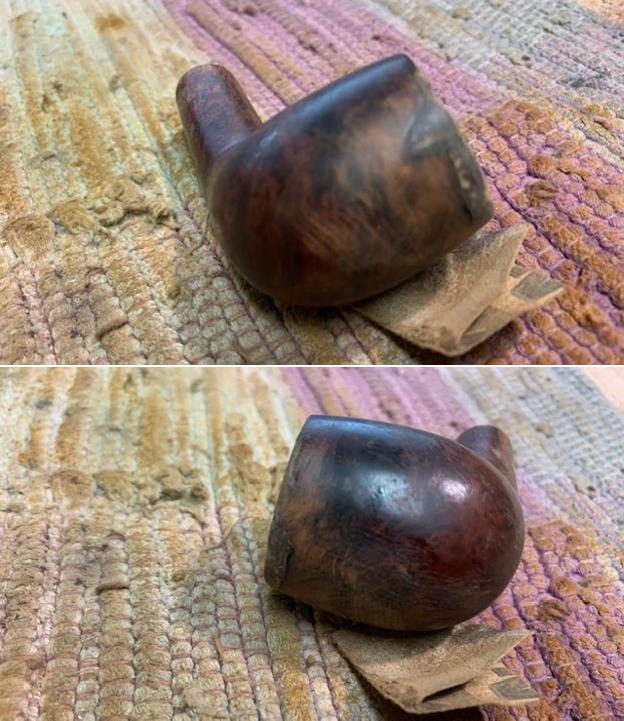
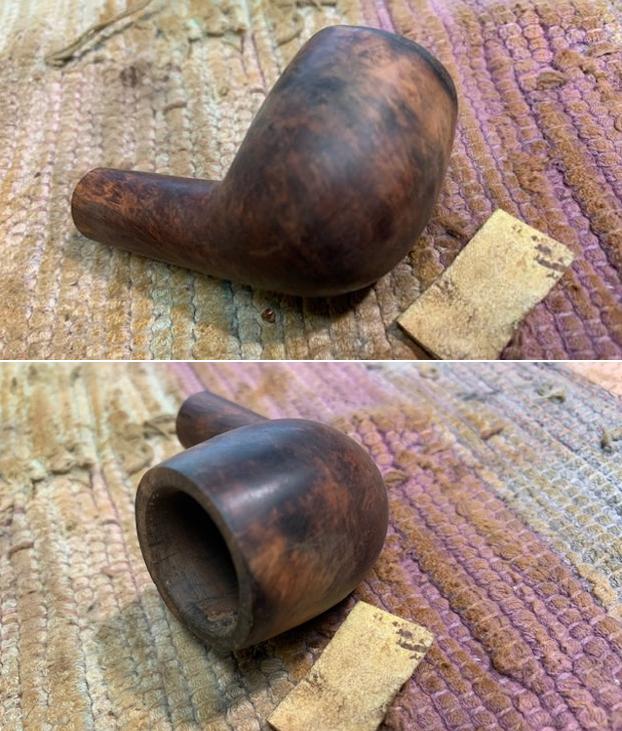
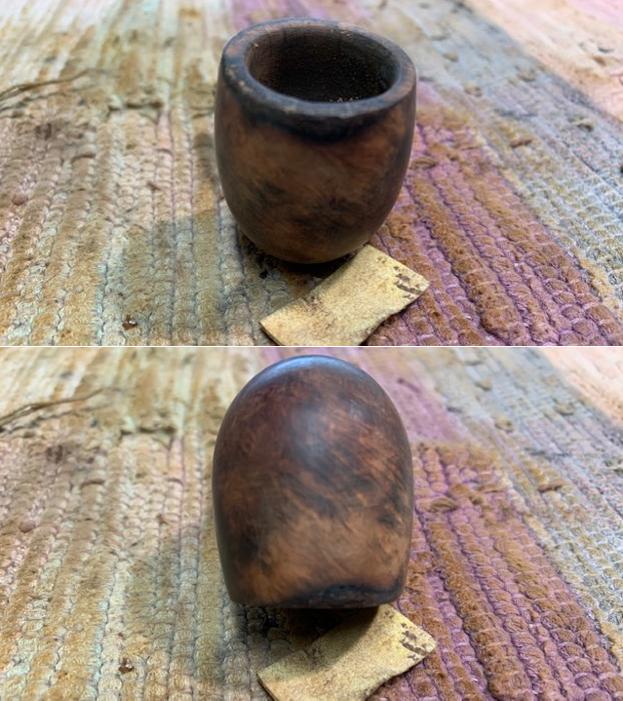
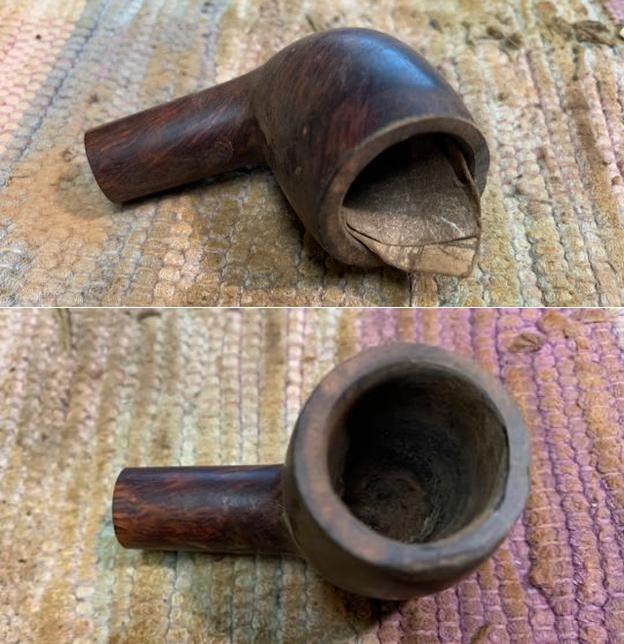
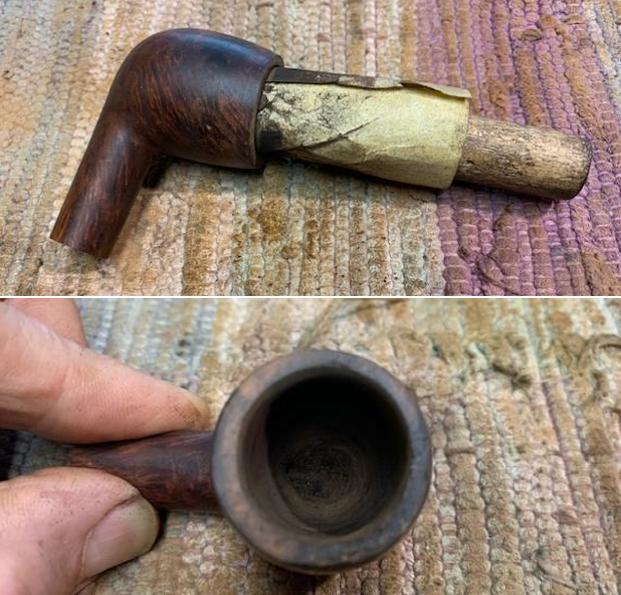
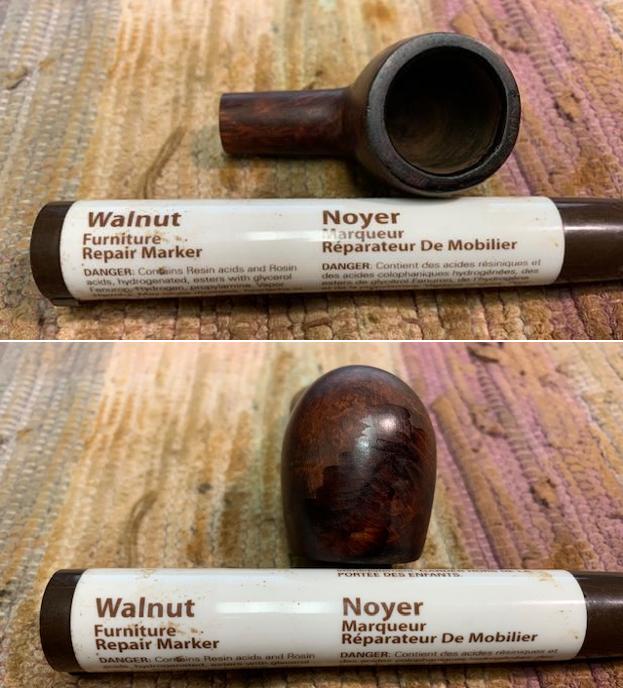
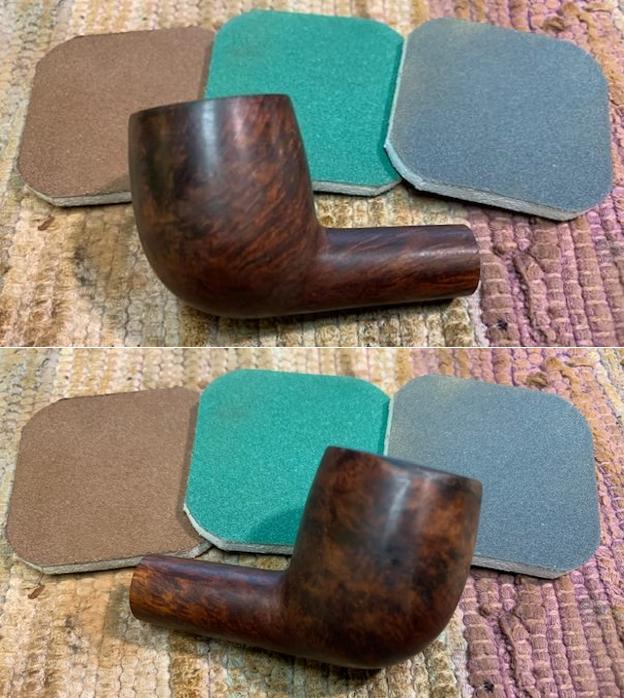
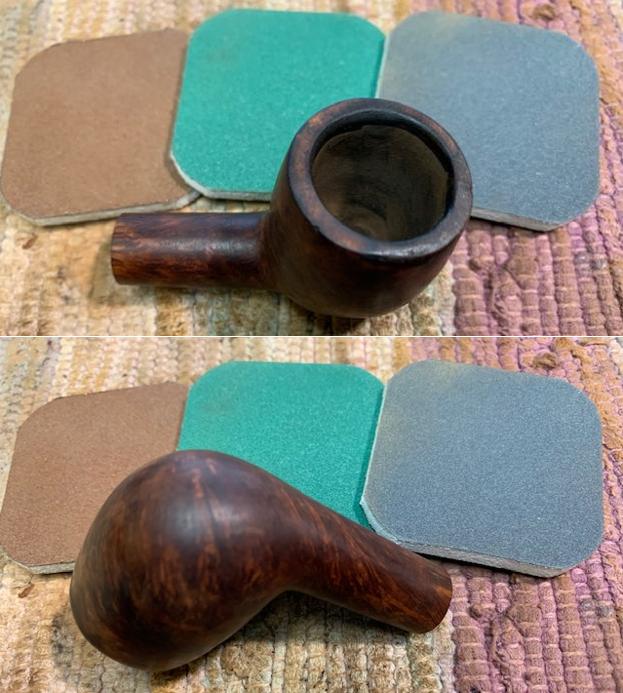
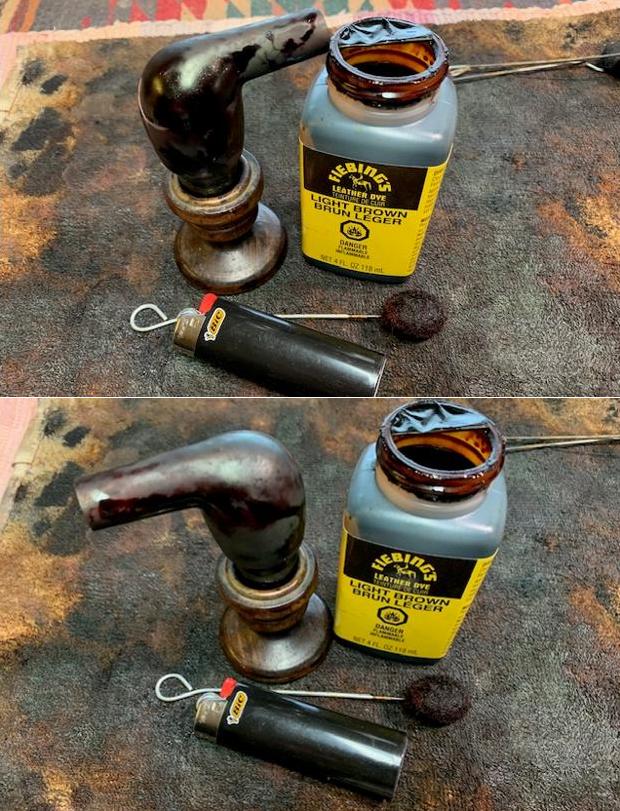
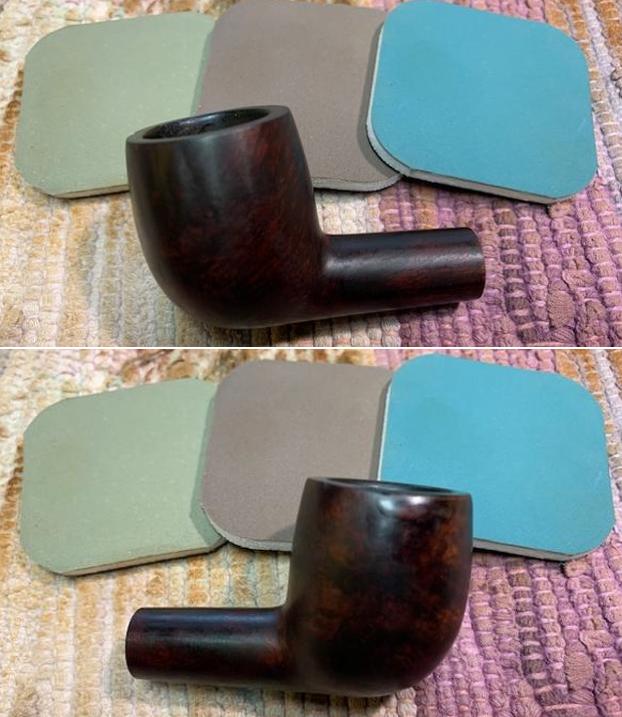
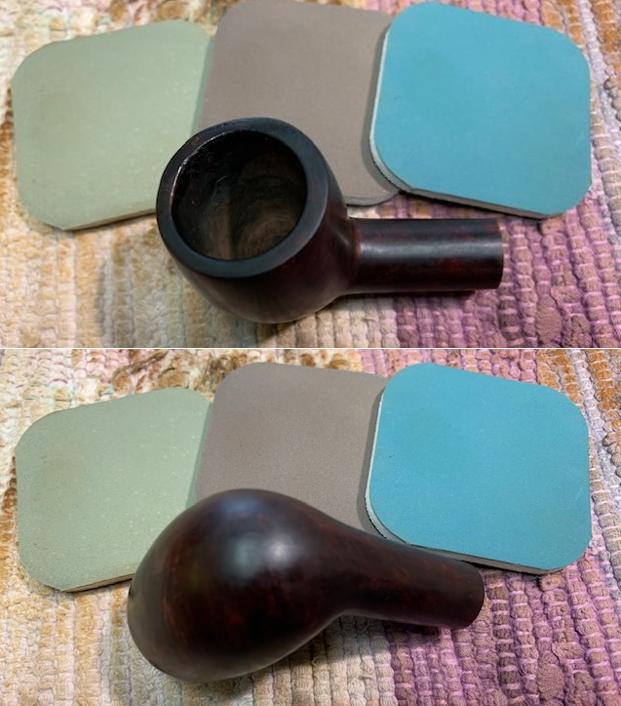
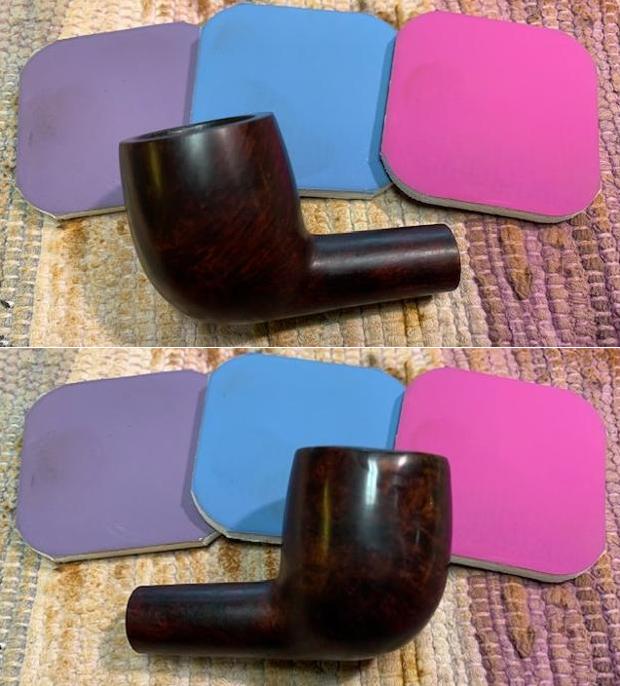
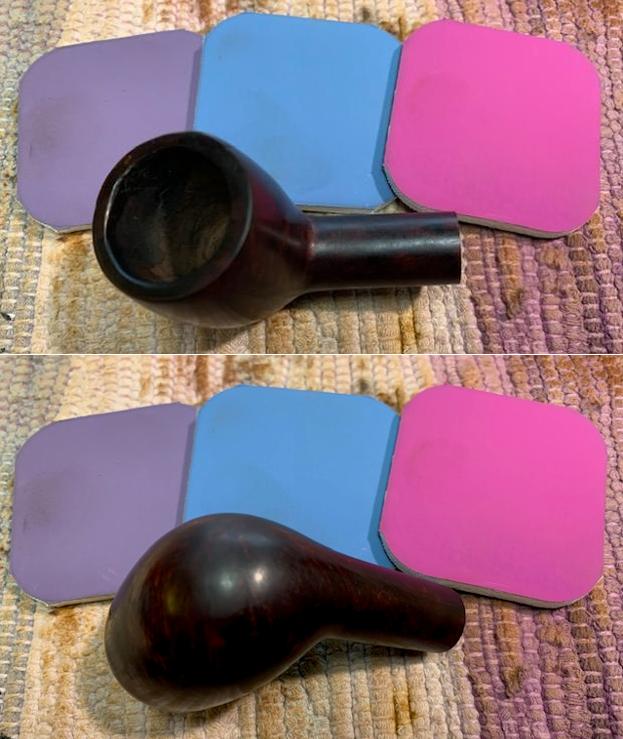
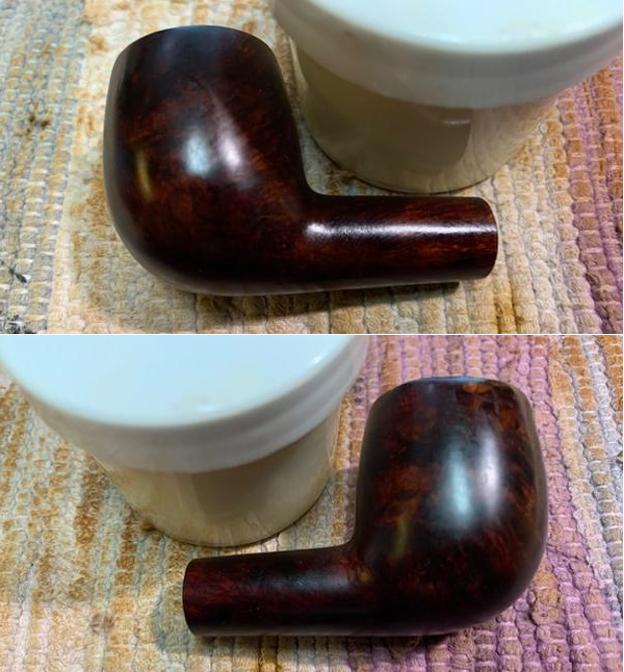
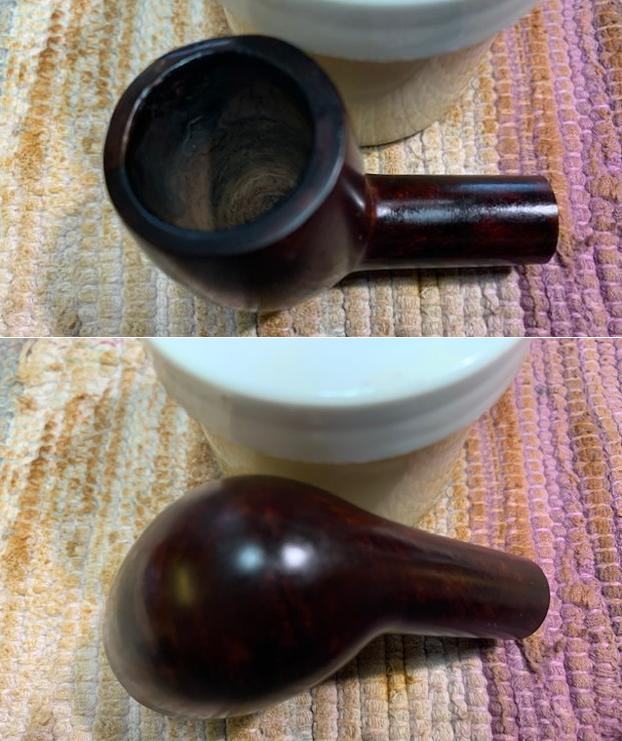
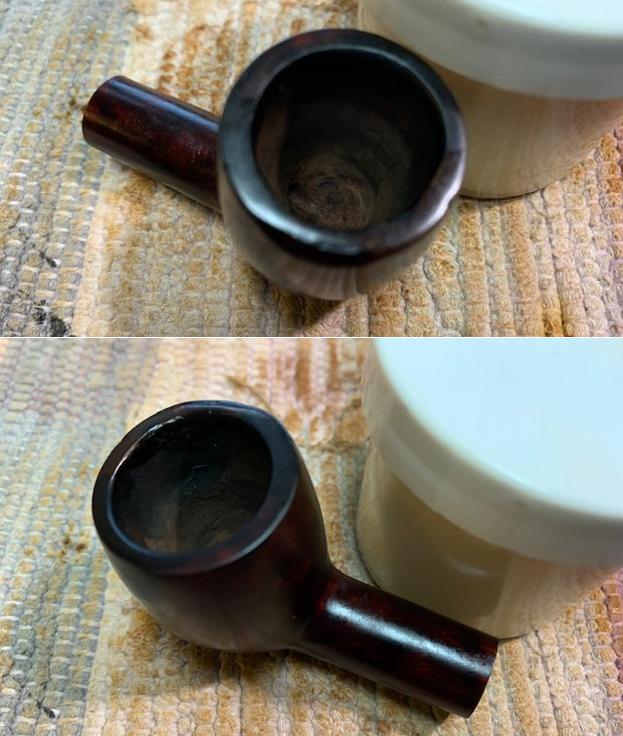
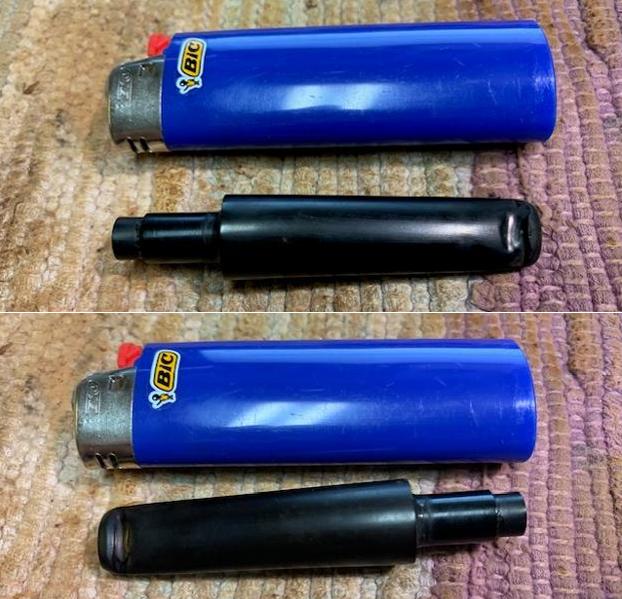
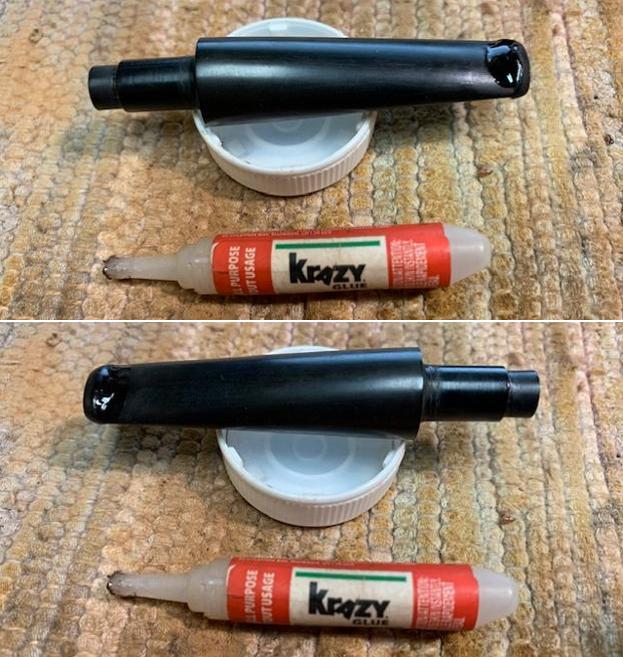
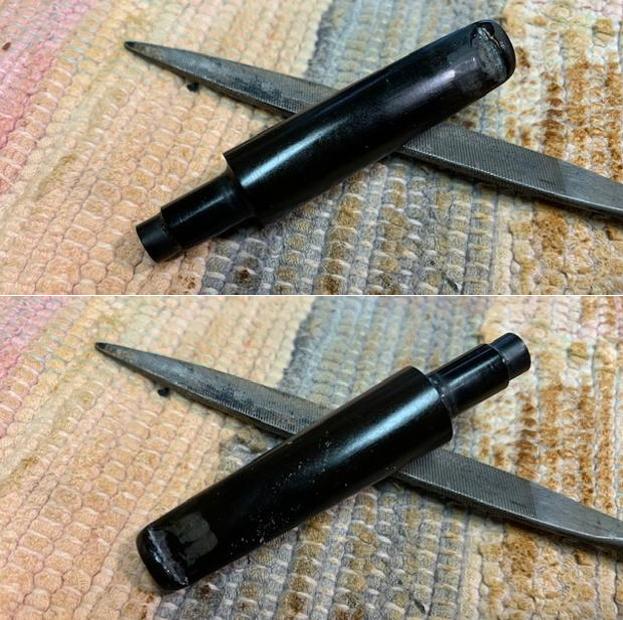
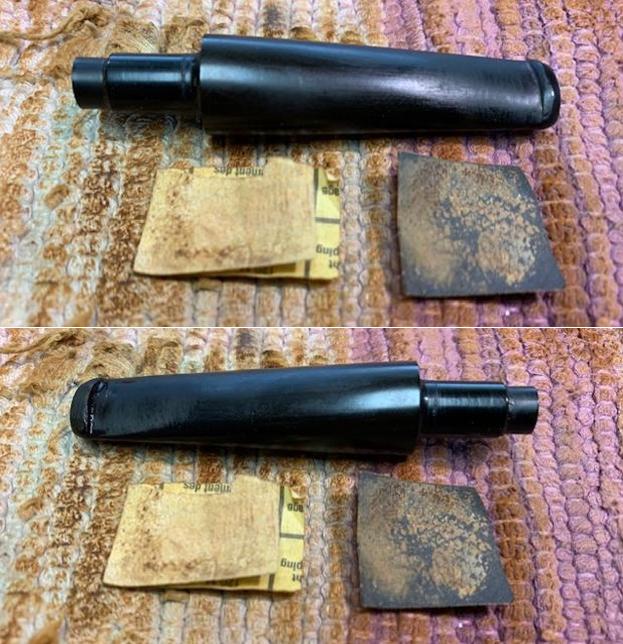
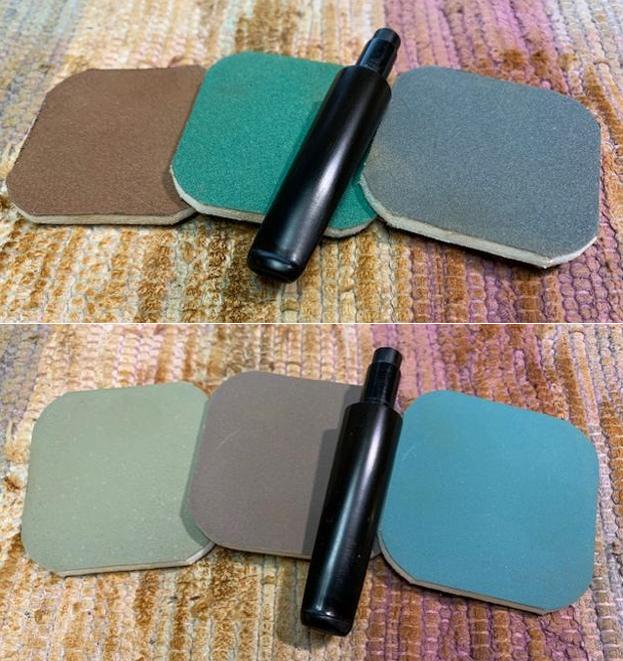
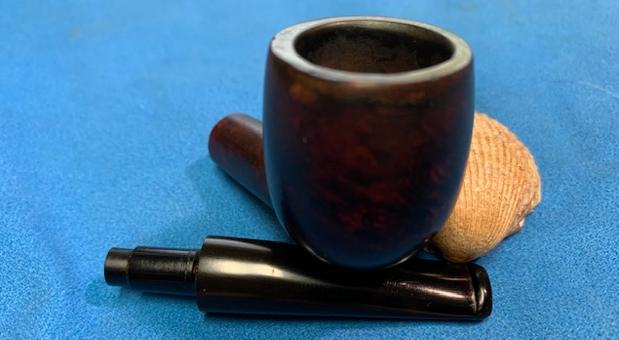
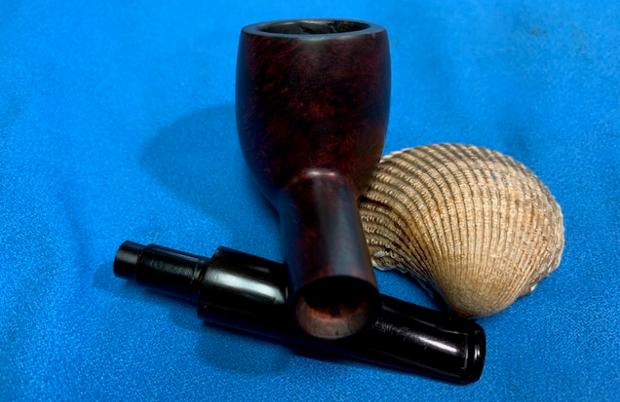
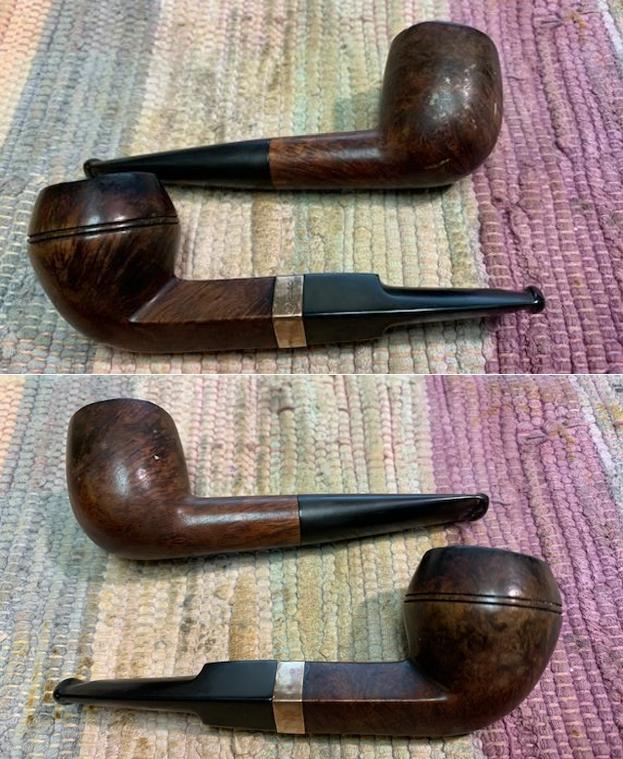
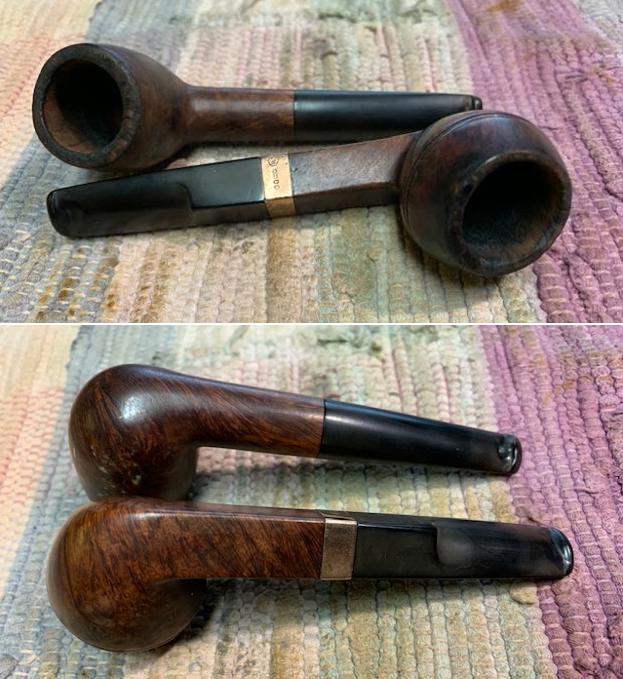
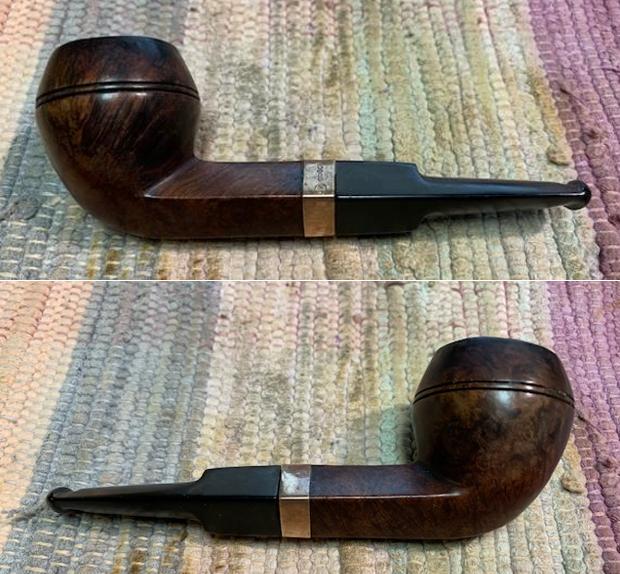
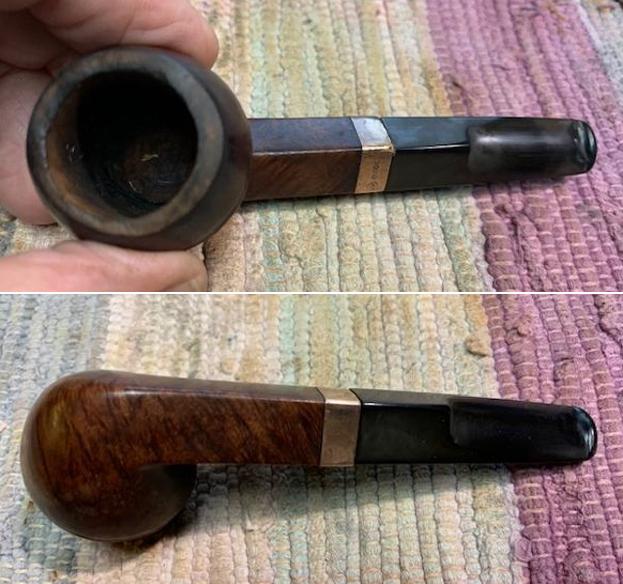
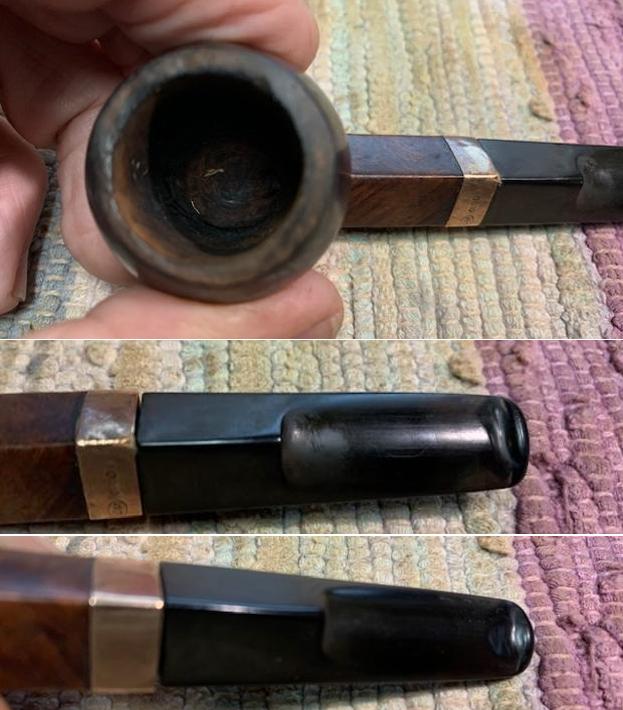
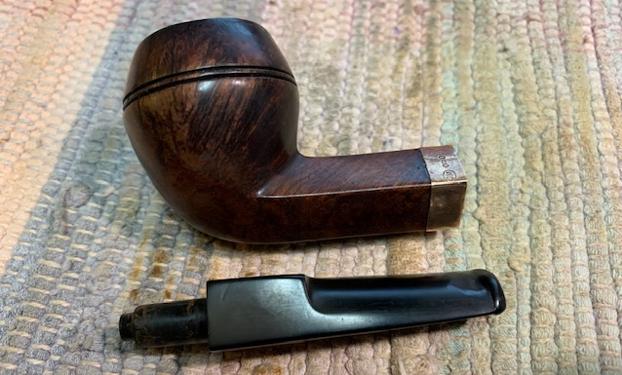
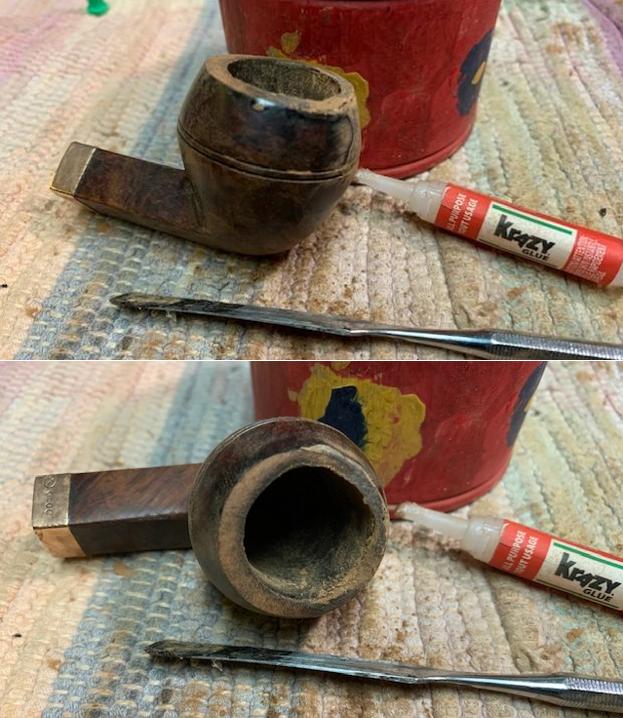
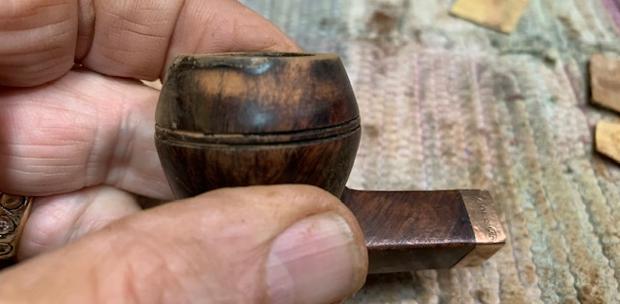
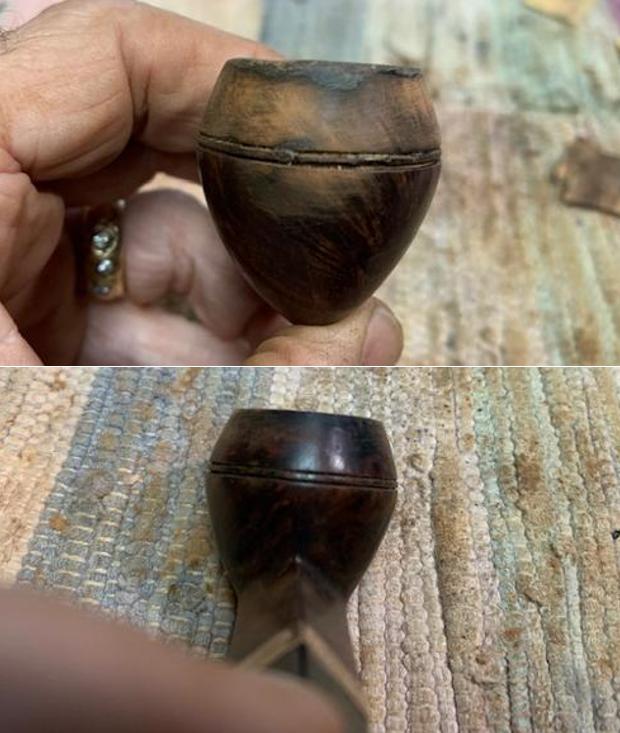
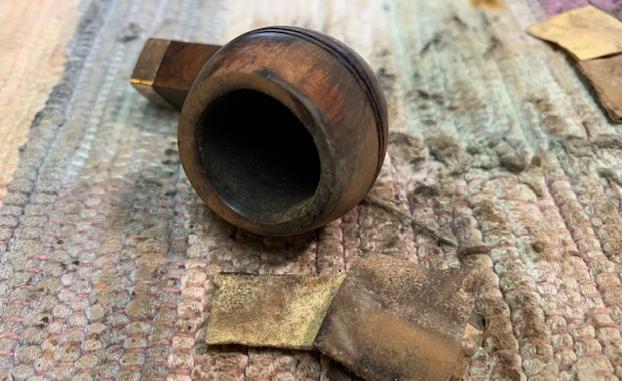
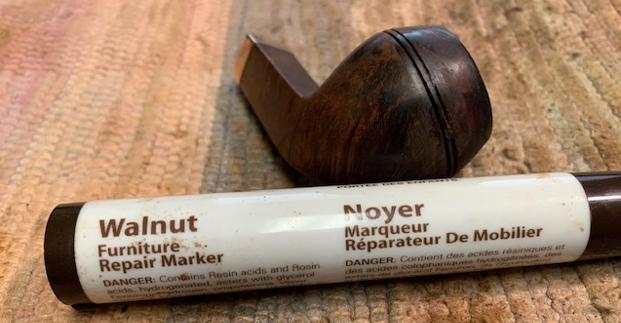
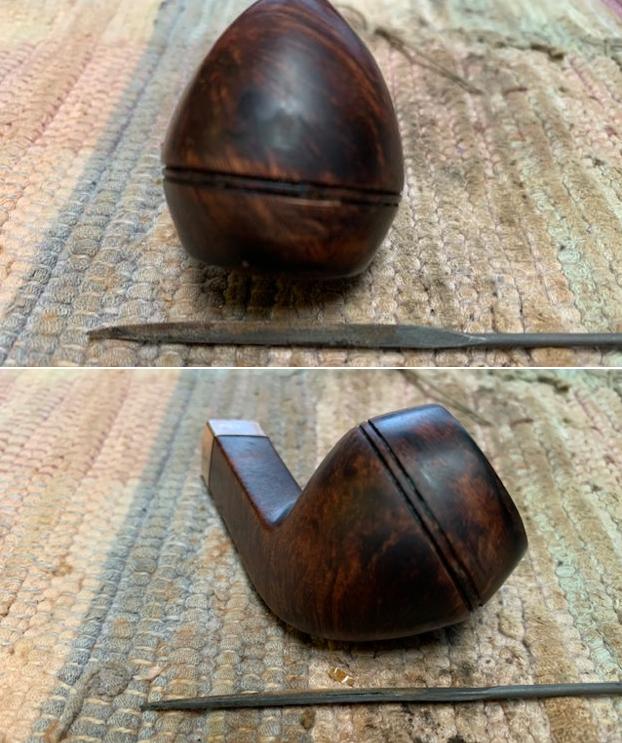
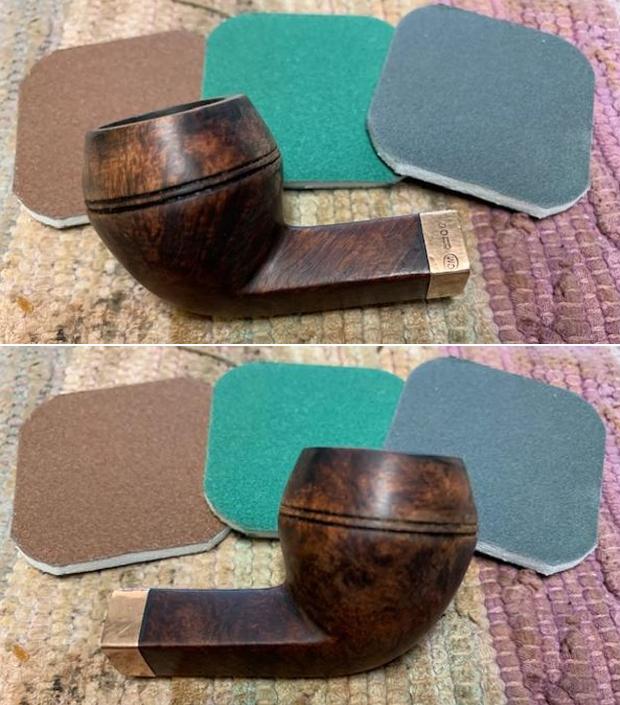
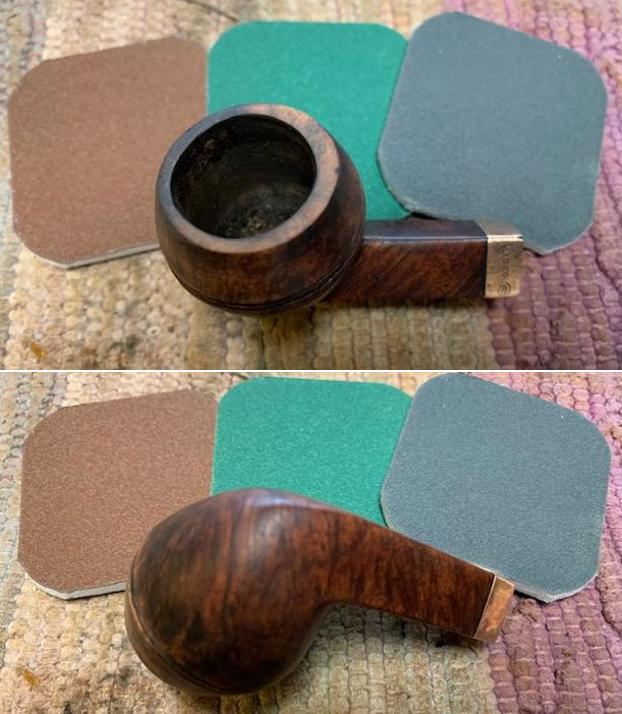
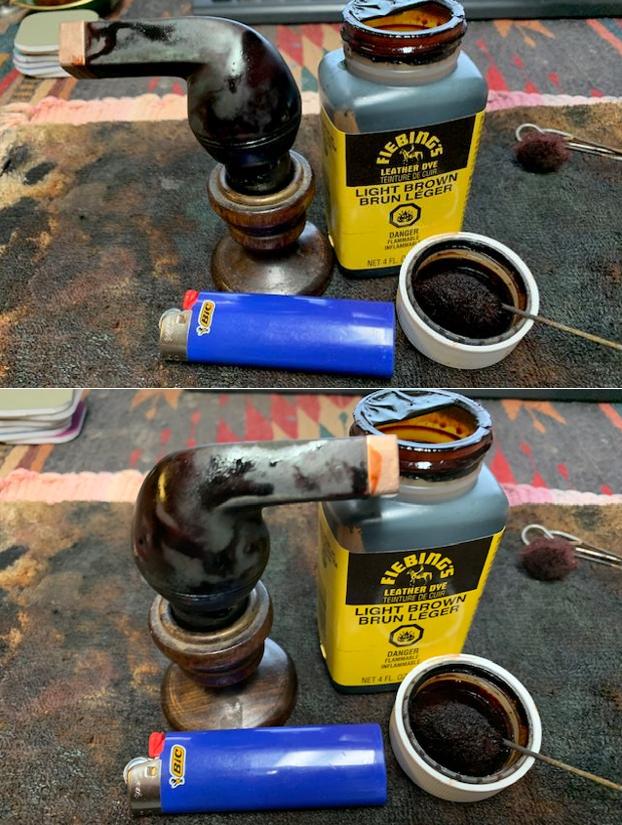
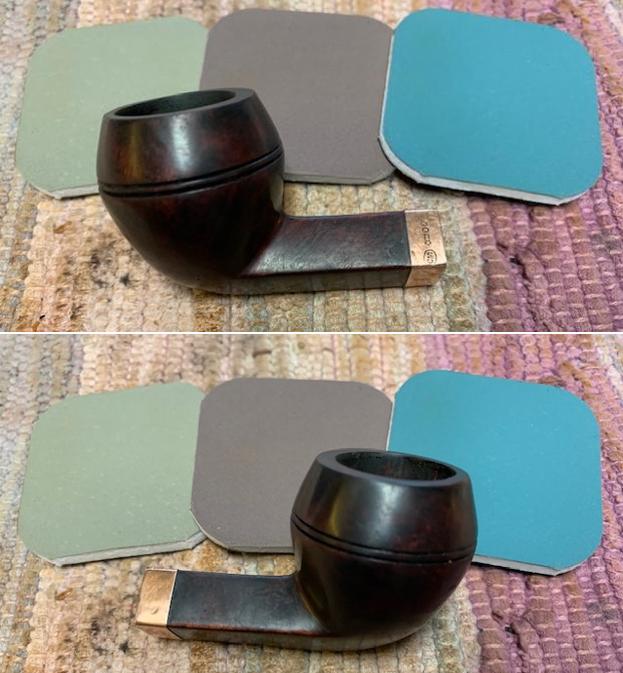
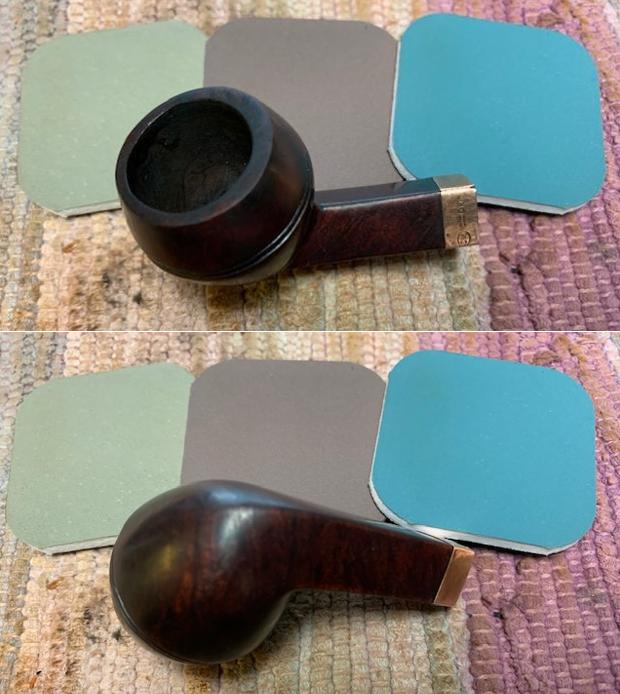
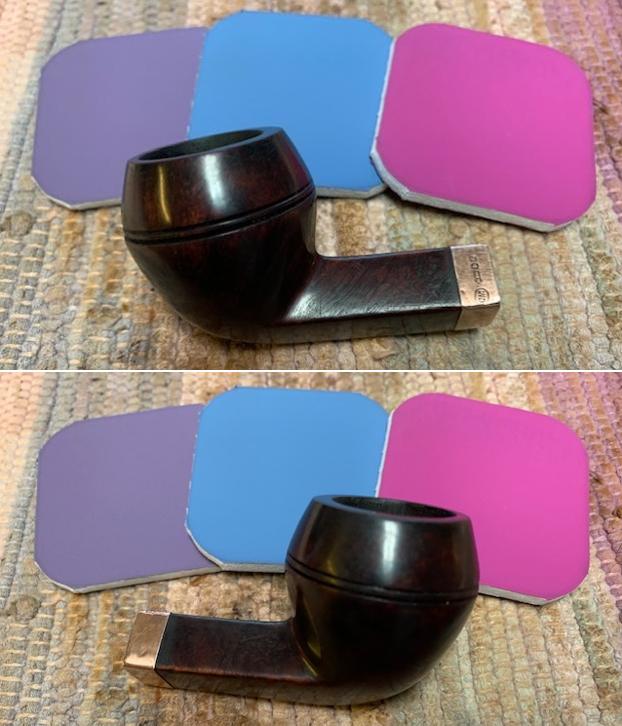
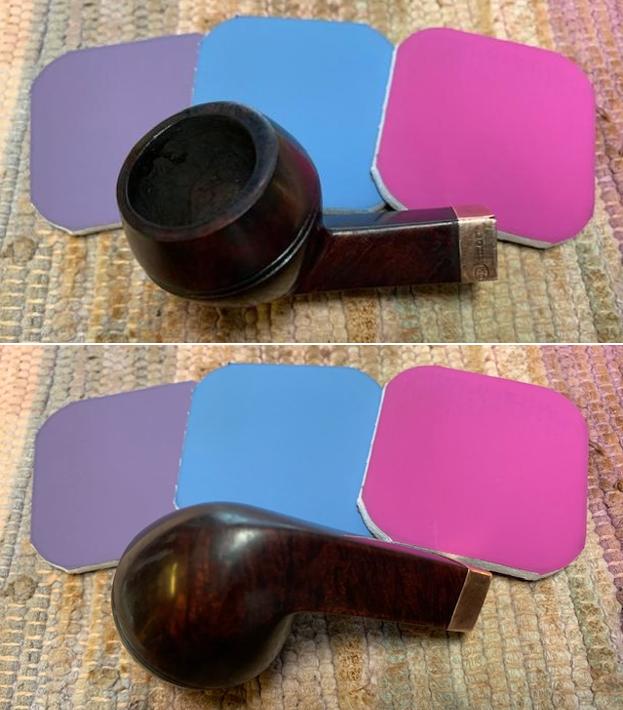
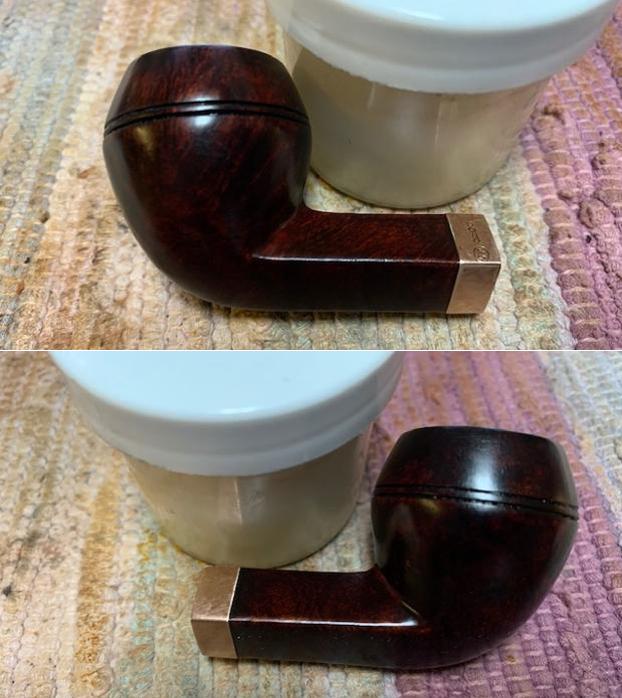
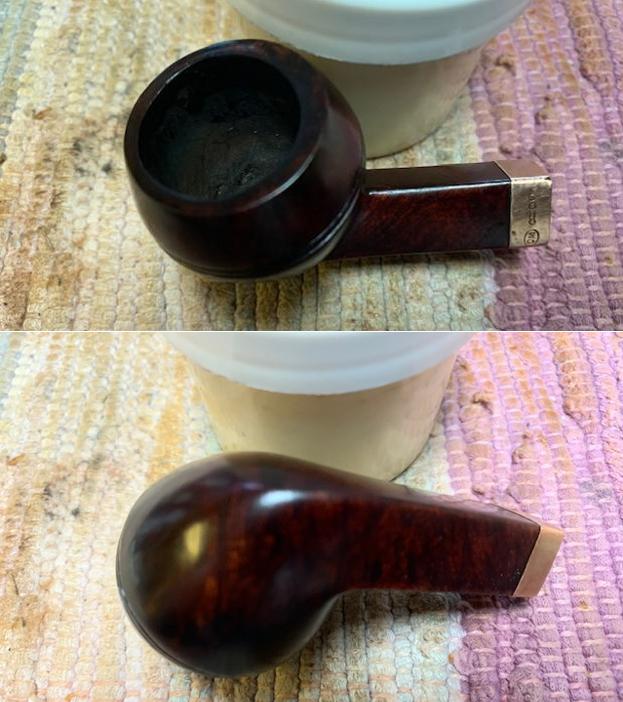
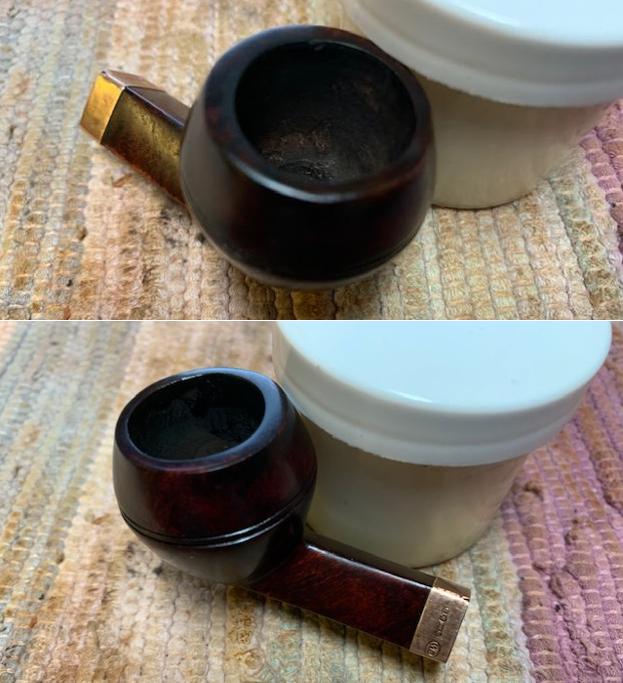
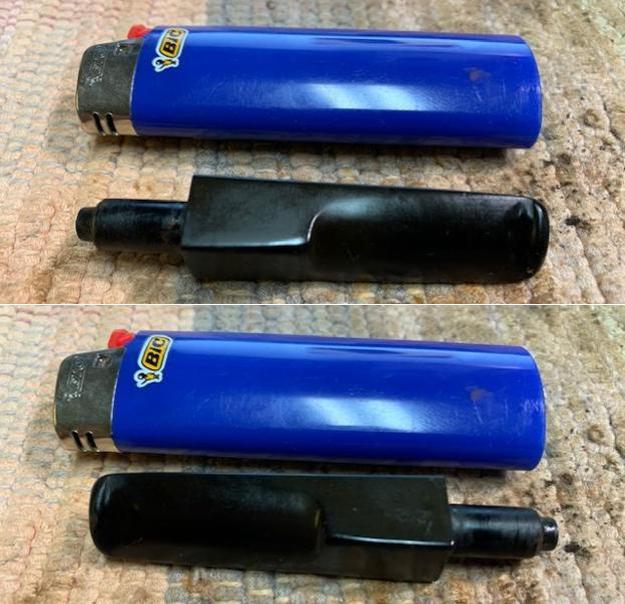
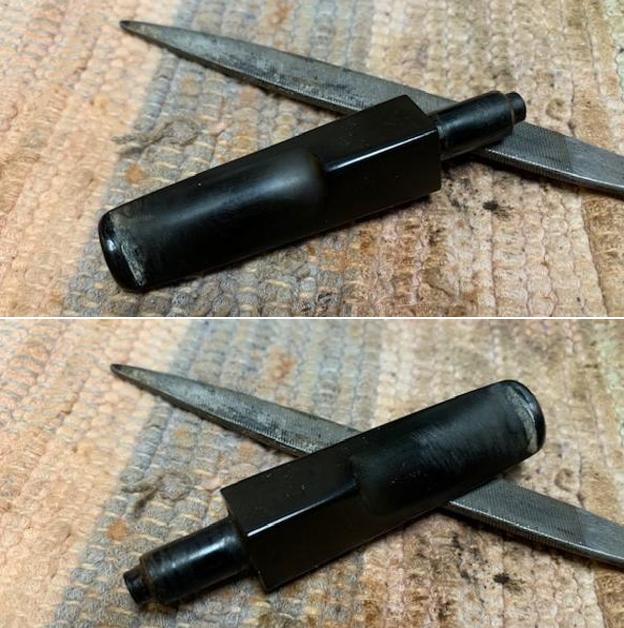
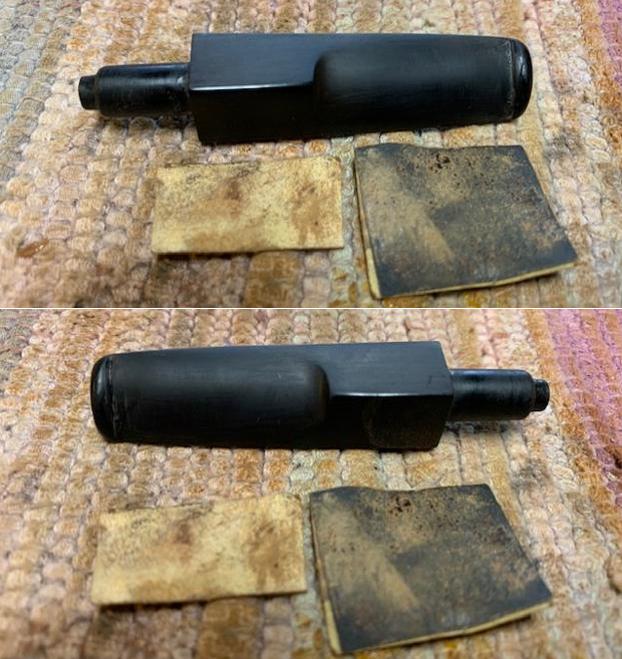
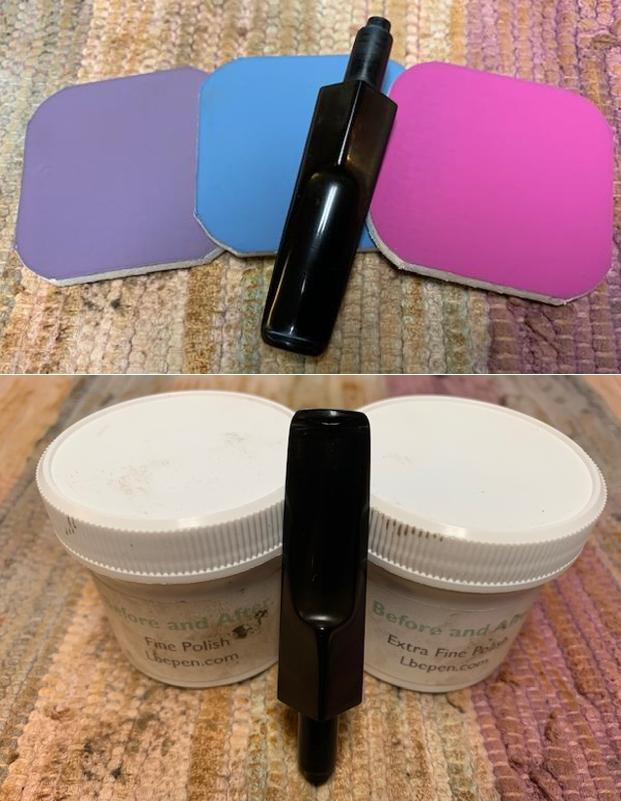
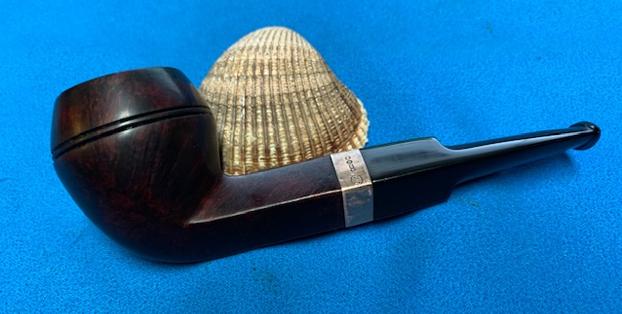
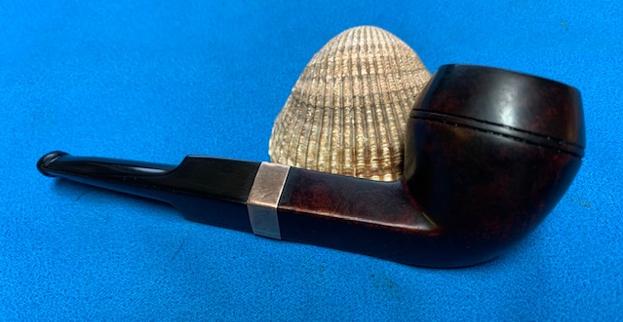
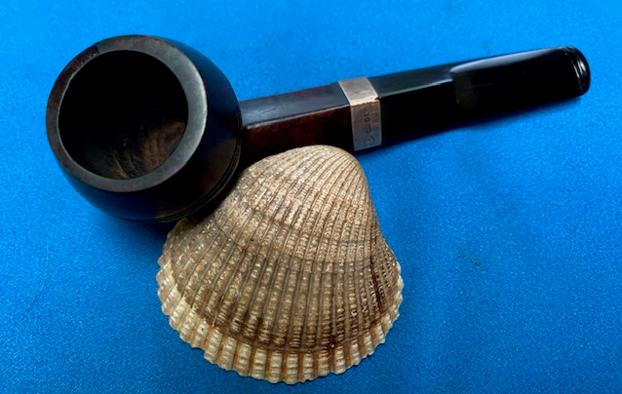
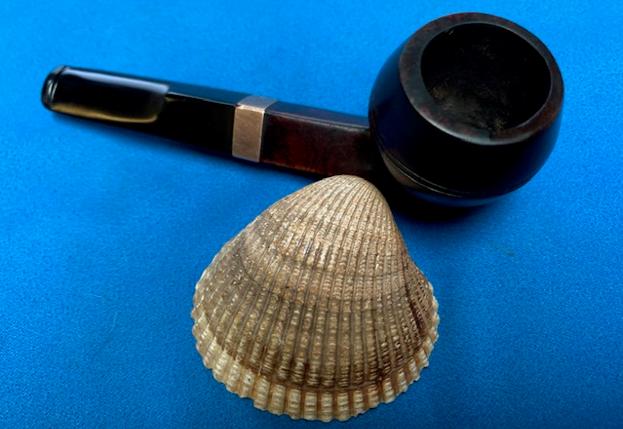
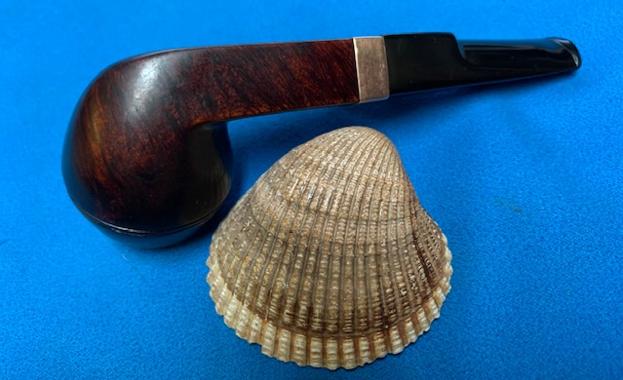
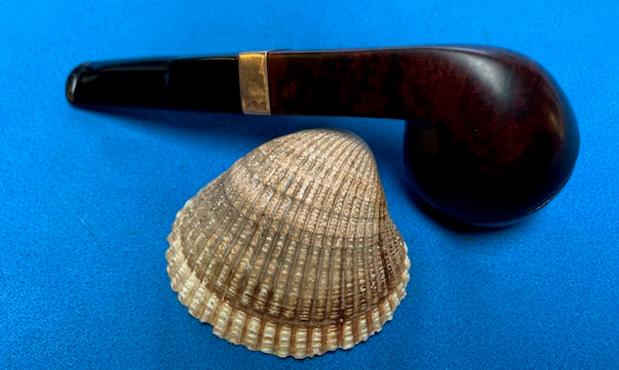
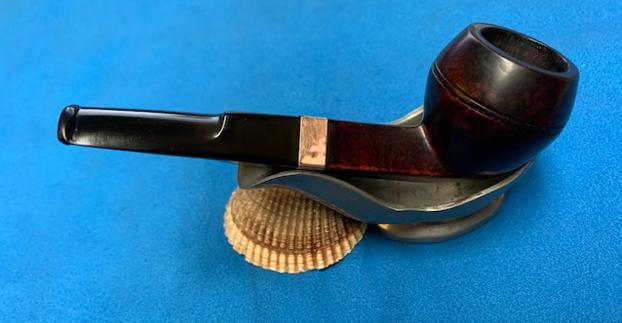
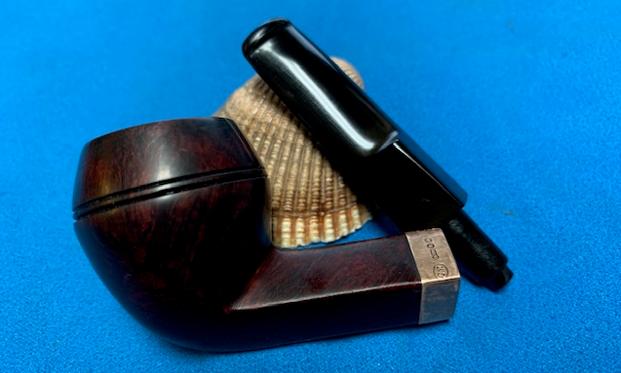
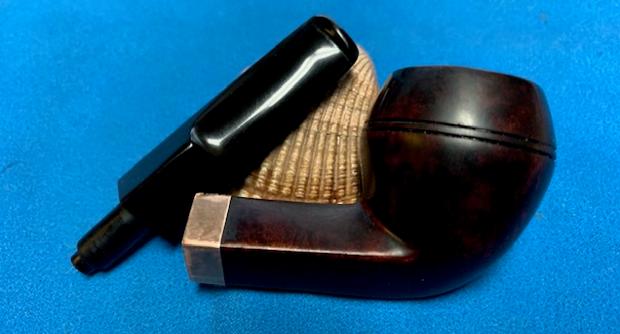
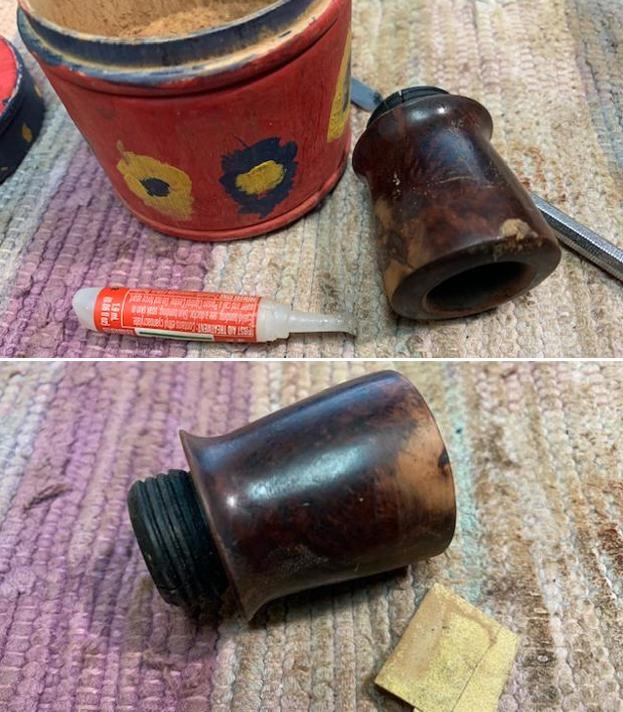
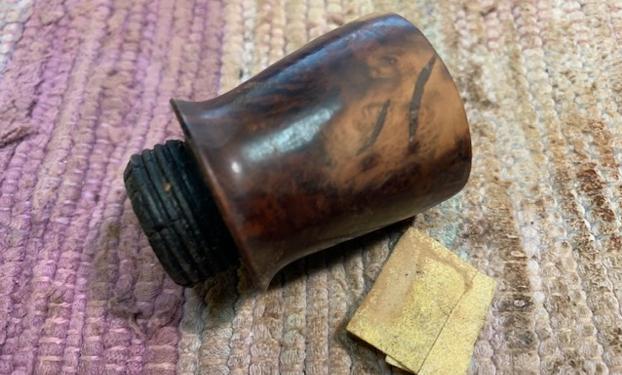
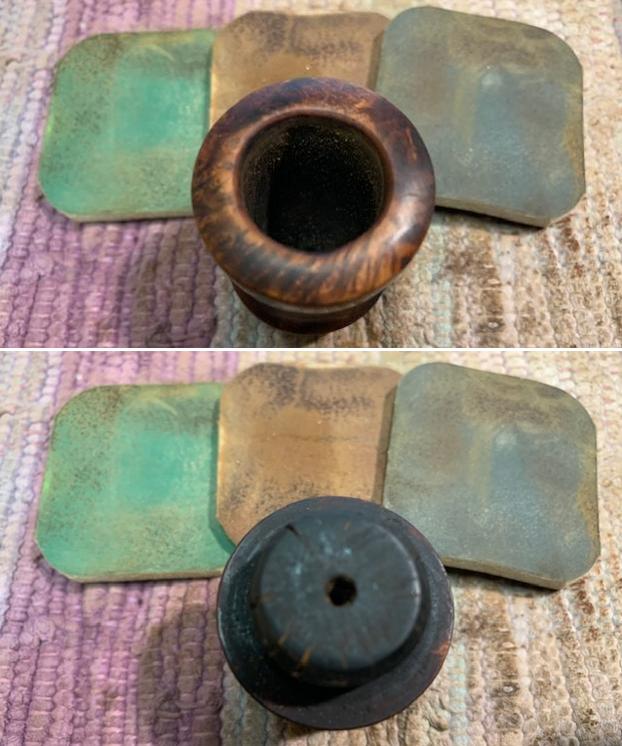
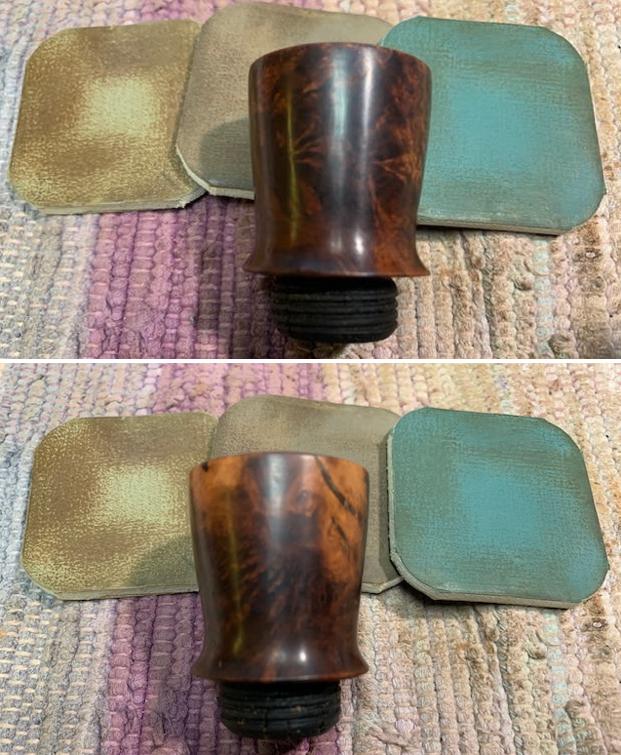
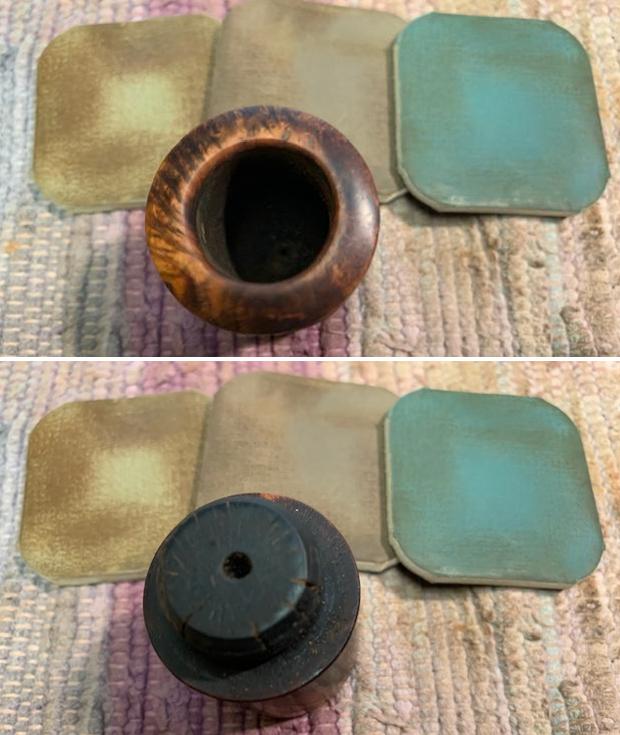
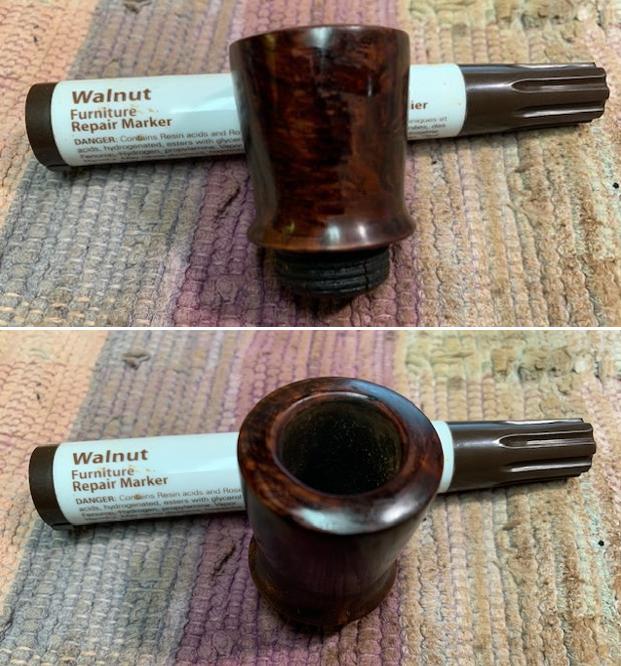
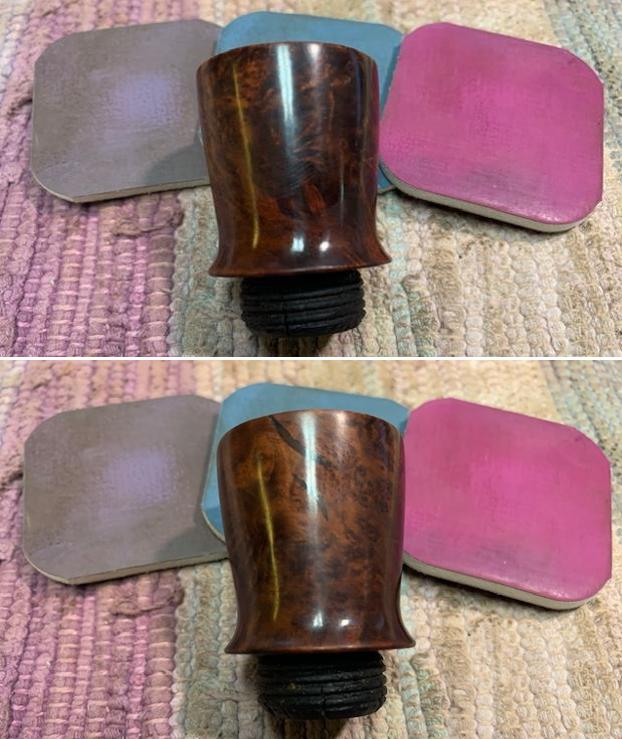
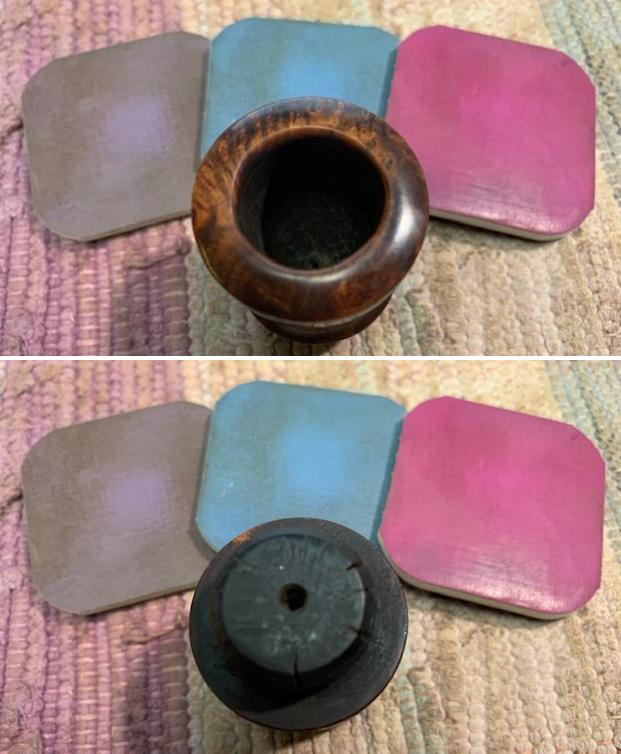
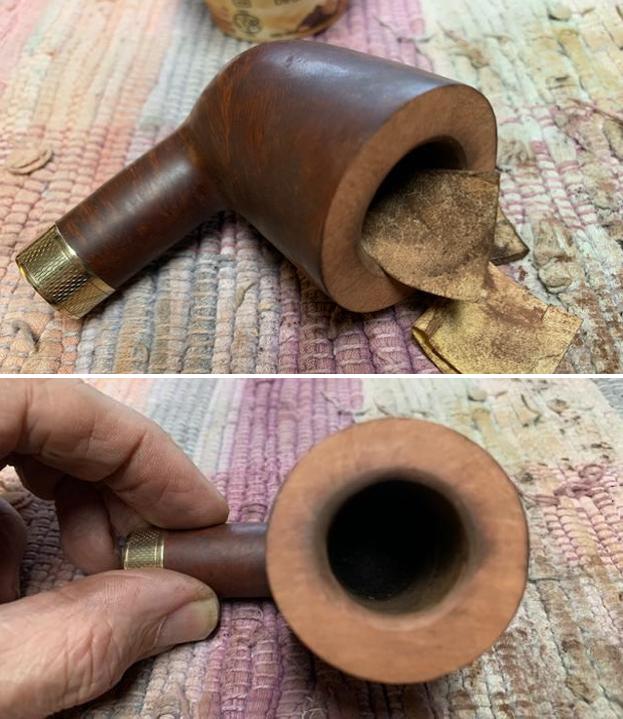
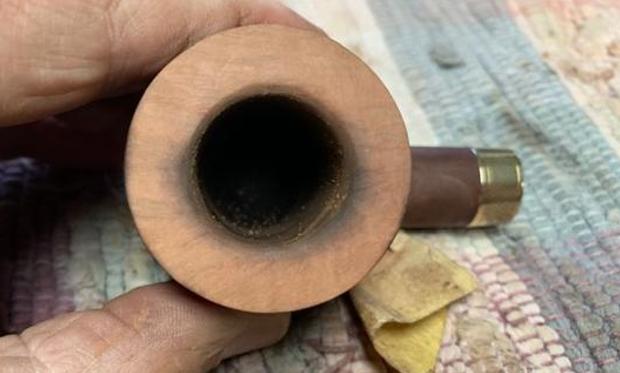
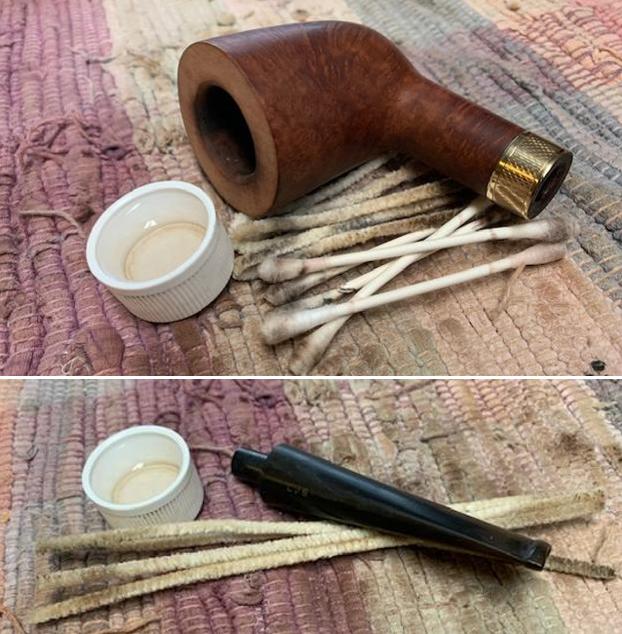
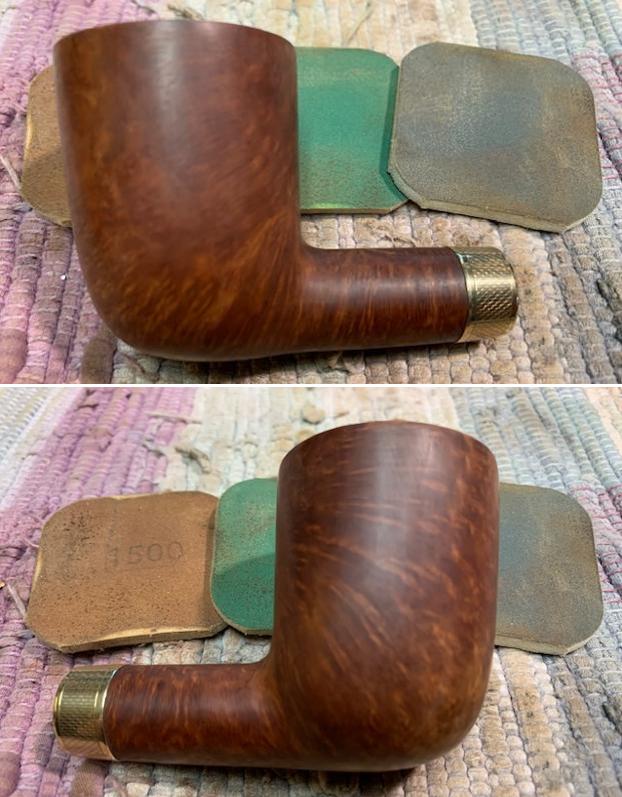
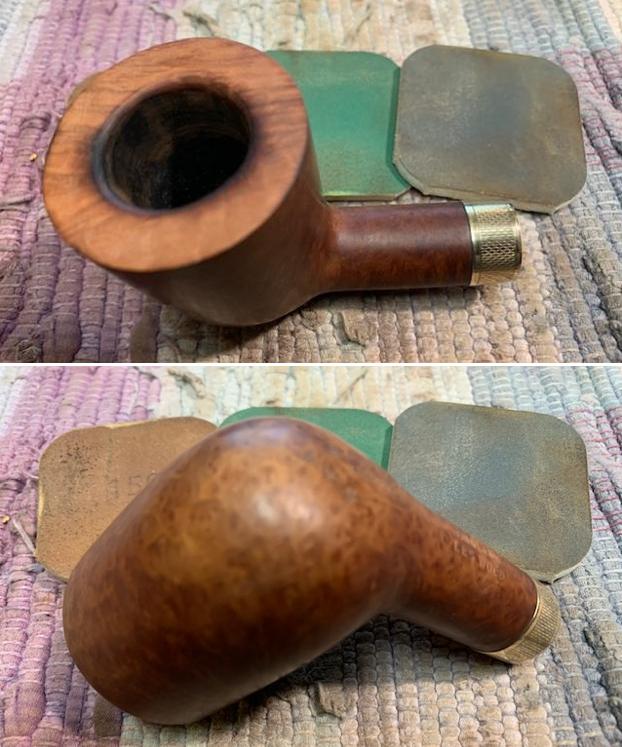
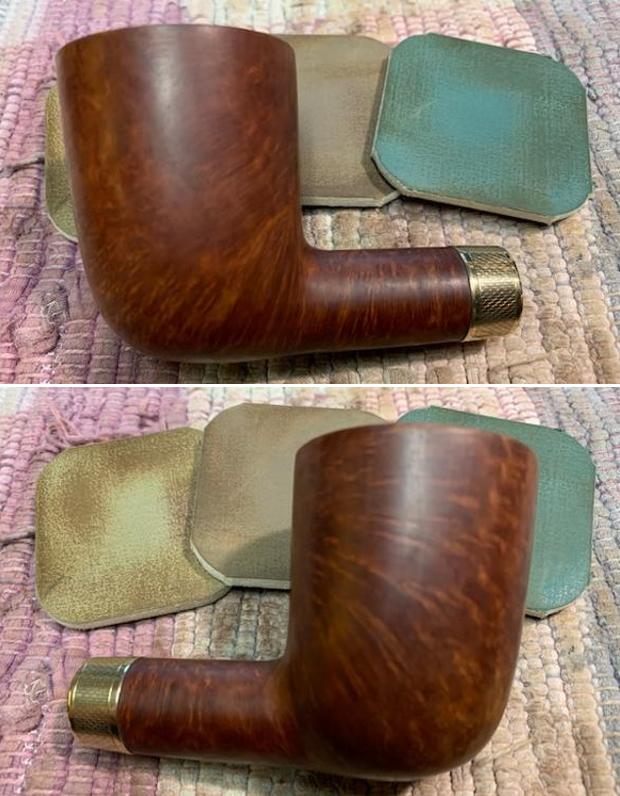
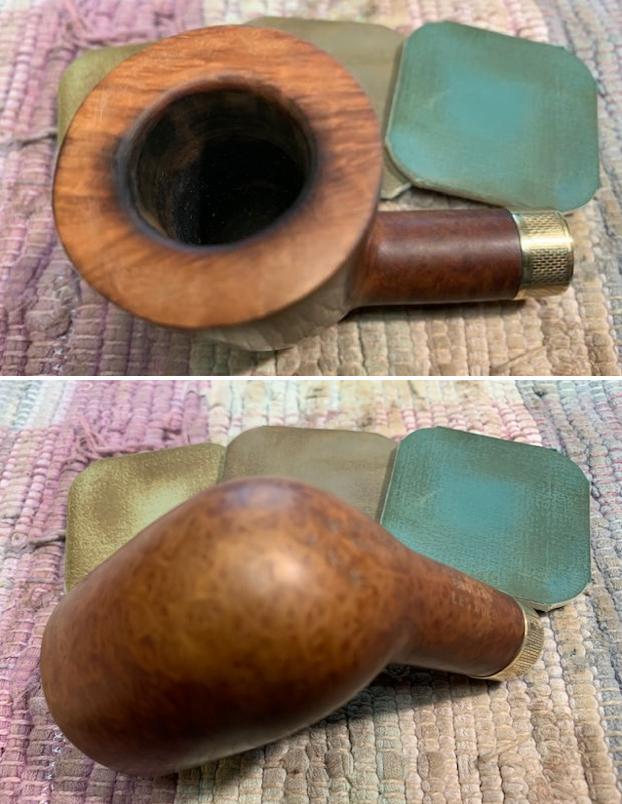
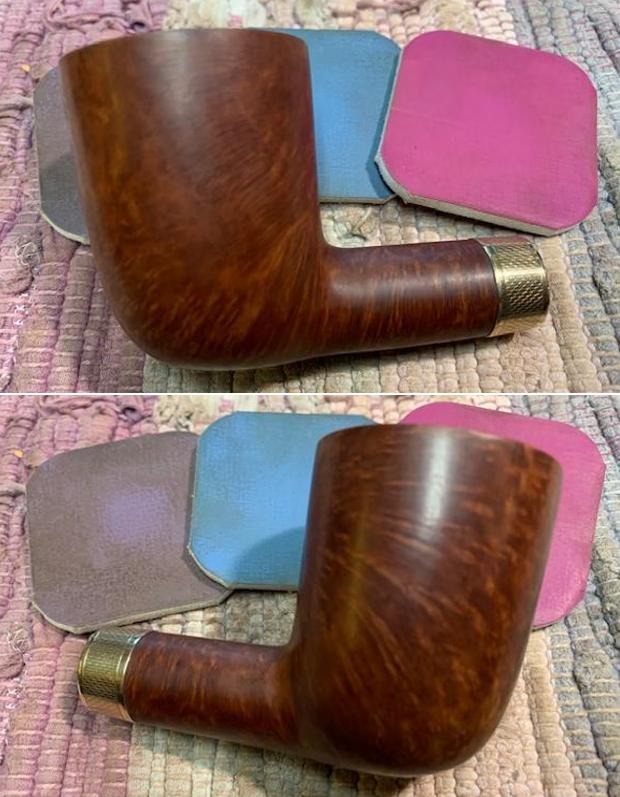
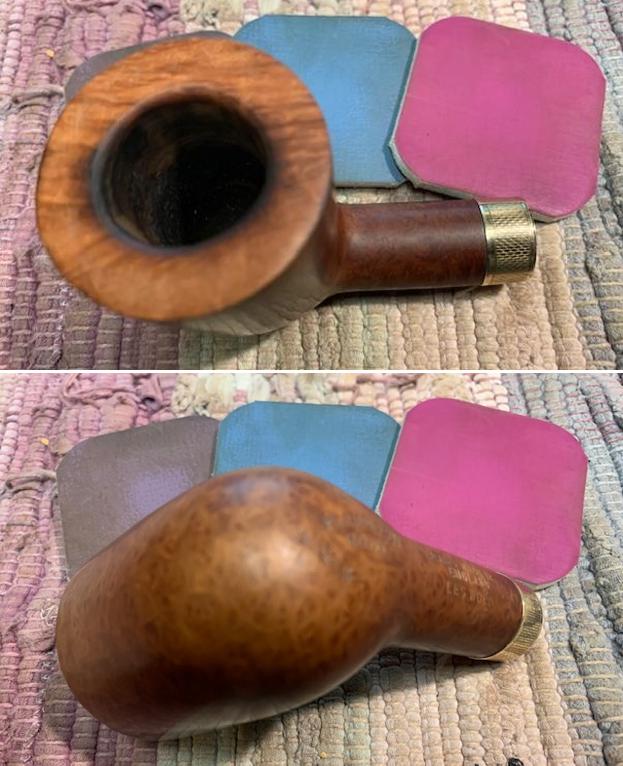
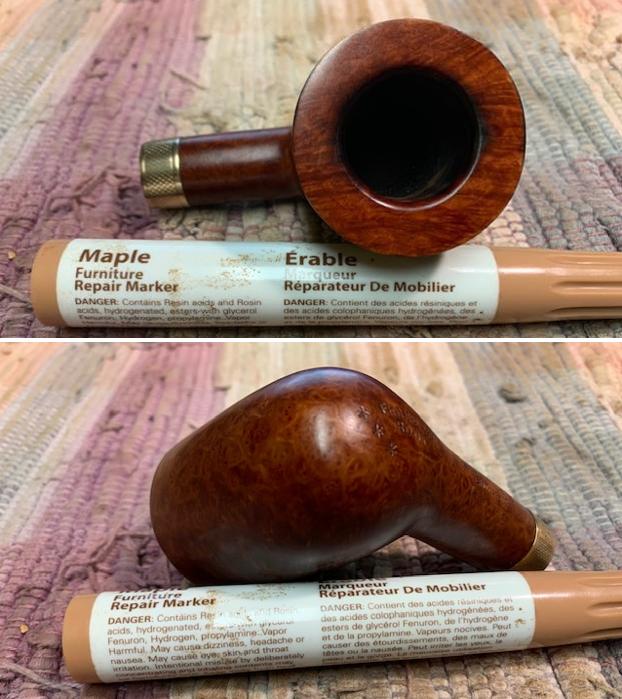
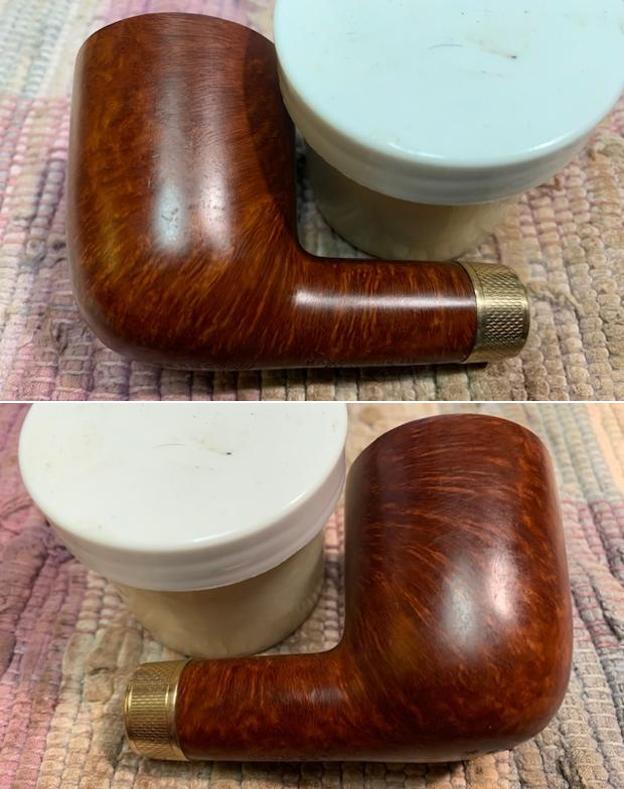
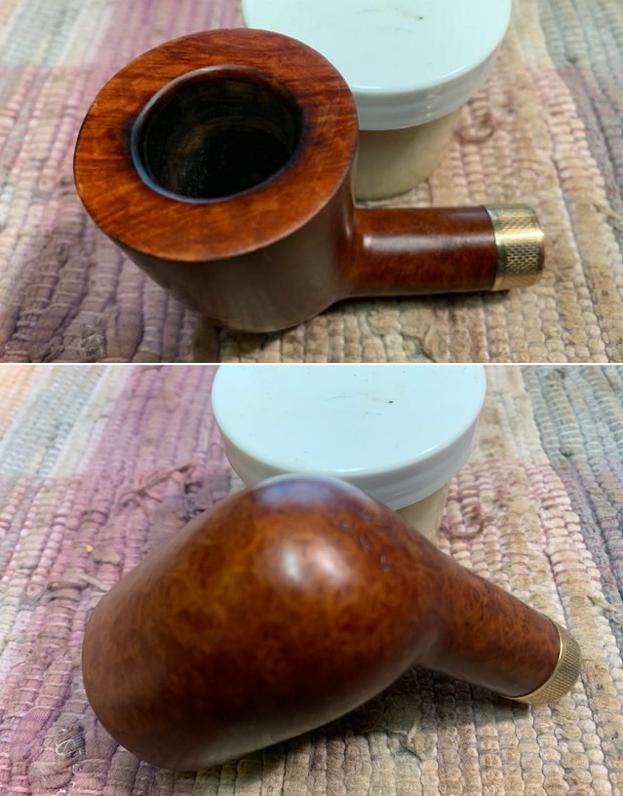
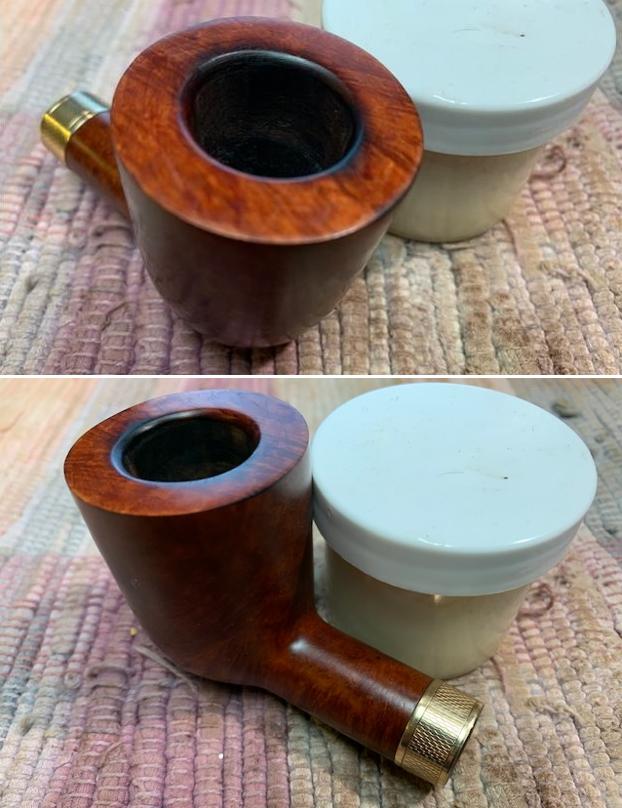
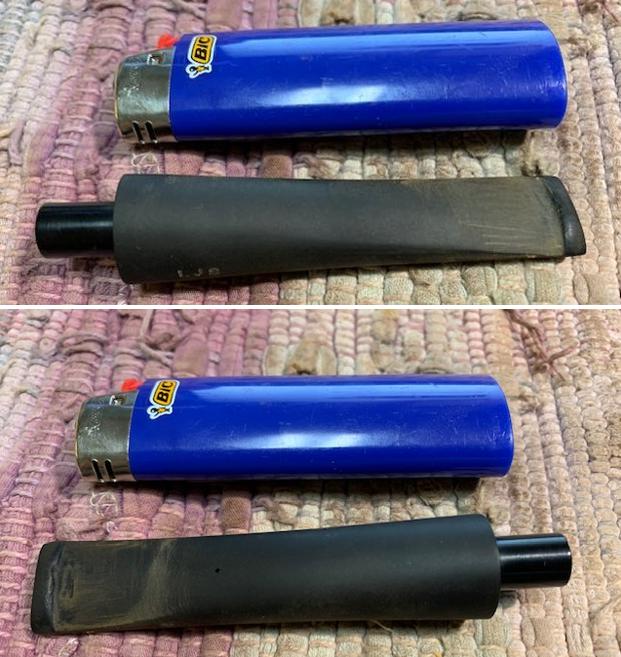
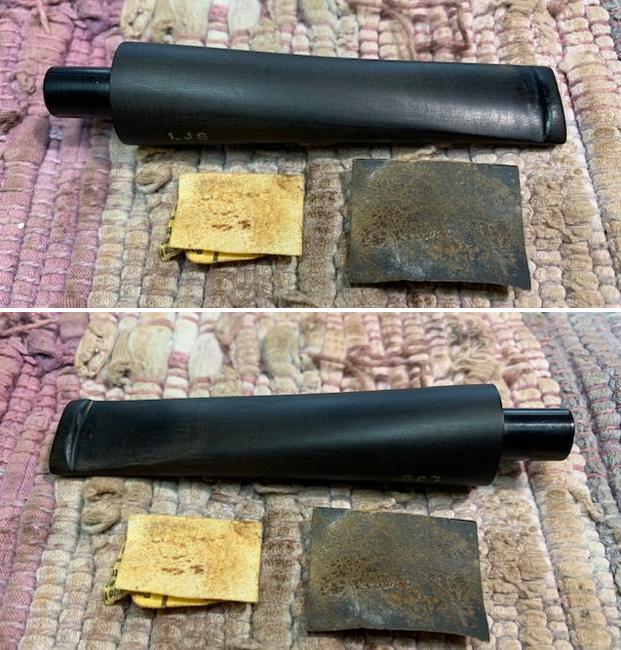
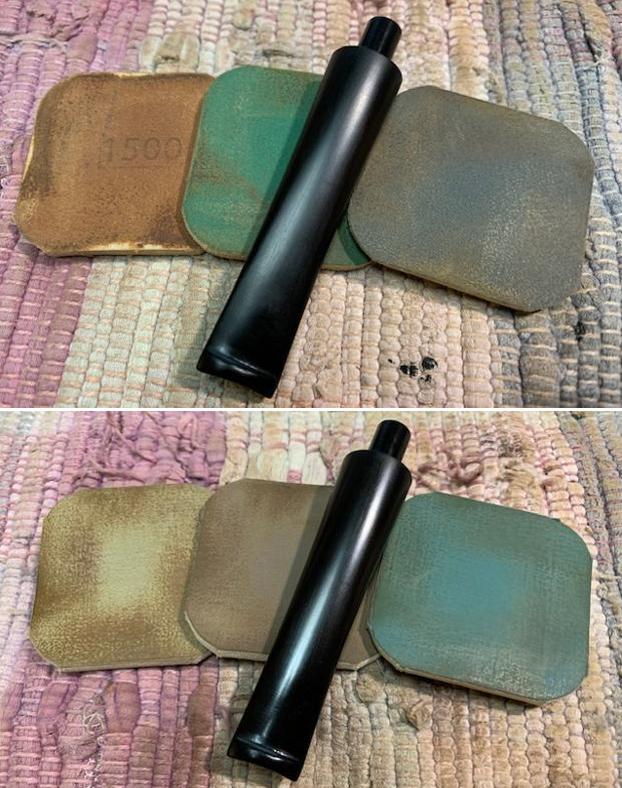
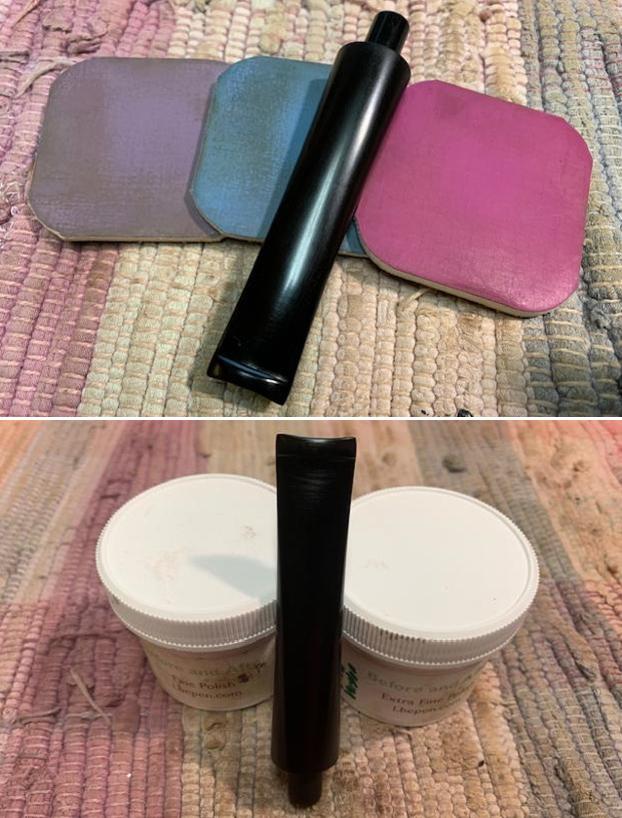
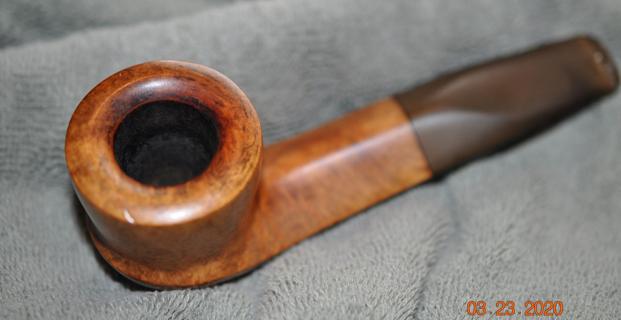
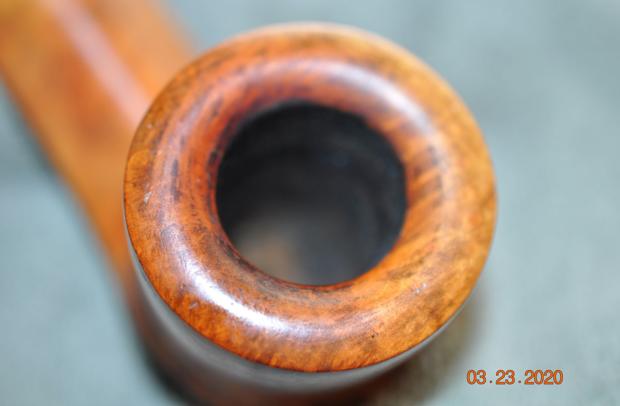
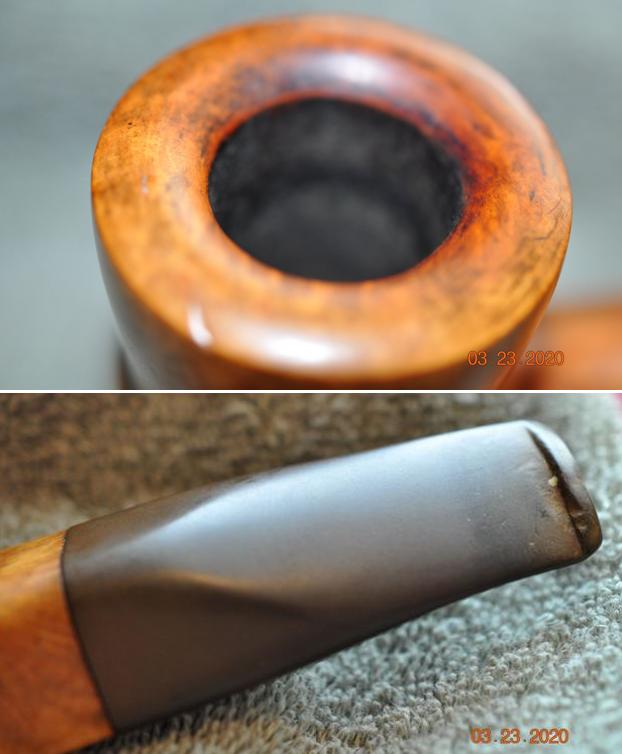
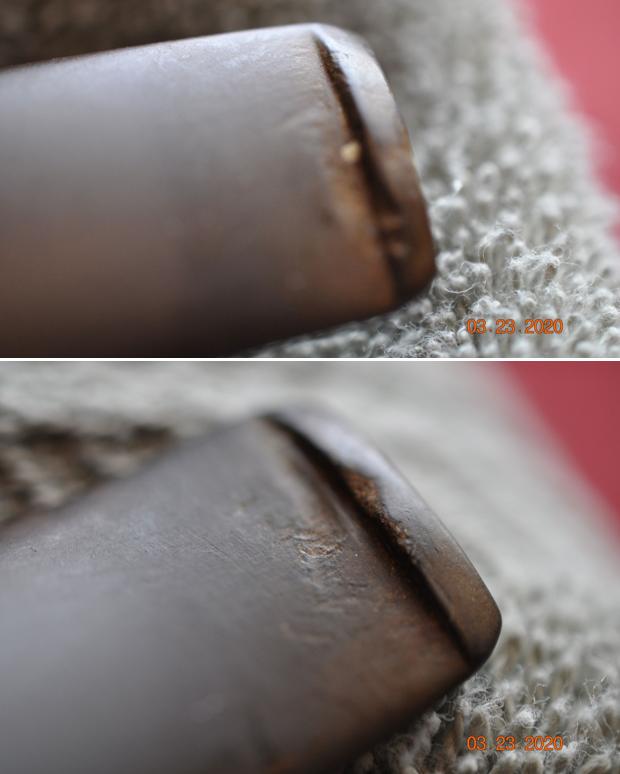
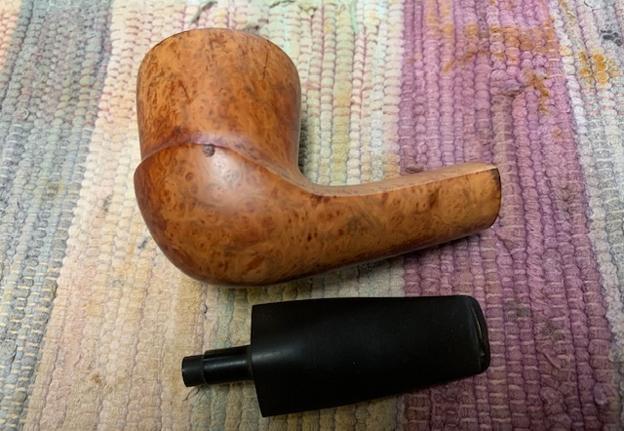
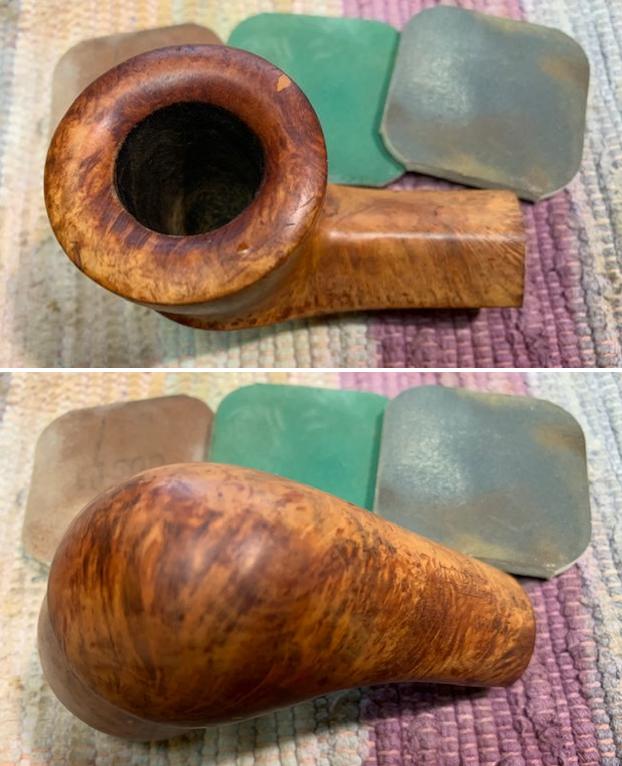
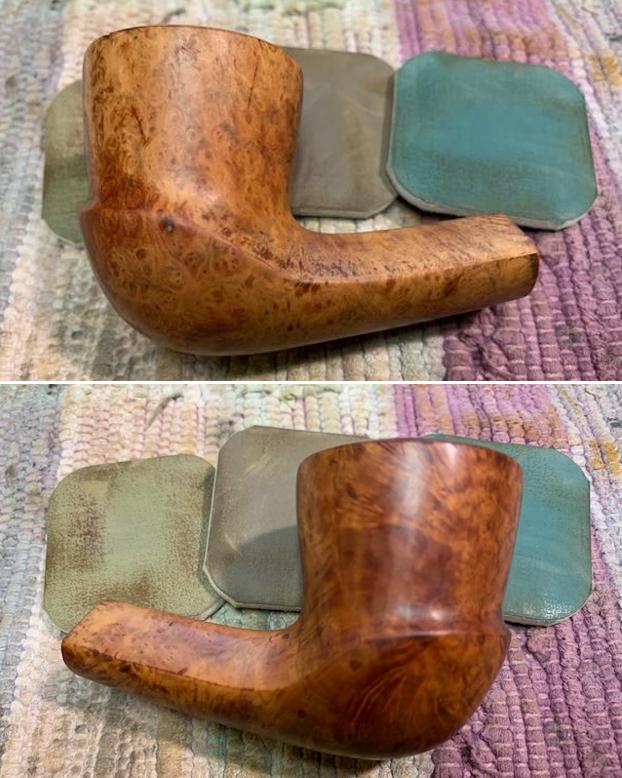
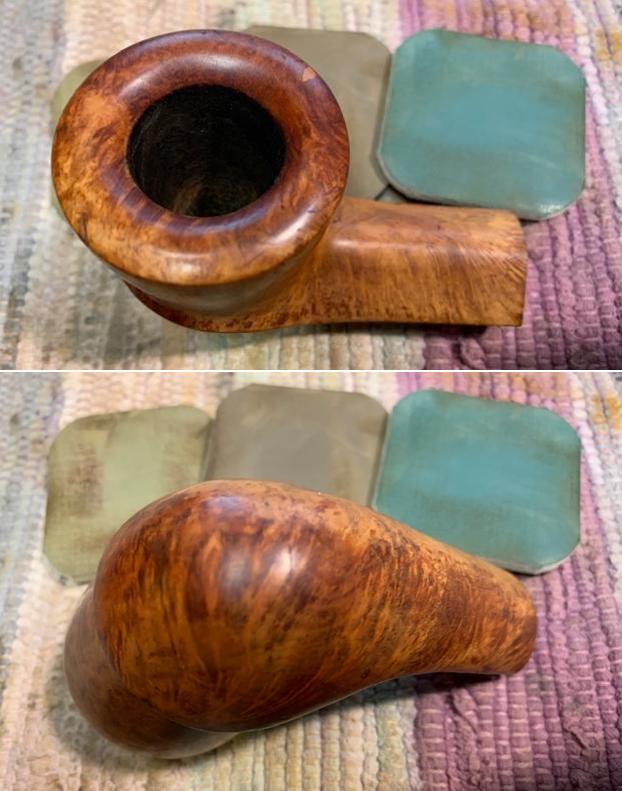
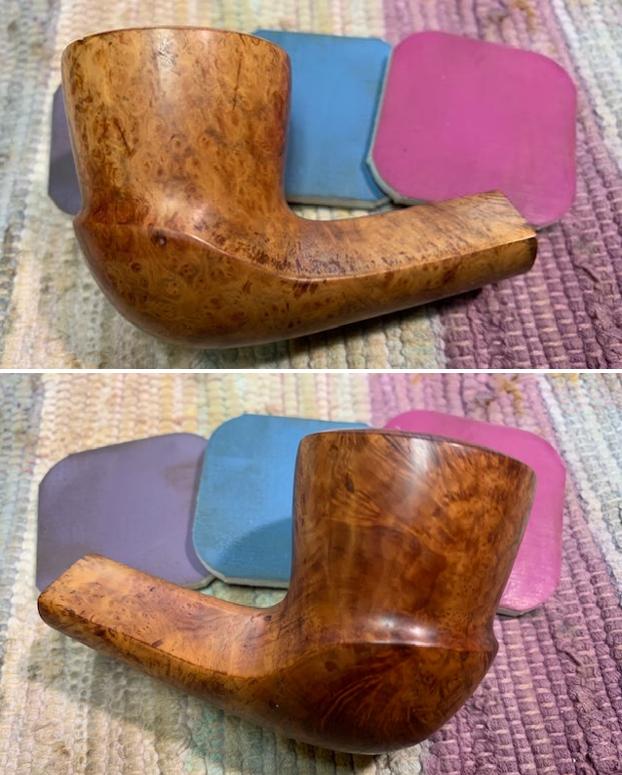
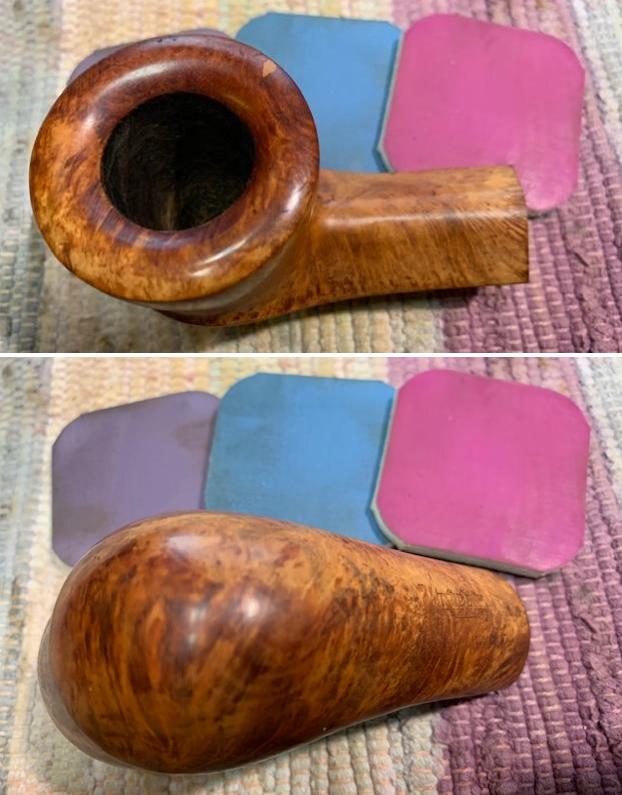
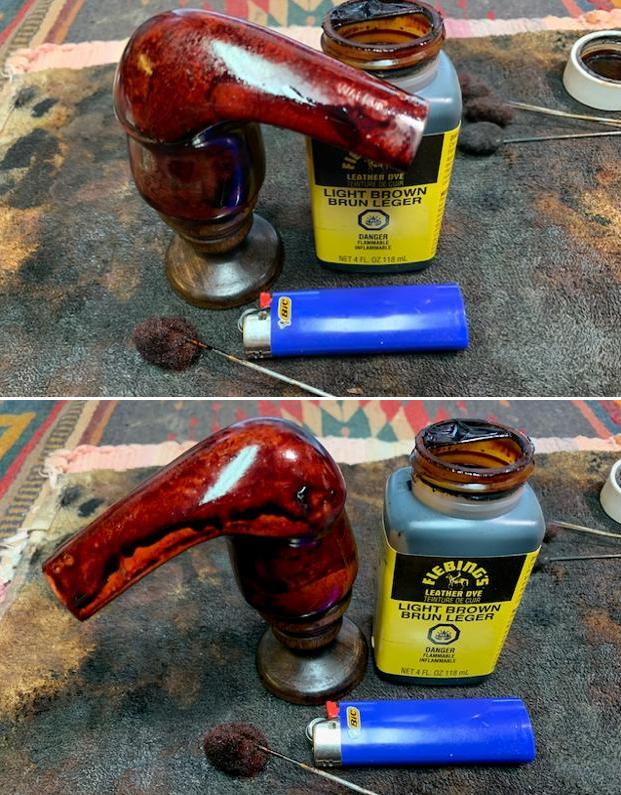
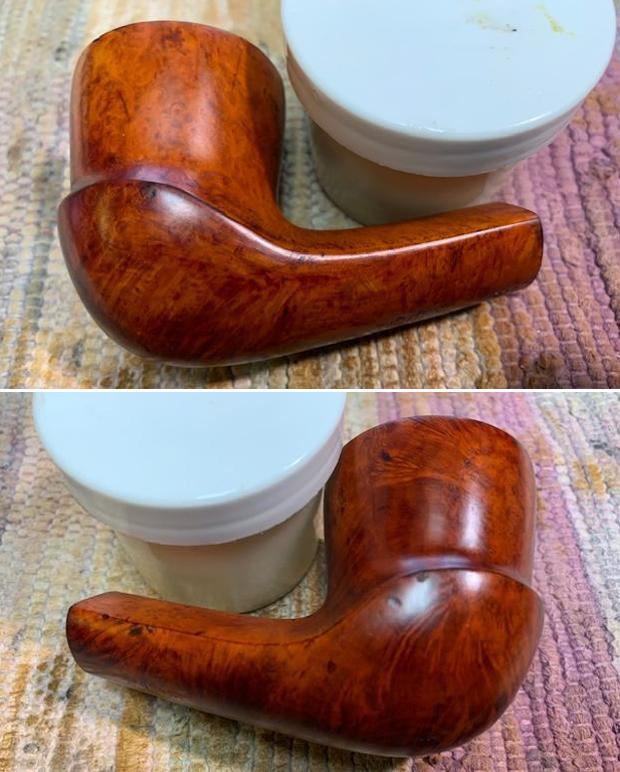
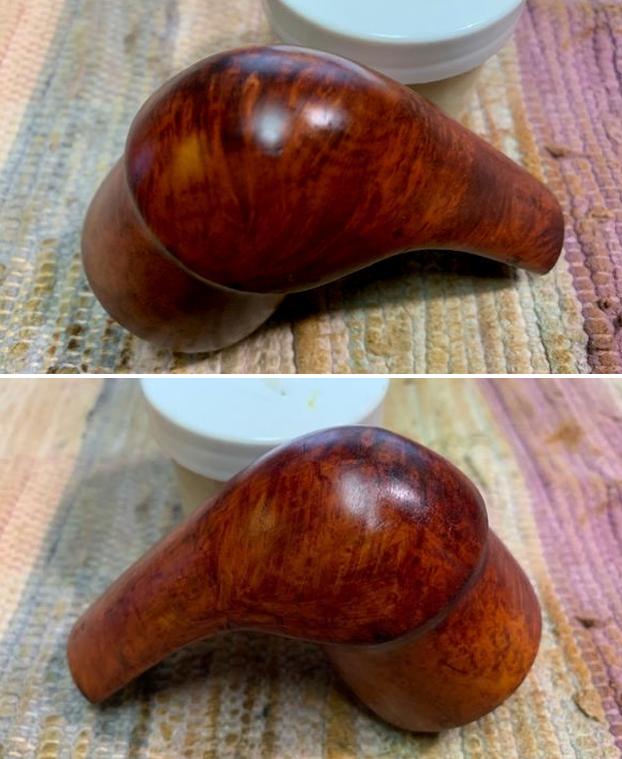
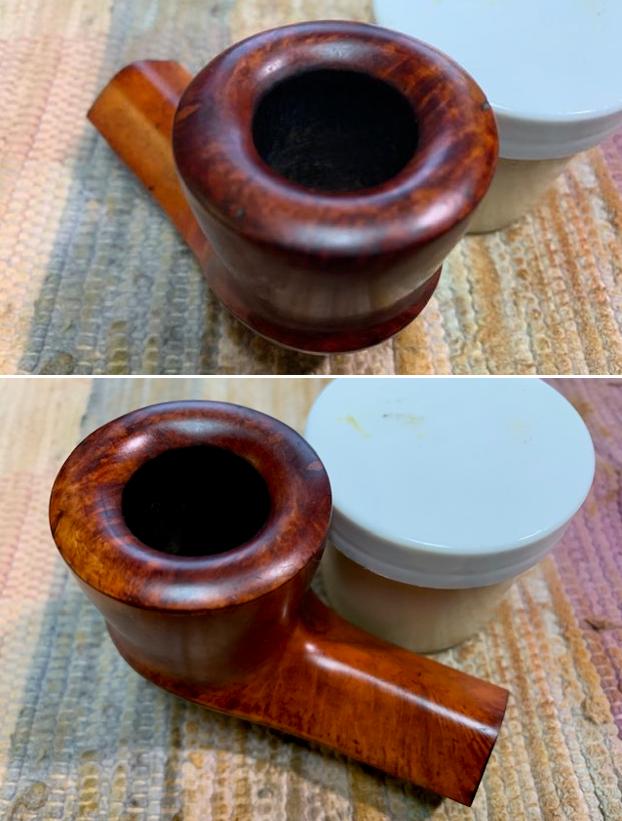
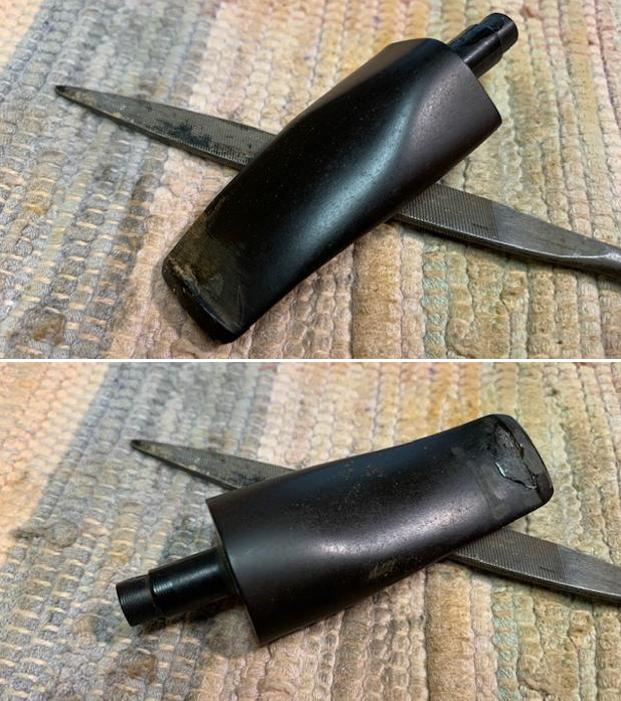
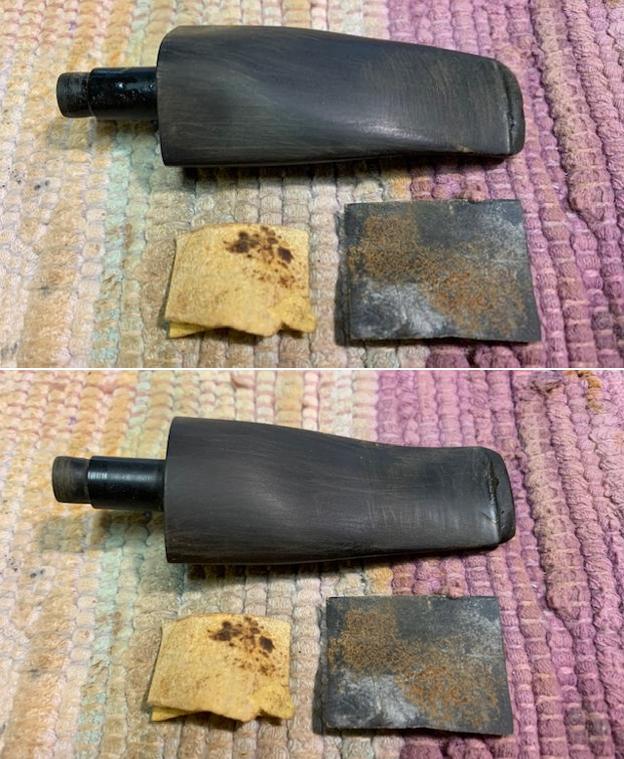
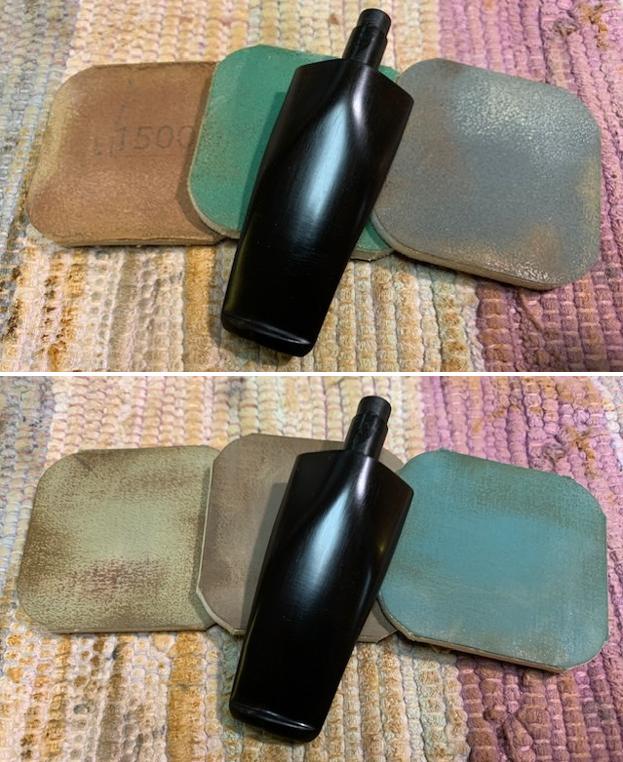
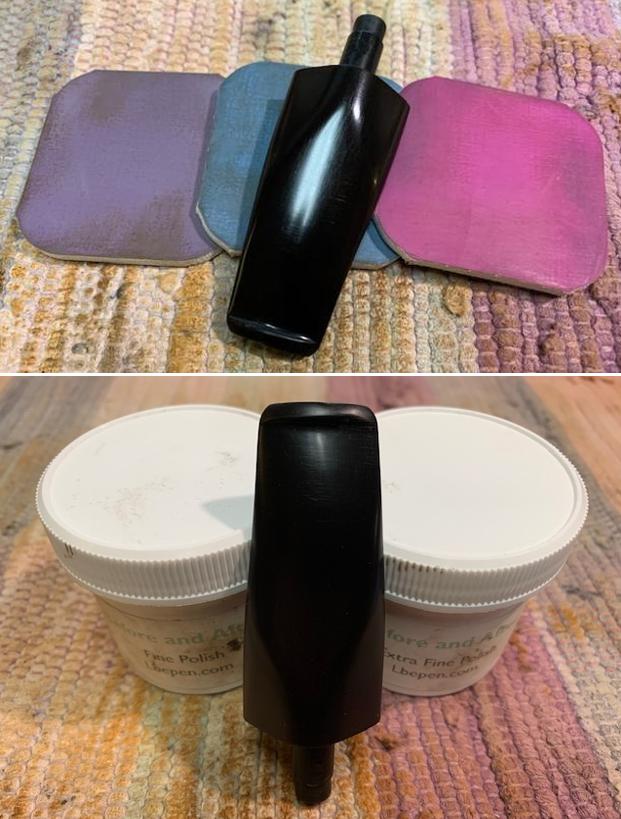
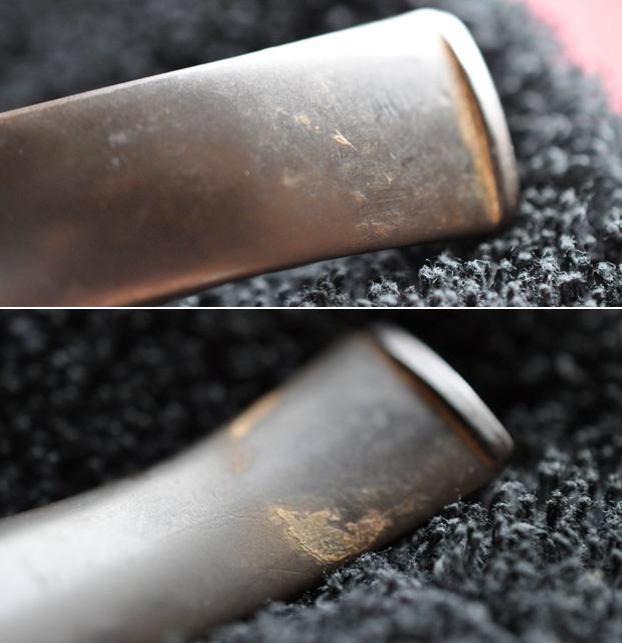
It was time to work on the second pipe – the Billiard. It was surprisingly clean. The bowl had been reamed and the airways cleaned. (I later found out that Tim had done the clean up for me. Thanks Tim!)There was no stamping on the shank of the pipe. There was no gold band to identify it as a Charles Maas pipe like the one on the Bulldog. However it was obvious that the case was custom fitted to this little Billiard so that is proof enough for me. I took some photos of the pipe before I began, to catalogue what I saw before I started. I took some close up photos of the rim top and the stem surfaces. You can see the chipping and damage to the top and inner edges of the bowl. The top is significantly lower on the front of the bowl with burn marks and charring to the top and front of the bowl. The stem shows some deep tooth marks on both sides ahead of the button.I took some photos of the rim from various angles to show the serious damage to the bowl top and edges. It really is a mess and will be an interesting challenge to rebuild.I removed the stem from the shank and took a photo of the left side of the pipe as it really gave a good picture of what the pipe must have looked like when new.I decided to start work on this pipe by addressing the damaged rim top and edges. I built up the front edge of the bowl with briar dust and clear CA glue. My goal was to bring it up as close as possible to the height of the bowl on the left side. It took a bit of layering to get there. I also filled in the damage on the front outer edge of the bowl at the same time. Once I had the height as even as possible I would top the bowl on a topping board with 180 grit sandpaper to smooth out the rim top.Once I had it close to even I topped it on a topping board with 180 grit sandpaper. I took a few photos of the front and sides of the bowl to show what the repair looked like at this point in the process. There is still work to do but it is definitely getting there. I sanded the repair on the front of the bowl a bit as well. Much work to do! I worked over the top and edges of the bowl – both inner and outer edges, with 220 grit sandpaper to capture the original shape as much as possible. You can see the repaired areas on the rim top and edges from the photos below. I am pretty pleased with the overall appearance of the cap and top at this point in the process. The repairs are very clear at this point. I still had work to do on the rim top and outer edges but I also wanted to work on the inner edge. I repaired the damage there with the super glue and briar dust as well. I was not looking to build it up too much but to take care of the deep cuts and gouges on the left front of the edge. I sanded the repair with 180 and 220 grit sandpaper and I was happy with what I was seeing at this point in the process. I worked some more on the inner edge of the bowl with a piece of 220 grit sandpaper wrapped around a piece of dowel. I wanted to smooth out the inside of the bowl and the inner edges of the rim.I decided to give the repaired edge and top a quick coat of Walnut stain to see what it looked like. I find that doing this often shows flaws that need to be addressed in the repair and makes it easier to see where I am with the top and edges. I started the polishing process with 1500-2400 grit micromesh sanding pads. I dry sanded with the pads in preparation for restaining the bowl. After each pad I wiped the bowl down with a damp cloth. My goal was to remove the scratching left behind by the repairs to the rim top and cap. I was able to remove them. Once it was smooth the briar was ready for staining. I stained it with a Feibing’s Light Brown aniline stain. I applied it and flamed it with a lighter to set it in the grain. I repeated the process until the coverage of the briar was good. I set it aside to let the stain cure.I buffed pipe with Blue Diamond on the buffing wheel to remove the crusty coat of stain. I then polished it with the remaining micromesh pads -3200-12000 grit pads. I wiped it down after each pad with a damp cloth. I worked some Before & After Restoration Balm into the surface of the briar of the bowl with my finger tips. The product is incredible and the way it brings the grain to the fore is unique. It works to clean, protect and invigorate the wood. I set the bowl aside and turned to work on the stem. I “painted” the stem with the flame of a Bic lighter to try to lift the tooth marks in the surface on both sides. I was able to lift it some but not completely. I filled in the remaining dents with clear CA glue and set it aside to cure. Once they cured I used a small file to recut the button edge and flatten the repairs to blend them into the surface. I sanded the stem with 220 grit sandpaper to remove the remaining oxidation on the saddle and also to further blend in the repairs. I started the polishing with 400 grit wet dry sandpaper. I polished the stem with micromesh sanding pads – wet sanding with 1500-12000 grit pads. I wiped the stem down after each sanding pad with Obsidian Oil. I finished polishing the surface with Before & After Pipe Stem Polish – both fine and extra fine. I gave the stem a final coat of Obsidian Oil and let it dry. I am really happy with the way that the rebuild of the rim and cap worked on on this Charles Maas Billiard (the second of two in a cased set). It really is a great looking pipe with lots of character. The old style hard rubber mouthpiece really look good with the brown of the briar. The grain really came alive with the buffing and a sense of depth came out with the polishing and waxing. I put the stem back on the bowl and carefully buffed the pipe with Blue Diamond on the buffing wheel using a light touch. I gave the bowl and the stem multiple coats of carnauba wax on the buffing wheel. I buffed the pipe with a clean buffing pad to raise the shine. I hand buffed the pipe with a microfiber cloth to deepen the shine. The finished Charles Maas Billiard really is a beauty and feels great in the hand and looks very good. Give the finished pipe a look in the photos below. The dimensions of the pipe are Length: 4 ¼ inches, Height: 1 ½ inches, Outside diameter of the bowl: 1 1/8 inches, Chamber diameter: ¾ of an inch. The weight of the pipe is 27 grams/.95 oz. The pipe will be going back to Tim with the Bulldog that I have finished. I think this little cased set is a real beauty.Thanks for reading this blog and my reflections on the pipe while I worked on it. It was a fun one to work on!

What a Tired and Worn Pair of Cased 1919 Charles Mass Pipes – Part 1: A Weary Bulldog


Blog by Steve Laug

This restoration started with an email from a reader of the blog name Tim. He had written the following email to me with a request. I have included that email below.

Hello Steve, I have a cased set of 1919 Charles Maas pipes that have been smoked hard and put away wet. Can I send them to you to have them restored? I’m a huge fan of your work and use your site often as inspiration, but these are outside my ability. – Tim

The first thing that caught me was the age of the pipes. I am a real sucker for old briar. The next thing that grabbed my attention was the brand – Charles Maas. That is a brand that I have not worked on and not heard of and it is English! The third thing that grabbed my attention was that they were a cased pair – which can often mean matching briar. All of those things conspired against my resolve to not add more work to the queue right now because of the demands of my day job and my own large number of restorations awaiting attention. I wrote him back and asked for pictures of the pipes to see if that would save me or draw me in further. Tim responded with photos and the magic words – I am not in a hurry!

Hi Steve, Here are the pictures.  I’m not in a hurry.  

I looked through the photos and assessed what needed to be done and took the plunge. I had Tim mail them to me. I was hooked and completely drawn into the project.Tim’s package arrived on Thursday and when I got home from work I opened it to have a look at the pipes first hand. I took the case out of the well packed box and this is what I saw. The case was suede with a fine leather edge around the sides. There was a thin gold line around the case edges. When I opened it I saw Tim’s 1919 label and the two pipes. There was a gold banded Bulldog and a nice stubby billiard. Both were nicely carved bowls and both had been heavily used and worn.I took the pipes out of the case and took pictures after I examined each of them to assess what needed to be done. They really are a classic set that should look great once finished. I made the following list summarizing the damages on the pipes and sent it to Tim. There is a lot of work to do to bring these back to life.

The Bulldog:
1. The rim top is badly damaged leaving the top uneven and thicker/taller toward the back of the bowl.
2. The inner edge of the bowl is quite thin on the front side from burning and over  reaming of the bowl.
3. The outer edge is chipped and uneven on the bowl front.
4. The finish is worn and damaged with signs of burn darkening all around the rim cap.
5. The band has a ragged edge on the top, rear corner of the diamond shaped band.
6. The stem has deep compressions from tooth marks on both sides at the button
7. The inside of the bowl has some checking but they are not as deep as those on the billiard.

The billiard:
1. The rim top is badly damaged leaving the top uneven and thicker/taller toward the back of the bowl and more damaged than even the Bulldog.
2. The inner edge of the bowl is thicker than the bulldog but still thinner on the front side than the rest of the bowl. It is still thick enough.
3. The outer edge is chipped and uneven on the bowl front showing some burn marks.
4. The finish is worn and damaged with paint marks on the surface.
5. The bowl is slightly out of round with chips and marks on the inner edge
6. The stem has deep compressions from tooth marks on both sides at the button.                        7. The inside of the bowl is badly checked and will need to examined for integrity.

Both pipes have been heavily reamed and they were quite clean inside. It appeared that previous earlier reaming somewhere along the way had left the inner edge chipped and damaged. That is the assessment of both bowls and it is clear from the list that there is a lot of work to do on both of them.

It was time to work on the pipes. I chose to deal with the Bulldog first (Part 1). If you were to ask me why I actually have no idea even though it is first above. I took some photos of the pipe before I began, to catalogue what I saw before I started. It was surprisingly clean. The bowl had been reamed and the airways cleaned. There was no stamping on the shank of the pipe. The gold band had hallmarks on it that Tim had said led him to the 1919 date for the pipes. The hallmarks are CM in an oval which is the mark for Charles Maas. To the right of that is a “6” in s diamond followed by 375 which is the mark for 37.5% or 9 carat gold. That is followed by a “d” and another mark that could be a lion’s head which indeed identifies the pipe as London Made and “d” identifies it as a 1919 pipe.

I turned to an English silver and gold hallmark guide to see if I could find information on the maker CM (http://www.silvercollection.it/ENGLAMAAS.html). Sure enough it was very clear that the CM in and oval linked to Charles Maas. I have included the information from the site on the brand.

Charles Leopold Maas was active in London from 1883 at 13 Jewin Crescent, EC as manufacturer and importer of smokers’ pipes of various types, including “recherché” and “meerschaum”.

The firm entered various silver hallmarks as pipes were often silver-mounted as were manufactured in precious metal many of its smokers’ accessories and walking sticks.

In 1890 (London) and 1910 (Chester) Charles Maas entered a conjoined hallmark with Marcus Maas (manager).

In 1910 the firm removed to 1A Aldermanbury Avenue. Interesting to note that from 1891 the firm used a hallmark “CM surmounted by a crown” to characterize its “Unsurpassed quality Corona Mounts”. The punches with the crown were cancelled on request of Charles Maas having the Sheffield Assay Office written on 28 February 1896 that the crown represents their hallmark and is objectionable. The firm was converted into a limited liability company in c. 1915. I took some close up photos of the rim top and the stem surfaces. You can see the chipping and damage to the top and inner edges of the bowl. The left side is thin toward the front of the bowl. The stem shows some deep tooth marks on both sides ahead of the button.I removed the stem from the shank and took a photo of the left side of the pipe as it really gave a good picture of what the pipe must have looked like when new.I decided to start work on this pipe by addressing the damaged rim top and edges. I built up the front edge of the bowl with briar dust and clear CA glue. My goal was to bring it up as close as possible to the height of the bowl on the left side. It took a bit of layering to get there. I also filled in the damage on the front outer edge of the bowl at the same time. Once I had the height as even as possible I topped the bowl on a topping board with 180 grit sandpaper.Once I had it topped I took a few photos to show what it looked like at this point in the process. There is still work to do but it is definitely getting there. I sanded the repair on the front of the bowl a bit as well. Much work to do!I worked over the shape of the rim cap and rim top with 220 grit sandpaper and small files to capture the original shape as much as possible. You can see the build up on the rim top and edges from the photos below. I am pretty pleased with the overall appearance of the cap and top at this point in the process. The repairs are very clear at this point.I still had work to do on the rim top and cap but I also wanted to work on the inner edge. I repaired the damage there with the super glue and briar dust as well. I was not looking to build it up too much but to take care of the deep cuts and gouges on the left front of the edge. I sanded the repair with 180 and 220 grit sandpaper and I was happy with what I was seeing at this point in the process.I decided to give the repaired edge and top a quick coat of Walnut stain to see what it looked like. I find that doing this often shows flaws that need to be addressed in the repair and makes it easier to see where I am with the top and edges. There was still a long way to go to get it the way I wanted but it was truly beginning to take shape. I used a knife blade small file to clean up the twin rings around the repair on the front of the bowl. I started the polishing process with 1500-2400 grit micromesh sanding pads. I dry sanded with the pads in preparation for restaining the bowl. After each pad I wiped the bowl down with a damp cloth. My goal was to remove the scratching left behind by the repairs to the rim top and cap. I was able to remove them.Once it was smooth the briar was ready for staining. I stained it with a Feibing’s Light Brown aniline stain. I applied it and flamed it with a lighter to set it in the grain. I repeated the process until the coverage of the briar was good.I buffed pipe with Blue Diamond on the buffing wheel to remove the crusty coat of stain. I then polished it with the remaining micromesh pads -3200-12000 grit pads. I wiped it down after each pad with a damp cloth.I worked some Before & After Restoration Balm into the surface of the briar of the bowl with my finger tips and a horse hair shoe brush to work it into the grooves around the bowl cap. The product is incredible and the way it brings the grain to the fore is unique. It works to clean, protect and invigorate the wood. I set the bowl aside and turned to work on the stem. I “painted” the stem with the flame of a Bic lighter to try to lift the tooth marks in the surface on both sides. I was able to lift it some but not completely. I filled in the remaining dents with clear CA glue and set it aside to cure. Once they cured I used a small file to recut the button edge and flatten the repairs to blend them into the surface. I sanded the stem with 220 grit sandpaper to remove the remaining oxidation on the saddle and also to further blend in the repairs. I started the polishing with 400 grit wet dry sandpaper. I polished the stem with micromesh sanding pads – wet sanding with 1500-12000 grit pads. I wiped the stem down after each sanding pad with Obsidian Oil. I finished polishing the surface with Before & After Pipe Stem Polish – both fine and extra fine. I gave the stem a final coat of Obsidian Oil and let it dry. I am really happy with the way that the rebuild of the rim and cap worked on on this Charles Maas Bulldog (the first of two in a cased set) turned out. It really is a great looking pipe with lots of character. The old style hard rubber mouthpiece and the gold band really look good with the brown of the briar. The grain really came alive with the buffing and a sense of depth came out with the polishing and waxing. I put the stem back on the bowl and carefully buffed the pipe with Blue Diamond on the buffing wheel using a light touch. I gave the bowl and the stem multiple coats of carnauba wax on the buffing wheel. I buffed the pipe with a clean buffing pad to raise the shine. I hand buffed the pipe with a microfiber cloth to deepen the shine. The finished Charles Maas Bulldog really is a beauty and feels great in the hand and looks very good. Give the finished pipe a look in the photos below. The dimensions of the pipe are Length: 4 ½ inches, Height: 1 ¾ inches, Outside diameter of the bowl: 1 inches, Chamber diameter: ¾ of an inch. The weight of the pipe is 23 grams/.81 oz. The pipe will be going back to Tim once I have finished the little billiard. I think this little cased set is a real beauty.Thanks for reading this blog and my reflections on the pipe while I worked on it. It was a fun one to work on!

A Strangely Unique Standing Churchwarden called a Television Pipe


Blog by Steve Laug

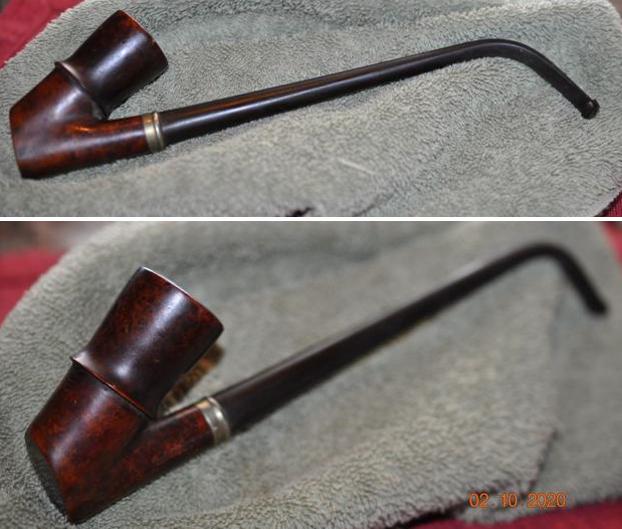
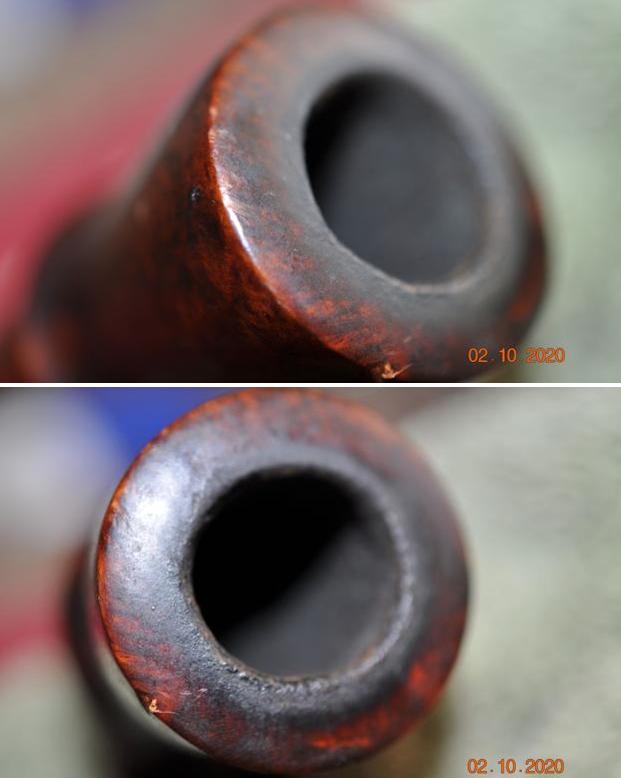
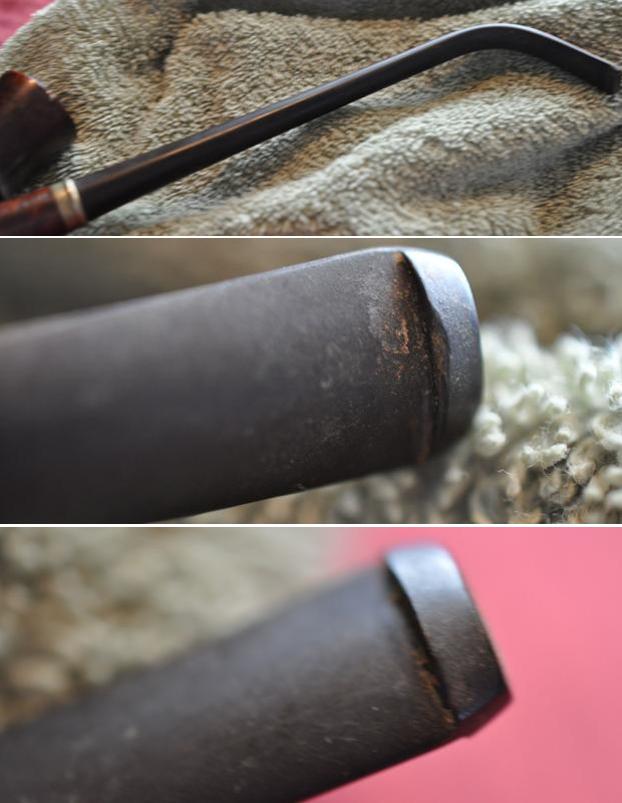
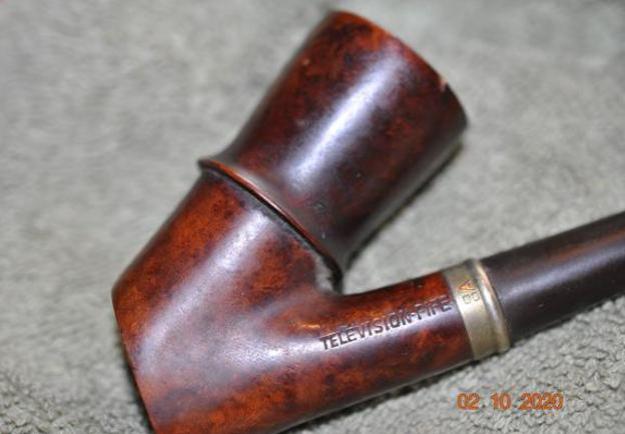
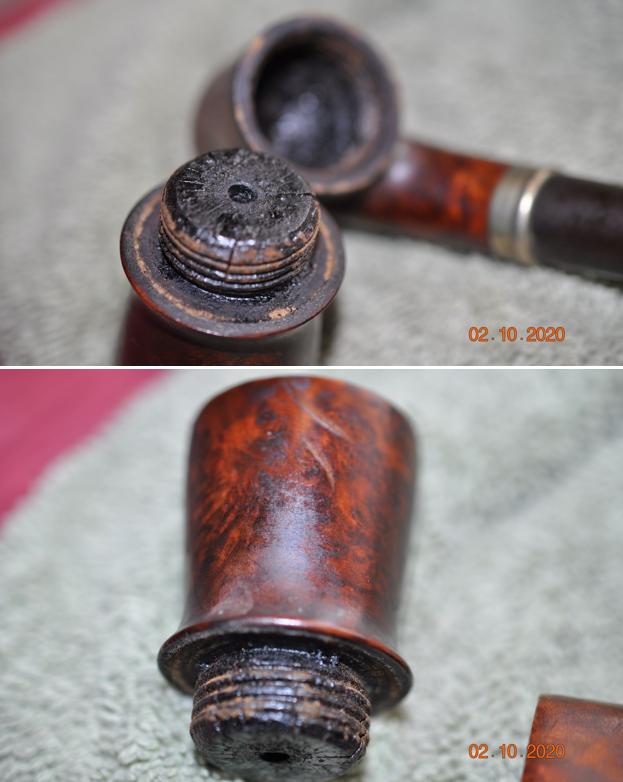
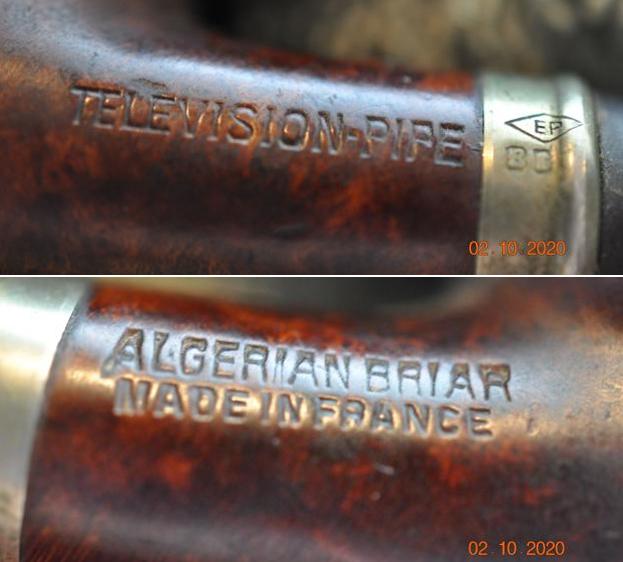
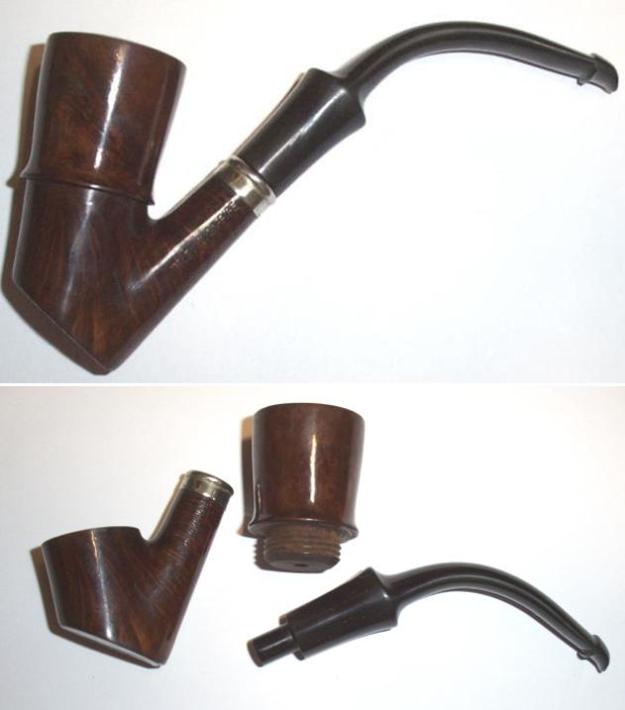
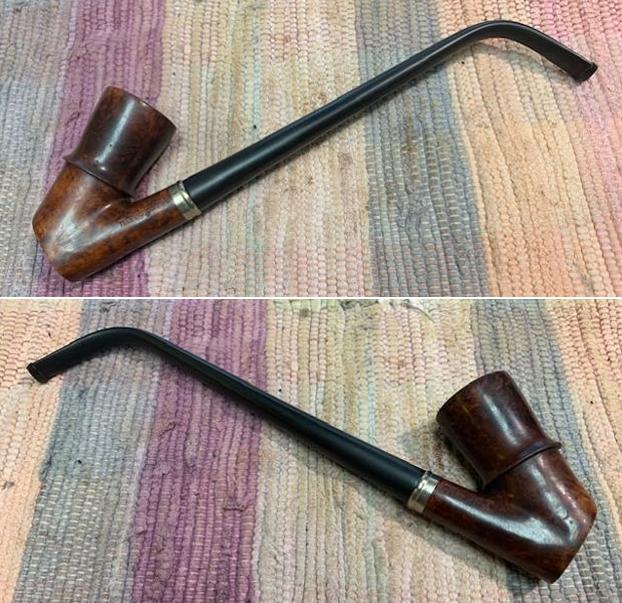
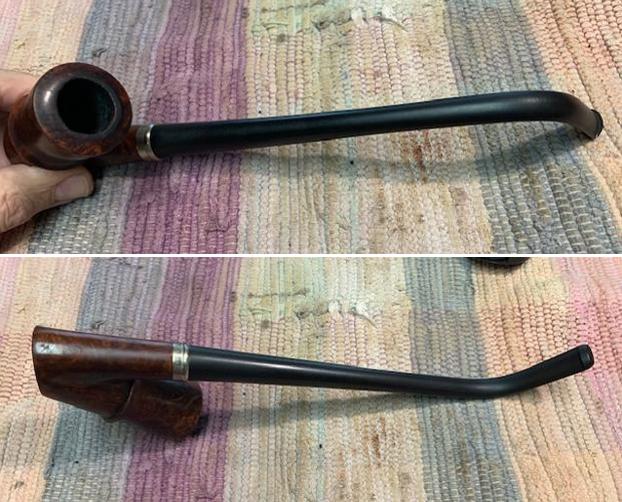
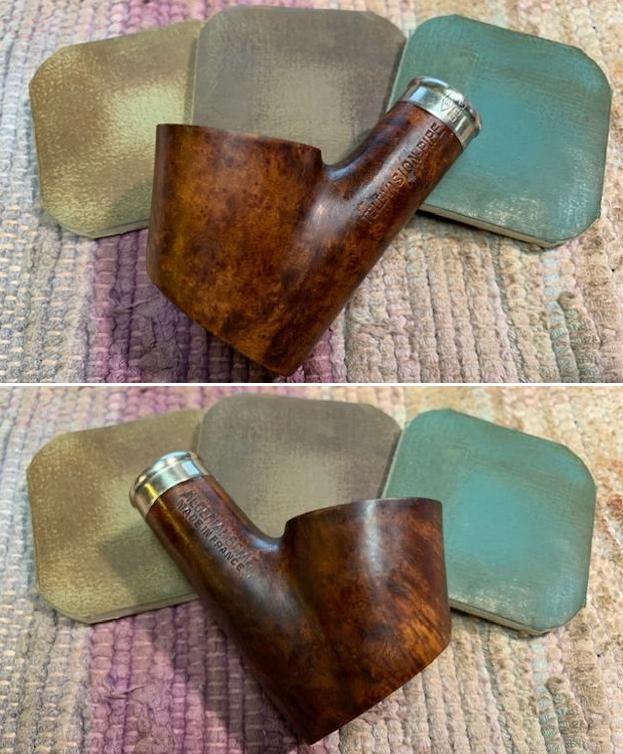
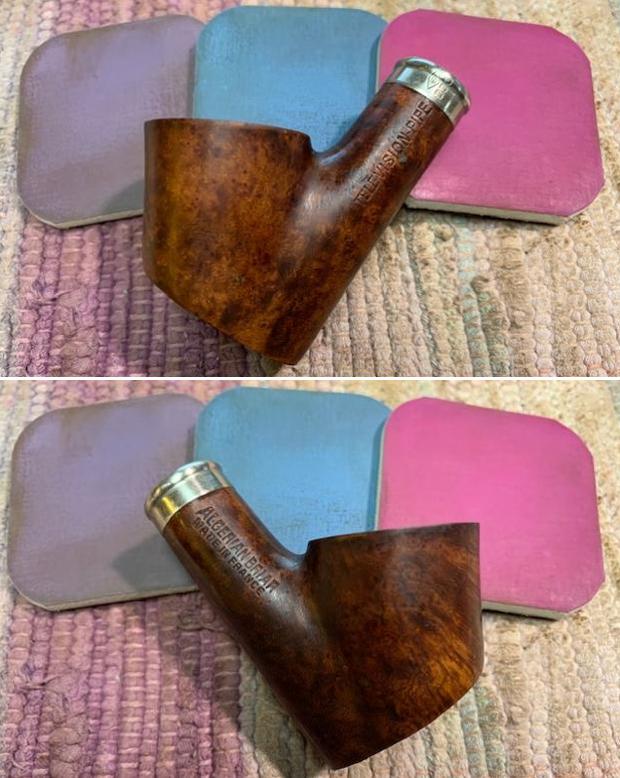
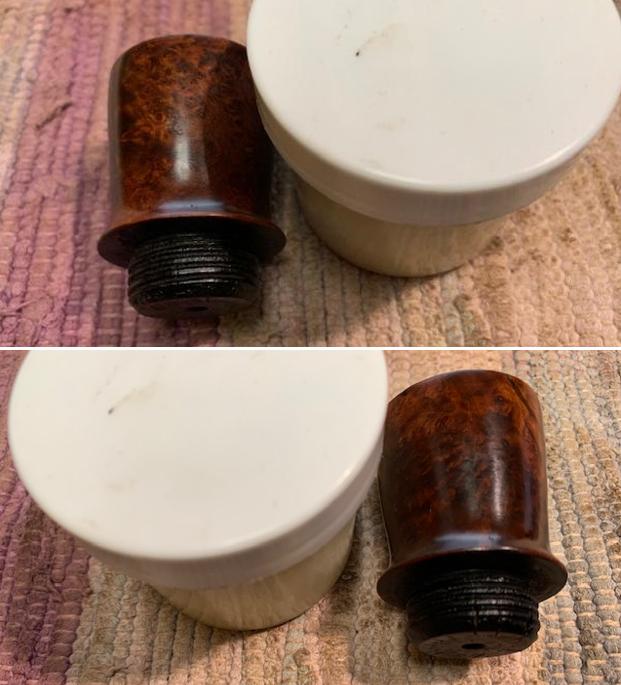
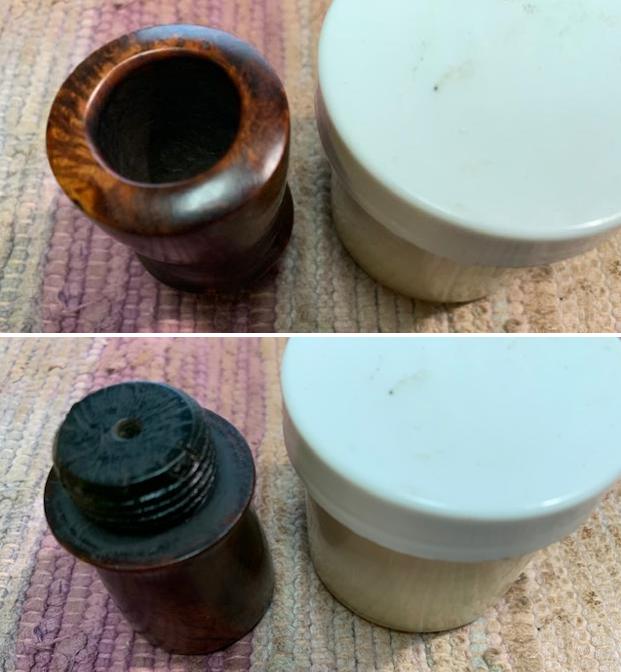
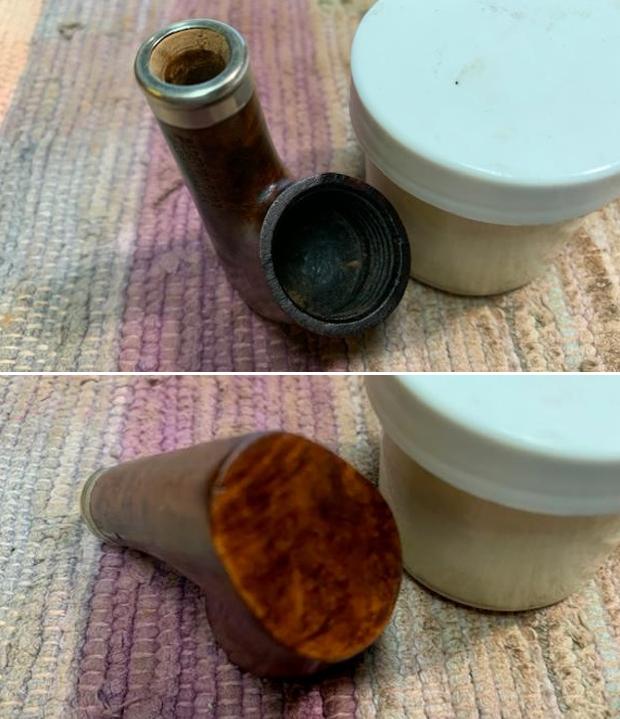
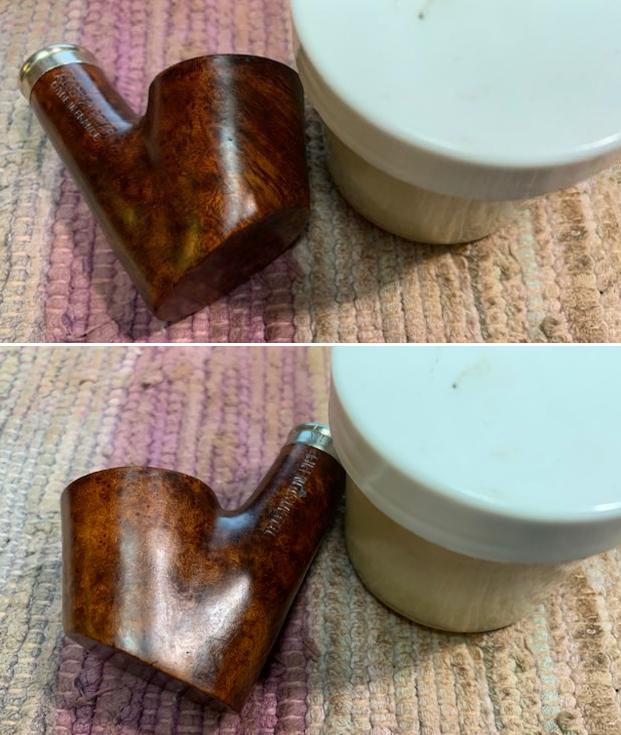
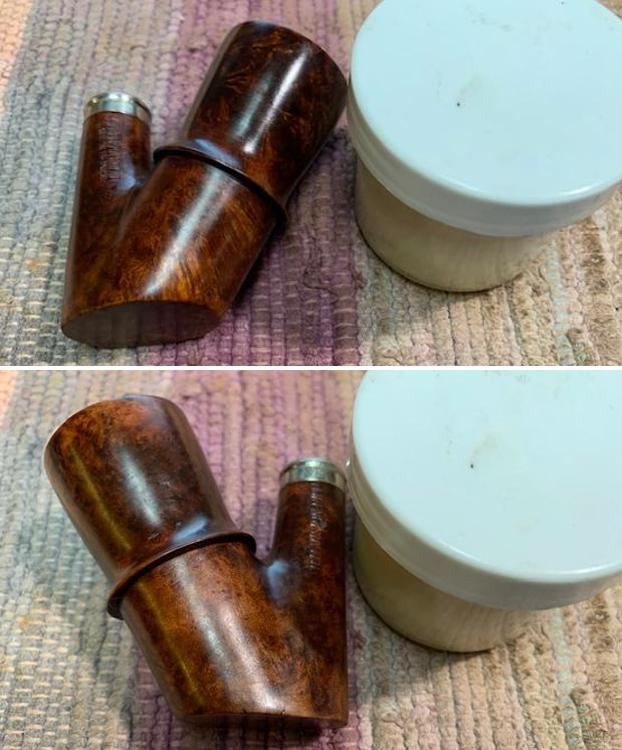
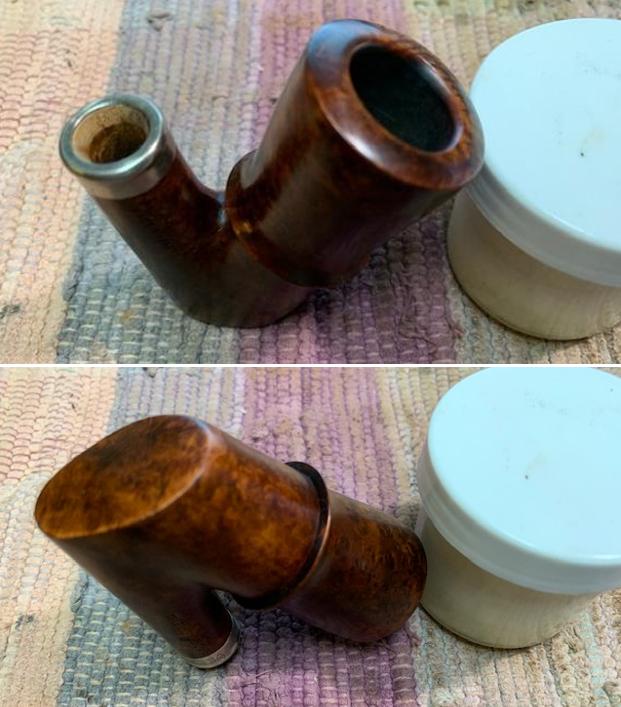
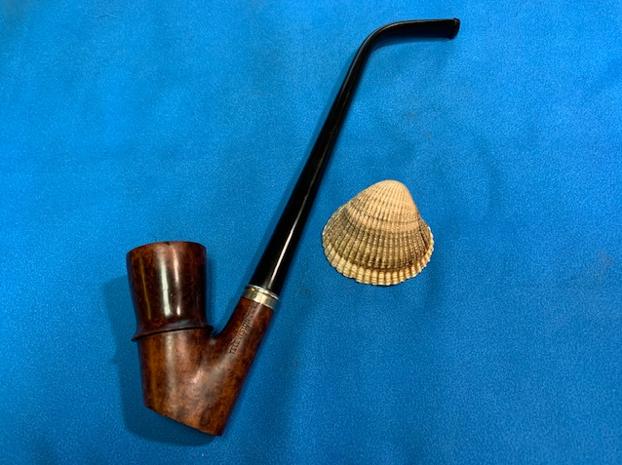
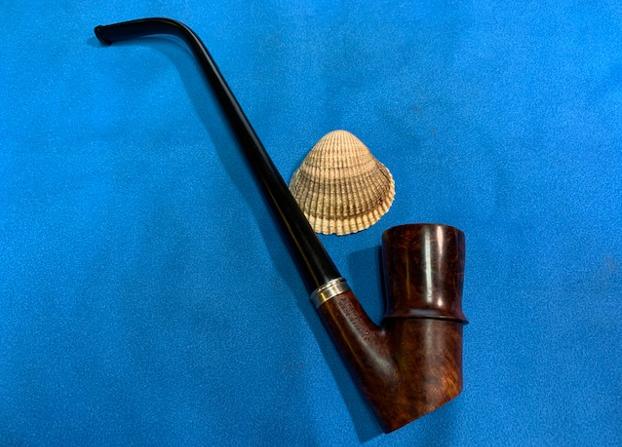
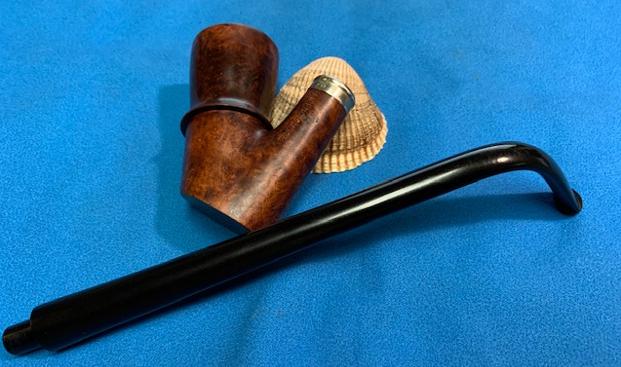
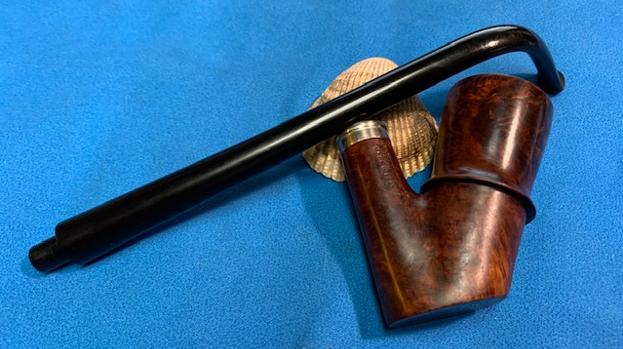
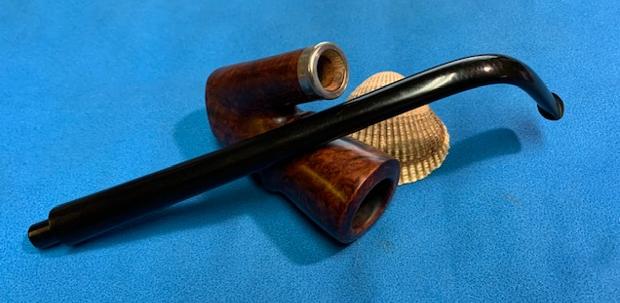
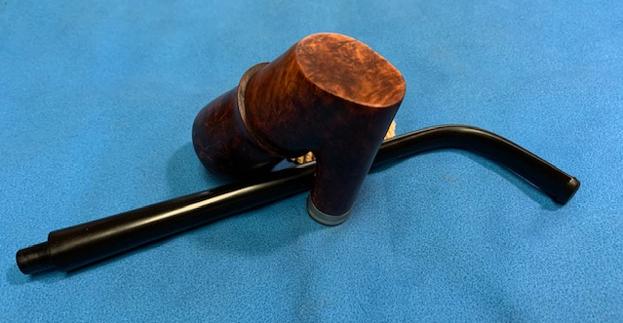
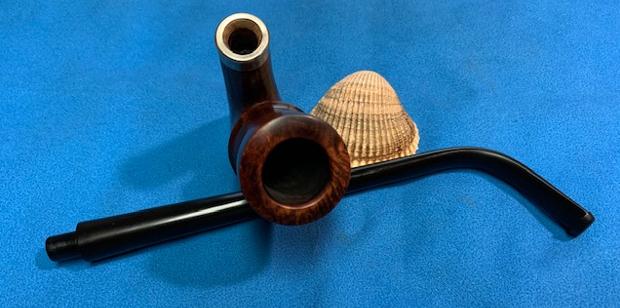
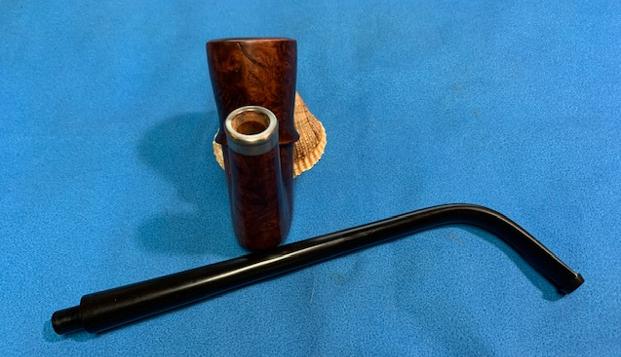
The next pipe on the table is an interesting pipe that caught my attention this morning when I was going through the boxes of pipes I have here awaiting restoration. This pipe was purchased from an online auction early in 2020 from St. Albans, West Virginia, USA. It has the length of a churchwarden and is a two part bowl and base with a tall bent stem. The pipe is a standing pipe that is well balanced and still stands when it is put together. The pipe is stamped on the left side of the shank and read TELEVISION PIPE and on the right side it read Algerian Briar [over] Made in France. There is a metal band/ferrule on the shank that is stamped EP in a diamond which means Electroplated and below that it has some very worn hallmarks. It was extremely dirty with grime and grit ground into the bowl sides. The bowl was heavily caked and there was a thick lava coat on the rim top and edges. The bowl unscrewed from the base which was also thickly caked with tars and oils. The band/ferrule was oxidized as was the vulcanite stem. There were light tooth marks on both sides of the stem ahead of the button. There was a small aluminum stinger in the tenon that was removable. Jeff took photos of the pipe before he started his work on it.He took some photos of the bowl and rim top to show their condition. The cake is thick and there is debris on the walls of the bowl. The rim top has a thick coat of lava and between that and the cake it is hard to know the condition of the rim edges. Clean up will reveal the condition. There are chips and nicks in the outer edge of the bowl. The stem looks pretty good with light tooth marks on both sides. The stem is oxidized and calcified. He took photos of the bowl and base together to show the overall appearance of the pipe. There is a lot of grime around the junction of the bowl and base that can be seen in the photos below. He unscrewed the bowl from the base and took a series of photos to show the condition of the bowl and the base. You can see the thick oils and tars in the threads, on the bottom of the bowl and in the base of the pipe. It is really a mess and will be a major work to clean up. Jeff took photos of the stamping on the sides of the shank and on the electro-plated band/ferrule on the shank.He remove the stem from the base and took a photo of the tenon end and shank to see the built up tars on the tenon and in the inside of the shank. You can also see the tarnish on the band.I looked on both Pipephil’s site and Pipedia to see what I could find out about the brand. There was nothing listed on either site regarding that brand. I turned a site that has been helpful in identifying pipes called Smoking Metal (http://www.smokingmetal.co.uk/pipe.php?page=277). The site shows a short version of this pipe – with a P-lip style stem on the shank rather than a Churchwarden stem. Other than the stem it is the same pipe. Since the information was quite limited on the brand it was time to turn to work on the pipe itself. I have to say that this was another pipe that I was really looking forward to seeing what Jeff had done to it. It is a French Made Algerian Briar Television Pipe that had shown such beauty through the grime that I was quite sure it would be stunning he cleaned it. He reamed the bowl with a PipNet pipe reamer and cleaned the remnants of cake back with a Savinelli Fitsall Pipe Knife.  He scrubbed the bowl and base with Murphy’s Oil Soap and a tooth brush to remove the grime and oils. He cleaned the internals of the base, shank and stem with pipe cleaners, cotton swabs and alcohol to remove all of the tars and oils there. He scrubbed the exterior of the stem with Soft Scrub to remove the oxidation and calcification. He wiped the bowl and stem down with a light coat of olive oil to rehydrate both. The pipe really was quite stunning. You can see the nicks around the bowl and base but they do not lessen the beauty of the pipe.  I took close up photos of the stem and the rim top to show both how clean they were and what needed to be addresses with both. The rim top had some nicks in the top and the inner edge of the bowl was out of round. The stem looked better but the light tooth marks and chatter were still present.I took photos of the cleaned up stamping on sides of the shank. It is very clear and readable.I removed the stem from the shank and took photos to show the overall look of this beautiful pipe. I then unscrewed the bowl from the base and took photos of all of the parts of the pipe. I started my work on this pipe by dealing with the shrunken fills on the bowl sides. I filled them in with clear CA glue and briar dust. Once the repairs cured I sanded them smooth to blend them into the surrounding briar. I polished the briar with micromesh sanding pads – wet sanding with 1500-4000 grit pads. I wiped the briar down after each pad. The grain began to really come alive through the polishing. I took a  break from the polishing process and I stained the sanded areas of the bowl with a Walnut Stain pen to blend them into the surrounding briar.I buffed bowl with Blue Diamond polish and then went back to polishing the bowl with 6000-12000 grit micromesh sanding pads. I repeated the process of polish the base with micromesh sanding pads – wet sanding with 1500-12000 grit pads. I wiped the briar down after each pad. The grain began to really come alive through the polishing. I worked some Before & After Restoration Balm into the surface of the briar of both the bowl and the base with my finger tips. The product is incredible and the way it brings the grain to the fore is unique. It works to clean, protect and invigorate the wood. I put the bowl and base back together again and rubbed them down with the Balm. I buffed the bowl and base with Blue Diamond on the wheel. The finished bowl looked a lot better. I set the bowl aside and turned my attention to the stem. I polished the stem with micromesh sanding pads – wet sanding it 1500-12000 pads. I wiped it down with Obsidian Oil after each pad to protect it and preserve it. I polished it with Before  After Pipe Polish – both Fine and Extra Fine. I finished the polishing with a final coat of Obsidian Oil. I am really happy with the way that this Tall Television Pipe Churchwarden Sitter turned out. It really is a unique looking pipe with character. The long mouthpiece is a unique feature of this pipe and sets it apart. The removable bowl and base work well and the pipe is a beauty. To me it is a great pipe with unique details. The grain really came alive with the buffing. The rich brown and black stains of the finish gave the grain a sense of depth with the polishing and waxing. The grain really popped. I put the vulcanite stem back on the bowl and carefully buffed the pipe with Blue Diamond on the buffing wheel using a light touch on the briar. I gave the bowl and the stem multiple coats of carnauba wax on the buffing wheel. I buffed the pipe with a clean buffing pad to raise the shine. I hand buffed the pipe with a microfiber cloth to deepen the shine. The finished Television Pipe Sitter really is a beauty and feels great in the hand and looks very good. Give the finished pipe a look in the photos below. The dimensions of the pipe are Length: 10 inches, Height: 3 inches, Outside diameter of the bowl: 1 ¼ inches, Chamber diameter: ¾ of an inch. The weight of the pipe is 57 grams/2.01 oz. The pipe will be going on the rebornpipes store soon. It will be in the section on French Pipe Makers if you would like to add it to your collection.Thanks for reading this blog and my reflections on the pipe while I worked on it. It was a fun one to work on!

This restoration is a bit of a resurrection of a beautiful Ferndown Root 3* Dublin


Blog by Steve Laug

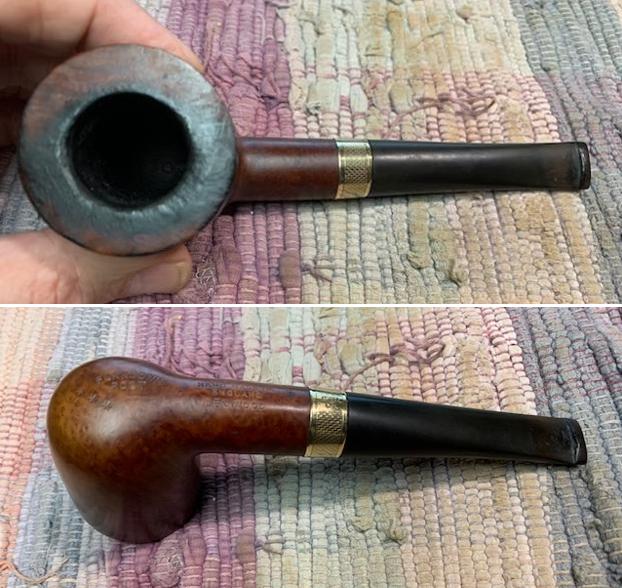
This pipe was one of those happy coincidences. I have been looking for a Les Wood Hand Made Ferndown pipe for quite a while now to add to my collection. I have read a lot about them and had them on the wish list but have never found one. The crazy thing was that I was looking on Maxim Engels Site here in Canada and on EBay when I received an email from David asking if I would be willing to breath life back into this badly damaged beauty. That should have been an easy answer but I have been turning down work as my “day” job has dramatically become more consuming and I am left without a lot of time to work on pipes. I have been turning down pipes for repair for awhile now not wanting to add to the load. I postponed answering him and when I finally did I asked him to send me photos of the pipe so I would know what I was getting into. He immediately forwarded me the next two photos and I was hooked! I have not worked on a Ferndown before and this one looked like a good candidate for me to work on. I wrote and asked him about his timeline and he was very gracious with me. We struck a deal and the pipe was on its way to Canada for work. It dawned on me then that I had no idea what the rest of the pipe looked like and I would just have to wait and be surprised.I came home from my office yesterday to find the box from David waiting for me. My wife Irene had put it where I would see it. I took it to my work desk in the basement and carefully opened a well packed box that had originally contained pipes that I had sent to David. It was good to see this little box continue to serve its purpose as the vessel that protects it precious cargo. I took it out of the box and took some photos of it to chronicle the issues that I saw and give a benchmark for me before I began the work.

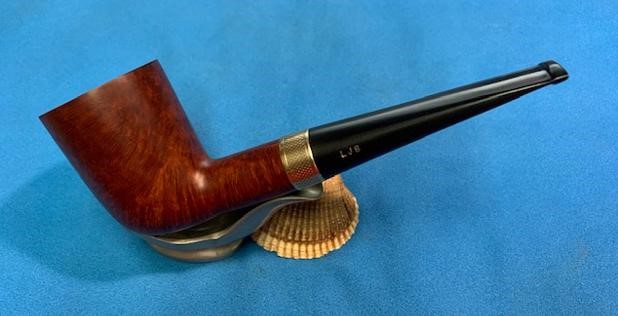
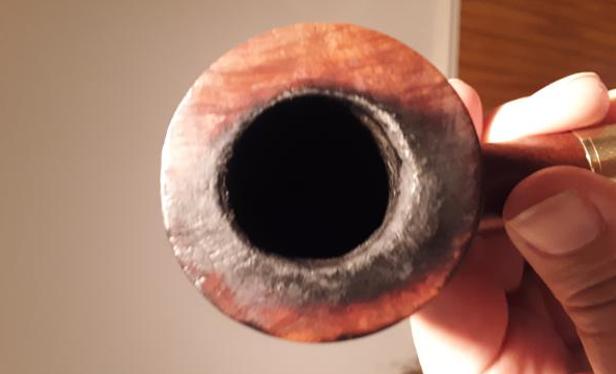
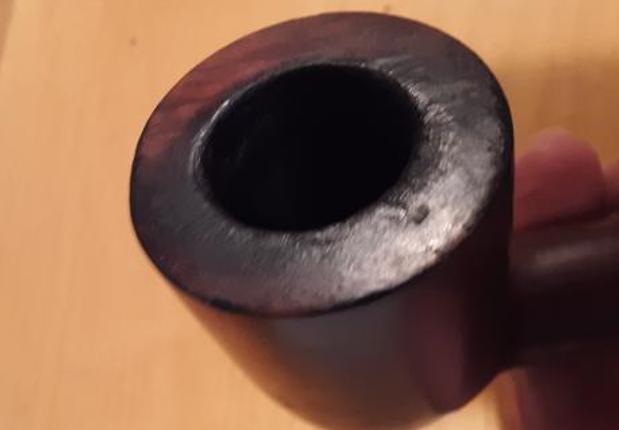
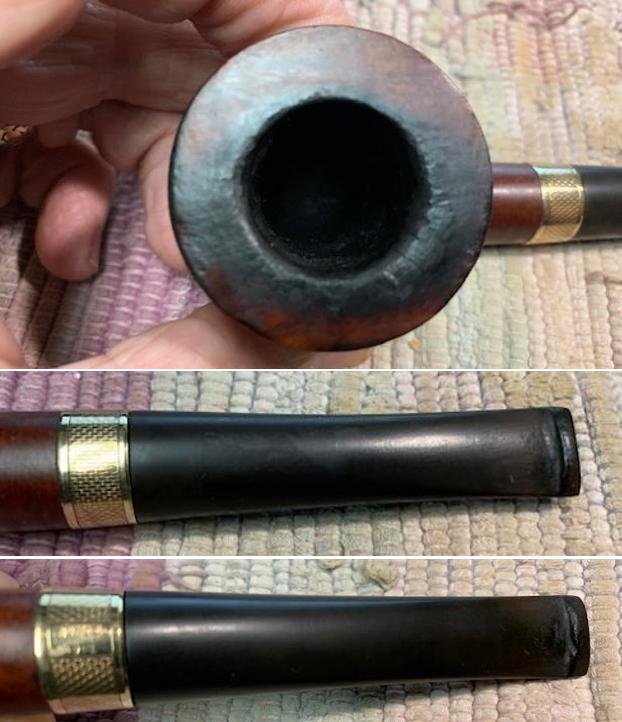
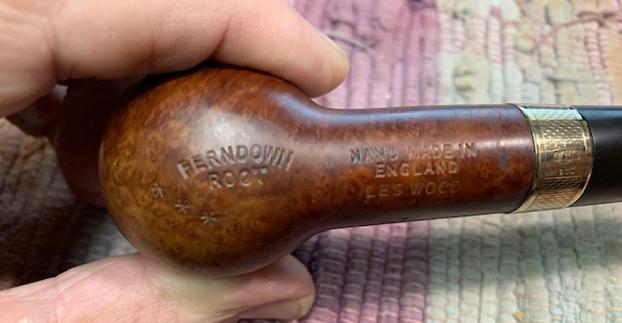
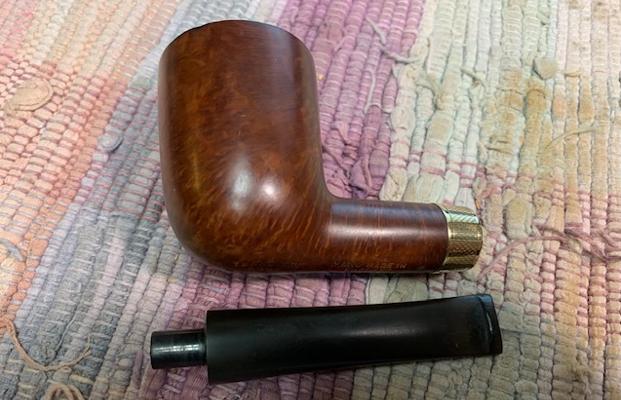
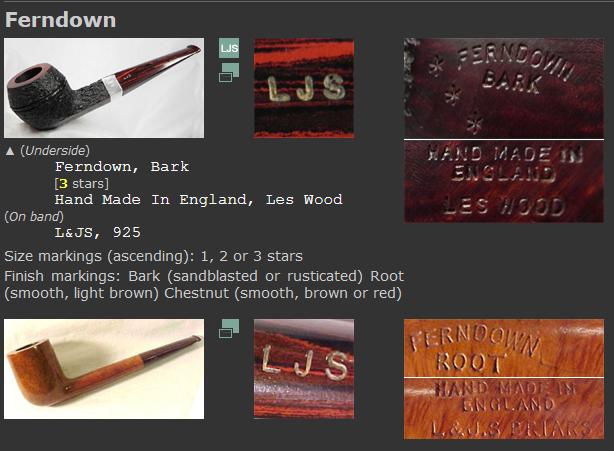
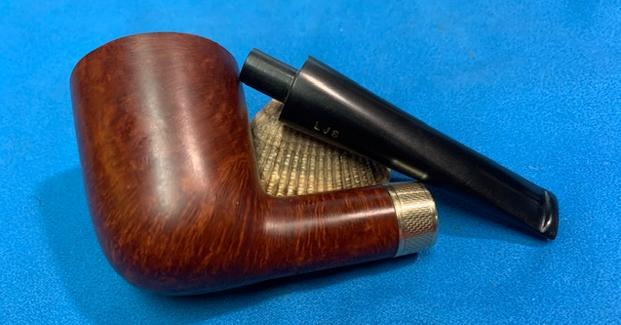
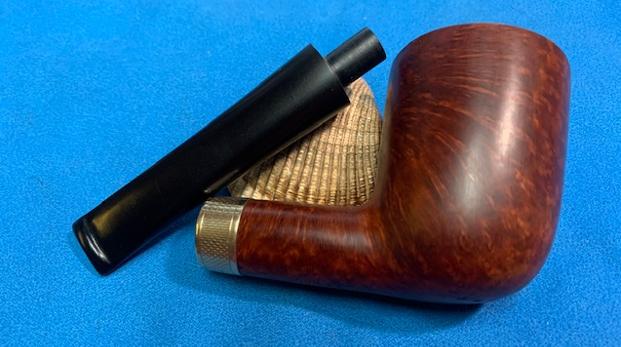
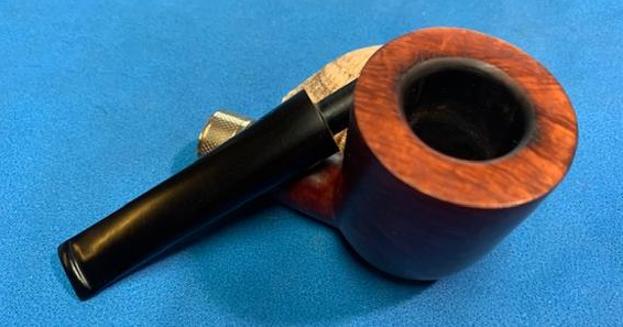
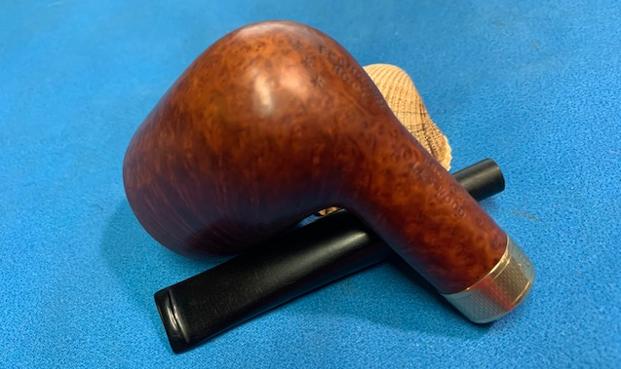
The pipe is a beautifully shape Dublin with a gold band. The pipe is stamped on the underside of the bowl and shank. On the heel of the bowl it is stamped Ferndown [arched over] Root [over] ***. Next to that it is stamped Hand Made In [over] England [over] Les Wood. On the gold band it is stamped L&JS in a rectangle [over] 9CT. The finish is quite beautiful but dirty on the bowl sides and shank. The largest issue with the pipe is the rim top and edges. There are burn marks around the front and back outer edges. The rim top itself is covered with lava but not enough to hide the charred inner edge and top. The damage is deep from the looks of the bowl top but cleaning would tell the story. The bowl itself is out of round from the damage. There was a thick cake in the bowl and the pipe stank of old tobacco but not enough to distinguish what it was… I know it was not an aromatic from the smell but otherwise I could not identify it. The taper stem is oxidized and has some calcification on the end. It is stamped on the left side and reads LJS. It was originally a stunning pipe and even with the damage and grime it still had class that was evident the moment you looked at it. I took a photo of the rim top and edges to show the burn damage around the bowl top and inner and outer edges. It has some serious char under the lava coat. The bowl is thickly caked as you can see from the photo. I also took photos of the stem to show its condition. There are light tooth marks and chatter on both sides next to the button and there is a deep oxidation in the vulcanite.I took a photo of the stamping on the heel of the bowl and underside of the shank and gold band. It is clear and readable as noted above.I removed the stem from the bowl and took a photo of the pipe to show the proportions of the design. It is really a well made pipe.I turned to Pipephil to help me interpret the stamping on the pipe and gain some background information (http://pipephil.eu/logos/en/logo-f1.html). The photo to the left shows Les Wood and the information below came from the side bar. I have also done a screen capture of the information on the site.

Artisan: Leslie (Les) Wood. He was the master silver smith at Alfred Dunhill Ltd. before starting L. & J.S. Briars. Pipes for the European market are stamped “L. Wood” while those for US are stamped “Ferndown”. Production: ~ 2000 pipes/year (Ferndown + L.Wood) See also Elwood.From the information on Pipephil I learned that I was working on a pipe made for the US and that it was a large 3 star pipe in terms of size. I also learned that the Root finish was a smooth light brown. All of which helped to understand the pipe in hand.

I turned to Pipedia (https://pipedia.org/wiki/Ferndown) to find a more detailed history and description of the brand and was amazed to find that the majority of it was either quotes or written by Les Wood himself. I am quoting some pertinent parts of the article below. You can turn to the site to read it in full.

Leslie “Les” John Wood worked for Dunhill for 19 years. His last position was as master silversmith. Following his tenure with Dunhill, Les formed his own brand, L. & J.S. Briars together with his wife Dolly in 1978. Les Wood follows Sasieni, the first ex Dunhill worker to start their own enterprise, and he was followed by William John “Ashton”-Taylor.

“I started working at Dunhill’s in March 1963, in the silver mounting department working under Jack Spriggs he left the firm after I had been there for 2 years, and I took over the department, at that time I worked alone it was only when the department was relocated to the top floor that the increase of pipes that needed mounting that we took on trainees. After 19 years I was asked if I would buy the machinery and move out of the factory and set up on my own, so off I went. With me I took the staff that worked with me at that time, Robert Morris was the best, he could mount anything, he now has his own jewellery retail shop and makes some really nice handmade jewellery from his shop at Whitstable in Kent.”

“I worked on Dunhill’s pipes from 1980/81 and soon built up a reputation as the firm to send your mounting to. As time went on and Dolly left Dunhill’s we decided to start to turn our own bowls and make our own pipes under the name of my house.” Les Wood. Jan, 2020…”

Due to the vagaries of international trademark law, he sold his earlier pipes as ” L.&J.S Briars”, “Ellwood”, “Les Wood” or “L. Wood”. Until recently, an average of 1500 – 2000 pipes a year were sold as “Ferndown” — named for the mansion he lives in — in the UK and US, but as “L. Wood” pipes in Germany…

To many pipe smokers, Les Wood’s pipes embody the revival of great English pipe making initiated by Ashton in the early 1980s. The high-grade Italian and Spanish plateau he prefers is oil-cured in the tradition of both Dunhill and Ashton. The pipes are renowned for their pleasant, slightly nutty flavor and remarkable smoking characteristics. They feature impeccable craftsmanship extending to very good stem/bit work, though many pipes are often a bit heavier. The hallmark of his work, of course, is the excellent silver work. Almost all of his pipes feature rings or ferules for spigot stems. Grading is by finish: “Bark” (ca. 90%, rusticated, dark brown and black), “Antique Bark” (tan rusticated), “Reo” (brown and red, smooth), “Root” (orange, smooth), and “Tudor Root” (orange and brown smooth) and by size (one to four stars). He also designates straight grains with SG…

“We bought the briar from Italy and Spain, one is mush denser that the other I like the Spanish briar it is lighter and Dolly would make the Roots look like glass with only a natural vanish, all the pipes were finished with the same varnish, the bark finish on the bowl is put on by Dolly by hand, one slip and you have a problem. That’s one job that needs to be seen to see how it’s done.”

There also was a great paragraph on the oil curing process that Les and Dolly developed. I am including that below as the pipe I am working on was definitely oil cured.

“We had our method of Oil-Curing. We applied Oil to the outside and the inside of the bowl, that was because when Dolly was at Dunhill’s factory, she worked in the finishing department and got such a high finish on the pipes they wanted to know how she did it. The bowls had already gone through Dunhills’ oven oil curing system, but to her, it was not enough, because it could not get the shine that she wanted, then, she oiled the bowl on the outside and the inside to get a better finished. She left Dunhill and came to work with me. Because of this process, we found out the smokers liked the taste when light up their pipe – they said there was no aftertaste and it had a sweet taste doesn’t matter what tobacco they used. We have carried it on from there.”

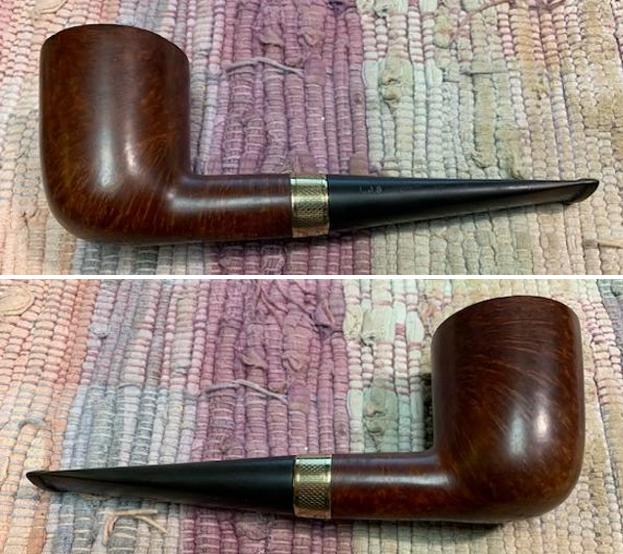
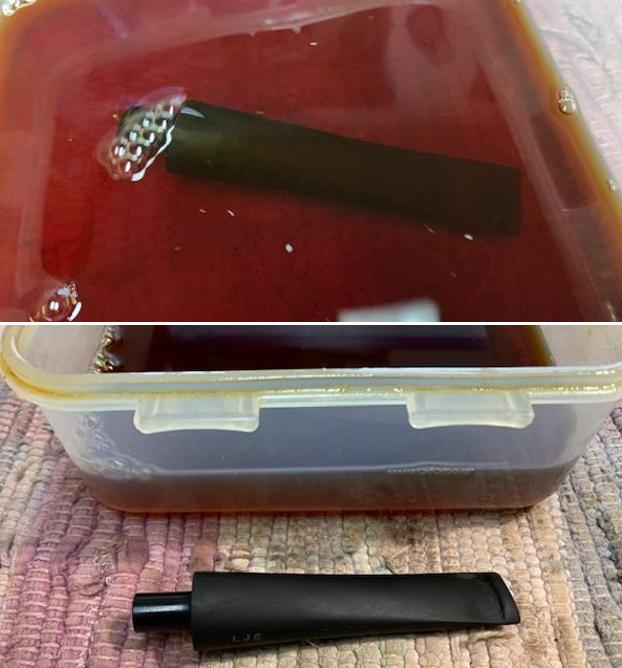
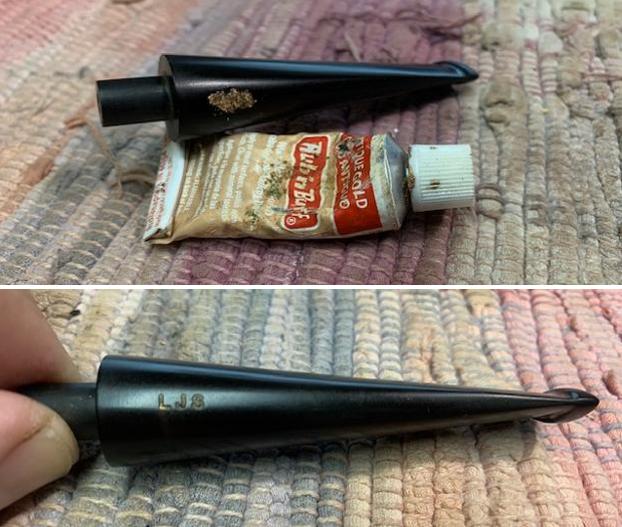
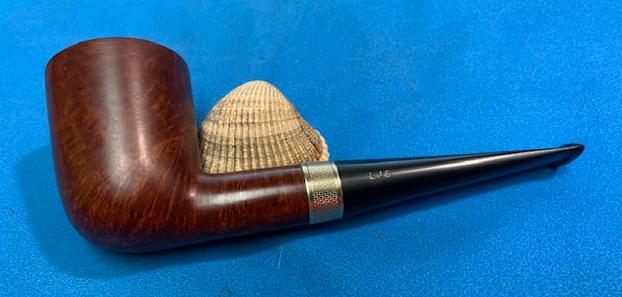
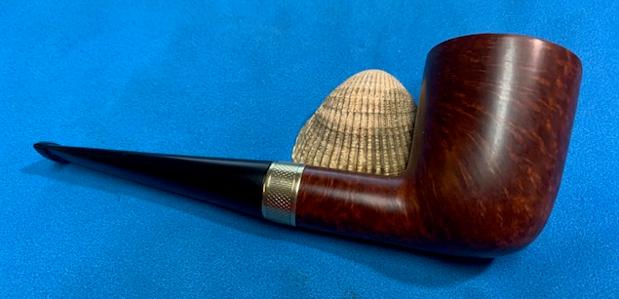
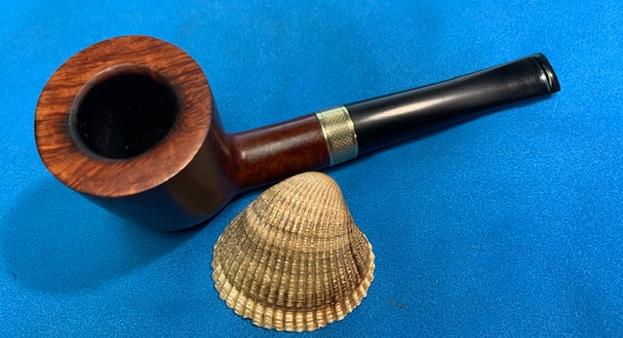
With that background information it was now time to work on the pipe itself. I decided to top the bowl to remove the heavy charring damage. I put a piece of 180 grit sandpaper on the topping board and worked the rim top and edges over in a circular motion on the board. After a few passes I took a photo of the rim top to show the progress but also to show the burn damage.Before working on the rim edges I reamed the bowl with a PipNet Reamer to cut back the cake to bare wood. I cleaned up the remaining cake with a Savinelli Fitsall Pipe Knife. I then sanded the bowl with a piece of 220 sandpaper wrapped around a piece of dowel to smooth out the bowl walls. The reaming and sanding cleaned up a lot of the damage on the inner edge as you can see in the fourth photo below.With that done I turned my attention to the inner and outer edges of the rim. I cleaned up both with a folded piece of 220 grit sandpaper. I worked on removing the burn marks on the outer edge and gave the inner edge a light bevel to hide the burn marks.I scrubbed the exterior of the bowl and shank with undiluted Murphy’s Oil Soap and a tooth brush. I work on the grime ground into the briar. I rinsed the bowl with warm running water to remove the debris left behind from the scrubbing. The pipe looked much better and the rim top was greatly improved. I cleaned the internals of the bowl, shank and airway in the stem with isopropyl alcohol, cotton swabs and pipe cleaners until they came out clean.I set the stem aside and turned my attention to polishing the briar. I used 1500-12000 grit micromesh sanding pads and wiped the bowl down after each pad with a damp cloth. The briar on the rim began to change the colour to get much closer to the rest of the bowl. I used a Maple stain pen to blend the rim top into the colour of the rest of the bowl. It matched well and served to obscure the burn mark on the rim edges. I also restained a light spot on the heel of the bowl. I rubbed the bowl and shank down with Before & After Restoration Balm. I worked it into the surface of the bowl sides and shank with my fingertips to clean, enliven and protect the briar. I let the balm sit for a little while and then buffed with a cotton cloth to raise the shine. The Balm did its magic and the grain stood out. I set the bowl aside and put the stem to soak in a bath of Briarville’s Pipe Stem Deoxidizer overnight. In the morning I rinsed it off with warm water and rubbed off the remaining softened oxidation until the stem was very clean. It looked very good and even the LJS gold stamping looked good. I set the bowl aside and turned my attention to the stem. I “painted” the tooth marks on the stem with the flame of a lighter to raise them. I sanded the remaining tooth chatter and marks with 220 grit sandpaper to blend them into the stem surface. I started the polishing process with 400 grit wet dry sandpaper. I polished the vulcanite stem with micromesh sanding pads – 1500-12000 grit pads. I wiped it down with Obsidian Oil after each sanding pad. I used Before & After Pipe Polish – both Fine and Extra Fine to further polish the stem. The photo below shows the polished stem.     I touched up the LJS stamp on the left side of the taper stem with Rub’n Buff Antique Gold. I rubbed it on and worked it into the stamp with a tooth pick. I buffed it off with a soft cloth. This nice looking Les Wood Ferndown Root 3 Dublin with a taper vulcanite stem is a great looking pipe now that it has been restored. The briar is clean and the grain really came alive. The rich brown stains gave the finish a sense of depth with the polishing and waxing. The grain really popped. I put the stem back on the bowl and buffed the pipe with Blue Diamond on the buffing wheel using a light touch on the briar. I gave the bowl and the stem multiple coats of carnauba wax on the buffing wheel. I buffed the pipe with a clean buffing pad to raise the shine. I hand buffed the pipe with a microfiber cloth to deepen the shine. The finished Ferndown Root 3 Dublin really is a beauty and feels great in the hand and looks very good. Give the finished pipe a look in the photos below. The dimensions of the pipe are Length: 6 inches, Height: 2 inches, Outside diameter of the bowl: 1 ¾ inches, Chamber diameter: 7/8 of an inch. The weight of the pipe is 66 grams/2.36 oz. The pipe will be going back David very soon. I am looking forward to what he thinks once he has it back in his hands. Thanks for reading this blog and my reflections on the pipe while I worked on it. It was a fun one to work on.

A British Connection for an Italian Made Trident Walnut 910 Cup and Saucer


Blog by Steve Laug

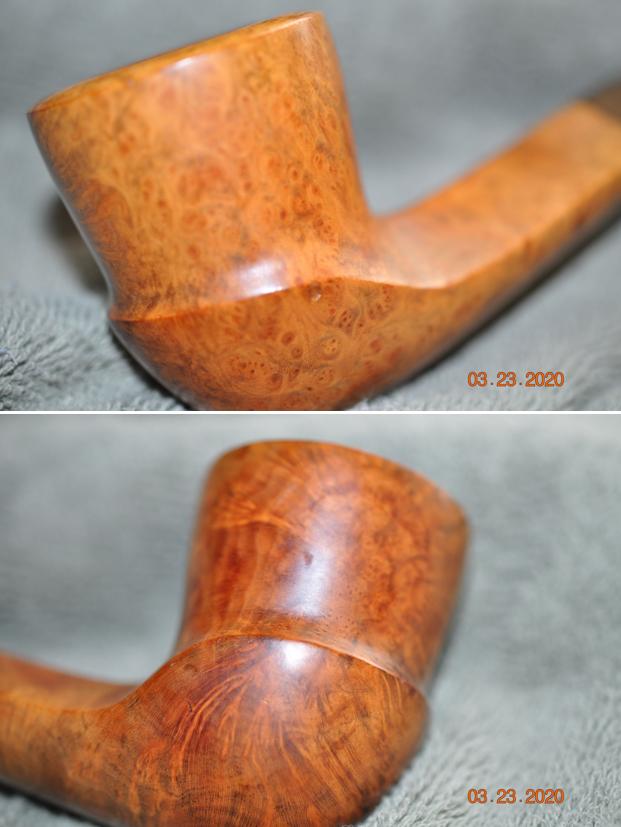
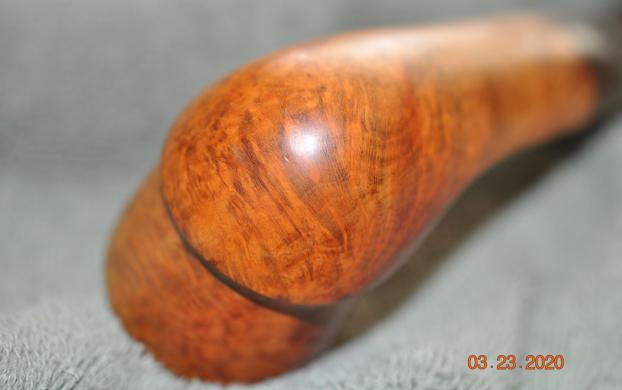
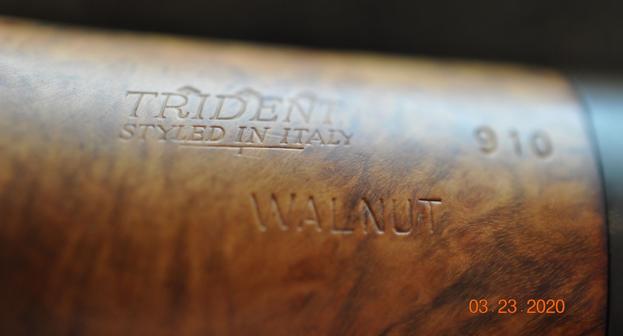
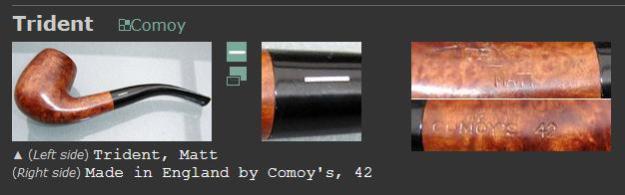
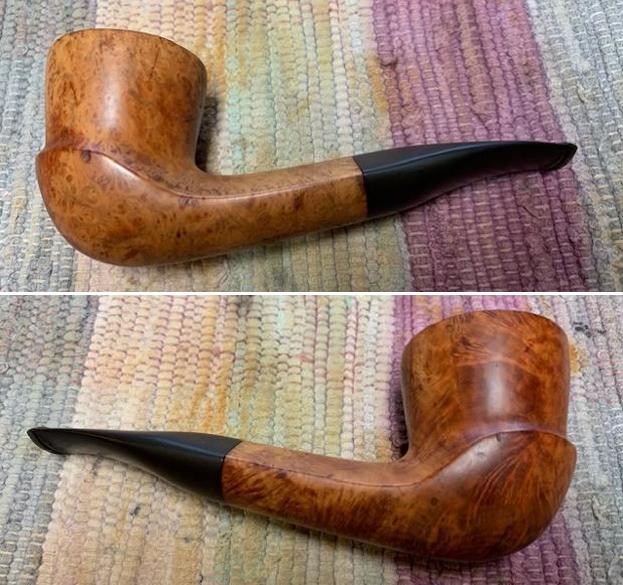
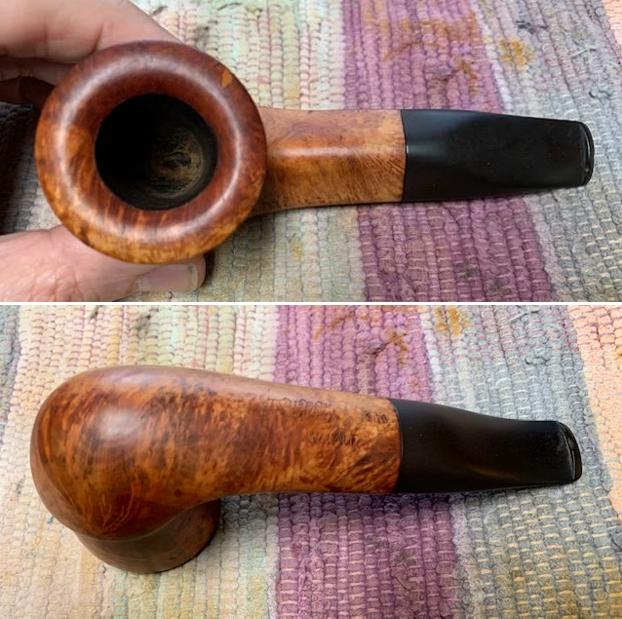
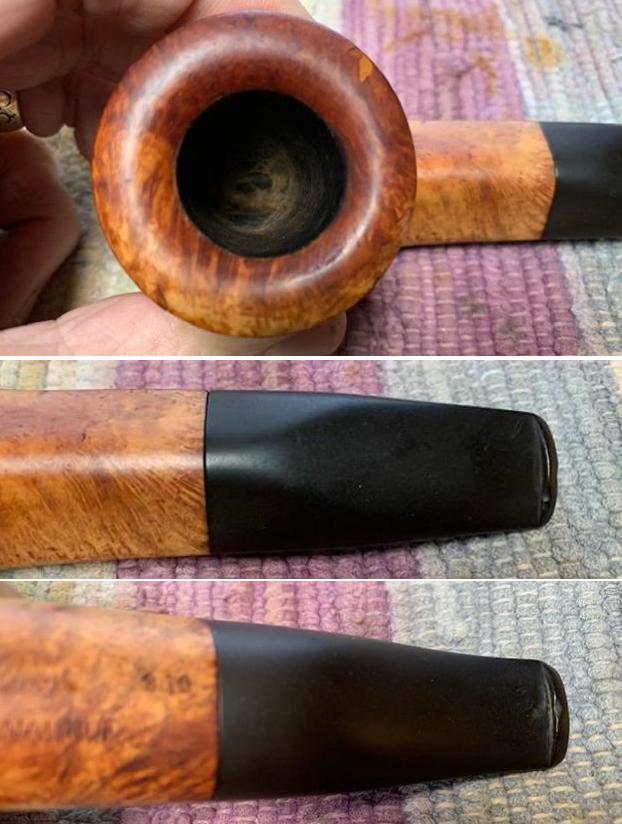
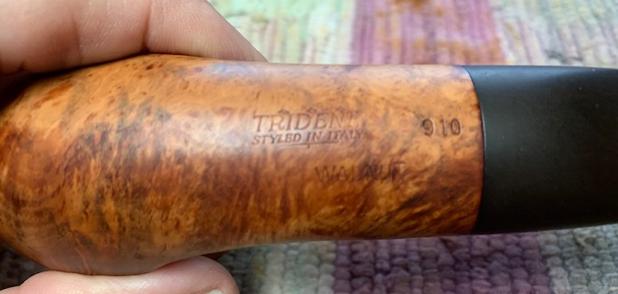
I am enjoying an evening free to work on a few pipes. The next pipe on the table came from an antique mall on 03/05/21 in Logan, Utah, USA. It is a uniquely shaped Italian made pipe that reminds me of a Lorenzo made pipe. The shape and style are much the same as those pipes. This large pipe has a smooth finish on an Italian take on a classic cup and saucer shape. On the underside of the shank it was stamped Trident [over] Styled in Italy [over] Walnut. That is followed by the shape number 910. The finish is filthy with grime and oil ground into the briar of the bowl and shank sides. The bowl was lightly caked and there was some darkening and light lava on the top and edges of the rim. The shank was triangular and the tapered stem followed that shape. There was no stamping or logo on the stem surface. The stem was oxidized and had tooth marks and chatter on both sides ahead of and on the surface of the button. Jeff took some photos of the pipe to show its overall condition before he started his cleanup work. He took photos of the rim top and bowl to give a clear picture of the condition of the bowl and rim top. There is dust and debris stuck to the walls of the bowl clearly visible in the photos. He also took photos of the top and underside of the stem to show the oxidation, chatter and tooth marks. Jeff took photos of the sides and heel of the bowl to give a picture of what the briar around the pipe looked like. There is an interesting grain patterns under the grime and thick debris.    Jeff took photos of the stamping on the left and underside of the shank. It clearly reads as noted above. I turned first to Pipephil’s site to get a quick summary of the background of the Trident pipe. (http://pipephil.eu/logos/en/logo-t8.html). This is fascinating to me as the pipe I have is stamped with the same Trident stamp but is also stamped Styled in Italy. It also had the same matte finish. I vaguely remember a connection between Comoy’s and Lorenzo pipes in Italy. This pipe really has the look of a Lorenzo. Now to dig a bit more deeply.

I turned to Pipedia to see what else I could learn about the brand and found a brief but fascinating article on the brand (https://pipedia.org/wiki/Lorenzo). I quote a part of the article that gives the link to Comoy’s that I had remembered.

In 1983 Lorenzo Tagliabue came to bitter grief: his little daughter, the only child, died of cancer. He lost all interest in the business and retired still in 1983, leaving no heirs who wished to continue the business. Lorenzo Pipes was licensed for and continued for a shorter period by Comoy’s of London (Cadogan / Oppenheimer Group). Then Lorenzo Pipes almost disappeared and Lorenzo Tagliabue passed away in 1987.

But this wasn’t the end. In 1988 Riccardo Aliverti and his wife Gabriella purchased all rights to the Lorenzo trademark from the Tagliabue family and production of the renown Lorenzo Pipes resumed.

The Aliverti family is involved in pipemaking since Romolo Aliverti, the father of the current owners, joined the Lana Brothers in 1920. He later reached the rank of technical director. No wonder that his son Riccardo showed an interest in pipe making. Riccardo began learning the pipemaking trade in 1954 at the age of fourteen under his father’s watchful eyes and succeeded him as technical director upon his father’s retirement in 1973.

Today the third generation of the Aliverti family is working for the company. Massimo Aliverti, Riccardo’s son, has been with the company as sales director since 1991. He works closely with his father and knows all phases of production. Massimo has established a broad customer base for Lorenzo around the world.

I knew that I was working on a Lorenzo made pipe from the period of time (1983) when Comoy’s (Cadogan) managed the brand for them. Now it was time to work on the pipe.

Jeff had reamed the bowl with a PipNet Pipe Reamer and cleaned up the remnants with a Savinelli Fitsall Pipe Knife. He scrubbed the exterior of the bowl with undiluted Murphy’s Oil Soap with a tooth brush. He worked over the debris on the rim top and was able to remove it. He rinsed it under running warm water to remove the soap and grime. He cleaned out the inside of the shank and the airway in the stem with alcohol, cotton swabs and pipe cleaners. He soaked the stem in Briarville’s Pipe Stem Deoxidizer and rinsed it off with warm water. He scrubbed the stem with Soft Scrub and cotton pads to remove remaining oxidation on the stem. He rinsed it with warm water and dried it off. I took photos of the pipe once I received it. Other than the burned area on the rim top and edge it really looked good and the bowl itself was in excellent condition. The rim top and the inner edge look very good. There is a large solid fill on the right side of the rim top near the back of the bowl. The stem had a few tooth marks and chatter on both sides near the button.I took a photo of the stamping on the underside of the shank. It was clear and read as noted.   I removed the stem and took a photo of the pipe to give a sense of the whole. I decided to start my work on this pipe by polishing the briar with micromesh sanding pads – wet sanding with 1500-12000 grit pads to remove the scratching and polishing the fills on the bowl sides and rim top.I stained the briar with a light brown aniline stain and flamed it to set it in the grain. I repeated the process until the coverage was acceptable.I wiped off the excess stain with alcohol on a cotton pad to even out the colour. When it was the way I wanted I rubbed the bowl and shank down with Before & After Restoration Balm. I worked it into the surface of the bowl sides and shank with my fingertips and a horsehair shoe brush to get into the nooks and crannies of the rustication. The product works to clean, enliven and protect the briar. I let the balm sit for 15 minutes and then buffed with a cotton cloth to raise the shine.I set the bowl aside and turned my attention to the stem. I filled in the deep tooth marks on both sides with clear CA glue. Once the repair cured I reshaped the button and flattened the surface of the stem with a small file. I sanded the repairs smooth with 220 grit sandpaper and started polishing the stem with 400 grit wet dry sandpaper. I polished the stem with micromesh sanding pads – wet sanding with 1500-12000 grit pads. I wiped it down with a damp cloth after each sanding pad. I used Before & After Pipe Polish – both Fine and Extra Fine to further polish the stem.   This Trident Walnut 910 Italian Design Tea Cup with a taper vulcanite stem is a great looking pipe now that it has been restored. I put the stem back on the bowl and carefully buffed the pipe with Blue Diamond on the buffing wheel using a light touch on the briar. I gave the bowl and the stem multiple coats of carnauba wax on the buffing wheel and followed that by buffing the entire pipe with a clean buffing pad. I hand buffed the pipe with a microfiber cloth to deepen the shine. The finished Trident Walnut Tea Cup fits nicely in the hand and feels great. Give the finished pipe a look in the photos below. The dimensions of the pipe are Length: 6 inches, Height: 2 ½ inches, Outside diameter of the bowl: 1 ¾ inches, Chamber diameter: 7/8 of an inch. The weight of the pipe is 75grams/2.65oz. I will be adding it to the rebornpipes store shortly in the Italian Pipe Makers Section. Thanks for reading this blog and my reflections on the pipe while I worked on it. There are many more to come!

A Fascinating Piece of Italian Pipe History – A Molina 80993 Bent Apple


Blog by Steve Laug

I am enjoying an evening free to work on a few pipes. The next pipe on the table came from an antique auction gallery on 05/22/20 in Mebane, North Carolina, USA. It is a uniquely rusticated Italian made pipe with a smooth rim top and shank end that is capped with a brass ferrule. On the left side of the shank it was stamped Molina [over] the shape number 80993. On the underside of the shank it is stamped Italy. It is a brand I have heard of but know little about so I am glad to learn about it. The pipe is a bent apple that is nicely shape. The finish is filthy with grime and oil ground into the briar of the bowl and shank sides. The bowl was thickly caked and there was an overflow of lava on the top and edges of the rim. The front inner edge and rim top appeared to have burn damage that looked like it had been lit repeatedly with a torch lighter. The stem was a fancy Lucite taper stem that fit snugly in the shank and had brass band that was made to look like three rings. There also appeared to be the remnants of a faint stamp on the left side of the stem. The stem was dirty, calcified and had tooth marks and chatter on both sides ahead of the button. Jeff took some photos of the pipe to show its overall condition before he started his cleanup work. He took photos of the rim top and bowl to give a clear picture of the thickness of the cake and the lava and dust ground into the finish of the rim top and edges. There is dust and debris stuck to the walls of the bowl clearly visible in the photos. You can also see the damage on the inner edge of the bowl on the front. He also took photos of the top and underside of the stem to show the oxidation, chatter and tooth marks.Jeff took photos of the sides and heel of the bowl to give a picture of what the briar around the pipe looked like. There is an interesting rustication under the grime and thick debris. Jeff took photos of the stamping on the left and underside of the shank. It clearly reads as noted above.I turned first to Pipephil’s site to get a quick summary of the background of the Molina pipe. (http://pipephil.eu/logos/en/logo-m6.html). I have included a screen capture of the pertinent section on the site.In the sidebar it included the following information that I have included below.
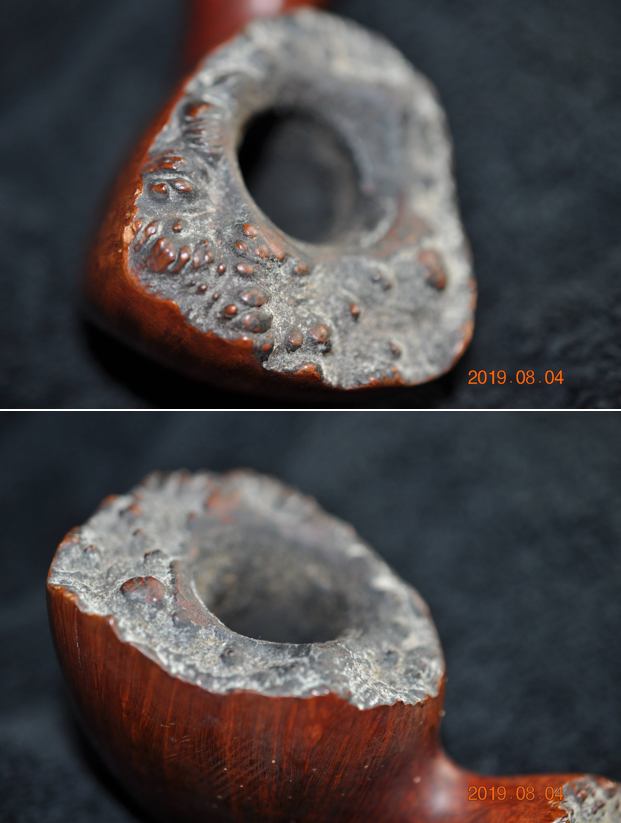
Artisan: Giovanni Carollo, a former employee of the Rossi factory. Machine crafted mass production. Pipes mainly aimed for German and US market.

I turned to Pipedia to see what else I could learn about the brand and found a brief but fascinating article on the brand (https://pipedia.org/wiki/Molina_Pipe). I quote it in its entirety below.

Molina pipes has it’s origins in Barasso in Lombardy. It was born from what was left of the old Rossi pipes factory, that started in the early 1900s. Molina’s inheritance from Rossi pipes does not only consist of the factory but also the machinery and methods of production. The name Molina refers to a district where you could find mills powered by water.

I followed the trail there to the Molina Pipe website (https://www.molinapipe.it/). It had a great summary of the history.

Molina still lies in part on the antique Rossi factory, a peculiar but not a casual circumstance. it represents an excellent example of industrial archeology. its working environment is enriched with the modernized charm of the past.

Molina’s inheritance from Rossi pipes does not only consist of the factory but also of ancient machinery and methods of production, antique ”secrets” ,antique recipes and production procedures used over 100 years ago.

The name molina has even a longer history, it is up to today used to refer to a district where you could find mills powered by a rush of water.

I knew that I was working on a Molina pipe from the remnants of the old Rossi pipe factory and that the pipes were made mainly for the US and German market. Now it was time to work on the pipe.

Jeff had reamed the bowl with a PipNet Pipe Reamer and cleaned up the remnants with a Savinelli Fitsall Pipe Knife. He scrubbed the exterior of the bowl with undiluted Murphy’s Oil Soap with a tooth brush. He worked over the debris on the rim top and was able to remove it. The burned area was very clear once he had cleaned it off. He rinsed it under running warm water to remove the soap and grime. He cleaned out the inside of the shank and the airway in the stem with alcohol, cotton swabs and pipe cleaners. He soaked the stem in Briarville’s Pipe Stem Deoxidizer and rinsed it off with warm water. He scrubbed the stem with Soft Scrub and cotton pads to remove remaining oxidation on the ferrule and the stem. He rinsed it with warm water and dried it off. I took photos of the pipe once I received it. Other than the burned area on the rim top and edge it really looked good and the bowl itself was in excellent condition. The rim top and the inner edge had serious burn damage all around but the heaviest damage was on the front of the bowl. It really looked to be the victim of repeated assault by a torch lighter. If you have one keep it away from your pipe. The stem had a few tooth marks and chatter on both sides near the button.I took photos of the stamping on the sides of the shank. It was clear and read as noted above. I removed the stem and took a photo of the pipe to give a sense of the whole. The tenon is Delrin. I decided to start my work on this pipe by addressing the damage to the rim top and inner edge of the bowl. I topped the bowl on a board with 180 grit sandpaper. I chose a lower grit sandpaper because the damage was quite deep. Once I had topped the damaged areas and found solid briar I used a folded piece of 220 grit sandpaper to reshape and rework the inner edge of the rim. It took a bit of work but the rim top looked much better. I polished the rim top and edge with micromesh sanding pads – wet sanding with 1500-12000 grit pads to remove the scratching and polish the smooth briar.    I restained the rim top and edges with a Walnut stain pen to match the other smooth portions of the bowl and shank.I rubbed the bowl and shank down with Before & After Restoration Balm. I worked it into the surface of the bowl sides and shank with my fingertips and a horsehair shoe brush to get into the nooks and crannies of the rustication. The product works to clean, enliven and protect the briar. I let the balm sit for 15 minutes and then buffed with a cotton cloth to raise the shine.    I set the bowl aside and turned my attention to the stem. I filled in the deep tooth marks on both sides with clear CA glue. Once the repair cured I sanded them smooth with 220 grit sandpaper and started polishing the stem with 400 grit wet dry sandpaper.      I polished the stem with micromesh sanding pads – wet sanding with 1500-12000 grit pads. I wiped it down with a damp cloth after each sanding pad. I used Before & After Pipe Polish – both Fine and Extra Fine to further polish the stem. This beautiful Rusticated Molina 80993 Bent Apple with a taper acrylic stem is a great looking pipe now that it has been restored. I put the stem back on the bowl and carefully buffed the pipe with Blue Diamond on the buffing wheel using a light touch on the briar. I gave the bowl multiple coats of Conservator’s Wax and the stem multiple coats of carnauba wax on the buffing wheel and followed that by buffing the entire pipe with a clean buffing pad. I hand buffed the pipe with a microfiber cloth to deepen the shine. The finished Molina Bent Apple fits nicely in the hand and the tactile finish feels great. Give the finished pipe a look in the photos below. The dimensions of the pipe are Length: 5 inches, Height: 1 ¾ inches, Outside diameter of the bowl: 1 ¼ inches, Chamber diameter: ¾ of an inch. The weight of the pipe is 57grams/2.01oz. I will be adding it to the rebornpipes store shortly in the Italian Pipe Makers Section. Thanks for reading this blog and my reflections on the pipe while I worked on it. There are many more to come!
What a Mess! A Peterson’s Product Shamrock 15 Billiard


Blog by Steve Laug

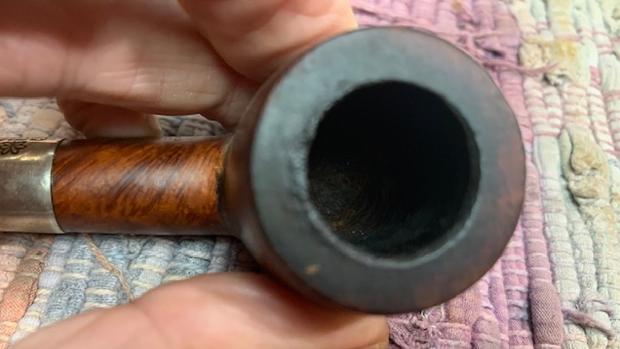
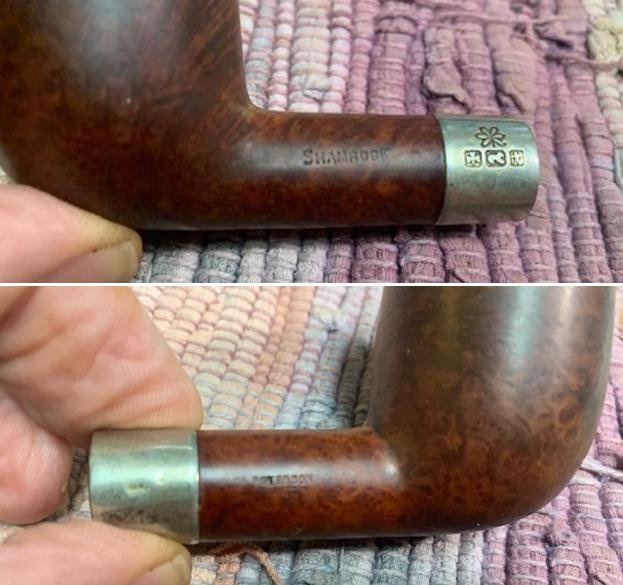
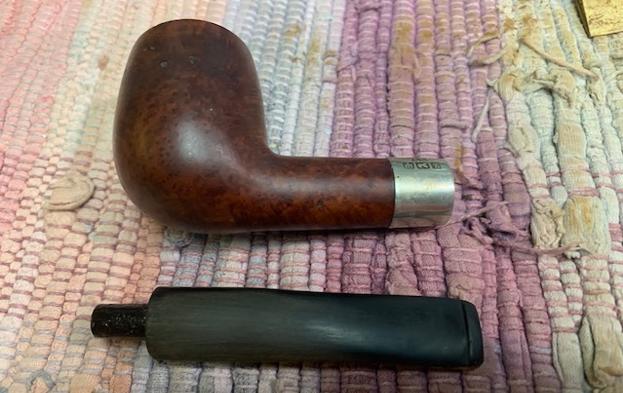
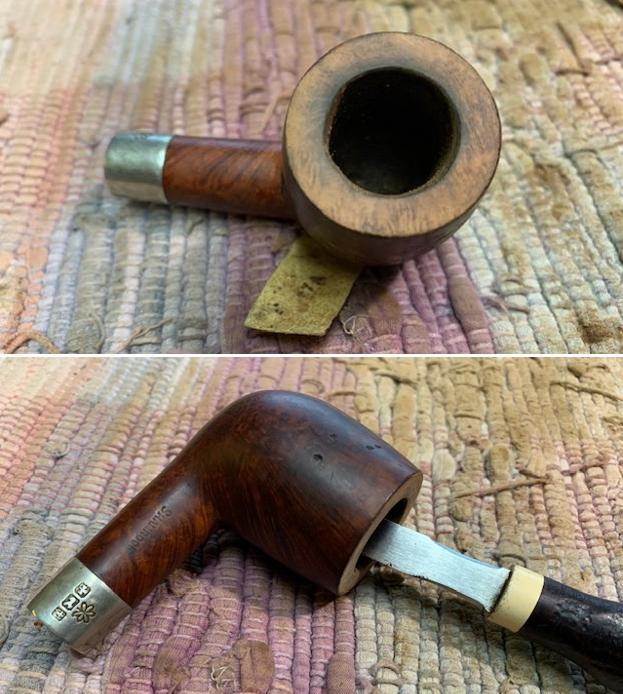
The next pipe was an absolute mess and one that obviously had been “ridden hard and put away wet”. There was little room in the bowl for tobacco and the finish and condition was abysmal. I am pretty sure it came from a classic old time pipeman who smoked a pipe until it was no longer usable and then pitched it for a new on. It was definitely a stranger to any cleaning! This one is a smooth Billiard that has a rich coloured finish around the bowl sides and shank. It came to us on 07/24/18 from a sale in Lickingville, Pennsylvania, USA. The finish is almost bland looking it is so dirty it was hard to know what to expect once it was cleaned. It was stamped on the  left side of the shank and read SHAMROCK. It was stamped to the right of the shank and reads “A PETERSON’S PRODUCT” over MADE IN THE REP. [over] OF IRELAND (3 lines) with the shape number 15 next to the bowl. It was filthy when Jeff brought it to the table. There was a very thick cake in the bowl and lava on the rim top and the inner edge of the bowl. The cake was thick and overflowing so much it was hard to know what the edge looked like. The stem was stamped with the letter S on the left side. It was oxidized and had tooth marks and chatter on the top and underside on and near the button. Jeff took photos of the pipe before his cleanup work. Jeff took photos of the rim top and stem to show the general condition of the pipe. The bowl is so heavily caked it is impossible to know the condition of the edges under the lava overflow. There was still dottle in the bowl from the last smoke of the pipe. The stem is oxidized and grimy. It has some tooth marks on the top and underside near and on the surface of the button itself. Jeff took photos of the bowl sides and heel to show the grain that was around this bowl. You can see the sandpits and nicks in the briar in the photos below. Even so, it is a nice looking pipe.He took photos of the sides of the shank to show the stamping. The stamping is readable in the photos below and is as noted above. I am including the link to the Pipedia’s article on Peterson pipes. It is a great read in terms of the history of the brand (https://pipedia.org/wiki/Peterson).
I turned to “The Peterson Pipe” by Mark Irwin and Gary Malmberg to get some background on the Peterson’s Shamrock Pipe. On page 312 it had the following information.

Shamrock (c1941-2009) Originally stamped SHAMROCK with no brand name, an inexpensive line first described in George Yale (New York) mail order booklet in 1941, imported by Rogers Import. The line was actively promoted beginning in ’45, aggressively promoted in US by Rogers from early ‘50s when they registered the Shamrock logo with US Patent Office, claiming propriety since ’38. Over the years offered with P-lip or fishtail mouthpiece, with or without nickel band, with or without shamrock logo on the band, with or without S stamped in white or later in gold on mouthpiece. Appearing in 2008 as unstained smooth and rustic, fishtail mouthpiece with gold impressed P on the stem. COMS of MADE IN over IRELAND (C1945-1965), MADE IN IRELAND forming a circle (c1945-1965), “A PETERSON’S PRODUCT” over MADE IN IRELAND (c1945-1965), MADE IN THE over REPUBLIC over OF IRELAND (c1948-1998). Model is always difficult or impossible to date.

Judging from the description above, the pipe I am working on is stamped with the stamp noted in red above. It reads “A Peterson’s Product” over Made in Ireland which narrows the date to between approximately 1948-1998. It is just stamped SHAMROCK with no brand name as an inexpensive a fish tail stem. Now it was time to work on the pipe.

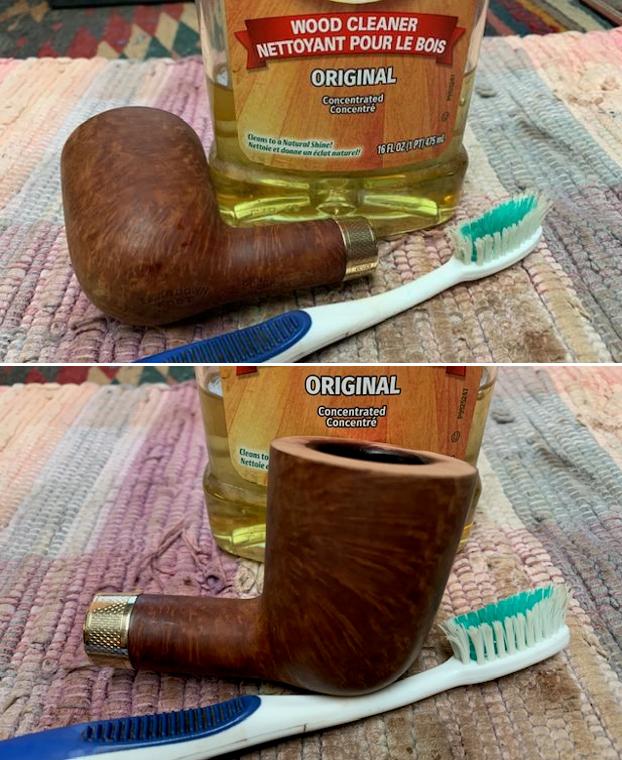
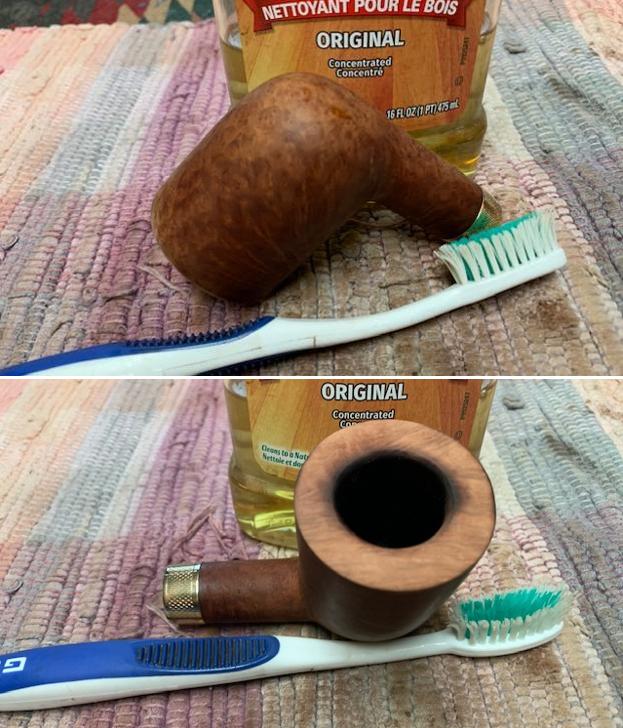
I was utterly surprised when I took this pipe out of the box and compared it to the before photos. Jeff had done a great job cleaning up the pipe as usual. He reamed the pipe with a PipNet reamer and cut back the cake back to the bare briar. He cleaned up the walls with a Savinelli Fitsall Pipe Knife. Surprisingly the walls looked unscathed from the heavy cake. He scrubbed the interior of the bowl and shank with pipe cleaners, cotton swabs and alcohol to remove the tars and oils. He scrubbed the exterior of the pipe with Murphy’s Oil Soap and a tooth brush to remove the grime from the finish. He worked on the rim top lava and darkening with the soap and tooth brush. He scrubbed the inside of the stem with alcohol and pipe cleaners. He scrubbed the exterior of the stem with Soft Scrub and then soaked it in Briarville’s Deoxidizer. He washed it off with warm water to remove the Deoxidizer. The pipe looked far better when it arrived. The cleaned up rim top revealed a very damaged inner edge and top. It was both burned and nicked from what appeared to be a quick ream somewhere in its life with a knife. I took some close up photos of the rim top to show how well it had cleaned up and the damage to the inner edges around the bowl. I also took close up photos of the stem to show the tooth marks on the surface near and on the button itself. I took photos of the stamping on the sides of the shank. It reads as noted above. I removed the stem and took a photo of the pipe to have a look at the parts and overall look.I started my work on this pipe by topping the bowl and reworking the damage to the inner edge. I topped the bowl on a piece of 220 grit sandpaper on a topping board. Once I had it smooth I used a folded piece of 220 grit sandpaper to give the inner edge of the bowl a slight bevel to accommodate the burned areas and blend them into the surrounding briar.I polished the briar with micromesh sanding pads – dry sanding with 1500-12000 grit sanding pads. I wiped the bowl down with a damp cloth after each sanding pad.I interrupted the polishing with the micromesh pads after the 2400 grit pad. I stained the rim top with a Maple, Cherry and Walnut stain pen to blend it into the surrounding briar. Then I continued on my polishing of the briar with 3200-12000 grit micromesh sanding pads. I worked some Before & After Restoration Balm into the surface of the briar with my fingertips to clean, enliven and protect the briar. I let the balm sit for 15 minutes and then buffed with a cotton cloth to raise the shine. The photos show the bowl at this point in the restoration process. I set the bowl aside and “painted” the stem surface with flame of a lighter to lift the tooth marks in the surface. It worked well. I filled in the remaining tooth marks with clear CA glue and set the stem aside to cure. Once it had cured I sanded them smooth with 220 grit sandpaper and started the polishing with 400 grit wet dry sandpaper.From the description I read and quoted above I knew that the stem stamp could well have been gold. I used some Rub’n Buff Antique Gold to fill in the stamp. I worked it into the stamp with a tooth pick. I buffed it off with a soft cloth.I polished the stem with micromesh sanding pads – wet sanding with 1500-12000 grit sanding pads. I wiped it down after each sanding pad with Obsidian Oil. I polished it with Before & After Pipe Stem Polish – both Fine and Extra Fine. I am excited to finish this Older “A Peterson’s Product” Shamrock 15 Straight Billiard. I put the pipe back together and buffed it with Blue Diamond on the buffing wheel. I gave the bowl and the stem multiple coats of carnauba wax. I hand buffed the pipe with a clean buffing pad to raise the shine. It is fun to see what the polished bowl looks like with beautiful mixed grain all around it. Added to that the black vulcanite fish tail stem was beautiful. This smooth Classic Shamrock 15 Billiard is great looking and the pipe feels great in my hand. It is light and well balanced. Have a look at it with the photos below. The dimensions are Length: 5 ¾ inches, Height: 1 ¾ inches, Outside diameter of the bowl: 1 ¼ inches, Chamber diameter: ¾ of an inch. The weight of the pipe is 34grams/1.20oz. It is a beautiful pipe and one will end up on the rebornpipes store in the Irish Pipe makers section. Check there if you want to add it to your collection. Let me know via email or message. Thanks for walking through the restoration with me as I worked over this pipe. Thanks to each of you who are reading this blog.

Beauty or the Beast?


Blog by Kenneth Lieblich

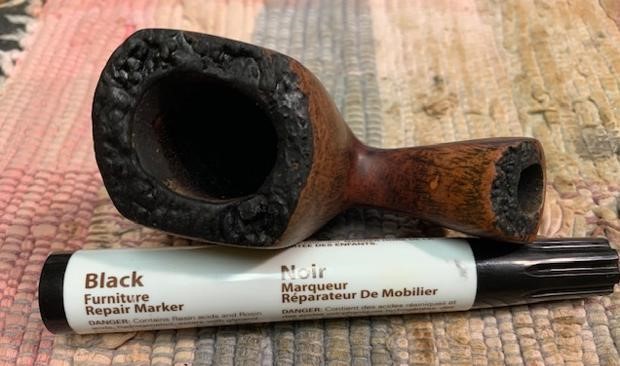
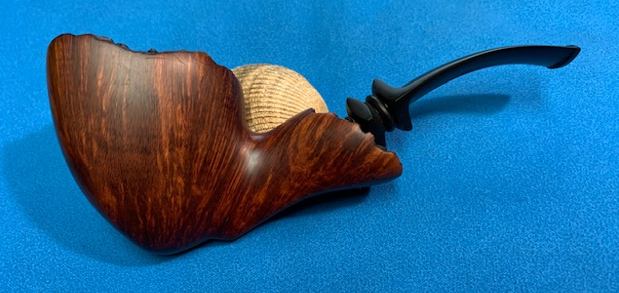
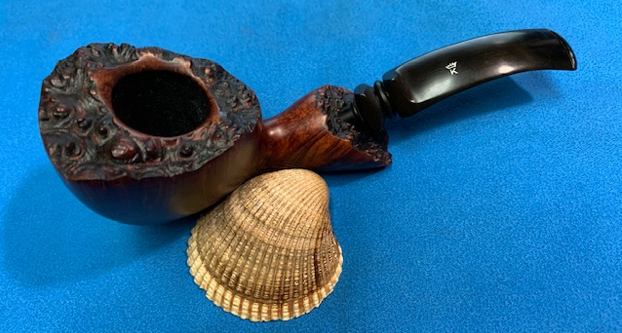
This is the story of a pipe – possibly damaged beyond reasonable limits – which I really liked and decided (against my better judgement) to revivify. I need to make clear from the outset that this is not a pipe like many you see from Steve, Dal, Paresh, Charles, et al, which begin their restoration as the proverbial sow’s ear and naturally end up as the silk purse. No, this is a pipe that came to me as a damaged ‘beast’ and ended up much improved – but a ‘beast’ it remains. There is damage to the pipe which is, despite my best efforts, a permanent attribute. I leave it to your collective judgement on whether it will ever attain the rank of ‘beauty’.

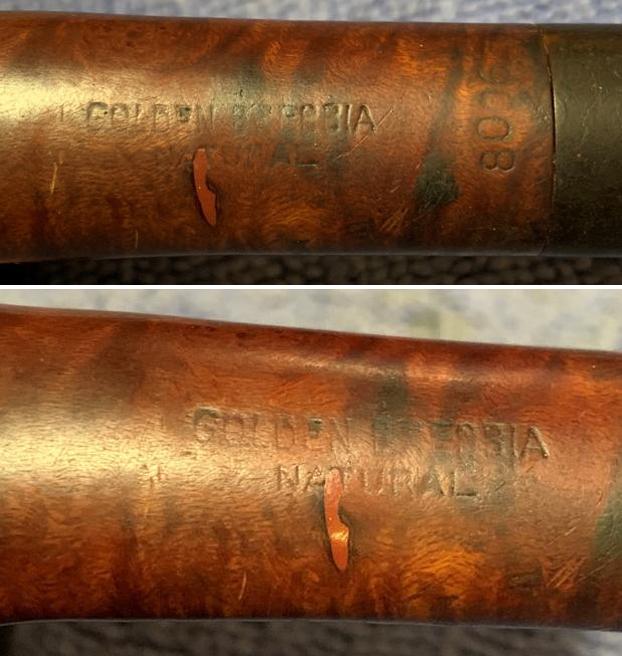
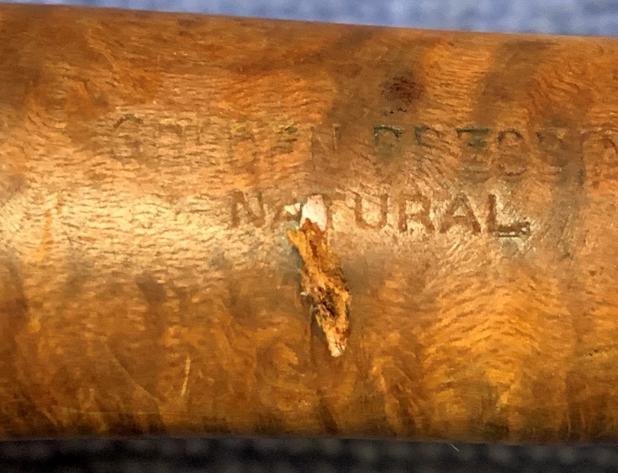
This pipe came from a lot from Sudbury, Ontario. There were literally no marks of any kind on the stummel, stem, or ferrule. In the absence of a name, Steve and I dubbed it ‘The Sudbury’ and that is the name that stuck. Steve thinks that the Sudbury could be of Italian origin, and I have no reason to question that assessment. So let us pretend that it is an Italian ‘scoop’ pipe that arrived from Northern Ontario. If you have any insight into the pipe’s origin, I would love to hear from you. The photos do not quite convey just how bad this pipe looked when it arrived. The stummel was filthy, scratched, dented, cracked, and burned. The bowl was out-of-round, had lots of lava, cake and burns. The stem was oxidized, calcified, and badly pitted (more about the pitting later). The ferrule was dirty, torn, dented, and cheap-looking – it had obviously been put there to address the cracks in the shank. Where to even begin with this mess?

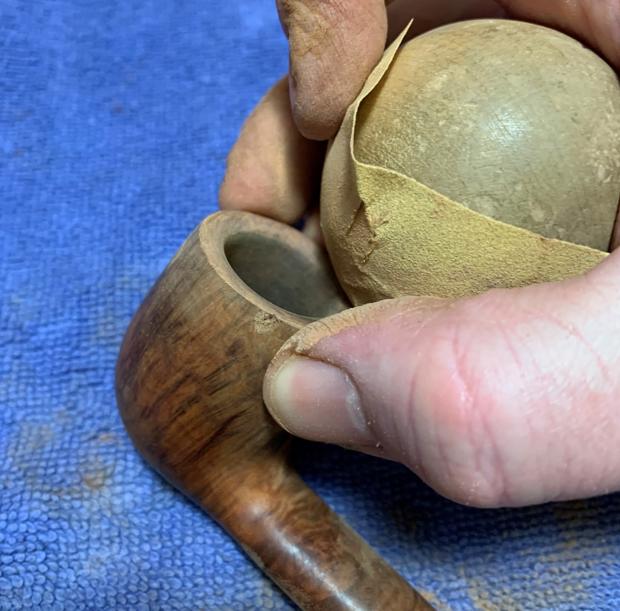
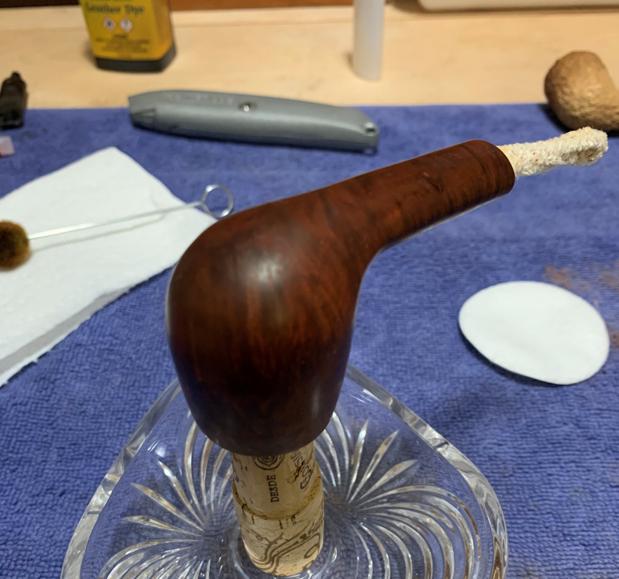
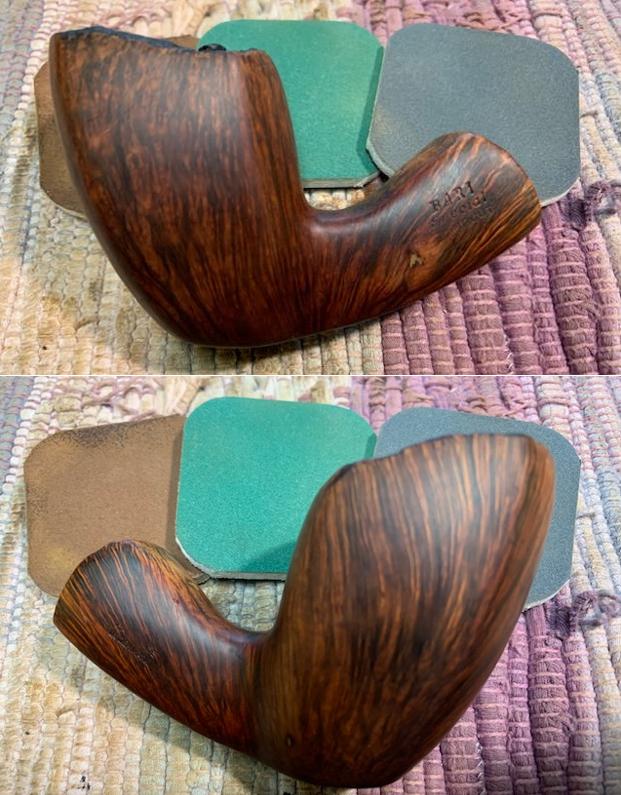
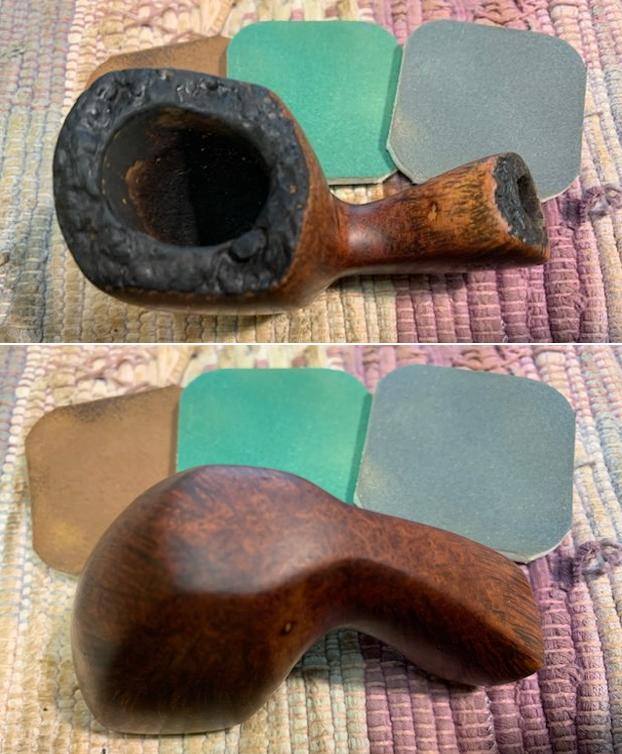
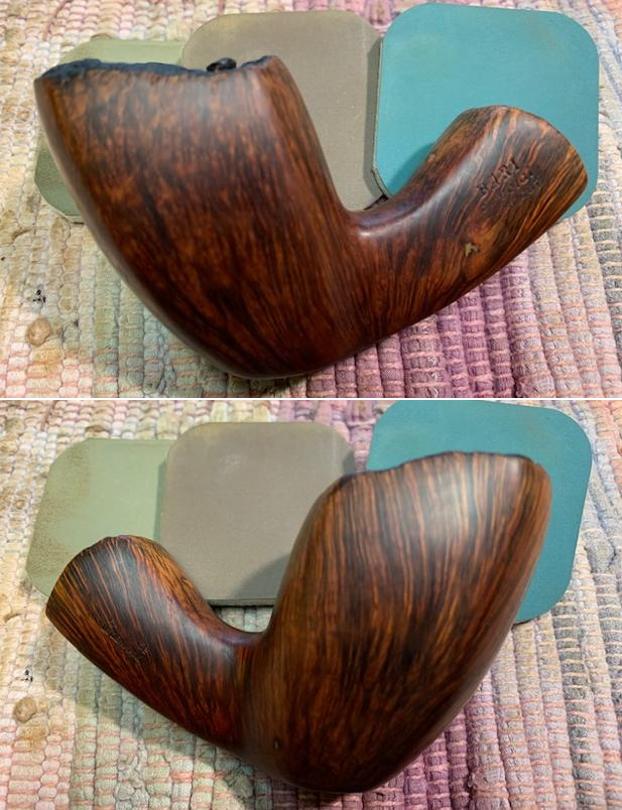
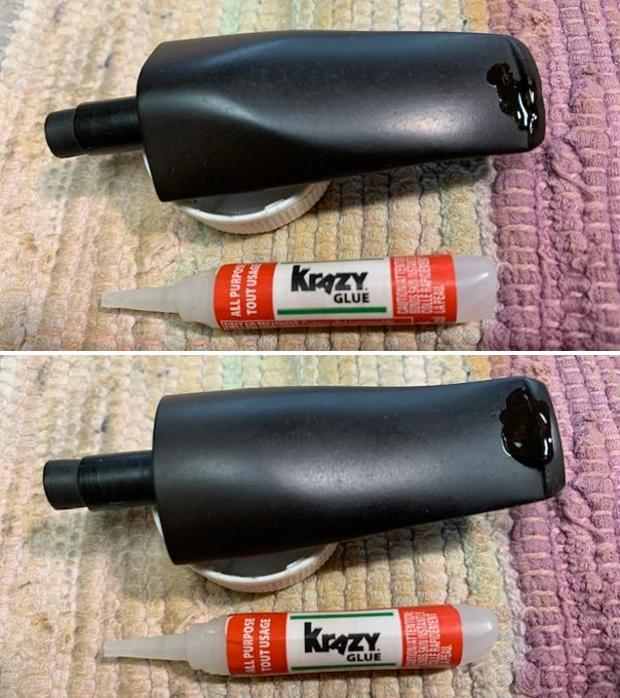
Well, the start came with removing the sorry-looking ferrule, which, quite frankly, inspired more pathos than confidence. This allowed me to have a good look at the cracks (plural) in the shank. As you can plainly see, the cracks were a mess. I removed what I could of lose debris and glue from these fissures, with the intention of refilling them later.Next was reaming out the bowl. This pipe has quite a wide and curved bowl and it required both the PipNet Reamer and the KleenReem. I took it down to bare briar, as I wanted to ensure there were no hidden flaws in the walls of the bowl. Fortunately, there were none. I then proceeded to clean out the insides of the shank with Q-tips, pipe cleaners, and isopropyl alcohol. This is a pipe that really could have used the services of a retort system, but – alas – I do not have one. If anyone has a spare, please let me know. The fellow on eBay who sells them is out of commission for a while. A quick wipe of the outside revealed that there is really some beautiful wood grain in this pipe.A de-ghosting session seemed in order to rid this pipe of the foul smells of the past. This de-ghosting consisted of thrusting cotton balls in the bowl and the shank, and saturating them with 99% isopropyl alcohol. This caused the oils, tars and smells to leech out into the cotton. Finally, a relatively clean and fresh-smelling bowl emerged.While all of that was going on, I cleaned out the insides of the stem with pipe cleaners and isopropyl alcohol. Then the stem went for an overnight soak in the Before & After Hard Rubber Deoxidizer. I knew the stem was going to require a lot of work, but even I did not know what I was getting myself into. The following day, I cleaned all of the de-oxidizing goop (technical term) off with alcohol, pipe cleaners, et cetera. The oxidation had migrated to the surface and would be fairly straightforward to remove.Back to the stummel – and this required addressing two key issues: the badly out-of-round bowl opening and the cracks in the shank that needed to be re-mended. In order to address the out-of-round issue, I took a solid wooden sphere, wrapped sandpaper around it, and sanded thoroughly – until such time as the bowl was returned to round. This process was not difficult, but it was time consuming. I had to ensure that I was sanding down the correct parts that needed it and that I was not removing too much. In the end, I think I got the balance just right.Meanwhile, I had to figure out what could be done with the very noticeable cracks in the shank. The previous ferrule had done a passable job of hiding them, but that ferrule was a non-starter. It was ugly and trashed. Anyway, an application of briar dust and cyanoacrylate adhesive seemed to be the way to go in addressing the cracks. I also had to concede that, no matter what, the cracks were always going to be a visible part of this pipe from now on. There was just no way around it. I sanded down the repairs and left them for a bit later.There was a small burn on the underside of the stummel that also needed to be addressed. I took some oxalic acid on a Q-tip and rubbed and rubbed. The burn did improve but never fully disappeared. I took solace from the fact that the burn was very superficial and did not affect the integrity of the wood at all.After this, I used all nine Micromesh pads (1,500 through 12,000 grit) to sand everything smooth. A light application of Before & After Restoration Balm brought out the best in the stummel’s grain.Steve was kind enough to find me a new ferrule that we could bend to correctly fit the oval shank. This was not as easy as it sounds because the shank’s width tapered away from the end. I used a combination of heat, glue and elbow grease to fit it. I then used metal sandpaper to even out the edge. A quick polish with my cloth made it look pretty good.Now on too the stem. Oh boy – this was a struggle. All the usual things were fine. As I mentioned, the deoxidizing went well; the cleaning of the internals went well; the sanding of the stem with the Micromesh pads went well; the buffing and polishing went well; BUT the pitting was very difficult. In the first place, the pits were all filled with filth and/or oxidation and/or debris from the many years of neglect. In order to dislodge this, I soaked the pitted part of the stem overnight in a lemon-infused, isopropyl alcohol solution. This worked surprisingly well. The debris either dissolved or was easy to scrub out.Now, how to fill these properly so as to create a smooth and (hopefully) invisible repair? Steve assured me that he had successfully filled pits in the past with cyanoacrylate adhesive. Perfect – I set about carefully smearing the adhesive all over the pitting. I left it to set and came back later to sand it down. So far, so good, but some of the pits did not fill (no idea how that happened) and others just looked terrible after sanding. I obviously did something wrong. Steve suggested that we used some black cyanoacrylate adhesive. He very kindly did his own smearing of the black adhesive on my stem. We let it set, did all the right things, and it still looked lousy. I even tried using a black Sharpie to see if that would help – it didn’t. Suffice it to say that I went through this process a total of FOUR times before I had to admit defeat. I will say that the stem looks so much better than when I started, but those pits were *ahem* the pits.I applied more Before & After Restoration Balm, then some wax. I polished it by hand with a microfibre cloth and I was pleased with the results! This pipe was clearly a great beauty on the day it was made. Over the years, abuse, neglect, and the ravages of time turned this charming pipe into a beast. I worked harder on this pipe than I have on any other, but I am proud of it and I am adding it to my collection. I look forward to smoking it for many years to come.

The dimensions of the pipe are as follows: length 164 mm; height 42 mm; bowl diameter 149 × 44 mm; chamber diameter 23 mm. The mass of the pipe is 46 grams. Thank you very much for reading and, as always, I welcome and encourage your comments.

Breathing New Life into a German VAUEN 6294 P-Lip Saddle Billiard for a Special Young Lady


Blog by Dal Stanton

Darren has commissioned a number pipes from the For “Pipe Dreamers” Only! collection benefiting the Daughters of Bulgaria – helping women and girls who have been trafficked and sexually exploited.  I am grateful for this!  The first pipe restored for Darren came out beautifully (See: An Amazing Transformation of a Bruyere Extra Paneled Billiard).  Of all the pipes that Darren has commissioned, the one on the worktable now was the most difficult to choose.  I know this for certain because it took Darren several weeks finally to hear the whisper of a specific pipe for his youngest daughter, Lina.

God made fathers, I believe, with a special place in their hearts for daughters.  This coupled with the fact that Lina’s 18th birthday was on the horizon and in addition to this was Darren’s desire to continue a guarded family tradition where Dad gifts a pipe to each of his children at their 18th birthday.  A gifted pipe contributes to part of a rite of passage into adulthood.  Of course, when Darren shared this information with me in one communication, my response was to ask more questions about the tradition and about Lina – her personality, aspirations, etc., so that the pipe and its write up would in some small way reflect what was important to Darren and celebrate Lina’s life and her 18th birthday.

Darren’s response about his youngest daughter’s pipe was tentative.  He wrote:  As for my daughter’s pipe, I’m uncertain. For her siblings, I found appropriate p-lip Peterson pipes, making it easier for them to try different tobaccos alongside dad, and then discussing flavors. Unlike my other two, Madeleine (but she prefers Lina) said she has no interest in smoking the pipe (she knows) she’ll receive. Her birthday is August 1, but the timing is less important than the day it is given.  

Darren went on to write that Lina was unique, not only because she is the extrovert of the family, but that she has also grown to be a stronger person because of a hair loss condition she was diagnosed with at age four, alopecia totalis.  Later he sent a short essay Lina had written for a college application where she described the challenges she encountered with this condition and how she responded.  I repeat some excerpts of what Lina wrote – an amazing story:

Everyone experiences obstacles in their life.  We may not have control over when or what these hurdles will be, but we do get to choose how we respond to them. Alopecia Universalis became part of my story when I was four years old, and my mom noticed a patch of hair missing on the top of my head. Alopecia is an autoimmune disease that puts my immune system in hyper-drive and causes it “fight” against my hair, thinking it is unhealthy, like a virus or bacteria that it needs to attack. Imagine waking up and seeing gobs of hair on your pillow in the morning. Take that further and think of how scared you’d be to see clumps of hair falling off your head while you applied shampoo in the shower. I was young, and I did not understand what was happening to me. I had no idea how my friends would react to it, and I hated it when people stared at me, thought I was a boy, or assumed I was losing my hair because of cancer….

My parents worked hard to help me figure out how I wanted to handle my hair loss, what made me most comfortable; I tried wigs, hats, and bandanas, but nothing seemed to be the right fit for me. As an active young child, and eventually a student-athlete, wigs were way too hot and impractical. I would often just rip them off whenever I began to overheat, causing people who did not know I had Alopecia to startle a bit. Eventually, I realized that I did not want to wear anything extra and that none of those things made me feel more normal….

God gave me this disease because He knew I could handle it. He has given me the strength to know and believe that He made me in His image, and I am perfect in His eyes. It is not always easy, but I am bald; I have accepted it, and I have chosen to rock it! Even though it seemed impossible at the beginning, I can now be someone people look up to because I am strong and happy. I want to be an inspiration to others. At first, it was so weird, but now it is normal to me, just another character trait.  It has been so long since I had hair that for my family and friends, it [Strength? No hair? What?] is just … me. 

Through this disease, I have learned that I do not have to allow an obstacle to stop me, I can overcome them, and I can turn them into something useful. I will not let Alopecia stop me from doing anything. I have learned to think of it as something that makes me unique rather than an inconvenience. I like being different. I think it is pretty cool that I walk around bald every day; nothing can stop me.

With my request to include Lina’s story in this write up, Darren sent Lina’s photo.  The photo beautifully portrays the bold extroversion Darren described about his unique daughter, but more foundational were Lina’s words revealing the unyielding trust in God that buttressed that boldness – a special young lady.

My response to Darren was to propose one of the pipes that he had already commissioned as possibly matching Lina’s personality. Here is some of what I said:

…Your daughter is gold too 😊.  To have grown up with the hair condition and to overcome it with what appears, great style and grace, is in itself a beautiful thing….  Her apparent extroverted ‘in your face’ spunk and attitude, to me fits well with the reputation of Lorenzo.  Lorenzo, among not only Italian pipes, has the reputation of being on the ‘edge’ in design… There is no doubt, the Lorenzo walks with a bit of swagger…. I look forward to hearing from you.

Since I wanted to work on Lina’s pipe next, I was hopeful of a quick response from Darren regarding his thoughts about the Lorenzo.  Finally, some days later, after he again searched the ‘Dreamers’ collection 😊, another pipe finally whispered Lina’s name to dad.  Darren wrote that the German made VAUEN would be a good fit because, like the Petersons he had given to his other 2 children, the VAUEN sported a P-lip stem.

I found the VAUEN in August of 2017 when my wife and I were enjoying holiday on the Bulgarian Black Sea coast in the city of Burgas.  I found it at a favorite second-hand/antique store on the main walking street.  The VAUEN is pictured with an Altinay Meerschaum Teardrop Lattice which has already found a new home with a happy steward.

Here are a few pictures of Lina’s VAUEN that dad commissioned for her 18th birthday:The nomenclature is clear and crisp.  Stamped on the left flank of the shank is ‘VAUEN’.  Stamped on the underside of the shank is 6294, the shape number VAUEN has assigned to this hefty Billiard.This is my first opportunity working on a pipe marked with VAUEN. Pipedia’s article about VAUEN included a link that went directly to VAUEN’s English language website from which Pipedia’s information seems to have come in part. I was interested to see that VAUEN is a long-time name in pipe production based in Nuremberg, Germany. My first impression of the website revealing German quality and precision was, ‘Wow!’ The current pipes displayed are sharp and modern – an attractive blending of modernistic and classical tradition. I clipped these pipes as a sampling of pipes currently available and reflecting the style of today’s VAUEN. Looking through the site I did not find anything like Lina’s VAUEN, and I saw no P-lips. This clues me in that models with P-lip stems are perhaps a thing of the VAUEN past – but how far back did P-lips cease to be part of the VAUEN presentation? I found no answer for this.One other observation looking at VAUEN’s offerings – they have produced and have available an exceptional line of pipes called, AUENLAND. Google Translate helped me to crack the translation which brought on a smile, ‘Shire’. The Shire line is described with bowls made of briar, stems of beechwood and with an acrylic mouthpiece. Here are a few ‘Shire’ pipes which one would find hobbits, wizards, dwarfs, and kings in waiting, smoking across Middle Earth.Amazingly, Pipephil.eu (See: The Lord of the Rings) devotes an entire stand-alone article describing how VAUEN has perfected the ‘selling of a dream’ as a market strategy. Producing the ‘Shire’ line of pipes with each pipe named after a character, allows a would-be purchaser to identify with a favorite character and acquire THAT pipe. Who would not want Aragorn’s pipe? 😊 And of course, these ‘Lord of the Ring’ pipes, numbering about 16 different styles with characters attached as names, come in a packaging which helps convince one of the reasonableness of the purchase – I am moving in that direction! Resisting the urge to covet more, I turn to the question of the history of the VAUEN name? I look to the History section of the VAUEN website and again, I am impressed with the presentation. Whenever I work on a pipe, and especially when a pipe name is new to me, I enjoy looking at its history to appreciate the pipe more fully now on my worktable. From VAUEN’s website:

Quality and a wealth of ideas have a long tradition at VAUEN. 160 years of VAUEN: that means 160 years of skilled workmanship and modern technology and 160 years of experience in fulfilling the individual wishes of today’s pipe lovers, and those of tomorrow.

In Nuremberg in 1848, Karl Ellenberger and his partner Carl August Ziener turned an idea into reality: Germany’s first pipe manufacturer produced tobacco pipes for connoisseurs around the world using a selection of the best wood. In an amalgamation with the Gebhard Ott pipe factory, which was founded in 1866 in Nuremberg, the Vereinigten Pfeifenfabriken Nuremberg (United Pipe Factories Nuremberg, or VPFN) was born in 1901.  Under the management of Ernst Eckert, a descendent of the founding Ott family, a company was born whose products and services would shape the tobacco and smoking culture in Europe and overseas for the next 160 years and counting.

The question about the name, VAUEN, not being a name of a person and why it is capitalized throughout is explained:

In his search for a name that would be easily remembered by all pipe lovers, Ernst Eckert’s son, Adolf Eckert, coined a new name for the company in 1909: VAUEN – a composition of the first letters V (pronounced vow) of Vereinigte Pfeifenfabriken and N (pronounced en) of Nuremberg. A brand for the future was born.

Another interesting piece of information regarding the development of VAUEN pipes is the dot on the stem marking its pipes:

In 1911, Adolf Eckert began to mark pipes with extraordinary quality with a white dot on the mouthpiece. Today, the “white dot” is an internationally renowned trademark that guarantees carefully selected materials, attractive grains, and elaborate workmanship. VAUEN pipes made for export are marked with a grey dot.

What the VAUEN website does not reveal but is revealed in the Pipedia article is the legal entanglement with Dunhill VAUEN’s marking of the stem produced:

In the 1920s, VAUEN had taken out a trademark on a white dot on the mouthpiece for Germany and Austria, at the same time that Dunhill had done the same for the international market. The companies ended up in court with the result that Dunhill may use the white dot internationally, whereas VAUEN may use it only in Germany and Austria and has to use a differently-coloured dot for all other markets. They have used light blue and grey dots internationally since then. The white or coloured dot denotes the higher quality pipes of VAUEN; the lower-end pipes are only marked by the VAUEN imprint on the stem.

This information about the different dot colors used by VAUEN is of interest because in my initial inspection of the VAUEN on the worktable, I did not know about the dot nor did I see a dot.  The pictures taken do not show a dot and since the stem is now soaking in the oxidation remover since I started the process of the restoration before the writing and research, this is something I will be looking for when the stem is finished soaking!  From the picture, there is certainly no white dot – perhaps a more subdued blue or grey is dot hiding?  Nor do I see ‘VAUEN’ imprinted on the stem denoting a ‘lower end’ pipe.The history on the VAUEN website concludes describing the current leadership structure safeguarding the legacy of the 170-year-old family run business – quite an achievement:

Also in 2018 Julia Eckert, the youngest daughter from Alexander Eckert, joins the business and therefore represents the 6th generation of the family. She takes over the Strategic Marketing department and is from now on responsible for the establishment and extension for all the marketing activities (on- and offline). In 2020 Alexander Eckert hands over the entire management to his successor Martin Ramsauer and retires from the active management after 38 years. He will remain loyal as a partner of the family business and ‘sparring partner’ in general. In this way, it is ensured that pipe history will continue to be written successfully at VAUEN and our passion for enjoyment will be shared with pipe lovers all over the world.

One additional observation about the VAUEN website that was remarkably interesting were video links showing much of the current manufacturing processes of a modern-day pipe factory. Even though they are in German, the videos are fascinating and worth the watch – Pipe manufactory (VAUEN.com).

The question regarding the VAUEN P-lip stem seems at this point to be a possible aging marker for Lina’s VAUEN.  I did not look at every listing on the VAUEN website, but I did not see any pipes listed with a P-lip stem.  Pipephil.eu has a listing for VAUEN pipes and some examples of pipes.  There is also a link describing the VAUEN P-lip with other pipe maker P-lip styles (See: Peterson’s P-Lip and its variants).  The VAUEN pictured is part of the Dr. Perl line which bears no resemblance to Lina’s pipe.

I have found nothing in the research giving a specific identification of the line or dating of the VAUEN on the worktable.  Even so, it indeed resembles the VAUEN ‘style’ with the sharp acrylic stem/shank divider or ring.  The condition of the pipe looks generally to be solid.  The chamber has moderately thick cake and the lava overflow crusting the rim needs attention.  The bowl is grimy dulling and obscuring the grain beneath.  The P-lip saddle stem has deep oxidation and calcification on the bit.  With a greater appreciation for this German made VAUEN Billiard, the restoration begins with the stem.

As I mentioned earlier, the work on the stem started earlier.  Before putting it into a soak to address the oxidation, many pipe cleaners and cotton buds were used to first clean the airway and the filter cavity.  I believe all VAUEN pipes are designed to be fitted with a filter of which VAUEN is also a producer.  The 9mm filter compartment is a prime collector of crud and a small dental spoon was also employed to excavate.  It takes fierce battling finally to call the airway and filter cavity clean. Next, the stem was put into a soak of Briarville’s Pipe Stem Oxidation Remover. I left the stem in the soak for a full 24 hours to leverage as much effort to the oxidation removal as possible. I am curious to see if a dot will surface which will be able to indicate the market area this VAUEN was headed toward when new.The stem has been soaking for 24 hours and when I fish it out the raised oxidation is pronounced. I first use a cotton pad wetted with alcohol to wipe off the raised oxidation.  After the cotton pad, I also apply 0000 grade steel wool to see if I can remove more oxidation.  The results seem good regarding the removal of a goodly portion of the oxidation.  Another mystery emerges – thoroughly inspecting the top of the saddle looking for a grey or blue dot comes up empty.  Perhaps there are exceptions to the VAUEN pipes receiving the dot?  I see no other markings on the stem.To condition the vulcanite stem, paraffin oil is then applied to the stem.The process also reveals that the stem ring or extender is not acrylic as I earlier thought. It is most definitely a wooden ring of some sort. It darkened through the process but as it dries and later sanded, it should spruce up nicely giving a nice contrasting transition from stummel to stem.Putting the stem aside for the time, I look more closely at the VAUEN stummel.  The stummel is huge with a chamber width of 1 inch and depth of 1 7/8 inches.  First, a fresh picture is taken to show the starting point.To clear the carbon cake in the chamber, all 4 of the Pipnet Reaming Tool blade heads are used.  The Kleen Reem Pipe Tool was also used to help break up the cake.  Following this, the Savinelli Fitsall Tool continues by scraping the chamber walls and then to finish, the chamber is sanded with 240 sanding paper wrapped around a Sharpie Pen. An inspection of the chamber walls shows small heating veins but no problems with significance.Next, a few pictures show the crusting lava flow on the rim and the grime spots on the briar surface.To start the external surface cleaning, undiluted Murphy’s Oil Soap is used with a cotton pad to scrub.  The rim is a bear, and the brass wire brush is used along with the pocketknife to carefully scrape the carbon.  The stummel is then transferred to the sink to continue the cleaning.  Using shank brushes with hot water, anti-oil liquid dishwashing soap is used to scrub the internal mortise.  Once the stummel is rinsed thoroughly, it comes back to the table.Next, to continue the cleaning of the internals, cotton buds and pipe cleaners wetted with isopropyl 99% are used to scrub.  The effort includes a small dental spoon digging and scraping into the mortise walls.  After a good amount of time, and with the hour getting close to quitting time, I decide to transition.To continue the cleaning through the night a kosher salt and alcohol soak will be used. This method helps to draw out the tars and oils from the internal briar. First, a cotton ball is pulled and stretched to act as a ‘wick’ to draw out the oils and tars. With the aid of a stiff wire, the wick is guided down the mortise into the airway.The bowl is then filled with kosher salt which leaves no aftertaste and set in an egg carton for stability and to angle the stummel so that the rim and mortise opening are roughly level.  Isopropyl 99% then fills the bowl with a large eye dropper until it surfaces over the salt. After a few minutes, the alcohol is topped off and the lights go off.The next morning, the soiled salt and cotton wick indicate the cleaning processes going on through the night.  After tossing the salt into the waste, the chamber is wiped with a paper towel and blowing through the mortise helps to clear any residual salt crystals. To continue the internal cleaning, I return to cotton buds and pipe cleaners wetted with isopropyl 99% for the last push which lasts much longer than hoped.  With many buds and pipe cleaners expended on the second day of cleaning the internals, I use the small dental spoon again to scrape the walls.  Drill bits are also used to excavate crud.  With a bit the same size of the airway, after mounting it on a power drill, it is hand turned (NOT powered up!) to move the drill down the airway. When the metal bit surfaces through the draft hole, I continue to hand turn the drill the same way and back it out of the airway.The dark area on the end of the drill shows the crud pulled out.  I repeat this process a few times and I use a larger bit as well that only excavated at the back of the mortise where the airway begins.  I discover that the VAUEN drilling for the filter included a ridge at the start of the internal airway that was tapered wider than the deeper airway so it wasn’t being addressed by the narrower drill bit.Well, the buds and cleaners finally began to emerge lighter. I call it done and move on.With the formal cleaning completed, I turn my attention to addressing the issues. The rim is in rough shape from the heavy lava flow and indications of charring. The darkened area on the shank side of the rim shows the place where the former steward drew the flame over the rim in lighting. The inner edge of the rim also reveals the round of the chamber being a bit compromised. A few pictures of the bowl and shank edge show a few small dark spots which I believe are old fill patches.  They seem solid but are raised – detectable by the touch.To address these issues I begin at the top of the stummel and work downward. I begin by topping the stummel to clean the rim. I place 240 sanding paper on the chopping board to serve as my desktop topping board. I take a starting picture to mark the beginning.With the stummel inverted, the stummel is rotated over the paper several times. Care is given to keep the stummel level and not to tilt it in any one direction.The following pictures show the progression after several rotations and then stopping to check the progress. I do not want to take off more briar than is necessary, but enough of the damaged rim needs to be removed to address the burn damage.At this point I stop the process on the 240 paper. I believe enough briar has been removed. The remaining darkened and damaged briar on the inner rim edge should be removed with introducing a bevel on the inner rim edge.Several quick rotations are applied on 600 grade paper to smooth the rim further.Next, using a hard surface as a backing against the sandpaper, a bevel is cut using 240 then 600 grade papers. The Sharpie Pen wrapped with 240 grade paper is also used to help sand and shape the inner chamber wall to fashion the chamber restoring the round.There continues an imbalance in the width of the rim going around the circumference, but there is nothing I can do about that. It looks much improved now.Now, moving downwardly, the raised fill spots are sanded with 240 paper and inspected. They still look solid.To protect the VAUEN nomenclature and shape number during sanding, painter’s tape works well.Next, I rejoin the stem with the stummel. I do this to protect the wooden stem connector ring from shouldering now that I know that it is wood. With the stem and stummel joined, the sanding moves over the junctions without shouldering.  Using 240 paper the saddle of the stem is sanded.The sanding is then expanded to the entire P-lip stem using 240 sanding paper. With the stem and stummel remaining joined, sanding sponges are applied to the stummel to clean it and remove imperfections in the briar.  Four sponges are used starting with the coarsest and moving to the fine grades.Next, continuing with the stummel alone, the full regimen of 9 micromesh pads is applied to the stummel.  The fine sanding starts by wet sanding with pads 1500 to 2400.  This is followed with pads 3200 to 4000 and pads 6000 to 12000.  The painter’s tape is removed after the first set of 3. I am pleased with how the grain has emerged through the micromesh sanding. To mask the dark fills and the darker areas around the stampings, and to bring out the grain with more contrast, I apply dye to the stummel. I decide to apply Fiebing’s Tan Leather Dye leveraging more toward subtle contrasting in the grain. After assembling the components necessary on the work desk, the stummel is warmed with a hot air gun to expand the briar. This helps the grain to be more receptive to the dye pigment. Next, using a folded pipe cleaner, the dye is applied in swatches over the stummel surface. With each application of dye, the wet aniline dye is ‘flamed’ using a lit candle. This combusts the alcohol in the dye and leaves the pigment behind in the briar. After the dye has been applied over the stummel, the stummel is set aside for several hours for the dye to ‘rest’ and settle into the grain.While the stummel is resting, I turn my attention to the stem. After sanding with 240 paper earlier, next is wet sanding using 600 grade paper. Following the 600 paper, 0000 grade steel wool is applied to the entire stem.Following the steel wool, the finer sanding begins with micromesh pads. Starting with wet sanding with pad 1500 to 2400 and then dry sanding with pads 3200 to 4000 and 6000 to 12000. Between each set of 3 pads, Obsidian Oil is applied to condition the stem and guard against oxidation. Wow! I love the pop that develops through the process. The P-lip with the wood stem ring is looking good.
The newly dyed stummel has been resting for several hours and it is time for one of my favorite parts of restoration. I have applied a Tan hue which I believe will emulate the original VAUEN motif – a lighter and subtler contrasting with the grains. We will see! The rotary tool is mounted with a new felt buffing wheel and the speed is set a bit slower than normal – about 35% full power. I slow it down because using the coarser Tripoli compound and the abrasive felt buffing wheel provide a lot of friction and heating. I do not want to scorch the briar. The unwrapping process begins as the felt wheel clears the crusted shell from the flamed dye. The felt wheel is purged often during the process to clean and soften the felt. The picture below shows the gradual process of removing the excess dye to reveal the contrasted grains. I enjoy watching the grain emerge. After completing the heavy lifting with the felt wheel, not shown is the change to the cotton cloth wheel and another round of applying Tripoli with the speed of the rotary tool increased to about 50% full power. This helps to continue sharpening the grain and removing excess dye.Following the Tripoli, to blend the new dye and to remove the flamed dye excess debris, the stummel is wiped with a cotton pad wetted with alcohol.After reuniting the stem and stummel, another cotton cloth wheel is mounted, and the rotary tool’s speed is set to about 40% full power. The finer and less abrasive Blue Diamond compound is applied to the entire pipe. I decided to order a new Blue Diamond brick – it is becoming a bit tricky loading product onto the wheel!After the application of the Blue Diamond, the pipe is buffed with a felt cloth to remove the compound debris before applying the wax. The compound can cake up on the surface and needs a little help to be cleared. Well, I guess I forgot to take a picture of transitioning next to another cotton cloth buffing wheel mounted on the rotary tool to apply carnauba wax to the pipe. After application of the wax, the pipe is given a rigorous hand buffing to remove excess wax and to raise the shine.
Earlier, after inspecting the chamber after the cake had been cleared, I observed that there were minor heating veins in the chamber wall. This is not a problem, but I decided to provide the chamber a coating of activated charcoal and yogurt to provide a starter for the development of a cake to protect the briar. The width of a healthy cake layer should be maintained at about the width of a dime. Applying the charcoal/yogurt mixture also provides a nice cosmetic upgrade in consideration of the pipe’s destiny as a gift for Lina. The yogurt is regular, non-flavored with whole milk – my wife’s yogurt 😊. A small amount of yogurt is placed in a plastic container. Charcoal powder is then added to the yogurt and mixed with the pipe nail tool. Charcoal is added gradually until it is thick enough not to drip off the tool – it hangs together. You do not want a runny mixture in the chamber.A pipe cleaner is inserted through the draft hole to block any of the mixture from clogging the airway.Next, I use the pipe nail carefully to trowel the mixture into the chamber, starting at the floor, and spreading the mixture over the chamber surface. When I get to the top, I can easily remove any stray mixture on the rim and leave a smart, dapper line at the foot of the bevel. It looks good. The stummel is left in an upright position to allow the cake starter to cure through the night. One word to the new steward – do not scrape the chamber with a metal tool after putting it into service for the first several times. Instead, using a folded pipe cleaner ‘brush’ the chamber to clear excess ash.The next morning, the pipe is given another rigorous hand buffing with a microfiber cloth. The quality and craftsmanship of this German made VAUEN 6294 P-lip Saddle Billiard is remarkable. I am pleased with the amazing resurrection of the grain presentation. Expressive and lively lateral grain flank the sides of the bowl which result in the expected showcase of bird’s eye grain swirls on the fore and aft briar canvas. The stylish ring of wood, very characteristic of the ‘VAUEN’ style, provides an attractive transition from the colossal, handful of a bowl to the classic P-lip Saddle stem. Since Darren commissioned this pipe as a special gift for a special daughter, he has the first opportunity to claim the VAUEN from The Pipe Steward Store benefiting the Daughters of Bulgaria – helping women and girls who have been trafficked and sexually exploited. Thanks for joining me! So that we don’t forget how far we have come:
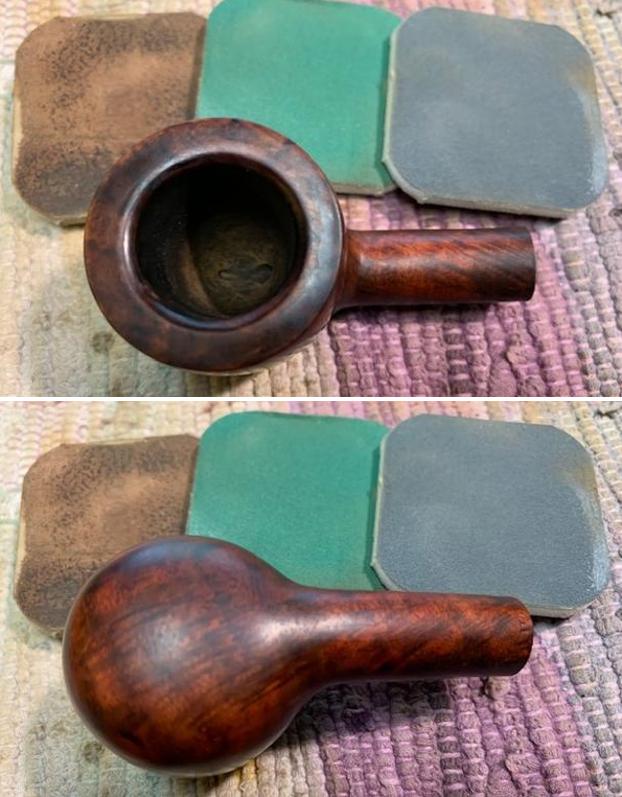
Breathing Life into a 1950 Dunhill Shell Briar R Pot


Blog by Steve Laug

The next pipe on the table is the second one that came to me from a friend up the British Columbia Coast. It is the second of two Dunhill pipes that he found in a shop along the coast. It is a Shell Briar Pot that is worn and has a lot of damage to the rim top. It is the pipe in the front of the photo below. You can see the damage to the rim top and how the rim top is damaged at the back and the front of the rim top and the outer edge of the bowl. The photo was sent to me by Chris. When the pipe arrived I took photos of what it looked like. Chris had done some preliminary cleaning of the pipe before he sent it to me and it look quite clean. It is stamped on a smooth panel on the underside of the shank. On the heel of the bowl it is stamped with the shape number R followed by Dunhill [over] Shell Briar followed by Made in England with a superscript underlined 0. That is followed by 4 in a circle followed by S for Shell. Interpreting that stamp follows: The R is the shape for a straight stem Pot. The Dunhill Shell Briar is the finish which is corroborated the S in the circle. The underlined 0 following the D of England dates the pipe. The stamping is clear and readable. The age of the pipe and the oils in the sandblast finish has given the pipe a rich medium brown finish. There is also some interesting grain shows through the blast finish. There was still a thin cake in the bowl and a light overflow of lava on the rim top. The rim top had a lot of damage and wear on the top and outer edges.  The top was no longer flat. The vulcanite stem was lightly oxidized and had tooth marks and chatter ahead of the button. I took photos of the pipe to show what it looked like before I started working on it. I took photos of the bowl and rim top to show the thickness of the cake and the damages. The rim top and edges are a mess with lots of damage caused by beating it against a hard surface. The photos of the stem show the light oxidation and tooth marks and chatter on the surface on both sides. The stamping on the underside of the shank is shown in the photo below. It looks very good and readable. It reads as noted and explained above.I removed the stem from the shank and took a photo of the pipe parts to show what I was working with. It has potential to be a great looking pipe.  I turned to Pipedia’s section on Dunhill Shell Briar Pipes to get a bit of background on the Dunhill finishes (https://pipedia.org/wiki/Dunhill#Root_Briar). I quote:

Shell

A deep craggy sandblast with a black stain finish (usually made using Algerian briar) – the color of the stain used has varied over the years. Although there is some doubt as to them being the first to sandblast pipes, Dunhill’s Shell pipes, and the sandblasting techniques developed to create them are considered one of Dunhill’s greatest and most lasting contributions to the art of pipe making.

The documented history of Dunhill’s inception of the Shell is largely limited to patent applications — there are no catalog pages or advertisements promoting blasted pipes at the time. The preliminary work on the English patent (No. 1484/17) was submitted on October 13, 1917. The patent submission was completed half a year later, on April 12, 1918, followed by the granting of the English patent on October 14, 1918. This was less than a month before the end of The Great War on November 11th.

In 1986 Dunhill released a line of premium Shell finish pipes – “RING GRAIN”. These are high-quality straight grain pipes which are sandblasted. Initially only Ring Grain, but now in two different finishes. In 1995 the “Shilling” was introduced with Cumberland finish – it is an extremely rare series. These pipes exhibit a deeper blast characteristic of that of the 1930’s – mid-1960’s (and the limited ‘deep blast’ pipes of the early 1980s) and show a fine graining pattern. These are considered the best new Dunhills by many enthusiasts today and are very rare. The finish is sometimes described as tasting like vanilla at first, with the taste becoming more normal or good as the pipe breaks in.

I have also included a chart from the site from Dunhill spelling out the Standard Pipe Finishes and giving short information and a timeline.

I turned to Pipephil to establish a date for a Dunhill with the stamping that was on this pipe. The date stamp 0  (http://pipephil.eu/logos/en/dunhill/cledat-en1b.html) I have marked the box below with a red box around the part of the date key that is applicable. The pipe dates to 1950.I decided to start the restoration on this one by working on the damaged rim top. I started the process by topping the bowl on a topping board and a piece of 240 grit sandpaper. My main concern was to flatten the top and remove some of the gouges and damages. I then built up the damaged areas on the front and back outer edges of the bowl with briar dust and CA glue. I wanted to raise the profile of the edge in those areas. I would rusticate them so I was not overly concerned with what it looked like at this point. I used various burrs on the Dremel to approximated the sandblast finish on the rim top and bring it back to reflect the sandblast and nooks and crannies on the sides of the bowl and shank. I stained the newly shaped rim top with an Oak and a Maple stain pen to match the colour of the bowl. I was pretty happy with the newly stained rim. It look a lot better than when I started and worked with the finish.I figured I should clean up the bowl after that work. I reamed it with a PipNet Pipe Reamer and took back the remaining cake to briar so I could check out the condition of the bowl walls. I cleaned up the remnants with a Savinelli Fitsall Pipe Knife. I cleaned out the mortise and the airway in the shank and stem with alcohol, cotton swabs and pipe cleaners. I also cleaned out the inner tube at the same time. With the repair completed I rubbed the briar down with Before & After Restoration Balm. I worked it into the briar with my fingertips and a horsehair shoe brush to work it into the nooks and crannies of the sandblast finish. The product works to clean, enliven and preserve the briar. I let it sit for 15 minutes while I worked on the stem. After the time passed I buffed it with a cotton cloth to deepen the shine. The briar really comes alive with the balm. I cleaned out the tooth marks with alcohol and filled them in with black super glue. I set the stem aside to allow the glue to cure. Once it cured I recut the edge of the button with a file and then sanded the repairs with 220 grit sandpaper to smooth them out and blend them into the rest of the stem surface. I set the bowl aside and turned my attention to the stem. I polished the vulcanite with micromesh sanding pads – 1500-12000 grit pads. I wiped it down with Obsidian Oil after each sanding pad. I used Before & After Pipe Polish – both Fine and Extra Fine to further polish the stem. This Dunhill Shell Briar R Pot is a beautiful sandblast that came out looking very good. The Shell Briar finish has a great rugged sandblast that Dunhill specialized in making. The finish on the pipe is in excellent condition. The oils off the smoker’s hands and the tan stain on the bowl works well to highlight the grain. The polished black vulcanite taper stem adds to the mix. With the dust gone from the finish and the bowl it was a beauty and is eye-catching. I put the stem back on the bowl and buffed the pipe with Blue Diamond on the buffing wheel being careful to not buff the stamping. I gave the bowl multiple coats of Conservator’s Wax and the stem multiple coats of carnauba wax on the buffing wheel and followed that by buffing it with a clean buffing pad. I hand buffed the pipe with a microfiber cloth to deepen the shine. The finished Shell Briar R Pot is quite nice and feels great in the hand. Give the finished pipe a look in the photos below. I can only tell you that like the other pipes I am working that it is much prettier in person than the photos capture. The dimensions of the pipe are Length: 5 ¼ inches, Height: 1 ¾ inches, Outside diameter of the bowl: 1 ½ inches, Chamber diameter: 7/8 of an inch. The weight of the pipe is 36grams/1.27oz. Thanks for walking through the restoration with me as I worked over another beautiful pipe. Remember we are not pipe owners; we are pipemen and women who hold our pipes in trust until they pass on into the trust of the next generation.