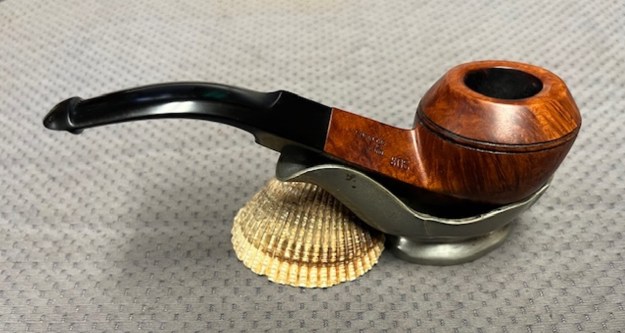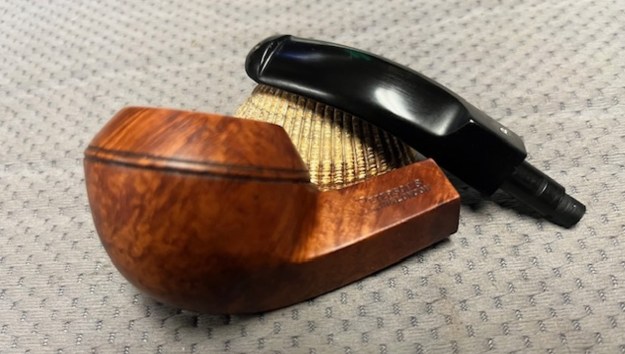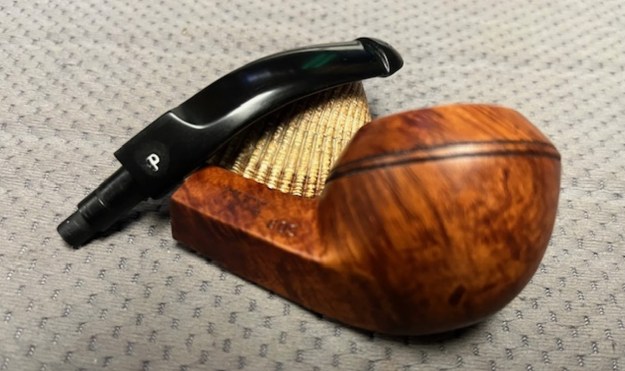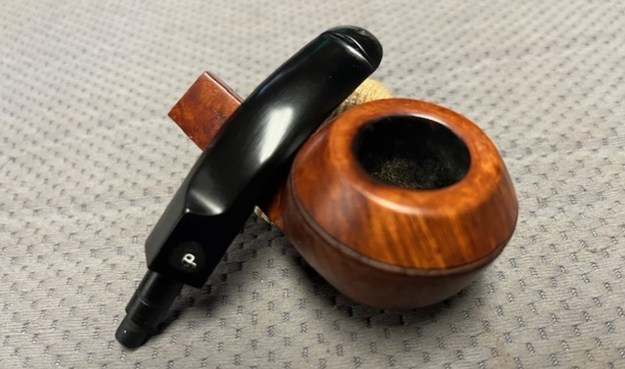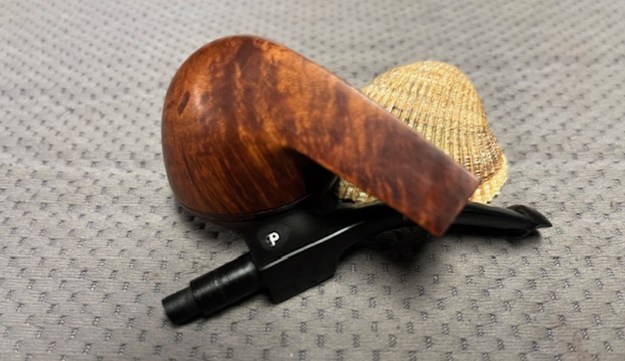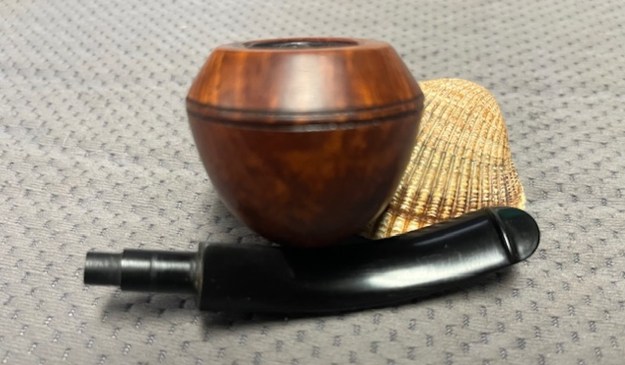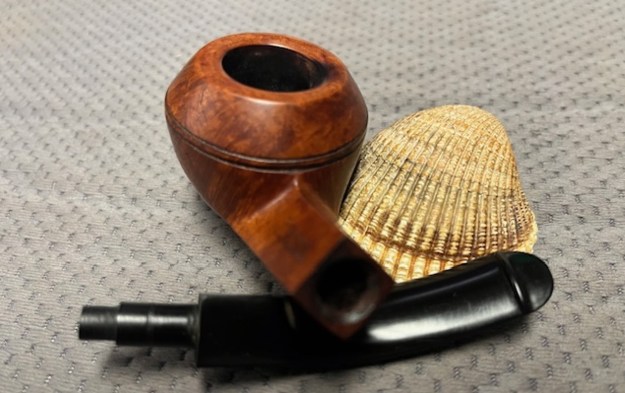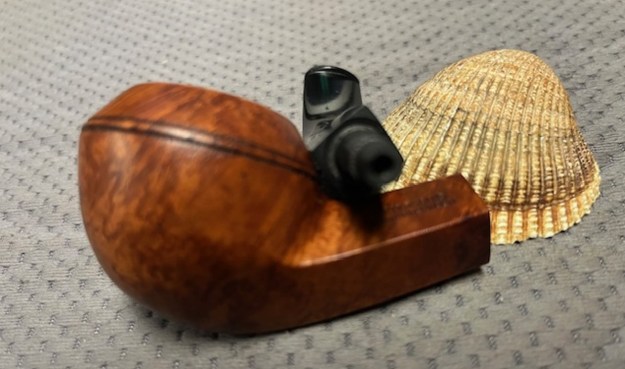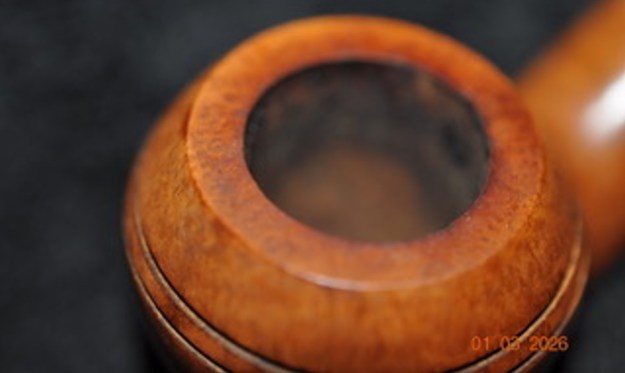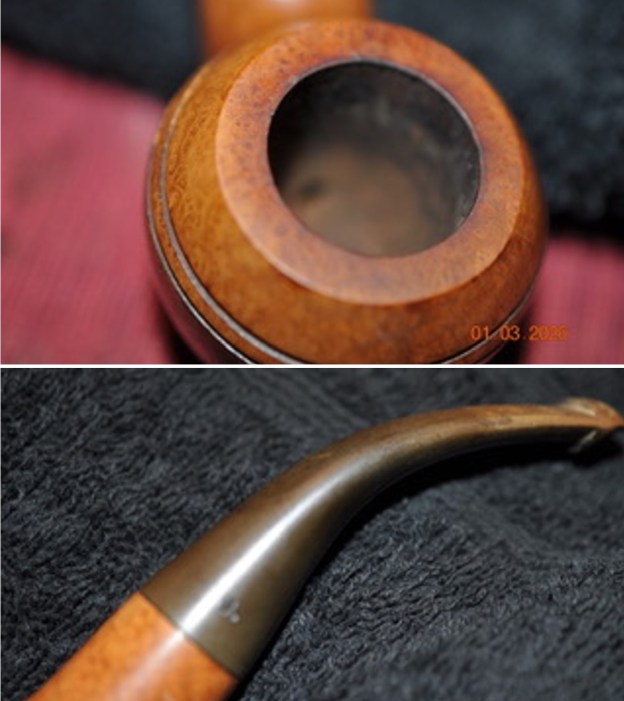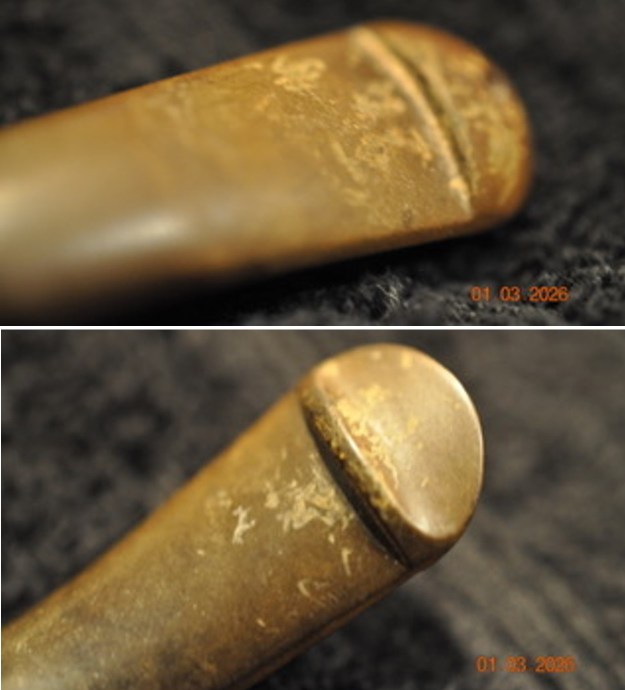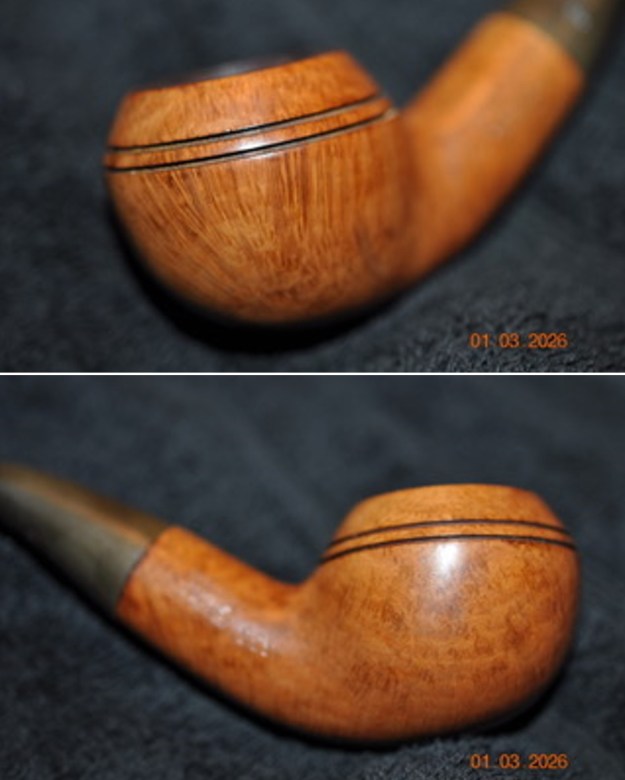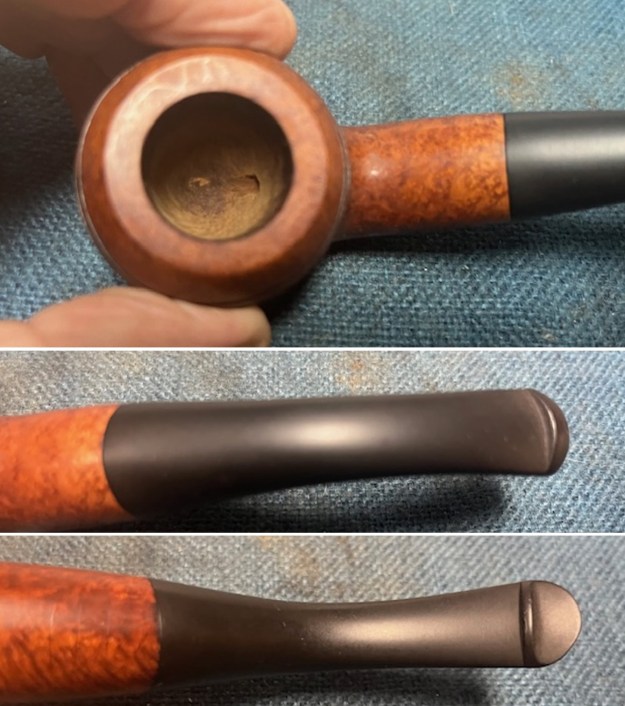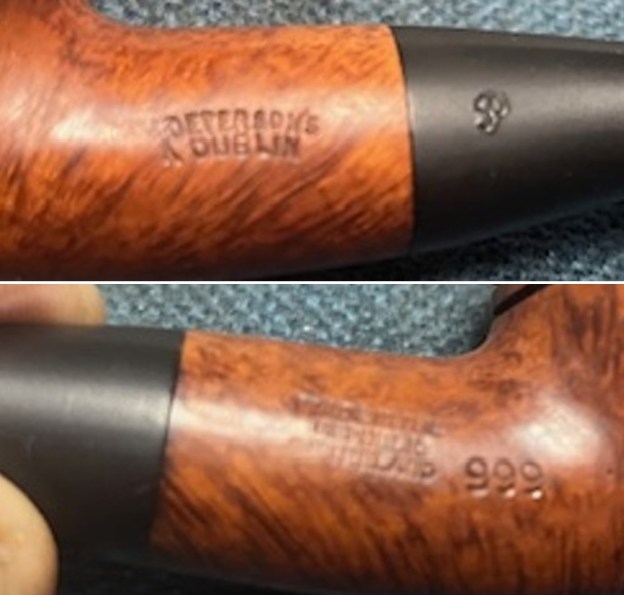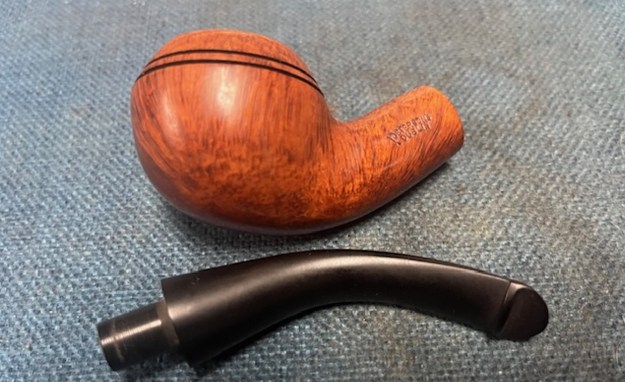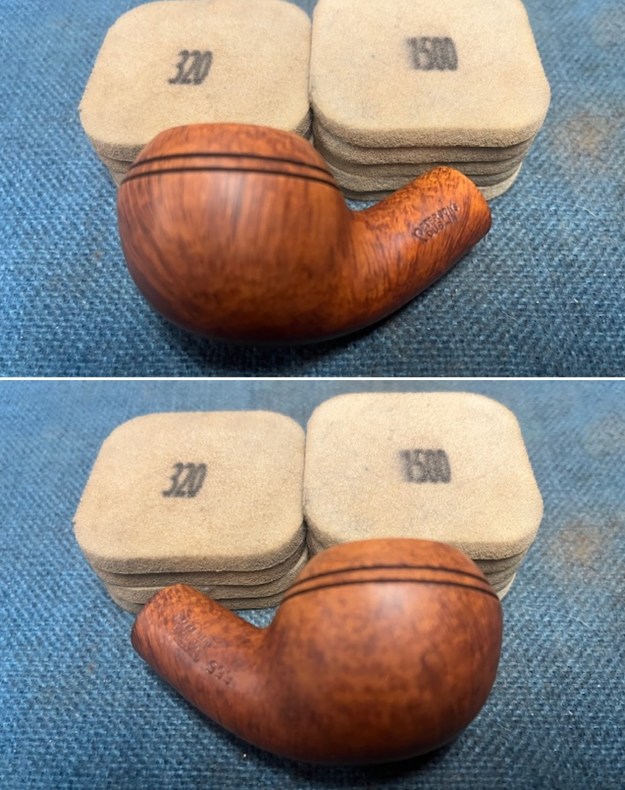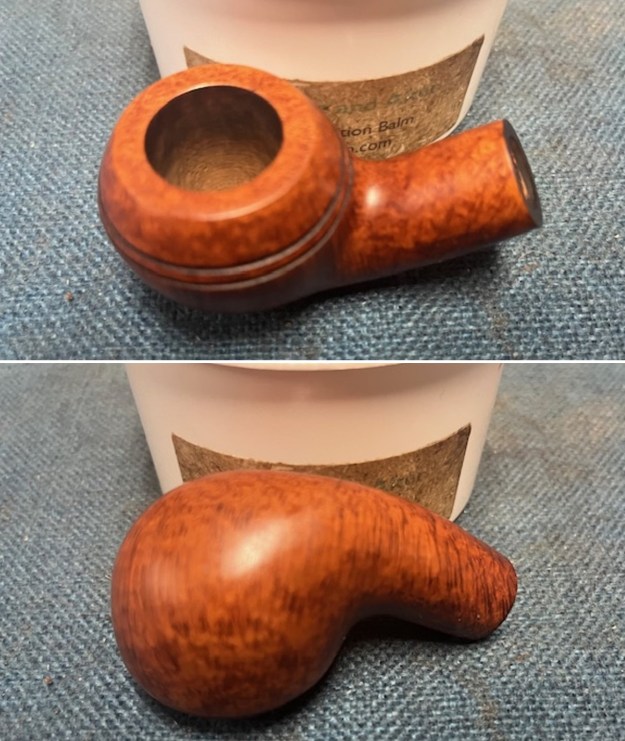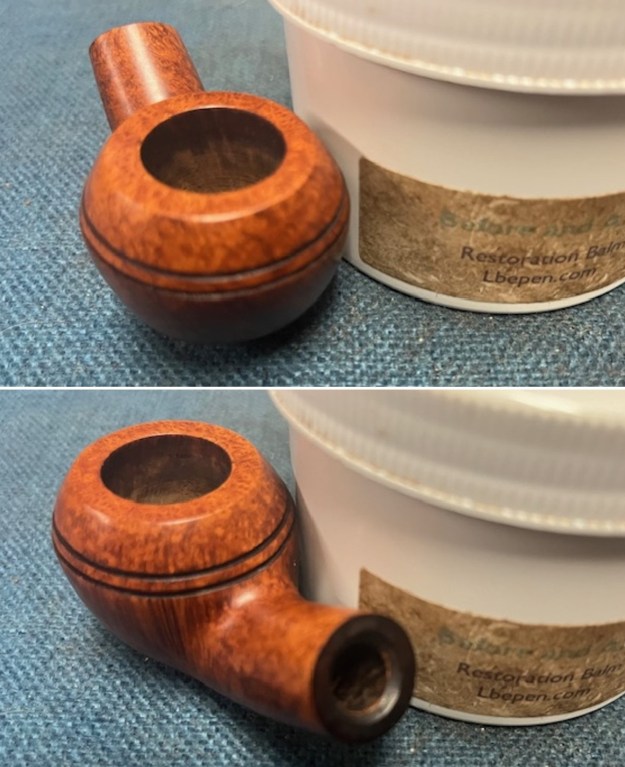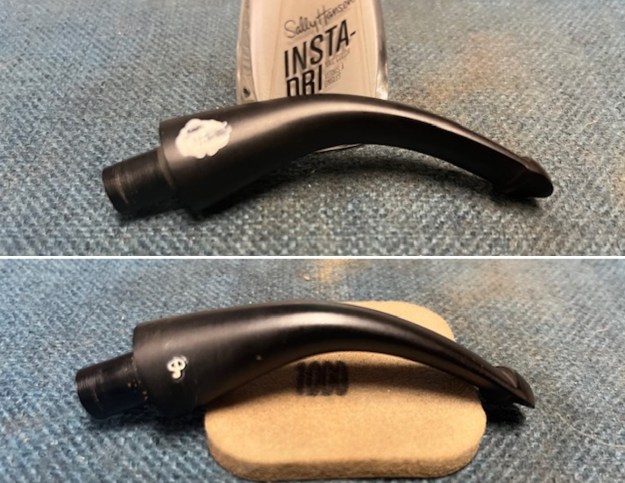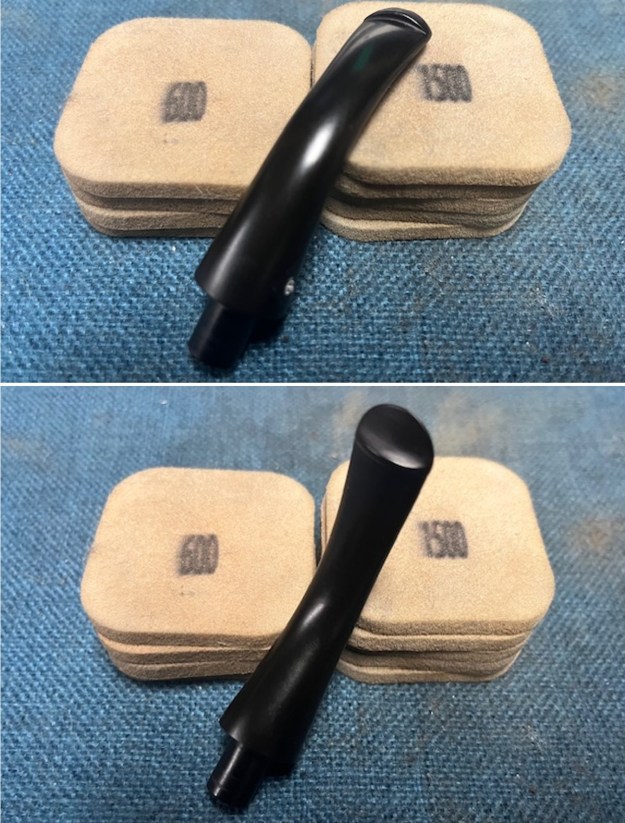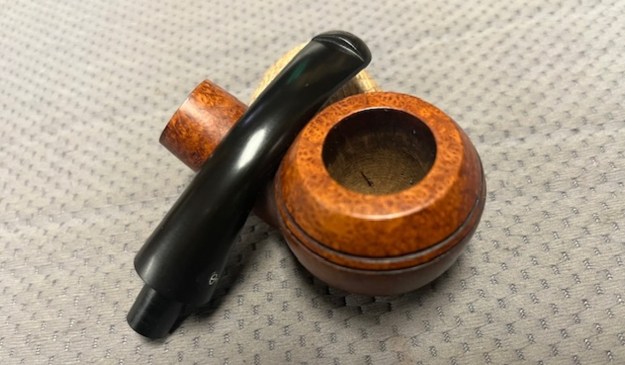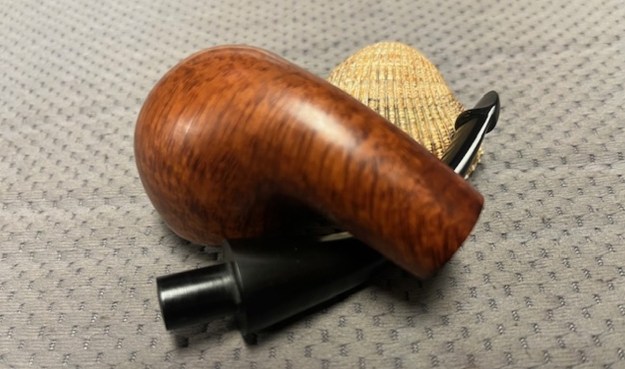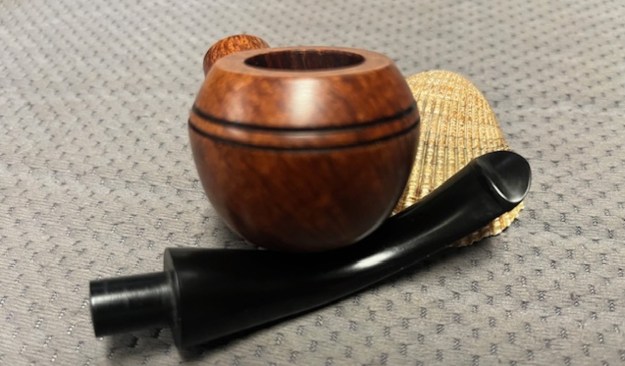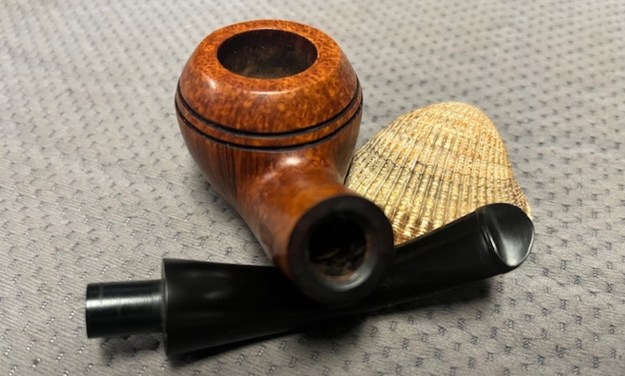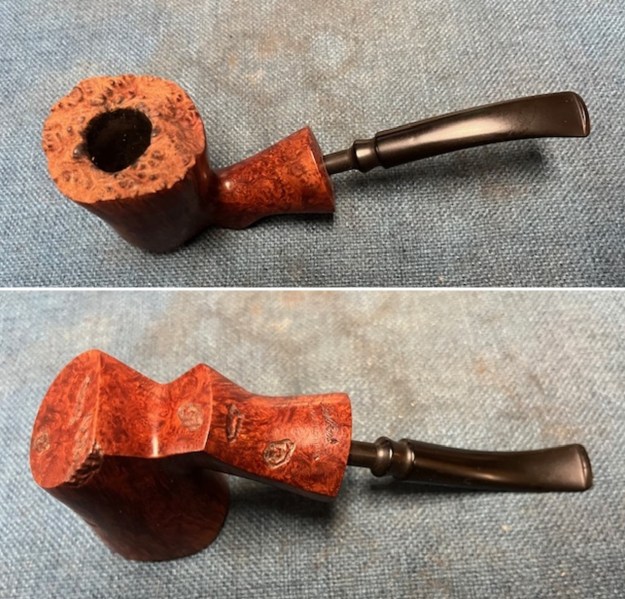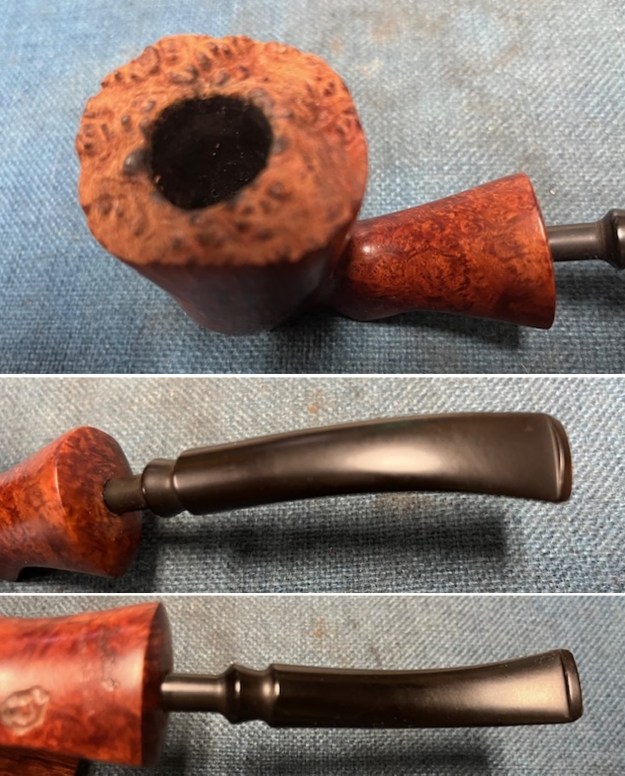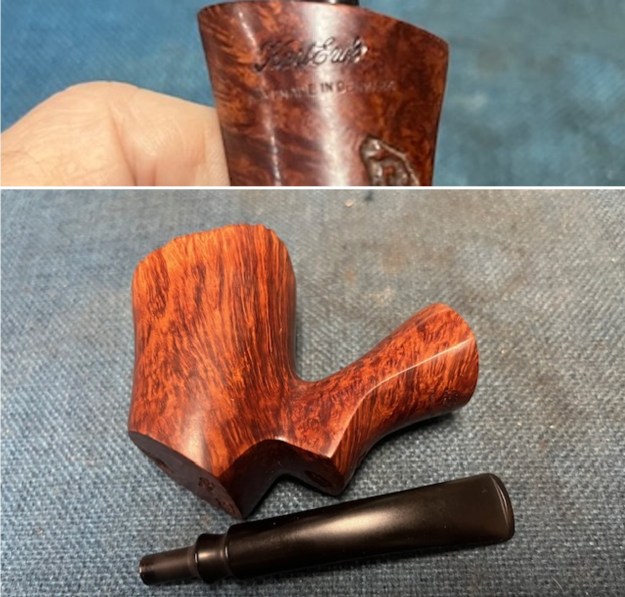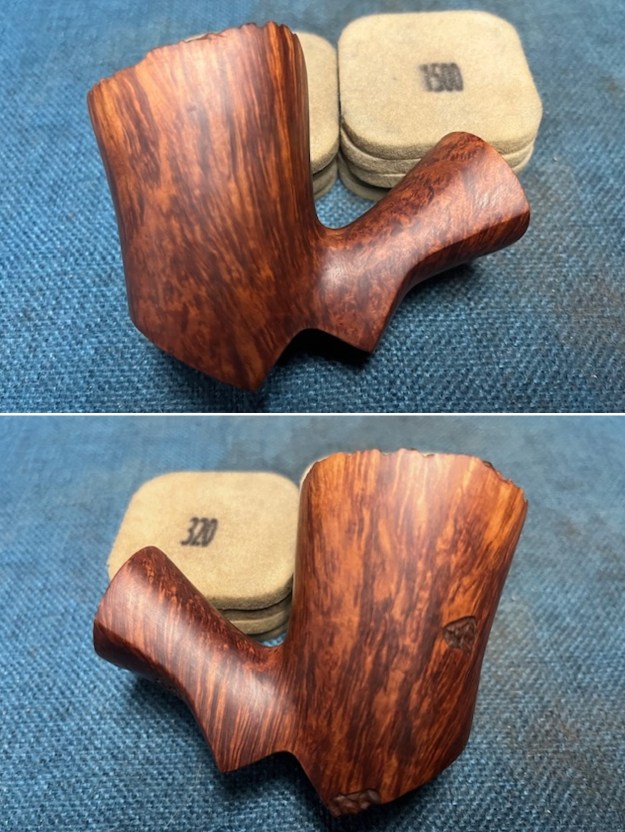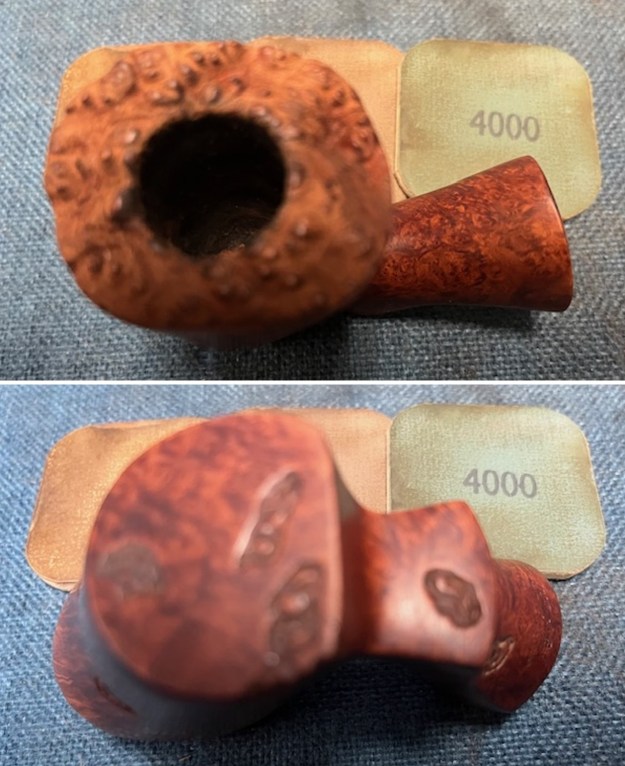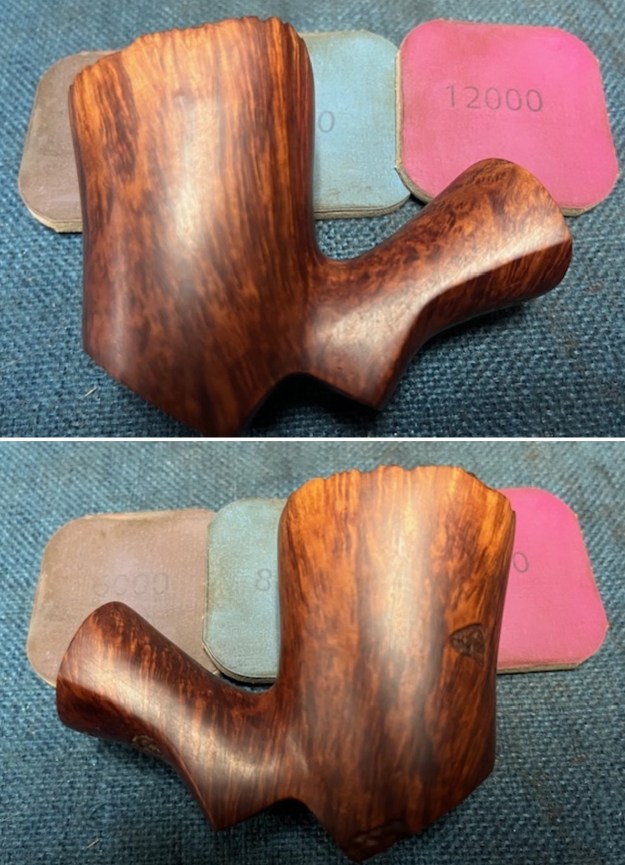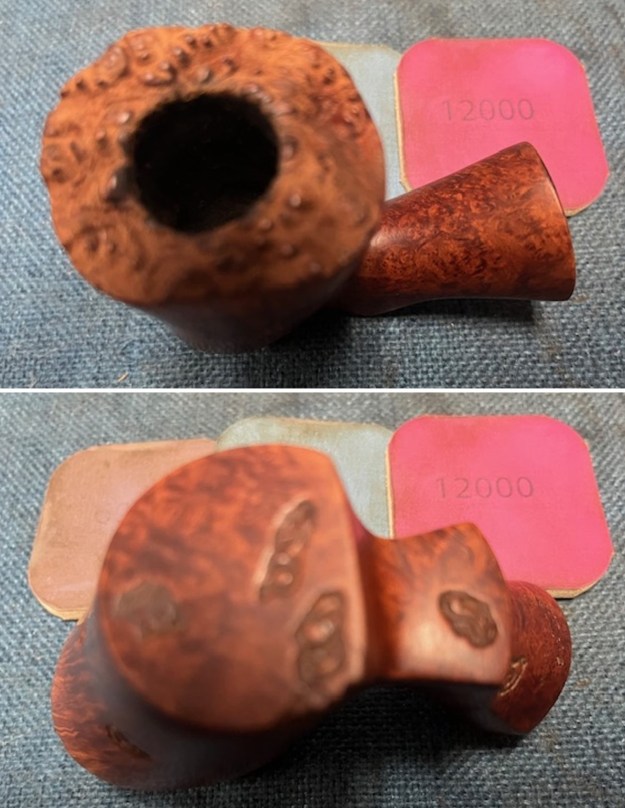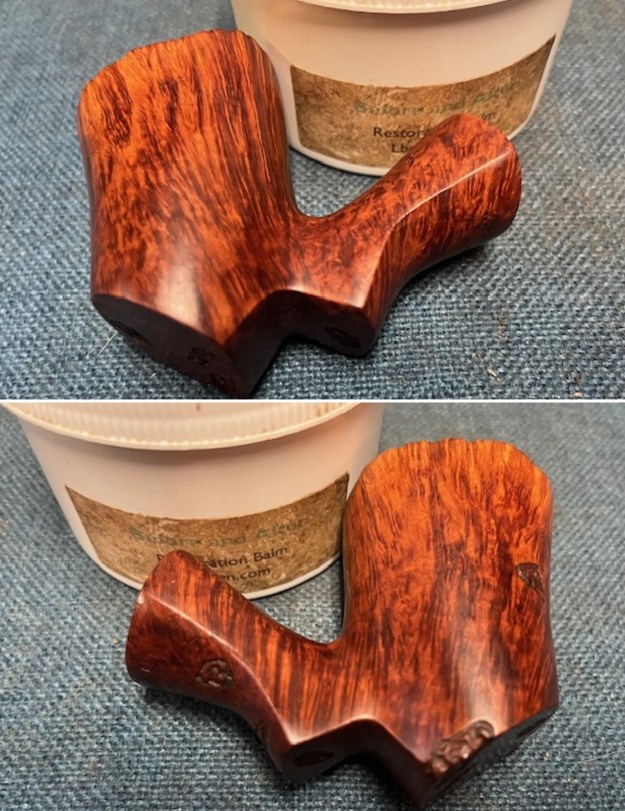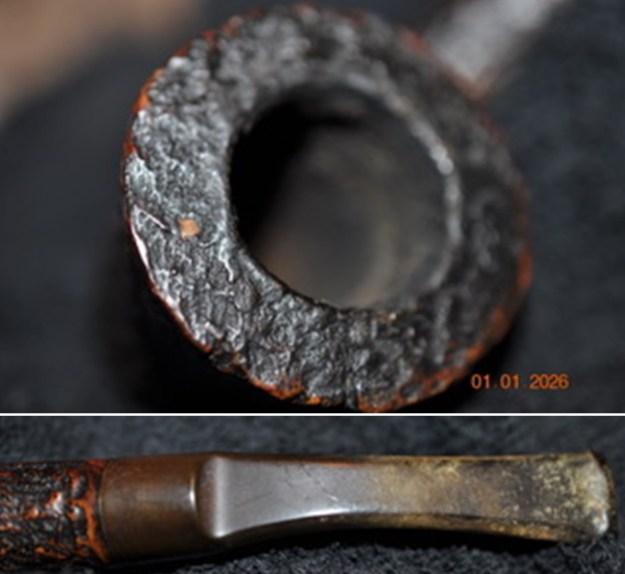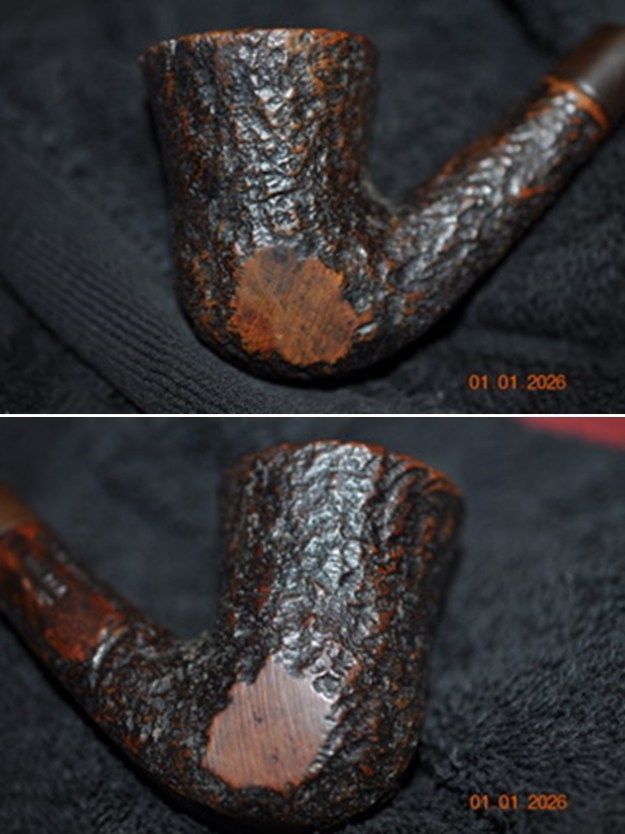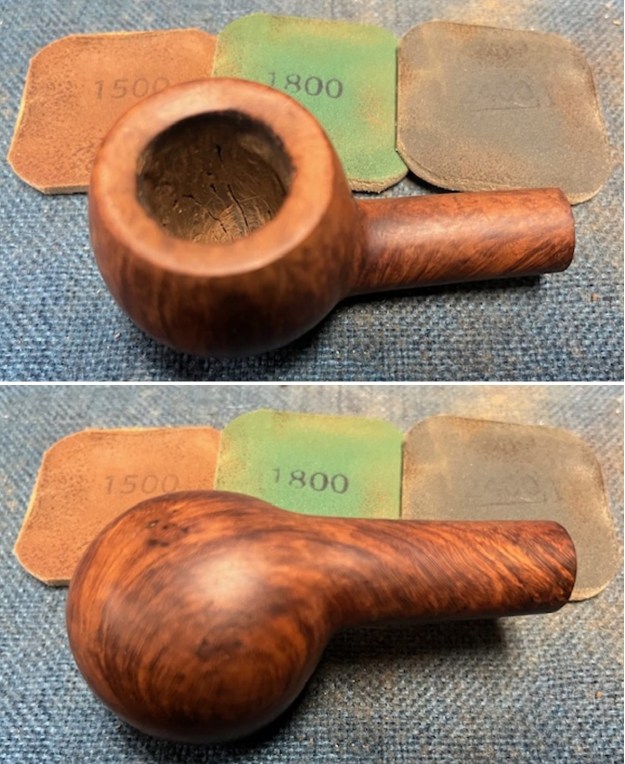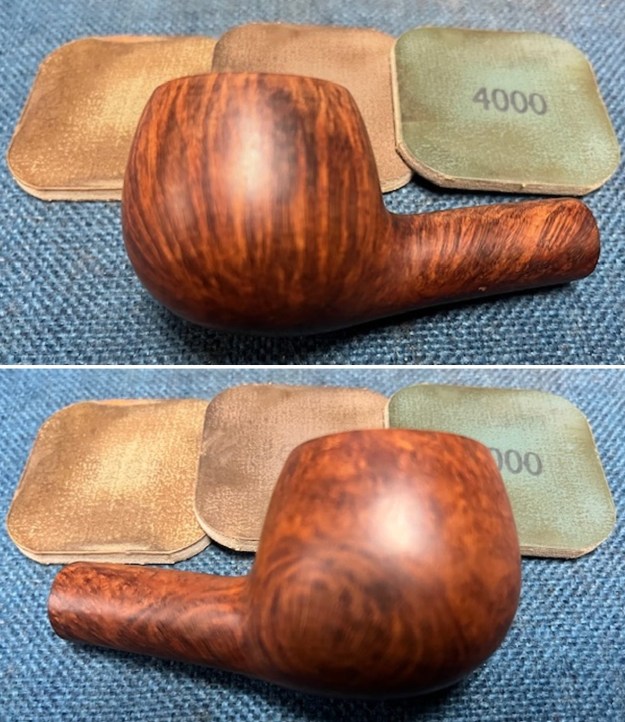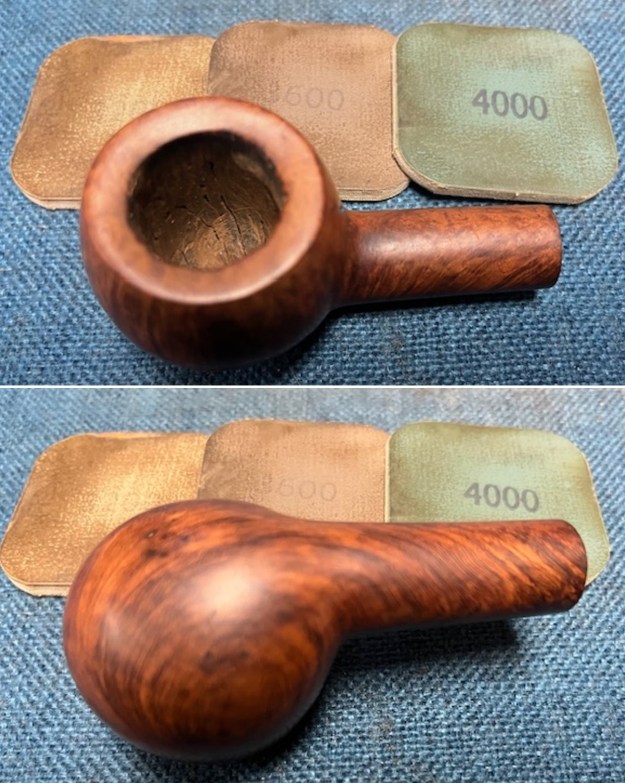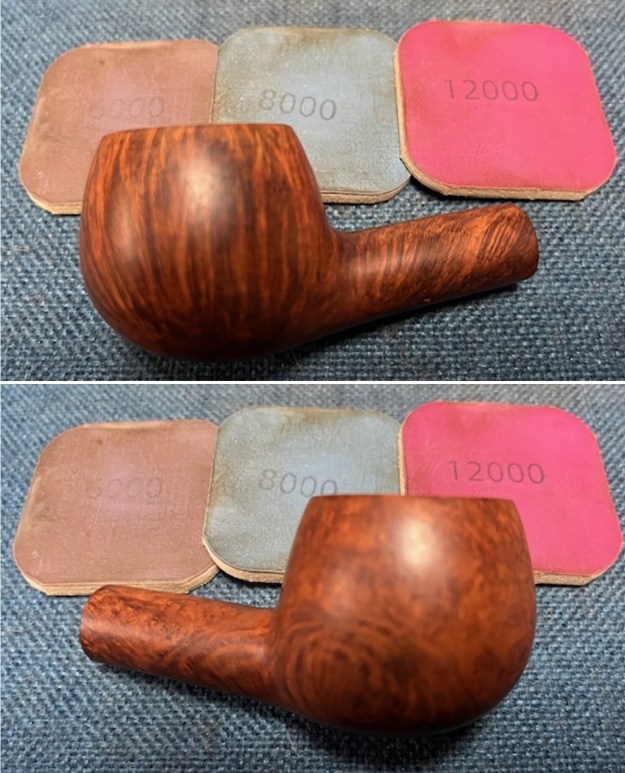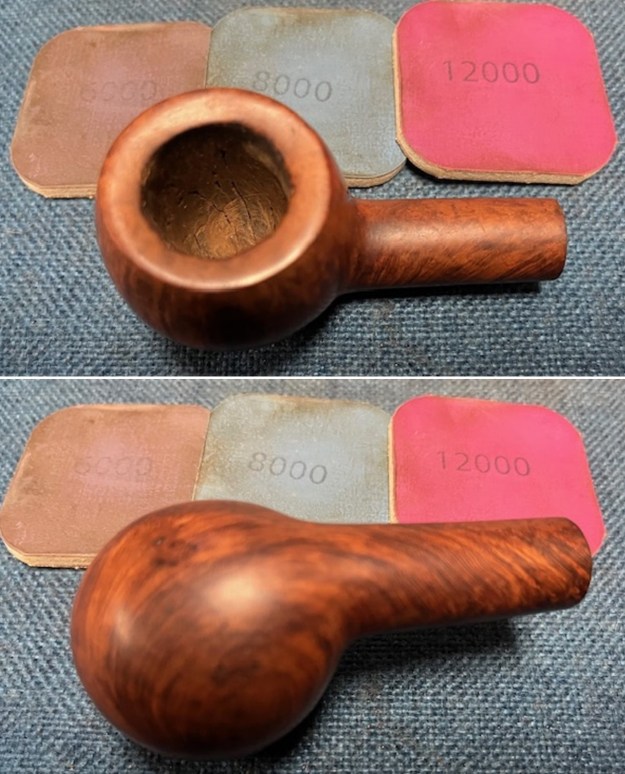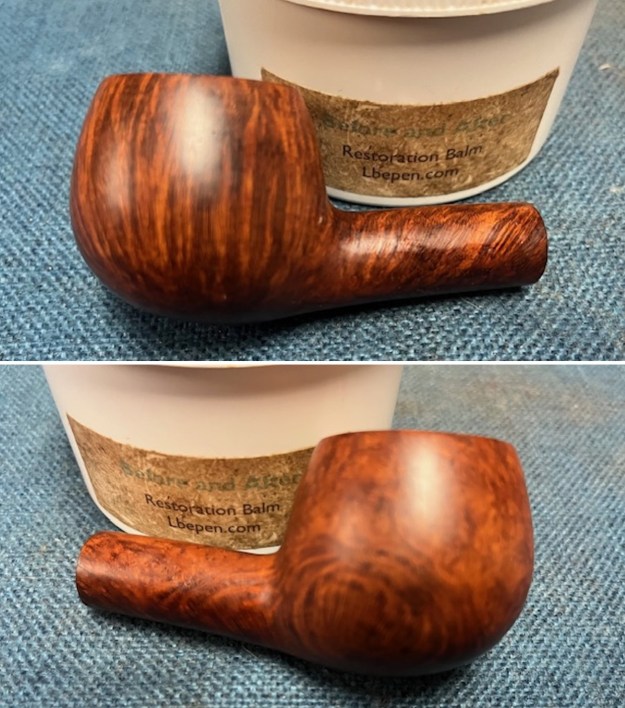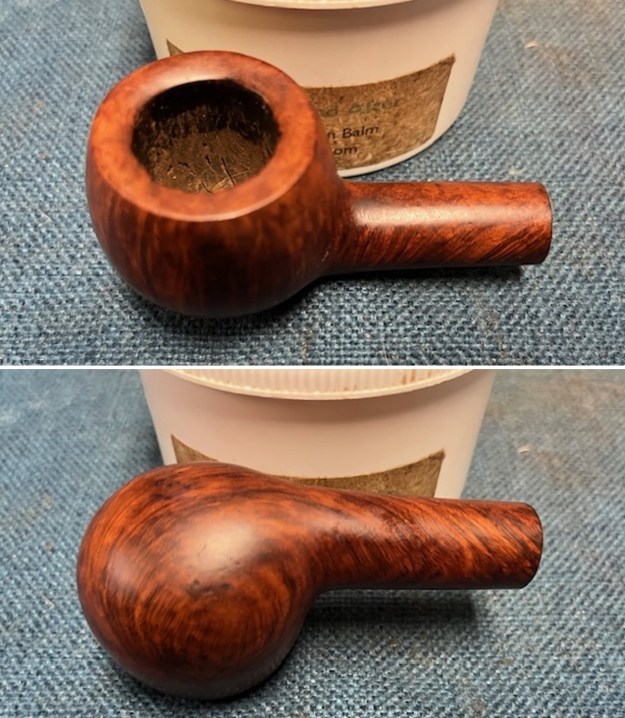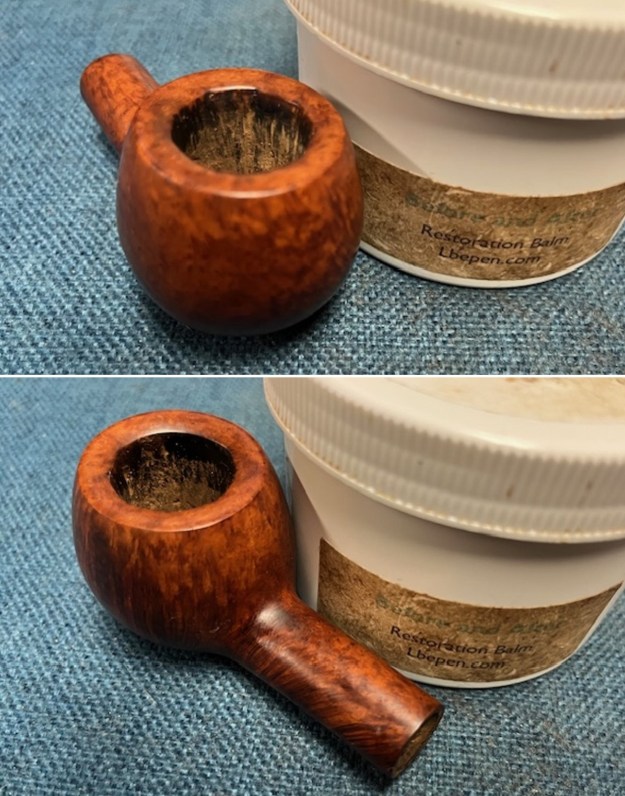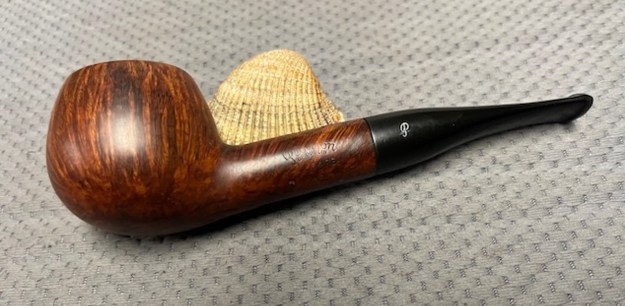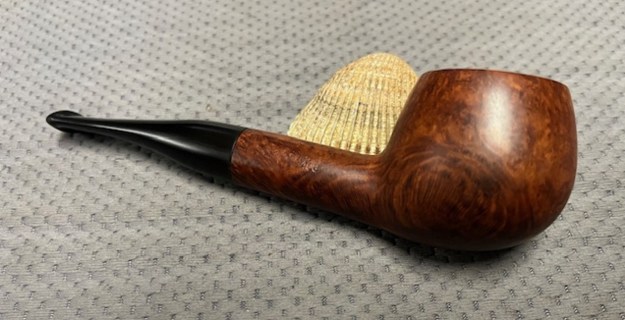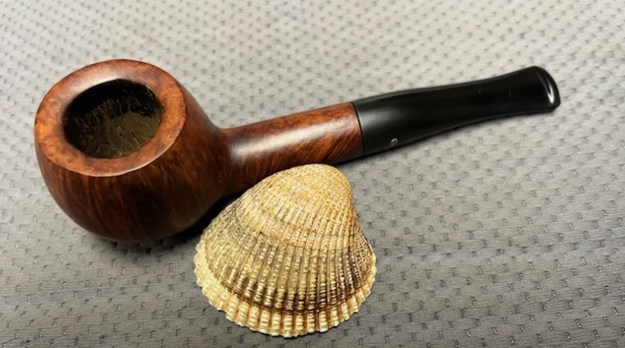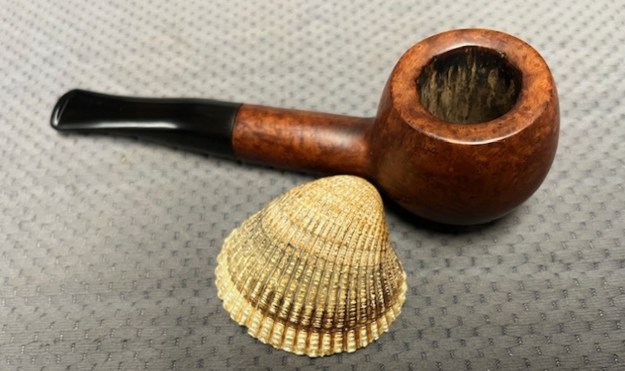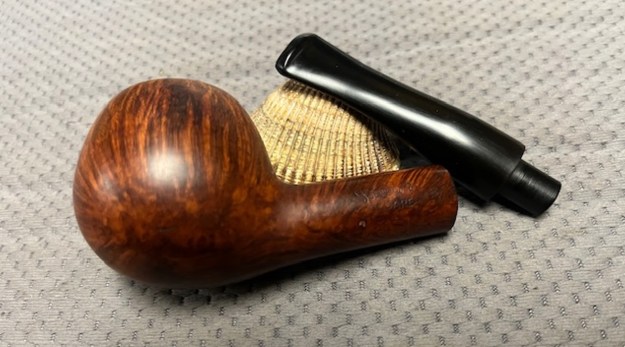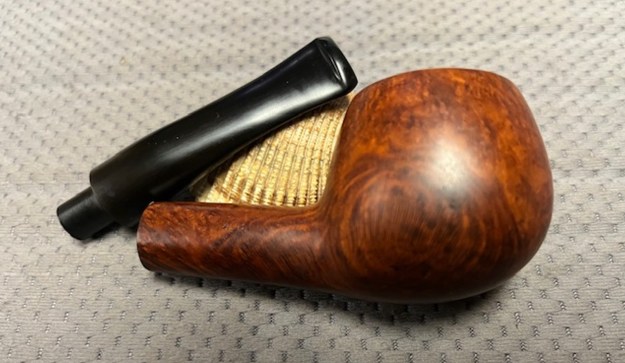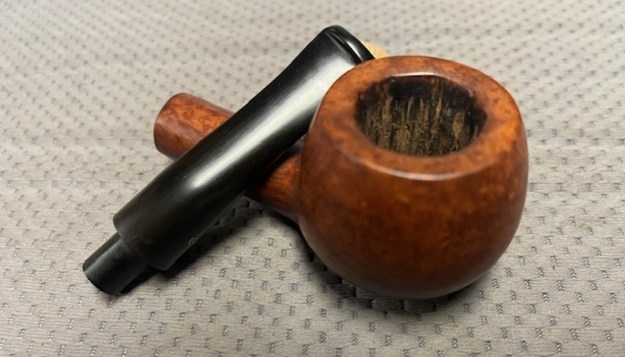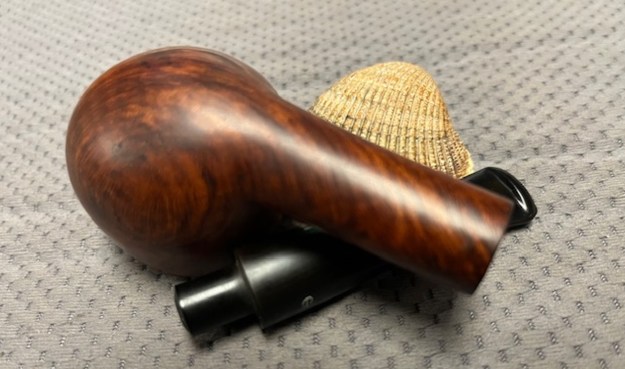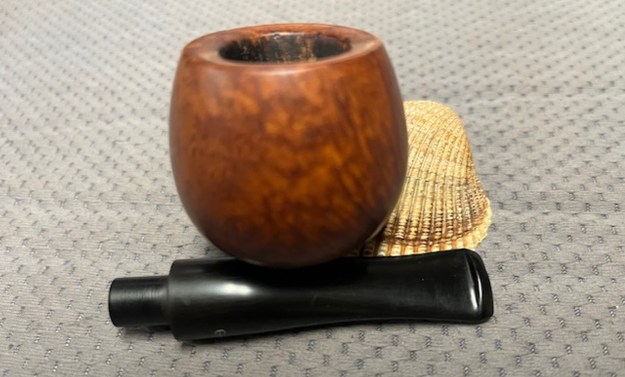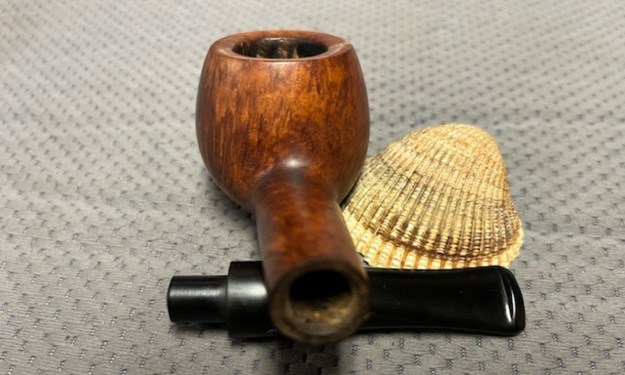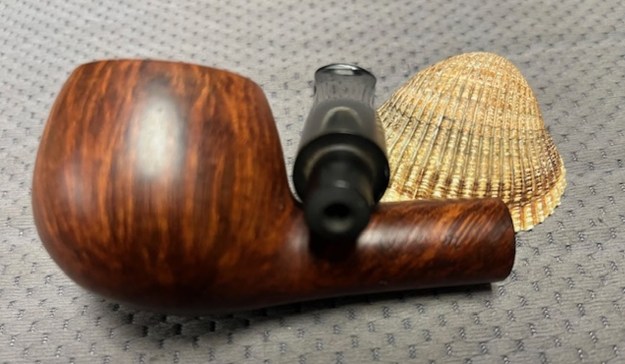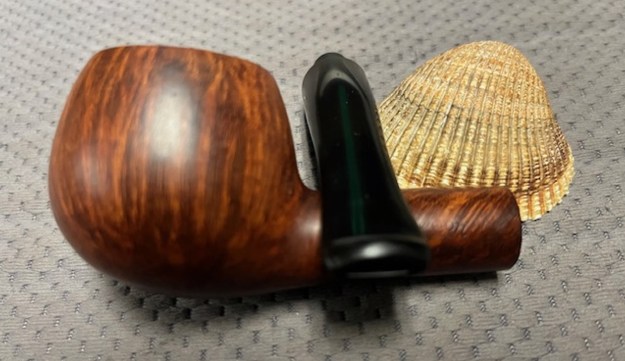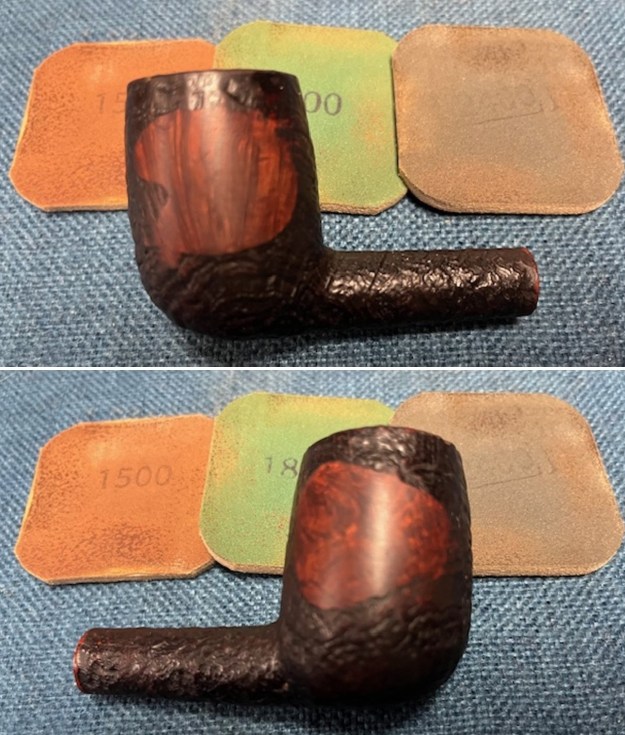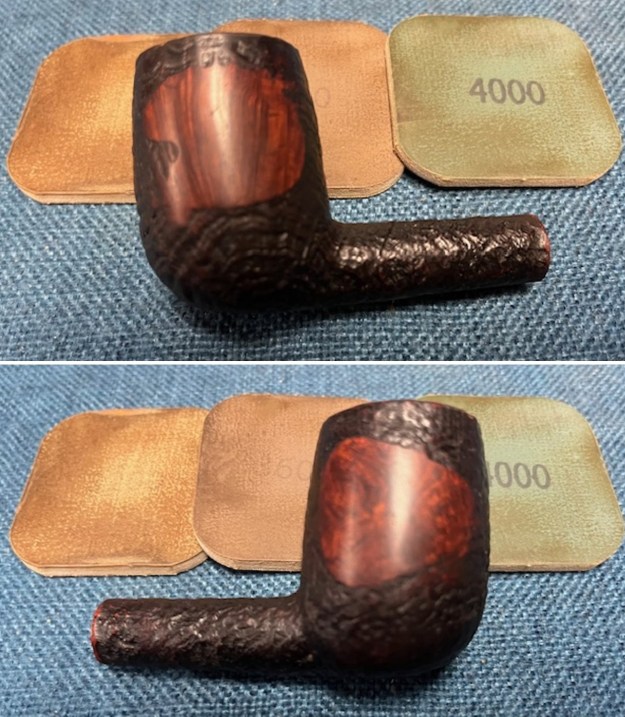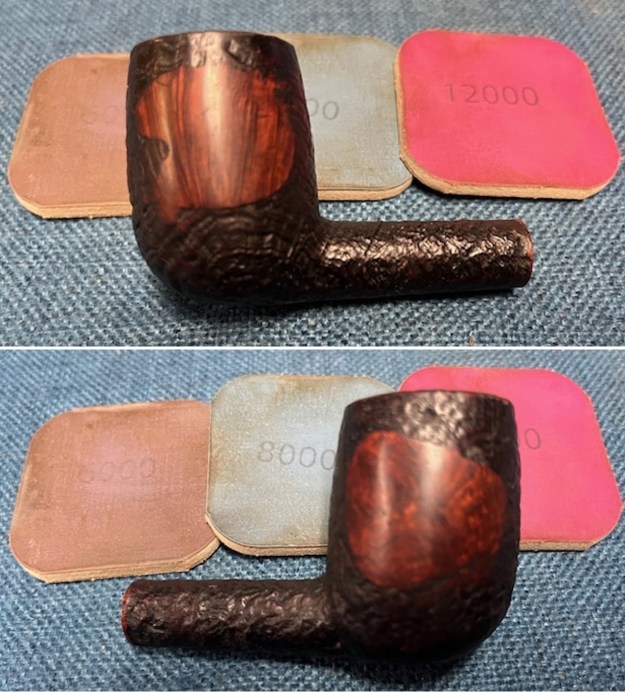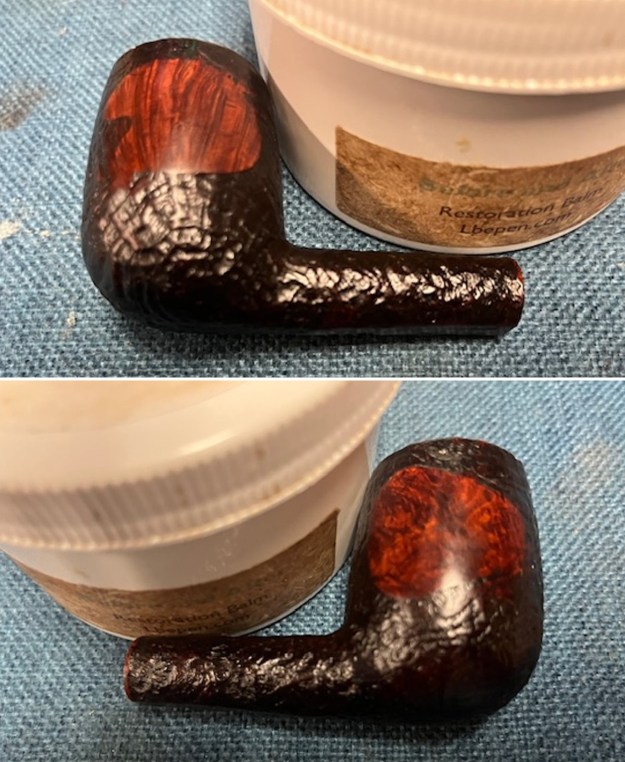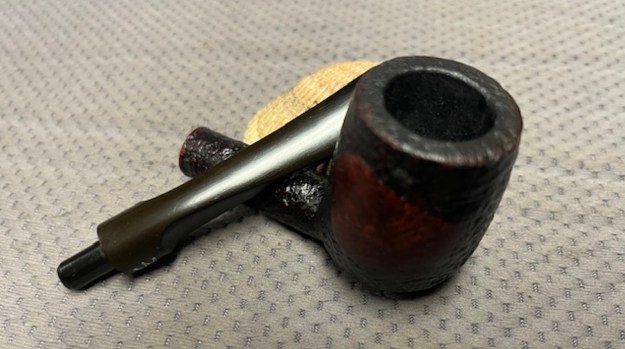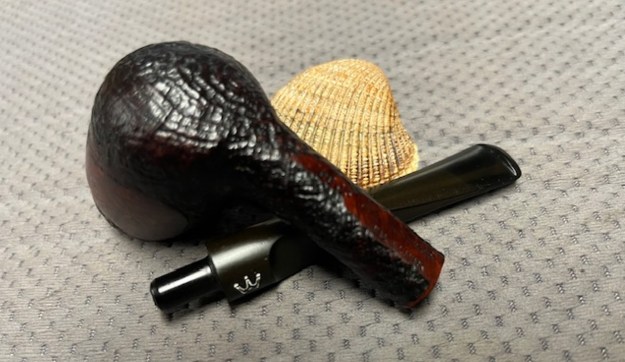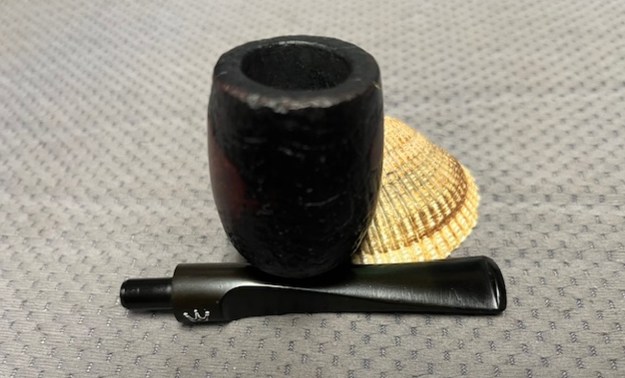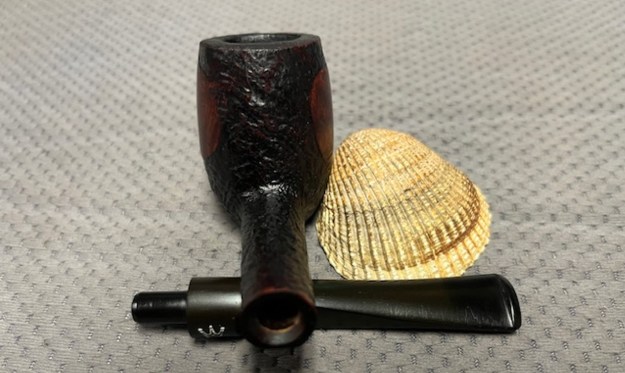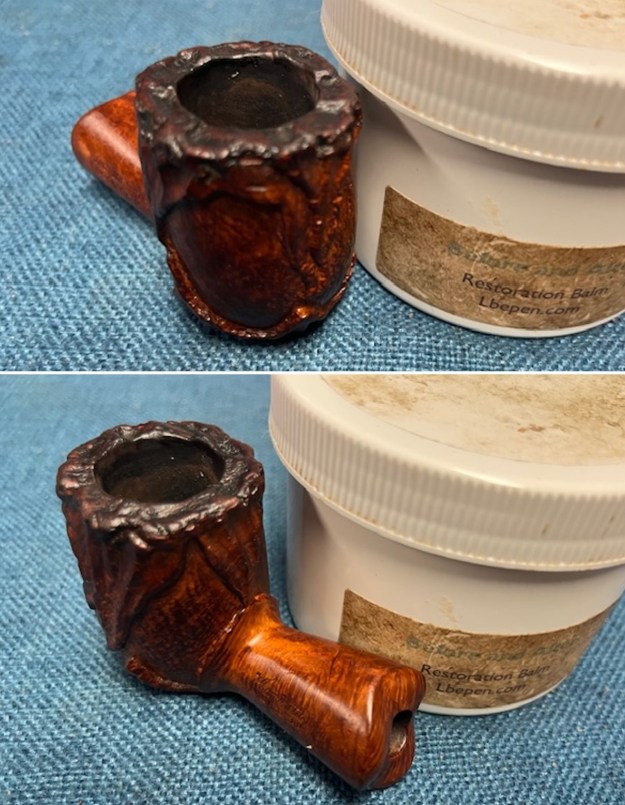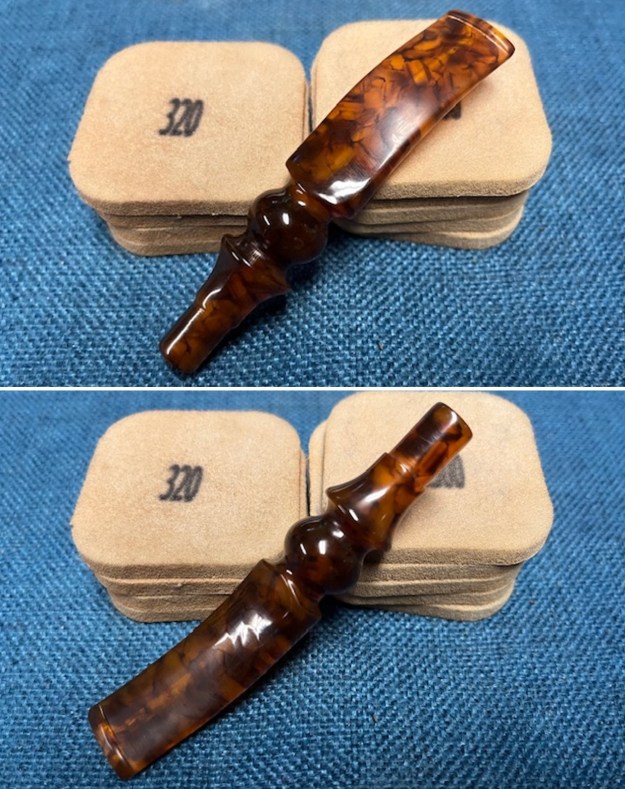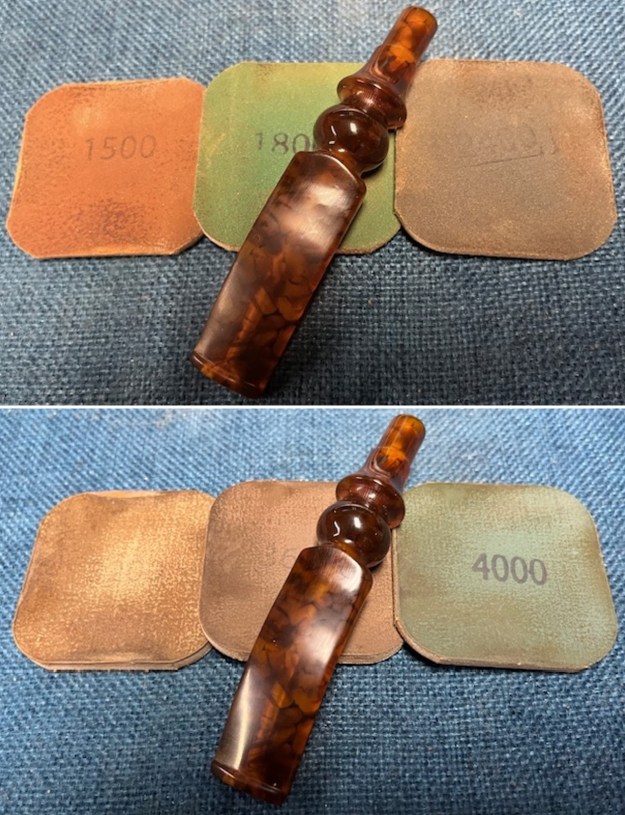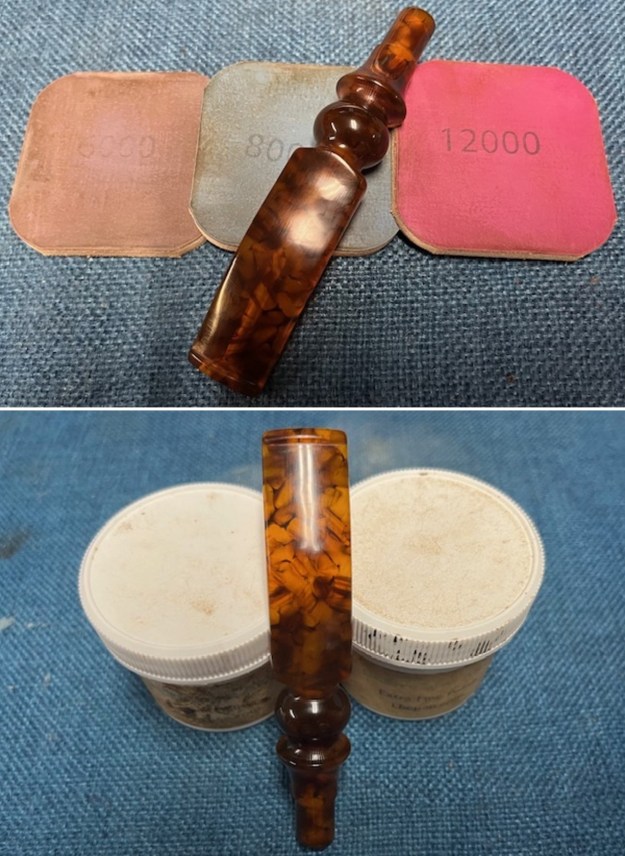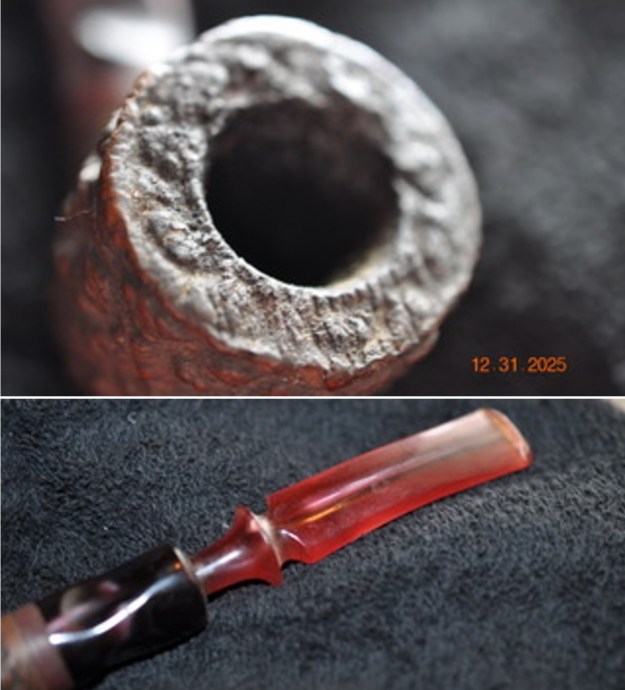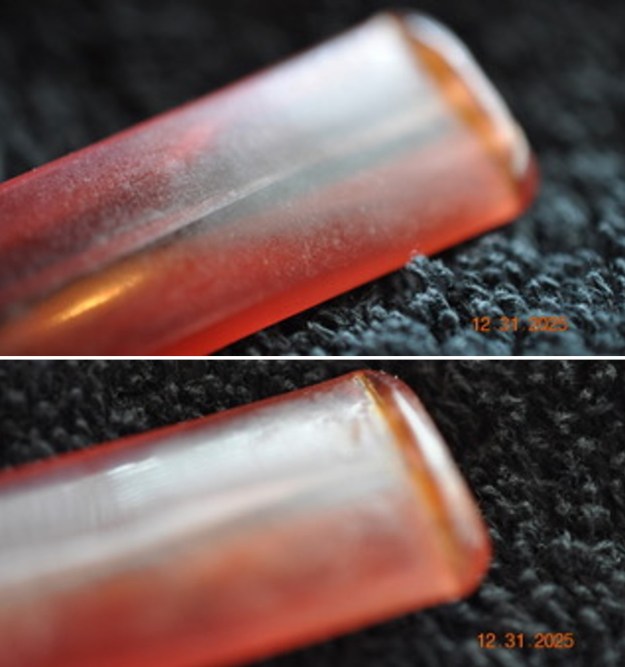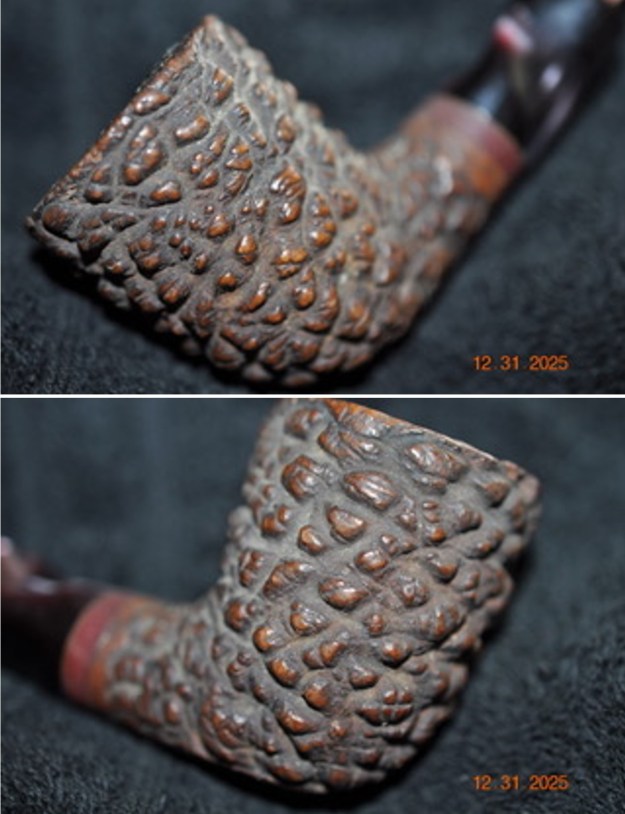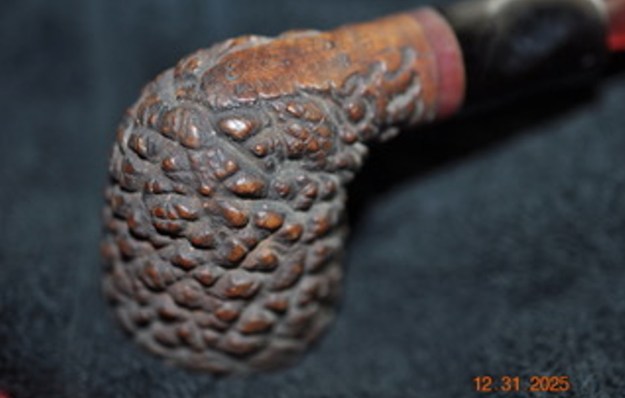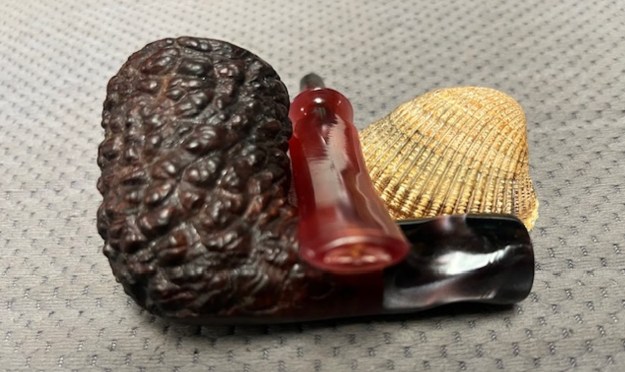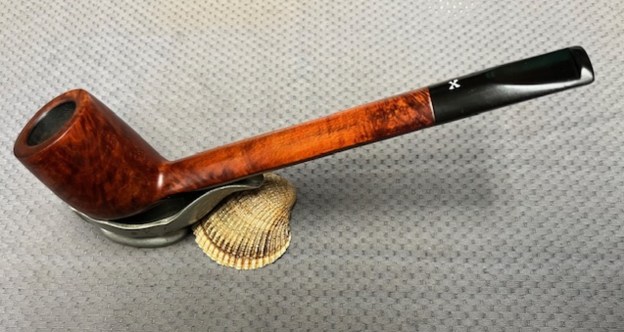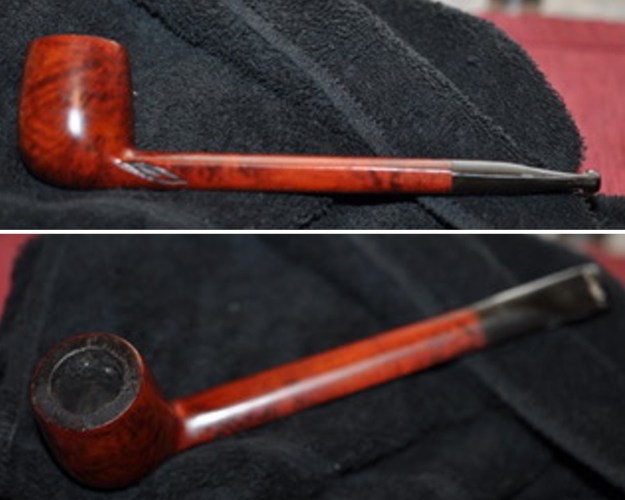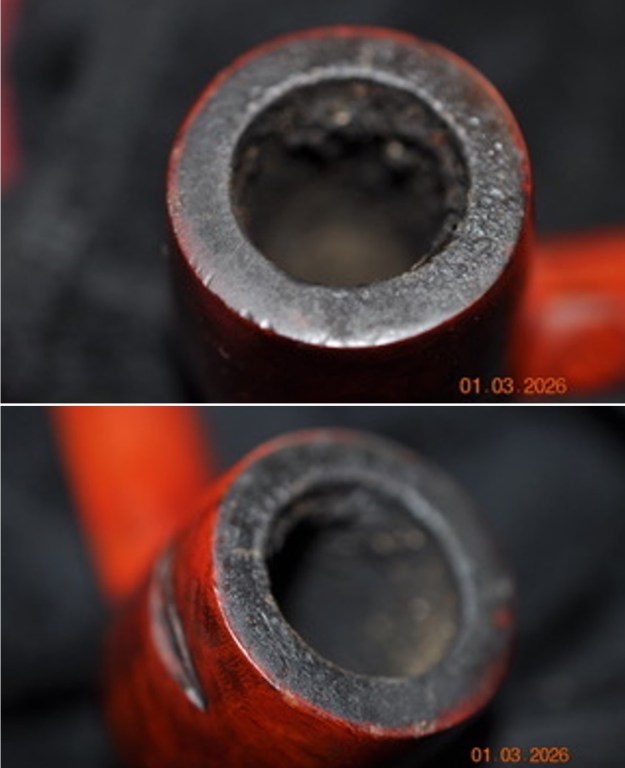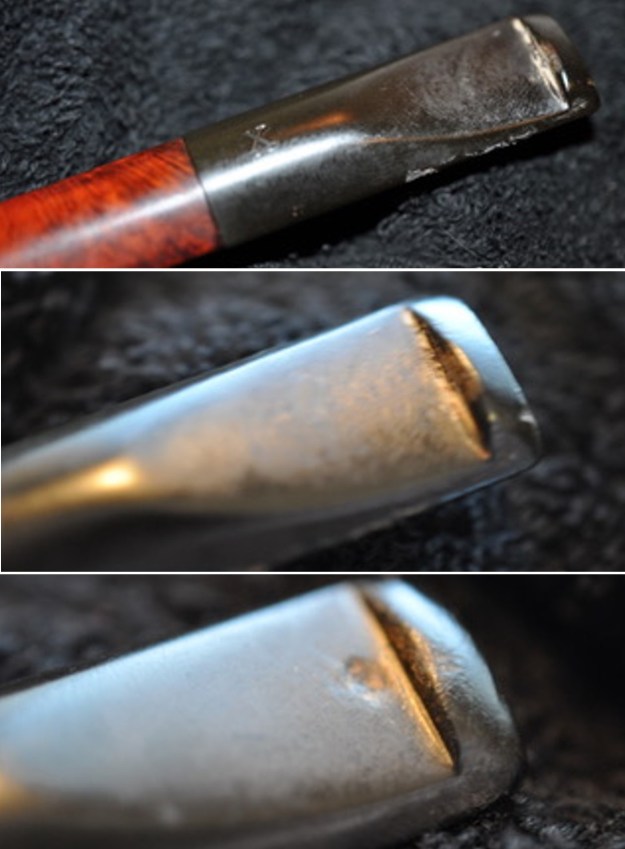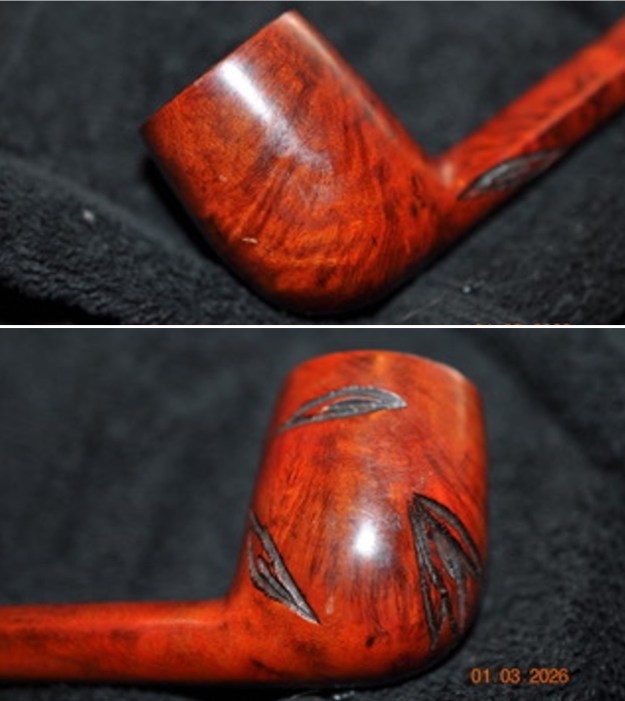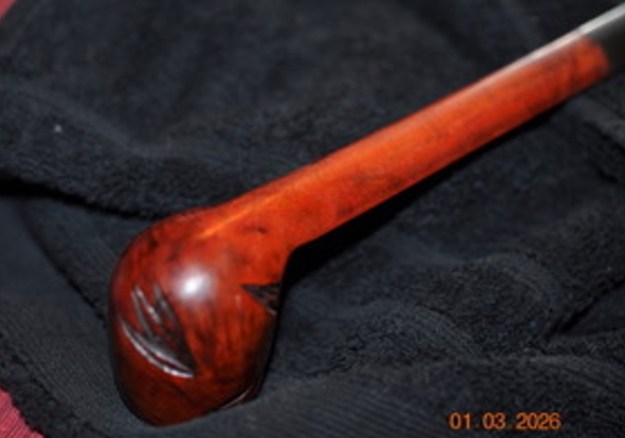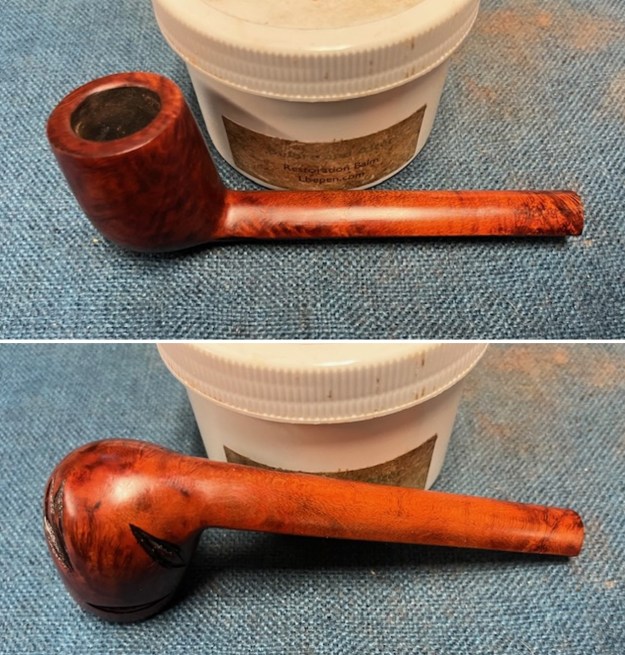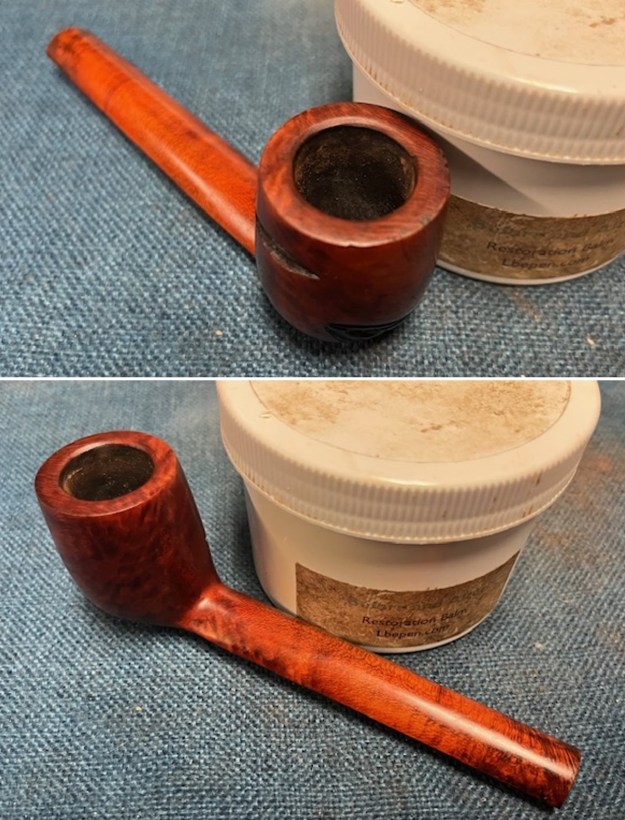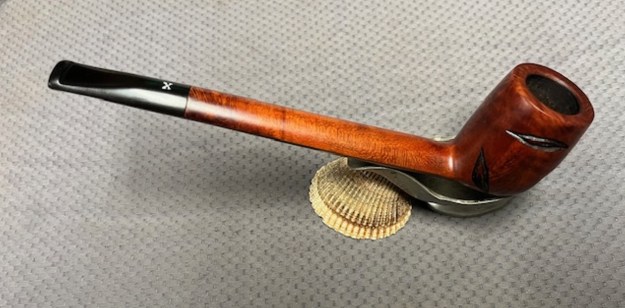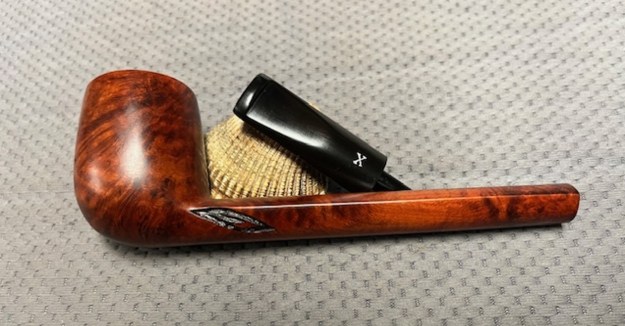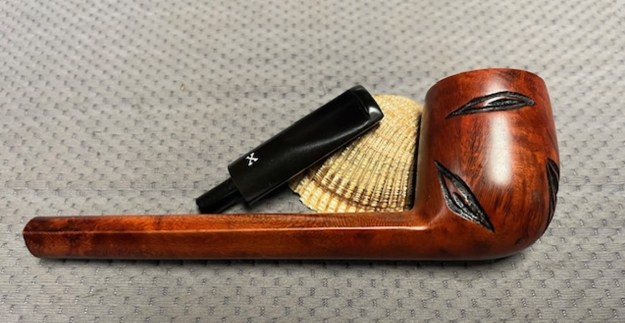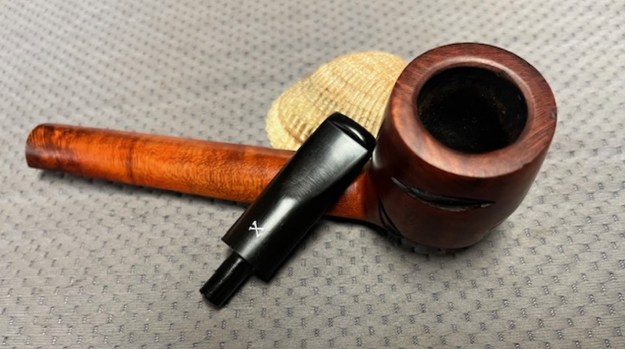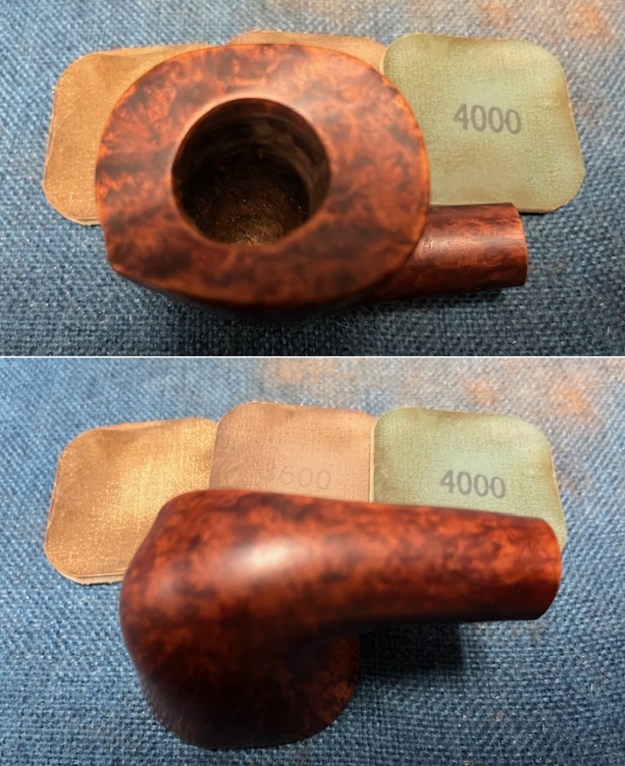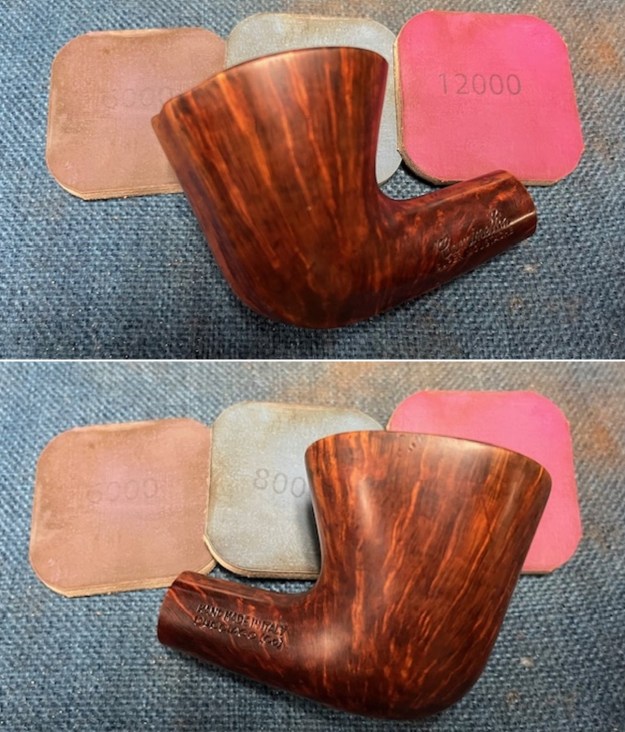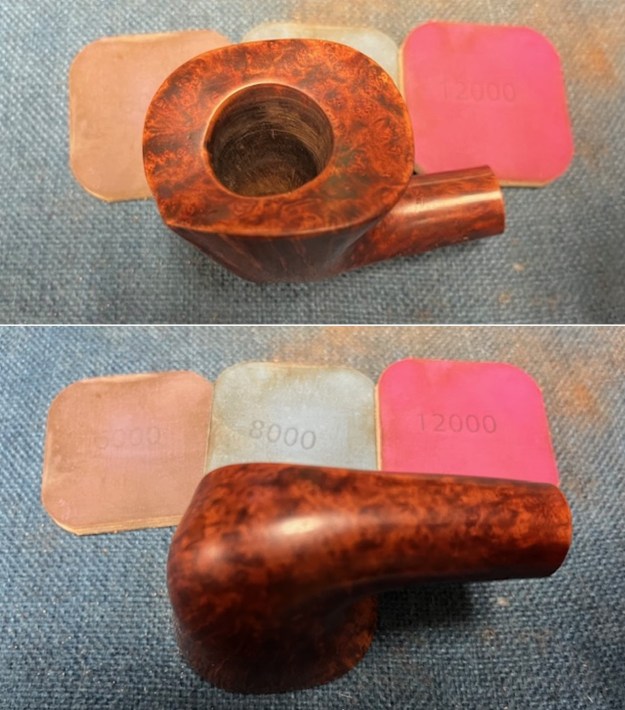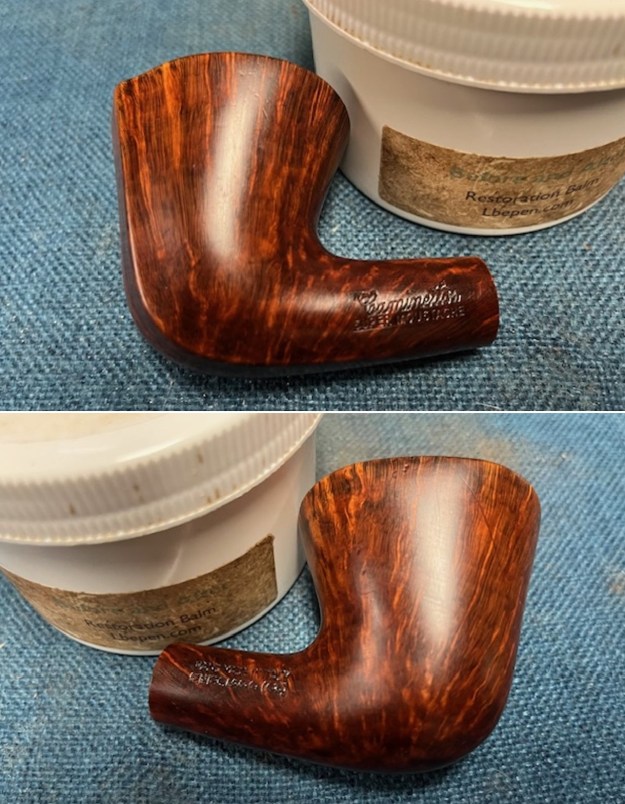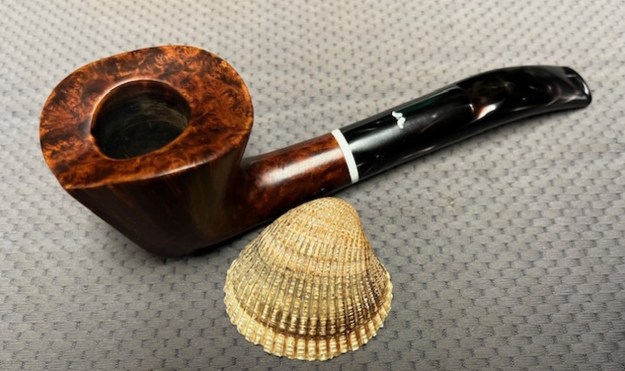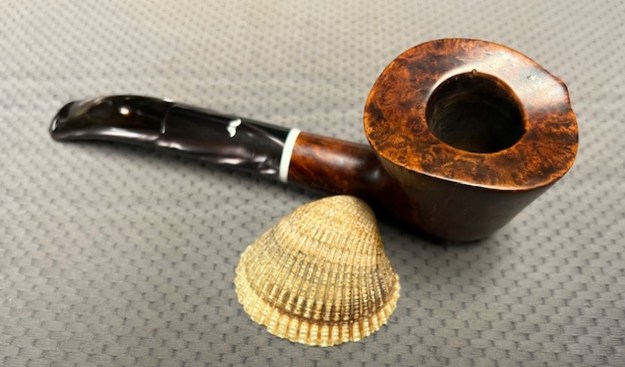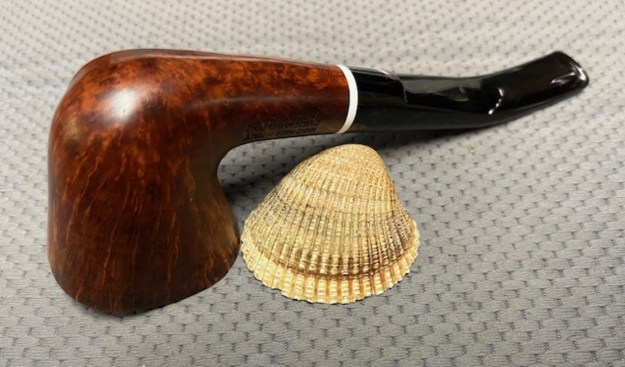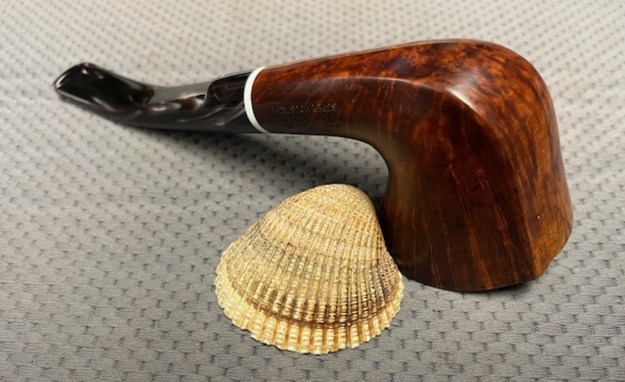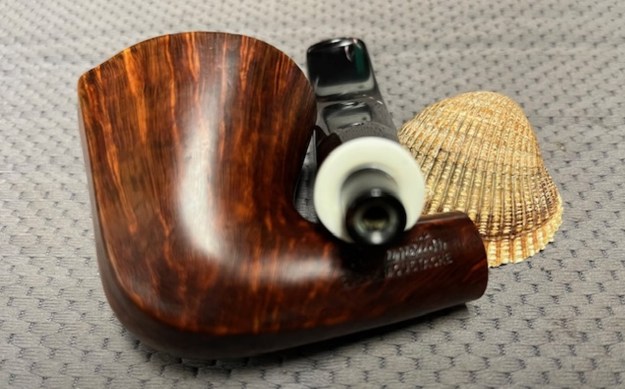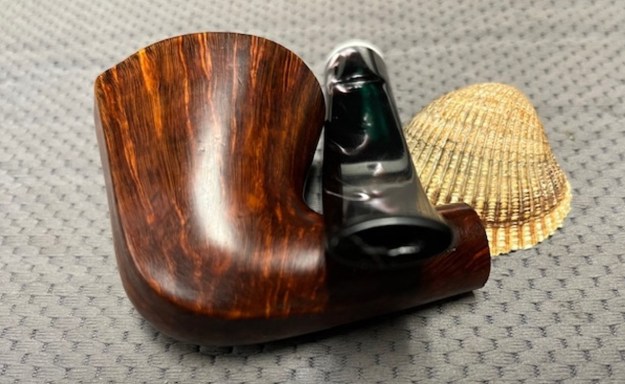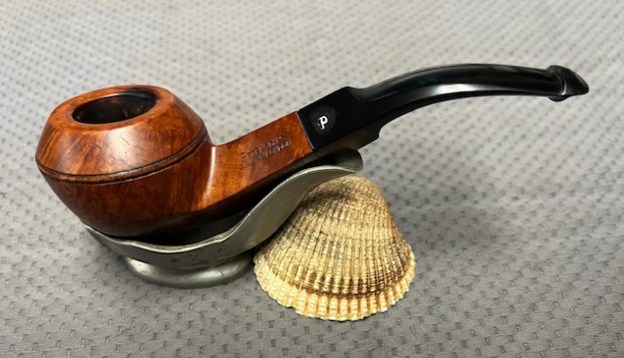
Tag Archives: Bowls – refinishing

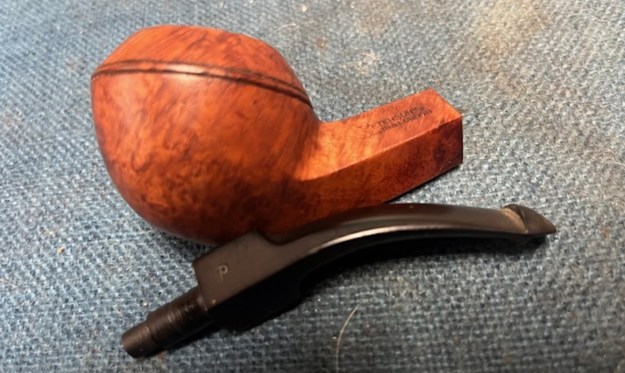
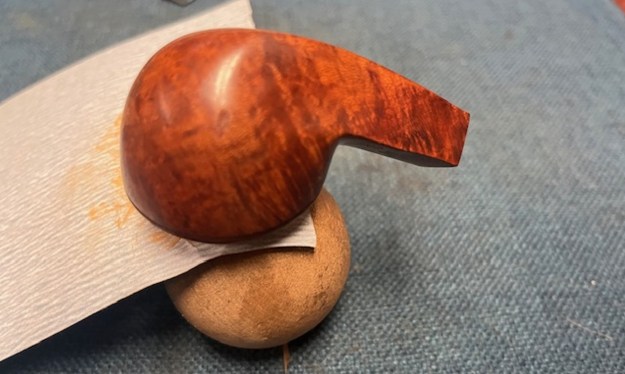
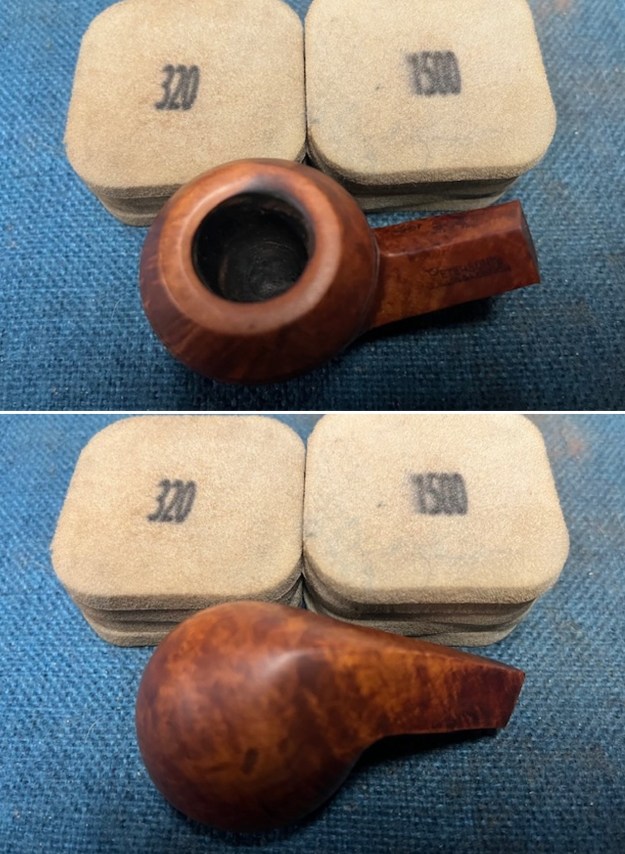
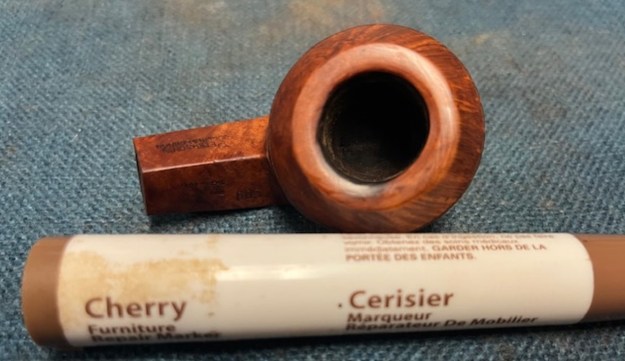
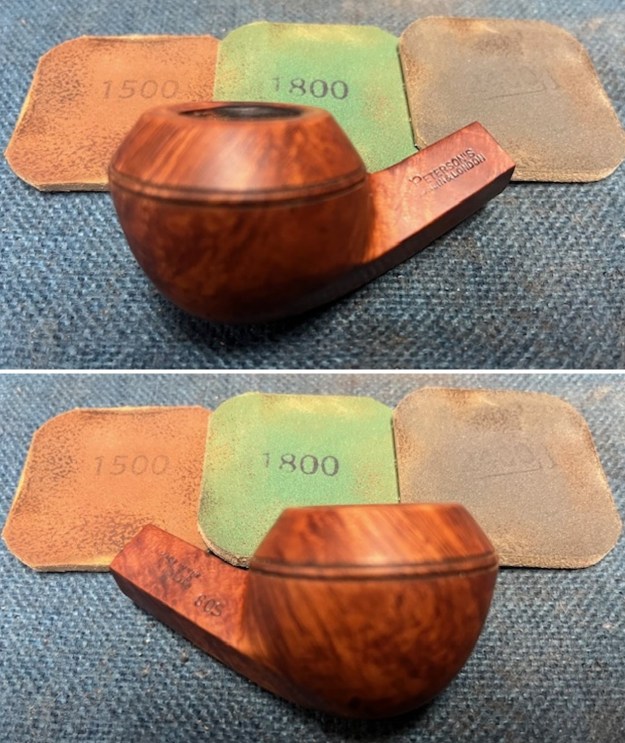
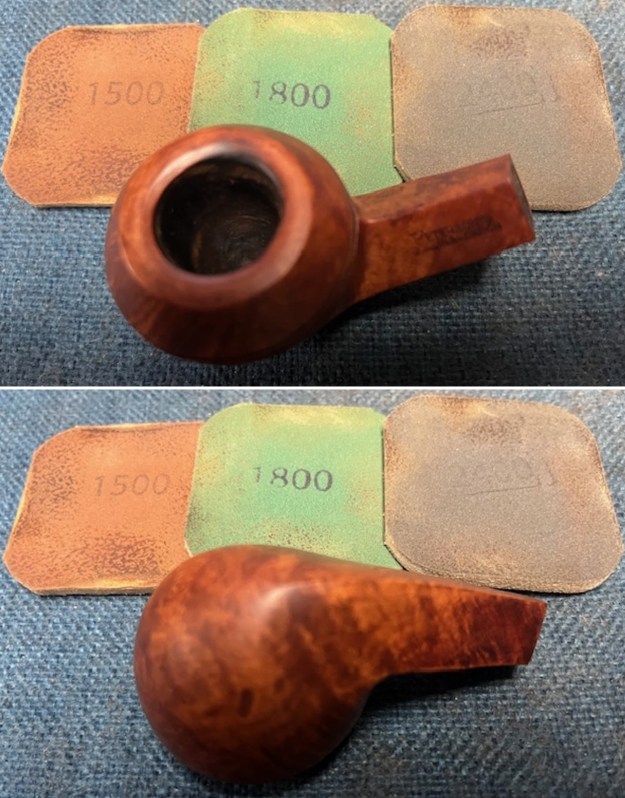
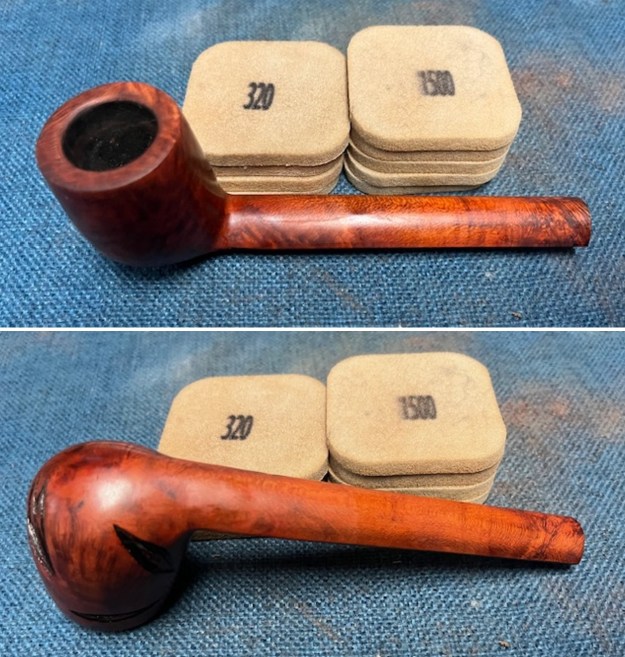
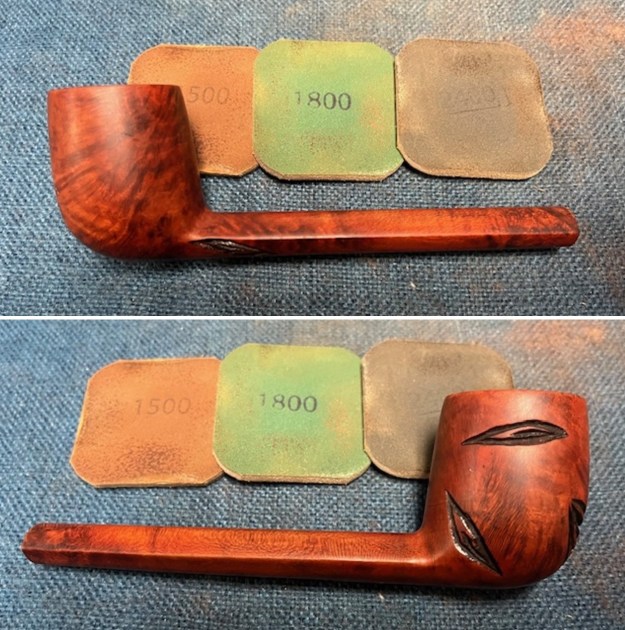
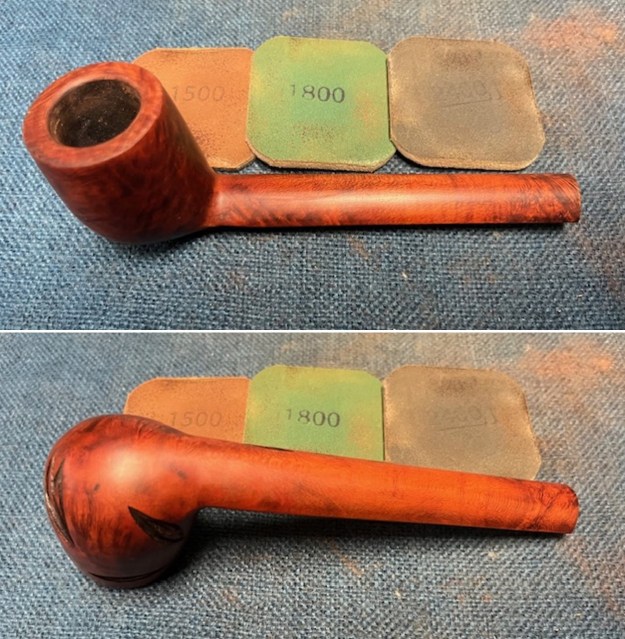
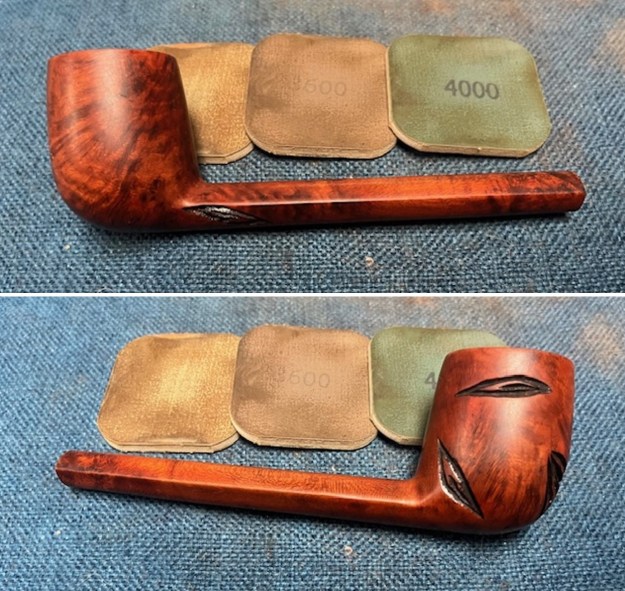
Restoring a Traded BBB 1986 Christmas Special Make Lovat


by Steve Laug

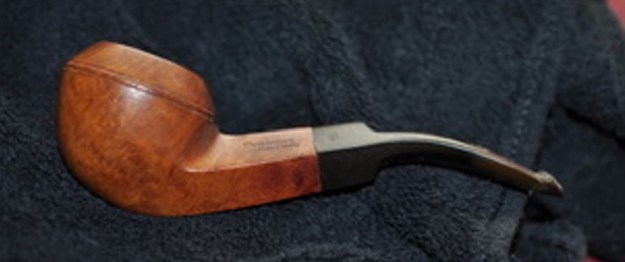
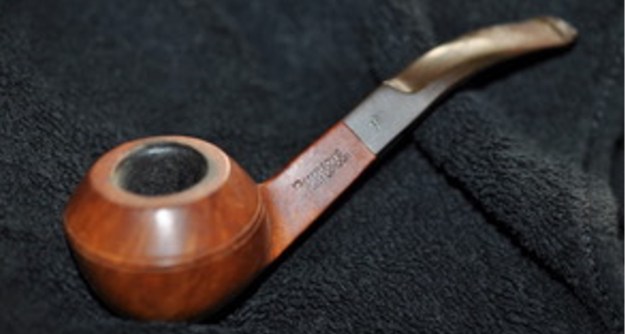
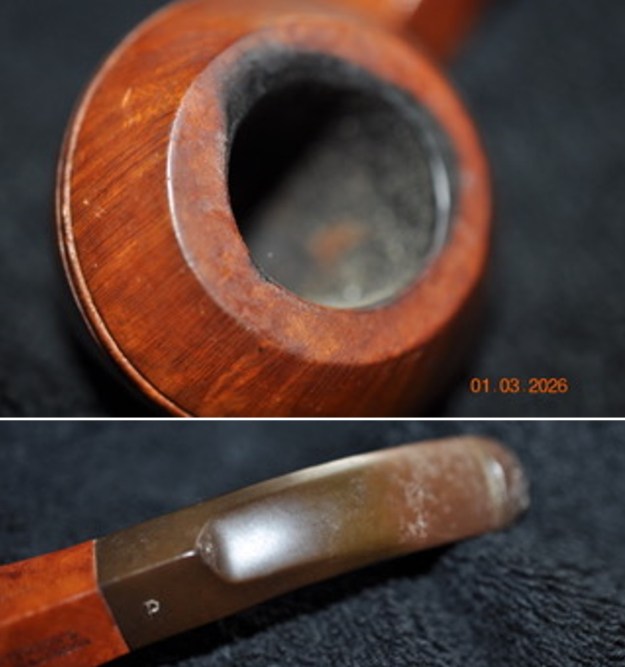
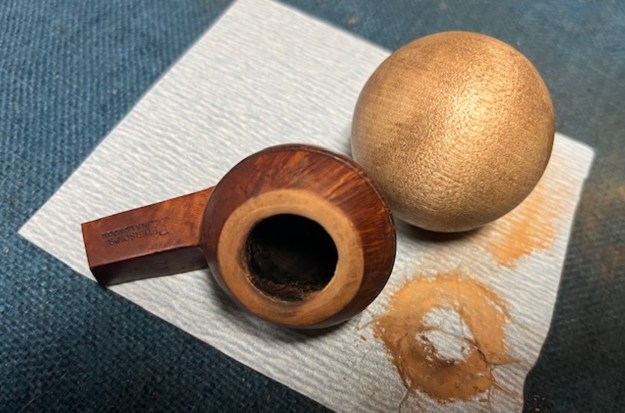
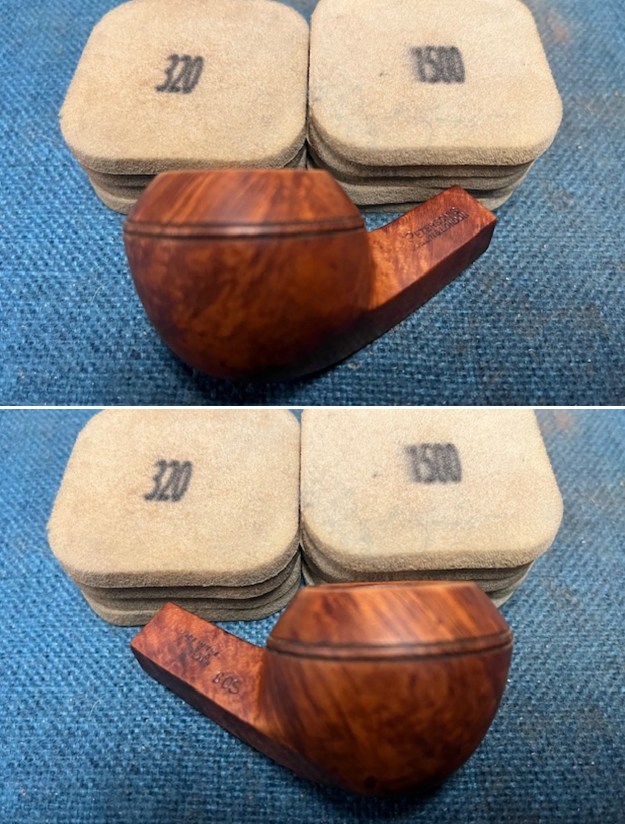
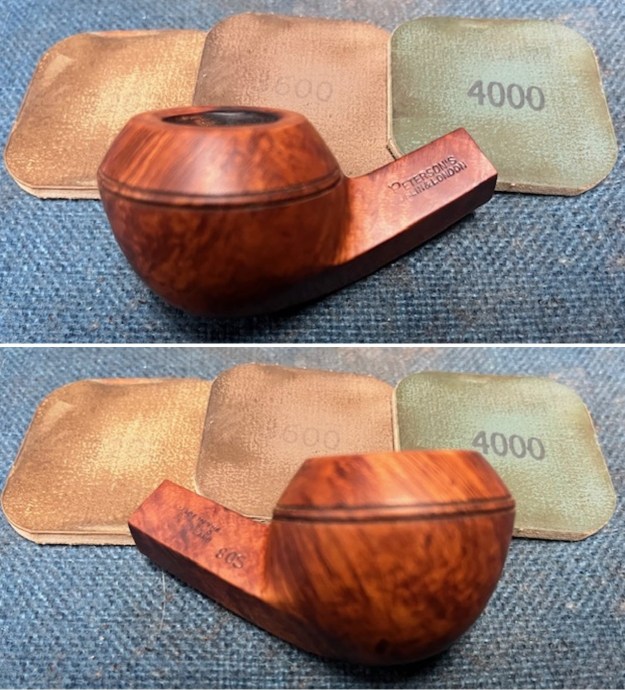
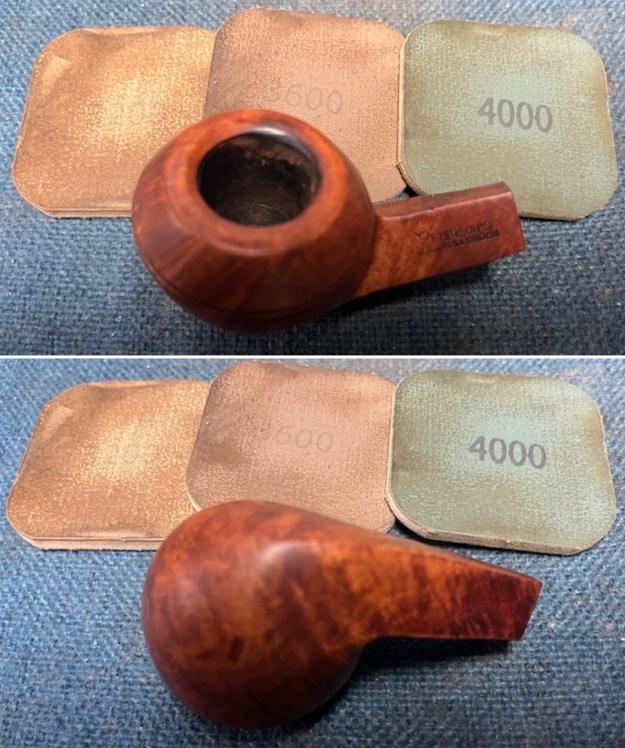
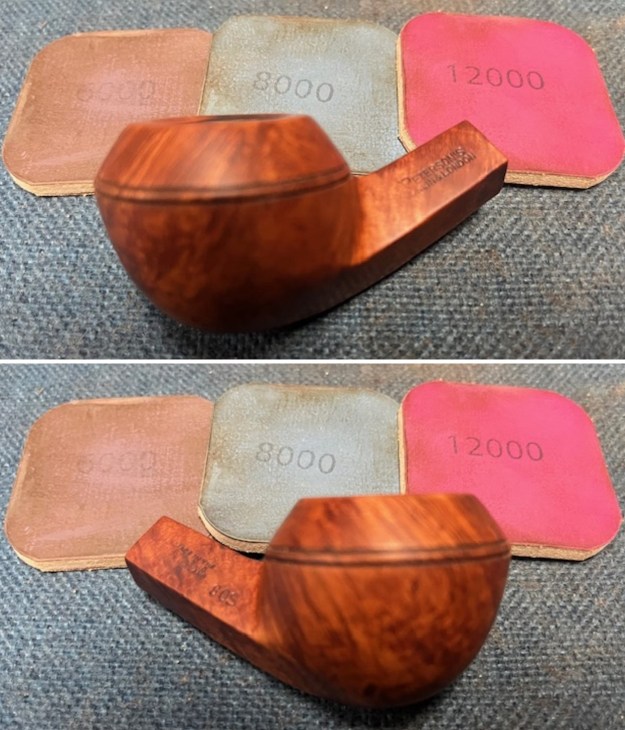
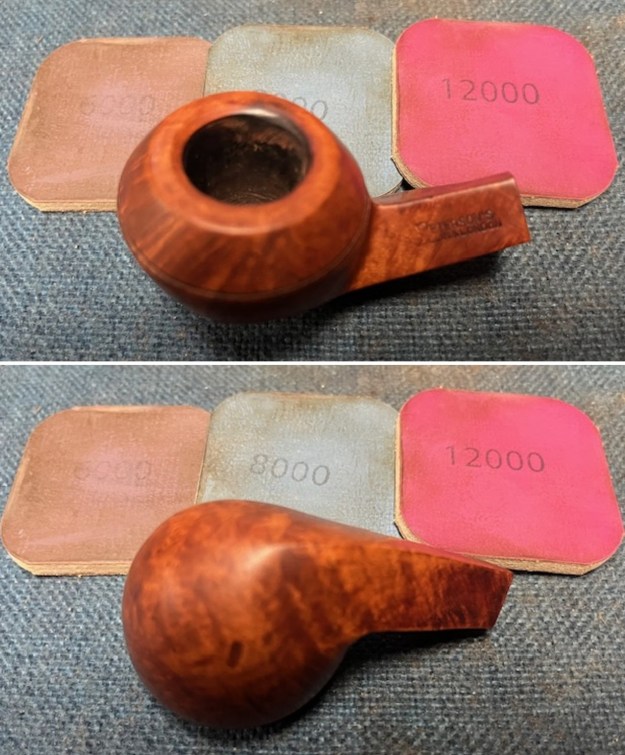
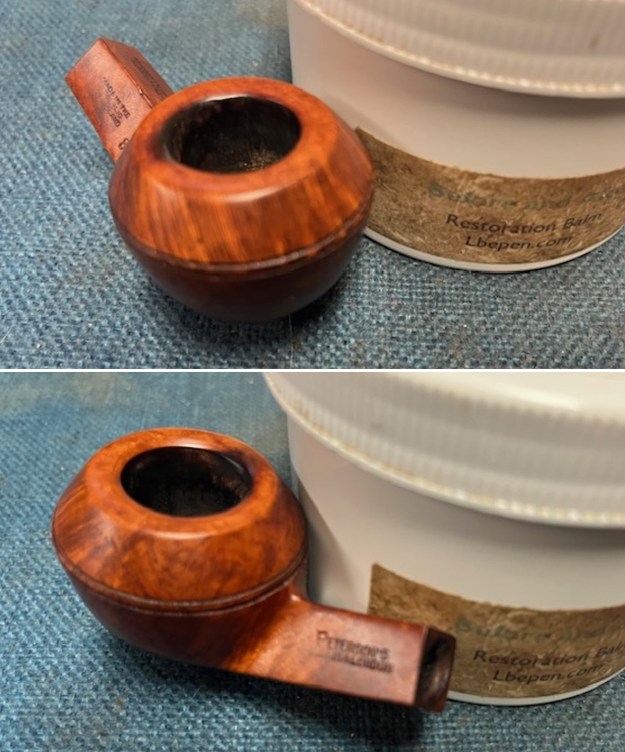
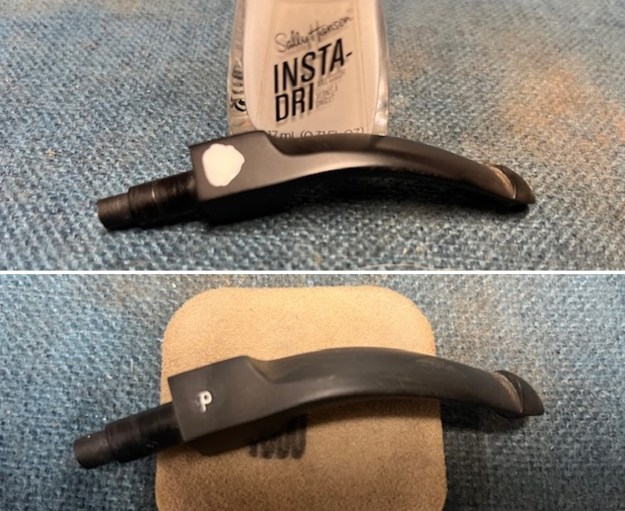
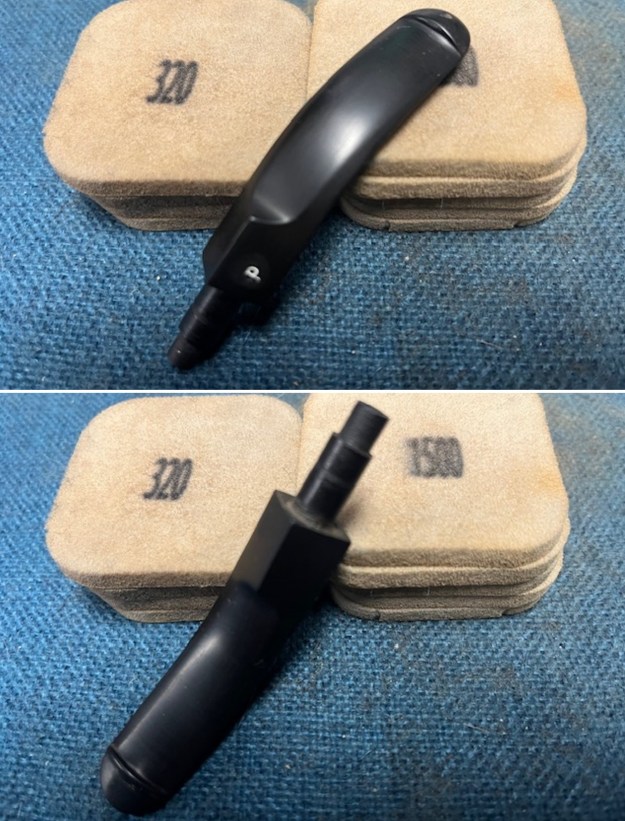
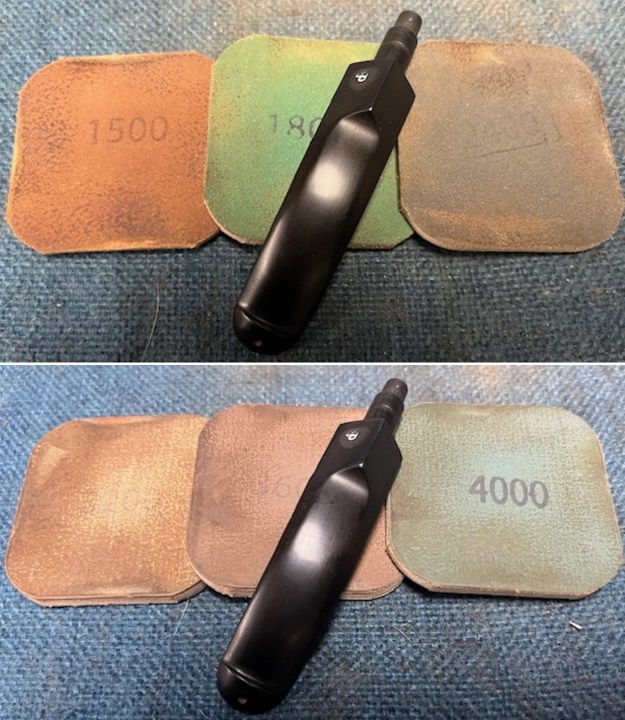
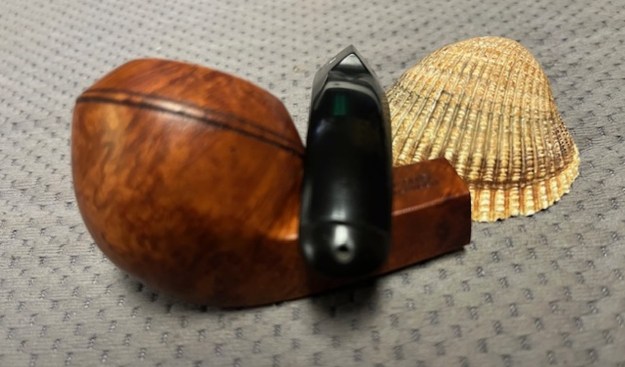
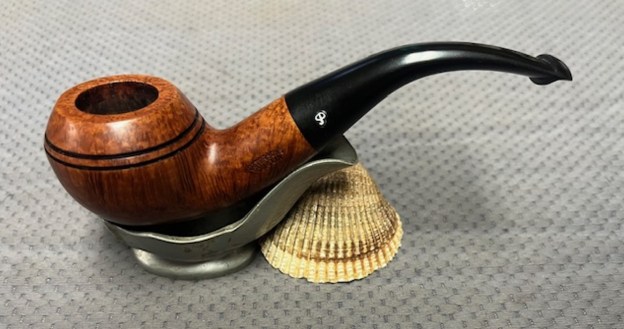
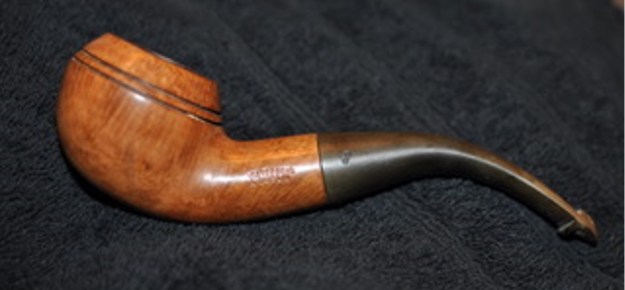
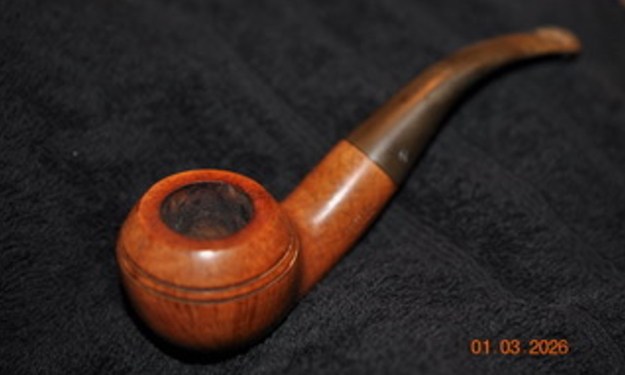
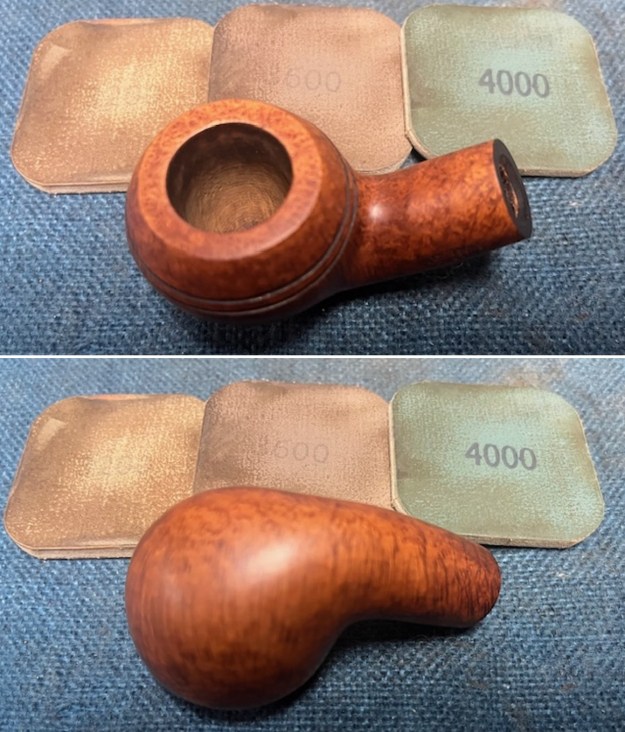
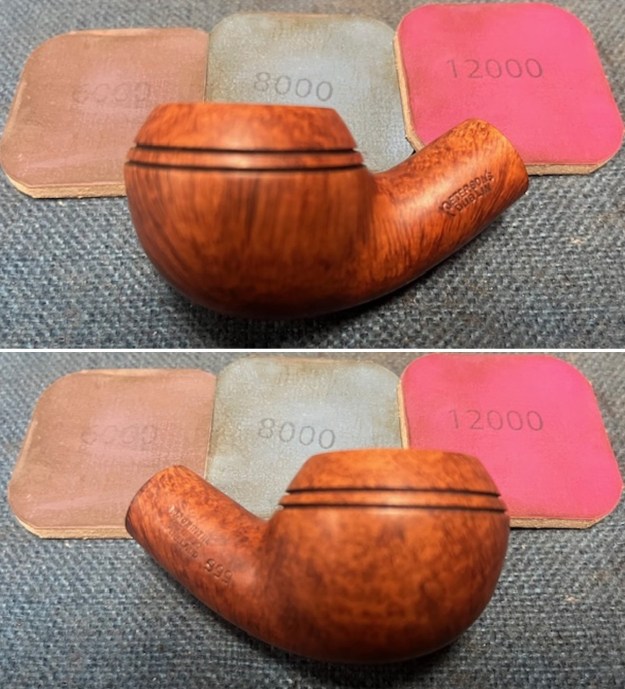
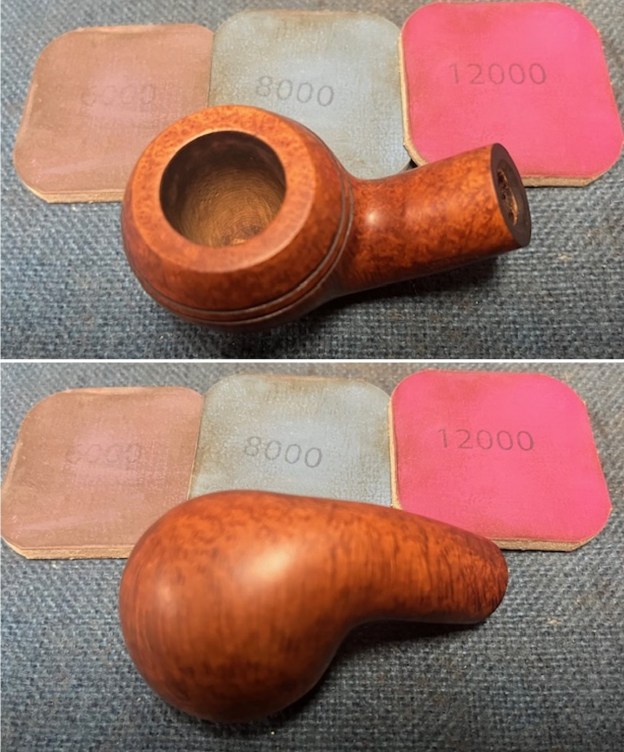
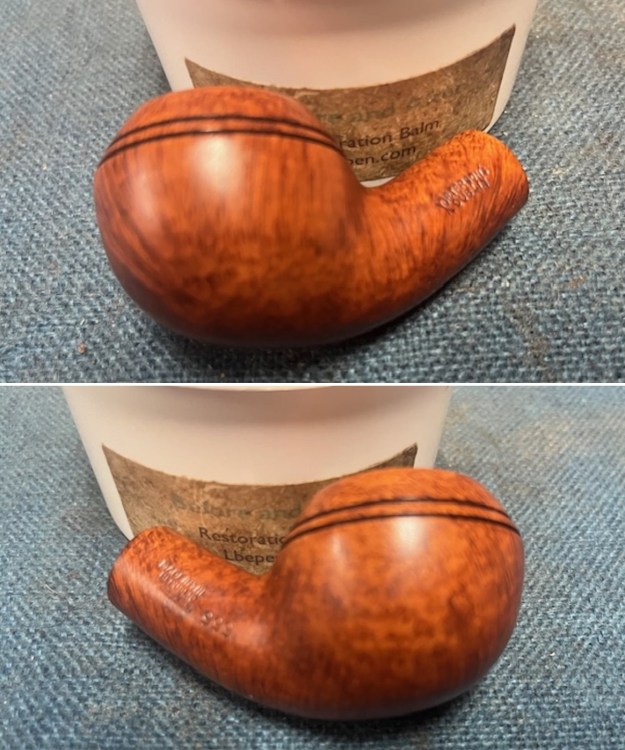
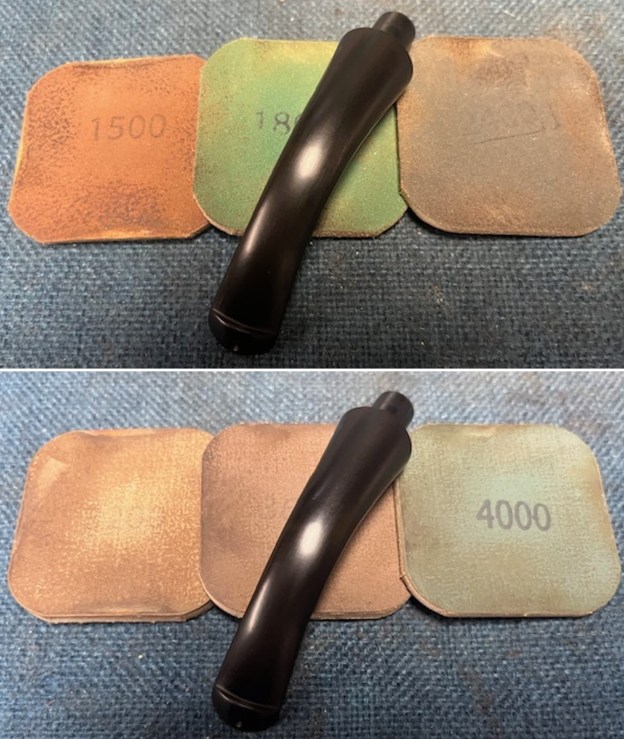
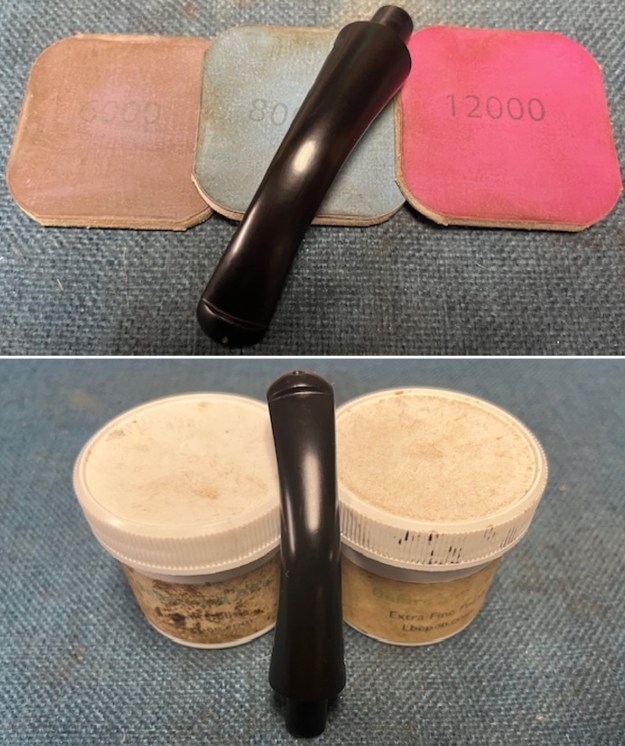
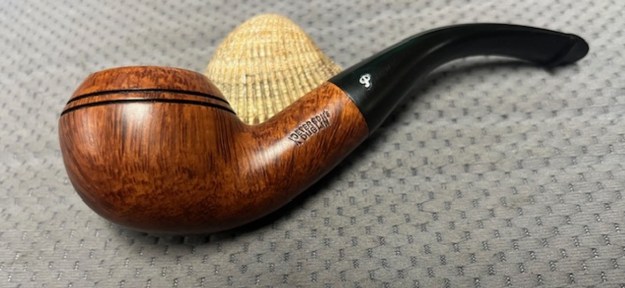
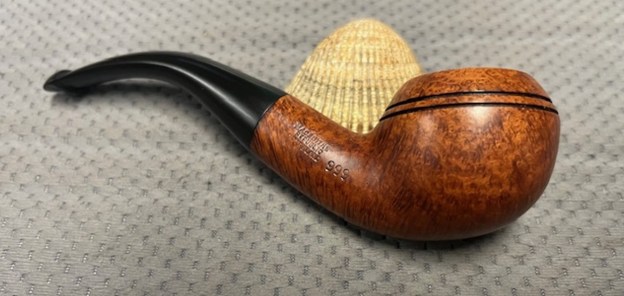
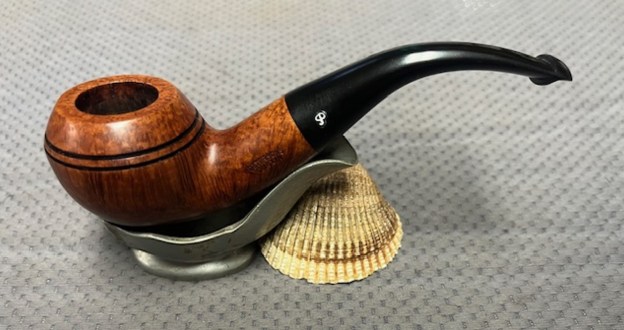
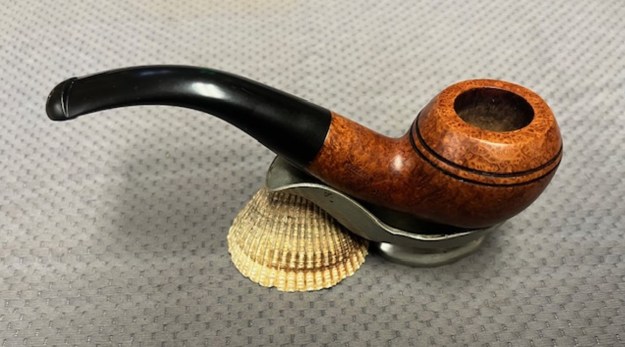
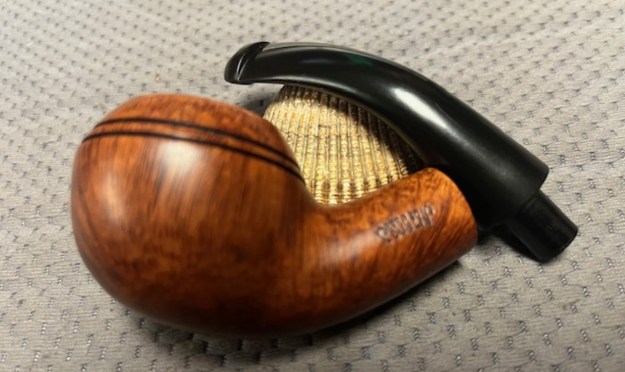
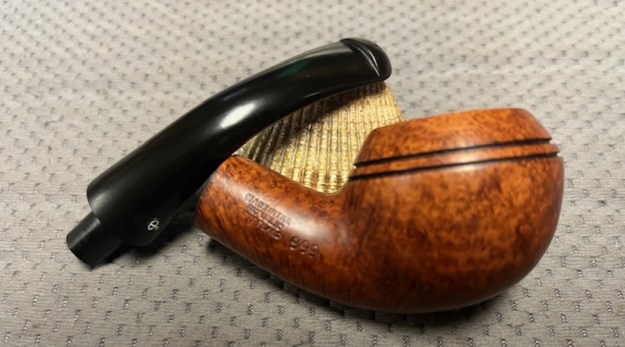
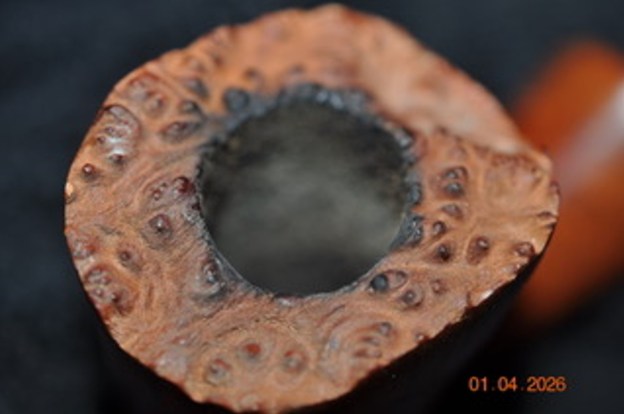
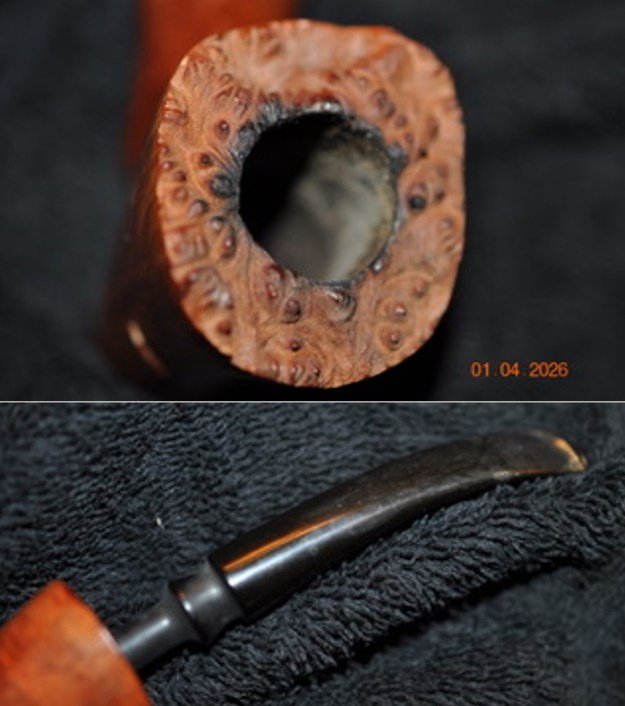
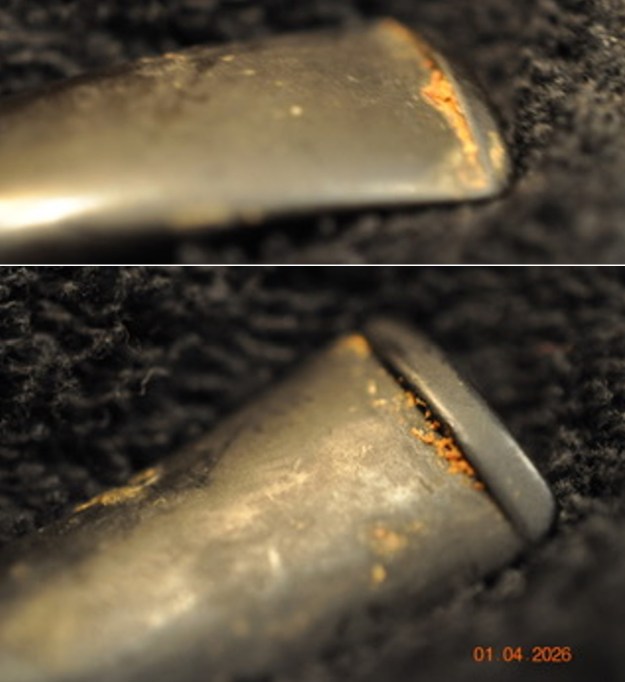
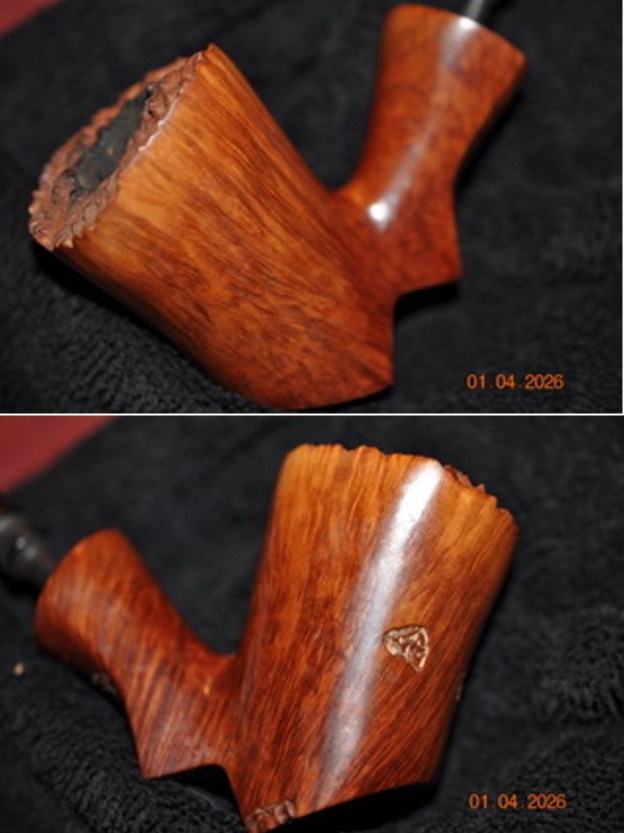
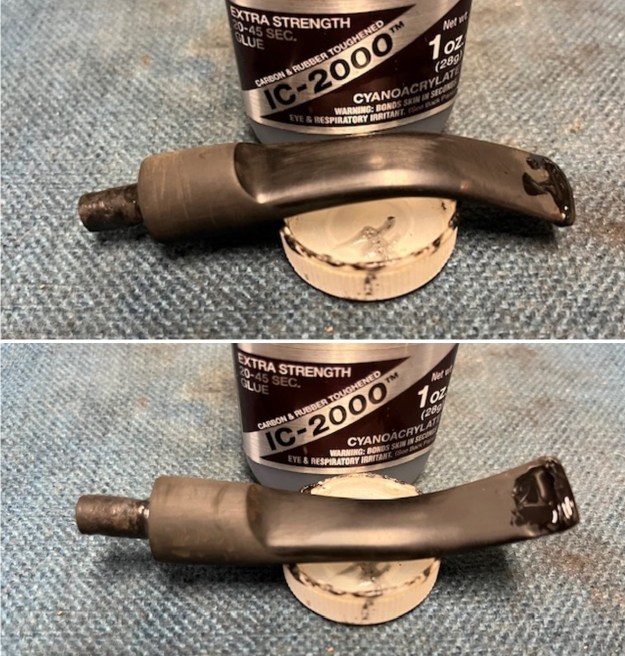
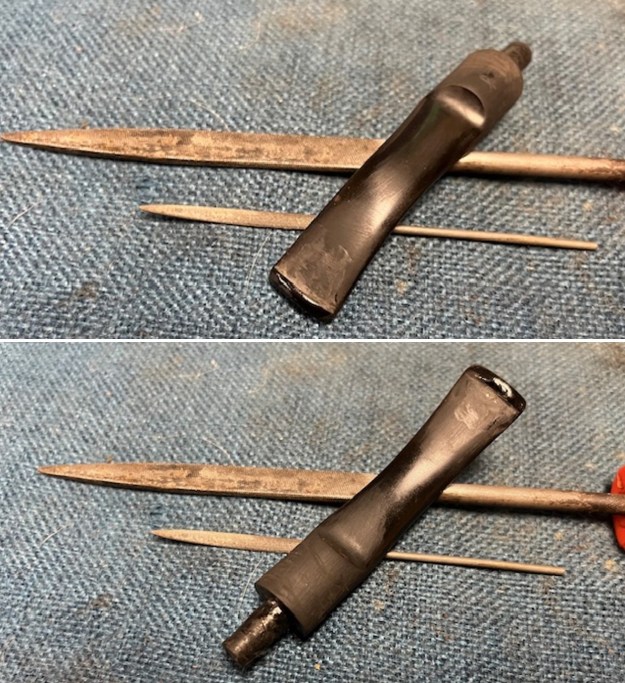
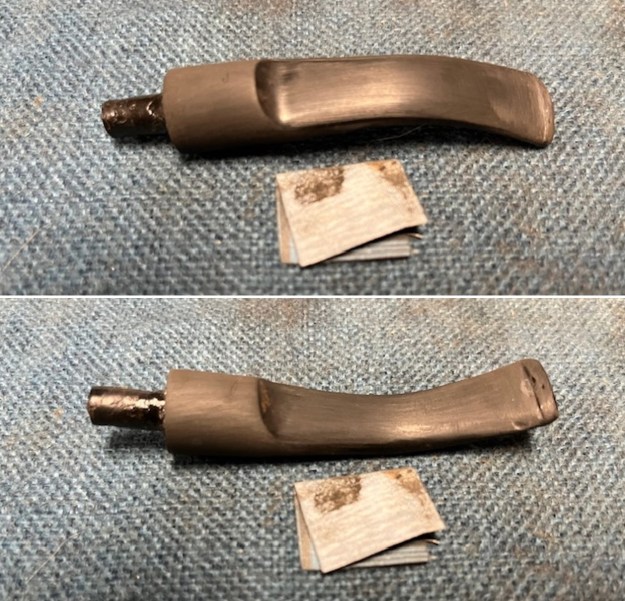
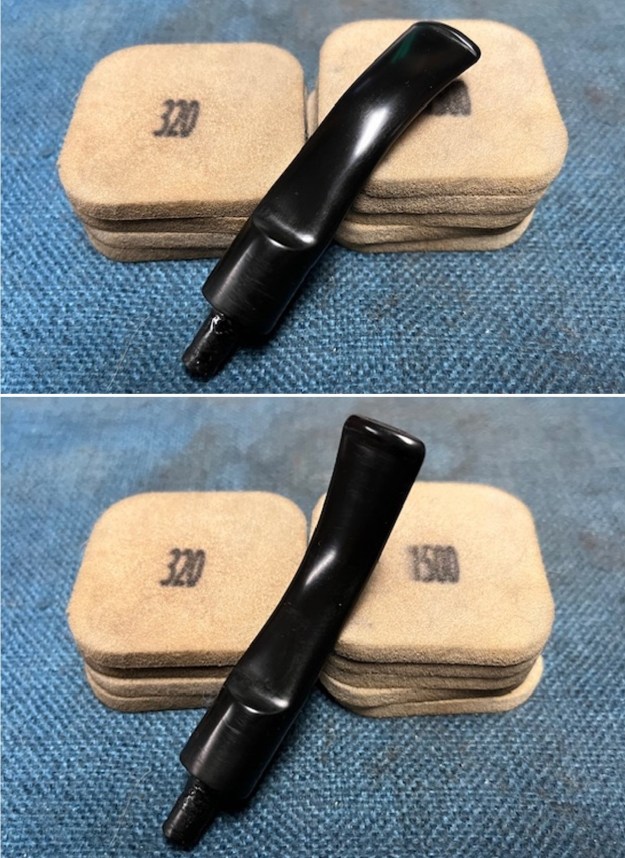
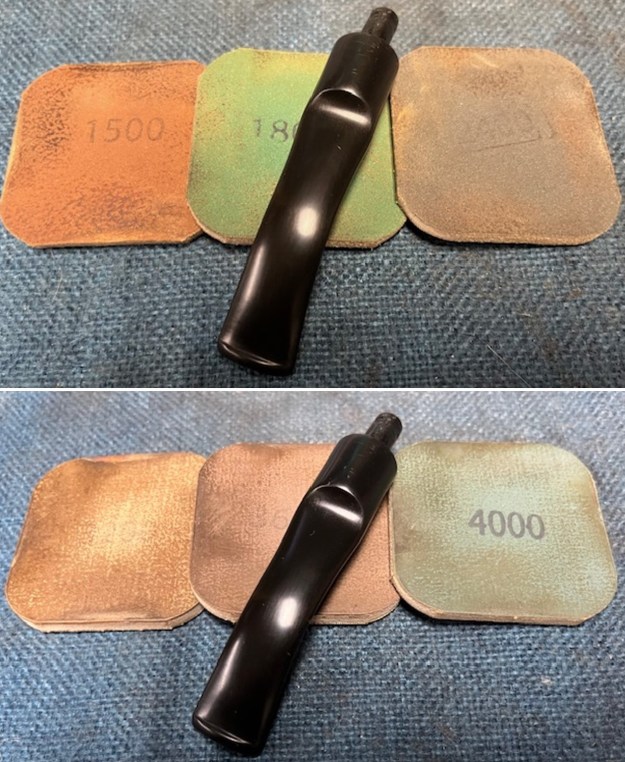
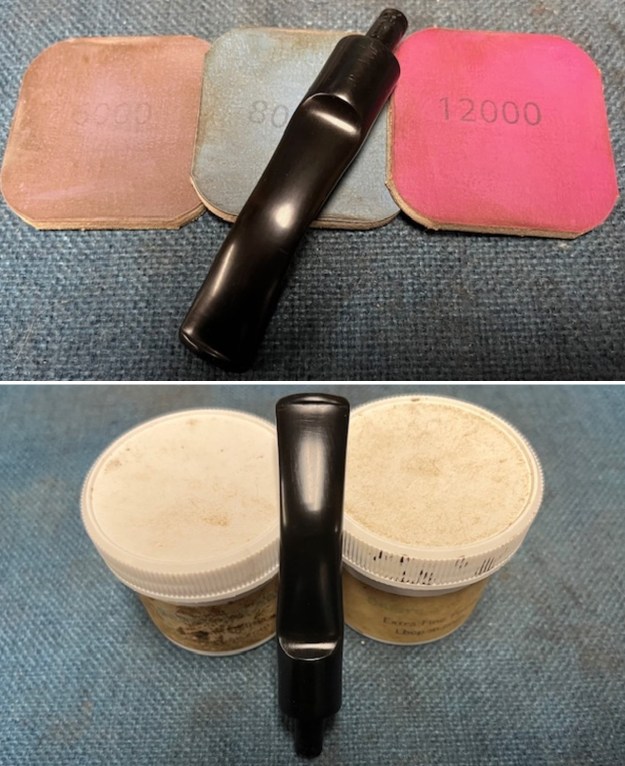
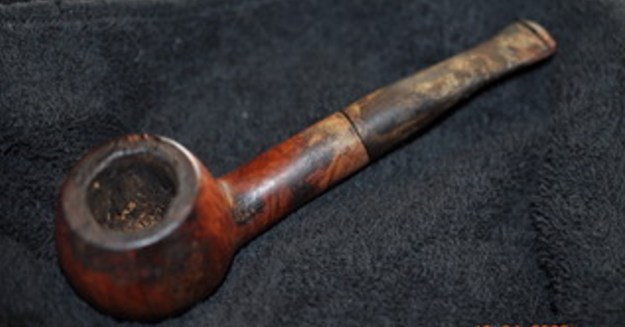
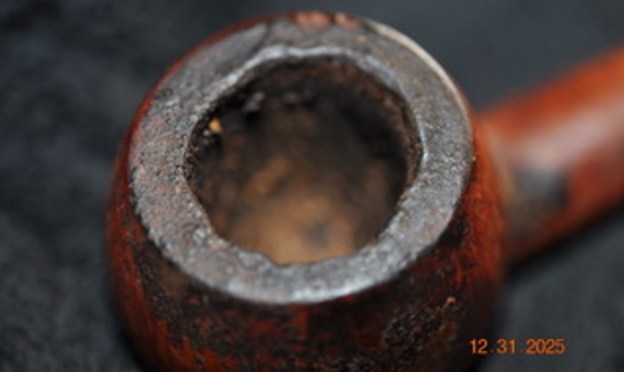
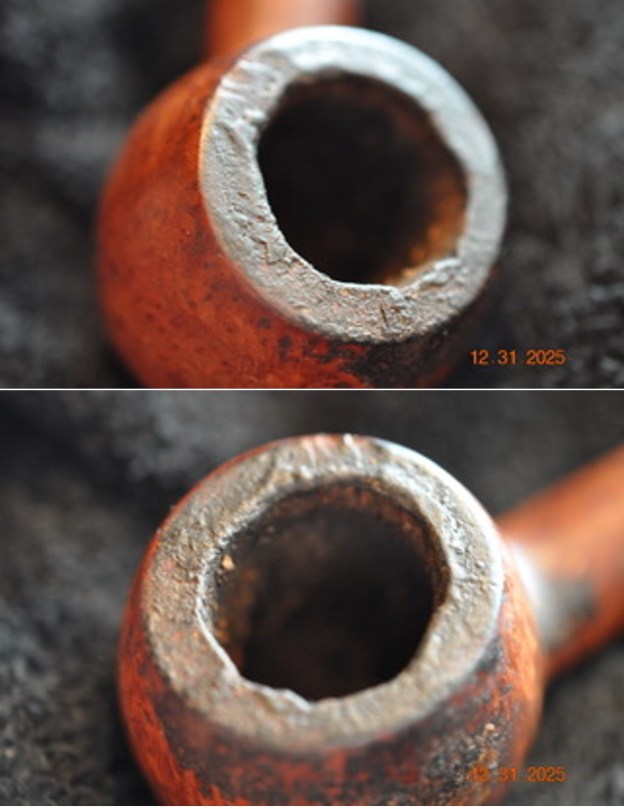
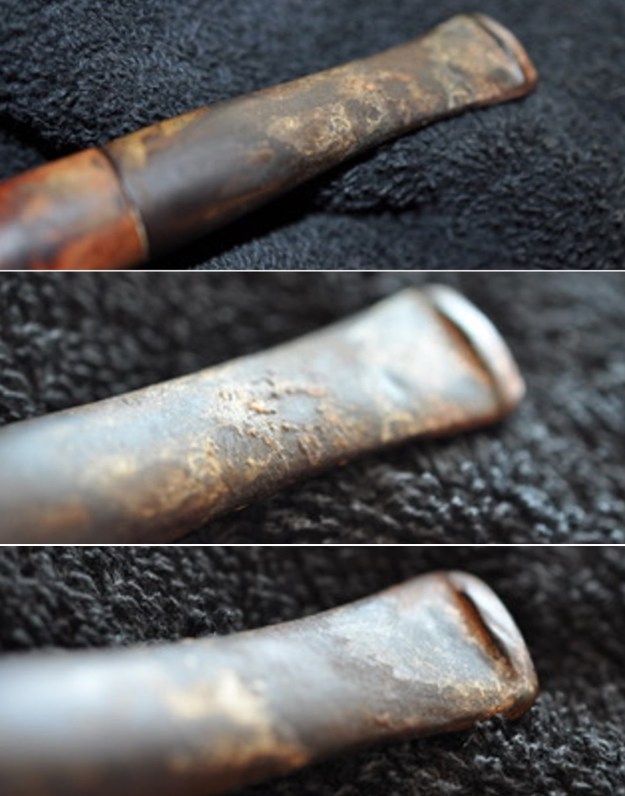
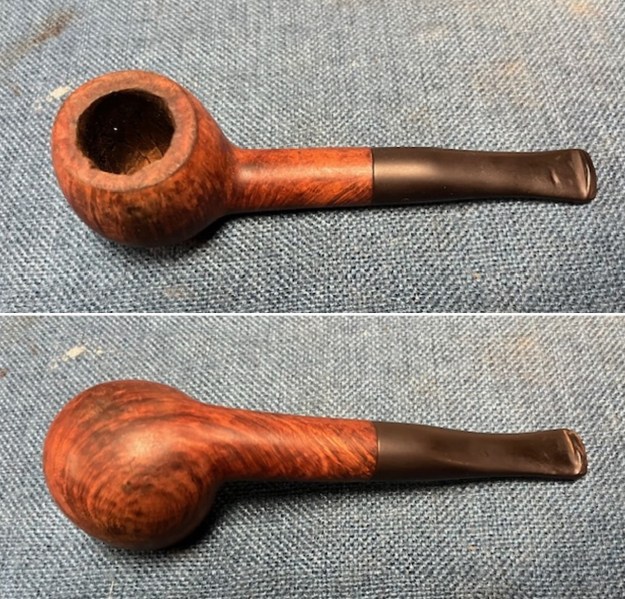
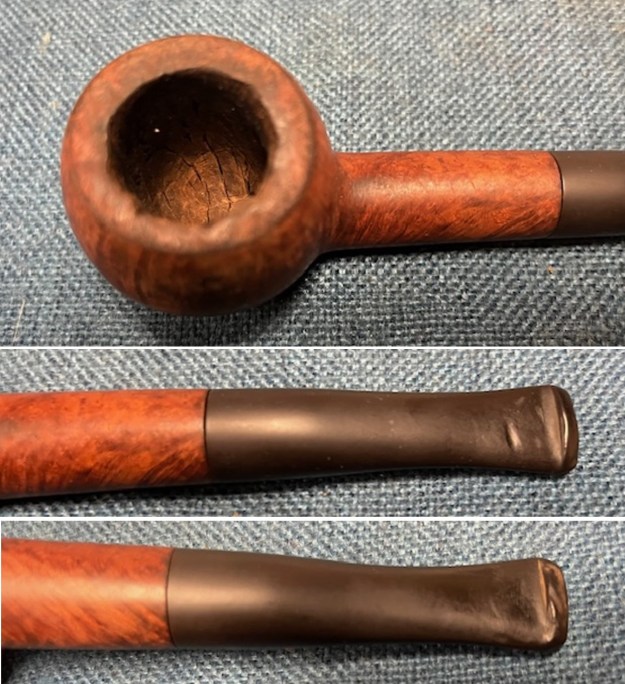
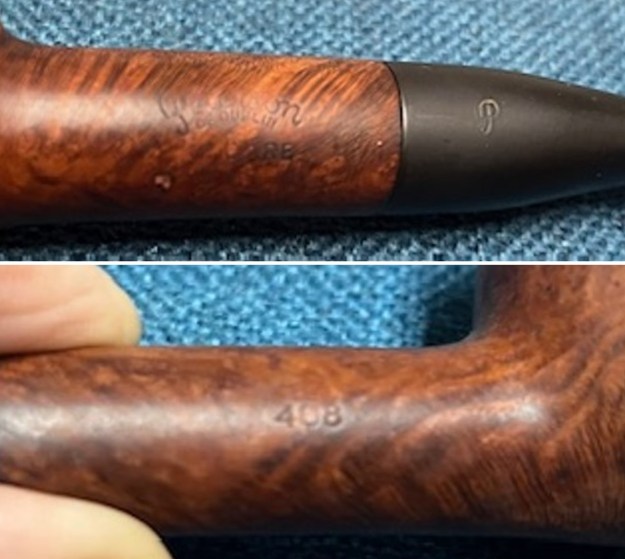
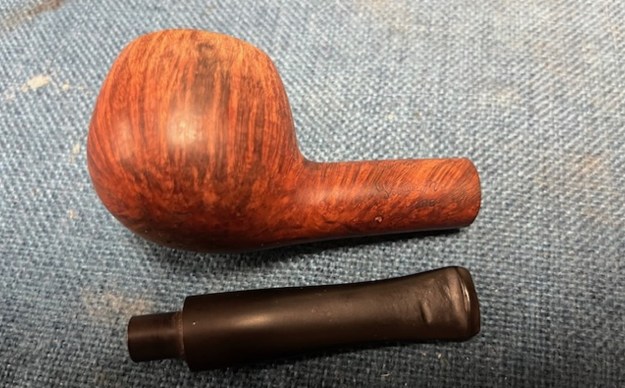
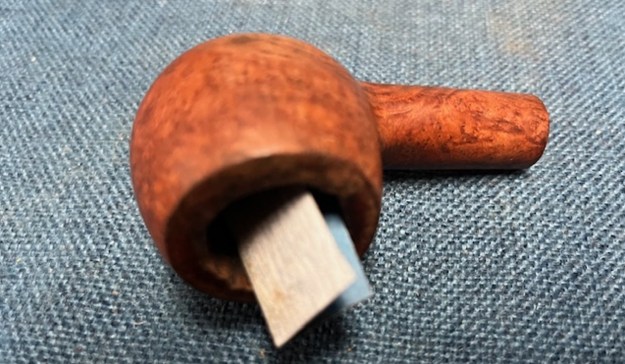
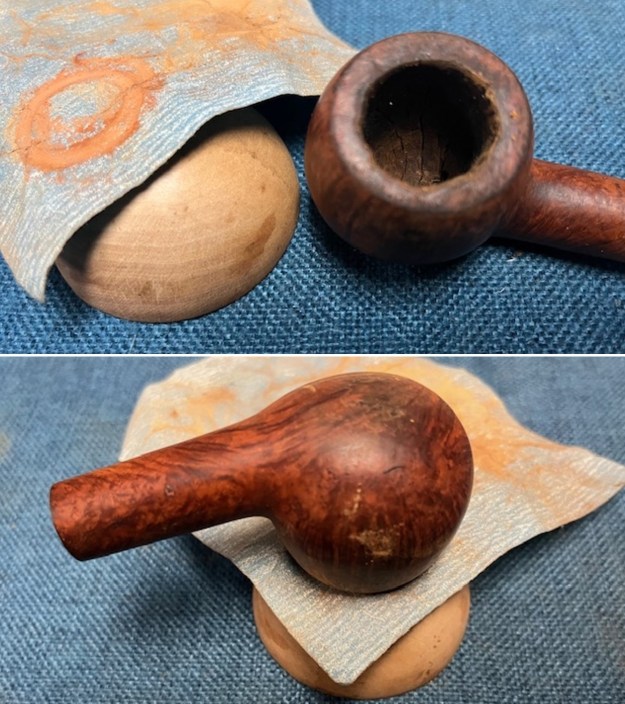
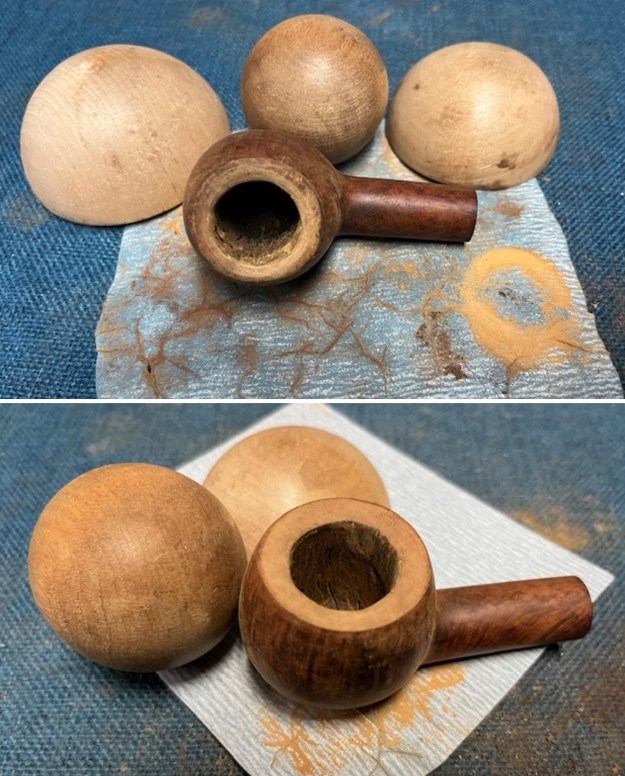
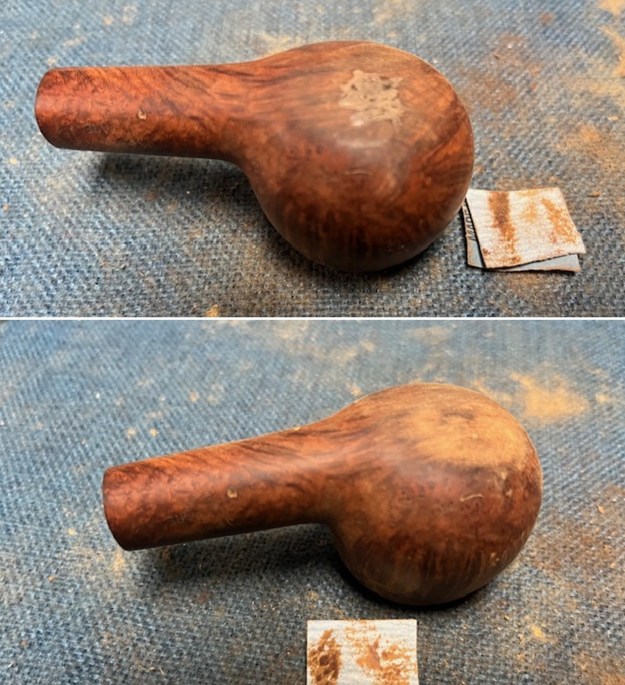
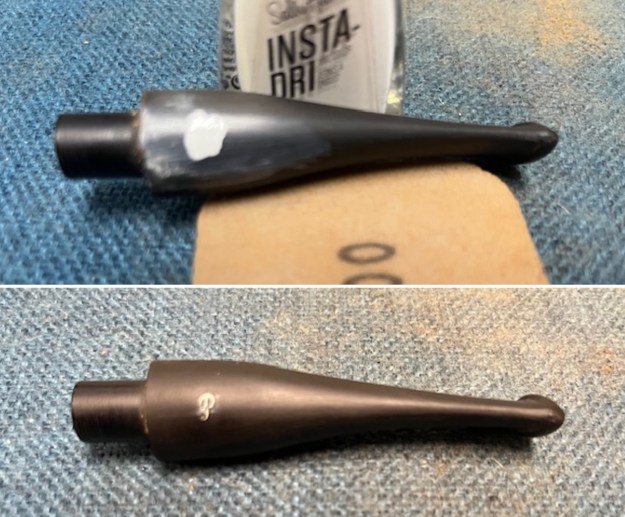
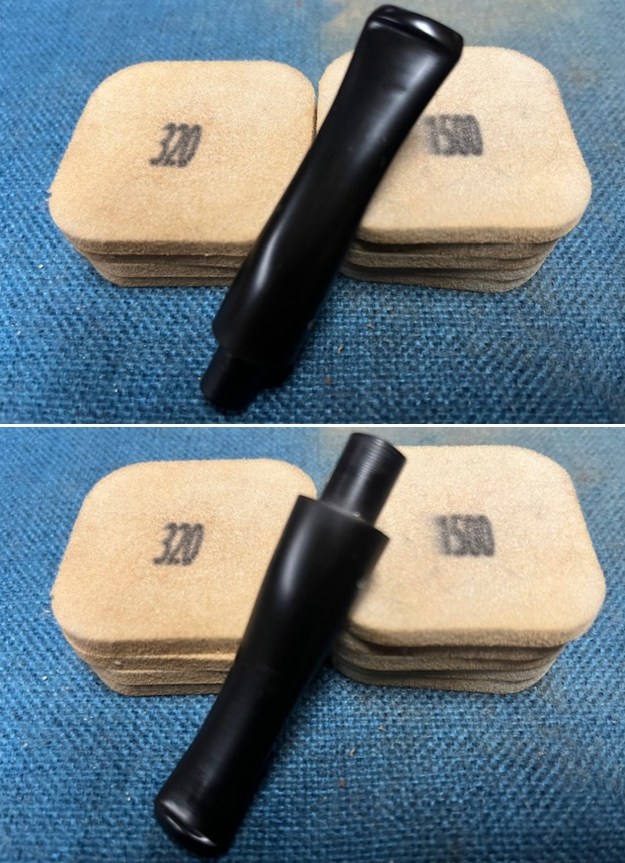
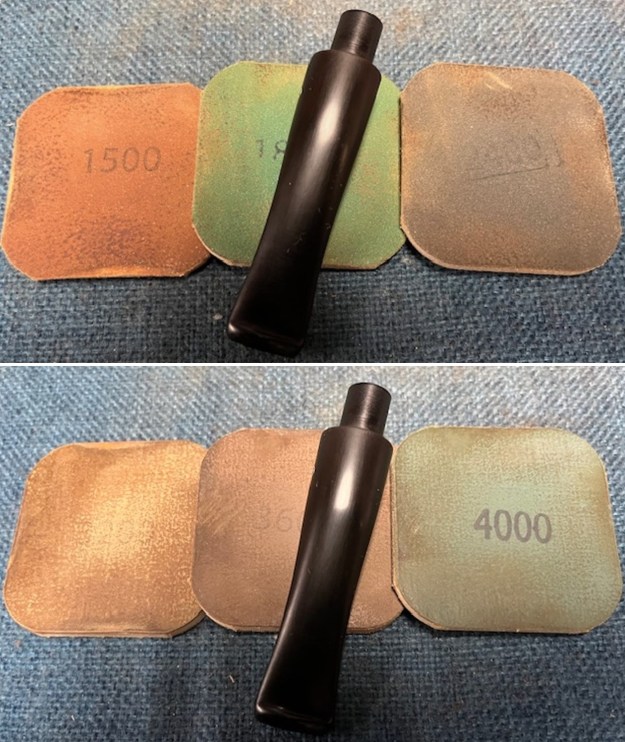
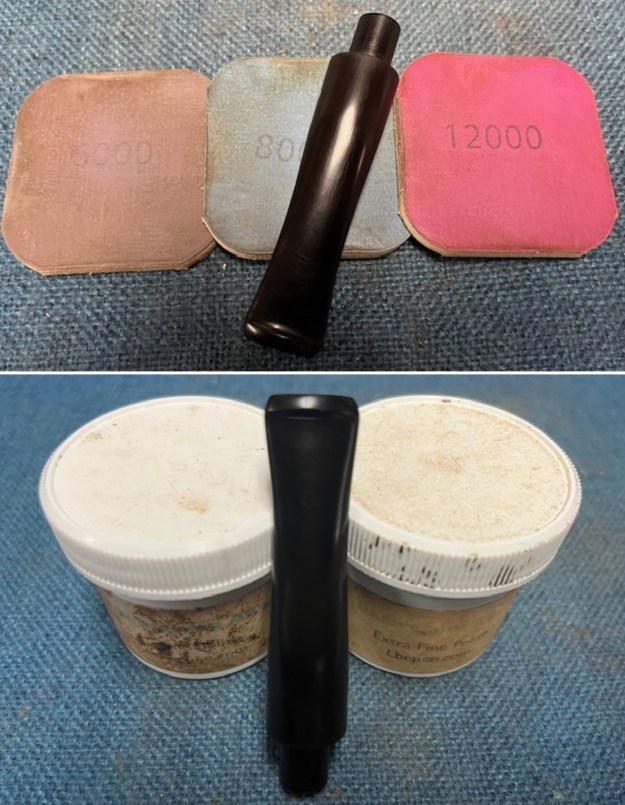
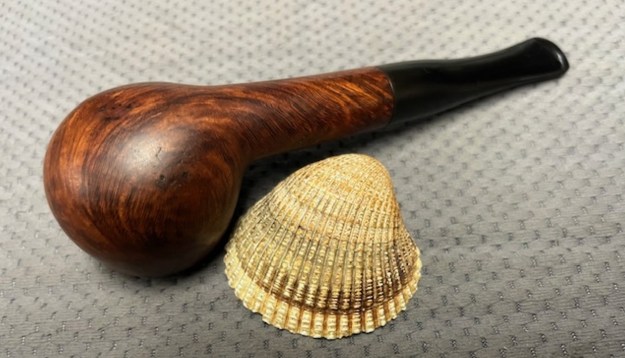
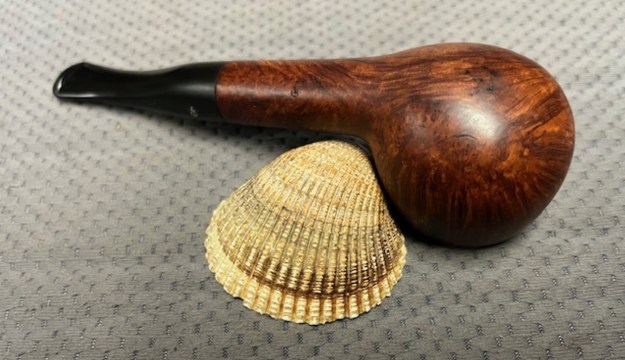
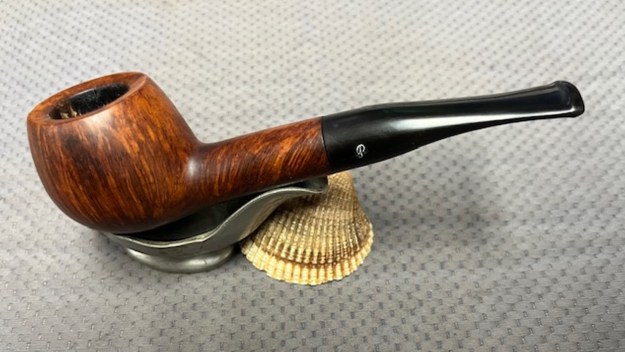
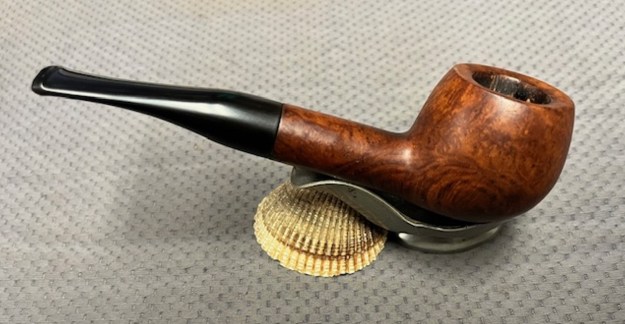
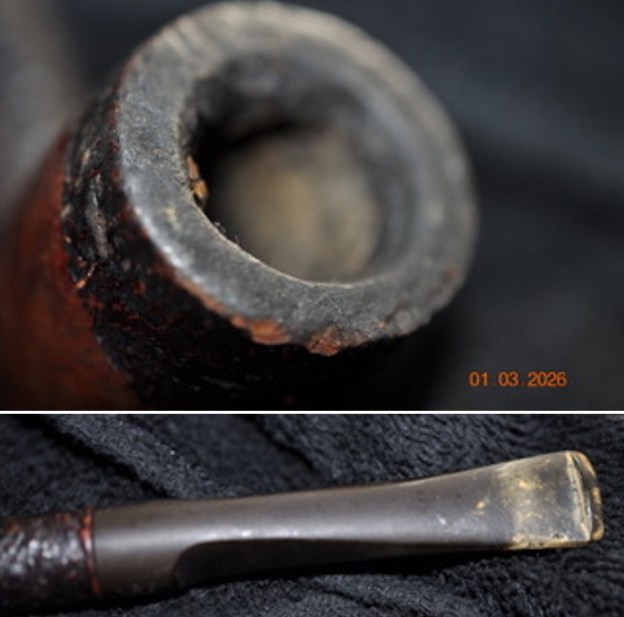
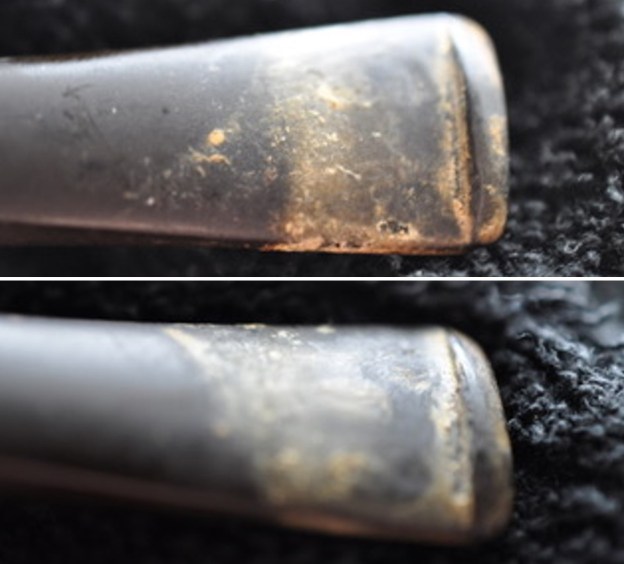
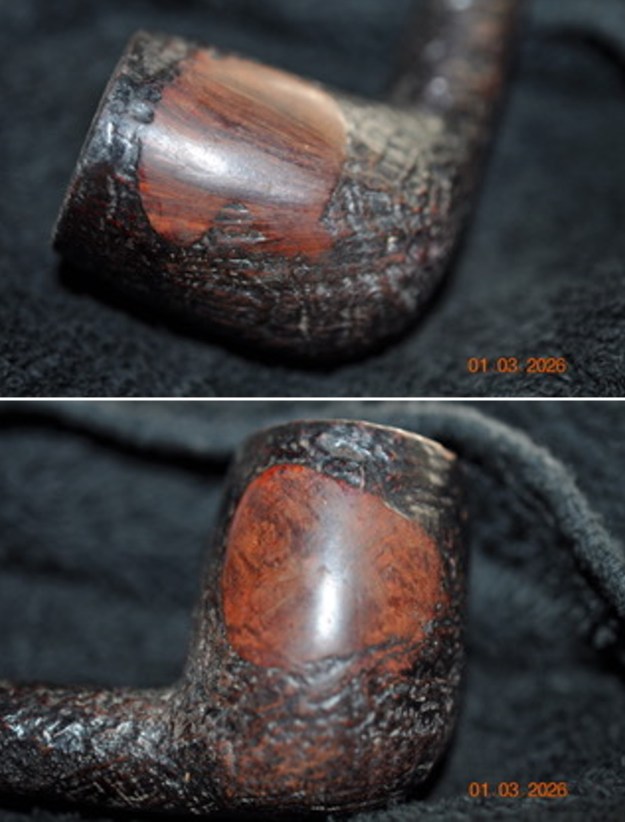
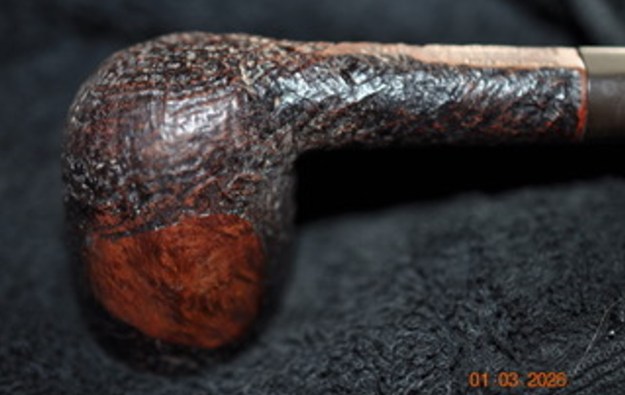
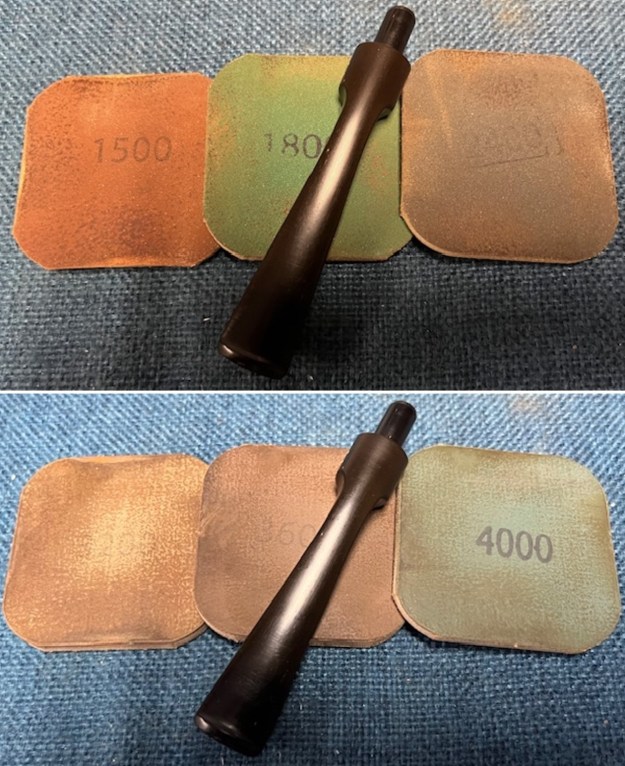
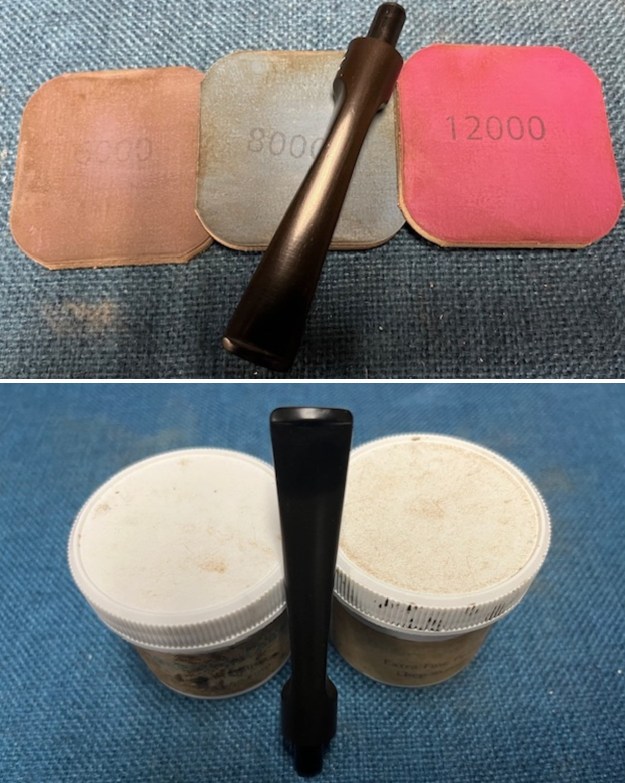
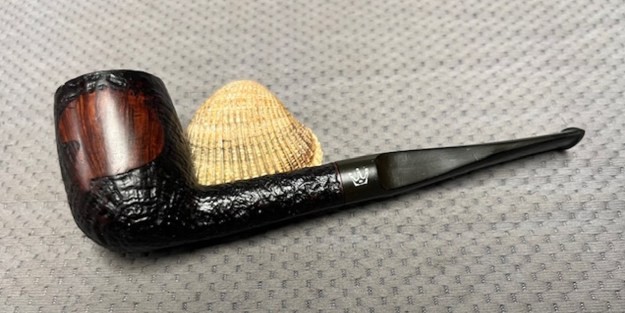
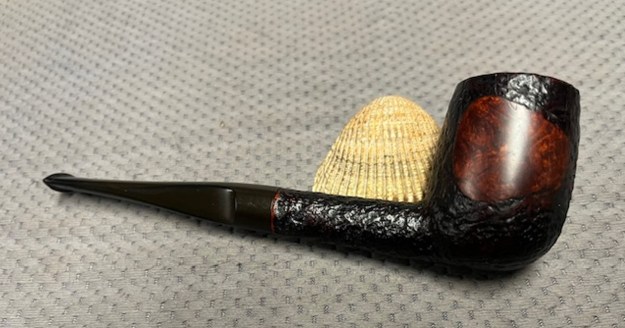
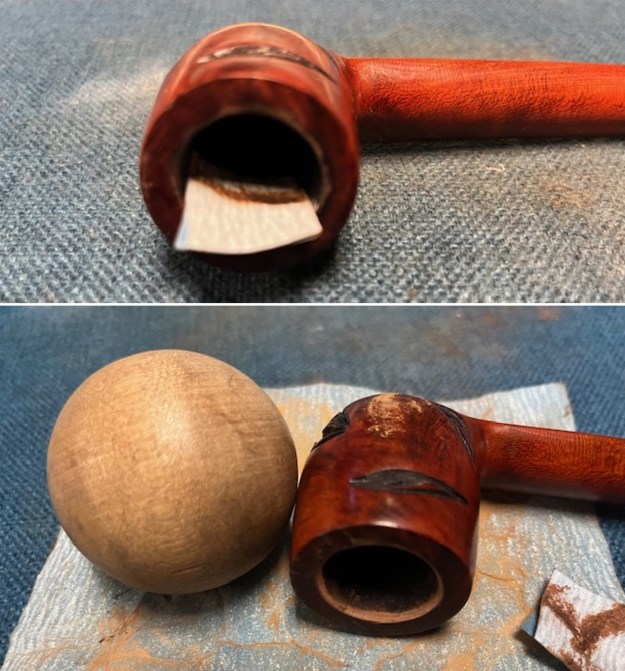
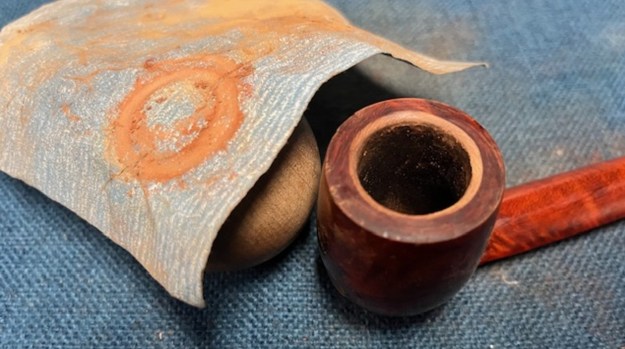
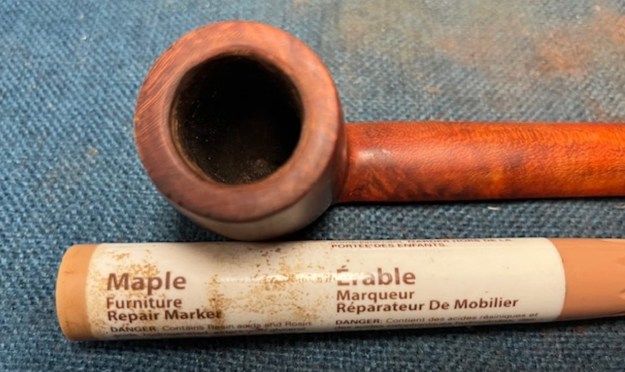
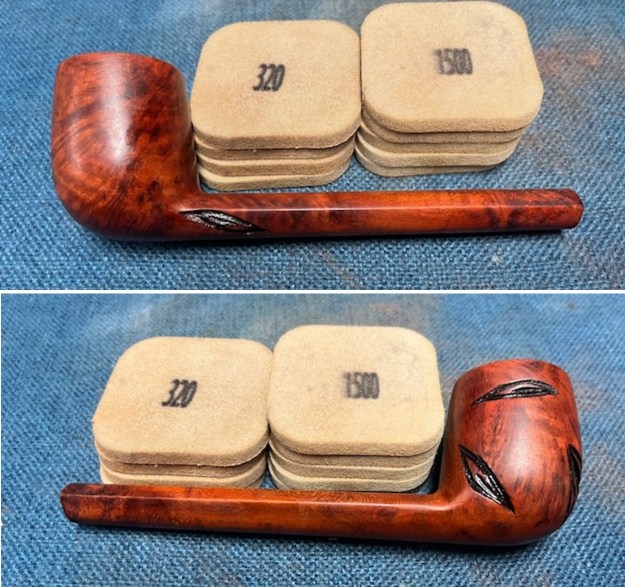
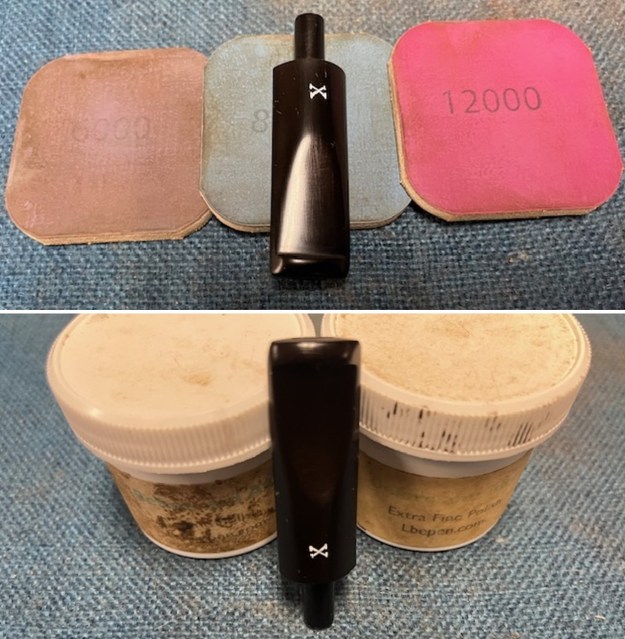
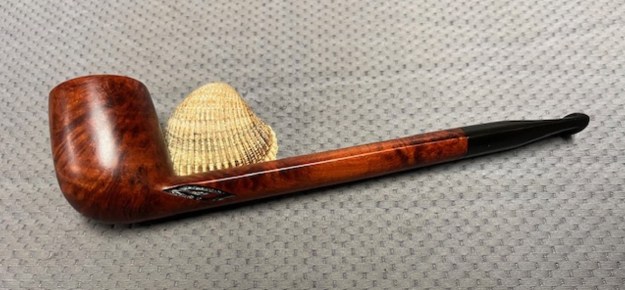
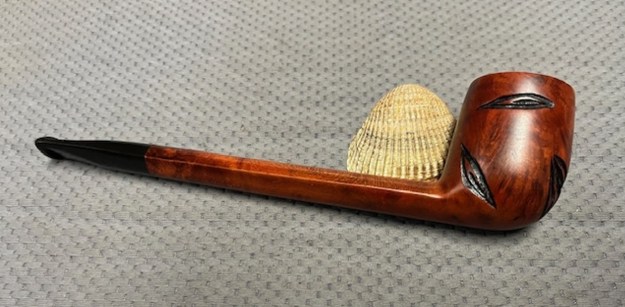
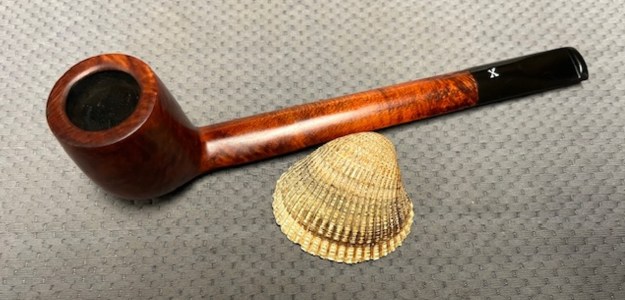
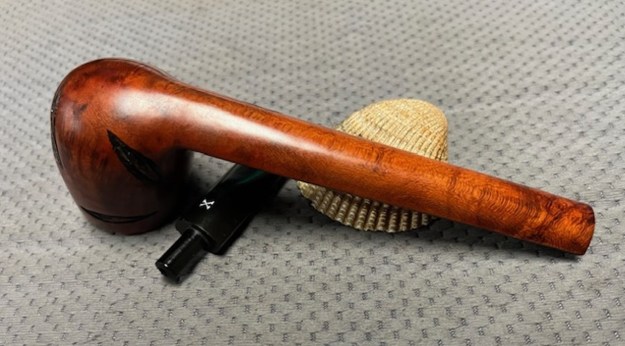
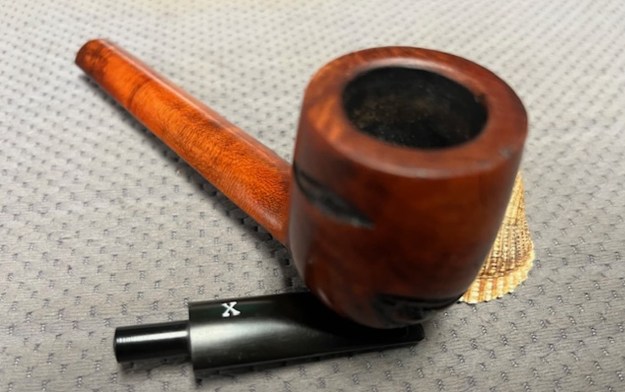
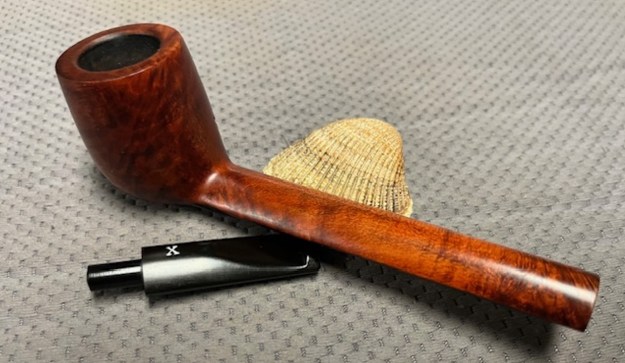
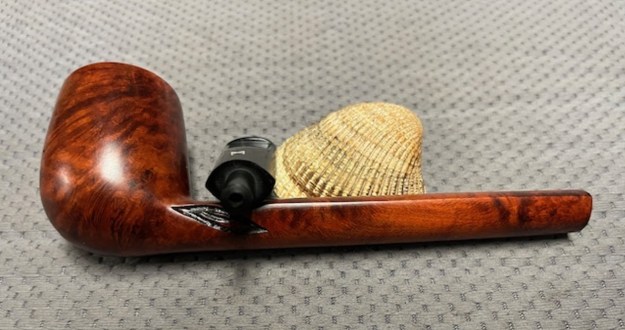
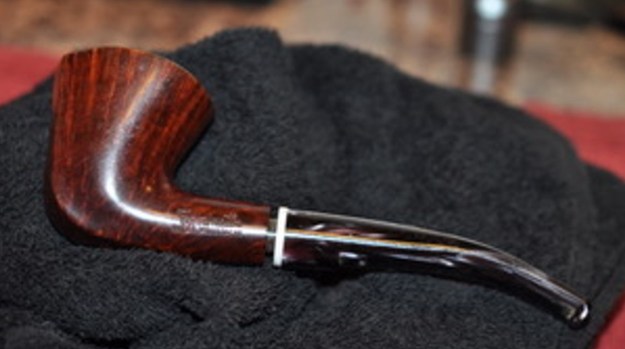
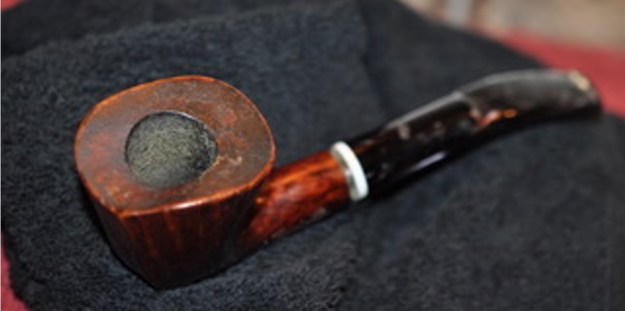
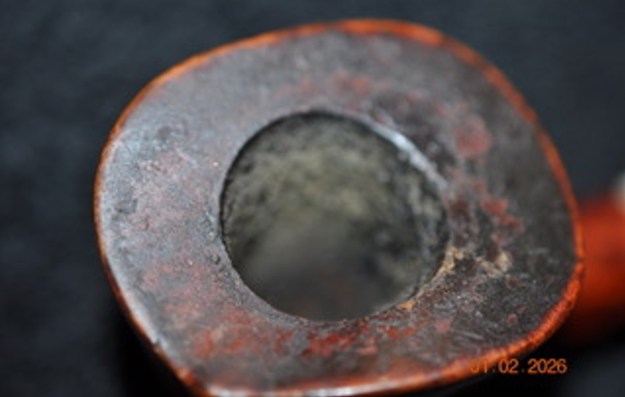
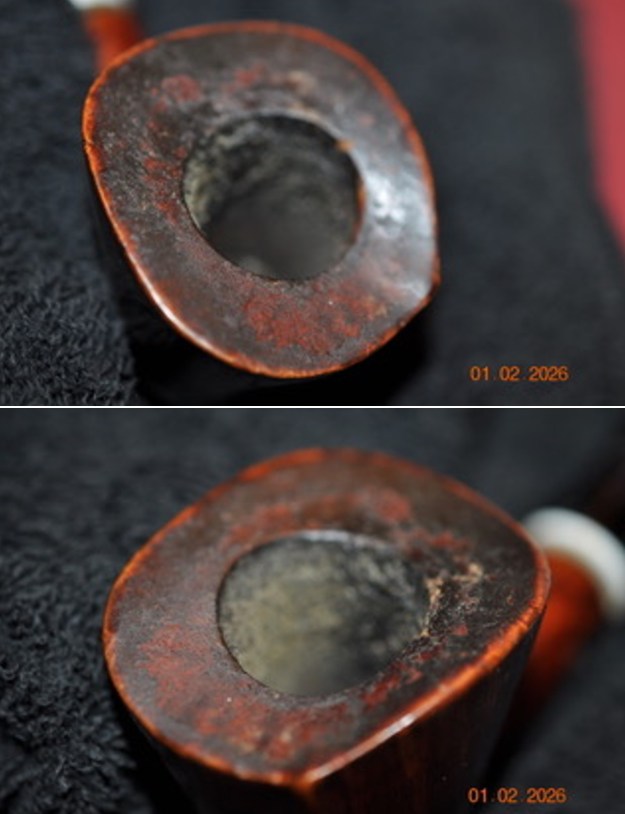
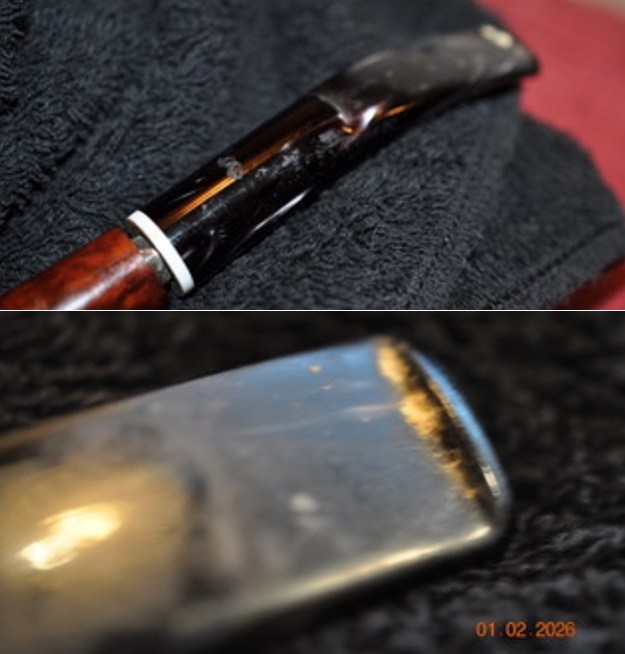
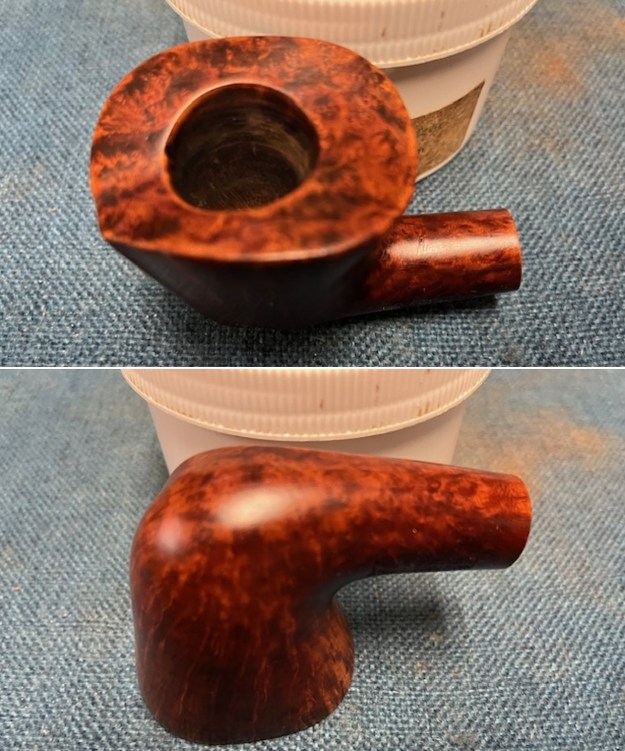
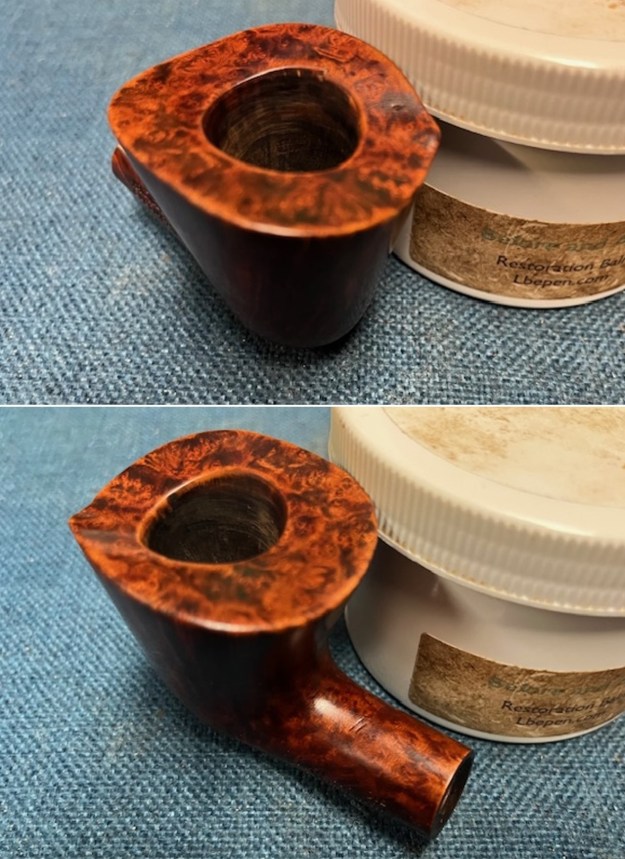
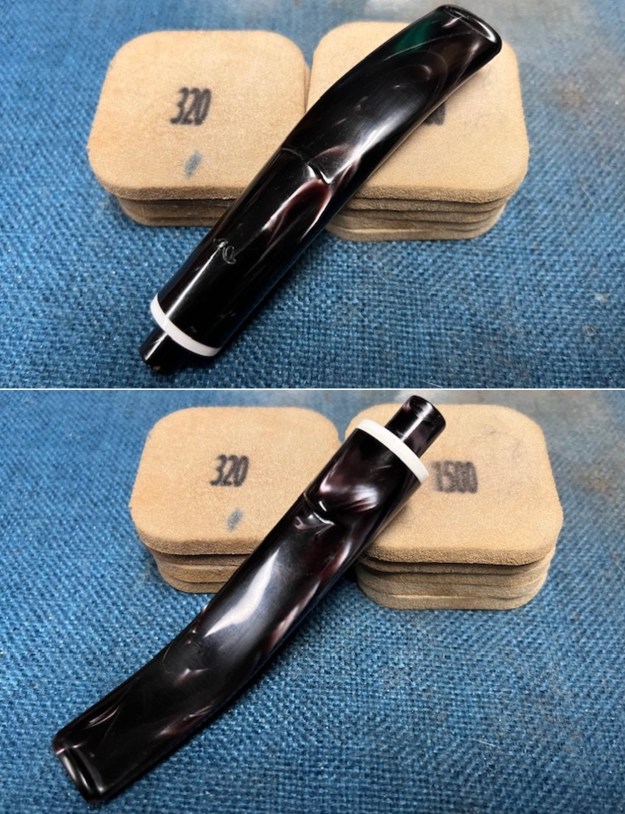
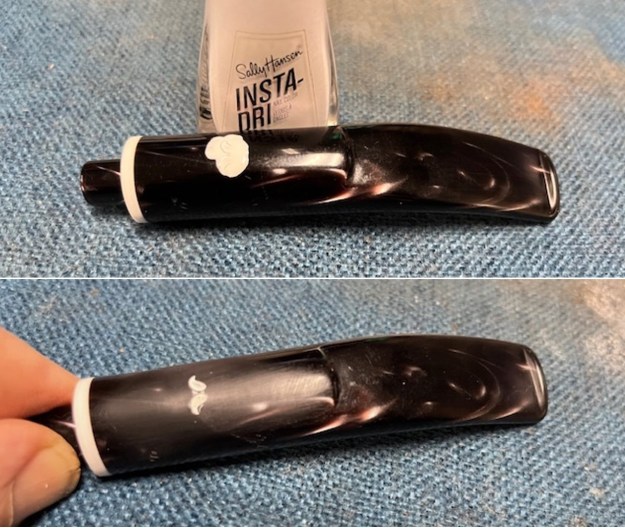
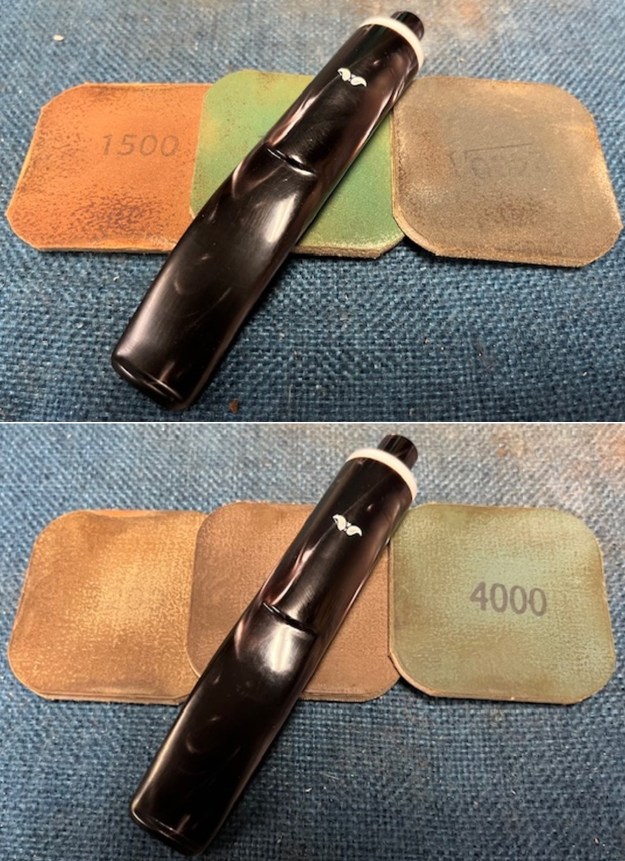
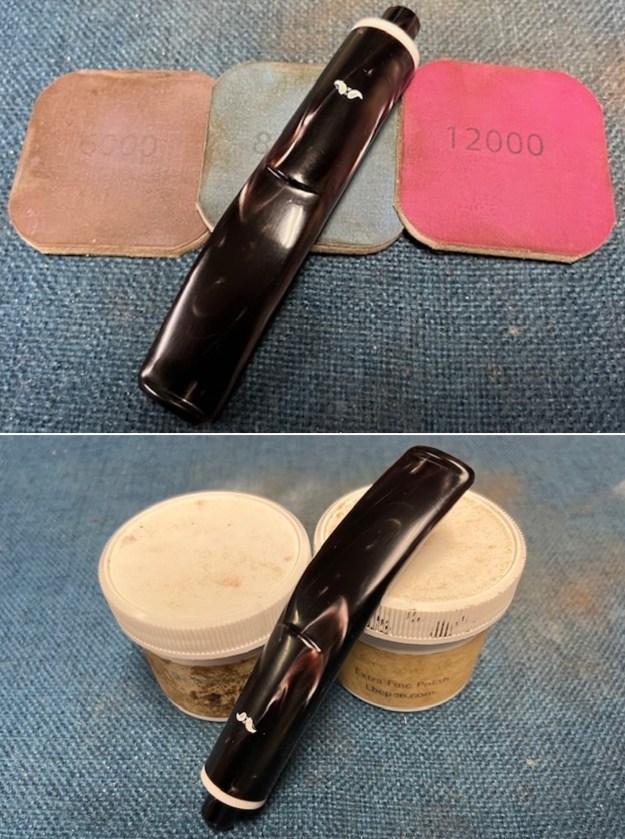
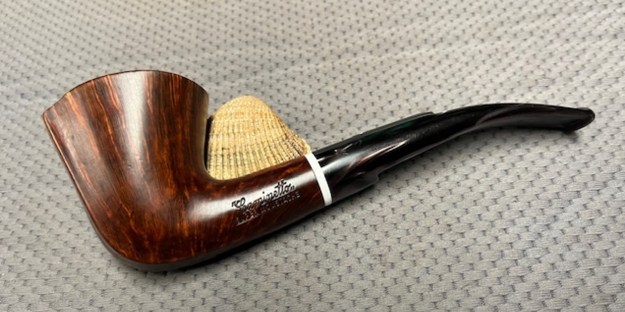
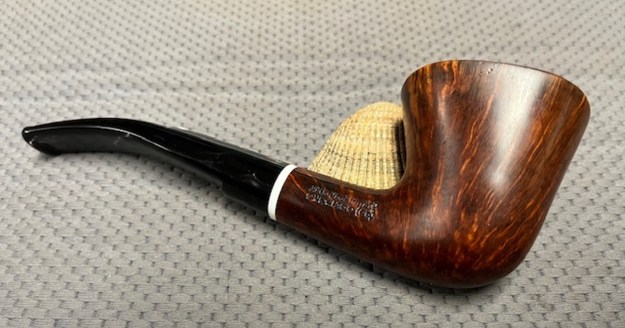
The next pipe on the work table is one that I took in on a trade from a fellow who purchased some other pipes. It is a smooth Lovat with some significant damage to the rim top and also the stem. It is stamped on the left side of the shank and read Christmas [followed by] BBB in a Diamond [followed by] 1986 [over] Special Make. On the right side it is stamped London England. The pipe is shaped to highlight the grain around the bowl. The finish is quite clean with just a bit of grime and oil in bowl sides. The inwardly bevelled rim top is worn and has burn damage on the front top and inner edge of the bowl. The inner edge and the top and outer edge showed a lot of darkening. The bowl had been reamed quite recently and the shank and stem were clean. There is the BBB in a diamond logo on the topside of stem. The stem is quite clean but it is covered with heavy tooth damage on the top and underside ahead of the button. The stem was otherwise polished and did no show oxidation. I took photos of the rim top and the stem surfaces to give a sense of the condition of the pipe. You can see the burn damage on the front rim edge and darkening all the way around the rim edges both inner and outer. The bowl was very clean and there was no cake in the bowl. The stem photos show the deep tooth marks and the chatter on both sides ahead of the button.I took photos of the stamping on the sides of the shank, both the left and the right sides. It reads as noted above. There is also a brass inlaid BBB diamond logo on the top of the stem. I removed the stem and took a photo to give a sense of the proportions of the pipe.I started my work on this pipe by addressing the damage to the stem first. I wiped off the stem surface with a cotton pad and alcohol. I filled in the deep tooth marks on the surface on both sides with black CA glue. I set it aside to cure. Once the repairs had hardened I flattened them with a small file to begin blending them into the surface. I sanded the stem with 320-3500 grit 2×2 inch pads. I wiped the stem down with an Obsidian Oil cloth after each sanding pad.I polished the vulcanite with micromesh sanding pads – 1500-12000 grit pads. I wiped it down with Obsidian Oil after each sanding pad. I used Before & After Pipe Polish – both Fine and Extra Fine to further polish the stem. I used a piece of 220 grit sandpaper and a wooden sphere to clean up the bevel on the rim top. The front portion was burned and damaged so the sanding cleaned up the damage and gave it a new bevel. It looked better once restored.I worked on the finish on the bowl and the rim top removing scratches in the sides of the bowl with 320-3500 grit sanding pads. I wiped the briar down with a damp cloth after each pad. It is beginning to look very good.I polished the smooth briar rim top with micromesh sanding pads – dry sanding it with 1500-12000 grit sanding pads. I wiped the bowl surface down with a damp cloth to remove the sanding dust. Once I finished the exterior of the briar looked much better and had taken on a shine. I gave the rim top a touch up with a Maple Stain Pen. It looked much better. I rubbed the bowl down with Before & After Restoration Balm. I worked it into the surface of the briar with my fingertips to clean, enliven and protect it. I let the balm sit for 15 minutes and then buffed with a cotton cloth to raise the shine. Mark Hoover’s Balm is a product that I have come to appreciate and one I use on every pipe I have been working on. As usual at this point in the restoration process I am excited to be on the homestretch. I look forward to the final look when it is put back together, polished and waxed. I put the BBB 1986 Christmas Special Lovat back together. I polished the bowl and stem with Blue Diamond to polish out the scratches in the briar and the vulcanite. I gave the bowl and the stem multiple coats of carnauba wax. I buffed the pipe with a clean buffing pad to raise the shine. I hand buffed it with a microfiber cloth to deepen the shine. The pipe polished up pretty nicely. The grain really pops with the wax and polish. The shiny black vulcanite stem is a beautiful contrast to the reddish, browns of the bowl. This BBB 1986 Christmas Special Lovat was a great pipe to spruce up. It is a very comfortable pipe to hold in the hand. The finished pipe is shown in the photos below. The dimensions of the pipe are Length: 5 inches, Height: 1 ¾ inches, Outside diameter of the bowl: 1 ¼ inches, Chamber diameter: ¾ of an inch. The weight of the pipe is 29 grams/1.02 ounces. This pipe will be going on the British Pipe Makers Section of the rebornpipes store if you are interested in adding it to your collection. Thanks for reading this blog and my reflections on the pipe while I worked on it. This is an interesting estate to bring back to life.

The Interesting History of a Borkum Riff Bent Billiard


by Kenneth Lieblich

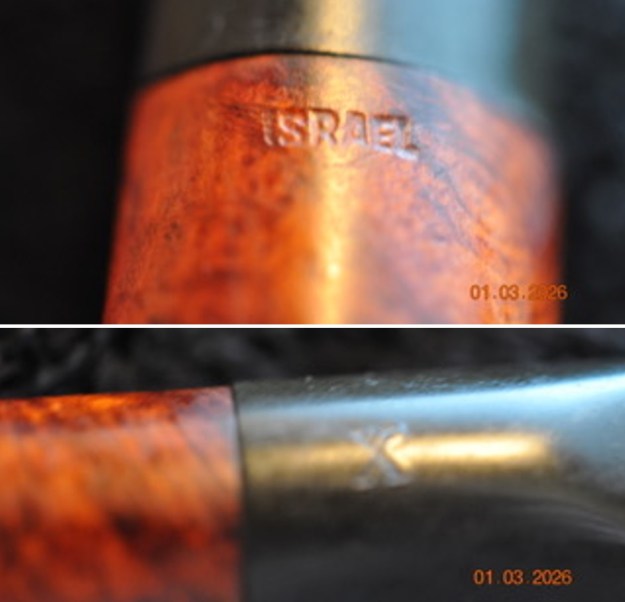
Rummaging through a bucket full of pipes resulted in finding some interesting odds and sods. This handsome bent billiard caught my eye because of the attractive shape and some amazing grain. It was very dirty, to be sure, but I could see the potential it held. Indeed, it turned out to be a beautiful pipe and I am happy to make it available to you. The markings were, shall we say, not immediately helpful, but they resulted in an interesting history. On the left side of the shank were the letters BR. These initials had a very particular look to them. On the underside of the shank, right near the end, was the word Israel. In fact, the pipe was so dirty that I only discovered the word Israel after cleaning the stummel. There were no other marks. There was a very attractive band around the stem: two rings of brass sandwiching a bright red acrylic ring. In order to determine what the ‘BR’ referred to, I went to Pipephil and found the exact same ‘BR’ on a pipe there. That led me to this entry:Aha! So, there were pipes made under the Borkum Riff name. To be clear: the reference to Savinelli above is specifically related to the pipe in the photos – not to all Borkum Riff-branded pipes (as we will soon see). Unfortunately, there was no mention of Israel.

The connection between Borkum Riff and tobacco is obvious, but less so the connection between Borkum Riff and pipes themselves. I went and looked up the Pipedia article on Borkum Riff and found that, in fact, the Wikipedia article is slightly more thorough:

Borkum Riff is a brand of pipe tobacco manufactured in Denmark for the Scandinavian Tobacco Group. ‘Borkum Riff’ tobacco was launched in Sweden in 1962, named after a lighthouse of the same name, located at 53° 58′ N, and 6° 22′ E in Heligoland Bight off the Dutch coast in the North Sea. It was a landmark for seafarers and was well-known to Swedish radio listeners, as weather reports mentioned Borkum Riff several times a day. The former lightship was used from 1960 to 1964 as the first radio ship of Radio Veronica, which became the first offshore radio station in the Netherlands.

The tobacco was a rough-cut blend of Virginia and Burley and had been developed by Bertil Sandegård with an eye on the US pipe tobacco market. Initial sales were slow-moving, but when Borkum Riff’s Bourbon Whiskey blend was successfully introduced in the US in 1969, sales increased. Since then, new flavours and new packaging have been introduced. Today, Borkum Riff is also sold in India, Canada, Australia, Switzerland, Norway, Spain, New Zealand, Japan, France, Italy, and Germany as well as in several other markets around the world. Borkum Riff’s biggest market, however, is still the United States.

Today, the Borkum Riff, which is manufactured in Denmark for Swedish Match, is the third-largest tobacco producer on the Swedish market. In 2011, Borkum Riff’s ownership changed to Scandinavian Tobacco Group. The ship in the Borkum Riff’s company logo originates from a 17th-century engraving made by Johann Baptist Homann.

The tobacco is manufactured on behalf of Swedish Match at the Scandinavian Tobacco Group’s Orlik factory in Assens, Denmark. Formerly, it had been produced by Mac Baren on a dedicated production line.This article had interesting information, but none of it directly related to pipes, per se. I was immediately reminded of a blog post I wrote about a year ago on an ‘Old Port’-branded pipe (made by Brigham). I wondered if it was a similar situation: could it be that when you bought a tin of Borkum Riff tobacco, you received a coupon and when you collected a sufficient number, you could redeem them for a pipe? It’s a reasonable assumption, given how many tobacco companies did similar things. You can read that article here. If you have any Borkum Riff brochures, etc. that describe this, I would love to hear from you.

So, I started searching. Not much was coming up in my searches until I found a tiny nugget that connects things together. Back in 2022, Steve wrote a blog post on a Burl King freehand pipe (you can read that post here). In that article, Steve quotes from the Pipedia post on Burl King:

We can confirm that it was at one time a pipe used for promotion of Borkum Riff tobacco, as reported by Bob Taylor of the Seattle Pipe Club, who mailed in a coupon and received the pipe with a postmark of Jan. 11, ’78, and a return address of Sparta, N.C., which indicates it may have come from the Dr. Grabow / Sparta Industries plant. Bob recently noticed his “Burl King” was also marked, made in Israel, so it was likely made by the Shalom Pipe Factory, though apparently distributed through Sparta Industries. The box shipped for 50 cents and the return address said “After 5 days return to P. O. Box 21882 Greensboro, N. CC. 27240.” So apparently these pipes were made by Shalom, but distributed for Borkum Riff by Sparta Industries.

If further confirmation was needed that Borkum Riff offered coupon pipes, then it can be found at the Baccy Pipes blog. In 2017, Troy posted an entry on Borkum Riff pipes (named Wimbledon) made by the Dr Grabow/Sparta Industries plant. I encourage you to read that post here. Thanks to Troy also for the photo below.

Eureka! Now the thread seemingly runs through everything. This information lends itself to what I suspected: Borkum Riff had coupon pipes that were made by the Shalom Pipe Factory in Israel and this is a particularly nice example of such a pipe. I’m not able to date it accurately, but an educated guess would be that it comes from the 1970s or 80s.

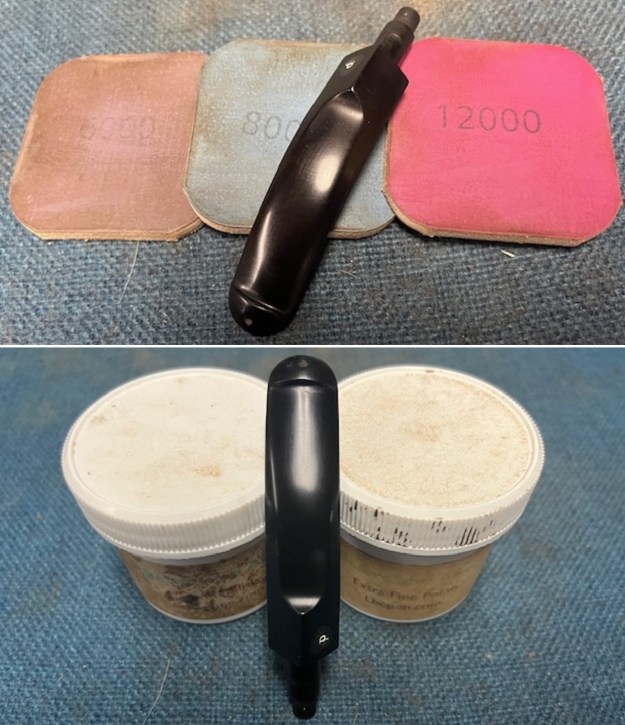
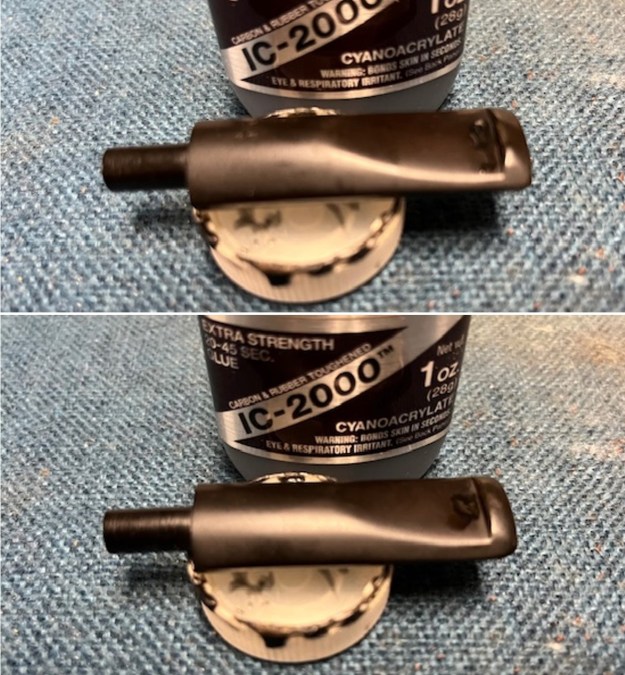
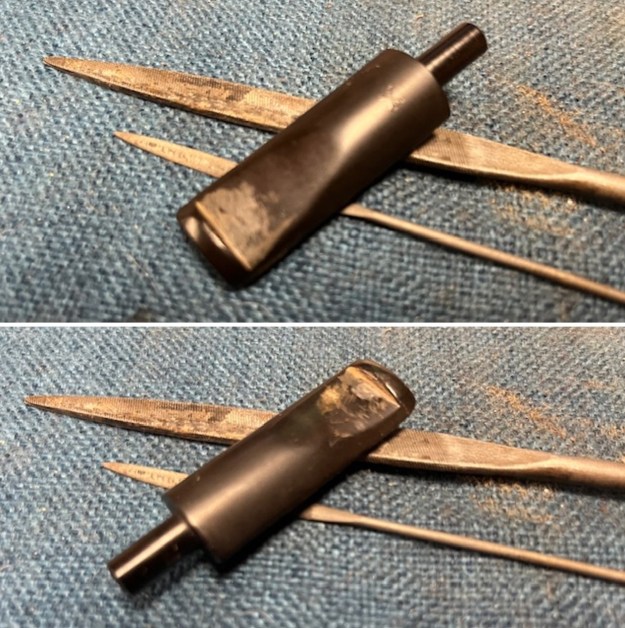
Let’s look at the condition. Yikes! This was one dirty pipe. Who knows where it’s been living for the past few decades? The stem was a bit scraped and dented. It had quite a bit of oxidation and the band seemed to be a bit corroded. The stummel was incredibly filthy. There was cake inside the bowl and a bit of lava on the rim. However, one side of the stummel had the most unsightly stain all over it. It wasn’t immediately apparent what the stain was, but I did wonder if I could get it off. I used isopropyl alcohol on a few cotton rounds and wiped down the stem to provide an initial cleaning of filth before moving on to the next steps. The primary cleaning came next. I disinfected the inside of the stem with pipe cleaners dipped in lemon-infused 99% isopropyl alcohol. I scrubbed thoroughly to make sure the interior was very clean. I used a lot of pipe cleaners – it was so dirty.As I was disassembling the pipe, the band came off the stem and then promptly separated into pieces. This wasn’t such a bad thing, as it simplified my restoration. I wiped the pieces down with alcohol, then sanded them with some 0000-grit steel wool. This served to both clean the pieces and slightly roughen them for gluing back together. This I did with some regular white glue. I also (eventually) glued the whole thing back in place on the tenon of the stem.The goal of the next step is the removal (or minimization) of oxidation. Going to my sink, I used cream cleanser, cotton rounds, and a toothbrush, and scoured the stem to remove as much surface oxidation as possible. As the photos show, the result was a hideous, ochre-coloured mess – but better off the stem than on it.Once the stem was reasonably clean, I soaked it overnight in some Briarville Stem Oxidation Remover. This solution works to draw oxidation in the stem to the surface of the vulcanite. This is a major aid and an important step in ensuring a clean stem. The following day, I drew out the stem from its bath and scrubbed the lingering fluid with a toothbrush. Due to the severity of the oxidation, I then repeated the scrubbing with the cream cleanser for maximum effect.As the stem was now clean and dry, I set about fixing the marks and dents in the vulcanite. This was done by filling those divots with black cyanoacrylate adhesive, impregnated with carbon and rubber. I left this to cure and moved on.The penultimate step for the stem is sanding. First, with my set of needle files, I reduced the bulk of the cyanoacrylate repairs. I removed the excess adhesive as near to the surface as possible, without cutting into the vulcanite. Following that, I used all nine of the micromesh sanding pads (1,500 through 12,000 grit) to sand out flaws, even out the vulcanite, and provide gentle polishing of the finished surface. I also applied pipe-stem oil while using the last five micromesh pads. There was a wonderful, deep black shine to the stem when I was done. And doesn’t the band complement the stem beautifully?As the stem was (nearly) complete, I moved on to the stummel. The first step was to ream out the bowl – that is to say, remove all the cake inside the bowl. This accomplished a couple of things. First (and most obviously), it cleaned the bowl and provided a refurbished chamber for future smoking. Second, when the old cake was removed, I could inspect the interior walls of the bowl and determine if there was damage or not. I used a reamer, a pipe knife, and a piece of sandpaper taped to a wooden dowel. Collectively, these ensured that all the debris was removed.My next step was to remove the lava on the rim. For this, I took a piece of machine steel and gently scraped the lava away. The metal’s edge is sharp enough to remove what I need, but not so sharp that it damages the rim.The inside of the stummel needed to be cleaned thoroughly. However, this pipe was so clogged, that I first needed to open the horribly occluded airway. So, I took a long drill bit, held in a drill chuck, and hand-cranked it to dislodge the dreadful detritus inside. Hand cranking is essential because it provides a precision and caution that a power drill cannot provide.Similar to the stem, I then cleaned the stummel with both pipe cleaners and cotton swabs dipped in lemon-infused 99% isopropyl alcohol. With a pipe this dirty, it took quite a while and much cotton to clean.I then decided to ‘de-ghost’ the pipe – that is to say, exorcize the remaining filth from the briar. I filled the bowl and the shank with cotton balls, then saturated them with 99% isopropyl alcohol. I let the stummel sit overnight. This caused the remaining oils, tars and smells to leach out into the cotton.To tidy up the briar, I wiped down the outside, using a solution of a pH-neutral detergent and some distilled water, with cotton rounds. I also used a toothbrush in the crevices. This did a good job of cleaning any latent dirt on the surface of the briar – but it most certainly didn’t affect the ugly stain on the bowl. So, I used some acetone to wipe the area down. This worked a bit, but not much – I would have to sand this area down. The last step of the cleaning process was to scour the inside of the stummel with the same mild detergent and tube brushes. This was the culmination of a lot of hard work in getting the pipe clean.I used all nine micromesh pads (1,500 through 12,000 grit) to sand the outside of the stummel and finish it off. It also removed the dreadful stain and the pipe looks terrific now. This sanding minimizes flaws in the briar and provides a beautiful smoothness to the wood. I rubbed some LBE Before & After Restoration Balm into the briar and let it sit for 30 minutes or so. The balm moisturizes the wood and gives a beautiful depth to the briar. I then buffed the stummel with a microfibre cloth. For the final step, I took the pipe to my bench polisher and carefully buffed it – first with a blue diamond compound, then with three coats of carnauba wax. This procedure makes the pipe look its best – the stummel sings and the stem glows.All done! This handsome Borkum Riff bent billiard looks fantastic again and is ready to be enjoyed by its next owner. I am pleased to announce that this pipe is for sale! If you are interested in acquiring it for your collection, please have a look in the ‘Various Makers’ section of the store here on Steve’s website. You can also email me directly at kenneth@knightsofthepipe.com. The approximate dimensions of the pipe are as follows: length 5¼ in. (133 mm); height 2 in. (51 mm); bowl diameter 1⅝ in. (40 mm); chamber diameter ⅞ in. (21 mm). The weight of the pipe is 1¾ oz. (52 g). I hope you enjoyed reading the story of this pipe’s restoration as much as I enjoyed restoring it. If you are interested in more of my work, please follow me here on Steve’s website or send me an email. Thank you very much for reading and, as always, I welcome and encourage your comments.

Restoring a Tom Eltang Design Stanwell Jubilaeum 1942-92 Sandblast 190 Hex Shank Billiard


by Steve Laug

I moved on to work on another pipe. The next one I chose was another Stanwell. We purchased this from our contact in Copenhagen, Denmark on 02/16/2023. The stamping on the pipe was very clear and readable. On a smooth panel on the left side of the shank it reads Stanwell in an arch. On the underside it read Jubilaeum [over] 1942-92. On the right side it read Made in Denmark with the shape number 190. The shank end had a gold coloured band. The stem had a gold inlaid Crowned “S” Stanwell logo on the topside of the hexagonal taper stem. The Jubilaeum series was the 50th Anniversary line. The shape is a classic 190 Hexagon shank design by Tom Eltang and is easily recognizable as such. The bowl had a moderate cake but there was lava in the sandblast of the rim top. The finish was in dirty condition and was quite polished. The stem was acrylic and had light tooth chatter on both sides ahead of the button. It showed a lot of promise through the grime. I took photos of the pipe before I started my clean up work. I took photos of the bowl and rim top to show the thickness of the cake and the condition of the rim top. The stem photos show the condition of the acrylic saddle stem ahead of the button.The stamping on the underside of the shank is clear and readable as noted above. I also took a photo of the gold Crown S on the left side of the stem. I took a photo of the pipe with the stem removed to give a sense of the proportions of the pipe. The mortise is lined with a nylon liner that makes for a snug and smooth fit in the shank. I started my work on the pipe. I reamed the bowl with a PipNet pipe reamer using the cutting heads 2 and 3. I finished the reaming with a Savinelli Fitsall Pipe Knife. I sanded the walls of the bowl with 220 grit sandpaper wrapped around a piece of dowel. I worked over the rim top with a brass bristle wire brush and you can see the damage on the inner edge of the rim. I used a half sphere and a piece of 220 grit sandpaper to clean up the damage on the rim top and inner edge of the bowl. I gave the bowl a slight inward bevel to take care of the burn damage on the front inner edge of the bowl. I touched up the rim top with a black stain pen to hide the remaining burn damage.I polished the rim top with 320-3500 grit 2×2 inch sanding pads to smooth out the scratch marks in the briar. I wiped it down with a damp cloth after each sanding pad to remove the sanding debris. It began to take on a rich shine. I touched up the rim top stain with a Mahogany Stain pen to match the rest of the briar on the sandblast of the shank and bowl. It looks quite good.I cleaned out the inside of the shank and the airway in the stem with alcohol, cotton swabs and both bristle and regular pipe cleaners.I scrubbed the bowl and shank with a tooth brush and some undiluted Murphy’s Oil Soap. I rinsed it off with warm water to remove the dust and soap from the finish. I dried it off with a soft cloth and it looked much better. I rubbed the briar down with Before & After Restoration Balm. I worked it into the briar with my fingertips. The product works to clean, enliven and preserve the briar. I let it sit for 10 minutes while I worked on the stem. After the time passed I buffed it with a cotton cloth to deepen the shine. The briar really comes alive with the balm. I set the bowl aside and turned my attention to the stem. I sanded the stem with 220 grit sandpaper to remove the tooth chatter and light marks on the top and underside of the stem ahead of the button.I sanded the stem surface with 320-3500 grit 2×2 inch pads to further blend in the repairs to the acrylic surface. I also sanded the deep scratches in the surface of the acrylic that ran the length of the stem surface. I wiped the stem down with an Obsidian Oil cloth after each sanding pad.I polished the stem with micromesh sanding pads – dry sanding with 1500-12000 grit pads. I wiped the stem down after each sanding pad with Obsidian Oil. I polished it with Before & After Pipe Stem Polish – both Fine and Extra Fine. I gave it a coat of Obsidian Pipe Stem Oil. It works to protect the stem from oxidizing. I set it aside to dry. I am excited to put the finishing touches on this Tom Eltang Design Stanwell Jubilaeum 1942-92 Hexagonal Shank 190 Billiard. I put the pipe back together and buffed it with Blue Diamond on the buffing wheel. I gave the bowl and the stem multiple coats of carnauba wax. I buffed the pipe with a clean buffing pad to raise the shine and hand buffed it with microfiber cloth to deepen the shine. It is fun to see what the polished bowl looks like with the polished black, fancy turned vulcanite stem was beautiful. This Tom Eltang Design Stanwell Jubilaeum 1942-92 Hexagonal Shank 190 Billiard is nice looking and the pipe feels great in my hand. It is light and well balanced. Have a look at it with the photos below. The dimensions are Length: 5 inches, Height: 1 ¾ inches, Outside diameter of the bowl: 1 ¼ inches, Chamber diameter: ¾ of an inch. The weight of the pipe is 1.23 ounces/36 grams. It is a beautiful pipe and one that I will be putting in the Danish Pipemakers Section on the rebornpipes store. Thanks for walking through the cleanup with me as I worked over this pipe.

As always, I encourage your questions and comments as you read the blog. Thanks to each of you who are reading this blog. Remember we are not pipe owners; we are pipe men and women who hold our pipes in trust until they pass on into the trust of those who follow us.

Restoring a Boxed S. Ivarrson Design Stanwell Jubilaeum 1942-92 Sandblast 70 Volcano


by Steve Laug

I moved on to work on another pipe. The next one I chose was another Stanwell. We purchased this from our contact in Copenhagen, Denmark on 02/16/2023. The stamping on the pipe was very clear and readable. On a smooth panel on the underside of the shank it reads Stanwell [followed by] the shape number 70 [over] Jubilaeum 1942-92 [over] Made in Denmark. The stem had a gold inlaid Crowned “S” Stanwell logo on the left side of the saddle stem. The Jubilaeum series was the 50th Anniversary line. The shape is a classic 70 design by Sixten Ivarrson and is easily recognizable as such. The bowl had a moderate cake but there was no lava in the sandblast of the rim top. The finish was in very clean condition and was quite polished. The stem was acrylic and had light tooth chatter on both sides ahead of the button. It showed a lot of promise through the grime. The pipe was lightly used and was a pretty pipe! I took photos of the pipe before I started my clean up work. I took photos of the bowl and rim top to show the thickness of the cake and the clean rim top. The stem photos show the condition of the acrylic saddle stem ahead of the button. The stamping on the underside of the shank is clear and readable as noted above. I also took a photo of the gold Crown S on the left side of the stem. I took a photo of the pipe with the stem removed to give a sense of the proportions of the pipe. The mortise is lined with a nylon liner that makes for a snug and smooth fit in the shank. I started my work on the pipe. I reamed the bowl with a PipNet pipe reamer using the cutting heads 2 and 3. I finished the reaming with a Savinelli Fitsall Pipe Knife. I sanded the walls of the bowl with 220 grit sandpaper wrapped around a piece of dowel. I cleaned out the inside of the shank and the airway in the stem with alcohol, cotton swabs and both bristle and regular pipe cleaners.I scrubbed the bowl and shank with a tooth brush and some undiluted Murphy’s Oil Soap. I also worked it over with a brass bristle wire brush and the soap. I rinsed it off with warm water to remove the dust and soap from the finish. I dried it off with a soft cloth and it looked much better. I rubbed the briar down with Before & After Restoration Balm. I worked it into the briar with my fingertips. The product works to clean, enliven and preserve the briar. I let it sit for 10 minutes while I worked on the stem. After the time passed I buffed it with a cotton cloth to deepen the shine. The briar really comes alive with the balm. I set the bowl aside and turned my attention to the stem. I filled in the small tooth marks against the button edge on both sides. Once the fills cured I flattened them with a small file. I sanded the stem with 220 grit sandpaper to blend the repairs into the top and underside of the stem ahead of the button. I sanded the stem surface with 320-3500 grit 2×2 inch pads to further blend in the repairs to the acrylic surface. I wiped the stem down with an Obsidian Oil cloth after each sanding pad.I polished the stem with micromesh sanding pads – dry sanding with 1500-12000 grit pads. I wiped the stem down after each sanding pad with Obsidian Oil. I polished it with Before & After Pipe Stem Polish – both Fine and Extra Fine. I gave it a coat of Obsidian Pipe Stem Oil. It works to protect the stem from oxidizing. I set it aside to dry. I am excited to put the finishing touches on this S. Ivarrson Design Stanwell Jubilaeum 1942-92 Volcano 70. I put the pipe back together and buffed it with Blue Diamond on the buffing wheel. I gave the bowl and the stem multiple coats of carnauba wax. I buffed the pipe with a clean buffing pad to raise the shine and hand buffed it with microfiber cloth to deepen the shine. It is fun to see what the polished bowl looks like with the polished black, fancy turned vulcanite stem was beautiful. This Stanwell Jubilaeum 1942-92 Volcano 70 is nice looking and the pipe feels great in my hand. It is light and well balanced. Have a look at it with the photos below. The dimensions are Length: 5 ½ inches, Height: 1 ¼ inches, Outside diameter of the bowl: 1 inch, Chamber diameter: ¾ of an inch. The weight of the pipe is 1.69 ounces/48 grams. It is a beautiful pipe and one that I will be putting in the Danish Pipemakers Section on the rebornpipes store. Thanks for walking through the cleanup with me as I worked over this pipe.

As always, I encourage your questions and comments as you read the blog. Thanks to each of you who are reading this blog. Remember we are not pipe owners; we are pipe men and women who hold our pipes in trust until they pass on into the trust of those who follow us.

Restoring a Boxed S. Ivarrson Design Stanwell Jubilaeum 1942-92 ¼ Bent Sandblast Dublin 06


by Steve Laug

I moved on to work on another pipe. The next one I chose was another Stanwell. We purchased this from our contact in Copenhagen, Denmark on 02/16/2023. The stamping on the pipe was very clear and readable. On a smooth panel on the underside of the shank it reads o6 [over] Stanwell [over] Jubilaeum 1942-92 [over] Made in Denmark. The stem had a gold inlaid Crowned “S” Stanwell logo on the left side of the saddle stem. The Jubilaeum series was the 50th Anniversary line. The shape is a classic 06 design by Sixten Ivarrson and is easily recognizable as such. The bowl had a moderate cake but there was no lava in the sandblast of the rim top. The finish was in very clean condition and was quite polished. The stem was acrylic and had light tooth chatter on both sides ahead of the button. It showed a lot of promise through the grime. The pipe was lightly used and was a pretty pipe! I took photos of the pipe before I started my clean up work. I took photos of the bowl and rim top to show the thickness of the cake and the clean rim top. The stem photos show the condition of the acrylic saddle stem ahead of the button. The stamping on the underside of the shank is clear and readable as noted above. I also took a photo of the gold Crown S on the left side of the stem. I took a photo of the pipe with the stem removed to give a sense of the proportions of the pipe. The mortise is lined with a nylon liner that makes for a snug and smooth fit in the shank. I started my work on the pipe. I reamed the bowl with a PipNet pipe reamer using the cutting heads 2 and 3. I finished the reaming with a Savinelli Fitsall Pipe Knife. I sanded the walls of the bowl with 220 grit sandpaper wrapped around a piece of dowel. I cleaned out the inside of the shank and the airway in the stem with alcohol, cotton swabs and both bristle and regular pipe cleaners.I scrubbed the bowl and shank with a tooth brush and some undiluted Murphy’s Oil Soap. I also worked it over with a brass bristle wire brush and the soap. I rinsed it off with warm water to remove the dust and soap from the finish. I dried it off with a soft cloth and it looked much better. I rubbed the briar down with Before & After Restoration Balm. I worked it into the briar with my fingertips. The product works to clean, enliven and preserve the briar. I let it sit for 10 minutes while I worked on the stem. After the time passed I buffed it with a cotton cloth to deepen the shine. The briar really comes alive with the balm. I set the bowl aside and turned my attention to the stem. I sanded the stem with 220 grit sandpaper to remove the tooth chatter and light marks on the top and underside of the stem ahead of the button.I sanded the stem surface with 320-3500 grit 2×2 inch pads to further blend in the repairs to the acrylic surface. I wiped the stem down with an Obsidian Oil cloth after each sanding pad.I polished the stem with micromesh sanding pads – dry sanding with 1500-12000 grit pads. I wiped the stem down after each sanding pad with Obsidian Oil. I polished it with Before & After Pipe Stem Polish – both Fine and Extra Fine. I gave it a coat of Obsidian Pipe Stem Oil. It works to protect the stem from oxidizing. I set it aside to dry. I am excited to put the finishing touches on this S. Ivarrson Design Stanwell Jubilaeum 1942-92 ¼ Bent 06 Dublin. I put the pipe back together and buffed it with Blue Diamond on the buffing wheel. I gave the bowl and the stem multiple coats of carnauba wax. I buffed the pipe with a clean buffing pad to raise the shine and hand buffed it with microfiber cloth to deepen the shine. It is fun to see what the polished bowl looks like with the polished black, fancy turned vulcanite stem was beautiful. This Stanwell Jubilaeum 1942-92 Dublin is nice looking and the pipe feels great in my hand. It is light and well balanced. Have a look at it with the photos below. The dimensions are Length: 5 inches, Height: 2 inches, Outside diameter of the bowl: 1 ¼ inches, Chamber diameter: ¾ of an inch. The weight of the pipe is 1.13 ounces/33 grams. It is a beautiful pipe and one that I will be putting in the Danish Pipemakers Section on the rebornpipes store. Thanks for walking through the cleanup with me as I worked over this pipe.

As always, I encourage your questions and comments as you read the blog. Thanks to each of you who are reading this blog. Remember we are not pipe owners; we are pipe men and women who hold our pipes in trust until they pass on into the trust of those who follow us.

Restoring a Cased Sunalp Block Meerschaum Chinese Singing Worker


by Steve Laug

The next pipe on the table is another one that came to us from the seller in Caldwell, Idaho, USA on 07/12/2025. It is a nicely carved Block Meerschaum Figural with a variegated gold/brown acrylic saddle stem. It is in a black leatherette covered case with a cream velour liner. It is in slightly dirty but in good condition as can be seen in the photos below. There is no stamping on the stem or shank. The inside of the case has two stickers – one on the inside of the cream coloured velour lined case that reads Genuine [arched over] Sunalp [underneath it arched] Block Meerschaum. The second sticker reads Sunalp [over] Turkey. I took the pipe out of the case. It has some patina developing on the shank, face and the rim top. The well-carved face looks like a Chinese singer with his mouth open and joyful. The finish was dusty and lightly dirty with grime in the nooks and crannies of the carved features. The bowl had a moderate cake and there was tobacco debris in the bowl. The rim top had a lava coat on the inner edge of the rim top. There is a thin “x” shaped hairline crack on the underside of the shank. It is visible but it is not deep and should not causing any problems. The variegated saddle stem had been broken sometime in its travels but had been well repaired. It is inside and out. I took photos of the pipe before I started working on it. I took photos of the bowl and rim top to show the thickness of the cake and the lava coat on the rim top. The stem photos show the condition of the acrylic saddle stem ahead of the button. You clearly see the repairs on the stem mid stem. It is a solid repair and is has dealt with the damage.The stamping on the sticker on the inside cover of the case is clear and readable as noted above. I took a photo of the pipe with the stem removed to give a sense of the proportions of the pipe. There was nothing listed on either Pipephil’s site or on Pipedia regarding the Sunalps brand. I did a quick google search for the brand and the first item that came up was on the online forum, PipesmokersDens (https://pipesmokersdens.com/threads/sunalp-meerschaum-pipes.1332/). It was taken from vkpipes and this might be the best guess

…our investigations guided us to the US trademark “SUNALP” registered by Erdal Sunalp in Los Gatos, CA. And according to this application filled in 1978 the business was related to “smoking pipes, lighters, and cigar humidor cases”. Also you may find both quite expensive meerschaum block pipes bearing the SUNALP tm and a bit more affordable “SUNALP France” artifacts. Unfortunately, the trade mark is not active since 1990. It woud be hard to believe that this is just an coincidence. It seems we’ve found a quite luxury tobacconist who ordred products from diffrenet countries including such amazing Danish works of art.

Google also provided an AI summary of the information on the Sunalp brand. I have copied the following information from that summary below.

“Sunalp” Meerschaum refers to high-quality, carved pipes sold under the Sunalp brand, a US trademark associated with Erdal Sunalp from Los Gatos, CA, known for sourcing exquisite Turkish block meerschaum, often featuring intricate carvings of figures or animals, making them collector’s items valued for their craftsmanship and smoking properties. 

Now it was time to work on the pipe itself. I reamed the bowl with a PipNet pipe reamer using the cutting heads 2 and 3. I finished the reaming with a Savinelli Fitsall Pipe Knife. I sanded the walls of the bowl with 220 grit sandpaper wrapped around a piece of dowel. I cleaned out the inside of the shank and the airway in the stem with alcohol, cotton swabs and regular pipe cleaners.I dry sanded the bowl and the light lava on the rim top and edges with 320-3500 grit 2×2 inch sanding pads to remove the remaining scratches and marks on the rim top. I wiped it down with a damp cloth after each sanding pad to remove the sanding dust and debris. It started looking better. I polished the meerschaum with micromesh because it was in such good condition. I dry sanded it with 1500-12000 grit micromesh sanding pads. I wiped the bowl down after each sanding pad with a damp cloth. I rubbed the briar down with Clapham’s Beeswax/Carnauba Wax. I worked it into the grooves with qtips and into the smooth portions with my fingertips. The product works to clean, enliven and raise a shine in the meerschaum. I let it sit for 10 minutes while I worked on the stem. After the time passed I buffed it with a cotton cloth to deepen the shine. The bowl took on a rich shine. I set the bowl aside and turned my attention to the stem. I dry sanded the surface with 320-3500 grit 2×2 inch pads to further blend in the repairs to the acrylic surface. I wiped the stem down with an Obsidian Oil cloth after each sanding pad. It began to take on a rich shine.I set the bowl aside and turned my attention to the stem. I polished the stem with micromesh sanding pads – dry sanding with 1500-12000 grit pads. I wiped the stem down after each sanding pad with Obsidian Oil. I polished it with Before & After Pipe Stem Polish – both Fine and Extra Fine. I gave it a coat of Obsidian Pipe Stem Oil. It works to protect the stem from oxidizing. I set it aside to dry. I am excited to put the finishing touches on this Sunlap Block Meerschaum Chinese Singing Worker. I put the pipe back together and buffed it with Blue Diamond on the buffing wheel. I gave the bowl and the stem multiple coats of carnauba wax. I buffed the pipe with a clean buffing pad to raise the shine and hand buffed it with microfiber cloth to deepen the shine. It is fun to see what the polished bowl looks like with the polished black, fancy turned vulcanite stem was beautiful. This Sunlap Meerschaum Chinese Singing Worker is nice looking and the pipe feels great in my hand. It is light and well balanced. Have a look at it with the photos below. The dimensions are Length: 5 ½ inches, Height: 3 inches, Outside diameter of the bowl: 2 ½ inches, Chamber diameter: 7/8 of an inch. The weight of the pipe is 1.6 9 ounces/49 grams. It is a beautiful pipe and one that I will be putting in the Meerschaum Section on the rebornpipes store. Thanks for walking through the cleanup with me as I worked over this pipe.

As always, I encourage your questions and comments as you read the blog. Thanks to each of you who are reading this blog. Remember we are not pipe owners; we are pipe men and women who hold our pipes in trust until they pass on into the trust of those who follow us.

Restoring a Boxed Stanwell Made in Denmark Compact RO25 Pocket Dublin


by Steve Laug

I moved on to work on another pipe. The next one I chose was a Stanwell. We purchased this from our contact in Copenhagen, Denmark on 02/16/2023. The stamping on the pipe was very clear and readable. On the underside of the shank it reads Stanwell [over] Made in Denmark [over] Compact [over] RO 25. The stem had a gold stamped Crowned “S” Stanwell logo on the left side of the saddle stem. The bowl had a thick cake that overflowed onto the rim top and edges in thick lava. There were some nicks in the rim top as well as some nicking on the front outer edge. The finish was in okay condition underneath grime and oils ground into the surface of the bowl. The stem was dirty acrylic and had light tooth marks and chatter on both sides ahead of the button. It showed a lot of promise through the grime. The pipe was well used and was obviously someone’s favourite pipe! I took photos of the pipe before I started my clean up work. I took photos of the bowl and rim top to show the thickness of the cake and the lava coat on the rim top. The stem photos show the condition of the acrylic saddle stem ahead of the button. The stamping on the underside of the shank is clear and readable as noted above. I also took a photo of the gold Crown S on the left side of the stem. I took a photo of the pipe with the stem removed to give a sense of the proportions of the pipe. The mortise is lined with a nylon liner that makes for a snug and smooth fit in the shank. I started my work on the pipe. I reamed the bowl with a PipNet pipe reamer using the cutting heads 2 and 3. I finished the reaming with a Savinelli Fitsall Pipe Knife. I sanded the walls of the bowl with 220 grit sandpaper wrapped around a piece of dowel. I cleaned up the inside edge of the rim and the rim top with a piece of 220 grit sandpaper. I was able to remove the thick lava coat and clean up the outer edge of the bowl and nicks on the rim top.I cleaned out the inside of the shank and the airway in the stem with alcohol, cotton swabs and both bristle and regular pipe cleaners.I scrubbed the bowl and shank with a tooth brush and some undiluted Murphy’s Oil Soap. I also worked it over with a brass bristle wire brush and the soap. I rinsed it off with warm water to remove the dust and soap from the finish. I dried it off with a soft cloth and it looked much better. I sanded the bowl and rim top with 320-3500 grit 2×2 inch sanding pads to remove the remaining scratches and marks on the rim top. I wiped it down with a damp cloth after each sanding pad to remove the sanding dust and debris. I polished the briar with micromesh because it was in such good condition. I polished it with 1500-12000 grit micromesh sanding pads. I wiped the bowl down after each sanding pad with a damp cloth. I rubbed the briar down with Before & After Restoration Balm. I worked it into the briar with my fingertips. The product works to clean, enliven and preserve the briar. I let it sit for 10 minutes while I worked on the stem. After the time passed I buffed it with a cotton cloth to deepen the shine. The briar really comes alive with the balm. I set the bowl aside and turned my attention to the stem. I filled in the tooth marks in the top and underside of the stem near the button with black CA glue. Once it cured I flattened the repairs out with small files. I sanded them with a folded piece of 220 grit sandpaper to further blend them into the stem surface. I sanded the stem surface with 320-3500 grit 2×2 inch pads to further blend in the repairs to the acrylic surface. I wiped the stem down with an Obsidian Oil cloth after each sanding pad.I polished the stem with micromesh sanding pads – dry sanding with 1500-12000 grit pads. I wiped the stem down after each sanding pad with Obsidian Oil. I polished it with Before & After Pipe Stem Polish – both Fine and Extra Fine. I gave it a coat of Obsidian Pipe Stem Oil. It works to protect the stem from oxidizing. I set it aside to dry. I am excited to put the finishing touches on this Stanwell Made in Denmark Stanwell Compact RO 25 Dublin. I put the pipe back together and buffed it with Blue Diamond on the buffing wheel. I gave the bowl and the stem multiple coats of carnauba wax. I buffed the pipe with a clean buffing pad to raise the shine and hand buffed it with microfiber cloth to deepen the shine. It is fun to see what the polished bowl looks like with the polished black, fancy turned vulcanite stem was beautiful. This Stanwell Made in Denmark Compact Dublin is nice looking and the pipe feels great in my hand. It is light and well balanced. Have a look at it with the photos below. The dimensions are Length: 5 inches, Height: 2 inches, Outside diameter of the bowl: 1 ¾ inches, Chamber diameter: ¾ of an inch. The weight of the pipe is 2.19 ounces/63 grams. It is a beautiful pipe and one that I will be putting in the Danish Pipemakers Section on the rebornpipes store. Thanks for walking through the cleanup with me as I worked over this pipe.

As always, I encourage your questions and comments as you read the blog. Thanks to each of you who are reading this blog. Remember we are not pipe owners; we are pipe men and women who hold our pipes in trust until they pass on into the trust of those who follow us.

A Special Gift for Christmas


by Kenneth Lieblich

I have been restoring pipes for more than five years now, and I have learned everything at the feet of the master: Steve Laug. And, because of him, there is a pipe I have dreamt of finding since I started. Recently, I acquired a large lot of pipes and, as these things often are, the box contained everything from the absurd to the sublime. Quite a few pipes in the box were Danish, so that’s always a delight. When I took the box of pipes home, I didn’t realize it, but the pipe of my dreams was inside.

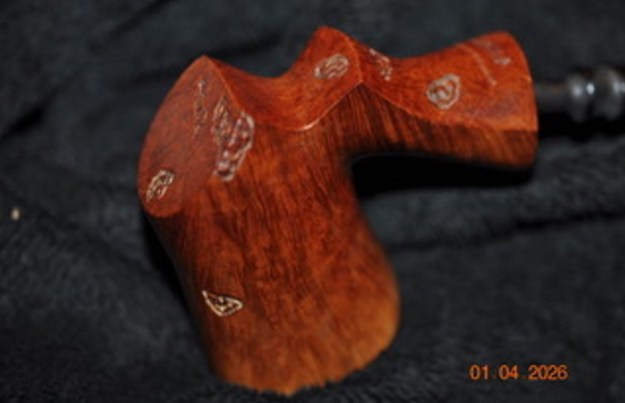
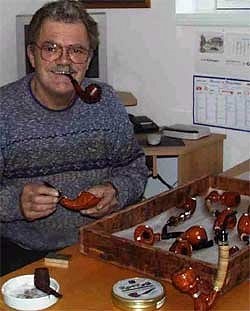
Perhaps I should be more explicit in what I’m talking about. In essence, I have always wanted to find a pipe that Steve really wanted – so I could give it to him. In the world of pipes, Steve has really been-there, done-that. Steve has seen it all (or just about all), and it was always going to be a tall order to find a pipe he wanted that he hadn’t owned before or seen before. This box of pipes had it! Steve told me that he always wanted a pipe from Danish master carver Åge Bøgelund. Turns out, there was one in this box. I grabbed it, restored it, and presented it to him as a gift. It seemed the least I could do in thanks for all he’s done for me. Let me take a moment to tell you a little bit about the pipe maker, Åge Bøgelund. There isn’t much information available, but here’s what I found. From Pipedia:

Åge Bogelund was in charge of the Bari factory after Viggo Nielsen. During factory operation and after the factory closed he made some handmade pipes stamped with his name, some are quite large and some are very unique. They are scarce and have become collectible.

From 1978 to 1993 Åge Bogelund and Helmer Thomsen headed Bari’s pipe production. Helmer Thomson bought the company in 1993 re-naming it to “Bari Piber Helmer Thomsen”. The workshop moved to more convenient buildings in Vejen. Bogelund created very fine freehands of his own during the time at Bari.

Next, from MBSD Pipes:

Age (or rather, Åge) Bogelund is a somewhat less known carver from the 20th century Danish pipe-making tradition – though he was no less a master than his contemporaries. Originally, he worked for Viggo Nielsen’s Bari pipe company, being charged with making some of its higher-grade freehands. Later, Bogelund made pipes under his own name, each displaying a distinct style and talent, even among his celebrated Danish peers. Bogelund’s pipes have for a long time been coveted by collectors, though in more recent years, these creations have attracted a more popular enthusiasm.

Next, from SmokingPipes:

We haven’t seen many Åge Bogelund pipes come through our estate department, so this intricate Freehand makes for a rare and welcomed sight. The Danish carver was in charge of Bari at one point, having headed up the marque’s pipe production alongside Helmer Thomsen before Thomsen bought the company in 1993. During his time there, though, Bogelund fashioned his own pipes as well, which have since become quite collectible. Many are large and quite unique, as Åge rendered many Freehands.

You get the idea: his pipes are well-regarded and rare.

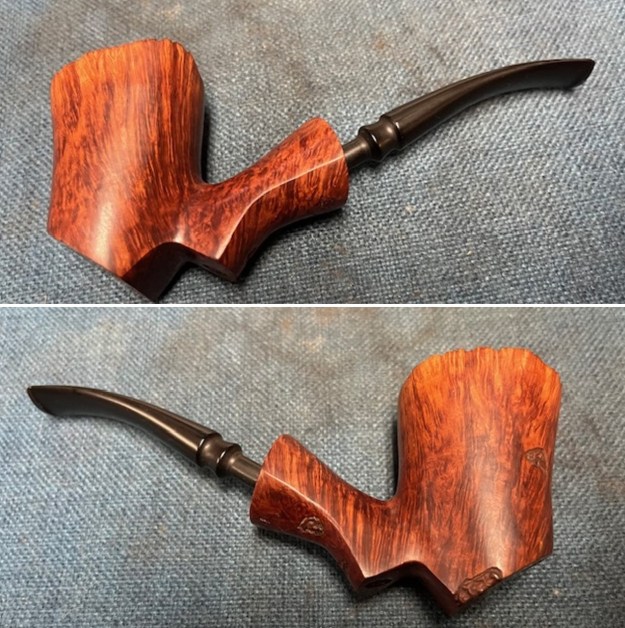
So, let’s take a closer look at this pipe. It really is a beauty and, if Steve hadn’t wanted it, I would certainly have kept it for myself. What would you call this shape? It’s probably a freehand brandy.

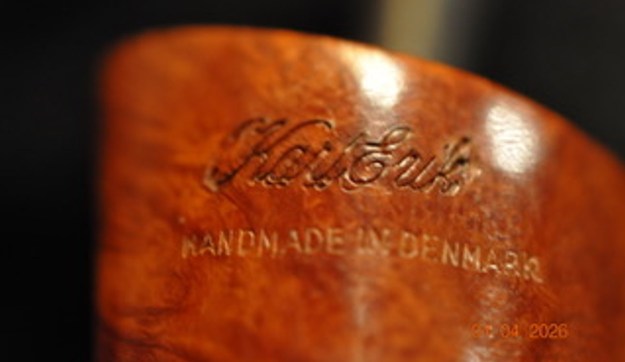
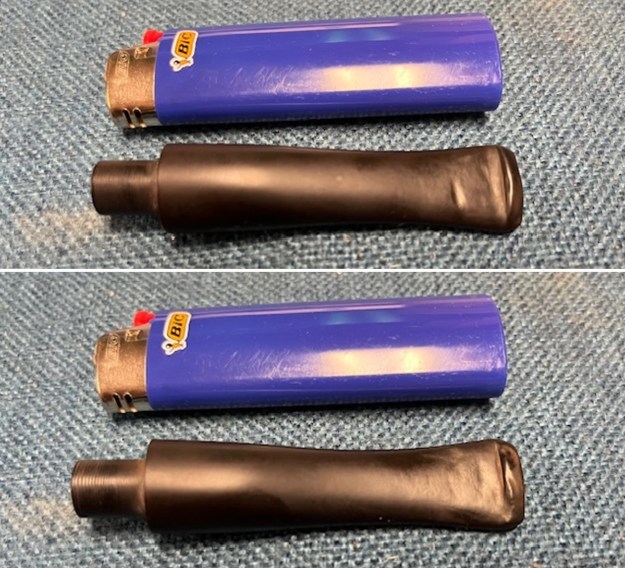
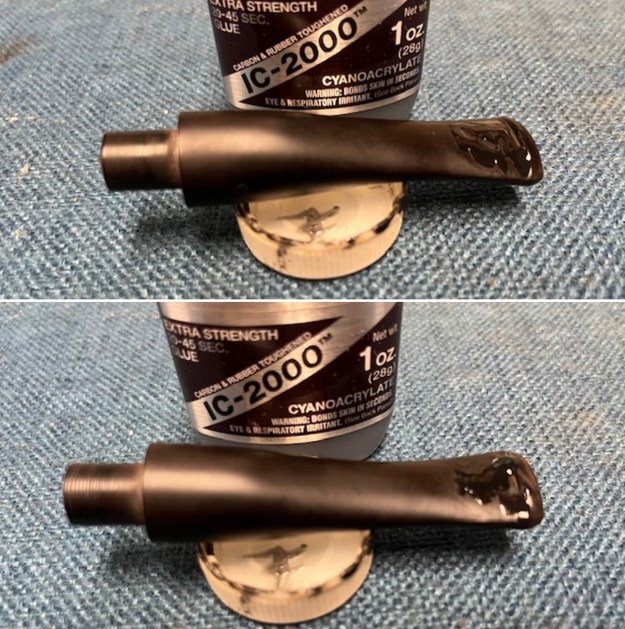
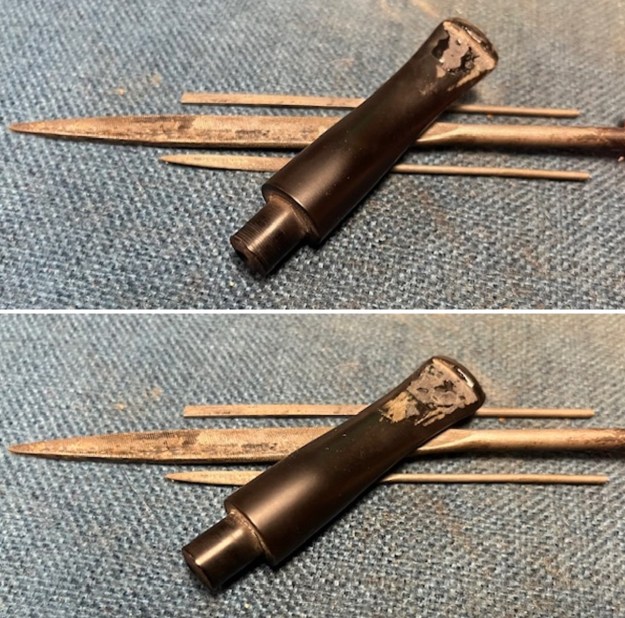
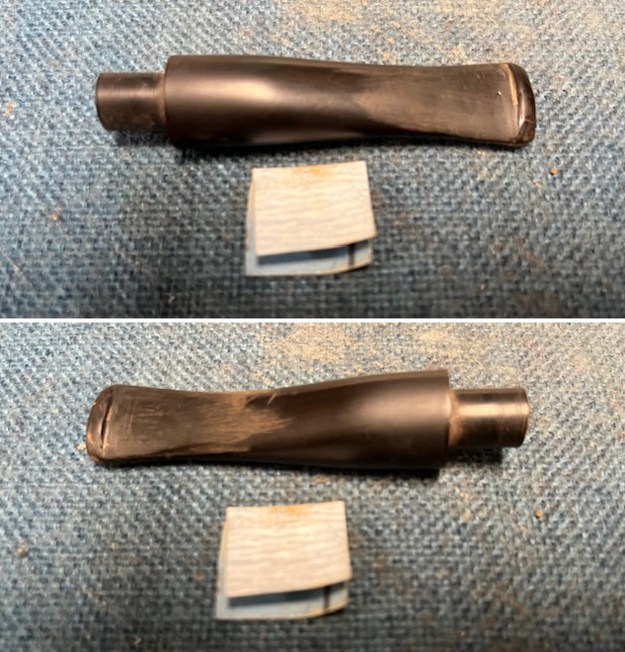
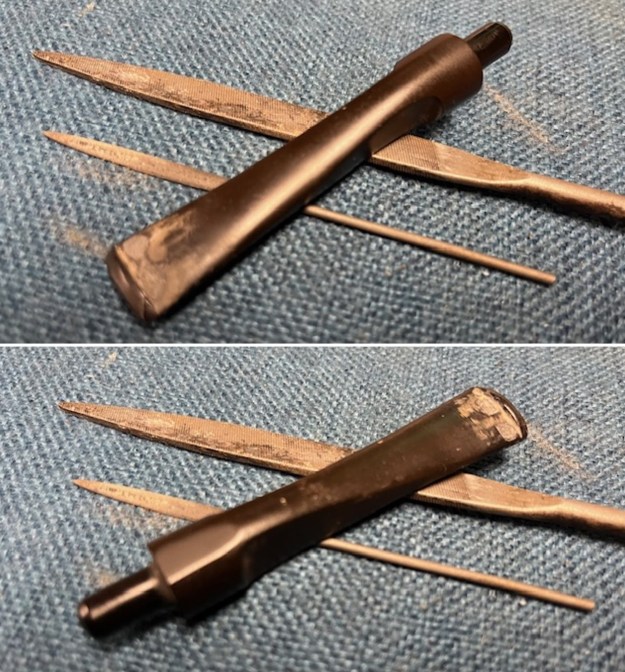
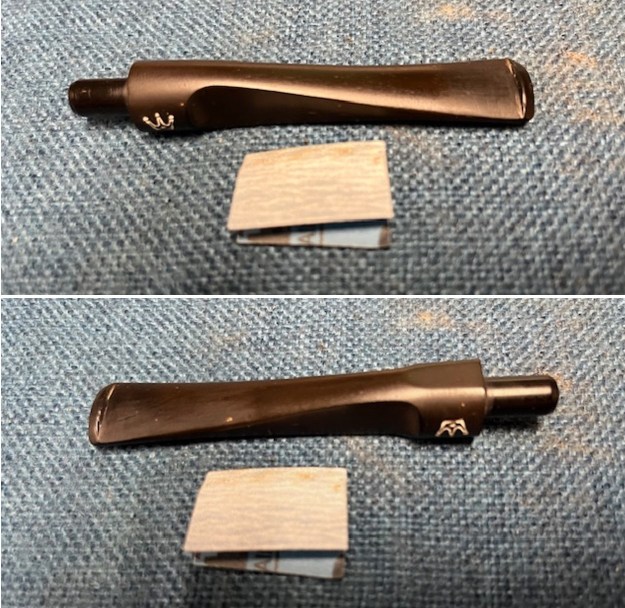
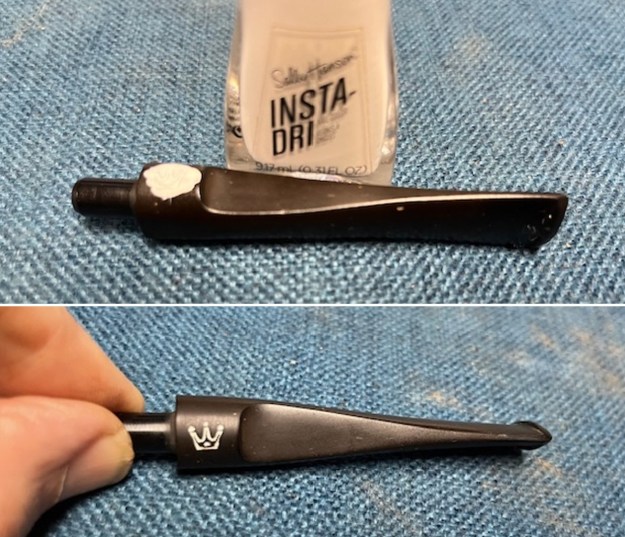
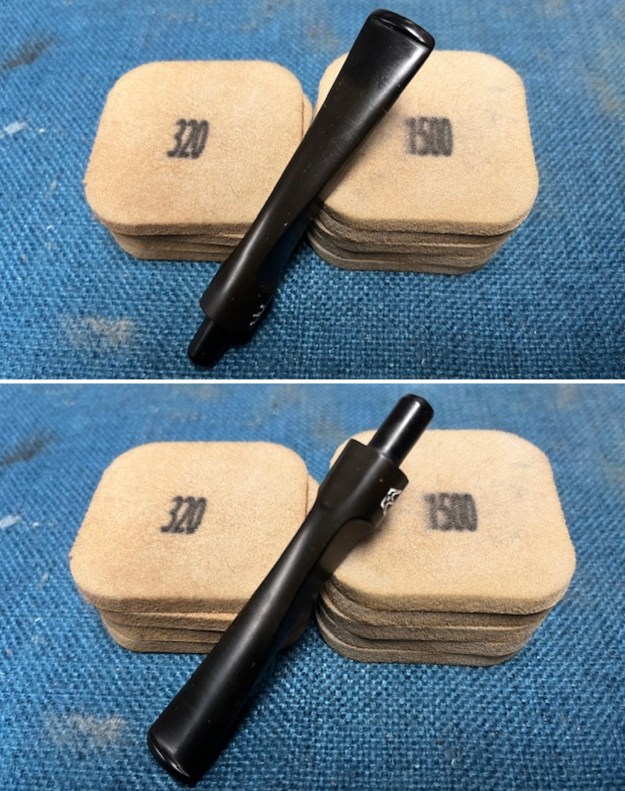
The markings are very clear. On the left side of the shank, we see Åge [over] Bøgelund – written in a semi-circle. To the right of that, are the initials DB. On the right side of the shank, we see Handmade [over] in Denmark. Finally, on the underside of the shank, we see the initials EN. Despite much investigation, I cannot determine what the initials DB or EN are meant to represent. I wondered if DB was meant to signify Design Berlin – the connection is possible but tenuous. Google’s AI function suggested that there was a connection (without any source references), which makes me think this info from Google AI represents another pair of letters: the first being a B and the second being an S. I am pleased to report that the condition of the pipe is good. The stem obviously had a Softy Bit on it (Deo gratias). I’m pleased because it protected the bit from too much damage. The stem has quite a bit of calcification on it, but not too much oxidation. The stummel is dirty, but sound. There is plenty of cake in the bowl, and a good amount of lava on the rim. There is minor wear to the briar for the most part – except for a small cut on one side. The stem’s calcification was notable. I used an old butter knife and gently scraped some of the thicker accretion off. Doing this now helps later in removing the oxidation. I used isopropyl alcohol on a few cotton rounds and wiped down the stem to provide an initial cleaning of filth before moving on to the next steps. The primary cleaning came next. I disinfected the inside of the stem with both pipe cleaners and cotton swabs dipped in lemon-infused 99% isopropyl alcohol. I scrubbed thoroughly to make sure the interior was very clean.The goal of the next step is the removal (or minimization) of oxidation. Going to my sink, I used cream cleanser, cotton rounds, and a toothbrush, and scoured the stem to remove as much surface oxidation as possible. As the photos show, the result was a hideous, ochre-coloured mess – but better off the stem than on it.Once the stem was reasonably clean, I soaked it overnight in some Briarville Stem Oxidation Remover. This solution works to draw oxidation in the stem to the surface of the vulcanite. This is a major aid and an important step in ensuring a clean stem. The following day, I drew out the stem from its bath and scrubbed the lingering fluid with a toothbrush.As the stem was now clean and dry, I set about fixing the marks and dents in the vulcanite. This was done by filling those divots with black cyanoacrylate adhesive, impregnated with carbon and rubber. I left this to cure and moved on.The penultimate step for the stem is sanding. First, with my set of needle files, I reduced the bulk of the cyanoacrylate repairs. I removed the excess adhesive as near to the surface as possible, without cutting into the vulcanite. Following that, I used all nine of the micromesh sanding pads (1,500 through 12,000 grit) to sand out flaws, even out the vulcanite, and provide gentle polishing of the finished surface. I also applied pipe-stem oil while using the last five micromesh pads. There was a wonderful, deep black shine to the stem when I was done.As the stem was (nearly) complete, I moved on to the stummel. The first step was to ream out the bowl – that is to say, remove all the cake inside the bowl. This accomplished a couple of things. First (and most obviously), it cleaned the bowl and provided a refurbished chamber for future smoking. Second, when the old cake was removed, I could inspect the interior walls of the bowl and determine if there was damage or not. I used a reamer, a pipe knife, and a piece of sandpaper taped to a wooden dowel. Collectively, these ensured that all the debris was removed.My next step was to remove the lava on the rim. For this, I took a piece of machine steel and gently scraped the lava away. The metal’s edge is sharp enough to remove what I need, but not so sharp that it damages the rim.Similar to the stem, I then cleaned the stummel with both pipe cleaners and cotton swabs dipped in lemon-infused 99% isopropyl alcohol. With a pipe this dirty, it took quite a while and much cotton to clean.I then decided to ‘de-ghost’ the pipe – that is to say, exorcize the remaining filth from the briar. I filled the bowl and the shank with cotton balls, then saturated them with 99% isopropyl alcohol. I let the stummel sit overnight. This caused the remaining oils, tars and smells to leach out into the cotton.To tidy up the briar, I wiped down the outside, using a solution of a pH-neutral detergent and some distilled water, with cotton rounds. I also used a toothbrush in the crevices. This did a good job of cleaning any latent dirt on the surface of the briar. The last step of the cleaning process was to scour the inside of the stummel with the same mild detergent and tube brushes. This was the culmination of a lot of hard work in getting the pipe clean.Having completed that, I was able to address the nicks on the rim and the bowl. I dug out my iron and a damp cotton flannel cloth. By laying the cloth over the affected areas and applying the iron to it, the hot and moist steam can cause the wood to swell slightly and return to shape. There was some improvement – not a lot, but it was better than doing nothing. I forgot to take a photo, however.

I used all nine micromesh pads (1,500 through 12,000 grit) to sand the outside of the stummel and finish it off. This sanding minimizes flaws in the briar and provides a beautiful smoothness to the wood. I rubbed some LBE Before & After Restoration Balm into the briar and let it sit for 30 minutes or so. The balm moisturizes the wood and gives a beautiful depth to the briar. I then buffed the stummel with a microfibre cloth. For the final step, I took the pipe to my bench polisher and carefully buffed it – first with a blue diamond compound, then with three coats of carnauba wax. This procedure makes the pipe look its best – the stummel sings and the stem glows.All done! This Åge Bøgelund freehand brandy pipe looks fantastic again and is ready to be given to Steve. It was a pleasure to work on. It’s a gorgeous pipe. The approximate dimensions of the pipe are as follows: length 6 in. (153 mm); height 2⅛ in. (53 mm); bowl diameter 1¾ in. (44 mm); chamber diameter ¾ in. (19 mm). The weight of the pipe is 2⅛ oz. (61 g). I hope you enjoyed reading the story of this pipe’s restoration as much as I enjoyed restoring it. If you are interested in more of my work, please follow me here on Steve’s website or send me an email at kenneth@knightsofthepipe.com. Thank you very much for reading and, as always, I welcome and encourage your comments.

New Life for a Castello Old Antiquari KK 32 Hand Made Canadian


by Steve LaugView post

The next pipe on the table is another one that came to us from the seller in Caldwell, Idaho, USA on 07/12/2025. It is a Castello Rusticated Canadian with an acrylic taper stem with the faux diamond on the left side of the stem. It is in dirty but in good condition as can be seen in the photos below. It is stamped on a smooth panel on the underside of the shank and reads Castello [over] Old Antiquari [followed by] KK 32 [followed by] Hand Made [followed by] Made in Cantu [over] Italy [followed by] Carlo arched over Scotti in an oval. The stamping is clear and readable. The pipe has rich Tan and Brown stains on a deep rusticated finish and a dark stain flume around the rim top and down the bowl sides about ¼ inch. The finish was dusty and lightly dirty with grime in the nooks and crannies of the rugged, deep sandblast. The bowl had a moderate cake and there was tobacco debris in the bowl. The rim top had a thick lava coat in the sandblast rim top and edges. The original taper stem is dirty and oxidized. It has the crumpled diamond look to the logo. I took photos of the pipe before I started working on it. I took photos of the bowl and rim top to show the thickness of the cake and the lava coat on the rim top. There was some tobacco debris in the bottom of the bowl. The stem photos show the condition of the taper stem ahead of the button. The stamping on the heel of the bowl is clear and readable as noted above. I took a photo of the pipe with the stem removed to give a sense of the proportions of the pipe. It is a real beauty. Interestingly, there was a clean foil inner tube in the tenon.

As usual I cannot seem to retain the details on Castello pipes in my head for long for some reason. The stamping on this one – Castello and the Carlo Scotti stamp left me with some questions that I need to answer before I began to work on the pipe. I turned first to the Pipephil site (http://www.pipephil.eu/logos/en/logo-castello.html) because of the general quick summary of information I get there along with a screen capture.Castello PIPA CASTELLO di Carlo Scotti & C. was founded in 1947 by Carlo Scotti († 1988). Franco Coppo (AKA “Kino”) who married Carlo Scotti’s daughter Savina, manages (2012) the corporate since 1985.

The site also gave a good summary of the grading and sizes of the pipes. I quote that in full.

Sizes (ascending):

1K to 4K, G (Giant) and GG (Extra large)

Rusticated grading: SEA ROCK, OLD SEA ROCK, NATURAL VERGIN,

Sandblasted grading: ANTIQUARI, OLD ANTIQUARI

Smooth grading (ascending): TRADEMARK, CASTELLO, COLLECTION

Other stampings: Great Line (Non-standard or freestyle) Fiammata (Straight grain)

Production (2012): ~4000 pipes / year

I also found a note on the page that the Rhinestone logo was originally on pipes for the US market. It is occasionally used now.

I turned then to Pipedia for more information on the brand (https://pipedia.org/wiki/Castello). The majority of the information was what was already quoted above in abbreviated form.

…All carved Castello pipes are graded by the number of K’s that are stamped on each piece and are K-graded by SIZE.  1K is the smallest and fairly rare, 2K is small to medium, with 3K or 4K being the most common and ranges from medium to medium large. Large pieces are stamped “G” for giant and extra-large pieces are stamped “GG” for double giant.  In addition to the number of K’s on a carved Sea Rock piece the shape number is almost always added. As a rule a Sea Rock Castello is stained Black, although recently there have been quite a few coming in stained deep brown and still stamped “Sea Rock”. American Logo’d Sea Rocks are all priced the same to the consumer, although most are 2 or 3 K’ed models. G/GG models are charged at a higher price on American pieces and are basically the same as their European counterparts.

The Castello Old Antiquari Briar KK 32 I was working on was definitely one made for the American Market with the Rhinestone in the stem. It had a brown or tan finish with a black flume around the top and the outer edge of the bowl. The Castello Old Antiquari in my hands was 2K graded. That told me that it is a mid-sized pipe. The number 32 makes it a short Canadian shape.

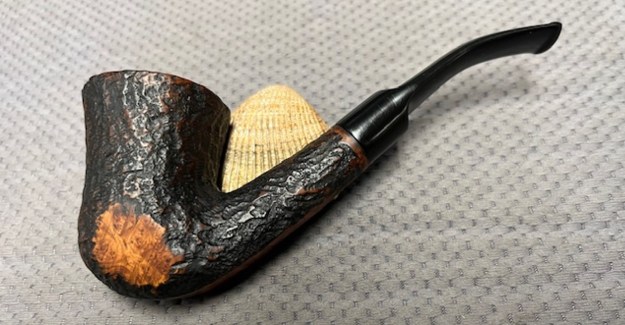
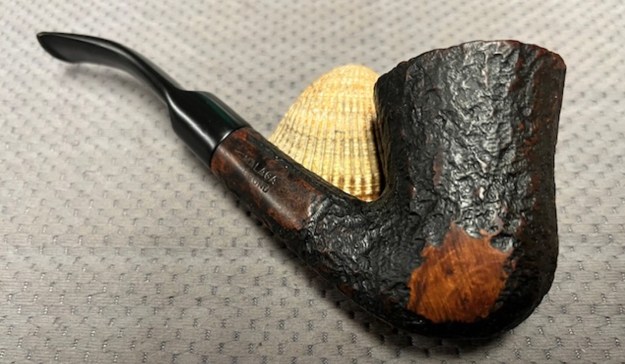
Now it was time to work on the pipe. I started my work by reaming the pipe. I scraped out the light cake with a Savinelli Fitsall Pipe Knife. I took the cake back to bare briar. I sanded the walls smooth with 220 grit sandpaper wrapped around a piece of dowel. The bowl walls looked very good with no burn damage or checking on the walls. I worked over the rugged rustication on the rim top to remove the tars and lava on the rim top with a brass bristle wire brush.I cleaned out the inside of the shank and the airway in the stem with alcohol, cotton swabs and both bristle and regular pipe cleaners. I scrubbed the bowl and shank with a tooth brush and some undiluted Murphy’s Oil Soap. I rinsed it off with warm water to remove the dust and soap from the finish. I dried it off with a soft cloth. The rim top was still darkened in the grooves of the sandblast. I touched up the black of the flume finish on the rim top and outer edge of the bowl with a black stain pen. It looked much better at this point with the finish cleaned of the dust and debris in the finish. It is a rich and rugged rustication.I rubbed the briar down with Before & After Restoration Balm. I worked it into the briar with my fingertips and a horsehair shoe brush to work it into the nooks and crannies of the sandblast finish. The product works to clean, enliven and preserve the briar. I let it sit for 10 minutes then I buffed it with a cotton cloth to deepen the shine. The briar really comes alive with the balm. I set the bowl aside and worked on the stem. The stem was stamped on the underside and read TRADE MARK [over] CASTELLO [over] 7. I sanded the oxidation and the tooth marks and chatter with 220 grit sandpaper. I was able to remove all of the light tooth damage on the stem and the majority of the oxidation. I sanded the stem and tenon surface with 320-3500 grit 2×2 inch pads. I wiped the stem down with an Obsidian Oil cloth after each sanding pad.I polished the vulcanite with micromesh sanding pads – 1500-12000 grit pads. I wiped it down with Obsidian Oil after each sanding pad. I used Before & After Pipe Polish – both Fine and Extra Fine to further polish the stem. This beautiful Castello Old Antiquari Rusticated Flumed Top KK 32 Short Canadian with a taper acrylic stem looks amazing after the work on it. The briar is clean and the deep rustication really came alive. The rich brown stains gave the finish a sense of depth with the polishing and waxing. The flumed black rim top and edges were a great contrast. The finish really popped. I put the stem back on the bowl and buffed the pipe with Blue Diamond on the buffing wheel using a light touch on the briar. I gave the bowl and the stem multiple coats of carnauba wax on the buffing wheel. I buffed the pipe with a clean buffing pad to raise the shine. I hand buffed the pipe with a microfiber cloth to deepen the shine. The finished Castello Old Antiquari Rusticated KK 32 Canadian really is a beauty and feels great in the hand and looks very good. Give the finished pipe a look in the photos below. The dimensions of the pipe are Length: 6 inches, Height: 2 inches, Outside diameter of the bowl: 1 1/2 inches, Chamber diameter: 7/8 of an inch. The weight of the pipe is 47 grams/1.66 ounces. I will soon be putting this pipe on the rebornpipes store in the Italian Pipe Makers section. It should make a great smoker that the next steward will enjoy. Thanks for reading this blog and my reflections on the pipe while I worked on it. It was a fun one to work on.
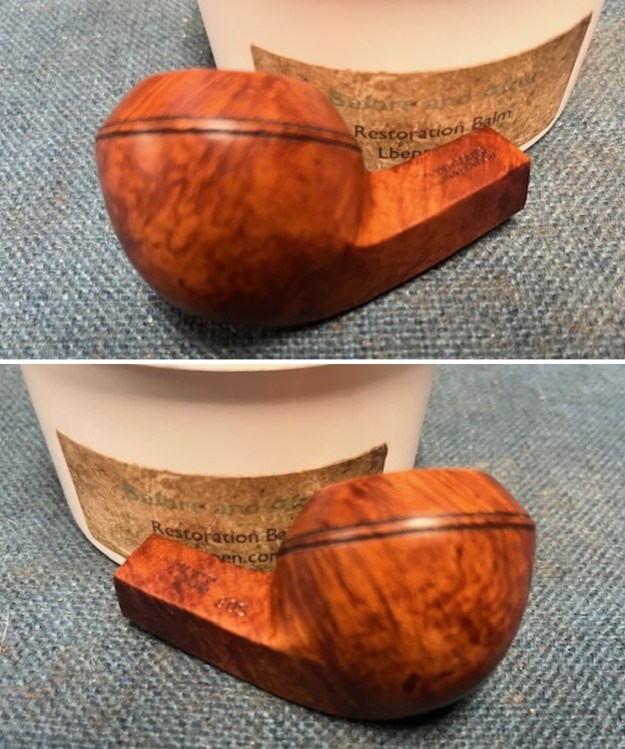
Restoring a 1955 Dunhill Tanshell ES Long Canadian


by Steve Laug

The next pipe on the table is another one that came to us from the seller in Caldwell, Idaho, USA on 07/12/2025. It is a Dunhill Tanshell Canadian with a vulcanite taper stem. It is in dirty but in good condition as can be seen in the photos below. It is stamped on a smooth panel on the underside of the shank and reads ES [followed by] Dunhill [over] Tanshell [followed by] Made in [over] England5 [followed by] circle 4T. The stamping is clear and readable. The pipe has rich Tan and Brown stains on a deep sandblast finish and some amazing grain that the shape follows well. The finish was dusty and lightly dirty with grime in the nooks and crannies of the rugged, deep sandblast. The bowl had a moderate cake and there was tobacco debris in the bowl. The rim top had a thick lava coat in the sandblast rim top and edges. The original white spot short taper stem is dirty and oxidized. I took photos of the pipe to show what it looked like before I started working on it. I took photos of the bowl and rim top to show the thickness of the cake and the lava coat on the rim top. There was some tobacco debris in the bottom of the bowl. The stem photos show the condition of the short taper stem ahead of the button. The stamping on the heel of the bowl is clear and readable as noted above. I took a photo of the pipe with the stem removed to give a sense of the proportions of the pipe. It is a real beauty.One of the first things I like to do is to unpack the stamping and understand each element in it. I turned to Pipephill helpful site (http://pipephil.eu/logos/en/dunhill/shell-briar1.html). The stamping is interpreted as follows: The ES is the shape of the pipe which I assume is a Canadian. The Dunhill Tanshell is the finish. Following the Made In England5 gives the year that the pipe was made. The circle 4 T is the stamp for a Tanshell finish.
I turned to Pipedia’s shape charts on Dunhills (https://pipedia.org/wiki/Dunhill_Shape_Chart). I have included the shape charts from the site. The first is the chart as a whole and the second is a larger version of the centre column.
From the above information I could see that I was working on a Canadian shaped pipe. The chart shows that the ES is the stamping for Canadian.

From there I wanted to pin down the date stamp 5. I have included the chart below for you to follow (http://www.pipephil.eu/logos/en/dunhill/cledat-en1a.html). The third column is where the 5-year suffix fits. Because the date code was a raised suffix, the suffix 5 is added to 1950 making the pipe a 1955 Tanshell long Canadian.I turned to work on the pipe itself. I reamed the bowl with a PipNet pipe reamer using the cutting heads 2 and 3. I finished the reaming with a Savinelli Fitsall Pipe Knife. I sanded the walls of the bowl with 220 grit sandpaper wrapped around a piece of dowel. I cleaned out the inside of the shank and the airway in the stem with alcohol, cotton swabs and both bristle and regular pipe cleaners.I scrubbed the bowl and shank with a tooth brush and some undiluted Murphy’s Oil Soap. I rinsed it off with warm water to remove the dust and soap from the finish. I dried it off with a soft cloth. The rim top was still darkened in the grooves of the sandblast.I scrubbed it further with Before & After Briar Cleaner and a brass bristle brush to work the cleaner into the grooves. I rinsed it off and repeated the process until it became cleaner. There is still some darkening in the sandblast that will not come out but it is clean and significantly better.I rubbed the briar down with Before & After Restoration Balm. I worked it into the briar with my fingertips and a horsehair shoe brush to work it into the nooks and crannies of the sandblast finish. The product works to clean, enliven and preserve the briar. I let it sit for 10 minutes then I buffed it with a cotton cloth to deepen the shine. The briar really comes alive with the balm. I set the bowl aside and worked on the stem. I sanded the oxidation and the tooth marks and chatter with 220 grit sandpaper. I was able to remove all of the light tooth damage on the stem and the majority of the oxidation.I sanded the stem and tenon surface with 320-3500 grit 2×2 inch pads. I wiped the stem down with an Obsidian Oil cloth after each sanding pad.I polished the vulcanite with micromesh sanding pads – 1500-12000 grit pads. I wiped it down with Obsidian Oil after each sanding pad. I used Before & After Pipe Polish – both Fine and Extra Fine to further polish the stem. I the polished stem and lightly buffed the sandblast bowl and shank with Blue Diamond to polish out the remaining small scratches and raise the shine. I gave the stem several coats of carnauba wax and the bowl several coats of Conservator’s Wax then buffed the pipe with a clean buffing pad to raise the shine. I hand buffed it with a microfiber cloth to deepen the shine. The pipe polished up pretty nicely. This turned out to be a beautiful 1955 Dunhill Tanshell CS Canadian. Even the darkening on the rim top does not detract from the beauty of the pipe. The finished pipe is shown in the photos below. The dimensions are Length: 6 ½ inches, Height: 1 ¾ inches, Outside diameter of the bowl: 1 ¼ inches, Chamber diameter: ¾ of an inch. The weight of the pipe is 1.16 ounces/33 grams. Thanks for walking through the restoration with me as I worked this beautiful little Dunhill sandblast. I will be putting it on the rebornpipes store in the British Pipe Maker Section soon. If you are interested in adding it to your collection let me know. Thanks for looking.