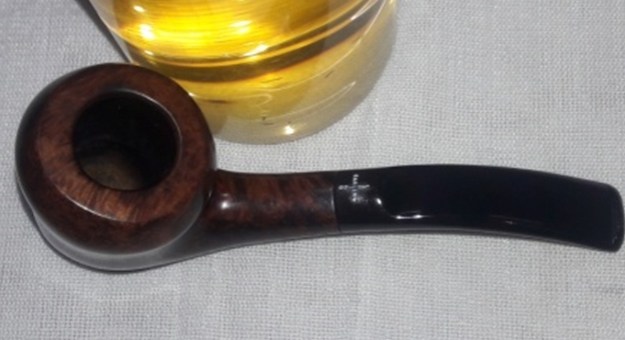
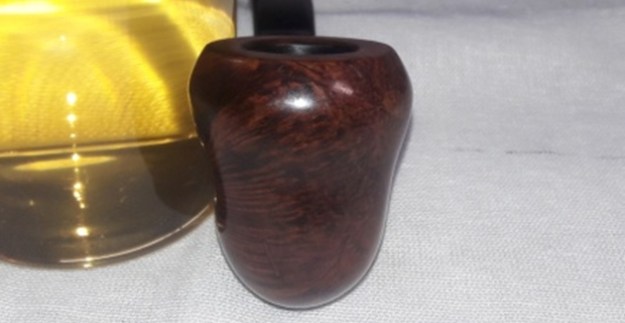
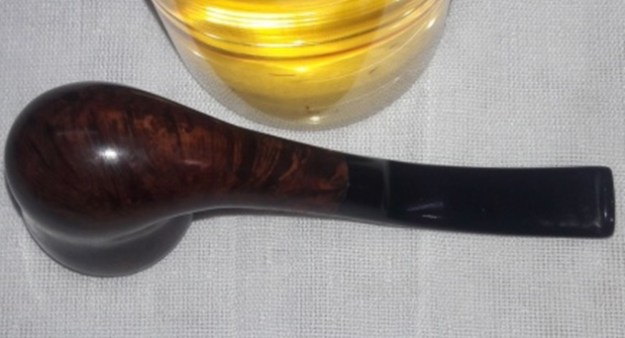
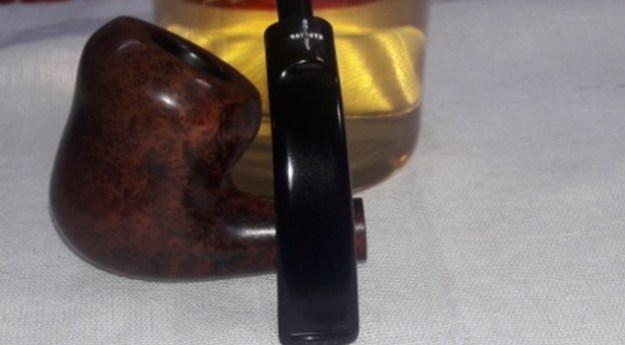
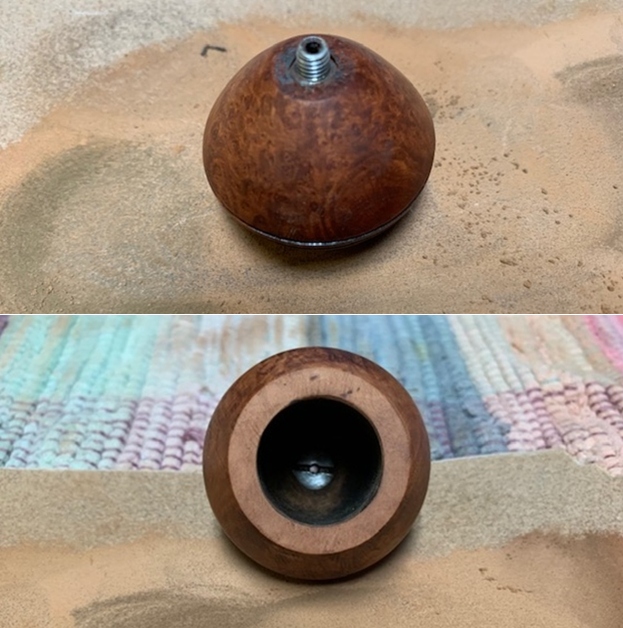
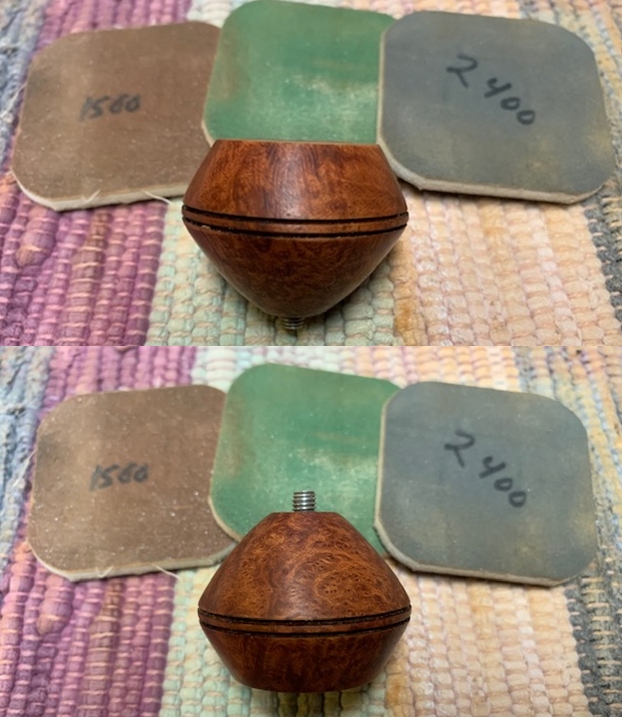
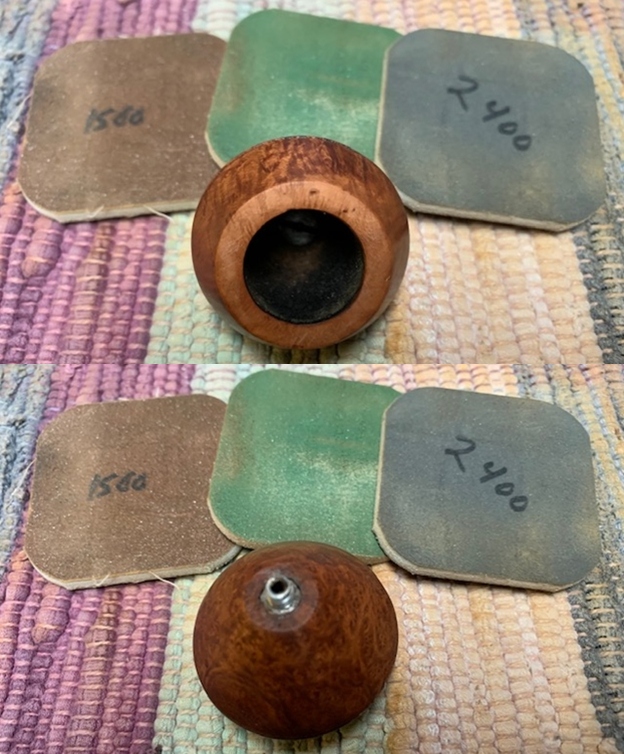
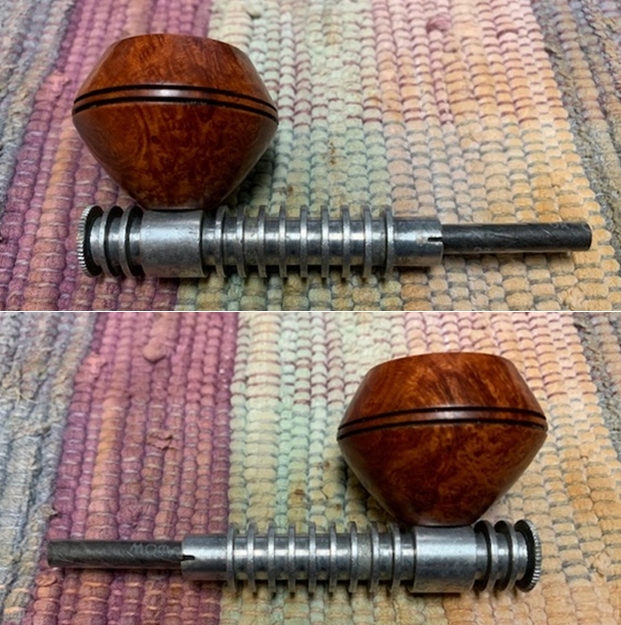
Tag Archives: bowl topping

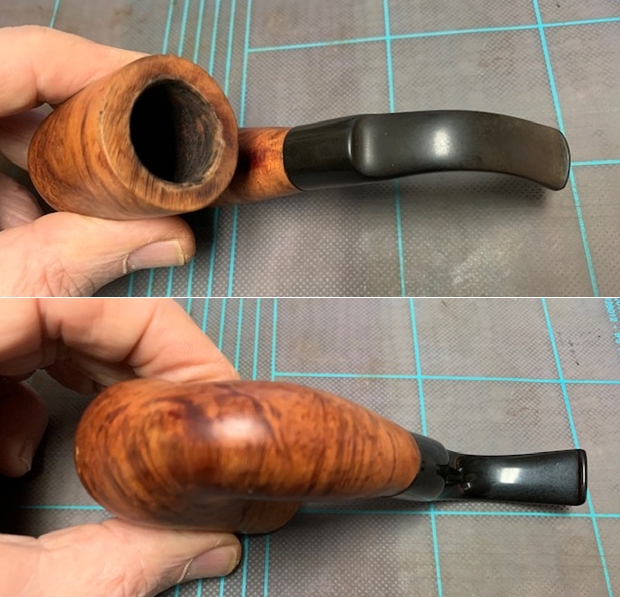
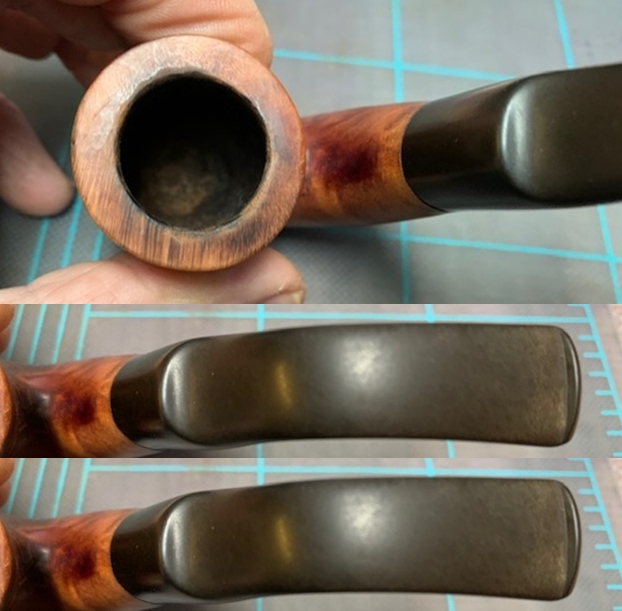
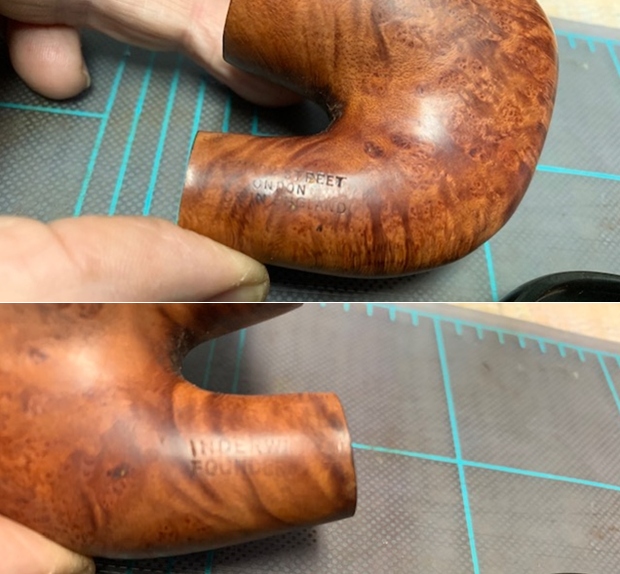
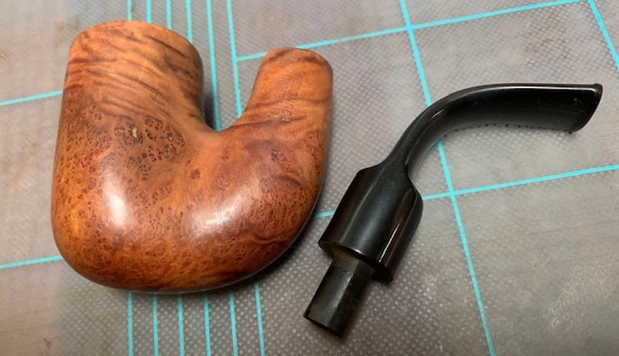
Refurbishing A Second Pipe From A Lot Of Six Pipes: A Barling Garnet Grain # 5059.


Blog by Paresh Deshpande

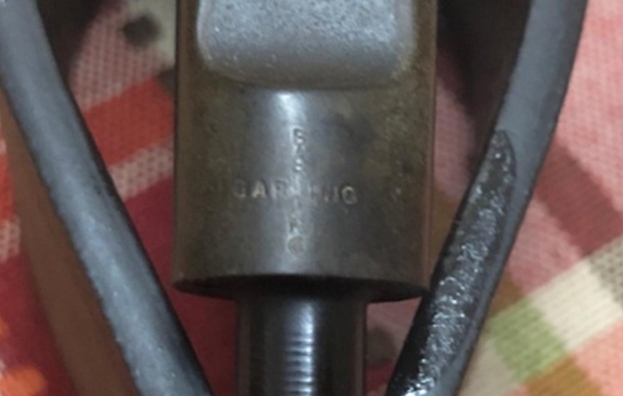
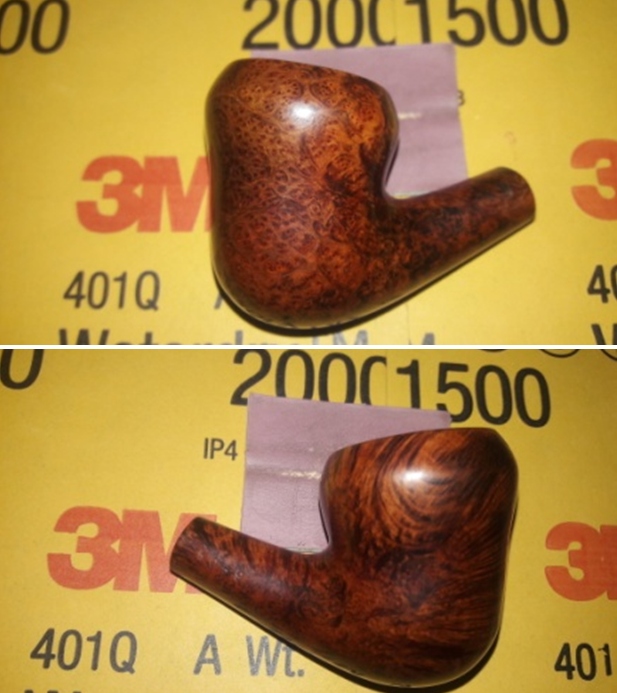
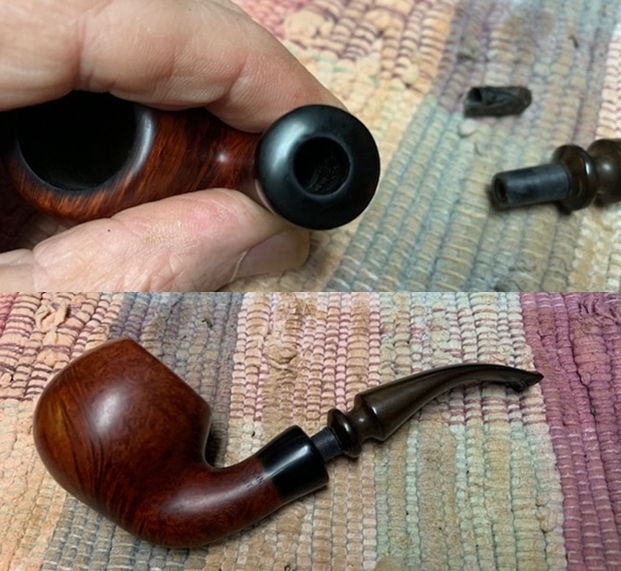
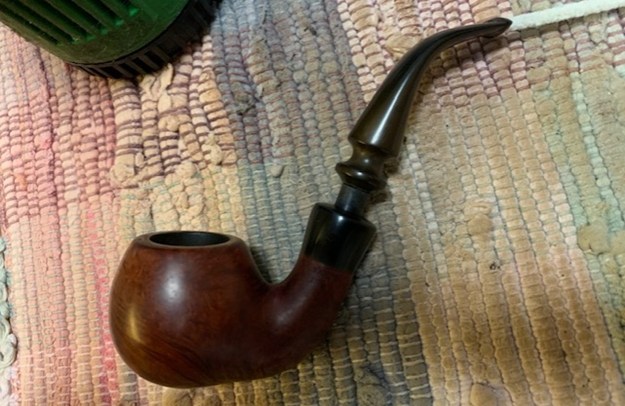
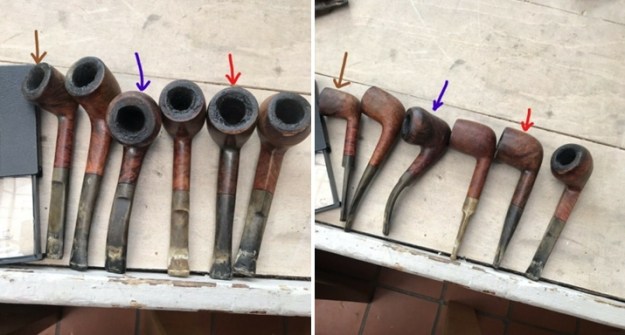
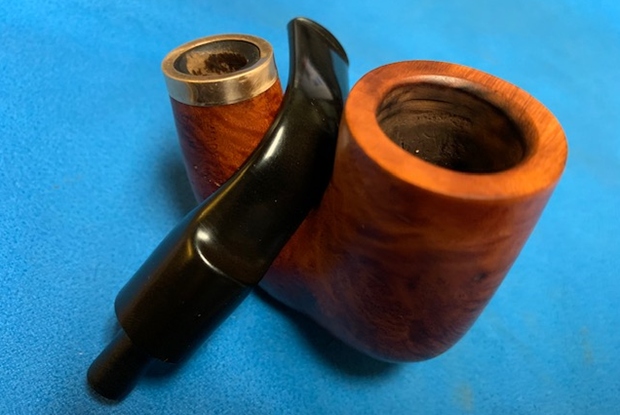
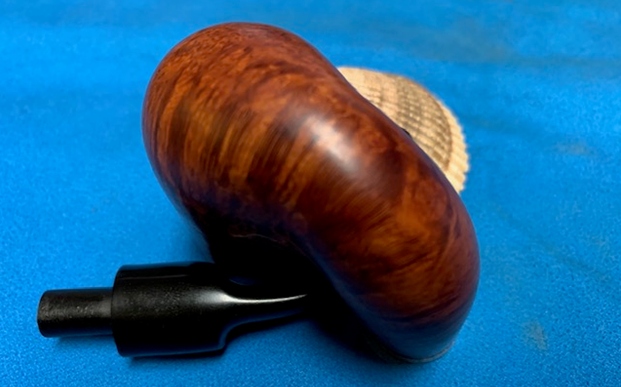
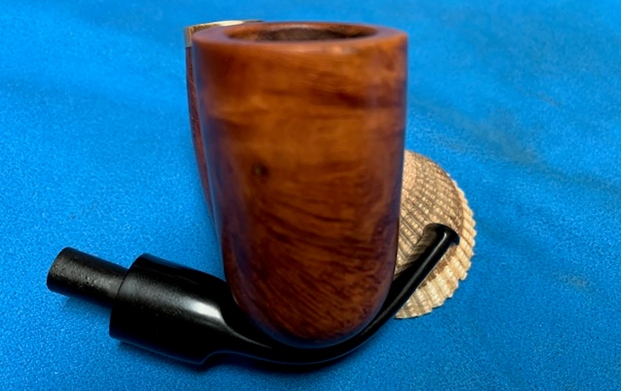
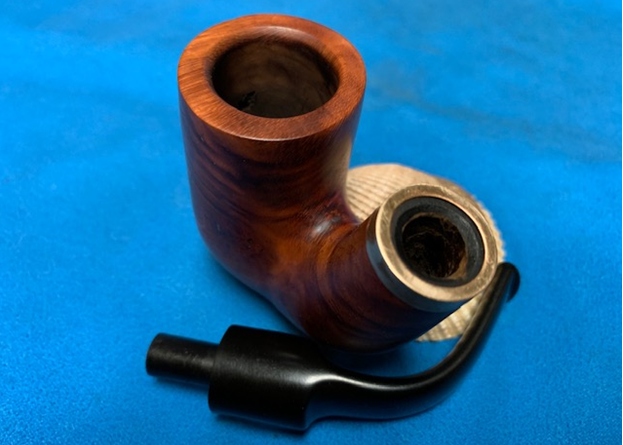
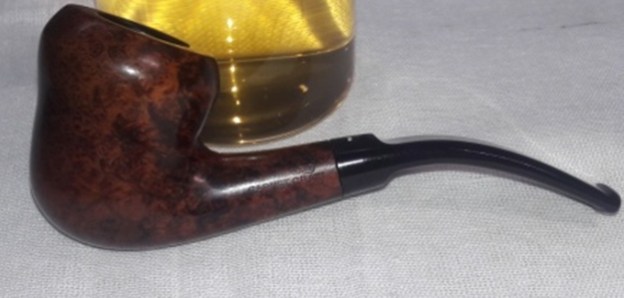
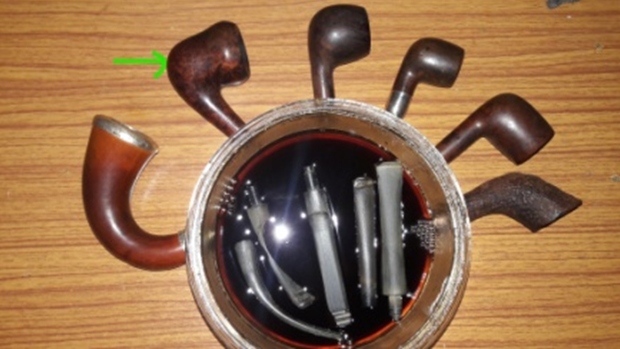
I had picked up a job lot of six pipes from a Curio Store on eBay. This lot contained brands like Barling’s, Parker and Orlik and other English make pipes. These are some of my favorite brands and I couldn’t pass them over even though they were in a hopelessly beat up condition. Here are pictures of the pipe lot that the seller had posted. This lot contained a variety of nicely shaped and grained pipes which I had been looking forward to work on. The first pipe from this pipe lot that I had worked on was a classic Billiards indicated in red arrow. The second pipe that I have selected to work on is shown with an indigo arrow.The second pipe that I decided to work on from this lot is an hour glass shaped pipe with beautiful tightly packed bird’s eye grain to the sides of the stummel and cross grains to the front, back and over the shank surfaces. This pipe is stamped on the left shank surface as “Barling” in running hand over “LONDON ENGLAND” in block capital letters over the grade “GARNET GRAIN”. The right side of the shank is stamped with the shape code “5059”. The stampings are all crisp and deep. The trademark Barling styled vulcanite saddle stem bears the trademark Barling stamped in cross. The size, shape and feel of the pipe are solid in hand. Barling’s pipe brand has been well researched and chronicled on pipedia.org and by Steve when he worked on many of Barling’s pipes over decades and thus, shall not waste time in repeating the information that is available. I too have carefully read and researched this brand as I do have many pipes that I have inherited. However, to refresh my memory, I read the entire article once again and tentatively date this pipe as being an Early Corporate Era pipe, that is made between 1962/3 to prior to 1970. I have based my conclusions based on the following facts that I have read on pipedia.org (https://pipedia.org/wiki/Barling)
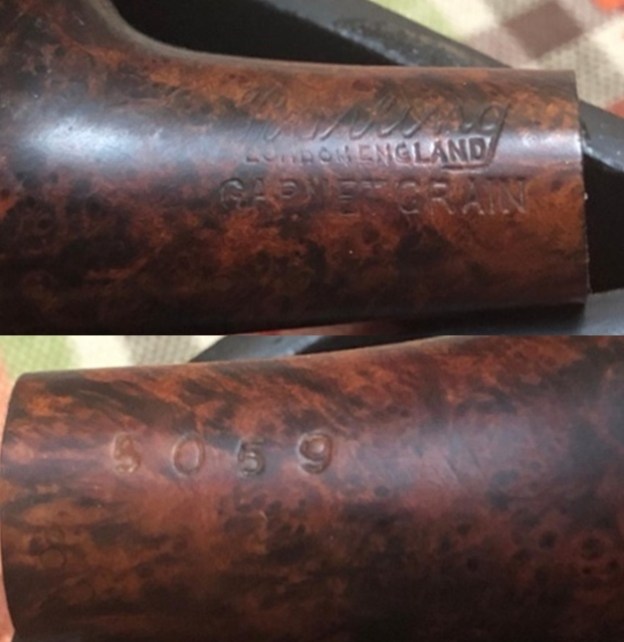
(a) Barling logo on the shank is stamped in script without an apostrophe and without ‘S’, as against BARLING’S MAKE that was in use during the Family Era.

(b) The revamped Early Corporate Era grade includes the GARNET GRAIN that replaced the Ye Olde Wood finish (having dark or Plum stain) from the Family Era.

(3) The presence of London England in block lettering underneath the Barling stamp in script.

(4) The absence of the T.V.F stamping since the Ye Olde Wood and TVF both were discontinued at the beginning of the Corporate Era. These were reintroduced in the mid 1960s.

I have dated this pipe tentatively as being from the Early Corporate Era when the facts are conclusive enough, is because of the stummel shape. In my reading and knowledge, early Barlings pipes have always been in classic shapes and this one is anything but a classic shape. Any insight in to this aspect is most appreciated.

Initial Visual Inspection
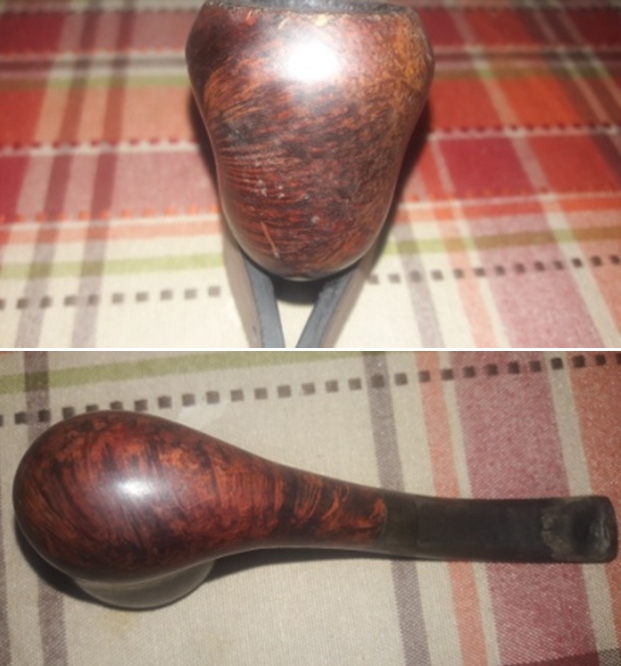
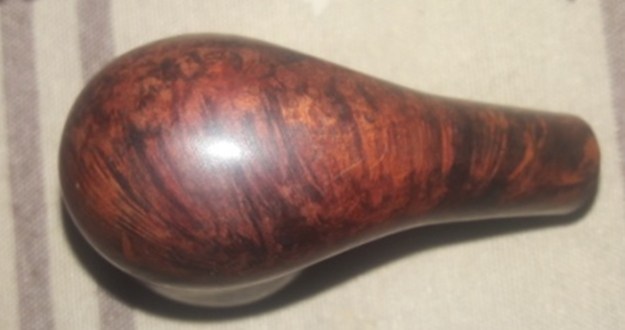
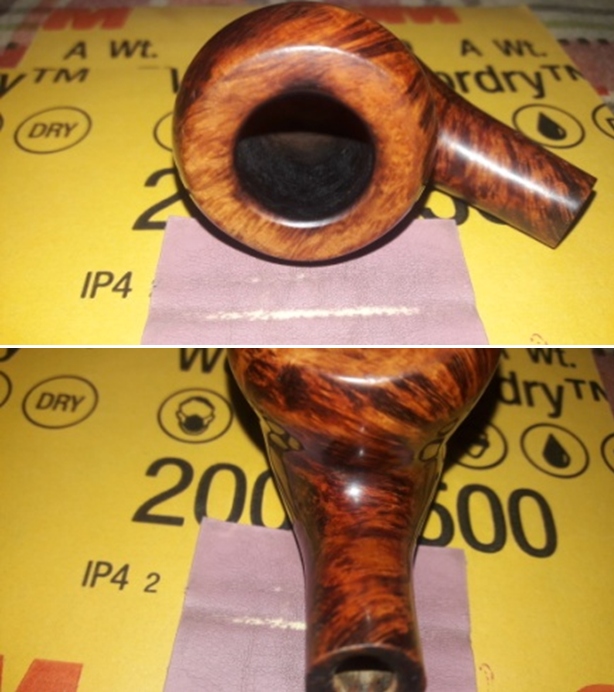
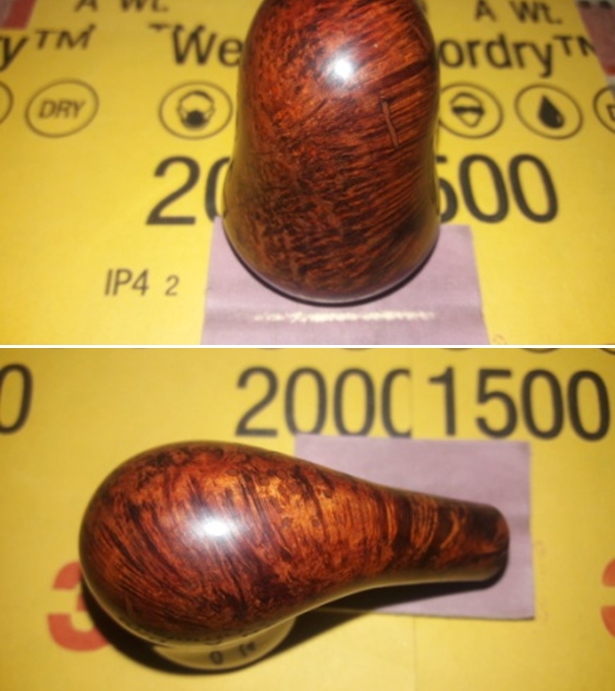
This pipe has a decent medium bowl size with chamber depth of about 1 7/8 inches. The stummel boasts of some beautiful cross grains to the front and back of the bowl and all around the shank and tight Bird’s Eye to the left side of the stummel. The stummel is covered in dirt and grime of the overflowed lava and dirt accumulated over the years of heavy smoking and uncared attention to cleaning. The stummel has a nice deep and dark color to it, reminiscent of the Ye Olde Wood finish. There is a thick layer of cake in the chamber and some damage is likely to the back of the rim top surface. The stem is heavily oxidized with a few deep bite marks to the button edge in the bite zone. The pipe’s appearance, as it sits on my work table, does not present an encouraging picture. Detailed Inspection Of The Pipe And Observations
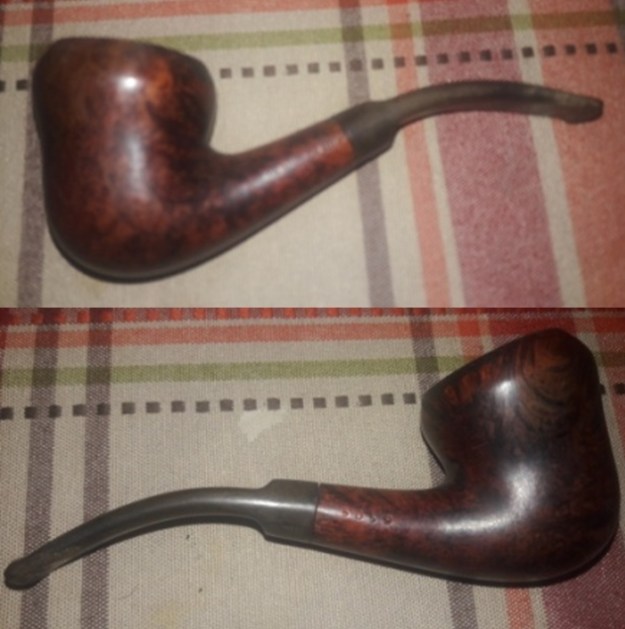
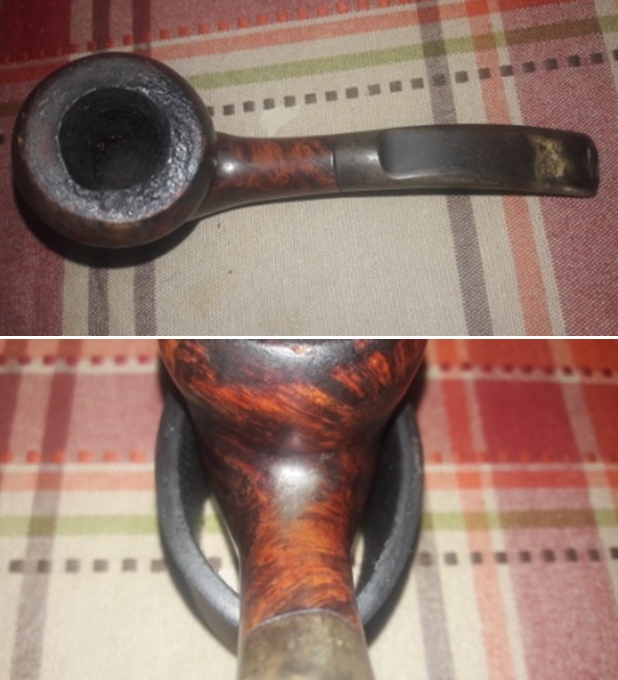
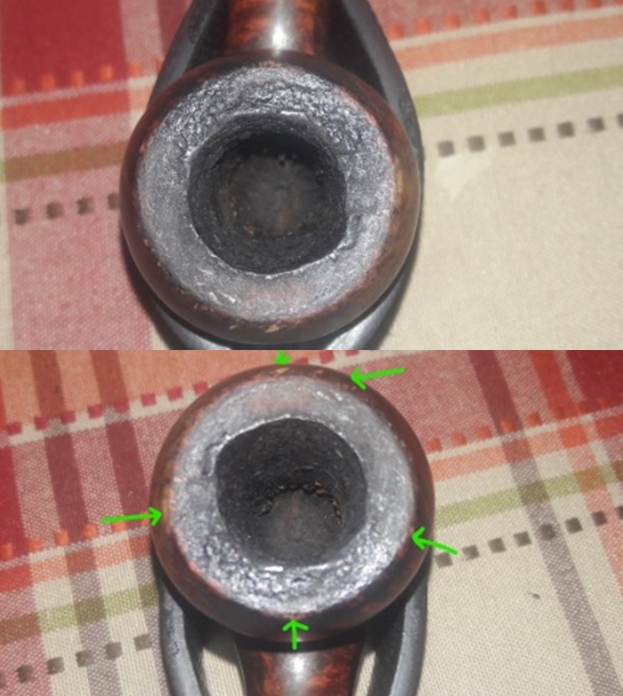
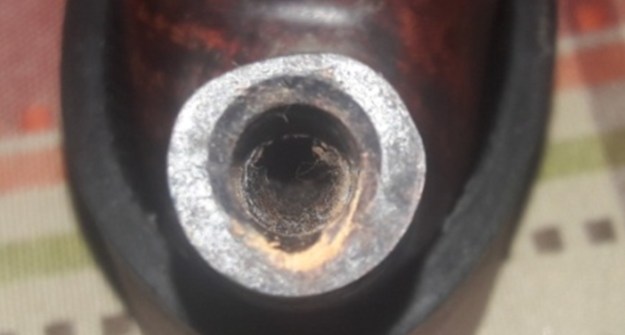
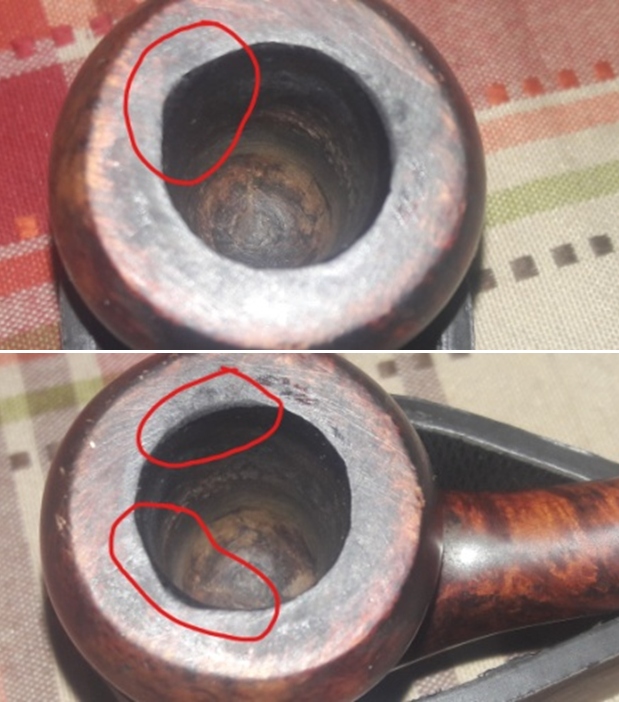
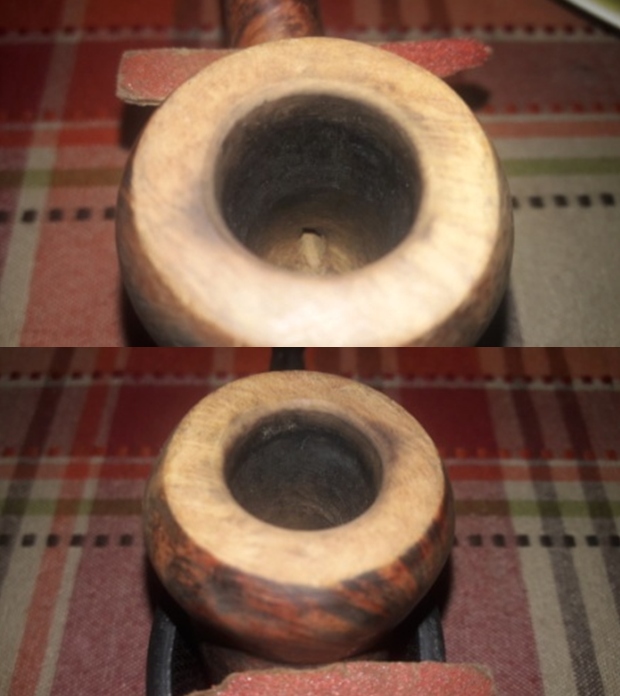
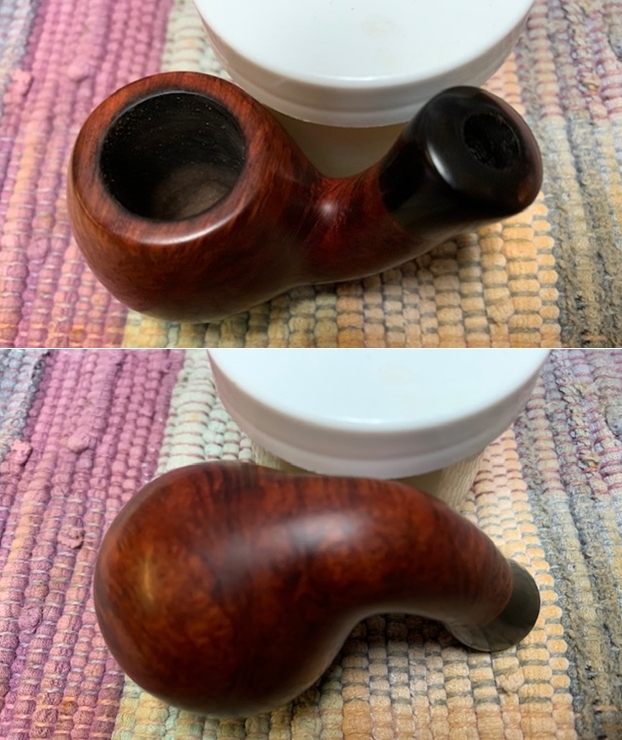
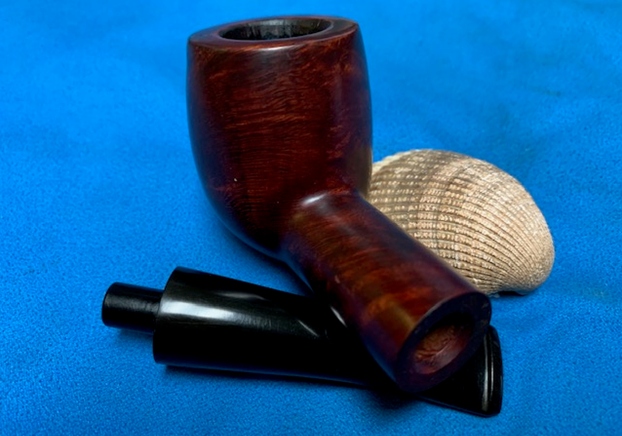
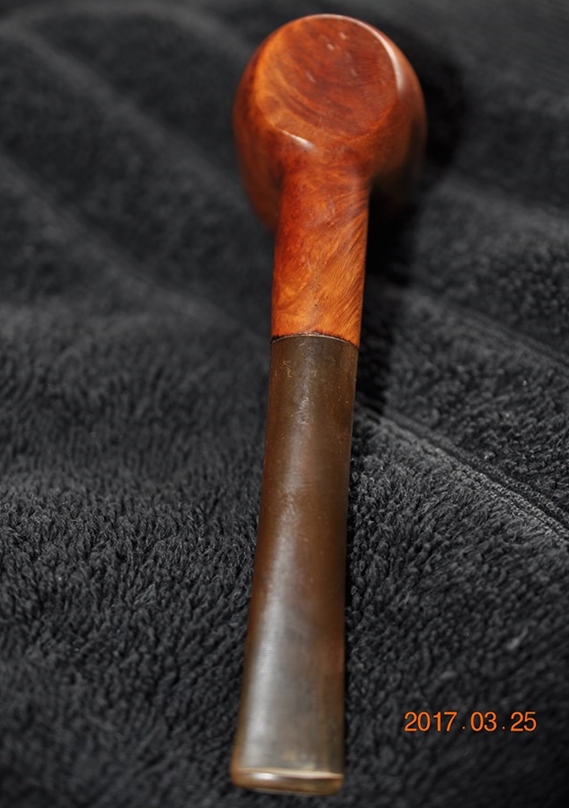
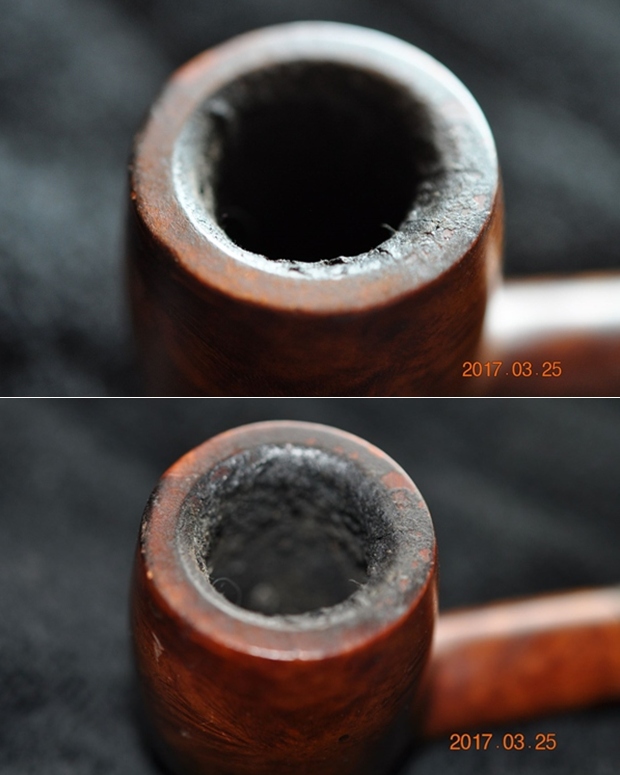
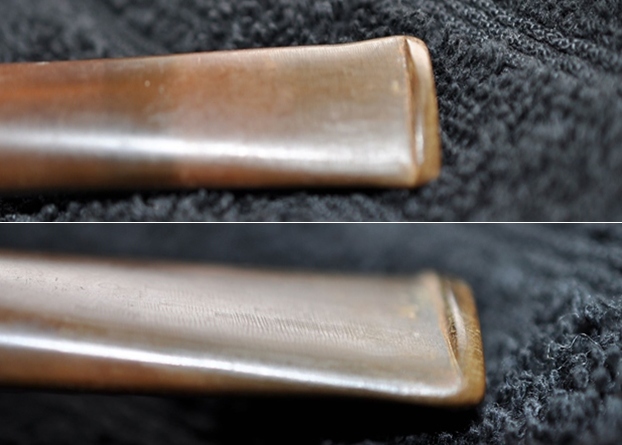
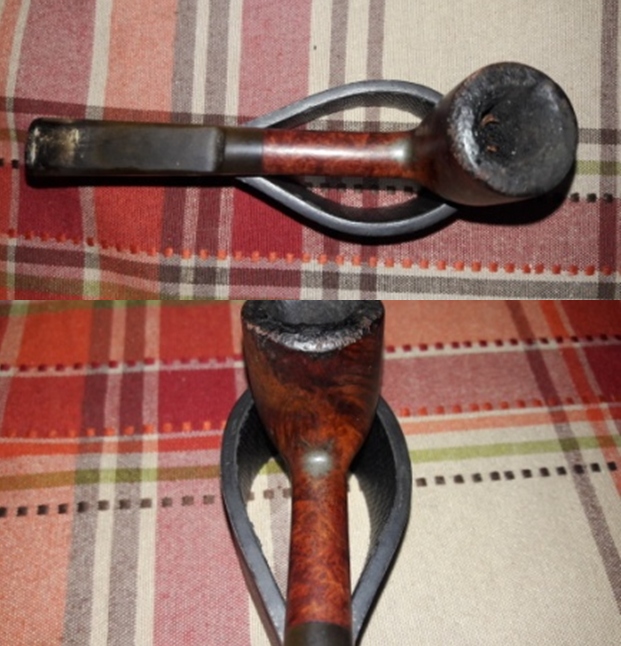
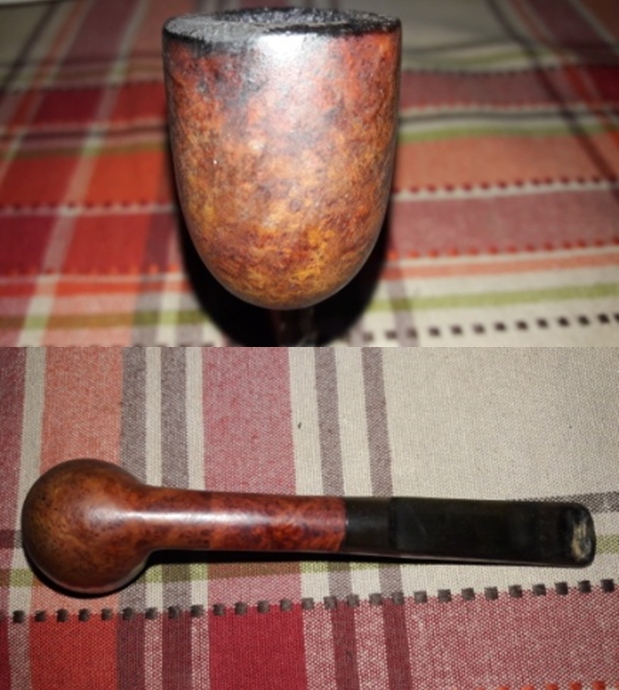
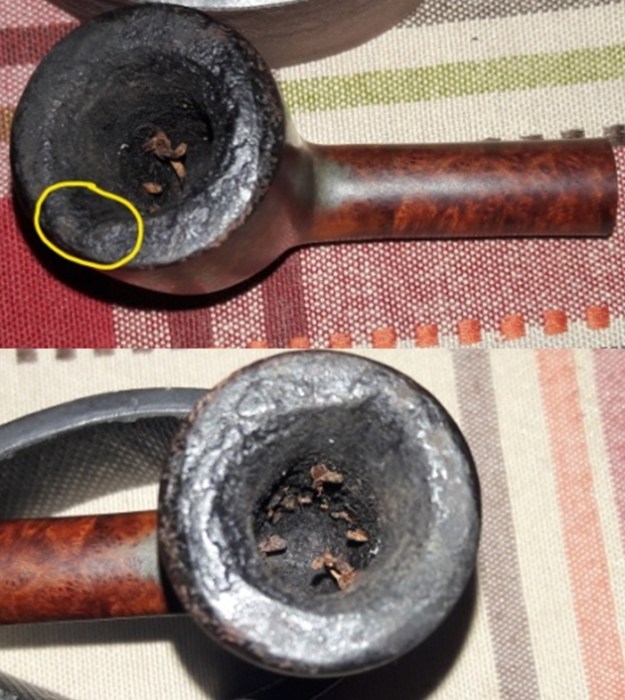
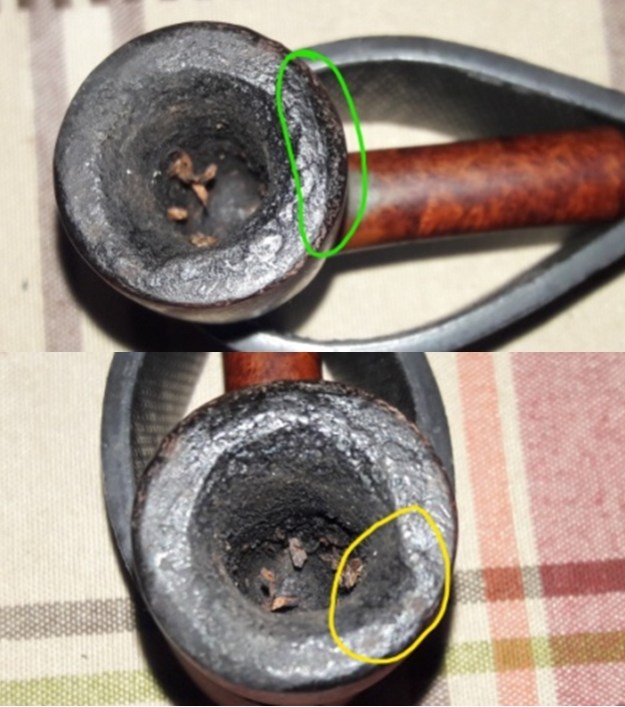
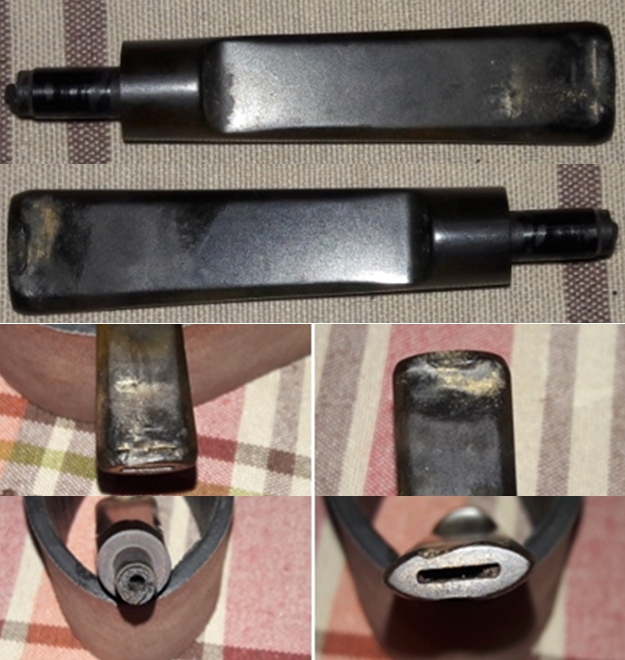
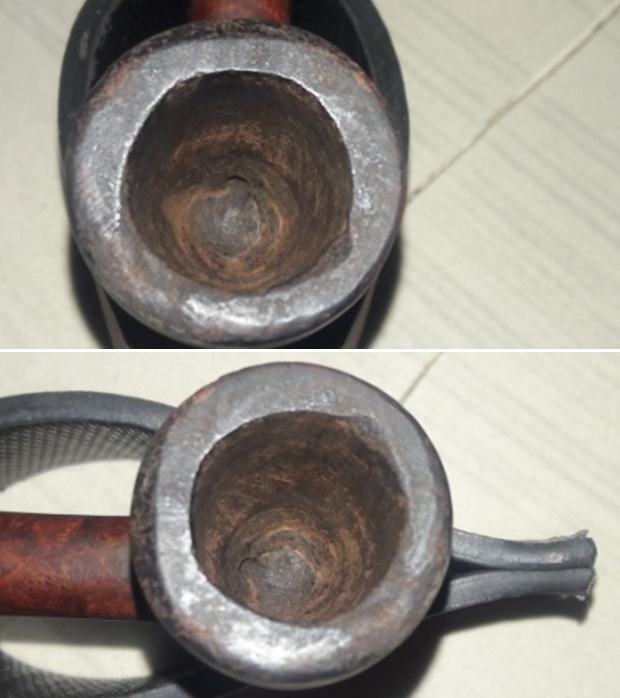
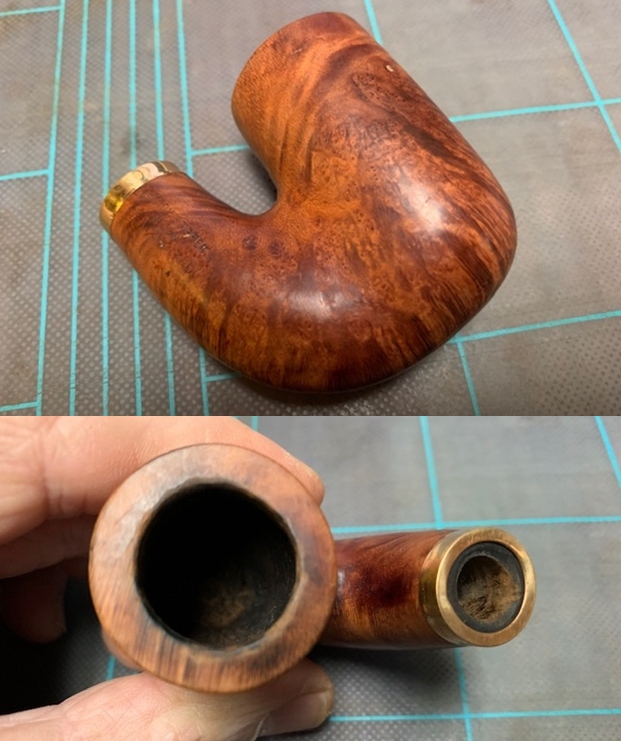
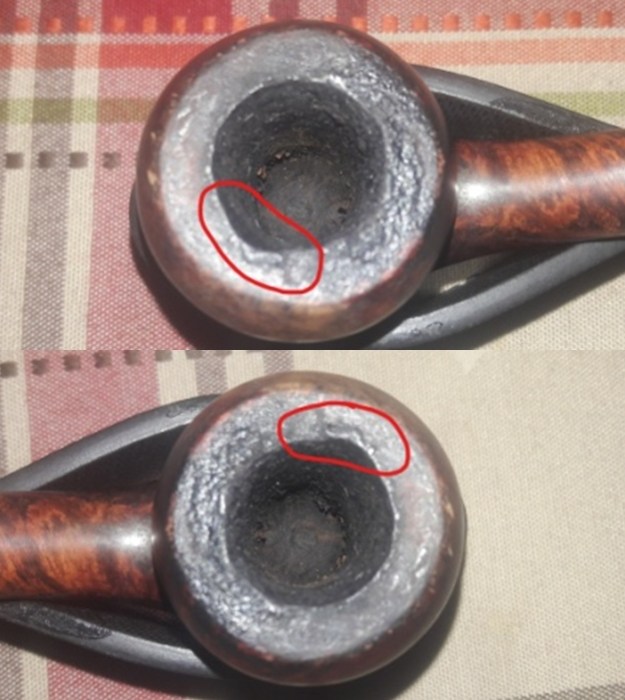
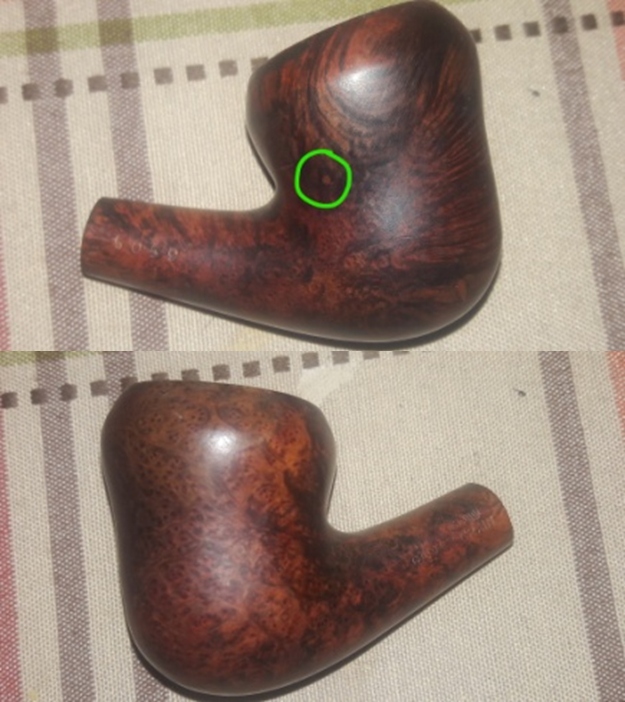
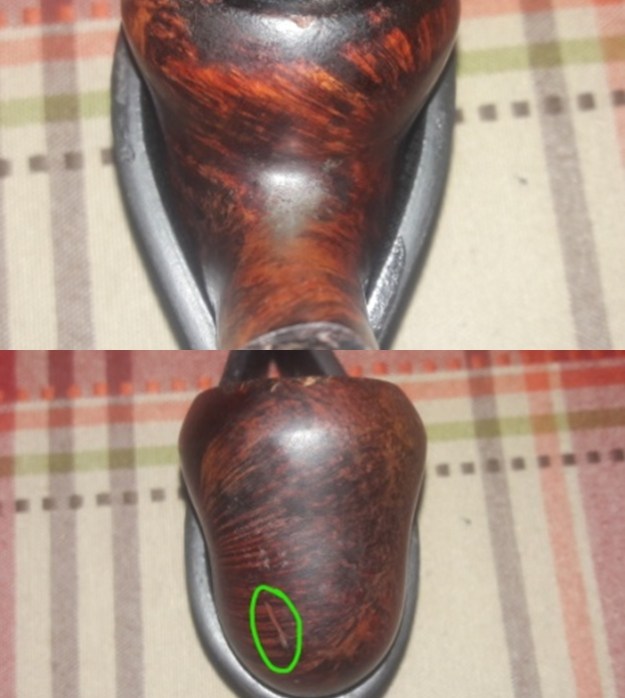
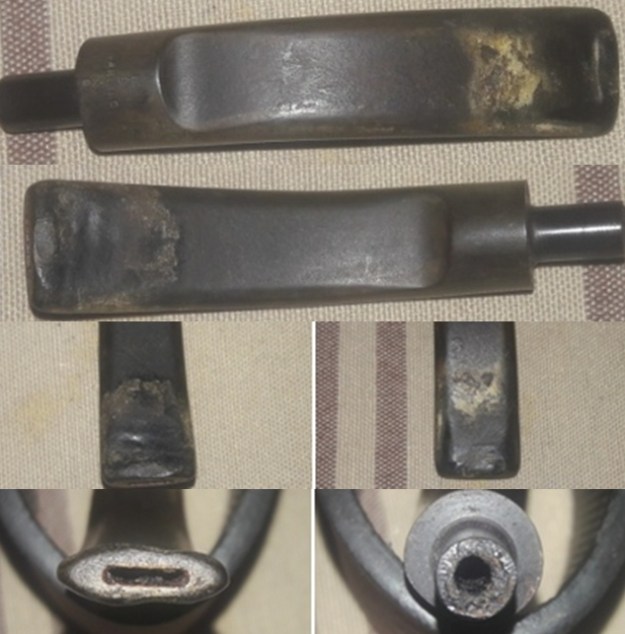
The bowl has a wide rim that slightly tapers down towards the heel and has a chamber depth of about 1 7/8 inches. The draught hole is in the center and at the bottom of the chamber. The chamber has an even layer of thick hard cake with remnants of un-burnt tobacco seen at the heel of the chamber. The rim top surface is covered with thick lava overflow and has max accumulation in the 6 ‘O’ clock direction. Through this layer of lava, a few dings can be seen over the rim top surface. The inner rim edge in the 6 ‘O’ clock direction appears dark and worn out. The outer rim edge is sans any damage. The condition of the inner walls of the chamber can be commented upon after the cake has been taken down to the bare briar. There is a strong ghost smell in the chamber which is all pervading. The chamber is out of round in the 10 ‘O’ clock direction (encircled in red) due to the charred inner rim edge. There are a number of dents and chipped areas over the outer rim edge (indicated with green arrows). There are a number of dents/ dings and scratches that are visible over the rim top surface. The stummel appears solid to the touch all around and hence I do not foresee any serious damage to the walls in the form of burnout/ deep heat fissures/ lines or pits. The dark inner rim edge, in the 10 ‘O’ clock direction, may be charred further than anticipated and the same will be confirmed after the surface has been thoroughly cleaned. I need to resort to topping the rim top in order to address the damage to the surface. The ghost smells should reduce once the cake from the chamber is removed and the shank has been cleaned.   The smooth stummel has an hour glass shape (or should I call it a fancy Dublin?) that is broad at the rim, narrow in the mid region and is slightly flared at the bottom/ foot. The surface is covered in dust, lava overflow and grime through which one can make out the beautiful cross grains to the front and back of the bowl and shank. The stummel surface has two small fills, one to the right side of the stummel and the other at the front of the bowl. These fills are difficult to spot against the dark finish of the stummel and can be seen only in a bright white light. The briar is looking lifeless and bone dry. For a pipe that has been so heavily smoked, there are surprisingly no dents and ding over the stummel surface. Once the stummel has been thoroughly cleaned, these fills will be more apparent. I intend to refresh only that fill which has loosened out with a fresh fill of briar dust and superglue. Thorough cleaning and rising of the stummel under warm water will highlight the grain patterns. Micromesh polishing will help in blending these fills while imparting a nice shine to the briar. The mortise shows accumulation of oils, tars and gunk and the air flow is not full and smooth. The shank end face is not a perfect round but slightly flattened at the top. The seating of the stem is not flush with the shank face if not aligned perfectly and precisely. The out of round shank end face is another pointer that this pipe is not from the Family Era!! The ghost smells should further reduce after the mortise and shank walls are thoroughly cleaned. The high quality vulcanite tapered stem is typical Barling with a narrow saddle at the end of a proportionately broad stem. The stem is so heavily oxidized that it appears brownish green in color! Deep calcification is seen in the bite zone probably from prolonged use of rubber bit. Some heavy tooth chatter and deep bite marks in the bite zone are seen on both the upper and lower surfaces of the stem. The button edges on either surface have been completely flattened with the lip edges seen as mere straight thin edges with no shape and sharpness at all. The tenon air opening is completely blocked with accumulated ash and oils/ tars that have dried out on the inside as well as on the outside. The horizontal slot end is completely deformed and the slot itself is chock-a-block with gunk. The other fact that is noticed, if observed closely, is that the trademark stem logo of BARLING CROSS is upside down!! The bite marks will be raised to the surface by heating to the extent possible and further will be filled using charcoal and CA superglue mix. The button end, including the button itself on either surface will have to be completely rebuilt and reshaped. The tooth chatter and the calcified deposits will be removed by sanding with a piece of 220 grit sand paper. I am convinced that all the pipes in this lot is from one estate as the damage to the rim, damage to the stem and general condition of each is exactly the same.

The Process
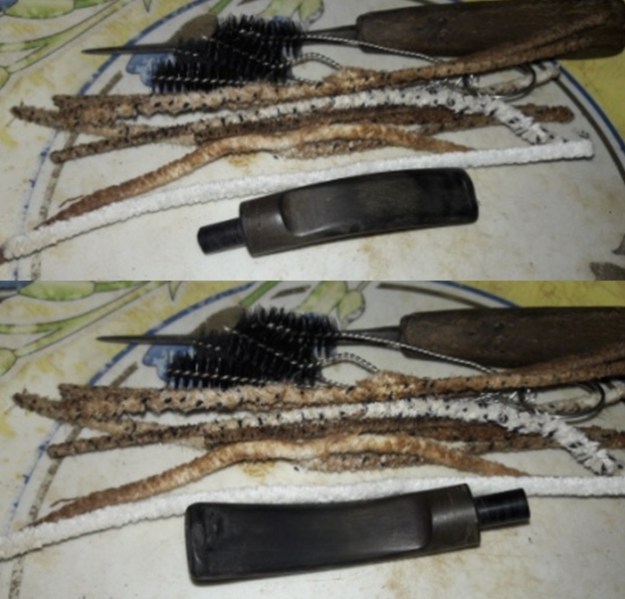
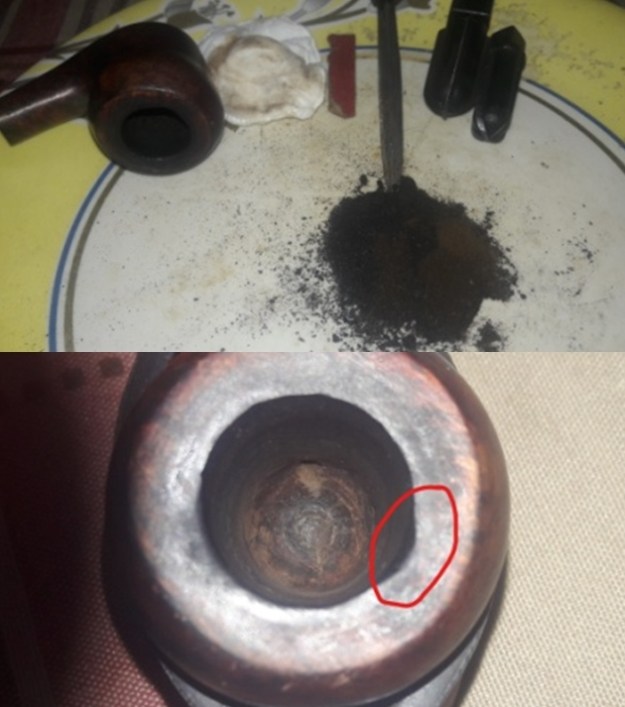
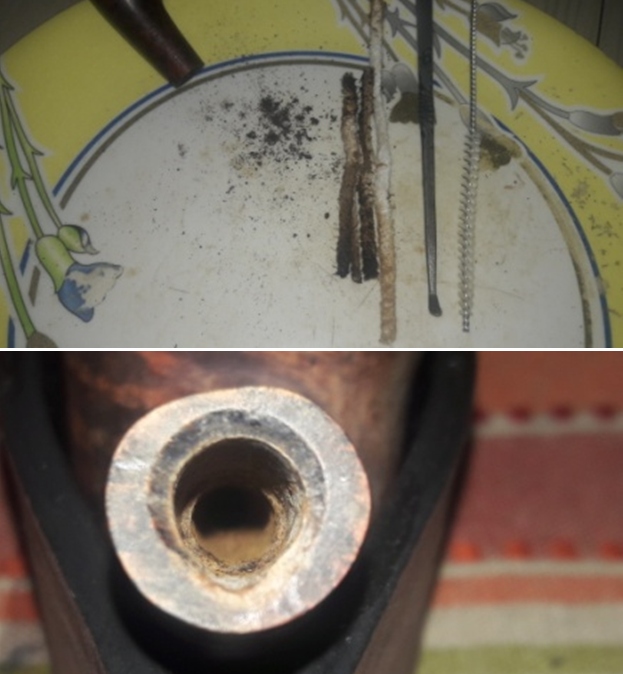
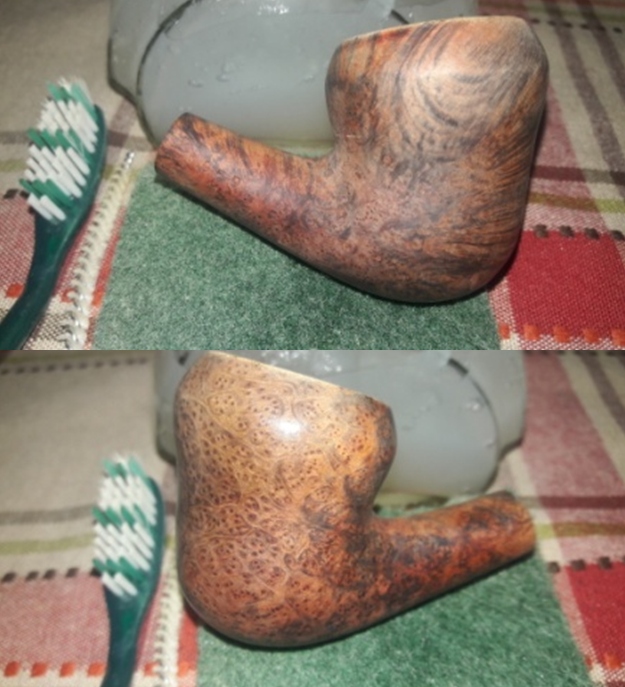
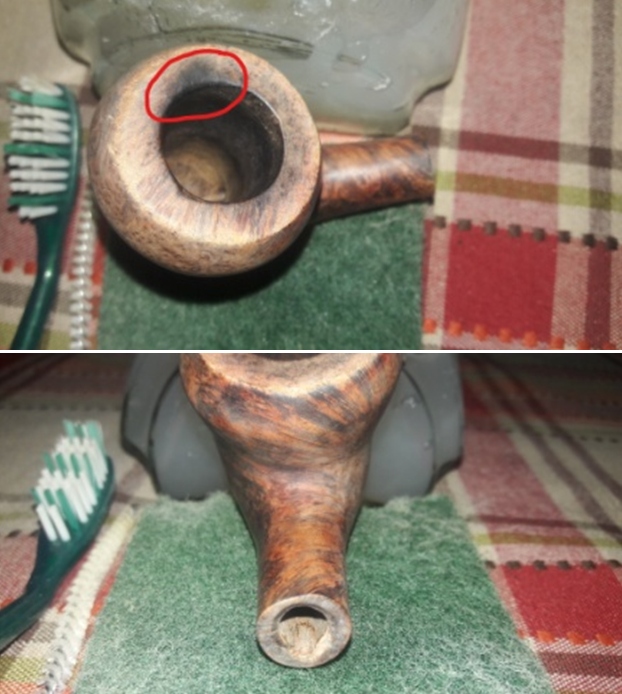
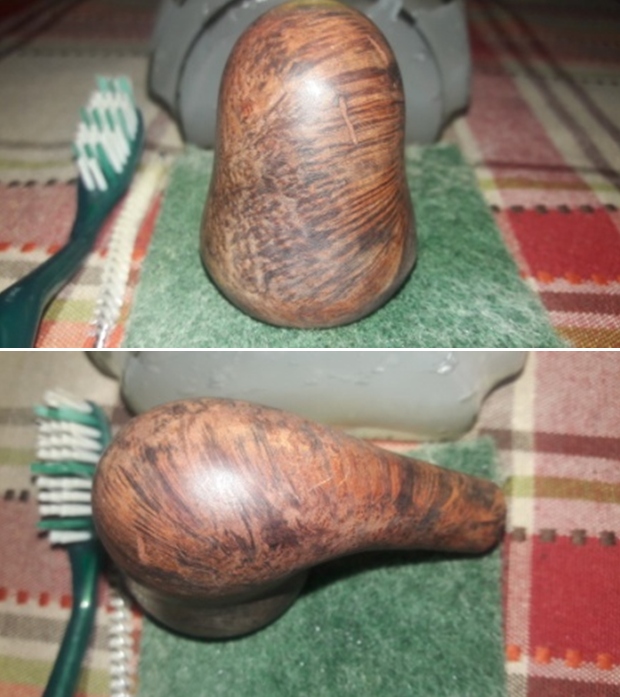
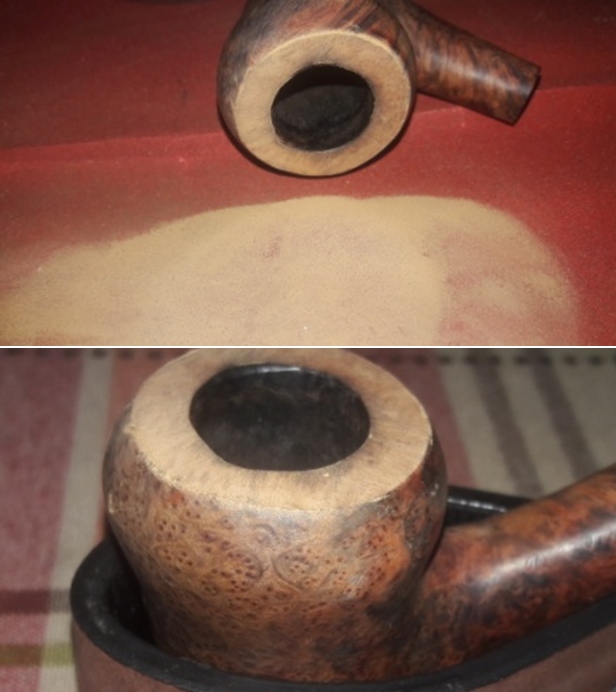
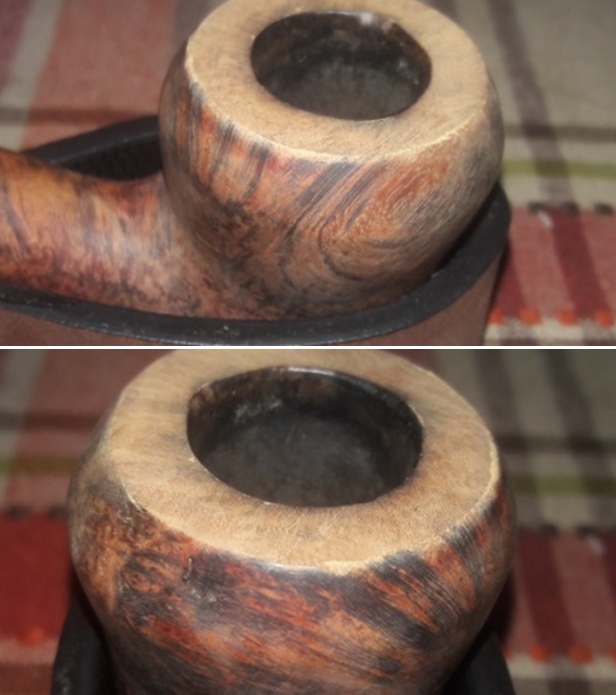
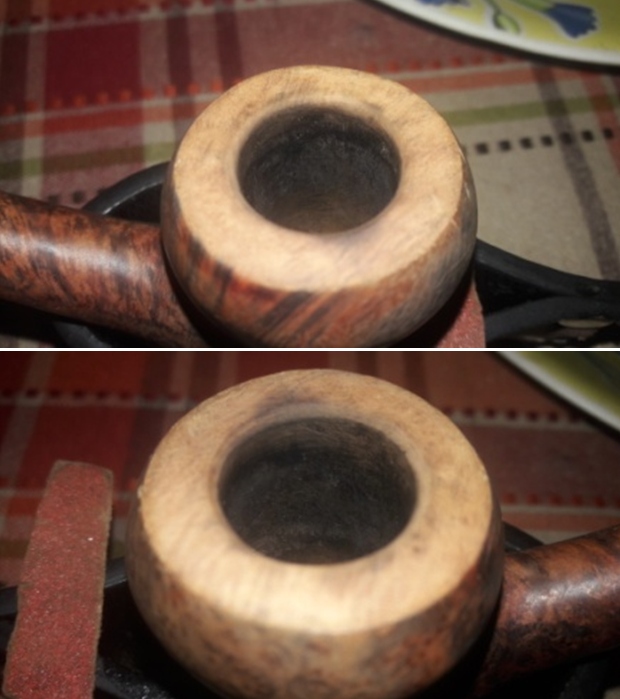
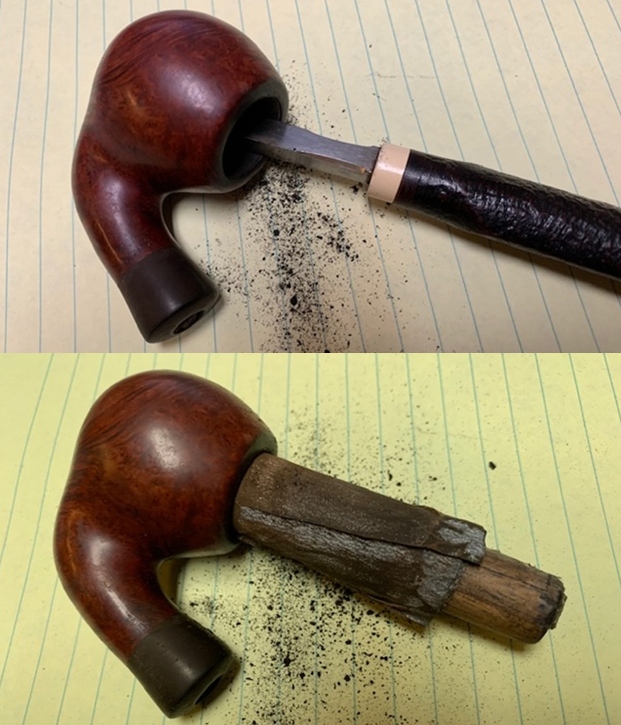
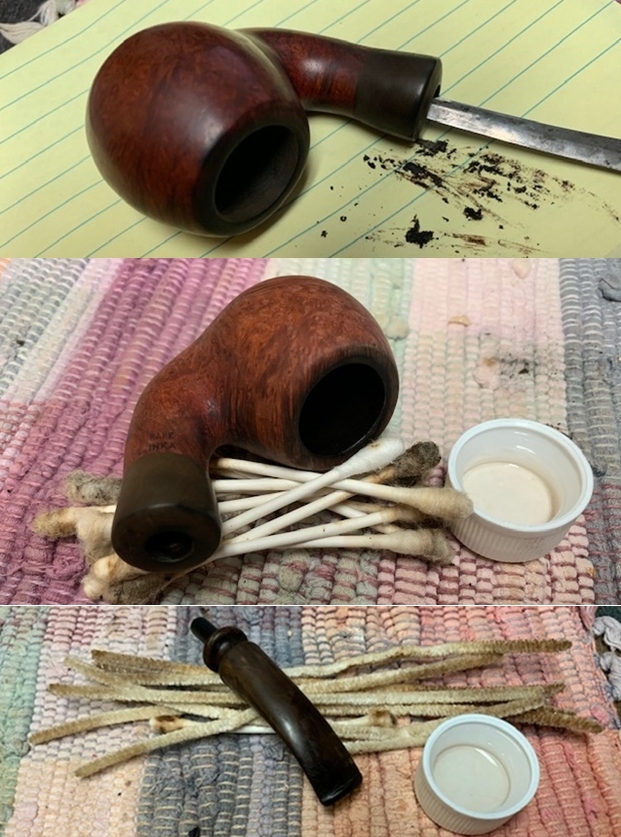
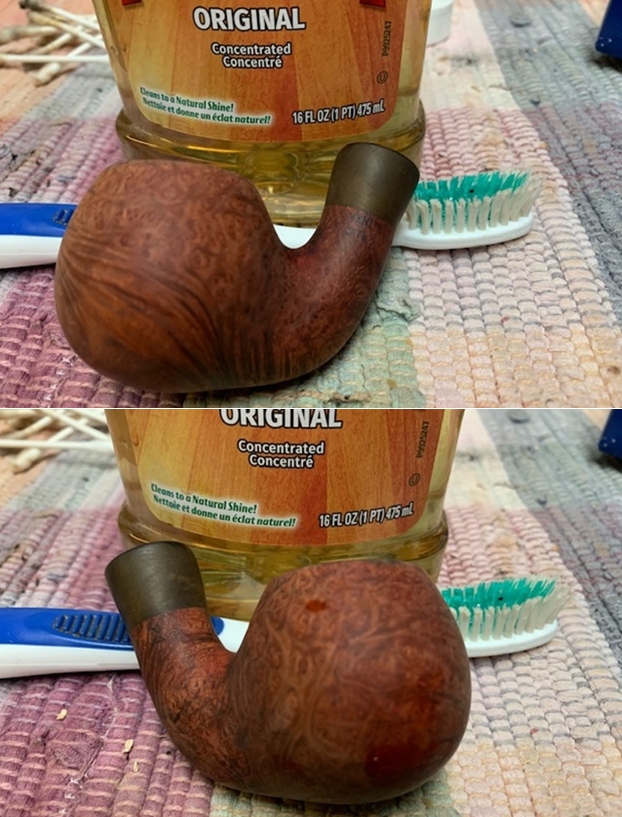
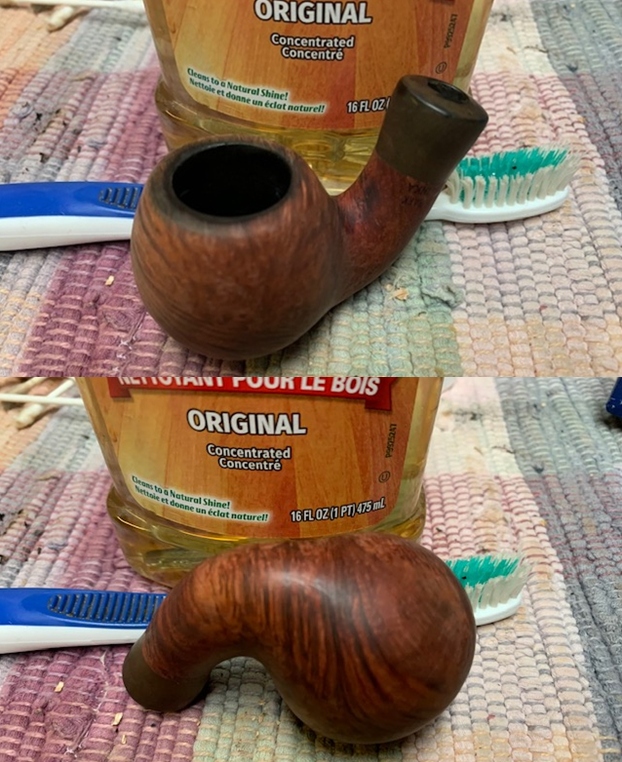
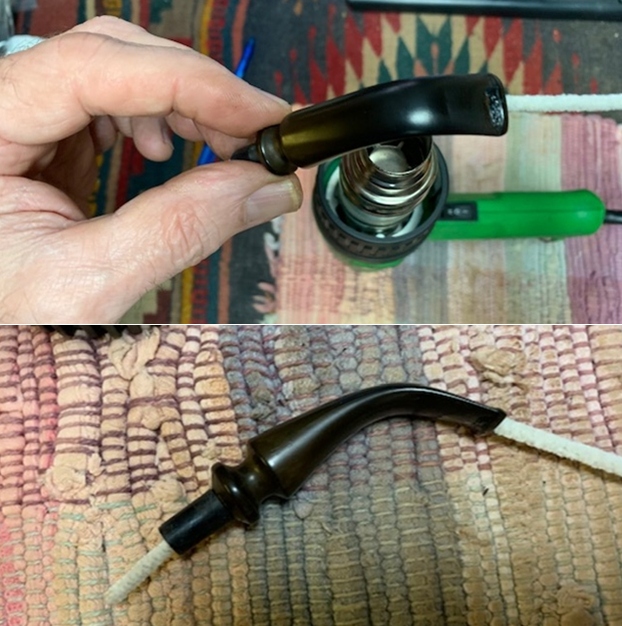
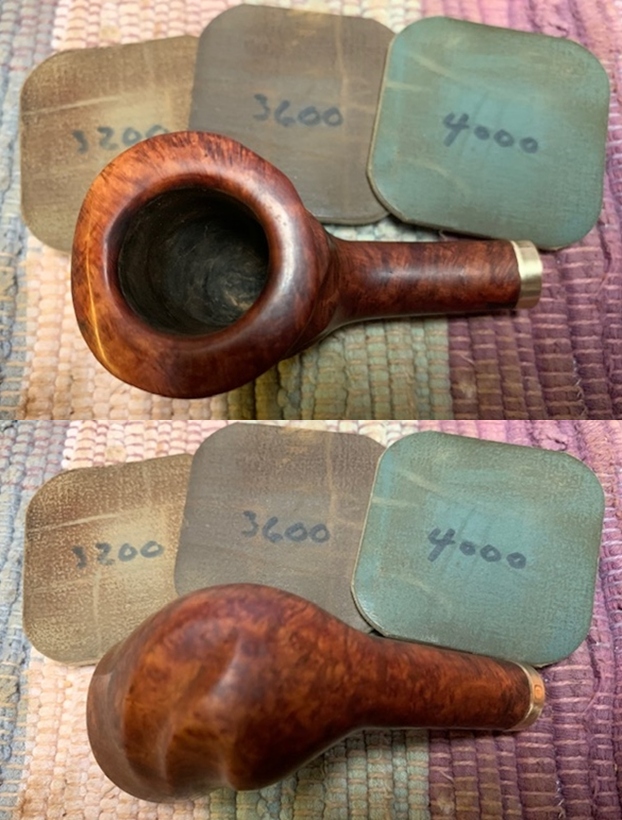
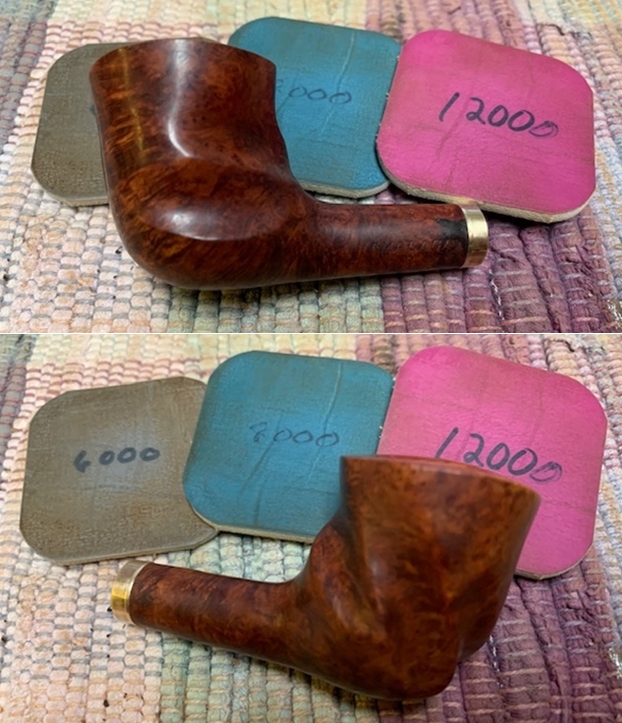
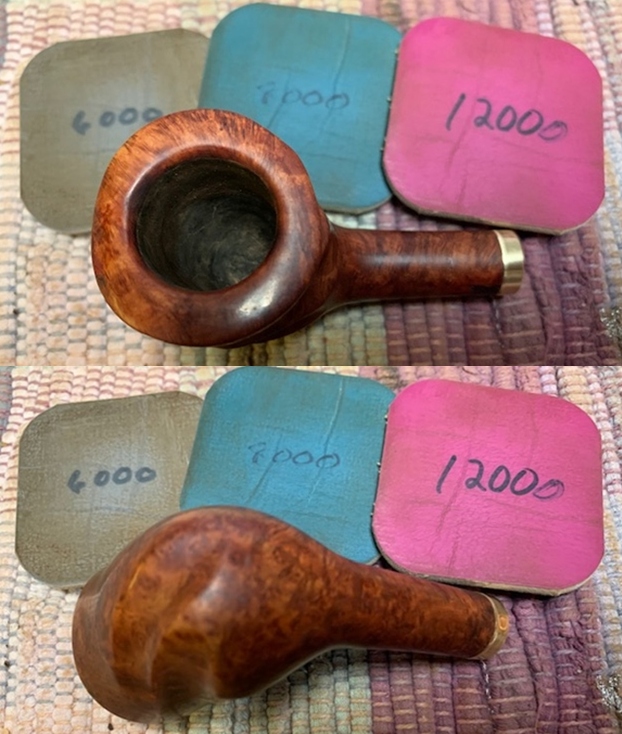
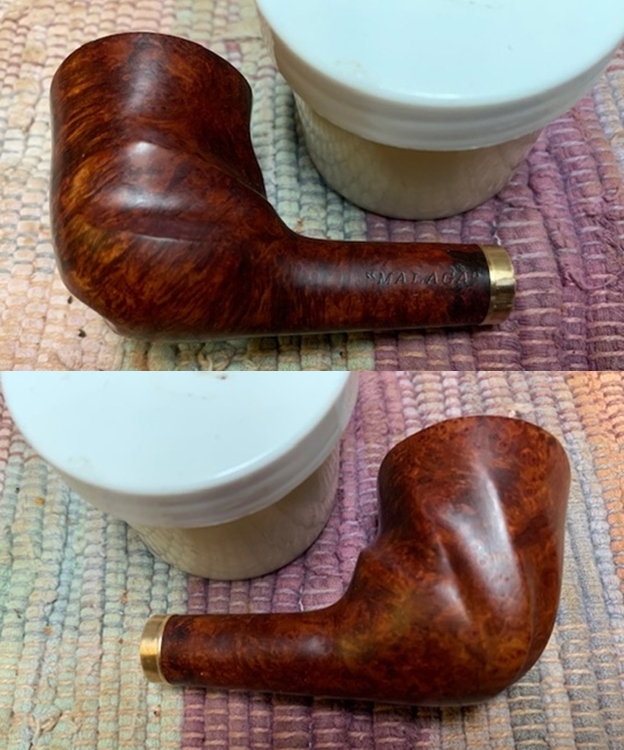
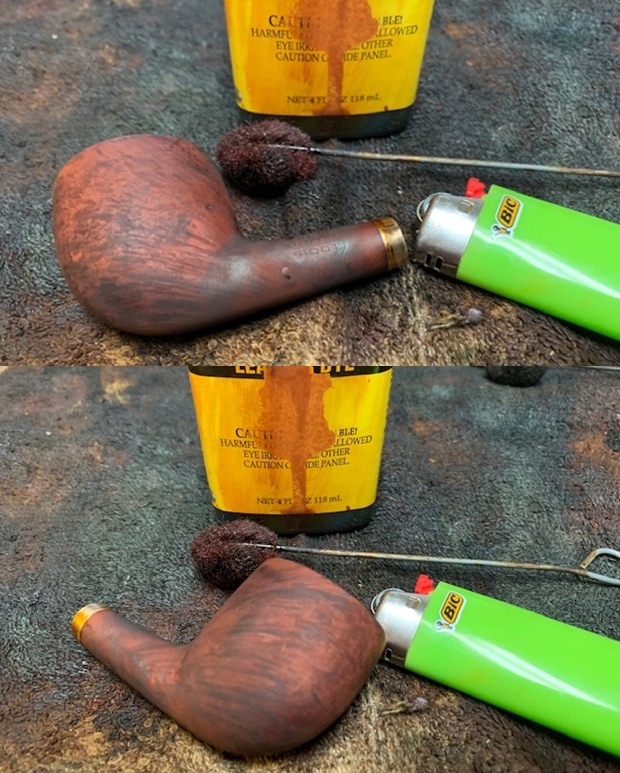
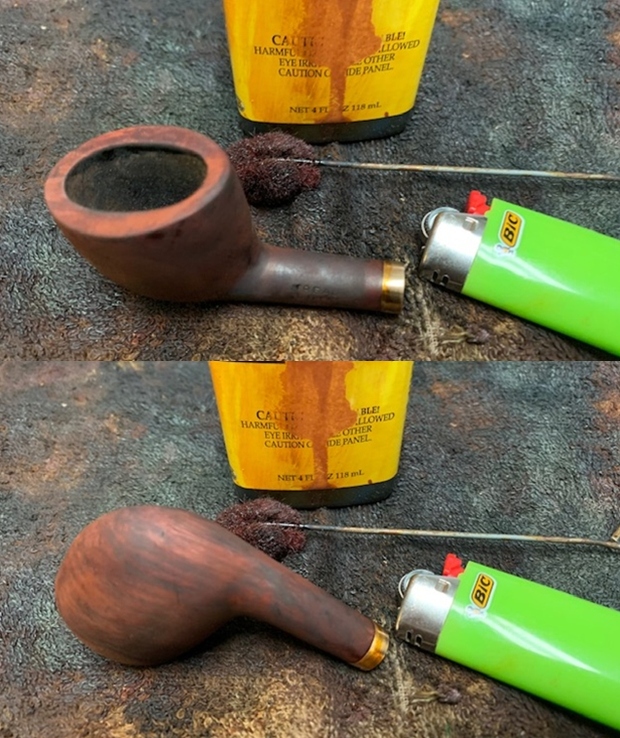
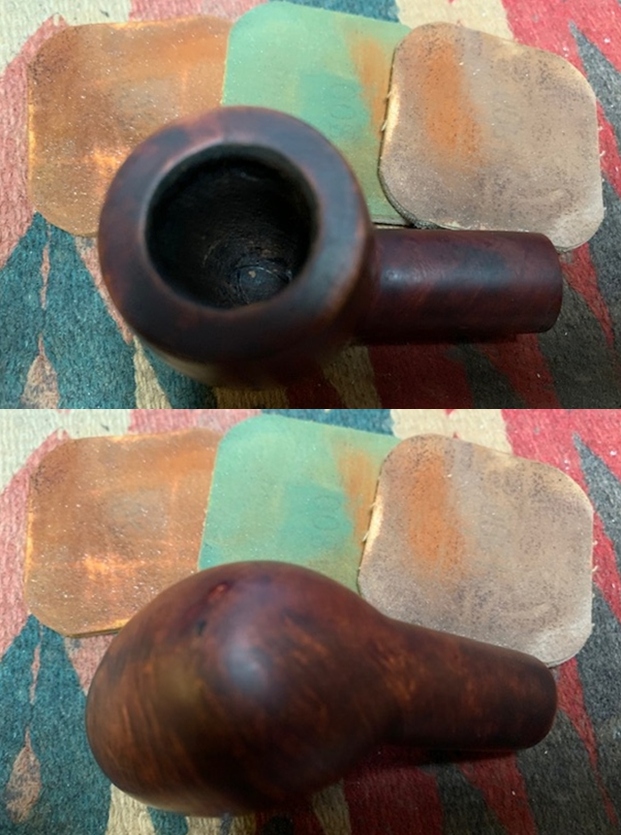
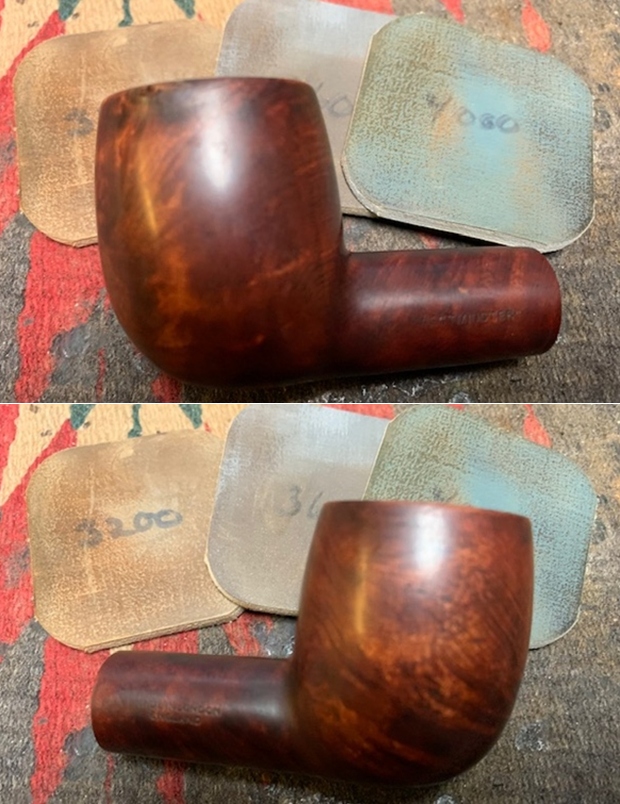
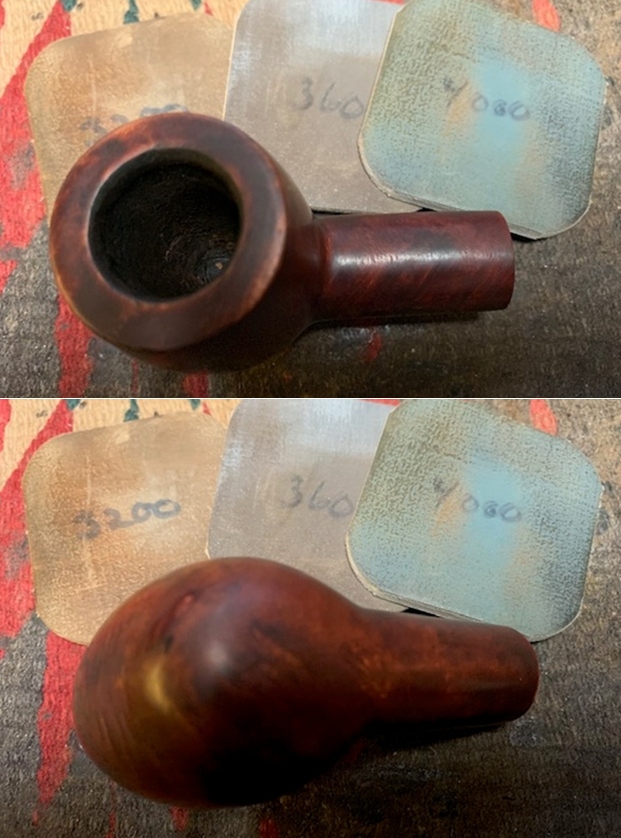
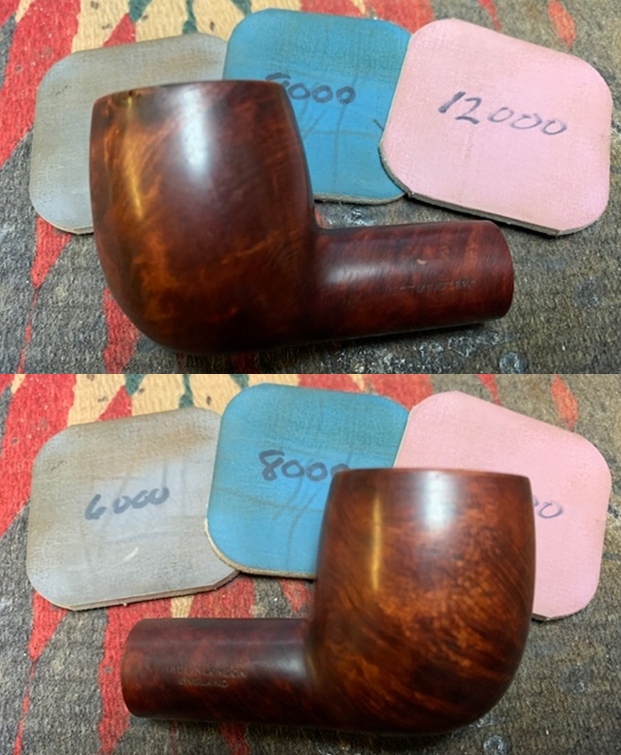
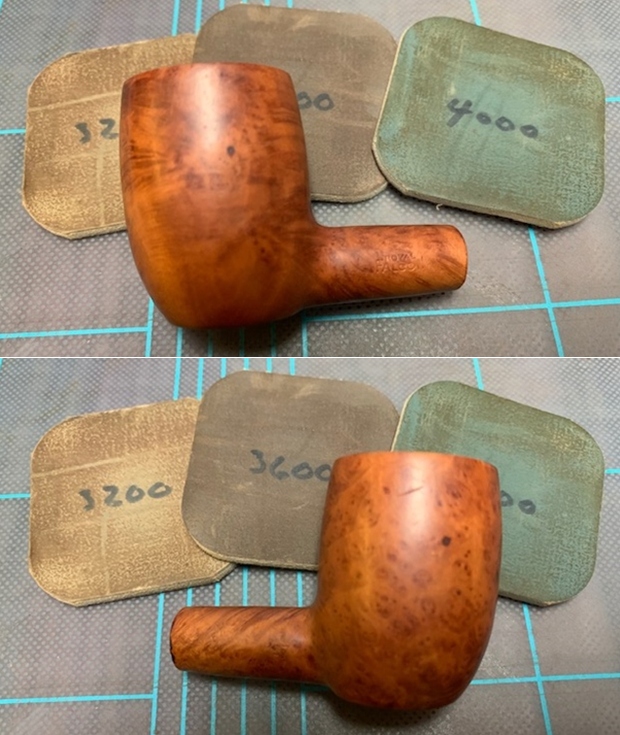
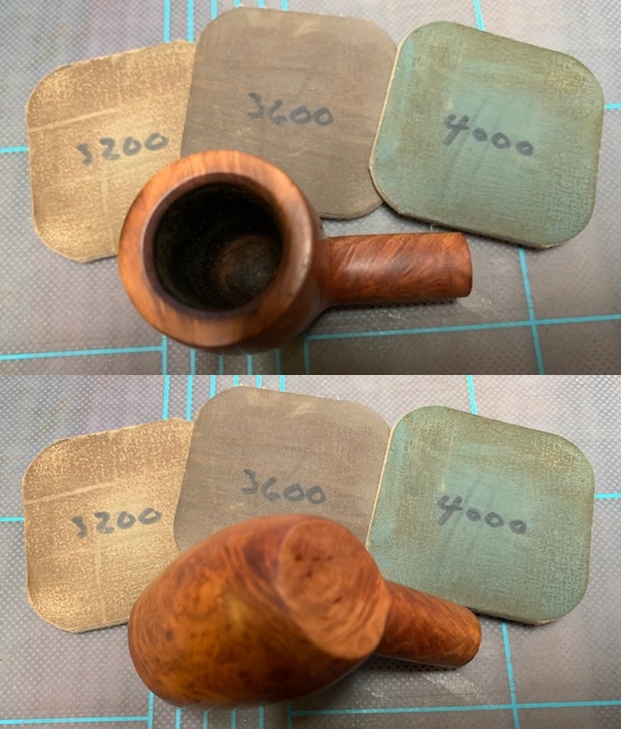
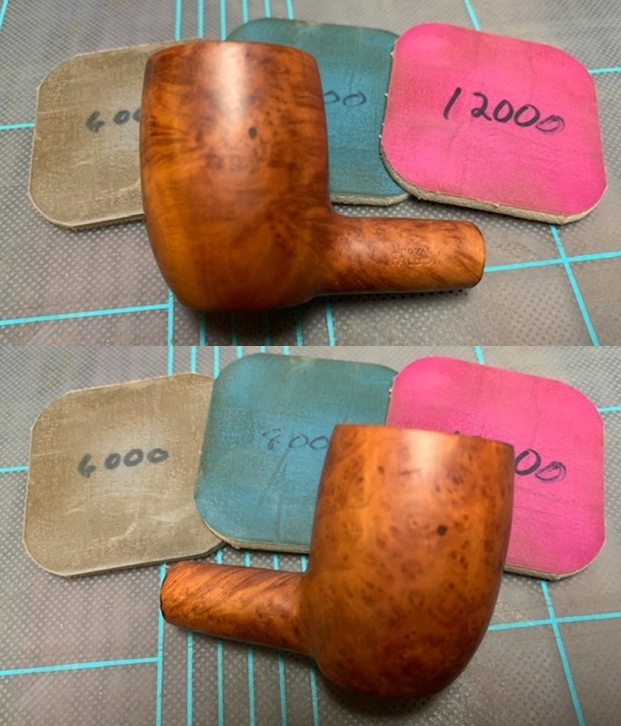
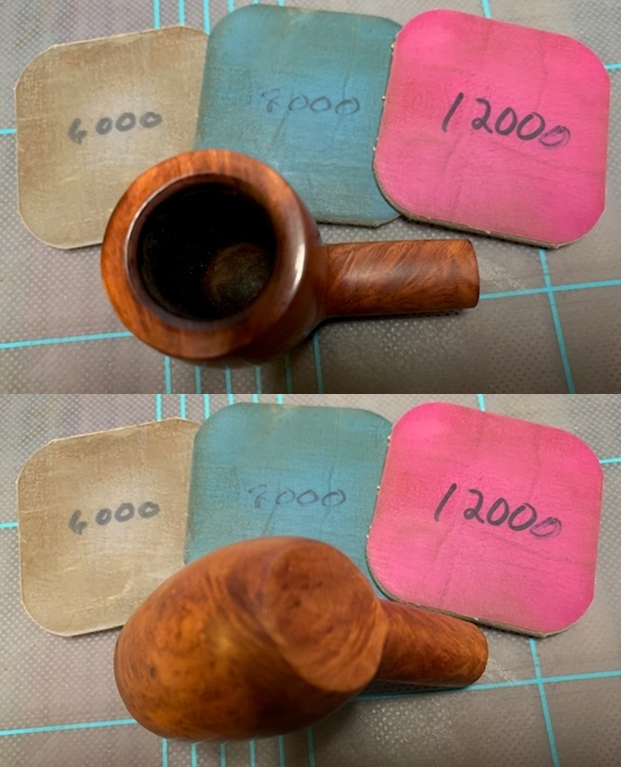
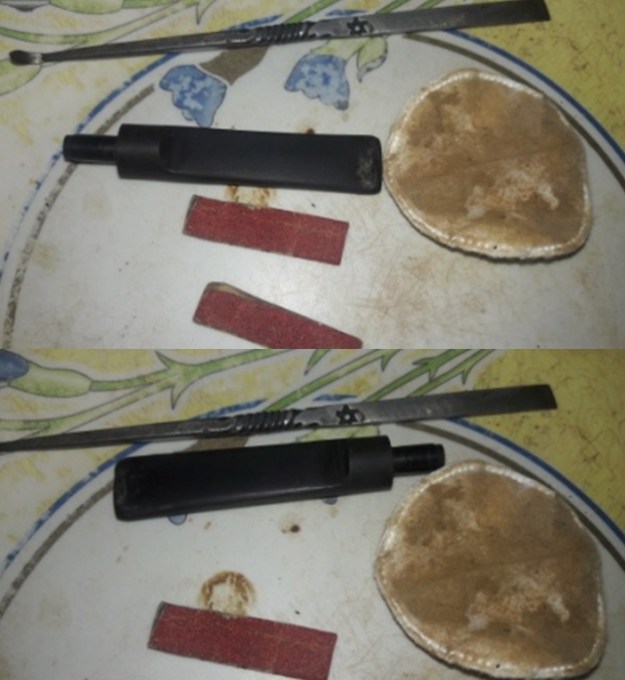
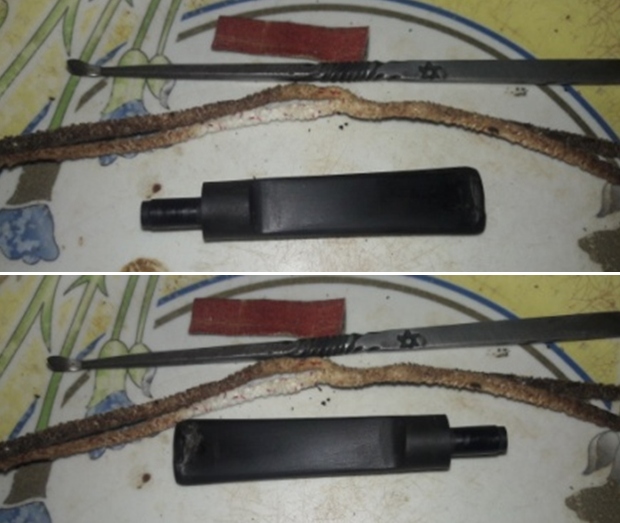
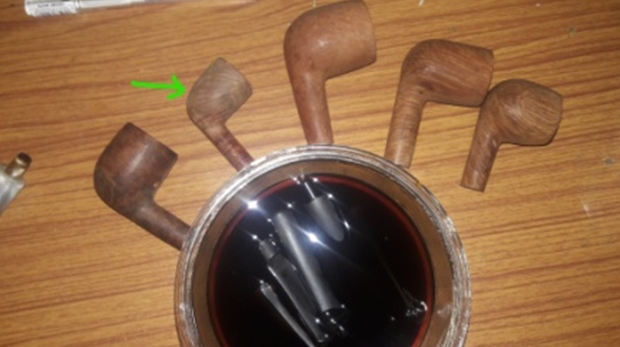
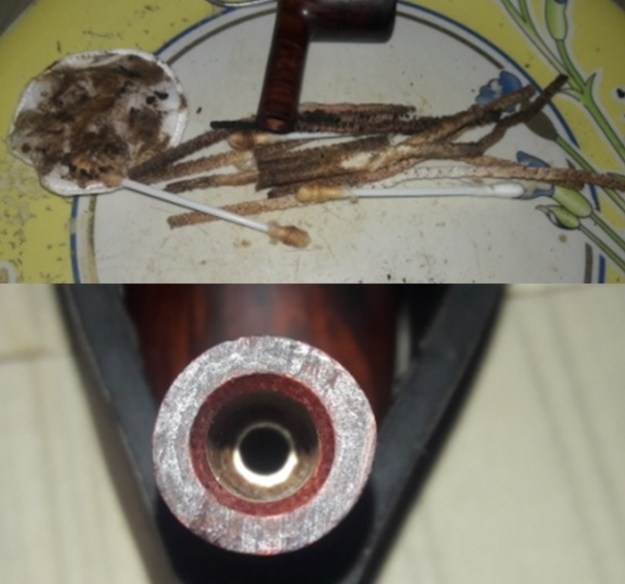
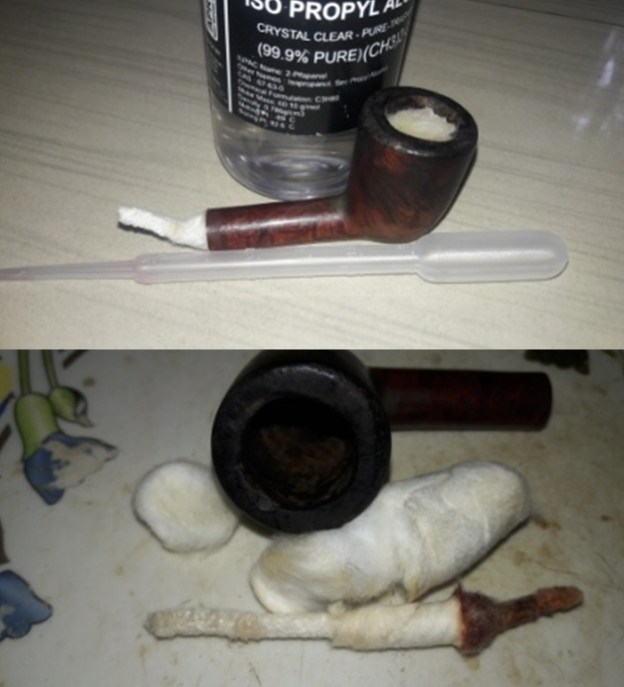
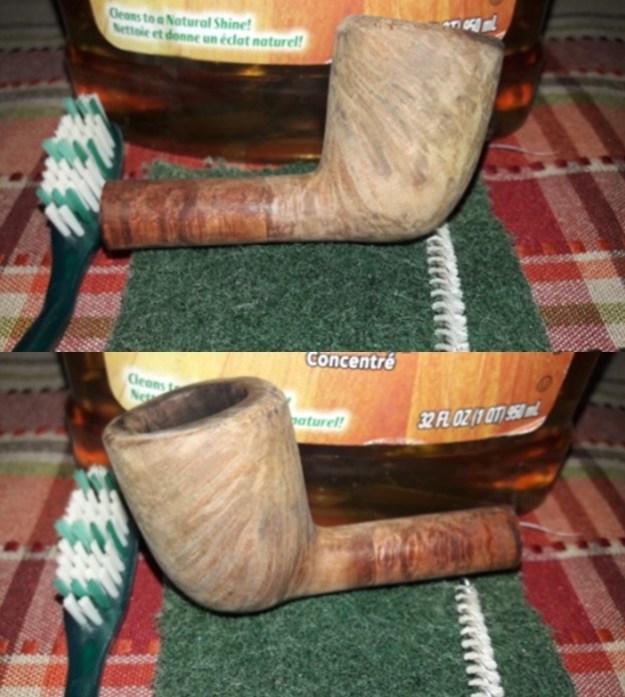
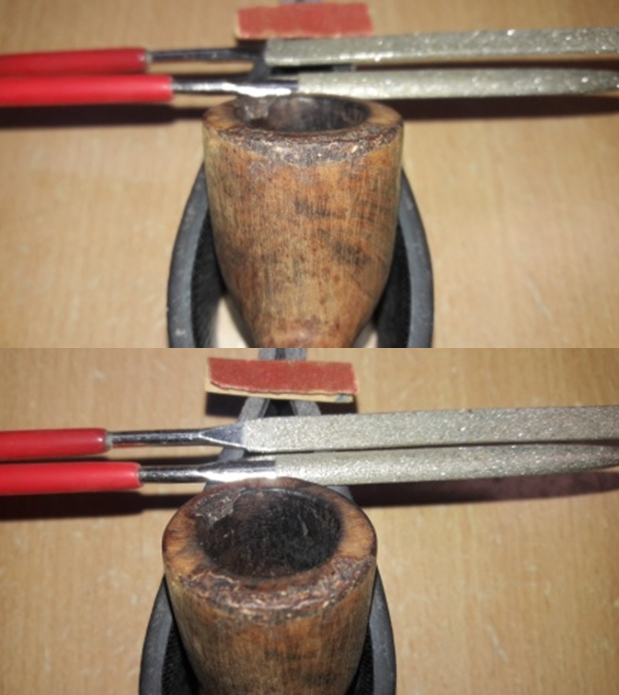
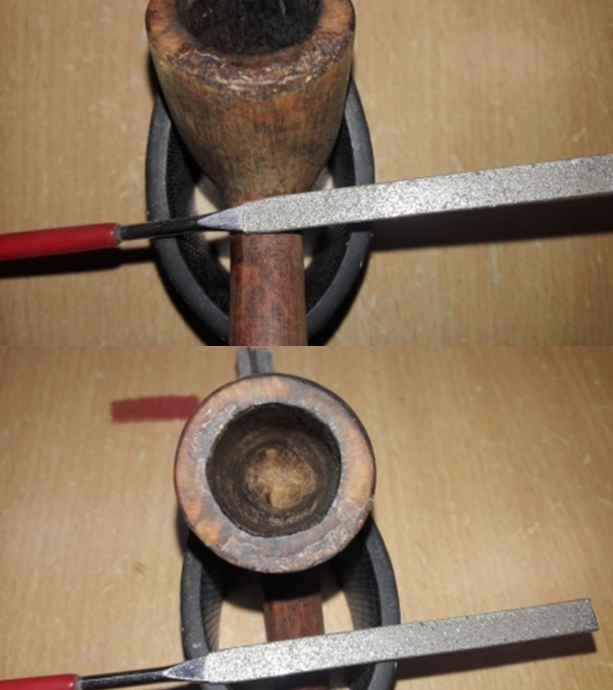
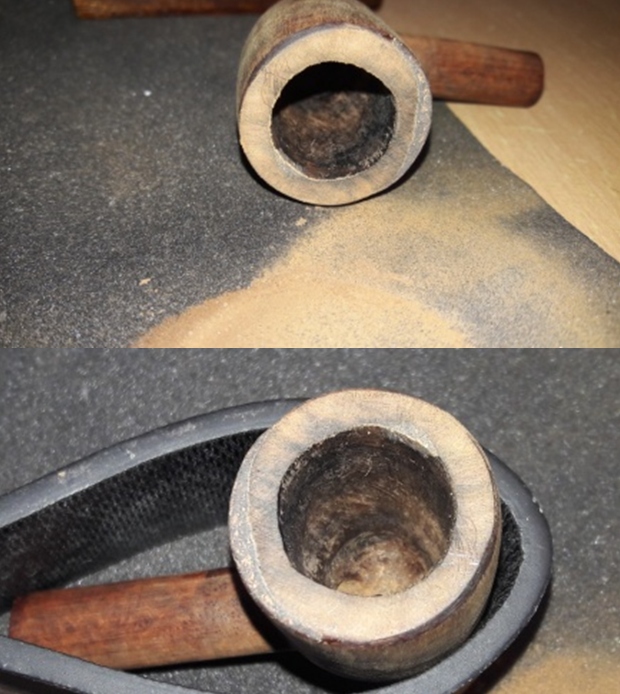
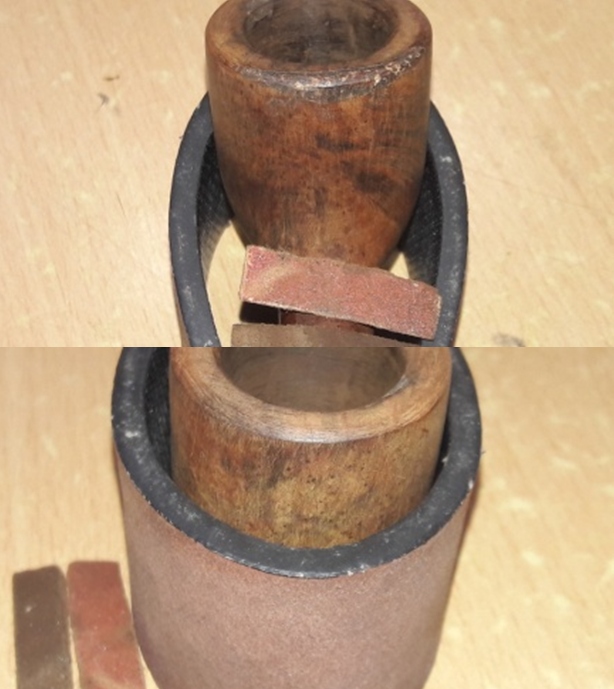
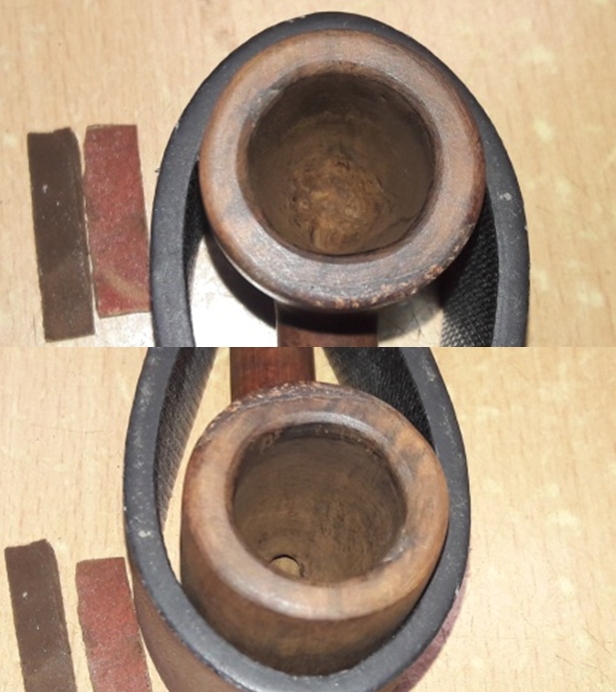
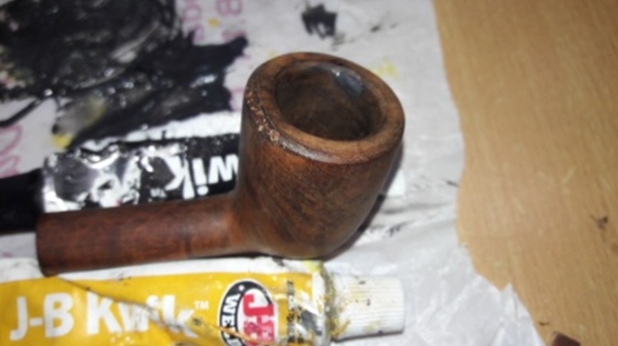
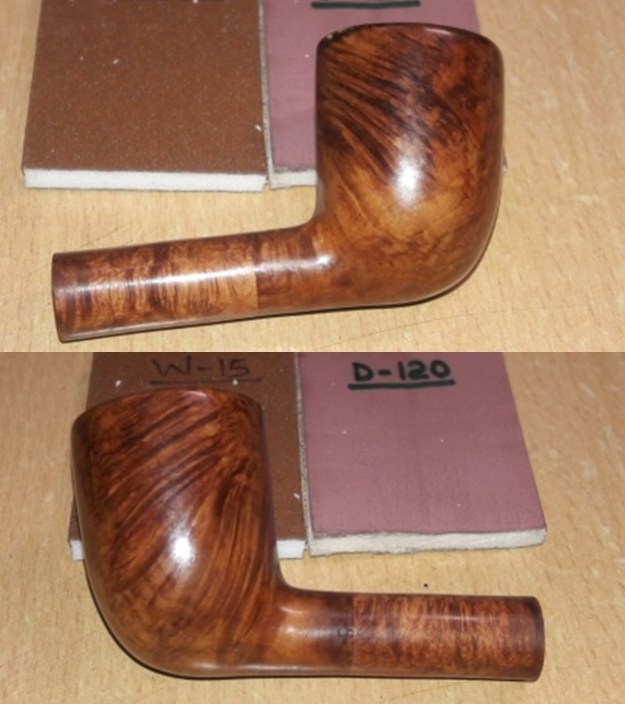
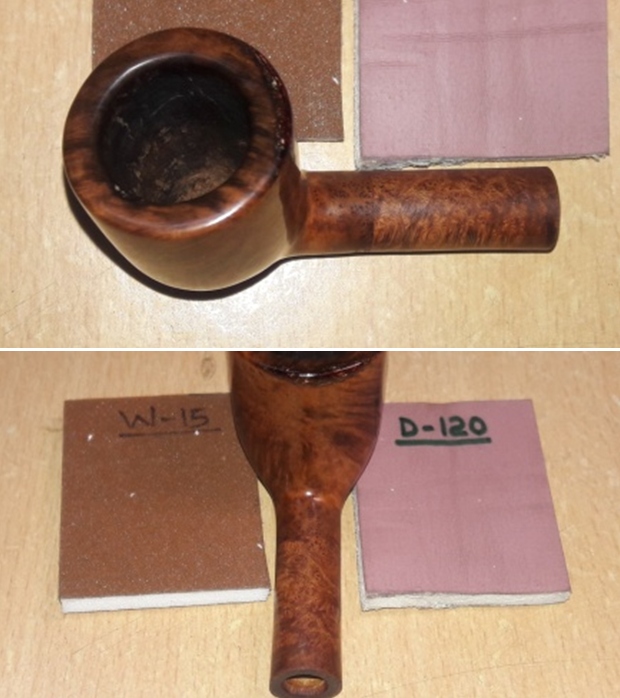
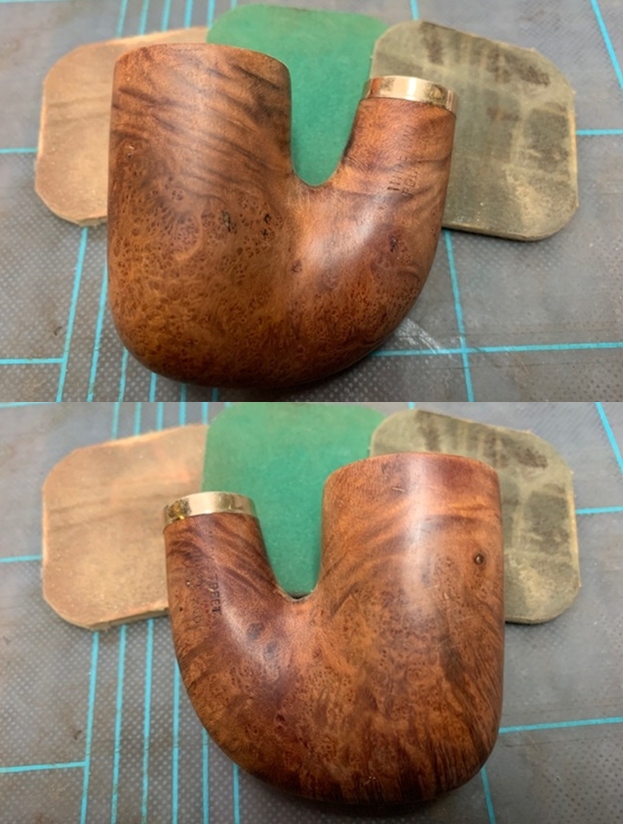
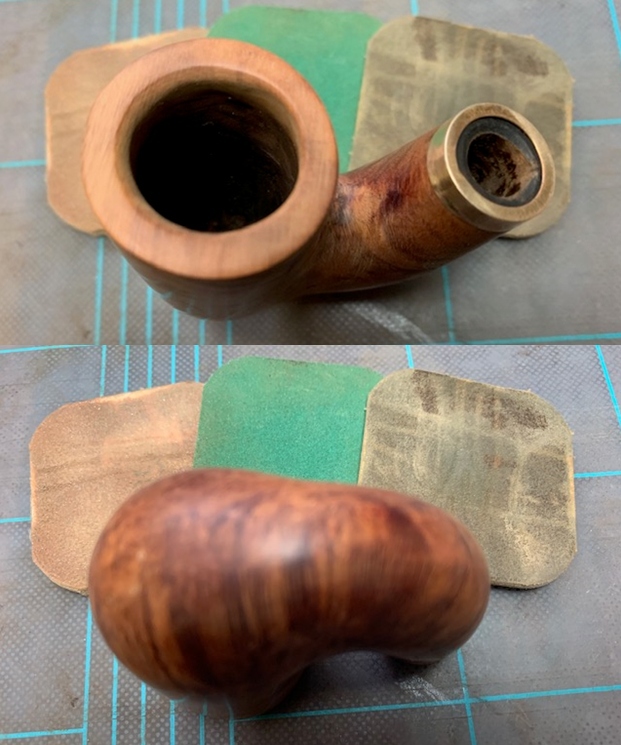
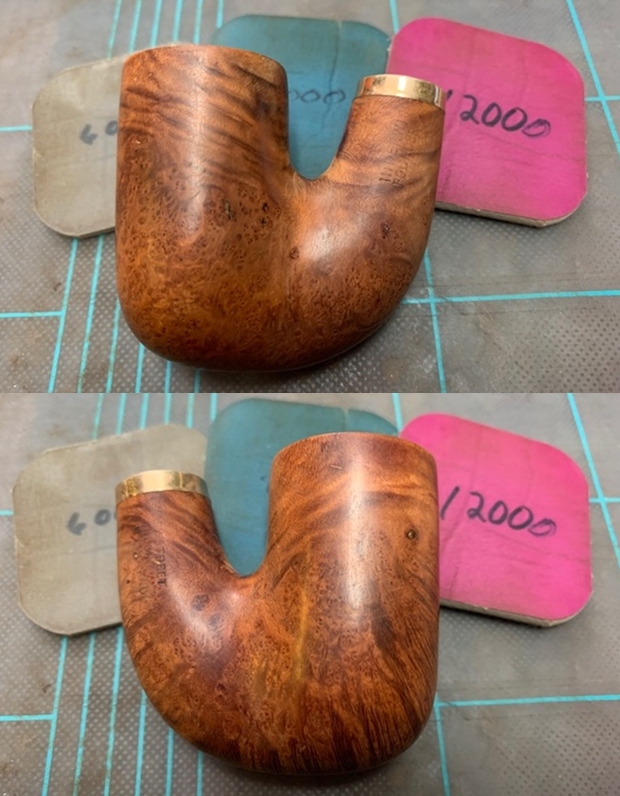
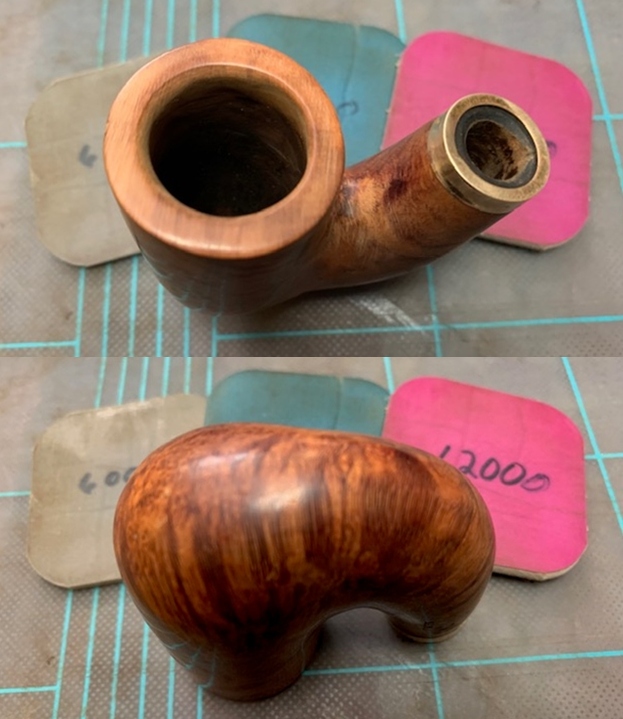
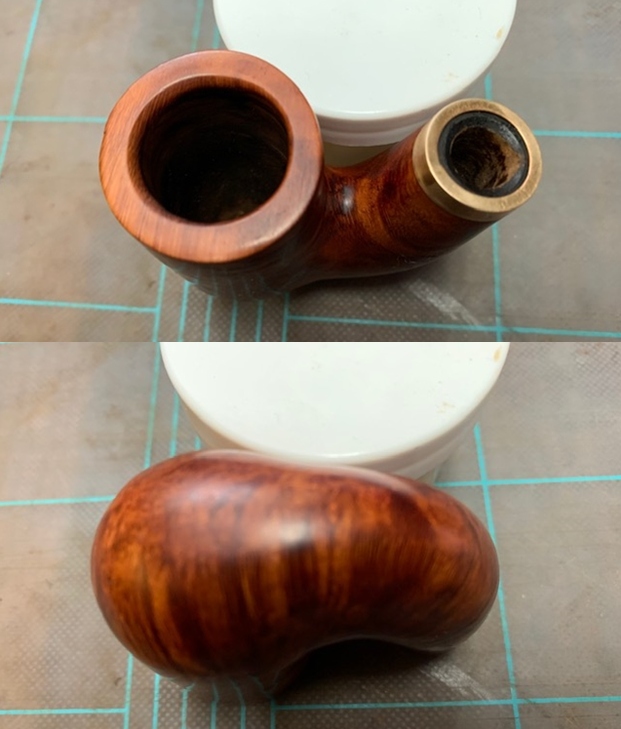
Abha, my wife, first cleaned the internals of the stem with stem brush, bristled/ regular pipe cleaners and 99.9% pure isopropyl alcohol. She scraped out the dried oils and tars from the tenon end with my fabricated knife and also removed the dried oils and tars from the slot end. She followed it up by sanding the entire stem with a folded piece of 220 grit sand paper to remove the surface oxidation. The amount of gunk that has been scraped out of the stem surface just to get to the black vulcanite shows that the oxidation was very deep and heavy over the stem surface. It has been our experience that sanding a stem before dunking it in to the deoxidizer solution helps in bringing the deep seated oxidation to the surface which in turn makes further cleaning a breeze with fantastic results.   She, thereafter, dropped the stem into “Before and After Deoxidizer” solution developed by my friend Mark Hoover. The solution helps to draw out heavy oxidation to the surface, making its further removal a breeze, while the minor oxidation is eliminated to a very great extent. The initial sanding helps to draw out the complete oxidation as the sanding opens up the stem surface that has been initially covered with oxidation. We usually dunk stems of 4-5 pipes that are in-line for restoration and this pipe is marked in green arrow. We generally allow the stems to soak in this solution overnight to do its work.While the stem was soaking in the deoxidizer solution, I worked on the stummel by first reaming the chamber with size 1 followed by size 2 Castleford reamer head. I further scraped the chamber walls with my fabricated knife to remove the remaining carbon deposits where the reamer head could not reach. I scraped out the lava overflow from the rim top surface, especially from the area in the 6 o’clock direction. Once the cake was reamed back to the bare briar, I used a 150 grit sand paper followed by 220 grit sand paper to remove all the traces of remaining cake and also to smooth out the inner walls of the chamber surface. Finally, to remove the residual carbon dust, I wiped the chamber with a cotton pad wetted with 99.9% pure isopropyl alcohol. The inner rim edge was charred in 10 o’clock and 3 o’clock direction which have been encircled in red. I scraped off the charred briar from these areas and now the chamber is out of round. The chamber walls are pristine without any damage. I shall give the inner rim edge a slight bevel to get the bowl back to a perfect round and mask the damage. The ghost smells are still very strong and may reduce after the shank/ mortise are thoroughly cleaned. The rim top surface is still considerably darkened and would need to be thoroughly cleaned to know the exact damage to the surface.    I followed up the reaming with cleaning the mortise using cue tips, pipe cleaners and shank brush dipped in isopropyl alcohol. I scraped the walls of the mortise with my fabricated knife to remove the dried oils and tars. The ghost smells are still very strong and would require a salt and alcohol treatment.   With the bowl internals clean, I move to clean the exterior of the stummel. I used a hard bristled tooth brush and Briar Cleaner, a product that has been developed by Mark Hoover, to scrub the stummel and rim top. I set the stummel aside for 10 minutes for the product to draw out all the grime from the briar surface. After 10 minutes, I washed the stummel under running warm water with anti oil dish washing detergent till the stummel surface was clean and dried it using paper towels and soft cotton cloth. I simultaneously cleaned the shank internals with the detergent and hard bristled shank brush and set the stummel aside to dry out naturally. I had anticipated that this thorough cleaning of the shank would help eliminate the strong ghost smells, but that was not to be. The stummel surface has cleaned up nicely and the beautiful grain patterns are now on full display. The fills, even the smallest ones, are now clearly discernible. I probed each of the two fills on the stummel surface with a sharp dental tool to check for solidity and thankfully, each fill was nice and solid without any give. I decided not to refresh these fills as my horrific experience while using the thin superglue that was available to me for the purpose, on my last project Bewlay “GENERAL”, still being fresh in my mind. The charring over the rim top surface in 3 o’ clock (encircled in red) is significantly deeper than anticipated. I shall have to resort to topping to address this damage and also the issue of chipped outer rim edge. The chamber and shank needs to be subjected to a salt and alcohol treatment to remove the deeply embedded ghost smells from the stummel.   I continued the cleaning of the chamber and shank internals with a salt and alcohol bath. I use cotton balls which is an at par substitute as I have realized over the years. I draw out a wick from the cotton and along with a folded regular pipe cleaner; insert it in to the mortise and through the draught hole in to the chamber. Thereafter, I packed the chamber with cotton balls to about quarter of an inch below the inner rim edge and soaked the cotton balls with isopropyl alcohol up to the brim. About half an hour later, the level of alcohol had gone down, having being absorbed by the cotton. I topped it up once again and set it aside overnight. By next afternoon, the cotton and alcohol had drawn out all the remaining oils and tars from the chamber and mortise, fulfilling its intended task. I removed the cotton balls and ran pipe cleaners through the mortise to clean out all the loosened tars and gunk and further cleaned it with alcohol and q-tips. The chamber now smells clean and fresh. I set the stummel aside to dry out naturally.While the stummel was drying, the next morning, Abha removed the stem that had been soaking in the deoxidizer solution overnight. She cleaned the stem under running warm water and scrubbed the raised oxidation from the stem surface using a Scotch Brite pad and cleaned the airway with a thin shank brush. She further removed the oxidation by scrubbing the stem with 0000 grade steel wool and applied a little EVO to rehydrate the stem. This now gives a clearer picture of the extent of depth of the bite marks as can be seen in the pictures below. These will definitely require a fill even after I have heated and raised the vulcanite. The buttons on either surface will have to be reconstructed and reshaped. I need to further sand the stem to completely remove the oxidation. Further stem repairs would have to be kept on hold till I got back to my work place where I have a couple of superglue tubes for the purpose.With further stem repairs being on hold, I turned back to the stummel repairs. I topped the rim top over a piece of 220 grit sand paper till I had a smooth even surface and the charred surface in the 3 o’clock direction was completely eliminated.    With a folded piece of worn out 180 grit sand paper pinched between my thumb and forefinger, I carefully gave a bevel to the inner and outer rim edge and addressed the issues of out of round chamber and chipped outer rim edge. The rim top surface and the edges look very neat at this stage with the bowl in a nice round shape. I followed it by wet sanding the stummel with 1500 to 2000 wet & dry sand paper and further with 3200 to 12000 grit micromesh pads, wiping frequently with a moist cloth to check the progress. It was at this stage of restoration when I was taking pictures that I saw the numerous tiny fills at the bottom of the bowl and shank junction. I heaved a sigh of relief when I checked and found these fills to be solid and not requiring any work. I really like the looks of the stummel at this point in restoration. The grains and the clean lines of this piece of briar are worthy of appreciation. The topping has resulted in the rim top surface being lighter than the rest of the stummel surface. I shall darken the rim top surface with a dark brown stain pen once I reach back to my place of work. Next, I rubbed a small quantity of “Before and After Restoration Balm” deep in to the briar with my finger tips and let it rest for a few minutes. The balm almost immediately works its magic and the briar now has a nice vibrant appearance with the beautiful grain patterns displayed in their complete splendor. I further buffed it with a horse hair brush and gave a vigorous buff with a microfiber cloth to deepen the shine. The dark browns of the bird’s eye and cross grains spread across the stummel makes for a visual treat. It really is a nice piece of briar. The dark YOW like stain elevates the beauty of this pipe to a new level.     Now, having rejoined my place of work after a hiatus of four months I need to work real fast to complete my backlogs of write ups and complete the repairs on pipes that were worked on during the lockdown period while at home. I have completed a few and now this pipe has inched forward on to my work table. While packing these pipes for its journey with me, I had noted all the issues that had to be addressed on each pipe. This one needed stem repairs to include filling of deeper tooth indentations, rebuilding/ reshaping of the buttons, stem and stummel polishing with a carnauba wax.

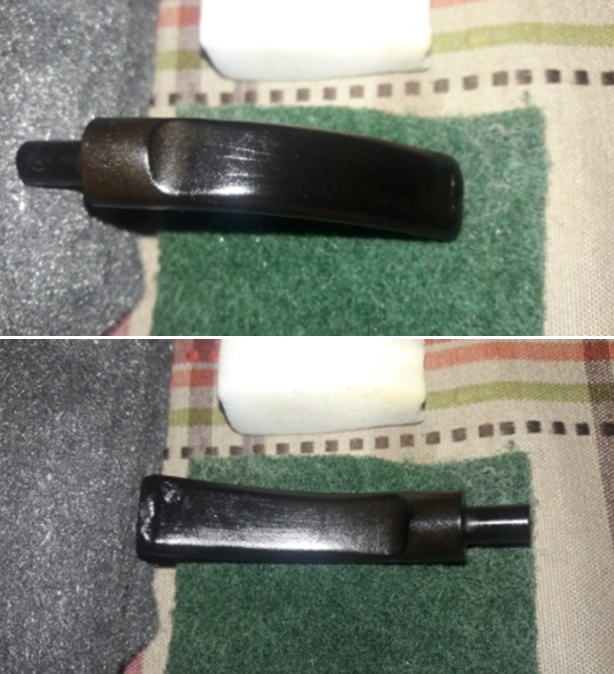
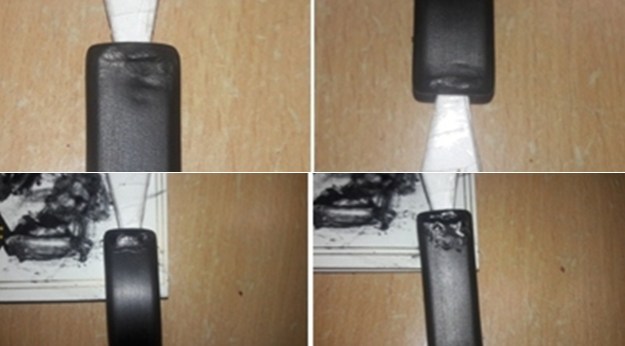
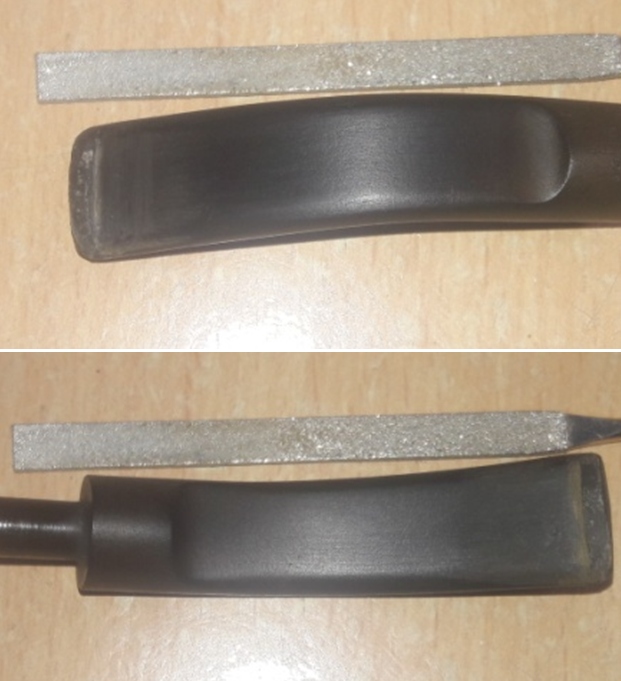
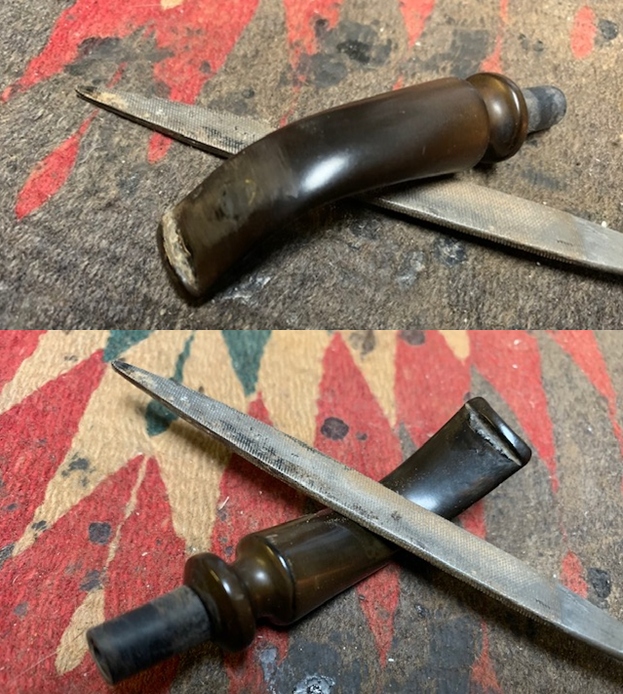
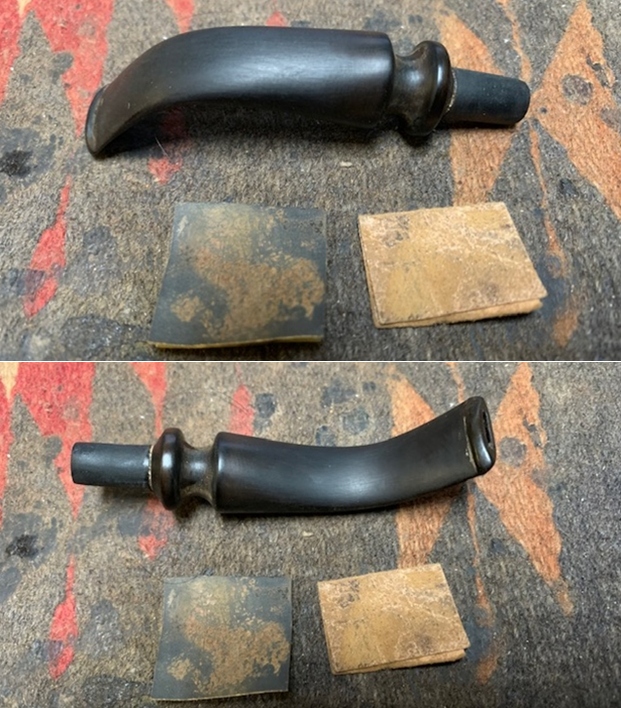
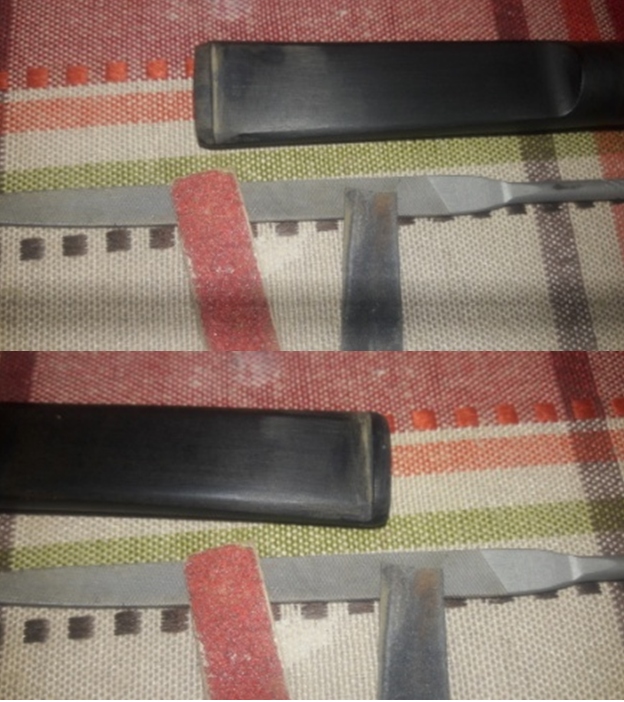
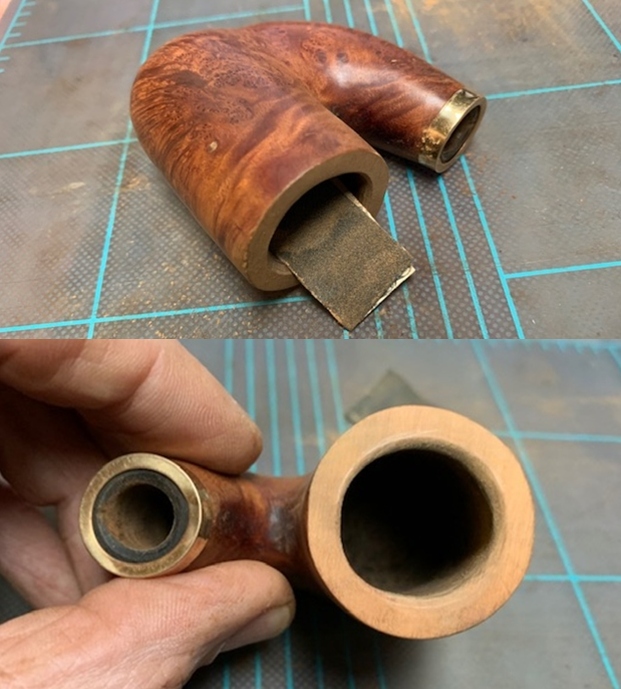
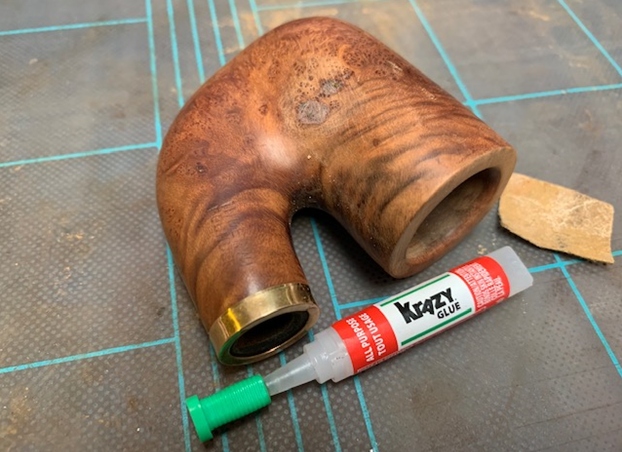
With the stummel rejuvenation almost complete, save for the final wax polish, I worked the stem. Here is how the damage to the stem looks as it sits on my work table. The damage to the buttons and the deep tooth indentations are also clearly visible. Once I have repaired these damages, the entire stem needs to be polished and the stem logo needs to be refreshed. That I have to use the CA Wood Superglue gives me shudders as I still am reeling under the frustrations of using this glue while I repaired the stem of the Bewlay “GENERAL” pipe, my last project!!I carefully inserted a triangle shape index card covered in transparent tape in to the slot so as not to break the bite zone. The tape prevents the mix of superglue and charcoal from sticking to the index card. I mixed superglue and activated charcoal powder and generously applied it over the bite zone, including over the buttons, on either surfaces of the stem and set it aside to cure. Once the fill has hardened, I shall file and sand the fills to match the surface of the stem and sharpen the button edges on either surface. This glue hardens immediately and allowed me only a few seconds of application whereas the all purpose CA superglue allowed me enough time to get an even spread over the damaged surface.The fill had hardened and with a flat head needle file, I worked on the filling till I had achieved a rough match with the surrounding surface and had sufficiently sharpened the button edges. As with the stem repair of my previous project, Bewlay “GENERAL”, this too had many air pockets. I filled these air pockets with clear CA superglue and set the stem aside for the superglue to harden.

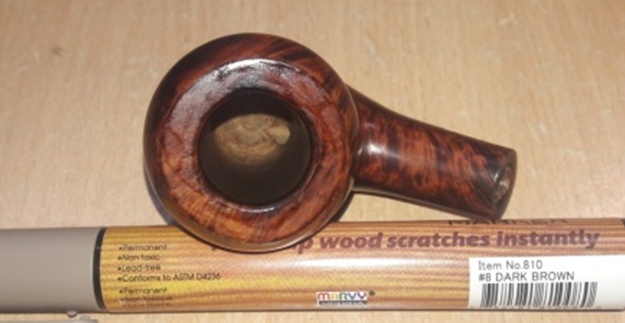
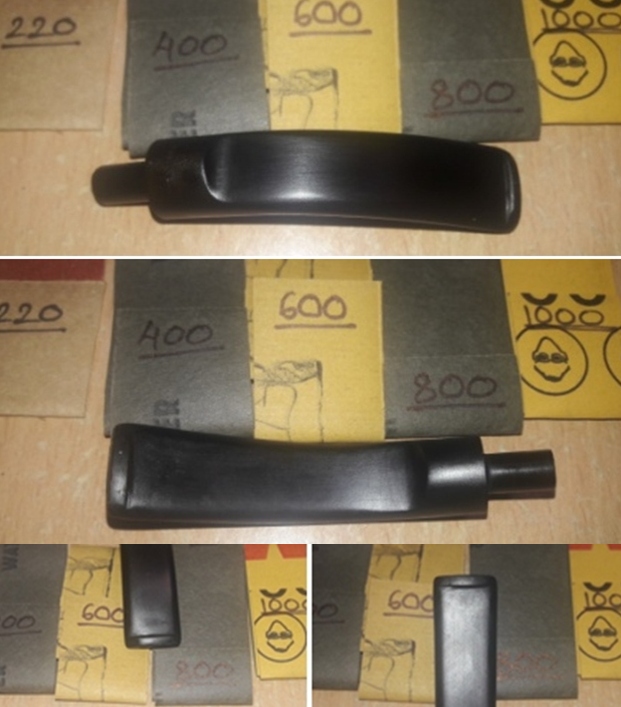
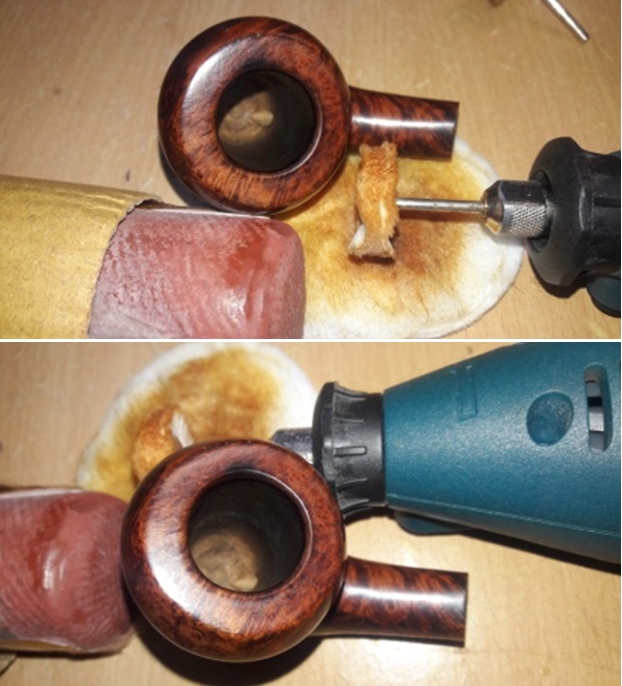
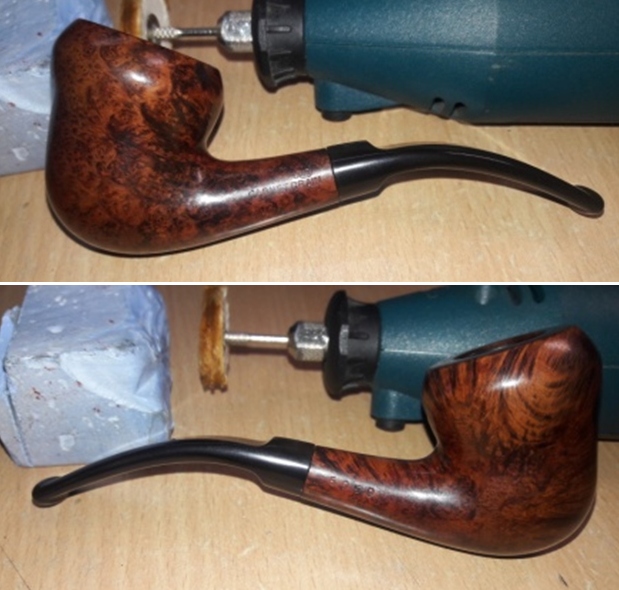
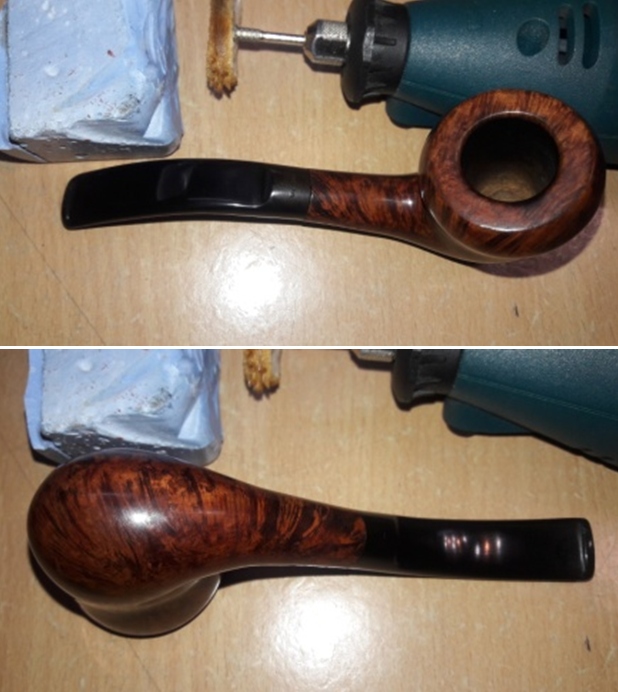
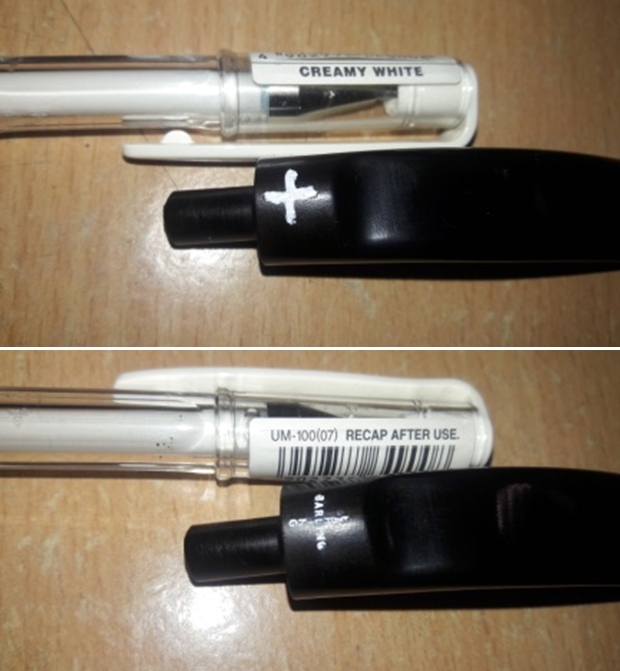
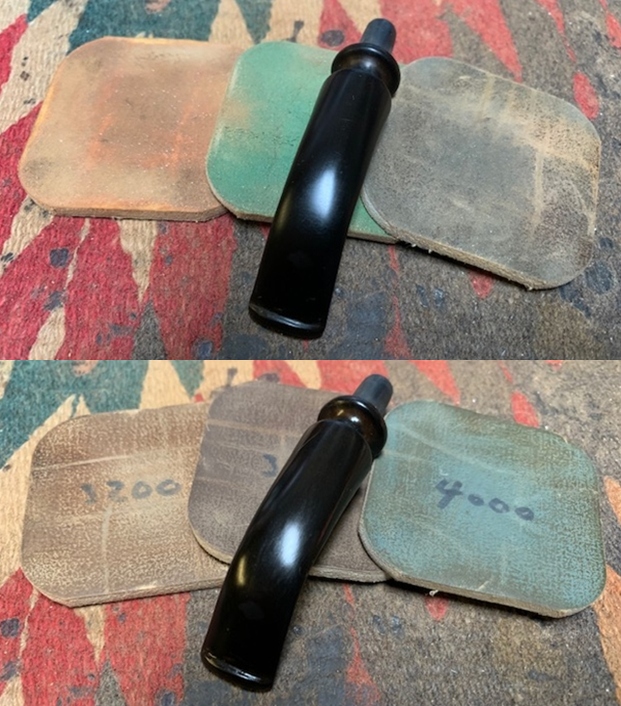
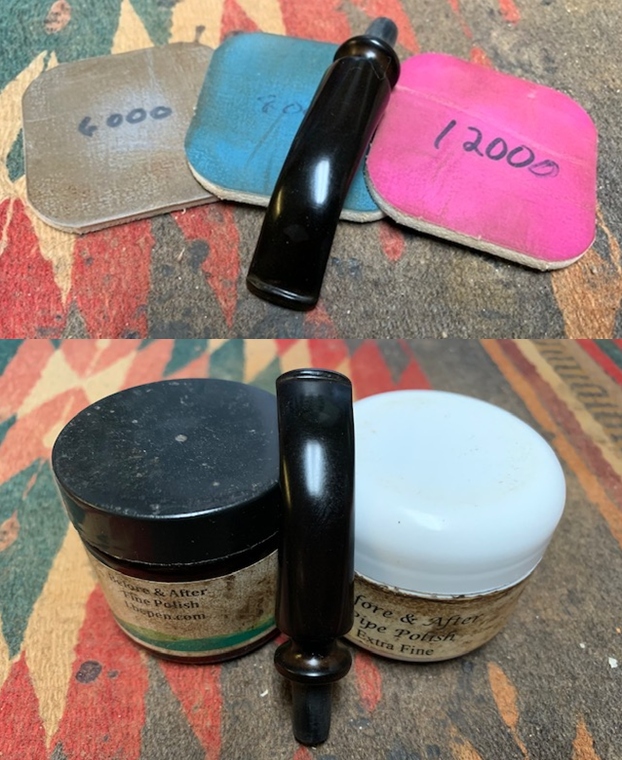
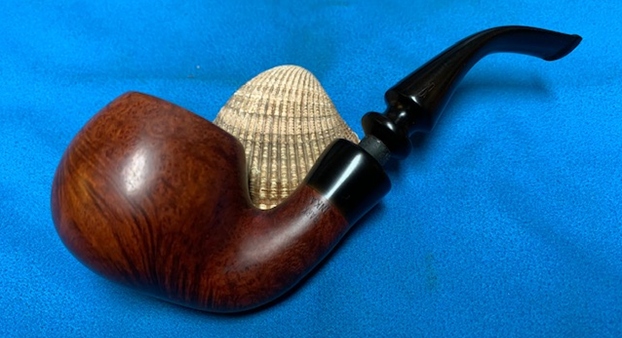
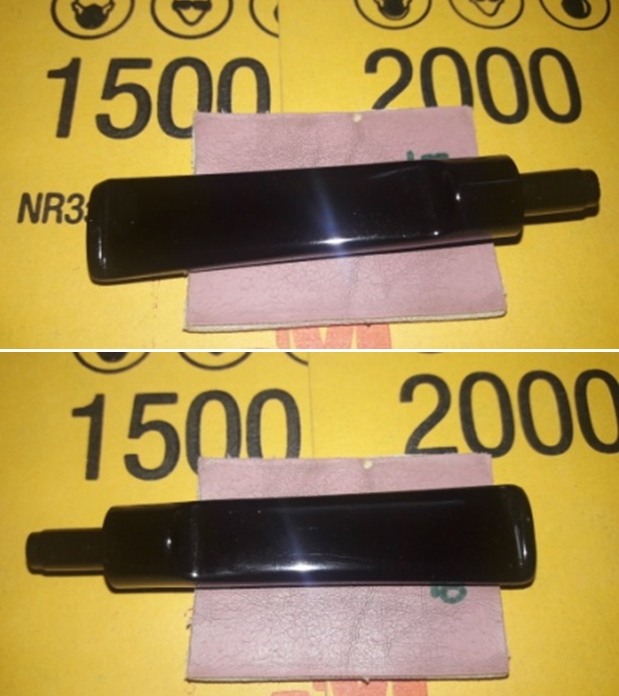
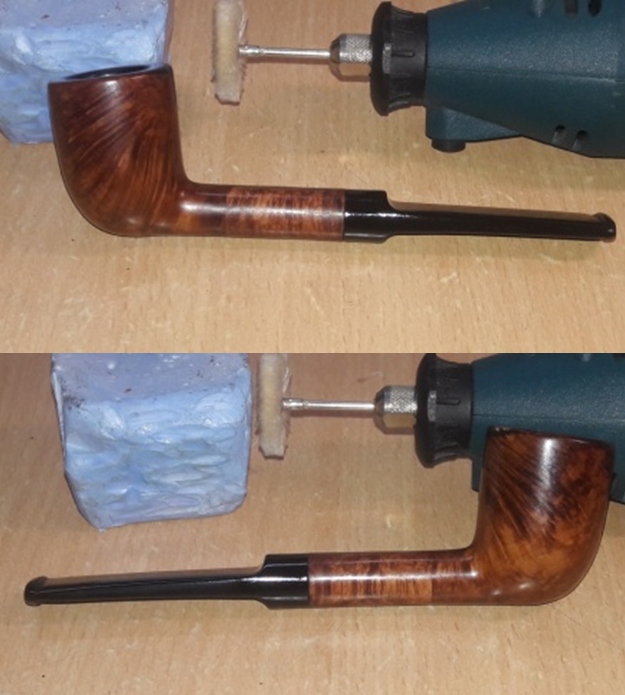
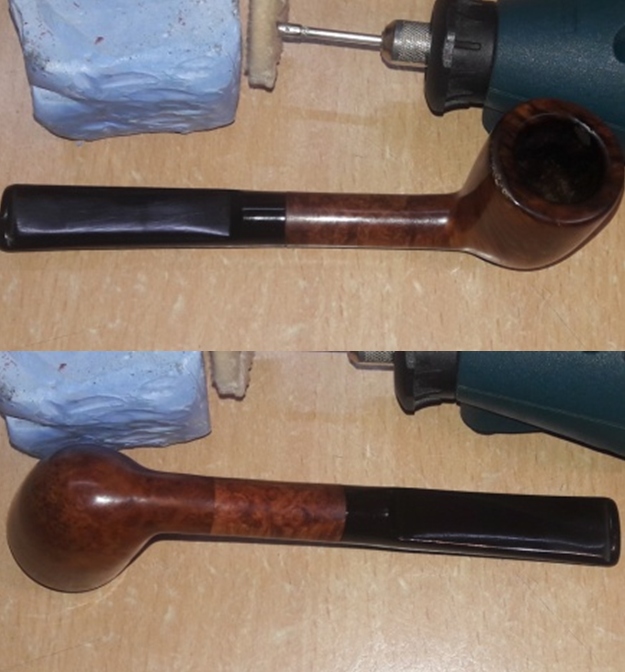
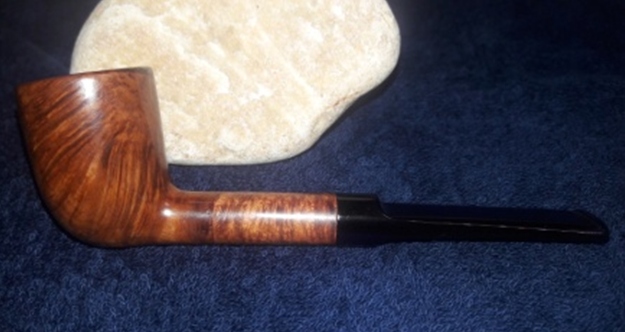
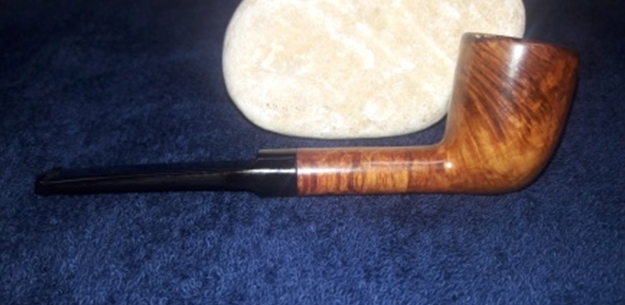
While the stem repairs were curing, I stained the rim top surface with a Dark Brown stain pen and set the stummel aside for the stain to set. The rim top now blends in nicely with the rest of the dark stained stummel surface. Once polished it should match perfectly with the rest of the stummel surface.Once the fill had cured sufficiently, I sand the fills with a flat head needle file and reshaped the button, roughly blending the fills with the surrounding stem surface. For a better blending, I further sand the entire stem with 220 followed by 400, 600, 800 and 1000 grit sand paper. This helps to reduce the scratch marks left behind by the more abrasive 220 grit paper.   To bring a deep shine to the vulcanite stem, I polished the stem by wet sanding with 1500 to 12000 grit micromesh pads. I wiped the stem with moist cloth after each pad and rubbed it down with Extra Virgin Olive oil to rejuvenate the vulcanite. The finished stem is shown below. The sanding with 400 to 1000 grit sand papers followed by wet sanding with micromesh pads had miraculously eliminated most of the many air pockets that were observed earlier. A few air pockets do remain but they are few and not significant at all. I am pretty pleased with this appearance of the stem.  I polished the rim top surface with a cotton cloth buffing wheel mounted on my hand held rotary tool and Red compound. I wiped the rim top with cotton swab and alcohol to increase the transparency of the stain. I am quite pleased with the match of the rim top with the rest of the stummel surface.  I mount a cotton cloth buffing wheel on to my hand held rotary tool and polished the stummel and stem with Blue Diamond compound. This compound helps to remove the minor scratch marks that remain from the sanding. This pipe is starting to look really beautiful with the glossy dark plum like stain through which the beautiful grains pop out over the stummel surface.  The only cosmetic, yet important aspect that remained was to refresh the stem logo. I applied a coat of white correction ink over the logo and once dried, I gently wiped it with a cloth. The logo is now clearly visible.   I mount another cotton buffing wheel that I have earmarked for carnauba wax and applied several coats of the wax. I finished the restoration by giving the entire pipe a rigorous hand buffing using a microfiber cloth to raise the shine further. The finished pipe looks amazingly beautiful and coupled with the size, heft and the hand feel, makes it quite a desirable pipe. If you feel that this pipe calls out your name, please let Steve know and we shall make arrangements for it to reach you. I wish to thank each one for sparing their valuable time to read through this write up and each one is my prayers. Stay home…stay safe!!


A Story Of The Restoration Of An Old Battered Bewlay “General” That Went Awry…


Blog by Paresh Deshpande

I had picked up a job lot of six pipes from a Curio Store on eBay. This lot contained brands like Barling’s, Parker and Orlik and other English make pipes. These are some of my favorite brands and I couldn’t pass them over even though they were in a hopelessly beat up condition. Here are pictures of the pipe lot that the seller had posted. The first pipe from this pipe lot that I decided to work on is a classic Billiards and is indicated in red arrow. This classic Billiard shaped pipe is stamped on the left shank surface as “BEWLAY” in artistic running hand over “GENERAL” in block letters and on the right shank surface as “MADE IN ENGLAND” in capital letters. The bottom of the shank bears the numeral (or is it letter) “0” towards the shank end. The stampings are mostly all worn out and can be roughly made out under bright light and under magnification. The vulcanite tapered saddle stem bears the logo of letter “B”.    This would be the first BEWLAY pipe that I have worked on and thus my curiosity was piqued. I first searched rebornpipes and came across a catalogue uploaded by Jacek A. Rochacki. However, the pipe on my work table finds no mention of it in the brochure. The article has an interesting snippet of information that is reproduced below.

Here is the link to the article – https://rebornpipes.com/2014/03/07/house-of-bewlay-pipes-tobacco-leaflets/

“Bewlay House was a chain of English pipe stores whose pipes were made by Barling, Charatan, and Loewe, so the English considered the Bewlay pipes a quality pipe in its own right. The English brand of Bewlay & Co. Ltd. (formerly Salmon & Gluckstein Ltd.), was in business from the early 20th century until the 1950’s. The brand ended up being sold and taken over by Imperial Tobacco Co. The shop chain closed in the 1980’s but there seems to be one shop still in business on Carr Lane in the city of Hull”.

Unfortunately, the catalogue has no mention of shape “0” and there are no apparent signs of other numerals being worn out. Having hit a wall here, I would like to request readers of Reborn pipes if they could fill in the void by sharing their knowledge with other readers.

Initial Visual Inspection
This pipe has a nice large bowl size equivalent to a Dunhill group size 4. The stummel is covered in dirt and grime of the overflowed lava and dirt accumulated over the years of heavy smoking and uncared attention to cleaning. The stummel boasts of some beautiful mix of swirls, cross and bird’s eye grain over the stummel surface that can be made out under the grime. There is a very thick layer of cake in the chamber and some damage is seen to the rim top surface and the rim edges. The stem is heavily oxidized with a few deep bite marks to the button edge in the bite zone. Here is how the pipe appears as it sits on my work table. Detailed Inspection Of The Pipe And Observations
The bowl has a decently wide rim and a chamber depth of about 1 7/8 inches. The draught hole is in the center and at the bottom of the chamber. The chamber has an extremely thick layer of hard cake with remnants of tobacco flakes embedded in it. The rim top surface appears to be damaged with dents/ dings and is covered in lava overflow, dirt and grime. The inner front rim edge appears to be charred (enclosed in a yellow circle) in the 11 o’clock direction. The outer rim edge has suffered a few blows on a hard surface resulting in a dented and chipped edge surfaces in 12 o’clock and 6 o’clock direction and the same in enclosed in a blue circle. The condition of the inner walls of the chamber and the inner rim edge can be commented upon after the cake has been taken down to the bare briar. The chamber has very strong and sharp ghost smell to it. The stummel appears solid to the touch all around and hence I do not foresee any serious damage to the walls in the form of burnout/ deep heat fissures/ lines or pits. The darkened inner rim edge may be charred further than anticipated and the same will be confirmed after the surface has been thoroughly cleaned. I need to resort to topping the rim top in order to address the damage to the surface. The ghost smells should reduce once the cake from the chamber is removed and the shank has been cleaned.   The smooth stummel surface is covered in lava overflow, dust and grime through which one can make out the beautiful swirls, cross and Bird’s eye grains over the bowl and shank. The stummel surface has a few scratches, dents and dings on the either sides of the stummel, probably due to likely falls during its time with the previous piper. I could make out two fills, one at the back and one to the right side of the stummel (circled in blue). The briar is looking lifeless and bone dry. Once the stummel has been thoroughly cleaned, these damages will be more apparent. Thorough cleaning and rising under warm water of the stummel surface will confirm if these fills are required to be refreshed or otherwise and should also highlight the grain patterns. I shall need to sand the stummel surface with sand papers to remove and minimize the scratches, dents and dings. Micromesh polishing will further help minimize these dents and scratches to some extent. The mortise shows heavy accumulation of oils, tars and gunk and the air flow is not full and smooth. Cleaning of the mortise/ shank will further improve the seating of the stem and also further reduce the strong odors from the pipe.The high quality vulcanite tapered stem has a nice broad flare to the button end and looks good with the stout large stummel. The stem is so heavily oxidized that it appears brownish green in color! Deep calcification is seen in the bite zone from prolonged use of rubber bit. Some heavy tooth chatter and deep bite marks in the bite zone are seen on both the upper and lower surfaces of the stem. The button edges on either surface have been completely flattened with the lip edges seen as mere straight thin edges with no shape and sharpness at all. The tenon air opening is completely blocked with accumulated ash and oils/ tars that have dried out on the inside as well as on the outside. The horizontal slot has a crack to the upper lip and the slot itself is chock-a-block with gunk. The bite marks will be raised to the surface by heating to the extent possible and further will be filled using charcoal and CA superglue mix. The button end, including the button itself on either surface will have to be completely rebuilt and reshaped. I suspect that the upper lip, or whatever remains of it, is cracked in the center.   Overall, this pipe is in a filthy condition and will be a bear to clean up. There is likelihood that this pipe may spring a few unforeseen surprises during the restoration process. It was surely one of the most beloved pipes of the previous owner as it has been heavily smoked.

The Process
Abha, my wife, first cleaned the internals of the stem with stem brush, bristled/ regular pipe cleaners and 99.9% pure isopropyl alcohol. She scraped out the dried oils and tars from the tenon end with my fabricated knife and also removed the dried oils and tars from the slot end. She followed it up by sanding the entire stem with a folded piece of 220 grit sand paper to remove the surface oxidation. The amount of gunk that has been scraped out of the stem surface just to get to the black vulcanite shows that the oxidation was very deep and heavy over the stem surface. It has been our experience that sanding a stem before dunking it in to the deoxidizer solution helps in bringing the deep seated oxidation to the surface which in turn make further cleaning a breeze with fantastic result.   She, thereafter, dropped the stem in to “Before and After Deoxidizer” solution developed by my friend Mark Hoover. The solution helps to draw out heavy oxidation to the surface, making its further removal a breeze, while the minor oxidation is eliminated to a very great extent. The initial sanding helps to draw out the complete oxidation as the sanding opens up the stem surface that has been initially covered with oxidation. We usually dunk stems of 4-5 pipes that are in-line for restoration and this pipe is marked in pastel blue arrow. We generally allow the stems to soak in this solution overnight to do its work.While Abha was working on the stem, simultaneously, I worked on the stummel by first reaming the chamber with size 2 and followed by size 3 Castleford reamer head. I further scraped the chamber walls with my fabricated knife to remove the remaining carbon deposits where the reamer head could not reach. I scraped out the lava overflow from the inner rim edge and the rim top surface, especially from the area in 11 o’clock direction. Once the cake was reamed back to the bare briar, I used a 150 grit sand paper followed by 220 grit sand paper to remove all the traces of remaining cake and also to smooth out the inner walls of the chamber surface. Lastly, to remove the residual carbon dust, I wiped the chamber with a cotton pad wetted with 99.9% pure isopropyl alcohol. The chamber walls are sans any damage. The inner rim edge has a nice thick bevel which was revealed after the lava overflow was removed from the rim top and rim edge. Thankfully the inner rim was not charred under the lava overflow. There is a fill on the rim top surface in 11 o’clock direction (encircled in red) that has come to the notice after the lava overflow was scraped off. The rim top is still considerably darkened and will need deep cleaning. The outer rim and rim top damage will necessitate topping and creating a slight bevel to the outer rim edge.  I followed up the reaming with cleaning the mortise using cue tips, pipe cleaners and shank brush dipped in isopropyl alcohol. I scraped the walls of the mortise with my fabricated knife to remove the dried oils and tars. The ghost smells are still very strong and would need a salt and alcohol treatment.   I continued the cleaning of the chamber and shank internals with a salt and alcohol bath. I use cotton balls which is an at par substitute as I have realized over the years. I draw out a wick from the cotton and along with a folded regular pipe cleaner; insert it in to the mortise and through the draught hole in to the chamber. Thereafter, I packed the chamber with cotton balls to about quarter of an inch below the inner rim edge and soaked the cotton balls with isopropyl alcohol up to the brim. About half an hour later, the level of alcohol had gone down, having being absorbed by the cotton. I topped it up once again and set it aside overnight. By next afternoon, the cotton and alcohol had drawn out all the remaining oils and tars from the chamber and mortise, fulfilling its intended task. I removed the cotton balls and ran pipe cleaners through the mortise to clean out all the loosened tars and gunk and further cleaned it with alcohol and q-tips. The chamber now smells clean and fresh.   With the bowl internals clean, I move to clean the exterior of the stummel. I used a hard bristled tooth brush and Briar Cleaner, a product that has been developed by Mark Hoover, to scrub the stummel and rim top. I set the stummel aside for 10 minutes for the product to draw out all the grime from the briar surface. After 10 minutes, I washed the stummel under running warm water with anti oil dish washing detergent till the stummel surface was clean and dried it using paper towels and soft cotton cloth. I simultaneously cleaned the shank internals with the detergent and hard bristled shank brush and set the stummel aside to dry out naturally. The stummel surface has cleaned up nicely with the beautiful grain patterns on full display. However, this cleaning has also revealed the fills (encircled in blue) that have gone soft. The spot of fill in the rim top (encircled in red) is now clearly seen. This too would need to be refreshed. Darkening around the outer edge (encircled in yellow) is suggestive of charred briar and would need to be addressed. With a sharp thin edged blade, I gouged out the fill to the right side and one at back of the stummel. However, I decided not to address the fill at the rim top at this juncture since I was, anyway, going to top it and there is always a possibility that the fill is not very deep and is eliminated completely.   I top the rim on a piece of 220 grit sand paper to even out the rim surface dents/ dings and also to reduce the charred outer rim edge surface that was noticed after the stummel was thoroughly cleaned. The rim top looks perfect with a flawless inner rim edge. However the fill, though reduced in size, is very much visible as a dot. The damages to the outer rim edge (marked in red) in the 12 o’clock and 6 o’clock direction, though minimized, will need to be addressed by creating a bevel. I removed the old fill from the rim top surface with a sharp dental tool till I reached solid briar underneath the fill.   While I continued with the stummel repairs the next morning, Abha removed the stems that had been soaking in the deoxidizer solution overnight. She cleaned the stem and the stem airway under running warm water and scrubbed the raised oxidation from the stem surface using a Scotch Brite pad and the airway with a thin shank brush. She further removed the oxidation by scrubbing the stem with 0000 grade steel wool and applied a little EVO to rehydrate the stem. This now gives a clearer picture of the extent of depth of the bite marks as can be seen in the pictures below. These will definitely require a fill even after I have heated and raised the vulcanite. It is now confirmed that the lip edge on the upper surface is cracked. This crack will be repaired when I rebuild the entire button on both the upper surface of the stem. With the stem cleaning in progress in some of the finest hands, I decided to refresh the fills that I had gouged out yesterday. Using the layering method, I filled these gouges with a mix of briar dust and CA superglue till the mound of the mix was slightly above the rest of the stummel surface. This helps in a better blending of the fill with the rest of the stummel surface while sanding and reduces the scratches caused by the use of a needle file as you have a correct perspective of the sanding that is required. I set the stummel aside for the fills to cure. I realized with a cringe that I had run out of medium CA superglue that was at my home and since the entire country being in a lockdown, I could not order for some. All that was available to me was very thin CA superglue that was almost of the viscosity of water. Not wanting to waste time, I had decided to continue my repairs using what was available only to realize at the very end how wrong that decision was…. Abha, in the meanwhile, had cleaned the stem and handed it over to me to deal with the damages that I had described during my initial inspection. To raise the deep bite marks in the bite zone, I heated the damaged potion with the flame of a candle. The heat from the candle flame helps to raise these bite marks to the surface as vulcanite has the property to raise and attain its original shape when heated. Though addressed to some extent, these bite marks would need to be filled with a mix of activated charcoal and superglue. The buttons would need to be entirely rebuilt and reshaped. The stem is cracked (indicated in yellow arrows) on the stem upper surface over the lip. Further stem repairs would have to be kept on hold till I got back to my work place where I have a couple of superglue tubes for the purpose.  With further stem repairs being on hold, I turned back to the stummel repairs. Using a flat head needle file, I sand the fill till I had achieved a rough match with the surrounding stummel surface. I sand the entire stummel with a piece of 220 grit sand paper to address the dents and dings to the stummel surface and also to further match the fill with the rest of the stummel surface. Though 95% of the scratches and dings have been eliminated, there still remains few very minor dings that are remnants of the deeper ones. I accept these dings as part of this pipe’s journey till date.   I addressed the inner rim darkening to the bevel in the 11 o’clock direction by sanding the inner bevel with the same piece of 220 grit sand paper. To address the dents to the outer rim, I created a slight bevel with a folded piece of 220 grit sand paper pinched between my thumb and index finger. The rim top surface definitely looks a lot better at this stage in restoration.    I followed it by wet sanding the stummel with 1500 to 12000 grit micromesh pads, wiping frequently with a moist cloth to check the progress. I really like the looks of the stummel at this point in restoration. The grains and the clean lines of this piece of briar is really appreciable.   Next, I rubbed a small quantity of “Before and After Restoration Balm” deep in to the briar with my finger tips and let it rest for a few minutes. The balm almost immediately works its magic and the briar now has a nice vibrant appearance with the beautiful grain patterns displayed in their complete splendor. I further buffed it with a horse hair brush. The contrast of the dark browns of the flame and cross grains with the natural finish of the rest of the stummel adds an interesting dimension to the appearance of the stummel which may be insufficiently described in words and be rather seen in person. It is the two fills, one to the right and one at the back of the stummel surface that is an eye sore. I shall stain the stummel with a dark brown stain to mask these fills. Now, having rejoined my place of work after a hiatus of four months I need to work real fast to complete my backlogs of write ups and complete the repairs on pipes that were worked on during the lockdown period while at home. I have completed a few and now this pipe has inched forward on to my work table. While packing these pipes for its journey with me, I had noted all the issues that had to be addressed on each pipe. This one needed stem repairs; stem polishing and stummel staining to mask the ugly fills.

I start with stem repairs since these take the longest. Here is how the damage to the stem looks as it sits on my work table. The crack is indicated by yellow arrows and would need to be repaired. The damage to the buttons and the deep tooth indentations that remain after the heating is also clearly visible. Once I have repaired these damages, the entire stem needs to be polished and the stem logo needs to be refreshed. And here I noticed that the super glue tubes that I had stashed before proceeding on leave, had completely dried out on me…. Can’t describe the agony!! So another delay of couple of days and I get delivered CA Wood Glue and not ALL PURPOSE that I always use. This too has contributed to the end results of this restoration.  Continuing with the stem repair, I inserted a triangulated index card covered in transparent tape in to the slot. The tape prevents the mix of superglue and charcoal from sticking to the index card. The moment I inserted the index card, a big chunk of the bite zone, including the button edge just broke off completely. My pain in restoring this pipe is increasing by leaps and bounds… Undaunted by this setback, I persisted with the stem repairs. I mixed superglue and activated charcoal powder and generously applied it over the bite zone, including over the buttons, on either surfaces of the stem and set it aside to cure. Once the fill has hardened, I shall file and sand the fills to match the surface of the stem and sharpen the button edges on either surface. This glue hardens immediately and allowed me only a few seconds of application whereas the all purpose CA superglue allowed me enough time to get an even spread over the damaged surface. The fill had hardened and with a flat head needle file, I worked on the filling till I had achieved a rough match with the surrounding surface and had sufficiently sharpened the button edges. It was at this stage that I noticed something that no pipe restorer is desirous of observing…air pockets in the freshly sanded fills! These air pockets are circled in yellow.   No option here but to redo the entire fill with a mix of charcoal and superglue but with the variation that this time around I mixed very little charcoal. I applied this mix and set the stem aside for the fill to cure.   I sand the stem fills a second time and again these dreaded air pockets surfaced in these same areas. To cut the whole story short, I had to repeat the fill five times with the same results. Finally I got frustrated and continued with the filing and polishing.

I sand the fills with a flat head needle file and reshaped the button, roughly blending the fills with the surrounding stem surface. For a better blending, I further sand the entire stem with 320 followed by 600, 800 and 1000 grit sand paper. This helps to reduce the scratch marks left behind by the more abrasive 220 grit paper. To bring a deep shine to the vulcanite stem, I polished the stem, wet sanding with 1500 to 12000 grit micromesh pads. I wiped the stem with moist cloth after each pad and rubbed it down with Extra Virgin Olive oil to rejuvenate the vulcanite. The finished stem is shown below. Though the air pockets are now not so glaringly visible (if that’s any consolation….), I very well know that they are there and that troubles me no end. Maybe at a later date when someone decides to make this pipe his/ her own, I may rework the stem to make it flawless. Till then, I shall pretend that they don’t exist.  Now that I had made peace with the stem air pockets, I turn my attention to the stummel. As I had commented earlier, the fills are an eye sore against the beautiful grains and coloration of the rest of the stummel and hence to mask it, I decided to stain the bowl using Feibing’s Dark Brown leather dye. I heated the stummel surface with my heat gun to open up the pores on the stummel so that the stain is well set while being careful that I do not overheat the fill, a lesson learned while restoring Steve’s Alexander Zavvos pipe. I dipped a folded pipe cleaner in Feibing’s Dark Brown leather dye and liberally applied it over the heated surface, flaming it with the flame of a lighter as I went ahead to different self designated zones of the surface. This helps in the setting of the stain in the grain of the briar. The next evening, approximately 18 hours later, as Dal describes, I began to unwrap the stain in the hope to see beautiful grains. I mount a felt cloth buffing wheel on my hand held rotary tool and setting the tool at its slowest speed, again my recent experience while working on Steve’s pipe came in handy and the damage that can be caused due to heating while using the felt buffing wheel still fresh in my memory; I began to peel off the stain from the stummel surface first using Red compound. The stain was peeled out gradually. This is where the problem of using very thin superglue for the fill came in to focus. The thin glue had spread and was not noticed until I had stained the stummel and these areas presented themselves as light spots which did not take on the stain. I had reached the end of my tethers and I decided to move ahead with the restoration.   This was followed with wiping the stummel with a cotton swab and alcohol to lighten the stain a little as it was too dark for my liking. This also helps in cleaning the surface of all the residual stain and highlighting the grains. The grains really pop out from under the stain and the fills are hardly discernible. Save for the light spots where the thin glue had spread, I am quite pleased with the appearance of the stummel at this stage.   Next, I mount a fresh cotton cloth buffing wheel and polish the stummel with White Diamond compound. HUGE MISTAKE… the stummel had now taken on darker hues and the grains are now less prominently visible. Is it because of the White Diamond or some other reason, I do not know. The following pictures will help in comparing the stummel after wiping down with alcohol (above pictures) and after applying the White compound.   I have now reached the homestretch in this restoration project. To complete the restoration, I mount a cotton cloth buffing wheel on to my hand held rotary tool and polished the stummel and stem with Blue Diamond compound. This compound helps to remove the minor scratch marks that remain from the sanding. This too was a mistake, I feel since the stummel appears too dark with no grains visible at all!! However, the stummel and stem has taken on a nice shine. The only cosmetic, yet important aspect that remained was to refresh the stem logo. I applied a coat of white correction ink over the logo and once dried, I gently wiped it with a cloth. The logo is now clearly visible.  I mount another cotton buffing wheel that I have earmarked for carnauba wax and applied several coats of the wax. I finished the restoration by giving the entire pipe a rigorous hand buffing using a microfiber cloth to raise the shine further. The finished pipe looks amazingly….dark!! The finished pipe is as shown below. P.S. This then is one project which has not given me the satisfaction that I usually experience after I have completed a restoration. So, if that is the case, then why am I taking the pain to even do the write up and posting it for others to read about my failures?

Well, the reasons are two fold…

Firstly, I am not too concerned with successes or failures. What matters to me is the journey. This project has been a journey of experimenting and learning. This was the first time that I used White Compound after staining and alcohol wipe as I had read that this compound brings in a further transparency to the stain. Well, apparently, this did not work for me. I would definitely like to learn the views of other more experienced professional restorers on the best method of staining and the process thereafter to increase the transparency of the stain.

Secondly, if through my mistakes somebody else is able to derive benefits, then the entire effort was worthwhile. This platform that was made available to me by Steve to learn pipe restoration has helped me immensely to learn the art and this write up is my contribution for a newbie to learn what needs to be avoided.

Thank you for your patience and valuable time in reading this far. Hope all the readers and their loved ones are in the best of health and spirits. Be safe and stay safe in these troubled times.

Restoring a Parker Super Bruyere 134 Circle 4 Pot


Blog by Steve Laug

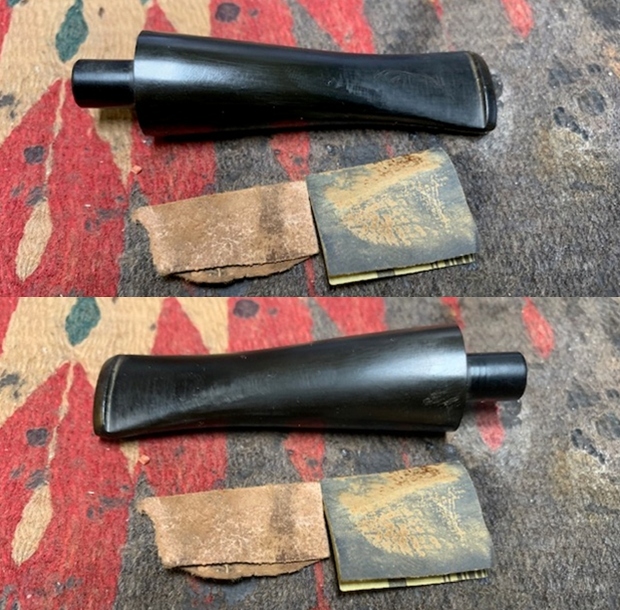
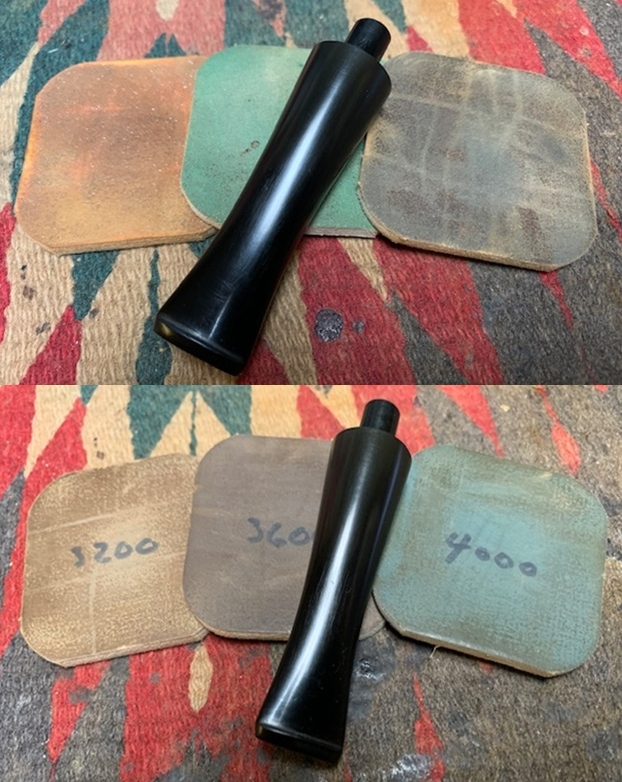
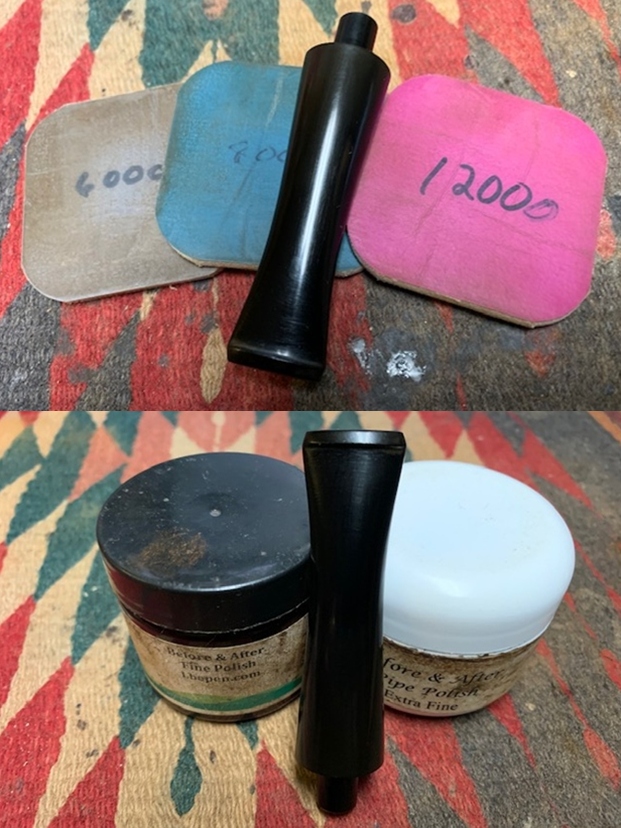
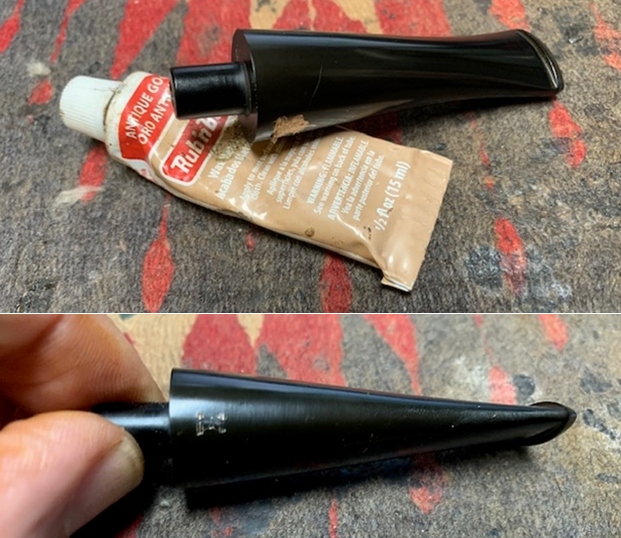
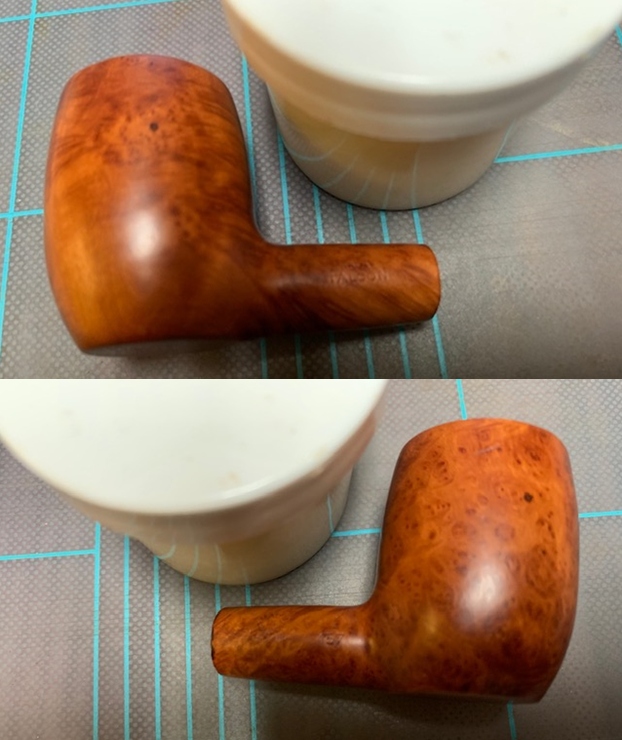
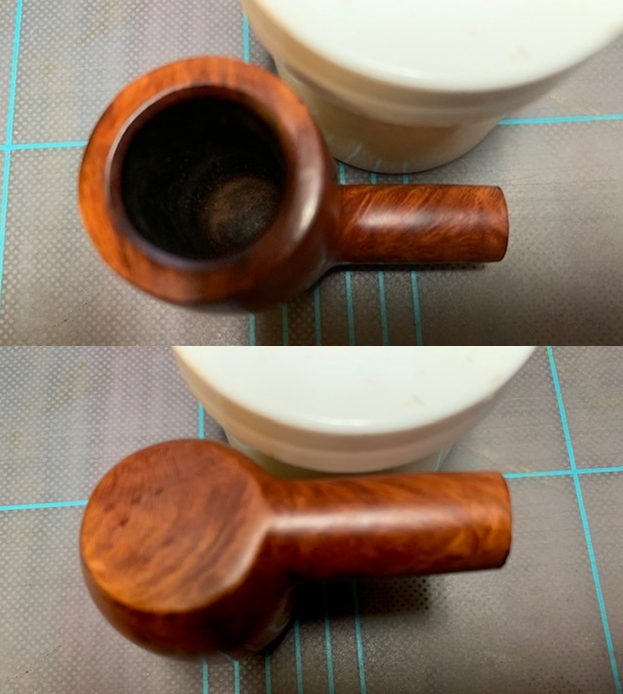
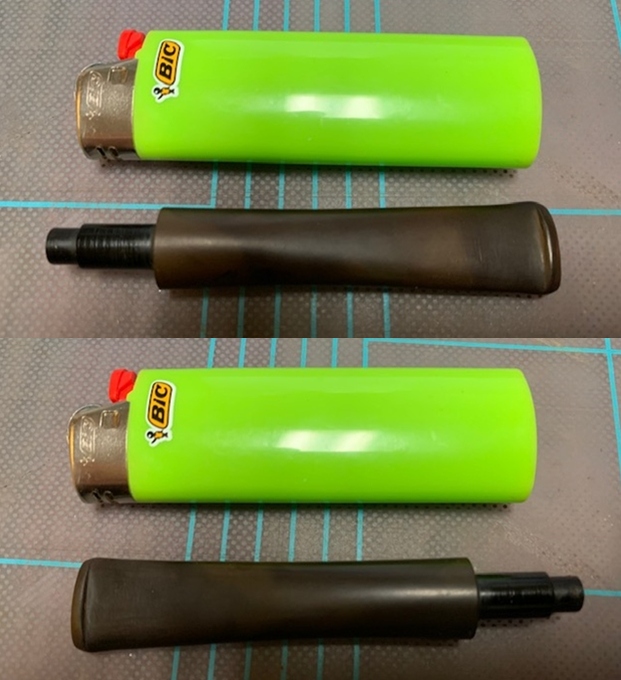
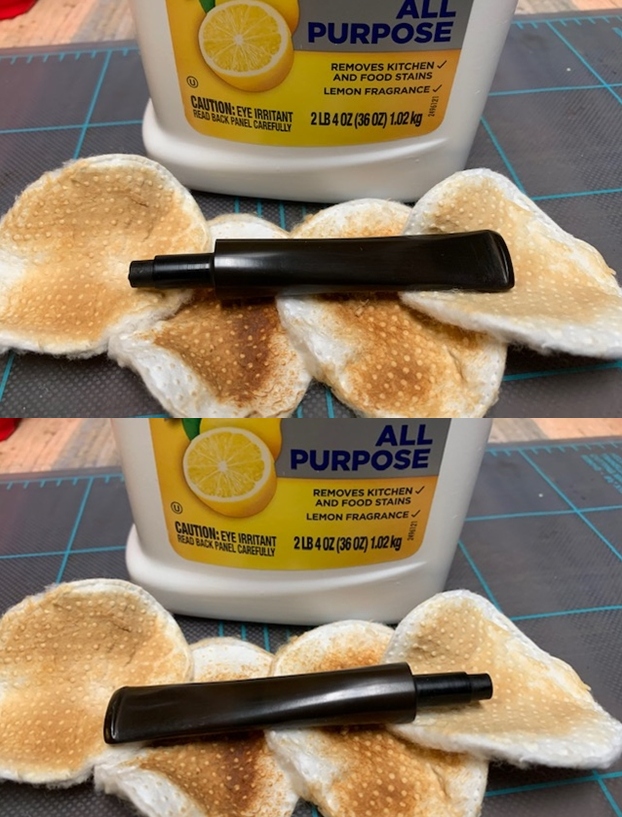
The next pipe on the work table came to me from the estate of a Vancouver pipe smoker whose widow left them with a local Pipe Shop after he died. I was asked to clean them up and sell them for the shop as it has since closed. This is another interesting looking piece – great grain showing through underneath the grime. There is cross grain and birdseye grain around the bowl. The pipe is stamped on the left side of the shank and reads shape #134 followed by Parker [over] Super in a diamond [over] Bruyere. On the right side of the shank it is stamped with the size number 4 in a circle followed by Made In London England. The finish was dull and lifeless with a lot of grime ground into the briar. The bowl was heavily caked with a lava coat on the top of the rim. It was hard to tell how the inner and outer edge of the rim actually looked until the bowl was reamed. The stem was oxidized, calcified and had tooth chatter and marks on the top and underside near the button. It had promise but it was very dirty. I took some photos of the pipe when I received it.   I have worked on quite a few Parkers over time and I have seen them stamped like the one I have however, there was a superscript after the D in England that was lacking in this one. I turned to Pipedia to see what I could find out a Super Bruyere without a date code after the England stamp (http://www.pipephil.eu/logos/en/logo-parker.html). I have included a screen capture of the section showing a similarly stamped. I had sent the batch of pipes from the shop to my brother Jeff in Idaho and he had cleaned them up for me. It was several years ago now that he sent them back to me and I am just now getting to finish them. He reamed them with a Pipnet Reamer and cleaned up the reaming with a Savinelli Fitsall pipe knife.  He had scrubbed the exterior of the bowl with Murphy’s Oil Soap and a tooth brush and rinsed it off with warm water to remove the grime from the finish. He cleaned the internals of the shank and stem with alcohol, cotton swabs and pipe cleaners to remove the tarry residue and oils in the shank and airway. He soaked the stem in Before & After Deoxidizer to remove the oxidation on the stem surface. When it arrived here on my work table I took photos of the pipe before I started my part of the restoration. The bowl was a definite improvement but the stem still showed some oxidation.    The inner and outer edges were in good condition. There was some darkening around the inner edge of the rim and some damage to the rim top. The stem look good but there was still some oxidation and there were tooth marks and chatter on both sides near the button. The underside was worse than the topside.     I took a photo of the stamping on the sides of the shank. The stamping is clear and readable and reads as noted above.         I took the stem off the pipe and took a photo of the parts to show the look of the pipe as a whole.I topped the bowl with 220 grit sandpaper on a topping board to remove the damage to the rim top. I used a folded piece of sandpaper to clean up the inner edge of the bowl. I polished the rim top and bowl with 1500-12000 grit micromesh sanding pads to polish the briar.      I used an Oak stain pen to touch up the rim top and blend it into the rest of the bowl. Once it was buffed it would be a perfect match.I rubbed the bowl and shank down with Before & After Restoration Balm. I worked it into the surface of the bowl sides and shank with my fingertips to clean, enliven and protect the briar. I let the balm sit for a little while and then buffed with a cotton cloth to raise the shine. You can see the grain showing through the deep glow. I set the bowl aside and turned my attention to the stem. I “painted” the stem surface with the flame of a Bic lighter. I was able to lift the majority of the dents but there were two on the underside and a dent along the button on the top side. I filled them in with clear super glue and set it aside to cure. Once the repairs cured I used a needle file to smooth out the repairs and blend them into the surrounding vulcanite. I scrubbed the surface of the stem with Soft Scrub all-purpose cleanser to remove the oxidation that remained on the stem surface. I smoothed out the repair with 220 grit sandpaper to blend it into the surface of the surrounding vulcanite. I started polishing the stem with 400 grit wet dry sandpaper.       I polished the vulcanite stem with micromesh sanding pads – 1500-12000 grit pads. I wiped it down with a damp cloth after each sanding pad. I used Before & After Pipe Polish – both Fine and Extra Fine to further polish the stem.        I touched up the Diamond P stamp with Antique Gold Rub’n Buff. I pushed it into the stamping with a tooth pick. I rubbed it off with a cotton pad to remove the excess and still leave some in the stamping.   This Parker British Made Super Bruyere Pot is a great looking pipe now that it has been restored. This great looking pipe that came to me from the local pipe shop estate that I am restoring and selling for them. The medium brown stain highlights the grain and works well with the polished vulcanite taper stem. I put the stem back on the bowl and carefully buffed the pipe with Blue Diamond on the buffing wheel using a light touch on the briar. I gave the bowl and the stem multiple coats of carnauba wax on the buffing wheel and followed that by buffing the entire pipe with a clean buffing pad. I hand buffed the pipe with a microfiber cloth to deepen the shine. The finished straight pot fits nicely in the hand and feels great. Give the finished pipe a look in the photos below. The dimensions of the pipe are Length: 5 ¼ inches, Height: 1 ¾ inches, Outside diameter of the bowl: 1 ½ inches, Chamber diameter: ¾ of an inch. If you are interested in adding this pipe to your collection send me a message or an email. I have a variety of brands to work on from the shop. Perhaps one of those will catch your attention. Thanks for reading this blog and my reflections on the pipe while I worked on it. This is an interesting estate to bring back to life.

Restoring a Birks Regency Lovat


Blog by Steve Laug

The next pipe on the work table came to me from the estate of a Vancouver pipe smoker whose widow left them with a local Pipe Shop after he died. I was asked to clean them up and sell them for the shop as it has since closed. This is an interesting looking piece – great grain showing through underneath the grime. There is cross grain and birdseye grain around the bowl. The pipe is stamped on the left side and reads Birks [over] Regency. The finish was dull and lifeless with a lot of grime ground into the briar. There were quite a few loose fills on the left side of the bowl and on the shank top. The bowl was heavily caked with a lava coat on the top of the rim. It was hard to tell how the inner and outer edge of the rim actually looked until the bowl was reamed. The stem was oxidized, calcified and had tooth chatter and marks on the top and underside near the button. It had promise but it was very dirty. I took some photos of the pipe when I received it. I was curious about the maker of the pipe so I did some searching on Pipedia. There was a link there under British Made pipes (https://pipedia.org/wiki/Birks). I quote the following:

Purely speculation, but perhaps this pipe was made for the Henry Birks & Sons firm as a gift for executives or clients.

That could make sense as there is a Henry Birks and Sons Ltd. in Vancouver. Since the pipe came through a Vancouver based pipe shop there could be a connection. It is one of those mysteries that I am not sure will be solved.

I had sent the batch of pipes from the shop to my brother Jeff in Idaho and he had cleaned them up for me. It was several years ago now that he sent them back to me and I am just now getting to finish them. He reamed them with a Pipnet Reamer and cleaned up the reaming with a Savinelli Fitsall pipe knife.  He had scrubbed the exterior of the bowl with Murphy’s Oil Soap and a tooth brush and rinsed it off with warm water to remove the grime in the rustication. He cleaned the internals of the shank and stem with alcohol, cotton swabs and pipe cleaners to remove the tarry residue and oils in the shank and airway. He soaked the stem in Before & After Deoxidizer to remove the oxidation on the stem surface. When it arrived here on my work table I took photos of the pipe before I started my part of the restoration. The bowl was a definite improvement but the stem still showed a some oxidation. The inner and outer edges were in excellent condition. There were nicks and damaged areas on the rim top. There was also some darkening on the top. The stem look good but there was still some oxidation and there were tooth marks and chatter on both sides near the button. The underside was worse than the topside.   I took a photo of the stamping on the sides of the shank. The stamping is clear and readable and reads as noted above.   I took the stem off the pipe and took a photo of the parts to show the look of the pipe as a whole.I decided to address the loose fills in the briar on the right side of the bowl and shank first. I wiped the bowl down with alcohol and filled in the chipped and damaged fills with clear super glue and briar dust. I packed the briar dust and glue into the damaged fills. Once the repairs cured I sanded them with 220 grit sandpaper to blend them into the surrounding briar. To take care of the rim damage I topped the bowl on a topping board with 220 grit sandpaper. I worked over the inner edge of the rim with a folded  piece of 220 grit sandpaper and the rim top looks much better.I polished the rim top and bowl with 1500-2400 grit micromesh sanding pads to smooth out the scratches from the sandpaper. I stained the bowl with Light Brown aniline stain, flamed it and repeated until the coverage was even around the bowl and shank.    I polished the newly stained bowl with micromesh sanding pads. I sanded it with 1500-12000 grit pads and wiped it down between each pad with a damp cloth. By the end you can see the shine on the briar.   I rubbed the bowl and shank down with Before & After Restoration Balm. I worked it into the surface of the bowl sides and shank with my fingertips to clean, enliven and protect the briar. I let the balm sit for a little while and then buffed with a cotton cloth to raise the shine. You can see the grain showing through the deep glow.      I polished the bowl with a microfiber polishing cloth to raise the shine. I took photos of the bowl at this point in the process.     I sanded out the repair with 220 grit sandpaper to blend it into the surface of the surrounding vulcanite. I started polishing the stem with 400 grit wet dry sandpaper.       I polished the vulcanite stem with micromesh sanding pads – 1500-12000 grit pads. I wiped it down with a damp cloth after each sanding pad. I used Before & After Pipe Polish – both Fine and Extra Fine to further polish the stem.         This Birks Regency Lovat is a great looking pipe now that it has been restored and restained. This great looking pipe that came to me from the local pipe shop estate that I am restoring and selling for them. It has turned out to be a great looking pipe. The medium brown finish highlights the grain and works well with the polished vulcanite saddle stem. I put the stem back on the bowl and carefully buffed the pipe with Blue Diamond on the buffing wheel using a light touch on the briar. I gave the bowl and the stem multiple coats of carnauba wax on the buffing wheel and followed that by buffing the entire pipe with a clean buffing pad. I hand buffed the pipe with a microfiber cloth to deepen the shine. The finished Lovat fits nicely in the hand and feels great. Give the finished pipe a look in the photos below. The dimensions of the pipe are Length: 5 inches, Height: 1 ¾ inches, Outside diameter of the bowl: 1 ¼ inches, Chamber diameter: ¾ of an inch. If you are interested in adding this pipe to your collection send me a message or an email. I have a variety of brands to work on from the shop. Perhaps one of those will catch your attention. Thanks for reading this blog and my reflections on the pipe while I worked on it. This is an interesting estate to bring back to life.

Refurbishing a Second Bertram From the Lot Of 13 – a Bent Egg # 25


Blog by Paresh Deshpande

Last year while on a Face Time chat with my Guru, Mentor and friend, Steve Laug, we got talking about the Bertram lot that he had been working on at that point in time. He spoke about how overwhelming it was just to look at the large lot of about 200 plus pipes that he and Jeff had acquired. Never to miss an opportunity to add to my meager pipe lot that was available for me to work on, I suggested that if it was okay with him I would be more than willing to take a few of them off his hands. We worked out the details and soon a job lot of 12 pipes traveled all the way from US to Canada and then on to India!! That was one long journey undertaken by this lot of Bertram pipes. Here is the lot of Bertram pipes that I received. This lot contained a variety of nicely shaped and grained pipes which I had been looking forward to work on.The second pipe that I decided to work on from this lot is a Full Bent Egg shaped pipe, marked in green arrow, with swirls to the front and cross grains to the sides and over the shank surfaces. This pipe is stamped on the left shank surface as “Bertram” in running hand over “WASHINGTON D C” in block letters in a straight line. The grade code “25” is stamped on the bottom surface at the shank end. The stampings are slightly worn out but still readable by naked eye. The bent vulcanite saddle stem is sans any stamping. The size and feel of the pipe is solid in hand. This pipe has been well researched and chronicled by Steve when he worked on many of the Bertram pipes in his possession and thus, shall not waste time in proverbial “reinventing the wheel”. Interested readers may like to follow the link given below to get to know the brand better. https://rebornpipes.com/2019/04/10/the-4th-of-a-collection-of-bertrams-a-bertram-dublin-70s/

INITIAL VISUAL INSPECTION
This pipe has a compact bowl size that narrows slightly towards the rim with a sharply raked round shank and a bent saddle stem that lends itself nicely to clenching. The stummel boasts of some beautiful cross grains to the sides and all around the shank. The stummel is covered in dirt and dust. The entire stummel is peppered with a number of fills, both large and small. There is a thick layer of cake in the chamber and some damage is likely to the back of the rim top surface. The stem is lightly oxidized with tooth chatter in the bite zone. The pipe, as it sits on my work table, presents an encouraging picture. DETAILED INSPECTION OF THE PIPE AND OBSERVATIONS
The chamber has a slight taper towards the rim top and a chamber depth of about 1 ¼ inches. The outer edge of the rim towards the shank is slightly flattened while the rest of it is perfectly rounded. The chamber has an even layer of thick hard cake with remnants of un-burnt tobacco seen at the heel of the chamber. The rim surface has light traces of lava overflow over the rim surface. Through this layer of lava, a few dings can be seen over the rim top surface. The outer rim edge is sans any damage. The condition of the inner walls of the chamber can be commented upon after the cake has been taken down to the bare briar. The ghost smells in the chamber are not very strong. The stummel appears solid to the touch all around and hence I do not foresee any serious damage to the walls in the form of burnout/ deep heat fissures/ lines or pits. The ghost smells should reduce once the cake from the chamber is removed and the shank has been cleaned. The smooth stummel surface is covered in dust and grime through which one can make out the beautiful cross grains over the sides of the bowl and shank. The stummel surface is shows a couple of large and small fills. These fills stand out like flesh wounds against the briar surface. The briar is looking lifeless and bone dry. Thorough cleaning and rising of the stummel under warm water should loosen old fills while also serving to highlight the grain patterns. Once the stummel has been thoroughly cleaned, these fills will be more apparent and I intend to refresh only those fills which have loosened out with a fresh fill of briar dust and superglue. Micromesh polishing will help in blending these fills while imparting a nice shine to the briar. The mortise has a reservoir at the bottom that has accumulated oils, tars and gunk. The walls of the shank are filthy and covered in grime and dust. The mortise appears to be clogged as a pipe cleaner did not easily pass through it. I have worked on many Pete System pipes and cleaning the sump had always been a chore. Fervently hoping that is not the case this time around! The fit of the stem in to the mortise is slightly tight. However, once the shank walls are cleaned, this issue should be resolved.The high quality vulcanite saddle stem is lightly oxidized. Some minor tooth chatter and calcified deposit is seen on both the upper and lower stem surfaces in the bite zone and at the bottom of the button edge respectively. The tenon has accumulated ash and oils/ tars that have dried out on the inside as well as on the outside. The horizontal slot has scratch marks which will have to be addressed. The tooth chatter and the calcified deposits will be removed by sanding with a piece of 220 grit sand paper.THE PROCESS
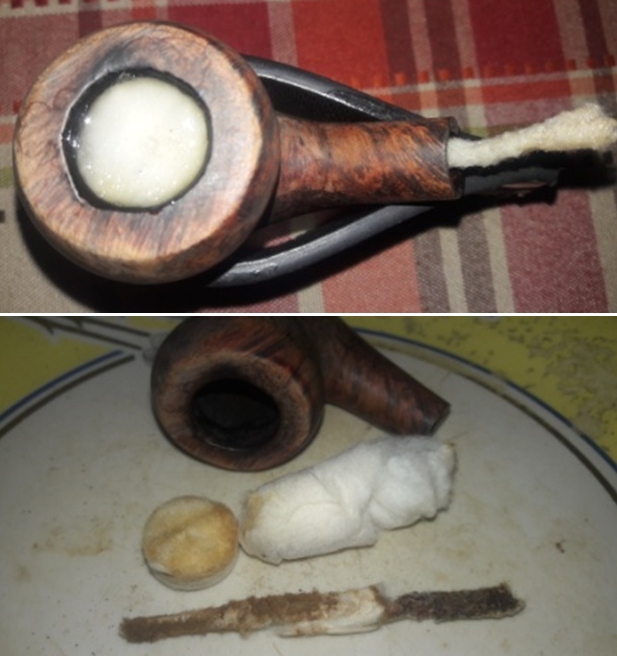
I started the restoration of this pipe by first cleaning the internals of the stem with bristled pipe cleaners and 99.9% pure isopropyl alcohol. I scraped out the dried oils and tars from the tenon end with my fabricated knife and also removed the dried oils and tars from the slot end. I followed it up by sanding the entire stem with a folded piece of 220 grit sand paper to remove the surface oxidation. It has been our (Abha, my wife and self) experience that sanding a stem before dunking it in to the deoxidizer solution helps in bringing the deep seated oxidation to the surface which in turn make further cleaning a breeze with fantastic result.I dropped the stem in to “Before and After Deoxidizer” solution developed by my friend Mark Hoover. The solution helps to draw out heavy oxidation to the surface, making its further removal a breeze, while the minor oxidation is eliminated to a very great extent. The initial sanding helps to draw out the complete oxidation as the sanding opens up the stem surface that has been initially covered with oxidation. I usually dunk stems of 4-5 pipes that are in-line for restoration and this pipe is marked in pastel blue arrow. I generally allow the stems to soak in this solution overnight to do its work.While the stem was soaking in the deoxidizer solution, I worked on the stummel by first reaming the chamber with size 2 Castleford reamer head. I further scraped the chamber walls with my fabricated knife to remove the remaining carbon deposits where the reamer head could not reach. I scraped out the lava overflow from the rim top surface. Once the cake was reamed back to the bare briar, I used a 150 grit sand paper followed by 220 grit sand paper to remove all the traces of remaining cake and also to smooth out the inner walls of the chamber surface. Finally, to remove the residual carbon dust, I wiped the chamber with a cotton pad wetted with 99.9% pure isopropyl alcohol. And it was at this stage that I got the first (and hopefully the last) inkling of the likely damage to the heel of the chamber. The mortise and draught hole had been over zealously cleaned with pipe cleaners/ shank brush by the previous piper and which had resulted in a deep trough from the draught hole to the center of the heel with raised edges on the sides. This trough is indicated with red arrows. If or not the damage has extended to the foot of the stummel will be confirmed once the stummel surface has been cleaned. The chamber walls, inner and outer rim edges are pristine and without any damage. I followed up the reaming with cleaning the mortise using cue tips, pipe cleaners and shank brush dipped in isopropyl alcohol. I scraped the walls of the mortise with my fabricated knife to remove the dried oils and tars. The ghost smells have been eliminated and the chamber smells clean.With the bowl internals clean, I move to clean the exterior of the stummel. I used a hard bristled tooth brush and Briar Cleaner, a product that has been developed by Mark Hoover, to scrub the stummel and rim top. I set the stummel aside for 10 minutes for the product to draw out all the grime from the briar surface. After 10 minutes, I washed the stummel under running warm water with anti oil dish washing detergent till the stummel surface was clean. I dried it using paper towels and soft cotton cloth. I simultaneously cleaned the shank internals with the detergent and hard bristled shank brush and set the stummel aside to dry out naturally. The stummel surface has cleaned up nicely and the beautiful grain patterns are now on full display. The fills, even the smallest ones, are now clearly discernible. I probed each fill with a sharp dental tool to check for solidity and thankfully, each fill was nice and solid without any give, save for the fills at the foot of the stummel. I took a closer look at the foot of the stummel and the worst of my fears was staring right back at me with a smile!!! There is a small smiley crack right in the centre of the foot. Truth be told, looking at the heel, I had inkling that the foot may have some such damage, but now to be sure that the damage does exist, is painful. Desperately seeking some positives, I was relieved to note that the damage has not progressed to an extent that would be termed as a burnout. I did the tap test over and around the damaged foot (with the back of a spoon or any hard instrument gently tap the damaged area) and was relieved to hear a crisp sharp note signifying that nothing is lost. The briar around still feels solid over and around the damaged foot. The pipe still has many years of life left in it and with the repairs that I plan, this will last even longer. I plan to drill a counter hole at either ends of the crack and seal it with briar dust and super glue. This will prevent further spread of the crack in either direction. The trough formed at the heel of the chamber will be spot filled with J B Weld which will prevent the burning tobacco from coming in to direct contact with the now weak spot in the heal.While the stummel was drying, the next morning, Abha removed the stem that had been soaking in the deoxidizer solution overnight. She cleaned the stem under running warm water and scrubbed the raised oxidation from the stem surface using a scotch brite pad and cleaned the airway with a thin shank brush. She further removed the oxidation by scrubbing the stem with 0000 grade steel wool and applied a little EVO to rehydrate the stem. There is a need to further sand the stem to completely remove the oxidation.My significant half, Abha, used a 220 grit sand paper to sand the stem and remove all the oxidation that was raised to the surface. This step further reduced the tooth chatter and bite marks present on the stem. She wiped the stem with Murphy’s Oil soap on a cotton swab. This helps in cleaning the stem surface while removing the loosened oxidation. As is the norm, whenever she works on a pipe, taking pictures NEVER EVER crosses her otherwise sharp mind!!! No exceptions here…
To bring a deep shine to the vulcanite stem, she polished it by wet sanding with 1500 to 2000 grit sandpapers followed by further wet sanding with 3200 to 12000 grit pads. She wiped the stem with a moist cloth after each pad and rubbed it down with Extra Virgin Olive oil to rejuvenate the vulcanite. The finished stem is shown below. I checked the fit of the stem in to the mortise of the stummel and realized that the fit is very loose. This may happen when the mortise has been cleaned of the entire accumulated gunk and the briar has dried out completely. I shall address this issue by moistening the mortise with water and if that does not work, I shall use more invasive methods. RESTORATION ON THIS PIPE WAS PUT ON HOLD AS ALL THE NECESSARY TOOLS AND EQUIPMENT REQUIRED FOR FURTHER REPAIRS ARE AT MY PLACE OF WORK AND I WAS ON LEAVE INITIALLY AND THEREAFTER IN A NATION WIDE LOCKDOWN TO CONTAIN THE SPREAD OF THE DEADLY CORONA VIRUS!!!

PART II
Finally back at my work place…… After enjoying a compulsorily extended leave of three months with family and having honed my culinary and domestic chores skill set, I was happy to rejoin my duty and get back to completing the pending pipe restorations. The first in line was this Bertram Bent Egg # 25.

I decided to address the crack to the foot of the stummel. I marked the end points of the crack on either ends with a sharp dental tool under magnification. This helps to identify these end points later with naked eye and also provides initial traction for the drill bit to bite in. With a 1 mm drill bit mounted on to my hand held rotary machine, I drilled a hole each on either ends of the crack, taking care not to go too deep and end up drilling a through-hole.Simultaneously, I gouged out a few old fills that had loosened out from the foot of the stummel. I cleaned the stummel with isopropyl alcohol and cotton swab as I prepared the surface for the fill.I filled the gouges and the drilled holes with a mix of CA superglue and briar dust and set the stummel aside for the fill to cure. A few hours later, the fills had hardened completely. I sand them down with a flat head needle file to achieve a rough match with the rest of the stummel. I fine tuned the match with the rest of the surface by further sanding with a piece of 220 grit sandpaper. I shall decide to stain the stummel or otherwise after I have finished with the polishing with micromesh pads.I evened out the dents and dings from the rim top surface by sanding it with a folded piece of 180 grit sand paper. It was a tricky job since the rim top surface is not flat but slopes outwards from the inner to the outer edge. This peculiar shape ruled out topping the rim top. Now that the external repairs are done, I decided to address the trough that was formed at the heel of the chamber. To protect the heel from coming in to direct contact with the burning tobacco and also to prevent the heat from reaching the foot of the stummel causing a burnout, I plan, firstly, to coat only the heel of the chamber with J B Weld followed by a second coat of activated charcoal and yogurt to the entire chamber which would assist in faster cake formation. J B Weld is a two-part epoxy Cold Weld that consists of two parts; hardener and steel which are mixed in equal parts in a ratio of 1:1 with hardening time of 5-6 minutes and complete curing time of 6-8 hours. I poured the contents of the two tubes and mixed it well. With a flat bamboo frond, I applied this mix, as evenly as possible, over the intended areas. I worked fast to ensure a complete and even coating of the trough in the heel and set the stummel aside for the J B Weld to harden.By the next afternoon when I got back to working on this pipe, the J B Weld coat had completely cured and hardened considerably. With a folded piece of 150 grit sandpaper, I tried to sand the weld coating to a smooth surface. However, I could not sand the Weld as there was no space for maneuvering my finger with the sand paper. I decided to use a conical grinding stone which I had received along with my DIY hand held rotary tool kit and accessories. I mounted the conical grinding stone on to the rotary tool, set the speed at its lowest RPM and sanded the J B Weld coat till I had as thin a coat as was essential to protect and insulate the heel from the direct heat of the burning tobacco. I did not apply any downward pressure while sanding and let the rotary tool use the motor rpm to sand the weld to desired thickness.I followed it by wet sanding the stummel with 1500 to 12000 grit micromesh pads, wiping frequently with a moist cloth to check the progress. I really like the looks of the stummel at this point in restoration. The grains and the clean lines of this piece of briar are worthy of appreciation. Next, I rubbed a small quantity of “Before and After Restoration Balm” deep in to the briar with my finger tips and let it rest for a few minutes. The balm almost immediately works its magic and the briar now has a nice vibrant appearance with the beautiful grain patterns displayed in their complete splendor. I further buffed it with a horse hair brush. The dark browns of the bird’s eye and cross grains spread across the stummel makes for a visual treat. It really is a nice piece of briar. With the stummel rejuvenation almost complete, save for the final wax polish, I worked the stem. I moistened the shank with a q-tip dipped in water. I checked the seating of the tenon in to the mortise after an hour. It was still very loose. This called for stretching the tenon to improve the seating of the stem in to the shank. I selected a drill bit that was slightly larger in diameter than the tenon air hole. I heated the tenon with the flame of a lighter till it was slightly pliable and inserted the back of the drill bit in to the opening to enlarge it. I cooled the tenon under cold running water to set the increased diameter of the tenon. I checked the fit and it was much better, though not very snug. I remedied this issue by applying a coat of clear nail polish and set it aside for the nail polish to dry out. Now that the cosmetic aspects of this pipe have dealt with, all that remained was the functional aspect that needs to be taken care of. The J B Weld coated surface needs to be protected from the direct heat of the burning tobacco and for this; I coat the complete chamber walls with a mix of activated charcoal and yogurt and set it aside to harden naturally. The mix has to be of the right consistency; neither too thick nor too runny. It should be of a consistency that is thick enough to spread easily, evenly and stick to the walls. Also the coating should not be very thick. A thin film is all that is required. Another important aspect to remember is that it is essential to insert a pipe cleaner in to the mortise and through the draught hole for two reasons; first is obviously to keep the draught hole from getting clogged and secondly, the pipe cleaner absorbs all the moisture from the mix and helps in faster and even drying of the coat.To put the finishing touches, I mount a cotton cloth buffing wheel on to my hand held rotary tool and polished the stummel and stem with Blue Diamond compound. This compound helps to remove the minor scratch marks that remain from the sanding.Next, I mount another cotton buffing wheel that I have earmarked for carnauba wax and applied several coats of the wax. I finished the restoration by giving the entire pipe a rigorous hand buffing using a microfiber cloth to raise the shine further. The grains on this finished pipe looks amazingly beautiful and coupled with the size, heft and the hand feel, makes it quite a desirable pipe. If you are interested to enjoy this pipe for years to come, please let Steve know and we shall make arrangements for it to reach you. P.S. In one of my previous write up, a question “Why do I enjoy bringing these old battered and discarded pipes back to life?” had popped up in my mind. I had given my second reason in my last write up and in all my subsequent write ups I intend to share with the readers my reasons as to why I really love this hobby.
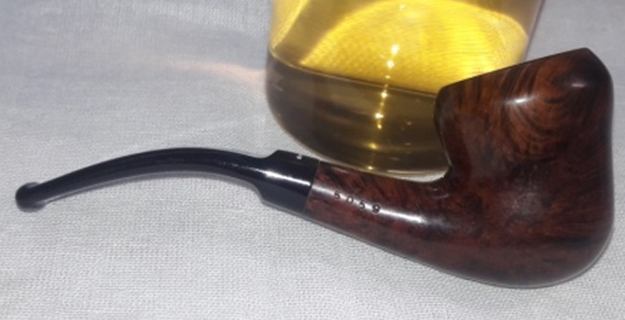
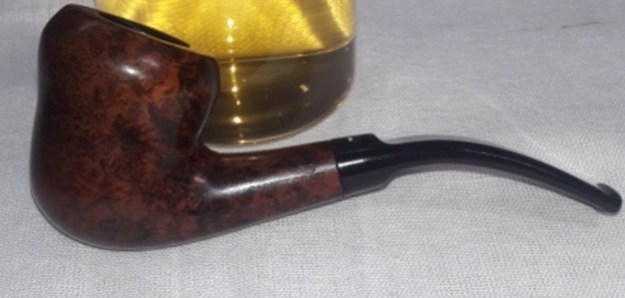
The third reason is that every pipe has a HISTORY attached to it. That history, in part, is about the maker/ carver of the pipe and the other part is the person who had posed faith in this piece of briar during his life time. Take the case of a Dunhill pipe that I had restored that once belonged to Late Mr. John Barber, an explorer who had been to Arctic and the Antarctic in the 1950s- 60s and an avid pipe smoker! His favored pipes were DUNHILL. His daughter, Farida had passed on his pipes to Steve to restore and trade these pipes for the family. Well, one of the Dunhill pipes was sent to me by Steve to let me test my skills in pipe restoration with the rider that “if I could restore it, I get to keep it!” This pipe had all the challenges that a pipe restorer usually faces while restoring a pipe and then some more. However, it was successfully repaired and restored and now is a part of my daily rotation (https://rebornpipes.com/2019/12/06/a-project-close-to-my-heart-restoring-a-dunhill-from-faridas-dads-collection/)

The point I want to convey is that whenever I smoke this pipe, it reminds me of Late Mr. John Barber and images of him smoking this pipe in the cold snow desert and the warmth, peace and comfort it must have provided him in that desolate environment…AND NOW I GET TO BE A PART OF THAT HISTORY/ LEGACY OF THE PIPE and this is what I just love!

I wish to thank each one for sparing their valuable time to read through this write up and each one is in my prayers. Stay home…stay safe!!

Restoring a Rossi 129 Rope Rusticated Lovat


Blog by Steve Laug

The next pipe on the work table came to me from the estate of a Vancouver pipe smoker whose widow left them with local Pipe Shop after he died. I was asked to clean them up and sell them for the shop as it has since closed. This Italian Made Rossi 129 Lovat is an interesting looking piece – a rope like rustication with the grain showing through underneath and a smooth rim top. The pipe is stamped on the left side and reads Rossi in an oval and on the right side it has the shape number 129. On the underside of the shank at the stem/shank junction it was stamped Italy. The finish was dull and lifeless with a lot of grime ground into the briar. The bowl was heavily caked with a lava coat on the top of the rim. It was hard to tell how the inner and outer edge of the rim actually looked until the bowl was reamed. The rustication around the bowl was filled in with dust and debris. There were quite a few fills on the shank top and underside. The stem was oxidized, calcified and had tooth chatter and marks on the top and underside near the button. It had promise but it was very dirty. I took some photos of the pipe when I received it. I turned to Pipephil’s site (http://www.pipephil.eu/logos/en/logo-n1.html#ninorossi) to see what I could find out about the brand. I found a photo and listing for the brand I was working on. The following screen capture shows the stamping that is the same as the one I am working on.I turned to Pipedia (https://pipedia.org/wiki/Rossi) and read the section on the rough outline on history of the brand. It is a great read. Take time to have a look at it if you are interested. I am including a section of the article that helps with dating the pipes.

From, approximatively, Twenties, Rossi pipes were marked with “FRB” (Fratelli Rossi Barasso) or “MFRB” (Manifattura Fratelli Rossi Barasso), into an oval and above “OLD BRIAR” (or similar – sometimes, there was also “MFD. BY ROSSI”, as “Manufactured by Rossi”); on the stem, there was generally the “R” letter in circle. However, “FRB OLD BRIAR” was mantained for the “traditional pipes” (for cheap models – see below), surely, to Sixties.

From, approximatively, the fiftieth anniverary (1936), pipes were marked with “Rossi” (in cursive font), with model name just under it; on the stem, there was “ROSSI” (for expensive models like “extra”, which had the best quality; “racine”, which was rusticated by hand; “extra grain”, which was accurately sandblasted; “super”, which had the best briar selection, and a limited production; “fiamma”, which was the best selection of Sardinia and Greece briar, and a very limited production) or “R” in circle (for unexpensive models like “standard”, “grana” and “FRB”).

From, approximatively, Seventies, until 1985, Rossi pipes were marked with “ROSSI”, into an oval (sometimes there was also “ITALY” on the shank); on the stem, there was “ROSSI”. In these years, appeared the signature “Nino Rossi” (in cursive font): he was the last heir of the factory.

When Savinelli took back the production, it is said that first pipes had a twinbore mouthpiece, with “ROSSI” on the stem, and they were marked with “ROSSI” on the shank. Today most of them had 6 mm or 9 mm adapter (also, for the most part, the stem was made by methacrylate, always with “Rossi” on the side).

I think that this places the pipe in the 1970-1985 period as it is stamped Rossi in an oval and has the stamping Italy on the underside of the shank. Now it was time to work on the pipe.

I had sent the batch of pipes from the shop to my brother Jeff in Idaho and he had cleaned them up for me. It was several years ago now that he sent them back to me and I am just now getting to finish them. He reamed them with a Pipnet Reamer and cleaned up the reaming with a Savinelli Fitsall pipe knife.  He had scrubbed the exterior of the bowl with Murphy’s Oil Soap and a tooth brush and rinsed it off with warm water to remove the grime in the rustication. He cleaned the internals of the shank and stem with alcohol, cotton swabs and pipe cleaners to remove the tarry residue and oils in the shank and airway. He soaked the stem in Before & After Deoxidizer to remove the oxidation on the stem surface. When it arrived here on my work table I took photos of the pipe before I started my part of the restoration.   The rim top looked far better but there was some darkening on the surface as well as a flaw in the briar on the left front. The inner edge of the rim was damaged and showed some nicks and cuts. The stem look good but there was some heavy oxidation and there were tooth marks and chatter on both sides near the button. The underside was worse than the topside.   I took a photo of the stamping on the left side of the shank. I forgot to take photos of the shank number on the right side of the shank and the underside as well. The stamping is clear and readable and reads as noted above.I took the stem off the pipe and took a photo of the parts to show the look of the pipe as a whole.I topped the bowl on a topping board with 220 grit sandpaper and then worked on the inner edge of the rim with a folded piece of 220 grit sandpaper to give it a slight bevel. Once it is finished the rim top and edge looks much better.   I filled in the flaw in the rim top with clear super glue. I topped it again once the glue had cured to smooth it out. The rim top looks very good.   I polished the newly topped rim and the bowl with micromesh sanding pads. I sanded it with 1500-12000 grit pads and wiped it down between each pad with a damp cloth. By the end you can see the shine on the briar.     I rubbed the bowl and shank down with Before & After Restoration Balm. I worked it into the surface of the bowl sides and shank with my fingertips and a horse hair shoe brush to clean, enliven and protect the briar. I let the balm sit for a little while and then buffed with a cotton cloth to raise the shine. You can see the underlying grain begin to show through the rustication. I filled in the remaining tooth mark with black super glue. Once it cured I smoothed out the surface of the repair with a needle file. (I forgot to take photos of the filing but I did it before I sanded it with 220 grit sandpaper.)    I sanded out the repair with 220 grit sandpaper to blend it into the surface of the surrounding vulcanite. I started polishing the stem with 400 grit wet dry sandpaper.   I polished the vulcanite stem with micromesh sanding pads – 1500-12000 grit pads. I wiped it down with a damp cloth after each sanding pad. I used Before & After Pipe Polish – both Fine and Extra Fine to further polish the stem.     This Rossi 129 Rope Rusticated Lovat, an Italian made pipe from the local pipe shop estate that I am restoring and selling for them. It has turned out to be a great looking pipe. The rope rustication on the medium brown finish is in excellent condition and works well with the polished vulcanite saddle stem. I put the stem back on the bowl and carefully buffed the pipe with Blue Diamond on the buffing wheel using a light touch on the briar. I gave the bowl and the stem multiple coats of carnauba wax on the buffing wheel and followed that by buffing the entire pipe with a clean buffing pad. I hand buffed the pipe with a microfiber cloth to deepen the shine. The finished Rossi Lovat fits nicely in the hand and feels great. Give the finished pipe a look in the photos below. The dimensions of the pipe are Length: 5 inches, Height: 1 ¾ inches, Outside diameter of the bowl: 1 ¼ inches, Chamber diameter: ¾ of an inch. If you are interested in adding this pipe to your collection send me a message or an email. I have a variety of brands to work on from the shop. Perhaps one of those will catch your attention. Thanks for reading this blog and my reflections on the pipe while I worked on it. This is an interesting estate to bring back to life.

Restoring a Tall BBB Silver Grain 264 Stack


Blog by Steve Laug

The next pipe on the work table came to me from the estate of a Vancouver pipe smoker whose widow left them with a local Pipe Shop after he died. I was asked to clean them up and sell them for the shop as it has since closed. This is another English pipe – a BBB Silver Grain Stack. It is a smooth finished pipe with some interesting grain – cross grain and mixed grains. The pipe is stamped on the left side and reads BBB [over] Silver Grain and on the right side it is stamped London, England [over] the shape number 264. The bowl has a thick and heavy cake with a thick lava coat on the top of the rim. It was hard to tell how the inner and outer edge of the rim actually looked until the bowl was reamed. The smooth finish had years of dust and debris ground into it around the bowl. The stem was oxidized, calcified and had tooth chatter and marks on the top and underside near the button. There was a brass BBB Diamond on the topside of the stem that was oxidized and dirty. The tall stack had promise but it was very dirty. I took some photos of the pipe to show what it looked like when I received it.  I had sent the batch of pipes from the shop to my brother Jeff in Idaho and he had cleaned them up for me. It was several years ago now that he sent them back to me and I am just now getting to finish them. He reamed them with a Pipnet Reamer and cleaned up the reaming with a Savinelli Fitsall pipe knife.  He had scrubbed the exterior of the bowl with Murphy’s Oil Soap and a tooth brush and rinsed it off with warm water to remove the grime in the rustication. He cleaned the internals of the shank and stem with alcohol, cotton swabs and pipe cleaners to remove the tarry residue and oils in the shank and airway. He soaked the stem in Before & After Deoxidizer to remove the oxidation on the stem surface. When it arrived here on my work table I took photos of the pipe before I started my part of the restoration.    The rim top looked far better but there was some darkening on the surface as well as some scratches. The inner edge of the rim looked very good other than a flaw on the back right inner edge. The stem look good but there was some heavy oxidation and there were light tooth marks and chatter on both sides near the button.   I took a photo of the stamping on the sides of the shank. The stamping is faint but still readable and reads as noted above.     I took the stem off the pipe and took a photo of the parts to show the stinger apparatus and the look of the pipe as a whole.I topped the bowl on a topping board with 220 grit sandpaper and then worked on the inner edge of the rim with a folded piece of 220 grit sandpaper to give it a slight bevel. Once it is finished the rim top and edge looks much better.   I polished the newly topped rim with micromesh sanding pads. I sanded it with 1500-12000 grit pads and wiped it down between each pad with a damp cloth. By the end you can see the shine on the rim surface.    I rubbed the bowl and shank down with Before & After Restoration Balm. I worked it into the surface of the bowl sides and shank with my fingertips and a horse hair shoe brush to clean, enliven and protect the briar. I let the balm sit for a little while and then buffed with a cotton cloth to raise the shine. You can see the underlying grain begin to show through the rustication.    I “painted” the surface of the stem and button with the flame of a lighter to raise the bite marks. The process worked very well and lifted all of the marks on the top side and there was a slight dip along the button on the top side and two remaining marks left on the underside.    I filled in the remaining tooth marks with black super glue. Once it cured I smoothed out the surface of the repair with a needle file.  I sanded out the repair with 220 grit sandpaper to blend it into the surface of the surrounding vulcanite. I started polishing the stem with 400 grit wet dry sandpaper.   I polished the vulcanite stem with micromesh sanding pads – 1500-12000 grit pads. I wiped it down with a damp cloth after each sanding pad. I used Before & After Pipe Polish – both Fine and Extra Fine to further polish the stem.      This beautiful BBB Silver Grain 264 Stack, an English made pipe from the local pipe shop estate that I am restoring and selling for them is a great looking pipe. The smooth medium brown finish on the pipe is in excellent condition and works well with the polished vulcanite taper stem. I put the stem back on the bowl and carefully buffed the pipe with Blue Diamond on the buffing wheel using a light touch on the briar. I gave the bowl and the stem multiple coats of carnauba wax on the buffing wheel and followed that by buffing the entire pipe with a clean buffing pad. I hand buffed the pipe with a microfiber cloth to deepen the shine. The finished BBB Silver Grain Stack fits nicely in the hand and feels great. Give the finished pipe a look in the photos below. The dimensions of the pipe are Length: 5 ½ inches, Height: 2 inches, Outside diameter of the bowl: 1 1/8 inches, Chamber diameter: ¾ of an inch. If you are interested in adding this pipe to your collection send me a message or an email. I have a variety of brands to work on from the shop. Perhaps one of those will catch your attention. Thanks for reading this blog and my reflections on the pipe while I worked on it. This is an interesting estate to bring back to life.


Restoring another Kaywoodie Rustica 80B Billiard


Blog by Steve Laug

The next pipe on the work table came to me from the estate of a Vancouver pipe smoker whose widow left them with a local Pipe Shop after he died. I was asked to clean them up and sell them for the shop as it has since closed. This English made Kaywoodie Rustica Billiard is an interesting looking piece – a deep rustication with the grain showing through underneath and a smooth rim top. The pipe is stamped on the underside and reads Kaywoodie  Rustica [over] Made in England followed by the shape number 80B. The bowl was heavily caked with a lava coat on the top of the rim. It was hard to tell how the inner and outer edge of the rim actually looked until the bowl was reamed. The rustication around the bowl was filled in with dust and debris. The stem had tooth chatter and marks on the top and underside near the button. The tenon was threaded and had a three hole stinger that was intact. It had promise but it was very dirty. I took some photos of the pipe when I received it. It seems like lately all the Kaywoodie pipes that I have been working on have been English made. I have also worked on several English made Rustica pipes as well so I went back to the previous research I did on the brand and quote that.

On Pipedia I found just a short line in the Kaywoodie write up that referenced the London office. It read; “By 1938 Kaywoodie had opened an office in London to meet worldwide demand. Kaywoodie of London was jointly owned with another famous pipemaker, Comoy’s of London.”

On Dad’s Pipes (https://dadspipes.com/2016/01/24/smartening-up-an-english-kaywoodie-standard/) I found that Charles Lemon had done some research as well: There’s not much information out there about English-made Kaywoodies. Production started in about 1938 as a joint venture between Kaywoodie USA and Comoy’s of London. This relationship lasted until the early 1970’s when Comoy bought out its partner. According to Pipedia, Comoy continues to produce a few pipes marked as Kaywoodie. My guess is that this particular English Kaywoodie dates from the 1960’s.

On Pipephil’s site (http://www.pipephil.eu/logos/en/logo-kaywoodie-notus.html) I found a photo and listing for the brand I was working on. The following screen capture shows the stamping that is the same as the one I am working on.I turned to Pipedia (https://pipedia.org/wiki/Kaywoodie) and read the section on the rough outline on the history of the brand that links the brand with the English section of the company. I quote:

Again, demand for KBB pipes and especially Kaywoodie prompted another move for both the manufacturing facilities and the corporate offices. In 1930 the corporate office moved into the Empire State Building on Fifth Avenue in New York. By 1935, the manufacturing operations moved from Union City to 6400 Broadway in West New York, New Jersey which, at the time, was touted as the largest pipe making facility in the world. At the height of production, there were 500 employees producing up to 10,000 pipes per day.

The corporate offices were relocated in 1936 to the International Building, Rockefeller Center, 630 Fifth Avenue, New York. The invitation to visit the new office reads, “Kaywoodie is now on display at the world’s most famous address – Rockefeller Center. Here Kaywoodie takes its place among the leaders of industry and commerce.” The move to Rockefeller Center coincided with The Kaywoodie Company’s emergence as a subsidiary of KBB. All of the pipes manufactured by KBB including the Yello-Bole line were also on display here. By 1938 Kaywoodie had opened an office in London to meet worldwide demand. Kaywoodie of London was jointly owned with another famous pipemaker, Comoy’s of London.

From there I turned to a link on the article to a section called Guide to Kaywoodie Pipes (https://pipedia.org/wiki/Collector%27s_Guide_to_Kaywoodie_Pipes#NOTES_ON_.22OTHER.E2.80.9D_KAYWOODIE_PIPES).

English Kaywoodies. All of the catalogs reviewed in this research contained the following copyright notification: Printed in U.S.A., Kaufmann Bros. and Bondy, Inc., New York and London. Kaywoodie Pipe cases and smoker’s accessories were also marked with “New York and London”. The catalogs, however, do not present any information concerning Kaywoodie’s London operations, or how the English Kaywoodies might have differed from those manufactured and marketed in the U.S. Lowndes notes that he has several English Kaywoodies acquired in Vaduz and Zurich. English Kaywoodies are now made by Oppenheimer pipes. Lowndes notes that English Kaywoodies with the “screw-in bit” come in Ruby Grain, Custom Grain, Standard, and Relief Grain grades. The traditional push-bit models come in Continental Plain and Relief, London Made, Minaret, Air-way Polished No. 707, and Lightweight grades. Prices in 1985 ranged from 9.50 (pounds) to 26.00 (pounds). Lowndes notes that the Super Star was a special edition English Kaywoodie made of finest briar with a handmade silver band. Lowndes has two: one from Zurich with a large white-outlined logo, and beautifully cased; and one in walnut finish with the black-­in-white logo. A recent catalog shows the Super Star without a band and the ordinary small white logo. A 1985 letter from Oppenheimer states that the black-in-white logo has been discontinued and only the regular white logo is now used.

I had sent the batch of pipes from the shop to my brother Jeff in Idaho and he had cleaned them up for me. It was several years ago now that he sent them back to me and I am just now getting to finish them. He reamed them with a Pipnet Reamer and cleaned up the reaming with a Savinelli Fitsall pipe knife.  He had scrubbed the exterior of the bowl with Murphy’s Oil Soap and a tooth brush and rinsed it off with warm water to remove the grime in the rustication. He cleaned the internals of the shank and stem with alcohol, cotton swabs and pipe cleaners to remove the tarry residue and oils in the shank and airway. He soaked the stem in Before & After Deoxidizer to remove the oxidation on the stem surface. When it arrived here on my work table I took photos of the pipe before I started my part of the restoration.  The rim top looked far better but there was some darkening on the surface as well as some scratches. The inner edge of the rim was out of round and showed some nicks and cuts. The stem look good but there was some heavy oxidation and there were tooth marks and chatter on both sides near the button. The underside was worse than the topside.  I took a photo of the stamping on the underside of the shank. The stamping is clear and readable and reads as noted above.I took the stem off the pipe and took a photo of the parts to show the stinger apparatus and the look of the pipe as a whole.Because the pipe had been sitting for a couple of years I scrubbed the externals again with Murphy’s Oil Soap and a tooth brush to remove the dust on the surface of the rustication. I rinsed the pipe off with warm water and dried it off with a cloth.   I topped the bowl on a topping board with 220 grit sandpaper and then worked on the inner edge of the rim with a folded piece of 220 grit sandpaper to give it a slight bevel. Once it is finished the rim top and edge looks much better.   I polished the newly topped rim with micromesh sanding pads. I sanded it with 1500-12000 grit pads and wiped it down between each pad with a damp cloth. By the end you can see the shine on the rim surface.    I rubbed the bowl and shank down with Before & After Restoration Balm. I worked it into the surface of the bowl sides and shank with my fingertips and a horse hair shoe brush to clean, enliven and protect the briar. I let the balm sit for a little while and then buffed with a cotton cloth to raise the shine. You can see the underlying grain begin to show through the rustication.  I “painted” the surface of the stem and button with the flame of a lighter to raise the bite marks. The process worked very well and lifted all of the marks on the top side and there was only one left on the underside.I filled in the remaining tooth mark with black super glue. Once it cured I smoothed out the surface of the repair with a needle file.  I sanded out the repair with 220 grit sandpaper to blend it into the surface of the surrounding vulcanite. I started polishing the stem with 400 grit wet dry sandpaper. I polished the vulcanite stem with micromesh sanding pads – 1500-12000 grit pads. I wiped it down with a damp cloth after each sanding pad. I used Before & After Pipe Polish – both Fine and Extra Fine to further polish the stem. This Kaywoodie Rustica 80B English Saddle Stem Billiard, an English made pipe from the local pipe shop estate that I am restoring and selling for them. It has turned out to be a great looking pipe. The rusticated medium brown finish on the pipe is in excellent condition and works well with the polished vulcanite saddle stem. I put the stem back on the bowl and carefully buffed the pipe with Blue Diamond on the buffing wheel using a light touch on the briar. I gave the bowl multiple coats of Conservator’s Wax and the stem multiple coats of carnauba wax on the buffing wheel and followed that by buffing the entire pipe with a clean buffing pad. I hand buffed the pipe with a microfiber cloth to deepen the shine. The finished Kaywoodie Rustica Billiard fits nicely in the hand and feels great. Give the finished pipe a look in the photos below. The dimensions of the pipe are Length: 5 ½ inches, Height: 1 ¾ inches, Outside diameter of the bowl: 1 ¼ inches, Chamber diameter: ¾ of an inch. If you are interested in adding this pipe to your collection send me a message or an email. I have a variety of brands to work on from the shop. Perhaps one of those will catch your attention. Thanks for reading this blog and my reflections on the pipe while I worked on it. This is an interesting estate to bring back to life.

Breathing Life into a Leonard Payne Standard System Pipe


Blog by Steve Laug

The next pipe on the work table is an interesting piece that Jeff and I picked up on a pipe hunt in Alberta. It is another Leonard Payne pipe that is very interesting. The bowl has been rusticated to look a bit like tree bark. There is some darkening around the shank bowl junction that when examined appears to be a rejoined shank and bowl. Is it a repair or something else? Once it is cleaned up I will know more about what is there. The metal shank end piece is aluminum and has a tube inside it. The vulcanite stem also has a tube in it. To me it is a lot like Keyser Hygienic pipe in terms of the system structure. The bowl has a thick cake that overflows onto the rim top as lava. There are some nicks and scratches on the top and edges. The exterior was very dirty with grime and debris ground into the finish on the bowl. The inside of the scratched aluminum shank end is filled with tars and oils the same as the stem is. The vulcanite stem is oxidized, scratched and has tooth marks and chatter on both sides ahead of the button. I took some photos of the pipe before I did any clean up. I took photos of the rim top and the stem. The photo of the rim top shows the damage and the thick cake in the bowl and lava on the top. The stem photos show the oxidation, calcification and tooth chatter and light marks on both sides.     I took photos of the stamping on the top, right and left side of the shank. The stamping on the left side is the Leonard Payne signature. The stamping on the left side reads CANADA. The stamping on the top of the shank reads Standard.I reread several of the blog I have written on the brand in the past restorations of Payne pipes and decided to include the material on the brand before I write about the clean up of the pipe. I am including advertisement for Leonard Payne’s pipes. Here is the link to the blog.

https://rebornpipes.com/2013/11/16/a-pipe-maker-i-had-never-heard-of-leonard-payne-pipes/

Further digging with Google came up with this short note from alt.smokers.pipes forum. It was written by Mike Glukler of Briar Blues. I quote it below in full. (https://groups.google.com/forum/#!topic/alt.smokers.pipes/RrICLiVgE2o)  “Leonard Payne was based in B.C. for many years. He came to Canada from England. He had shops in Surrey, B.C. and Kelowna, B.C. Interesting fellow. Gruff as the day is long. When you bought a pipe it was handed to you in a paper bag. No sock, no box. Most of his pipes carried a “carburetor” system at the shank / stem junction. Another Payne idea was his shanks. Almost all his pipes were two pieces. He’d turn the bowl and shank, then cut off the shank and reattach with glue (not always with the same piece of briar, so many did not match grains). His thinking was that the shank being the weakest link, if cut and glued would never break and thus “correcting” the weakest link. You may find his pipes on E-Bay on occasion listed as a Len Cayne. The P in his stamping looks more like a fancy upper case C.”

The pipe I am working on fits Mike’s information perfectly. First, there was a carburetor system on this pipe. The aluminum shank extension has a tube in it that matches a tube in the inside of the military bit stem. (I forgot to take a photo of the system before I cleaned it up but you can see the system set up on shank end and stem.The second part of the information from Mike regards the shank and bowl connection. It was obvious that the shank had been cut off the shank and reattached with glue. It was Payne’s belief that since the shank was the weakest link cutting it off and gluing on would remove the possibility of it breaking in the future.

Now it was time to work on the pipe. First I took the pipe apart and took the following photo of the pipe. It was very dirty and needed to be thoroughly cleaned. I reamed the pipe with a PipNet Pipe Reamer and took the cake back to bare briar. I cleaned up the remnants of the cake in the bowl with a Savinelli Fitsall Pipe Knife. I scraped off the rim top with the knife to remove the lava top coat on the rim. The rim looked quite good with the lava removed. Once the rim top was sanded I would be able to polish out the scratches. I used a brass bristle brush to clean off the grime in the briar. Once it was loose I wiped the bowl down with alcohol on cotton pads to remove the grit and grime ground into the briar.   With the externals cleaned I cleaned the internals on the metal fitment, the vulcanite stem and the shank with pipe cleaners, cotton swabs and alcohol. I worked on them until they were clean.I rubbed the threads on the shank end down with Vaseline Petroleum Jelly to lubricate it for easily putting it back on the shank. I polished the smooth portions of the rusticated bowl and rim top with micromesh sanding pads – wet sanding with 1500-12000 grit pads and wiping the briar down with a damp cloth after each sanding pad.     I rubbed the bowl down with Before & After Restoration Balm. I worked it into the surface of the bark on the bowl sides and shank with my fingertips to clean, enliven and protect it. I let the balm sit for a little while and then buffed with a cotton cloth to raise the shine.      I set the bowl aside and turned my attention to the stem. I sanded out the remaining oxidation, the tooth marks and chatter with 220 grit sandpaper to blend them into the surface of the surrounding vulcanite. I started polishing the stem with 400 grit wet dry sandpaper.     I polished the vulcanite with micromesh sanding pads – 1500-12000 grit pads. I wiped it down with a damp cloth after each sanding pad. I used Before & After Pipe Polish – both Fine and Extra Fine to further polish the stem.       This Leonard Payne System Pipe is a great looking pipe that has all of the classic Leonard Payne innovations – the carburetor and the cut off and glued on shank to strengthen the connection. The rusticated finish on the pipe is in excellent condition and works well with the polished vulcanite military style taper stem. I put the stem back on the bowl and carefully buffed the pipe with Blue Diamond on the buffing wheel using a light touch on the briar. I polished the aluminum shank end with micromesh pads and a jeweller’s cloth to raise the shine. I gave the bowl and stem multiple coats of carnauba wax on the buffing wheel and followed that by buffing the entire pipe with a clean buffing pad. I hand buffed the pipe with a microfiber cloth to deepen the shine. The finished Canadian Made Leonard Payne Standard is a great looking pipe that looks almost new. The flow of the grain and rustication around the bowl and the shape contribute to beautiful look of this pipe. It fits nicely in the hand and feels great. Give the finished pipe a look in the photos below. The dimensions of the pipe are Length: 5 ¾ inches, Height: 2 inches, Outside diameter of the bowl: 1 ½ inches, Chamber diameter: 5/8 of an inch. This one is on its way soon to a Leonard Payne collector in Eastern Canada. I look forward to hearing what he thinks of it once he receives it. Thanks for reading this blog and my reflections on the pipe while I worked on it. This was an interesting pipe to bring back to life.


Restoring a Kirsten Companion K System Pipe from Bob Kerr’s Estate


Blog by Steve Laug

The second of the Kirsten pipes I have chosen to work on from Bob Kerr’s Estate is a Companion polished aluminum coloured Barrel system pipe with a saddle stem. It is the second of Bob’s Kirsten pipes and also the last one I have to work on from the estate. (Bob’s photo is to the left). If you have not “met” the man and would like to read a bit of the history of the pipeman, his daughter has written a great tribute that is worth a read. Because I have included it in most of the restorations of the estate to date I thought that I would leave it out this time. Check out some of the recent Dunhill restoration blogs (https://rebornpipes.com/2020/01/01/restoring-the-last-of-bob-kerrs-dunhills-a-1962-dunhill-bruyere-656-f-t-bent-billiard/).

When I think of Kirsten pipes this is the shape that is a typical Kirsten. On the left side of the shank it is stamped with Companion in script. On the underside of the polished aluminum barrel it is stamped Made in U.S.A. followed by K. It is a straight pipe with large Dublin bowl. Metal base is dented and worn. The pipe has gaskets. Stem is oxidized, tooth marks, chatter near the button. Button is damaged. There is a cake in the bowl and lava overflow on the rim. The ridged valve has some damage from what looks like marks left behind by pliers. The pipe is very dirty.  Jeff took photos of the pipe to show its general condition before he did his cleanup. The exterior of the pipe was very dirty – grime and grit ground in from years of use and sitting. The rim top was covered with a coat of thick lava that overflowed the bowl. There was also some darkening and lava on the rim top. The bowl itself had a thick cake with flecks of tobacco stuck in the cake on the sides.  It also appeared that there was some mold on the cake in the bowl.Jeff took a photo of the side and the heel of the bowl to give a better feel for the condition of the bowl. You can see the interesting grain on the bowl side and front.The next photos show the stamping on the sides of the barrel shank and it is very readable. It reads as noted above. The stem was dirty and extremely oxidized, calcified and had tooth marks on both sides ahead of the button. It was not nearly as chewed the other pipes in Bob’s estate.  Jeff took apart the pipe and took photos of the parts of the part. It was incredibly dirty with tars and oils on the internals of the pipe.Before doing cleanup work on the pipe I decided to do some research on the pipe. I have a catalogue for Kirsten pipes in my files and found this pipe in the catalogue. It is shown in the photo below. The K stamp identifies it as a Companion pipe.

There is also some great history on the brand on Pipedia that is well worth a read. It gives clear information on the development of the brand (https://pipedia.org/wiki/Kirsten_Pipe_Company).

I am really glad that Jeff helped me work through this estate of over 125 pipes to clean from Bob’s estate. I would in no way be this close to finishing the estate without his help. Jeff cleaned the pipes with his usual penchant for thoroughness that I really appreciate. He had reamed it with a PipNet pipe reamer and cleaned up the remaining cake in the bowl with a Savinelli Fitsall Pipe Knife. He scrubbed out the internals with alcohol, pipe cleaners and cotton swabs until the pipe was clean. He scrubbed the exterior of the bowl with Murphy’s Oil Soap and a tooth brush to remove the grime and grit on the briar and the lava on the rim top. The finish looks very good with good looking grain around the bowl and shank. Jeff took the pipe apart and cleaned the barrel, the adjustable valve and the stem with alcohol, pipe cleaners and cotton swabs. He scrubbed the stem with Soft Scrub and soaked it in Before & After Deoxidizer to remove the oxidation on the rubber. When the pipe arrived here in Vancouver for the second stop of its restoration tour it looked a lot better. I took photos before I started my part of the work. I took some close up photos of the rim top and also of the stem surface. I wanted to show what cleaned bowl and rim top looked like. The rim top and edges of the bowl looked very good. The screw in the bottom of the bowl looks very good with no damage to the slots. I also took close up photos of the stem to show the light tooth marks and the remaining oxidation on the stem.I took the pipe apart and took photos of the parts of the pipe to give a picture of what it looked like. Now, on to my part of the restoration of this Kirsten RX pipe. The rim top was in rough condition and looked as if it had been beat against a hard surface. I decided to begin my work by topping the bowl with 220 grit sandpaper on a topping board.I polished the bowl and rim top with micromesh sanding pads – wet sanding with 1500-12000 grit pads and wiping the briar down with a damp cloth after each sanding pad. I rubbed the bowl down with Before & After Restoration Balm. I worked it into the surface of the bark on the bowl sides and shank with my fingertips to clean, enliven and protect it. I let the balm sit for a little while and then buffed with a cotton cloth to raise the shine. I rubbed the valve on the metal base with some Vaseline Petroleum Jelly. I have found that it keeps the valve from sticking in the base end. I screwed the bowl on the top of the metal barrel. This part of the restoration is finished and the pipe is looking really good at this point in the process. All that remains is the stem and push rod that goes in the end of the base. I set the bowl and metal barrel aside and turned my attention to the stem. There were some deep tooth marks near the edge of the button on both sides. I filled them in with clear super glue.I sanded out the stem surface with 220 grit sandpaper to remove the tooth marks and chatter. I started to polish it with 400 grit wet dry sandpaper.I polished the vulcanite with micromesh sanding pads – 1500-12000 grit pads. I wiped it down with a damp cloth after each sanding pad. I used Before & After Pipe Polish – both Fine and Extra Fine to further polish the stem. This Kirsten Companion Made in USA K pipe from Bob Kerr’s estate turned out to be another great looking pipe. The finish on the pipe is in excellent condition and works well with the polished vulcanite saddle stem. I put the pipe back together and carefully buffed it with Blue Diamond on the buffing wheel. I gave the bowl and stem multiple coats of carnauba wax on the buffing wheel and followed that by buffing the entire pipe with a clean buffing pad. I hand buffed the pipe with a microfiber cloth to deepen the shine. Give the finished pipe a look in the photos below. The dimensions of the pipe are Length: 5 ½ inches, Height: 1 ¾ inches, Outside diameter of the bowl: 1 ¼ inches, Chamber diameter: 7/8 of an inch. It will be going on the rebornpipes store soon. If you are interested in carrying on Bob’s legacy with this pipe send me a message or an email.  This is the last of Bob’s Estate pipes that I am working on. Thanks for reading this blog and my reflections on the pipe while I worked on it. This is an interesting estate to bring back to life.