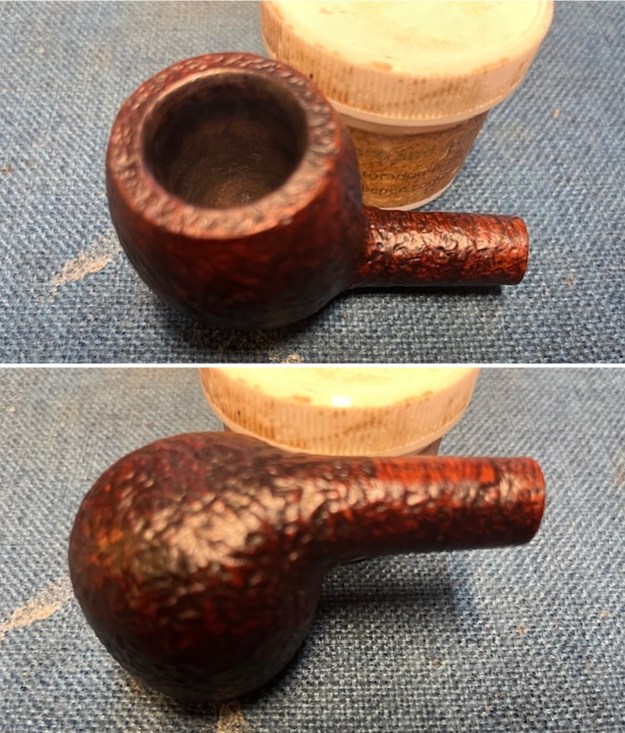
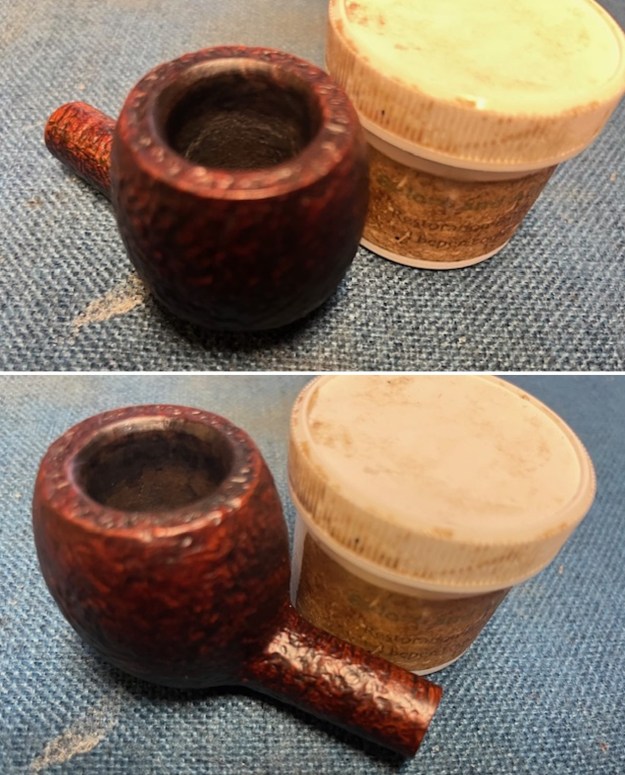
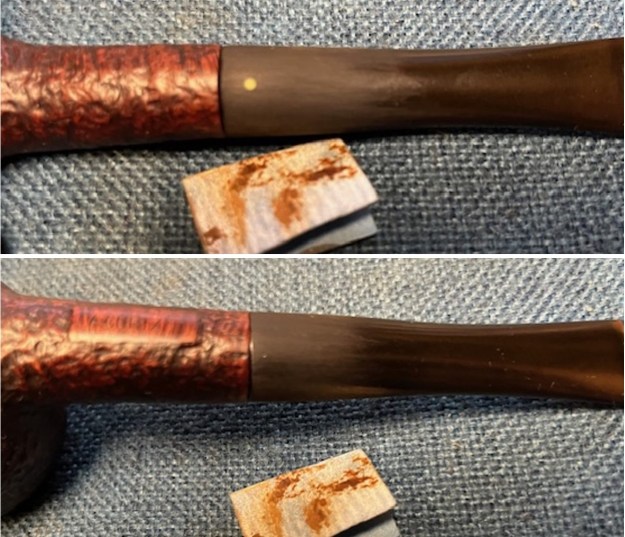
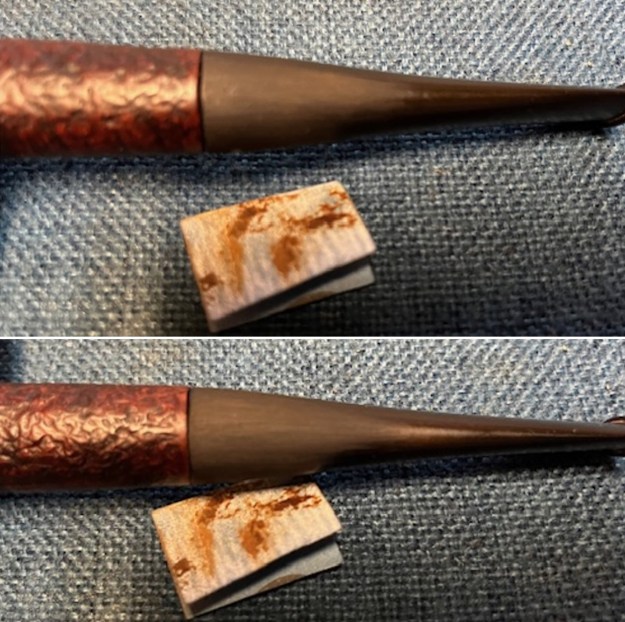
Tag Archives: Bowl – finishing

Restoring a Father’s Legacy of 10 Brigham Pipes Gathered throughout his life #3


by Steve Laug

Early this month I was contacted by Donna to see if I knew anyone interested in purchasing her father’s pipes. She wrote as follows: “I am wondering if you would be interested in my father’s collection of Brighams.” She further spelled out what he had in the collection. He had 1 – 2 dot pipe, 3 – 3 dot pipes, 2 – 4 dot pipes and 4 – 5 dot pipes. There was a total of 10 pipes. I asked for a photo of the pipes and she sent the photo below. I was very interested.We emailed back and forth and the short story is that I paid for the collection and she shipped the pipes to me. On Tuesday after Easter the box arrived and I was happy to be able to see them up close. They were obviously well-loved pipes and in varying degrees of needing work. I wrote her and told I received them and that I was pleased with the lot. I was looking forward to working on them. She asked me to send her photos along the way as I finished the pipes. I will be sending her the links to the blog so she can see the work and the process of bringing them back to a semblance of their original beauty. Thanks Donna for the opportunity to work on your Dad’s pipes.

The third of the pipes I have chosen to work on from the lot was the one sitting alone on the left side of photo above. I would call the pipe a Rhodesian shaped pipe with a vulcanite stem. It is stamped on the underside of the shank and reads Brigham in script. To the left, mid shank it has the shape number 527. The stamping will help me date the pipe. From the cake in the bowl and the other pipes I could tell her Dad love aromatic tobaccos. This pipe was heavily caked with an overflow of lava on the rim top and on the inner and outer edges of the bowl. The shank end even that had a coating of tar build up. The stem did not sit all the way in the shank so I assumed it was very dirty in the shank. I removed the stem and found a Hard Rock Maple Distillator in the aluminum tenon. The shank was black, tarry and oily. The stem was dirty and oxidized with thick oil and tar in the airway from the tenon to the button. There were light tooth marks and chatter on both sides ahead of the button. The left side of the taper stem bore five brass pins in a cross format with a larger pin in the centre. That would also help with identifying the pipe. I took some photos of the pipe before I started my work on it. I took a photo of the bowl and rim top to show the cake in the bowl. The rim top looked to have a coat of lava overflowing down the crown with some possible damage around the inner edge. I took photos of the top and underside of the stem showing the light tooth chatter on the vulcanite stem surface. It is heavily oxidized and calcified and is quite dirty on the surface of the vulcanite.The stamping is very clear and it reads as noted above. I removed the stem from the shank and took a photo of the parts to show the look of the pipe. I have captured the pattern of the four brass dots on the stem. For the needed background I am including the information from Pipedia on Brigham pipes. It is a great read in terms of the history of the brand (https://pipedia.org/wiki/Brigham_Pipes). Charles Lemon (Dadspipes) has written book on the history of the brand. This article is a good summary. I have included it below.

Roy Brigham, after serving an apprenticeship under an Austrian pipesmith, started his own pipe repair shop in Toronto, in 1906. By 1918 the business had grown to include five other craftsmen and had developed a reputation across Canada for the high quality of workmanship. After repairing many different brands of pipes over the years, Roy noted certain recurring complaints by pipe smokers, the most common referred to as “tongue bite”. Tongue bite is a burning sensation on the smoker’s tongue, previously thought to be due to the heat of the smoke (i.e. a “hot smoking pipe”).

He soon began manufacturing his own pipes, which were lightweight, yet featured a more rugged construction, strengthening the weak points observed in other pipes. The problem of tongue bite intrigued him, and he decided to make overcoming it a future goal.

About 1938, Roy’s son Herb joined him to assist in the business. The business barely survived the great depression because pipes were considered to be a luxury, not a necessity, and selling pipes was difficult indeed. In approximately 1937 [1], after some experimentation, Roy and Herb discovered that tongue bite was in fact a form of mild chemical burn to the tongue, caused by tars and acids in the smoke. They found that by filtering the smoke, it was possible to retain the flavour of the tobacco and yet remove these impurities and thereby stop the tongue bite.

Just as Thomas Edison had searched far and wide for the perfect material from which to make the first electric light bulb filaments, Roy & Herb began experimenting with many materials, both common and exotic, in the quest for the perfect pipe filter. Results varied wildly. Most of the materials didn’t work at all and some actually imparted their own flavour into the smoke. They eventually found just two materials that were satisfactory in pipes: bamboo and rock maple. As bamboo was obviously not as readily available, rock maple then became the logical choice.

They were able to manufacture a replaceable hollow wooden tube made from rock maple dowelling, which when inserted into a specially made pipe, caused absolutely no restriction to the draw of the pipe, yet extracted many of the impurities which had caused tongue bite. The result was indeed a truly better smoking pipe…

I then turned to a second article by Charles Lemon called, “A Closer Look at the Dots, Dates, and Markings of Brigham Pipes” to be able to pin down the time frame that the pipe was made in and to help interpret the stampings and shape number on the pipe. Here is the link to his article (https://pipedia.org/wiki/Brigham_Pipes_%E2%80%93_A_Closer_Look_at_Dots,_Dates_and_Markings).

I have dubbed the decades between 1980 and 2000 the Late Canadian Era, a period that saw several changes at Brigham that are of note to the collector. First, the traditional 8-grade pinning system (the famous Brigham “Dots” which denoted the quality of the pipe) was changed to a 7-grade system to simplify pinning (more on this below), and the Norsemen and Valhalla series were merged to form the President Series, which represented the very finest pipes coming out of the Toronto factory. Early pipes from this era (left, below) are stamped with a shape number and “Brigham” over “Canada”; later pipes (late 1980s+, on right below) are stamped simply with a shape number and the Brigham logo.

I read further in the article to the section entitled Revised Dot System 1980. I quote from that below.

Brigham changed the Dot system in 1980, adding a 7 Dot at the top of the line, dropping the names of each series and eliminating the confusing vertical and horizontal 3 Dot configurations. The Norsemen and Valhalla series were combined to form the President series of freehand pipes, which adopted a 3 Dot pattern with a larger dot on the right as shown below. The 7- grade pinning system stayed in place from 1980 to 2001.

With the information from article and the chart above I knew what I was dealing with in terms of the stamping and the age of this pipe. I learned that this Late Canadian Era was made between 1980-2000. The pipe is a Brigham (5-Dot) 527, a Rhodesian to my mind. The Canada stamping pins it down to the period between 1990-2001 when the aluminum tenon was replaced.

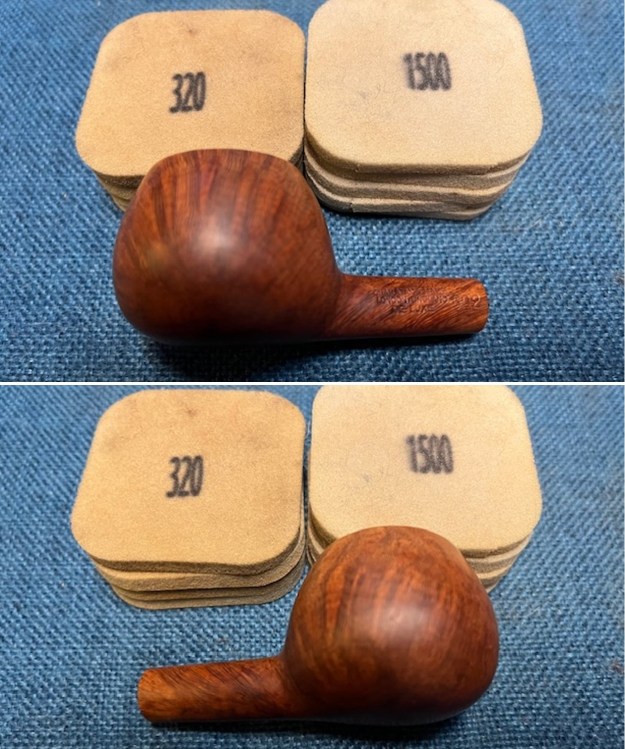
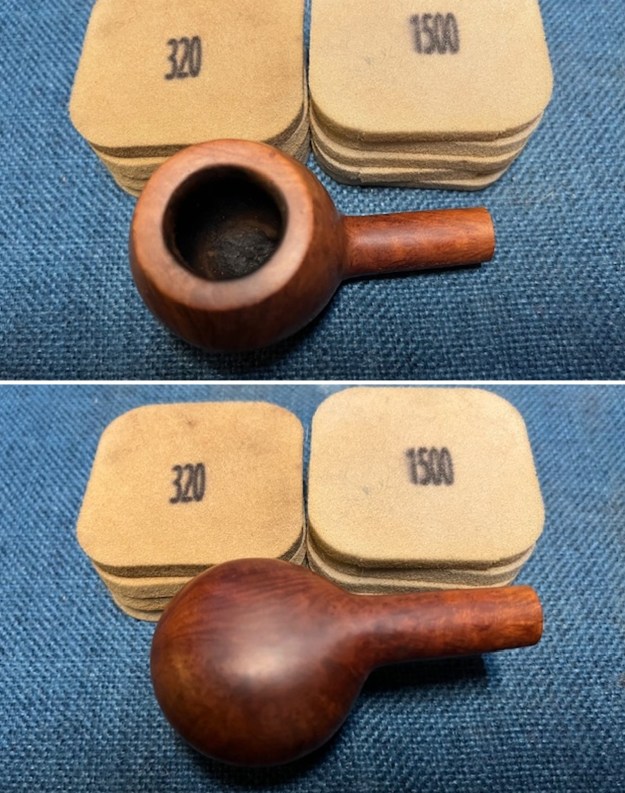
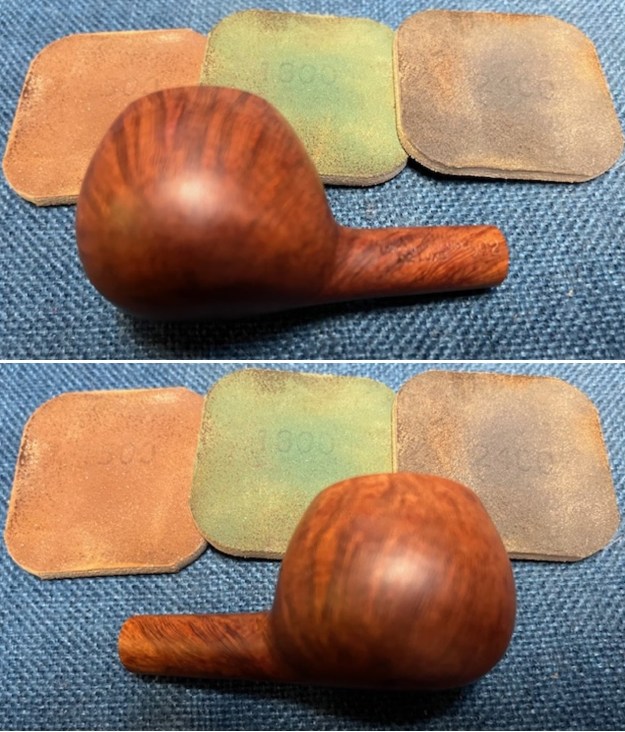
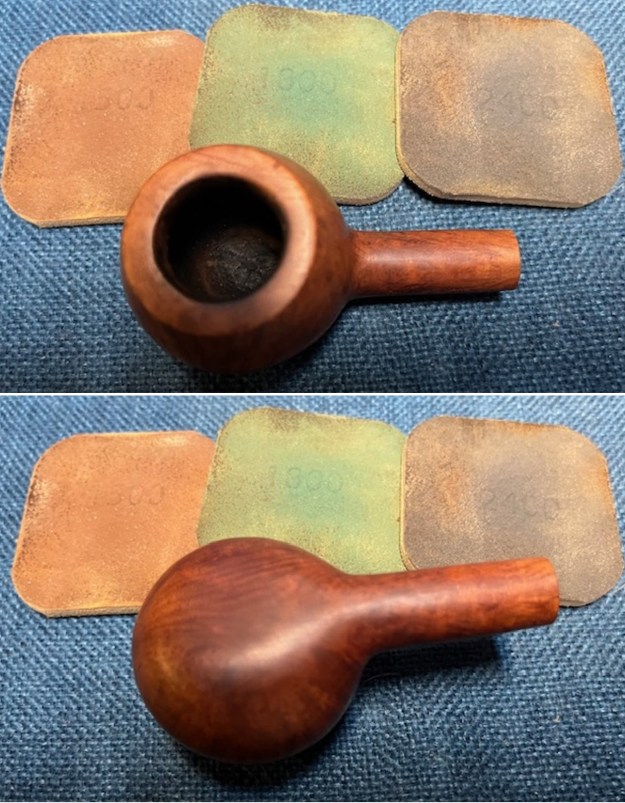
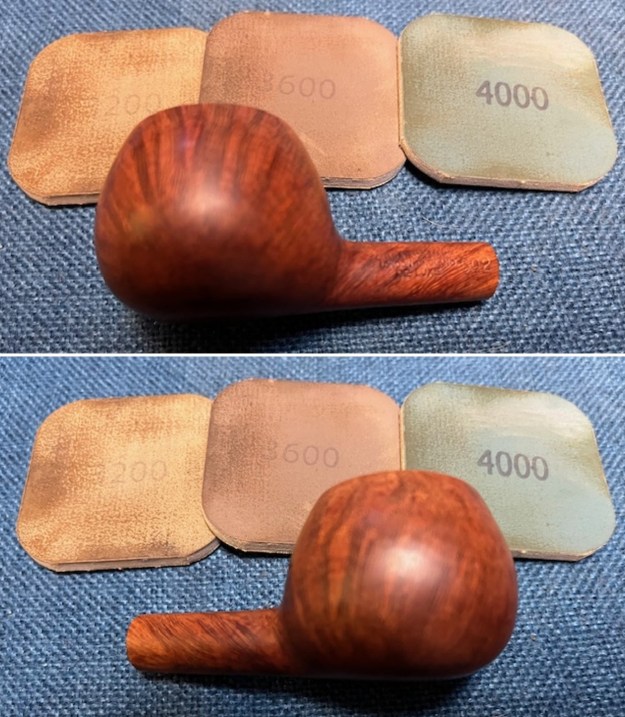
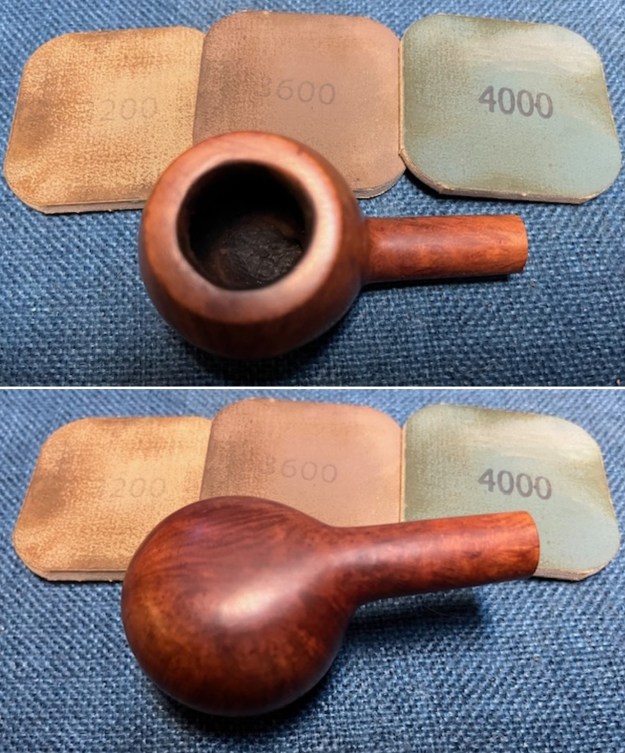
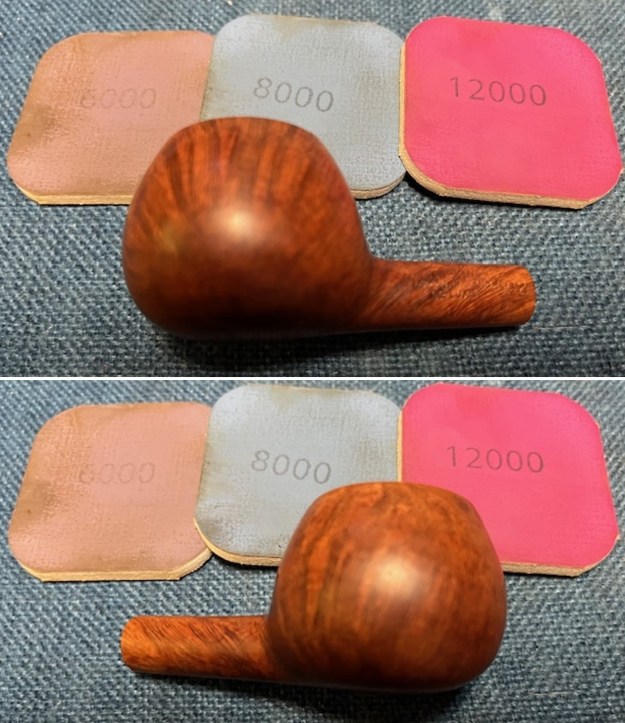
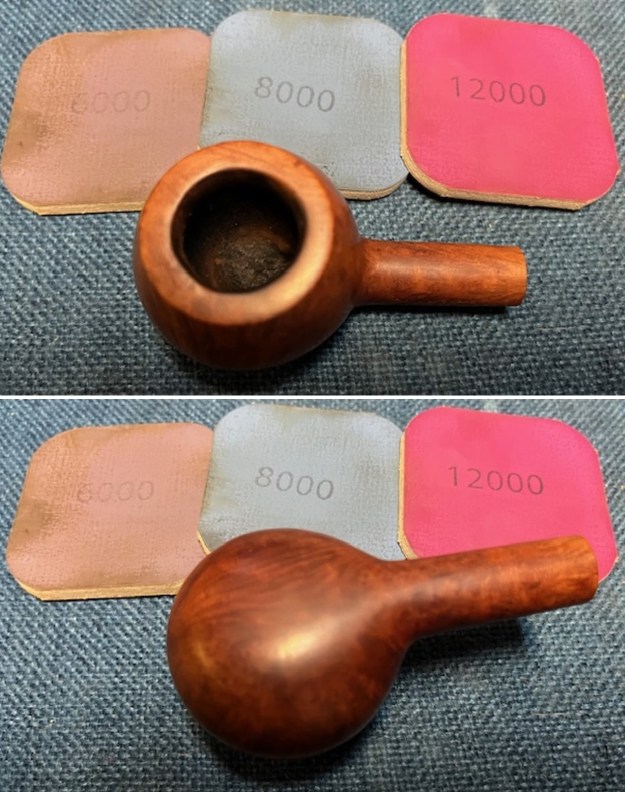
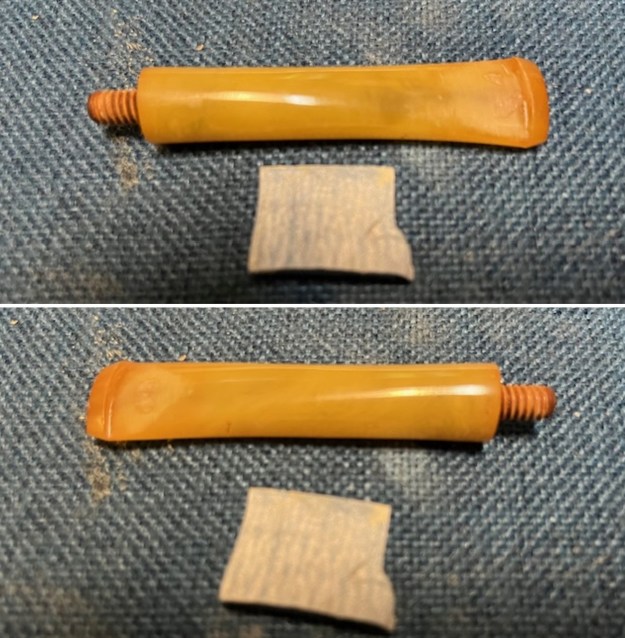
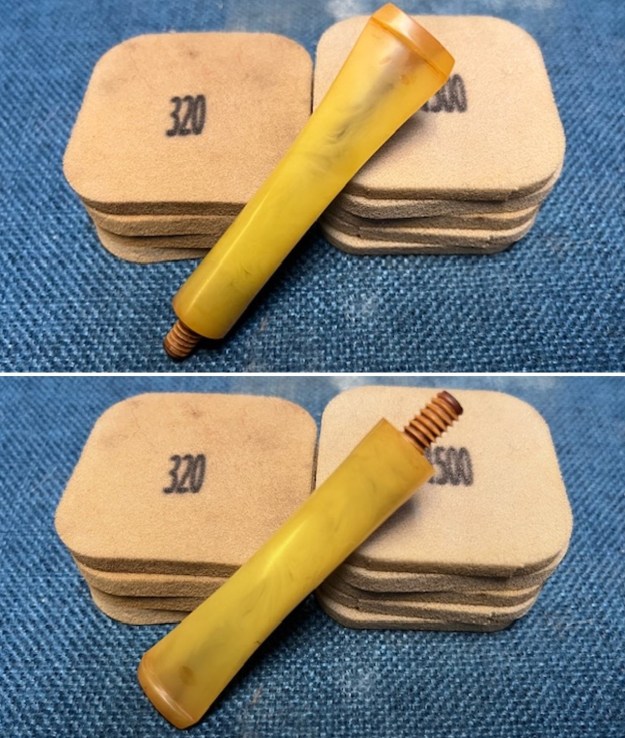
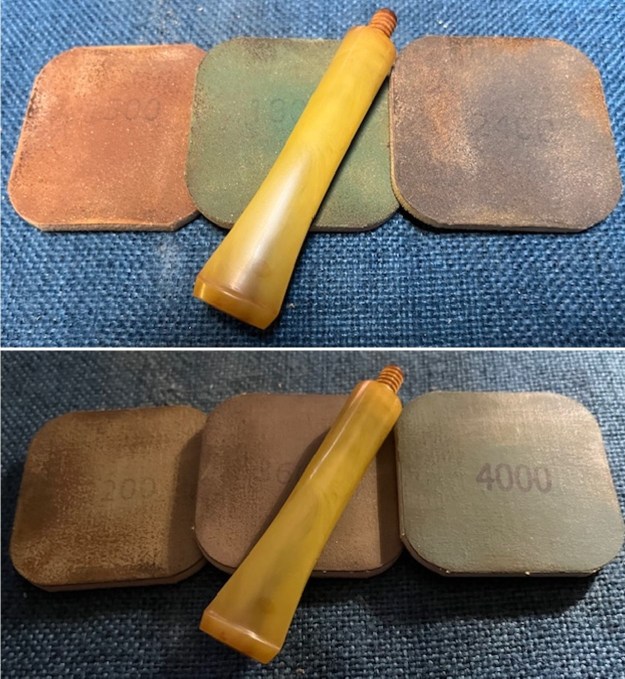
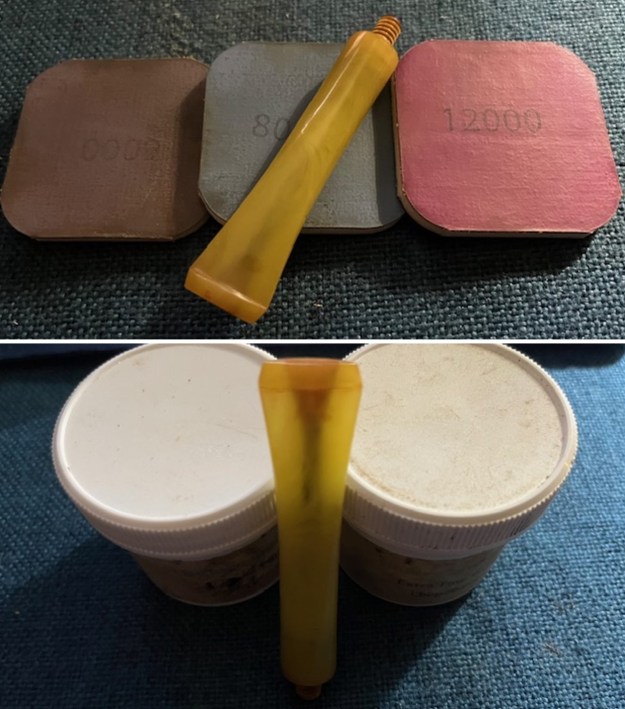
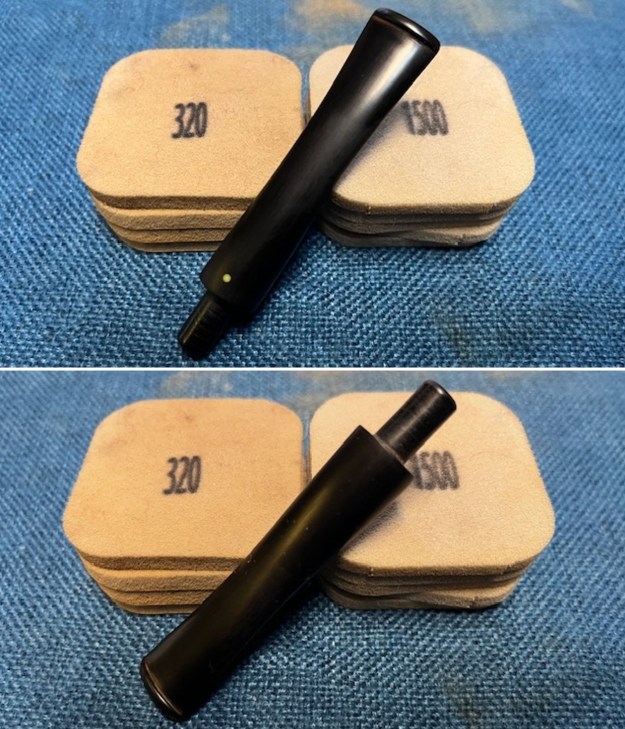
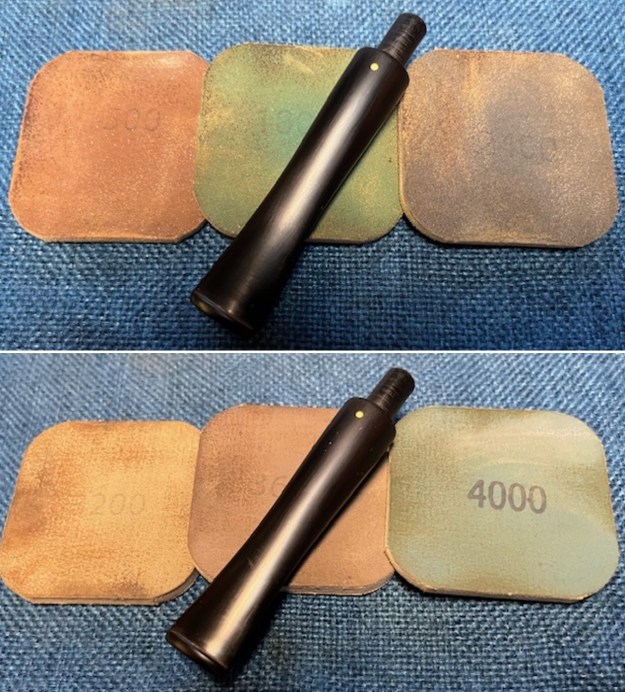
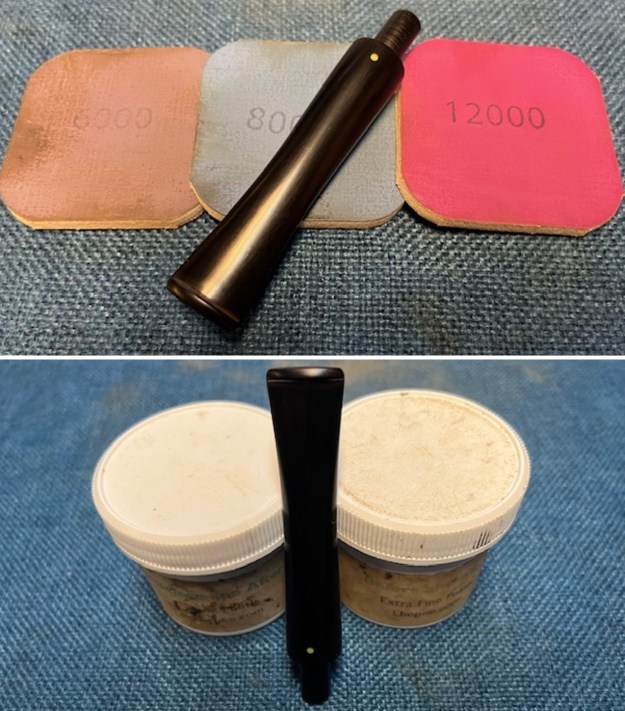
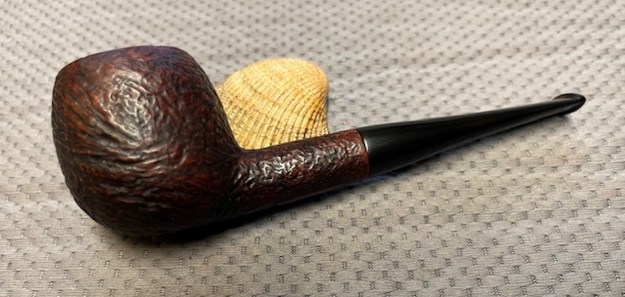
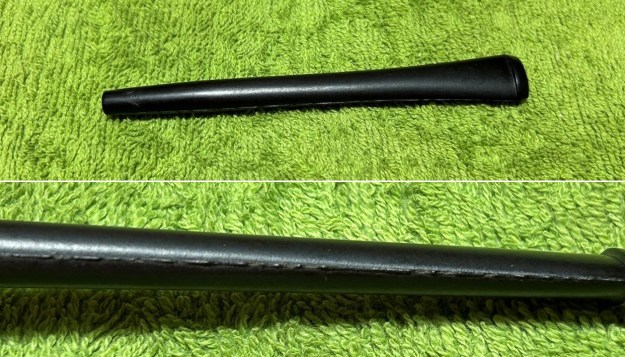
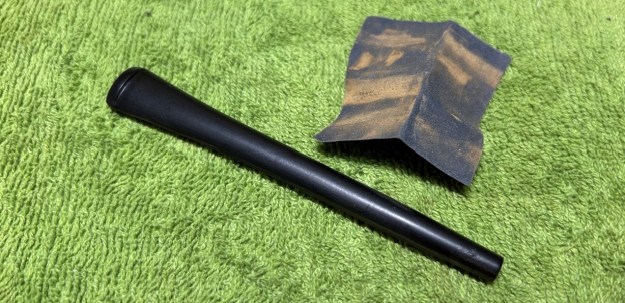
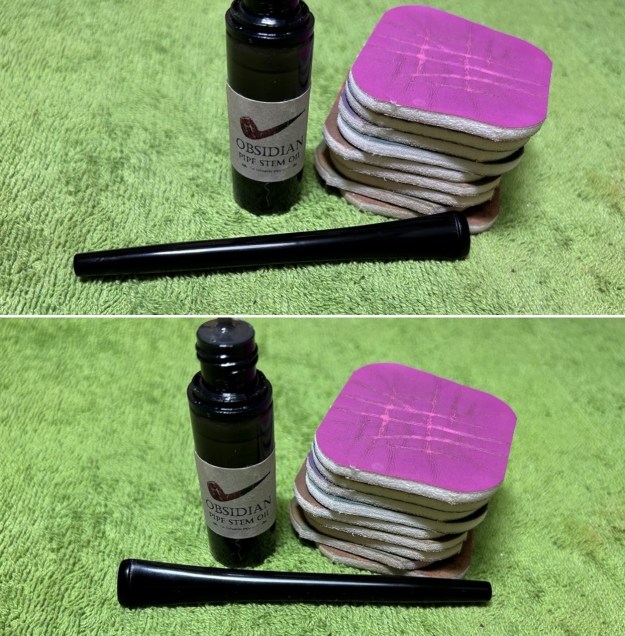
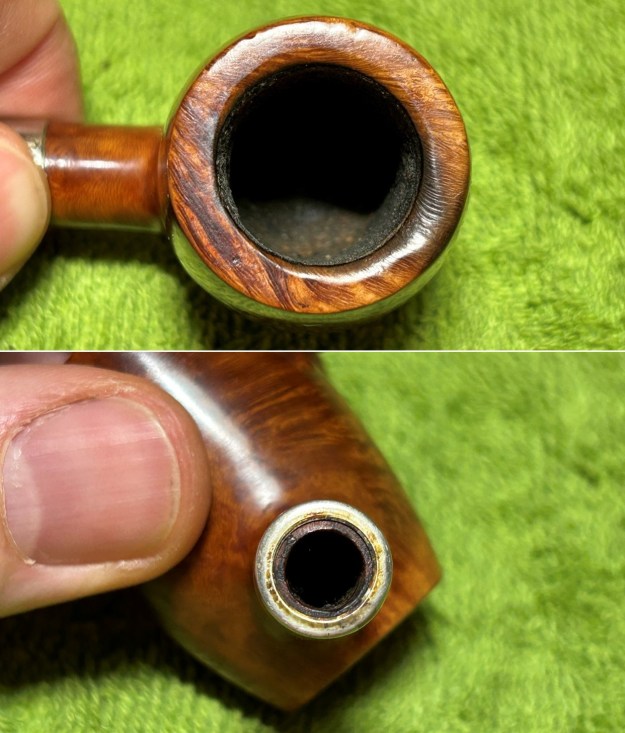
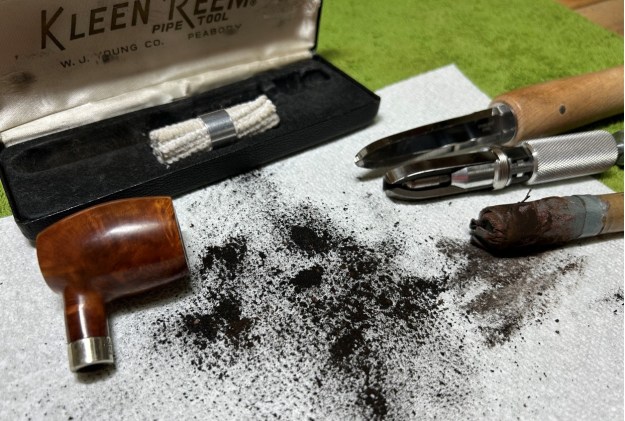
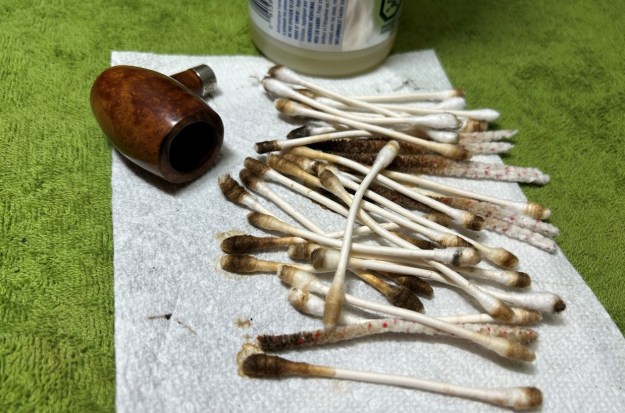
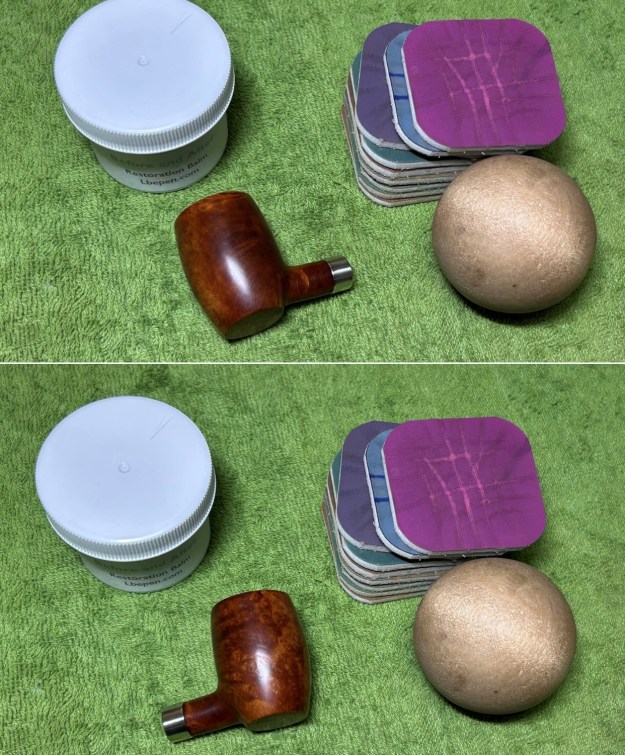
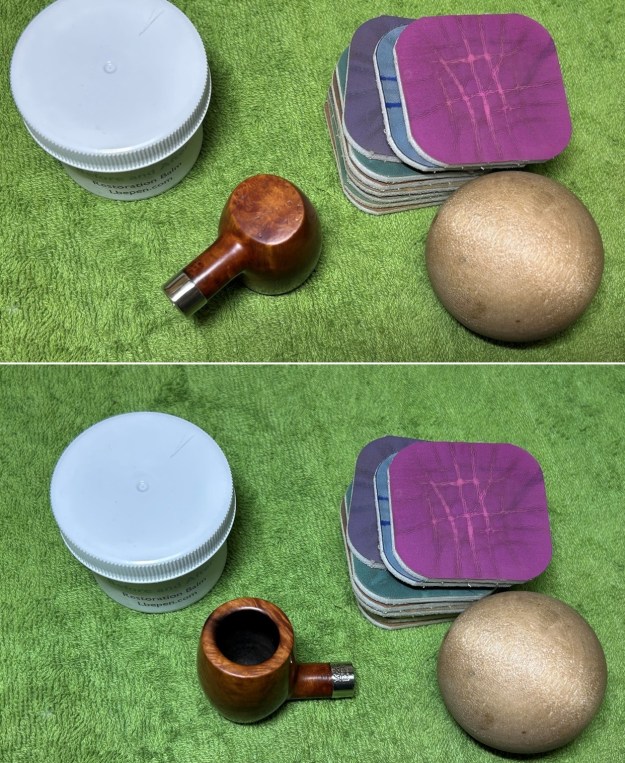
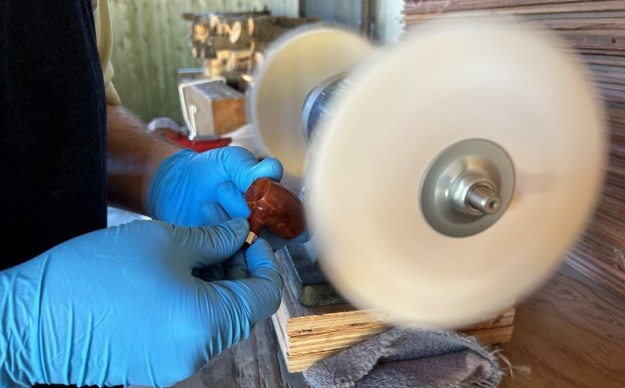
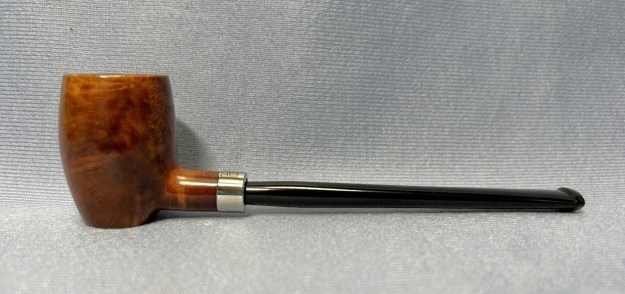
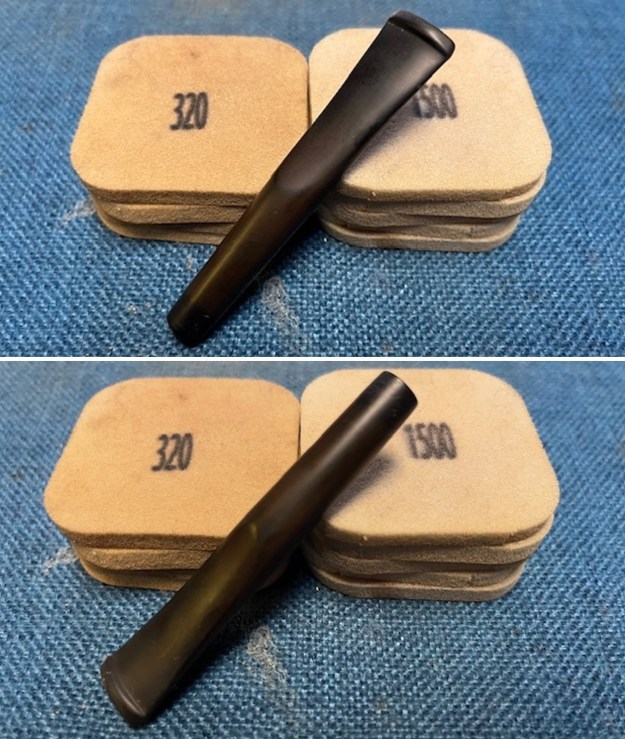
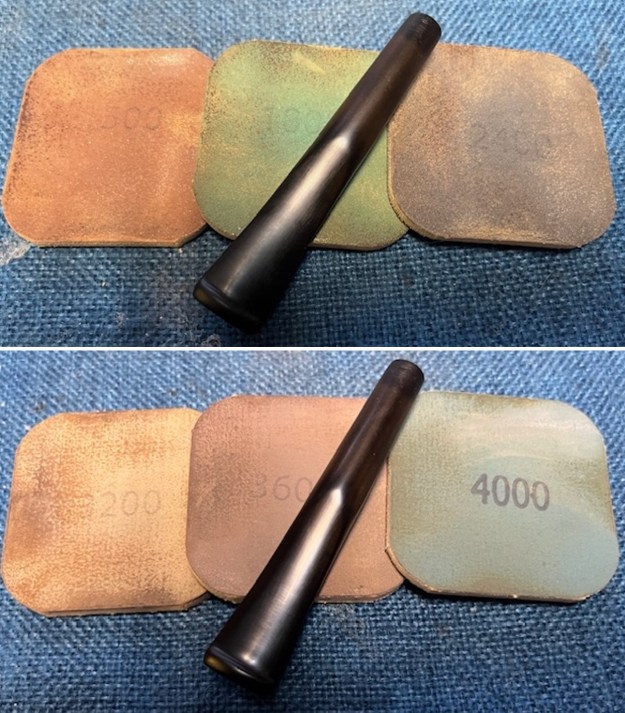
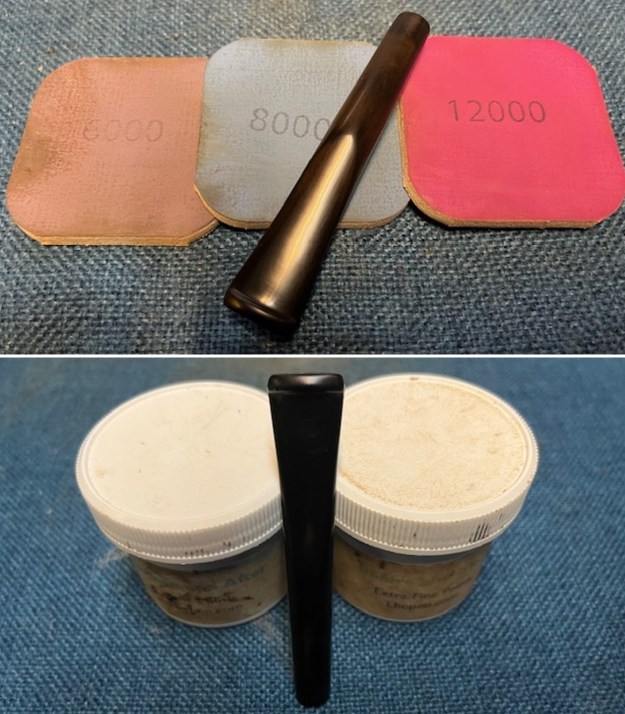
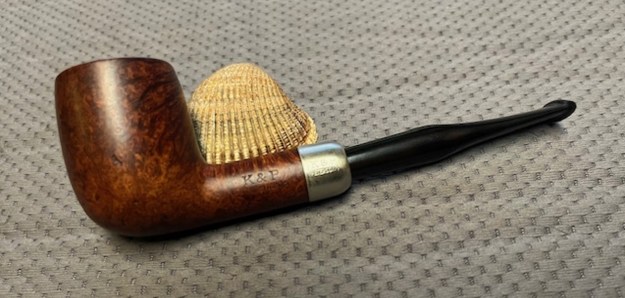
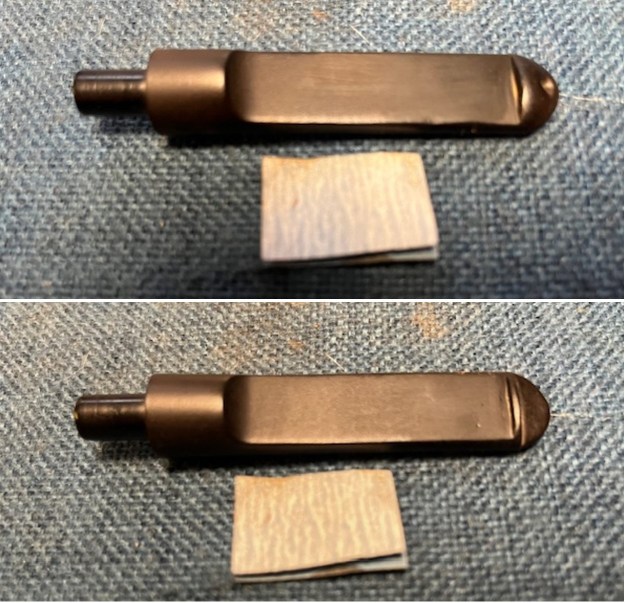
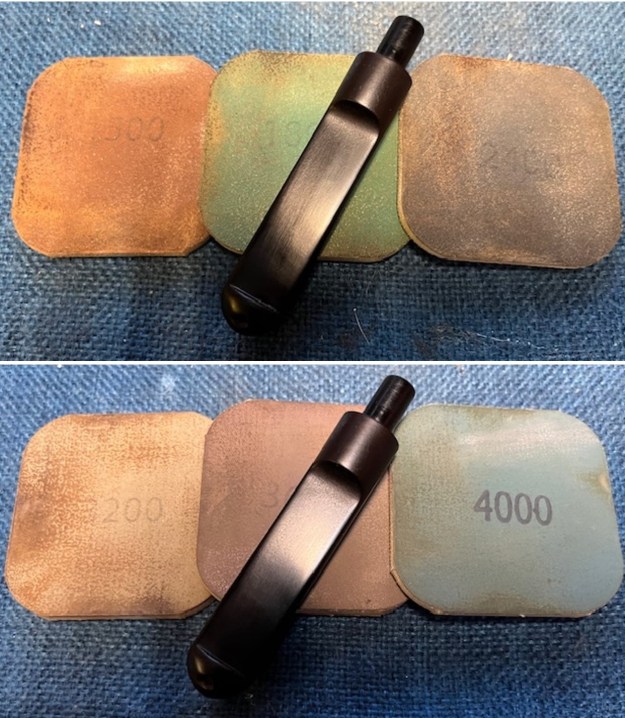
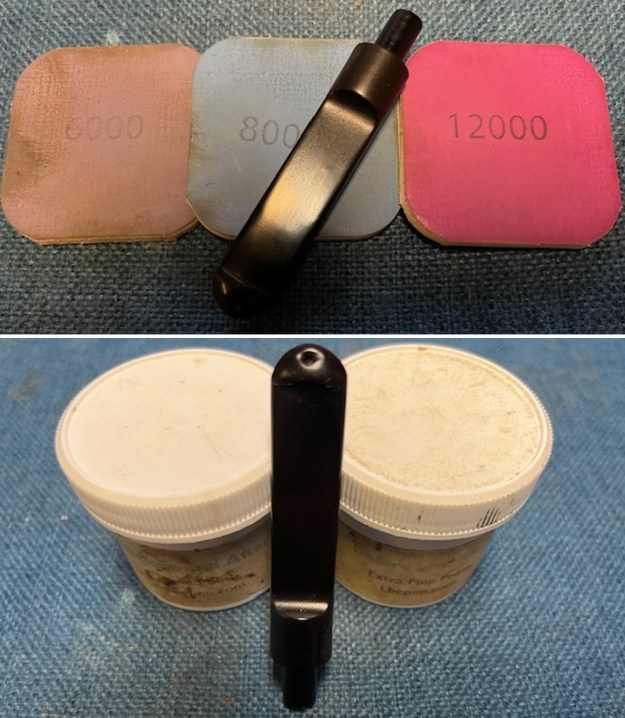
I started my work on the pipe by reaming the bowl with a PipNet reamer. I used the first and second cutting heads and took the cake back to bare briar. I cleaned up the reaming with a Savinelli Fitsall Pipe Knife and removed all the remnants of the cake. I scraped the rim top with the flat edge of the blade at the same time and removed most of the thick lava build up. I sanded the walls of the bowl with a piece of dowel wrapped in 220 grit sandpaper. The walls look very good at this point in the process. I cleaned out the shank, the airway and the deep mortise with alcohol, cotton swabs, hard bristle and soft bristle pipe cleaners. It was a very dirty pipe which just meant that Donna’s Dad had really enjoyed and used this pipe. I cleaned the inside of the aluminum tenon and the airway in the stem with alcohol, cotton swabs and pipe cleaners in the same way as I did the shank. It also was very dirty. I scrubbed the exterior of the bowl and shank with a tooth brush and undiluted Murphy’s Oil Soap. I scrubbed the lava on the rim top and overflow on the outside of the bowl with the soap. I rinsed  the briar with warm water to remove the grime and debris of the scrubbing. It looked significantly better after the scrubbing. I used a Walnut stain pen to touch up the depths of the rusticated portions of the bowl on the sides, the rim cap and the patch on the side of the shank. I used a dental tool with a thin blade to scrape out the twin rings around the bowl cap. It had a lot of debris in it but looked better when I finished. I cleaned up the inner edge of the rim and the rim top with a folded piece of 220 grit sandpaper. I removed the darkening as much as possible and smoothed out the top of the cap.I sanded the smooth portions of the bowl and rim with 320-3500 grit sanding pads to remove the marks, scratches and darkening on the rim top. I polished it with micromesh sanding pads – dry sanding it with 1200-15000 grit pads. I wiped the bowl down with a damp cloth after each sanding pad. The grain really started to rise to the surface as I polished it. I rubbed the bowl and shank down with Before & After Restoration Balm to deep clean the finish on the bowl and shank. The product works to clean, enliven and protect the briar. I worked it in with my fingers to get it into the briar. I used a horsehair shoe brush to work it into the sand blast. I let it sit for 10 minutes then I wiped it off and buffed it with a soft cloth. The briar really began to have a rich shine. I took some photos of the bowl at this point to mark the progress in the restoration. It is a beautiful bowl. I set the bowl aside and turned my attention to the stem. The fit of the stem to the shank was off – it was wider in diameter than the end of the shank. I measured and looked and found out it was the wrong stem. I found the other 5 dot stem and checked the fit of the stem to the shank and it was the correct diameter. I will need to clean it up and fit it to the shank.I cleaned out the new/correct stem with alcohol, pipe cleaners and cotton swabs. It took quite a few cleaners to get rid of the tars and oils. It looked much better.I scrubbed the oxidation on the stem with Soft Scrub cleanser and was able to remove a large amount of it. I sanded the area around the button edge and the remaining oxidation with a folded piece of 220 grit sandpaper. Progress was happening! I sanded the surface of the vulcanite with the 2 inch sanding pads – 320-3500 grit pads. I dry sanded the surface until I have removed all of the oxidation and the stem started to really shine.I refit the aluminum tenon with the new Brigham Rock Maple Distillator. It is a unique and cool smoking experience. I polished the stem with micromesh sanding pads – dry sanding with 1500-12000 grit pads. I wiped the stem down after each sanding pad with Obsidian Oil. I polished the stem with Before & After Pipe Stem Polish – both Fine and Extra Fine. I gave it a coat of Obsidian Pipe Stem Oil. It works to protect the stem from oxidizing. I set it aside to dry. The final steps in my process involve using the buffer. I buffed the bowl and stem with Blue Diamond to polish out the light scratches in the briar and the vulcanite. I gave the bowl and the stem multiple coats of carnauba wax. I have found that I can get a deeper shine if I follow up the wax buff with a buff with a clean buffing pad. It works to raise the shine and then I hand buff with a microfiber cloth to deepen the shine. It is always fun for me to see what the polished bowl looks like with the polished stem. It really is a nice pipe. The smooth tall bowl sides and the rusticated blaze on the left shank side looks great with the yellow acrylic stem. The Brigham 527 Bent Rhodesian with a vulcanite taper stem feels great in my hand. It is a well balanced pipe. Have a look at it with the photos below. The dimensions are Length: 6 inches, Height: 2 ½ inches, Outside diameter of the bowl: 1 ½ inches, Chamber diameter: 7/8 of an inch. The weight of the pipe is 2.29 ounces/65 grams. It is a beautiful pipe that I will soon be adding to the rebornpipes store in the Canadian Pipemakers Section. If you would like to add it to your collection let me know. It should be a great smoking pipe.

As always, I encourage your questions and comments as you read the blog. Thanks to each of you who are reading this blog. Remember we are not pipe owners; we are pipe men and women who hold our pipes in trust until they pass on into the trust of those who follow us.

Restoring an Elegant Sandblast Rebild de Luxe Made in Denmark 020 Tall Cutty


by Steve Laug

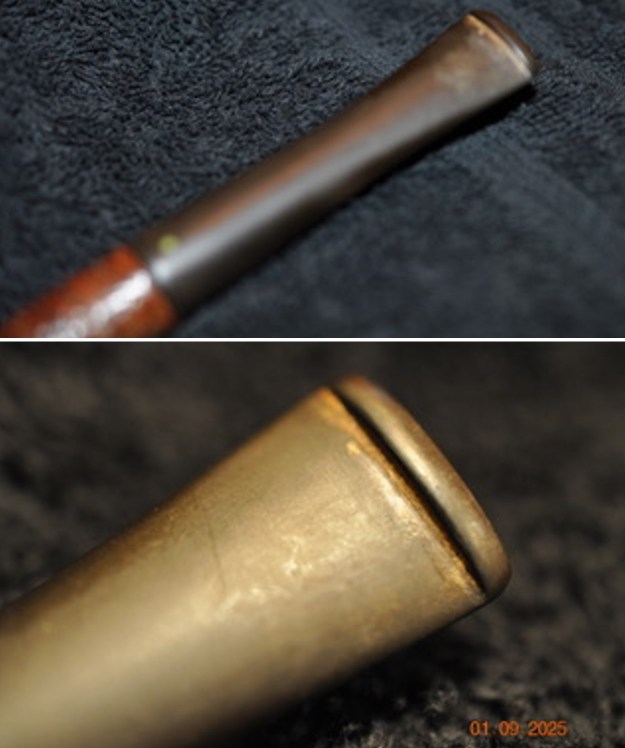
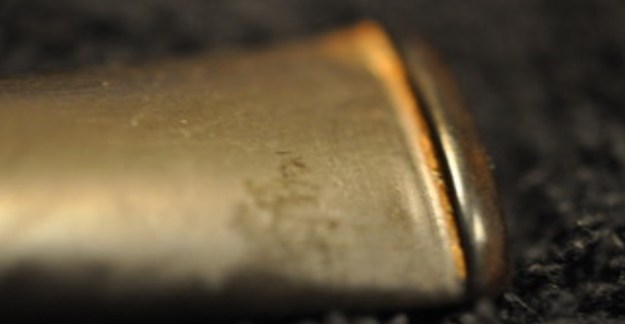
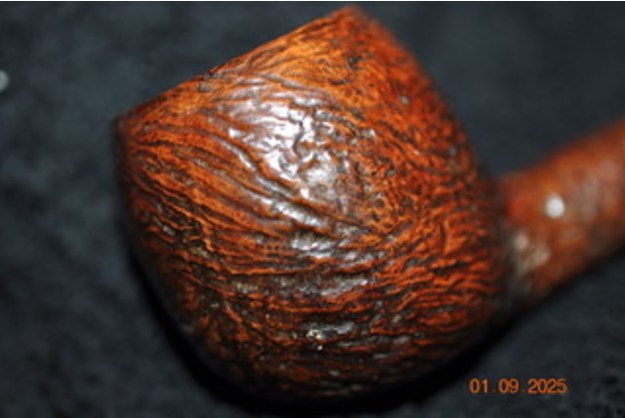
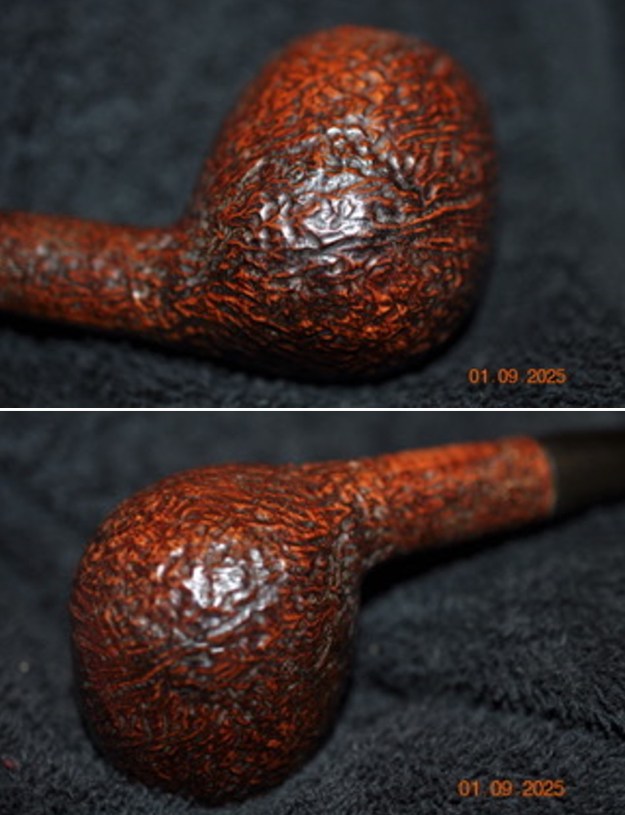
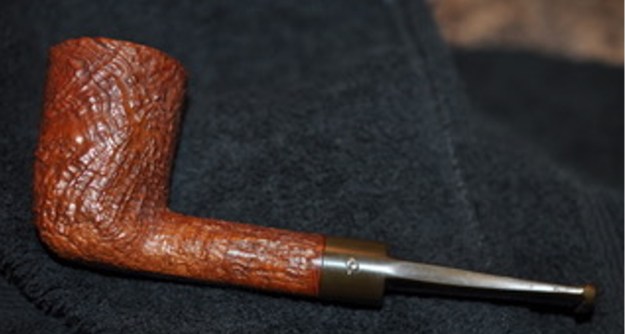
The next pipe on the table is one that we picked up in the lot from a good friend in Denmark on May 22/2024. The sandblast finish on this Danish made pipe and the shape is what caught our eye. It is stamped on the underside of the shank and reads REBILD [followed by] de [over] Luxe. Next to that it is stamped Made in [over] Denmark. Next to that it is stamped with the shape number 020. It has a Reddish, Brown stain on the sandblast finish that is a stark contrast to fancy vulcanite saddle stem. The Cutty shaped bowl was lightly caked, though it also seems to have been recently reamed. The inner edge and the top look good though there is some darkening and some spots of lava in the sandblast on the top. The stem was lightly oxidized and had tooth chatter on both sides ahead of the button. There was a GJ logo stamped on the left side of the saddle. It points to a Georg Jensen connection. Jeff took some photos of the pipe to show the general condition of the pipe before he started his clean up. He took some photos of the rim top and bowl from various angles to give me a clear picture of the condition of the rim top and bowl. There is some darkening and lava on the rim top but the bowl itself is lightly caked. He included photos that show the top and underside of the stem. It is as described above. Jeff took some photos of the sides and heel of the bowl to show the condition of the finish on the pipe. The photos showed a nice sandblast around the bowl and shank even with the grime in the finish. It is a great looking piece of briar. He took photos of the stamping on the underside of the shank. It was clear and readable as noted above. I was pretty sure I was dealing with a Georg Jensen pipe so I did a google search for REBILD Made in Denmark pipes. I found a great discussion by a fellow on Pipemagazine.com about his collecting of Georg Jensen pipes (https://pipesmagazine.com/forums/threads/georg-jensen-pipes-models-shapes-info-and-mysteries.87932/). In the post he gave a list of the model names of the Jensen pipes. There was some great information and scrolling through the list I found what I was looking for. I quote from the post below:
The model names were generally in all capital letters… but there were plenty of GJ pipes that had no model name stamp at all. Here are the model names that I have seen:

-SUNRISE

-GOODWILL

-REBILD [named after Danish woodland region]…

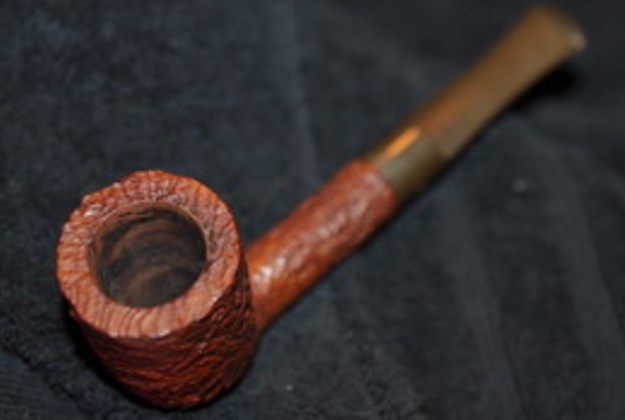
I did a bit more digging and found an esty listing for a Rebild pipe by Georg Jensen. I have included the link and the description of the pipe that was being sold below (https://www.etsy.com/ca/listing/1728913413/rebild-georg-jensen-hand-cut-niceclean?show_sold_out_detail=1&ref=nla_listing_details). It was also very helpful information. I also included a photo of the pipe.

From the good folks at Georg Jensen, this gorgeous straight Chimney or Stack, offers a nice tall bowl as part of their “Rebild” series. It’s rather obvious that Jensen’s Rebild (the name of a wooded region) series is an attempt to capitalized on the huge success of their competitor/fellow pipe makers, the Pipe Dan “Reformed”, with the same very Danish tall pipe legacy. This is a Georg Jensen higher end pipes as it was “hand cut”, while much of their line is machine made. The briar has a nice mélange of briar including birds-eye grain, in a dark honey colored finish. The short “pencil” shank leads to a long straight, tapered, fantail Vulcanite stem that is in excellent condition with no tooth marks. A really nice long/elegant, lightweight Dane to add to your collection of pipes. Cleaned, refreshed, sanitized, and ready to enjoy right out of the box.I knew that I was definitely dealing with a Georg Jensen made Rebild pipe which appeared to be tall and quite unique pipes. It was named after a wooded area in Denmark and came out about the same time as the Danpipe Reform pipes.

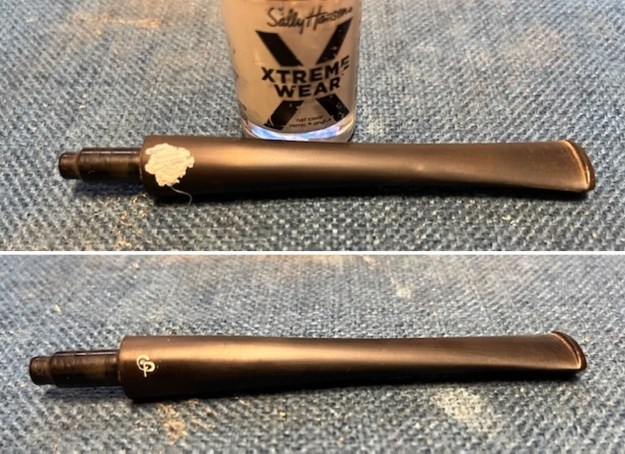
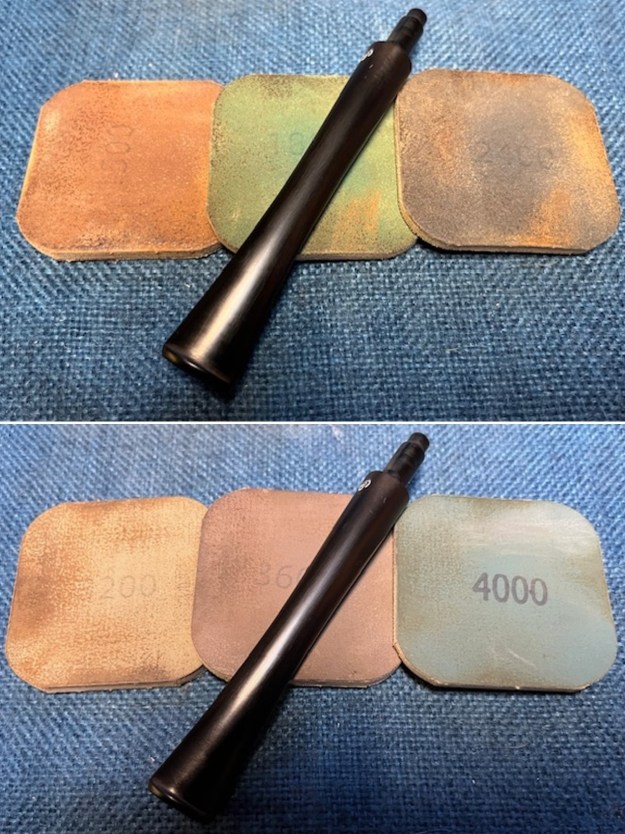
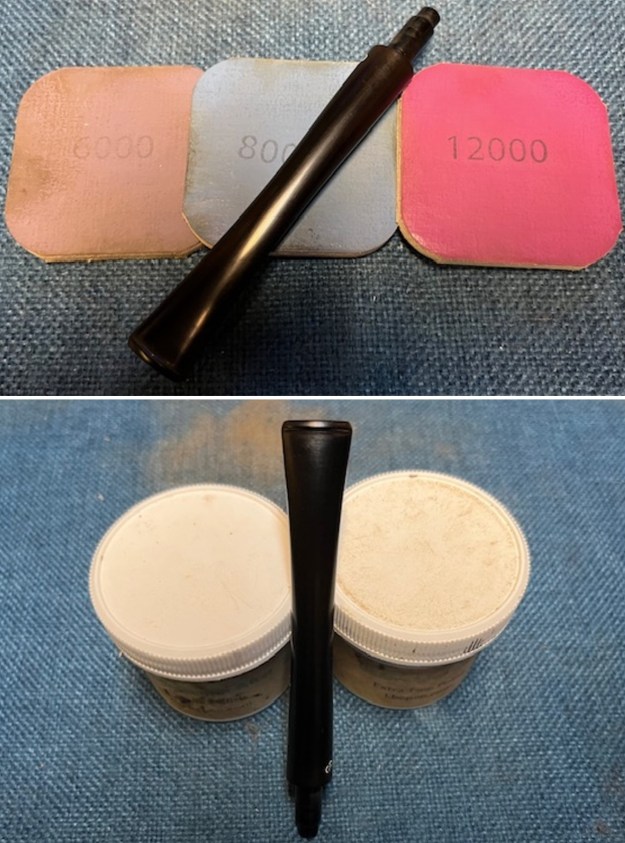
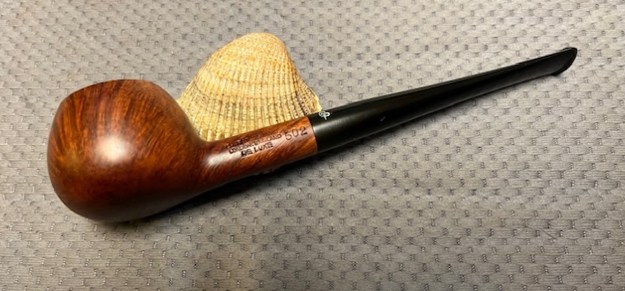
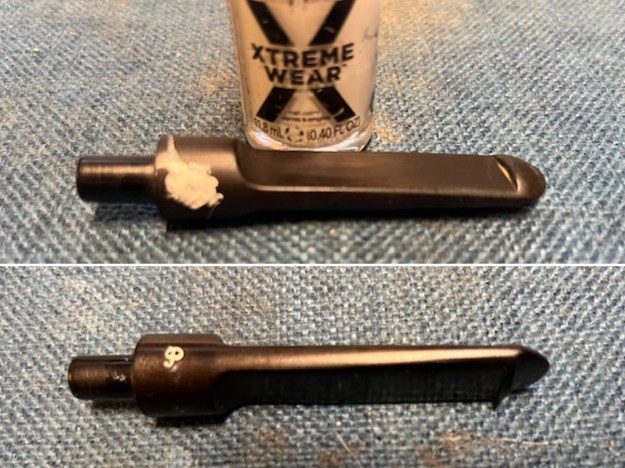
Armed with that information I was ready to work on the pipe. Since Jeff always follows the same pattern of work in his cleanup we do not include photos but rather just a simple summary. Jeff reamed the bowl with a PipNet pipe reamer and followed up with a Savinelli Fitsall pipe knife to remove the cake. He scrubbed out the mortise and the airway in the shank and the stem with alcohol, cotton swabs and pipe cleaners. He scrubbed the exterior of the bowl, rim, shank and stem with a tooth brush and Murphy’s Oil Soap to remove the oils and tars on the rim and the grime on the finish of the bowl. He rinsed it under running water. He dried it off with a soft cloth. He was able to remove the lava build up on the rim top and you could see the damages to the top and edges of the rim. I think this pipe may well been before we worked with Mark Hoover’s Before & After Deoxidizer so he cleaned the internals and externals. The stem was clean but lightly oxidized. I took photos of what the pipe looked like when I brought to my worktable. I took close up photos of the bowl, rim top and stem to show how clean the pipe was. The bowl was clean and the rim top and the inner edge showed darkening but no damage. The stem was clean and there were light tooth marks on the top and underside of the stem.I took a photo of the stamping on the underside of the shank. It is very clear and readable and read as noted above. I also removed the stem from the shank and took photos of the pipe to show the look of the parts.The exterior of the bowl was in excellent condition. I did not need to sand or do anything in preparation on the pipe. I set the stem aside and worked some Before & After Restoration Balm into the briar with my finger tips and a horsehair shoe brush. I let it sit on the bowl for 10 minutes and then buffed it off with a paper towel and soft cloth. The product is a great addition to the restoration work. It enlivens, enriches and protects the briar while giving it a deep glow. It is a product I use on every pipe I restore. I set the bowl aside and turned my attention to the stem. I tried to raise the tooth marks as much as possible by “painting” the surface with a lighter flame. It lifted the marks completely on the underside but did not lift the deeper one on the topside. I filled in the deep mark with rubberized black CA glue. Once it had cured I flattened the repair and recut the button edge with a small file. I further flattened and blended in the repairs with a folded piece of 220 grit sandpaper. It was a big improvement but still more work to go!I continued the sanding process with 320-3500 grit sanding pads. The repairs began to disappear into the surface of the vulcanite and the stem began to take on a smooth new look. Progress for sure. I touched up the GJ stamp on the left side of the saddle stem with white acrylic nail polish. I worked it into the stamping with a tooth pick. Once it dried I scrapped off the excess acrylic with my fingernail and then sanded it lightly with a 1500 grit micromesh pad to remove the excess.I polished the surface of the stem with micromesh sanding pads – dry sanding with 1500-12000 grit pads and wiping the surface down with Obsidian Oil after each sanding pad. It is really shining. I polished it further with Before & After Stem Polish – both Fine and Extra Fine. I gave it another coat of Obsidian Oil to finish this step. As usual at this point in the restoration process I am excited to be on the homestretch. I look forward to the final look when it is put back together, polished and waxed. I put the Georg Jensen Rebild 020 Cutty back together. I polished the bowl and stem with Blue Diamond to polish out the scratches in the briar and the vulcanite. I gave the bowl and the stem multiple coats of carnauba wax. I buffed the pipe with a clean buffing pad to raise the shine. I hand buffed it with a microfiber cloth to deepen the shine. The sandblast shows depth and really pops with the wax and polish. The shiny black vulcanite saddle stem is a beautiful contrast to the reddish browns of the bowl. This Georg Jensen Rebild Cutty was a great pipe to spruce up. It is a very comfortable pipe to hold in the hand. The finished pipe is shown in the photos below. The dimensions of the pipe are Length: 7 inches, Height: 2 ¼ inches, Outside diameter of the bowl: 1 inch, Chamber diameter: ¾ of an inch. The weight of the pipe is 29 grams/1.02 ounces. This pipe will be going on the Danish Pipe Maker section of the rebornpipes store if you are interested in adding it to your collection. Thanks for reading this blog and my reflections on the pipe while I worked on it. This is an interesting estate to bring back to life.
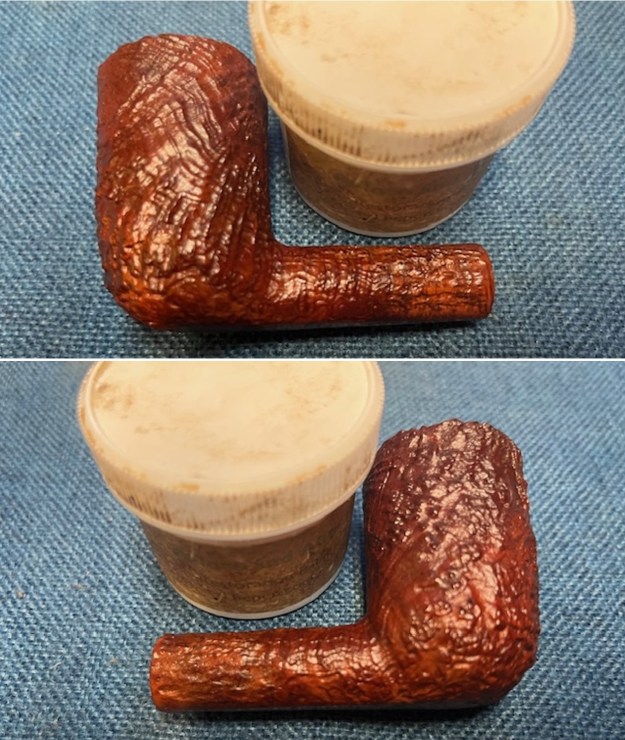
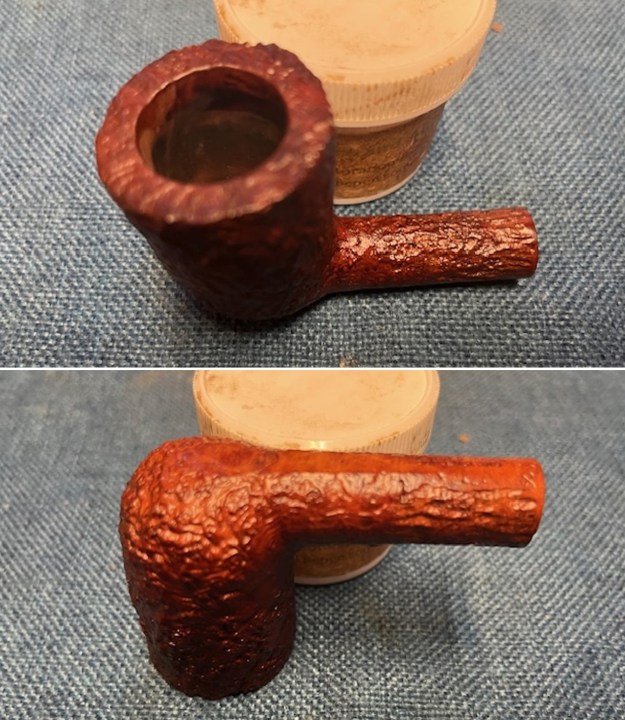
Restoring a Father’s Legacy of 10 Brigham Pipes Gathered throughout his life #2


by Steve Laug

Early this month I was contacted by Donna to see if I knew anyone interested in purchasing her father’s pipes. She wrote as follows: “I am wondering if you would be interested in my father’s collection of Brighams.” She further spelled out what he had in the collection. He had 1 – 2 dot pipe, 3 – 3 dot pipes, 2 – 4 dot pipes and 4 – 5 dot pipes. There was a total of 10 pipes. I asked for a photo of the pipes and she sent the photo below. I was very interested.We emailed back and forth and the short story is that I paid for the collection and she shipped the pipes to me. On Tuesday after Easter the box arrived and I was happy to be able to see them up close. They were obviously well-loved pipes and in varying degrees of needing work. I wrote her and told I received them and that I was pleased with the lot. I was looking forward to working on them. She aske me to send her photos along the way as I finished the pipes. I will be sending her the links to the blog so she can see the work and the process of bringing them back to a semblance of their original beauty. Thanks Donna for the opportunity to work on your Dad’s pipes.

The second of the pipes I have chosen to work on from the lot was the last one at the bottom of the right column in the photo above. I would call the pipe a Poker/Cherrywood Sitter pipe with an amber acrylic stem. It is stamped on the left side of the shank and reads Brigham in script. On the under of the shank near the flat heel of the bowl it has the shape number 482L. The stamping will help me date the pipe. From the cake in the bowl and the other pipes I could tell her Dad love aromatic tobaccos. This pipe was heavily caked with an overflow of lava on the rim top and on the inner and outer edges of the bowl. The shank end even that had a coating of tar build up. The stem did not sit all the way in the shank so I assumed it was very dirty in the shank. I removed the stem and found that the Hard Rock Maple Distillator was missing from the aluminum tenon. The shank was black, tarry and oily. The stem was dirty and dull with thick oil and tar in the airway from the tenon to the button. There were light tooth marks and chatter on both sides ahead of the button. The left side of the taper stem bore four brass pins in a triangle format. That would also help with identifying the pipe. I took some photos of the pipe before I started my work on it. I took a photo of the bowl and rim top to show the cake in the bowl. The rim top looked to have a coat of lava overflowing down the crown with some possible damage around the inner edge. I took photos of the top and underside of the stem showing the light tooth chatter on the acrylic stem surface. The airway in the stem is also heavily stained with tars and oils.The stamping is very clear and it reads as noted above. I removed the stem from the shank and took a photo of the parts to show the look of the pipe. I have captured the pattern of the four brass dots on the stem. For the needed background I am including the information from Pipedia on Brigham pipes. It is a great read in terms of the history of the brand (https://pipedia.org/wiki/Brigham_Pipes). Charles Lemon (Dadspipes) has written book on the history of the brand. This article is a good summary. I have included it below.

Roy Brigham, after serving an apprenticeship under an Austrian pipesmith, started his own pipe repair shop in Toronto, in 1906. By 1918 the business had grown to include five other craftsmen and had developed a reputation across Canada for the high quality of workmanship. After repairing many different brands of pipes over the years, Roy noted certain recurring complaints by pipe smokers, the most common referred to as “tongue bite”. Tongue bite is a burning sensation on the smoker’s tongue, previously thought to be due to the heat of the smoke (i.e. a “hot smoking pipe”).

He soon began manufacturing his own pipes, which were lightweight, yet featured a more rugged construction, strengthening the weak points observed in other pipes. The problem of tongue bite intrigued him, and he decided to make overcoming it a future goal.

About 1938, Roy’s son Herb joined him to assist in the business. The business barely survived the great depression because pipes were considered to be a luxury, not a necessity, and selling pipes was difficult indeed. In approximately 1937 [1], after some experimentation, Roy and Herb discovered that tongue bite was in fact a form of mild chemical burn to the tongue, caused by tars and acids in the smoke. They found that by filtering the smoke, it was possible to retain the flavour of the tobacco and yet remove these impurities and thereby stop the tongue bite.

Just as Thomas Edison had searched far and wide for the perfect material from which to make the first electric light bulb filaments, Roy & Herb began experimenting with many materials, both common and exotic, in the quest for the perfect pipe filter. Results varied wildly. Most of the materials didn’t work at all and some actually imparted their own flavour into the smoke. They eventually found just two materials that were satisfactory in pipes: bamboo and rock maple. As bamboo was obviously not as readily available, rock maple then became the logical choice.

They were able to manufacture a replaceable hollow wooden tube made from rock maple dowelling, which when inserted into a specially made pipe, caused absolutely no restriction to the draw of the pipe, yet extracted many of the impurities which had caused tongue bite. The result was indeed a truly better smoking pipe…

I then turned to a second article by Charles Lemon called, “A Closer Look at the Dots, Dates, and Markings of Brigham Pipes” to be able to pin down the time frame that the pipe was made in and to help interpret the stampings and shape number on the pipe. Here is the link to his article (https://pipedia.org/wiki/Brigham_Pipes_%E2%80%93_A_Closer_Look_at_Dots,_Dates_and_Markings).

I have dubbed the decades between 1980 and 2000 the Late Canadian Era, a period that saw several changes at Brigham that are of note to the collector. First, the traditional 8-grade pinning system (the famous Brigham “Dots” which denoted the quality of the pipe) was changed to a 7-grade system to simplify pinning (more on this below), and the Norsemen and Valhalla series were merged to form the President Series, which represented the very finest pipes coming out of the Toronto factory. Early pipes from this era (left, below) are stamped with a shape number and “Brigham” over “Canada”; later pipes (late 1980s+, on right below) are stamped simply with a shape number and the Brigham logo.

I read further in the article to the section entitled Revised Dot System 1980. I quote from that below.

Brigham changed the Dot system in 1980, adding a 7 Dot at the top of the line, dropping the names of each series and eliminating the confusing vertical and horizontal 3 Dot configurations. The Norsemen and Valhalla series were combined to form the President series of freehand pipes, which adopted a 3 Dot pattern with a larger dot on the right as shown below. The 7- grade pinning system stayed in place from 1980 to 2001.

With the information from article and the chart above I knew what I was dealing with in terms of the stamping and the age of this pipe. I learned that this Late Canadian Era was made between 1980-2000. The pipe is a Brigham (4-Dot) 482L, a Poker Sitter to my mind. The Canada stamping pins it down to the period between 1990-2001 when the aluminum tenon was replaced.

I wrote to Charles Lemon to see if he could help to narrow down the date a bit more. I also wanted to know about the acrylic stem and the shape. He wrote me back with this answer:

Brigham put out a limited run of System pipes with Acrylic stems in the early 1990s. Available stem colours were yellow, green and chocolate swirl. There is a short paragraph on Page 54 of the book on this limited run, but there’s not a great deal of information available. 

I paused reading the email and turned to Charles’ book, Brigham Pipes, A Century of Canadian Briar, page 54 as noted above and quote:

In the early 1990s a small number of Brigham pipes were made with acrylic stems instead of the traditional rubber stems. These were available in several colours – yellow, green and chocolate swirl. Due to the short production runs, these acrylic-stemmed pipes are quite rare on the estate market.

I went back to the email – Charles further wrote about the shape number.

In the Shape Chart, I’ve identified Shape 82 (b) as a “1/4 Bent Pot Sitter”. The “L” in the shape code refers back to bowl size options available in the mid to late 1960s, where any standard pipe shape could be ordered in S, M, ML, L, XL sizes. I suspect your early 1990s pipe was made using a New Old Stock stummel originally produced some 20 years earlier.

Hope that helps. It’s a lovely pipe! – Charles

I now knew that I was dealing with a pipe made only in the early 1990s in a short production run and was quite rare on the estate market. The shape number 82 was for a bent Pot Sitter. The 4 preceding the 82 referred to the 4 Dot mark of the pipe. What was interesting to me is Charles’ comment that it could have been New Old Stock Stummel produced 20 years earlier.

I started my work on the pipe by reaming the bowl with a PipNet reamer. I used the first and second cutting heads and took the cake back to bare briar. I cleaned up the reaming with a Savinelli Fitsall Pipe Knife and removed all the remnants of the cake. I sanded the walls of the bowl with a piece of dowel wrapped in 220 grit sandpaper. The walls look very good at this point in the process. I scrubbed off the surface of the bowl and shank with acetone and cotton pads. The surface was coated with a shiny varnish coat. I wanted it to be gone so that I could see the briar underneath. It looked very good once the varnish coat was gone. I scrubbed the exterior of the bowl and shank with a tooth brush and undiluted Murphy’s Oil Soap. I scrubbed the lava on the rim top and overflow on the outside of the bowl with the soap. I rinsed  the briar with warm water to remove the grime and debris of the scrubbing. It looked significantly better after the scrubbing. I cleaned out the shank, the airway and the deep mortise with alcohol, cotton swabs, hard bristle and soft bristle pipe cleaners. It was a very dirty pipe which just meant that Donna’s Dad had really enjoyed and used this pipe. I cleaned the inside of the aluminum tenon and the airway in the stem with alcohol, cotton swabs and pipe cleaners in the same way as I did the shank. It also was very dirty. I sanded the smooth portions of the bowl and rim with 320-3500 grit sanding pads to remove the marks, scratches and darkening on the rim top. I polished it with micromesh sanding pads – dry sanding it with 1200-15000 grit pads. I wiped the bowl down with a damp cloth after each sanding pad. The grain really started to rise to the surface as I polished it. I rubbed the bowl and shank down with Before & After Restoration Balm to deep clean the finish on the bowl and shank. The product works to clean, enliven and protect the briar. I worked it in with my fingers to get it into the briar. I used a horsehair shoe brush to work it into the sand blast. I let it sit for 10 minutes then I wiped it off and buffed it with a soft cloth. The briar really began to have a rich shine. I took some photos of the bowl at this point to mark the progress in the restoration. It is a beautiful bowl. I set the bowl aside and turned my attention to the stem. I sanded the surface of the acrylic with the 2 inch sanding pads – 320-3500 grit pads. I dry sanded the surface until I have removed all of the oxidation and the stem started to really shine.I refit the aluminum tenon with the Brigham Rock Maple Distillator. It is a unique and cool smoking experience. I polished the stem with micromesh sanding pads – dry sanding with 1500-12000 grit pads. I wiped the stem down after each sanding pad with Obsidian Oil. I polished the stem with Before & After Pipe Stem Polish – both Fine and Extra Fine. I gave it a coat of Obsidian Pipe Stem Oil. It works to protect the stem from oxidizing. I set it aside to dry. The final steps in my process involve using the buffer. I buffed the bowl and stem with Blue Diamond to polish out the light scratches in the briar and the vulcanite. I gave the bowl and the stem multiple coats of carnauba wax. I have found that I can get a deeper shine if I follow up the wax buff with a buff with a clean buffing pad. It works to raise the shine and then I hand buff with a microfiber cloth to deepen the shine. It is always fun for me to see what the polished bowl looks like with the polished stem. It really is a nice pipe. The smooth tall bowl sides and the rusticated blaze on the left shank side looks great with the yellow acrylic stem. The Rare Brigham 482L Poker/Sitter with an acrylic stem feels great in my hand. It is a well balanced pipe. Have a look at it with the photos below. The dimensions are Length: 6 inches, Height: 2 ½ inches, Outside diameter of the bowl: 1 ½ inches, Chamber diameter: 7/8 of an inch. The weight of the pipe is 2.29 ounces/65 grams. It is a beautiful pipe that I will soon be adding to the rebornpipes store in the Canadian Pipemakers Section. If you would like to add it to your collection let me know. It should be a great smoking pipe.

As always, I encourage your questions and comments as you read the blog. Thanks to each of you who are reading this blog. Remember we are not pipe owners; we are pipe men and women who hold our pipes in trust until they pass on into the trust of those who follow us.

Restoring a James Upshall B Tilshead England Made by Hand Dublin


by Steve Laug

The next pipe on the table is a Peterson Rusticated Meerschaum Bulldog. We picked the pipe up from a seller in Ogden, Utah, USA on 12/12/2024. Probably the fact that it is a James Upshall pipe and has the JU stamp on the stem caught our eye on this one. It is stamped on the left side of the shank and reads B followed by James Upshall in an oval. On the left is stamped Tilshead [over] England [over] Made by Hand. It is a B Grade smooth, walnut finished pipe. The B grade is the “entry” level for the Upshall Straight Grains and retail new at about $1500. The finish is a bit dull and dirty with dust and grime. The bowl has a light cake and the rim top has some darkening and some damage around the inner edge on the front. The stem is oxidized and has tooth chatter and light tooth marks on both sides near the button. The surface of the button looks very good on both sides. The circle JU logo stamp on the top side of the saddle is deep looks good. Jeff took some photos of the pipe to show the general condition of the pipe before he started his clean up. Jeff took photos of the rim top and stem to show the general condition of the pipe. The bowl is lightly caked and the rim top looks good. The inner edge of the bowl has some burn damage and darkening. The stem is oxidized, calcified and has tooth chatter and tooth marks on the top and underside near the button. Jeff took photos of the bowl sides and heel to show the condition of the smooth finish around this bowl. The grain is quite beautiful and it is a nice looking pipe.He took photos of the stamping on the shank sides and the top of the stem. It is clear and readable as noted above. Before I started my work on the pipe I looked up the Upshall listing in Pipedia to remind myself of the background on the brand (https://pipedia.org/wiki/James_Upshall). I read through the article and found the section on Grading & Sizing Information really helpful. I have included that below. I have highlighted the pertinent text in red below.

James Upshall pipes are graded by various finishes, i.e. bark, sandblast, black dress and smooth etc. Then by cross grain, flame grain, straight grain and, last but not least, the perfect high grade, which consists of dense straight grain to the bowl and shank. The latter being extremely rare. In addition, the price varies according to group size, i.e. from 3-4-5-6 cm high approximately Extra Large. We also have the Empire Series which are basically the giant size, individually hand crafted pipes which come in all finishes and categories of grain. All our pipes are individually hand carved from the highest quality, naturally dried Greek briar. In order to simplify our grading system, let me divide our pipes into 4 basic categories.

  1. It begins with the Tilshead pipe, which smokes every bit as good as the James Upshall but has a slight imperfection in the briar. In the same category price wise you will find the James Upshall Bark and Sandblast finish pipes, which fill and smoke as well as the high grades.
  2. In this category we have the best “root quality” which means that the grain is either cross, flame or straight, which is very much apparent through the transparent differing color finishes. This group will qualify as the “S”- Mahogany Red, “A” – Chestnut Tan and “P” – Walnut. The latter having the straighter grain.
  3. Here you have only straight grain, high grade pipes, which run from the “B”, “G”, “E”, “X” and “XX”. The latter will be the supreme high grade. Considering the straightness of the grain the latter category is also the rarest. Usually no more than 1% of the production will qualify.
  4. Lastly, we have the Empire Series. These are basically Limited Edition gigantic individually hand crafted pieces, which again are extremely rare due to the scarcity of large, superior briar blocks.

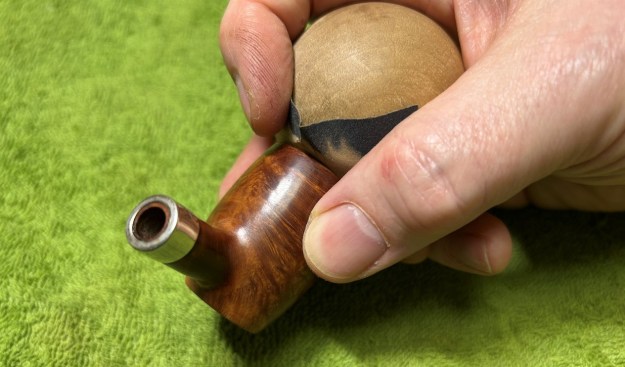
There was a link at the bottom of the article that led to a 1984 Catalogue. I have included a page from that catalogue below (https://pipedia.org/images/a/a6/James_Upshall_1984Catalog.pdf). The pipe at the bottom left of the photo marked as a Semi-bent Dublin is similar in shape to the one I am working on.I turned to the James Upshall of England website and looked up the guarantee on their pipes. I have included it below because of the commitment to quality that is spoken of in the description (http://www.upshallusa.com/products.htm).I also copied the section from the website on the B-Grade pipe and the description about the nature of the briar used in that pipe (http://www.upshallusa.com/html/JUB-Grade.htm).Armed with that information I turned my attention to the pipe itself. Jeff had cleaned the pipe with his usual penchant for thoroughness that I really appreciate. He reamed it with a PipNet pipe reamer and cleaned up the reaming with a Savinelli Fitsall Pipe Knife. He scrubbed out the internals with alcohol, pipe cleaners and cotton swabs until the pipe was clean. He scrubbed the exterior of the bowl with Murphy’s Oil Soap and a tooth brush to remove the grime and grit on the briar and the lava on the rim top. The finish looks very good with good looking grain around the bowl and shank. Jeff soaked the stem in Before & After Deoxidizer to remove the oxidation on the rubber. When the pipe arrived here in Vancouver for the second stop of its restoration tour it looked very good. I took photos before I started my part of the work.   I took some close up photos of the rim top and also of the stem surface. The bowl and the rim top look good. The inner edge of the rim showed some damage from burn marks on the front of the bowl and darkening on the back side. There was some wear in the finish on the rim top.  I also took close up photos of the stem to show how clean the stem was. There were very light tooth marks or chatter on both sides of the stem. I took photos of the stamping on the shank. On the left side of the shank it reads B (Grade stamp) at the shank/bowl junction. That is followed by the James Upshall stamp in an oval. There is a JU logo on the left side of the stem. The stamping was very clear. The right side of the shank was stamped Tilshead over England over Made by Hand. The grain on this pipe was highlighted by the shaping of the pipe. I took the stem off the bowl and took a picture of the parts of the pipe to give a sense of the parts of the pipe. It really is a beautifully grained pipe. I decided to clean up the inner edge of the bowl and straighten out the damage to the rim edge with a folded piece of 220 grit sandpaper. I used a piece of 220 grit sandpaper and a wooden sphere to smooth out the damage. It did not take too much to give the edge a light bevel and remove the damage. I polished the briar with micromesh sanding pads – 1500-12000 grit sanding pads. I wiped the bowl surface down with a damp cloth after each sanding pad to remove the sanding dust. Once I finished the exterior of the briar was clean and the grain really stood out. I worked some Before & After Restoration Balm into the surface of the briar with my fingertips to clean, enliven and protect the briar. I let the balm sit for 15 minutes and then buffed with a cotton cloth to raise the shine. The photos show the bowl at this point in the restoration process. It looks quite nice at this point. I set the bowl aside and turned my attention to the stem. I “painted” the stem with the flame of a lighter to try and lift the tooth marks. I was able to lift all of them. I used a piece of 220 grit sandpaper to blend them into the surrounding vulcanite. I sanded the stem with 320-3500 grit sanding pads to remove the tooth marks and chatter against the button edge and sand the logo. It worked well on the tooth marks but did little on the logo on the stem top.I touched up the circle JU stamp on the saddle side with Rub’n Buff Antique Gold. I worked it into the stamp with a tooth pick. Once it cured I buffed off the excess with a soft cloth. It looked very good.I polished the stem with micromesh sanding pads – wet sanding with 1500-12000 grit pads. I wiped the stem down after each sanding pad with Obsidian Oil. I polished it with Before & After Pipe Stem Polish – both Fine and Extra Fine. Once I had finished the polishing I gave it final coat of oil and set it aside to dry. I am excited to be on the homestretch with beautiful James Upshall B-Grade Crowned Dublin. I look forward to the moment when it all comes back together, polished and waxed. I put the bowl and stem back together. I polished the bowl and stem with Blue Diamond to polish out the scratches in the briar and the vulcanite. I gave the bowl and the stem multiple coats of carnauba wax. I buffed the pipe with a clean buffing pad to raise the shine. I hand buffed it with a microfiber cloth to deepen the shine. The pipe polished up pretty nicely. The beautifully grained finish looks really good with the interesting grain patterns standing out on the shape. The grain and the polished black vulcanite went really well together. This James Upshall Dublin has that classic English look that catches the eye. The combination of various brown stains really makes the pipe look attractive. It is another comfortable pipe to hold in the hand. The finished pipe is shown in the photos below. The dimensions of the pipe are Length: 6 inches, Height: 2 ¼ inches, Outside diameter of the bowl: 1 ½ inches, Chamber diameter: ¾ of an inch. The weight of the pipe is 51grams/1.76 ounces. I will be posting it for sale in the British Pipemaking Section on the rebornpipes store very soon. If you are interested in adding it to your collection let me know. Thanks for reading this blog and my reflections on the pipe while I worked on it. This was an interesting estate to bring back to life.

Fresh Life for a Peterson’s Meerschaum Bulldog


by Steve Laug

The next pipe on the table is a Peterson Rusticated Meerschaum Bulldog. We picked the pipe up from a seller in Ogden, Utah, USA on 12/12/2024. Probably the fact that it is a meerschaum and that it bore the P stamp on the stem caught our eye. There is no stamping on the shank or anywhere else on the pipe. It is the shape and the P stamp on the stem that tell us that it is a Peterson pipe. It is great looking rusticated pipe that is commonly seen on these meerschaums. The bowl appears to be lightly caked and quite clean. The inner edge and the top show some light lava overflow. And let’s talk about that stem. It is oxidized and calcified which is quite normal for what I see. There are some tooth marks and chatter on the stem surface and button. The P stamp on the top left side of the saddle is deep but has lost the colour. Jeff took some photos of the pipe to show the general condition of the pipe before he started his clean up. Jeff took photos of the rim top and stem to show the general condition of the pipe. The bowl is lightly caked and the rim top and edges have lava overflowing on to them. There are also some spots where the finish is worn off. The stem is oxidized, calcified and has tooth chatter and tooth marks on the top and underside near the button. Jeff took photos of the bowl sides and heel to show the condition of the rusticated finish around this bowl. It is a nice looking pipe. He took a photo of the “P” stamping on the left side of the saddle stem. It is clear and readable but has lost the colour that was originally there. I took some time to remind myself of the provenance of these Peterson’s Dublin Meerschaum pipes. I am pretty sure the pipe was made by the Laxey Pipe Ltd. on the Isle of Man for Peterson’s in Ireland (https://pipedia.org/wiki/Laxey_Pipes_Ltd). I quote from the Pipedia article in full:

Laxey Pipe Ltd. resided in a historical 19th century four-storey Man stone building at The Quay, Old Laxey, Isle of Man, which thankfully has been preserved. The company specialized in the production of Meerschaum Pipes using the Meerschaum mined by the Tanganyika Meerschaum Corporation in the Amboseli basin in Tanganyika (since 1964 part of the United Republic of Tanzania). Please note: you may often find names like “Manx Pipes Ltd.”, “Man Pipe Co.” and others more, but there is no indication of another Isle of Man pipe producer other than Laxey Pipe Ltd. at any time!

Laxey Pipe Ltd. marketed own brands like “Manxpipe”, “Manxman”, “Manxland” e.c. Names like “John Bull”, “White Knight” (unwaxed), “Domino” (black, or lined) indicated some shapes / colours of Laxey’s own series. The stems either showed the astronomical sign for “male” or “man” (circle + arrow), or the crest of the Isle of Man, the 3-legged X in a circle. Manxpipes and Laxey’s other brands were available through pipe retailers in general, but also were sold (mainly) to tourists through their own shop in Laxey.

Furthermore Laxey Pipe Ltd. manufactured the meer bowls for Peterson, Barling, Nørding and others from the later 1960’s until 2001. Man Pipe e.g. was a brand distributed by Comoy’s. The bowls usually showed no nomenclature indicating the orderer. “Genuine Block Meerschaum” was engraved frequently. Often, just the stems were different, while bowls were the same.

Supply of meer from East Africa run out (Kenya / Tanzania exhausted, Somalia inaccessible), and thus the last Laxey meers were supplied to trade in May, 2001. Laxey Pipe Ltd. tried to survive continuing with briar pipes – mainly in the Danish style -, but to no success. It closed down business in July, 2002.

I know that the pipe was made on the Isle of Man by Laxey Pipe Ltd. out of African Meerschaum. It was made for export for Peterson’s of Dublin. The flumed top on the bowl and the rustication around the bowl and shank make me think that it is a 1970s era pipe. That was as much as I could figure out.

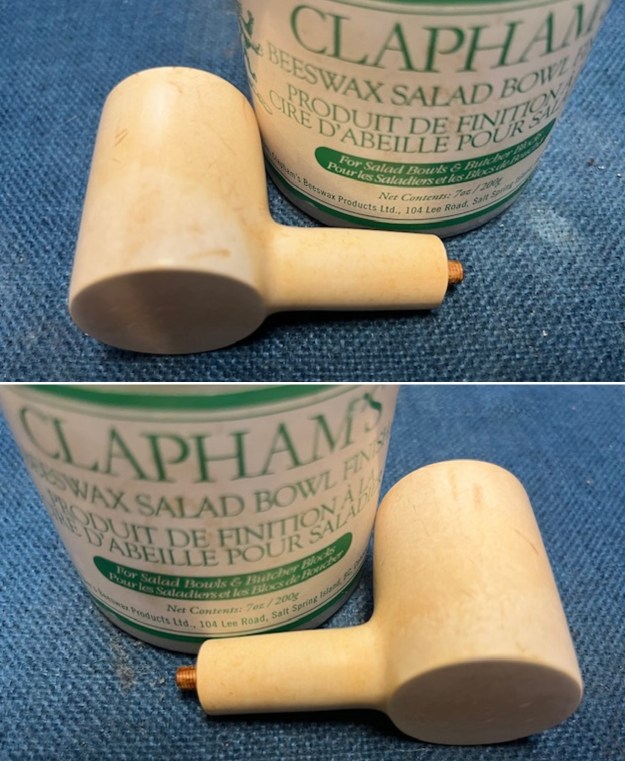
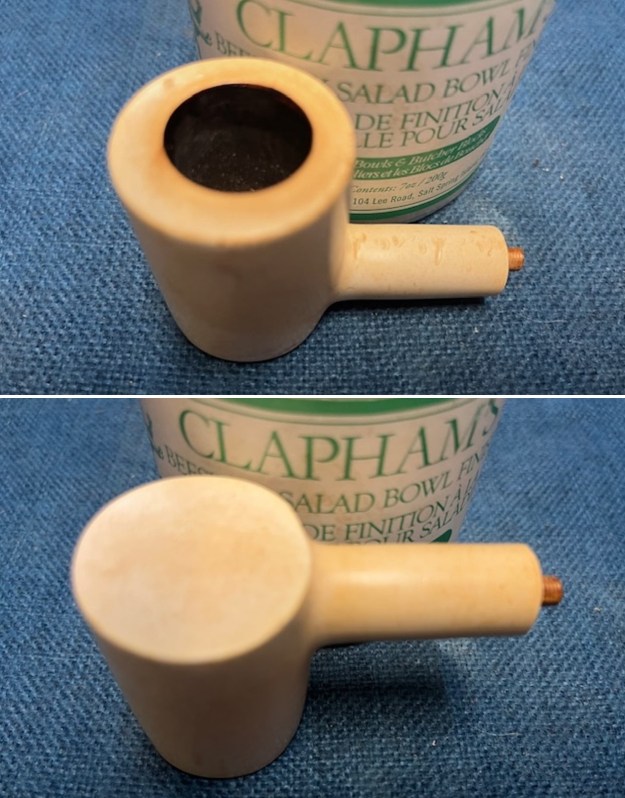
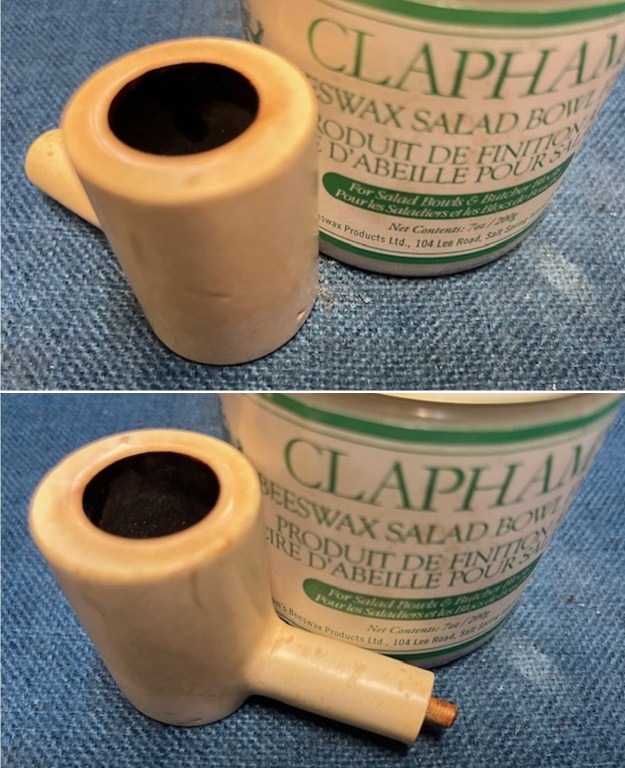
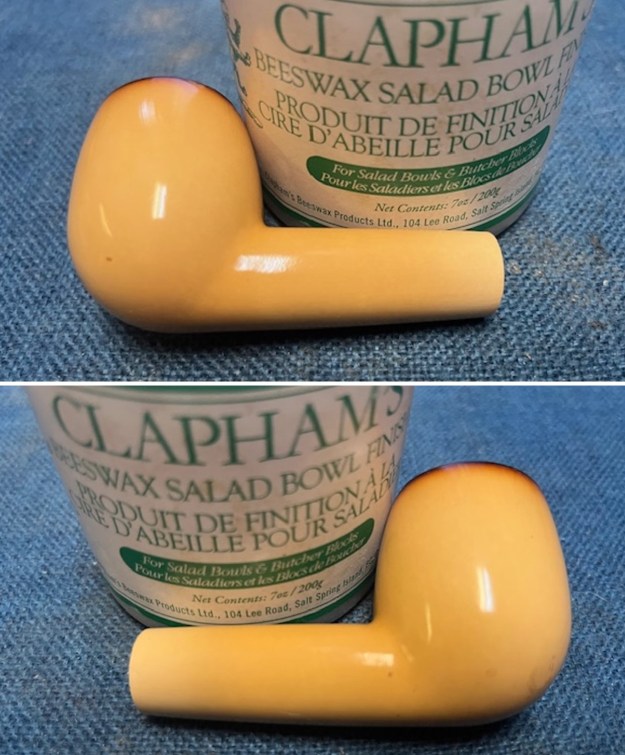
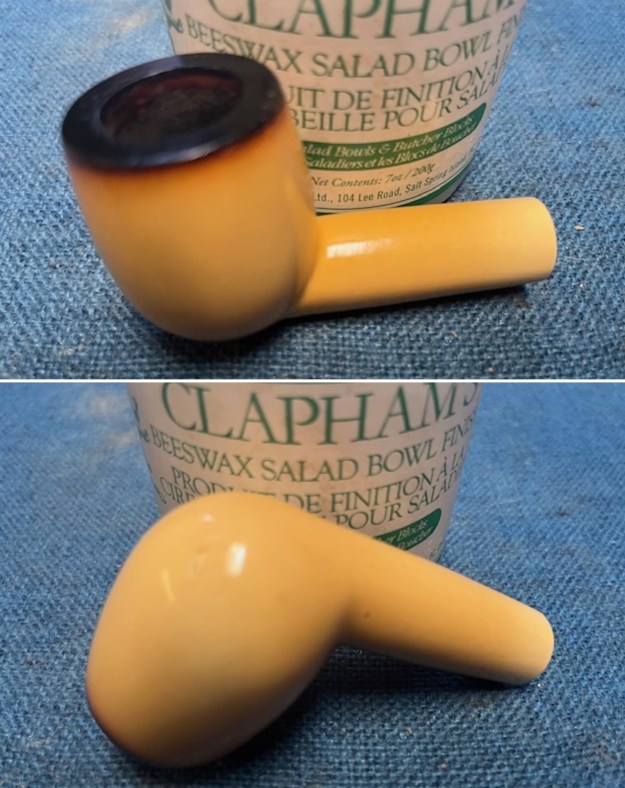
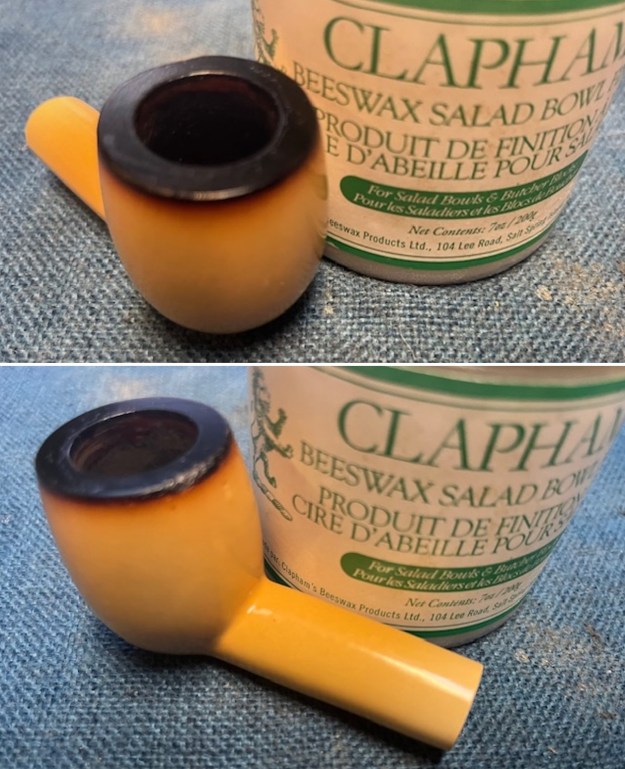
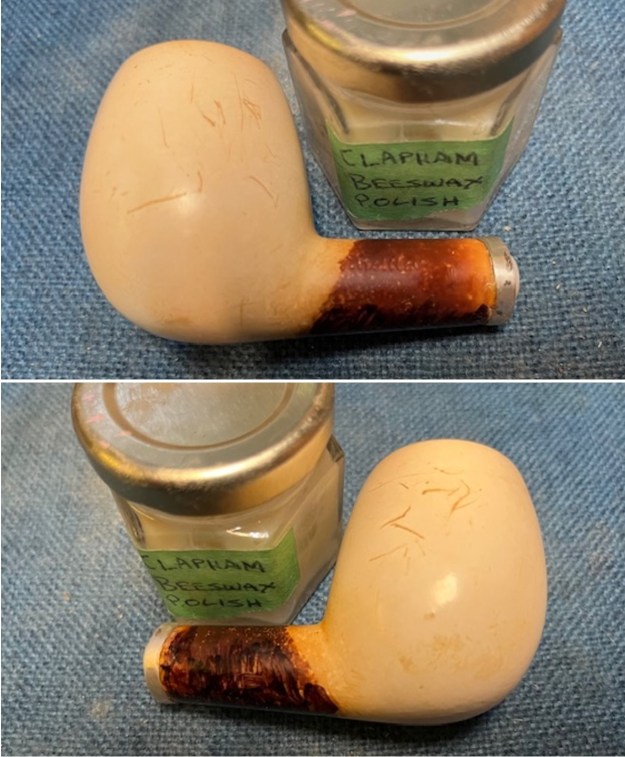
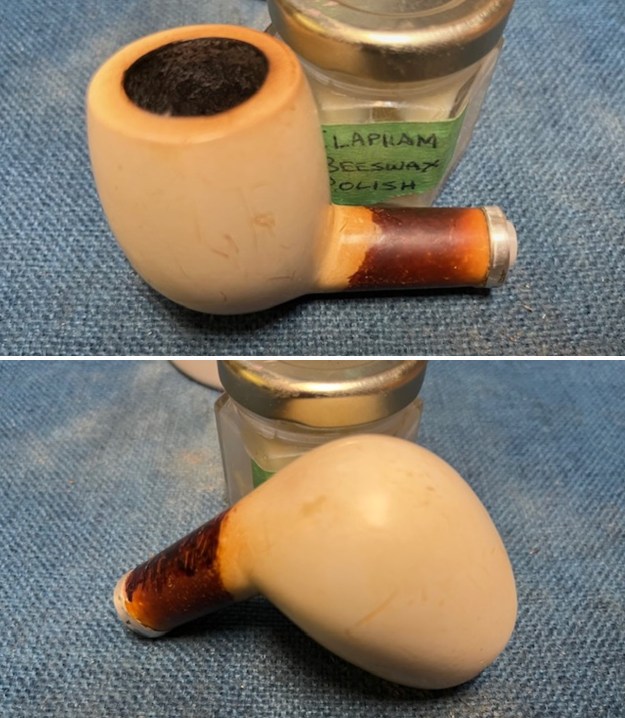
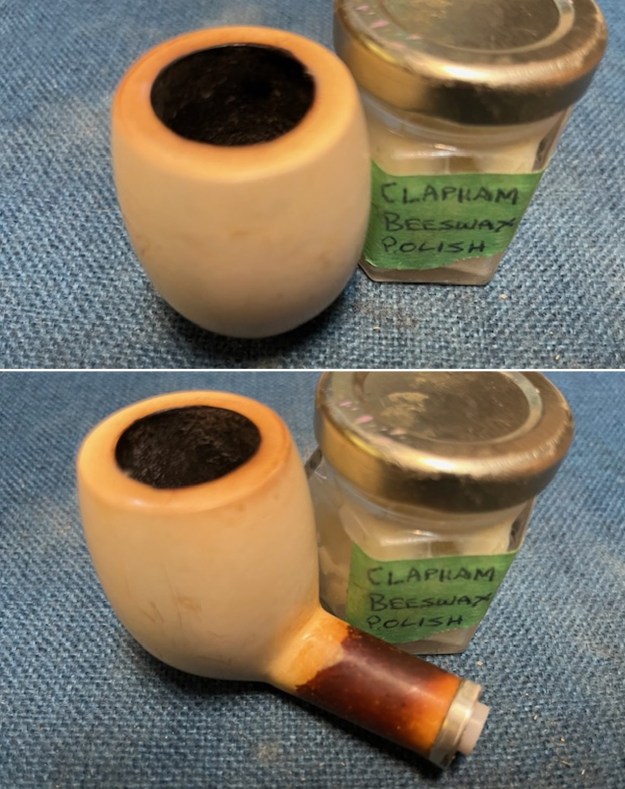
Jeff had done a great job cleaning up the pipe as usual. He reamed the pipe with a PipNet reamer and cut back the cake back to the bare meerschaum. He cleaned up the walls with a Savinelli Fitsall Pipe Knife. He scrubbed the interior of the bowl and shank with pipe cleaners, shank brushes, cotton swabs and alcohol to remove the tars and oils. He scrubbed the exterior of the pipe with Murphy’s Oil Soap and a tooth brush to remove the grime from the finish. He worked on the rim top lava and darkening with the soap and tooth brush. He scrubbed the inside of the stem with alcohol and pipe cleaners. He scrubbed the exterior with Soft Scrub and then soaked it in Briarville’s Pipe Stem Deoxidizer. He washed it off with warm water to remove the Deoxidizer. The pipe looked very good when it arrived. I took close up photos of the rim top and the stem surface. I wanted to show how well it had cleaned up. The rim top and edges looked very good. There was still some debris in the rustication on the rim top. I took photos of the stem to show the condition it was in. There was light chatter on both sides ahead of the button.I took a photo of the stamping on side of the stem. You can see that it is stamped as noted above and is clear and readable. I took the pipe apart and took a photo of the pipe. It is a good looking pipe with great grain.I used a brass bristle wire brush to cleanup the debris in the rustication on the rim top. I knocked out the debris with the brush and the top looked much better and the rustication showed clearly.I worked some Clapham’s Beeswax/Carnauba wax into the finish of the bowl. I used a horsehair show brush to work it into the rusticated finish. I set it aside to allow the wax to dry. I buffed the pipe with a soft cotton cloth to raise the shine on the meerschaum. I set the bowl aside and turned my attention to the stem. I “painted” the stem with the flame of a lighter to try and lift the tooth marks. I was able to lift some of them. I filled in the remaining tooth marks in the stem surface with black CA glue. I set the stem aside to let the repairs cure. Once the glue cured I used a small file to flatten the repairs on the surface of the stem. I used a piece of 220 grit sandpaper to blend them into the surrounding vulcanite. I sanded the stem with 320-3500 grit sanding pads to remove the tooth marks and chatter against the button edge and sand the logo. It worked well on the tooth marks but did little on the logo on the stem top.I touched up the P stamp on the saddle side with white acrylic fingernail polish. I worked it into the stamp with a tooth pick. Once it cured I scraped off the excess then ran some 1500 grit micromesh over the surface. It looked very good.I polished the stem with micromesh sanding pads – dry sanding with 1500-12000 grit sanding pads. I wiped it down after each sanding pad with Obsidian Oil. I polished it with Before & After Pipe Stem Polish – both Fine and Extra Fine. I put the stem back on the Rusticated Peterson’s Block Meerschaum Bulldog and took it to the buffer. I buffed the stem with Blue Diamond to polish the vulcanite. Blue Diamond does a great job on the smaller scratches that remain on the surface. I gave the bowl multiple coats of Clapham Wax and the stem several coats of carnauba wax and buffed the pipe with a clean buffing pad to raise the shine. I hand buffed it with a microfiber cloth to deepen the shine. I am amazed at how well it turned out. The finished pipe is shown in the photos below. This is a beautiful Peterson’s Genuine Meerschaum Bulldog with a rusticated finish and the vulcanite saddle stem has a great look. The dimensions of the pipe are Length: 5 ½ inches, Height: 1 ½ inches, Outside diameter of the bowl: 1 ¼ inches, Chamber diameter: ¾ of an inch. The weight of the pipe is 1.31 ounces/37 grams. This is another pipe that I will be putting on the rebornpipes online store in the Irish Pipemakers Section shortly, if you are interested in adding it to your collection. Thanks for walking through the restoration with me on this beauty!

As always, I encourage your questions and comments as you read the blog. Thanks to each of you who are reading this blog. Remember we are not pipe owners; we are pipe men and women who hold our pipes in trust until they pass on into the trust of those who follow us.

Restoring a Father’s Legacy of 10 Brigham Pipes Gathered throughout his life


by Steve Laug

Early this month I was contacted by Donna to see if I knew anyone interested in purchasing her father’s pipes. She wrote as follows: “I am wondering if you would be interested in my father’s collection of Brighams.” She further spelled out what he had in the collection. He had 1 – 2 dot pipe, 3 – 3 dot pipes, 2 – 4 dot pipes and 4 – 5 dot pipes. There was a total of 10 pipes. I asked for a photo of the pipes and she sent the photo below. I was very interested.We emailed back and forth and the short story is that I paid for the collection and she shipped the pipes to me. On Tuesday after Easter the box arrived and I was happy to be able to see them up close. They were obviously well-loved pipes and in varying degrees of needing work. I wrote her and told I received them and that I was pleased with the lot. I was looking forward to working on them. She asked me to send her photos along the way as I finished the pipes. I will be sending her the links to the blog so she can see the work and the process of bringing them back to a semblance of their original beauty. Thanks Donna for the opportunity to work on your Dad’s pipes.

The first of the pipes I have chose to work on from the lot was the first one at the top of the left column in the photo above. It is stamped on the underside of the shank and reads 429 followed by Brigham in script over Canada. The stamping will help me date the pipe. From the cake in the bowl and the other pipes I could tell her Dad love aromatic tobaccos. This pipe was heavily caked with an overflow of lava on the rim top and on the inner and outer edges of the bowl. The shank end was rounded and even that had a coating of tar build up. The stem did not sit all the way in the shank so I assumed it was very dirty in the shank. I removed the stem and found that the Hard Rock Maple Distillator was frozen in the aluminum tenon. The shank was black, tarry and oily. The stem was oxidized, calcified and had light tooth marks and chatter on both sides ahead of the button. The left side of the taper stem bore four brass pins in a triangle format. That would also help with identifying the pipe. I took some photos of the pipe before I started my work on it. I took a photo of the bowl and rim top to show the cake in the bowl. The rim top looked to have a coat of lava overflowing down the crown with some possible damage around the inner edge. I took photos of the top and underside of the stem showing the tooth chatter, scratching and oxidation on the stem surface and wear on the edges of the button.The stamping is very clear and it reads as noted above. I removed the stem from the shank and took a photo of the parts to show the look of the pipe. I have captured the pattern of the four brass dots on the stem.For the needed background I am including the information from Pipedia on Brigham pipes. It is a great read in terms of the history of the brand (https://pipedia.org/wiki/Brigham_Pipes). Charles Lemon (Dadspipes) has written book on the history of the brand. This article is a good summary. I have included it below.

Roy Brigham, after serving an apprenticeship under an Austrian pipesmith, started his own pipe repair shop in Toronto, in 1906. By 1918 the business had grown to include five other craftsmen and had developed a reputation across Canada for the high quality of workmanship. After repairing many different brands of pipes over the years, Roy noted certain recurring complaints by pipe smokers, the most common referred to as “tongue bite”. Tongue bite is a burning sensation on the smoker’s tongue, previously thought to be due to the heat of the smoke (i.e. a “hot smoking pipe”).

He soon began manufacturing his own pipes, which were lightweight, yet featured a more rugged construction, strengthening the weak points observed in other pipes. The problem of tongue bite intrigued him, and he decided to make overcoming it a future goal.

About 1938, Roy’s son Herb joined him to assist in the business. The business barely survived the great depression because pipes were considered to be a luxury, not a necessity, and selling pipes was difficult indeed. In approximately 1937 [1], after some experimentation, Roy and Herb discovered that tongue bite was in fact a form of mild chemical burn to the tongue, caused by tars and acids in the smoke. They found that by filtering the smoke, it was possible to retain the flavour of the tobacco and yet remove these impurities and thereby stop the tongue bite.

Just as Thomas Edison had searched far and wide for the perfect material from which to make the first electric light bulb filaments, Roy & Herb began experimenting with many materials, both common and exotic, in the quest for the perfect pipe filter. Results varied wildly. Most of the materials didn’t work at all and some actually imparted their own flavour into the smoke. They eventually found just two materials that were satisfactory in pipes: bamboo and rock maple. As bamboo was obviously not as readily available, rock maple then became the logical choice.

They were able to manufacture a replaceable hollow wooden tube made from rock maple dowelling, which when inserted into a specially made pipe, caused absolutely no restriction to the draw of the pipe, yet extracted many of the impurities which had caused tongue bite. The result was indeed a truly better smoking pipe…

I then turned to a second article by Charles Lemon called, “A Closer Look at the Dots, Dates, and Markings of Brigham Pipes” to be able to pin down the time frame that the pipe was made in and to help interpret the stampings and shape number on the pipe. Here is the link to his article (https://pipedia.org/wiki/Brigham_Pipes_%E2%80%93_A_Closer_Look_at_Dots,_Dates_and_Markings).

I have dubbed the decades between 1980 and 2000 the Late Canadian Era, a period that saw several changes at Brigham that are of note to the collector. First, the traditional 8-grade pinning system (the famous Brigham “Dots” which denoted the quality of the pipe) was changed to a 7-grade system to simplify pinning (more on this below), and the Norsemen and Valhalla series were merged to form the President Series, which represented the very finest pipes coming out of the Toronto factory. Early pipes from this era (left, below) are stamped with a shape number and “Brigham” over “Canada”; later pipes (late 1980s+, on right below) are stamped simply with a shape number and the Brigham logo.

I read further in the article to the section entitled Revised Dot System 1980. I quote from that below.

Brigham changed the Dot system in 1980, adding a 7 Dot at the top of the line, dropping the names of each series and eliminating the confusing vertical and horizontal 3 Dot configurations. The Norsemen and Valhalla series were combined to form the President series of freehand pipes, which adopted a 3 Dot pattern with a larger dot on the right as shown below. The 7- grade pinning system stayed in place from 1980 to 2001.

With the information from article and the chart above I knew what I was dealing with in terms of the stamping and the age of this pipe. I learned that this Late Canadian Era was made between 1980-2000. The pipe is a Brigham (4-Dot) 429 Bent Apple. The stamping pins it down to pre-1990 when the stamp dropped the Canada portion of the stamping. Now it was time to work on the pipe.

I started my work on the pipe by reaming the bowl with a PipNet reamer. I used the first and second cutting heads and took the cake back to bare briar. I cleaned up the reaming with a Savinelli Fitsall Pipe Knife and removed all the remnants of the cake. I sanded the walls of the bowl with a piece of dowel wrapped in 220 grit sandpaper. The walls looks very good at this point in the process. While I worked on the bowl I dropped the stem in an alcohol bath to loosen the Distillator from the aluminum tenon. It was solidly stuck in the metal. When I removed it from the bath after working on the bowl I was able to remove it easily. It was dirty but at least it was free of the metal. I cleaned out the shank, the airway and the deep mortise with alcohol, cotton swabs, hard bristle and soft bristle pipe cleaners. It was a very dirty pipe which just meant that Donna’s Dad had really enjoyed and used this pipe. I cleaned the inside of the aluminum tenon and the airway in the stem with alcohol, cotton swabs and pipe cleaners in the same way as I did the shank. It also was very dirty.I scrubbed the exterior of the bowl and shank with a tooth brush and undiluted Murphy’s Oil Soap. I scrubbed the lava on the rim top and overflow on the outside of the bowl with the soap. I rinsed the briar with warm water to remove the grime and debris of the scrubbing. It looked significantly better after the scrubbing. I sanded the smooth portions of the bowl and rim with 320-3500 grit sanding pads to remove the marks, scratches and darkening on the rim top. I polished it with micromesh sanding pads – dry sanding it with 1200-15000 grit pads. I wiped the bowl down with a damp cloth after each sanding pad. The grain really started to rise to the surface as I polished it. I rubbed the bowl and shank down with Before & After Restoration Balm to deep clean the finish on the bowl and shank. The product works to clean, enliven and protect the briar. I worked it in with my fingers to get it into the briar. I used a horsehair shoe brush to work it into the sand blast. I let it sit for 10 minutes then I wiped it off and buffed it with a soft cloth. The briar really began to have a rich shine. I took some photos of the bowl at this point to mark the progress in the restoration. It is a beautiful bowl. I set the bowl aside and turned my attention to the stem. I scrubbed the stem down with Soft Scrub Cleanser and cotton pads to break through the oxidation on the stem. It looked much better than when I began.I set the bowl aside and turned my attention to the stem. I sanded the surface of the vulcanite with the 2 inch sanding pads – 320-3500 grit pads. I dry sanded the surface until I have removed all of the oxidation and the stem started to really shine.I refit the aluminum tenon with the Brigham Rock Maple Distillator. It is a unique and cool smoking experience. I polished the stem with micromesh sanding pads – dry sanding with 1500-12000 grit pads. I wiped the stem down after each sanding pad with Obsidian Oil. I polished the stem with Before & After Pipe Stem Polish – both Fine and Extra Fine. I gave it a coat of Obsidian Pipe Stem Oil. It works to protect the stem from oxidizing. I set it aside to dry. The final steps in my process involve using the buffer. I buffed the bowl and stem with Blue Diamond to polish out the light scratches in the briar and the vulcanite. I gave the bowl multiple coats of Conservator’s Wax and the stem multiple coats of carnauba wax. I have found that I can get a deeper shine if I follow up the wax buff with a buff with a clean buffing pad. It works to raise the shine and then I hand buff with a microfiber cloth to deepen the shine. It is always fun for me to see what the polished bowl looks like with the polished stem. It really is a nice pipe. The rusticated finish around the bowl sides and shank looks great with the vulcanite stem. The Brigham Canada Apple 429feels great in my hand. It is a well balanced pipe. Have a look at it with the photos below. The dimensions are Length: 6 inches, Height: 1 ½ inches, Outside diameter of the bowl: 1 ¼ inches, Chamber diameter: ¾ of an inch. The weight of the pipe is 1.41 ounces/41 grams. It is a beautiful pipe that I will soon be adding to the rebornpipes store in the Canadian Pipemakers Section. If you would like to add it to your collection let me know. It should be a great smoking pipe.

As always, I encourage your questions and comments as you read the blog. Thanks to each of you who are reading this blog. Remember we are not pipe owners; we are pipe men and women who hold our pipes in trust until they pass on into the trust of those who follow us.

Restoring a Stanwell Made in Denmark Colonial 191


by Steve Laug

I moved on to work on another pipe. The next one I chose was another Stanwell. We purchased this on a Facebook auction on 05/06/2018 from a seller in Oceanside, New York, USA. The stamping on the pipe was very clear and readable. On the left underside of the diamond shank it reads Stanwell [over] Made in Denmark [over] Colonial. On the right underside of the shank, next to the shank was the shape number 191. The stem had a gold stamped Crowned “S” Stanwell logo on the left side of the saddle stem. The bowl had a thick cake that overflowed onto the rim top and edges in thick lava. There were spots where it ran down the outer edges of the bowl. The finish was in okay condition underneath grime and oils ground into the surface of the bowl. The twin rings around the bowl cap were filled in with grime but appeared to be in good condition. The stem was dirty acrylic and had been protected from tooth marks by a Softee Bit. It showed a lot of promise through the grime. The pipe was well used and was obviously someone’s favourite pipe! Jeff took photos of the pipe as he saw it at this stage of his clean up. The next photos of the rim and the shank show the condition of the pipe at arrival in Idaho. The grain around the rim top is quite stunning to me. You can see the cake in the bowl and the grime on the top. It was a mess but the stain makes the grain even show through the grime around the bowl sides and cap. Jeff removed the softee bit from the stem to see what it hid. The stem looked good with light marks on the top and underside at the button edge. Jeff took photos of the grain on the sides and heel of the bowl. It really is a stunning piece of briar. The contrast stain really makes it stand out clearly. The next photos show the various stamping on the shank sides and bottom. It is clear and readable as noted above. He also captured the Silver Crown “S” Stanwell logo on the left side of the saddle stem. I did some looking through the catalogues on Pipedia and the information there and did not find the line listed. I did have a look at the article on Shape Numbers and Designers there (https://pipedia.org/wiki/Stanwell_Shape_Numbers_and_Designers). From there I found that the shape 191 is a small Rhodesian that was designed originally by Tom Eltang.

Jeff had done a great job cleaning up the pipe as usual. He reamed the pipe with a PipNet reamer and cut back the cake back to the bare briar. He cleaned up the walls with a Savinelli Fitsall Pipe Knife. He scrubbed the interior of the bowl and shank with pipe cleaners, cotton swabs and alcohol to remove the tars and oils. He scrubbed the exterior of the pipe with Murphy’s Oil Soap and a tooth brush to remove the grime from the finish. He worked on the rim top lava and darkening with the soap and tooth brush. He scrubbed the inside of the stem with alcohol and pipe cleaners. He scrubbed the exterior with Soft Scrub and then soaked it in Briarville’s Pipe Stem Deoxidizer. He washed it off with warm water to remove the Deoxidizer. The pipe looked far better when it arrived. I took photos of the bowl and rim top as well as the stem to show how clean they were. You can see that rim top and edges look very good. The stem is clean and the tooth and chatter on both sides ahead of the button is very light.I took photos of the stamping on the sides of the shank. The stamping is readable as noted above. I took the stem off the shank and took a photo to give a sense of the flow and proportion of the pipe. It is a beautiful looking pipe.I started my work on the pipe by addressing the burn marks and damage on the inner edge of the rim. I used a folded piece of 220 grit sandpaper to smooth out the damage and shape the inner edge.I polished the briar with micromesh because it was in such good condition. I polished it with 1500-12000 grit micromesh sanding pads. I wiped the bowl down after each sanding pad with a damp cloth. I rubbed the briar down with Before & After Restoration Balm. I worked it into the briar with my fingertips. The product works to clean, enliven and preserve the briar. I let it sit for 10 minutes while I worked on the stem. After the time passed I buffed it with a cotton cloth to deepen the shine. The briar really comes alive with the balm. I set the bowl aside and turned my attention to the stem. I polished the stem with micromesh sanding pads – dry sanding with 1500-12000 grit pads. I wiped the stem down after each sanding pad with Obsidian Oil. I polished it with Before & After Pipe Stem Polish – both Fine and Extra Fine. I gave it a coat of Obsidian Pipe Stem Oil. It works to protect the stem from oxidizing. I set it aside to dry. I am excited to put the finishing touches on this Tom Eltang Made in Denmark Stanwell Colonial 191 Rhodesian. I put the pipe back together and buffed it with Blue Diamond on the buffing wheel. I gave the bowl and the stem multiple coats of carnauba wax. I buffed the pipe with a clean buffing pad to raise the shine and hand buffed it with microfiber cloth to deepen the shine. It is fun to see what the polished bowl looks like with the polished black, fancy turned vulcanite stem was beautiful. This Stanwell Made in Denmark Colonial 191 is nice looking and the pipe feels great in my hand. It is light and well balanced. Have a look at it with the photos below. The dimensions are Length: 5 inches, Height: 1 ¾ inches, Outside diameter of the bowl: 1 ¼ inches, Chamber diameter: ¾ of an inch. The weight of the pipe is 1.69 ounces/48 grams. It is a beautiful pipe and one that I will be putting in the Danish Pipemakers Section on the rebornpipes store. Thanks for walking through the cleanup with me as I worked over this pipe.

As always, I encourage your questions and comments as you read the blog. Thanks to each of you who are reading this blog. Remember we are not pipe owners; we are pipe men and women who hold our pipes in trust until they pass on into the trust of those who follow us.

Cleaning Up a Terrific Jobey Stromboli 200 Bulldog


by Kenneth Lieblich

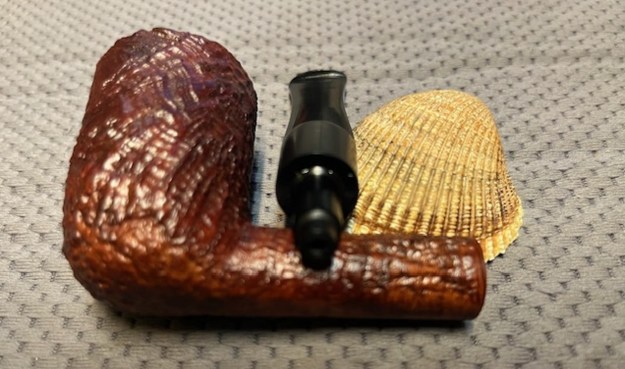
Ah, there’s something awfully satisfying about a really rugged rustication – the craggy, rock-like formation is a very fine thing. This Jobey Stromboli 200 bent bulldog has that great rustication in spades. The pipe had a precise diamond shank and a beautiful acrylic stem with a Jobey link system screw tenon. I acquired this pipe in a lot, where most of the pipes had been very well cared for. This was no exception and looked like a fun pipe to restore. On the underside of the shank were the markings. They read Jobey [over] Stromboli [over] 200. To the right of that, at a 90-degree angle from the other text, was the word France. Finally, on the stem was the Jobey logo in a brass oval. Regarding Jobey, Pipephil tells us that “These pipes are made in St Claude (France) by Butz-Choquin (Berrod-Regad group) since 1987. Before this date some were manufactured in England and Denmark (Jobey Dansk).”This Jobey was in very good condition and didn’t require much work – as the photos attest. The stem had only minimal wear and was hardly dirty. The stummel was equally clean, but the rim had been lit a bit aggressively. Perhaps a cigar lighter was foolishly used – who knows? Moving on… Since the stem is acrylic, there is no issue with oxidation. I used oil soap on a few cotton rounds and wiped the stem down to provide an initial cleaning before moving on to the next steps. The primary cleaning comes next. I cleaned the inside of the stem with both pipe cleaners and cotton swabs dipped in 99% lemon-infused isopropyl alcohol. I scrubbed thoroughly to make sure the interior was clean. Actually, it was quite clean to start with. Holding the stem to the light, you can see how clean it is – if it was heavily smoked, this would be very dark. Now that the stem is clean and dry, I set about fixing the few marks in the acrylic. This is done by filling those divots with clear cyanoacrylate adhesive. I left this to cure and moved on. The penultimate step for the stem is sanding. First, with my set of needle files, I reduce the bulk of the cyanoacrylate repairs. I want to remove the excess adhesive as near to the surface as possible, without cutting into the acrylic. Following that, I use all nine of the micromesh sanding pads (1,500 through 12,000 grit) to sand out flaws and provide gentle polishing of the finished surface. I also apply pipe-stem oil while using the last five micromesh pads. There was a wonderful shine to the stem when I was done. Now that the stem is (nearly) complete, I can move on to the stummel. The first step for me is to ream out the bowl – that is to say, remove all the cake inside the bowl. This accomplishes a couple of things. First (and most obviously), it cleans the bowl and provides a refurbished chamber for future smoking. Second, when the old cake is removed, I can inspect the interior walls of the bowl and determine if there is damage or not. The pipe was so seldom used that I only used a piece of sandpaper taped to a wooden dowel. This ensured that all the debris is removed.My next step was to remove the lava on the rim. For this, I took a piece of machine steel and gently scraped the lava away. The metal’s edge is sharp enough to remove what I need, but not so sharp that it damages the rim. This work revealed that some minor scorching had occurred. It wasn’t serious, but I would have to repair it. Similar to the stem, I then cleaned the stummel with both pipe cleaners and cotton swabs dipped in 99% lemon-infused isopropyl alcohol.To tidy up the briar, I also wiped down the outside with some oil soap on cotton rounds (and a toothbrush). This does a good job of cleaning any latent dirt on the surface of the briar.The last step of the cleaning process is to scour the inside of the stummel with some soap and tube brushes.In order to lessen the burns on the rim, I ‘topped’ the pipe – that is to say, I gently and evenly sanded the rim on a piece of 220-grit sandpaper. This effectively minimizes the damage, without altering the look of the pipe. I used all nine micromesh pads (1,500 through 12,000 grit) on the rim to finish it off. This sanding minimizes flaws in the briar and provides a beautiful smoothness to the wood. After that, the bare wood needed to be tinted in the same colour as the rest of the stummel. I used some of my furniture pens (which is simply dye in pen form) to match the colours. I rubbed some Before & After Restoration Balm into the briar and let it sit for 20 minutes or so. The balm moisturizes the wood and gives a beautiful depth to the briar. I then buffed it with a microfibre cloth and a horsehair brush. For the final step, I took the pipe to my bench buffer and carefully polished it with three coats of conservator’s wax. This procedure makes the pipe look its best – the stummel sings and the stem glows.All done! This Jobey Stromboli 200 Bulldog looks fantastic again and is ready to be enjoyed by its next owner. I am pleased to announce that this pipe is for sale! If you are interested in acquiring it for your collection, please have a look in the ‘French’ section of the store here on Steve’s website. You can also email me directly at kenneth@knightsofthepipe.com. The approximate dimensions of the pipe are as follows: length 5⅔ in. (144 mm); height 1½ in. (39 mm); bowl diameter 1⅔ in. (42 mm); chamber diameter ¾ in. (19 mm). The weight of the pipe is 1¼ oz. (37 g). I hope you enjoyed reading the story of this pipe’s restoration as much as I enjoyed restoring it. If you are interested in more of my work, please follow me here on Steve’s website or send me an email. Thank you very much for reading and, as always, I welcome and encourage your comments.

Cleaning up a Beautiful Rogers Rarity Imported 285 Bruyere Large Bowl Pot


by Steve Laug

The next pipe is a really neat looking chubby, large bowled Pot with a vulcanite saddle stem. The thick shank and stubby looking pipe was made to hold in your hand. It is quite light weight for its size and the blade on the stem is thin and looks comfortable. We picked up this pipe from an antique Store in Ogden, Utah, USA on 10/10/2024. It is stamped on the left side of the shank and reads Rogers [over] Rarity in an oval. On the right side it is stamped Imported [arched over] 285 [over] Bruyere. The pipe came with dents in the heel of the bowl and was oily and dirty looking. There was a heavy cake in the bowl and an eruption of thick lava on the rim top – heavier on the sides and back of the bowl It was hard to know the condition of the rim top and rim edges because of the grime and thickness of the cake and lava. The cleaning would make it very clear! The stem was dirty and lightly oxidized with light tooth marks and chatter on both sides but nothing like what I was expecting from the condition of the bowl. Jeff took photos of the pipe to give a clear picture of what we were up against with this pipe. He captured the cake in the bowl and the thick eruption of lava on the rim top and edges exceptionally well in the next photos. It was very clear that the pipe had not been seriously cleaned since the first smoke. But it is also very clear that it was an exceptional smoker! The stem is oxidized, calcified and shows the took marks on the button surface and chatter on both sides ahead of the button. Jeff once again captured some of the beauty of the shape and the grain in the next photos. You can certainly see what lies beneath the grime and even paint on the briar.He took photos of the heel of the bowl to shoe the deep dents in the surface of the briar from hammering it against a hard surface.He took photos of the stamping on the top left and right of the shank. It is clear and readable as noted above.From reading Bill Unger’s book on Custom-Bilt Pipes I remember “Rogers Rarity” was made by the same company as one of it non-sculptured or rusticated pipes. I did a Google search to see if I could confirm that online. I found a pipe labeled Rogers Rarity for sale on Worthpoint, an online sales site (https://www.worthpoint.com/worthopedia/rogers-rarity-custombilt-large-briar-1821532853). In the description they made the link to Custombilt. I quote:

Rogers Rarity briar pipes were made by Custombilt, and show all the beauty and originality of the brand.

I searched further and found a conversation asking about the brand on Pipesmagazine online forum. There was a great conversation about the brand.

(https://pipesmagazine.com/forums/threads/help-with-dating-a-pipe.62314/). I found a particular response by Jon Guss of the Seattle Pipe Club particularly helpful. I quote from Jon in full.

First, “Rodgers” is a misspelling; it was always spelled “Rogers”. Three generations of the Rogers family ran one of the leading importers of pipes (including Petersons for a number of years) and resellers of pipes and smokers articles; they also did a bit of manufacturing. The name of the company was Rogers Imports, Inc.

Second, for several reasons I also believe that Rogers Rarity pipes were made for Rogers Imports by CustomBilt.

The Rogers Rarity line was introduced by the company in late 1945. The advertising copy from the spring of 1946 described Rogers Rarity pipes as “The height of pipe luxury and enjoyment”, and claimed that they were “Carved by hand of Algerian bruyere over 150 years old”. Was it true? I would guess not, but age fabrication regarding the briar from which pipes were made was a kind of industry trope for generations. While most of the Rarity pipes apparently sold for $5, the listed price range stated various models cost from $5-25. The $5 pipes were available in natural and grain finishes; there was also a $10 version called the Rogers Rarity Deluxe that was sterling banded and meerschaum lined.

I can’t be sure when the line ceased production, but believe it was by the end of 1949. Certainly Rogers Rarity pipes are no longer listed in the RTDA Almanac from 1950 on, and mentions of the pipe in advertisements to consumers become thin on the ground. More tellingly newspaper ads from 1951 show the pipe heavily discounted, suggesting that excess inventory of an obsolete line was being flushed through the channel…

Now I knew that my memory was correct. The pipe was made by CustomBilt for Rogers Imports. I also knew that it was made between 1945-1949 when the line was no longer made. It was a bit of an old timer… Now it was time to work on the pipe.

I was amazed at how clean and new the pipe looked when I took it out of the box. It is really a beautiful piece. Jeff had done a great cleanup on the pipe. He reamed the bowl with a PipNet pipe reamer and followed up with a Savinelli Fitsall pipe knife to remove the cake. He scrubbed out the mortise and the airway in the shank and the stem with alcohol, cotton swabs and pipe cleaners. He scrubbed the bowl exterior with a tooth brush and Murphy’s Oil Soap to remove the grime on the finish of the bowl and the lava from the rim top. He rinsed it under running water. One of the benefits of this scrub is that it also tends to lift some of the scratches and nicks in the surface of the briar. He dried it off with a soft cloth. He cleaned the internals and externals of the stem with alcohol, pipe cleaners and cotton swabs. He soaked the stem in Briarville’s Pipe Stem Deoxidizer and rinsed it off with warm water and cleaned out the airway in the stem with alcohol. I took photos of the pipe as I saw it when I put it on the table. I took photos of the rim top and stem to show the condition. The rim top looked pretty good but the inner edge of the bowl showed some damage and was out of round. There was also some nicks on the outer edge of the bowl on the front. The stem was vulcanite and there were light tooth marks and chatter on both sides ahead of the button.The stamping on the top left and right sides of the shank are clear and readable. It reads as noted above. I also removed the stem and took a photo of the parts of the pipe to give a sense of the size of this beauty. I started my work on this pipe by dealing with the dents in the heel of the bowl. I steamed them out as much as possible with a hot knife and a damp cloth, but it did not do too much. I then moved on to a hot iron and a damp cloth as the dents were quite extensive. I was able to raise the majority of them. Some left scars but they are smooth. I sanded the surface of the heel with a 320 grit sanding pad to work them into the briar. I moved on to the damage to the inner edge of the bowl. I used a folded piece of 220 grit sandpaper to smooth out the inner edge and give it form once again. I sanded the rim top with a 320 grit sanding pad. The cleaned up rim top and inner edge looked very good.I sanded the exterior of the bowl with 320-3500 grit sanding pads. I wiped it down with a damp cloth after each sanding pad to remove the sanding debris. The bowl began to take on a rich shine and the grain really stood out. I polished the briar with 1200-1500 micromesh sanding pads and wiping it down with damp cloth after each sanding pad. As I worked through the cycle of pads the shine developed with each change of pad. The pipe looks very good. I rubbed the bowl and shank down with Before & After Restoration Balm. I worked it into the surface of the bowl sides and shank with my fingertips to clean, enliven and protect the briar. I let the balm sit for 10 minutes, then buffed with a cotton cloth to raise the shine. The Balm did its magic and the grain stood out on the briar. I set the bowl aside and turned to the stem. I “painted” the surface of the stem with the flame of a lighter to lift the tooth marks. It worked very well. What remained I was able to sand smooth with 220 grit sandpaper. I sanded the stem with 320-3500 grit sanding pads and wiped the stem down after each pad with some Obsidian Oil on a cloth. The shine is coming back beautifully.I polished it with micromesh sanding pads – 1500-12000 grit pads. I wiped it down with Obsidian Oil after each sanding pad. This Chubby 1945-49 Rogers Rarity 285 Imported Bruyere Pot with a vulcanite saddle stem is a well grained pipe with a flowing shape that looks great . The rich browns of the darkened natural finish make the grain come alive with the polishing and waxing. I put the stem back on the bowl and carefully buffed the pipe with Blue Diamond on the buffing wheel using a light touch on the briar. I gave the bowl and the stem multiple coats of carnauba wax on the buffing wheel and followed that by buffing the entire pipe with a clean buffing pad. I hand buffed the pipe with a microfiber cloth to deepen the shine. The finished Rogers Rarity Pot really is a beauty and fits nicely in the hand and looks very good. Give the finished pipe a look in the photos below. The dimensions of the pipe are Length: 5 inches, Height: 1 ½ inches, Outside diameter of the bowl: 1 ¾ inches, Chamber diameter: 1 inch. The weight of the pipe is 1.76 ounces/50 grams. This old timer will soon be on the American Pipe Makers Section of the rebornpipes store if you would like to add it to your collection. Thanks for reading this blog and my reflections on the pipe while I worked on it. There are many more to come!

Breathing New Life into Dunhill Shell Briar RF F/T Pot


by Steve Laug

The next pipe on the table is one that we picked up from our contact in Copenhagen, Denmark on 08/09/2024. The Shell Briar Sandblast finish on this English made Pot shaped pipe and the white spot on the topside of the taper vulcanite stem are what caught our eye. It is stamped on the heel of the bowl and shank and reads RF followed by F/T followed by Dunhill [over] Shell Briar. That is followed by Made in [over] England with an underlined superscript 11 after the D. A circle 4 S is at the end of the stamping. It has a classic Shell Briar mixed brown/oxblood/black stain on the sandblast finish that is a stark contrast to the black vulcanite taper stem. It has a lot of grime and dirt in the sandblast finish on the bowl and straight shank Pot. The bowl was heavily caked around the top third of the bowl and the inner edge and the top were covered with a light lava coat in the sandblast. The vulcanite stem was heavily oxidized and had tooth marks and chatter on both sides ahead of the button. The white spot logo on the topside of the taper stem looks to be in good condition. Jeff took some photos of the pipe to show the general condition of the pipe before he started his clean up. He took some photos of the rim top and bowl from various angles to give me a clear picture of the condition of the rim top and bowl. The inside of the bowl is heavily caked around the top 1/3 of the bowl and there was lava on the inner edge and in the sandblast on the rim top. He included photos that show the top and underside of the stem. It is as described above. Jeff took some photos of the sides and heel of the bowl to show the condition of the rusticated finish on the pipe. The photos showed some great grain around the bowl and shank even with the grime in the finish. It is a great looking piece of briar. He took a photo of the stamping on the heel of the bowl and the underside of the shank. It was clear and readable as noted above. I wanted to unpack the Dunhill stamping on the shank and work to understand each element of the stamp. I generally use the Pipephil site to gather as much initial information as possible (http://pipephil.eu/logos/en/dunhill/shell-briar1.html). The stamping is interpreted as follows: The shape is defined as RF is the shape reference for a taper stem Pot. The F/T is the designation for a Fish Tail stem. The Shell Briar stamp refers to the finish. The underlined, superscript number 11 following the D of England would give the date the pipe. The circle 4S tells me that the pipe is a group 4 sized pipe and the S is for the Shell finish. The photo below shows a pipe with similar stamping to the one I am working on. It is the same date stamp so I think the one I have is also a 1971 pipe. I will verity that.Pipephil also has some helpful dating keys on the site that are basically flow charts that you can walk through to date your pipe (http://pipephil.eu/logos/en/dunhill/cledat-en1.html). I turned to Part 1 of the Dating Key and followed the chart. This pipe has 16 following the D in England. There was no patent number so that took me to the section on the chart below (column one) which instructed me that the pipe could be dated as being made “posterior to 1954”.I followed the link under “Your pipe is posterior to 1954. Narrow down your dating”. That took me to Page 2 of the dating key (http://pipephil.eu/logos/en/dunhill/cledat-en1a.html). The second column – suffix [1…4] or [11…39] led me to the next section. Since the 11 after the D in England the date of the pipe spelled as 1960 + 11 making the date 1971.I then turned to Pipedia’s section on Dunhill Shell Briar to get a bit of background on the Dunhill finishes (https://pipedia.org/wiki/Dunhill#Root_Briar). I quote:

Shell

A deep craggy sandblast with a black stain finish (usually made using Algerian briar) – the color of the stain used has varied over the years. Although there is some doubt as to them being the first to sandblast pipes, Dunhill’s Shell pipes, and the sandblasting techniques developed to create them are considered one of Dunhill’s greatest and most lasting contributions to the art of pipe making.

The documented history of Dunhill’s inception of the Shell is largely limited to patent applications — there are no catalog pages or advertisements promoting blasted pipes at the time. The preliminary work on the English patent (No. 1484/17) was submitted on October 13, 1917. The patent submission was completed half a year later, on April 12, 1918, followed by the granting of the English patent on October 14, 1918. This was less than a month before the end of The Great War on November 11th.

In 1986 Dunhill released a line of premium Shell finish pipes – “RING GRAIN”. These are high-quality straight grain pipes which are sandblasted. Initially only Ring Grain, but now in two different finishes. In 1995 the “Shilling” was introduced with Cumberland finish – it is an extremely rare series. These pipes exhibit a deeper blast characteristic of that of the 1930’s – mid-1960’s (and the limited ‘deep blast’ pipes of the early 1980s) and show a fine graining pattern. These are considered the best new Dunhills by many enthusiasts today and are very rare. The finish is sometimes described as tasting like vanilla at first, with the taste becoming more normal or good as the pipe breaks in.

I turned to work on the pipe itself. Jeff had done an amazing cleanup of the pipe. He reamed the cake with a PipNet reamer and cleaned up that with a Savinelli Fitsall Pipe Knife. He scrubbed the internals of the bowl and stem with alcohol, cotton swabs, pipe cleaners and shank brushes. He scrubbed the externals with undiluted Murphy’s Oil Soap and rinsed the bowl off with running water. His scrubbing removed the varnish on the bowl with just a few spots remaining. He soaked the stem in Briarville’s Pipe stem Deoxidizer and once it had soaked rinsed it off with warm water to remove the residual solution. He dried it off and rubbed it down to remove any oxidation that was still on the stem. The soak did not penetrate the varnish on the stem at all but it certainly looked better. Other than the shiny spots in the finish where the varnish remained, the pipe looked very good when I received it. You can also see the sunken state of the white spot on the stem surface. I took close up photos of the bowl, rim top and stem to show how clean the pipe was. The bowl was clean and the rim top and the inner edge look good. The stem was clean and the tooth marks and chatter though not visible in the photos are still present.I took a photo of the stamping on the underside of the shank. It is very clear and readable and read as noted above. I also removed the stem from the shank and took photos of the pipe to show the look of the parts.The exterior of the bowl was beautiful. I worked some Before & After Restoration Balm into the briar with my finger tips and a shoe brush. I let it sit on the bowl for 10 minutes and then buffed it off with a paper towel and soft cloth. The product is a great addition to the restoration work. It enlivens, enriches and protects the briar while giving it a deep glow. It is a product I use on every pipe I restore. I set the bowl aside and turned to the stem. I sanded the it with 320-3500 grit sanding pads and wiped the stem down after each pad with some Obsidian Oil on a cloth. The shine is coming back beautifully.I polished it with micromesh sanding pads – dry sanding with 1500-12000 grit pads and wiping the surface down with Obsidian Oil after each sanding pad. It is really shining. I polished it further with Before & After Stem Polish – both Fine and Extra Fine. I gave it another coat of Obsidian Oil to finish this step. This 1971 Dunhill Shell Briar RF F/T Pot with a vulcanite taper stem has a beautiful, unique Dunhill Sandblast finish that highlights the grain. The Shell Briar mixed brown finish highlights some great grain around the bowl and shank. The polished vulcanite taper stem adds to the mix. I put the stem back on the bowl and buffed the pipe with Blue Diamond on the buffing wheel being careful to not buff the stamping. I gave the bowl and the stem multiple coats of carnauba wax on the buffing wheel and followed that by buffing it with a clean buffing pad. I hand buffed the pipe with a microfiber cloth to deepen the shine. The finished Dunhill Shell Briar RF F/T Pot is quite nice and feels great in the hand. Give the finished pipe a look in the photos below. The dimensions of the pipe are Length: 5 inches, Height: 1 ½ inches, Outside diameter of the bowl: 1 ½ inches, Chamber diameter: 7/8 of an inch. The weight of the pipe is 1.31ounces/37 grams. Thanks for walking through the restoration with me as I worked over another beautiful pipe. This one will be going on the rebornpipes store in the British Pipe Makers Section. Thanks for your time.