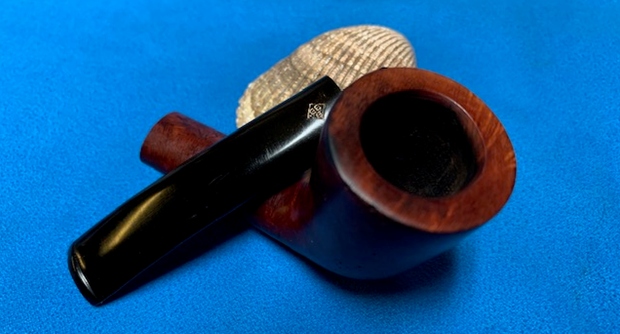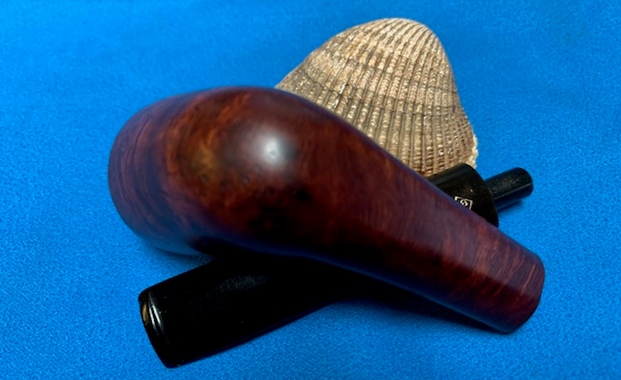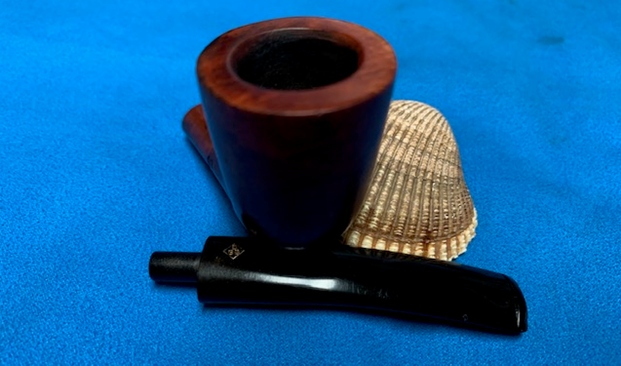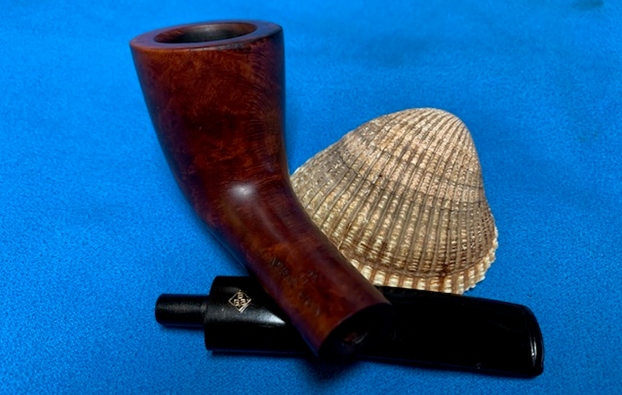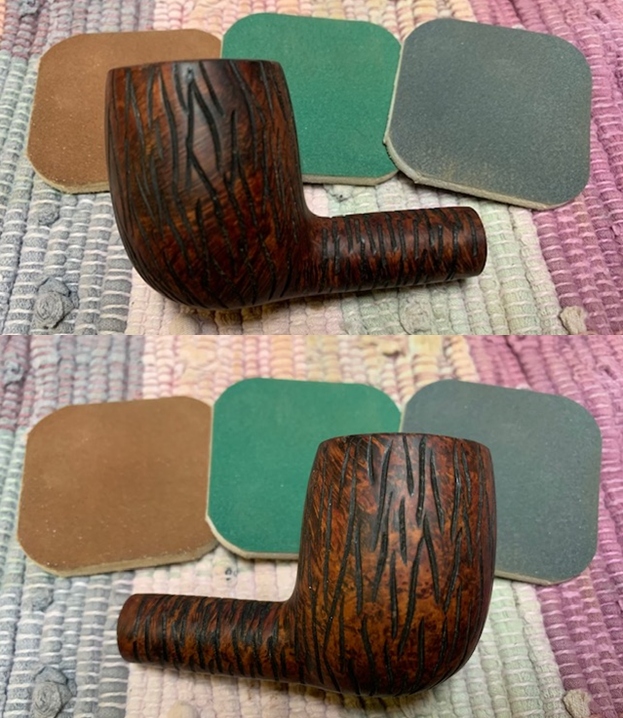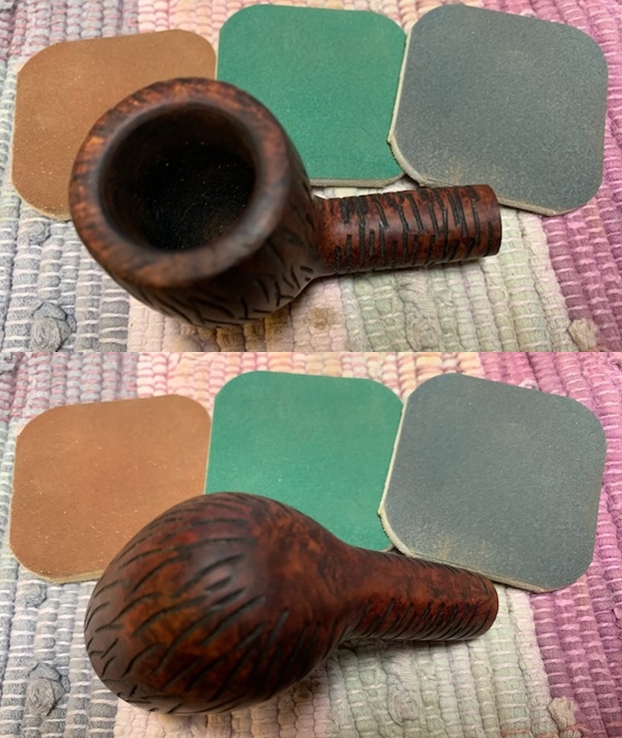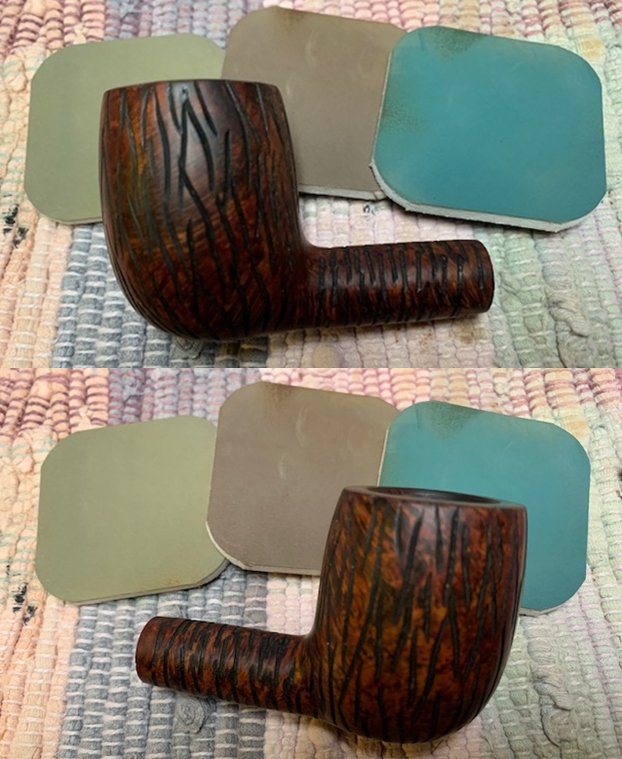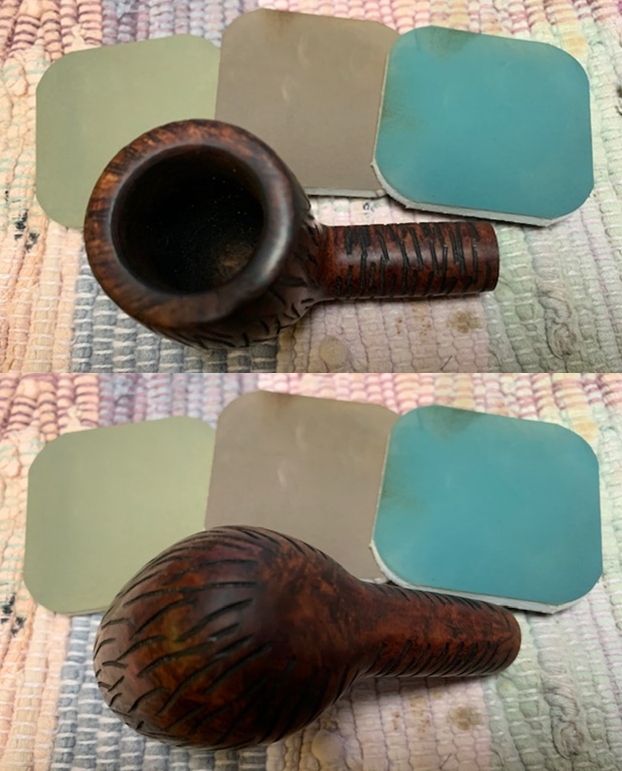
Tag Archives: bite marks

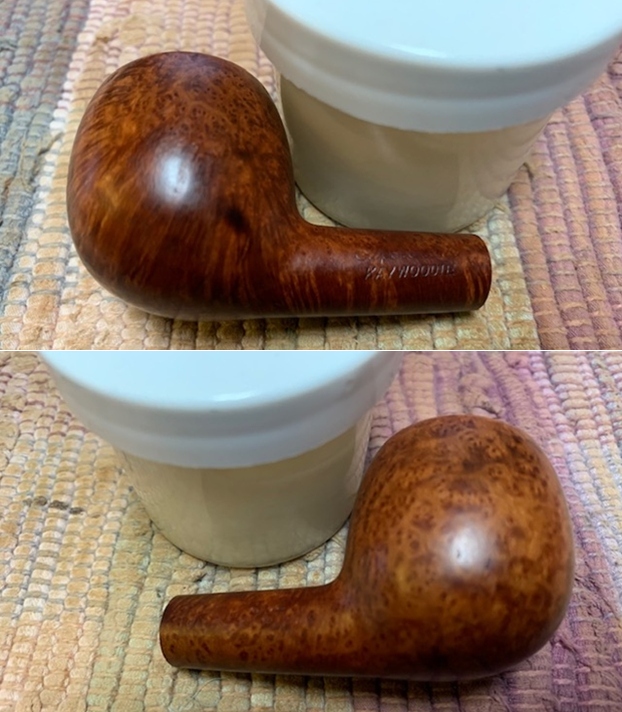
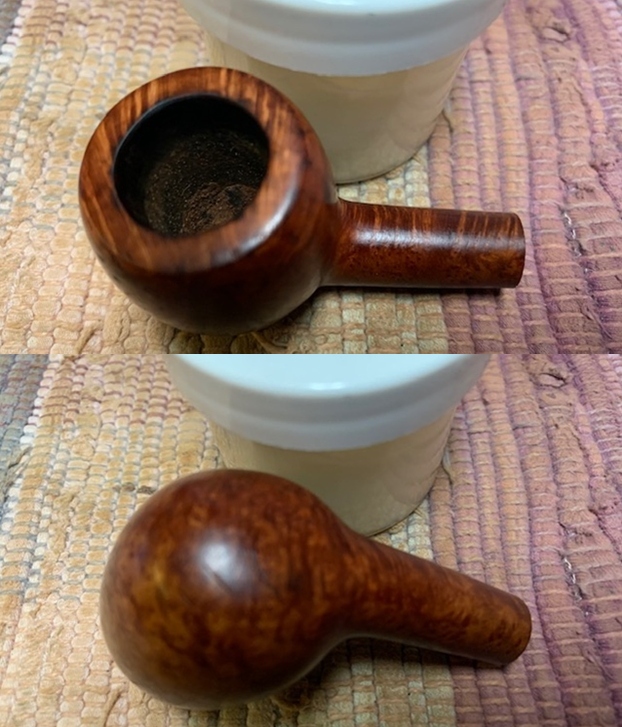
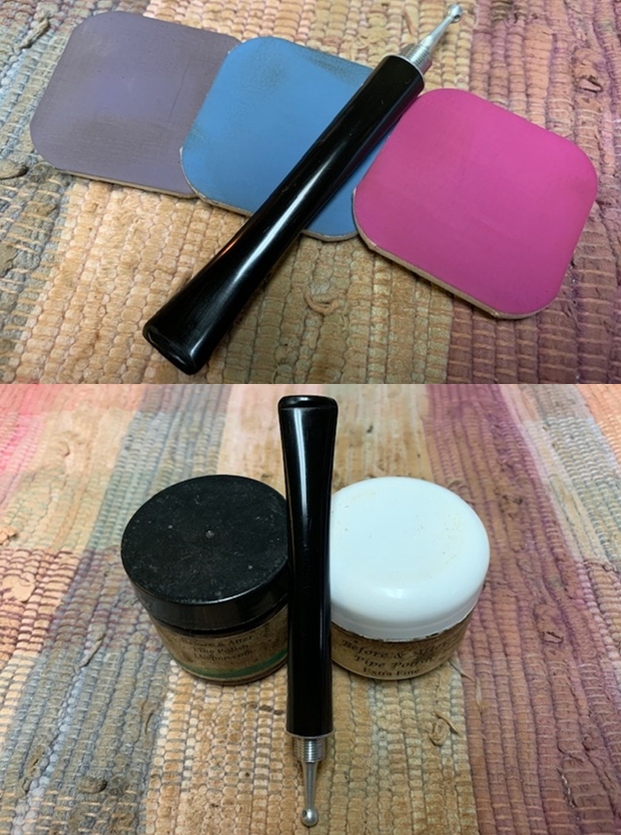
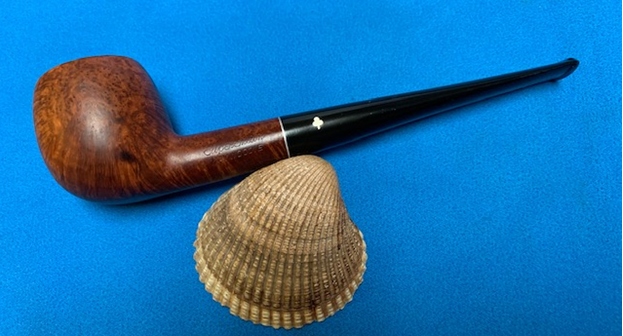
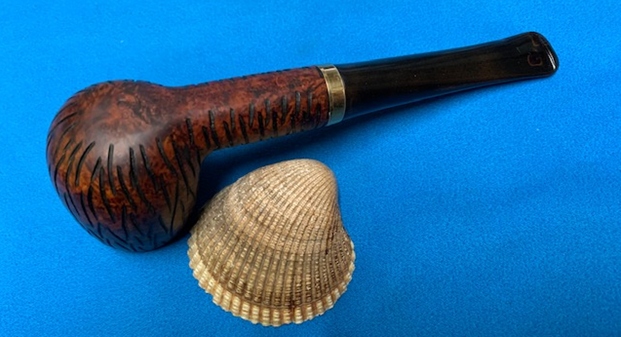
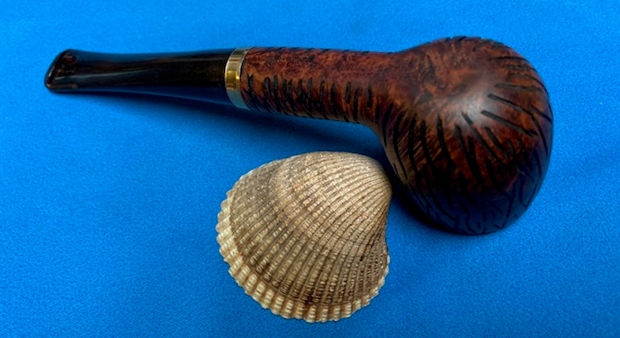
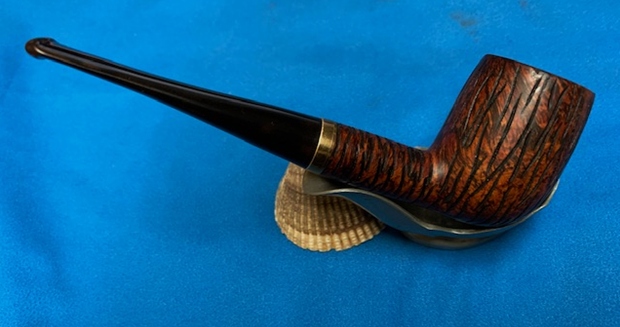
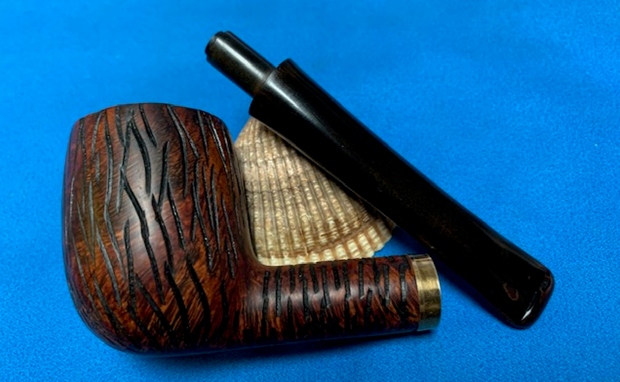
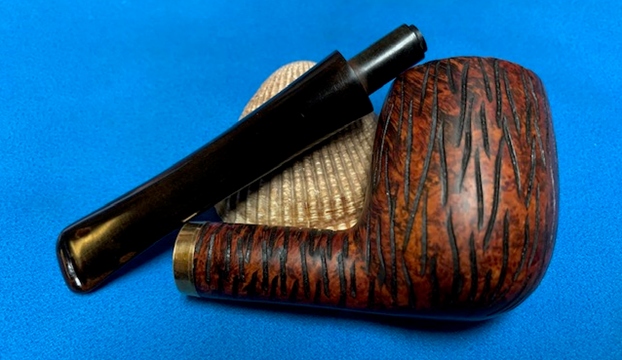
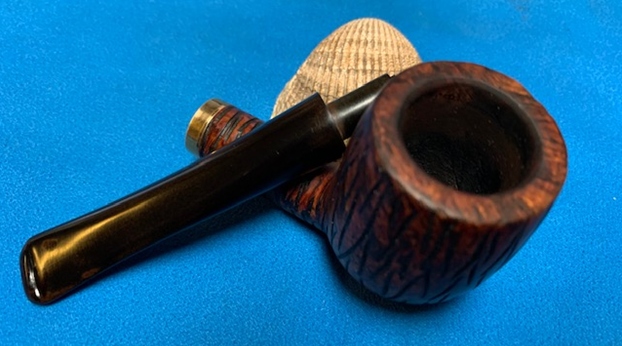
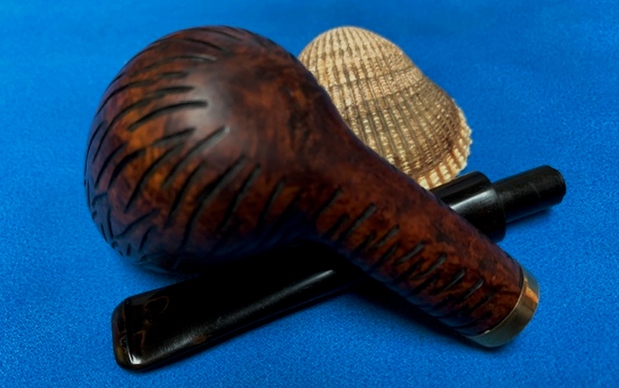
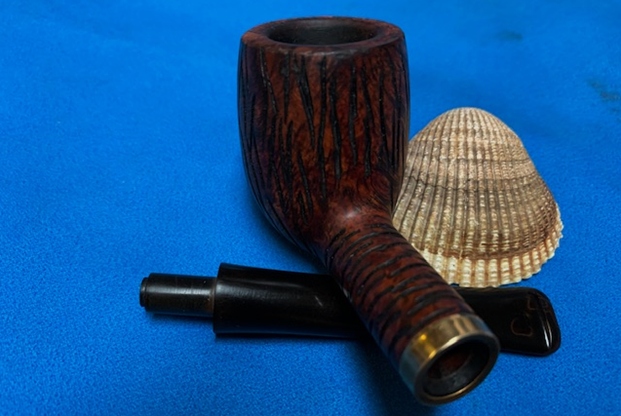
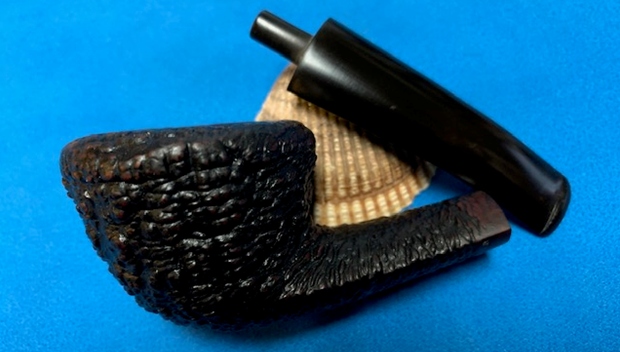
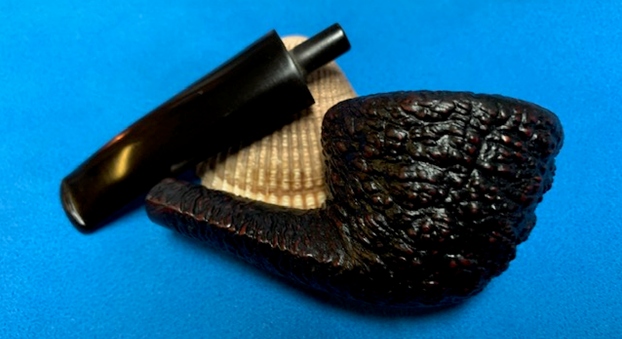
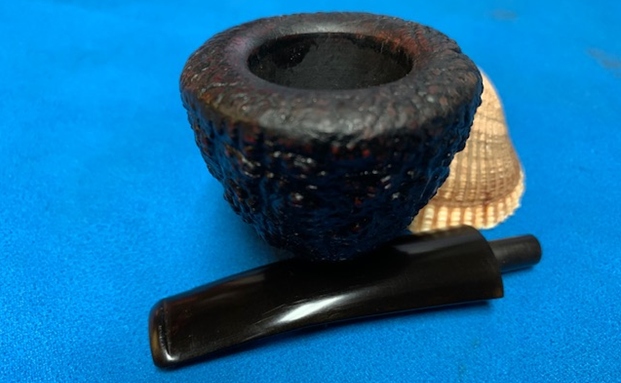
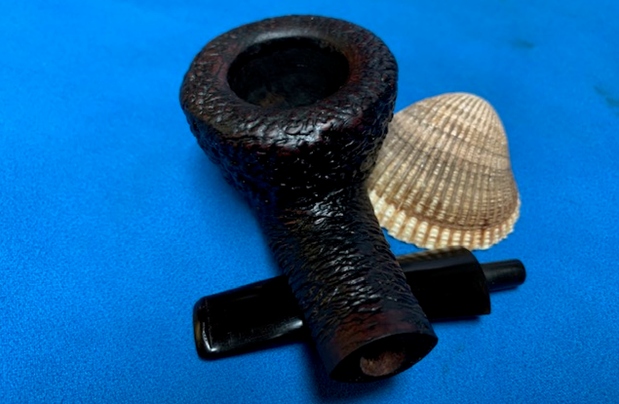
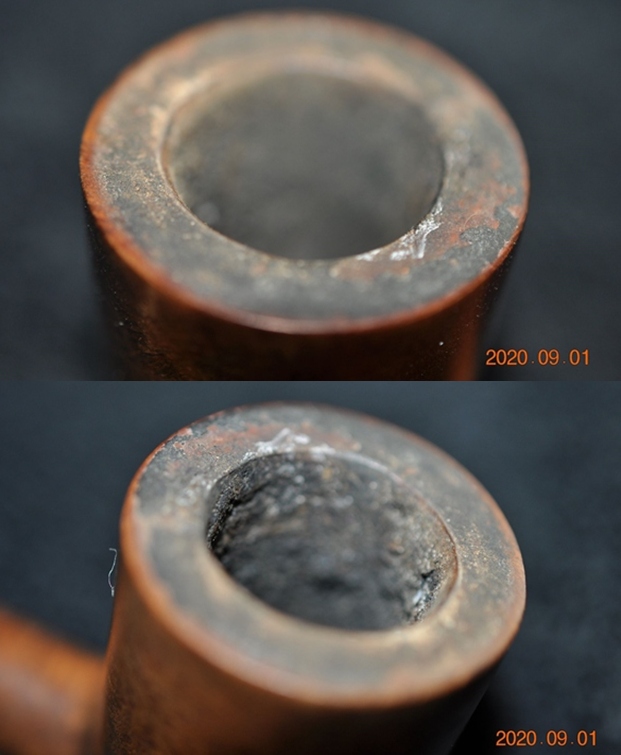
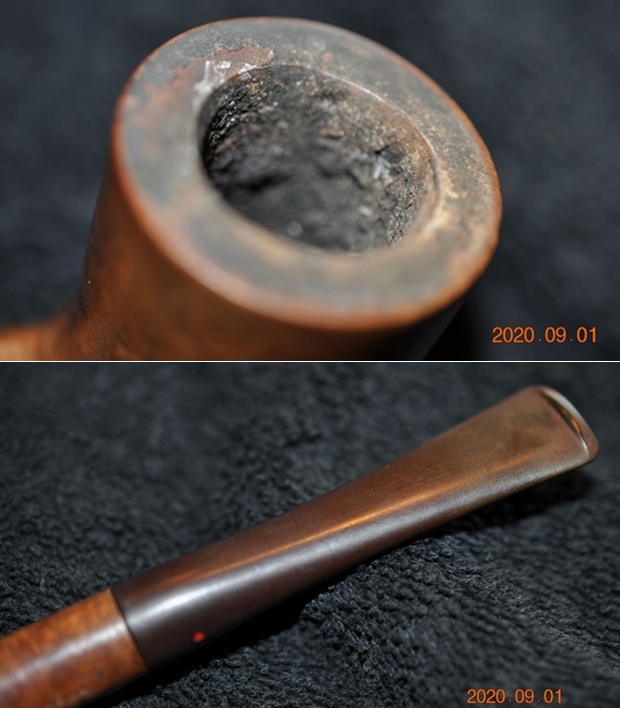
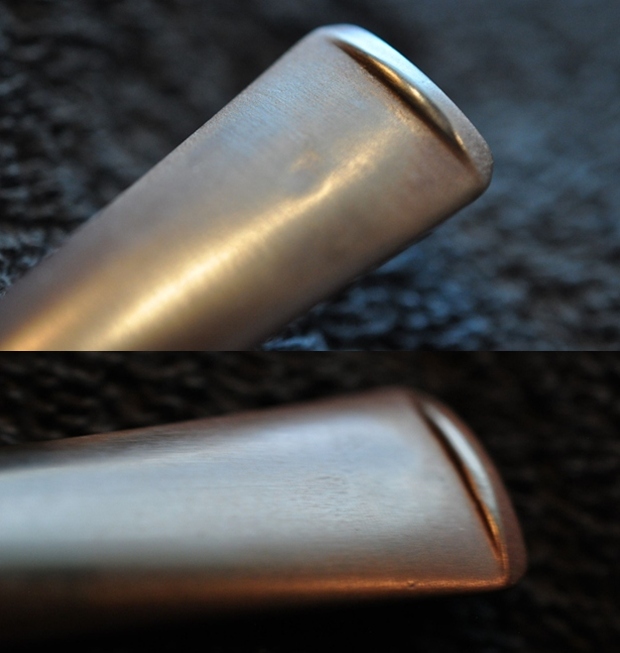
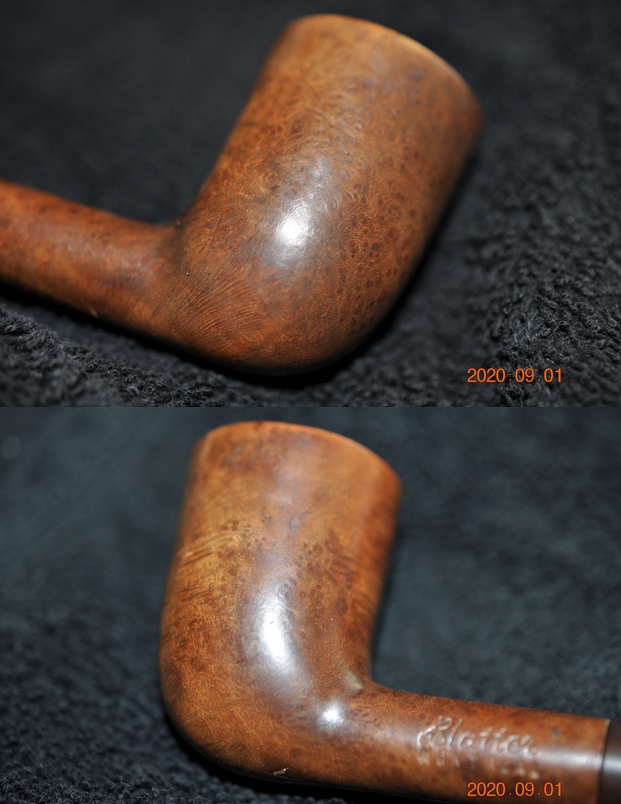
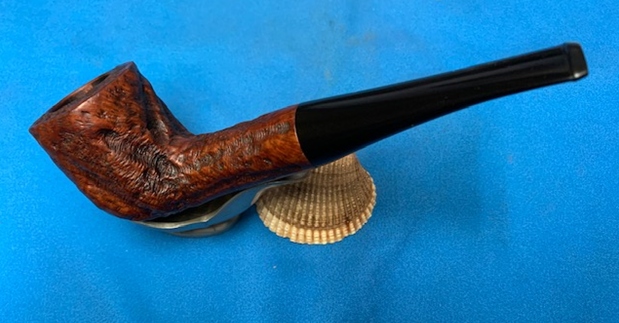
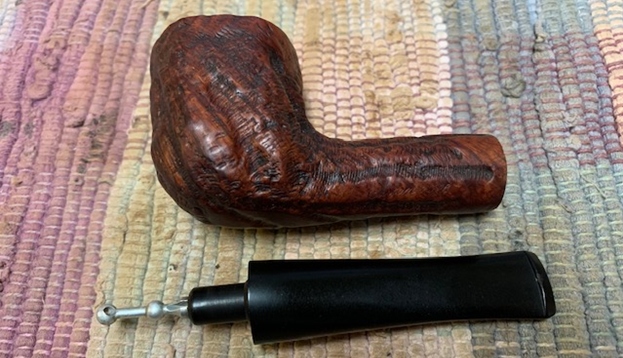
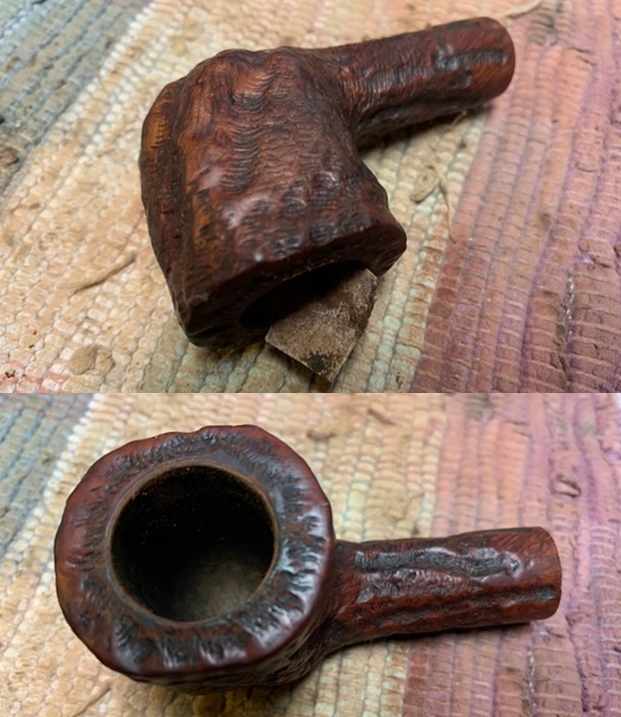
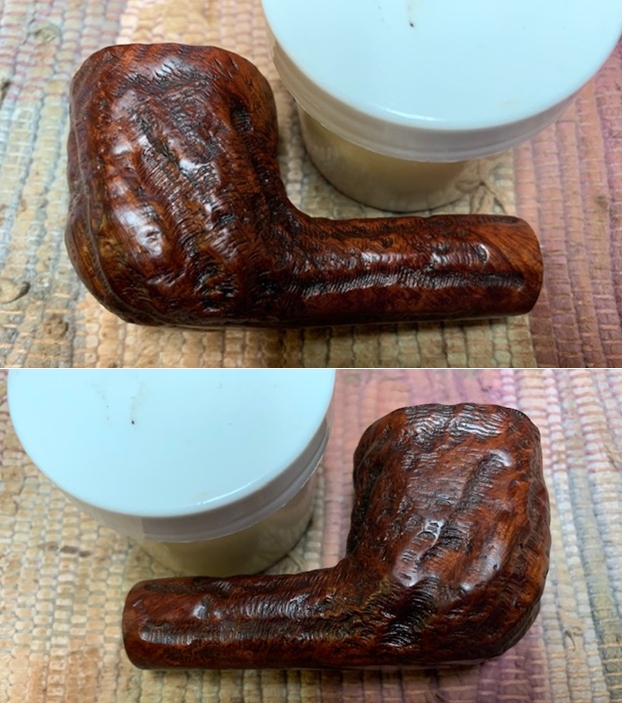
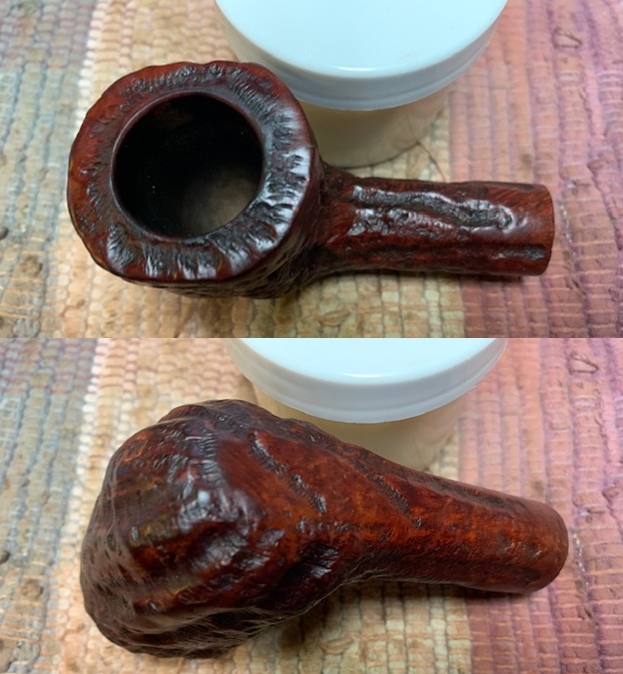
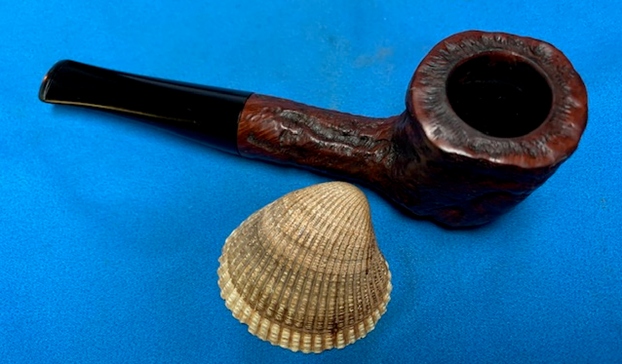
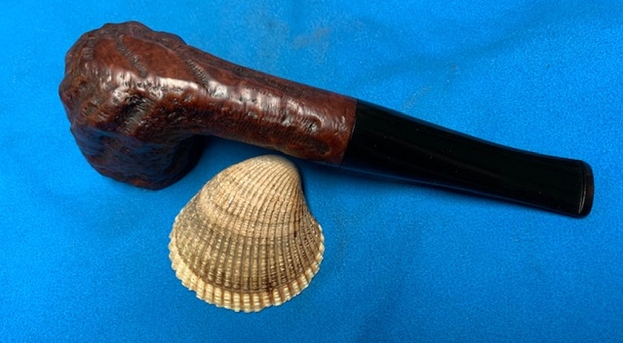
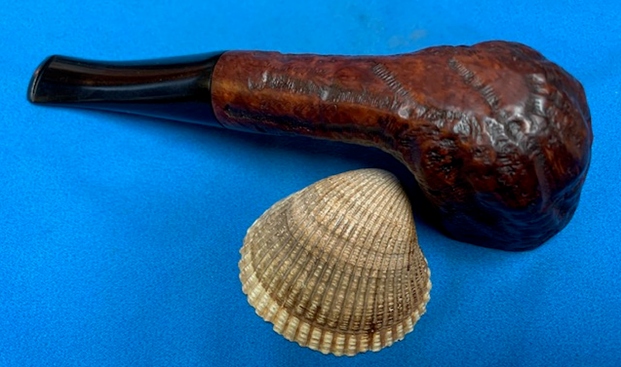
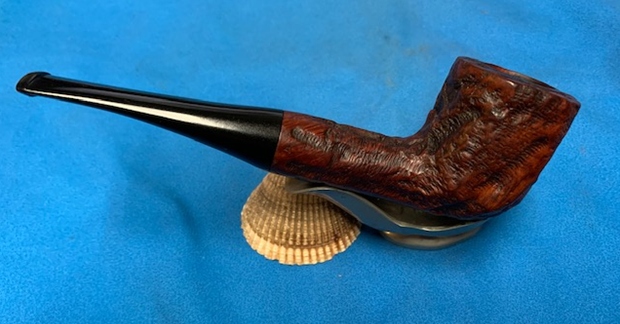
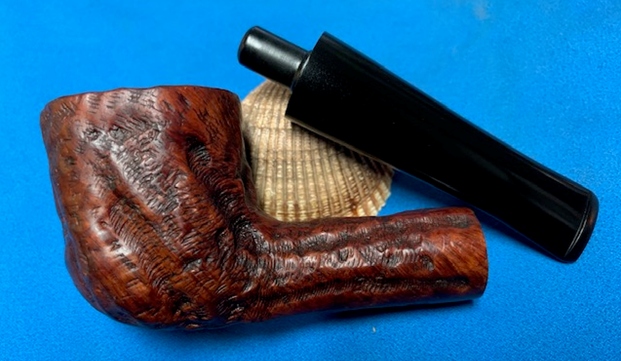
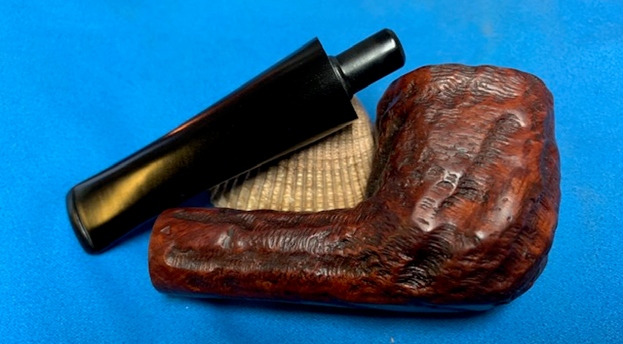
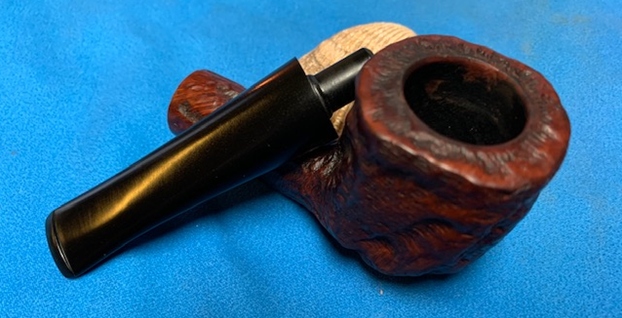
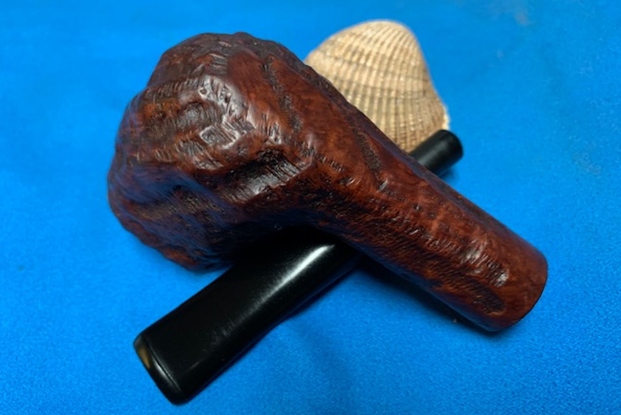
Restemming and Rebirthing a L’Artigiana Italian Made Freehand


Blog by Steve Laug

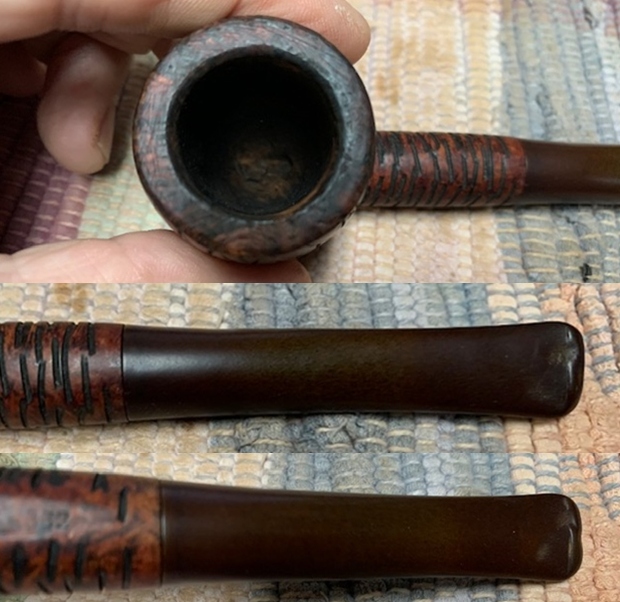
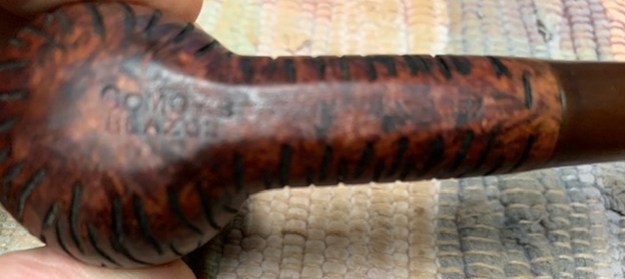
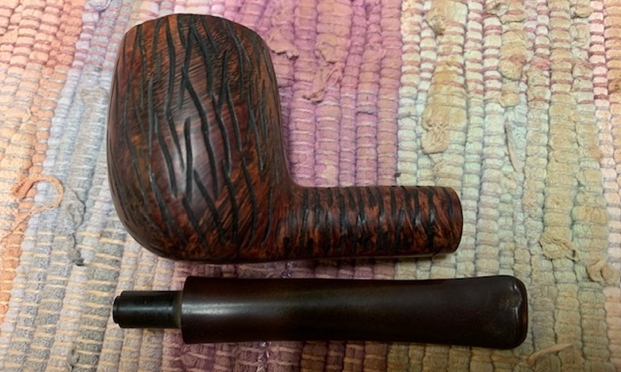
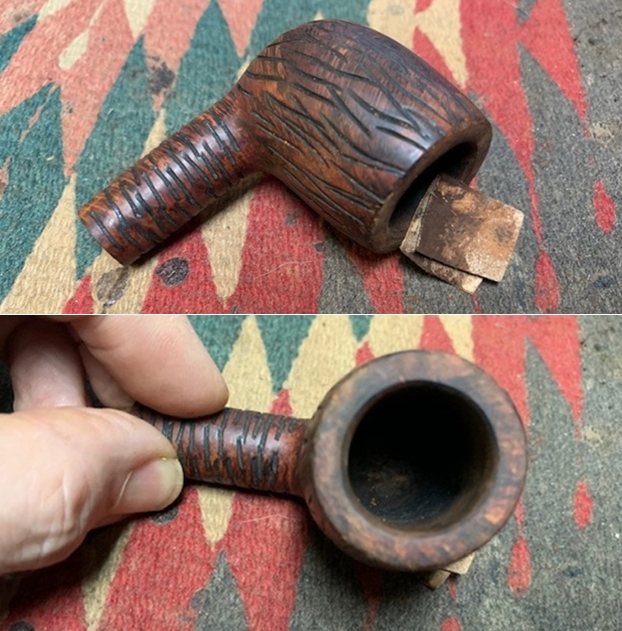
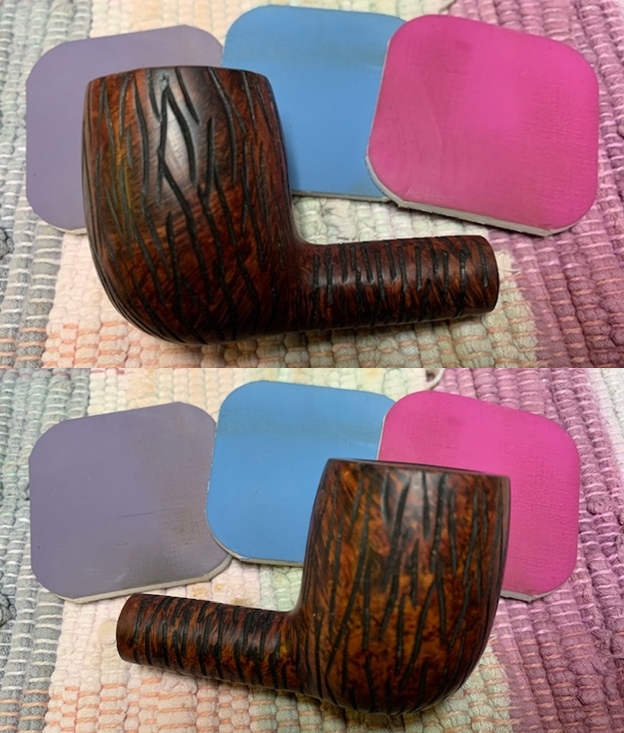
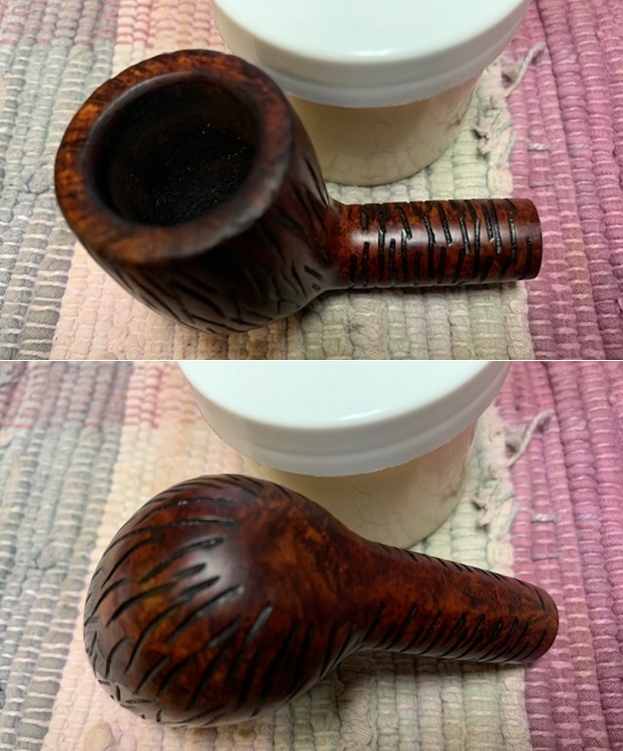
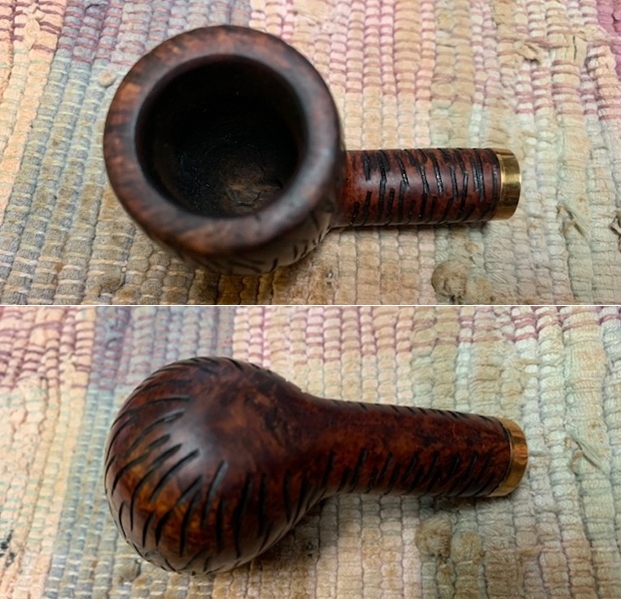
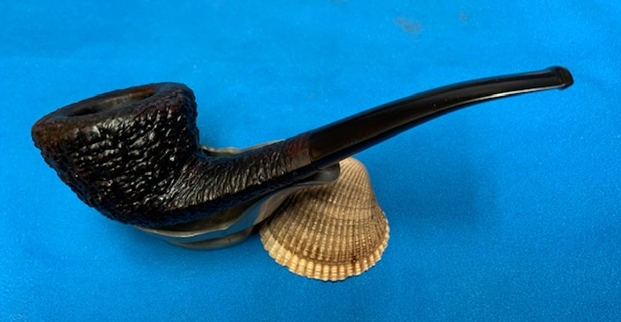
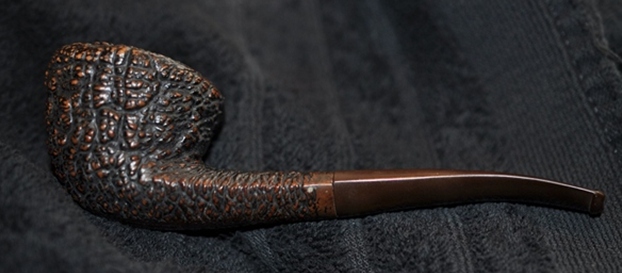
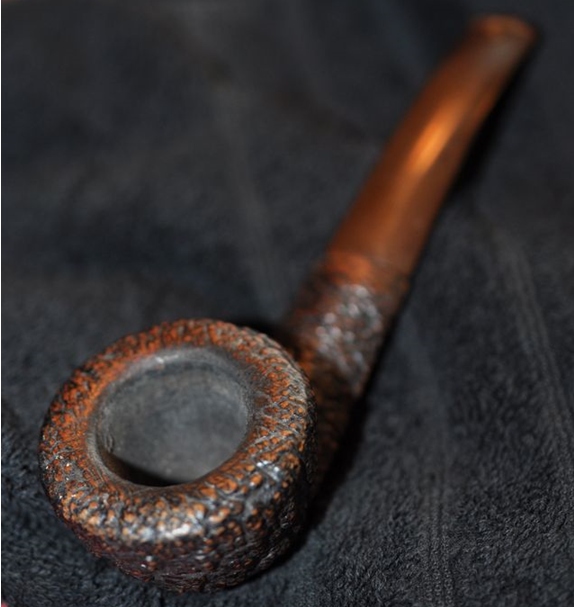
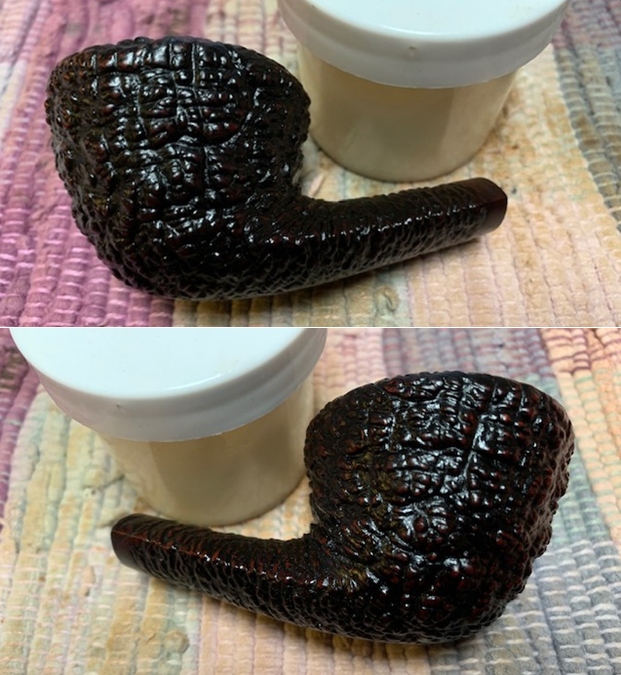
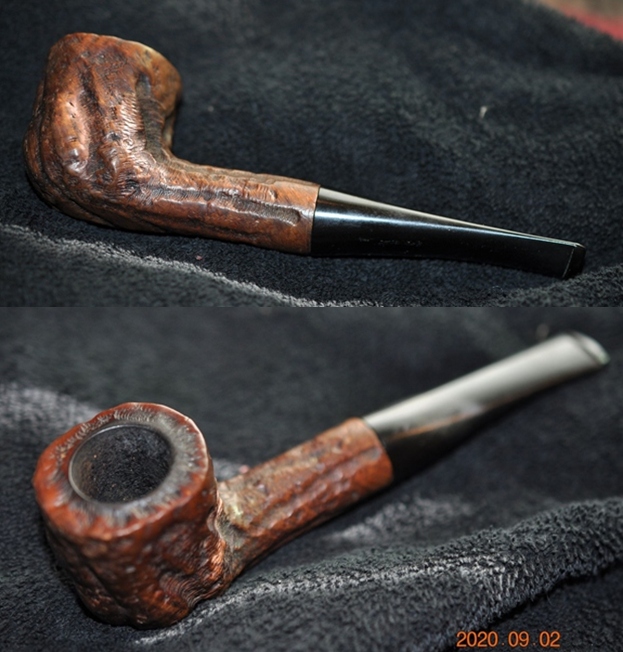
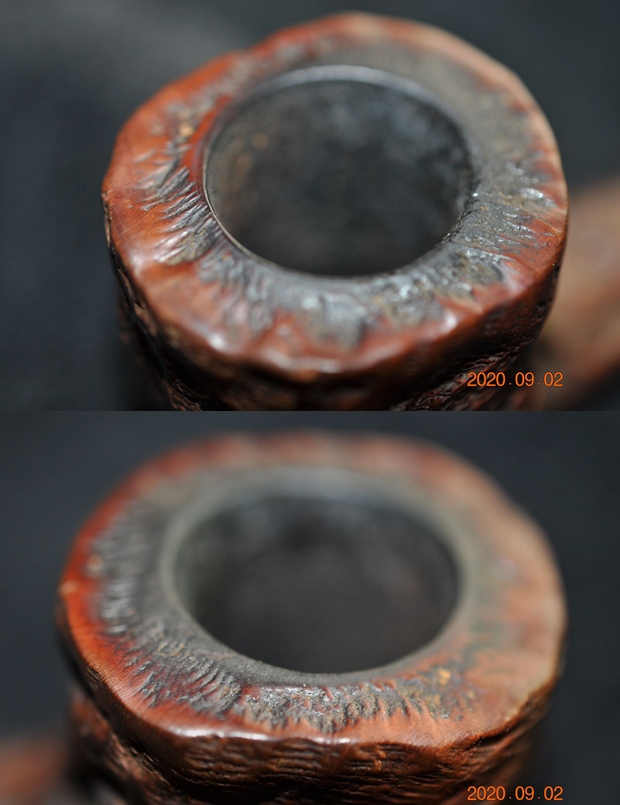
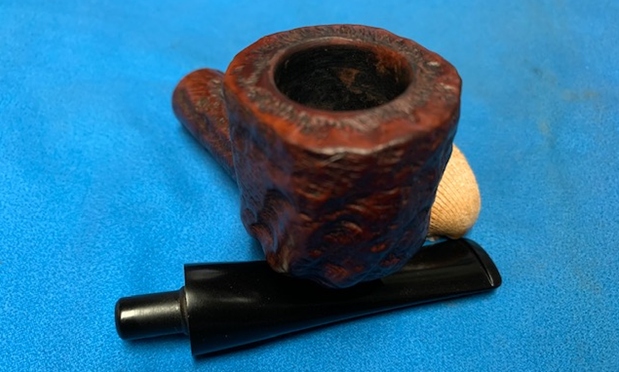
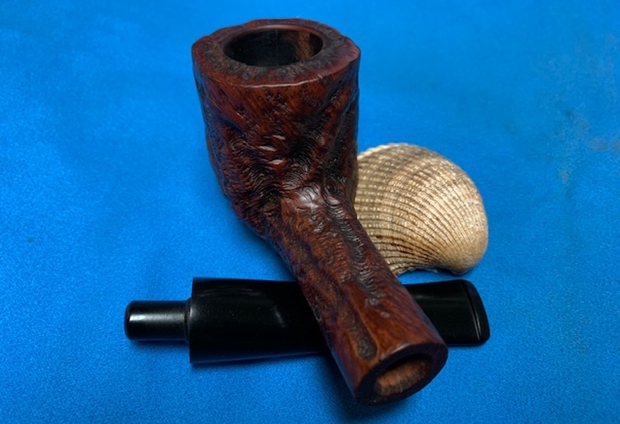
The next pipe in the queue came to us from a recent pipe hunt that Jeff and his wife did in Utah. It is an interesting Freehand bowl that has a heavy rustication around the bowl and shank and a plateau rim top and shank end. It has a smooth panel on the left side where it is stamped. It reads L’Artigiana [over] Italy. I think that this will be another nice looking piece once it is cleaned up and restemmed. The bowl is thickly caked with an overflow of lava filling in much of the plateau rim top. The rustication around the bowl and shank are very deep and craggy and filled in with a lot of dust and debris. The top and edges of the bowl look good but I would be more certain once I reamed and cleaned it. The exterior of the briar was dirty with grime and dust. Jeff took photos of the pipe before my cleanup work. They tell the story and give a glimpse of the promise that we see in this pipe. He took a photo of the plateau rim top to show the cake in the bowl, the lava on the rim top and the inner edge.  The lava coat on the rim top filled in the plateau top to the point of the valleys being filled in.The next photos show the rustication portions of the bowl. The dust and debris has filled in many of the deepest grooves in the rustication. It is a pretty nice looking pipe under the grime.   He took photos of the stamping on the left side of the shank. It is faint on the left end but is otherwise readable in the photo below and is as noted above. I turned to Pipedia to read about L Artigiana Pipes. There was no specific listing for the brand but under the Makers list it was listed as a sub brand or second connected the brand to Cesare Barontini (https://pipedia.org/wiki/Italian_Pipe_Brands_%26_Makers_K_-_L). Quote:

Cesare Barontini sub-brand / second.

From there I turned to the article that I have read previous on Pipedia about Ceare Barontini (https://pipedia.org/wiki/Barontini,_Cesare).

In 1890 Turildo Barontini opened a factory for the production of briar. In 1925 his son Bruno began to produce the first pipes. Cesare Barontini, son of Bruno, started direction of the factory in 1955, and still runs it together with his daughters Barbara and Silvia.

Sub-brands & Seconds:

Aldo Velani

Cesare

L’artigiana

Stuart

Cortina

See also Barontini, Ilio, Cesare’s cousin.

I love the description as it truly captures the shape and beauty of this freehand pipe. The article above stated that the pipe is handcrafted by artists so that each one is a unique piece. It is cut from the plateau to leave that exposed on the top of the rim and down the shank to the end. It has a thumb hole cut for comfort in holding it while smoking. It is suggested that pipe sold for $60. Now to work on the pipe.

Jeff had cleaned up the pipe with his usual penchant for thoroughness. He reamed the pipe with a PipNet pipe reamer and removed the rest of it with a Savinelli Fitsall Pipe Knife.  He scrubbed the bowl with undiluted Murphy’s Oil Soap with a tooth brush. He rinsed it under running warm water to remove the soap and grime. He cleaned out the inside of the shank and the airway in the stem with alcohol, cotton swabs and pipe cleaners. He soaked the stem in Before & After Deoxidizer and rinsed it off with warm water. It looked very good but I forgot to take photos of the bowl when I brought it to the table – one of those days I guess. You will get a feel for it in the photos below.

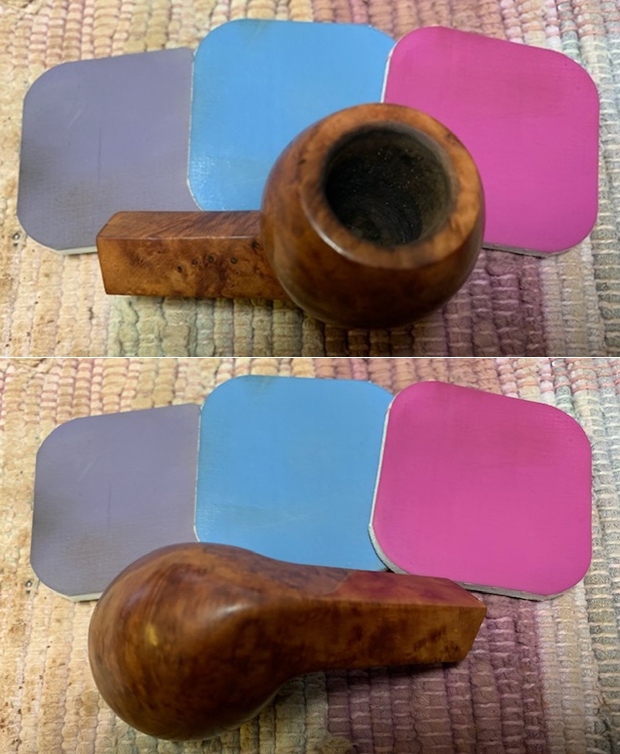
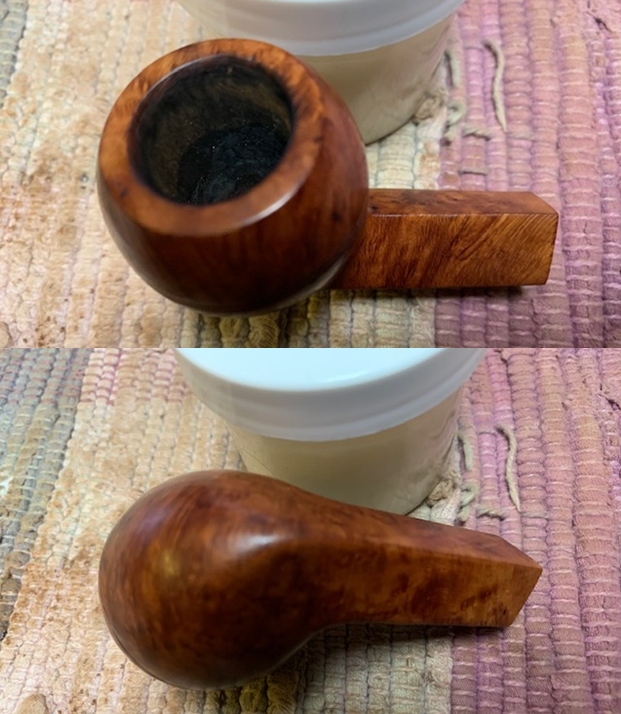
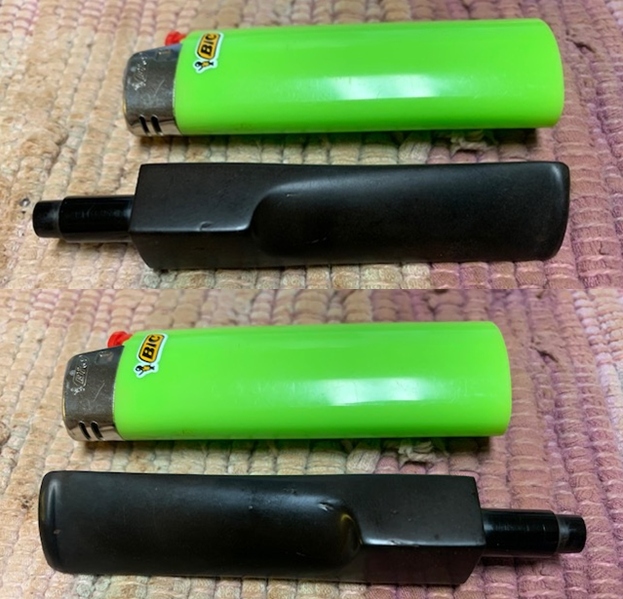
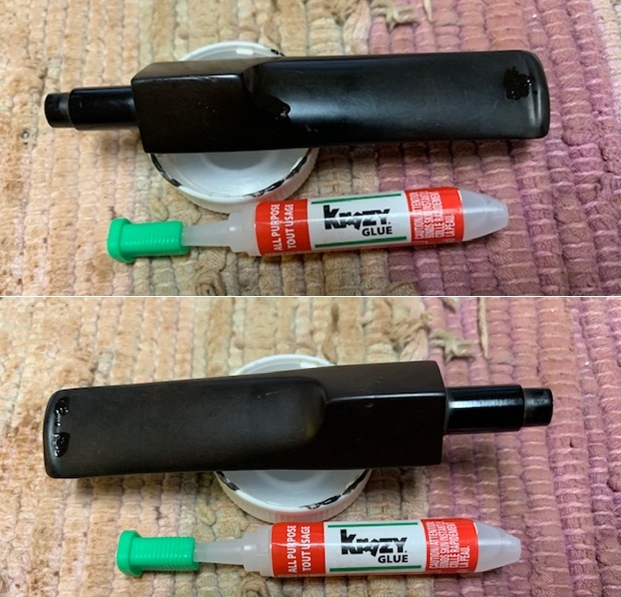
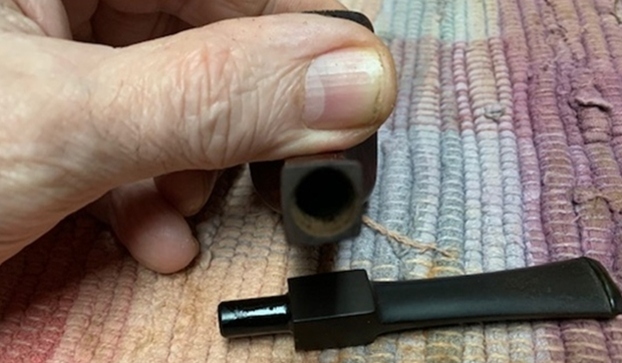
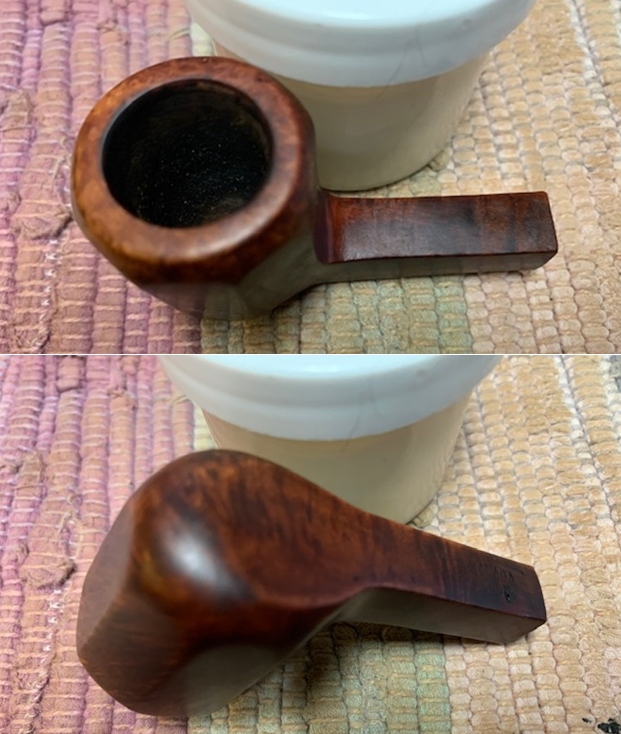
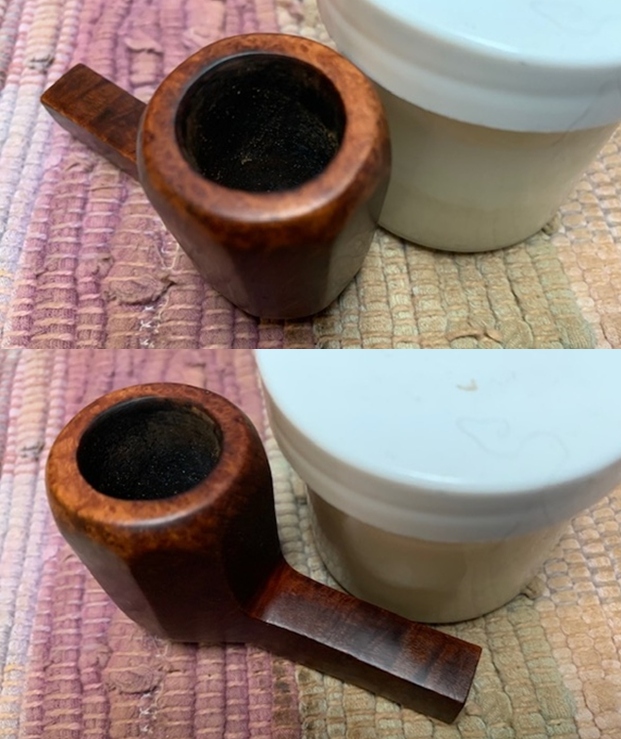
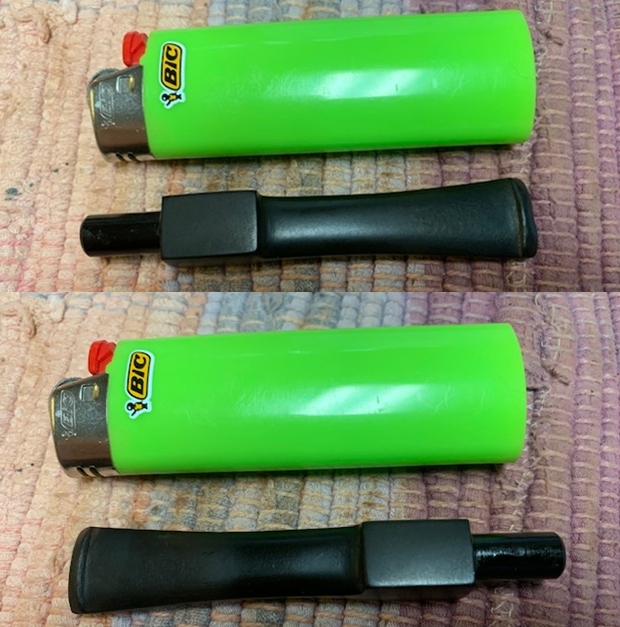
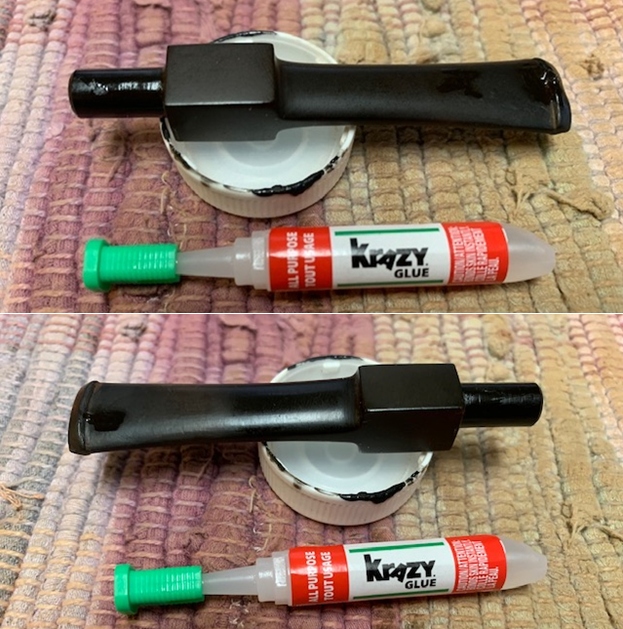
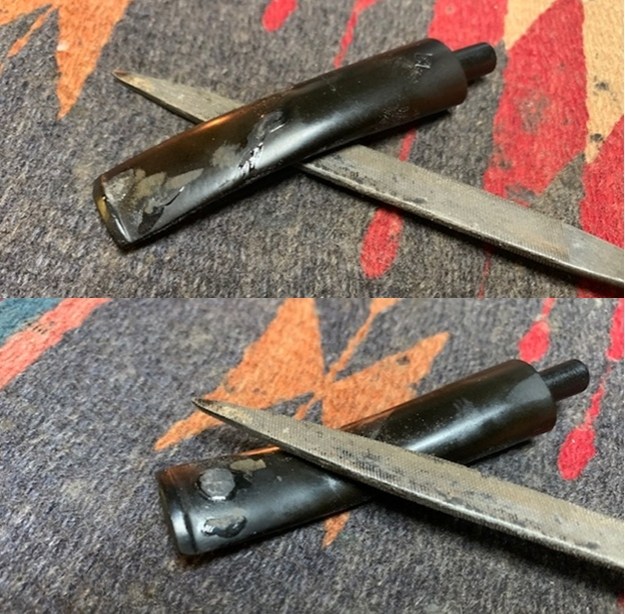
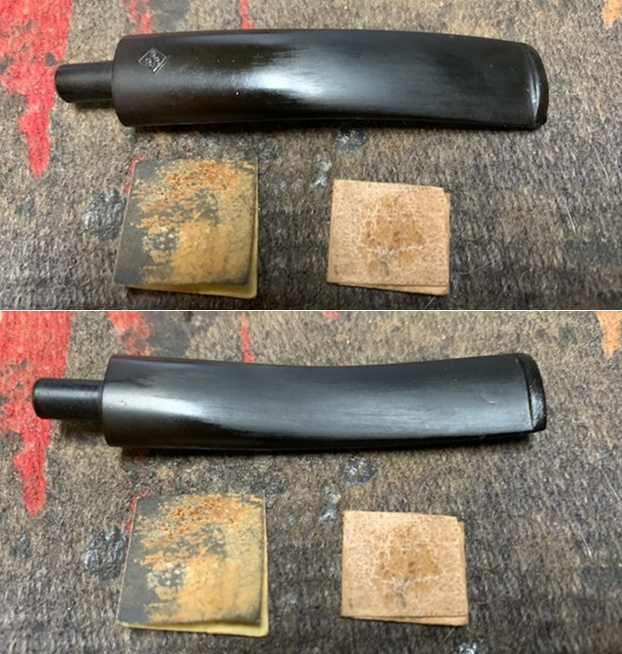
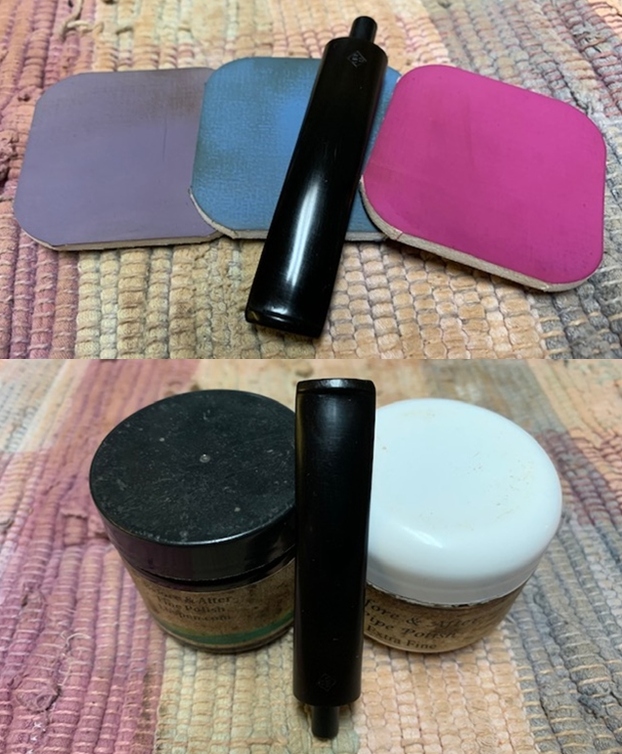
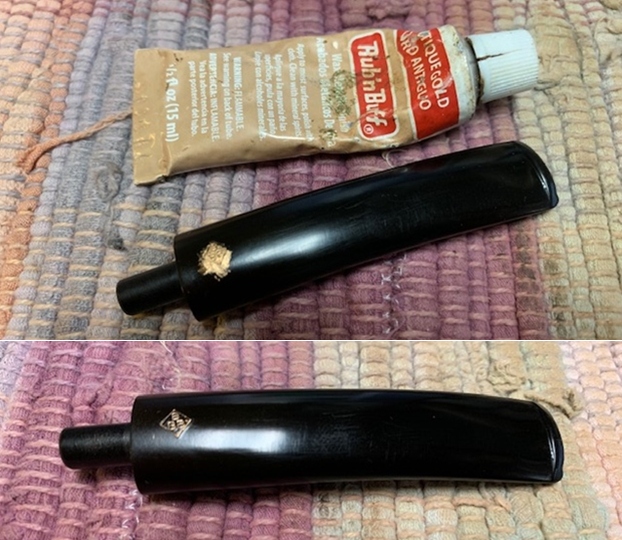
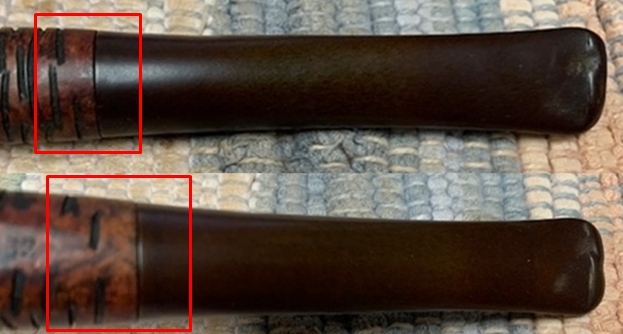
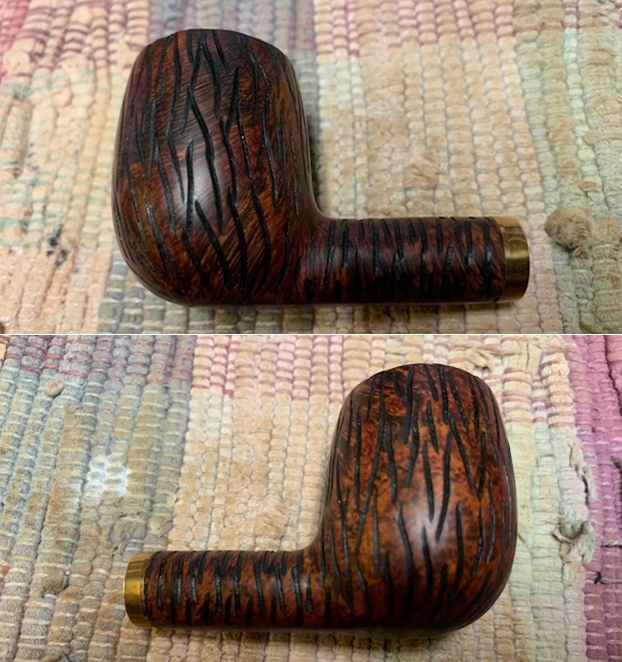
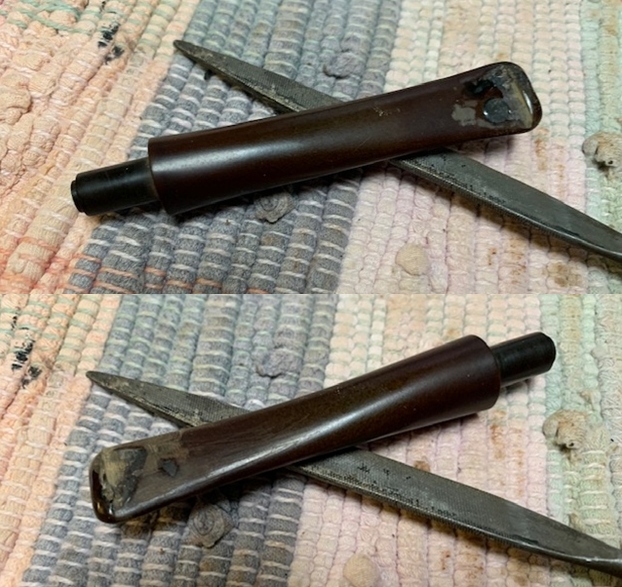
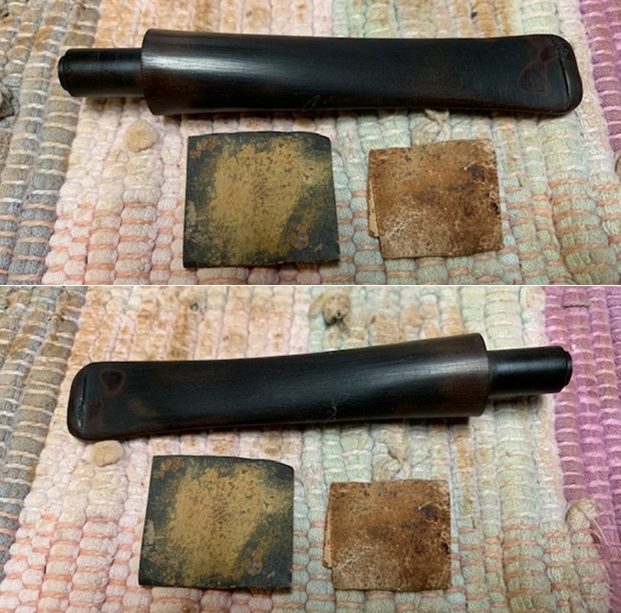
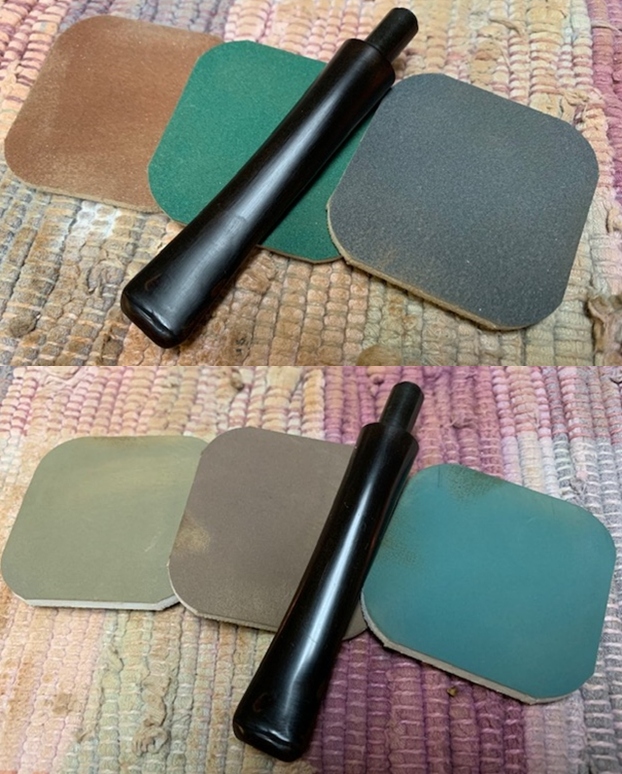
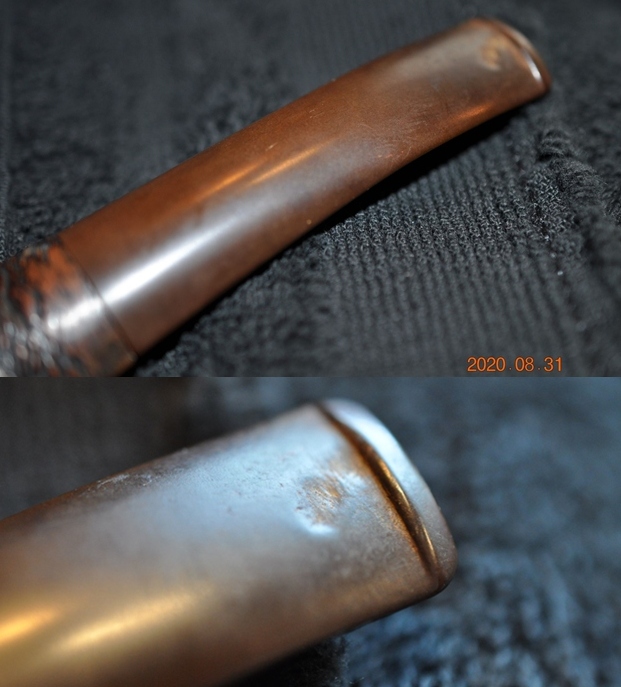
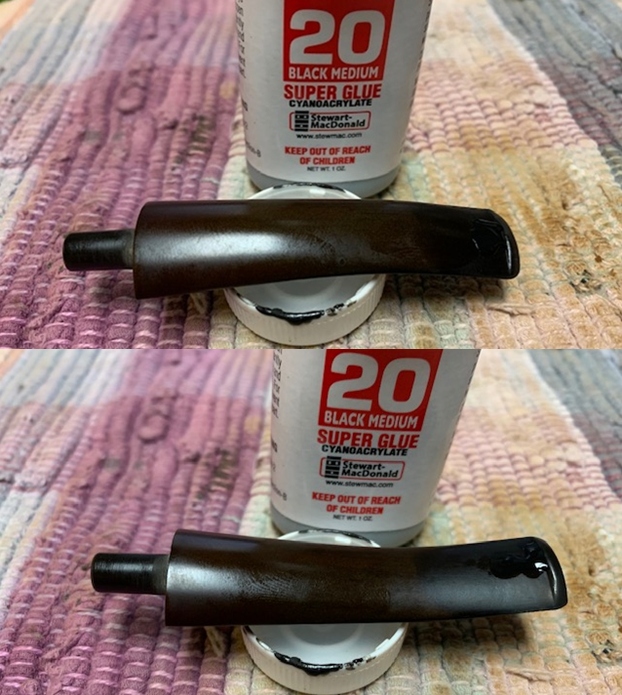
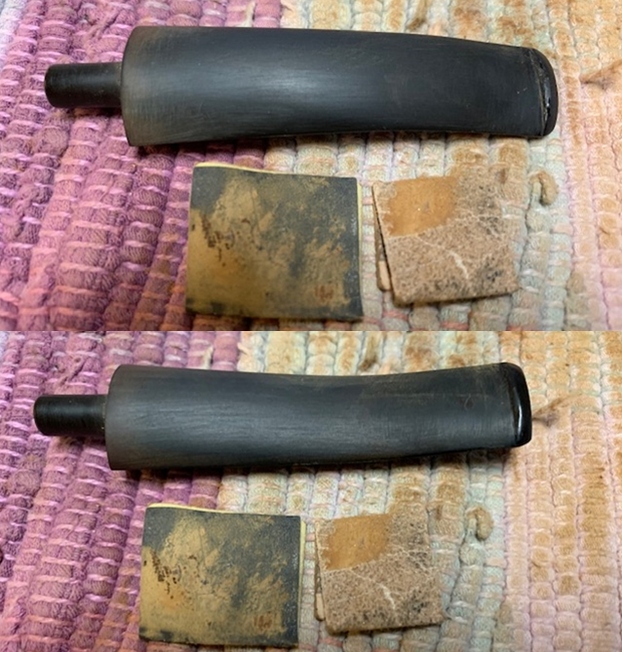
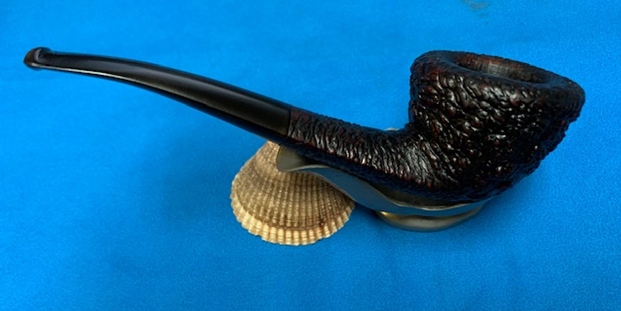
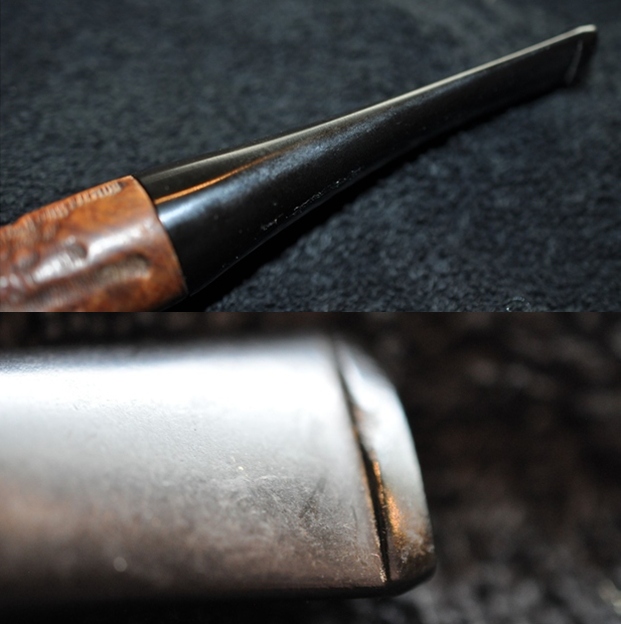
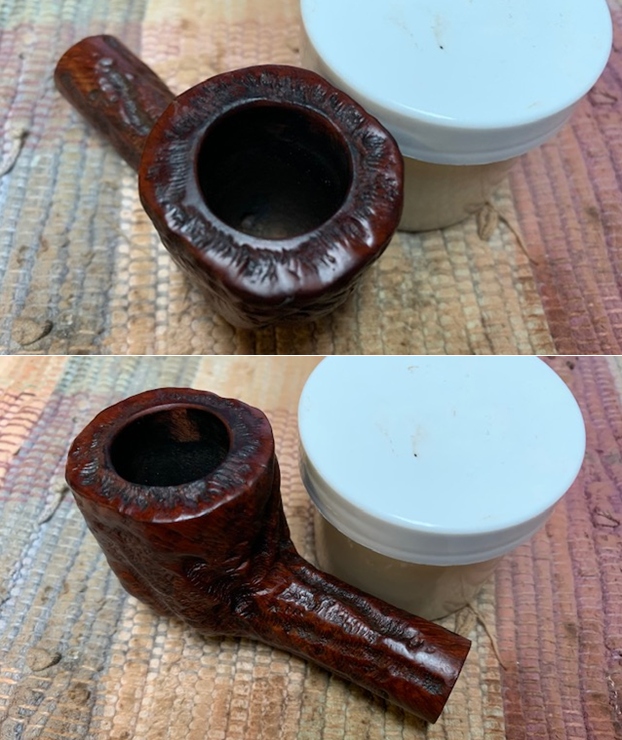
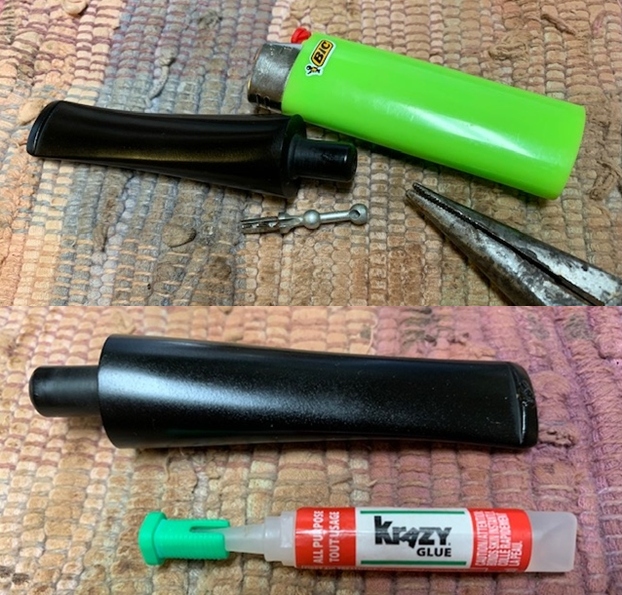
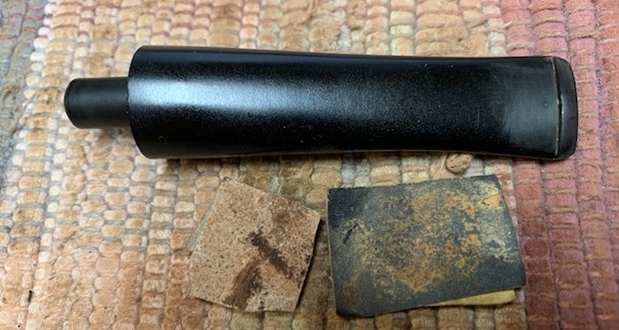
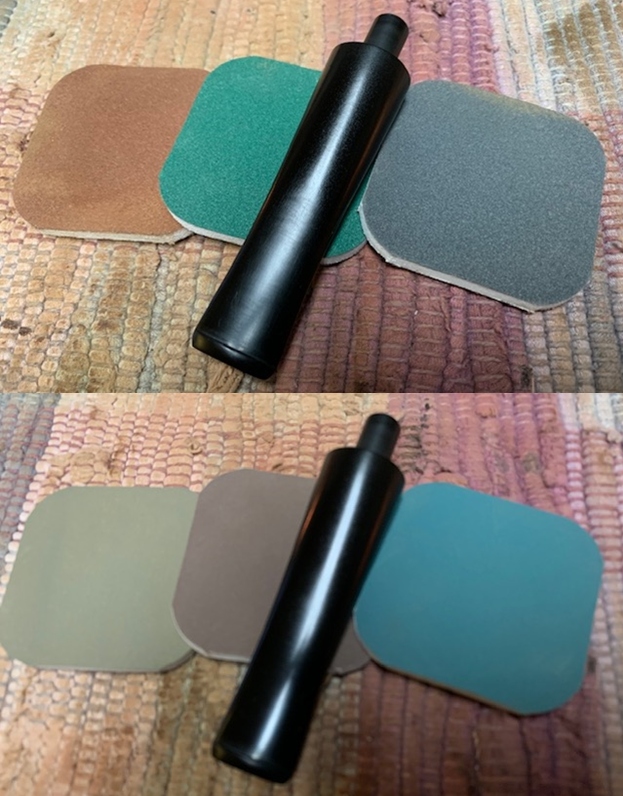
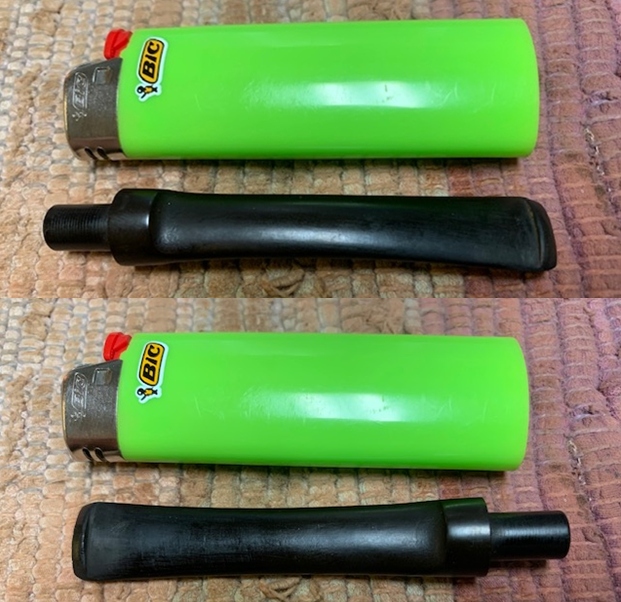
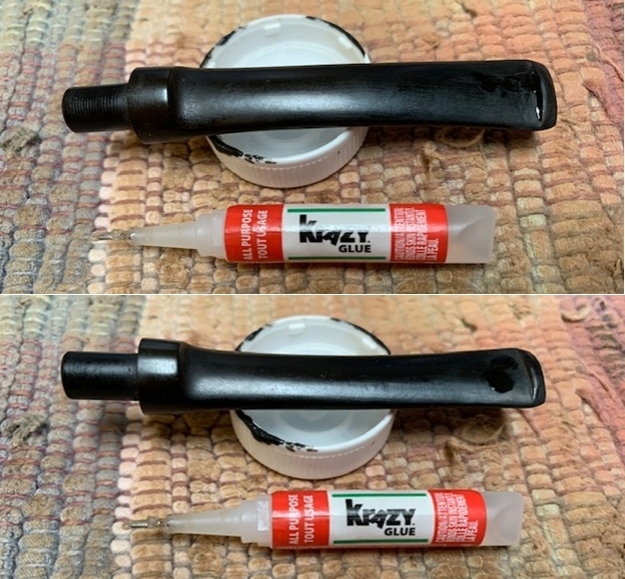
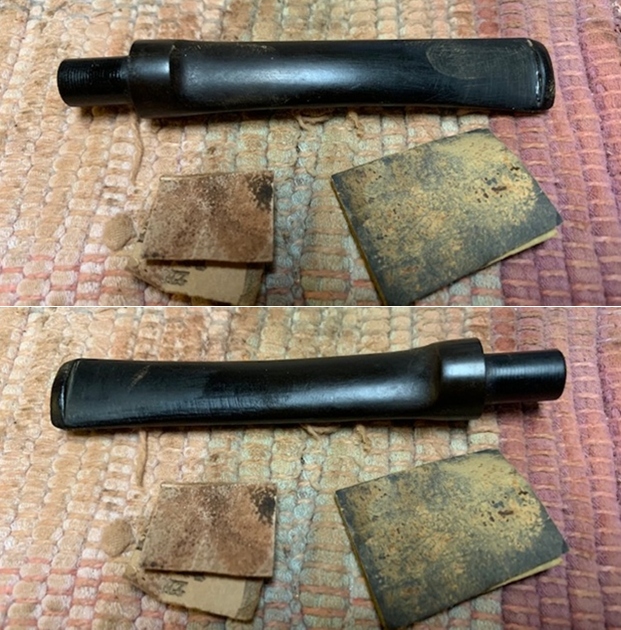
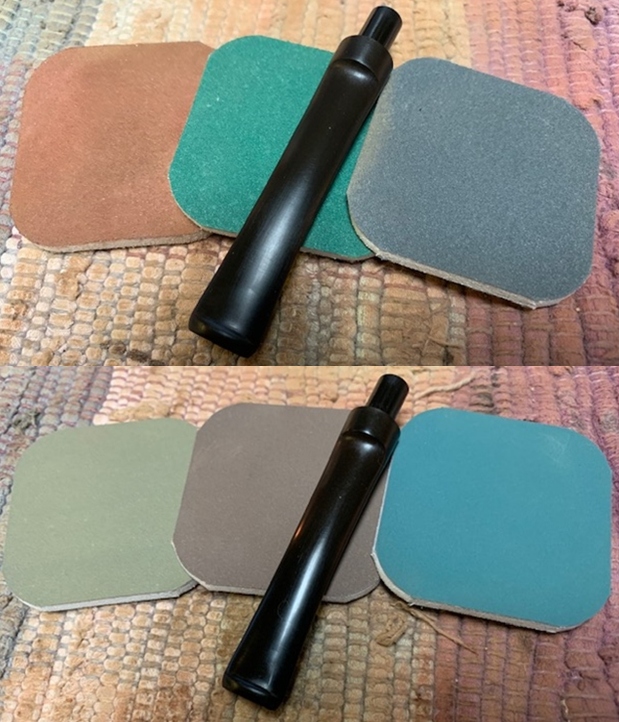
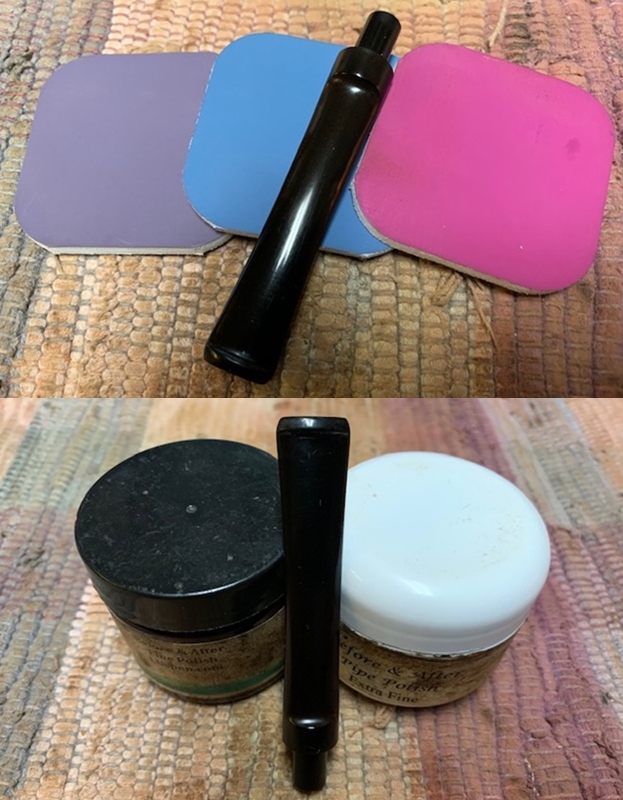
I found a perfect fancy stem for the pipe in my stem can that was a potential candidate for the pipe. The issue with it was that the tenon had broken somewhere in its life. I tend to keep this kind of thing around as I have learned that I seem to always have a use for them. I drilled out the airway with a series of drill bits starting with one slightly larger than the airway in the stem and ending with one that would fit the threaded end of the new tenon. I put a pipe cleaner in the airway and painted the threaded tenon end with black super glue. I threaded the new tenon onto the pipe cleaner and pressed it into the hole in the stem. I set it aside to let the glue cure while I worked on the bowl. Now you will finally see the bowl! I worked some Before & After Restoration Balm into the surface of the briar with my fingertips and a horse hair shoe brush to clean, enliven and protect it. I let the balm sit for a little while and then buffed with a cotton cloth to raise the shine. I set the bowl aside and turned my attention to the stem. Eventually I would need to soak it in Briarville’s Deoxidizer but I had some work to do first to clean the damages to the stem. I “painted” the tooth marks with the flame of a Bic lighter and was able to raise all of them on the underside and all but one on the top side.  Before I put the stem in the soak I decided to put it in the shank and take pictures of the pipe at this point in the process. I am really pleased with the overall look. Once the vulcanite is polished the stem will look perfect with the pipe. I removed the stem from the pipe and put it in the bath of Briarville’s Pipe Stem Oxidation Remover overnight to let it do its magic. When I took it out of the bath I dried it off with a paper towel and rubbed off the product it had softened the oxidation but did not remove it. Lot of sanding and polishing remained on this one.I sanded the top surface of the stem and filled in the tooth mark along the button with black super glue. Once the glue cured I used a small file to flatten out the repair. I followed that by sanding the entire stem with 220 grit sandpaper to remove the oxidation remaining on the stem. I started to polish the stem with 400 grit wet dry sandpaper.I polished the vulcanite with micromesh sanding pads – 1500-12000 grit pads. I wiped it down with Obsidian Oil after each sanding pad. I used Before & After Pipe Polish – both Fine and Extra Fine to further polish the stem.     With both parts of this unique L’Artigiana Freehand finished, I polished the bowl and the stem with Blue Diamond polish on the buffing wheel. I gave the bowl and the stem multiple coats of carnauba wax. I buffed the pipe with a clean buffing pad to raise the shine. I hand buffed it with a microfiber cloth to deepen the shine. The pipe polished up pretty nicely. The mix of grain on the bowl came alive with the buffing. The finish on the briar works well with the polished black vulcanite stem. The finished pipe is a well-proportioned, nicely grained L’Artigiana Freehand. Have a look at it with the photos below. The dimensions are Length: 6 inches, Height: 2 ¾ inches, Outside diameter of the bowl: 1 ¾ inches, Chamber diameter: ¾ of an inch. This interestingly made Freehand will be going onto the rebornpipes store very soon. If you would like to purchase it and carry on the legacy of the previous pipe smoke send a message or an email to me. Thanks for walking through the restoration with me on this Italian Made L’Artigiana pipe. 

Breathing Life into a Caminetto Business 127KS Pot


Blog by Steve Laug

The next pipe on my worktable is another Caminetto Business pipe but different from the others that I have worked on in that it is a Pot (really quite similar in shape to a Castello 55). With each one that I have worked on I am increasingly impressed by the craftsmanship. The pipe has a rugged rusticated finish and a stepped variegated brown acrylic saddle stem. It had come to us from an antique mall in Utah, USA. It was a filthy pipe with grime and oils ground into the rusticated finish on the bowl. The pipe had some rustic beauty shining through the dust and debris in the valleys of the rough finish. The rustication covered the rim top, bowl and shank with a smooth panel on each side of the shank. The finish was dull and lifeless and dirty from sitting around. There was a very thick cake in the bowl with lava flowing out of the bowl and over the rim top. The lava had filled in the deeper grooves of the finish on the rim top. The inner edge of the rim appeared to be in good condition under the lava coat but we would know more once it was cleaned. The stamping on the left side of the shank read Caminetto in script over BUSINESS. To the right of that toward the stem was the shape number 127 in a cartouche and below that it read KS. On the right side of the shank it was stamped MADE IN ITALY [over] CUCCIAGO (CO). The taper stem was variegated brown and had the classic Caminetto Moustache on the top side. The surface was dirty and there was light tooth chatter and marks on both sides near the button. Jeff took the following photos before he started his cleanup work on the pipe. He took close-up photos of the bowl and rim top from various angles to capture the condition of the bowl and rim top edges. You can see the lava overflow and debris in the rustication of the rim top. You can see the cake in the bowl. This was a dirty pipe but it was the finish was in great condition. The stem is also very dirty with tooth marks and chatter on both sides near the button. He took photos of the sides and heel of the bowl to show the beautiful incredibly deep rustication around the bowl. It is the same kind of rough finish that I really like on Castello Sea Rock and Savinelli Capri Pipes. You can see the oil, dust and debris in the finish on both sides of the bowl. There is also some red ink or paint on the sides of the bowl. Jeff took a photo of the stamping on the sides of the shank. It reads as noted above. The stamping is clear and readable. I have worked on several Caminetto in the past so I turned to one of the restorations on the rebornpipes blog and reread the background information on the brand. I am including that info here with this restoration (https://rebornpipes.com/2020/04/19/pretty-tired-and-dirty-messy-restoration-of-a-caminetto-business-tomahawk-182/).

When the pipe arrived I turned to Pipephil (http://www.pipephil.eu/logos/en/logo-c1.html) to see if he included not only information on this Caminetto Business 182. He gave some interesting information about the brand. It was created in 1986 by Guiseppe Ascorti, Luigi Radice and Gianni Davoli as the distributor. It states that in 1979 the first Caminetto period ended with Luigi Radice leaving the company. Guiseppe Ascorti continued making the pipe with his son Roberto. In 1986 the New Caminetto period began by Roberto Ascorti.I turned to Pipedia for more information on the Caminetto and how to date the pipe I had in hand (https://pipedia.org/wiki/The_History_of_Caminetto_(shapes,_stamping,_articles,_etc.). I quote a pertinent paragraph:

Stampings and dating: First off, dating earlier Caminetto’s is nearly impossible. Nevertheless, there were three phases, some in which were much earlier, of development that occurred in the stamping process of Caminetto. Before that though, every pipe had the stamp of Caminetto in one of two ways: Caminetto in script or Caminetto within quotation marks in block letters (I do not know how it was decided which pipe got which stamp, as I have had EARLY Caminetto’s with both)…

The stampings are shown in the photo to the left. The stamping on this pipe is like #2.

…Now, the question is which stamps are earlier and more likely to have been made by Ascorti and/or Radice. The answer is #1. The differences in #2 and #3 seem to be minute, as Cucciago is simply a suburb of Cantu. Pipes stamped like #1 are the most valuable Caminetto’s as they are the earliest production of the brand, as well as what some would claim the most perfect of Ascorti and Radice’s work. The last tidbit is, of course, debatable…

… There is also another factor in stamping, that is, which series the pipe falls in. The majority of Caminetto’s one sees are those of the “Business” series, which are stamped such with their collective shape (see photo of shapes below). Another stamp that sometimes follows the “Business” one is “KS,” which from what I know means “King-size” (this could be wrong, as there are pipes stamped with KS1, KS2, and KS3).

Now it was time to look at it up close and personal. Jeff had done an amazing job in removing all of the cake and the lava on the rim top. He had reamed the bowl with a PipNet Pipe Reamer and cleaned up the remnants with a Savinelli Fitsall Pipe Knife. He took the cake back to bare briar so we could check the walls for damage. He scrubbed the exterior of the bowl with Murphy’s Oil Soap and a tooth brush to remove the grime on the bowl and rim and was able to remove the lava and dirt. He cleaned out the interior of the bowl and shank with pipe cleaners, cotton swabs and alcohol until they came out clean. He cleaned the stem with Soft Scrub to remove the grime on the exterior and cleaned out the airway with alcohol, cotton swabs and pipe cleaners. I took photos of the pipe before I started my part of the restoration.  To show how clean the rim top and stem really was I took a close-up photo of the rim and stem. The bowl was clean and cake free. The rim top is very clean with no residual lava in the finish. The inner edges of the bowl look good. The variegated brown acrylic taper stem cleaned up nicely. The surface had some light tooth marks (heavier on the top side than the underside) but the button edge looked really good.   I took a photo of the stamping on the smooth panels on each side of the shank. The stamping was clear and readable and reads as noted above.   I took the stem off the bowl and took a picture of the pipe to give an idea of the look of the rustication and the stem. It is going to be a pretty pipe.The bowl looked very good so I did not need to do any further work on it. I rubbed the bowl and shank down with Before & After Restoration Balm to deep clean the finish on the bowl and shank. The product works to clean, enliven and protect the briar. I worked it in with my fingers and with a horse hair shoe brush to get it into the nooks and crannies of the deep rustication of the finish on the bowl and shank. I let it sit for about 20 minutes to let it do its magic. I buffed it with a soft cloth. The briar really began to have a rich shine. I took some photos of the bowl at this point to mark the progress in the restoration.   The bowl was finished so I set it aside and turned my attention to the stem. There was one deeper mark on the top side of the stem near the button. I filled it in with clear super glue and let it cure. I sanded out the light tooth marks and chatter with 200 grit sandpaper and started to polish it with 400 grit wet dry sandpaper.     I touched up the moustache stamp on the topside of the saddle stem with Rub’n Buff Antique Gold. I rubbed it into the stamp and pressed into it with a toothpick. I buffed it off with a soft cloth and left the gold in the moustache to bring it back into place.   I polished the stem with micromesh sanding pads – dry sanding with 1500-12000 grit sanding pads. I wiped the stem down after each sanding pad with a damp cloth I finished polishing it with Before & After Pipe Stem Polish – both Fine and Extra Fine and buffed it off with a cotton cloth. I gave the bowl multiple coats of Conservator’s Wax and worked it into the crevices with a shoe brush. I buffed it with a soft cloth and a shoe brush to raise the shine. Once I put the stem in place I would buff it with a clean buffing pad to deepen the shine.  This Caminetto Business 127KS Pot is shaped a lot like a Castello 55 shape and it is a real beauty and has a lot of life left. I put the bowl and stem back together again and buffed the bowl and the stem with Blue Diamond on the buffing wheel. I used a soft touch on the rusticated bowl so as not to fill it in with the polishing product. I gave the bowl several coats of Conservator’s Wax and the stem several coats of carnauba wax. I carefully buffed the entire pipe with a clean buffing pad to raise the shine. I finished buffing with a microfiber cloth to deepen the shine. The finished pipe looks very good. The rustication is very tactile and feels great in the hand. It is comfortable and light weight. The finished Caminetto Business Pot is shown in the photos below. The dimensions of the pipe are Length: 5 ½ inches, Height: 1 ¾ inches, Outside diameter of the bowl: 1 ½ inches, Chamber diameter: 7/8 of an inch. This great looking rusticated Caminetto turned out very well. It should be a great pipe. It will be going on the rebornpipes store shortly if you are interested in adding it to your collection. Thanks for reading this blog and my reflections on the pipe while I worked on it.

I was Gifted an LB Stem for my Dunhill Shell Briar LB F/T Chunky Billiard


Blog by Steve Laug

When I restored this Dunhill Shell Briar LB F/T Chunky Billiard I closed the blog asking that if anyone came across a stem for an LB that they would be willing to part with to contact me as I really wanted a Dunhill stem on this pipe (https://rebornpipes.com/2020/07/26/breathing-life-into-a-1968-dunhill-shell-briar-lb-f-t-group-4-billiard/). The pipe is a beautiful sandblasted Billiard with the unique Dunhill Sandblast finish made in 1968 (since that time I am leaning toward a 1958 date for the pipe). It is a great looking pipe that is in almost new condition. The dark finish that is identified as a black stain highlights some great grain around the bowl sides and the heel. It has some great rugged sandblast that Dunhill specialized in making. The finish on the pipe is in excellent condition and the repaired area on the front outer edge of the rim top looks very good. The mix of stains works well to highlight the grain. The polished black replacement vulcanite taper replacement stem adds to the mix. I had drilled and inserted a blue dot on the top of the stem to get by while I hunted for a proper stem. Here are some photos of the pipe once I had finished the restoration of both the bowl and stem. Not too long ago I was on one of the Facebook pipe groups and David Andrew Goostree of Banjo Bob’s Fine Pipes posted a picture of a Dunhill LB with a ruined bowl – vertical cracks all around the bowl that he was willing to part with. I quickly wrote him a note to see what he wanted for it as I had the above LB that needed the stem from his ruined bowl. We exchanged a few messages back and forth and he sent the pipe to me. It arrived in Canada yesterday (Monday) and David had included a small sample of Old Gowrie in the box.  Here are a few pictures that David sent me of the pipe before he sent it.   I took a photo of the new stem next the pipe and replacement stem and then of the two stems side by side. The look and shape is similar. I tried the stem on the shank of the LB bowl that I had and the fit was perfect in the shank. The bowl I have has a flat bottom so I would need to flatten the bottom of the stem to match the shank but other than that the fit was good. I took some photos of the fit to send to David. I had already started the shaping of the underside because I was impatient to see what it would look like. I am including those photos below so you can see the fit in the shank. I used a rasp/flat file to flatten the bottom of the stem to match the flow of the shank. I smoothed out the flattened area with 220 grit sandpaper to remove the file marks in the vulcanite.The stem had some tooth marks in the surface on both sides ahead of the button. I “painted” the surface with the flame of a Bic lighter and the tooth marks lifted. I would easily be able to sand the remnants out with micromesh. I polished the stem with micromesh sanding pads – wet sanding with 1500-12000 grit sanding pads. I wiped it down after each sanding pad with Obsidian Oil. I polished it with Before & After Pipe Stem Polish – both Fine and Extra Fine.     With the stem fitting work finished I put the new stem on the Dunhill LB and gave the bowl several coats of Conservator’s Wax and the stem several coats of carnauba wax on the buffing wheel. I buffed the pipe with a clean buffing pad to raise the shine and hand buffed it with a microfibre cloth to deepen the shine. I took photos of the LB with the stem I received from David and I really like the look of an original Dunhill stem. Have a look! I am looking forward to loading the bowl with some of the Old Gowrie that David sent along and taking it for its initial smoke. Thanks David for the stem and thank you all for reading this update.

New Life for a Republic Era Peterson’s Kapruf 71 Canadian


Blog by Steve Laug

The next pipe I have chosen is a sandblast Peteron’s Kapruf Canadian that was incredibly dirty. The grime on the finish pretty much obscured the sandblasted grain around the bowl sides. The contrast of the brown stain made the texture of the blast stand out clearly. This one came to me in a box of parts that were part of an estate I purchased here in Vancouver. It was stamped on the underside of the shank. The stamping was readable. It read shape #71 on the heel of the bowl followed by Made in the Republic of Ireland mid shank. That is followed by Peterson’s [over] Kapruf. It was in rough condition when I brought it to the table. The finish was dirty with grime ground into the briar sides and rim. There was a thick cake in the bowl and an overflow of lava on the rim top that filled in the blasted rim top and edges. The stem had a broken tenon that was stuck in the shank. The rest of the stem was oxidized, calcified and had light tooth marks and chatter on the top and underside on and near the button. I took photos of the pipe before I started my cleanup work. They tell the story and give a glimpse of the promise that I see in this pipe.  I took photos of the rim top and stem to show the condition of the bowl and stem. The interior the bowl had a heavy cake that overflowed like lava onto the rim top filling in the sandblast. The stem has a broken tenon and the taper is oxidized, calcified and has tooth marks on the top and underside near the button. It has a clear P stamp on the top of the stem.I took a photo of the underside of the shank to show the stamping. The stamping is readable in the photos below and is as noted above. I am including the information from Pipedia’s article on Peterson pipes. It is a great read in terms of the history of the brand (https://pipedia.org/wiki/Peterson). I have included a bit of the pertinent history here.

1950 – 1989 The Republic Era  – From 1950 to the present time, the stamp for this era is “Made in the Republic of Ireland” in a block format generally in three lines but two lines have been used with or without Republic being abbreviated.

During the 1950’s and 60’s the Kapp & Peterson Company was still in the ownership of the Kapp family. However 1964 saw the retiral of the company Managing Director Frederick Henry(Harry) Kapp.

I knew that I was dealing with a Republic Era pipe made between 1950-1989. It was a Kapruf which sported a rugged sandblast finish with a combination of brown and black stains. Now it was time to work on the pipe.

I decided to start my restoration work on this one by dealing with the broken tenon in the shank. When it was removed I would be able to clean out the shank and bowl. I pulled the tenon with a wood screw. I turned it into the airway in the tenon in the shank. Once I had a good grip on the tenon I wiggled it free of the shank. With the tenon removed it was time to clean up the bowl and shank. I reamed the thick cake back with a PipNet pipe reamer using the smallest cutting head on this petite pipe. The cake was thick and crumbly and came out easily. I followed that by cleaning up the remnants of cake with a Savinelli Fitsall Pipe Knife and finish with a piece of dowel wrapped in 220 grit sandpaper. I scrubbed the exterior of the bowl with undiluted Murphy’s Oil Soap and a tooth brush to clean up the crevices in the sandblast finish. I rinsed off the debris and the soap with running water and dried the pipe off with a soft towel. With the exterior clean it was time to deal with the interior. I scrubbed out the shank with pipe cleaners, cotton swabs and alcohol to remove the tars and oils. I also cleaned out the airway in the stem at the same time with pipe cleaners and alcohol.  I worked some Before & After Restoration Balm into the surface of the briar with my fingertips and a horsehair shoe brush to clean, enliven and protect the briar. I let the balm sit for a little while and then buffed with a cotton cloth to raise the shine. The photos show the bowl at this point in the restoration process. With that done the bowl was finished other than a final buffing. I set it aside and turned my attention to the stem. I decided to replace the broken tenon before cleaning up the oxidation on the stem surface. I used a series of drill bit to drill out the airway in the stem for the new tenon replacement. I moved carefully because of the angle of the stem surface. There was no room for error. Once I had it opened I cut a piece of rubber tenon material that I had to match the depth of the hole I had drilled and the depth of the mortise. I glued it in place with black super glue and aligned it so that it would be straight in the shank. Once it was aligned I set it aside for the glue to cure. Once the glue cured I dropped the stem in a bath of Briarville’s Pipe Stem Oxidation Remover and called it a night. This morning I removed the stem from the bath and dried it off with a paper towel. I cleaned out the airway with alcohol and pipe cleaners and other than the P on the top side missing the stem looks very good.  I used some Paper Mate Liquid Paper to touch up the “P” stamping on the top of the stem. Once it cured I scraped off the excess leaving the stamp filled in. I am happy with the way that it came out.   I polished the stem with micromesh sanding pads – wet sanding with 1500-12000 grit sanding pads. I wiped it down after each sanding pad with Obsidian Oil. I polished it with Before & After Pipe Stem Polish – both Fine and Extra Fine.      I am excited to finish this petite Republic Era Peterson’s Kapruf 71 Canadian. I put the pipe back together and buffed it with Blue Diamond on the buffing wheel. I gave the bowl multiple coats of Conservator’s Wax and the stem multiple coats of carnauba wax. I buffed it with a clean buffing pad to raise the shine and followed that with a quick hand buff with a microfibre cloth to deepen the shine. It is fun to see what the polished bowl looks like with the variations of colour in the sandblast on the bowl sides and rim top. Added to that the polished black vulcanite stem is a great contrast of colour. This small Canadian is a great looking pipe and it feels great in my hand. It is light and well balanced. Have a look at it with the photos below. The dimensions are Length: 5 ½ inches, Height: 1 ½ inches, Outside diameter of the bowl: 1 1/8 inches, Chamber diameter: ¾ of an inch. It is a beautiful pipe. Thanks for walking through the restoration with me as I worked over this pipe. Thanks to each of you who are reading this blog. Remember we are not pipe owners; we are pipemen and women who hold our pipes in trust until they pass on into the trust of the next pipeman or woman. 

Rebirthing a Weber Blackthorne Sandblast 115 Billiard


Blog by Steve Laug

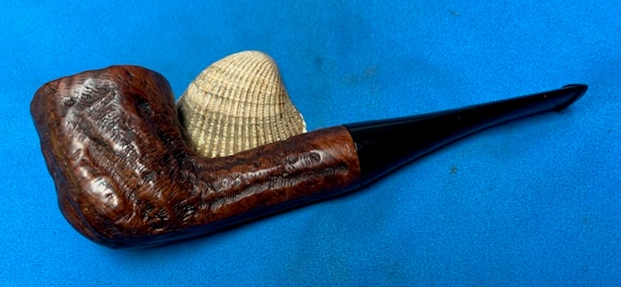
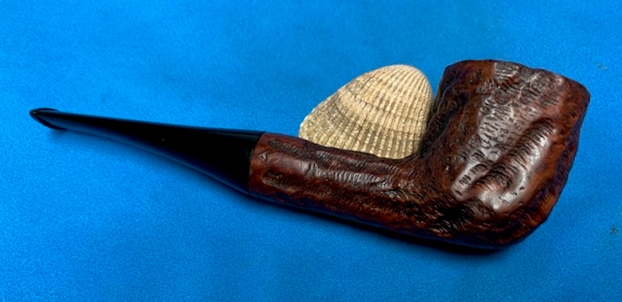
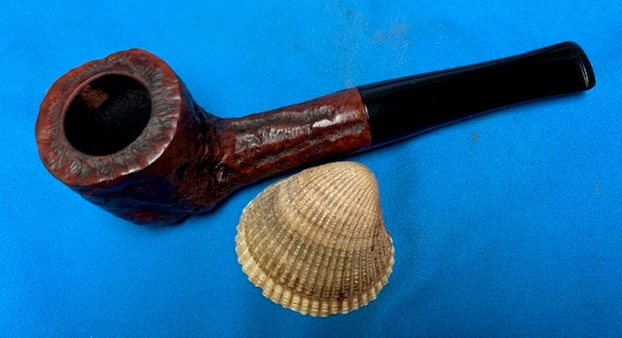
The next pipe in the queue is another mystery pipe to me. I took it in a trade for some repair work I am sure but I am not sure when I received it or who it came from. This one is a sandblast Billiard pipe with a tapered stem. The pipe is stamped on the underside of the shank and clearly reads Blackthorne arched over Weber in an oval. That is followed by Imported Briar [over] the shape number 115. The taper stem is vulcanite and has metal inserted Weber oval logo on the left side. I think that this will be another nice looking piece once it is cleaned up. The bowl is thickly caked with a thick overflow of lava on the rim top. The top and edges of the bowl look good but I would be more certain once I reamed and cleaned it. The exterior of the briar was dirty with grime and dust. The stem has light tooth marks and chatter on both sides. It is lightly oxidized, calcified and dirty. I took photos of the pipe before my cleanup work They tell the story and give a glimpse of the promise that I see in this pipe. I took a photo of the rim top to show the thick cake in the bowl, the lava on the rim top and the inner edge.  The stem was a very good fit to the shank. It was oxidized, calcified and had debris stuck to the surface of the vulcanite. It also shows the tooth marks on the stem and on the button surface.  I took photos of the stamping on the underside of the shank. It is faint but readable in the photo below and is as noted above.I turned to Pipedia to see what I could learn about the Blackthorne pipe line made by Weber Pipe Company (https://pipedia.org/wiki/Weber_Pipe_Co). I have included a page from a catalogue shown in the article.I expanded the section from the above page that was about the Weber Blackthorne pipe. It reads as follows:

This Weber Blackthorne is striking in its individual beauty, extreme lightweight and cool smoking. And at just $5 it’s a value you can’t beat anywhere.

After the fine, age-old imported briar is turned, each bowl is subjected to a raging sand storm. This etches away all soft briar leaving a hard, durable lightweight bowl of rare beauty and sweetness. Note extra wide blue-black, satin smooth vulcanite stem, dry smoking condenser tube and a bowl lining of activated charcoal.

I love the description as it truly captures the beauty of the Weber Blackthorne pipe. It is also one of the first pipes I restored many years ago. The pipe is lightweight and well blasted. It looks very good. Now it was time to work on it.

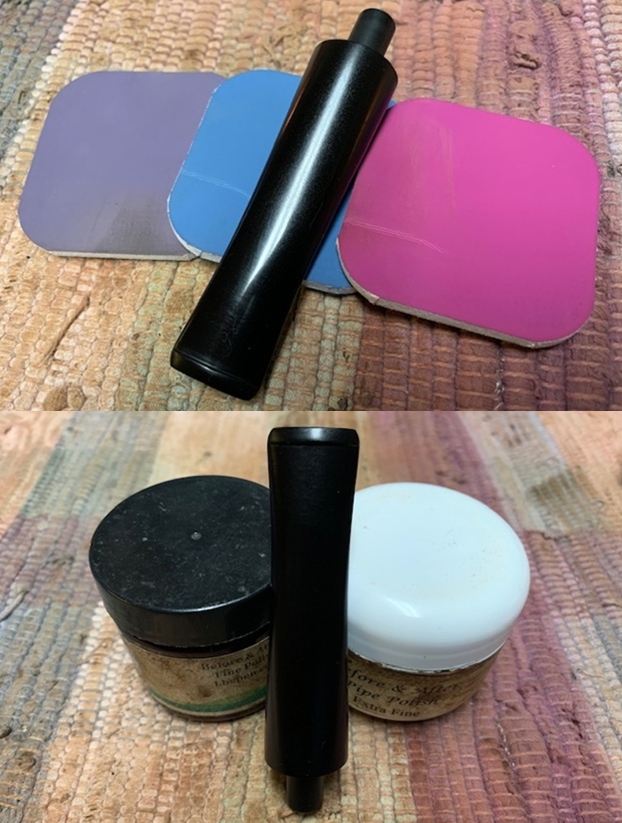
I have to tell you I am spoiled with having Jeff do all the heavy clean up work on pipes. I almost forgot that on this one and started to work on the finish. I stopped myself when I realized I was working with a dirty pipe. I reamed the pipe with a PipNet Pipe reamer to remove the cake as a whole. I cleaned up the reaming with a Savinelli Fitsall Pipe Knife and finished by sanding the bowl with 220 grit sandpaper on a piece of dowel. I removed the stinger apparatus from the stem and put the stem in a bath of Pipe Stem Oxidation Remover made by Briarville Pipe Repair and Restoration Company. It soaked while I worked on the bowl. After about 30 minutes of soaking I removed it from the bath and dried it off with a paper towel and wiped away the oxidation.I scrubbed the interior of the bowl shank and stem with pipe cleaners, cotton swabs and alcohol to remove the tars and oils.I scrubbed the exterior of the bowl with undiluted Murphy’s Oil Soap and a tooth brush to remove the grime from the surface of the bowl. I rinsed the bowl off with running water to remove the grime and the soap. I worked some Before & After Restoration Balm into the surface of the briar with my fingertips and a horse hair shoe brush to clean, enliven and protect it. I let the balm sit for a little while and then buffed with a cotton cloth to raise the shine. I set the bowl aside and turned my attention to the stem. I polished the vulcanite with micromesh sanding pads – 1500-12000 grit pads. I wiped it down with Obsidian Oil after each sanding pad. I used Before & After Pipe Polish – both Fine and Extra Fine to further polish the stem.    

With both parts of the Weber Blackthorne 115 Sandblast Billiard finished, I polished the bowl and the stem with Blue Diamond polish on the buffing wheel. I gave the bowl multiple coats of Conservator’s Wax and the stem multiple coats of carnauba wax. I buffed the pipe with a clean buffing pad to raise the shine. I hand buffed it with a microfiber cloth to deepen the shine. The pipe polished up pretty nicely. The rich mixed black and brown sandblast finish came alive with the buffing. The finish on the briar works well with the polished black vulcanite stem. The finished pipe is a well-proportioned, nicely grained Weber Billiard. Have a look at it with the photos below. The dimensions are Length: 6 inches, Height: 2 inches, Outside diameter of the bowl: 1 ½ inches, Chamber diameter: ¾ of an inch. This beautiful billiard will be going onto the rebornpipes store. If you would like to purchase it and carry on the legacy of the previous pipe smoke send a message or an email to me. Thanks for walking through the restoration with me on this older American Made pipe.

Cleaning Up a GIGI  Collection Italia  Nature 428 Bent Plateau Billiard


Blog by Steve Laug

The next pipe on the work table was purchased from an estate that we bought from the estate of a pipe man from Florida, USA. The pipe is rusticated with a tree bark like finish that is stained black and brown. It is a bent billiard shaped pipe with saddle stem. The stem has a faint GIGI stamp on the right side of the shank. The pipe is stamped on a smooth panel on the underside of the shank and reads GIGI [over] Collection [over] Italia. Toward the shank end it is stamped with the shape number 428 [over] Nature [over] Made in Italy. There was a lot of grime and dust ground into the deep rusticated finish. The bowl was heavily caked and there was a lava coat flowing onto the plateau rim top and the inner edge of the rim. The inside and outside edges looked to be in good condition but we would know more once Jeff had cleaned it. The stem was oxidized on the topside. It was lightly calcified and had tooth chatter and marks on the top and underside near the button. The button surface itself was also damaged with tooth marks. The stem was stamped GIGI in faint stamping. The pipe showed a lot of promise and had an interesting tree bark finish under the dirty grime. Jeff took some photos of the pipe before he started his cleanup work.   He took photos of the rim top, bowl and stem to give a clear picture of the condition of the pipe. The thickness of the cake and tobacco debris as well as the lava on the plateau rim top and inner edge is visible. The photos of the stem show the oxidation, calcification and the chatter and tooth marks on the top and underside.   Jeff took photos of the sides and heel of the bowl to give a picture of the rustication patterns around the bowl. The stamping on the underside of the shank clear and readable and read as noted above. I turned to Pipephil’s site to see what I could learn about the GIGI brand and the carver who had made the pipe (http://www.pipephil.eu/logos/en/logo-g3.html). I have included a screen capture of the pertinent section from the site. The information I found was as follows:

Artisan: Luigi “Gigi” Crugnola made at Gigi Pipe Via Rovera, 40 21026 Gavirate Oltrona al Lago (VA).

Now I knew that the pipe was made by Luigi “GIGI” Crugnola. That was the extent of the information on that site.I turned to Pipedia to see if I could gain a bit more information on the brand as it generally has a great digest of the history of the brand and maker (https://pipedia.org/wiki/Gigi). I quote the article in full below:

Luigi “Gigi” Crugnola was born in 1934, the same year Giorgio Rovera founded a company in his own name in Varese, Italy along with partners Angelo and Adele Bianchi, who also happened to be Luigi Crugnola’s Uncle and Mother, respectively. The company produced pipes for 30 years, largely exported to America and elsewhere in the world. Crugnola took over the company in 1964 with the death of Angelo Bianchi, changing the name soon after to his own nickname Gigi, and continues to run the company today. The vast majority of Gigi pipes continue to be made for export.

What I learned is that the pipe was made post 1964 and was in all likelihood made for export. We purchased them from the US so indeed they were exported. Now it was time to work on the pipe.

Jeff had cleaned up the pipe with his usual penchant for thoroughness. He reamed the pipe with a PipNet pipe reamer and removed the rest of it with a Savinelli Fitsall Pipe Knife.  He scrubbed the bowl with undiluted Murphy’s Oil Soap with a tooth brush. He rinsed it under running warm water to remove the soap and grime. He cleaned out the inside of the shank and the airway in the stem with alcohol, cotton swabs and pipe cleaners. He soaked the stem in Before & After Deoxidizer and rinsed it off with warm water. I took photos of the pipe once I received it.   The plateau rim top cleaned up really well. The rim top and outer edge of the bowl appear to be in good condition. The stem surface was clean and the tooth marks and chatter on both sides near the button were very visible.    The stamping on the smooth panel on the underside of the shank is clear and readable and reads as noted above. I removed the stem and took a photo of the pipe to give a sense of the whole. It would clean up and be a nice looking pipe.I rubbed the bowl and shank down with Before & After Restoration Balm. I worked it into the surface of the bowl sides and shank with my fingertips and a horse hair shoe brush to clean, enliven and protect the briar. I let the balm sit for a little while and then buffed with a cotton cloth to raise the shine.       I set the bowl aside and turned my attention to the stem. I “painted” the stem surface with the flame of a lighter to try to lift the dents. I worked fairly well with the lighter marks but left behind several on each stem surface. I filled them in with clear super glue and set it aside to cure. Once they cured I smoothed them out and recut the button edge with a needle file. I sanded out the tooth marks with 220 grit sandpaper on the stem top and underside near the button. I started polishing it with 400 grit wet dry sandpaper. I polished the vulcanite stem with micromesh sanding pads – 1500-12000 grit pads. I wiped it down with Obsidian Oil after each sanding pad. I used Before & After Pipe Polish – both Fine and Extra Fine to further polish the stem.     This GIGI Collection Italia Nature 428 Bent Billiard is a great looking pipe now that it has been restored. The rich, brown and black stained finish around the bowl and the plateau rim top is quite beautiful and works well with the polished vulcanite saddle stem. I put the stem back on the bowl and carefully buffed the pipe with Blue Diamond on the buffing wheel using a light touch on the briar. I gave the bowl multiple coats of Conservator’s Wax and the stem multiple coats of carnauba wax on the buffing wheel and followed that by buffing the entire pipe with a clean buffing pad. I hand buffed the pipe with a microfiber cloth to deepen the shine. The finished GIGI Nature Bent Billiard sits nicely in the hand and feels great. Give the finished pipe a look in the photos below. The dimensions of the pipe are Length: 6 inches, Height: 2 ¼ inches, Outside diameter of the bowl: 1 ½ inches, Chamber diameter: ¾ of an inch. I will be putting it on the rebornpipes store shortly. If you are interested in adding this pipe to your collection send me a message or an email. Thanks for reading this blog and my reflections on the pipe while I worked on it. There are many more to come!
Breathing Life into a Made in England Oom Paul


Blog by Steve Laug

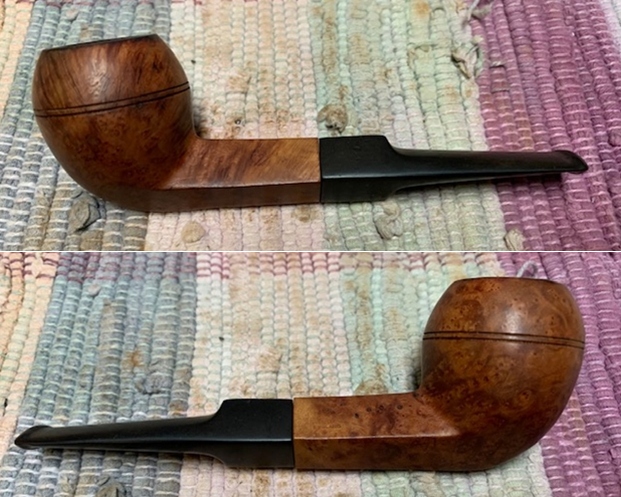
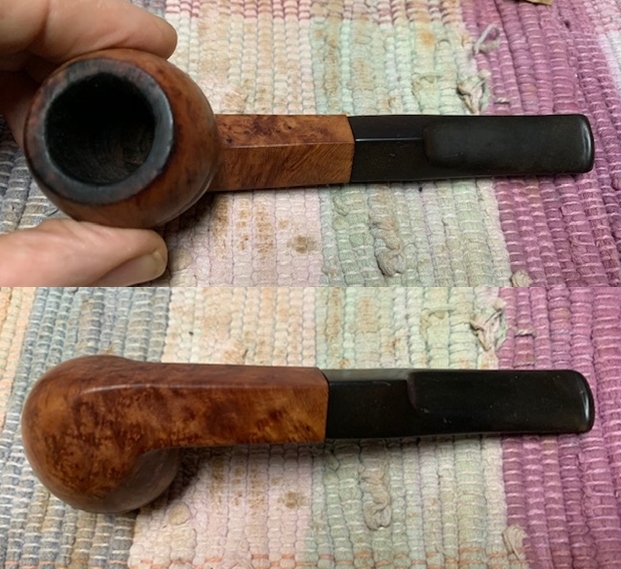
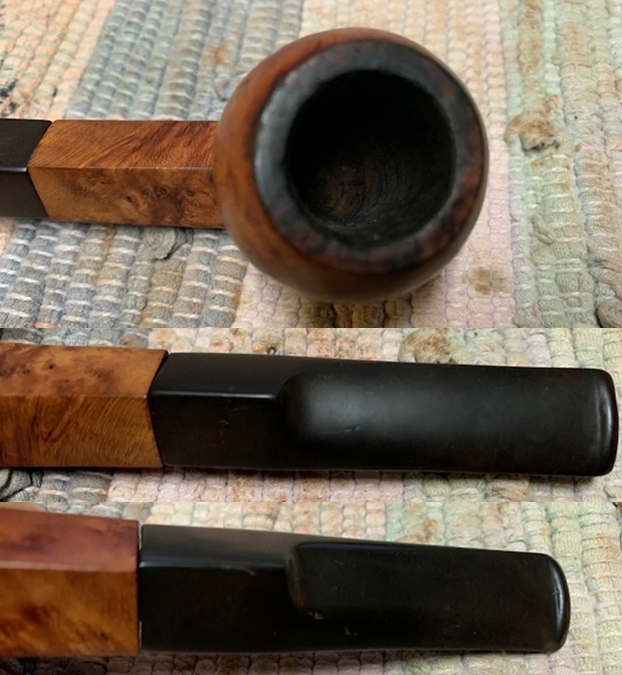
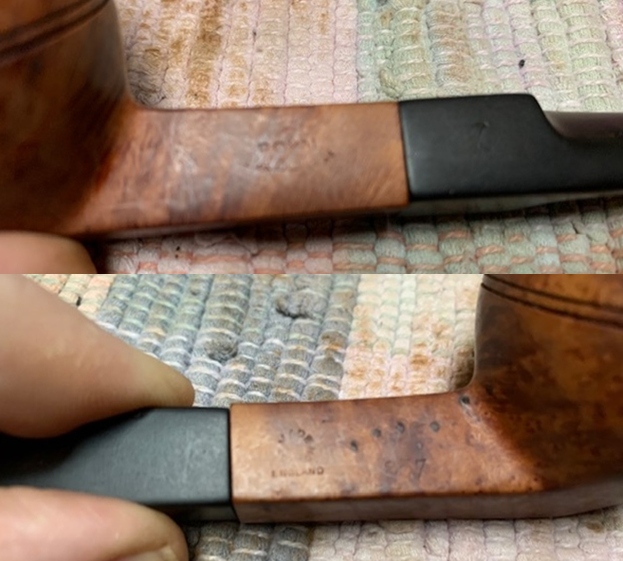
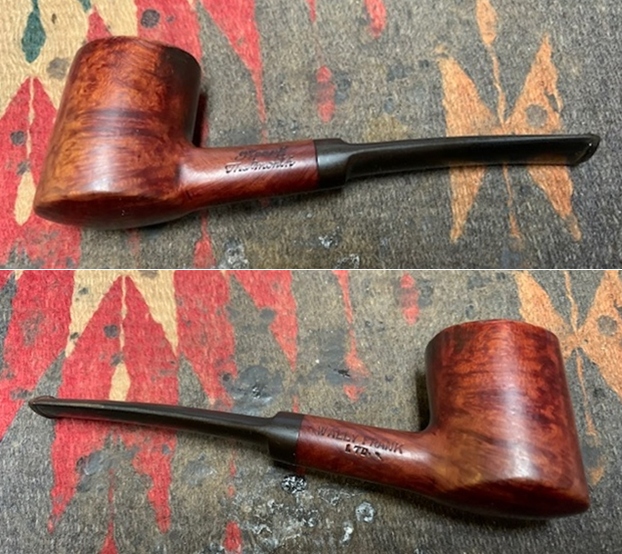
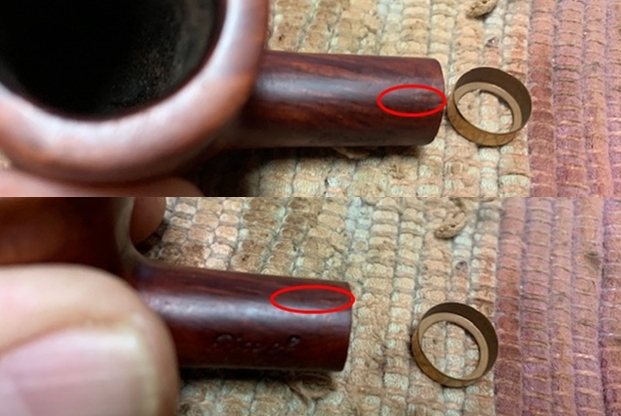
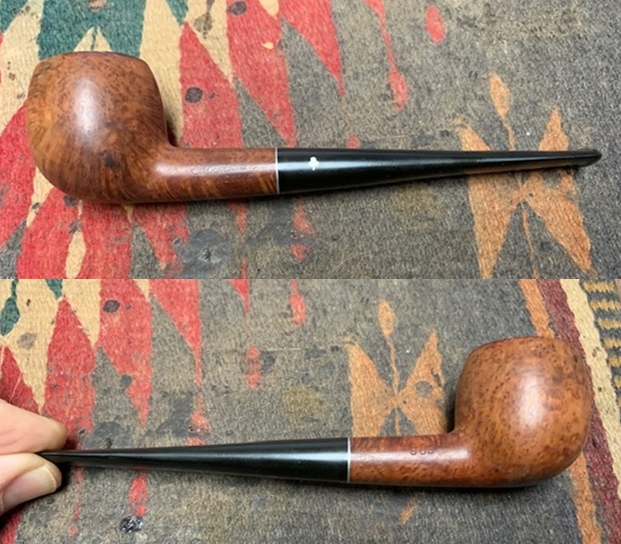
The next pipe on the work table was purchased from an antique dealer in Ancram, New York, USA.  The pipe is smooth, nicely grained Oom Paul shaped pipe with what appears to be a replacement saddle stem. The shank had been sanded narrow at the end to match the stem. The pipe is stamped on the right side of the shank and reads Made In England. There was a lot of grime and dust ground into the smooth finish. The bowl was heavily caked and there was a light lava coat flowing onto the rim top and the inner edge of the rim. The inside and outside edges looked to be in good condition but we would know more once Jeff had cleaned it. The stem was oxidized on the topside. It was lightly calcified and had tooth chatter and marks on the top and underside near the button. The stem was unstamped and unmarked. The pipe showed a lot of promise and great grain under the dirty grime. Jeff took some photos of the pipe before he started his cleanup work.   He took photos of the rim top, bowl and stem to give a clear picture of the condition of the pipe. The thickness of the cake and tobacco debris as well as the lava on the rim top and inner edge is visible. The photos of the stem show the oxidation, calcification and the chatter and tooth marks on the top and underside.      Jeff took photos of the sides and heel of the bowl to give a picture of the grain around the bowl.  The stamping on the right side of the shank clear and readable and read as noted above. The Made in England stamping on the shank is not enough to go on it terms of a make. Charatan, Barling and Comoy’s all made pipes with just this stamping so I was not close to finding the maker of this one. Now it was time to work on the pipe itself.

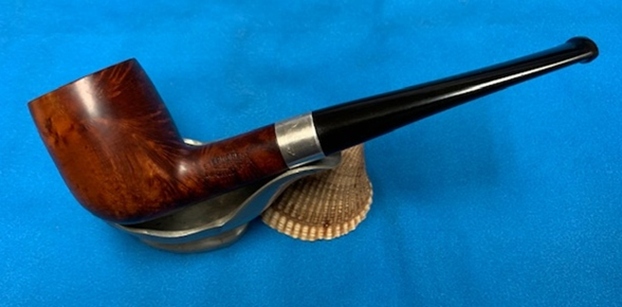
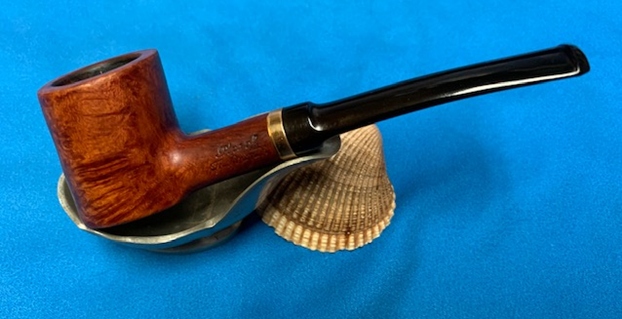
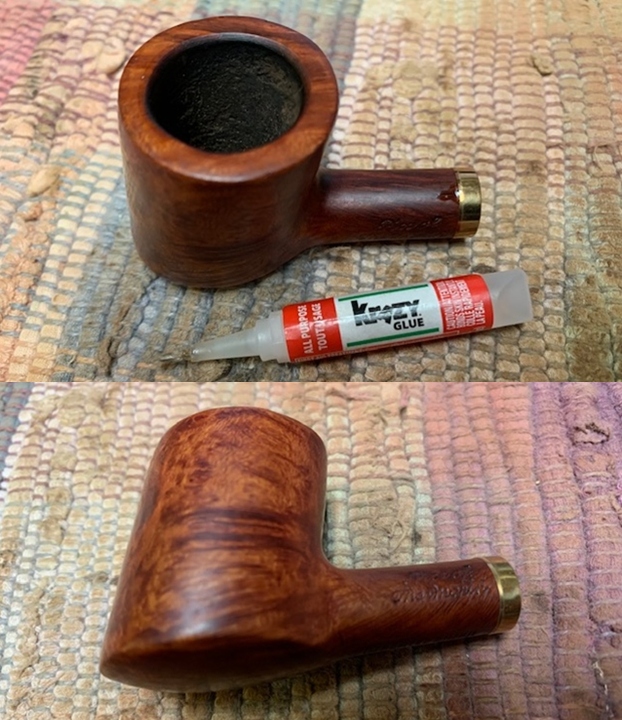
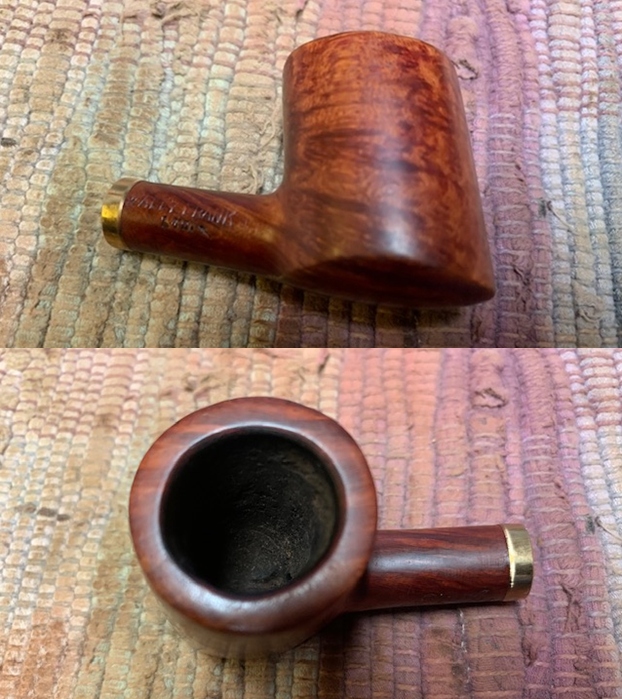
Jeff had cleaned up the pipe with his usual penchant for thoroughness. He reamed the pipe with a PipNet pipe reamer and removed the rest of it with a Savinelli Fitsall Pipe Knife.  He scrubbed the bowl with undiluted Murphy’s Oil Soap with a tooth brush. He rinsed it under running warm water to remove the soap and grime. He cleaned out the inside of the shank and the airway in the stem with alcohol, cotton swabs and pipe cleaners. He soaked the stem in Before & After Deoxidizer and rinsed it off with warm water. I took photos of the pipe once I received it.   The rim top cleaned up really well. The rim top and outer edge of the bowl appear to be in ok condition. The stem surface looked good with some remaining oxidation and some tooth marks and chatter on both sides near the button. The stamping on side of the shank is clear and readable and reads as noted above.  You can also see the poor fit of the stem to the shank and the slight tapering that has been done to the shank end. This will need to be addressed in the restoration of the pipe. The grain is quite stunning.I removed the stem and took a photo of the pipe to give a sense of the whole. It would clean up and be a gorgeous pipe.Now it was time to do my work on the pipe.  I decided to deal with the misshaped shank and the poorly fit replacement stem. I could not remove any of the briar without damaging the stamping on the shank so I decided to put a thin brass band on the shank end to provide a good seat for the stem and adjust the fit of the pipe to the shank end. I went through my bands and found one that fit the shank well. I pressed it onto the shank end. I put the stem back on the pipe and took photos to show the new look of the pipe. I really like the band on the shank as it added a touch of class to the look of the pipe. I polished the briar of the bowl and rim top with micromesh sanding pads – dry sanding with 1500-12000 grit pads. I wiped the briar down after each pad with a damp cotton pad.  I polished the silver band with a jeweler’s cloth after the first three pads.   I rubbed the bowl and shank down with Before & After Restoration Balm. I worked it into the surface of the bowl sides and shank with my fingertips to clean, enliven and protect the briar. I let the balm sit for a little while and then buffed with a cotton cloth to raise the shine.     I set the bowl aside and turned my attention to the stem. I sanded out the tooth marks with 220 grit sandpaper on the stem top and underside near the button. I started polishing it with 400 grit wet dry sandpaper.    I polished the vulcanite stem with micromesh sanding pads – 1500-12000 grit pads. I wiped it down with Obsidian Oil after each sanding pad. I used Before & After Pipe Polish – both Fine and Extra Fine to further polish the stem.   This Made in England Oom Paul is a great looking pipe now that it has been restored. The rich, brown stained finish around the bowl is quite beautiful and highlights the gorgeous mix of cross and birdseye grain. The finish works well with the decorative brass band and the polished vulcanite saddle stem. I put the stem back on the bowl and carefully buffed the pipe with Blue Diamond on the buffing wheel using a light touch on the briar. I gave the bowl and the stem multiple coats of carnauba wax on the buffing wheel and followed that by buffing the entire pipe with a clean buffing pad. I hand buffed the pipe with a microfiber cloth to deepen the shine. The finished English Made Oom Paul sits nicely in the hand and feels great. Give the finished pipe a look in the photos below. The dimensions of the pipe are Length: 5 ½ inches, Height: 2 ¼ inches, Outside diameter of the bowl: 1 ¼ inches, Chamber diameter: ¾ of an inch. I will be putting it on the rebornpipes store shortly. If you are interested in adding this pipe to your collection send me a message or an email. Thanks for reading this blog and my reflections on the pipe while I worked on it. There are many more to come!
New Life for a Barling’s Make Ye Olde Wood 216 EL Billiard


Blog by Steve Laug

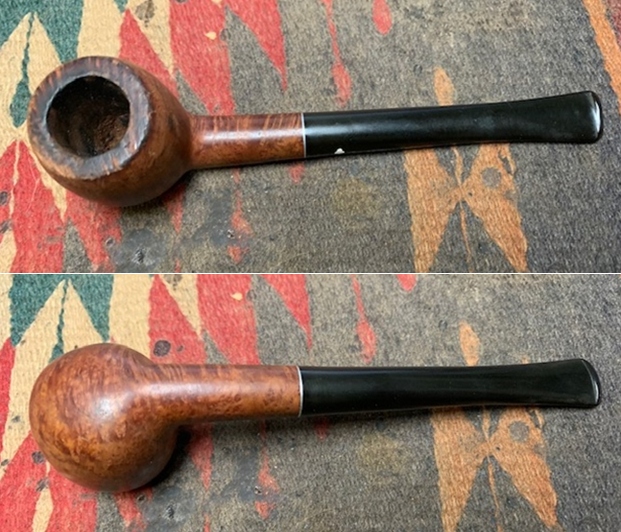
The next pipe on the work table came to us from an online auction in Nampa, Idaho, USA.  The pipe is smooth, nicely grained Billiard shaped pipe with a saddle stem. The pipe is stamped on left side of the shank and reads Barling’s [arched over] Make [over] Ye Olde Wood [over]the shape number 216. On the right side of the shank it is stamped Made In England followed by EL. There was a lot of grime and dust ground into the smooth finish. There was also a large U shaped crack that went up each side and met on the underside of the shank (you will see photos of the crack below). The pipe had been repaired by gluing the chunk of briar in place and banding the shank with a Sterling Silver band. The bowl was heavily caked and there was a lava coat flowing onto the rim top and the inner edge of the rim. The inside and outside edges looked to be in good condition but we would know more once Jeff had cleaned it. The stem was oxidized, calcified and had tooth chatter and marks on the top and underside near the button. The stem was stamped on the topside with the Barling Cross and on the underside and read REGD 98046. The stamping was readable. The pipe showed a lot of promise but it was very dirty. Jeff took some photos of the pipe before he started his cleanup work.   He took photos of the rim top, bowl and stem to give a clear picture of the condition of the pipe. The thickness of the cake and tobacco debris as well as the lava on the rim top and inner edge is visible. The photos of the stem show the oxidation, calcification and the chatter and tooth marks on the top and underside. Jeff took photos of the sides and heel of the bowl to give a picture of the grain around the bowl.  The stamping on the right and left side of the shank are clear and readable and read as noted above. You can also see the Barling Cross stamp on the top of the saddle stem. There is no picture of the Regd number on the underside.The above photos also show the crack in the shank. I am including them again so you can see the downward turn on the crack on each side and the way that it crosses the underside of the shank forming a U-shaped crack that certainly came free from the shank. It had obviously been glued back in place and then the Sterling Silver band had been glued in place on the shank end to bind it all together. I have inserted yellow arrows in the photos below to identify the path of the crack.I turned to Pipephil’s site (http://www.pipephil.eu/logos/en/logo-barling.html) to see if I could find a listing that had the same or similar stamping on the pipe. The stamping is the same other than the shape number. The pipe that I am working on has a shape number on the shank in the same location as the photo below. Barling’s [arched over] Make [over] Ye Olde Wood [over] shape number 216. On the right side Made in England was followed by EL stamp in a pattern like that shown in the screen capture below.Pipedia gives a great history of the brand (https://pipedia.org/wiki/Barling) that is well worth reading. I looked specifically for the Patent Reg’d Stamp and found that the stamping on the stem of the one I was working on was a US Patent number for the stem.

REG’D 98 046 – US patent number – 1936 – 1949

I also worked through the different eras of the Barling pipes. I found a section on redefining the eras and quote from that section as followed:

Family Era 1912 – 1962: Pipes made by the Barling family while it either owned or managed B. Barling & Sons.

Corporate Era 1962 – the Present: Pipes made after the family left off managing the company, beginning with the revised product grades and revised nomenclature that were introduced in the 1962 Dealers’ Catalog.

The Family Era pipes are highly sought after by collectors and have excellent smoking and aesthetic qualities. These pipes are famous for the “old wood” from which they were made. I’m including the 1962 “Barling’s Make” pipes in this category because, initially, they were made while the Family still ran the business. Montague Barling was still President, and Williamson-Barling was still General Manager.

These 1962 pipes were made by the same craftsman from the same materials, as the earlier product. Some of them are stamped with both the old and new model numbers.

…The “BARLING’S MAKE” has the word “BARLING’S” arched over the word “MAKE” in capital block letters. Barling used this block letter logo until late 1962.

Ye Olde Wood Stamp: Sometime around 1913, the “Ye Olde Wood” stamp made its appearance on selected pipes. An example exists stamped on a 1913 date hallmarked pipe.

This logo will continue to be used in the decades to come. Initially it was used to designate a higher grade than the average, much as the “Special” grade would after the Second World War. Price lists show the “Ye Olde Wood” pipes as a separate grade from the basic BARLING’S MAKE pipe. Eventually, “Ye Olde Wood” came to represent the company to the world. The use of “YE OLD WOOD” as a stamp prior to 1940 was haphazard, at best, although the company used the slogan in advertising materials from the early teens onward. (Gage)

Crossed Barling Stem Logo: It is not known when the crossed Barling stem logo first appeared, but an example exists on a pipe with a 1923 date hallmark. And several of the mid 1920’s pipes added in this update also feature the crossed Barling stem logo.

Size Stampings:  Up to 1926 and possibly beyond, Barling used specific, completely unrelated, model numbers to designate the various sizes of a specific shape. They produced pipes in three sizes, small, medium, and large.

Barling’s published price lists show that they continued to offer pipes in only three sizes, small, medium, and large until 1941. That’s it, small, medium, and large. So when someone claims that they have a 1930’s EL, EXEL, or other size, they are mistaken.

In 1941 the published range of sizes expanded. Going from the smallest to the largest, they are SS, S, S-M, L, EL, EXEL, and EXEXEL. There is no “G” for giant. Giant pipes, or magnums, which are oversized standard billiards, were not stamped “G” but are commonly identified by collectors as such because they are obviously large relative to even EXEXEL pipes, and carried no size stampings (Gage).

Now I knew a bit about the pipe I was working on. Because of the Patent stamping on the stem I knew that it was made between 1936-1949. The use of the EL stamp also fits this time period. Now it was time to work on the pipe.

Jeff had cleaned up the pipe with his usual penchant for thoroughness. He reamed the pipe with a PipNet pipe reamer and removed the rest of it with a Savinelli Fitsall Pipe Knife.  He scrubbed the bowl with undiluted Murphy’s Oil Soap with a tooth brush. He rinsed it under running warm water to remove the soap and grime. He cleaned out the inside of the shank and the airway in the stem with alcohol, cotton swabs and pipe cleaners. He soaked the stem in Before & After Deoxidizer and rinsed it off with warm water. I took photos of the pipe once I received it.   The rim top cleaned up really well. The rim top and outer edge of the bowl appear to be in ok condition. There is some darkening on the back side of the inner edge and top and some burn damage on the front inner edge that will need to be addressed. The stem surface looked good with some remaining oxidation and some tooth marks and chatter on both sides near the button.    The stamping on sides of the shank is clear and readable and reads as noted above. I removed the stem and took a photo of the pipe to give a sense of the whole. It would clean up and be a gorgeous pipe.Now it was time to do my work on the pipe.  I took photos of the crack in shank to show how it looks after cleanup. The excess glue that was on the shank is gone and the crack looks clean. There is a slight ridge on the crack on the underside of the shank. I sanded out the high spots on the ridge on the underside of the shank with a folded piece of 220 grit sandpaper to smooth out the surface. I did the same on the sides of the shank without damaging the stamping on the shank sides.Now it was time to address the damage on the inside of the front edge of the rim and the darkening on the top of the bowl. I gave the edge a slight bevel to obscure the damage. I sanded the rim top with a worn piece of 220 grit sandpaper to remove the darkening.I polished the briar of the bowl and rim top with micromesh sanding pads – dry sanding with 1500-12000 grit pads. I wiped the briar down after each pad with a damp cotton pad.  I polished the silver band with a jeweler’s cloth after the first three pads. I rubbed the bowl and shank down with Before & After Restoration Balm. I worked it into the surface of the bowl sides and shank with my fingertips to clean, enliven and protect the briar. I let the balm sit for a little while and then buffed with a cotton cloth to raise the shine.   I set the bowl aside to work on the stem. I put the stem in the Pipe Stem Oxidation Remover from Briarville USA. I am still experimenting with the product to remove the oxidation that remained on the stem. I let it soak for 1 hour and took it out of the bath and wiped it down with a paper towel. The photos show the stem at this point.  I used some Rub’n Buff Antique gold to touch up the stamps because they were so faint that the white filler that I usually used would not even show on the stem. The stem was in good condition and the tooth marks were light so I figured they would polish out fairly easily. I polished the vulcanite stem with micromesh sanding pads – 1500-12000 grit pads. I wiped it down with Obsidian Oil after each sanding pad. I used Before & After Pipe Polish – both Fine and Extra Fine to further polish the stem.       This Barling’s Make Ye Olde Wood 216 EL Billiard is a great looking pipe now that it has been restored. The rich, brown stained finish around the bowl is quite beautiful and highlights the gorgeous mix of cross and birdseye grain. The finish works well with the polished vulcanite patented saddle stem. I put the stem back on the bowl and carefully buffed the pipe with Blue Diamond on the buffing wheel using a light touch on the briar. I gave the bowl and the stem multiple coats of carnauba wax on the buffing wheel and followed that by buffing the entire pipe with a clean buffing pad. I hand buffed the pipe with a microfiber cloth to deepen the shine. The finished Barling’s Make Ye Olde Wood Saddle Billiard sits nicely in the hand and feels great. Give the finished pipe a look in the photos below. The dimensions of the pipe are Length: 5 inches, Height: 1 ¾ inches, Outside diameter of the bowl: 1 ¼ inches, Chamber diameter: ¾ of an inch. I will be putting it on the rebornpipes store shortly. If you are interested in adding this pipe to your collection send me a message or an email. Thanks for reading this blog and my reflections on the pipe while I worked on it. There are many more to come!

Restoring a Bertoli Napoli Bent Bulldog


Blog by Steve Laug

The next pipe on the work table came to us from a group of pipes that Jeff picked up on an online auction in Torrence, California, USA.  The pipe is an interesting looking piece. It has a classic Bulldog shape that looks very English – or maybe French. It is a smooth finished Bulldog shaped pipe with some nice grain around the bowl. The pipe is stamped on the topside of the shank and reads Bertoli [over] Napoli. On the underside of the stem it is stamped France. It is a bit of a mystery a very Italian sounding name and a French stamp on the stem. There was a lot of grime ground into the smooth finish on the briar as well as some peeling varnish and some flecks of paint. The bowl was heavily caked with a light lava coat flowing onto the top of the rim. The inside and outside edges looked to be in good condition but we would know more once Jeff had cleaned it. The stem was oxidized, calcified and had tooth chatter and marks on the top and underside near the button. There was a crescent moon logo stamped on the top left side of the Diamond saddle stem. It had promise but it was very dirty. Jeff took some photos of the pipe before he started his cleanup work.   He took a photo of the rim top and bowl to give a clear picture of the thickness of the cake and tobacco debris as well as the light lava on the rim top and inner edge. He also took photos of the top and underside of the stem to show the oxidation and the chatter and tooth marks.   Jeff took photos of the sides and heel of the bowl to give a picture of what the briar looked like. There looks like there may be some nice grain around the sides under the peeling varnish, paint and grime. The stamping on the left side of the shank is clear and readable and read as noted above.  The Crescent Moon logo is visible in the second photo below.   I looked on both Pipephil’s site and Pipedia to find out if there was any information on either the Bertoli or Napoli brand and neither site had any information. I did a broader search on Google and found a Bertoli Napoli Canadian for sale on Worthpoint. I quote the description in full because the seller found the same lack of information I ran into (https://www.worthpoint.com/worthopedia/bertoli-napoli-smooth-mid-sized-1835956729).

Bertoli NAPOLI, Smooth Mid-Sized Canadian, Swirly Cross-Grain & Birdseye Description: Bertoli NAPOLI, France Smooth Mid-Sized Canadian Swirly Cross-Grain & Birdseye Great Overall Condition. Offering a Bertoli NAPOLI pipe in a smooth finish mid-sized Canadian shape. Could not fine info on Bertoli as a brand and the NAPOLI both sound Italian, but bottom of stem has FRANCE stamped there. The pipe condition is very nice, no notable wear to the bowl, only one very tiny tooth mark only to the stem bottom. The bowl has good rich color to the grain and nice swirly grain patterns, some small fills, no issues. Stem is original made of vulcanite, has a small moon crescent logo on the top…

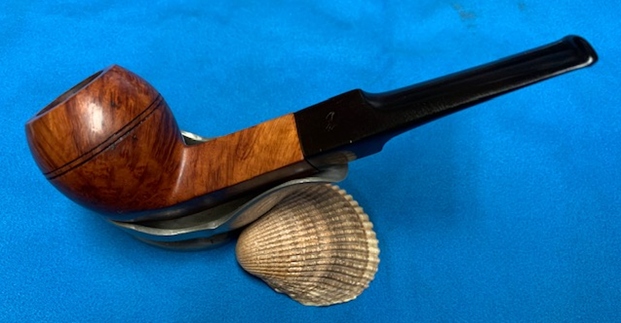
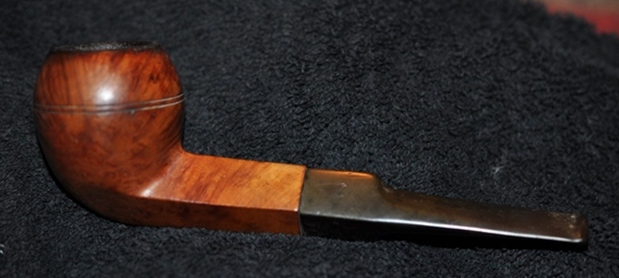
Given the dead end that I had run into on the brand it was now time work on the pipe. Jeff had cleaned up the pipe with his usual penchant for thoroughness. He reamed the pipe with a PipNet pipe reamer and removed the rest of it with a Savinelli Fitsall Pipe Knife.  He scrubbed the bowl with undiluted Murphy’s Oil Soap with a tooth brush. He rinsed it under running warm water to remove the soap and grime. He cleaned out the inside of the shank and the airway in the stem with alcohol, cotton swabs and pipe cleaners. He soaked the stem in Before & After Deoxidizer and rinsed it off with warm water. I took photos of the pipe once I received it.  The rim top cleaned up really well. The rim top and outer edge of the bowl appear to be in good condition. The inner edge also looked good. The stem surface looked good with a few small tooth marks and chatter on both sides near the button.  The stamping on the left side of the shank and the underside of the stem is clear and readable and reads as noted above. I removed the stem and took a photo of the pipe to give a sense of the whole. The stem is a saddle with a Crescent Moon the left side.Now it was time to do my work on the pipe. I started by wiping the bowl down with Acetone to remove the scattered piece of varnish still on the bowl finish. This can be seen in the photo of the underside of the shank show in photo above. There were two small chips on the front of the bowl. I filled them in with clear CA glue. I sanded the repairs with 220 grit sandpaper to smooth them out and blend them into the bowl. The sanded area would blend in better once the polishing of the bowl with micromesh sanding pads.I polished the repaired areas and the rest of the briar with micromesh sanding pads – wet sanding with 1500-12000 grit pads and wiping it down after each pad with a damp cloth.    I rubbed the bowl and shank down with Before & After Restoration Balm. I worked it into the surface of the bowl sides and shank with my fingertips to clean, enliven and protect the briar. I let the balm sit for a little while and then buffed with a cotton cloth to raise the shine. The grain came alive and the flaws while visible look better than when I began. I set the bowl aside and turned to work on the stem. I “painted” the stem with the flame of Bic lighter to lift the tooth marks in the surface of the vulcanite. I was able to life most of them a few remained that could be sanded out. I sanded them out with 220 grit sandpaper to blend them in and started the polishing with 400 grit wet dry sandpaper.    I used Rub’n Buff Antique Gold to touch up the stamps on the shank – the crescent moon and the France stamp. I applied it with a tooth pick and then rubbed it off with a cotton pad. The crescent moon stamp is a bit faint at the top but it looks better than it did. The France stamp looks very good.     I polished the vulcanite stem with micromesh sanding pads – 1500-12000 grit pads. I wiped it down with Obsidian Oil after each sanding pad. I used Before & After Pipe Polish – both Fine and Extra Fine to further polish the stem. This Bertoli Napoli Bent Bulldog is a great looking pipe now that it has been restored. The rich brown finish around the bowl is quite beautiful and highlights the grain and works well with the polished vulcanite saddle stem. I put the stem back on the bowl and carefully buffed the pipe with Blue Diamond on the buffing wheel using a light touch on the briar. I gave the bowl and the stem multiple coats of carnauba wax on the buffing wheel and followed that by buffing the entire pipe with a clean buffing pad. I hand buffed the pipe with a microfiber cloth to deepen the shine. The finished Bertoli Napoli sits nicely in the hand and feels great. Give the finished pipe a look in the photos below. The dimensions of the pipe are Length: 5 ½ inches, Height: 1 ½ inches, Outside diameter of the bowl: 1 ¾ inches, Chamber diameter: ¾ of an inch. I will be putting it on the rebornpipes store shortly. If you are interested in adding this pipe to your collection send me a message or an email. Thanks for reading this blog and my reflections on the pipe while I worked on it. There are many more to come!
Renewing a Sasieni 4 Dot Natural #4 Dublin


Blog by Steve Laug

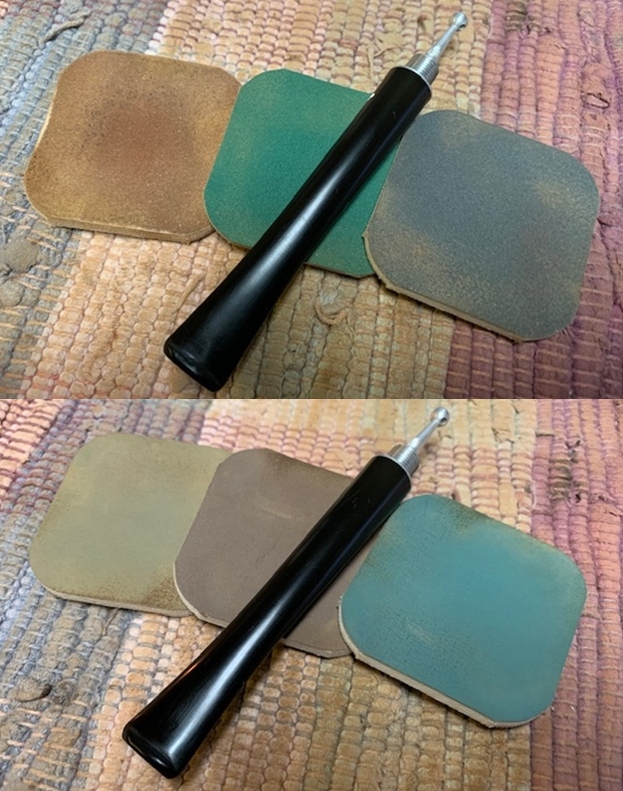
The next pipe on the work table came to us from a group of pipes that we purchased from fellow in Cornwall, Pennsylvania, USA.  The pipe is an interesting looking piece. It has a unique shape and certainly not one that I would readily identify as a Sasieni shape but it is! It is a smooth finished forward canted Volcano shaped pipe with some nice grain around the bowl. The pipe is stamped on the topside of the shank and reads Sasieni [over] Two Dot [over] London Made. On the right side of the shank it is stamped with the shape number 60 near the bowl and the rugby shaped Made in England COM stamp near the stem. There was a lot of grime ground into the smooth finish on the briar. There were also to small pinholes in the right side of the mid bowl that are strange. The bowl was heavily caked with a lava coat flowing onto the top of the rim. The inside and outside edges looked to be in good condition but we would know more once Jeff had cleaned it. The stem was oxidized, calcified and had tooth chatter and marks on the top and underside near the button. There were two light blue dots on the top of the oval saddle stem. It had promise but it was very dirty. Jeff took some photos of the pipe before he started his cleanup work.   He took a photo of the rim top and bowl to give a clear picture of the thickness of the cake and tobacco debris as well as the lava on the rim top and inner beveled edge. He also took photos of the top and underside of the stem to show the oxidation and the chatter and tooth marks.   Jeff took photos of the sides and heel of the bowl to give a picture of what the briar looked like. There looks like there may be some nice grain around the sides under the blah finish and grime. The stamping on the right and undersides of the shank are clear and readable and read as noted above.  The 4 light blue dots are visible in the photo below. I turned to Pipephil’s site and specifically the timeline for Sasieni that is included there to see when the Four Dot changed to 4 Dot (http://www.pipephil.eu/logos/en/infos/sasieni-timechart.html).I have included a screen capture of the timeline below. From the time line I was able to learn that the 4 Dot stamping was introduced in the late 1980 – perhaps 1987. Thus I knew that I was not dealing with an earlier family period pipe but a newer one relatively speaking.

I turned then to Pipedia to focus in on that period and get an idea of where this pipe fit in the timeline and the hierarchy of the brand (https://pipedia.org/wiki/Sasieni). I found the section I was looking for in the article and have included it below. For more information on the brand be sure to read the full article.

…Somewhat later still, this was modified to reflect the finish, e.g. Four Dot Walnut, or Four Dot Natural. All these changes seem to have been made in the years between 1946 and 1950. Therefore a pipe with new style dots and old style stamping almost certainly has a replacement stem.

This system changed little if at all in the ensuing thirty years. When the company was sold in 1979, one of the first things the new owners did was to eliminate the town names from the shanks. The dots were enlarged yet further, and the Sasieni name, though still done in script, was larger, as was the rest of the shank nomenclature, which in all other ways was similar to the Pre-Transition nomenclature. While these pipes are not as collectible as the family made pipes, they were made with care and are high quality.

The nomenclature changed again in 1986, with the sale of the company to the Post-Transition firm. The three line nomenclature was changed to two lines, with the first reading “Sasieni 4 Dot” and the second identifying the finish, e.g. Natural, Walnut, or Ruff Root. Note how 4 Dot is spelled, using an Arabic numeral 4, as opposed to spelling out the word “four”. This is the easiest way to spot a Post-Transition Sasieni, as the new company has used both script and block lettering to spell the word “Sasieni” on the shank.

Now I knew I was working on a Post-Transition Sasieni made after 1986. It bore the Sasieni 4 Dot stamp and the second line Finish stamp – in this case Natural. It clearly differentiated this 4 Dot for the Four Dot pipes that I have worked on in the past.

Now on to working on the pipe. Jeff had cleaned up the pipe with his usual penchant for thoroughness. He reamed the pipe with a PipNet pipe reamer and removed the rest of it with a Savinelli Fitsall Pipe Knife.  He scrubbed the bowl with undiluted Murphy’s Oil Soap with a tooth brush. He rinsed it under running warm water to remove the soap and grime. He cleaned out the inside of the shank and the airway in the stem with alcohol, cotton swabs and pipe cleaners. He soaked the stem in Before & After Deoxidizer and rinsed it off with warm water. I took photos of the pipe once I received it.   The rim top cleaned up really well. The rim top and outer edge of the bowl appear to be in good condition. The beveled inner edge also looked good. The stem surface looked good with a few small tooth marks and chatter on both sides near the button.  There was also some remaining oxidation visible on the stem. The stamping on the left and underside of the shank is clear and readable and reads as noted above.    I removed the stem and took a photo of the pipe to give a sense of the whole. The stem is a saddle with 4 Blue dots on the left side.Now it was time to do my work on the pipe. I polished the repaired areas and the rest of the briar with micromesh sanding pads – wet sanding with 1500-12000 grit pads and wiping it down after each pad with a damp cloth. I rubbed the bowl and shank down with Before & After Restoration Balm. I worked it into the surface of the bowl sides and shank with my fingertips to clean, enliven and protect the briar. I let the balm sit for a little while and then buffed with a cotton cloth to raise the shine. The grain came alive and the flaws while visible look better than when I began. I set the bowl aside and turned to work on the stem. I “painted” the stem with the flame of Bic lighter to lift the tooth marks in the surface of the vulcanite. While I was able to life most of them a few remained on each side. I filled these in with clear super glue. Once the repairs cured I sanded them out with 220 grit sandpaper to blend them in and started the polishing with 400 grit wet dry sandpaper.  It was in good condition and the tooth marks were light so I figured they would polish out fairly easily. I polished the vulcanite stem with micromesh sanding pads – 1500-12000 grit pads. I wiped it down with Obsidian Oil after each sanding pad. I used Before & After Pipe Polish – both Fine and Extra Fine to further polish the stem.       This Post-Transition Sasieni 4 Dot Natural Dublin is a great looking pipe now that it has been restored. The Natural finish around the bowl is quite beautiful and highlights the grain and works well with the polished vulcanite saddle stem. I put the stem back on the bowl and carefully buffed the pipe with Blue Diamond on the buffing wheel using a light touch on the briar. I gave the bowl and the stem multiple coats of carnauba wax on the buffing wheel and followed that by buffing the entire pipe with a clean buffing pad. I hand buffed the pipe with a microfiber cloth to deepen the shine. The finished Sasieni 4 Dot sits nicely in the hand and feels great. Give the finished pipe a look in the photos below. The dimensions of the pipe are Length: 5 ½ inches, Height: 2 inches, Outside diameter of the bowl: 1 ½ inches, Chamber diameter: 7/8 of an inch. I will be putting it on the rebornpipes store shortly. If you are interested in adding this pipe to your collection send me a message or an email. Thanks for reading this blog and my reflections on the pipe while I worked on it. There are many more to come!