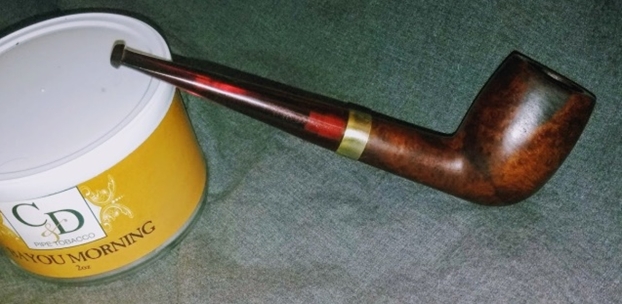
Tag Archives: article by Robert M. Boughton

The Decline of Restoring Old Pipes, Part 3/4: Sir Daryl and the Golden Blueline Bakelite


Blog by Robert M. Boughton
https://www.roadrunnerpipes2k.com/
https://www.facebook.com/roadrunnerpipes/
Copyright © Reborn Pipes and the author except as noted

Once upon a time there was a man who was about to go on a long journey, and right before his departure he asked his three daughters what he should bring back to them. The oldest wanted pearls, the second, diamonds, but the third said, ‛Dear Father, I’d like to have a singing, springing lark.’ — The Brothers Grimm, Jacob and Wilhelm, from “The Singing, Springing Lark,” in Children’s and Household Tales (1815)

RECAP
Part 1 hypothesized that the discontinuation, illegality and dwindling or total unavailability of vital materials, used in antique and other very old pipes, will lead to a serious crisis in restoring these heirlooms and otherwise prized implements of contemplation to their original conditions.  My main theme was the need for those of us in the business – having considerable, moderate or little experience under our belts – to learn how to overcome these difficulties that will become more acute all too soon.  In hindsight, I should have emphasized better the need for those who now have the know-how to use their own perhaps self-discovered and unique (read proprietary) heroic measures  to cooperate in sharing them with the rest of us, as Part 4 will demonstrate without the help I would have preferred but with other expert assistance that is very much appreciated.

Part 2 described the first of three such repairs I have completed, its example being a Colossus Pipe Factory (CPF) Best Make turned lion’s head meerschaum with a gold band and genuine cherry red amber stem that needed reconnecting with a new bone screw tenon.  Five years after I began searching for the one part, I was compelled to send the otherwise restored CPF to a specialized repair service that may have been the only place capable at the time to affect the rehabilitation, for lack of a proper bone screw tenon or anyone to whom I could turn for instruction on how to repair the damage to the inner shank.  Now I know the necessary work was relatively minor.  Having determined the approximate technique used to repair my CPF, I will share the knowledge with anyone who cares to read the next and final installment, in which I mend a more damaged meerschaum shank and re-stem the pipe.

SIR DARYL AND THE GOLDEN BLUELINE BAKELITE
Once upon a time, in the sixteenth year of the third millennium, there lived a young man who dwelt in the center of a place of medium size.  When it was founded by Spaniards three centuries earlier the sage brush- and tumbleweed-blown burg was a dukedom known as Alburquerque, with two r’s, named in honor of a now long-forgotten duke of the proud nation that settled it.  But long before our tale began, the name was shortened, probably because of common misspelling, to Albuquerque, with only one r.

At the time the events of this account began to unfold, more than half of the almost one million souls who called the Land of Enchantment home tried to get along in its fast-growing and biggest metropolis, but perhaps lacked faith in the higher powers.  Gun-related deaths and evils in general were far above average compared to the other 49 quasi-independent lands of the constitutional federal republic they composed.  This was before Puerto Rico, Guam, the Virgin Islands and Panama were granted the same status, although they did not ask for it, and despite the attempts of Texas, Hawaii and California to rule themselves   Most of the people still believed they were part of a true democracy, which of course does not exist.

The young man, whom we will call Sir Daryl, had a high-tech job that his life in general and education and training in particular had prepared him to perform with the greatest skill.  He also enjoyed his work, as much as any man likes the chronic rising from bed day in and day out and spending long hours away from home and friends, so that was a good thing.

But Sir Daryl’s real love in life was going on quests for beautiful and rare tobacco pipes that were bestowed with magical powers.  Sir Daryl’s keen eyes and a preternatural knack for recognizing the magic when he saw it aided him in his never-ending search.  Even when he traveled for business purposes, without fail he seemed able to sniff out the rare and hidden examples of the craft that awaited him   All of the precious shapes and styles he discovered in this fashion were his for the taking at prices so low he could not bring himself to turn them down.  Sometimes Sir Daryl wondered at his aura of luck in locating the treasures but did not spend much time fretting over his ostensible good fortune.  As his tastes grew more refined, which such appetites always arouse, Sir Daryl turned to antiques.

Unaware that his friends were beginning to notice the signs of a peculiar spell that was known to afflict many pipe collectors of his period, before counter-spells were found to eliminate the problem, Sir Daryl became obsessed with the thrill of the chase and ultimate liberation of these fine prizes from their previous, unworthy guardians.  And they were much admired by all who beheld them

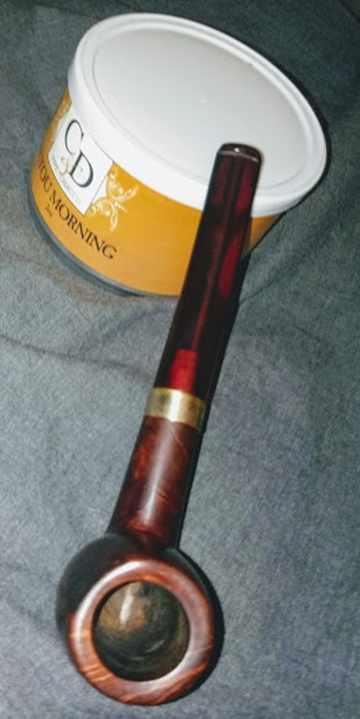
One of Sir Daryl’s most splendid finds was crafted by the renowned house of Kaufman Brothers & Bondy and given the enticing name Blueline Bakelite, the creation of which he was able, with his considerable fact finding skills, to pinpoint to the second year of the second decade of the twentieth century.

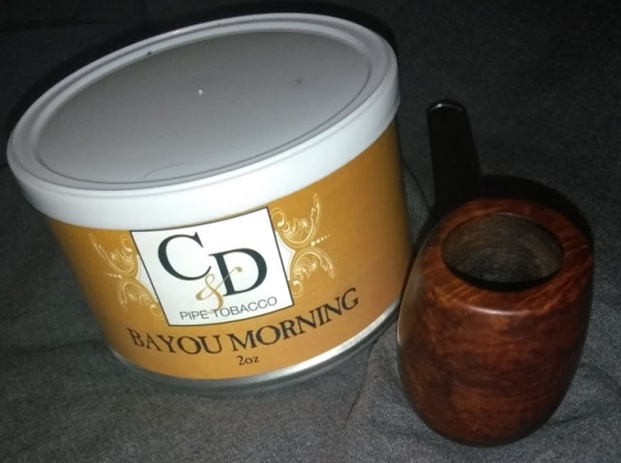
Alas!  Sir Daryl so wanted to savor the gold-banded billiard beauty that he took it with him to his weekly informal pipe get-together early one Friday evening, still in the box in which it arrived with the day’s mail.  He settled back in the cushioned chair that had his name on it and prepared a bowl with an excellent Virginia Perique concocted with miraculous properties that made his body seem weightless and his mind travel to far-off places, not all of which he had ever seen outside of these visions.

With the slowest possible deliberation, Sir Daryl struck a wooden match and kindled the top layer of the divine amalgam in expectation of an ethereal treat, Almost immediately, his typical serene and content composure twisted into a spasm of intense revulsion apparent to his friends all about the low, round table where everyone had set out tins and other glorious, colorful containers with concoctions from around the globe that group custom made free for the trying.  Sir Daryl began to retch and reached for a tissue paper to spat out the evil spell that began its sorcery in his mouth and thence to wind an insidious path into his throat.  With the greatest of luck that was his hallmark, Sir Daryl cast out the vile spirit.

Being a naturally kind, trusting soul, the only mistake Sir Daryl made was in believing the minion who sold him the pipe with the false claim that it had been cleansed of all evil.  As Sir Daryl’s breath returned with the color in his face, one of his peers, who sat closest to him in another deep cushioned chair to his right, happened to be gifted with the power of perception.  Suspecting the foul truth of the matter, the wise aficionado asked if dottle was the problem.

Still unable to speak in a clear voice, Sir Daryl handed his newest prize to the other man, one of several Restorers present round the small table, and sipped from a bottle of mineral water, the better to wash away the diminishing remnants of old leaf and other substances too frightful to mention in this story conceived for young, impressionable children.

The Restorer scrutinized the various parts of the instrument and offered his services to Sir Daryl, for a modest fee, of course, and a deal was struck.  The trustworthy Restorer said with his natural sense of fidelity that he would return the treasured and still un-tested Blueline Bakelite the next day.  Little did he then know of the otherworldly obstacles that would befall him, beginning later that very night.

Enchantment, as a point of interest and special significance, concerns the subjection to or bewitchment by magical influences.  Some enchantments are made for good – and others not.

 THE RESTORER TELLS OF HIS ODYSSEY, IN HIS OWN UNCOUTH VOICE
Thank you, Omniscient Narrator, for that lovely, florid introduction, and for providing the most charming and flattering title you could come up with for my chapter in some other hero’s tale.  I don’t mean to be rude, but I must set a couple of facts straight, if only for the sake of dispelling that whole fidelity thing you pinned on me.

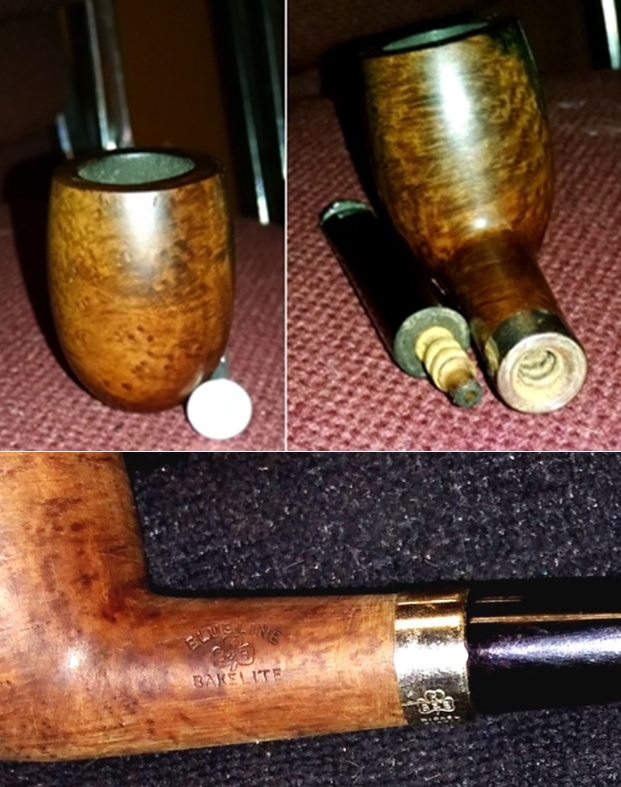
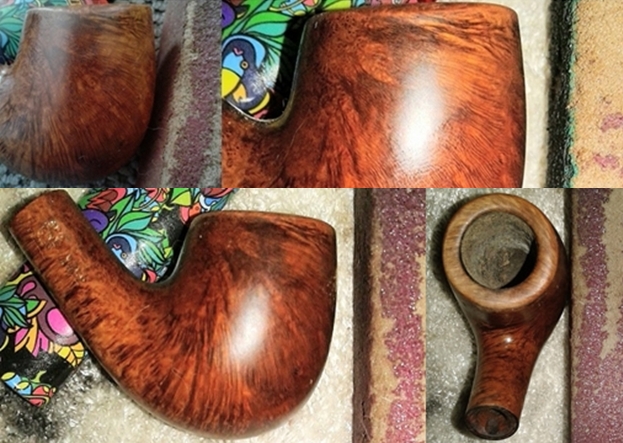
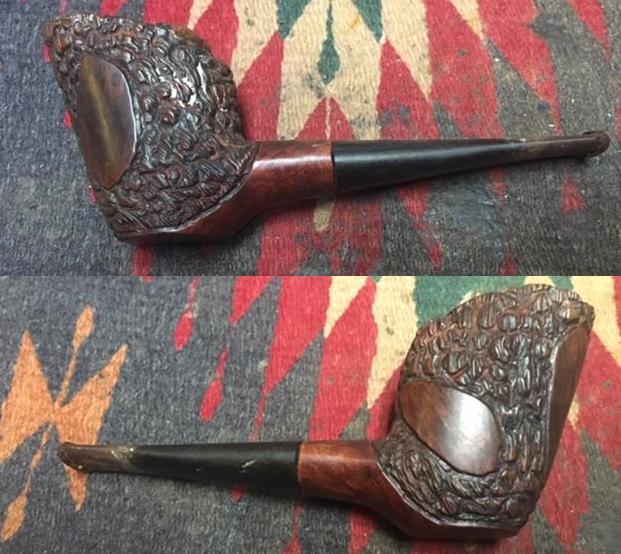
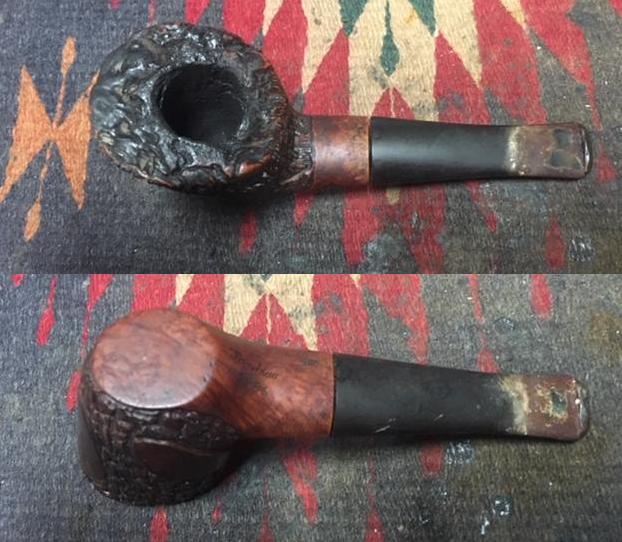
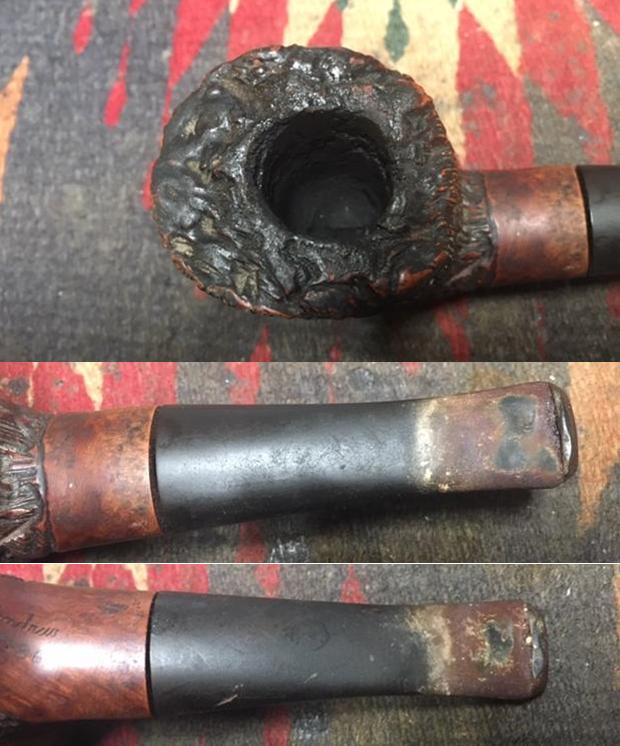
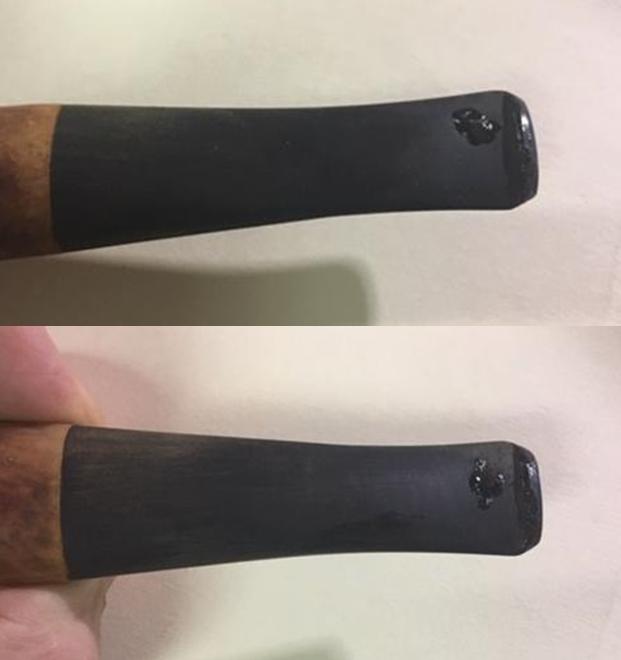
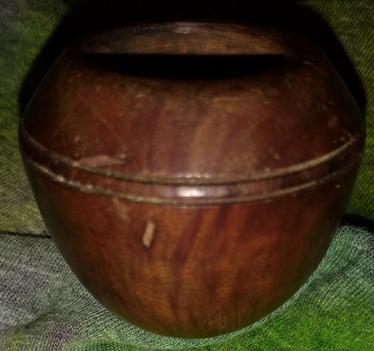
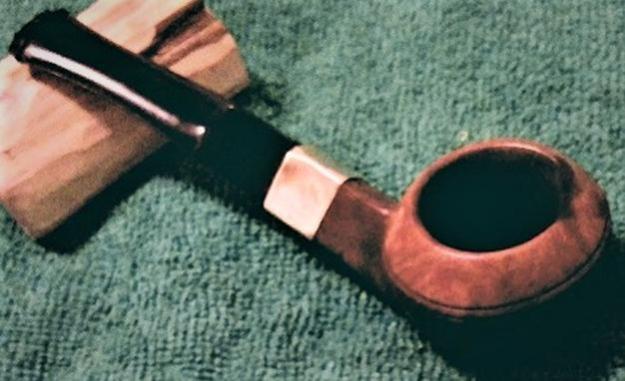
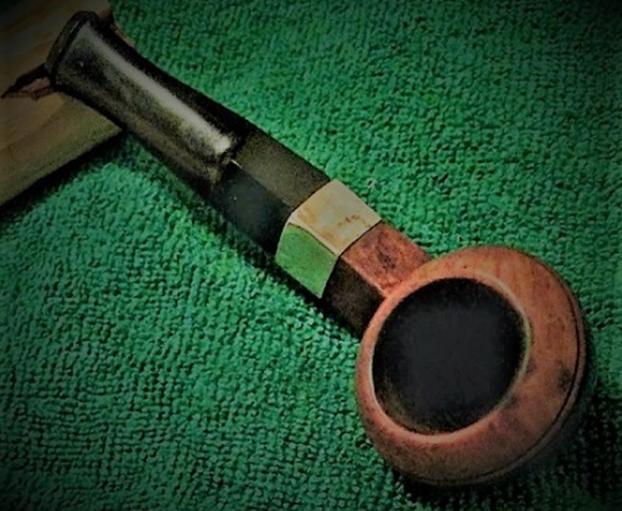
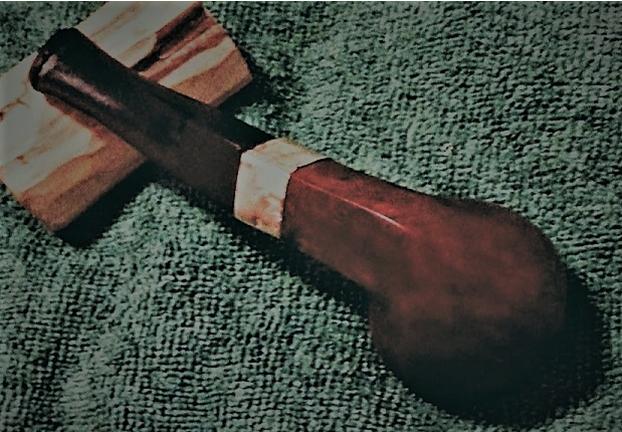
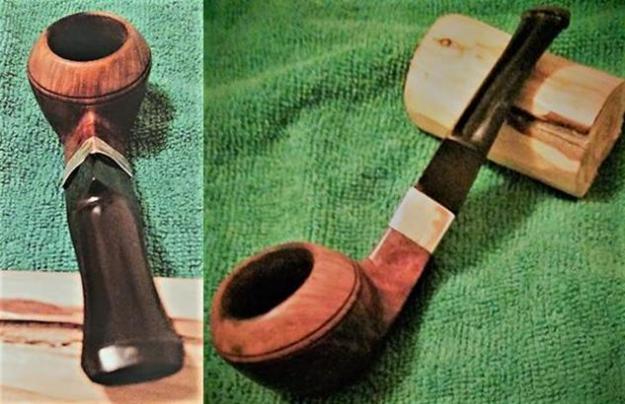
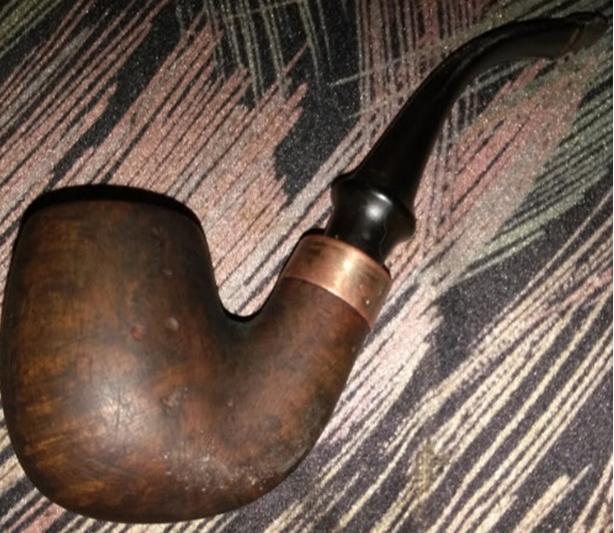
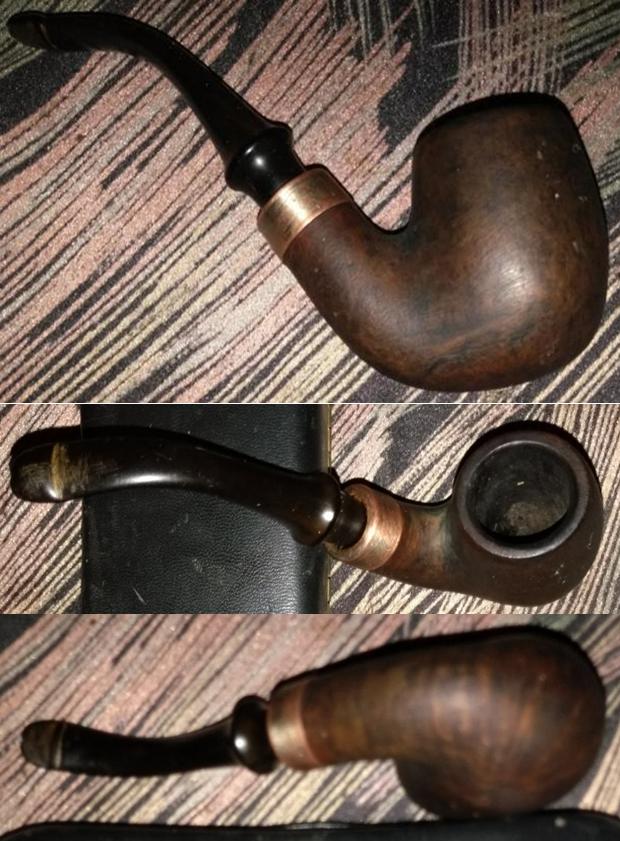
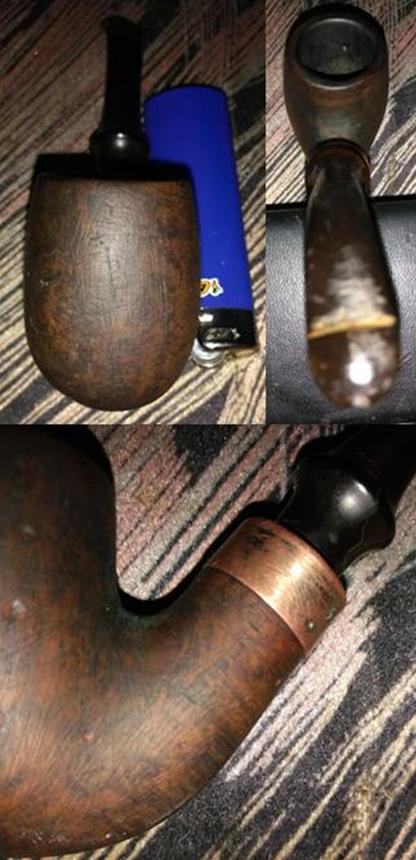
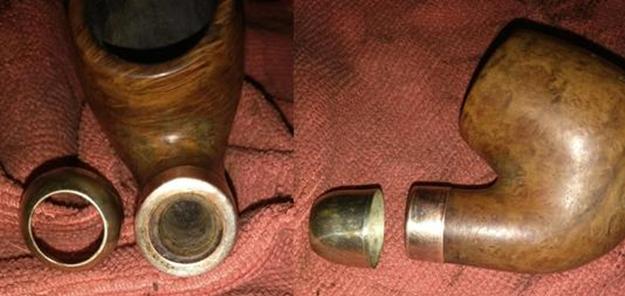
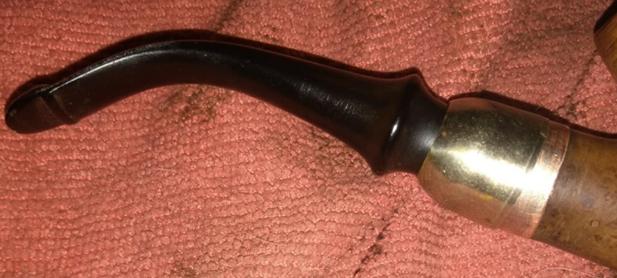
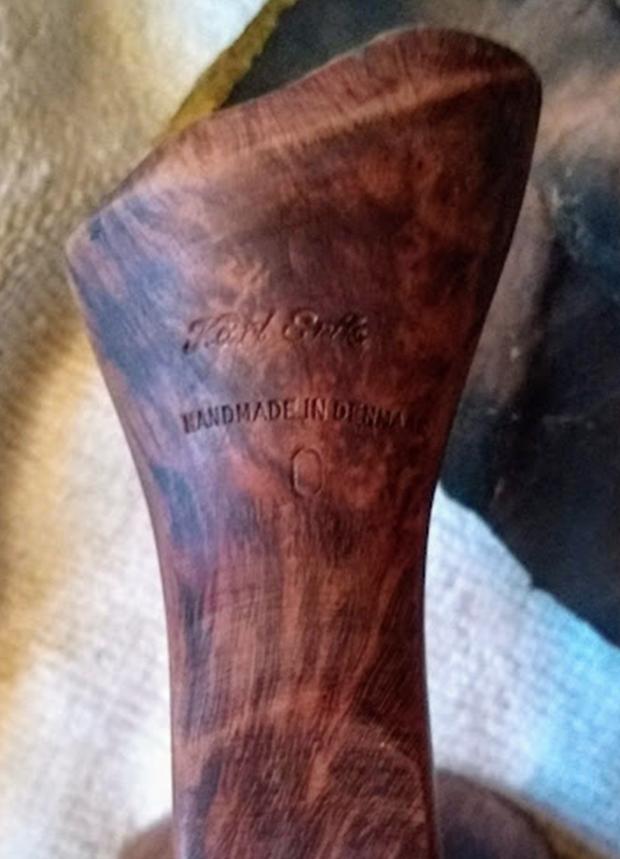
For one thing, I didn’t “offer” my services, it was more like begging Sir Daryl to grant me the honor of taking his beautiful but badly marred and filthy 1911 billiard – yes, that’s the year our Narrator meant to say in his own rather prosaic, ho-hum way –home with me.  I asked whether he wanted the final stain to adhere to the original dark brown or be lighter and was not surprised when he opted for the former. Anyone with eyes will see the KB&B was messed up outside from the shots of it I snapped as soon as I was home, which I’ll dig up some place and show in a minute.  As far as its innards go, I know more than I really needed to about that because I just had to see what Sir Daryl’s little fit was all about and later tried it in private with some of the cherriest aromatic there is.  The consequence indeed was every bit as nasty as my friend Sir Daryl let on!

Daryl in the chair with his name on it

And enough with your Sir Daryl nonsense.  He’s just a man like I am, and his name is Daryl Loomis.  Even if I didn’t know him for going on five years now, I should know his real name because he’s bought about nine pipes from me, and that’s by far the record for one person.  I suppose, based on what you said about his taste in pipes and all, this must mean I sell some pretty good ones, although I admit I never let an antique go to Daryl or anyone else.

One last thing: if I had known what was going to happen in the middle of the night, I never would have accepted the $25 Daryl paid me in advance.  Come to think of it, I would not have taken the unique pipe at all.  Then again, maybe if I had the power to see back and forth and all over Time like a certain Narrator, I suppose I would have just avoided the whole mess in the first place.  I’ve always hated trippy thoughts like that.  At any rate, at least then you wouldn’t have this grand fable to tell, would you, big guy?  And forget about any singing, springing larks popping up!  Quite the opposite is in store, in fact.  I’ll bet the old codger of a Narrator ends up claiming he knew that all along and only meant it as foreshadowing.

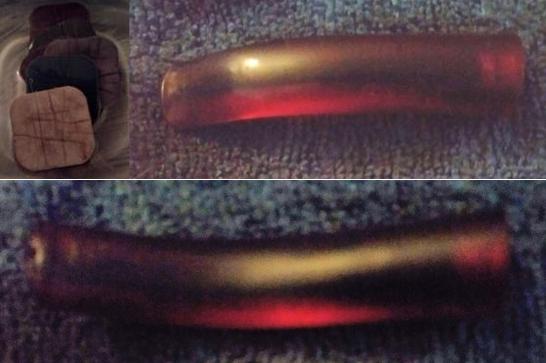
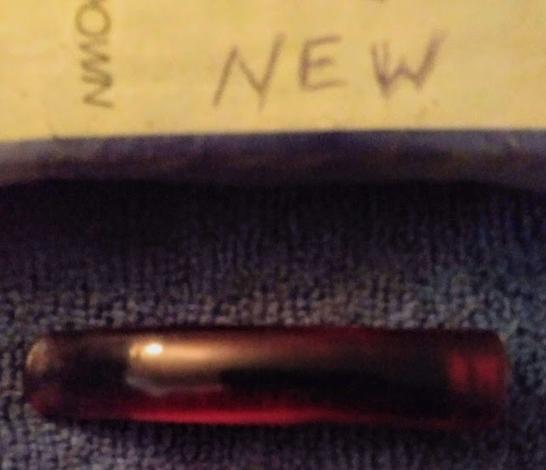
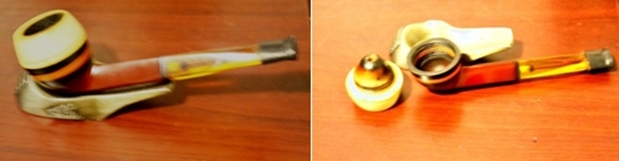
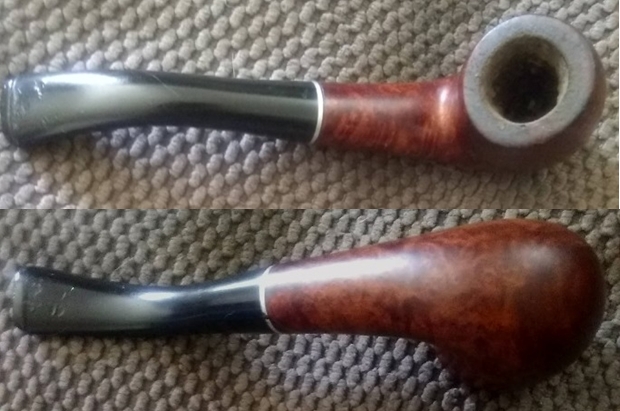
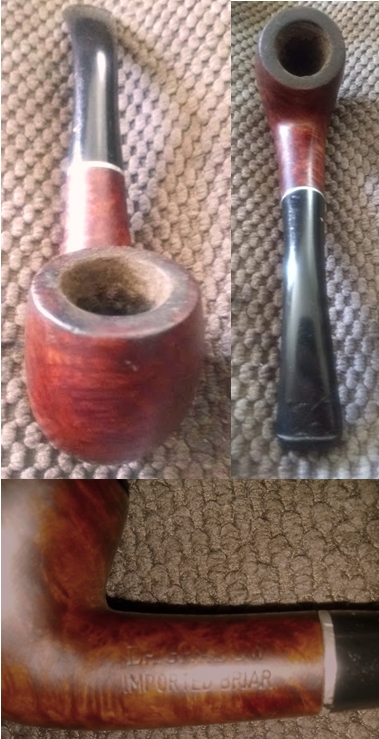
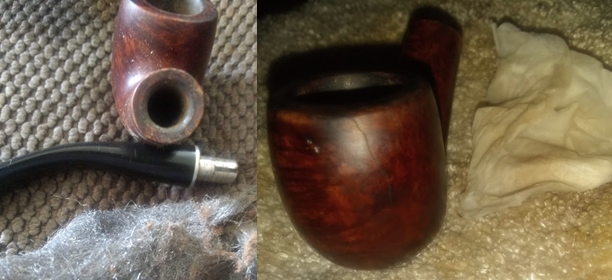
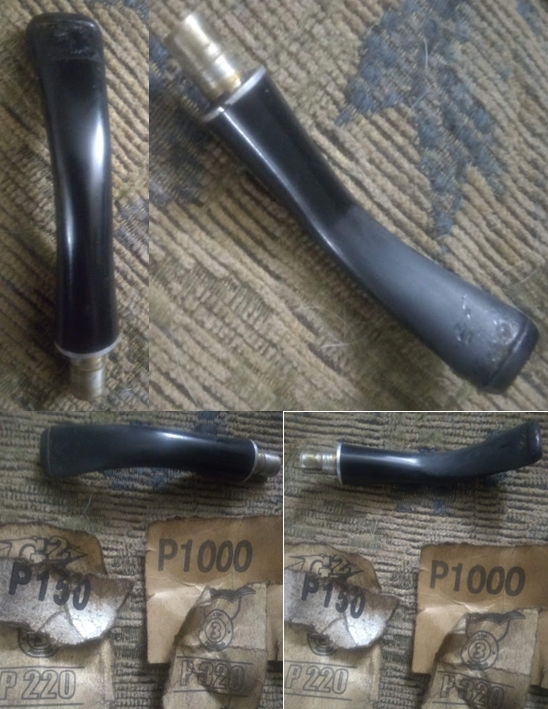
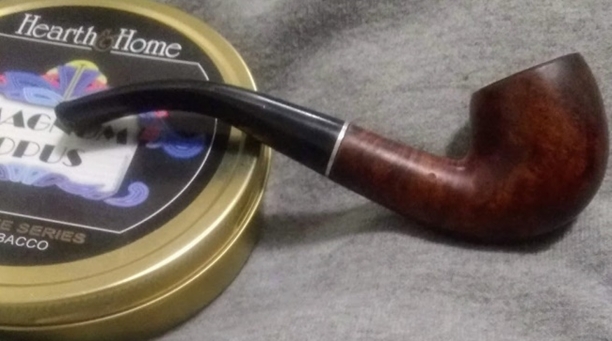
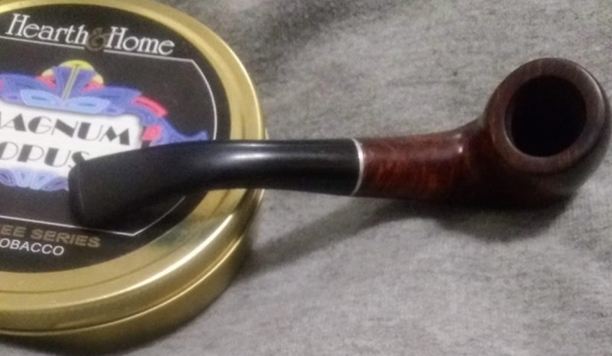
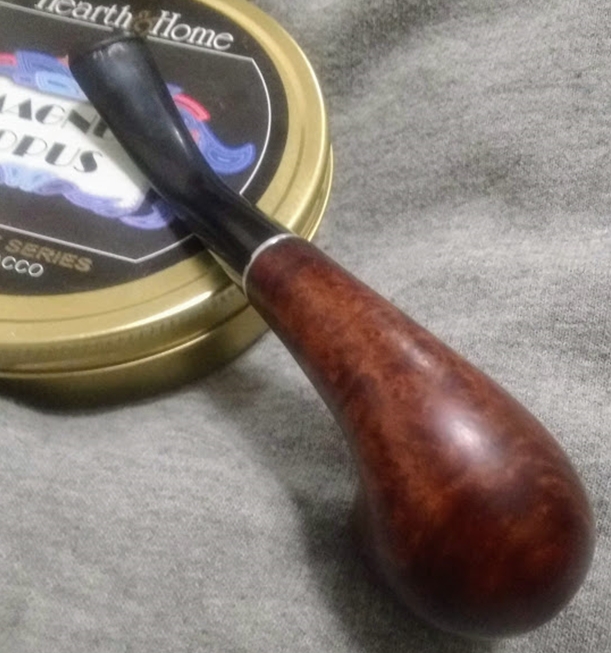
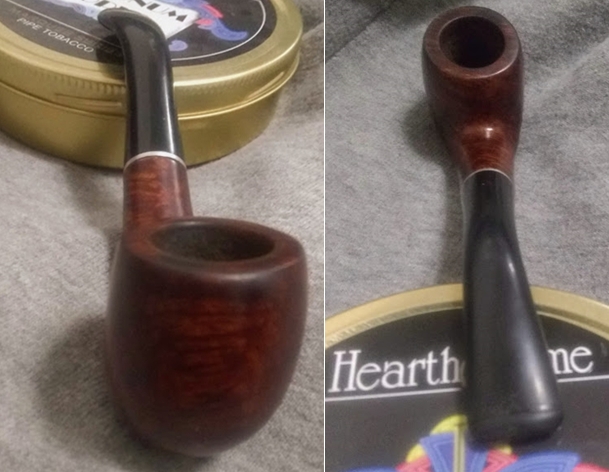
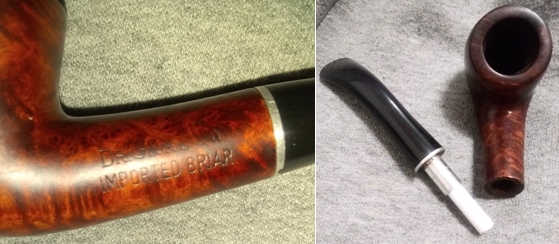
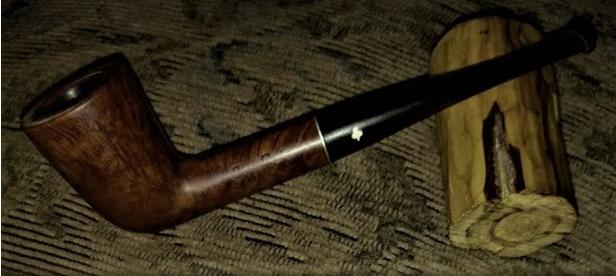
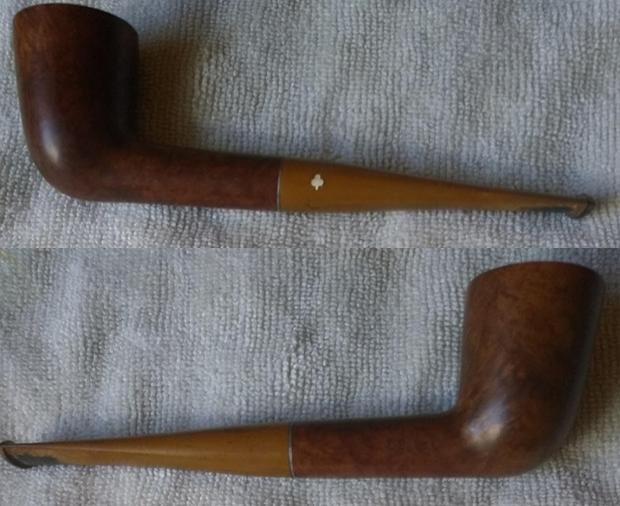
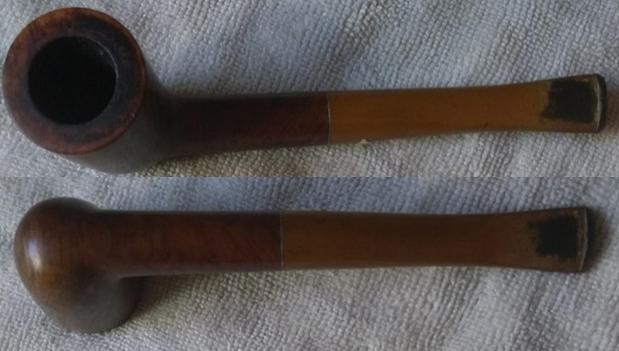
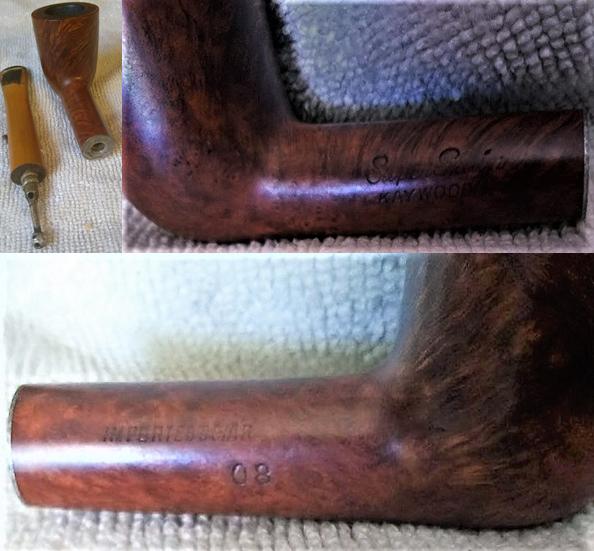
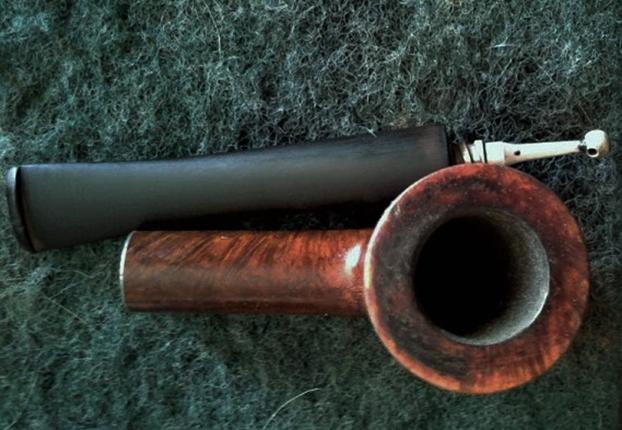
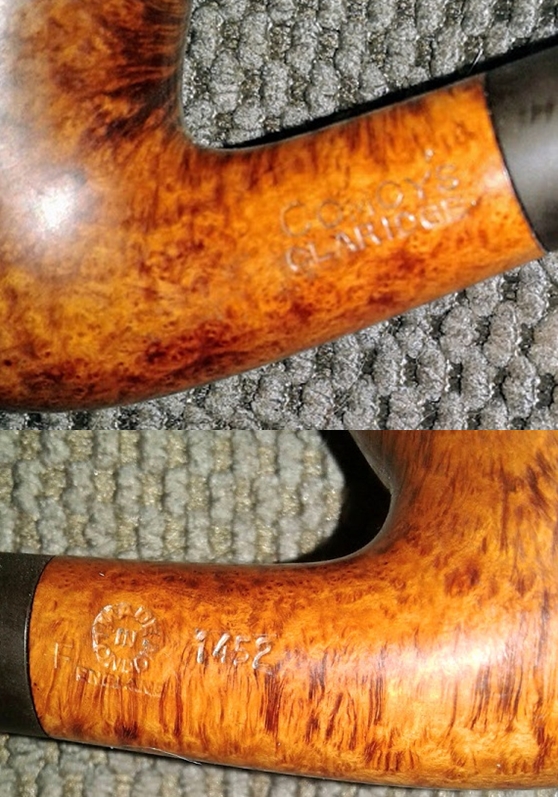
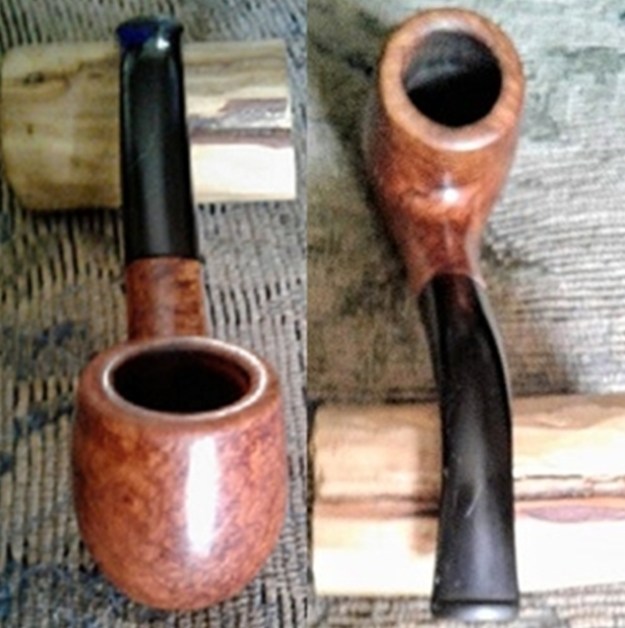
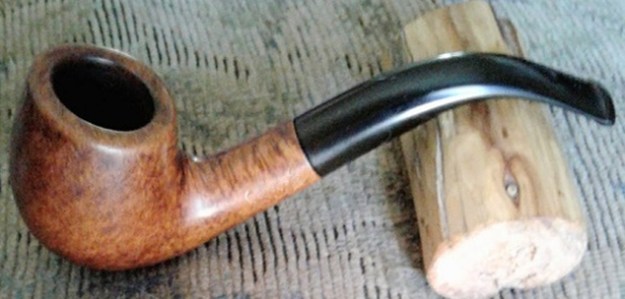
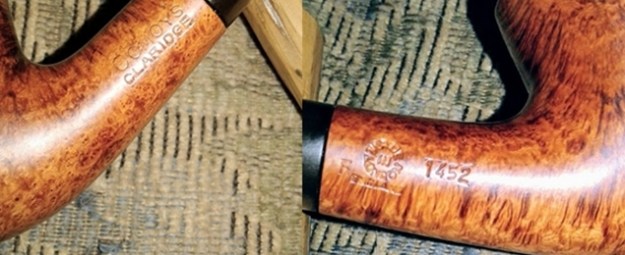
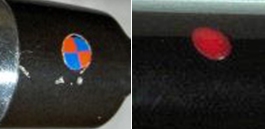
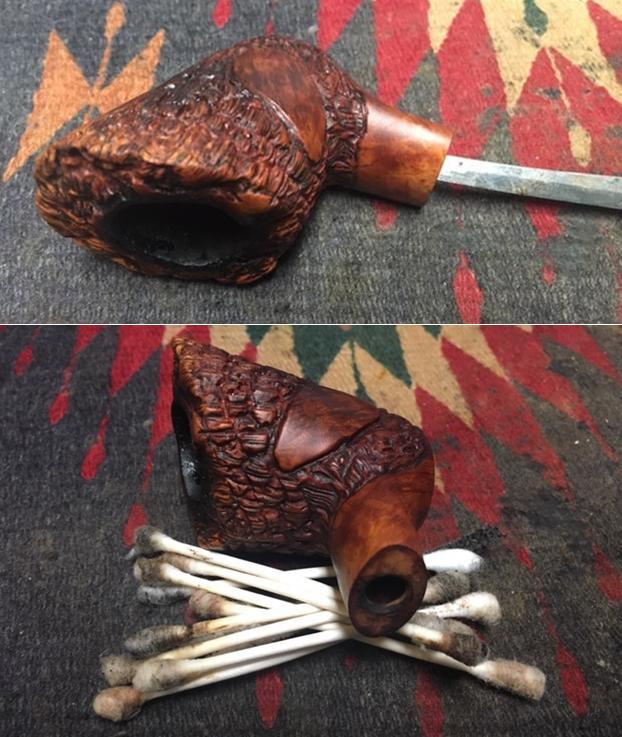
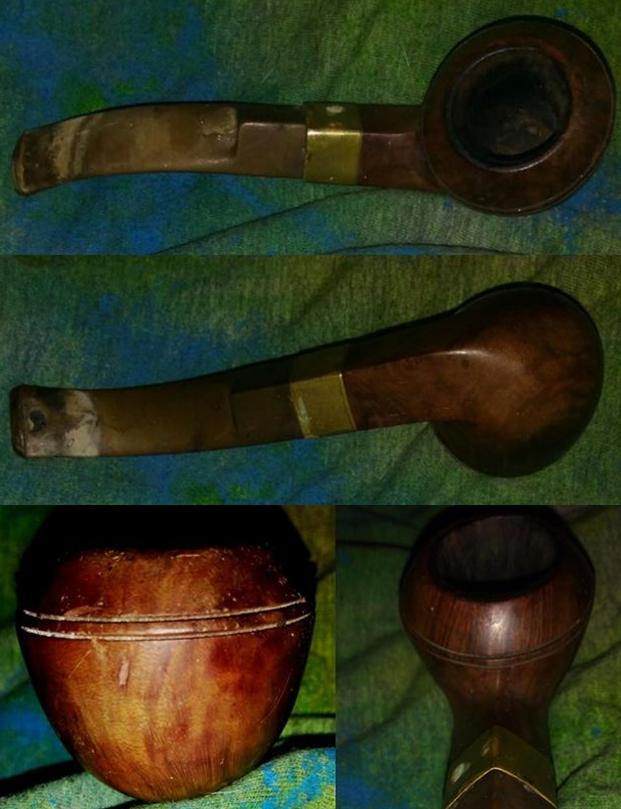
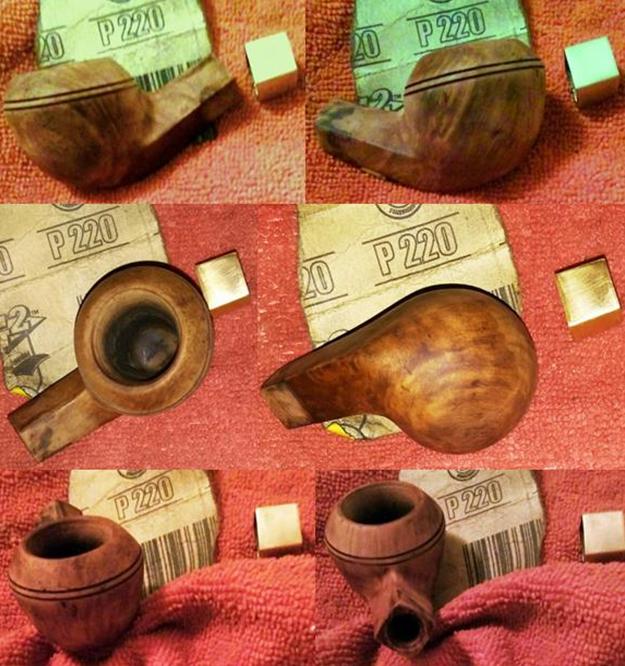
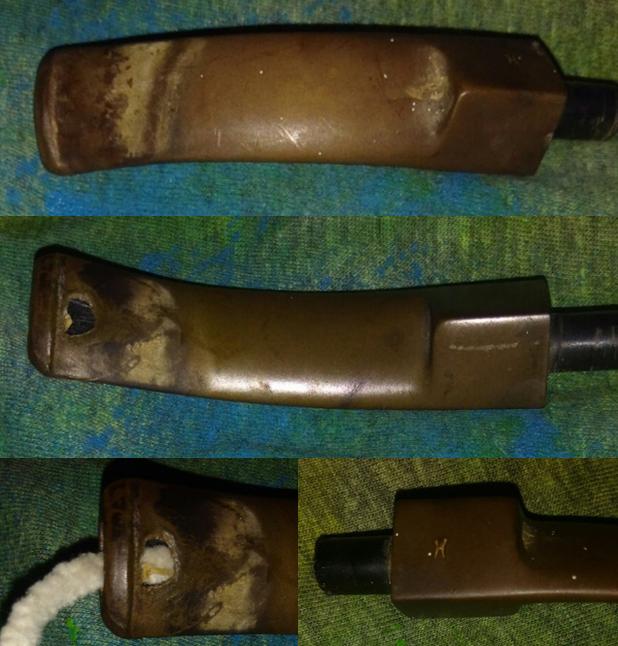
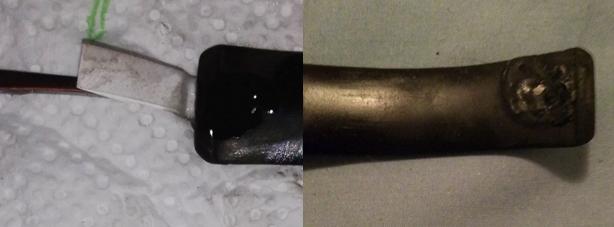
Anyway, I found the shots I snapped, and here are the first of them. When held to the light, as I did and will prove in good time, the Bakelite stem is remarkable in its similarity to genuine cherry red amber.  That is a seeming contradiction in terms, I’m aware, as the word amber, from the Latin and Greek origins, means orange. However, the actual stem material is a synthesis of phenol and formaldehyde resins made in a process of intense heat and pressure known as thermosetting.  The first synthetic plastic, Bakelite provided a cheaper alternative, when amber was the rage, that was difficult to differentiate from the real thing with the naked eye and was therefore popular in the manufacture of pipes during the early 20th century.
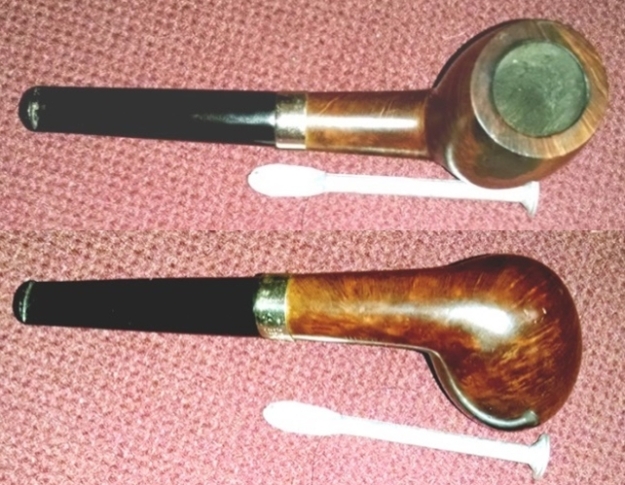
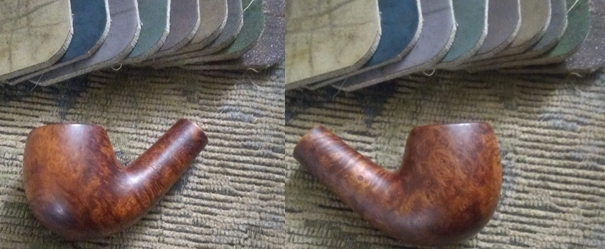
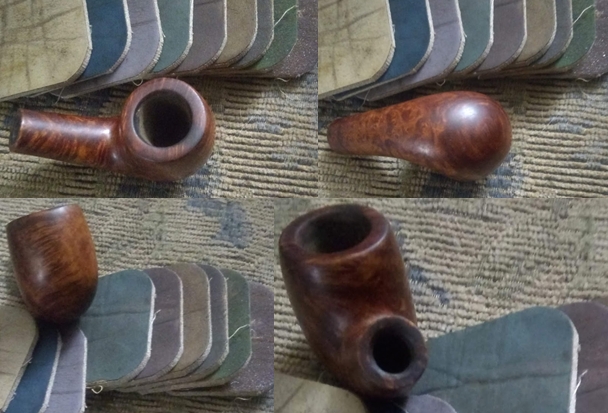
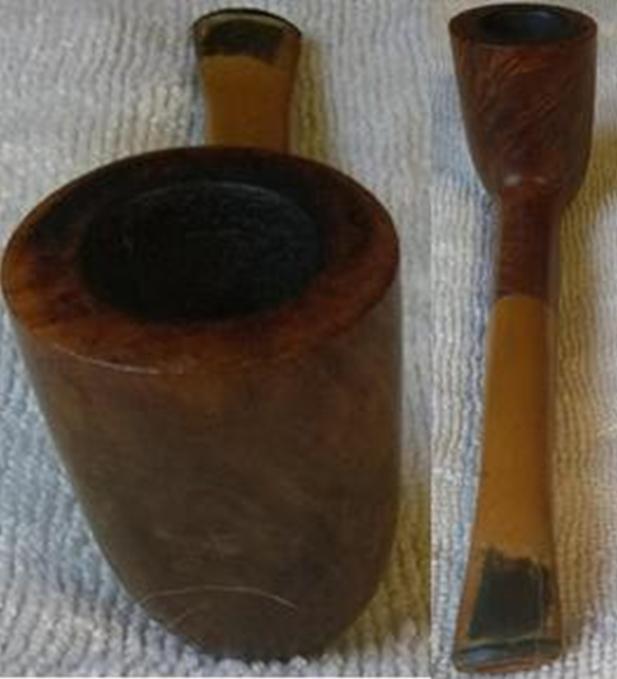
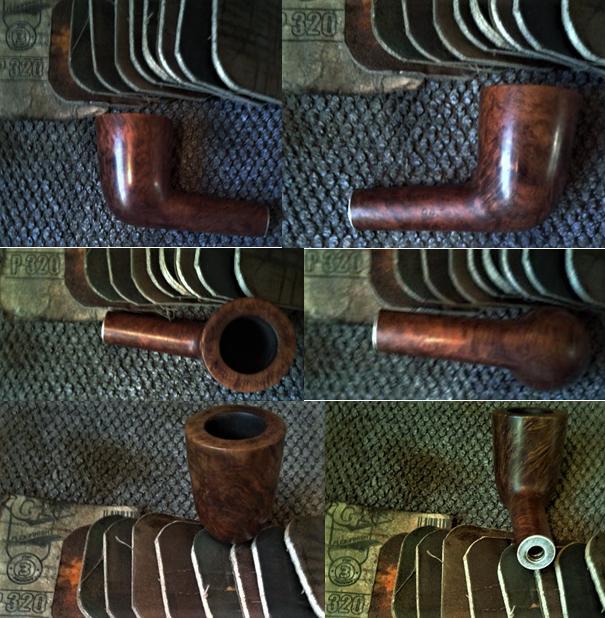
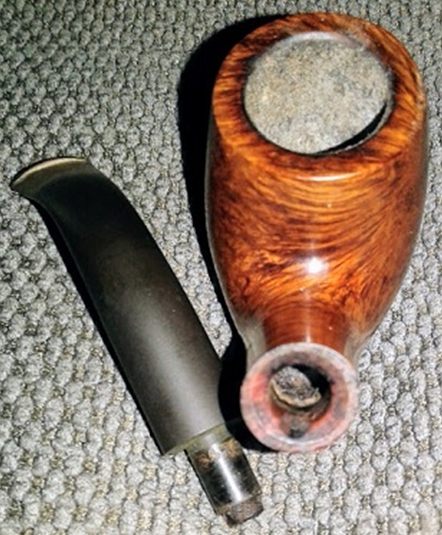
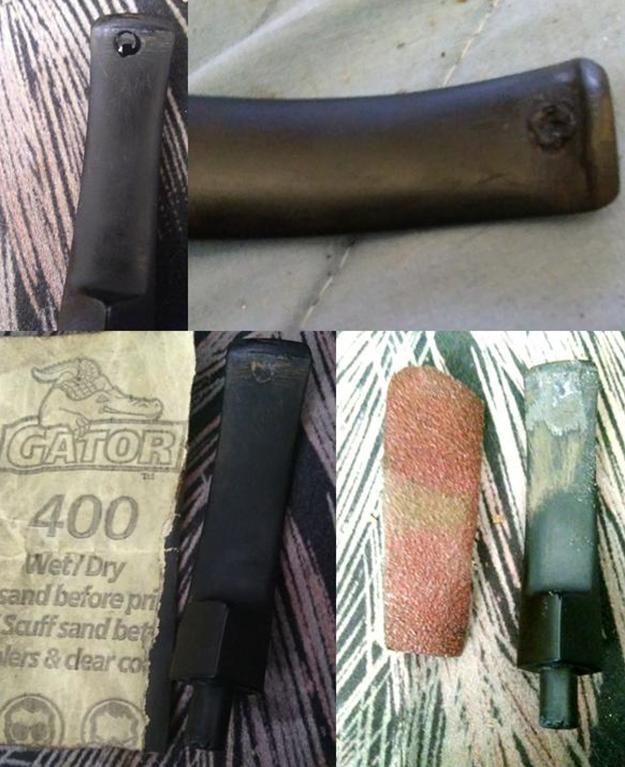
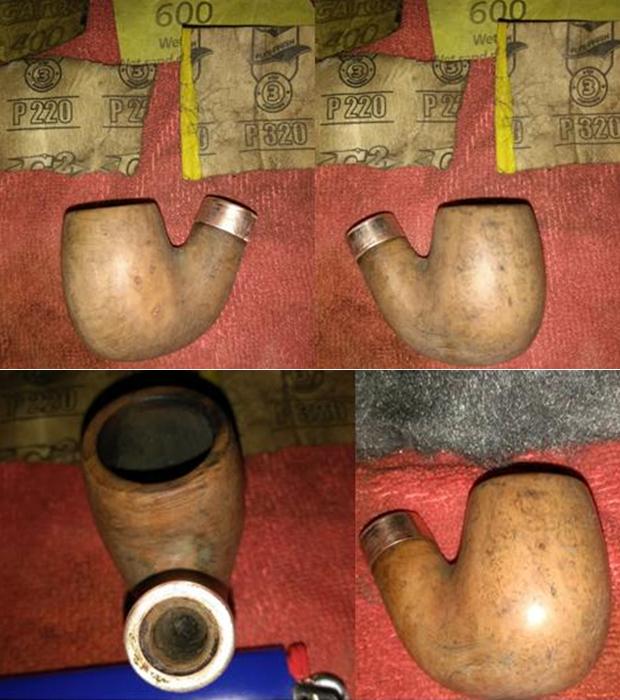
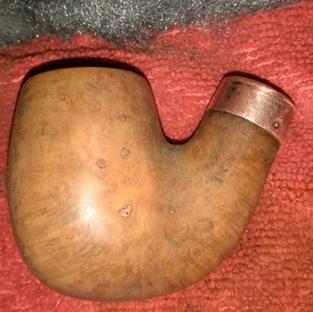
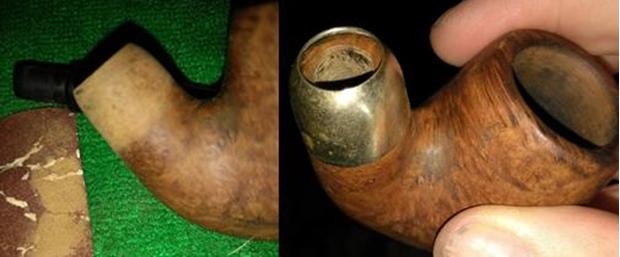
Other than the need for a serious cleaning and retorting of the inner pipe, Daryl’s Blueline Bakelite had inexplicable dark black blotches on the left middle and right rear sides of the bowl.  I never determined the cause of the stains, as I ended up having no better option to choose as the source of the marks, but there were two I ruled out: scorching with long-inflicted match or lighter flames and burnouts.  Scorches would have come out much easier than these deep flaws, and burnouts never would have cleared up.  There was also the telltale damage to the chamber that was not present.  By the way, the restoration process will be shown in a time lapse style rather than my usual frame by frame style.

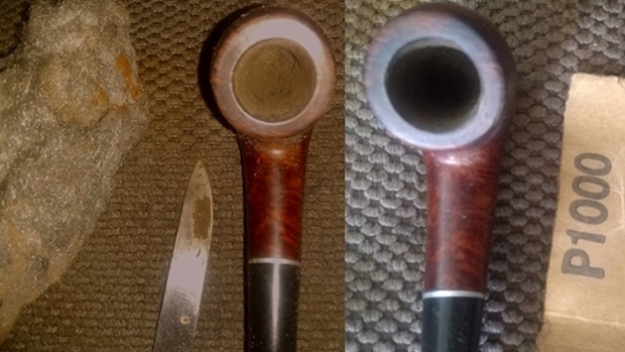
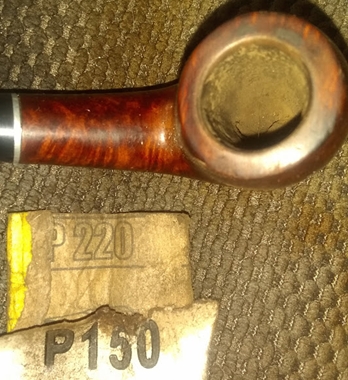
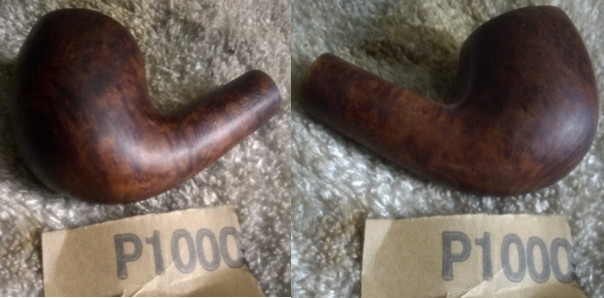
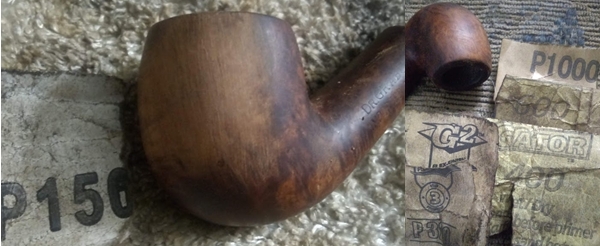
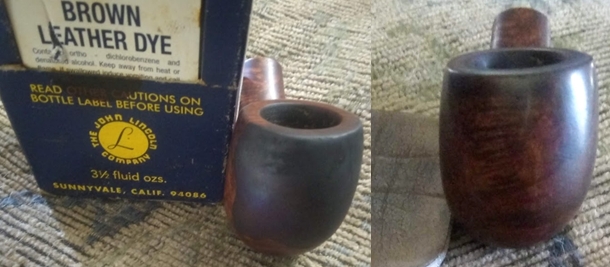
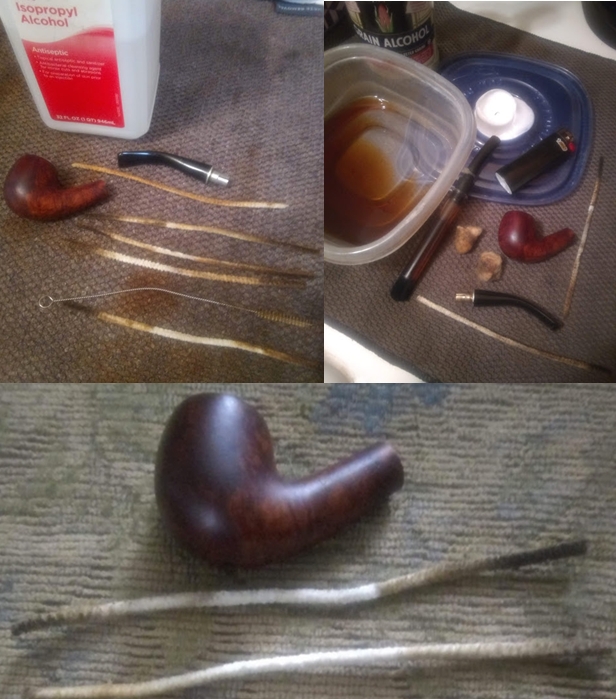
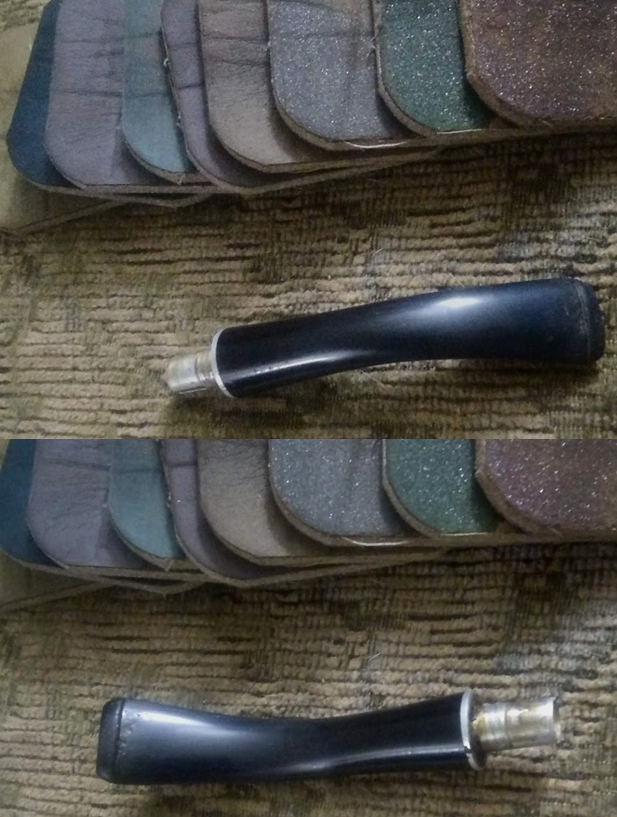
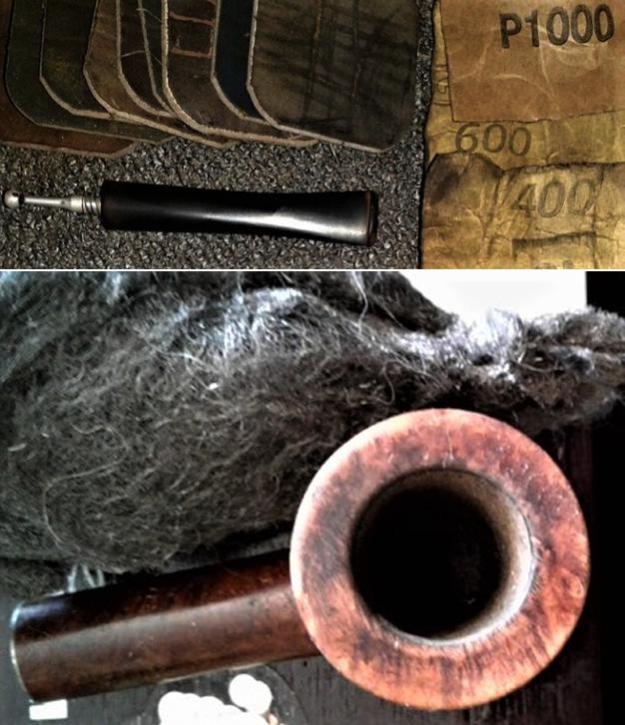
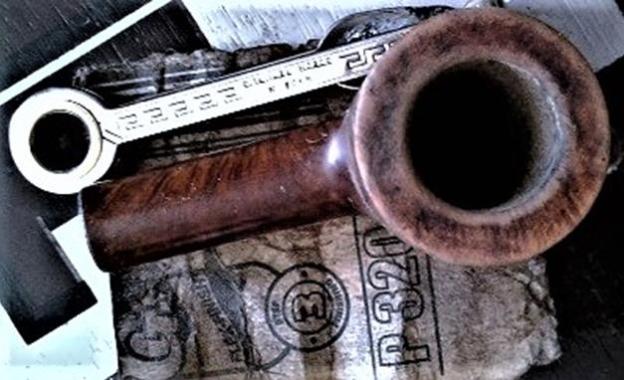
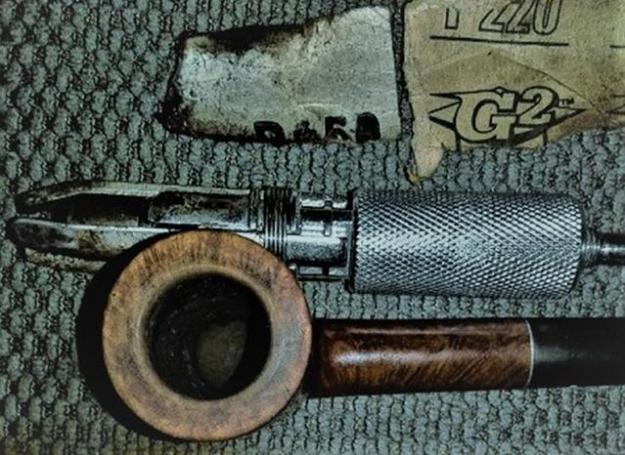
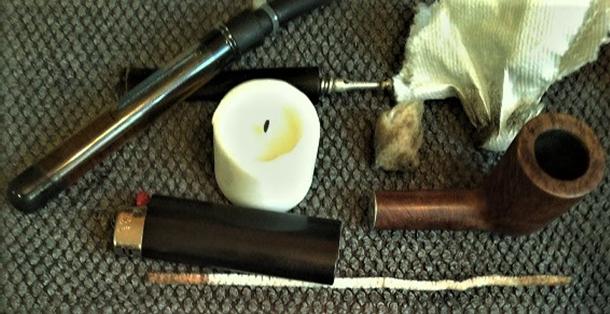
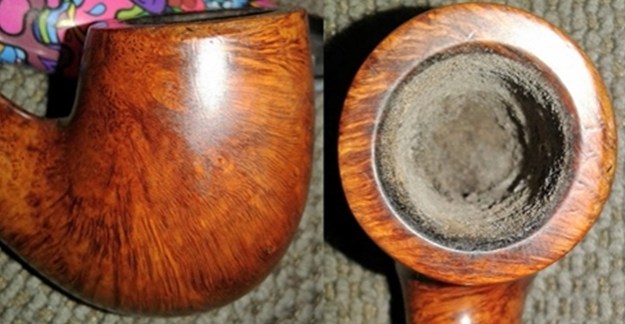
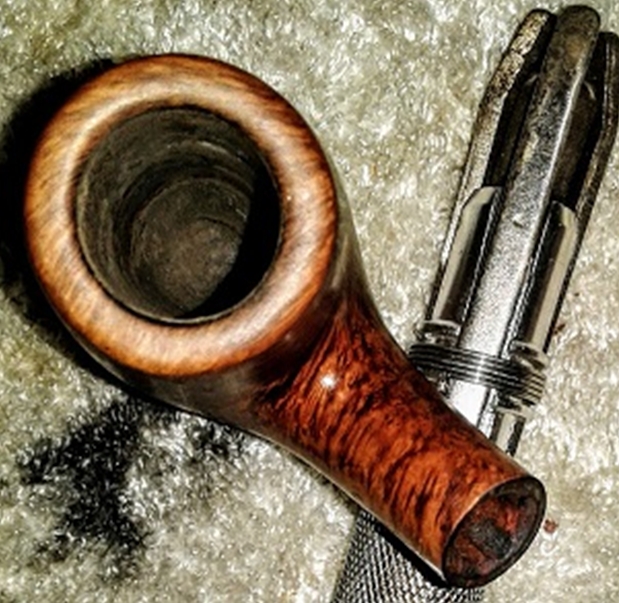
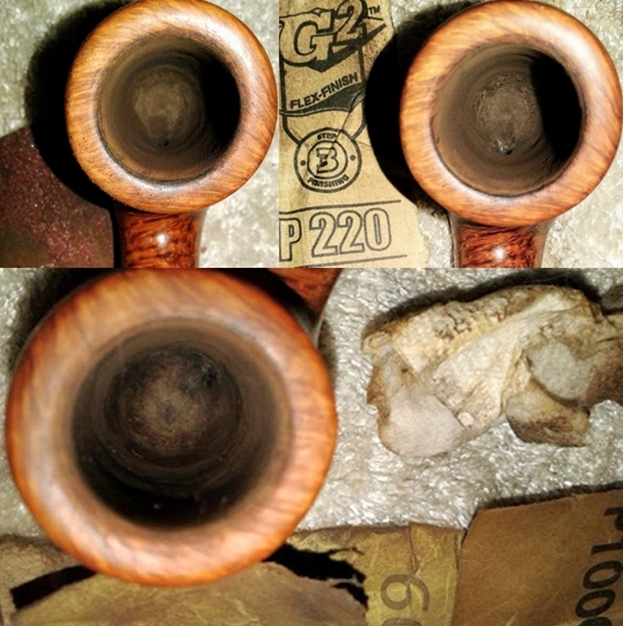
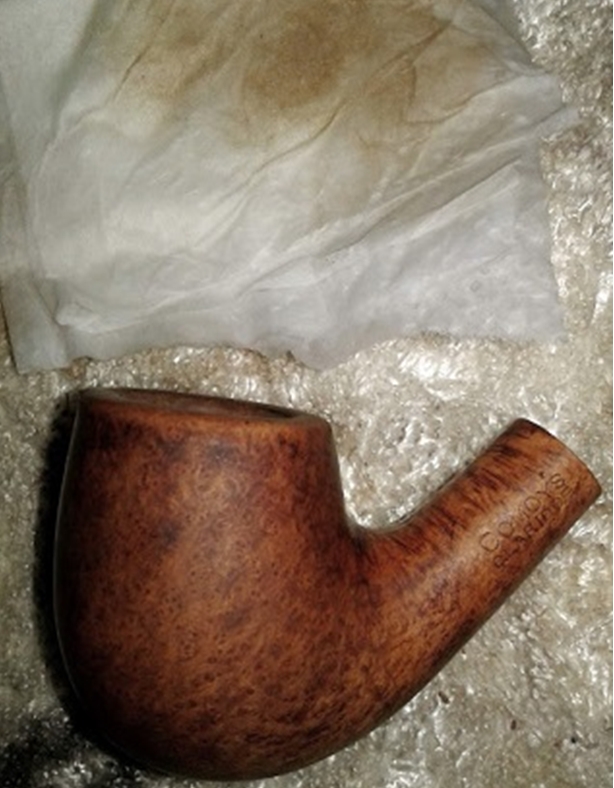
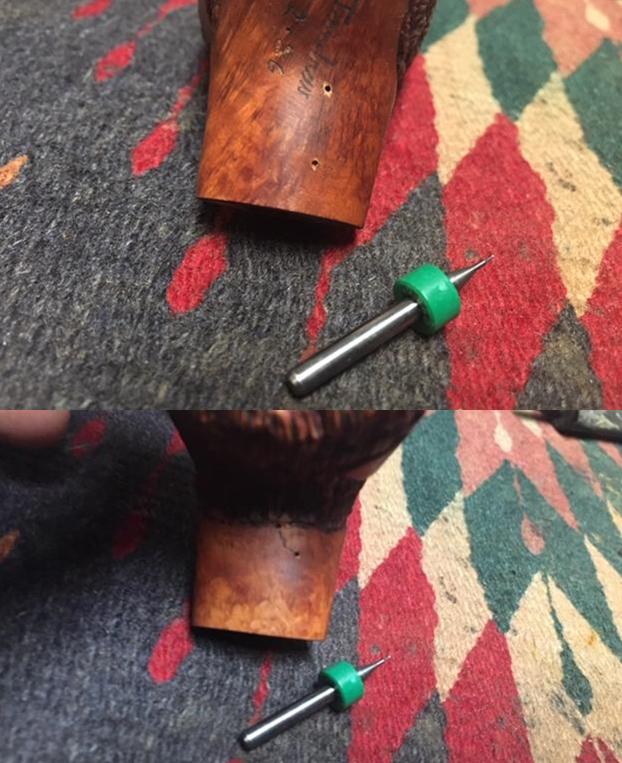
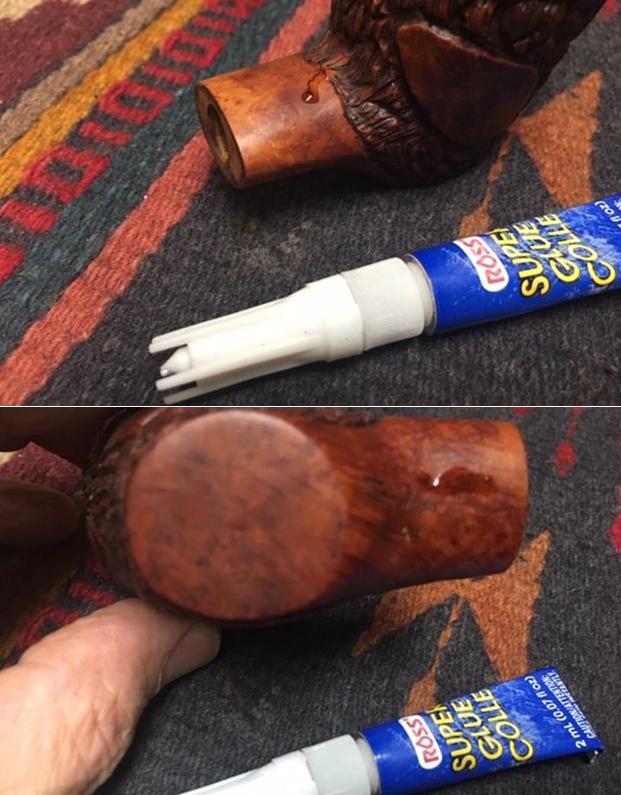
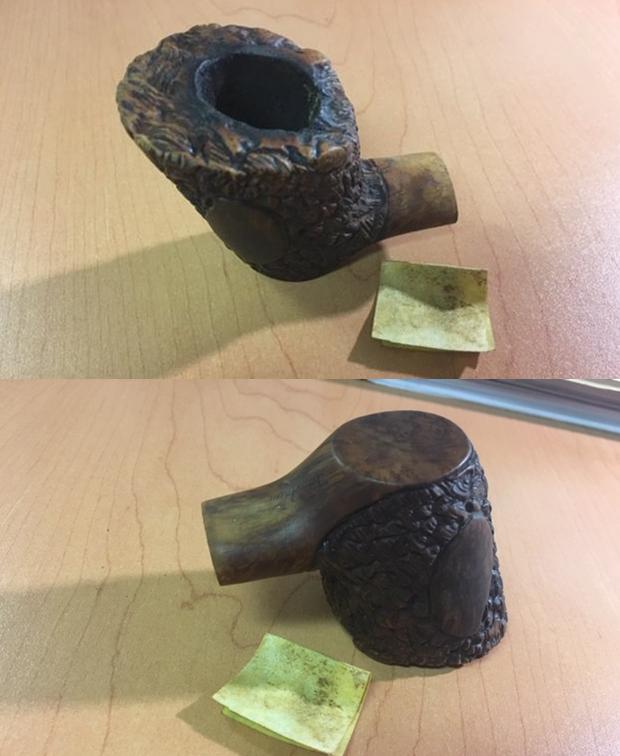
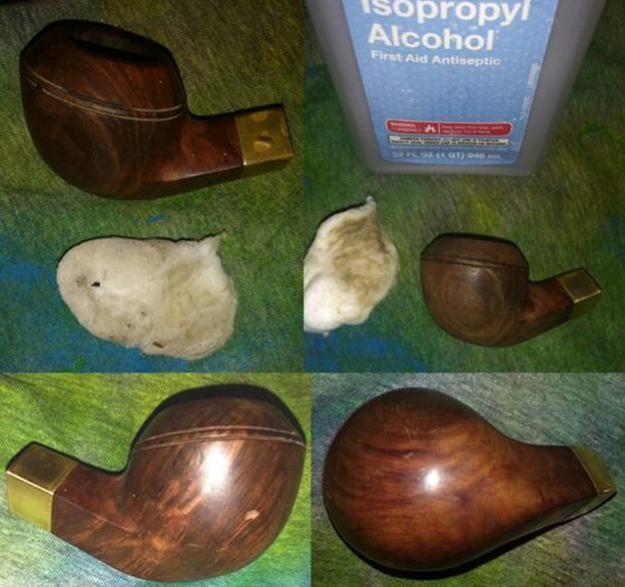
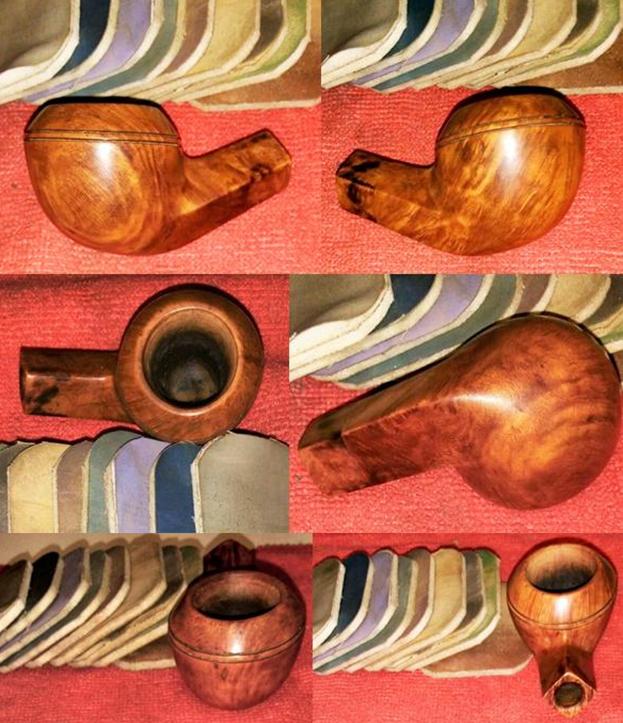
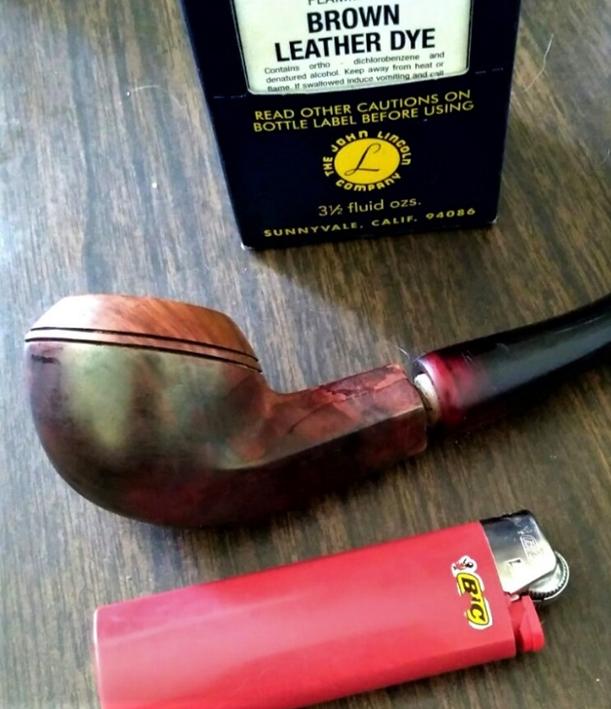
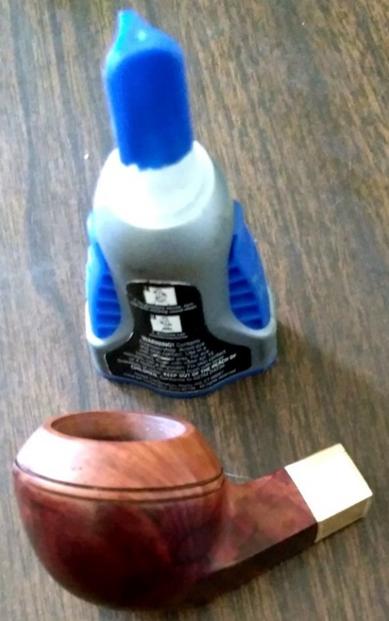
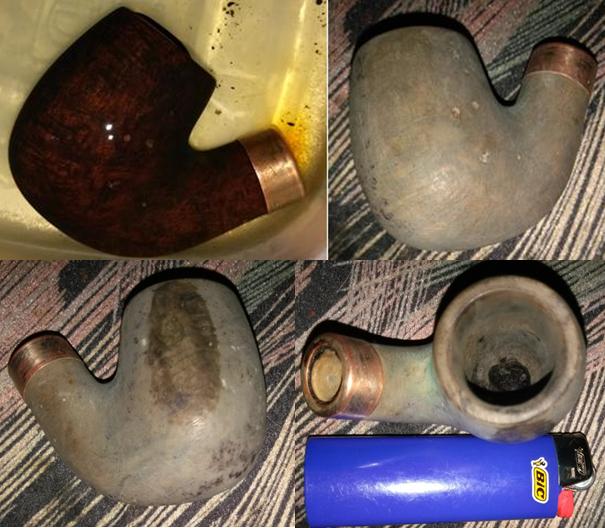
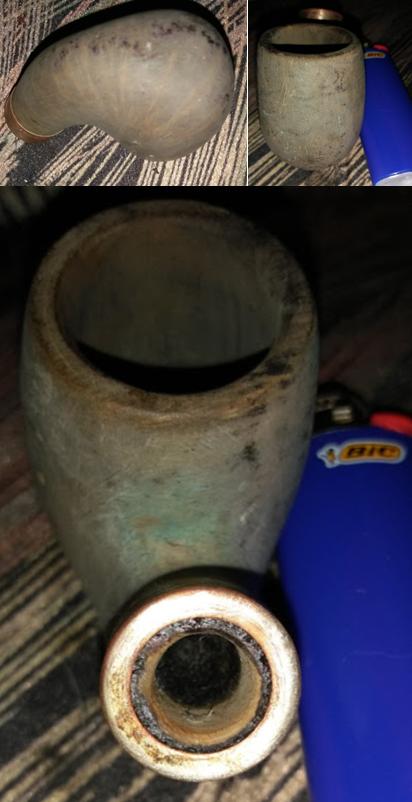
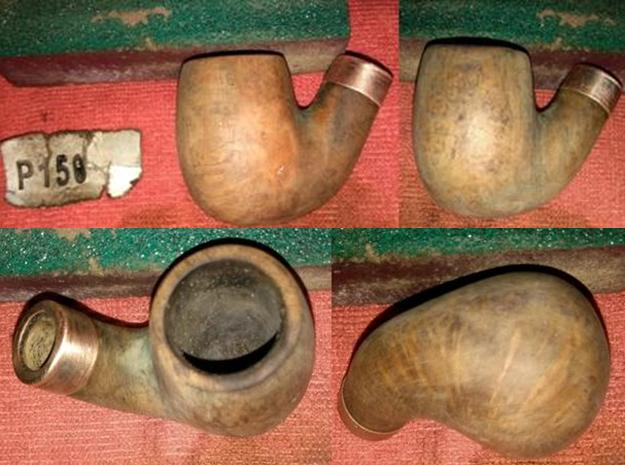
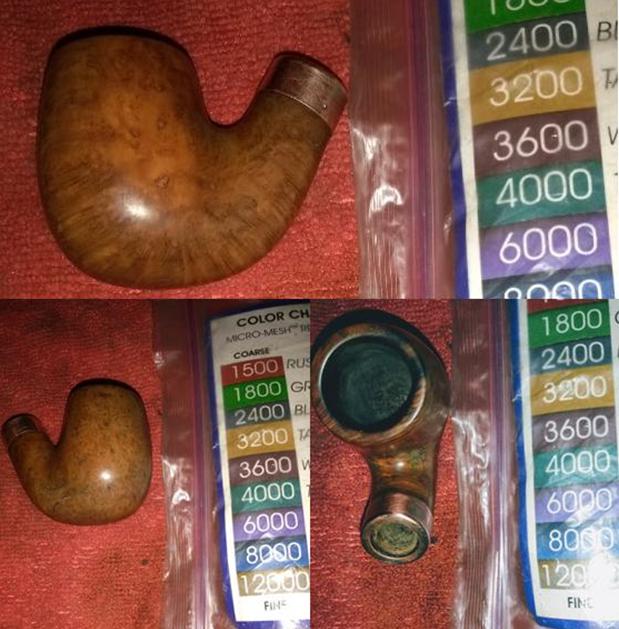
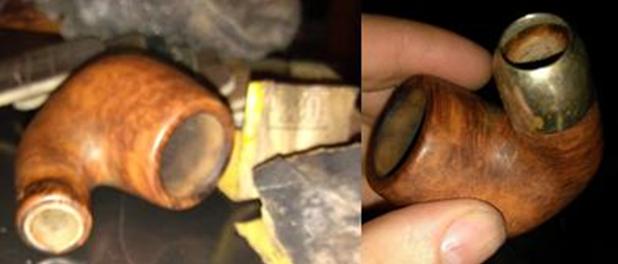
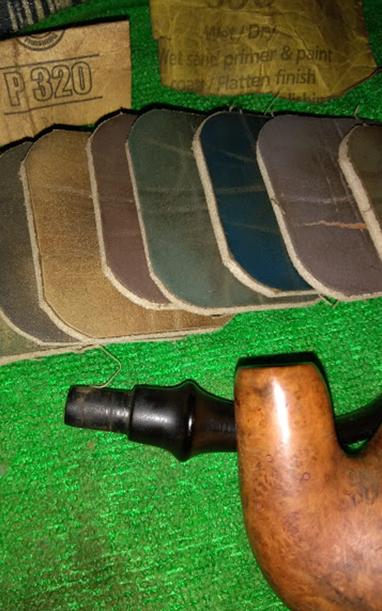
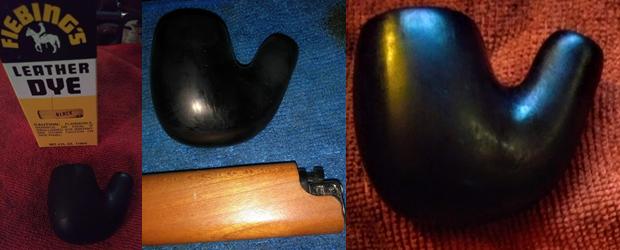
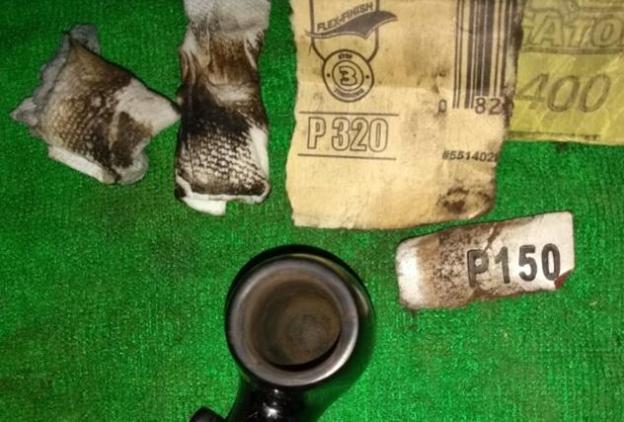
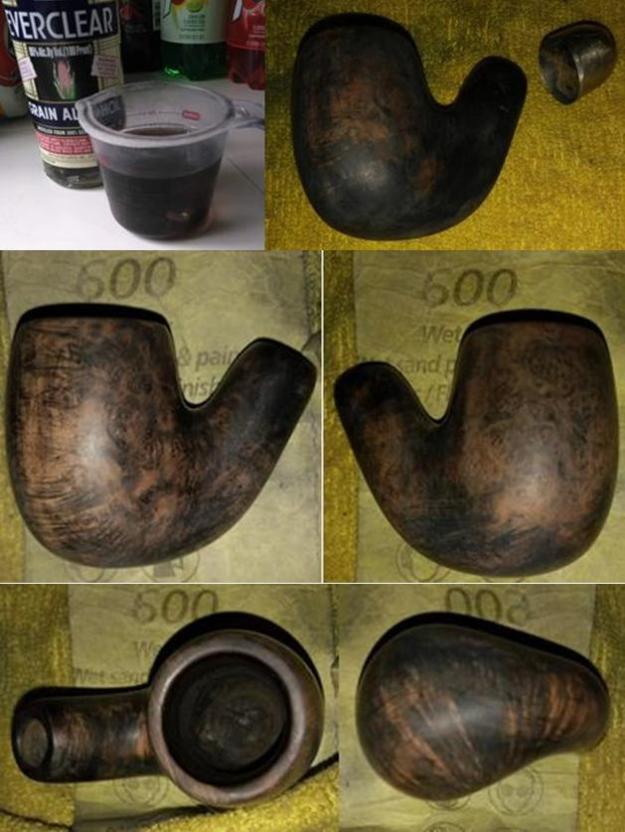
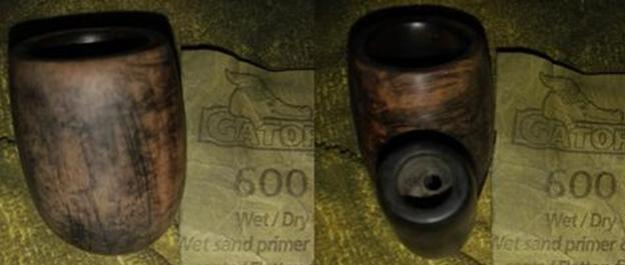
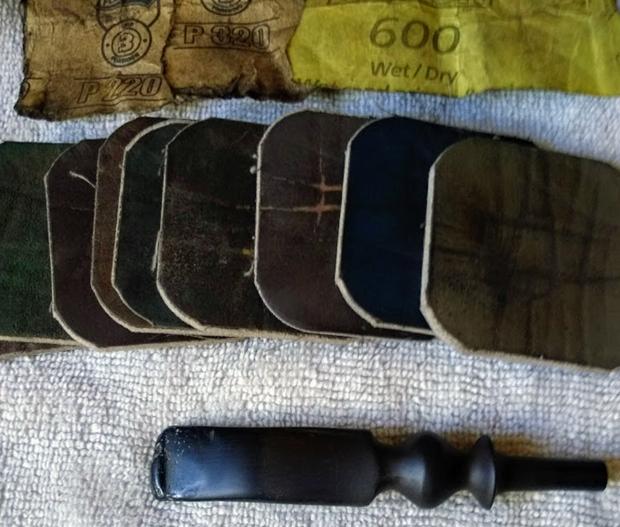
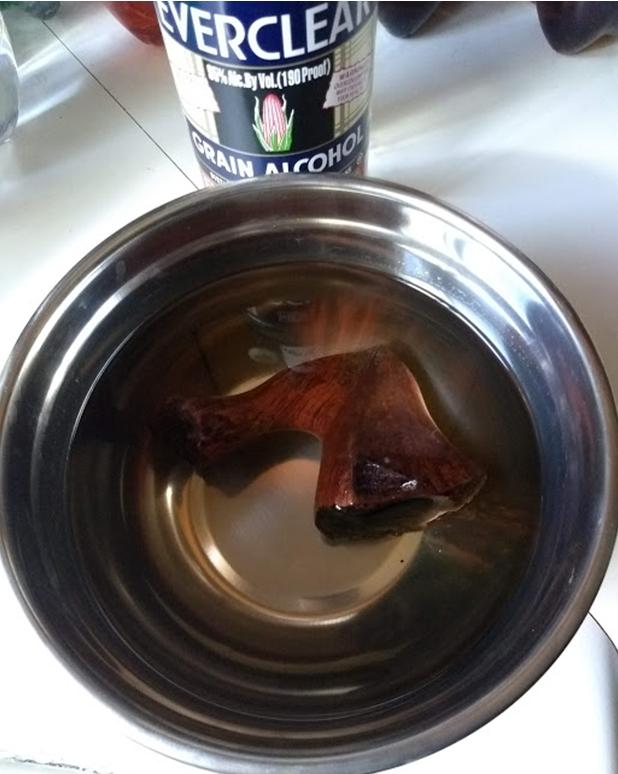
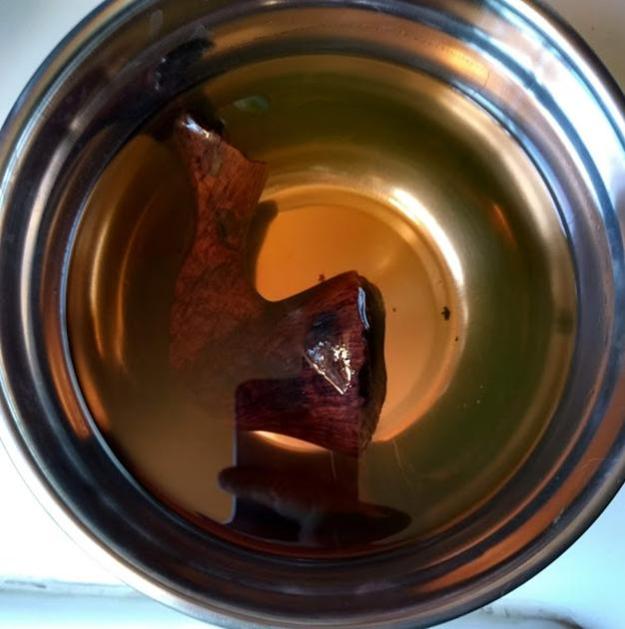
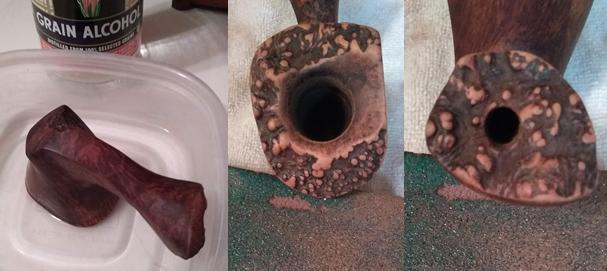
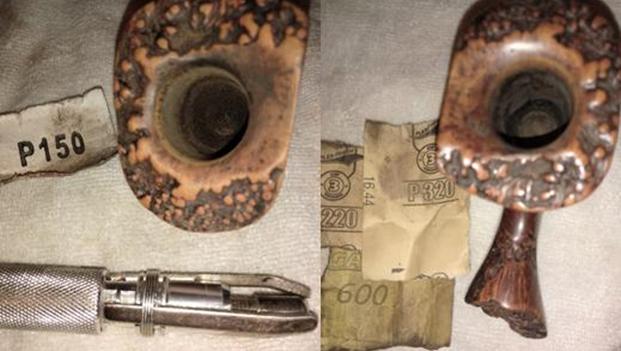
The following photos were taken after a preliminary Everclear soak, during which the band came off.  I followed that with a light sanding using 600-grit paper. I reattached the band with Super Glue.  A whole lot of sanding later, starting with 150-grit paper and working back up to 800, succeeded in eliminating the blotch on the left shank, but a specter remained on the right.  A terrible slope, lacking a better word, on the right side of the rim is also apparent now for the first time in the photos I took after the scar on the left was eliminated with considerable work.  But that would have to wait to be righted. I know this was cockeyed thinking, but I wanted to see if staining would cover the spot on the right of the bowl rather than continuing to abrade the wood.  I used Lincoln Brown aniline stain, flamed it with a Bic and micro meshed to the correct shade.  Obviously, the attempt failed.I had worked on the pipe from roughly 8 p.m. the previous night, after returning from my pipe get together, and it was sometime around 4 a.m. Saturday.  True enough, I could have used a break for sleep, but I don’t blame the unthinkable calamity that happened next on my own fatigue.  Although I accept full responsibility for what followed by the simple fact that the rare and precious pipe was in my custody, and would even be happy to blame myself for some error, that was not the cause of the awful event that occurred without warning.
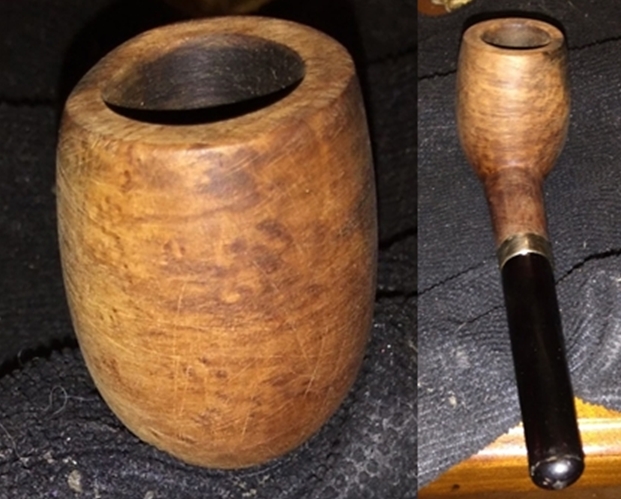
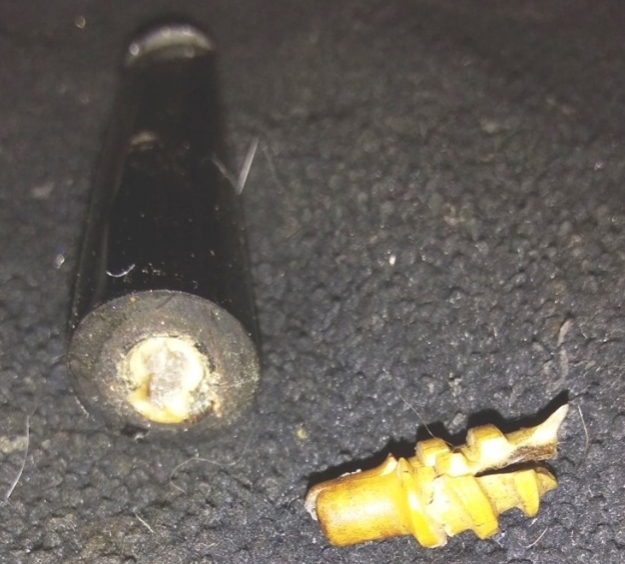
As I had done many times, with the same great care and patience, I unscrewed the stem from the bone tenon.  There was no resistance, no mis-threading, nothing whatsoever wrong – until the sickening sound and feel of bone that was, one second, solid, and the next, several disjointed pieces that didn’t even fit together and more or less pulp left in the shank and stem.  And the infernal softness of the sound it made when it shattered, not a snap, crackle or even a pop, but as closely as I can describe it, like the effortless breaking between a pinkie and a ring finger of the softest piece of chalk.  There I was, exhausted as I readily admit, with the bone tenon broken and crushed in my hands, the remnants scattered on the floor in bits and fine powder. Almost three years after the pipe restoration went all the way south (and I’m sure everyone knows the figurative distance and final destination I’m suggesting), I still remember most how the unimaginable tragedy lacked any definitive sound.  I know now that the bone material had passed its life expectancy long before and might have failed at any moment.  In hindsight, I am grateful it happened to me rather than Daryl.

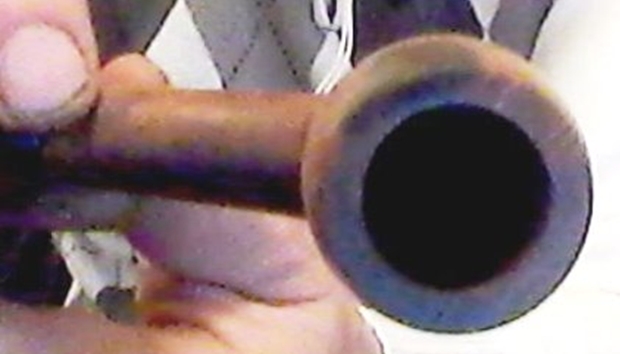
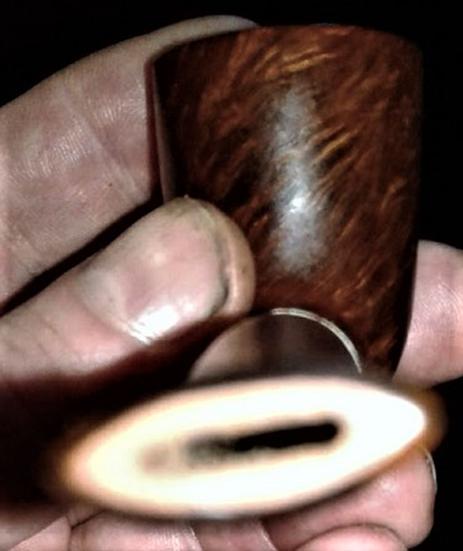
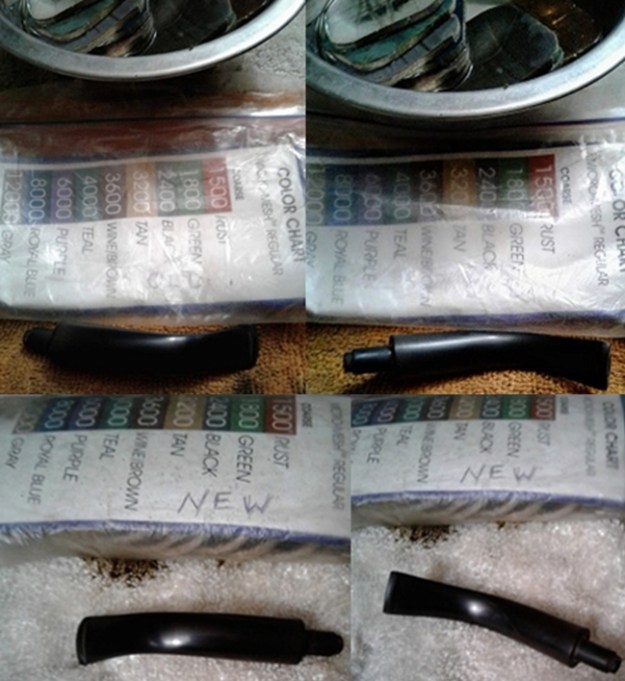
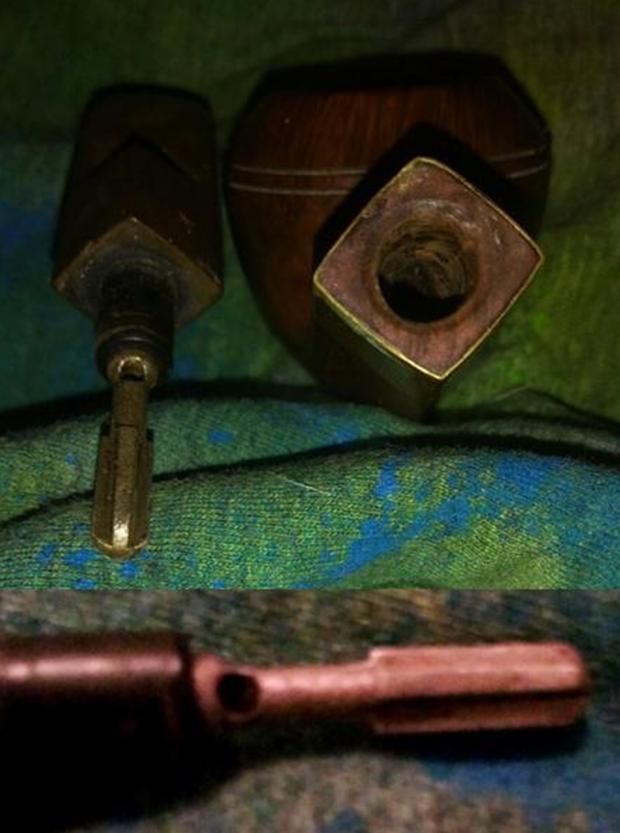
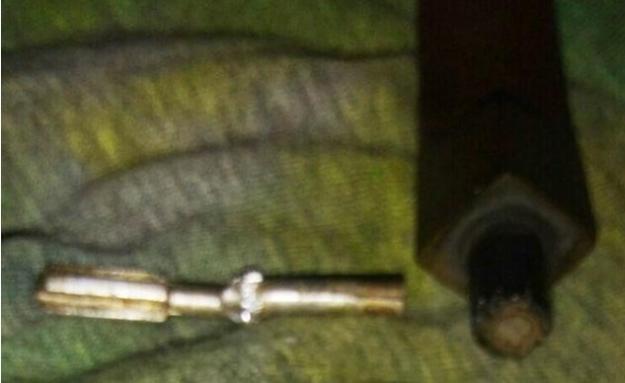
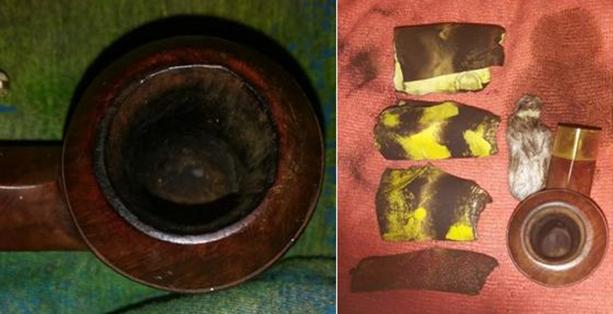
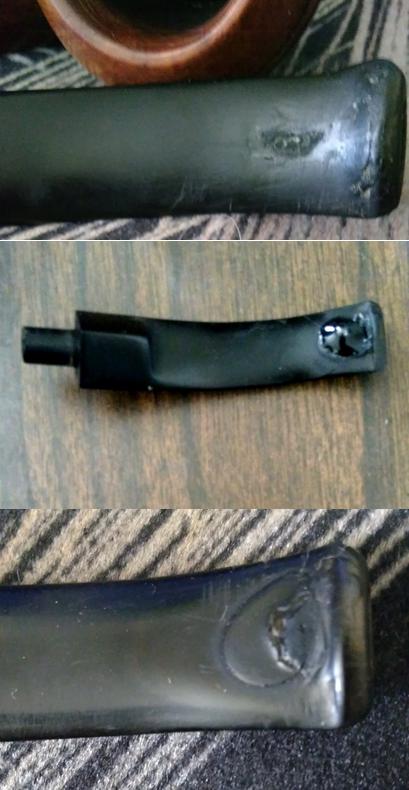
Here is the ghastly reality my numb mind had not even processed yet as I saved the horror for the record, by pure dazed habit, after frantically trying to graft the three tangible splinters of the tenon together with Super Glue.  Note the Frankensteinian product of my mad attempt at surgery on the tenon and the perfect evenness of the fault line leading to a total impaction of the stem hole.I tried my best to sleep and, late in the morning when I got up, considered the remains, my hope to find I had dreamed the whole fiasco obliterated with less noise than the plan-changing event a few hours before.  I decided to put the stem aside for the time being.  Why tempt further catastrophe when such things have a way of finding us, like the only two certainties in life of which Christopher Bullock seems to be the first person to warn us, in his 1716 farce, The Cobler of Preston.
Instead, I turned to the mangled rim and working with a double-sided 150/180-grit sanding pad painstakingly returned it to full health. When I was finished with the rim, it was looking good.  I even managed to give it a slight inward slant before reaming and sanding the chamber smooth.Other than the missing tenon, everything was beginning to look up again.  Outside was warm and sunny, bare wisps of clouds here and there in the blue sky.  When the other incomprehensible disaster struck, I felt like a lightning rod on an old barn swaying and creaking in the storm of the century.

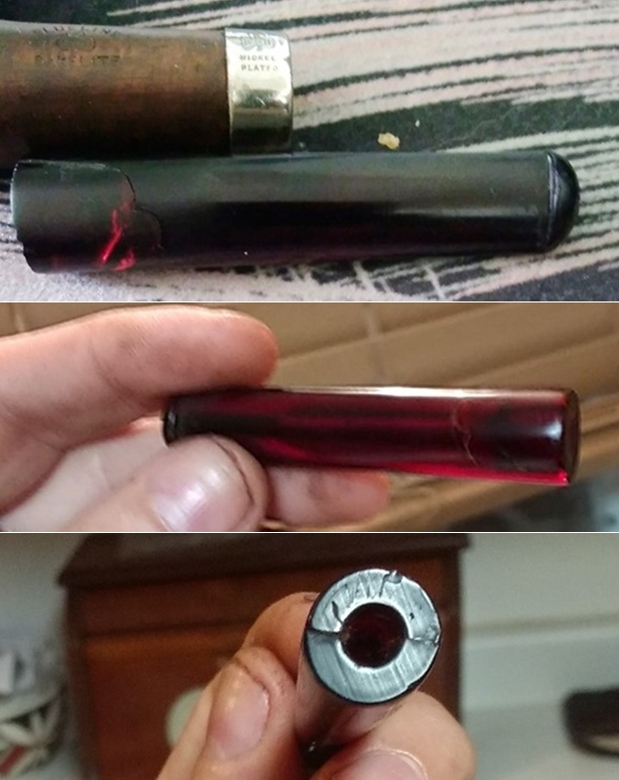
This time, no ifs ands or buts, it was my fault despite the inherent danger of meddling with Bakelite or any other synthetic plastic.  I had no trouble with some dental tools I somehow got my hands on, wheedling out a chunk of packed bone here and another there from the shank, and the mother lode popped out nice and easy   Then it was the stem’s turn, and it was ornery.  I just started to make a decent dent on the harder bone inside the tiny stem hole when I just plain blew it.  I heard it that time, the crack amplified by my ears the way a bolt from Zeus struck the railroad tracks a few yards from me as I walked home from work in Granby, Colorado just before my 21st birthday.  I was watching the storm coming closer and saw nature’s electricity hit the rails.  That flash up in the Rockies made me jump a foot in the air, but the explosive soundwave a heartbeat later sent me flying across U.S. Hwy. 40, forget about the non-stop two-way traffic between the Berthoud and Rabbit Ears Passes..

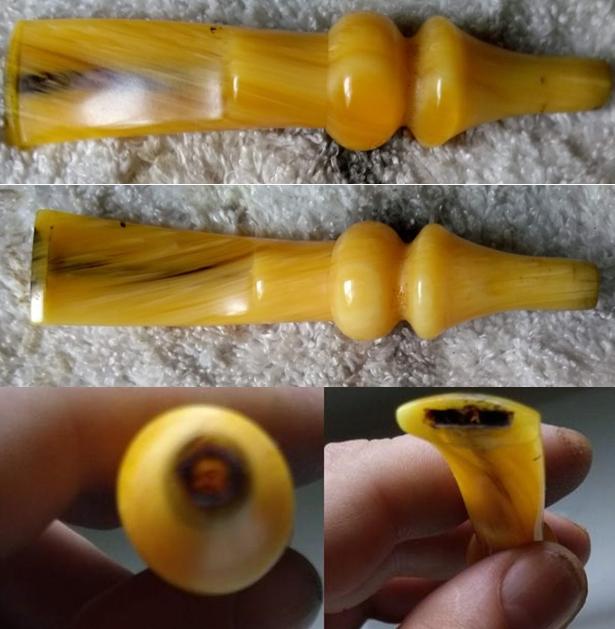
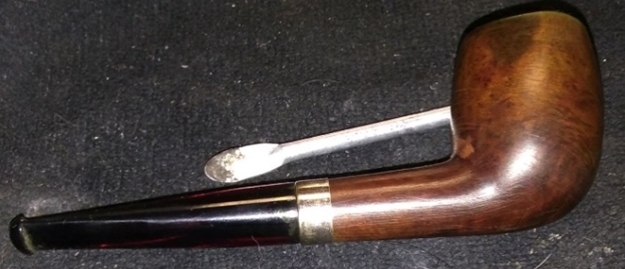
Once again, in the frenzy of emotions over my double-destruction debacle starting with the bone tenon and then the stem, I hastened to glue the two pieces of the stem together before taking pictures.  The first was while the glue was still setting, the second after I micro meshed off the excess glue and to show the great color as well as how closely the small piece fit into the big, and the third just for the sake of showing the end view.Regardless of my initial frazzled audacity to think I might be able to right this wrong, my sense of morality is intact enough that I know I would have rejected the notion of passing off the fatally flawed stem as undamaged no matter how seamless the result may have been, but I was still relieved to have any temptation removed.
The star-crossed shadow that came to lurk around every corner began to seem a curse.  Since the day I restored my first pipe, until then the thought of giving up the whole endeavor for good never occurred to me.  At that lowest point of all my work reclaiming old and worn estate pipes, to crib from Steve’s site motto, I came a breath away from scattering all of it with my arms and hands to the walls about me or wherever else they might crash and shatter – the remains of the KB&B, dozens of other pipes awaiting my attention and every tool I had acquired, all of which I didn’t yet know was soon to be stolen from me anyway.  But that’s a different story I’ll tell when I’m ready.  This was in the spring of 2016, when my life in general was, to me, dangerously pointless.  I considered selling what I could and scraping together everything I had to find Daryl a suitable replacement.  That was really all I cared about, but it was enough.

I am well aware that some readers of my blogs view my style of writing as feigned or, a little worse, contrived.  My unorthodox approach to blogging pipe restorations doesn’t help, and my habit of falling into literary mimicry now and then may annoy many of the more experienced contributors to this forum.  That’s just not how I approach any writing project, which happens to be with the same imagination and enthusiasm I try to put into the actual pipe work.  I needed a year from the completion of this particular trial merely to face the unpleasant truths of the experience and find the words to describe it, however fanciful they may strike some folks.

But I did finish the job, although it took two years and the unwavering patience of my friend Daryl to be done with it.  In that respect, the Narrator’s appellation of Sir Daryl is well warranted.   Now I can finally let everyone know something that’s been on my mind for too long: anyone who doesn’t buy the bald self-analysis of my strengths and weaknesses I just finished sharing once and for all can believes what he will and sod off.  I’m not going away, and this is for the rest of you, who hopefully know who you are and that I appreciate the encouragement.

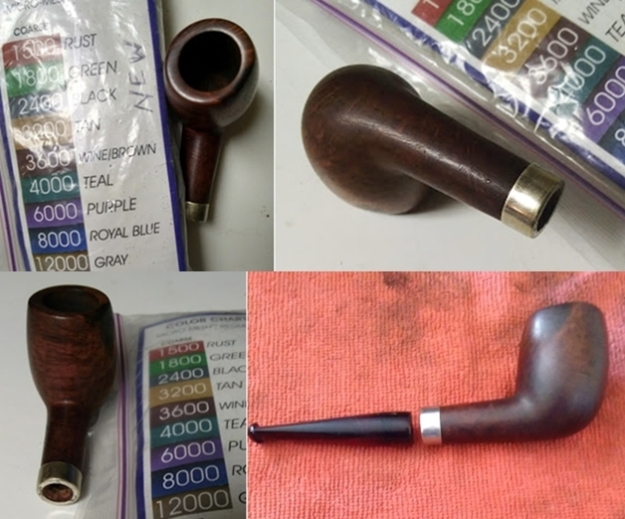
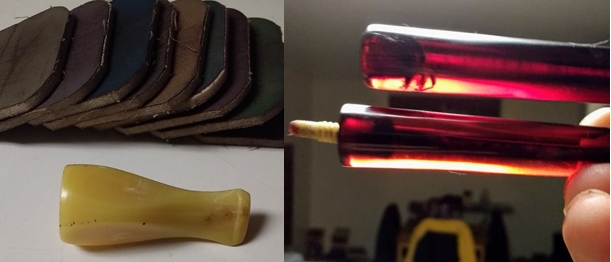
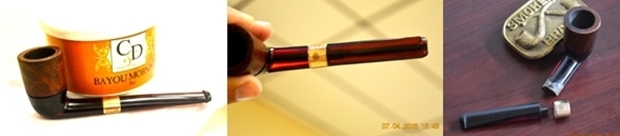
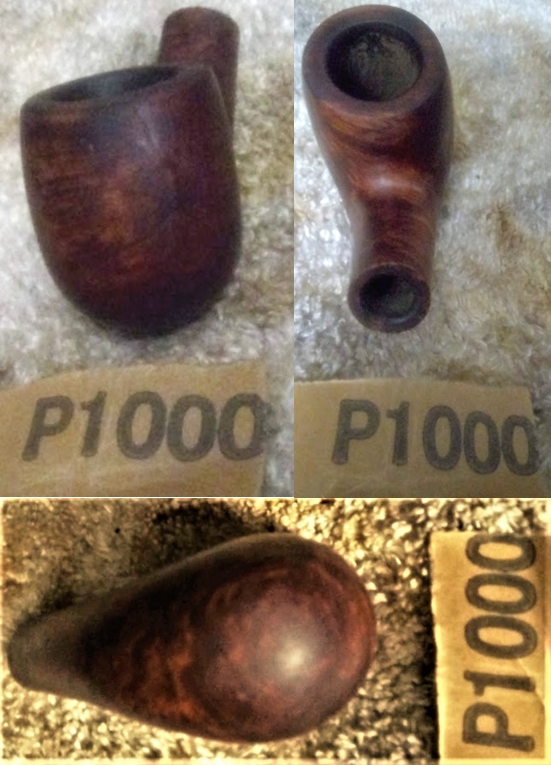
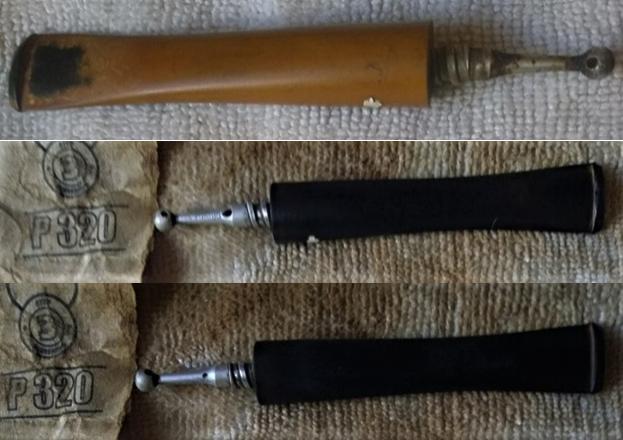
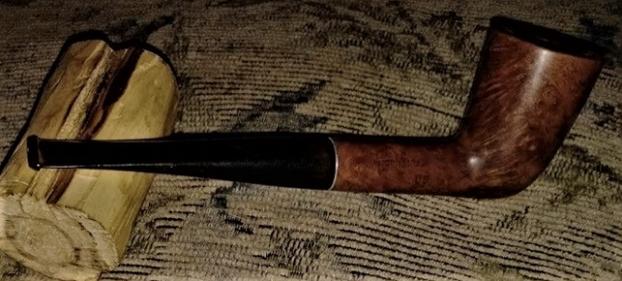
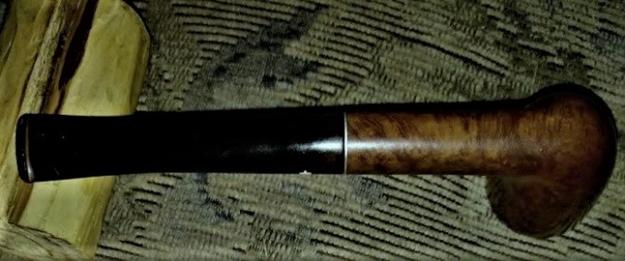
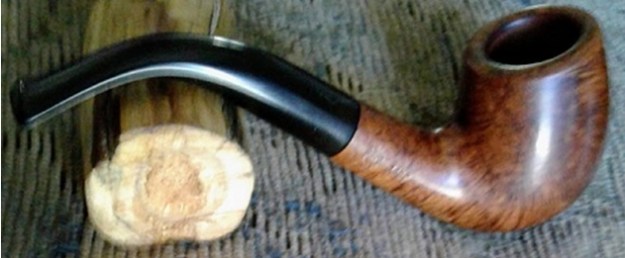
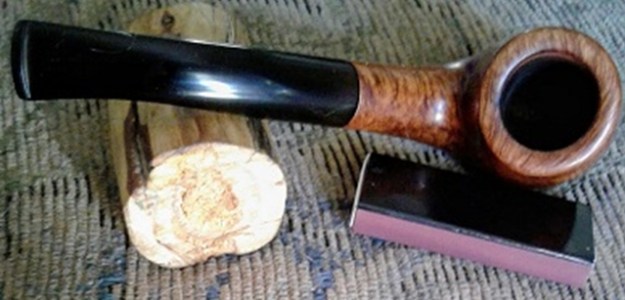
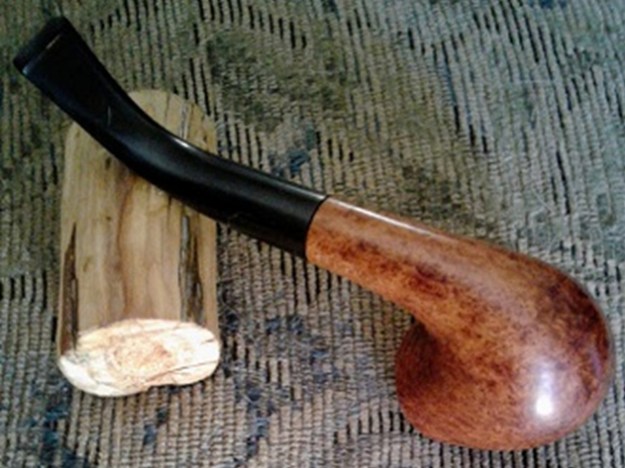
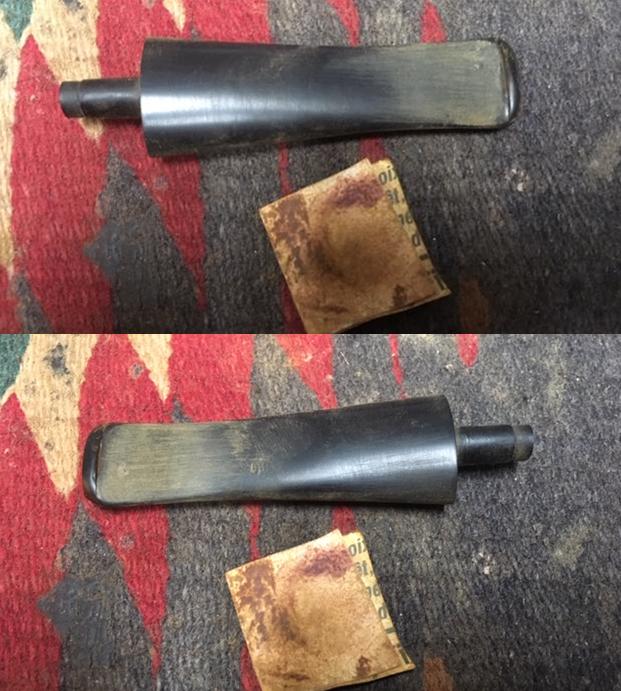
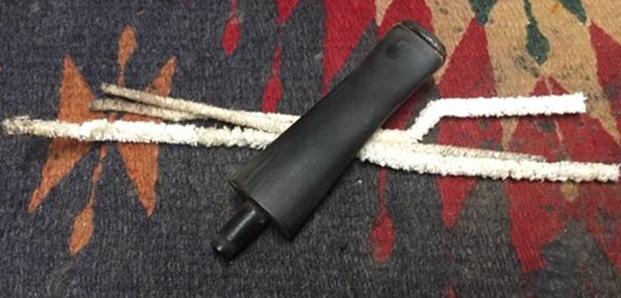
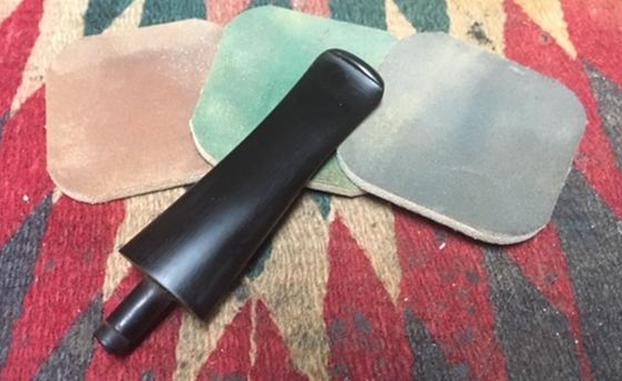
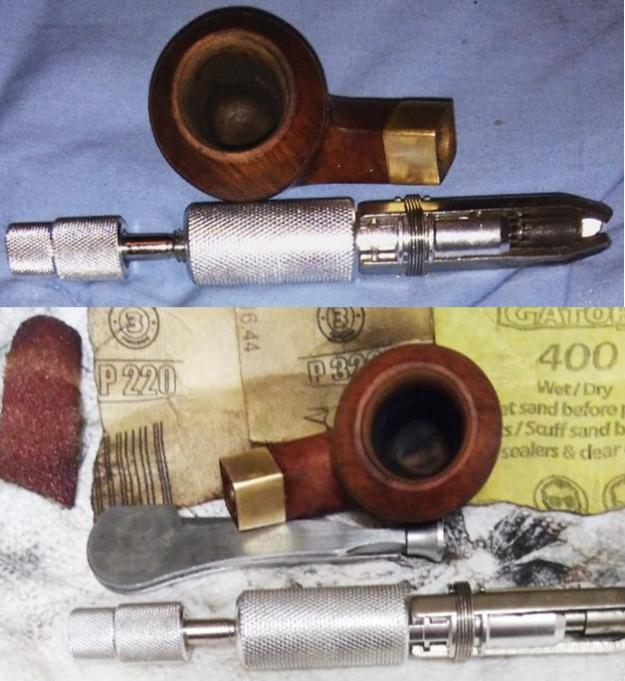
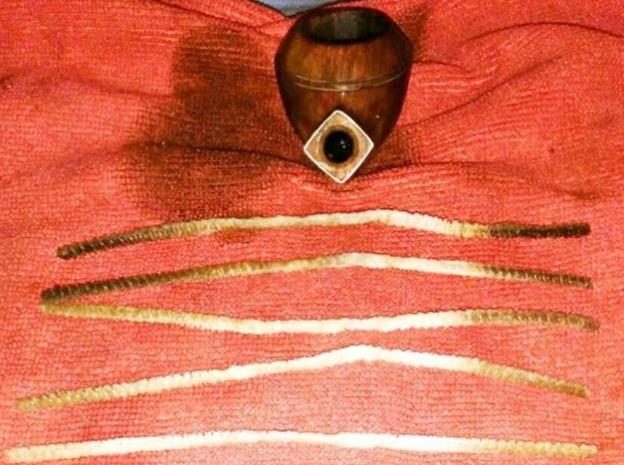
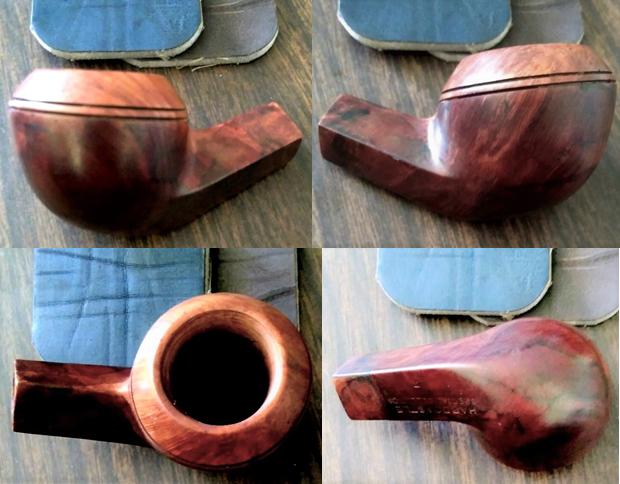
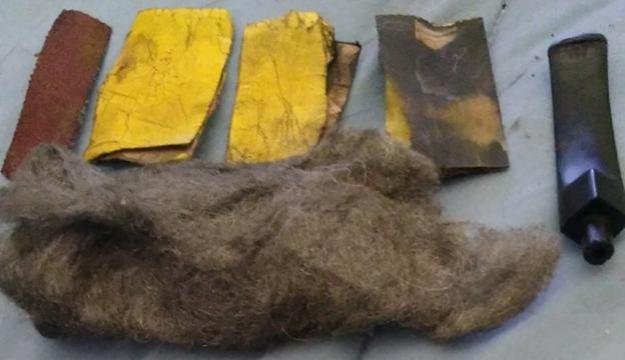
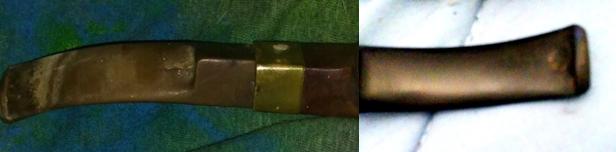
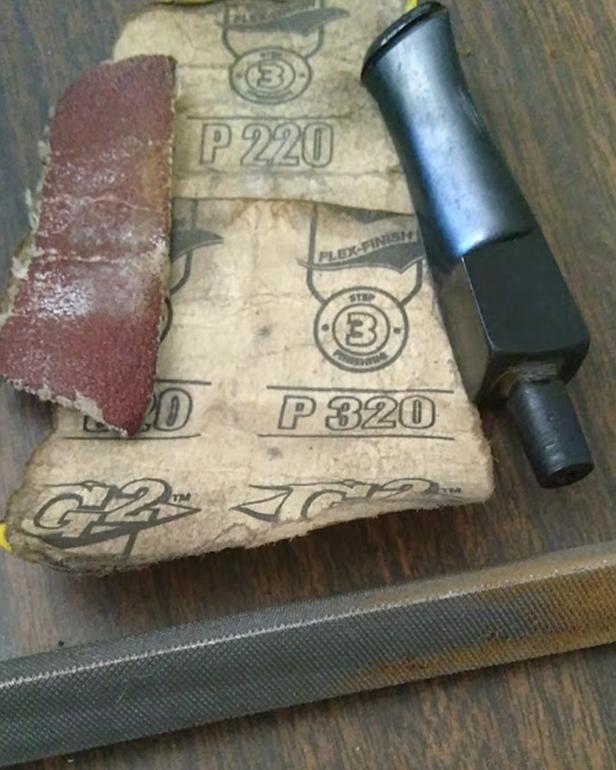
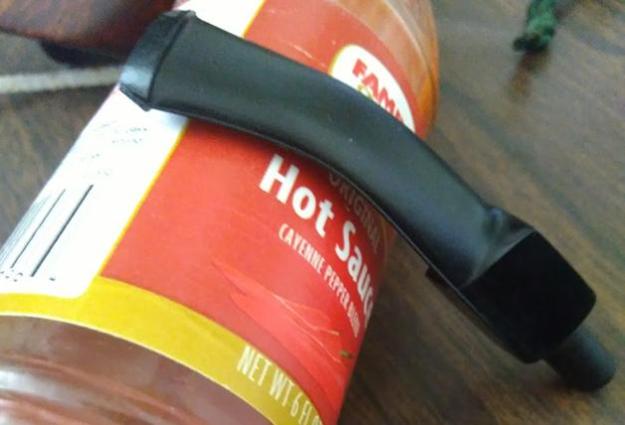
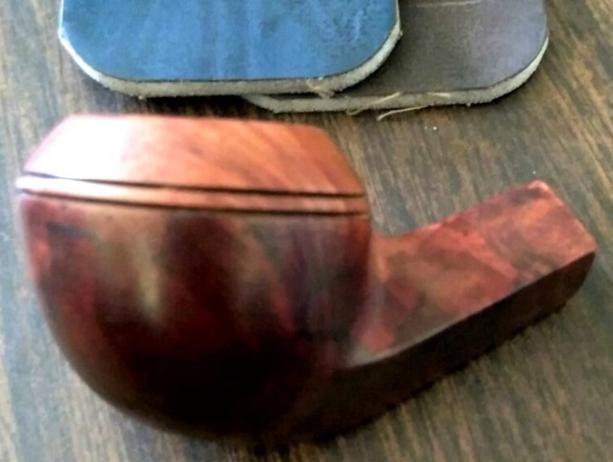
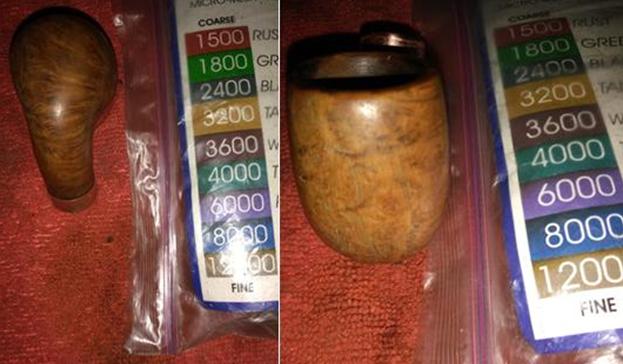
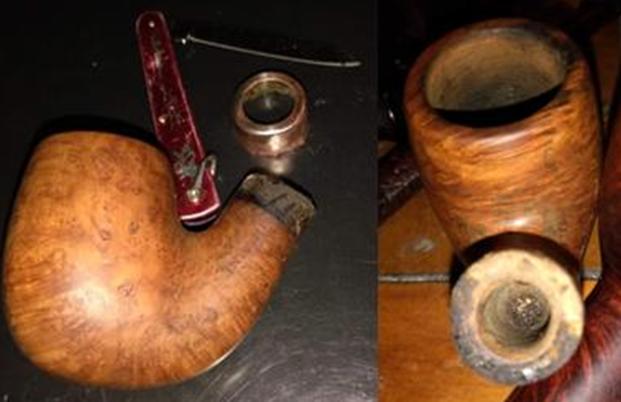
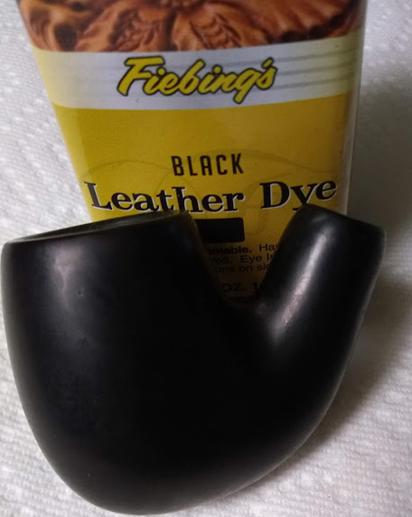
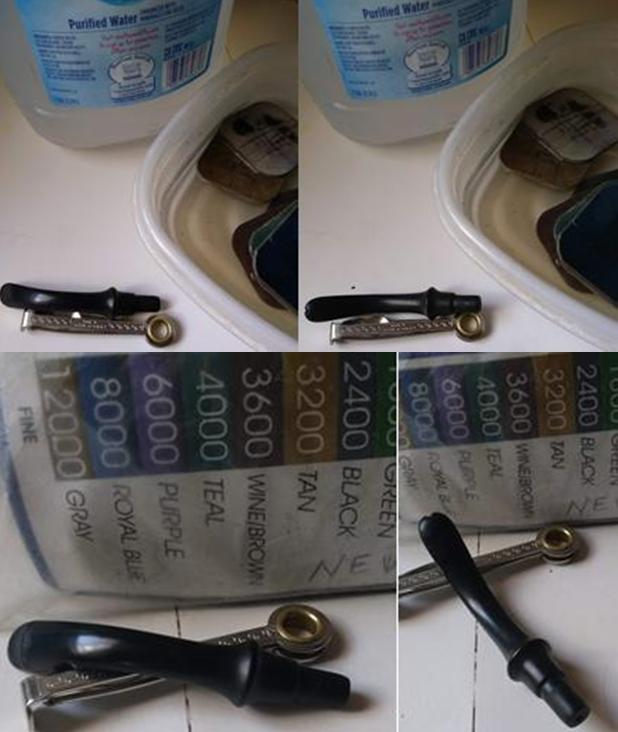
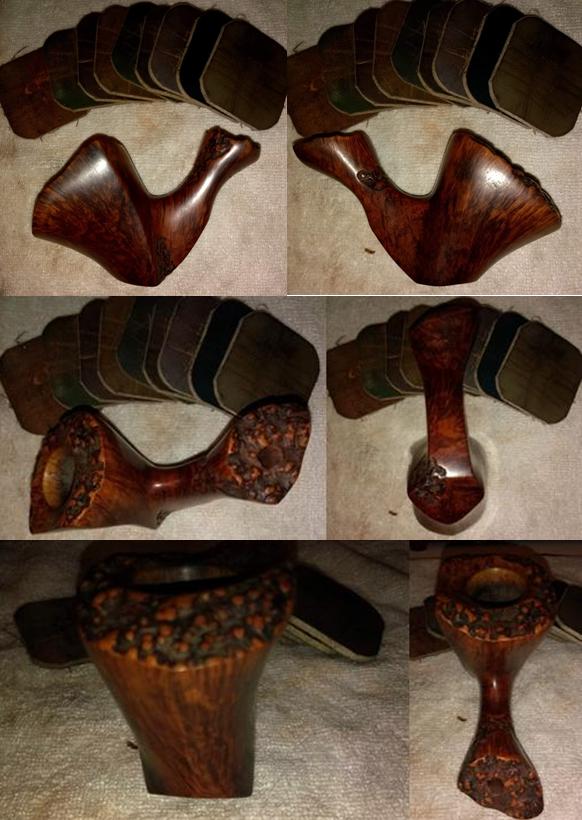
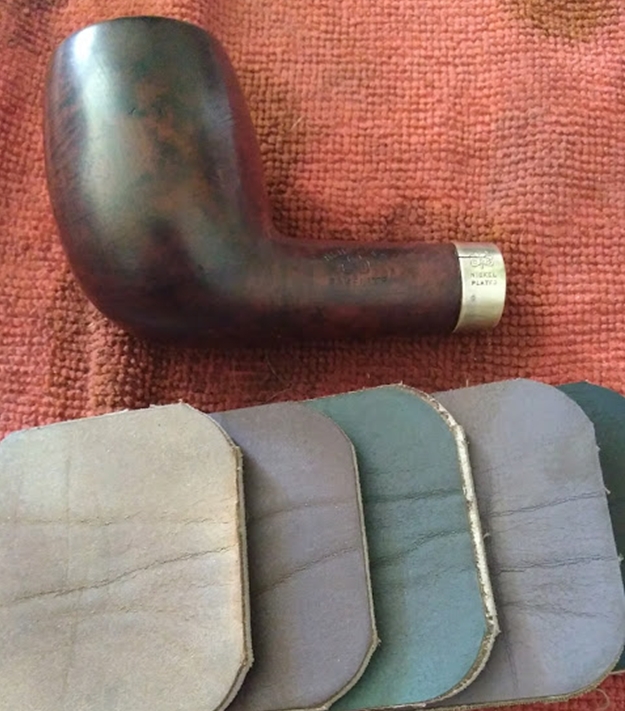
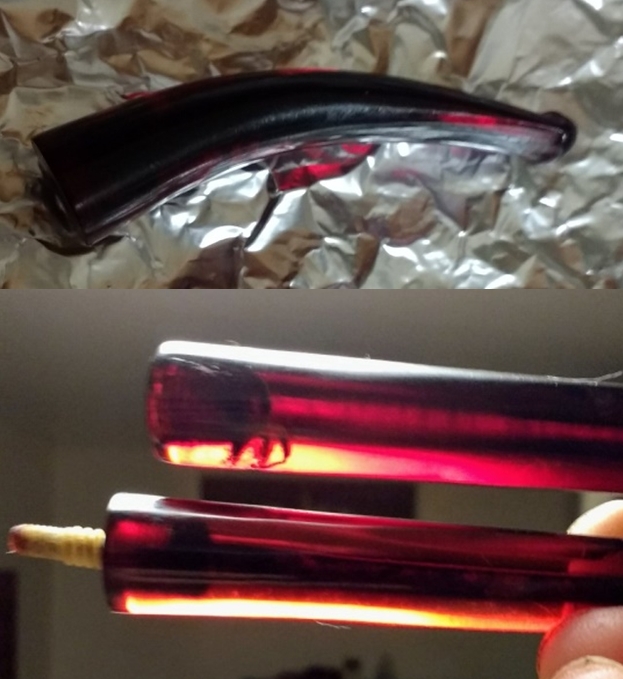
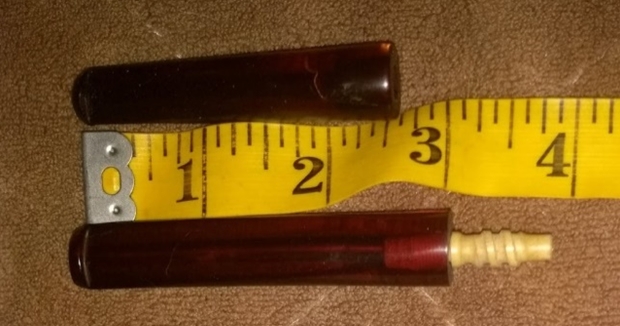
With more time to work on the pipe afforded to me by the unhappy but, for Daryl, fortunate destruction of the tenon if not the stem while both were my responsibility to replace, I was able to eradicate the mark on the right side of the bowl.  The next shots show the re-staining and micro meshing to the correct original dark shade of brown.  Thanks to the intrinsic problems with Windows 10, the key shot of the right side was lost, and I only have one showing the final result after eliminating the remaining scratches from the excessive but necessary sanding used to make the black marks disappear, which I accomplished with every sanding and smoothing resource at my disposal. Desperate to get Daryl’s pipe back to him, I was willing to offer as a temporary solution my real cherry red amber stem from the CPF Best Make turned lion’s head meerschaum I restored in Part 2.  Preparing for that possibility, I straightened the amber by heating it in the oven.  The second pic shows the original Bakelite stem above the straightened amber stem, in which I had placed a bone tenon I happened to have on hand but that didn’t fit.  The length of the amber stem is a little longer, but I expected it would at least mollify Daryl.All of the events and work occurred during a relatively short period of time in 2016.  Not until two more years passed did I find Norwoods Pipe Repair, and Kenneth Norwood assured me he could replace the bone tenon and even the same color of Bakelite stem.  At last I can show the parts he returned with the pipe I sent him.  The replacement, as it turned out, was also a little longer than the original, but I was confident Daryl would be more than pleased.Only two years after taking on the task of cleaning and restoring the KB&B that had such wonderful potential, all I had to do was retort the pipe.  I did so immediately, and as the replacement parts arrived, believe it or not, the same day as our monthly pipe meeting, I was able to return the gorgeous completed pipe to its owner that night. THE END OF THE LONG JOURNEY
Thus ends our tale of the long and arduous task of the unlucky but persistent Restorer…who almost never faltered in his pursuit of Right versus Wrong.

And everyone lived, happily ever after.

THE NARRATOR’S PREVIEW OF THE FINAL ADVENTURE
The fourth and final Book in this series will tell the tale of the first venture by the heroic Restorer, since thus he clearly needs to be described, into the small and secretive world of meerschaum repairers in his quest to be of service to a Good Lady.  Anyone who has ever had dealings with this lonely coven will understand how they covet and guard above all else the alchemies they devise as theirs and theirs alone.  But our hero will reveal, for the whole world to know at long last, the wondrous knowledge he has uncovered with the aid of unanticipated paladins – in particular an Artisan of high renown who dwells in the same town as the Restorer.SOURCES
https://norwoodspiperepair.com/index.html
http://freakonomics.com/2011/02/17/quotes-uncovered-death-and-taxes/
https://rebornpipes.com/tag/kbb-kbb-pipe-history/


The Decline of Restoring Old Pipes, Part 2/4: An Antique CPF Meerschaum Five Years Finishing


Blog by Robert M. Boughton
https://www.roadrunnerpipes2k.com/
https://www.facebook.com/roadrunnerpipes/

Copyright © Reborn Pipes and the author except as noted

Then I thought, boy, isn’t that just typical?  You wait and wait for something, and then when it happens, you feel sad.
— Sharon Creech, U.S. children’s writer, in Absolutely Normal Chaos (1990)

RECAP
In Part 1, I hypothesized that the discontinued manufacture or illegality of certain materials, as well as the dwindling availability and in some cases complete lack of pre-fashioned parts used in antique and other very old pipes, will lead to a serious crisis in restoring these great but often damaged old friends to their original conditions.  Without hashing over the details, which I already described in great although still incomplete specificity, I will add that I left out the obvious: none of the materials I discussed is irreplaceable in the sense that an old pipe with a broken amber stem or bone tenon can always be mended with Lucite or Delrin, for example.  To emphasize my way of thinking, which I know is shared by many other far more experienced and better practitioners of the art of pipe restoring than I, the thought of needing to resort to such practices except in the most severe cases is unthinkable, or to use a more descriptive word, an anathema to me.

At any rate, having no idea what I was getting into when I began writing the first installment, in the order in which various materials popped into my head, I soon reached a point where more and more endangered items presented.  For the sake of not breaking my train of thought any more than necessary on the one I happened to be trying to complete at the moment, I got into the habit of adding new section headings as I proceeded, as a sort of minimal outline.  The research alone led me in still newer directions, and so the sections grew in number – not to mention the research, which became so out of hand I almost lost control and never did get all of my sources in good order.  In the end, for those reading this who caught Part 1, believe it or not, I cut entire pages from the text and many of the sources that, due to the months spent composing my list of the most endangered materials either no longer applied or were redundant.  And still my sources alone took up at least two whole pages of the 24 I submitted to Steve.

Needless to say, as sad as I was to have to face the music, my little list had reached proportions prohibitive of an illustrative restoration to accompany it.  This installment will begin the phase describing the first of three projects that demonstrate the growing difficulty of restoring very old pipes to their natural beauty and even one relatively new but vintage example, despite my intentions, as if it were an antique.

INTRODUCTION
Five years ago, Chuck Richards presented the old and wounded but still spirited meerschaum to our Friday night pipe get-together.  The group of devoted Albuquerque area pipers being in its heyday at the time, the little tobacconist’s shop where we still meet in lesser numbers was filled beyond fire code capacity.  Folding chairs extended the normal smoker’s lounge all the way to the front glass counter, and still they were not enough.

I would regret to point out the business from cigar aficionados we pipe revelers cost the shop’s owner that memorable night, other than the few who were understanding or dogged enough to wend their ways through our standing-room-only mob.  But the sales in pipes and tobacco tins, and everything else that goes with them, more than made up for the loss on those evenings that are among my best memories.  Time has a way of changing all things, not just the antique meerschaum beauty Chuck passed around for all of us to ogle.

With the innate cunning and flair for dramatic understatement possessed by traveling carny operators of old, Chuck had the entire room enthralled – and yes, I was in the front row, center aisle, agog, right where he wanted me.  The panache of Chuck’s delivery was not in what he said of the pipe, however, but the way he appeared to satisfy the rest of the audience with an atypical dearth of anything better than teases, what Deep Throat called leads, at least as far as my hungry ears and eyes could discern.  Had I still been a news reporter with orders from my editor to get a good quote, I might have been out of a job.

That old reporter in me was accustomed to listening for diversions, avoidances and spins – every attempt “to deceive, inveigle and obfuscate,” as Special Agent Fox Mulder says in one of his most memorable lines from The X-Files (S4:E3).  That good habit must have kicked in to help me pick up on the mesmerizing but fugacious choreography of the show, designed only for the moment and then to be forgotten.     All I heard was “an old, now defunct pipe maker or distributor, probably in the U.S., called CPF,” “Best Make.” “still in its original case,” “with amber bit, gold band and broken bone tenon.”  But what did he omit and why?  During the intervening years, I’ve asked a few of those who were there that night about the occasion, and all of them indeed recollected some small part of the details, but little of substance, that are imprinted into my memory.

And then the act of mass hypnosis was over, the tiny space hot and stuffy, the crush of pipe enthusiasts swelling to the distant and narrow entrance somewhere in the background that was clogged with people coming and going beyond the usual capacity and hours of the shop’s operation, and which sole entry and exit, at any rate, lay beyond several treacherous eddies and straits still out of sight or reach.  I was not in my element and wanted to bail but needed to talk to Chuck.  With a distinct surreality, his bead bobbed nearby, like a life buoy in a foggy ocean.  We smiled at each other in what I felt was a meeting of the minds

I called out to him – shouted as loud as I could – as close to screaming as I ever have.  Imagine, not a vacuum such as space, but the opposite: chaotic babble and expansion.  Everything else drowned in the roiled sea foam of voices.

“Don’t you know anything more about CPF?”

We were face to face at last, but Chuck didn’t hear a word.  Neither did I, for that matter.  He even cupped a hand to an ear and gave up, communicating better with a single raised finger that he would come back.  When he did so, the crowd thinned out enough for us to hear each other.  He said, “I want you to take this home with you and do some research.  See what you can find out about CPF on your computer.”

Close your eyes if it helps and imagine the words above being cast upon you by Chuck in his always rich but then suddenly dulcet, soothing, fluid and entrancing tone

While Chuck projected these words to me, I tried my best to focus on his face, but my attention kept straying to the one-hundred-some-odd-year-old meerschaum pipe in its original tan case that looked so secure in his able custody but became more and more fragile and vulnerable as it was passed to mine. Much more was spoken between us that night before I began to understand that the dirty, damaged but reparable and, to me, priceless piece of art and history was not a loaner for research purposes as Chuck had suggested. Some blurry time later I realized he only said that so I would accept the gift from his hand. He knew I never would have touched it otherwise. About then the full truth struck me like a Mack truck with no brakes on a downslope of the Grapevine, a treacherous strip of I-5 in California with the Tejon Pass in its middle: Chuck expected me to restore it.

“But I’m not the right man for the job!” I went off like a maxed-out Jake break.

Chuck grinned at me a way only he can and then tried to calm the panic rising in me.

“When you’re ready,” I recall him saying. The rest is hazy.

As soon as I returned home that night, I began my computer research into “CPF tobacco pipes” as Chuck prescribed, and it became apparent that my friend indeed knew more than he let on. As Chuck suggested to the weekly pipe get-together almost six years ago in his circumspect description of the company, CPF was indeed a U.S. venture, in New York. I came across all sorts of conjecture as to the meaning of the three letters, with most agreeing the PF stood for Pipe Factory.

The C, on the other hand, was debated with unusual ferocity even for the very opinionated pipe world. The guesses included Consolidated, Chesterfield and Colossal, among others. There was even one complete rewrite of the truth suggested in a note at the bottom of the Pipedia link below, positing the amazing coincidence of a C.P. Fenner (one of two brothers who made cigarettes) as a viable candidate.

After hours of determined hunting, I was able to conclude with certainty that CPF stood for Colossus Pipe Factory, which enjoyed a relatively brief but glorious run from 1851-c. 1920. Steve later pinpointed the end of the road for CPF as 1915. In that short span of time, CPF, almost certainly employing the Old World skills of European immigrant crafters, made some of the most beautiful meerschaum and briar pipes available at the time. And it was a great time for pipes.

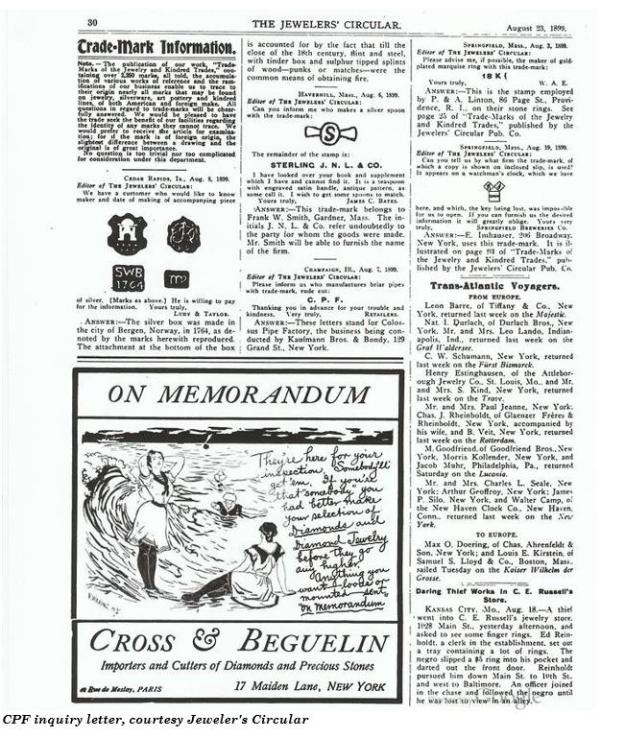
There were three absolute forms of proof that the Colossus Pipe Factory existed, and I later forwarded them to Steve: an antique bill of sale I no longer have, made out to a French company; a letter I found in a long scan of The Jeweler’s Circular issues (August 23, 1899) asking for the name of the pipe company doing business as CPF and receiving the above reply from the editors, confirming the Kaufman Brothers & Bondy connection, and an ad strengthening the tie between CPF and KB&B. Most sources agree KB&B assumed ownership of CPF in 1883. Here are the specific page from the jeweler’s magazine, another ad mentioning CPF, KB&B and Bakelite all in one, and an example of such a pipe.

For the most complete history of CPF, see Steve’s definitive piece in the link in my sources below. Steve’s hard work pulls together all of the available information on CPF along with very nice illustrations from his own vast portfolio of restorations.

1881: THE YEAR IN HISTORY
Until this very moment, as I edit my blog, I had put a conservative estimate of the Best Make’s date of manufacture as 1898. Now, revisiting the evidence, I notice that every ad or other official mention of CPF after KB&B took control mentions KB&B and its address at the time. Pinpoint dating being impossible, I now have good cause to revise the pipe’s manufacture to pre-1883, given the worn old case that makes no mention of KB&B despite the room to do so. Therefore, my new conservative estimate is 1881, making it 138 this year. As it turns out, 1881 was an interesting year, like every other year in my opinion, but I’ll just cite a few highlights.

January 1, 1881, Dr. John H. Watson was introduced to Mr. Sherlock Holmes.
February 24, work began on the Panama Canal.
March 4, James A. Garfield was inaugurated as the 20th U.S. president.
March 16, the Barnum & Bailey Circus debuted.
April 28, Henry McCarty, originally of New York City, escaped from the Lincoln County Jail in Mesilla, New Mexico. Best known as Billy the Kid and widely but erroneously believed to have been born William H. Bonney, McCarty had three other aliases. I had to mention this particular historical tidbit because I live in the natural born killer’s old stomping grounds.
May 21, Clara Barton founded the American Red Cross.
July 1, the first international telephone conversation occurred, Calais, Maine to St Stephen, New Brunswick
July 2, President Garfield was shot by a delusional speech writer who fancied himself responsible for Garfield’s victory. Being denied an ambassadorship was the last straw.
September 19, President Garfield died from an infection caused by the gunshot.
December 4, the first edition of the Los Angeles Times was published.

The Wright Brothers’ first flight at Kitty Hawk, NC was not for another 22 years. The 19th Amendment to the U.S. Constitution granting women the right to vote, ratified August 18, 1920, was still 39 years from reality. The 25th Amendment to the U.S. Constitution defining presidential disability and the line of succession was not ratified until February 10, 1967 – 85 years after Garfield’s vice president, Chester A. Arthur, was sworn in as the 21st U.S. president.

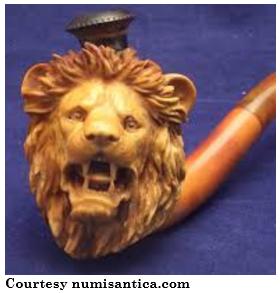
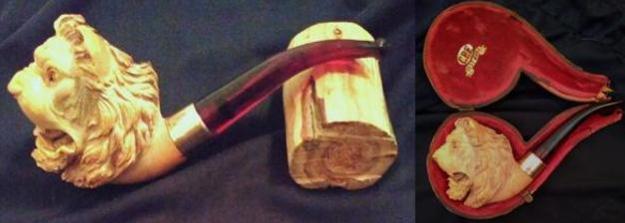
The year 1881 was also 19 years before the revolutionary scientific and technological century that forever and exponentially robbed people of the little daily pleasures that were perhaps our greatest inclinations, for taking time to read and write and contemplate life. And toward those goals, some Old World meerschaum carver had the idea to create a pipe with a bowl turned just enough to allow smokers to see the pages of the books, newspapers or literary magazines they enjoyed reading during moments of the day when they could escape the rat race. Few such clever pipes can be found today. The photo below shows another pipe with a design that nevertheless has an amazing similarity to my CPF Best Make and could very well be its brother.


RESTORATION
I should make one final point clear now: the reason this part of the blog is short on the actual restoration steps and includes relatively few photos is that most of the work involved – meaning everything other than reconnecting the stem – turned out not to be anywhere nearly as difficult as I had at first projected. That’s easy to say now, after having restored other meerschaums and removed an unknown number of broken tenons from shanks. Also, knowing the final key to this restore was finding a suitable bone tenon and getting it to fit snugly and securely in the shank afforded me time to, well, take my time.

All of that said, the most important factor in terms of my readiness to finish my part of this project is all of the experience I have had working out problems with other pipes during the five years this process wound up taking due to the one vital step. Most of those times, my impulse, and often my first step, were to seek the help of someone who had more experience than I. That left plenty of options. Although the friends I’ve pestered most for advice may not realize it, I began to research possible solutions steadily more often. Above all, I exercised the part of my brain that allows me, when I use it, to think my own way out of corners. That habit proved to be of particular benefit to this restoration, as I will soon explain. For the first year, I sat on the pipe, in the figurative sense, other than taking it out of the case now and then to admire its regal elegance. That time was in no way wasted or idle. I accomplished considerable online homework on various approaches to restorations of antique meerschaums. I had a fair number of successful meerschaum restorations under my belt, but I’d never even touched an antique pipe before, and they are a whole different ball of wax, so to speak. Here are the problems I anticipated:

1. The rim char was transformed by the power of time – which may heal all wounds but is more apt to cause them, and thus allow us to grow – from the more or less expected norm of bad to full crystallization around the top of the chamber.
2. The entire surface of the pipe was filthy, whether from improper handling or about a century in storage or both, but the deep, even gold of the patina indicated it had been well-loved and tended. Cleaning meerschaum should not be approached without caution as the first try can limit later options or, worse, show places where the pipe was handled with bare hands from the ghosts of ingrained skin oil and dirt, sometimes as permanent blotches..
3. The original bone tenon was broken, half jammed deep inside the draught hole and the other half in the amber stem. Removing it from both narrow, fragile holes would be problematic, to use a gross euphemism. Replacing it would be a challenge – but a pleasant one, I imagined in my determination to honor my personal pledge to restore this great pipe to its original glory.
4. The shank looked as if it would need to be re-threaded. Wonderful.
5. I have also never worked with amber but knew enough to realize it is brittle stuff, in particular the 133-year-old (at the time I took possession of the pipe) variety. There would be no thought of subjecting this precious bit to the perils of an electric buffer or even sandpaper.

That’s it. Nothing serious, just a mine field. But after long, intense consideration, I concluded the integrity of the wonderful patina must be preserved at all costs and opted for a traditional basic cleaning rather than one of the experimental processes of which I had read. That was in 2014.

Recalling the one dragon Harry Potter had to face in his quest to survive the Goblet of Fire competition, I decided to be done with one of several I saw swooping my way. I began the slow extraction of the original bone tenon broken off and entrenched by time in the stem and shank. .In this kinder, gentler age of Vulcanite/Ebonite/Lucite/ Delrin tenon removal, by and large, the material being non-organic makes it less vulnerable to easy damage. My situation presented a triad of evils with the bone tenon packed into meerschaum and amber.

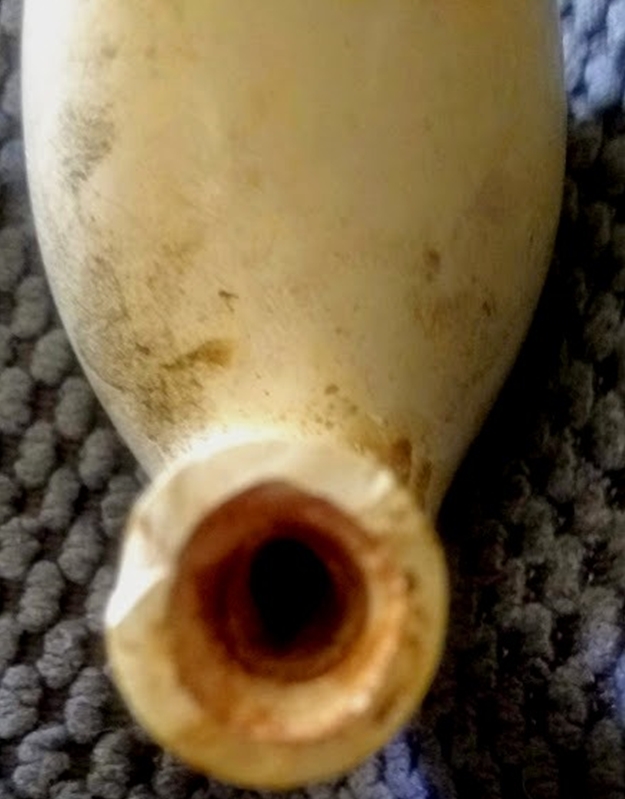
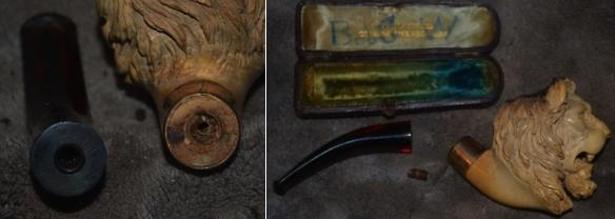
In most cases, not to postpone a fight but to confront the problems in a more systematic order, I would have started elsewhere. This time I went straight for the mother dragon protecting its young. The bone tenon screw piece in the stem is difficult to see, but trust me, it’s there in the first pic. Against the odds, it was easier to extract, or I was just lucky, but it popped out in one piece. In contrast, the shank took a couple of hours of on-edge, sweaty browed finagling with alternating and bizarre tools such as a jeweler’s screwdriver, the extended end of a large paper clip and the shank reamer of a three-piece pipe tool, to name a few. Breaking away a layer at a time, eight pieces later I reached the end of the blockage. The photo of the pieces is worthless. Confronted with the need for careful removal of the char and crystallization spreading from the upper chamber onto the lion’s mane and left ear, I admit I’ve never read of super fine “0000” steel wool being appropriate for meerschaum or even wood pipes, but I’ve found that when milder approaches don’t remove all of the char (which they almost never do), in almost all cases the steel wool does the job without damage.  What’s more, it even leaves a nice polish on the regular meerschaum rims that have some real width to them, which the CPF’s does not.  Some readers have told me they like the steel wool approach also. For the chamber I started with 200-grit paper and finished with 320, which also is discouraged unless great care is taken as I did, and then gave the outside of the stummel a vigorous but only preliminary cleaning with small cotton pads soaked with purified water. For all of the dirt apparent on the cotton pads, note how much was still left.

I waited – another year and a half.  During that time I continued the grueling online search for bone tenons with the idea of finishing the work myself and asked friends at my local pipe club and internet sites for pipe enthusiasts for help, to no avail.  The intensified hunt was infused with a sense that the time was fast approaching the now or never point, and even found a site that seemed to have every size available.  However, after going back and forth with the owner several times and never hearing from him again, I began to despair.  That was in 2016.

Then, almost exactly one year ago, at the end of February last year, I thought, what the heck, why not try again?  So I posted an identical thread on Smokers Forums UK, but in a different category.  The first response included a link to Norwoods Pipe Repair in Clifton, Tennessee.  Not wanting to get my hopes up, I checked it out and found that the father and son team of Floyd and Kenneth Norwood seemed to have all the right stuff for my lion’s head pipe and a second, antique briar that needed a still rarer stem that had to be replaced with the bone tenon.  All about that in part 3.

I had to wait until early in April, after employing the skilled services of Kenneth Norwood in March to repair the briar pipe first because it belonged to a customer who wanted it back for good reason, to send the CPF via USPS Priority 2-Day delivery.  I can tell you, the Separation Anxiety I experienced was acute, not having been away from the pipe or failed to look in on it at least once a day for the previous five years and being fully aware of the ability of the Postal Service to lose packages or deliver them to the wrong person who then keeps them.  I paid to insure the package for $500, which could never replace the irrecoverable, and waited.

From the almost immediate turn-around time I had with the briar pipe, but fearing that may have been a fluke, I knew it would not be too long but was nevertheless surprised when it arrived again at my door less than a week after I mailed it.

I took a picture showing the masterful work completed by Kenneth, who had done better than re-thread the shank, but what with the wonders of the new and improved Windows 10 that have required so many full system restores of my computers that I’ve lost count, that photo and who knows how many others have gone missing.  I’m sure they’re floating around somewhere because we all know Microsoft never lets us really and truly delete anything, but heaven knows where it is.

By the way, Kenneth mentioned that he would need the stem to be straight for his work aligning it to the new tenon, and so I put the amber stem with a pipe cleaner through the air hole on a small sheet of aluminum foil in the over pre-heated to 150° F. About 15 minutes later, I removed the sheet and stem.  Amber is the easiest material to bend or straighten, I suppose because of its resinous nature that makes it heat quickly to the point where it is so malleable it will literally bend in half from its own weight if picked up by one end when removed from the oven.

Knowing this from an experiment I did almost a year and a half ago, I took hold of both ends of the cleaner and still saw the middle sag a little as I rushed the stem that straightened in the oven on its own to the tap to fix with cold water.  I can’t emphasize enough the importance of speed in this process.  If you’re bending the amber, it tends to straighten out again fast, and if you’re straightening the stem, it’s easy to bend it even by a tiny degree before fixing.

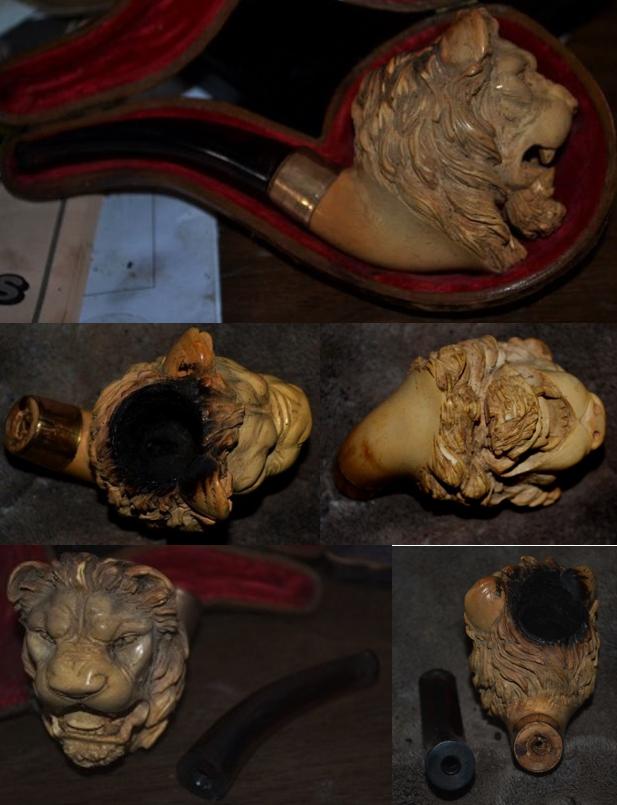
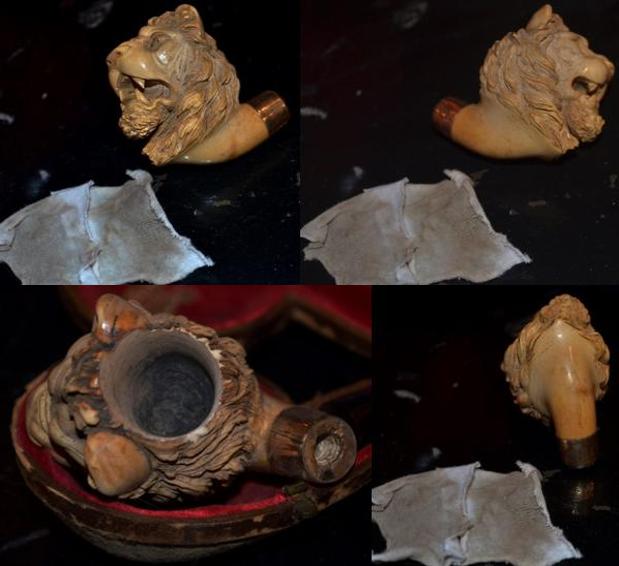
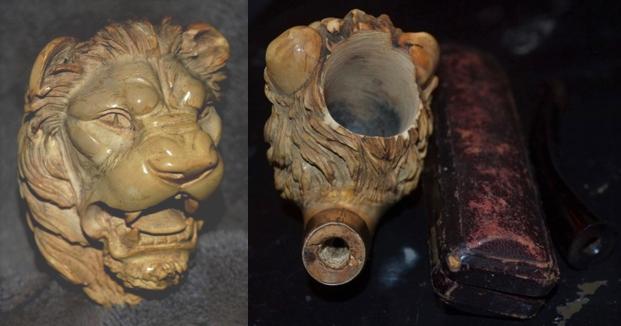
With that said, the next shots  start with the pipe as it was returned to me, with the stem still straight before re-bending, and after thinking to use a toothbrush and purified water to scrub every intricate detail of the amazingly realistic lion’s head.  This was quite a job, as the hand-carved details I noted are minute and almost as breathtaking as a real life, face-to-face encounter with the real thing: the ears alert and mane flowing backward, glaring eyes almost hidden beneath big brows, huge nose with fur and whiskers on either side, and that mouth with a hungry tongue and sharp teeth!  And that’s just the face.  The lion’s mouth is wide open, by the way, as if roaring or growling, and at times I had the idea it didn’t really care for my attentions – at least not until the task was done.  I have a bit of an imagination, you see, and another result was a flash to the story of Androcles pulling the thorn from the lion’s paw.Here are two shots of the work Kenneth did.And the rest.Now, the original real, cherry red amber stem was in remarkable condition for one that was used for a couple of years with loving attention, but the fact that it is well more than a century old makes its physical integrity achieve the level of astounding.  There were no dings or pits, and the scratches, if they could be called that, were so minor some people might have let them be.

I’m a far cry from perfect and always will be, but I’m not some people.  Here it is from every angle before I did anything to freshen it up.

I gave it a wet micro mesh from 1500-12000.And I did a dry micro mesh the same way.Thinking a little more about it, I was still bent, as it were, on not putting the wonderful piece of expertly carved, polished, polymerized and  fossilized prehistoric pine tree resin – an organic material neither gem nor stone – anywhere near an electric buffer. After all, accidents can happen.  For such a catastrophe to occur to a piece of amber, even brand new, would be the end of it.  Amber’s biggest problems are its extreme softness, a 2 on the Moh’s Scale of 1-10, just a full step above talc, and its natural brittleness that begins to worsen the instant it is exposed to sunlight.  In other words, the exceptional suppleness of this antique stem makes it museum quality.  Whoever owned it kept it in a nice, safe place away from natural light, and when he died it must have stayed in its case in an attic or some other dark place.

At any rate, thinking on the idea of how to give it a little polish without the wheel, the obvious occurred to me.  I took out my little jar of Decatur’s Pipe Shield that I decided to give a try as opposed to the standard Halcyon II Wax, both of which are generally reserved for hand application to rusticated or sandblasted wooden stummels before rubbing into the wood with a soft rag.  As far as I know, it couldn’t hurt, and in fact gave the unique stem a higher sheen that at least I see in the final shots.

Finished with all of the visible cleaning, I remembered the pipe still needed sanitizing, meaning the shank, but a retort was impossible for reasons that should be obvious, yet every now and then we hear of some poor fellow – because any woman who might practice pipe cleaning or restoration would never make such a mistake – boiling alcohol through the insides of a meerschaum or even using the cold alcohol/kosher salt method and ending up heartbroken from the ruinous results.

On the other hand, a little alcohol mixed with water can go far to clean and sanitize a meerschaum shank.  Fred Bass, one of the leading meerschaum collectors and authorities, writes in an essay cited below that his traditional inside-out cleaning method for meerschaums includes careful application of straight alcohol to the dirty outer areas of the pipe  with a cotton pad or cloth  – and he suggests Everclear, which as most folks know is almost as strong as it gets at 95% grain alcohol, or 190-proof.  Residual alcohol should be tamped dry.   For the shank, he recommends a pipe cleaner or more if necessary dipped in Everclear followed by a dry cleaner.

Well, I’m sure that works since Fred (we don’t know each other, but I don’t think he’d mind the familiarity) has been restoring meerschaums for quite a while now.  But I just did not have the heart or nerve or courage or whatever you want to call it to make my first such try on my beloved CPF.  Also, I think Fred would agree that building up to the Everclear cleaning approach is always a good idea, and my initial cotton pads followed by a toothbrush, both with purified water, got all of the dirt off this beauty.  My compromise for the chamber sanitizing was to add a cap-full of Everclear to about a quarter-cup of water.

Here is the finished pipe, hand-buffed with a special heavy micro-fiber cloth. CONCLUSION
With the longest restoration job I’ve ever performed complete, I was almost said – with an emphasis on almost.  The relief and satisfaction with a job well done, if I say so myself and even though I did not do the shank work myself, were more than enough to compensate for any post-project blues.  That turns out to be the perfect word to segue to my final comments.

For anyone who noticed the damage to the CPF’s leather-covered wood case between the first and last picture in this blog, I can, with complete honesty and justification, blame it on the dog, Blu.  I kid you not.

She has admirable spirit, but a little too much of a good thing.  The problem with the pipe is that Blu will snatch, run outside and devour anything left out and unattended if it smells tasty or even different – cooked or raw food, ice cream, soda cans or bottles, coffee mugs, Vaseline, OTC meds in their bottles and, as I found out the hard way one morning, a mysterious little object that simply looked too good to pass up.

My heart stopped when I returned to the living from my bedroom and noticed the tan case that had been in the center of the coffee table missing.  I knew who stole it without a moment’s thought and almost saw red as vivid images and plans of canicide filled my mind.  You see, the CPF Best Make turned lion’s head meerschaum with a gold band and cherry red amber stem c. 1881 was in the box.

Had I not found the mauled case in the back yard dirt patch where Blu so loves to play and eat her ill-gotten food stuff, and the CPF miraculously safe and intact inside it, I can’t say what I would have done to the dog.  Sweetness only goes so far.  A man’s pipes are not to be messed with.

I’m sure everyone can appreciate my immediate overwhelming relief and forgiveness of Blu despite her terrible lapse in judgment.

PREVIEW
Part 3 of this series will describe the two years it took me to return an antique KB&B Blueline Bakelite billiard c. 1911 entrusted to me for a quick cleaning and restoration, and the unfortunate reasons for the…er, delay.

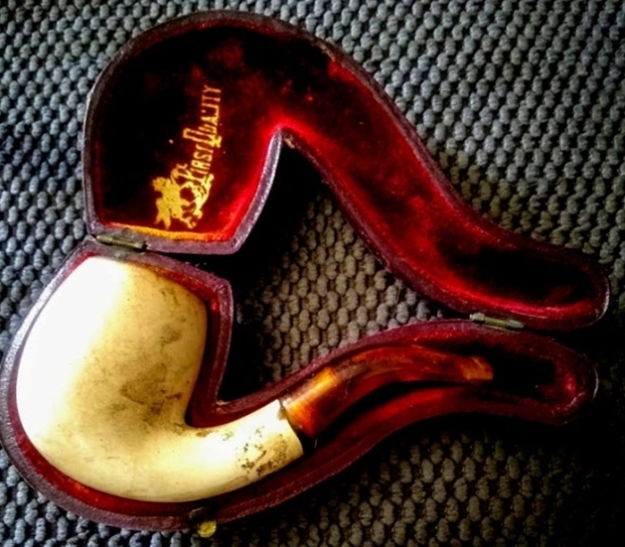
Part 4, taking a lesson from this restore, will go a touch further with my full restoration of an old First Quality meerschaum billiard with a wrecked inner shank, and the replacement of its tenon and stem.

 SOURCES

http://pipephil.eu/logos/en/logo-c1.html

https://pipedia.org/wiki/Colossus_Pipe_Factory

https://www.invaluable.com/auction-lot/colossus-pipe-factory-african-calabash-sterling-109-c-13648cbbb7

https://rebornpipes.com/2013/04/14/some-reflection-on-the-historical-background-on-cpf-pipes/

https://www.onthisday.com/events/date/1881

https://norwoodspiperepair.com/index.html

https://rebornpipes.com/2017/09/14/on-bending-and-straightening-amber-stone-stems/


The Decline of Restoring Old Pipes, Part 1/4


Blog by Robert M. Boughton
Copyright © Reborn Pipes and the Author except as cited
https://www.roadrunnerpipes2k.com/
https://www.facebook.com/roadrunnerpipes/

“I bet ya three-to-one I beat this.”
— John Joseph “The Teflon Don” Gotti, Jr. (1940-2002), Mafia boss, to law enforcement officers the night he was arrested for five murders, racketeering, loan sharking, tax evasion and related charges leading to his conviction

“The Teflon is gone. The don is covered with Velcro….”
— James Fox, FBI Assistant Director in Charge of the New York field office, upon Gotti’s conviction on all counts and sentence to life without parole

INTRODUCTION
While the denouement of the golden age of pipe restoration I anticipate here is only of importance to those who undertake the artful practice and the collectors they serve, and represents nothing as dramatic as the life of John Gotti or his vicious crimes from the age of 12 until he was convicted at 51, the problems I will describe are real and present  The dangers relate to pipes made of wood, meerschaum, synthetic plastic and even metal, in particular antiques and many that are pushing the limits of vintage.  The simple facts are that certain parts used in the construction of some old pipes are no longer manufactured nor can they be, and still more materials needed to restore them and others to original condition are not being pre-fashioned.

This dearth of components that once were ready-made or easier to come by restricts their availability to a rarefied number of true artists in the repair business possessing the essential skills to create vital pieces to the specifications of given projects.  Such craftsmen, already very difficult to track down, are in fact dying out.  The ability of most common and even some great restorers to complete their work as most would prefer – to the pipe’s authentic state – is therefore in grave peril.  This is the sad reality

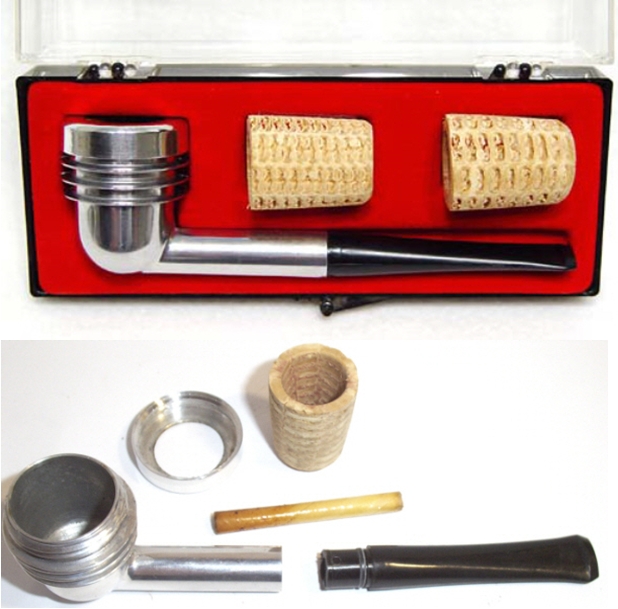
The supplies I have identified so far with careful thought, but by no means having reached a comprehensive list, are Bakelite, including Redmanol;:amber and amberoid; ivory, notwithstanding its illegality in the U.S. and most other countries, or in the alternative imitation ivory; bone and horn tenon screws; replacement bowls and other components of metal and other pipes;  real corncob Aristocob inserts, made just for that infamous aluminum pipe, and the most surprising member on the endangered species list, the push-pull Teflon stem fittings used with most meerschaum pipes, especially newer ones.

AN ILLUMINATING CONVERSATION
I spoke on the telephone to Floyd Norwood, the patriarch of a two-generation family pipe repair business.  He is retired but continues taking a hand in the operation as his son now runs the shop.  Prepared for the immediate negative response, I wanted to know if I could buy an assortment of bone screw tenons from them, but his next words shook me and started the cogitation that led to this blog.  I had left his name out of this because the conversation wasn’t a formal interview, but it will become obvious later in the series.

“Nobody makes these things anymore,” the old gentleman began.  “These things” encompassed the various parts we had discussed, not only bone tenons but real amber and the Bakelite family of stem materials.  Mr. Norwood’s voice was tired, sad and a bit disgusted.

“Tell me about it!” I replied in the heat of commiseration I immediately understood could not begin to match his own sorrow after a lifetime career seeing the dissipation of the tools he employed in his labor of love.  “It took me two years to track you down, and then only in a recent, second, desperate plea for help did one friend on the Smokers Forums UK think to recommend you.”  I dropped the name of the friend, who will remain anonymous.

A few others on SF responded with vague attempts to help that I appreciated, but none could recall the name of the person who did such specialty work for them in the distant past.  Only when I posted in the thread that the problem was solved by the link provided in the first response did several other members chime in that they had also used Norwoods Pipe Repair at times and gave the man with whom I had the honor of chatting, or in more recent experiences his son, Kenneth, their highest recommendation for quality of service, speed and price.  I amended my previous comment to include the total of four glowing referrals, but it did little to cheer up the aging expert whose specialized skills I have now enjoyed for three pipes.

“The kids these days doing the repairs, and even the older restorers, just aren’t interested or able to do the work involved,” the worn out and still somewhat irked master continued, “and I mean for a single job much less volume production for sale to people like you.”

I took no offense from the last phrase.  He was correct, after all.

BAKELITE, REDMANOL AND CONDENSITE
Leo H. Baekeland (1863-1944), a Belgian-American chemist, invented Bakelite, the first synthetic plastic, in 1907.  He named it after himself.  I will save most of the ruthless and covetous tactics Baekeland undertook, in order to seize control of many much smaller companies that made similar but superior synthetic plastics, for another blog that is in the works.  Here’s all you need to know for now.

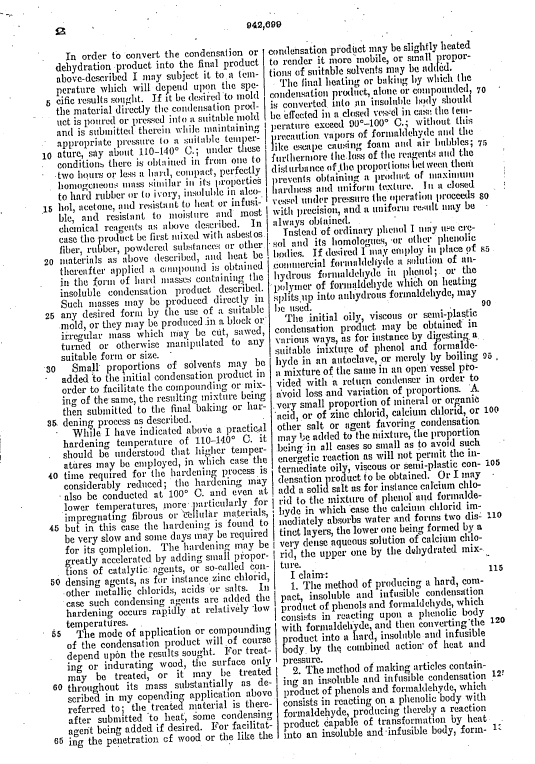
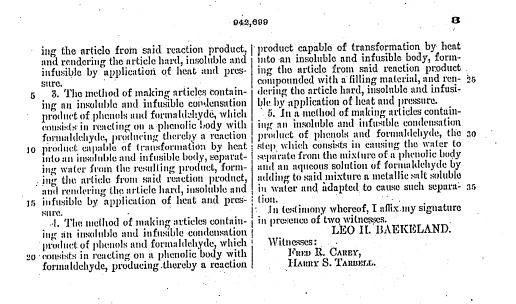
Bakelite was patented for its revolutionary innovation that employed thermosetting, a process of controlling intense heating and pressure, of phenol and formaldehyde resins sometimes combined with lesser amounts of wood or asbestos fibers that resulted in soft or liquid material. In that form, Bakelite could be molded into any shape before final curing rendered it irreversible.  Baekeland called his machine that performed the entire operation – what else? – the “Bakelizer.”  Bakelite was particularly useful because of its electrical nonconductivity and heat resistant qualities that made it ideal for diverse products including electrical casings, firearms and tobacco pipes and stems, to name only a few.

The two particular small, independent chemical research and production laboratories to which I alluded a moment ago – the Redmanol Chemical Products Co. of America in Chicago formed in 1913 by Lawrence V. Redman, after whom his creation was self-styled; and the Condensite Co., started in 1910 and headed by A.J. Aylsworth, over which Redmanol had acquired a controlling interest – developed synthetic plastics that were stronger and capable of being colored in more varieties than Bakelite.  Original Bakelite, whatever the color, still looked like plastic, while deep red, translucent Redmanol was so close to amber of the same color that it often requires an expert to differentiate the two.

Bakelite cigar holder, left; real amber compared to Redmanol, right

The greater strength and coloring qualities of Redmanol and Condensite were the results of different chemical catalysts used employing the same basic heat and pressure process innovated by Baekeland.  But Redmanol employed the action of formin on carbolic acid, while Condensite utilized the effect of chlorine on naphthalene.  Furthermore, Baekeland’s machine, the Bakelizer, was only one means of achieving the intense heat and pressure necessary for the reactions of the two ingredients he chose.  Aylsworth devised a means of heating the chlorine and naphthalene without pressure, a process Redman adopted.  The three processes, therefore, rendered each substantially different.  In 1922, however, a U.S. Federal Court judge in New York interpreted the tortuous patent laws in favor of Bakelite – which, by the way, not wanting to force its two greatest competitors to defend themselves sued not the manufacturers but their distributors – destroyed and  merged the prized competitors into its growing family in the newly and litigiously formed Bakelite Corporation.  Since then, Redmanol and Condensite products have been lumped together under the single name Bakelite.

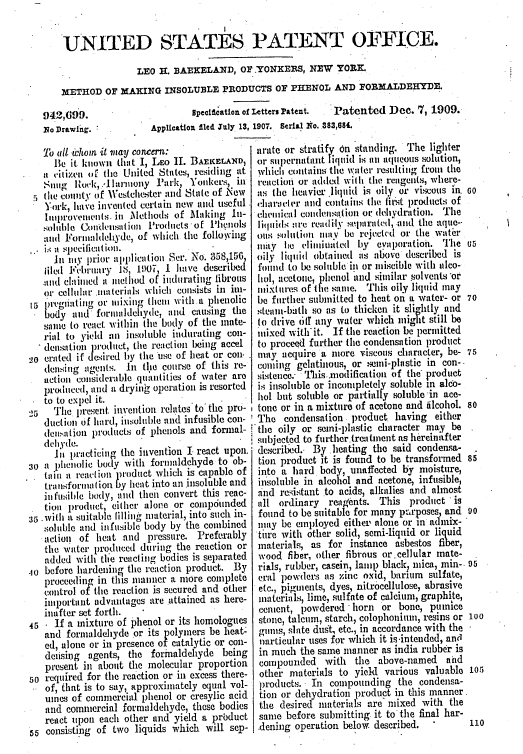
The Bakelite patent can be read below.

The Problems
The most obvious difficulty is that Bakelite, at least for tobacco pipe products, has not been manufactured since 1939, when Bakelite Corp. was acquired by Union Carbide and Carbon Corp. (Union Carbide Corp. since 1957).  As was already noted, the curing process for Bakelite rendered it “irreversible.”  Bakelite products were custom made for whatever use was needed.  In other words, for purposes of restoring old stems made of Bakelite, which, again, includes Redmanol, any necessary replacement can be reworked in only one way: fitting an over-sized stem of an otherwise suitable candidate to a shank by serious sanding or other such methods.  Any other alteration, such as bending or threading, is strictly impossible compared to Vulcanite, acrylic and even amber.  By way of illustrations, imagine trying to find substitute parts for these beauties.

Socket pipe with meerschaum bowl, Redmanol shank and stem and bone tenon screw

KB&B gold band socket pipe with irreplaceable threaded Redmanol stem and bottom and custom-made screw-in briar bowl

AMBER AND AMBEROID
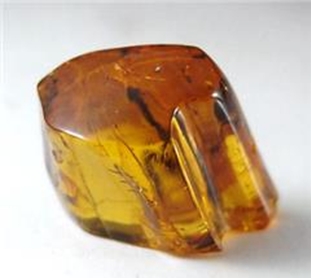
Amber is an organic material (neither gem nor stone despite common descriptions) formed by the polymerization of prehistoric pine tree resin into hard, fossilized pieces that often have inclusions, meaning trapped insects or plants.  More than half of the known inclusions found have been flies.  Its colors include yellow and orange, the most common, as well as red, green, blue and brown, and these colors range in translucence to almost opaque.  Found in the greatest quantities throughout Europe, amber is more common in the northern Baltic countries and Russia, but is also present in other places all over the planet.  Amberoid refers to pieces of amber and sometimes other resins compressed by intense heat and pressure. Most of it is used for jewelry, primarily in small bits and pieces.

Polished Baltic amber courtesy Minerals.net

The Problems
Amber is on the soft and fragile side (2-3 on the Mohs scale of 1-10, with talc being 1 and diamond 10), and it begins to decay the instant it is exposed to sunlight.  By human reckoning the process is very slow, but amber’s natural brittleness increases considerably within a human lifetime.  That means that its use as a material for pipe stems in the late 19th and early 20th centuries leaves examples that are now more prone to chipping and breaking, neither of which damage can be repaired with a purist method if at all.

Also, even for anyone alive today who is capable of fashioning an amber stem, the cost is prohibitive, and the process very difficult   Because amber does not actually melt, as in the sense of turning to liquid, but rather reaches the temperature where it would at about 570° F. and beyond that decomposes, there may be nobody around now inclined to try anyway, as Floyd Norwood suggested..

As a result, we are left with a more and more limited supply of random styles and lengths that can be found only at places such as eBay, where the sellers don’t know or care enough about pipe restoration to publish the measurements and, in my experience, are clueless when asked to provide such information.  In other words, they can be found in random lots the measurements of which can only be guessed.  The increasingly absurd prices of these lots make buying them a serious gamble with poor odds of winning.

Amberoid is a still bigger problem.  For those willing to destroy various jewelry and other ornaments made of amberoid, the bits and pieces acquired would be useless.  The only amberoid stems I can find available to buy are already on pipes, such as this Andreas Bauer meerschaum billiard courtesy of SmokingPipes.com.IVORY, REAL AND IMITATION
Ivory in its purest form is the dense material forming the teeth and tusks of large mammals including elephants that are still present in our world, their distant relatives mastodons that have been extinct since the end of the Pleistocene epoch 10,000-11,000 years ago and woolly mammoths (another ancestor of elephants that were alive during the earliest time of humans but died off completely 4,000 years ago).

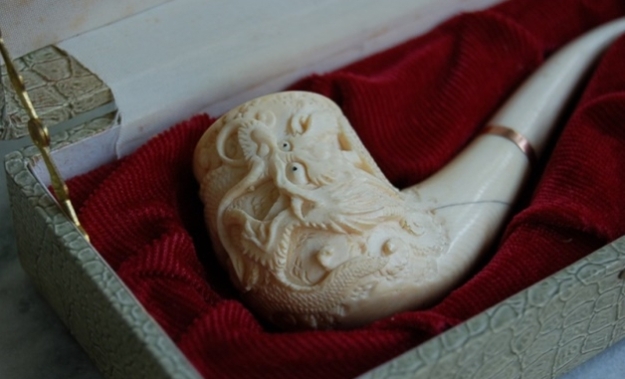
Other, less valued forms of ivory are found in walruses, narwhals, hippopotami, rhinoceroses, warthogs and sperm whales, but also in a variety of smaller species such as elks.  For most of human history, ivory has been prized for its artistic uses, from classical statues to piano keys.  The fact that ivory, in particular its oldest and finest variety, can be carved into any form made it valuable for beautiful works of art, including ornate tobacco pipes.

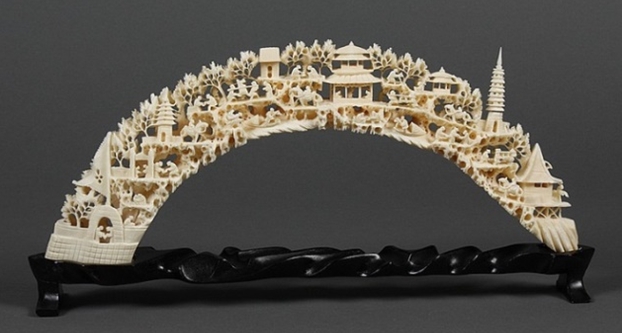
Japanese carved ivory tusk courtesy invaluable.com

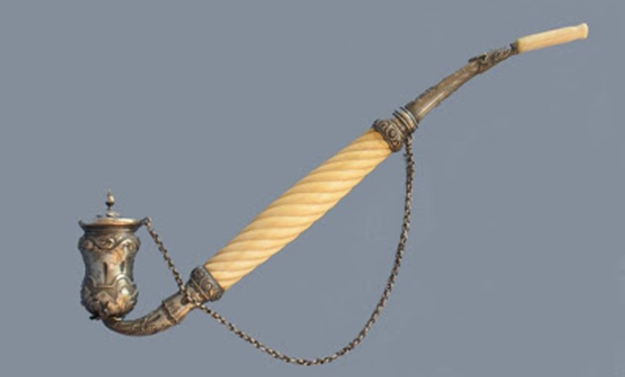
1890 Tiffany ivory-silver pipe courtesy tobaccopipehistory.blogspot.com

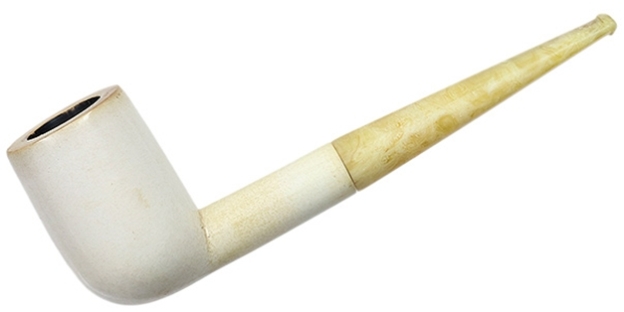
Tsuge ivory billiard courtesy Brothers of Briar

There are several alternatives to ivory.  Celluloid; believe it or not; invented in France in 1865, is the oldest.  Best known for its later use as an early, highly flammable film for motion pictures; celluloid – not Bakelite – is touted on some sites as the first “successful” synthetic plastic and was used for products that were not limited to the following.

Celluloid chip and dice courtesy antiquegamblingchips.com

Billiard balls courtesy sciencehistory.org

Celluloid ivory sample sheets courtesy Rothko & Price

A second, more workable imitation ivory is vegetable ivory, found in the nuts of varieties of tropical South American palms.  The white cores of these nuts are fashionable into all kinds of shapes that harden and can be polished like real ivory, and best of all, they can be drilled for stem making purposes.  The nut below looks tiny but is in fact about the size of a large honeydew melon.  It even has a fine grain pattern that can be differentiated from that of real ivory.

Vegetable ivory nut from Micronesia courtesy palomar.edu

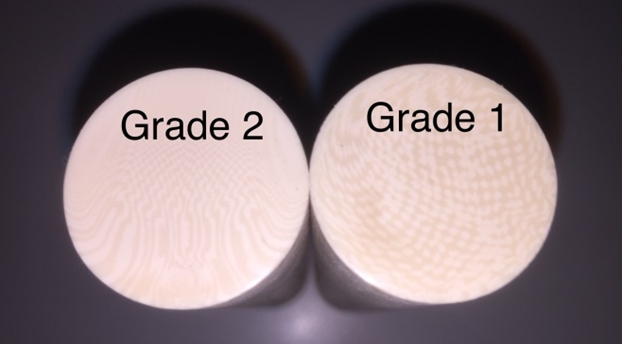
There is a third, still better, resin-based variety of imitation ivory for pipe makers and restorers capable of tooling a stem from scratch.  Although hesitant to promote a single business when there may be others using the same brand, I can’t find any, and the brand factor is vital because of the similarity of others that nevertheless possess serious basic differences.  These characteristics include the use of polyester in those that are inferior for pipe use, leaving them weaker, less glossy when buffed and all-in-all not so close to the real thing that there might be a problem trying to transport an object made of this stuff through airport customs.  To get around to the reluctant business plug, whatever the brand name is, it’s available at Vermont Freehand

The rods sold at that online business are offered in different diameters, the same as those used for traditional materials such as Ebonite.  Vermont Freehand describes it as the finest available.  It varies in price according to two grades, 1 and 2 where 1 is the better, and the diameter desired, from $3.60-$100.  For example, the minimum 12mm diameter rod of Grade 2 is $3.60 compared to a 14mm rod of Grade 1, which is $7.20.  The largest diameter of Grade 2 is 1.4” square at $28.80, and a 1.6” x 2.6” rectangle of Grade 1 is $100.  Again, note the grains.

Imitation ivory stem rods courtesy Vermont Freehand

The Problems
In this case, the “problems” for the most part are really solutions to a greater crisis.  Evolving international laws aimed at saving African and Asian elephant populations, devastated to the verge of extinction by poaching and unregulated exportation of tusks that are harvested for their great value, at the expense of elephant lives, have had unexpected and negative effects on the animals they are intended to protect.  Uncooperative countries that I will not name here in the interest of avoiding geo-political argument and controversy have allowed poachers to capitalize on the increased value of ivory that resulted from the various embargo attempts.

Tougher and more restrictive bans are already being enforced to degrees that seem to have stabilized at least some elephant herds in Africa and Asia, and still more effective laws are being considered, notably in the United States and the European Union.  The present laws, targeting buyers and sellers of ivory as well as art dealers and collectors, are expected to curb poaching still more.

Certain aspects of the laws have been met with resistance from art and personal rights advocates.  The issues have to do with the age of the artworks, the years they were acquired and the sources, all of which create complexities for enforcement, to put it in the simplest terms that are anything but simple.

In 2016, the Obama Administration initiated a blanket ban on the importation of elephant ivory and almost all sales of ivory throughout the country.  The very few exceptions include antiques that can be proven through a professional appraisal or a bill of sale to be at least 100 years old.  Many ivory pipes fit that category.  However, President Trump, undermining the Obama ban, directed the Fish and Wildlife Service to consider importation permits for sport-hunted elephant trophies from select African countries “on a case by case basis.”  In other words, Trump has cleared the way for his rich cronies to bring elephant heads with their tusks intact home from safaris.  This kind of favoritism, which was never announced publicly by the Trump Administration but rather via a Fish and Wildlife Service memo issued March 1, 2018, can’t possibly surprise anyone given Trump’s record since he assumed office.

Concerning imitation ivory of any kind, it is of more use to master artisans who can create a stem by hand or machine, again, rather than average or even skilled restorers.  However, this resin-based imitation ivory sold by Vermont Freehand might be fashionable into small pieces suitable for filling chips and other damages to real ivory pipes – but only with serious practice based on what I’ve learned of its physical makeup.

BONE AND HORN SCREW TENONS
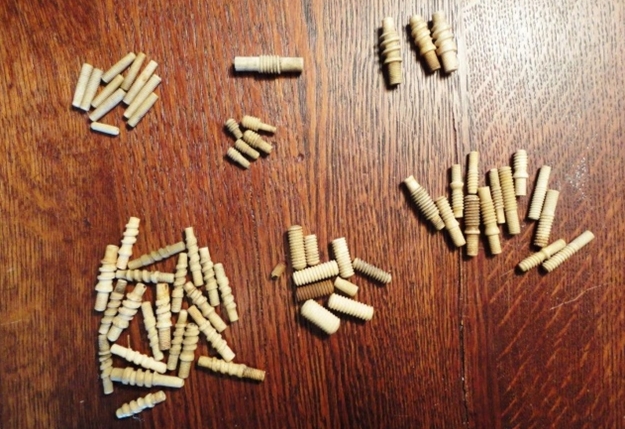
The good news is that bone and horn screw tenons, which can be made from the calcified skeletal remains of animals such as cows and deer, are not in short supply.  To be sure, there are other sources, but J.H. Lowe, for example, offers “a multitude of styles and sizes” in assorted 12-packs for $28.90 – and you know what you’re getting compared to online auction sites that tend to be clueless as to the importance of the various elements of importance in measuring the correct size.  Another plus when ordering screw tenons from an actual pipe supply store is that they are new.  Here is a motley collection of bone screw tenons said to be antiques courtesy of Worthpoint.
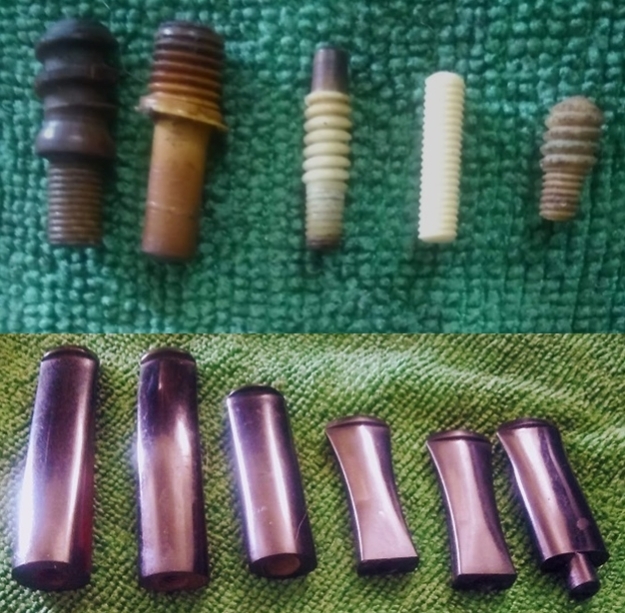
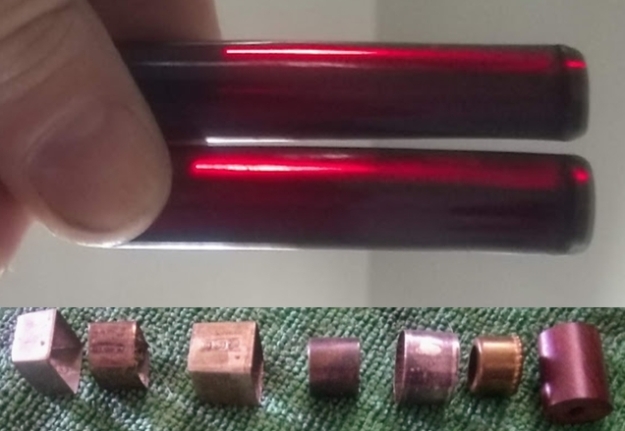
Without impugning the integrity of the seller of those screw tenons, if they are antiques, they represent a pristine collection of unused specimens.  I’ll take this opportunity to emphasize that, although I am committed to using only the original materials for antique and extreme vintage pipe restorations, that devotion does not require any replacement parts to be as old as the pipe I’m refurbishing.  A brand new screw tenon or anything else, so long as it’s the same substance as the one with which the pipe came, is fine with me, and I’m planning on stocking up on assorted sizes, styles and shapes of everything I can find in new condition.  Still, I have a small collection of antique and vintage tenons, stems, bands, an endcap and one shank extension, upon which I look forward to expanding.  No doubt the day will come for each to find its wizened old pipe mate, and I anticipate the matches, at the risk of sounding daft, with somewhat of a sense of excitement.  Call me old-fashioned or sentimental or a codger or what you will, but there it is.

The two on the left are Redmanol.

The Problems
I realize I’ve overstepped the subject of bone tenon screws a bit in this section, for reasons of expansion on the greater subject, but now to address the problems with those parts.  Again, I stated that the bone tenons are in no immediate danger of extinction.  I should have qualified that assertion by noting in most cases.  Consider the photo of my antique bone screws above.  I have no doubt that various suppliers of newly made old-style supplies such as these screws indeed have considerable varieties on hand, but the fact remains, many were custom made as long as a century or more in the past.  As the venerable Mr. Norwood pointed out, nobody is stepping up to produce such oddities as bone screws to order.  Of course, artisans able to do so can and will be found – but the task won’t be easy, as Part 2 of my series will show.

Then there are several other problems, I’ll call them: one, fitting a bone screw requires matching it to the stem and shank.  In most cases, the measurements for each are different, not to mention the style of the tenon screw.  Just whipping out the calipers and determining the approximate diameters of the two ends and the optimum length of the whole may not be enough.  Two, bone is inherently soft and brittle, and therefore breaks with the least provocation.  If you’re lucky, the original broken tenon will be available, but if so, it’s likely to be in bits and pieces, some powdered.  It follows that matching can be problematic.  Three – and this isn’t being persnickety – adding to all of the above obstacles is the likelihood, not possibility, that re-threading the stem and/or shank into which each end of the bone tenon screws will be necessary.  To be blunt, not everyone is up to any or all of these tasks.

To sum up, the more than potential need for someone specializing in bone tenon repair will become mandatory.

METAL SYSTEM PIPES
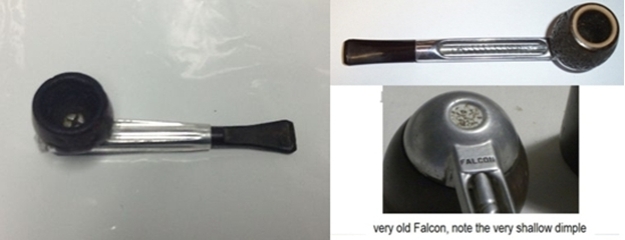
Arguably the most fascinating coincidence in the history of pipe making was the introduction in a single year of two brands of an altogether new kind of system pipe.  The year was 1936, and the inventors were Frederick K. Kirsten, a German-born emigrant to the U.S., and Kenly C. Bugg, a native of Indiana.  Both of them were engineers and prolific inventors with great numbers of diverse patents, and each chose aluminum for the frame, because of its light weight and rapid heat dispersion, as well as screw-on briar bowls.  Otherwise, their designs were quite different   Kirsten’s pipes are more box-like while Bugg’s are sleeker and more cylindrical.

1930s Kirsten courtesy Pinterest and “very old” Falcon courtesy Smoking Metal

The basic systems – the details of which I will omit – differ, also, but suffice it to say, Kirsten’s was more complex while Bugg’s was simpler, using a moisture trap beneath the bowl.

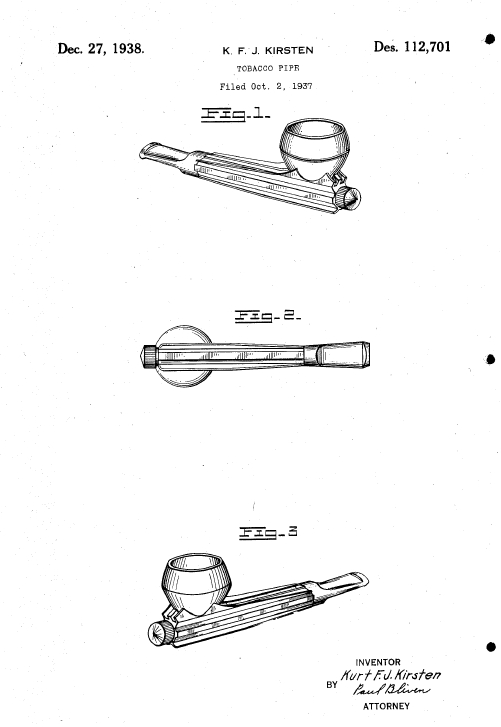
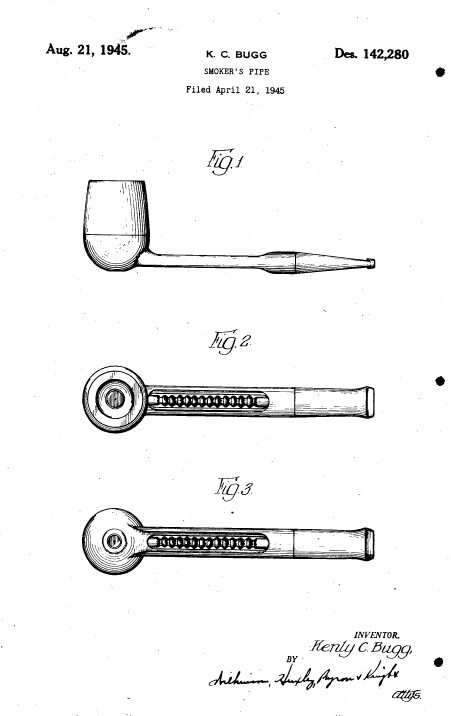
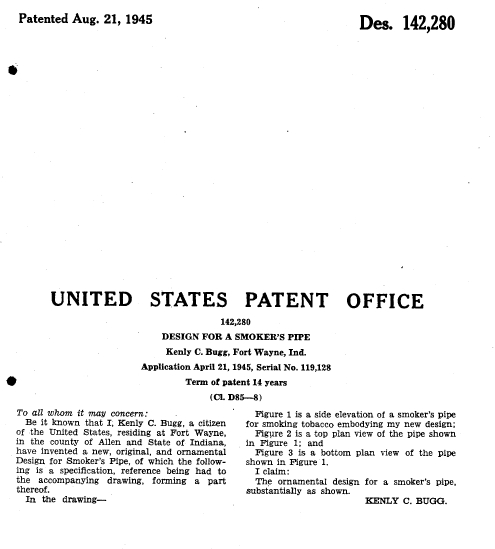
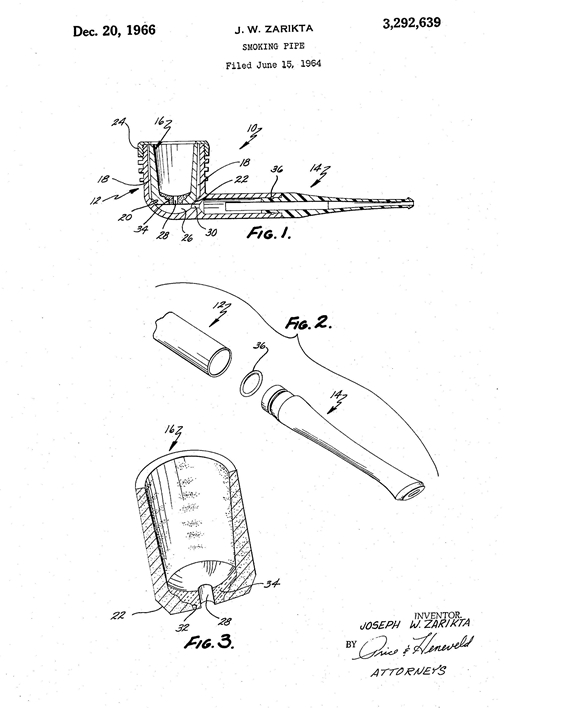
Which man committed his plans to paper and created a prototype is moot.  Kirsten had the presence of mind to begin manufacture and sale of his pipes the same year, applied for the patent in 1937 and received his grant with US Patent No. D112, 701 on December 27, 1938.  Bugg, on the other hand, sat on his invention, not selling his first pipes until 1940 and receiving US Patent No. 142,280 on August 21, 1945.  Kirsten, therefore, is generally credited with the invention of the metal system pipe despite the uncertainty of the exact date of the metal system pipe’s conception and in whose mind it occurred,

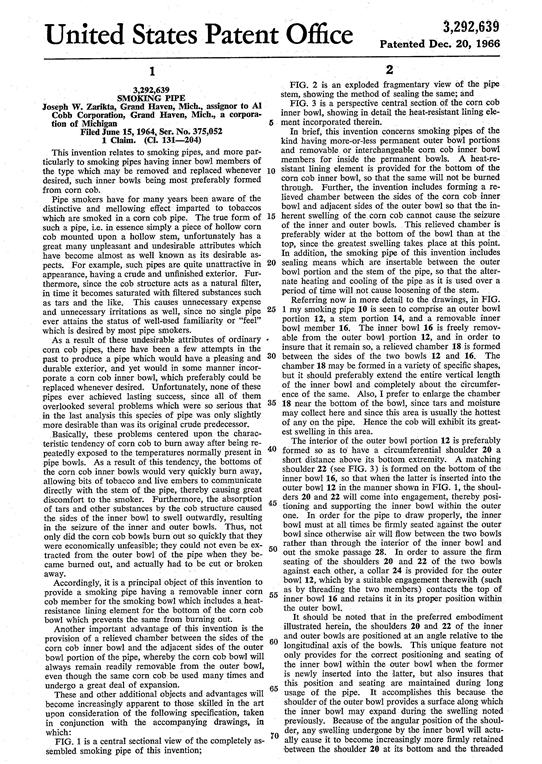
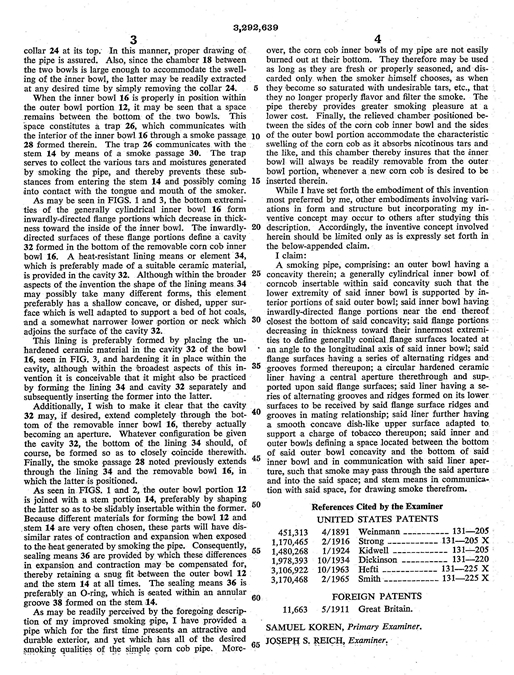
I have included the Patents for both for your enjoyment should you wish to read them (the Kirsten first followed by the Bugg).
The transition of production of the great American original Falcon pipes to Great Britain began in 1961, when production started there.  In 1968, U.S. production of Falcon pipes was transferred altogether to Falcon Pipes Ltd. (also known as Falcon House Group) in Great Britain, which still later became the Merton and Falcon Co.  The Falcon Pipe Group now runs the operation, as far as I can tell.  Despite the convoluted name changes, Falcon pipes have maintained their quality since Kenly Bugg made the first one.  By the way, to clarify a variation that began to annoy me, there is no second e in Kenly, despite frequent errors.  See patent signature of inventor.

Everything so far in the category of metal pipes has been to explain the genesis of an explosion in brands and systems of metal pipes with bowls made of wood, meerschaum and the sundry Bakelite materials, to name some.  The exact number of Falcon pipes sold worldwide to date is difficult to pin down, but two numbers stand out: by 1954, six million of them had been sold in the U.S. alone, and starting seven years later, from between 1961 and 1974, 16 million more were sold by the oft-switching producers in England to pipers around the world, excluding the U.S.   This leads us on a nice, ordered path to…

The Problems
Rest easily, Kirstens and Falcons are in no danger of running out of replacement bowls and even other parts as both companies remain in business and don’t appear to have plans to stop.  Replacements or new screw-in bowls are available directly from Kirsten Pipes or the Falcon Pipe Group’s distributors, such as the Arango Cigar Co. in the U.S.  This is not to mention the numerous artisans who make bowls that fit either or both, including Don Warren Pipes for Kirsten bowls and DGE Handmade Pipes and Manly Things (I didn’t make up the name, so don’t shoot the messenger) for Falcon and/or Dr. Grabow Viking bowls, which are interchangeable.

That reassurance made, the rest will be brief and simple in its awfulness.  I’m not about to go through the entire A-Z Index at Smoking Metal’s UK website to locate, count and determine all of the brands – known and unidentified – of metal system pipes identified and catalogued so far by Tony Pringle.  Like a French gentleman whose first name is Richard but is known to countless pipe smokers as Pipephil (who retired a few years ago), Tony works alone and in his spare time, making his accomplishment a monumental feat even with the sparse contributions of readers.

All I need to point out is that many – no, more likely the vast majority – of the metal pipes listed and shown at Smoking Metal were manufactured without even a moment’s thought about compatibility with others of their kind.  In blatant terms, this means they can’t be replaced without making one from scratch.  And who is going to do that?

I’d say that works as the one and only necessary dilemma with this category of scarcity.

CORNCOB INSERTS FOR BELOVED OLD ARISTOCOBS
The Aristocob was invented by Joseph W. Zarikta and assigned to the Al-Cobb Corporation (later Aristocob, Inc.) of Grand Haven, Michigan with U.S. Patent No. 3,292,639, granted just in time for Christmas 1966. Here is what the new-in-plastic case product looked like, complete with the aluminum frame, plastic stem and two cob inserts, courtesy Smoking Metal.  (Filter possibly not included.)

The Problems
Missouri Meerschaum took over manufacturing the Aristocob and its inserts in the mid-1970s.  The best known maker of cob pipes discontinued the Aristocob at some point but continued manufacturing the inserts until 1983, when the endeavor became unprofitable.

While it is true that original Aristocob corncob inserts can still be found online, at one of the last sources in the astounding list at the end, for example, when they’re all gone, that will be the end of the real thing.  The substitution of a custom-carved briar insert at the expense of the original cob is perhaps better for its durability in the lone case of the Aristocob.  As far as I know, they are fashioned only by Steven LaVoice Jr. of Owl Pipes.  I happen to know Steven’s work to be excellent after being compelled to use one of his traditional wood substitutes when I restored an Aristocob three years ago, about a year after Steven started business in Western Massachusetts.

Briar insert from Owl Pipes, with a nice keychain included

Some cold-hearted pipers, hearing of the rising shortage of original corncob inserts for the Aristocob, may bid them good riddance or scoff, “So what!”  I’ll answer that hypothetical question   Those who continue to enjoy durable cob pipes know and appreciate the difference in taste afforded by the intended Aristocob insert.  Any purists are left with one of these singular “art deco” smoking metal creations that’s rendered useless for them.  Others can still buy a briar insert directly from Steven if the owner wishes to be rid of the short-lasting cob originals that I’m told become quite nasty the closer to their expiration they get, and thus avoid the intermediary restorer altogether.  Steven makes different styles of inserts, one of which has the rough exterior reminiscent of real cob.  (Being a bit obsessive-compulsive, I polished the one shown above, which sold to a happy old-timer.)  And the cost of a briar insert, which is five times greater than the $5 I paid at a garage sale for the worn old Aristocob I restored, can be a one-time expense.

The critical fact remains, though, that nobody seems to be stepping up to make quality (non-flammable) cob inserts with a coating to harden them, and therefore, when Steven is no longer around “to do the work” with briar, remaining Aristocobs will be tossed in the trash or placed with nostalgia as heartless shells on shelves.

MEERSCHAUM PUSH-PULL FITTINGS
Now, here’s the most bizarre item on the list, and I hope it sparks English Parliamentary style chaos of furious, frenzied, fibrillating debate – but no fighting, please.  I know that may be shameful of me, and I don’t care, because of the single and singular fact I will assert when I get to the proper Problems section.  For now, a push-pull fitting is formed of two small pieces of polytetrafluoroethylene (Teflon) or a generic variation.  Teflon is a polymer, or chemical compound of high molecular weight, discovered in 1938 by a new-hire at DuPont with a chemistry doctorate.  Teflon, the specific combination of gases and other substances that formed by chance when the lucky chemist heated a canister a certain way by mishap, happens to be extremely resistant to solvents, acids, bases and heat, and hence corrosion and melting, and is therefore perfect for the most part to join a meerschaum pipe shank to its stem.  Of course, it has other uses and fascinating properties anyone so inclined can read about near the end of my sources.  At its simplest, Teflon is a very fancy synthetic plastic.

The two parts are paired with one piece that screws into the shank opening and another into the stem.  A push-pull fitting, in other words, acts as a special tenon on one side that screws or pushes into the other.  Most of the time by far, the tenon part is installed in the opening of the stem and fits the shank part, but I’ve seen the process done in reverse, probably because that’s the way some restorer could make the two match up without drilling either the stem or shank opening.  The use of push-pull fittings was a great innovation to protect the fragile meerschaum and also do away with bone and horn tenons that are just as easy to break

Here are two shots, one of a trio of “standard” push-pull fittings of slight difference in size, courtesy Royal Meerschaum, that costs $3.99 for the three-pack.  The other is a screw-in stem for one of my pipes.  Standard just means they can be pushed or twisted together rather than screwed and are also the general sizes for newer meerschaum pipes.Note my Paktas billiard above with only the stem fitting that screws into the bare meerschaum shank.  I’m always very careful unscrewing it!

The Problems
The single problem with these push-pull fittings is that they’re not hard to find in all of the typical sizes that are pretty much standardized today, but that means bupkis.  The artisans who crafted meerschaum pipes in the old days – before push-pull fittings became popular in the 1970s – did everything themselves, including drilling the shank and stem however they pleased at the moment and depending on the size of the pipe.  Ay, there’s the rub.

In this day and age where everything from furniture to motor vehicles is composed entirely or at the least more than half with cheap and readily available plastic, “real” or synthetic (think imitation Naugahyde), there’s no excuse for a lack of push-pull sets designed in enough sizes to accommodate older pipes.  But there it is.  Oh, they’re no doubt out there some place, but where?  Norwoods Pipes and Walker Pipe Repair, again by way of examples, offer push-pull fittings, but (and no offense is intended to either of these fine pipe repair providers) if they have different sizes, they’re limited.

I sent the following very large lattice meerschaum stummel with no stem and a hole in the shank to Norwoods, which can provide almost any original replacement part, only to learn that the new Lucite stem was no problem, but a push-pull set that big was unavailable.  A bone tenon screw was used instead for the same price, and that pipe with its new tenon and stem arrived in the mail soon after.  In this case, I am quite pleased with the result, since I kept it for my own use and didn’t have to worry about any prospective buyer breaking the bone tenon and blaming me.  That restoration will be the subject of the final part of this series.

CONCLUSION
For now, I can continue to cobble together limited replacements of the various parts integral to the proper restoration of old pipes, and for those tasks requiring the dwindling repair services that exist, I can turn to them.  I also know of a few artisans with the know-how to tool these small yet vital implements of restoration.  Still, I have no doubt that within my lifetime the need “to do the work” myself will come.  I can only hope practice will be enough…and I had better get to it.

SOURCES

http://norwoodspiperepair.com/index.html
https://patents.google.com/patent/US942699A/en?oq=942699
https://books.google.com/books?id=oYZGAQAAQBAJ&pg=PA6&lpg=PA6&dq=redmanol+chemical+products+founder&source=bl&ots=juthNFh-rW&sig=b9qO8plogjv6fj_u2TBjkdpIfCM&hl=en&sa=X&ved=0ahUKEwj-gNj4h9nNAhUM9YMKHXKjBwMQ6AEINDAE#v=onepage&q=redmanol%20chemical%20products%20founder&f=false, Phenolic Resins Technology Handbook, by NPCS Board of Consultants and Engineers, 2017, excerpted by permission
https://books.google.com/books?id=nTs8AQAAMAAJ&pg=PA144&lpg=PA144&dq=redmanol+bakelite+infringement+judgment&source=bl&ots=TCel6fmccJ&sig=ehZijKCRrQSs- RnL6xiDbVA5aKM&hl=en&sa=X&ved=0ahUKEwi39veundvNAhUT32MKHbeiCJwQ6AEIHDAA#v=onepage&q=redmanol%20bakelite%20infringement%20judgment&f=false Factory and Industrial Management, Vol. LXIV, No. 3, August 1922, excerpted by permission (p.144)
https://books.google.com/books?id=11FHAQAAMAAJ&pg=PA816&dq=in+search+of+the+man+made+amber+redmanol&hl=en&sa=X&ved=0ahUKEwis5OvgmNvNAhVk0oMKHYveA6sQ6AEIIzAB#v=onepage&q=in%20search%20of%20the%20man%20made%20amber%20redmanol&f=false Compton’s Pictured Encyclopedia, Vol. 2, excerpted by permission (p. 818)
https://en.wikipedia.org/wiki/Bakelite
https://rebornpipes.com/2016/07/05/the-scintillating-antique-kbb-redmanol-pipe/
http://www.jhlowe.com/bits-bakelite.htm
https://rebornpipes.com/2013/10/14/louis-blumfeld-1901-bbb-bent-billiard-by-james-gilliam-of-jsecpipes-com/comment-page-1/#comment-23486
https://www.minerals.net/gemstone/amber_gemstone.aspx
http://mentalfloss.com/article/73608/15-clear-facts-about-amber
https://www.amazon.com/REPLACEMENT-TOBACCO-STEMS-AMBER-STRAIGHT/dp/B01HZU8NBU
https://www.amazon.com/REPLACEMENT-TOBACCO-STEMS-STRAIGHT-AMBER/dp/B01HZU7M94
https://leta.st/blog/2016/07/history-of-russian-amber-1/
https://en.wikipedia.org/wiki/Baltic_amber
https://www.thefreedictionary.com/amberoid
https://www.shutterstock.com/search/amberoid
http://www.uniclectica.com/conserva/ivory1.html
https://www.washingtonpost.com/news/energy-environment/wp/2016/06/02/its-final-selling-just-about-any-item-containing-elephant-ivory-is-a-crime-in-the-u-s/?utm_term=.fe4c2ac312fb
https://www.npr.org/sections/thetwo-way/2018/03/06/591209422/trump-administration-quietly-decides-again-to-allow-elephant-trophy-imports
https://www.sciencehistory.org/distillations/magazine/celluloid-the-eternal-substitute
http://vermontfreehand.com/product/imitation-ivory/
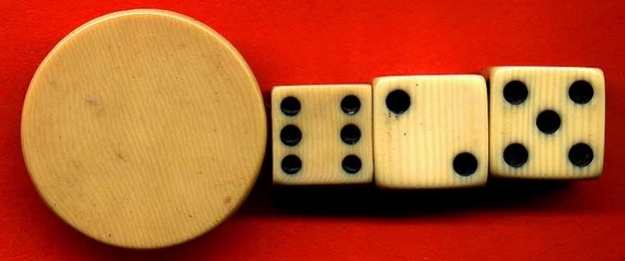
https://www.amazon.com/ARVORIN-PLUS-Imitation-Substitute-Material/dp/B0755RG32T
https://www.chicagotribune.com/news/ct-xpm-2002-09-22-0209220243-story.html
https://www.dictionary.com/browse/casein
https://www2.palomar.edu/users/warmstrong/pljan99.htm https://www.ebay.com/itm/Antique-BONE-tenons-88-PIECES-Lot-of-Assorted-Sizes-Victorian-Vintage-pipe-/202297224337
http://www.jhlowe.com/misc-items.htm
http://www.smokingmetal.co.uk/pipe.php?page=56
http://www.kirstenpipe.com/pipes.html
https://www.etsy.com/shop/DonWarrenPipes?section_id=22062561
http://www.musiccitymarketing.com/cart_catalog_search.cfm
https://www.dgehandmadepipes.com/catalog/replacement-falconviking-bowls
https://www.ebay.com/itm/VINTAGE-NOS-ARISTOCOB-REFILL-COB-BOWLS-3-PER-BOX-ESTATE-PIPE-ALUMINUM-METAL-NOS/323553620046?hash=item4b554c704e:g:HGYAAOSwlHJbOmP0:rk:2:pf:0
https://www.owlpipes.com/product-page/briar-aristocob-inserts
http://www.jhlowe.com/misc-items.htm https://pipedia.org/wiki/Kirsten_Pipe_Company
https://pipedia.org/wiki/Falcon
http://www.smokingmetal.co.uk/pipe.php?page=366
https://www.markwaterpumps.limited/falcon-pipes-aluminium-die-casting-specialist-keeps-traditional-product-alive/
https://www.paykocimports.com/plastic-tenon-screw-set-3-pack/
https://en.wikipedia.org/wiki/Polymer
https://en.wikipedia.org/wiki/Fluoropolymer
http://www.royalmeerschaumpipes.com/Regular-Stem-Push-Pull-Fittings-p/sft-3.htm
http://www.walkerpiperepair.com/html/pipe_repairs.html

The Filthiest Pipe I’ve Ever Seen


Blog by Robert M. Boughton
Copyright © Reborn Pipes and the Author except as cited
https://www.roadrunnerpipes2k.com/
https://www.facebook.com/roadrunnerpipes/

You can’t judge a book by its binding.
— From the journal American Speech, 1944

INTRODUCTION
The Dr. Grabow easy bent smooth billiard I came by in a foolish case of mistaken identity on eBay looked normal enough on the outside, other than an apparent crack that wasn’t visible in any of the seller’s few photos.  The zigzag flaw extended from the top front of the bowl almost halfway down, which of course was not a good sign in a pipe when the intent was to sell it – and I definitely did not want to keep it for my own collection.  The dubious pipe came as part of a lot with two others of its ilk; an old Karl Erik box; two very nice choice sleeves – one that was also for a Karl Erik and the other for a Butz-Choquin – and two Revelation Smoking Mixture tins of indeterminate age.  Venturing a guess, I’d say they’re no newer than the pipes.

My haul, minus the Dr. G, Yello-Bole and MedicoMy impression from the poor photos provided online was that one of the pipes must have been a Butz-Choquin.  You see, the only descriptions of the pipes given in the listing were that they were “vintage,” and you guessed it, I fell for the deliberate obfuscation, and Buy Now to boot.  As the only measure of self-defense I can muster, at least I only paid about $10, with shipping included.  They turned out to be this Dr. Grabow and two Yello-Boles, one a Spartan.  The Spartan did clean up purty compared to how it was.The Dr. G. is six inches long but otherwise very small.  The height is 1.5” and the inner bowl diameter is ⅝” x 1”  As a rule, unless the particular pipe is very old or has some other special attribute, I shy away from this name and Medicos and the like, although I’ve found almost anything will sell to someone who is a fan of a given brand.  In fact, just last week at my monthly pipe meeting I sold the Spartan with a stem logo of a yellow Y in a circle to a friend who happens to be my best customer.

The friend has accumulated some great pipes from me – such as a late 1930s Kaywoodie Super Grain and a Ropp last month – and an amazing collection of antiques including a few KB&B beauties, but he admits to having a weakness for vintage Yello-Boles.  I estimated the Spartan dated to the 1960s, and my friend somehow traced it on his cell phone to 1966.  That’s what I call a Yello-Bole devotee.

At any rate, the Dr. G. billiard remained quarantined in a box for more than a year with others that are so tragic I’m sure I’ll end up using them as examples of pipes never to buy.  In short, only when it was the last pipe I had to work on did I gather the gumption to go for it.

But as I already noted, all outward appearances showed nothing I couldn’t handle without too much effort, including the odd zigzag on the bowl.  The inside turned out to be a different matter altogether, one for the books as far as I’m concerned.

RESTORATION

I wanted to get the pipe in a basic clean order before tackling the crack.  Starting with the light rim char and cake in the chamber, I used super fine “0000” steel wool on the rim to begin and a pen knife around the walls of the chamber that was too small to insert a reamer – meaning the one size I have.  Then I sanded the rim with 1000-grit paper and the chamber using a pinkie and 150- and 220-grit papers. I cleaned off the old blackness from the shank opening with the same steel wool and wiped down the entire stummel with purified water on a paper towel.Now the crack I mentioned is apparent.  Knowing it wouldn’t get rid of the crack, I sanded the outside of the wood with 1000-grit paper to remove the other small but pervasive blemishes. With the pipe more or less spiffed up, I could see the crack was hairline, so to speak, not penetrating the bowl in any visible way.  That was a relief as I knew I could make it go away altogether with sanding.  I tried 150-grit paper, and that looked like the end of the ostensible crack.  I followed up with 320-, 400-, 600- and 1000-grit papers.A full micro mesh progression left the briar looking absolutely fabulous, or abfab, as British interior designers like to gush about wood.  To be serious, though, which I often try not to be, knowing it drives some readers nuts but keeps me sane, the micro mesh step – if I had to choose just one from all of the routine tasks in a pipe restoration – is my favorite.  Seeing the resilience of wood, or briar anyway, that allows it to bounce back from ruin is to me what sunshine was to John Denver.  Well, not exactly, but you get the idea. The front shot above, I’m sorry to say, doesn’t show how pale most of that side was even after micro meshing.  Suffice it to say, a spot stain was necessary with Lincoln brown leather dye.  I took a little more joy in staining and flaming it. Looks like everything is going great, doesn’t it?  That’s rhetorical.  Only after thinking I was almost finished did I commence the part that turned into a singular horror the like of which I never before experienced.  Without exaggerating at all, I admit I was sure I had found a pipe that could not be cleared of all impurities, no way, no how.  I’m sure this sounds like more of my melodramatic foolery, but for once I am being as serious as I get.  I suspect I may have some kind of world record, if people registered such statistics, but no doubt Steve, if perhaps no one else, has a worse story or stories to tell.  I’d love to hear them!

To wit, I found myself at the point of having to deal with the inside of the billiard.  Nothing prepared me for the almost human resistance and downright orneriness I encountered, not to mention the smoking implement’s physical manifestation of the common human psychological condition of filthiness.

The pictures that follow, showing the pre-cleaning, retort and aftermath of all that, with nine pipe cleaners, a nylon bristle cleaner, two cotton plugs and a wasted (in the colloquial sense) candle, don’t approximate the work and time already expended on cleaning and sanitizing the inner passageways of the pipe.  I included the Tupperware with spent alcohol as a clue to how much I boiled through the guts of the thing, with the wholly unsatisfying and unacceptable final Pyrex tube as dark as every other, but it still isn’t sufficient to understand my frustration, so I’ll tell you.  I had already used up 13 tubes of alcohol, getting nowhere.I knew I could use any number of pipe cleaners dipped in alcohol on the shank and it would do no good.  And so I started again, with a fresh retort (and candle and two more cotton plugs).  After nine more tubes boiled through the pipe – that’s a total of 22 – I at last achieved a clear enough result that didn’t get darker after three trips through the bowels of the Grabow.I don’t know, maybe this isn’t so unusual.  Or maybe I need a better retort system, as I’ve been looking forward to buying, something like the first one below, probably self-made by my friend Chuck Richards, or even the other I found online.

Hand-held laboratory-style retort system made by tbus6906, eBay, and an actual lab setup from best collection999 at eBay

And now for the stem, starting as it appeared when I got it and after the various phases of smoothing and buffing. And here is the finished pipe, the stem machine buffed with red and white Tripoli and the stummel with White Diamond and Carnauba. That’s a Medico filter in the stem, BTW, because it’s all I have and it fits!  Besides, whoever buys the Grabow will probably toss it.

CONCLUSION
This was an unusual restore for me for a couple of reasons. One, I set out thinking the big deal was going to be fixing a bad crack, and two, the real problem ended up being hidden within.  My previous record for the number of Pyrex tubes of alcohol I had to run through a pipe was nine, for a pipe I haven’t blogged yet.  I thought that was bad until I was faced with the harsh reality of this dainty little Grabow!  It’s the right size for most women (no sexism intended but I’ll probably get flack for that), but only a man could have smoked a pipe for possibly 40 years without ever really cleaning it.  Maybe that will get me off the hook with any female smokers who read this.

Oh, yes, a note about Revelation Pipe Mixture.  Never having heard of it and suspecting it’s out of production, I found I was correct about the latter part.  It was blended by House of Windsor, which still makes about 20 mixes, mostly aromatics, in the U.S.  Revelation was a coarse-cut (based on the photo I found, despite the description as ribbon cut) American blend of bright flake and red flake Virginias, cube cut burley, Kentucky, latakia, perique and “citrus/misc.”  It seems to have been somewhat popular given a 3.1 out of 4 rating at TobaccoReviews.com.  Legend says this was Albert Einstein’s go-to mix, so it couldn’t be all that bad.  It seems a reincarnation of this tobacco is being made in bulk form and true ribbon cut, from the same ingredients.  The link to the source is below for anyone interested.  Revelation was made by Philip Morris Co. Ltd. Inc. and distributed by Continental Tobacco Co.  I guess the tins are pretty old because companies aren’t named like that anymore.

SOURCES
https://www.ebay.com/itm/Professional-Pipe-Retort-Kit-/252292269562
https://www.ebay.com/itm/50cm-Lab-Laboratory-Retort-Stands-Support-Clamp-Flask-Platform-Alcohol-Bottle-Tu/113144136090?_trkparms=aid%3D555018%26algo%3DPL.SIM%26ao%3D1%26asc%3D20131003132420%26meid%3Dea98143cf6974165b8baaa44c36acc79%26pid%3D100005%26rk%3D3%26rkt%3D8%26sd%3D312302738289%26itm%3D113144136090&_trksid=p2047675.c100005.m1851
http://www.tobaccoreviews.com/blend/1219/house-of-windsor-revelation
http://www.tobaccoreviews.com/search?Blender=House%20of%20Windsor
http://wvsmokeshop.com/revelationalternativebytheounce.aspx

About a Super Grain Kaywoodie Medium Dublin #08 Almost as Old as My Dad


Blog by Robert M. Boughton

Copyright © Reborn Pipes and the Author except as cited
https://www.roadrunnerpipes2k.com/
https://www.facebook.com/roadrunnerpipes/

FOR MY DAD
E. MICHEAL BOUGHTON
2/23/1933-10-16-2018

my father moved through dooms of love
through sames of am through haves of give,
singing each morning out of each night
my father moved through depths of height 
— e.e. cummings, “my father moved through dooms of love,” from 50 Poems, 1940

INTRODUCTION
I was going to start with the dedication and for once leave out the opening quote.  Then the last stanza of Dylan Thomas’ “Do not go gentle into that good night” came to me.  I even had it typed in a few seconds.  Upon reflection, however, the idea of Thomas’ great, impassioned cry to his father, there on the sad height, seemed a little too close to my own feelings and therefore by definition selfish.  Any notion of beginning with words from Thomas, albeit brilliant and stirring, was belayed by the sudden and vivid recollection of my dad and me having a rare pleasant conversation.  The Cold War was raging hotter than ever at the time, and that was more or less what our normal interactions resembled

Out of nowhere, it seemed, the pleasant remembrance filled my mind, from lifetimes ago when I was 16 or so and reading books almost every spare moment I had.  I used books back then the way I later turned to alcohol more than I already had, to escape reality, except the books were good for me.  I could see the two of us, my dad and me, standing in the entryway to the house, golden-orange beams of late afternoon sunlight filtering through the windows.  My knapsack was stuffed, as tight as an overfilled laundry machine, with schoolbooks and other implements of learning, while cradled in my arms were about five diverse and serious reads I had bought for my own pleasure.  As my tastes were then and remain now rather eclectic, but with several main themes at the time, there was probably one each classic, sci-fi, fantasy, quirky crime fiction like Elmore Leonard’s Mr. Majestyk or anything having to do with spies by The Master, John le Carré, and of course someone’s, anyone’s, biography.

My dad made a point of coming out of his room and stopping me to talk, the subject of which I’m sure now didn’t make any difference to him.  He saw the load of new books I was holding and asked what I was reading those days.  I just handed them to him so that he could see for himself.  He was impressed, but what he said really struck me in a good way, as I had been thinking more or less the same thing.  He asked if I read any poetry.

All that came to mind back then were two poems, starkly different in style, that now seem to me interesting examples of poetry to compare and contrast.  But worry not, I won’t try it here!  They were Thomas’ perhaps best-remembered work that, years later, I compared to my dad in an essay I wrote for the English Comp AP course I took at NMSU in Las Cruces, and Alfred, Lord Tennyson’s “Tears, Idle Tears.”  While the former was and remains a favorite example of the artform I consider the highest to which any writer can aspire, I used to make my friends laugh with my lachrymose recitations of the latter.  I didn’t even consider the obvious, that my memorization of both and occasional sensitive spoken interpretations of Thomas’ masterpiece yet crass and venomous performances of Tennyson’s work of equal value were reflections of the mirror I gazed into every time I spoke his beautiful, insightful words in immature lampoonery.

My dad is the person who turned me on to e.e. cummings, and to him I now owe the fact I remembered the lines from the opening quote.  In fact I owe so much more to the man, parts of it good and others not so.  But all things considered, I turned out okay.  Now I miss him more than ever and feel his irrecoverable absence like a horrible sting.

At any rate, this blog is about a Kaywoodie Super Grain Dublin #08 that is almost as old as my dad was.  The left shank nomenclature approximates its age to the 1930s with the placement of SUPER GRAIN above KAYWOODIE, and the right shank imprints of IMPORTED BRIAR and 08 narrow the timeline to 1935-1938.  Every part of this beautiful pipe is original, including the stem and patented Drinkless stinger with the word etched into it.  If this pipe was around in 1936, its price would have been $5.  But more than the absence of the usual four-digit shape number connected with Kaywoodie pipes from this period, I’m having trouble imagining my dad no bigger than a boy of five.

RESTORATION This Super Grain was in amazing condition for a pipe well into its 80s!  The only problems presenting were normal rim char, well-maintained cake buildup and the almost mandatory, for Kaywoodies, mis-clocked stem.  Something told me that might more or less fix itself before the project was complete.I dunked the stem in an OxiClean bath and planned on letting it stay there longer than usual, given that the old Vulcanite was almost solid yellow-green, whatever that color is called.  I also had errands to run.  When I returned home a couple of hours later, I removed the stem from the nasty, dark bathwater, ran a pipe cleaner through the airhole, rinsed and scrubbed it with my thumbs and fingers and dried it off.  A little piece of 320-grit paper made it solid black again.  [I restored this pipe not long ago, but as I noted in my last blog, I had not yet learned how effective going straight to 1000-grit paper can be.  That’s where I’ll start from now on.  This time I lucked out.]I continued work on the stem and started on the rim burn with a soft green Brillo pad that brought out a soft shine on the stem, which may very well be the first one I’ve come across with no scratches that needed removing, much less tooth chatter or even a chink in the lip, top or bottom.  For the rim, the Brillo was a beginning.Finishing the stem with 400-, 600- and 1000-grit papers followed by a full run of micro mesh from 1500-12000, I turned to a piece of super fine “0000” steel wool for the remainder of black on the rim.Again, not being aware of how great a job 1000-grit paper does, I continued work on the rim with 320-grit.  Everything worked out in the end, but really, I had no idea how much extra work I’ve been doing!  In fact, I understand now how bad was the habit into which I had fallen.Smoothing the rim with 400- to 1000-grit papers, and in the process returning the grain to normal since I didn’t use the least abrasive grade in the first place, I finished that stage in anticipation of a spot stain there after micro meshing.  In the meantime, I reamed the chamber and sanded with 150- and 220-grit papers.  That was supposed to be just the start, but the mature and venerable Dublin was so loved and respected by its previous (and, I think, only other) owner that the chamber wall was baby smooth to the touch.I had forgotten the wonderful quality of briar and other woods to reacquire their original hue after being sanded down to a lighter shade and then worked back up with finer and finer grades of paper.  Therefore I was surprised but happy to see the lovely, mottled, somewhat leopard-like spots and blotches on the rim, and the natural shiny dark brown color that matched the whole surface, with the following full micro mesh of the stummel.  The thought occurred to me that when the pipe was first crafted, no stain might have been applied.The only thing left to do was retort the pipe.  This step further revealed that whoever was the guardian of this magnificent specimen of pipehood was also good enough to enjoy it quite often.  Four test tubes full of alcohol had to be boiled through the inner passageways from the lip of the stem to the top of the chamber before it was almost clear.Don’t take this as bragging because I know I had nothing to do with the skill and care that went into the very vintage Kaywoodie’s genesis – all I did was make it show again – but the color and shine of the wood were perfect as-is at that point and, as far as I could see, needed no further help.  And so, I didn’t even buff it on the wheel for the first time in my experience with pipes.  But to return the stem to the same sheen, I buffed it on the electric wheel with White and Red Tripoli. Oh, and I just remembered the other two aspects of the pipe I noted earlier but almost forgot to address, because, as with some other aspects of the restoration, I forgot to snap a shot of one and deleted the other considering its apparent superfluousness.  The stinger that was misaligned at first indeed did correct itself, with a small nudge, or firm but careful twist, rather, from me. And then there was my mention of the almost incredible fact that the Drinkless stem, with its four-holed ball at the end to be inserted into the shank – which ball, by the way, resembles an antique naval mine with its detonator legs removed, or is it just me? – was etched with the word DRINKLESS.   The shot above, enhanced by photo editing software with which I am at last becoming more adept, illustrates both the screwed-up (pun intended) aspect of the stinger and the etching.  Worth mentioning, to me at least, are Pipephil’s details that include such tidbits as these: the original Drinkless patent (No. 213598) had a push-in design that was used from 1924-1931; the updated version with the same patent number became the longer screw-in and is stated as being used from 1929 until as recently as the 1960s, and in 1932 the SynchroStem patent was granted in favor of the Drinkless.  The newer Drinkless stingers also had the words “REG. NO. 213598 etched under the Drinkless designation, although I didn’t look closely enough or take a good enough photo to show it.But – and here is where all the confusion reaches its zenith – Kaywoodie decided to move toward a three-hole stinger at an “indeterminate date.”

Ah, the joys of dating a pipe!  The Super Grain in this blog, however, is a definite match for the period 1935-1938.  I’m beginning to think pipes, like some people, should only be enjoyed, never dated. 😊

CONCLUSION
My dad was an avid pipe smoker until my mother, sister and two step-sisters put an end to that.  I say they did it, but the sad truth I still regret to this day is that I let them drag me into the brouhaha: the incessant reminding him, every time he sat down to relax and light up, of what the ninth U.S. Surgeon General, a well-meaning and for the most part dead-on man by the name of Luther L. Terry, MD, had reported two years after I was born, to wit, that smoking tobacco tends to have “an adverse impact…[on] health worldwide,” and the steady buildup to more snide comments such as the amount of time every use of tobacco deprived people of life (not counting the comments about second-hand smoke).  By the end, the unwarranted and downright cruel attacks on my dad by all of us had escalated to all-out war.  In the end, my dad surrendered and vowed to stop smoking his impressive collection of the beautiful briar works of art and implements of deep contemplation.

In my defense, this was all going down around 1968, when I was a mere lad of six.  But I can still picture the vast assortment of mostly smooth, easy bent billiards he favored, though there were some that were sandblasted also, and even more interesting, longer, straight ones I now understand were Canadians or others of that family.  In my mind I can see them now with such clarity that, given the experience I have had in some of the intervening years, I am positive they were all created by the greatest English makers of those times and these.

In other words, my dad was not keen on American brands the likes of Kaywoodie.  But he was a man whose tastes changed, like most of us, and I suspect that had we left him alone to his peaceful enjoyment of his pipes, his collection would have evolved.  If only we had not badgered him into submission, if only he had stood his ground and just said no, if only we had not grown apart – I might very well have given him this pipe for his last birthday.  And I’m sure he would have lived just as long as the 85 years he lasted before dementia and other non-smoking-related problems took him.

In a letter, Dylan Thomas described his approach to writing this way: “I make one image—though ‘make’ is not the right word; I let, perhaps, an image be ‘made’ emotionally in me and then apply to it what intellectual & critical forces I possess—let it breed another, let that image contradict the first, make, of the third image bred out of the other two together, a fourth contradictory image, and let them all, within my imposed formal limits, conflict.”

That’s my dad, to a tee.  Still, I love him and miss him more now than I did the long years he decided not to communicate with me anymore.  So now, as still another great poet wrote, I sound my barbaric yawp.

He wasn’t big on crying, so I’m going to have to stop here.

SOURCES
https://www.poets.org/poetsorg/poem/my-father-moved-through-dooms-love-0
https://genius.com/Dylan-thomas-do-not-go-gentle-into-that-good-night-annotated
https://www.poetryfoundation.org/poems/45384/the-princess-tears-idle-tears
http://www.pipephil.eu/logos/en/logo-kaywoodie-2.html
https://pipedia.org/wiki/Kaywoodie_Shape_Numbers
https://pipedia.org/index.php?title=Collector%27s_Guide_to_Kaywoodie_Pipes&mobileaction=toggle_view_mobile#1936_Kaywoodie_Shape_Numbers_and_Descriptions
http://www.pipephil.eu/logos/en/infos/kaywoodie-drink.html
http://www.pipephil.eu/logos/en/infos/kaywoodie-synchro.html
http://www.pipephil.eu/logos/en/infos/kaywoodie-3stinger.html

Love at First Sight for a Comoy’s Claridge Easy-Bent Billiard


Blog by Robert M. Boughton

Copyright © Reborn Pipes and the Author except as cited
https://www.roadrunnerpipes2k.com/
https://www.facebook.com/roadrunnerpipes/

Something in the way she moves
Attracts me like no other lover
Something in the way she woos me
I don’t want to leave her now
You know I believe and how

— “Something,” by George Harrison, The Beatles, 1969

INTRODUCTION
Mark Oberman is one of the best men I’ve ever known, a man of true faith who walks the way he talks, in a calm, quiet search for his own meaning and place in the world.  He works as a private psychologist in the community and for the local police department’s crisis intervention unit, meaning he puts his life on the line to help desperate folks avoid doing things that might harm themselves or others, but he never talks about that unless there’s a need.  I only found out not long ago, eight years after we met, when someone I know well had been a subject of what police call constant involvement for violent psychological behavior during the previous year and was upgraded to an official investigation.  Mark has helped me under far less serious scenarios, and I consider him to be a good friend.  I’ll have to tell him that sometime.

Mark signaled me, near the end of our monthly pipe club meeting last week, that he wanted a word in private.  Curious, I stepped aside with him, and noticed he appeared uncertain how to get to the point.  I could sense his mind grasping for the right words, and it made me nervous.  At last, he spoke.

“Do you do stem work?” he asked.  I have to say, it was the last thing I expected, and my face might have betrayed me, or maybe my initial silence.  “Could you clean up a few stems and pipes?”

I smiled, knowing full well he didn’t need to ask and not yet understanding where he was going.

“I could do that,” I said.

I think Mark’s hands must have been behind his back, because I was almost startled by the suddenness with which he produced three pipe sleeves that weren’t empty.  Really, he could have been a magician.  We were already whispering when his voice dropped another notch, lest someone else hear his plan.

“I have these three pipes I’d like to donate for the next raffle,” Mark continued before making an inexplicable return to his original question, still avoiding whatever was on his mind.  “Could you clean up the stems, the pipes?”

I knew he wasn’t asking whatever question was most important to him and didn’t get it, and so I responded with my same original answer that, when repeated with a slight twist of emphasis, became ambiguous.

“I could definitely do that.”

This is getting bizarre, I thought, and felt the sudden need to retrieve a Brigham sandblasted pot sitter (#118) as corroboration.  I had restored the stummel and inappropriate three-dot stem with which it came.  The stem should have had only one dot, corresponding with the 100 series of the shape, and also appeared to have been pummeled and lacerated until the top lip was weak and the bottom masticated into nothingness. A hole on the bottom gave poignant testimony to its treatment.  I handed the whole thing to Mark, who couldn’t tell where the stem hole and weak lips once were, and it was shiny black again.  [I’m still looking to trade it for a one-dot, BTW.]

Mark just looked at me, his eyes piercing.  It was as though he beamed the thought to me, and I grokked him.

“I’ll be happy to do it,” I said with a grin.  “To give something back to the club for everything it’s done.”

Mark took a deep breath and smiled in relief.  I guess there was something he didn’t know about me, also.

In that night’s raffle, for example, for three tickets at a dollar a piece, I won a nice corncob and a 100-gram bag of some leafy stuff called Spilman Mixture by the E. Hoffman Company.  Mark donated both of them and more.

And that was when I had my first sight of a smooth easy-bent billiard that grabbed my heart on the spot, even though I didn’t yet know it.  I recognized at a glance its obvious British pedigree but was still surprised by the clean, crisp Comoy’s nomenclature on either side of the shank.

Claridge, I learned when I was home with the three pipes and could examine them in good light, is sometimes listed as a Comoy’s second.  I’m not so sure.  After all, parent companies don’t tend to stamp their own names on their children’s pipes, and when they do, it’s more in the way of introducing a special line, as in Bing’s and Clark’s Favorites, each a “Savinelli Product,” but not considered a second.

The Claridge easy-bent billiard #1452 that wooed me as I worked out its small kinks with slow, gentle rubbing and left it radiant and refreshed again has the following nomenclature: on the left shank, COMOY’S above CLARIDGE; on the right, a small F (for fishtail, indicating that was the original stem type) followed by the much larger, famous round mark with MADE over the top, IN snug in the middle, LONDON completing the circle and ENGLAND straight below it, then 1452.

As a final note on the pipe and its line designation, this billiard was named for two people, a man and woman, husband and wife: William and Marianne Claridge of Mayfair, London, who owned a small hotel there in the mid-19th century.  Wishing to expand, they did so in style, buying the five adjacent properties in 1854 and, two years later, opening Claridge’s London.  In a short time, the hotel became “London’s hotel,” according to the first issue of Baedeker Guide.  Today it is still sometimes called the “annex to Buckingham Palace” because of the frequency of royal visits.

RESTORATION Other than the need for minor cleaning, I didn’t notice anything wrong with the Claridge until I took it home and examined it close-up in good light.  That’s when I spotted the small but insidious furrow starting at the top outer right edge of the rim and extending down the side of the bowl. My heart leapt at the sight of the blemish.  I considered ignoring the relative trifle.  After all, I reasoned, Mark only asked me to clean the pipes and stems!  I had made three previous attempts at repairing uneven rims, all of them very grave cases, and two with what I’d call success.  The other was the best I could do under the circumstances.  All of them involved filing to begin, and I knew I would never subject this beauty to such an invasive procedure.  While I pondered the problem I suppose is obvious I couldn’t help tackling, I put the stem in an OxiClean bath.Hoping to get rid of the dent and make the rim more uniform by sanding, I started slow, patient brushing, front to back, left to right and crosswise, using a 150-/180-grit pad.That part took about an hour, but at the end of it I was surprised and pleased with the results thus far.  The chamber needed to be cleared of carbon buildup and smoothed, so I commenced that stage with my Senior Reamer.  I thought it might help equalize the rim diameter a little more, also, and it did.Then I turned to 150-git paper before 220.  Sometimes that will be enough, but this pipe needed to progress almost all the way up from there: 320-, 400-, 600- and 1000-grit papers.  All of that done, I soaked a small piece of paper cloth in alcohol and cleaned the remaining soot and wood powder from the chamber.Seeing what looked like a single scratch on the left side of the bowl, I was afraid I might have to put some paper to it for a spot-sand, and I really wanted to do this job in as minimalist a way as possible.  After all of that gripping and turning of the beautiful piece of bird’s-eye briar in dirty hands, I washed mine in the sink and used a little purified water on a paper towel to clean the outer stummel.I can only assume that what I saw and felt as a scratch was in fact only a tiny piece of detritus transferred to the wood from my hands that had become somewhat grubbier than usual.

At this point, I started going back and forth between the stem and stummel.  Removing the stem from its bath, I rinsed it, stuck a pipe cleaner through the airhole and let it dry.  Thanks to some lessons from my friend Don Gillmore (dba Don Warren, or dwpipes) concerning how to refinish a pipe in dress black, after five years working on pipes the idea occurred to me to see if 1000-grit paper would clear away the leftover white coat of whatever residual substance remains.  And indeed it did.  If anyone can tell me what that stuff is, by the way, please do so! Then I prepped the shank with alcohol-soaked pipe cleaners and a nylon brush before retorting the pipe. Back to the stem, I did a full wet micro mesh progression with my old pads followed by a full dry run with my newer kit.  The difference can be seen even with these cell phone pics.After only about an hour and a half of concerted effort, I was ready to take the stem and stummel to the electric buffer wheels.  For the ebonite, I used red and white Tripoli, and for the briar I chose White Diamond and carnauba. CONCLUSION
As soon as I finished the Claridge, I emailed Mark the photos of the finished pipe and confessed my predicament, that I’d fallen for the lovely, graceful billiard.  The half of my mind that could reason knew Mark and therefore assured me he would accept my plea to sell me the pipe and allow me to donate one of my own to the raffle in its place.  The other half, alas, was louder, and so for the two days before Mark replied all I could do was look at and sometimes hold in my hands and covet the pretty thing.

When at last Mark replied, all he wrote was, “Absolutely it is yours.”  Of course I was more than happy and relieved, and I dashed off a reminder to him to think of a price before the 1st of November, when I would pay him.  I knew it would be a good deal but never expected his answer.

“Here is a fair price: $0.00.  I expect it at the next meeting. 😊”

Now, that’s an offer I can’t refuse.  But I’m still going to donate a pipe to next month’s raffle – and it’s going to be a good one.  I’m also going to keep my eye out for a Claridge fishtail stem with one of these logos, courtesy of Pipephil.


SOURCES
http://www.pipephil.eu/logos/en/logo-comoy.html
https://www.worthpoint.com/worthopedia/savinelli-clarks-favorite-semi-churchwarden-brand
http://www.pipephil.eu/logos/en/logo-savinelli1.html
https://pipedia.org/wiki/Comoy%27s_Shape_Number_Chart
https://www.claridges.co.uk/about-the-hotel/history-heritage/

New Life for a Jandrew Free Hand Sitter


Blog by Steve Laug

I don’t remember where this old pipe came from. It was a mess with lava overflowing the large caked bowl and filling in most of the carved plateau rim top. The rusticated finish was very dirty and hard to differentiate the smooth portions from the rustication. It appears that the bowl had been rusticated then a wire wheel had been used to striate the rustication. There were three smooth panels on the sides and front of the bowl and a smooth shank and heel of the bowl. The stem was a mess with oxidation, tooth chatter, deep tooth marks and calcification built up for over an inch of the length of the stem. The stem did not seat well in the shank due to the buildup of tars and oils. It also appeared that the tenon was slightly bent making the stem crooked (bent to the right). The pipe was stamped on the underside of the shank and under a bright light with magnification I could read Jandrew over 2-86. My assumption was that the pipe I was dealing with was a Jandrew (I have worked on other pipes made by this maker) and that it was made in February of 1086. The pipe was at least 32 years old and had seen a lot of use. It was obviously some pipeman’s favourite smoker. There was something about the pipe that captured my attention and made me want to work on it. I took some photos of the pipe before I started my cleanup work. I took some close up photos of the rim top and stem to show the condition they were in before I started. The rim top is heavily caked with lava flowing out of the thick cake in the bowl. It fills in much of the carved rim top leaving me unsure what lies underneath. I have no idea what the inner edge of the rim looks like at this point but it seems likely that it is darkened or maybe burned on the back edge. The stem has tooth marks on the top and underside near the button and on the button surface as well. There is some serious oxidation/calcification on the first inch or more of the stem. The stem fit against the shank is off as you can see from the photos and the tenon appears to be bent making the stem curve to the right side.I took a photo of the stamping to capture it and help identify the pipe. It reads Jandrew over 2-86. It is readable but faint in the middle of the stamp where the slight curve in the shank is located.I looked up the brand on Pipedia and found the following: Jandrew pipes are (or were?) made by J. Andrew Kovacs. He lived in Jerome and Cottonwood, Arizona and is said to have moved to Milwaukee, Wisconsin. https://pipedia.org/wiki/Jandrew

I turned to Pipephil’s site to see if I could gain a bit more information. There was no additional info but there was a photo of a pipe with the same signature and a similar date stamp on the shank. I have included that below for comparison(http://www.pipephil.eu/logos/en/logo-j1.html).I turned to the pipe to begin the cleanup. I dry scrubbed the rim top with a brass bristle brush to break the lava buildup from the crevices. This technique works wonders and the brass is soft enough not to scratch the plateau. I do not use it on smooth rims (not daring enough to give it a try as I am pretty certain it will cause scratching and make more work for myself). The photo below shows the cleaned rim top after the scrubbing.With the top cleaned it was time to ream the bowl. I reamed it with a PipNet pipe reamer using the largest cutting head. The cake was thick and hard. I carefully worked the bowl clean using the reamer. I followed that by scraping out the remaining cake in the bottom of the bowl and along the edges with a Savinelli Fitsall Pipe Knife and took the cake back to bare briar. I wrapped a piece of dowel with 220 grit sandpaper and sanded the inside walls of the bowl to smooth out the walls. With the bowl reamed it was time to scrub the exterior of the bowl. I scrubbed it with Murphy’s Oil Soap, working it into the crevices and nooks and crannies of the rustication with a tooth brush. I rinsed it under running water to remove the soap and the grime. I took photos of the pipe at this point to show the condition after cleaning.I worked some Before & After Restoration Balm into the smooth and rusticated parts of the briar on the bowl and shank with my fingertips to clean, enliven and protect the wood. I worked the balm into the nooks and crannies of the rustication and the carved rim top with a horsehair shoe brush. I let the bowl sit for about 20 minutes and buffed it off with a soft cotton cloth. I took photos of the bowl at this point in the process. The photos show the condition of the bowl at this point in the process. It was looking quite good at this point with some beautiful grain showing through on both the smooth and rusticated portions of the bowl. I scraped the tars and oils from the walls of the mortise with a pen knife. I cleaned the mortise and the airway in the shank with pipe cleaners, cotton swabs and alcohol.During the cleanup of the bowl I had noticed two small hairline cracks in the shank. There was one next to the stamping on the underside about a ½ inch long (first photo) and one on the top side of the shank from the rustication running toward the shank end for ¼ of an inch (second photo). I used a microdrill bit to drill pin holes at each end of the crack to stop it from spreading further on the shank. I was glad to see that under a bright light that the crack did not extend to the end of the shank. The repair would be straightforward.I cleaned out the crack on the top and underside with a dental pick. I filled in the drill holes and the crack on both with clear super glue and set the pipe aside to cure. Once it was cured I sanded it with 220 grit sandpaper and blended it into the finish of the shank. I touched up the stain on the shank with an Oak stain pen to blend it into the rest of the briar.I worked some Conservator’s Wax into the finish of the briar making sure it went deep into the crevices of the carved finish. I let it dry and then buffed it with a shoe brush and with a clean buffing pad. The photos below show the pipe at this point. I set the bowl aside and turned my attention to the stem. I sanded the stem with 220 grit sandpaper to remove the oxidation and the calcification build up. I worked on the tooth chatter and marks to reduce them.I cleaned the surface of the stem with alcohol and dried it off. I filled in the deep tooth marks with clear super glue and set the stem aside to let the glue cure.I sanded out the tooth chatter and marks with 220 grit sandpaper. I wiped down the stem with Obsidian Oil and cleaned out the inside of the airway to get rid of the dust and debris from the sanding. I polished the stem with micromesh sanding pads – wet sanding it with 1500-2400 grit pads and dry sanding with 3200-12000 grit pads. I wiped the stem down with Obsidian Oil after each pad. I polished the bowl with Before & After Pipe Polish – Fine and Extra Fine. I gave it a final coat of Obsidian Oil and set it aside to dry. I polished stem and the bowl with Blue Diamond polish on the buffing wheel. I gave the bowl multiple coats of Conservator’s Wax and the stem multiple coats of carnauba wax. I buffed the pipe with a clean buffing pad to raise the shine. I hand buffed it with a microfiber cloth to deepen the shine. The pipe polished up pretty nicely. The grain really came alive in both the rusticated portions and the smooth panels with the buffing and works well with the polished black vulcanite stem. Together the pipe looks much better than when I began and has a rich look. The finished pipe is shown in the photos below. The shape, finish and flow of the pipe and stem are very well done. The dimensions are Length: 6 inches, Height: 2 1/4 inches, Outside diameter of the bowl: 1 7/8 inches, Chamber diameter: 7/8 of an inch. I will be putting this freehand style pipe on the rebornpipes store shortly if you are interested in adding it to your collection. Thanks for walking through the restoration with me as I worked over this unique Handmade Jandrew pipe.

A Hardcastle Bulldog Run Roughshod over: The Original Restoration


Blog by Robert M. Boughton

Copyright © Reborn Pipes and the Author except as cited
https://www.roadrunnerpipes2k.com/
https://www.facebook.com/roadrunnerpipes/

Grace is neither gentleness nor fragility.  Grace is treating yourself, others and even inanimate objects with respect.
— Kamand Kojouri, Iranian-born novelist and poet

INTRODUCTION
A former roommate, one of Stephen King’s Constant Readers, once remarked with ridicule-tainted respect that I have always been attracted to needful things.  He was speaking of someone I met not long before then whose tragic life had left him wounded to the core, one of the results being his over-demanding, often verbally corrosive and manipulative treatment of me.  The roommate, who like almost everyone had plenty of his own flaws if less obvious and abusive, said my other acquaintance was no friend of mine.

“That may be true,” I replied, “but I’m his friend and the only one he seems to have, and I just can’t give up on him because that’s not what friends do.”

The physically and emotionally damaged person I undertook to help ended up becoming and remaining my genuine though stormy friend until he died at home 14 years later from an unusual and excruciating autoimmune disorder for which there is no cure.  He was 46.

My affinity for care-challenged pipes, therefore, should come as no surprise.  I try to avoid those with fatal flaws such as bad cracks or burnouts and for the most part reject any with serious holes in the stem, but as a restorer I prefer estate pipes that need some real attention to rehabilitate as opposed to the few I find ready to sell or to keep in my collection with minimal effort on my part.

I don’t even remember how the Hardcastle Special Selection #7 smooth bulldog came into my custody or why I chose to ignore the obvious void of vulcanite below the lip on the underside of the stem.  Other than that handicap, the pipe was nowhere near as mistreated as I’ve seen but was plagued enough by dings, scratches and other problems to keep me happy.

One final initial note: I repaired this bulldog to almost like-new condition more than a year ago but failed to blog it because of personal distractions that have left me with a large backlog.  I sold it for next to nothing to one of my present housemates who decided he wanted me to refinish it as a black dress pipe.  The same pipe is the subject of Part 2 of my series on that subject, and so I was going to include this original restoration in that blog.  But anyone who reads my harrowing account of the experience that could be called too much of a bad thing will understand why I broke the overall work into two blogs.

Intrigued by the atypical presence of a stinger in the Hardcastle, and an unusual one at that, I searched online for such phenomena with a faint hope of dating the bulldog.  Of course, at the top of the list was one of Steve’s blogs from 2014.  No other road I found led anywhere close to Rome, as it were.  Steve’s pipe is a Dental Briar brandy, bearing the Registered Design Number 857327, with a unique – or bizarre – dental stem, a system-type metal rod in the shank extending to the mortise hole, and a different short stubby little stinger of its own.  Here is the Dental Briar stinger before Steve’s restoration and the pipe after his usual fantastic work.Steve narrowed the date of manufacture to the Family Era and concluded his pipe was created from 1949-1967 using the National Registry link below.  However, looking at the same link, I see in Table 6.5 that designs numbered 548920-861679 were registered between 1909 and 1950 and suspect the 857327 might have been pre-1949 – no disrespect intended to the master!  Besides, he’s right to note that his Dental Briar could have been made at any time between its registration and 1967 when the family lost all control of the brand.  His pipe is also stamped MADE IN LONDON ENGLAND on the right shank.

I am not so fortunate.  The bulldog has no Registered Design Number or even the usual right shank nomenclature (London Made, British Made, Made in London England, Made in England).  This nomenclature is not faded, it’s just not there.  Only the left shank identifies it as a HARDCASTLE/SPECIAL SELECTION/7.  All I know for sure is that I tried it out after a basic sanitization, and it was quite good.

For a great synopsis of Hardcastle’s history, see Steve’s blog below.  Details are in the Pipedia link.

RESTORATION I would have removed the stinger anyway as useless, but it was also bent and more fragile than usual, and so I experienced even less than usual emotional distress heating the pointless thing with a Bic and twisting it out.Considering the appreciable grime, I started by swabbing the stummel first with purified water and then alcohol.  In hindsight, I should have skipped the water method that had little effect.  The blemishes stand out even more after the cleansing with alcohol.  The one shot below showing the minor rim damage, an unevenness being the only bad part, and decent chamber condition was taken with a flash and therefore looks pre-water and -alcohol cleaning.  I’m still having to do the best I can with a cell phone cam.  I used 150-, 220-, 320- and 400-grit papers to start shaping up those areas.After that I re-addressed the chamber and unevenness of the rim with a Senior Reamer and the blade from my Peterson’s Pipe Tool and made them a little better with 150-400-grit paper.I gave the shank a preliminary alcohol cleaning and retorted the pipe with a meerschaum stem that wasn’t crippled by a hole but somehow forgot to snap a pic of the latter.With 220- and 320-grit papers I was able to remove the dings and scratches as well as giving the chamber a semi-final what-fer.For some reason, the band popped off, and I still wasn’t happy with the color.  I decided to go at it once more with the 220.A full micro mesh buff made the old pipe begin to shine as it should.By now I should be somewhat known for fancying two-tones with bulldogs and Rhodesians where the top of the bowl above the two lines curves upward to the rim.  For the most part, at least, I’ve left this area lighter than the rest of the stummel, although on occasion I’ve dabbled in darkening it with, say, maroon stain.  This one screamed at me to lighten the top of the bowl as usual under these circumstances.  And so I stained the stummel below the lines with Lincoln brown leather dye, flamed it and after letting it cool took off the char and a little of the darker color with 8000 and 12000 micro mesh pads.  By the way, I was alarmed when I got a look at the first pic below and noticed what to every appearance seems to be a wicked and poorly repaired crack in the shank.  I assure everyone it’s a trick of the light or whatever, as the other pics prove. Gluing the band on again was a formality after buffing it on the electric wheel.Okeydokey, then.  There could be no more avoiding the chomped and degraded stem with its hole on the underside and other shortcomings. I had already given it an OxiClean soak, and it wanted repair.  Just to get an idea of what the stem would look like when finished, I gave it a quickie micro mesh rub.   I cut a little strip of card stock from the business leftover of someone with whom I didn’t care to do any more business and lubed it and a very small tweezers with a dab of petroleum jelly.  I inserted both into the mouth opening of the stem, with the cleaner behind the paper, until they were firmly in place inside the airway to a point just below the hole.  Finding my trusty old vulcanite stem that was long ago destroyed by another stem abuser, I shaved some fine flakes onto a small piece of paper with one side of a narrow, relatively smooth triangle rasp.

This was where I had to be prepared to act fast: I moved the flakes into a pile and added a few drops of black Super Glue, stirred the two into a gritty paste and scooped up a gob with the part of a three-piece pipe tool made for clearing tobacco from the chamber.  As fast as possible without making a mess, I slapped the goop liberally over the hole and set it aside to dry, removing the card stock and tweezers when the vulcanite mixture was dry on the inside but still a little wet on the outside.It’s a good thing I have an excellent recall of what I did in a particular restoration because the photographs I took of this project were more jumbled and duplicated than those from any other pipe on which I’ve worked.  I had so many of the same thing from alternate angles and differing clarity, for example, that I had to delete quite a few to make sense of it.  I concluded this was because of two things, trying different ways to get a good shot with my poor cell phone camera at the time and lack of sleep during the process.  It’s clear, excuse the pun, that some of the “best” are quite indistinct.  The following photos, as a result, are incomplete, but I always have the words to describe what I did.

For example, after the previous step, I started sanding with 150-grit paper and then smoothed it up with 220-, 320- and 400.  A common, less serious groove resulted, and I added more of the black Super Glue/vulcanite mix and let it dry again.  The mixture settled in well.That’s when I got serious with the sanding, using 150-, 220-, 320- and 400-grit paper and super fine “0000” steel wool.There’s still a small lump visible under the lip that I handled with as little abrasion as possible before the stem was done.  And that was it – for the bottom side.  I still had the top to do.  In every way other than the hole in the bottom, the top was worse, although it only needed a dab of black Super Glue/vulcanite solution to fill a small divot following the same initial OxiClean soak and a more vigorous sanding before filling a small divot with.  Considering again the top of the stem when I received it, close up, notice the wear below the square shank fitting before the rest of the work. The stem never quite fit the shank, which had been given a replacement band somewhere along the way, not to mention the band was damaged. After beginning to re-sand the bottom of the stem, the original hole caved in again.  Accepting defeat, I chose a new bulldog stem I had that needed serious filing at first and then sanding of the 9mm tenon to fit the shank. I bent the stem.  That required heating the stem – with a pipe cleaner inserted through the airhole – at 210° F. for about 15 minutes and bending the nice and pliant material over a complex tool.

Remembering the cell phone photos were atrocious and I had to edit them using every halfway adequate means of adjustment available with my so-called photo editor to show any similarity whatsoever to the actual result, here one last time is the stummel as it in fact looked when it was one step from completion before electric buffing.And these are the final photos of the pipe.  The most offensive discrepancies to me are the obscurity of the two-tone and the lack of shine the pipe had.  The bad twist on the stem in the fifth shot of the rear is all on me!

CONCLUSION
This blog being the occasion of my official announcement in this forum of my new webstore on  my own site, https://www.roadrunnerpipes2k.com/, is unfortunate in that the depictive presentation almost convinced me to give up any idea of writing the blog.  The poor quality and lack of photographs, as well as other stated reasons, were overwhelmingly opposed to the idea of even trying.  Then I thought of the work I put into the briar and the stem alone. In the end, I know how smooth, golden brown and at least hardly blemished the Hardcastle bulldog looked when I was done with it.  Whether anyone else does is of no importance to me.

SOURCES
https://rebornpipes.com/2014/06/27/a-unique-piece-of-pipe-history-almost-lost-a-hardcastles-dental-briar-reg-design-no-857327/
http://www.nationalarchives.gov.uk/help-with-your-research/research-guides/registered-designs-1839-1991/
https://pipedia.org/wiki/Hardcastle

Dressing up a Dinner Pipe 1/4: The Trident Experiment


Blog by Robert M. Boughton

Copyright © Reborn Pipes and the Author except as cited
https://www.facebook.com/roadrunnerpipes/

“Ah,” she cried, “you look so cool.” 
— Daisy to Gatsby in The Great Gatsby (1925), Ch. 7, by F. Scott Fitzgerald

INTRODUCTION
The whole unlikely adventure started when one of my two housemates, Mike, who rents a room from the owner as I do, somehow got it in his head that he wanted me to make the perfectly nice Trident full bent billiard I sold him for next to nothing into a dress pipe.  As Mike is a complete novice when it comes to pipes, I didn’t even want to guess how he heard of the term many far more experienced smokers don’t know.  The Trident is fashioned in the classic style of a Peterson system pipe.

Trident original before

Trident original after

Gaboon ebony *

Dress pipes have also been called by other appropriate adjectives including dinner, evening and cocktail, and now are more often referred to as ebony.  That may be the worst name for this style, which renders the pipe with a jet black and shiny finish, as it refers to one of the rarest and most expensive (and now almost extinct) hardwoods from the tree of the same name.  Ebony heartwood tends toward dark black, but the extreme density – 3,080 lbf compared to 2,090 for briar on the Janka Scale – eats up cutting equipment like hors-d’oeuvres at a redneck bachelor party.  For that and other reasons, it is a poor choice for pipes.  But one thing is certain: a black dress pipe does look so cool.

Assuring Mike that I would look into the process and necessary supplies, soon afterward I told him I had a tentative list, and it wouldn’t be expensive. That’s when he dropped the indefensible bombshell on me about how he had thrown the Trident away because “it didn’t work out” and bought a corncob. Then he said he didn’t think I was serious about dressing up the Trident. Is that not the perfect example of waffling or am I missing something? By an amazing stroke of luck, the trash collectors had not come, and at my rather frantic suggestion Mike retrieved the pipe from the garbage. Here’s what it looked like after maybe a month of use by him.The velocity of the Trident’s trip from being restored to like-new condition to worse than when I first received it has to be some kind of record.  Needless to say, given the garbage incident and the horrendous wear and tear in such a short time, I was reluctant to turn it into a high maintenance item.  When Mike said I could have it, that ended that dilemma.  He later regretted the decision – but there’s the only preview of Part 2 of this series I’ll give here.

HISTORY AND THEORY OF THE DRESS PIPE
Dating a pipe, even to an approximation as close as a decade, can be impossible.  Determining the origins of names for some shapes, such as the Oom Paul, might be easier but is still murky.  [Stephanus Johannes Paulus Kruger, president of the South African Republic, the Transvaal, and a fierce military leader against the British in the Second Boer War (1899-1902), is said to have chain-smoked a pipe of an uncommon shape.  His nickname among the Afrikaans inhabitants was Oom, for uncle, Paul – hence, the Oom Paul, although the name is debated, as is most everything pipe-related.]  Of course, coming up with a theory for the beginning of a special style of pipe, such as the dress as a finishing method, is by the nature of the guesswork involved much easier.

Dunhill 61032 Dress 1983 courtesy Paronelli Pipe

The basic premise of a dress pipe (or in the alternative again, evening, cocktail or ebony) is something that stands out and dazzles from across a room, and further, one that should only be used on special occasions because of its appearance and greater susceptibility to damage.  Andrew Wike wrote a thoughtful 2014 essay, in the Pipe Line section of Smokingpipes.com, titled “Dressed for the Occasion.”  In a space that could have amounted to no more than a single page from a word processor, Mr. Wike employs elegant concision pondering the important question of which one of his pipes he should take to a friend’s wedding – and he even provides illustrations, descriptions and the basic qualities of a handful he recommends for such formal situations.

Starting his personal debate process with a smooth, jet-black Dunhill billiard derived from the collection Mr. Wike writes started the term “dress pipe” (and similar to the one shown here), he notes the classic elegance of Dunhill’s line, including the traditional sterling silver band, and compares the beautiful work to a tuxedo.

Mr. Wike moves on to Castello’s wonderful Perla Nera line and observes that these pipes vary from having no band or various ferules, as well as this Perla Nera Horn with a silver bamboo band below.Then Mr. Wike asks the perfect question, one that had been nagging me: “Who says your dress pipes have to be smooth finished?”  One excellent illustration is an unusual sandblasted Peterson Cara that SmokingPipes.com calls a bell style Dublin/Calabash hybrid.Skipping to the end of Mr. Wike’s list, I have to include his stunning example of a Tsuge dress pipe gone wild, the Urushi Sakura with its hand-painted floral design on the otherwise shimmering lacquer-coated black bowl, a black bamboo extension and brass fittings.Here’s my theory.  While the actual date of introduction of the black dress pipe is elusive, the likelihood of that flashy style of finish being conceived at all before the 20th century, much less as fashionable, is hard to imagine.

What better period of time and place for such a style than the Roaring ’20s in the U.S.?  Although I have not yet found an example from quite that far back, I can’t help the mental image that pops to mind of some of the wealthy revelers of that era, as recorded in The Great Gatsby and summed up with the simple quote opening this blog, trailing wisps of smoke from just such elegant, shiny black pipes with the ballroom lights in West Egg glinting off them.

Dunhill made its formal introduction of the Evening Dress Pipe in 1973, as shown below.

Dunhill Evening Dress Pipe courtesy Pipedia

Nomenclature left side

Nomenclature right side

However, several examples of Dunhill pipes associated with the word cocktail trace to the 1930s.  As well as the traditional black model shown below, green and red versions of Dunhill’s Lady’s Cocktail Pipe were made in 1934.

Dunhill Lady’s Cocktail Pipe, courtesy Pipephil

The following magazine ad from March of the same year is a hoot.  I couldn’t help letting out a healthy guffaw that startled one of my other housemates, the owner, when I took in the cloying sexism of a bygone era – in particular the idea of protecting the fingers of our precious little homemakers from being yellowed.

Courtesy Pipephil, from Modern Mechanix

If I didn’t know of too many occasions when Dunhill took credit for methods of making pipes that had already been used by different brands, I might have no doubt this was the first dress pipe.  But 1934 is too close to the 1920s for my comfort.  For now, it remains the earliest I can trace.

PREP WORK
Go ahead and chalk it up to coincidence, if you like, but at the very next monthly meeting of my pipe club after I set my mind to dressing up my abused but still savable Trident, I tuned into an interesting conversation next to me.  Don Gillmore, a respected artisan whose business is known as Don Warren Pipes (dwpipes) in Albuquerque, was talking to another restorer about the use of shellac on many of his pipes.  I was shocked for several reasons, chief of which was that I’ve seen quite a few examples of Don’s masterful creations over the years and never had a clue that shellac might have been involved.  I also knew that shellac, like varnish and certain other finishes, can, in excess at any rate, affect a pipe’s ability to breathe and lead to damages.  Until that moment, I had only associated it with awful, cheap Chinese pipe abominations, with the one exception being dress pipes for which I deemed the substance a necessary evil.  Unable to join the conversation, I resolved to email Don for more information on the subject, in particular how I might go about dressing a pipe in black.

Flake shellac courtesy Wikipedia

First, I looked up shellac online.  I was surprised to learn that it is natural and converts to flake form from a resin secreted by the female lac bug on trees in India and Thailand.   Really, I’m not a bad raconteur, but I don’t have the gift of gab needed to spin that good of a yarn!  The finish has been in use for millennia and in various forms with artwork and wood finishing in general and furniture in particular for centuries, but not until the 1800s did it become preferred to oils and waxes for woods.

The following is a condensed version of the ensuing email exchange between Don and me.  Rather than the usual lacquer that seems to be the most common final coat used by the big pipe brands, Don repeated that he uses a thin coat of orange flake shellac on some of his pipes.  I asked if black shellac might be as good or better, and his answer was a firm but polite no.  He assured me the orange shellac would be clear by the time I reached that point.

To reveal how clueless I was at the outset of my decision to try dressing up a pipe, I read numerous online references to the need for black aniline dye and even consulted the definition of aniline, which in every standard English dictionary published omits the most pertinent aspect.  Only after at least an hour of obsessive searching did I find a mind-numbing technical treatise on the subject that mentioned, somewhere in the blur of multiple-digit chemistry terms, the simple word alcohol.  Realizing my default leather stain was in fact an aniline dye, I was both relieved by the discovery and angered by the waste of time to which I was subjected.  Even when I posted a thread on an online smokers’ forum asking for help, everyone replied that black aniline dye was what I wanted!  But a few deep breaths later, I was back to my usual self again.

Don provided links to the site where he buys his orange flake shellac, a chart that shows the various mixtures of the flakes (aka buttons) with, ideally, 190-proof denatured alcohol dependent upon the desired thickness, and even detailed instructions for applying the shellac once it is rendered to pure liquid form.  All of this information can be found at obvious links in my sources, but you know I’ll describe the whole process soon enough.

LIQUEFYING FLAKE SHELLAC FOR IDIOTS
The Pound Cut Chart says it all – in fact, maybe more than you need to know for use with pipes – but the order is a bit whacked.  The main issue I have with it is how simple the process is compared to the way it’s described.  I had to consult Don for more than a few clarifications, which he was happy and gracious to supply.  That’s why I’m going to lay it out in this EZ synopsis.

To be sure, the official instructions are spot-on about three points: 190-proof denatured alcohol as the ideal agent for liquefication, the need to crush the flakes to as fine a degree as possible and the mix of alcohol and ground flake for the thickness and amount desired as shown in the chart.  Whatever size mix is made should last three months (its effective shelf life), and Behlen Behkol Solvent is specifically mentioned, although I used Everclear.  For my first batch of liquid shellac, I did not crush the flakes quite as small as they should have been.  It worked out but took longer to dissolve.  Here’s how to do it.

    1. From the Pound Cut Chart, decide how much liquid shellac you want and the thickness. Unless you’re going to use it all the time, a little goes a long way. Don recommended one cup of shellac at the one-pound cut (minimum thickness).  His reasoning was that it’s easier to apply a second coat if needed than to remove one.  Note: I ended up needing to do two coats, so I later made more at the two-pound cut.
    2. Crush the flakes, again, as fine as possible. I suspect a mortar and pestle would be perfect, but this is Albuquerque where such things other than very small types proved impossible to locate except online. Instead, I improvised with a chopping block and the flat bottom of a ceramic plate.  Getting the hang of that method wasn’t easy because the ornery flakes liked to shoot all over the place until I used mind over matter to develop my own style.  I highly recommend investing in a mortar and pestle!  If you’re thinking you might try grinding the flakes in a blender, remember they’re derived from resin and think again.
    3. Use a glass or plastic – not metal – container larger than the liquid amount you want.  For purposes of this first installment for which I used the one-pound cut, I poured one ounce (eight fluid ounces) of Everclear into a large glass baking pan and then slowly stirred in one ounce of flake with a rubber batter mixer.  The official instructions suggest a little every 15-30 minutes and stirring or shaking, as the container allows, as well as “occasional agitation.”  I added more flakes at 15-minute intervals but found frequent scraping of the flakes was vital to fight the constant sticking to the bottom of the glass pan.
    4. The photo above shows the mix about an hour and a half after I finished stirring in the last of the flakes and continued frequent scraping and stirring.  As you might notice, my flakes weren’t as fine as they should have been, and some bits are still at the bottom.  Then again, maybe that’s just what happens.
    5. Strain the shellac into a glass or plastic container that has a lid in order to remove any sediment or organic particles.  The official instructions give various methods and even combinations, but for the love of all that’s holy, it isn’t rocket science!  True, cheesecloth, a thin white cotton cloth or a paint strainer would have been just grand if I had any of them on-hand and going whole hog by “straining through a paint strainer first then through T-shirt or multiple layers of cheese-cloth” might have left me ecstatic.  But I used a few pieces of paper towels, and despite losing a little of the finished shellac to soaking all the way into the paper, I was overjoyed with the nice clear result.  I still have way more of it left than I can possibly use before it expires.

RESTORATION
I’ll state for the record that the most egregious sign of the Trident’s abuse is the ghostly remnant of the name on the left shank shown up-close above.  Due to the necessary smoothing of the entire stummel, even the least abrasive measure obliterated it.

If ever an alcohol strip were called for, this was it.  I immersed the stummel in Everclear and let it sit for a couple of hours.  One positive result was the complete cleaning of the carbon and gunk buildup.

To clarify one point, the plethora of pits and other blemishes apparent in the above shots were not from fills that came out with the soak.  They were inflicted by Mike.  To remove them, I started with a double 150- and 180-sided sanding pad and 150-grit paper for the pernicious dings.  As a heads-up, it was a mistake.  Of course, that was then, and this is now. I could have saved considerable time and trouble with the subsequent sanding progression, but as I like to say, shoulda-coulda-woulda.  Now, for the beginning of what turned out to be a long, arduous smoothing process, starting with 220-, 320-, 400- and 600-grits followed by super fine “0000” steel wool, that even with the later fine-tuning was never altogether successful. The result so far is no doubt a great improvement from where it started and looks pretty good, but you know what they say about looks.  This project was the beginning of a learning process, after all, if I may be permitted a lame excuse.  Anyway, I followed up with a full micro mesh from 1500-12000.  The shine was beautiful, but there are still some small scratches, and that is not good with any restoration but in particular when dressing a pipe in black. Thanks to someone I had added as a Friend on Facebook’s Gentlemen’s Pipe Smoking Society forums just because he knew a couple hundred other people I do, I have a baggie of old bands, ferules and whatnot.  In the mix, I found a cool Peterson-style endcap I decided was more appropriate than the thin band on the pipe.  The third pic below is a tentative view of how it would look when I removed the old-worn-to-copper nickel band.  The biggest benefit of the endcap was that the stem, which was loose at first with the band, was able to stay in place well. The actual task of prying off that old band proved difficult, but as I’ve noted before, I’m tenacious.  I was quite aware of the dangers of damage including cracking the shank and with great and very slow care, I succeeded with a tiny pen knife.  I attacked the band somewhat like removing a flat tire, where my dad taught me to loosen the lug nuts a little at a time but not in order.  In plainer words, I went at one side of the band, then the opposite, and then the other two, before gently working the tip of the blade in between the four corners.  Again, I did this with no rush, and so it took about an hour before the narrow rim popped off.I cleared away the muck where the band had been with 220-, 320- and 600-grit paper, steel wool and all nine micro mesh pads, but the end cap still didn’t fit. A small piece of 150-grit paper and patient work to be sure I didn’t overdo it did the trick.  The open end of the shank was just narrow enough to place the end cap over it and push down slightly with a cotton cloth set on a table to make it snug.  Removing it again, I micro meshed after 320-grit paper. The big moment of staining and flaming the stummel had arrived, and I admit I was nervous.  The wood needs to be, for all intents and purposes, as smooth as a pipe maker would have it at this point of creation, and I am no pipe maker.  Restorations in general do not need to be as exacting.  Don had indicated 1000-grit paper is advisable, but I only had 600 and micro mesh.This was how it looked after hand-buffing without shellac.  As far as I’m concerned, the above results were unacceptable to proceed with the full dressing, but I figured I might as well get the chamber cleaning and smoothing out of the way with 150-, 320- and 400-grit papers.And then, for me, it was like the line from the traditional nursery rhyme: “Poor old Michael Finnegan, begin again.”  Back into an Everclear soak went the stummel, but this time only long enough to take the stain off to a point where I could smooth it more with 600-grit paper and micro mesh and try the stain again.  I’m missing the pics of the micro mesh work, but the next photos show the marked improvement. Once again, I stained and flamed it.Even before hand buffing with a special cloth for wood, the single shot above shows it was ready to shellac.  I used the small, soft brush for that part, taking care to move the brush in slow, even strokes from top to bottom around the stummel, including the shank.  I did the rim as closely as possible without overlapping to the sides.  After letting it dry for about six hours, I decided to repeat the shellac process and dry it again.  The shellac step, needless to say, was impossible to photograph

Now, for the stem, which was easy.  All I did was two full micro meshes, first with wet pads and then dry. I also buffed with red and white rouge and carnauba.  The endcap was snug as I mentioned before, but I added a couple dabs of Super Glue for good measure after a little polishing.

One more comment before the finished pipe pics.  Don had told me to “lightly buff” with the machine using white rouge between applications of shellac, but my electric buffer is a one-speed – fast – and I had severe doubts I could pull it off without removing patches of the shellac and stain.  In some of the installments of this series that follow, I gave it a shot, and with practice learned to hold the wood such that it almost didn’t even come in contact with the wheel buffer. CONCLUSION
The flaws can be seen in the photos above but allowing it was my first try at dressing a pipe, I was happy.  Besides, I was keeping the Trident for myself, and I’m glad I did because it’s a great little smoker.

SOURCES
* Gaboon ebony photo courtesy Wood Database below
https://www.merriam-webster.com/dictionary/ebony
http://www.wood-database.com/gaboon-ebony/
http://oompaul.com/musings/2014/5/29/the-odyssey-of-the-oom-paul-a-hungarian-really-by-ben-rapaport
https://www.smokingpipes.com/smokingpipesblog/single.cfm/post/dressed-for-the-occasion
https://en.wikipedia.org/wiki/Shellac#History
http://www.pipephil.eu/logos/en/dunhill/others1.html#41
http://www.pipephil.eu/logos/en/dunhill/others2.html
http://www.pipephil.eu/logos/en/infos/dunhill-lady2.html
https://pipedia.org/wiki/Dunhill#Dress
https://www.alpascia.com/moments/en/detail/57/dunhill-pipes
https://www.shellac.net/Shellac_ordering_list.html
https://www.shellac.net/PoundCutChart.html
https://www.woodworkingshop.com/product/b6502816/
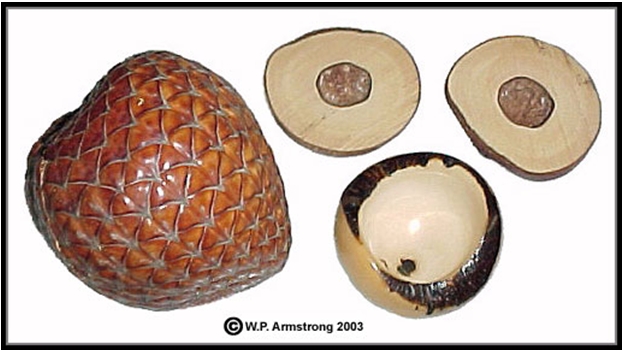
https://www.walmart.com/ip/Home-Basics-Mortar-and-Pestle-Bamboo/36699397
https://www.dwpipes.com/html/briar_pipes.html

A THREE-CARD DRAW FOR AN INSIDE STRAIGHT WITH AN OLD KARL ERIK HAND MADE GRADE O FREEHAND


Blog by Robert M. Boughton

Copyright © Reborn Pipes and the Author except as cited

https://www.facebook.com/roadrunnerpipes/
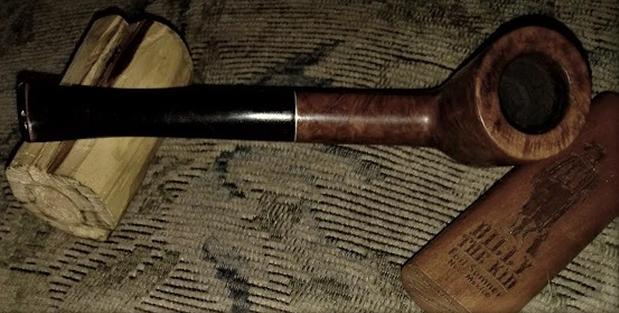
You’ve got to sing like you don’t need the money
Love like you’ll never get hurt
You’ve got to dance like nobody’s watchin’
It’s gotta come from the heart if you want it to work.

— In “Come from the Heart” (1987), a country music song by Susanna Clark and Richard Leigh

INTRODUCTION
The free-spirited quote I chose for today’s blog is a chorus of sorts to the darker, harder to control song of myself I change a little at a time, but concerning Danish freehands, at least, it shouts out.  In regular prose as opposed to verse, the words have been attributed to many folks, the most famous of whom are Leroy “Satchel” Paige and Mark Twain.

Really?  Satchel Paige and Mark Twain?  Can anyone even summon to the mind an image of Satchel, showman though he was, hurling three evanescent fast balls for a strikeout and then sauntering off the mound, doffing his cap as for the National Anthem, to spout what would have been considered insane gibbering in his day and gotten him run out of town on a rail or worse?  Or the wry and often hilarious Great American Writer – who can still leave readers today ROFL from his literary accounts of the myriad outrageous frays he entered with zeal and turn wickedly acerbic in his social commentary – wearing his famous white Southern suit and taking the cigar out of his mouth as he steps onto a gazebo to pronounce such life-affirming, feel good modern sentiments?  I think not.

But I like the way Kathy Mattea sings those four lines, although I can’t recall any of the others, and the lively, high-strung electric fiddle plucking of an unsung but talented musician.

To the point, the pictures of a nine-pipe lot I bought at the beginning of the month, before the package arrived, had a magnetic pull on me.  The main attraction was a pair of Danish freehands, and the other was the presence of at least two and maybe three other nice finds, about which the seller might have been oblivious.  With no order whatsoever to the description and only three brands identifiable (Kaywoodie, Falcon and Missouri Meerschaum), the seller did reveal that one of the freehands was a Knute of Denmark and the other a Karl Erik.  I had heard of Knute and was unfamiliar with the brand, but I’ve owned several Karl Eriks and was pretty sure the behemoth in the lower right side of the following photo was it.  I was correct.

9-pipe eBay lot courtesy stwok74075

I restored the freehands from the lot first.  Of those, I decided to start with the Knute for two reasons, the lesser being my inexperience with the brand and the more significant that, although both were large pipes, the Karl Erik was enormous and therefore had much more area to repair.  Had I any idea there was something greater about the KE than its massive potential for beautiful geometric symmetry and fine example of chasing the grain, I might have chosen the opposite order.  KE, by the way, is my abbreviation for convenience, not to be confused with the maker’s earliest pipe mark)

The pipe’s bleak façade of thick gunk at first hid the small block of nomenclature on the stem end of the shank.  Before I would have taken photos of the pipe as it arrived, I used a thick cotton rag and more than a little force to wipe away the muck that at one point I thought might require alcohol.  I stopped breathing a moment when I saw the mark.  Instead of the regular two lines of imprint, there were three: KARL ERIK/HANDMADE IN DENMARK/O.

The grade mark, of course, was the part that surprised me.  I’ve owned four KE pipes not counting my latest addition, two of which were far more striking at a glance than this one even after I finished its restoration, but none of them was graded.

As fast as I could, I browsed to Pipephil and found a mention of “previous grading” from 4-1 ascending, meaning1 would be the highest, not counting the Ekstravagant releases that were entirely handmade.  Well, that was no help, and so I searched further, finding multiple sites that gave both the previous grades and the newer ones from D-A, again ascending.  Some of the latter sources, including Pipedia, expanded on the Ekstravagant grade, noting that it in fact was divided into degrees, C, B, A, AA and AAA.  I found no official mention of letter grading beyond D, but I did track down a Worthpoint auction that describes O as “[t]he highest grade in the old Karl Erik grading system.”  Needless to say, my breath was taken away again.  I’m calling on any readers with information on the maker’s early grading system to fill me in on it!

Speaking of the maker, his name was Karl Erik Ottendahl (1942-2004), and he was a lithographer struggling to make ends meet from his apprenticeship starting when he was 16 into his mid-20s when he took up carving pipes as a day job.  Young Ottendahl had made pipes as a hobby since he was 16 and gave most of them to friends and senior co-workers.  Never forgetting his “roots,” Ottendahl remained perhaps the most generous pipe maker in the history of the craft and trade.  He was devoted to the proposition that fine pipes should be affordable to the average smoker, and to that end he priced his works of art far below the going rate.  Likely for that reason, his brilliant work was underestimated and likewise valued during and after his lifetime, and it is only in recent years that the market has begun to appreciate their worth more.  I’m sure that fact makes Karl Erik roll over in his grave.

The poor, big lunk of fine Danish stock in this blog had fallen on hard times and was in a sorry state.  The following triple stem swap gets a little crazy, so try to follow this.  The KE came with a nice dark brown swirled acrylic fancy stem that was just way too short to support its gigantic stummel but was perfect for a Knute of Denmark from the same lot that I already restored, blogged and sold – with the KE stem.  The Knute, by the way, had a Vulcanite stem that was chomped, with a hole in the bottom below the button I fixed well but the absence of a full lip I knew I could mend enough for my own use but would never pass off to a customer.  So that was a no-brainer.  I decided on a temporary substitution of a bright orange Lucite stem from a Ben Wade by Preben Holm freehand I have.  For now, the half-eaten but semi-repaired Vulcanite stem from the Knute is on the BW.  I’ll just add that I’m anxiously awaiting replacements for both of them.

Here are photos of the KE as I received it minus the stem, and the Knute Vulcanite bollix I mended as far as I’m going to do for now, with no signs of the hole that was on the underside but a bit of a double lip there now and the pre-existing half lip topside. RESTORATION
Part of me knew, from the rich, dark briar grain that glowed through the long bottom of the shank after I vanquished the grime that had overcast its natural, smooth brilliance, that the rest of the wood could only be better.  But the Devil’s Advocate in me gave rise to the tomfool but nevertheless undeniable apprehension that nothing good could come from stripping away the sedimentary layers of anomalous substances.  I decided to be done with the majority of the business using an Everclear soak.

To keep my mind from its pointless and counterproductive negative preoccupation with the state of the stummel, I turned my attention to the Lucite stem that was taken off the BW to use in place of the lovely and too petite stem with which the pipe came.  Note the dark stains inside the stem’s airhole and the bore and tenon opening. Most of the inner stain came out with alcohol soaked bristly cleaners, and the rest of that later with the retort.  The bore and shank end, on the other hand, needed more wheedling.  At first when I tried the small end of a bristly cleaner dipped in alcohol, I had minimal results.  Switching to something more pointed, sharp and focused – an unwound paper clip – I scraped away the accreted blackness on both ends and used a 180 grit sanding pad on the tip of the shank end.  Either I forgot to snap shots of the results or misplaced them, i.e., tapped Save As on the computer and didn’t look where I did it, but I don’t have the proof of cleaning to display.  Later pictures will show all but the shank opening of the stem.

But there’s good news!  The Everclear soak was finished!  The color and grain I wanted to see were there.To remove the remaining odd caliginosity obscuring the fine wood, I gave the bowl and shank a quick rub with 600-grit paper and the rim with super fine “0000” steel wool.  The difference was marked. The plateaux rim and shank opening needed a little more Everclear soaking.  That done, I grabbed my handy sanding pad again and spot-scrubbed those places. I reamed and sanded the chamber with 150, 220-, 320- and 600-grit paper that took the char far enough down to the wood for the retort to handle what remained. For me, the most gratifying part of a pipe restore, if the wood has been prepped properly beforehand, is micro meshing from 1500-12000, for this is where the mettle of the pipe is revealed.  The deep, shiny, shimmer that should result is something to behold with wonder.  And the grain on the block of wood chosen for this pipe is spectacular.  I also ran four Pyrex tubes of Everclear through the pipe afterward for the retort. Staining the rough rim and shank opening with Lincoln Medium Brown boot stain before flaming them, I took off the char with 8000 and 12000 micro mesh.  The second of the next two pics shows before I finished it with a light touch of steel wool.With that, the pipe was finished except for buffing the stummel and stem with red rouge and carnauba wax.  I’m out of Halcyon II and therefore could not use it on the plateau areas. CONCLUSION
One look at this pipe out of the box the lot came in and I fully intended to offer it for sale.  The gentleman from one of my pipe smokers’ forums who bought the Knute was also more than eager, to put it lightly, to get his hands on the Karl Erik I told him I had.  But all that was before I started unearthing – in a sense that may be literal given the fact that the pipe looked to have been buried for some time – the way Ottendahl chased the grain on this splendid example of one of his earlier works, when he graded them on an as yet undocumented scale.  For all I know, O being the fifteenth letter of the English alphabet, my newest freehand may not be near the top end, but it’s still graded.  That means it meant something to its maker, and I’m certain he would remember it if he could be reached where he is now.  Besides, as his newer scales are ascending, meaning from “best” to “worst,” and I being more of a glass half-full kind of guy, I like to think it’s two grades closer to the sidewalk than the middle if the road.

SOURCES
http://www.pipephil.eu/logos/en/logo-k1.html
https://pipedia.org/wiki/Karl_Erik
https://www.worthpoint.com/worthopedia/karl-erik-freehand-estate-pipe-521847614
https://rebornpipes.com/2016/07/06/a-stellar-find-a-gbd-prestige-1451-oval-shank-billiard/
https://rebornpipes.com/2018/07/17/finding-the-natural-beauty-of-a-knute-of-denmark-freehand/
https://pipedia.org/wiki/Knute