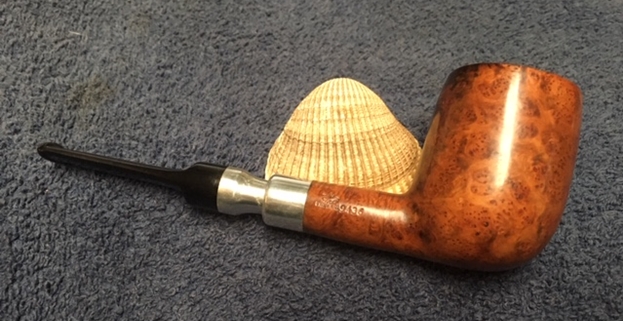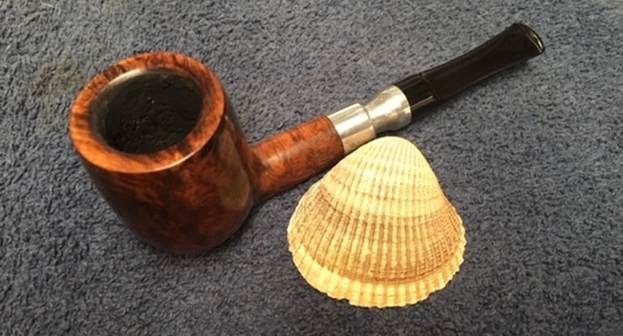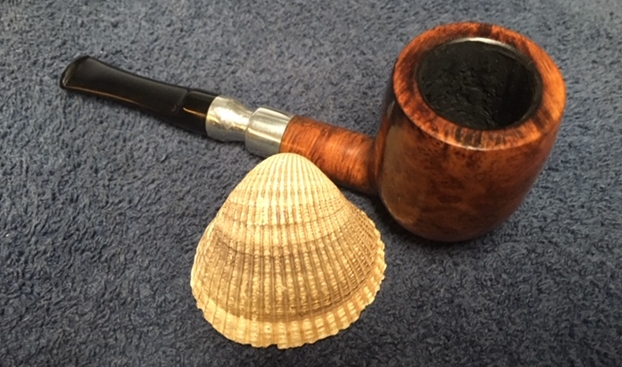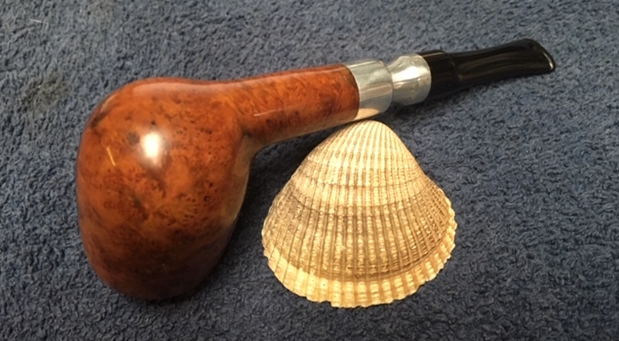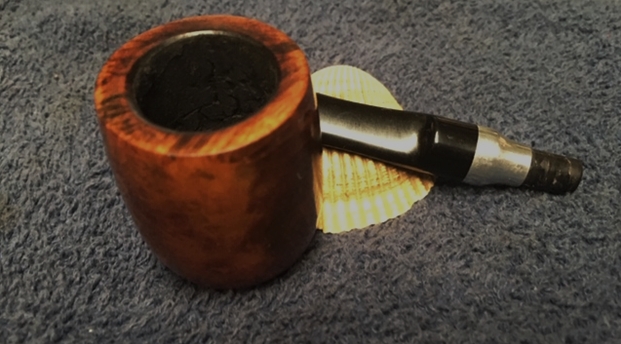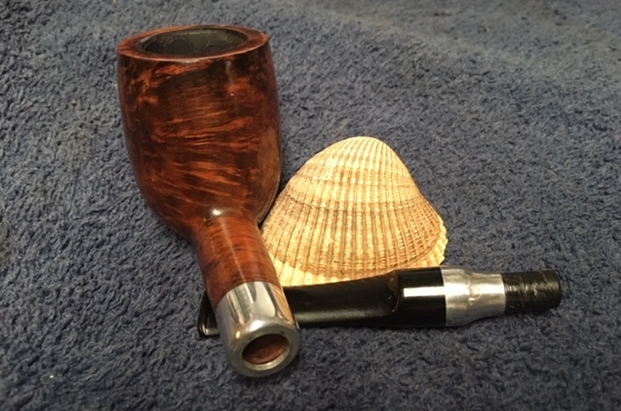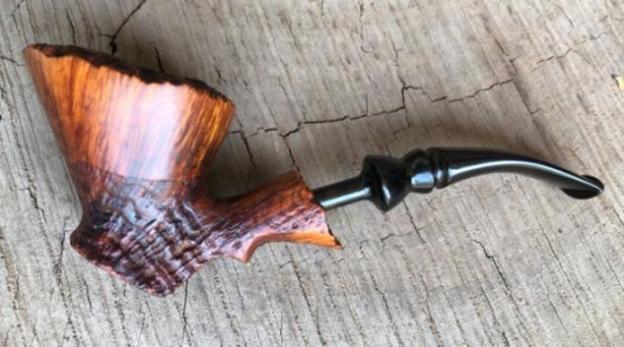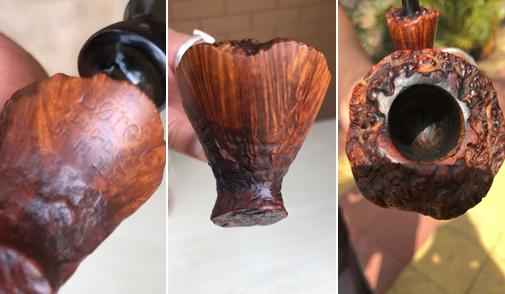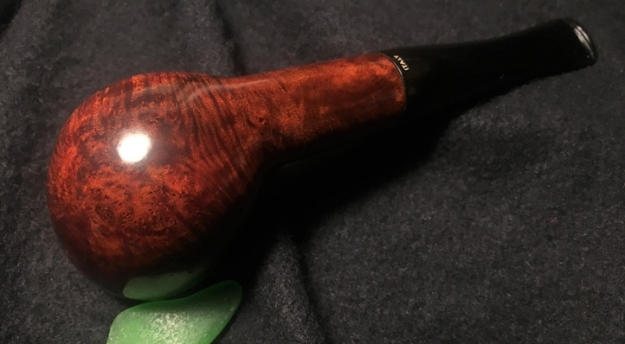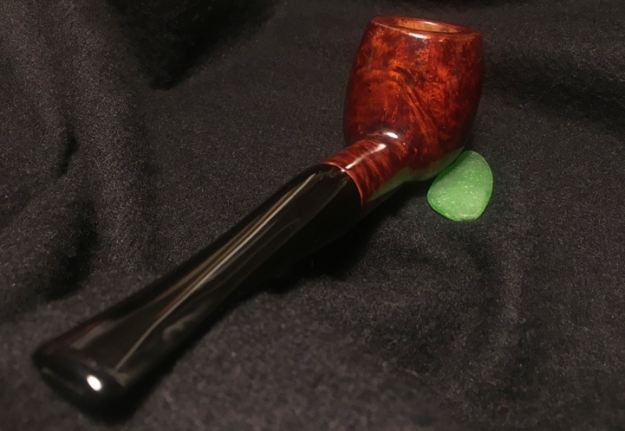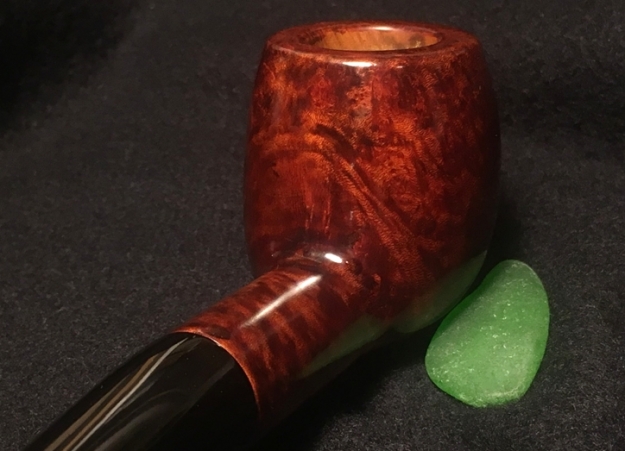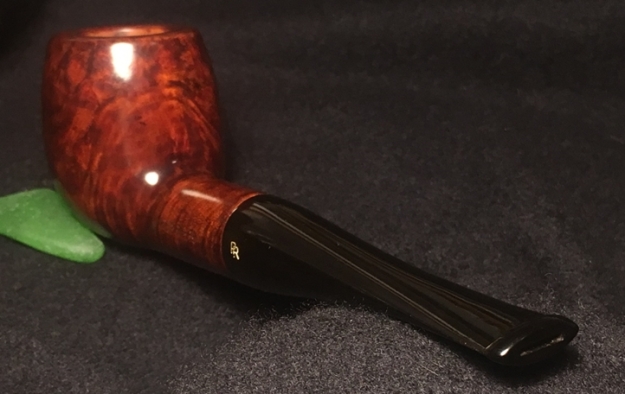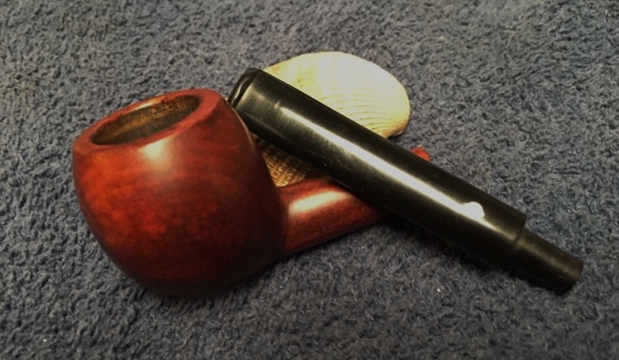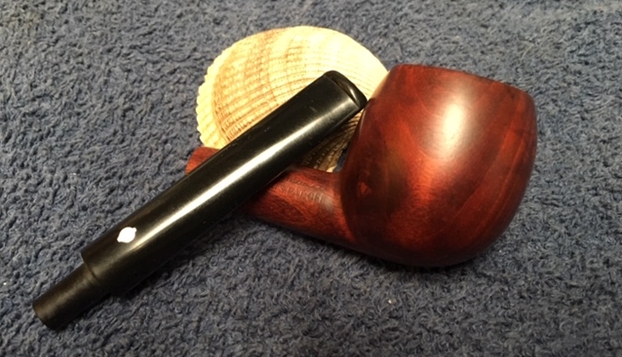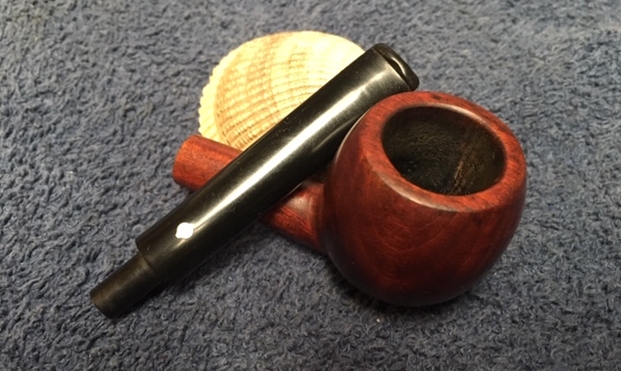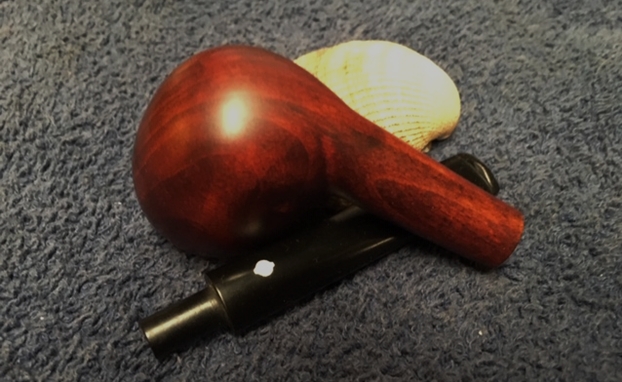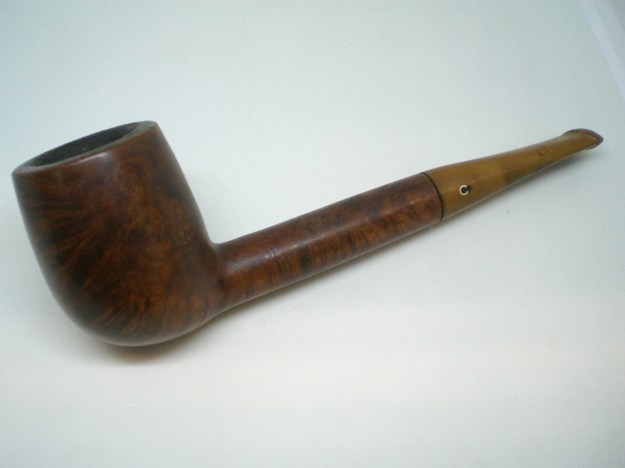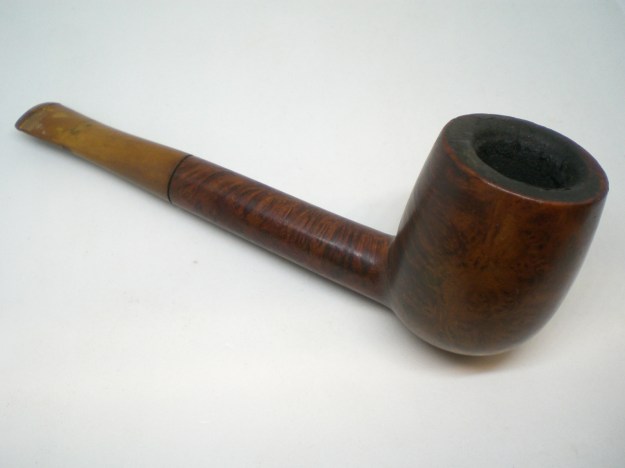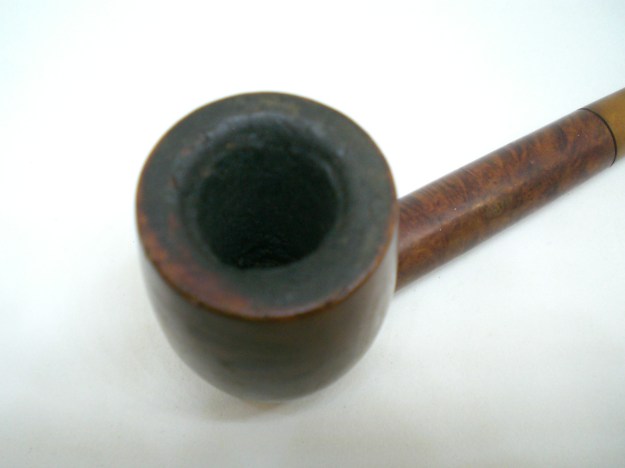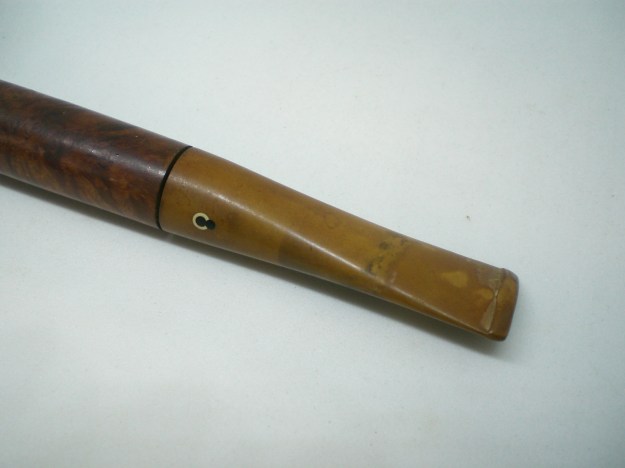
Redoing a Poorly Restored EBay GBD Super ‘Q’ 9436


Blog by Steve Laug

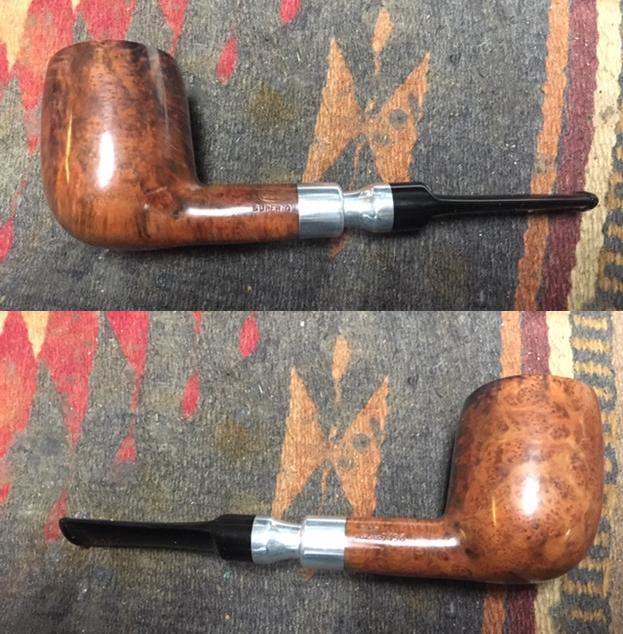
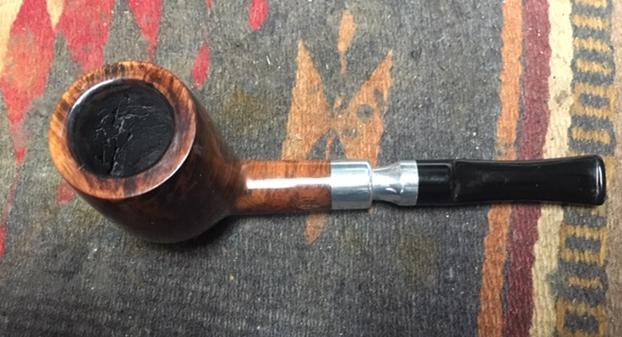
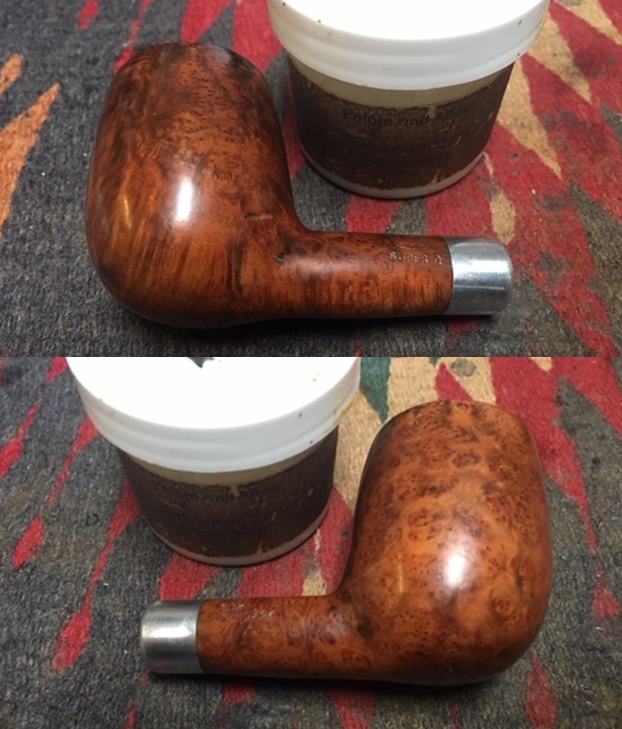
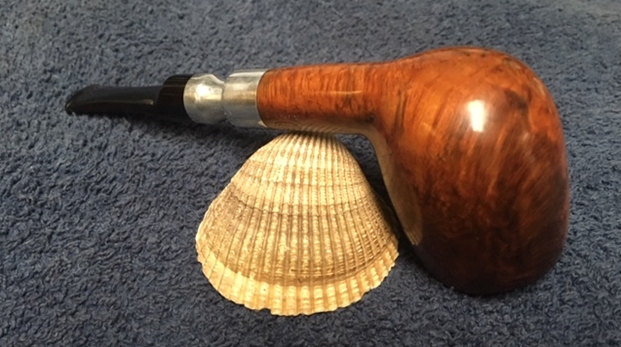
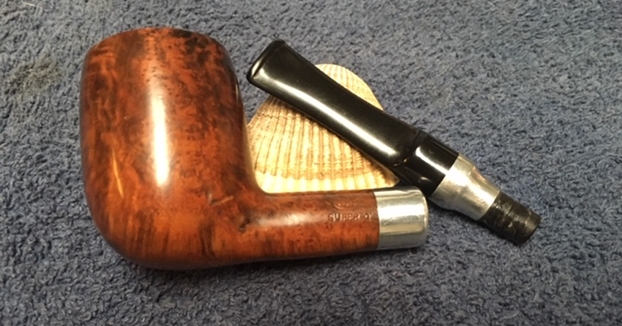
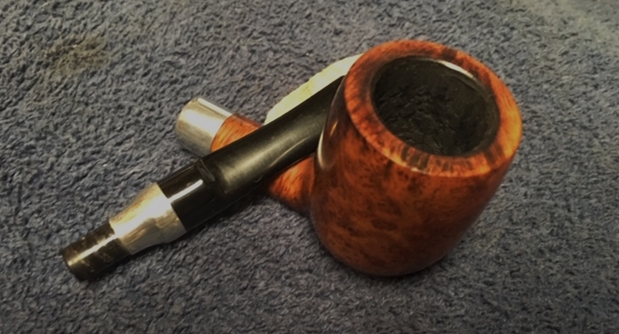
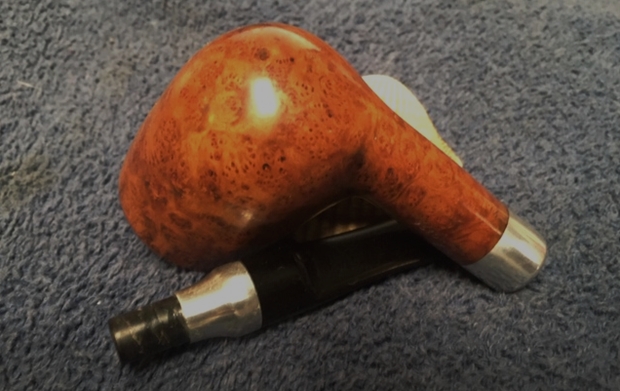
Probably one of the most irritating parts of the art of pipe restoration is when a pipe comes to me from an EBay seller who sold it as fully restored and ready to smoke and it was not. The story of this pipe started with that description. On the weekend I received a call from a fellow here in Vancouver who had a pipe that had a very loosely fitting stem. He asked if he could drop by to show it to me and see if I could fix it. From past experience I never jump to conclusions about what sounded like an easy repair. When he arrived he showed me this GBD Faux Spigot. It had a nickel ferrule and a nickel adornment just above the Delrin tenon. The tenon was drilled out for a 6mm filter. The stamping on the bowl reads on the left side GBD in an oval over Super ‘Q’. On the right side it had a Made in London over England COM stamp with the shape number 9436 next to that. On the underside of the shank it has an M stamped next to the ferrule. I asked him where he had picked up the pipe and he said that he had picked it up on EBay. Knowing that, I began to look more carefully at the pipe.

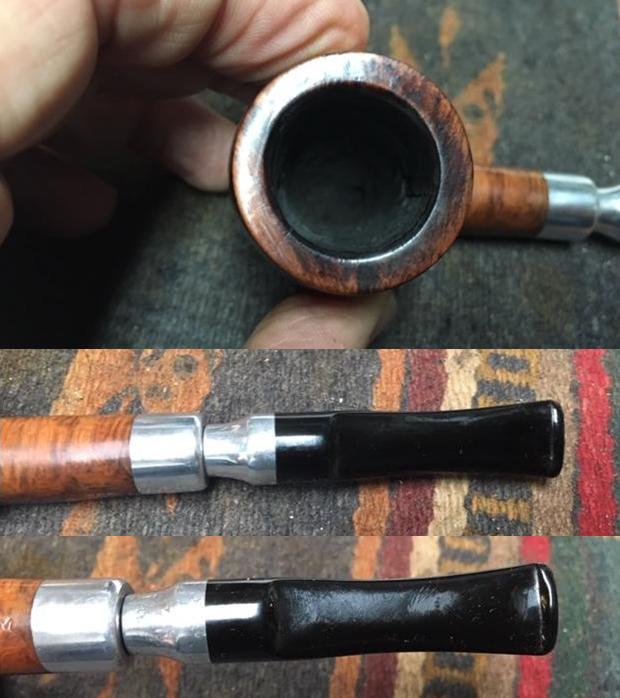
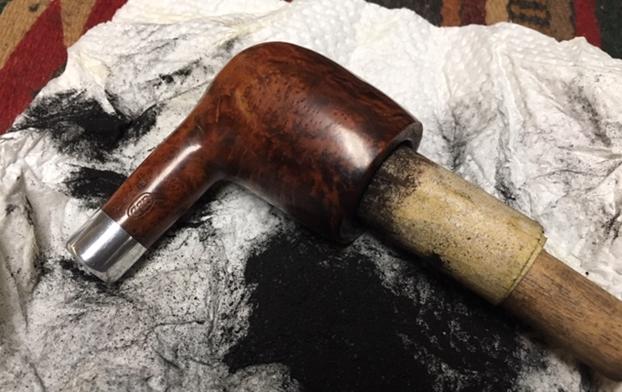
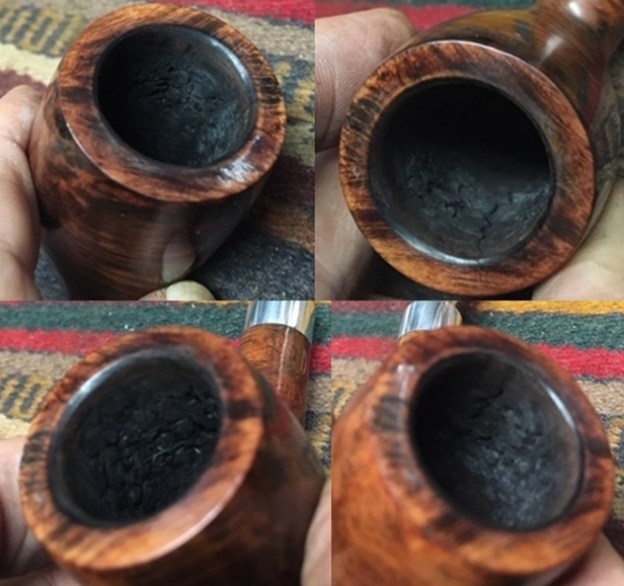
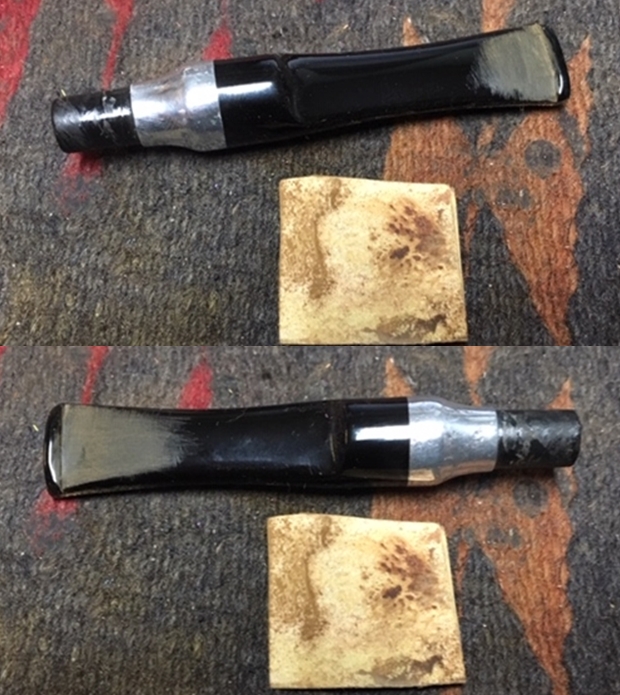
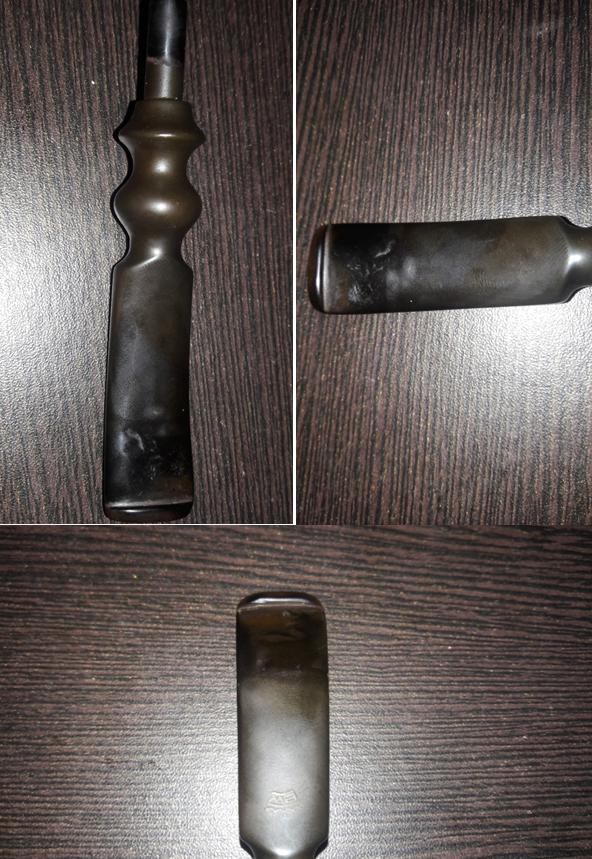
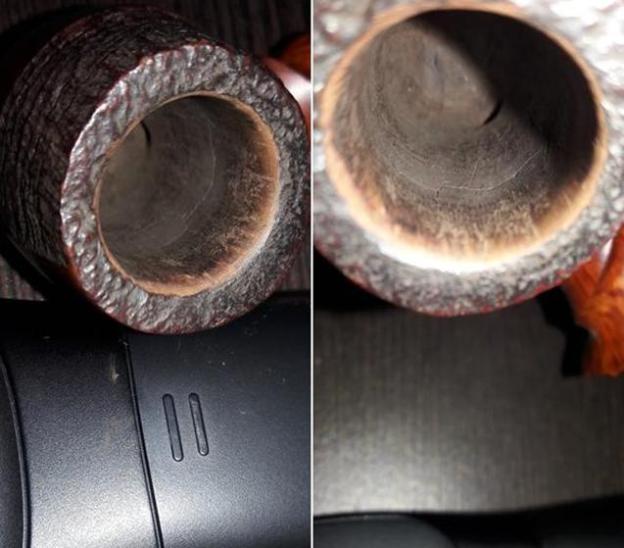
Here is what I saw. Starting with externals. The rim and exterior of the pipe had been coated with a shiny varnish coat with some significant grime on the rim top under the varnish. The nickel had also been coated with the varnish and had run on the stem adornment. The stem also had some deep bite marks on the surface ahead of a very worn and ill-defined button on both sides. Moving to the internals. The end of the tenon had a lot of tarry buildup in it from smoking the filter pipe without a filter. Not much effort seems to have been made to remove it. The inside of the shank was also covered with a tobacco juice lacquer that was also gumming up the airway. When I blew through it, the draught was constricted. The inside of the bowl was another story. The bowl had been lightly reamed leaving behind a fairly thick cake that was checked and cracked giving the bowl interior a very fractured look. The bottom half of the bowl had not seen the blade of the reamer and was dirty. There was debris in the airway as it entered the bowl. I have to say that the pipe was a mess and the work that had been done would make my job harder.

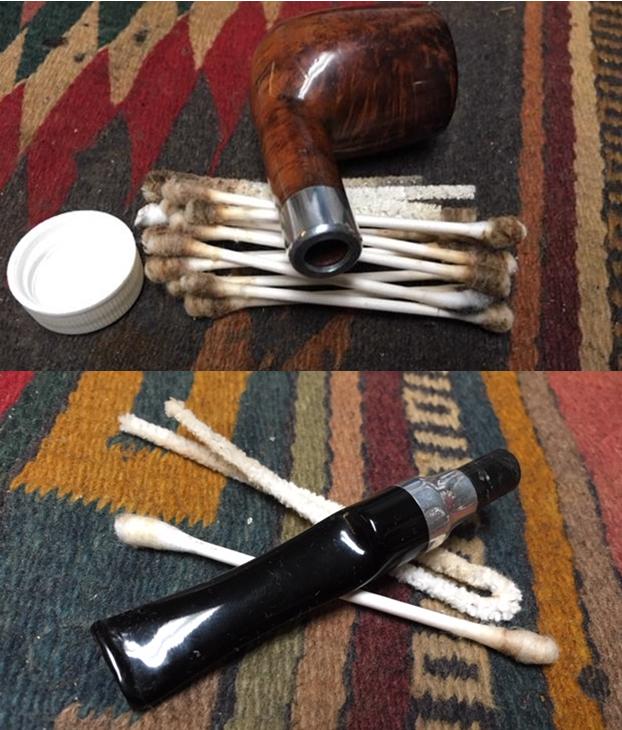
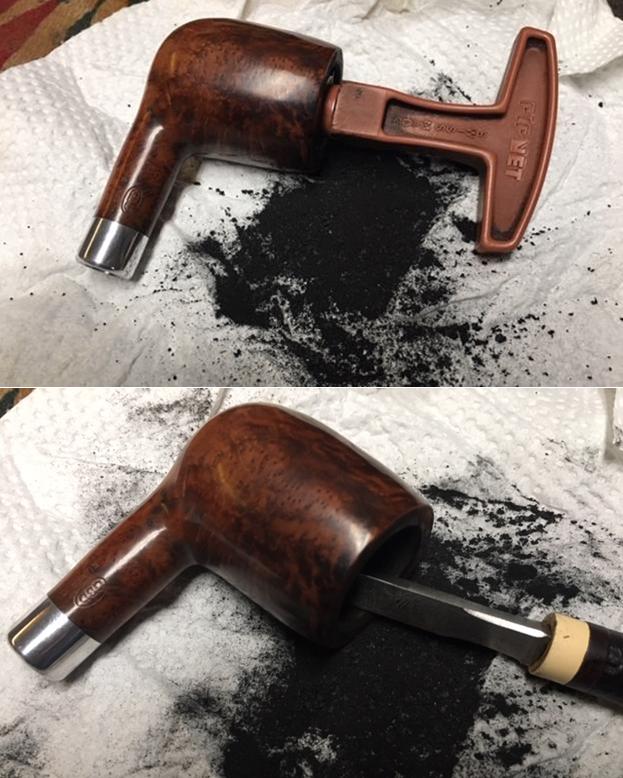
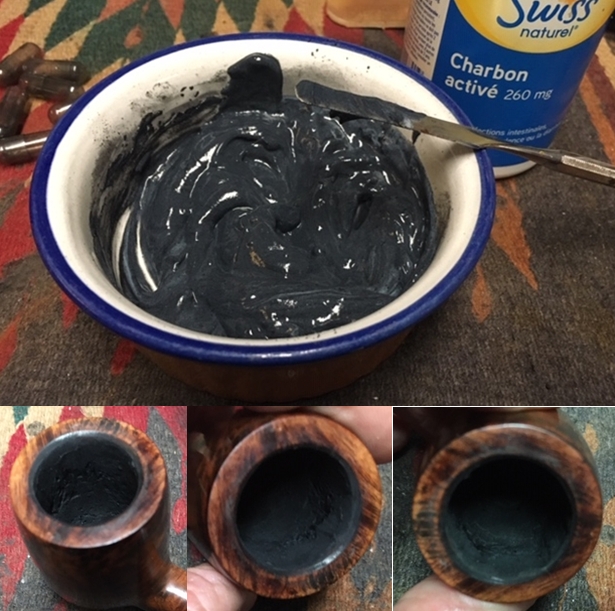
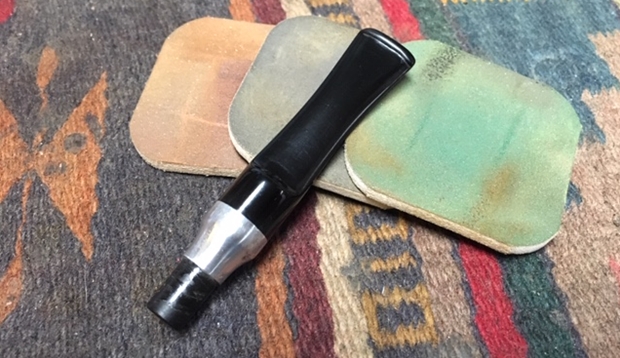
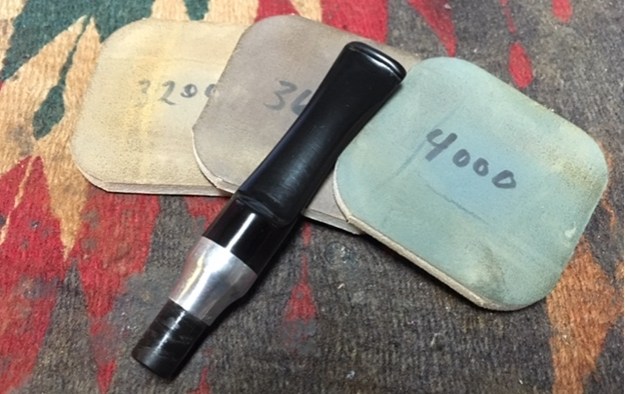
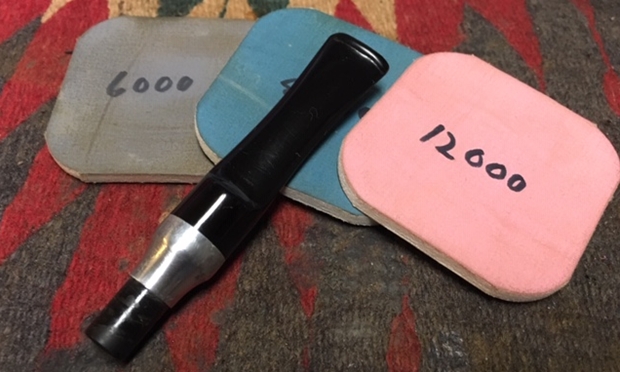
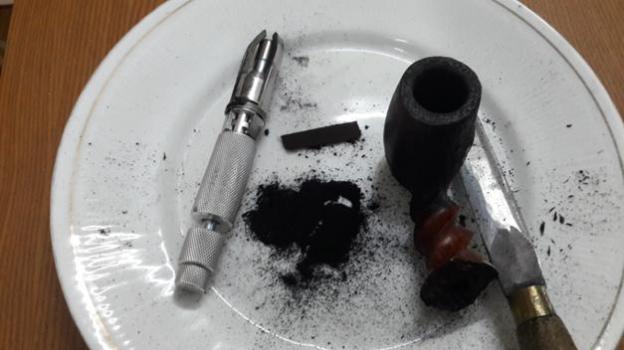
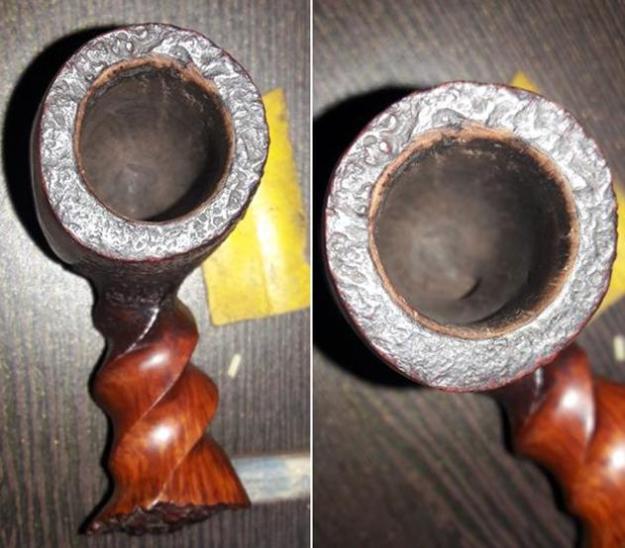
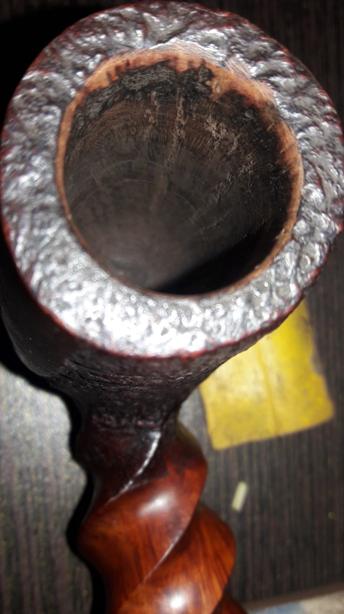
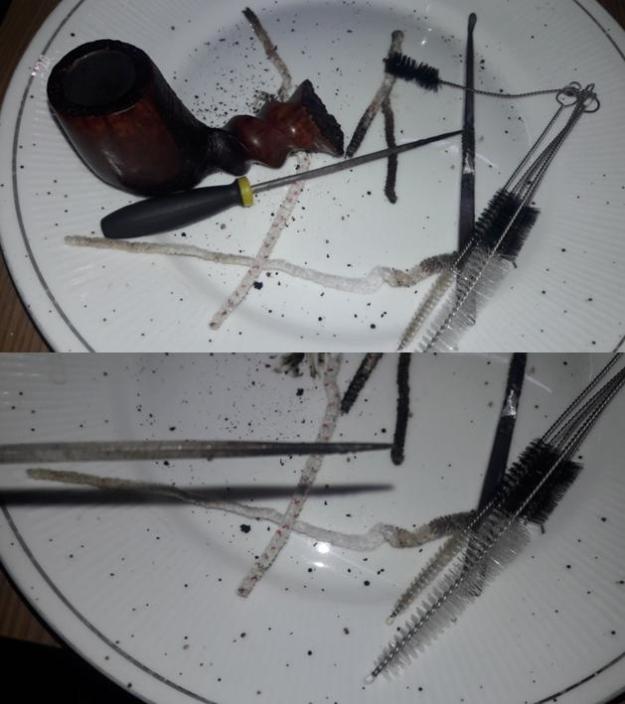
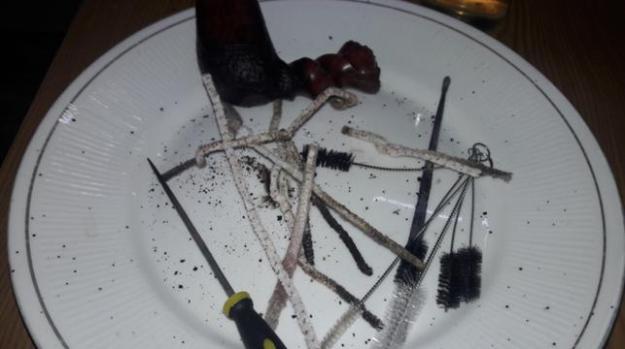
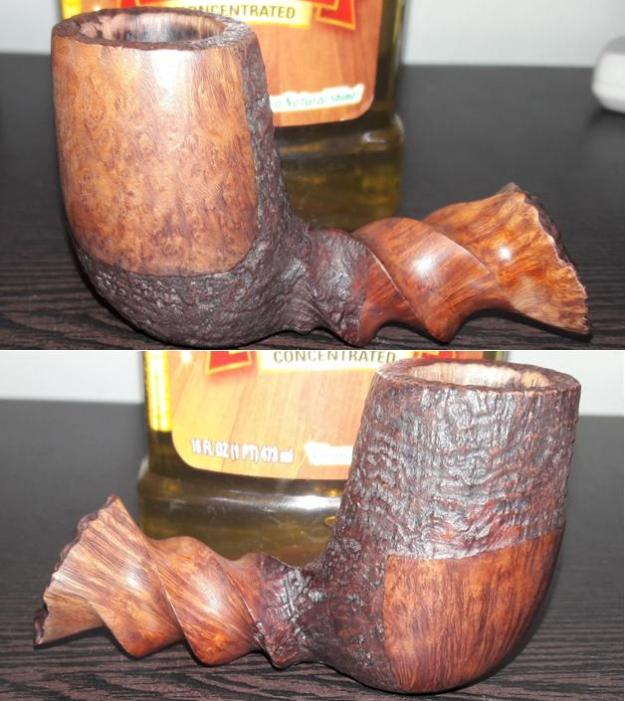
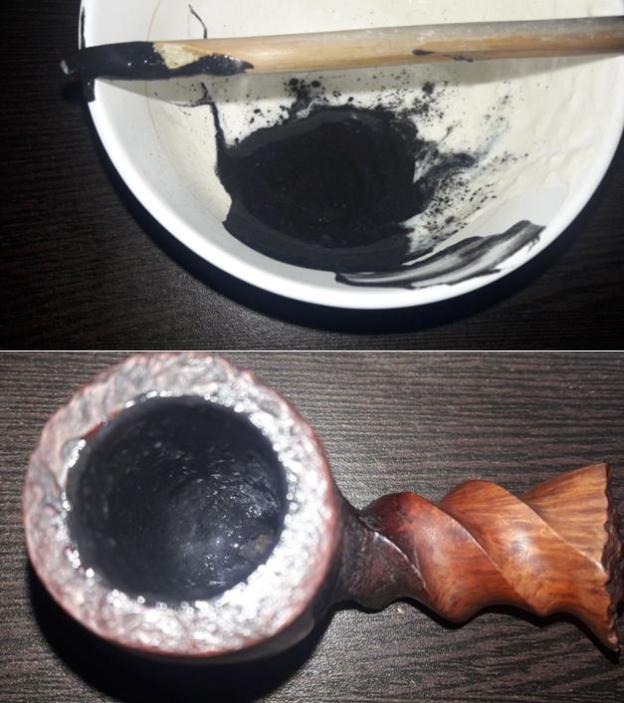
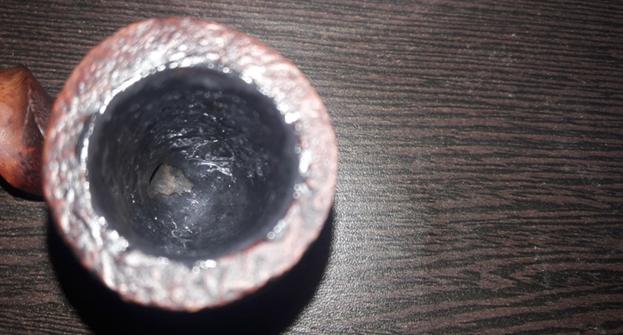
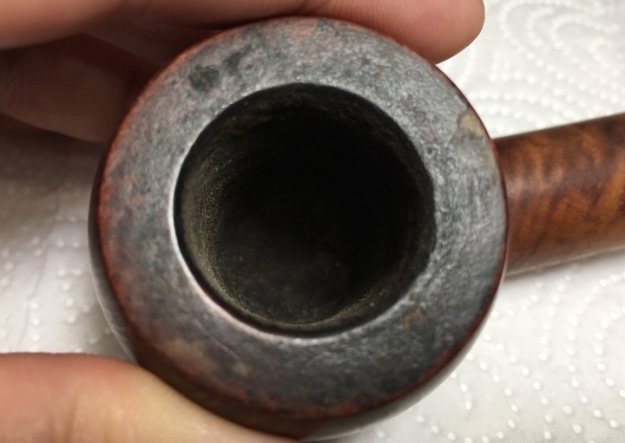
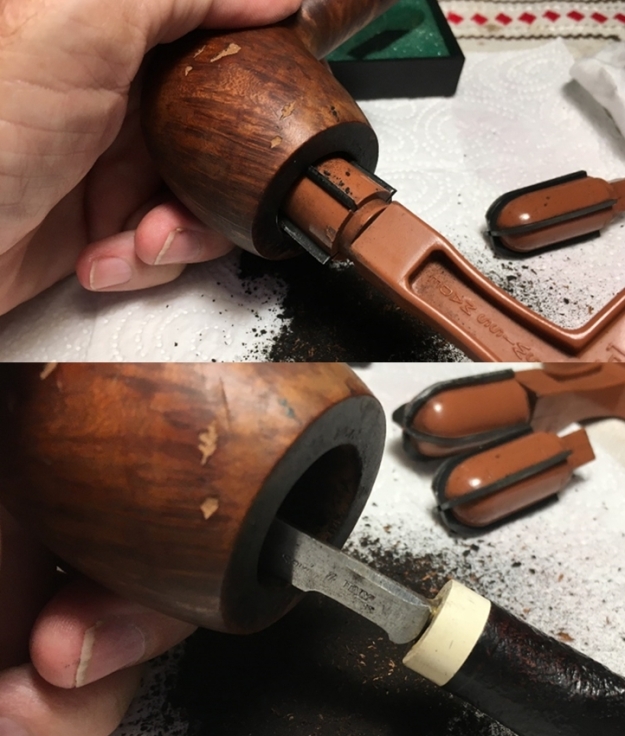
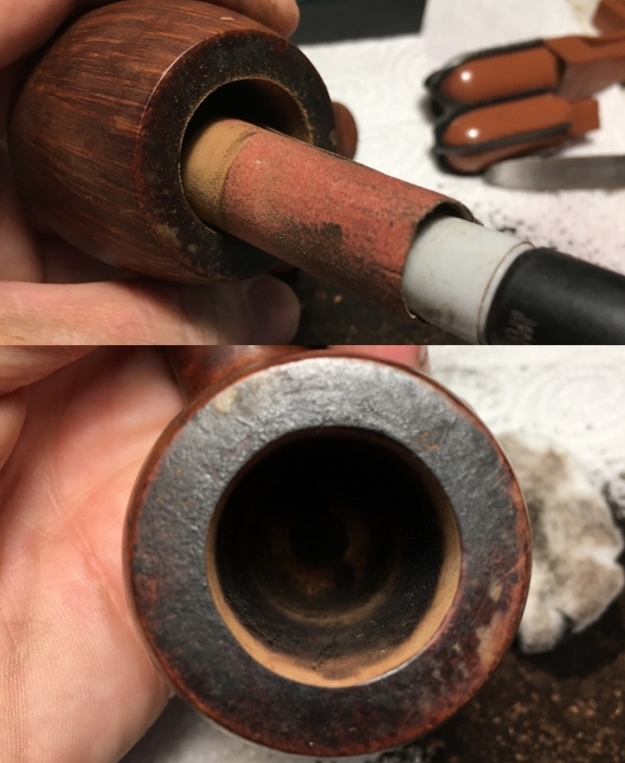
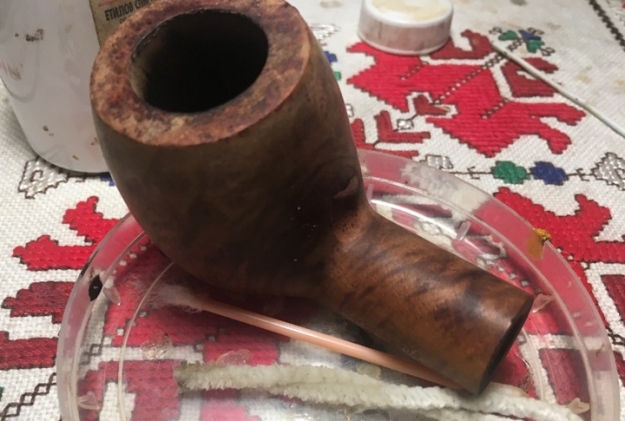
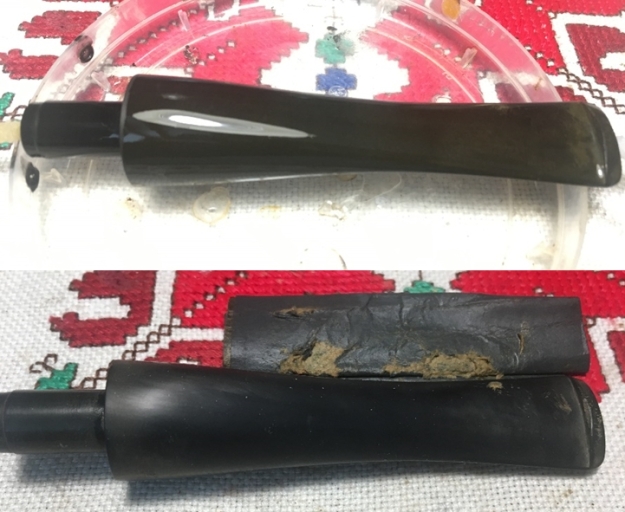
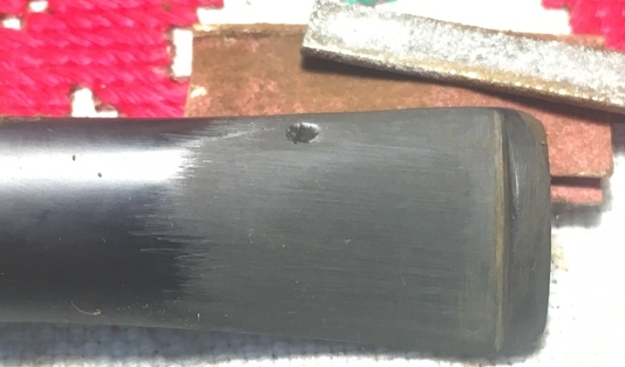
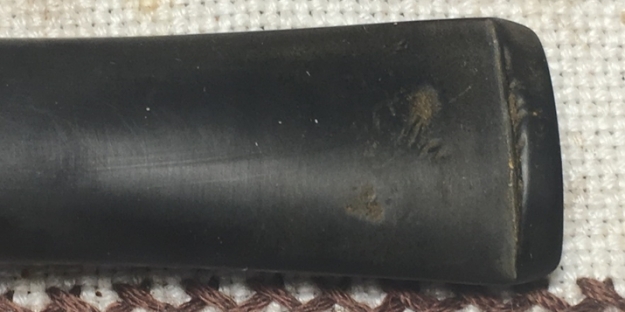
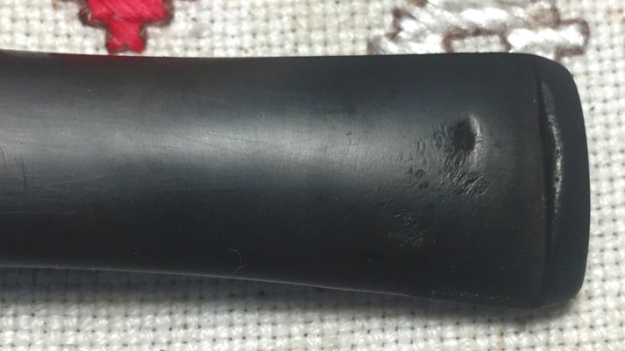
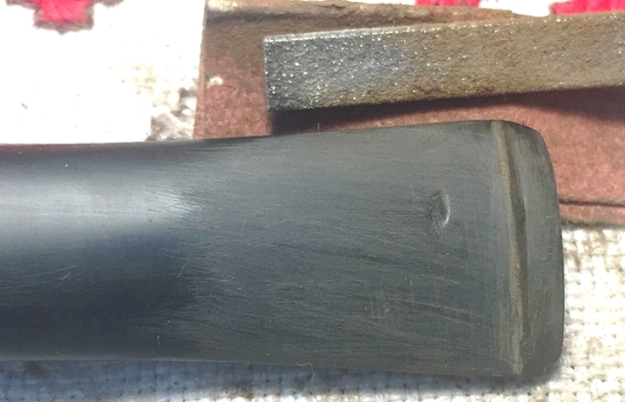
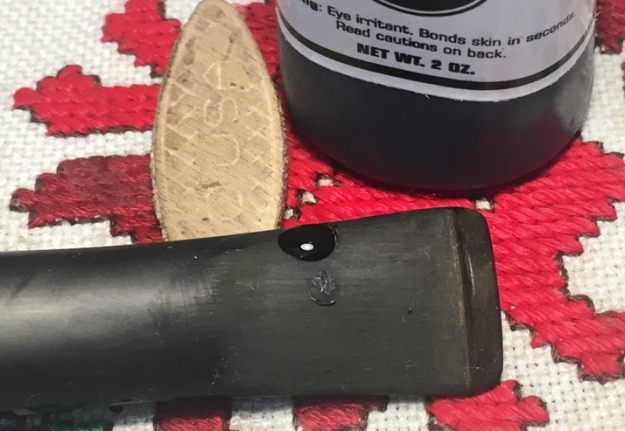
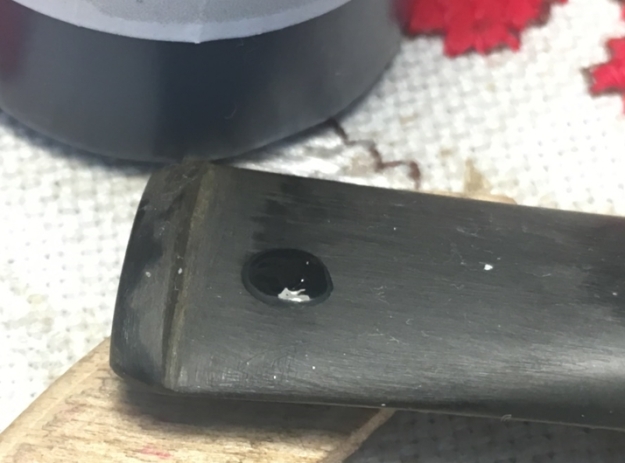
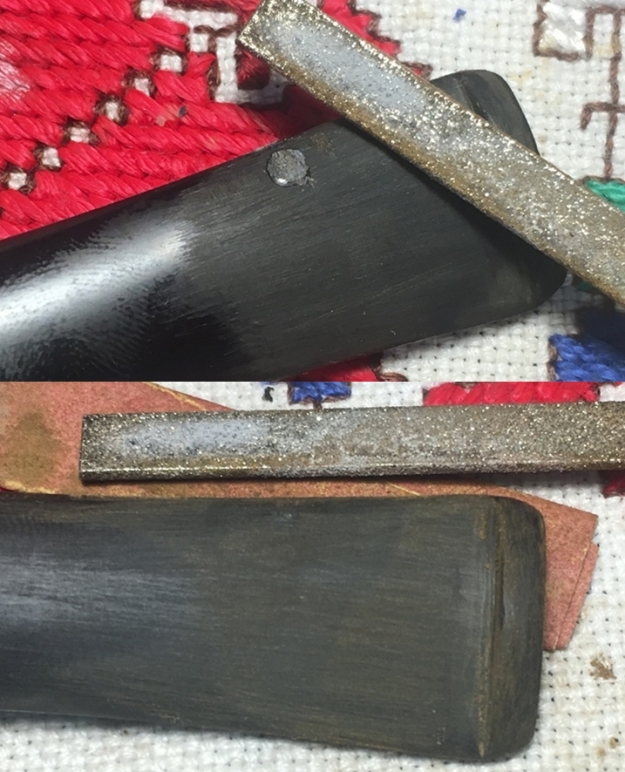
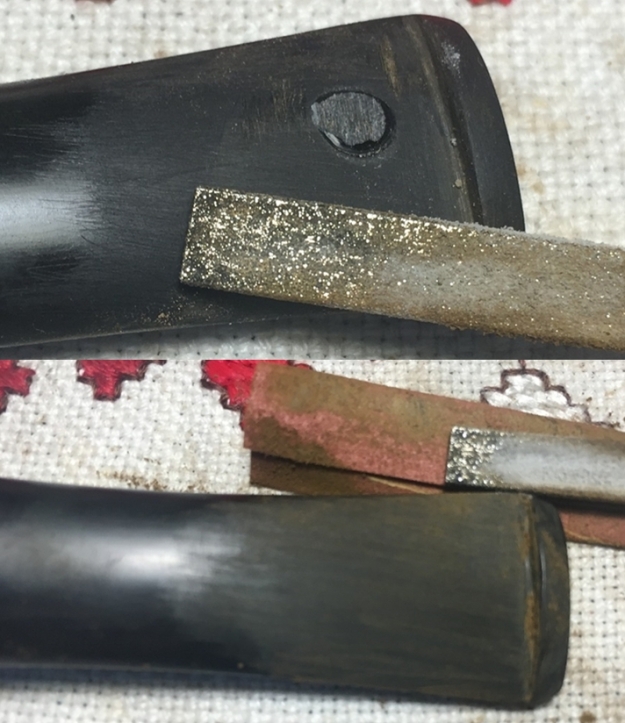
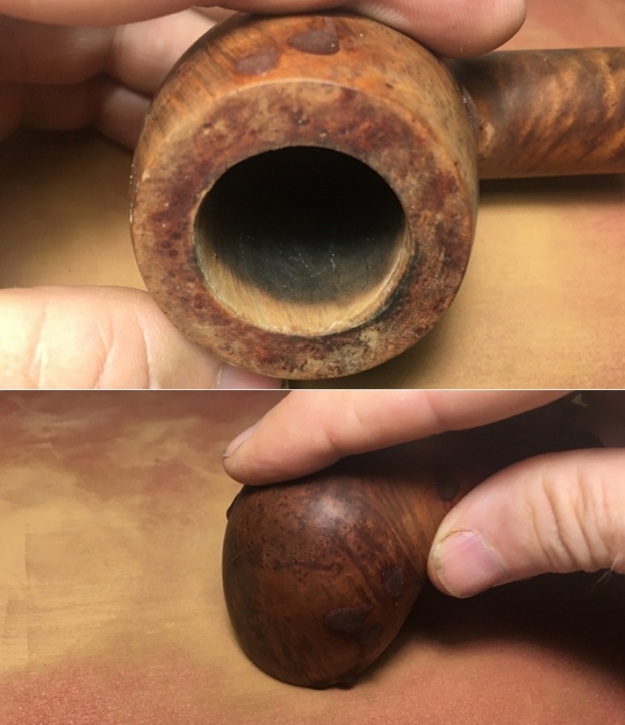
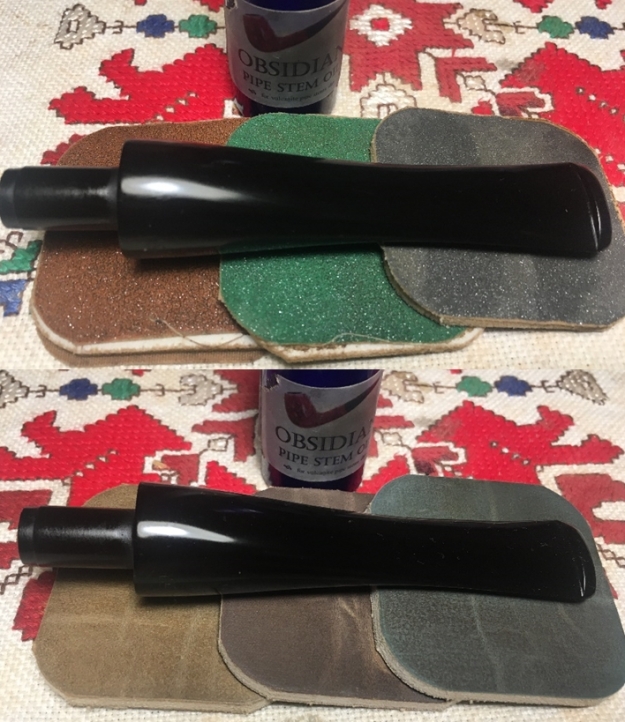
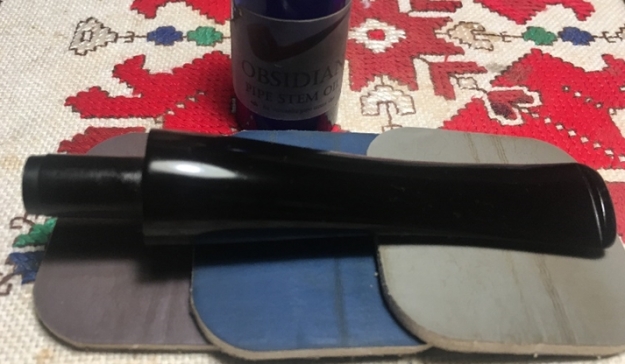
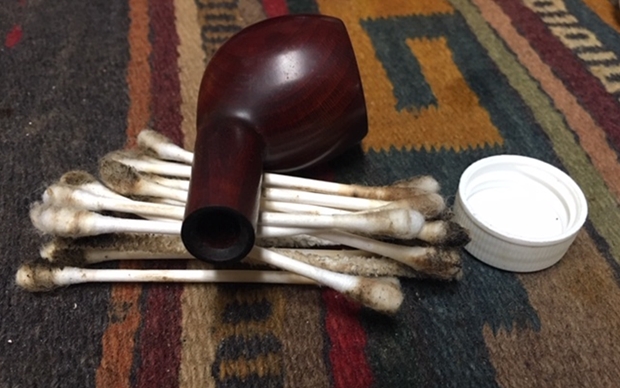
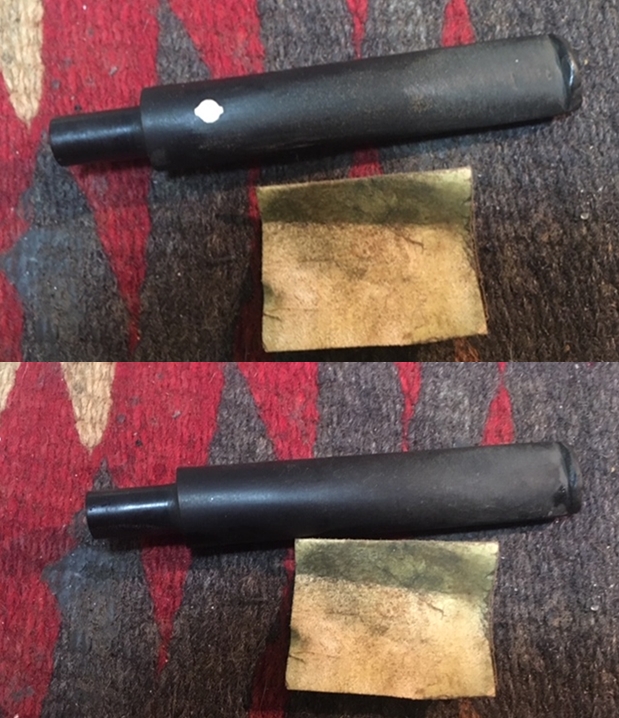
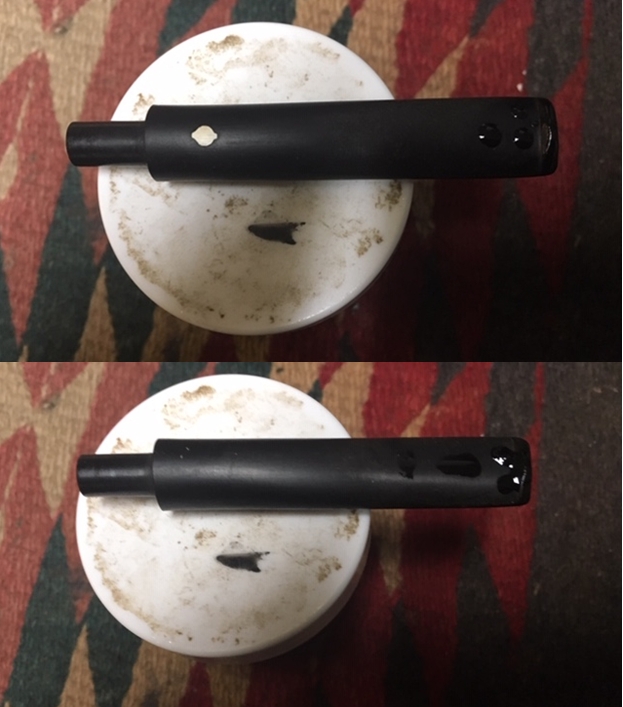
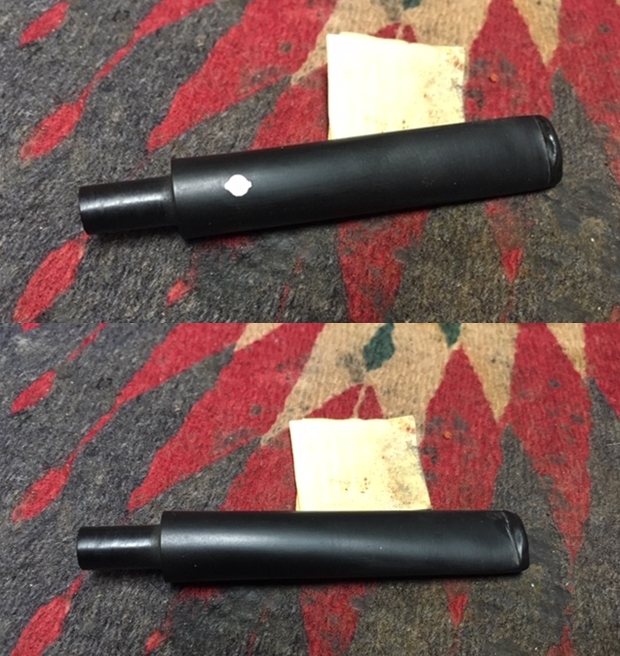
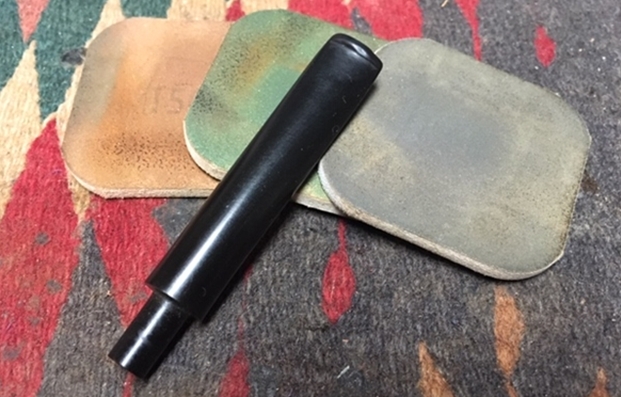
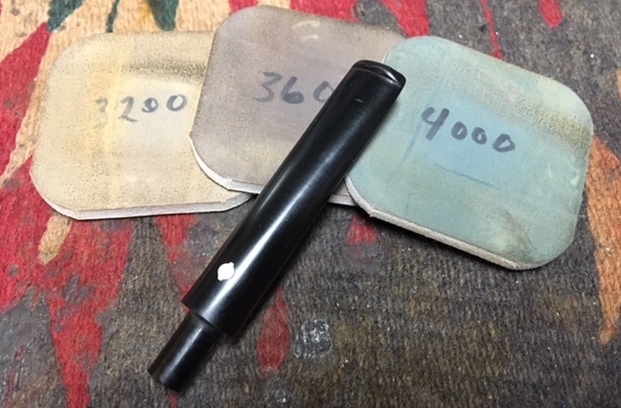
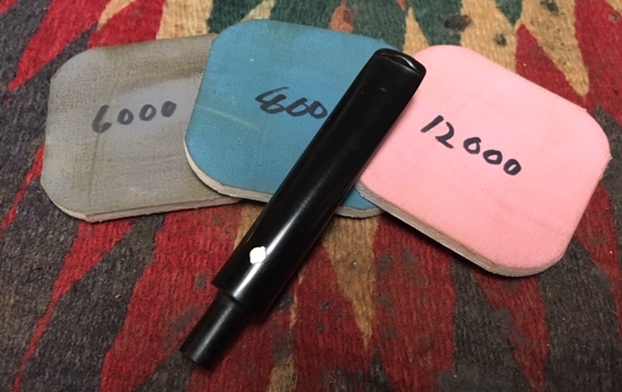
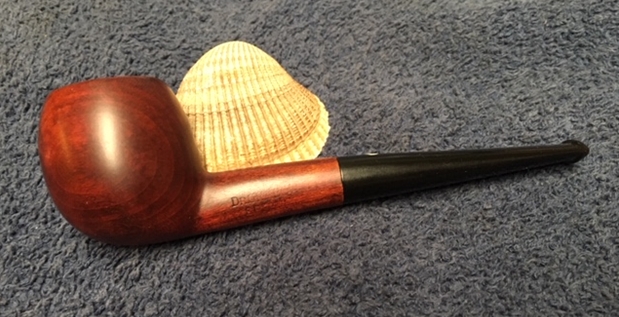
To say that it was restored and ready to smoke was an outright lie. If it had been cleaned and the only issue was the cake I would have been good with that. If the rim top had been cleaned before the shiny coat I would have been good with that. But to cover it up and make it shiny to hide a poor job is deceptive at worst and shoddy craftsmanship at best. I pointed out the issues with the pipe to the fellow who had stopped by and suggested that he have me clean it up for him the way I think that it should have been cleaned. He was game so the pipe stayed with me when he left. I took some photos of the pipe before I started my work to show the general condition. I took a close up photo of the rim top to show the condition. It is hard to see but the rim top is not smooth. There are chunks of grime/lava under the shiny top coat. The close up photos of the stem reveal the scratches in the vulcanite, the tooth marks and the worn and ill-defined button.  There is also some sagging shiny coat on the nickel stem adornment that is visible.I cleaned the internals of the shank and stem with pipe cleaners, cotton swabs and alcohol. The debris that came out was astonishing for a “restored” pipe. I scraped the walls of the mortise with a sharp pen knife to remove the lacquer build up there. When I finished the pipe smelled cleaner.I reamed the bowl back to bare briar with a PipNet pipe reamer. I cleaned up the debris with a Savinelli Fitsall Pipe Knife and sanded the walls with a piece of dowel wrapped in 220 grit sandpaper. I wanted to see behind all the cake what the walls looked like. Sadly they were as I expected – very checked with spidery cracks. I took a few photos of the damage to the inside of the bowl to give an idea of the extent of the checking and fissures on interior walls. This is typically caused by smoking too hot.To protect the bowl wall I mixed up a batch of charcoal powder and sour cream to make a paste. I pressed the mixture into the crevices and fissures on the walls of the bowl and painted a top coat of the mixture with a folded pipe cleaner. I set the bowl aside to cure and turned my attention to the damaged stem.I used a needle file to redefine the button on both sides of the stem and sanded the tooth marks out the surface of the stem with 220 grit sandpaper. I filled in the remaining deeper tooth mark with super glue and when it cured sanded it smooth to match the surface of the stem.I polished the stem, tenon and metal work with micromesh sanding pads – wet sanding with 1500-2400 and dry sanding with 3200-12000 grit pads. I wiped the stem down with Obsidian Oil after each sanding pad. I was able to remove the damage on the tenon and polish out the dripping varnish on the metal adornment. The stem looked much better at this point in the process. Once the bowl coating cured I worked on the rim top with micromesh sanding pads – 3200-12000 to remove the tarry deposits around the surface. I scrubbed the bowl down with Before & After Restoration Balm and after it sat for a short time I buffed it off with a cotton cloth. Here is what it looked like at that point. I the polished stem and bowl with Blue Diamond to polish out the remaining small scratches and raise the shine. I gave the bowl and the stem several coats of carnauba wax and buffed the pipe with a clean buffing pad to raise the shine. I hand buffed it with a microfiber cloth to deepen the shine. The pipe polished up pretty nicely. This turned out to be a beautiful pipe in terms of shape and finish. I am looking forward to hearing what the fellow who dropped it off for repair thinks of it once he has it in hand and is smoking it. The finished pipe is shown in the photos below. The dimensions are Length: 5 3/4 inches, Height: 2 inches, Outside diameter of the bowl: 1 1/2 inches, Chamber diameter: 7/8 of an inch. Thanks for walking through the restoration with me. Thanks for tolerating my rant at the beginning about redoing EBay “restored” pipes. Also if any of you have ever heard of the GDB Super ‘Q’ line let me know. Thanks for looking and thanks for any help you might give.

Restoring a Soren Hand- Carved Sitter Pipe


Blog by Paresh Deshpande

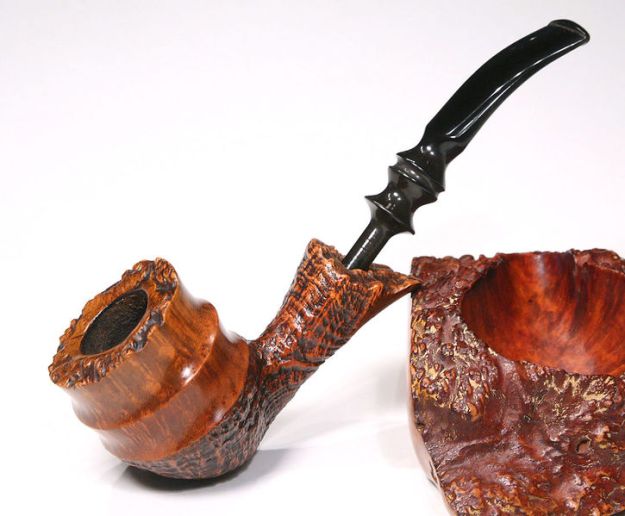
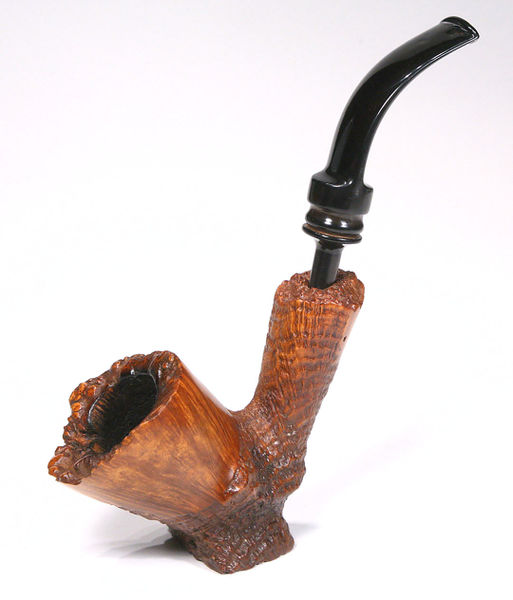
This Soren is the last of the freehand pipes that I had purchased on eBay. Well, this pipe is definitely the smallest of all the four, but it is also the only sitter of this lot!!!!! The medium size of the bowl, angle between the stummel and shank with a fancy stem, lends this pipe a look which is both very attractive and functional at the same time.

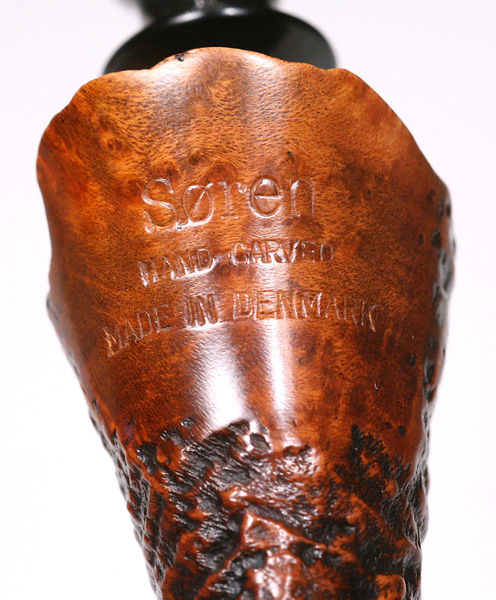
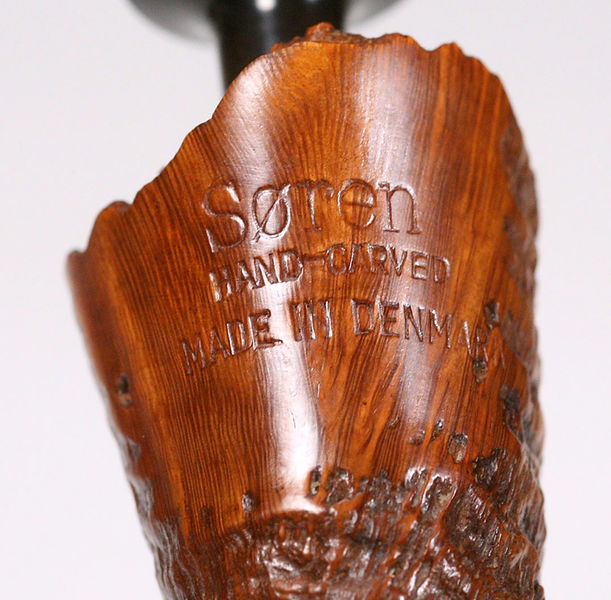
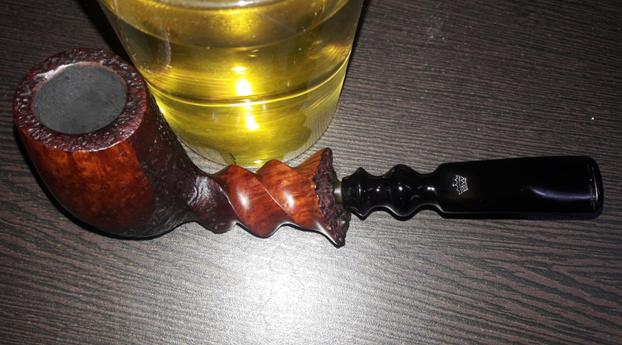
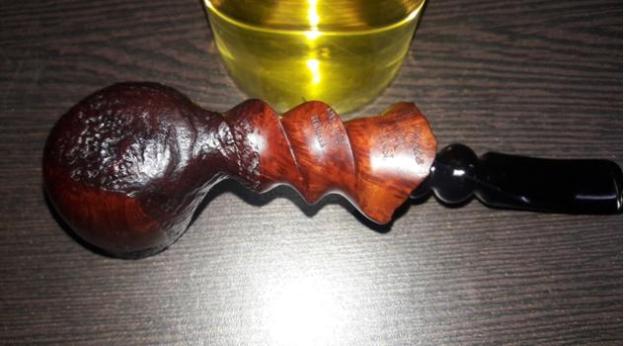
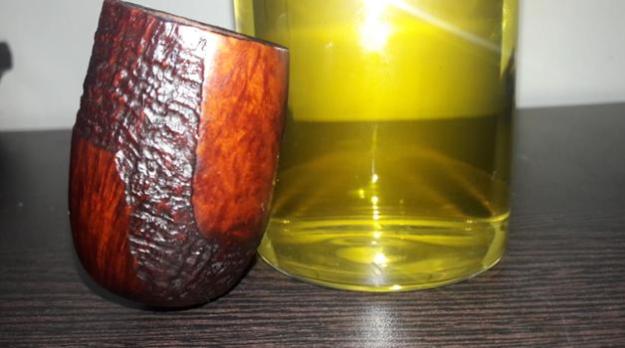
The pipe has a combination of smooth surface and sandblast finishes.  These sandblast portions are seen along the entire length of the shank, save for a small smooth portion on the lower surface at the shank end. This smooth portion bears the only stamping seen on this pipe, “Soren” over “HAND-CARVED” over “MADE IN DENMARK”. The upper portion of the stummel shows irregularly designed straight grained smooth surface while the lower portion and the shank, less the stamped portion,  is sandblasted which give this pipe its unique appearance!!! The plateau rim top has a smooth thin surface very close to the inner edge. I absolutely loved this pipe. I searched the internet for information on this pipe. Pipedia has some interesting snippet of information on the carver of this pipe, which I have reproduced below:

“Søren Refbjerg Rasmussen founded a company in 1969, which employed an average of 8 – 12 craftsmen in the 1970’s. The semi-freehands they produced were traded under his prename Søren. Rasmussen himself finished only the very best pipes. So his way of pipemaking closely resembled the ways of Preben Holm, Karl Erik Ottendahl or Erik Nørding. Altogether more than 1,000,000 pipes were sold.

Today he works alone as Refbjerg and manufactures only a small number of pipes in his workshop in DK-2860 Søborg, which are considered to be tremendously precisely executed. The dimensions mostly range from small to medium sized, corresponding to his personal preferences. The shapes adhere to the classical models, but often he gives them a touch of Danish flair. Refbjerg accepts minor faults but never uses any fillings. “Straight Grain” is the only grading, used for his very best pieces. He likes stem decorations made of exotic woods or metal rings.

As Rainer Barbi once stated “Refbjerg uses only briar from Corsica and more than that, he’s the one and only to import it from there, at least in Europe. He’s supplier to the vast majority of the Danish makers”.

Examples and nomenclature, courtesy Doug Valitchka Initial inspection of the pipe revealed the following
There is a thick layer of cake in the bowl. The external surface of the stummel feels solid to the touch and I think there are no issues with the condition of the chamber. However, there are always surprises when you least expect them!!! I have learnt my lessons!!! Thus, condition of the inner walls of the chamber will be ascertained once the chamber has been reamed and the cake is taken back to the bare briar. The plateau rim top and shank end is covered in the overflow of lava, dirt and grime. This will have to be cleaned. The condition of the inner edge will be determined only after removing the cake. The air way in the shank is clogged with oils and tars and will require a thorough cleaning.The stem is firmly stuck to the shank and will not budge. However, other than heavy oxidation, there are no other issues noticed on the stem. The stummel is covered in dust, dirt, oils and grime. The stummel looks dull and lackluster. The grains on the smooth surface and the sandblast are all covered in tars, oils and grime. To be able to appreciate these grains and sandblast, the stummel will have to be cleaned. THE PROCESS
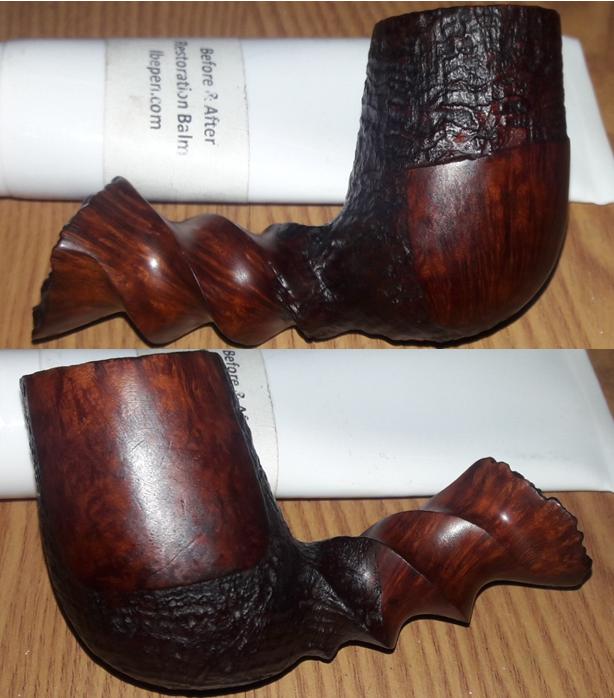
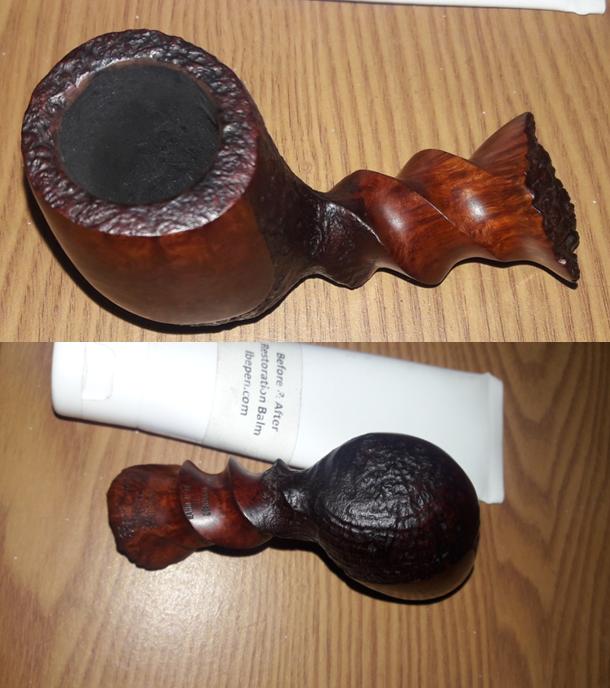
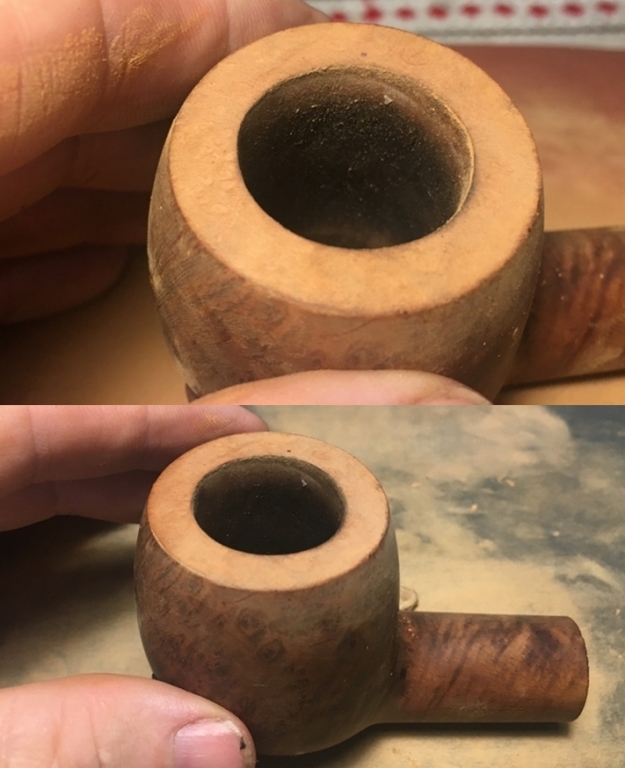
Before I could start the work of cleaning the pipe, I kept it in the freezer for a couple of hours so as to separate the stem from the shank. I removed the pipe from the freezer and tried to remove the stem, but it still did not budge! I let it rest outside for an hour and after applying considerable force, the stem came free. I had followed a YouTube video where the stem was soaked in a solution of hot water and Hydrogen Peroxide in the ratio of 2:1. The stem oxidation had risen to the surface and was much easier to remove. I cleaned the insides of the stem with pipe cleaners and hard bristled pipe cleaners dipped in alcohol. Once the internals were clean and dry, I wiped the stem surface with magic clean sponge and followed it with polishing with micromesh pads. I applied extra virgin olive oil on the stem surface and set it aside to be absorbed by the stem. I am afraid, in my enthusiasm to try out new technique of using Hydrogen Peroxide; I just missed out on taking pictures of each step. Using a Kleen Reem pipe reamer, I removed all the carbon cake from the chamber. This was followed by sanding the inner walls of the chamber with 220 grit sand paper. The internal walls of the chamber were flawless and solid. Thereafter, using Murphy’s oil soap ( undiluted ) and a hard bristled toothbrush on the exterior of the bowl, shank and rim, the pipe was thoroughly cleaned and rinsed under running tap water. I immediately wiped it down with a soft cloth. The sandblast and the smooth surface were now clean and the briar looked clean and solid. I then left the briar to dry out. Once the briar had dried out completely, I rubbed in Before and After Restoration Balm deep into the sandblast as well as the rim top. The bowl was then wiped vigorously with a soft cloth and buffed with a horse hair shoe brush. The result is very pleasing and satisfying to the eyes! I am happy with this progress. This balm is a fantastic product for infusing a nice shine into the briar and giving it a new lease of life.The finished pipe is as shown below. I enjoyed working on this lot of four freehand pipes and each of these pipes has its own individuality and each is beautiful in its own way. I hope you too enjoyed joining me on this wondrous journey of exploring the freehand pipes!!!!!  Thank you for your patience and as always, any suggestions and/ or improvements will help me in learning this art of restoration.

RESTORING A BEN WADE “SPIRAL”


Blog by Paresh Deshpande

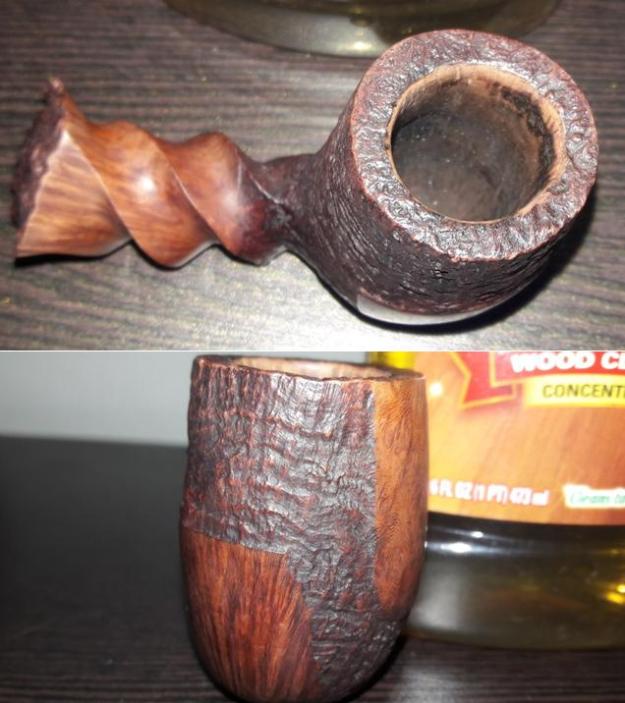
The third of the four freehand pipes purchased on eBay and currently on my work table is the BEN WADE “SPIRAL”. This is a huge sized pipe and fills the hand nicely with its size, weight and heft. I was attracted to this pipe because of its size and the unique spiraled shank. Another factor was the fact that my inherited collection had quite a few numbers of Danish pipes like the Stanwells, Amphoras, Kriswells and SONs. Thus, when I first saw the pipe on eBay, the name Ben Wade sounded so British and when I read the description and the stampings of Made In Denmark, I was immediately interested and intrigued at the same time!!! I got this pipe fairly cheap and the excellent condition it was in when it arrived, further sweetened the deal. This appears to be a simple and straight forward cleaning job from the looks of it.

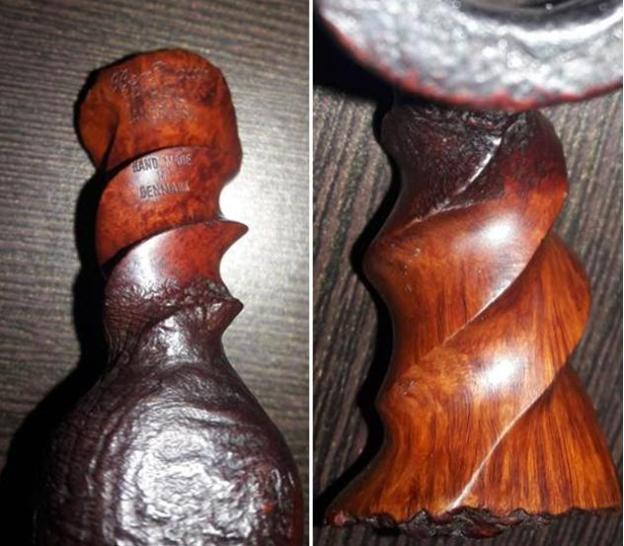
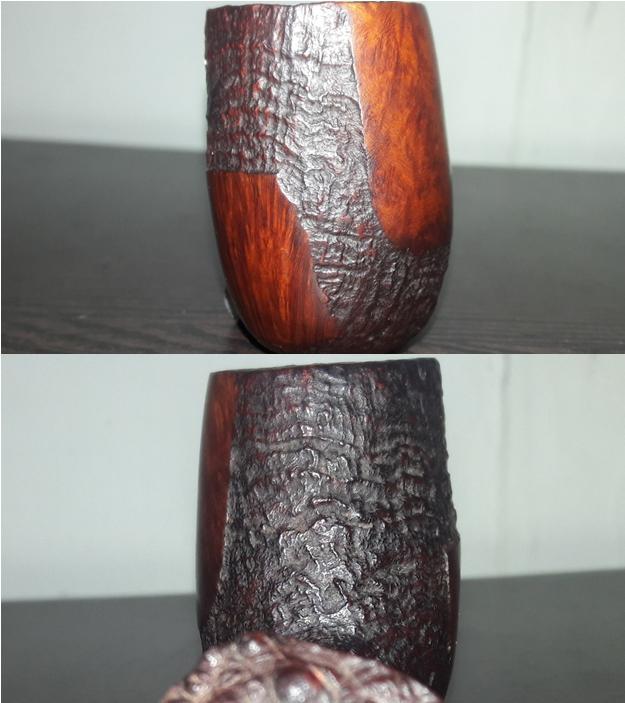
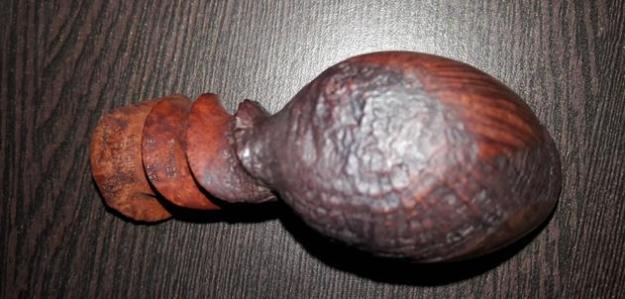
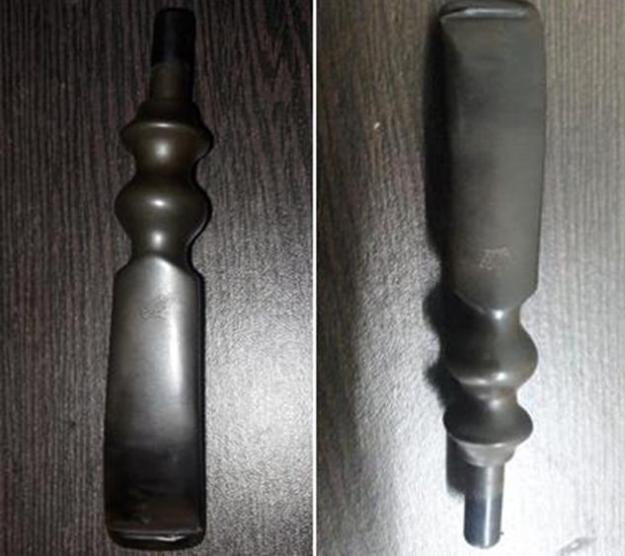
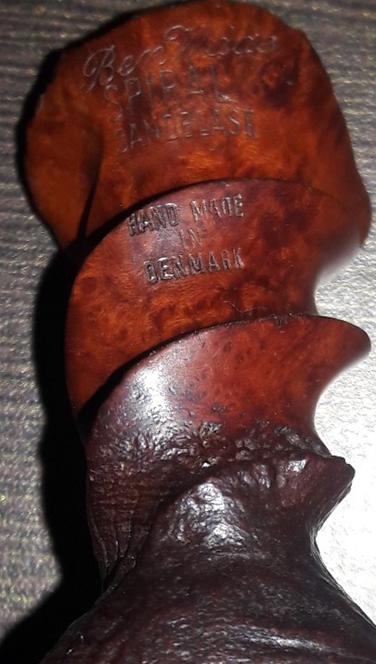
The stummel shows a combination of sandblasted and smooth surfaces. It shows smooth surface on the left side extending 2/3 way down from rim top towards the heel of the bowl and on the right side it extends from the base of the bowl to 1/3 way upwards towards the rim top.The shank has beautiful and evenly spaced 5 spirals, first half from the bowl end is sandblasted while the remaining half towards the shank end is smooth and bears the stampings “Ben Wade” over “SPIRAL” over “SANDBLAST” over “HAND MADE” over “IN” over “DENMARK”. These stampings are seen in the first and third spiral of the shank. The stem bears the Ben Wade logo of the initials in capital letters ensconced within a crown on the top surface of the stem near the tenon end. All the stampings are clear and crisp. There is some very interesting history on Ben Wade pipes which I got from pipedia.org. Some interesting snippets of information are reproduced below:-

The company was founded by Benjamin Wade in 1860 in Leeds, Yorkshire, where it was located for over a century. Ben Wade started as a pipe trader, but  in the 1860’s he established a workshop to produce briar pipes. The pipes were made in very many standard shapes – always extensively classic and “very British”. Many models tended to be of smaller dimensions. Ben Wade offered a very high standard of craftsmanship and quality without any fills. Thus the pipes were considered to be high grade and a major competitor to other famous English brands.

In the second World War the factory was destroyed by German air raids on Leeds. But the Ben Wade family decided to re-build it immediately after the war and pipe production was re-started soon and successfully linked to the fame from the pre-war years.

Before the second war Ben Wade clustered their offerings into three price points: “Ben Wade” included the higher end pipes (eg the Larnix, Super Grain, Selected Grain, etc), “BW” included the mid-level pipes (eg Statesman, Natural Grain, County, etc), and “BWL” were the least expensive (eg Hurlingham, Adelphi, Tense Grain). Champion was in the last group, and in the 1930s at least retailed for 2/6.

Ben Wade turns Danish

Young Copenhagen master pipemaker Preben Holm had made a meteoric career heading a pipe manufacture employing 45 people at the age of 22! But around the turn of 1970/71 he was in major financial difficulties. His US distributor, Snug Harbour Ltd. in New York City, left him in the lurch. Holm had three unpaid invoices on his desk and another large shipment was ready for the USA, when Snug Harbour’s manager told him on the phone that there was no money at all on the account to pay him.

So the Dane went to New York for an almost desparate search for a new distribution partner. He made contacts with Lane Ltd. and met Herman G. Lane in February 1971. Lane Ltd. had no interest in Holm’s serial pipes produced at that time but so much the more in the hand-carved freehands because the hype for Danish freehands and fancies in the States was still on its way to the climax then. The meeting resulted in an agreement to start cooperation. Lane insisted to improve the quality considerably and in return he assured to be able to sell essentially larger quantities.

Holm went back home to work on new samples with all-new designs and altered finishes for Lane. Both, Lane and Holm, agreed that it would be unwise to sell the pipes under Preben Holm’s name as long as Snug Harbour had a considerable stock of Preben Holm pipes and might sell them pipes at very low prices just to bring in some money.

So on Mr. Lane’s proposal it was determined to use the name Ben Wade belonging to Lane Ltd. Lane spend considerable amounts of money for advertising the new brand in the big magazines– the centerpiece being whole-page ads showing a very exclusive Seven Day’s Set.

The cooperation with Lane Ltd. proved to be an eminent business success for both partners. Within a very short time Ben Wade Handmade Denmark sold in much larger quantities and at higher prices than they had ever dreamed of. And the hype these freehands and fancy pipes caused went on unbroken long after Herman G. Lane deceased. Preben Holm – obviously much more brilliant in pipe making than in pipe business – was in major troubles again in 1986 and had to sack most of his staff. The Ben Wade production was significantly lowered but continued until his untimely death in June of 1989. Up to now Preben Holm made Ben Wade pipes are cult and highly sought for on the estate markets.

From the above information, I can say with some certainty that this line of pipes was made between the years 1971 to 1986.

INITIAL VISUAL INSPECTION
This Ben Wade has a huge size and fills the hand nicely and has a combination of smooth and sandblasted surfaces. The sandblasted areas are filled with dust and grime which can be easily seen in the crevices of the blast. The smooth surface is also covered in the tobacco oils and oils secreted by sweating palms giving it a dull and lackluster appearance. There are no blemishes in the briar of the stummel or the shank that can be seen. I surmise that a nice scrub with Murphy’s oil soap and a hard bristled toothbrush should suffice to clean the stummel and the shank. The rim top is sandblasted and is covered in overflow of lava, tars and grime. There is no apparent damage to the inner and outer edge of the rim that can be seen, like a charred rim or an out of round bowl or chips and dents. However, the condition will be ascertained once the chamber has been reamed and the overflow of lava is removed from the rim surface. The chamber shows uneven cake build up with a thicker build up at the bottom and progressively reducing towards the rim top. The condition of the walls will be ascertained once the chamber has been reamed and the cake has been taken down to the bare briar. However, the stummel feels solid to the touch with no soft briar anywhere which is indicative of the likelihood of a burnout or major heat fissures.The beautiful and unique spiral shank has crisp edges to the spirals and just needs to be cleaned for the straight grains to pop out in their complete splendor. The plateau shank end is filled with dirt, grime and will need to be cleaned. The airway in the shank shows a blockage during the blow test and should be an easy clean up.The high quality vulcanite fancy stem is oxidized and the “BW WITH CROWN” logo appears faded as it is covered in oxidation. This needs to be addressed and the preservation of the stem logo attempted.Deeper tooth chatter peppers both the upper and lower surfaces of the stem. However, the bite marks are more pronounced and numerous on the lower surface. I shall try to raise these to the surface by flaming with Bic lighter and the deeper ones will be filled with CA superglue. Buttons show light deformation due to bite marks and will need to be sharpened. It is interesting to observe that these tooth indentations are slightly more forward towards the tenon end rather than the button end!!! Probably, the huge size and the front heavy bowl necessitate clenching it forward for better balance.THE PROCESS
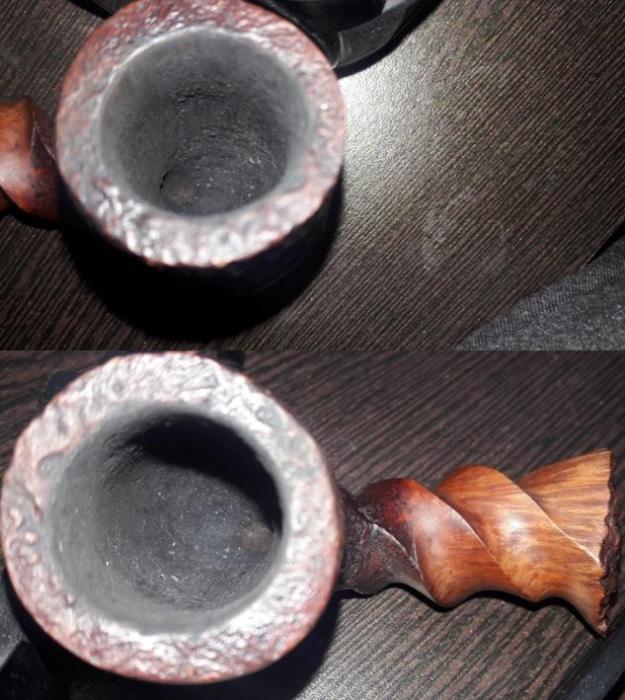
I started the restoration process by reaming the chamber with a Kleen Reem pipe reamer followed by scrapping the remaining cake from the chamber with my fabricated knife. The cake was hard and dry. I further removed the cake using a 220 grit sand paper and sanded the walls till the solid bare briar was reached. I wiped down the interiors of the chamber with a cotton swab dipped in alcohol to clean the chamber of all the carbon dust and inspect the inner wall condition. And there it was, a sight which every restorer, experienced or a novice silently prays is not seen…… the beginnings of a crack/ heat fissures!!!!! The following pictures show the extent of these fissures. I shall address this issue later after I have cleaned the stummel and the stem, both internally and externally. This was followed by cleaning the internals of the shank and the airway. I attempted to insert a hard bristled pipe cleaner dipped in isopropyl alcohol through the airway in the shank and realized that there was no give for the pipe cleaner half way through the mortise. The blockage called for a more aggressive method of cleaning!!! Using a fabricated (again…. I have modified and fabricated a number of tools which I find useful in my restoration processes as the sophisticated and designated tools are not easily available to me and those available are too expensive!!!) Dental spatula, I scraped all the grunge, oils and tars from the mortise. However, a pipe cleaner would still not pass through!! I shone a torch light in to the chamber and looking through the shank, I realized that the blockage was nearer to the draught hole as the light did not pass through. I addressed this issue by inserting a rounded needle file and dislodging the blockage. I further scrubbed the walls of the draught hole and the mortise with the rounded needle file. Once I was satisfied with the filing, I thoroughly cleaned the mortise and the airway using a shank brush, q-tips and pipe cleaners, all dipped in isopropyl alcohol, till the pipe cleaners and q-tips came out clean. I checked the draw and it was nice, smooth and full. With the insides of the stummel and shank cleaned and freshened up, I turned my attention to the exterior of the bowl. Using Murphy’s oil soap and a toothbrush, I cleaned the exterior of the bowl. I gave a very deliberate scrub to the bowl and into the rustications to remove all the dust, dirt and grime that had accumulated over the years. I purposefully avoided brass brush/ steel wool while cleaning so as not to damage the sandblast. Once the cleaning with the oil soap was done, I rinsed it under running tap water and wiped it dry with a soft cotton cloth. I took care that the water does not enter into the chamber and the shank. I wiped and dried the stummel with a paper napkin and a soft cotton cloth. The bowl now has a nice, beautiful, clean and robust look to it. I kept the bowl aside to dry out and turned my attention to the stem. Turning my attention to the stem, I cleaned the stem surface with Magic Clean sponge and followed it up by flaming the surface of the stem with the flame of a Bic lighter to raise the minor tooth chatter and bite marks to the surface. This was followed by the sanding with a 220 grit sand paper. This serves two purposes; firstly, it reduces the size of the fills as well as evens out the surface of the stem for the fill and secondly, it has been my experience that if the stem oxidation is removed before the fill, the end result is a nice black and shining finish and not the dirty brown spots wherever the stem has been filled. I followed it up with sanding the stem surface with a 600 grit sand paper. I spot filled the deeper bite marks with clear CA superglue and set it aside to cure overnight. I had covered the stem logo with a whitener in order to highlight the stem logo. The extent of highlight will depend on the depth remaining in the stamping. While the fills in the stem were curing, I decided to address the beginnings of the very minor issues of heat fissures in the chamber. I mixed an adequate quantity of pipe ash, activated charcoal with yogurt to form a thick slurry and applied it as evenly as possible all along the inner walls of the chamber. This too, was set aside to cure/ dry along with the stem.  The next day, once I was satisfied with the cure, using a flat head needle file, I sanded the fill to match it with the stem surface and also to sharpen the edges of the buttons on either surface. I further matched the fills and sharpened the buttons by sanding with 220, 600 and 800 grit sand paper. The stem was polished with micromesh pads, wet sanding with 1500 to 2400 grit pads followed by dry sanding with 3200 to 12000 grit pads. I rubbed a little extra virgin olive oil with my fingers in to the stem. After I was through with the last grit pad, I gave a final rub of extra virgin olive oil and set it aside to be absorbed by the stem. It had taken a couple of days for the coating of pipe mud to completely cure and dry out. I very lightly sanded the chamber coating with a 600 grit sand paper to even and smooth out the surface of the chamber.Once I was done with the chamber, I gave the external surface of the stummel a good clean up with a dry soft cloth to remove any dust/dirt that might have settled on the bowl overnight. Thereafter, I rubbed a small quantity of “Before and After Restoration Balm” into the bowl ensuring that it reaches the rustication also. I am truly amazed at the spread of this balm!  Just a small quantity quickly spreads and is sufficient to coat the entire bowl when rubbed with the fingers. The product was further rubbed into the rustication when buffed, using a horsehair shoe brush. I let it rest for a few minutes to let the balm work its magic on the briar. The transformation is amazing!! Once this was done, it was back to using muscle power to enhance the shine and beauty of the sandblast and the smooth surfaces by prolonged rubbing with a soft cloth followed by a microfiber cloth. I finished the pipe restoration by attaching the stem with the stummel and giving it a nice rub with a microfiber cloth. The pipe now has a nice and deep shine to it. The finished pipe is shown below. Thank you for sparing your valuable time in going through this write up.

Salvaging a ‘Really’ Poor Richard’s of Italy Giant Billiard


Blog by Dal Stanton

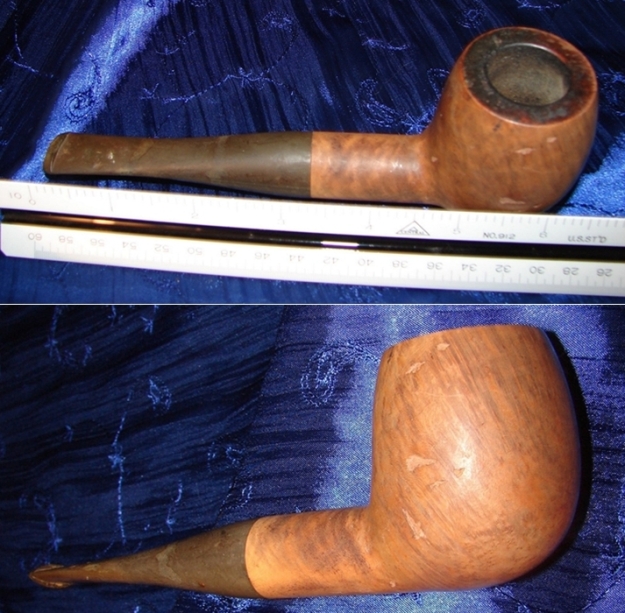
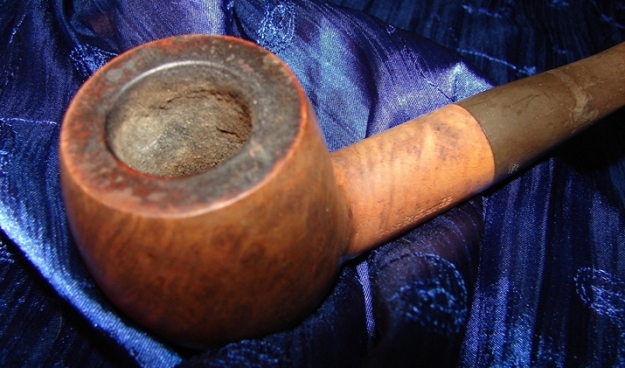
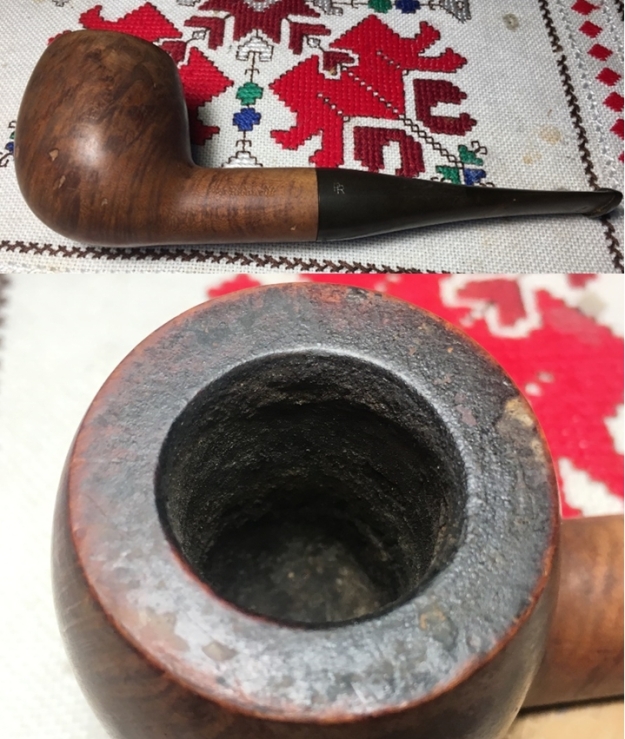
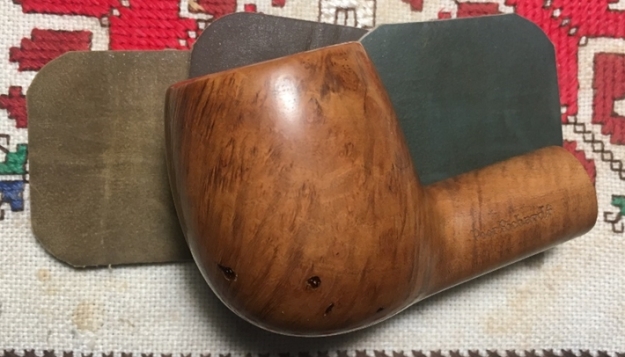
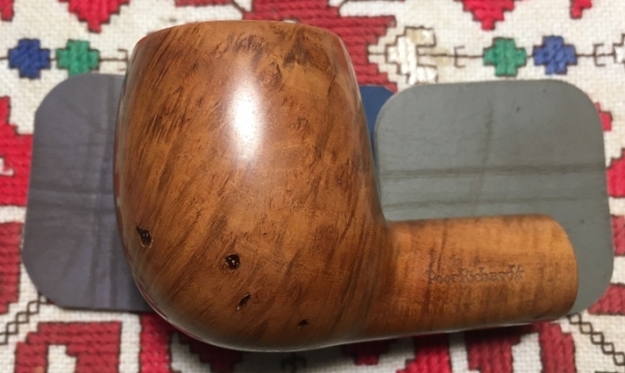
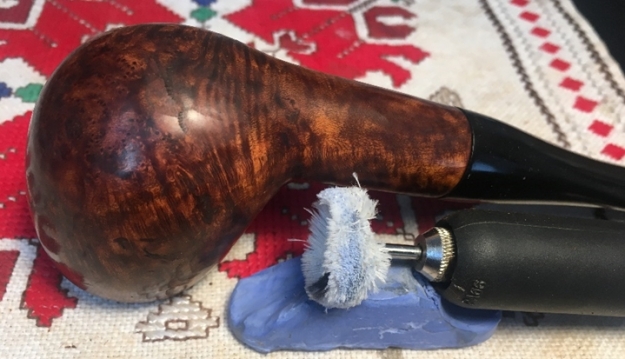
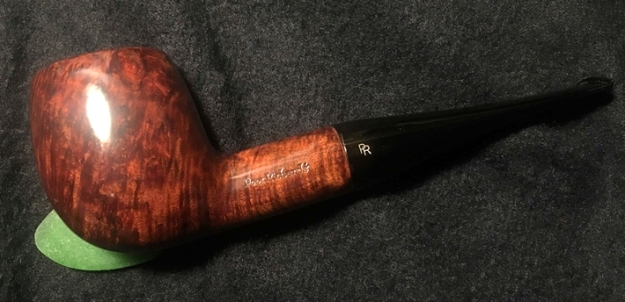
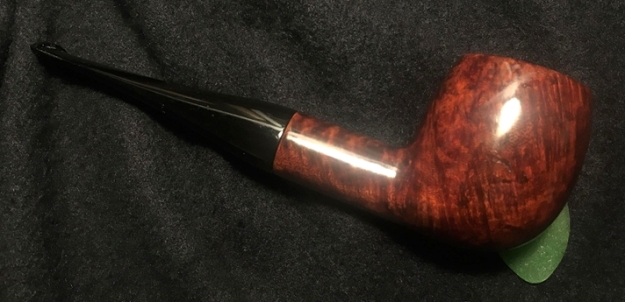
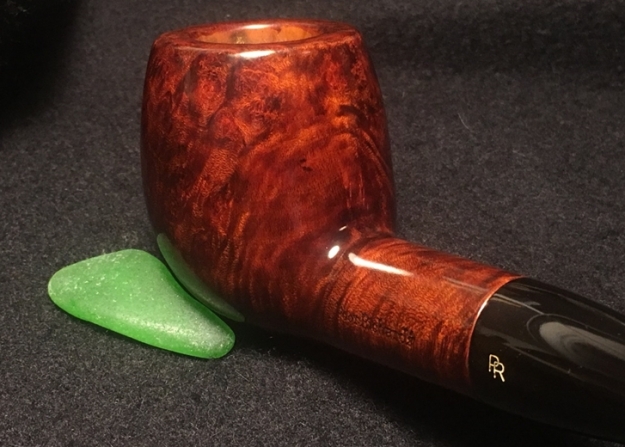
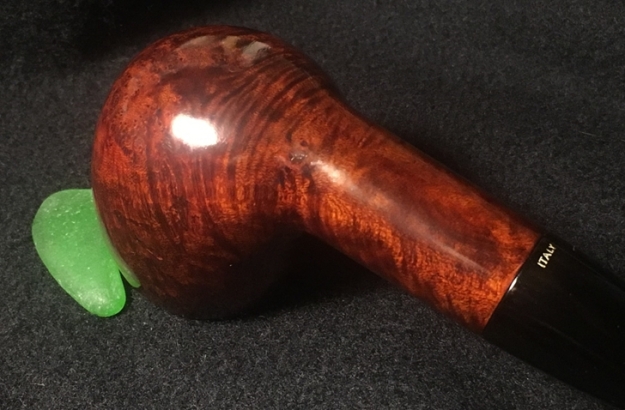
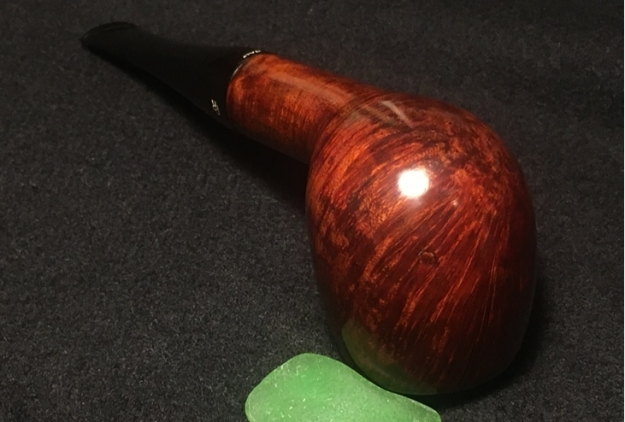
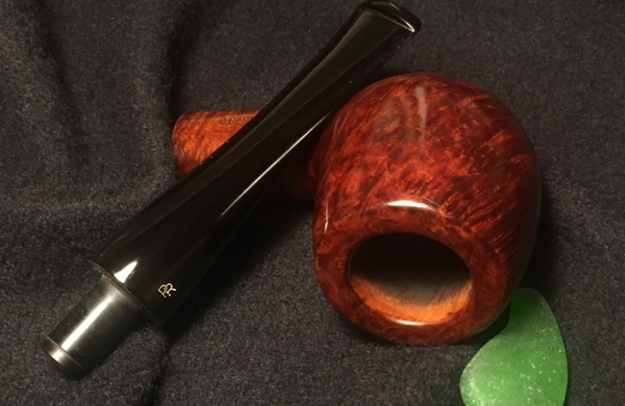
Let’s be honest. When I saw this Poor Richard’s on the eBay auction block I thought the name was a joke by the seller.  He WAS huge (L: 6 3/4”, H: 2 1/8”, Rim W: 1 1/2″, Chamber W: 7/8”, Chamber D: 1 7/8”, Weight: 74gr), no doubt, but his condition could qualify him for the title: King of the Basket Pipe Realm.  His condition was indeed poor and adding to the ‘joke’ was that he was displayed on satiny royal purple material.  But the clincher was coming. Adding insult to injury, the seller’s byline description under Poor Richard’s picture was: Poor Richard’s Classic Bulldog Large Estate Pipe Beautiful !!!  Nice  !!!  Bulldog?  I felt sorry for him.  I placed a bid and when the auction ended, it was no surprise that mine was the only bid seeking a new life for Poor Richard’s.  My wife’s response when she first saw Poor Richard’s was that Poor Richard’s dog got a hold of him!  Here are the pictures I saw. After bringing Poor Richard’s back to Bulgaria, I put him on my website in the For ‘Pipe Dreamers’ Only! section where my friend and fellow Pipe Dreamer from India, Paresh, saw him.  Poor Richard’s became the fourth pipe Paresh commissioned – all of them on the larger side and each one of them advancing our work here in Bulgaria benefiting the Daughters of Bulgaria, helping women and girls who have been trafficked and sexually exploited.

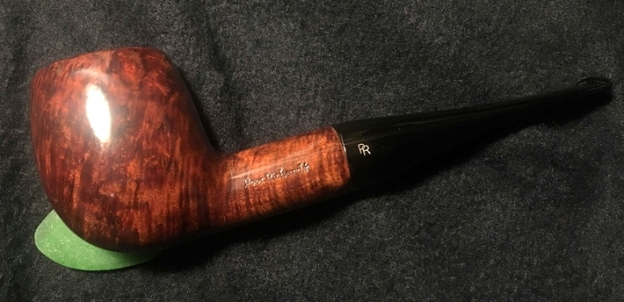
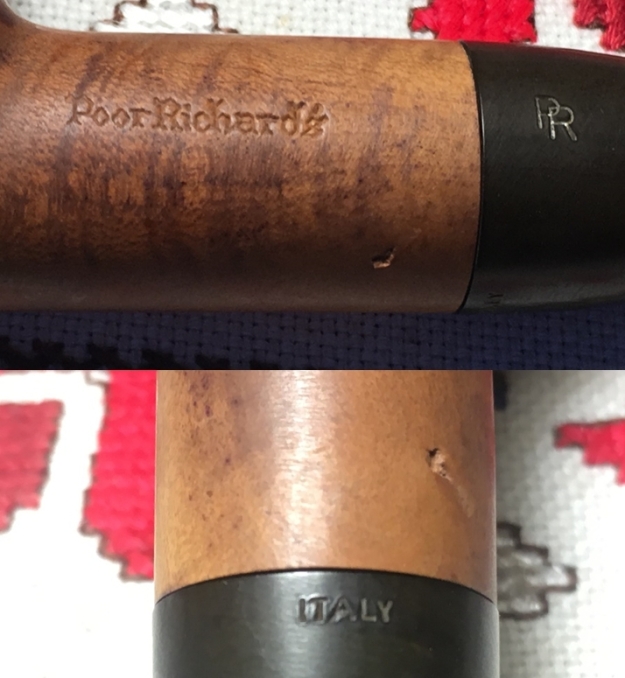
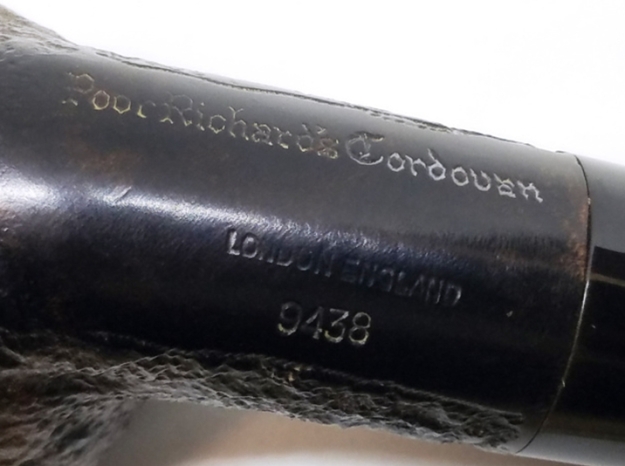
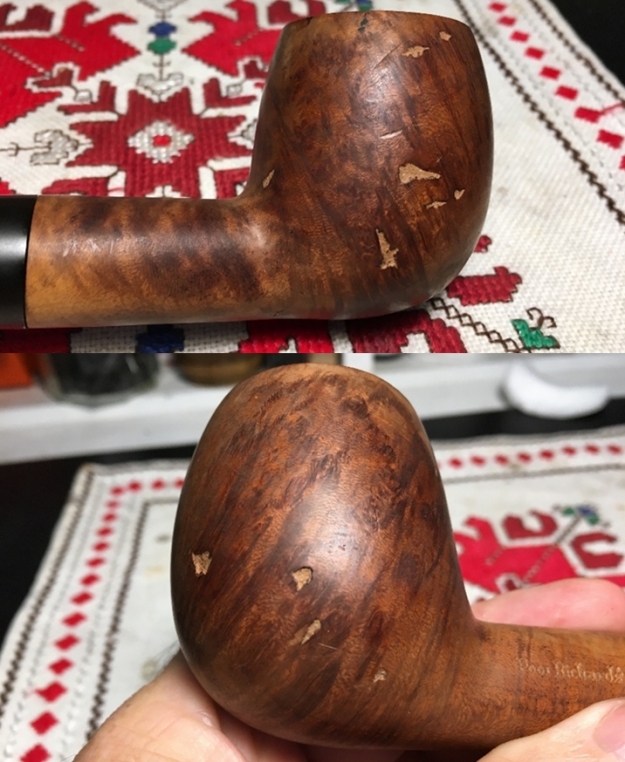
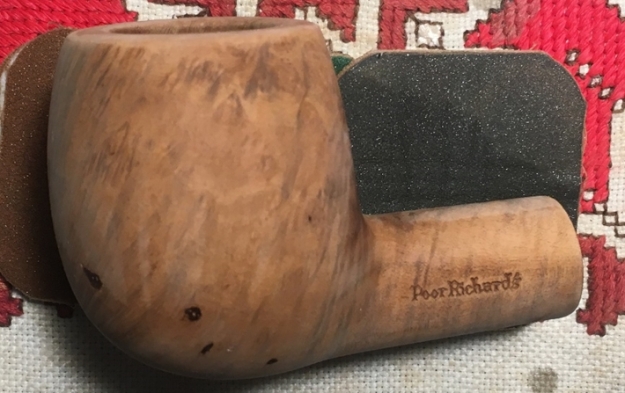
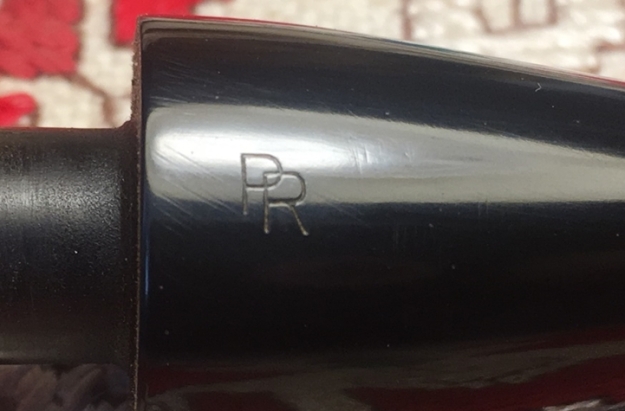
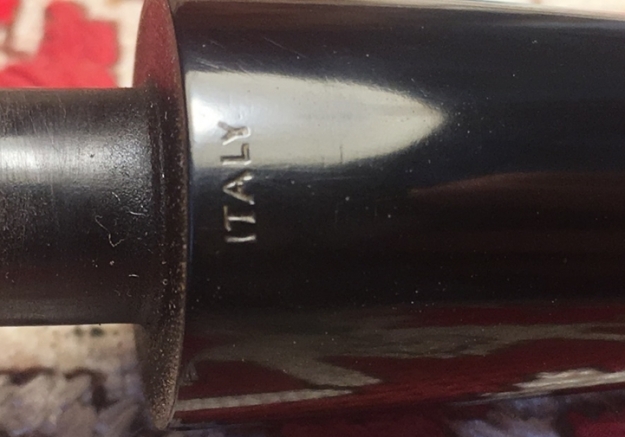
Taking more pictures on my worktable on the 10th floor of a formerly Communist ‘Block’ apartment building, the nomenclature on the left shank is ‘PoorRichard’s’ in what I call an ‘Old World’ script.  There are no other markings on the shank.  The stem is stamped with an interlocking ‘PR’.  The bottom of the stem is stamped with the COM, Italy.When I began doing the research on this Poor Richard’s, I recalled that rebornpipes’ contributor, Al Jones (aka: Upshallfan), had recently posted a restoration of a Poor Richards 9438 Cordovan Rhodesian shape.  Reading Al’s write-up was helpful because it clued me into the ‘mystery’ surrounding the origins of the Poor Richard’s name.  I noticed that our pipes shared the ‘Old World’ script nomenclature as well as the interlocking ‘PR’ stem stamp.  The obvious difference was the COMs – his, London, England and mine, Italy and his included a shape number, and mine, without.As I’ve done in the past with much benefit, I wrote to Al asking about the differences between our Poor Richard’s and what to make of the differing COMs?  His response was helpful:

Dal

Unfortunately, there is nothing but speculation about these Poor Richard pipes.  The one shop here, with that name, can’t even conclusively determine if they had shop pipes.

I suspect it was a shop pipe, made by various makers for this shop.  But a shop in Montana having shop pipes doesn’t exactly make sense either.  Usually shops with their own pipes were larger, and in metro areas, not out in the wilderness of Montana.

Poor Richard pipes are not listed in “Who Made That PIpe”, so my guess is still a shop pipe.  Perhaps that Montana shop was bigger than I presumed. 

I suspect Italian companies, like GBD made shop pipes as well.  Perhaps that one was made by Savinelli or other?  Without a shape number, it’s impossible to determine.

Have fun restoring it!

Al

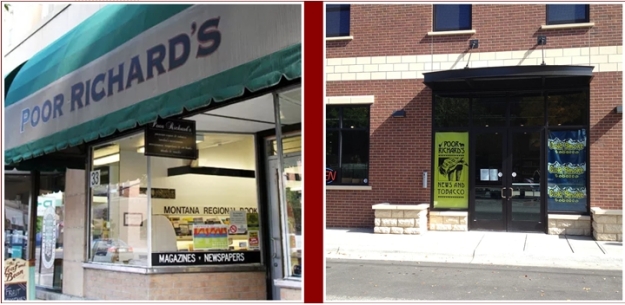
Al referenced the pipe shop in Montana that in a subsequent email he referenced that Steve had also worked on a Poor Richard’s attributed to the ‘Poor Richard’s’ pipe and tobacco shop in Bozeman, Montana. However, Al said that Steve’s Poor Richard’s pipe had a totally different nomenclature with Montana stamped on the pipe.  I found this write up on Rebornpipes and what a write up!  It was one of Steve’s and Charles Lemon’s classic collaborations including a pinning tutorial.  When these two masters get together, its fun to see the wonders happen!  (See this post which is worth the read:  A Humpty Dumpty Cross Canada Project – Could this Poor Richards Select Square Shank Billiard 9489 ever be whole again?)  Steve’s research on the Montana shop is good and saved me time and steps.  Since Steve’s write up in 2016, the website had changed and a description of Poor Richard’s history beginning in 1962 can be found here: History.  The following pictures show the shop early on and what it is today.Even with the mystery and the discrepancies with the nomenclatures, in researching different pipe shop pipes in the past (L. J. Peretti, Pipe Pub), I found that it’s common to have pipes manufactured in various places.  Another indicator that the Poor Richard’s nomenclature refers to a shop is simply because it is possessive – Richard’s, pointing to something else.  Whether there’s another Poor Richard’s shop other than the one in Bozeman, I don’t know.  This question has been lost to history.

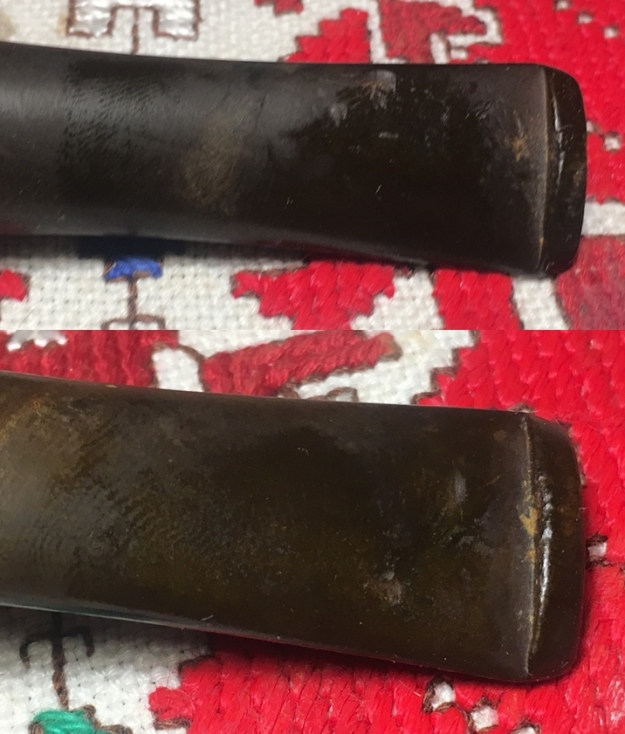
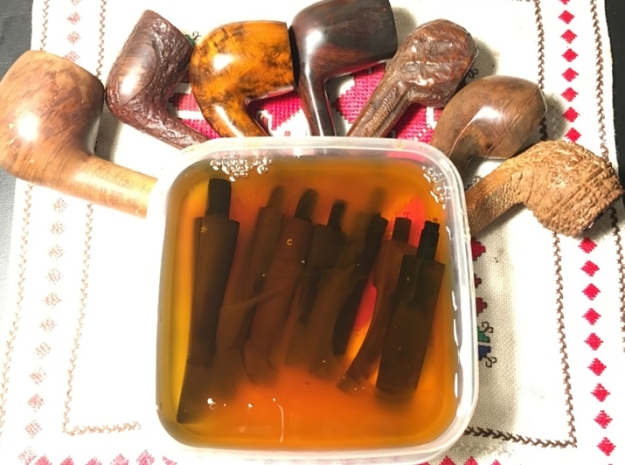
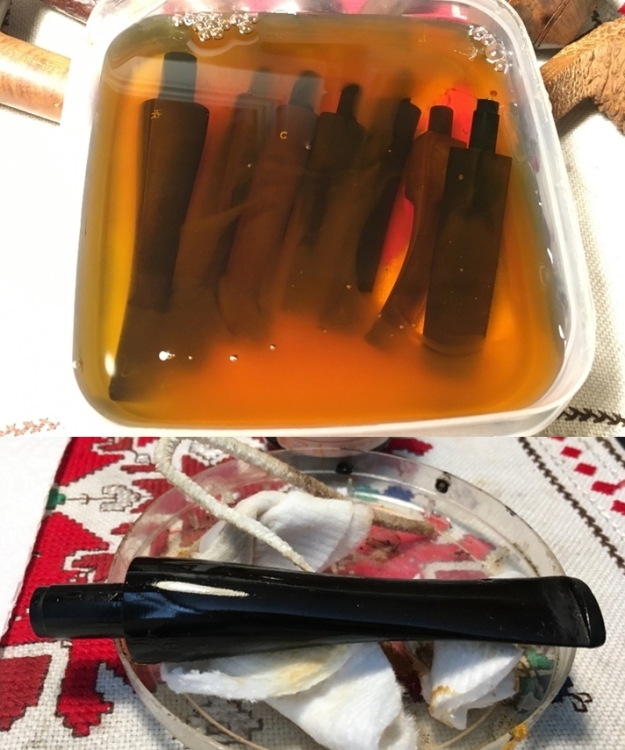
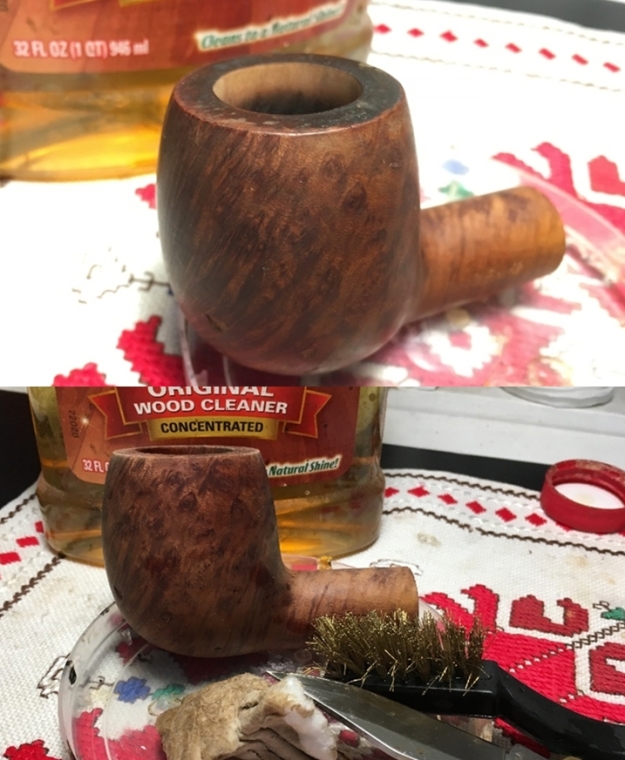
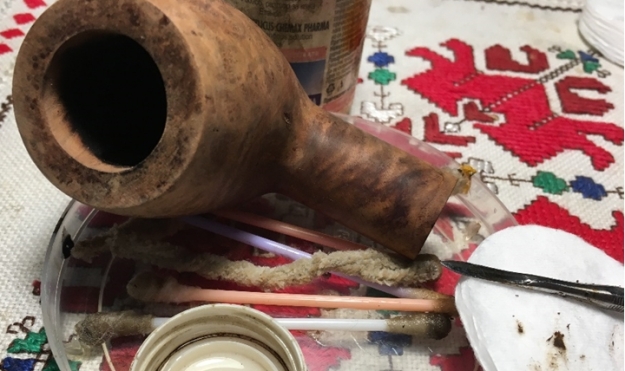
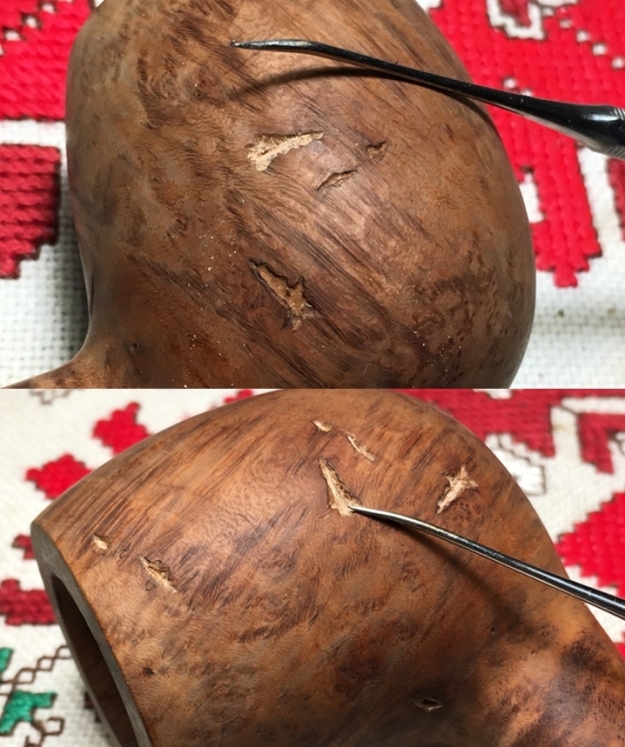
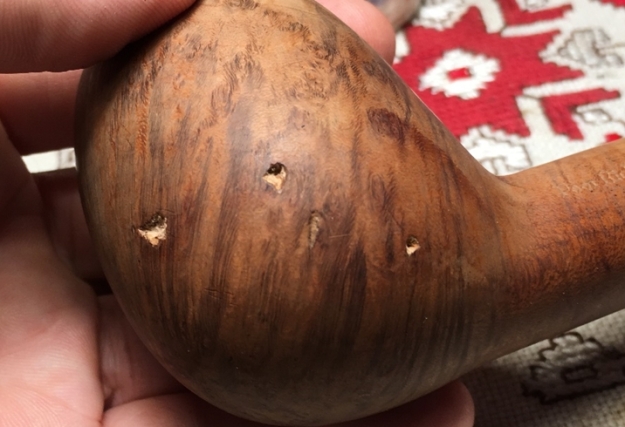
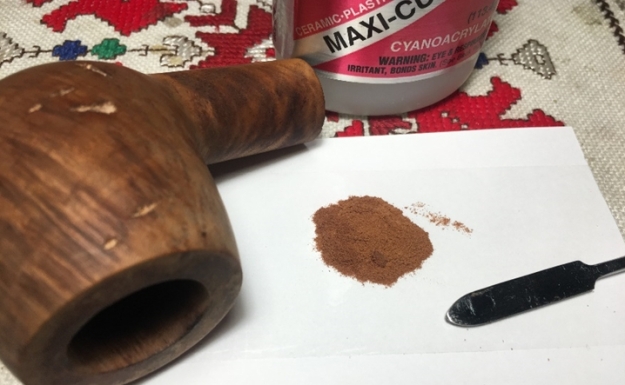
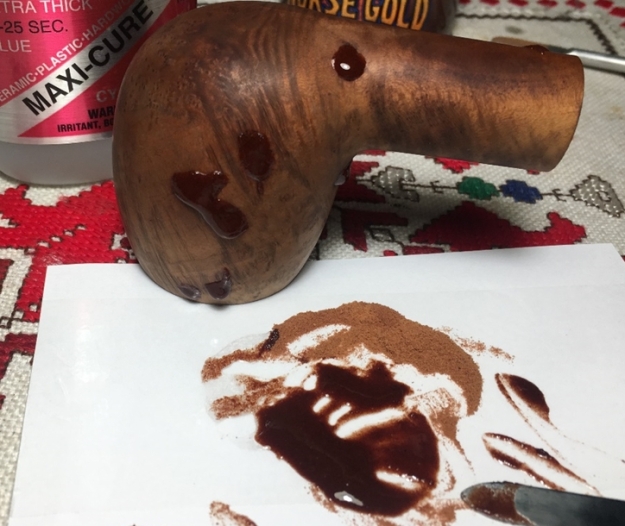
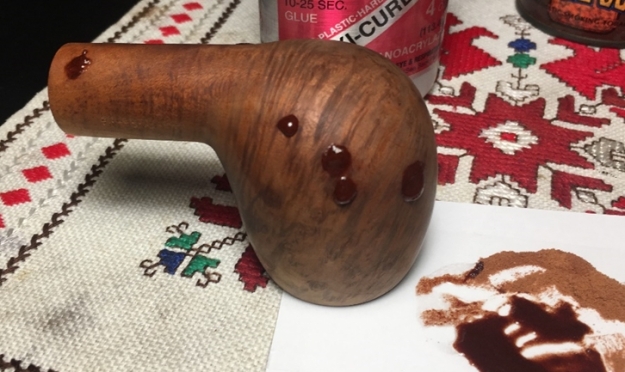
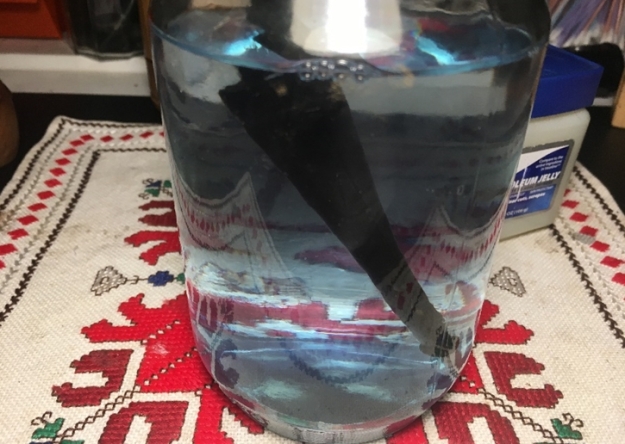
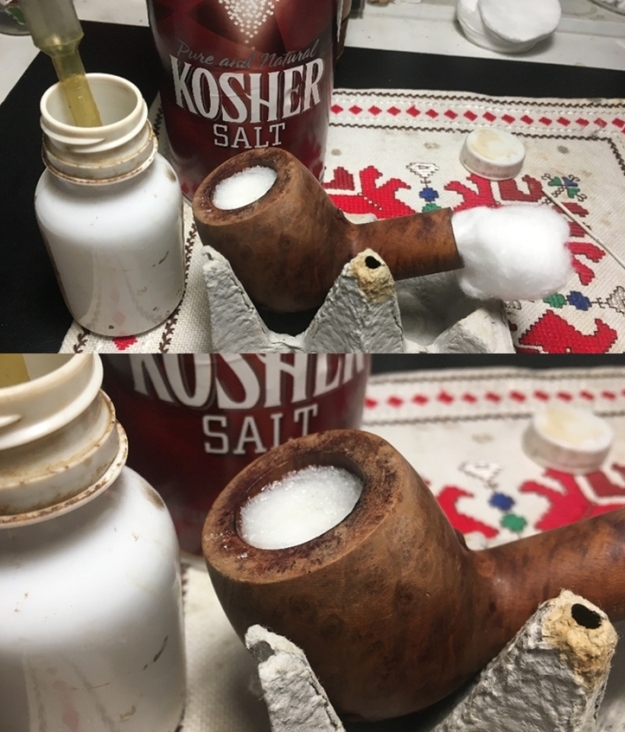
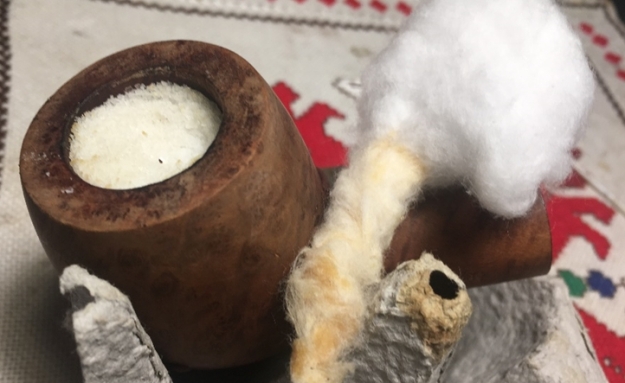
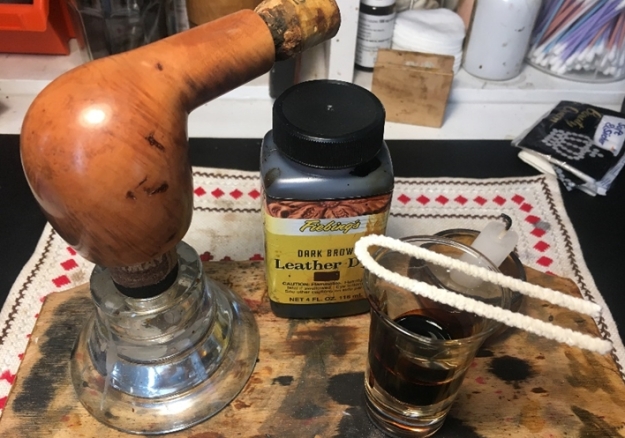
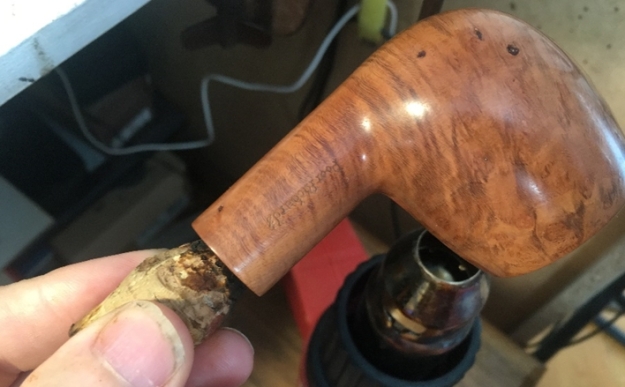
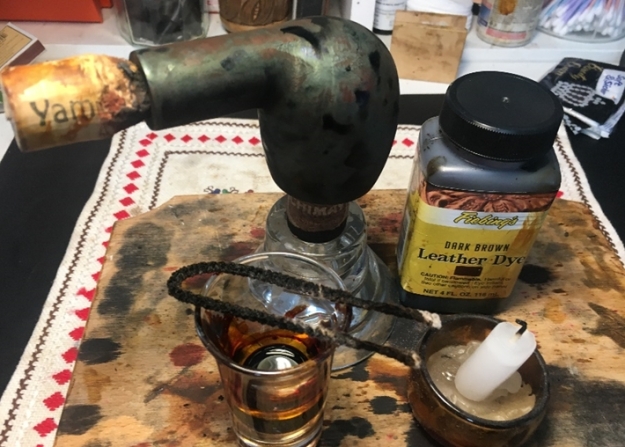
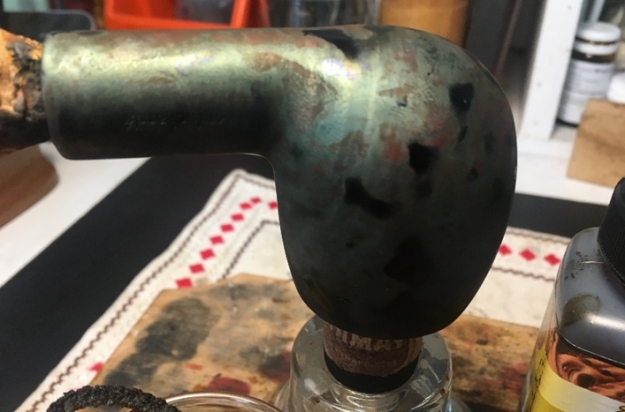
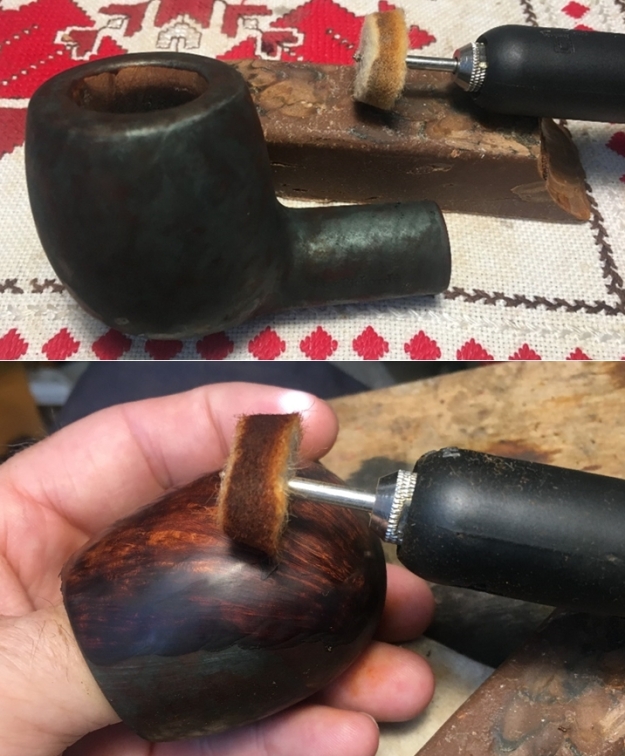
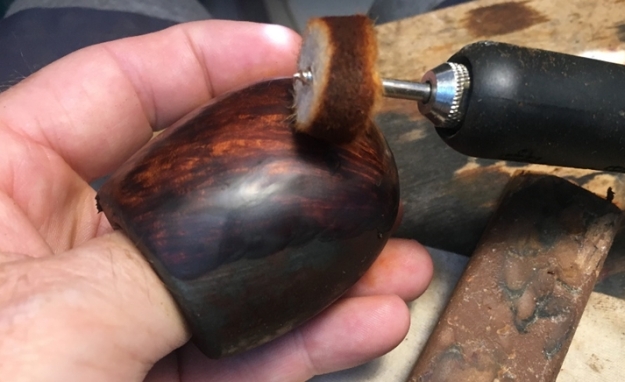
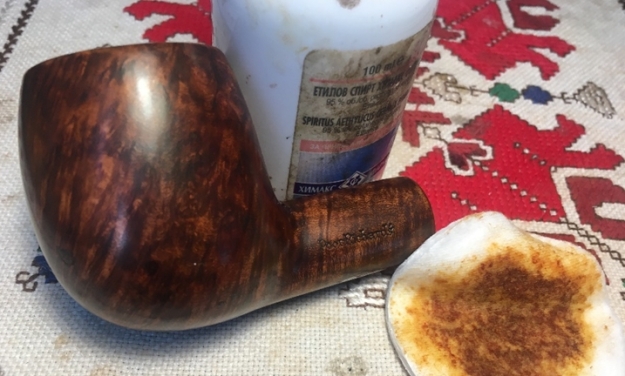
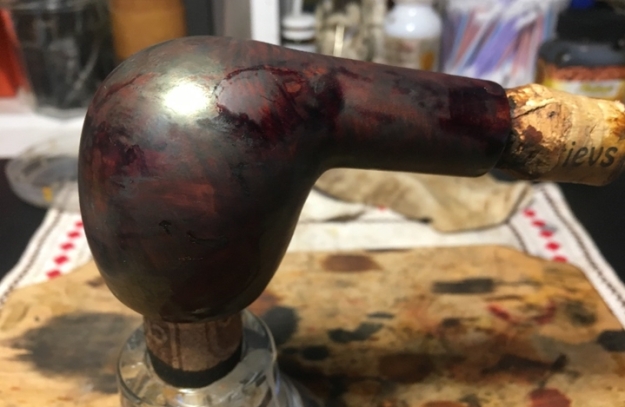
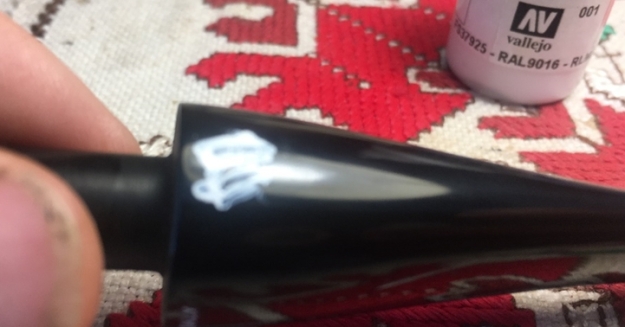
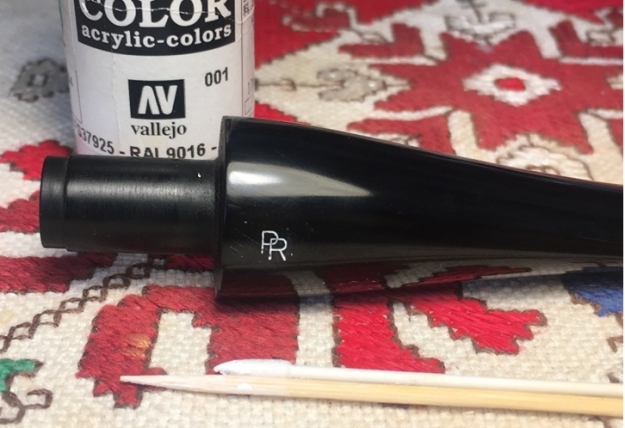
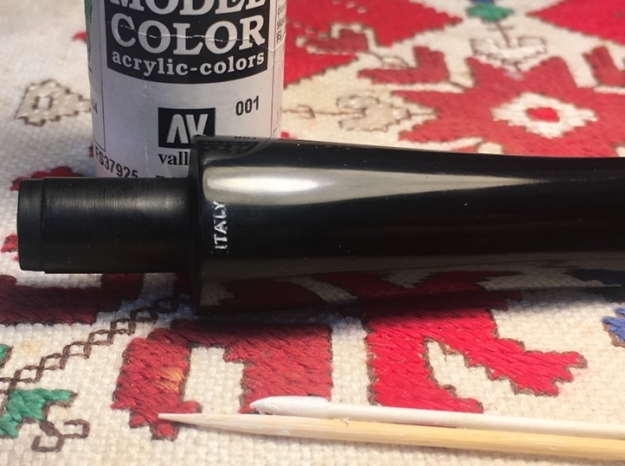
The condition of the giant Poor Richard’s before me now is poor. I take more pictures to take a closer look. The chamber has moderate cake build up that needs to be removed to inspect the condition of the chamber.  The lava flow on the rim is thick.  The stummel surface reminds one of a moonscape with all the craters in need of attention!  Along with the pits and holes there are dents and scrapes.  The oxidation on the stem is joined by bites and compressions on the lower and upper bit.  With a better understanding of the Poor Richard’s name, I begin the salvage of the giant Billiard by running pipe cleaners dipped in isopropyl 95% through the stem and then adding it to a soak of Before & After Deoxidizer along with several other commissioned pipes in the queue.  The Poor Richard’s stummel and stem are first on the left.  After letting it soak overnight, I fish out the Poor Richard’s stem and let the fluid drain off.  I then push a pipe cleaner through it to help remove the Deoxidizer.  I then wipe the stem with cotton pads wetted with isopropyl 95% to remove the raised oxidation from the vulcanite stem.  After wiping off with the alcohol, I then wipe again using a cotton pad and light paraffin oil (mineral oil) to clean and condition the stem further.  Finally, I run another pipe cleaner through the stem dipped in isopropyl 95%.  The pictures show the process. Taking the stummel, I use the Pipnet Reaming Kit to clean the chamber.  After putting paper towel down on the table for easier clean up, I start reaming using the third largest blade head since the chamber is so large.  I also use the fourth and largest blade to ream.  Following the reaming, I use the Savinelli Fitsall Pipe Tool to scrape the chamber walls removing additional carbon cake – especially down in the floor of the chamber with the difficult angles.  Then, after wrapping 240 grit paper around a Sharpie Pen, I sand the chamber walls removing additional carbon and smoothing the chamber surface.  I clean the chamber next using a cotton pad wetted with isopropyl 95%.  While inspecting the chamber, I do see some hairline heat cracks that are very small, but not serious enough to warrant repair.  Next, using undiluted Murphy’s Oil Soap I work on the external briar surface using a cotton pad.  I also use a brass wire brush on the rim to remove the lava and follow by carefully scraping the rim surface with a flat knife edge.  After scrubbing, I rinse the stummel in the sink with cool tap water.Turning to the internals, I use pipe cleaners and cotton buds dipped in isopropyl 95% to clean the mortise and airway. I also use a small dental spatula tool to scrape tars and oils off the mortise walls.  The cleaning wasn’t too bad. Later, I’ll continue cleaning the internals with a kosher salt and alcohol soak.With the internals cleaned, I now look at the stummel surface.  I have several fills to dig out and to fill.  My main tool in doing this is a sharp dental probe.  The goal is to only have a solid base in the holes – either old filler material or briar.  It takes quite a bit of time, but I move from fill to fill doing the needed excavation work. With the holes excavated, I prepare a batch of briar dust and CA glue patch to apply to the problem areas.  I scoop briar dust in a small mound on an index card and put a glob of thick CA glue next to the briar dust.  Using a dental spatula, I mix briar dust into the CA glue until I reach a thicker consistency, like molasses.  I then trowel the patch mixture into each of the holes leaving excess to be sanded down after cured.  The pictures show the process. With the Briar Dust patches curing, I turn to the stem.  After the soak in the Before & After Deoxidizer, much of the oxidation was removed.  But looking more closely, there remains oxidation but it’s much subdued. I decide to place the stem in another soak – this time with OxiClean.  I put a pipe cleaner through the stem and put it in the OxiClean to let it soak overnight.With the day ending, I continue the cleaning and refreshing of the stummel internals.  To do this I employ a kosher salt and alcohol soak.  First, I form a wick by stretching and twisting a cotton ball and with a stiff piece of wire, I stuff it down the mortise and airway.  It will serve to draw out tars and oils.  Then I fill the bowl with kosher salt and place the stummel in an egg crate to keep it stable.  With a large eyedropper, I fill the bowl with isopropyl 95% until it surfaces over the salt.  After a few minutes, I top off the alcohol as it is absorbed and turn out the lights.The next morning, there isn’t too much discoloration of the salt which means I didn’t put in enough alcohol or that the internals are clean.  The wick is darker.  I toss the expended salt into the waste, wipe the bowl with paper towel and blow through the mortise to remove remaining salt crystal.  I then use a shank brush on both the bowl and the mortise – blowing again.  Finally, to make sure all is clean and ready to go, I wet a cotton bud and pipe cleaner with isopropyl 95% and run them through the mortise and airway.  They come out clean and it’s time to move on. I put the stem in an OxiClean soak through the night and it’s time to fish it out.  I take a picture of the additional oxidation that has been raised and I take the stem to the sink and wet sand the stem with 600 grade paper to remove the oxidation.  It looks cleaner now after sanding.Looking more closely now at the bit area, there are good sized compressions.  The button also has some bite marks.  The first step is to use the heating method to see if it will expand the vulcanite reducing the severity of the compressions.  I use a Bic lighter and paint the upper- and lower-bit areas. The areas were lessoned, but not erased by heating the vulcanite. I then use 240 grade paper and sand the upper- and lower-bit areas as well as redefine the button with a flat needle file.  I take pictures of each step. First, the upper bit progress:After heating:After 240 sanding and filing:Progression of the lower bit area:After heating:After 240 sanding and filing: I’ve sanded out as much as will sand and now I will patch the areas that did not sand out.  I first wipe the stem with alcohol to clean the area.  I then apply black CA glue to the areas.  And I wait, and wait, and wait….  Well, I just discovered that Black CA glue can go flat and lose its ability to bond.  Reading the directions, is says to refrigerate to prolong shelf life.  Well, the shelf life must have been reached.  I wipe the old CA glue off and thankfully, I had purchased another bottle of Hyper Bond Black Rubber Reinforced CA glue.  I discover that the bottle mouth is larger than the squirt spouts that I have so I end up troweling a small bit of the glue on the end of a pointed dental spatula and apply it to the spot.  It works!  To advance the curing time I spray the upper and lower patches with an accelerator which does the trick.  The first picture, upper that didn’t cure and the new glue on the lower.  New bottle of glue is heading for the fridge! Next, taking a flat needle file I start filing the black CA patches staying on top of the glue mounds.  I then follow by using 240 grade sanding paper to bring the excess CA glue to flush with the vulcanite surface.  First, pictures showing the upper bit: The next step with the stem is to wet sand it with 600 grade paper then I follow by buffing the stem with 0000 steel wool to prepare the vulcanite surface for the micromesh pad phase of sanding.  The patches on the bit blended very nicely.I put the stem aside because I’m anxious to get started on the Poor Richard’s stummel.  I decide to start from the top and work down.  I will establish fresh lines for the rim and remove the surface scratches by topping the stummel.  I first use 240 grade paper on the chopping board and invert the stummel and rotate the stummel over the paper. After the 240 paper, I use 600 grade paper for another few rotations.  It looks good. To dress this Poor Richard’s up a bit, I create an internal bevel.  To me, an internal bevel softens the rim lines and is a classy touch.  I cut the bevel initially using a rolled piece of coarse 120 grade paper then follow with 240 and 600.  I simply pinch the rolls of sand paper under my thumb and rotate around the internal circumference of the rim.  I like it. Now, time to work on filing and sanding all the briar dust putty patches all over the stummel surface.  I use the flat needle file to work the mounds down to near the briar surface then I finish off with 240 grit paper, bringing the patch flush with the surface.  The pictures show the process.  Lots of filing and sanding! With the patches all repaired, I use sanding sponges to sand the entire stummel to remove additional nicks and scratches and to blend the patch areas.  I start with a coarse sponge, follow with a medium then light sponges. I like the way sponge sanding cleans up a rough bowl.Moving on to the micromesh stage, I wet sand the stummel with pads 1500 to 2400 then dry sand with pads 3200 to 4000 and 6000 to 12000.  I love the way the micromesh process teases out the briar grain. This Poor Richard’s is looking good! To mask the plethora of fills scattered on this Italian Poor Richard’s stummel, I will give him a dark stain.  I use Fiebing’s Dark Brown Leather Dye to do the job.  With it being an aniline based dye, later I can wipe the bowl with alcohol to blend and lighten as I choose.  I assemble the components used in applying dye on my worktable.  I mount a cork in the mortise to act as a handle and I pour the dye into a shot glass.  I use a folded pipe cleaner to apply the dye and a lit candle to flame the aniline dye.  I begin by wiping the stummel with alcohol to clean the surface.  I then warm the stummel using a hot air grain. This expands the briar grain aiding in it being more receptive to the dye.  Using the pipe cleaner, I then apply dye liberally to the entire stummel making sure to cover the rim well.  I then ‘flame’ the stummel with the lit candle and the alcohol immediately combusts leaving the pigment sealed in the grain.  After letting the stummel ‘rest’ a few minutes, I repeat the process of applying dye and flaming.  I then put the stummel aside to rest for several hours helping to assure that the dye is set and will not rub off later on hands when the pipe is put back into service.  The pictures show the process. With the flamed stummel resting, I turn again to the stem.  Using micromesh pads 1500 to 2400, I wet sand the stummel.  Following this, I dry sand using pads 3200 to 4000 and 6000 to 1200.  After each set of three micromesh pads, I apply a coat of Obsidian Oil to the stem to revitalize the vulcanite.  The stem is looking good. The stained stummel has rested for about 24 hours and it’s time to unwrap the flame crust. After mounting a 1 inch felt buffing wheel on the Dremel, I set the speed to the lowest RPM and apply the more abrasive compound, Tripoli, to remove the crust revealing the newly stained briar surface.  As I have refined my technique using the Dremel during the compound phases, I’ve learned that using a felt buffing wheel and Tripoli allows me to have more control over the degree of opaqueness allowed through the stain, especially when using darker stains like with this Poor Richard’s.  When I begin removing the crust with the felt wheel and the coarser Tripoli compound, the initial pass of the buffing process removes the top crusty layer, but thick, ‘blotched’ stain remains.  These blotches, or darker patches of stain hide the grain underneath.  After this first pass, my practice is to purge the wheel quickly on the side of the chopping board that is on my lap, providing the work platform for all the buffing.  After I purge the wheel of the thick stain residue from the flaming, I load more Tripoli to the felt wheel and then begin additional passes over the same area – frequently purging and reloading the felt wheel with Tripoli.  Through this process I can determine how the grain is presented.  More Tripoli buffing, the lighter hues are raised in the grain, giving more definition.  When I’m working an area where a patch is located, I tend to allow it to remain darker to enhance the masking.  After staining, I would say that this phase applying the Tripoli is the most critical for the finished look of the grain.  Why?  The coarse Tripoli combined with the coarser felt wheel does the heavy lifting by increasing the opaqueness of the stain when desired which sets the stage for the finished look.  The following less coarse compounds, such as Blue Diamond, and using the cotton wheel, provides more buffing of what is there rather than remove it.  The pictures below give a hint of what I’m describing.  For those who use a Dremel, I hope this is helpful. To blend the stained finish, I lightly wipe the stummel with a cotton pad wetted with alcohol.  I don’t need to lighten the stummel, only blend.After wiping down the stummel with the cotton pad, the Tripoli with felt wheel had lightened more than I wanted in order to provide a darker shading to blend and to mask the fills.  I decide to stain the stummel again, but the second time around, I use a cotton cloth buffing wheel and Tripoli instead of the more aggressive felt wheel.  Saving on pictures repeating the same process, here is the stummel after the second staining and flaming.  Again, I wait several hours allowing the stain to rest.Following the Tripoli compound, I mount another cotton cloth buffing wheel in the Dremel, increase the speed to about 40% full power, and apply Blue Diamond compound to both the stem and stummel which I reunite.  After completing the application of Blue Diamond, I wipe/buff the pipe with a felt cloth to remove the residual compound dust in preparation for the wax application.Before applying wax, I refresh the Poor Richard’s stem stamping, the interlocking ‘PR’ and the country of manufacturing stamp, ‘Italy’.  Using white acrylic paint, I use a pointed cotton tip to apply paint to the stamps.  While still wet I lightly wipe the excess paint off leaving the stamps filled.  It works well, and the Poor Richard’s is shaping up well! To finish the buffing stage, I mount another cotton cloth wheel to the Dremel, leaving the speed at 40%, and I apply carnauba wax to stem and stummel.  I follow by giving the pipe a rigorous hand buffing with a microfiber cloth.

I’m pleased with the transformation of the Poor Richard’s.  The dark brown dye helped to mask the repairs done to the stummel and it looks great.  This straight Billiard is a classic shape and as large as this Poor Richard’s is, I believe it will serve its new steward well.  Paresh commissioned him from the For ‘Pipe Dreamers’ Only! section on The Pipe Steward site.  He will have first opportunity to acquire the Poor Richard’s from the The Pipe Steward Store which benefits the Daughters of Bulgaria – helping women and girls who have been trafficked and sexually exploited.  Thanks for joining me!

About a Super Grain Kaywoodie Medium Dublin #08 Almost as Old as My Dad


Blog by Robert M. Boughton

Copyright © Reborn Pipes and the Author except as cited
https://www.roadrunnerpipes2k.com/
https://www.facebook.com/roadrunnerpipes/

FOR MY DAD
E. MICHEAL BOUGHTON
2/23/1933-10-16-2018

my father moved through dooms of love
through sames of am through haves of give,
singing each morning out of each night
my father moved through depths of height 
— e.e. cummings, “my father moved through dooms of love,” from 50 Poems, 1940

INTRODUCTION
I was going to start with the dedication and for once leave out the opening quote.  Then the last stanza of Dylan Thomas’ “Do not go gentle into that good night” came to me.  I even had it typed in a few seconds.  Upon reflection, however, the idea of Thomas’ great, impassioned cry to his father, there on the sad height, seemed a little too close to my own feelings and therefore by definition selfish.  Any notion of beginning with words from Thomas, albeit brilliant and stirring, was belayed by the sudden and vivid recollection of my dad and me having a rare pleasant conversation.  The Cold War was raging hotter than ever at the time, and that was more or less what our normal interactions resembled

Out of nowhere, it seemed, the pleasant remembrance filled my mind, from lifetimes ago when I was 16 or so and reading books almost every spare moment I had.  I used books back then the way I later turned to alcohol more than I already had, to escape reality, except the books were good for me.  I could see the two of us, my dad and me, standing in the entryway to the house, golden-orange beams of late afternoon sunlight filtering through the windows.  My knapsack was stuffed, as tight as an overfilled laundry machine, with schoolbooks and other implements of learning, while cradled in my arms were about five diverse and serious reads I had bought for my own pleasure.  As my tastes were then and remain now rather eclectic, but with several main themes at the time, there was probably one each classic, sci-fi, fantasy, quirky crime fiction like Elmore Leonard’s Mr. Majestyk or anything having to do with spies by The Master, John le Carré, and of course someone’s, anyone’s, biography.

My dad made a point of coming out of his room and stopping me to talk, the subject of which I’m sure now didn’t make any difference to him.  He saw the load of new books I was holding and asked what I was reading those days.  I just handed them to him so that he could see for himself.  He was impressed, but what he said really struck me in a good way, as I had been thinking more or less the same thing.  He asked if I read any poetry.

All that came to mind back then were two poems, starkly different in style, that now seem to me interesting examples of poetry to compare and contrast.  But worry not, I won’t try it here!  They were Thomas’ perhaps best-remembered work that, years later, I compared to my dad in an essay I wrote for the English Comp AP course I took at NMSU in Las Cruces, and Alfred, Lord Tennyson’s “Tears, Idle Tears.”  While the former was and remains a favorite example of the artform I consider the highest to which any writer can aspire, I used to make my friends laugh with my lachrymose recitations of the latter.  I didn’t even consider the obvious, that my memorization of both and occasional sensitive spoken interpretations of Thomas’ masterpiece yet crass and venomous performances of Tennyson’s work of equal value were reflections of the mirror I gazed into every time I spoke his beautiful, insightful words in immature lampoonery.

My dad is the person who turned me on to e.e. cummings, and to him I now owe the fact I remembered the lines from the opening quote.  In fact I owe so much more to the man, parts of it good and others not so.  But all things considered, I turned out okay.  Now I miss him more than ever and feel his irrecoverable absence like a horrible sting.

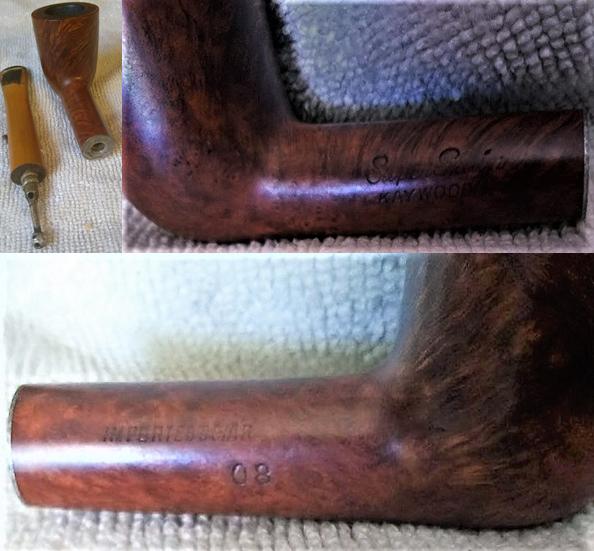
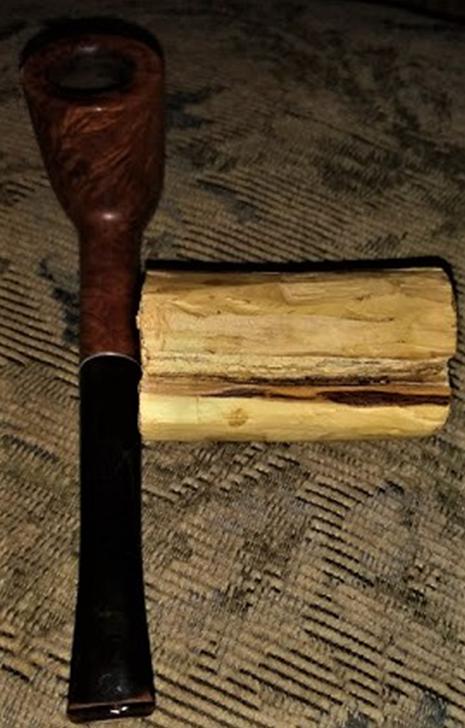
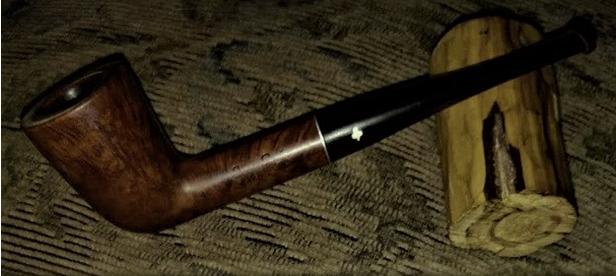
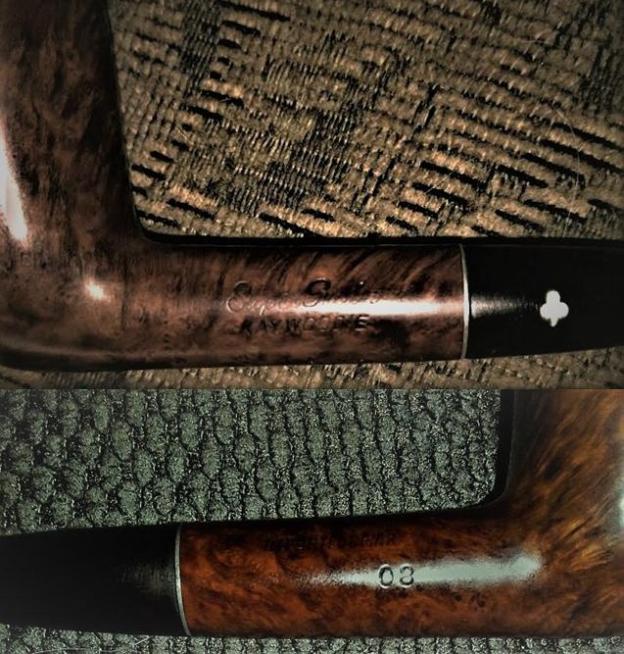
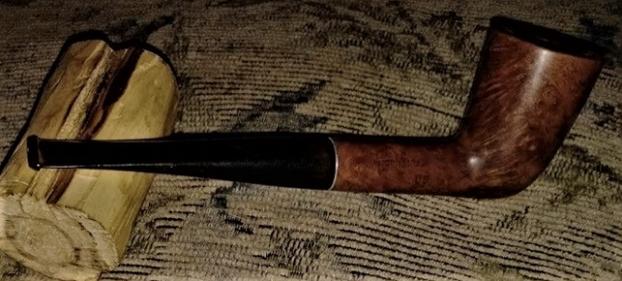
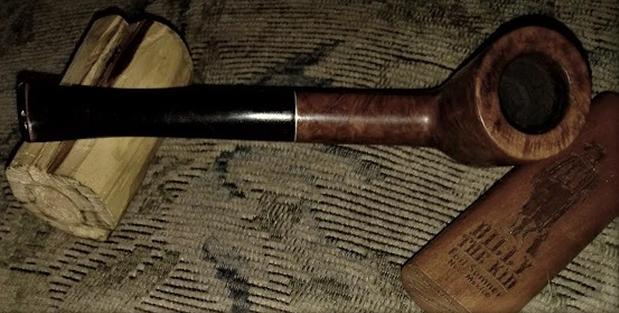
At any rate, this blog is about a Kaywoodie Super Grain Dublin #08 that is almost as old as my dad was.  The left shank nomenclature approximates its age to the 1930s with the placement of SUPER GRAIN above KAYWOODIE, and the right shank imprints of IMPORTED BRIAR and 08 narrow the timeline to 1935-1938.  Every part of this beautiful pipe is original, including the stem and patented Drinkless stinger with the word etched into it.  If this pipe was around in 1936, its price would have been $5.  But more than the absence of the usual four-digit shape number connected with Kaywoodie pipes from this period, I’m having trouble imagining my dad no bigger than a boy of five.

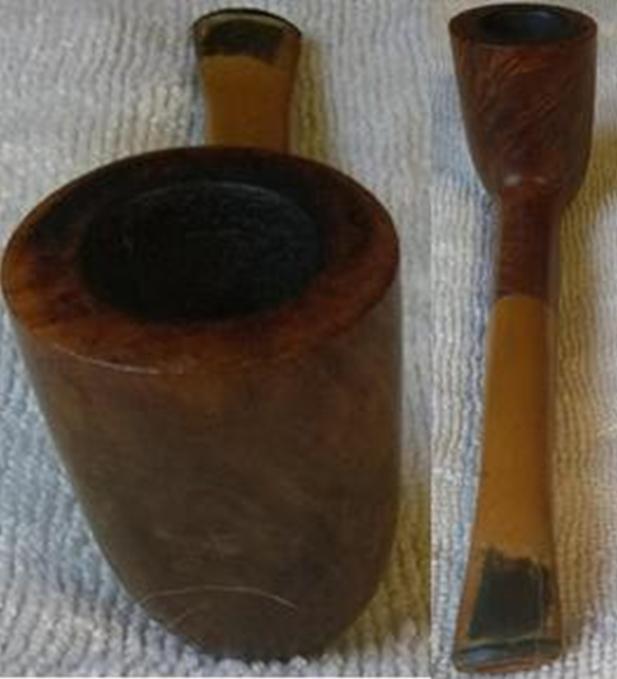
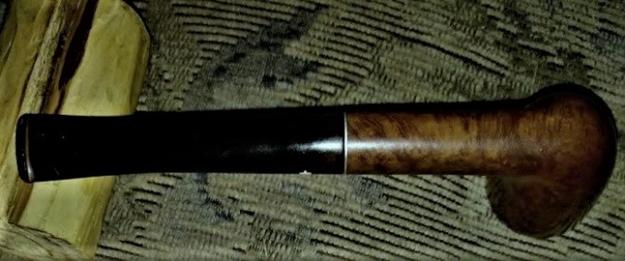
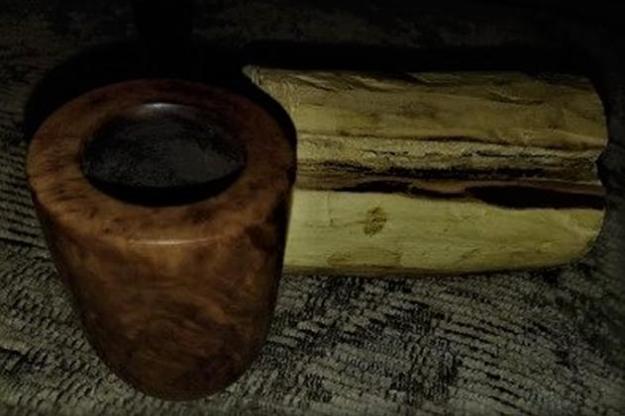
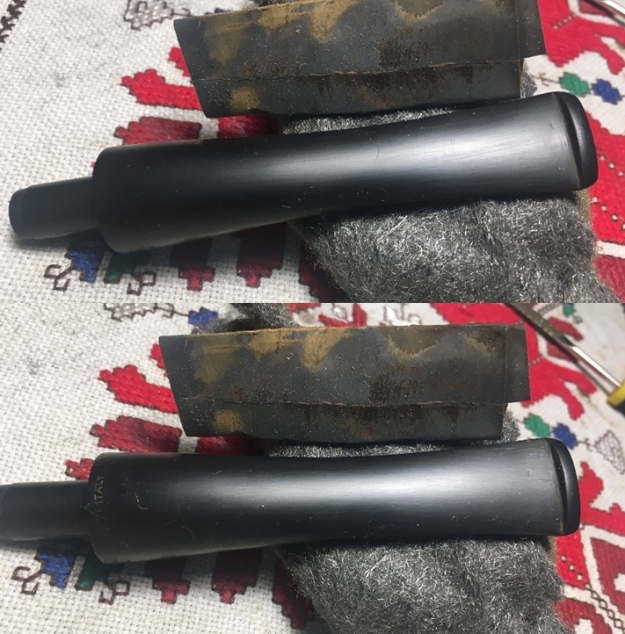
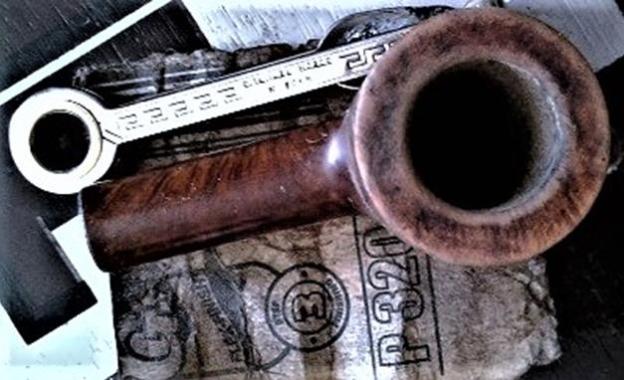
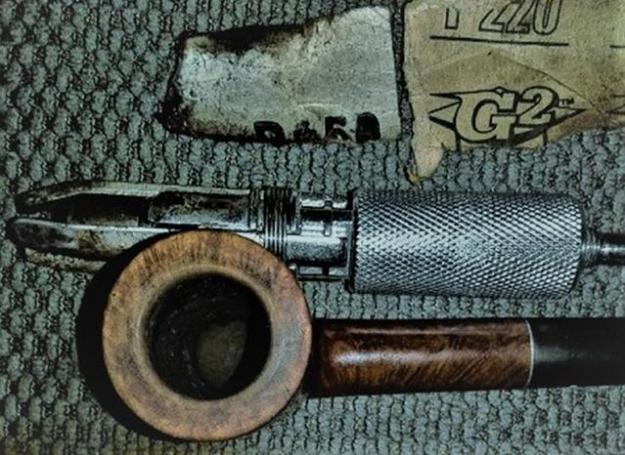
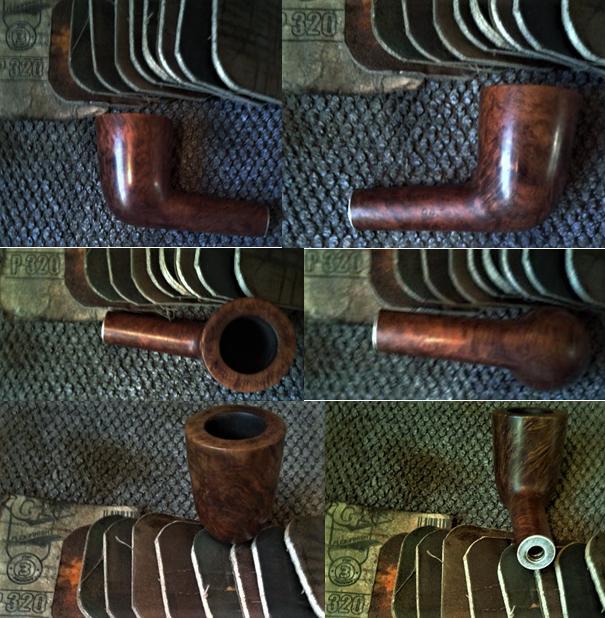
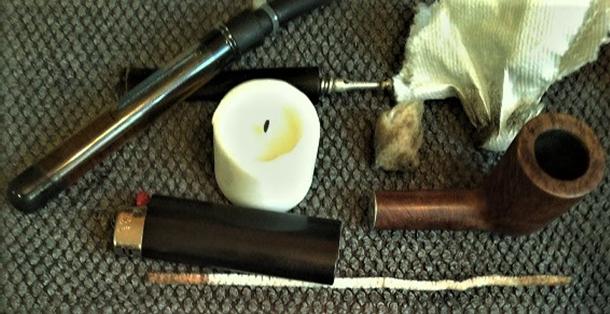
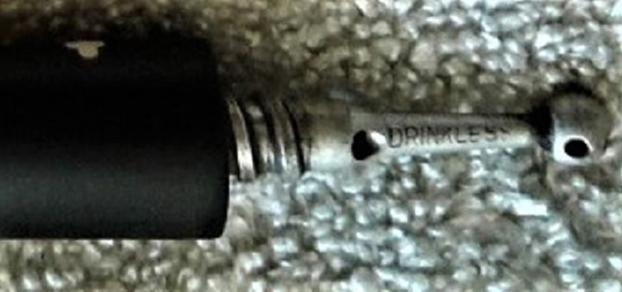
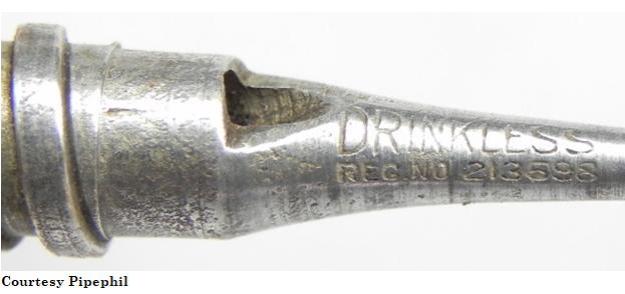
RESTORATION This Super Grain was in amazing condition for a pipe well into its 80s!  The only problems presenting were normal rim char, well-maintained cake buildup and the almost mandatory, for Kaywoodies, mis-clocked stem.  Something told me that might more or less fix itself before the project was complete.I dunked the stem in an OxiClean bath and planned on letting it stay there longer than usual, given that the old Vulcanite was almost solid yellow-green, whatever that color is called.  I also had errands to run.  When I returned home a couple of hours later, I removed the stem from the nasty, dark bathwater, ran a pipe cleaner through the airhole, rinsed and scrubbed it with my thumbs and fingers and dried it off.  A little piece of 320-grit paper made it solid black again.  [I restored this pipe not long ago, but as I noted in my last blog, I had not yet learned how effective going straight to 1000-grit paper can be.  That’s where I’ll start from now on.  This time I lucked out.]I continued work on the stem and started on the rim burn with a soft green Brillo pad that brought out a soft shine on the stem, which may very well be the first one I’ve come across with no scratches that needed removing, much less tooth chatter or even a chink in the lip, top or bottom.  For the rim, the Brillo was a beginning.Finishing the stem with 400-, 600- and 1000-grit papers followed by a full run of micro mesh from 1500-12000, I turned to a piece of super fine “0000” steel wool for the remainder of black on the rim.Again, not being aware of how great a job 1000-grit paper does, I continued work on the rim with 320-grit.  Everything worked out in the end, but really, I had no idea how much extra work I’ve been doing!  In fact, I understand now how bad was the habit into which I had fallen.Smoothing the rim with 400- to 1000-grit papers, and in the process returning the grain to normal since I didn’t use the least abrasive grade in the first place, I finished that stage in anticipation of a spot stain there after micro meshing.  In the meantime, I reamed the chamber and sanded with 150- and 220-grit papers.  That was supposed to be just the start, but the mature and venerable Dublin was so loved and respected by its previous (and, I think, only other) owner that the chamber wall was baby smooth to the touch.I had forgotten the wonderful quality of briar and other woods to reacquire their original hue after being sanded down to a lighter shade and then worked back up with finer and finer grades of paper.  Therefore I was surprised but happy to see the lovely, mottled, somewhat leopard-like spots and blotches on the rim, and the natural shiny dark brown color that matched the whole surface, with the following full micro mesh of the stummel.  The thought occurred to me that when the pipe was first crafted, no stain might have been applied.The only thing left to do was retort the pipe.  This step further revealed that whoever was the guardian of this magnificent specimen of pipehood was also good enough to enjoy it quite often.  Four test tubes full of alcohol had to be boiled through the inner passageways from the lip of the stem to the top of the chamber before it was almost clear.Don’t take this as bragging because I know I had nothing to do with the skill and care that went into the very vintage Kaywoodie’s genesis – all I did was make it show again – but the color and shine of the wood were perfect as-is at that point and, as far as I could see, needed no further help.  And so, I didn’t even buff it on the wheel for the first time in my experience with pipes.  But to return the stem to the same sheen, I buffed it on the electric wheel with White and Red Tripoli. Oh, and I just remembered the other two aspects of the pipe I noted earlier but almost forgot to address, because, as with some other aspects of the restoration, I forgot to snap a shot of one and deleted the other considering its apparent superfluousness.  The stinger that was misaligned at first indeed did correct itself, with a small nudge, or firm but careful twist, rather, from me. And then there was my mention of the almost incredible fact that the Drinkless stem, with its four-holed ball at the end to be inserted into the shank – which ball, by the way, resembles an antique naval mine with its detonator legs removed, or is it just me? – was etched with the word DRINKLESS.   The shot above, enhanced by photo editing software with which I am at last becoming more adept, illustrates both the screwed-up (pun intended) aspect of the stinger and the etching.  Worth mentioning, to me at least, are Pipephil’s details that include such tidbits as these: the original Drinkless patent (No. 213598) had a push-in design that was used from 1924-1931; the updated version with the same patent number became the longer screw-in and is stated as being used from 1929 until as recently as the 1960s, and in 1932 the SynchroStem patent was granted in favor of the Drinkless.  The newer Drinkless stingers also had the words “REG. NO. 213598 etched under the Drinkless designation, although I didn’t look closely enough or take a good enough photo to show it.But – and here is where all the confusion reaches its zenith – Kaywoodie decided to move toward a three-hole stinger at an “indeterminate date.”
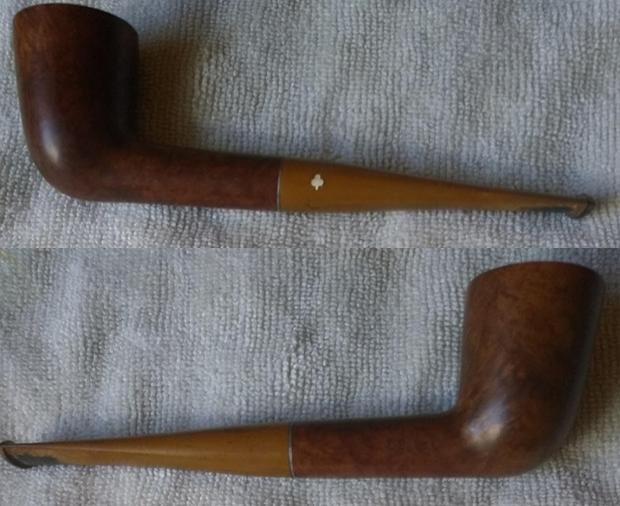
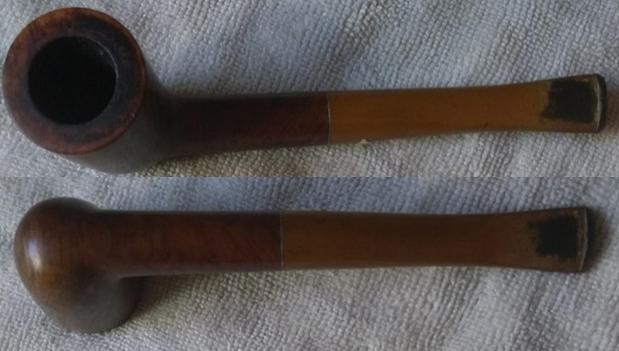
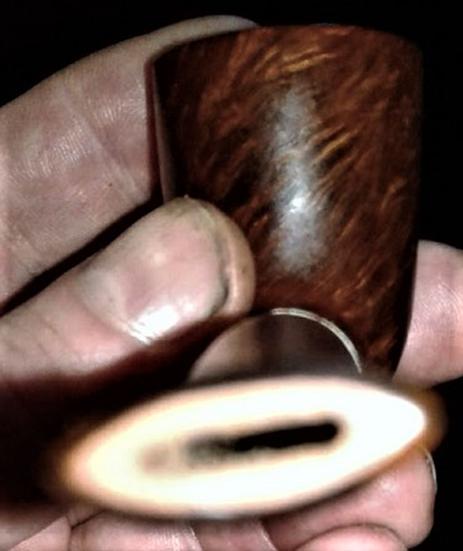
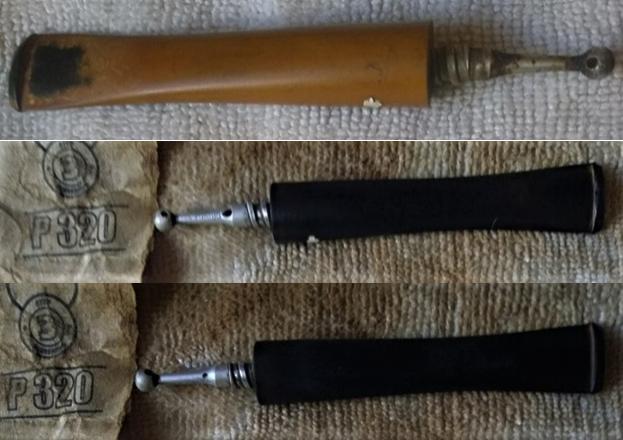
Ah, the joys of dating a pipe!  The Super Grain in this blog, however, is a definite match for the period 1935-1938.  I’m beginning to think pipes, like some people, should only be enjoyed, never dated. 😊

CONCLUSION
My dad was an avid pipe smoker until my mother, sister and two step-sisters put an end to that.  I say they did it, but the sad truth I still regret to this day is that I let them drag me into the brouhaha: the incessant reminding him, every time he sat down to relax and light up, of what the ninth U.S. Surgeon General, a well-meaning and for the most part dead-on man by the name of Luther L. Terry, MD, had reported two years after I was born, to wit, that smoking tobacco tends to have “an adverse impact…[on] health worldwide,” and the steady buildup to more snide comments such as the amount of time every use of tobacco deprived people of life (not counting the comments about second-hand smoke).  By the end, the unwarranted and downright cruel attacks on my dad by all of us had escalated to all-out war.  In the end, my dad surrendered and vowed to stop smoking his impressive collection of the beautiful briar works of art and implements of deep contemplation.

In my defense, this was all going down around 1968, when I was a mere lad of six.  But I can still picture the vast assortment of mostly smooth, easy bent billiards he favored, though there were some that were sandblasted also, and even more interesting, longer, straight ones I now understand were Canadians or others of that family.  In my mind I can see them now with such clarity that, given the experience I have had in some of the intervening years, I am positive they were all created by the greatest English makers of those times and these.

In other words, my dad was not keen on American brands the likes of Kaywoodie.  But he was a man whose tastes changed, like most of us, and I suspect that had we left him alone to his peaceful enjoyment of his pipes, his collection would have evolved.  If only we had not badgered him into submission, if only he had stood his ground and just said no, if only we had not grown apart – I might very well have given him this pipe for his last birthday.  And I’m sure he would have lived just as long as the 85 years he lasted before dementia and other non-smoking-related problems took him.

In a letter, Dylan Thomas described his approach to writing this way: “I make one image—though ‘make’ is not the right word; I let, perhaps, an image be ‘made’ emotionally in me and then apply to it what intellectual & critical forces I possess—let it breed another, let that image contradict the first, make, of the third image bred out of the other two together, a fourth contradictory image, and let them all, within my imposed formal limits, conflict.”

That’s my dad, to a tee.  Still, I love him and miss him more now than I did the long years he decided not to communicate with me anymore.  So now, as still another great poet wrote, I sound my barbaric yawp.

He wasn’t big on crying, so I’m going to have to stop here.

SOURCES
https://www.poets.org/poetsorg/poem/my-father-moved-through-dooms-love-0
https://genius.com/Dylan-thomas-do-not-go-gentle-into-that-good-night-annotated
https://www.poetryfoundation.org/poems/45384/the-princess-tears-idle-tears
http://www.pipephil.eu/logos/en/logo-kaywoodie-2.html
https://pipedia.org/wiki/Kaywoodie_Shape_Numbers
https://pipedia.org/index.php?title=Collector%27s_Guide_to_Kaywoodie_Pipes&mobileaction=toggle_view_mobile#1936_Kaywoodie_Shape_Numbers_and_Descriptions
http://www.pipephil.eu/logos/en/infos/kaywoodie-drink.html
http://www.pipephil.eu/logos/en/infos/kaywoodie-synchro.html
http://www.pipephil.eu/logos/en/infos/kaywoodie-3stinger.html

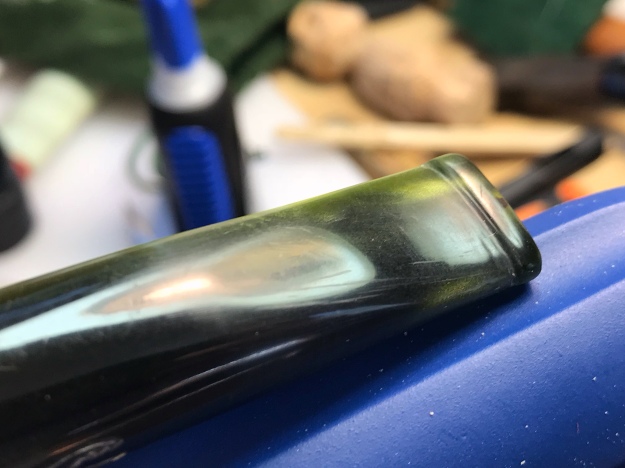
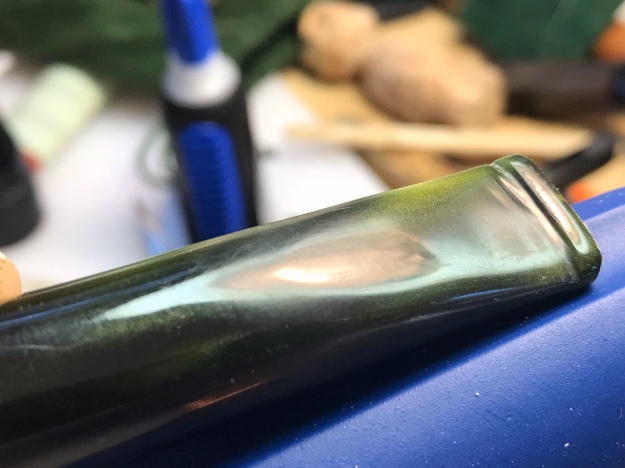
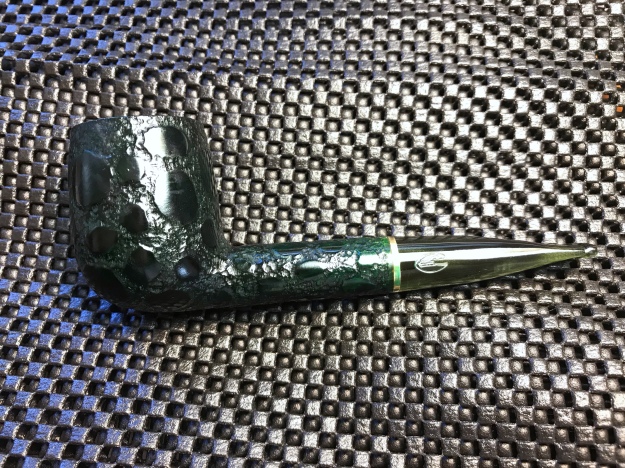
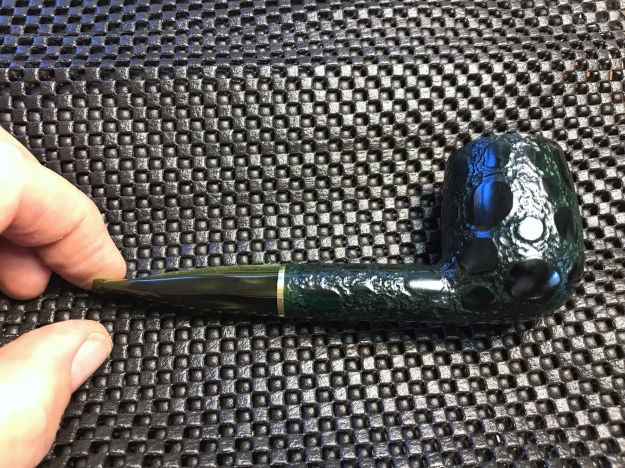
Reworking a Chewed Savinelli Alligator Stem


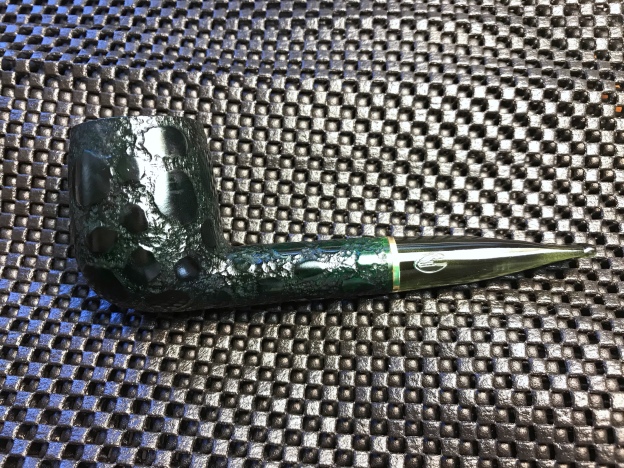
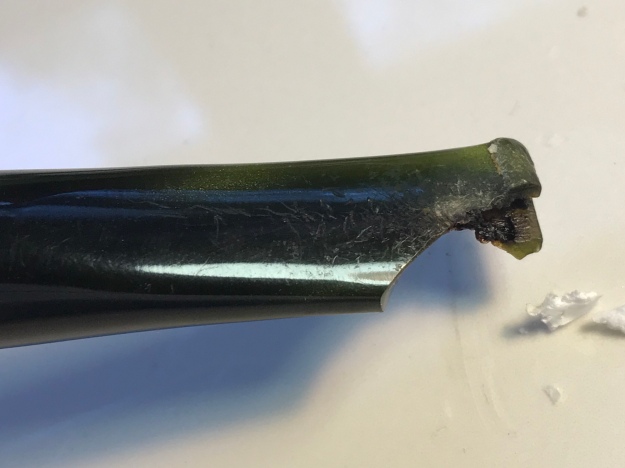
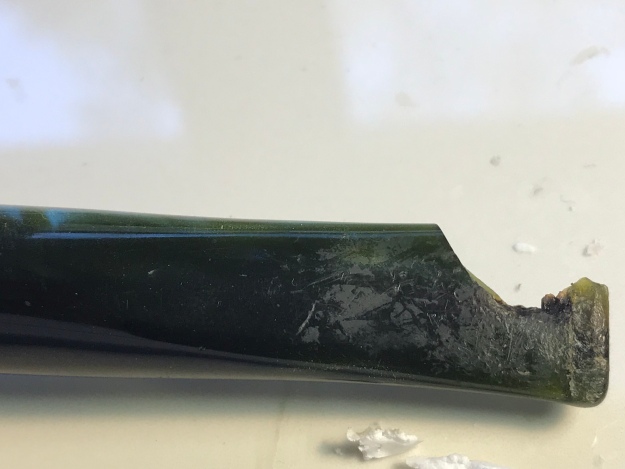
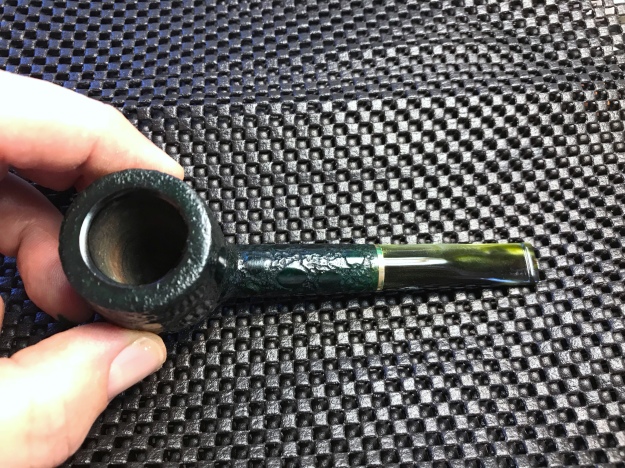
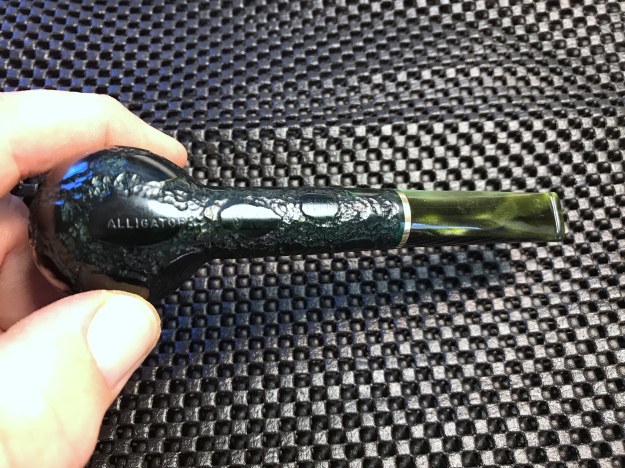
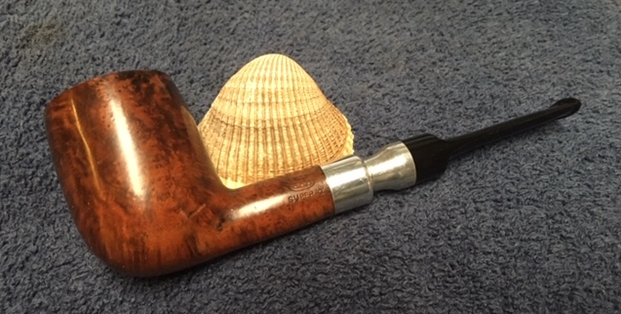
I picked up this Savinelli Alligator from a life-long friend some time back, along with a meerschaum pipe. They both needed a good cleaning but they also needed major stem repair. My friend is a clencher, an understatement, to be sure, and had bitten through both stems. When I saw the pipes I asked him if an alligator had been smoking the Alligator! I have lost the “before” pictures on this one so I’ll have to describe the condition it was presented to me in.
I’ve found that pipes with green stain don’t seem to fair very well; all of them loose their color in my experience. This Alligator was no exception; it was a grimy natural color with only a hint of green in the rustication. The bowl was heavily caked with a crumbly vanilla cake and an overflow of lava on the rim. I did the normal clean up routine on it to get it ready for cosmetic work and stem repair.
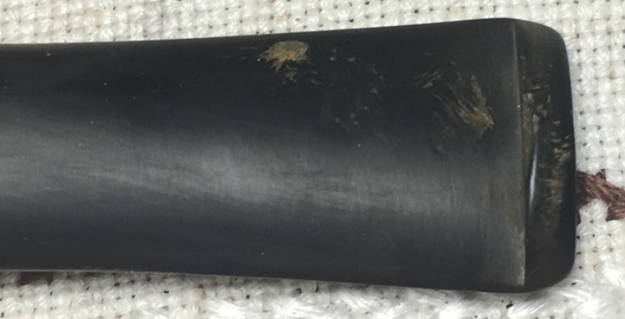
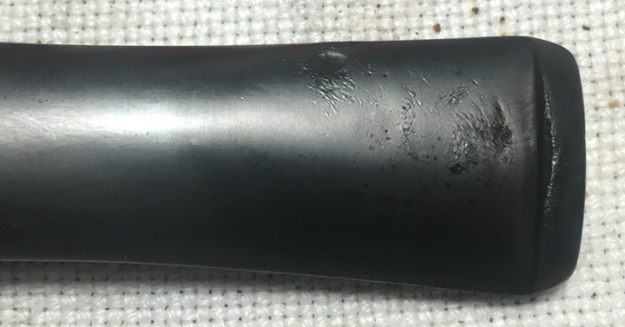
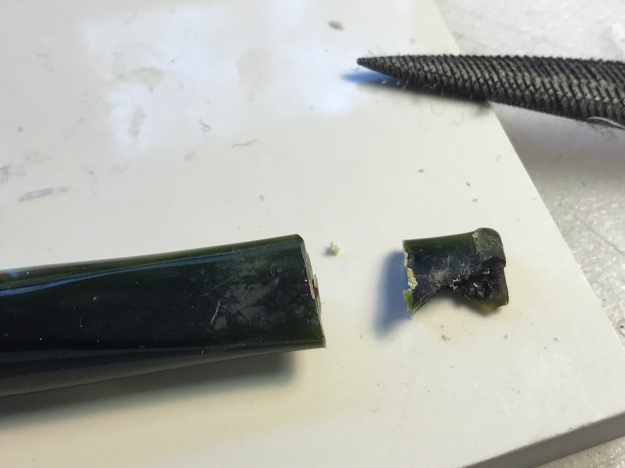
The stem, as the photos show, had a sizable chunk missing. I had a few options that I considered. I thought about replacing the stem but that would mean sacrificing the original. It also was not an easy task to find a green lucite swirl that matched and was the right dimensions. I thought about trying to rebuild the end of the stem. I even ordered some epoxy pigment to color-match the repair. But it would be a huge repair and I wasn’t sure it would hold up.

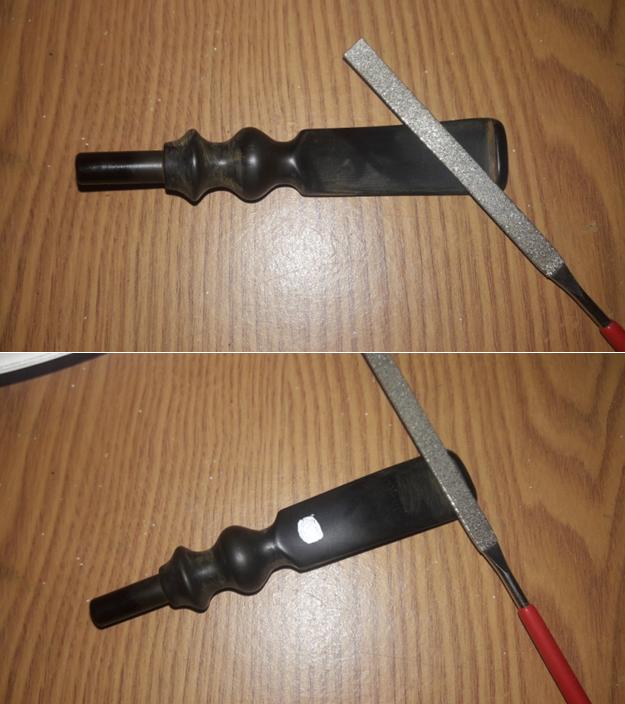
After weighing my options I decided to cut off the damaged end, saving as much length as possible and cutting a new button. I used a Dremel cutoff wheel at 15k RMP to remove the end. I used a combination of files to thin and reshape the stem, cutting a new button in the process.

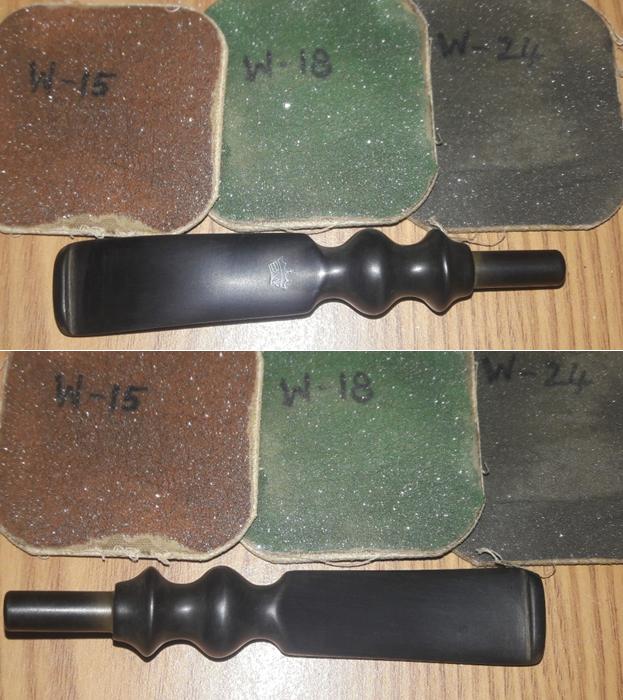
Once the button and stem were shaped to my satisfaction I began sanding and polishing it with wet/dry paper (220-grit) and the full range of micro mesh. I then polished the stem with Meguir’s ScratchX 2.0. The stem looked good; time for the stummel.

I cleaned the stummel with alcohol on a cotton pad to remove the left over grime and oils. Then I applied a couple of coats of Fiebimg’s green leather dye, making sure I had a nice even coat. I buffed the pipe with white diamond to remove the extra dye and set up the shine on the wood and stem. I then gave the pipe several coats of carnauba wax and a hand buff with a micro fiber cloth.

The Alligator still has some battle scars but my buddy can smoke it once again. Our local university’s colors are green and white, the reason he bought a green pipe. I’m happy to say his Marshall University Pipe will ready for service come Homecoming game day.

A Father/Son Restoration Project – Breathing Life into a Humidor Pipe Rack


Blog by Steve Laug

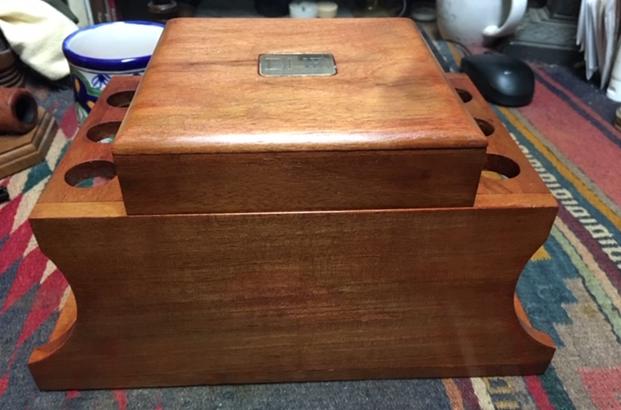
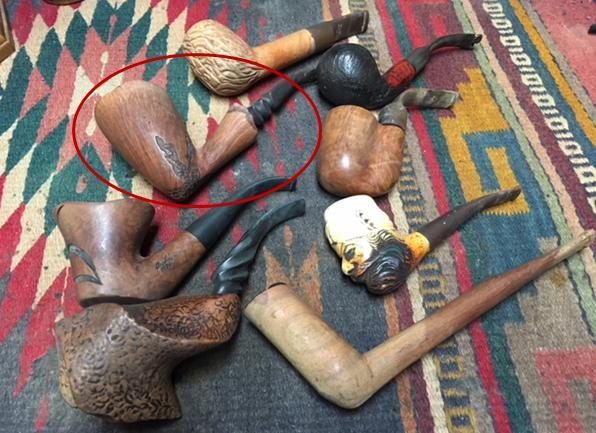
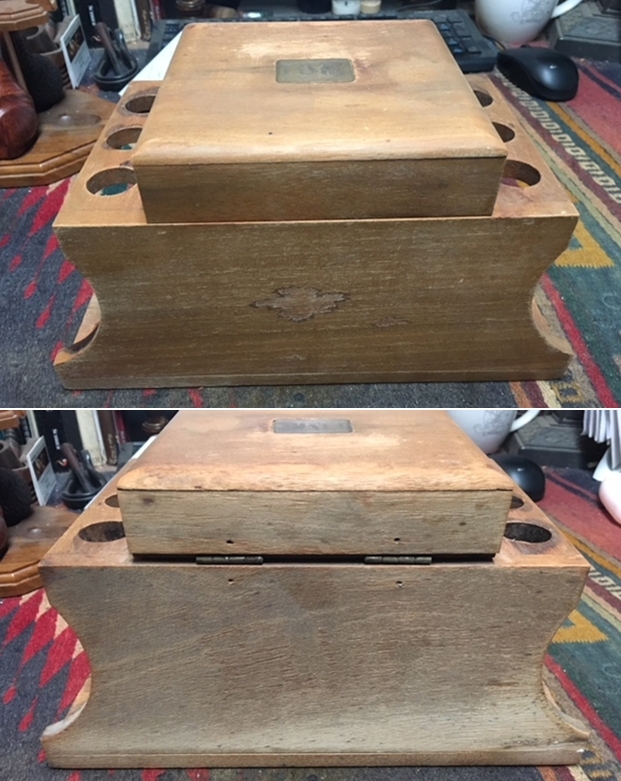
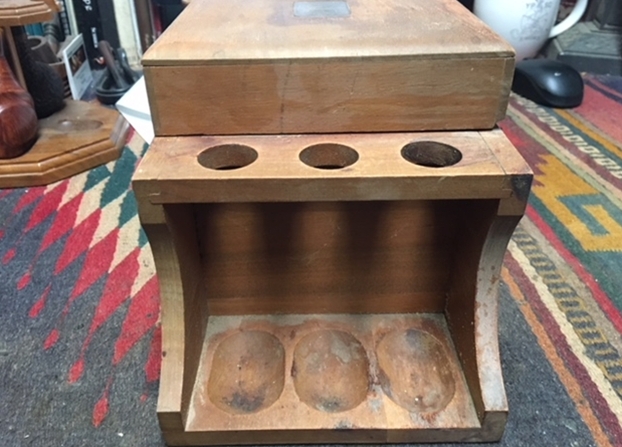
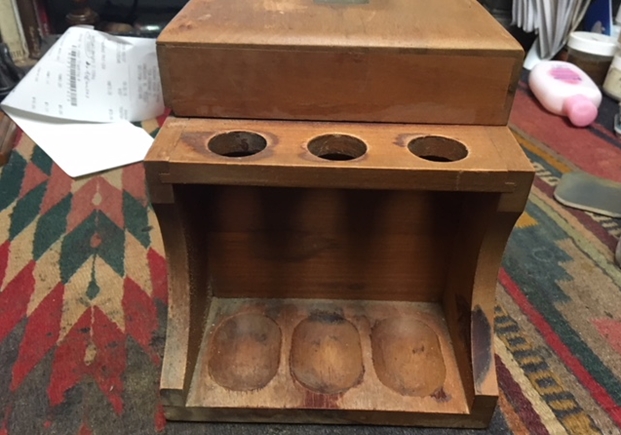
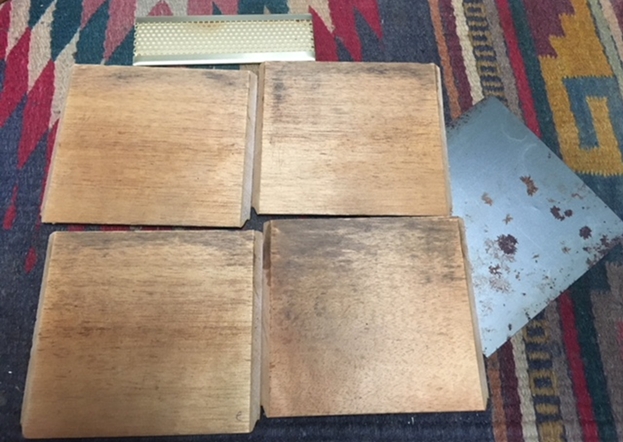
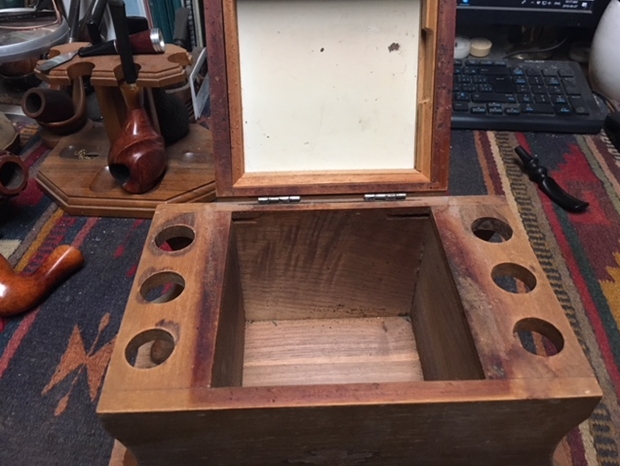
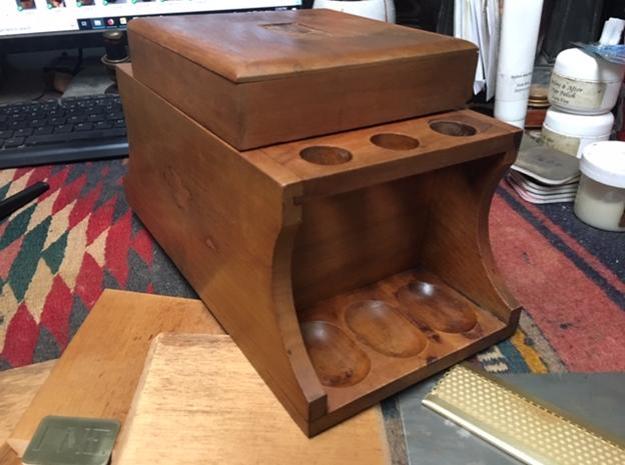
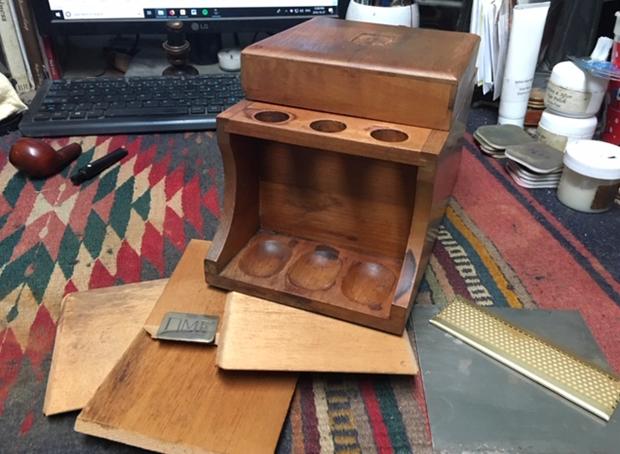
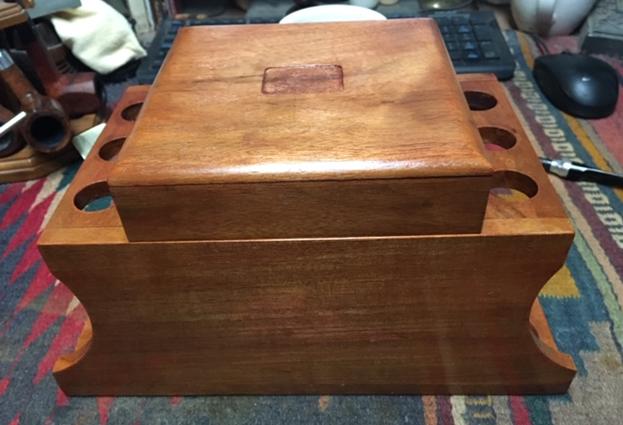
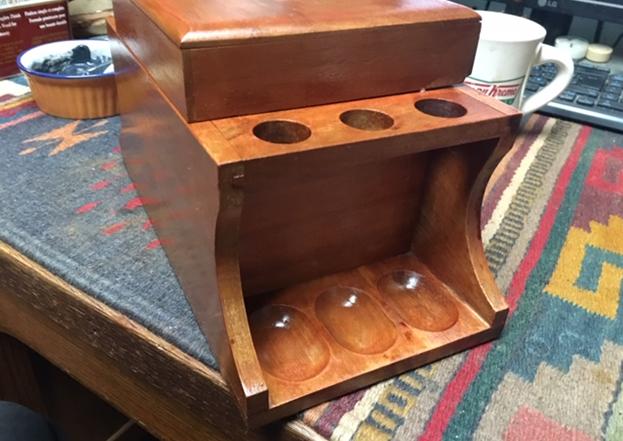
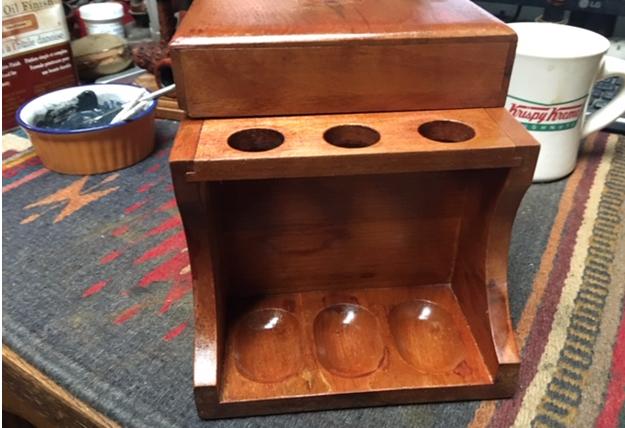
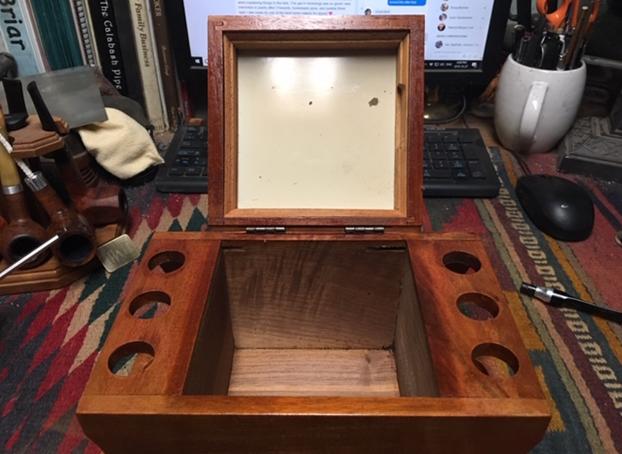
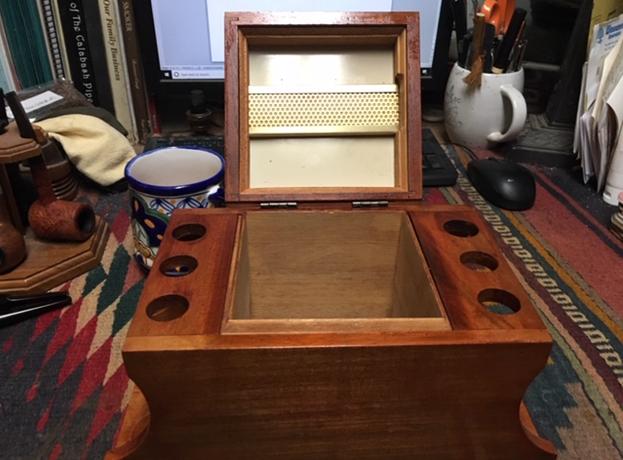
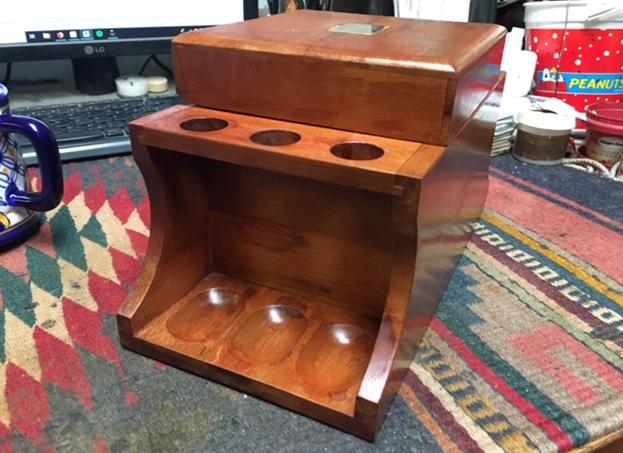
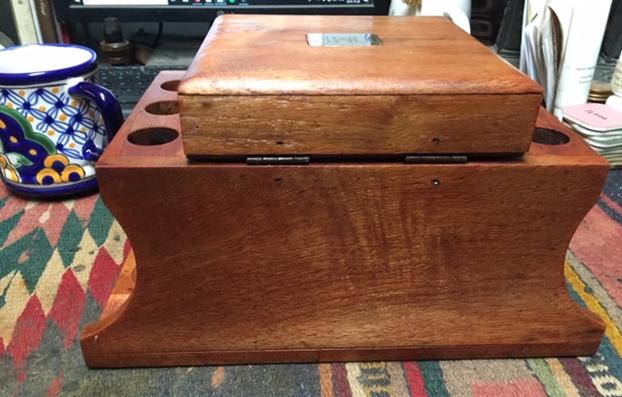
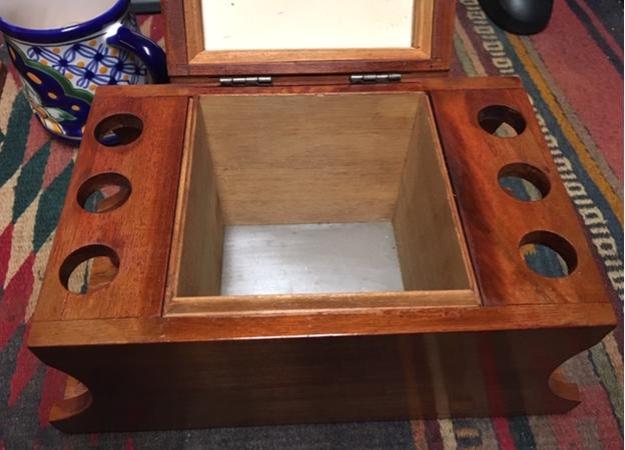
In the past months I have restored eight of Anthony’s father’s pipes. He had written me regarding the restoration work; “I have a few pipes (8 or so) that haven’t been smoked in 15 years. They were my dad’s. I would like to get someone to restore them”. We chatted back and forth via email and the long and short of the story is that I restored all eight of his Dad’s pipes. The photo below shows the mixture of pipes that he sent me. There were some interesting shapes and most are very dirty and have very little if any of the original finish left on the briar. All have an overflow of carbon on the rim top and all have chewed, damaged stems and buttons. Anthony remembers his Dad smoking them throughout the years he was growing up so they went from regular use to being boxed and stored. They needed a lot of TLC to bring life back to them but it was fun to work on them. When he received the pipes back in his home he contacted me about a rack that he believes his father made. While I am not sure of that (it is very much like the box humidor 6 pipe racks I have seen in the past) it certainly needed a lot of work. I don’t usually work on pipe racks but I thought this would be a worthy exception. When it arrived it had a tarnished brass plate on the top of the lid with his father’s initials engraved in it. There were water stains/damage marks on the top, front and sides of the rack. The finish was gone and the condition of the outside was very rough. The base that held the pipes also was worn and water damaged. The inside of the box had a metal base held in the box by removal cedar panels. I could slide out the sides and remove the metal base. The pictures below show what it looked like when I unpacked it and had removed the dust and debris on exterior. All totaled it was a mess. The water damage had left some deep stain marks and I had no idea if I could minimize them. I took the cedar plates out of the box, removed the metal plate from the bottom of the box. I also took out the humidor disk from the lid and took pictures of the parts and their condition. Note the rust on the metal base. The second photo below shows the box with the lining removed. I left it sitting in pieces for a week or more and an email from Anthony spurred me to do some more work on it. I cleaned all of the parts with Murphy’s Oils Soap and rinsed the box and parts down with warm water and a damp cloth. I took photos of the box at this point to show progress. I lifted the brass plate off the lid so I could polish it as well. The cleaned rack sat in this dismantled condition for several months. I just did not have time to work on it at all and to be honest I also did not have the desire. Fast forward to last week. My father was visiting and wanted to help me with some of the work I was doing on pipes. I looked at the rack and I thought why not it would be a great Father/son project. So we tackled it together and began the restoration of this rack. Dad worked on it quite a bit, sanding and working on the divots and the stains trying to remove the damage. We were having very little success. Then I remembered the oxalic acid could be used to remove water stains so I ordered some from our local pharmacist. I picked up 500 grams of the crystals and my father mixed it with water and began to scrub the exterior of the rack. He worked on the water damaged spots and scrubbed the entire rack with the acid mixture. It took repeated scrubbing but the water damage began to fade and in some places it disappeared entirely. Even where it did not all disappear it was lightened significantly and looked far better. After the acid wash, Dad sanded the entire rack down with a medium and a fine grit sanding sponge to smooth out the grain in preparation for staining. We stained the rack with Danish Oil Cherry stain. We rubbed it into the finish and wiped it off with a cloth. We repeated the process four times to get good coverage and a smoother look to the rack. Between each coat of stain we sanded it with a fine grit sanding sponge to remove and bubbles or roughness. While Dad was working on that I polished the brass monogram plate on the buffing wheel and with 6000-12000 grit micromesh sanding pads. I put some white glue on the underside of the plate and reinserted it in the space on the cover. It too is not flawless but it looks better.

Once we had finished the staining and polishing we put the internal cedar panels and metal base plate back in place in the box. We reinserted the humidor plate in the cover. The water stains on the front were gone, the ones in the pipe rack were greatly minimized and the rack looked better. My Dad and I had a great time working on this project together. I normally do no work on racks at all. I like working on pipes not racks! But I am glad I made this exception. It was a Father- Son project working on a Father’s Pipe Rack for his son. Now I need to pack it up and get it in the mail so Anthony has his Father’s pipe rack to hold his Father’s pipes.

Resurrecting a Tired and Worn 1937 Dr. Grabow Special 4914 Apple


Blog by Steve Laug

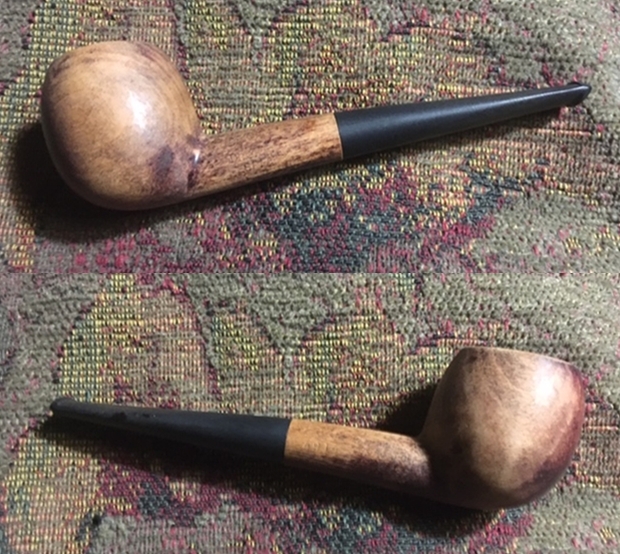
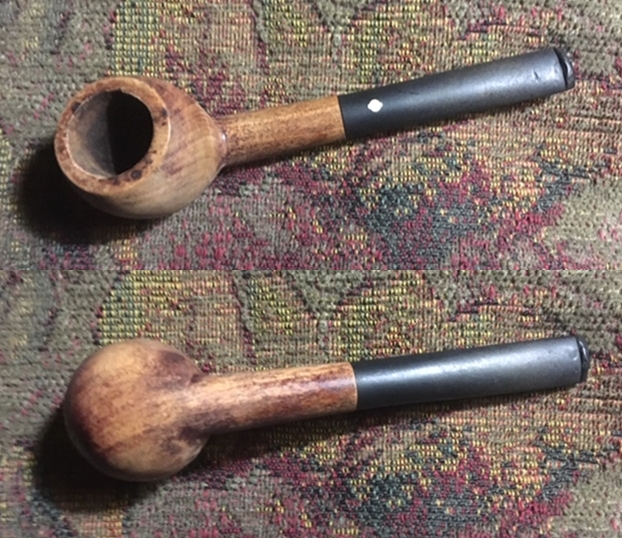
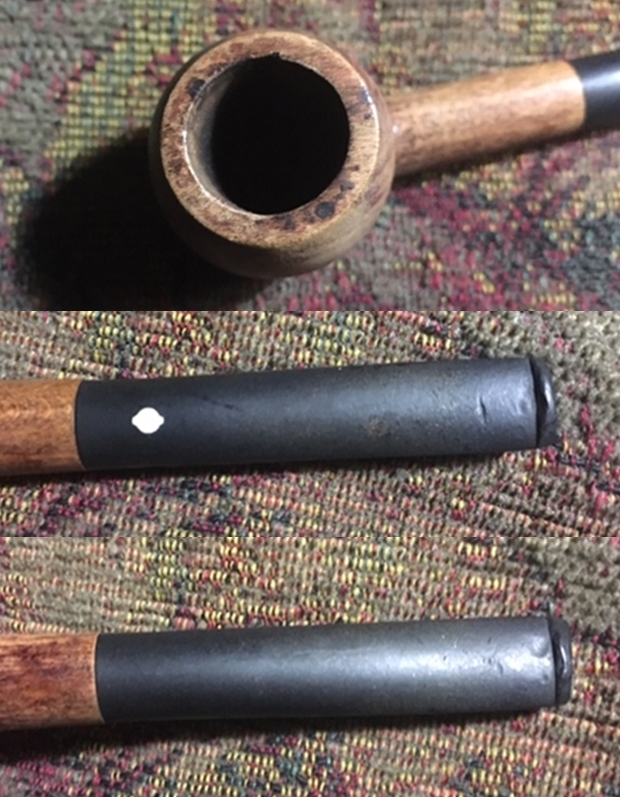
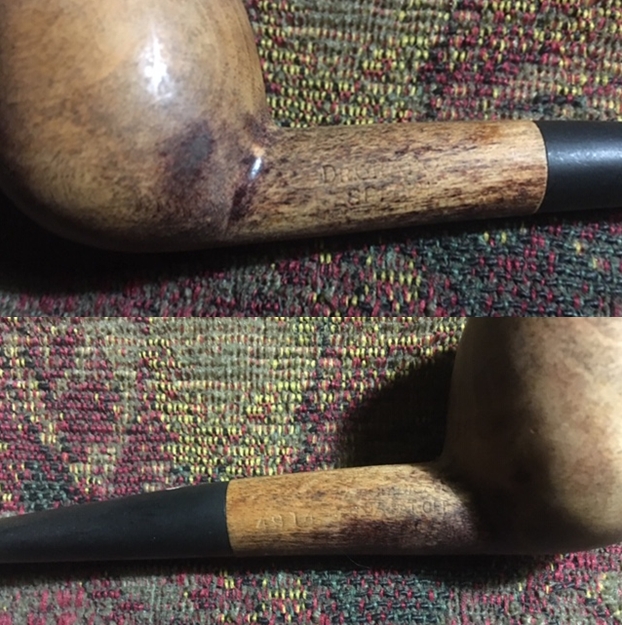
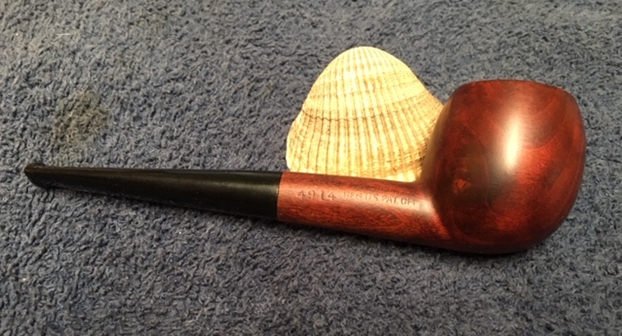
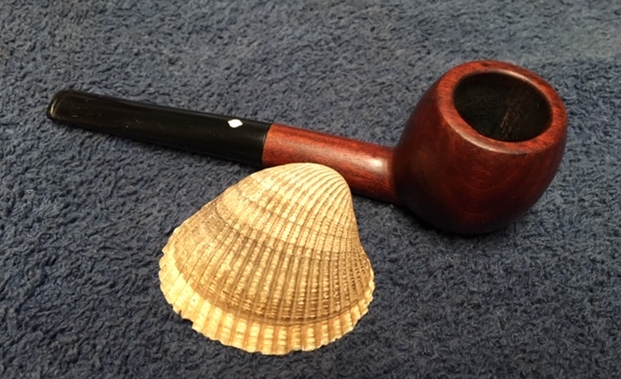
The next pipe on my restoration table is an interesting older pipe that appears to be made out of walnut or some other hard wood. It was tired and worn looking with the remnants of what appeared to be an oxblood stain in the wood. The stamping was dirty and worn but readable nonetheless. On the left side the pipe is stamped Dr. Grabow over Special and on the right side it is stamped with the shape number 4914 near the shank stem junction. That is followed by Pre-Smoked over Reg. US Pat. Off. The rim top was dirty and had some tar ground into it. The bowl had a light cake in it and there was a small nick on the inner right edge of the bowl. It had a hard rubber vulcanite stem with the white Linkman style propeller inset on the top of the stem. The rubber was quite hard and did not show signs of oxidation. There were tooth marks on the top and underside of the stem at the button. I took some photos of the pipe before I started my cleanup. I took some close up photos of the rim top and bowl to show its condition. The tar spots are on the surface. The nick is visible on the right side of the bowl. I also took photos of the stem to show the bite marks and wear on the stem.I took a photo of the stamping on both sides of the shank to show the condition. Interestingly once I cleaned the shank up and removed the stain the stamping was very readable.I looked up information on the Dr. Grabow Special 4914 pipe on Pipedia to see if I could identify the time period that the pipe came from. I had a hunch that it came out during the war years due to the alternative wood that had been used in its manufacture in place of the normal briar (https://pipedia.org/wiki/Dr._Grabow_Models_(Series,Line)_Names_Through_the_Years). Here is what I found out:

SPECIAL (or Special Italian Briar) post-1937, begins with 43, 49, maybe no number at all; DOLLAR DR. GRABOW 1937 or previous, may not be marked as such, begins with 43, 44, 49 Series 43 = Natural Finish (DG), c1937. Series 44 = Dark Finish (DG), c1937. Series 49 = Walnut Finish (DG), c1937.

Thus I knew that the pipe came out post 1937. I still had not confirmed the date of the pipe other than knowing that it was made after 1937. I did some more digging on Pipedia and found the following information that also helped pin down the date (https://pipedia.org/wiki/Dr._Grabow).

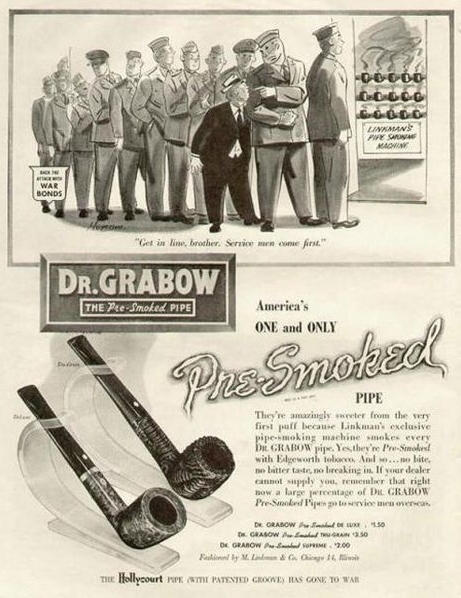
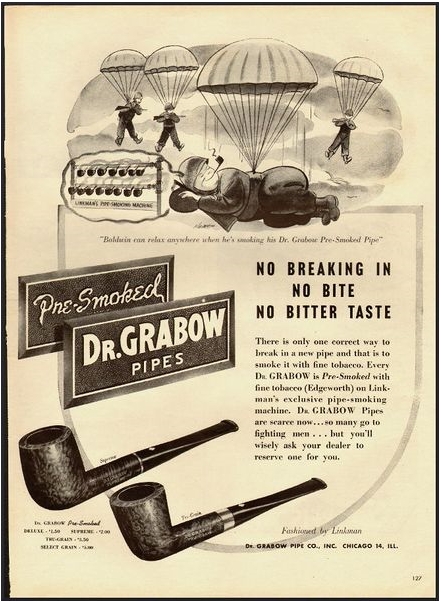
The production of the pipes started in 1930/31. In 1937 Linkman began calling his pipes “Pre-Smoked”. An ad dating from 1946 celebrates it as “America’s Most Wanted Pipes” and the text announced that each Dr. Grabow was broken in on the Linkman’s Automatic Smoking Machine with fine Edgeworth tobacco, reducing the need for the new owner to spend time breaking in his pipe. In 1949 the official name read Dr. Grabow Pipe Company Inc. with seat at W. Fullerton Avenue 1150, Chicago 14, Illinois. (Thus the Linkman factory.) Series: Special, De Luxe, Supreme, Tru’ Grain, Select Grain.

That helped to pin down when the first Pre-Smoked Pipes came out on the market. I have included a couple of advertisements from the 1940s on the Pre-Smoked pipes. The advertisements were on Pipedia courtesy of Doug Valitchka. I found a similar pipe for sale on eBay (https://picclick.co.uk/Lovely-Vintage-Dr-Grabow-Special-4914-Smokers-Pipe-372388011756.html). It could very well be a twin of the pipe that I am working on. It is also made from an alternative wood, rather than briar.

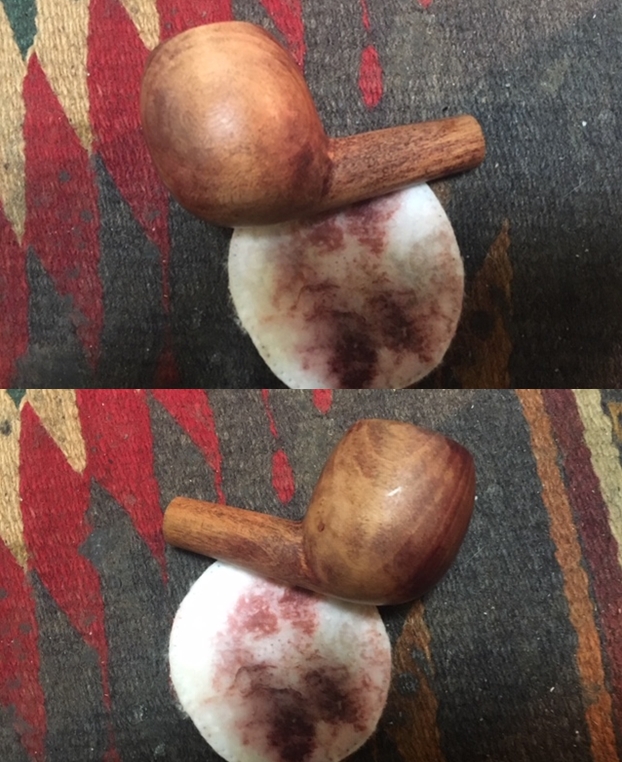
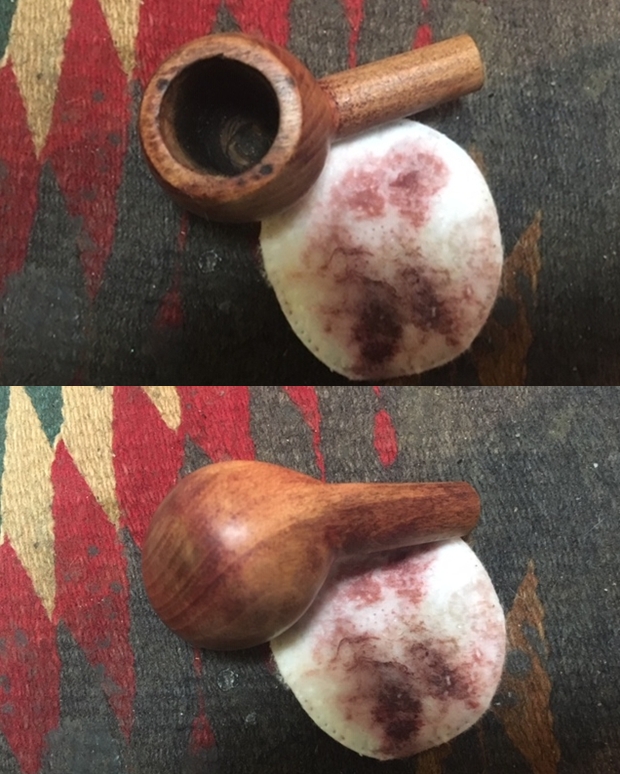
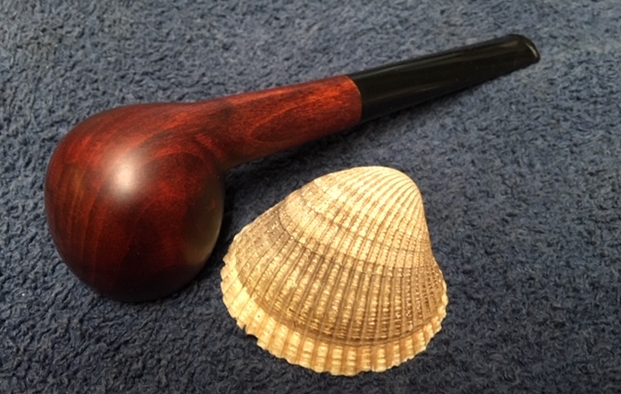
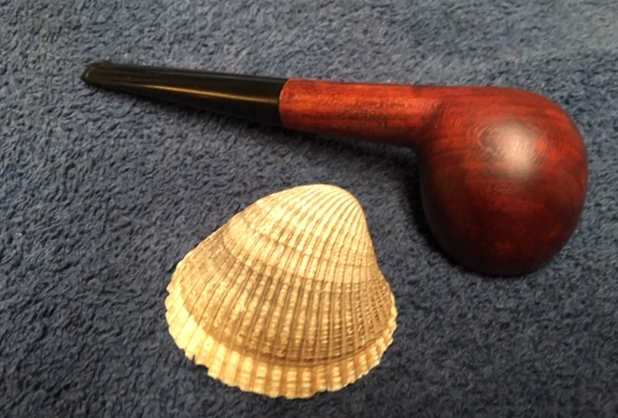
I started my restoration on the pipe by wiping down the bowl with acetone on a cotton pad to remove the remnants of the oxblood finish. I took photos of the bowl after the cleanup. I sanded the bowl with 220 grit sandpaper to remove the remaining stain. I sanded the rim top to remove the stain and tars there. I worked over the inner edge of the rim with 220 grit sandpaper to remove the damaged area on the right side. It did not take too much work to remove it. I polished the rim and bowl with micromesh sanding pads – wet sanding with 1200-2400 grit pads. The bowl began to have a rich shine.When I sanded the bowl a small red putty fill showed up on the back right side of the bowl. It was slightly pitted. I filled in the pits with clear super glue to remove the damage. I sanded it with 220 grit sandpaper and then with a 1200 grit micromesh pad.I polished the bowl with red Tripoli on the buffing wheel to smooth out the wood. I heated it and stained it with the “red” tan aniline stain. I flamed it with a lighter and repeated the process until the finish had good coverage. I also gave the bowl a coat of Danish Oil with Cherry stain to highlight the grain. I cleaned out the internals in the stem and the bowl with pipe cleaners, cotton swabs and alcohol. The shank was dirty and the debris and grime that came out made fit of the stem in the shank much tighter.I set the bowl aside and worked on the stem. I sanded the surface of the stem with 220 grit sandpaper to remove the tooth chatter and the lighter tooth marks. I cleaned it up a soft cotton pad to remove the debris. I filled in the deeper tooth marks with clear super glue to repair them. I set the stem aside to let the repairs cure. I sanded the hardened repairs with 220 grit sandpaper to blend them into the surface of the vulcanite.I polished stem with micromesh sanding pads – wet sanding with 1500-2400 grit pads and dry sanding with 3200-12000 grit pads. I wiped the stem down with Obsidian Oil after each pad. When I had finished polishing with the last pad, I gave it a final coat of Obsidian Oil and set it aside to dry. This small war era Dr. Grabow Pre-smoked apple is a unique alternative wood pipe. It has interesting swirled grain around the bowl and cross grain across the shank. The grain really is interesting. The rim top looks much better. The vulcanite stem is high quality and shined up well. I buffed the bowl and the stem with Blue Diamond polish to raise the shine on the briar and the vulcanite. I was careful to not buff the stamping and damage it. I gave the bowl and stem multiple coats of carnauba wax. I buffed the entire pipe with a clean buffing pad to raise the shine. I hand buffed it with a microfiber cloth to deepen the shine. The finished pipe is shown in the photos below. The rich oxblood stain allows the grain to really stand out while hiding the fill in the bowl side of this little pipe and it works well with the rich black of the vulcanite stem. The dimensions of the pipe are: Length: 5 1/4 inches, Height: 1 1/2 inches, Outside Diameter: 1 inch, Diameter of the chamber: ¾ of an inch. This little Linkman’s Grabow apple fits nicely in the hand and makes a great pocket pipe. Thanks for walking through the restoration with me.

Comoy’s 434 Liverpool Restoration


By Al Jones

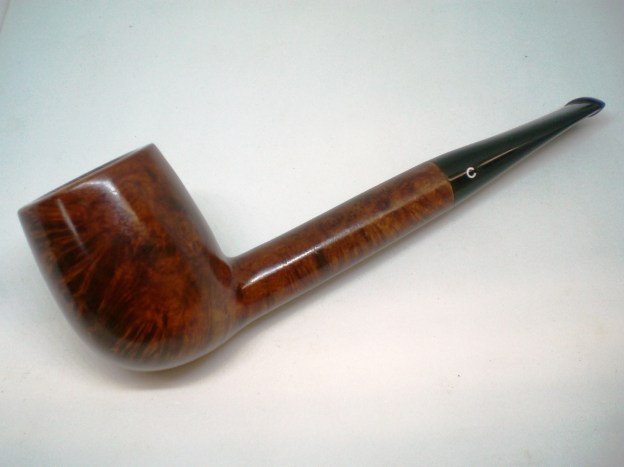
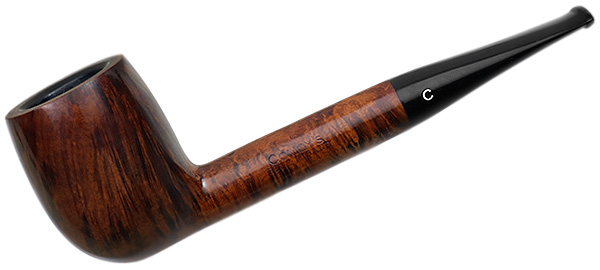
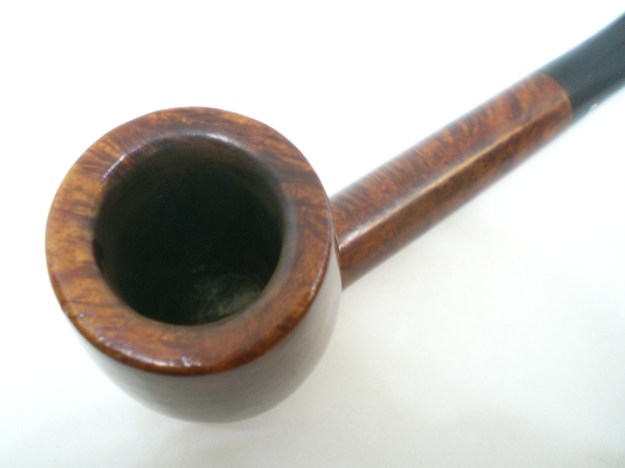
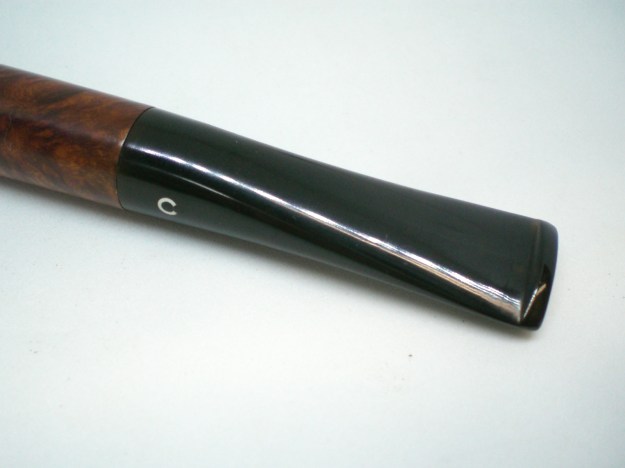
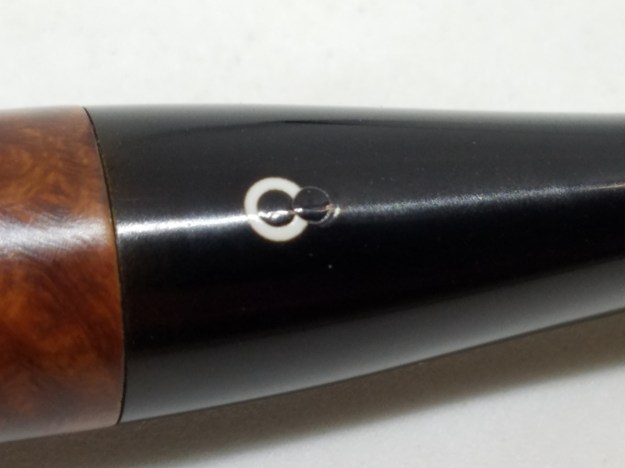
The second Comoy’s on my bench this weekend was a little bit of a mystery. This one also didn’t require a lot of work, but the nomenclature was all but invisible. With a magnifying loupe, I think it is a three digit shape, starting with a 4. I found a shape 434, at SmokingPipes, which is a round shape Liverpool. So, I believe this pipe is also a shape 434, but the finish is undetermined (probably a tradition). The pipe has the three-piece C stem logo, so it was made before 1981. Below we see the shape example from SmokingPipes (this one a Blue Riband!)

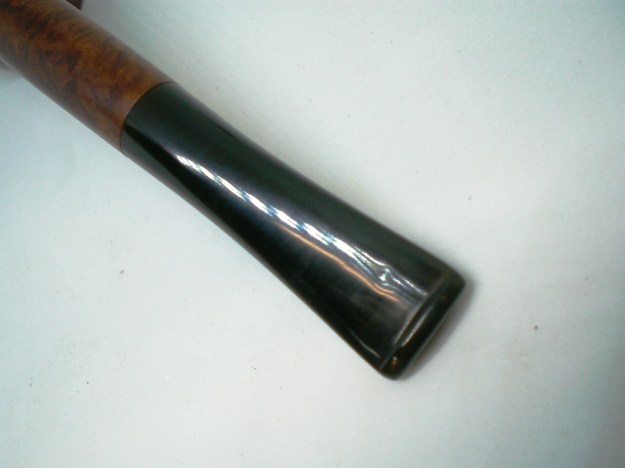
Below is the pipe as received. There was a heavy layer of oxidation on the stem, with a few teeth indentions. A heavy layer of build-up was on the bowl-top and it had a very thick cake in the bowl. Tobacco buildup in the shank prevented the stem from being inserted flush.

I used a lighter to lift the teeth indentions on both sides of the stem. A worn scotchbrite was used to remove the build-up on the bowl top. The bowl was reamed, then soaked with alcohol and sea salt. While the bowl was soaking, the stem was soaked in a mild oxy-clean solution. I put a dab of grease on the C stem logo.

Following the soak, the shank was cleaned and stem inserted. Now that the shank was clean, the stem was able to be inserted flush and it had a nice, snug fit. I removed the oxidation with 400, 800, 1,000, 1,500 and 2,000 grade wet paper, followed by 8,000 micromesh. The stem was then polished with White Diamond and Meguiars plastic polish.

The bowl was buffed with White Diamond and several coats of Carnuba wax. Below is the finished pipe.

Comoy’s Golden Grain Bulldog Restoration


By Al Jones

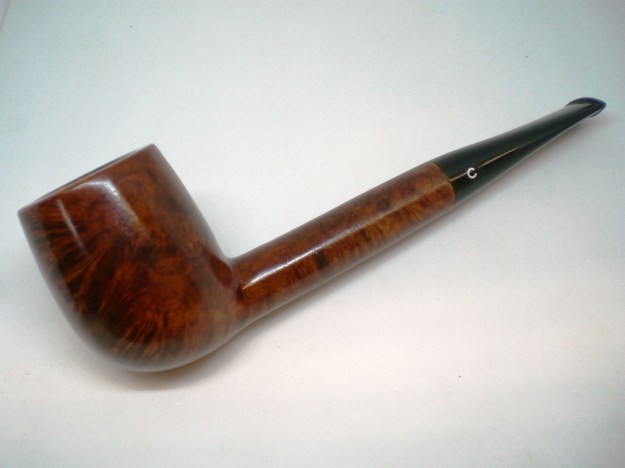
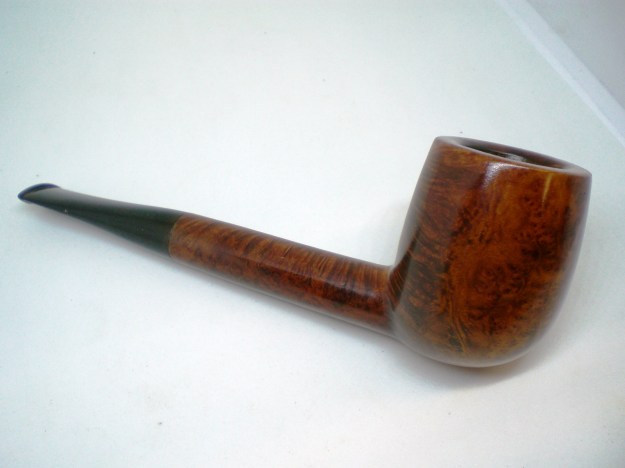
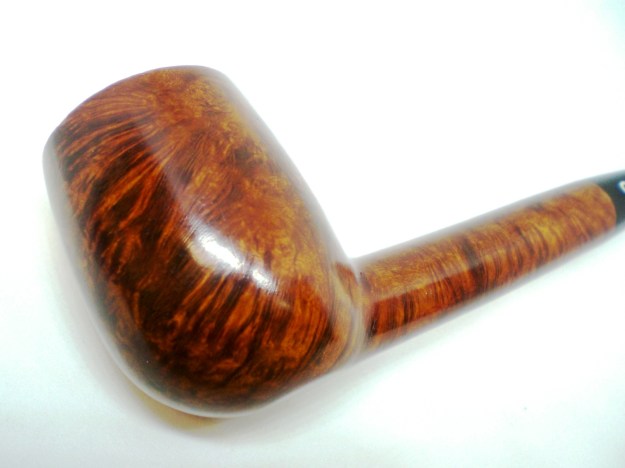
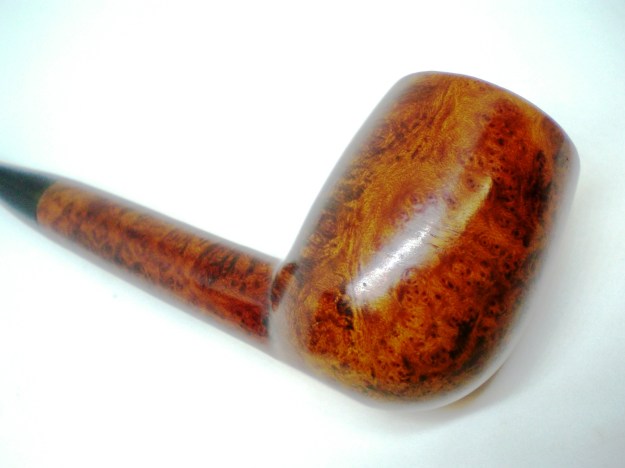
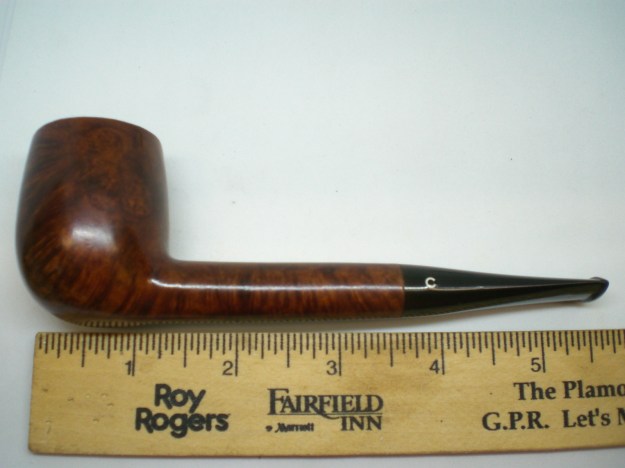
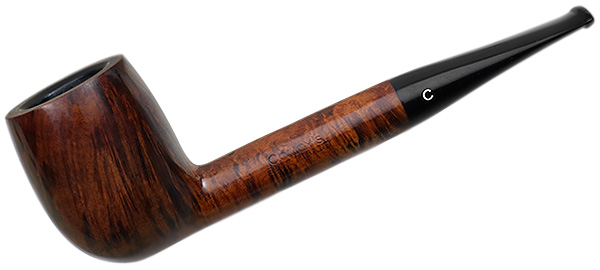
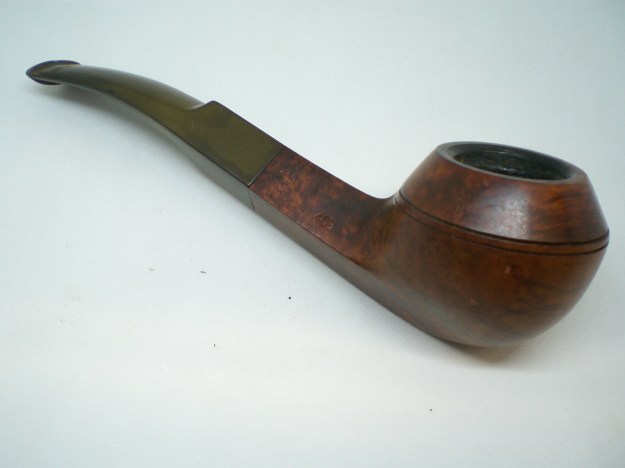
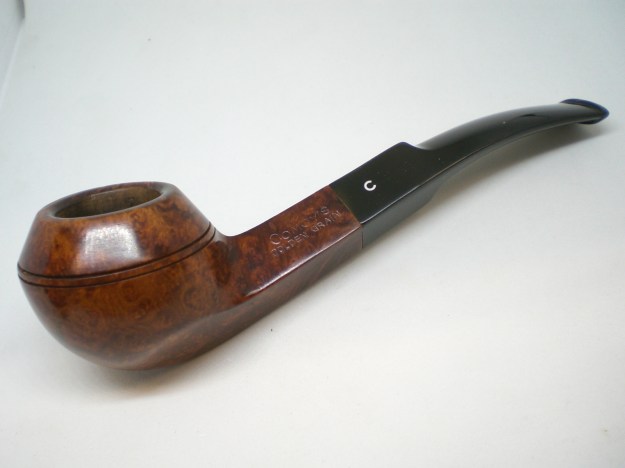
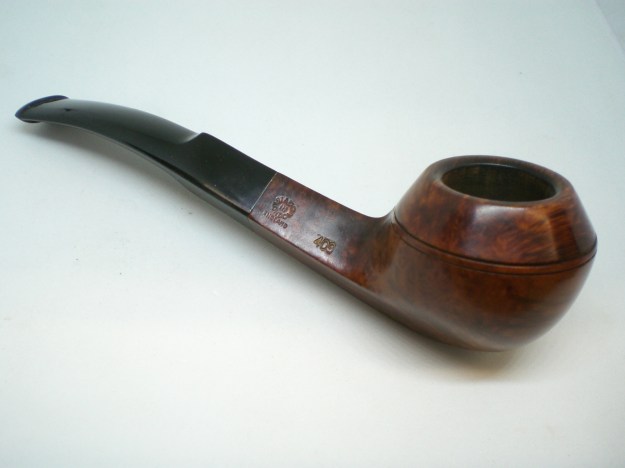
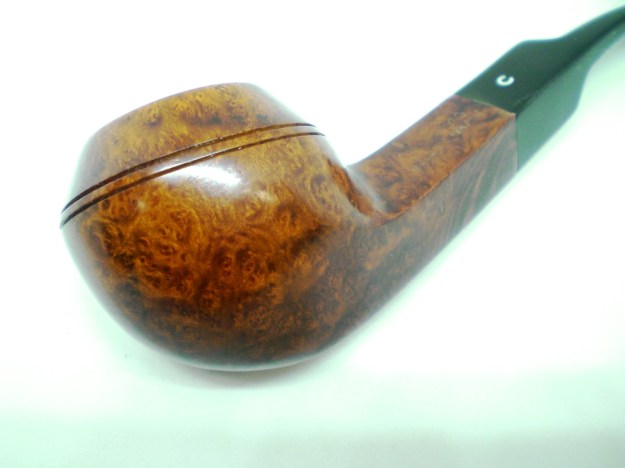
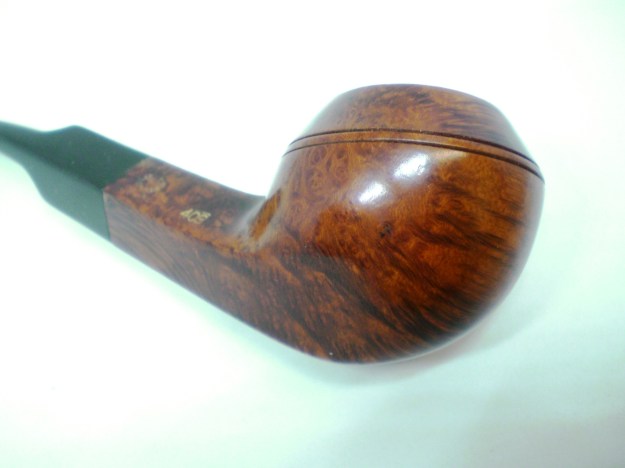
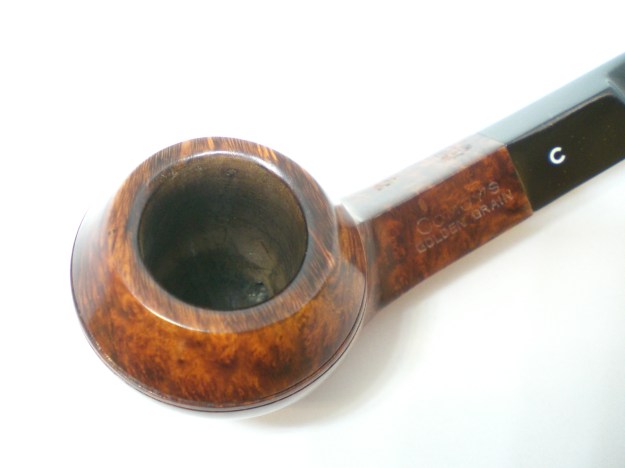
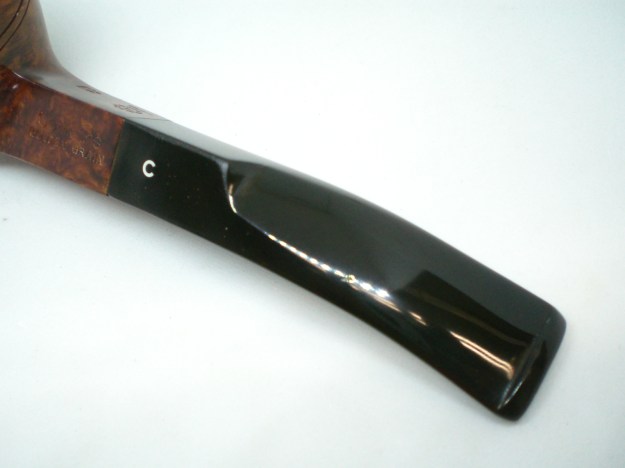
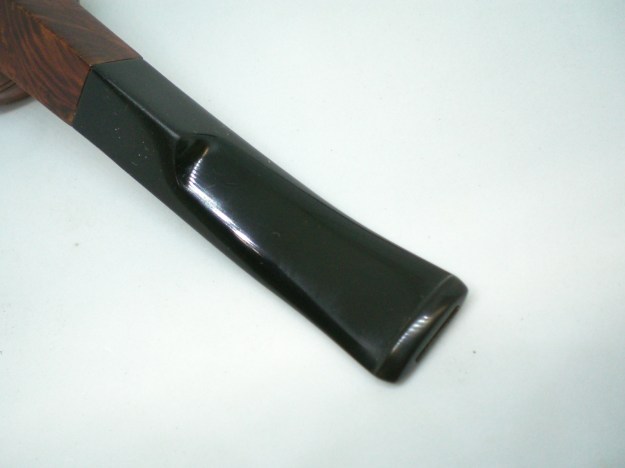
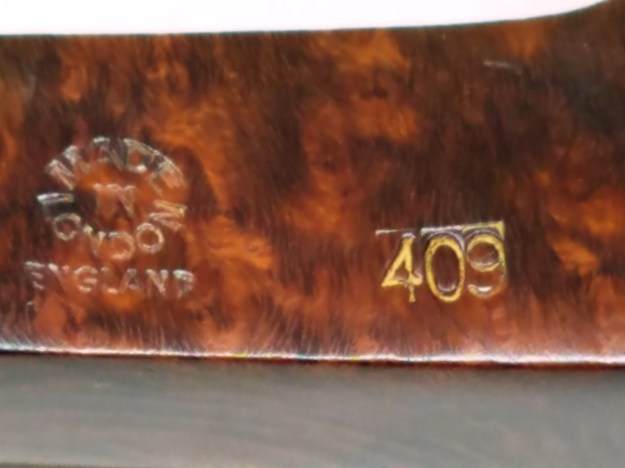
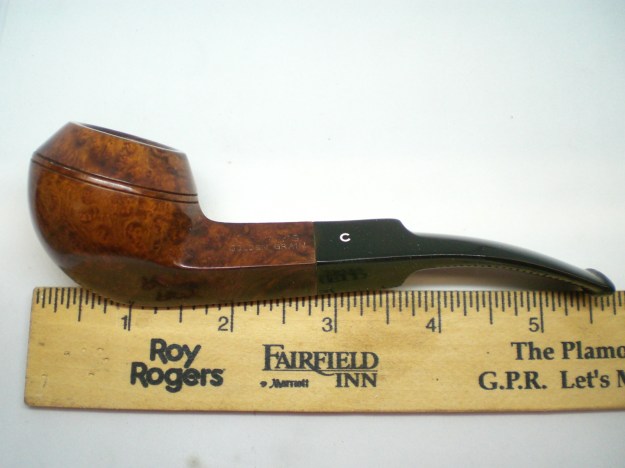
This 409 Bulldog Golden Grain found its way to my work bench this weekend. The 409 is the most popular Comoy’s bulldog, but I’ve only worked in three versions of this shape in the past seven years. It’s not certain when the Golden Grain entered the Comoy’s line up. The COM and three-piece C stem logo were used from 1946 to the merger in 1981.

The pipe had some build-up on the bowl and the stem was heavily oxidized, but overall, it held a lot of promise for a restoration. Below is the pipe as received.

I used a piece of worn scotchbrite to remove the build-up on the bowl top. The bowl was reamed which revealed that the bowl interior was in very good condition. The bowl was soaked in alcohol and sea salt. I picked up an old Sugar dispenser for filling the bowl with salt, which worked very well (sealed with a piece of tape to keep the salt dry). While the bowl was soaking, the stem was soaked in some mild oxy-clean solution. I put a dab of grease on the C stem logo.

Following the soak, the shank was cleaned and stem inserted. I removed the oxidation with 400, 800, 1,000, 1,500 and 2,000 grade wet paper, followed by 8,000 micromesh. The stem was then polished with White Diamond and Meguiars plastic polish.

The bowl was buffed with White Diamond and several coats of Carnuba wax. Below is the finished pipe.

?

?