Monthly Archives: March 2020

Restoring a Savinelli Autograph 5 Freehand Style Bent Sitter


Blog by Steve Laug

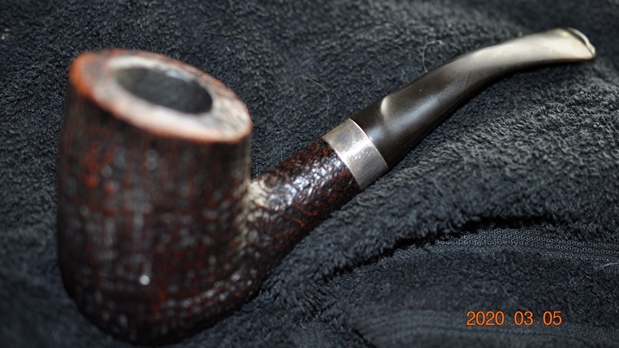
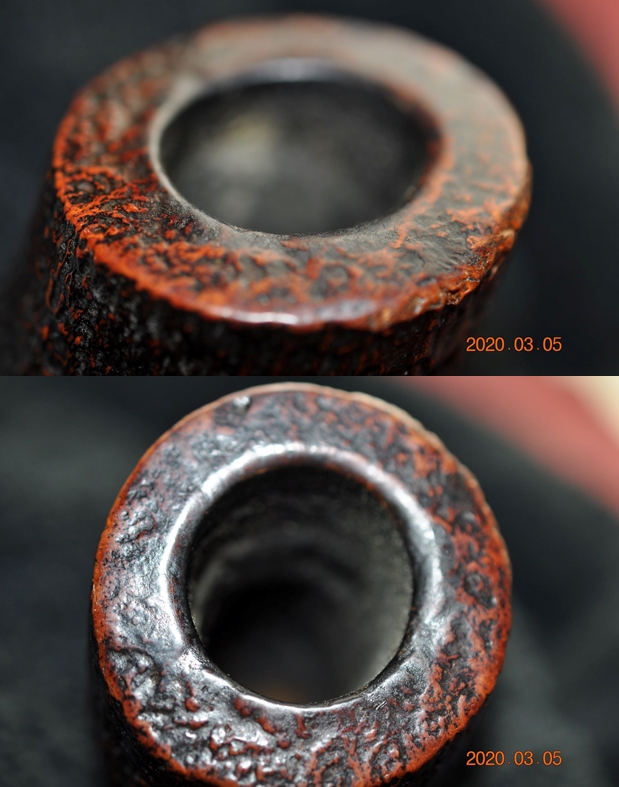
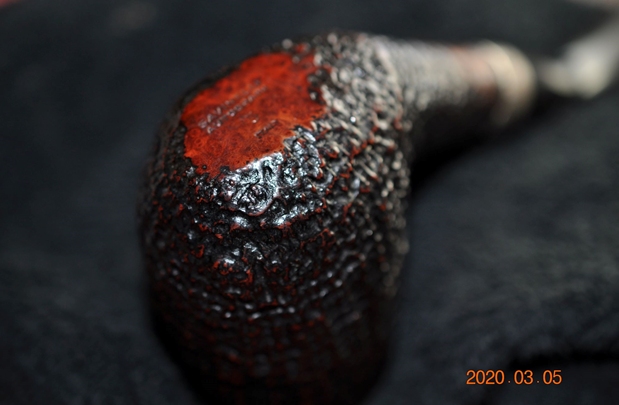
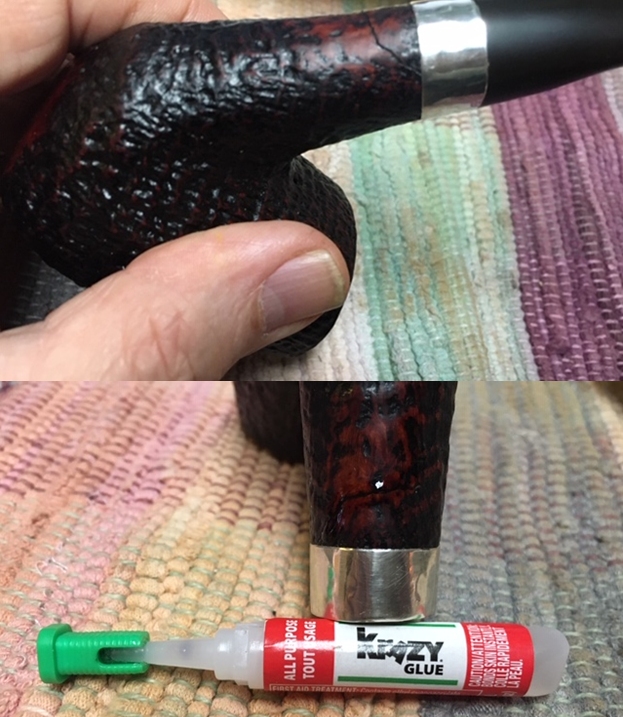
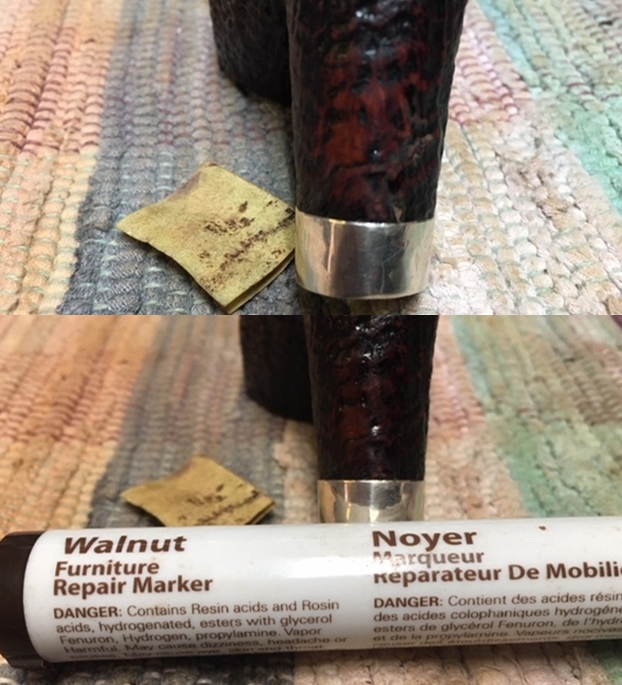
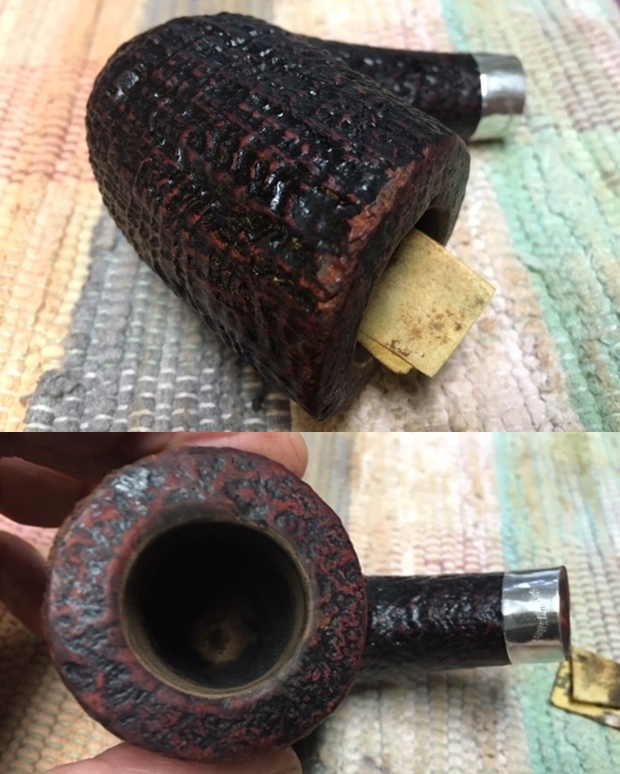
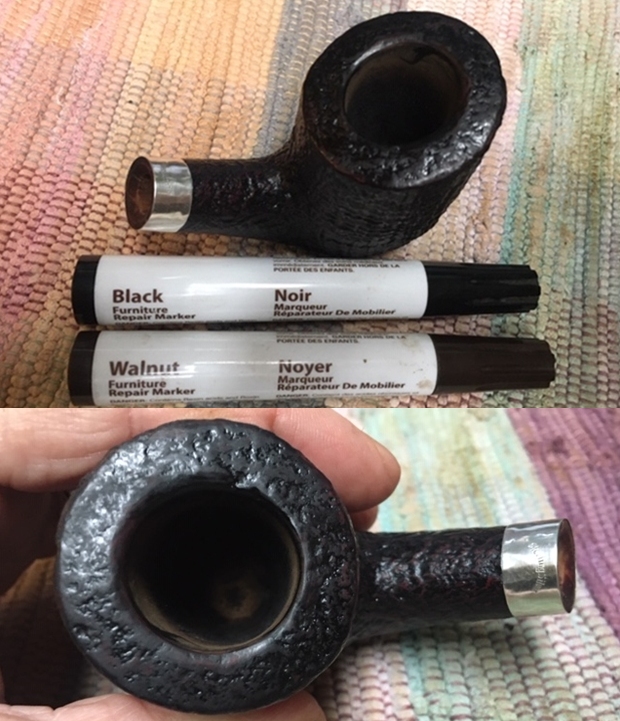
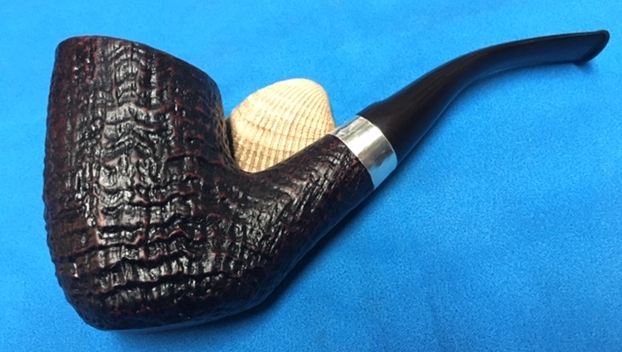
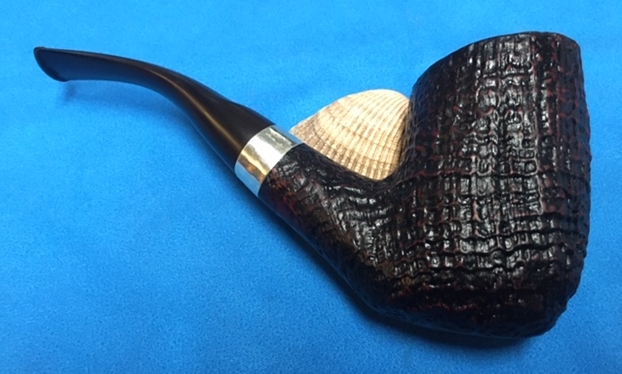
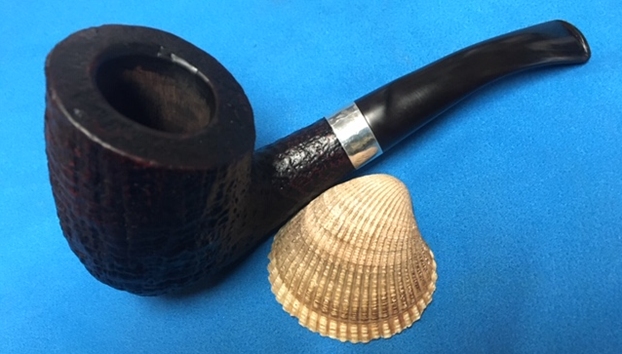
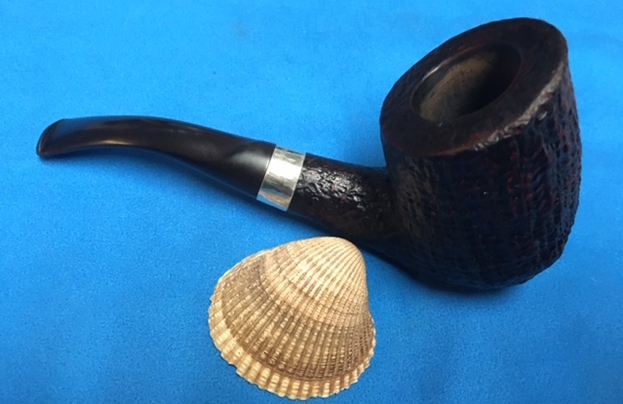
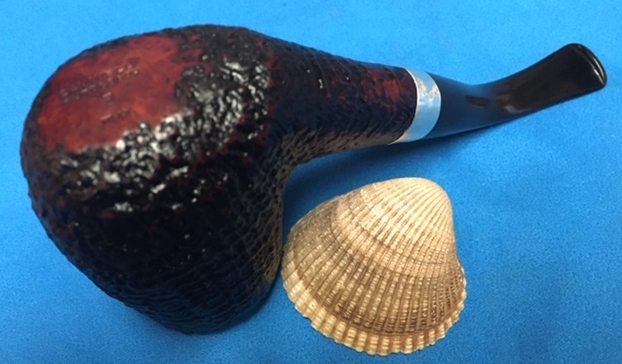
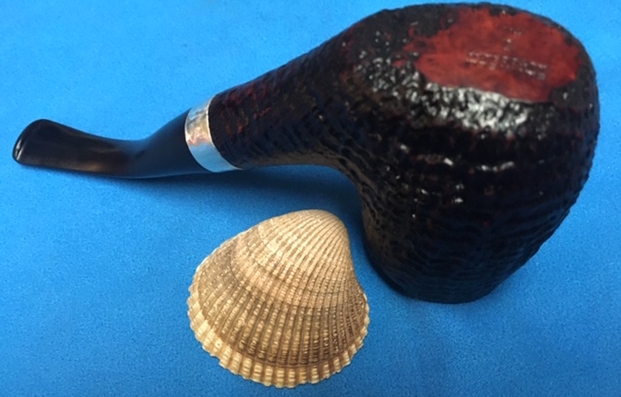
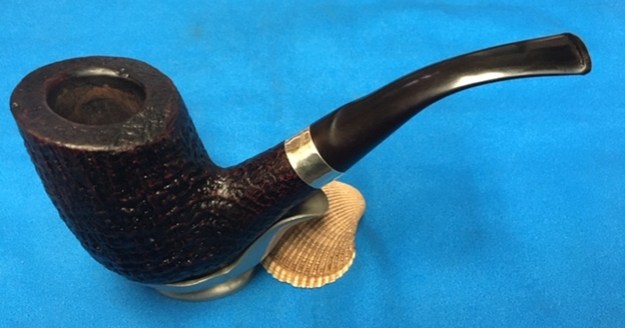
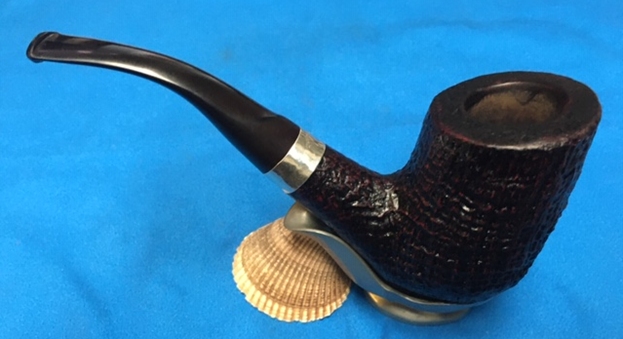
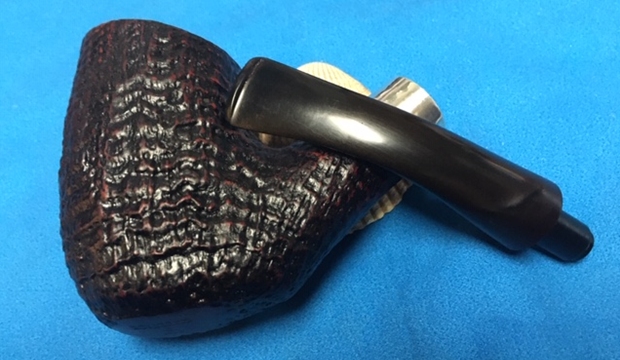
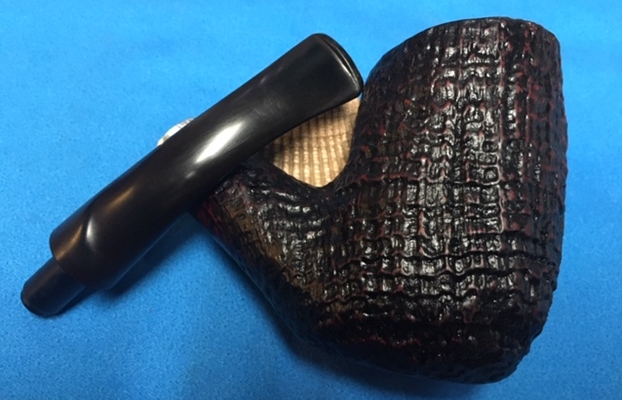
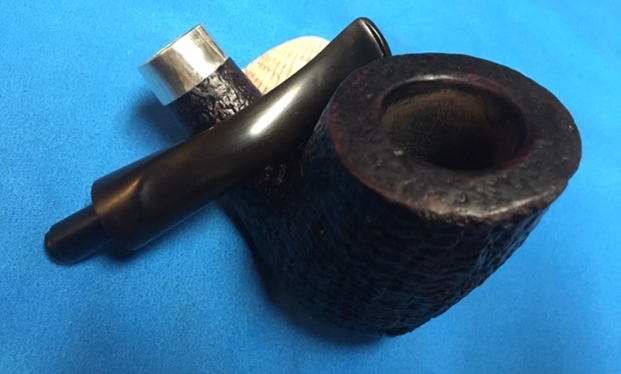
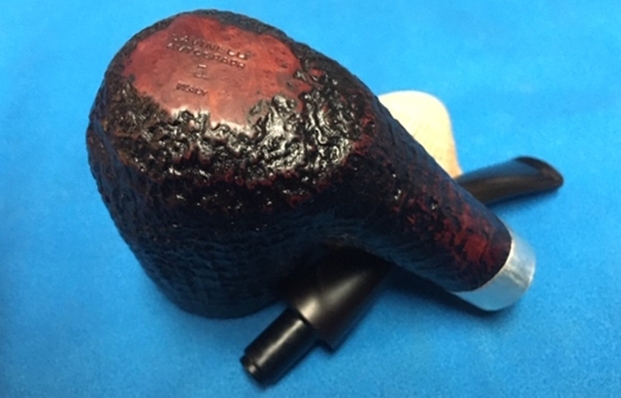
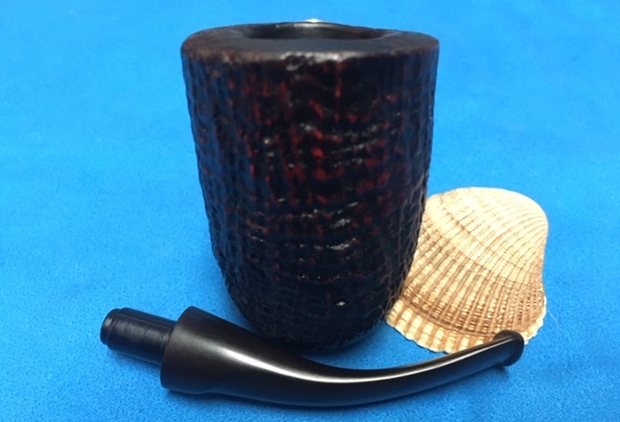
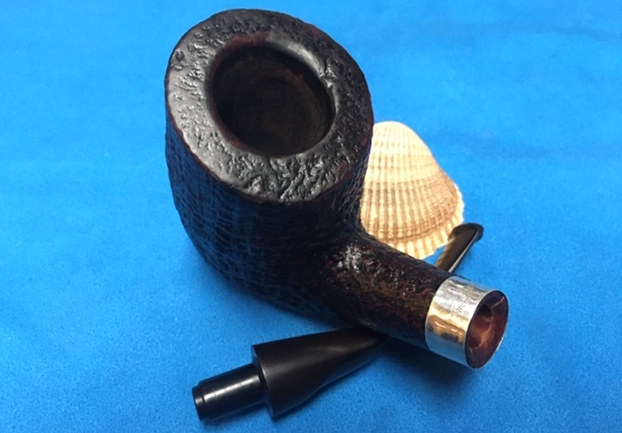
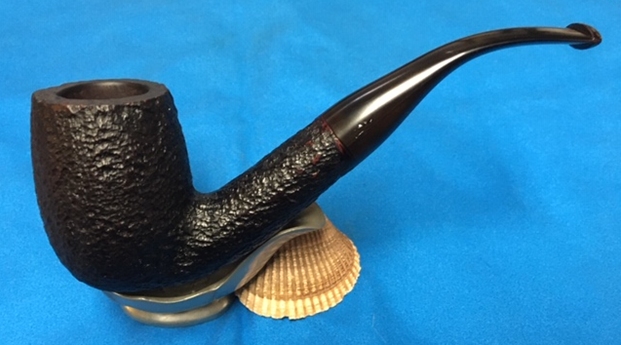
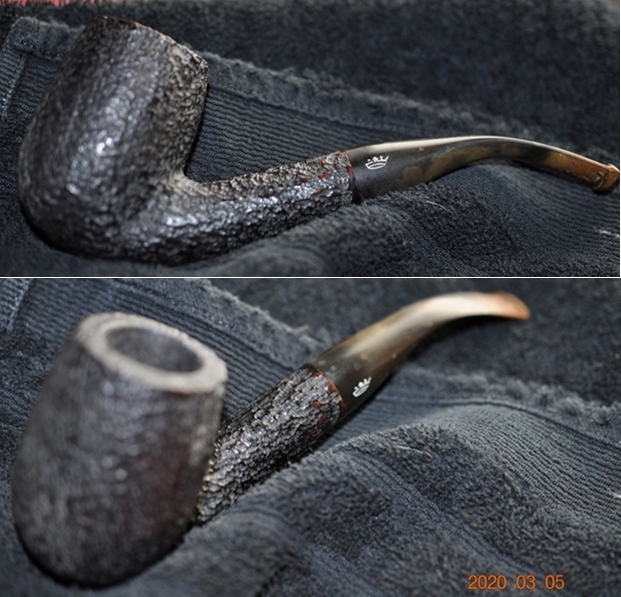
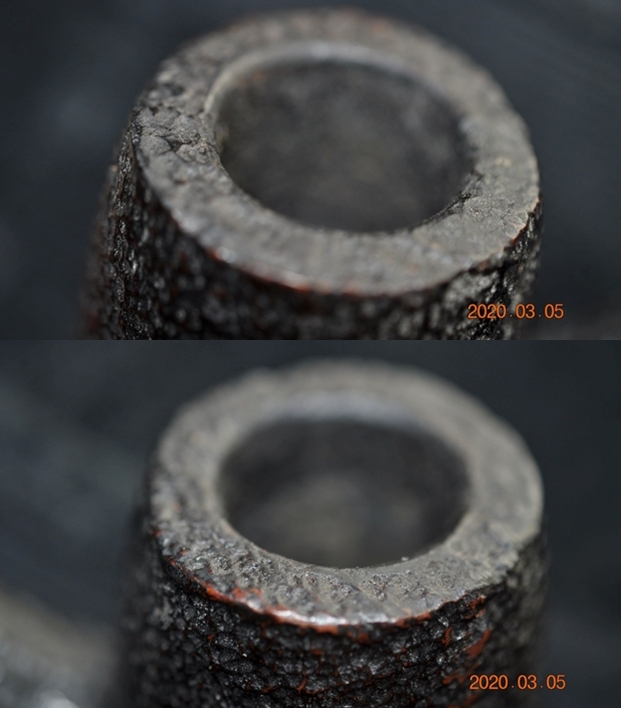
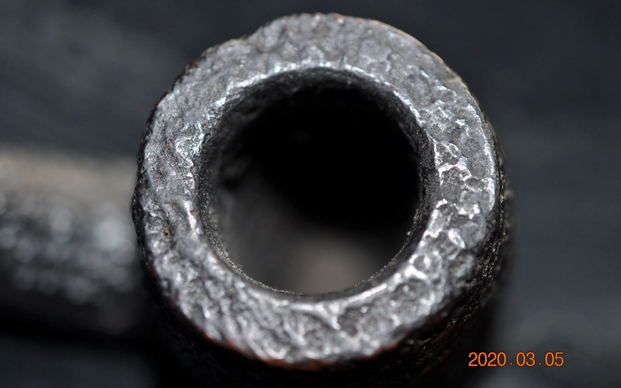
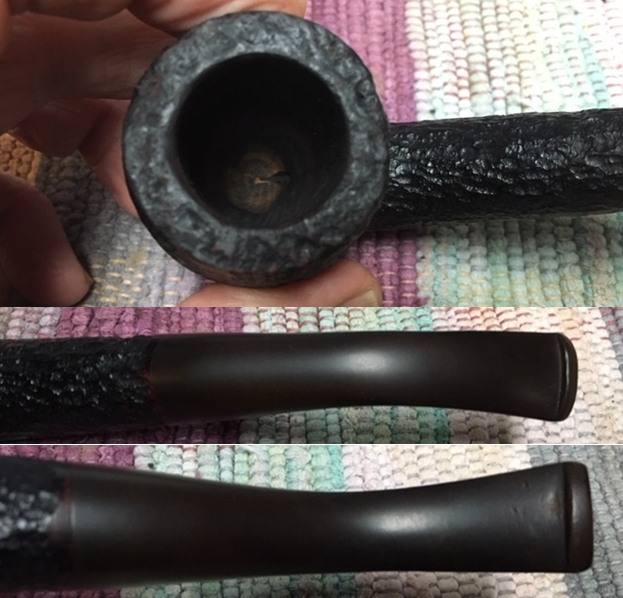
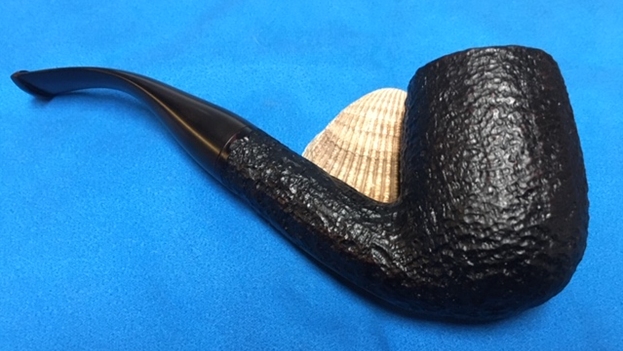
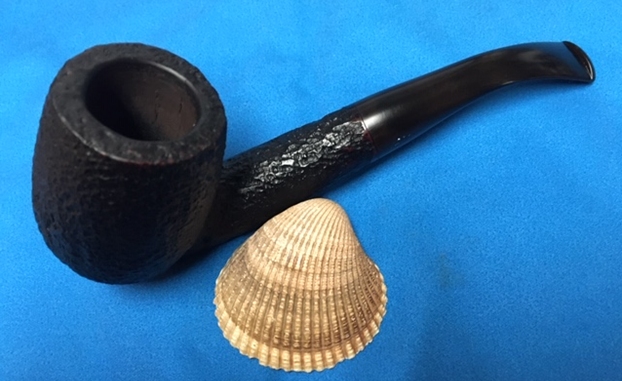
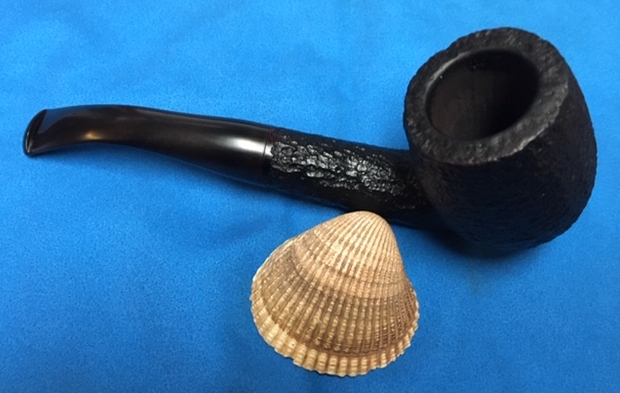
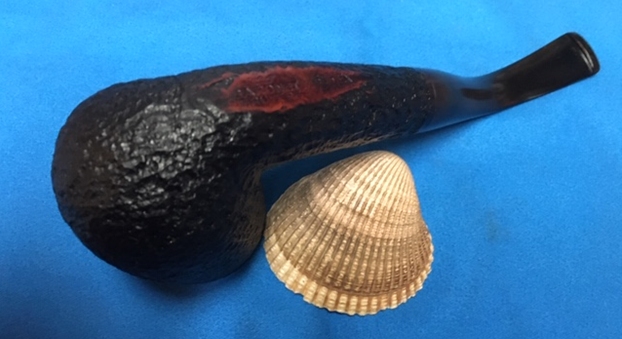
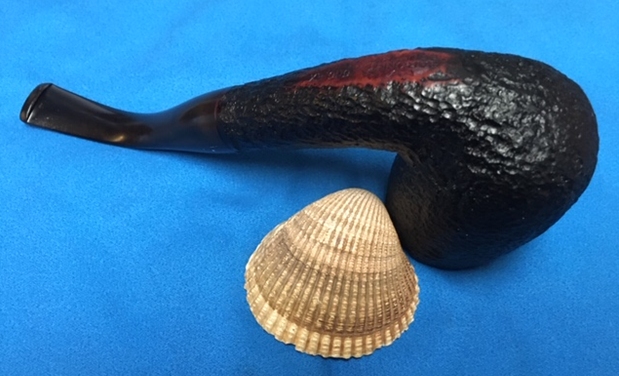
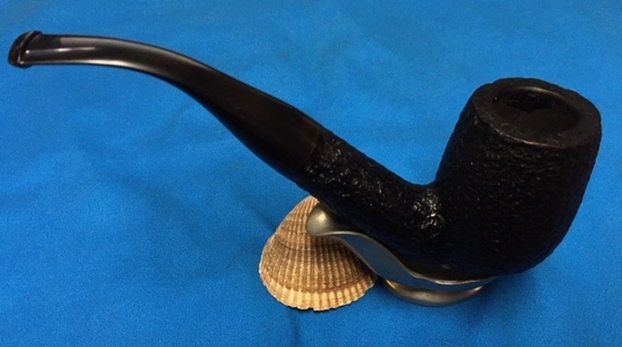
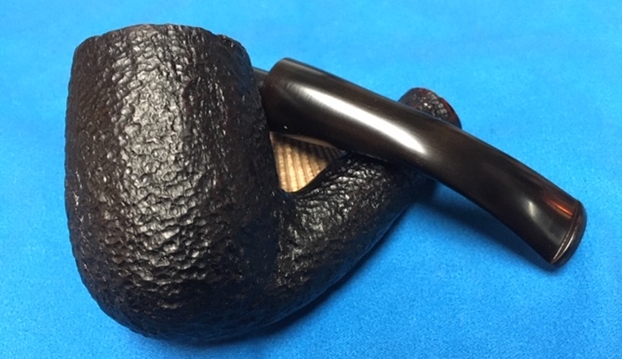
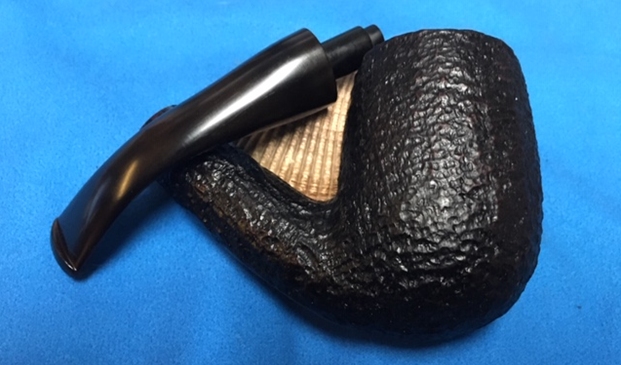
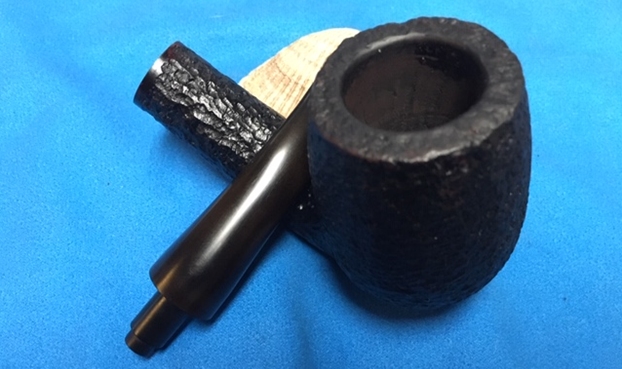
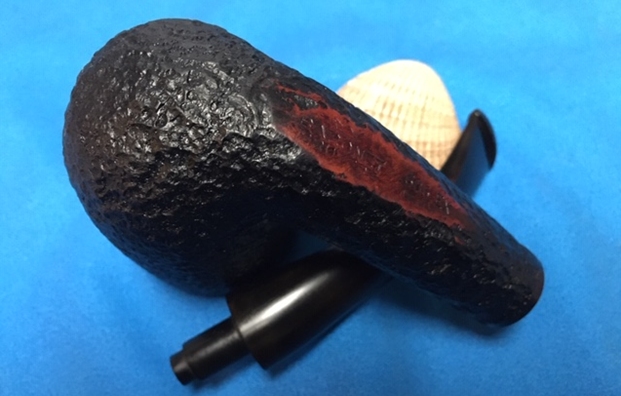
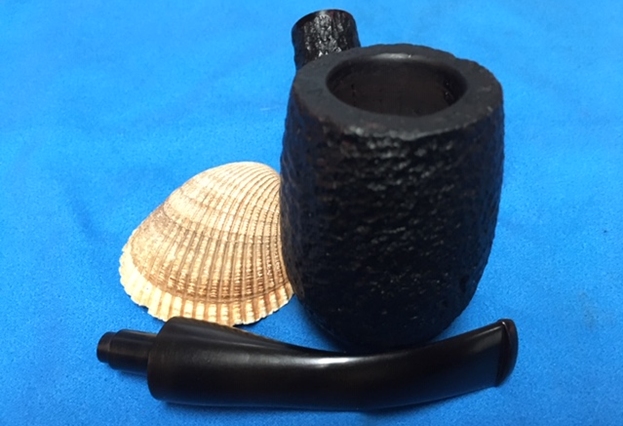
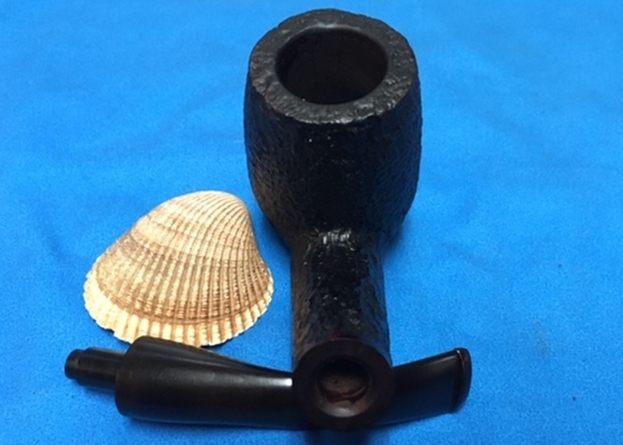
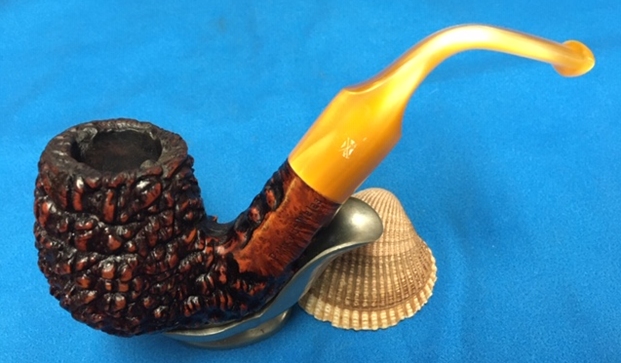
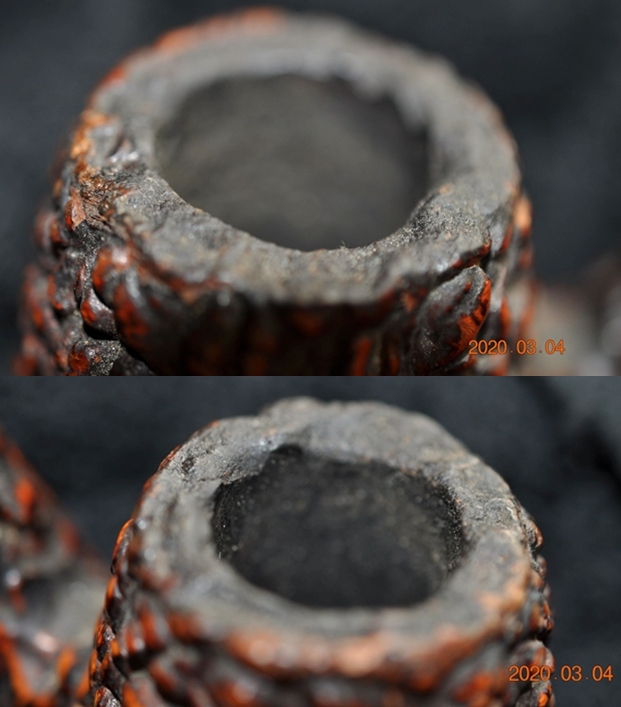
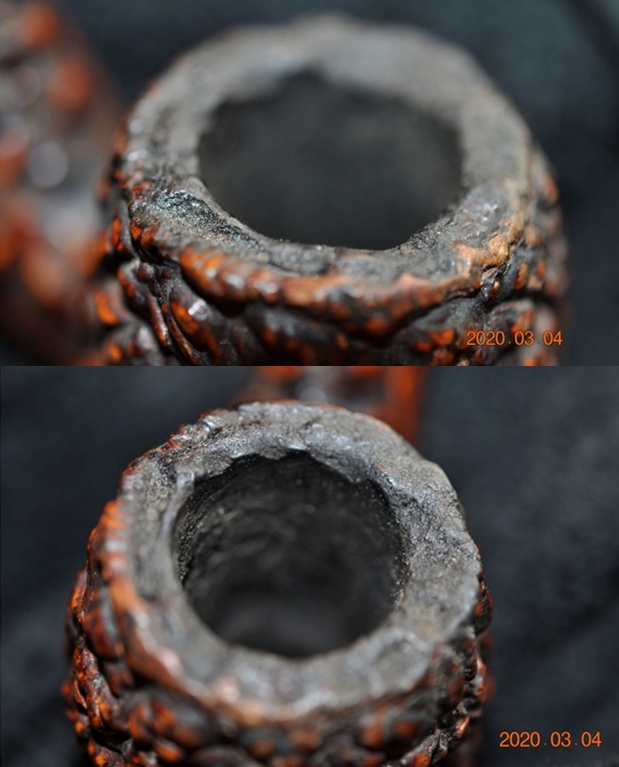
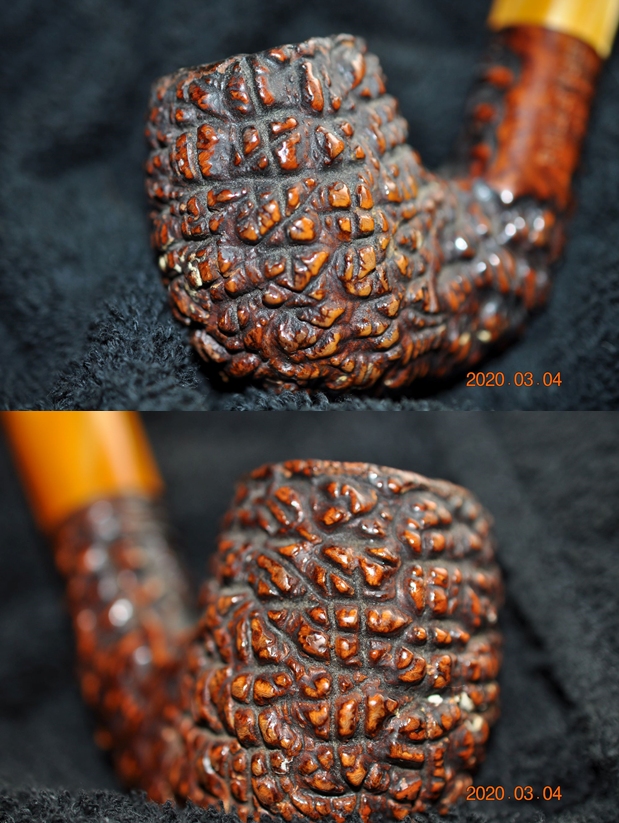
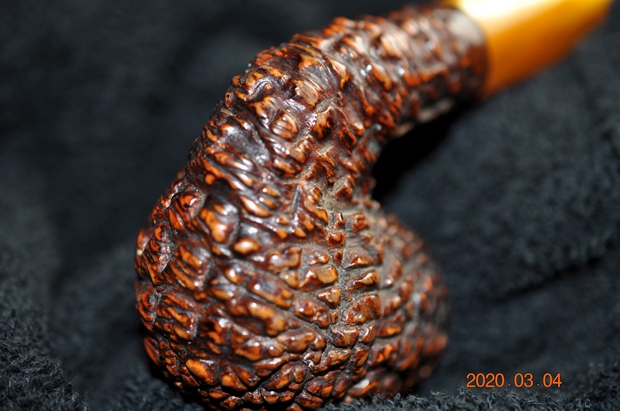
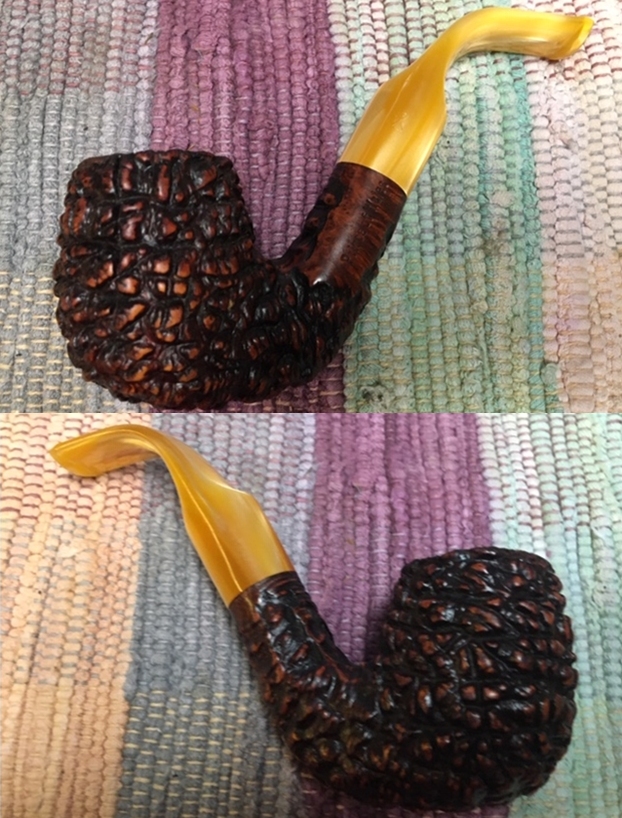
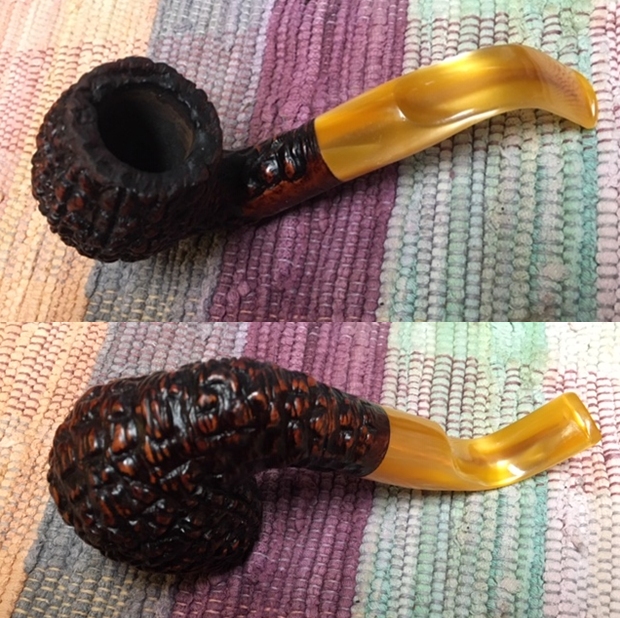
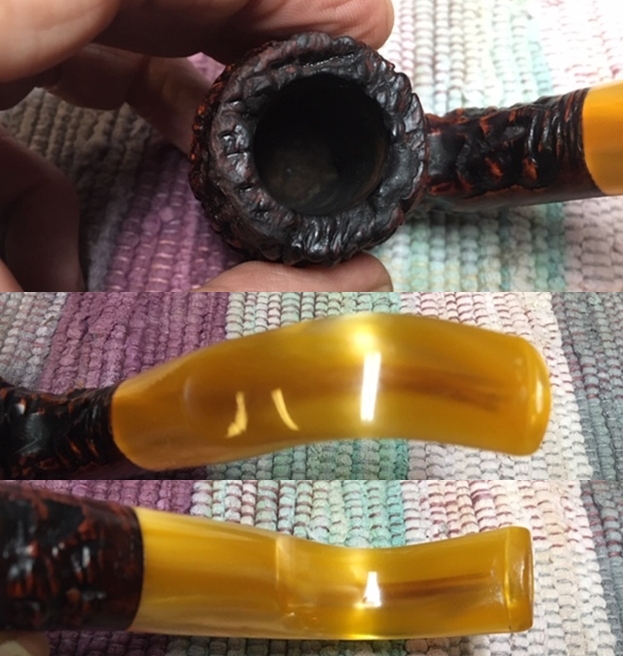
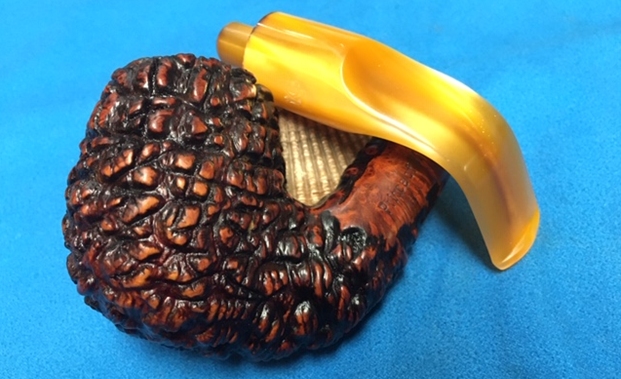
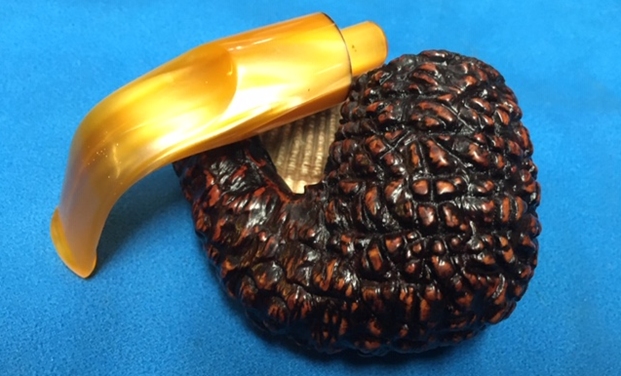
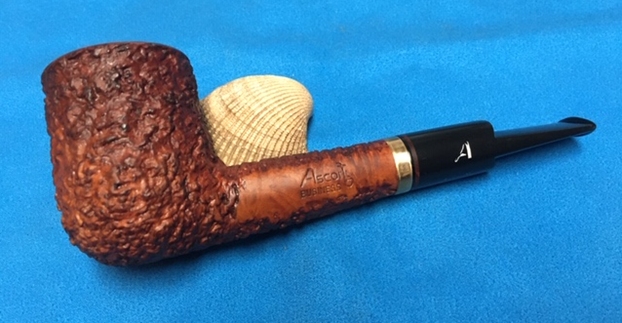
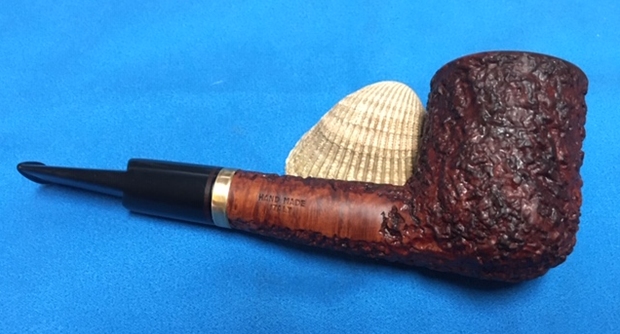
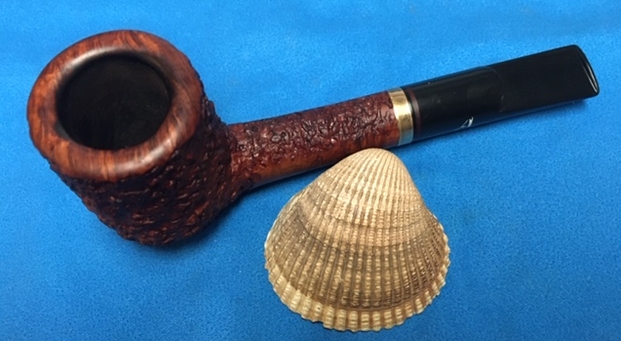
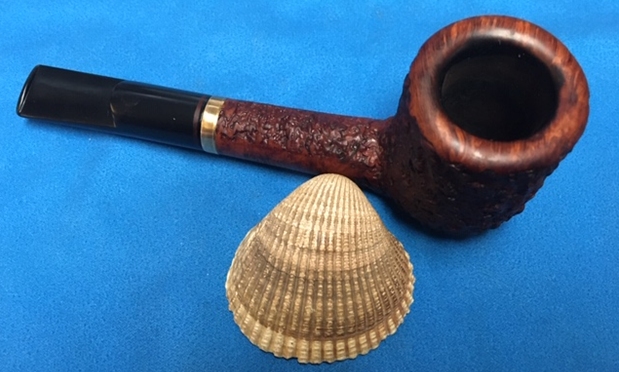
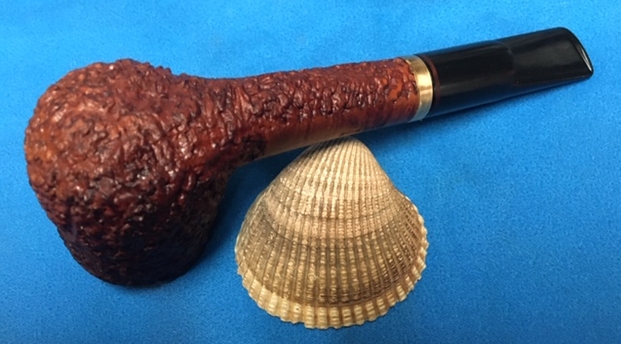
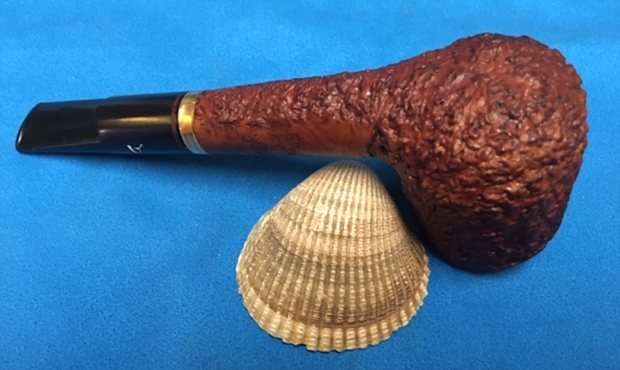
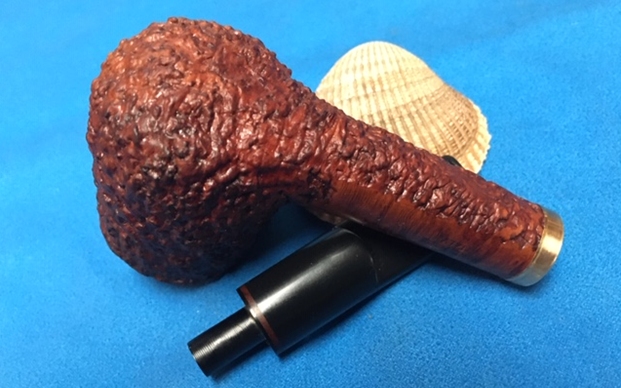
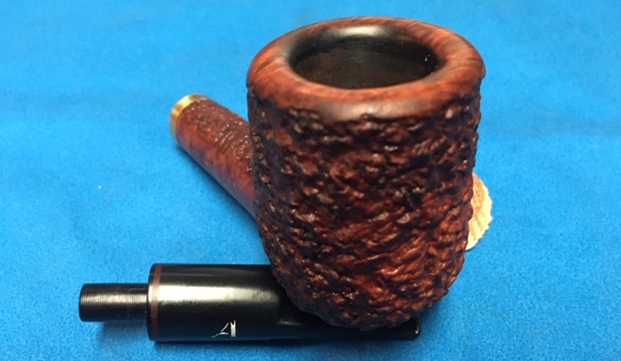
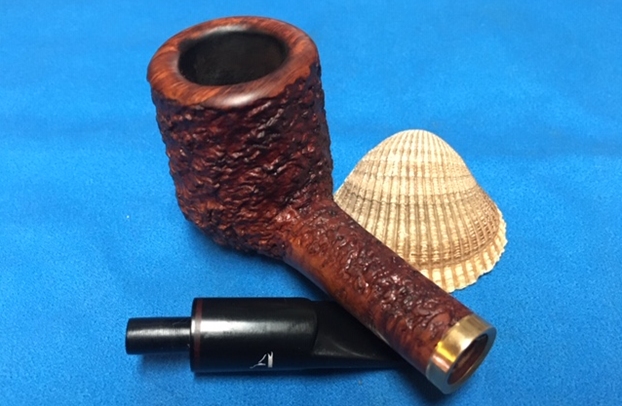
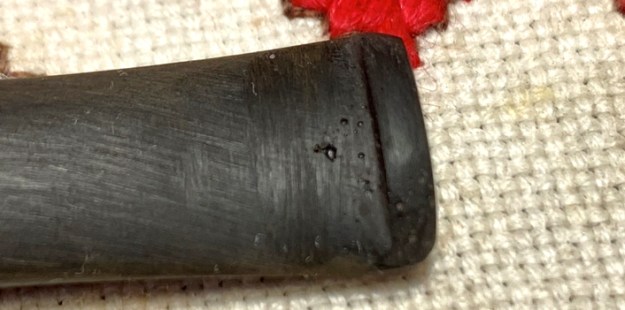
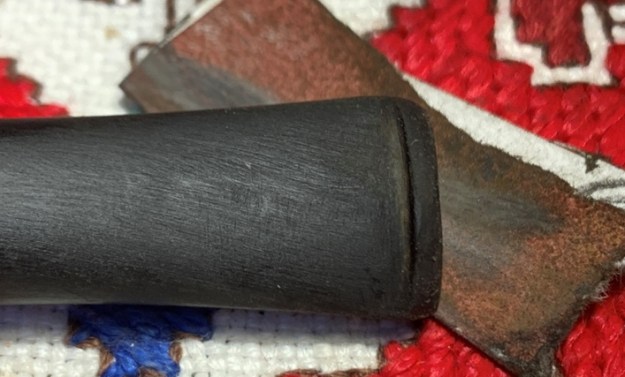
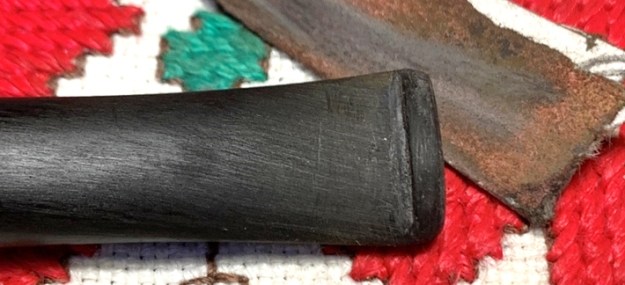
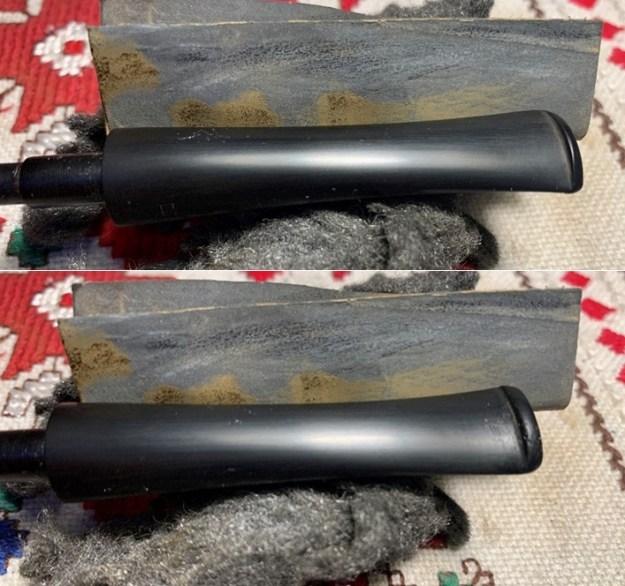
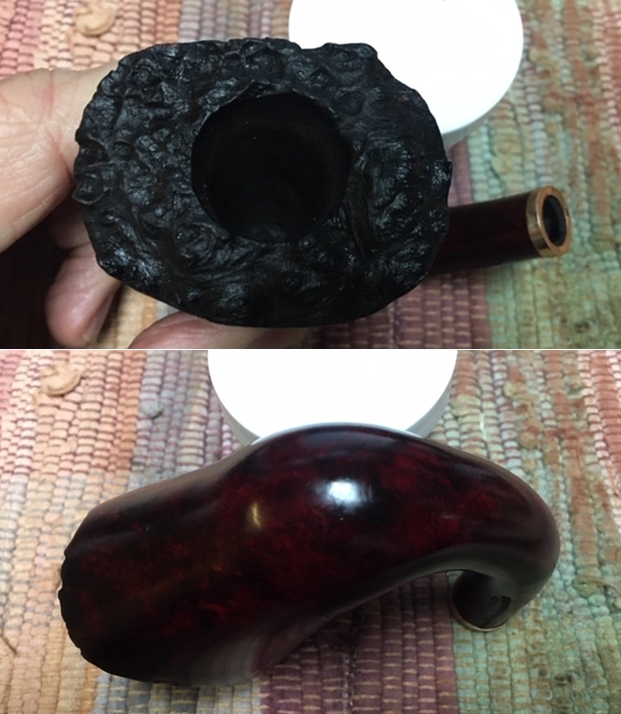
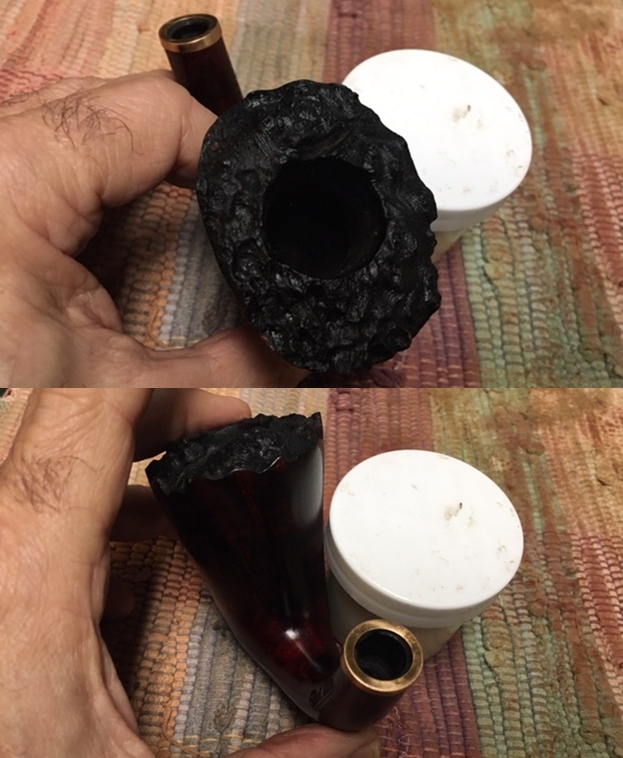
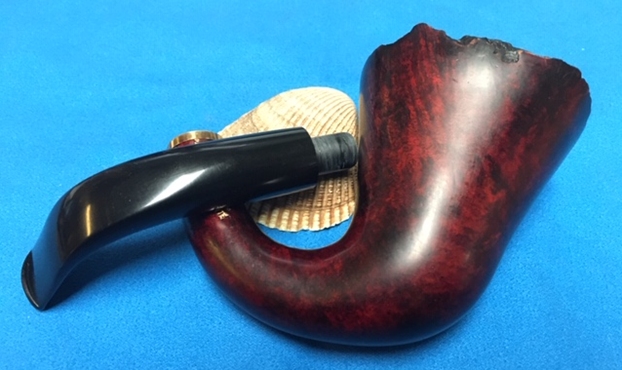
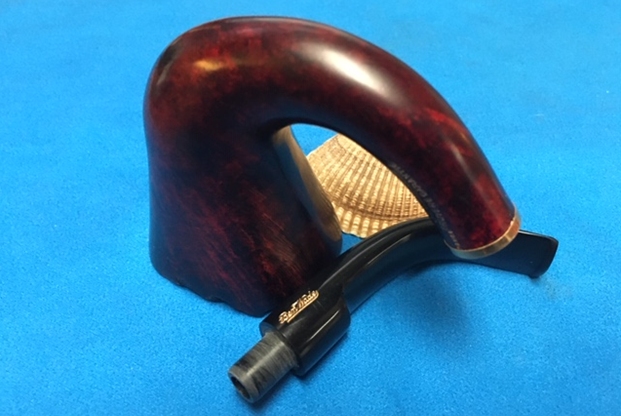
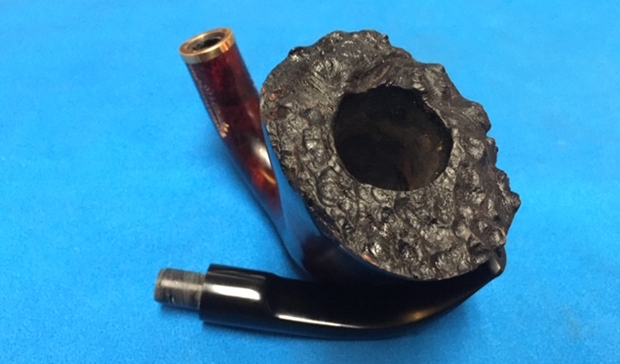
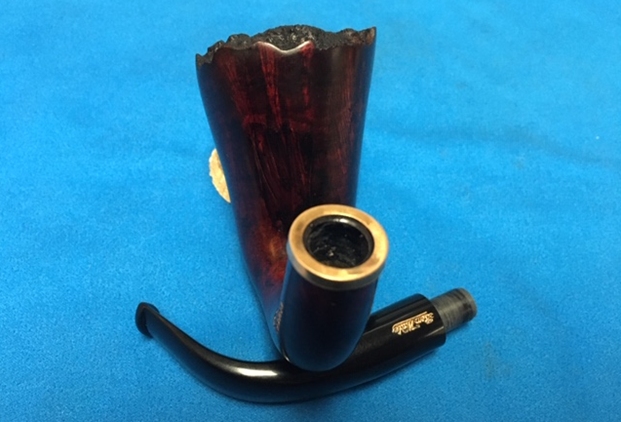
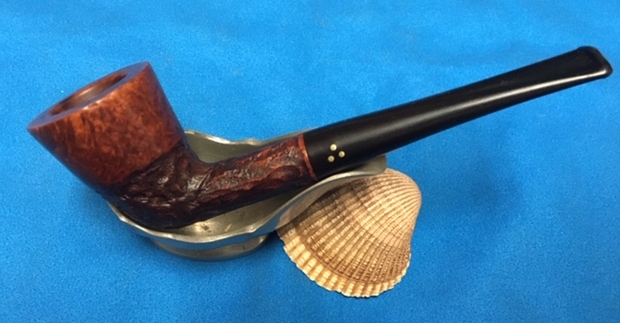
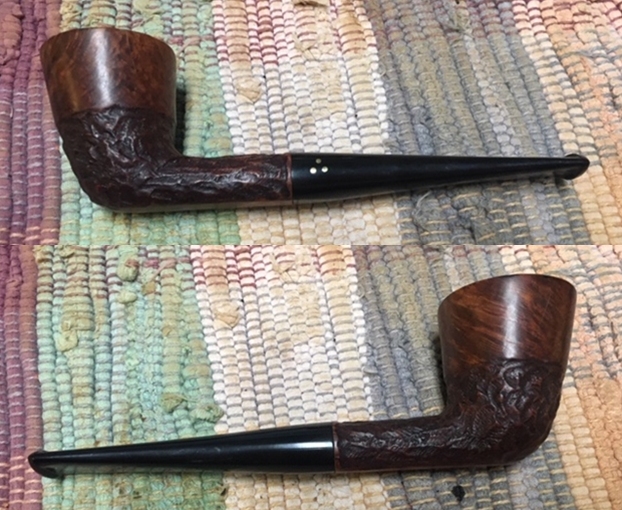
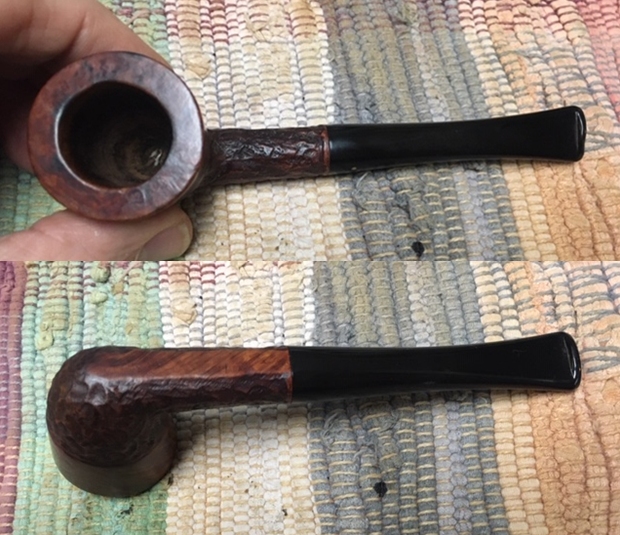
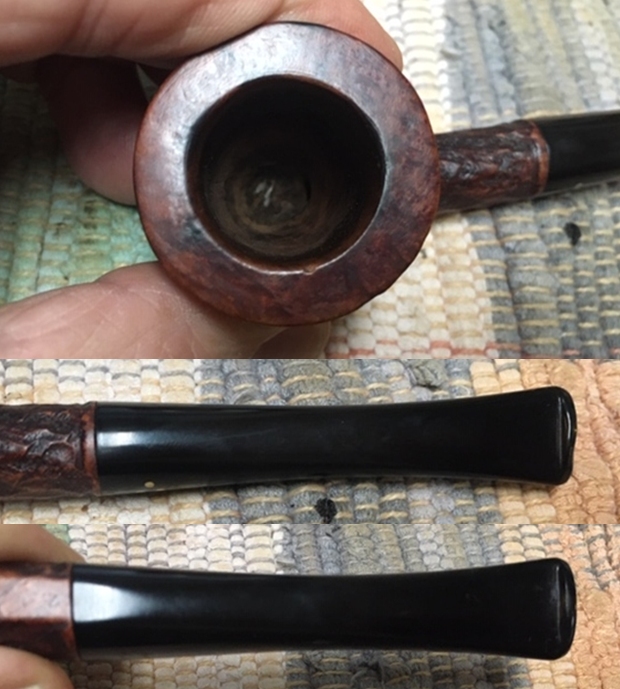
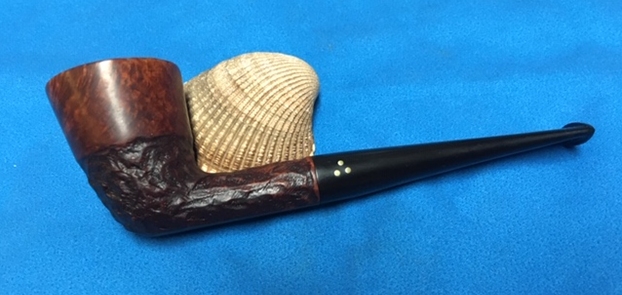
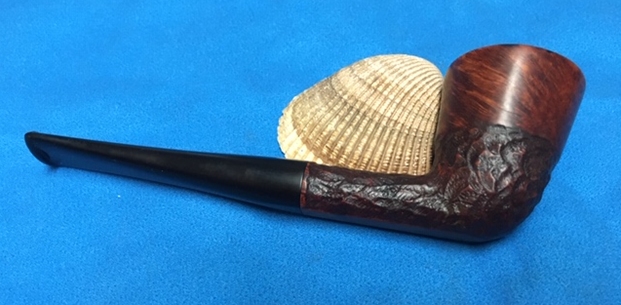
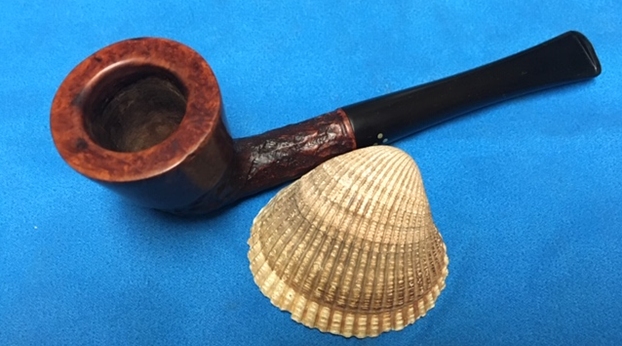
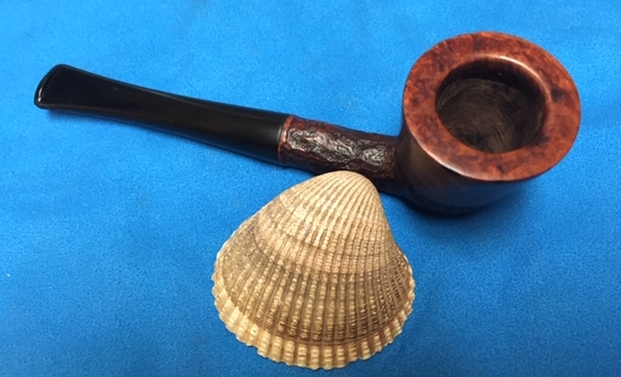
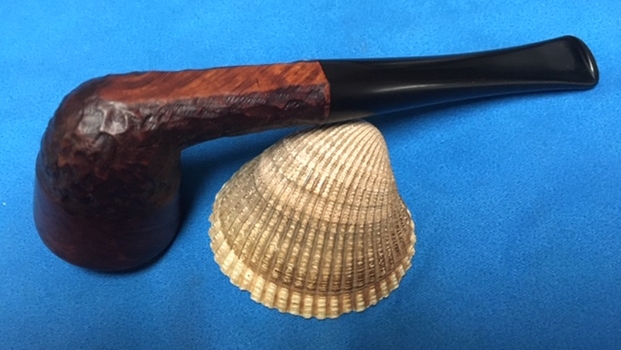
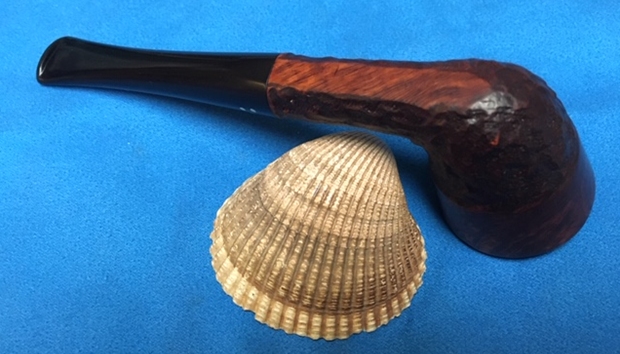
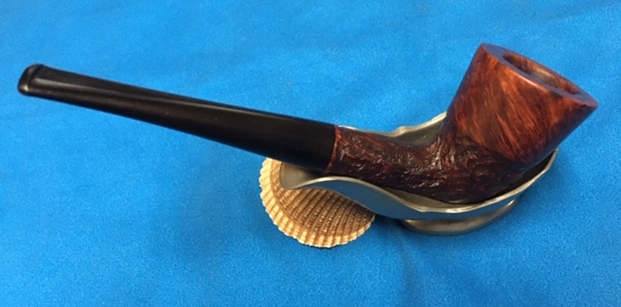
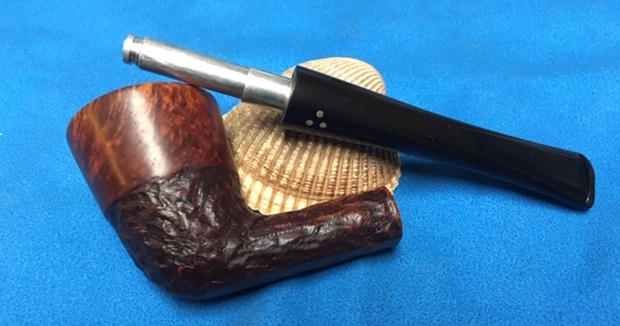
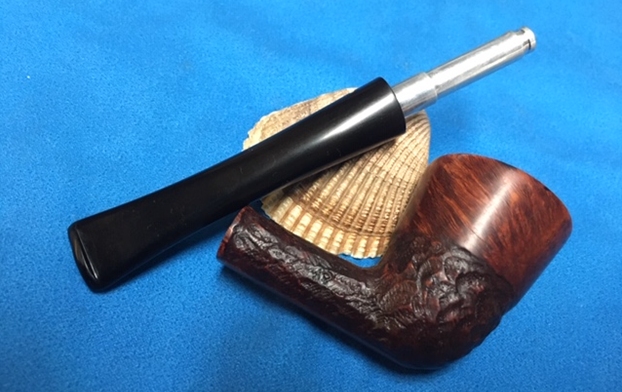
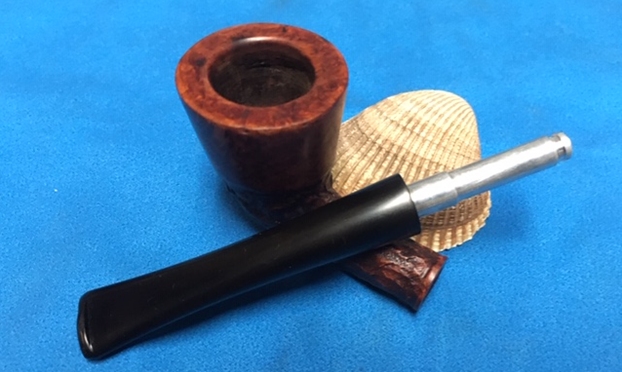
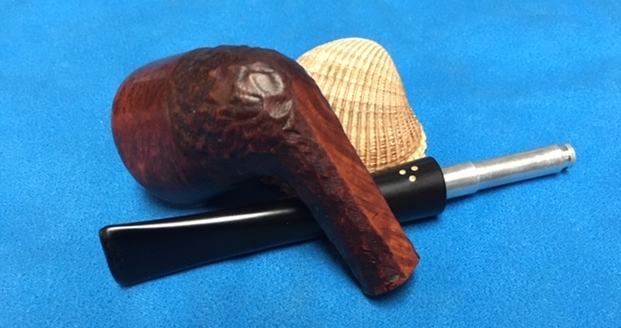
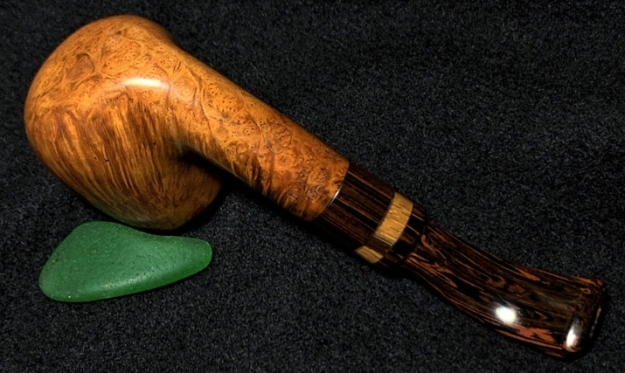
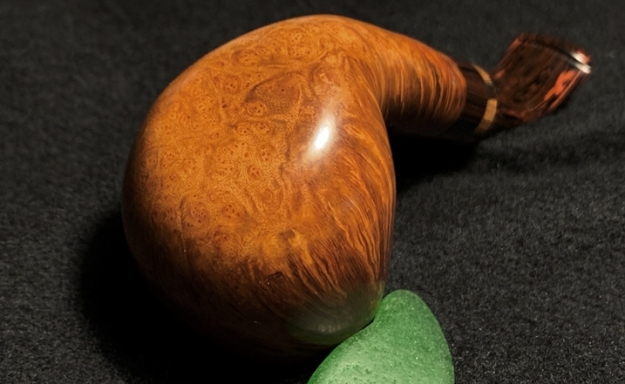
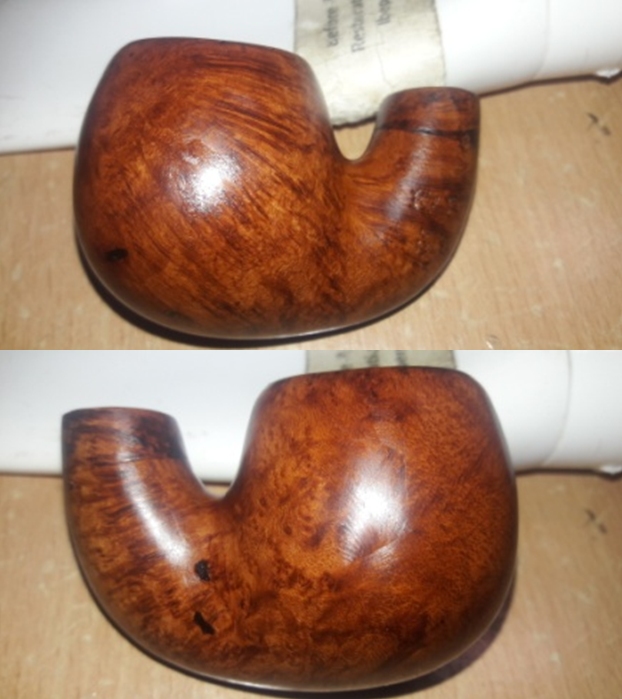
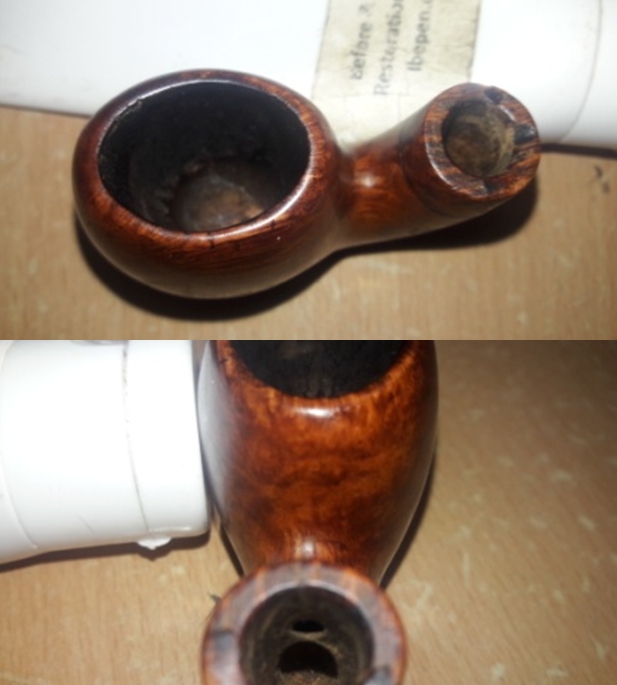
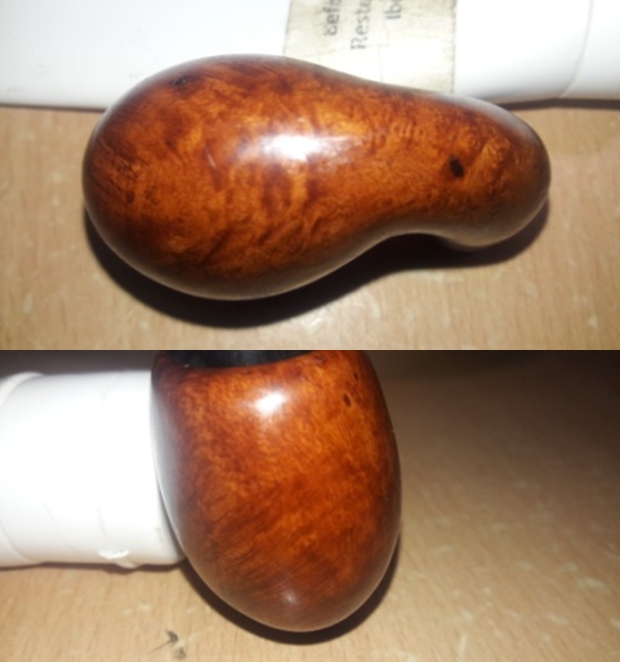
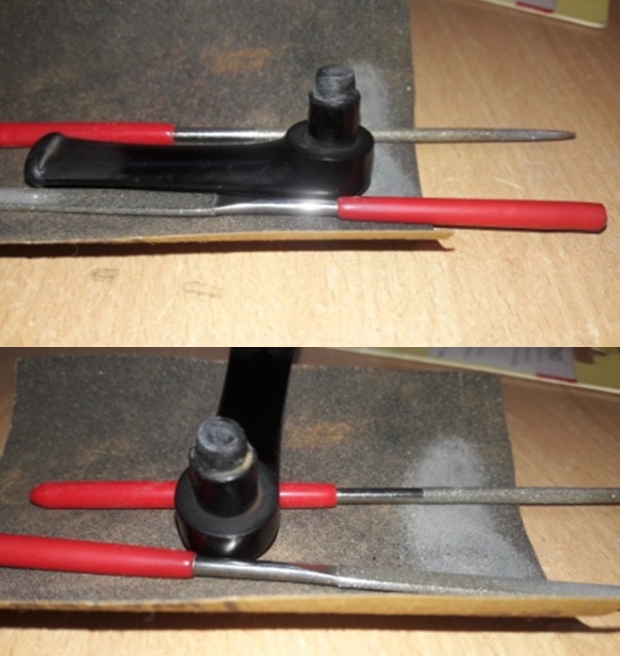
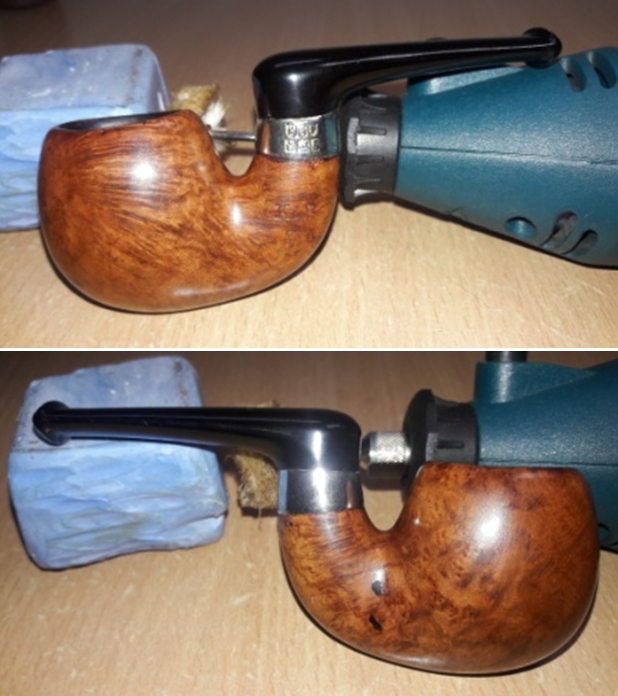
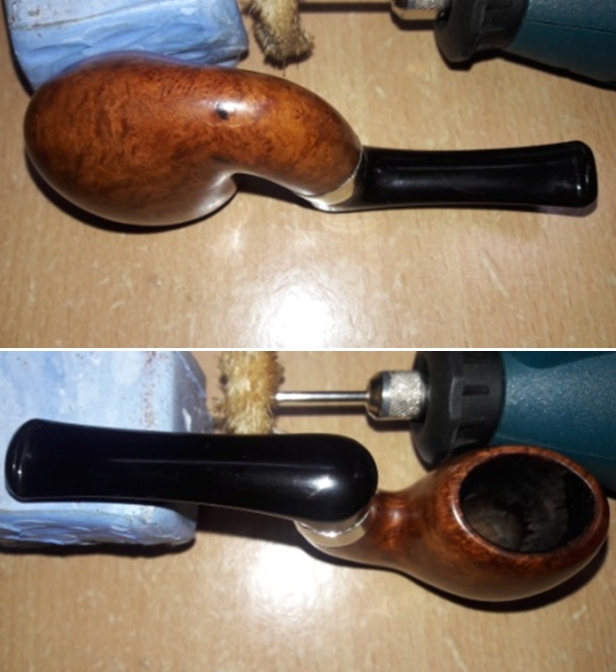
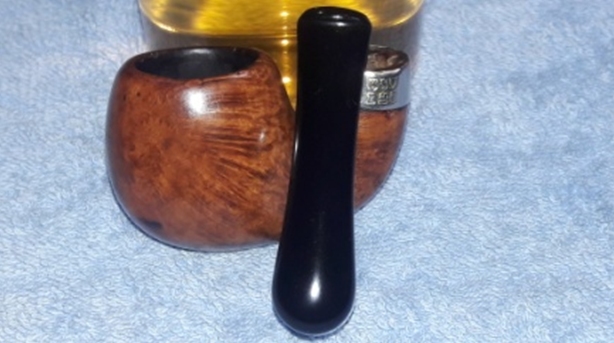
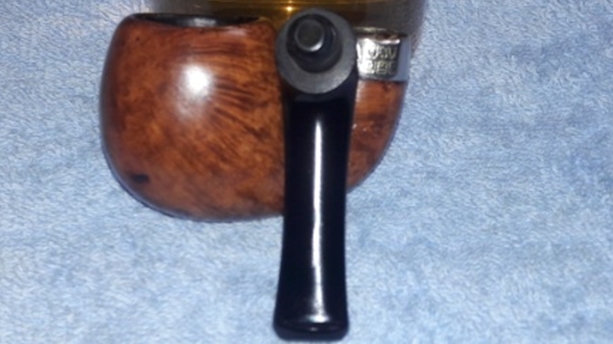
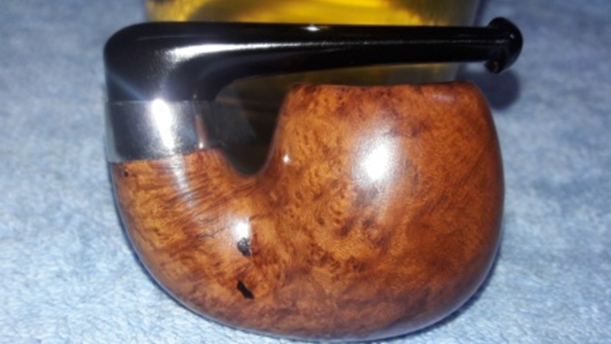
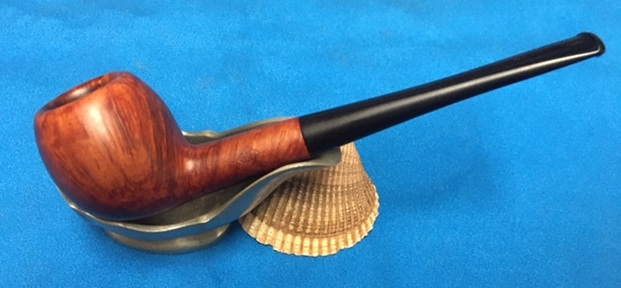
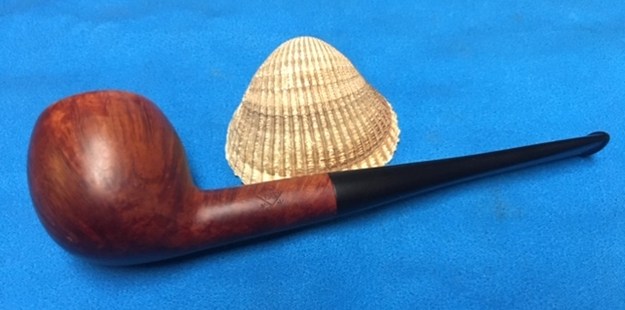
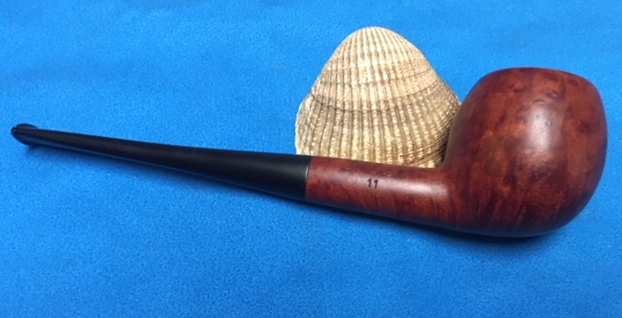
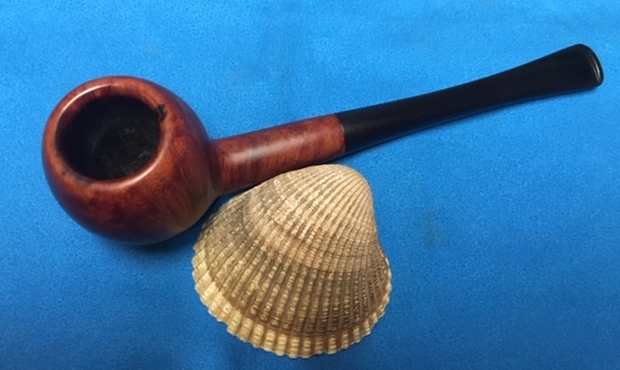
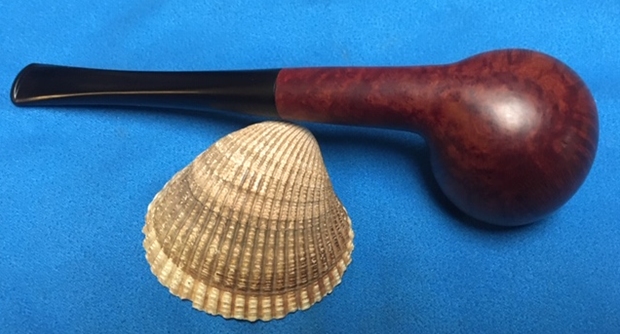
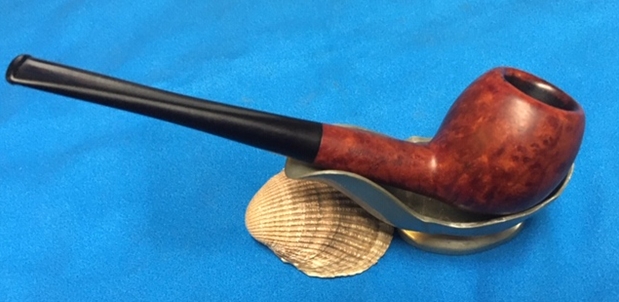
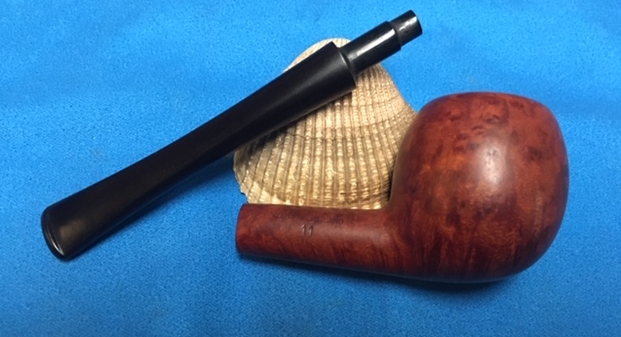
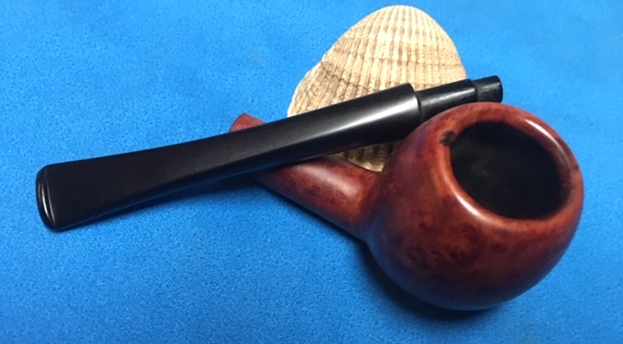
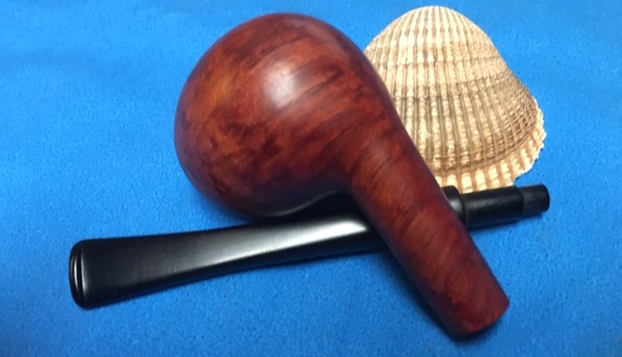
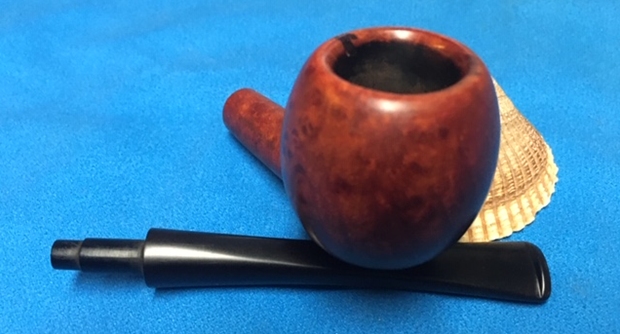
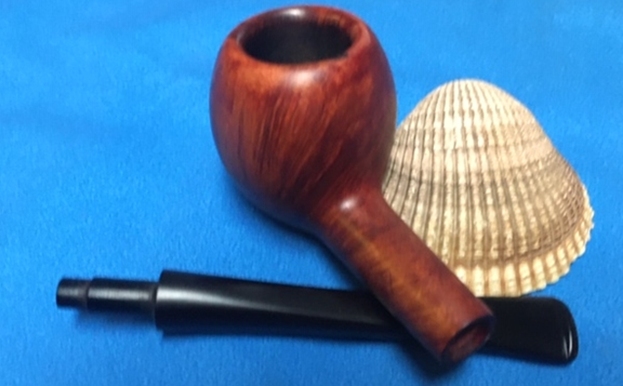
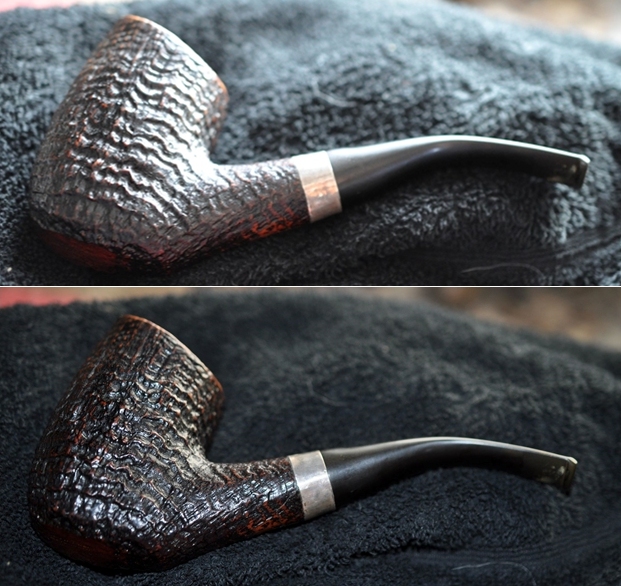
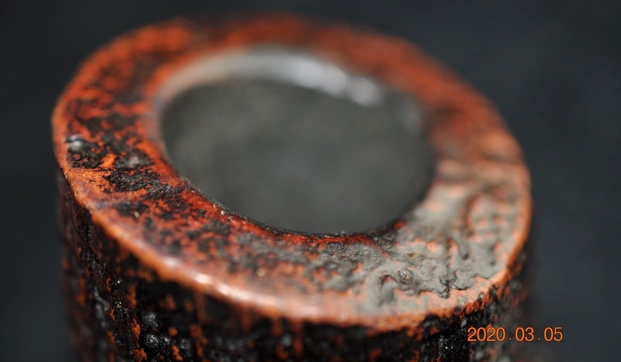
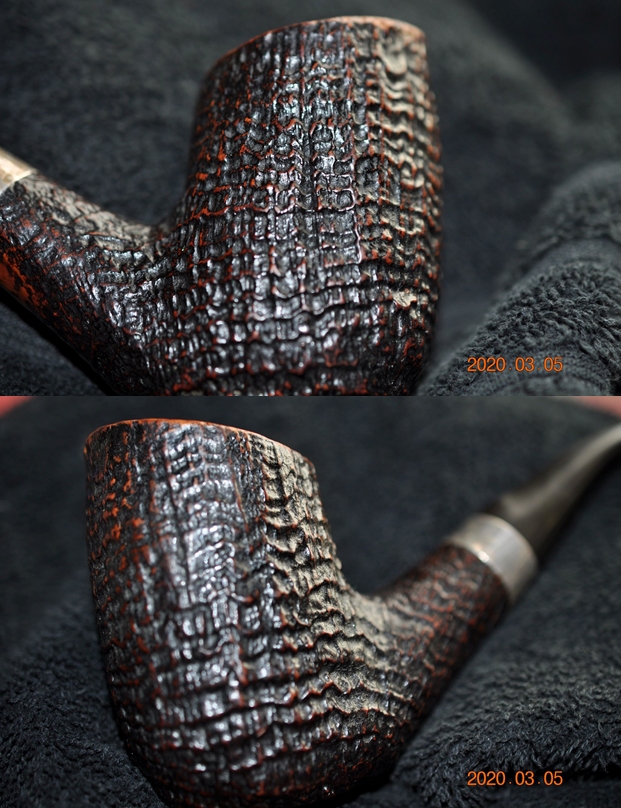
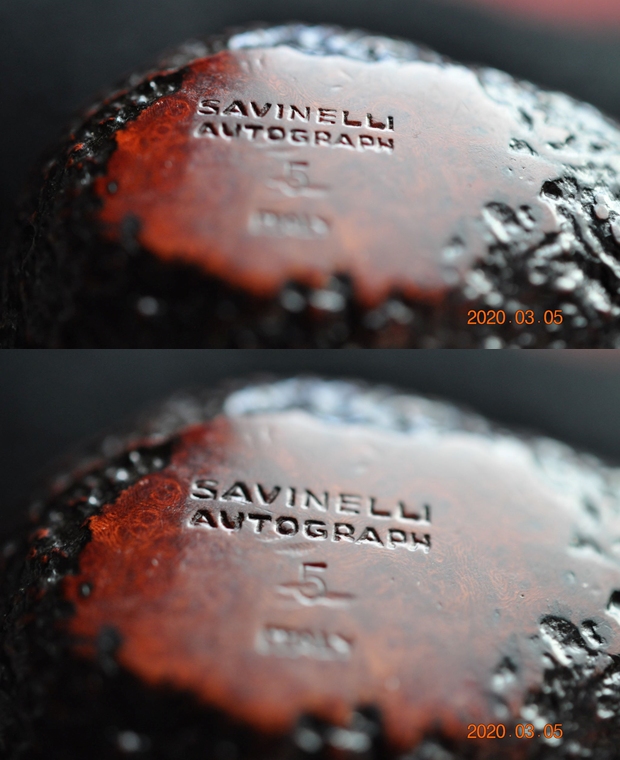
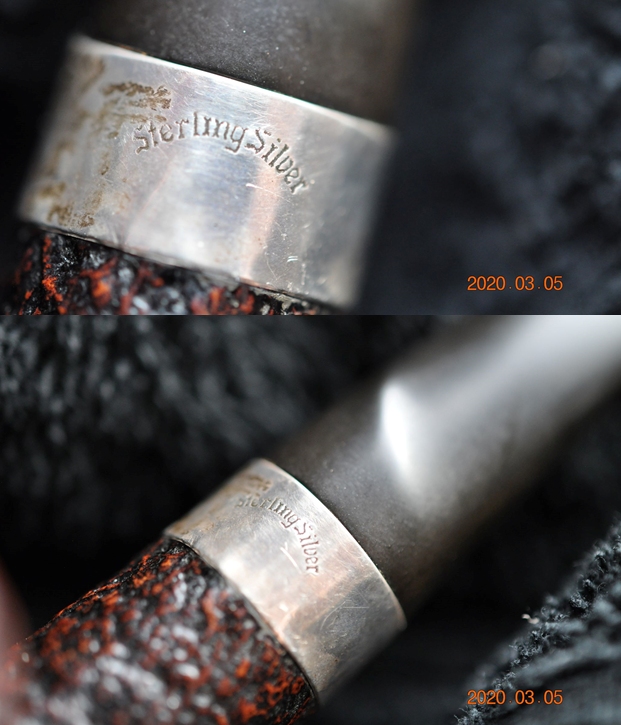
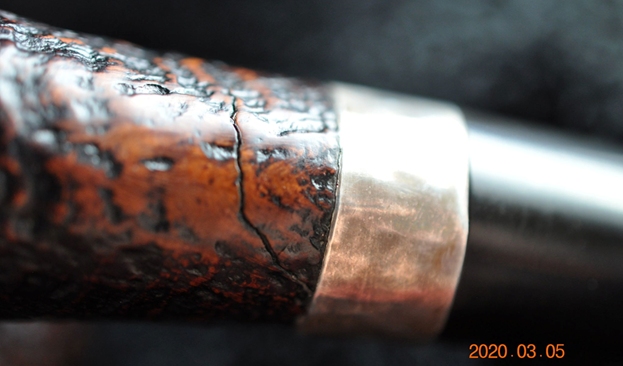
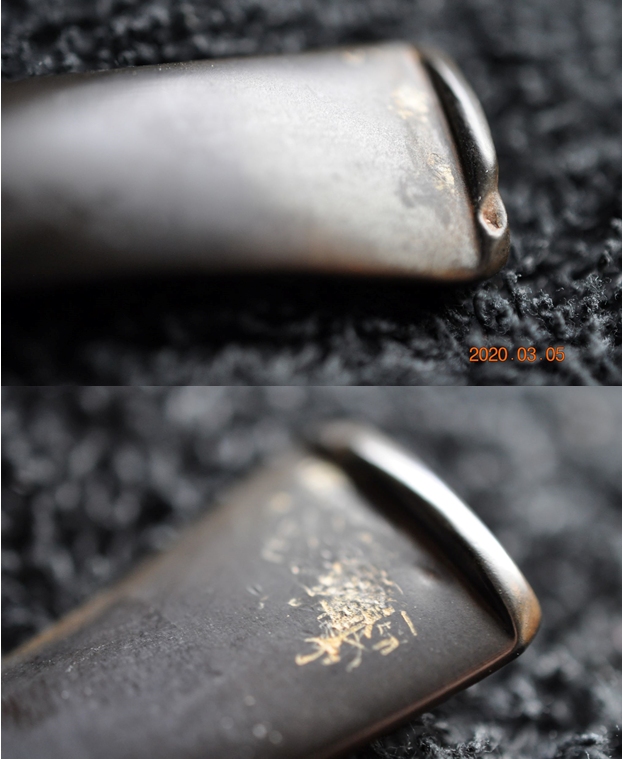
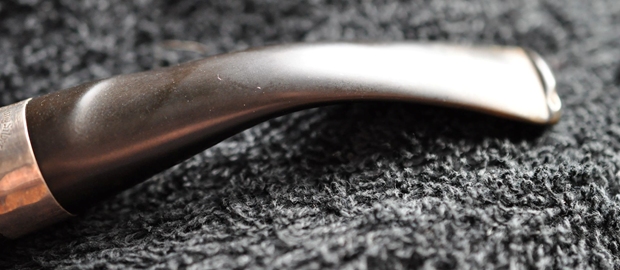
As you might have figured out from the title I am working on another pipe from Italy. This one is a Savinelli Autograph 5. It reads Savinelli over Autograph on the underside of the bowl on a smooth panel. It is also stamped with the Grade number 5 and Italy. The pipe has a beautiful sandblast on the bowl, rim top and shank. The bowl is canted from front to rear. The rim top was filled in with lava and there was thick cake in the bowl. The outer edge of the bowl had some nicks and scratches particularly at the front. There was Sterling Silver band on the shank that was a previous repair to a crack. The crack had been repaired but there was still cosmetic damage on the underside of the shank. The autograph stamp on the vulcanite stem was worn away and non-existent anymore. The twist to the stem confirms that the stem is original. The pipe was dirty but it showed a lot of promise. Jeff took photos of the pipe before I started my work on it. Jeff took close up photos of the bowl and rim top to show the condition of the pipe at this point. The bowl has a light cake and some debris in the bottom of the bowl. The rim top is dirty but undamaged. The stem looks pretty good with the autograph stamp readable. There is tooth chatter and marks on the top and underside just ahead of the button on both sides. He took photos of the sides of the bowl and the heel of the bowl showing the great grain showing through the sandblast finish.   He took a photo of the smooth underside of the bowl/heel. You can see the stamping – Savinelli Autograph 5 over Italy. It is stamped on a smooth portion of the heel while leaving the other portion sandblasted.     He also took photos of the Sterling Silver band on the shank as well as the crack in the underside of the shank. The next photos show the top and underside of the stem. There is a chip out of the top left edge of the button. The overall stem is deeply oxidized and has calcification on both sides at the button. There is also some tooth chatter and some light tooth marks. The final photo shows the curve of the full stem. I wanted to remind myself a bit about the Autograph line from Savinelli so I reread a blog I had written on a previous Autograph restoration (https://rebornpipes.com/2019/01/05/restoring-a-savinelli-autograph-3-rhodesian-dublin-long-shank/). I quote that portion of the blog now:
I turned first to the Pipephil website (http://www.pipephil.eu/logos/en/logo-savinelli1.html) to get a brief overview of the Autograph line. There I found out that the Autographs were hand made and unique. The Autograph Grading system is ascending: 3, 4, … 8, 0, 00, 000.

I turned then to Pipedia to get a more background on the Autograph line. I had the outline I needed from pipephil for the pipe but wanted more (https://pipedia.org/wiki/Savinelli). I quote in part from the article on that site.

While Savinelli’s serially produced pipes account for around 98% of annual production, the marque also creates a number of artisanal, handmade pieces as well. The Autographs, the Creativity line, and the Mr. A. line are all the result of Savinelli’s unique handmade process, with the Autographs reflecting the larger Freehand aesthetic, the Creativity line delving into more complex hand carving, and the Mr. A. line sidestepping the standard shape chart for remarkable and unusual pipes.
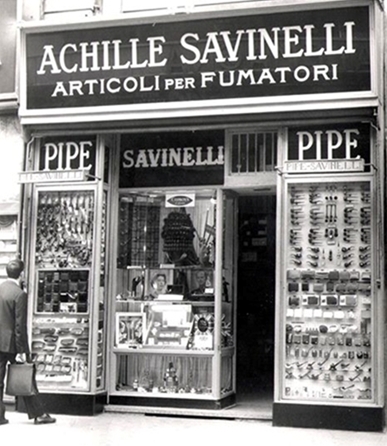
All of the briar for Savinelli’s Autographs and other freehand pipes is sourced specifically for those pieces. While the majority of the marque’s serial production is made from extra grade ebauchon blocks, Savinelli keeps a separate supply of Extra Extra plateau blocks for Freehands. This variety of briar is much larger, and of a higher quality, which explains why so many Autographs and Savinelli handmades are naturally larger designs.

These handmade pieces are shaped much like traditional Danish Freehands: they are shaped first and drilled second. Using this method, Savinelli’s team of artisans is able to showcase their own creativity, as it maximizes flexibility and facilitates a more grain-centric approach to shaping. The resulting Freehand designs are at once both a departure from the marque’s classical standard shapes, yet very much still “Savinelli” in their nature—i.e. proportioned so that the bowl is the visual focus when viewed from the profile, juxtaposed by the comparatively trim lines of the shank and stem. To provide a little more insight into the differences between Savinelli’s standard production and freehand lines, Luisa Bozzetti comments:

“When we choose to make Freehand pipes we must stop production on the standard shapes. The process for Freehands is much more involved and takes much more time. Finding the best people from the production line and pulling them to make Freehands is challenging since it’s not an assembly line, but rather a one or two man operation.

After the rough shaping of the stummel, we must get together and brainstorm which style of stem will be paired before the pipe can be finished since we do not use pre-shaped stems. All accents and stems for the Freehands are cut from rod here in the factory. A lot of care goes into the few pieces lucky enough to make the cut; to end up with a certain number of Autographs, for instance, means that many, many more will be made, and only the few will be selected.”

The quality control process for Savinelli handmades is even more rigorous than that employed in the standard lineup. Many blocks are started and later discarded because of pits or defects. While Savinelli’s briar sourcing is a constant process, working with some of Italy’s top cutters to ensure only the finest and most suitable blocks make their way to the factory, it’s impossible to source plateau briar that’s completely free from flaws. That’s just nature. Savinelli creates the standard for quality by working through the rough (a very high-quality rough, mind you) to find that shining diamond with the potential to become a Savinelli handmade.

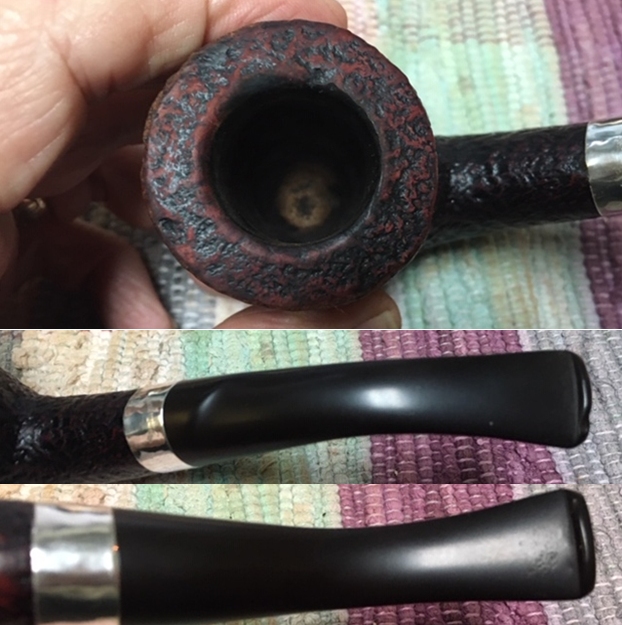
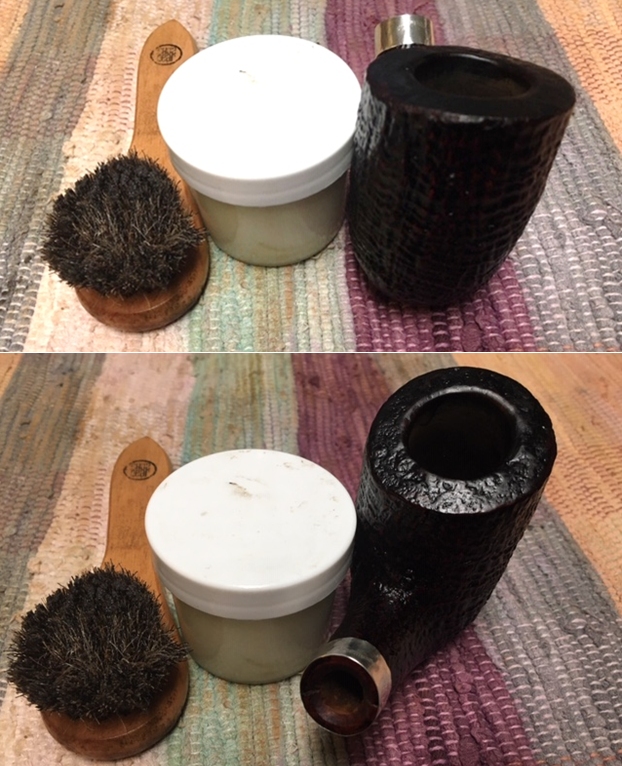
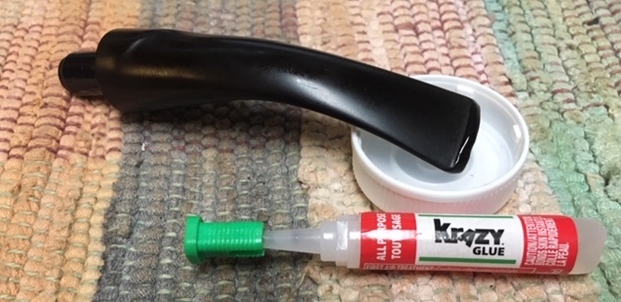
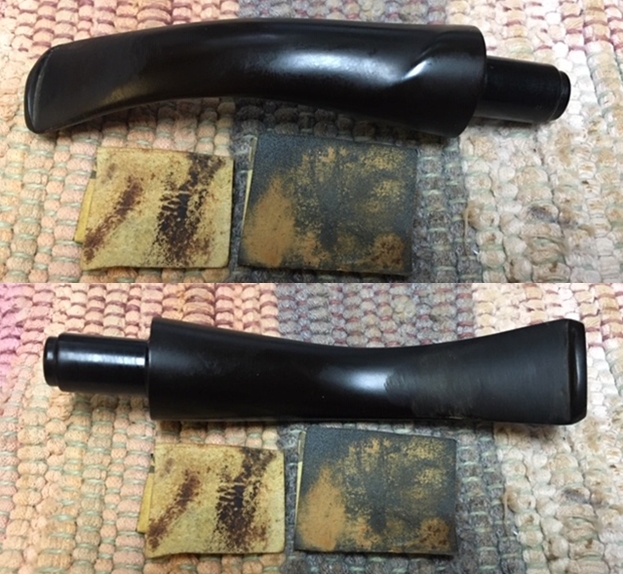
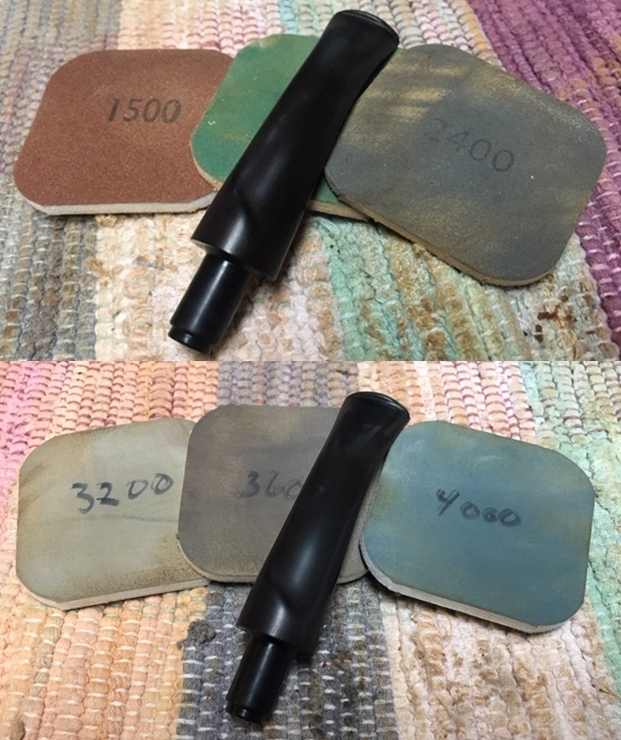
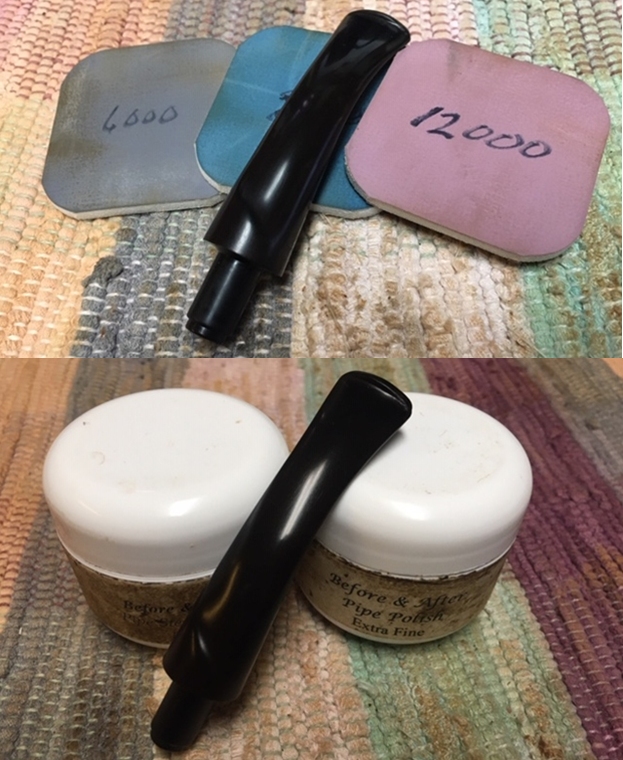
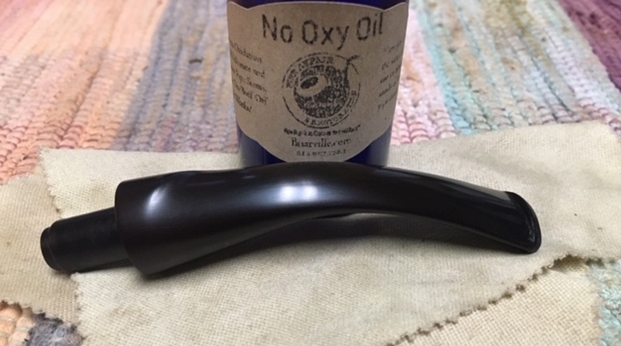
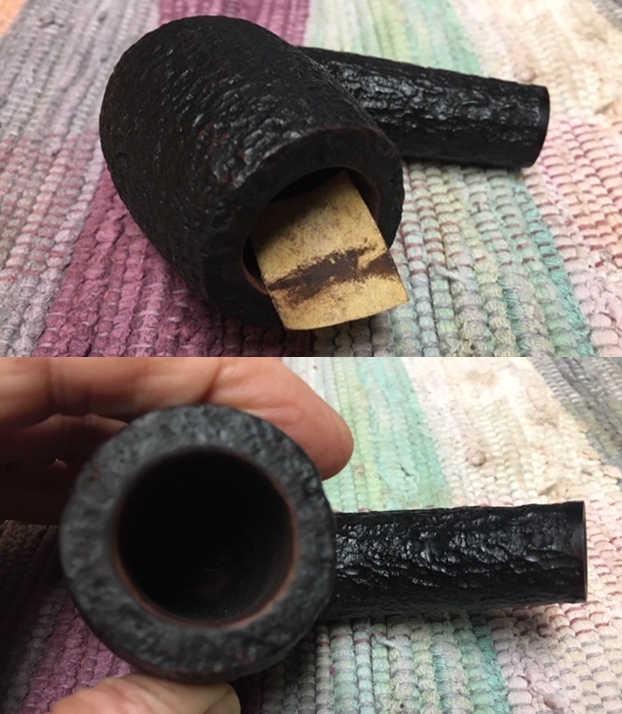
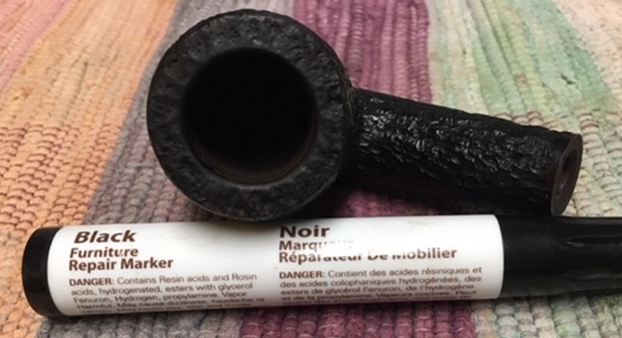
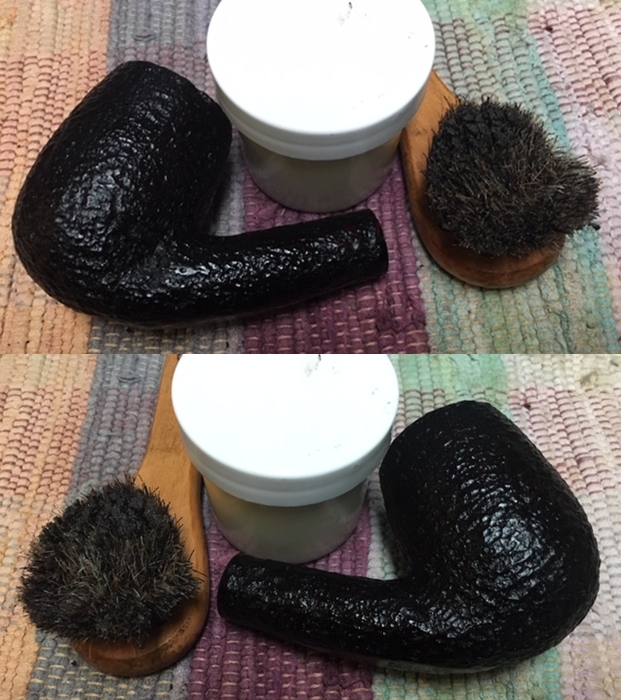
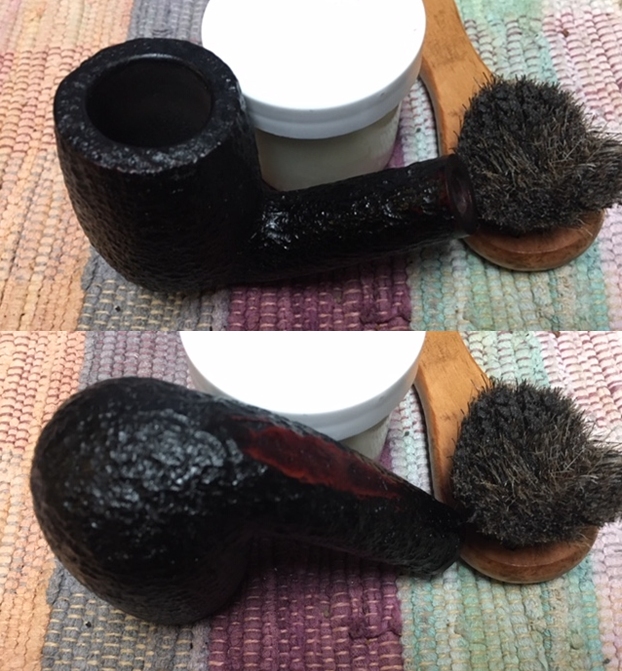
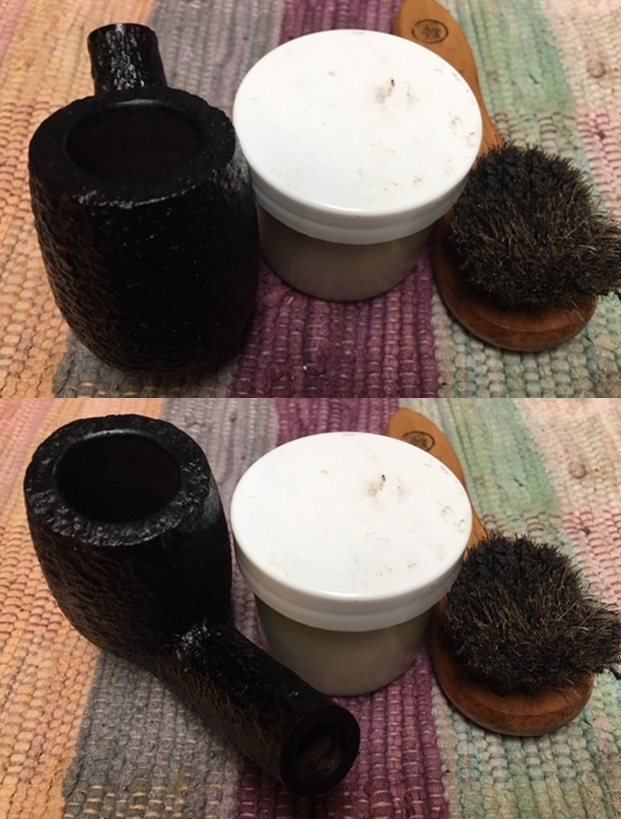
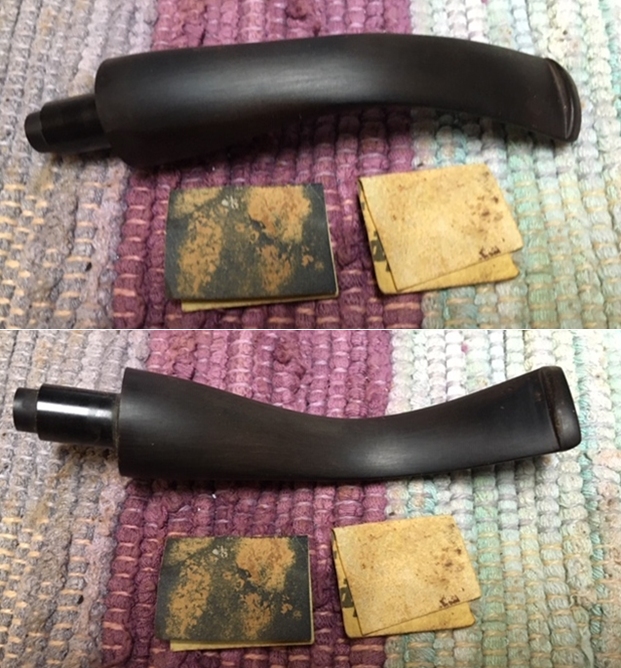
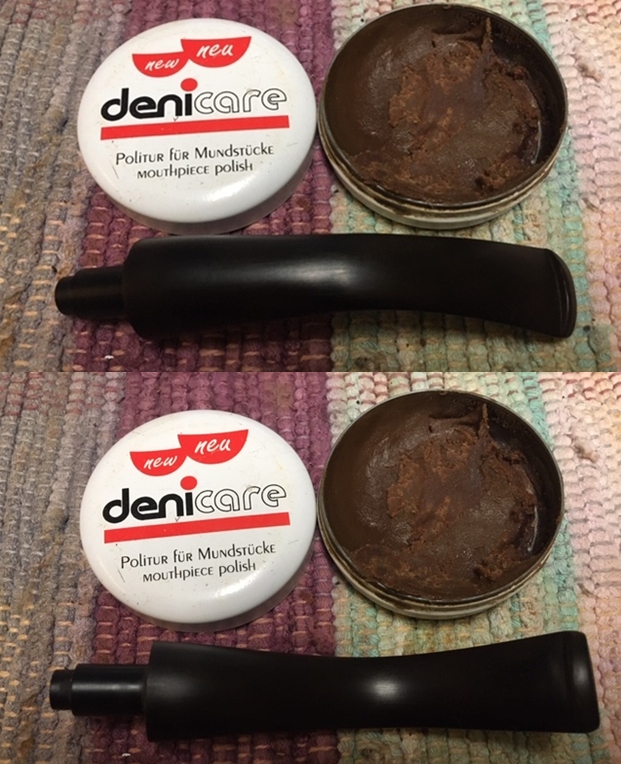
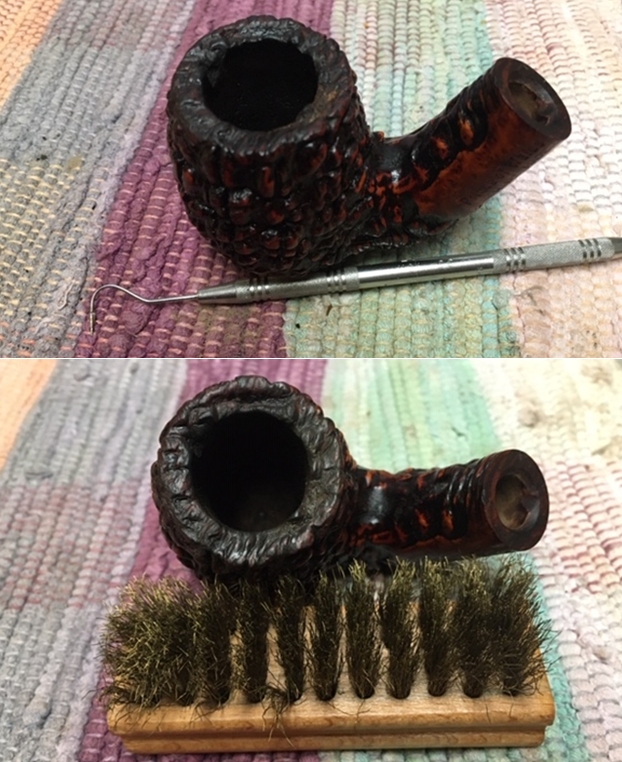
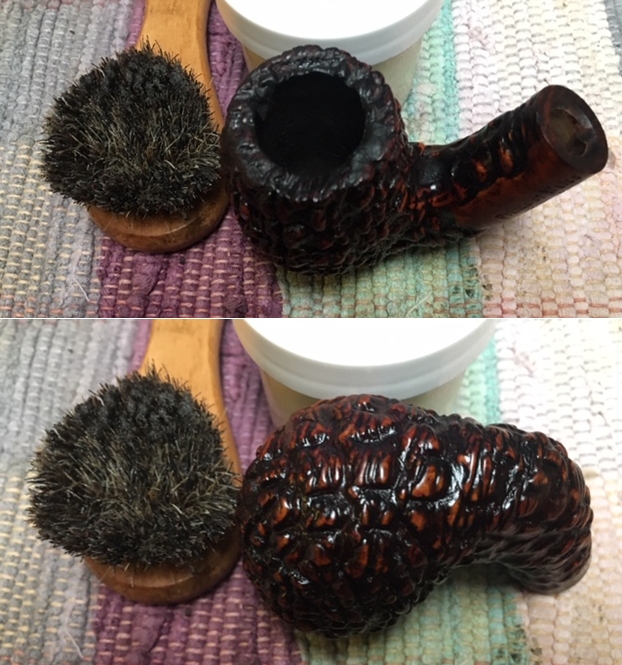
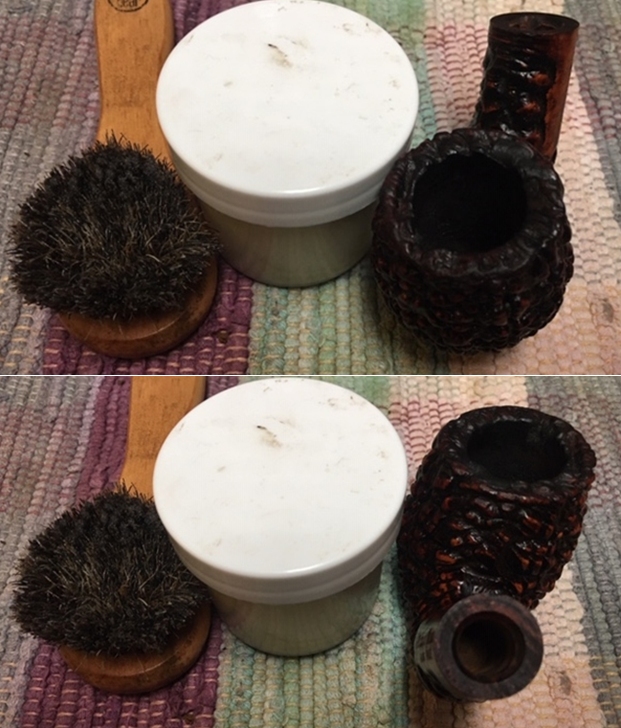
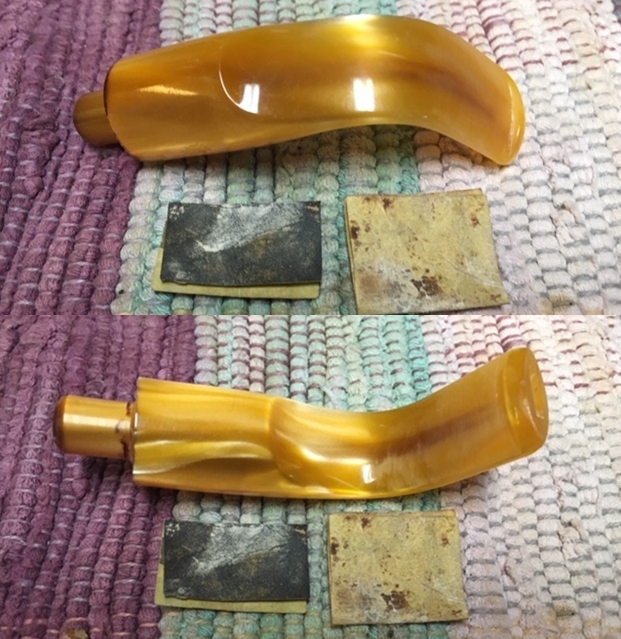
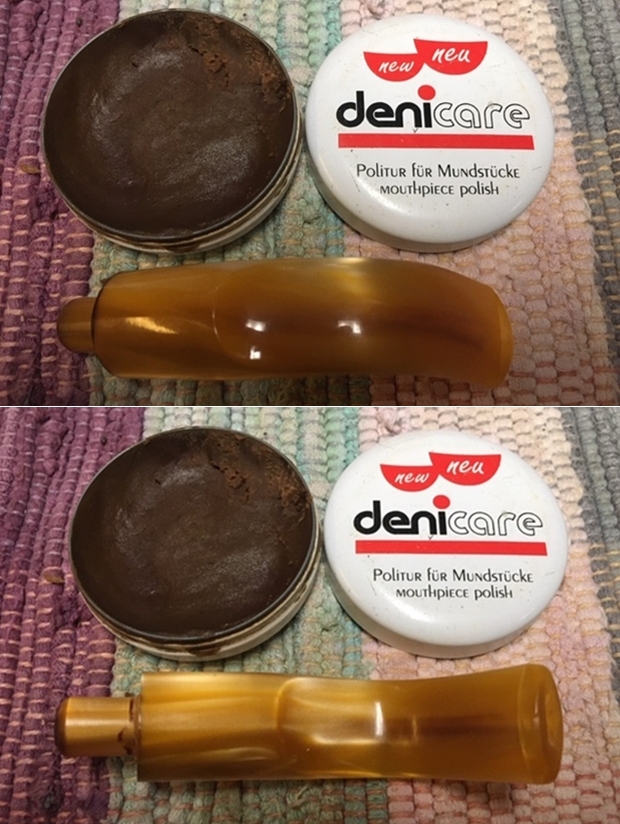
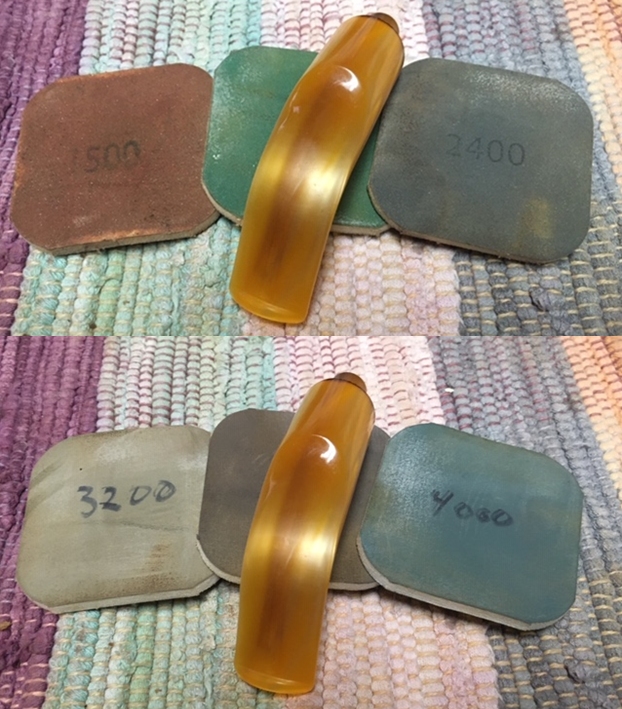
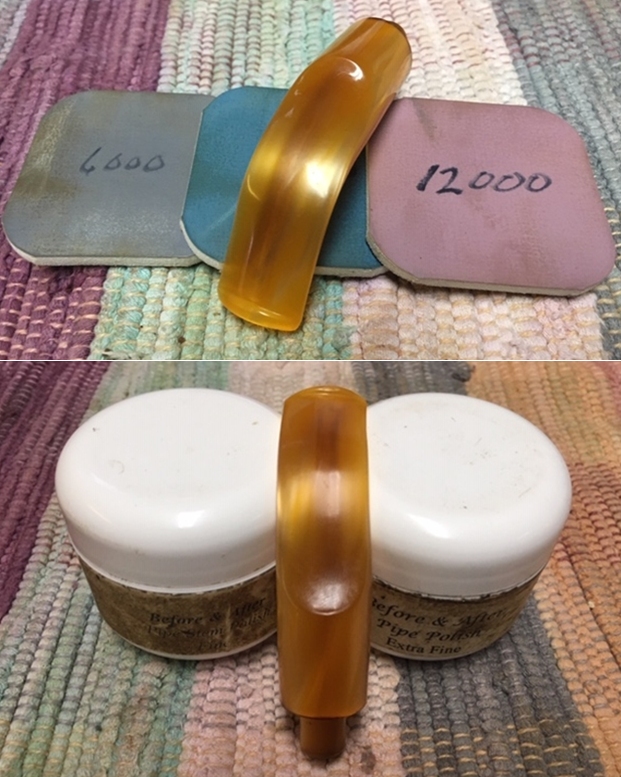
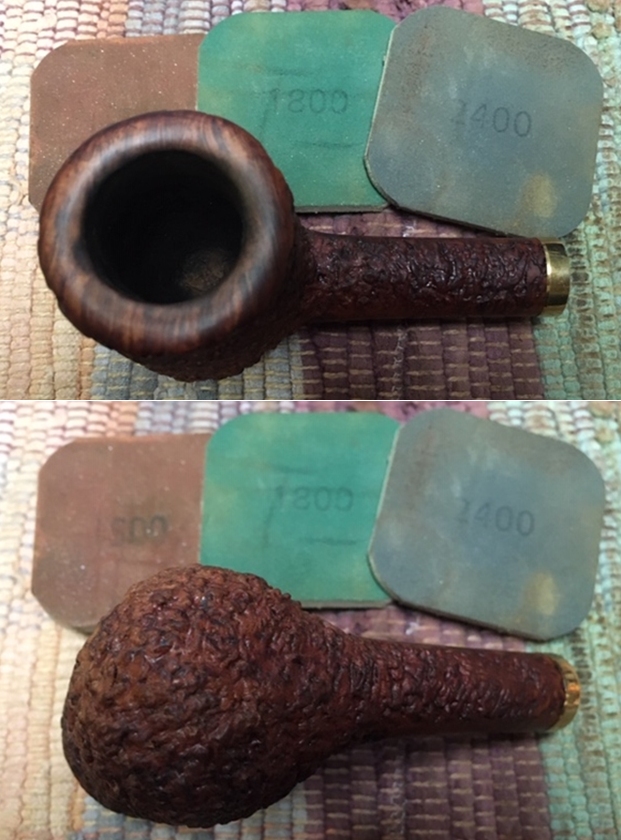
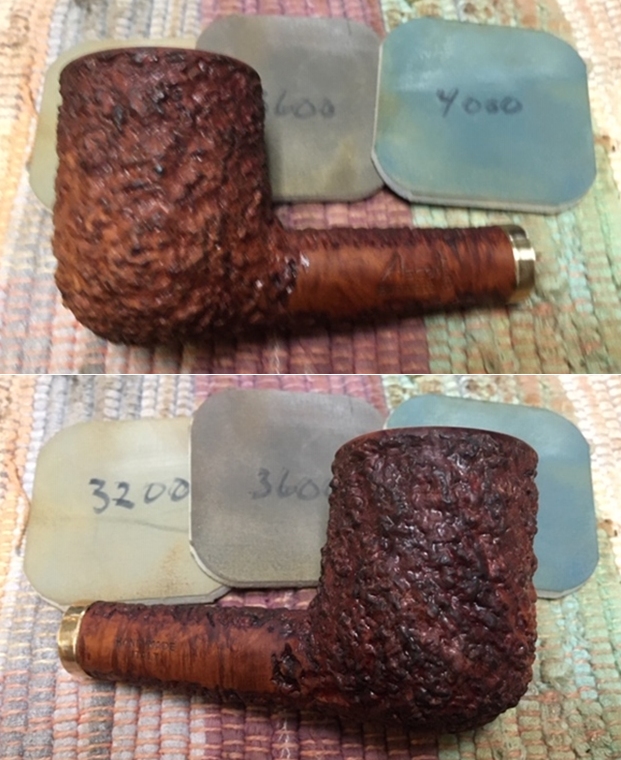
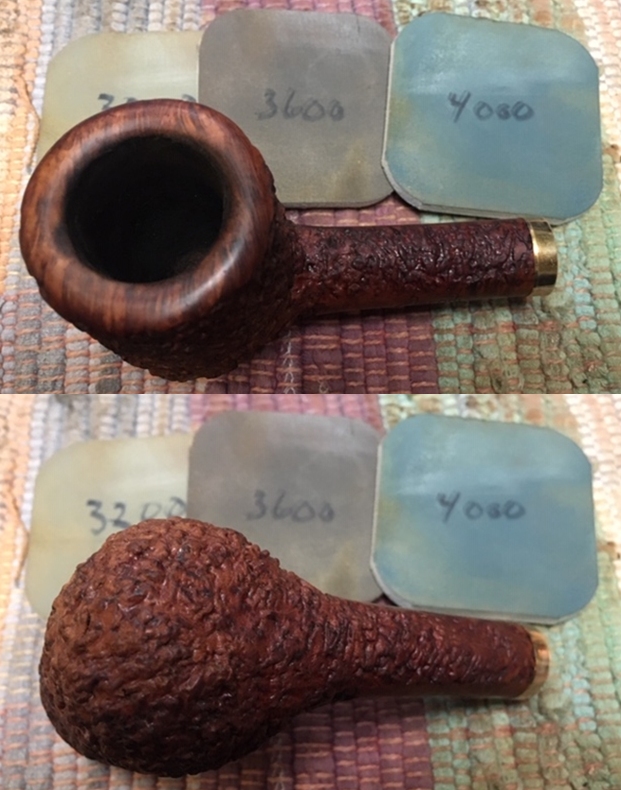
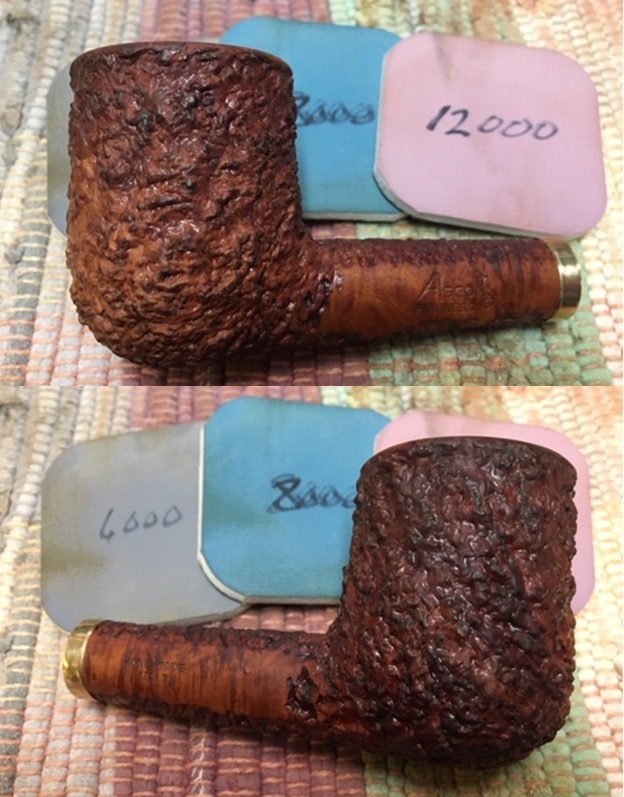
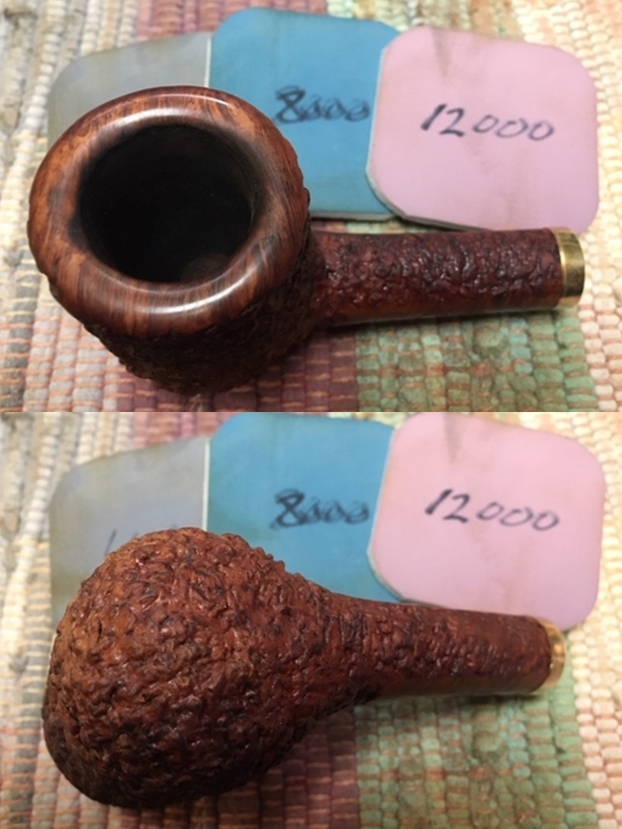
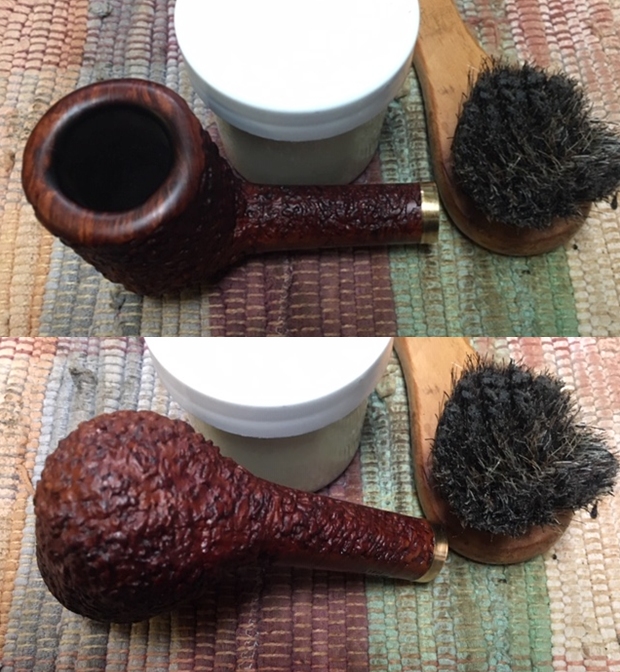
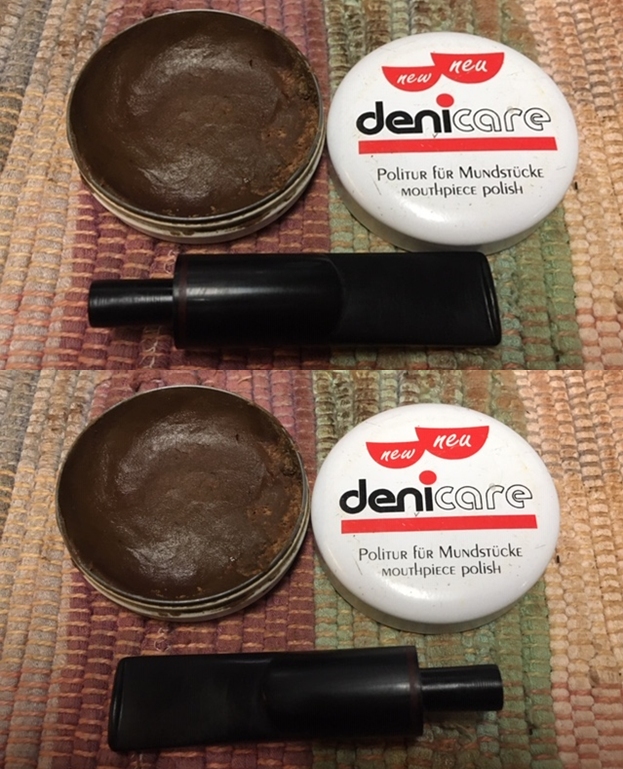
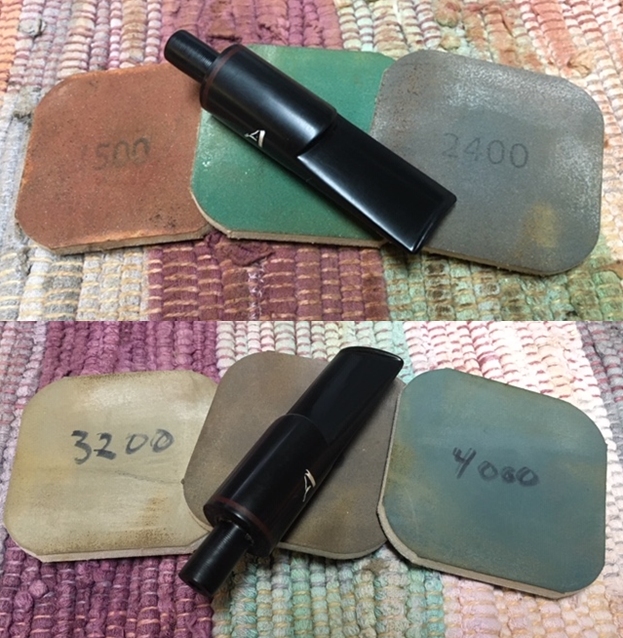
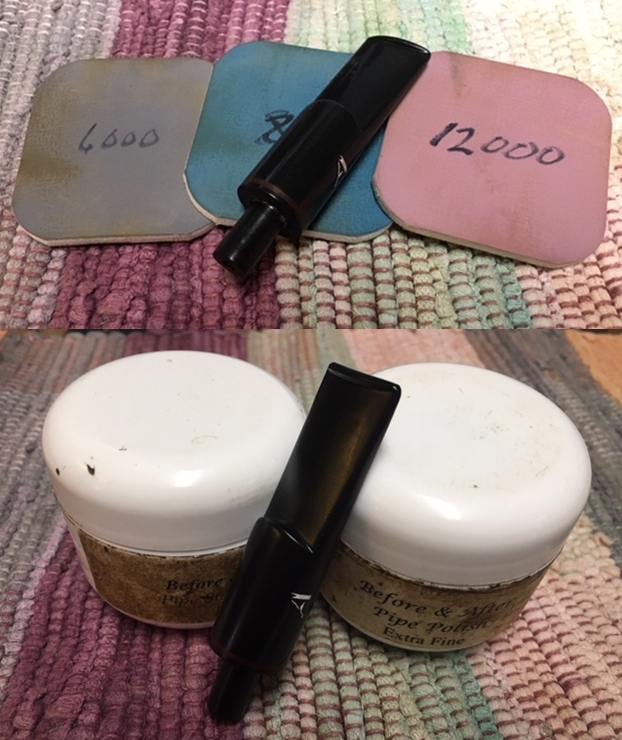
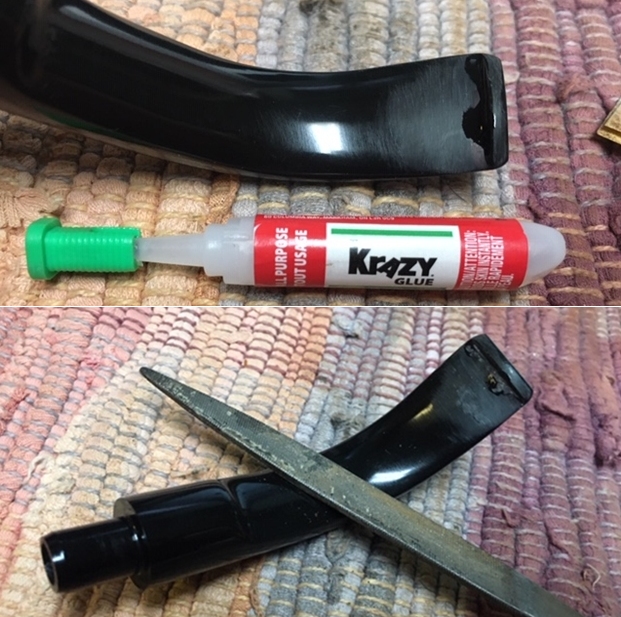
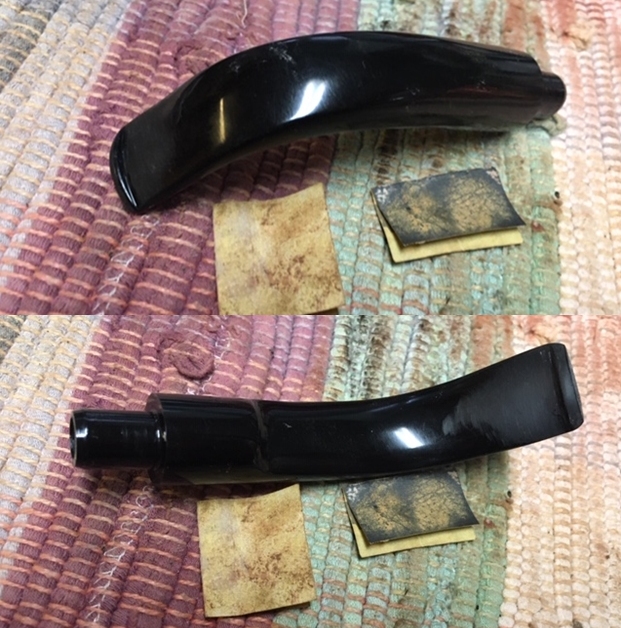
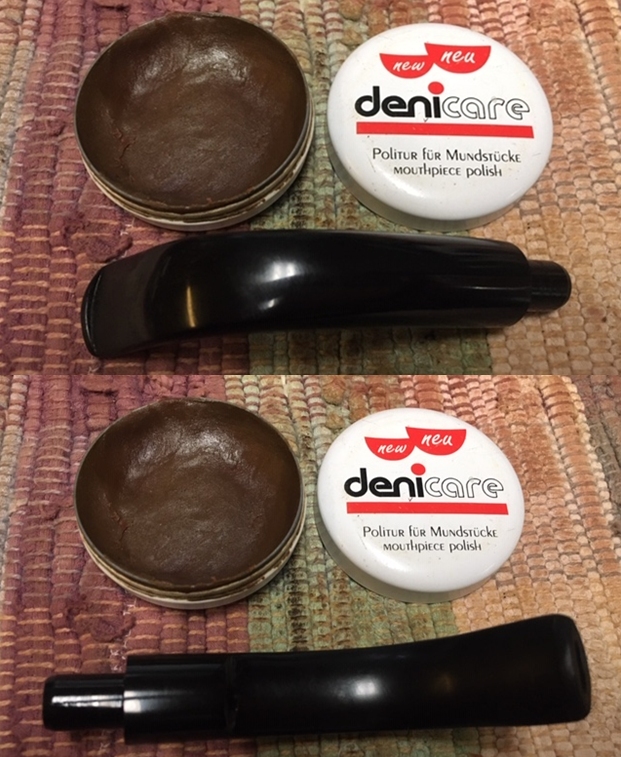
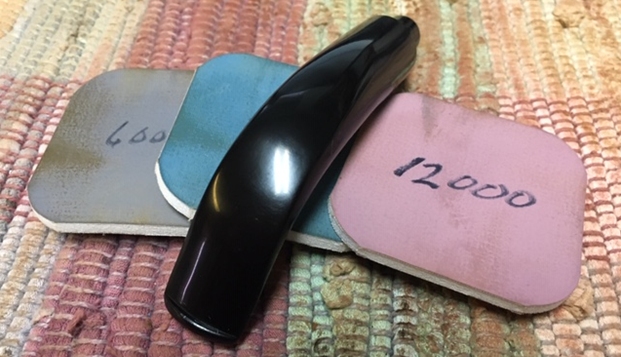
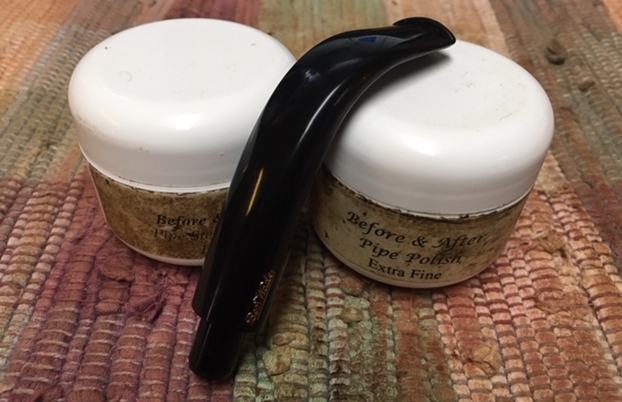
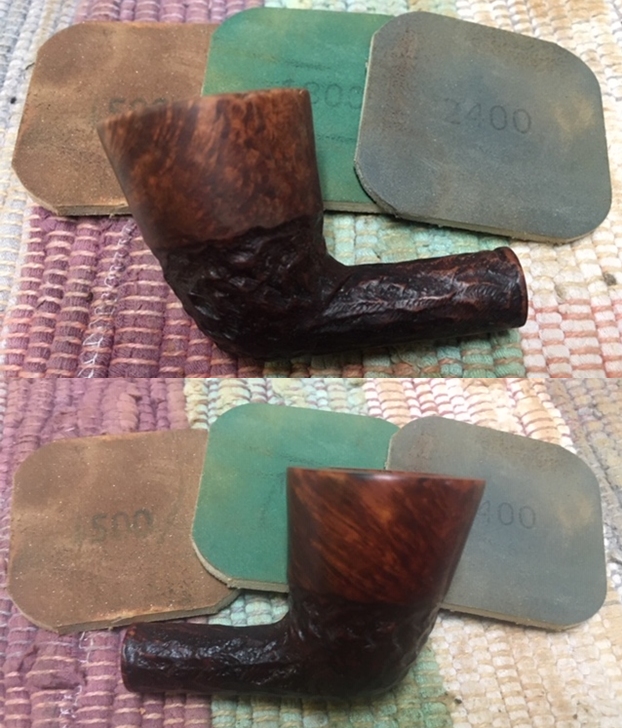
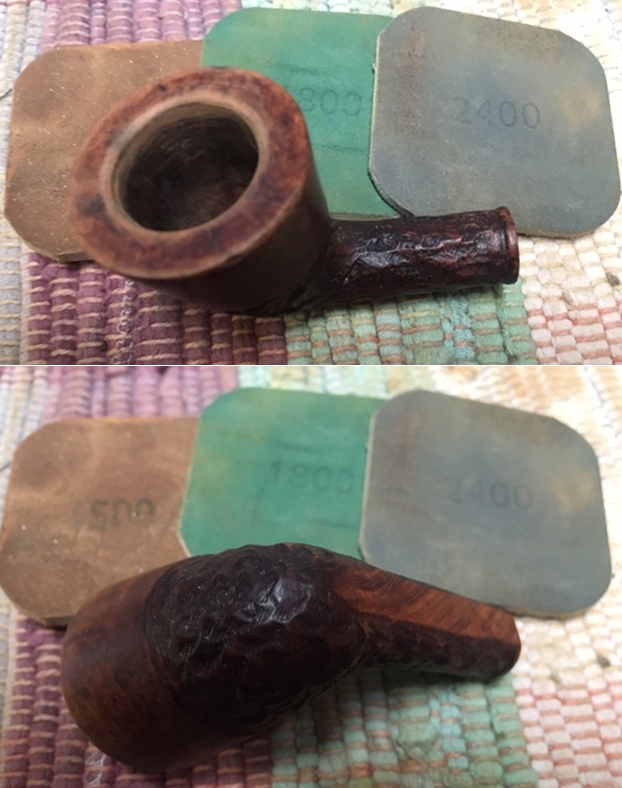
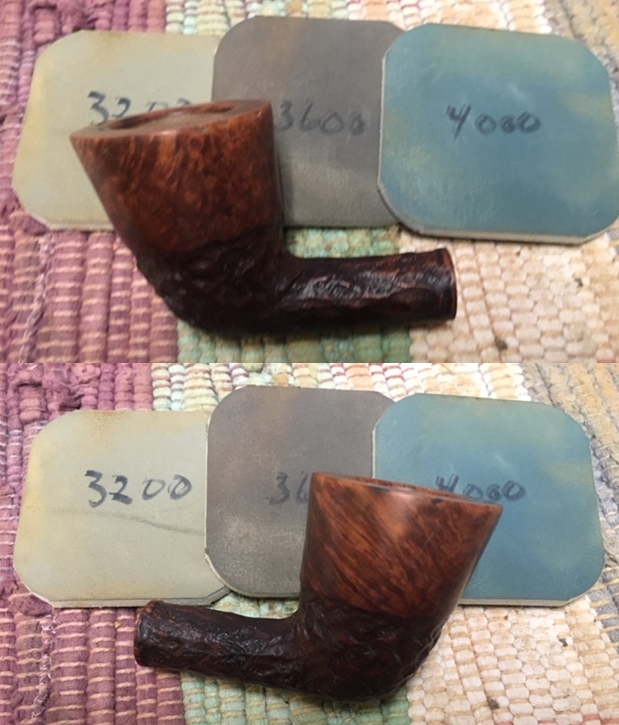
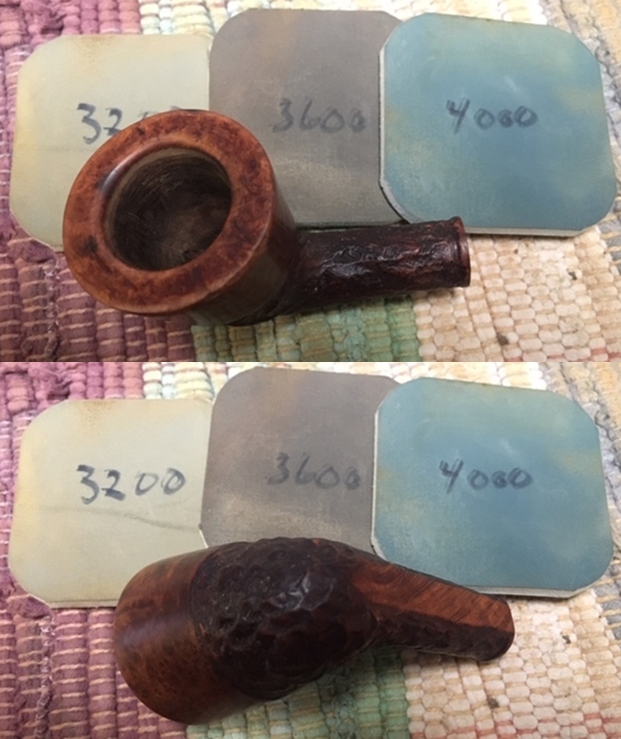
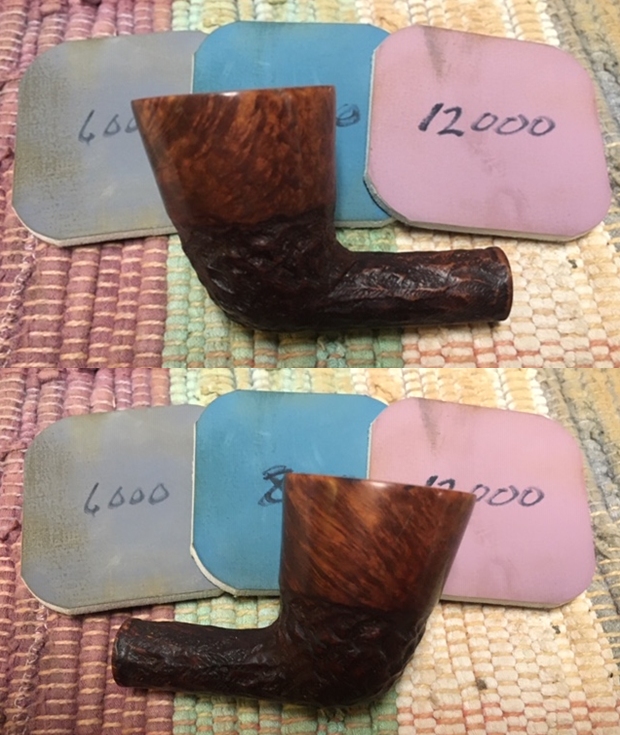
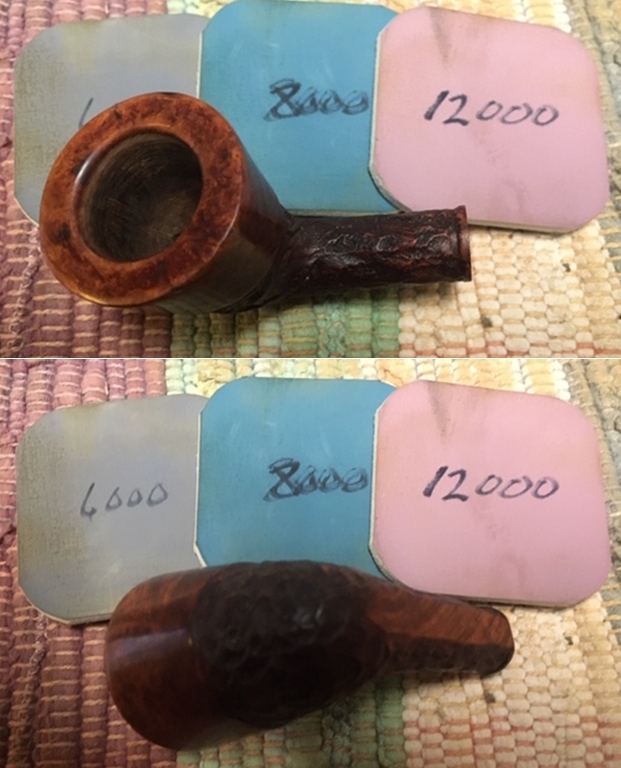
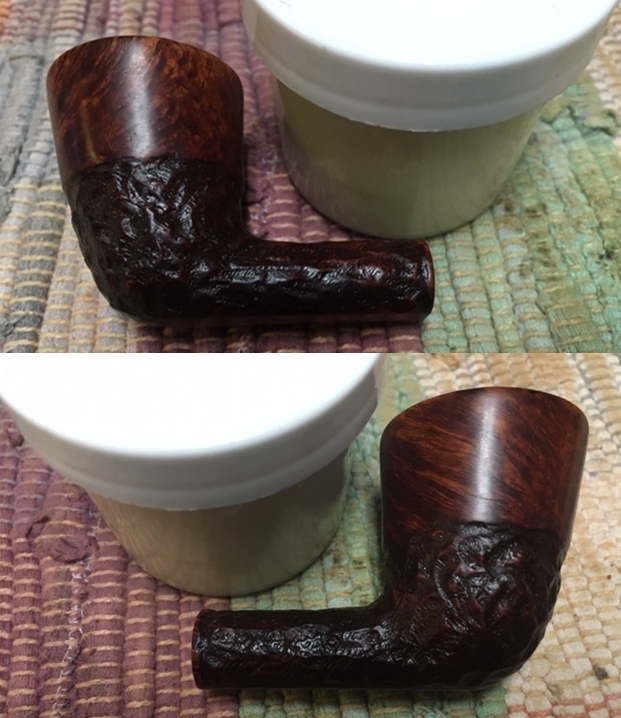
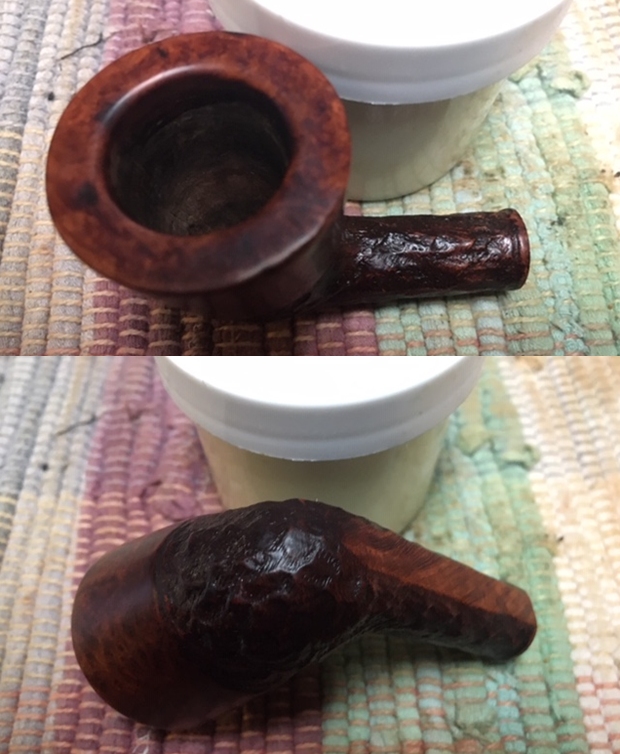
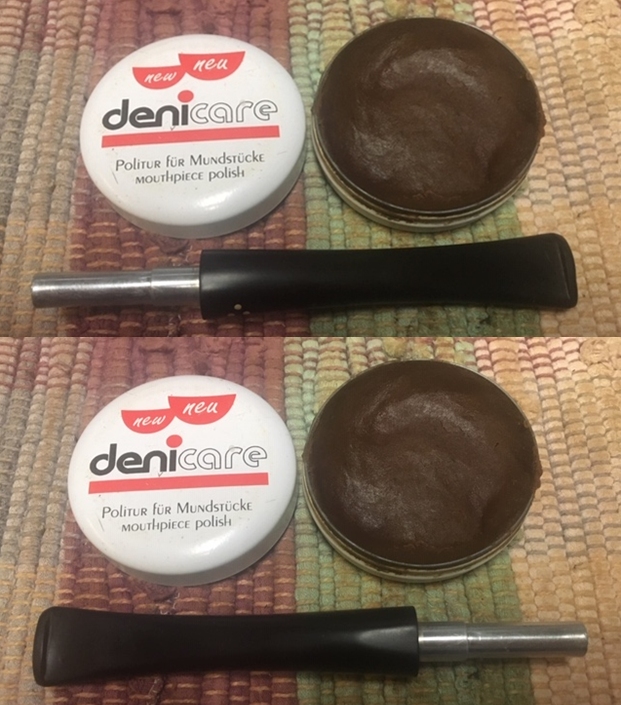
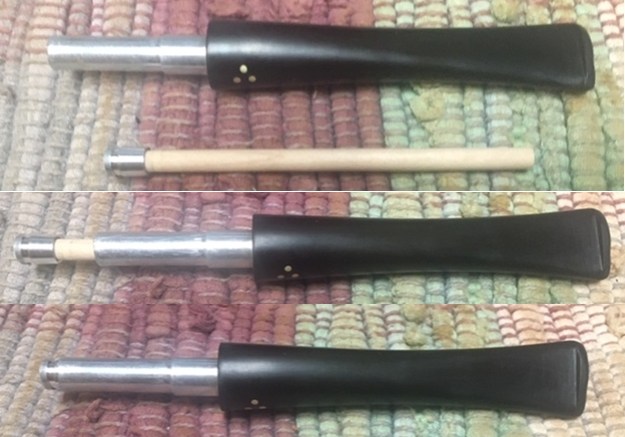
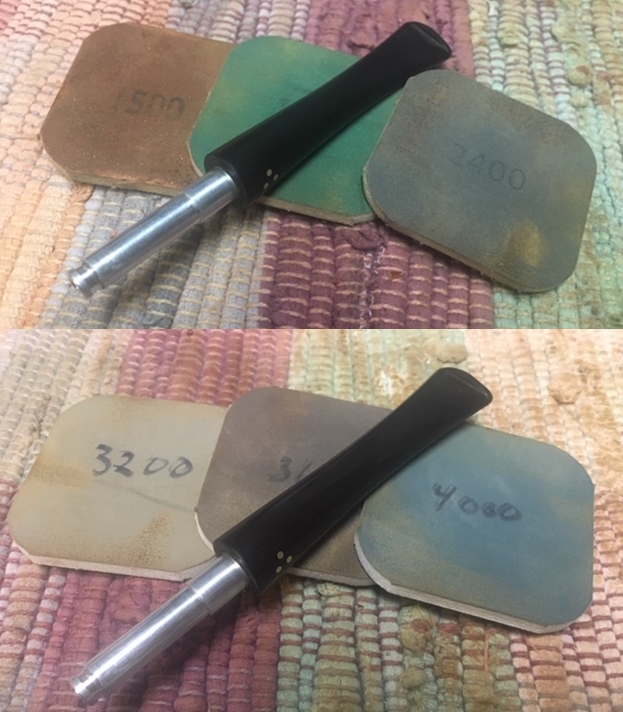
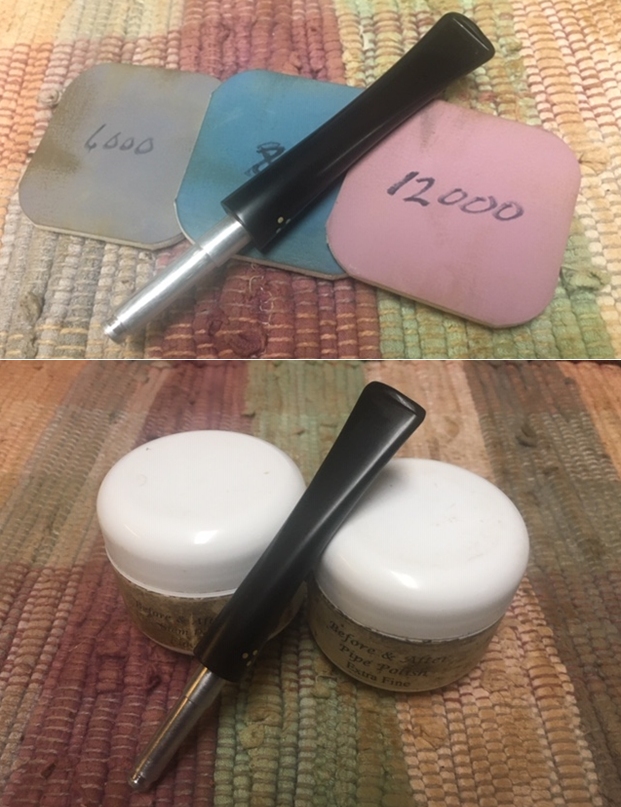
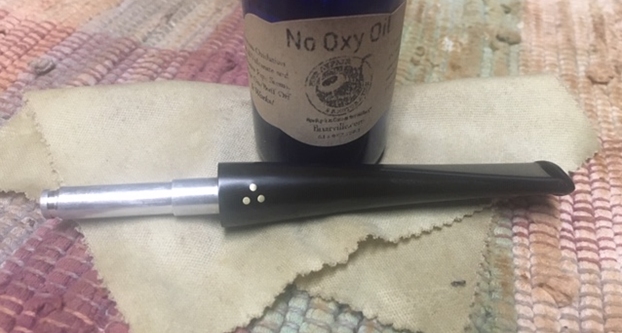
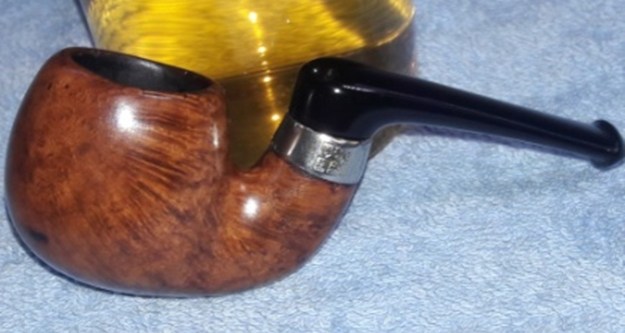
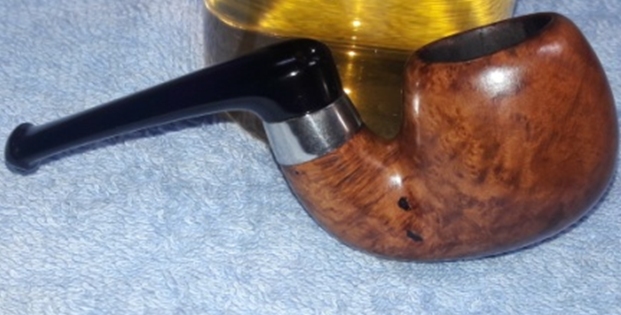
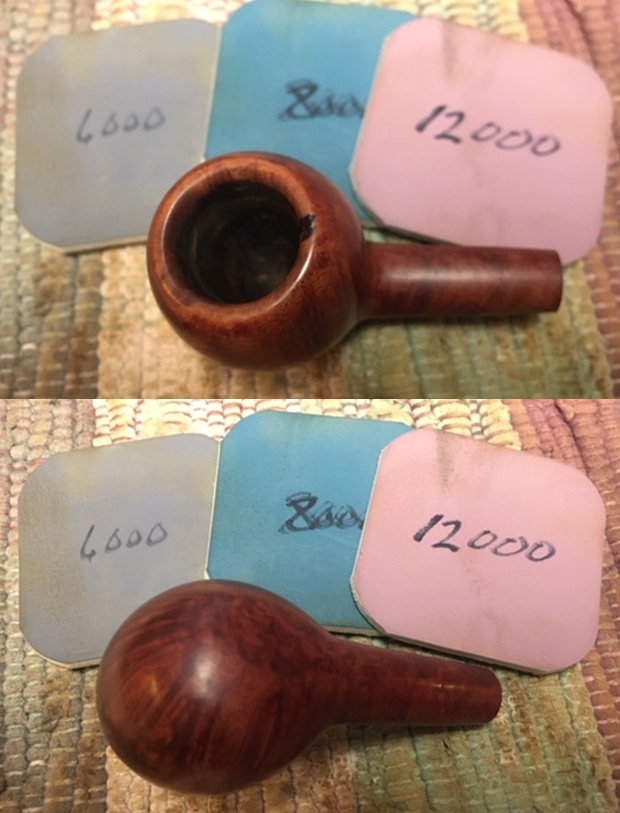
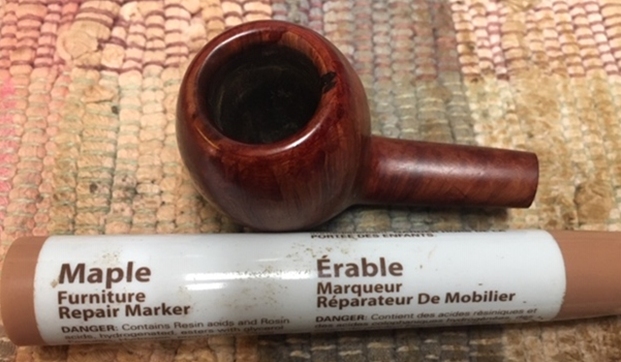
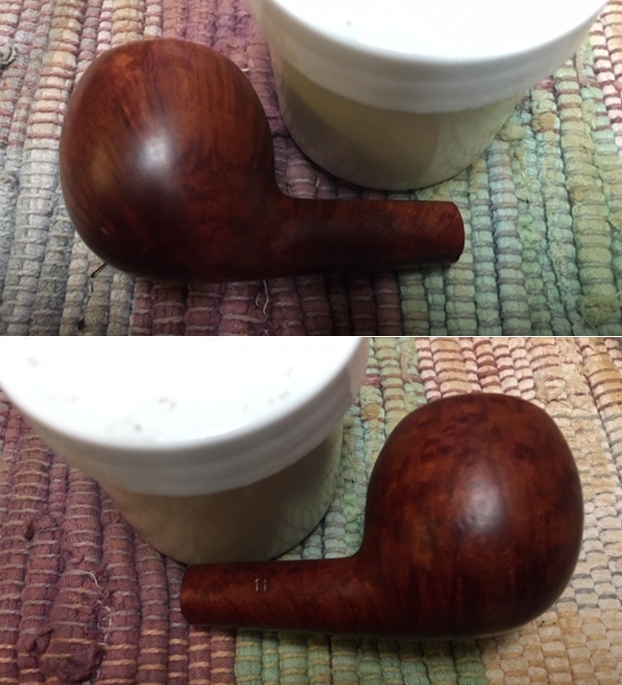
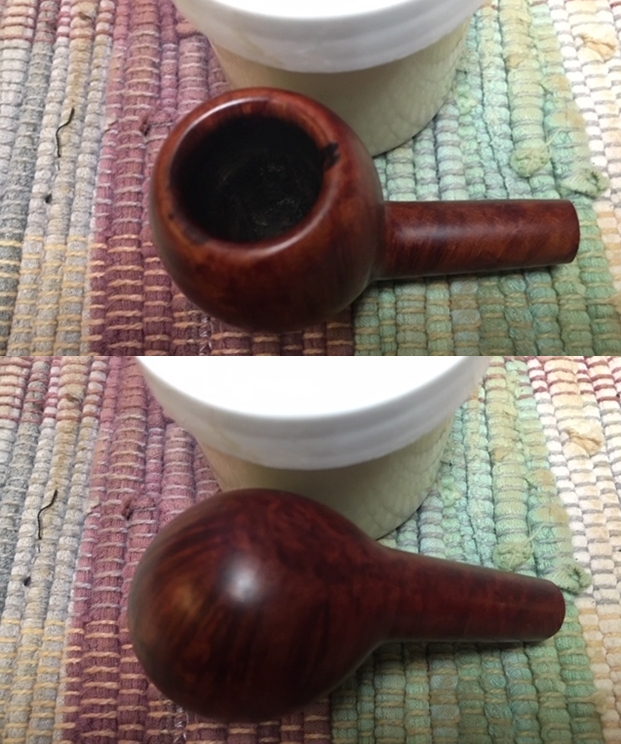
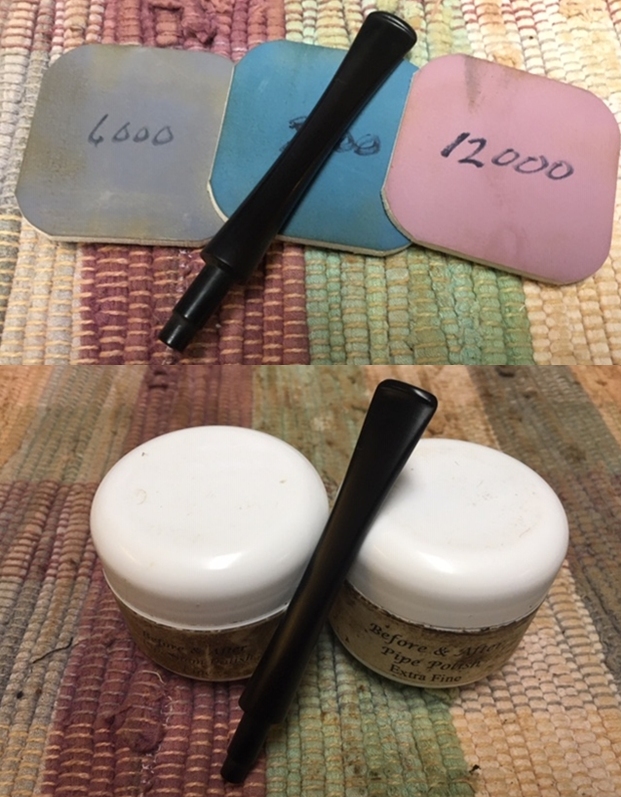
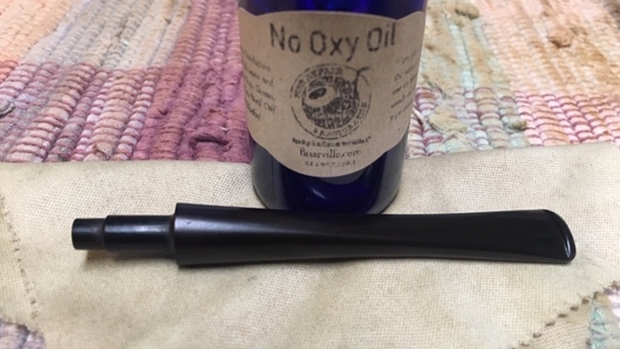
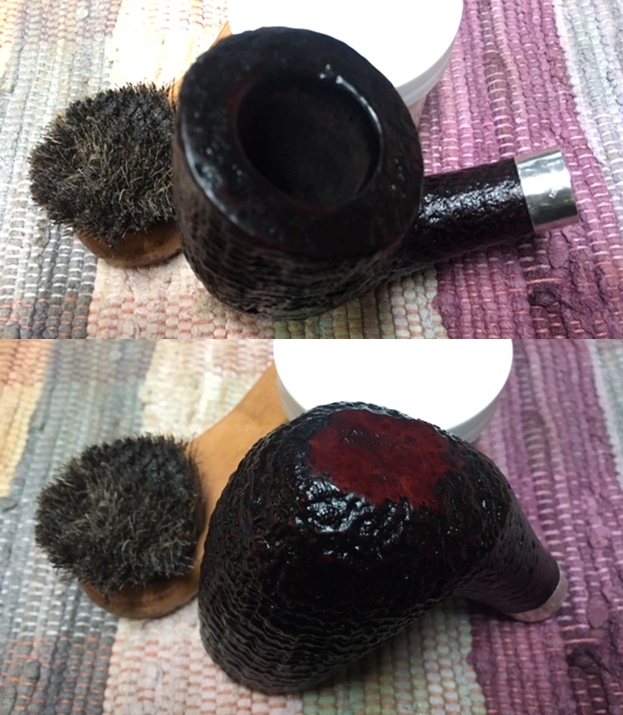
It looks like the Autograph 5 I am working is pretty high in the hierarchy of the line. Like other autographs I have worked on in the past this one has a unique twist to the vulcanite stem. Jeff once again did an amazing job cleaning the pipe. He reamed it with a PipNet pipe reamer and got rid of the cake so that we could see the walls of the bowl and assess for damage. He cleaned the internals of the shank and stem with alcohol, pipe cleaners and alcohol. He scrubbed the exterior with undiluted Murphy’s Oil Soap and a tooth brush to get into the grooves and valleys of the rustication. He rinsed the pipe under warm water. He dried it off with a cloth and then let it air dry. The stem was scrubbed with Soft Scrub and then soaked in Before & After Deoxidizer. It came out looking pretty good with a light coat of oxidation still present. The finish on the bowl and the rim top cleaned up pretty good. I took pictures of the pipe to show how it looked when I unpacked it.     I took a close up photo of the rim top to show how clean it was. There was some damage to the finish on the rim top and some damage to the inner edge of the rim. The stem looked good just the chip on the top edge of the button and some light tooth marks. Overall the pipe looked impressive at this point in comparison to where it had started. The band was firmly glued and pressed in place. The crack was seal and solid when I picked at it with a dental pick. I cleaned it out with alcohol and a cotton swab to remove any debris in the surface area. I filled in the crack with clear super glue to seal it further and minimize the damage to the shank area.Once the repair cured I sanded the filled area with a folded piece of 220 grit sandpaper. I work to smooth out the repair and blend it into the surface of the surrounding briar. I was very happy with the way in which the repair blended into the surrounding sandblast.  I decided to address the damage to the inner edge of the rim. I used a folded piece of 220 grit sandpaper to smooth out the rim edge and cleanup the slight bevel that was there. I was able to minimize the damaged area. I stained the inner edge with a black stain pen and mixed the stain with a Walnut stain to blend it into the rest of the rim top. I also stained the damage to the outer edge at the same time.   I worked some Before & After Restoration Balm into the briar with my finger tips and a horsehair shoe brush. The product is a great addition to the restoration work. It enlivens, enriches and protects the briar while giving it a deep glow. It is a product I use on every pipe I work on.   I set the bowl aside and worked on the stem. I rebuilt the chip out of the top left side of the button with clear super glue. I built it up and reshaped the button edge with 220 grit sandpaper and polished it when I did the rest of the stem.I sanded out the tooth marks and chatter on both sides of the stem with 220 grit sandpaper. I polished the sanding marks with 400 grit wet dry sandpaper. The photos show the stem at this point.    I polished the stem with Denicare Mouthpiece Polish from a tin of it I have in the drawer here. It is a gritty red paste that I rub on with my finger tips and work it into the surface of the stem and button and buff it off with a cotton pad. It gives me a bit of a head start on the polishing work. I wet sanded the tooth chatter on both sides of the stem with 1500 -12000 grit micromesh pads to polish it. I wiped it down with Obsidian Oil on a cloth after each sanding pad. I finished polishing the stem with Before & After Pipe Polish – both Fine and Extra Fine polishes. I rubbed it down with Briarville’s No Oxy Oil as a final preservative measure to protect the stem.    I put the bowl and stem back together. I polished the smooth part of the bowl and stem with Blue Diamond to polish out the scratches in the briar and the vulcanite. I gave the sandblasted bowl and shank several coats of Conservator’s Wax and the stem multiple coats of carnauba wax. I buffed the pipe with a clean buffing pad to raise the shine. I hand buffed it with a microfiber cloth to deepen the shine. The pipe polished up pretty nicely. The contrast of the beautiful dark and medium brown stains and the smooth and sandblast finish worked amazingly well with the polished black vulcanite stem. The sandblast was deep and craggy on the bowl and shank and looks quite remarkable. This is truly a beautiful Freehand pipe. The finished pipe is shown in the photos below. The dimensions of the pipe are Length: 6 1/2 inches, Height: 3 inches, Outside diameter of the bowl: 1 ¾ inches, Chamber diameter: 7/8 of an inch. I have restored quite a few Autographs over the years and this estate is another rare beauty. I will be putting it on the rebornpipes store shortly. Thanks for walking through the restoration with me. Cheers. 

Breathing Life into a Savinelli Made Baronet Bruyere Blasticated 606EX Bent Billiard


Blog by Steve Laug

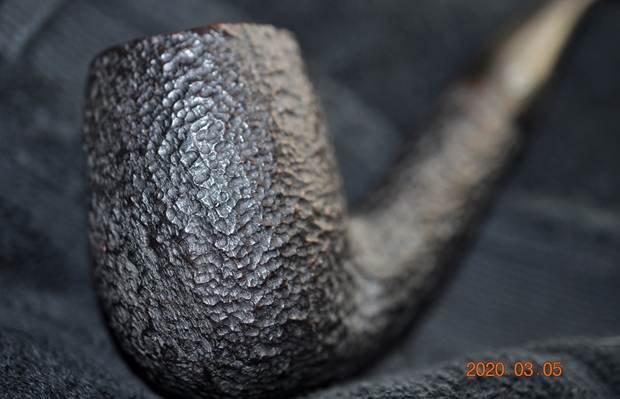
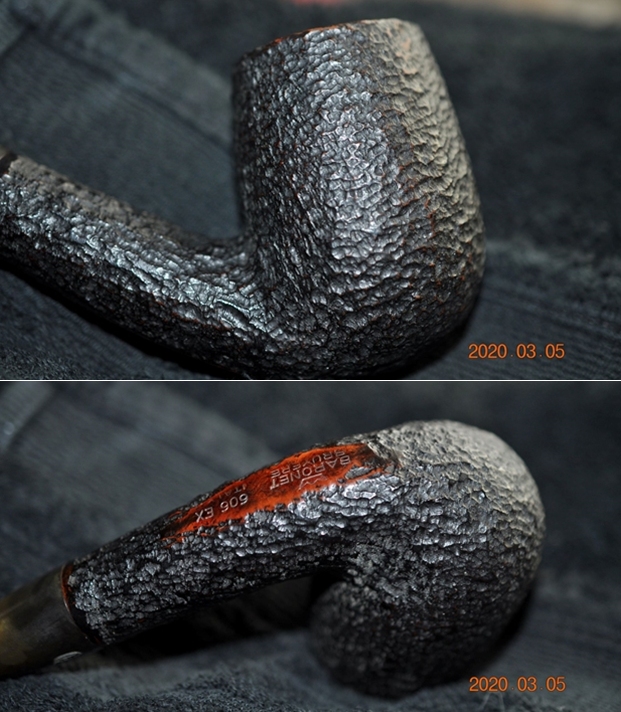
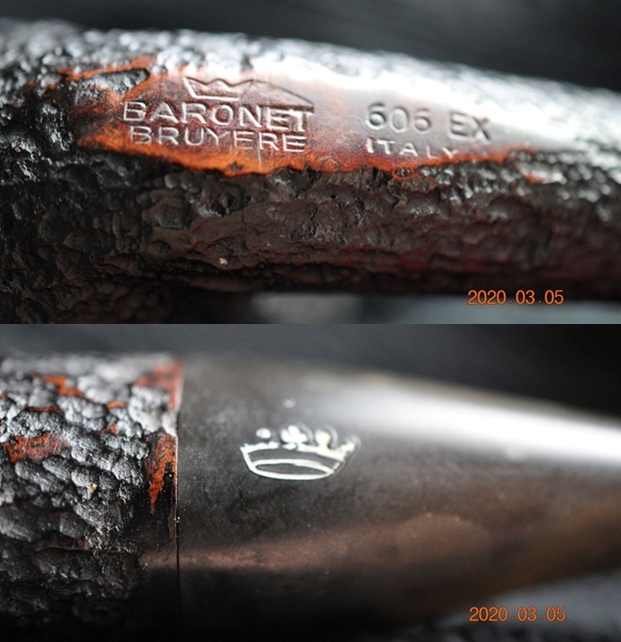
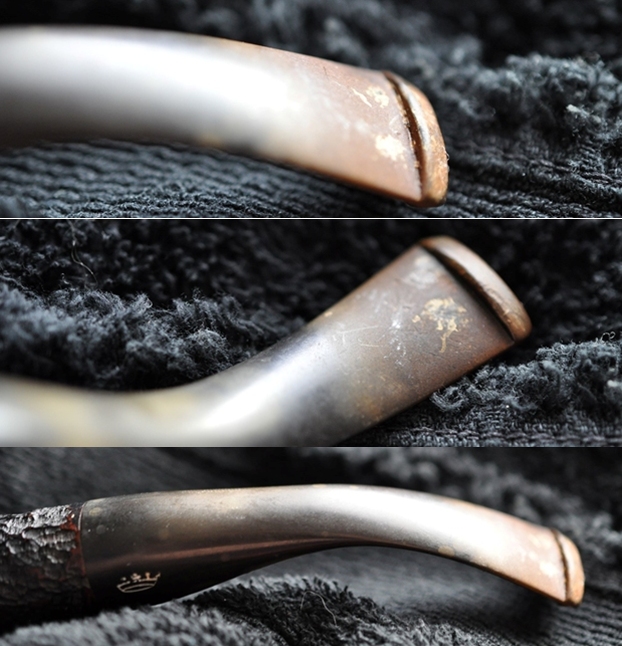
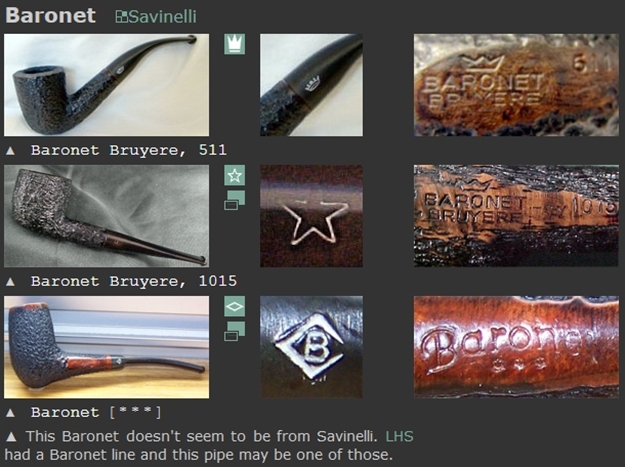
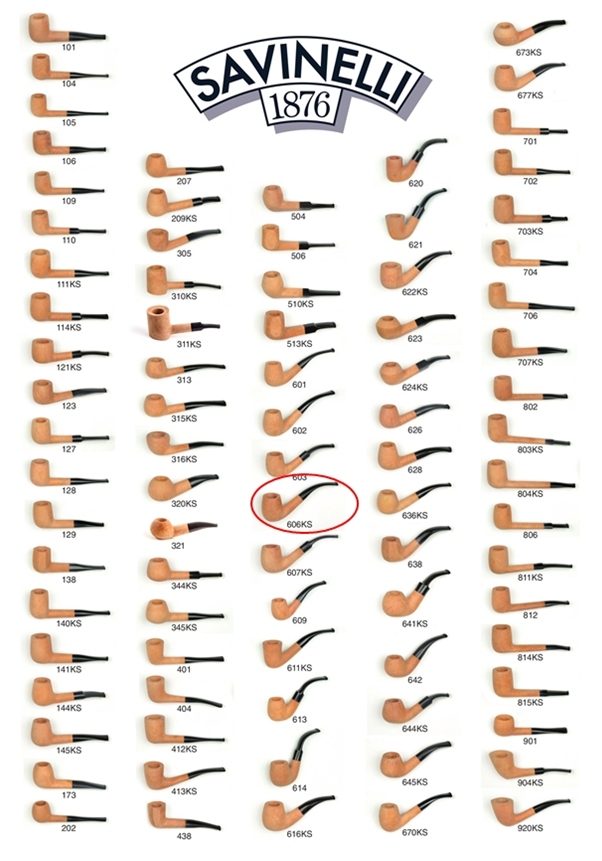
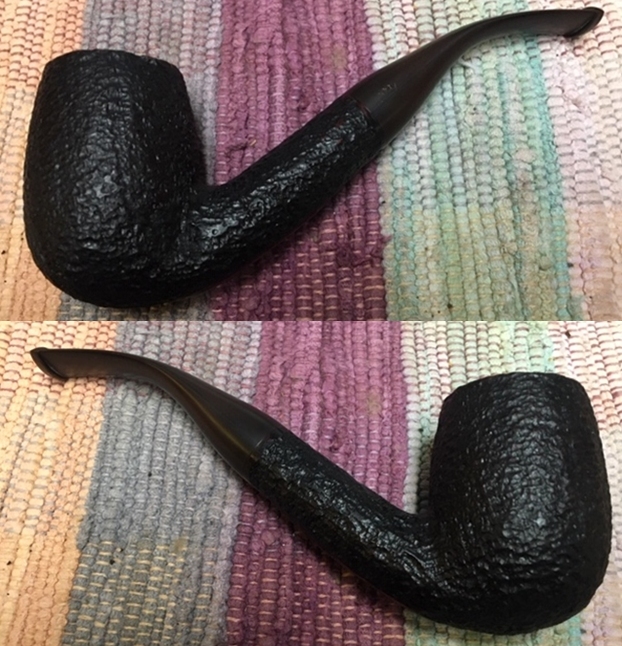
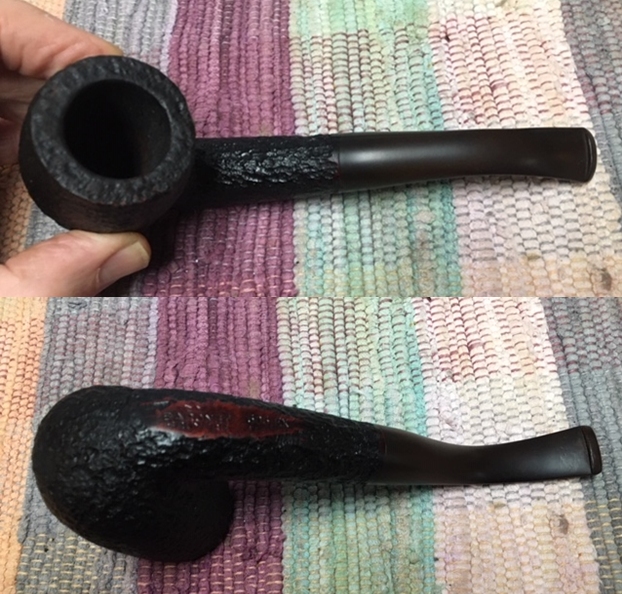
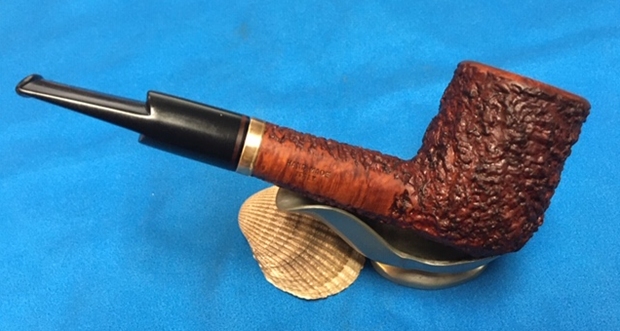
The next pipe on the work table is a nice, large blasticated Bent Billiard. It is stamped with a Crown logo then Baronet over Bruyere on the heel of the bowl followed by 606EX over Italy. The shape number and stamping tell me this is a Savinelli made pipe. The finish is what I call “Blasticated” as it appears to have been rusticated then sandblasted to give it a unique look that is uniform and almost looks like a sandblast. It was quite dirty and the rim top had a thick overflow of lava deep in the grooves of the top. The bowl was thickly caked and between that and the lava I was not sure what to expect of the inner edge of the bowl underneath the grime. Time would tell. The stem was a vulcanite taper style that was very oxidized and spotty. It had some tooth marks and chatter on both sides near the button. There was a faint Crown logo stamped on the left side of the taper that may not be able to be restored. Jeff took some photos of the pipe to show the general condition of the pipe before he started his clean up. He took some photos of the rim top and bowl from various angles to give me a clear picture of the condition of the rim top and bowl. You can see the cake in the bowl and the thickness of the lava coat. It also looks like these is some damage on the lightly beveled inner edge in the photos. Jeff took some photos of the sides and heel of the bowl to show the condition of the rusticated finish on the pipe. The photos show the “Blasticated” style I explained above. Under the oils and grime it was a nice looking bowl. I think it will be a really nice looking pipe once it is restored. He took some photos of the stamping on the underside of the shank and the left side of the taper stem. On the shank there was the crown as noted and the stamping Baronet over Bruyere. Next to that was the shape number 606EX (which is a Savinelli number) and under that Italy. On the left side of the stem was a worn Crown stamp that matched the one on the underside of the shank.The next two photos show the top and underside of the stem. It is deeply oxidized and has calcification on both sides at the button. There is also some tooth chatter and some light tooth marks. The final photo shows the curve of the full stem.Before I started my part of the restoration I wanted to have a clear picture of the background of the Baronet pipe. I turned to Pipephil as he often has photos and information that give me what I am looking for (http://www.pipephil.eu/logos/en/logo-b2.html). The pipe is indeed made by Savinelli, though it appears that LHS also made a line with the same stamp. The LHS Version had a different logo on the stem. I did a screen capture of the pertinent section of the page and include it below.I turned to Pipedia and looked up the brand there (http://www.pipephil.eu/logos/en/logo-b2.html). I found a shape chart that gave the 606KS shape that matches the 606EX that I am working on. I believe the EX is the designation for a large pipe and that fits this one. I also found the Baronet listed in the list of sub-brands or seconds.Now I knew I was dealing a Savinelli made pipe that was large and was a sub-brand or second line. It is a beautiful pipe which will become evident as I work on it.

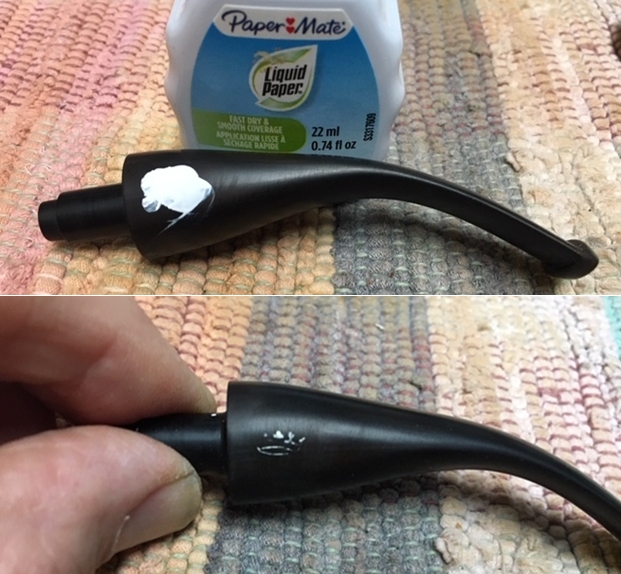
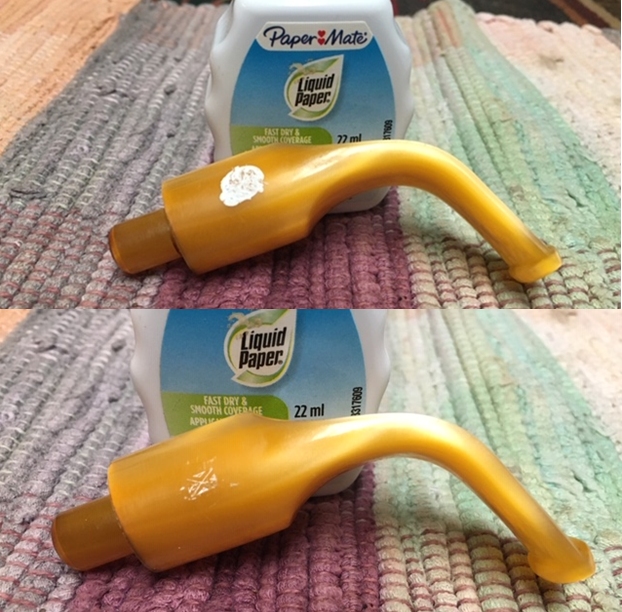
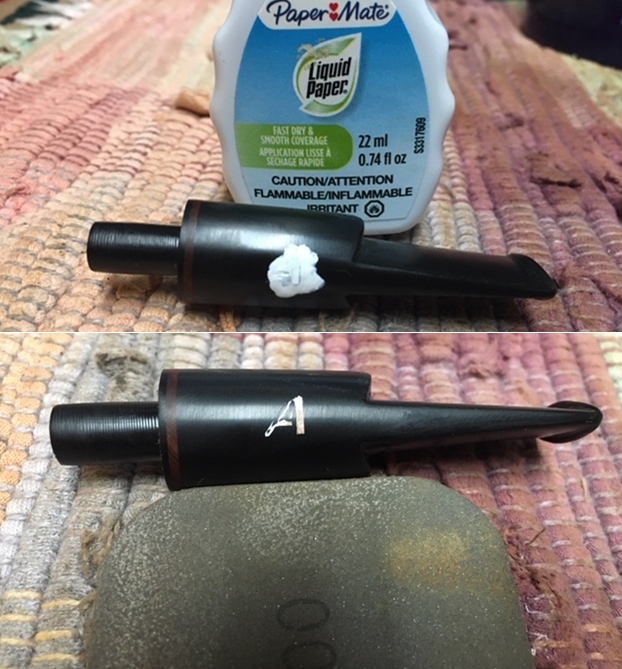
Jeff once again did an amazing job cleaning the pipe. He reamed it with a PipNet pipe reamer and got rid of the cake so that we could see the walls of the bowl and assess for damage. He cleaned the internals of the shank and stem with alcohol, pipe cleaners and alcohol. He scrubbed the exterior with undiluted Murphy’s Oil Soap and a tooth brush to get into the grooves and valleys of the rustication. He rinsed the pipe under warm water. He dried it off with a cloth and then let it air dry. The stem was scrubbed with Soft Scrub and then soaked in Before & After Deoxidizer. It came out looking pretty good with a light coat of oxidation still present. The finish on the bowl and the rim top cleaned up pretty good. I took pictures of the pipe to show how it looked when I unpacked it. I took a close up photo of the rim top to show how clean it was. There was some damage to the inner edge of the rim toward the front of the bowl. The stem looked good just a few light tooth marks and some remaining oxidation. Overall the pipe looked impressive at this point in comparison to where it had started.I decided to address the damage to the inner edge of the rim. I used a folded piece of 220 grit sandpaper to smooth out the rim edge and cleanup the slight bevel that was there. I was able to minimize the damaged area. I stained the edge with a black stain pen to blend it into the rest of the rim top. I worked some Before & After Restoration Balm into the briar with my finger tips and a horsehair shoe brush. The product is a great addition to the restoration work. It enlivens, enriches and protects the briar while giving it a deep glow. It is a product I use on every pipe I work on. I set the bowl aside and turned my attention to the stem. I sanded out the tooth chatter and marks in the acrylic with a folded piece of 220 grit sandpaper and polished out the scratches with 440 grit wet dry sandpaper.I polished the stem with Denicare Mouthpiece Polish from a tin of it I have in the drawer here. It is a gritty red paste that I rub on with my finger tips and work it into the surface of the stem and button and buff it off with a cotton pad. It gives me a bit of a head start on the polishing work.I used some Paper Mate Liquid Paper to repair the white in the Crown stamp on the left side of the stem. Once it dried I used a 2400 grit micromesh sanding pad to remove the excess. While not flawless it is recognizable.I polished the stem with micromesh sanding pads – wet sanding with 1500-12000 grit sanding pads. I wiped it down after each sanding pad with Obsidian Oil. I polished it with Before & After Pipe Stem Polish – both Fine and Extra Fine. I buffed the stem with a soft cloth to raise the shine. I rubbed it down with Briarville’s No Oxy Oil as a final preservative measure to protect the stem. As always I am excited to finish a pipe that I am working on. I put the pipe back together and buffed it using a light touch with Blue Diamond on the buffing wheel. I gave the bowl several coats of Conservator’s Wax and the stem multiple coats of carnauba wax. I buffed the pipe with a clean buffing pad and hand buffed it to raise the shine. It is fun to see what the polished bowl looks like with the variations of colour in the blastication around the bowl and shank. Added to that the polished tapered vulcanite stem was a beautiful touch. This is large, nice looking pipe and I am sure that the tactile nature of the finish will feel great as the bowl warms up during smoking. It is light and well balanced. Have a look at it with the photos below. The dimensions are Length: 6 ¾ inches, Height: 2 ½ inches, Outside diameter of the bowl: 1 ½ inches, Chamber diameter: 7/8 of an inch. It is another beautiful pipe and one that will be on the rebornpipes store soon. You can find it in the section of Pipes by Italian Pipe Makers. If you are interested in adding it to your collection let me know. Thanks for walking through the restoration with me as I worked over this pipe. Thanks to each of you who are reading this blog. I want to keep reminding us of the fact that we are not pipe owners; we are pipemen and women who hold our pipes in trust until they pass on into the trust of the next pipeman or woman.       
Breathing Life into an Italian  Hand Made Prince of Wales Bent Billiard


Blog by Steve Laug

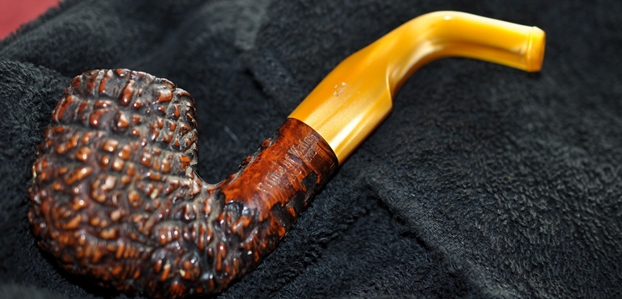
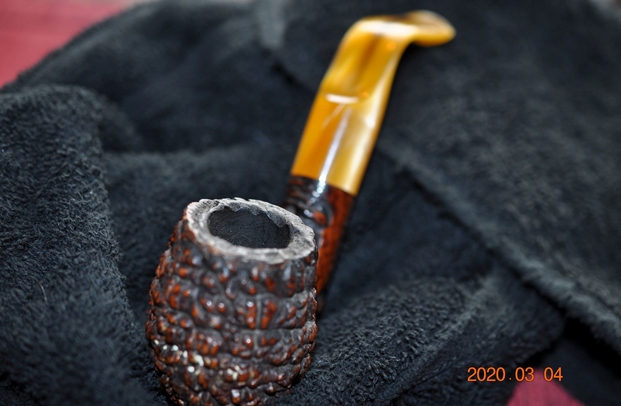
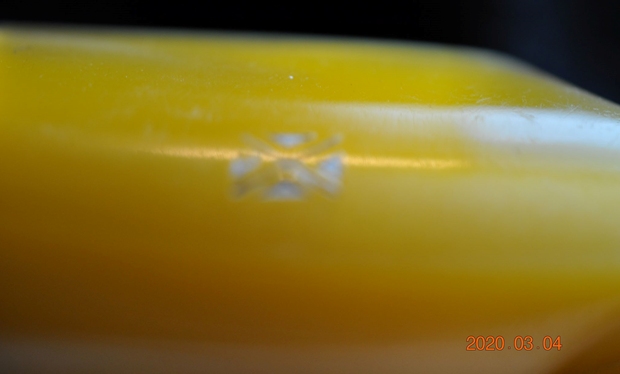
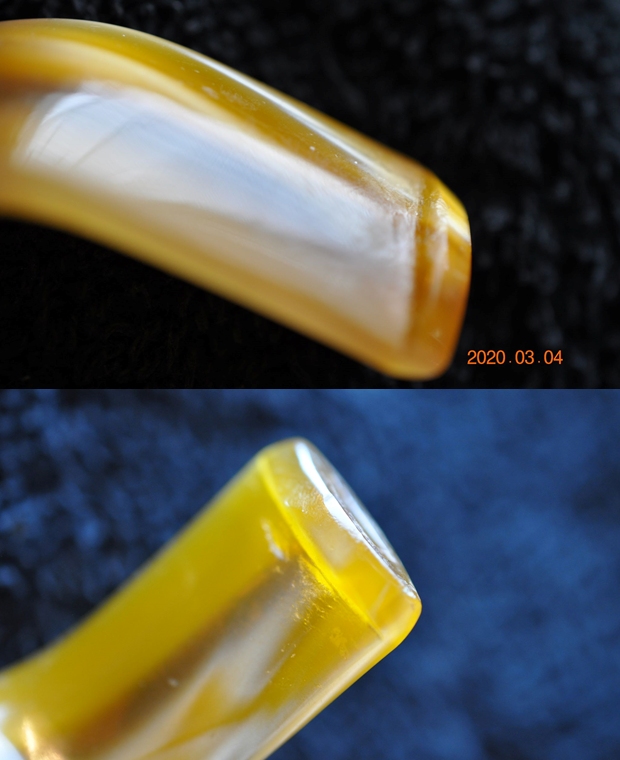
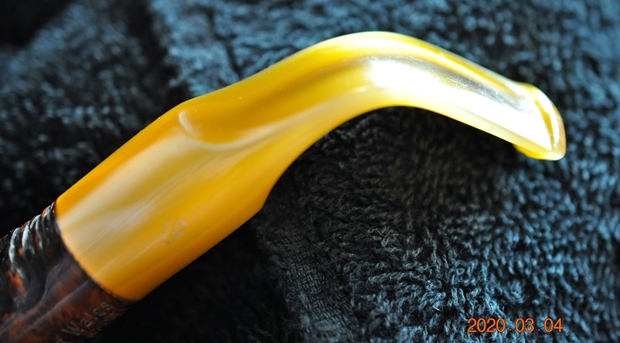
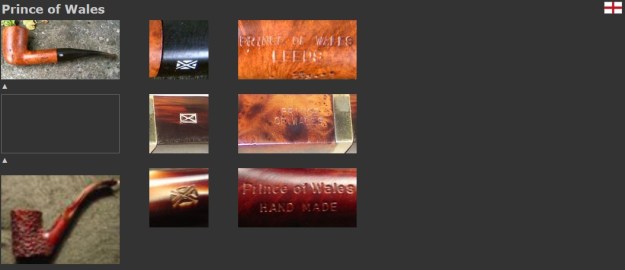
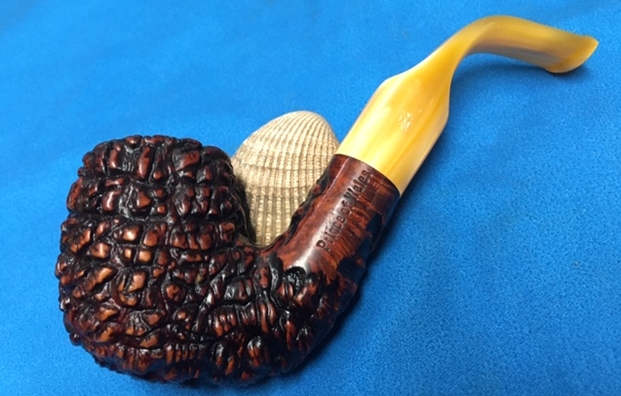
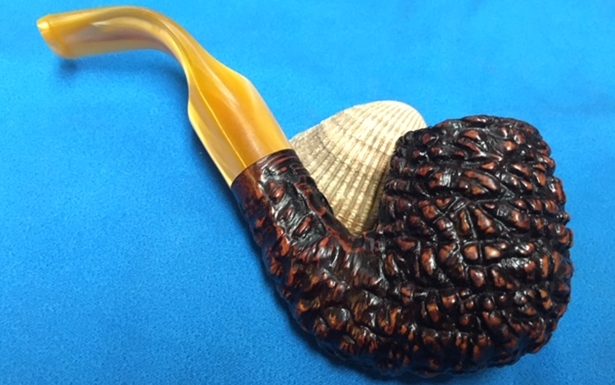
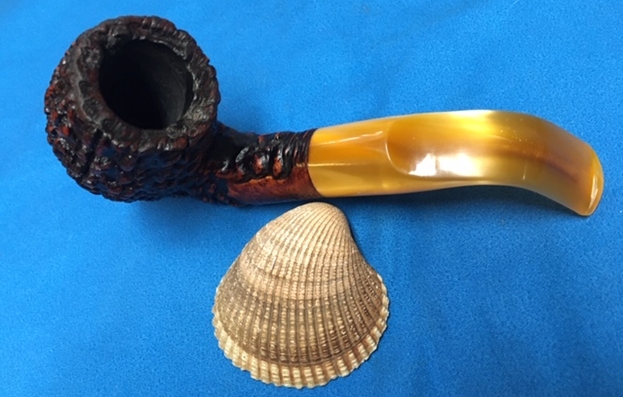
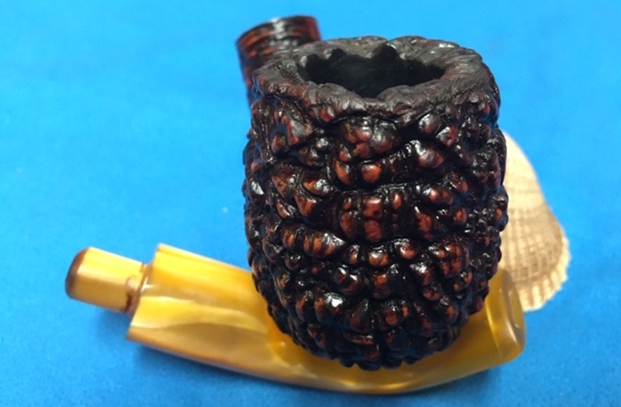
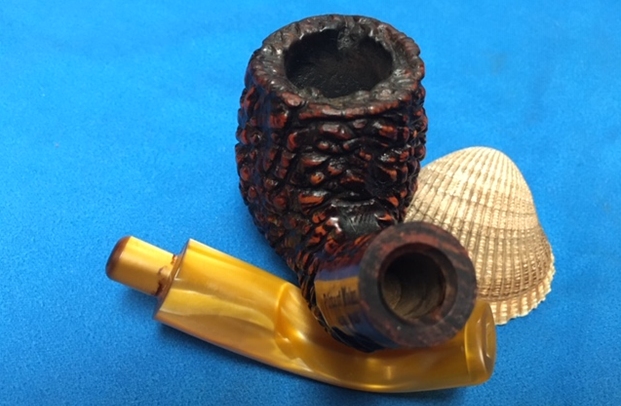
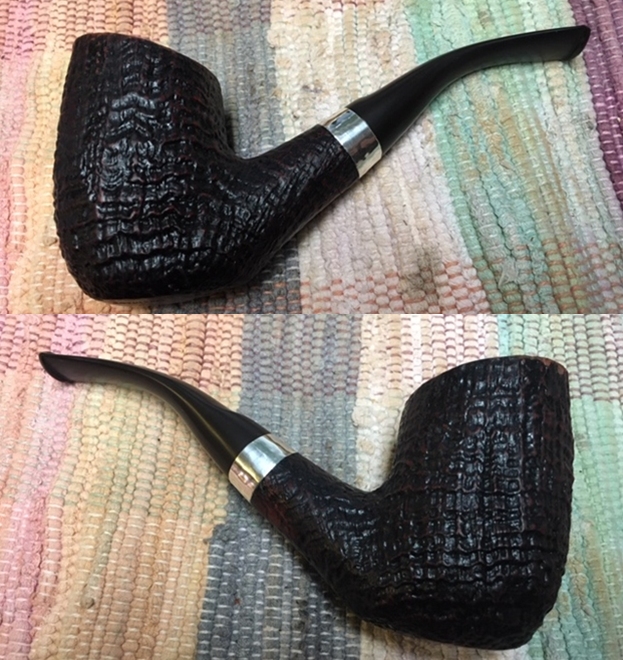
The next pipe on the work table is a really nice; Sea Rock style rusticated Bent Billiard. It is stamped Prince of Wales over Hand Made on the left side of the shank and Italy on the underside near the stem shank junction. The rusticated finish was quite dirty and the rim top had a thick overflow of lava deep in the rustication on the top. The bowl was thickly caked and between that and the lava I was not sure what to expect of the inner edge of the bowl underneath the grime. Time would tell. The stem was a golden acrylic saddle shape that was quite nice. It was dirty and had some tooth marks and chatter on both sides near the button. There was a faint logo stamped on the left side of the saddle.  Jeff took some photos of the pipe to show the general condition of the pipe before he started his clean up. He took some photos of the rim top and bowl from various angles to give me a clear picture of the condition of the rim top and bowl. You can see the cake in the bowl and the thickness of the lava coat. It also looks like these is some damage on the outer edge in the photos. Jeff took some photos of the sides and heel of the bowl to show the condition of the rusticated finish on the pipe. Under the oils and grime it was a nice looking bowl. I think it will be a really nice looking pipe once it is restored. He took some photos of the stamping on the sides of the shank. On the left side is the Prince of Wales stamp over Hand Made. On the underside of the shank it is stamped Italy. On the left side of the saddle stem was stamp that was washed out but looked like a flag of some sort. The next two photos show the top and underside of the stem. It is good condition with tooth chatter and some light tooth marks. It should clean up nicely. The final photo shows the curve of the full stem. Before I started my part of the restoration I wanted to have a clear picture of the background and what the stem logo looked like on the Prince of Wales pipe. I turned to Pipephil as he often has photos that give me the information that I am looking for (http://www.pipephil.eu/logos/en/logo-p5.html). Sure enough he had a photo showing the rough stamped A on the stem. It is white and it is rough which is exactly how this one looks. Hopefully in the restoration process I can get it back a bit. I did a screen capture of the picture on the site and include it below.What is interesting in these photos is that it is the same logo but several of them say made in Leeds. They seem to be English made or at least maybe made for a pipe shop. The logo is a Scottish Flag. The one I have is stamped Italy which makes me think that someone had the pipe made by an Italian company for their shop.

I turned to Pipedia and looked up the brand there (https://pipedia.org/wiki/Prince_Of_Wales). Here is what I found there. I quote in full.

“It is quite a three pipe problem …”

  1. The name “Prince of Wales” was used at times by GBD for a sub-brand.
  2. Pipephil shows English made Prince of Wales which bear the Scottish flag (X-shaped cross representing the cross of the Christian martyr Saint Andrew, the patron saint of Scotland) as logo.
  3. Also listed by Pipephil is a brand named P.O.W. attributed to a Scottish firm G.M. Frame. Now, if P.O.W. doesn’t stand for “prisoner of war”, this might be an indication that there are two different Prince of Wales productions.
  4. Danish made semi-freehands stamped “PRINCE OF WALES” + “DANISH LINE” + “HANDMADE IN DENMARK”. The stems, as usual for the bulk of such pipes, often as stitch in stems. Decorated with a white ring and a stylized Danish flag. (Were once mentioned as order production for GBD. – Unconfirmed!)
  5. Prince of Wales Made in Italy. Quotation: “In the spirit of the Bing’s Favorite Pipe, Savinelli expands its line of pipes favored by famous pipesmokers. Prince of Wales Favorite series features a new mosaic designed mouthpiece which gives it a unique look like no other series. This pipe can be used with or without Savinelli balsa inserts (20pk included).”

Now I knew I was dealing with a bit of a mystery pipe. It has a Scottish Flag on the stem, an Italy stamp on the shank and the name Prince of Wales which sounds British. Very interesting piece. But no definitive information!!

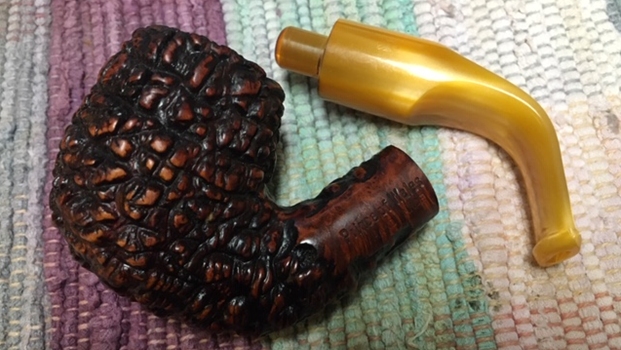
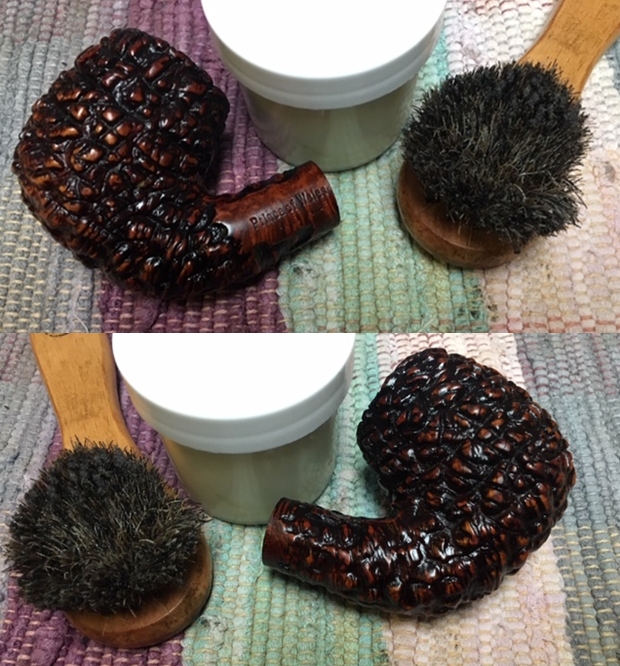
Jeff once again did an amazing job cleaning the pipe. He reamed it with a PipNet pipe reamer and got rid of the cake so that we could see the walls of the bowl and assess for damage. He cleaned the internals of the shank and stem with alcohol, pipe cleaners and alcohol. He scrubbed the exterior with undiluted Murphy’s Oil Soap and a tooth brush to get into the grooves and valleys of the rustication. He rinsed the pipe under warm water. He dried it off with a cloth and then let it air dry. The rustication and the rim top cleaned up pretty good. I took pictures of the pipe to show how it looked when I unpacked it. I took a close up photo of the rim top to show how clean it was. There appeared to be a hard bit of lava on the back edge. Overall the pipe looked impressive at this point in comparison to where it had started.I took a photo of the bowl and stem taken apart. There is some staining on the end of the tenon.I decided to address the spot of hard lava on the rim top first. I picked at the chunk of lava with a dental pick and was able to break through the hard coat. It came off in large chunks but it was like rock. I used a brass bristle wire brush afterward to work the remainder of the lava out of the rim crevices. I am happy with the results.I worked some Before & After Restoration Balm into the briar with my finger tips and a horsehair shoe brush. The product is a great addition to the restoration work. It enlivens, enriches and protects the briar while giving it a deep glow. It is a product I use on every pipe I work on. I set the bowl aside and turned my attention to the stem. I sanded out the tooth chatter and marks in the acrylic with a folded piece of 220 grit sandpaper and polished out the scratches with 440 grit wet dry sandpaper.I polished the stem with Denicare Mouthpiece Polish from a tin of it I have in the drawer here. It is a gritty red paste that I rub on with my finger tips and work it into the surface of the stem and button and buff it off with a cotton pad. It gives me a bit of a head start on the polishing work.I polished the stem with micromesh sanding pads – wet sanding with 1500-12000 grit sanding pads. I wiped it down after each sanding pad with Obsidian Oil. I polished it with Before & After Pipe Stem Polish – both Fine and Extra Fine. I buffed the stem with a soft cloth to raise the shine. I used some Paper Mate Liquid Paper to repair the white in the A stamp on the left side of the shank. Once it dried I used a 2400 grit micromesh sanding pad to remove the excess. While not flawless it is recognizable. It would clean up a bit more when I buffed it.As always I am excited to finish a pipe that I am working on. I put the pipe back together and buffed it using a light touch with Blue Diamond on the buffing wheel. I gave the bowl several coats of Conservator’s Wax and the stem multiple coats of carnauba wax. I buffed the pipe with a clean buffing pad and hand buffed it to raise the shine. It is fun to see what the polished bowl looks like with the grain and the variations of colour in the rustication around the bowl and shank. Added to that the polished golden acrylic saddle stem was a beautiful touch. This is nice looking pipe and I am sure that the tactile nature of the rustication will feel great as the bowl warms up during smoking. It is light and well balanced. Have a look at it with the photos below. The dimensions are Length: 5 ¾ inches, Height: 2 inches, Outside diameter of the bowl: 1 ¼ inches, Chamber diameter: ¾ of an inch. It is a beautiful pipe and one that will be on the rebornpipes store soon. You can find it in the section of Pipes by Italian Pipe Makers. If you are interested in adding it to your collection let me know. Thanks for walking through the restoration with me as I worked over this pipe. Thanks to each of you who are reading this blog. I want to keep reminding us of the fact that we are not pipe owners; we are pipemen and women who hold our pipes in trust until they pass on into the trust of the next pipeman or woman.
Repairing, Banding and Restoring a Damaged Hand Made Ascorti Business Billiard


Blog by Steve Laug

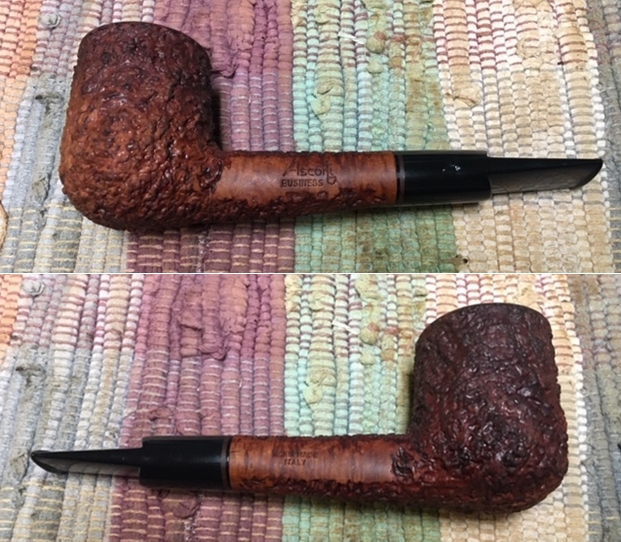
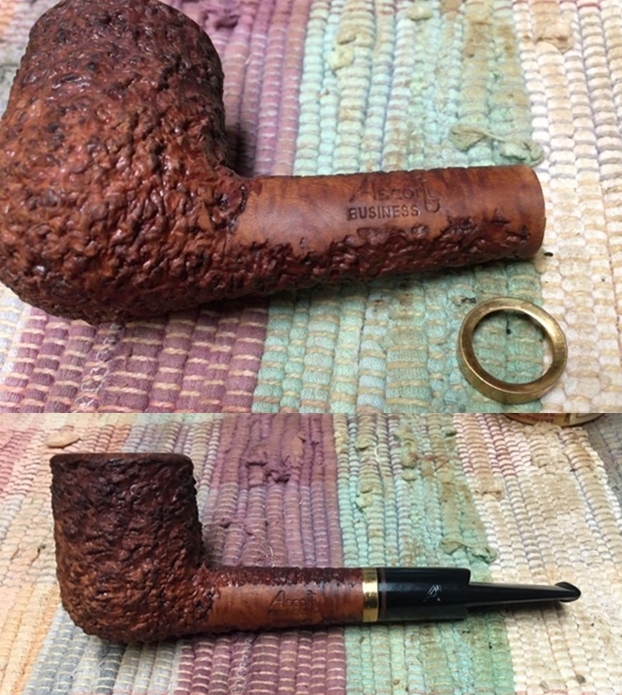
Not too long ago I received an email from an online friend and contributor to rebornpipes, Joe. He had picked up a great estate that he was cleaning and selling for the family. He sent me a list of the pipes. I purchased a nice Bari Freehand pipe from the lot. We came to an agreement on the price and I paid him for it. In the email interaction he talked about one of the Ascorti Business pipes that he was cleaning. He wrote:

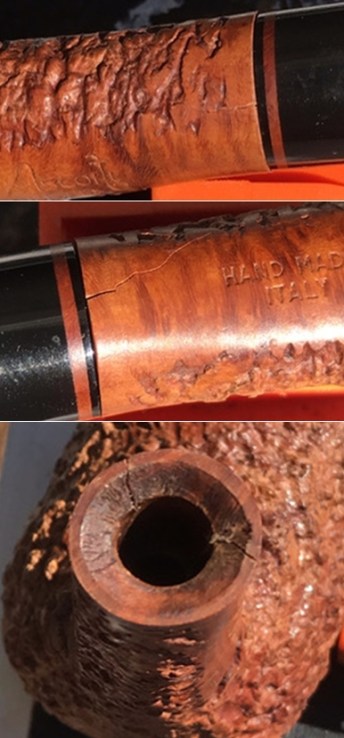
…Now, I have a question. When cleaning one of the Ascorti Business, I found two cracks in the stummel. I know you have fixed cracks before. I’m attaching photos. Is it repairable and how much would it cost?

I looked at the photos that he attached which I have included to the left of this paragraph for you to see. The next paragraph of the email he came up with an interesting possibility.

Second thought. If I ship it with the Bari, would you be interested in fixing it and selling it?… (He went on to make a business proposition regarding the sale of the pipe.)

We struck a deal and the Bari I purchased and the Ascorti were in the mail to my brother Jeff’s place so he could work his magic on the pipe.

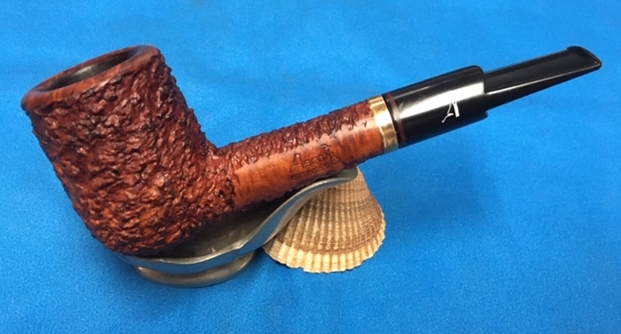
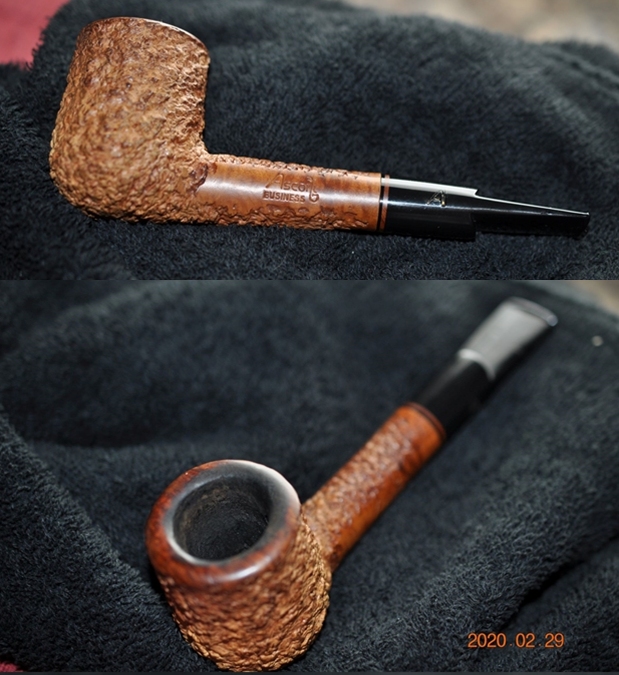
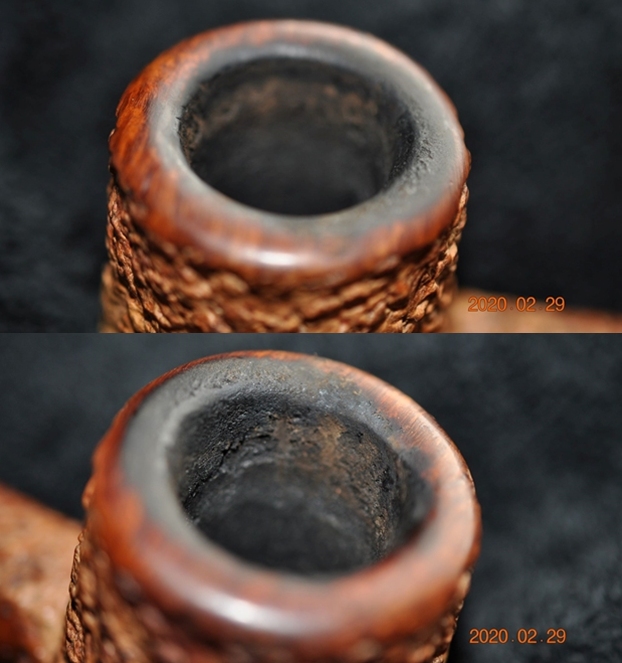
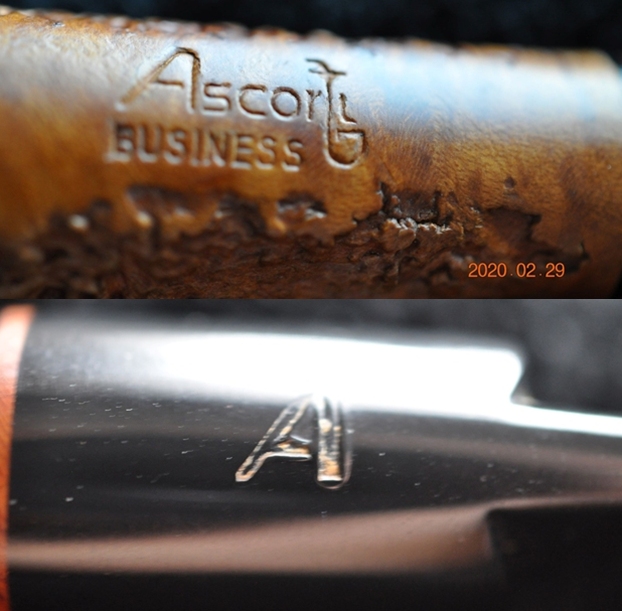
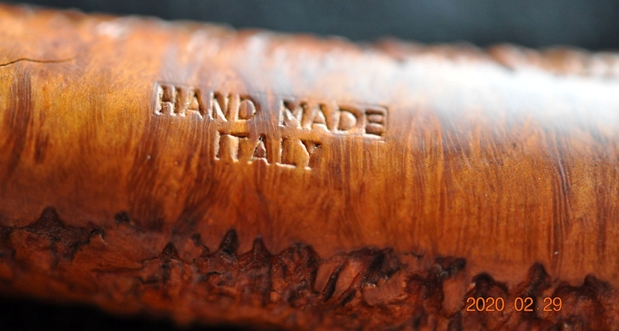
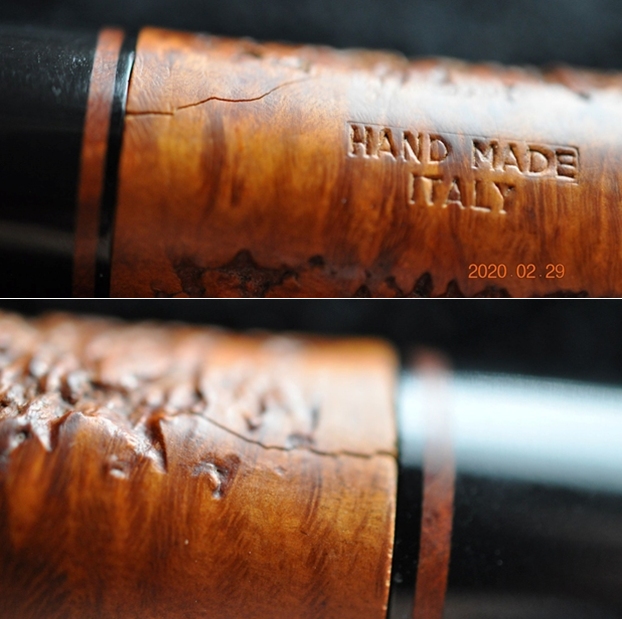
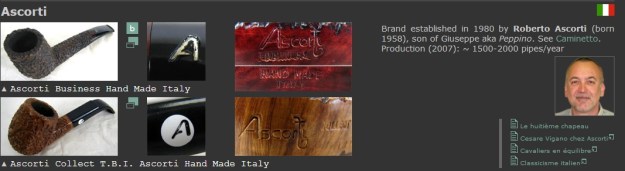
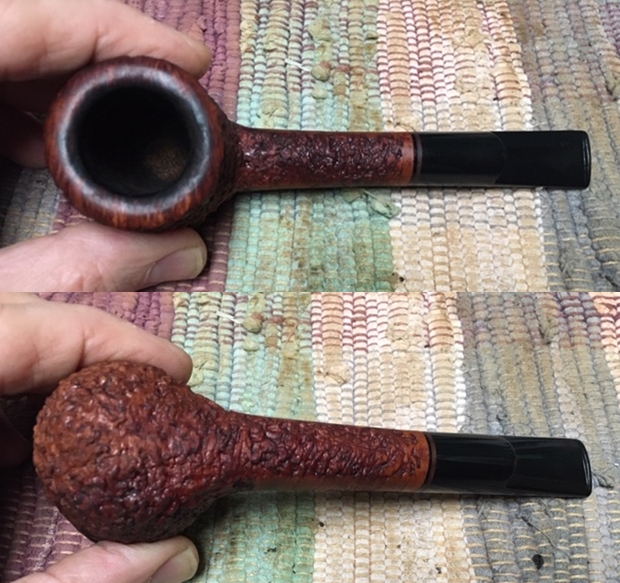
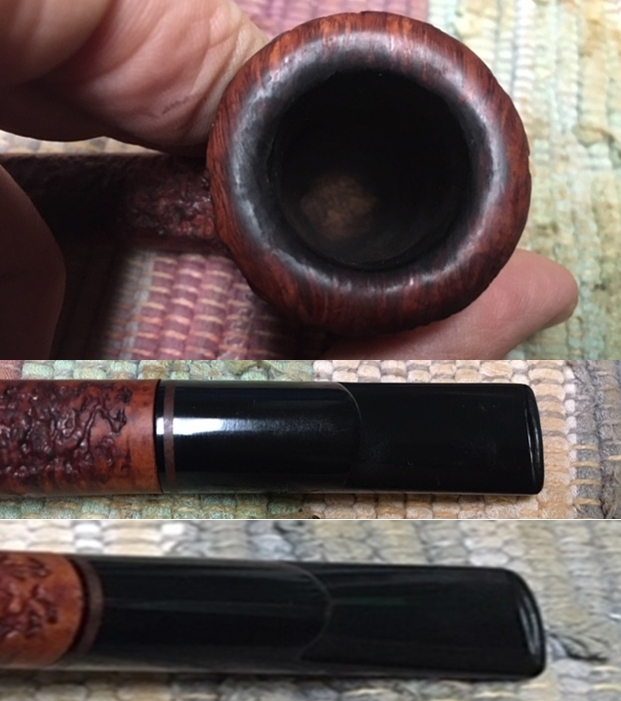
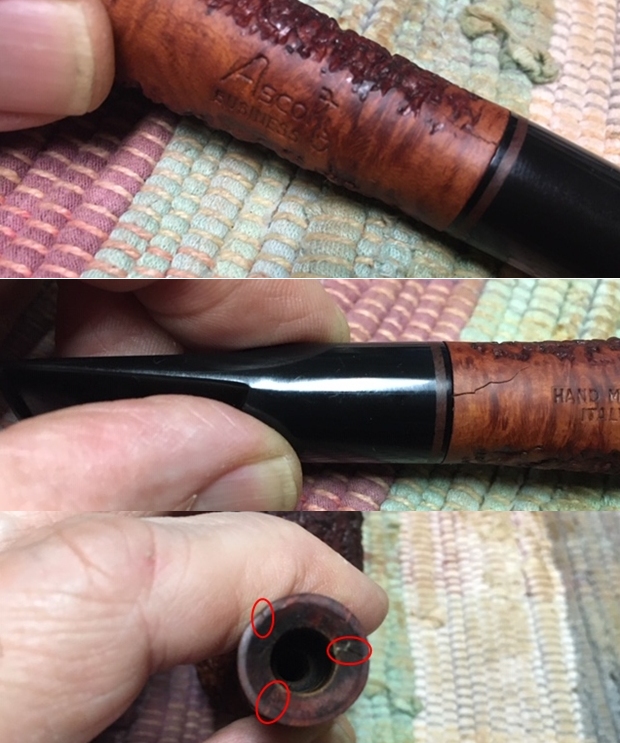
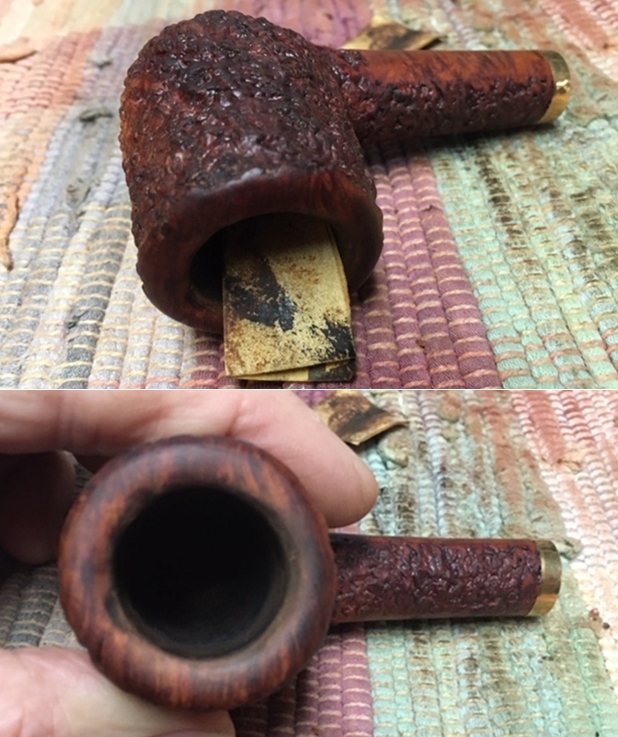
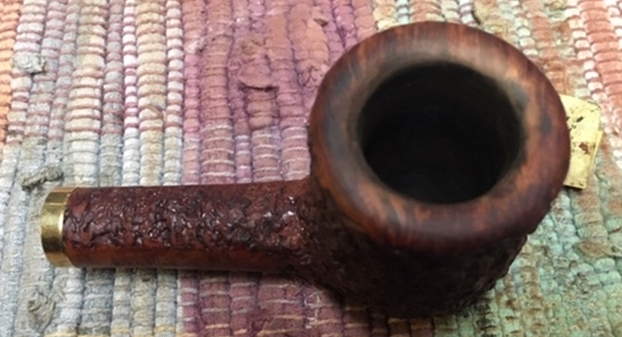
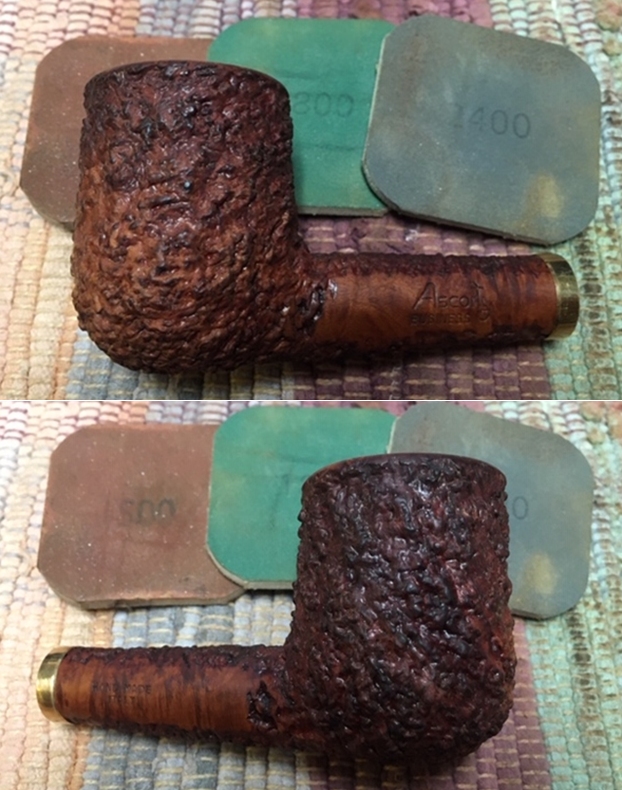
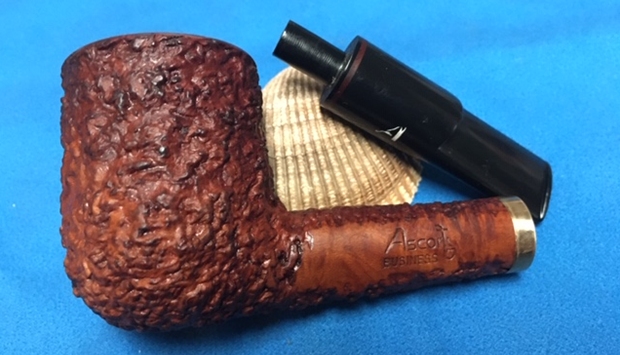
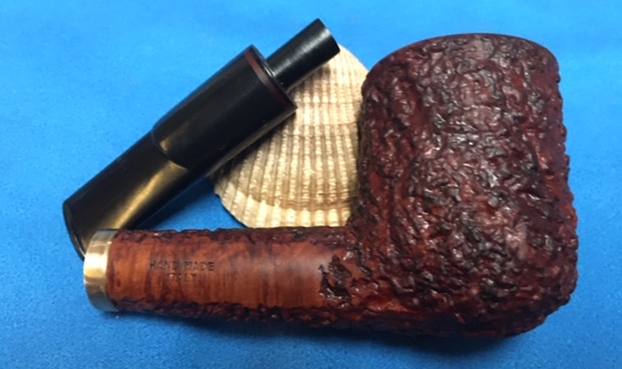
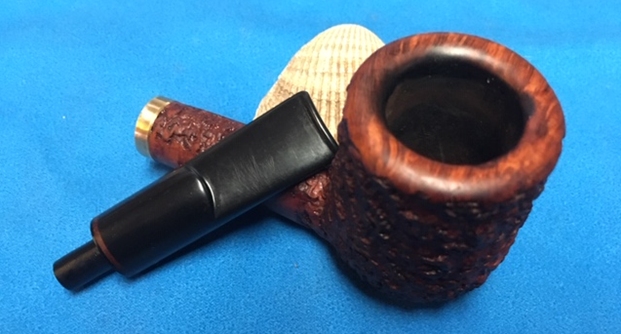
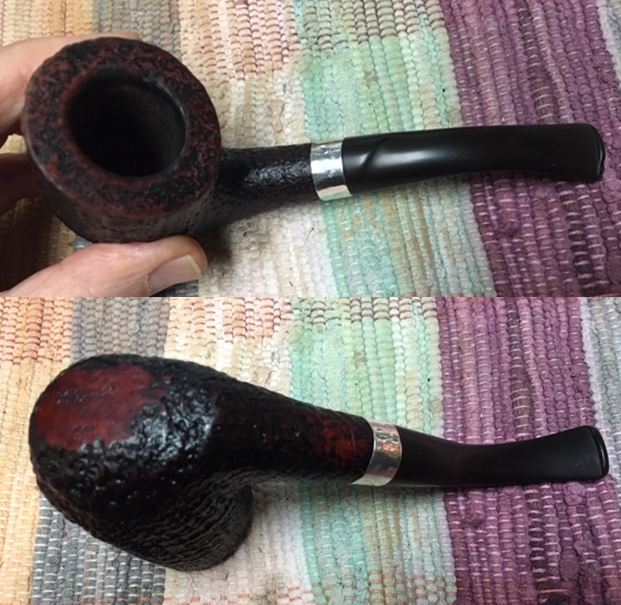
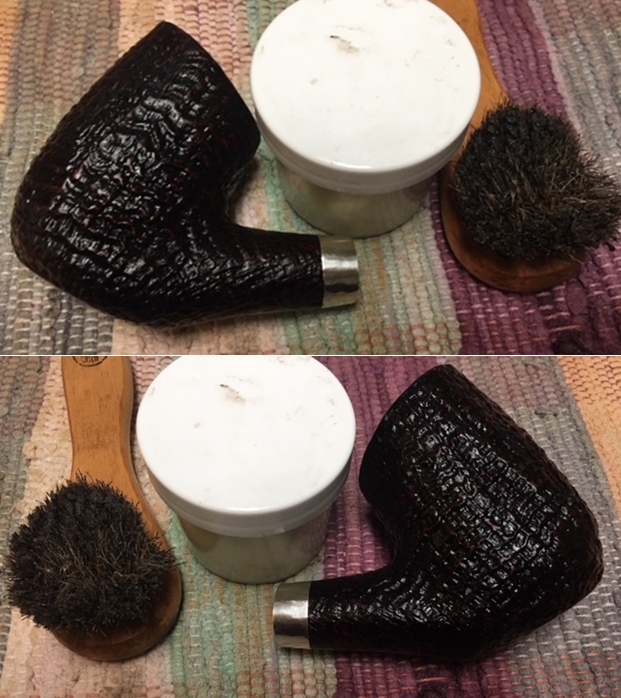
When the pipe arrived Jeff showed me the pipe while we were on Facetime. He showed the entirety of the pipe and also the shank end. It looked to both of us that there were actually three cracks in the shank. The stem was very loose fitting because the cracks had opened the mortise enough that it would not snugly hold the stem in place. The rusticated finish was quite dirty and the rim top had an overflow of lava on the smooth crown. The bowl was caked and between that and the lava I was not sure what to expect of the inner edge of the bowl underneath the grime. Time would tell. Jeff took some photos of the pipe to show the general condition of the pipe before he started his clean up. He took some photos of the rim top and bowl from various angles to give me a clear picture of the condition of the rim top and bowl. You can see the cake in the bowl and the thickness of the lava coat. It also looks like these is some damage on the inner edge and bevel in the photos. Jeff took some photos of the sides and heel of the bowl to show the condition of the rusticated finish on the pipe. Under the oils and grime it was a nice looking bowl. I think it was well worth the effort to repair the shank as there was a lot of life left in this old timer. He took some photos of the stamping on the sides of the shank. On the left side is the Ascorti logo with a pipe forming a “t” in the brand name. On the left side of the saddle stem was the Ascorti slanted A stamp. On the right side it was stamped Hand Made over Italy. You can also see part of the crack on the left of the third photo. Jeff took several photos of the cracks in the shank. Interestingly they both are on or alongside of the smooth panels on the sides of the shank.The next two photos show the top and underside of the stem. It is good condition with tooth chatter and some light tooth marks. It should clean up nicely.Before I started my part of the repair and restoration I wanted to have a clear picture of what the stem logo looked like on the Ascorti Business pipe. I turned to Pipephil as he often has some photos that give me the information that I am looking for (http://www.pipephil.eu/logos/en/logo-a8.html). Sure enough he had a photo showing the rough stamped A on the stem. It is white and it is rough which is exactly how this one looks. Hopefully in the restoration process I can get it back a bit. I did a screen capture of the picture on the site and include it below.Jeff once again did an amazing job cleaning the pipe. He reamed it with a PipNet pipe reamer and got rid of the cake so that we could see the walls of the bowl and assess for damage. He cleaned the internals of the shank and stem with alcohol, pipe cleaners and alcohol. He scrubbed the exterior with undiluted Murphy’s Oil Soap and rinsed the pipe under warm water. He dried it off with a cloth and then let it air dry. The rim top cleaned up pretty well and there was indeed some damage to the crowned top and inner edge of the bowl. I took pictures of the pipe to show how it looked when I unpacked it. I took a close up photo of the rim top to show the damage to the rim. You can see the damage on the back crowned rim top and on the inner edge on both the front and the back. There is some roughness and marks on the surface of the rim top as well.I took photos of the cracks in the shank sides and also of the shank end. I have circled the three cracks in red on the last photo of the shank end.I opened the cracks with a dental pick and pressed CA glue into the cracked areas. I clamped them together until the CA cured. I went through a bag or brass bands that I picked up through a friend online. I had one that was a perfect fit and when pressed onto the shank would fully bind the glue. I heated the band with a lighter and pressed it onto the shank. I put the stem in place and it was snug! The repair had cured the cracks and the loose fitting stem. I took a photo of the pipe with the band and the stem in place to have a look.  I took the stem off and set it aside so that I could work on the crowned rim and inner edge damage. I used a folded piece of 220 grit sandpaper to clean up the inner edge and the top of the crowned rim. It was slow and tedious but the results were what I was hoping for. I polished the smooth panels on the sides of the shank and the rim top with micromesh sanding pads. I wet sanded with 1500-12000 grit pads. I wiped the rim down with a damp cloth after each sanding pad to remove the sanding debris. I worked some Before & After Restoration Balm into the smooth portions with my finger tips and the rustication with a horsehair shoe brush. The product is a great addition to the restoration work. It enlivens, enriches and protects the briar while giving it a deep glow. It is a product I use on every pipe I work on. I set the bowl aside and turned my attention to the stem. I sanded out the tooth chatter and marks in the acrylic with a folded piece of 220 grit sandpaper and polished out the scratches with 440 grit wet dry sandpaper.I polished the stem with Denicare Mouthpiece Polish from a tin of it I have in the drawer here. It is a gritty red paste that I rub on with my finger tips and work into the surface of the stem and button and buff off with a cotton pad. It gives me a bit of a head start on the polishing work.I used some Paper Mate Liquid Paper to repair the white in the A stamp on the left side of the shank. Once it dried I used a 2400 grit micromesh sanding pad to remove the excess. While not flawless it definitely looks better.I polished the stem with micromesh sanding pads – wet sanding with 1500-12000 grit sanding pads. I wiped it down after each sanding pad with Obsidian Oil. I polished it with Before & After Pipe Stem Polish – both Fine and Extra Fine. I buffed the stem with a soft cloth to raise the shine. Looking forward to hearing what Joe thinks of the restoration on this Ascorti Business pipe that he sent to me. As always I am excited to finish a pipe that I am working on. I put the pipe back together and buffed it using a light touch with Blue Diamond on the buffing wheel. I gave the bowl several coats of Conservator’s Wax and the stem multiple coats of carnauba wax. I buffed the pipe with a clean buffing pad and hand buffed it to raise the shine. It is fun to see what the polished bowl looks like with the grain popping through on the rim top and the variations of colour in the rustication around the bowl and shank. Added to that the polished black acrylic stem with the briar band on the saddle was beautiful. The new brass band sets off the bowl and stem really well and I am pleased with the classy look it gives to the pipe. The shank repair and band take care of the cracked shank and it should work well for a long time. This is nice looking pipe and I am sure that the tactile nature of the rustication will feel great as the bowl warms up during smoking. It is light and well balanced. Have a look at it with the photos below. The dimensions are Length: 5 ¾ inches, Height: 2 inches, Outside diameter of the bowl: 1 ½ inches, Chamber diameter: 7/8 of an inch. It is a beautiful pipe and one that will be on the rebornpipes store soon. If you are interested in adding it to your collection let me know. Thanks for walking through the restoration with me as I worked over this pipe. Thanks to each of you who are reading this blog. I want to keep reminding us of the fact that we are not pipe owners; we are pipemen and women who hold our pipes in trust until they pass on into the trust of the next pipeman or woman.
Ehrlich – Another Iconic Boston Tobacconist (1868-1968): An Ehrlich Special Chimney


Blog by Dal Stanton

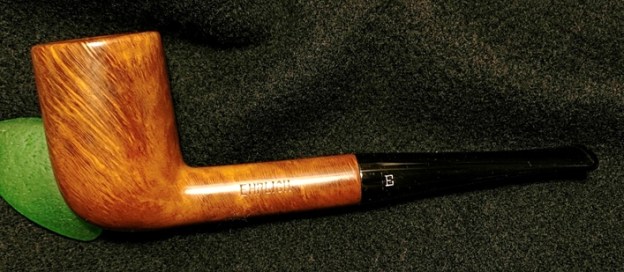
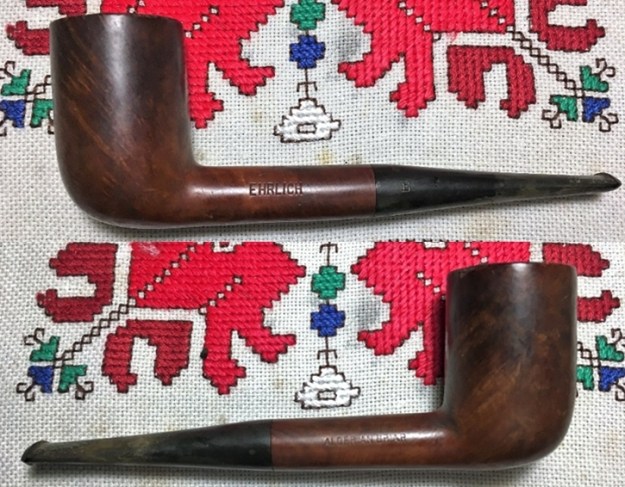
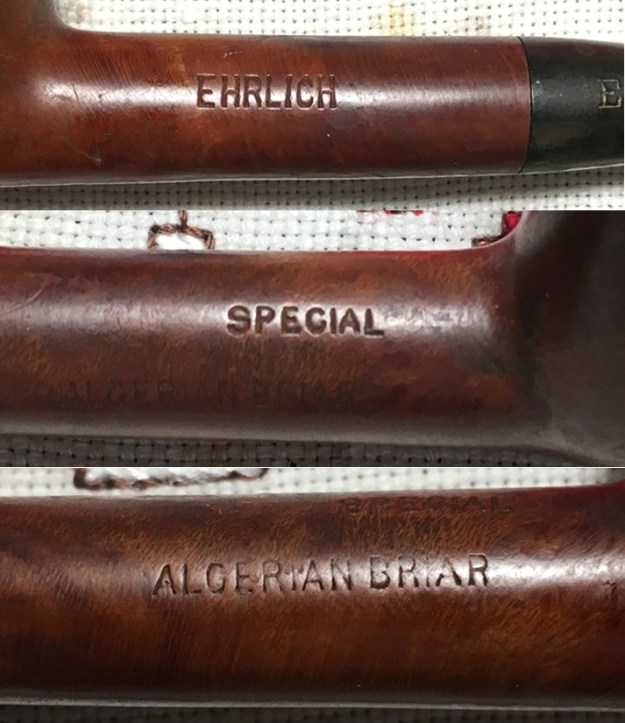
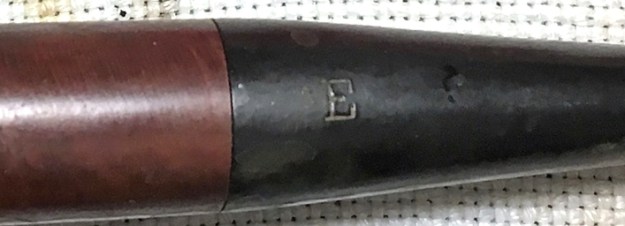
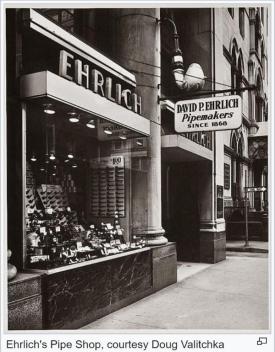
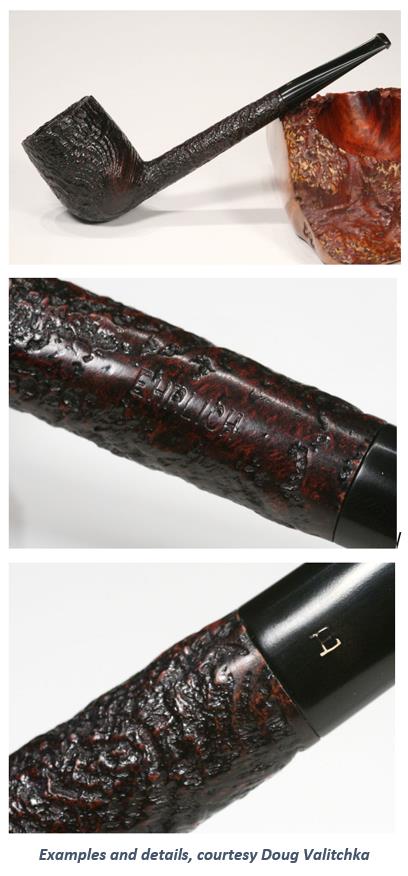
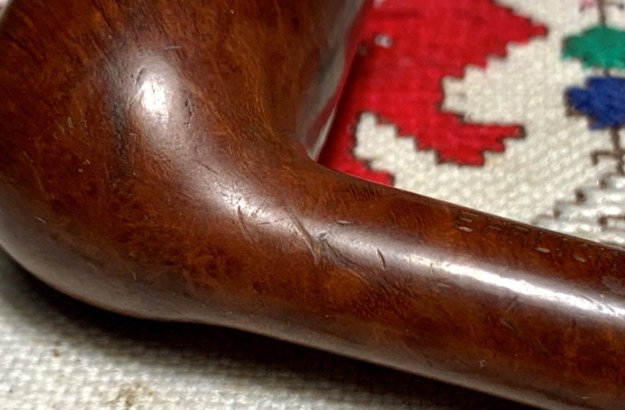
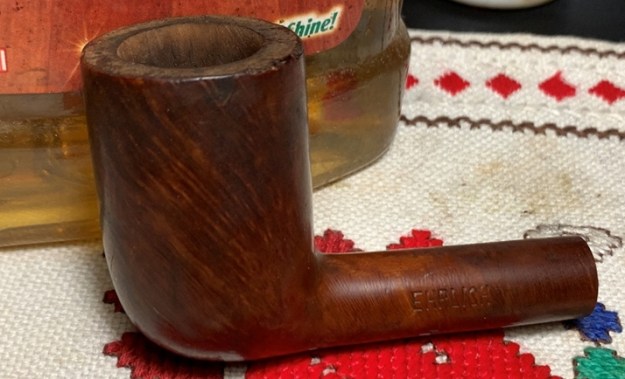
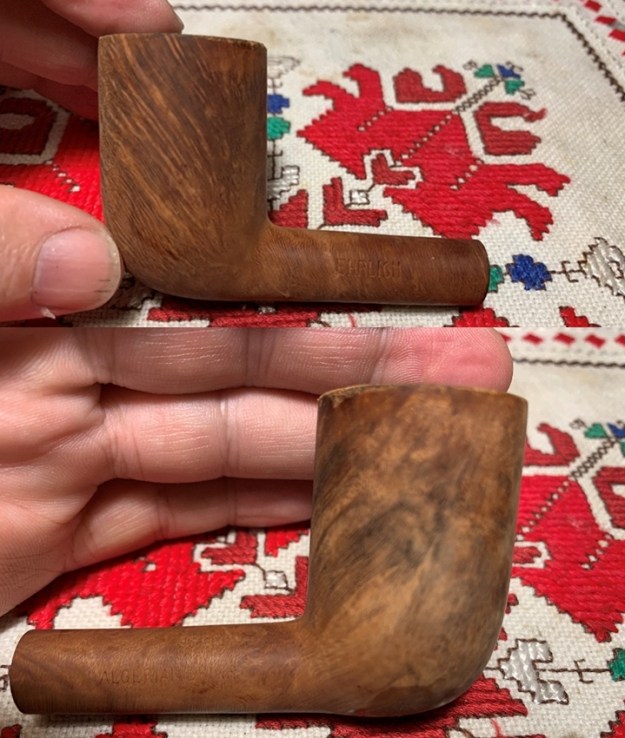
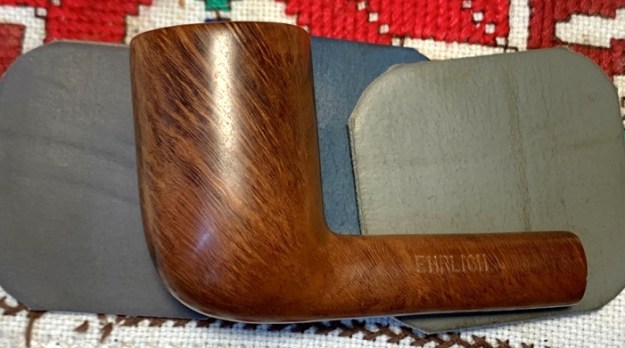
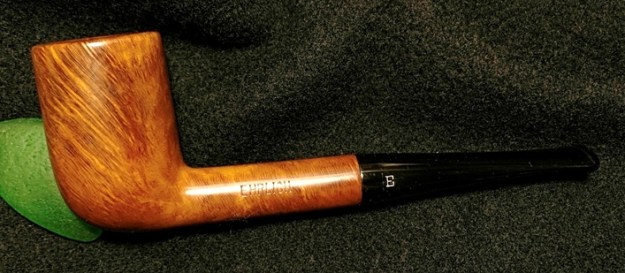
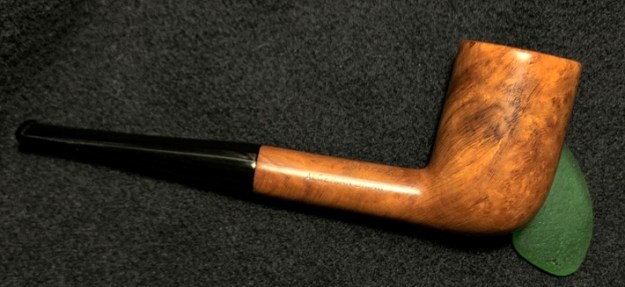
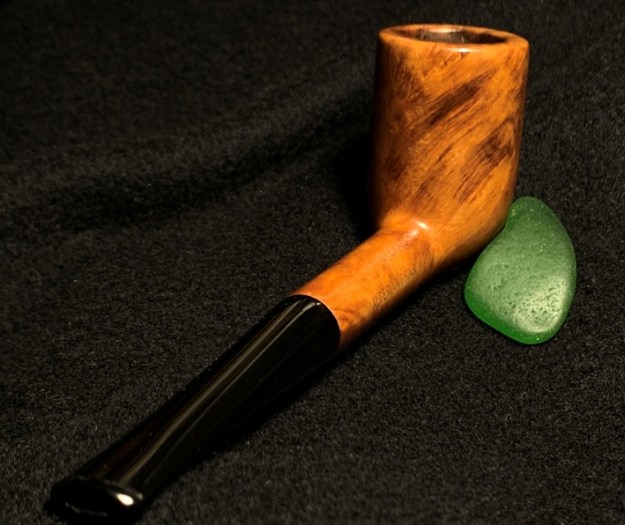
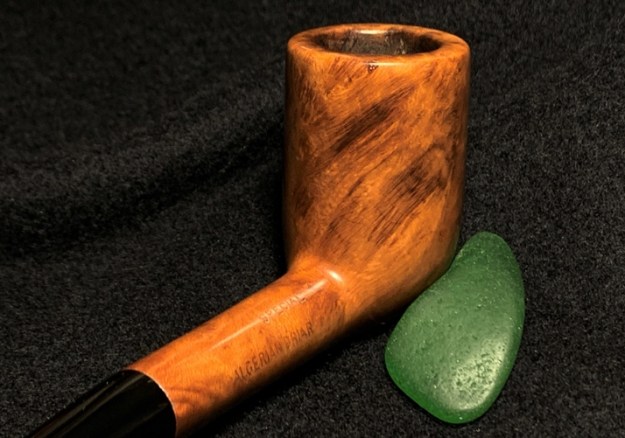
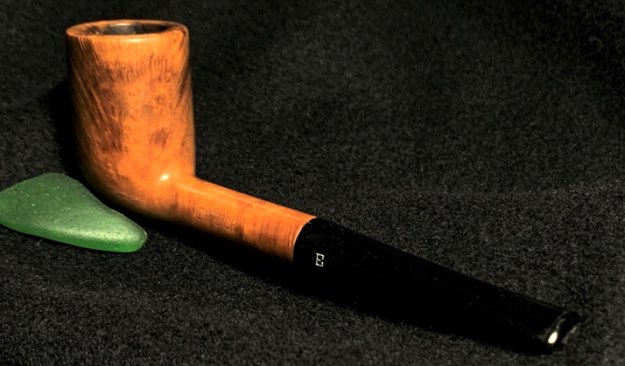
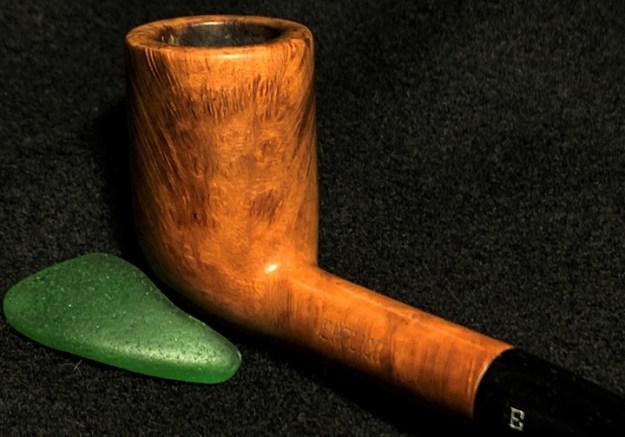
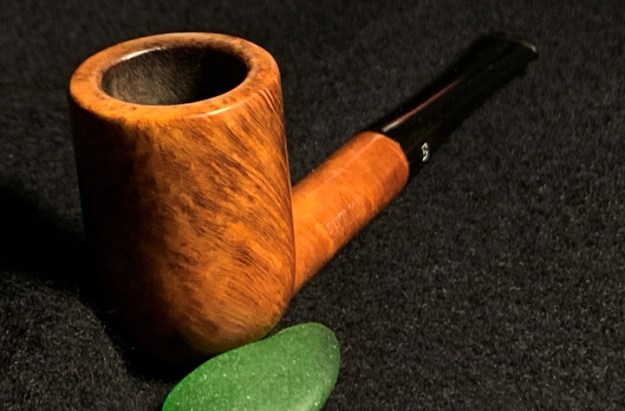
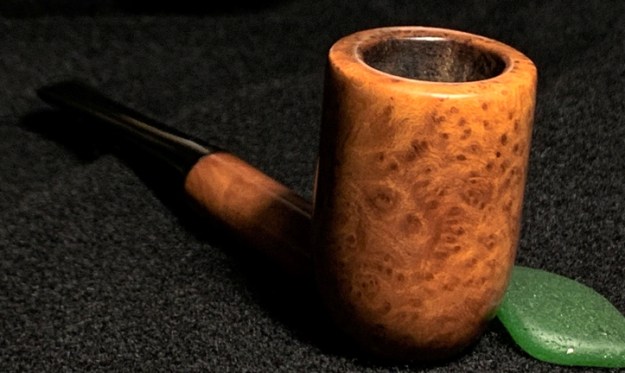
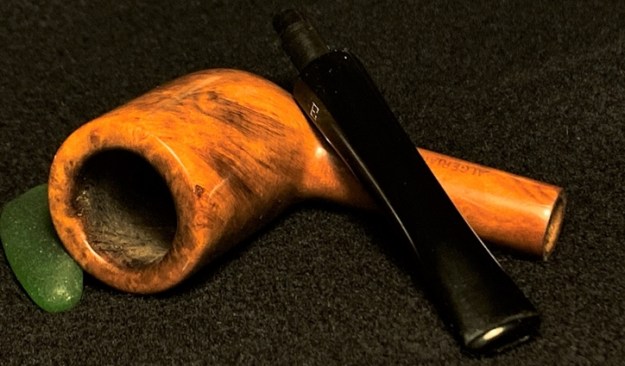
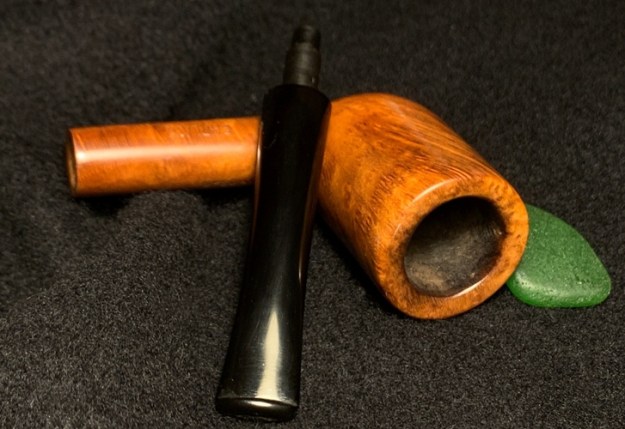
I saw this pipe on eBay from a seller in the New England state of Connecticut.  What drew my attention was the tall bowl – a Chimney shape.  There’s something about ‘Chimneys’ that I like.  They have the basic Billiard workhorse air about them, but with the tall Chimney – it’s like a challenge: pack it high and tight!  My bid held firm and the Ehrlich, which I assumed had a German COM, was added to the online collection, For “Pipe Dreamers” Only! for a pipe man or women to see, ‘dream’ of the possibilities, and commission to benefit the Daughters of Bulgaria – women and girls who have been trafficked and sexually exploited.  Todd saw this Ehrlich and commissioned him along with two other pipes – a Borge Mortensen Handmade of Denmark (see: Link for the restoration) and a Heritage Blasted Apple still in the queue – up next.  Here are the pictures of the Ehrlich Special Chimney that got Todd’s attention. The bowl is stamped with the nomenclature, EHRLICH, on the left shank.  On the upper right-hand side of the shank is stamped, SPECIAL [over] ALGERIAN BRIAR, which is dropped lower on the shank.  The stem is stamped with ‘E’ I had assumed that ‘Ehrlich’ was a German name and I had assumed, wrongly, that the Country of Manufacturing was Germany as well.  I was fully surprised to discover in my initial research that Ehrlich was a tobacconist located in one of my favorite cities, Boston.  This was a pleasant surprise because I have long appreciated the story of the US’s second oldest Tobacconist shop also located in Boston – the L. J. Peretti Co., still in operation and one of the few establishments remaining that mix blends while you test blends as you wait.   My son used to live in Boston and the city has had an attraction to me for its history, its character and yes, its sports team – Boston Red Sox and Bruins – sorry, as a long-time Miami Dolphins fan, I cannot stomach New England’s version of NFL!  My discovery of L. J. Peretti shop pipes, most of which were manufactured in NYC and some in London, started for me a fun advocation of collecting them.  I had never heard of Ehrlich of Boston until finding the article in Pipedia on the Ehrlich name.  I include it here because I enjoy adding to the opus of information, of especially Boston tobacconist shops.

The David P. Ehrlich story

Pipemakers and Tobacconists for a Hundred Years, 1868-1968.

The David P. Ehrlich Company has remained solely in the hands of one family during its century of business, yet it has had several firm names and locations. David P. Ehrlich went to work in 1881 at the age of twenty for Ferdinand Abraham, who dealt in cigars and tobacco and who had begun business in 1868 at 1188 Washington Street in the South End, but in 1880 moved to the center of the city, where the firm has been ever since. David Ehrlich married the boss’s daughter. In 1916 the name became the David P. Ehrlich Company and Mr. Ehrlich devoted the rest of his life to this business. Since David’s death in 1912 it has been owned by – his nieces and nephews including Richard A. and William Ehrlich.

Ehrlich shop has since 1880 had a predilection for historic sites. 25 Court Street was close to the spot where from 1721-1726 James Franklin had, with the assistance of his brother Benjamin, published The New-England Courant. In 1908 the firm moved a few doors up Court Street to number 37, on the opposite corner of the alley that is grandiloquently named Franklin Avenue. This new locution was on the site of the one-time printing office of Edes and Gill, publishers of the Boston Gazette, in whose back room some of the “Indians” of the Boston Tea Party assumed their disguises. Soon after the end of World War II at which time the store was located at 33 Court Street a move around the corner to 207 Washington Street brought the shop diagonally across from the Old State House and onto the site occupied from 1610-1808 by the First Church of Boston. The demolition of 207 Washington Street in 1967 caused still another move to 32 Tremont Street, adjoining King’s Chapel burying Ground, which is the oldest cemetery in Boston.

The David P. Ehrlich Co. has not just occupied sites intimately associated with Boston history and institutions; it has in the past century become a Boston institution in its own right. It has specialized in fine cigars, pipes, and pipe tobacco. In addition to the retail business, the firm has long specialized in the manufacture of pipes, both from Algerian briar root and from meerschaum, a beautiful white fossilized substance, mined from the earth in Turkish Asia Minor. Meerschaum lends itself to carving, and in the nineteenth century there developed in Austria a fashion for carving pipes from it with formidably intricate decoration.

The Ehrlichs have long had meerschaum carvers, who ply their craft in the shop window to the delight of passersby. For years the bearded Gustave Fischer was a familiar figure in the window at 33 Court Street. A succession of craftsmen have continued the tradition. and still make and repair pipes in the window of the new Tremont Street shop. They still turn their meerschaum pipes by hand on a foot operated wooden lathe made in Austria about 1871. Although briars are today turned on power lathes, meerschaum can only be turned on a foot-operated lathe.

As amber was used for the bits in his better pipes, David P. Ehrlich found himself in the amber business as a side line. For years the firm has been noted for amber jewelry in its many types and forms, often purchasing old examples from estates to maintain its large and varied assortment. And with the meerschaum and die amber as a nucleus, a variety of artifacts dealing with tobacco and smoking, as well as prints of Boston have come to decorate the shop. There is a display case in the Boston Museum of Science donated by David P. Ehrlich Company which outlines the story of amber.

Many of the mahogany display cases that were installed in Court Street early in the century have been transplanted to Washington and then to Tremont Streets, so that the present premises, although new, have a strong family resemblance to those that we knew on our earliest visits to Ehrlich’s. This is good sense in Boston, where people do not welcome needless change for its own sake.

In 1956 when the old Harvard Square firm of Leavitt and Peirce was offered for sale, the Ehrlich brothers, because of their Harvard connections, could not resist acquiring it. Richard A. Ehrlich was a member of the class of 1922; his brother William of 1925. As they had known for years this seventy-year-old establishment, which had done business in the same location in Harvard Square longer than any except the College itself, they took it over, with the idea of keeping it as it was, even to the metal ceiling. In 1958, to celebrate its 75th anniversary, David McCord edited for them an engaging volume entitled 75 Aromatic Years of Leavitt & Peirce in the Recollection of 31 Harvard Men . And as Leavitt & Peirce is to Harvard College, so is the even older David P. Ehrlich Co. to Boston – the purveyor of “a brand of special knowledge” built up over a century of honest dealing.

The January 1968 issue of Antiques Magazine carried a feature by Wendell D. Garrett titled “Paraphernalia of smokers and snuffers” describing in considerable detail the impressive collection of paraphernalia and smokers articles from many countries and centuries on permanent exhibit in their Leavitt & Peirce Cambridge tobacco shop. The Boston Public Library in Copley Square devoted twenty-five display cases during the month of January to the David P. Ehrlich Company Centennial Exhibition of Tobacciana made up of the Leavitt & Peirce antique collection, the David P. Ehrlich collection of carved meerschaum pipes and their two venerable Cigar Store Indians.

There are pipes of every price and size and shape, from good ordinary smoking pipes up to briars of the finest grain and meerschaums band cut, turned and polished front the best Turkish blocks. This is in keeping with a catalogue statement: “we have never ceased to regard smoking as an exquisite pleasure, rather than a mere habit.” Another of the principles of the firm is embodied in the observation: “we are pipe makers – not plumbers. There are no tricky gadgets in Ehrlich pipes.” But when a man drops his pipe, the makers will transform themselves into repairmen in a highly efficient manner. All this has been going on for a century, and we confidently trust that it will outlast our time, and then some.

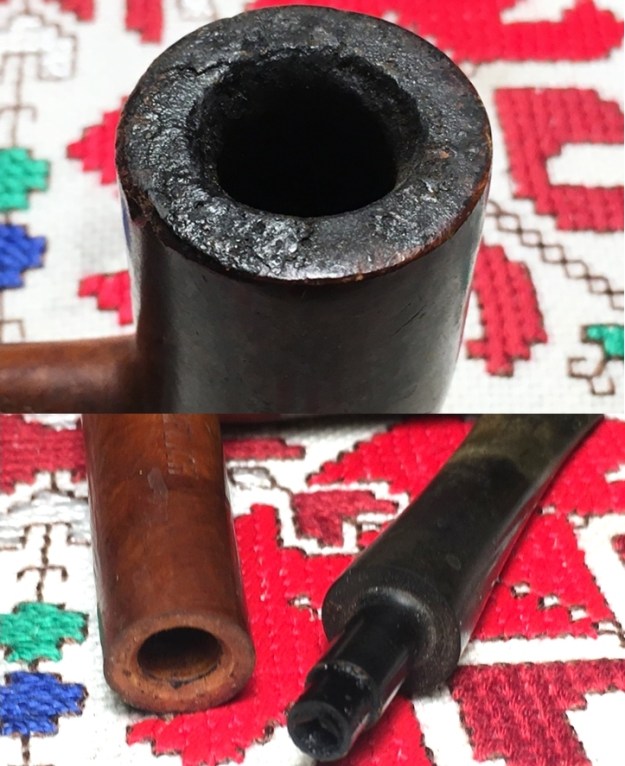
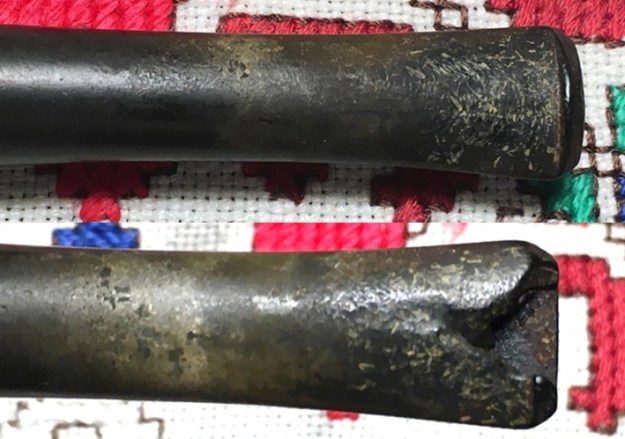
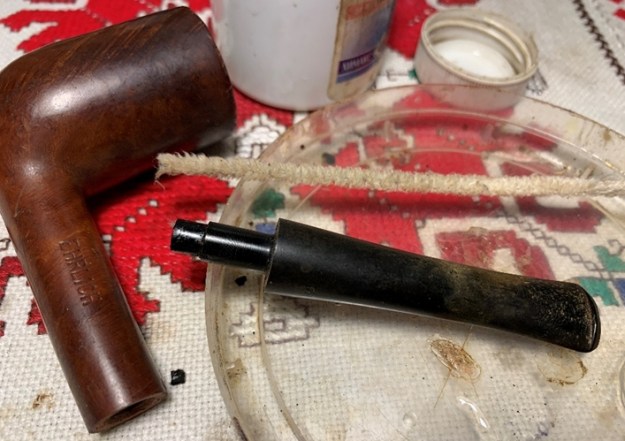
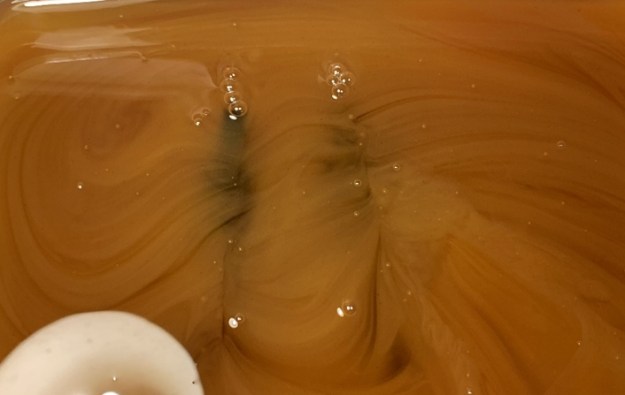
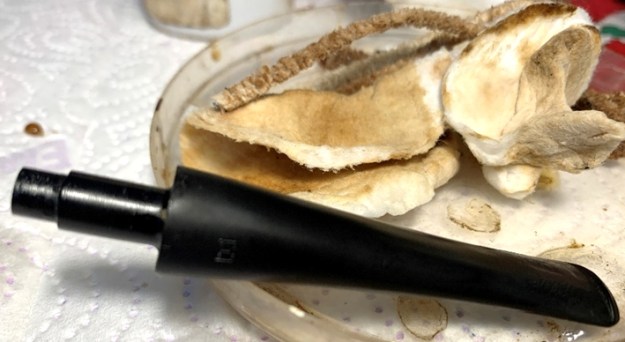
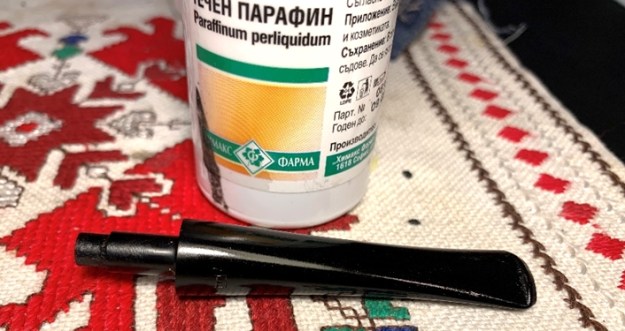
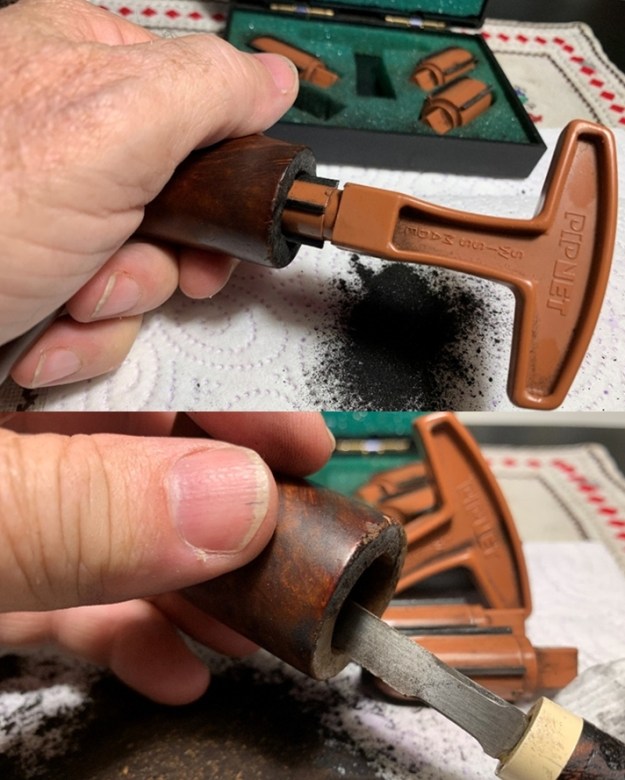
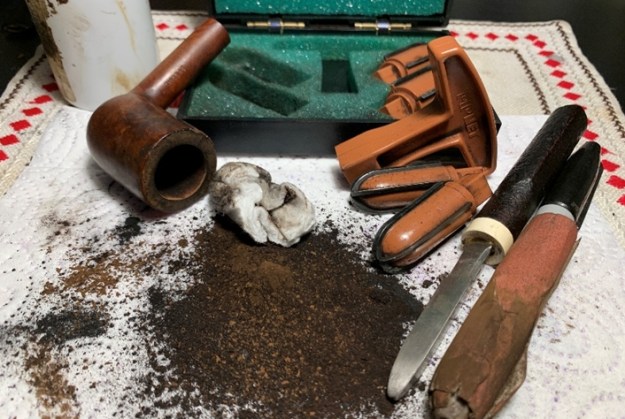
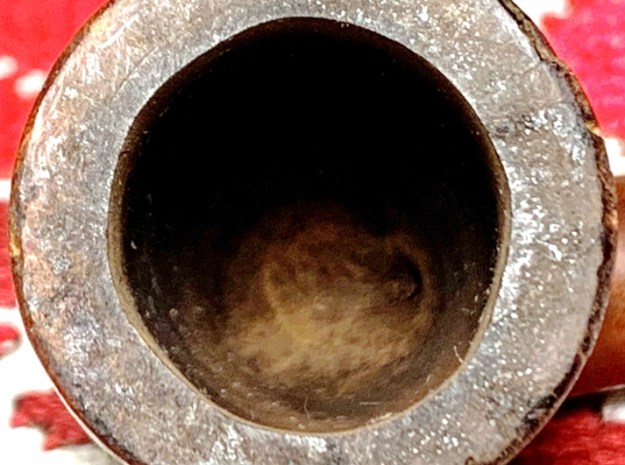
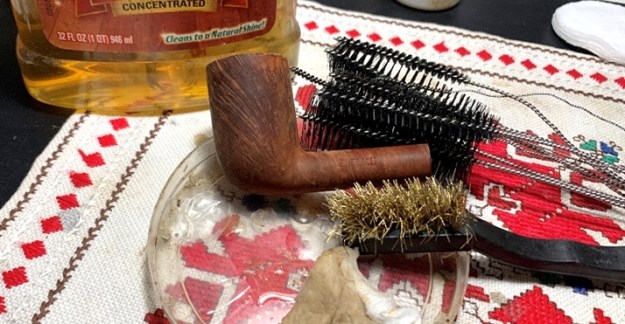
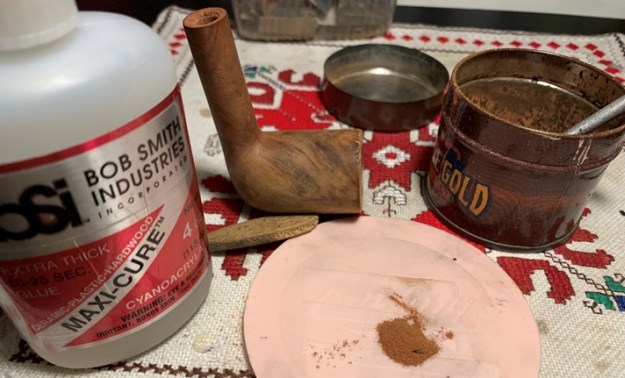
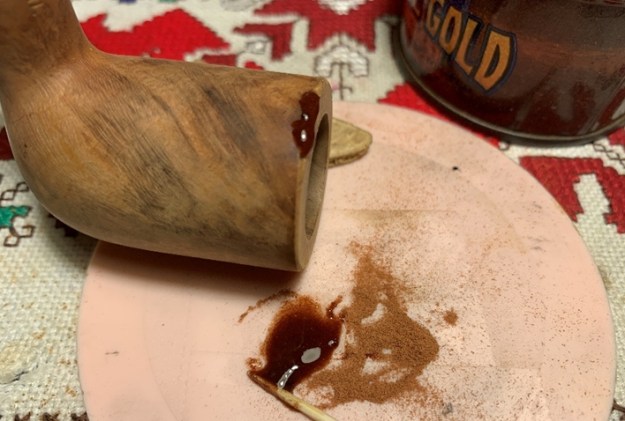
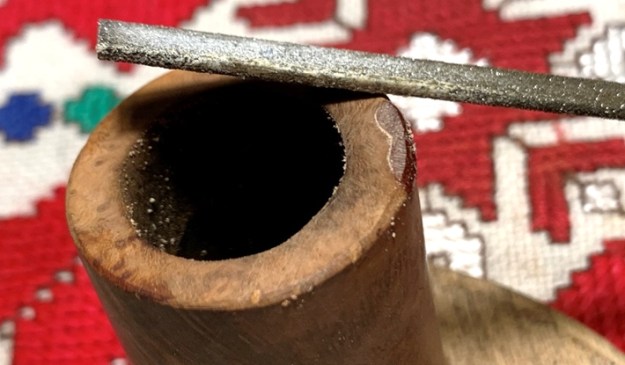
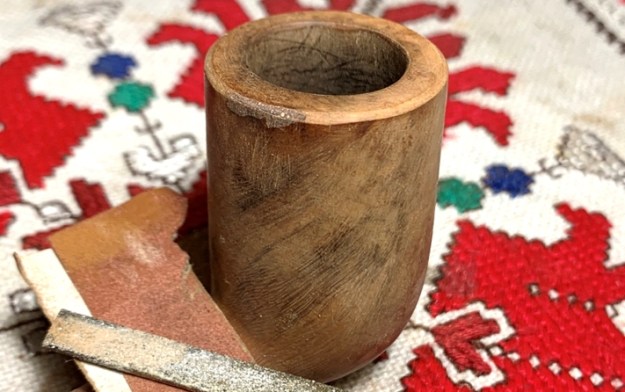
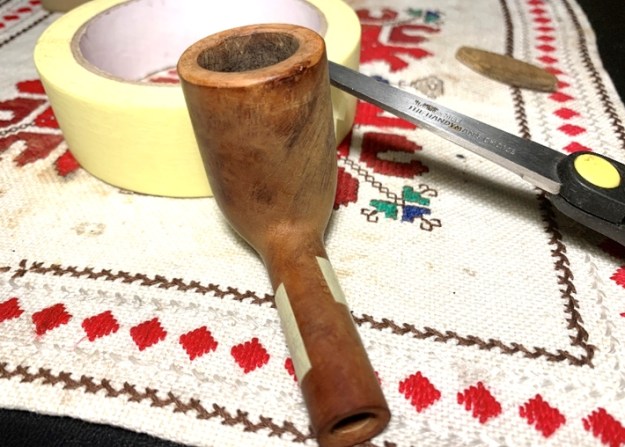
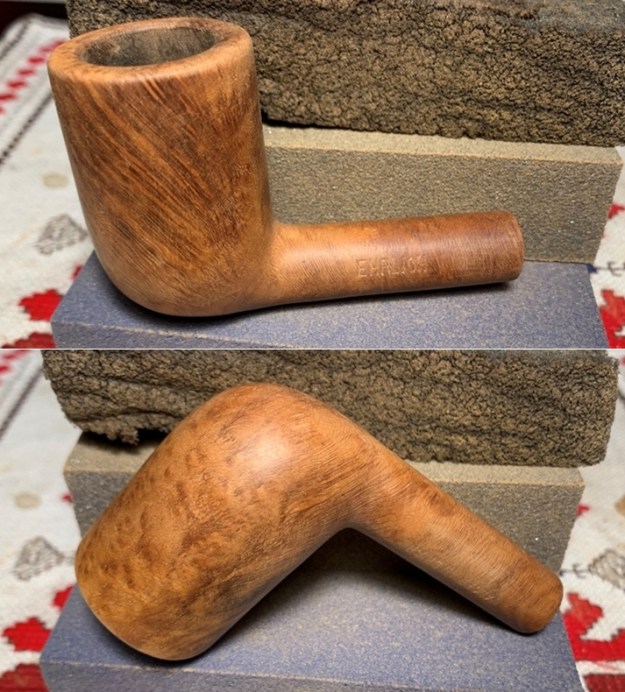
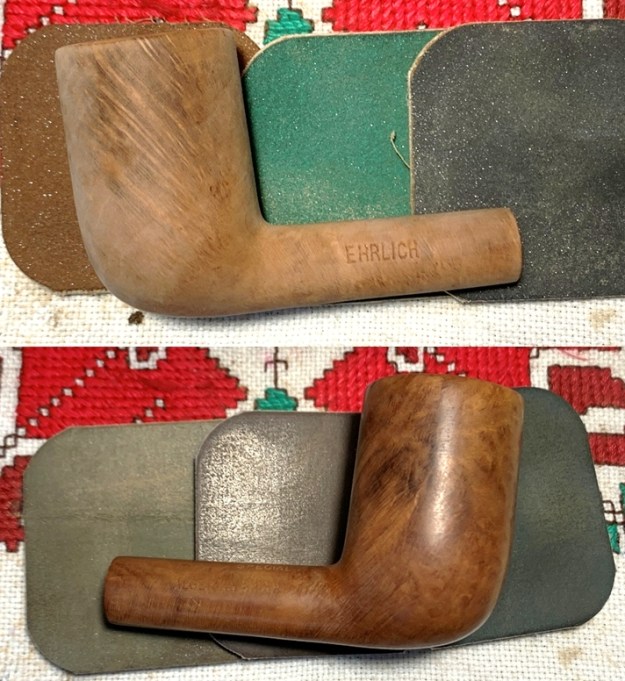
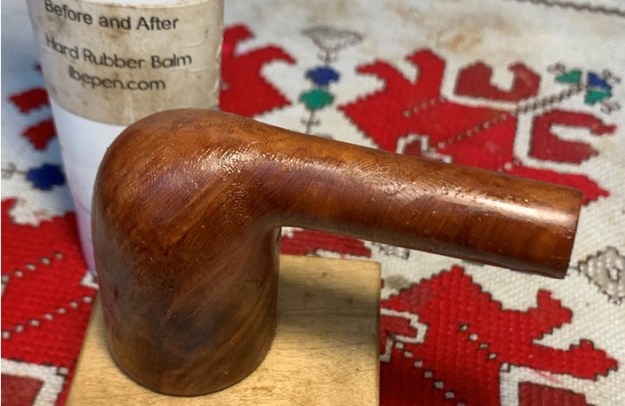
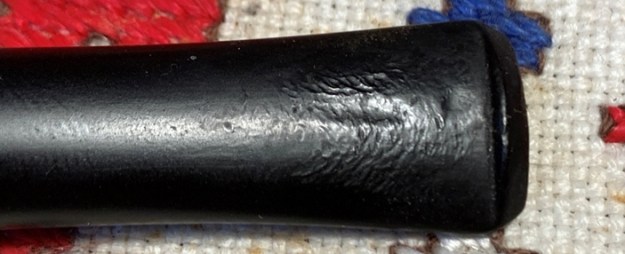
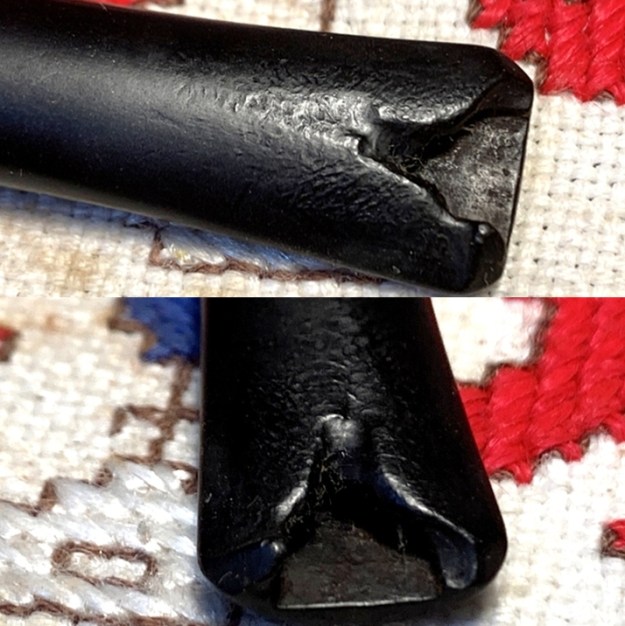
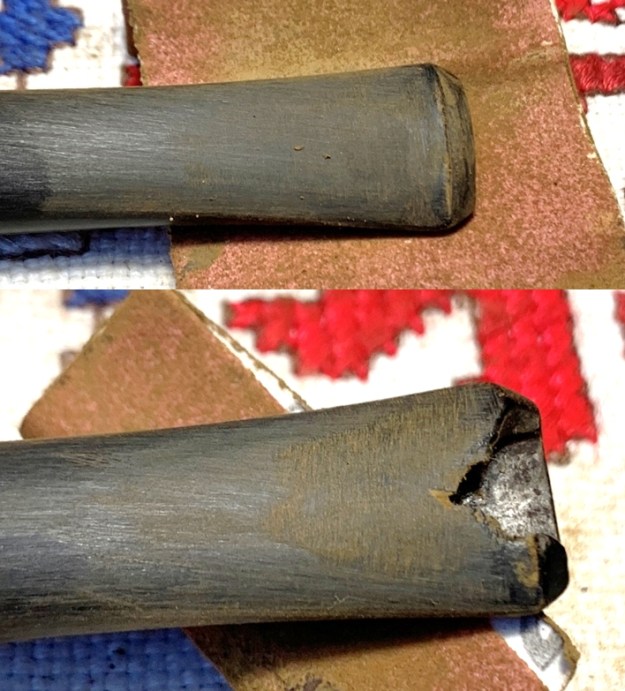
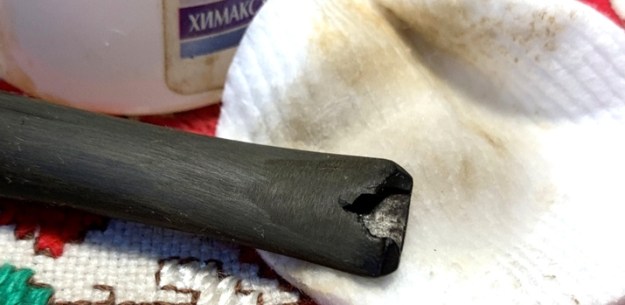
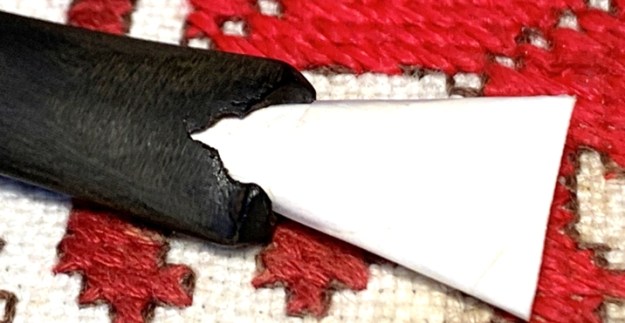
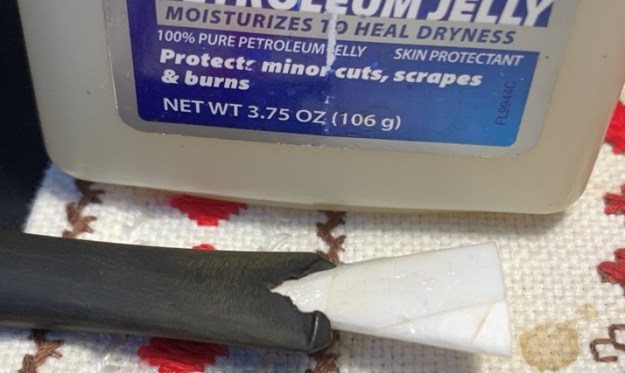
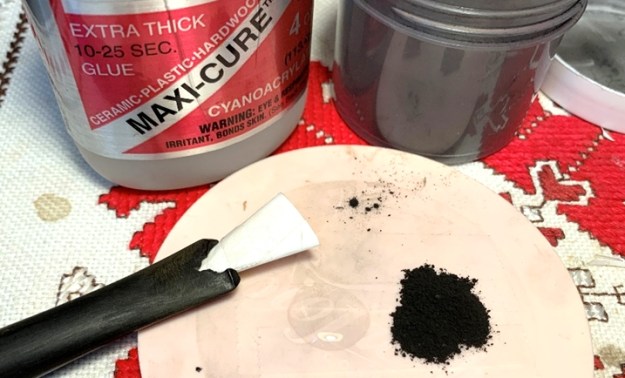
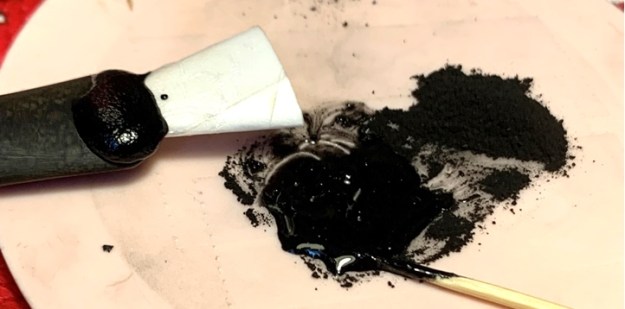
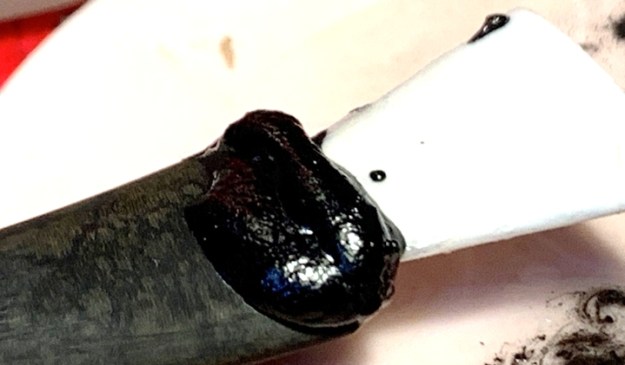
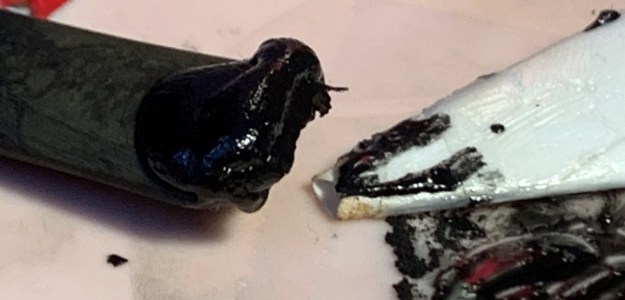
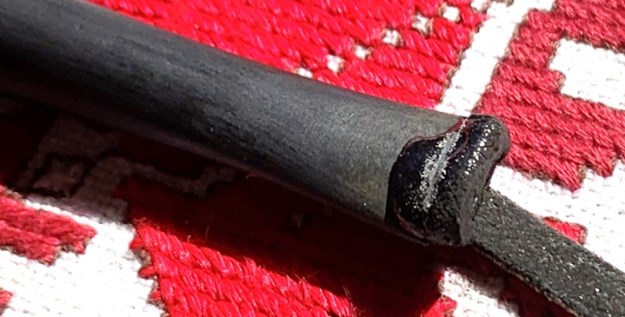
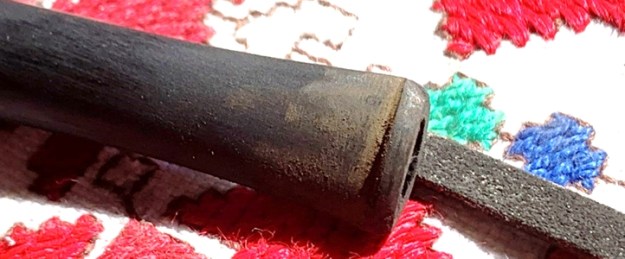
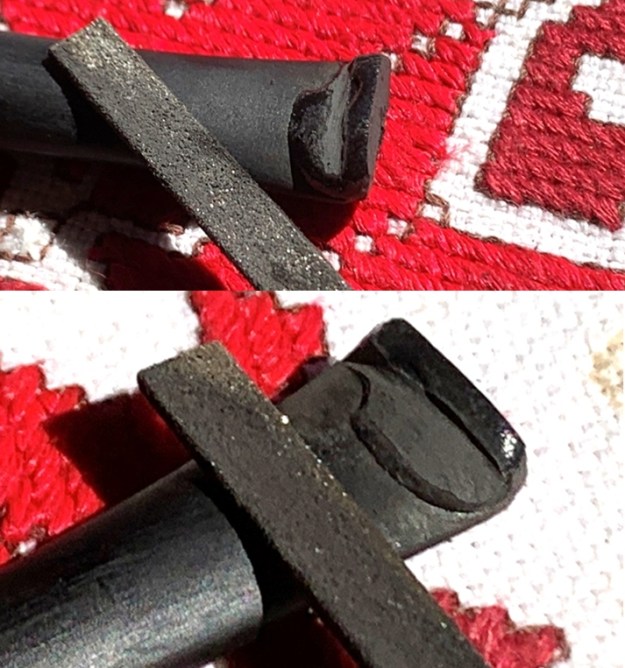
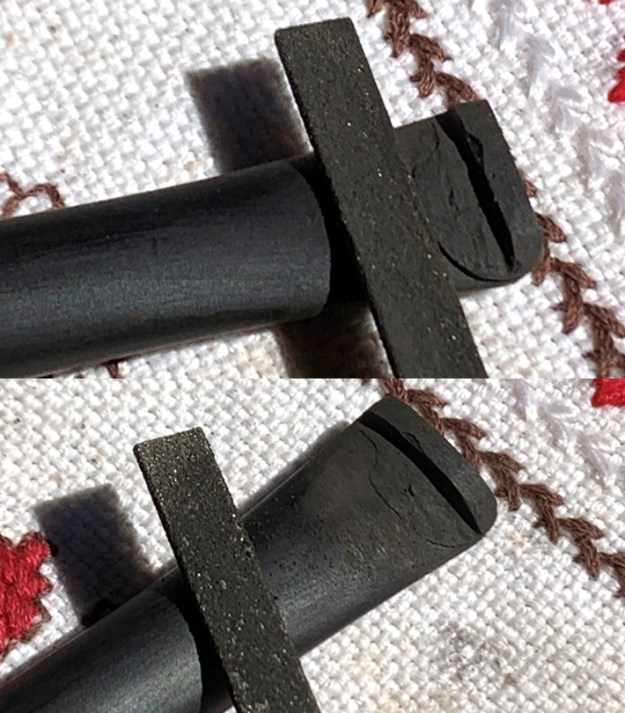
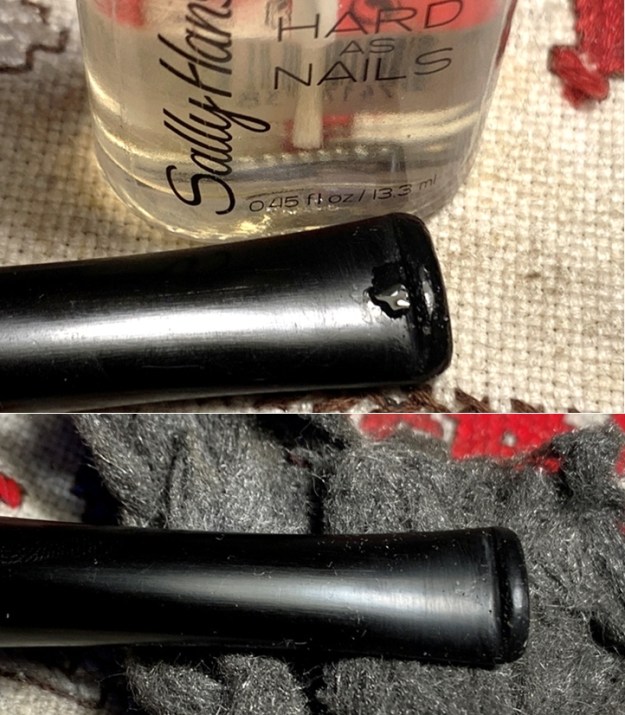
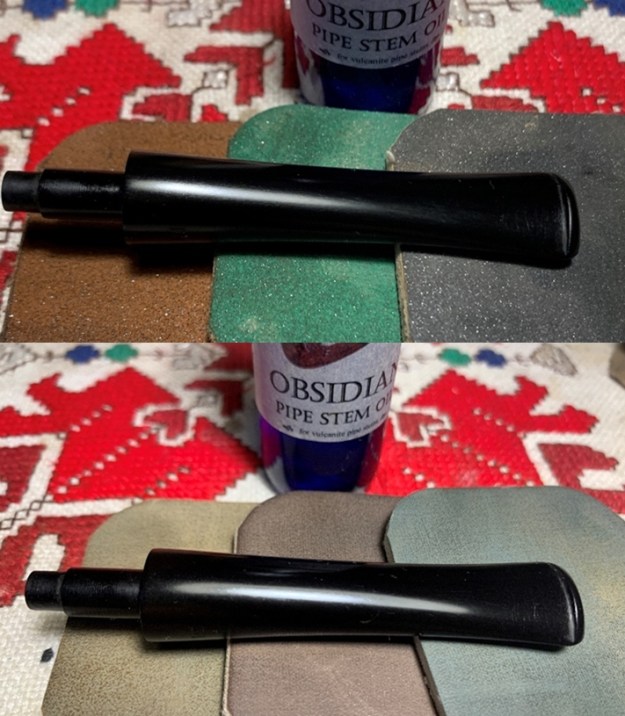
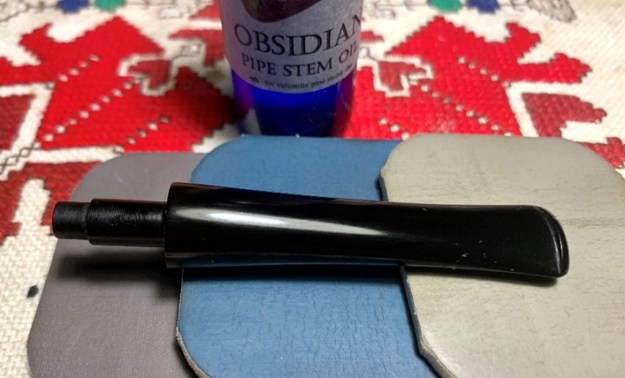
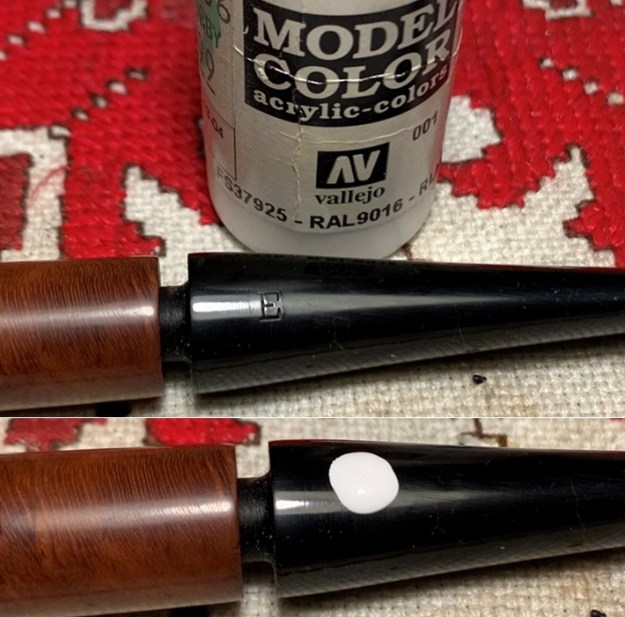
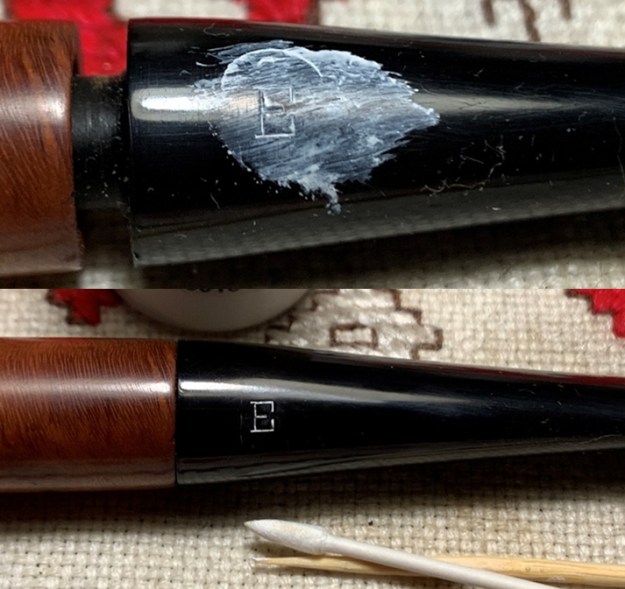
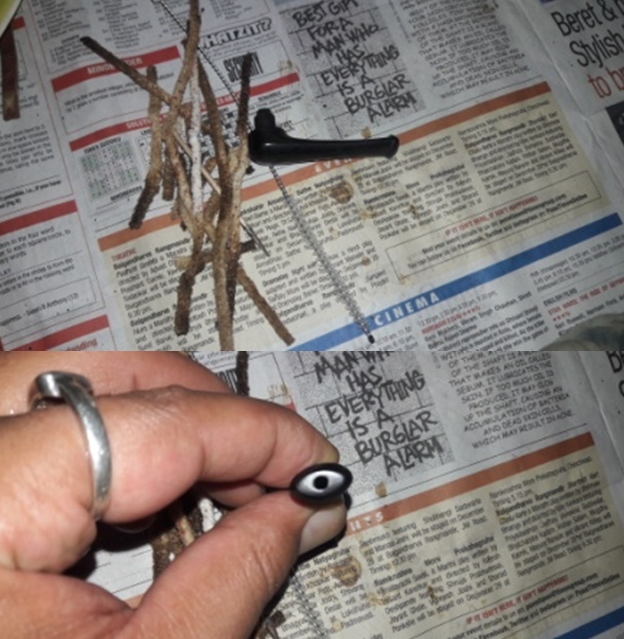
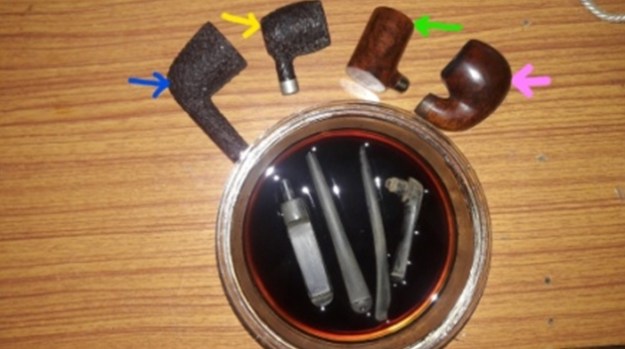
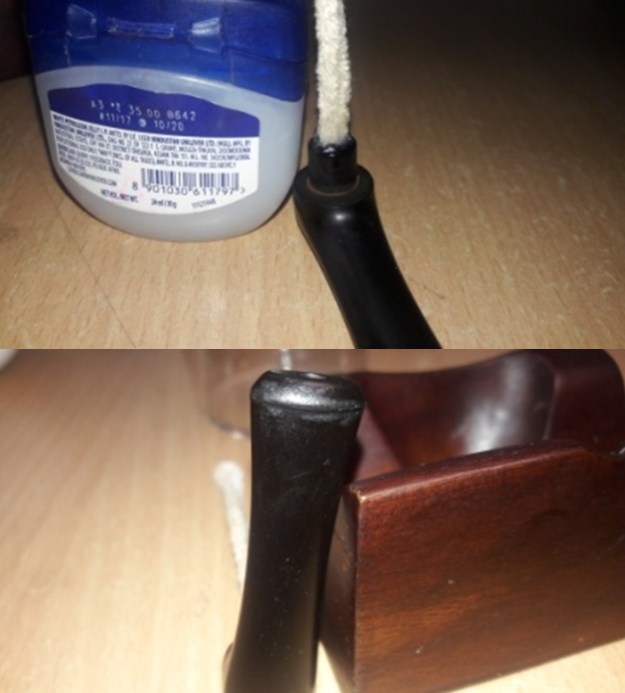
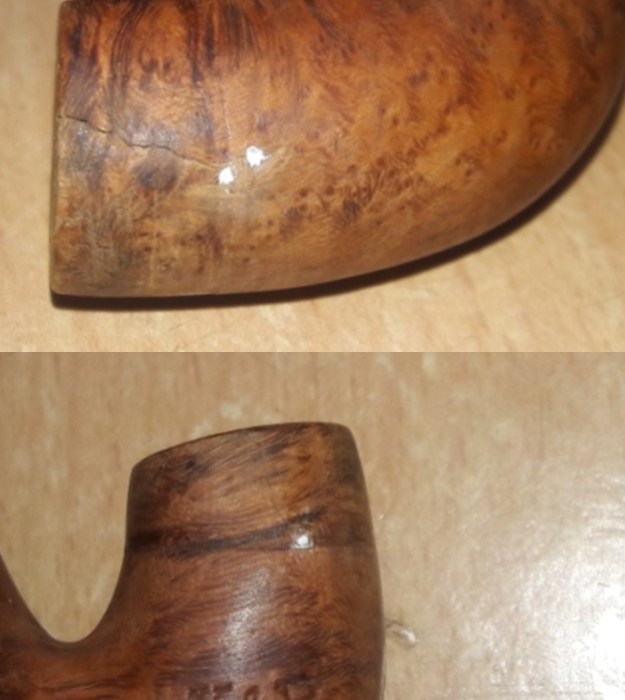
With the information included above, the Ehrlich Chimney now on my worktable dates to at least the late 60s.  With a greater appreciation for the Ehrlich name and the richness of its story, I begin the restoration first with an assessment of its condition.  This old boy is in rough shape. The chamber has thick cake build up which needs to be removed to expose fresh briar for a new start.  The rim is caked with lava.The rim has notches and divots on the lip aft and forward areas.Generally, the briar surface is scratched and dinged a good bit.  The finish is darkened and needs cleaning to remove the surface dirt that has collected.The original stem with the Ehrlich ‘E’ reveals that this pipe was well loved and driven into the ground!  The calcium build-up on the bit is thick along with the oxidation.  The tooth chatter seems to reveal a lot of possible New England winters with the former steward’s teeth chattering as he clinched the stem.  The lower button has disintegrated from biting.  I’m concerned that it’s too damaged for a normal button rebuild.  I love to salvage original stems but this one presents some challenges.  The lower vulcanite surface looks suspect – that there may be a crack in the vulcanite.To start, using a pipe cleaner wetted with isopropyl 95%, the stem’s airway is cleaned.To address the oxidation, a new batch of Before & After Deoxidizer is ready to go to work.  The other pipe’s stem that Todd commissioned, the Heritage Blasted Apple, joins the Ehrlich for a bath.  The fluid is eerie as it swallows the stems!After a few hours of the soak, I use a stiff wire to snag the stem and to allow the B&A Deoxidizer to drain.  I then squeegee more fluid off with my fingers then wipe with cotton pads wetted with alcohol to remove the raised oxidation.  Another pipe cleaner helps to clear liquid from the airway.The B&A Deoxidizer seemed to do an adequate job.  I add paraffin oil to the vulcanite with a cotton pad to further the rejuvenation of the stem.Turning now to the Ehrlich Chimney bowl, I ream the chamber using the Pipnet Reaming Kit.  I use the 2 smaller of 4 blades available in the Kit to navigate the Chimney chamber.  Following this, the Savinelli Fitsall Tool continues the scraping and finally sanding with 240 paper wrapped around a Sharpie Pen cleans the remaining cake. After wiping the chamber with a cotton pad wetted with alcohol to remove the carbon dust, an inspection of the chamber reveals no problems with heating or cracking.   I also scraped the rim with the Savinelli Fitsall tool to remove the crusting lava flow.Next, the external briar surface is dark and dirty. I use undiluted Murphy’s Oil Soap on a cotton pad to clean the briar surface.  I also use a brass wire brush to clean the rim.  The brass brush does not damage the wood surface.  After scrubbing, I transfer the bowl to the sink and continue cleaning using hot water and shank brushes.  Using anti-oil dish soap, the shank brushes reach into the mortise and after scrubbing and rinsing thoroughly, I bring the bowl back to the worktable.The cleaning does a good job.  The briar is lighter, but the rim is still discolored. It doesn’t happen often but returning to the internal cleaning with pipe cleaners and cotton buds reveals a clean pipe!To clean the rim, I use the topping board covered with 240 grade paper to begin.  The topping board will remove the discoloration with fresh briar, and it will help remove the divot damage on the rim edge.  The next pictures show the progression of the topping. Next, the 240 grade paper is replaced with 600 grade paper and several more rotations follow.  What emerges on the rim are round bird’s eye patterns of grain.I decide to stop the topping not to lose more briar real estate off the rim.  There remain some divots on the edge of the rim.To remedy this, instead of taking off more briar to remove the divots, I mix Thick CA glue with briar dust to form a putty to fill the divots.  After putting a small amount of briar dust on the plastic disc, covered with scotch tape for easier cleanup, a few drops of CA glue are placed next to the dust and then mixed with a toothpick.  Gradually, briar dust is pulled into the CA glue and mixed until it thickens to the consistency of molasses.  Using the toothpick as a trowel, putty is placed on the divots.  When sufficiently covered, I put the stummel aside for the putty to cure.After some time, the briar dust putty has cured.  I first use a flat needle file to remove the excess putty until it is flush with the rim surface.  I also use 240 grade paper to smooth the patch further.I also sand the side of the patch with 240 paper.  Finally, using 240 sanding paper tightly rolled, I cut a small bevel around the circumference of the rim to remove smaller cuts and divots and to blend the rim patch.  After the 240 paper, 600 grade paper is used to further smooth and blend.  The rim looks good.  I move on.To further clean the briar surface of nicks and scratches, I utilize sanding sponges.  Before applying the sanding sponges, I cover the Ehrlich Special nomenclature with masking tape.With the tape protecting the nomenclature, I first apply a coarse sanding sponge followed by a medium grade then a light grade.  Sanding sponges address the minor blemishes on the briar surface well without too much invasion. On a roll, I also apply the full regimen of micromesh pads beginning with wet sanding with pads 1500 to 2400.  Following this I dry sand with pads 3200 to 4000 and 6000 to 12000.  The grain comes out well through the micromesh process. One more step before putting the stummel aside to focus on the stem.  Applying Before & After Restoration Balm teases out the subtle hues of the briar grain.  Whenever possible, the natural briar is my preferred presentation of a pipe.  The Balm does a great job.  After placing some of the Balm on my fingers, I work it into the briar surface.  The Balm starts with a crème-like consistency but thickens to a waxy feel as the Balm is worked.  After applying the Balm, I put the bowl aside for 10 to 15 minutes then wipe off the excess Balm with a cloth and buff up the surface.Turning now to the stem, I take another long, focused look at the condition of especially the underside of the bit and button, but the upper bit has some issues too.  First the upper side. The tooth chatter is profound and there are two compressions that are in the center of the stem.  The one closest to the button is rounded, resembling an eye-tooth compression.  The other one is interesting as it runs parallel with the length of the stem.  The angle makes it difficult to imagine it to be a bite, unless it’s a back molar….  That could be, but the compression appears to run parallel to the airway tunnel directly below.  For the upper bit, I’ll attempt to raise the compressions using the heating method and follow by sanding out the chatter.  Fortunately, the upper button lip is in good shape.When I first examined the stem, before cleaning, I was concerned that there might be a crack running down the stem coming from the button break.  Looking at it now, even under a magnifying glass, thankfully, there is no sign of a crack.  That good news barely tempers the catastrophic break of the bit and lower button.  Interestingly, the lower bit shows evidence of also having parallel compression as the top side.  The area extending to the immediate left (in the picture below) of the break is compressed.  The forensics it seems, point to the former steward clinching the stem between his molars for a hands-free mode.  It worked until the force of the clinching on the underside faulted – the rest is history. To repair, I will first attempt to raise as much of the compression through the heating method, then rebuild the button with a mixture of CA glue and activated charcoal dust.  The new steward will need to treat the button with some TLC because a rebuild is not as strong as an original surface. The heating method is painting the compressions with the flame of a Bic lighter.  With the heating of the vulcanite, a rubber compound, the rubber expands to retake its original condition, or closer to it.  After painting the upper and lower with the flame, the compressions are noticeably less pronounced but still evident.Next, using 240 grade sanding paper, I sand out the residual compressions on the upper and lower bit.  The paper also removes the tooth chatter very nicely.  With the button rebuild now before me, I first clean the area with a cotton pad wetted with alcohol.A piece of index card stock serves well to create a wedge to serve as a form.  The wedge fits into the airway to form the mold that will allow the patch material to fill the cavity yet keep the airway open.After covering the wedge with scotch tape, I place some petroleum jelly on the tape to keep the patch material from bonding onto the wedge – allowing the wedge to be removed without problems.The patch material is a putty created from mixing Extra Thick CA glue with activated charcoal dust. A small mound of the charcoal is placed on the plastic disk which acts as my mixing pallet.  I also put scotch tape down on the disk to help in the cleaning.   Next to the mound of charcoal dust, a small puddle of CA glue is placed.I use a toothpick to gradually pull charcoal into the CA glue mixing as I go.  When the putty forms and reaches the viscosity of molasses, I use the toothpick to trowel the putty onto the wedge, filling the damaged area with patch material.I build a mound of the patch material to be more than is needed.  This allows filing to shape the new button by removing the excess and shaping as I go.The wedge is removed easily with a tug.Next, the filing process begins.  I start from the end of the stem to remove the excess to first form the slot facing.With the slot facing flat and flush with the surviving upper button lip, starting with the upper bit, I use the flat needle file to refresh the surviving upper button lip.Next, flipping over to the lower bit, the flat needle file begins to shape the lower button lip.  The next few pictures show this progress. The process is slow, but patience pays off nicely.  The lower button looks good.  A few air pockets show up in the patch area.  I’ll sand and work on removing these as I go.Using 240 grade paper first on the upper bit, the residual chatter and compressions are fully erased.Next, focusing on sanding the lower bit area, 240 paper does well in smoothing out the scratches left by the needle file.  Shaping the button is coming along well.Next, using 600 grade paper, I wet sand the entire stem upper and lower.  Following this, 000 steel wool is applied to smooth the surface further.  The repair is looking great.Some air pockets remain on the lower bit and button lip repair.  I paint a small amount of acrylic nail polish to fill these microscopic pockets.  Again, I apply the 000-steel wool to the acrylic patch.With the stem repair complete, I move on to the full regimen of micromesh pads.  Using pads 1500 to 2400, I wet sand followed by dry sanding with pads 3200 to 4000 and 6000 to 12000. Between each set of 3 pads, Obsidian Oil is applied to the stem to rejuvenate it and to retard the growth of oxidation. Now on the home stretch.  I rejoin the stem and Ehrlich Chimney stummel after a small amount of sanding on the tenon.  After the cleaning, the fit was a bit tight.  After the sanding, the tenon engaged the mortise nicely.  After mounting a cotton cloth buffing wheel to the Dremel, and setting the speed to about 40% full power, Blue Diamond compound is applied.  After completing the application of the compound, I buff the pipe with a felt cloth to remove the compound dust in preparation for the wax.  Before applying carnauba wax, I have one more project to complete.  The Boston tobacconist Ehrlich ‘E’ needs some attention on the stem.  Using white acrylic paint, I put a small drop of paint over the ‘E’ and then tamp the wet paint with a cotton pad.  This flattens the paint and dries it.  I then gently rub the surface with the side edge of a toothpick which clears away the excess paint leaving the ‘E’ filled.  I repeat this process twice to render the finished product.  It looks great. After mounting another cotton cloth buffing wheel to the Dremel leaving it at the same speed, I apply carnauba wax to the entire pipe.  To finish, a microfiber cloth is used to give the pipe a rigorous hand buffing to raise the shine.

This Ehrlich Special Chimney turned out well.  I appreciated learning about the history of the Ehrlich name as one of Boston’s Tobacconist shops.  The button repair looks good and what a change from the molar damage with which the restoration began.  The vertical fire grain on the left side of the Chimney is nice and the bird’s eye grain on the right completes the ensemble. Without doubt, the pipe fits nicely in the palm.  I enjoyed this restoration and Todd who commissioned the Ehrlich Special Chimney, will also have the first opportunity to secure him from The Pipe Steward Store.  This pipe benefits the Daughters of Bulgaria – women and girls who have been trafficked and sexually exploited.  Thanks for joining me!


Restoring a Beautiful St. Claude Ben Wade Calabash


Blog by Steve Laug

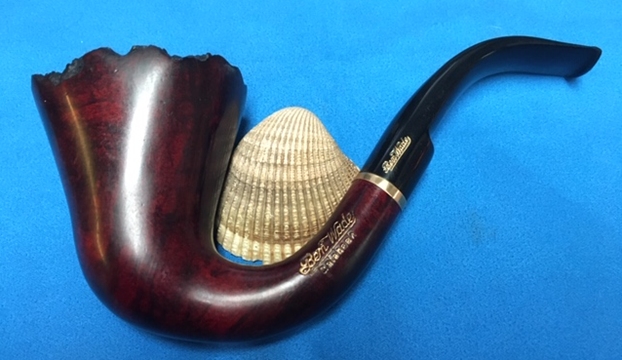
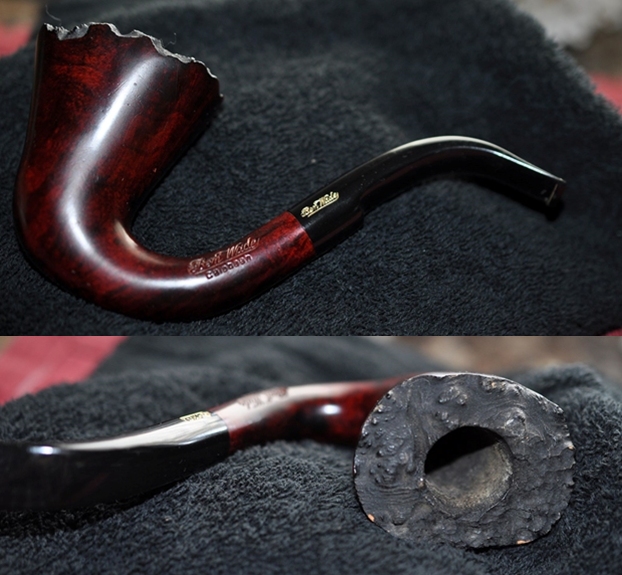
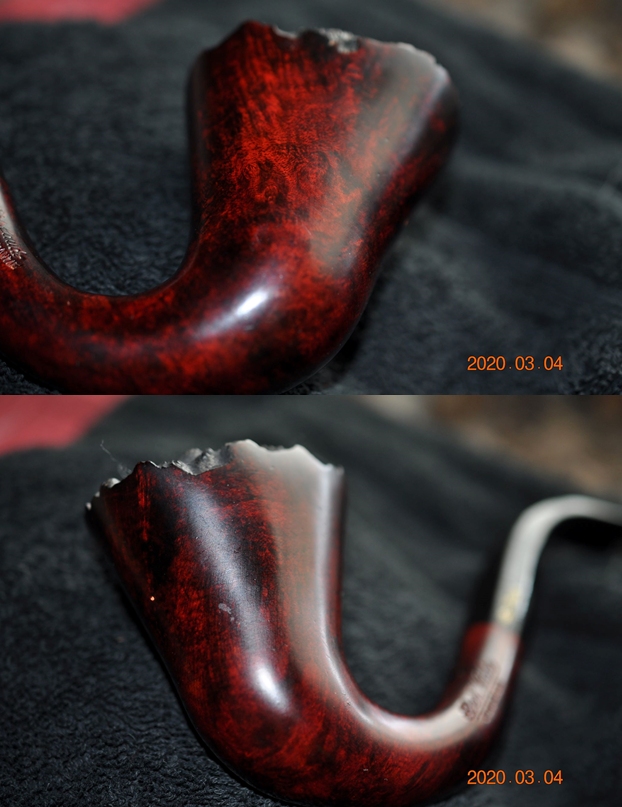
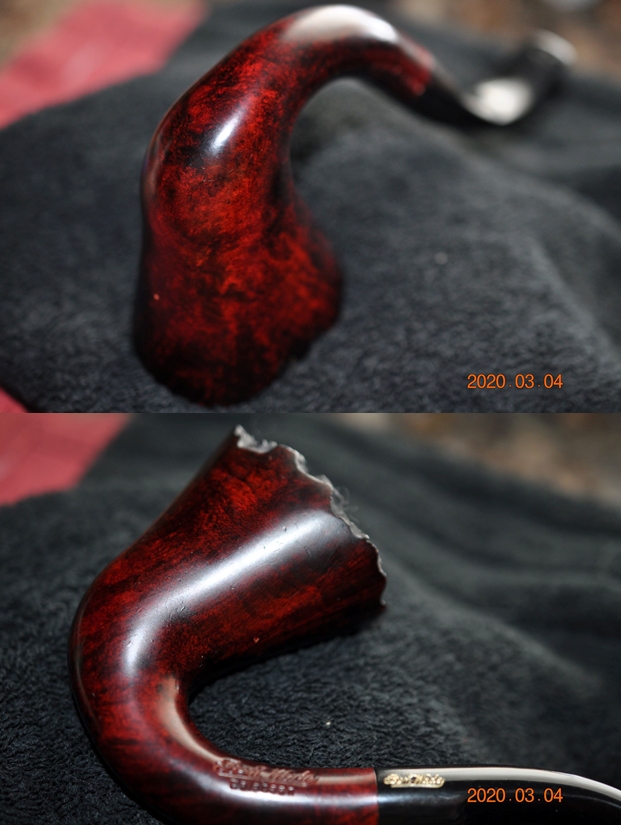
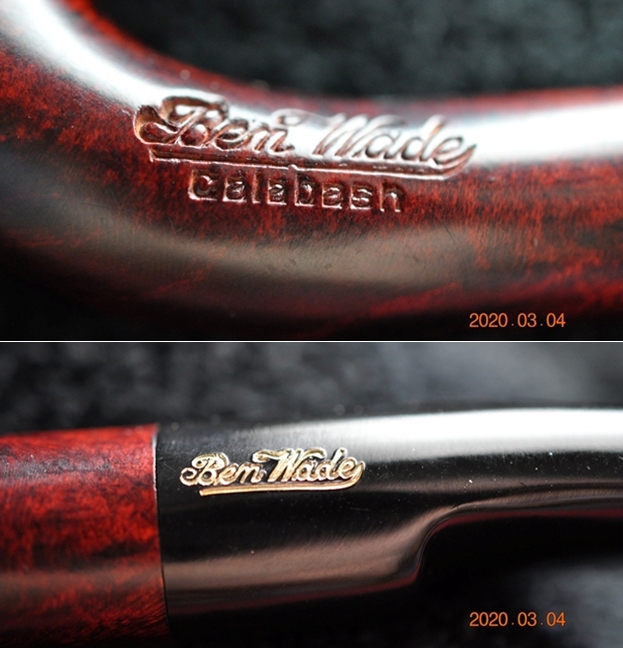
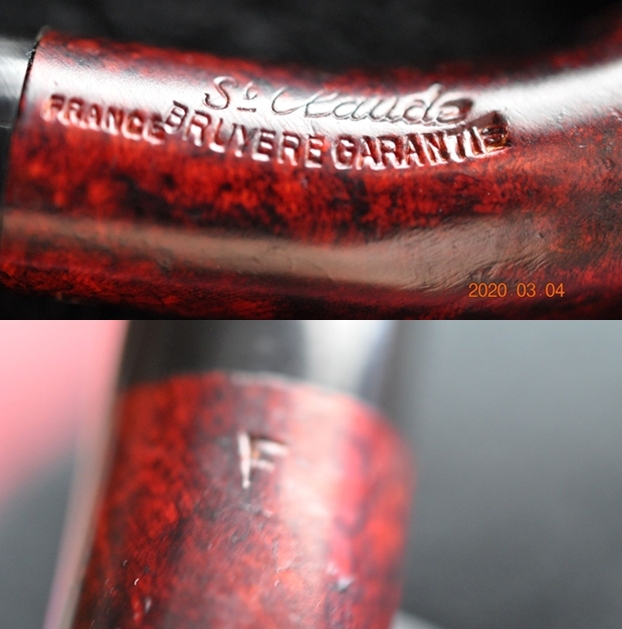
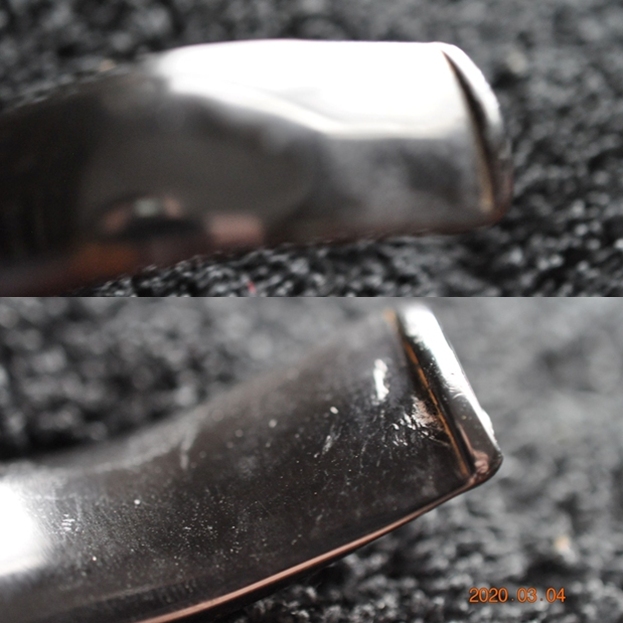
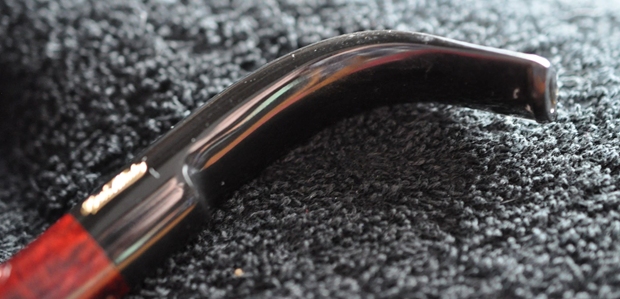
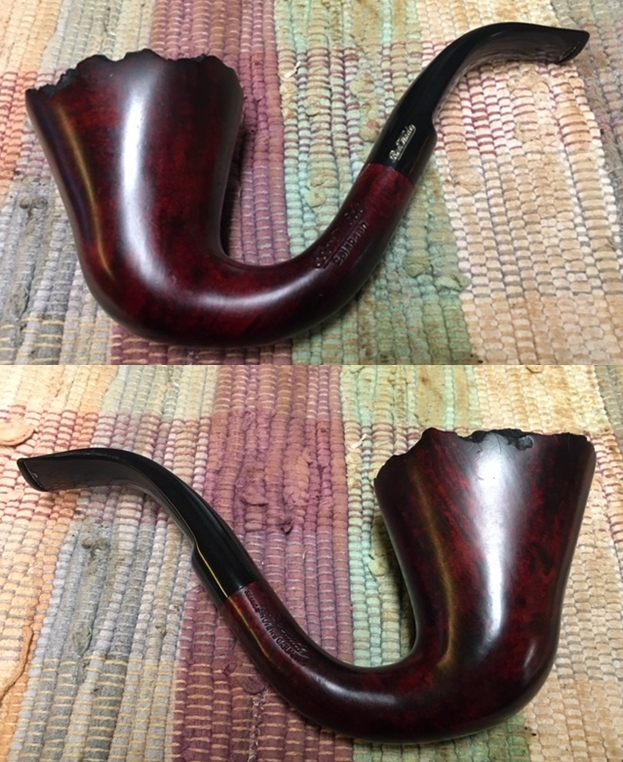
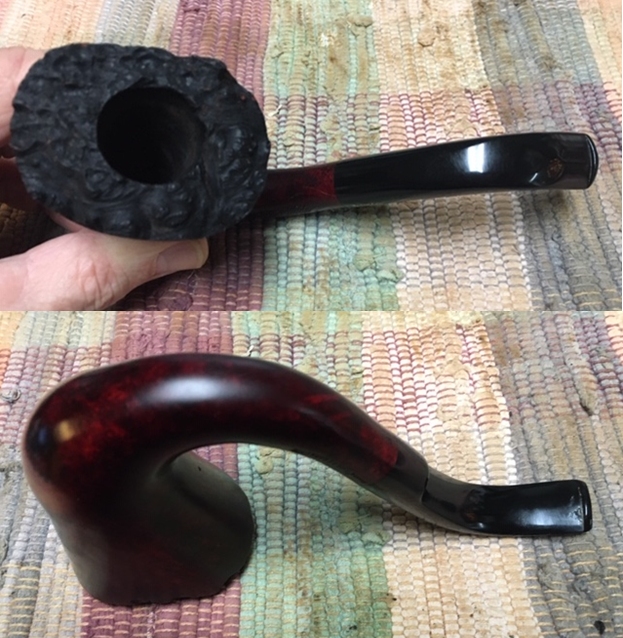
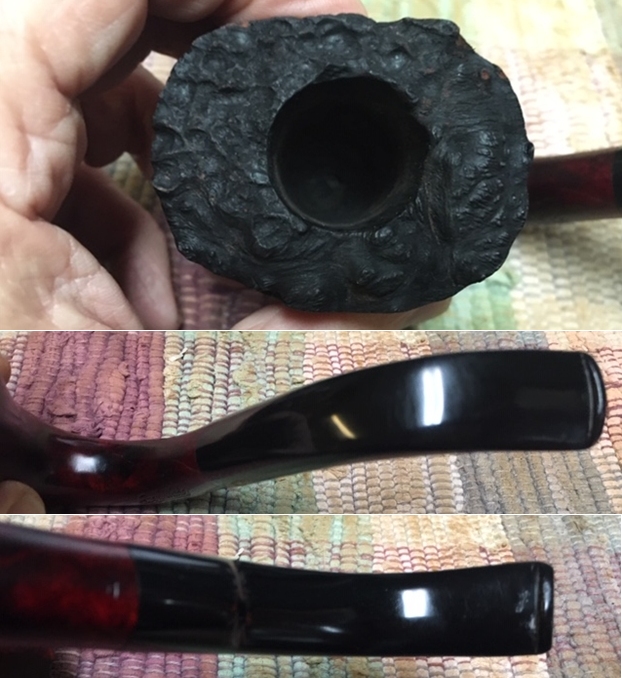
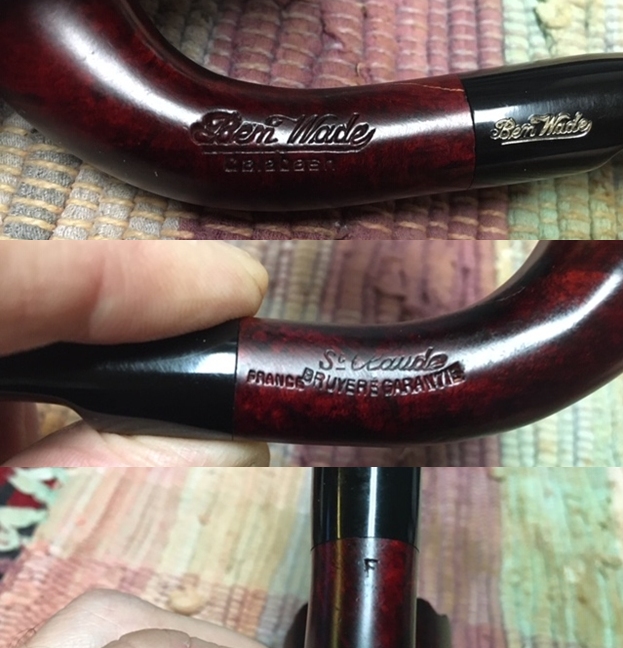
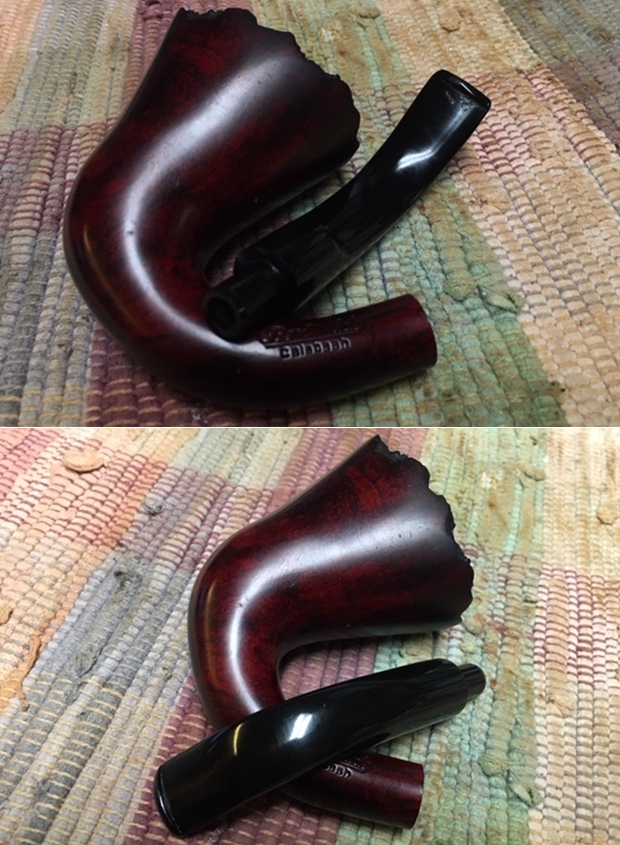
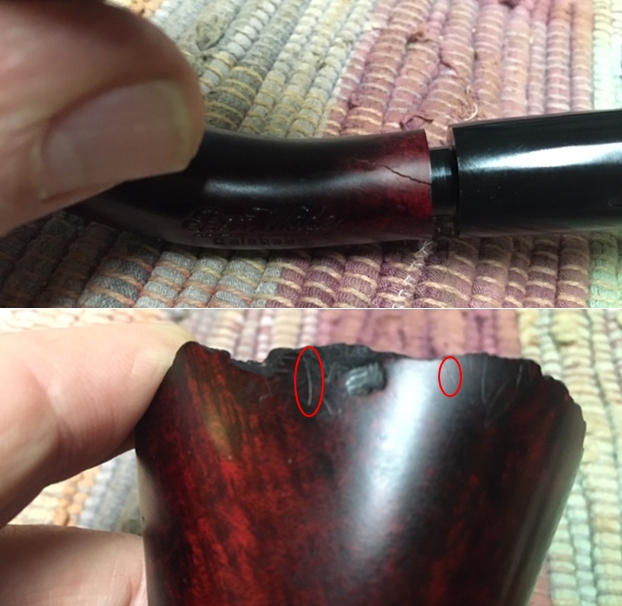
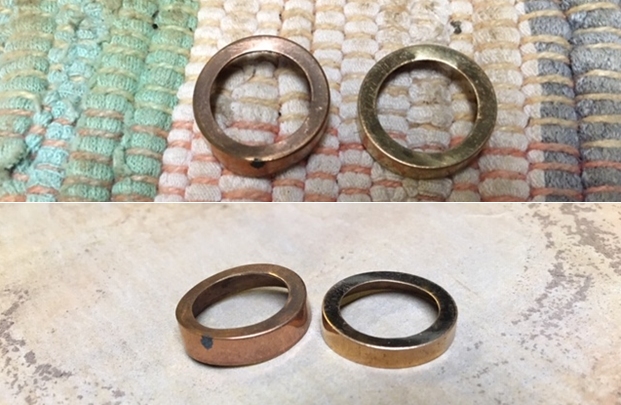
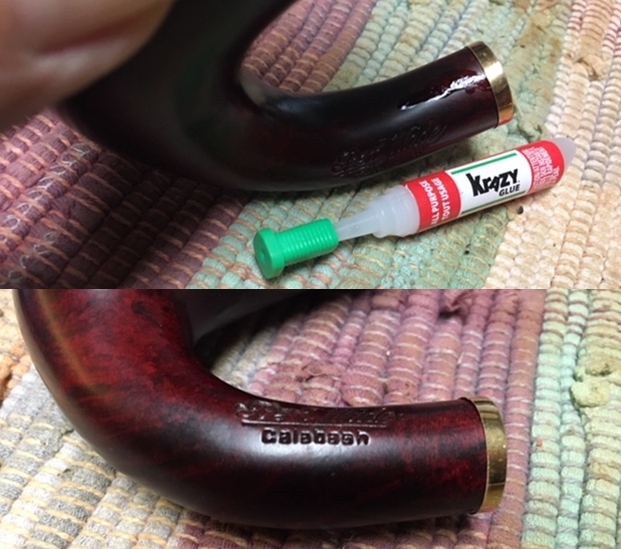
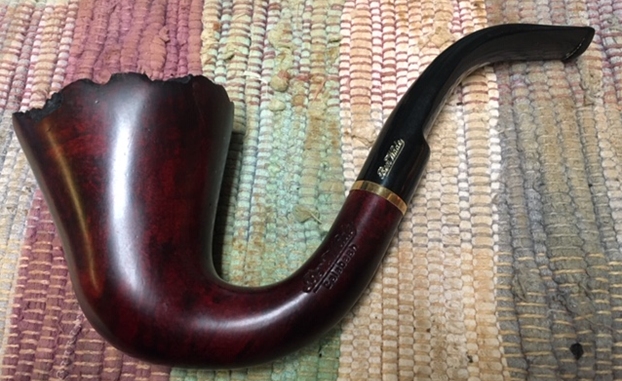
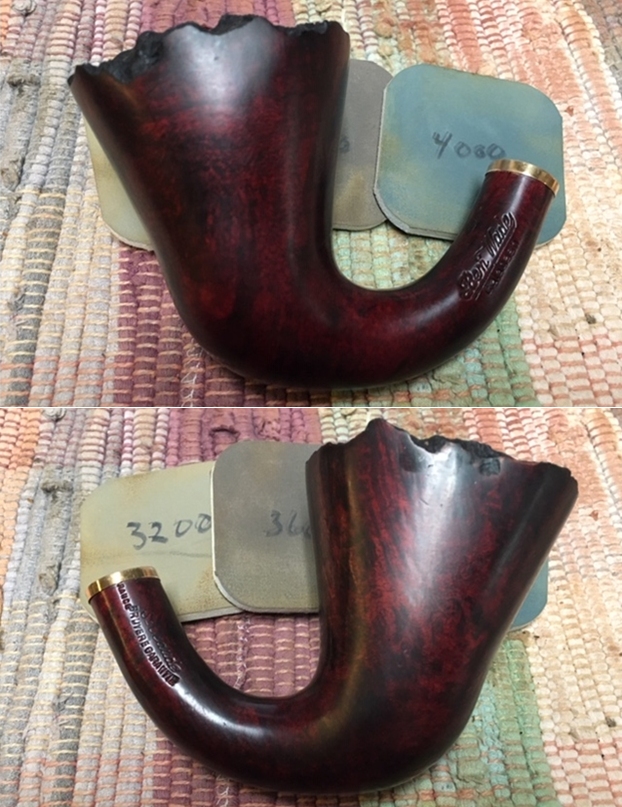
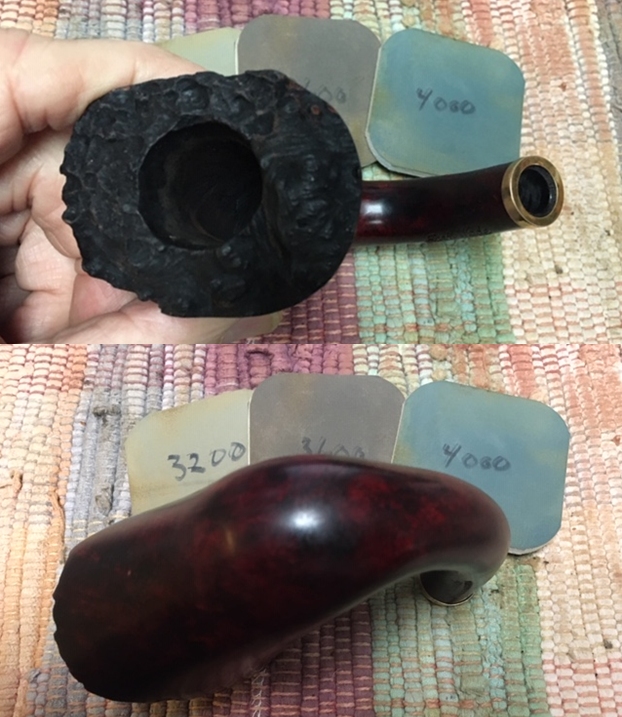
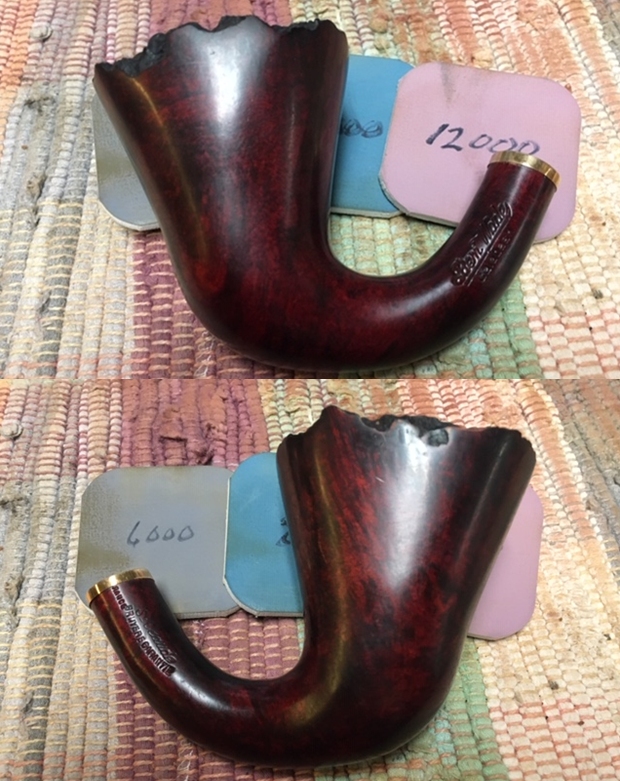
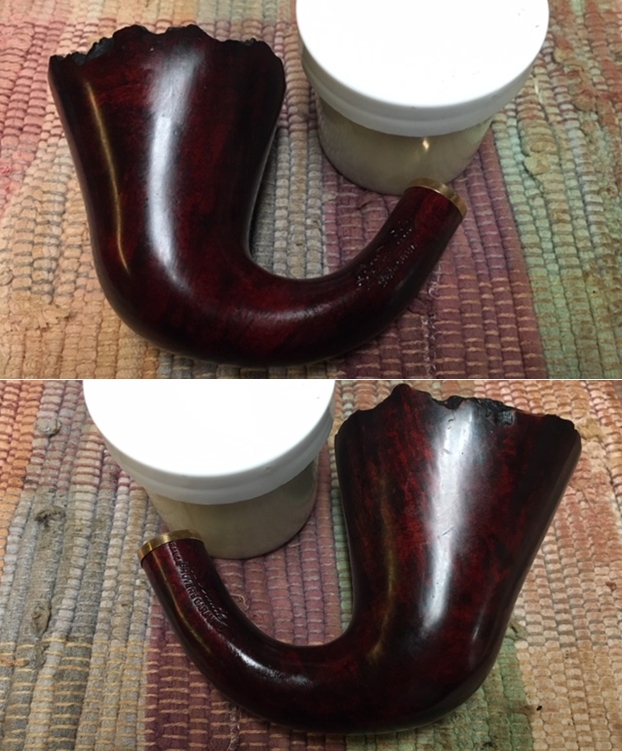
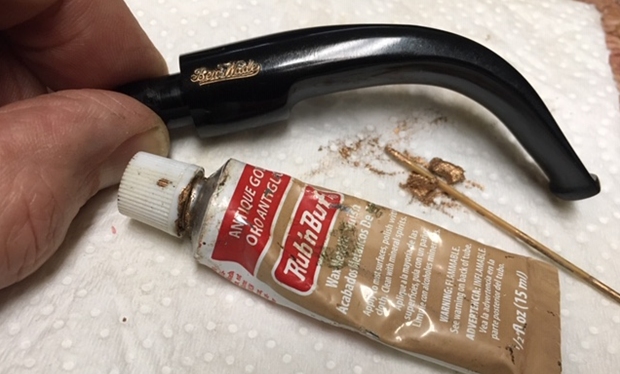
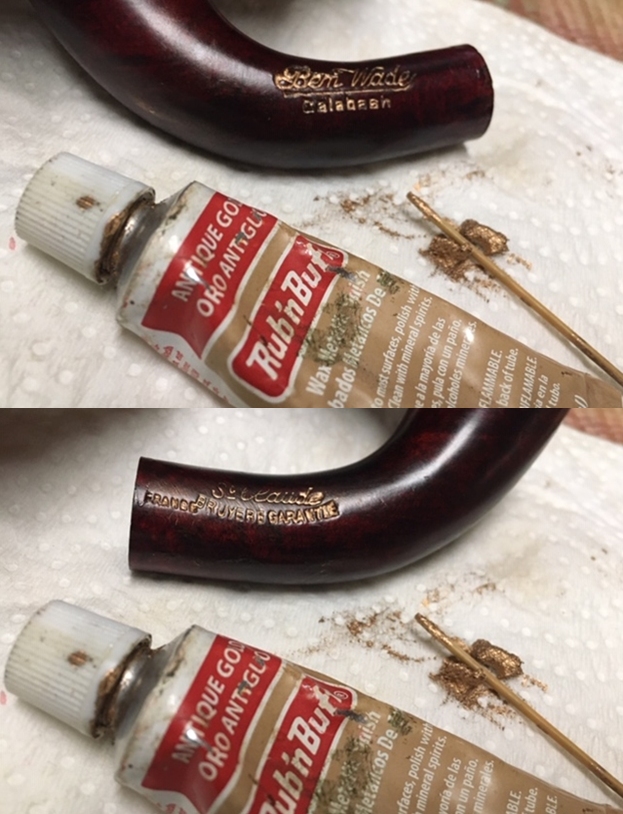
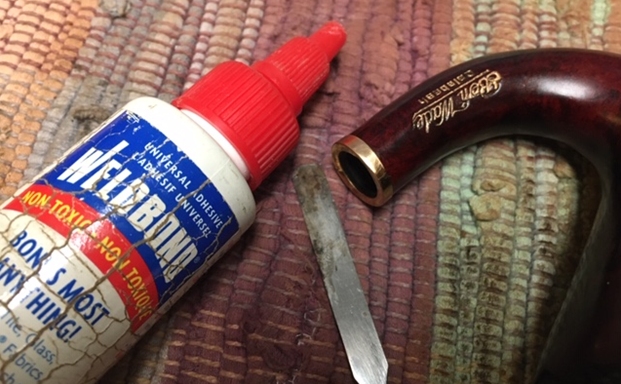
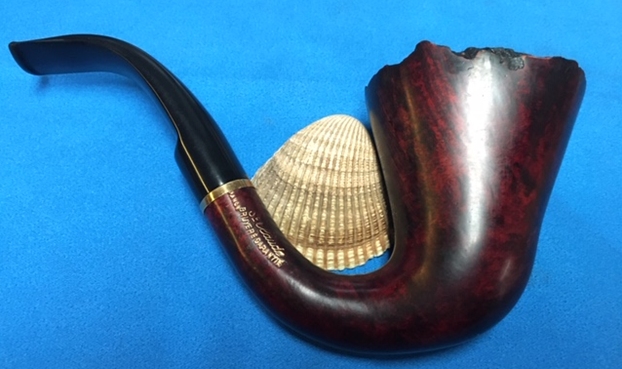
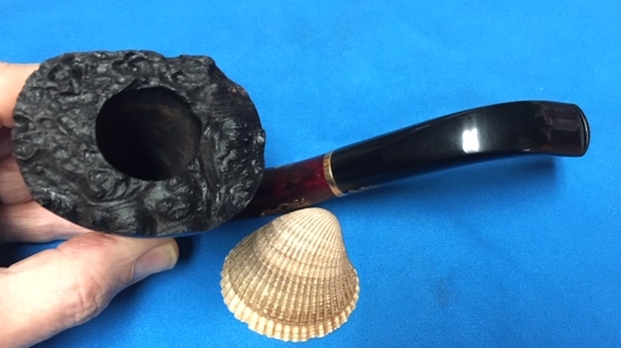
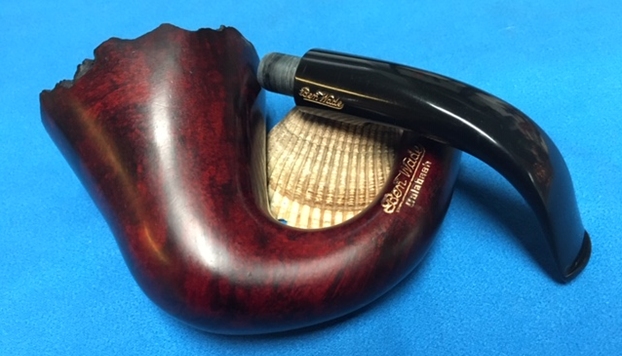
This St. Claude, France Ben Wade Calabash is quite stunning. The shape and flow of the briar, the rich red stains and the curve of the Lucite stem all combine to create a shape that is elegant and beautiful. Jeff picked this pipe up from a favourite shop in Utah. I have never seen one of these before even though I have worked on a lot of both English and Danish Ben Wade pipes. This one is a French Made Ben Wade. It is stamped on the left side of the curved shank with the words Ben Wade in script over Calabash. The name is also stamped on the left side of the half saddle stem. On the right side it is stamped St. Claude arched over Bruyere Garantie. To the left is a very tight stamp France. On the underside of the shank it is stamped with the letter F. There appears to be remnants of gold leaf in the stamping on both sides of the shank. It can be seen in the photos below. Jeff took some photos of the pipe before he began his cleanup work on it.The pipe was dirty and there were some worn spots on the plateau rim top. The original colour had been black but the dust had turned it almost grey. There was a cake in the bowl and some lava overflow on the plateau. The finish on the bowl was cordovan or oxblood. It was dirty as well with some nicks in the finish. You can see the chipped areas around the rim top and the lava in the plateau in the photos below.Jeff took photos of the bowl from various angles to give a picture of the grain and the condition on the finish of the pipe. It is a beautifully grained and finished pipe. The oxblood stain really works well to highlight and showcase the grain. Jeff also took photos of the stamping on the shank and the stem. The first two photos show the left side of the shank and stem. The third photo shows the stamping on the right side and the fourth shows the stamping on the underside. The acrylic/Lucite stem was dirty and there were tooth marks and chatter on the top and underside. There was one deep tooth mark on the underside up against the button edge. The flat surface of the button had tooth chatter and wear on both sides. Jeff also took a photo of the gentle curve of the half saddle stem and I have included that below. Jeff did his usual extensive cleanup of the pipe. He reamed it with a PipNet pipe reamer removing the cake from the bowl so that we could see what was going on underneath the surface. The interior of the bowl looked very good. He cleaned the internals of the pipe and stem with alcohol, cotton swabs and pipe cleaners until it was very clean. He scrubbed the externals with undiluted Murphy’s Oil Soap and a tooth brush. He worked over the plateau rim and edges with the brush and the soap and rinsed the pipe down with warm water. He cleaned the stem as well so that the externals and internals were clean. He did scrub the stem with Soft Scrub on cotton pads to remove the grime on the surface. It was acrylic so it was not oxidized so it was not necessary to soak it in a deoxidizer. I took photos of the pipe when I unpacked it and brought it to my work table. I took close up photos of the stem and the rim top to show the condition. The cragginess of the plateau is clean and shows the peaks and valleys in their fullness. You can also see some of the worn spots on the rim top where the finish has been removed. The stem looks good. The photo of the underside shows the deep tooth marks next to the button (third photo).I took some photos of the stamping on the sides of the shank to confirm what I mentioned above. The stamping is crisp and readable.I took the stem off the shank and took two photos to give a clear idea of the gentle curves of the pipe and the look of the rugged plateau rim on the delicate bowl. It really is a beauty! The tenon is drilled for a 6mm filter but could easily be smoked without one or with an adapter.Jeff and I were talking on Facetime and he was showing me how well the pipe had cleaned up. We do that often as he is in Idaho and I am in BC Canada. While he was carefully turning the stem into the shank we both heard and audible “POP”. That sound is a pipe restorer’s nightmare. If you have not heard that sound I can guarantee you will one day. Jeff groaned and showed me the crack in the shank. So when it arrived here in Vancouver I had a look. I took a photo of the crack and have included it below. It is on the top left side of the shank and is a good ½ inch long. That would need to be repaired. I also found some small hairline cracks on the top right side near the plateau top. They were not deep or serious but nonetheless they were present.I decided to deal with the cracked shank first. I went through some brass bands that I have that are polished gold in colour and would go well with the gold stamping on the stem and shank. They were quite thin and some have an inward bevel on the shank cover. I chose the band on the right and used my topping board to reduce the depth of the band by half. I wanted to retain as much of the stamping as possible and still bind the cracked shank together.I spread the crack in the shank and pushed some CA Glue into the space. Because of the way the curve in the shank I could not drill and hole at the end of the crack. I clamped it together until the glue cured. I did not glue the band on at this point because I wanted to touch up the gold stamping before I put it in place. Once the repair cured I put the stem on the shank and took a photo to give an idea of what the band looked like with the stem in place.   With that repair complete it was time to deal with the hairline cracks on rim edge. I used a tiny bit to put a hole at the end of each crack and filled them in with a bead of CA glue. The photo below is very blurry but shows the glued are well enough(I apologize for the lousy picture). I also filled in some of the pits in the back side of the bowl.Once the repairs had cured I sanded them smooth with a 1500 grit micromesh pad to blend them into the surface of the surrounding briar.I have found that the Mahogany stain pen I have blends really well with oxblood or cordovan stain. I touched up the sanded areas on the shank top, right side of the bowl at the topo and the back of the bowl with the pen and let it cure. I polished the briar with micromesh sanding pads – 1500-12000 grit pads. I wiped the bowl down with a damp cloth after each sanding pad to remove the debris. The bowl began to look very good. I also really like the look of the polished brass band on the shank end. I rubbed the bowl down with Before & After Restoration Balm. I worked it into the briar with my fingertips and into the plateau with a horsehair shoe brush. I let it sit for about 10 minutes and buffed it off with a soft cotton cloth. The product cleans, protects and preserves the briar and leaves it enriched and beautiful. I set the bowl aside and turned to the stem. I sanded the tooth chatter on both sides of the stem with particular attention to the large tooth mark on the underside of the stem just ahead of the button. I cleaned the tooth mark with alcohol on a cotton swab. I filled it in with a bead of clear CA glue and set it aside to cure. When the repair cured I used a needle file to sharpen the edge and flatten the repair.I sanded the repaired area and the rest of the tooth chatter areas on both sides of the stem with 220 grit sandpaper and followed up with a piece of 400 grit wet dry sandpaper.I polished the stem with Denicare Mouthpiece Polish from a tin of it I have in the drawer here. It is a gritty red paste that I rub on with my finger tips and work into the surface of the stem and button and buff off with a cotton pad. It gives me a bit of a head start on the polishing work.I polished the stem with micromesh sanding pads – wet sanding with 1500-12000 grit sanding pads. I wiped it down after each sanding pad with Obsidian Oil. I polished it with Before & After Pipe Stem Polish – both Fine and Extra Fine. I buffed the stem with a soft cloth to raise the shine. I paused in my polishing of the stem to touch up the gold leaf on the stem side and the sides of the shank. I used Rub’n Buff Antique Gold and pressed it in the stamping with the end of a tooth pick. I let it sit for a few minutes then buffed it off with a soft damp cloth to remove the excess. I went back to polishing the stem with Before & After Pipe Polish – both Fine and Extra Fine and buffed the stem with a clean cotton rag. The stem looks really good at this point.I used a dental spatula to spread some white glue around the shank end. Once the glue was evenly spread I pressed the band in place. I adjusted it so that it fit well. I set it aside to cure for a while as I wanted the band to be permanent. It looks very good now.I am excited to finish this beautiful Ben Wade Calabash from St. Claude France. It is both a rare one in terms of availability but also for me as I have never seen one before. I put the pipe back together and buffed it with Blue Diamond on the buffing wheel. I gave the bowl and the stem multiple coats of carnauba wax. I hand buffed the pipe with a clean buffing pad to raise the shine. It is fun to see what the polished bowl looks like with the grain popping through on the bowls sides and the contrast of the black plateau rim top. The brass band on the shank adds a touch class to the overall look in my opinion. When you add to that the polished black acrylic stem with the shining gold stamping you have a winning combination. The gold stamping also looks great on the shank and stem. This grain on the smooth finish Ben Wade Calabash is nice looking and the pipe feels great in my hand. It is light and well balanced for a large pipe. Have a look at it with the photos below. The dimensions are Length: 6 ¾ inches, Height: 3 inches, Outside diameter of the bowl: 2 inches, Chamber diameter: 7/8 of an inch. It is a beautiful pipe and one that will be on the rebornpipes store soon. If you are interested in adding it to your collection let me know. Thanks for walking through the restoration with me as I worked over this pipe. Thanks to each of you who are reading this blog. Remember we are not pipe owners; we are pipemen and women who hold our pipes in trust until they pass on into the trust of the next pipeman or woman.    

A Quick and Easy Restoration on a Brigham 3 Dot Dublin 306


Blog by Steve Laug

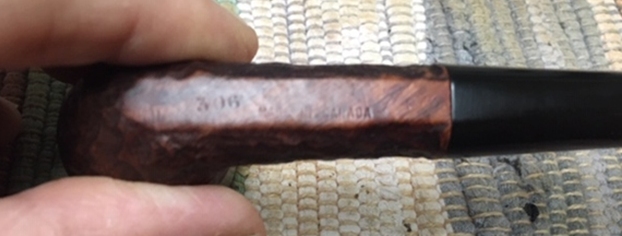
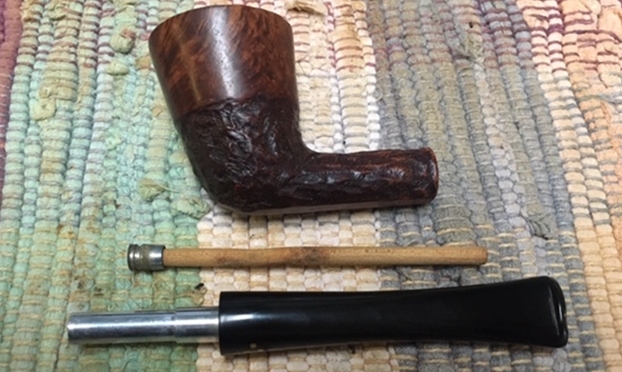
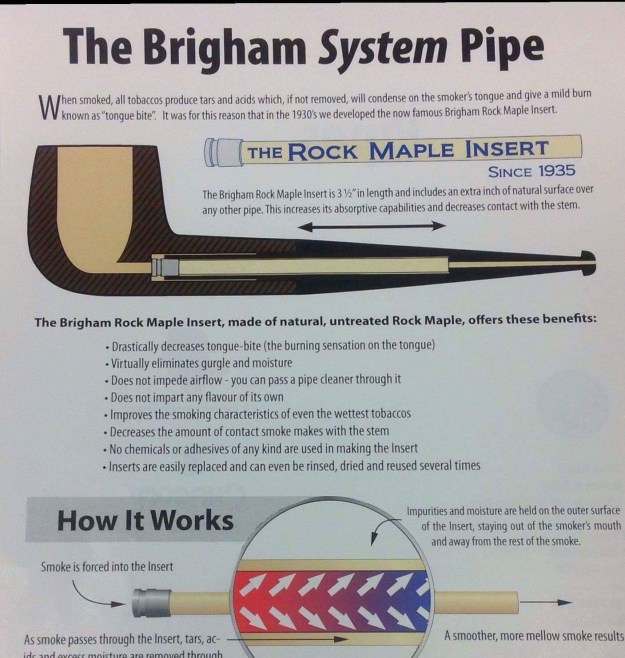
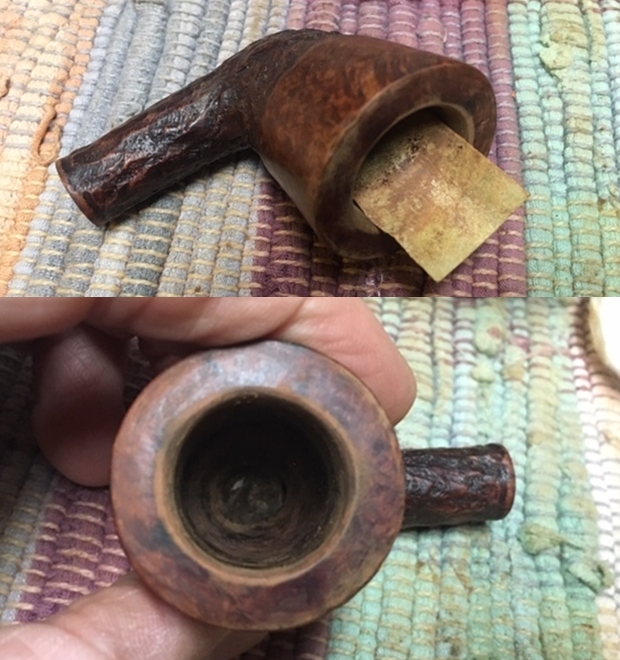
Even with the COVID-19 warning rolling in incessantly I am still working on pipes! It keeps my mind busy and focused. There is no reason to not enjoy the time alone at the work table bringing these old-timers back to life. The next pipe I have chosen is an interesting looking mixed finish Dublin that was stained with a rich brown colour on both the smooth upper portion and rusticated lower portion of the bowl and shank. It was stamped on the smooth underside of the shank. The stamping was readable. The shape number 306 is on the heel of the pipe and identifies the shape. The stamping Made in Canada and then the Brigham stamp in script followed on the rest of the flattened shank. The age on this one is Post-Patent era, nominally 1960s. The pipe comes to me I think from a trade I did with Alex but I am uncertain. It was in decent condition when I brought it to the table. The finish was a little dirty and the rim top had some damage but otherwise looked decent the inner edge of the bowl was slightly out of round due to some burn damage. The internals were quite clean. The stem was in good condition other than a few tooth marks on the top and underside near the button. The Maple Distillator was dirty and would need to be replaced. I took photos of the pipe when I brought it to the table. I took some close up photos of the rim top and also of the stem surface. I wanted to show how well it had cleaned up. The rim top was clean, but there was a slight burn mark on the front inner edge. You can also see that the bowl was out of round. I also took close up photos of the stem to show how well surface looked on both sides. I took a photo of the stamping on the underside of the shank. You can see that it is stamped as noted above. It is faint but it is readable.I took the pipe apart and removed the Distillator from the aluminum tenon. It was stained but otherwise clean. I would need to replace it when I was finished. Before I get into the restoration part of this pipe I decided to include a poster I picked up that shows the filtration system of the patented Brigham Distillator. Give the poster a read. It also helps to understand the internals of these older Canadian Made pipes.I decided to start my restoration work on this one by dealing with the damaged rim top. I sanded the inner edge of the bowl with 220 grit sandpaper to reshape the out of round bowl and deal with the burned spot on the front edge. I gave it a slight bevel and I am pleased with the results.I polished the briar with micromesh sanding pads – wet sanding it with 1500-12000 grit pads. After each pad I wiped the briar down with a damp cloth. I worked some Before & After Restoration Balm into the surface of the briar with my fingertips to clean, enliven and protect the briar. I let the balm sit for a little while and then buffed with a cotton cloth to raise the shine. The photos show the bowl at this point in the restoration process. With that done the bowl was finished other than the final buffing. I set it aside and turned my attention to the stem. I painted the stem surface with the flame of a Bic lighter to lift the tooth marks from the surface.After the heat had done its work on the tooth marks on the top side I was left with some damage on the button edges and on the underside of the stem. I filled in the remaining tooth damage with clear CA glue and set the stem aside to dry overnight. I sanded out the repaired tooth marks and chatter with 220 grit sand paper to blend them into the rest of the stem surface. I started to polish it with a folded piece of 400 wet dry sandpaper. Once it was finished it had begun to shine.        I polished the stem with Denicare Mouthpiece Polish from a tin of it I have in the drawer here. It is a gritty red paste that I rub on with my finger tips and work into the surface of the stem and button and buff off with a cotton pad. It gives me a bit of a head start on the polishing work. Before I finished the polishing stem I decided to fit it with a new Rock Maple Distillator.I polished the stem with micromesh sanding pads – wet sanding with 1500-12000 grit sanding pads. I wiped it down after each sanding pad with Obsidian Oil. I polished it with Before & After Pipe Stem Polish – both Fine and Extra Fine. I am continuing to experiment with Briarville Pipe Repairs new product, No Oxy Oil so I rubbed the stem down with the oil on the cloth that was provided with it. I am excited to finish this Brigham. I put the pipe back together and buffed it with Blue Diamond on the buffing wheel. I gave the bowl and the stem multiple coats of carnauba wax. I hand buffed the pipe with a clean buffing pad to raise the shine. It is fun to see what the polished bowl looks like with the grain popping through on the bowls sides and rim top. Added to that the polished black vulcanite stem with the shining brass pins was beautiful. This mixed grain on the smooth finish Brigham 306 Dublin is nice looking and the pipe feels great in my hand. It is light and well balanced. Have a look at it with the photos below. When I was going through the box of pipes in my box of pipes to be done I came across this beautiful 3 Dot Brigham. The dimensions are Length: 5 ½ inches, Height: 1 ¾ inches, Outside diameter of the bowl: 1 3/8 inches, Chamber diameter: ¾ of an inch. It is a beautiful pipe and one that will be on the rebornpipes store soon. If you are interested in adding it to your collection let me know. Thanks for walking through the restoration with me as I worked over this pipe. Thanks to each of you who are reading this blog. Remember we are not pipe owners; we are pipemen and women who hold our pipes in trust until they pass on into the trust of the next pipeman or woman.    

A Danish Borge Mortensen Handmade Brandy Recommissioned


Blog by Dal Stanton

This attractive Bent Brandy got my attention on the European side of eBay.  The seller in Germany posted several pictures.  The name, Borge Mortensen, was new to me, but my experience with Danish pipes had been good.  I was attracted as well to the Cumberland stem, but the lack of bend on it struck me as awkward – not the best orientation, but perhaps that was a Danish characteristic?  When the time ended my bid was enough and the pipe soon arrived here in Bulgaria for me to take a closer look.  I also posted it in the For “Pipe Dreamers” Only! online collection to be commissioned by another pipe man or woman benefiting the Daughters of Bulgaria – women and girls who have been trafficked and sexually exploited.The Mortensen also got the attention of Todd, who has commissioned other pipes from me in the past.  Todd is an avid pipe man and contributor to several discussion groups online.  Through our communications, I’ve discovered his love and concern for China in his professional work.  I’ve appreciated our growing relationship cultivated by our common appreciation for pipes.  This relationship developed when I had asked Todd if he minded being ‘bumped’ in the queue line to allow me to restore a very special pipe for a very special guest visiting with us here in Bulgaria for a few weeks.  Chrystal’s visit from China was a special time and resulted in a memorable blog posting for me:  A Special Gift for Her Grandfather in the People’s Republic of China – A Sculpted Rose Billiard of Italy.  Chrystal presented her grandfather the pipe for Chinese New Year and sent pictures to commemorate that special event.

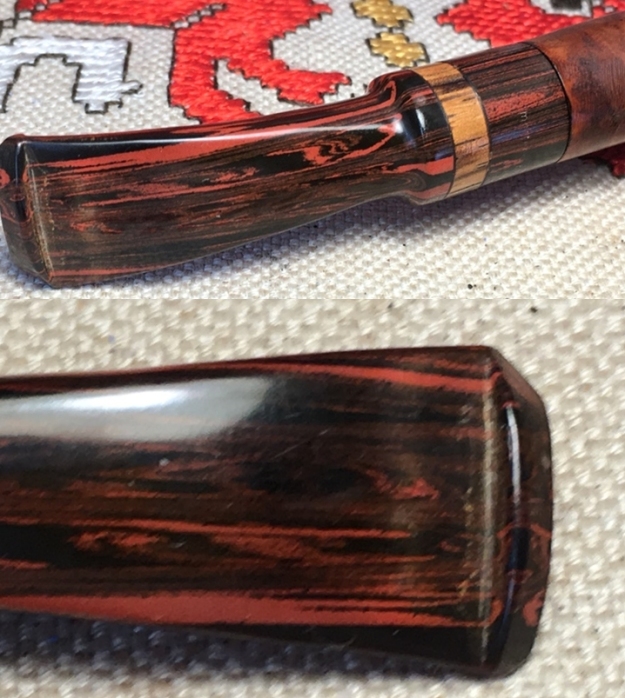
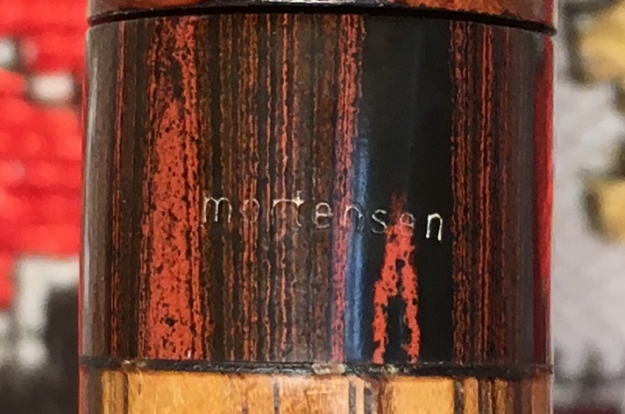
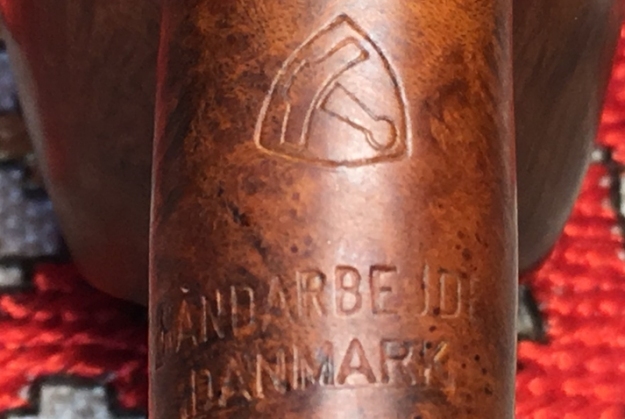
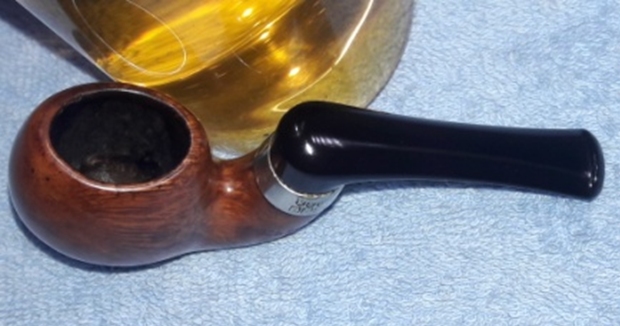
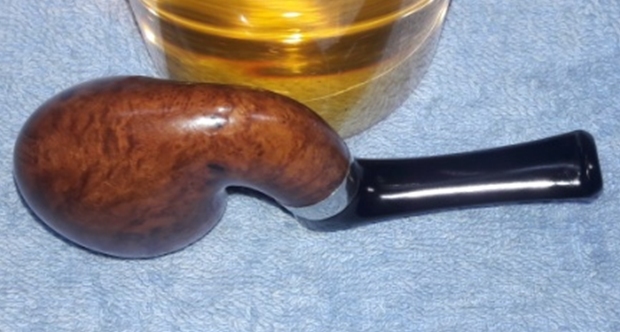
Through this initial encounter with Chrystal, I learned of Todd’s connection with China through his professional pursuits and since then we’ve shared more of each other’s life and family through our emailing….  We’ve decided to share a bowl in the future when our paths can merge on the same continent!  Todd saw this Borge Mortensen Handmade and commissioned it, along with two others that are next in the queue.  Now on the worktable, I take more pictures to get a closer look at the Danish Borge Mortensen. The nomenclature condition is good.  On the top of the Cumberland stem, ‘Mortensen’ is stamped but is thin.  The markings on the underside of the bent shank are impressive. A tilted hammer is ensconced in a shield shaped outline.  Underneath the hammer shield is HANDARBEJDE [over] DANMARK.  A quick trip to Google Translate renders “Handmade”. Scant information is available online about Borge Mortensen.  A quick search on the internet will show a few examples having been sold at different sites.  A small article is found on Pipedia with accompanying pictures ‘courtesy of Doug Valitchka’.

Borge Mortensen of Denmark

In the following example, the name is stamped very small on the top of the turned part of a Cumberland stem. The side has a unique symbol ” the hammer (Mjolnir) of Thor, the god of thunder “. There is also limited stamping on the wood: HANDARBEJDE, DANMARK.  From the examples online of Borge Mortensen pipes and from the Pipedia article (with the same information mirrored in Pipephil.eu) it seems that Mortensen pipes are standard with a Cumberland stem.  The additional information also describes the origin of the Mortensen symbol – the hammer of Thor, of Norse mythology. I would say that this is a distinctive Dane symbol and is cool.

The condition of the pipe is generally good.  The chamber appears to have been reamed but I will clean it further.  The bowl shows nice grain and is generally in clean condition and the grain on the Brandy shape is very nice showing no fills.  The Cumberland stem shows almost no tooth chatter.  One issue is that the 9mm filter holder has separated from the stem and is stuck in the shank.  Care is needed in dislodging the plastic tube – breaking it will not be good.  The lighting is a bit different with the picture below since I’m using natural light while on my ‘Man Cave’ balcony enjoying spring weather on the 10 floor – with a great view!  A cameo appearance enjoying my L. J. Peretti Giant Egg loaded with Peretti Tobacconist of Boston’s, Black Virginia. A delightful time! To dislodge the filter holder from the shank, I put the bowl in the freezer with the hope that the cooling of the wood might help loosen it. While in the freezer, I turn to the Cumberland stem and clean the internals with pipe cleaners and cotton buds wetted with isopropyl 95%.  A small dental spoon tool is used to scrape the internal cavity of tars and oils. The upper and lower bit shows roughness which needs to be removed. Using 240 grade paper, I sand the upper and lower bit area as well as the button.Following the 240 paper, I wet sand the entire stem with 600 grade paper and follow with applying 000 steel wool.  I avoid the ‘Mortensen’ stamping on the top of the stem saddle section.Next, using the full regimen of 9 micromesh pads, I wet sand the stem with pads 1500 to 2400, then dry sand with pads 3200 to 4000 and 6000 to 12000.  Between each set of 3 pads, Obsidian Oil is applied to rejuvenate and protect the stem from oxidation. Moving back to the stummel – I had placed the stummel in the freezer in hopes that it would enable me to extract the plastic filter sheath.  After taking the bowl out of the freezer, I am able to hand turn the sheath and it comes out easily.  After taking another look at the chamber, the reaming job that had been done on it was not enough.  There remained carbon residue.  Using the Pipnet Reaming kit, I use 2 of the 4 blades available – starting with the smallest.  I follow this by using the Savinelli Fitsall Tool to scrape the chamber walls further.  To finish, I use 240 grade paper wrapped around a Sharpie Pen to sand the chamber to remove what carbon cake remained to expose fresher briar. After cleaning the chamber with a cotton pad wetted with isopropyl 95%, I inspect the chamber, and all looks good – no signs of heating problems.Next, moving to the external cleaning, using undiluted Murphy’s Oil Soap on a cotton pad, I scrub the briar surface.  Following this, I take the bowl to the kitchen sink and clean the mortise and airway with shank brushes and anti-oil liquid dish soap.  After scrubbing the internals well with hot water, I rinse the bowl thoroughly and transfer it back to the worktable and take a few pictures of the now cleaned surface – it looks good. Using pipe cleaners and cotton buds wetted with isopropyl 95%, I continue cleaning the internals.  A small dental spoon also works well to scrape old tars and oils off the mortise walls.  In time, the buds and pipe cleaners begin to emerge lighter and I call this phase of the internal cleaning finished.With the hour being late, I continue the internal cleaning using a kosher salt and alcohol soak.  After twisting and pulling a cotton ball to form a mortise ‘wick’, I use a stiff wire to help guide it down the mortise toward the draft hole.  The wick helps to draw out the old tars and oils to clean and refresh the bowl. Kosher salt is then used to fill the bowl which leaves no after taste and helps to freshen the briar.  With the bowl stabilized in an egg carton, a large eye dropper fills the chamber with isopropyl 95% until it surfaces over the salt.  After a few minutes, the alcohol is drawn into the salt and cotton wick, and I top it off one more time and turn out the lights.The next morning, I was surprised to see almost no soiling of the salt and cotton wick.  This means that the internals are clean indeed!  After removing the expended salt, wiping the chamber with paper towel, and forcefully blowing through the mortise, the expended salt residue is removed. I follow with a pipe cleaner and cotton bud dipped in isopropyl 95% to be sure all is clean.Before bending the Cumberland stem, the filter sheath needs to be reattached so that the stem can be seated correctly in the mortise.  The ribbing on the heavy plastic sheath clearly defines the correct orientation.  Using thick CA glue, a small amount of glue is applied around the ribbing of the sheath and a toothpick helps to spread it.  The sheath is then inserted firmly into the stem cavity and allowed to cure.With the sheath firmly in place, the filter sheath tenon seats well into the mortise.Next on the project list – to provide the Cumberland stem with a bend.  Ideally, the stem orientation should roughly parallel the plane of the rim.  The shortness of this stem creates a challenge for such a tight bend.  The diagram below shows the estimated bend and orientation that is the goal.  To be on the safe side, I insert two pipe cleaners into the airway to safeguard the integrity of the airway with the tight bend.  Using the hot air gun, I gradually and patiently warm the stem where the bend is to occur.  The pipe cleaners extending out from the stem are useful as a handle as the hot air warms the Cumberland blend of black and red vulcanite and becomes supple.When the stem becomes sufficiently supple from the heating, I gently bend the stem over a block of wood tightened in the vice.  The rounded curve on corner of the block acts as the mold to provide a tight even bend.After the stem is bent over the block, I hold it steady to allow the rubber to cool by itself.  After the stem firms up in its bend, I then take it to the sink and run cool water over the stem to solidify the bend.  The first attempt is good.  After taking it back to the worktable and placing it on the template I drew, I’m satisfied with the orientation of the bend.  The pipe cleaners do the job and they come out with a little tugging.The bend is good, but after a quick inspection, the underside of the stem has rippled.  This affect can happen with a sharp bend and I probably should have bent the stem sooner in the process before the stem sanding.  We learn with each restoration! To remove the rippling on the underside of the stem resulting from bending the stem, I do a quick detour with 240 grain paper, followed by 600 grade and 000 steel wool.  A quick run through all 9 micromesh pads, 1500 to 12000 with Obsidian Oil between each set of 3, bring the stem back to an acceptable state!  I move on. With the stem now on the sidelines, I focus on the Borge Mortensen stummel.  Not wishing to contribute to the erosion of the Thor’s Hammer Shield nomenclature, I cover the area with masking tape.  Beginning with the rim, there is residual darkened briar from the former steward’s lighting the chamber.  To address this, I use 240 grade sanding paper to sand very gently to clean the rim.  I also sand the interior rim edge to clean and freshen.Following the 240 sanding, I provide a gentle topping using medium and light grade sanding sponges.  This cleans the rim up well.Next, taking the bowl to the sink, I wet sand the stummel with pads 1500 to 2400 and dry sand with pads 3200 to 4000 and 6000 to 12000.  Wow!  I think for the first time in this restoration I’m taking note of the beautiful use of the grain in this Danish Bent Brandy shape. Mark Hoover’s Before and After Restoration Balm works wonders.  After putting a small amount on my fingers, I work the Balm into the briar surface.  The Balm brings out the more subtle tones of the briar hue.  After applying the Balm and letting it set for about 10 minutes, I use a microfiber cloth to wipe off the excess Balm and then buff up the briar surface.While I was waiting for the Restoration Balm to do its thing on the stummel, I apply Before & After Fine and Extra Fine Polish to the Cumberland stem. I start with the Fine Polish applying it to my finger and then rubbing it into the stem.  After rubbing it in, I leave it for about 10 minutes then wipe off the excess with a cloth.  The next stage is applying the Extra Fine Polish in the same way.  Mark’s claim for this product is that it not only rejuvenates but it continues the process of removing oxidation.  After the stem sets for about 10 minutes with Extra Fine Polish on it, again the excess is wiped off with a cloth and the stem is buffed.Now in the home stretch.  After rejoining the stem and stummel, a cotton cloth buffing wheel is mounted to the Dremel to apply Blue Diamond compound to stem and stummel.  With the speed set at about 40% full power the fine abrasive is applied to the surface.Following the application of the compound, after changing to another cotton cloth buffing wheel on the Dremel, maintaining the same speed, carnauba wax is applied to the entire pipe.  After the wax it applied, using a microfiber cloth, I give the pipe a rigorous hand buffing to raise the shine.The grain on this Borge Mortensen Handmade in Denmark is stunning.  The Bent Brandy shape uses the flow of the grain as it moves upwardly toward the top of the Brandy rim – the distinctive bird’s eye grain on the heel of the Brandy corresponds to the vertical grain.  The Cumberland stem is nice and the bend sets the right balance.  Todd commissioned this Borge Mortensen benefitting the Daughters of Bulgaria and he will have the first opportunity to acquire it in The Pipe Steward Store.  Thanks for joining me!
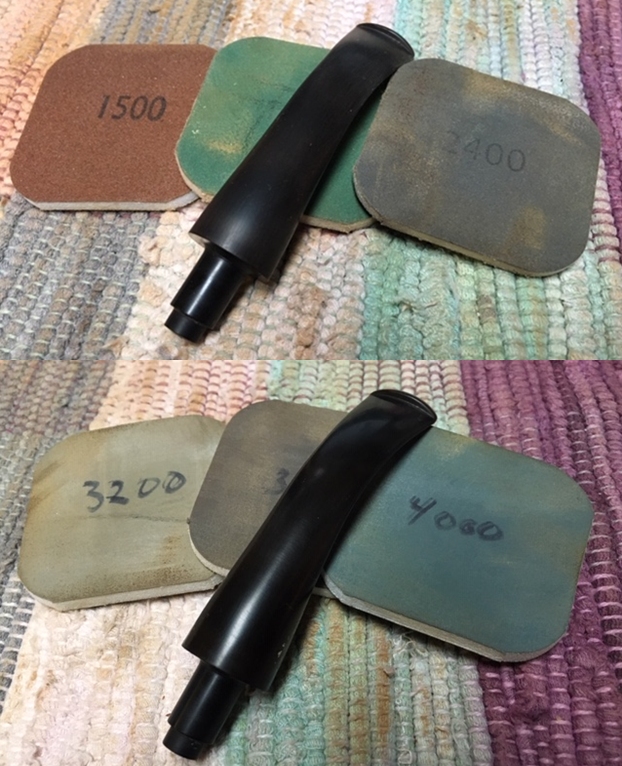
A New Beginning For An Inherited Peterson’s # 3 System Pocket Pipe…


Blog by Paresh Deshpande

Over the last month and a half, I have worked on five Peterson’s pipes to be added to my personal collection; two from my inherited lot (DONEGAL ROCKY # 999 and KAPMEER # 120S) and three that I had purchased on eBay, a Peterson’s SYSTEM # 31 just so that I could include it in my rotation, a Peterson’s BARREL and a Peterson’s OLD ENGLISH COLLECTION. Continuing with my work on Peterson’s in my collection, the next and sixth pipe that is now on my work table is one from my inheritance; a unique small system pipe with oval shaped chamber/ stummel. The stem folds itself over the rim top, further making it compact enough in size to be carried in one’s vest pocket.

The smooth stummel of this pipe has a beautiful mix of Bird’s eye on the foot of the stummel and cross grain on the front, back, sides and the upturned shank of the stummel. An oval shaped stummel, short upturned shank with a nickel plated ferrule at the shank end and a proportionate vulcanite stem with an orifice for a slot, makes it a visually appealing pipe. It is stamped on the left side of the shank as “K & P” over “3”. The shank end is adorned with a nickel ferrule that is stamped in three shields as “K” “&” “P” over three faux hallmarks a Shamrock, a Prone Fox, and a Stone Tower. The stummel is devoid of any COM stamp that would help in dating this pipe. Even the stem is unstamped. Since I have been recently working on Peterson’s pipes in my collection and reading about it as much as I could, I knew that K & P pipes did not have any COM stamp during the early part of the Patent Era. Furthermore, this pipe has a reservoir/ sump in the mortise making it a System pipe!! The stem slot is a round orifice which points to this pipe being an old one. Thus from these facts, I can safely presume this pipe to be from the Patent Era, that is from 1875 to 1922.

However, in spite of my extensive research on Peterson’s pipes for shapes and models from this era, I came a cropper!!!! In case any of the esteemed readers has some additional information on this pipe, I would request you to share it on Reborn pipes for the benefit of our community.

Initial Visual Inspection
The smooth stummel on this pipe is covered in a thick layer of dust and sticky grime giving it a dull and lackluster appearance. Through all the grime, bird’s eye and cross grains can be still seen at the foot and on sides, front and back of the stummel respectively. The rim top surface appears uneven and is covered in dust, heavy lava overflow, grime and will need to be cleaned and polished. There are a few scratches on the left side of the stummel which will need to be addressed. A few fills seen on either side of the stummel need to be refreshed. The stummel has developed a nice patina which I shall endeavor to preserve. The chamber has a thick layer of uneven cake with lava overflow over the rim top surface. Remnants of half burnt tobacco can be seen at the bottom half of the stummel. The condition of the inner walls of the chamber will be ascertained once the existing cake has been taken down to the bare briar. The draught hole is completely blocked with absolutely no draw. This needs to be addressed. The thin and delicate rim edge appears to be severely damaged with dents and dings all around; however, the extent of this damage will be ascertained once the cake and lava overflow from the chamber and rim top is entirely removed. There is a very strong smell to the chamber which, perhaps, may reduce appreciably after the chamber has been cleaned. The mortise and sump are clogged with dried oils and tars. The nickel ferrule at the shank end, though heavily oxidized, is undamaged. It is cut at an angle to accommodate the stem when it is turned over the stummel. The ferrule, once cleaned should polish up nicely. The vulcanite stem is heavily and deeply oxidized with tooth indentations on the button edge and chatter on either surfaces of the stem in the bite zone. The tenon end shows heavy traces of dried oils and tars. It’s going to take some elbow grease to clean up this stem to a nice deep and shining black. The perpendicular tenon end will make the internal cleaning a bit challenging. The orific slot shows deposition of dried oils and tars. The stink from the stem and clogged airway will take a lot of effort and time to clean up. The Process
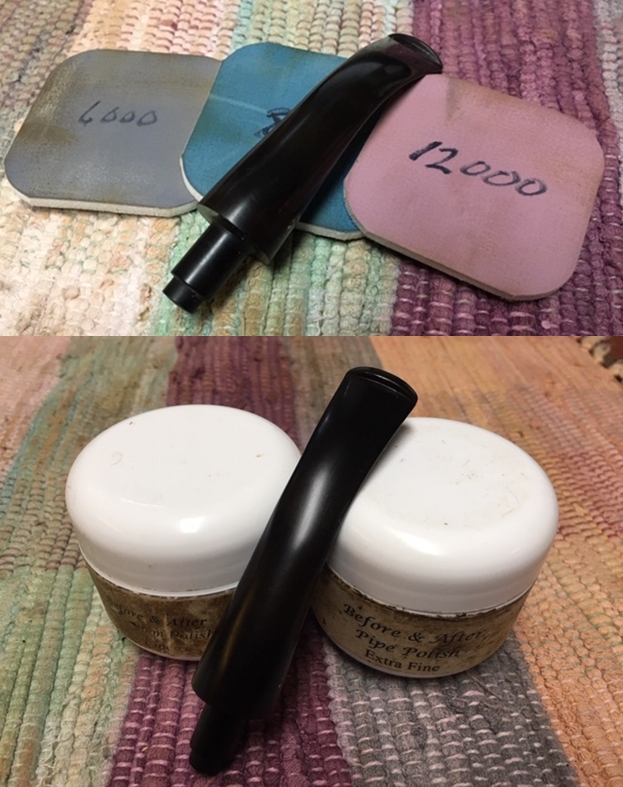
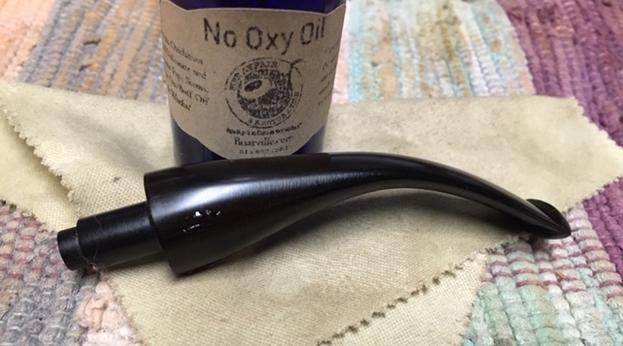
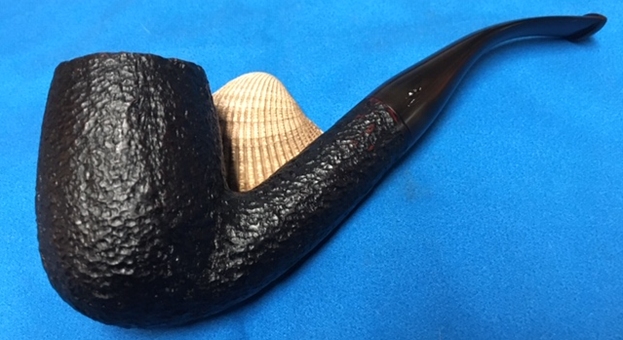
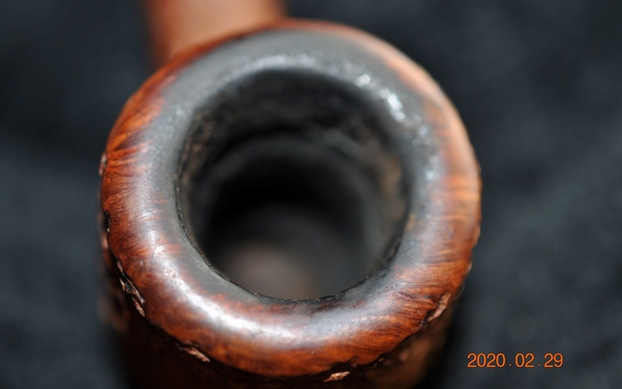
I began the process of refurbishing this pipe by using my fabricated knife to remove the unburnt tobacco and thick layer of cake. I further took the cake down to the bare briar with a folded piece of 150 grit sand paper. Once the walls of the chamber were rid of all the remnants of the cake, the chamber walls were found to be smooth and without any damage. With my modified and straightened cloth hanger used as a poker, I cleaned the grime and cake that covered the draught hole at the heel of the stummel. I further wiped the chamber with a cotton swab wetted with isopropyl alcohol to completely remove the sanding dust. While handling the stummel for internal cleaning of the chamber, the nickel ferrule came off, revealing a crack on the left side. This crack extends from the shank end rim surface (indicated with a yellow arrow) and along the shank on the left side (indicated with blue arrows). The extent of the crack will be determined once the dirt, grime and dried glue are removed from the surface. The edges of the ferrule are slightly uneven while the insides of it have traces of deeper oxidation.   I scraped the shank internals with a fabricated tool to remove all the crud that had accumulated along the shank walls and further cleaned it with bristled and regular pipe cleaners dipped in isopropyl alcohol. A huge pile of q-tips, pipe cleaners and lots of elbow grease later, the sump and mortise still appear dirty. I shall further draw out all the residual oils, tars and gunk by subjecting the chamber and the shank to a salt and alcohol bath. I gently scraped the shank end rim surface to remove all the accumulated oils and grime. Now that the shank end rim was cleaned, a second crack on the right side came to the fore (indicated in yellow arrows). This project is turning out to be more time consuming than I had anticipated. I shall deal with these cracks after I am done with internal and external cleaning of the stummel. I cleared the draught hole using a fabricated poker and further cleaned it using pipe cleaners and alcohol. I continued with the cleaning of the chamber and shank internals with a salt and alcohol bath. I use cotton balls which is an at par substitute to Kosher salt as I have realized over the years. I draw out a wick from the cotton and along with a folded regular pipe cleaner; insert it in to the mortise and through the draught hole into the chamber. Thereafter, I packed the chamber with cotton balls to about quarter of an inch below the rim’s inner edge and soaked the cotton balls with isopropyl alcohol up to the brim. About half an hour later, the level of alcohol had gone down, having being absorbed by the cotton. I topped it up once again and set it aside overnight. By the next afternoon, the cotton and alcohol had drawn out all the remaining oils and tars from the chamber and mortise, fulfilling its intended task. I removed the cotton balls and ran pipe cleaners through the mortise to clean out all the loosened tars and gunk. Using my fabricated tool, I scraped out the entire loosened gunk from the sump and further cleaned it with alcohol and q-tips. The chamber now smells clean and fresh. I set the stummel to dry out naturally. Now that the internals of the stummel were cleaned, I scrubbed the external surface of the bowl with undiluted Murphy’s oil soap and hard bristled tooth brush. I deliberately cleaned the thin delicate rim top and the surface just below the rim edge with Scotch Brite and a soft bristled brass wire brush to remove the entire lava overflow and dried it using paper towels and a soft cotton cloth. The shank end rim surface and the shank were deliberately cleaned to remove the grime and dirt so that the exact extent of the two cracks could be fathomed. The thin rim top is generously peppered with nicks, dings and dents. The fills and cracks that are visible on the stummel surface are marked in yellow circles and blue arrows respectively. I removed the old fills and prepared the stummel for a fresh fill. Using my dental tools, I progressed to removing the fills. I know these pictures do not present a very encouraging scenario at this stage, but I shall prevail… I wiped the surface from where the old fill was gouged out, with isopropyl alcohol to clean the area. I let the stummel dry out completely and after all the alcohol had evaporated, proceeded to fill the gouges with CA superglue and briar dust using the layering technique where I put down a thin layer of superglue in to the fill and press briar dust over the glue. I continue with this process till the fill rises above the rest of the stummel surface. Once all the gouges were filled up, I set the stummel aside to cure for the next 24 hours.While the stummel fills were curing, I worked the stem. The stem air way was filthy to say the least. Using a shank brush and dish washing soap, I cleaned the stem air way. I further cleaned the stem internals with hard and regular pipe cleaners and isopropyl alcohol. A lot of elbow grease and a pile of pipe cleaners later, the pipe cleaners did not emerge as white as I wanted. The perpendicular positioning of the tenon to the rest of the stem made cleaning of the air way all the more difficult. In my exuberance, I chipped the very end of the tenon… Some additional unwarranted work and time penalty!! With the stem internals now somewhat clean, I moved to external cleaning of the stem surface by sanding the surface with a piece of 220 grit sand paper and thereafter dunking the stem in to “Before and After Deoxidizer” solution developed by my friend Mark Hoover. The solution helps to draw out heavy oxidation to the surface making its further removal a breeze, while the minor oxidation is eliminated to a very great extent. I usually dunk stems of 5-7 pipes that are in-line for restoration and the K & P # 3 pipe is marked in pastel pink arrow. I generally allow the stems to soak in this solution overnight for the solution to do its work.Next day, I remove the stems from the deoxidizer solution and clean them under warm running tap water to remove all the solution. I scrubbed the stem surface first with scotch brite pad followed by a piece of 0000 grade steel wool. This helps in removing all the raised oxidation from the stem surface. I rubbed a little Extra Virgin Olive oil in to the stem and wiped the excess with a paper napkin. This was followed by inserting a petroleum jelly smeared folded pipe cleaner in to the tenon for reconstruction of the tenon end. Using a mix of CA superglue and food grade activated charcoal, I began the arduous process of rebuilding the chipped tenon end and also the bite marks on the button edges on both sides in the bite zone. I set the stem aside for the fill to cure and harden completely. I took a stock of the progress made till now on this pipe; stummel internals/ externals cleaned, old stummel fills have been refreshed and cured, stem internals cleaned, stem oxidation removed to a great extent, stem repairs set aside for curing. Addressing the stummel cracks, sanding of the stummel and stem fills, refurbishing the nickel band and final polishing is all that remains to be completed.
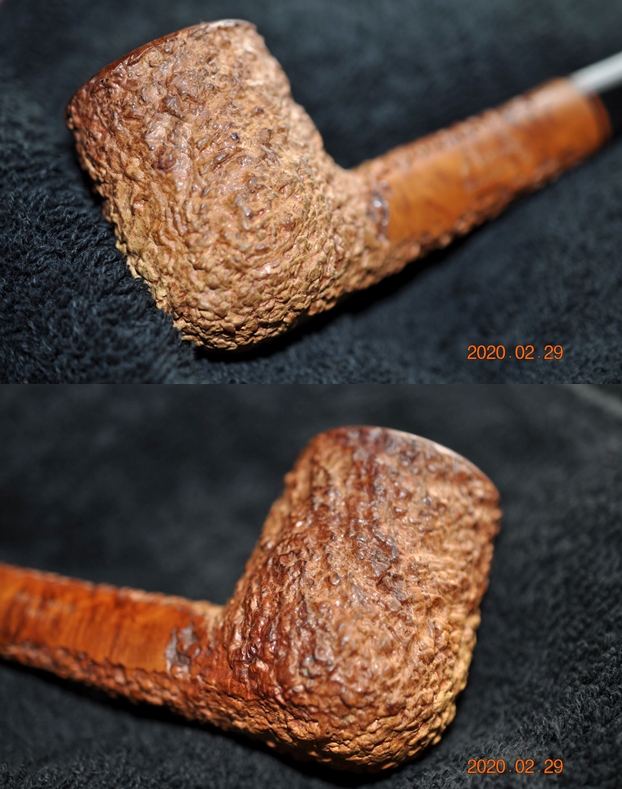
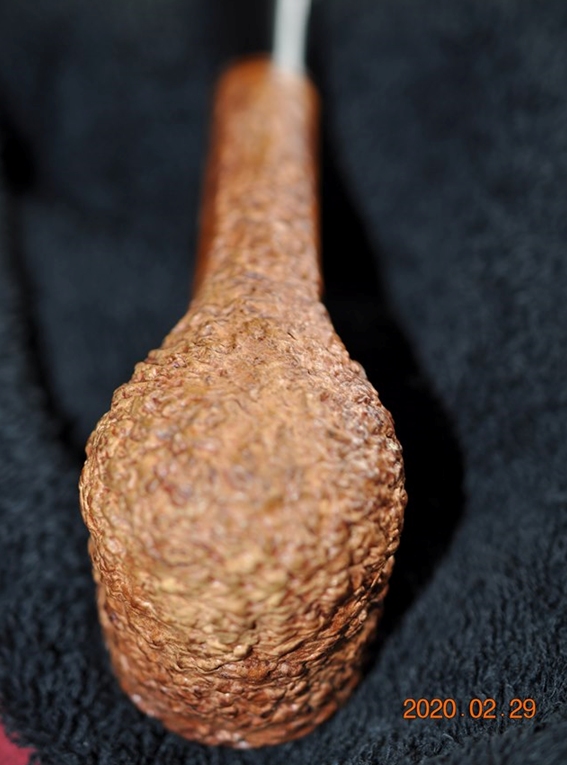
Next, I address the two cracks at the shank end. Using a magnifying glass and a white correction pen, I marked the points for the counter holes at the end points along the extent of the cracks seen on the stummel. I drilled counter holes with a 1mm drill bit mounted on to my hand held rotary tool, deep enough to serve as a counter hole while taking care that I did not drill a through and through hole. These counter holes arrest and prevent the spread of the cracks further. I filled these cracks and counter holes with a mix of briar dust and CA superglue using the layering method (layer of superglue followed by sprinkling of briar dust and repeated it till desired thickness of fill was achieved) and set it aside for the fills to cure. I ensured that I filled the thin outer edge of rim top surface that I will subsequently sand down to match with the rest of the rim surface. I set the stummel aside for the fills to harden. I cleaned the nickel shank band with Colgate Toothpowder, which Abha, my wife, uses to polish her silver and gold cutlery and jewelry. This compound is a very fine powder and is least abrasive with fantastic results. The band is now a nice shining piece of nickel and should provide a nice contrast to the shining black stem and the dark brown stummel. The patches of deep oxidation that were observed were also completely eliminated.  With the stummel fills nicely cured, it was time again to work on it. Using a flat head needle file, I sanded the fills and followed it by sanding with worn out folded piece of 150 grit sand paper. I sand the thin rim top surface with the same sand paper to minimize the numerous chips, dents and dings. I did not resort to topping since the oval shape with a slight saddle dip in the centre makes it difficult to top without compromising the shape of the rim top. A couple of dents and chips are still visible, but I shall let them be as a part of this pipe’s journey from my grandfather then to with me now!!! The fills have blended in quite well. However, I shall strive to further achieve a near perfect blend during further sanding and polishing with micromesh pads. The shank end crack repairs are now solid and have blended in really well. Yeah, I am pleased with this progress. Thereafter, I polished the entire stummel with micromesh pads, wet sanding with 1500 to 12000 pads. I wiped the surface with a soft moist cloth at the end of the micromesh cycle. The stummel looks amazing with a deep shine and beautiful grains over the stummel surface. Another issue that was addressed to a great extent was that of the minor scratches and nicks that were observed on the stummel. The rim top surface looks good with the few nicks and chips still visible, if observed closely. The refreshed fills distinctly stand out because of their dark coloration, and I shall let it be as a testimony of the journey of this beautiful pipe. I am very happy with the appearance of the rim top and stummel at this stage. I rubbed a small quantity of “Before and After Restoration Balm” in to briar and let it rest for a few minutes. The balm almost immediately works its magic and the briar now has a nice vibrant appearance with the dark hues of the grain contrasting with the rest of the stummel surface. I further buff it with a horse hair shoe brush. I set the stummel aside and took up the stem repairs. The tenon tip rebuild had cured nicely. With a flat head needle file, I sand the rebuilt portion of the tenon and the button edges to achieve a rough match. Using a round needle file, I shaped the opening of the tenon to a perfect round. I resorted to topping the tenon end on a piece of 220 grit sand paper to achieve the correct tenon size, which is just below the opening of the draught hole in the mortise. This ensures that the Pete’s famed “System” functions as effectively. I further sand the entire stem surface with a folded piece of a 220 grit sand paper to achieve a perfect blend of the fill with the stem surface. With the same piece of sand paper, I sharpened the button edges on both the upper and lower surface. I wiped the stem with a cotton swab and Murphy’s oil soap to further remove the oxidation and sanding dust. I rubbed some extra virgin olive oil into the stem and set it aside to be absorbed into stem. I polished the stem with micromesh pads, wet sanding with 1500 to 12000 grit pads. I rubbed a little extra virgin olive oil in to the stem at the end of all the micromesh pads. Next I rubbed a small quantity of extra fine stem polish that I had got from Mark Hoover and set it aside to let the polish work its magic. After about 10 minutes, I hand buffed the stem with a microfiber cloth to a nice shine. The stem is now nice, smooth and shiny. Now with the stummel nicely polished, the nickel band polished and shining and stem repairs and polishing completed, all that remained to be done was to get these parts together for a final polishing with carnauba wax. I glued the nickel ferrule to the shank end with CA superglue.To apply the finishing touches, I mount a cotton cloth buffing wheel on to my hand held rotary tool and apply a coat of Blue Diamond to the entire pipe to polish out the minor scratches. With a cotton buffing wheel that I use for carnauba wax, I apply a coat of carnauba wax to the stummel and stem and continue to work on it till the complete coat of wax is polished out. I mount a clean cotton cloth buffing wheel and gave the entire pipe a once over buff. I finished the restoration by giving the entire pipe a rigorous hand buffing using a microfiber cloth to raise the shine further. The finished pipe is shown below. P.S. – This is another unique and vintage pipe of my grandfather that has been passed on to me. I feel singularly fortunate and honored to carry forward his legacy while at the same time preserving a part of history of these pipe brands. Thanks for your patience and looking forward to inputs about the write up.

I had decided to let the fills be seen and not mask it under a darker stain; I am still open to suggestions from esteemed readers!!

 Cheers…

Another Fun Restore from Bob Kerr’s Estate – A BBB 2 Star Apple 11


Blog by Steve Laug

Even with the COVID-19 warnings rolling in incessantly I am still working on pipes! It keeps my mind busy and focused and not to get carried away with the sense of powerlessness. There is no reason to not enjoy the time alone at the work table bringing these old-timers back to life. After brief foray restoring pipes referred to me by my local pipe shop I am back to Bob Kerr’s estate (his photo is to the left). If you have not “met” the man and would like to read a bit of the history of the pipeman, his daughter has written a great tribute that is worth a read. Because I have included it in over 60 restorations to date I thought that I would leave it out this time. Be sure to check out some of the recent Dunhill restoration blog (https://rebornpipes.com/2020/01/01/restoring-the-last-of-bob-kerrs-dunhills-a-1962-dunhill-bruyere-656-f-t-bent-billiard/).

The next pipe I have chosen from his estate is an interesting looking Apple with a slender stem. It is stamped BBB in a diamond on the left side of the shank with a Star on each side of the diamond. On the right side of the shank it is stamped Made in England over the shape number 11. The slender stem does not bear the BBB brass logo. The tapered stem is oxidized and has tooth marks and chatter on both sides near the button. There is some calcification on the stem with damage to the button. The finish is worn and dirty. There is a thick cake and lava overflow on the rim top. There is some damage on top & edges. There appears to be some chips out of the thin rim top/edge that will need to be addressed in the restoration. Jeff took photos of the pipe to show its general condition before he did his cleanup. The finish on the pipe was very dirty – grime and grit from years of use and sitting fill the crevices in the rustication. The rim top was covered with a coat of thick lava that overflowed the bowl. There was also some darkening and chipping damage on the rim top. The bowl itself had a thick cake with flecks of tobacco stuck in the cake on the sides.Jeff took photos of the sides and the heel of the bowl to give a better feel for the grain around the bowl. He took a photo of the stamping on the sides of the. You can see that the stamping is very clear. On the left side it reads BBB in a diamond with a star on each side of the base. On the right side it reads Made in England over the shape number 11.The stem was dirty and extremely oxidized. Once again the stem appeared to be a replacement as I have learned Bob was a chewer and his stems seemed to have been replaced often. This one at least fit well to the shank and did not yet have the chew marks that were a norm on Bob’s pipes.Before I started my work on the pipe I decided to read a bit of BBB history to remind myself how the two stars fit into the hierarchy of BBB pipes. I turned first to Pipephil’s site (http://www.pipephil.eu/logos/en/logo-bbb.html). I have included a screen capture to show the stamping on the pipe. At this point I still did not know how it fit. Also the pipe I was working on did not have the BBB Diamond or Brass logo on the stem.I turned to Pipedia to see what I could gather there about the hierarchy of the Two Star pipe (https://pipedia.org/wiki/BBB). I read through the page and found some more information. I quote a pertinent section of the article that give the information that I was hoping for and expecting.

…In the Thirties, the top-of-the-range one becomes “BBB Best Make” with alternatives like “Super Stopping” and “Ultonia Thule”. The BBB Carlton, sold with the detail with 8/6 in 1938, is equipped with a system complicated out of metal, system which equipped the BBB London Dry too. Blue Peter was not estampillées BBB but BBB Ultonia, and the BBB Two Star (* *) become the bottom-of-the-range one.

Now I knew about where the Two Star fit – at the bottom of the range. Armed with that information it was time to work on the pipe. Jeff cleaned this filthy pipe with his usual penchant for thoroughness that I really appreciate. This one was a real mess and I was looking forward to seeing what he had done with this one when I took it out of his box. It looked amazing and CLEAN and other than the stem work needing a little effort on my part. He reamed the bowl with a PipNet pipe reamer and cleaned up the reaming with a Savinelli Fitsall Pipe Knife. He scrubbed out the internals with alcohol, pipe cleaners and cotton swabs until the pipe was clean. He scrubbed the exterior of the bowl with Murphy’s Oil Soap and a tooth brush to remove the grime and grit on the briar and the lava on the rim top. The finish looks good with great looking grain around the bowl and shank. The rim top and front of the bowl was severely damaged with burns. The condition of the inner and outer edges was rough. The stem looked a lot better but damage was evident on the button. Jeff soaked the stem in Before & After Deoxidizer to remove the oxidation on the rubber. The pipe was ready for me to carry on the next part of the process. I took some close up photos of the rim top and also of the stem surface. I wanted to show how well it had cleaned up. The rim top was clean and the damage was very evident. There were several chips on the edge of the rim top with the largest being at the back of the bowl.  I also took close up photos of the stem to show how well surface looked on both sides. I took a photo of the stamping on the sides of the shank. You can see that it is stamped as noted above.I decided to start my restoration work on this one by dealing with the damaged rim top. I filled in the damaged areas with a drop of clear Krazy Glue (CA) and then pressed some briar dust into the glued areas with a dental spatula. I set the bowl aside to dry overnight.   I sanded the repaired areas with 220 and 400 grit sandpaper to shape the repaired areas and blend them into the rest of the bowl. I also worked over the edge and top to minimize the darkening to the edges.I polished the briar with micromesh sanding pads – wet sanding it with 1500-12000 grit pads. After each pad I wiped the briar down with a damp cloth. I touched up the rim top colour with a Maple Stain Pen to match the colour of the rest of the bowl. I let it dry and buffed it by hand.I worked some Before & After Restoration Balm into the surface of the briar with my fingertips to clean, enliven and protect the briar. I let the balm sit for a little while and then buffed with a cotton cloth to raise the shine. The photos show the bowl at this point in the restoration process. With that done the bowl was finished other than the final buffing. I set it aside and turned my attention to the stem. I sanded out the remaining tooth marks and chatter with 220 grit sand paper to blend them into the rest of the stem surface. I started to polish it with a folded piece of 400 wet dry sandpaper. Once it was finished it had begun to shine.        I polished the stem with Denicare Mouthpiece Polish from a tin of it I have in the drawer here. It is a gritty red paste that I rub on with my finger tips and work into the surface of the stem and button and buff off with a cotton pad. It gives me a bit of a head start on the polishing work.  I polished the stem with micromesh sanding pads – wet sanding with 1500-12000 grit sanding pads. I wiped it down after each sanding pad with Obsidian Oil. I polished it with Before & After Pipe Stem Polish – both Fine and Extra Fine. I am continuing to experiment with Briarville Pipe Repairs new product, No Oxy Oil so I rubbed the stem down with the oil on the cloth that was provided with it. This BBB Two Star 11 Apple was another interesting pipe to work on. It is a classic shaped Apple. It has a tapered vulcanite stem that I am pretty certain is a replacement stem. The grain on the pipe is very nice and the shape has a great look and feel in the hand. The smooth finish is beautiful and highlights the grain. The repaired rim top looks very good and blends in well. I polished stem and the bowl with Blue Diamond polish on the buffing wheel. I gave the bowl and the stem multiple coats of carnauba wax. I buffed the pipe with a clean buffing pad to raise the shine. I hand buffed it with a microfiber cloth to deepen the shine. The pipe polished up pretty nicely. The deeply grained briar took on life with the buffing. The rich browns of the briar works well with the polished vulcanite stem. The finished pipe has a rich look that is quite catching. Have a look at it with the photos below. The shape, finish and flow of the Apple are very well done even with the replacement stem. The dimensions are Length: 5 ½ inches, Height: 1 ½ inches, Outside diameter of the bowl: 1 ¼ inches, Chamber diameter: ¾ of an inch. It is a beautiful pipe and one that will be on the rebornpipes store soon. If you are interested in adding it to your collection let me know. Thanks for walking through the restoration with me as I worked over this pipe.