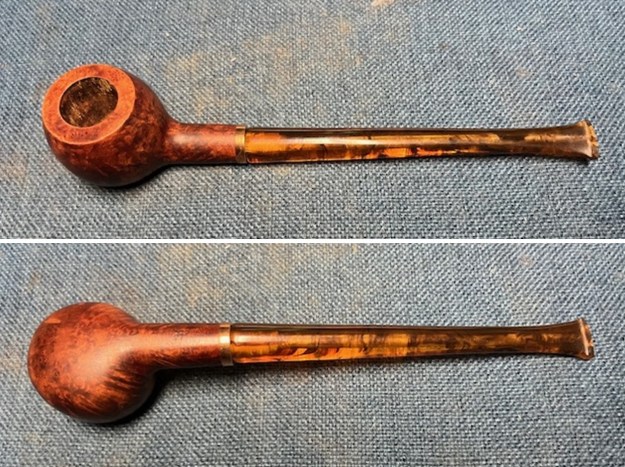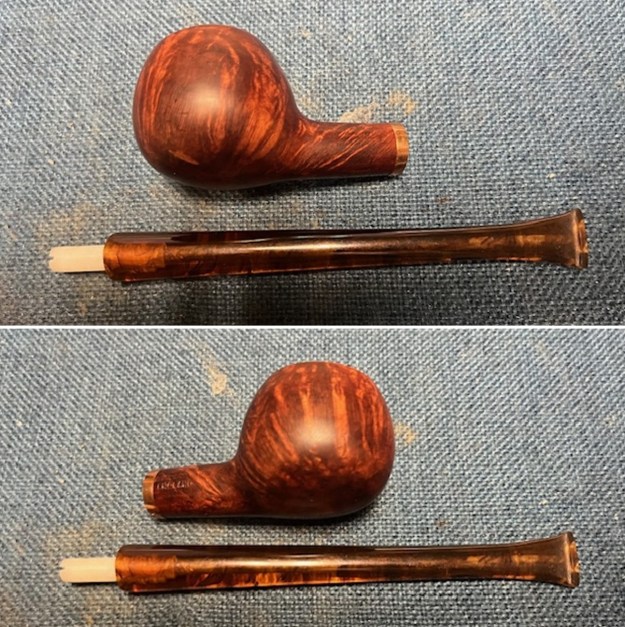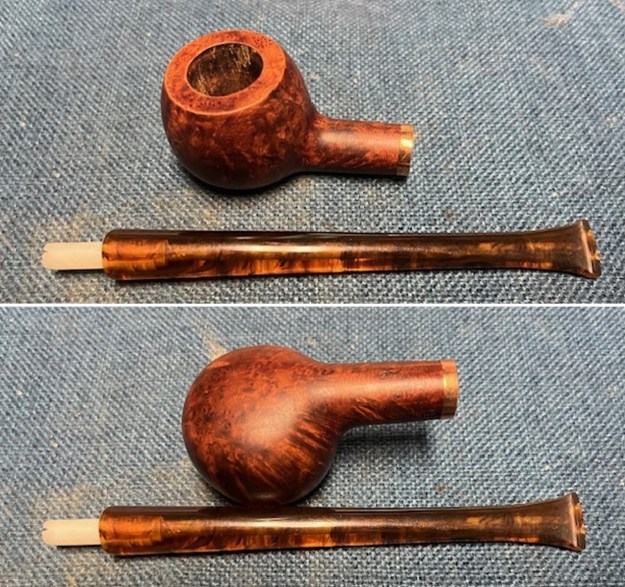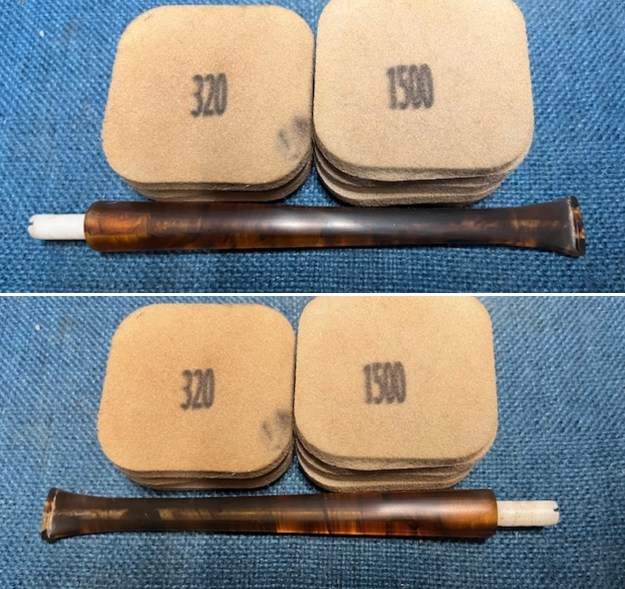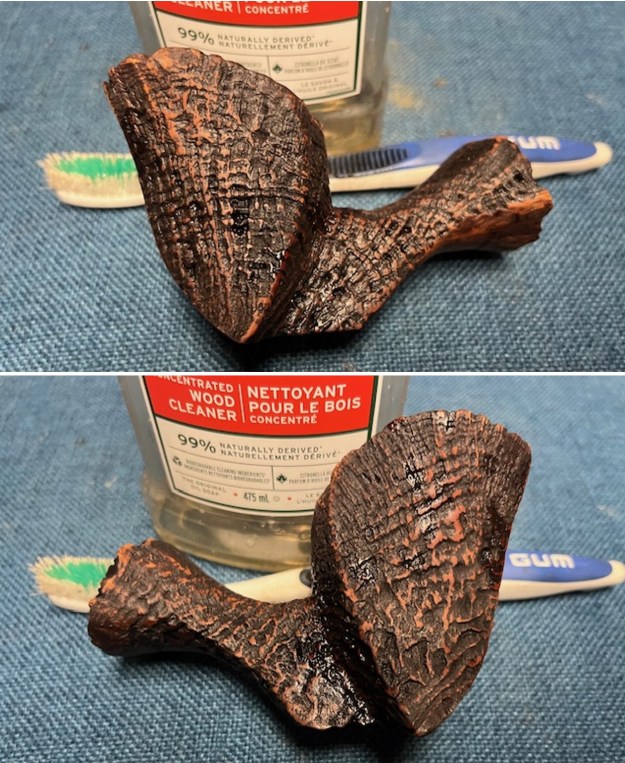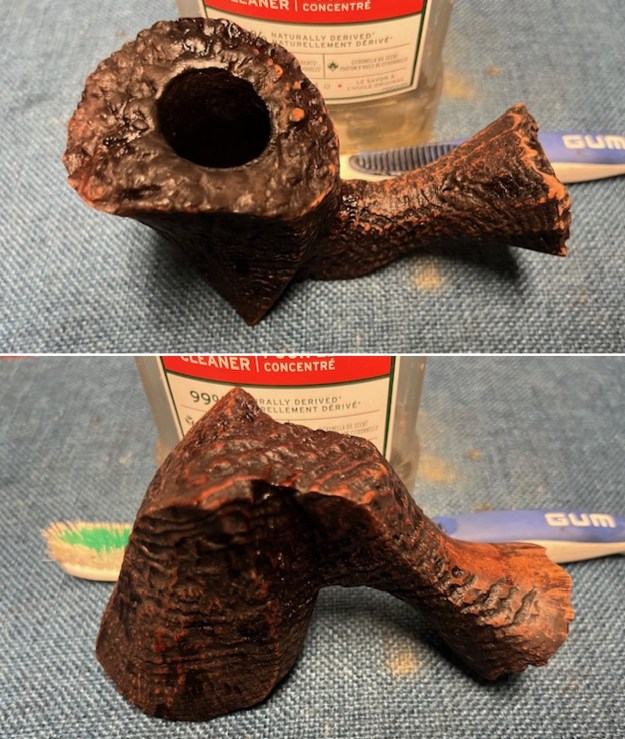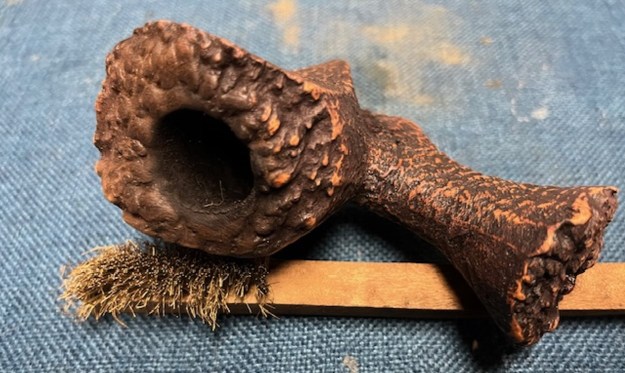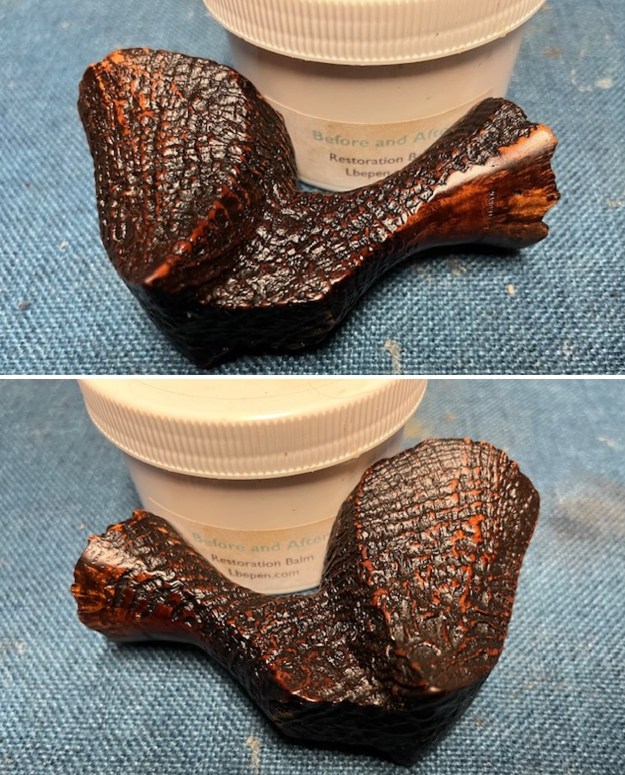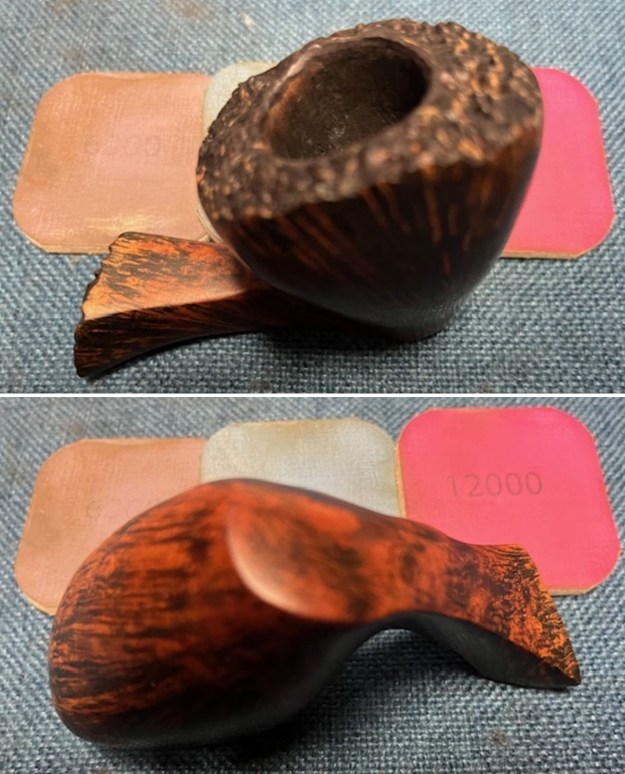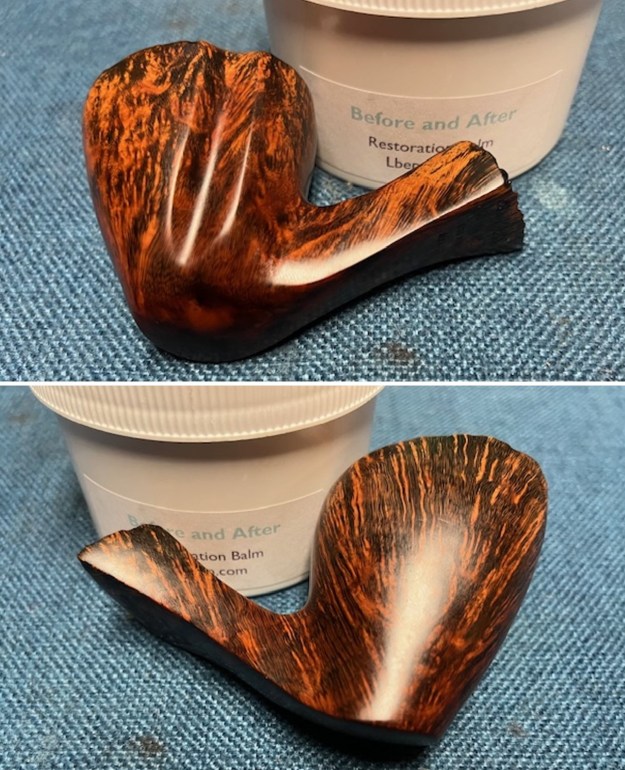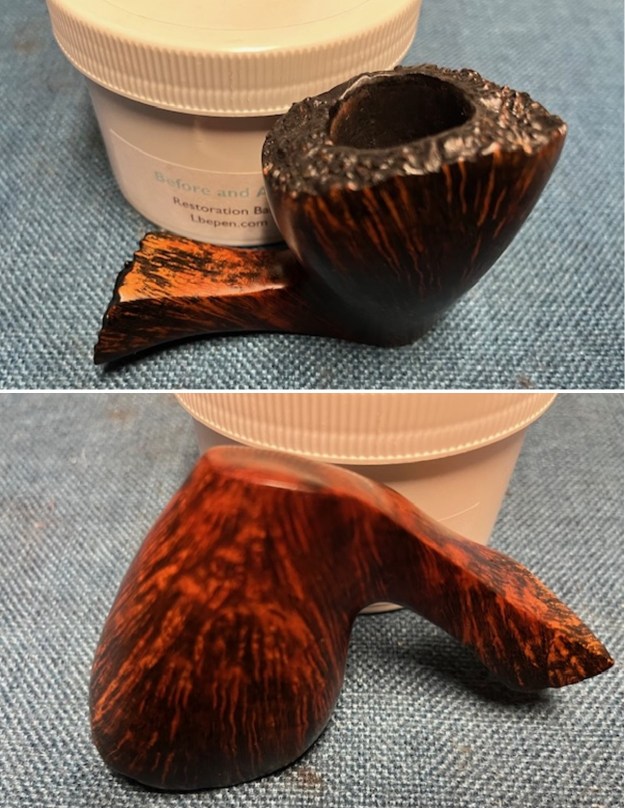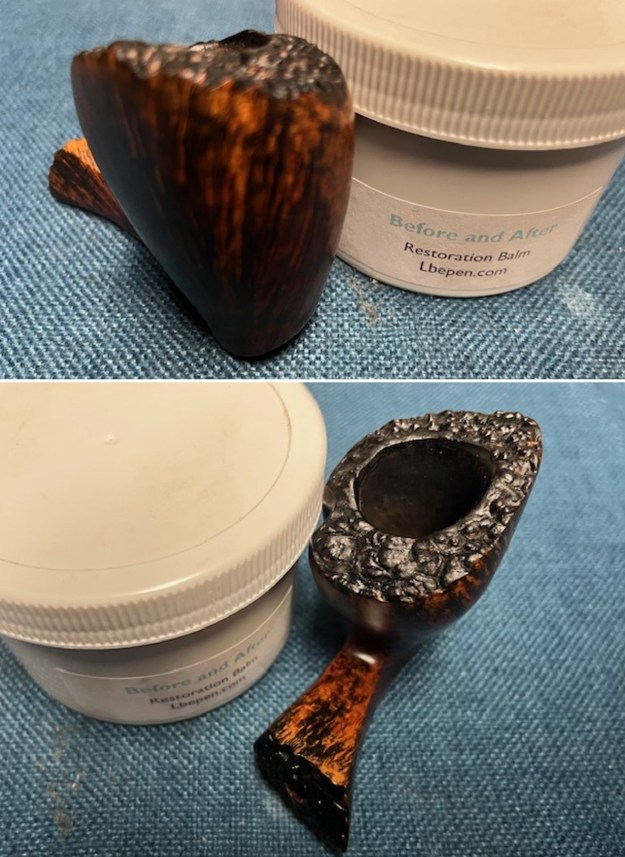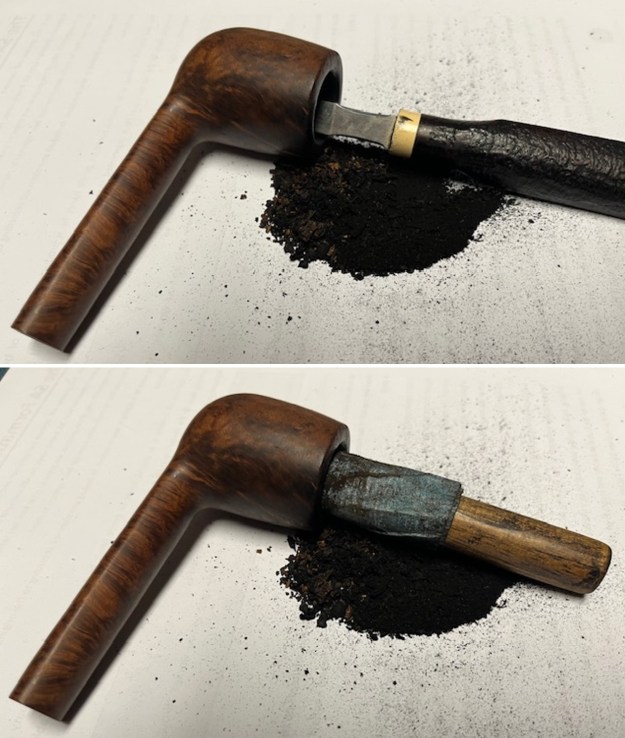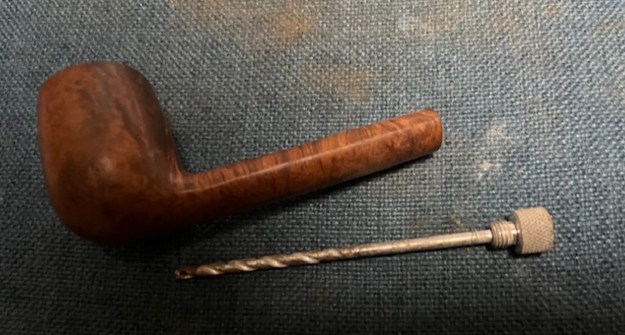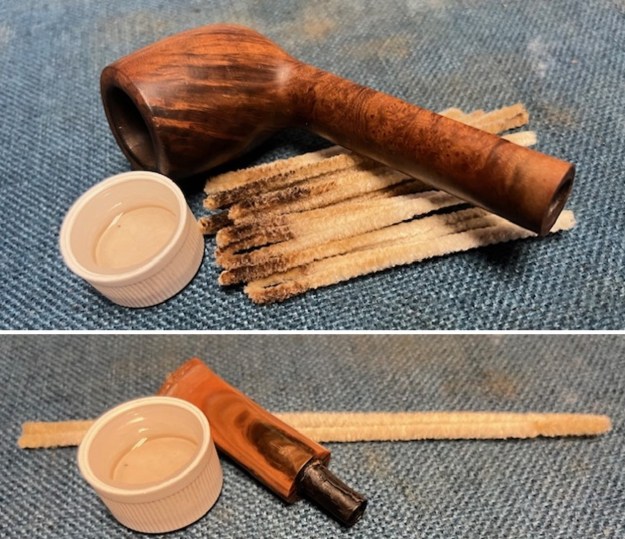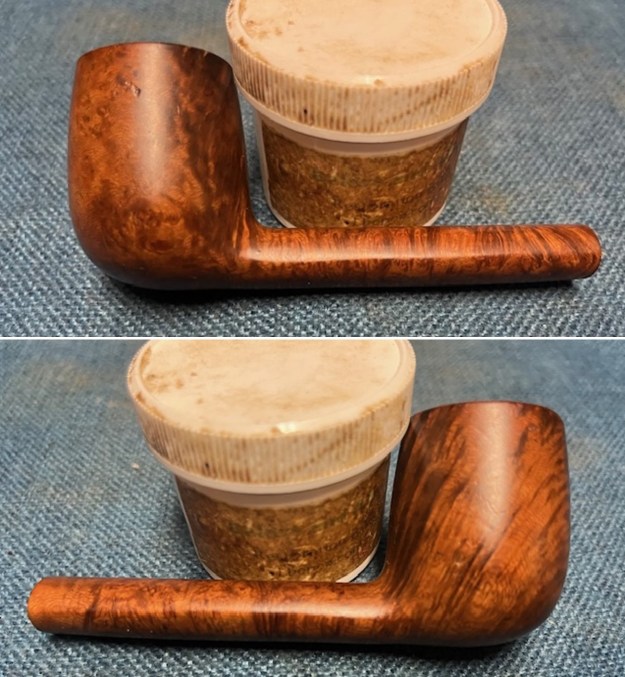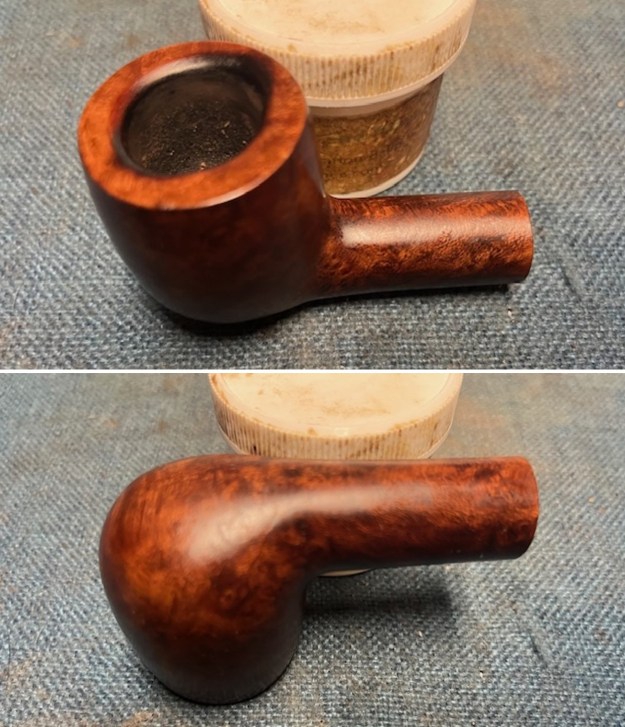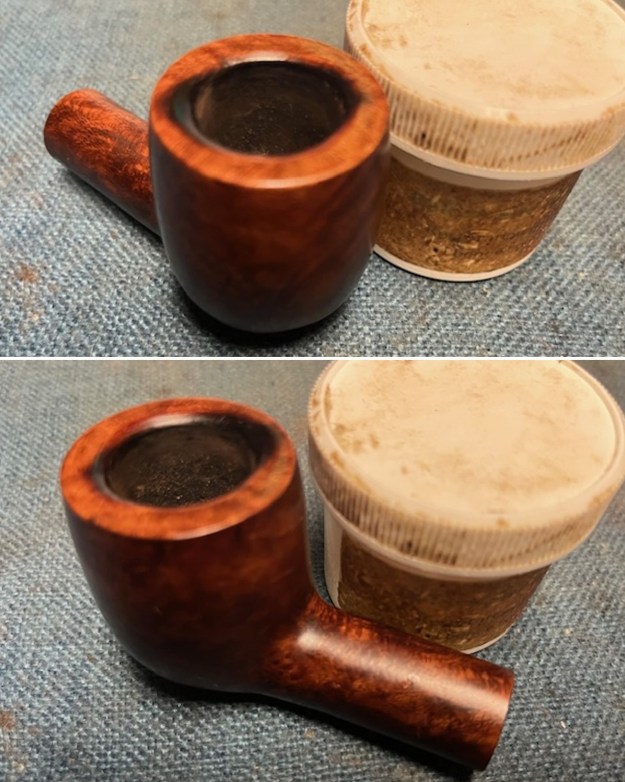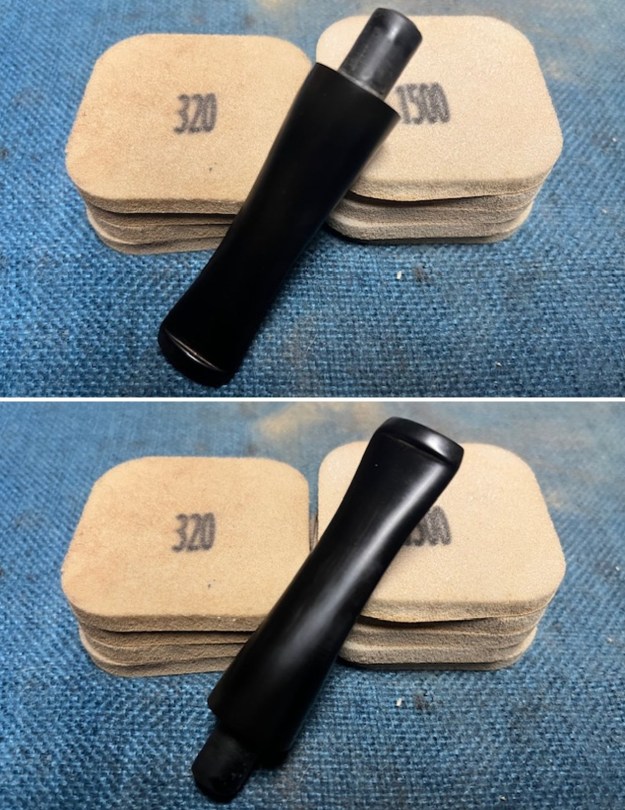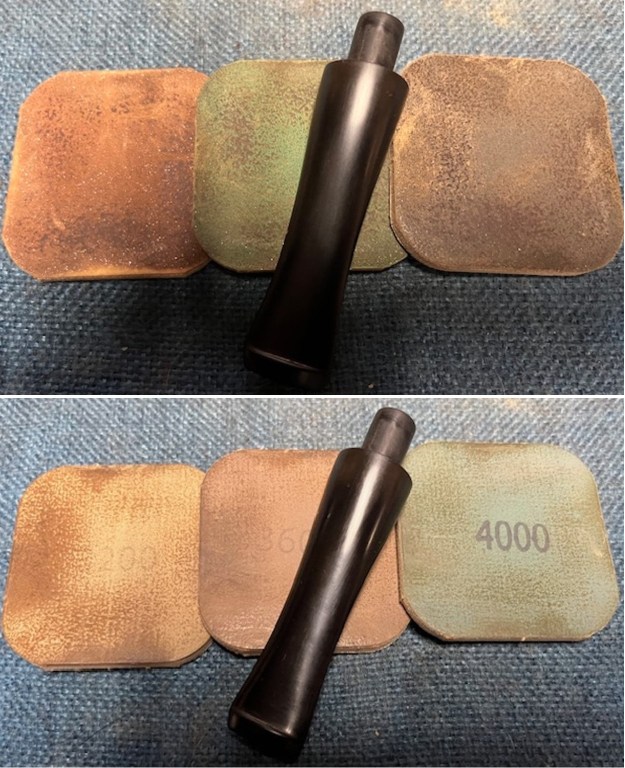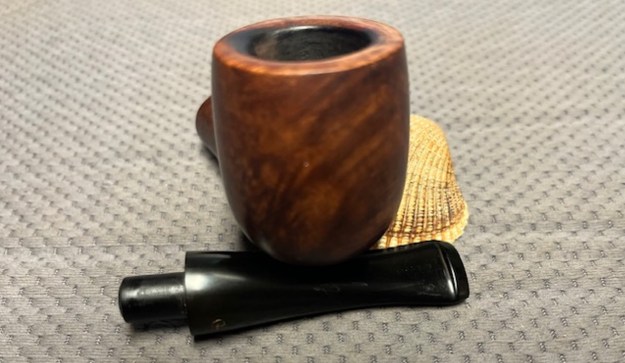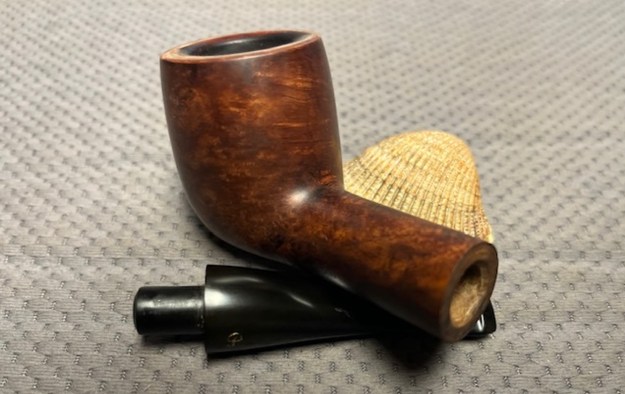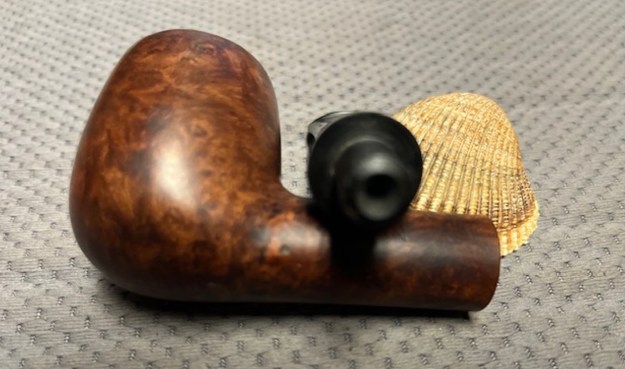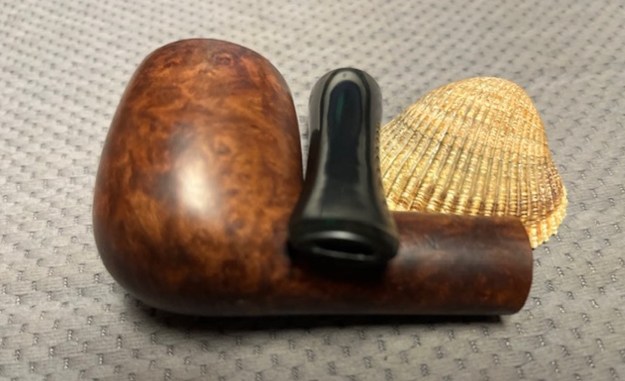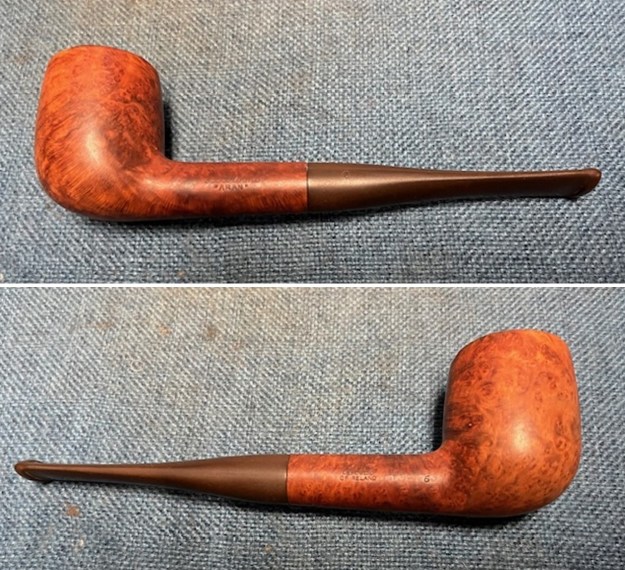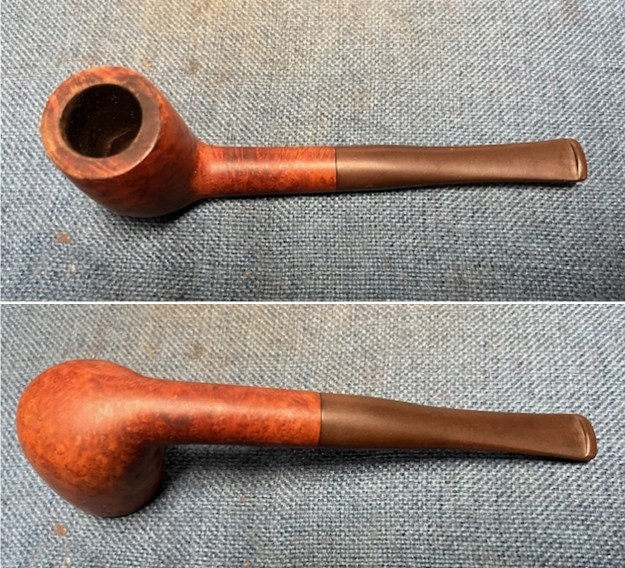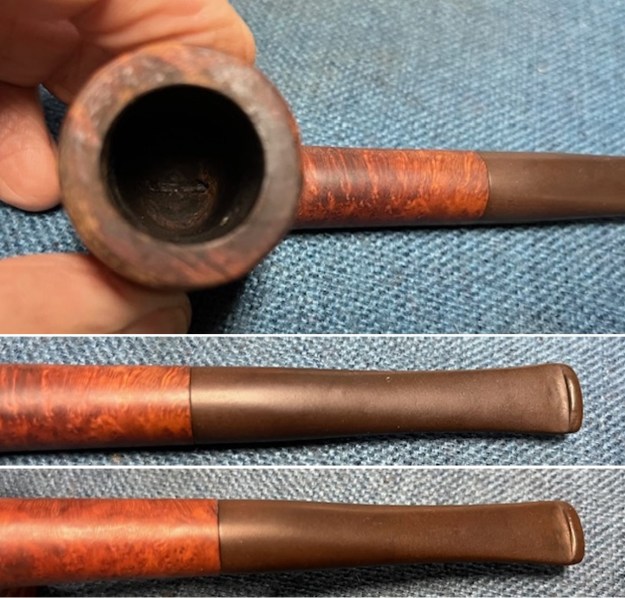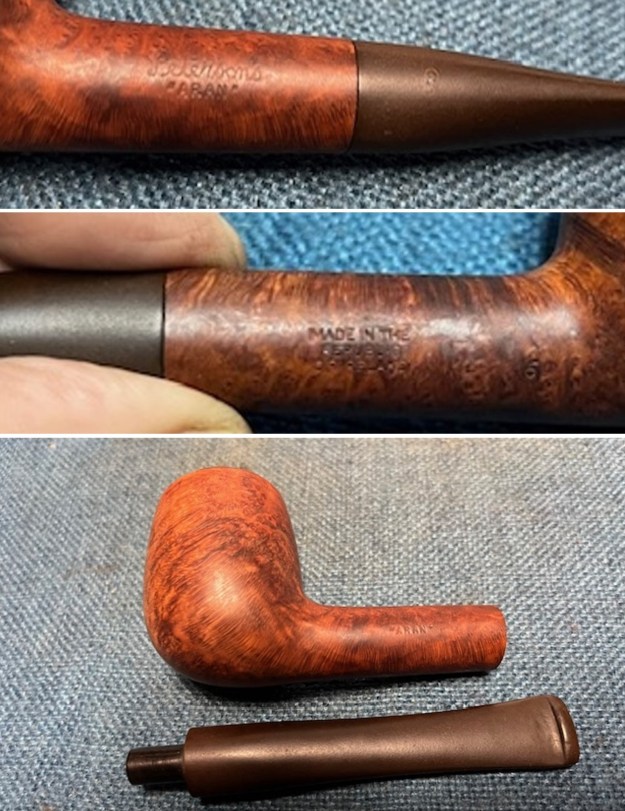
Tag Archives: vulcanite

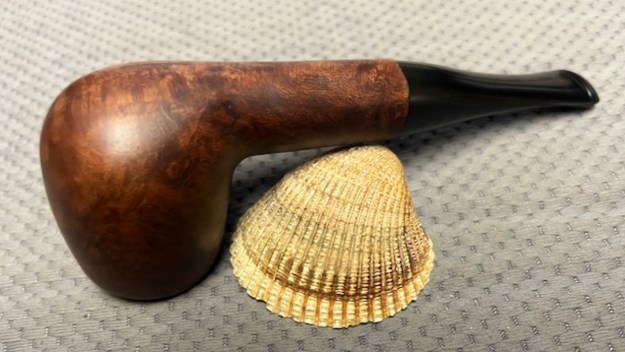
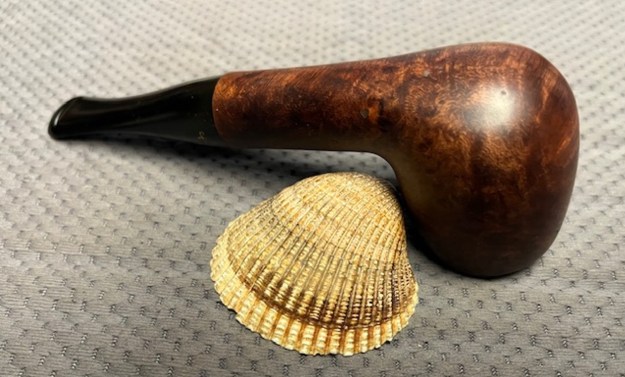
Restoring the last of 11 pipes sent for restoration – a Bertram 30 Bent Billiard


by Steve Laug

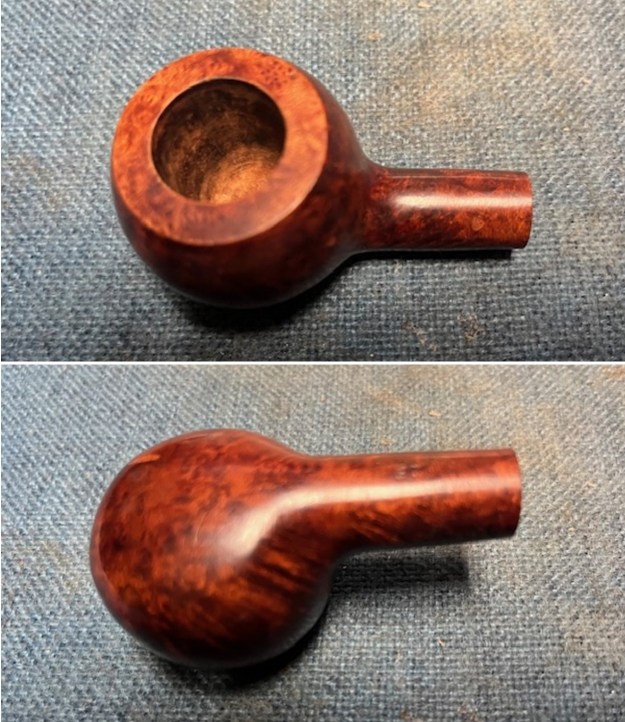
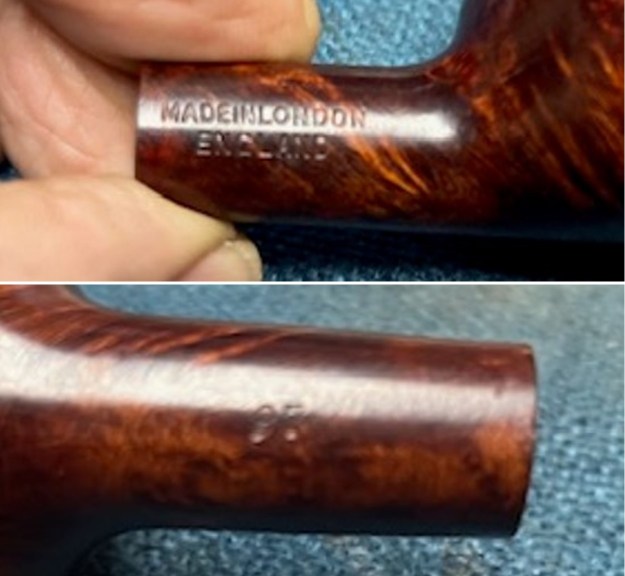
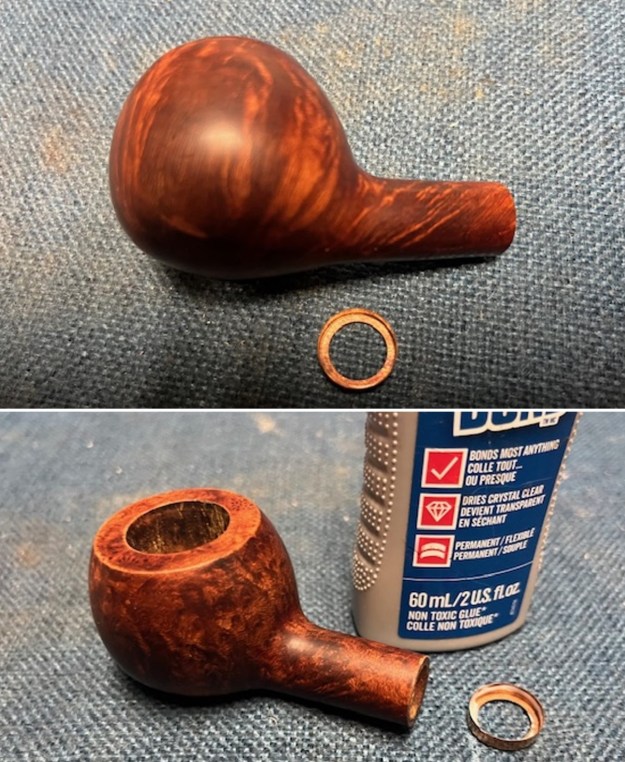
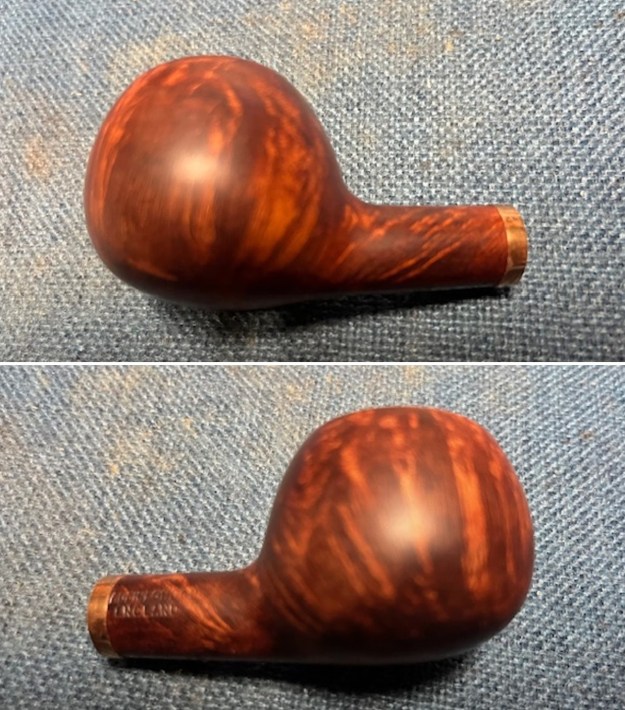
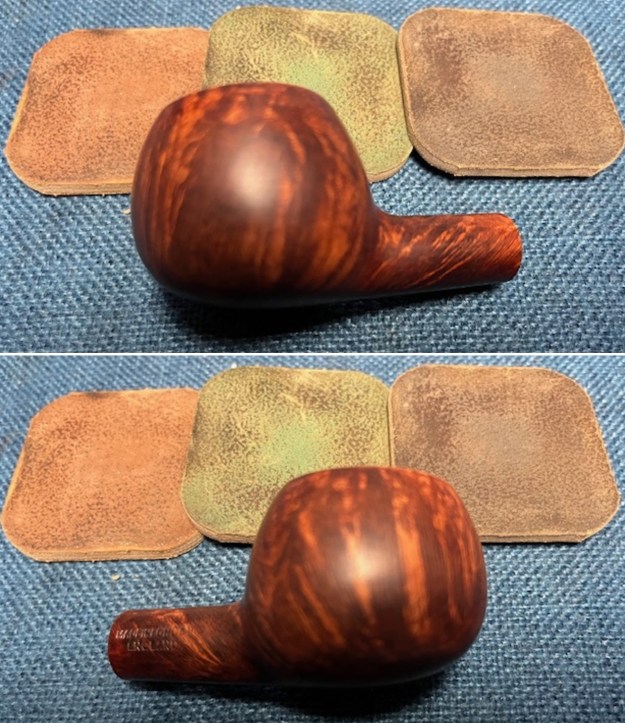
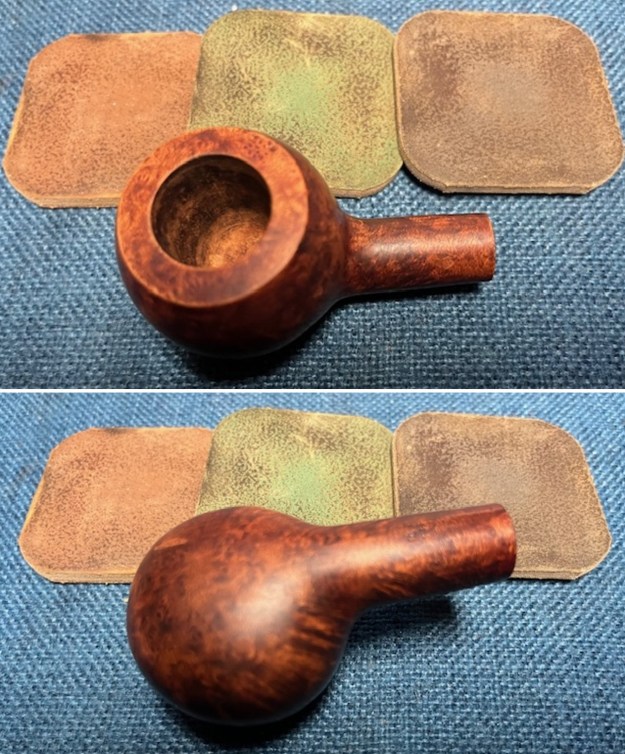
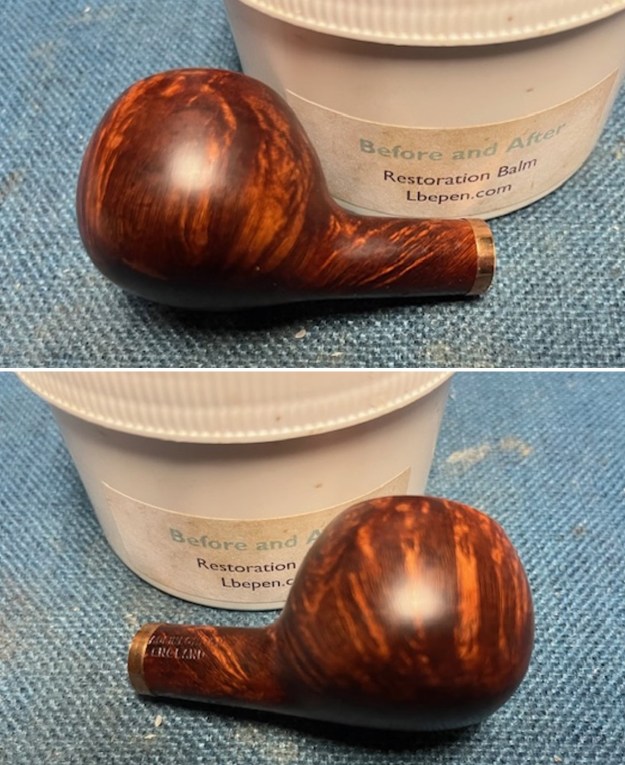
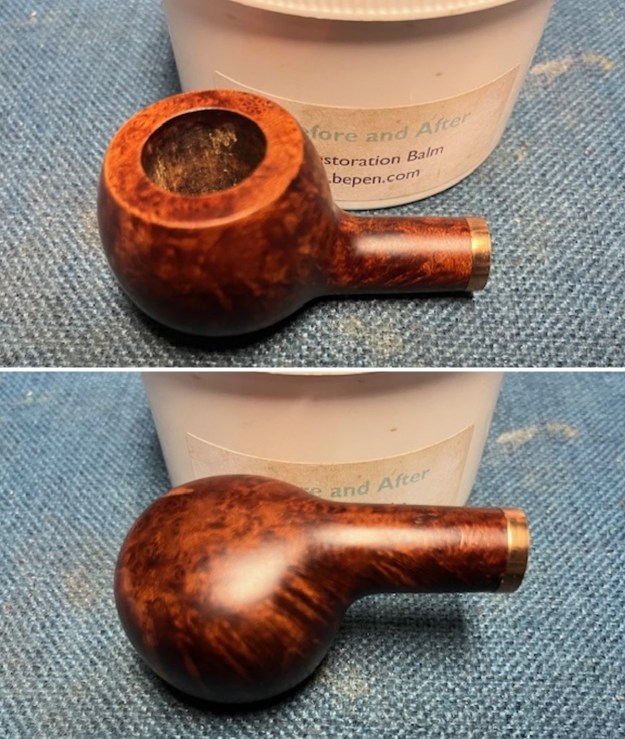
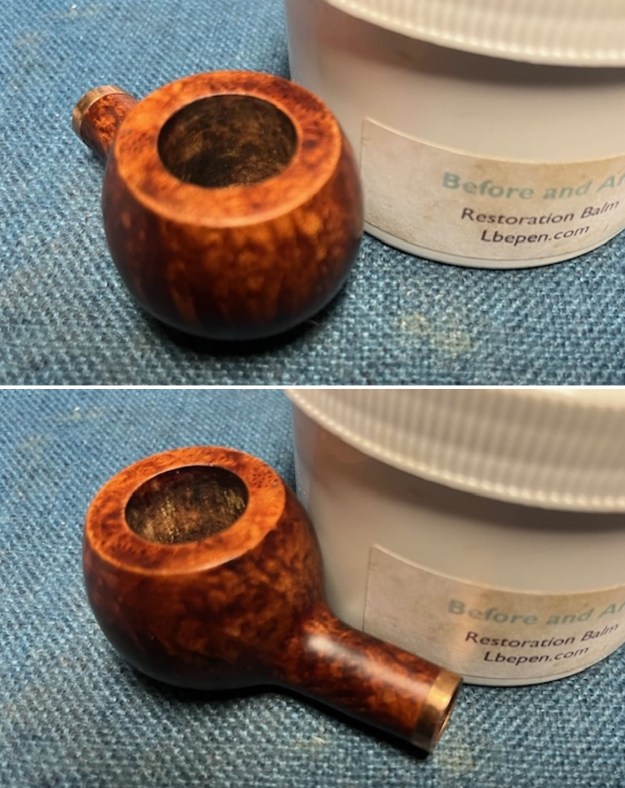
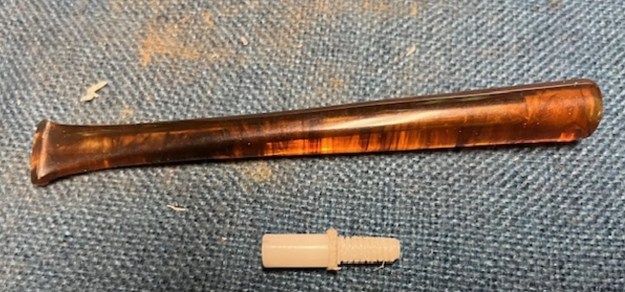
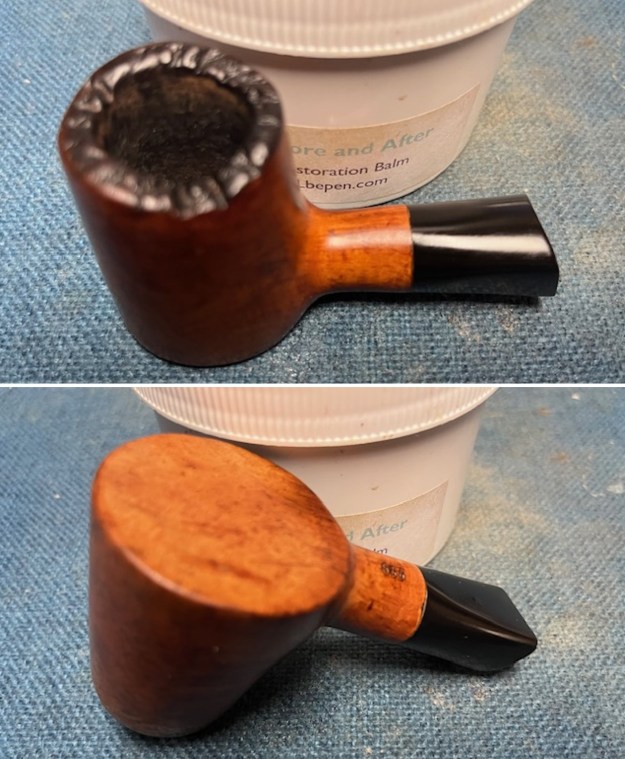
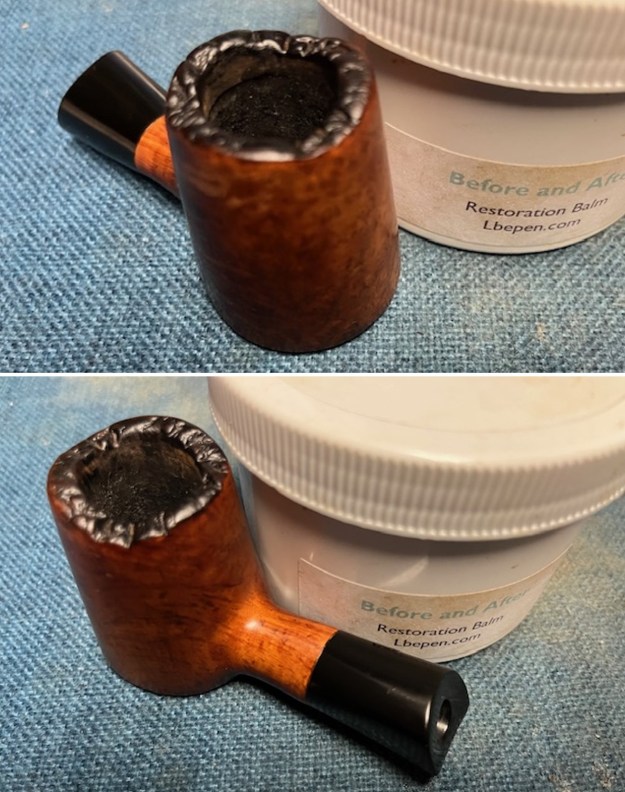
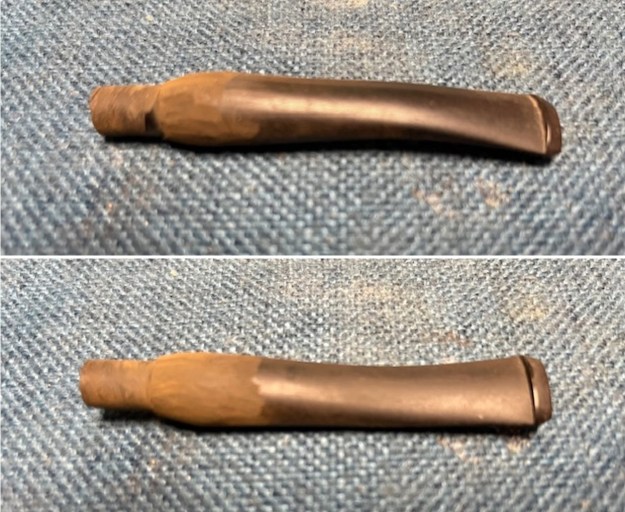
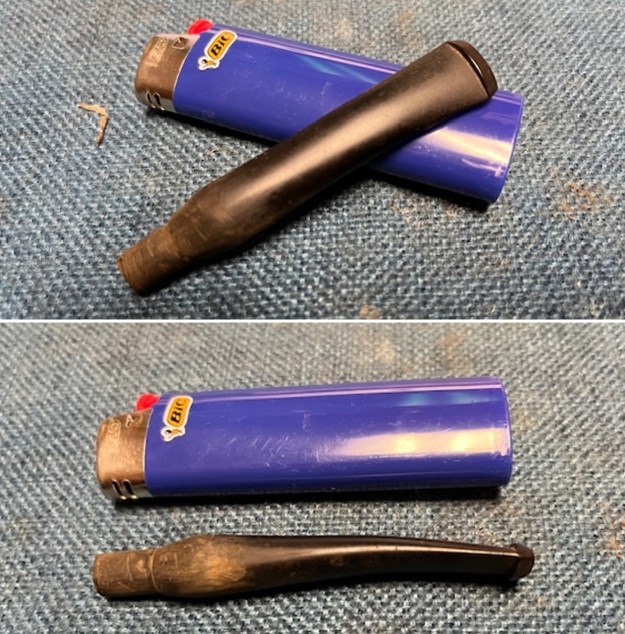
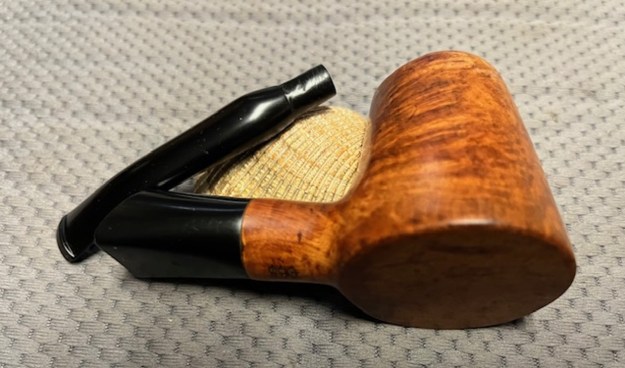
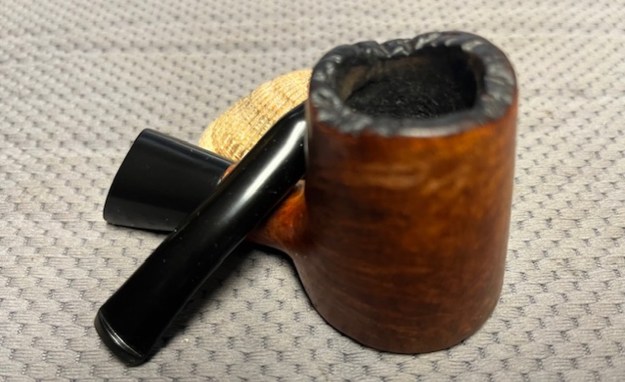
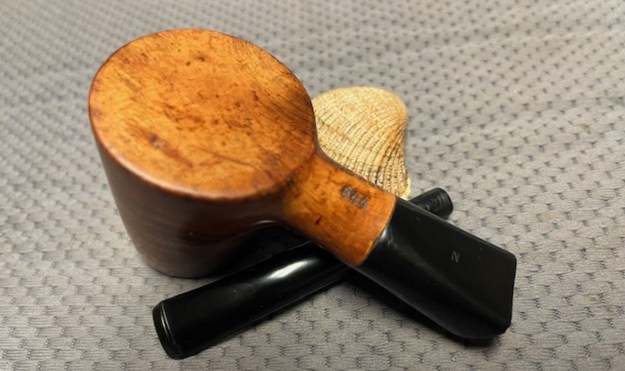
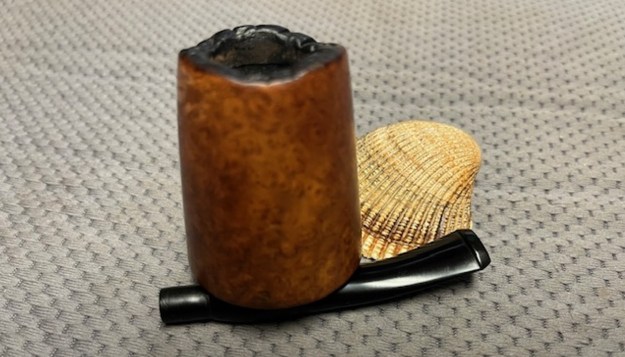
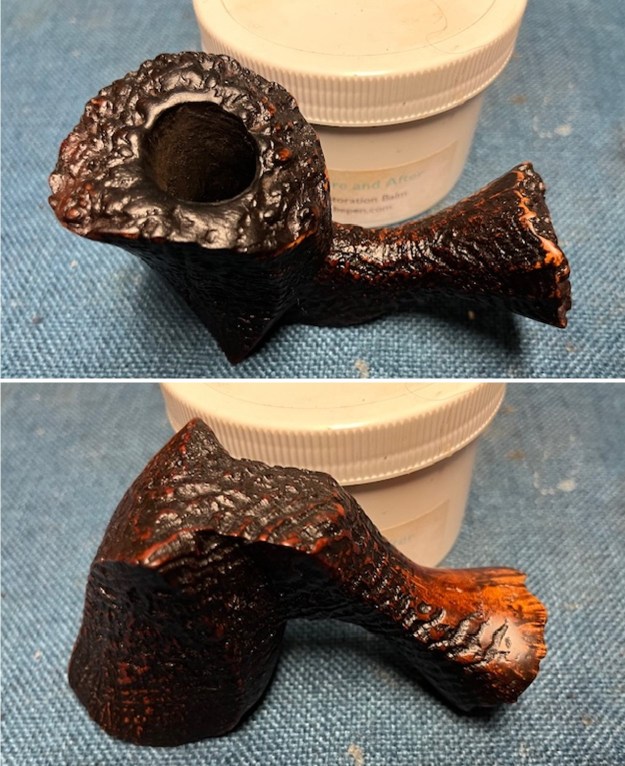
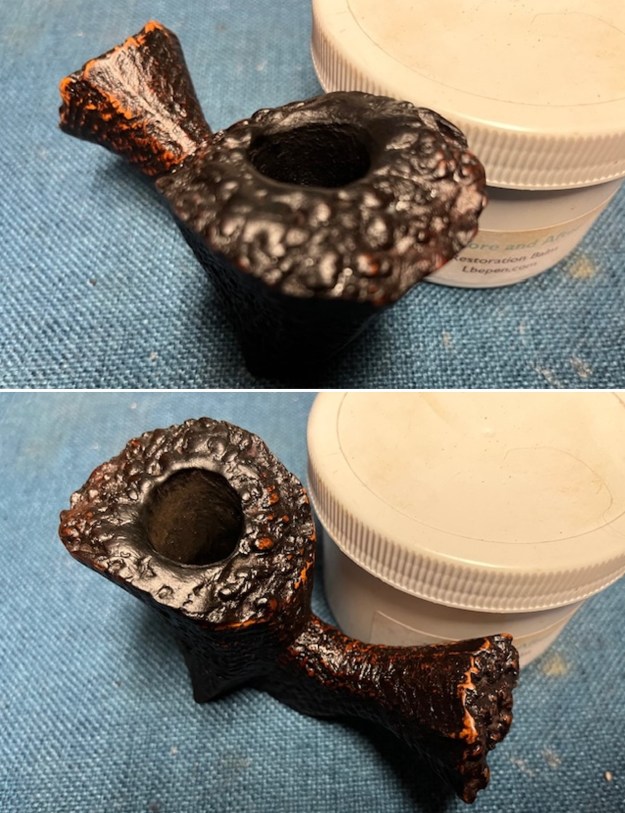
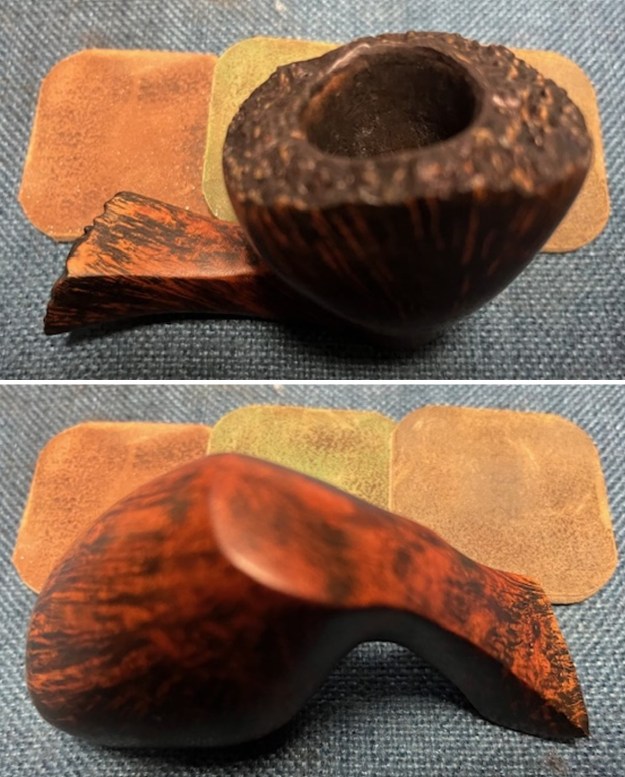
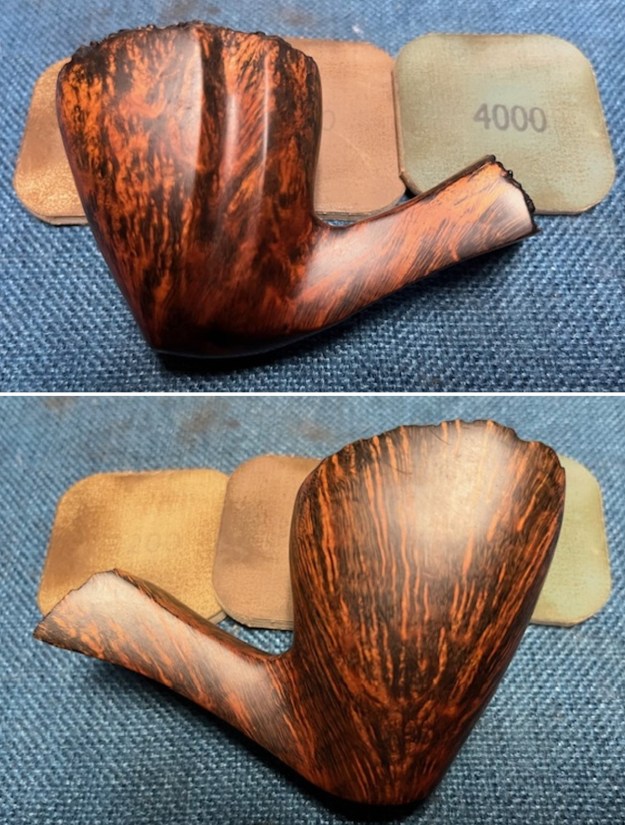
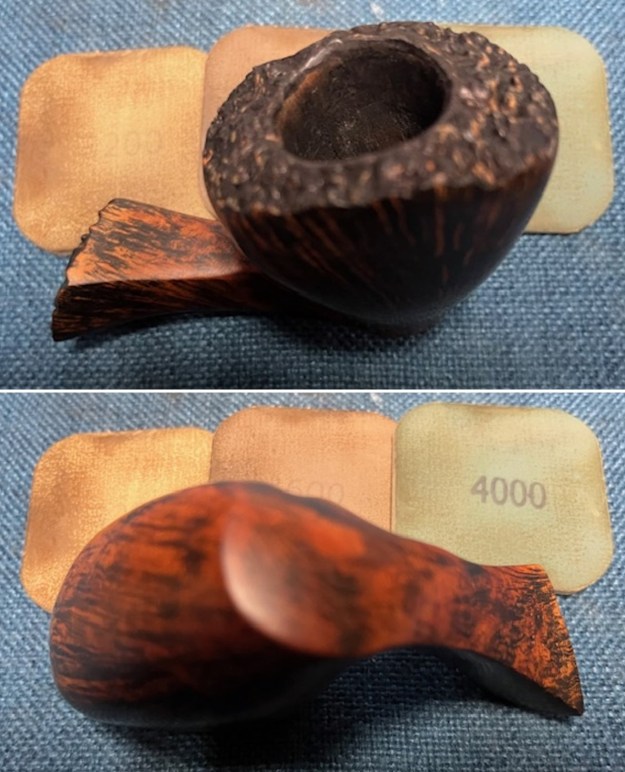
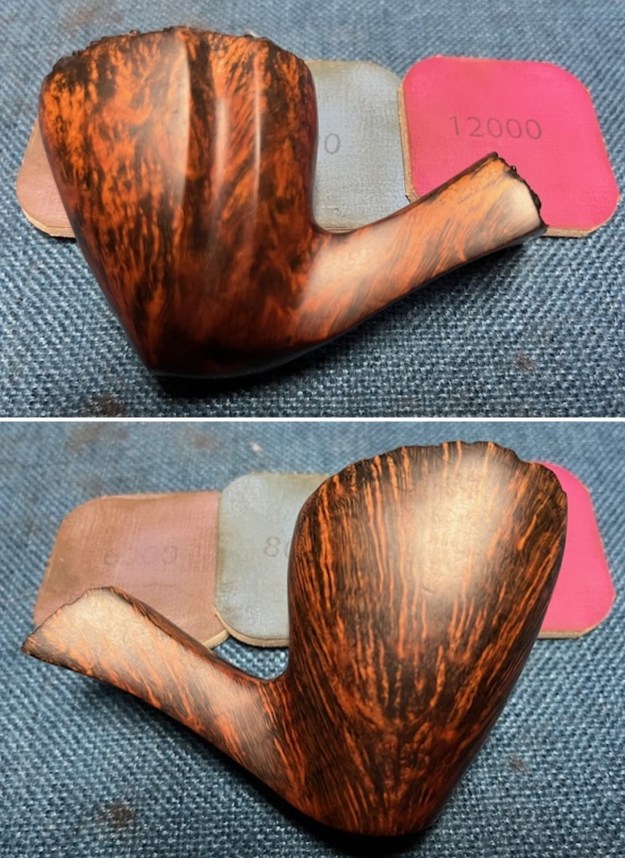
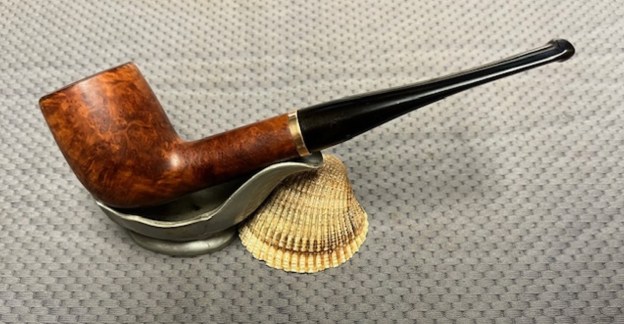
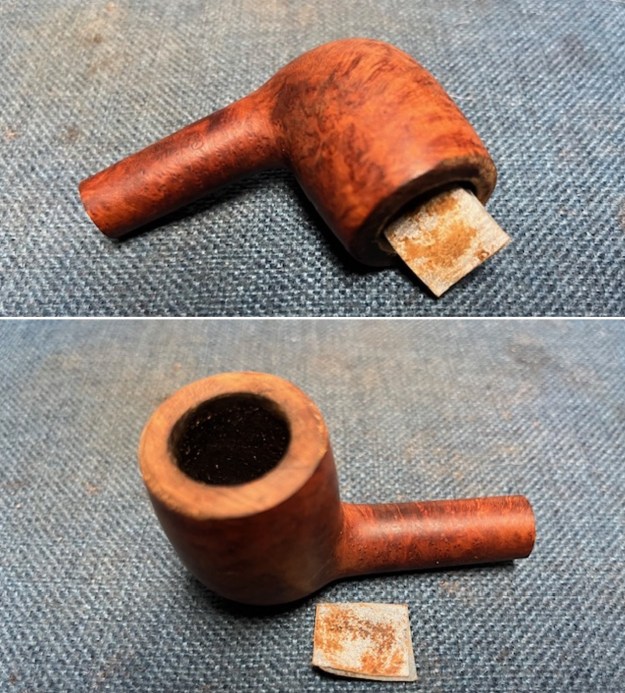
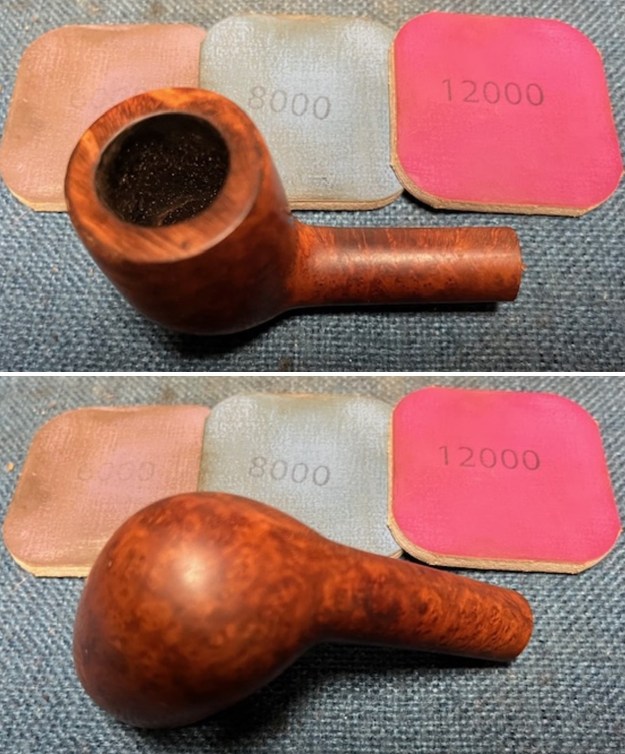
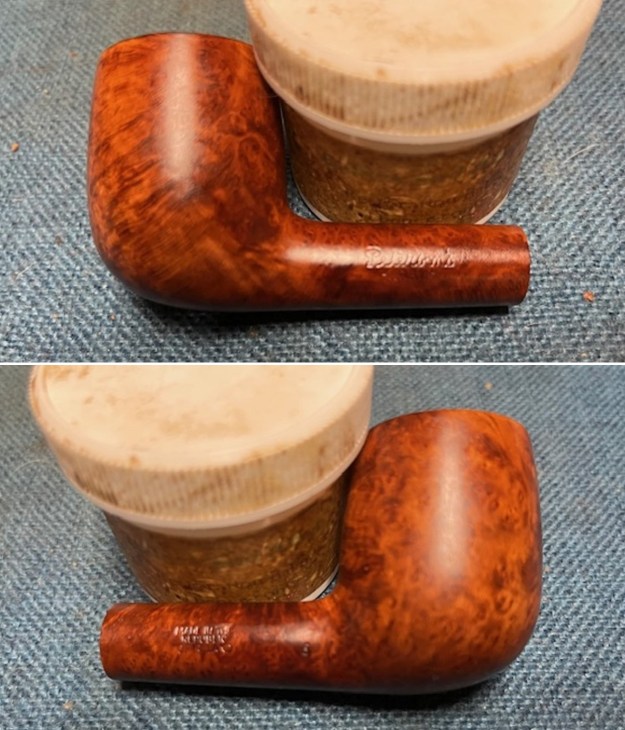
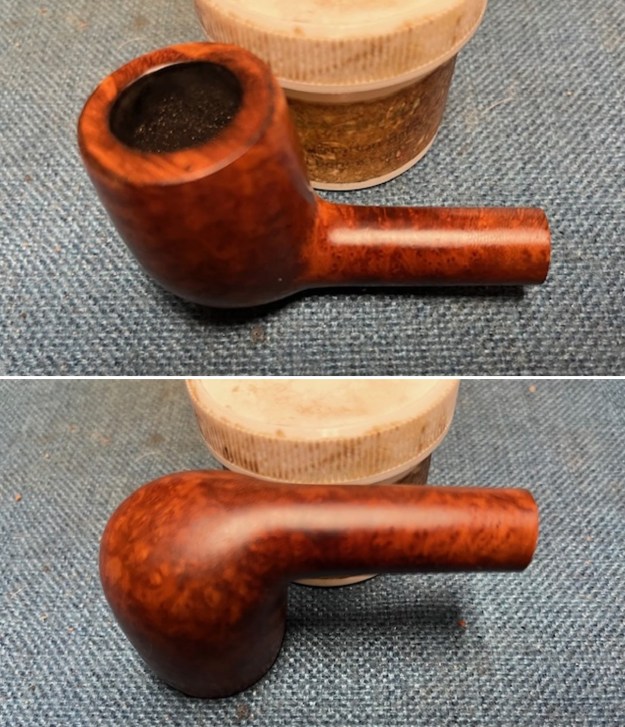
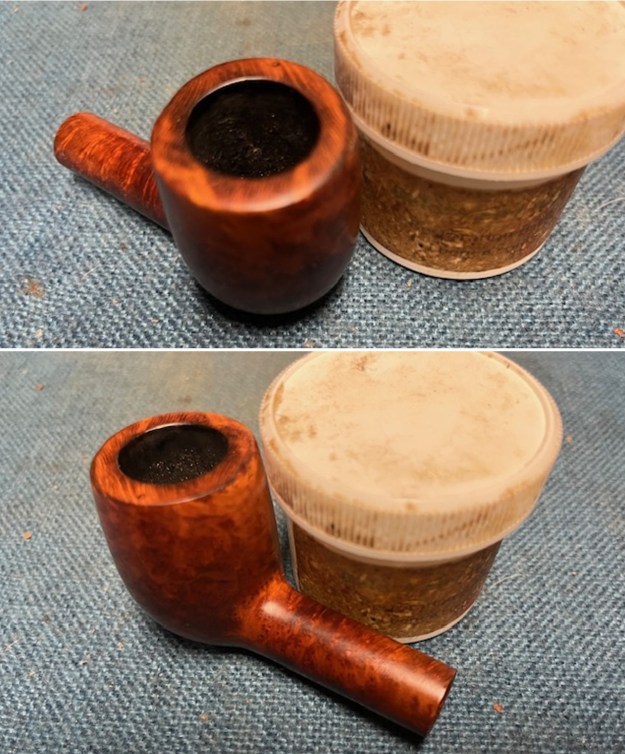
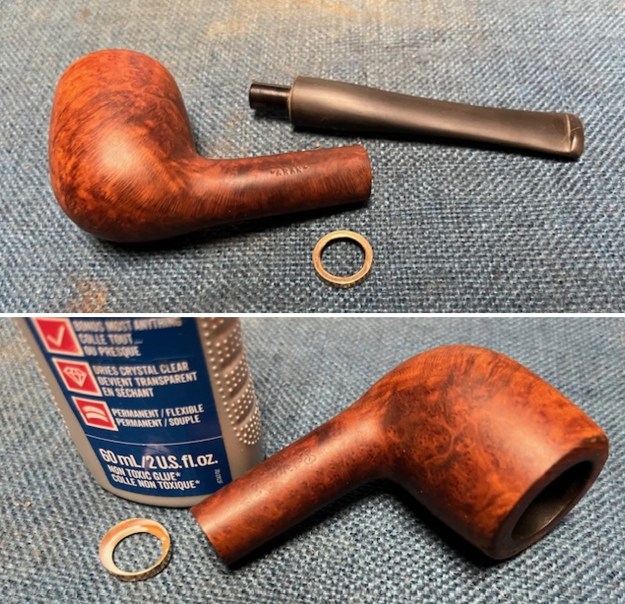
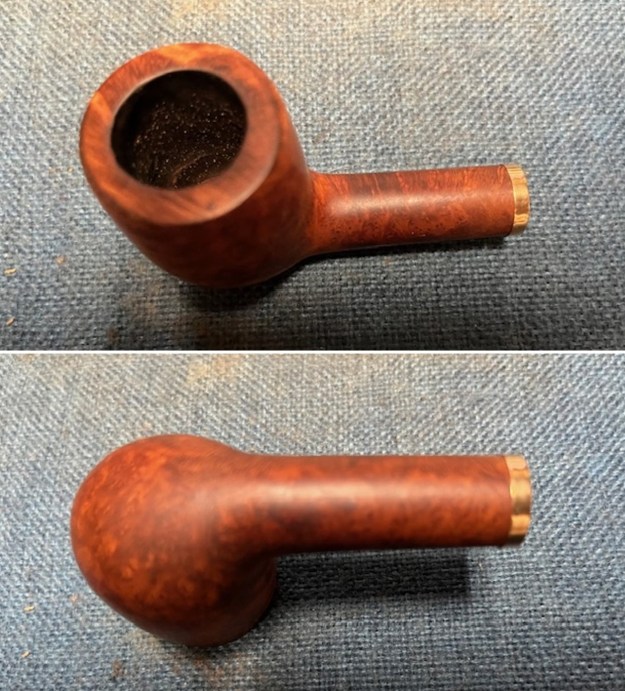
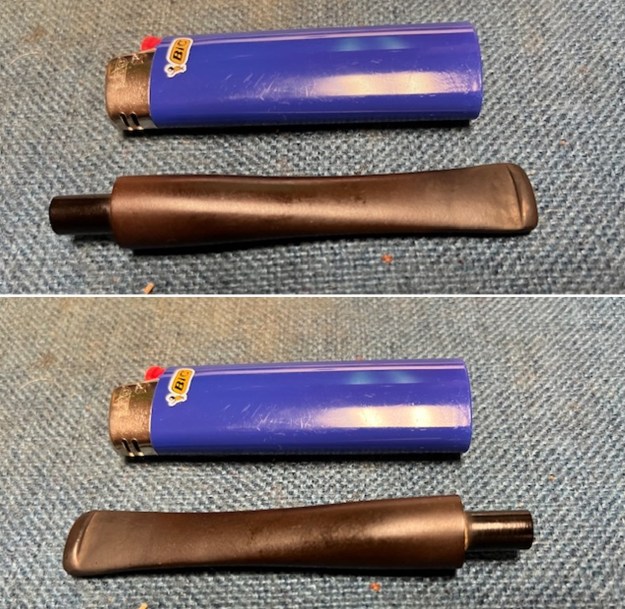
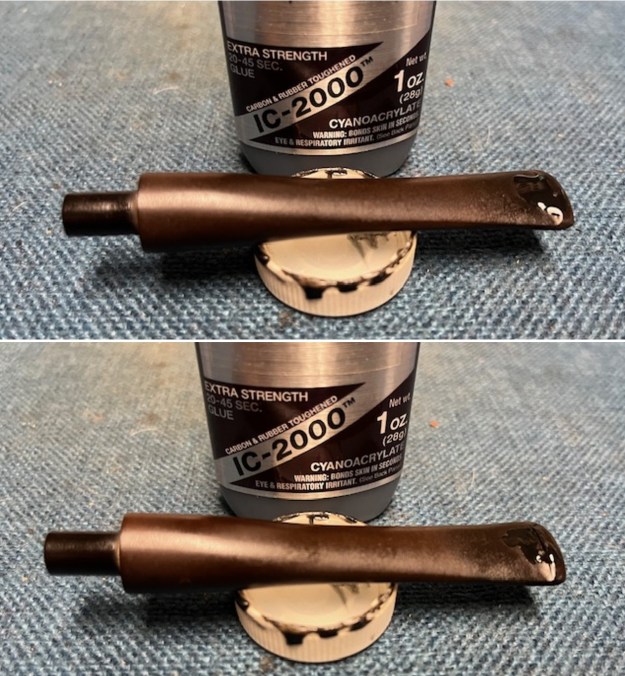
A while back I was asked by a customer and friend, Jack to take on some projects for him. I have worked on a few pipes for him over the years so we seem to have a standing agreement that I will clean up his pipes. This time he sent a batch containing 11 pipes (actually as mentioned on the last pipe I can’t count) but going over it again I found I was right the first count. There were six Bertrams, an Arlington, a GBD, an old WDC Triangle Bakelite, Citation in need of a stem and one marked Texaco. All of them were in various conditions and would need different types of work. I took a photo of the pipes before I started working on them.The last pipe I had to work on was a Bertram Bent Billiard that needed to be cleaned up and restored. This last one is from Jack’s 11 pipes – a dirty, dull Bertram with an oxidized tapered vulcanite stem that I swapped with a straight billiard. The pipe is stamped on the left side and reads Bertram [over] Washington D.C. centered on the shank. There is a shape number 30 on the underside of the shank. The finish had a lot of grime ground into the bowl and some nicks and flaws where the fills were shrunken or broken around the sides. The bowl was moderately caked with a light lava coat on the top of the rim, heavier toward the back of the bowl. The edges looked okay other than some potential damage on the back inner edge. The new stem was calcified, oxidized, dirty and had tooth chatter and marks on the top and underside ahead of the button. The photos show the condition of the stem surface. There were no markings or a logo on the taper stem. Like the rest of the Bertrams that Jack sent, this one had promise but it was very dirty. I took photos of the pipe before I started his cleanup work. I took photos of the rim top and the stem to show the condition. You can see the cake in the bowl and overflow of lava on the rim top. The photos of the stem show the calcification, tooth marks and chatter on the top and underside of the stem and the button. I took photos of the stamping on the left and underside of the shank to capture it. The Bertram stamp was clear and readable as noted above. Once restored again it will have a long life ahead of it. I removed the stem and took a photo of the parts to give a sense of the look of the pipe.As I have worked on a lot of Bertram pipes in the past, I have written on the brand and have included the following information. If you have read it in past blogs, you can skip over it. If you have not, I have included the link to Bertram history and information. I would recommend that if you don’t know much about them take some time to read the background. I include a link to the write up on Pipedia (http://pipedia.org/wiki/Bertram). Bertram pipes were based out of Washington DC. They were popular among famous politicians and celebrities of the time. They made many products for them from FDR’s cigarette holders to Joseph Stalin’s favorite pipe. They were considered some of the best America had to offer till they finally closed their doors in the 70s. Bertram graded their pipes by 10s and sometimes with a 5 added (15, 25, 55 etc.), the higher the grade the better. Above 60s are uncommon and 80-90s are quite rare. I have worked on one 120 Grade billiard. I have several blogs that I have written on rebornpipes that give some history and background to Bertram pipes. (https://rebornpipes.com/2015/06/16/an-easy-restoration-of-a-bertram-grade-60-217-poker/).

I have included the following link to give a bit of historical information on the pipe company. It is a well written article that gives a glimpse of the heart of the company. http://www.streetsofwashington.com/2012/01/bertrams-pipe-shop-on-14th-street.html#

From this information I learned that all of these Bertrams were made before the closure of the shop in the 1970s. This Bertram Bent Billiard has some mixed grain around the bowl. This pipe has a Grade 30 stamp on it. But like many of these Bertrams the Grading system is a mystery to me.

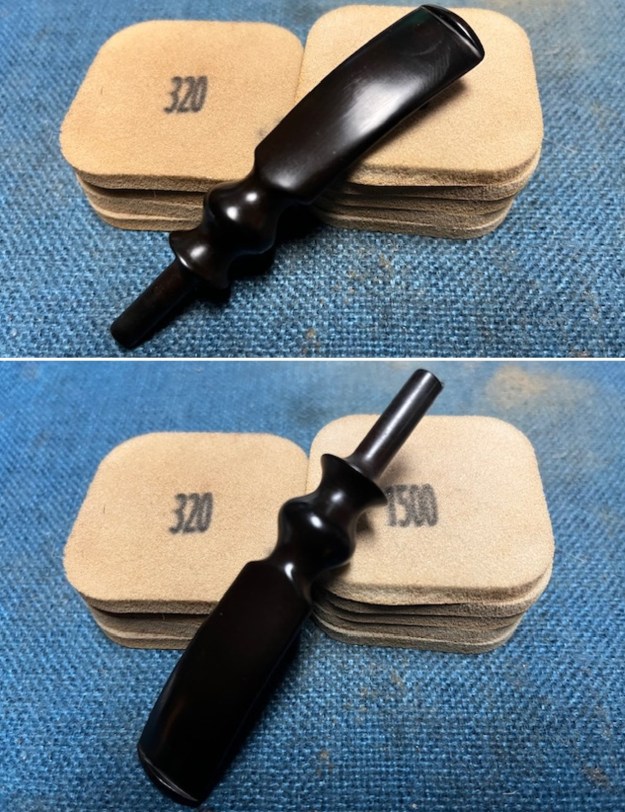
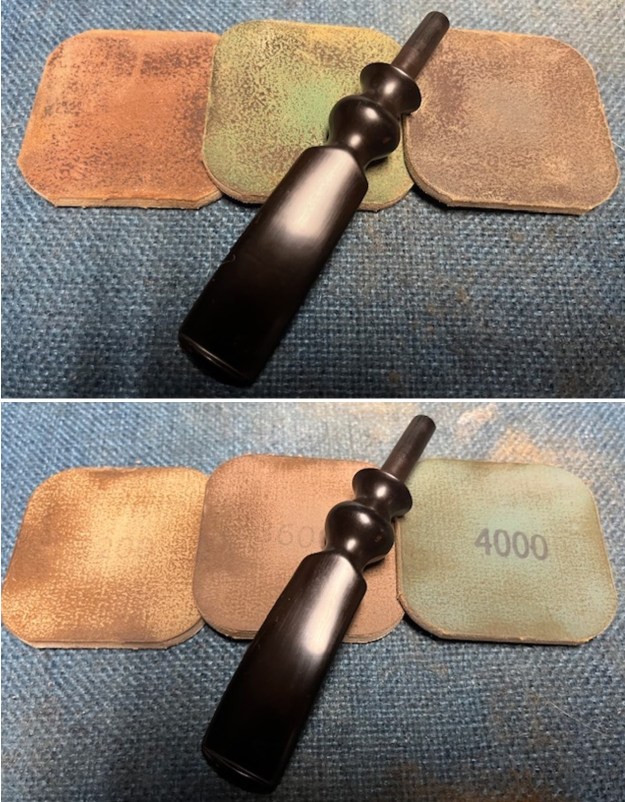
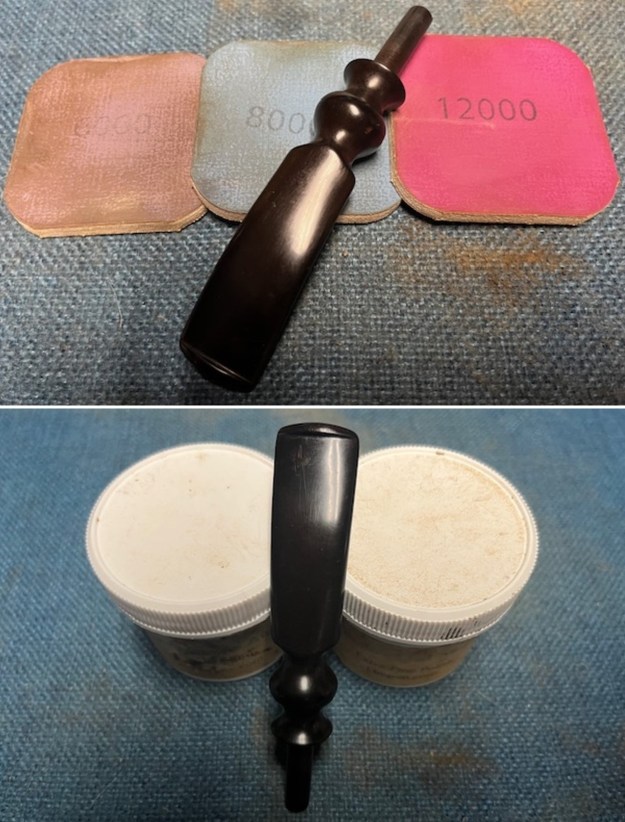
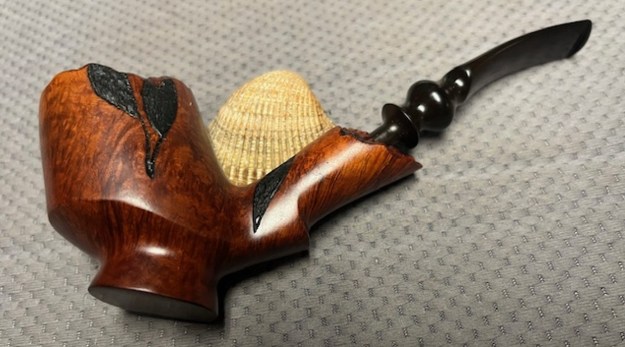
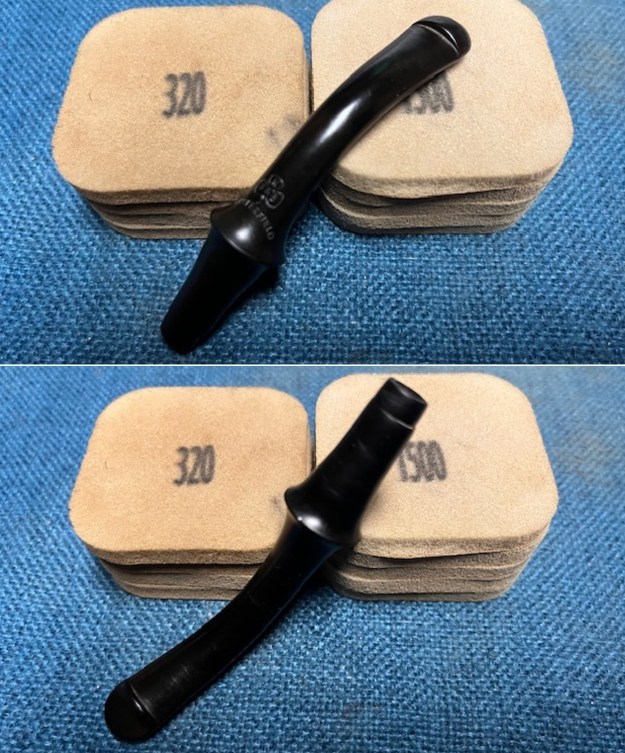
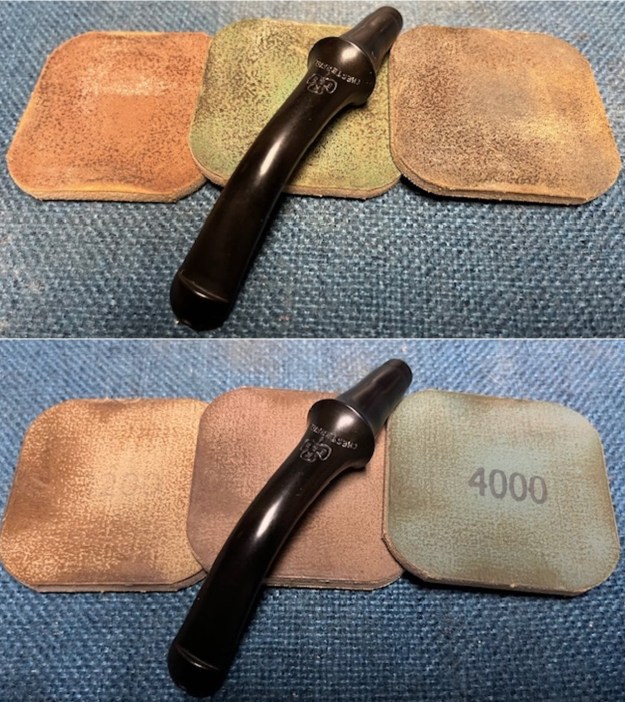
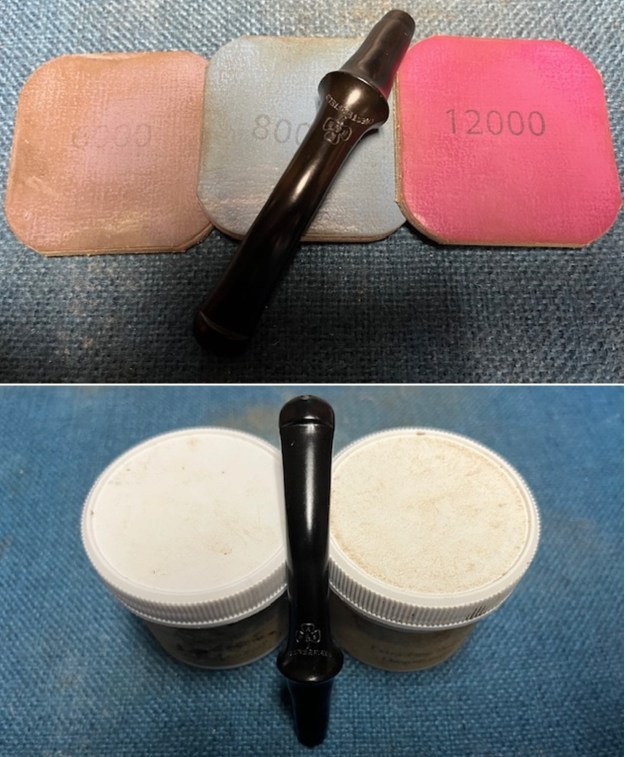
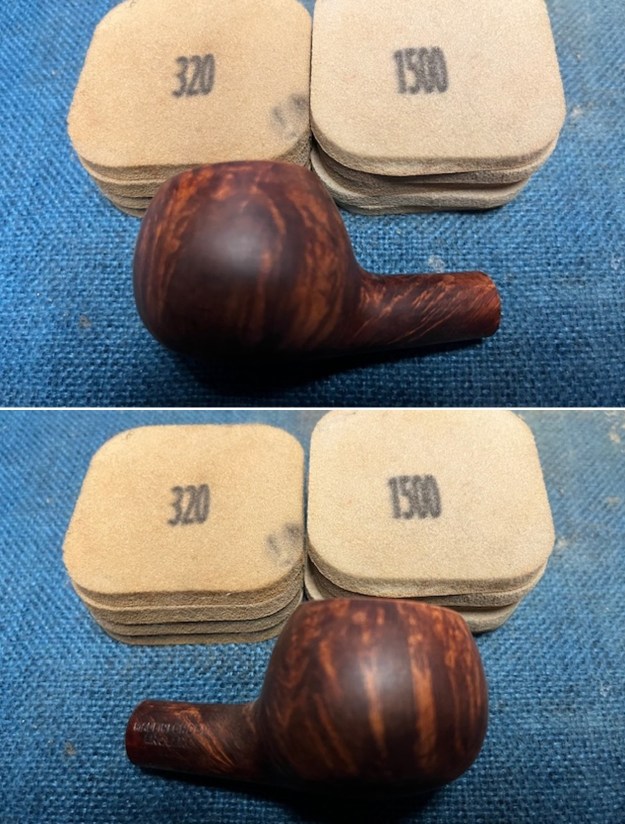
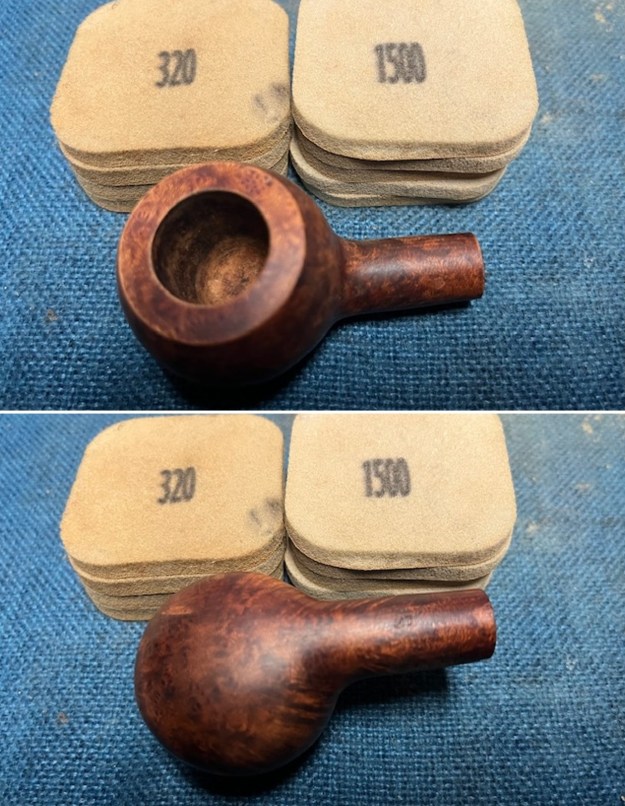
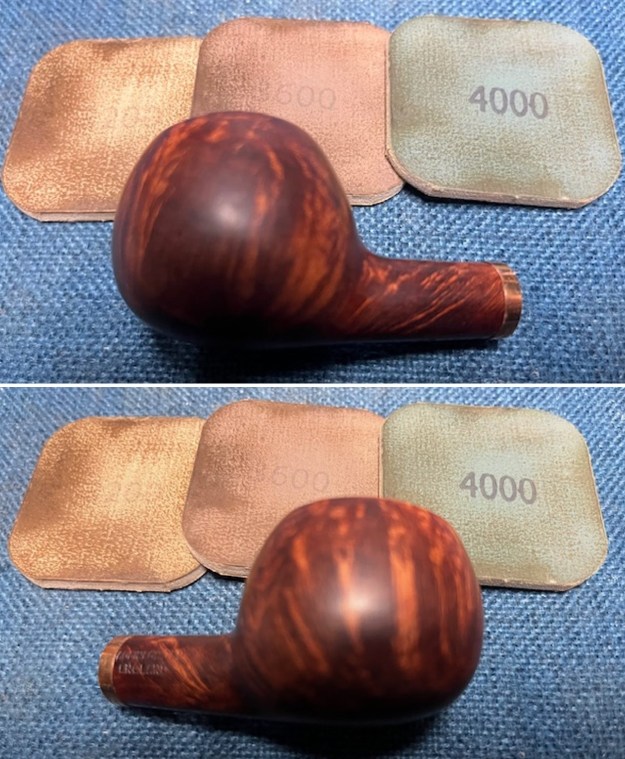
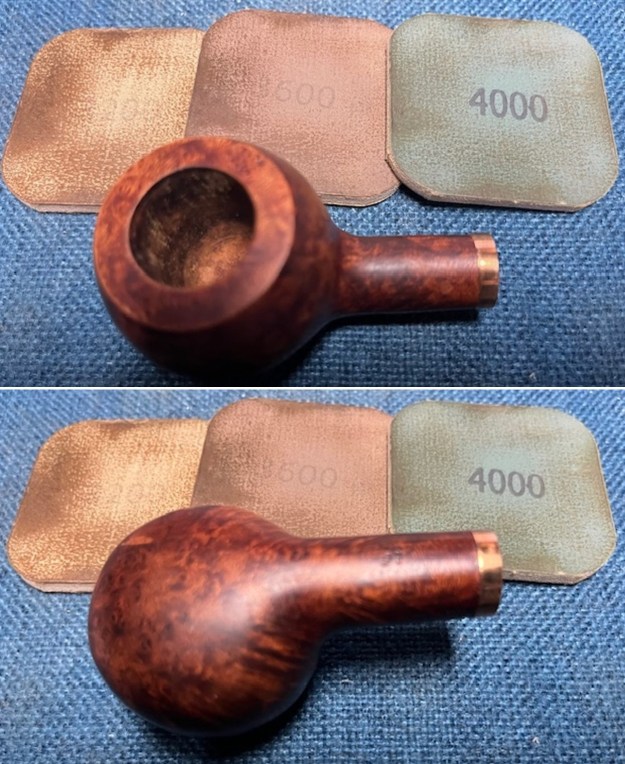
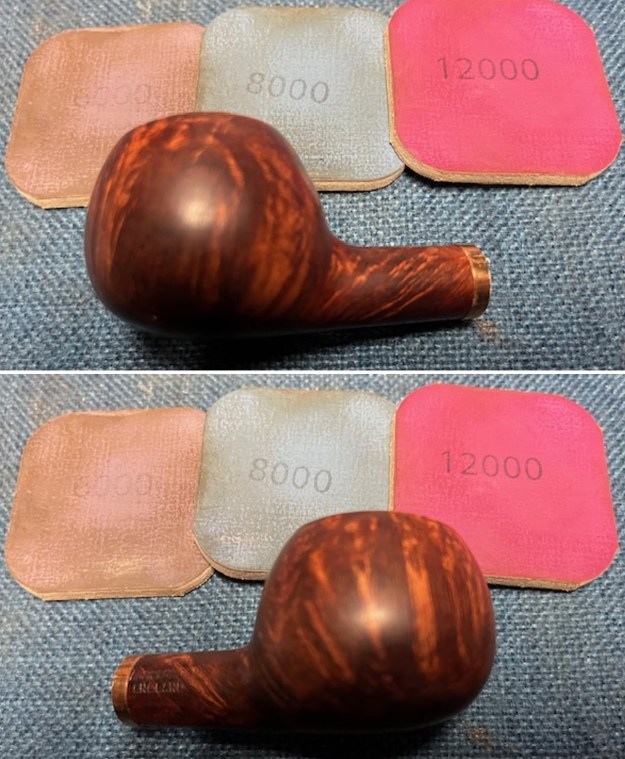
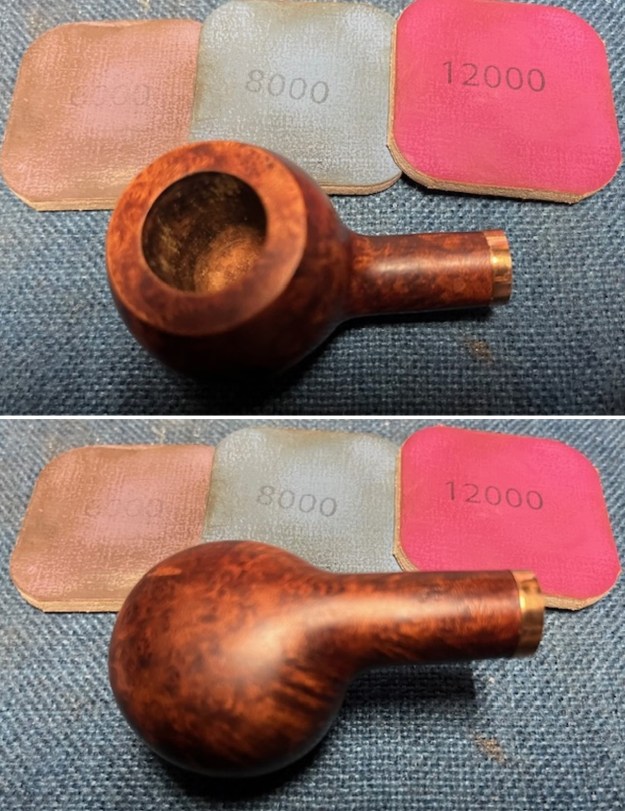
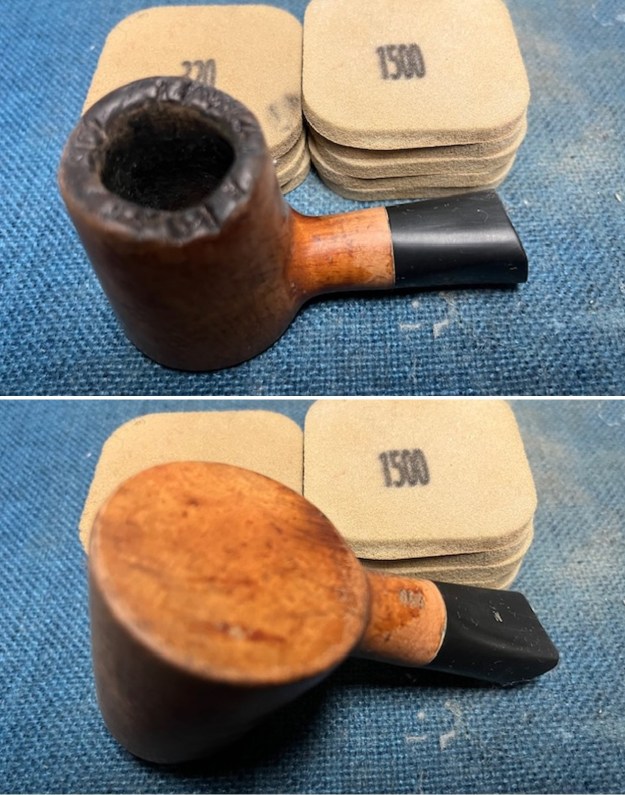
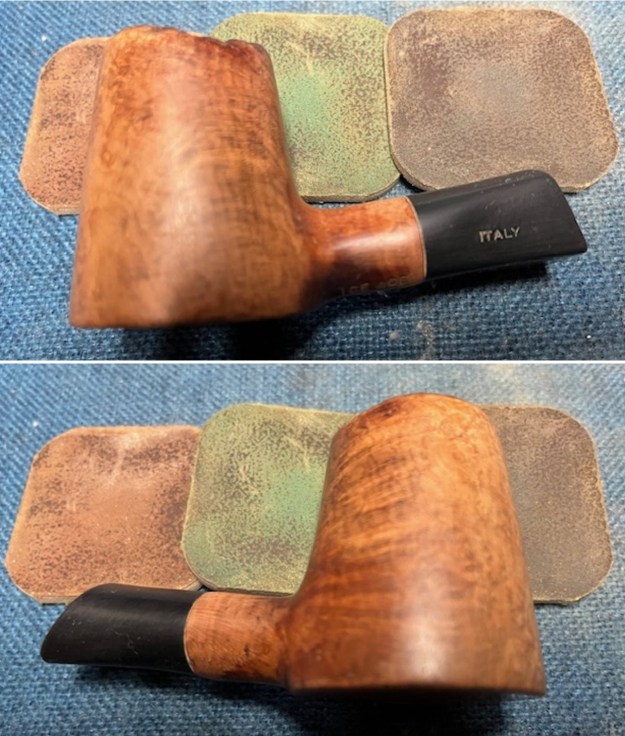
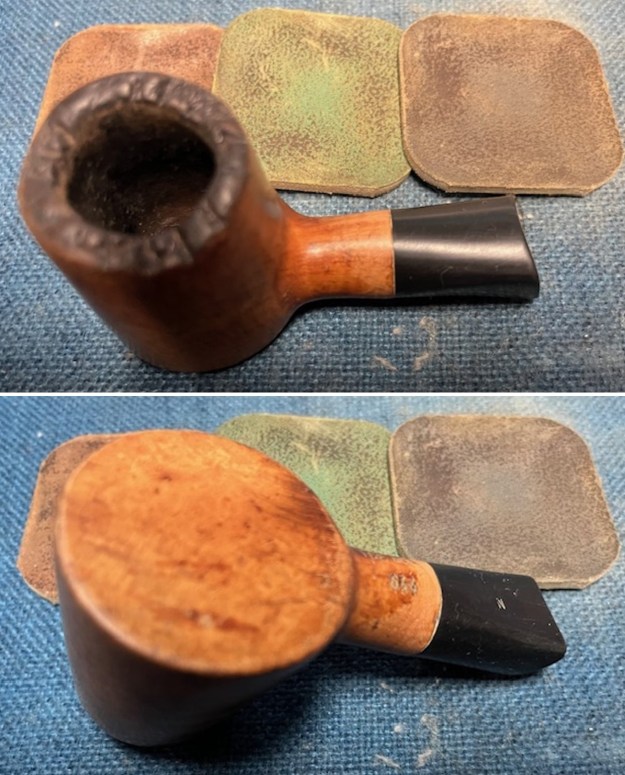
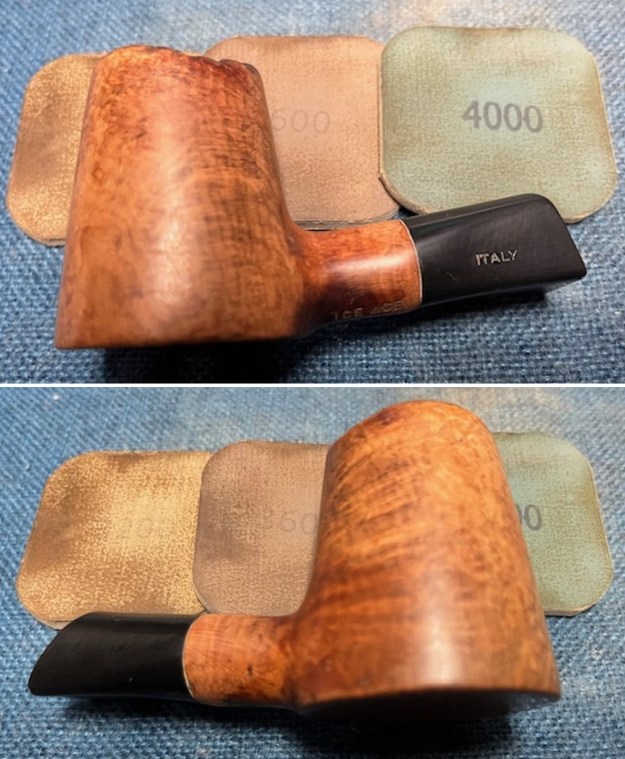
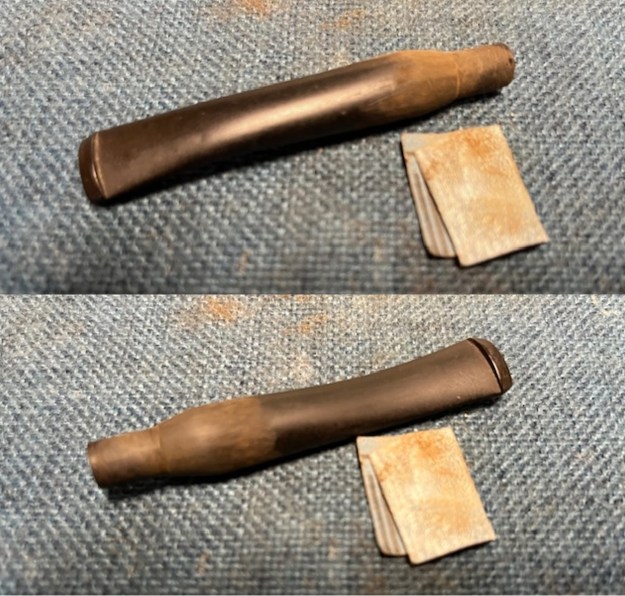
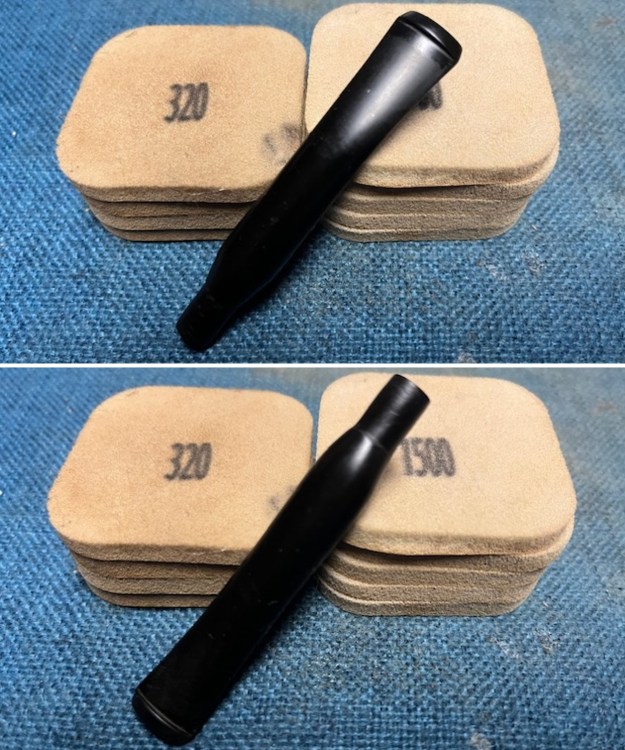
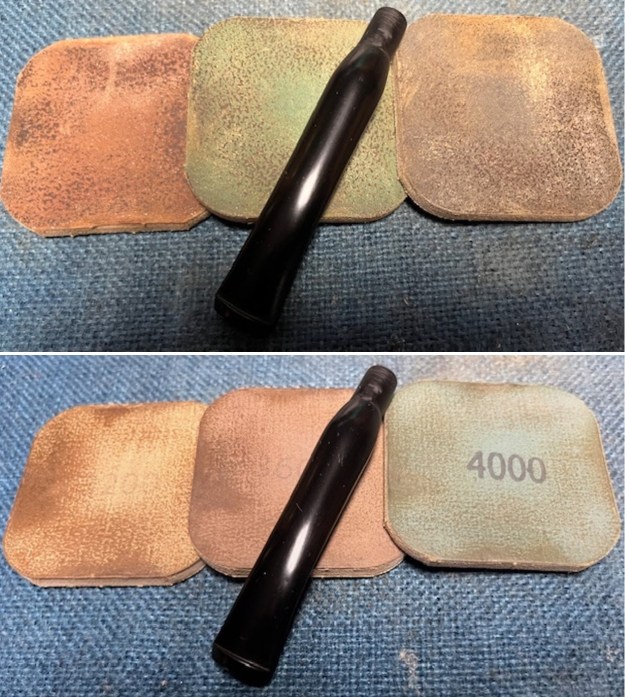
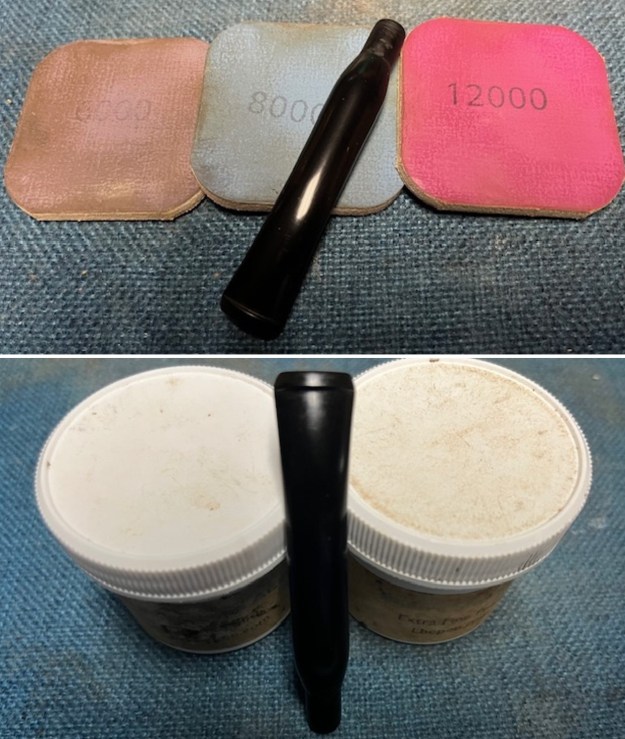
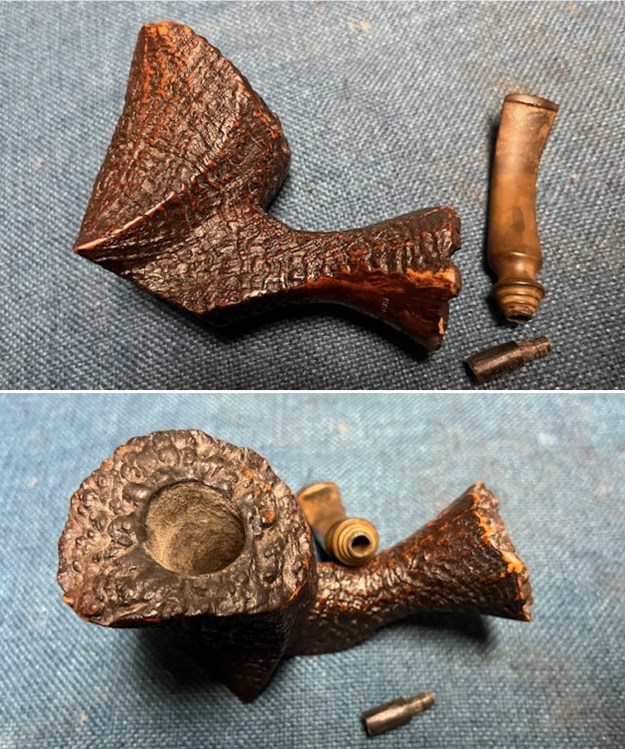
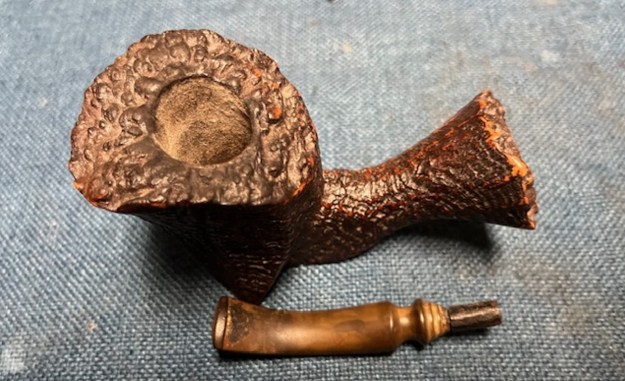
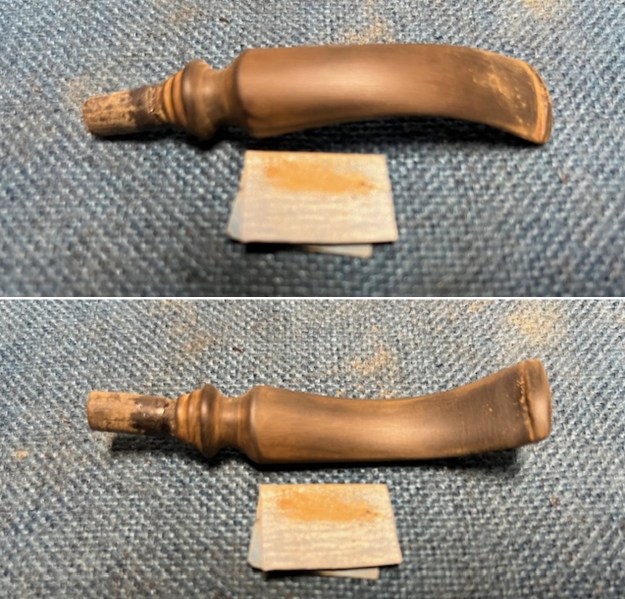
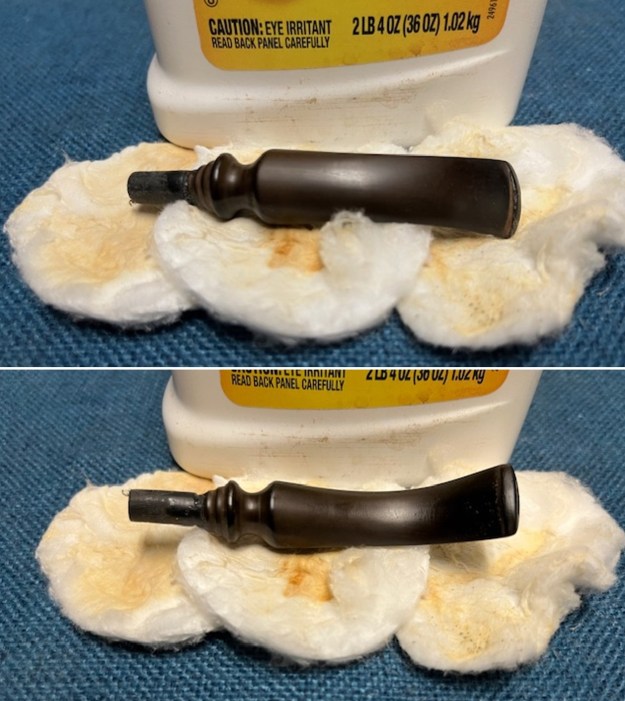
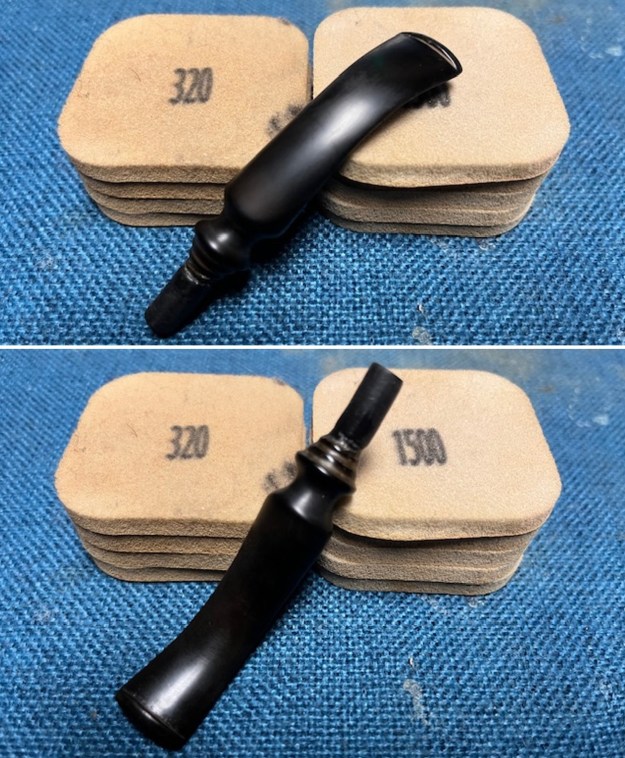
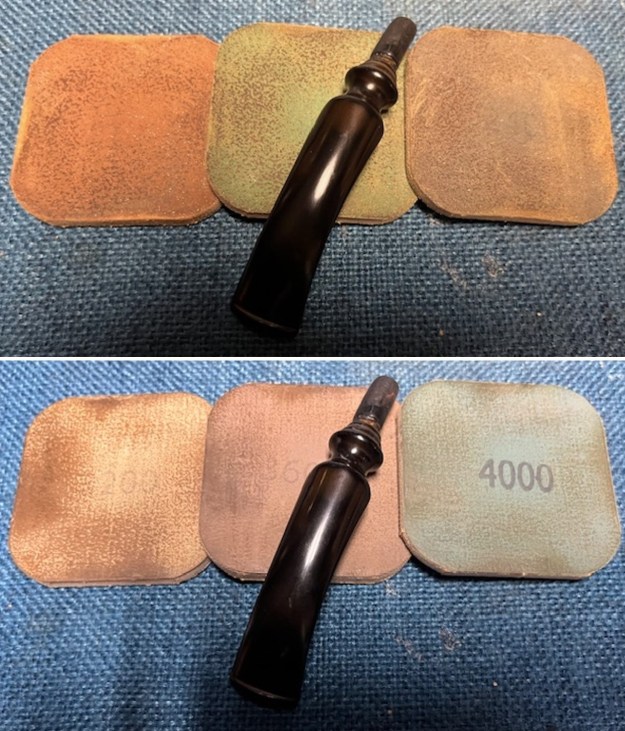
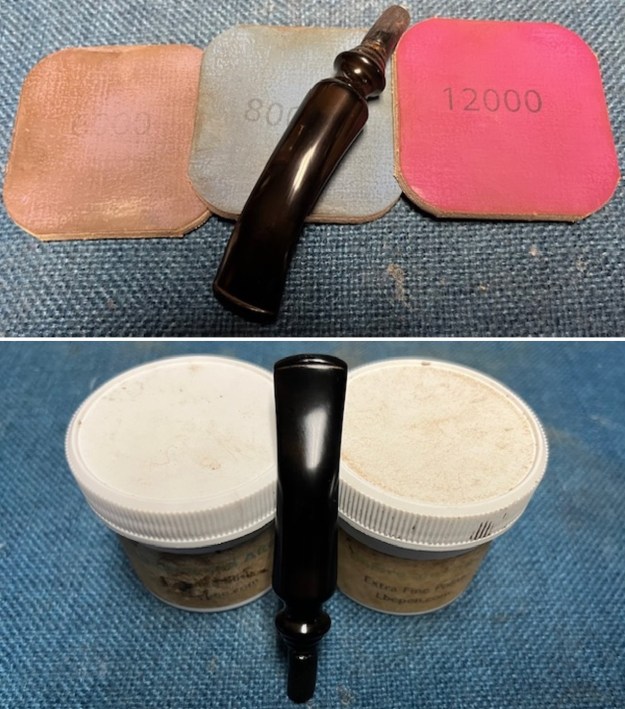
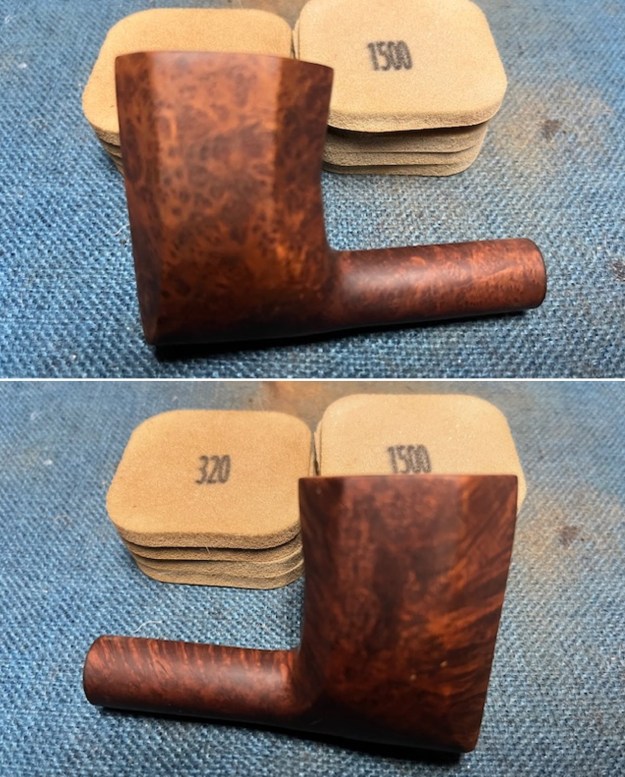
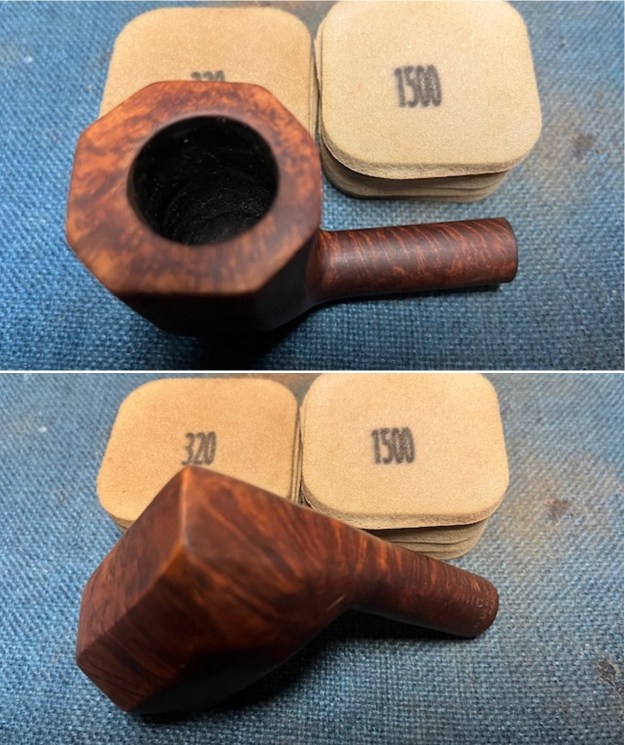
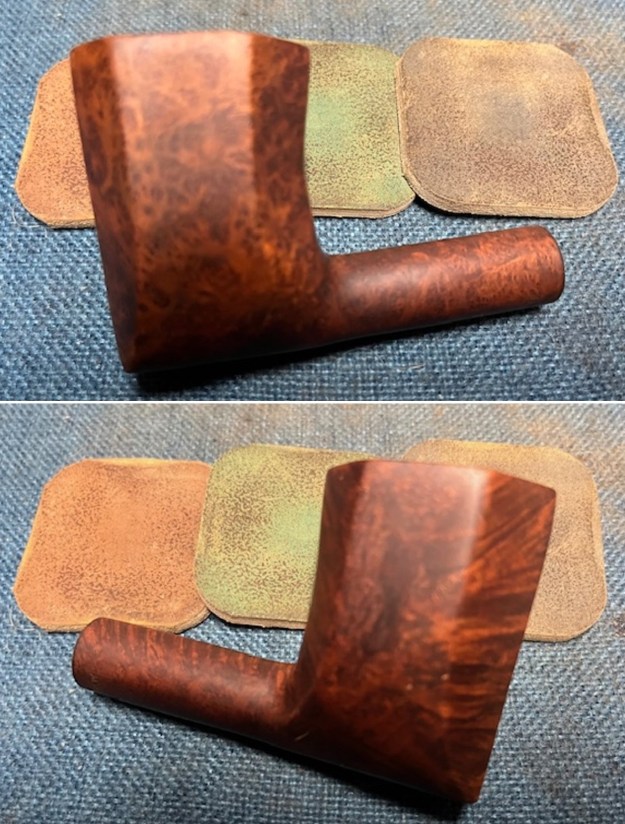
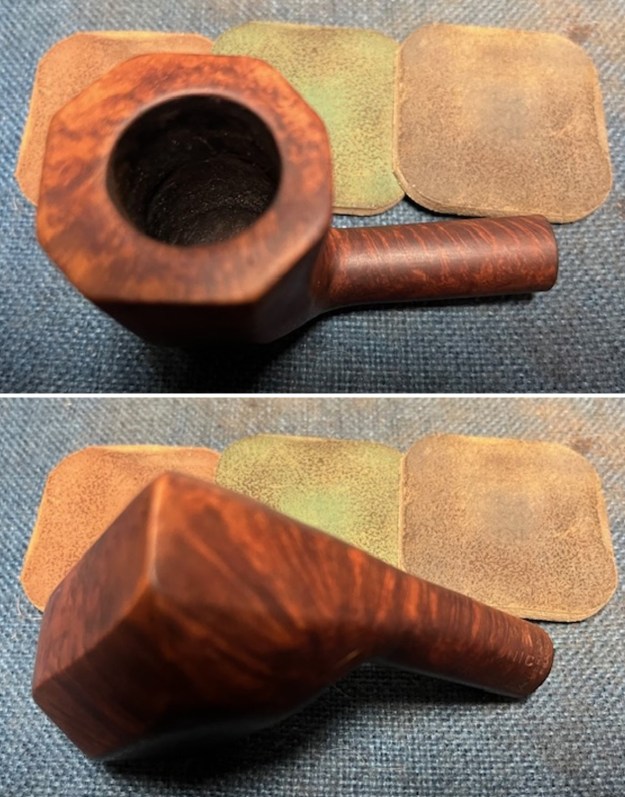
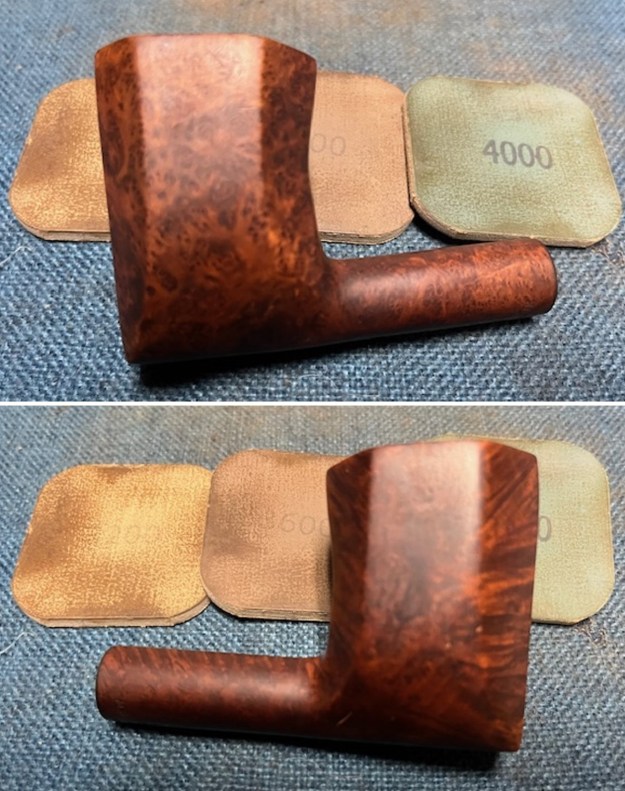
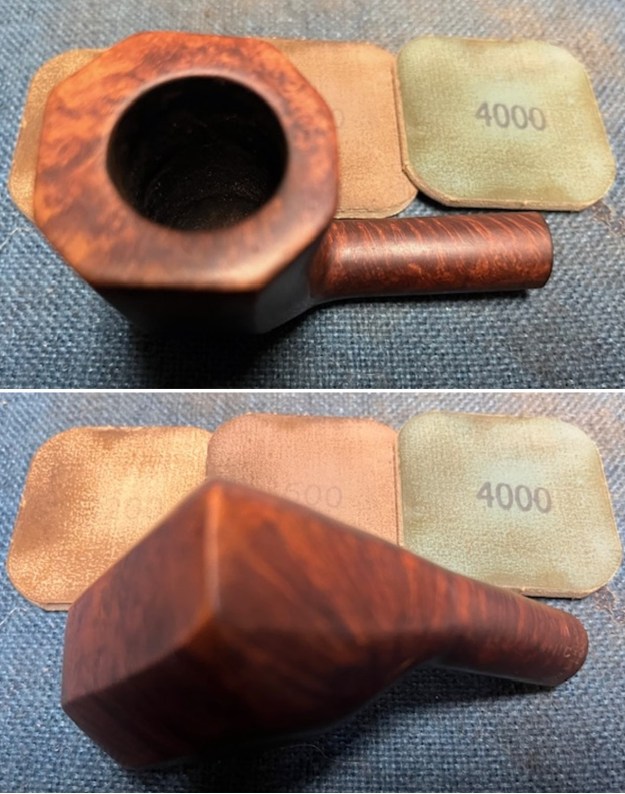
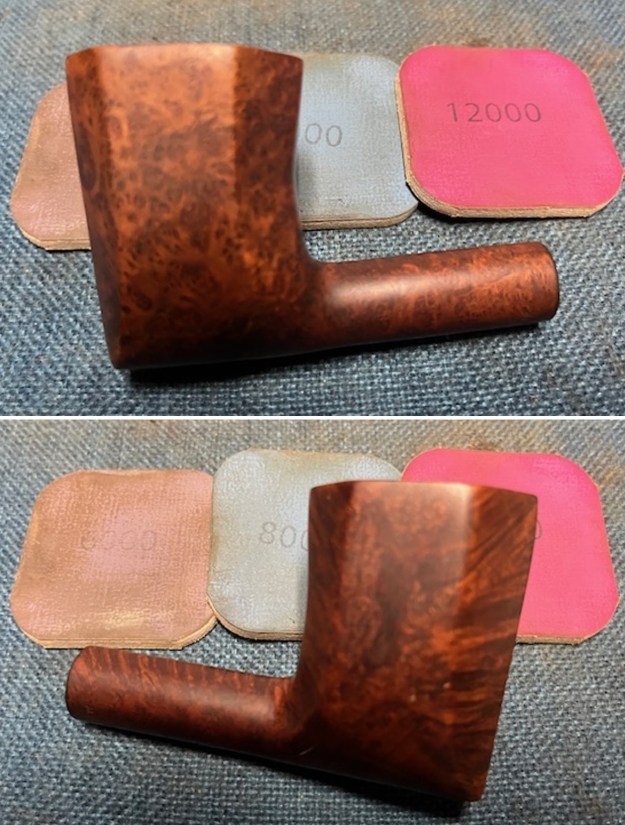
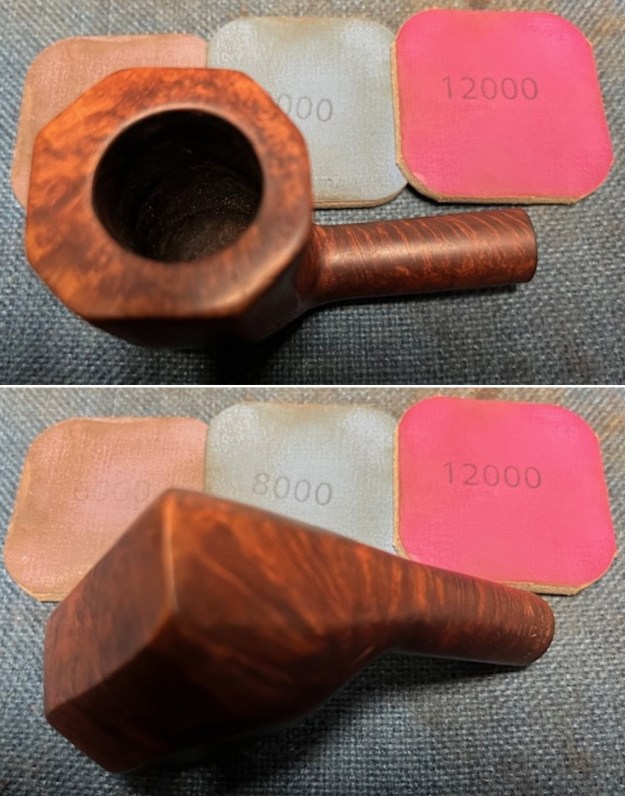
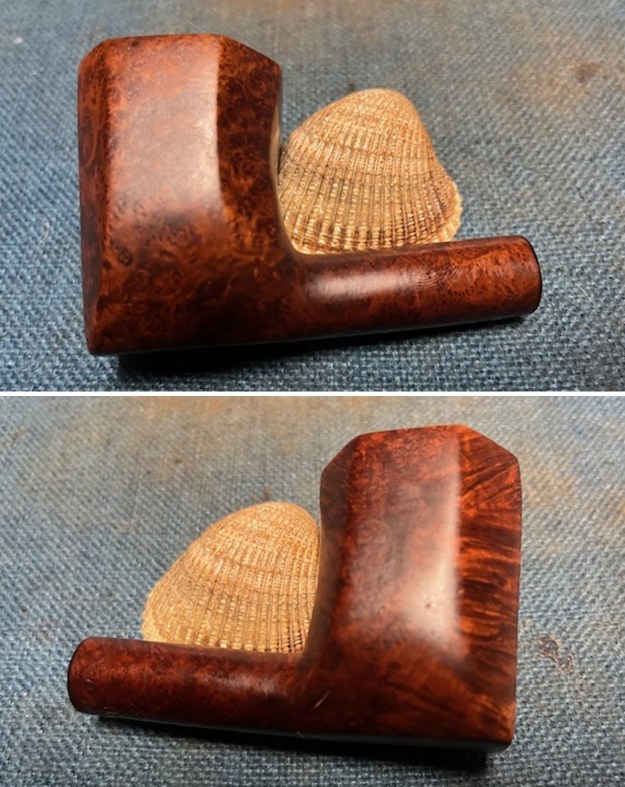
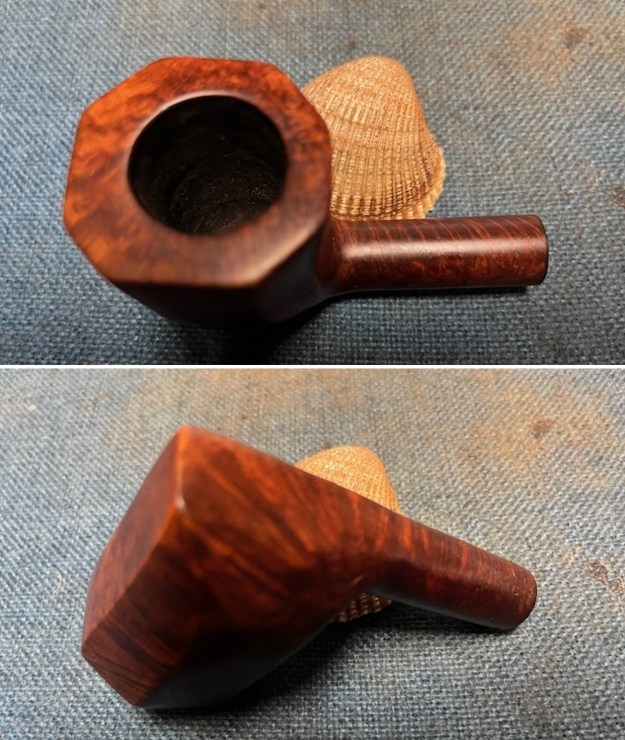
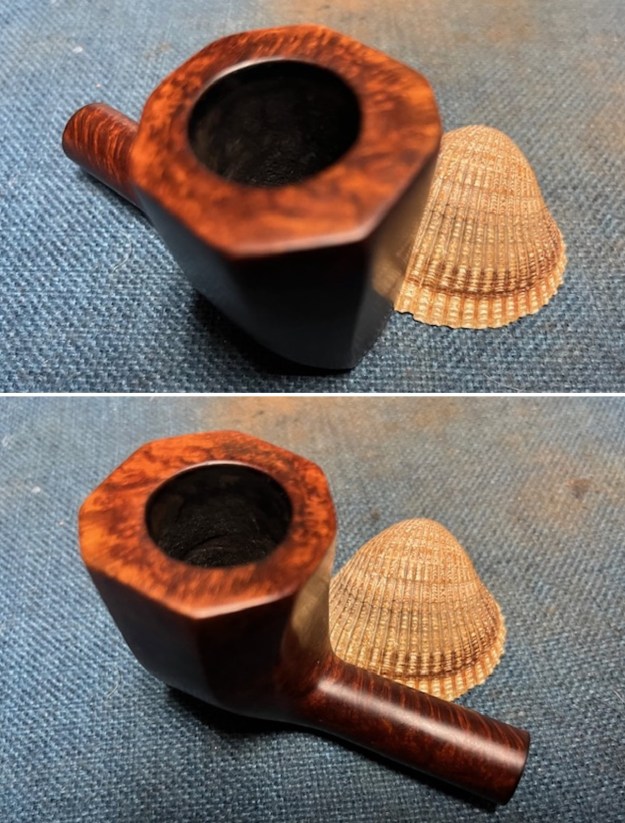
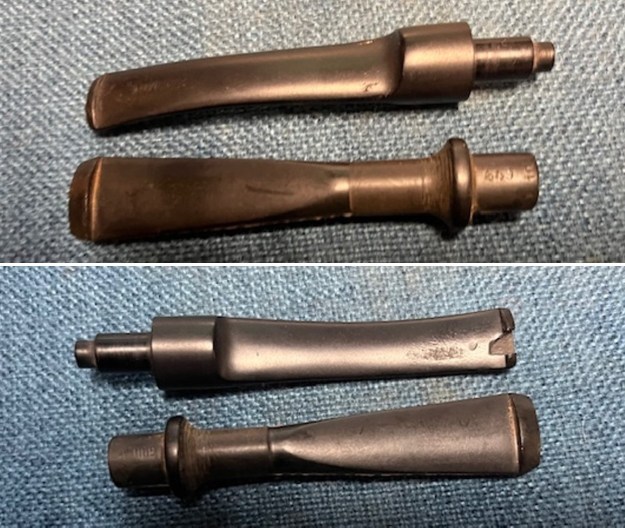
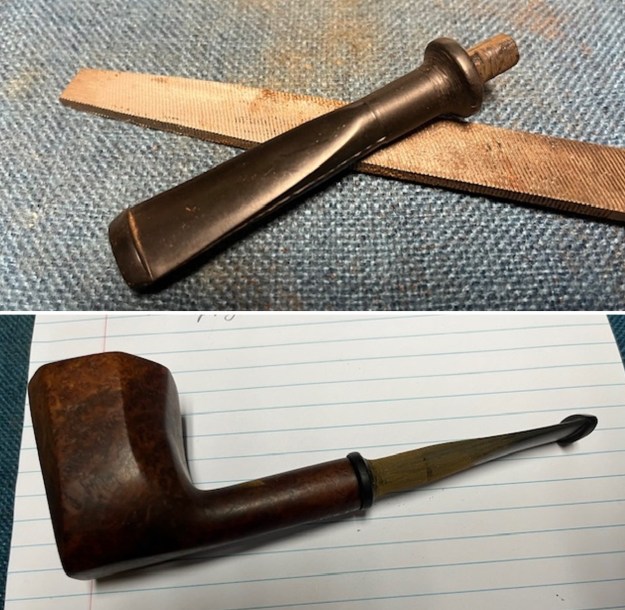
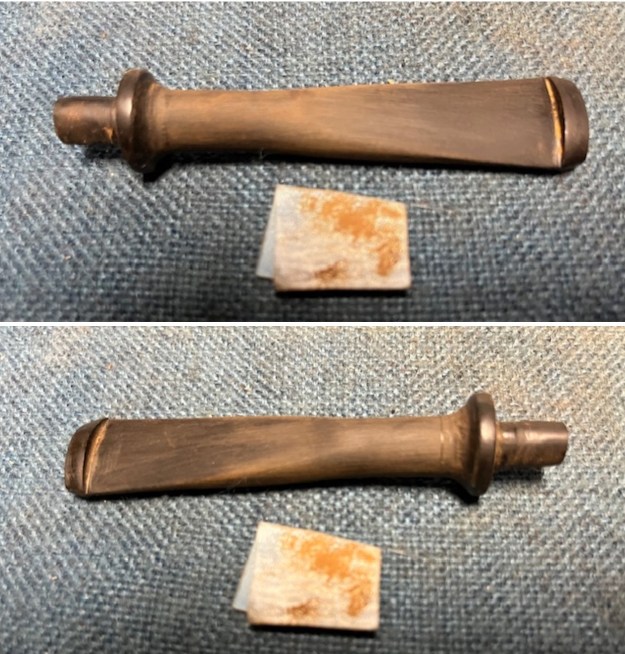
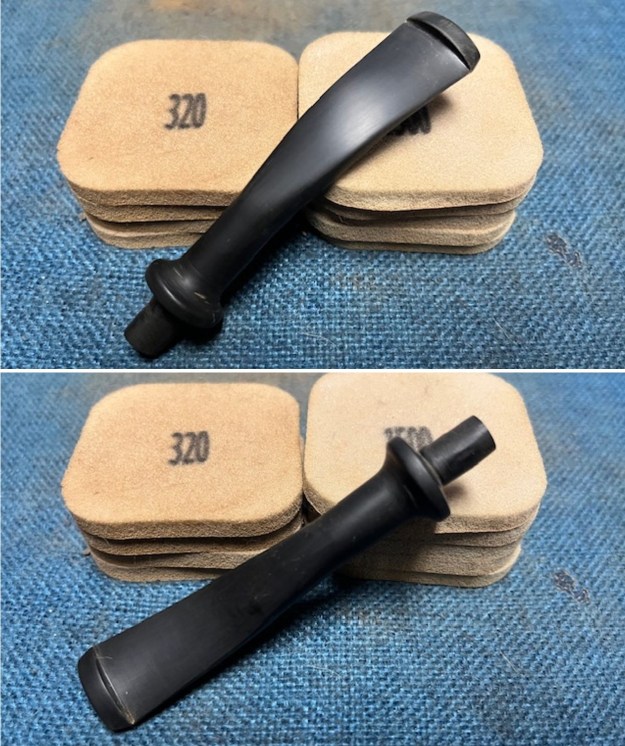
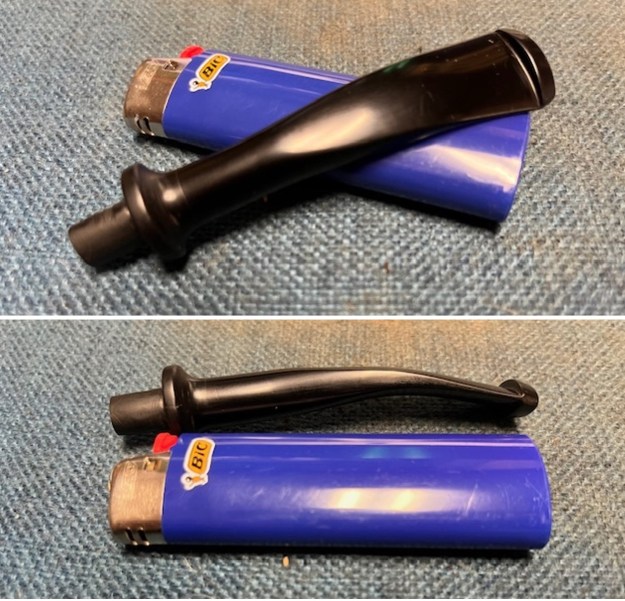
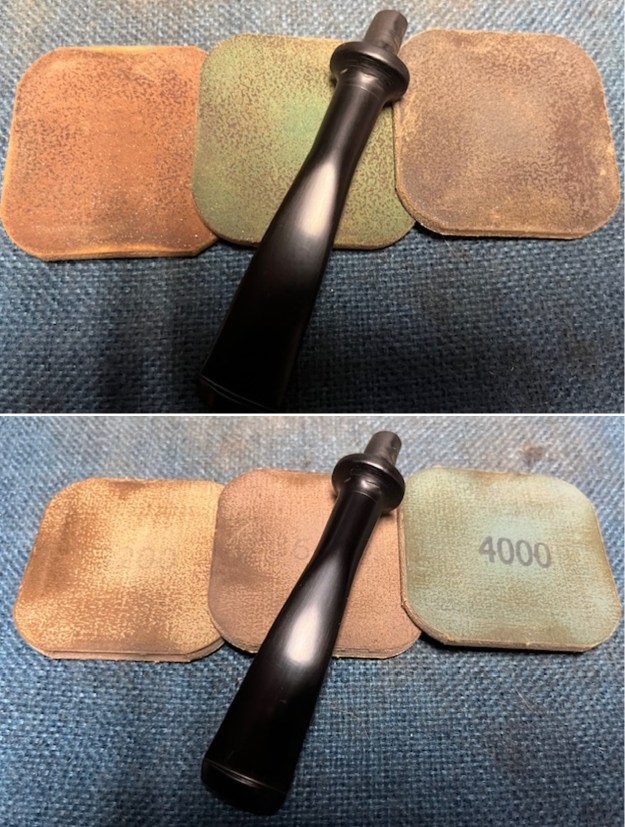
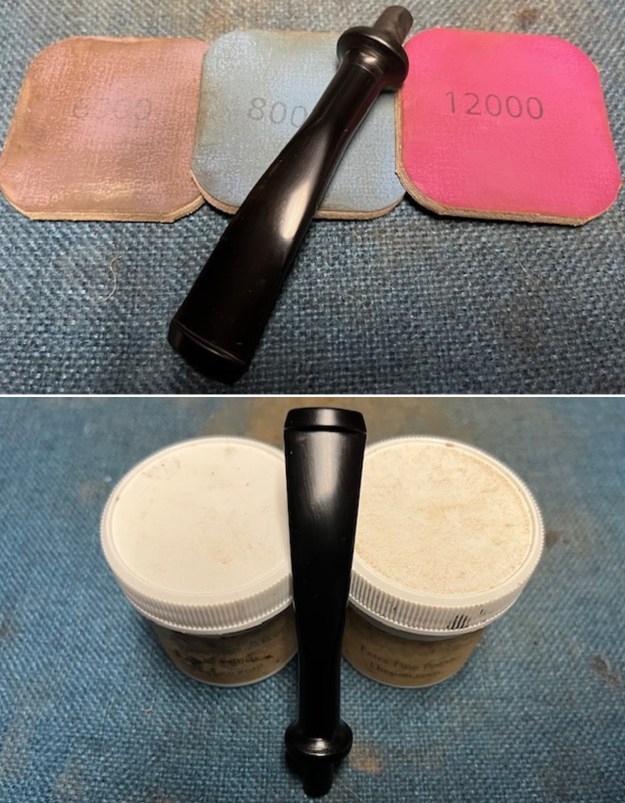
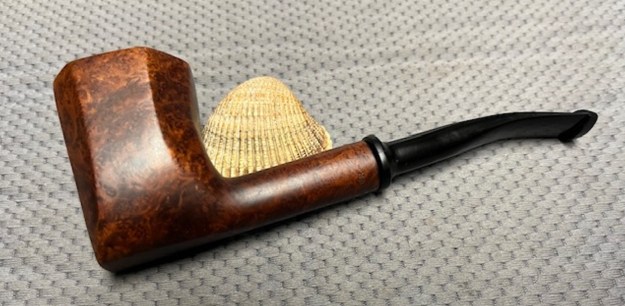
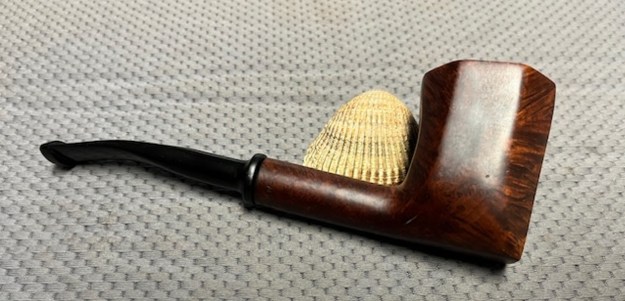
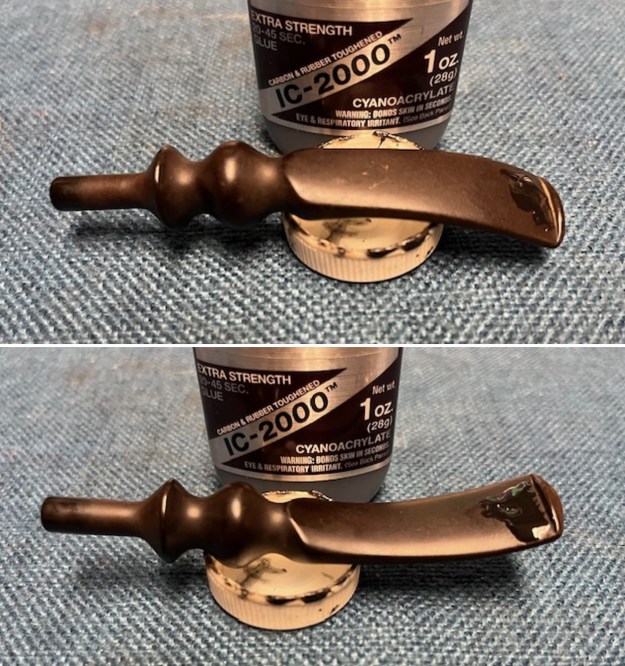
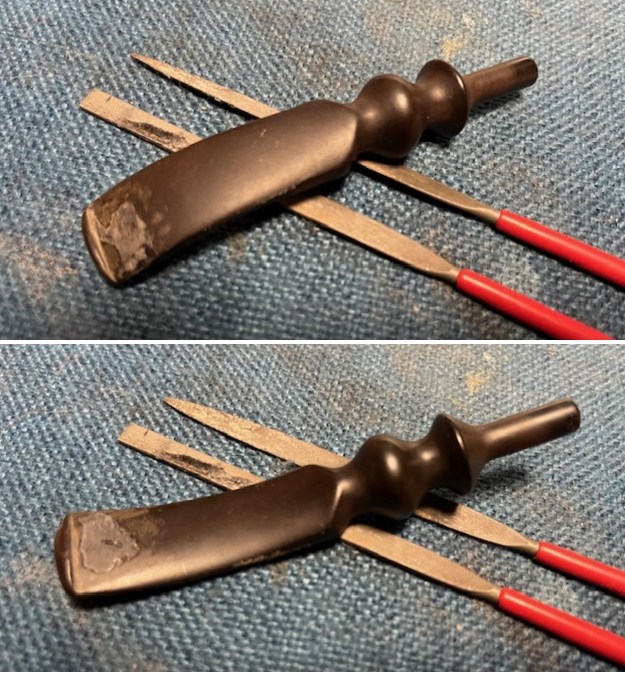
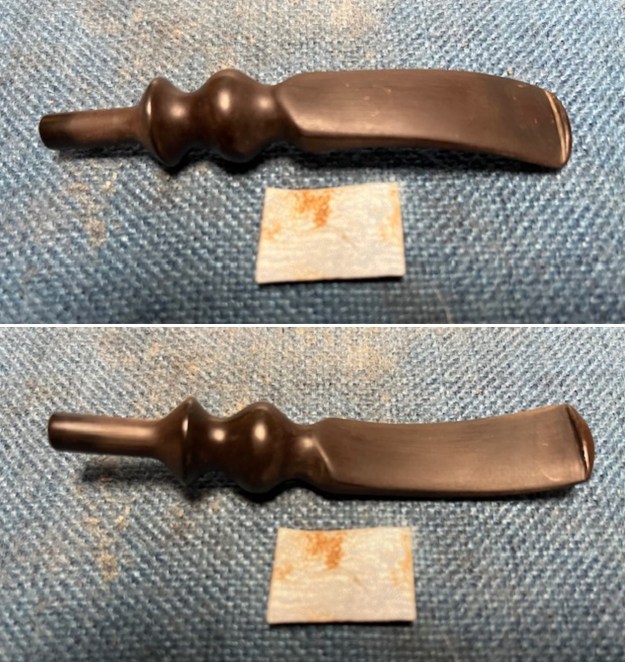
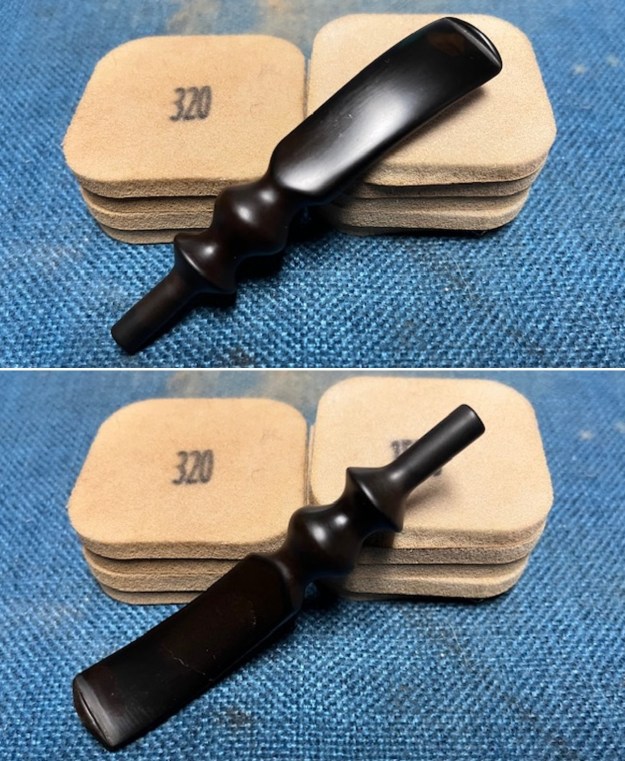
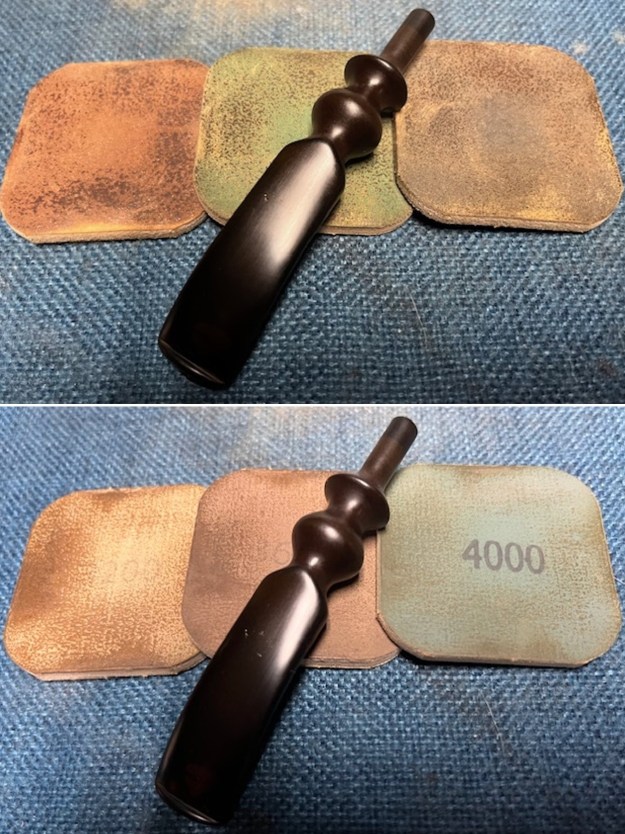
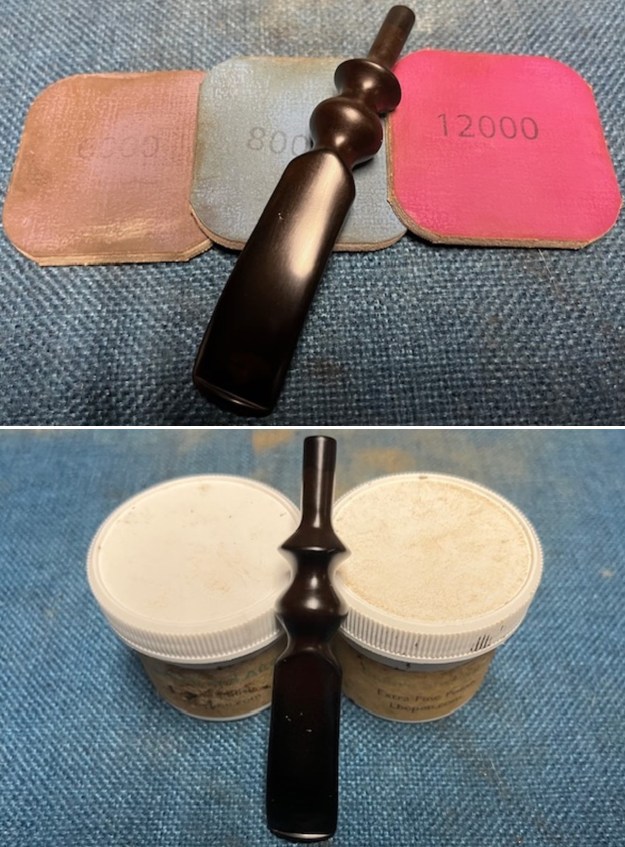
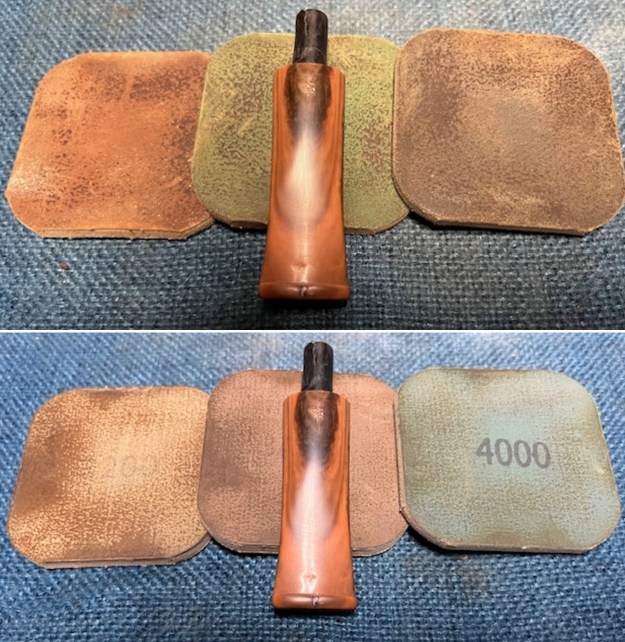
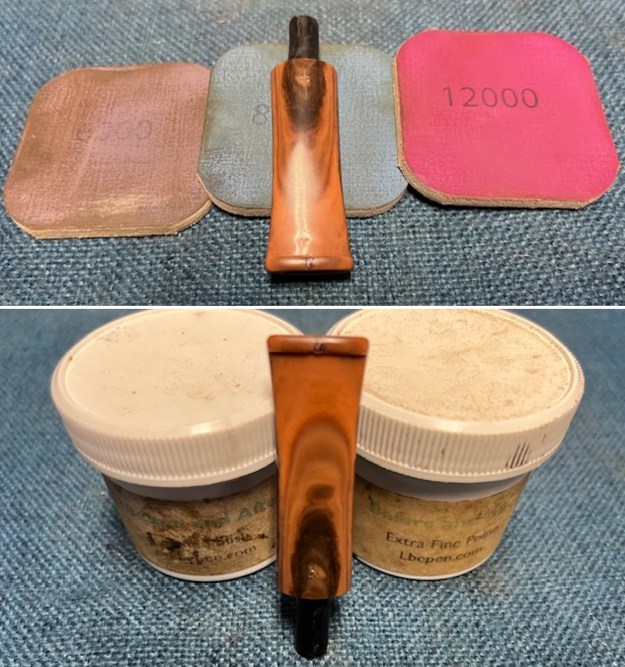
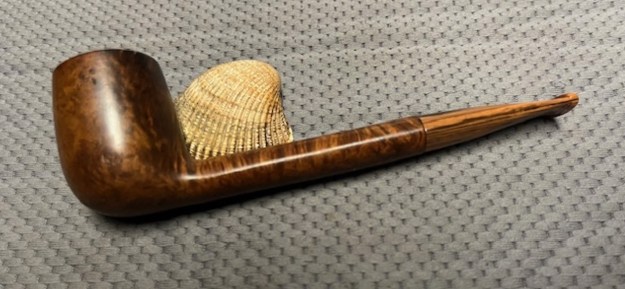
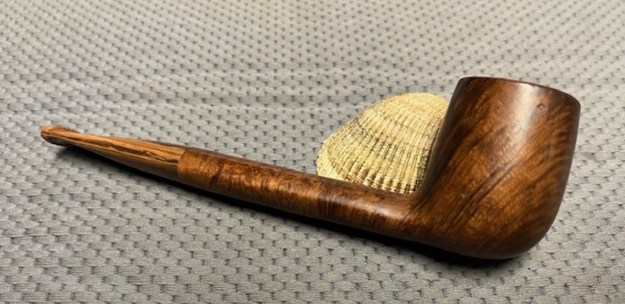
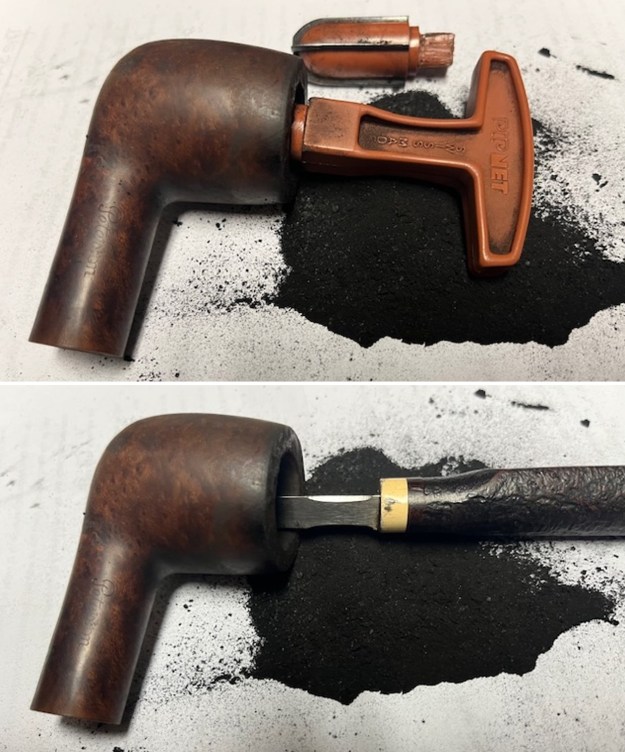
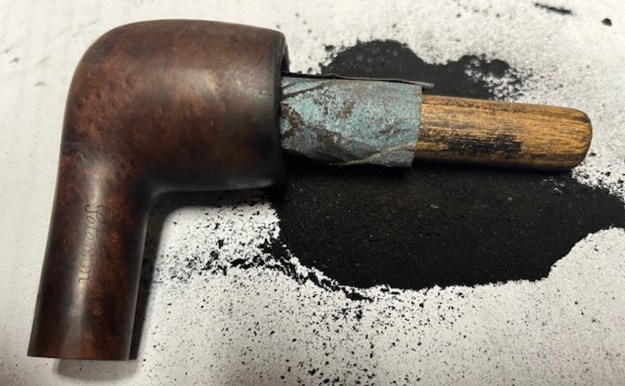
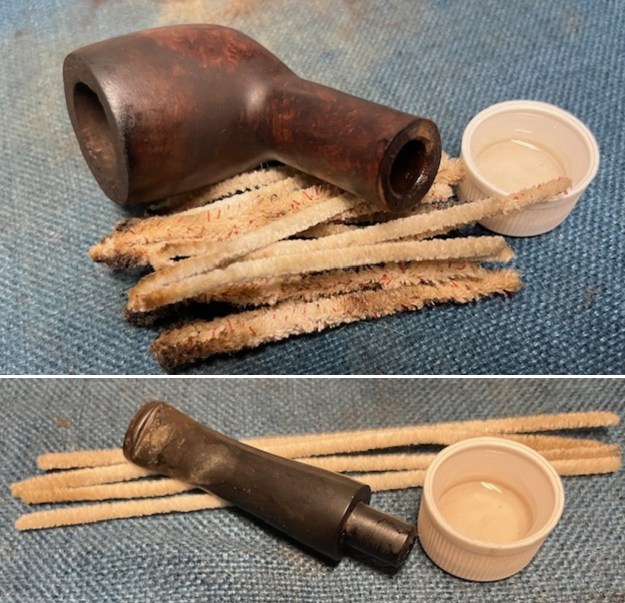
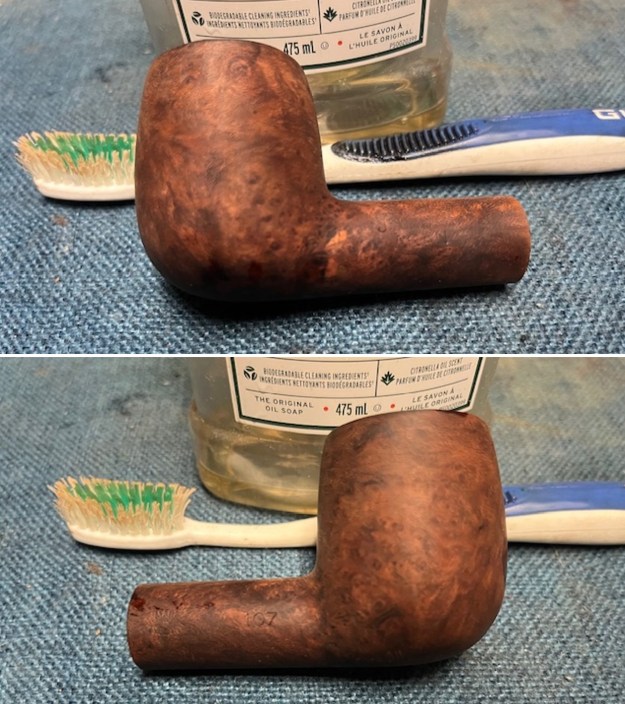
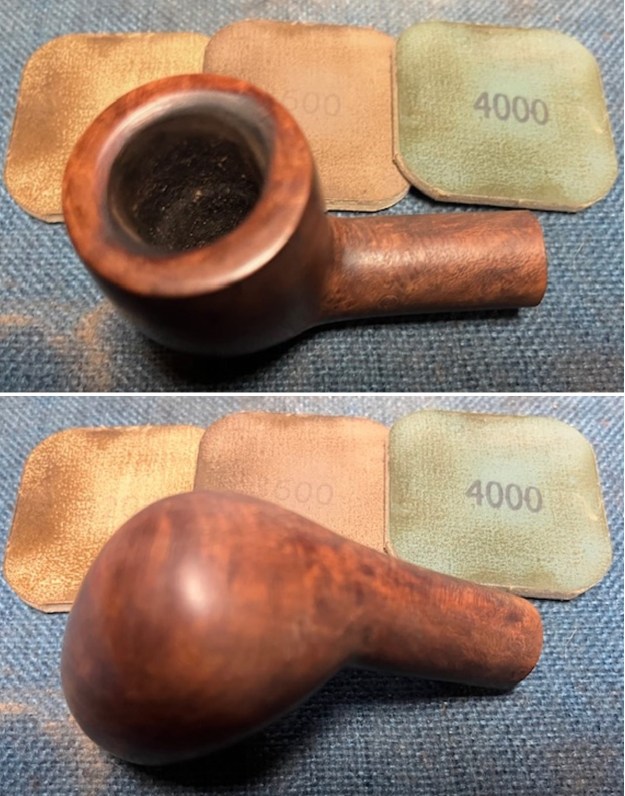
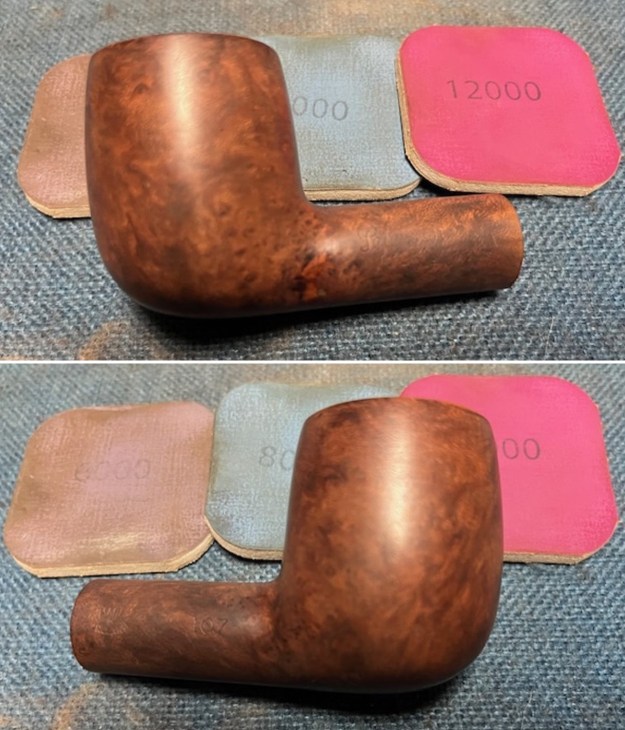
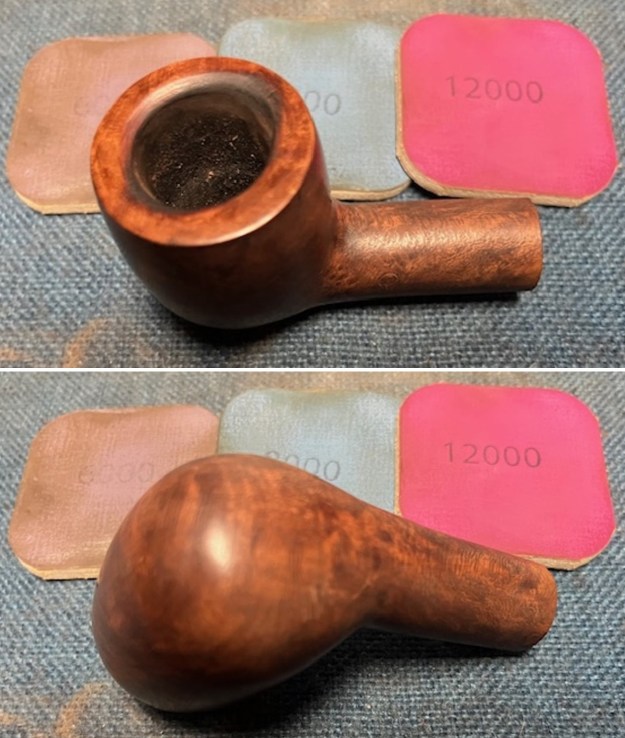
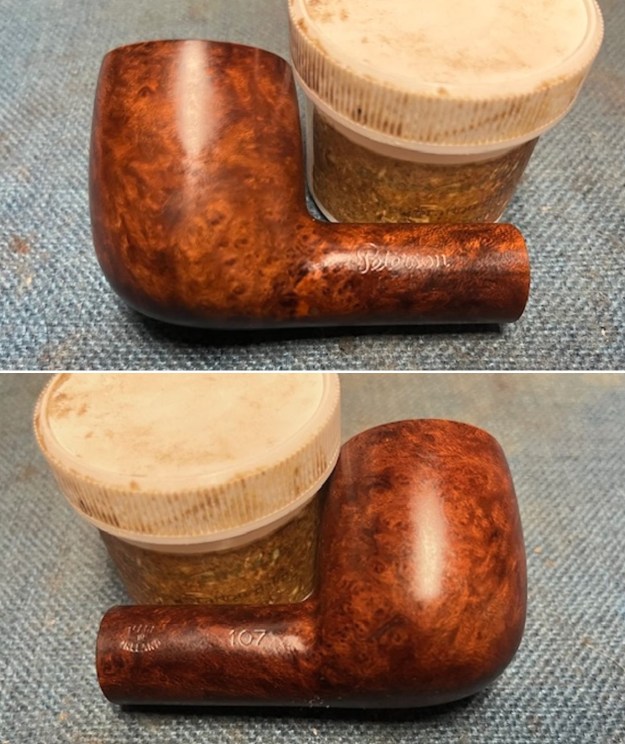
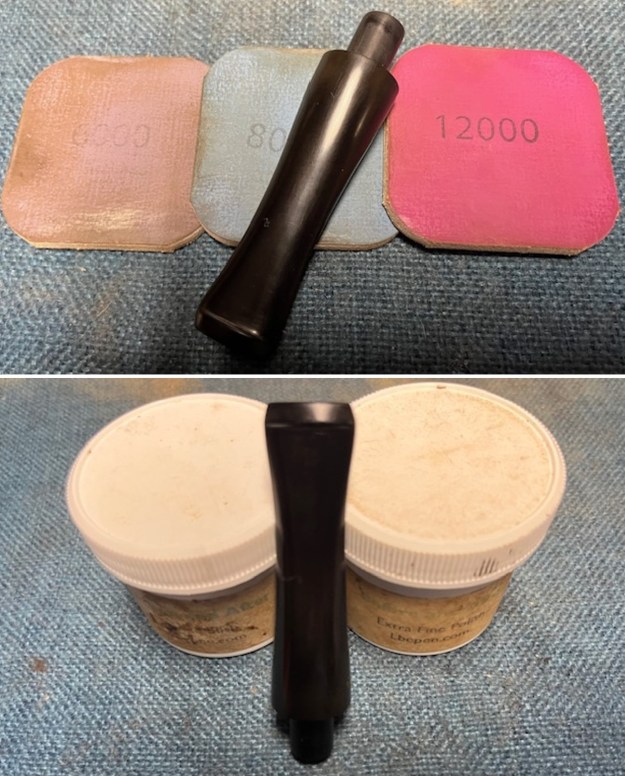
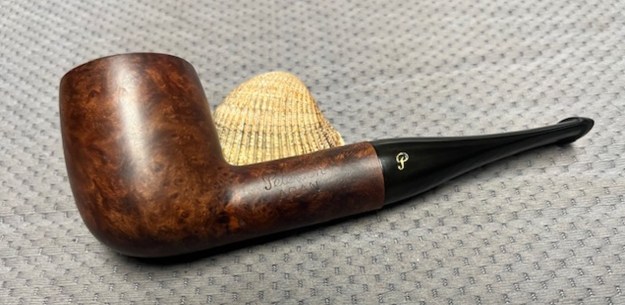
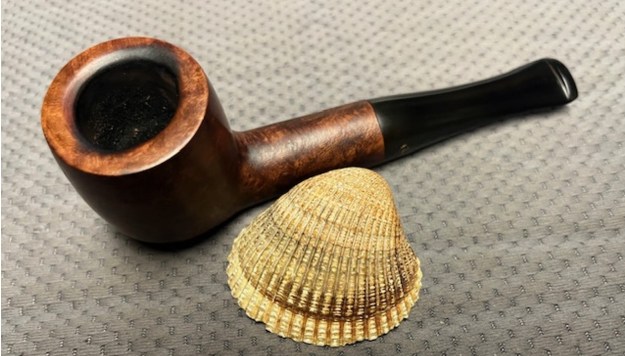
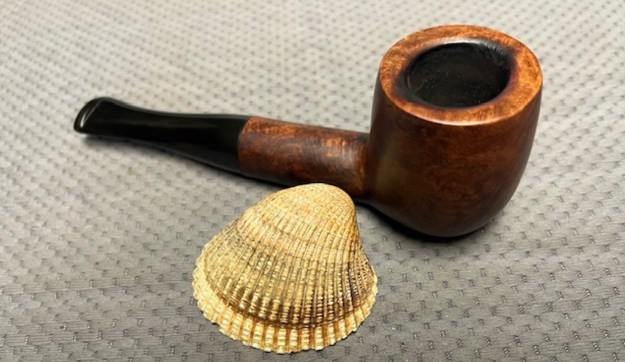
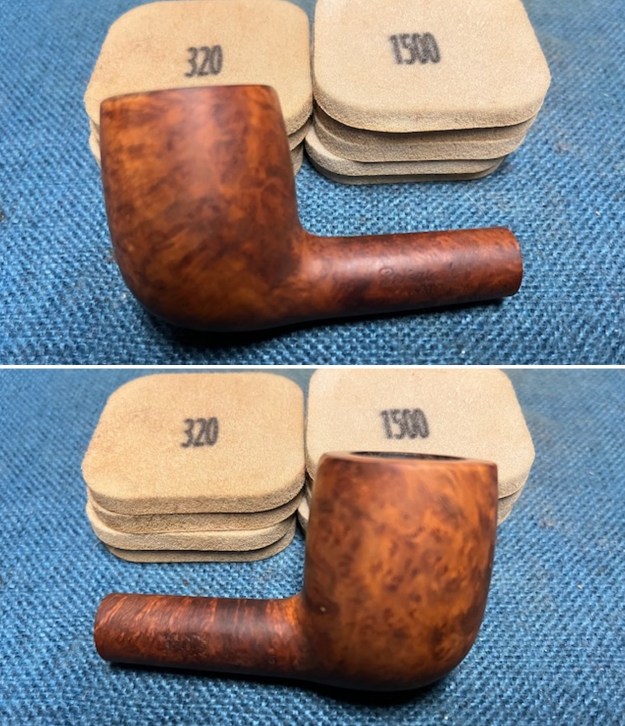
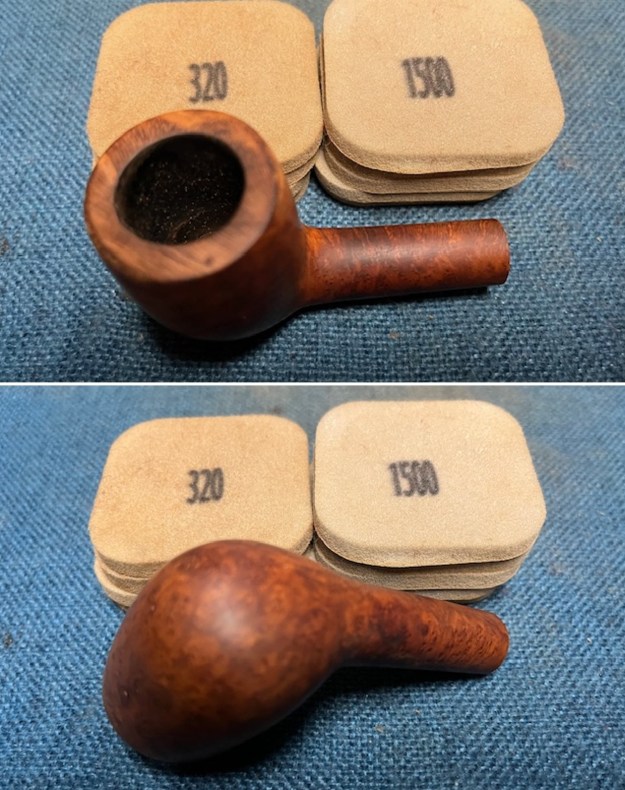
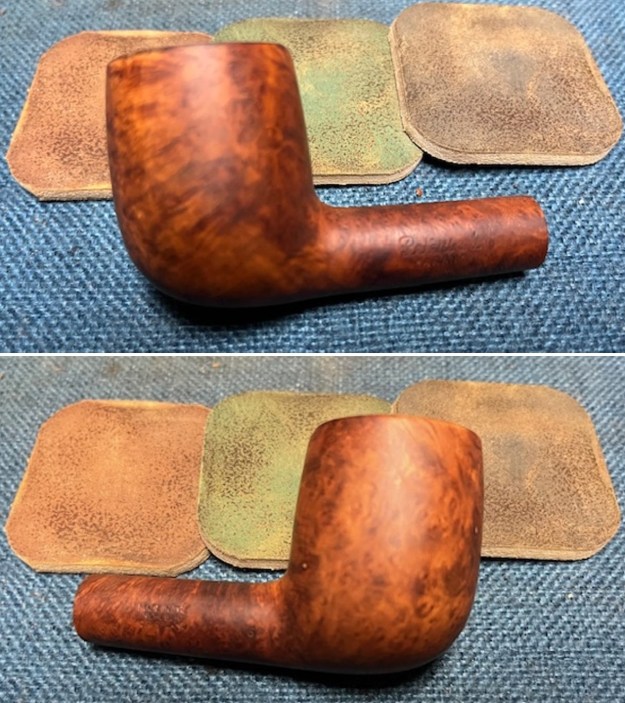
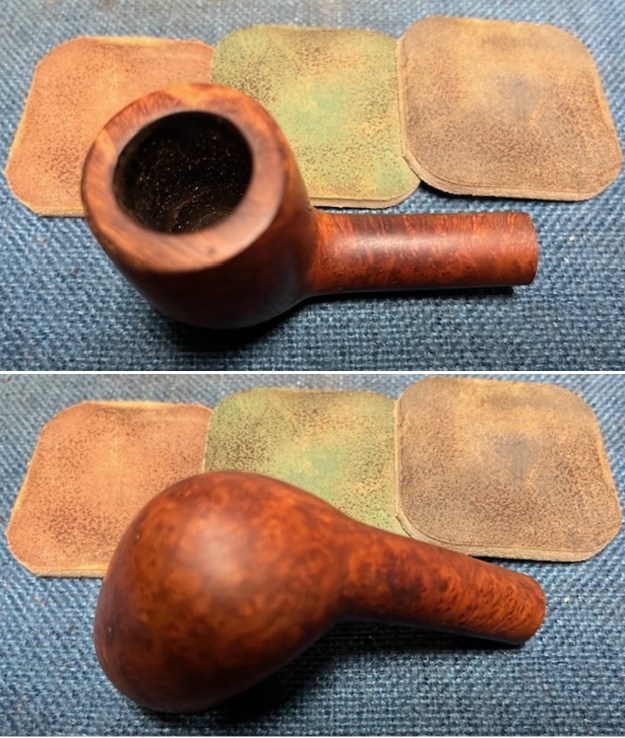
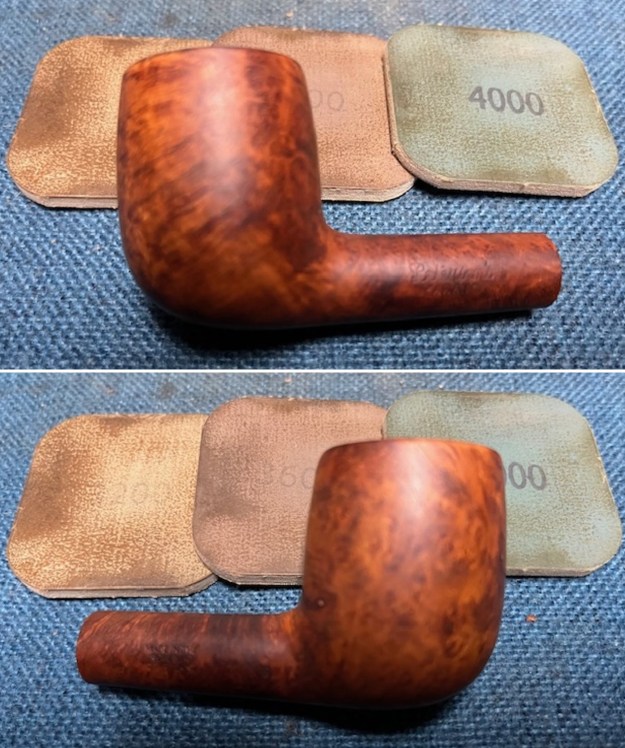
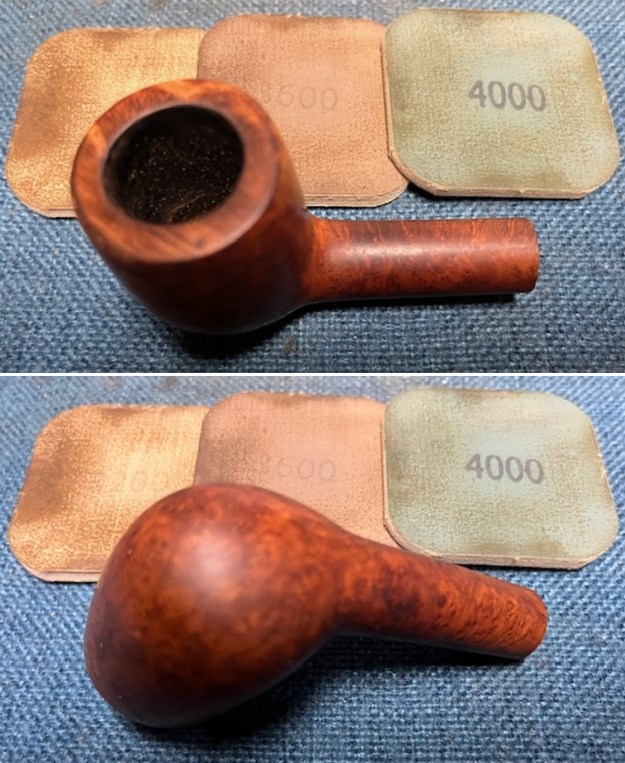
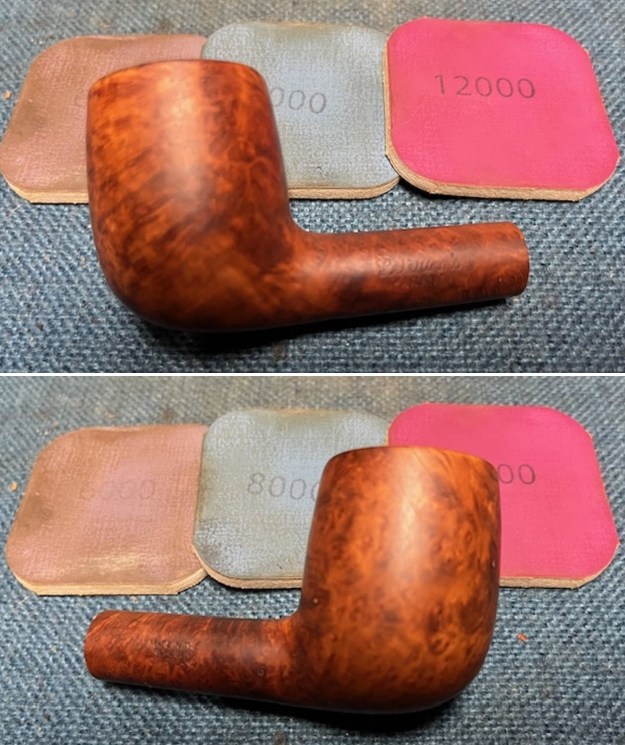
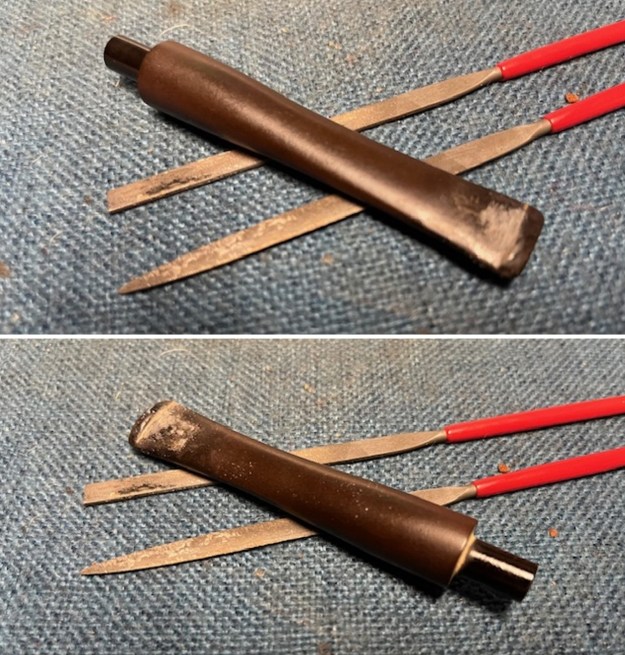
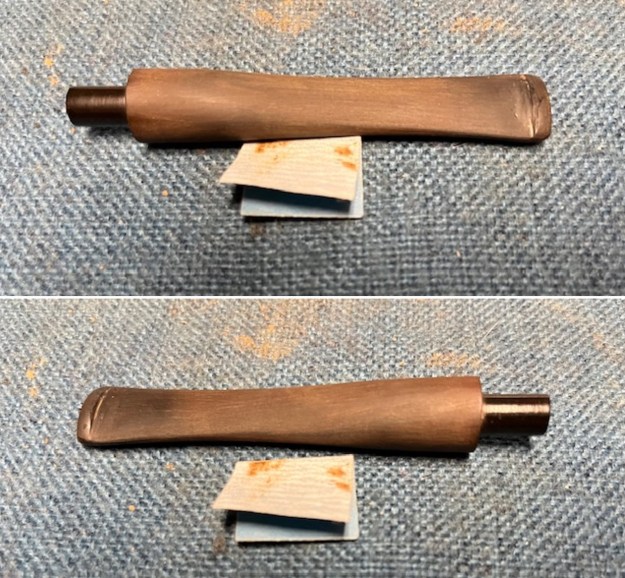
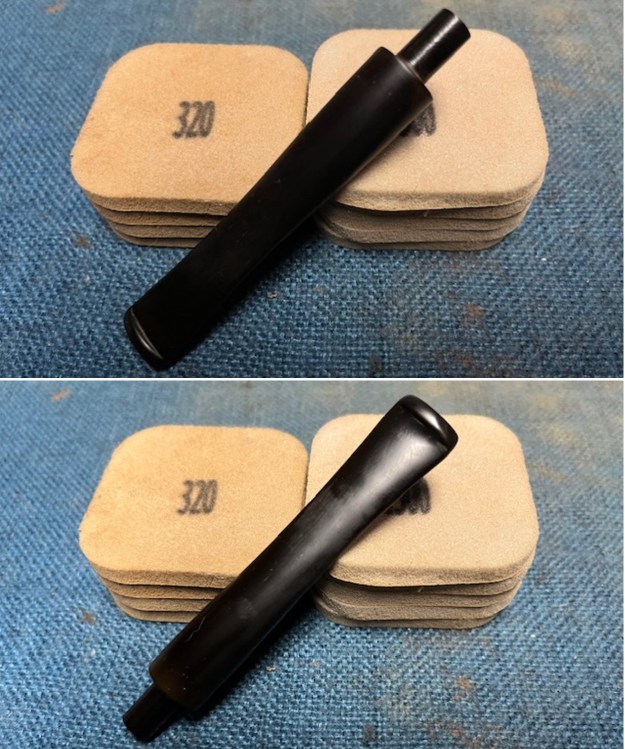
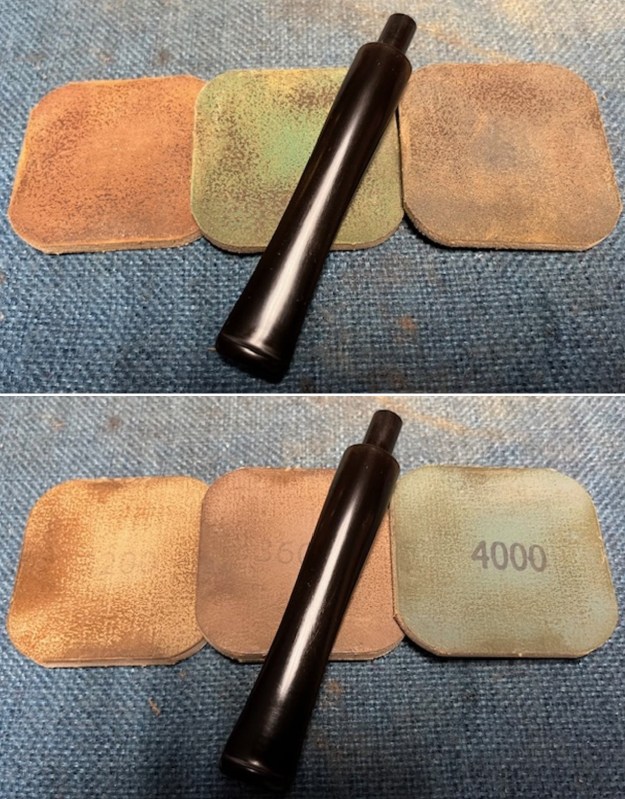
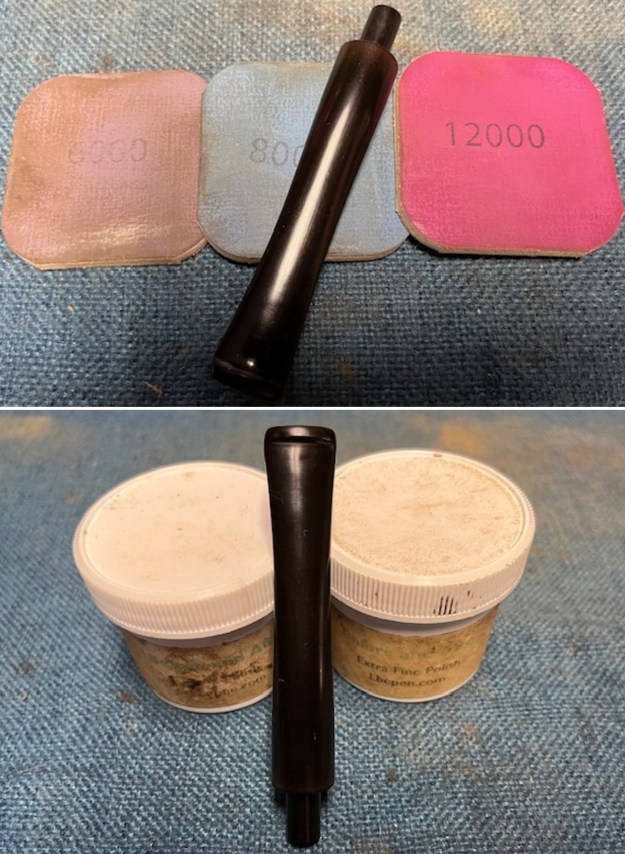
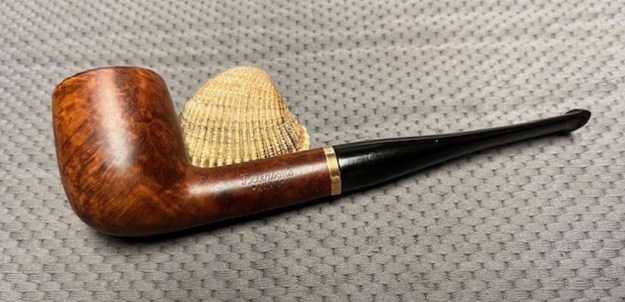
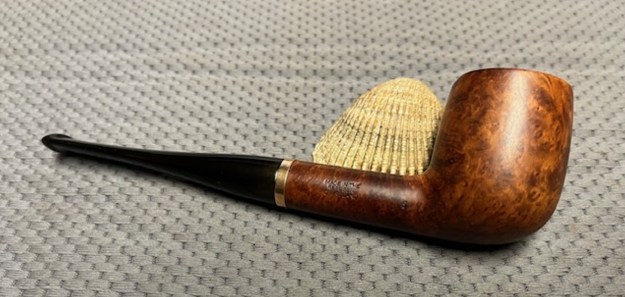
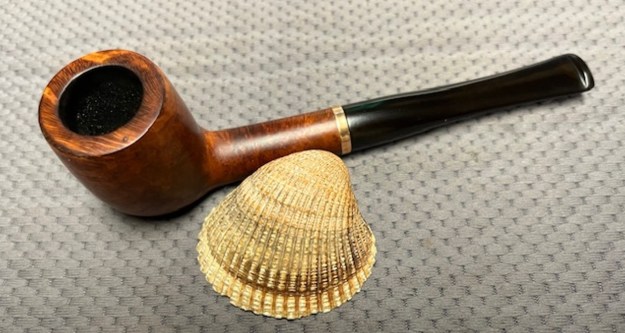
I started my work on the pipe by reaming the bowl with a PipNet reamer. I used the first cutting head and took the cake back to bare briar. I cleaned up the reaming with a Savinelli Fitsall Pipe Knife and removed all the remnants of the cake. I scraped the rim top with the flat edge of the blade at the same time and removed most of the thick lava build up. I sanded the walls of the bowl with a piece of dowel wrapped in 220 grit sandpaper. The walls look very good at his point in the process. The darkening on the rim top and inner edge of the bowl would need to be dealt with. I cleaned up the inner edge and the rim top with a folded piece of 220 grit sandpaper and was able to remove the darkening. I also started to sand the shank repair at the same time. The old warrior is visible in the photos below.I cleaned out the shank, the airway and the mortise with alcohol, cotton swabs, hard bristle and soft bristle pipe cleaners. It was a very dirty pipe which just meant that it had really been enjoyed by the previous pipe man. Since I was restemming the pipe I would do the clean out on the new stem when I got to it.I scrubbed the exterior of the bowl and shank with a tooth brush and undiluted Murphy’s Oil Soap. I scrubbed the lava on the rim top and overflow on the outside of the bowl with the soap. I rinsed the briar with warm water to remove the grime and debris of the scrubbing. It looked significantly better after the scrubbing. The darkening on the rim top came away clean. Once I cleaned the bowl with the soap I brought it back to the work top and examined it. This was a pipe full of fills around the rim top and the right front side of the bowl. All were shrunken and need of repair. I filled in all of the damaged fills with clear CA glue. I smoothed them out with a dental spatula. Once the repairs cured I sanded them smooth with 220 grit sandpaper to blend them into the surface of the briar. Once finished it looked much better. I sanded the bowl it with 320-3500 grit sanding pads to further remove the stain and make a more transparent finish on the rim top, the bowl and shank. The light spots blended in better. I wiped the briar down with a drop of Olive Oil to see if I have any areas that I still needed to work on. The briar began to take on a rich shine and the repairs to the repairs blended in better with work. The photos tell the story. I polished the bowl and rim top with micromesh sanding pads – dry sanding it with 1200-15000 grit pads. I wiped the bowl down with a damp cloth after each sanding pad. The grain started to rise to the surface and the repairs blended even more as I polished it. I rubbed the bowl and shank down with Before & After Restoration Balm to deep clean the finish on the bowl and shank. The product works to clean, enliven and protect the briar. I worked it in with my fingers to get it into the briar. I let it sit for 10 minutes then I wiped it off and buffed it with a soft cloth. The briar really began to have a rich shine. I took some photos of the bowl at this point to mark the progress in the restoration. It is a beautiful bowl. I laid the bowl aside and turned my attention to fitting a new stem. I made a decision about putting the short taper stem to the bent Billiard and putting a nice saddle stem on the straight Billiard. This new stem was the right length for this smaller Bent Billiard and was very close to the diameter of the shank – slightly larger but very workable. It would take some work to clean up but it would look good once it was finished. The taper stem had a small bite through on the underside ahead of the button. I greased a pipe cleaner and inserted it in the airway below the small hole. I filled in the tooth marks in the top of the stem as well. I removed the pipe cleaner to continue working on the stem. I cleaned out the airway in the stem with pipe cleaners and isopropyl alcohol. It was a dirty stem. I sanded the stem surface and repairs with 220 grit sandpaper. I was able to flatten the repairs and also remove some of the oxidation. It would need more sanding but I turned to the make the slot in the button. I reshaped the entrance of the airway in the stem end with needle files. I used oval and round files to reshape the entrance into an oval shape. It looked much better. I used my heat gun to soften the vulcanite. Once it was soft enough to shape I bent it at the right angle to match the flow of the curves of the bowl. I set the bend in the stem with cold running water and took a photo of the newly bent stem. I removed the stem from the shank and sanded it with 220 grit sandpaper to adjust the fit to the shank. By the time I was finished sanding it the stem very well to the shank and the transition was smooth.I sanded the surface of the new vulcanite stem with the 2 x 2-inch sanding pads – 320-3500 grit pads to clean up the sanding marks on the stem surface. By the final 3500 grit pad the stem started to really shine. I polished the stem with micromesh sanding pads – dry sanding with 1500-12000 grit pads. I wiped the stem down after each sanding pad with Obsidian Oil. I polished the stem with Before & After Pipe Stem Polish – both Fine and Extra Fine. I gave it a coat of Obsidian Pipe Stem Oil. It works to protect the stem from oxidizing. I set it aside to dry. I am excited to finish this Bertram Washington DC Smaller Bent Billiard 30 with a newly fit taper stem. I put the pipe back together and buffed it with Blue Diamond on the buffing wheel. I gave the bowl multiple coats of carnauba wax. I buffed the pipe with a clean buffing pad to raise the shine and then by hand with a microfibre cloth to deepen it. It is fun to see what the polished bowl looks like with beautiful grain on the smooth portions and the rustication depths all around it. The polished grain on the pipe looks great with the black vulcanite stem. This Bertram Bent Billiard is great looking and the pipe feels great in my hand. It is light and well balanced. Have a look at it with the photos below. The dimensions are Length: 5 inches, Height: 1 ¾ inches, Outside diameter of the bowl: 1 ¼ inches, Chamber diameter: 7/8 of an inch. The weight of the pipe is 47 grams/1.69 ounces. This final pipe of Jack’s is another beautiful pipe that I will send to him later this week. I look forward to hear what he thinks of this resurrected beauty. It should be a great smoking pipe.

As always, I encourage your questions and comments as you read the blog. Thanks to each of you who are reading this blog. Remember we are not pipe owners; we are pipe men and women who hold our pipes in trust until they pass on into the trust of those who follow us.

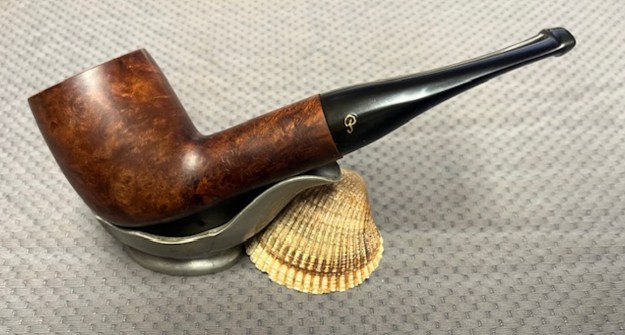
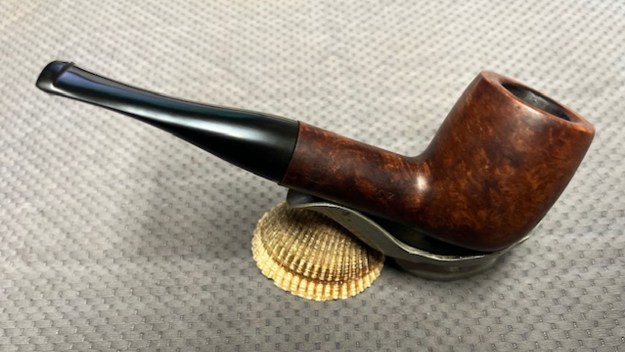
Restoring the 10th of 11 pipes sent for restoration – a Bertram Straight Billiard


by Steve Laug

A while back I was asked by a customer and friend, Jack to take on some projects for him. I have worked on a few pipes for him over the years so we seem to have a standing agreement that I will clean up his pipes. This time he sent a batch containing 11 pipes (actually as mentioned on the last pipe I can’t count) but going over it again I found I was right the first count. There were six Bertrams, an Arlington, a GBD, an old WDC Triangle Bakelite, Citation in need of a stem and one marked Texaco. All of them were in various conditions and would need different types of work. I took a photo of the pipes before I started working on them.I chose to work on the Bertram Straight Billiard that needed to be cleaned up and restored. This next one is from Jack’s 11 pipes – a dirty, dull Bertram with an oxidized tapered vulcanite stem. The pipe is stamped on the left side and reads Bertram [over] Washington D.C. centered on the shank. There is no shape number to be seen. The finish had a lot of grime ground into the bowl and some nicks and flaws where the fills were shrunken or broken around the sides. The bowl was moderately caked with a light lava coat on the top of the rim, heavier toward the back of the bowl. The edges looked okay other than some potential damage on the back inner edge. The stem was calcified, oxidized, dirty and had tooth chatter and marks on the top and underside ahead of the button. The photos show the condition of the stem surface. There were no markings or a logo on the taper stem. Like the rest of the Bertrams that Jack sent, this one had promise but it was very dirty. I took photos of the pipe before I started his cleanup work. I took photos of the rim top and the stem to show the condition. You can see the cake in the bowl and overflow of lava on the rim top. The photos of the stem show the calcification, tooth marks and chatter on the top and underside of the stem and the button. I took photos of the stamping on the left and underside of the shank to capture it. The Bertram stamp was clear and readable as noted above. Once restored again it will have a long life ahead of it. I removed the stem and took a photo of the parts to give a sense of the look of the pipe.As I have worked on a lot Bertrams in the past, I have written on the brand and have included the following information. If you have read it in past blogs, you can skip over it. If you have not, I have included the link to Bertram history and information. I would recommend that if you don’t know much about them take some time to read the background. I include a link to the write up on Pipedia (http://pipedia.org/wiki/Bertram).Bertram pipes were based out of Washington DC. They were popular among famous politicians and celebrities of the time. They made many products for them from FDR’s cigarette holders to Joseph Stalin’s favorite pipe. They were considered some of the best America had to offer till they finally closed their doors in the 70s. Bertram graded their pipes by 10s and sometimes with a 5 added (15, 25, 55 etc.), the higher the grade the better. Above 60s are uncommon and 80-90s are quite rare. I have worked on one 120 Grade billiard. I have several blogs that I have written on rebornpipes that give some history and background to Bertram pipes. (https://rebornpipes.com/2015/06/16/an-easy-restoration-of-a-bertram-grade-60-217-poker/).

I have included the following link to give a bit of historical information on the pipe company. It is a well written article that gives a glimpse of the heart of the company. http://www.streetsofwashington.com/2012/01/bertrams-pipe-shop-on-14th-street.html#

From this information I learned that all of these Bertrams were made before the closure of the shop in the 1970s. This Bertram Bent Billiard has some mixed grain around the bowl. This pipe does not appear to have a Grade stamp on it but the fills make my think a lower grade due to the quality of the briar. But like many of these Bertrams the Grading system is a mystery to me.

I started my work on the pipe by reaming the bowl with a PipNet reamer. I used the first cutting head and took the cake back to bare briar. I cleaned up the reaming with a Savinelli Fitsall Pipe Knife and removed all the remnants of the cake. I scraped the rim top with the flat edge of the blade at the same time and removed most of the thick lava build up. I sanded the walls of the bowl with a piece of dowel wrapped in 220 grit sandpaper. The walls look very good at his point in the process. The darkening on the rim top and inner edge of the bowl would need to be dealt with. I cleaned up the inner edge and the rim top with a folded piece of 220 grit sandpaper and was able to remove the darkening. I also started to sand the shank repair at the same time. The old warrior is visible in the photos below.I cleaned out the shank, the airway and the mortise with alcohol, cotton swabs, hard bristle and soft bristle pipe cleaners. It was a very dirty pipe which just meant that it had really been enjoyed by the previous pipe man. Since I was restemming the pipe I would do the clean out on the new stem when I got to it. I scrubbed the exterior of the bowl and shank with a tooth brush and undiluted Murphy’s Oil Soap. I scrubbed the lava on the rim top and overflow on the outside of the bowl with the soap. I rinsed  the briar with warm water to remove the grime and debris of the scrubbing. It looked significantly better after the scrubbing. The darkening on the rim top is very clear. Once cleaned the bowl with the soap I brought it back to the work top and examined it. This was a pipe full of fills around the heel of the bowl. All were shrunken and need of repair. I filled in all of the damaged fills with clear CA glue. I smoothed them out with a dental spatula. Once the repairs cured I sanded them smooth with 220 grit sandpaper to blend them into the surface of the briar. Once finished it looked much better. I sanded the bowl it with 320-3500 grit sanding pads to further remove the stain and make a more transparent finish on the rim top, the bowl and shank. The light spots blended in better. The briar began to take on a rich shine and the repairs to the repairs blended in better with work. The photos tell the story. I polished the bowl and rim top with micromesh sanding pads – dry sanding it with 1200-15000 grit pads. I wiped the bowl down with a damp cloth after each sanding pad. The grain started to rise to the surface and the repairs blended even more as I polished it. I rubbed the bowl and shank down with Before & After Restoration Balm to deep clean the finish on the bowl and shank. The product works to clean, enliven and protect the briar. I worked it in with my fingers to get it into the briar. I let it sit for 10 minutes then I wiped it off and buffed it with a soft cloth. The briar really began to have a rich shine. I took some photos of the bowl at this point to mark the progress in the restoration. It is a beautiful bowl. I laid the bowl aside and turned my attention to fitting a new stem. I made a decision about switching the short taper stem on this pipe to one of the other Bent Billiards that I needed to restem. I went through my stems and found one that did not have a tenon but was very close to the diameter of the shank – slightly larger but very workable. I would use the original stem on the bent. I chose this saddle fishtail stem for this one. It would take some work to clean up bu tit would look good.  I cleaned out the the airway in the stem with pipe cleaners and isopropyl alcohol. It was a dirty  stem.To fit the tenon to the shank I used several flat files and reduced the tenon size. I cleaned it up with a Dremel and sanding drum, flat files and sand paper until the fit was snug in the shank. It was going to work well.I sanded the saddle portion of the stem with 220 grit sandpaper to adjust the fit to the shank. By the time I was finished sanding it the stem very well to the shank and the transition was smooth. I sanded the surface of the new vulcanite saddle stem with the 2 x 2-inch sanding pads – 320-3500 grit pads to clean up the sanding marks on the stem surface. By the final 3500 grit pad the stem started to really shine.I polished the stem with micromesh sanding pads – dry sanding with 1500-12000 grit pads. I wiped the stem down after each sanding pad with Obsidian Oil. I polished the stem with Before & After Pipe Stem Polish – both Fine and Extra Fine. I gave it a coat of Obsidian Pipe Stem Oil. It works to protect the stem from oxidizing. I set it aside to dry. I am excited to finish this Bertram Washington DC Straight Billiard with a saddle stem. I put the pipe back together and buffed it with Blue Diamond on the buffing wheel. I gave the bowl multiple coats of carnauba wax. I buffed the pipe with a clean buffing pad to raise the shine and then by hand with a microfibre cloth to deepen it. It is fun to see what the polished bowl looks like with beautiful grain on the smooth portions and the rustication depths all around it. The polished grain on the pipe looks great with the black vulcanite stem. This Bertram Billiard is great looking and the pipe feels great in my hand. It is light and well balanced. Have a look at it with the photos below. The dimensions are Length: 6 inches, Height: 2 inches, Outside diameter of the bowl: 1 ½ inches, Chamber diameter: 7/8 of an inch. The weight of the pipe is 51 grams/1.73 ounces. It is another beautiful pipe that I will send to Jack after I finish working on the last of the pipes. I look forward to hear what he thinks of this resurrected beauty. It should be a great smoking pipe.

As always, I encourage your questions and comments as you read the blog. Thanks to each of you who are reading this blog. Remember we are not pipe owners; we are pipe men and women who hold our pipes in trust until they pass on into the trust of those who follow us.

Restoring the 9th of 12 pipes sent for restoration – a Bertram 60 Bent Billiard with a new stem


by Steve Laug

A while back I was asked by a customer and friend, Jack to take on some projects for him. I have worked on a few pipes for him over the years so we seem to have a standing agreement that I will clean up his pipes. This time he sent a batch containing 11 pipes (actually as mentioned on the last pipe I can’t count) There are 12 pipes – six Bertrams, an Arlington, a GBD, an old WDC Triangle Bakelite, Citation in need of a stem and one marked Texaco. All of them were in various conditions and would need different types of work. I took a photo of the pipes before I started working on them.I chose to work on the Bertram 60 Bent Billiard that needed to be restemmed next. This next one is from Jack’s 12 pipes – a dirty, dull Grade 60 Bertram with a ruined tapered vulcanite stem. It is of note that the pipe had a previously snapped and repair shank. The work was well done but would need to be touched up a bit. The pipe is stamped on the underside side near the stem with the Grade 60 number. On the left side it is stamped Bertram [over] Washington D.C. centered on the shank. The finish had a lot of grime ground into the smooth finish on the bowl and some nicks and flaws around the sides of the bowl. The bowl was moderately caked with an overflowing lava coat on the top of the rim, heavier toward the back of the bowl. The edges looked okay other than some potential damage on the back inner edge. The ruined stem was calcified, oxidized, dirty and had tooth chatter and cracks on the top and underside of the button and ahead of the button. I believe it is a replacement as the tenon is short and the stem too long for the proportions of the pipe. The photos show the condition of the stem surface. It will need to be replaced. There were not markings or a logo on the taper stem. Like the rest of the Bertrams that Jack sent, this one had promise but it was very dirty. I took photos of the pipe before I started his cleanup work. I took photos of the rim top and the stem to show the condition. You can see the thick cake in the bowl and overflow of lava on the rim top. The photos of the damaged (I would say ruined) stem show the thick calcification, tooth marks, bite throughs, cracks in the button and heavy damage in the vulcanite on the top and underside of the stem and the button. I took photos of the briar plug in the heel of the bowl and the crack around the shank just ahead of the bowl. It has obviously been repaired and there are places that the repair has chipped and shows wear and damage. I took photos of the stamping on the left and underside of the shank to capture it. The Bertram stamp was faint but still readable as noted above. The 60 stamp was more faint on the underside but is visible with a lens. This was obviously someone’s favourite pipe and went through multiple large repairs to keep it working. Once restored again it will have a long life ahead of it. I removed the stem and took a photo of the parts to give a sense of the look of the pipe. As I have worked on a lot Bertrams in the past, I have written on the brand and have included the following information. If you have read it in past blogs, you can skip over it. If you have not, I have included the link to Bertram history and information. I would recommend that if you don’t know much about them take some time to read the background. I include a link to the write up on Pipedia (http://pipedia.org/wiki/Bertram).Bertram pipes were based out of Washington DC. They were popular among famous politicians and celebrities of the time. They made many products for them from FDR’s cigarette holders to Joseph Stalin’s favorite pipe. They were considered some of the best America had to offer till they finally closed their doors in the 70s. Bertram graded their pipes by 10s and sometimes with a 5 added (15, 25, 55 etc.), the higher the grade the better. Above 60s are uncommon and 80-90s are quite rare. I have worked on one 120 Grade billiard. I have several blogs that I have written on rebornpipes that give some history and background to Bertram pipes. (https://rebornpipes.com/2015/06/16/an-easy-restoration-of-a-bertram-grade-60-217-poker/).

I have included the following link to give a bit of historical information on the pipe company. It is a well written article that gives a glimpse of the heart of the company. http://www.streetsofwashington.com/2012/01/bertrams-pipe-shop-on-14th-street.html#

From this information I learned that all of these Bertrams were made before the closure of the shop in the 1970s. This Bertram Bent Billiard has some stunning mixed grain around the bowl. This pipe has a 60 Grade stamp on it which I am sure explains the quality of the briar. But like many of these Bertrams the Grading system is a mystery to me.

I started my work on the pipe by reaming the bowl with a PipNet reamer. I used the first cutting head and took the cake back to bare briar. I cleaned up the reaming with a Savinelli Fitsall Pipe Knife and removed all the remnants of the cake. I scraped the rim top with the flat edge of the blade at the same time and removed most of the thick lava build up. I sanded the walls of the bowl with a piece of dowel wrapped in 220 grit sandpaper. The walls look very good at his point in the process. The darkening on the rim top and inner edge of the bowl would need to be dealt with. I cleaned up the inner edge and the rim top with a folded piece of 220 grit sandpaper and was able to remove the darkening. I also started to sand the shank repair at the same time. The old warrior is visible in the photos below.I cleaned out the shank, the airway and the mortise with alcohol, cotton swabs, hard bristle and soft bristle pipe cleaners. It was a very dirty pipe which just meant that it had really been enjoyed by the previous pipe man. Since I was restemming the pipe I would do the clean out on the new stem when I got to it.I scrubbed the exterior of the bowl and shank with a tooth brush and undiluted Murphy’s Oil Soap. I scrubbed the lava on the rim top and overflow on the outside of the bowl with the soap. I rinsed the briar with warm water to remove the grime and debris of the scrubbing. It looked significantly better after the scrubbing. The darkening on the rim top is very clear. Once cleaned the bowl with the soap I brought it back to the work top and examined it. Not only had the cracked shank been repaired which I had already seen clearly, there was also a plug in the bottom of the bowl where some one had repaired a burned through area. This was a pipe full of surprises.I decided to address the two repairs – the shank and the damage around the plug first. I sanded the repairs with 220 grit sandpaper to clean them up further. Once smooth I wiped the bowl down with a damp cloth and then filled in the damaged areas with clear CA glue and briar dust. Once the repaired areas cured I sanded off the mixture with 220 grit sandpaper to smooth them out and start the process of blending them into the surrounding briar. With the repairs larger than life and very obvious with the current finish on the pipe, I decided to stain it. I used a Dark Brown Aniline stain. I applied it with a dauber and flamed it with a lighter to set it in the briar. I set it aside to let the stain cure. Once the stain cured I wiped the bowl down with isopropyl alcohol on cotton pads to remove some of it and make the stain more transparent. It took some work but sanding it further would do the job and blend in the light spots as well. I sanded the bowl it with 320-3500 grit sanding pads to further remove the stain and make a more transparent finish on the rim top, the bowl and shank. The light spots blended in better. The briar began to take on a rich shine and the repairs to the repairs blended in better with work. The photos tell the story. I polished the bowl and rim top with micromesh sanding pads – dry sanding it with 1200-15000 grit pads. I wiped the bowl down with a damp cloth after each sanding pad. The grain started to rise to the surface and the repairs blended even more as I polished it. I rubbed the bowl and shank down with Before & After Restoration Balm to deep clean the finish on the bowl and shank. The product works to clean, enliven and protect the briar. I worked it in with my fingers to get it into the briar. I let it sit for 10 minutes then I wiped it off and buffed it with a soft cloth. The briar really began to have a rich shine. I took some photos of the bowl at this point to mark the progress in the restoration. It is a beautiful bowl. I laid the bowl aside and turned my attention to fitting a new stem. I went through my stems and found one that was very close to the diameter of the shank – slightly larger but very workable. I would pitch the chewed and cracked stem in light of this fishtail one. This new one would need a lot of work to clean up but it would look good. To fit the tenon to the shank I used several flat files and reduced the tenon size. I cleaned it up with a Dremel and sanding drum, flat files and sand paper until the fit was snug in the shank. It was going to work well.It was a used stem so it had some tooth marks and chatter on the stem. I “painted” the stem surface with the flame of a lighter to lift them. I was able to lift some. I filled in what remained with black rubberized CA glue. With the work done other than fitting the stem to the shank perfectly I decided to bend the stem to fit the shank. I heated the stem with a heat gun, moving the stem over the hot air until it became soft and flexible. I bent it at the angle needed over the round of the bunch buffer in the background.I worked on the diameter of the stem at the shank first with my Dremel and sanding drum to get it close to what I wanted. I followed that by sanding it with 220 grit sandpaper. I constantly checked the fit on the shank and once I had it ready I wiped the stem down with a bit of Obsidian Oil and took the photos below. It began to really look very good.I sanded the surface of the vulcanite with the 2 x 2-inch sanding pads – 320-3500 grit pads to clean up the sanding marks and remaining casting marks on the stem surface. By the final 3500 grit pad the stem started to really shine.I polished the stem with micromesh sanding pads – dry sanding with 1500-12000 grit pads. I wiped the stem down after each sanding pad with Obsidian Oil. I polished the stem with Before & After Pipe Stem Polish – both Fine and Extra Fine. I gave it a coat of Obsidian Pipe Stem Oil. It works to protect the stem from oxidizing. I set it aside to dry. I cleaned out the drilling and sanding debris from the airway in the stem with pipe cleaners and isopropyl alcohol. It was clean other than the dust.I am excited to finish this Bertram Washington DC 60 Bent Billiard with a newly fit taper stem. I put the pipe back together and buffed it with Blue Diamond on the buffing wheel. I gave the bowl multiple coats of carnauba wax. I buffed the pipe with a clean buffing pad to raise the shine and then by hand with a microfibre cloth to deepen it. It is fun to see what the polished bowl looks like with beautiful grain on the smooth portions and the rustication depths all around it. The polished grain on the pipe looks great with the black vulcanite stem. This Bertram Bent Billiard is great looking and the pipe feels great in my hand. It is light and well balanced. Have a look at it with the photos below. The dimensions are Length: 5 ½ inches, Height: 2 inches, Outside diameter of the bowl: 1 3/8 inches, Chamber diameter: ¾ of an inch. The weight of the pipe is 50 grams/1.80 ounces. It is another beautiful pipe that I will send to Jack after I finish working on the other 2 pipes. I look forward to hear what he thinks of this resurrected beauty. It should be a great smoking pipe.

As always, I encourage your questions and comments as you read the blog. Thanks to each of you who are reading this blog. Remember we are not pipe owners; we are pipe men and women who hold our pipes in trust until they pass on into the trust of those who follow us.

Retemming and Restoring a Citation Imported Briar ¼ Bent Apple – Jack’s 12th Pipe


by Steve Laug

A while back I was asked by a customer and friend, Jack to take on some projects for him. I have worked on a few pipes for him over the years so we seem to have a standing agreement that I will clean up his pipes. This time he sent a batch containing 11 pipes – six Bertrams, an Arlington, a GBD, an old WDC Triangle Bakelite and one marked Texaco. All of them were in various conditions and would need different types of work. I took a photo of the pipes before I started working on them. He sent them to me and evidently, I cannot count. There was a 12th bowl sans stem in the box that was a Citation Imported Briar.After finishing the first seven pipes I was kind of excited that the light at end of the tunnel was showing. I went through the box to see what I had left to work on. There was a large Bertram Billiard and two Bertram Bent Billiards (needed restemming) and sitting at the bottom was a lonely bowl without a stem. It had a threaded mortise so it would have originally had a stinger. I decided to take a break from the Bertrams and work on this one next. It was a slightly bent apple or perhaps an author bowl that needed to be restemmed. This is more complicated that fitting a tenon as you will see in the unfolding tale below. This pipe is literally number 12 from Jack’s 11 pipes (that is correct, I cannot count evidently). It is a lightly used, dull bowl that is stamped on the left side and read CITATION [over] Imported Briar. The finish was dusty but otherwise quite clean. The bowl was clean of cake and lava build up and only dust had gathered in the bottom of the bowl. There was no stem so I would I would need to fit one with a stinger style tenon. Like the rest of the pipes that Jack sent, this one had promise that should come alive with a cleanup and new stem. I took photos of the bowl before I started his cleanup work. I took a photo of the stamping on the left side of the shank. It reads as noted above. It is clear and readable.I did some digging on the make of the Citation pipe and found two possible leads – one made by Savinelli in Italy and one made by Alpha in Israel. Both had the country of origin stamped on them and both used a script for the name of the brand. This one is block letters so I am left with a bit of a mystery. If anyone can give more clarity to this please leave a comment below. Thanks.

I started my work on the bowl by cleaning out the shank, the airway and the mortise with alcohol, cotton swabs, hard bristle and soft bristle pipe cleaners. It was a very dirty pipe which just meant that it had really been enjoyed by the previous pipe man. Since I was restemming the pipe I would do the clean out on the new stem when I got it.I scrubbed the exterior of the bowl and shank with a tooth brush and undiluted Murphy’s Oil  Soap. I scrubbed the dusty inside of the bowl with the soap. I rinsed the briar with warm water to remove the grime and debris of the scrubbing. It looked significantly better after the scrubbing. I paused from the bowl cleanup to see what I could find regarding a stem and a stinger that I could use. I found a stem that had the same diameter as the shank. It was a push stem so I cut off the tenon with a hacksaw blade. I have collected many stingers over the years and put them in a jar. I scavenged them from ruined stems and other places and have kept them all. I went through the jar and found the stinger I needed for this mortise. I threaded it into the shank and checked the fit. It was perfect.Now I had the proper stem and the proper stinger tenon. Now I had to put those pieces together in such a way that the stem lined up properly with the shank. I drilled out the airway in the stem with my cordless drill. I checked the fit of the threaded end of the stinger in the airway and it fit well. I cleaned the inside of the airway with alcohol and pipe cleaners so that it would be clean(no photos taken). I threaded it into the shank and marked the top. I unscrewed it and coated it with a layer of all purpose glue. I turned it into the stem end and set it aside to dry. The glue did not cure hard enough and when I turned it into the shank it popped loose. I reglued it with black CA rubberized glue and set aside once again. Once the tenon hardened in the stem I screwed it onto the shank and lined it all up to make sure it was straight! It was perfect! I “painted” the stem surface with the flame of a lighter to soften the vulcanite so I could bend it. Once it was flexible I set the bowl rim top down and pressed down on the stem where I wanted the bend to be and let it cool in that position.Since it was in decent condition after cleaning it I polished the briar with micromesh sanding pads – dry sanding with 1500-12000 grit sanding pads. I wiped it down after each pad with a damp cloth to remove the sanding debris. It looked very good once I finished. I rubbed the bowl and shank down with Before & After Restoration Balm to deep clean the finish on the bowl and shank. The product works to clean, enliven and protect the briar. I worked it in with my fingers to get it into the briar. I let it sit for 10 minutes then I wiped it off and buffed it with a soft cloth. The briar really began to have a rich shine. I took some photos of the bowl at this point to mark the progress in the restoration. It is a beautiful bowl. I set the bowl aside and turned my attention back to the vulcanite stem. I sanded it with 220 grit sandpaper to remove the oxidation and smooth out the tooth chatter on the surface. It looked better.I sanded the surface of the vulcanite with the 2 x 2-inch sanding pads – 320-3500 grit pads to clean up the sanding marks and remaining casting marks on the stem surface. By the final 3500 grit pad the stem started to really shine.I polished the stem with micromesh sanding pads – dry sanding with 1500-12000 grit pads. I wiped the stem down after each sanding pad with Obsidian Oil. I polished the stem with Before & After Pipe Stem Polish – both Fine and Extra Fine. I gave it a coat of Obsidian Pipe Stem Oil. It works to protect the stem from oxidizing. I set it aside to dry. I am excited to finish this Citation Bent Apple/Author with a newly fit taper stem and metal stinger tenon. I put the pipe back together and buffed it with Blue Diamond on the buffing wheel. I gave the bowl and the stem multiple coats of carnauba wax. I buffed the pipe with a clean buffing pad to raise the shine and then by hand with a microfibre cloth to deepen it. It is fun to see what the polished bowl looks like with beautiful grain all around it. The polished grain on the pipe looks great with the new black vulcanite stem. This Citation Bent Apple/Author is great looking and the pipe feels great in my hand. It is light and well balanced. Have a look at it with the photos below. The dimensions are Length: 5 ½ inches, Height: 1 ½ inches, Outside diameter of the bowl: 1 ¼ inches, Chamber diameter: 7/8 of an inch. The weight of the pipe is 43 grams/1.52 ounces. It is another beautiful pipe that I will send to Jack after I finish working on the other 4 pipes. I look forward to hear what he thinks of this next beauty. It should be a great smoking pipe.

As always, I encourage your questions and comments as you read the blog. Thanks to each of you who are reading this blog. Remember we are not pipe owners; we are pipe men and women who hold our pipes in trust until they pass on into the trust of those who follow us.

Restoring the sixth of 11 pipes sent for restoration – a Bertram 25 Pot with a Bite Proof Stem


by Steve Laug

A while back I was asked by a customer and friend, Jack to take on some projects for him. I have worked on a few pipes for him over the years so we seem to have a standing agreement that I will clean up his pipes. This time he sent a batch containing 11 pipes – six Bertrams, an Arlington, a GBD, an old WDC Triangle Bakelite and one marked Texaco. All of them were in various conditions and would need different types of work. I took a photo of the pipes before I started working on them.I chose to work on the Bertram 25 Pot next. This next one is from Jack’s 11 pipes – a dirty, dull Grade 25 Bertram with a tapered vulcanite bite proof stem. The pipe is stamped on the underside side near the stem with the Grade 25 number. On the left side it is stamped Bertram [over] Washington D.C. centered on the shank. The finish had a lot of grime ground into the smooth finish on the bowl and some darkening around the sides of the bowl. The bowl was moderately caked with an overflowing lava coat on the top of the rim, heavier toward the back of the bowl. The edges looked okay other than some potential damage on the back inner edge. The stem was calcified, oxidized, dirty and had tooth chatter and marks on the top and underside near the button. There were not markings or a logo on the taper stem. Like the rest of the Bertrams that Jack sent, this one had promise but it was very dirty. I took photos of the pipe before I started his cleanup work. I took photos of the rim top and the stem to show the condition. You can see the thick cake in the bowl and overflow of lava on the rim top. The photos of the stem show the thick calcification, tooth marks and damage in the vulcanite on the top and underside ahead of the button. I took photos of the stamping on the left and underside of the shank to capture it. It was clear and readable as noted above. I removed the stem and took a photo of the parts to give a sense of the look of the pipe. I took a photo of the bite proof stem end showing the twin bore airways in the button. As I have worked on a lot Bertrams in the past, I have written on the brand and have included the following information. If you have read it in past blogs, you can skip over it. If you have not, I have included the link to Bertram history and information. I would recommend that if you don’t know much about them take some time to read the background. I include a link to the write up on Pipedia (http://pipedia.org/wiki/Bertram).Bertram pipes were based out of Washington DC. They were popular among famous politicians and celebrities of the time. They made many products for them from FDR’s cigarette holders to Joseph Stalin’s favorite pipe. They were considered some of the best America had to offer till they finally closed their doors in the 70s. Bertram graded their pipes by 10s and sometimes with a 5 added (15, 25, 55 etc.), the higher the grade the better. Above 60s are uncommon and 80-90s are quite rare. I have worked on one 120 Grade billiard. I have several blogs that I have written on rebornpipes that give some history and background to Bertram pipes. (https://rebornpipes.com/2015/06/16/an-easy-restoration-of-a-bertram-grade-60-217-poker/).
I have included the following link to give a bit of historical information on the pipe company. It is a well written article that gives a glimpse of the heart of the company. http://www.streetsofwashington.com/2012/01/bertrams-pipe-shop-on-14th-street.html#

From this information I learned that all of these Bertrams were made before the closure of the shop in the 1970s. This Bertram Prince has stunning straight and flame grain around the bowl. This pipe has a 25 Grade stamp on it which I am sure explains the quality of the briar. But like many of these Bertrams the Grading system is a mystery to me.

I started my work on the pipe by reaming the bowl with a PipNet reamer. I used the first cutting head and took the cake back to bare briar. I cleaned up the reaming with a Savinelli Fitsall Pipe Knife and removed all the remnants of the cake. I scraped the rim top with the flat edge of the blade at the same time and removed most of the thick lava build up. I sanded the walls of the bowl with a piece of dowel wrapped in 220 grit sandpaper. The walls look very good at his point in the process. I cleaned out the shank, the airway and the mortise with alcohol, cotton swabs, hard bristle and soft bristle pipe cleaners. It was a very dirty pipe which just meant that it had really been enjoyed by the previous pipe man. I cleaned the airway in the stem with alcohol, cotton swabs and pipe cleaners in the same way as I did the shank. It also was very dirty.I scrubbed the exterior of the bowl and shank with a tooth brush and undiluted Murphy’s Oil Soap. I scrubbed the lava on the rim top and overflow on the outside of the bowl with the soap. I rinsed the briar with warm water to remove the grime and debris of the scrubbing. It looked significantly better after the scrubbing. The darkening on the rim top is very clear. The darkening on the rim top and inner edge of the bowl would need to be dealt with. I cleaned up the inner edge and the rim with a folded piece of 220 grit sandpaper and was able to remove the darkening.As I cleaned it up, I noticed that the fill on the right side, mid bowl was shrunken and damaged. I filled it in with clear CA glue and briar dust. Once the repair cured I sanded it with 220 grit sandpaper and flattened the repair and blended it into the surface of the briar.I sanded the bowl it with 320-3500 grit sanding pads to finish the rim top, the bowl and shank. The briar began to take on a rich shine and the darkening on the top was gone and the fill blended in better with work. The photos tell the story. I polished the bowl and rim top with micromesh sanding pads – dry sanding it with 1200-15000 grit pads. I wiped the bowl down with a damp cloth after each sanding pad. The grain started to rise to the surface as I polished it. The repaired fill is large but it is smooth and solid. I rubbed the bowl and shank down with Before & After Restoration Balm to deep clean the finish on the bowl and shank. The product works to clean, enliven and protect the briar. I worked it in with my fingers to get it into the briar. I let it sit for 10 minutes then I wiped it off and buffed it with a soft cloth. The briar really began to have a rich shine. I took some photos of the bowl at this point to mark the progress in the restoration. It is a beautiful bowl. I turned my attention to the stem. The calcification was thick on the areas where there were tooth marks and a potential bite through on the surface. To get things cleaned up, I “painted” the surface of the vulcanite where the tooth marks were with the flame of a lighter. I greased a pipe cleaner with Vaseline and inserted it in the left side of the twin bore stem. I filled in the bite through area and some of the deeper marks on both sides with a rubberized Black CA glue. After it cured I flattened the repairs with a small flat file.  I flattened the repaired areas and recut the edge of the button with a small file. Once it was cleaned up I refilled the remaining tooth marks with more black rubberized CA glue. I set it aside to let the repairs cure then filed them with a small file. Once they were flattened I sanded them with 220 grit sandpaper. I sanded the rest of the stem to clean up the oxidation and calcification on the surface. It began to really look better. I sanded the surface of the vulcanite with the 2 x 2-inch sanding pads – 320-3500 grit pads to remove the remaining oxidation. I dry sanded the surface until I have removed all of the oxidation and the stem started to really shine.I polished the stem with micromesh sanding pads – dry sanding with 1500-12000 grit pads. I wiped the stem down after each sanding pad with Obsidian Oil. I polished the stem with Before & After Pipe Stem Polish – both Fine and Extra Fine. I gave it a coat of Obsidian Pipe Stem Oil. It works to protect the stem from oxidizing. I set it aside to dry. The repaired areas show  some  difference  in  the  black but  are  very  smooth. I am excited to finish this Bertram Washington DC 25 Pot with a twin bore bite proof stem. I put the pipe back together and buffed it with Blue Diamond on the buffing wheel. I gave the bowl multiple coats of Conservator’s Wax and the stem multiple coats of carnauba wax. I buffed the pipe with a clean buffing pad to raise the shine and then by hand with a microfibre cloth to deepen it. It is fun to see what the polished bowl looks like with beautiful grain on the smooth portions and the rustication depths all around it. The polished grain on the pipe looks great with the black vulcanite stem. This Bertram Pot is great looking and the pipe feels great in my hand. It is light and well balanced. Have a look at it with the photos below. The dimensions are Length: 6 inches, Height: 1 ¾ inches, Outside diameter of the bowl: 1 ½ inches, Chamber diameter: 7/8 of an inch. The weight of the pipe is 36 grams/1.31 ounces. It is another beautiful pipe that I will send to Jack after I finish working on the other 5 pipes. I look forward to hear what he thinks of this next beauty. It should be a great smoking pipe.

As always, I encourage your questions and comments as you read the blog. Thanks to each of you who are reading this blog. Remember we are not pipe owners; we are pipe men and women who hold our pipes in trust until they pass on into the trust of those who follow us.

Restoring the fifth of 11 pipes sent for restoration – a Bertram 95 Classic Prince


by Steve Laug

A while back I was asked by a customer and friend, Jack to take on some projects for him. I have worked on a few pipes for him over the years so we seem to have a standing agreement that I will clean up his pipes. This time he sent a batch containing 11 pipes – six Bertrams, an Arlington, a GBD, an old WDC Triangle Bakelite and one marked Texaco. All of them were in various conditions and would need different types of work. I took a photo of the pipes before I started working on them.I chose to work on the Bertram 95 Classic Prince next. This next one is from Jack’s 11 pipes – a beautifully grained Prince Grade 95 Bertram with a tapered vulcanite stem. The pipe is stamped on the underside side near the stem with the Grade 95 number. On the left side it is stamped Bertrams [over] Washington D.C. centered on the shank. The finish had a lot of grime ground into the smooth finish on the bowl and some darkening around the sides of the bowl. The bowl was caked with an overflowing lava coat on the top of the rim, heavier toward the back of the bowl. The edges looked okay other than some potential damage on the back inner edge. The stem was calcified, oxidized, dirty and had tooth chatter and marks on the top and underside near the button. There were not markings or a logo on the taper stem. Like the rest of the Bertrams that Jack sent, this one had promise but it was very dirty. I took photos of the pipe before I started his cleanup work. I took photos of the rim top and the stem to show the condition. You can see the thick cake in the bowl and overflow of lava on the rim top. The photos of the stem show the tooth marks and damage in the vulcanite on the top and underside ahead of the button. I took photos of the stamping on the left and underside of the shank to capture it. It was clear and readable as noted above. I removed the stem and took a photo of the parts to give a sense of the  look of the pipe. As I have worked on a lot Bertrams in the past, I have written on the brand and have included the following information. If you have read it in past blogs, you can skip over it. If you have not, I have included the link to Bertram history and information. I would recommend that if you don’t know much about them take some time to read the background. I include a link to the write up on Pipedia (http://pipedia.org/wiki/Bertram). Bertram pipes were based out of Washington DC. They were popular among famous politicians and celebrities of the time. They made many products for them from FDR’s cigarette holders to Joseph Stalin’s favorite pipe. They were considered some of the best America had to offer till they finally closed their doors in the 70s. Bertram graded their pipes by 10s and sometimes with a 5 added (15, 25, 55 etc.), the higher the grade the better. Above 60s are uncommon and 80-90s are quite rare. I have worked on one 120 Grade billiard. I have several blogs that I have written on rebornpipes that give some history and background to Bertram pipes. (https://rebornpipes.com/2015/06/16/an-easy-restoration-of-a-bertram-grade-60-217-poker/).

I have included the following link to give a bit of historical information on the pipe company. It is a well written article that gives a glimpse of the heart of the company. http://www.streetsofwashington.com/2012/01/bertrams-pipe-shop-on-14th-street.html#

From this information I learned that all of these Bertrams were made before the closure of the shop in the 1970s. This Bertram Prince has stunning straight and flame grain around the bowl. This pipe has a 95 Grade stamp on it which I am sure explains the quality of the briar. But like many of these Bertrams the Grading system is a mystery to me.

I started my work on the pipe by reaming the bowl with a PipNet reamer. I used the first cutting head and took the cake back to bare briar. I cleaned up the reaming with a Savinelli Fitsall Pipe Knife and removed all the remnants of the cake. I scraped the rim top with the flat edge of the blade at the same time and removed most of the thick lava build up. I sanded the walls of the bowl with a piece of dowel wrapped in 220 grit sandpaper. The walls look very good at his point in the process. I cleaned out the shank, the airway and the mortise with alcohol, cotton swabs, hard bristle and soft bristle pipe cleaners. It was a very dirty pipe which just meant that it had really been enjoyed by the previous pipe man. I cleaned the bone tenon and the inside of the airway in the stem with alcohol, cotton swabs and pipe cleaners in the same way as I did the shank. It also was very dirty.I scrubbed the exterior of the bowl and shank with a tooth brush and undiluted Murphy’s Oil Soap. I scrubbed the lava on the rim top and overflow on the outside of the bowl with the soap. I rinsed  the briar with warm water to remove the grime and debris of the scrubbing. It looked significantly better after the scrubbing. The darkening on the rim top is very clear. The darkening on the rim top and inner edge of the bowl would need to be dealt with. I cleaned up the inner edge and the rim with a folded piece of 220 grit sandpaper and was able to remove the darkening.I finished sanding the bowl it with 320-3500 grit sanding pads to finish the rim top and the bowl and shank. The briar began to take on a rich shine and the darkening on the top was gone. The photos tell the story. I polished the bowl and rim top with micromesh sanding pads – dry sanding it with 1200-15000 grit pads. I wiped the bowl down with a damp cloth after each sanding pad. The grain started to rise to the surface as I polished it. I rubbed the bowl and shank down with Before & After Restoration Balm to deep clean the finish on the bowl and shank. The product works to clean, enliven and protect the briar. I worked it in with my fingers to get it into the briar. I let it sit for 10 minutes then I wiped it off and buffed it with a soft cloth. The briar really began to have a rich shine. I took some photos of the bowl at this point to mark the progress in the restoration. It is a beautiful bowl. I turned my attention to the stem. I scrubbed the surface with Soft Scrub Cleanser to remove the oxidation. It worked quite well. I “painted” the surface of the vulcanite where the tooth marks were with the flame of a lighter. I filled in the deep tooth marks that remained with a rubberized Black CA glue. After it cured I flattened the repairs with a small flat file. I sanded the repairs further to flatten out the tooth chatter with a folded piece of 220 grit sandpaper. Progress was happening! I sanded the surface of the vulcanite with the 2 x 2-inch sanding pads – 320-3500 grit pads to remove the remaining oxidation. I dry sanded the surface until I have removed all of the oxidation and the stem started to really shine.I polished the stem with micromesh sanding pads – dry sanding with 1500-12000 grit pads. I wiped the stem down after each sanding pad with Obsidian Oil. I polished the stem with Before & After Pipe Stem Polish – both Fine and Extra Fine. I gave it a coat of Obsidian Pipe Stem Oil. It works to protect the stem from oxidizing. I set it aside to dry. I am excited to finish this Bertram Washington DC 95 Classic Prince. I put the pipe back together and buffed it with Blue Diamond on the buffing wheel. I gave the bowl multiple coats of Conservator’s Wax and the stem multiple coats of carnauba wax. I buffed the pipe with a clean buffing pad to raise the shine and then by hand with a microfibre cloth to deepen it. It is fun to see what the polished bowl looks like with beautiful grain on the smooth portions and the rustication depths all around it. The polished grain on the pipe looks great with the black vulcanite stem. This Bertram Prince is great looking and the pipe feels great in my hand. It is light and well balanced. Have a look at it with the photos below. The dimensions are Length: 6 ½ inches, Height: 1 ½ inches, Outside diameter of the bowl: 1 ¼ inches, Chamber diameter: ¾ of an inch. The weight of the pipe is 42 grams/1.48 ounces. It is another beautiful pipe that I will send to Jack after I finish working on the other 8 pipes. I look forward to hear what he thinks of this next beauty. It should be a great smoking pipe.

As always, I encourage your questions and comments as you read the blog. Thanks to each of you who are reading this blog. Remember we are not pipe owners; we are pipe men and women who hold our pipes in trust until they pass on into the trust of those who follow us.

Restoring the fourth of 11 pipes sent for restoration – a GBD New Standard 508 Bent Billiard


by Steve Laug

A while back I was asked by a customer and friend, Jack to take on some projects for him. I have worked on a few pipes for him over the years so we seem to have a standing agreement that I will clean up his pipes. This time he sent a batch containing 11 pipes – six Bertrams, an Arlington, a GBD, an old WDC Triangle Bakelite and one marked Texaco. All of them were in various conditions and would need different types of work. I took a photo of the pipes before I started working on them.I chose to work on the GBD Bent Billiard next. The shape is very nice, with the rich red/brown finish that highlights the grain around the bowl and shank. It is a great shape with a taper vulcanite stem with a GBD roundel on the left side. The finish was dirty with grime ground into the finish around the bowl sides. There was a thick cake in the bowl and lava overflow on the top of the rim – heavy around the entire rim top. The edges – inner and outer both appeared to be okay under the lava coat. The pipe is stamped on the left side of the shank and reads GBD in an oval [over] New Standard. On the right side it reads London England [over] the shape number 508. The stem was in very good shape with no oxidation. There was light tooth chatter on both sides near the button. The taper stem has a brass GBD roundel on the left side that looks good. I took some photos of the pipe before I started the clean up work. I took photos of the rim top and the stem to show the condition. You can see the thick cake in the bowl and overflow of lava on the rim top. The photos of the stem show the light tooth chatter on the vulcanite on the top and underside ahead of the button. I took photos of the stamping on the sides of the shank to capture it. It was clear and readable as noted above. I removed the stem from the shank and took a photo of the look of the pipe. It is a real beauty. I turned to Pipephil’s site and looked for information on the GBD New Standard I was working on (http://pipephil.eu/logos/en/logo-gbd.html). As always there was a good, brief description of the history of the brand.

Brand created in 1850 in Paris by Ganneval, Bondier and Donninger. Marechal & Ruchon Cie first, then C.J. Verguet Frères (closed in 1970) owned GBD from 1903 to 1970 and manufactured these pipes in the St Claude (Fr) plant.

Sometime in the 1970s Cadogan company (Oppenheimer group) took over GBD. Prior to this time, the pipes were stamped “London England” in a straight line, even if they were sometimes crafted in France.

I turned to Pipedia (https://pipedia.org/wiki/GBD) to see what I could find on the GBD Brand and the New Standard Line. There was a few tidbits scattered in the body of the material.

The New Standard was introduced in order to give the popular Standard of the 20s a higher rank in value…

The following list comprises the better grades in descending order: Pedigree, Pedigree I, Pedigree II, Straight Grain, Prodigy, Bronze Velvet, Virgin, Varichrome, Prestige, Jubilee, New Era, Prehistoric, International, Universe, Speciale Standard, Ebony, Tapestry, New Standard, Granitan, Sauvage, Sierra, Penthouse, Legacy, Concorde.

I also found two advertising fliers on the brand – one with the variety of shapes for the New Standard London Made and the other with a saddle billiard and a longer description of the pipe. I also found a shape chart that had the 508 pictured and described as a Large Bent Billiard with a taper mouthpiece (https://pipedia.org/images/5/56/GBD_1961Flyer_ShapeChart6.jpg). I started my work on the pipe by reaming the bowl with a PipNet reamer. I used the first cutting head and took the cake back to bare briar. I cleaned up the reaming with a Savinelli Fitsall Pipe Knife and removed all the remnants of the cake. I scraped the rim top with the flat edge of the blade at the same time and removed most of the thick lava build up. I sanded the walls of the bowl with a piece of dowel wrapped in 220 grit sandpaper. The walls look very good at his point in the process. I cleaned out the shank, the airway and the mortise with alcohol, cotton swabs, hard bristle and regular pipe cleaners. It was a very dirty pipe which just meant that it had really been enjoyed by the previous pipe man. I cleaned the airway in the stem with alcohol, cotton swabs and pipe cleaners in the same way as I did the shank. It also was very dirty.I cleaned up the buildup on the inner edge with a piece of sandpaper. I sanded the top of the rim with the piece of 220 grit sandpaper and was able to remove the darkening.I scrubbed the exterior of the bowl and shank with a tooth brush and undiluted Murphy’s Oil Soap. I scrubbed the lava on the rim top and overflow on the outside of the bowl with the soap. I rinsed  the briar with warm water to remove the grime and debris of the scrubbing. It looked significantly better after the scrubbing. The darkening on the rim top is very clear. I sanded the bowl and shank with 320-3500 grit sanding pads to finish the rim top and the bowl and shank. The briar began to take on a rich shine and the darkening on the top was gone. The photos tell the story. I polished the smooth rim top with micromesh sanding pads – dry sanding it with 1200-15000 grit pads. I wiped the bowl down with a damp cloth after each sanding pad. The grain started to rise to the surface as I polished it. I rubbed the bowl and shank down with Before & After Restoration Balm to deep clean the finish on the bowl and shank. The product works to clean, enliven and protect the briar. I worked it in with my fingers to get it into the briar. I let it sit for 10 minutes then I wiped it off and buffed it with a soft cloth. The briar really began to have a rich shine. I took some photos of the bowl at this point to mark the progress in the restoration. It is a beautiful bowl. I polished the stem with micromesh sanding pads – dry sanding with 1500-12000 grit pads. I used the first 3 pads – 1500,1800 and 2400 grit pads to work out the tooth chatter. I further polished the stem with the remaining pads. I wiped the stem down after each sanding pad with Obsidian Oil. I polished the stem with Before & After Pipe Stem Polish – both Fine and Extra Fine. I gave it a coat of Obsidian Pipe Stem Oil. It works to protect the stem from oxidizing. I set it aside to dry. This GBD New Standard 508 Bent Billiard is a great looking pipe now that it has been restored. The ruby coloured wash/stain around the bowl is quite beautiful and highlights grain very well. The ruby coloured finish works well with the polished vulcanite taper stem. I put the stem back on the bowl and carefully buffed the pipe with Blue Diamond on the buffing wheel using a light touch on the briar. I gave the bowl and the stem multiple coats of carnauba wax on the buffing wheel and followed that by buffing the entire pipe with a clean buffing pad. I hand buffed the pipe with a microfiber cloth to deepen the shine. The finished GBD New Standard Bent Billiard sits nicely in the hand and feels great. Give the finished pipe a look in the photos below. The dimensions of the pipe are Length: 5 ½ inches, Height: 2 inches, Outside diameter of the bowl: 1 ¼ inches, Chamber diameter: ¾ inch. The weight of the pipe is 48 grams/1.69 ounces. I will be adding it to Jack’s box of finished pipe while I finish the next seven pipes.

As always, I encourage your questions and comments as you read the blog. Thanks to each of you who are reading this blog. Remember we are not pipe owners; we are pipe men and women who hold our pipes in trust until they pass on into the trust of those who follow us.

Restoring the third of 11 pipes sent for restoration – a Texaco Billiard


by Steve Laug

A while back I was asked by a customer and friend, Jack to take on some projects for him. I have worked on a few pipes for him over the years so we seem to have a standing agreement that I will clean up his pipes. This time he sent a batch containing 11 pipes – six Bertrams, an Arlington, a GBD, an old WDC Triangle Bakelite and one marked Texaco. All of them were in various conditions and would need different types of work. I took a photo of the pipes before I started working on them.I chose to work on the Texaco Billiard next. This richly stained taper stem Billiard is a beautiful pipe. It is clearly stamped on the left side of the shank and reads TEXACO and on the right side it has a faint stamp and reads Imported Briar. The grain around the bowl is highlighted by the stain and really stands out. It has a rich darker, reddish brown finish that is on the bowl and shank. It was filthy with dust and debris ground into the sides of the bowl. The rim top has a heavy lava overflow on the top and edges coming from a thick cake in the bowl. The vulcanite taper stem had some tooth marks and chatter on both sides ahead of the button. I took photos of the pipe before I started working on it. It really is another beauty. I took photos of the rim top and the stem to show the condition. You can see the thick cake in the bowl and overflow of lava on the rim top. The photos of the stem show the tooth marks and damage in the vulcanite on the top and underside ahead of the button. There is also a tarry stinger in the tenon that will need to be cleaned.I took a photo of the stamping on the side of the shank to capture it. It was clear and readable as noted above. The Imported Briar stamp was readable but I was unable to capture it with the camera as it is quite faint. Before I started my work on the pipe itself I turned to Pipephil to get a quick overview and background information on the Texaco brand and found that the brand was not included.

I turned to Pipedia hoping for something and found some info (https://pipedia.org/wiki/Texaco). I quote that information below.

There was a brief article with photos that I am including below. At least some Texaco pipes were made by LHS Sterncraft, presumably for Texaco, Inc. The Texaco pipe usually has nomenclature with the labels “Texaco”, capitalized, and “Imported Briar” on its side. Drinkless Mechanisms, or “stingers” were introduced around 1927 and have slowly stopped being produced since around 1964. That would date the following example somewhere in that era.

That information was quite priceless as it gave me a potential maker of the pipe, LHS Sterncraft and also a potential time frame of 1927-1964 because of the singer apparatus that came out in 1927 and were removed in 1964. My guess is that this pipe is one that was made in the late 50s or early 60s. Now it was time to work on the pipe.

I started my work on the pipe by reaming the bowl with a PipNet reamer. I used the first cutting head and took the cake back to bare briar. I cleaned up the reaming with a Savinelli Fitsall Pipe Knife and removed all the remnants of the cake. I scraped the rim top with the flat edge of the blade at the same time and removed most of the thick lava build up. I sanded the walls of the bowl with a piece of dowel wrapped in 220 grit sandpaper. The walls look very good at his point in the process. I cleaned out the shank, the airway and the mortise with alcohol, cotton swabs, hard bristle and soft bristle pipe cleaners. It was a very dirty pipe which just meant that it had really been enjoyed by the previous pipe man. I cleaned the bone tenon and the inside of the airway in the stem with alcohol, cotton swabs and pipe cleaners in the same way as I did the shank. It also was very dirty. I heated the stinger with a lighter and pulled it out of the tenon. I used a brass bristle bristle wire brush to clean up the tarry stinger.I scrubbed the exterior of the bowl and shank with a tooth brush and undiluted Murphy’s Oil Soap. I scrubbed the lava on the rim top and overflow on the outside of the bowl with the soap. I rinsed  the briar with warm water to remove the grime and debris of the scrubbing. It looked significantly better after the scrubbing. The darkening on the rim top is very clear. The darkening on the rim top and inner edge of the bowl would need to be dealt with. I cleaned up the inner edge with a piece of sandpaper. I sanded the top of the rim with the piece of 220 grit sandpaper and was able to remove the darkening.There was a small flaw on the top left side of the bowl. It appeared to look like a crack but did not seem to be as I examined it. I filled it in with clear CA glue and once it hardened I sanded the area with 220 grit sandpaper to blend it into the bowl surface. I finished that and moved on to sanding it with 320-3500 grit sanding pads to finish the rim top and the bowl and shank. The briar began to take on a rich shine and the darkening on the top was gone. The photos tell the story. I polished the smooth rim top with micromesh sanding pads – dry sanding it with 1200-15000 grit pads. I wiped the bowl down with a damp cloth after each sanding pad. The grain started to rise to the surface as I polished it. I rubbed the bowl and shank down with Before & After Restoration Balm to deep clean the finish on the bowl and shank. The product works to clean, enliven and protect the briar. I worked it in with my fingers to get it into the briar. I let it sit for 10 minutes then I wiped it off and buffed it with a soft cloth. The briar really began to have a rich shine. I took some photos of the bowl at this point to mark the progress in the restoration. It is a beautiful bowl. I turned my attention to the stem. I “painted” the surface of the vulcanite where the tooth marks were with the flame of a lighter. I filled in the deep tooth marks that remained with a rubberized Black CA glue. After it cured I flattened the repairs with a small flat file. I sanded the repairs further to flatten out the tooth chatter with a folded piece of 220 grit sandpaper. Progress was happening! I sanded the surface of the vulcanite with the 2 x 2 inch sanding pads – 320-3500 grit pads to remove the remaining oxidation. I dry sanded the surface until I have removed all of the oxidation and the stem started to really shine.I polished the stem with micromesh sanding pads – dry sanding with 1500-12000 grit pads. I wiped the stem down after each sanding pad with Obsidian Oil. I polished the stem with Before & After Pipe Stem Polish – both Fine and Extra Fine. I gave it a coat of Obsidian Pipe Stem Oil. It works to protect the stem from oxidizing. I set it aside to dry. I am excited to finish this Texaco Imported Briar Billiard. I put the pipe back together and buffed it with Blue Diamond on the buffing wheel. I gave the bowl multiple coats of Conservator’s Wax and the stem multiple coats of carnauba wax. I buffed the pipe with a clean buffing pad to raise the shine and then by hand with a microfibre cloth to deepen it. It is fun to see what the polished bowl looks like with beautiful grain on the smooth portions and the rustication depths all around it. The polished grain on the pipe looks great with the black vulcanite stem. This Texaco Billiard is great looking and the pipe feels great in my hand. It is light and well balanced. Have a look at it with the photos below. The dimensions are Length: 5 ¼ inches, Height: 1 ¾ inches, Outside diameter of the bowl: 1 ¼ inches, Chamber diameter: ¾ of an inch. The weight of the pipe is 34 grams/1.20 ounces. It is another beautiful pipe that I will send to Jack after I finish working on the other 8 pipes. I look forward to hear what he thinks of this next beauty. It should be a great smoking pipe.

As always, I encourage your questions and comments as you read the blog. Thanks to each of you who are reading this blog. Remember we are not pipe owners; we are pipe men and women who hold our pipes in trust until they pass on into the trust of those who follow us.

Restoring the second of 11 pipes sent for restoration – an Arlington Imported Briar Dublin


by Steve Laug

A while back I was asked by a customer and friend, Jack to take on some projects for him. I have worked on a few pipes for him over the years so we seem to have a standing agreement that I will clean up his pipes. This time he sent a batch containing 11 pipes – six Bertrams, an Arlington, a GBD, an old WDC Triangle Bakelite and one marked Texaco. All of them were in various conditions and would need different types of work. I took a photo of the pipes before I started working on them.I chose to work on the Arlington Imported Briar Dublin next. This richly stained Saddle Stem Dublin is a beautiful pipe. It is clearly stamped on the left side of the shank and reads Arlington in script [over] Imported Briar. The grain around the bowl is highlighted by the stain and really stands out. It has a rich darker, reddish brown finish that is on the bowl and shank. It was filthy with dust and debris ground into the sides of the bowl. The rim top has a heavy lava overflow on the top and edges coming from a thick cake in the bowl. The saddle vulcanite push stem had some tooth marks and chatter on both sides ahead of the button. I took photos of the pipe before I started working on it. It really is another beauty. I took photos of the rim top and the stem to show the condition. You can see the thick cake in the bowl and overflow of lava on the rim top. The photos of the stem show the tooth marks and damage in the vulcanite on the top and underside ahead of the button.I took a photo of the stamping on the side of the shank to capture it. It was clear and readable as noted above. I removed the stem from the shank and took a photo of the parts.Before I started my work on the pipe itself I turned to Pipephil to get a quick overview of the background information on the Arlington brand (http://pipephil.eu/logos/en/logo-a7.html). The side bar stated that it was a brand of the Arlington Briar Pipe Corp. I have included a screen capture of the pertinent information below.I turned to Pipedia for more information (https://pipedia.org/wiki/Arlington). I quote the article below.

Arlington Briar Pipes Corporation was founded in 1919 in Brooklyn, New York, and produced the Arlington, Briarlee, Firethorn, Kimberly, Krona and Olde London brands among dozens of others, primarily acting as a subcontractor making pipes to be sold under other brand names. Among others, in the 1950’s, Arlington turned pipes for the famed Wilke Pipe Shop in New York City. The corporation was dissolved by the State of New York as inactive on December 6, 1978. Arlington Briar Pipe Corporation, located at 200 Kosciusko Street, Brooklyn, New York, registered only a single brand trademark, the Arlington brand, the trademark for which was applied for on November 13, 1962 and granted on February 25, 1964. Jack Kaye, of Arlington Briar, was also granted a patent for a combined mirror and stand in 1967.

According to José Manuel Lopes, “North American brand that belonged to Arlington Briar Pipes Corp., Brooklyn, New York, founded in 1919. In the 1940s, Ludwig Rosenberger gave the company new life, and it continued until the 70s. His son, Mel Rosenberger, has recently launched the DiMonte brand. Jack Uhle was also linked to Arlington.” Arlington, as far as known, mainly operated as a sub-contractor for other brands. The Jobey pipes are said to be made by Arlington at an unknown point of time. Arlington’s own pipes are seldom seen.

The article also included the following photo from an RTDA catalog. It is a great addition to the information above.I started my work on the pipe by reaming the bowl with a PipNet reamer. I used the first cutting head and took the cake back to bare briar. I cleaned up the reaming with a Savinelli Fitsall Pipe Knife and removed all the remnants of the cake. I scraped the rim top with the flat edge of the blade at the same time and removed most of the thick lava build up. I sanded the walls of the bowl with a piece of dowel wrapped in 220 grit sandpaper. The walls look very good at his point in the process. I cleaned out the shank, the airway and the mortise with alcohol, cotton swabs, hard bristle and soft bristle pipe cleaners. It was a very dirty pipe which just meant that it had really been enjoyed by the previous pipe man. I cleaned the bone tenon and the inside of the airway in the stem with alcohol, cotton swabs and pipe cleaners in the same way as I did the shank. It also was very dirty.I scrubbed the exterior of the bowl and shank with a tooth brush and undiluted Murphy’s Oil Soap. I scrubbed the lava on the rim top and overflow on the outside of the bowl with the soap. I rinsed  the briar with warm water to remove the grime and debris of the scrubbing. It looked significantly better after the scrubbing. The darkening on the rim top is very clear. The darkening on the rim top and inner edge of the bowl would need to be dealt with. I cleaned up the inner edge with a piece of sandpaper. I sanded the top of the rim with the piece of 220 grit sandpaper and was able to remove the darkening.I finished that and moved on to it with 320-3500 grit sanding pads to finish the rim top and the bowl and shank. The briar began to take on a rich shine and the darkening on the top was gone. The photos tell the story. I polished the smooth rim top with micromesh sanding pads – dry sanding it with 1200-15000 grit pads. I wiped the bowl down with a damp cloth after each sanding pad. The grain started to rise to the surface as I polished it. I rubbed the bowl and shank down with Before & After Restoration Balm to deep clean the finish on the bowl and shank. The product works to clean, enliven and protect the briar. I worked it in with my fingers to get it into the briar. I let it sit for 10 minutes then I wiped it off and buffed it with a soft cloth. The briar really began to have a rich shine. I took some photos of the bowl at this point to mark the progress in the restoration. It is a beautiful bowl. I turned my attention to the stem. I scrubbed the oxidized surface of the stem with Soft Scrub Cleanser and cotton pads. It took some elbow grease but it definitely looks better.I “painted” the surface of the vulcanite where the tooth marks were with the flame of a lighter. I filled in the deep tooth marks that remained with a rubberized Black CA glue. After it cured I flattened the repairs with a small flat file. I sanded the repairs further to flatten out the tooth chatter with a folded piece of 220 grit sandpaper. Progress was happening! I sanded the surface of the vulcanite with the 2 x 2 inch sanding pads – 320-3500 grit pads to remove the remaining oxidation. I dry sanded the surface until I have removed all of the oxidation and the stem started to really shine.I polished the stem with micromesh sanding pads – dry sanding with 1500-12000 grit pads. I wiped the stem down after each sanding pad with Obsidian Oil. I polished the stem with Before & After Pipe Stem Polish – both Fine and Extra Fine. I gave it a coat of Obsidian Pipe Stem Oil. It works to protect the stem from oxidizing. I set it aside to dry. I am excited to finish this Arlington Imported Briar Saddle Stem Dublin. I put the pipe back together and buffed it with Blue Diamond on the buffing wheel. I gave the bowl multiple coats of Conservator’s Wax and the stem multiple coats of carnauba wax. I buffed the pipe with a clean buffing pad to raise the shine and then by hand with a microfibre cloth to deepen it. It is fun to see what the polished bowl looks like with beautiful grain on the smooth portions and the rustication depths all around it. The polished grain on the pipe looks great with the black vulcanite stem. This Arlington Dublin is great looking and the pipe feels great in my hand. It is light and well balanced. Have a look at it with the photos below. The dimensions are Length: 6 inches, Height: 2 inches, Outside diameter of the bowl: 1 3/8 inches, Chamber diameter: ¾ of an inch. The weight of the pipe is 31 grams/1.06 ounces. It is another beautiful pipe that I will send to Jack after I finish working on the other 9 pipes. I look forward to hear what he thinks of this next beauty. It should be a great smoking pipe.

As always, I encourage your questions and comments as you read the blog. Thanks to each of you who are reading this blog. Remember we are not pipe owners; we are pipe men and women who hold our pipes in trust until they pass on into the trust of those who follow us.

Reclaiming a tired old Stanwell Bench Made 33 Bulldog with an oxidized Vulcanite shank extension


by Steve Laug

The next pipe is one I also worked on while I was at Jeff’s place in Idaho. I brought it home to finish it. We picked the pipe up from a seller in Macon, Georgia, USA on 03/08/2025. I would call the pipe a Bulldog shaped pipe with a vulcanite shank extension and a military style, vulcanite saddle stem. It is stamped on the left underside of the diamond shank and reads 33 (shape number) followed by Stanwell [over] Regd No. 969-48 [over] Bench Made. There is no other stamping on the shank. The bowl had a heavy cake and a thick coat of lava on the rim top. The finish was dirty and dusty with grime ground into the finish and in the twin rings around the cap. There were a few nicks in the finish from the journey the pipe had travelled since it was made. The vulcanite shank extension was oxidized and dirty. The military style vulcanite saddle stem sat well against the shank. It was dirty with oil and tar in the airway from the tenon to the button. There were deep tooth marks and chatter on both sides ahead of the button. There was a Crown S Stanwell logo on the topside of the stem. I took some photos of the pipe before I started my work on it. I took a photo of the bowl and rim top to show the cake in the bowl. The rim top had a thick coat of lava overflowing on top with some possible damage around the top and inner edge. I took photos of the top and underside of the stem showing the tooth marks and chatter on the vulcanite saddle stem surface as well as the heavy oxidation.The stamping is faint in spots but is readable in the photo below. It reads as noted above. I removed the stem from the shank and took a photo of the parts to show the parts of the pipe. The finish on the pipe is very worn and tired looking.I turned to do a bit of research on the Stanwell Bench Made line first to Pipephil’s site but unfortunately though there as some great information there, the Bench Made line is not shown on the site (http://www.pipephil.eu/logos/en/logo-stanwell.html).

I know that Pipedia has some great history (https://pipedia.org/wiki/Stanwell) on the brand so I turned there hoping to see the Bench Made. There was nothing on the line itself and no mention of the Bench Made pipes.

I turned to the article on designers and shape numbers to see if I could find data on the 33 Shape (https://pipedia.org/wiki/Stanwell_Shape_Numbers_and_Designers). I found that the shape had two versions with this shape number: a) Bent bulldog with a tapered stem and b) Quarter-bent tall bulldog with a diamond shank and push flared stem. The one I have in hand is closest to the b shape.

I knew that with the Regd. No. on the shank, the pipe was made in the period between 1948 and 1960. But I wanted to know more. I can find many examples of the Bench Made line online but no one   explains the meaning of the term. I can only surmise from going through the photos that the Bench Made was a higher end line of Stanwell made factory pipes. Perhaps the finishing is what distinguishes it from the rest of the brand offering. Do any of you readers have any information on this quandary? Post a response and let us in on the information.

Now it was time to work on the pipe. I started my work on the pipe by reaming it with a PipNet pipe reamer and cleaning up the reaming with a Savinelli Fitsall Pipe Knife. I scraped the lava built up on the rim top with a small blade. It looked much better after the clean up. I cleaned out the inside of the shank and the airway in the stem with alcohol, pipe cleaners and cotton swabs. I removed the tars and oils with the cleaners and the alcohol. It was a dirty pipe!I scrubbed oxidation on the vulcanite shank extension with Soft Scrub All Purpose Cleanser. I have found that it does a remarkable job in softening and often removing the oxidation. Lot of elbow grease but it is effective. The photos show this step in the process. I scrubbed the surface of the bowl and shank with a tooth brush and undiluted Murphy’s Oil Soap to remove the debris and dust in the depths of the rustication. I cleaned out the shank again with a shank brush and the soap. I rinsed it with warm water. I dried off the briar with a soft cloth. It looked very good at this point in the process. After doing this I wondered if I should not have done this before the Soft Scrub. But oh well – hindsight is 20/20. I sanded the bowl, rim and shank extension with 320-3500 grit 2 x 2 inch sanding pads to minimise the scratches and marks in the surface of the briar and to further work on the oxidation on the vulcanite extension. I polished the bowl and the vulcanite shank end with 1500-12000 grit micromesh sanding pads to give it a deep shine. I wiped down the bowl and shank with an Obsidian Oil impregnated cloth after each pad. The briar and rubber began to shine! I worked some Before & After Restoration Balm into the surface of the briar with my fingertips and a horsehair shoe brush to get in the twin rings around the cap. The product works to clean, enliven and protect the briar. I let the balm sit for a little while and then buffed with a cotton cloth to raise the shine. The photos show the bowl at this point in the restoration process. I set the bowl aside and turned my attention to the stem. I scrubbed the surface with Soft Scrub Cleanser and cotton pads. I was able to remove much of the oxidation. The rest would come off using other tricks.I “painted” the stem surface with the flame of lighter to lift the tooth marks on the top and underside ahead of the button. It worked fairly well but some of the larger ones though they had come up a bit were still an issue.I filled in the deep tooth marks in the vulcanite with a rubberized black CA glue. Once the repairs cured I used a small file to flatten the against the surface and clean up the sharp edge of the button. I sanded the repaired areas with a folded piece of 220 grit sandpaper to further flatten and blend them into the surface. I sanded the stem further with 2×2 inch sanding pads to smooth out the stem surface. I wiped it down with a damp cloth after each sanding pad. I took photos of the stem after the sanding.I touched up the stamping on the top of the stem with white acrylic fingernail polish. Once it dried I scraped off the excess and cleaned up the area around the stamp with a 1500 grit sanding pad. It looked very clean. I polished the stem with micromesh sanding pads – wet sanding with 1500-12000 grit sanding pads. I wiped it down after each sanding pad with some Obsidian Oil. I finished polishing it with Before & After Pipe Stem Polish – both Fine and Extra Fine and buffed it off with a cotton cloth. I am excited to be finishing work this lovely Stanwell Bench Made 33 Bulldog pipe. This is the part of the restoration part I look forward to when it all comes back together, polished and waxed. I put the bowl and stem back together. I polished the bowl and stem with Blue Diamond to polish out the scratches in the briar and the vulcanite. I gave the bowl and the stem multiple coats of carnauba wax. I buffed the pipe with a clean buffing pad to raise the shine. I hand buffed it with a microfiber cloth to deepen the shine. The pipe polished up pretty nicely. The medium brown stained bowl looks really good with the polished black vulcanite. This Stanwell Regd. No Bench Made 33 Bulldog was another fun pipe to work on. It really has that classic Danish look that catches the eye. The brown stain really makes the pipe look attractive. It is another comfortable pipe to hold in the hand. The finished pipe is shown in the photos below. The dimensions of the pipe are Length: 5 ½   inches, Height: 2 inches, Outside diameter of the bowl: 1 ¼ inches, Chamber diameter: ¾ of an inch. The weight of the pipe is 1.55 ounces/46 grams. If you are interested in carrying on the previous pipeman’s legacy with this pipe send me a message or an email. Thanks for reading this blog and my reflections on the pipe while I worked on it. As always questions and comments are appreciated.