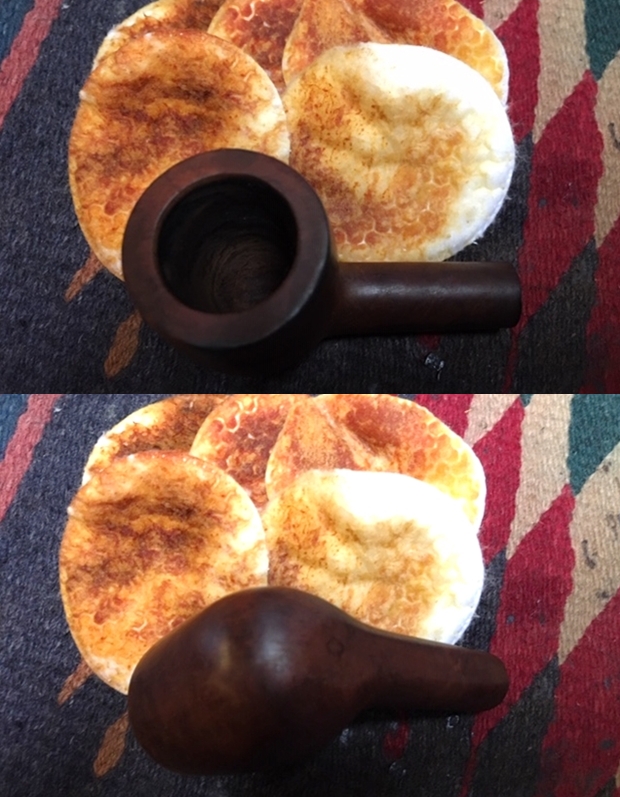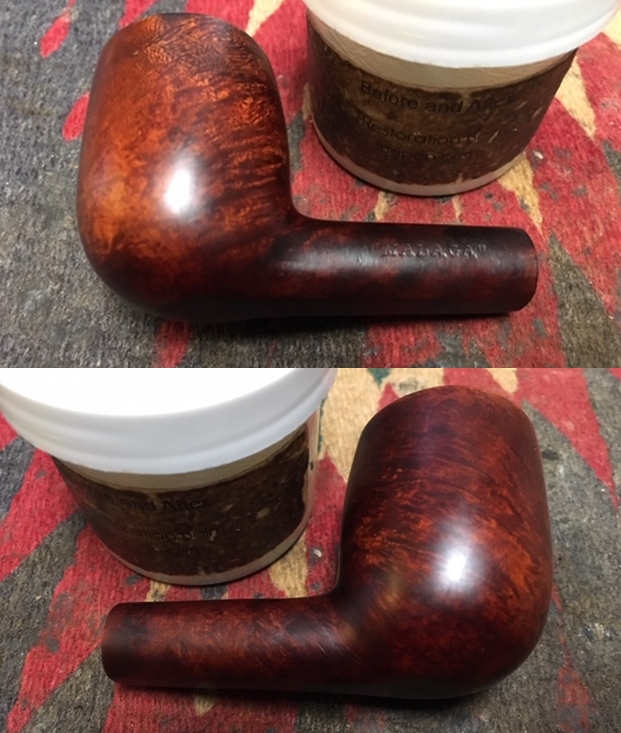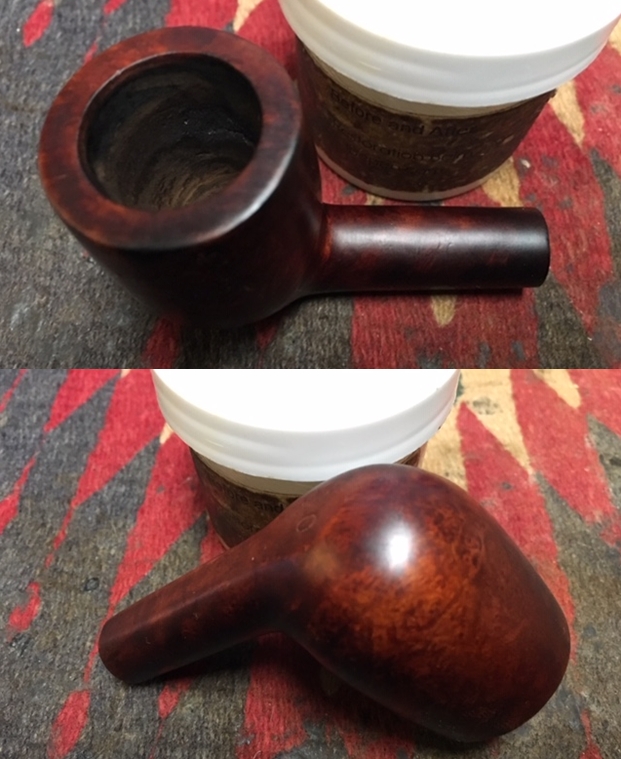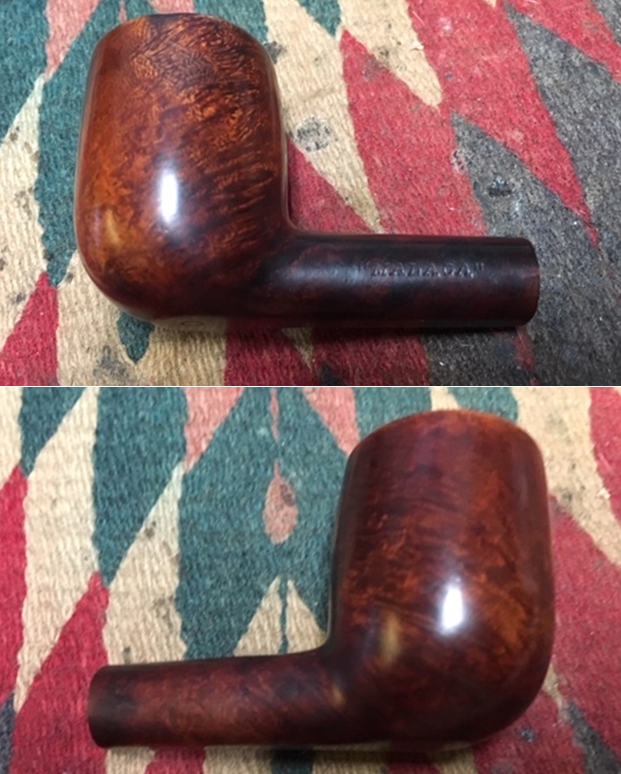
Tag Archives: topping a bowl

Removing an annoying whistle from a Handmade Canadian by Bill Lator


Blog by Steve Laug

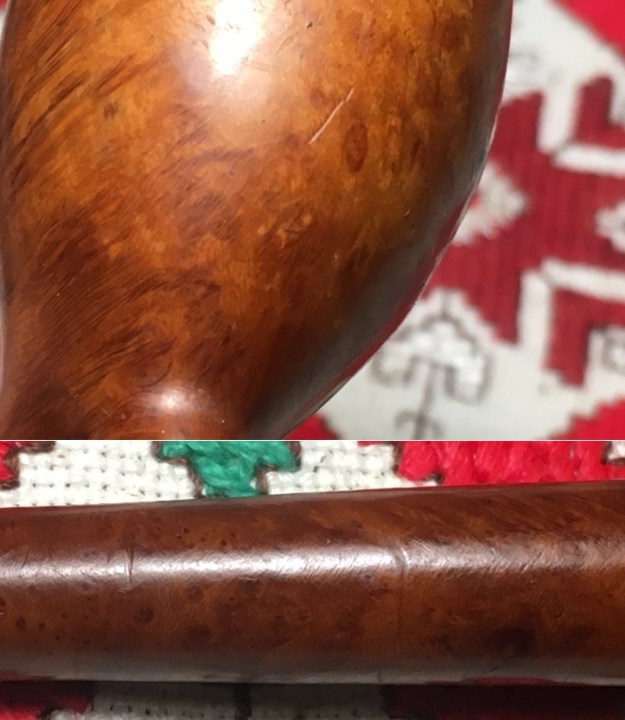
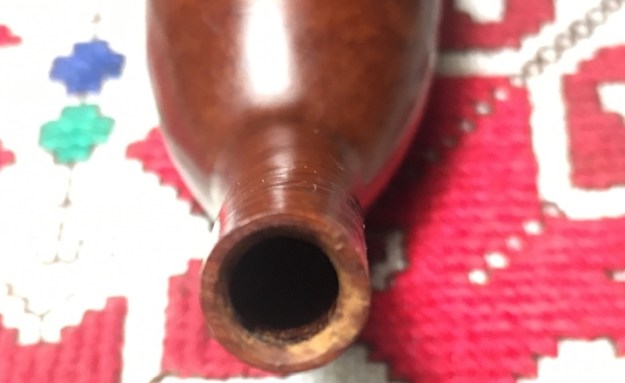
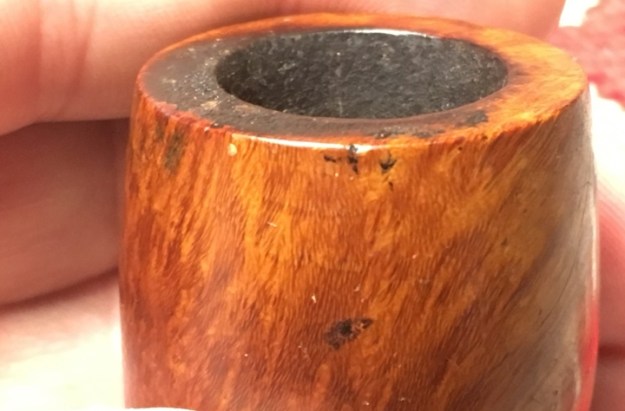
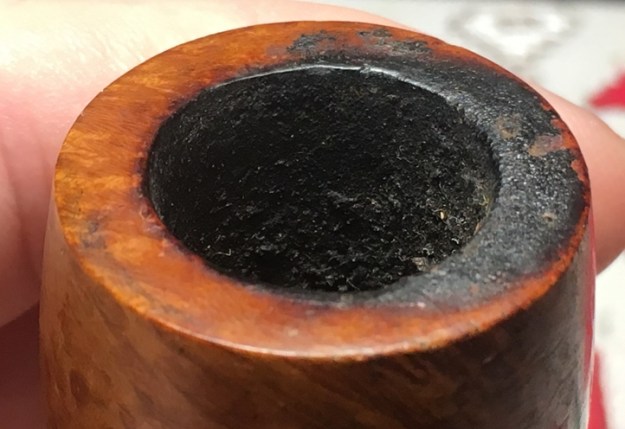
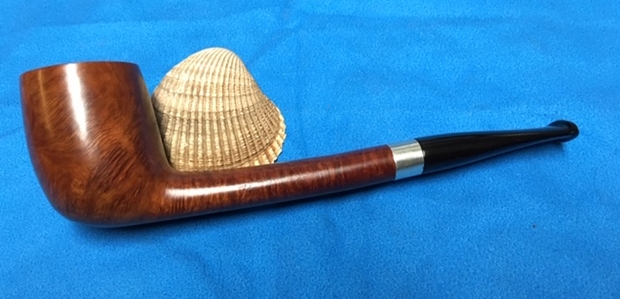
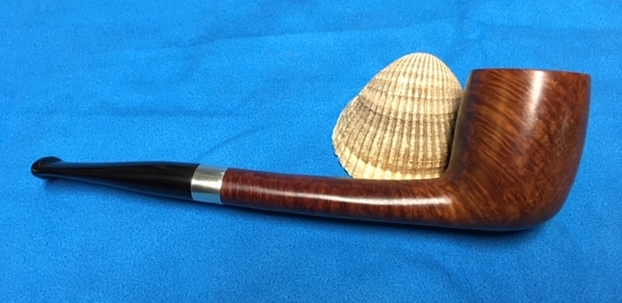
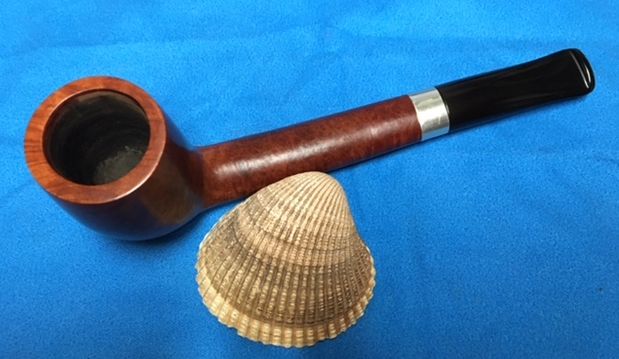
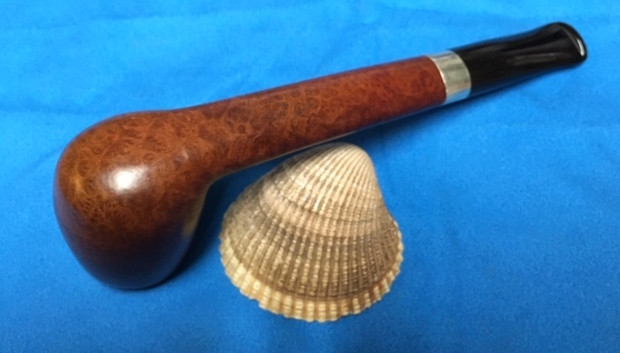
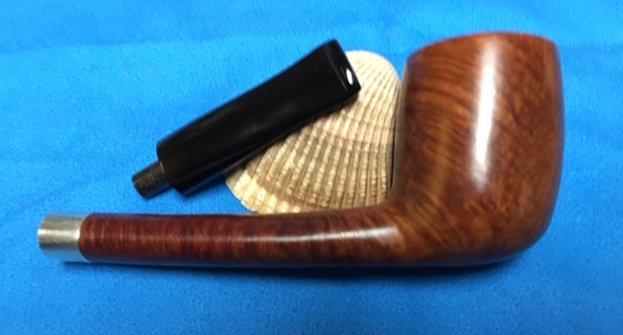
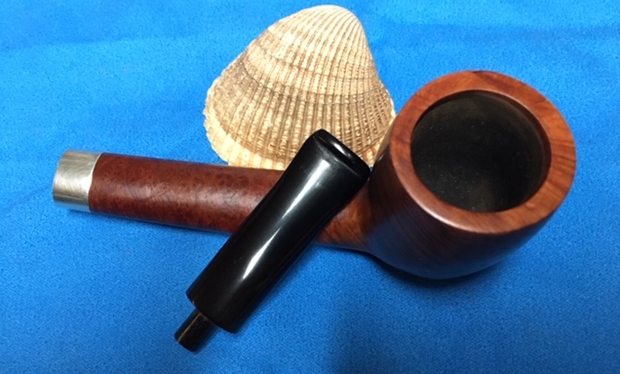
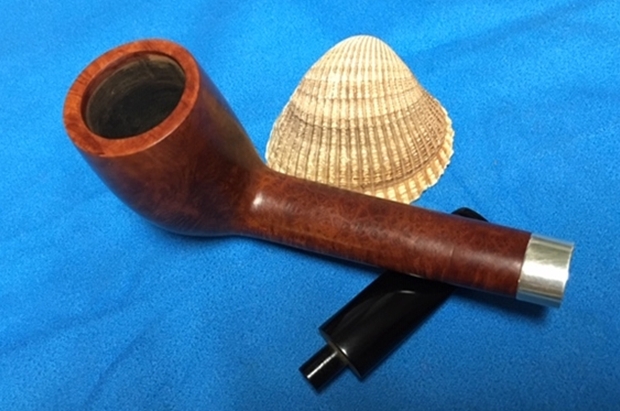
A fellow Vancouver Pipeman named Alex has been keeping me busy with working on the pipes he is picking up. He is selling quite a few of his pipes on the rebornpipes store right now so that he can change the direction of his collection. He is currently picking up a lot of interesting American and English made pipes. One of those is this Canadian that is engraved on the underside of the shank and reads as follows: Handmade Canadian by Bill Lator. It is a nice piece but has some unique features that are visible in the photos that follow. It had a Sterling Silver decorative band (no cracks or damage to the shank). The shank ahead of the band has a definite curve to it… to me it made the pipe interesting. There was also a cant to the bowl with the backside of the bowl more angled. The rim top has some damage that has been cleaned up and the backside of the rim is thinner than the rest of the bowl. The bowl is clean and quite pristine. The stem did not fit well in the shank and had a definite whistle when you drew air through it. I took some close-up photos of the rim to show the condition of the rim top and the inner and outer edge of the bowl. The rim top had some dents and damage to it and the inner edge was thinner at the back of the bowl. The outer edge had a few nicks and dents in it. The stem was in excellent condition though the fit of the stem to the band was off in that the stem circumference was bigger than that of the inside of the band keeping the stem from seating properly in the shank. The silver band is engraved Sterling Silver on the underside.The engraving on the underside of the shank is shown in the photo below. It is also engraved on the left side of the shank with the name of the individual for whom the pipe had been made. It is worn but I can make out “Made For” and under that is the name Keith R. Westerberg (?) at least that is what it looks like. It is faintly etched but the first part is more readable than the last name.When Alex dropped it off I asked him to do a bit of research on the brand and see what he could find out about the pipemaker and the brand. He said he would and over the next couple of days sent me several emails with information that he had found out about the pipe.

The first email was the description given of the pipe on the SATX Pipes site – the company he purchased it from. They gave a pretty detailed description of the pipe and the stamping on the pipe. He included a photo of the pipe along with the description.

This is a very rare hand made Canadian by Bill Lator. In addition, it bears the customer’s name on it that it was commissioned for. Bill Lator was a pipe maker from Indiana who operated two small pipe shops with his family.

This particular Lator is in fine shape. Stem is shiny black and free from any chatter. Beautiful grain and color is offset by a sterling silver band. This is a non-filtered pipe. Pipe has been sanitized, polished and waxed, and comes ready to smoke. Pipe Dimensions: Length Overall: 6 1/8″ Height Overall: 1 3/4″ Width Overall: 1 1/4″ Chamber Width: 7/8″ Chamber Depth: 1 5/8″ Weight: 1.1 ozAlex added a personal note with the description and reflected that though the description says…it bears a customer’s name, but I didn’t notice that. All I saw was “Handmade Canadian by Bill Lator”.

Alex also sent along picture of a Magazine cover showing …Bing with a BL Canadian on the cover of a magazine.He also included an excerpt from a local newspaper article about the Lators from 1976:

Pipemaking is a family affair for the Bill Lator family. The family owns and operates “The Pipemaker,” 109 N. Broad. Father Bill, Sr. and all three sons, Paul, 28, Bill, Jr., 20 and Kurt, 14 have taken up the rare trade of pipemaking. According to Lator, there are only about 20 pipemakers in the United States. “And three of them are in Griffith,” he quipped. Lator said his pipe making started as a hobby, “a way to relax after a busy day as an executive.” Lator also began doing extensive research into pipe making going through a number of west coast libraries and learning everything he could. About a year ago, his friends started suggesting he open a pipe shop and after more urging by his son Paul, Lator moved to Griffith. The fame of his handmade briar pipes combined with the skills of his wife, Hellen, in blending pipe tobacco made the shop an instant success. Lator said his oldest son turns out artistic pipes, “he is the artist in the family-Son, Bill is the “perfectionist.” His creations have a machined perfection according to his father, “which appeals to certain customers.” The youngest, Kurt, is still an apprentice, learning the trade of pipemaking with the discards and making tampers. Mrs. Lator has gained a reputation as a master tobacco blender.

Alex sent a follow-up email and included a paragraph from Bill Lator’s obituary: “Bill was very artistic and in 1973 found he could make beautiful smoking pipes carved of briar. In 1975 he along with his 2 sons, Paul and Bill, opened The Pipemaker Pipe and Tobacco shop in Griffith, Indiana. He loved that shop and all the customers. He made a very successful business that lasted 13 years. In 1986 he decided it was time for him to retire…”

From this I know that the pipe came from Bill Lator’s Griffith, Indiana Shop – the Pipemaker Pipe and Tobacco Shop. It had been made between 1975 and 1986 when Bill retired.

Now it was time to address three specific issues that I saw with the pipe.

  1. There was a distinct whistle when you drew on the pipe to pull air from the bowl to the button.
  2. The stem did not seat well in the shank and there was a gap in between the end of the shank and the stem when it was in place.
  3. The bowl was slightly out of round and the back wall was thinner than the rest of the bowl.

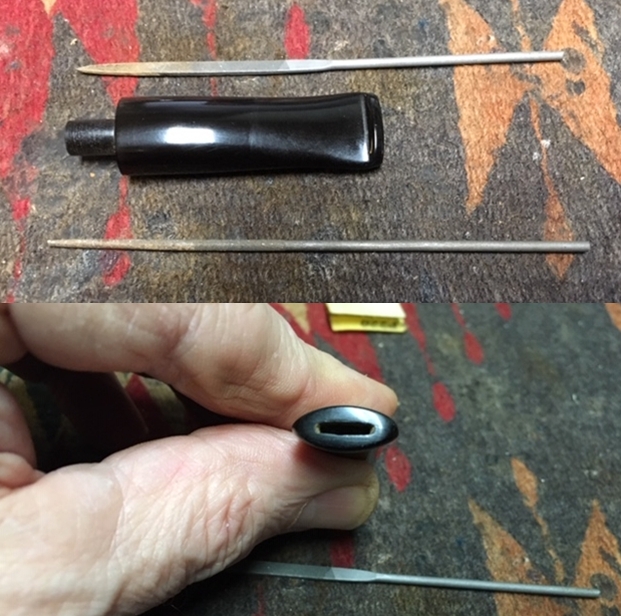
I decided to deal with the whistle in the airway first. I took the stem off and drew air through the shank. It was a clean and open draw with no whistle. With that test I knew that the problem was not in the shank. I turned to the stem and blew air through the tenon and out the slot. The whistle was loud and distinct. I shined a light through the tenon so see if there were any obstructions on the walls of the airway. That is often the cause of the noise. There can be debris left behind by the drilling of the airway. I could not see anything from the tenon end. I shined the light in the slot end and there I found the issue. The slot was deep and T shaped rather than Y shaped. This made the air whistle as it was drawn into the slot. I used a flat and a round needle file to reshape the airway in the slot to a Y shape. In my experience this shape makes the transition of the air from the bowl to the mouth a straight smooth flow with no interruptions.I cleaned up the slot with a folded piece of 220 grit sandpaper to smooth out the edges of and leave it free of debris.

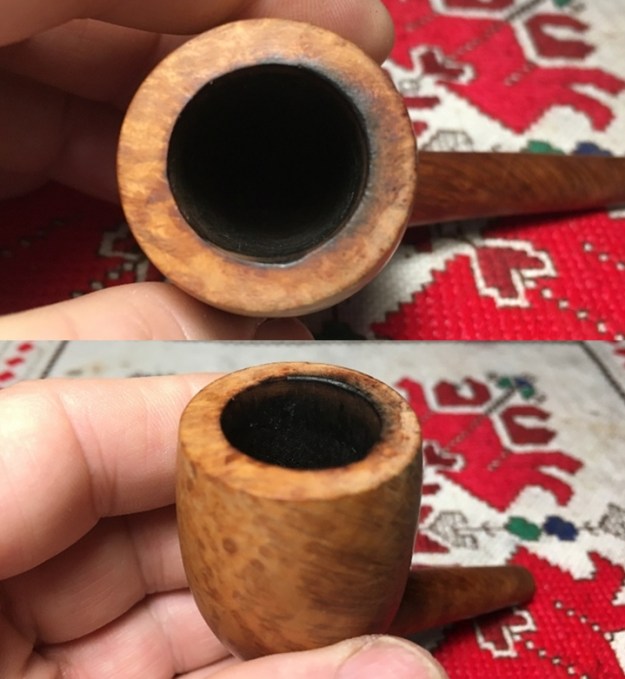
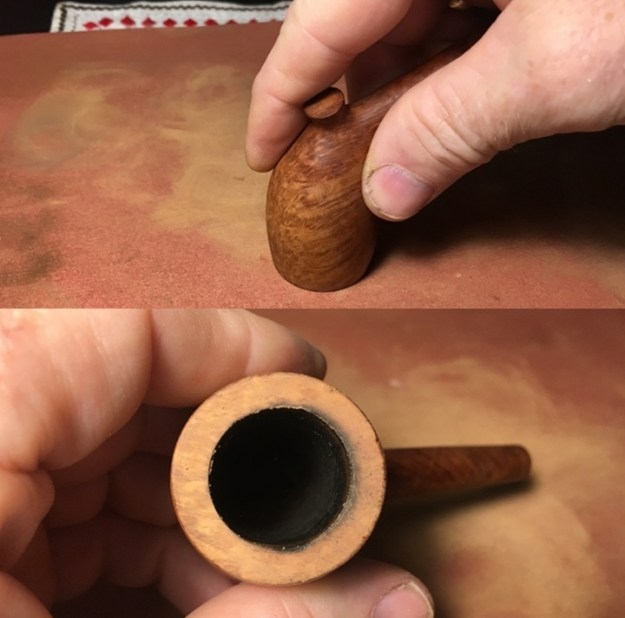
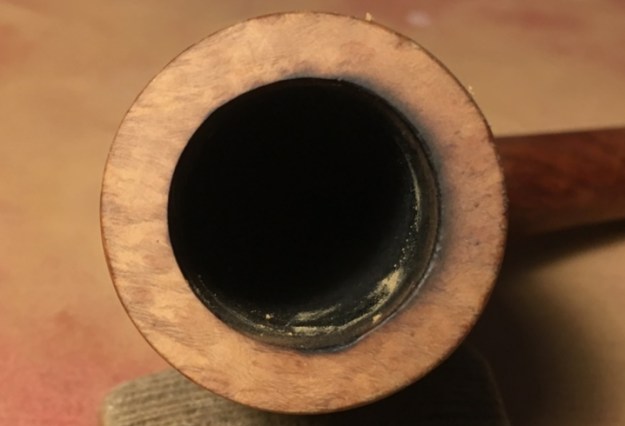
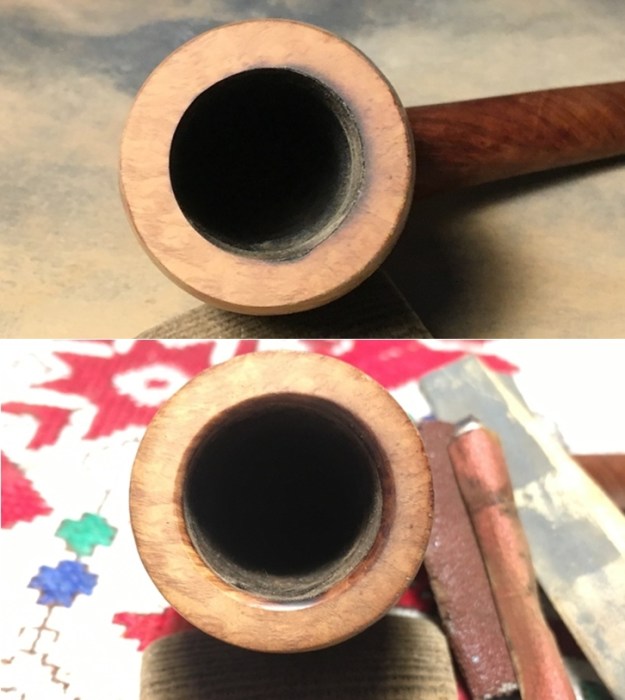
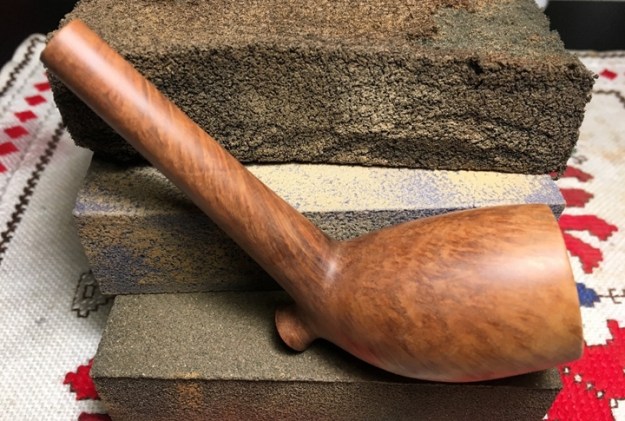
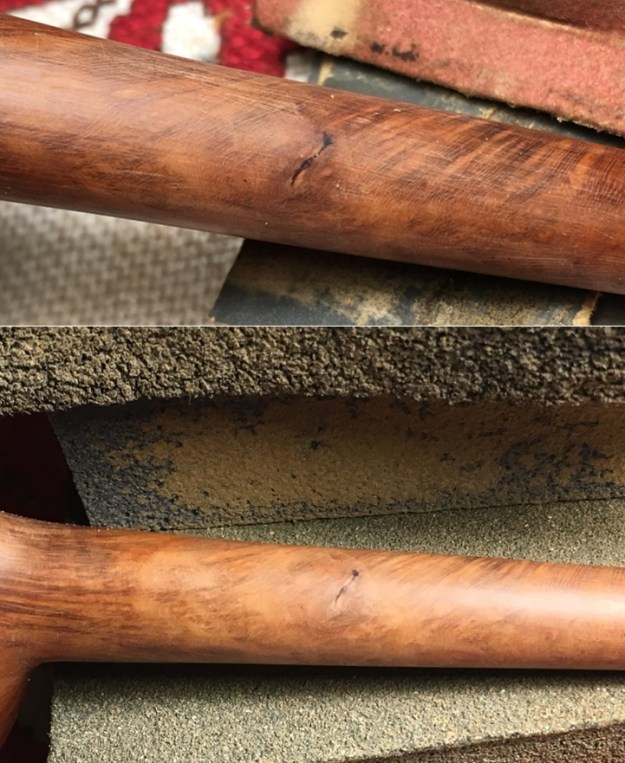
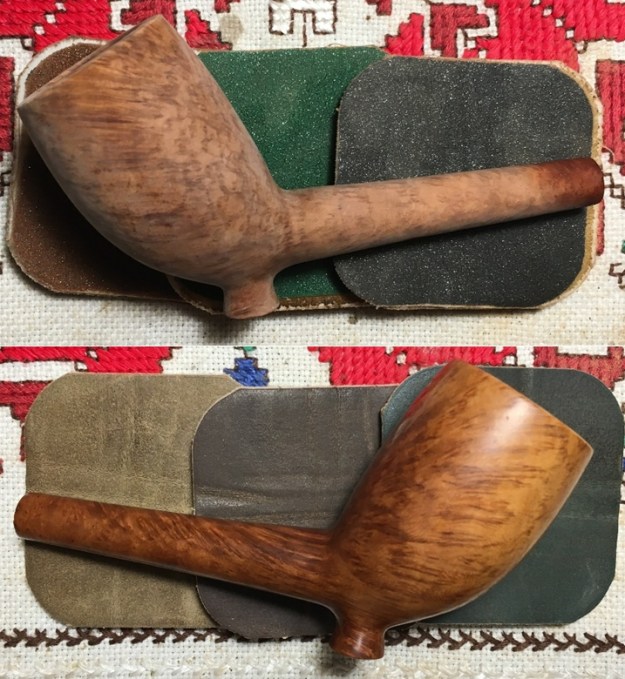
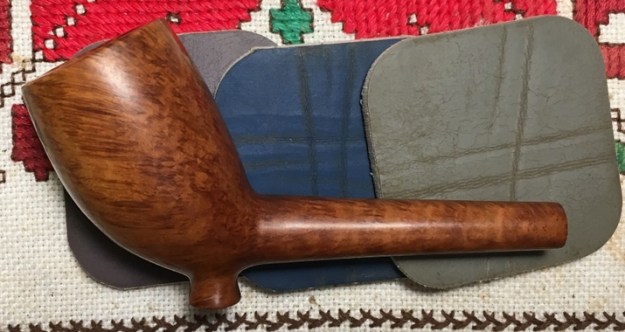
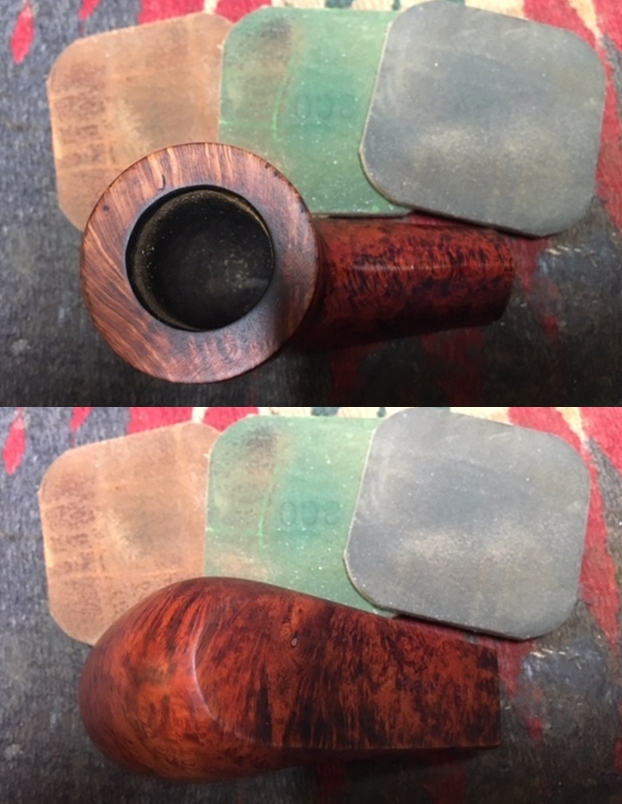
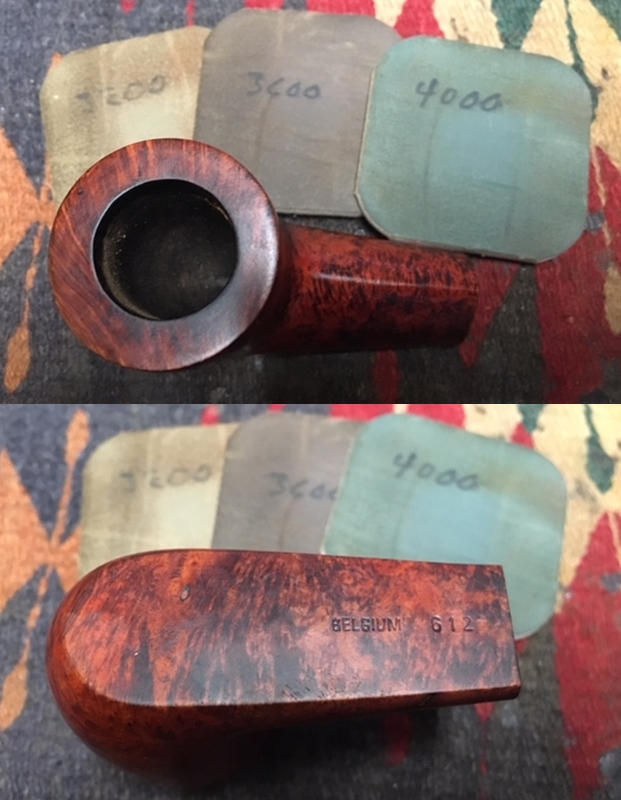
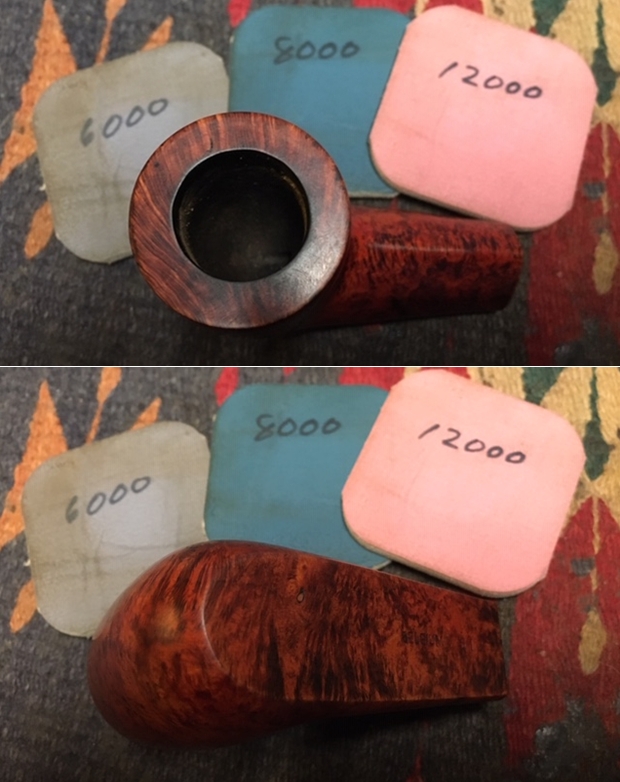
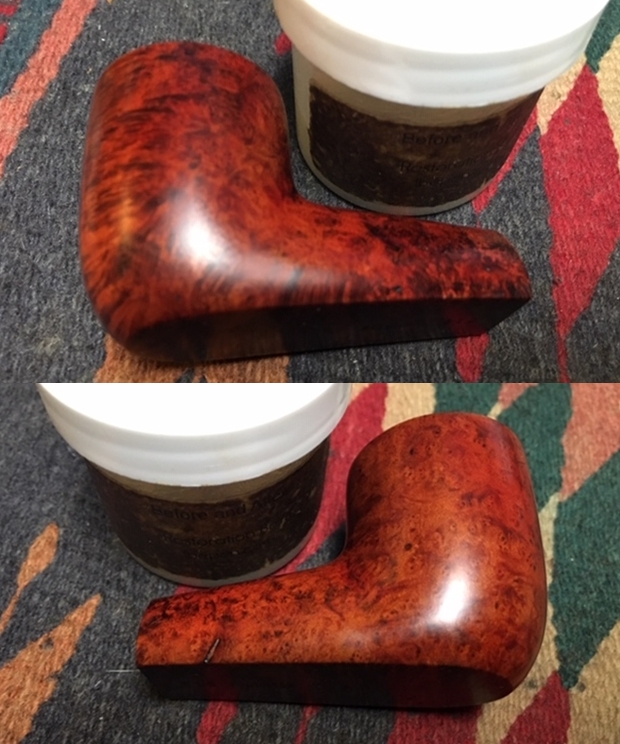
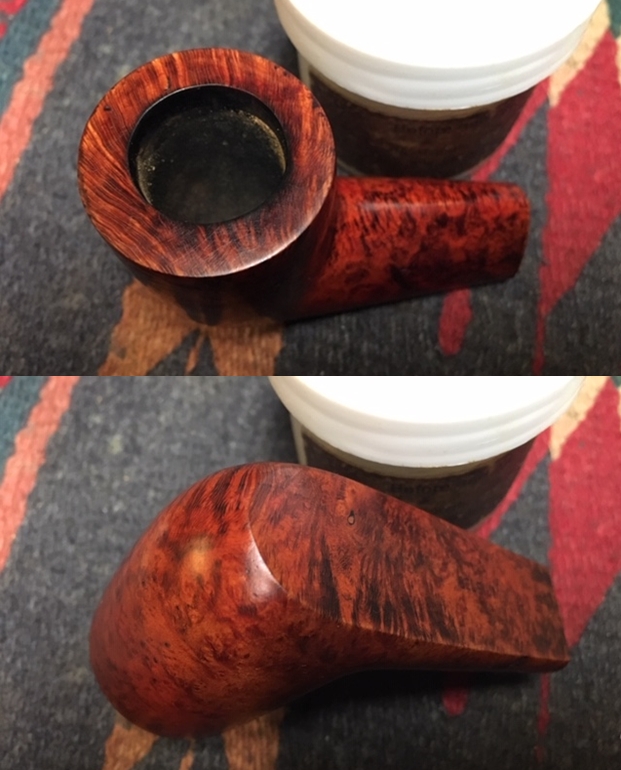
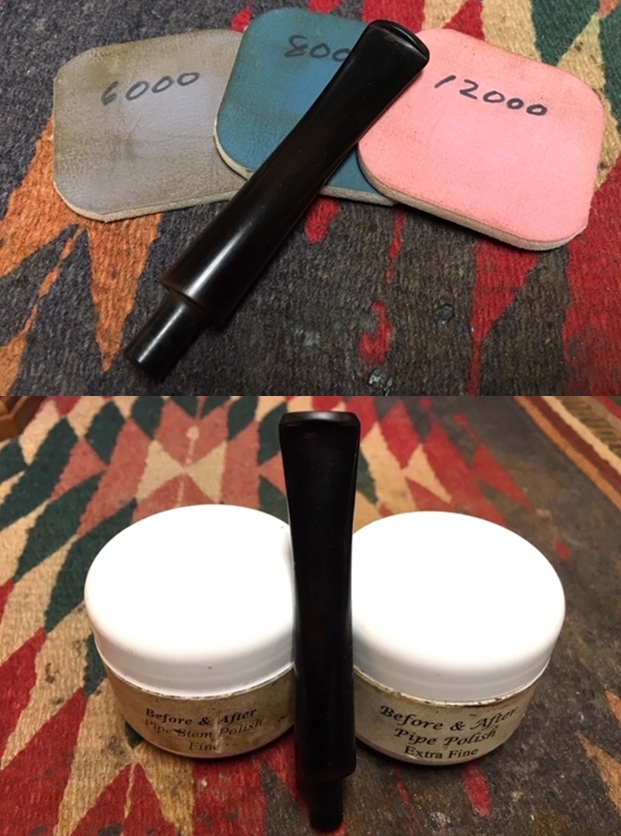
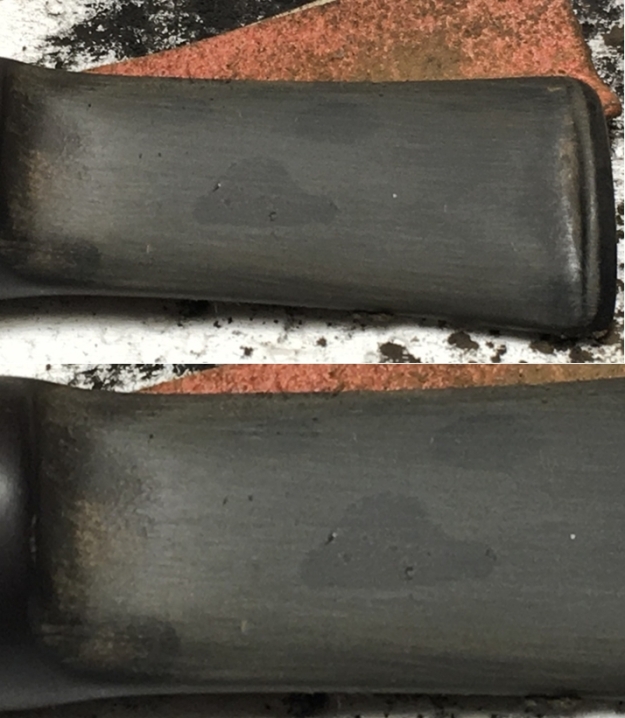
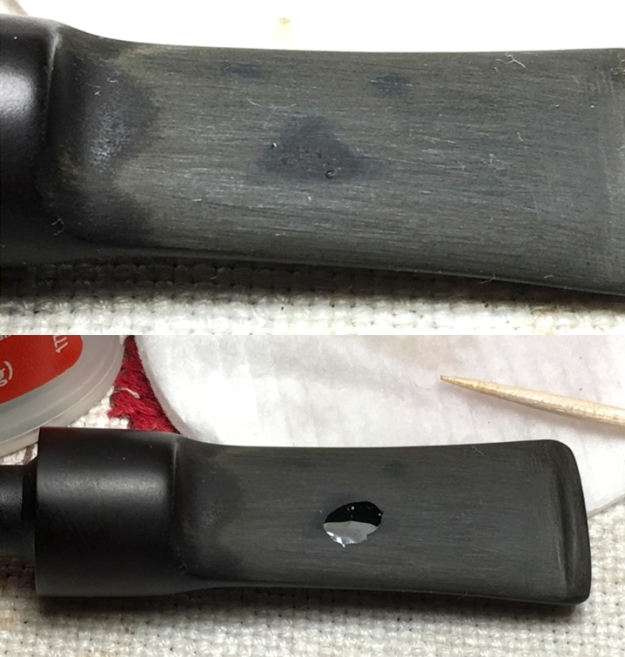
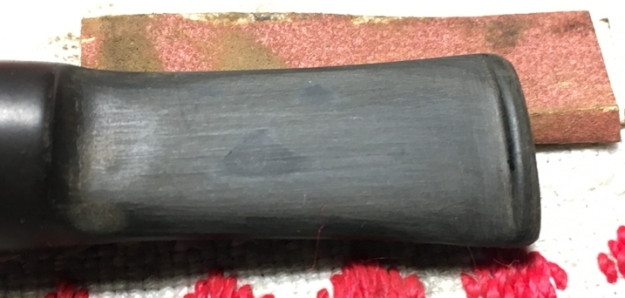
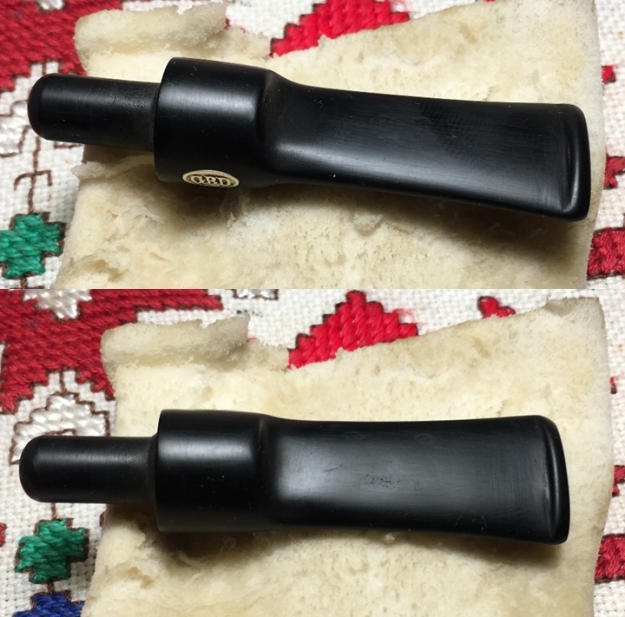
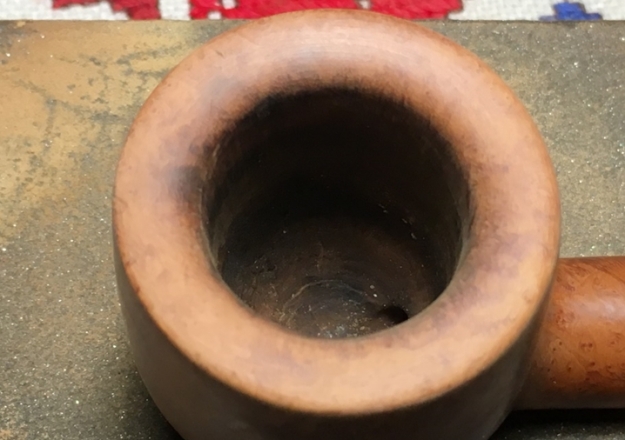
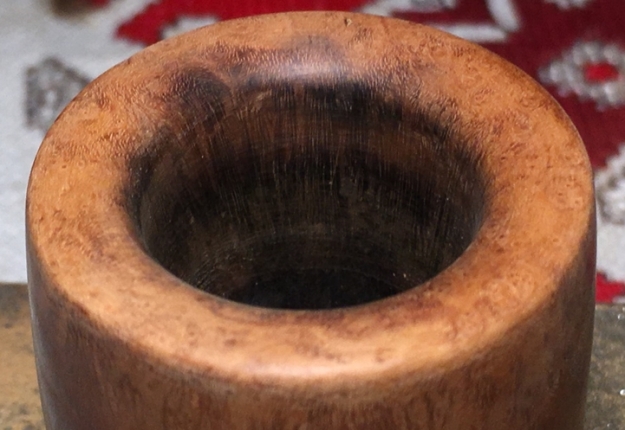
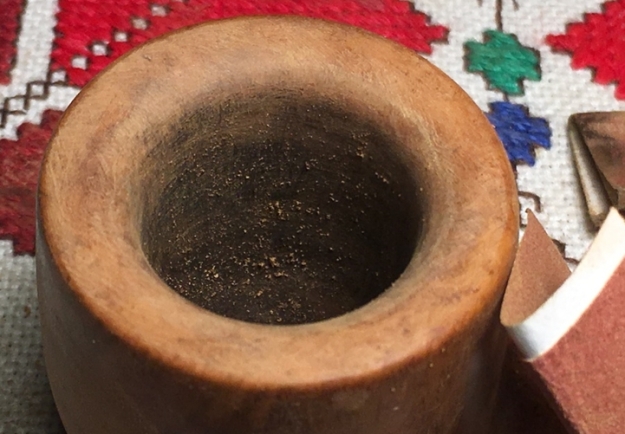
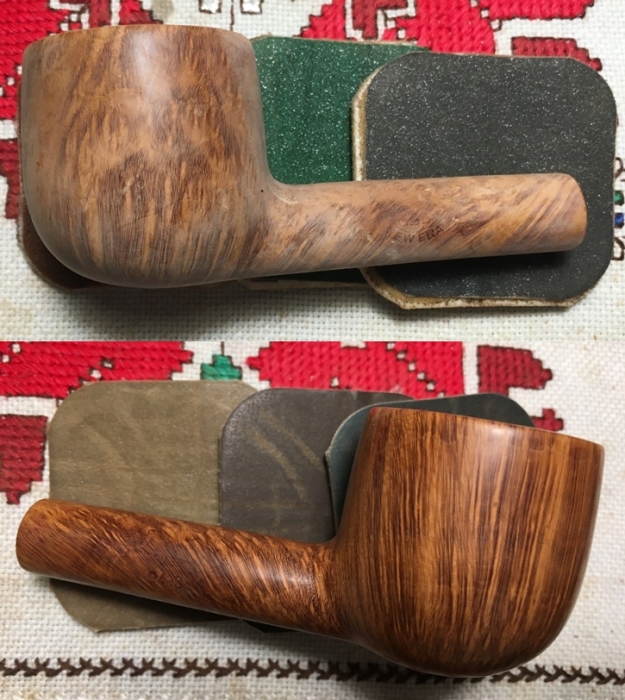
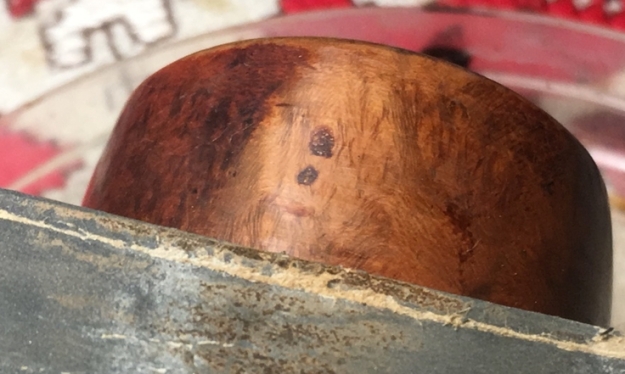
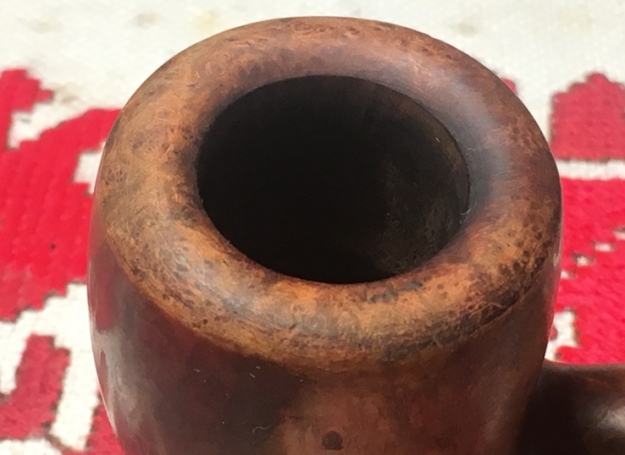
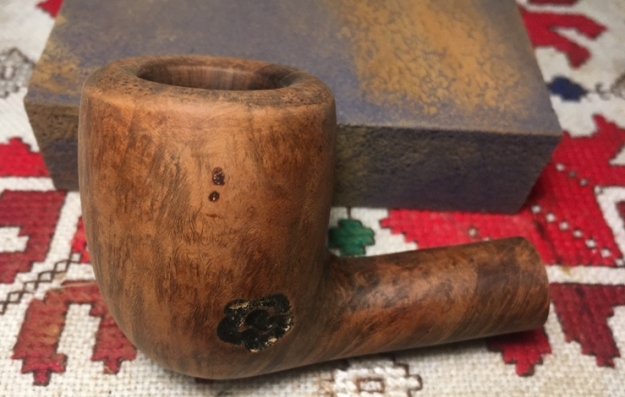
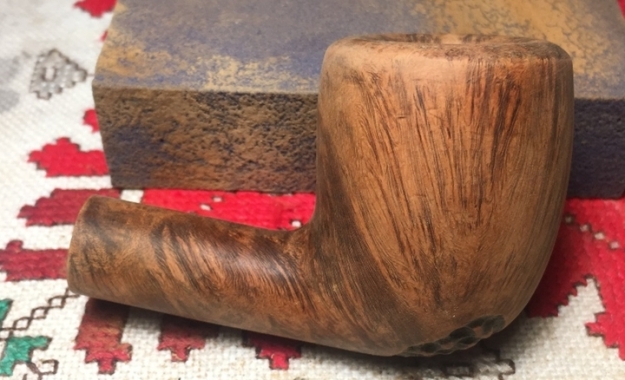
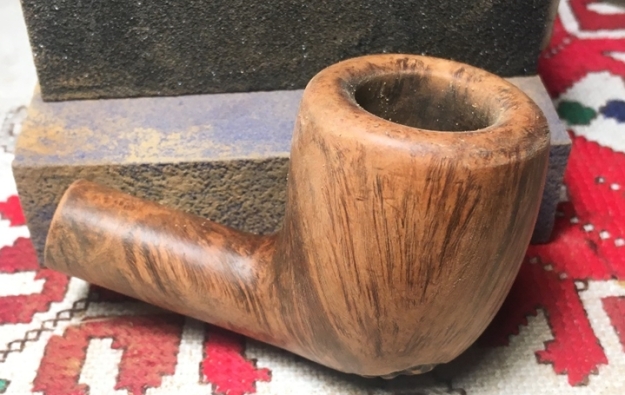
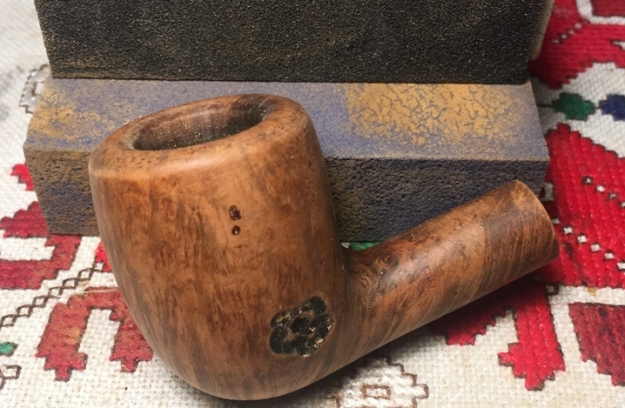
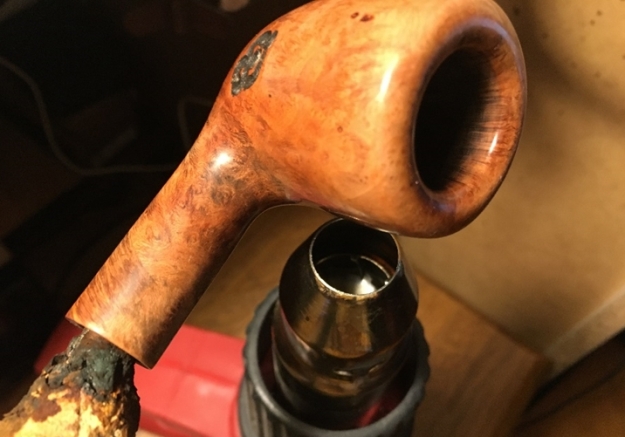
With the airway in the stem cleaned up and the whistling taken care of I turn ed to deal with the fit of the tenon in the shank. I used a sharp pen knife to carve a bevel in the shank face. The initial beveling was rough but when I tried the stem in the shank the fit was snug and there was no gap between the shank face and the face of the stem. I sanded the bevel with a folded piece of 220 grit sandpaper to smooth it out. The second photo shows  the first sanding of the bevel. The third photo shows the final sanding of the bevel smoothing out rough edges. The final photo shows the finished bevel. I stained it to match the rest of the pipe using a Maple stain pen. The second issue was solved.Now it was time to address the third issue – the damage to the rim top and the bowl edges. After measuring the slop of the walls of the bowl on the front, the sides and back I could see that the thinness was primarily an issue with the top of the bowl. To deal with that I decided to lightly top the bowl with 220 grit sandpaper on a topping board. I removed the damage to the top of the rim and in doing so was able to reduce the thinness on the backside of the rim. I did not need to take much off of the rim top to effect this change and I was happy with the results. I polished the rim top with micromesh sanding pads – wet sanding with 1500-2400 grit pads and dry sanding with 3200-12000 grit pads. I wiped the rim down with a damp cloth after each sanding pad. The rim top looked much better than when I started the process. I restained the rim top and edges with a Maple stain pen. I buffed the bowl and stem with Blue Diamond on the buffing wheel to polish the pipe and then gave it multiple coats of carnauba wax. I buffed it with a clean buffing pad to raise the shine and hand buffed it with soft microfibre cloth to deepen the shine. The photos of the finished pipe are shown below. It is finish and the whistle is gone, the stem fits better against the shank and the rim top looks significantly better. I look forward to hearing what Alex thinks of his Lator pipe now… it is a beauty.

ADDENDUM

Yesterday (16 August 2019) Michele, Bill Lator’s daughter left an amazing comment on this blog about her Dad. I am highlighting that message because in the follow up to it she sent some photos of her Dad and the Pipe Shop in Griffith that I am including below.

I am Michele Lator-Murray, Bill Lator is my Dad. He is missed by all of us and so proud to see this article. I have forwarded it to our Mom. Our Brother Billy has passed also. Paul and Kurt are alive and well. My son has taken interest in his heritage and has a small collection of Dad’s Pipes.Thanks for the memories.

The photos include a picture of her Dad, Bill Lator by himself, with her Mom, a photo of the day Michele gave her son his first pipe that she found of her Dad’s online, the Pipemaker Pipe and Tobacco Shop advertisement from a Purdue Student paper and the backside of a book of matches.

Thanks so much Michele for send us these photos. It is always great to have a photo of the pipe man himself and some of the memorabilia.

Todd’s Second Commission: A GBD New Era London England 9493 Pot with Distinction


Blog by Dal Stanton

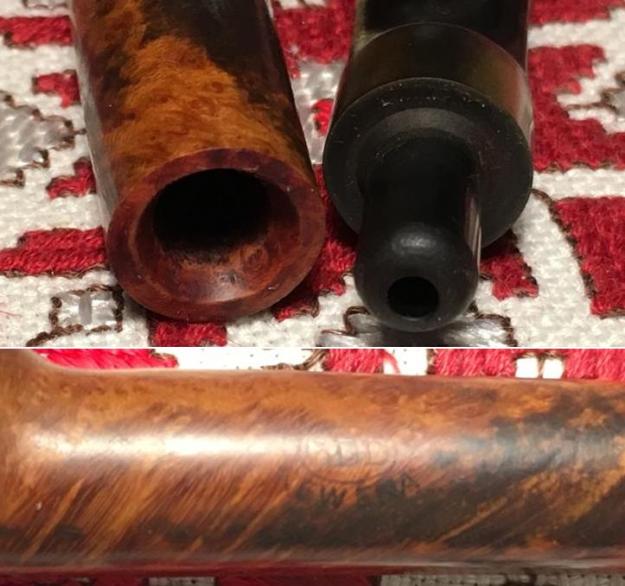
This is the second of 3 pipes that Todd commissioned.  I saw this GBD New Era long shank Pot or possibly a wide bowled Lovat, on the eBay block and liked it immediately.  It has seen some serious wear and tear, but he is obviously well loved, and the grain….  Oh my, the vertical grain on the bowl of the Pot shape it distinctive and when cleaned up….  Dream!  Well, my bid was enough when the bell rang, and it didn’t remain in my collection, and Todd saw the potential in the For “Pipe Dreamers” Only! collection and now this GBD New Era is on my worktable.  These pictures take a closer look at the GBD New Era: The nomenclature on both sides of the shank are thin but legible.  On the left flank of the shank is ‘GBD’ encircled in the oval [over] ‘NEW ERA’.  The right side of the shank is stamped ‘LONDON ENGLAND’ [over] 9493, the shape number.  The stem bears the classic brass GBD rondel.

I like this A Brief History of GBD from Pipedia to remind me of the origins.

The company was founded in Paris France in the 19th century by Ganeval, Boundier and Donninger who were no longer associated with the company by the turn of the century. By the time they left the GBD name was well established and thus retained. In 1903 an additional factory was built in England and ran by Oppenheimer. The Paris factory moved to Saint-Claude in 1952. Since 1981 the majority of GBD pipes come from the English factory. At about that same time GBD merged with Comoys, since then all production for both GBD and Comoy comes from a single factory.

The dating of this New Era can be determined with certainty to be before the 1980s. The brass rondel on the stem and straight line “LONDON, ENGLAND” stamping of the nomenclature identify it as being made prior to the merger with Comoy’s in 1982 (or 1981). 

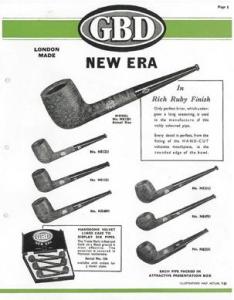
The GBD line, New Era, can be found in catalogs going back to the 1950s.  The example I found on Pipedia’s article on GBD are pages from Circa 1950s Oppenheimer Pipes Catalog, courtesy Václav Blahovec, which I’ve included.

The add to the right is from Pipedia’s discussion on GBD Model Information is credited to the 1961 GBD Flyer, courtesy  Chris Keene’s Pipe Pages, unfortunately now a defunct website.  So, the spread of possible dating for the GBD New Era Pot on my table could span from the 50 through the 70s.

The quality of the New Era line is toward the upper third of GBD lines, from what I read in the Pipedia article.  This last quote from Pipedia’s reprint of Pieces From My GBD Collection, by G.L. Pease (re-published here by permission), sums up well GBD pipes and what I believe is true of the GBD New ERA before me:

Since then, many GBDs have come, many have gone. I’ve tried to select exquisite examples for my collection – pipes that are exemplary in every regard. Not all old GBDs smoke wonderfully, but when they do, they sing. The French made ones, for some reason, seem particularly suited to Virginias. GBDs are not exactly hip. They’re not trendy. They’re not the high-grade pipes du jour. But, they are solid, classic pipes with a long history, and they can be subtly and sublimely beautiful. They can also often be had without sacrificing too much coin.

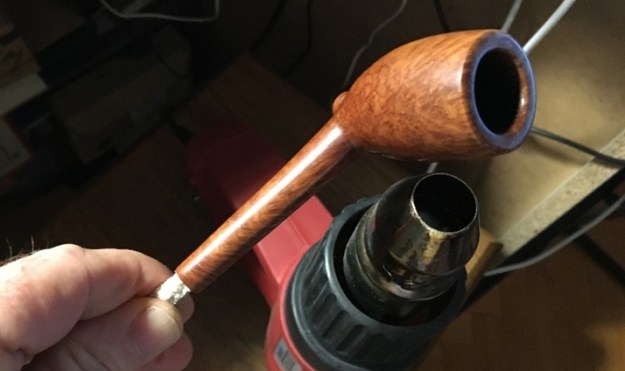
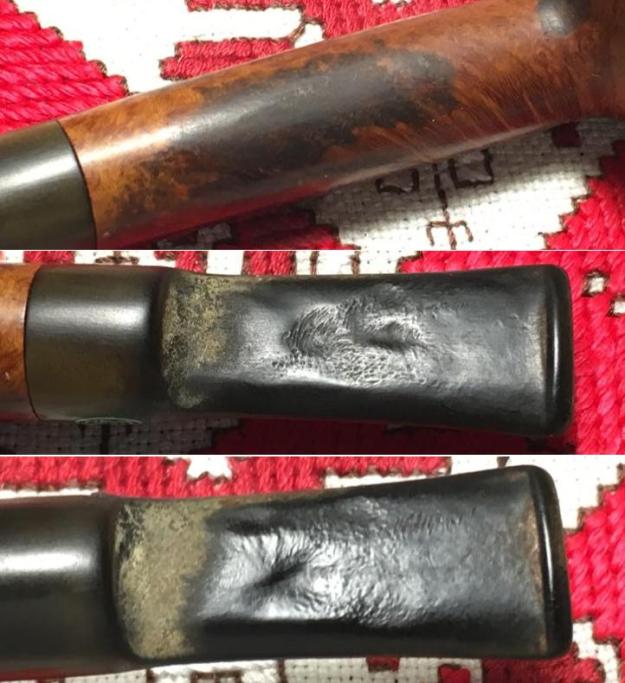
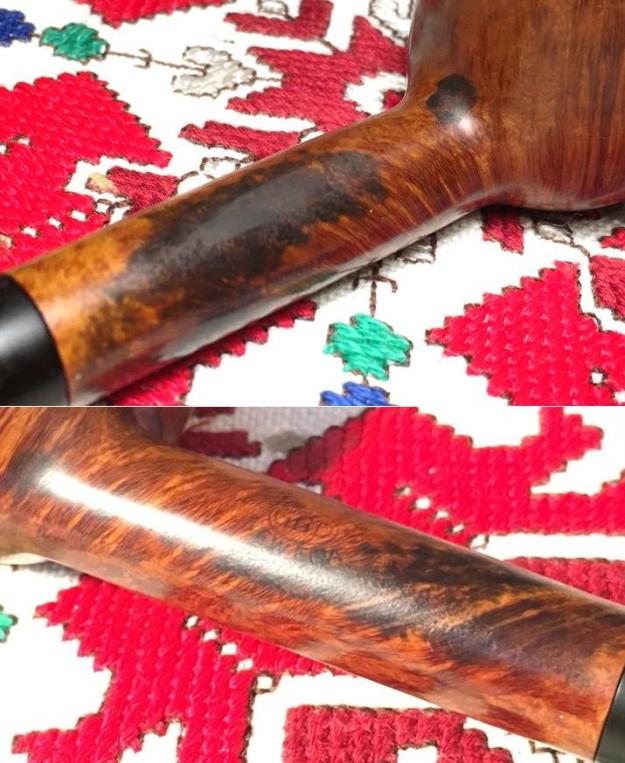
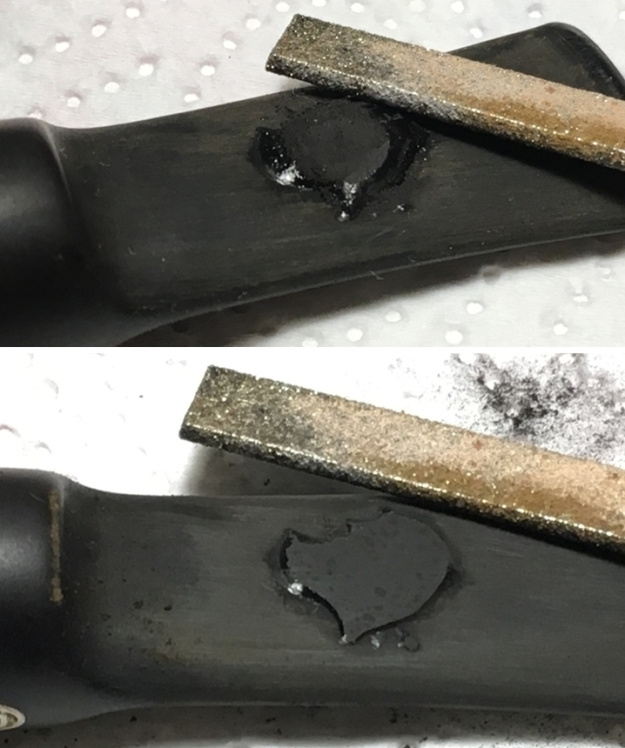
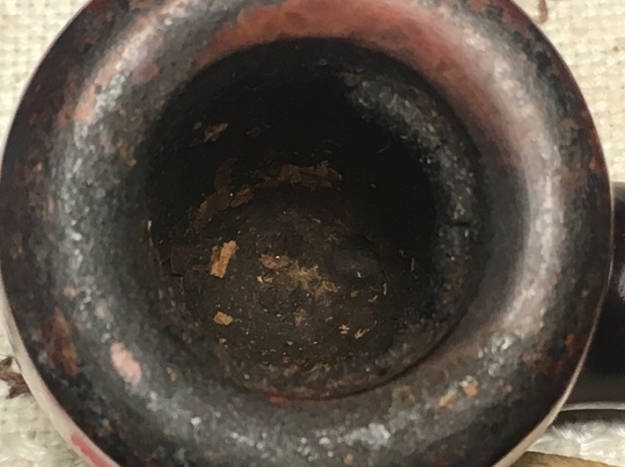
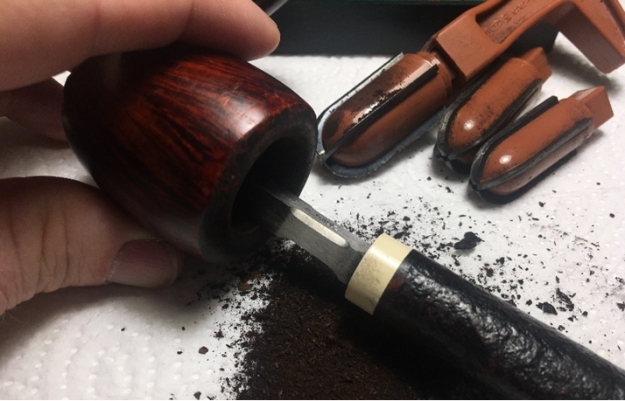
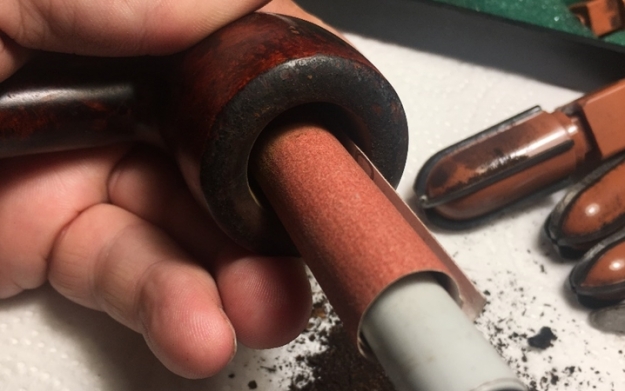
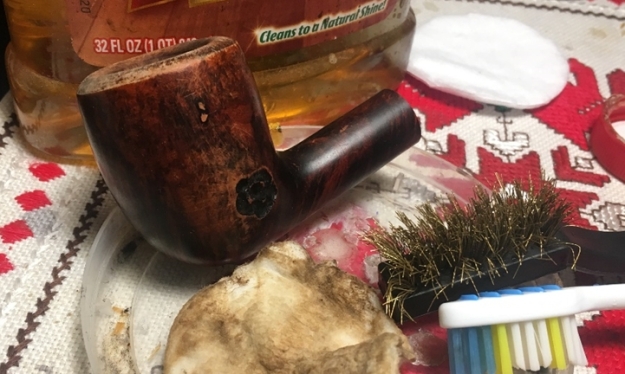
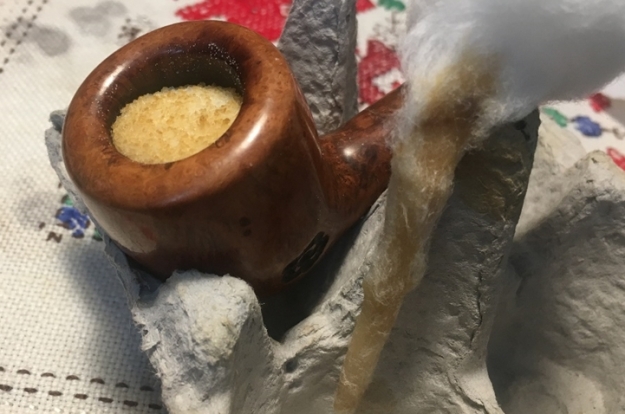
As I look at the GBD New Era Pot on my worktable, what stands out immediately are the dark blotches on the briar surface, especially on the long shank.  If these were on the bowl or the heel, I would be concerned about heating damage.  But on the shank, the issue is on the briar surface and hopefully cleaning will address it. The chamber has moderate cake build up and the rim shows some lava flow and scorching on the forward part of the rim, yet there is darkening around the entire inner circumference.Oh my, the short saddle stem is oxidized and mauled!  Looking at the bit (upper and lower below) the forensics are not difficult to decipher. One can discern the eye or canine tooth imprinted followed by the first premolar – especially on the upper side.  The lower side is not as distinct, yet the practice is revealed.  The former steward’s ‘hands free’ approach was to insert the entire flat part of the stem on the right side in his (or her?) mouth and clamp down using the stem as a palate to hold the pipe in place.  Hmmmm, deep breath.  Moving on.With a good understanding of the pipe on my worktable, I begin the restoration by cleaning the internal airway of the stem with several pipe cleaners wetted with isopropyl 95% and then I add the GBD’s mangled short saddle stem to a bath of Before & After Deoxidizer along with other pipes in the queue. After the stem soaks for several hours, I fish the GBD stem out of the Deoxidizer and after draining the Deoxidizer, I wipe the stem with cotton pads wetted with alcohol.  A good amount of oxidation is removed, and the stem looks good after cleaning it.To begin the revitalization of the vulcanite, I then hydrate the stem by applying paraffin oil (a mineral oil) to the stem – it absorbs it well.  I put the stem aside for the time.To begin the cleaning regimen of the GBD Pot stummel, I ream the chamber using the Pipnet Reaming Kit. The dimensions of the chamber live up to a grand Pot image – the chamber is 1 inch wide and 1 3/8 inches deep, plenty of room for a bit of tobacco!  After putting down paper towel to minimize cleanup, the width of the chamber causes me to skip the smallest blade head and I use the remaining 3 larger blade heads.  I then transition to scraping the walls further with the Savinelli Fitsall tool and finish the reaming by sanding the chamber with 240 grit paper wrapped around a sharpie pen to give leverage.  After wiping the chamber with a cotton pad and alcohol, I inspect the chamber, and everything looks great – no signs of heat damage.  Now a fresh start for the chamber. Now, turning to cleaning the external briar, I hope that the cleaning will address the large dark blotches on the surface.  I use undiluted Murphy’s Oil Soap and a cotton pad to do the job – and what a job it does! As I scrub with the cotton pad the grunge starts breaking up and eventually the black spots on the shank are removed!  I love Murphy’s Soap!  I work further on the inwardly sloped rim also using a brass wire brush.  This helps, but the rim still has some scorching darkness left.  The pictures show the great progress. Remaining on the cleaning regimen, I now address the internals of the stummel using cotton buds, pipe cleaners wetted with isopropyl 95%.  I also use shank brushes which are perfect for the longer shank of this GBD.  To quicken the process, I also scrape the mortise with a dental spatula.  In time, cotton buds started emerging much cleaner.  Later, I plan to also clean the internal further with a kosher salt and alcohol soak.With some fear and trembling, I study again the mauled saddle stem.  The Before & After Deoxidizer did a good job removing the oxidation.  My first assault on the stem damage will be to expand the stem’s surface to regain the multitude of compressions on the upper and lower bit. I take pictures to mark the starting point for comparison.  Then, using a Bic lighter I paint the vulcanite surface.  As it heats, it expands and hopefully reducing the severity of the compressions.  After one round of heating upper and lower bit several times, I take a picture for comparison.

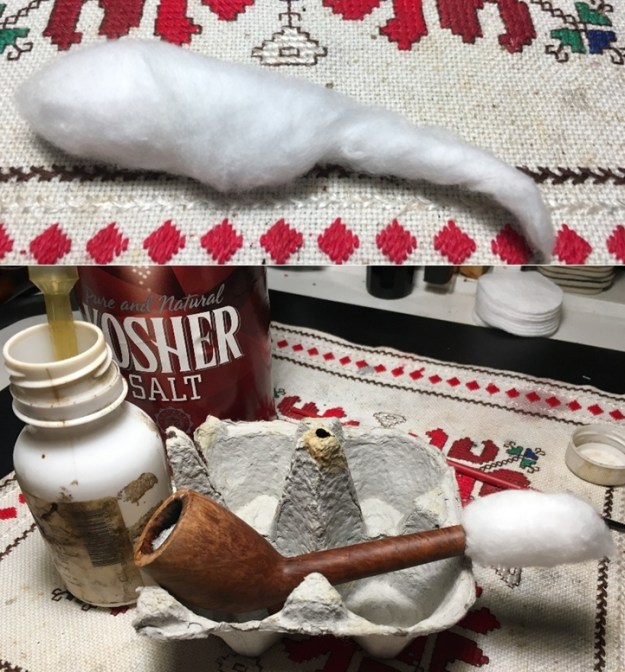
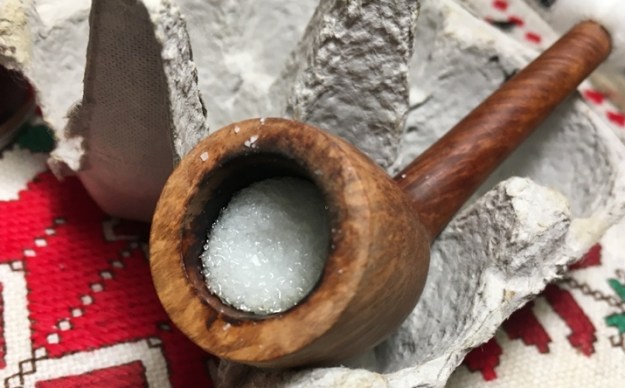
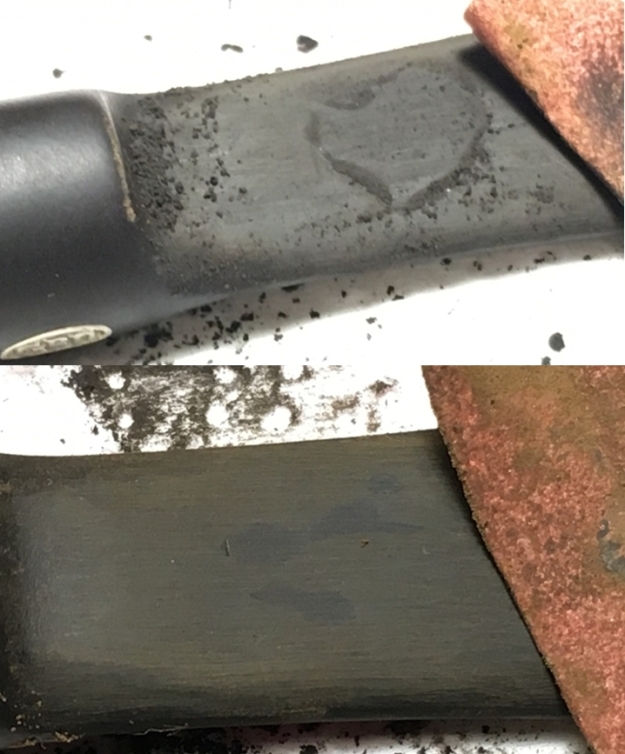
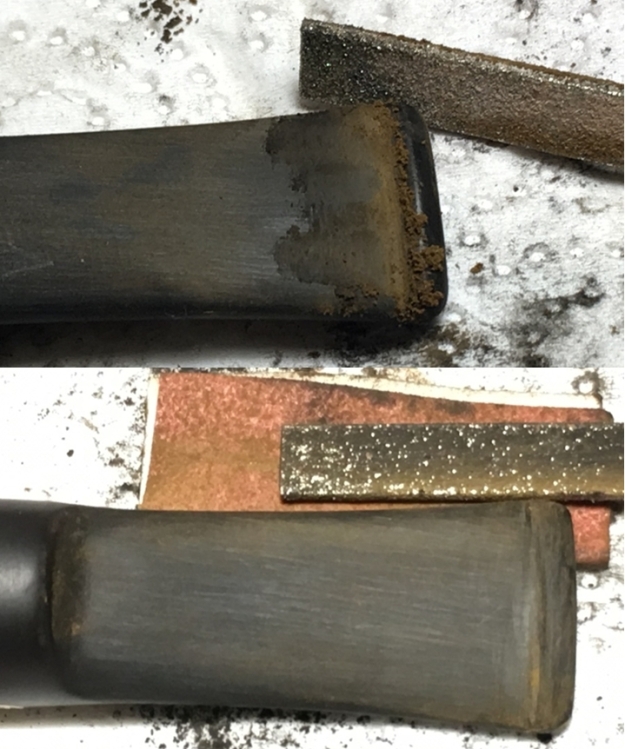
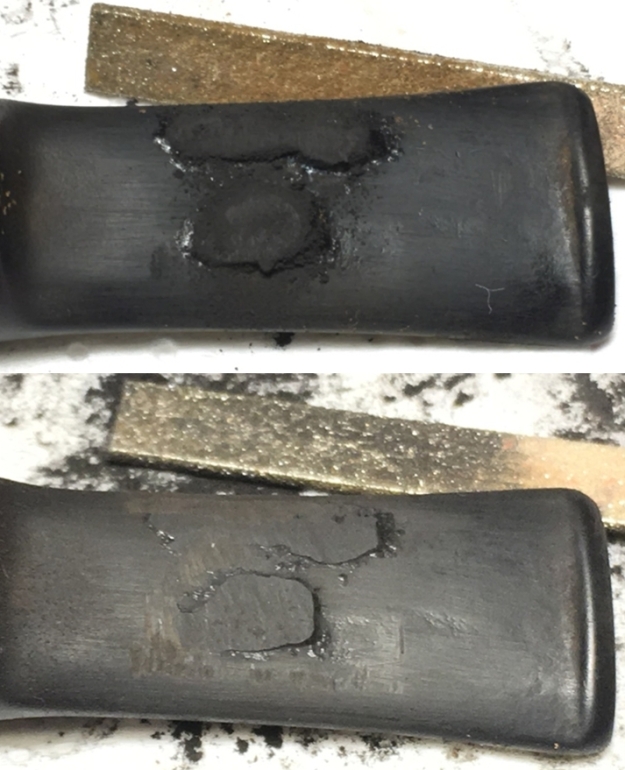
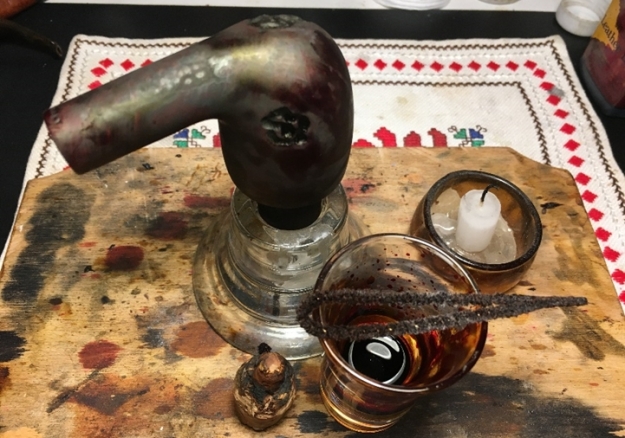
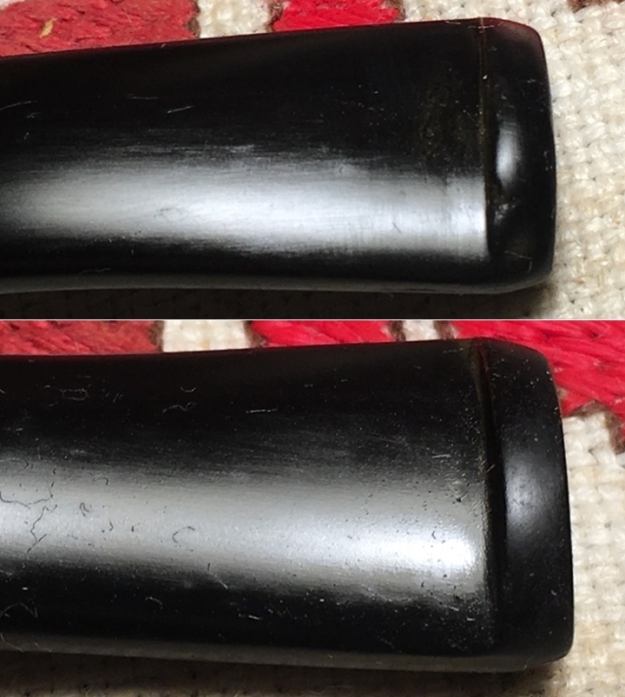
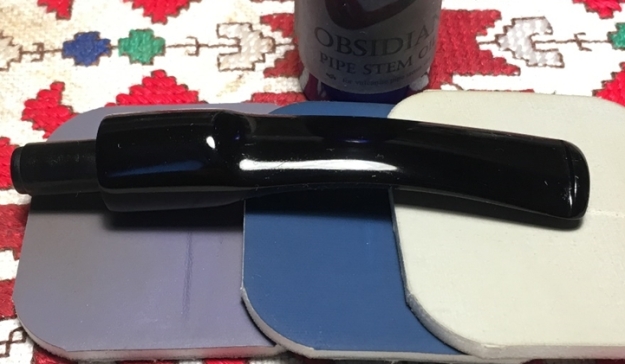
Upper, before and after:Lower, before and after:Next, using 240 grit sanding paper, I sand the upper and lower bit to get a better understanding of the contours of the remaining damage after using the heating method.  As you can see in the pictures I take after sanding some, the compression areas are revealed more clearly.  I have found from experience is that using charcoal/CA glue as a patch on the vulcanite stem, the patch material needs to have enough depth in the compression to get a good hold.  I have found that patching a compression that is too shallow will not hold, but sometimes these compressions are too deep to sand!  For instance, I debate whether it is better to sand the two lesser upper compressions on the lower bit (second picture) and risk sanding and taking too much of the stem?  And going partially and changing your mind with the view to applying patch material, and then it’s too shallow!  I decide to apply patch material at this point and then sand and see how it comes out.I first wipe the stem with alcohol to clean the area. To form the patch material, I mix CA glue with activated charcoal.  I start with the upper stem side.  I put a small pile of charcoal on an index card and put a blob of thick CA glue next to it.  Then, using a toothpick I pull charcoal into the CA glue mixing it as more is added.  When it thickens to that of molasses, I use the toothpick to trowel the mixture to the compressions needing filling.  I use an accelerator to speed the curing time.  I do the same for the lower bit compressions.  To now begin removing the excess patch material to the upper bit, I use a flat needle file.  The pictures show the progression.After bringing the patch mound down to the surface, I then switch to sanding with 240 grit paper to remove the excess patch material totally.  In the second picture you still see the patches, but the patch is now flush with the stem surface.Remaining on the upper bit, I refresh the button using the flat needle file and follow with 240 grit paper erasing the file marks and fine tuning the button restoration.  The upper bit repair looks great.Now, starting on the lower bit, I do the same using the flat needle file to bring the patch mounds down close to the briar surface.Then, taking over with the 240 paper I sand away the excess patch material totally bring the patch flush with the vulcanite surface.  The second picture looks closer showing pitting in the patch.  This happens when air bubbles are trapped in the patch material and when they are sanded, they are exposed as pits.  I’ll address this later.Moving again to freshen the button lip I use the flat needle file and transition to 240 grade paper to erase the filing scratches and to smooth the stem.  I like the progress!To address the air pockets in the lower patch I first wipe the areas with a cotton pad and alcohol to clean it.  I then paint a fine layer of thin CA glue over the patch area with the CA glue filling the pockets.  After the glue cures, I then sand it with 240 paper.  The patch is patched, and I move on! Now addressing the entire stem, I wet sand using 600 grade paper followed by applying 0000 steel wool.To complete this phase of the stem restoration, I use Magic Eraser on the stem to cleanse it further and then I apply paraffin oil (a mineral oil) with a cotton pad to rejuvenate the vulcanite.  From where we started with this stem, its been through a lot! I put the stem aside.  This work day is ending and the last thing I do is to continue the cleaning of the stummel giving it a kosher salt and alcohol soak through the night.  I first fashion a ‘mortise wick’ by pulling and twisting a cotton ball.  I then stuff it into the mortise and airway with the aid of a stiff straight wire.  I then fill the bowl with kosher salt.  I use kosher salt because it doesn’t leave an aftertaste and the whole process, with the salt and alcohol, freshens the briar and it is much more pleasant for the new steward!  After putting the stummel in an egg crate for stability, I then fill the bowl with isopropyl 95% until it surfaces over the salt.  After a few minutes the alcohol recedes, and I follow by topping off the alcohol once more.  I then turn out the lights. The next morning, the kosher/alcohol soak had done the job.  Both salt and wick were discolored from the process of drawing out the residual tars and oils from the mortise and airway.  After tossing the expended salt I wipe the chamber with a paper towel, push shank brushes through the mortise and blow through the mortise.  To make sure all was cleaned, I utilized a few more cotton buds and a pipe cleaner wetted with isopropyl 95% to finish the cleaning.  Moving on.With the cleaning completed, I study the bowl and the grade of this block of briar is pushing up the New Era reputation stamped on its shank.  Who ever the pipe crafter was in the GBD factory in London was, cut the block beautifully.  The main orientation of the distinct straight grain is astonishingly vertical around most of the bowl.  Predictably, the heel and the rim show the striking results of the horizontal cuts that formed them – bird’s eye grain, the end or cross-section views of the vertical straight grain.  This presentation of bird’s eye carries through the shank as well.   After the cleaning of the surface, the heel already displays beautifully its patch of bird’s eye grain.  The rim’s damaged state at this point, masks the bird’s eye that I see faintly.  The challenge of the rim, but what also makes it attractive, is the tapered cant toward the chamber, so topping is out of the question.  The taper is also gently rounded.  The other thing I see is the thin finish.  The cleaning around the rim created a discoloration so that the upper bowl is lighter – and there’s a water line circling.  The pictures show the things I’m describing. The first thing I do is to wipe the stummel with isopropyl 95% to clean the older finish off so that I’m starting with a clean slate – as much as possible!  The alcohol did a great job, just what I wanted.  Interestingly, what I thought were water lines running around the circumference of the bowl were not caused by cleaning.  I discover that it is also part of the grain structure – fascinating.  With curiosity, I looked back at pictures from the eBay seller and yes, the line pattern was there!  The pictures below look at it again after the cleaning with alcohol. Next, I start addressing the rim damage and sanding.  My goal overall, is to remove the damage and tease out the bird’s eye on the rim so that it is more distinct.  The picture below shows that the bird’s eye is hidden for the most part.  To start conservatively, I use a coarse sanding sponge that will hug the contours of the rim and gently sand.  Let’s see what this does.  The first picture below shows the cleaning of the rim in general and you can still see a scorch mark on the forward rim (at 9 o’clock in the pictures).  The second picture is focusing more into this area and you can better see that the lower area is still darkened from burning.  I’m not satisfied with the results.  Becoming less conservative out of need, I use 240 grit paper and sand the rim – approaching it more like a bevel with the paper rolled and I press the paper with my thumb, conforming to the contours of the rim.  I leverage the fact that the rim is already canted and I simply go with it.  I do the hard work with the 240 sanding the entire rim and focusing on the lower circumference more to remove the charged, discolored briar. I follow the 240 with the same approach but with 600 grit paper.  Now I’m seeing what I want to see!  The briar is cleaner and more responsive.  We’re on the right track.After examining the briar surface of the entire bowl again, I see no fills needing attention, but I detect very small scratches and pitting through normal wear and tear of the years on this GBD.  To address this, I use a medium grade sanding sponge and work on the small imperfections on the briar surface.  After this, I utilize a light grade sanding sponge on the entire surface.  I’m very careful to avoid the thin nomenclature stamping on the shank flanks. I like working with sanding sponges and the results look good.The micromesh regimen is next.  First, I wet sand with pads 1500 to 2400, then dry sand with pads 3200 to 4000 and 6000 to 12000.  Throughout, I’m uber cautious to avoid the thin nomenclature stampings on the shank flanks until the last couple of pads, which I run lightly over the stampings to clean it.  I love the pop of the grain after the micromesh regimen.  This GBD New Era is a very nice pipe. I put the stummel aside for the time and turn now to the waiting, short GBD saddle stem.  I run through the normal micromesh regiment wet sanding with pads 1500 to 2400 and dry sanding with pads 3200 to 4000 and 6000 to 12000, applying Obsidian Oil after each set of 3, when it strikes me that this stem had looked like it was mauled by a dog…and now.  If one works hard enough putting the glare at the right angle, like I did in the pictures below, you can see the residual scaring on the vulcanite stem where the patches were applied, yet these for restored pipes are marks revealing that they’ve had rough spots, but this one will wear his scars proudly. While working on the stem, my mind considers the next steps of the restoration process.  The question is which direction to go with the finishing of the GBD New Era Pot stummel – or bowl – it truly can pack a lot of one’s favorite blend!   Leave the natural briar as it is now or apply a dye.  The guiding principle when restoring vintage pipes with distinctive nomenclature and age is to try as much as one can match the original color motif.  So, I looked for examples of New Era pipes.

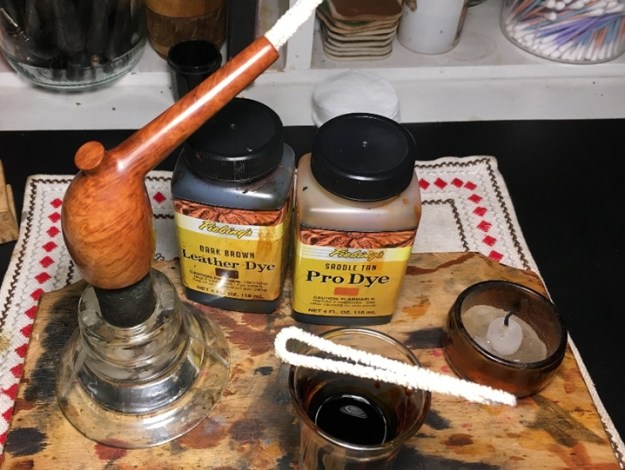
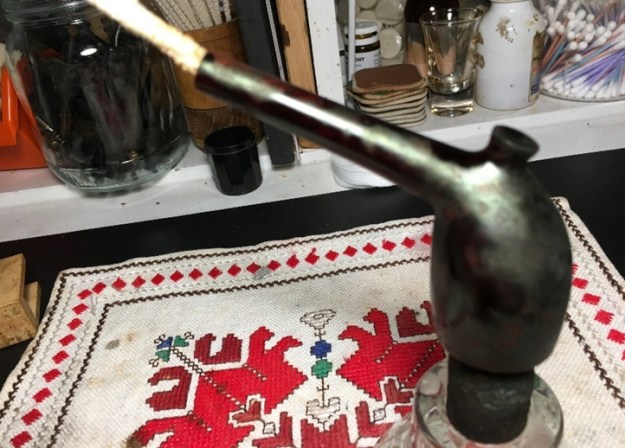
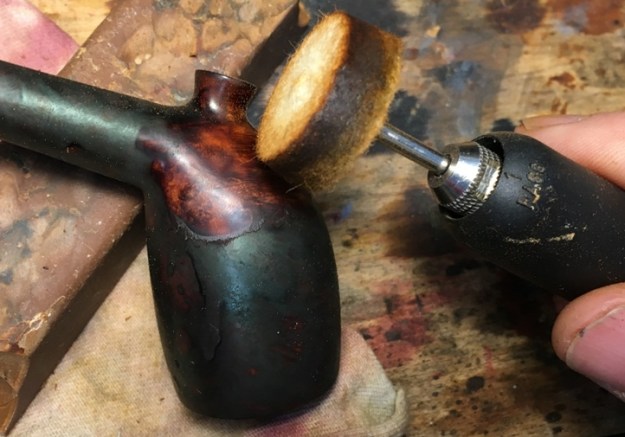
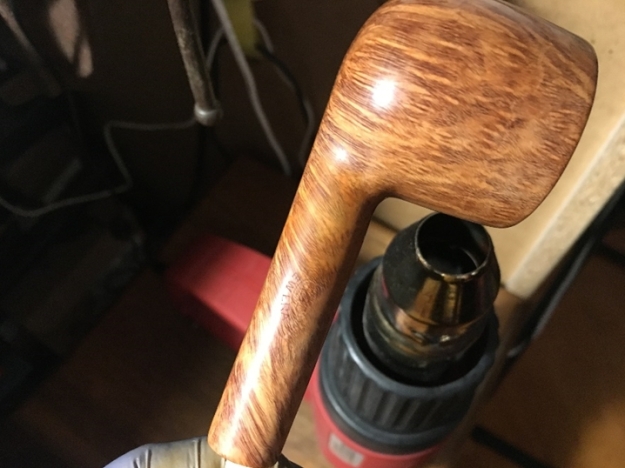
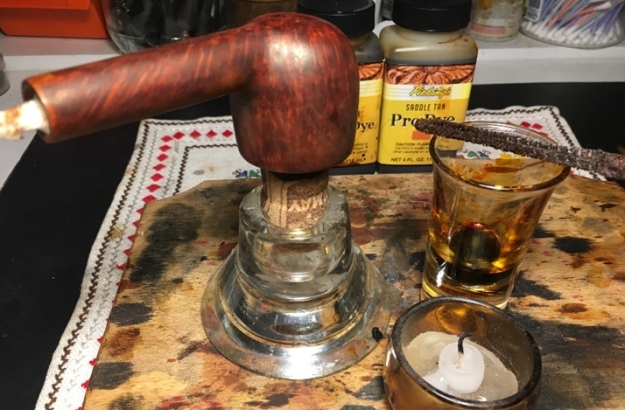
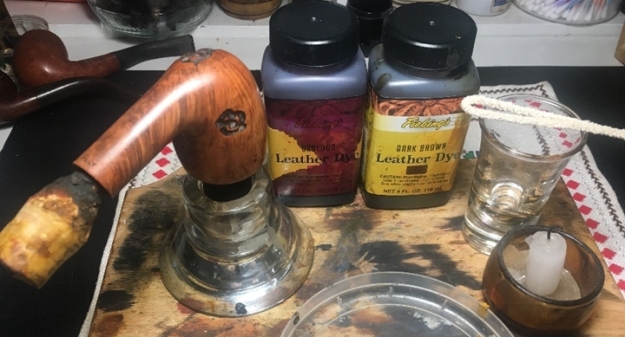
While doing research on GBD New Era, I read the very interesting and helpful article reposted in Pipedia: Pieces From My GBD Collection, by G.L. Pease (re-published here by permission).  It’s a good read, I enjoyed it.  What was most helpful was the listing by GBD groups or lines of pipes that were part of G.L. Pease’s collection.  I eagerly looked and found his offerings for New Era.  Not only did he have New Era, but 4 beautiful long, round shank Pot shapes, shape number 9493 like the GBD that Todd has commissioned.  I cropped the picture below to focus on the patina of the 4 Pots and on mainly the smooth briars.  To me, all the pipes leverage toward a reddish hue even though in different shades.  The lower smooth Pot is redder, leaning toward Oxblood or burgundy.  The Pot on the top, is reddish but leaning more toward the browns.  After studying these New Era pipes, I remembered reading about the red leanings of the New Era line from Pipedia’s GBD Model Information. I clipped this description about New Era:This confirmed what I had observed.  The question remains, how to mix dyes and hit the right hue, or as close as one can manage?  As I’ve done before many times with Steve Laug (Rebornpipes) and Charles Lemon (DadsPipes) I reached out to Charles because I recently read one of his blogs, Stem Repairs and a General Freshening for a “Made by Millville” Full Bent, where he discussed his approach to staining.  It was helpful information, well worth reading.  My question to Charles was how he might approach the reddish hues and mixing dyes.  His answer was straightforward and helpful – trial and error!  Yep, I know how to do the latter part of that well.  He did say that he had had success mixing Fiebing’s Saddle Tan and Browns to achieve that general direction, and to mix and test to see how it looks. So, armed with Charles’ input, I went to work mixing the dyes. I ended up with what Charles calls a ‘wash’ – being more diluted (with alcohol with aniline dyes and water with water-based) it can be applied more times as needed to acquire an increasingly darker result.  This approach would necessitate that I improvise my usual approach to staining.  After mixing Saddle Tan and Light Brown, I diluted it with alcohol to lighten the wash.  I assemble my desktop dying components, and I am ready.  I first wipe the bowl down with alcohol to clean the surface.  Following this, I heat the stummel with a hot air gun to expand the briar resulting in it more effectively absorbing the dyes.  After heated, I apply the dye mixture to a portion of the stummel surface with a pipe cleaner that I had folded in half.  After applying the dye to a portion, I fired that portion by placing it quickly over the lit candle.  The flame immediately combusts the alcohol in dye and sets the dye pigment.  I do this several times to cover thoroughly the stummel surface.  After repeating the washing and firing process many times, the bowl has the right look, sufficiently dark that I think will hopefully point in the right direction! It’s time to turn out the lights letting the newly dyed stummel to rest and to set the dye.The new dye set through the night and has settled in.  Allowing this ‘rest’ time helps guard against new dye coming off on the hands during the first uses of the pipe when the bowl heats.  To unwrap the fired dye shell around the stummel I mount a felt cloth buffing wheel in the Dremel, setting the speed to the slowest to avoid scorching the wood.  Felt cloth is more abrasive than cotton.  Added to this, I apply Tripoli compound to ‘plow through’ the thick dye residue.  While applying the more abrasive compound, I purge the wheel often on the edge of the chopping block which is my work station.  Not pictured is that I follow the application of Tripoli with the felt buffing wheel with a cotton cloth buffing wheel and go around the stummel one more time applying Tripoli compound at an increased Dremel speed of about 40%.  This is to fine tune and make sure no dye clumps are left behind. Next, after rejoining the stem and stummel, I apply Blue Diamond compound using a cotton cloth buffing wheel at a 40% speed.  I apply compound to the entire pipe.  When finished I buff the pipe with a felt cloth to remove the residue compound dust.The final step is applying carnauba wax by mounting another cotton cloth wheel onto the Dremel, maintaining the same 40% speed and I apply the wax.  Following this, I use a microfiber cloth and give the pipe a final hand buffing.

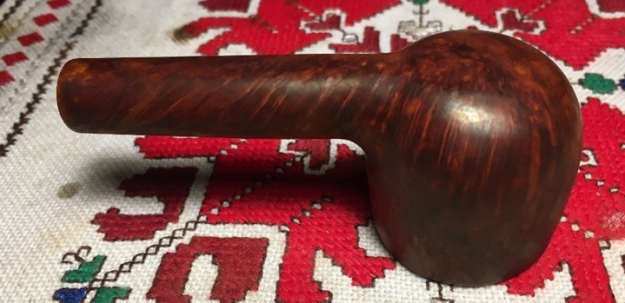
This GBD New Era Pot has come a long way.  The stem was mauled and now it looks great.  The patches can be seen in the glare but from where we started….  The grain on this New Era is striking.  I love studying the vertical grain that is distinct and certainly a feast for the eyes.  There is no disappointment with the bird’s eye grain that was teased out so well by the compounds on the rim.  The bird’s eye is small, tight and subtle.  The heel view is equally a cornucopia of bird’s eye.  I think what makes this GBD shape so classically appealing is the (‘Lovat’) long shank stretching the look of the large Pot bowl, which has plenty of space for a slow enjoyable time of fellowship with one’s favorite blend.  Todd resides in the Big Apple as he practices law and this second pipe in the list of three he commissioned will fit well.  He has the first opportunity to acquire this GBD New Era Pot from The Pipe Steward Store.  As with all my pipes, this pipe benefits the work we do here in Bulgaria with the Daughters of Bulgaria – women and girls who have been trafficked and sexually exploited.  Thanks for joining me!

Restoring a Rare, Limited Edition Brigham X-4


Blog by Steve Laug

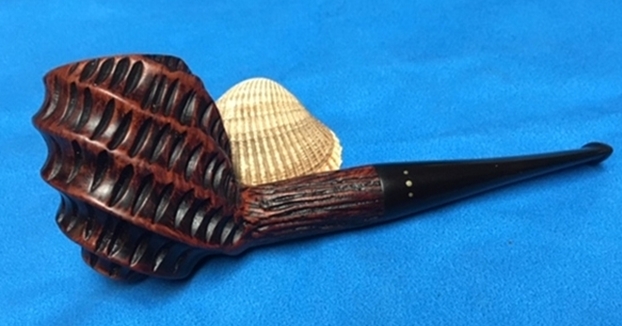
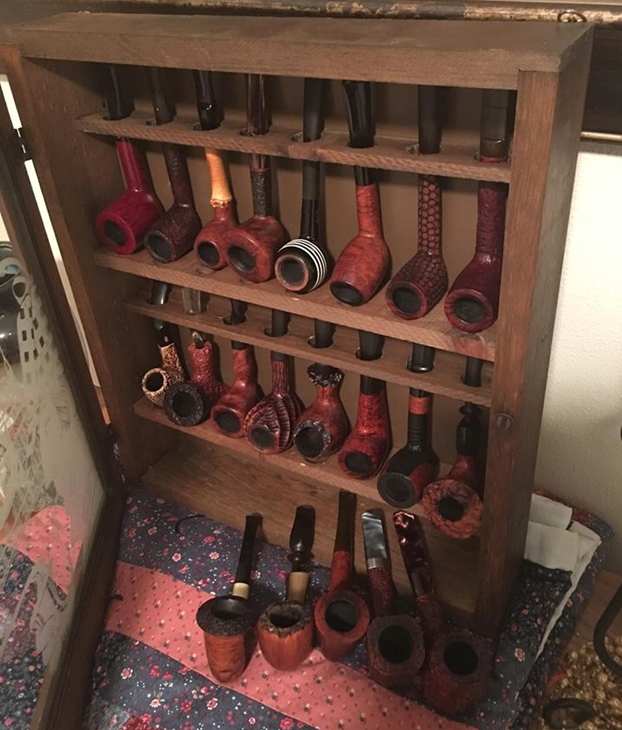
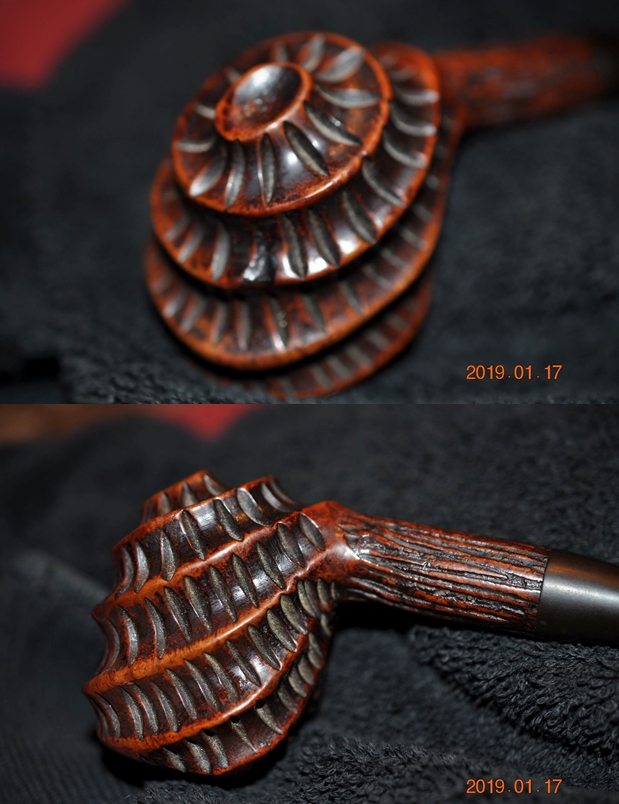
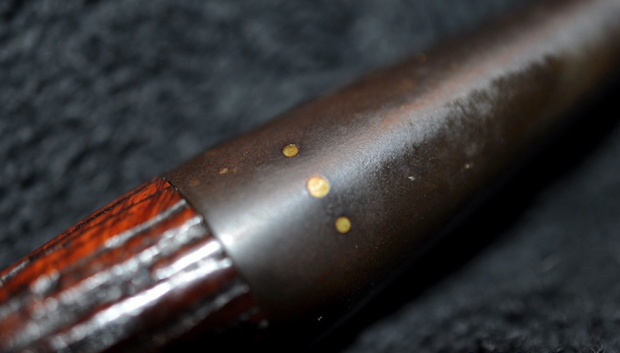
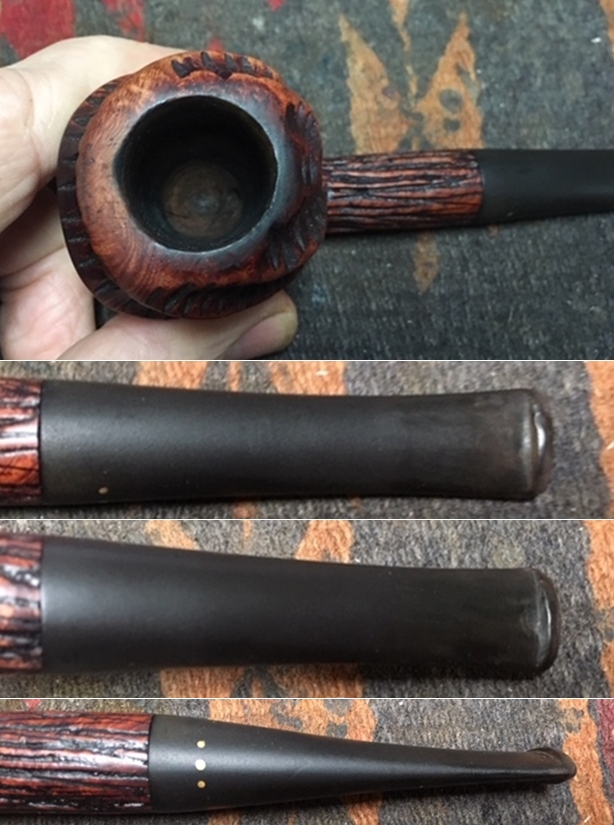
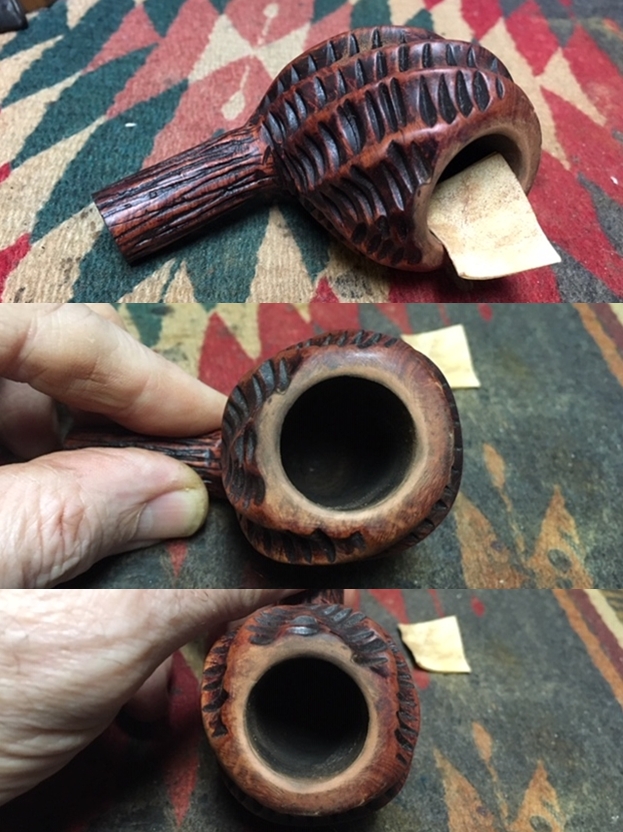
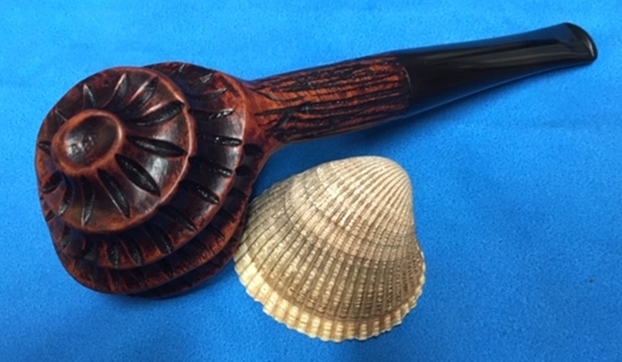
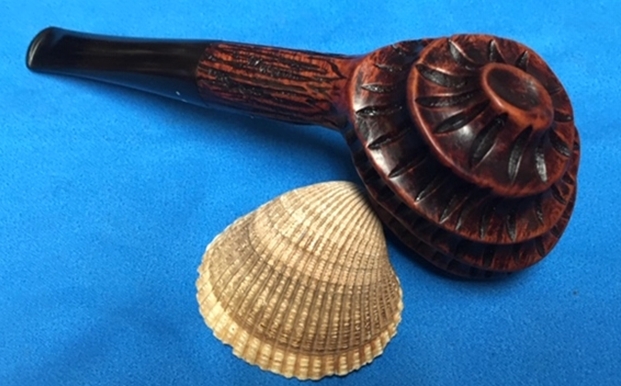
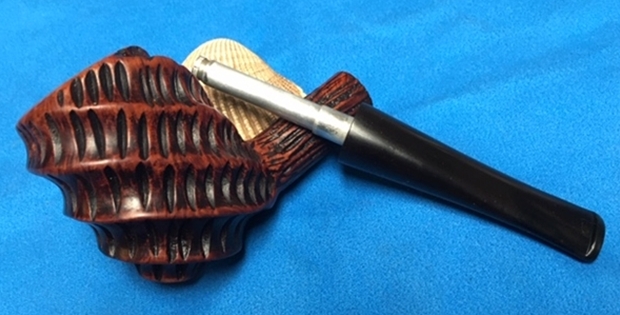
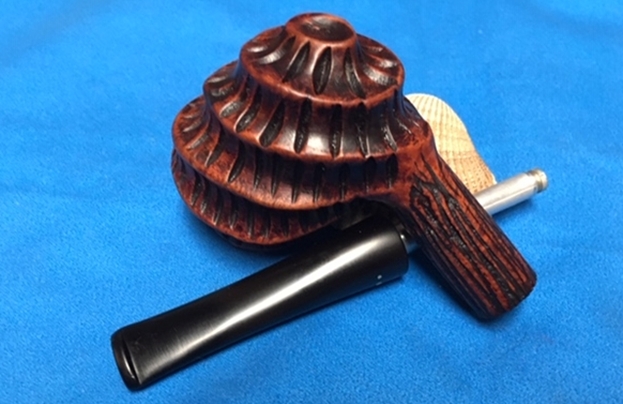
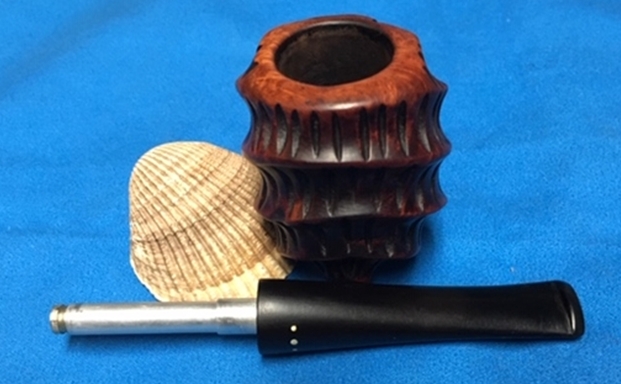
The next pipe on the work table is a relatively new acquisition from a collection Jeff and I purchased from Michigan. It included a pipe cabinet and 21 pipes that is pictured below. There were some nice pipes in that collection and some that I have never seen before. This pipe was so unique that is I just had to tackle it next. It is shown in the photo of the rack above – the fourth pipe from the left side. Jeff showed me photos of the pipe on Messenger and I was intrigued. I had really no idea who had made it and I could not see the shank or stem markings to help with the identification. Jeff looked it over and could see no stamping on the shank that would help us out but it was undeniably unique. The carving reminded me of nautilus shell and Dal said it reminded him of a scorpion…nothing quite captured and accurate description of the shape and the carving on this pipe. Jeff took photos of the pipe before he started his cleanup process. I have included these below.  The next photo is a close up of the bowl. You can see the thick cake in the bowl and heavy overflow of lava on the rim top. You can also see the tars and grime in some of the carvings toward the top of the bowl. It was a dirty pipe and obviously it was someone’s favourite pipe because it is so dirty and caked.He also took photos of the side and bottom of the bowl to highlight the unique carving on the bowl sides. The shank itself had more a striped carving almost bark like that ran the length of the shank to the stem.The photos finally gave me my first clue about the pipe. The three vertical dots on the left side of the stem made me wonder if it was a Brigham. Usually Brigham will use those dots to signify particular lines of their pipes but I had never seen a bowl like this in all the years that I have been working on pipes so I had to wonder if it was on or if it had been a cannibalized stem that had been put into service on some other bowl. I would only know once I had it in hand and saw what it looked like off the pipe.The stem itself had a lot of deep scratches on the surface that looked like someone had scraped away the calcification that can build up under a rubber Softee bit. There were tooth marks on the stem surface on both sides near the button and some wear and tooth marks on the button itself. I have started to mention in the last few blogs that Jeff and I have established a habitual pattern that we both follow when we work on pipes. I include it here so you have a sense of that pattern. Jeff reamed the bowl with a PipNet pipe reamer and followed up with a Savinelli Fitsall pipe knife to remove the cake. He scrubbed out the mortise and the airway in the shank and the stem with alcohol, cotton swabs and pipe cleaners. He scrubbed the exterior of the bowl, rim, shank and stem with a tooth brush and Murphy’s Oil Soap to remove the oils and tars on the rim and the grime on the finish of the bowl. He rinsed it under running water. He dried it off with a soft cloth. He was able to remove the lava build up on the rim top and you could see the damage to the flat surface of the rim and the inner edge on the right side and toward the front of the bowl. I took photos of the pipe to show its condition before I started my work on it. I took close up photos of the bowl and rim top as well as the stem. You can see the condition of the rim top and bowl in the first photo. Jeff was able to remove all of the tar and oils and all that remained was some darkening toward back of the rim top. The inner edge of bowl was slightly damaged toward the front side. The vulcanite stem had tooth chatter and some tooth marks on the top and underside of the stem near and on the button surface. Jeff had soaked it in Before & After Deoxidizer and was able to get the stem really pretty clean. The tooth marks are quite prominent and will need to be addressed on both the stem surface and button. The three vertical brass dots on the side of the stem really stood out now that the stem was clean.At this point I took that pipe apart and I was pretty sure I was dealing with a very unusual Brigham pipe. I was not sure what it was or what era or even the stamping because even though I thought I saw some faint stamping Brigham over Made in Canada on the underside of the shank I was not sure because the rustication went right through the stamping. There was a number on the heel of the bowl in the cone bottom that was either 688 or 889 depending on the how the pipe was held. I really was mystified so I did what I usually do when I am dealing with a Brigham – I go to my resident expert in Eastern Canada. I wrote Charles Lemon of Dad’s Pipes a quick email to see what he could tell me. I am including his response and the copy of the Brigham pamphlet that he included with his email.

Hi Steve. I think you have a real find there!

I was out when your email came through but dug into my Brigham material when I got home. I think what you’ve got is a Brigham X4 – one of their “experimental” shapes from the 60s.

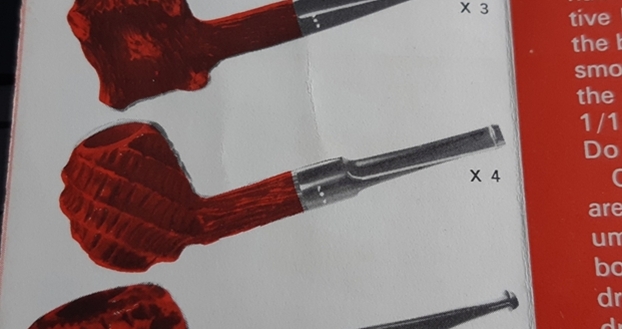
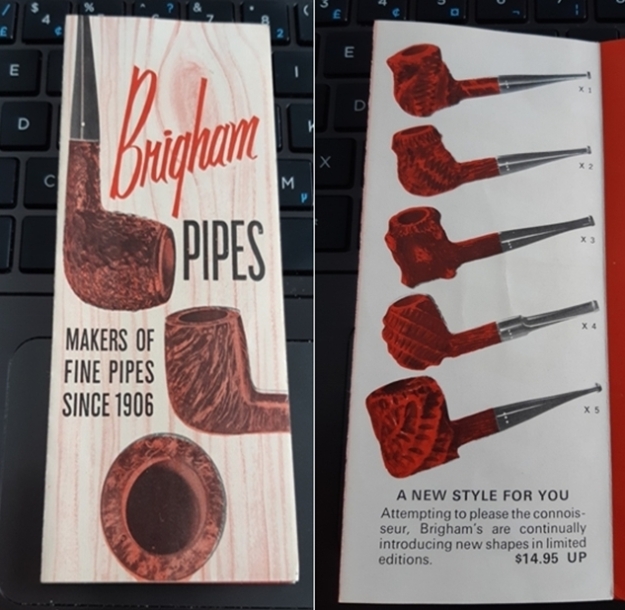
I’ve attached a close up pic from the Brigham brochure titled “Brigham Pipes – Makers of Fine Pipes Since 1906”, published circa 1960s. Same nautilus carving pattern, same stem. All the X shapes in the brochure are marked with the 3-dot vertical pattern.

These originally sold for the princely sum of $14.95 & Up! 😁

This is the first time I’ve seen an example of the X shapes outside of a brochure. They are very rare, limited edition pipes made in small numbers. Kind if Brigham’s way of testing new designs on the market…

Is it yours? If it’s for sale I’d love to add it to my collection.   — Charles

The brochure that Charles included is below. The blow up of the pipe he is referring to is in the first photo. The only difference with the one in my hands is a tapered rather than a saddle stem. So it appears I am dealing with a bit of a rare, limited edition Brigham X4 – one of their “experimental” shapes from the 60s. I wondered when I first took it apart if that was not the case but it is always good to be able to ask someone who knows more about a particular brand than I do. Thanks Charles. We will see if I let this one go.

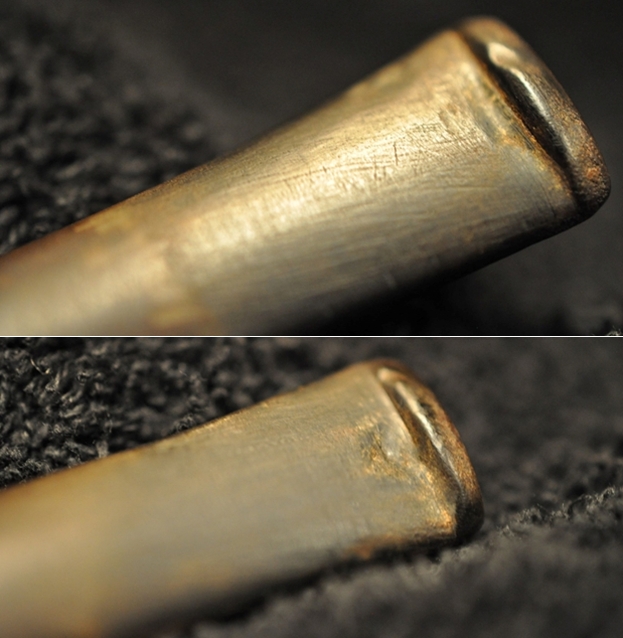
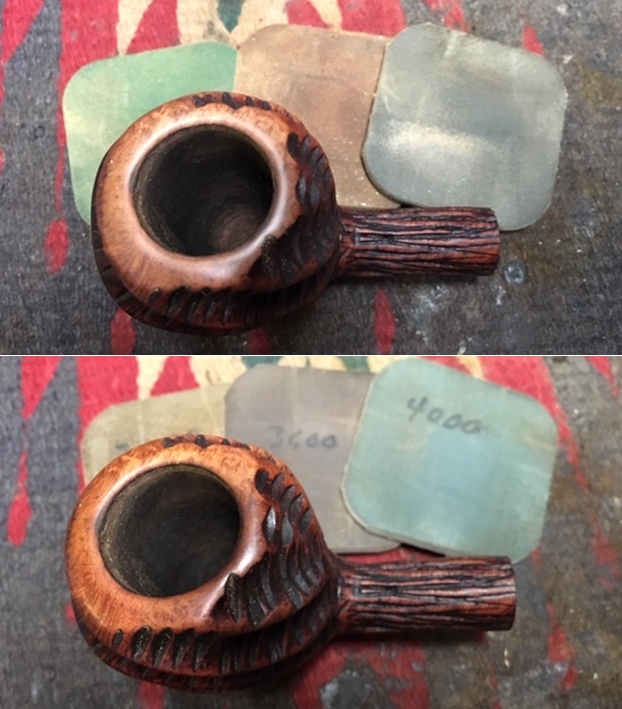
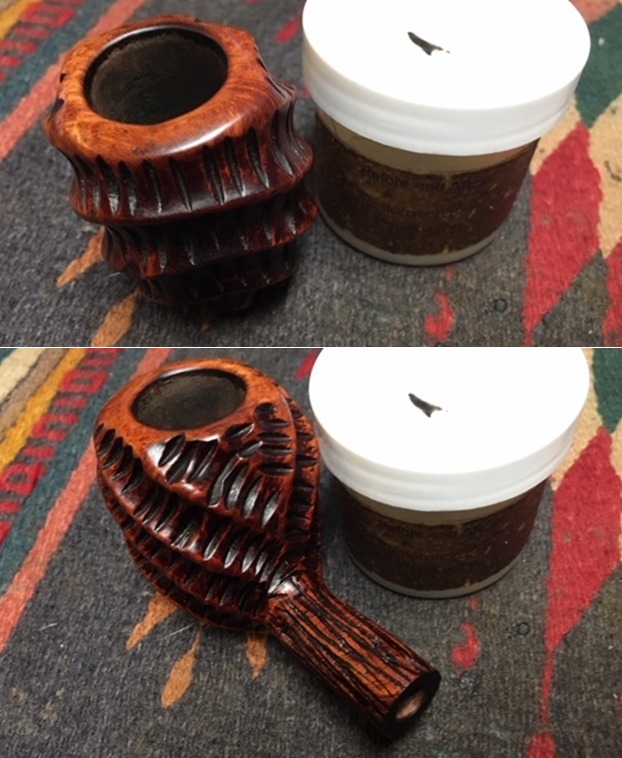
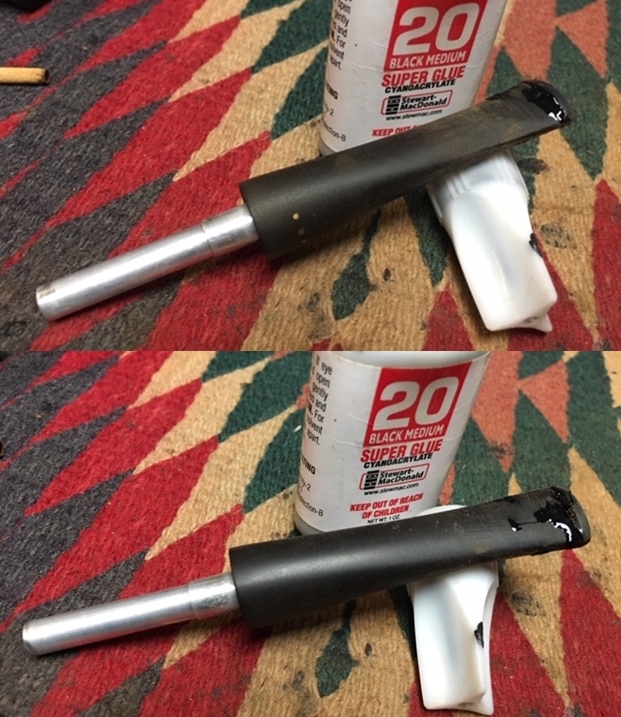
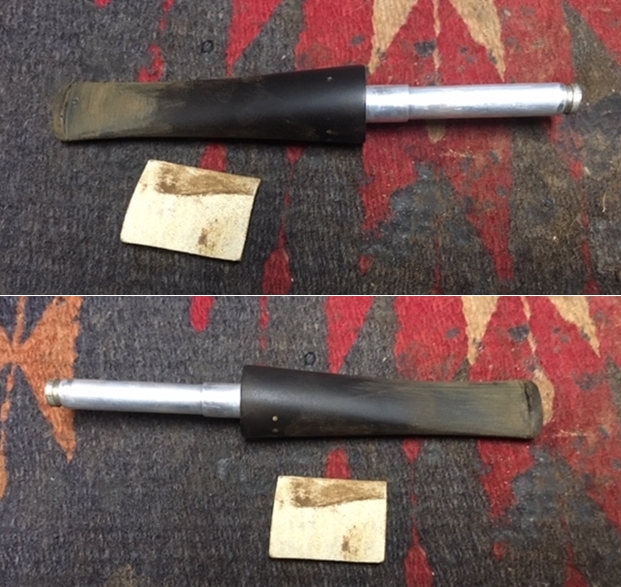
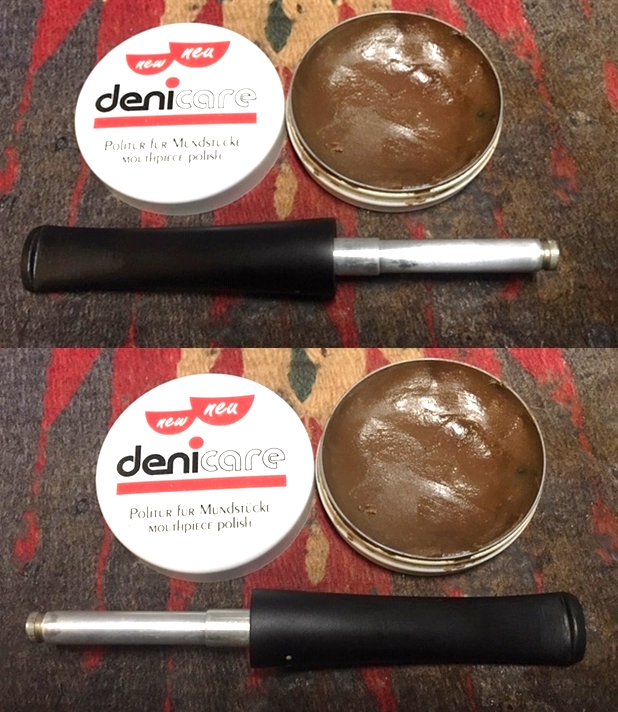
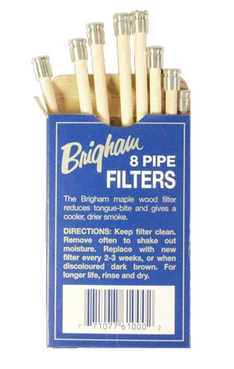
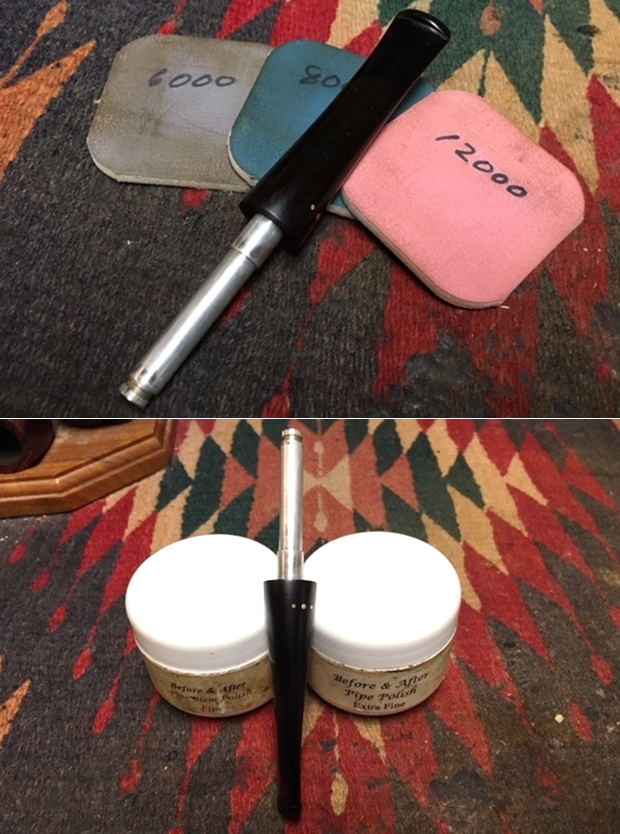
I decided to address the damage to the rim top and the inner edge of the bowl first. I used a folded piece of 220 grit sandpaper give the inner edge a light bevel to minimize the damage to the inner edge of the rim. I also lightly sanded the darkened areas on the back side of the rim top.I polished the rim top and edge with micromesh sanding pads – wet sanding with 1500-2400 grit pads and dry sanding with 3200-12000 grit pads. I wiped the rim off after each sanding pad to remove the dust. The damage on the rim is pretty much invisible after polishing and the rim top really looked good. I worked some Before & After Restoration Balm into the rusticated and the smooth surface of the briar with my fingertips to clean, enliven and protect it. It took some time to really get it into the grooves and valleys of the rustication but I was able to work it in. I used a cotton swab to work it into the smaller divots in each ring around the bowl. I let the balm sit for a little while and then buffed with a cotton cloth to raise the shine. The following photos show the bowl at this point in the restoration process. The reworked rim top looks really good and matches the colour of the rest of the pipe. I am very happy with the results. Before calling it a night I cleaned out the tooth marks and reshaped the button on both sides of the stem. I wiped them down with alcohol on a cotton swab. I filled them in with Black Super Glue and set the stem aside to let the repairs cure overnight. There was morning and there was evening and it was good!The next morning after the repairs had cured I sanded the stem surface with 220 grit sandpaper to blend the surface of the repairs into the stem. I further reshaped the button with a needle file to sharpen the edges.I polished the stem with Denicare Mouthpiece Polish to remove some of the scratches. The gritty substance that makes up this polish makes it work really well as an intermediary step after sanding out the repairs and tooth chatter. (I used it because I have three small tins of it to go through before it dries out and is useless.)Some of you might have notice the Brigham Hard Maple Filter in the long aluminum tenon in all of the above photos and the ones that follow. I forgot to mention that I put one in the tenon when I worked on the stem to protect the aluminum from accidental damage. The Maple filter is a hollow tube made of hard maple that fits in the metal tenon. The metal tip is at the end of the tenon and actually extends all the way down the shank and sits against the opening of the airway into the bowl. It thus provides a distillator to pick up the moisture from a smoke while allowing uninhibited airflow through the pipe. One benefit of the design is that you can easily slide a pipe cleaner down the stem and into the bowl through the wooden filter/distillator tube. It is a pretty unique and effective design and one that is worth a try if you have never smoked one.

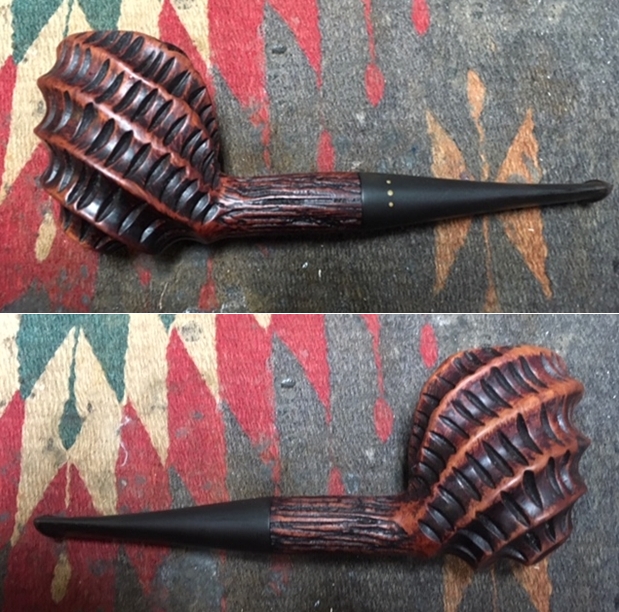
Back to the restoration… I polished the vulcanite stem with micromesh sanding pads – wet sanding with 1500-2400 grit sanding pads and dry sanding it with 3200-12000 grit sanding pads. I wiped it down after each sanding pad with a damp cloth. I polished it with Before & After Pipe Stem Polish and wiped it down with a last coat of Obsidian Oil. I set it aside to let the oil dry. This is one of the most uniquely carved Brigham pipes that I have ever worked on and I have worked on many of them. The unique spiral rustication with slots in the spiral bands and the smooth rim top is really nicely. The striated, barklike rustication on the shank works well with the rest of the shape. I polished stem with Blue Diamond polish on the buffing wheel. I gave the bowl multiple coats of Conservator’s Wax and the stem multiple coats of carnauba wax. I buffed the pipe with a clean buffing pad to raise the shine. I hand buffed it with a microfiber cloth to deepen the shine. The pipe polished up pretty nicely. The spiral rustication and the smooth edges and rim top began to almost take on life with the buffing. The rich contrasting brown colour works well with the polished black vulcanite stem. The finished pipe has a rich look that is quite catching. Have a look at it with the photos below. The shape, finish and flow of the pipe and stem are very well done. The dimensions are Length: 6 inches, Height: 2 inches, Outside diameter of the bowl: 1 5/8 inches, Chamber diameter: 7/8 of an inch. I will be hanging on to this pipe for the time being but may well one day pass it on to Charles. Time will tell. Thanks for walking through the restoration with me as I worked over this unique Brigham X-4.

A Special Gift for Her Grandfather in the People’s Republic of China – A Sculpted Rose Billiard of Italy


Blog by Dal Stanton

You need to first hear the story then the restoration of the pipe will come. Let me first tell you about the granddaughter.

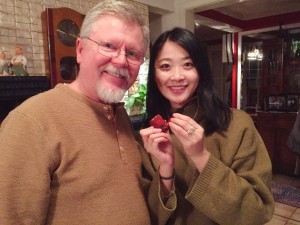
Chrystal, age 30, came to Bulgaria for two weeks from the People’s Republic of China.  My wife and I hosted her in our home.  She has a master’s degree and teaches in an English language department in a university near Beijing.  Her keen interest in the well-being of people was the catalyst in becoming aware of the issues of human trafficking and the devaluation and exploitation of women.  Through foreign acquaintances she has in her role as a teacher, she heard about Daughters of Bulgaria – the work here in Bulgaria seeking to help trafficked and sexually exploited women.

Cross cultural adventure – our Bulgarian friend Ellie, translating Bulgarian menu using English for Chrystal, so that Chrystal can call ordering Chinese in Mandarin, with the hope of surprising the Chinese restaurant worker who speaks Bulgarian and Chinese! It worked!

Chrystal’s aspirations to know and understand more about this issue both intrigued her and struck a chord in her own core experience that prompted her to throw caution to the wind and reach out to the Daughters of Bulgaria staff via email about coming to Bulgaria and to learn about the issue and what tangible things are being done to help women coming off streets and out of brothels.   Her email was received with surprise and question – someone from China desires to come to Bulgaria to learn from us!  In the communications with Chrystal that followed, her deep and sincere concern for people in general and in her home, China, was very evident.  She came to Bulgaria during her annual January break from teaching at the university.  We were amazed at how quickly her visa to enter Bulgaria was approved!

During her visit, we had the privilege of learning about the path of her life in China.  As Westerners, we were anxious to learn about Chinese culture and customs and we were also interested in her personal story.

She, like most Chinese women while growing up, personally experienced the effects of the enduring custom of valuing sons over daughters.  With China’s strict one child per family law to control population which recently changed to allowing two children, Chinese families were faced with pressures to have a son – which is the greater honor for the family in a culture where honor is profoundly important.

During the one child per family period, Chrystal’s

Serenaded at a restaurant in Sophia, Bulgarian style!

parents had a baby and it was a girl – the opposite of honor became Chrystal’s experience as she grew up with this subtle sense of shame.  She recounted remembering the acute feeling of self-guilt that she wasn’t a boy and her presence brought dishonor to her family – she wasn’t what her parents wanted.  Growing up, she understood that her parents had to settle for a girl.

To counteract this sense of having lesser value, Chrystal’s smile was pained while looking down recounting how she sought to excel in everything she did as she emerged from childhood into womanhood – trying especially to earn her father’s love and acceptance.  Her passion to excel did have its benefits. It propelled her growing up, in her studies and eventual appointment as a teacher in the university, being observed and appreciated by her supervisor in the professional and academic university environment.  Yet, Chrystal has discovered that even this accomplishment was not enough to reverse the underlying, unspoken sense that she did not measure up – that she would always be the daughter for which her parents had reluctantly settled.  Chrystal confided that this perhaps, is why she was so drawn to learn more about the Daughters of Bulgaria and the profound effects of devaluing of women resulting in human trafficking – it so resonated in her heart and to some extent, in her experience of feeling the impact of not being valued by others – even by those closest to you.

Even though this part of her story is ongoing and unfolding, Chrystal’s concern for others and her simple joy in living (she always seemed to be laughing and smiling!) confirmed to me that she had found a good place in her life – at her core.  The serendipitous trip to Bulgaria, of all things, revealed to me that she’s taking life as it comes and living to the fullest as she is able – growing as a person and seeking to help others in need.  How will she use what she is learning in Bulgaria in China?  She confessed with a smile, she doesn’t know exactly but she believes it will be used in some way that will be evident in time – like a seed planted in soil.

Chrystal with her Grandfather and cousin. Can you guess?

When Chrystal started asking us questions about our life in Bulgaria, she found out that I do something she had never heard of before – restore pipes!  She was fascinated.  And when she heard that I sell restored pipes worldwide to benefit the Daughters, she decided to do her part in helping the Daughters as well.  The first thing she did was post some pictures and information about The Pipe Steward to her friends in China on social media available there.  For the next several days, the stats for www.ThePipeSteward.com launched because of ‘hits’ coming from China – yes, I can see the countries of those looking at the website!

Secondly, and most important in helping the Daughters, was to choose a pipe as a special gift for her grandfather.  I asked her why the gift for her grandfather?  I found out that February is Chinese New Year and it is customary to give gifts or money to family.  I asked her why a pipe?  She said that as a farmer – a common man, her grandfather is considered near the bottom of the social strata and her thoughts of him are of his life as a farmer and that he liked to smoke.  She described him smoking thick cigarettes with strong tobacco and said that he also had an old, long metal pipe that he liked, but she said there was nothing special about it.  (The answer posed in the picture to the right is on the ‘Left’ 😊)

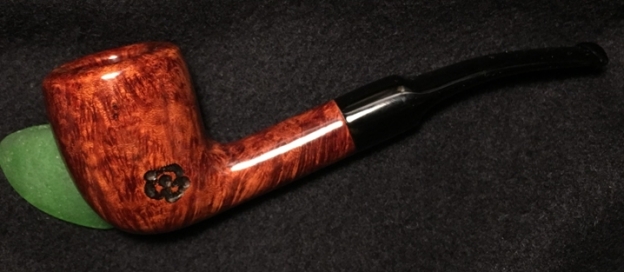
After she methodically explored many ‘Help Me!’ baskets and scrutinizing MANY pipes, she found the special one (or, did it find her? 😊) she would give to her grandfather.  I asked her, out of all the pipes she had studied, why she had chosen the pipe she did?  She smiled as she looked down thoughtfully.  She described the ‘rose’ carving in the briar and said that it reminded her of the rose that forms the logo for the Daughters of Bulgaria – the rose is beautiful but also, fragile and strong.  The ‘rose’ sculpted in the pipe also formed a hope that revealed to me the depth of love that resides in Chrystal despite everything.  She said that when her grandfather smoked this pipe that she hoped that it would remind him fondly of her – that she would be carved in his heart like the rose on the pipe.

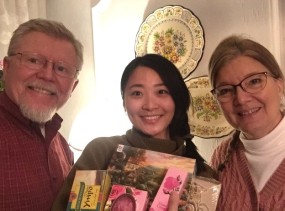
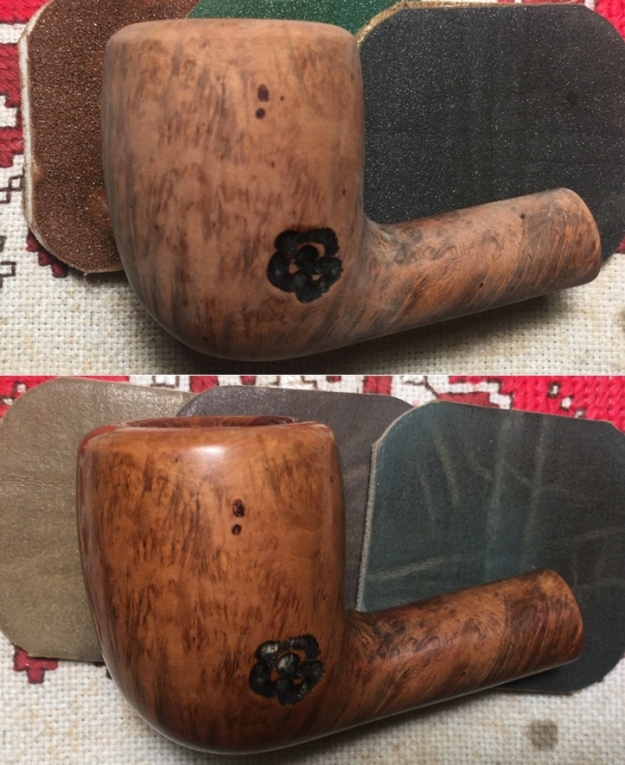
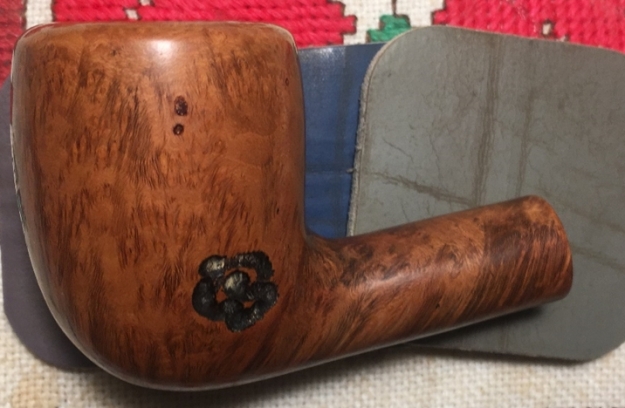
With Chrystal’s return to China coming soon, I quickly went to work on the chosen pipe she planned to give her grandfather after returning to China.  Just before her departure from Bulgaria, my wife loaded Chrystal with gifts from Bulgaria for her and her family (but a special jigsaw puzzle for Chrystal!).  I also presented her the restored ‘Rose Pipe’ ready for her grandfather. Her first reaction to seeing it and holding it in her hands was how it had changed!  The second was some concern that her grandfather may not appreciate its value.  She struggled a bit considering keeping it for herself because now it meant so much to her, not to smoke, but to cherish as a reminder of her time in Bulgaria.  It was gratifying to pass this pipe on which I had purchased from a seller in the US New England state of New Hampshire in 2016, brought to Bulgaria and was patiently waiting for Chrystal to come to Bulgaria so it could choose Chrystal and make its way to its new steward, a common man – a farmer in China, Chrystal’s grandfather.

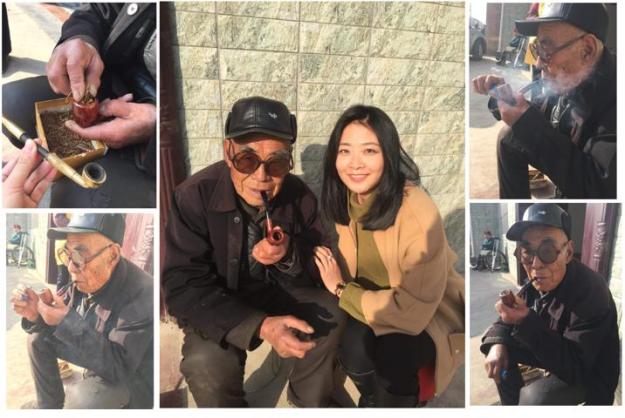
When Crystal left Bulgaria on her trek back to China (on Aeroflot via Moscow and Peking!) she knew that I was writing her story in this write up of the restoration of her grandfather’s pipe.  I agreed to wait to publish this blog after Chrystal promised to send me pictures of her with her grandfather and after she presented the Rose Pipe to him.  True to her word, the pictures arrived less than a week after her departure with these words:

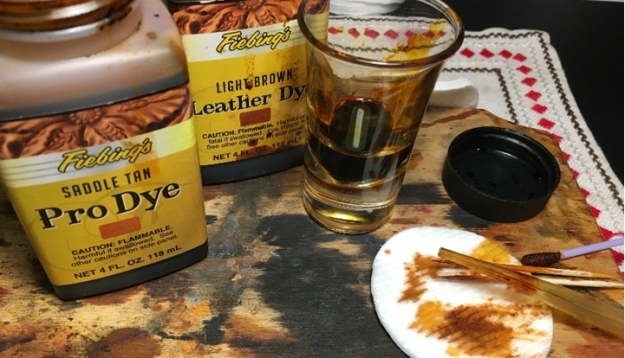
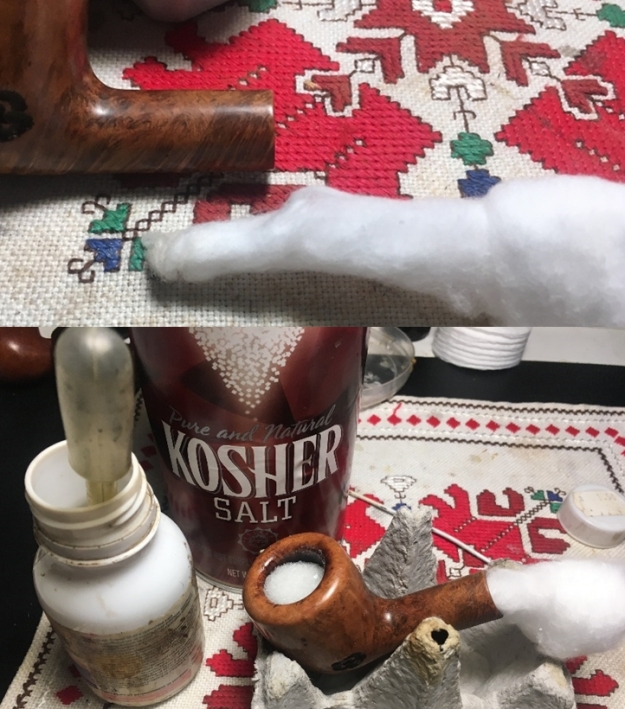
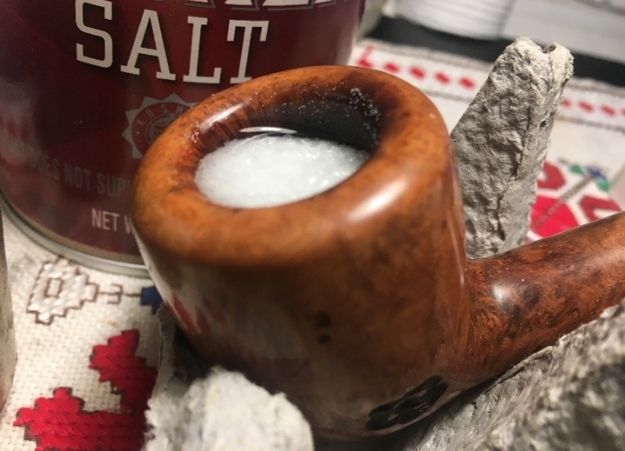
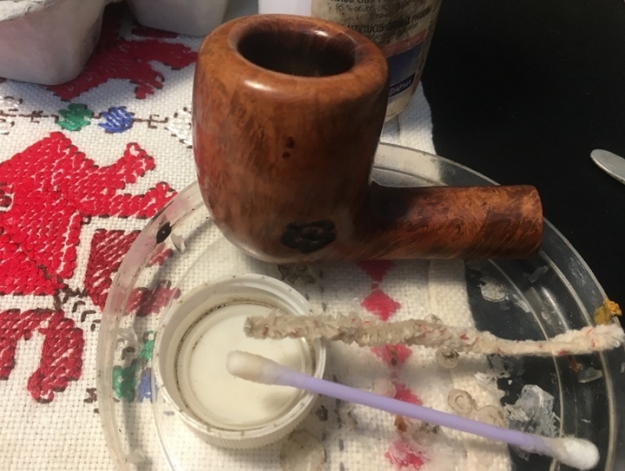
My grandpa really likes your pipe!!! My dad said it is so special and valuable. My mom said it is like an art. Yes, they are happy. My dad even didn’t know my grandpa likes pipe. But it turns out that my grandpa does like it!!  So, my dad is happy. I look forward to your writing [blog write up]. I feel so blessed and so loved to know you!!  By the way, what kind of wood is the pipe made of?With a deepened appreciation for the granddaughter and her love for her grandfather, and for the pipe man in China who has become the new steward of the Rose Pipe, I now tell the story of the restoration of the Sculpted Rose Billiard that was on my worktable but now in China.   First, to answer Chrystal’s question: Briar 😊. The only marking on the pipe is the COM, ITALY, on the underside of the shank.  The pipe has been well loved and used much by examining the chamber and rim.  The chamber shows very thick cake and the rim is gummed up with lava.  Both need to be addressed through reaming and cleaning.  The bowl itself is dark from oils and grime.  The reddish or Oxblood hue is dull and tired.  There are small dents on the surface from normal bumps and at least one small fill that I see that needs checking.  The vertical fire grain beneath the finish is very attractive – showing much, much potential, which I like.  The shank is slightly bent with a nice-looking saddle stem which shows some oxidation but hardly any tooth chatter.  I think this gift for Chrystal’s grandfather will turn out very nicely!  I take a few close-ups to show these issues. To begin the restoration of this special gift for Chrystal’s grandfather, I clean the stem’s airway with a pipe cleaner dipped in isopropyl 95% then I drop it in an OxiClean bath to soak to loosen and raise the oxidation.  After it soaks through the night, I take it out (and realize that I forget to take a picture of it!) and take the stem to the sink and wet sand using 600 grade paper.  This does very well in removing the oxidation.  To hydrate the vulcanite, I then apply paraffin oil (a mineral oil) to the stem and put the stem aside to absorb.  The pictures show these steps. Next, I tackle the thick cake in the chamber.  I take a starting point picture and then employ the Pipnet Reaming Kit blade heads to cut through the cake to give the chamber a fresh start.  I use 3 of the 4 blades available.  I then fine tune the reaming using the Savinelli Fitsall Tool. I follow this by sanding the chamber using 240 grit paper wrapped around a Sharpie Pen.  This gives me leverage to apply pressure and to reach down into the chamber.  I finish by wiping the chamber with a cotton pad wetted with isopropyl 95% to clean the carbon dust. After an inspection of the chamber showing no problems, I move on. I clean the externals of the stummel with undiluted Murphy’s Oil using a cotton pad.  I also use a bristled tooth brush on the sculpting.  I’m anxious to see how this Oxblood hue cleans up.  I also utilize a brass brush on the rim.  Brass brushes do not harm the surface.  The cleaning did a good job on the rounded rim as well as the stummel surface.  The old finish is thin and raw briar is left on the rim. I decide to check the condition of the two small fills on the left upper side of the stummel.  Using a sharp dental probe testing showed that the fills weren’t solid, so I dig out the old fill with the probe.  I see no other fills needing attention, so I decide to address these now. I wipe the area with alcohol to clean it and then I mix a small about of briar dust putty using thick CA glue.  Using an index card, I shovel some briar dust in a small mound.  I then drop some CA glue close to the mound.  Using a toothpick, I then pull briar dust into the CA glue mixing as I go.  As the two mix, it thickens.  When it reaches the thickness of molasses, I apply the mixture to the pits with a small mound of excess to be sanded after it the putty cures.After the briar dust patch sets up, I clean the internals of the mortise and airway using pipe cleaners and cotton buds. I also use a dental spatula to scrape the tars and oils from the mortise wall.  After some effort, the internals are cleaning up and the cotton buds are coming out clean.Turning back to the stummel, the patch has cured and using a flat needle file I file down the briar dust patch to almost flush with the briar surface.  I then use 240 and 600 grit paper to sand it down further to the briar surface and blending the patch.  Amazingly, a face appears for a while as captured in the second picture! I then wipe the entire stummel with alcohol to remove the thin finish and to clean the stummel.  Taking a very close look at the condition of the surface.  I see a lot of nicks, cuts and very small pitting.  The surface is in rough shape. I decide to employ sanding sponges to work on the rough briar surface as well as the rounded rim that has seen better days.  I start with the coarse sanding sponge sanding the smooth surface – I pass over the sculpted areas.  I then graduate from the coarse sponge to the medium grade sponge, then to the fine sanding sponge.  These pictures chronical the progression – starting with the coarsest sponge: Medium sponge: Fine sponge: Moving from sanding sponges, I fine tune further using the micromesh pads.  First, I wet sand using pads 1500 to 2400, then dry sand using pads 3200 to 4000 and 6000 to 12000.  The pictures show the progression. Well, it’s been a productive day!  To finish my ‘pipe work’ day, I’ll continue the internal cleaning of the stummel by allowing it to clean stealthily in a kosher salt and alcohol soak.  To do this I twist and pull a cotton ball to form a wick that I insert and push through the mortise and into the airway.  I then fill the bowl with kosher salt (you can use any kind of non-iodized salt – iodized salt leaves an aftertaste) and give the bowl a shake to settle the salt.  After I place it in an egg crate for stability, I use a large eyedropper and fill the bowl with isopropyl 95%.  After a few minutes, the alcohol is absorbed, and I top off the alcohol once more.  Putting it aside, I shut off the lights. The next morning, the salt and wick have both darkened from drawing out the oils and tars from the internal briar.  I toss the expended salt and wipe the chamber with paper towel making sure to remove left over salt crystals.  To make sure all is clean I run one pipe cleaner and cotton bud wetted with alcohol. Internals are clean!  Moving on. As I’ve reflected on the original reddish, Oxblood hue of the pipe, I think this was partly why Chrystal was drawn to the pipe – with its sculpted rose.  I will apply a dye to the stummel combining Fiebing’s Dark Leather Dye and Oxblood Leather Dye.  I’m envisioning a subtler Oxblood embedded in the darker brown, but leaning more toward the brown than red.  I will mix the two dyes in equal parts and see what happens!  I assemble all the desktop components of my staining process.  I first wipe the stummel with a cotton pad wetted with alcohol to clean it. I insert a shaped cork into the mortise to act as a handle.  After mixing the Dark Brown and Oxblood in a shot glass, I then warm the stummel using a hot air gun.  This expands the briar grain allowing it to absorb the dye more effectively.  After the stummel has been warmed, I apply the dye mixture to the briar surface with a folded over pipe cleaner.  After thoroughly covering the surface, I ‘fire’ the surface using a lit candle.  The alcohol in the aniline dyes immediately combusts when lit and sets the dye pigment in the briar grain.  I repeat this process a few minutes later and set the newly stained bowl aside to rest through the night. With the newly stained stummel resting, I return to the stem waiting in the wings. There are minor tooth chatter and bites on the button. I first freshen the button lips using a flat needle file.  Using 240 grit paper I quickly sand out file scratches and chatter. I then use 600 grit paper on the bit area, erasing the coarser paper scratches and follow by using 0000 steel wool on the entire stem.Moving next to the micromesh phase, I wet sand using micromesh pads 1500 to 2400, then dry sand using pads 3200 to 4000 and 6000 to 12000.  After each set of 3 pads I apply Obsidian Oil to the stem to revitalize the vulcanite.  The stem looks good. I love this part of the restoration process – unwrapping the fired stummel.  After making the decision to dye, often the grain makes its own decisions regarding how the dye is received – I’m never sure how dye mixtures will look in the end.  To unwrap the flamed stummel shell, I mount a felt cloth buffing wheel into the Dremel and set the speed at the slowest RPMs and apply Tripoli compound.  After completing the cycle with Tripoli, to further blend the dye I wipe the stummel lightly with a cotton pad wetted with alcohol.  Before moving to the application of Blue Diamond compound, I use a fine point Sharpie Pen and give a little highlighting to freshen the sculpting on the stummel.  Next, I rejoin stem and stummel and mount a cotton cloth wheel to the Dremel, increase the speed to about 40% full power and apply Blue Diamond compound to the stummel.  Blue Diamond is less abrasive and continues to tease out the natural sanded gloss of the briar.  The briar grain is responding with a smile on its face – oh my! After wiping the pipe down with a felt cloth to clean off the compound dust left by the Blue Diamond, I mount another cotton cloth buffing wheel onto the Dremel, maintain speed at 40% full power and apply a few coats of carnauba wax to stem and stummel.  When completed, I give the entire pipe a hand buffing using a microfiber cloth to raise the brilliant shine and finish up the restoration of Chrystal’s gift for her grandfather.

In Bulgaria, the rose is special.  Even though is a beautiful flower, here in Bulgaria it is not primarily known as a beautiful flower, but as a rugged producer of fine oils and perfumes known and exported world-wide.  This is one of the reasons why the rose became the logo of the Daughters of Bulgaria – but not only a logo, but a symbol of profound value, strength and beauty.  Women who have been trafficked and sexually exploited are treated as valueless property to be used and then discarded.  All people are endowed with intrinsic value – even those that are not treated as Daughters, but are daughters, with identities, stories and value.  When Chrystal chose this ‘Rose’ pipe, she wanted it to be a special gift to her grandfather for the Chinese New Year – a gift that would remind her grandfather of her – not a rose carved in wood, but that she would be carved in his heart.

Chrystal could see the beautiful value and potential of this pipe when she chose it from among many to be her special gift.  She is truly a special young lady – truly a rose.  Thanks for joining me!    


The Gauntlet Thrown: Restoring a ‘New’, Never Smoked RJ ERGI Grand Luxe Horn Stem Billiard


Blog by Dal Stanton

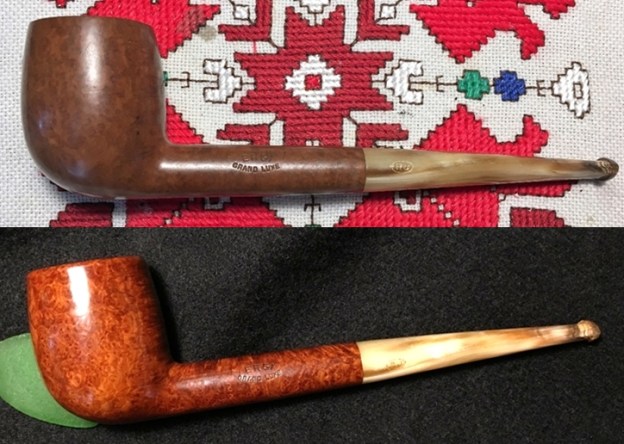
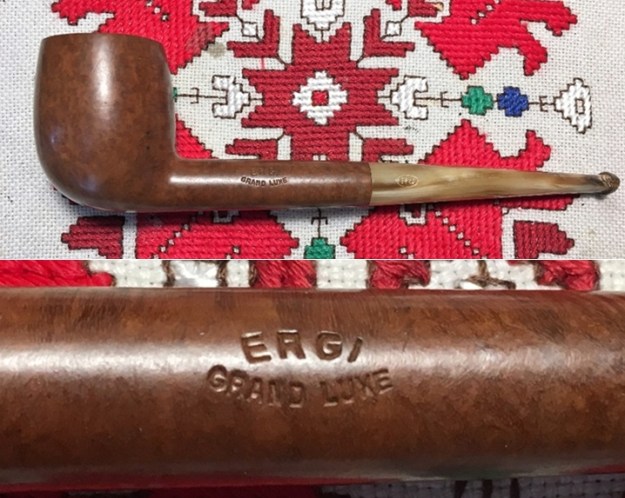
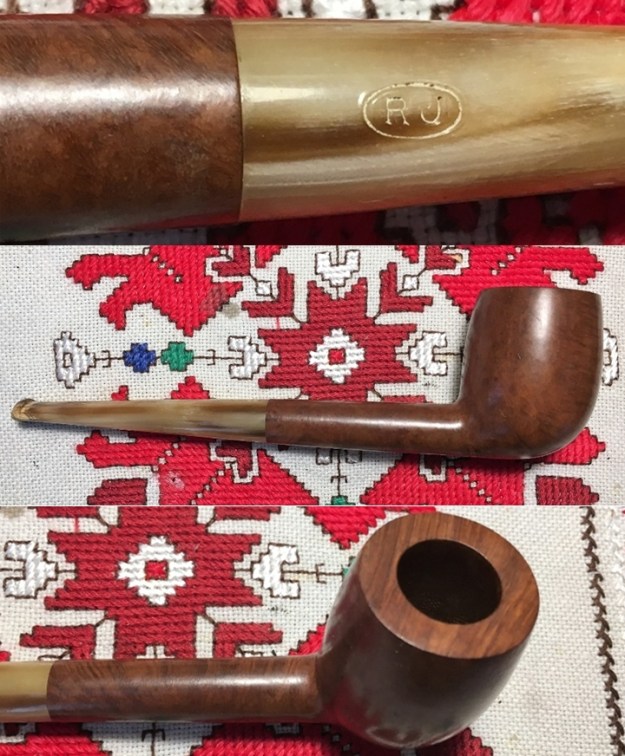
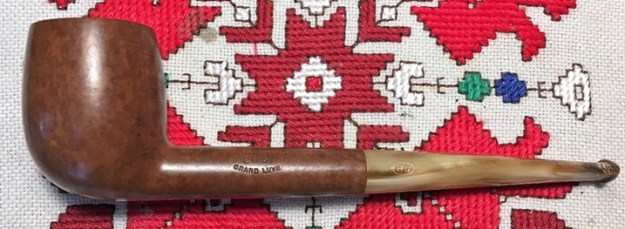
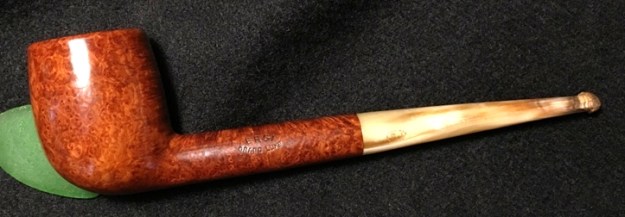
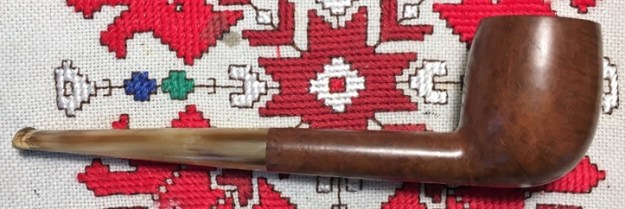
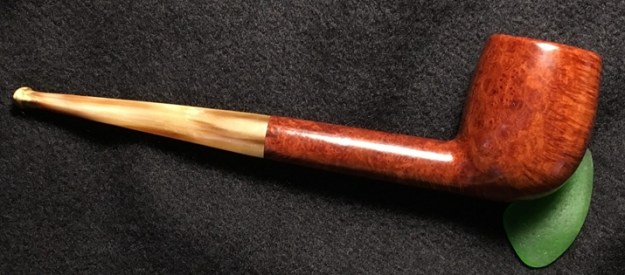
When this pipe came onto my worktable my assumption was that it was French made.  This assumption was formed by it being part of the ‘French Lot of 50’ which I acquired off the French eBay auction block.  Many of the pipes in this Lot bore horn stems which seemed to be the ‘French’ characteristic that formed my assumption that it too, was manufactured in France.  But on my worktable, the only marks stamped onto the Billiard were the ERGI [over] Grand Luxe on the left flank of the shank and an encircled ‘RJ’ stamped on the stem.  Here are the initial pictures of this attractive RJ Billiard with a horn stem and the nomenclature stampings: Intrigued by the question of this pipe’s COM and ‘RJ’ and ‘ERGI’, I went to all my usual places – Pipedia and Pipephil both came up totally empty.  I broadened the search to other blog threads and then to a wide-open Google search campaign.  Nothing.  I posted pictures of the nomenclature on Facebook groups, Gentlemen’s Pipe Smoking Society and Tobacco Pipe Restorers, and received only one response from Mike on GPSS who had this anecdotal information:

Mike: This pipe was made in Paris

Dal: Mike, Thanks. Do you know what RJ is? Company?? Thanks!

Mike: I know that the company closed down in 1998. As for the ERGI I believe it was an abbreviation for where the briar itself was harvested I picked one up years ago while in Paris.  I also remember paying the equivalent of 120 US dollars for it back about 20 years ago.  A really nice smoker. Dense briar.

Armed with Mike’s information about the Paris connection and encouraged by his experience, I Googled more (and a lot!) and also switched over to use Google of France hoping to get different responses.  This did help and I found one other piece of information about another RJ of Paris pipe – formerly on the Worthpoint auction block a Torpedo shape with this scant information.

WONDERFUL VINTAGE TORPEDO PIPE BY RJ PARIS WITH THE MAZE MORTONS PATENT DAMPER

This auction is for a super pipe in a torpedo shape made by RJ Paris (marked to the briar with name) and to the end is a mechanism that allows the damper to open and close – which is marked The Maze Morton’s Patent – a very good and interesting pipe.

An interesting pipe!  Again, a horn stem.  The French must like horn stems or at least ‘RJ’ did.  This confirmed that there was at least one other RJ of Paris pipe out there, but it was also advertised with the “Maze Mortons Patent Damper’.  I then searched again adding this to the search parameters and came up with no additional information – bah!  I’ll keep researching while I work on the pipe and I’m open to anyone reading this write-up to send me a note with more information to add to the scant information I have!

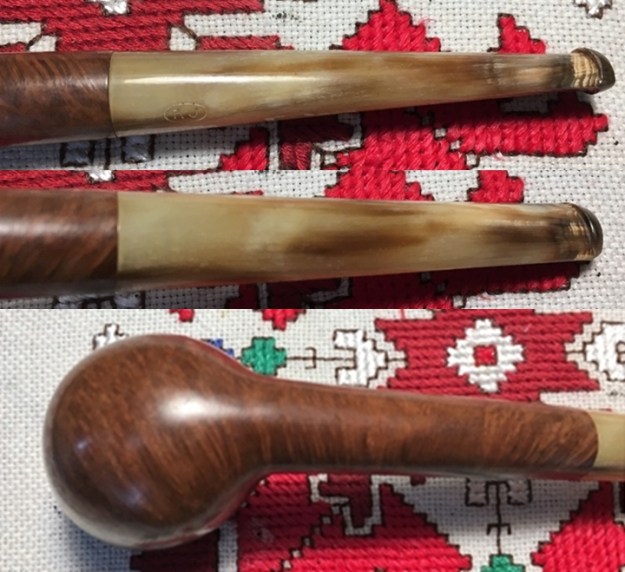
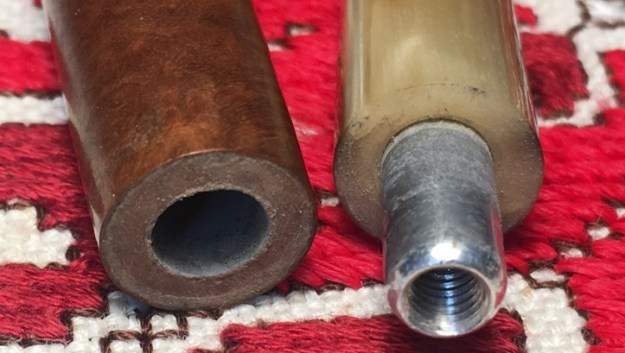
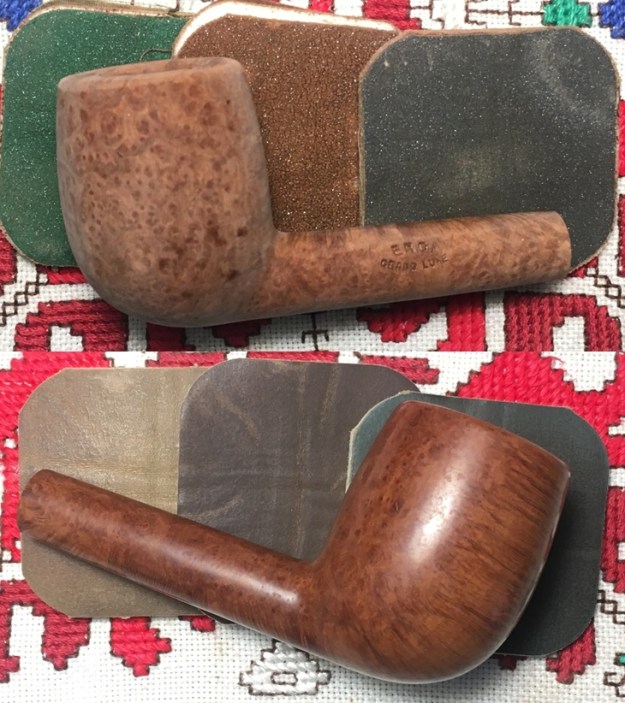
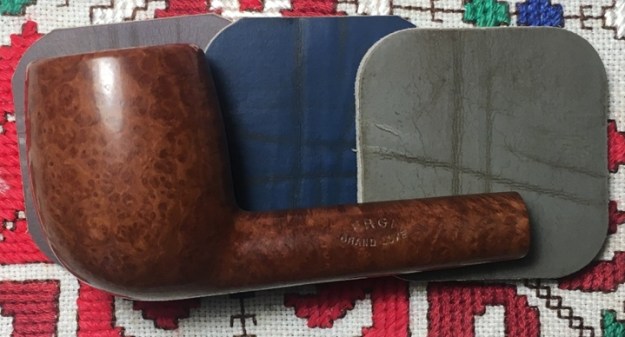
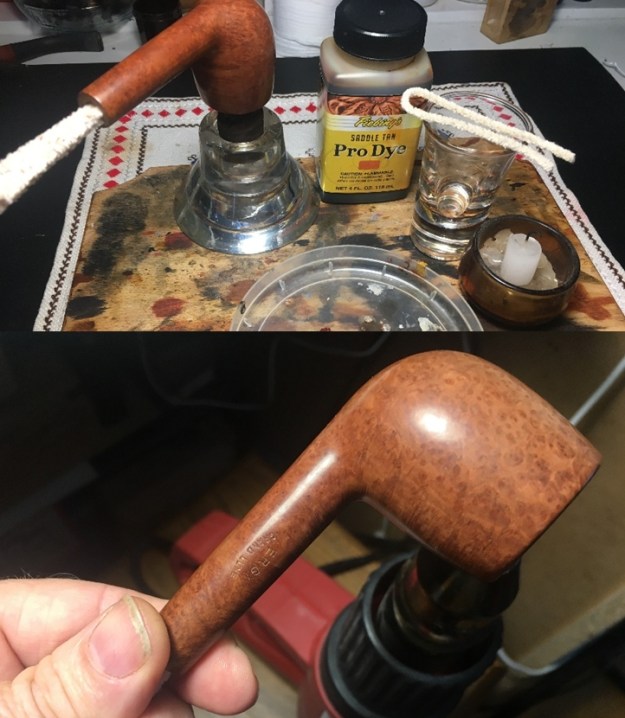
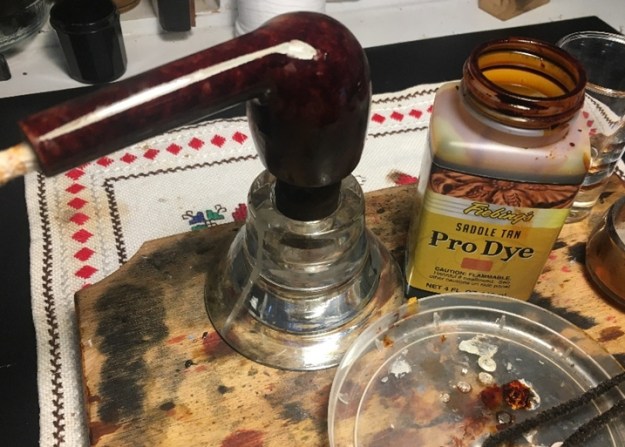
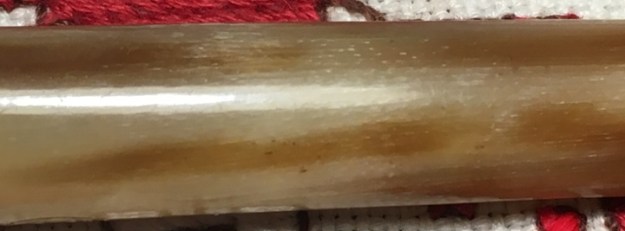
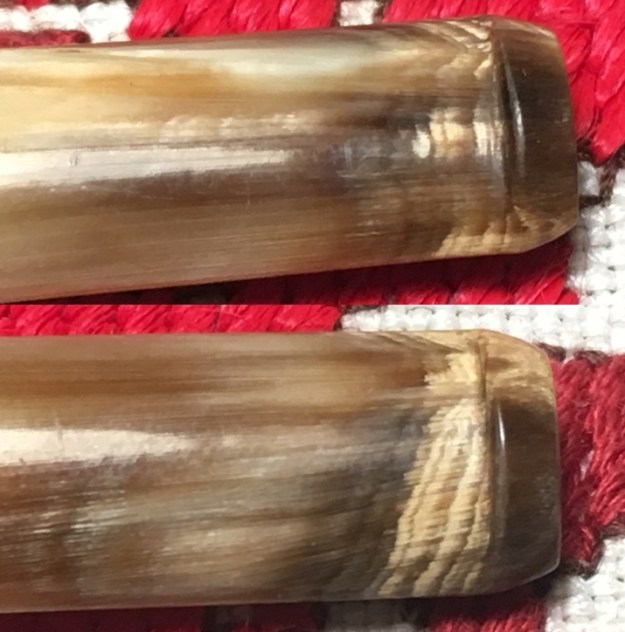
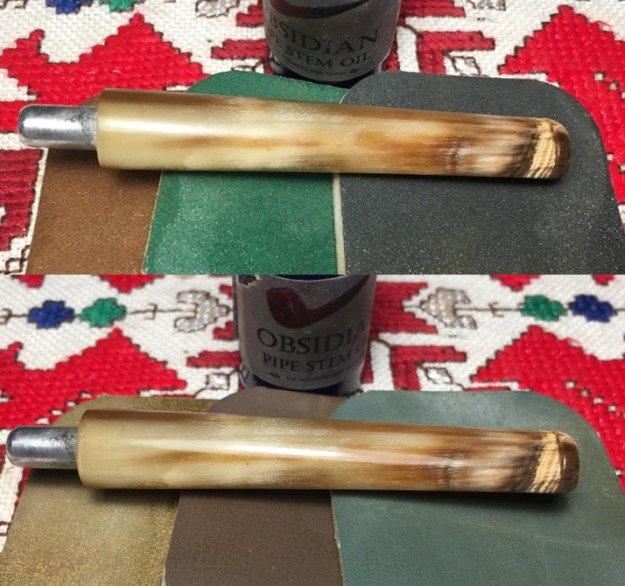
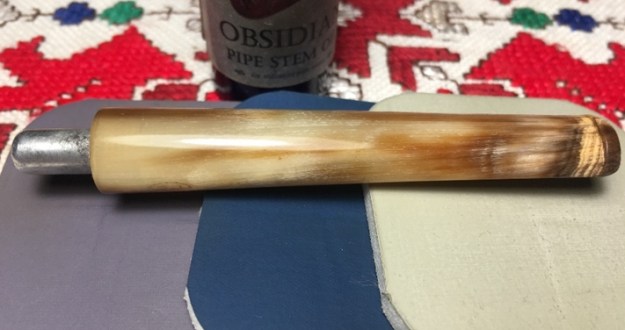
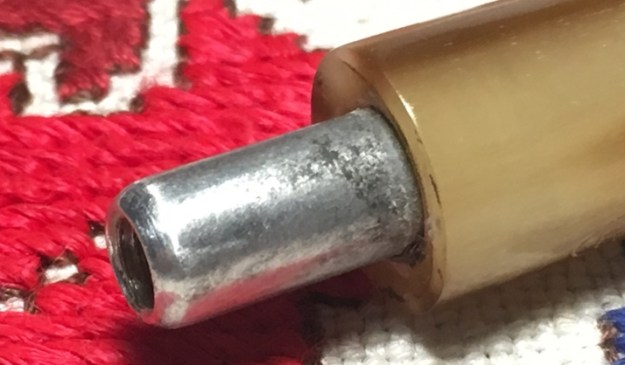
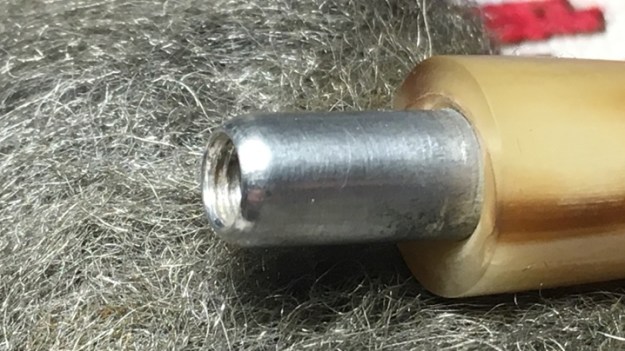
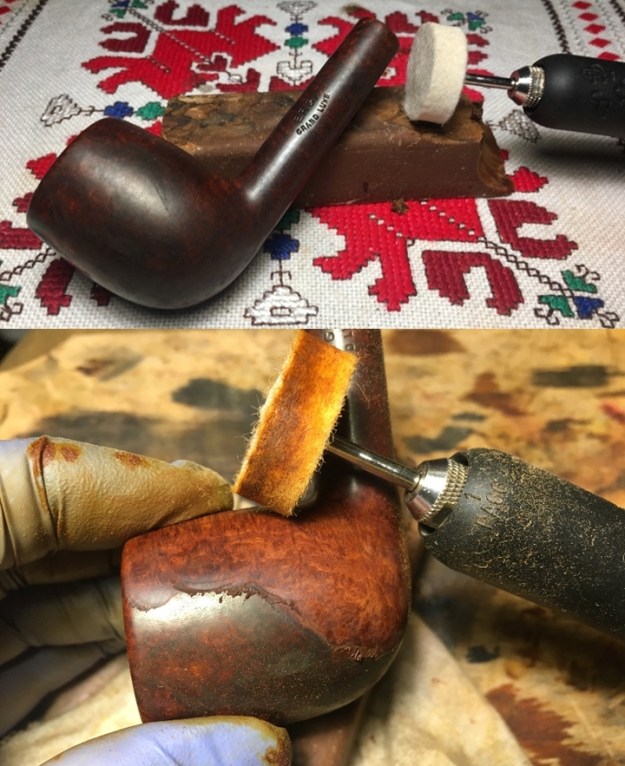
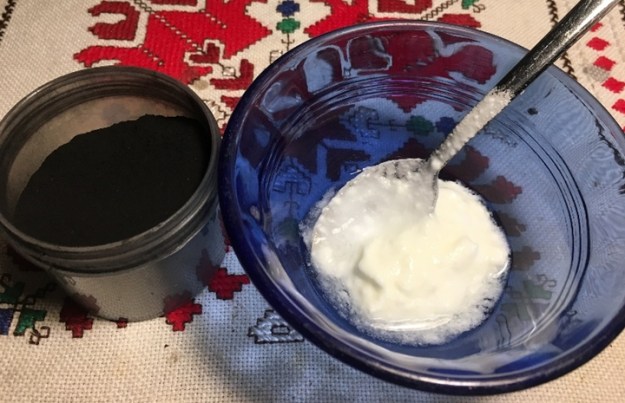
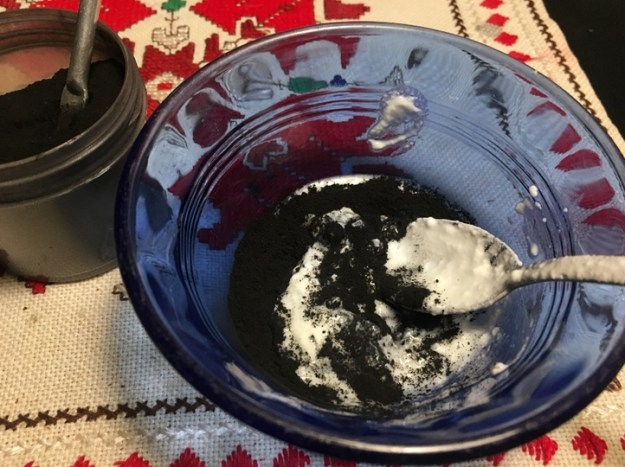
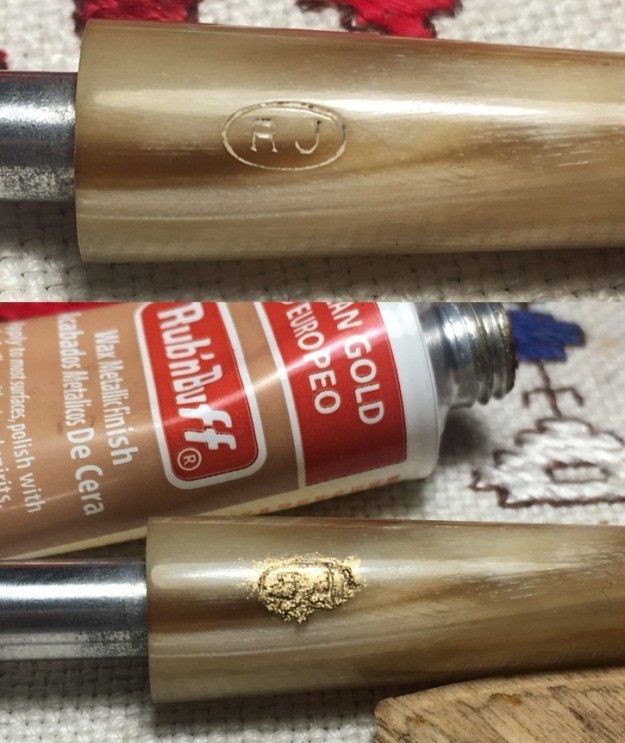
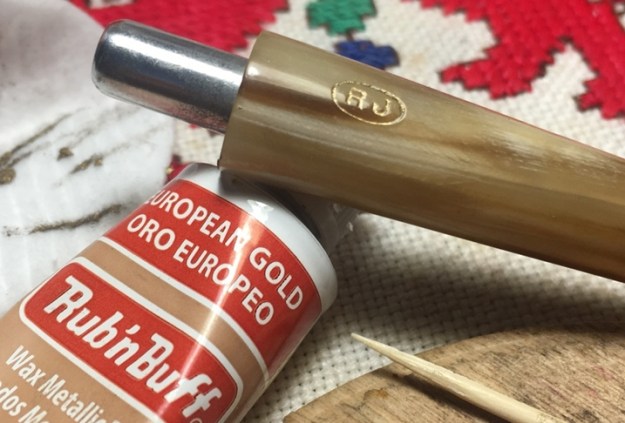
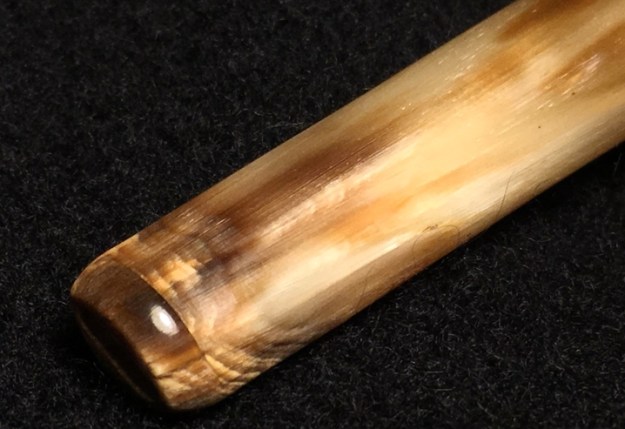
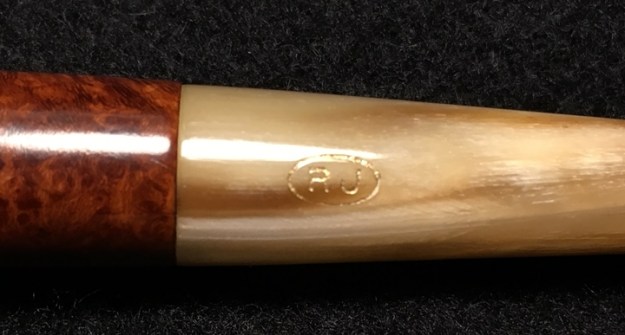
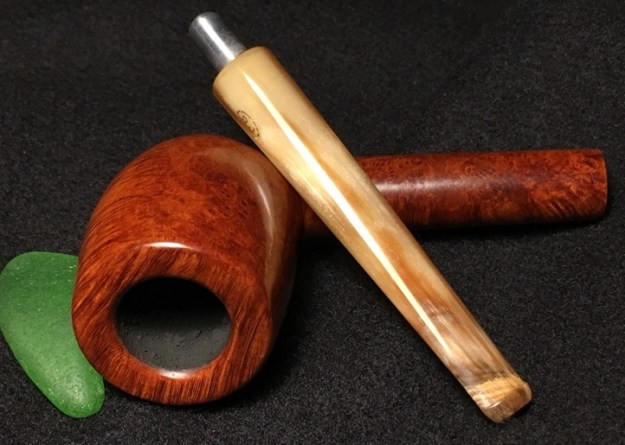
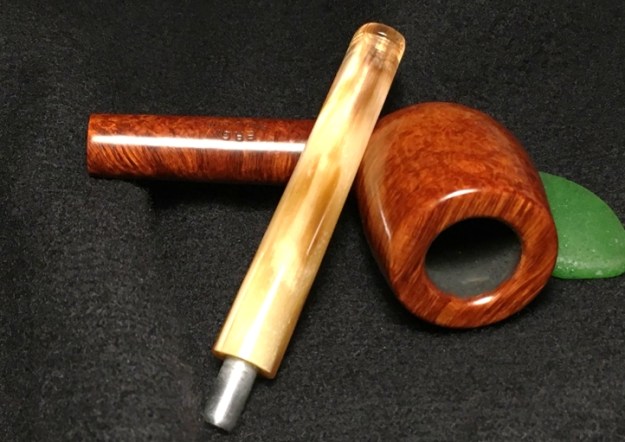
Todd saw this pipe along with two others in the For “Pipe Dreamers” Only! collection – a Ben Wade Hand Model and a very nice GBD Pot with uber grain potential!  Todd is a regular commenter on Rebornpipes and different Facebook pipe groups.  In the past he had offered encouraging words for restorations I had published, so it was great dialoging with him while he chose pipes to commission!  As he whittled his Dreamers list down from 5 pipes to the 3, we discovered we both have 2 grown children living in Denver, a parent living in Florida and connections in the Atlanta area – a small world sometimes in the pipedom community!  Most interesting to me was to discover that Todd is a lawyer and fluent in Mandarin Chinese and who practices both commercial law for corporations and also political asylum cases for individuals.  ‘Political asylum’ cases got my attention and appreciation, especially given our work here in Bulgaria among trafficked women.  Todd’s final three Dreamer’s choices: a Ben Wade, GBD Pot and the RJ on the worktable.With the limited information about the pipe before me and an appreciation for the pipe man who commissioned it, I now look closer at the pipe’s condition.  The interesting thing about this pipe is that it appears to be unsmoked and newish.  The metal tenon appears to be threaded and I’m assuming will take a 5mm filter if one chooses.  The chamber is virgin even though the external briar has some nicks and miniscule pits at places.  The pipe is very attractive, but what strikes me is that the grain of the smooth briar is subdued, even for an unsmoked pipe!  The rim is not marred, but the appearance is sharp and chopped.  Softening the rim presentation would help. The horn stem is in pristine condition and simply needs to be polished.  This ‘restoration’ is primarily a freshening, but my challenge is to show that generally (notice, qualifier!) a good restoration of a ‘new’ pipe will turn out better results than a factory manufactured new pipe.  This is the gauntlet that I’m laying down for myself, and we’ll see! Even though the pipe is unsmoked, I use undiluted Murphy’s Oil Soap and clean the stummel using a cotton pad. Afterwards, I rinse the stummel with cool tap water.  Doing this not only cleans the briar, but I also watch to see how the finish reacts.  As you can see from the results below, the cotton pad picks up some grime.Next, to soften the rim’s ‘cut off’, block look, I introduce both an internal bevel and a gentle external bevel.  At the end, these bevels will soften and will appear simply to be rounded edges, not distinct bevels.  To do the initial shaping, I pinch a tightly rolled piece of 120 grit paper between my thumb and the rim edge and rotate around the circumference.  I follow the 120 with rolled pieces of 240 and 600 grit papers.  In the same way, I introduce a lesser bevel on the external rim edge.  There are some wandering scratches on the rim top that micromesh should erase.Next, to clean up the minor surface imperfections and to tease out the grain, using micromesh pads 1500 to 2400 I wet sand the stummel. I follow by dry sanding using pads 3200 to 4000 and 6000 to 12000.  The grains emerge more distinctly during the micromesh process and I study the patterns.  The block was cut with a primary horizontal cross grain orientation that emerges on the front right and back left bowl quadrants.  On the opposite quadrants, front left and back right – the cross section of the grain emerges in tight bird’s eye patterns.  Very nice – I love the grain!  Decision time.  As I proceeded through the micromesh process, the question I was mulling over in my mind was whether to leave the finish as it is and move on to the compounds and waxing?  Or, to apply a dye and employ the felt buffing wheel technique that will result in heightened grain contrast?  After conferring with my stylistically superior, my wife, I decide to go in the latter direction.  I use Fiebing’s Saddle Tan Pro Dye to do this – an aniline dye.  My aim is not to darken the overall stummel appearance, but to create more contrast in the grains.  I first wipe the bowl with a cotton pad wetted with alcohol to clean it. Then I heat the stummel using the hot air gun which helps expand the briar allowing the grain to be more receptive to the dye.  After heated, using a folded over pipe cleaner, I apply the Saddle Tan dye to the stummel and then fire it with a lit candle.  The alcohol in the dye combusts and sets the pigment in the briar.  After a few minutes, I repeat the process of applying and firing the dye.  I then put the stummel aside to rest for several hours. With the stummel on the resting allowing the dye to fully set, I study the horn stem.  It’s a beautiful piece of horn and the only thing I can do is simply spruce it up.  In the past, I benefited greatly by Steve’s essay on horn stem repair working on my first horn stem, A First Horn Stem on a Throw Away Pipe.  The key thing in repairing horn is to fill the gaps to keep the horn from drying and splintering as horn is very porous.  This stem needs no repairs, but looking closely, I do see normal miniscule porous texture.  The tighter or smoother the horn surface is, helps to guard against the decay of the horn.  I take a few closeups to show this. I treat the horn stem like a vulcanite stem but with greater gentleness 😊.  I run the stem through the micromesh regimen, and I will apply compounds afterward.  I wet sand with micromesh pads 1500 to 2400 and follow by dry sanding with pads 3200 to 4000 and 6000 to 12000.  After each set of three pads, I apply Obsidian Oil to the horn and the horn drinks it up! I’m pleased with the results – even more gloss! While working on the stem, I kept seeing the nickel tenon and thinking that I needed to work on that a bit.  I clean it initially with 0000 steel wool.  After a bit of shining, that’s more like it! The newly stained and fired stummel has been resting for several hours and it’s time to unwrap the fired crust.  I mount a felt cloth buffing wheel to the Dremel and set the speed to the slowest possible, so I don’t scorch the wood with too much friction.  I then apply Tripoli compound to the briar surface which takes quite a bit of time. As the wheel ‘plows’ the crusted dye it loads up quickly requiring me to purge the wheel often.  When finished with Tripoli compound, I wipe the stummel with a cotton pad wetted with isopropyl 95%. I do this to lighten the aniline dye as well as to blend it.  Following this, I mount a cotton cloth buffing wheel to the Dremel, and increase the speed to about 40% full power.  After rejoining the stem and stummel, I apply Blue Diamond compound to both the horn stem and stummel.  When finished, I then wipe the pipe down with a felt cloth to clean it of compound dust before the application of the wax.  The pictures show the process. Before moving to the waxing of the pipe, I apply a mixture of activated charcoal and yogurt (sour cream works too) to form a protective layer for the chamber.  This mixture hardens in the chamber and provides a good starter layer for a cake to develop which protects the briar.  First, I put some natural yogurt in a small dish and then while mixing, I add activated charcoal.  As I add charcoal it thickens.  I want it thick enough, so it doesn’t run after applied to the chamber and I don’t want it so thick that it clumps.  When it looks good, after inserting a pipe cleaner through the draft hole to keep the airway open, I use a cotton bud and paint the chamber wall with the mixture.  With this done, it is late, and I turn out the lights allowing the charcoal/yogurt mixture to cure through the night. The next morning, the chamber coating has cured and I’m ready now to apply the final wax. One more thing to do before applying wax.  I have not seen any other RJ branded pipes that would provide a model informing me about the stem stamp.  The oval-encircled ‘RJ’ appears to have had some color in it, but it’s not clear which.  I decide to dress it up by applying Rub’n Buff European Gold to the stamp.  I apply some over the stamping with a toothpick and after a few minutes, simply scrape most of the excess off using the hard side of a tooth pick and then finish it up by wiping it clean of excess with a cotton pad.  It works exceptionally well and the subtle gold stamping blends well with the horn stem brown and tan hues.  Wow!  I’m liking this. I mount the Dremel with another cotton cloth wheel, maintain 40% full power speed, and apply several coats of carnauba wax to the stummel and horn stem.  After this, I give the entire pipe a good hand buffing with a microfiber cloth to raise the shine.

Earlier, I threw down the gauntlet and made the statement that a well-done restoration has better results than most new, manufactured pipes.  I’ll let you make your own judgement below as I begin with a ‘Before & After’ picture.  John, my fellow GPSC Facebook group member, observed that the RJ pipe he acquired in Paris some years ago had dense briar.  I would say that this ERGI Grand Luxe, if it too is Parisian, displays a grain that could be described the same way.  The bird’s eye is beautiful, tightly wound, and gratuitously showcased throughout the briar landscape – very appealing.  Complementing this beautiful display of briar is the rustic, earthy horn stem with its softly woven brown and tan hues.  I also like the gold embossing of the RJ stamp – it fits well this striking straight Billiard.  This is the first of 3 pipes that Todd commissioned and he will have the first opportunity to acquire it from The Pipe Steward Store.  This pipe benefits our work here in Bulgaria, with the Daughters of Bulgaria – helping women and girls who have been trafficked and sexually exploited.  Thanks for joining me!  Now, ‘Before & After’.  What do you think?


The Second of a Foursome – A JR Handmade Canadian


Blog by Steve Laug

My brother Jeff picked up four pipes in classic shapes at an auction in Nampa, Idaho. All four pipes are stamped JR Handmade. Beside the Bulldog there were two Canadians and an Apple. All were stamped the same on the left side of the shank JR over Handmade and on the right side Algerian Briar. I have been researching the brand on the web. I came across a potential pipemaker with the JR initials on Pipedia named J. Rinaldi but from what I can see he did not make classic shaped pipes. He pipes are very well made and have more of a freehand/freeform shape with shank adornments so it makes me wonder if these are his. I enlarged each photo on the Pipedia article but I was unable to see the stamping on his pipes for comparison sake. This leaves me with a lot of questions about the brand. The foursome came from the Boise, Idaho area like the House of Robertson pipes that I worked on last year. Those came from a pipe shop in Boise, Idaho and I wonder if it is not possible that the JR Handmade brand was also a pipe shop brand from a small shop in that area or even somehow connected with the House of Robertson brand. Perhaps I will never know… if any of you readers have any idea about the brand your help would be greatly appreciated.The above photo shows the foursome after Jeff had cleaned them. But before he cleaned each of them he took photos of the pipes as they came to him. I already wrote about the restoration of the Bulldog (https://rebornpipes.com/2019/01/28/the-first-of-a-foursome-a-jr-handmade-bulldog/). The next pipe is the first pipe on the right side of the above photo – a classic Canadian with a beveled rim top. I have included the photos of the Canadian before cleanup. The pipe is very well made and follows the classic shape of an oval shank Canadian perfectly. The bowl was stained with a dark brown/black and a medium brown stain over it. It is a well-shaped pipe that captures the mixture of flame and straight grain around the bowl sides and shank. The top of the bowl had some damage on the top and inner and outer edge. There were some chips from the briar on the outer edge on the right and the left side. There was a little darkening at the front outer edge. The inner edge had some knife marks on the right side at the top that left damage. The bowl had a very thick cake in the bowl. There was an overflow of lava onto the rim top. The stamping on the top side of the oval shank read JR over HAND MADE. The stamping on the underside read Imported Briar. The black vulcanite stem had light tooth dents and chatter on the top and the underside of the stem. Otherwise it was in very good condition. It was also lightly oxidized. Jeff took two close-up photos of the bowl and rim with different lighting to capture the condition of the pipe pre-cleanup work. The rim top had some lava overflow and a lot of damage to the inner and outer edges of the bowl. The pipe is dirty with thick cake and damage around the beveled rim.He also took photos of the sides of the bowl and shank to show the various grains on the bowl and shank. The first photo shows the large chip out of the top edge of the bowl. It was quite large and deep. Even though there is damage to this pipe the photos also show the rich colour of the stain that makes the grain just pop. The finish is very dirty but this is another beautiful pipe. Jeff took a photo to capture the stamping on the topside of the oval shank. The photo shows stamping JR over HAND MADE. On the underside it reads Imported Briar.  The next two photos show the stem surface. There are tooth marks and chatter on both sides near the button. There is also some wear on the sharp edge of the button. As mentioned before, Jeff and I have developed a pattern of working on the pipes that has become habit to both Jeff and me. I include it here so you have a sense of that pattern. Jeff reamed the bowl with a PipNet pipe reamer and followed up with a Savinelli Fitsall pipe knife to remove the cake. He scrubbed out the mortise and the airway in the shank and the stem with alcohol, cotton swabs and pipe cleaners. He scrubbed the exterior of the bowl, rim, shank and stem with a tooth brush and Murphy’s Oil Soap to remove the oils and tars on the rim and the grime on the finish of the bowl. He rinsed it under running water. He dried it off with a soft cloth. He was able to remove the lava build up on the rim top and the rim top damage and the damage around the edges – both inner and outer is quite extensive. I took photos of the pipe to show its condition before I started my work on it.   I took close up photos of the bowl and rim top as well as the stem. You can see the condition of the rim top and bowl in the first photo. Jeff was able to remove all of the tar and oils but you can now see the damage to the inner edge of the bowl. The vulcanite stem had tooth chatter and some tooth marks on the top and underside of the stem near and on the button surface.I took photos of the stamping on both sides of the oval shank. You can see that the stamping on both sides was light toward the front of the pipe. It was still readable but faint nonetheless.I decided to address the damage to the rim edges first. I wiped down the outside of the bowl with an alcohol dampened pad and filled in the chipped areas around the edge with clear super glue and briar dust to build up the chips to match the bowl sides.I decided to leave the side repairs for a bit to harden and turned to the rim top. I had to handle the rim repairs a bit differently on this pipe since it had a rim top that was beveled inward. I topped the bowl with 220 grit sandpaper on a topping board to remove the damage to the outer edges of the rim top. I worked the beveled edge to match the outer edge of the bowl and smooth out the transition. I also needed to take care of the inner edge so I used a folded piece of 220 grit sandpaper to smooth out the knife marks there and minimize the damage.   I sanded the repairs smooth and blended them into the rest of the bowl. It took a bit of work but soon they were blended in. I would need to stain the bowl repairs but first I want to polish the sanding marks out. I polished the rim top, the edge and exterior of the bowl with micromesh sanding pads – wet sanding with 1500-2400 grit pads and dry sanding with 3200-12000 grit pads. I wiped the rim off after each sanding pad to remove the dust. The damage on the rim edges and top looked really good after polishing. I stained the rim top and bowl sides with a Cherry stain pen. I gave the sanded edges and repairs several coats of stain and let it cure.I worked some Before & After Restoration Balm into the smooth surface of the briar with my fingertips to clean, enliven and protect it. I let the balm sit for a little wall and then buffed with a cotton cloth to raise the shine. The following photos show the bowl at this point in the restoration process. The reworked rim top looks really good and matches the colour of the rest of the pipe. I set the bowl aside and worked on the stem. There were some tooth marks on the top and underside at the button that needed to be addressed. I sanded the tooth marks and chatter out of the surface of the stem and shaped the button with 220 grit sandpaper.I polished the stem with micromesh sanding pads – wet sanding with 1500-2400 grit sanding pads and dry sanding it with 3200-12000 grit sanding pads. I wiped it down after each sanding pad with Obsidian Oil. I polished it with Before & After Pipe Stem Polish and wiped it down with a last coat of Obsidian Oil. With this second JR Hand Made pipes from the Nampa, Idaho auction I am even more certain that there is some connection to the House of Robertson Pipe Shop in Boise, Idaho. Even with the fills and the repairs to the pipe this is another nice pipe. The two of the four JR Hand Made pipes that I have to restore are really well made and shaped. The stain job was done to highlight the mix of grain on the bowl. I polished stem and the bowl with Blue Diamond polish on the buffing wheel. I gave the bowl and the stem multiple coats of carnauba wax. I buffed the pipe with a clean buffing pad to raise the shine. I hand buffed it with a microfiber cloth to deepen the shine. The pipe polished up pretty nicely. The contrasting grain really began to stand out; it seemed to take on life with the buffing. The rich contrasting brown colour works well with the polished black vulcanite stem. This finished pipe has a rich look just like the Bulldog and it is also quite catching. Have a look at it in the photos below. The shape, finish and flow of the pipe and stem are very well done. The dimensions are Length: 6 inches, Height: 1 7/8 inches, Outside diameter of the bowl: 1 3/8 inches, Chamber diameter: 3/4 of an inch. I will be putting this newly finished JR Hand Made Canadian on the rebornpipes store shortly if you are interested in adding it to your collection. Thanks for walking through the restoration with me as I worked over the second of the foursome from JR Hand Made pipes.

The First of a Foursome – A JR Hand Made Bulldog


Blog by Steve Laug

My brother Jeff picked up four pipes in classic shapes at an auction in Nampa, Idaho. All four pipes are stamped JR Handmade. Beside the Bulldog there were two Canadians and an Apple. All were stamped the same on the left side of the shank JR over Handmade and on the right side Algerian Briar. I have been researching the brand on the web. I came across a potential pipemaker with the JR initials on Pipedia named J. Rinaldi but from what I can see he did not make classic shaped pipes. He pipes are very well made and have more of a freehand/freeform shape with shank adornments so it makes me wonder if these are his. I enlarged each photo on the Pipedia article but I was unable to see the stamping on his pipes for comparison sake. This leaves me with a lot of questions about the brand. The foursome came from the Boise, Idaho area like the House of Robertson pipes that I worked on last year. Those came from a pipe shop in Boise, Idaho and I wonder if it is not possible that the JR Handmade brand was also a pipe shop brand from a small shop in that area. Perhaps I will never know… if any of you readers have any idea about the brand your help would be greatly appreciated.The above photo shows the foursome after Jeff had cleaned them. But before he cleaned each of them he took photos of the pipes as they came to him. I have included the photos of the Bulldog before cleanup. The JR Handmade straight Bulldog with a vulcanite stem is next on the table. The pipe is very well made and follows the classic shape of the straight bulldog perfectly. The bowl was stained with a dark brown/black and a medium brown stain over it. The pipe has twin rings around the cap on the bowl. It is a well-shaped pipe that captures the mixture of swirling grain around the bowl sides and shank. The top of the bowl had some damage on the top and inner edge. The bowl had a very thick cake and cobwebs in the bowl. There was an overflow of lava onto the rim top. The stamping on the left side of the diamond shank read JR over HAND MADE. The stamping on the right side read Algerian Briar. The black vulcanite stem had tooth dents and chatter on the top and the underside of the stem. There was some damage to the top and bottom edges of the button. It was also oxidized and had some calcification on the top and underside near the button. Jeff took two close-up photos of the bowl and rim with different lighting to capture the condition of the pipe pre-cleanup work. The rim top had a thick lava overflow. There appeared to be some rim damage on the inner edge at different points around the bowl but it was hard to know for certain with the lava coat. The pipe is dirty with thick cake and cobwebs in the bowl. He also took photos of the sides and bottom of the bowl and shank to show the various grains on the bowl and shank. The photos also show the rich colour of the stain that make the grain just pop. The finish is very dirty but this is another beautiful pipe.Jeff took a photo to capture the stamping on the top left side of the diamond shank. The photo shows stamping JR over HAND MADE on the left shank and ALGERIAN BRIAR on the right shank. The next two photos show the stem surface. There are tooth marks and chatter on both sides near the button. There is also some wear on the sharp edge of the button.Over the past years Jeff and I have developed pattern of working on the pipes that has become habit to both Jeff and I. I include it here so you have a sense of that pattern. Jeff reamed the bowl with a PipNet pipe reamer and followed up with a Savinelli Fitsall pipe knife to remove the cake. He scrubbed out the mortise and the airway in the shank and the stem with alcohol, cotton swabs and pipe cleaners. He scrubbed the exterior of the bowl, rim, shank and stem with a tooth brush and Murphy’s Oil Soap to remove the oils and tars on the rim and the grime on the finish of the bowl. He rinsed it under running water. He dried it off with a soft cloth. He was able to remove the lava build up on the rim top and you could see the damage to the flat surface of the rim and the inner edge on the right side and toward the front of the bowl. I took photos of the pipe to show its condition before I started my work on it. I took close up photos of the bowl and rim top as well as the stem. You can see the condition of the rim top and bowl in the first photo. Jeff was able to remove all of the tar and oils but you can now see the damage to the inner edge of the bowl. The vulcanite stem had tooth chatter and some tooth marks on the top and underside of the stem near and on the button surface. I decided to address the damage to the rim top first. I topped the bowl with 220 grit sandpaper on a topping board to remove the damage to the flat surface of the rim top and also to try to minimize the damage to the inner edge of the rim.I worked over the inner edge of the rim with a folded piece of 220 grit sandpaper to smooth out the damage. I gave it a slight bevel to hide the damage on the inner edge of the rim. The photos tell the story. The damage to the rim top is gone and the inner edge looks far better with the light bevel. The damage to the front edge is quite hidden.I polished the rim top, the edge and exterior of the bowl with micromesh sanding pads – wet sanding with 1500-2400 grit pads and dry sanding with 3200-12000 grit pads. I wiped the rim off after each sanding pad to remove the dust. The damage on the rim is pretty much invisible after polishing and the rim top really looked good. I worked some Before & After Restoration Balm into the smooth surface of the briar with my fingertips to clean, enliven and protect it. I let the balm sit for a little wall and then buffed with a cotton cloth to raise the shine. The following photos show the bowl at this point in the restoration process. The reworked rim top looks really good and matches the colour of the rest of the pipe. I set the bowl aside and worked on the stem. There were some tooth marks on the top and underside at the button that needed to be addressed. I also needed to do some work on the surface of the button on both sides. I filled the damaged areas in and build up the surface with clear super glue and set the stem aside until the repairs cured.I sanded both sides smooth with 220 grit sandpaper and 400 grit sandpaper to blend the tooth chatter and the repair into the surface of the stem. As I sanded and reshaped the button and stem surface the repaired areas and the tooth chatter disappeared.I polished the stem with micromesh sanding pads – wet sanding with 1500-2400 grit sanding pads and dry sanding it with 3200-12000 grit sanding pads. I wiped it down after each sanding pad with Obsidian Oil. I polished it with Before & After Pipe Stem Polish and wiped it down with a last coat of Obsidian Oil. The more I work on the JR Hand Made pipes from the Nampa, Idaho auction the more I wonder if there is some connection to the House of Robertson Pipe Shop in Boise, Idaho. This is the nicest one of the four JR Hand Made pipes that I have to restore. It does not have any fills in the briar and the stain job was done to highlight the swirling grain. I polished stem and the bowl with Blue Diamond polish on the buffing wheel. I gave the bowl and the stem multiple coats of carnauba wax. I buffed the pipe with a clean buffing pad to raise the shine. I hand buffed it with a microfiber cloth to deepen the shine. The pipe polished up pretty nicely. The contrasting grain really began to stand out; it seemed to take on life with the buffing. The rich contrasting brown colour works well with the polished black vulcanite stem. The finished pipe has a rich look that is quite catching. Have a look at it with the photos below. The shape, finish and flow of the pipe and stem are very well done. The dimensions are Length: 5 1/2 inches, Height: 1 7/8 inches, Outside diameter of the bowl: 1 1/4 inches, Chamber diameter: 3/4 of an inch. I will be putting this newly finished JR Hand Made Bulldog on the rebornpipes store shortly if you are interested in adding it to your collection. Thanks for walking through the restoration with me as I worked over the first of the foursome from JR Hand Made pipes.

Recommissioning a Vintage French Paul Viou Churchwarden of St. Claude


Blog by Dal Stanton

There’s nothing like a Lot picture on the eBay auction block that makes a pipe man salivate with the question, “Are there any treasures in the beautiful, intertwined, chaotic mass of briar, rubber, horn, and acrylic?”  I received a message from my good pipe man friend to the north of Bulgaria in Romania, Codruț (aka: Piper O’Beard on FB), a happy steward of a Peretti Oom Paul Sitter I restored (Recommissioning Another L. J. Peretti of Boston: An Oom Paul Sitter).  Codruț  sent me some links of Lots on the French eBay auction block.  With piqued curiosity I looked.  Codruț was considering getting into the hunt – he had never purchased a Lot before and he wanted to try his had and restoring.  When I saw the French Lot below, I started salivating a bit(!), and asked Codruț if he minded if I went after it.  With his blessing, I placed a bid and was fortunate to land the French Lot of 50 and bring it to Bulgaria.  What drew my attention to this Lot of 50 initially were all the horn stems that caught my eye.  The second was the classy Pencil Stem Cutty Tavern Pipe laying across the top (unbelievably, still available as I write in the For “Pipe Dreamers” Only! collection!!) and the modernistic, deep blue/white Billiard with a fiery blue acrylic stem lying next to the Pencil Stem Cutty Tavern Pipe (available in The Pipe Steward Store as I write!).  Then I saw the Churchwarden.  All pipe picking scavenging requires one to see through the mass to put together the clues of what is hidden.  The P. Viou Warden’s upside-down bowl starts on the left side (just above a horn stem) and you can trace the long stem underneath the mass where it emerges on the far right, upturned – somewhat masked by the star on the print below.  Aw!  My excitement when the bell rang, and the winning bid was mine!When the French Lot of 50 finally made it to Bulgaria, I opened the box like a young boy opening a treasure!  With all my acquisitions, so that I can keep track of everything, I picture and record every pipe and eventually upload them to the ‘For “Pipe Dreamers” Only!’ collection for pipe men and women to see and commission if a pipe happens to choose them.  Here are some of the cataloging pictures I took of the French Lot of 50 with a better look at the 3 pipes that hooked me as well as the plethora of horn! It didn’t take long for the Churchwarden to find a suitor after he was put online in the ‘For “Pipe Dreamers” Only!’ collection.  A new acquaintance, Josh, who visited Bulgaria last summer, saw the Churchwarden and commissioned him and has been waiting so patiently!  The Paul Viou Churchwarden finally made it to my worktable, and I take more pictures to get a closer look. The reach of the P. Viou’s Churchwarden is 10 1/2 inches (even with an inappropriately tucked stem!) and the height of the bowl is 1 7/8 inches.  The nomenclature is a cursive, P. Viou with a flared underline on the left flank of the shank.  On the right, is the well-known stamping of ‘ST.CLAUDE’, the French birthplace of the production of briar pipes and historically, the mega-center of French pipe manufacturing with a plethora of names calling it home.  There is scant information about the Paul Viou name on the internet that I could find.  Pipedia’s article of Paul Viou is brief:

From Pipes, Artisans and Trademarks, by José Manuel Lopes’

Paul Viou was the brand and name of a French artisan who sold his pipes by correspondence and then he was a pipe supplier for military institutions. He also made sculpted pipes and sometime used horn stems.

The brand is currently sold by Jacques Craen and made by Genod in Saint-Claude, after having also belonged to Paul Guilland and Vuillard. They are stamped P. Viou and made primarily for export.

This information is confirmed by Pipephil.eu with the addition of the date of the current holder of the Paul Viou name, Beaud, happening in 2006: Whether the Churchwarden before me was made under the original artisan or under one of the other eventual holding companies (Guilland, Vuillard, or Genod), I’m not sure how to say with certainty.  I have a few other P. Viou pipes in the French Lot of 50, so perhaps I’ll discover more information as I go!

The condition of the overall pipe is good. The bowl is darkened from time and the normal buildup of oils and grime.  The chamber has some cake buildup but not much.  The Warden stem has some oxidation and the bit is in good condition.  I notice also (picture above) that there’s a gap between the stem and shank.  Often, a simple cleaning will restore a flush seating of the stem, but I’ll keep my eye on this.  The main thing that grabbed my attention when I first held the pipe in my hand was the orientation of the stem.  To me, it is over-bent and almost you could say, tucked.  Wardens, I’ve found, have different kinds of bends.  Most often I’ve observed a sweeping bend where almost the entire stem is engaged in the bend.  This P. Viou has a straight extension until it reaches the very end of the stem and then is bent.  I like it, but the final orientation of the bend should more closely reflect a parallel orientation with the plane of the rim.  For a didactic moment, I trace this concept on a piece of paper to illustrate.Before beginning the cleaning process with the stem, I make this adjustment to the stem.  First, just to be on the cautious side, I insert a pipe cleaner into the bit side of the stem to guard the integrity of the airway, which usually isn’t an issue if the bend is being opened instead of tightened. I also trace the original stem orientation on the paper I used above so that when I bend the stem, I can lay it on the flat surface for a straighter result.  I then heat the end of the stem with a hot air gun.  As it heats, the vulcanite becomes supple and the bend gradually starts straightening on its own.  When it expands enough as I eyeball it, holding the stem in place, I take it to the sink and run cold tap water on it to set the bend.  After the first attempt, the bend is still too tight, so I repeat the process again and the second time is enough.  The pictures show the progression.  I like this orientation much better. Before cleaning the stem, I remove the stinger to aid in the cleaning. I heat the stinger with a Bic lighter and after it heats, the vulcanite holding it loosens its grip.  I gently extract it with the help of pliers.  I personally don’t have a lot of affection for stingers and their role in the smoking experience.  I’ll clean the stinger and include it with the finished pipe and allow the future steward to make the call!  I don’t have long pipe cleaners, but I do have a selection of shank brushes that easily reach through the stem.  I use these dipped in isopropyl 95% to clean the internals of the stem. I also use regular pipe cleaners inserting them from both sides.  Well, it didn’t take long after starting to know that this Warden stem had not been cleaned in some time – if ever!  The reality of the less than optimal situation was confirmed when my wife came in and said that something was stinking…. I should have had gloves and my apron on, but hindsight!  After some cleaning, things are looking better but still not pristine! This nastiness helps me decide the next course of action.  I use an OxiClean bath to work on the oxidation in the vulcanite, but it also serves to further sanitize the internals, yes!  I pour the OxiClean into a larger plastic container that will accommodate the stem.  Before putting the stem in the OxiClean bath, I put a little petroleum jelly over the ‘P.Viou’ stamping to protect it and then let the OxiClean to its thing with both internal and external. With the stem in the bath, I turn now to the Paul Viou bowl by reaming the chamber with the Pipnet Reaming kit using two smaller blades.  I then fine tune by scraping the chamber with the Savinelli Fitsall tool and follow by sanding the chamber with 240 grit paper wrapped around a Sharpie Pen.  After wiping the chamber with a cotton pad and alcohol, I look at the cleaned chamber and it looks good – no signs of heating damage. Next, I use undiluted Murphy’s Oil Soap on the external briar surface to work on the bowl and lava flow on the rim. I also use a bristled tooth brush and a brass wire brush on the rim that will not damage the briar.  The cleaning reveals two thing.  First, by looking at the cotton pad in the picture, the old dye came off during the cleaning.  The rim cleaned up well but revealed burn damage from pulling the flame over the rim instead of being over the tobacco!  Lighting a Churchwarden can be a bit more difficult, especially the way the stem was originally bent on this Paul Viou – I doubt if the steward could see the top of the bowl with the way it was tucked under.  Here are the pictures. To complete the general cleaning regimen, I use cotton buds and pipe cleaners dipped in isopropyl 95% to do the job.  With the grungy condition of the stem, it shouldn’t have surprised me to find the mortise and airway internals sharing the same grungy condition.  Oh my, with the help dental probes and spatulas to scrape the mortise and shank brushes coming in to reinforce the cotton buds and rank and file pipe cleaners, some victory was achieved in this skirmish.  With confidence of having total victory, I will later continue the struggle by giving the internals a kosher salt and alcohol bath to further draw the oils and tars out of the internal briar and to remove any lingering odor.  The picture shows the carnage and the arsenal of this war. Next, I take a closer look at the rim damage.  The lighting practice has scorched the forward left side of the bowl resulting in the thinning of the rim at that point.  I’ve had a lot of experience with this when I restored several L.J. Peretti Oom Pauls from the former steward who was a serial burner and discarder (See for an example: Another LJ Peretti Oom Paul Sitter Recommissioned).  My approach is two-fold with the driving value of always trying to save as much briar as possible!  First, I will minimally top the stummel to remove as much damage as possible.  Then, to blend the internal rim lip damage, I introduce an internal bevel, which in my view, looks good anyway.  With the chopping board on my table, I cover it with a sheet of 240 paper.  The following pictures show the graduated progress.  First, the starting point.Interestingly, the topping process reveals a slight inward dropping pitch of the rim.  This is shown by the outer portion only making contact with the flat topping board. When I decide the 240 grit paper has removed enough of the top, I switch the paper to 600 grit and give the topping a few more rotations to smooth out the rim.Now, step two is introducing a bevel to the internal lip to remove more damaged briar and to blend.  I start with a tightly rolled piece of coarser 120 grit paper to cut the initial bevel.  I follow in succession with 240 and 600 grit papers tightly rolled. To soften the sharp outer edge of the rim and to soften the entire rim presentation, I create an external bevel, but a very small bevel using the same progression of sanding papers.  I think it looks good.  The darkened part of the damage is still visible, but it will be mitigated when the rim is dyed and darkened.The condition of the stummel is good.  I don’t see any problem fills or pitting.  I go with the original finish and aim to match the rim to the bowl. What seems to be a good match is the Mahogany dye stick.  After applying it over the rim, I then blend the dye stick coating by wiping it with a cotton pad wetted with alcohol.  I think it looks good at this stage. The Warden stem has been in the OxiClean bath for several hours.  I take a few close-up pictures to show the oxidation which had surfaced.  I wet sand using 600 grade paper to remove the oxidation.  I’m careful to stay clear of the ‘P.Viou’ stamp.  I follow this with Magic Eraser over the entire stem, including the stamping.  The low abrasion of the sponge works well with cleaning up this area.In order to hydrate the vulcanite, I then apply a coat of paraffin oil (a mineral oil) over the stem and set it aside.Next, using micromesh pads 1500 to 2400, I wet sand the stummel to clean it and begin the fine polishing sanding. 

Following the first set of 3 pads, I begin dry sanding with the next set of 3 pads and after finishing with the first of these, I don’t like the way the stummel looks.  After the wet sanding cycles, the stummel has a pink or mauve hue to it – mauve to me, is sick pink.  Just in case you’re wondering what mauve is, from a quick Google search followed by my mauve toned stummel.  This doesn’t work for me! I placed too much trust in the old stain which is not holding up and leaving behind a less than attractive briar presentation – at least as I look at it.  I wipe the stummel with a cotton pad and alcohol and my thoughts are confirmed.  Even after wiping with isopropyl 95%, the stummel has the mauve residue in the grain.  The reality is, I’m not losing too much traction in the process of this restoration except I will take a detour and put the stummel in an acetone soak to make sure I’m proceeding with the natural briar.  This soak in acetone will also preempt the need to do a kosher salt and alcohol soak.  I put the stummel in the acetone soak and turn out the lights.  Another day is done.The next morning, I fish the stummel out of the acetone soak and it is evident that all the remnant finish is gone. I return to the micromesh sanding process and start again by wet sanding with the initial set of 3, 1500 to 2400.  Following this, using pads 3200 to 4000 and 6000 to 12000, I dry sand the stummel, throughout avoiding the stamped areas on the left and right flanks of the shank.  Wow, without the distraction of the finish, the grain I see emerge is nice.  I see an eclectic blend of large bird’s eye on the sides of the bowl and the horizontal ‘connector’ grains of the bird’s eye displayed on the foreside of the bowl. I still have the Warden stem waiting in the wings for fine tuning, but I want to move forward with the stummel so that it can be ‘resting’ during the stem work.  The grain that has emerged is beautiful and to create a little more ‘pop’ to the grain with more contrast between the darker and lighter grain – harder and softer wood, after debating between Dark Brown and Light Brown, I decide to use Fiebing’s Light Brown Leather Dye to provide the base hue in the grain and then through the use of Tripoli compound applied with a felt buffing wheel, the grain is teased out leaving greater contrast.  I can lighten as well by wiping the bowl with a cotton pad and alcohol since I’m using an aniline dye.

I assemble all the components of my desktop dying station. I first assure that the stummel is clean by wiping it with a cotton pad wetted with alcohol.  After inserting a fashioned cork into the shank to act as a handle, I heat the stummel with a hot air gun to heat the briar and by this, expanding the briar to enable the dye to be absorbed more efficiently.  After heated, I apply Fiebing’s Light Brown Leather Dye over the briar surface with a folded over pipe cleaner.  When fully covered, I fire the aniline dye with a lit candle which immediately combusts the alcohol and sets the pigment in the grain.  After a few minutes I repeat the process and put the fired stummel aside to allow the dye to rest.  I discovered that this ‘resting’ process helps to aid the dye to set and not come off on the hands when the pipe initially goes into service and the bowl is heated.Now that I completed the staining, I turn my attention to the Warden stem.  Taking another close look at the bit area reveals that the sanding to remove the oxidation with 600 grit paper, all but erased any tooth chatter on the bit!  On the lower bit (second picture) I do see one very small dimple that I dispatch quickly with 470 then 600 grade papers.  I then follow by using 0000 steel wool on the entire stem.  I like the results – progress. Before moving on to the micromesh phase, I go the extra mile with the Paul Viou Warden stem.  Using Before & After Fine and Extra Fine Polish, in succession, I apply some of the polish on my fingers and then rub the polish into the vulcanite surface.  The Fine polish has more of a gritty feel to it.  With both polishes, they revitalize the vulcanite as well as continue to extract remnants of oxidation from the rubber compound.  I take a picture while the Extra Fine Polish was doing its thing.  After the application of each polish, I use a cotton pad to wipe off the excess polish.Just when everything was going so well….  After I wipe off the Before & After Extra Fine Polish and was admiring the results, I see a pit on the forward third of the stem…ugh.  Just to make sure I was seeing what my eyes were seeing and my brain was arguing that I wasn’t seeing what I was seeing – I took a sharp dental probe and tested. Well, sometimes you simply must punt the ball – American football slang for just doing what you need to do.  So, using Hyper Bond 12000cps Black CA glue, with a toothpick as my drop guidance system, I spot drop some glue on the pit and wait.After the patch cures, I gingerly use the flat needle file to file down the patch mound – trying not to slip off and produce more patch work!  After the filing, I further remove the excess with 240 grit paper followed by 600 and 0000 steel wool.  Finally, in the locale of the patch I again apply Before & After Fine and Extra Fine Polish.  Well, the pit is filled, but the coloring of the fill is not black-black so it doesn’t blend with 100% satisfaction.  Yet, if one doesn’t know the fill is there, he probably would not see it!  Restoration is not perfection, though we try!  The pictures show the detour. Undaunted, moving forward with the micromesh process, I wet sand with pads 1500 to 2400 and follow by dry sanding with pads 3200 to 4000 and 6000 to 12000.  After each set of 3 pads, I apply Obsidian Oil to continue the revitalization of the vulcanite Warden stem.  Admittedly, taking distance pictures of a Churchwarden stem is less than satisfying, but what I’m seeing close-up is looking good!With the stem on the side, I’m looking forward to ‘unwrapping’ the fired stummel.  Using a felt cloth buffing wheel mounted on the Dremel, I set the speed to the slowest setting, so it doesn’t get too hot with friction.  I then begin the process of removing the fired shell revealing the grain below. My wife helps record the process – my hands are full!  I must purge the felt wheel often as it collects the dye crust.  I do this quickly by running the wheel along the edge of the cutting board which is my lap desk as I work.  The process of using Tripoli compound, which is coarser, and with the felt wheel, which creates more friction than a cotton cloth wheel, is that it can buff off much of the dye that is excess and on softer wood – the lighter part of the grain.  The dye pigment tends to be held by the darker grain.  The effect is that the grain almost looks luminescent with the contrasting hues in the grains. After completing the application of Tripoli, I wet a cotton pad with isopropyl 95% and wipe down the stummel – not really to lighten the color, but to help blend the dye.I then mount a cotton cloth buffing wheel to the Dremel, increase the speed to about 40% full power and apply Blue Diamond to stem and stummel.  As I attempt to reunite the stem and stummel, I discover that the fit of the tenon in the shank is too tight – cracking a shank isn’t anything I want to be contemplating now!  It’s not surprising that after soaking the stummel in acetone the wood absorbs and expand somewhat.  To remedy this, I wrap a piece of 240 grit paper around the tenon and rotate the paper, sanding down the tenon a bit.  I follow by doing the same with 600 grit paper.  After a few tries, the tenon finds a good, snug seating.  I then apply Blue Diamond compound to both stem and stummel.  After finishing with the Blue Diamond, I wipe the pipe down well with a felt cloth to clean the compound dust off the surface.Before applying carnauba wax, I will freshen the ‘P.Viou’ stem stamping.  The condition of the stamp imprint seems good so the paint should hold without problem.  Using white acrylic paint, I put some paint over the stamp and then lightly dab the paint with a cotton pad.  This absorbs the excess paint so that the thinned layer left on the stem dries quickly.  I then scrape the excess paint off by gently scraping with the side of a toothpick.  I finish by gently buffing the newly painted stamp with a cotton pad.  The pictures show the progression. As I said I would do earlier, I clean the stinger with a brass brush and alcohol and a dental probe and give it a quick buff with the Dremel using Blue Diamond compound.  I then reinsert it into the tenon.I mount another cotton cloth wheel onto the Dremel, set speed at 40%, and apply a few coats of carnauba wax to the Warden stem and stummel.  After finishing, I hand buff the pipe with a microfiber cloth to raise the shine.

When one first sizes up a Churchwarden, one usually is drawn to the ‘olde world’ sweep of the long, flowing stem with images of Gandalf smoking and blowing magical smoke rings.  Secondarily, one is drawn to the bowl attached to the stem.  But with this Churchwarden, the bowl is drawing attention as well!  The beautiful, distinctive bird’s eye grain interacting with the other grain patterns is mesmerizing.  The correction to the stem’s bend was strategic and the rim repair is now invisible.  This Churchwarden would be a nice addition to anyone’s collection, and since  Josh commissioned the Paul Viou Churchwarden and has the first opportunity to acquire it from The Pipe Steward Store.  This pipe, as well as all pipes commissioned from the For “Pipe Dreamers” Only! collection benefit the Daughters of Bulgaria – women and girls who have been trafficked and sexually exploited.  Thanks for joining me!

A Unique Malaga from Kathy’s Dad’s Pipes –a ¼ Bent Bulldog


Blog by Steve Laug

The next pipe on the work table is also from George Koch’s estate. It is another one of George’s Malaga pipes – this time a ¼ bent Bulldog with a golden acrylic stem. It is quite a stunning pipe and caught my eye when I was going through the bag of Malaga pipes that I still have to work on. The Bulldog was just one of the many Malaga pipes that came to my brother and me in several shipments of pipes from George’s daughter Kathy. When Jeff got each box the pipes were well wrapped and packed. Jeff unwrapped them and took the following photo to give an idea of the volume of the pipes that we purchased. The next Malaga came in mixed in a box of pipes much like the one below.In each of the previous blogs that I have written on the restoration of George’s pipes I have told his story. If you have followed the restorations you will have read the information and the background piece that Kathy did on her father. Here is a link to the last Malaga where that is included in full (https://rebornpipes.com/2019/01/26/back-to-kathys-dads-pipes-restoring-a-%c2%bc-bent-malaga-author/). You can also read the bio on her Dad, George Koch. It is an interesting read and one that shows just how far our pipe collecting passion can go when we find a brand of pipes that we enjoy. I am going to only include the portion on the Malagas at this point. If you wish to read the rest follow the link above.

Kathy writes…We lived in Livonia, and that’s where his love for Malaga pipes began. After a few years he returned to Allis Chalmers and we moved back to Springfield. I remember that when we went back to Michigan to visit friends, Dad had to go to the Malaga store and acquire a few new pipes. Many a year I wrote to Malaga and they picked out a pipe for me to purchase that I could give Dad for a Christmas or birthday present. He was always pleased. His favorites were the straight stemmed medium sized bowl pipes, but he liked them all. 

He had some other pipes, but the Malagas were his favorites. I remember him smoking them sitting in his easy chair after work, with feet up on the ledge by the fire burning in the fireplace.  Growing up it was my job to clean them and he liked the inner bowl and stem coated with Watkins vanilla, leaving a little of that liquid in the bowl to soak in when I put them back on the rack…I’m very happy they are being restored by you and your brother and hope they find homes who enjoy them as much as Dad did. Thank-you for your care and interest. — Kathy, the oldest daughter

The Malaga ¼ Bent Bulldog with a variegated gold/yellow acrylic stem is next on the table. The carver combined rustication with a smooth stripe of cross grain up the right underside of the diamond shank and a portion of the right side of the bowl. There is a band of smooth briar around the shank end and the bowl top as well as a smooth rim top. There are no rings around the cap of the bowl. It is a well-shaped pipe that captures the cross grain in the stripe and adds the tactile feature of the rustication. The top of the bowl has some damage on the top and inner edge. The bowl had a very thick cake and cobwebs in the bowl. There was an overflow of lava onto the thin rim top. The stamping on the smooth underside of the diamond shank read MALAGA. The gold/yellow swirled acrylic stem had tooth dents and chatter on the top and the underside of the stem. Jeff took these photos before he started the cleanup work on the pipe. Jeff took two close up photos of the bowl and rim with different lighting to capture the condition of the pipe before he started his cleanup work. The rim top had some lava overflow and some darkening. There appeared to be some rim damage on the inner edge at the front of the bowl. You can see the wear on the rim top, the cake and cobwebs in the bowl. The pipe is dirty. He also took photos of the sides and bottom of the bowl and shank to show the beautiful cross grain on the stripe, around the rim and the rim itself. The photos also show the rugged rustication that gives the pipe a tactile sense as well.The finish is very dirty but this is another beautiful pipe. Jeff took a photo to capture the stamping on the top left side of the diamond shank. The photo shows stamping MALAGA. The stamping does not have the quotation marks that I have seen on some of the pipes.The next two photos show the stem surface. There are tooth marks and chatter on both sides near the button. There is also some wear on the sharp edge of the button.I am also including the link to a blog that I wrote that gives some of the history of the Malaga brand and the Malaga Pipe Shop in Royal Oak, Michigan in the USA. I have written an earlier blog to give a little history of the Malaga Brand and the pipemaker, George Khoubesser. Here is the link – https://rebornpipes.com/tag/malaga-pipes/.That blog also includes links to a catalogue and the history of the pipemaker George Khoubesser. Follow the link to get a feel for the brand and the pipemaker.

It has become a habitual pattern now for both Jeff and I when we work on pipes to follow the same procedure. I include it here so you have a sense of that pattern. Jeff reamed the bowl with a PipNet pipe reamer and followed up with a Savinelli Fitsall pipe knife to remove the cake. He scrubbed out the mortise and the airway in the shank and the stem with alcohol, cotton swabs and pipe cleaners. He scrubbed the exterior of the bowl, rim, shank and stem with a tooth brush and Murphy’s Oil Soap to remove the oils and tars on the rim and the grime on the finish of the bowl. He rinsed it under running water. He dried it off with a soft cloth. He was able to remove the lava build up on the rim top and you could see the damage to the flat surface of the rim and the inner edge on the right side and toward the front of the bowl. I took photos of the pipe to show its condition before I started my work on it. I took close up photos of the bowl and rim top as well as the stem. You can see the condition of the rim top and bowl in the first photo. Jeff was able to remove all of the tar and oils but you can now see the damaged areas on the surface clearly. There are damaged spots all around the top surface and on the right side and front of the inner edge of the bowl. The acrylic/Lucite stem had tooth chatter and some tooth marks on the top and underside of the stem near and on the button surface.I took a photo of the stamping on the shank to show how good the condition is. The stamp is deep and legible on the lower right side.I decided to address the damage to the rim top first. I topped the bowl with 220 grit sandpaper on a topping board to remove the damage to the flat surface of the rim top and also to try and minimize the damage to the inner edge of the rim.I worked over the inner edge of the rim with a folded piece of 220 grit sandpaper to smooth out the damage. I gave it a slight bevel to hide the burn damage on the front edge of the rim. The photos tell the story. The damage to the rim top is gone and the inner edge looks far better with the light bevel. The damage to the front edge is quite hidden.I polished the rim top and edge with micromesh sanding pads – wet sanding with 1500-2400 grit pads and dry sanding with 3200-12000 grit pads. I wiped the rim off after each sanding pad to remove the dust. The damage on the rim is pretty much invisible after polishing and the rim top really looked good. I worked some Before & After Restoration Balm into the rusticated and the smooth surface of the briar with my fingertips to clean, enliven and protect it. It took some time to really get it into the grooves and valleys of the rustication but I was able to work it in. I let the balm sit for a little wall and then buffed with a cotton cloth to raise the shine. The following photos show the bowl at this point in the restoration process. The reworked rim top looks really good and matches the colour of the rest of the pipe. I am very happy with the results. I set the bowl aside and worked on the stem. There were some tooth marks on the top and underside at the button that needed to be addressed. I also needed to do some work on the surface of the button on both sides. I filled the damaged areas in and build up the surface with clear super glue and set the stem aside until the repairs cured. I sanded both sides smooth with 220 grit sandpaper and 400 grit sandpaper to blend the tooth chatter and the repair into the surface of the stem. As I sanded and reshaped the button and stem surface the repaired areas and the tooth chatter disappeared.I polished the acrylic stem with micromesh sanding pads – wet sanding with 1500-2400 grit sanding pads and dry sanding it with 3200-12000 grit sanding pads. I wiped it down after each sanding pad with a damp cloth. I polished it with Before & After Pipe Stem Polish and wiped it down with a last coat of Obsidian Oil. This is one of the more unique Malaga pipes that I have worked from George’s collection. The combination of rustication and smooth is really nicely done and the shape flows with the grain. I polished stem and the bowl with Blue Diamond polish on the buffing wheel. I gave the bowl multiple coats of Conservator’s Wax and the stem multiple coats of carnauba wax. I buffed the pipe with a clean buffing pad to raise the shine. I hand buffed it with a microfiber cloth to deepen the shine. The pipe polished up pretty nicely. The cross grain and the rustication took on life with the buffing. The rich oil cured colour works well with the polished variegated gold/yellow acrylic stem. The finished pipe has a rich look that is quite catching. Have a look at it with the photos below. The shape, finish and flow of the pipe and stem are very well done. The dimensions are Length: 5 1/2 inches, Height: 1 5/8 inches, Outside diameter of the bowl: 1 3/8 inches, Chamber diameter: 3/4 of an inch. I will be putting this newly finished Malaga pipe on the rebornpipes store shortly if you are interested in adding it to your collection and carrying on the trust. Thanks for walking through the restoration with me as I worked over another one of Kathy’s Dad’s Pipes.

Back to Kathy’s Dad’s Pipes – A ¼ Bent Malaga Author


Blog by Steve Laug

The next pipe on the work table is also from George Koch’s estate. It is another one of George’s Malaga pipes – a ¼ bent Author with an acrylic stem. The pipe was one of many that came to my brother and me in several shipments of pipes from George’s daughter Kathy. When Jeff got each box the pipes were well wrapped and packed. Jeff unwrapped them and took the following photo to give an idea of the volume of the pipes that we purchased. The next Malaga came in mixed in a box of pipes much like the one below.In each of the previous blogs that I have written on the restoration of George’s pipes I have told his story. It has been awhile since I worked on one of his pipes so I want to remind you of his story. To me it is important to keep the story attached to the pipes that came from his collection. Each pipe I work on I remind myself of the man and in the work give a remembrance to the pipeman who owned these pipes. Having held a large number of his pipes in my hand and having a pretty good feel for the shapes, colour and stems that he liked, I can almost imagine George picking out each pipe in his collection at the Malaga shop in Michigan. I am including Kathy’s brief bio of her father and a photo of her Dad enjoying his “Malagas”. Here is George’s bio written by his daughter.

Dad was born in 1926 and lived almost all his life in Springfield, Illinois. He was the youngest son of German immigrants and started grade school knowing no English. His father was a coal miner who died when Dad was about seven and his sixteen year old brother quit school to go to work to support the family. There was not much money, but that doesn’t ruin a good childhood, and dad had a good one, working many odd jobs, as a newspaper carrier, at a dairy, and at the newspaper printing press among others.

He learned to fly even before he got his automobile driver’s license and carried his love of flying with him through life, recertifying his license in retirement and getting his instrumental license in his seventies and flying until he was grounded by the FAA in his early eighties due to their strict health requirements. (He was never happy with them about that.) He was in the Army Air Corps during World War II, trained to be a bomber, but the war ended before he was sent overseas. He ended service with them as a photographer and then earned his engineering degree from University of Illinois. He worked for Allis Chalmers manufacturing in Springfield until the early sixties, when he took a job at Massey Ferguson in Detroit, Michigan.

We lived in Livonia, and that’s where his love for Malaga pipes began. After a few years he returned to Allis Chalmers and we moved back to Springfield. I remember that when we went back to Michigan to visit friends, Dad had to go to the Malaga store and acquire a few new pipes. Many a year I wrote to Malaga and they picked out a pipe for me to purchase that I could give Dad for a Christmas or birthday present. He was always pleased. His favorites were the straight stemmed medium sized bowl pipes, but he liked them all. 

He had some other pipes, but the Malagas were his favorites. I remember him smoking them sitting in his easy chair after work, with feet up on the ledge by the fire burning in the fireplace.  Growing up it was my job to clean them and he liked the inner bowl and stem coated with Watkins vanilla, leaving a little of that liquid in the bowl to soak in when I put them back on the rack. Dad quit smoking later in life and so they’ve sat on the racks for many years unattended, a part of his area by his easy chair and fireplace. Dad passed when he was 89 years old and it finally is time for the pipes to move on. I’m very happy they are being restored by you and your brother and hope they find homes who enjoy them as much as Dad did. Thank-you for your care and interest. — Kathy, the oldest daughter

Thank you Kathy for providing this beautiful tribute to your Dad. Jeff and I appreciate your trust in allowing us to clean and restore these pipes. We are also trusting that those of you who are reading this might carry on the legacy of her Dad’s pipes as they will be added to the rebornpipes store once they are finished.

The next the pipe is a nicely shaped Malaga ¼ Bent Author with a variegated grey and black acrylic stem. It has beautiful grain all around the bowl – flame grain around the bowl and birdseye grain on the bottom of the bowl and shank that is highlighted by the natural oil finish on the pipe. It is a well-shaped pipe following the pattern of the grain.The top of the bowl has some damage on the top and inner and outer edges. The bowl had a very thick cake and cobwebs in the bowl. There was an overflow of lava onto the thin rim top. The stamping on the top left side of the shank read “MALAGA”. On the right side of the shank it is stamped Imported Briar (upside down). The grey and black swirled, pearlized acrylic stem had tooth dents and chatter on the top and the underside of the stem. Jeff took these photos before he started the cleanup work on the pipe. Jeff took a close up photo of the bowl and rim to show the condition of the pipe before he started his cleanup work. The rim top had some lava overflow and some darkening. There appeared to be some rim damage on the inner edge the right side of the bowl. You can see the wear on the rim top, the cake and cobwebs in the bowl. The pipe is dirty but in good condition. He also took photos of the sides and bottom of the bowl and shank from the side to show the grain. The finish is very dirty but this is another beautiful pipe. Jeff took some photos to capture the stamping on the top left side of the diamond shank. The photo shows stamping “MALAGA”. The stamping does not have the quotation marks that I have seen on some of the pipes. The next two photos show the stem surface. There are tooth marks and chatter on both sides near the button. There is also some wear on the sharp edge of the button.Jeff has picked up quite pipes of this brand over the past year along with the ones from Kathy’s Dad’s estate. All of the pipes were made by the Malaga Pipe Shop in Royal Oak, Michigan in the USA. The more I work on the brand the more I am impressed by the quality of the craftsmanship and beauty of the pipes that came from the shop. I have written an earlier blog to give a little history of the Malaga Brand if you are interested: https://rebornpipes.com/tag/malaga-pipes/. That blog also includes links to a catalogue and the history of the pipemaker George Khoubesser). Follow the link to get a feel for the brand and the pipemaker.

Jeff had reamed the bowl with a PipNet pipe reamer and followed up with a Savinelli Fitsall pipe knife to remove the cake. He scrubbed out the mortise and the airway in the shank and the stem with alcohol, cotton swabs and pipe cleaners. He scrubbed the exterior of the bowl, rim, shank and stem with a tooth brush and Murphy’s Oil Soap to remove the oils and tars on the rim and the grime on the finish of the bowl. He rinsed it under running water. He dried it off with a soft cloth. The rim was thoroughly cleaned and the damage was very clear. Without the grime the finish looked really good. The bowl looked very clean and was unchecked or damaged. The acrylic stem would need to be worked on but I really liked the profile it cast. I took photos of the pipe to show its condition before I started my work on it. I took close up photos of the bowl and rim top as well as the stem. You can see the condition of the rim top and bowl in the first photo. Jeff was able to remove all of the tar and oils but you can now see the damaged areas on the surface clearly. There are damaged spots all around the top surface and on the inner edge of the bowl. The acrylic/Lucite stem had tooth chatter and some tooth marks on the top and underside of the stem just ahead of the button. I took some photos of the stamping on the shank to show the condition but to also show the upside Imported Briar stamping on the right side.I decided to address the damage to the rim top first. I worked over the thin rim top and the inner and outer edges with a folded piece of 220 grit sandpaper and followed that by sanding it with 400 grit wet dry sandpaper.I polished the rim top and the rest of the bowl and shank with micromesh sanding pads – wet sanding with 1500-2400 grit pads and dry sanding with 3200-12000 grit pads. I wiped the bowl and rim off after each sanding pad to remove the dust. The rim really shone once it was polished. I rubbed down the briar with Before & After Restoration Balm. I worked it into the smooth surface of the briar with my fingertips to clean, enliven and protect it. I let the balm sit for a little wall and then buffed with a cotton cloth to raise the shine. The following photos show the bowl at this point in the restoration process. The rim matches well but still needs to be polished and buffed to raise a shine on it. I set the bowl aside and worked on the stem. There were some tooth marks on the top and underside at the button that needed to be addressed. I sanded both sides smooth with 220 grit sandpaper and 400 grit sandpaper to blend the tooth chatter into the surface of the stem. When it was sanded it was smooth and the marks were gone. I used several round and oval needle files to open up the round airway in the end of the button and give shape to a slot. I polished the acrylic stem with micromesh sanding pads – wet sanding with 1500-2400 grit sanding pads and dry sanding it with 3200-12000 grit sanding pads. I wiped it down after each sanding pad with a damp cloth. I polished it with Before & After Pipe Stem Polish and wiped it down with a last coat of Obsidian Oil. I polished stem and the bowl with Blue Diamond polish on the buffing wheel. I gave the bowl and the stem multiple coats of carnauba wax. I buffed the pipe with a clean buffing pad to raise the shine. I hand buffed it with a microfiber cloth to deepen the shine. The pipe polished up pretty nicely. The straight, flame and birdseye grain really came with the buffing. The rich oil cured colour works well with the polished variegated grey/black acrylic stem. Together the pipe looks much better than when I began and has a rich look. The finished pipe is shown in the photos below. The shape, finish and flow of the pipe and stem are very well done. The dimensions are Length: 5 3/4 inches, Height: 1 1/4 inches, Outside diameter of the bowl: 1 1/2 inches, Chamber diameter: 3/4 of an inch. I will be putting this newly finished Malaga pipe on the rebornpipes store shortly if you are interested in adding it to your collection and carrying on the trust. Thanks for walking through the restoration with me as I worked over another one of Kathy’s Dad’s Pipes.