Tag Archives: topping a bowl

A Restored Republic Era Peterson’s System Standard 309 Bent Billiard


by Steve Laug

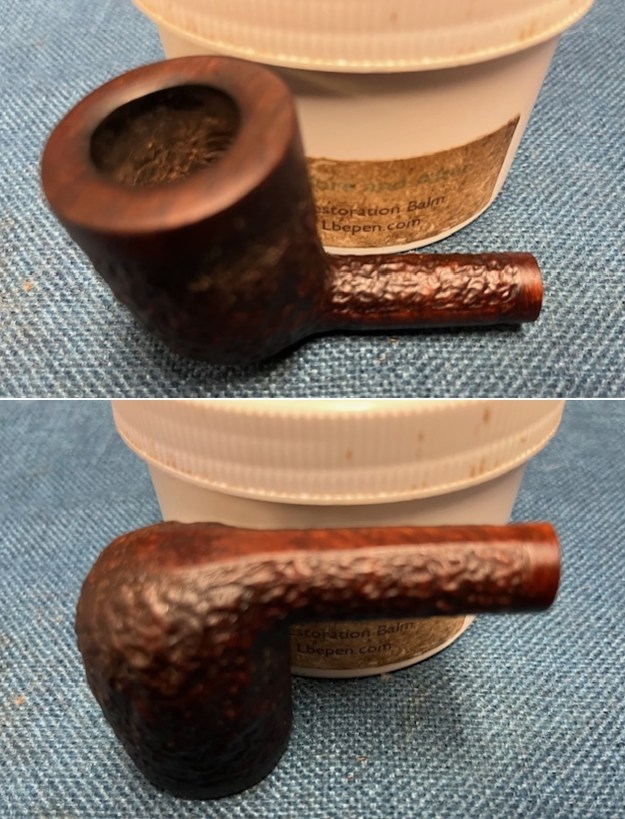
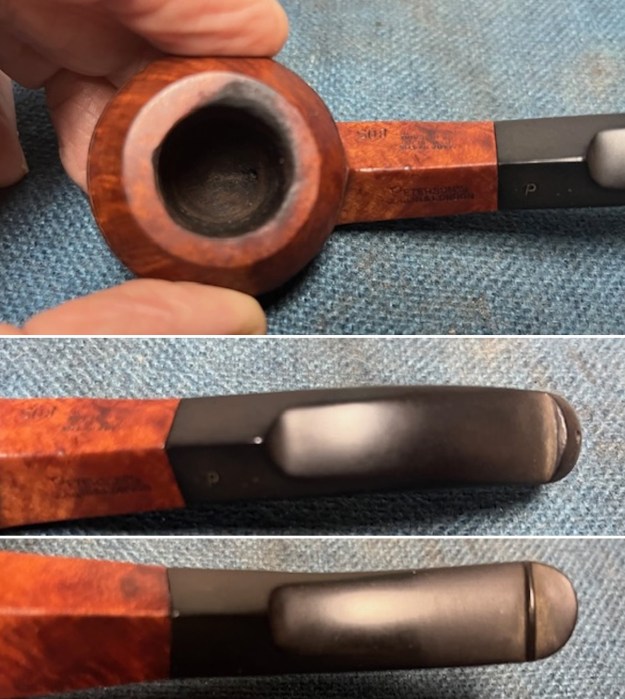
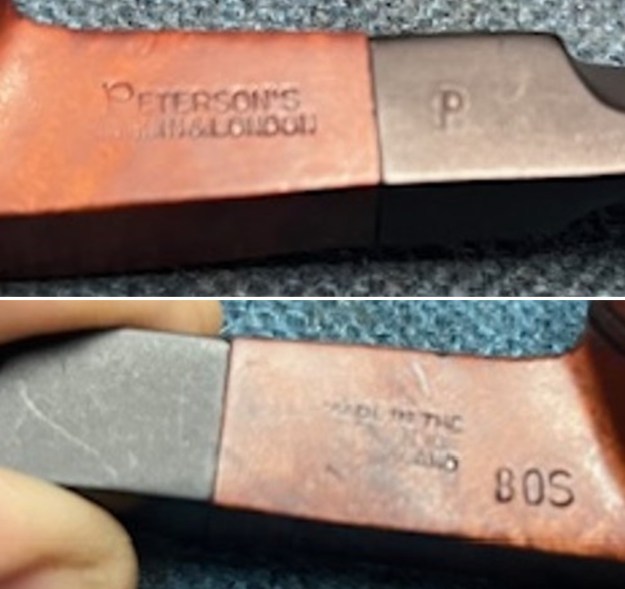
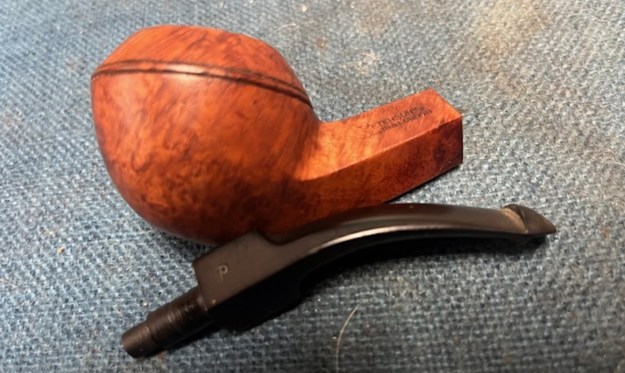
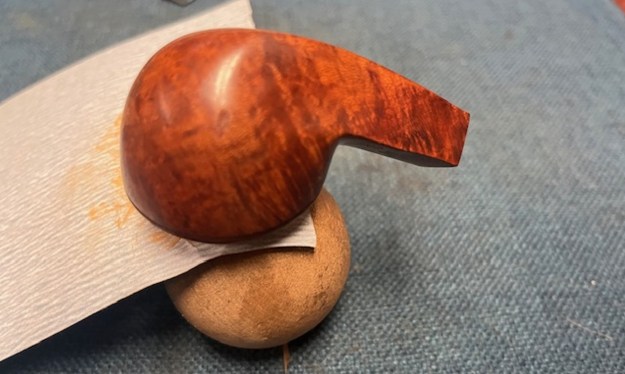
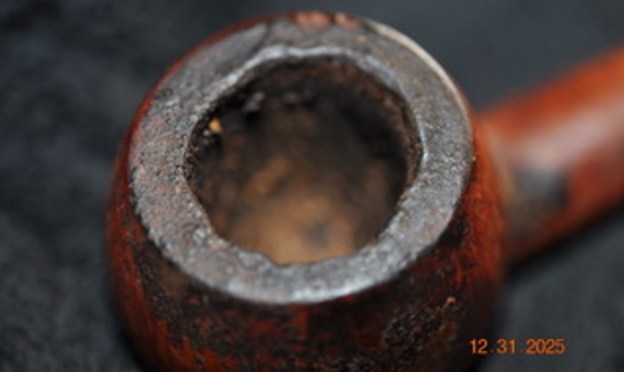
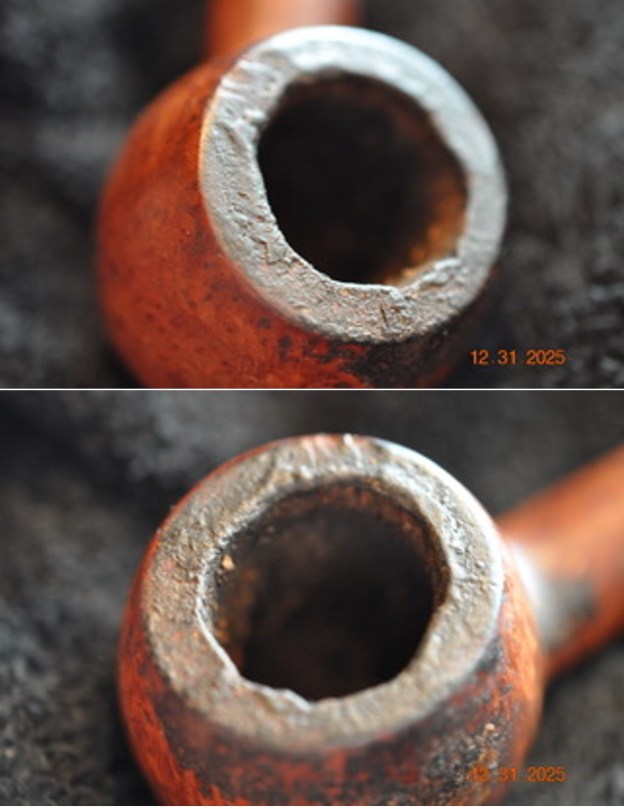
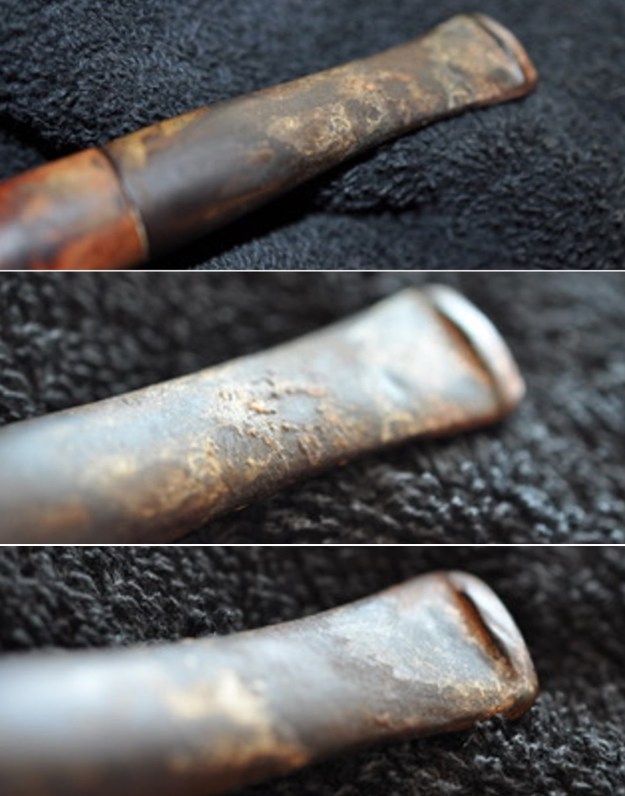
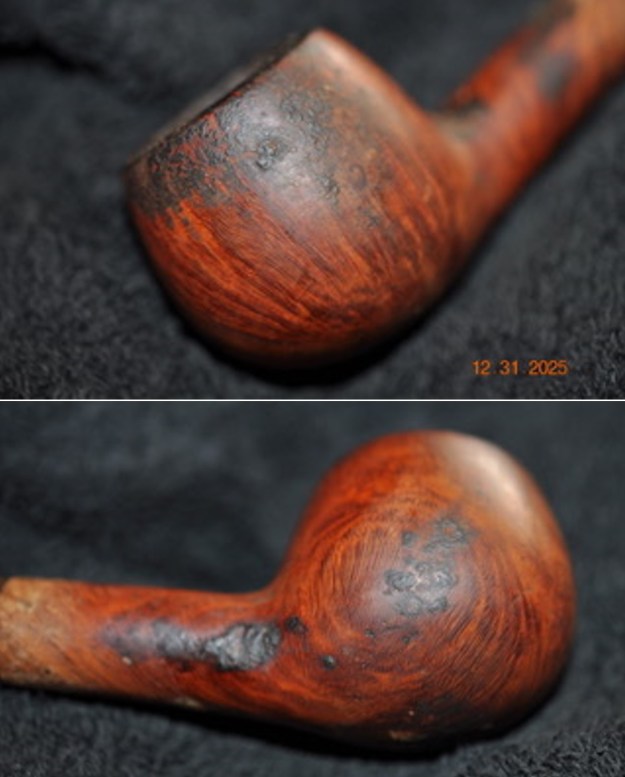
The next pipe on the work table is Peterson’s System pipe that we purchased from our contact in Copenhagen, Denmark on 01/29/2024. It was stamped on the left side of the shank and read Peterson’s [arched over] System [arched over] Standard. On the right side of the shank it was stamped Made in the Republic of Ireland (in three lines) [over] the shape number 309. The nickel ferrule on the shank end was oxidized and is stamped on the top and left side K&P [over] the three common hallmarks on System pipes with Nickel ferrules – a shamrock, a wolf hound, and a tower. That is followed by Peterson’s. It has a rich smooth finish with pretty grain around the bowl and shank that is covered with a lot of oils, debris and grime. There was a thick cake in the bowl with remnants of tobacco stuck on the walls. There was a heavy lava overflow on the rim top and edges. The top and edges of the rim appeared to be in good condition. There was a very beautiful pipe underneath all of the buildup of years of use. The stem was a Peterson’s style P-Lip. It was oxidized and calcified toward the end with some tooth marks and chatter. Jeff took photos of the pipe before he started his cleanup work on it. Jeff took photos of the bowl and rim top to show the cake in the bowl and the lava build up on the top of the rim and the edges of the bowl. The rim top looked pretty good. Jeff took photos of the top and underside of the stem showing the tooth chatter, calcification and oxidation on the stem surface and wear on the edges of the button. Jeff took photos of the sides and heel of the bowl to show the condition of the finish. You can see the grime around the sides of the bowl and shank. Even under the dirt and debris of the years it looked very good. Jeff took photos of the stamping on the sides of the shank. The stamping was readable as you can see from the photos. It read as noted above. The nickel ferrule is actually clearly stamped and readable. I am including the information from Pipedia’s article on Peterson pipes. It is a great read in terms of the history of the brand (https://pipedia.org/wiki/Peterson). I have included a bit of the pertinent history here.

1950 – 1989 The Republic Era – From 1950 to the present time, the stamp for this era is “Made in the Republic of Ireland” in a block format generally in three lines but two lines have been used with or without Republic being abbreviated.

During the 1950’s and 60’s the Kapp & Peterson company was still in the ownership of the Kapp family. However 1964 saw the retiral of the company Managing Director Frederick Henry(Harry) Kapp.

Pipedia also included a section of information on the System pipes including a diagram of the systems look (https://pipedia.org/wiki/Peterson#Republic_Era_Pipes). I quote a section of the article in part and include a link to another article on Pipedia on the System pipe.

The Peterson System pipes are the standard bearers of the Peterson pipe family, famous for the excellent smoking pleasure they provide. Often imitated but never equaled, the Peterson System smokes dry, cool and sweet, thanks to the scientific effectiveness of the original design. The heart of the System is the unique graduated bore in the mouthpiece. This makes the suction applied by the smoker 15 times weaker by the time it reaches the tobacco chamber. The result is that all the moisture flows into the reservoir and, thus cannot reach the smoker’s mouth. The Peterson Lip further enhances the effectiveness of the graduated bore by directing the flow of smoke upwards and away from the tongue. This achieves a uniquely even distribution of smoke and virtually eliminates any chance of tonguebite or bitterness. Furthermore, the shape is contoured so that the tongue rests comfortably in the depression under the opening. Each “PLip” mouthpiece is made from Vulcanite. For the Peterson System pipes to work properly, the stem/tenon has to have an extension, the tip of which will pass by the draft hole from the bowl and into the sump. Upon the smoker drawing in smoke, this extension then directs the smoke down and around the sump to dispense a lot of the moisture before the smoke enters the extension and stem. On the System Standards and other less expensive systems, this extension with be made of Vulcanite turned integrally with the stem. On the more expensive System pipes this extension will be made of metal which screws into the Vulcanite stem. This extension on the earlier pipes will be of brass and the newer pipes will be of aluminum. Most smokers not knowing this function of the metal extension, assumes that it is a condenser/stinger and will remove it as they do with the metal condensers of Kaywoodie, etc. Should you have a System pipe with this metal extension, do not remove it for it will make the System function properly and give you a dryer smoke (https://pipedia.org/wiki/A_closer_look_at_the_famous_Peterson_Standard_System_Pipe).

I have included the information on the shape number on this pipe that I picked up on researching the previous pipes. I have included a page from a Petersons Catalogue that I have on rebornpipes (https://rebornpipes.com/tag/peterson-hallmark-chart/). There is no shape 309 shown in the catalogue page of rusticated shaped shown below. I wonder if it is an older or a newer shape. But I am uncertain of that. I knew that I was dealing with a Republic Era pipe made between 1950-1989. It was a Sandblasted Peterson’s System Standard 308 Bent Billiard with a great sandblast. The bowl was stained with a combination of black and brown stains. Now it was time to work on the pipe.

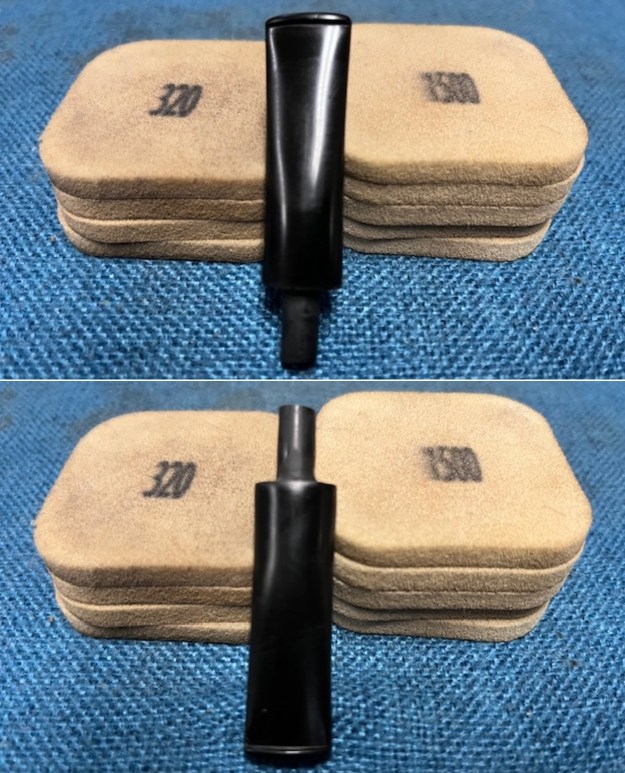
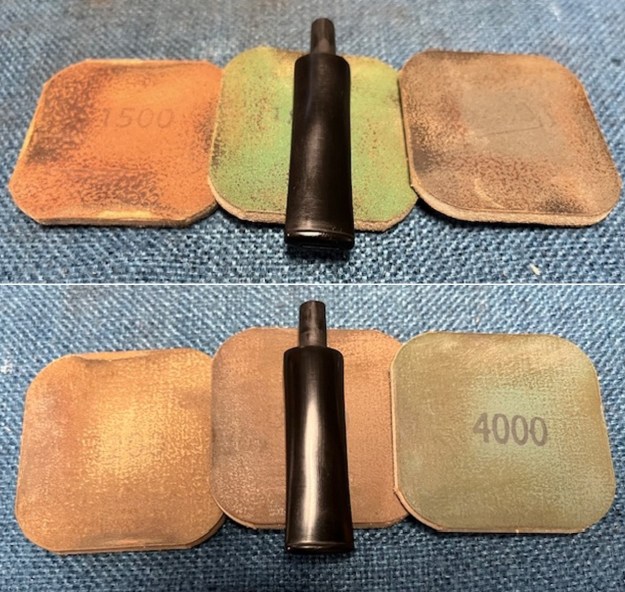
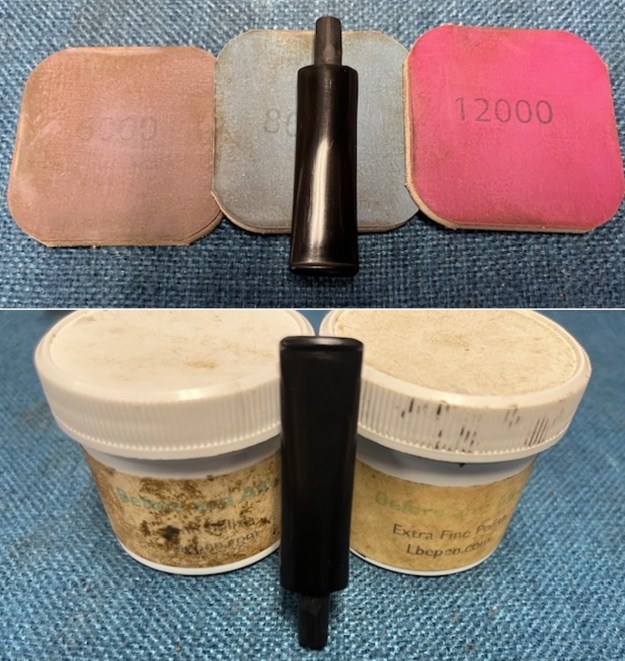
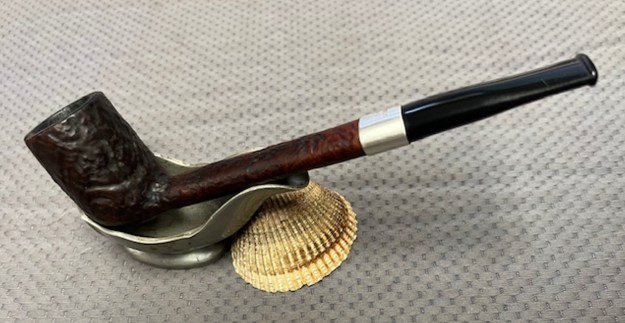
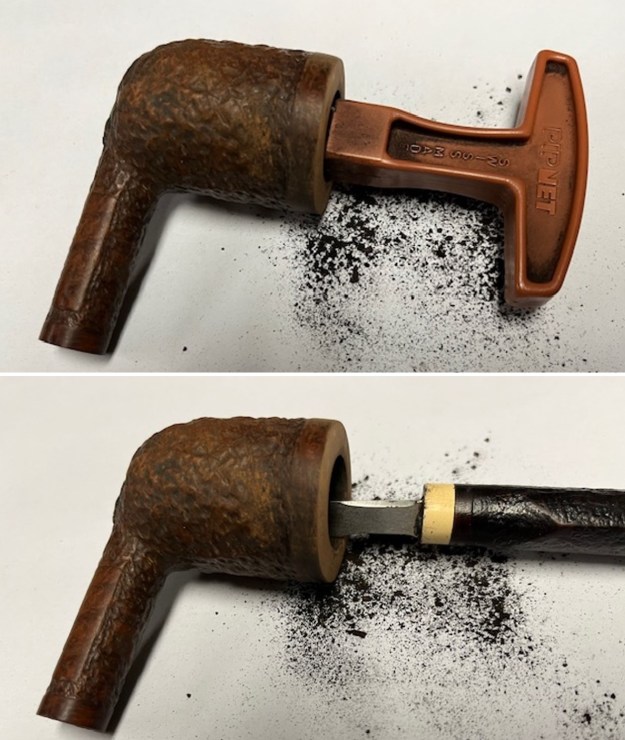
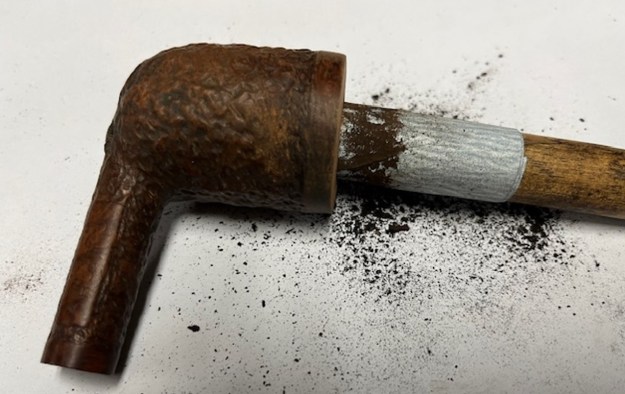
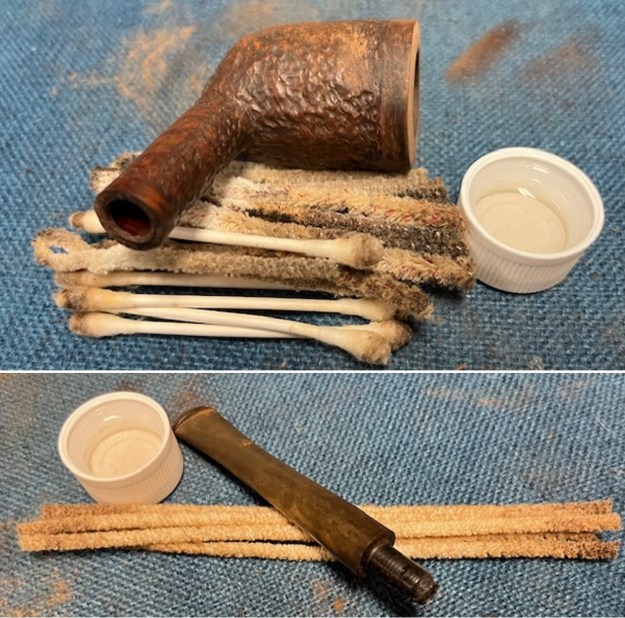
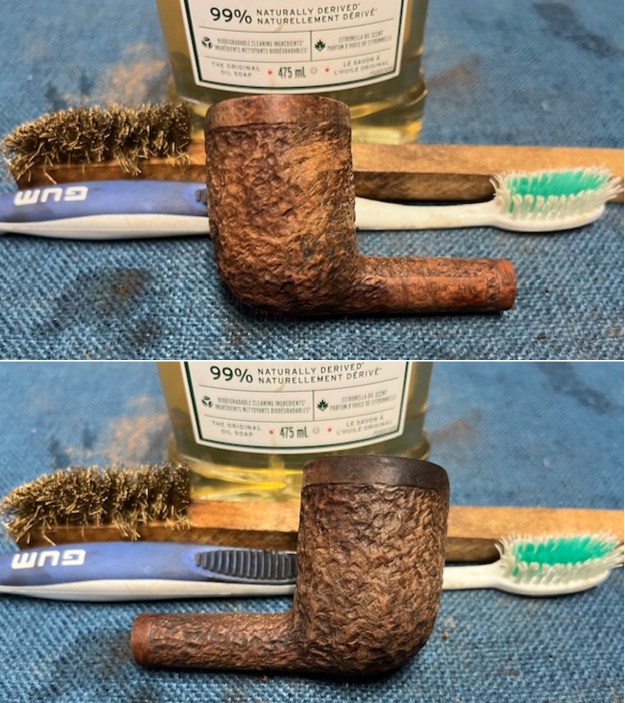
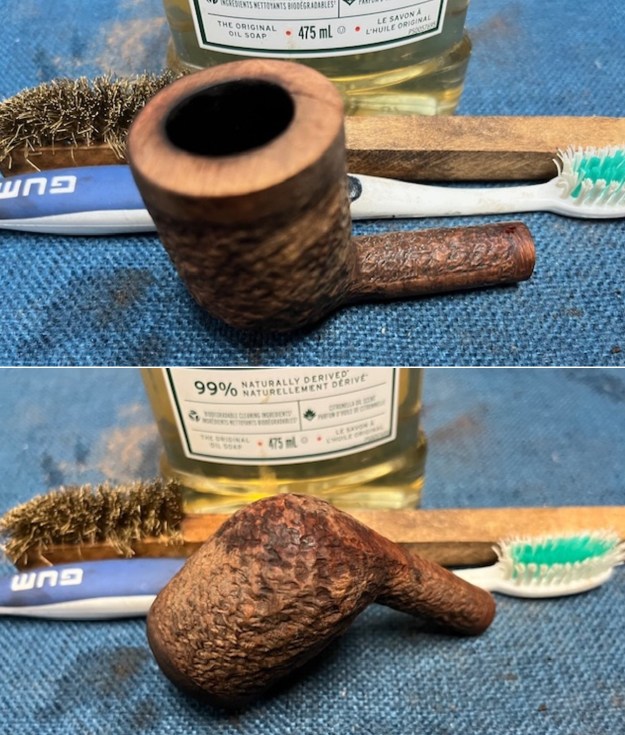
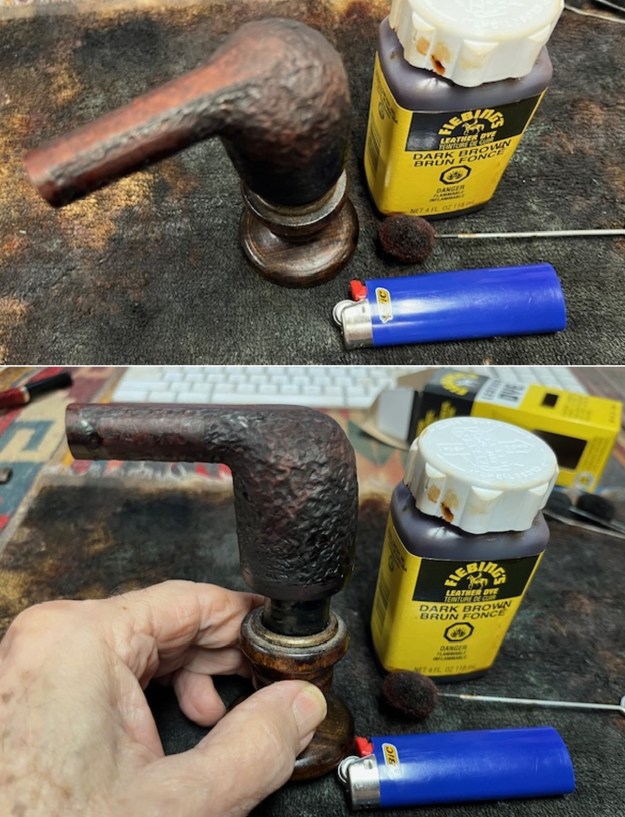
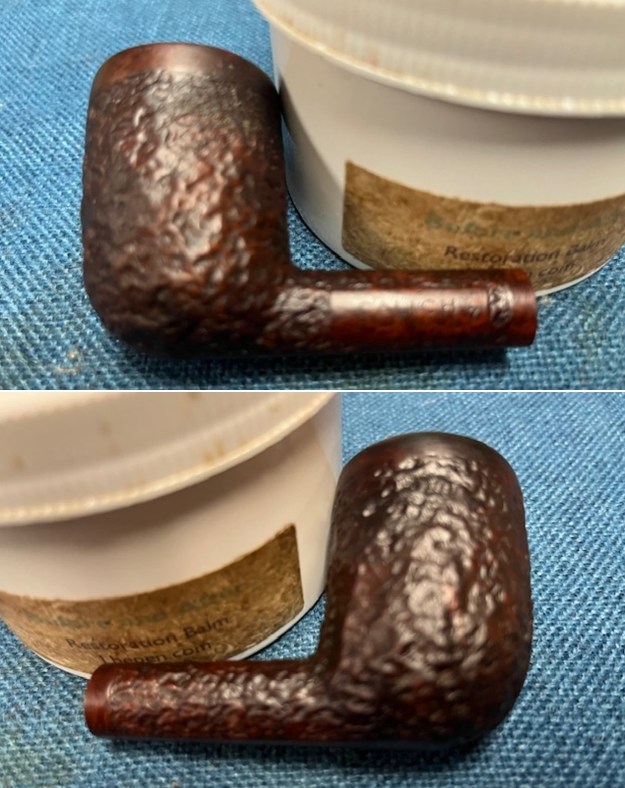
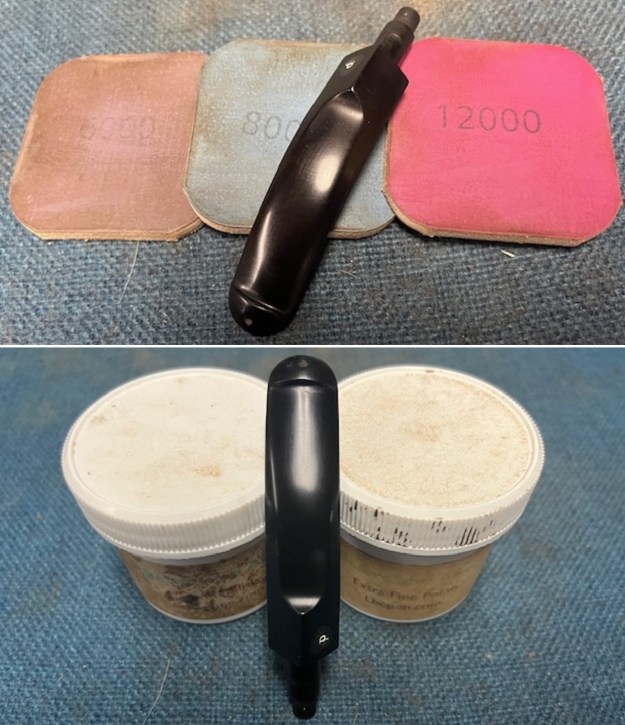
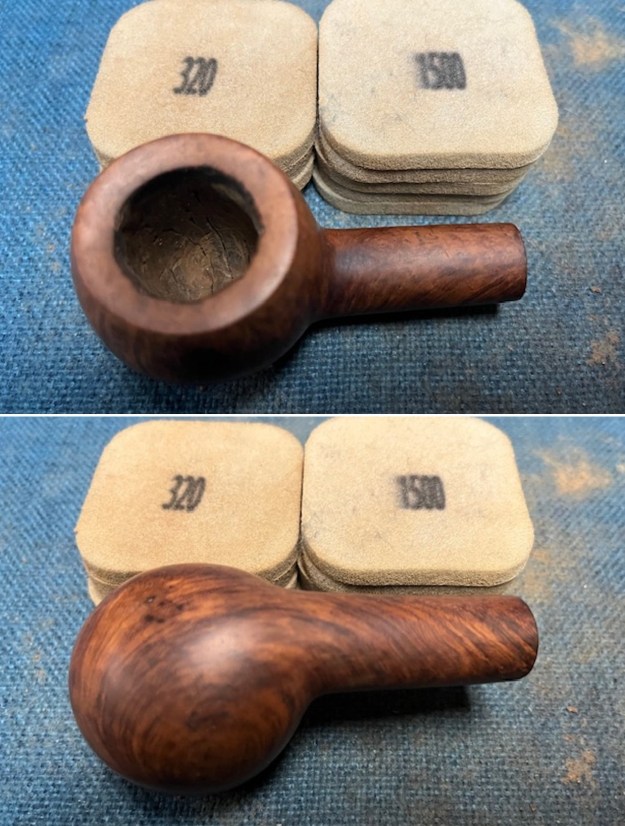
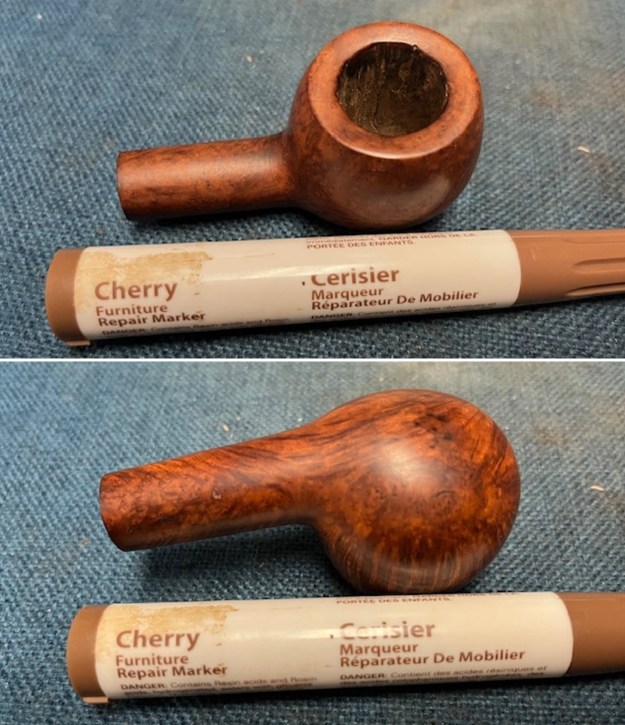
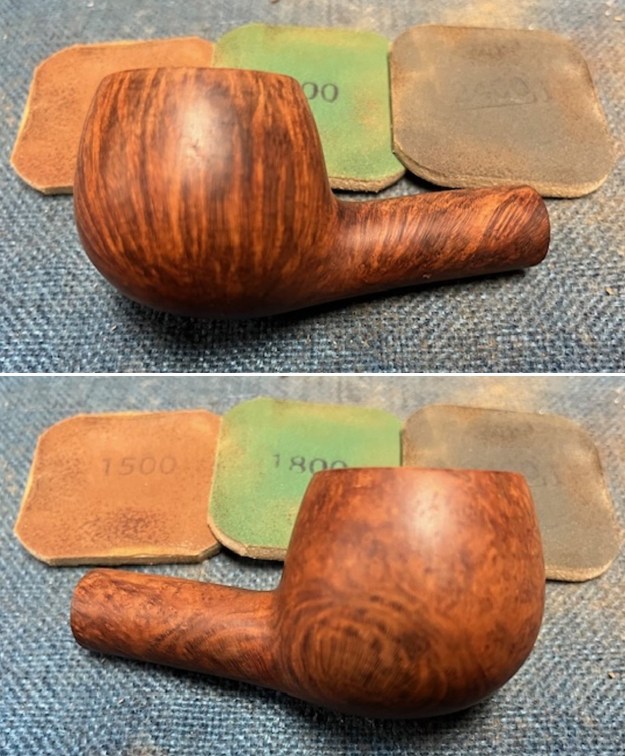
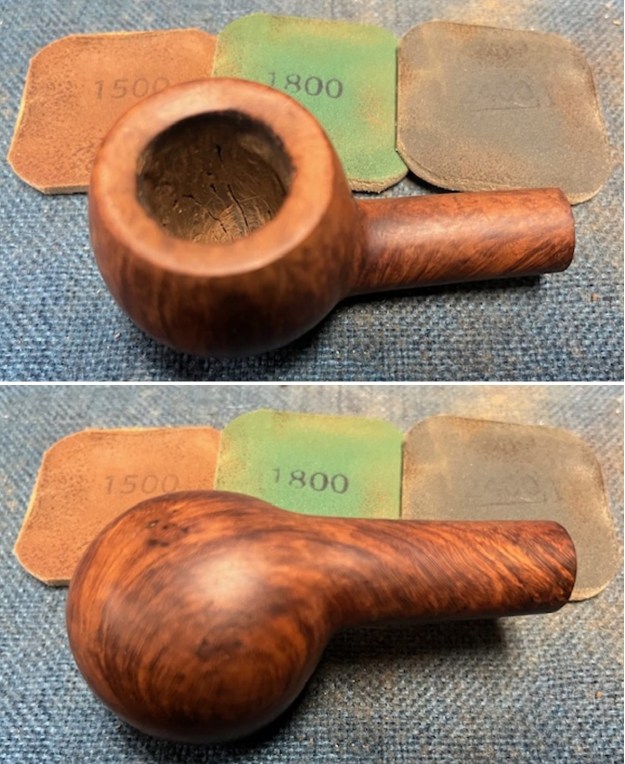
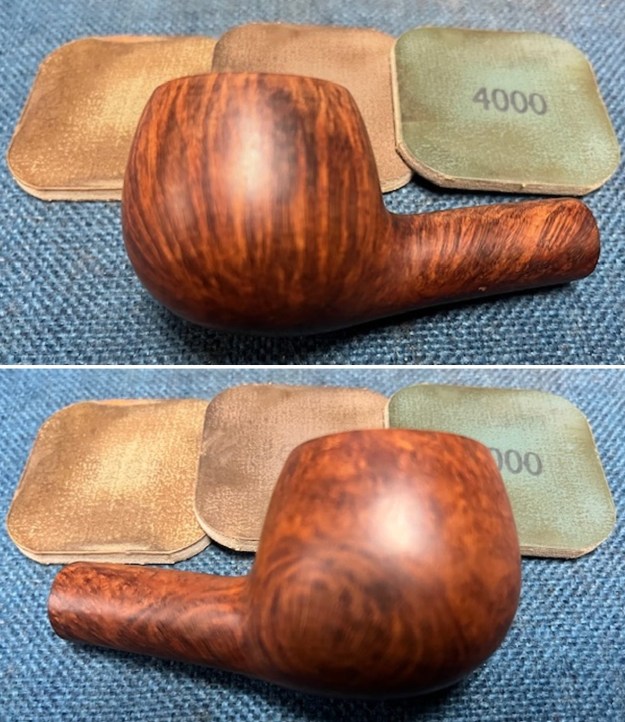
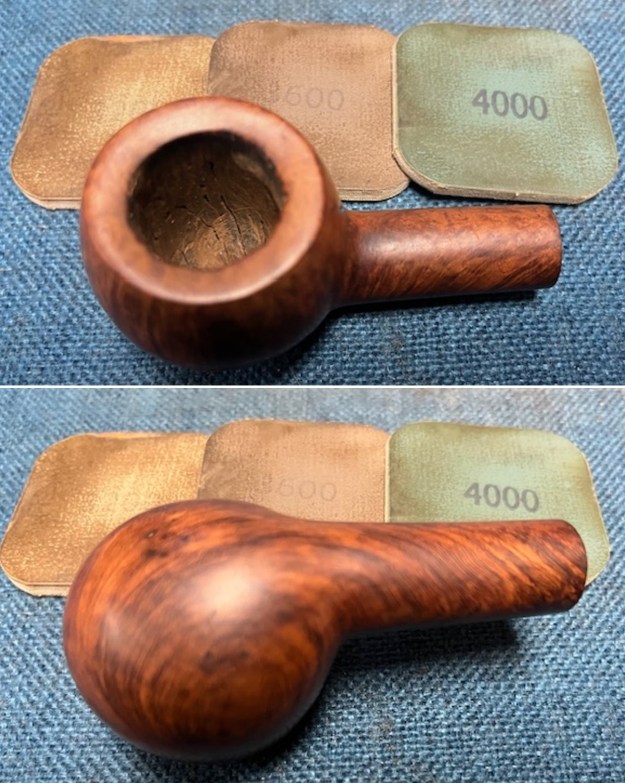
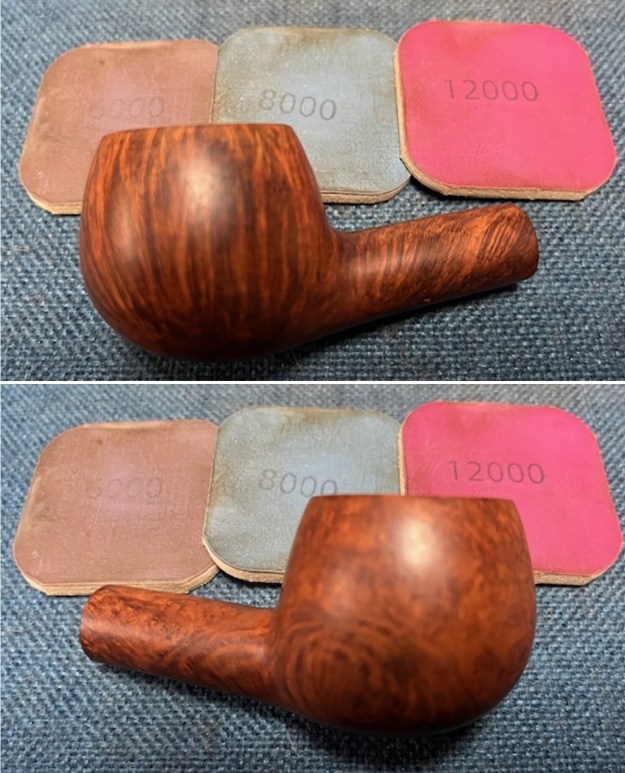
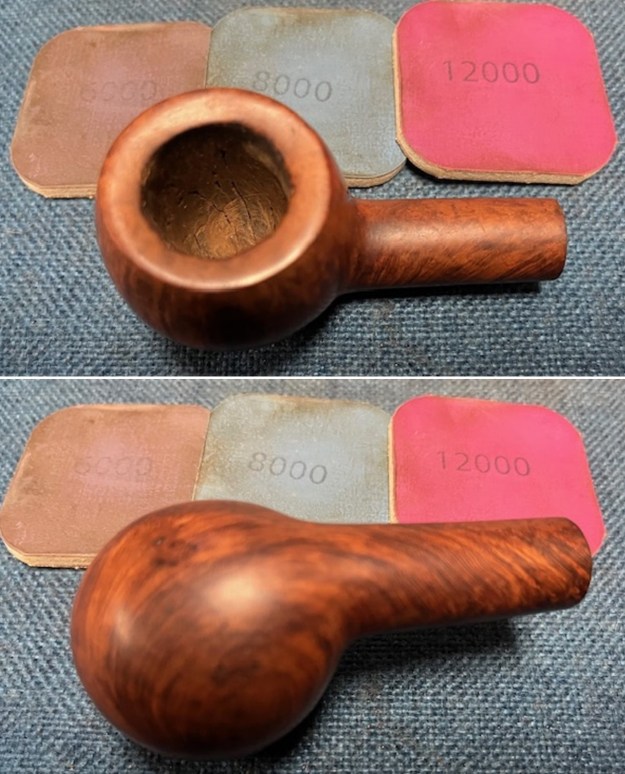
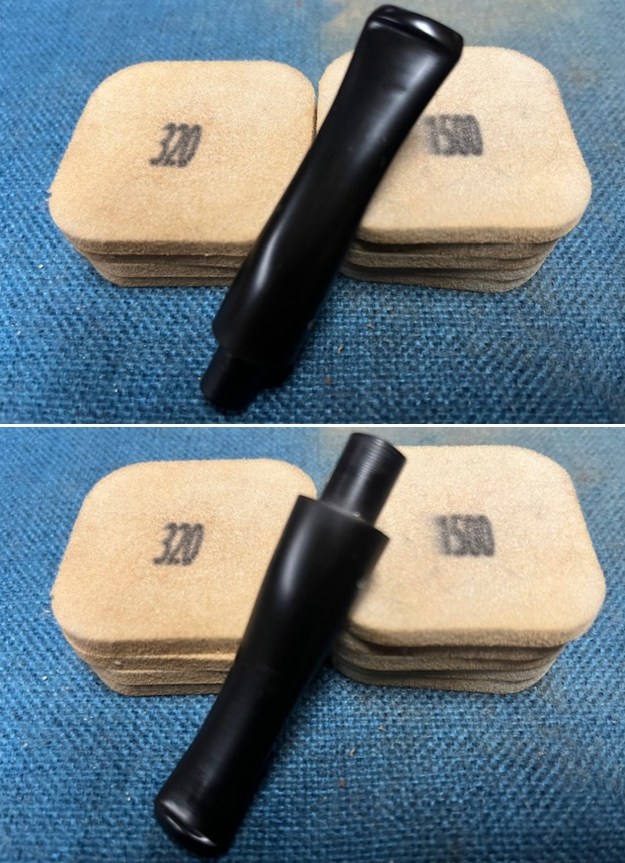
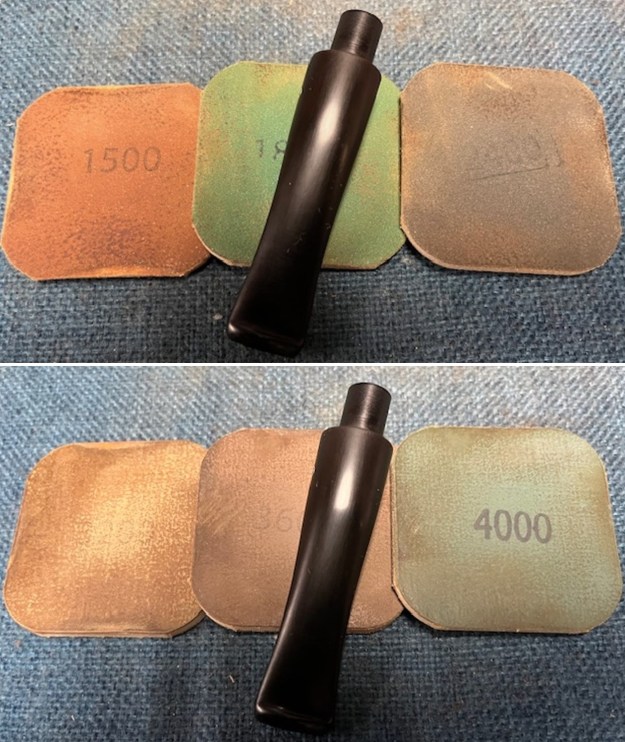
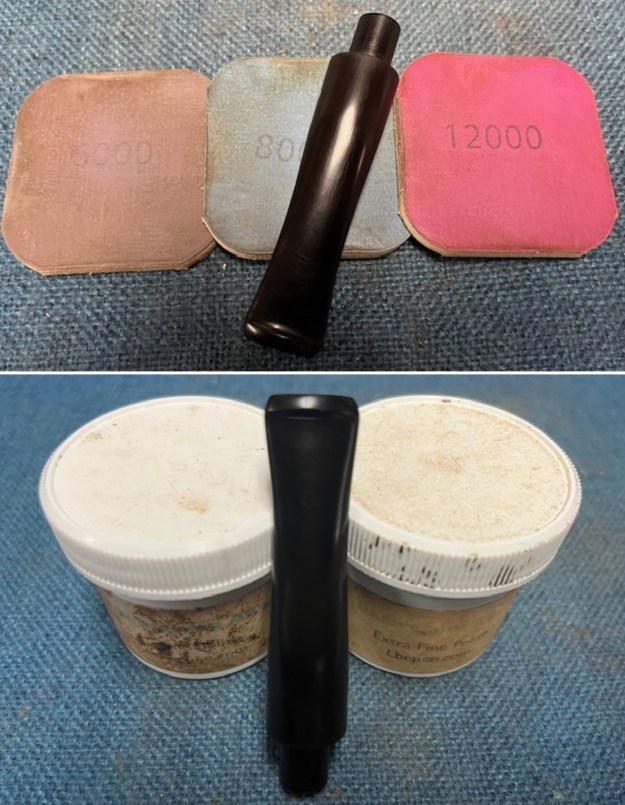
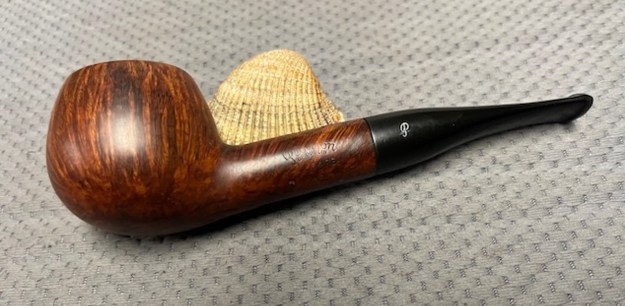
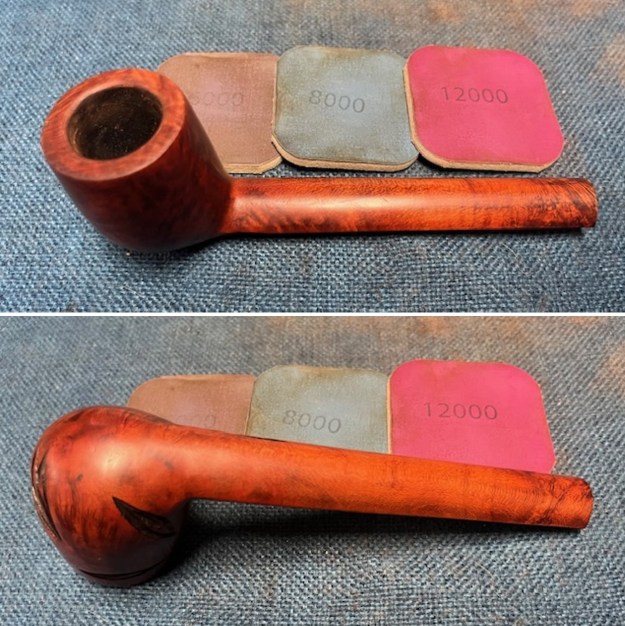
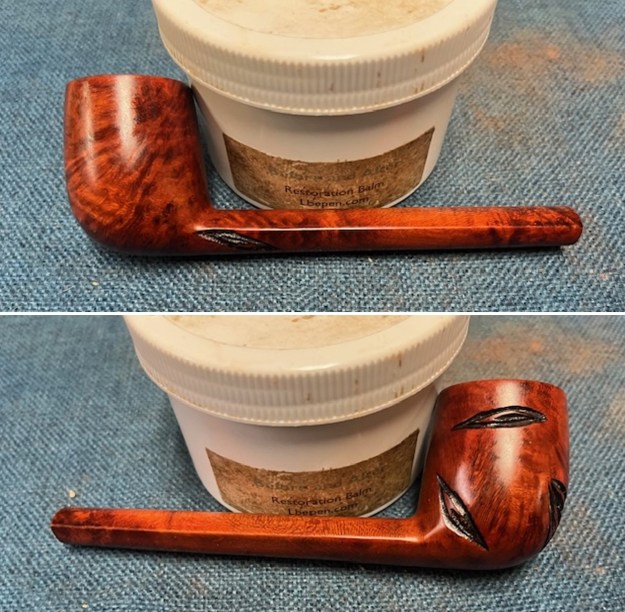
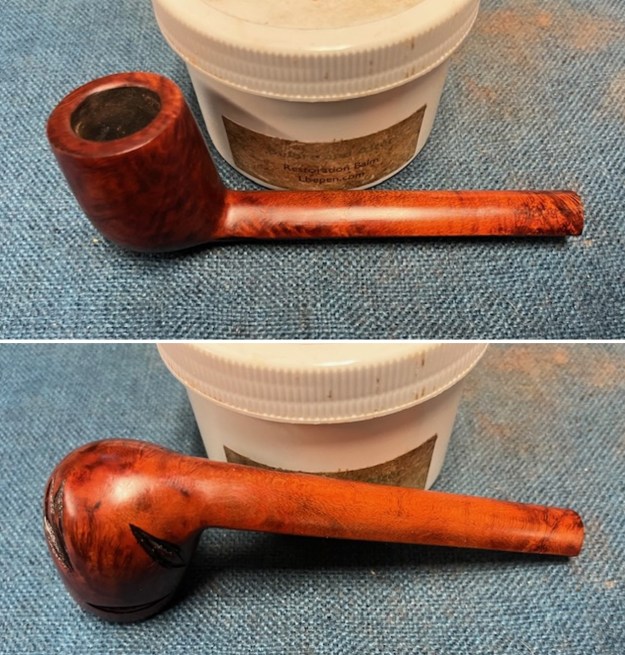
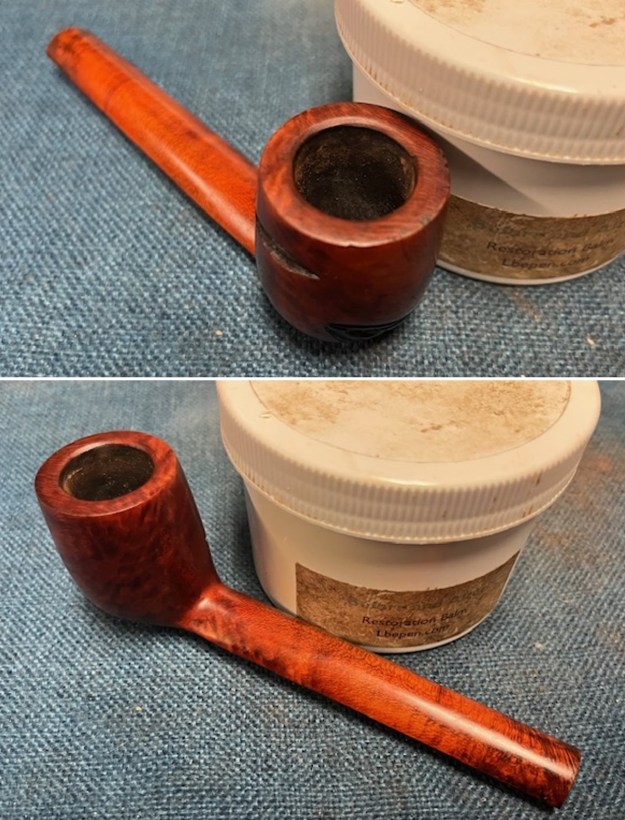
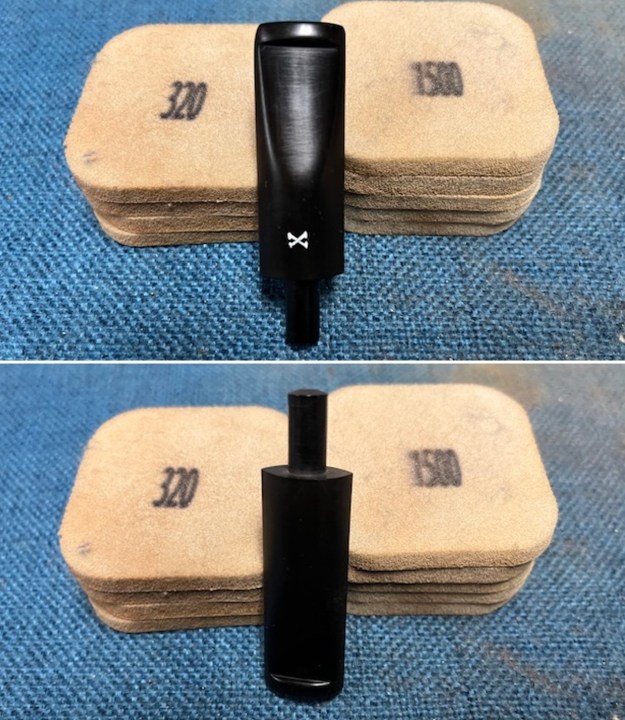
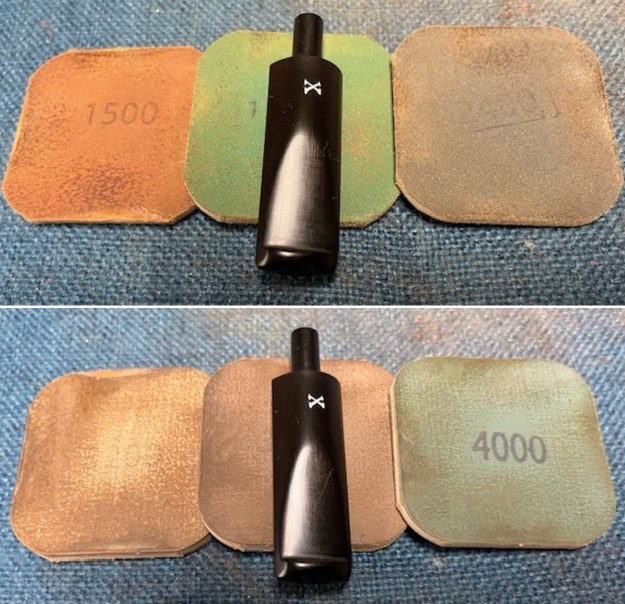
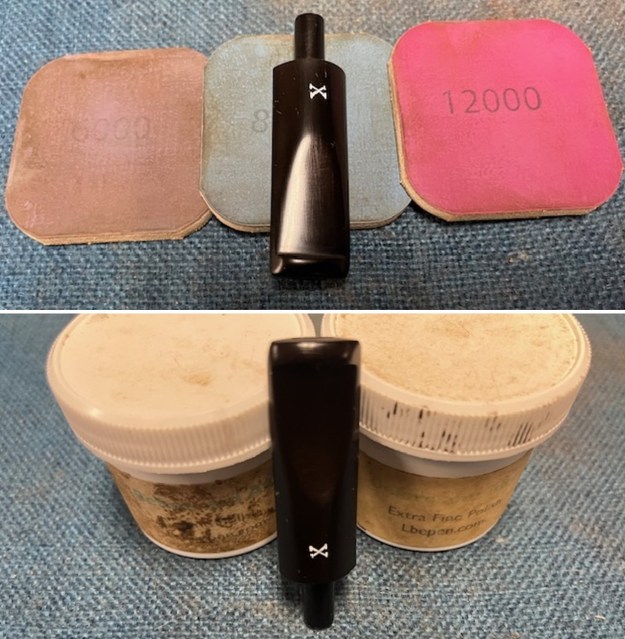
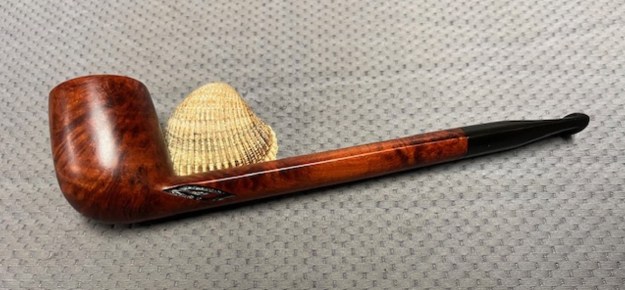
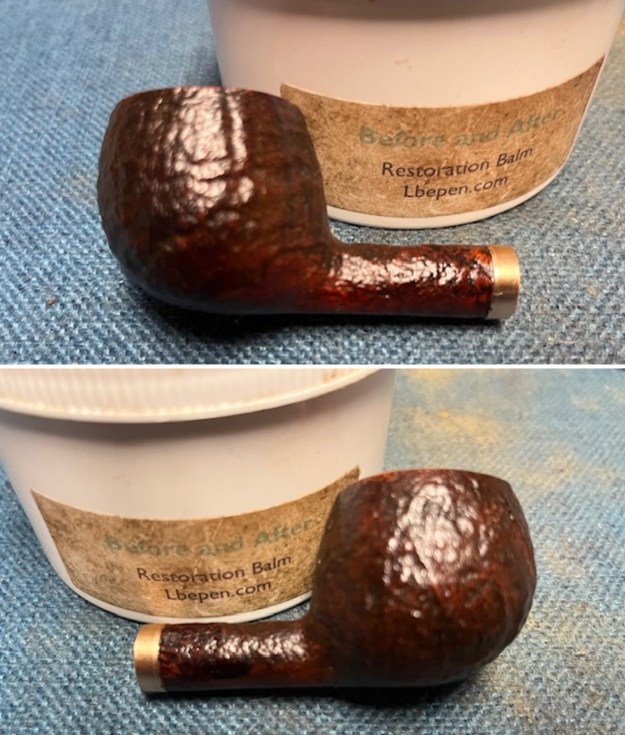
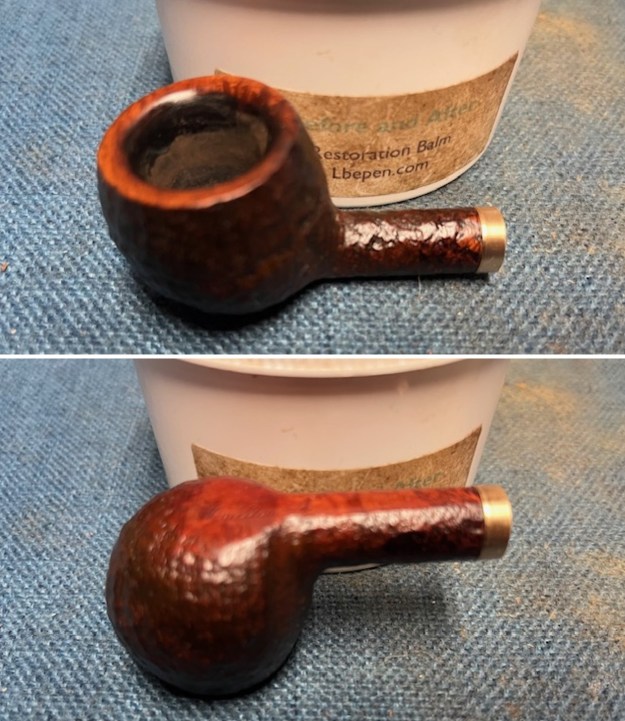
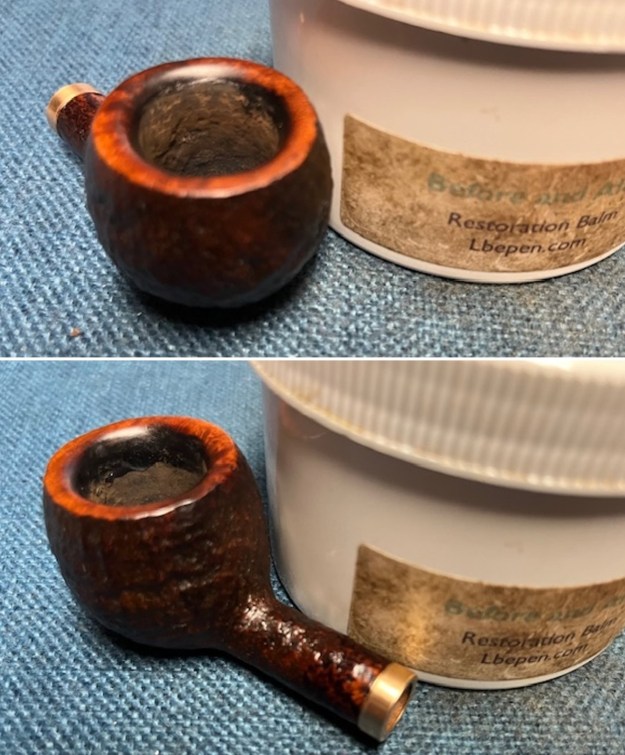
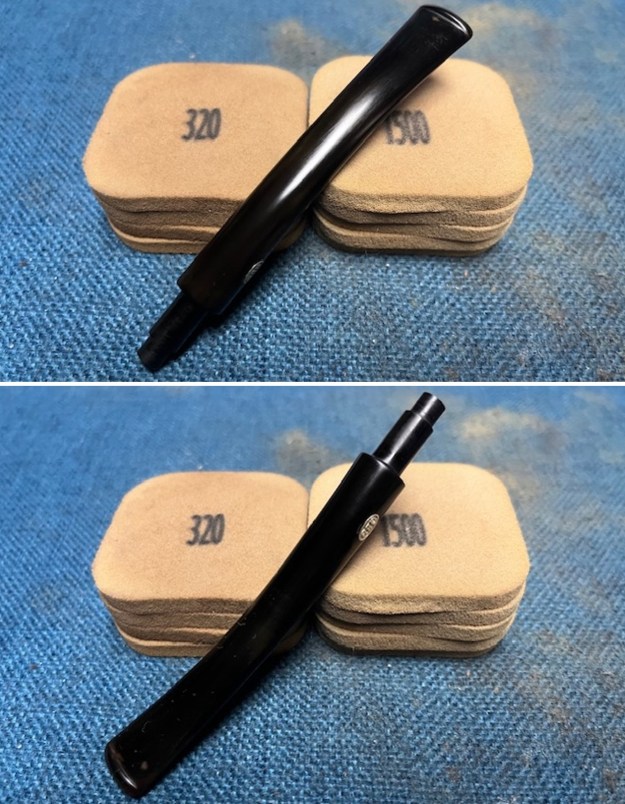
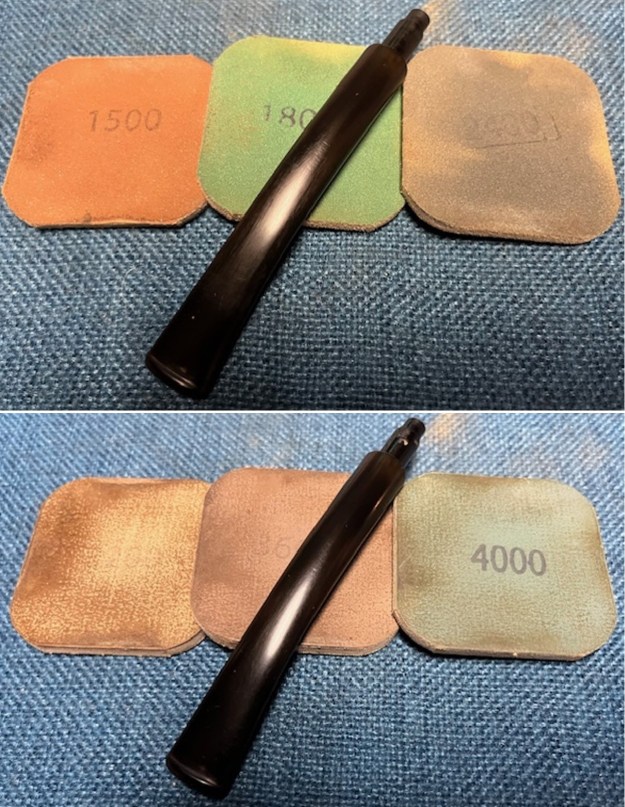
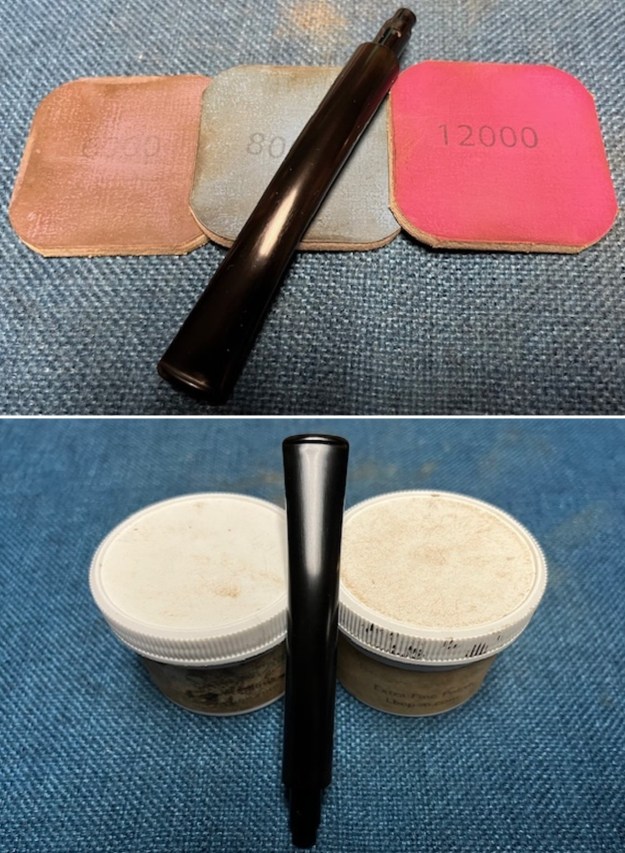
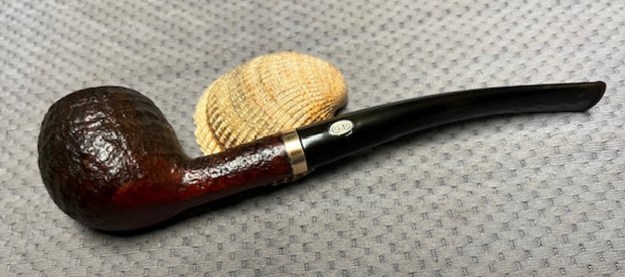
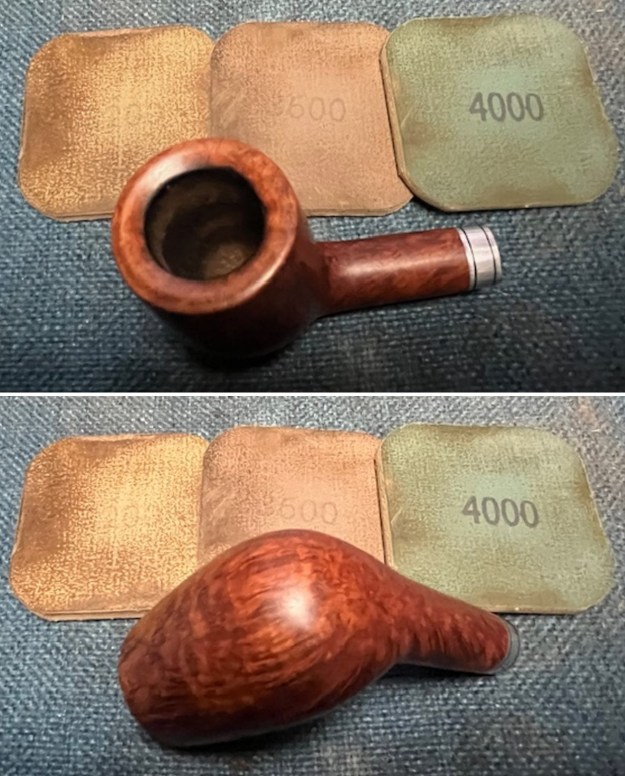
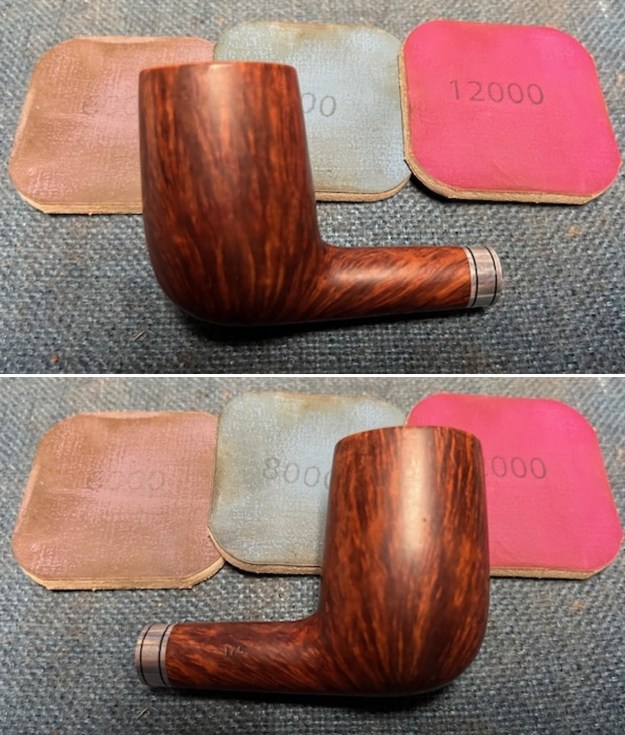
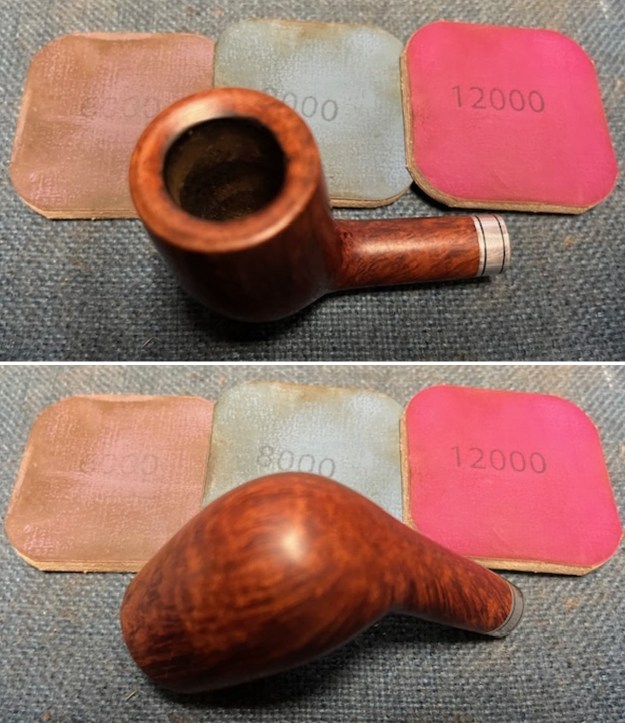
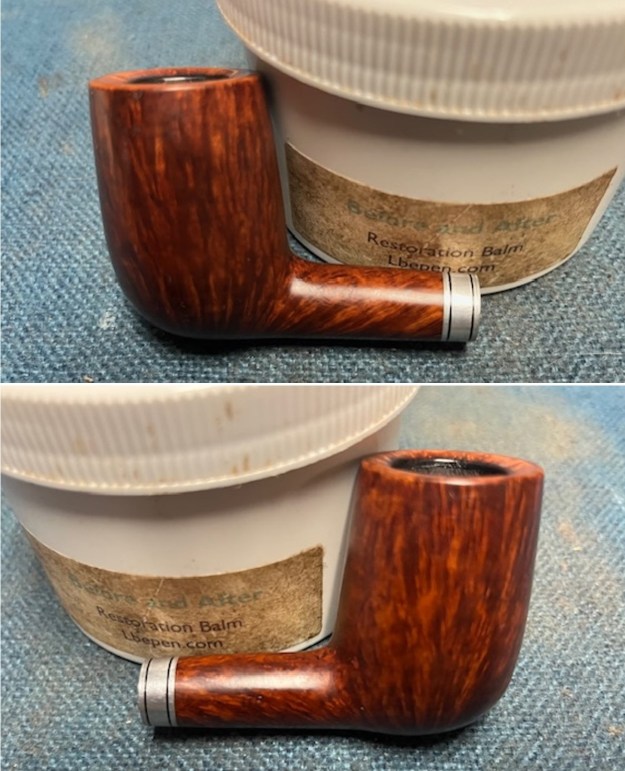
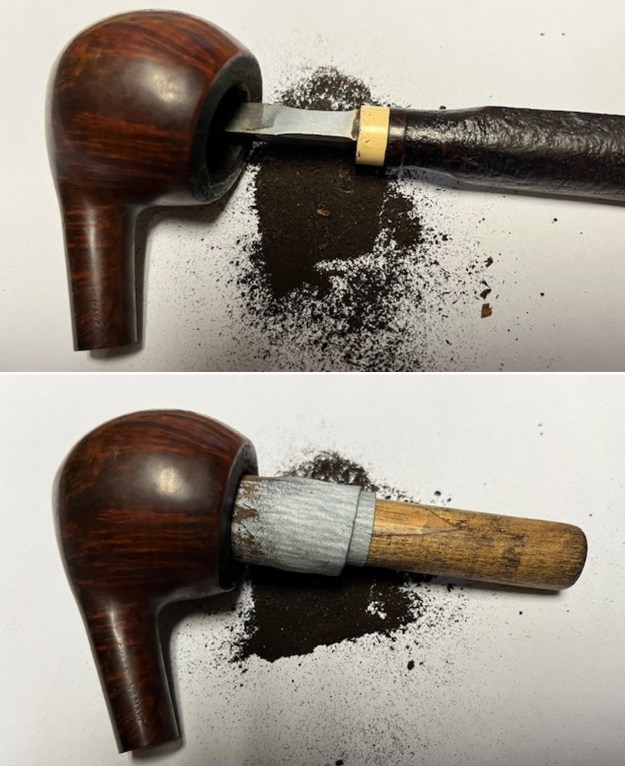
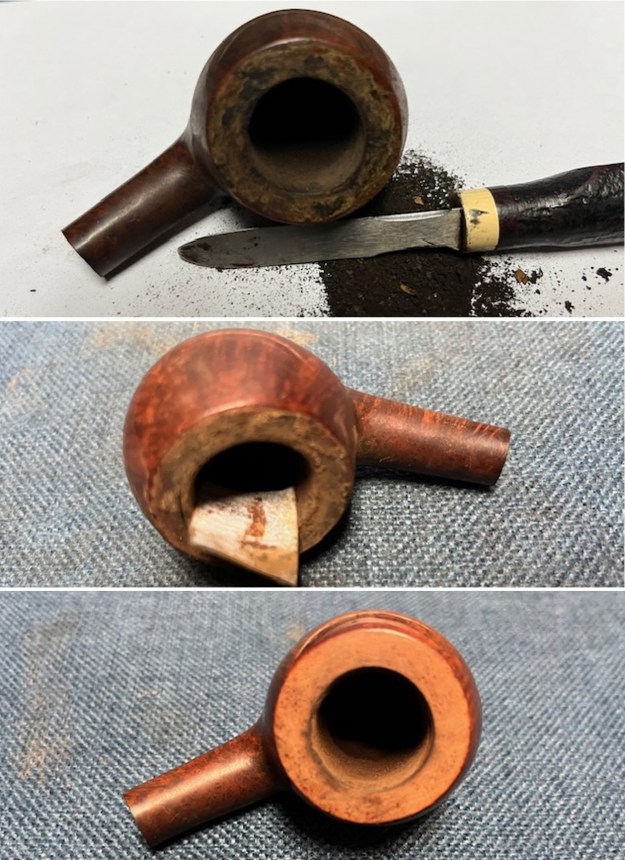
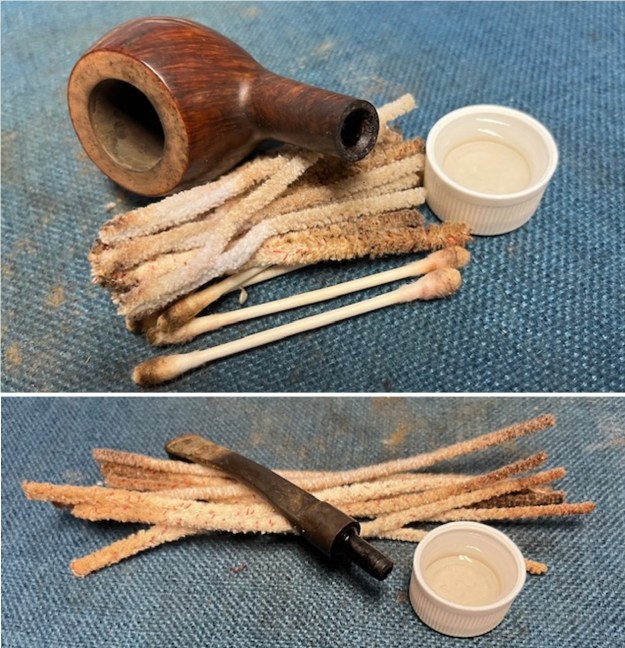
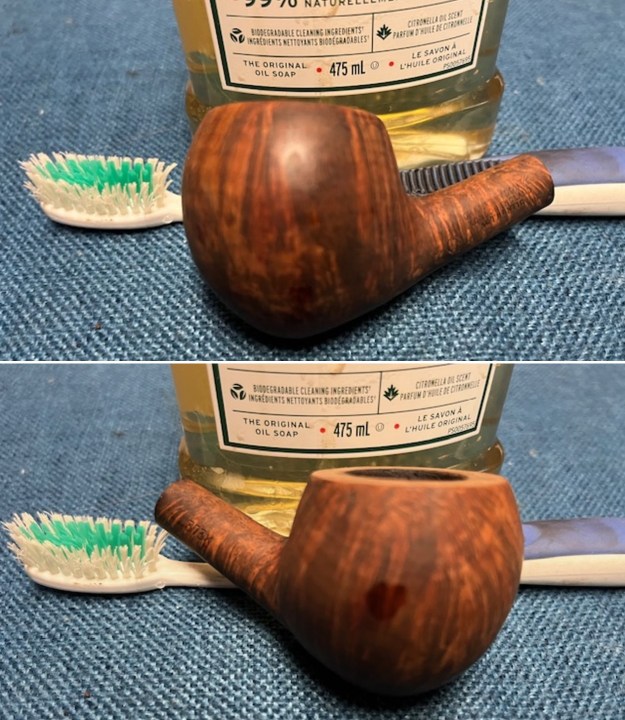
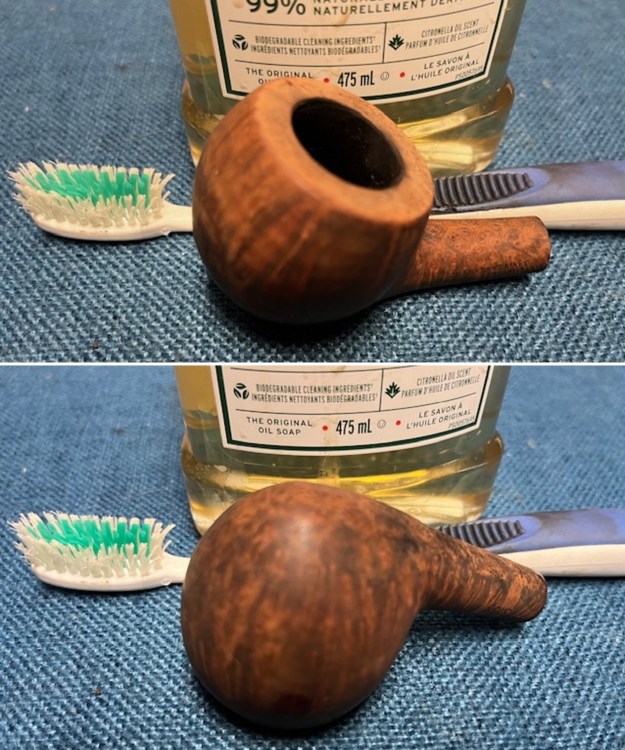
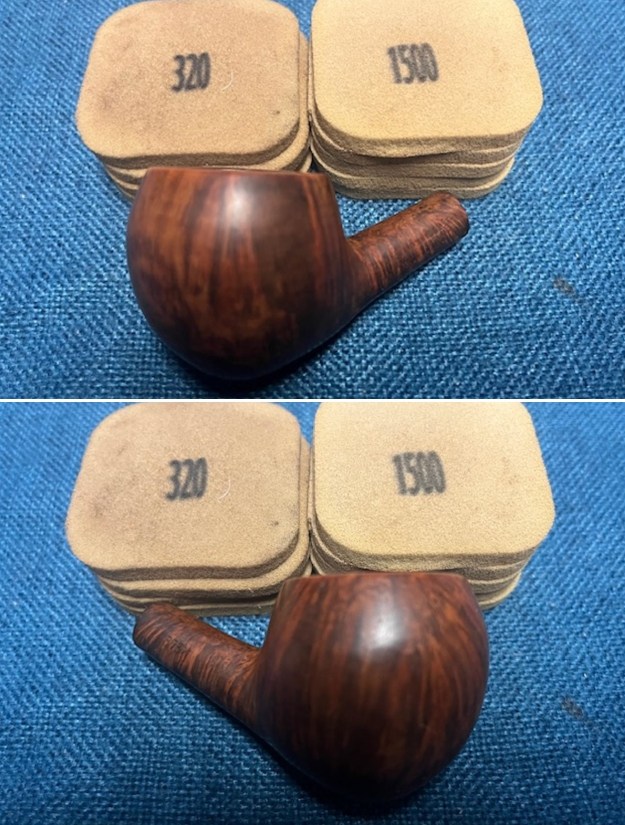
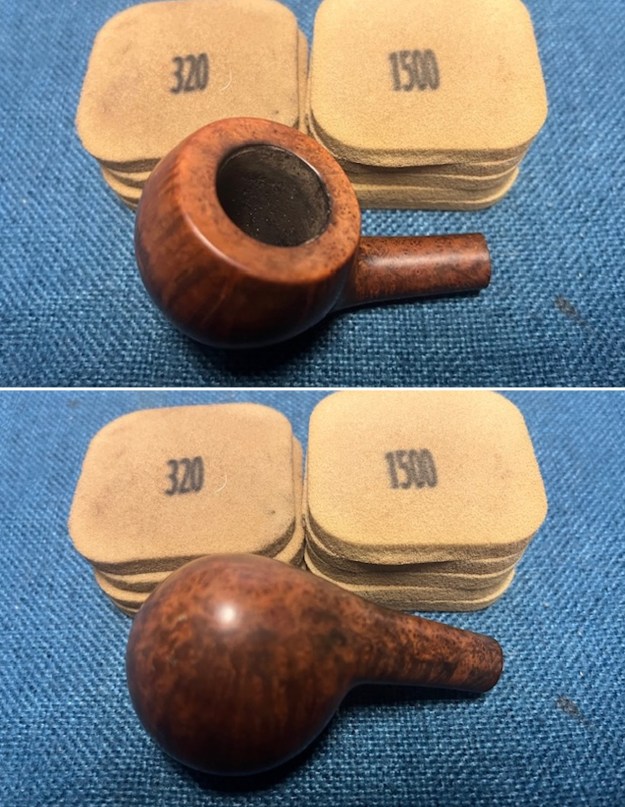
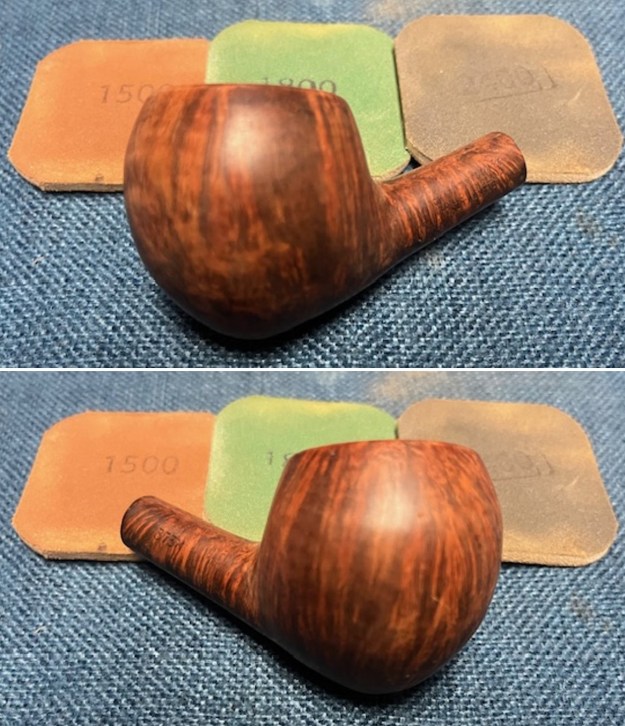
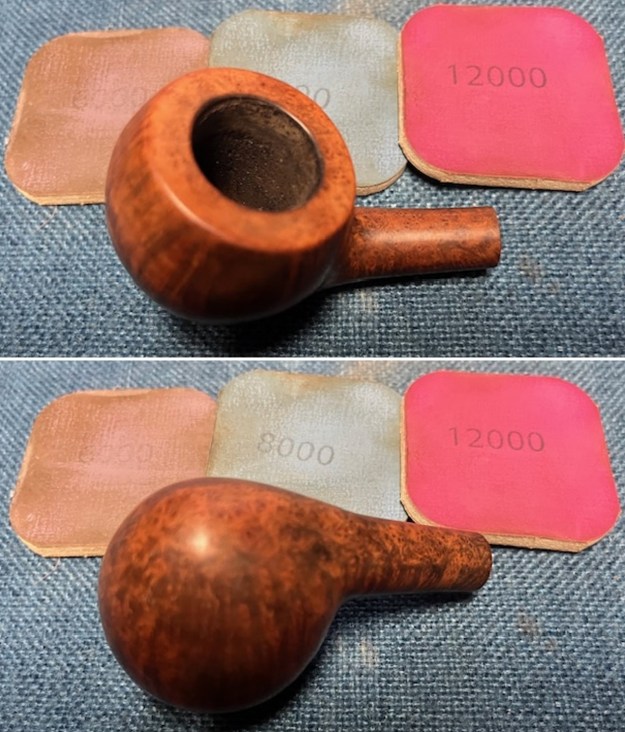
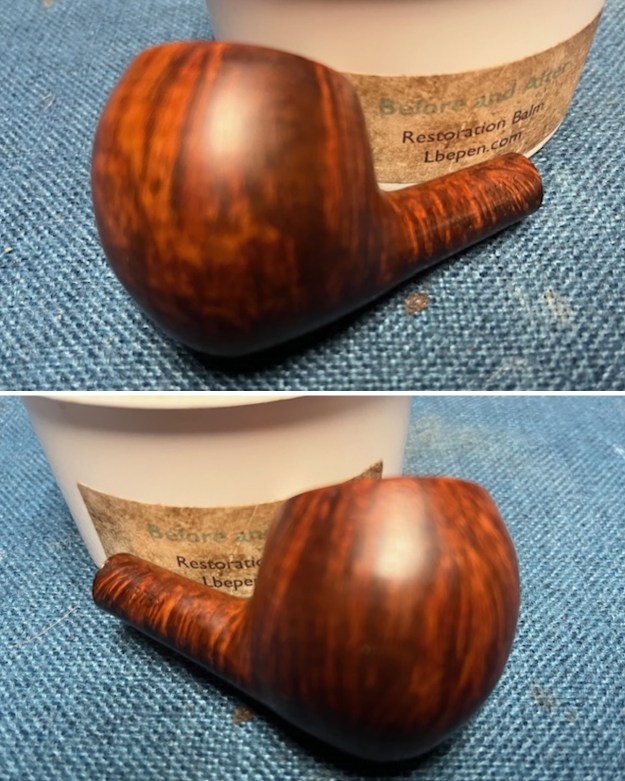
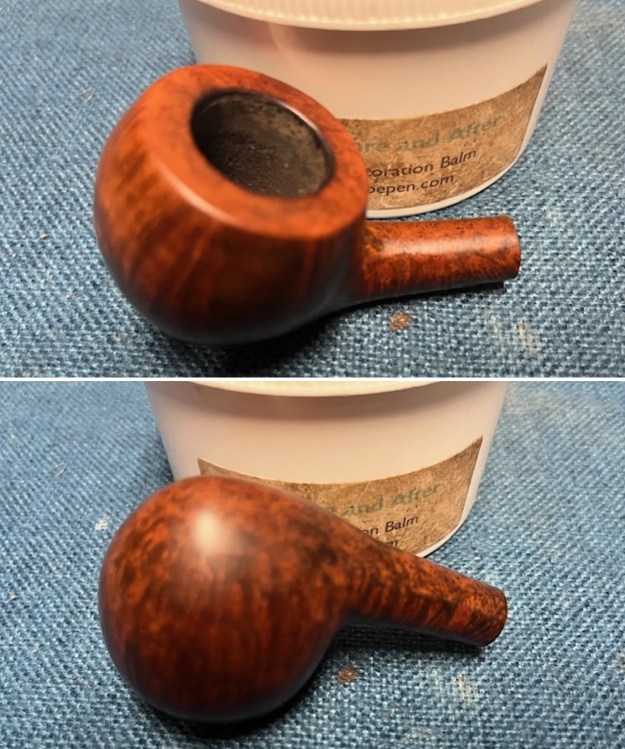
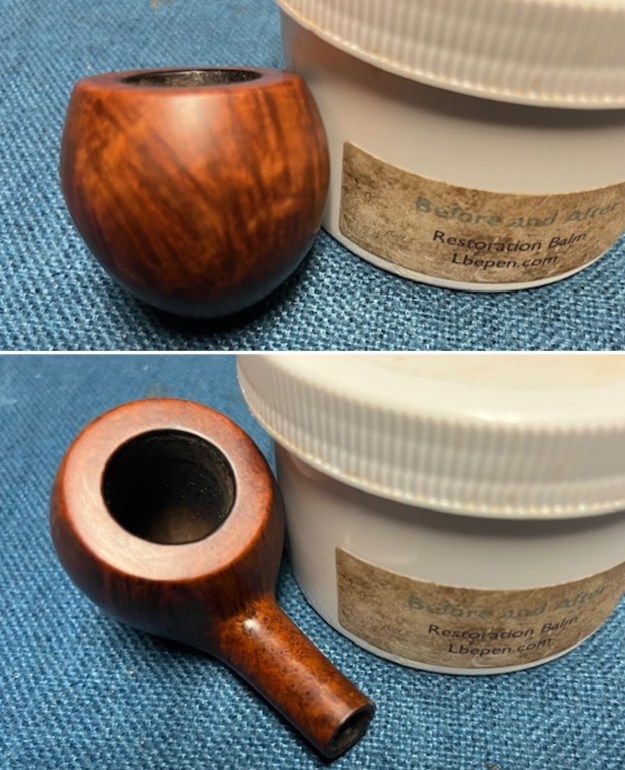
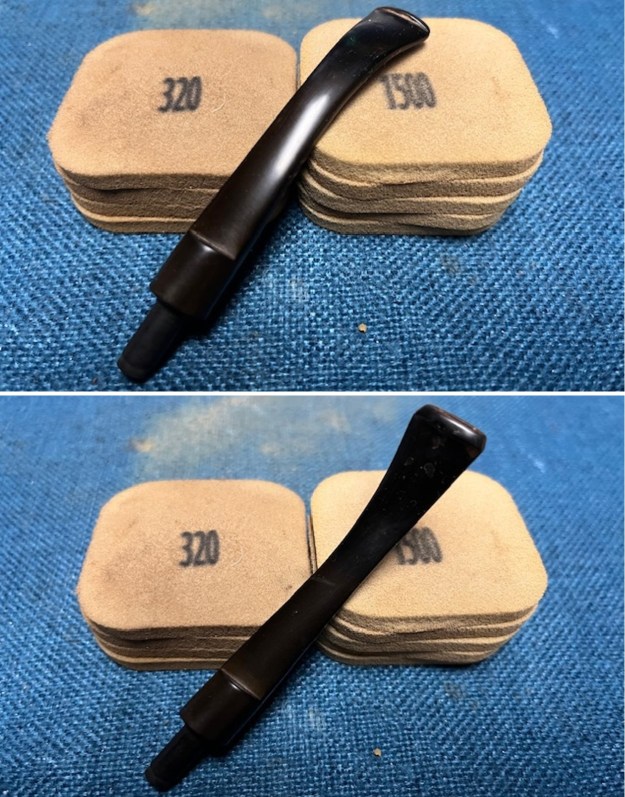
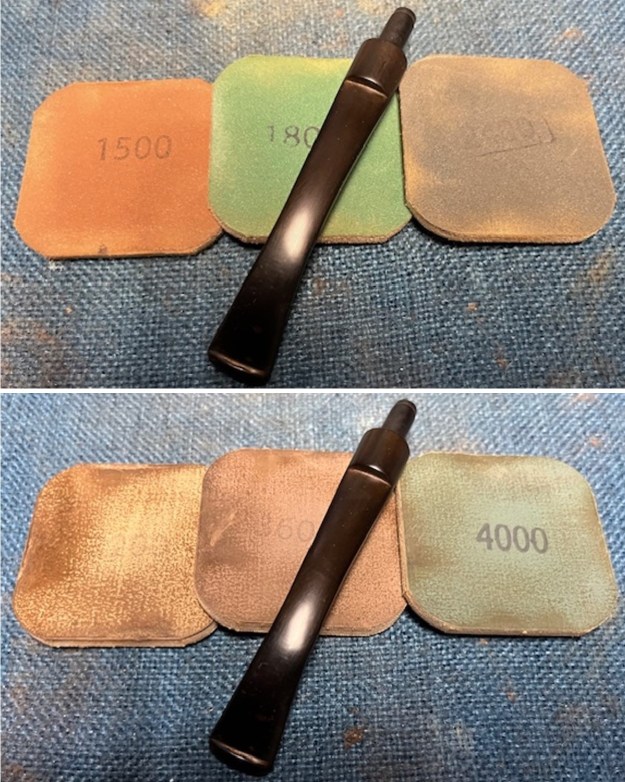
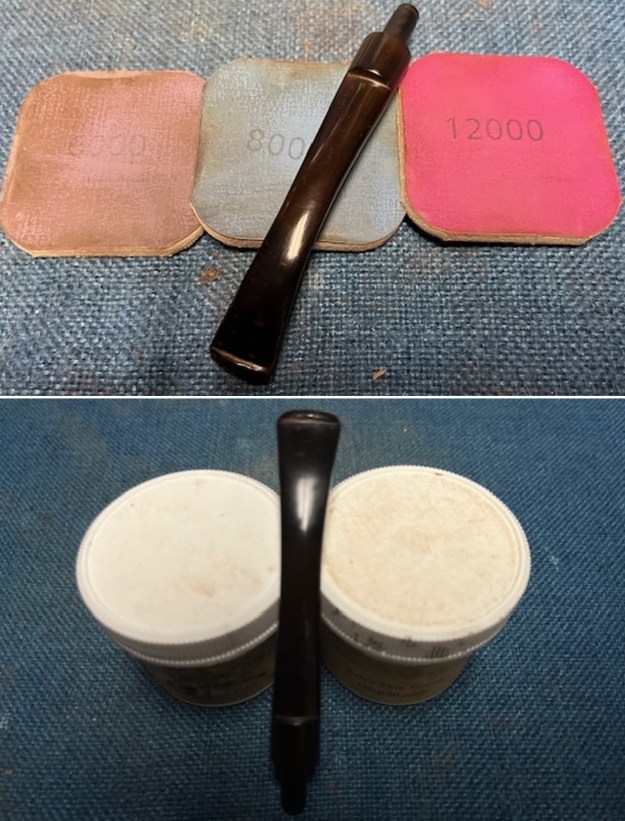
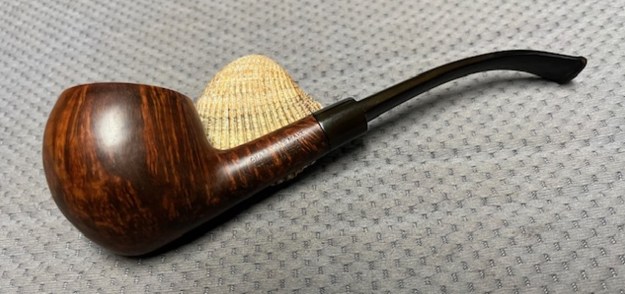
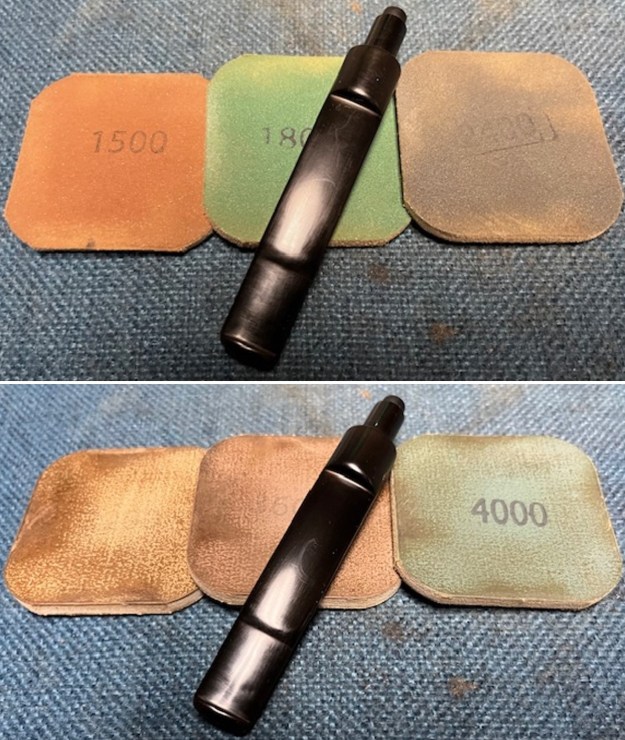
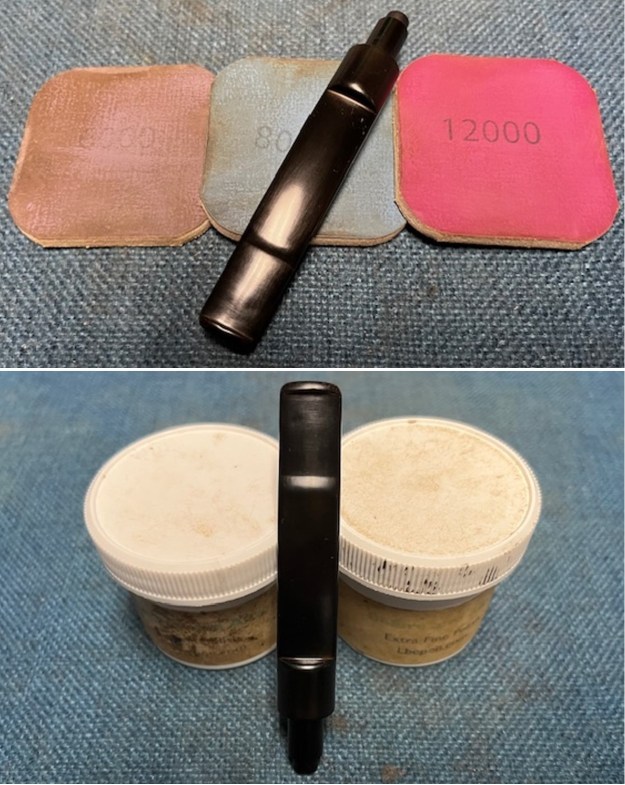
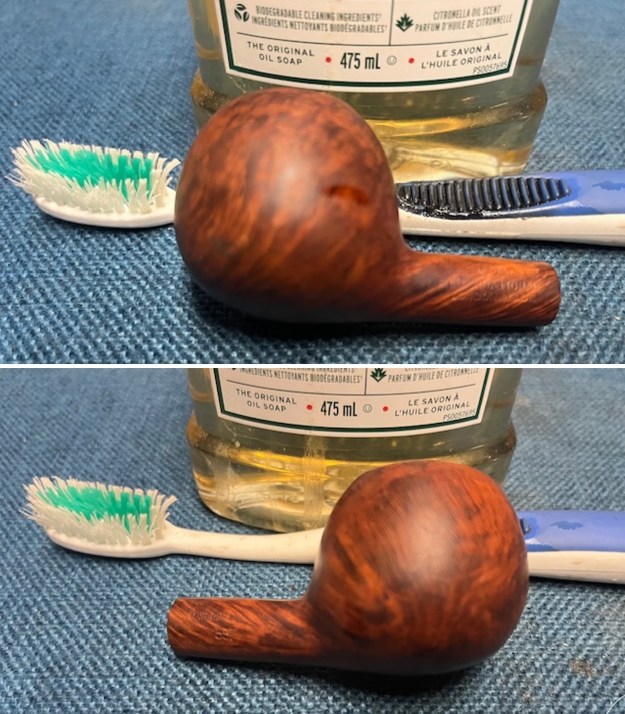
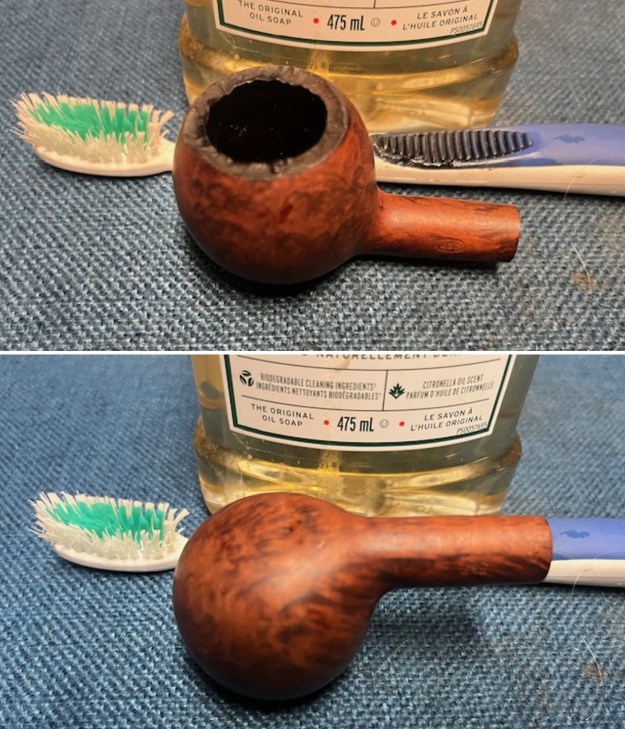
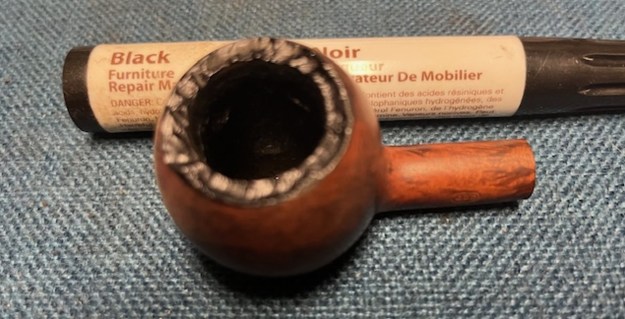
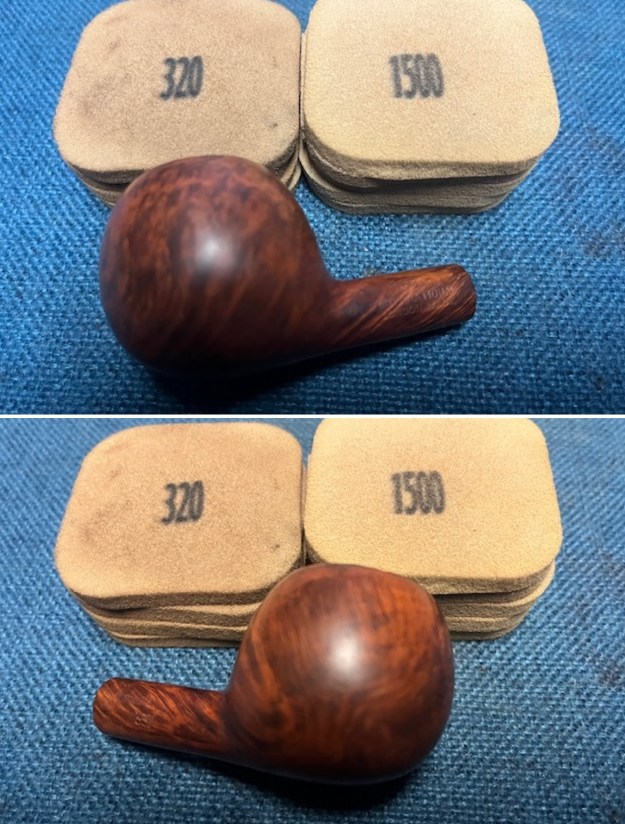
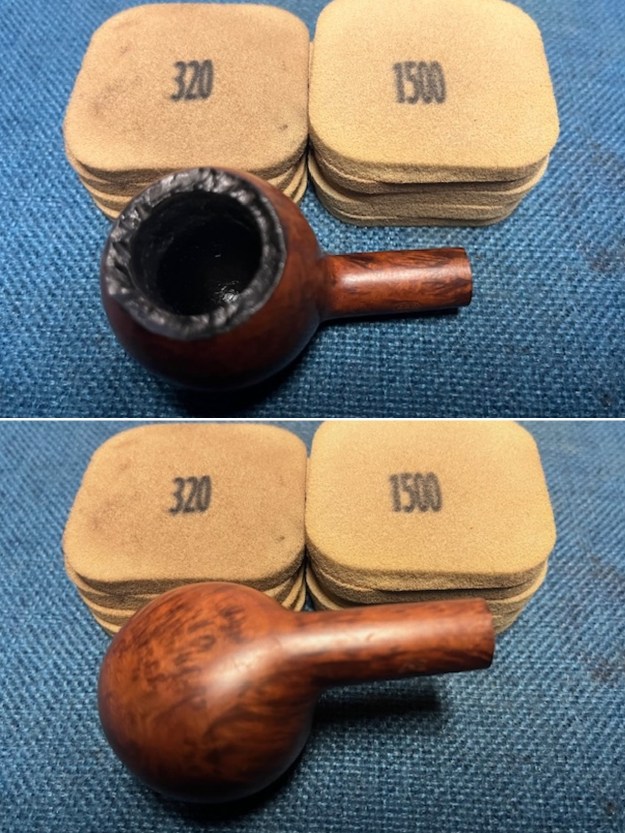
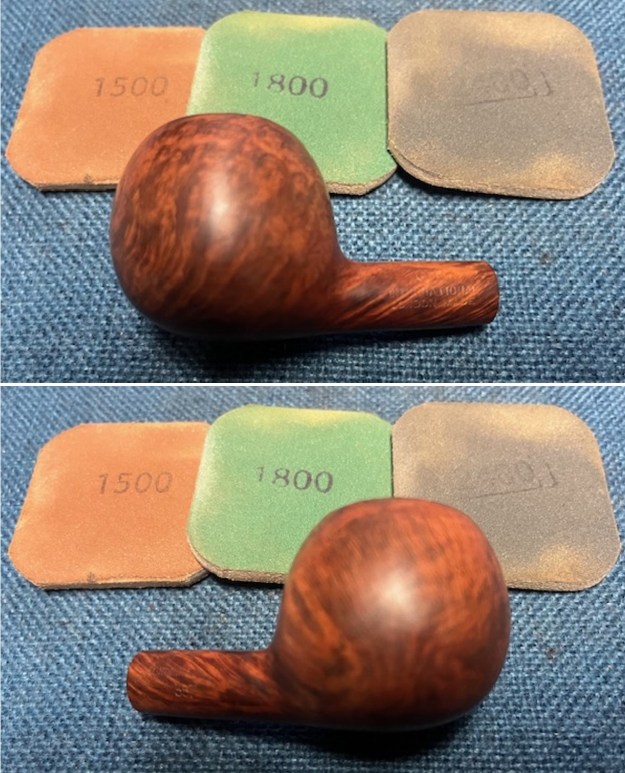
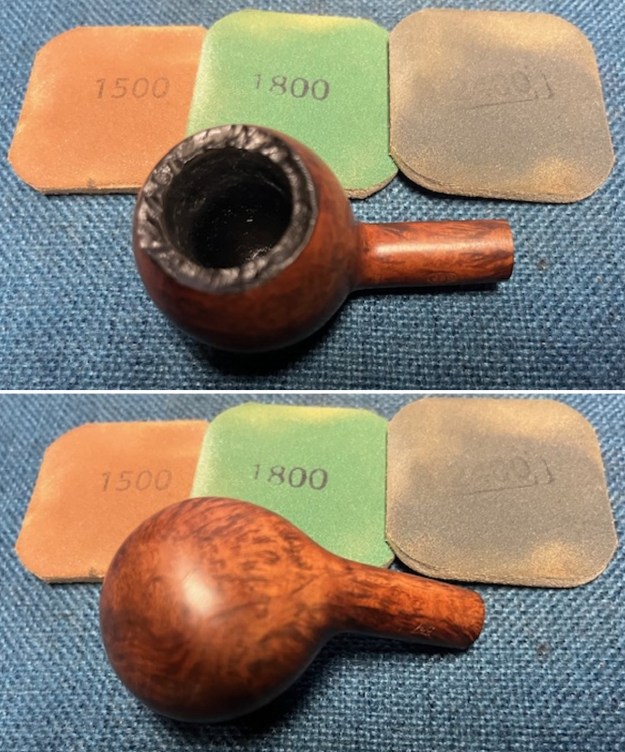
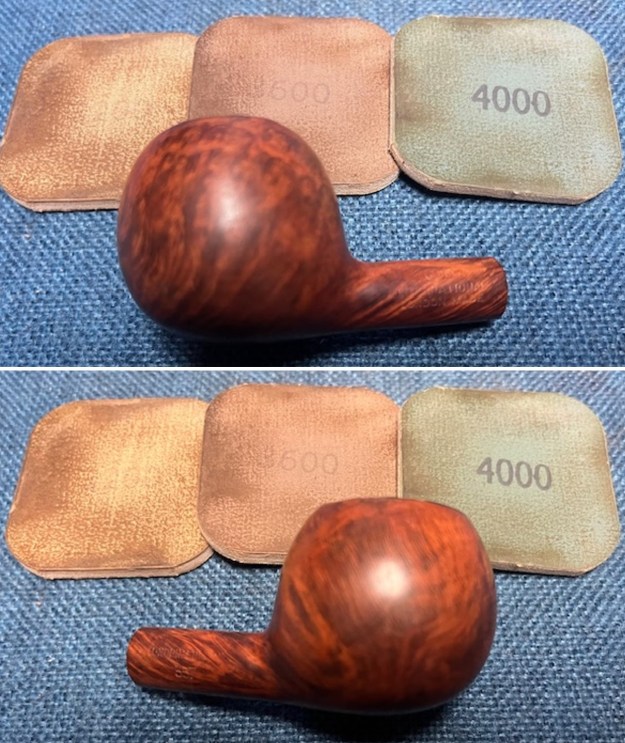
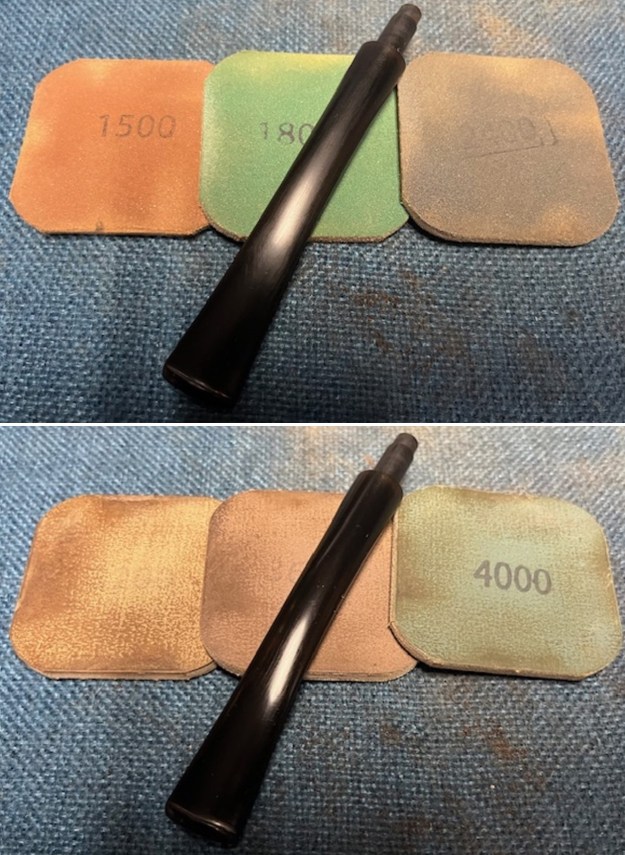
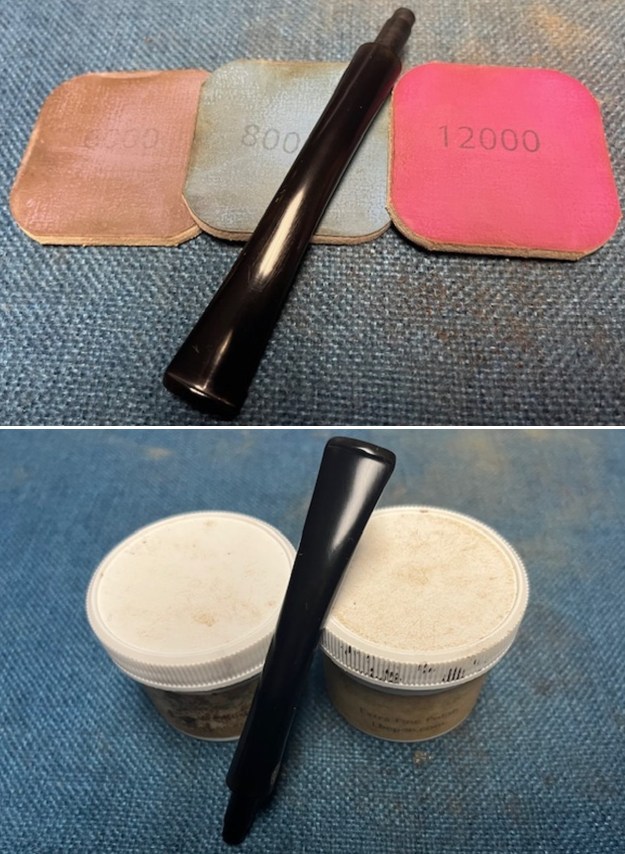
Jeff had cleaned it thoroughly. He had reamed it with a PipNet reamer and cleaned that up with a Savinelli Fitsall Pipe Knife. He had scrubbed the exterior of the briar with undiluted Murphy’s Oil Soap. He removed the shiny coat on the briar with acetone on cotton pads. He cleaned out the interior of the shank, sump and airway in the shank and stem with alcohol, pipe cleaners and cotton swabs. He scrubbed the stem with Soft Scrub to remove the oxidation and calcification on the surface. He soaked it in Briarville’s Pipe Stem Deoxidizer to remove the oxidation. He removed it from the Deoxidizer and rinsed it off with warm water. I took some photos of the pipe before I started my part of the work (sadly I forgot to take photos until after I had rubbed the bowl down with Before & After Restoration Balm. But you can see the idea. I took some close up photos of the rim top and also of the stem surface. I wanted to show what an amazing job Jeff did in the cleanup of the rim top. The rim top and inner edge of the bowl looked good. There was some wear on the top and outer edges that needed to be cleaned up. I also took close up photos of the stem to show the condition of the vulcanite. It was quite clean and there were tooth marks on both sides ahead of the button. Jeff works to protect and preserve the nomenclature on the shank of the pipes that he works on. He was able to preserve and maintain its condition in the process. I took some photos to show the clarity of the stamping. I have noticed that many restorers are not careful to protect the stamping in their cleaning process and often by the end of the restoration the nomenclature is almost destroyed. I would like to encourage all of us to be careful in our work to preserve this as it is a critical piece of pipe restoration! I took the stem off the shank and took a photo of the pipe. I sanded the briar with 320-3500 grit 2×2 inch sanding pads to remove the remainder of the varnish coat that the acetone did not remove. I wiped the bowl down with a damp cloth after each sanding pad to remove the sanding debris. It really looks much better. I polished the bowl with micromesh sanding pads – dry sanding it with 1500-12000 grit sanding pads. I wiped it down with a damp cloth after each sanding pad to remove the dust. The briar was really shining by the final pad. I rubbed the bowl and rim down with Before & After Restoration Balm. I worked it into the surface of the briar with my fingertips to clean, enliven and protect it. I let the balm sit for 10 minutes and then buffed with a cotton cloth to raise the shine. I really like watching the Balm do its magic and bring the briar alive. I polished the nickel ferrule with a jeweller’s cloth to remove the oxidation and to further protect it from further oxidation. The shine is quite nice. I set the bowl aside and moved on to sand the stem with 320-3500 grit 2×2 inch sanding pads. I wiped it down with an Obsidian Oil cloth after each sanding pad to remove the sanding debris. The stem began to look much better.I polished the stem with micromesh sanding pads – wet sanding with 1500-12000 grit pads. I wiped the stem down after each sanding pad with Obsidian Oil. I polished it with Before & After Pipe Stem Polish – both Fine and Extra Fine. I gave it a coat of Obsidian Pipe Stem Oil. It works to protect the stem from oxidizing. I set it aside to dry. Once again at this point in the restoration process I am excited to be on the homestretch. I look forward to the final look when the Sandblasted Peterson System Standard 309 is put back together, polished and waxed. I put the bowl and stem back together. I lightly polished the bowl and stem with Blue Diamond to polish out the scratches in the briar and the vulcanite. I gave the bowl and the stem multiple coats of carnauba wax. I buffed the pipe with a clean buffing pad to raise the shine. I hand buffed it with a microfiber cloth to deepen the shine. The pipe polished up pretty nicely. The depths of the rustication really pop with the wax and polish. The shiny black vulcanite stem is a beautiful contrast to the dark browns of the bowl and thick shank and nickel ferrule. This Republic Era Peterson’s System Standard 309 Bent Billiard was another fun pipe to work on. It really is a quite stunning piece of briar whose shape follows the flow of the briar. The pipe feels great in the hand will be better when warmed up while smoking. The finished pipe is shown in the photos below. The dimensions of the pipe are Length: 6 inches, Height: 2 inches, Outside diameter of the bowl: 1 ¼ inches, Chamber diameter: ¾ of an inch. The weight of the pipe is 2.01 ounces/57 grams. I will be putting it on the rebornpipes store in the Irish Pipemakers Section if you would like to add it to your rack and carry on the previous pipeman’s legacy. This is an interesting estate to bring back to life.

As always, I encourage your questions and comments as you read the blog. Thanks to each of you who are reading this blog. Remember we are not pipe owners; we are pipe men and women who hold our pipes in trust until they pass on into the trust of those who follow us.

It is alive – a Sandblast Republic Era Peterson’s System Standard 308 Bent Billiard


by Steve Laug

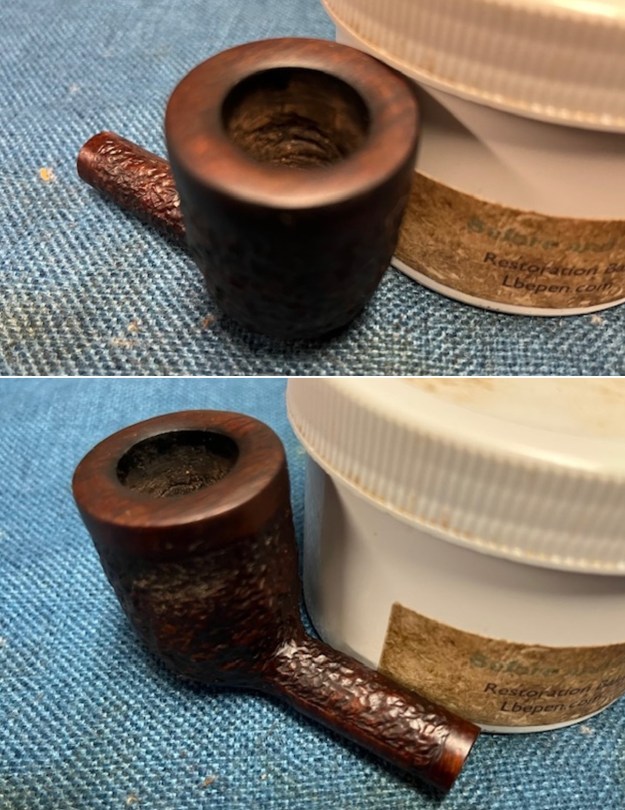
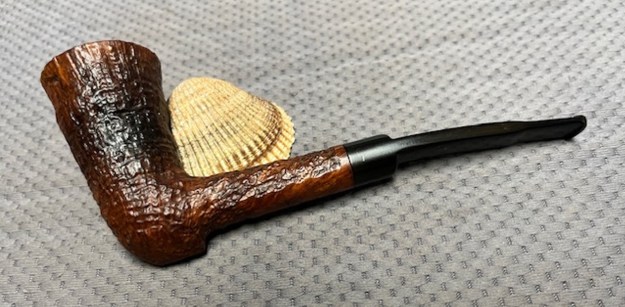
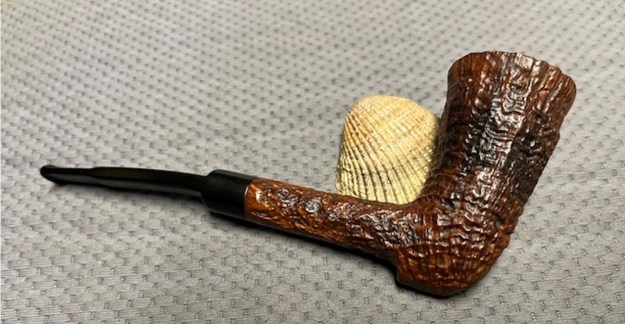
The next pipe on the work table is Peterson’s System pipe that we purchased from an antique store in Wheeler, Oregon, USA on 08/24/2024. It was stamped on the underside of the shank and read Peterson’s [arched over] System followed by Made in the Republic of Ireland (in three lines) [over] the shape number 308. The nickel ferrule on the shank end was oxidized and is stamped on the top and left side K&P [over] the three common hallmarks on System pipes with Nickel ferrules – a shamrock, a wolf hound, and a tower. That is followed by Peterson’s. It has a rich sandblast finish with unique patterns around the bowl and shank that is covered with a lot of oils, debris and grime. There was a thick cake in the bowl with remnants of tobacco stuck on the walls. There was a heavy lava overflow filling in the sandblast on the rim top and edges. The top and edges of the rim were well hidden under the tars and lava. There was a very beautiful pipe underneath all of the buildup of years of use. The stem was a Peterson’s style P-Lip. It was oxidized and calcified toward the end with some tooth marks and chatter. Jeff took photos of the pipe before he started his cleanup work on it. Jeff took photos of the bowl and rim top to show the thick, hard cake in the bowl with remnants of tobacco stuck on the walls of the bowl. There was a lava build up on the top of the rim and the edges of the bowl. The rim top looked pretty good but it was hard to know for sure if there was damage under the thick lava. Only clean up would tell the full story. Jeff took photos of the top and underside of the stem showing the tooth chatter, calcification and oxidation on the stem surface and wear on the edges of the button. Jeff took photos of the sides and heel of the bowl to show the condition of the finish. You can see the grime around the sides of the bowl and shank. Even under the dirt and debris of the years it looked very good. Jeff took photos of the stamping on the sides of the shank. The stamping was readable as you can see from the photos. It read as noted above. The nickel ferrule is actually clearly stamped and readable. I am including the information from Pipedia’s article on Peterson pipes. It is a great read in terms of the history of the brand (https://pipedia.org/wiki/Peterson). I have included a bit of the pertinent history here.

1950 – 1989 The Republic Era – From 1950 to the present time, the stamp for this era is “Made in the Republic of Ireland” in a block format generally in three lines but two lines have been used with or without Republic being abbreviated.

During the 1950’s and 60’s the Kapp & Peterson company was still in the ownership of the Kapp family. However 1964 saw the retiral of the company Managing Director Frederick Henry(Harry) Kapp.

Pipedia also included a section of information on the System pipes including a diagram of the systems look (https://pipedia.org/wiki/Peterson#Republic_Era_Pipes). I quote a section of the article in part and include a link to another article on Pipedia on the System pipe.

The Peterson System pipes are the standard bearers of the Peterson pipe family, famous for the excellent smoking pleasure they provide. Often imitated but never equaled, the Peterson System smokes dry, cool and sweet, thanks to the scientific effectiveness of the original design. The heart of the System is the unique graduated bore in the mouthpiece. This makes the suction applied by the smoker 15 times weaker by the time it reaches the tobacco chamber. The result is that all the moisture flows into the reservoir and, thus cannot reach the smoker’s mouth. The Peterson Lip further enhances the effectiveness of the graduated bore by directing the flow of smoke upwards and away from the tongue. This achieves a uniquely even distribution of smoke and virtually eliminates any chance of tonguebite or bitterness. Furthermore, the shape is contoured so that the tongue rests comfortably in the depression under the opening. Each “PLip” mouthpiece is made from Vulcanite. For the Peterson System pipes to work properly, the stem/tenon has to have an extension, the tip of which will pass by the draft hole from the bowl and into the sump. Upon the smoker drawing in smoke, this extension then directs the smoke down and around the sump to dispense a lot of the moisture before the smoke enters the extension and stem. On the System Standards and other less expensive systems, this extension with be made of Vulcanite turned integrally with the stem. On the more expensive System pipes this extension will be made of metal which screws into the Vulcanite stem. This extension on the earlier pipes will be of brass and the newer pipes will be of aluminum. Most smokers not knowing this function of the metal extension, assumes that it is a condenser/stinger and will remove it as they do with the metal condensers of Kaywoodie, etc. Should you have a System pipe with this metal extension, do not remove it for it will make the System function properly and give you a dryer smoke (https://pipedia.org/wiki/A_closer_look_at_the_famous_Peterson_Standard_System_Pipe).

I have included the information on the shape number on this pipe that I picked up on researching the previous pipes. I have included a page from a Petersons Catalogue that I have on rebornpipes (https://rebornpipes.com/tag/peterson-hallmark-chart/). There is no shape 309 shown in the catalogue page of rusticated shaped shown below. I wonder if it is an older or a newer shape. But I am uncertain of that. I knew that I was dealing with a Republic Era pipe made between 1950-1989. It was a Sandblasted Peterson’s System Standard 308 Bent Billiard with a great sandblast. The bowl was stained with a combination of black and brown stains. Now it was time to work on the pipe.

Jeff had cleaned it thoroughly. He had reamed it with a PipNet reamer and cleaned that up with a Savinelli Fitsall Pipe Knife. He had scrubbed the exterior of the briar with undiluted Murphy’s Oil Soap. He removed the shiny coat on the briar with acetone on cotton pads. He cleaned out the interior of the shank, sump and airway in the shank and stem with alcohol, pipe cleaners and cotton swabs. He scrubbed the stem with Soft Scrub to remove the oxidation and calcification on the surface. He soaked it in Briarville’s Pipe Stem Deoxidizer to remove the oxidation. He removed it from the Deoxidizer and rinsed it off with warm water. I took some photos of the pipe before I started my part of the work (sadly I forgot to take photos until after I had rubbed the bowl down with Before & After Restoration Balm. But you can see the idea. I took close up photos of the rim top and also of the stem surface. I wanted to show what an amazing job Jeff did in the cleanup of the rim top. The rim top was and inner edge were in good condition. I also took close up photos of the stem to show the condition of the vulcanite. It was quite clean and the light tooth marks and chatter on the stem ahead of the button are clear.One of the things I appreciate about Jeff’s cleanup is that he works to protect and preserve the nomenclature on the shank of the pipes that he works on. The stamping on this one was very faint to start with so I was worried that it would disappear altogether with the cleanup. He was not only able to preserve and maintain its condition in the process. I took some photos to show the clarity of the stamping. I have noticed that many restorers are not careful to protect the stamping in their cleaning process and often by the end of the restoration the nomenclature is almost destroyed. I would like to encourage all of us to be careful in our work to preserve this as it is a critical piece of pipe restoration! I took the stem off the shank and took a photo of the pipe. I decided to start my work on the pipe by rubbing the bowl and rim down with Before & After Restoration Balm. It was in very good shape, so I worked it into the surface of the briar with my fingertips and a horsehair shoe brush to clean, enliven and protect it. I let the balm sit for 10 minutes and then buffed with a cotton cloth to raise the shine. I really like watching the Balm do its magic and bring the briar alive. I polished the nickel ferrule with a jeweller’s cloth to remove the oxidation and to further protect it from further oxidation. The shine is quite nice. I set the bowl aside and moved on to sand the stem with 320-3500 grit 2×2 inch sanding pads. I wiped it down with an Obsidian Oil cloth after each sanding pad to remove the sanding debris. The stem began to look much better.I polished the stem with micromesh sanding pads – wet sanding with 1500-12000 grit pads. I wiped the stem down after each sanding pad with Obsidian Oil. I polished it with Before & After Pipe Stem Polish – both Fine and Extra Fine. I gave it a coat of Obsidian Pipe Stem Oil. It works to protect the stem from oxidizing. I set it aside to dry. Once again at this point in the restoration process I am excited to be on the homestretch. I look forward to the final look when the Sandblasted Peterson System Standard 308 is put back together, polished and waxed. I put the bowl and stem back together. I lightly polished the bowl and stem with Blue Diamond to polish out the scratches in the briar and the vulcanite. I gave the bowl and the stem multiple coats of carnauba wax. I buffed the pipe with a clean buffing pad to raise the shine. I hand buffed it with a microfiber cloth to deepen the shine. The pipe polished up pretty nicely. The depths of the rustication really pop with the wax and polish. The shiny black vulcanite stem is a beautiful contrast to the dark browns of the bowl and thick shank and nickel ferrule. This Republic Era Peterson’s System Standard 308 Sandblasted Bent Billiard was another fun pipe to work on. It really is a quite stunning piece of briar whose shape follows the flow of the briar. The pipe feels great in the hand will be better when warmed up while smoking. The finished pipe is shown in the photos below. The dimensions of the pipe are Length: 6 inches, Height: 1 ¾ inches, Outside diameter of the bowl: 1 ¼ inches, Chamber diameter: ¾ of an inch. The weight of the pipe is 2.01 ounces/56 grams. I will be putting it on the rebornpipes store in the Irish Pipemakers Section if you would like to add it to your rack and carry on the previous pipeman’s legacy. This is an interesting estate to bring back to life.

As always, I encourage your questions and comments as you read the blog. Thanks to each of you who are reading this blog. Remember we are not pipe owners; we are pipe men and women who hold our pipes in trust until they pass on into the trust of those who follow us.

Rebirthing a French made DM over UNIC Algerian Briar Panel Sitter


by Steve Laug

The next pipe I chose to work on was an interesting octagonal Panel. We picked the pipe up from a seller in Saint Cloud, Florida, USA on o4/12/2024. The finish was very dirty but some great mixed grain stood out around the bowl and the shank. The pipe is stamped on the underside of the shank and reads either DN or PM horizontally and vertically it is stamped UNIC. I have never heard of the brand at this point. Below these stamps it is stamped Algerian Briar [over] France. There was also a faint DN or PM in an oval stamped on the side of the saddle stem. The bowl had a moderate cake with some light lava overflow and scratching on the rim top.  The shape is almost a Skater but the Octagonal panels take away the shape point of the nose on the heel of the bowl. It had a vulcanite push saddle stem. The stem was oxidized and it was rough to touch. There were also some gouges in the top near the saddle that looked like marks from pliers and tooth marks and chatter. The worst part was that there was large chip from the button forward on the underside of the stem that gave me pause and made me think it would need to be restemmed. Jeff took some photos of the pipe before he started his clean up work. He took some photos of the rim top and bowl from various angles to give me a clear picture of the condition of the rim top and bowl. You can see the cake in the bowl and the darkening, scratches and light lava coat on the inner edge and rim top. He also took photos of the stem. It is dirty and has a large chunk out of the underside of the stem from the button forward. Jeff took some photos of the sides of the bowl to show the condition of the finish on the pipe. The photos show the smooth finish on sides and heel of the bowl and shank, highlighting grain. Under the dust it was some great looking briar on the panel sides of the octagonal bowl. Jeff took photos of the stamping on the underside of the shank. It is clear and readable as noted above. The DM or PM stamp over UNIC does not ring any bells with me in terms of the maker. Any help would be greatly appreciated…Jeff did a thorough clean up on the pipe before he sent the box to me. He reamed the bowl with a PipNet pipe reamer and got rid of the cake. He cleaned up the reaming with a Savinelli Fitsall Pipe Knife so that we could see the walls of the bowl and assess for damage. It was smooth and in great condition. He cleaned the internals of the shank and stem with alcohol, pipe cleaners, shank brushes and alcohol. He scrubbed the exterior with undiluted Murphy’s Oil Soap and a tooth brush. He rinsed the pipe under warm water. He dried it off with a cloth and then let it air dry. The stem was scrubbed with undiluted Murphy’s Oil Soap and a tooth brush at the same time as the bowl. He soaked it in Briarville’s Pipe Stem Deoxidizer. Once it was rinsed off, it came out looking very good. The finish on the bowl and the rim top cleaned up nicely. The damage on the stem underside was clearly visible. I took pictures of the pipe to show how it looked when I unpacked it. I took close-up photos of the bowl and rim top to show the condition after cleaning. It looked great. I also took photos of the stem surface to show the condition of the stem and the large chip on the underside. I took photos of the stamping on the underside of the shank. It was clear and readable as noted above. I also took a photo of the pipe with the stem removed to give a sense of size and perspective.I sanded the rim top and sides of the bowl and shank with 320-3500 grit 2×2 inch sanding pads. I wiped the stem down after each sanding pad with a damp cloth to remove the debris. I polished the smooth side of the bowl and shank with micromesh sanding pads – dry sanding with 1500-12000 grit pads and wiping it down after each sanding pad with a damp cloth. It really began to take on a real shine. I worked some Before & After Restoration Balm into the surface of the smooth briar with my finger. I let it sit on the bowl for 10 minutes and then buffed it off with a paper towel and soft cloth. The product is a great addition to the restoration work. It enlivens, enriches and protects the wood while giving it a deep glow. It is a product I use on every pipe I restore. Now I had a decision to make regarding the stem. I could try a repair on the huge chip but I was uncertain how well it would hold up. I could try though. I could also fit a new stem on the pipe. I could not find any stem that was similar but I found one that would give the pipe a jaunty look. Here is a photo of the two stems. I decided to fit the new stem to the shank just to have a look at its appearance. I really wanted to know if the stem would work and what the pipe would look like with the stem. The pipe almost has the appearance of an interesting cross between a French and a Danish pipe.I sanded the casting marks and marks on the new stem with 220 grit sandpaper and files to clean it up and make it look fitting. The change of appearance was quite different. I am excited to see how the finished stem looks on the bowl.I sanded the stem with 320-3500 grit 2×2 inch sanding pads. I wiped the briar down after each pad with a damp cloth to remove the sanding dust and debris. I wiped it down with an Obsidian Oil cloth. It began to look very good.I heated the stem with the flame of a lighter and then bent it over the curve of the lighter. The bend was perfect and once polished I looked forward to see what it would look like on the finished pipe.I polished it with micromesh sanding pads – dry sanding with 1500-12000 grit sanding pads. I wiped it down after each sanding pad with Obsidian Oil. I polished it with Before & After Pipe Stem Polish – both Fine and Extra Fine. I buffed the stem with a soft cloth to raise the shine. I gave it a final wipe down with Obsidian Oil to protect it. I don’t know what it is about finishing a restoration but I have to tell you that it is my favourite part of the process. It is the moment when everything that I have worked on comes together. I can compare it to where I started and there is always satisfaction that it looks better than when we picked it up. As always, I put the new stem on the DM UNIC Algerian Briar France and buffed it with Blue Diamond on the buffing wheel. I gave the bowl and the stem multiple coats of carnauba wax. I buffed the pipe with a clean buffing pad and hand buffed it to raise the shine. It is fun to see what the polished bowl looks like along with the polished All Briar stem. This DM Algerian Briar French Octagonal Panel is a great looking pipe and I am sure that it will be comfortable in hand when smoking as it is light and well balanced for a pipe of this size. Have a look at it with the photos below. The dimensions are Length: 6 ½ inches, Height: 2 ¼ inches, Outside diameter of the bowl: 1 ½ inches, Chamber diameter: 7/8 of an inch. The weight of the pipe is 2.29 ounces/65 grams. It is another beautiful pipe and one that will be on the rebornpipes store soon. You can find it in the section of Pipes by French Pipe Makers. If you are interested in adding it to your collection let me know. Thanks for walking through the restoration with me as I worked over this pipe. Thanks to each of you who are reading this blog.
As always, I encourage your questions and comments as you read the blog. Thanks to each of you who are reading this blog. Remember we are not pipe owners; we are pipe men and women who hold our pipes in trust until they pass on into the trust of those who follow us.
Restoring and Restemming a Clogged and Filthy Italian Lorenzetti Billiard


by Steve Laug

A fellow in Victoria, Brian has had me work on a few of his pipes this past few months. The pipes are generally very dirty with plugged airways and a thick damp, tarry mess in the heel of each bowl. The airway in the shank was also clogged so there was no exchange of air going through the pipe. The pipe was stamped on the left side of the shank and reads Lorenzetti in script [over] Italy and on the right side it is stamped Augustus [over] Caesar. On the underside it is stamped 03. There is a thick cake in the bowl that is wet in the bottom 1/3 of the bowl. The rim top was quite clear of heavy lava. The finish on the bowl and shank has a thick peeling coat of varnish on the bowl that looks terrible. There is an acrylic shank end with an insert of briar between the acrylic pieces. The stem acrylic stem is a filter stem and the button end has a large chunk missing that is severely damaged. I will need to restem the pipe. But I have included photos of the pipe before I started working on it. I took photos of the rim top and stem to show the general condition of the pipe. The bowl is heavily caked and the rim top and edges have a thick lava overflow. The photos of the stem show the damage and broken part of the stem. It really is a mess and the acrylic is not repairable.I took photos of the stamping on the sides of the shank. It is clear and readable and reads as noted above. I took a photo of the pipe without the stem to show the proportions of the bowl and stem. I also went through my stems and had a saddle stem that was made for a filter. I called Brian and asked if this would work for him and he was happy with the options. I wanted to gather some background information on the brand. I turned first to Pipephil’s site to see what I could learn (http://www.pipephil.eu/logos/en/logo-l6.html). I was able to get a screen capture of information on the brand. I have included that below along with the sidebar info.Brand created 1934 by Otello Lorenzetti.Currently (2009) the company is managed by Alessandro Lorenzetti. Address: via A.Giunta, 51, 62019 Recanati (MC) – Italy.

I turned to Pipedia to gather more information on the brand. It gives some great history of how the brand developed (https://pipedia.org/wiki/Lorenzetti). I quote some portions of the article below. There was also a photo of the same pipe that I am working on the site. I have included that below.

Smooth Pot, courtesy SmokersHaven.com

Otello Lorenzetti, the founder of our manufacture, was born in Castelnuovo, Recanati in 1911. He is the fifth of five children from a modest, but enterprising family, in fact they own a tavern where the young Otello, already at the age of seven, actively collaborates. He goes on his own, with a small handcart, to S. Agostino di Recanati where he purchases fizzy drinks and other soft drinks and then resells them with his mother in their small family run tavern….

After the precocious interruption of his studies he begins to work as an employee at “Catena Remigio” an old pipe manufacture in Recanati. The grand personality of Otello, who is inclined to make any art a passion, does not delay in emerging. In 1934, after having concluded 18 months of military service in Cividale, in Friuli Venezia Giulia, he decides to work on his own pondering the first bases of the actual pipe manufacture, that, in this period, operates under the company name “Otello Lorenzetti.” At that time the capital of our actual company, that was and still is his house, was constituted by: “A few rented tools and my own hands” – as Otello himself tells us. The production consists of 20-30 pipes per day. Every morning, in company of his bicycle, he tries to sell them to the tobacco shops in the area or as he says the “neighbouring shops”. With only the strength of his legs he goes to Macerata, San Severino and Civitanova Marche. His pipes are appreciated, so much so that he decides to work more than 12 hours a day to be able to increase the production. This does not constitute a sacrifice for him as his neighbours remember hearing him tirelessly working and singing everyday.

Two brisk interruptions mark the history of our pipe manufacture: the first was in 1935 -in the summer of this year Otello was enrolled in the army and then left for “the African Campaign” from which he returned in January of 1937; the second was in October of 1940, other long months spent in the service of the Italian Army after which he returned home in 1943 the year of Armistice. In 1940 Otello got married to Marinella who became, other than his wife, a great and indispensable business collaborator.

In 1947 Otello succeeded in building, alone, machines the same as the ones he used to rent up until that moment. Many of the pieces most difficult to mould by hand were designed by him and were made in a craftsman workshop in Civitanova Marche. Production increased and permitted Otello and Marinella to buy a “Vespa” helping them to, a part from the province of Macerata, also reach Abruzzo in order to successfully sell their pipes.

The Sixties-Seventies bring on the beginning of exportation abroad (Europe, Africa, America). The company begins to expand, now a part from Marinella, with the help of their children Luciano, Gabriella, Alessandro and some employees. The production begins to perfect itself to the point of being appreciated in almost all the world and by one of the biggest and most famous pipe collectors of all times: our ex-president of the Republic Sandro Pertini.

I knew that I was dealing with a Lorezetti that was probably a recent manufacture. It had some great shape and form and should clean up well once I have the varnish coat removed. Now it was time to work on the pipe.

I reamed the bowl with a PipNet pipe reamer and the 2nd and 3rd cutting heads to remove the heavy cake. I took it back to bare briar and then cleaned up the reaming with a Savinelli Fitsall Pipe Knife. I sanded the bowl with a piece of dowel wrapped in 220 grit sandpaper. I scrubbed the exterior of the bowl and shank with undiluted Murphy’s Oil Soap and a tooth brush. It took some scrubbing to clear off the debris on the rim top and the surface of the bowl and shank. I rinsed the bowl off with warm water to remove the grime and debris along with the soap on the pipe. It looked much better. To begin the process of breaking through the peeling varnish coat I wiped the bowl and shank down with acetone on cotton pads. It broke through a lot of the varnish and I began to see what was underneath the varnish. I sanded the bowl with 320-3500 grit 2×2 inch sanding pads. I wiped the briar down with a damp cloth to remove the sanding debris. By the final pad it was looking much better. I cleaned out the mortise and airway in the shank as well as the airway in the newly chosen stem with pipe cleaners, cotton swabs and alcohol. It was a dirty bowl and shank.I polished the bowl and the shank with micromesh sanding pads – dry sanding it with 1500-12000 git sanding pads. I wanted to make the new stain coat a bit more transparent. I wiped it down with a cloth and some Obsidian Oil. I worked some Before & After Restoration Balm into the surface of the briar with my fingertips to clean, enliven and protect the briar. I let the balm sit for 15 minutes and then buffed with a cotton cloth to raise the shine. The photos show the bowl at this point in the restoration process. I set the bowl aside and turned my attention to the stem. I sanded the stem to reduce the diameter of the saddle portion and give it a slight slope or taper. I used my Dremel and sanding drum to start the process. I cleaned up the sanding marks from the Dremel with a folded piece of 220 grit sandpaper. I smoothed out the marks and the stem started to look better.I sanded the stem with 320-3500 grit 2×2 inch pads to further smooth out the surface and remove the light residual oxidation. I wiped the stem down after each pad with an Obsidian Oil cloth to remove the debris and further protect the stem.I polished the stem with micromesh sanding pads – dry sanding with 1500-12000 grit sanding pads. I wiped it down after each sanding pad with Obsidian Oil.I polished the finished Lorenzetti Italy Augustus Caesar Billiard with Blue Diamond to polish out the remaining small scratches. I gave the bowl and the newly fit saddle stem multiple coats of carnauba wax and buffed the pipe with a clean buffing pad to raise the shine. I hand buffed it with a microfiber cloth to deepen the shine. The pipe polished up pretty nicely. The smooth briar with the medium the brown stain wash works very well with the black stem. The finished pipe is shown in the photos below. I have worked on several Lorenzetti’s over the years and I have always been impressed by his ability to a craft a comfortable and functional smoking pipe. It looks far better with the varnish coat removed. The beautiful Lorenzetti Augustus Caesar had the following dimensions. The Length: 6 inches, Height: 1 ¾ inches, Outside diameter of the bowl: 1 3/8 inches, Chamber diameter: 7/8 inches. The weight of the pipe is 51 grams/ 1.69 ounces. I have two more of Brian’s pipes to work on and then they will go back to him. This is an interesting group of three pipes to bring back to life.

As always, I encourage your questions and comments as you read the blog. Thanks to each of you who are reading this blog. Remember we are not pipe owners; we are pipe men and women who hold our pipes in trust until they pass on into the trust of those who follow us.
Restemming and Restoring a Savinelli Extra Lumberman


by Steve Laug

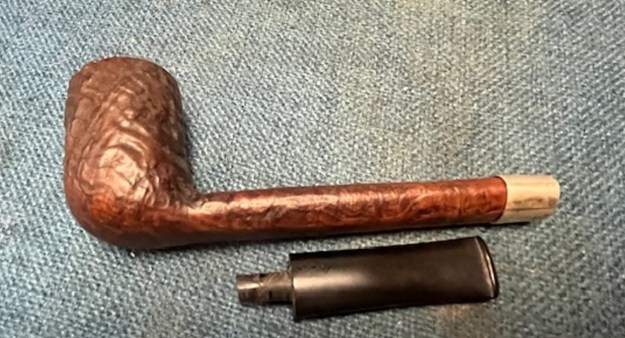
My brother and I have picked up a lot of bowl without stems over the years and boxed them for potential restemming at a later date. Unfortunately, we did not record where we picked them up. This one was a long shanked Canadian. Jeff had reamed and cleaned the pipe before we boxed it so it was clean, just needing finishing and restemming. It spots of rustication around the bowl sides and the shank. There was also a joint mid shank that was “hidden” under the rustication. The pipe was stamped on the underside of the bowl and shank and read Savinelli [over] Extra on the bowl heel [followed by] LUMBERMAN [followed by] Italy. The briar was clean and the rustications were also clean. The rim top had damage on the bevelled inner edge and some darkening on both. The joint of the two parts was well done and the rustication did a great job hiding it. There is a silver band on the shank is a repair band I believe that was added after carving. It is stamped with an arched Sterling Silver on the topside. I took some photos of the bowl before I started working on it. I took photos of the rim top and inner edge to show the condition of the bowl and rim. I also took photos of the junction of the two parts of the shank. Note the condition of the union of the two parts of the long shank. It is very well done and the connection is clean and undamaged.I took a photo of the stamping on the underside of the shank. It was clear and readable as noted above. I did a google search on a Savinelli Extra Lumberman and found one on MBSD’s Instagram account (https://www.instagram.com/p/DBu1kPTPCFF/). I captured one of the photos from the site and also the pertinent descriptive information that was in the side bar for the pipe.….…This is an interesting Savinelli. Though technically a Canadian, this extra long Lumberman model is not one you’ll find on Savinelli’s contemporary shape chart. In fact, I think this is a shape from before 1970 and the advent of the chart that Savinelli uses as standard today. It also features something that Savinelli has not done for a long time: spot carving. I.e., partial rustication, which lends the pipe a slightly rugged look, juxtaposed nicely with its virgin blonde stain. Finally, the pipe has vulcanite stem, which is also not very common on Savinellis anymore.

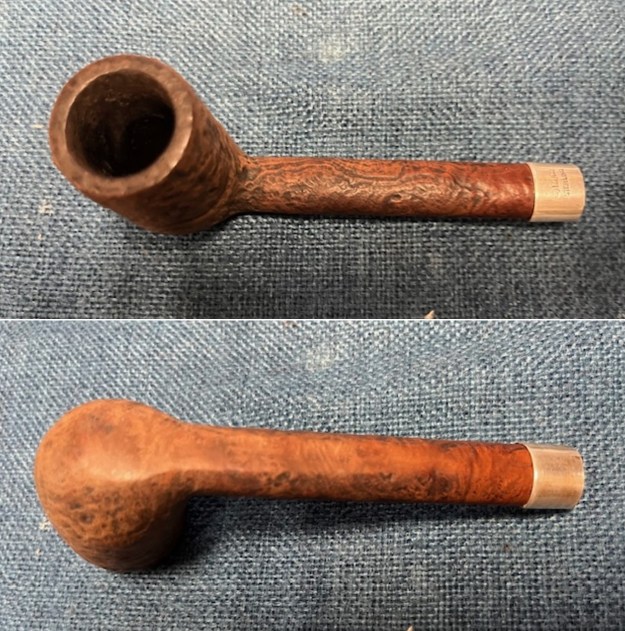
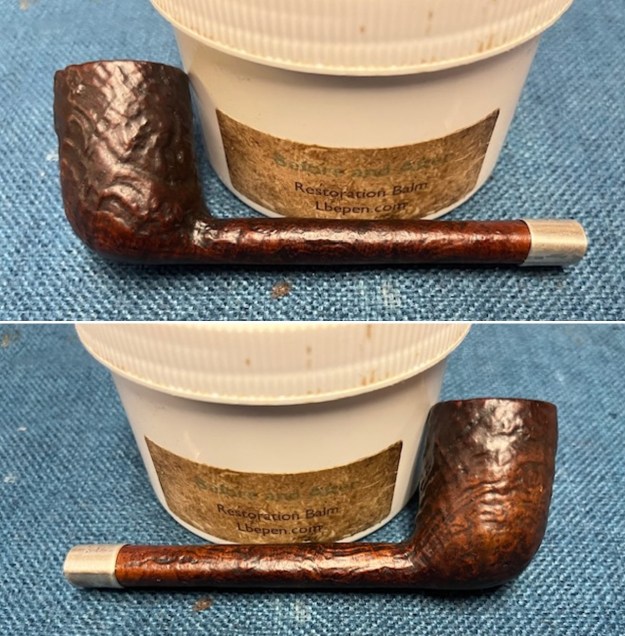
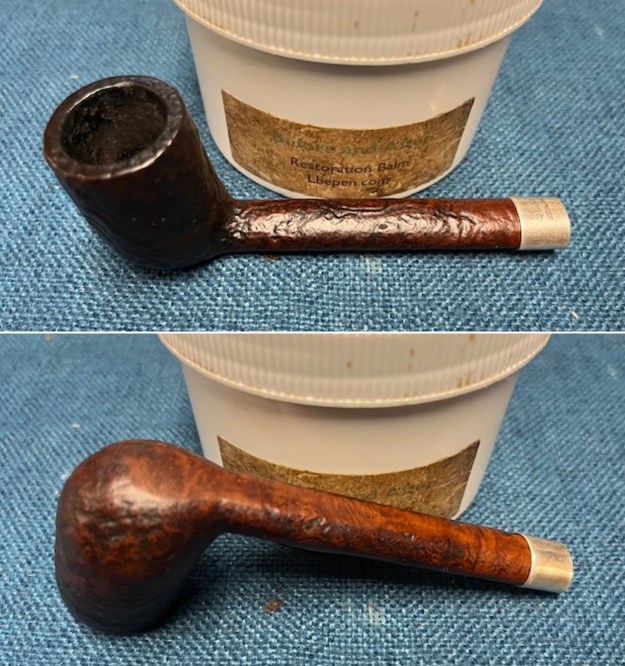
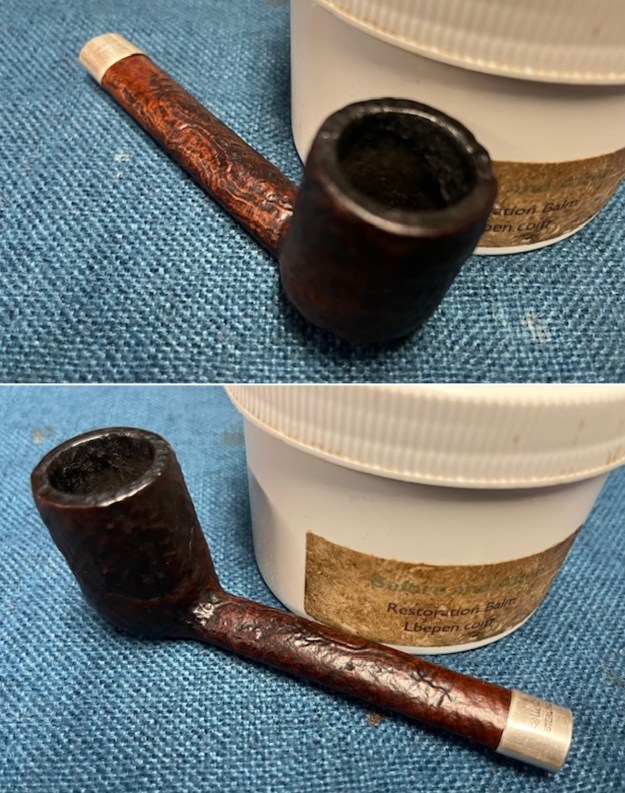
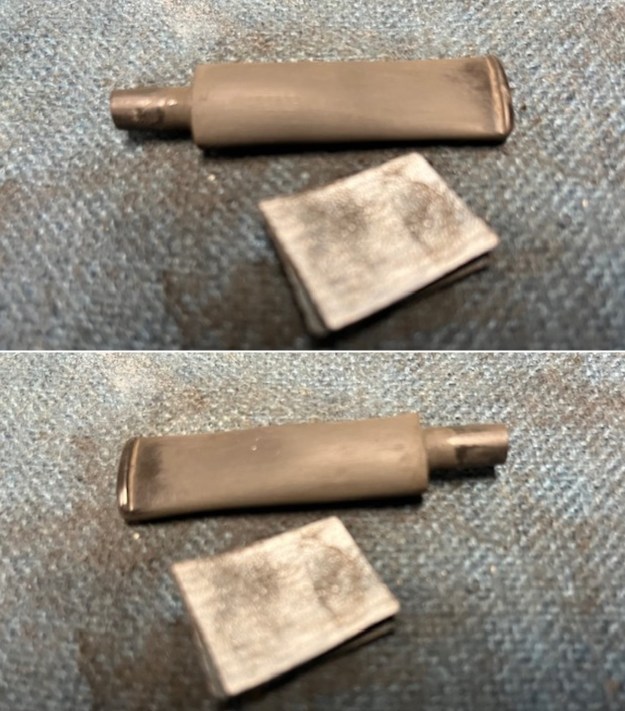
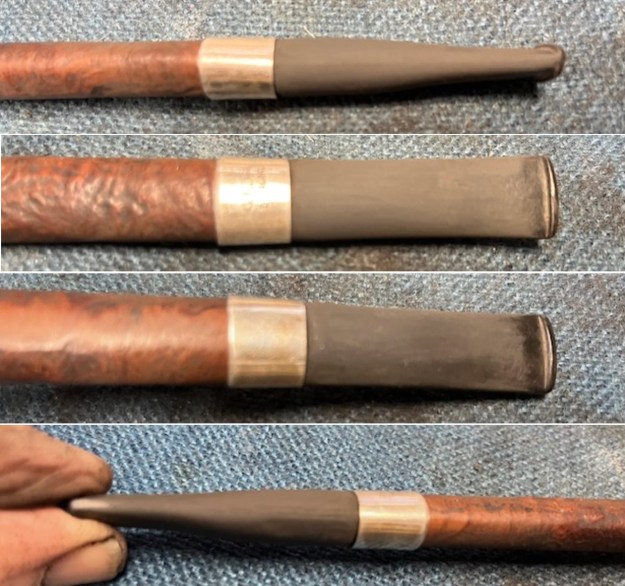
Now it was time to restem the pipe. I went through my can of stems to find a stem that would fit this pipe both in terms of the airway and the shank fit. I found a nice taper stem that would work well with this long shank Canadian. With a bit of work it would fit very well. It was close to a fit so I used a Dremel and sanding drum to reduce the diameter of the tenon for a shank fit. I adjusted it further with some small flat files. Once I completed the clean up of the tenon I fit it in the shank on the pipe and took photos of the pipe at this point in the process. I still needed to adjust the width of the stem at the shank as well as the overall shape to match the shank end.I used 220 grit sandpaper to shape and adjust the stem to match the shank end. It took a lot of sanding and shaping but it began to look very good.I sanded the stem with 320-3500 grit 2×2 inch sanding pads. I wiped the stem down after each pad to check the progress of the fit to the shank. It began to look very good.I polished the stem with micromesh sanding pads – dry sanding with 1500-12000 grit sanding pads. I wiped it down after each sanding pad with Obsidian Oil. I polished it with Before & After Pipe Stem Polish – both Fine and Extra Fine. I set the stem aside and turned my attention to the bowl. I used a piece of 220 grit sandpaper and a half sphere to work over the inner bevelled edge on the bowl. Then I used a folded piece of 220 grit sandpaper to smooth out the inner edge some more. It started to look very good at this point. I sanded the briar with 320-3500 grit 2×2 inch sanding pads to smooth out the scratching in the surface. I wiped the briar down after each pad with a damp cloth to remove the dust and debris. I polished the briar with micromesh sanding pads – dry sanding with 1500-12000 grit pads. I worked over the inner and outer edge of the rim as well. After each pad I wiped the bowl down with a damp cloth to remove the sanding debris. It really took on a shine by the last three sanding pads. I worked some Before & After Restoration Balm into the surface of the briar with my finger tips and a shoe brush to get into the carving on the bowl and shank. The product works to clean, enliven and protect the briar. I let the balm sit for 15 minutes and then buffed with a cotton cloth to raise the shine. The photos show the bowl at this point in the restoration process. I polished the silver band on the shank with micromesh sanding pads – dry sanding with 1500-12000 grit pads. I wiped it down after each sanding pad with a jeweller’s cloth to remove the debris and to polish the silver and remove the oxidation and prevent more from developing. I am excited to finish restemming and restoring this Savinellil Extra Lumberman. I put the pipe back together and buffed it with Blue Diamond on the buffing wheel. I gave the bowl and the stem multiple coats of carnauba wax. I hand buffed the pipe with a clean buffing pad to raise the shine. It is fun to see what the polished bowl looks like with beautiful mixed grain all around it with just a few small flaws in the briar. The polished grain on the pipe looks great with the black vulcanite stem. This smooth Savinelli Extra Lumberman with spot rustications is great looking and the pipe feels great in my hand. It is light and well balanced. Have a look at it with the photos below. The dimensions are Length: 7 inches, Height: 2 inches, Outside diameter of the bowl: 1 ¼ inches, Chamber diameter: ¾ of an inch. The weight of the pipe is 45 grams/1.55 ounces. It turned out to be a beautiful pipe. I will soon be putting it on the rebornpipes store in the Pipes by Italian Pipe Making Companies Section. If you are interested in adding it to your collection let me know.

Remember we are the next in a long line of pipe men and women who will carry on the trust of our pipes until we pass them on to the next trustee. Thanks for your time reading this blog.

Restemming a Wonderful Peterson Specialty Barrel


by Kenneth Lieblich

Now we’re talking! This terrific republic-era Peterson Barrel came to me in a box of pipes and pipe parts. It looked so engaging, but it was missing its stem. No problem – I can solve that! The Peterson barrel is not common, but it isn’t a rarity either. Regardless, it is a consistently popular and attractive shape – and it’s not hard to see why. No doubt, someone will be pleased to add this to their collection. Let’s look at the markings. On the underside of the stummel, it reads Peterson’s [over] Barrel [over] Made in the [over] Republic [over] of Ireland. On the nickel band, we see K&P engraved over images of the Shamrock, Wolf Hound and Round Tower. To be clear, these are not silver marks, they are nickel-mount markings of Peterson.Naturally, the Peterson brand is well-storied among collectors and I encourage you to read the Pipedia article about them: https://pipedia.org/wiki/Peterson. Obviously, I was particularly interested in learning more about the barrel, so I referred to The Peterson Pipe book, written by Mark Irwin and Gary Malmberg. It had a couple of very helpful tidbits. On page 136, we read

One collection … making its first appearance in the 1945 catalog is the line of Specialty shapes that have been Peterson favorites for nearly 70 years: the tankard and barrel, calabash and Belgique, and churchwarden.

Also, over on page 313, the following information can be found:

Barrel (1945-). P-lip or fishtail mouthpiece; smooth or rustic finish, sandblast offered in 1970.

So, beyond saying that it is newer than 1945, I can’t quite tell how old this pipe is. Good to know, however, that the fishtail was an option.Let’s work on the pipe. The first thing I did was to hunt down a suitable replacement stem. It needed to be a military mount and it could be either a P-lip or fishtail. In this case, I didn’t have a P-lip that worked with this pipe – but I found a terrific fishtail, which you can see below. The stem is brand new – it even still has its casting marks!I took some sandpaper and gently sanded away those casting marks. Following that, I used all nine of the micromesh sanding pads (1,500 through 12,000 grit) to sand out flaws, even out the vulcanite, and provide gentle polishing of the finished surface. I also applied pipe-stem oil while using the last five micromesh pads. There was a wonderful, deep black shine to the stem when I was done. Over to the stummel – and they were some issues. It was very dirty and had a significant burn on the rim. The first step was to ream out the bowl – that is to say, remove all the cake inside the bowl. This accomplished a couple of things. First (and most obviously), it cleaned the bowl and provided a refurbished chamber for future smoking. Second, when the old cake was removed, I could inspect the interior walls of the bowl and determine if there was damage or not. I used a reamer, a pipe knife, and a piece of sandpaper taped to a wooden dowel. Collectively, these ensured that all the debris was removed. I then cleaned the stummel with both pipe cleaners and cotton swabs dipped in lemon-infused 99% isopropyl alcohol. With a pipe this dirty, it took quite a while and much cotton to get clean. It’s a small pipe, but so, so dirty.I then decided to ‘de-ghost’ the pipe – that is to say, exorcize the remaining filth from the briar. I filled the bowl and the shank with cotton balls, then saturated them with 99% isopropyl alcohol. I let the stummel sit overnight. This caused the remaining oils, tars and smells to leach out into the cotton.To tidy up the briar, I wiped down the outside, using a solution of a pH-neutral detergent and distilled water, with cotton rounds. This did a good job of cleaning any latent dirt on the surface of the briar. The last step of the cleaning process was to scour the inside of the stummel with some mild detergent and tube brushes. This was the culmination of a lot of hard work in getting the pipe clean.

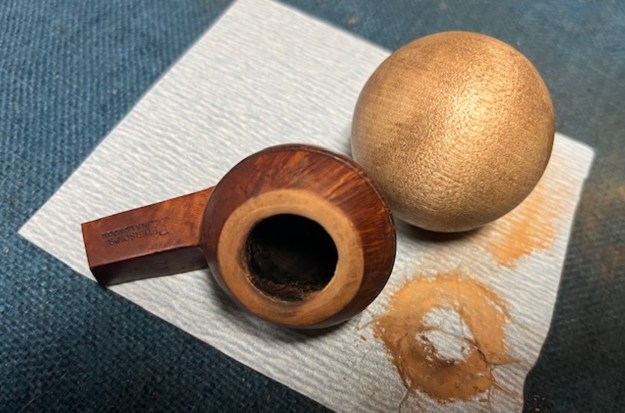
Some burn remained on the rim, so I took some crystalized oxalic acid and dissolved it in warm water. I took some cotton swaps, dipped in the solution, and rubbed the burned spot vigorously. The weak acid works very nicely to alleviate superficial burns (burns where the integrity of the wood is still sound). I took a solid wooden sphere, wrapped a piece of 400-grit sandpaper around it, and sanded the inner edge of the rim. This achieved two things: first, it removed some of the burn marks; and second (and more importantly), the circular shape and motion of the sphere gradually returned the edge to a perfect circle.I used all nine micromesh pads (1,500 through 12,000 grit) to sand the outside of the stummel and finish it off. This sanding minimizes flaws in the briar and provides a beautiful smoothness to the wood. I rubbed some LBE Before & After Restoration Balm into the briar and let it sit for 30 minutes or so. The balm moisturizes the wood and gives a beautiful depth to the briar. I then buffed the stummel with a microfibre cloth. For the final step, I took the pipe to my bench polisher and carefully buffed it – first with a blue diamond compound, then with three coats of carnauba wax. This procedure makes the pipe look its best – the stummel sings and the stem glows.This Peterson Specialty Barrel looks fantastic again and is ready to be enjoyed by its next owner. I am pleased to announce that this pipe is for sale! If you are interested in acquiring it for your collection, please have a look in the ‘Irish’ pipe section of the store here on Steve’s website. You can also email me directly at kenneth@knightsofthepipe.com. The approximate dimensions of the pipe are as follows: length 5¾ in. (147 mm); height 1⅔ in. (42 mm); bowl diameter 1¼ in. (32 mm); chamber diameter ⅔ in. (18 mm). The weight of the pipe is ⅞ oz. (25 g). I hope you enjoyed reading the story of this pipe’s restoration as much as I did restoring it. If you are interested in more of my work, please follow me here on Steve’s website or send me an email. Thank you very much for reading and, as always, I welcome and encourage your comments.

Cleaning up a Fatta a Mano Pesaro Mastro de Paja Lovat


by Steve Laug

This afternoon I decided to work on the pipe that Jeff picked up on Facebook Marketplace from a seller in Wellsville, Kansas, USA on 12/09/2024. It is a beautifully grained Lovat with an amber coloured acrylic saddle stem. It is a beautiful grained piece of briar that I can appreciate why he chose it. The pipe is stamped on the left side of the and reads Mastro de Paja [over] Fatta a Mano. On the right side of the shank it is stamped Pesaro [followed by] what looks like the Sun. On the underside of the shank it is stamped Media [followed by) 3A in a circle. The briar is dirty from use with a moderate cake in the bowl and a light overflow of lava on the rim top. The stem fit well against the shank end. The amber coloured acrylic saddle stem had some light tooth chatter and scratches on the top and underside of the stem ahead of the button. There was an inset gold circle logo in the top of the stem. Jeff took photos of the pipe before he started his clean up work on it. I have included them below. Jeff took some close up photos of the bowl and rim top. You can see the light lava coat in the plateau top. The inner edge of the rim looks good with a spot of darkening and damage on the left back side. There is a light cake in the bowl that seems to have been recently reamed. The photos of the stem show the scratching and tooth marks in the stem at the button. Jeff took photos of the sides of the bowl to show the interesting grain on the Lovat bowl and shank and how the shape chases it. He took photos of the stamping on the sides of the shank. It is clear and readable as noted above. Before I began to work on the pipe I wanted a refresher course on the maker and the stamping. I have not worked on too many Mastro de Paja pipes before so I figured to do a bit of education before I started my restoration.

I turned first to Pipedia to get a feel for the pipe (https://pipedia.org/wiki/Mastro_de_Paja). I quote in part from the article on that site.

In 1972 Giancarlo Guidi, after having spent some time as a hobbyist in producing pipes, decided to officially found a production workshop called “Mastro de Paja”. Mastro: obviously as a master craftsman, De Paja: it derives from the name with which he was affectionately called by friends “Pajetta” because of his curly hair and translated into a dialectal expression “de Paja”.

Spadoni Giannino joins him shortly after that, at the time he was a salesman and among the products he sold there were also pipes. A professional wedding that turned out to be perfect immediately, in no time the new company “MASTRO DE PAJA di Guidi e Spadoni” immediately became one of the most respected manufacturers of pipes in Italy for the quality of production and lines that for those times were innovative, fascinating and even if coarse they immediately met the consent of enthusiasts and collectors.

Unfortunately, the professional marriage between Guidi and Spadoni, due to disagreements and different views on strategies, stopped in 1981. Guidi left the company to found a personal one. In Mastro de Paja which in the meantime became a real company with a production staff remained with Spadoni. Unfortunately, after a very short time, due to economic and financial problems that put the possibility of continuing the business at risk, Spadoni is forced to ask for help and finds it with the intervention of the Pesaro-based entrepreneur Terenzio Cecchini who, despite being burdened by his multiple industrial activities, sees in Mastro de Paja a valid expression of high craftsmanship and takes over as majority shareholder and acquires the position of director.

Soon after even Spadoni decides to leave (and create his own new company), Cecchini then puts his eyes on a very smart young man which he considered capable of giving new glaze to the Mastro de Paja which, meanwhile, inevitably presented some productive and commercial problems. That young man is called Alberto Montini and he started in his thirties his beautiful adventure in the pipes world… He was contacted by the surveyor Terenzio Cecchini at the time the only owner of the Mastro, to take care of it in every aspect, first as an employee, then as an administrator and later as a partner of Mastro de Paja and afterwards with the passing of Mr. Cecchini he became the sole owner.

Currently the Mastro produces about 2 thousand pipes a year with strictly artisan procedure, at the Mastro currently reigns a warm harmony, is a group of friends who strives to get the best. This also stems from the fact that pipes for Mastro de Paja are not to be considered as any other object to be produced and sold following cold strategies common to everyone in the business world, it’s completely different, it is necessary to love it, it is a style of being, a philosophy of life that can only be appreciated by a noble soul and not noble by title but by principles.

I read further in the article and found the following information on the stamping and the circle 3A stamp. I quote:

Mastro de Paja “ELITE COLLECTION” It is the production of pipes made entirely by hand, even they are unique but of regular production. On all “Mastro de Paja” pipes you can see fire stamped all the information for tracing the value of each creation.

 0B: Rusticated

1B: Sandblasted

CA: Castanea

2D: Half rusticated

3A: Brown and orange stain

3B: Natural

3C: Perfect grain

It looks like the 3A is pretty high in the hierarchy of the Mastro pipes, with just the 3B Natural and the 3C Perfect Grain ahead of it. It is described as Brown and Orange Stain. That would describe what I hold in my hands today.

I turned to the Pipephil website (http://www.pipephil.eu/logos/en/logo-m3.html) and added the following screen capture and summary of information on the brand.Brand founded in 1972 by Giancarlo Guidi. He left it for Ser Jacopo in 1982. Alberto Montini became the owner of the brand in 1995. Production (2010): ~ 5000 pipes / year. Seconds: Calibano, Montini

Armed with that information and renewing my knowledge of the brand it was time to work on the pipe.

Jeff had reamed the bowl with a PipNet pipe reamer and followed up with a Savinelli Fitsall pipe knife to remove the remnants of cake. He scrubbed out the mortise and the airway in the shank and the stem with alcohol, cotton swabs, shank brushes and pipe cleaners. He scrubbed the exterior of the bowl, rim, shank and stem with a tooth brush and undiluted Murphy’s Oil Soap to remove the oils and tars on the rim and the grime on the finish of the bowl of the pipe. He rinsed it with running water. He dried it with a soft cloth. He was able to remove all of the debris in the briar leaving only the area with slight damage on the inner edge of the bowl on the left rear. I took photos of the pipe to show its condition before I started my work. I took a close up photo of the rim top to show the condition of the top and edges of the rim. The inner shows some burn damage on the left read of the bowl. The stem photos show the light tooth marks and scratching on the surface of the amber acrylic.I took photos of the stamping on the sides of the shank to capture the words if possible. It was clear and read as noted above. I removed the stem and took a photo of the parts of the pipe to give a sense of the proportion of the parts to the whole. It is a well designed and made pipe. I decided to begin by addressing the damage on the left rear of the inner edge. I carefully sanded the edge with a folded piece of worn 220 grit sandpaper to smooth out the damaged area and bring it back to round as much as possible.I polished the briar with micromesh sanding pads – dry sanding with 1500-12000 grit pads. I wiped the bowl down after each sanding pad to remove the sanding debris from the surface. It looked very good by the time I finished. I worked some Before & After Restoration Balm into the surface of the briar with my fingertips to clean, enliven and protect it. I let the balm sit for a little while and then buffed with a cotton cloth to raise the shine. The photos show the bowl at this point in the restoration process. With the bowl finished I set it aside and turned my attention to the stem. I sanded out the swirled scratches in the surface of the acrylic and the light tooth marks with 220 grit sandpaper. It did no take to long to remove them all. It looked better.I further sanded it with 320-3500 grit 2×2 inch sanding pads and smoothed out the sanding marks further. I wiped it down after each sanding pad with an Obsidian Oil cloth to remove the sanding debris. It was looking very good by the last pad.I polished the stem with micromesh sanding pads – dry sanding it with 1500-12000 grit pads. I wiped the stem down with Obsidian Oil after each pad. I polished it with some Before & After Pipe Polish – both Fine and Extra to deepen the shine. I wiped it down with a final coat of Obsidian Oil and set it aside to dry. This Mastro de Paja Fatta a Mano Lovat is a great looking pipe now that it has been restored. The brown stains really highlight the grain and the polished finish is stunning. I put the amber acrylic saddle stem back on the bowl and carefully buffed the pipe with Blue Diamond on the buffing wheel. I gave the bowl and the stem multiple coats of carnauba wax on the buffing wheel and followed that by buffing the entire pipe with a clean buffing pad. I hand buffed the pipe with a microfiber cloth to deepen the shine. The finished Mastro de Paja Lovat fits nicely in the hand and feels great. Give the finished pipe a look in the photos below. The dimensions of the pipe are Length: 5 ½ inches, Height: 2 inches, Outside diameter of the bowl: 1 ½ inches, Chamber diameter: ¾ of an inch. The weight of the pipe is 49 grams /1.73 ounces. It is a beautiful pipe. If you are interested in adding it to your rack let me know. It will be on the rebornpipes store in the Italian Pipe Makers Section. Thanks for reading this blog and my reflections on the pipe while I worked on it.

As always, I encourage your questions and comments as you read the blog. Thanks to each of you who are reading this blog. Remember we are not pipe owners; we are pipe men and women who hold our pipes in trust until they pass on into the trust of those who follow us.
Bringing Dad’s Two Pipes – Second Pipe the Medico Gold Crest Back to Life for his Daughter.


by Steve Laug

At the end of last week, I received an email from Terrica in Florida regarding some pipes that she wanted me to clean up for her. I have included her first email below:

I would like to send my deceased father’s old tobacco pipes for cleaning. I will not be using the pipes but would like to get them cleaned up so I can keep them on display.

I wrote back asking what the pipes looked like in terms of condition. I also wanted to know her general wishes on the clean up and how far she wanted me to go with it. She responded as follows and sent photos of the two pipes that I have included below.

Thank you very much for responding. As you can see, these are very inexpensive pipes. My deceased dad likely purchased them at a local drugstore. I have no doubt that they have never been cleaned.

I will never be using them, but I would at least like them presentable. Thank you very much, Terrica

I took a look at the photos and was able to discern that the top pipe was a Medico Gold Crest Pot shaped pipe that had a thick cake in the bowl and was very dirty with grime ground into the finish. The stem, other than being very dirty did not have deep tooth marks. There was tooth chatter and grime on the vulcanite filter stem that would need to be cleaned up and removed. The second pipe was stamped Venturi and was made out of a resin that was used in The Pipe, The Smoke and the Venturi. This was a bent Billiard. It was dirty and had a cake in the bowl. The stem was also very dirty and had some tooth chatter on the surface.I chose to work on the Medico Gold Crest next. The finish was dirty and there were nicks around the outer edge of the rim top. The inwardly bevelled rim top was very dirty with a thick lava build up and there was a thick cake in the bowl. The stamping on the left side of the shank was clear but had a lot of dust in the stamping. It read as noted above – Medico [over] Gold Crest [over] Imported Briar. On the right side of the shank it is stamped 149 (shape number). There is a 14K gold plated band on the shank that is stamped Medico [over] 1/30 14K RGP. The “1/30 14K RGP” likely refers to the gold content of the band, indicating it is a 14K gold rolled gold plate. The stem appears to be a Medico synthetic rather than rubber but I am not sure. There surface as dirty and had some build up ahead of the button on both sides. There was some tooth chatter on both sides ahead of the button edge. The pipe smelled of the tobacco that had obviously been smoked in it. The style of the build up/cake make me think of a drug store tobacco of the style of Prince Albert or Sir Walter Raleigh. I will certainly l know more once work on the second pipe. I took photos of the pipe before I started my work on it. I took photos of the rim top and the stem to show the condition. You can see the cake in the bowl and the thick overflow of lava on the rim top. The photos of the stem show the tooth marks and chatter on the top and the underside of the stem.I took a photo of the stamping on the left side of the shank to capture it. The left side read as noted above. I removed the stem and took a photo of the parts to give a sense of the look of the pipe. I paused in the restoration to gather backgound on the brand. I turned first to Pipephil’s site to see what I could learn (http://www.pipephil.eu/logos/en/logo-medico.html). I have included a screen capture of the section on the Gold Crest. The stamping shown in the capture below is identical to the one that I am working on.From there I turned to Pipedia to see if I could gather more information on the brand as a whole and specifically the Gold Crest Line (https://pipedia.org/wiki/Medico). I quote below:

Medico was created in 1933, and is still produced by S.M. Frank. The brand is famous for its pipe filters, which were launched in the same year. Since 1966, some models have been made in Brylon, a synthetic material, and others in briar. The brand was also sold by the English company Cadogan and Oppenheimer Pipe. Symbol: M inside a shield, although early pipes, like the example bellow, had a + sign, like a Medic would have on their sleeve.

I have also included some of the advertising flyers that were on the site as well. They give a sense of the pipe’s look and feel and the old descriptions are great to read. Now it was time to turn my attention to the pipe itself. I started my work on it by reaming the bowl with a PipNet reamer. I used the first cutting head and took the cake back to bare briar. I cleaned up the reaming with a Savinelli Fitsall Pipe Knife and removed all the remnants of the cake. I scraped the rim top with the flat edge of the blade at the same time and removed most of the thick lava build up. I sanded the walls of the bowl with a piece of dowel wrapped in 220 grit sandpaper. The walls look very good at his point in the process. I cleaned out the shank, the airway and the mortise as well as the airway in the stem with alcohol, cotton swabs, hard bristle and soft bristle pipe cleaners. It was a very dirty pipe which just meant that it had really been enjoyed by the previous pipe man.I scrubbed the exterior of the bowl and shank with a tooth brush and undiluted Murphy’s Oil Soap. I scrubbed the lava on the rim top and overflow on the outside of the bowl with the soap. I rinsed the briar with warm water to remove the grime and debris of the scrubbing. It looked significantly better after the scrubbing. Once I cleaned the bowl with the soap it looked much better. I wiped the bowl down with acetone on cotton pads to remove the spotty varnish coat on the bowl and to break up the darkening on the top of the rim. I worked over the darkening on the back topside and inner edge of the bowl with 220 grit sandpaper. It took a lot of elbow grease but it was getting better with each piece of sandpaper. I sanded the briar further with 320-3500 grit 2×2 inch sanding pads. I wiped the bowl down with a damp cloth after each sanding pad. It began to look very good. I polished the briar bowl with micromesh sanding pads – dry sanding with 1500-12000 grit pads. I wiped the bowl down after each sanding pad with an olive oil cloth. By the final sanding pad the bowl had taken on a significant shine. I rubbed the bowl and shank down with Before & After Restoration Balm to deep clean the finish on the briar bowl and shank. The product works to clean, enliven and protect the briar and gives the briar a rich shine. I worked it in with my fingers to get it into the surface. I let it sit for 10 minutes then I wiped it off and buffed it with a soft cloth. The bowl began to have a rich shine. I took some photos of the bowl at this point to mark the progress in the restoration. It is a beautiful bowl. I set the clean and polished bowl aside and turned my attention to the stem. I sanded the stem smooth with 220 grit sandpaper to clean up the marks and chatter. It was smooth and all that remained was to polish it.I wiped the stem down with olive oil and sanded the surface with the 2 x 2-inch sanding pads – 320-3500 grit pads to clean up the sanding marks on the stem surface. I wiped it down after each sanding pad and by the final 3500 grit pad the stem started to really shine.I touched up the faint M shield on the left side of the stem with Rub’n Buff Antique Gold. I worked it into the stamping with a tooth pick. I buffed it off with a paper towel and wiped the stem down with some Obsidian Oil. It is faint in spots but looks very good.I polished the stem with micromesh sanding pads – dry sanding with 1500-12000 grit pads. I wiped the stem down after each sanding pad with Obsidian Oil. I gave the stem a final polish with Before & After Pipe Stem Polish both Fine and Extra Fine. I rubbed the stem with them and then gave them a final coat of Obsidian Oil. I set it aside to dry. I fit the metal tenon with a new Medico Paper Filter. Even though the pipe probably would not be smoked I thought it was important to put it together the way it was originally.I am excited to finish this Medico Gold Crest Gold Banded Pot with a saddle stem. I put the pipe back together and buffed it with Blue Diamond on the buffing wheel. I gave the bowl and stem multiple coats of carnauba wax. I buffed the pipe with a clean buffing pad to raise the shine and then by hand with a microfibre cloth to deepen it. It is fun to see what the polished bowl looks like with the polished stem. This Medico Gold Crest Pot is great looking and the pipe feels great in my hand. It is light and well balanced. Have a look at it with the photos below. The dimensions are Length: 5 ½ inches, Height: 1 ½ inches, Outside diameter of the bowl: 1 ½ inches, Chamber diameter: 7/8 of an inch. The weight of the pipe is 43 grams/1.52 ounces. This second and last of Terrica’s Dad’s pipes is a real beauty. I will be packing the pair up and sending them back to her later this week. I look forward to hearing what she thinks of both of these resurrected beauties. Both should be great memories of her late Dad.

As always, I encourage your questions and comments as you read the blog. Thanks to each of you who are reading this blog. Remember we are not pipe owners; we are pipe men and women who hold our pipes in trust until they pass on into the trust of those who follow us.
Restoring the last of 11 pipes sent for restoration – a Bertram 30 Bent Billiard


by Steve Laug

A while back I was asked by a customer and friend, Jack to take on some projects for him. I have worked on a few pipes for him over the years so we seem to have a standing agreement that I will clean up his pipes. This time he sent a batch containing 11 pipes (actually as mentioned on the last pipe I can’t count) but going over it again I found I was right the first count. There were six Bertrams, an Arlington, a GBD, an old WDC Triangle Bakelite, Citation in need of a stem and one marked Texaco. All of them were in various conditions and would need different types of work. I took a photo of the pipes before I started working on them.The last pipe I had to work on was a Bertram Bent Billiard that needed to be cleaned up and restored. This last one is from Jack’s 11 pipes – a dirty, dull Bertram with an oxidized tapered vulcanite stem that I swapped with a straight billiard. The pipe is stamped on the left side and reads Bertram [over] Washington D.C. centered on the shank. There is a shape number 30 on the underside of the shank. The finish had a lot of grime ground into the bowl and some nicks and flaws where the fills were shrunken or broken around the sides. The bowl was moderately caked with a light lava coat on the top of the rim, heavier toward the back of the bowl. The edges looked okay other than some potential damage on the back inner edge. The new stem was calcified, oxidized, dirty and had tooth chatter and marks on the top and underside ahead of the button. The photos show the condition of the stem surface. There were no markings or a logo on the taper stem. Like the rest of the Bertrams that Jack sent, this one had promise but it was very dirty. I took photos of the pipe before I started his cleanup work. I took photos of the rim top and the stem to show the condition. You can see the cake in the bowl and overflow of lava on the rim top. The photos of the stem show the calcification, tooth marks and chatter on the top and underside of the stem and the button. I took photos of the stamping on the left and underside of the shank to capture it. The Bertram stamp was clear and readable as noted above. Once restored again it will have a long life ahead of it. I removed the stem and took a photo of the parts to give a sense of the look of the pipe.As I have worked on a lot of Bertram pipes in the past, I have written on the brand and have included the following information. If you have read it in past blogs, you can skip over it. If you have not, I have included the link to Bertram history and information. I would recommend that if you don’t know much about them take some time to read the background. I include a link to the write up on Pipedia (http://pipedia.org/wiki/Bertram). Bertram pipes were based out of Washington DC. They were popular among famous politicians and celebrities of the time. They made many products for them from FDR’s cigarette holders to Joseph Stalin’s favorite pipe. They were considered some of the best America had to offer till they finally closed their doors in the 70s. Bertram graded their pipes by 10s and sometimes with a 5 added (15, 25, 55 etc.), the higher the grade the better. Above 60s are uncommon and 80-90s are quite rare. I have worked on one 120 Grade billiard. I have several blogs that I have written on rebornpipes that give some history and background to Bertram pipes. (https://rebornpipes.com/2015/06/16/an-easy-restoration-of-a-bertram-grade-60-217-poker/).

I have included the following link to give a bit of historical information on the pipe company. It is a well written article that gives a glimpse of the heart of the company. http://www.streetsofwashington.com/2012/01/bertrams-pipe-shop-on-14th-street.html#

From this information I learned that all of these Bertrams were made before the closure of the shop in the 1970s. This Bertram Bent Billiard has some mixed grain around the bowl. This pipe has a Grade 30 stamp on it. But like many of these Bertrams the Grading system is a mystery to me.

I started my work on the pipe by reaming the bowl with a PipNet reamer. I used the first cutting head and took the cake back to bare briar. I cleaned up the reaming with a Savinelli Fitsall Pipe Knife and removed all the remnants of the cake. I scraped the rim top with the flat edge of the blade at the same time and removed most of the thick lava build up. I sanded the walls of the bowl with a piece of dowel wrapped in 220 grit sandpaper. The walls look very good at his point in the process. The darkening on the rim top and inner edge of the bowl would need to be dealt with. I cleaned up the inner edge and the rim top with a folded piece of 220 grit sandpaper and was able to remove the darkening. I also started to sand the shank repair at the same time. The old warrior is visible in the photos below.I cleaned out the shank, the airway and the mortise with alcohol, cotton swabs, hard bristle and soft bristle pipe cleaners. It was a very dirty pipe which just meant that it had really been enjoyed by the previous pipe man. Since I was restemming the pipe I would do the clean out on the new stem when I got to it.I scrubbed the exterior of the bowl and shank with a tooth brush and undiluted Murphy’s Oil Soap. I scrubbed the lava on the rim top and overflow on the outside of the bowl with the soap. I rinsed the briar with warm water to remove the grime and debris of the scrubbing. It looked significantly better after the scrubbing. The darkening on the rim top came away clean. Once I cleaned the bowl with the soap I brought it back to the work top and examined it. This was a pipe full of fills around the rim top and the right front side of the bowl. All were shrunken and need of repair. I filled in all of the damaged fills with clear CA glue. I smoothed them out with a dental spatula. Once the repairs cured I sanded them smooth with 220 grit sandpaper to blend them into the surface of the briar. Once finished it looked much better. I sanded the bowl it with 320-3500 grit sanding pads to further remove the stain and make a more transparent finish on the rim top, the bowl and shank. The light spots blended in better. I wiped the briar down with a drop of Olive Oil to see if I have any areas that I still needed to work on. The briar began to take on a rich shine and the repairs to the repairs blended in better with work. The photos tell the story. I polished the bowl and rim top with micromesh sanding pads – dry sanding it with 1200-15000 grit pads. I wiped the bowl down with a damp cloth after each sanding pad. The grain started to rise to the surface and the repairs blended even more as I polished it. I rubbed the bowl and shank down with Before & After Restoration Balm to deep clean the finish on the bowl and shank. The product works to clean, enliven and protect the briar. I worked it in with my fingers to get it into the briar. I let it sit for 10 minutes then I wiped it off and buffed it with a soft cloth. The briar really began to have a rich shine. I took some photos of the bowl at this point to mark the progress in the restoration. It is a beautiful bowl. I laid the bowl aside and turned my attention to fitting a new stem. I made a decision about putting the short taper stem to the bent Billiard and putting a nice saddle stem on the straight Billiard. This new stem was the right length for this smaller Bent Billiard and was very close to the diameter of the shank – slightly larger but very workable. It would take some work to clean up but it would look good once it was finished. The taper stem had a small bite through on the underside ahead of the button. I greased a pipe cleaner and inserted it in the airway below the small hole. I filled in the tooth marks in the top of the stem as well. I removed the pipe cleaner to continue working on the stem. I cleaned out the airway in the stem with pipe cleaners and isopropyl alcohol. It was a dirty stem. I sanded the stem surface and repairs with 220 grit sandpaper. I was able to flatten the repairs and also remove some of the oxidation. It would need more sanding but I turned to the make the slot in the button. I reshaped the entrance of the airway in the stem end with needle files. I used oval and round files to reshape the entrance into an oval shape. It looked much better. I used my heat gun to soften the vulcanite. Once it was soft enough to shape I bent it at the right angle to match the flow of the curves of the bowl. I set the bend in the stem with cold running water and took a photo of the newly bent stem. I removed the stem from the shank and sanded it with 220 grit sandpaper to adjust the fit to the shank. By the time I was finished sanding it the stem very well to the shank and the transition was smooth.I sanded the surface of the new vulcanite stem with the 2 x 2-inch sanding pads – 320-3500 grit pads to clean up the sanding marks on the stem surface. By the final 3500 grit pad the stem started to really shine. I polished the stem with micromesh sanding pads – dry sanding with 1500-12000 grit pads. I wiped the stem down after each sanding pad with Obsidian Oil. I polished the stem with Before & After Pipe Stem Polish – both Fine and Extra Fine. I gave it a coat of Obsidian Pipe Stem Oil. It works to protect the stem from oxidizing. I set it aside to dry. I am excited to finish this Bertram Washington DC Smaller Bent Billiard 30 with a newly fit taper stem. I put the pipe back together and buffed it with Blue Diamond on the buffing wheel. I gave the bowl multiple coats of carnauba wax. I buffed the pipe with a clean buffing pad to raise the shine and then by hand with a microfibre cloth to deepen it. It is fun to see what the polished bowl looks like with beautiful grain on the smooth portions and the rustication depths all around it. The polished grain on the pipe looks great with the black vulcanite stem. This Bertram Bent Billiard is great looking and the pipe feels great in my hand. It is light and well balanced. Have a look at it with the photos below. The dimensions are Length: 5 inches, Height: 1 ¾ inches, Outside diameter of the bowl: 1 ¼ inches, Chamber diameter: 7/8 of an inch. The weight of the pipe is 47 grams/1.69 ounces. This final pipe of Jack’s is another beautiful pipe that I will send to him later this week. I look forward to hear what he thinks of this resurrected beauty. It should be a great smoking pipe.

As always, I encourage your questions and comments as you read the blog. Thanks to each of you who are reading this blog. Remember we are not pipe owners; we are pipe men and women who hold our pipes in trust until they pass on into the trust of those who follow us.
Reclaiming a tired old Stanwell Bench Made 33 Bulldog with an oxidized Vulcanite shank extension


by Steve Laug

The next pipe is one I also worked on while I was at Jeff’s place in Idaho. I brought it home to finish it. We picked the pipe up from a seller in Macon, Georgia, USA on 03/08/2025. I would call the pipe a Bulldog shaped pipe with a vulcanite shank extension and a military style, vulcanite saddle stem. It is stamped on the left underside of the diamond shank and reads 33 (shape number) followed by Stanwell [over] Regd No. 969-48 [over] Bench Made. There is no other stamping on the shank. The bowl had a heavy cake and a thick coat of lava on the rim top. The finish was dirty and dusty with grime ground into the finish and in the twin rings around the cap. There were a few nicks in the finish from the journey the pipe had travelled since it was made. The vulcanite shank extension was oxidized and dirty. The military style vulcanite saddle stem sat well against the shank. It was dirty with oil and tar in the airway from the tenon to the button. There were deep tooth marks and chatter on both sides ahead of the button. There was a Crown S Stanwell logo on the topside of the stem. I took some photos of the pipe before I started my work on it. I took a photo of the bowl and rim top to show the cake in the bowl. The rim top had a thick coat of lava overflowing on top with some possible damage around the top and inner edge. I took photos of the top and underside of the stem showing the tooth marks and chatter on the vulcanite saddle stem surface as well as the heavy oxidation.The stamping is faint in spots but is readable in the photo below. It reads as noted above. I removed the stem from the shank and took a photo of the parts to show the parts of the pipe. The finish on the pipe is very worn and tired looking.I turned to do a bit of research on the Stanwell Bench Made line first to Pipephil’s site but unfortunately though there as some great information there, the Bench Made line is not shown on the site (http://www.pipephil.eu/logos/en/logo-stanwell.html).

I know that Pipedia has some great history (https://pipedia.org/wiki/Stanwell) on the brand so I turned there hoping to see the Bench Made. There was nothing on the line itself and no mention of the Bench Made pipes.

I turned to the article on designers and shape numbers to see if I could find data on the 33 Shape (https://pipedia.org/wiki/Stanwell_Shape_Numbers_and_Designers). I found that the shape had two versions with this shape number: a) Bent bulldog with a tapered stem and b) Quarter-bent tall bulldog with a diamond shank and push flared stem. The one I have in hand is closest to the b shape.

I knew that with the Regd. No. on the shank, the pipe was made in the period between 1948 and 1960. But I wanted to know more. I can find many examples of the Bench Made line online but no one   explains the meaning of the term. I can only surmise from going through the photos that the Bench Made was a higher end line of Stanwell made factory pipes. Perhaps the finishing is what distinguishes it from the rest of the brand offering. Do any of you readers have any information on this quandary? Post a response and let us in on the information.
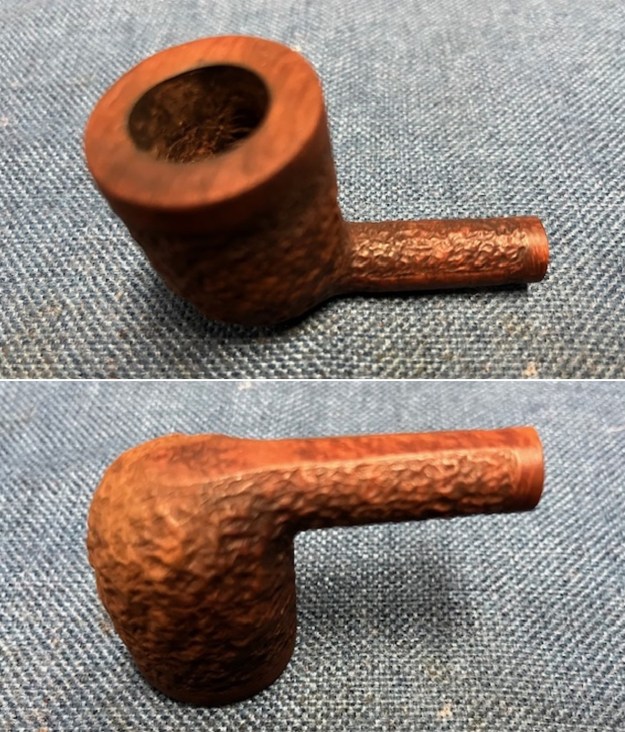
Now it was time to work on the pipe. I started my work on the pipe by reaming it with a PipNet pipe reamer and cleaning up the reaming with a Savinelli Fitsall Pipe Knife. I scraped the lava built up on the rim top with a small blade. It looked much better after the clean up. I cleaned out the inside of the shank and the airway in the stem with alcohol, pipe cleaners and cotton swabs. I removed the tars and oils with the cleaners and the alcohol. It was a dirty pipe!I scrubbed oxidation on the vulcanite shank extension with Soft Scrub All Purpose Cleanser. I have found that it does a remarkable job in softening and often removing the oxidation. Lot of elbow grease but it is effective. The photos show this step in the process. I scrubbed the surface of the bowl and shank with a tooth brush and undiluted Murphy’s Oil Soap to remove the debris and dust in the depths of the rustication. I cleaned out the shank again with a shank brush and the soap. I rinsed it with warm water. I dried off the briar with a soft cloth. It looked very good at this point in the process. After doing this I wondered if I should not have done this before the Soft Scrub. But oh well – hindsight is 20/20. I sanded the bowl, rim and shank extension with 320-3500 grit 2 x 2 inch sanding pads to minimise the scratches and marks in the surface of the briar and to further work on the oxidation on the vulcanite extension. I polished the bowl and the vulcanite shank end with 1500-12000 grit micromesh sanding pads to give it a deep shine. I wiped down the bowl and shank with an Obsidian Oil impregnated cloth after each pad. The briar and rubber began to shine! I worked some Before & After Restoration Balm into the surface of the briar with my fingertips and a horsehair shoe brush to get in the twin rings around the cap. The product works to clean, enliven and protect the briar. I let the balm sit for a little while and then buffed with a cotton cloth to raise the shine. The photos show the bowl at this point in the restoration process. I set the bowl aside and turned my attention to the stem. I scrubbed the surface with Soft Scrub Cleanser and cotton pads. I was able to remove much of the oxidation. The rest would come off using other tricks.I “painted” the stem surface with the flame of lighter to lift the tooth marks on the top and underside ahead of the button. It worked fairly well but some of the larger ones though they had come up a bit were still an issue.I filled in the deep tooth marks in the vulcanite with a rubberized black CA glue. Once the repairs cured I used a small file to flatten the against the surface and clean up the sharp edge of the button. I sanded the repaired areas with a folded piece of 220 grit sandpaper to further flatten and blend them into the surface. I sanded the stem further with 2×2 inch sanding pads to smooth out the stem surface. I wiped it down with a damp cloth after each sanding pad. I took photos of the stem after the sanding.I touched up the stamping on the top of the stem with white acrylic fingernail polish. Once it dried I scraped off the excess and cleaned up the area around the stamp with a 1500 grit sanding pad. It looked very clean. I polished the stem with micromesh sanding pads – wet sanding with 1500-12000 grit sanding pads. I wiped it down after each sanding pad with some Obsidian Oil. I finished polishing it with Before & After Pipe Stem Polish – both Fine and Extra Fine and buffed it off with a cotton cloth. I am excited to be finishing work this lovely Stanwell Bench Made 33 Bulldog pipe. This is the part of the restoration part I look forward to when it all comes back together, polished and waxed. I put the bowl and stem back together. I polished the bowl and stem with Blue Diamond to polish out the scratches in the briar and the vulcanite. I gave the bowl and the stem multiple coats of carnauba wax. I buffed the pipe with a clean buffing pad to raise the shine. I hand buffed it with a microfiber cloth to deepen the shine. The pipe polished up pretty nicely. The medium brown stained bowl looks really good with the polished black vulcanite. This Stanwell Regd. No Bench Made 33 Bulldog was another fun pipe to work on. It really has that classic Danish look that catches the eye. The brown stain really makes the pipe look attractive. It is another comfortable pipe to hold in the hand. The finished pipe is shown in the photos below. The dimensions of the pipe are Length: 5 ½   inches, Height: 2 inches, Outside diameter of the bowl: 1 ¼ inches, Chamber diameter: ¾ of an inch. The weight of the pipe is 1.55 ounces/46 grams. If you are interested in carrying on the previous pipeman’s legacy with this pipe send me a message or an email. Thanks for reading this blog and my reflections on the pipe while I worked on it. As always questions and comments are appreciated.