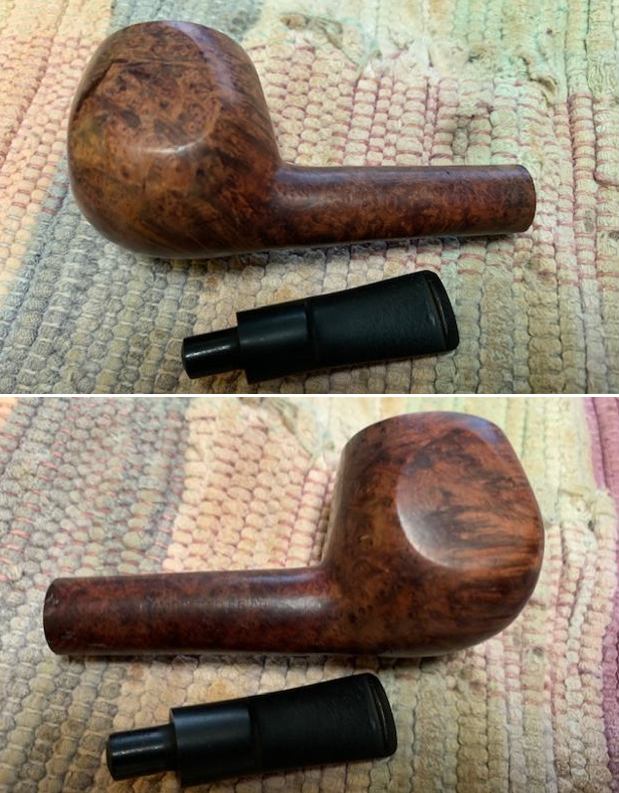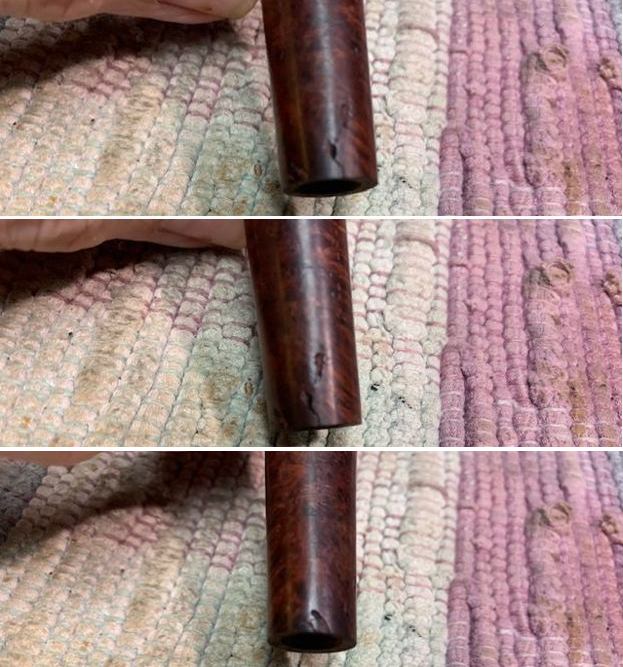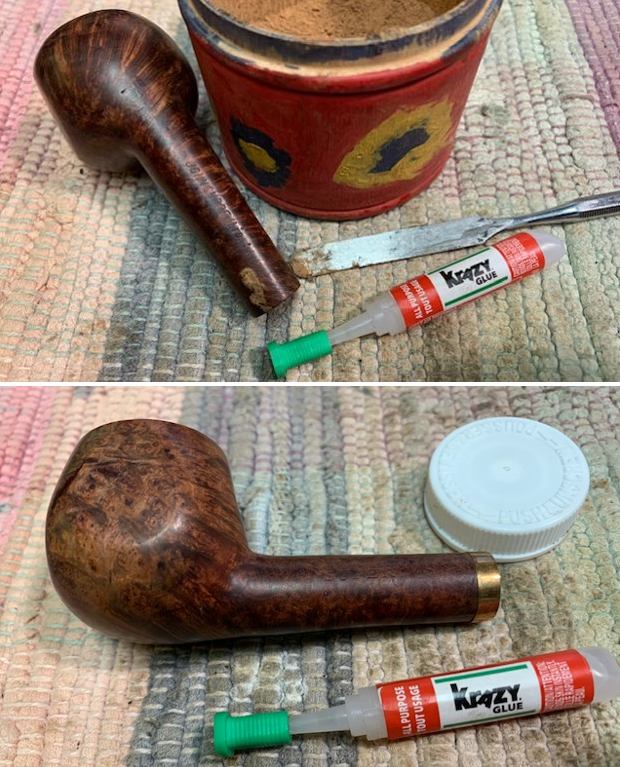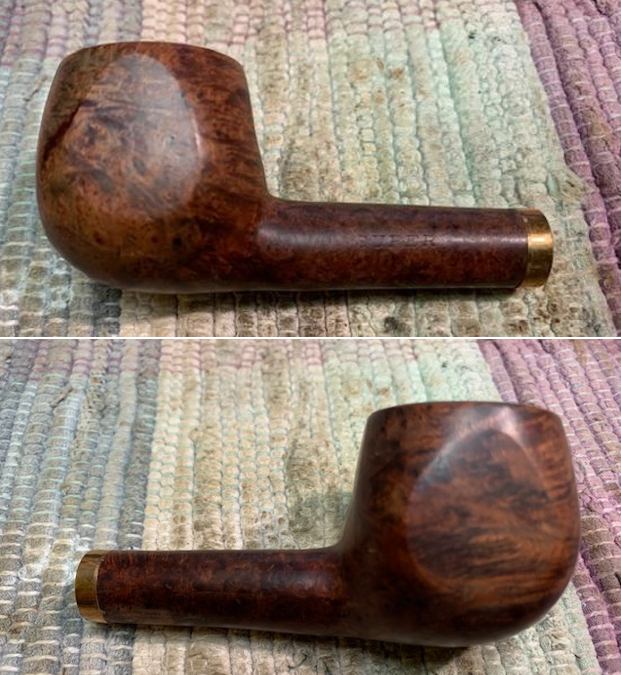
Tag Archives: super glue

Refurbishing System Pipe From Savinelli…A “Dry System” # 2101


Blog by Paresh Deshpande

Since the time I completed the pipes selected by Karthik, last of the lot was a lattice design meer (Refurbishing Karthik’s Second Selection – A Stacked Lattice Design Meerschaum | rebornpipes), I have completed another 13 odd pipes that had reached me for repairs and restoration. Each had its own set of challenges which were relatively easy to overcome. What was difficult, however, was dealing with the owner’s instructions as to how I should carry out the repairs, which were very frustrating. Just imagine, a beautiful Brakner that required a tenon replacement to maintain its originality and value and the owner wanted me to replace the stem as it would be cheaper and faster!! Of course, the heart of a restorer won over the mind of repairman and I did a tenon replacement.

Moving on, the next pipe that I chose to work on came to me from Steve!! SURPRISED? Well, the truth is that I was on a lookout for a Savinelli Dry System pipe as I was keen to try one and experience the difference between the Pete System pipe and the Savinelli System pipe. Steve and Jeff had been on a road cum pipe hunting trip and had come up with a rich haul of some cool pipes. We worked out a mutually beneficial deal and just when Steve was to send the parcel, COVID happened….. A wait of more than a year and the parcel with selected pipes reached me when I was under shifting to present location. Another wait of settling down period and the pipe finally made its way to my work table.

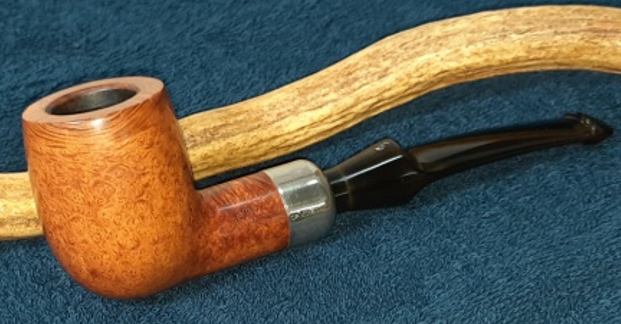
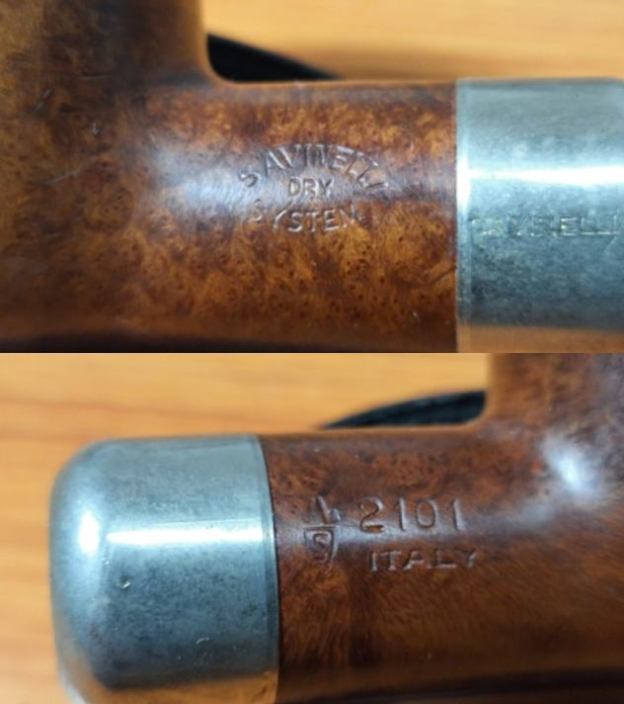
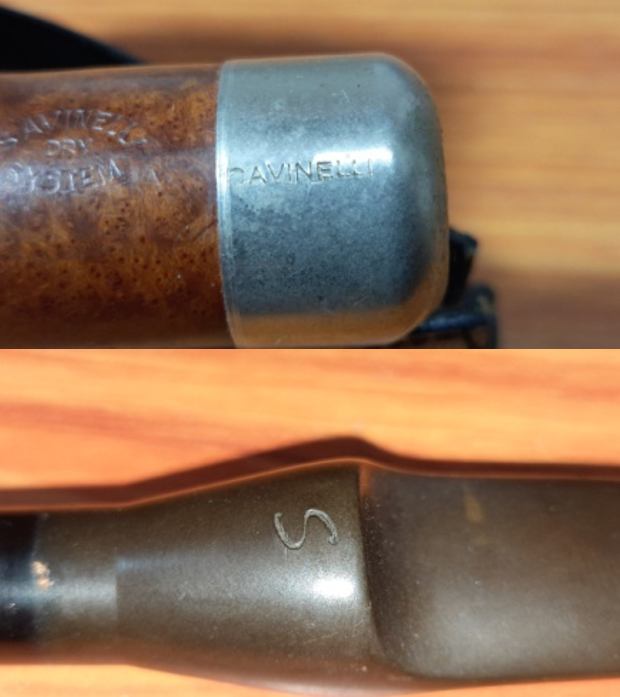
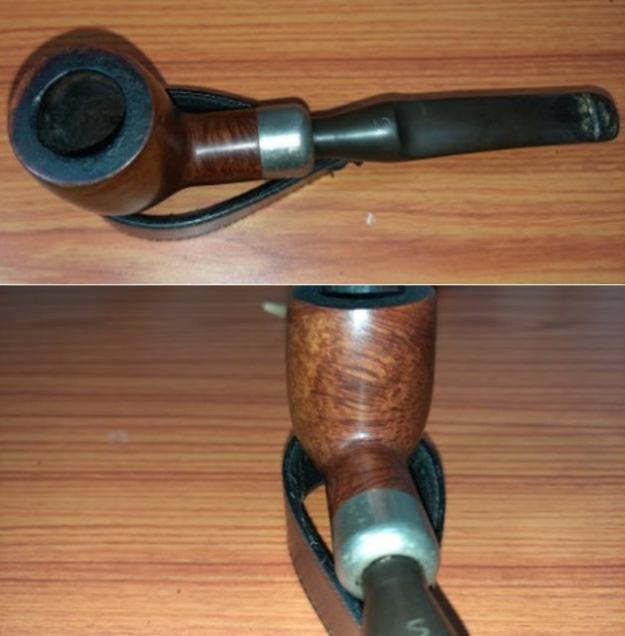
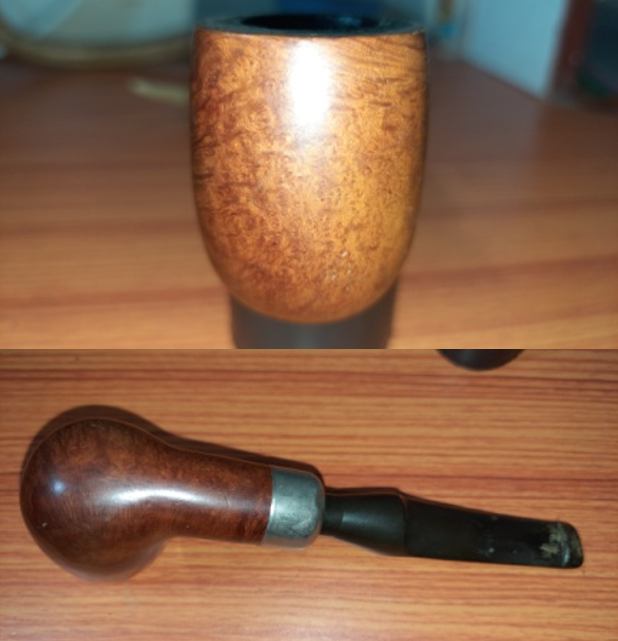
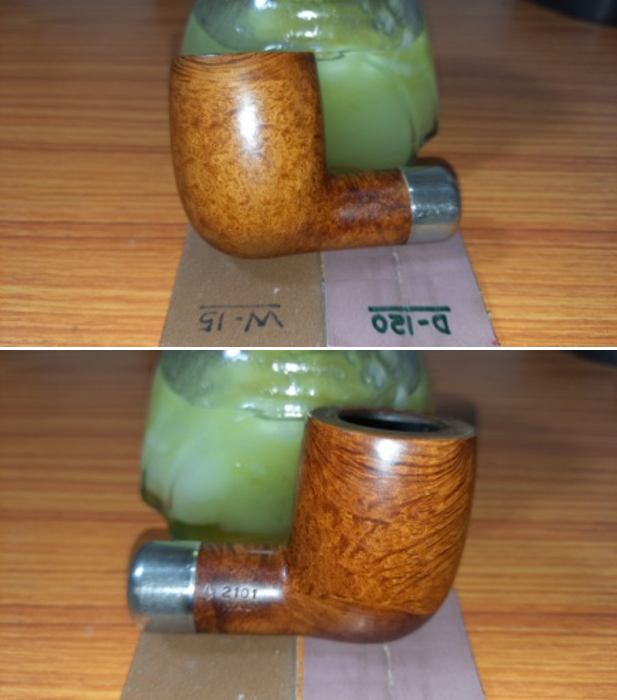
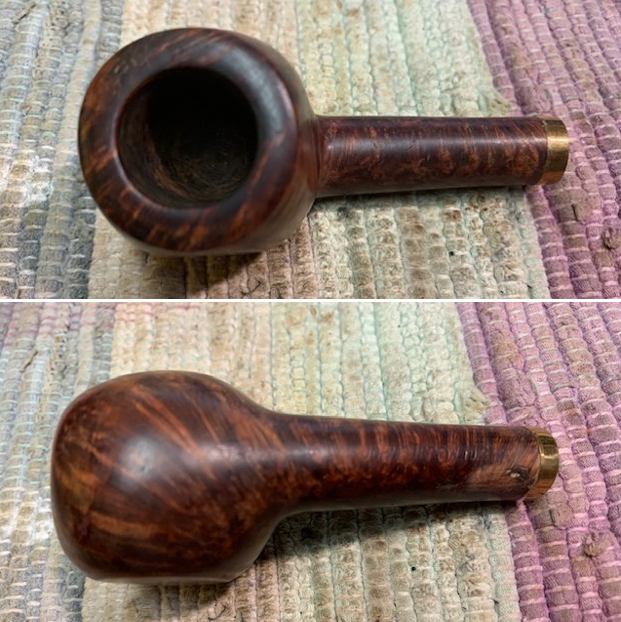
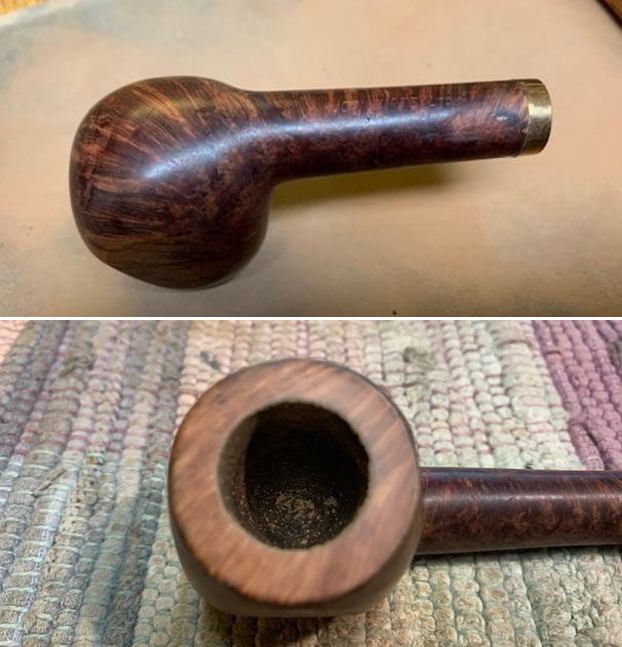
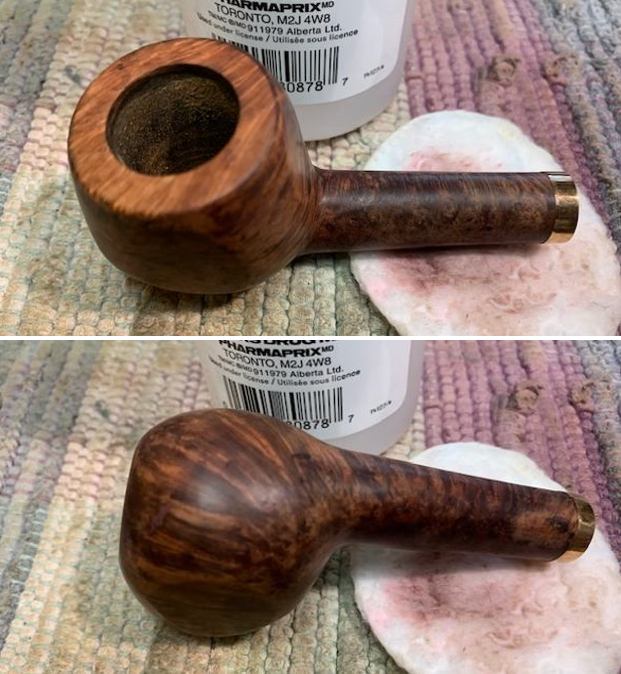
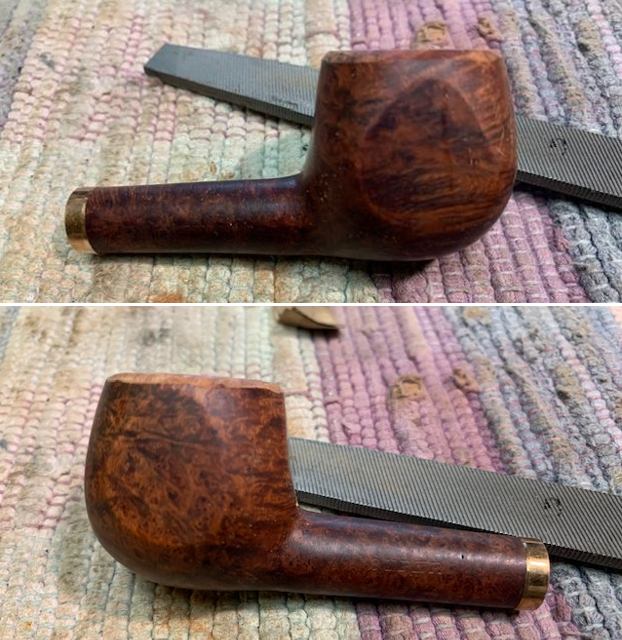
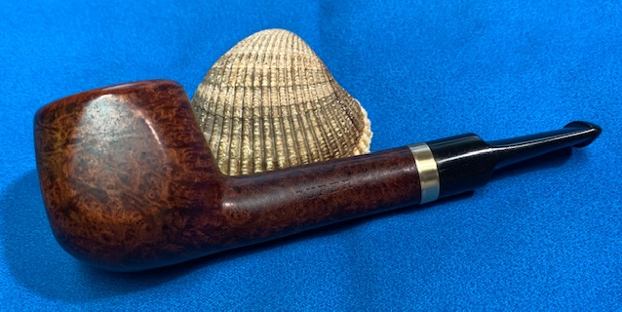
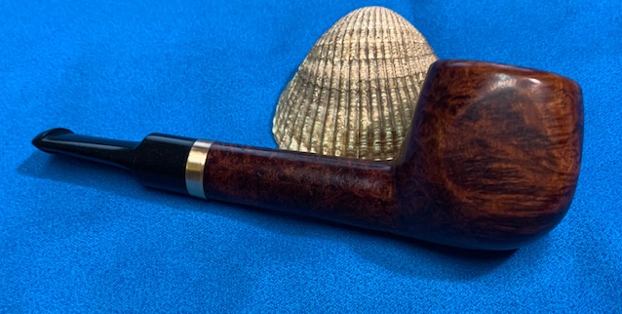
I love classic shaped pipes and this one has a classic Billiard shape with a substantial sized chamber and thick walls. Save for a bald patch that is seen at the lower half over the right side of the stummel, the stummel boasts of plenty of Bird’s eye and cross grain across the surface. It is stamped on the left side over the shank as arched “SAVINELLI” over “DRY” over reverse arched “SYSTEM” forming the shape of a rugby ball. The right side of the shank bears the shape code # 2101 over the COM stamp “ITALY” towards the bowl while the Savinelli trademark “S” in shield is to the left of the shape code towards the ferrule end. The nickel ferrule is stamped on the left as “SAVINELLI” in capital letters. Letter “S” adorns the top face of the saddle of the vulcanite stem. The stampings are all crisp and easily discernible. I searched rebornpipes to see if I could find any information on this pipe, as I invariably always do, to save time in digging out information about the brand. And true enough, my friend Dal Stanton, aka The Pipe Steward, had worked on a Dry System pipe from Savinelli, albeit a sandblasted one. The research done by Dal is always very detailed and comprehensive to an extent that there is hardly any information that he has missed out. To avoid the proverbial reinvention of the wheel, I have included the link here for those interested in knowing more about this offering from Savinelli (and a big thank you to Dal goes without saying!)

Recommissioning a Smart Savinelli Dry System 3621 Bent Dublin | rebornpipes

With a better understanding of this line from Savinelli, I move ahead with my visual inspection of the pipe.

Initial Visual Inspection
The first thing that you notice is the size and heft of the pipe in hand; it’s a lot of pipe for sure! The chamber walls are nice and thick with a thin layer of cake in the chamber. The rim top surface has thick layer of lava overflow, which given the layer of cake in the chamber is mystifying. The flow of air through the pipe is not very smooth and full. The interestingly grained stummel surface is covered in dirt, dust and grime with a number of dents and dings signifying extensive and uncared for usage. The vulcanite saddle stem is heavily oxidized with damage to the button and in the bite zone. The following pictures will give the readers a rough idea to the general condition of the pipe. Dimensions Of The Pipe
(a) Overall length of the pipe: –          6 inches.

(b) Bowl height: –                               1.9 inches.

(c) Inner diameter of chamber: –         0.7 inches

(d) Outer diameter of chamber: –        1.3 inches

Detailed Inspection Of The Pipe And Observations
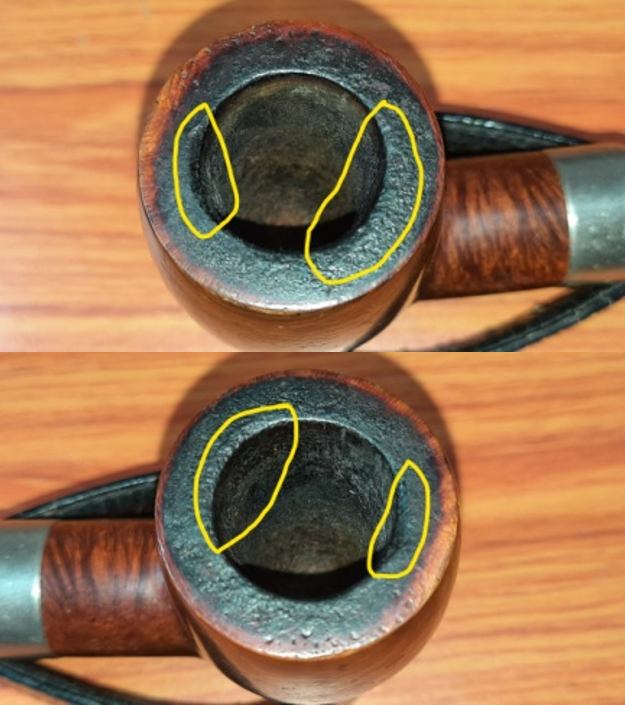
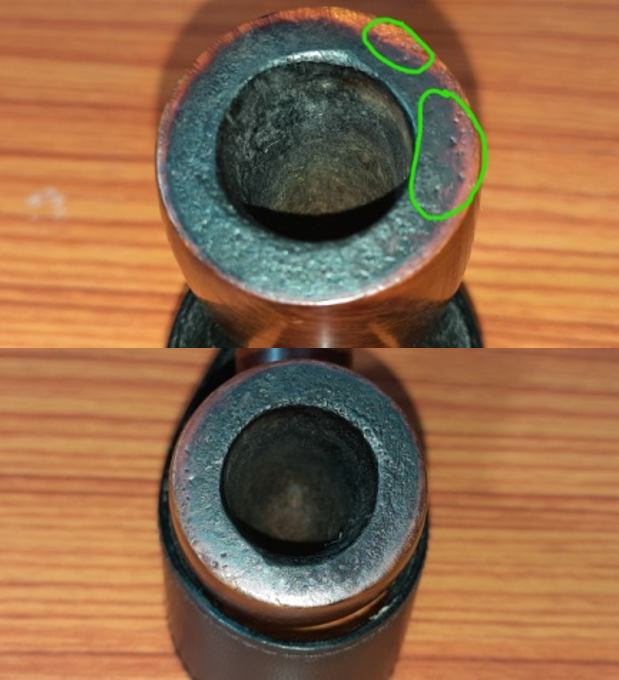
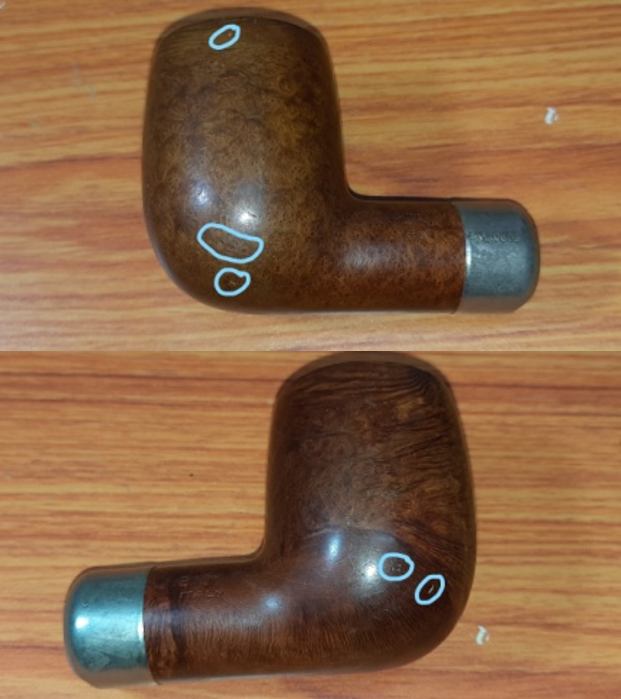
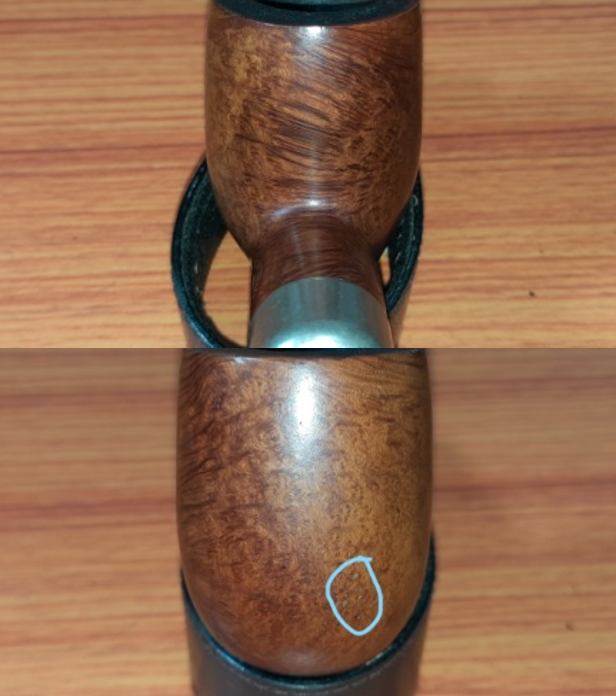
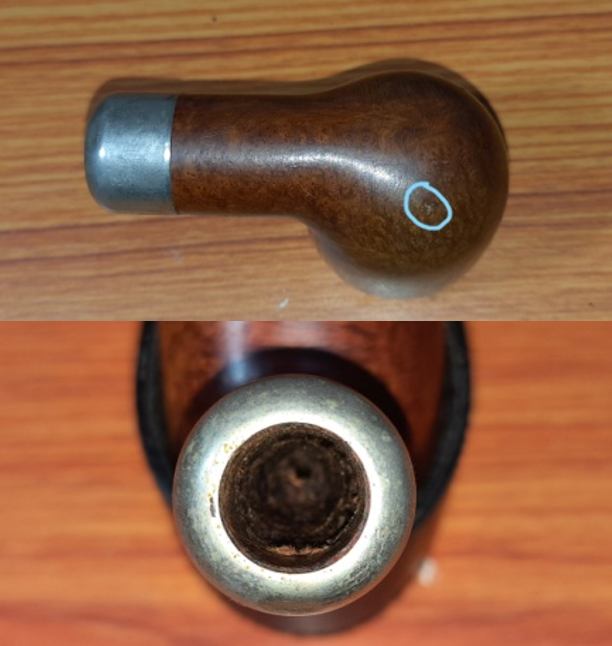
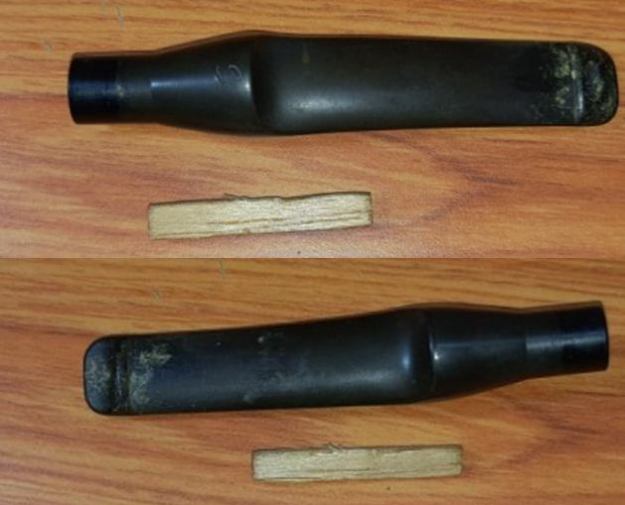
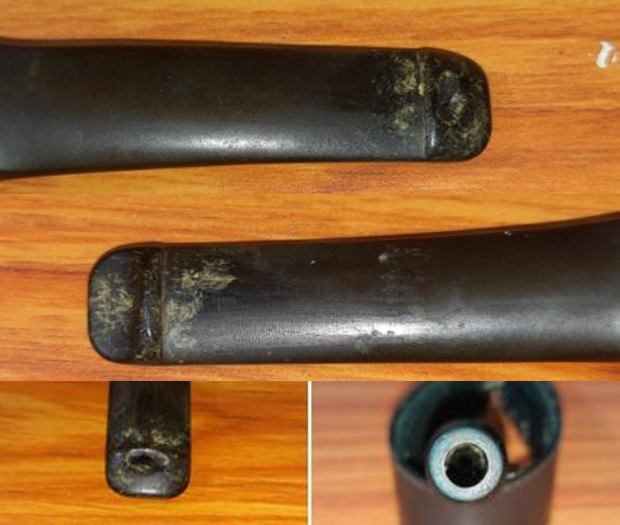
The chamber has a thin crust of carbon over the chamber walls suggesting that the chamber had been reamed in the recent past. The chamber walls are sans any damage and has years of smoke left in it. However, the thick layer of lava crust over the rim top surface has me surprised as it is an indicator of heavy usage while the chamber is neatly reamed! Through the lava crust, suspected charring to the inner rim edge is observed in the 12 and 6 o’clock direction (encircled in yellow). A number of dents are visible over the rim top surface (encircled in green), probably a result of knocking against a hard surface edge. The exact extent of damage and the condition of the rim surface will be apparent once the lava crust is completely eliminated from the top surface. The geometry of the pipe is spot on with the draught aperture in dead center and at the bottom of the chamber and that makes me believe that it should smoke smoothly. The ghost smells of the previous tobacco is not very strong and should be completely eliminated once the cake has been removed and the shank internals are thoroughly cleaned. The substantial briar estate is sans any fills and boasts of beautiful Bird’s eye grain to the sides and cross grain to the front and aft of the stummel. The only sore spot over the entire stummel surface is the bald patch that is seen to the right bottom portion. There are numerous dents/ dings over the surface (encircled in pastel blue); a testimony of all the falls this pipe has endured during its existence. The surface is mired in grime and dirt and appears dull and lackluster. The well and mortise is not very dirty and should clean up easily. The nickel ferrule has absolutely no damage but is oxidized with age. This should clean up nicely. The high quality vulcanite stem is so heavily oxidized that it appears dirty green in color! Some minor tooth chatter and deep bite marks are seen on either surfaces of the stem in the bite zone. This issue should not be a major headache to address. The upper surface edge of the large horizontal slot appears damaged, extent of which can be ascertained after the clogged slot has been cleaned up. The lip edge on both sides has bite marks and would need to be reconstructed and reshaped. The wide tenon that houses a 6mm Balsa filter has accumulated oils and tars that have dried out on the inside. The bite zone has calcium deposits which will have to be cleaned. The Process
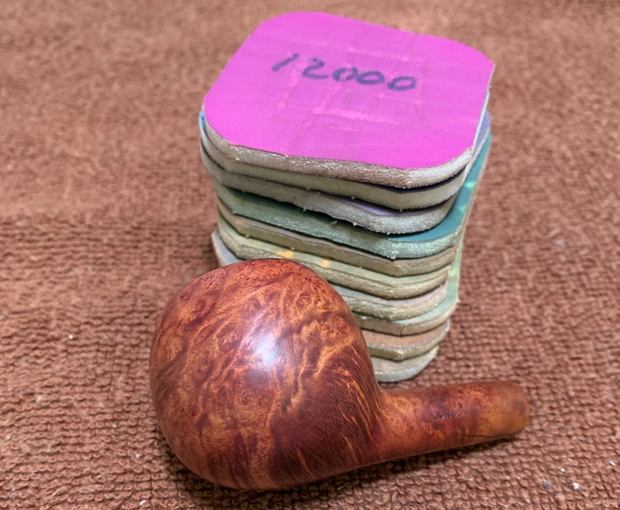
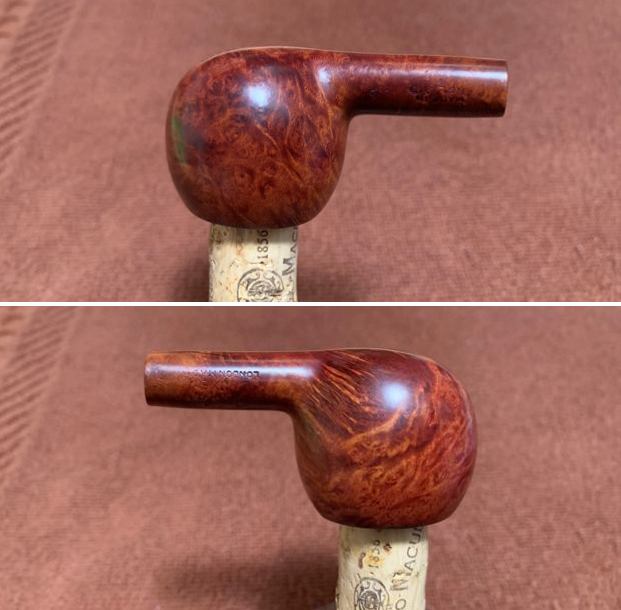
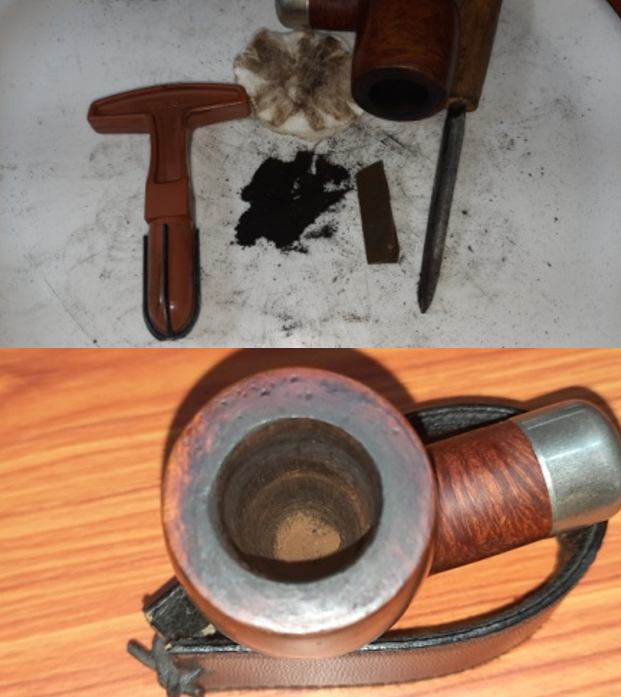
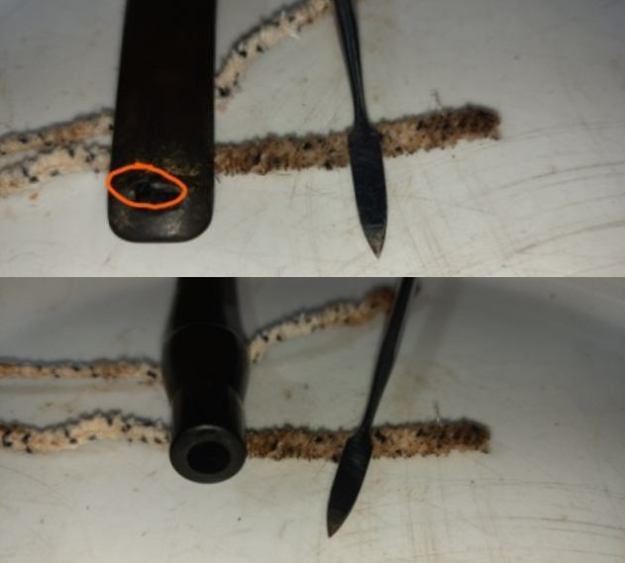
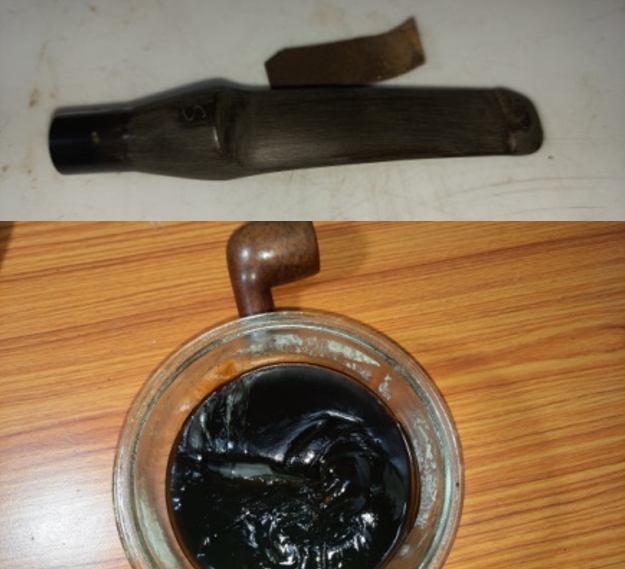
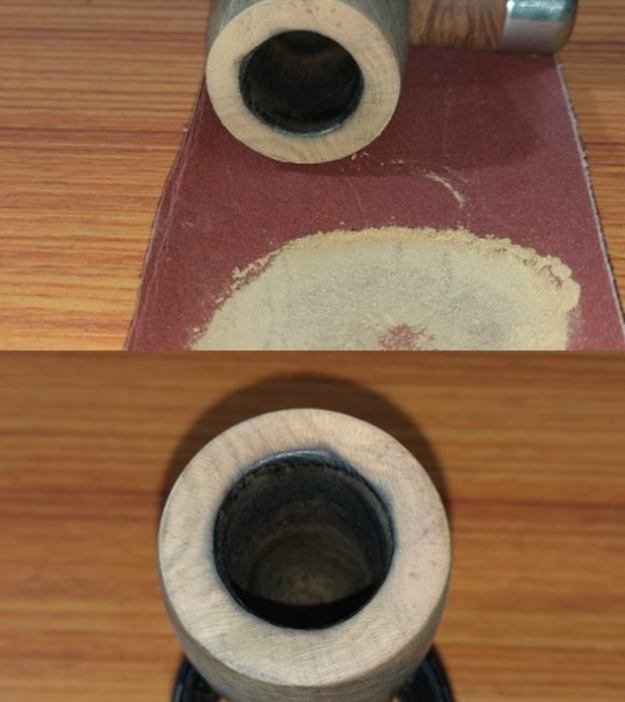
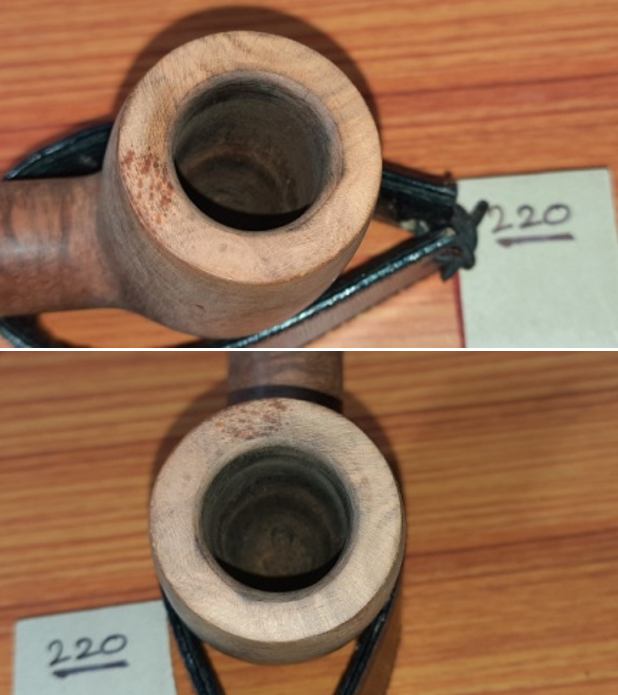
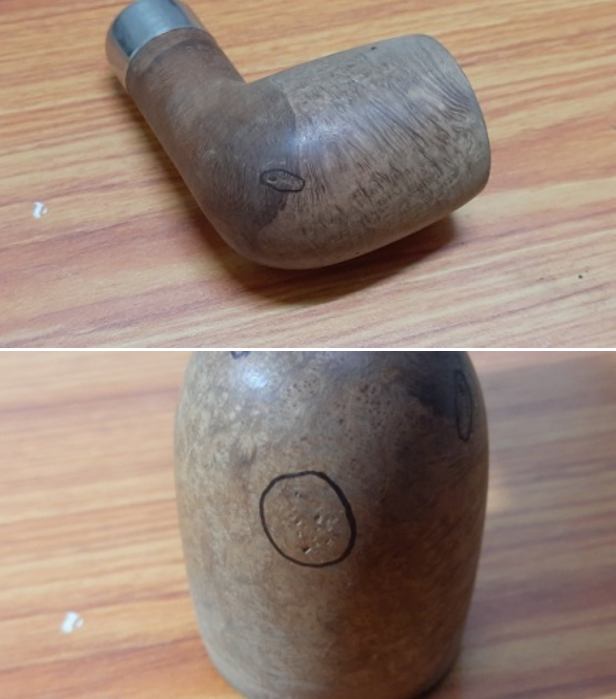
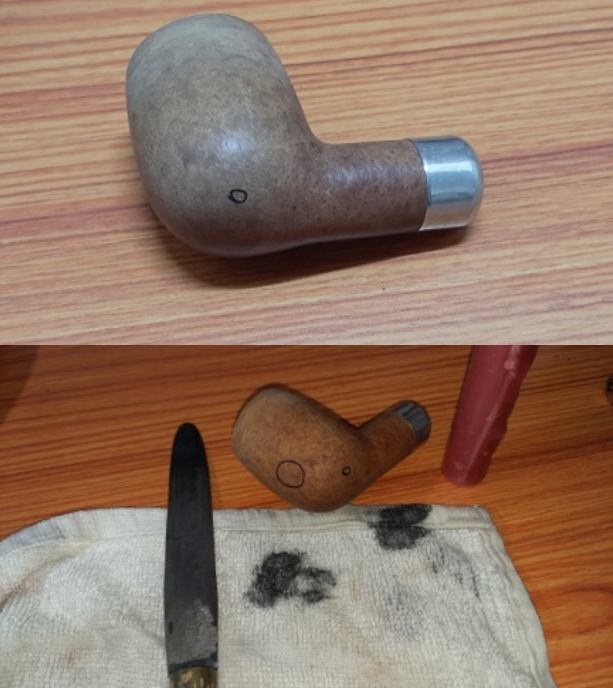
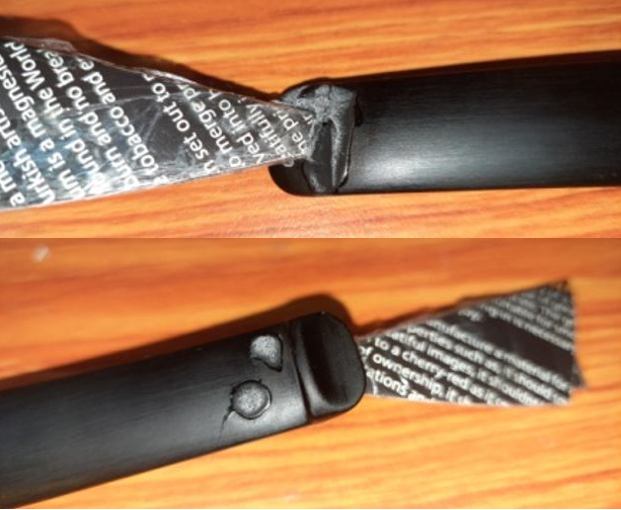
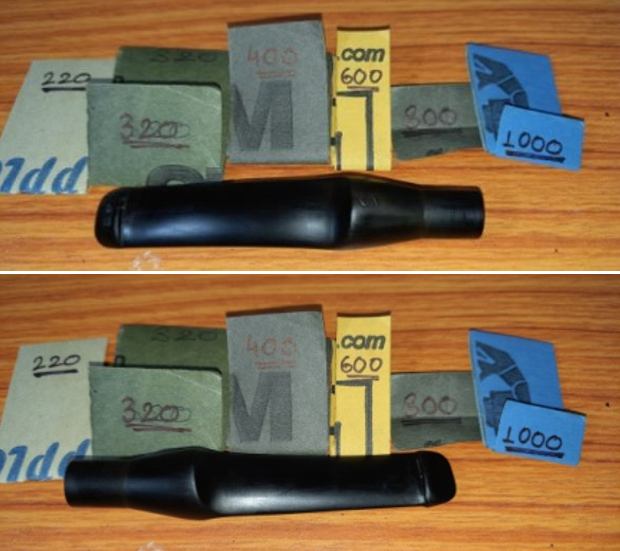
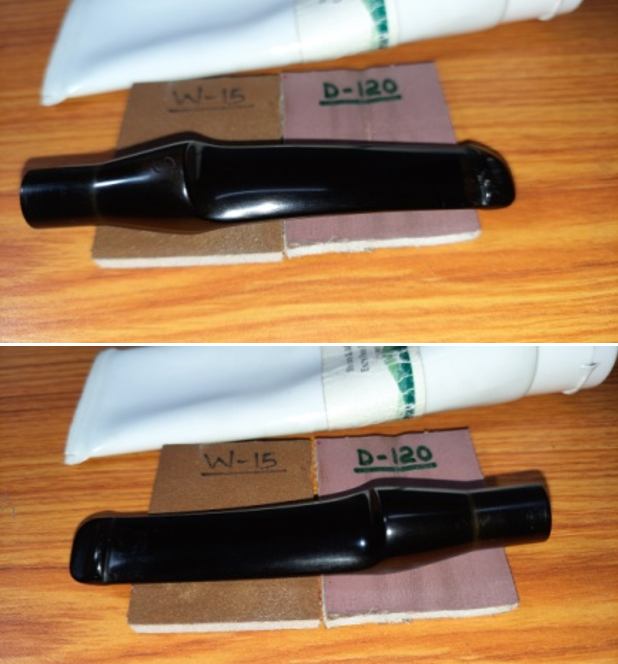
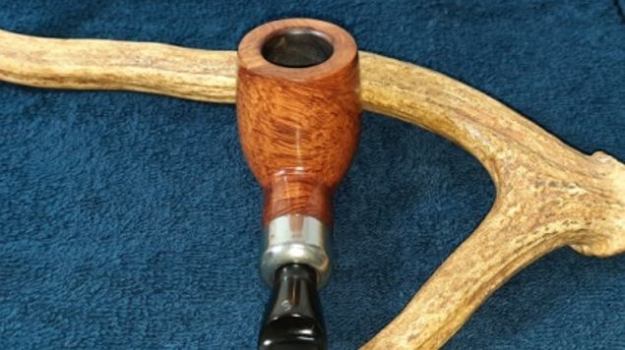
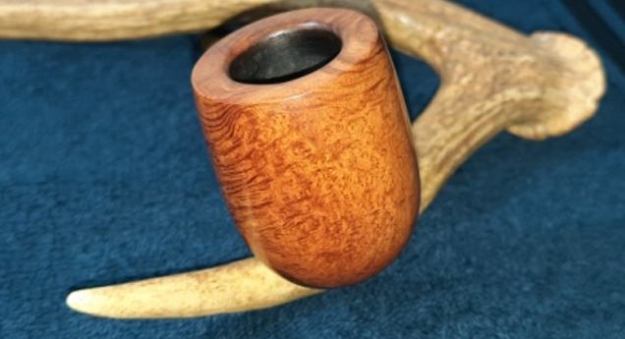
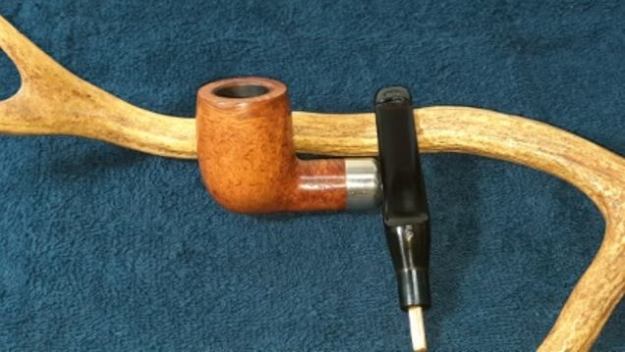
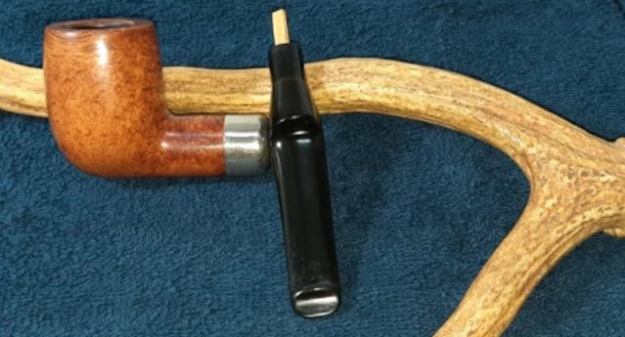
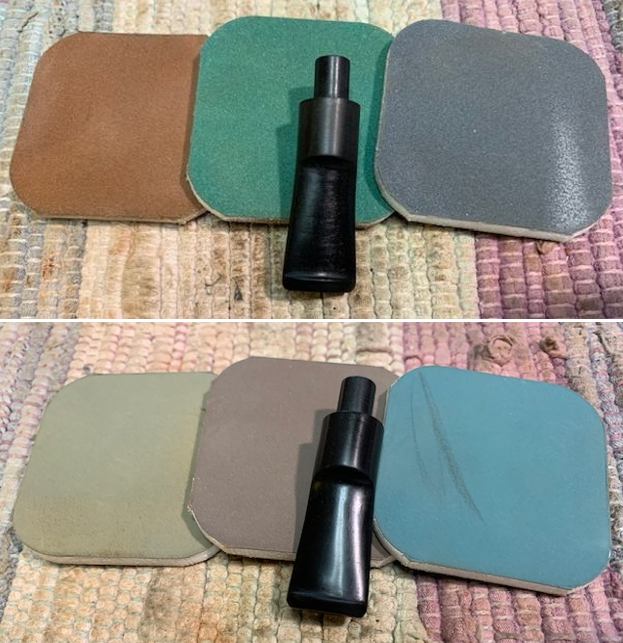
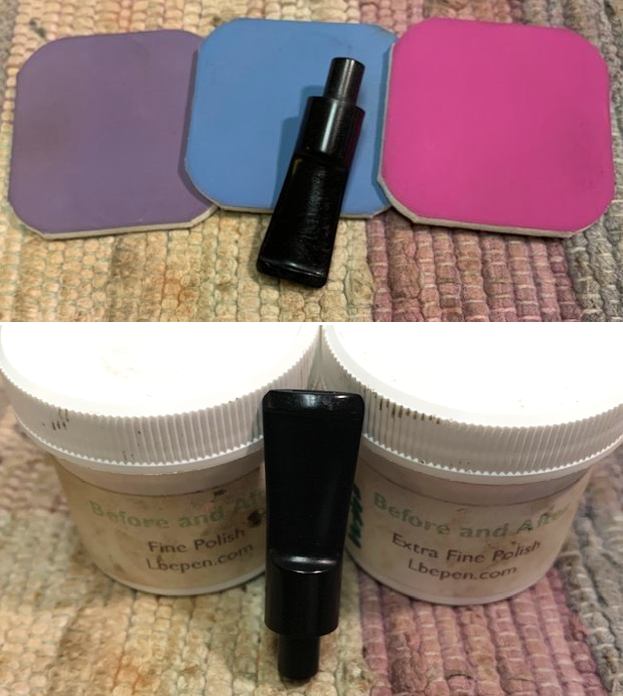
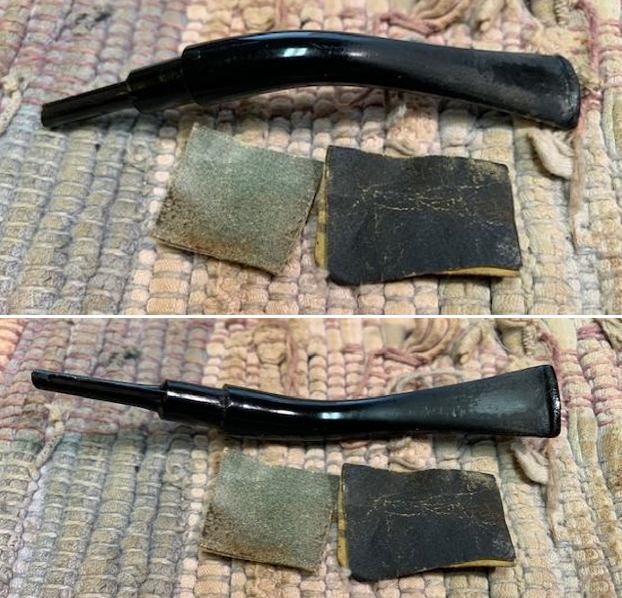
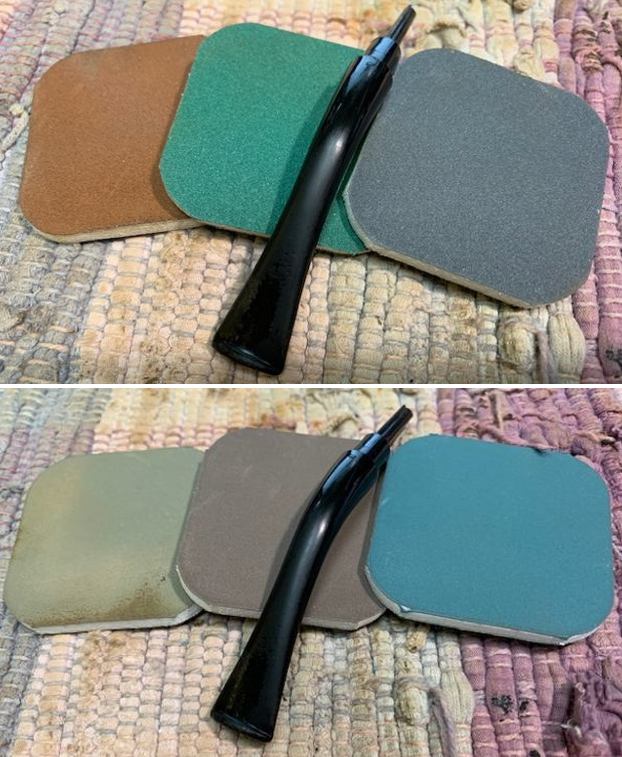
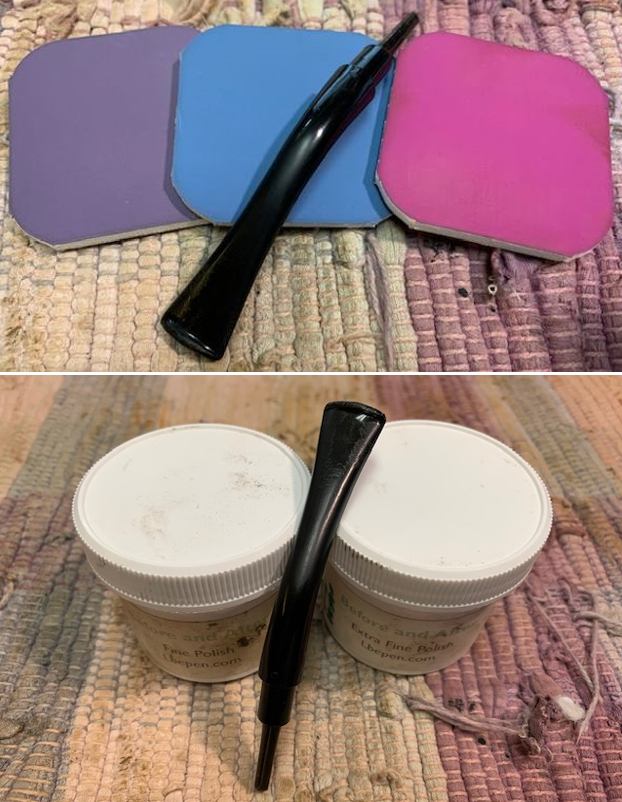
I started the restoration of this pipe by first reaming the chamber with size 2 head of a PipNet reamer followed by scraping with my fabricated knife to remove the carbon deposits. I scraped off the crusted lava from the rim surface with the fabricated knife. Once the cake was scraped back to the bare briar, I used a 220 grit sand paper to remove all the traces of remaining cake and also to smooth out the inner walls of the chamber surface. Finally, to remove the residual carbon dust, I wiped the chamber with a cotton pad wetted with 99.9% pure isopropyl alcohol. The chamber walls are in pristine condition. The char to the inner rim edge in the 12 o’clock direction is severe and would need to be addressed. The smells from the chamber have greatly reduced. The walls are nice and stout and should provide a cool smoke. The dents/ dings to the rim surface are now amply evident and the best way to address this would be to top the surface.This was followed by cleaning the mortise with pipe cleaners and q-tips dipped in isopropyl alcohol. I scraped the walls of the mortise with my dental tool to remove the dried oils and tars. The mortise needs further cleaning with anti-oil dish washing detergent and shank brush and will be done once the external surface of the stummel is cleaned. This helps me in saving a heap of pipe cleaners, which is a very precious commodity here in India.Next, I cleaned out the stem internals. I ran a couple of pipe cleaners dipped in isopropyl alcohol through the stem air way. Unfortunately the pipe cleaner couldn’t pass through completely. I realized that the large slot on the upper surface was clogged and the airway compressed due to tooth indentation. Using a dental tool, I tried prying out the blockage from the slot and realized that there was broken edge of the slot that was glued back and the reason for the blockage. With a bit of effort and lots of care, the broken piece was removed. I would now have to rebuild the top surface of the large horizontal slot. I would later try to open the airway by heating and thus expanding the compressed area with the flame of a lighter.I sanded the entire stem surface with a 220 grit sand paper in preparation for subjecting it to the deoxidizer solution treatment. It has been our experience that the deoxidizer solution works most efficiently in removing oxidation when a stem has been sanded prior to immersion in the solution. I immersed the stem in the deoxidizer solution developed by Mark and set it aside overnight for the solution to do its intended job.The next step was to clean the exterior surface of the stummel. I generously applied Murphy’s oil soap with a hard bristled tooth brush and scrubbed the stummel and rim top with the soap. I washed the stummel under running warm water with anti oil dish washing detergent till the stummel surface was clean and dried it using paper towels and a soft cotton cloth. I deliberately cleaned the rim top with a piece of Scotch Brite pad and set the stummel aside to dry out naturally. The stummel surface has cleaned up nicely with the intricate grain patterns on full display. The brown hues of the rest of the stummel contrast beautifully with the black of the briar grains. These contrasting hues will be further accentuated once the briar is rehydrated and rejuvenated using the balm and subsequent wax polishing. I simultaneously cleaned the shank internals with the detergent and hard bristled shank brush. The ghosting is completely eliminated and the pipe now smells fresh and clean.Staying with the stummel, I decided to address the issues with the rim top surface. The first issue to be addressed was the numerous dents and dings over the rim top. I rotated the rim top on a piece of 220 grit sand paper, checking ever so frequently for the progress being made. Once, I was satisfied that the rim top was an even and smooth surface, I stopped. This topping also helped in reducing the charred surface over the inner rim edge. Here is how the rim top appeared at this stage in restoration.The charring to the inner rim in 12 o’clock direction was still evident, albeit greatly reduced and lent the chamber an out of round appearance. To correct this, I created a bevel to the inner edge with a 220 grit sand paper.The third issue with the stummel was that of the numerous dents and dings over the surface which I have marked over the stummel. I steamed out all these dents and dings by heating my fabricated knife on a candle and placing it on a wet towel covering the dents. The generated steam expands the wood fibers and fills the dents up to, or as close as possible to the surface. The steam leaves behind a discolored surface as compared to the rest of the stummel surface. To address this issue and also to even out and match the raised dings with the rest of the surface, I sanded the entire stummel with a folded piece of 220 grit sandpaper. This also evened out the other minor scratches and dings from the surface. I set the stummel aside and turned to address the stem repairs. I removed the stem from the deoxidizer solution and scrubbed it with a Scotch Brite pad followed by a 0000 grade steel wool scrub. This helps to remove the oxidation that is raised to the surface by the solution. Patches of deep seated oxidation over the stem surface could still be seen as dirty brownish green color and would be addressed by subjecting the stem to further sanding by progressively higher grit sand papers.Next, I used a 220 grit sand paper to sand the stem and removed all the oxidation from the surface. Using a lighter, I flamed the surface of the stem. This helped in raising some of the tooth chatter and bite compression from the slot to the surface as vulcanite has a property to regain its original shape on heating. I wiped the stem with Murphy’s Oil soap on a cotton swab. This cleaned up the stem surface while removing the loosened oxidation.I reconstructed the broken slot end with a filling of CA superglue and activated charcoal after I had inserted a folded plastic coated visiting card. This prevented the fill from seeping in to the air way and clogging it once it had cured. I set the stem aside for the fill to harden before I could proceed with the sanding, shaping and polishing of the stem. While I worked the stem, Abha polished the stummel with micromesh pads, wet sanding with 1500 to 12000 pads. She polished the freshly topped rim surface to a nice luster, wiping the surface with a soft cloth at the end of the micromesh cycle. The stummel looks amazing with a deep shine and beautiful grains popping over the stummel surface. She massaged a small quantity of “Before and After Restoration Balm” with her fingers into the briar. The immediate and incredible transformation that takes place is a worthy reward for all the efforts!!! She let the balm sit on the surface to be absorbed in to the briar for about 20 minutes. The bowl now looks fresh and attractive with the grains popping out any which way you look at the briar. She polished off the balm with a soft cloth to a lovely shine. I am surprised that the rim top surface has the same deep brown coloration as the rest of the stummel surface and that the use of a stain pen was not required. With the stummel rejuvenation almost complete, save for the final wax polish, I worked the stem. The fills had cured and with a flat head needle file, I worked on the fill till I had achieved a rough match with the surrounding surface and had sufficiently sharpened the button edges. For a better blending, I further sand the entire stem with 220 followed by 400, 600, 800 and 1000 grit sand paper. This helps to reduce the scratch marks left behind by the more abrasive 220 grit paper. Even the best of my efforts at the repairs, these did not blend in to the rest of the stem surface and can be noticed with a keen eye. There are stems which do not take to repairs easily and seamlessly and this definitely is one of those.To bring a deep shine to the vulcanite stem, I went through the complete set of micromesh pads, wet sanding with 1500 to 2000 grit sandpapers and dry sanding with 3200 to 12000 grit pads. At the end of micromesh cycle, I polished the stem with “Before and After Fine & Extra Fine” paste. The finished stem is shown below.This now gets me to that part of the process where I get to savor the fruits of our labor until this point. The final polishing with Blue Diamond and Carnauba wax!
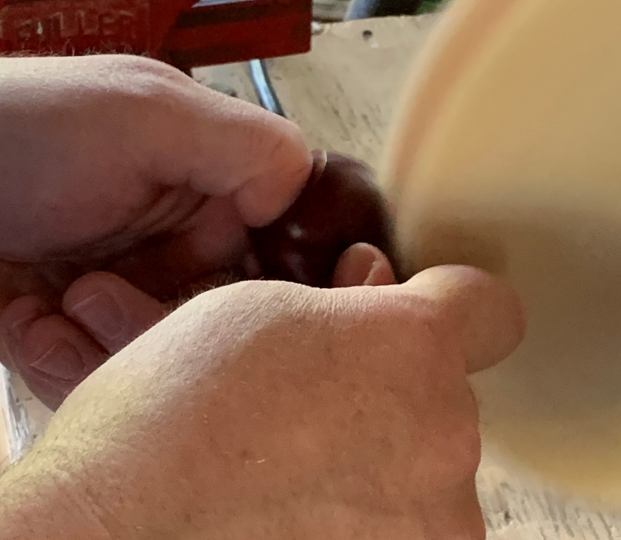
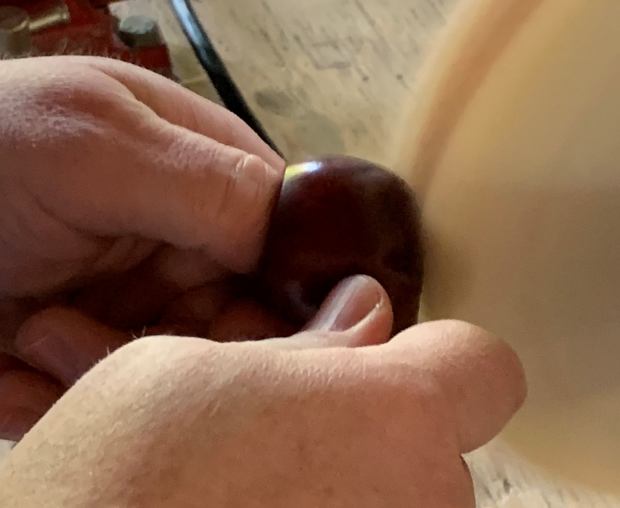
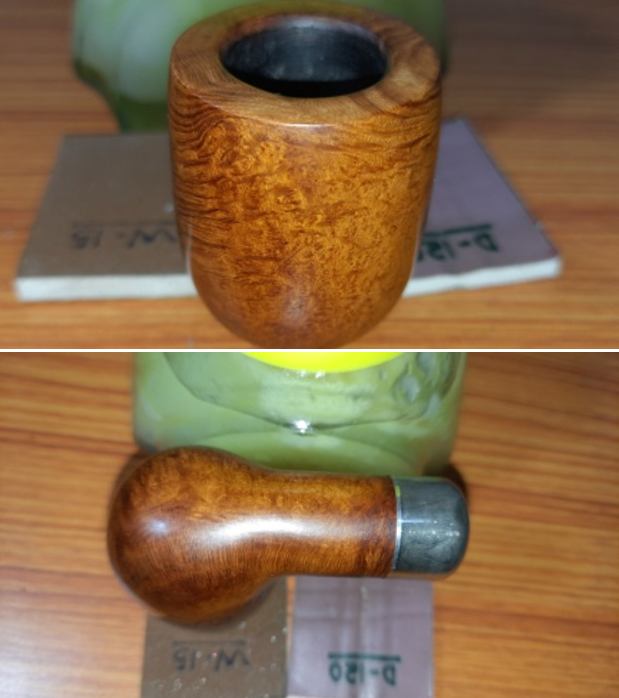
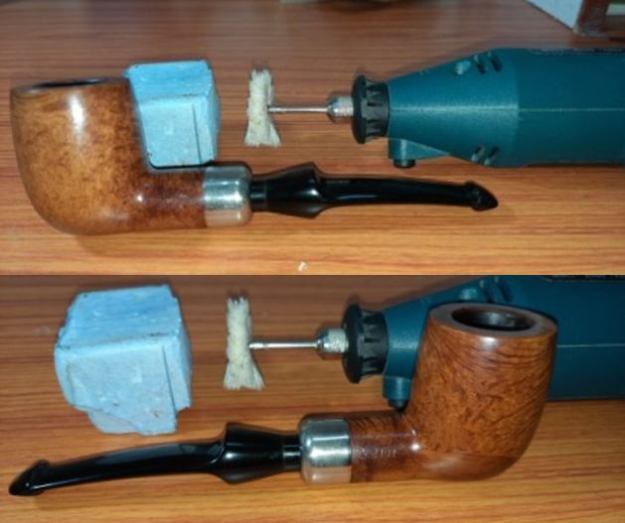
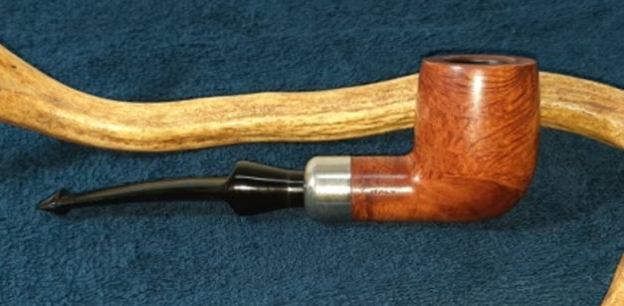
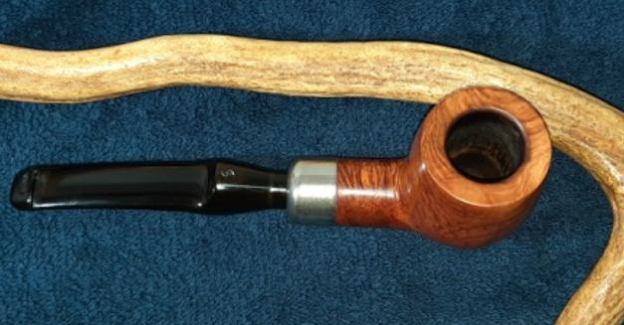
I began the final polishing cycle by mounting a cotton cloth buffing wheel on to my hand held rotary tool and applied a coat of Blue Diamond to the stummel and the stem to polish out the minor scratches.With a cotton buffing wheel that I use for carnauba wax, I applied a coat of carnauba wax and continued to work on it till the complete coat of wax had been polished out. I mounted a clean cotton cloth buffing wheel and gave the pipe a once over buff. I finished the restoration by giving the entire pipe a rigorous hand buff using a microfiber cloth to raise the shine further. The finished pipe is as shown below 🙂 P.S. I enjoyed working on this pipe alongside my wife, Abha. Her expertise and dedication in polishing the stummel and stem lends a finish that I always seek in all my restorations. And not to forget her editing of the write up to eliminate all the spelling and grammatical errors!

Well, as for this handsome pipe, I am not very sure if I want to hold on to it as since receiving this Savinelli System pipe from Steve, I have acquired another similar pipe with a Cumberland stem. Do let me know if this pipe interests you and we can take it further from thereon.

I wish to thank each one for sparing their valuable time to read through this write up while also praying for the health and safety of entire mankind. Stay home…stay safe!!

New Life for a Butz-Choquin Regate 1282 Zulu


Blog by Steve Laug

The next pipe on the table is one that came to us from Australia. It went to Jeff first then was shipped to me. It is a well traveled pipe that was purchased in 2020 from the estate of a fellow pipeman in Australia, shipped to the US and then to Canada. The shape is very nice, with the forward canted bowl and the quarter bent stem. It is a great shape with a taper vulcanite stem. The finish was dirty with grime ground into the finish around the bowl sides. There was a thick cake in the bowl and lava overflow on the top of the rim – heavier on the backside of the rim top but nonetheless on the entire rim top. There was some burn damage on the right front inner beveled edge of the bowl. The pipe is stamped on the left side of the shank and reads Butz-Choquin at an angle [over] Regate. On the right side it reads St. Claude – France [over] the shape number 1282. The stem was lightly oxidized and there were tooth marks and chatter on both sides near the button. The taper stem also has a BC stamped on the left side. Jeff took some photos of the pipe before he started the clean up work. He took photos of the rim top and bowl to give a clear picture of the thickness of the cake and well as the nicks, lava and darkening on the rim top. The inner edges showed some burn damage on the inner bevel of the bowl. The outer edges of the bowl appeared to be in great condition. He also took photos of the top and underside of the stem to show the light oxidation and the chatter and tooth marks. Jeff took a photo the sides and heel of the bowl to give a picture of the beautiful grain around the bowl and shank. There were also shiny spots of varnish around the bowl and shank sides. The stamping on the sides of the shank is clear and readable and read as noted above. There is also BC stamp on the left side of the stem. I turned to Pipephil’s site and looked for information on the Butz – Choquin Regate I was working on (http://pipephil.eu/logos/en/logo-butzchoquin.html). As always there was a good, brief description of the history of the brand.

I turned to Pipedia (https://pipedia.org/wiki/Butz-Choquin) to see what I could find on the brand that the Regate line there. I found a catalogue page from Doug Valitchka on the Regate that listed the pipe line and a description (https://pipedia.org/wiki/File:BC10.jpg). I have captured that image below. The description under the Regate heading reads –

Regate (and the description below is in both French and English)

Les veines classique qui rallie les suffrages de la plupart des fumeurs

A great classic which meets with the approval of the majority of smokers.

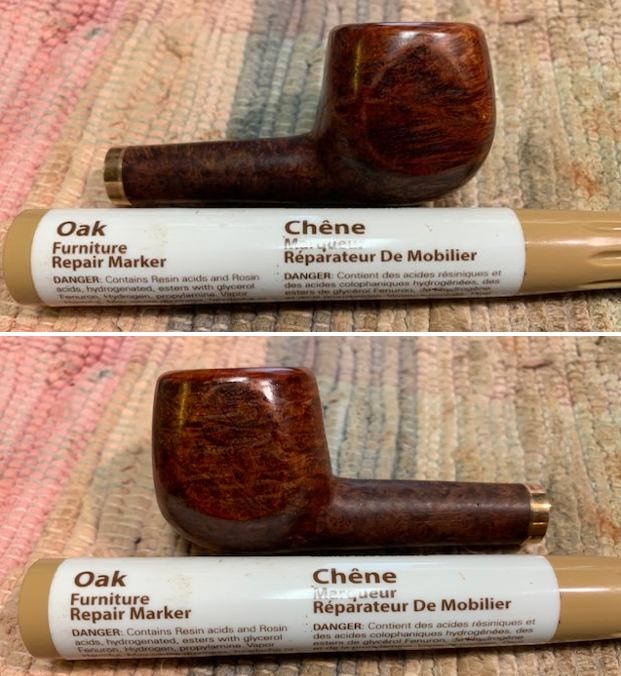
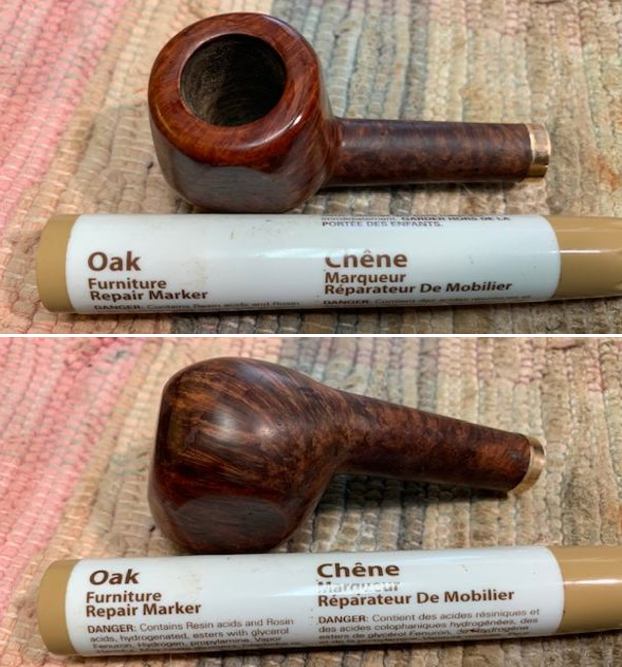
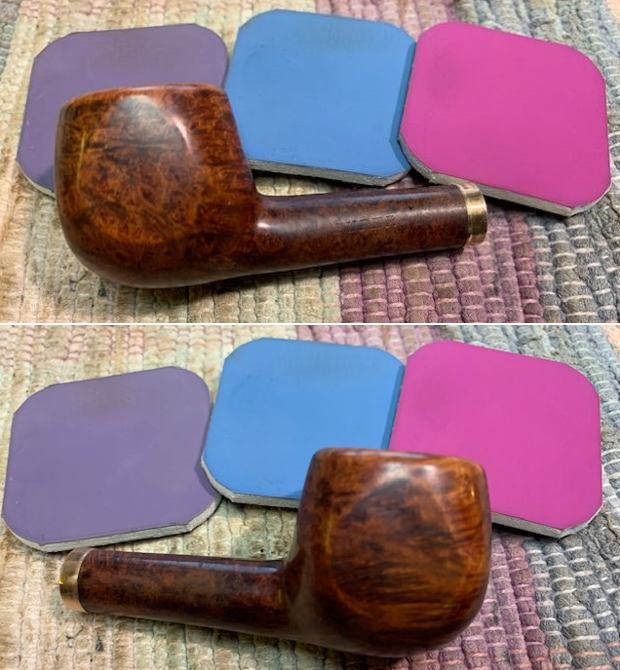
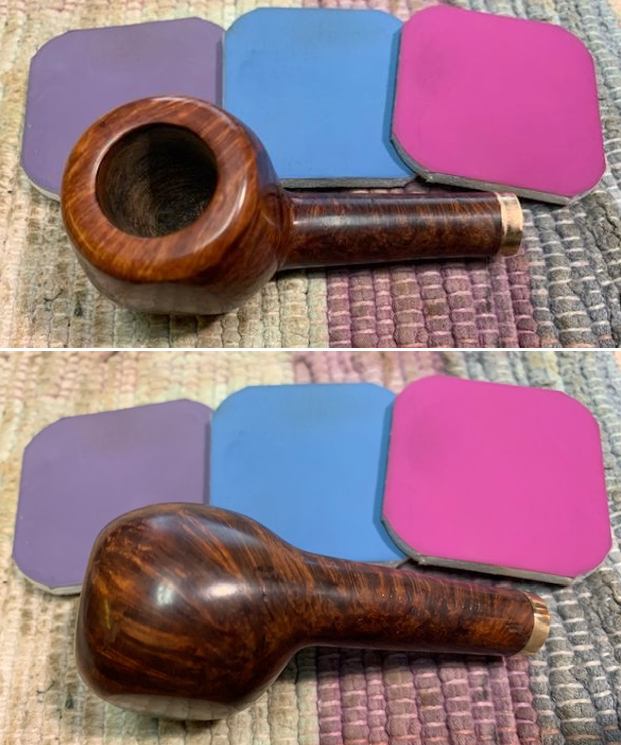
I have also included another picture from Doug Valitchka that shows the shape of the pipe that I am working on (https://pipedia.org/wiki/File:BC06.jpg). It is the second shape that is shown on the page – Shape 1282. The shape is called a Genoises. Now it was time to work on the pipe. Jeff had cleaned up the pipe following his usual procedures. He reamed the pipe with a PipNet pipe reamer and cleaned up the remnants with a Savinelli Fitsall Pipe Knife. He cleaned out the inside of the shank and the airway in the stem with 99% isopropyl alcohol, cotton swabs and pipe cleaners. He scrubbed the exterior of the bowl with undiluted Murphy’s Oil Soap and a tooth brush. He rinsed it under running warm water to remove the soap and grime. He soaked the stem in Before & After Deoxidizer and rinsed it off with warm water. I took photos of the pipe once I received it.  The rim top cleaned up really well. But the cleaning revealed some serious burn damage on the rim top and front inner edge toward the right side. The stem surface looked good and the light tooth marks and chatter would be easy to address. The stamping on the sides of the shank is readable and reads as noted above.I removed the stem and took a photo of the pipe to give a sense of the shape and the grain on the bowl and shank. It was a great looking shape and would be a beautiful pipe when I was finished. I decided to start my work on the pipe by wiping the bowl down with acetone on a cotton pad to remove the heavy stain around parts of the bowl sides. I wanted really be able to see the grain on the bowl. I dealt with the damage to the rim top by topping it on a topping board with 220 grit sandpaper. I cleaned up the beveled inner edge of the rim with 220 grit sandpaper to remove as much of the burn damage as possible. I polished the bowl with micromesh sanding pads – 1500-12000 grit pads. I wiped it down with a damp cloth after each sanding pad.  It was beginning to look good to my eyes. I stained the inner edge and rim top with an Oak Stain Pen to match the rest of the surrounding bowl. It helps to blend in the burned area some more. The rim top and edges definitely look better than when I started.I rubbed the bowl and shank down with Before & After Restoration Balm. I worked it into the surface of the bowl sides and shank with my fingertips to clean, enliven and protect the briar. I let the balm sit for ten minutes then buffed the bowl with a cotton cloth to raise the shine. I set the bowl aside and turned my attention to the stem. I “painted” both sides of the stem with the flame of a lighter to lift the tooth marks. It did a great job and left only one deep mark on the underside and some lighter tooth marks on the topside along the button. I filled them in with clear CA glue and once it cured I used a small file to sharpen the edge of the button and smooth out the repair. I sanded the stem with 220 grit sandpaper to smooth out the repairs. I started polishing it with 400 grit sandpaper.  I used some white acrylic fingernail polish to touch up the BC stamp on the left side of the stem. I painted it on with the brush and once it dried scraped it off and sanded it with a 1500 grit micromesh sanding pad.I polished the stem with micromesh sanding pads – 1500-12000 grit pads. I wiped it down with Obsidian Oil after each sanding pad. I used Before & After Pipe Polish – both Fine and Extra Fine to further polish the stem. This Butz-Choquin Regate 1282 Zulu is a great looking pipe now that it has been restored. The combination of various brown stains around the bowl is quite beautiful and highlights grain very well. The finish works well with the polished curved vulcanite taper stem. I put the stem back on the bowl and carefully buffed the pipe with Blue Diamond on the buffing wheel using a light touch on the briar. I gave the bowl and the stem multiple coats of carnauba wax on the buffing wheel and followed that by buffing the entire pipe with a clean buffing pad. I hand buffed the pipe with a microfiber cloth to deepen the shine. The finished Butz-Choquin Regate Zulu sits nicely in the hand and feels great. Give the finished pipe a look in the photos below. The dimensions of the pipe are Length: 6 inches, Height: 1 ¾ inches, Outside diameter of the bowl: 1 ¼ inches, Chamber diameter: ¾ inch. The weight of the pipe is 35 grams/1.23 ounces. I will be putting it on the French Pipemakers section of the rebornpipes store shortly. If you are interested in adding this pipe to your collection send me a message or an email. Thanks for reading this blog and my reflections on the pipe while I worked on it. There are many more to come! 

Restoring and Repairing a Cracked Shank on a John Surrey Ltd Super Panel Lovat


Blog by Steve Laug

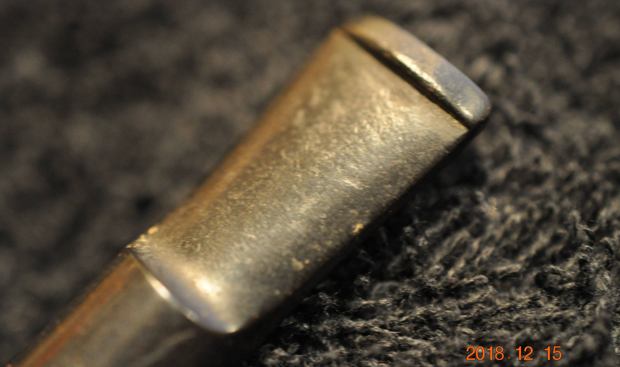
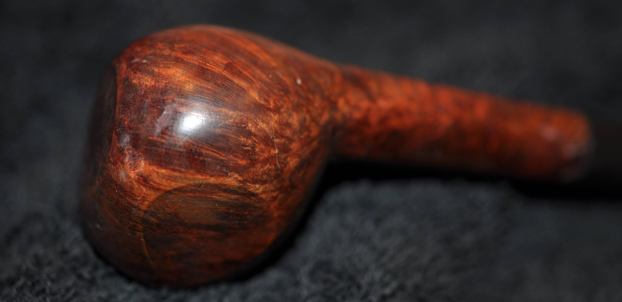
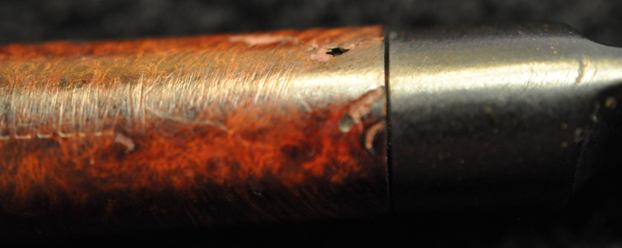
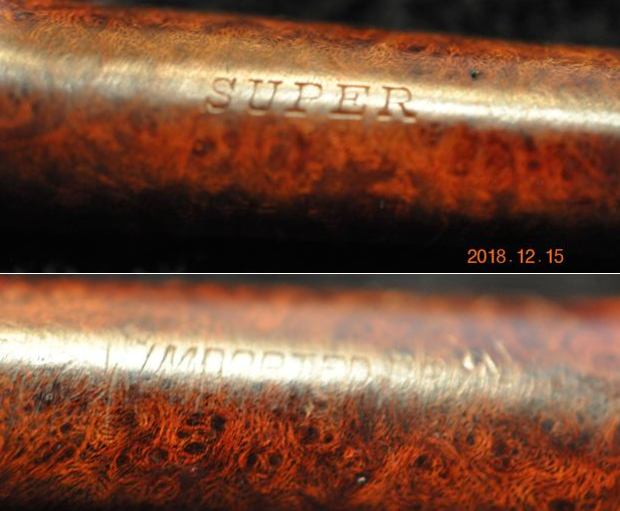
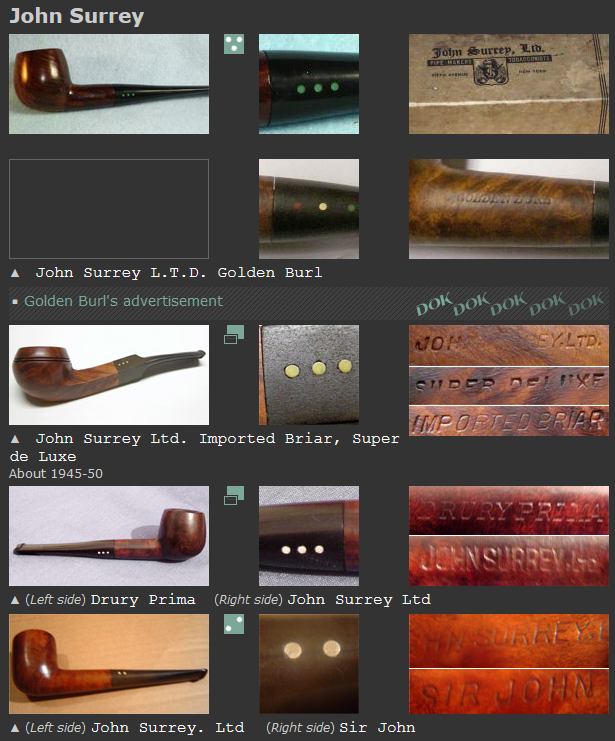
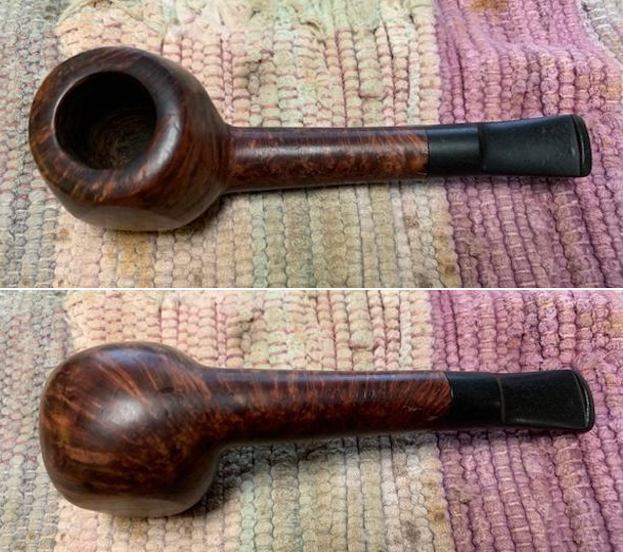
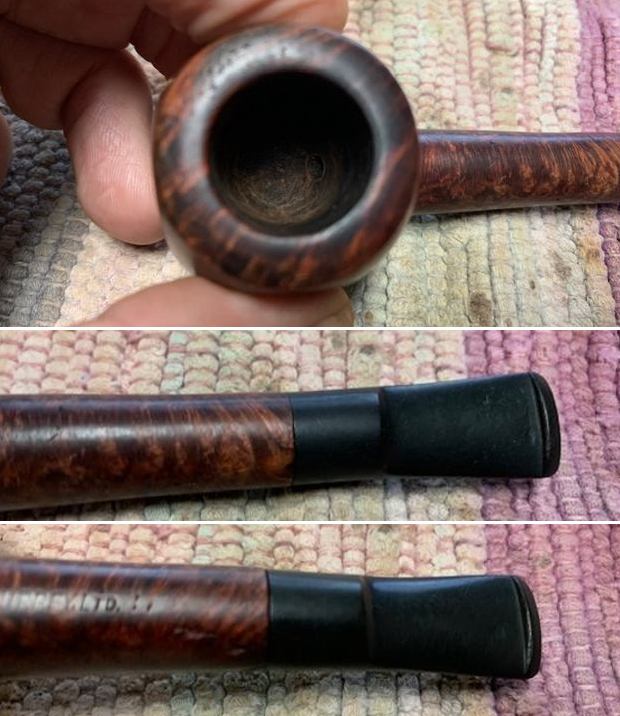
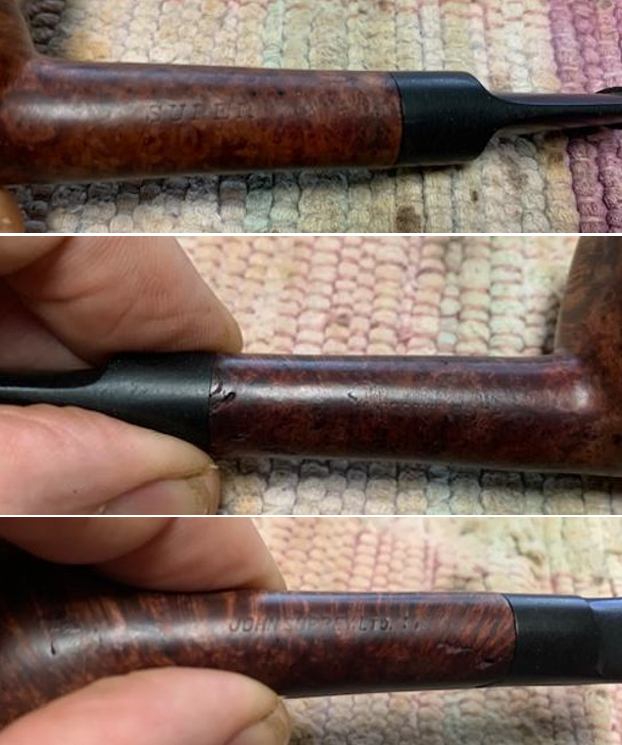
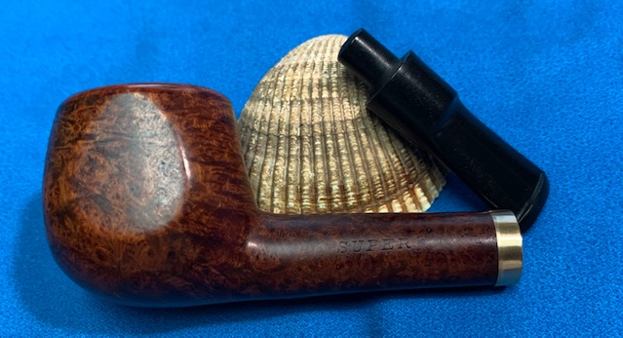
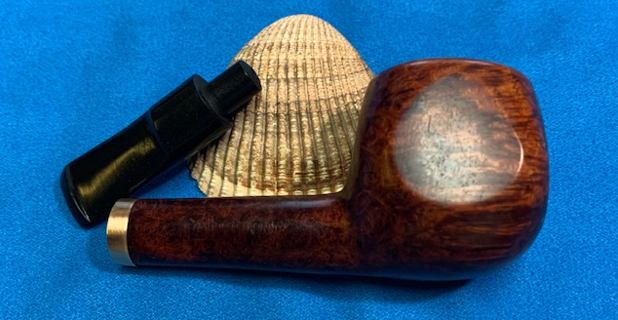
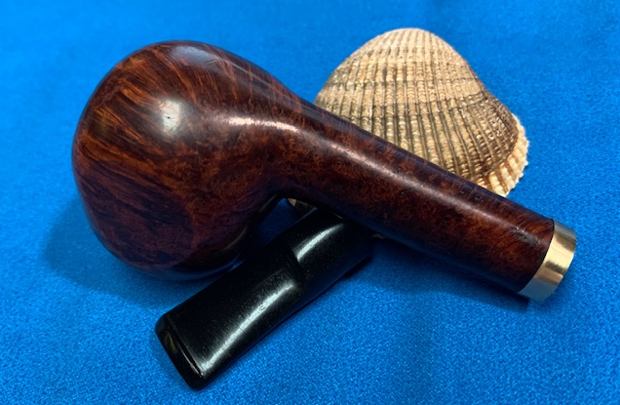
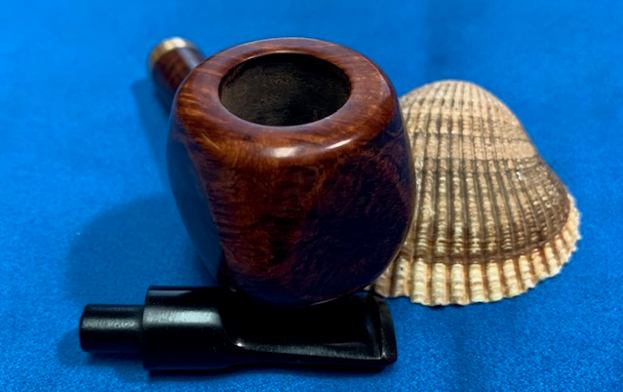
The next pipe on the table is one that we picked up back in 2018 and have no clear record of where and when we picked it up. The shape is what attracted us to the pipe. It is a unique shape with the panels on the bowl and the short Lovat style shank with a saddle stem. The finish was dirty with grime ground into the finish around the bowl sides. There were also some cracks in right side mid shank and on the lower part as well. The cracks were in the middle of some fills on that side of the bowl. There was a thick cake in the bowl and lava overflow on the top of the rim. There was also tobacco debris in the bowl. The stem was lightly oxidized and there were tooth marks and chatter on both sides near the button. The pipe is stamped on the left side of the shank and reads SUPER. On the right side it reads IMPORTED BRIAR. On the underside it is stamped John Surrey Ltd. The stamping is all clear and readable. He took photos of the rim top and bowl to give a clear picture of the thickness of the cake and well as the nicks, lava and darkening on the rim top. The inner and outer edges of the bowl were in great condition. He also took photos of the top and underside of the stem to show the light oxidation and the chatter and tooth marks.  Jeff took a photo the sides and heel of the bowl to give a picture of the beautiful grain around the bowl and shank. He also took a photo of the fills and damage to the right and underside of the shank – there were fills that had fallen out and there was a crack that needed attention.The stamping on the sides of the shank is clear and readable and read as noted above. Jeff did not take a photo of the John Surrey Ltd. stamp on the underside of the shank. I turned to Pipephil’s site and looked for information on the John Surrey Ltd pipe company (http://pipephil.eu/logos/en/logo-j3.html). I found that the company, John Surrey, Ltd. was originally located at 509 Fifth Avenue New York City, New York in the USA. I also did a screen capture of the section on the brand. Interestingly the Super line is not included in the list but all of the other pipes in the section are stamped with the same style stamping as the one I am working on. The closest one is the John Surrey Ltd. Imported Briar Super Deluxe. It is possible that the Deluxe stamp is worn off on this one but it is not clear.I turned to Pipedia in the US pipe makers section to see if I could find some more information on the brand (https://pipedia.org/wiki/John_Surrey_Ltd.). I found a short summary which I include below regarding the brand.

John Surrey Ltd. made John Surrey pipes. They were based at 509 Fifth Ave, New York. And in 1948 the company put a pipe on the market which sold very successfully: the Slugger Baseball Pipe (shank and stem like a baseball bat, and bowl similar to a baseball).

That was the extent of the information so it was not time to work on the pipe. Jeff had cleaned up the pipe following his usual procedures. He reamed the pipe with a PipNet pipe reamer and cleaned up the remnants with a Savinelli Fitsall Pipe Knife. He cleaned out the inside of the shank and the airway in the stem with 99% isopropyl alcohol, cotton swabs and pipe cleaners. He scrubbed the exterior of the bowl with undiluted Murphy’s Oil Soap and a tooth brush. He rinsed it under running warm water to remove the soap and grime. He soaked the stem in Before & After Deoxidizer and rinsed it off with warm water. I took photos of the pipe once I received it. The crowned rim top cleaned up really well. The rim top had a lot of nicks and deep gouges in it but the inner and outer edge of the bowl appeared to be in good condition. The stem surface looked very good and the tooth marks chatter on the stem on both sides near the button could probably be sanded out. The stamping on the sides of the shank is readable and reads as noted above.  I removed the stem and took two photos of the pipe to give a sense of the shape and the grain on the bowl and shank. It was a unique shape and would be a beautiful pipe when I was finished. I took a series of photos of the cracks on the shank and flaws where the putty fills had fallen out.I decided to start my work on the pipe by dealing with the damage on the shank end. I filled in the crack and the damaged fills with briar dust and clear CA glue. I found a thin brass band in my band collection that was a perfect fit on the shank so once the repair had cured and I sanded it down I fitted a band. I put a thin bead of glue around the shank end and pressed the band in place. It bound the repaired areas together and it gave the shank a touch of bling. I took some photos of the banded shank to give a picture of what I was seeing! I dealt with the damage to the rim top by topping it on a topping board with 220 grit sandpaper. Like so many other things in this process I also would need to redo the crowned rim top once I was finished.I wiped the bowl down with acetone on a cotton pad to remove the heavy stain around parts of the bowl sides. I wanted really be able to see the grain on the bowl. I also used this in preparation for reworking the bowl crown.I used a flat file to take down the outer edge and bevel it to bring the crowned rim back to the top of the bowl. I sanded the outer filed edge and the inner edge to give a slight inward bevel with 220 grit sandpaper to smooth out the file marks and fine tune the shape of the rim.I polished the newly shaped rim top and edges along with the rest of the bowl with micromesh sanding pads – 1500-12000 grit pads. I wiped it down with a damp cloth after each sanding pad. It was beginning to look good to my eyes. I forgot to take a photo of the underside at this point. I paused the polishing to stain the rim top and edges of the bowl with an Oak Stain Pen. I wanted to see if I could blend it into the bowl sides. I also touched up the light spots on the bowl sides at the same time. Once I finished that I buffed the bowl with Blue Diamond on the buffing wheel and returned to finish the polishing with 6000-12000 grit micromesh pads. I rubbed the bowl and shank down with Before & After Restoration Balm. I worked it into the surface of the bowl sides and shank with my fingertips to clean, enliven and protect the briar. I let the balm sit for ten minutes then buffed the bowl with a cotton cloth to raise the shine. I set the bowl aside and turned my attention to the stem. I “painted” both sides of the stem with the flame of a lighter to lift the tooth marks. It did a great job and left only one deep mark on the underside and some lighter tooth marks on the topside along the button. I filled them in with clear CA glue and once it cured I sanded the stem with 220 grit sandpaper to smooth out the repairs. I started polishing it with 400 grit sandpaper. I polished the stem with micromesh sanding pads – 1500-12000 grit pads. I wiped it down with Obsidian Oil after each sanding pad. I used Before & After Pipe Polish – both Fine and Extra Fine to further polish the stem.This John Surrey Ltd. Super Imported Briar Panel Lovat is a great looking pipe now that it has been restored. The combination of various brown stains around the bowl is quite beautiful and highlights grain very well. The finish works well with the thin brass band on the shank end and the polished vulcanite saddle stem. I put the stem back on the bowl and carefully buffed the pipe with Blue Diamond on the buffing wheel using a light touch on the briar. I gave the bowl and the stem multiple coats of carnauba wax on the buffing wheel and followed that by buffing the entire pipe with a clean buffing pad. I hand buffed the pipe with a microfiber cloth to deepen the shine. The finished John Surrey Ltd. Super Panel Lovat sits nicely in the hand and feels great. Give the finished pipe a look in the photos below. The dimensions of the pipe are Length: 4 ¾ inches, Height: 1 ½ inches, Outside diameter of the bowl: 1 ¼ inches, Chamber diameter: ¾ inch. The weight of the pipe is 38 grams/1.34 ounces. I will be putting it on the American (US) Pipemakers section of the rebornpipes store shortly. If you are interested in adding this pipe to your collection send me a message or an email. Thanks for reading this blog and my reflections on the pipe while I worked on it. There are many more to come!

Restoring a Republic Era Peterson’s System Standard 305 Rusticated Dublin


Blog by Steve Laug

A while back I received a small box of pipes from a fellow pipeman who wanted to donate them to support  the non-profit organization I work for – the SA Foundation (www.safoundation.com). The organization has been providing long term recovery, housing and job training for women who have escaped sexual exploitation and trafficking. For over thirty years the work has gone on and thousands of young women and their children have been empowered to start over with skills and options. The work is currently in 7 countries and 12 cities around the world. If you are interested give the website a look.

Now back to the pipes. There were eight total pipes in the lot that he sent me. The first one I restored was a large Irish Second 05 Calabash that is heading off to Michigan. The second pipe was a Peterson’s Kapet pipe in a shape 124 (https://rebornpipes.com/2021/08/16/restoring-a-republic-era-petersons-kapet-124/). The third pipe was a very Danish looking Made in London, England Sandblast Acorn. (https://rebornpipes.com/2021/08/17/restoring-a-very-danish-looking-made-in-london-england-acorn/). The fourth pipe was a Bromma Bent Billiard with a screw on bowl (https://rebornpipes.com/2021/08/18/restoring-what-looks-like-a-swedish-bromma-pipe/). The fifth pipe is a Canadian Made Paradis Pipe (https://rebornpipes.com/2021/08/19/restoring-canadian-made-paradis-rustic-246-bent-dublin/). The sixth pipe was an unsmoked small carved figural meerschaum that is for sale on the rebornpipes store (https://rebornpipes.com/rebornpipes-store/meerschaum-pipes-smooth-figurals/). The seventh pipe was a Medico Ventilator Bent Billiard (https://rebornpipes.com/2021/08/20/restoring-a-sandblast-medico-ventilator-bent-billiard/). All of the pipes were in clean condition and had been lightly reamed.

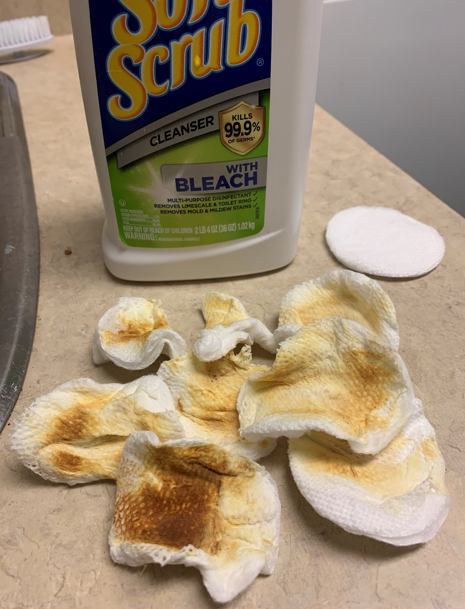
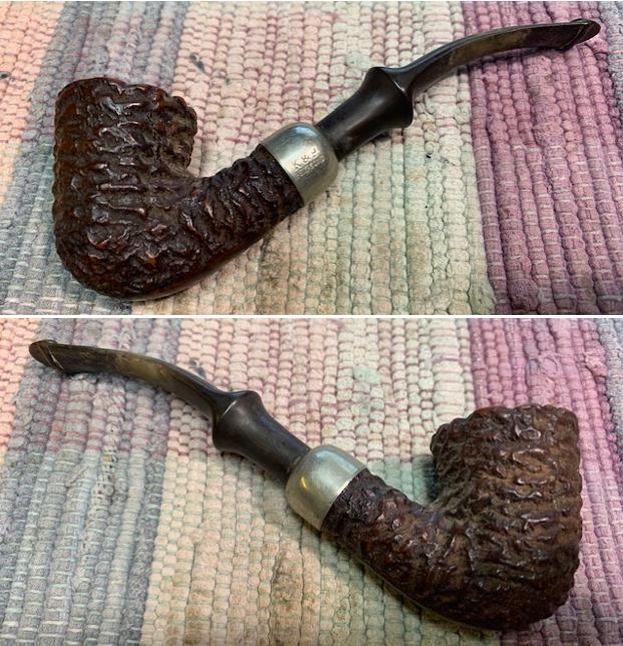
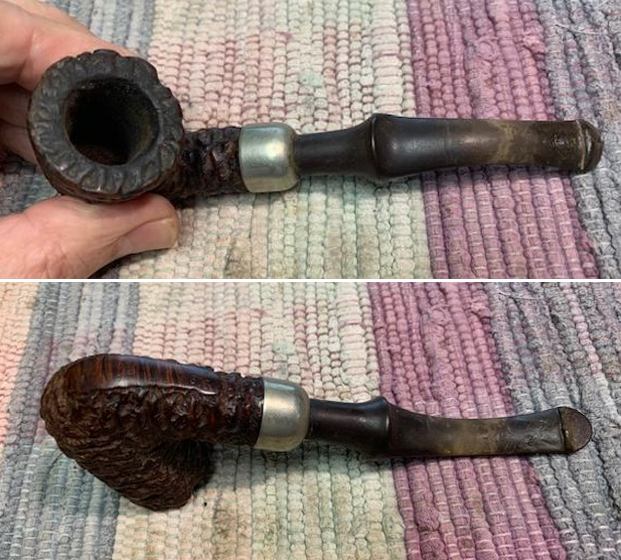
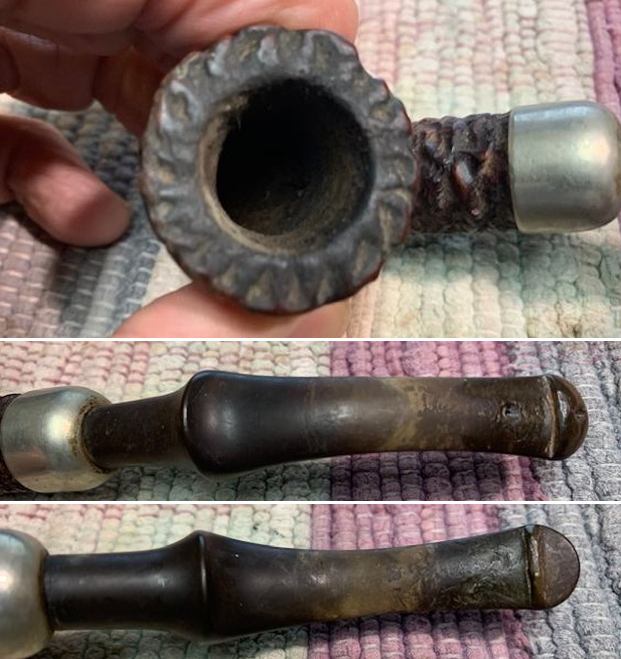
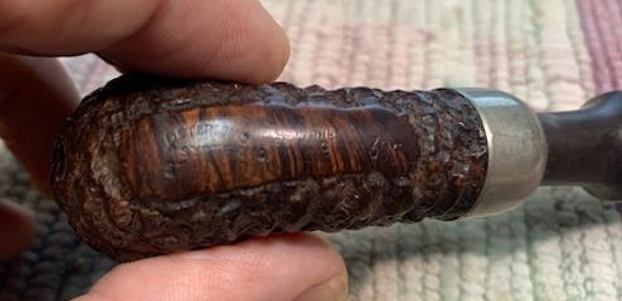
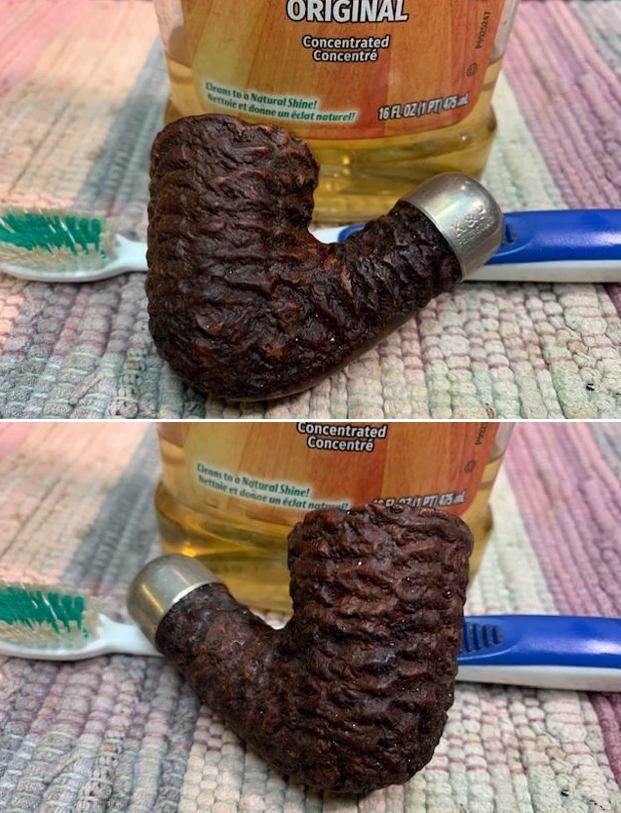
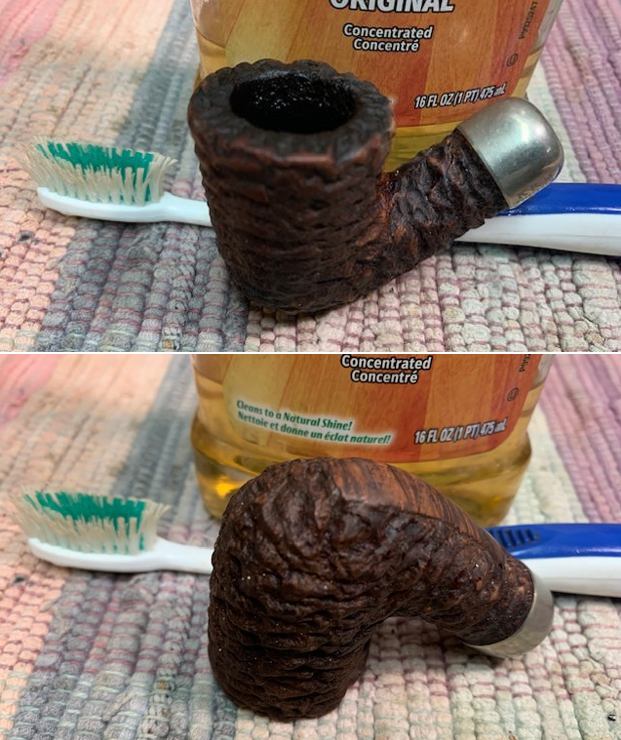
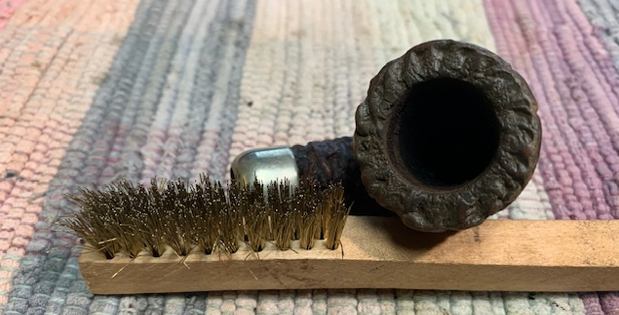
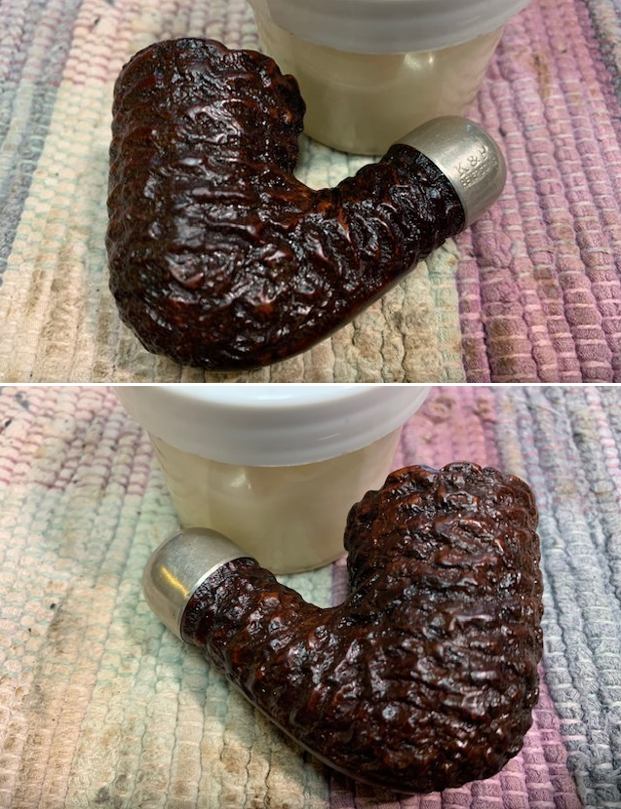
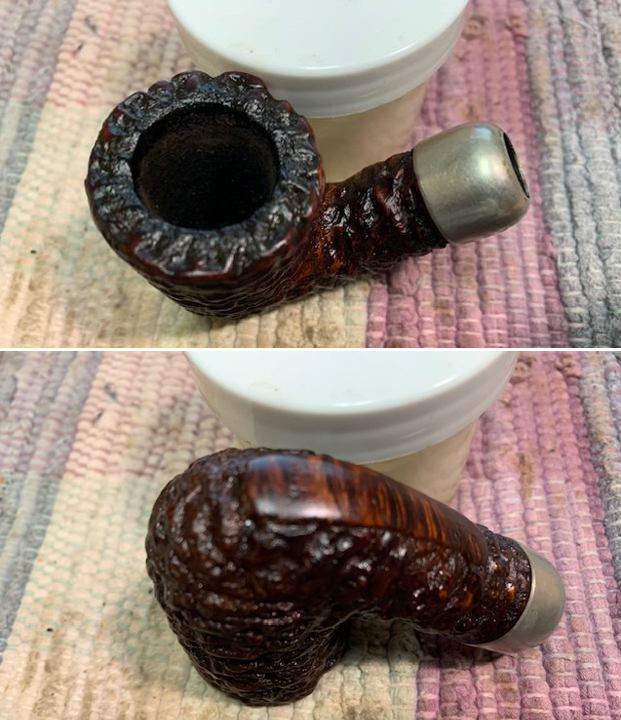
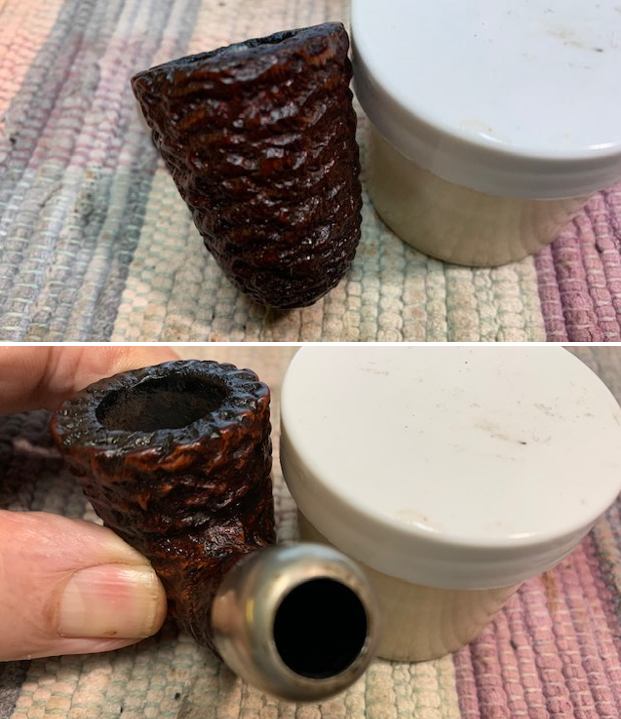
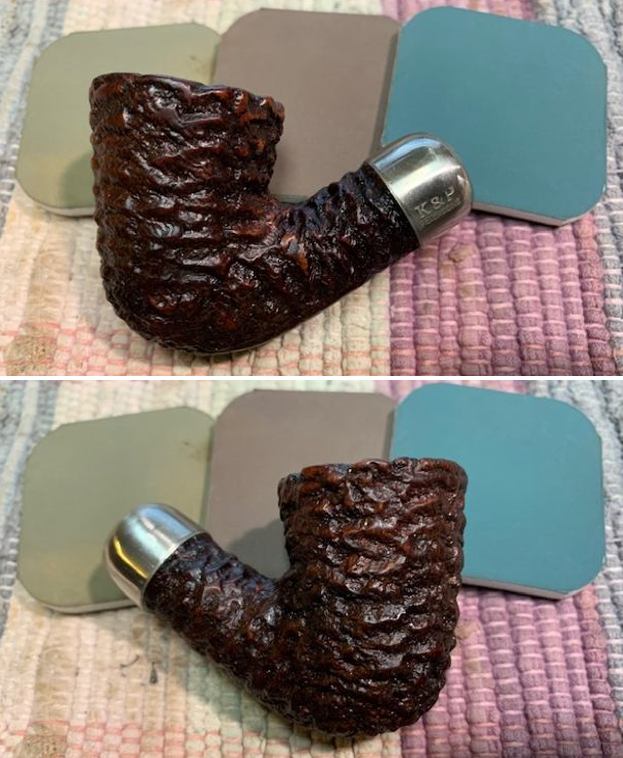
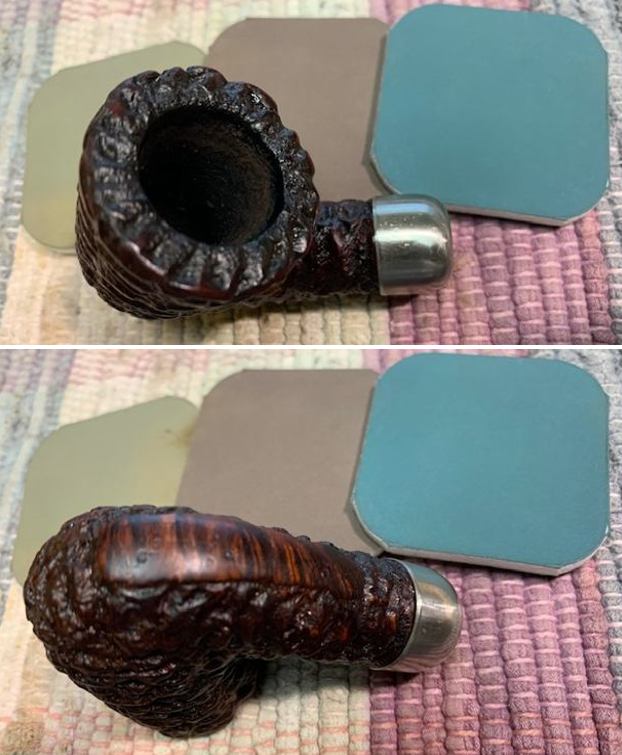
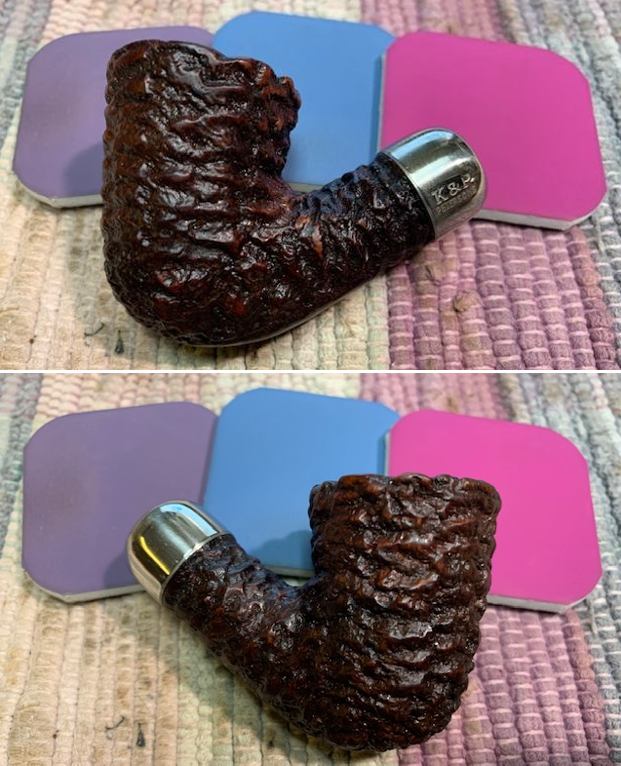
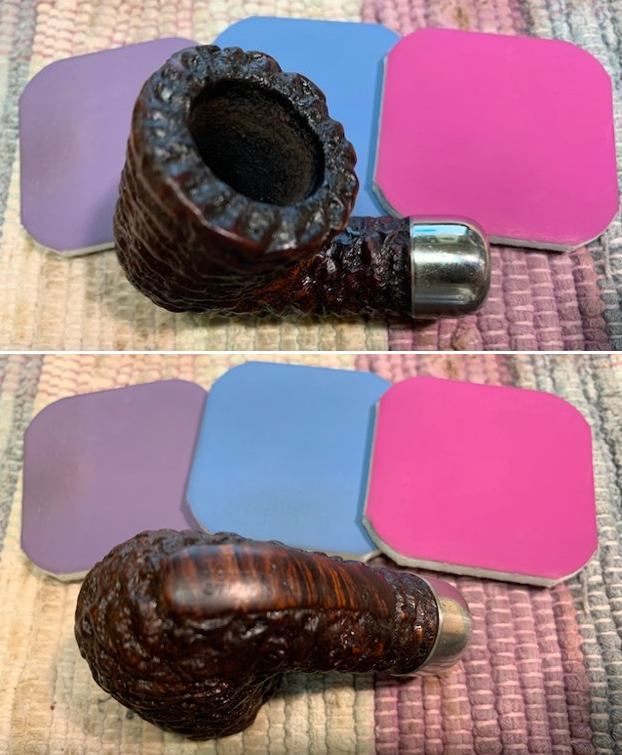
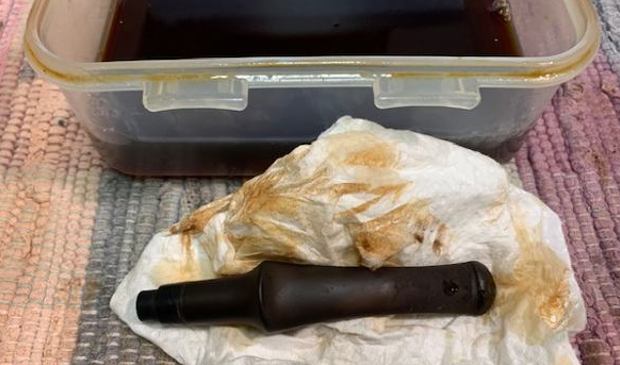
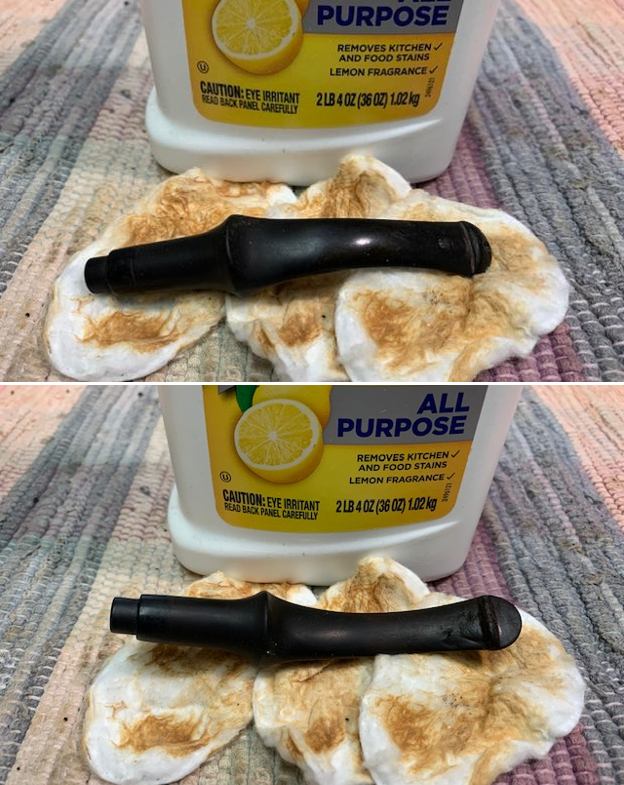
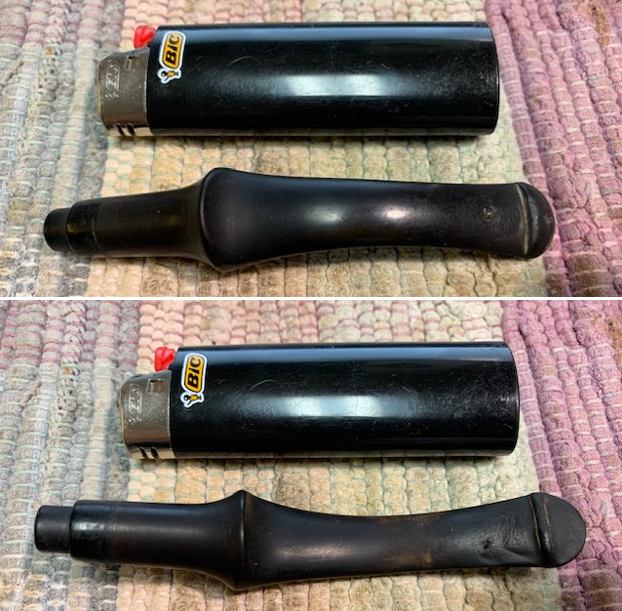
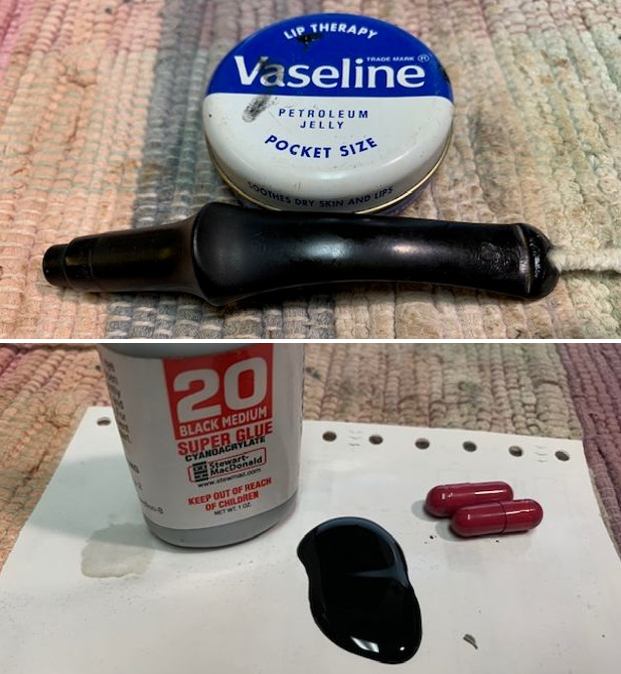
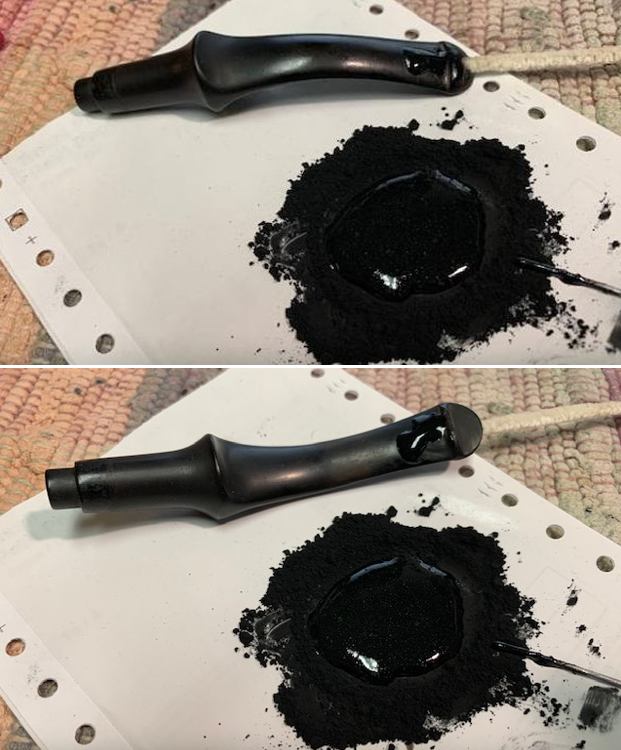
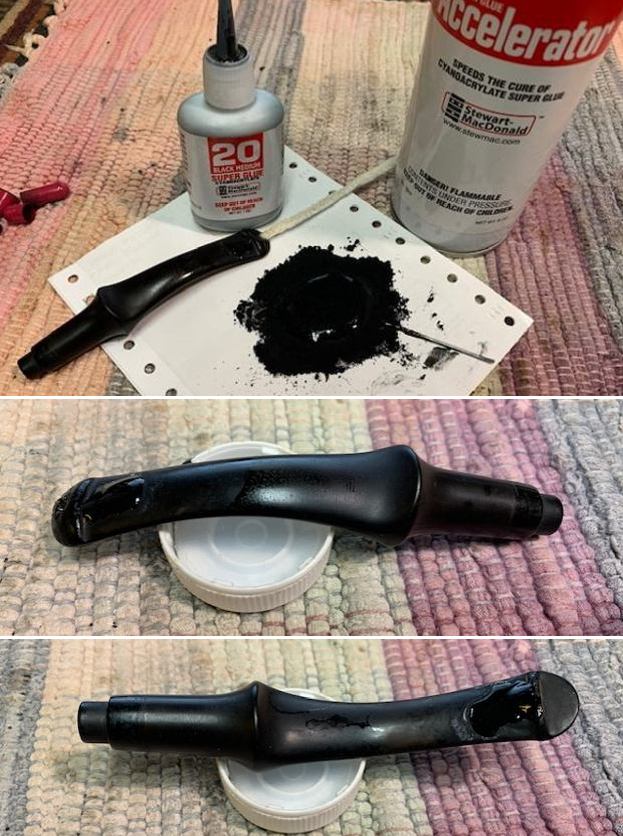
The next pipe, the eighth and final one is a bent Peterson’s System Standard 305 Rusticated Bent Dublin. The pipe was clean on the inside but dusty on the sandblast finish. The classic Peterson rustication was very well done and quite rugged. The rim top and edges looked very good. The pipe was stamped on the shank and read Peterson’s [over] System [over] Standard. That is followed by the stamping Made in the Republic of Ireland in three lines. Finally at the end of the smooth panel is the shape number 305. The nickel ferrule was stamped on the left side and read K&P [over] Petersons. The vulcanite P-lip stem had a small hole in the topside ahead of the button that looks like a bite through. There is a lot of tooth chatter and marks on both sides ahead of the button. There was no P stamp on the side or top of the stem. I took some photos of the pipe before I started my clean up work on it. I took photos of the bowl and rim top as well as the stem to show the condition of the pipe. The rim top was dusty and had some lava build up in the rustication. There was a thin cake in the bowl as well. The finish on the bowl had paint flecks and dust in the crevices of the rustication. The stem was oxidized, calcified and had a lot of tooth chatter and some deep tooth marks on both the top and bottom. There was a small bite through on the topside ahead of the button. This was obviously a great smoking pipe and someone’s favourite!I took a photo of the stamping on the underside of the heel of the bowl. It was clear and readable as noted above. I removed the stem from the shank and took a photo of the pipe. The great rustication and charm of the pipe are visible even with the grime and dust. Now it was time to work on the pipe. I started my work on the pipe by cleaning up the reaming. I removed the remaining cake with a Savinelli Fitsall Pipe Knife and took it back to bare briar so that I could examine the bowl for heat damage. It looked good.I cleaned the mortise, sump and shank along with the airway in both the shank and the stem with 99% isopropyl alcohol, pipe cleaners and cotton swabs until the interior of the pipe was very clean. I dropped the stem in a bath of Briarville’s Stem Deoxidizer to soak while I worked on the bowl.I scrubbed the exterior of the pipe with undiluted Murphy’s Oil Soap. I scrubbed the rustication and paid serious attention to the lava on the rim top. I used a tooth brush and the soap and rinsed it off with running water. I dried it off with a cotton towel. There were still some small flecks of white paint on the bowl sides. I used a brass bristle brush to work on the white paint flecks in the rustication and to clean up the remaining debris on the rim top. It works well and leaves the surface clean.With the surface clean I was ready for the next step in the process. I rubbed the bowl and shank down with Before & After Restoration Balm. I worked it into the surface of the bowl sides and shank with my fingertips and a horsehair shoe brush to clean, enliven and protect the briar. I let the balm sit for ten minutes then buffed the bowl with a cotton cloth to raise the shine. I polished the nickel ferrule with micromesh sanding pads – using 3200-12000 grit pads and wiping it down after each pads with a damp cotton pad. The nickel took on a rich shine and looked really good with the rusticated bowl. I set the bowl aside and turned my attention to the stem. I removed it from the Briarville Pipe Stem Deoxidizer and cleaned it off with a paper towel. It looked much better.I scrubbed the stem surface with Soft Scrub to make sure I had removed as much of the remaining oxidation as I could before moving on to the repair that needed to be done on the bite through on the top of the stem.Once clean, I “painted” the tooth marks and chatter on the stem surface with the flame of a lighter to try and raise the dents. It worked relatively well and lifted the majority of them so that they were either gone or smaller. With that finished I greased a pipe cleaner with Vaseline and inserted it in the stem until it was below the bite through. I mixed a paste of black super glue and charcoal powder to make the repair. I pressed the paste into the hole on the stem top. I filled the remaining tooth chatter and marks in with the mixture and set it aside to cure. I sprayed it with an accelerator then removed the pipe cleaner. I did not want it to dry and stick in the airway. Once the repairs cured I used a small file to flatten out the repairs and reshape the P-lip style button edges. I used 220 grit sandpaper to smooth out the repairs on both sides of the stem. I started to polish it with 400 grit wet dry sandpaper. The stem is looking much better. I polished the stem with micromesh sanding pads – 1500-12000 grit pads. I wiped it down with Obsidian Oil after each sanding pad. I used Before & After Pipe Polish – both Fine and Extra Fine to further polish the stem. I gave it a final rubdown with Obsidian Oil and set it aside to cure. I put the parts back together. This Republic Era Peterson’s System Standard Rusticated 305 Bent Dublin  is a great looking pipe with a great rustication on the bowl. The rich, dark brown stained  sandblast bowl and shank look surprisingly nice. The combination works well with the polished nickel ferrule and the polished black, vulcanite P-lip stem. I carefully buffed the pipe with Blue Diamond on the buffing wheel using a light touch on the briar. I gave the bowl multiple coats of Conservator’s Wax and the stem multiple coats of carnauba wax on the buffing wheel and followed that by buffing the entire pipe with a clean buffing pad. I hand buffed the pipe with a microfiber cloth to deepen the shine. The finished Peterson’s System Standard 305 is light and sits nicely in the hand and feels great. Give the finished pipe a look in the photos below. The dimensions of the pipe are Length: 5 ¾ inches, Height: 2 inches, Outside diameter of the bowl: 1 ¼ inches, Chamber diameter: ¾ of an inch. The weight of the pipe is 37 grams /1.31 ounces. I will be putting it on the rebornpipes store shortly in the Irish Pipemakers Section. If you are interested in adding this pipe to your collection send me a message or an email. Thanks for reading this blog and my reflections on the pipe while I worked on it. There are many more to come!
Restoring What Looks Like a Swedish Bromma Pipe


Blog by Steve Laug

A while back I received a small box of pipes from a fellow pipeman who wanted to donate them to support  the non-profit organization I work for – the SA Foundation (www.safoundation.com). The organization has been providing long term recovery, housing and job training for women who have escaped sexual exploitation and trafficking. For over thirty years the work has gone on and thousands of young women and their children have been empowered to start over with skills and options. The work is currently in 7 countries and 12 cities around the world. If you are interested give the website a look.

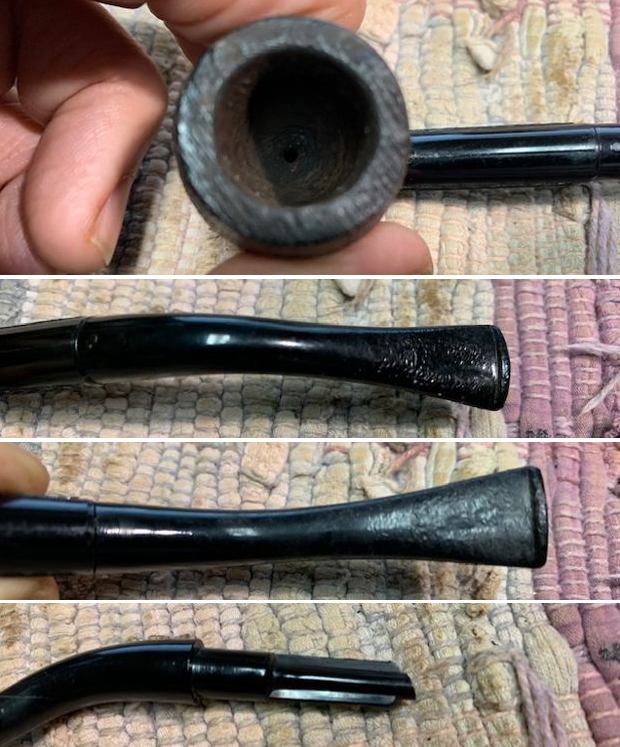
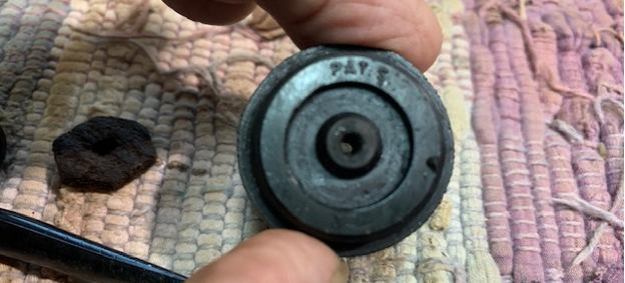
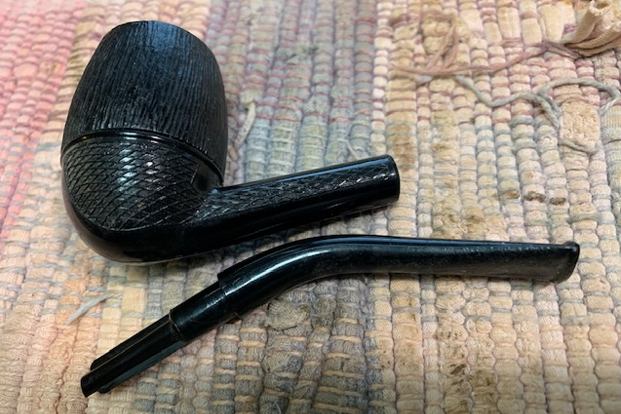
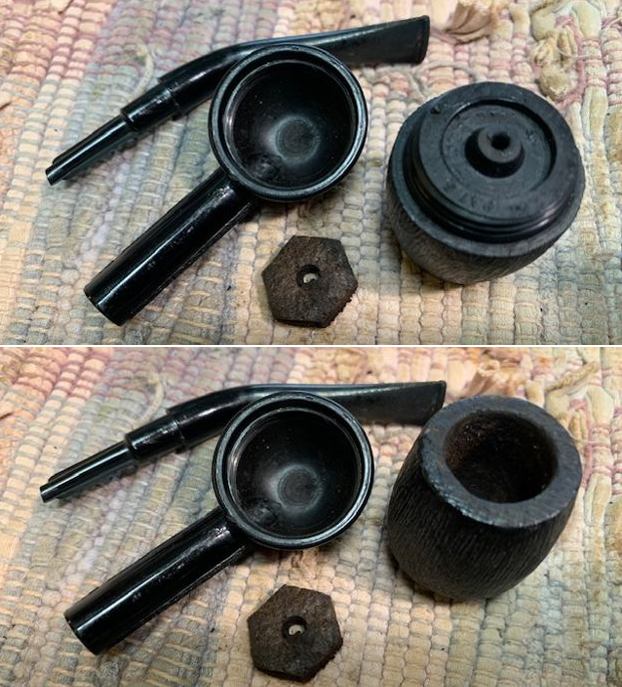
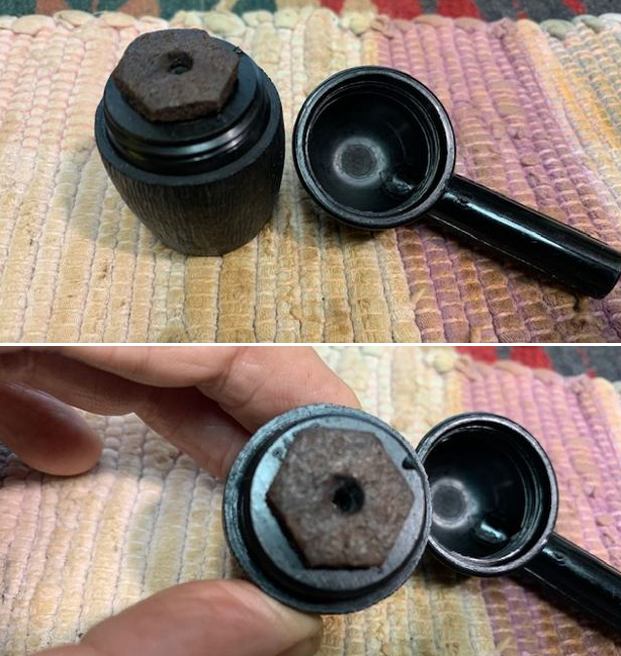
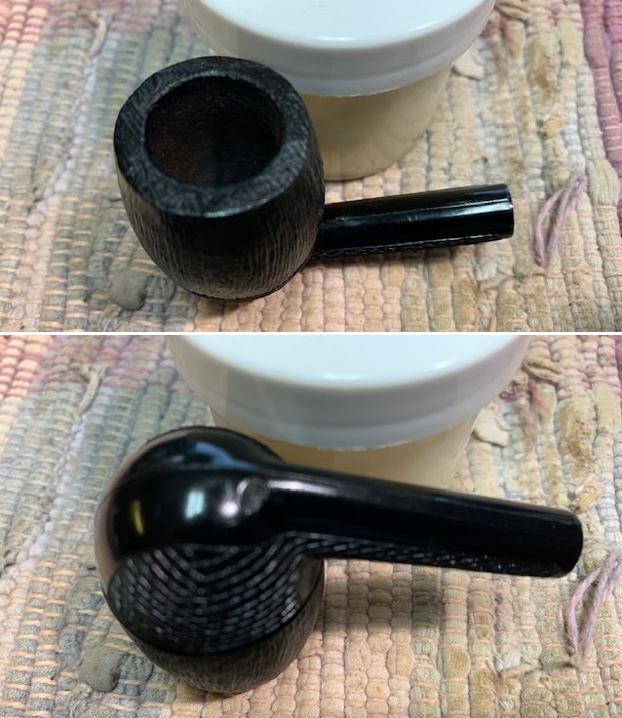
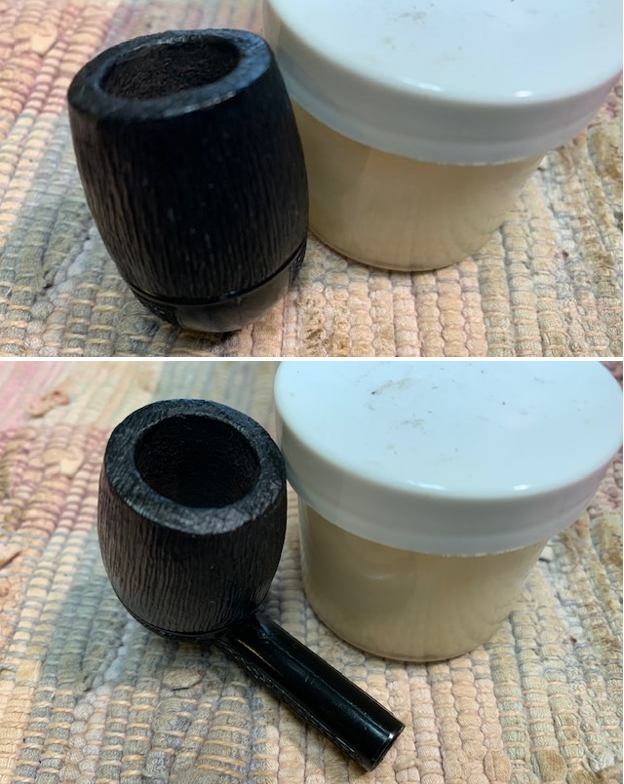
Now back to the pipes. The first one I restored was a large Irish Second 05 Calabash that is heading off to Michigan. The second pipe from the lot was unique looking Peterson’s Kapet pipe in a shape 124 (https://rebornpipes.com/2021/08/16/restoring-a-republic-era-petersons-kapet-124/). The third pipe was a very Danish looking Made in London, England Sandblast Acorn. (https://rebornpipes.com/2021/08/17/restoring-a-very-danish-looking-made-in-london-england-acorn/) All of the pipes were in clean condition and had been lightly reamed. The next pipe is a nylon pipe built a lot like a Falcon. The base is nylon and the bowl is briar and threaded. The stem is also nylon/plastic. When I first saw it I thought about a previous pipe that I had worked on that was called a Bromma Dollar. Everything about it was just like the Bromma. The etched pattern on the shank and base is identical to the Bromma. The only stamping on the pipe is on the bottom of the briar bowl. It is stamped PAT. S. 3.The pipe has a thin pencil shank that is in excellent condition. The bent taper stem had a lot of tooth chatter and marks on both sides ahead of the button. There were no logo stamps on the stem.

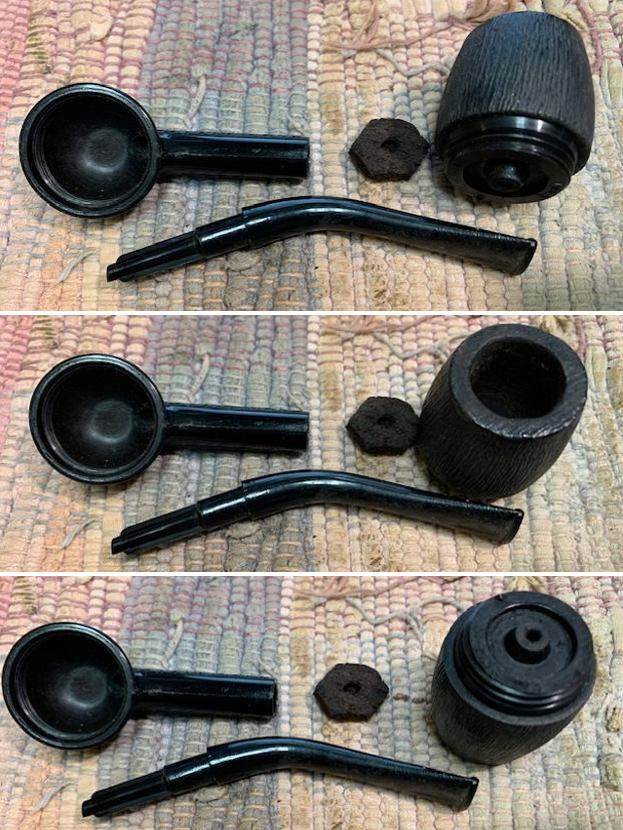
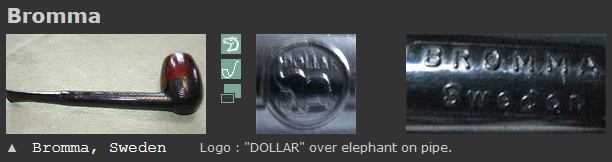
I took some photos of the pipe before I started my clean up work on it. It is another unique and interesting looking pipe. The shape and materials of the pipe reminds me of the Bromma as mentioned above. I will go into more detail on that in the section before I start the restoration. I took photos of the bowl and rim top as well as the stem to show the condition of the pipe. The rim top had some darkening and debris in the. The stem had a lot of tooth chatter and some deep tooth marks on both the top and bottom. The stem had a built in stinger which was a finned tube that extended into the shank.I took a photo of the stamping on the underside of the threaded bowl. It was clear and readable as noted above. The Pat. S. is below my finger and the 3 is just above my thumb in the photo below. I removed the stem from the shank and took a photo of the pipe. I removed all the parts and took a series of photos to show all of the parts. It is an interesting pipe for sure. I turned to Pipedia and found nothing listed for the brand that I was thinking about. I then turned to Pipephil and was glad to find that Bromma was listed with a picture for comparison sake (http://pipephil.eu/logos/en/logo-b8.html). While the pipe I was working on is not stamped like this one the material is the same. I did a screen capture of the pertinent section of the article and have included it below along with the information from the sidebar.A brand of the Scandinaviska Pipfabriken. Probably from same workshop: Harlekin, Dollar
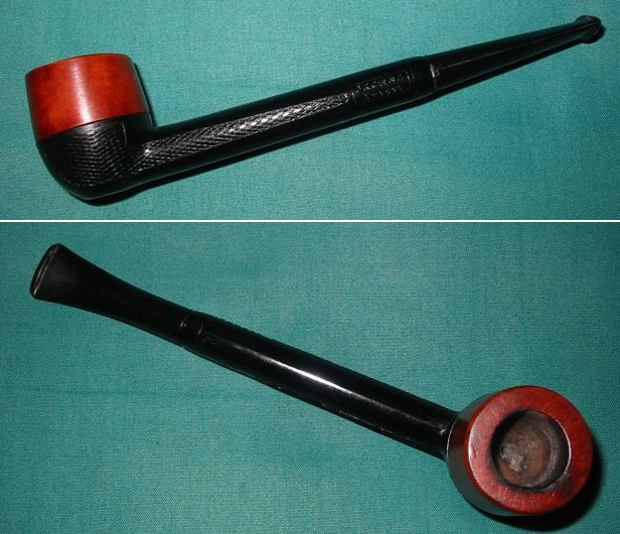
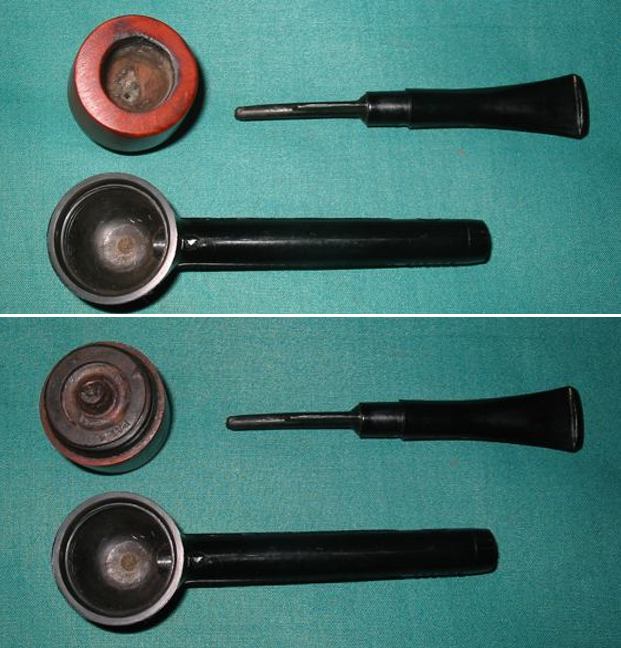
I also remembered working on a Bromma pipe many years ago and doing a blog on it for rebornpipes. I have included the link for the blog below and some photos of the pipe to show the parallels to the one I am working on now. Here is the link to the blog (https://rebornpipes.com/2012/11/24/cleaning-up-a-swedish-bromma-dollar-system-pipe-2/). The parts of the pipe are identical to the one I am working on now. The etched pattern on the base, the patent stamp on the underside of the bowl, the stinger apparatus the way the bowl is threaded are all the same. I described the unique structure of the bottom of the bowl in the blog which is precisely the same as the bowl on the table now. All leads me to conclude that I am working on another Bromma Swedish system pipe. I quote:
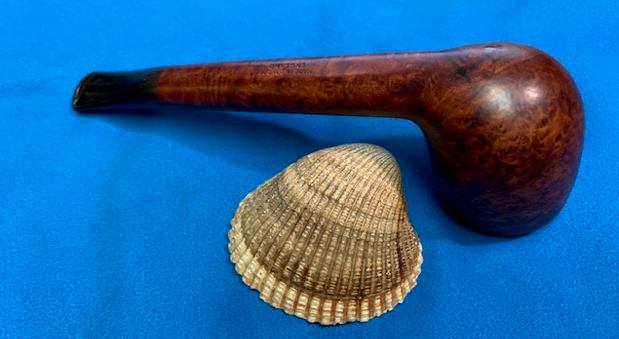
…I also used a bristle tooth brush and alcohol to scrub the bottom of the bowl from the threads down to the nipple-like structure on the bottom…There is an inset portion of the bowl bottom that is like a moat around an island that has the mountain-like nipple in the centre. This took quite a few cotton swabs to clean the grime out of the channel. Once it was clean there is a patent stamp on it. It reads Pat. S. I am guessing it is a Swedish Patent mark. The portion of the bowl that is threaded seems like it is made of the same kind of material as the base of the pipe. The mountain in the middle is briar. It is an interesting and unique design. From that I concluded that the threaded platform of the bowl was nylon or Bakelite like the base and shank and that the briar bowl was seated permanently on that nylon threaded platform. The current pipe bowl and platform are identical to the one shown above. It is a unique and patented system that removes the easily damaged briar threads on other system pipes like this and replaces them with a more solid and durable plastic/Bakelite platform that screws into the base. Now it was time to work on the pipe.

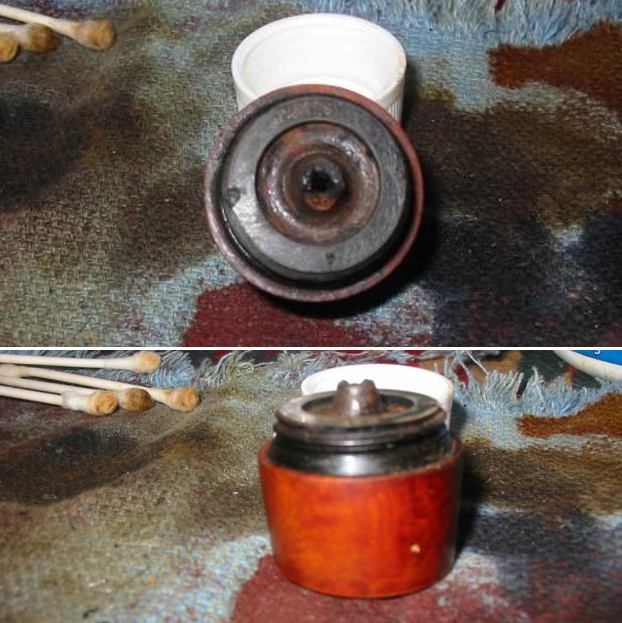
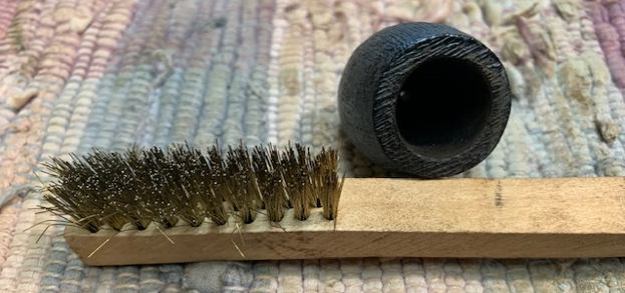
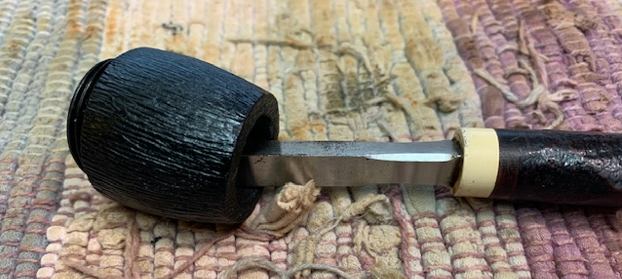
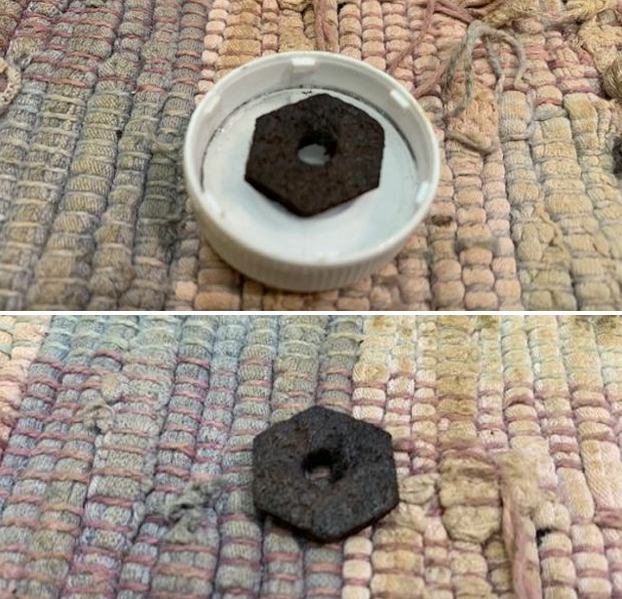
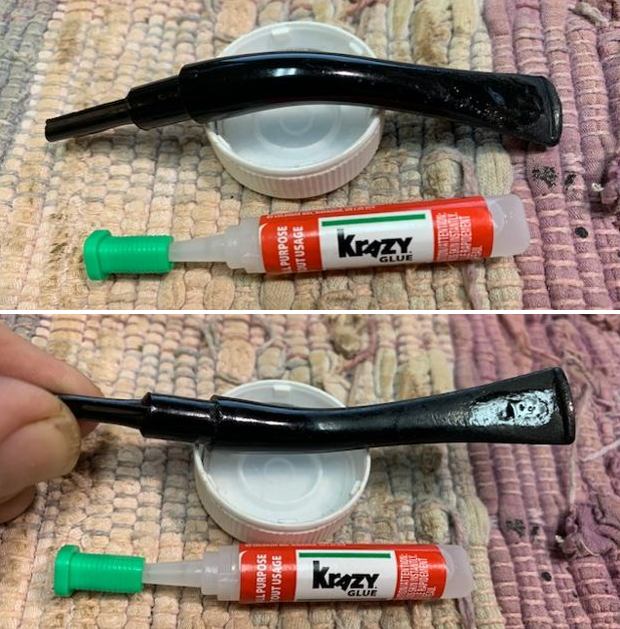
I cleaned the blast on the rim top with a brass bristle brush to loosen the debris in the grooves. It mad a difference and the blast was identifiable once more.I cleaned up the reaming of the bowl with a Savinelli Fitsall Pipe Knife. I took out the remnant of cake that had been left so I could examine the walls. I was glad to see there were no fissures in the briar walls. I cleaned the hexagonal filter pad with alcohol. I let it sit in the alcohol and it leeched out the oils and tars in the material. From examining it I think it is made of cork. I cleaned the base of the pipe, shank and removable bowl with cotton swabs and alcohol. I cleaned the airway in both the stem and shank with alcohol, pipe cleaners and cotton swabs until the interior of the pipe was very clean.I rubbed the bowl and shank down with Before & After Restoration Balm. I worked it into the surface of the bowl sides and shank with my fingertips to clean, enliven and protect the briar. I let the balm sit for ten minutes then buffed the bowl with a cotton cloth to raise the shine. I rubbed down the base which seemed to be made of a lightweight nylon or plastic material, possibly Bakelite with Before & After Restoration Balm and let it sit for 10 minutes. I buffed the base off with a cotton cloth and then inserted the cork washer.I fit the cleaned cork filter on the top of the nipple on the base of the bowl and then screwed the bowl onto the base.I screws the bowl back onto the base and took photos of the pipe at this point in the process. It is actually a nice looking pipe and incredibly light weight. I heated the stem with the flame of a lighter to try and raise the dents. It did not work at all. I filled them in with clear CA glue and set it aside to cure. Once it cured I used 220 grit sandpaper to sand out the tooth chatter and marks on both sides of the stem. I started to polish it with 400 grit wet dry sandpaper. The stem is looking much better. I polished the stem with micromesh sanding pads – 1500-12000 grit pads. I wiped it down with Obsidian Oil after each sanding pad. I used Before & After Pipe Polish – both Fine and Extra Fine to further polish the stem. The stem material is very odd and hard to polish. The spots where the repairs were done are visible because they are more shiny with the polishing. I am not sure where to take this at this point so it will probably go as it is now. This Swedish Made Bromma Bent Billiard System Pipe with a pencil shank is a great looking pipe whatever you call the shape. The rich, black stained rusticated finish around the briar bowl is quite beautiful. The finish works well with the  polished nylon/Bakelite base and the thin nylon taper stem. I put the stem back on the bowl and carefully buffed the pipe with Blue Diamond on the buffing wheel using a light touch on the briar. I gave the bowl multiple coats of Conservator’s Wax and the stem multiple coats of carnauba wax on the buffing wheel and followed that by buffing the entire pipe with a clean buffing pad. I hand buffed the pipe with a microfiber cloth to deepen the shine. No matter how I polished the stem the strange nylon mix material is a beast to fully polish. The repairs show clearly but the stem is solid. The finished Bromma Bent Billiard is very light and sits nicely in the hand and feels great. Give the finished pipe a look in the photos below. The dimensions of the pipe are Length: 5 inches, Height: 1 ¾ inches, Outside diameter of the bowl: 1 inches, Chamber diameter: ¾ inch. The weight of the pipe is 26 grams/.92 ounces. I will be putting it on the rebornpipes store shortly in the Pipes From Various Makers – Czech, Belgian, German, Israeli, Spanish Pipemakers along with Metal Pipes Section. If you are interested in adding this pipe to your collection send me a message or an email. Thanks for reading this blog and my reflections on the pipe while I worked on it. There are many more to come!
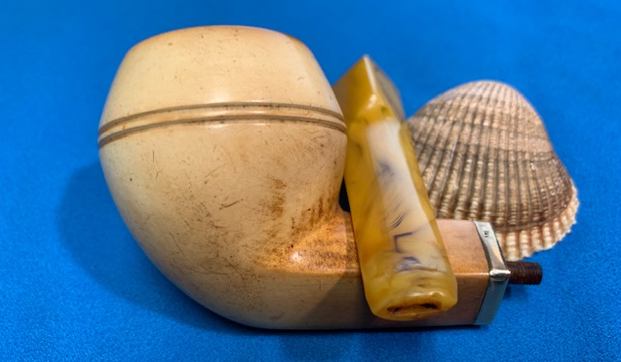
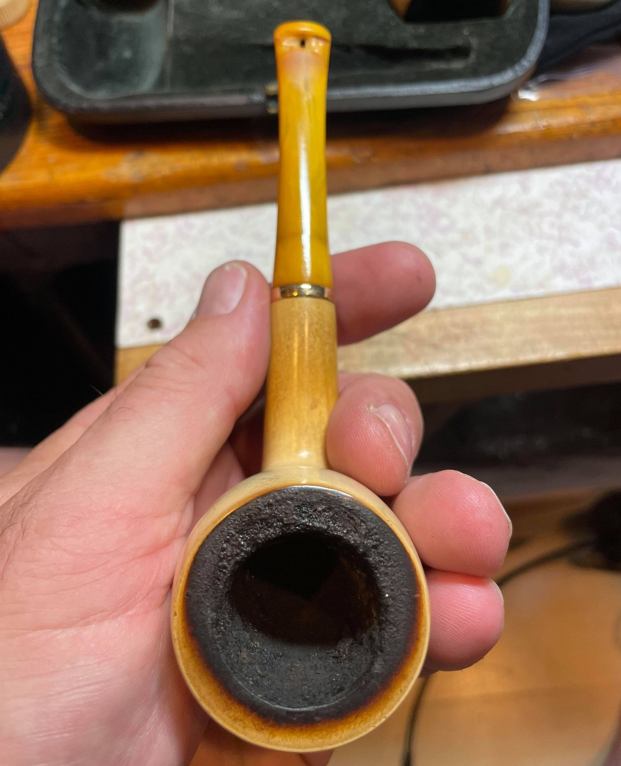
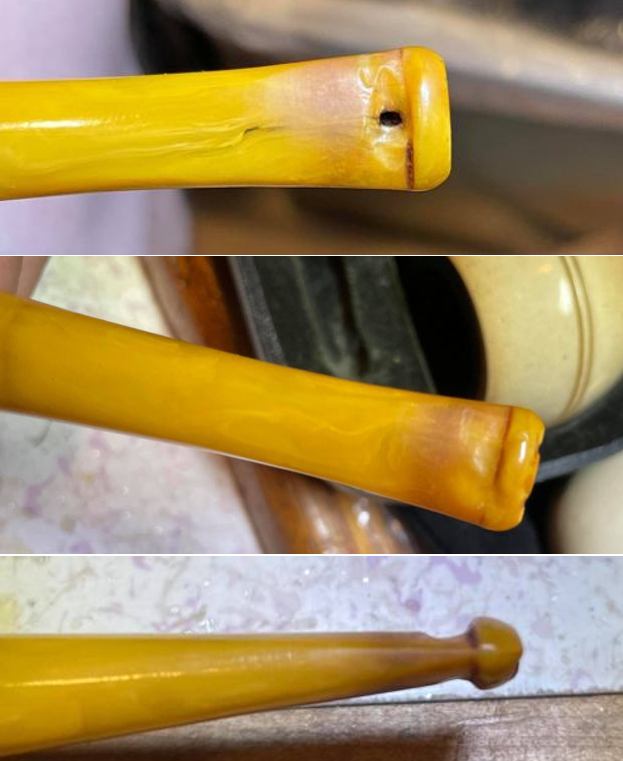
This Gorgeous Sunrise Amber Grain 299 Vintage Briar Canadian Came Alive


Blog by Steve Laug

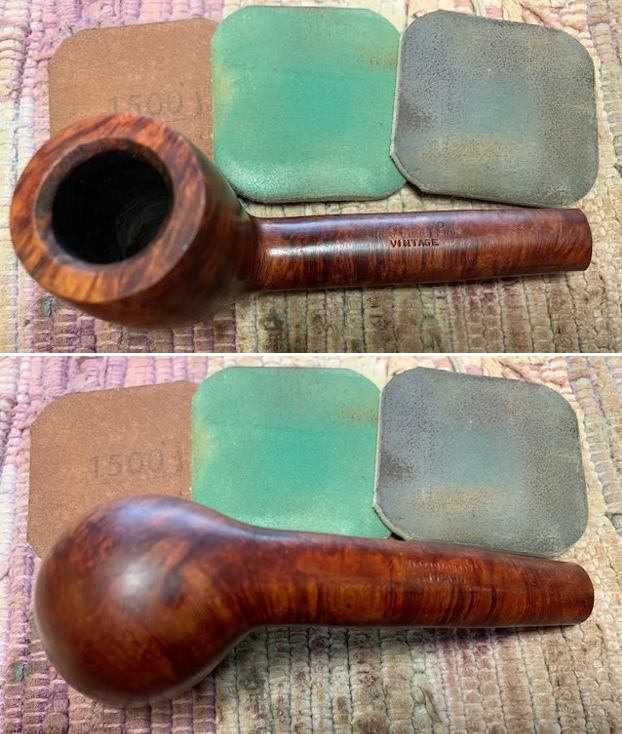
The next pipe on the work table came to us from a group of pipes that Jeff and I picked up from an auction from Wilkes Barre, Pennsylvania, USA. The pipe is beautifully grained Canadian shaped pipe with a mix of medium brown stains back in 2019. Jeff cleaned it up in 2020 and now I am finally getting to it is 2021. The pipe is stamped on the topside of the shank and reads Sunrise [over] Amber Grain. On the underside of the shank it reads Vintage Briar [over] the shape number 299 near the bowl end. The pipe was dirty with a lot of grime ground into the bowl but the grain was still visible. The bowl was moderately caked with a light lava coat flowing onto the rim top and beveled inner edge toward the left front of the bowl. The stem was lightly oxidized and dirty with light tooth chatter and marks on the top and underside near and on the button. It had promise but it was very dirty. Jeff took some photos of the pipe before he started his cleanup work. He took photos of the rim top and bowl to give a clear picture of the thickness of the cake and well as the lava and darkening on the front side of the rim top and inner edge. He also took photos of the top and underside of the stem to show the light oxidation and the chatter and tooth marks. Jeff took a photo the sides and heel of the bowl to give a picture of the beautiful grain around the bowl and shank. The stamping on the sides of the shank are clear and readable and read as noted above. The Sunrise pipe was a Comoy’s made pipe and the France stamp on the shank pointed me to the connection between London and St. Claude (England/France). I turned to Pipephil’s site (http://www.pipephil.eu/logos/en/logo-s13.html) to get some background information on this beauty. I have included a screen capture of the pertinent section. The first pipe listed bears the same stamping as the one I am working on.The side bar includes this interesting piece of information. I quote:

The Sunrise brand perfectly illustrates the split pipe production of a same label between Saint Claude (FR) and London (GB) during the period Chapuis Comoy and Comoy closely collaborated (prior to early 1970s).

I turned to Pipedia and looked under the French makers and the brand was not listed. Under the English makers it was listed as a Comoy’s Sub-brand or second. I turned to the Comoy’s listing and at the bottom of the article was a list of these pipes (https://pipedia.org/wiki/Comoy%27s). I have included the list in its entirety and highlighted the Sunrise in red.

Seconds made by Comoy’s

Ace of spades, Ancestor, Astor, Ayres, Britannia, Carlyle, Charles Cross, Claridge, Coronet?, Cromwell, Dorchester, Dunbar, Drury Lane, Emerson, Everyman, Festival of Britain, Golden Arrow, Grand Master, Gresham, Guildhall, Hamilton (according to Who Made That Pipe), Kingsway, Lion’s Head, Lord Clive, Lumberman, Hyde Park, Lloyds, Mc Gahey, Moorgate, Newcastle, Oxford, O’Gorman, Rosebery Extra, Royal Falcon, Royal Guard, Royal Lane, Scotland Yard, St James, Sunrise, Super Sports, Sussex, The Academy Award, The Golden Arrow, The Mansion House, The Exmoor Pipe, Throgmorton, Tinder Box Royal Coachman, Townhall, Trident, Trocadero, Westminster, Wilshire

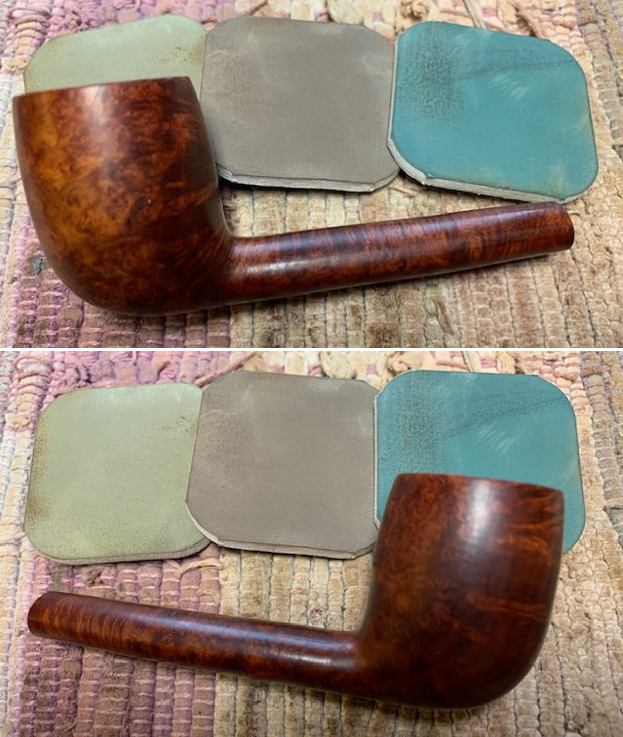
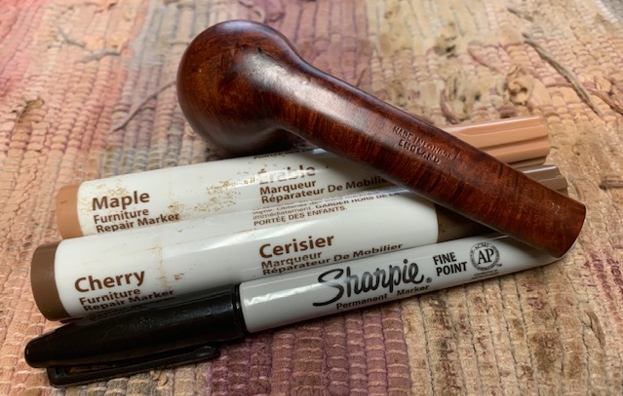
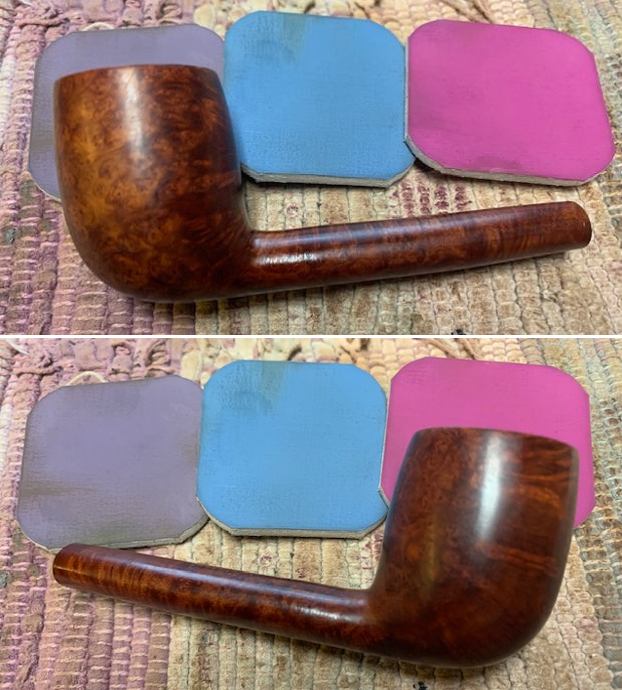
Now it was time to turn my attentions to the pipe itself. Jeff had cleaned up the pipe with his usual penchant for thoroughness. He reamed the pipe with a PipNet pipe reamer and removed the rest of it with a Savinelli Fitsall Pipe Knife.  He scrubbed the bowl with undiluted Murphy’s Oil Soap with a tooth brush. He rinsed it under running warm water to remove the soap and grime. He cleaned out the inside of the shank and the airway in the stem with alcohol, cotton swabs and pipe cleaners. He soaked the stem in Before & After Deoxidizer and rinsed it off with warm water. I took photos of the pipe once I received it.  The rim top cleaned up really well. The rim top and outer edge of the bowl appear to be in good condition other than some slight darkening on the front. The stem surface looked very good and the chatter on the stem on both sides near the button could easily be sanded out. The tooth marks on the button surface would need to be addressed. The stamping on the top and underside of the shank is readable and reads as noted above.      I removed the stem and took a photo of the pipe to give a sense of the whole. The bowl looked very good and once I cleaned up the stem the pipe would look very good.Now it was time to do my work on the pipe. I topped the bowl lightly and sanded the beveled inner edge and top of the rim with 200 grit sandpaper to lighten the darkening that was there. There was also a spot on the front outer edge of the bowl that I needed to sand. I stained it with a Maple stain pen to match the colour of the bowl. The finished product looked better. I polished the briar with micromesh sanding pads – 1500-12000 grit pads. I wiped it down with a damp cloth after each sanding pad.   The bowl was in such good condition that I rubbed the bowl and shank down with Before & After Restoration Balm. I worked it into the surface of the bowl sides and shank with my fingertips to clean, enliven and protect the briar. I let the balm sit for ten minutes then buffed the bowl with a cotton cloth to raise the shine.      I filled in the deep tooth marks on the button surface and the deeper ones on the stem itself with clear super glue. I let it cure and once it had hardened I reshaped the button and sanded the repairs smooth with 220 grit sandpaper. I started polishing the stem with 400 grit wet dry sandpaper. I polished the stem with micromesh sanding pads – 1500-12000 grit pads. I wiped it down with Obsidian Oil after each sanding pad. I used Before & After Pipe Polish – both Fine and Extra Fine to further polish the stem. This Comoy’s Made Sunrise Amber Grain Vintage Briar 299 Canadian is a great looking pipe now that it has been restored. The brown stained finish around the bowl is quite beautiful and highlights grain very well. The finish works well with the polished vulcanite oval taper stem. I put the stem back on the bowl and carefully buffed the pipe with Blue Diamond on the buffing wheel using a light touch on the briar. I gave the bowl and the stem multiple coats of carnauba wax on the buffing wheel and followed that by buffing the entire pipe with a clean buffing pad. I hand buffed the pipe with a microfiber cloth to deepen the shine. The finished Sunrise Amber Grain Vintage Briar Canadian sits nicely in the hand and feels great. Give the finished pipe a look in the photos below. The dimensions of the pipe are Length: 5 ¾ inches, Height: 1 ¾ inches, Outside diameter of the bowl: 1 1/8 inches, Chamber diameter: ¾ inch. The weight of the pipe is 31 grams/1.09 ounces. I will be putting it on the rebornpipes store shortly. If you are interested in adding this pipe to your collection send me a message or an email. Thanks for reading this blog and my reflections on the pipe while I worked on it. There are many more to come!

Resurrecting a Tired Warrior – a Butz-Choquin Casino 1575 Spigot Billiard


Blog by Steve Laug

The next pipe on the table is a Butz-Choquin Spigot style pipe with a polished nickel ferrule and a polished nickel stem end. The pipe had classic shape and at first glance looked very good. We purchased this from an online auction late in 2020 in Elgin, South Carolina, USA. It had a rich finish somewhere underneath all of the debris, grime and damage to rim edges and sides. There was a thick cake in bowl and lava on the rim top. The rim top was uneven with dips and burns on the top. The front of the bowl had significant burn damage from the rim top down into the surface of the briar on the front. The left side had the same issue and had been worn away over time so that it was canted inward making that part of the bowl thinner on the side. The pipe is stamped on the left side of the shank Butz-Choquin at an angle [over] Casino and on the right side it was stamped St Claude in an arch over France [over] the shape number 1575. The nickel ferrule and stem end were oxidized and scratched. The stem was oxidized but had deep tooth marks on the top and underside near the button. The deepest marks were on the underside with one that was almost a bite through. The BC logo on the topside was faded and needed to be touched up. Jeff took photos of the pipe before he started his clean up work. I like to have an idea of how the pipe was smoked before we got it and what the bowl and rim top looked like. Jeff always takes some photos of the bowl and rim from various angles to show what it looked like. This bowl and rim top were in rough condition. The stem was a real mess with deep tooth marks and damage on both sides. He took a photo of the nickel ferrule and stem end to give a picture of their condition when we received the pipe. It definitely needs work. He took photos of the sides and heel of the bowl to give a sense of the grain on the pipe. You can also see the damage around the top front and sides in the photos. Jeff captured the burn damage on the front of the bowl in the next photo and some of the nicks and gouges in the sides of the bowl in the second photo. There is work to do on this one!The next photos show the stamping on the left and right side of the shank. It is clear and readable as noted above. Jeff also captured the BC stamp on the topside of the stem. I turned to Pipephil.eu and read through the listing on the brand. It is always a quick reminder to me of the basics of a brand. The Casino line was not listed there. I include the short summary of the history below.

The origin of the brand reaches back to 1858 when Jean-Baptiste Choquin in collaboration with his son-in-law Gustave Butz created their first pipe in Metz (France). Since 1951 Butz-Choquin  is a brand of the Berrod-Regad group (Saint-Claude, France).

Jean Paul Berrod managed the company from 1969 to 2002 when he retired and sold the corporate to Mr Fabien Gichon. Denis Blanc, already owner of EWA, took over the S.A. Berrod-Regad in 2006.

I could not find anything specific in Pipedia about the Casino line, but a simple search on the internet will show many different shapes available in the Casino line from Butz-Choquin.   Now it was time to work on the pipe.

Jeff had done a great cleanup on the pipe. He reamed the bowl with a PipNet pipe reamer and followed up with a Savinelli Fitsall pipe knife to remove the cake. He scrubbed out the mortise and the airway in the shank and the stem with alcohol, cotton swabs and pipe cleaners. He scrubbed the bowl exterior with a tooth brush and Murphy’s Oil Soap to remove the grime on the finish of the bowl and the lava from the rim top. He rinsed it under running water. One of the benefits of this scrub is that it also tends to lift some of the scratches and nicks in the surface of the briar. He dried it off with a soft cloth. He cleaned the internals and externals of the stem with alcohol, pipe cleaners and cotton swabs. He soaked the stem in Briarville’s Pipe Stem Deoxidizer and rinsed it off with warm water and cleaned out the airway in the stem with alcohol. When I received it the pipe looked very good.  I took a photo of the rim top and stem to show the condition. The rim top and the inner edge of the bowl were in rough shape. The outer edge had a lot of burn damage on the front and the left side. The rim top and inner edge also has significant burn damage and was not flat. The stem was vulcanite and there were some deep tooth marks and chatter on both sides ahead of the button. The stamping on the pipe is clear and readable as noted above. The BC logo on the stem is deep and needs to be repainted with white (as seen in the photo of the top of the stem above).I started my work on this pipe by dealing with the damage to the outer edge of the bowl and rim top. I topped the bowl first on a topping board with 220 grit sandpaper. I flattened out the rim top and made the top of the rim consistently flat. I removed much of the burn damage to the bowl top. I worked on the damaged areas on the left side and front of the bowl by building them up with briar dust and clear super glue. I built up the left side of the inner edge with super glue and briar dust as well. There the burn damage was shallow but it made the bowl out of round. I topped it once again to smooth out the repair on the rim top. I used a piece of dowel wrapped in sandpaper to sand the inner edge of the rim and smooth out the repair in that area. It worked well.I smoothed out the repairs on the left and front of the bowl with 220 grit sandpaper and blended them into the surrounding briar.I gave the inner edge of the bowl a slight bevel with 220 grit sandpaper to help reshape it and bring it back to round. The rim top and edges looked good at this point in the process.I restained the pipe with a light brown aniline stain. I applied it with a dauber and flamed it with a Bic lighter to set it in the grain. I repeated the process until I was happy with the coverage.Once the stain had dried I wiped the bowl down with 99% isopropyl alcohol to make it a bit more transparent. I find that doing a wipe down at this point evens the finish before I start polishing it with micromesh.I polished the briar with 1200-1500 micromesh sanding pads and wiping it down with damp cloth after each sanding pad. As I worked through the cycle of pads the shine developed with each change of pad. The damage on the rim sides looks better. I left some of the nicks and sandpits as they really are a part of the pipe’s story. I rubbed the bowl and shank down with Before & After Restoration Balm. I worked it into the surface of the bowl sides and shank with my fingertips to clean, enliven and protect the briar. I let the balm sit for 10 minutes, then buffed with a cotton cloth to raise the shine. The Balm did its magic and the grain stood out on the briar. I set the bowl aside and turned my attention to the stem. I decided to address the tooth marks on the stem. They were ragged, with sharp edges and heat did not lift them at all. I filled them in with clear super glue. I let the repairs cure and once they hardened I flattened and shaped them with a small file. I sanded them with 220 grit sandpaper to blend them into the surface of the stem. I started the polishing of the stem with 400 grit wet dry sandpaper. I touched up the BC stamp on the left side of the stem with white acrylic nail polish. I worked it into the stamp with a tooth pick and then sanded off the excess once it had dried with a 1500 micromesh sanding pad.I polished it with micromesh sanding pads – 1500-12000 grit pads. I wiped it down with Obsidian Oil after each sanding pad. I used Before & After Pipe Polish – both Fine and Extra Fine to further polish the stem. The photos below show the polished stem. This Butz-Choquin Casino 1575 Spigot Billiard with a polished nickel ferrule and stem cap on a vulcanite stem is a great looking pipe now that it has been restored. It was a lot of work and I took a decision to leave some of the journey of the pipe in the finish so it is far from flawless but it is a beauty. The rich browns of the stain made the grain come alive with the polishing and waxing. I put the stem back on the bowl and carefully buffed the pipe with Blue Diamond on the buffing wheel using a light touch on the briar. I gave the bowl and the stem multiple coats of carnauba wax on the buffing wheel and followed that by buffing the entire pipe with a clean buffing pad. I hand buffed the pipe with a microfiber cloth to deepen the shine. The finished BC Casino 1575 Spigot really is a beauty and fits nicely in the hand and looks very good. Give the finished pipe a look in the photos below. The dimensions of the pipe are Length: 6 ¼ inches, Height: 1 ¾ inches, Outside diameter of the bowl: 1 ¼ inches, Chamber diameter: ¾ of an inch. The weight of the pipe is 1.87oz./53grams. This beauty will be going off to its new trustee in Michigan along with several other nice pipes. Thanks for reading this blog and my reflections on the pipe while I worked on it. There are many more to come!

Helping A Fellow Piper With His Dream Pipe…A Peterson’s System Pipe


Blog by Paresh Deshpande

A very warm Namaste to all the followers of Reborn Pipes! It’s been a while since I posted any write up on rebornpipes.com and those that were posted have been projects which I had worked on prior to December 2020! The main reason being my relocation to a new place of work, numerous quarantine periods, waiting for allotment of house followed by shifting of family from Pune to my place of work, setting up the new house (only to up stake and move to a new place in 2 years!) and amidst these hectic activities, jostle with the kids and Abha, my wife, for a small corner where I could set up my work table. Thus, with everything well settled and having got back to our day to day routine, it was back to restoring pipes! Oh how I missed handling these pieces of art and history!

Through this time, I came to appreciate the reach of Reborn pipes and the yeoman service it provides in getting like minded pipers closer to each other. Now I am saying this because of the first hand experience I had when one fine day, I received a message from Steve that a gentleman piper from India wants to get in touch with me and that he had shared my email address. Soon enough, I received a mail from Karthik and since then our friendship has only been growing. Karthik was keen to start his own restoration work and was especially interested in a Peterson’s System pipe. Now, here in our part of the world, these are very difficult to come by and when they do, the cost is in INR five figures! When I told Karthik that the many Peterson’s System pipes that he read about on Reborn pipes were from my personal collection, I could sense his disappointment. Readers who have been following my write ups are well aware that one of my set goals has been to make available high quality restored pipes at reasonable price to fellow pipers from India and thus began my hunt for a Peterson’s System pipe in a reasonably good condition at an acceptable price point. A couple of months later, Chris from England (I have purchased a number of pipes from him earlier) had a Peterson’s System pipe that ticked all the right boxes and soon the pipe made its way to Pune and Abha, my wife, shared pictures of the received pipe. Karthik was mighty pleased with the way the pipe looked and so was I. Before I could get to work on this pipe, my move came about and the rest I have described above…

I had requested Karthik to introduce himself to all the readers of Reborn pipes and I am sanguine that we shall soon get to know and see his work. I received his mail and have reproduced it below (I have edited a very tiny portion of the mail though! Sorry Karthik, I too am still in the process of learning and hence the edit, hope you understand).

Hi Paresh sir,

Here’s my intro, hope it’s not too long:

Hello world! I’m Karthik, an engineer in India. I picked up pipe smoking last year as a way of staying off cigarettes, but have since fallen in love with the hobby itself. Living in India, I don’t have easy and immediate access to great pipes. So the idea of buying antiques and restoring them piqued my interest and I stumbled upon Reborn Pipes. As I read through post after post, I happened upon one of Paresh’s posts and both his name and his mention of Pune made me fall over myself in my rush to get in touch with him. I immediately emailed Steve, who graciously put me in touch with Paresh. Since then Paresh has been a great guide in my pipe smoking journey. Unfortunately I haven’t been able to start restoring any pipes myself, but I hope to get to that soon. In the meantime, Paresh generously showed me some of his collection and kept me in mind when he found something of interest. I hope to start down the path of restorations in the near future myself, with his guidance. 

Regards,

Karthik

Definitely Karthik, together we shall learn and progress further.

And Now On To Restoring Karthik’s Pipe…
I have researched and worked on a few vintage as well as new Peterson’s and at first glance I knew this pipe to be a new era Peterson’s. The stummel has a spread of mixed grains all around and a nice feel in the hand thanks to its medium sized bowl. It is stamped vertically on the left side of the shank as “PETERSON’S” without a forked ‘P’ over “SYSTEM” over “STANDARD”. The right side of the shank close to the edge of the ferrule bears the COM stamp “MADE IN THE” over “REPUBLIC” over “OF IRELAND” while model/ shape code “# 314” is stamped below the COM stamp. The nickel ferrule bears the trademark Kapp & Peterson’s official logo of “K&P” followed by “PETERSON’S” over the three usual cartouche with first having Shamrock, the second a Prone Fox and lastly a Stone Tower.While dating a Peterson’s pipe, I always fall back to my under mentioned favorite site; http://thepetersonpipeproject.blogspot.com/2007/07/dating-petersons-pipes.html

I quote from the above site:-

Stamping of Bowl:
During the years of Kapp and Peterson’s business operations, the country of Ireland has undergone several name changes and K&P’s stamping on their pipes reflects these changes. Knowing these changes, a Peterson pipe can be roughly dated and placed in “eras.”

  • The Republic Era is from 1949 until the present. The Republic of Ireland was formed on 17 April 1949. From 1949 to present the stamp for this era is “Made in the Republic of Ireland” in a block format generally in three lines but two lines have been used with or without Republic being abbreviated.

With the provenance of the pipe thus established, I moved ahead with the initial visual inspection of the pipe.

Initial Visual Inspection
The chamber has a thin layer of cake signifying either limited usage or that it had been recently cleaned. The rim top surface has several scratch marks and darkening which would need to be addressed. The inner edge of the rim is charred in 3 o’clock direction (encircled in yellow). Nicks and dings are also seen along the outer rim edge (indicated with green arrows) and deep gouges on the right (encircled in yellow). Chamber has strong odors of sweet smelling tobaccos. The condition of the inner walls of the chamber appears solid and also going by the solid feel of the external surface, I do not foresee any serious issues/ surprises with the chamber walls. The stummel surface is clean but appears dull and lackluster. A number of minor dents and scratches are seen over the stummel, notably towards the front, foot and the bottom of the shank. There is not a single fill over the entire stummel surface. The mortise and the sump shows traces of dried out oils and tars. The pipe smells are too strong. The bent P-lip vulcanite stem is in a relatively good condition with light tooth chatter on either surfaces of the stem. The bite zone of the upper surface has deep tooth indentations with the button edge nearly obliterated and bite marks over the upper P- lip portion causing the slot edges to deform. These will need to be rebuilt and sharpened. The lower surface of the P-lip has distinct deep bite marks and the button edge is completely deformed. The stem is heavily oxidized with minor scratches towards the tenon end. The Process
I decided to work the stummel first as I was keen to see how the stummel shaped up and so was Karthik on appreciating the grains on this piece of briar. I carefully and gently scrapped out the thin layer of cake with a sharp knife followed by sanding the chamber walls with a folded piece of 220 grit sand paper. I checked the chamber walls closely and was happy to note that the walls were pristine and without any issues. With the chamber now clean, I moved ahead with the internal cleaning of the shank and the sump. Using my sharp fabricated knife, I scraped out all the dried tars and gunk from the walls of the mortise. I used q-tips and pipe cleaners with alcohol to clean out the sump and the draught hole. I shall continue deep cleaning of the mortise and the sump when I will clean the internals using salt and alcohol treatment.Next I decided to address the issue of strong ghost smells in the chamber. To eliminate the ghost smells from the pipe, I decided to treat it with salt and alcohol. I packed the sump with cotton and drew out a wick from the cotton and along with a folded regular pipe cleaner, inserted it into the mortise and through the draught hole into the chamber. I tightly packed cotton balls in to the remaining portion of the mortise. Thereafter, I soaked the cotton balls with isopropyl alcohol up to the brim. About half an hour later, the level of alcohol had gone down, having being absorbed by the cotton. I topped it up once again and set it aside overnight. By next afternoon, the cotton and alcohol had drawn out all the remaining oils and tars from the chamber, sump and mortise. I removed the cotton balls and the dirt can be gauged by the appearance and coloration of the cotton balls and the pipe cleaner. With my fabricated knife and dental tools, I spent the next hour scrapping out the entire loosened gunk from the mortise and the sump. I ran pipe cleaners through the mortise and draught hole to clean out all the loosened tars and gunk that was lodged in the draught hole, sump and mortise. The chamber now smelled clean, fresh and looked it too. I set the stummel to dry out naturally. To clean the exterior of the stummel surface, I applied “Briar Cleaner”, a product that has been developed by my friend Mark Hoover, to the external surface of the bowl. It works similar to Murphy’s oil soap and needs to be applied to the stummel surface and set aside for 5- 10 minutes. The product pulls out all the dirt and grime to the surface making further cleaning easy. I am quite happy with this product. I used a hard bristled tooth brush to scrub the stummel with the gel like product, wiped it clean with a moist cloth and dried it using paper towels and a soft cotton cloth. I deliberately cleaned the rim with a piece of Scotch Brite. I thoroughly cleaned the mortise and draught hole with a shank brush. I set the stummel aside to dry out naturally. The clean stummel had revealed a few more scratches which would need to be erased. Once the stummel had dried, aided by the extreme hot weather conditions prevalent here, I addressed the issues of numerous scratches and nicks by sanding the stummel smooth with a folded piece of 220 grit sandpaper. The sanding marks that are visible in the pictures below were obliterated once the stummel was subjected to the complete cycle of micromesh sanding and subsequent polishing and waxing. Having addressed the issues of scratches and nicks over the stummel surface, I moved on to address the numerous dents and dings and charred edges over the rim top surface. I topped the rim over a piece of 220 grit sand paper by slowly rotating the rim over the sand paper. I hate to lose briar any more than absolutely necessary and so frequently checked the progress I was making. I was quite pleased with the appearance of the stummel at this stage in restoration.The time I was working on the stummel, my wife Abha was busy cleaning the stem. She cleaned the stem internals with q-tips, pipe cleaners and isopropyl alcohol. She further cleaned the stem airway with shank brush and dish washing soap. It feels really nice to have her around to help with the project. Once the stem internals were cleaned up to her exacting standards, she handed me the stem to address the issue of tooth indentations and chatter over the stem surface.The next stem issue to be addressed was that of the damage over the P-lip end of the stem. I heated both the surfaces with the flame of a lighter to raise the tooth chatter and bite marks to the surface and sanded the entire stem surface with a folded piece of 220 grit sandpaper to even out the surface as well as loosen the oxidation and handed over the stem to Abha for further process. She dropped the stem in to “Before and After Deoxidizer” solution developed by Mark Hoover. The solution helps to draw out heavy oxidation to the surface, making its further removal a breeze, while the minor oxidation is eliminated to a very great extent. The initial sanding helps to draw out the complete oxidation as the sanding opens up the stem surface that has been initially covered with oxidation. By next afternoon, the deoxidizer solution had worked its magic. Abha fished the stem out and cleaned it under warm while scrubbing the stem surface with a Scotch-Brite pad. She ran a couple of pipe cleaners through the stem’s airway to completely remove any remnants of the solution.I mixed clear superglue and activated charcoal and applied it over the both button edges, upper P-lip surface and lower surface of the P-lip. I set the stem aside for the fills to cure.Next afternoon, I worked the stem fills which had hardened considerably. With a flat head needle file, I sanded these fills to achieve a rough match. I further fine tuned the match by sanding the filled area with a folded piece of 220 grit sand paper pinched between my thumb and forefinger. I followed it up by sanding the entire stem surface using 320, 400, 600 and finally with a piece of 800 grit sand paper. This serves to remove the deep seated oxidation and also reduces the sanding marks of the more abrasive sand papers. I also sharpened the button edges while sanding. I wiped the stem with a cotton swab and alcohol to remove all the oxidation and sanding dust from the surface. I applied a little Extra Virgin Olive oil over the stem and set it aside to be absorbed by the vulcanite.Next, I wet sand the stem with 1500 to 12000 girt micromesh pads to bring a deep black shine to the vulcanite. I rub a small quantity of extra fine stem polish that I had got from Mark and set it aside to let the balm work its magic. After about 10 minutes, I hand buffed the stem with a microfiber cloth to a nice shine. I rubbed a small quantity of olive oil into the stem surface to hydrate it and set it aside.While I worked the stem, Abha polished the stummel with micromesh pads, wet sanding with 1500 to 12000 pads. She polished the freshly topped rim surface to a nice luster, wiping the surface with a soft cloth at the end of the micromesh cycle. The stummel looks amazing with a deep shine and beautiful grains popping over the stummel surface. I am surprised that the rim top surface has the same deep brown coloration as the rest of the stummel surface and that the use of a stain pen was not required.She massaged a small quantity of “Before and After Restoration Balm” with her fingers into the briar. The immediate and incredible transformation that takes place is a worthy reward for all the efforts!! She let the balm sit on the surface to be absorbed in to the briar for about 20 minutes. The bowl now looks fresh and attractive with the grains popping out any which way you look at the briar. She polished off the balm with a soft cloth to a lovely shine.Now on to the polishing cycle…I mounted a cotton cloth buffing wheel on to my hand held rotary tool and applied a coat of Blue Diamond to the stummel and the stem to polish out the minor scratches.With a cotton buffing wheel that I use for carnauba wax, I applied a coat of carnauba wax and continued to work on it till the complete coat of wax had been polished out. I mounted a clean cotton cloth buffing wheel and gave the pipe a once over buff. I finished the restoration by giving the entire pipe a rigorous hand buff using a microfiber cloth to raise the shine further. The finished pipe looks beautiful and will soon be on its way for Karthik to enjoy his dream pipe!!Sincere gratitude to all the readers who have shared this part of my journey in to the world of pipe restoration……Cheers!!!

The 2nd of a Pair of Interesting Flea Market Finds – a Polo Sport Bruyere Bent Billiard


Blog by Steve Laug

The next pipe on the work table is the second of a pair of pipes that I picked up when my daughters and I went to the Vancouver Flea Market not too long ago when the COVID-19 restrictions were lifted some here. We walked through all the stalls in the market and talked to vendors. We were chatting with an English chap about pipes and he took a bag out from under the table and in it were two pipes. The first pipe was petite Bent Bob’s sandblast pipe that I restored and wrote a blog about earlier. The second pipe was worn and had varnish peeling off. It was stamped Polo [over] Sport on the left side of the shank and Bruyere on the right side. On the underside near the stem/shank junction it is stamped with the shape number 21. The rim top had some darkening and some lava build up and there was a light cake in the bowl. The stem was oxidized, calcified and had some deep tooth marks and chatter on both sides ahead of the button. button. It was another good find and I was able to negotiate a good price for the pair of pipes that I picked up. I took photos of the rim top and bowl to give a sense of what I saw. There was a thin cake in the bowl and there was lava on the rim top and the inner edge of the bowl. I also took photos of the top and underside of the stem to show the oxidation, calcification and the deep tooth marks and chatter next to the button on both sides. I took a photo of the stamping on the left, right and underside of the shank. It captured the stamping well in the photos and you can see that they are clear and readable as noted above.I turned to Pipephil’s and to Pipedia to see what I could find out about the brand. I also googled the brand name of the pipe. It appears that quite a few companies in several countries made pipes that were stamped Polo. Savinelli in Italy, Vauen in Germany, Imperial Tobacco Company and Cadogan in England. I have eliminated the Savinelli connection as well as the Vauen connection by the stamping on those pipe versus this one. It may well be an Imperial or a Cadogan after the merger. I am not sure I will ever know for certain.

It was now time to work on the pipe. I had a decision to make. Should I scrub it with Murphy’s or skip that step and scrub it with acetone to remove the peeling varnish coat? I opted to go with the acetone scrub. I scrubbed the rim top and sides of the bowl with acetone on cotton pads to remove the grime and the peeling varnish. I was very happy with the outcome. The bowl had some interesting grain around the top and sides. I cleaned up the inside of the bowl and removed the cake with a Savinelli Fitsall Pipe Knife. I took the cake back to bare briar and cleaned it up so that I could examine the bowl walls carefully. They were clean and undamaged.I heated the stinger with a lighter to loosen the tars that held it firmly in the tenon. I find that these really restrict the airflow and it did in this case significantly.I scrubbed out the internals of the shank and stem with alcohol, cotton swabs and pipe cleaners. I worked until both the shank and stem were clean.I filled in the damaged areas on the rim top and the lower left side of the bowl/shank with clear CA glue. Once the repairs cured I wetsanded those areas of the bowl and rim with a 1500 grit micromesh sanding pad. I sanded the entirety of the bowl with micromesh pads – dry sanding with 1500-12000 grit pads. I wiped the bowl down after each pad to remove the sanding debris. The bowl began to take on a deep sheen. I rubbed the bowl down with Before & After Restoration Balm. The product works to revitalize, protect and polish the briar. I let it sit on the bowl for 10 minutes and then buffed it off with a cotton cloth. I set the bowl aside and turned my attention to the stem. I “painted” the tooth marks with the flame of a lighter and was able to lift them significantly. I filled in the remaining marks with clear CA glue. Once it cured I used a small file to recut the edge of the button and to flatten out the repairs. I sanded out the repairs with a folded piece of 220 grit sandpaper and then started polishing it with 400 grit wet dry sandpaper.  I polished the stem with micromesh sanding pads – dry sanding with 1500-12000 grit pads. I rubbed the stem down between pads with Obsidian Oil. I finished polishing using Before & After Stem polish – both Fine and Extra Fine. I rubbed the stem down a final time with Obsidian Oil. This is the first of this brand that I have worked on and one that I can find no detailed information. I believe it is an English Made pipe perhaps Imperial or Cadogan. The Polo Sport Bruyere 21 Bent Billiard is a beautiful pipe underneath that thick and peeling varnish coat. The grain is very nice and the colour of the briar goes amazingly well with the polished black vulcanite taper stem. The delicate curves of the bowl and stem work together to create a pipe that is a pleasure to look at and is comfortable in  the hand. With the stinger apparatus removed the pipe has a great draught (I put it back to let the new owner keep or remove it). The dimensions of the petite pipe are Length: 5 inches, Height: 1 ¾ inches, Bowl diameter: 1 ¼ inch, Chamber diameter: ¾ of an inch. The weight of the pipe is 1.13 ounces/35 grams. It is a great looking pipe that feels great in the hand and is light weight in the mouth. The light weight of the pipe, the bend in the stem and shank should make it another  perfect clencher. I will be adding it to the British Pipe Makers section of the rebornpipes store shortly. If you are interested in adding it to your collection send me a message on Facebook or an email. Thanks for walking through the process with me. Cheers.

Breathing Life into this Savinelli Made Duca Carlo Pot


Blog by Steve Laug

This July long weekend has been a bit of rest and relaxation for me as I have been able to take time in the basement at my work table and deal with pipes that have been piling up in the boxes around the table. I have posted two I have worked on already – both French Made – a Butz-Choquin Optima and a Chatham Volcano. They were interesting pipes because of the shape and style. This one was more of a relaxed restoration because it was a classic shape and did not present too many challenges. Jeff purchased this pipe from an antique mall Logan, Utah, USA. It had an interesting fire-like finish on it that reminded me of molten lava. The bowl was classic Pot shaped. There was a thick cake in bowl and lava on the rim top. There were nicks around the out edge of the rim  on the right side. There were several fills around the bowl sides. The finish was filthy with grit and grime ground into the surface of the briar. The pipe is stamped on the left side of the shank DUCA CARLO and on the underside across the shank just below the shank/stem union it was stamped ITALY. I remembered that the pipe was a Savinelli made pipe but I could not remember how it was connected. I would need to check the blog. The stem was oxidized and had light tooth marks and chatter on both sides at the stem. Jeff took photos of the pipe before he started his clean up work. I like to have an idea of how the pipe was smoked before we got it and what the bowl and rim top looked like. Jeff always takes some photos of the bowl and rim from various angles to show what it looked like. He also captured the nicked right outer edge. The stem looked very good under the oxidation. He took photos of the sides and heel of the bowl to give a sense of the grain on the pipe. You can also see the fills on the right side of the bowl. The next two photos show the stamping on the left side and underside of the shank. It is clear and readable as noted above.I did a quick scan of the rebornpipes blog and found a link to the Duca Carlo pipe that Dal Stanton had restored (https://thepipesteward.com/2021/05/04/liberating-the-grain-of-a-candy-apple-finish-a-savinelli-duca-carlo-poker-of-italy/). I always appreciate the research that Dal does when he works on pipes because it is what I like doing when I am restoring the pipes on my table. I quote from the portion of the blog that gives the background information on the brand. (Thanks Dal for the leg work on this one!)

Whenever I work on a pipe, I’m always interested to know something of the pipe.  My first stop at Pipedia reveals that the Duca Carlo is a second of Savinelli, the well-known Italian pipe manufacturer.Savinelli’s history as an Italian pipe maker goes back to 1876 – a rich history and tradition which can be read in Pipedia’s Savinelli article.  The Duca Carlo is listed in the main Savinelli article within an extensive listing of “Savinelli made sub-brands, seconds & order productions”.  The Duca (Duke) Carlo is listed with the Duca di Milano and Duca di Paolo giving the impression that Savinelli produced these as special lines commemorating these historical figures.  With a quick internet search brings me to a Wikipedia article.  Duca Carlo reveals an interesting story of a child that died of smallpox at age 3 (See: Carlo, Duke of Calabria):

Carlo of Naples and Sicily (ItalianCarlo Tito Francesco Giuseppe; 4 January 1775 – 17 December 1778) was Duke of Calabria as heir to Naples and Sicily. Born at the Caserta Palace near Naples, he was known as the Duke of Calabria at birth as the heir apparent to his father’s throne. His mother was a daughter of Empress Maria Theresa and thus sister of Marie Antoinette.

A member of the House of Bourbon, he was a prince of Naples and Sicily by birth. He was the hereditary prince of Naples. His birth allowed his mother to have a place in the Council of State, pursuant to his parents’ marriage contract.

Carlo died of smallpox[1] aged 3. Six of his younger siblings would die of smallpox also: Princess Maria Anna (in 1780), Prince Giuseppe (in 1783), Prince Gennaro (in 1789), Prince Carlo Gennaro (also in 1789), Princess Maria Clotilde (in 1792) and Princess Maria Enricheta (also in 1792).  He was buried at the Church of Santa Chiara in Naples.

The only other reference to the Duca series in the Savinelli Pipedia article comes from a photo that does not mention a name, but the stem stamping is clearly from the Duca series of pipes listed.  No dating on the picture can be seen.The Savinelli Duca line is confirmed by my next stop. Pipephil (http://pipephil.eu/logos/en/logo-d9.html) gives two examples of Savinelli Ducas – a Duca Carlo and Duca Eraldo.  Consistent between each example is the crown stem stamping.Armed with the information that I had gleaned from Dal’s blog, I turned my attention to the pipe itself. Jeff had done a great cleanup on the pipe. He reamed the bowl with a PipNet pipe reamer and followed up with a Savinelli Fitsall pipe knife to remove the cake. He scrubbed out the mortise and the airway in the shank and the stem with alcohol, cotton swabs and pipe cleaners. He scrubbed the bowl exterior with a tooth brush and Murphy’s Oil Soap to remove the grime on the finish of the bowl and the lava from the rim top. He rinsed it under running water. One of the benefits of this scrub is that it also tends to lift some of the scratches and nicks in the surface of the briar. He dried it off with a soft cloth. He cleaned the internals and externals of the stem with alcohol, pipe cleaners and cotton swabs. He soaked the stem in Briarville’s Pipe Stem Deoxidizer and rinsed it off with warm water and cleaned out the airway in the stem with alcohol. When I received it the pipe looked very good. I took a photo of the rim top and stem to show the condition. The rim top and the inner edge of the bowl were in good condition. There were some nicks on the right outer edge of the bowl but otherwise it looked good. The stem was vulcanite and there were some tooth marks and chatter on both sides ahead of the button. The stem is made for a 6mm filter or a Savinelli Balsa Filter System.The stamping on the pipe is clear and readable as noted above. There are the remnants of the crown stamp on the left side of the saddle stem.I removed the stem from the shank and took a photo of the pipe to give a sense of the whole. I started my work on this pipe by addressing the nicks along the edges. I filled them in with a clear CA glue and set them aside to cure. Once cured I blended them into the surrounding briar with a 1500 grit micromesh sanding pad. I touched up the rim top with a Walnut stain pen to blend it into the surrounding briar. I would probably need to do a bit more work on it but I liked what I saw. I sanded the bowl with micromesh sanding pads, dry sanding with 1500-12000 grit sanding pads and wiping it down with damp cloth after each sanding pad. As I worked through the cycle of pads the shine developed with each change of pad. The pipe looks very good. I rubbed the bowl and shank down with Before & After Restoration Balm. I worked it into the surface of the bowl sides and shank with my fingertips to clean, enliven and protect the briar. I let the balm sit for 10 minutes, then buffed with a cotton cloth to raise the shine. The Balm did its magic and the grain stood out on the briar. I set the bowl aside and turned my attention to the stem. I polished it with micromesh sanding pads – 1500-12000 grit pads. I wiped it down with Obsidian Oil after each sanding pad. I used Before & After Pipe Polish – both Fine and Extra Fine to further polish the stem. The photos below show the polished stem. I fit the stem with a Savineli 6mm Balsa System filter. The fit was perfect and the draw seems remarkably open. This Savinelli Made Duca Carlo Italian Pot with a vulcanite saddle stem is a great looking pipe now that it has been restored. The rich browns and blacks of the contrasting stains came alive with the polishing and waxing. I put the stem back on the bowl and carefully buffed the pipe with Blue Diamond on the buffing wheel using a light touch on the briar. I gave the bowl and the stem multiple coats of carnauba wax on the buffing wheel and followed that by buffing the entire pipe with a clean buffing pad. I hand buffed the pipe with a microfiber cloth to deepen the shine. The finished Duca Carlo Pot is a beauty and fits nicely in the hand and looks very good. Give the finished pipe a look in the photos below. The dimensions of the pipe are Length: 5 ¾ inches, Height: 1 ½ inches, Outside diameter of the bowl: 1 ½ inches, Chamber diameter: 7/8 of an inch. The weight of the pipe is 1.31oz./37grams. This beauty will be going on the rebornpipes store in the Italian Pipe Makers section. Let me know if you are interested in adding it to your collection. Thanks for reading this blog and my reflections on the pipe while I worked on it. There are many more to come!