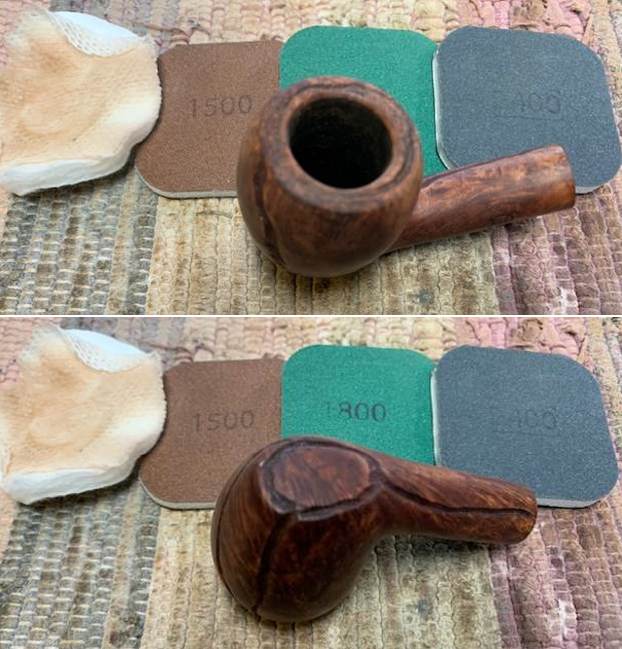
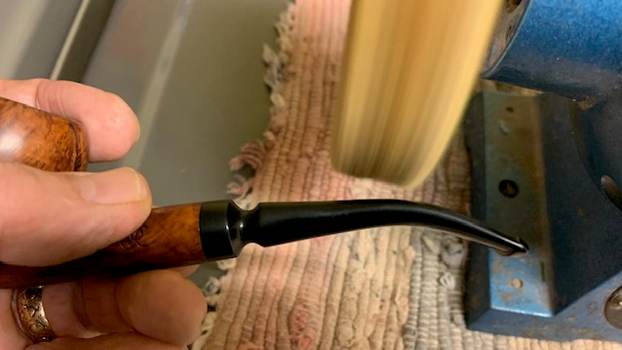
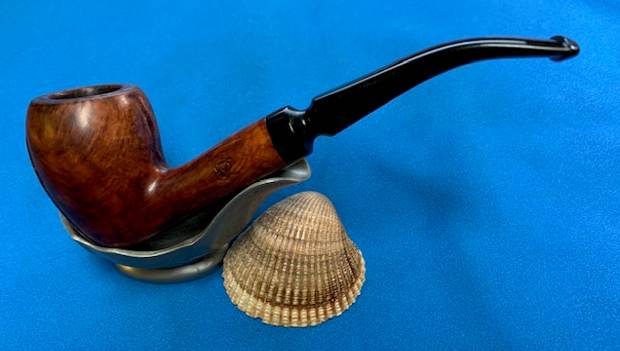
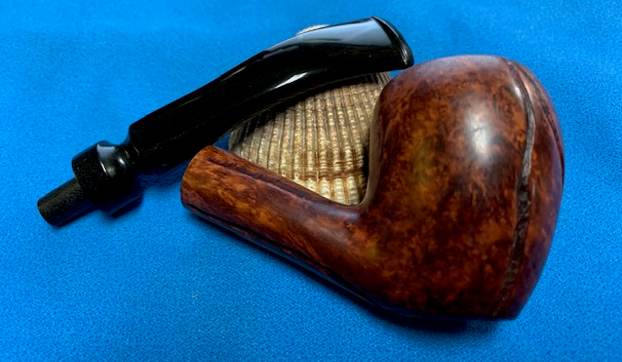
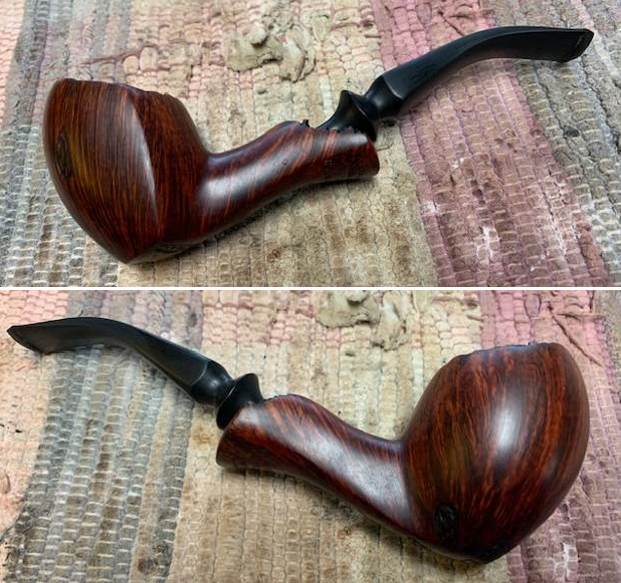
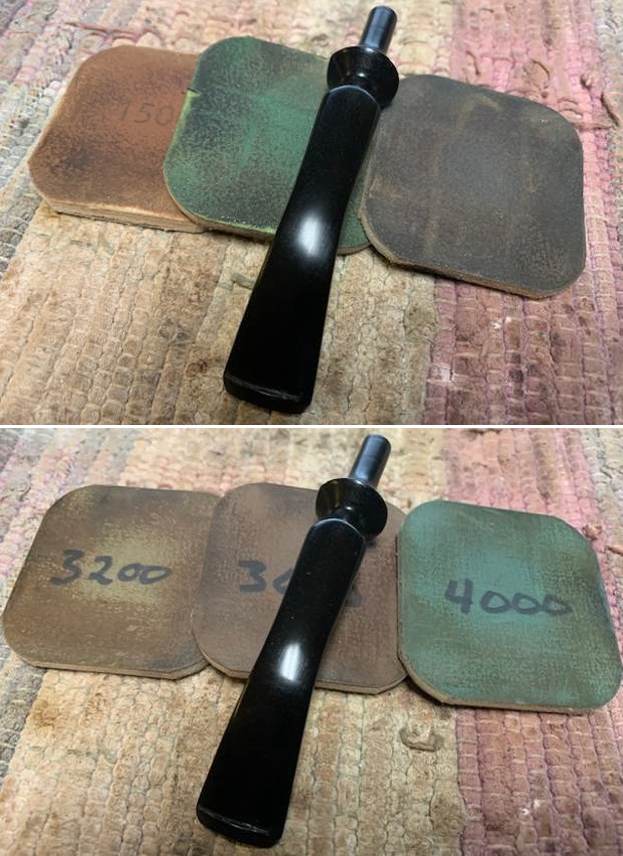
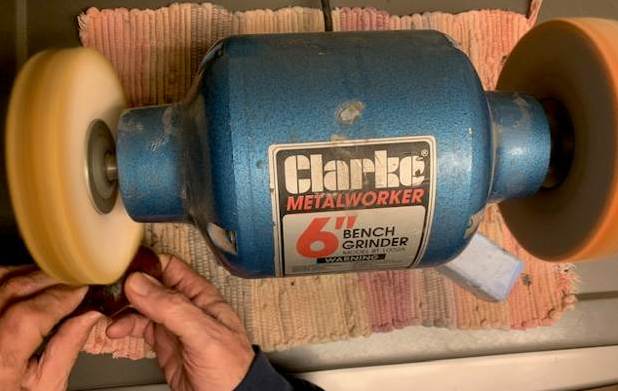
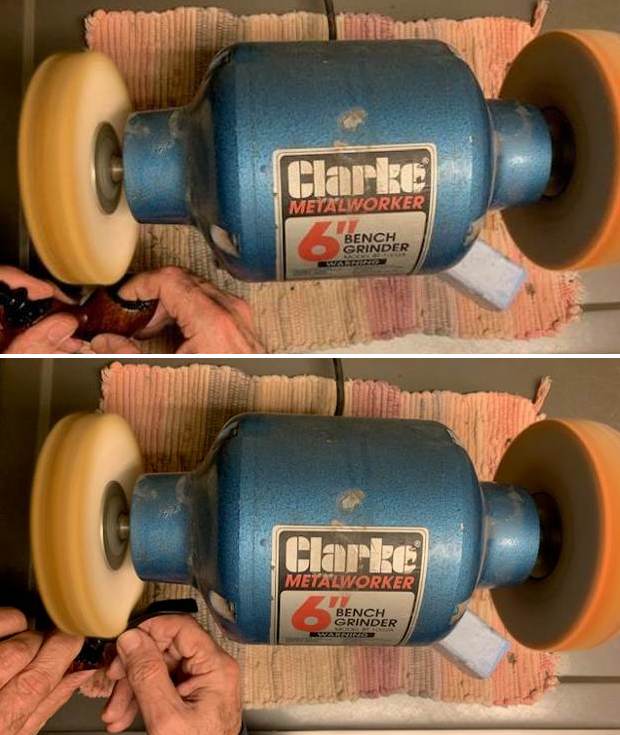
Tag Archives: stem work

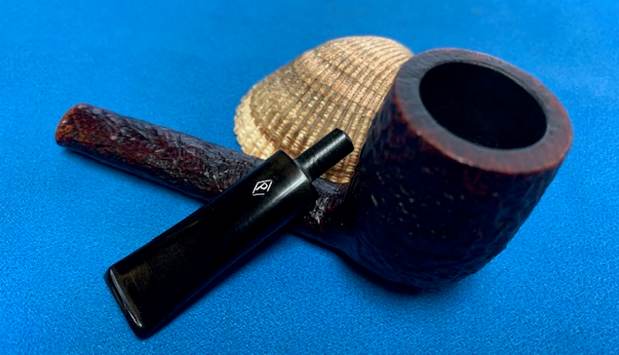
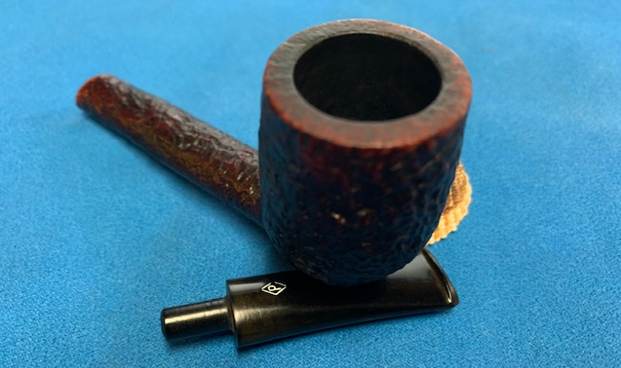
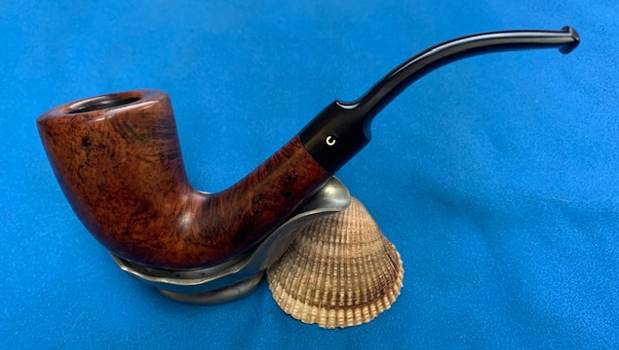
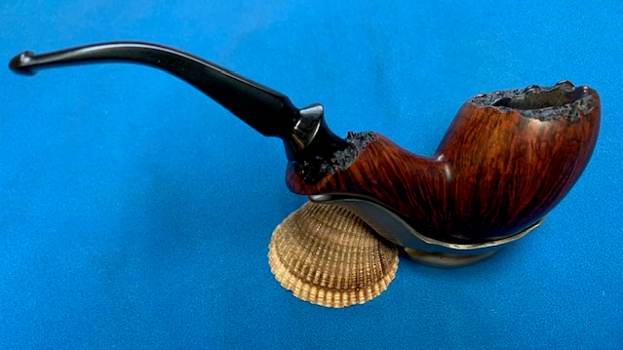
New Life for a Much Loved Swiss Made Champion Deluxe Rusticated Bent Billiard


Blog by Steve Laug

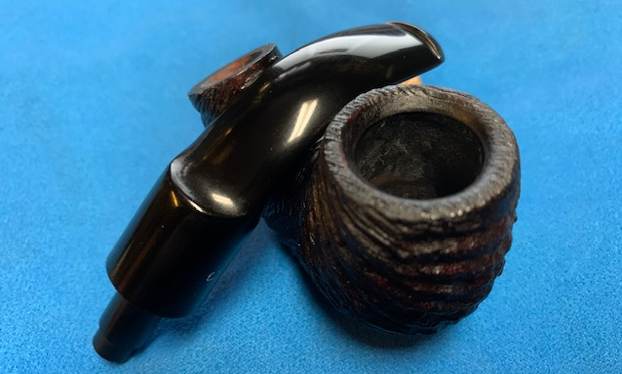
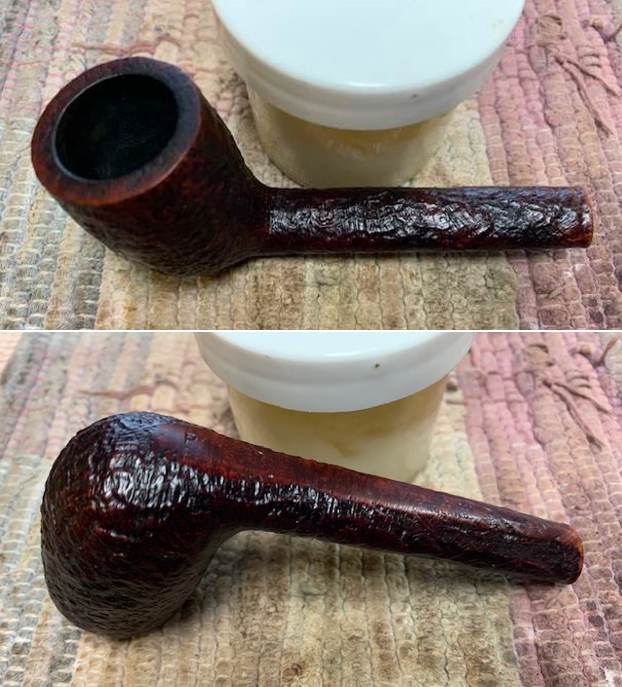
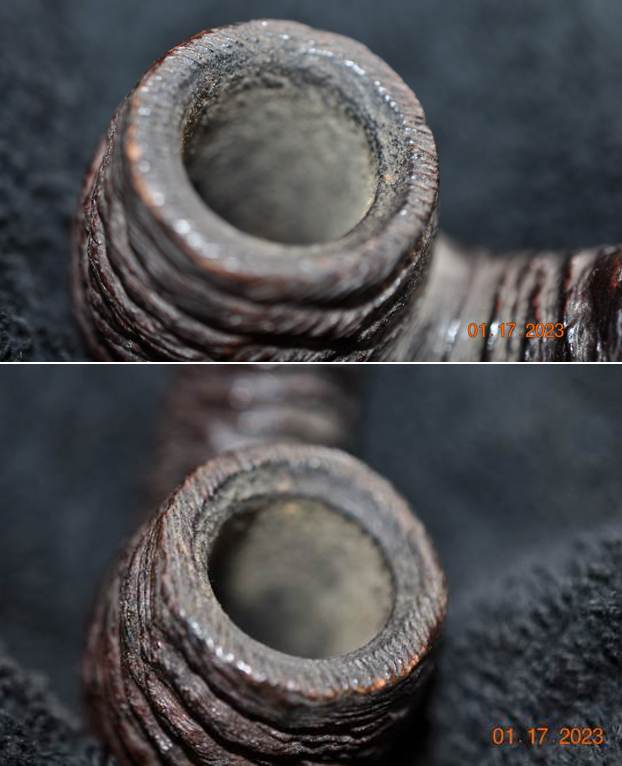
Once again in this write up and I will take you through my process of working on each pipe that we purchase. Jeff has set up a spread sheet to track where the pipe came from, the date of purchase and what we paid for it so that we know what we have invested in the pipe before we even work on it. This takes a lot of the guess work out of the process. This particular pipe was purchased on 10/16/2021 from the estate of a fellow in Redmond, Oregon, USA. I also want you to understand why we take the photos we do. If you have followed for a while then you will see the familiar pattern of the photos we include both in the before and midstream process of working on a pipe. It is not accidental or chance as the photos have been taken to help me make an assessment of the pipe Jeff sees before he starts his clean up work. We do this to record the condition that the pipe was in when received it and to assess what kind of work will need to be done on. When I look at these photos this is what I see.

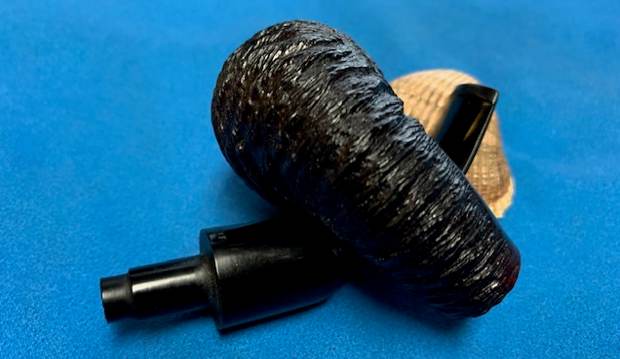
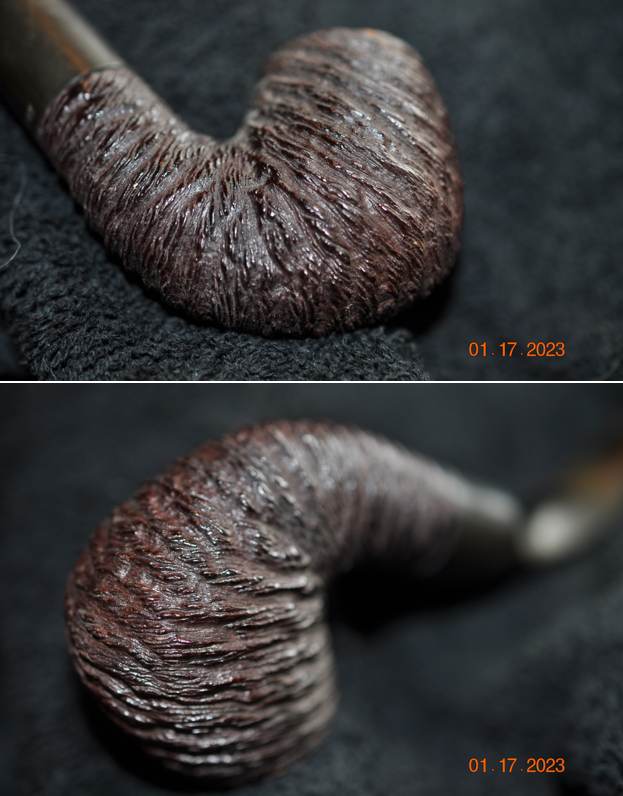
  1. The first thing I see is a rustication style that reminds of several Champion Giants that I have worked on it the past. It is a unique style that is almost the same on all of these pipes.
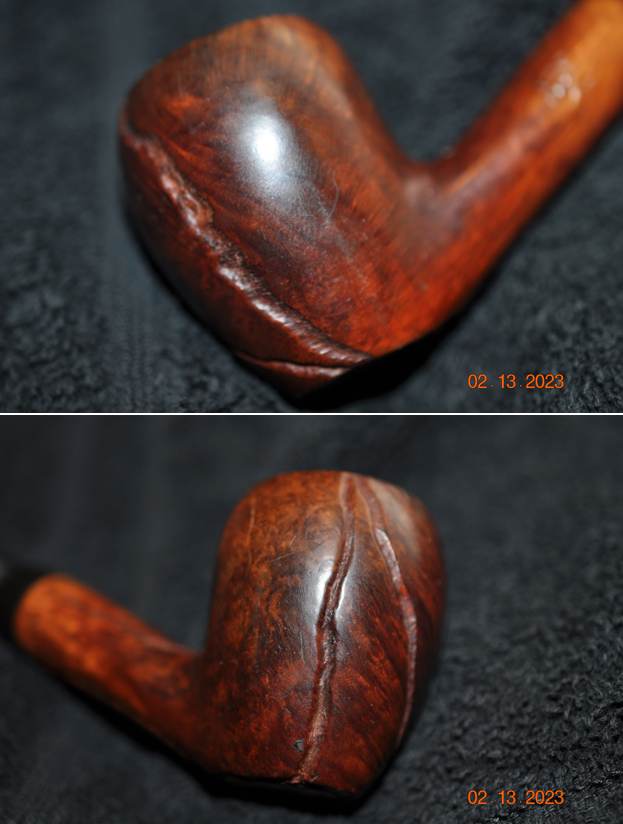
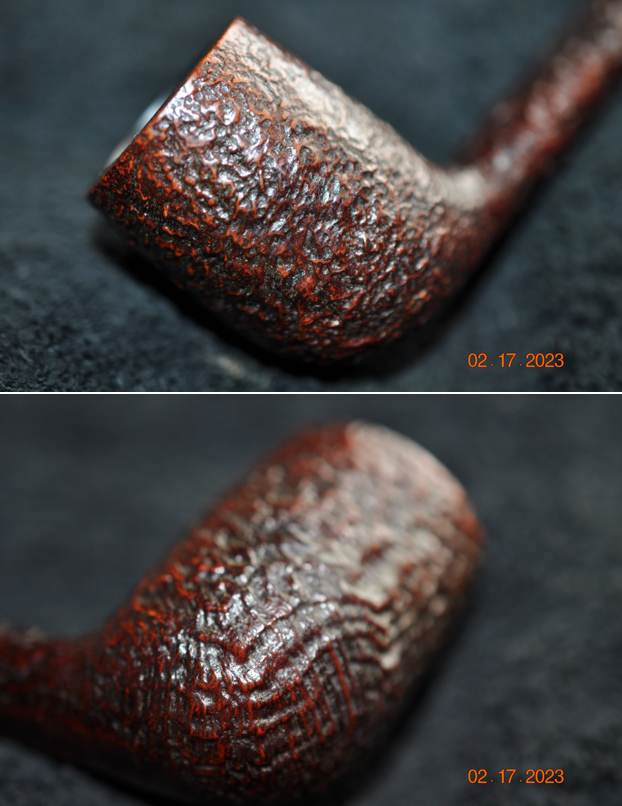
  2. The rusticated finish is dirty with a lot of dust and debris in the deep grooves around the bowl sides and shank. It is ground into the finish as well. From the exterior it does not appear that there are any cracks in grooves of the finish.
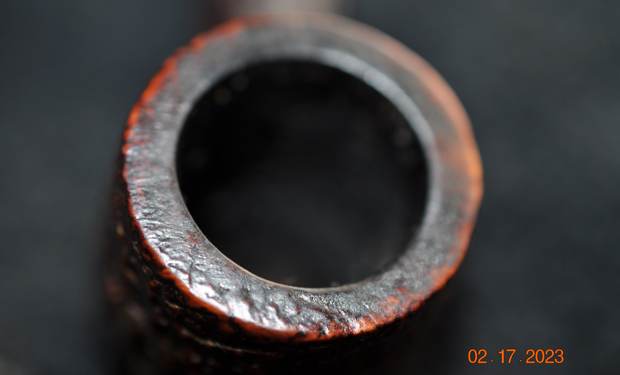
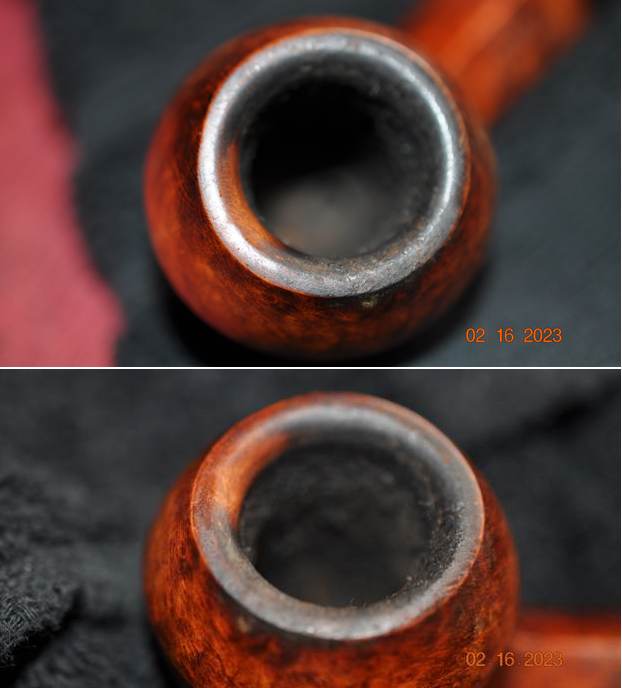
  3. The rim top had a thick lava overflow from the cake in the bowl. The inner bevel is darkened and dirty with lava. It is hard to know if there is darkening or damage under the lava. Sometimes the lava protects the rim top and edges and sometime it hides issues. Its is very dirty looking.
  4. The bowl has a thick cake in it that hides the inner edge of the bowl but once it is clean we will know what the edges look like. The outer edges look good and there does not appear to be any obvious burn damage to the top or bowl edges.
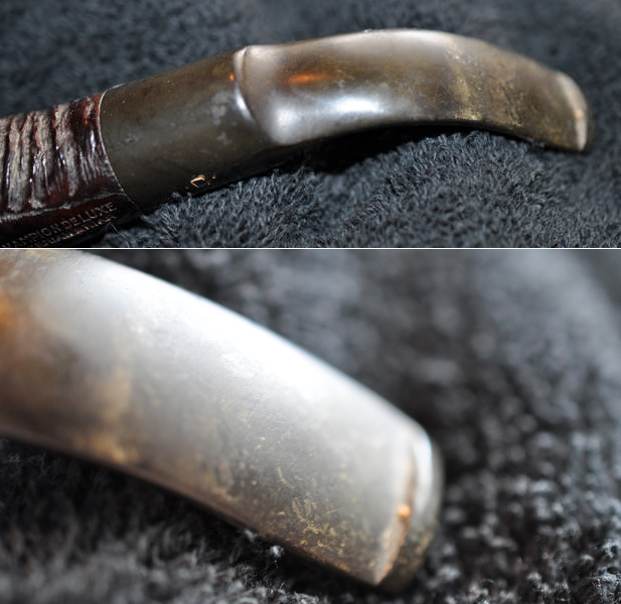
  5. The vulcanite saddle stem is in good condition – dirty, lightly oxidized and has light tooth chatter on both sides. There a C logo on the left side of the saddle stem.

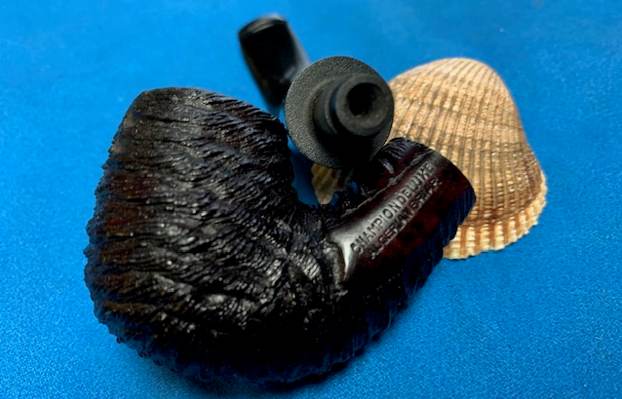
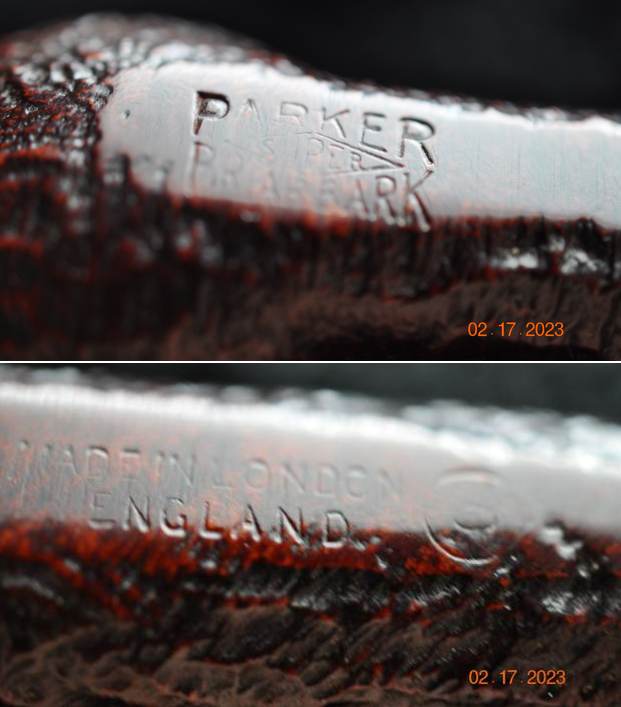
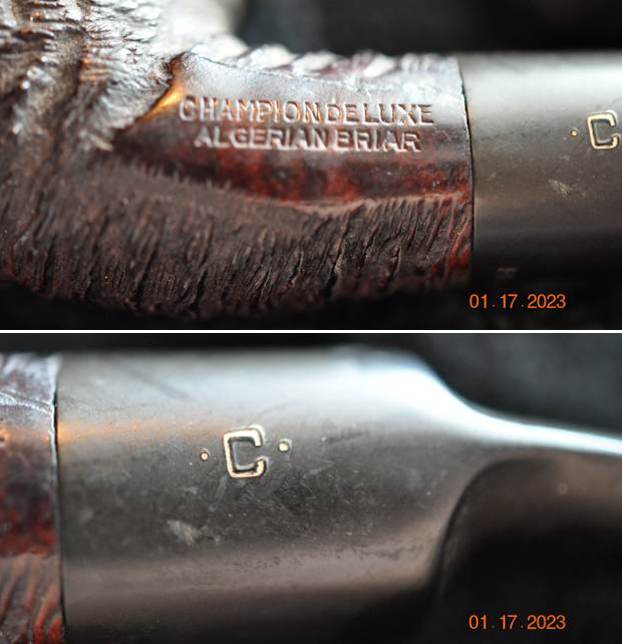
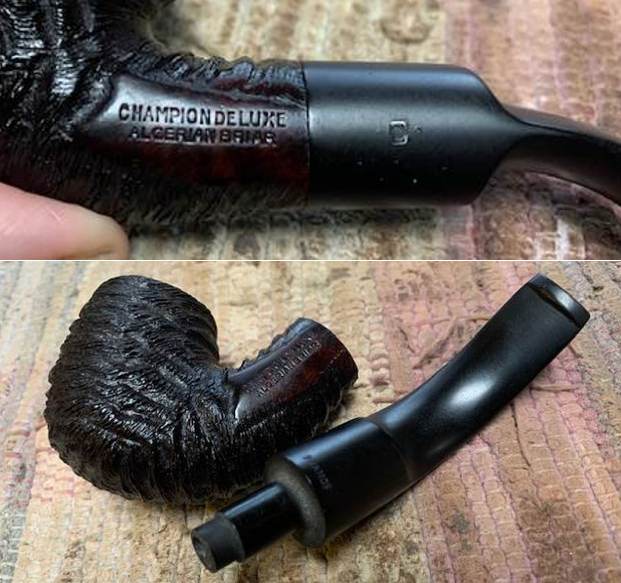
Overall my impressions of this pipe is that it is another unique beauty that once cleaned up will look very good. The exterior of the bowl does not show any hot spots or darkening. The pipe is a classic Bent Billiard that has the distinctive finish that is very tactile. The photos below confirm the assessment above.Jeff took close up photos so that I could have a clearer picture of the condition of the bowl, rim edges and top. The rim top photos confirm my assessment above. The rusticated rim top and the inner beveled edge of the rim are filled in as noted. The cake in the bowl is quite thick and the rim top has lava and debris on it. While there is thick lava and darkening there is no visible burn damage at this point. The bowl is still fairly round.The photos of the stem surface from various angles confirmed my assessment of its condition. You can see the dirty condition, the oxidation and the fit against the shank end. The surface was free of tooth marks except on the edge of the button. The next photos show the unique rustication around the heel and the sides of the bowl. Tell me what you see? Are there any visible problems that stand out to you? Are the cracks or scratches? Are there visible flaws or fissures in the briar? Do you see a pattern that stands out around the bowl and heel? Any visible issues on the heel of the bowl? Even the questions should help you to see what I am looking for when I see these photos. You have read it a few times now in the previous blogs. What am I looking for when I look at the shank stamp? In this case it is stamped on the left side and reads Champion De Luxe [over] Algerian Briar in two lines. How does the stamping look to you? Is it clear and readable? Is it faint in spots or is it uniform? I know you are looking at photos but so do I at this point in the process. How does the logo look on the side of the saddle stem? It is a squared looking C. What is its condition? An added part of pipe restoration for me is the opportunity to gather background information on a brand and maker to add depth to the restoration. I almost always turn to Pipephil’s site first for a summary. In this case it did not let me down (http://www.pipephil.eu/logos/en/logo-c8.html). I have a listing for the Champion Brand. I have included a screen capture of the section below. I had worked on several of the brand in the past but could not remember any details about the brand. Turns out it is Swiss Made and the stamping and the C on the side of the stem in the second and third pictures below match the one I am working on. I am sure many of you will shake your head and ask maybe even out loud, “Why is he including this again?” However, please remember that the point of these blogs is not to wow your with the work or make you shake your heads but I want you to know the details of the work we do so you can do your own. Back in 2020 Jeff wrote a blog about his cleaning process. I am including a link to that now so you can see what I mean about his process. Do not skip it! Give it a read (https://rebornpipes.com/2020/01/20/got-a-filthy-estate-pipe-that-you-need-to-clean/). Here is the introduction to that blog and it is very true even to this day.
Several have asked about Jeff’s cleaning regimen as I generally summarize it in the blogs that I post rather than give a detailed procedure. I have had the question asked enough that I asked Jeff to put together this blog so that you can get a clear picture of the process he uses. Like everything else in our hobby, people have different methods they swear by. Some may question the method and that is fine. But it works very well for us and has for many years. Some of his steps may surprise you but I know that when I get the pipes from him for my part of the restoration they are impeccably clean and sanitized. I have come to appreciate the thoroughness of the process he has developed because I really like working on clean pipe!

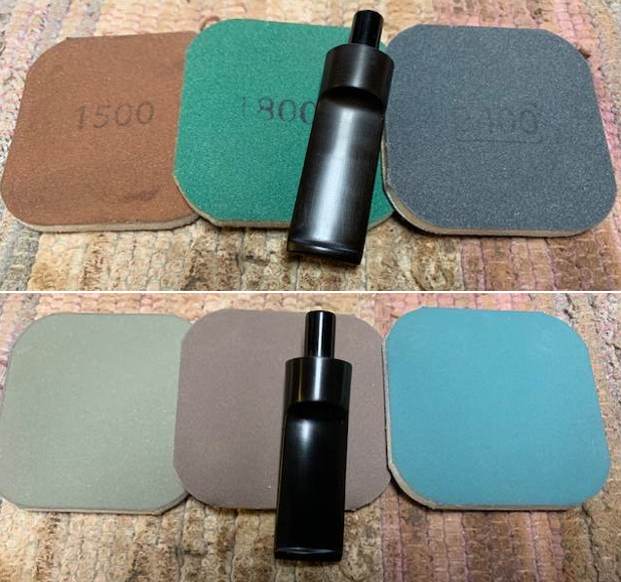
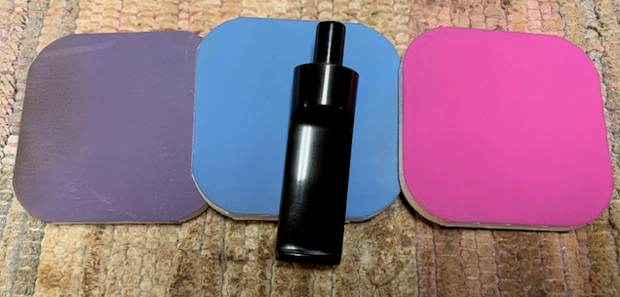
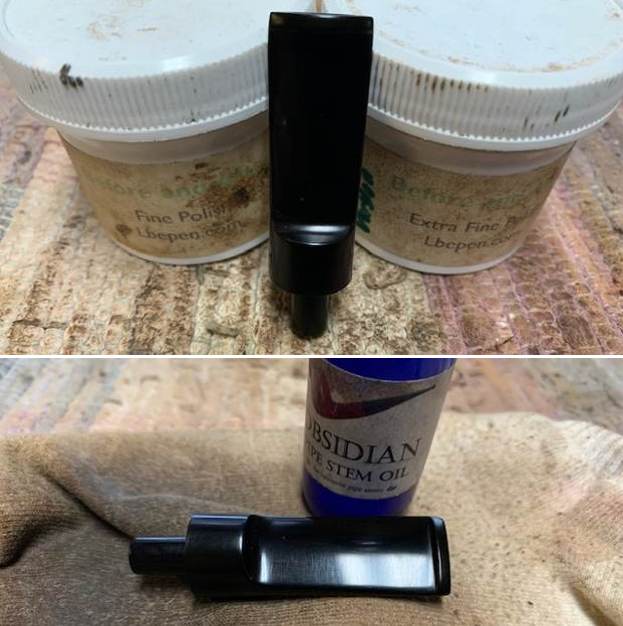
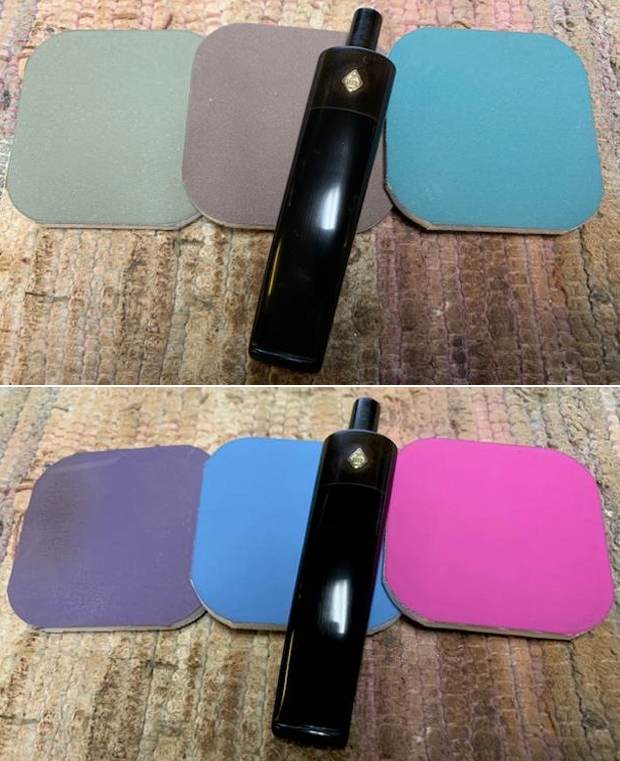
For the benefit of some of you who may be unfamiliar with some of the products he uses I have included photos of three of the items that Jeff mentions in his list. This will make it easier for recognition. These three are definitely North American Products so you will need to find suitable replacements or order these directly on Amazon. The makeup pads are fairly universal as we were able to pick some up in India when we were with Paresh and his family.

In the blog itself he breaks his process down into two parts – cleaning the stem and cleaning the bowl. Each one has a large number of steps that he methodically does every time. I know because I have watched him do the work and I have seen the pipes after his work on them. He followed this process step by step and when the pipe got to me it was spotlessly clean and ready for my work. The inside of the stem, shank and bowl were clean and to me that is an amazing gift as it means that my work on this end is with a clean pipe! I cannot tell you how much difference that makes for my work.

When the pipe arrives here in Vancouver I have a clean pipe and I go over it keeping in mind my assessment shared in the opening paragraph above. Now that I have it in hand I am looking for confirmation of what I saw in the photos as well as any significant structural changes in the bowl and finish as I go over it.

  1. I was correct in my thoughts that the pipe was indeed a Champion Swiss made pipe. This one was a De Luxe and not a Giant but the rustication was identical.
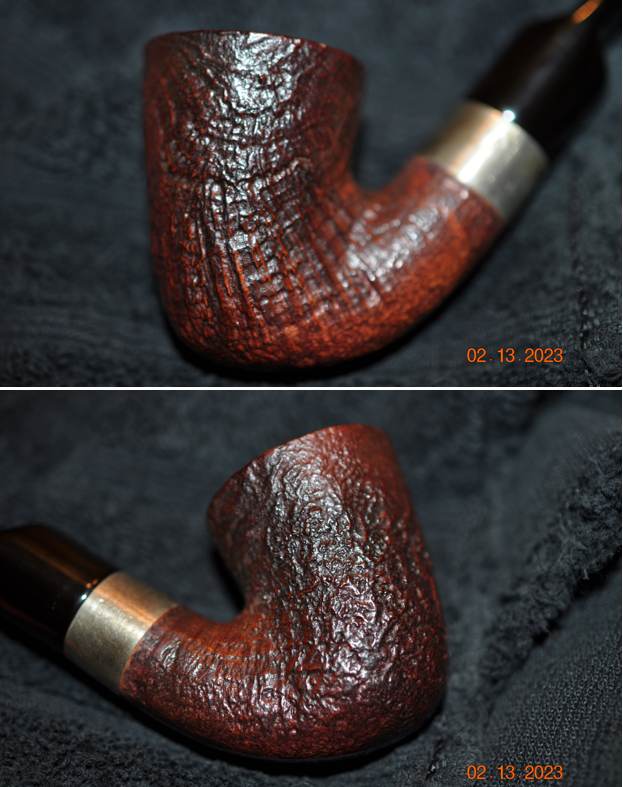
  2. The rusticated finish is very clean dust and debris in the rusticated bowl sides is gone. It is a very tactile finish and looks great. There are no cracks showing up in the carving around the bowl and shank. It is sound on the outside. I will need to polish the briar and buff it to bring back the shine.
  3. The rim top is clean of the lava looked very good and the beveled edge and rustication also looked very clean. The good news for me is that there are no cracks showing up in the rim top. The rim top and edges were sound.
  4. The bowl was very clean and smelled clean. The clean walls did not show evidence of checking or cracking. There were no hot spots or damage on the walls or around the entrance of the airway into the bowl. It was clean and smooth which is great news for me. Both the shank and the bowl were very clean showing no debris on a clean pipe clean run through them. I would need to give it a final cleaning with pipe cleaners and alcohol once I had finished with the external work to remove the debris that may have collected there in the process.
  5. The vulcanite saddle stem is in good condition – it cleaned up very well. All oxidation is gone. It is a little rough to the touch and the light chatter is not deep at all. The C logo on the stem needs to be touched but looks good. The fit of the stem to the shank end is well done. The tooth marks on the edges of the button are clean but visible and will need to be worked on.

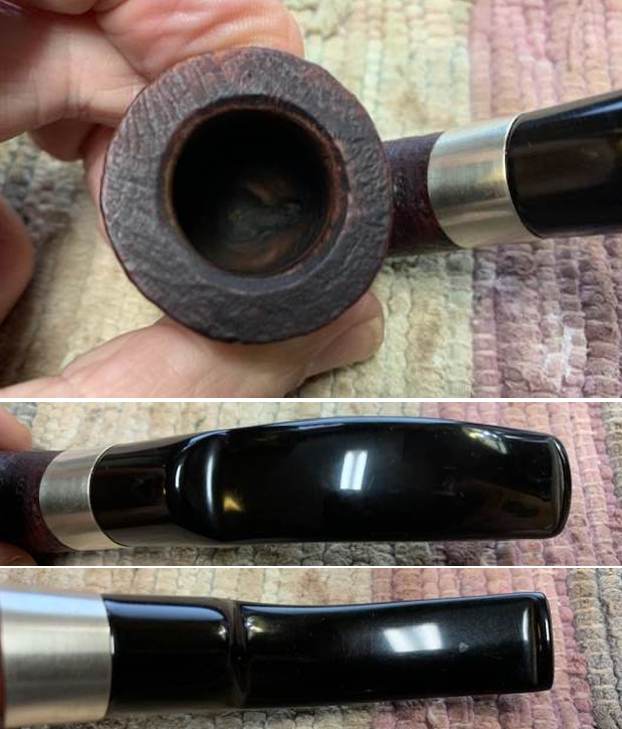
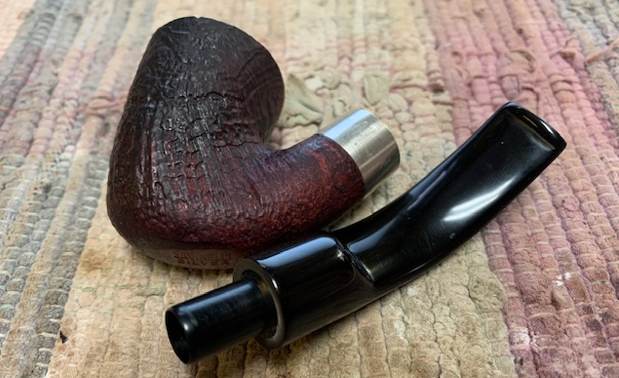
Hopefully the steps above show you both what I look for when I go over the pipe when I bring it to the work table and also what I see when I look at the pipe in my hands. They also clearly spell out a restoration plan in short form. My work is clear and addressing it will be the next steps. I took photos of the whole pipe to give you a picture of what I see when I have it on the table. This is important to me in that it also shows that there was no damage done during the clean up work or the transit of the pipe from Idaho to here in Vancouver. I carefully went over the bowl and rim top to get a sense of what is happening there. In this case once the lava was removed damage to the edge and top was revealed. The rim top and edges look very good. There was some spots on the inner edge and top of the rim where the finish showed through. I also go over the stem carefully. There were no tooth marks or dents in the stem surface but there was some damage to the edge of the button. I could see the C stamping on the stem and it looked good. I would need to refresh the white paint on the logo. I took photos of the rim top and stem sides to show as best as I can what I see when I look at them.I always check to make sure that the clean up work did not damage the stamping on the shank in any way. It looks very good still. You can also see the FRANCE stamp on the underside of the stem in the second photo. It is clear and readable. I like to remove the stem from the shank to get a sense of what was in the mind of the pipe maker when he crafted the pipe. It is a beauty in flow and shape. By this time you should know that I almost always start with the bowl in my restoration because I truly do not like the tedious work of stem repairs and polishing. I always leave that until last even though I know that it needs to be done. For me the encouragement of seeing a rejuvenated bowl is the impetus I need to attack the stem work.
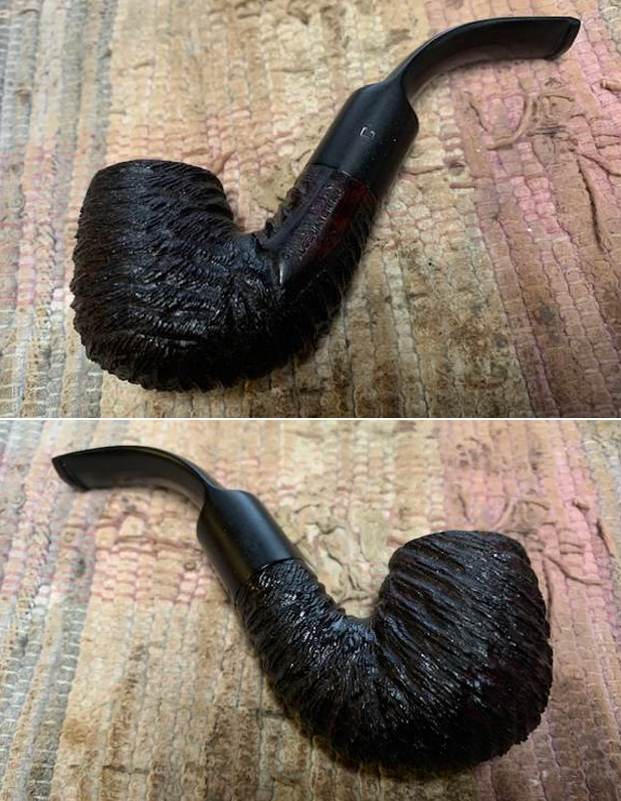
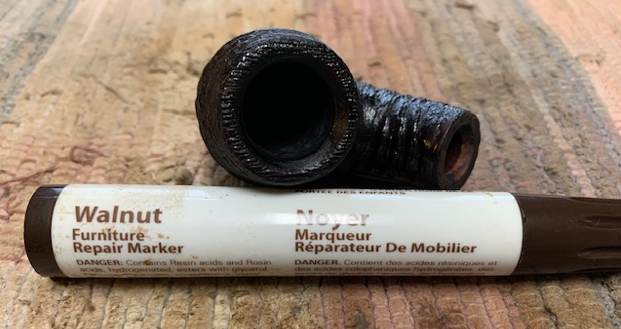
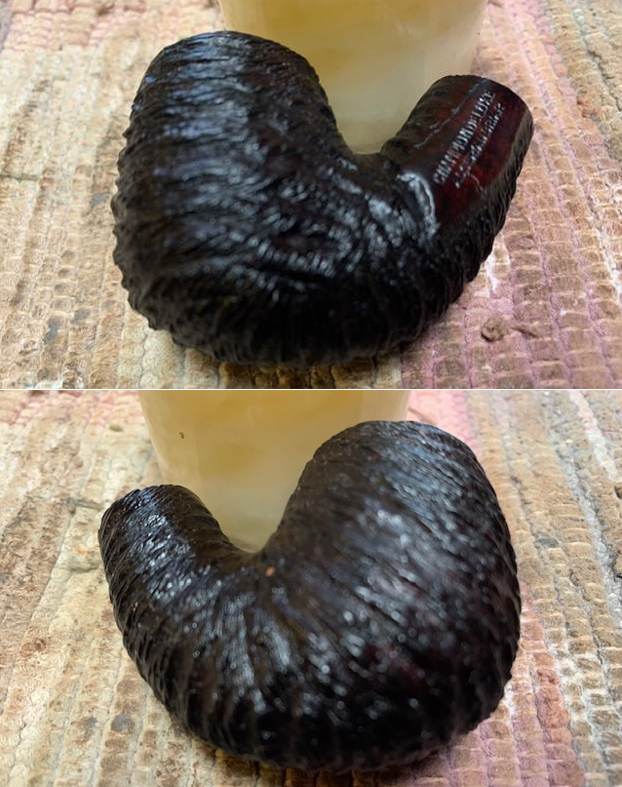
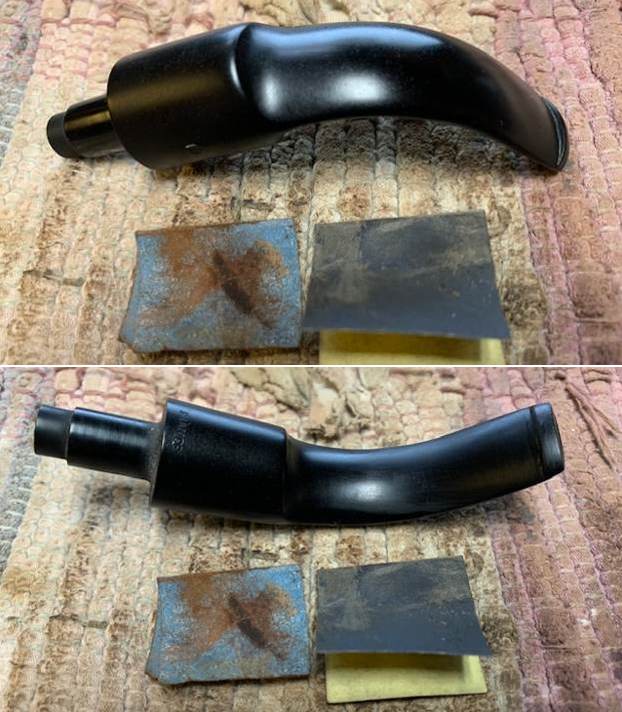
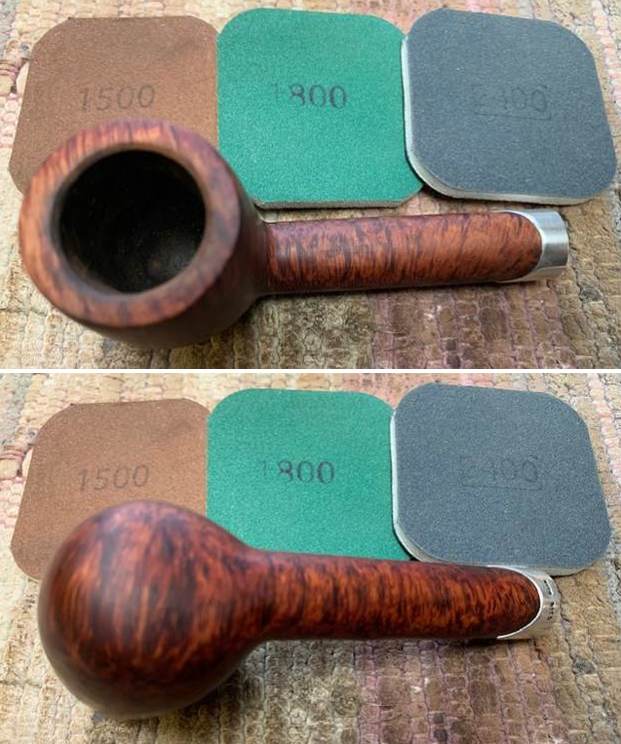
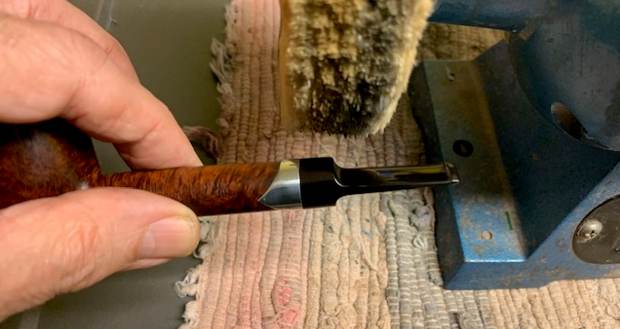
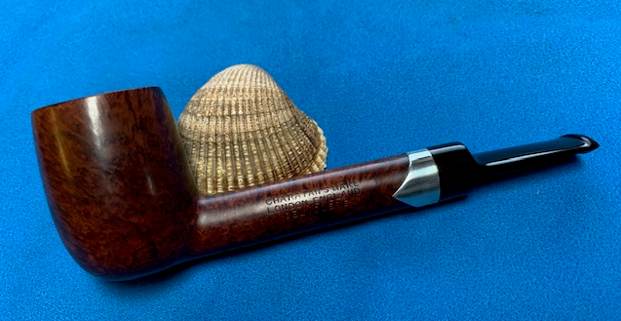
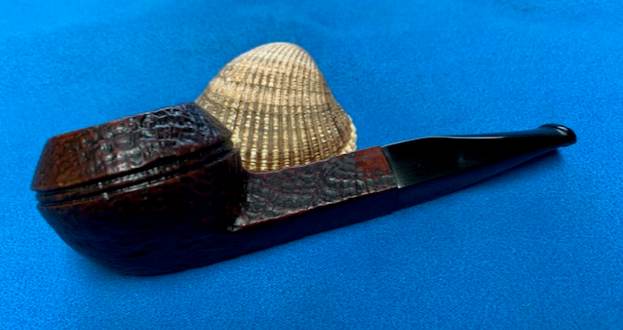
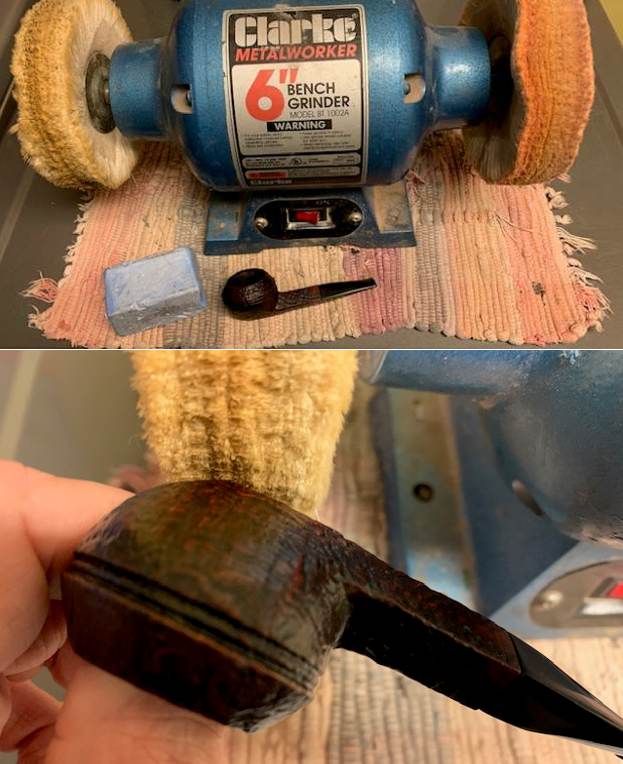
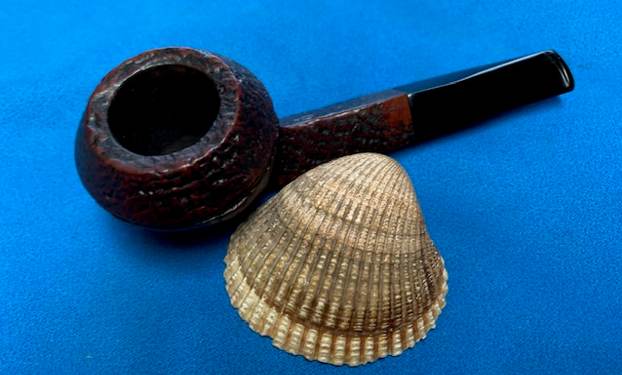
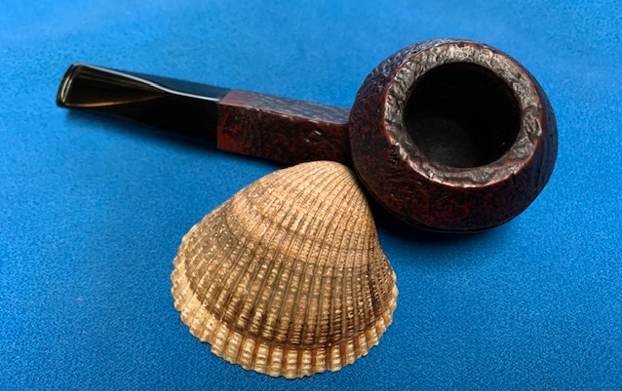
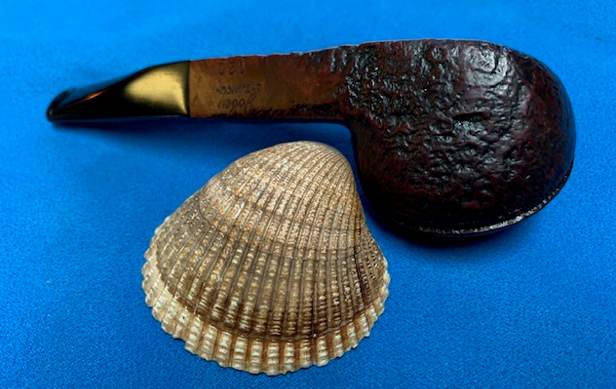
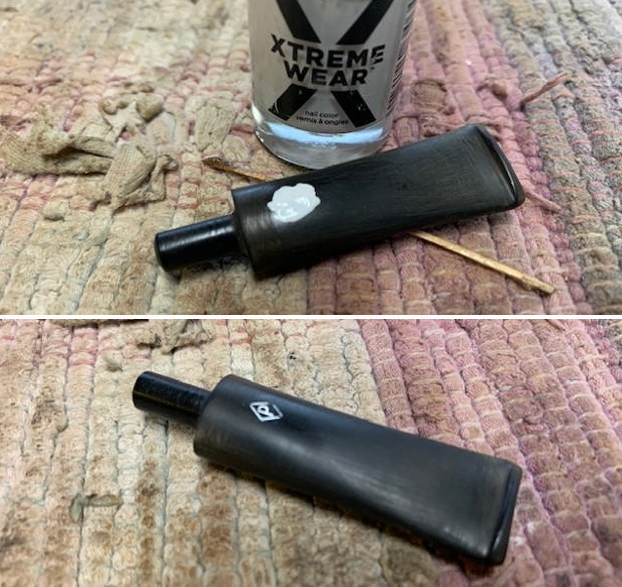
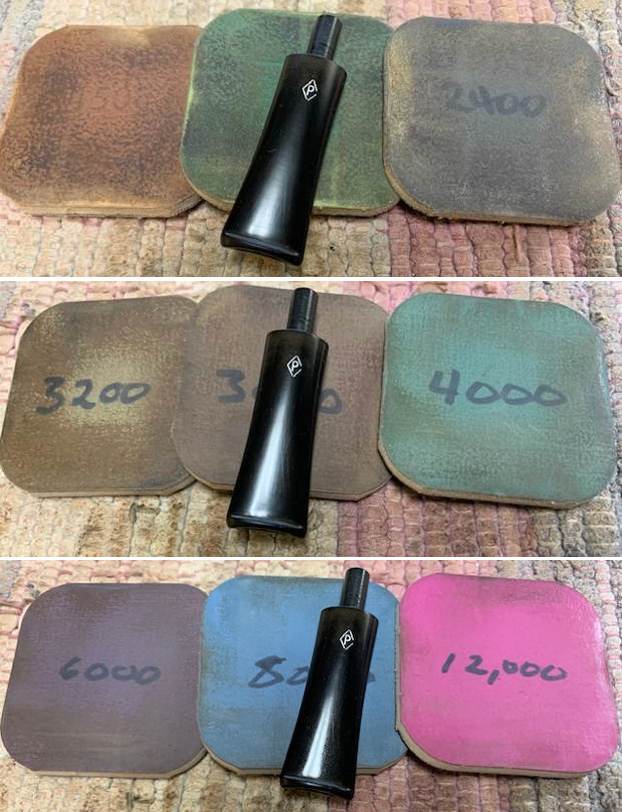
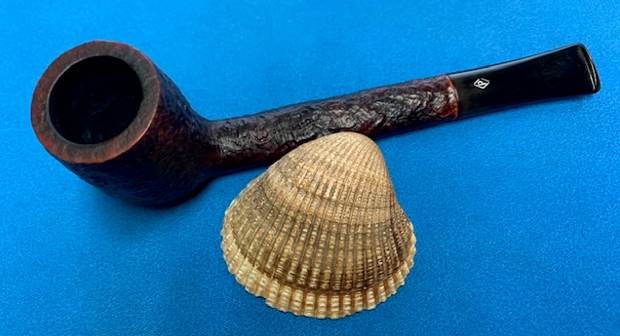
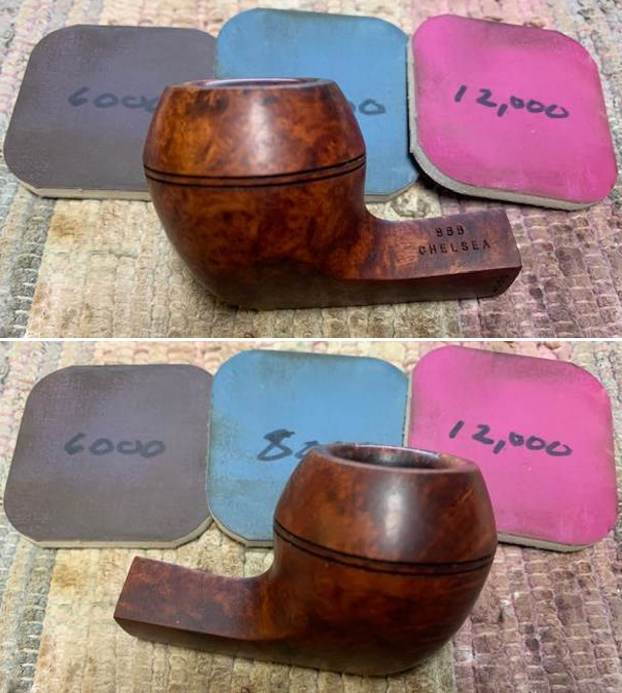
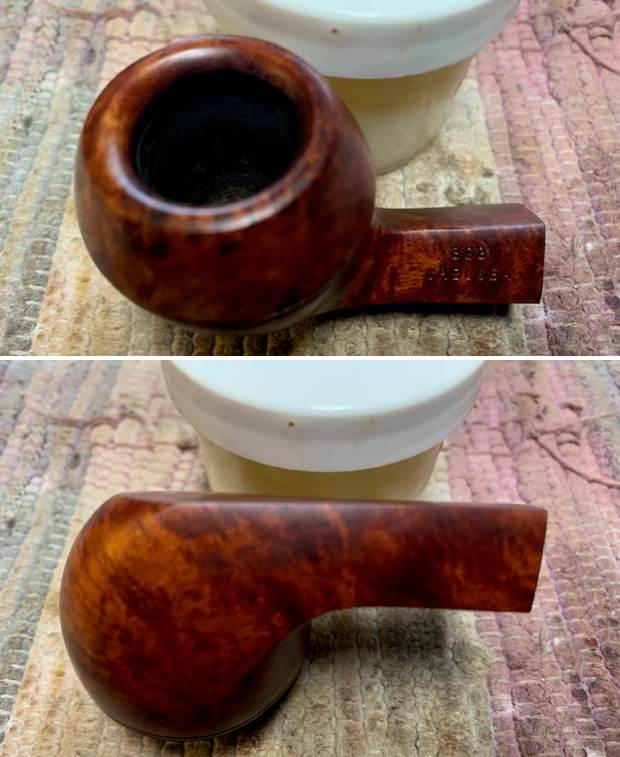
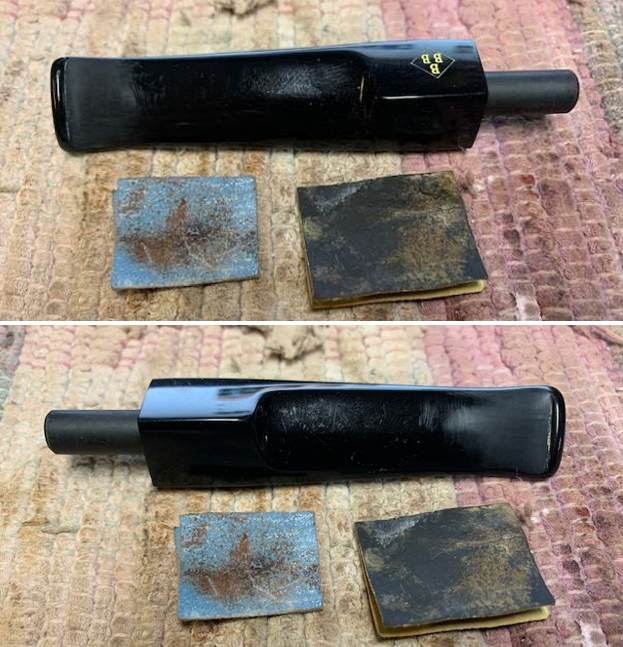
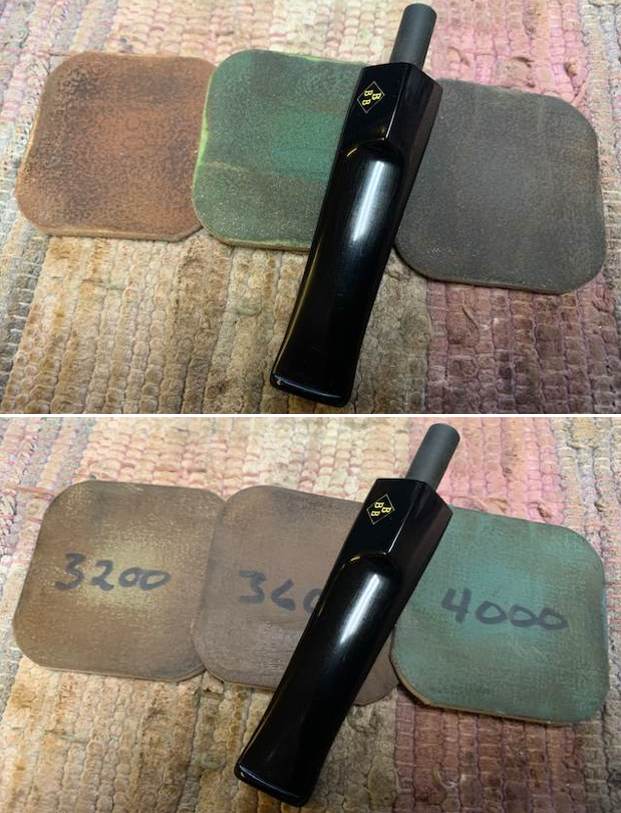
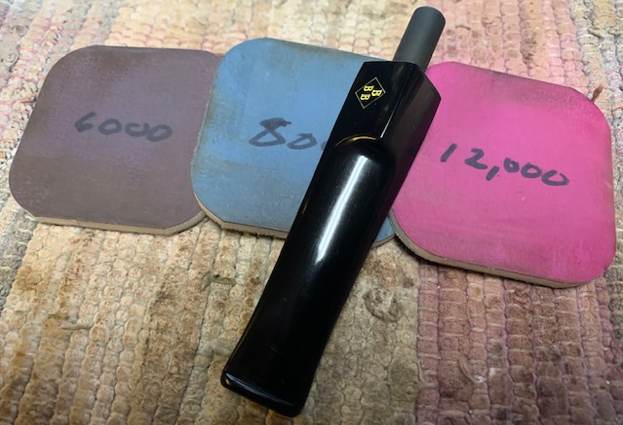
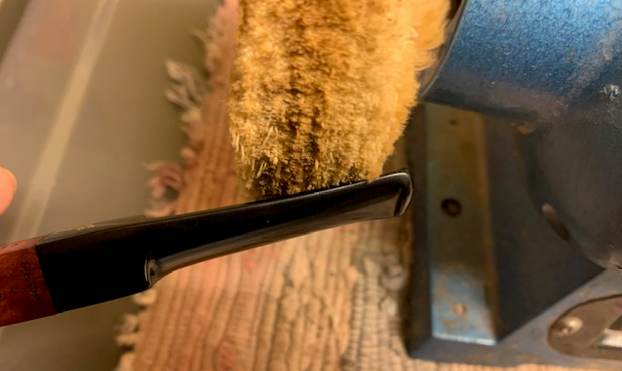
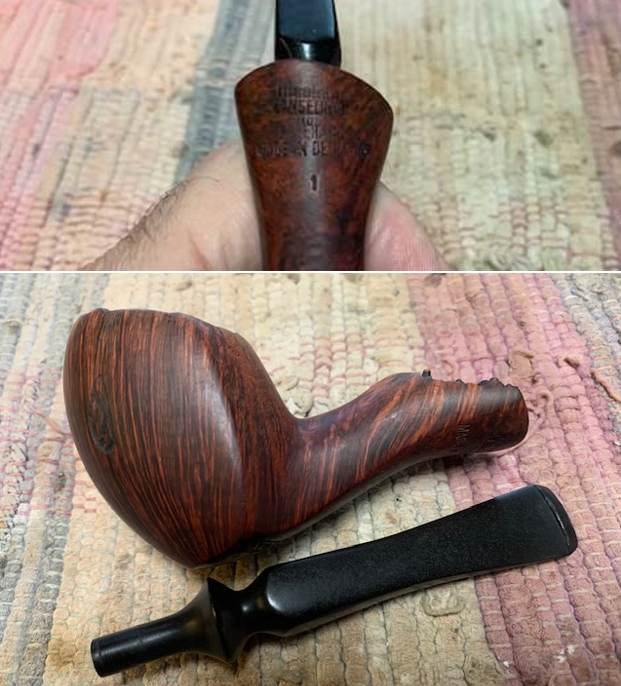
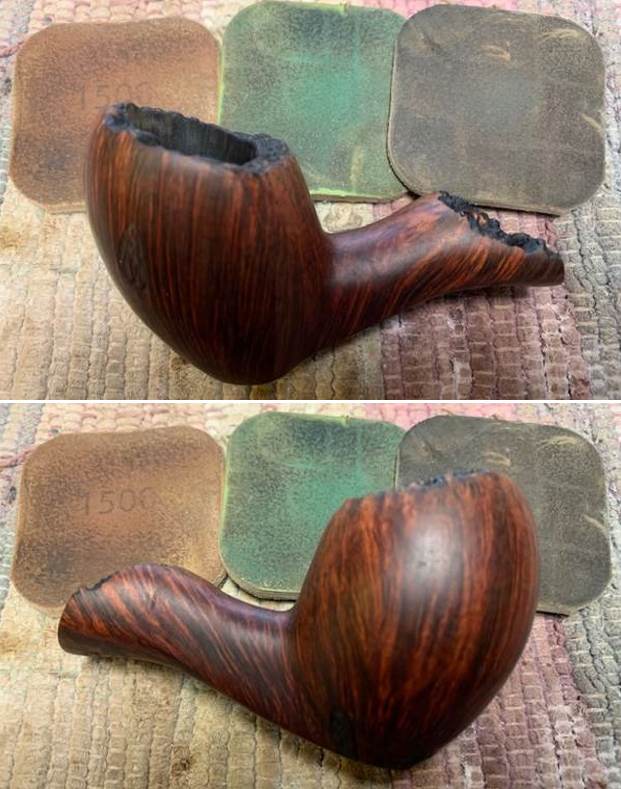
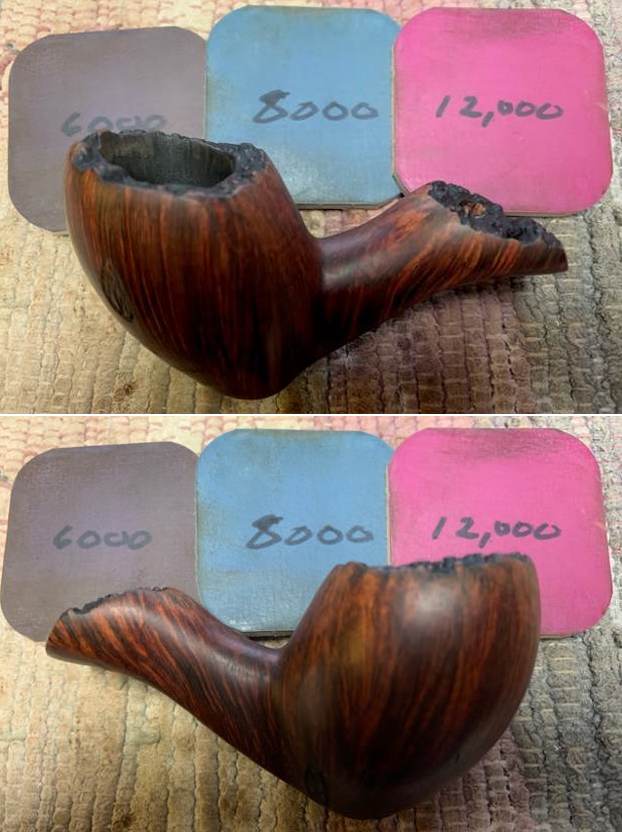
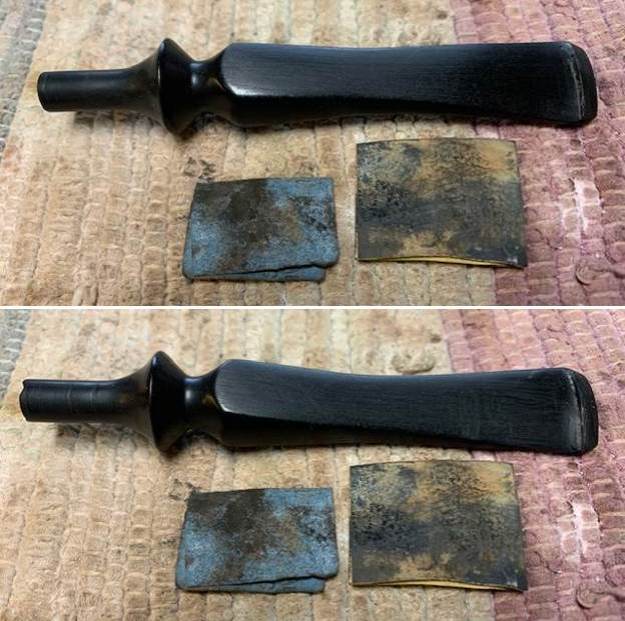
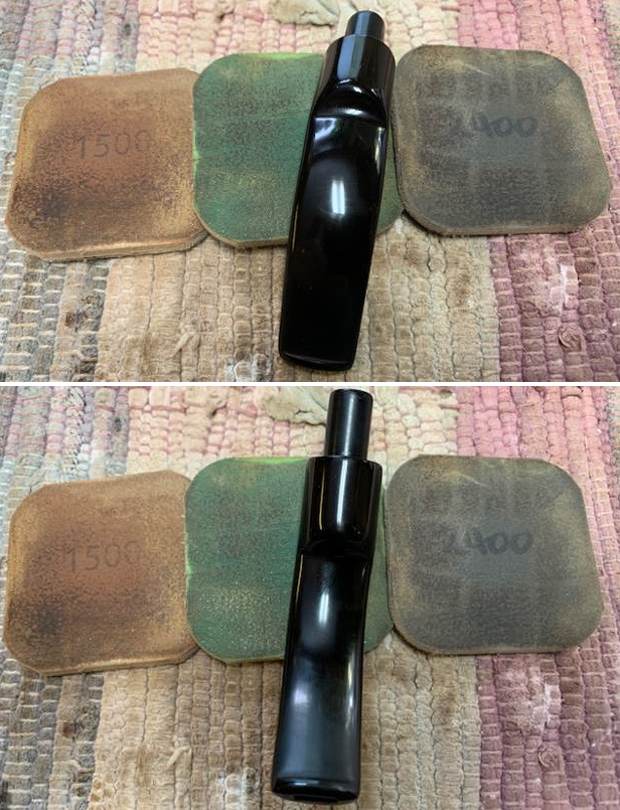
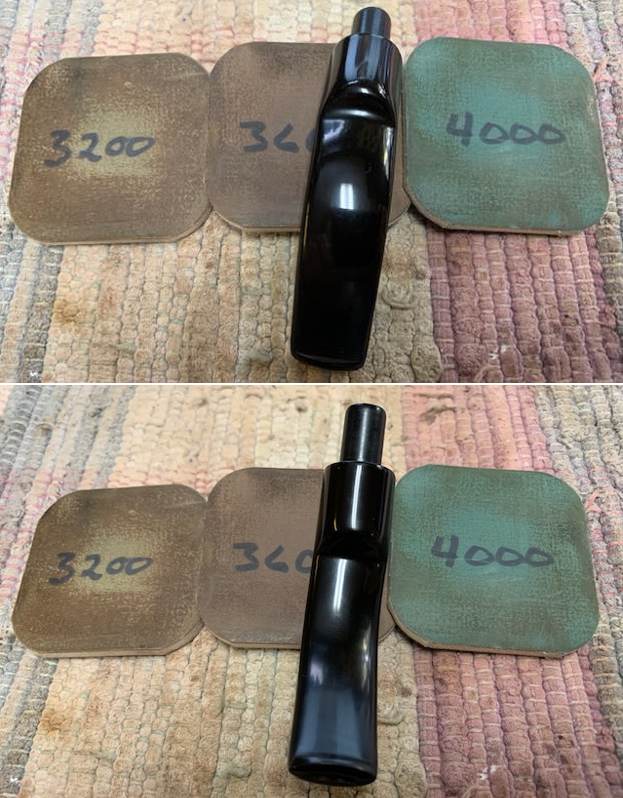
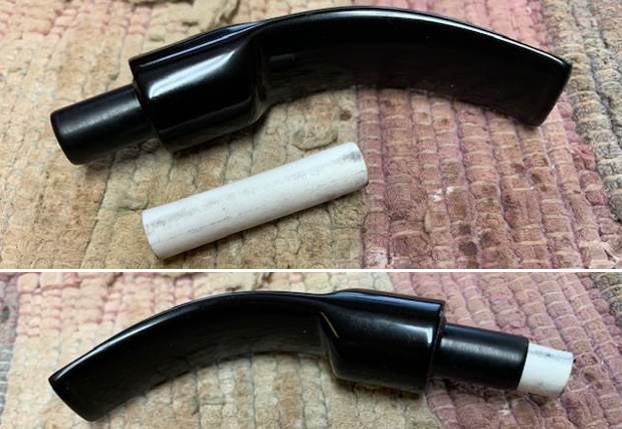
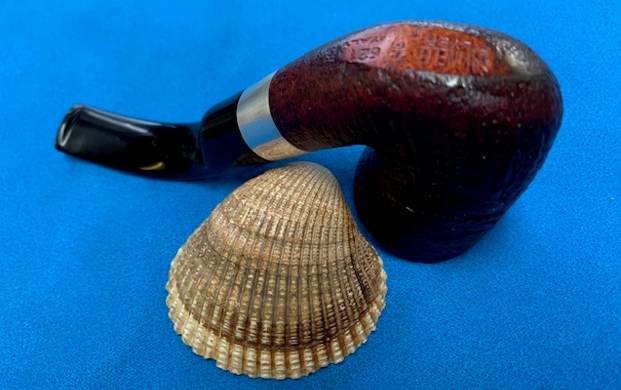
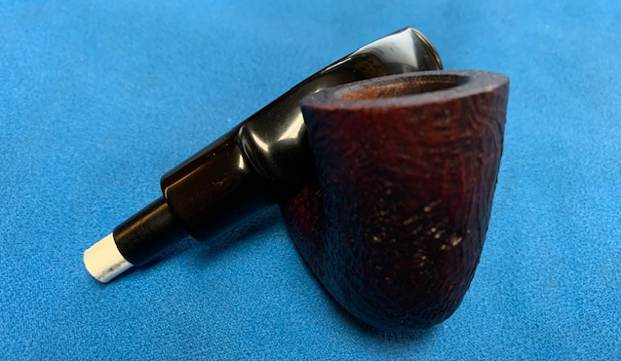
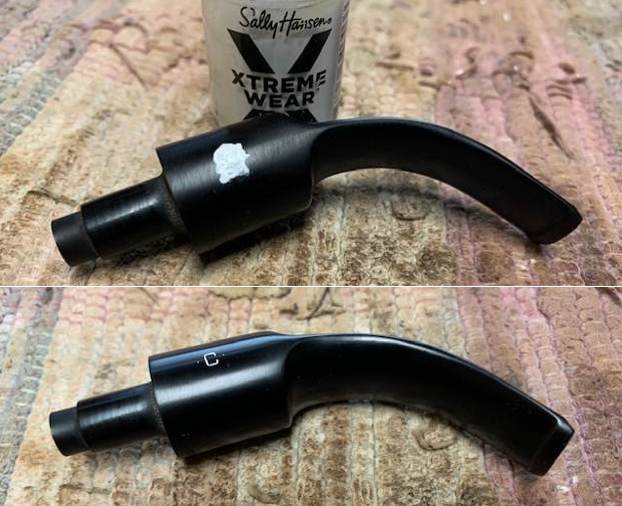
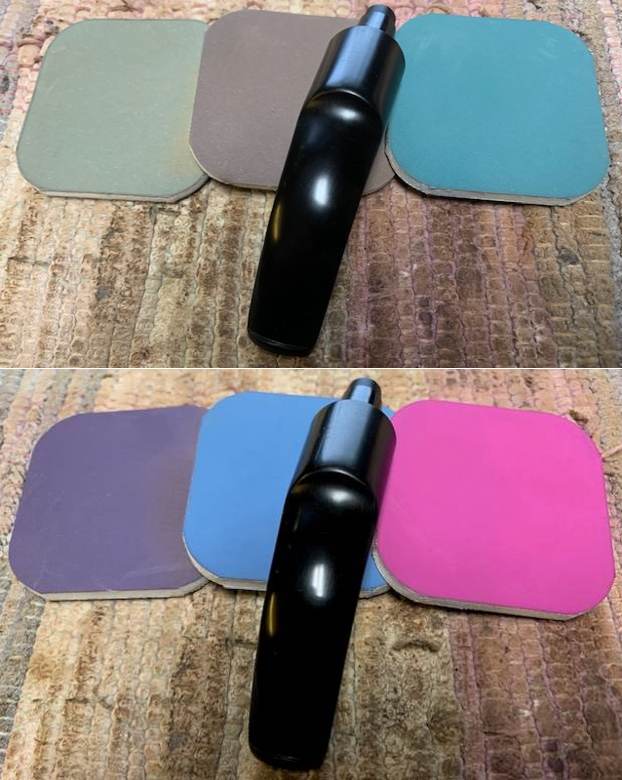
Today I started working on this pipe by turning to the bowl. I chose to deal with the spots on the rim top and edges where the stain was missing first. I used a Walnut Stain Pen to touch up the spots. It looked much better once I finished. The stain matched the rest of the bowl perfectly.For the past few years now I have been using a product developed by Mark Hoover called Before & After Restoration Balm. It is a paste/balm that is rubbed into the surface of the briar and the plateau. The product works to deep clean the nooks and crannies of finish, enliven and protect the briar. I worked it into the briar with my finger tips and a horsehair shoe brush. The bowl sat for 10 minutes to let it do its work. I wiped it off with a soft cloth then buffed it with a cotton cloth. The briar really began to have a deep shine in the briar and the grain shone through. The photos I took of the bowl at this point mark the progress in the restoration. The rustication took on a lot of depth and showed the variations of colour that comes with the restored finish. Now it was time to address the part of the restoration I leave until last. I set the bowl aside and turned my attention to the stem. The stem was in good nick other than the tooth damage on the edge of the button on both sides. I decided to reshape it with a folded piece of 220 grit sandpaper and was happy with the results. There were no tooth marks or chatter so it was simply a matter of polishing the stem and bring back a shine. I use micromesh sanding pads and water to wet sand the stem with 1500-12000 grit sanding pads. After the first three pads I touched up the stamping on the stem with White Acrylic Fingernail Polish. I scraped it off with my fingernail and repeated the 2400 grit sanding pad. It looked much better. I picked up where I left off with 3200-12000 grit pads. I wiped it down after each sanding pad with Obsidian Oil on a cotton rag after each sanding pad as I find it does two things – first it protects the vulcanite and second it give the sanding pads bite in the polishing process. After finishing with the micromesh pads I rub the stem down with Before & After Fine and Extra Fine stem polish as it seems to really remove the fine scratches in the vulcanite. I rub the Fine Polish on the stem and wipe it off with a paper towel and then repeat the process with the extra fine polish. I finish the polishing of the stem down with a final coat of Obsidian Oil and set the stem aside to let the oil absorb. This process gives the stem a shine and also a bit of protection from oxidizing quickly.The final steps in my process involve using the buffer. I first buff the stem and the briar with Blue Diamond on the buffing wheel. Blue Diamond is a plastic polish but I find that it works very well to polish out the light scratches in the vulcanite and the briar. I work the pipe over on the wheel with my finger or thumb in the bowl to keep it from becoming airborne. I used a very light touch to hit the high spots and to keep the product from filling in the rustication patterns. It works well and I am able to carefully move forward with the buffing. The briar and stem just shone! I finished with the Blue Diamond and moved on to buffing with carnauba wax. Once I have a good shine in the briar and vulcanite I always give the bowl multiple coats of Conservator’s Wax and the stem multiple coats of carnauba wax on the wheel. I have found that I can get a deeper shine if I following up the wax buff with a clean buffing pad. It works to raise the shine and then I follow that up with a hand buff with a microfiber cloth to deepen the shine. It is always fun for me to see what the polished bowl looks like with the polished vulcanite stem. It really is a beautiful pipe. The deeply rusticated finish around the bowl sides and shank is very tactile. The rich dark brown stains look amazing on this Champion De Luxe Algerian Briar Rusticated Bent Billiard. The finished pipe feels great in my hand. It is light and well balanced. Have a look at it with the photos below. The dimensions are Length: 5 inches, Height: 1 ½ inches, Outside diameter of the bowl: 1 inch, Chamber diameter: ¾ of an inch. The weight of the pipe is 1.52 ounces/43 grams. It is a beautiful pipe and one that I will be putting on the rebornpipes store in the Pipes from Various Makers section. Let me know if you wish to carry on the trust for this beauty.

Hopefully the shape writing this blog is helpful to you in some way. In it I wanted to show both what I am looking for and how I move forward in addressing what I see when work on a pipe. Let me know if it is helpful to you. It is probably the most straightforward detailed description of my work process that I have done. As always I encourage your questions and comments as you read the blog. Thanks to each of you who are reading this blog. Remember we are not pipe owners; we are pipemen and women who hold our pipes in trust until they pass on into the trust of those who follow us.

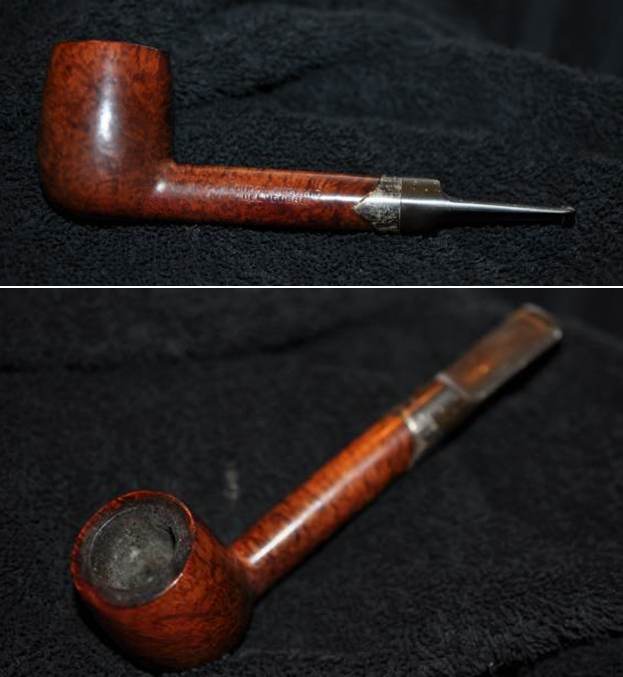
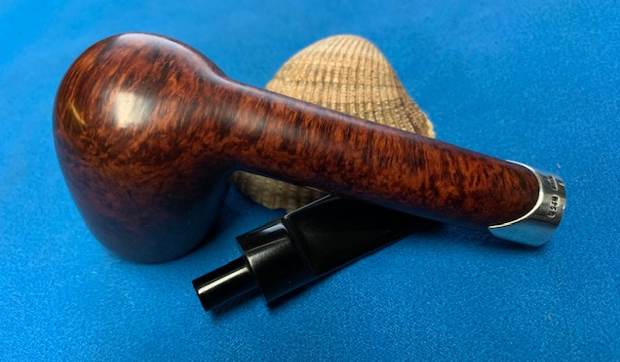
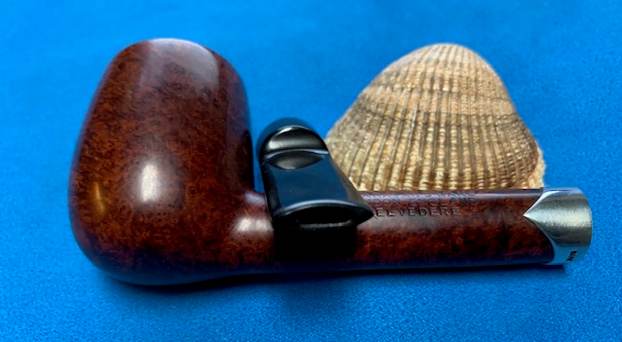
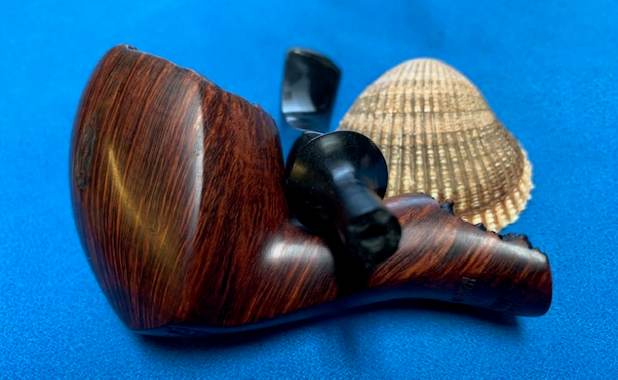
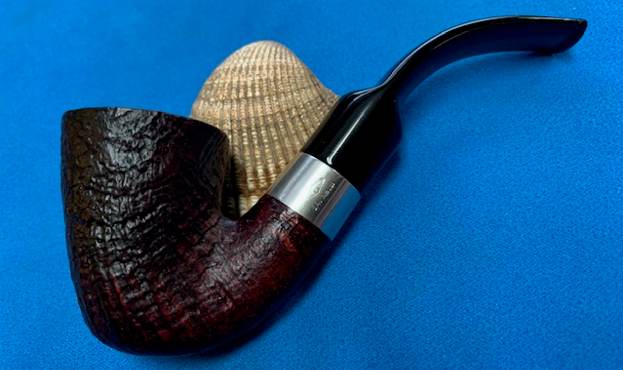
London meets Copenhagen – A Charatan’s Make Belvedere Lovat with an S Bang Silver Band


Blog by Steve Laug

Once again in this write up and I will take you through my process of working on each pipe that we purchase. Jeff has set up a spread sheet to track where the pipe came from, the date of purchase and what we paid for it so that we know what we have invested in the pipe before we even work on it. This takes a lot of the guess work out of the process. This particular pipe was purchased on 11/10/2022 from Copenhagen, Denmark from a seller we buy a lot of pipes from. I also want you to understand why we take the photos we do. If you have followed for a while then you will see the familiar pattern of the photos we include both in the before and midstream process of working on a pipe. It is not accidental or chance as the photos have been taken to help me make an assessment of the pipe Jeff sees before he starts his clean up work. We do this to record the condition that the pipe was in when received it and to assess what kind of work will need to be done on. When I look at these photos this is what I see.

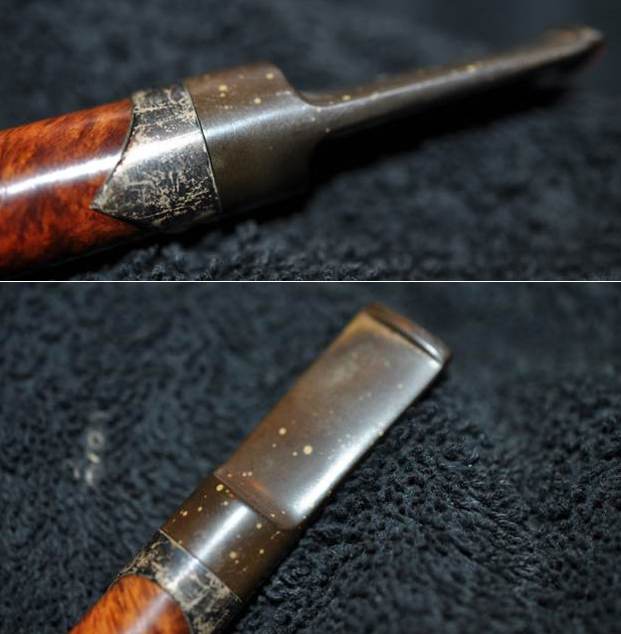
  1. The first thing I see is a unique Sterling Silver band on the shank that has become familiar from the pipes we have purchased from Copenhagen. Each one is much the same and all were made by S. Bang. I am pretty certain this is one as well. The question is if it is cosmetic like the others have been or does it take care of a crack in the shank. We shall see.
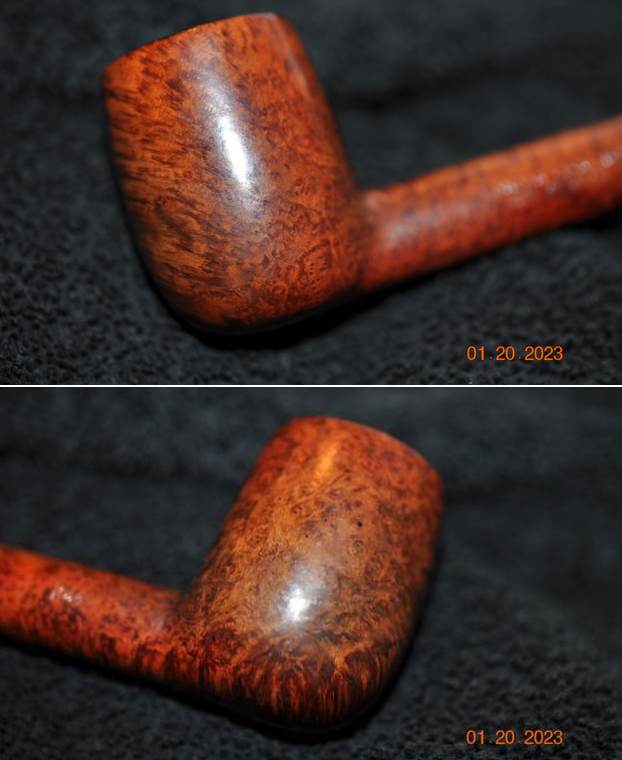
  2. The finish is dirty and there is oils from the smoker’s hands on both side of the bowl. There is grimed ground into the finish as well but even so there is also some great grain peeking through. From the exterior it does not appear that there is a crack in the shank but when Jeff examines it he will confirm either the presence or absence of a crack.
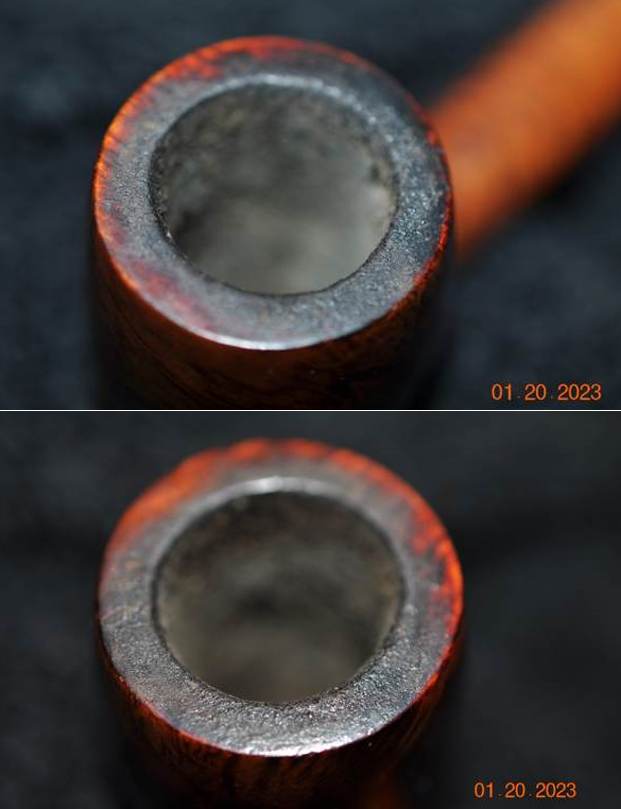
  3. The rim top had a thick lava overflow from the cake in the bowl. It was thicker on the back half of the rim top but present all the way around. It is hard to know if there is darkening or damage under the lava. Sometimes the lava protects the rim top and edges and sometime it hides issues. Its is very dirty looking.
  4. The bowl has a thick cake in it that hides the inner edge of the bowl but once it is clean we will know what the edges look like. The outer edges look good and there does not appear to be any obvious burn damage to the top or bowl edges.
  5. The vulcanite saddle stem is in good condition – dirty, lightly oxidized and has light tooth chatter on both sides. There does not appear to be a CP logo on the stem but the fit to the shank end is well done. It is hard to know with certainty if it is an original stem or a replacement.

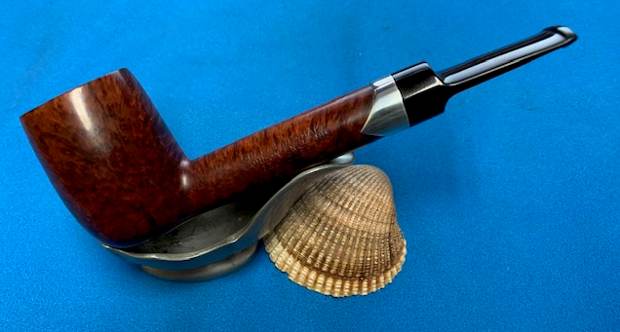
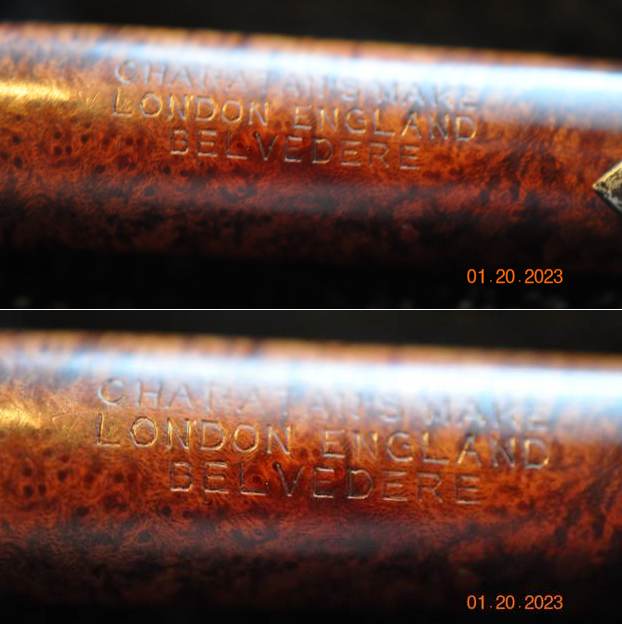
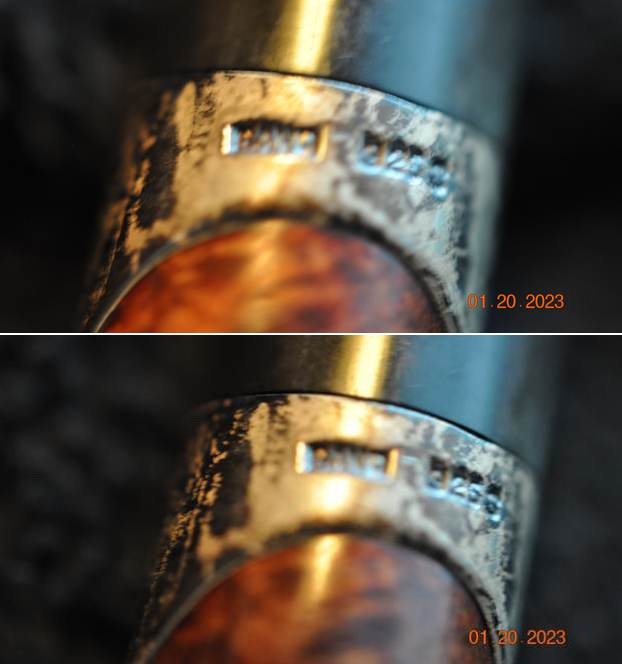
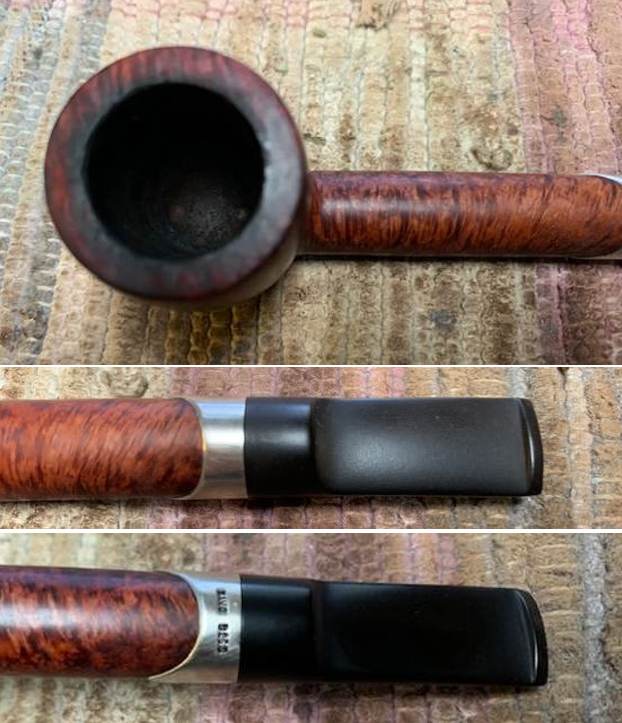
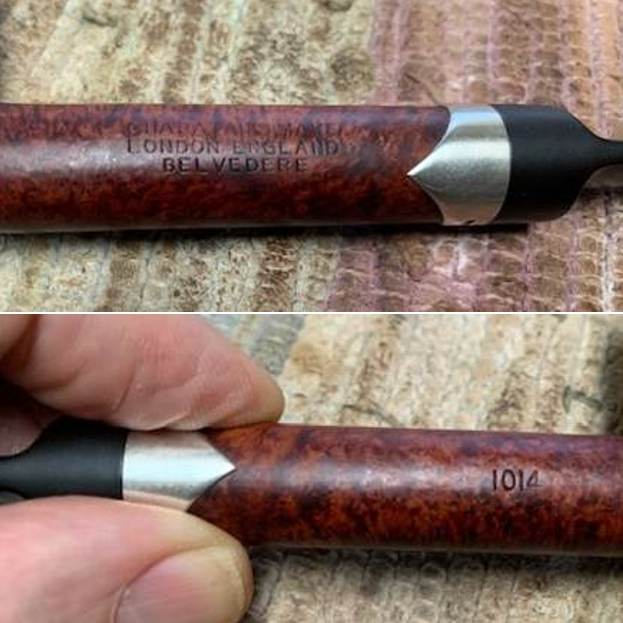
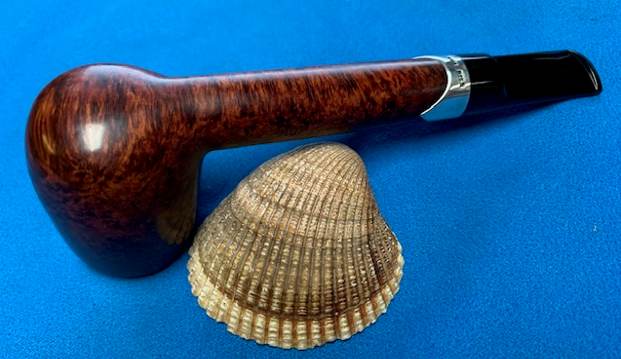
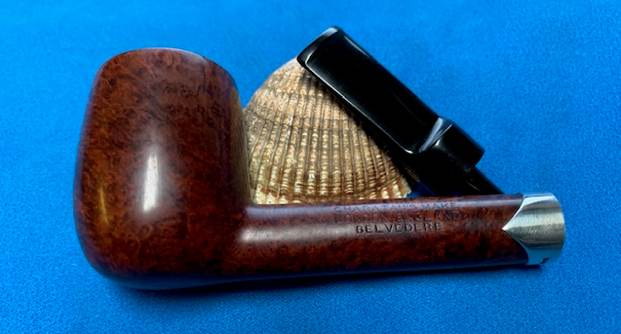
Overall my impressions of this pipe is that it is a beauty that once cleaned up will look pretty amazing. The oxidized S. Bang fancy Sterling Silver Band adds a touch bling even though tarnished that does not detract from the beauty of the pipe. The exterior of the bowl does not show any hot spots or darkening. The pipe is very English looking and is a classic Lovat that has the distinctive cut of a Charatan. The photos below confirm the assessment above.Jeff took close up photos so that I could have a clearer picture of the condition of the bowl, rim edges and top. The rim top photos confirm my assessment above. The cake in the bowl is quite thick and the rim top has lava and debris on it. You can also see the condition of the outer edge but the inner edge is a bit of a mystery at this point. This is what I look for when assessing a pipe. While there is lava and darkening there is no visible burn damage at this point. The bowl is still fairly round. The photos of the stem surface from various angles confirmed my assessment of its condition. You can see the oxidation and the fit against the tarnished silver band on the shank end. The stem surface though dirty does not appear to have tooth marks – chatter yes, but no deep marks. The stem is quite dirty but otherwise undamaged. The next photos show the amazing grain around the heel and the sides of the bowl. Tell me what you see? Are there any visible problems that stand out to you? Are the cracks or scratches? Are there visible flaws or fissures in the briar? What kind of grain stands out around the bowl and heel? Any visible issues on the heel of the bowl? Even the questions should help you to see what I am looking for when I see these photos. You have read it a few times now in the previous blogs. What am I looking for when I look at the shank stamp? In this case it is stamped on the left side and reads Charatan’s Make[over] London England [over] Belvedere in three lines. How does the stamping look to you? Is it clear and readable? Is it faint in spots or is it uniform? I know you are looking at photos but so do I at this point in the process. The right side is also stamped and reads 1014 which is the shape number. The same questions apply here as well. The next photos show where London Meets Copenhagen. The stamping on the stylized silver band are simply BANG in one box and 325S in the second box. I love this kind of backstory on a pipe. How did an English made pipe from London connect with an S.Bang Sterling Silver Band? I know it happened in Copenhagen as that is where we bought the pipe. We asked the seller the story on it and he said that the older gentleman who owned this pipe took it along with several others from his collection to the S. Bang workshop and had them add bands to his pipes. They were not necessary as the shank was not cracked but the old pipeman just wanted some decorative bands on his pipes (he may well have been my age so old is such a relative term). However that happened it is a great story of the meeting of this London pipe with a Danish silvermaker. I have to say that I really like the result!An added part of pipe restoration for me is to try to gather as much background on a brand and maker as I can find. With Charatan that is an enjoyable web to untangle. There is a lot of information and it can lead to understanding what era a pipe was made in. To try to figure out the era of the Charatan’s pipe I was working on I turned to the Pipephil website, Logos and Stampings (http://www.pipephil.eu/logos/en/logo-charatan.html). There is some really helpful information on each of the lines of Charatan’s Make pipes that entered the market. There is an alphabetical listing of the lines but the Belvedere they showed had a stem made for a 9mm filter while the one I have is a nonfiltered pipe. The site did give a short history of the brand. I quote the portion that is most pertinent.

The brand was founded in 1863 by Frederik Charatan. When his father retired in 1910, Reuben Charatan took over the family business. All the pipes were handmade until 1973. The brand name has been overtaken by Dunhill in 1978 and sold in 1988 to James B. Russell Inc.(NJ, USA). During the period 1988-2002 Charatans were crafted by Butz Choquin in St Claude (France). Dunhill re-purchased Charatan brand name in 2002 and Colin Fromm (Invicta Briars, Castleford) followed up on freehand production.

Next I turned to Pipedia to see if I could find more information on the brand and possibly a link to the Belvedere line (https://pipedia.org/wiki/Charatan) but once again in the general article it was not listed. It did give a little more historical information. I quote the pertinent parts and have highlighted in red the sections that give information on this particular pipe.

In 1863 Frederick Charatan, a Russian/Jewish immigrant, opened a shop in Mansell Street, located in the borough of Tower Hamlets, London E1, where he began to carve Meerschaum pipes. These pipes got very popular soon, and thus Charatan moved to a bigger workshop in Prescot Street, just around the corner. Here he began to make briar pipes which should make the name famous the world over. Charatan was the first brand to make entirely hand-made briars from the rough block to the finished pipe including the stems. The nomenclature “Charatan’s Make” refers to this method of production and was meant to differentiate Charatan from other brands who “assembled” pipes from pre-drilled bowls and delivered mouthpieces.

Being the undisputed No. 1 in English pipemaking, Charatan was approached by Alfred Dunhill who was unsatisfied with the quality of the pipes he imported from France. During 1908 – 1910 Dunhill bought pipes from Charatan paying exorbitant prices to ensure he had some of the very best pipes for sale in England. In 1910 he lured away Joel Sasieni, one of Charatan’s best carvers, and opened his own small pipe workshop on 28 Duke Street. On the retirement of his father in 1910 Reuben Charatan took over the family business…

…The pre-Lane period (prior to 1955) and the Lane era pipes (1955 to until sometime between 1979 – 1984) are of primary interest the collector. The Lane era is often quoted as beginning about 1950… Charatan records are almost non-existent before Lane due to a factory fire, making it difficult to date pre-Lane pipes. Charatan used 4 basic grades prior to 1950: Supreme, Selected, Executive, and Belvedere. After 1950 Herman Lane’s influence began, and the grades started to expand. In 1955 Lane took over sole distributorship of Charatan in the US. In 1957 he introduced the Supreme S. Most of his other introductions were from the 60’s and early 70’s…

From this I am fairly certain I am dealing with a pre-Lane pipe made prior to 1955 and because of the Belvedere stamp it could potentially go back as far as before 1950. There are none of the expected Lane stampings on the pipe which also supports this.

I continued digging further into the dating of the pipe, but what I had found above was a good start for me. If some of you would like to try your hand at dating it more accurately as to the time period it came out you might want to check out the article on Pipedia on Dating Charatans (https://pipedia.org/wiki/Dating_of_Charatans).

I also reread the article on Pipedia by the Italian fellow who contributed some really helpful information on the brand (https://pipedia.org/wiki/Charatan_-_Milan_2014). I quote the section on the Second period: Reuben Charatan 1910 – c. 1962. I have highlighted a portion of the section on the shank in red to point out some more helpful dating information.

– In 1962 Herman Lane took over the business from the Charatan family, although he had already influenced production from the 1950s.

– The pipes were mostly larger than the previous ones and corresponded in size to Dunhill group 5. These are slightly less rare, but still difficult to find.

– Stem: Usually in ebonite, saddle shaped or tapered, bearing a fine “CP” stamp, underbore system (see below) used when necessary.

– Shank: The shape code is stamped on it together with the nomenclatureCHARATAN’S MAKE LONDON ENGLAND” arranged in two lines. From 1955 onwards on the models marketed for the USA there is also a serif and circled capital “L” (but not all models bear this) which resembles the pound sterling symbol. The “L” is for Lane, the importer.

From 1958, Lane changed the nomenclature for models marketed for the US to clarify the message: “MADE BY HAND”.  In this period the underbore was introduced. Its manufacturing period ranged between 1920 and c.1930. This model was equipped with a duralumin plunger trap fitted in the stem, which served to clean the residue more easily. This particular model bore a special stamp on the stem, and also had its own catalogue…

QUALITY GRADES…The stem did not only display the stamps mentioned above. Another stamp that can help dating is the one referring to the quality of the pipe. Until Herman Lane arrived on the scene there were four quality grades. Starting with the lowest: Belvedere, Executive, Selected, and Supreme. Lane went on to add higher grades from time to time: Supreme S, Supreme S100, S150, S200, S250, S300, Coronation, Royal Achievement, Crown Achievement, and Summa Cum Laude; these last three are extremely rare and almost impossible to find. He also invented other, different grades, even changing the previous pipe classification standards. We will not go into detail here, but it means that if we find an S100 or Coronation the pipe was manufactured following Herman Lane’s acquisition. In particular, the FH mark, or Freehand pipe was commissioned to the famous Danish craftsman, Preben Holm.

Now I knew I was working on a pre-Lane pipe which actually means it was made before 1955 as shown by the stamping. I wanted to now see if I could find any information the shape 1014 number as it was not listed in any shape charts I could find.

I did a Google search of the Charatan’s Make London England Belvedere 1014 and was taken to one link. Interestingly it was on smokingpipes.com US website and it is the exact pipe I am working on sans the Bang band on the shank. The stamping the shape of the stem and all parts even the stain matches the one that I have in hand. I am also including a screen capture of the pipe (https://www.smokingpipes.com/pipes/estate/england/moreinfo.cfm?product_id=314515).I am sure many of you will shake your head and ask maybe even out loud, “Why is he including this again?” However, please remember that the point of these blogs is not to wow your with the work or make you shake your heads but I want you to know the details of the work we do so you can do your own. Back in 2020 Jeff wrote a blog about his cleaning process. I am including a link to that now so you can see what I mean about his process. Do not skip it! Give it a read (https://rebornpipes.com/2020/01/20/got-a-filthy-estate-pipe-that-you-need-to-clean/). Here is the introduction to that blog and it is very true even to this day.

Several have asked about Jeff’s cleaning regimen as I generally summarize it in the blogs that I post rather than give a detailed procedure. I have had the question asked enough that I asked Jeff to put together this blog so that you can get a clear picture of the process he uses. Like everything else in our hobby, people have different methods they swear by. Some may question the method and that is fine. But it works very well for us and has for many years. Some of his steps may surprise you but I know that when I get the pipes from him for my part of the restoration they are impeccably clean and sanitized. I have come to appreciate the thoroughness of the process he has developed because I really like working on clean pipe!

For the benefit of some of you who may be unfamiliar with some of the products he uses I have included photos of three of the items that Jeff mentions in his list. This will make it easier for recognition. These three are definitely North American Products so you will need to find suitable replacements or order these directly on Amazon. The makeup pads are fairly universal as we were able to pick some up in India when we were with Paresh and his family.

In the blog itself he breaks his process down into two parts – cleaning the stem and cleaning the bowl. Each one has a large number of steps that he methodically does every time. I know because I have watched him do the work and I have seen the pipes after his work on them. He followed this process step by step and when the pipe got to me it was spotlessly clean and ready for my work. The inside of the stem, shank and bowl were clean and to me that is an amazing gift as it means that my work on this end is with a clean pipe! I cannot tell you how much difference that makes for my work.

When the pipe arrives here in Vancouver I have a clean pipe and I go over it keeping in mind my assessment shared in the opening paragraph above. Now that I have it in hand I am looking for confirmation of what I saw in the photos as well as any significant structural changes in the bowl and finish as I go over it.

  1. I was correct in my thoughts that the band was a Bang. It is clearly stamped Bang along with the 325S silver quality designation. It is for cosmetic purpose only as there are no visible cracks in the shank as I go over the exterior and the internal end of the shank. IT is clear and it is a beauty. The oxidation is gone and the band looks very good.
  2. The finish is very clean and darkening from oils on the bowl sides is gone. The grain stands out on the surface of the clean briar. There are no cracks showing up in the grain lines or in the flaws under the grime. It is sound on the outside. I will need to polish the briar and buff it to bring back the shine.
  3. The rim top is clean of the lava but there is still some darkening on the top and edges of the bowl. The inner edge is ragged and shows both burn damage and also some previous reaming damage. It is still fairly round but not smooth. The good news for me is that there are no cracks showing up in the rim top. The rim top and edges were sound.
  4. The bowl was very clean and smelled clean. The clean walls did not show evidence of checking or cracking. There were no hot spots or damage on the walls or around the entrance of the airway into the bowl. It was clean and smooth which is great news for me. Both the shank and the bowl were very clean showing no debris on a clean pipe clean run through them. I would need to give it a final cleaning with pipe cleaners and alcohol once I had finished with the external work to remove the debris that may have collected there in the process.
  5. The vulcanite saddle stem is in good condition – it cleaned up very well. All oxidation is gone. It is a little rough to the touch and the light chatter is not deep at all. There is not a CP logo on the stem but the fit to the shank end is well done. It is hard to know with certainty if it is an original stem or a replacement.

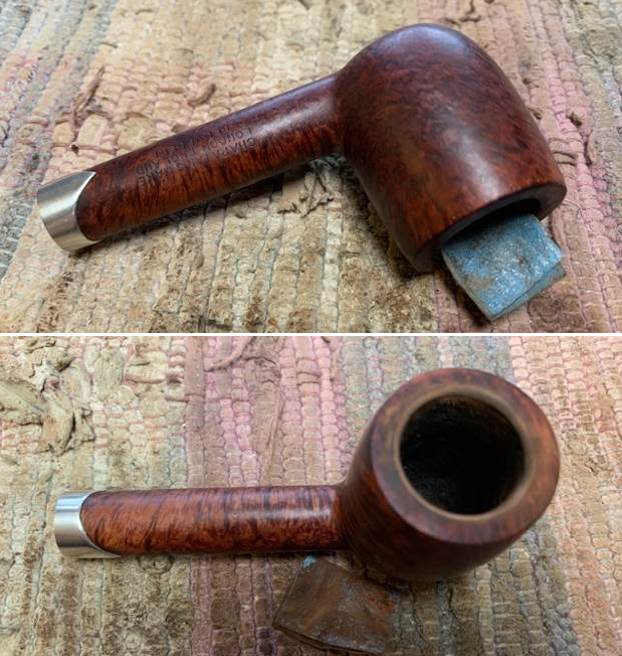
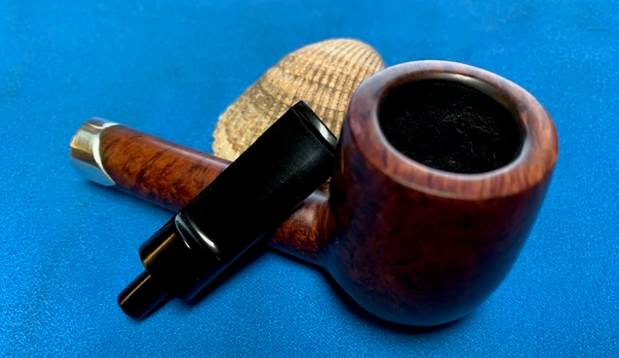
Hopefully the steps above show you both what I look for when I go over the pipe when I bring it to the work table and also what I see when I look at the pipe in my hands. They also clearly spell out a restoration plan in short form. My work is clear and addressing it will be the next steps. I took photos of the whole pipe to give you a picture of what I see when I have it on the table. This is important to me in that it also shows that there was no damage done during the clean up work or the transit of the pipe from Idaho to here in Vancouver. I carefully went over the bowl and rim top to get a sense of what is happening there. In this case once the lava was removed damage to the edge and top was revealed. Originally I thought it looked like reaming damage but I don’t think so as I examine it closely. I think it is actually burn damage to the edge that extends around the inner edge though it is heavier at the front and back of the bowl. The rim top also shows some damage. It is clean but will need to be worked on to bring it back to normal. I also go over the stem carefully. There were no tooth marks or dents in the stem. I could not see any sign of remaining CP stamping on the stem so no real clue as to whether it is original or a replacement. I took photos of the rim top and stem sides to show as best as I can what I see when I look at them.I always check to make sure that the clean up work did not damage the stamping on the shank in any way. It looks very good still. I also took a photo of the silver. I always appreciate the handiwork of the carvers at Charatan who turn a piece raw briar into a beautiful pipe. I love just looking at the beauty of the lay of the pipe with the grain and the proportion of the hand made pipes. I like to remove the stem from the shank to get a sense of what was in the mind of the pipe maker when he crafted the pipe. It is a beauty in flow and shape. By this time you should know that I almost always start with the bowl in my restoration because I truly do not like the tedious work of stem repairs and polishing. I always leave that until last even though I know that it needs to be done. For me the encouragement of seeing a rejuvenated bowl is the impetus I need to attack the stem work.

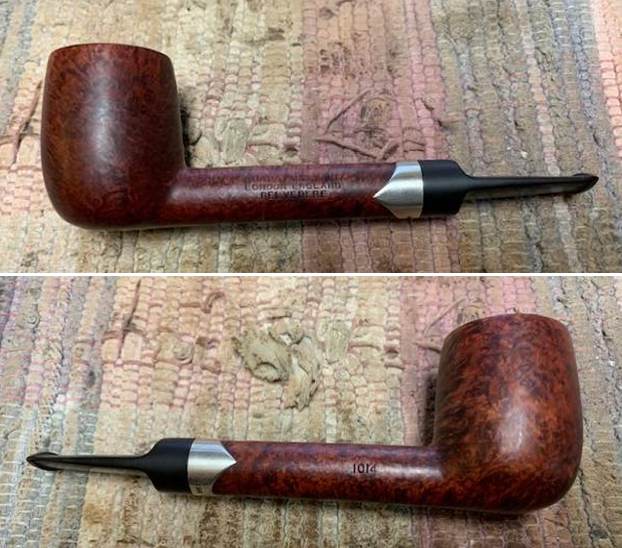
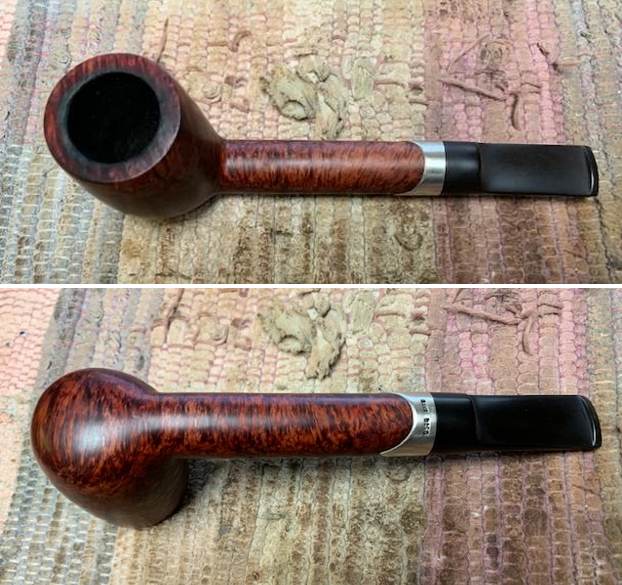
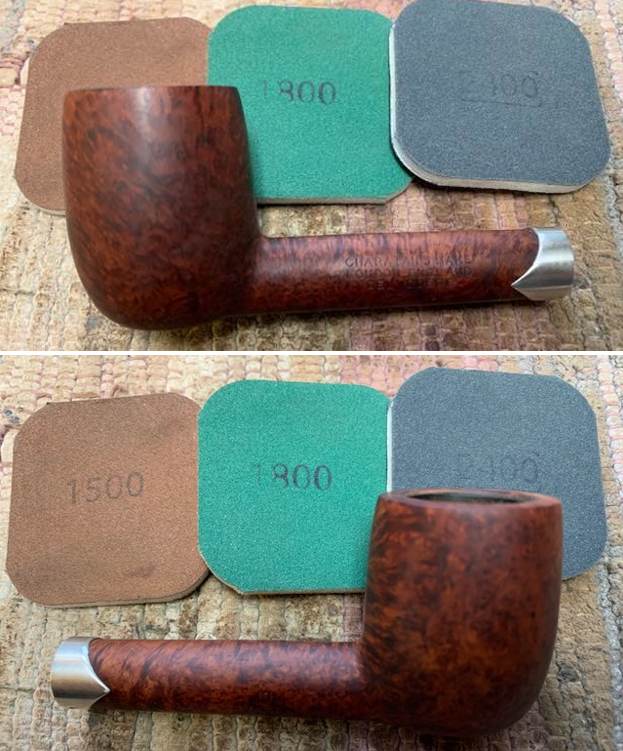
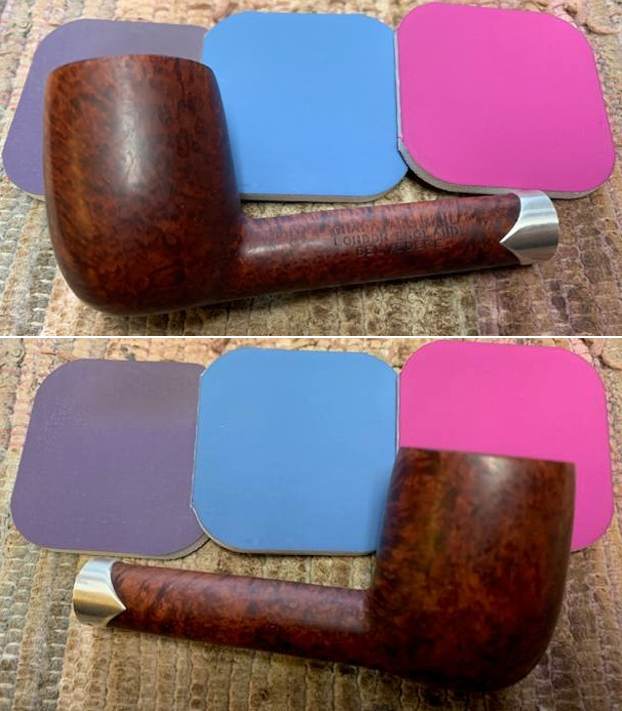
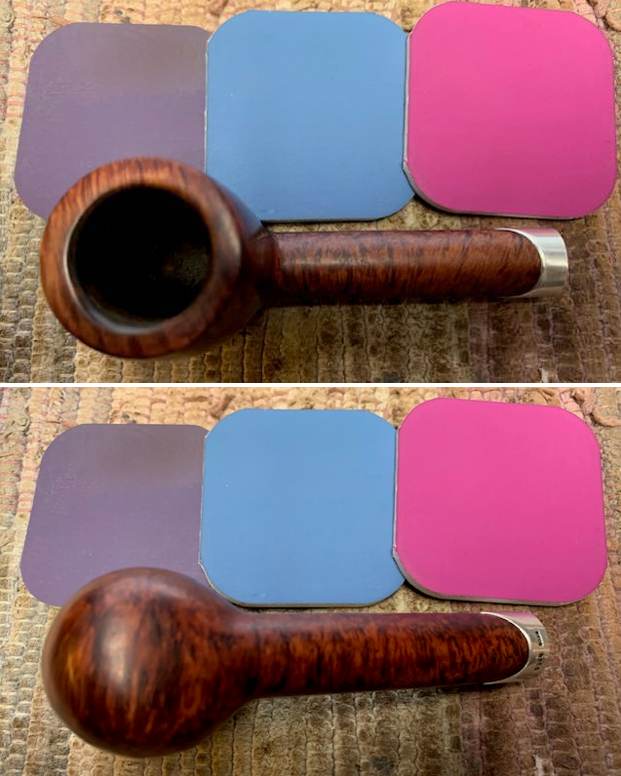
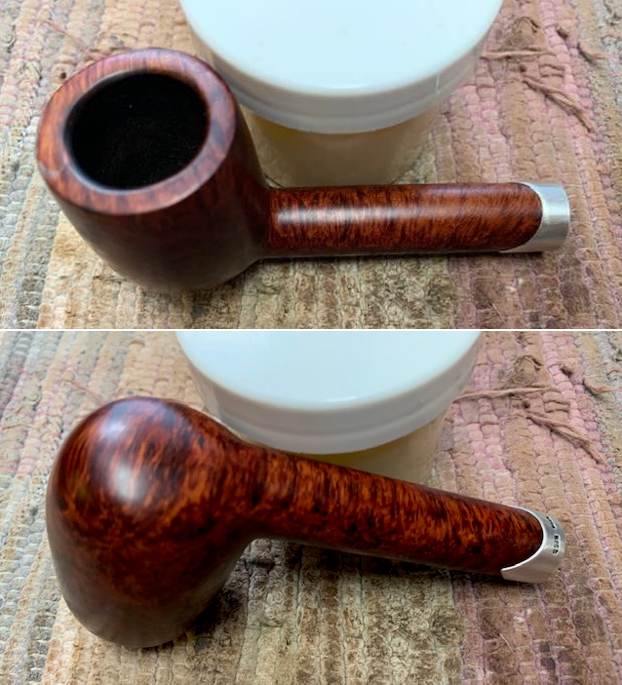
Today I started working on this pipe by turning to the bowl. I chose to deal with the darkening and burn damage on the rim edges and top. I used a folded piece of 220 grit sandpaper to reshape and remove the rim top and damage. It took a little work but I was able to remove all of the darkening. It is a beautiful piece of briar with some great grain.Once rim top was reshaped and reworked I needed to blend them into the rest of the briar. I polished the briar with micromesh sanding pads. I choose to dry sand the briar rather than wet sand it. Again it is a matter of personal preference. I prefer to use the pads dry and find they work very well on the briar. I sand with each pad (9 in total) and group them by threes for ease of reference. I also work over the plateau areas at the same time. I wipe the bowl down after each pad with a damp cloth to remove the sanding debris and check the briar. I love seeing the developing shine on the briar as I move through the pads which is why I include so many photos of this step. For the past few years now I have been using a product developed by Mark Hoover called Before & After Restoration Balm. It is a paste/balm that is rubbed into the surface of the briar and the plateau. The product works to deep clean the nooks and crannies of finish, enliven and protect the briar. I worked it into the briar with my finger tips and let it sit for 10 minutes to do its work. I wiped it off with a soft cloth then buffed it with a cotton cloth. The briar really began to have a deep shine in the briar and the grain shone through. The photos I took of the bowl at this point mark the progress in the restoration. It is a gorgeous pipe. Now it was time to address the part of the restoration I leave until last. I set the bowl aside and turned my attention to the stem. The stem was in good nick other than the light oxidation on the top side. There were no tooth marks or chatter so it was simply a matter of polishing the stem and bring back a shine. I use micromesh sanding pads and water to wet sand the stem with 1500-12000 grit sanding pads. I wiped it down after each sanding pad with Obsidian Oil on a cotton rag after each sanding pad as I find it does two things – first it protects the vulcanite and second it give the sanding pads bite in the polishing process. After finishing with the micromesh pads I rub the stem down with Before & After Fine and Extra Fine stem polish as it seems to really remove the fine scratches in the vulcanite. I rub the Fine Polish on the stem and wipe it off with a paper towel and then repeat the process with the extra fine polish. I finish the polishing of the stem down with a final coat of Obsidian Oil and set the stem aside to let the oil absorb. This process gives the stem a shine and also a bit of protection from oxidizing quickly.The final steps in my process involve using the buffer. I first buff the stem and the briar with Blue Diamond on the buffing wheel. Blue Diamond is a plastic polish but I find that it works very well to polish out the light scratches in the vulcanite and the briar. I work the pipe over on the wheel with my finger or thumb in the bowl to keep it from becoming airborne. It works well and I am able to carefully move forward with the buffing. The briar and stem just shone! I finished with the Blue Diamond and moved on to buffing with carnauba wax. Once I have a good shine in the briar and vulcanite I always give the bowl and the stem multiple coats of carnauba wax. I have found that I can get a deeper shine if I following up the wax buff with a clean buffing pad. It works to raise the shine and then I follow that up with a hand buff with a microfiber cloth to deepen the shine. It is always fun for me to see what the polished bowl looks like with the polished vulcanite stem. It really is a beautiful pipe. The smooth finish around the bowl sides and shank show the grain shining through the rich brown stains of this Charatan’s Make London England Belvedere 1014 Lovat with an S. Bang Silver Band. The finished pipe feels great in my hand. It is light and well balanced. Have a look at it with the photos below. The dimensions are Length: 5 ½ inches, Height: 1 ¾ inches, Outside diameter of the bowl: 1 ¼ inches, Chamber diameter: ¾ of an inch. The weight of the pipe is 1.31 ounces/37 grams. It is a beautiful pipe and one that I will be putting on the rebornpipes store in the British Pipe Maker section.
Hopefully the shape writing this blog is helpful to you in some way. In it I wanted to show both what I am looking for and how I move forward in addressing what I see when work on a pipe. Let me know if it is helpful to you. It is probably the most straightforward detailed description of my work process that I have done. As always I encourage your questions and comments as you read the blog. Thanks to each of you who are reading this blog. Remember we are not pipe owners; we are pipemen and women who hold our pipes in trust until they pass on into the trust of those who follow us.

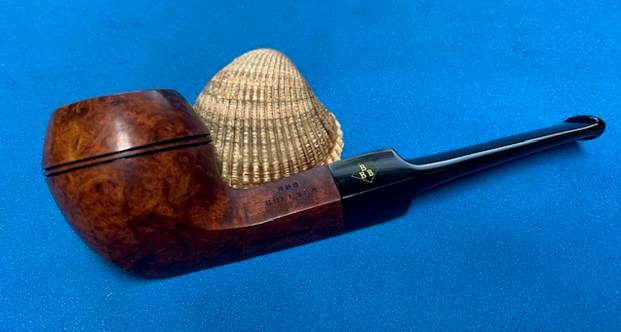
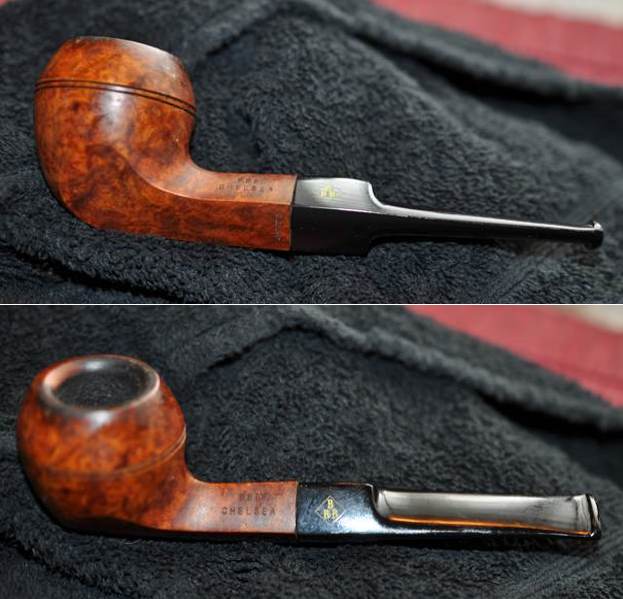
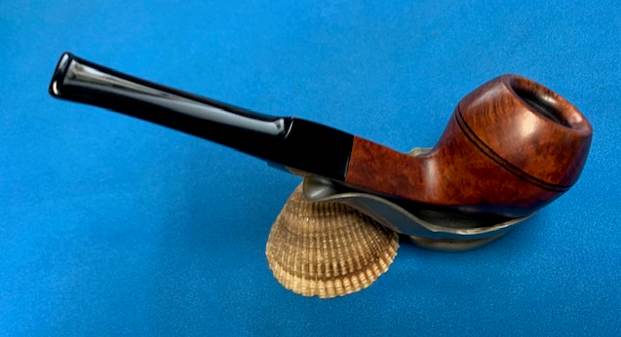
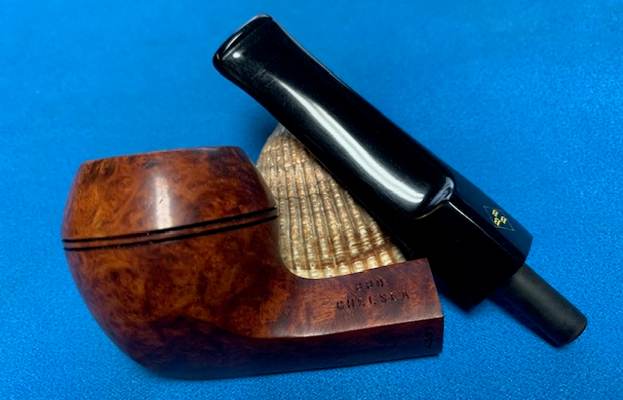
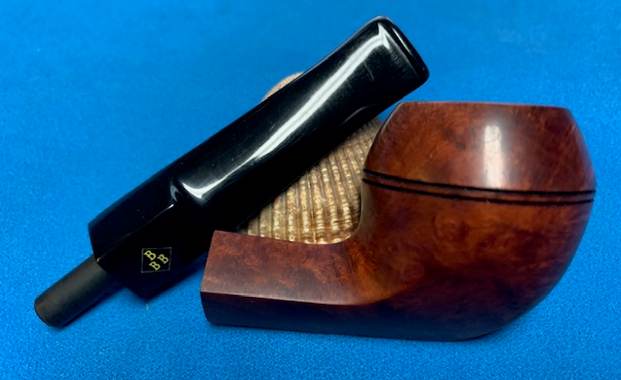
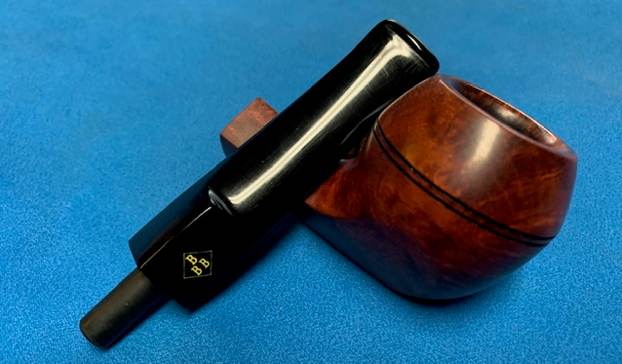
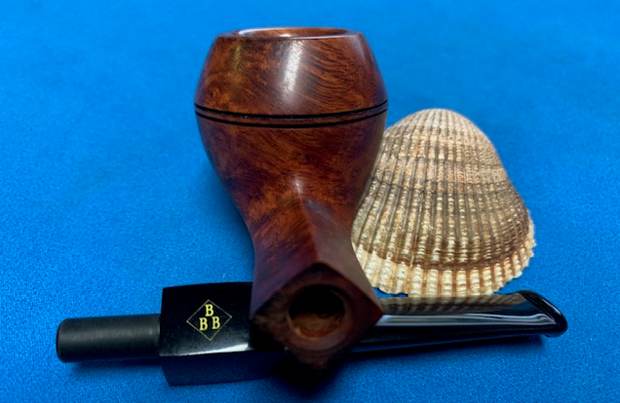
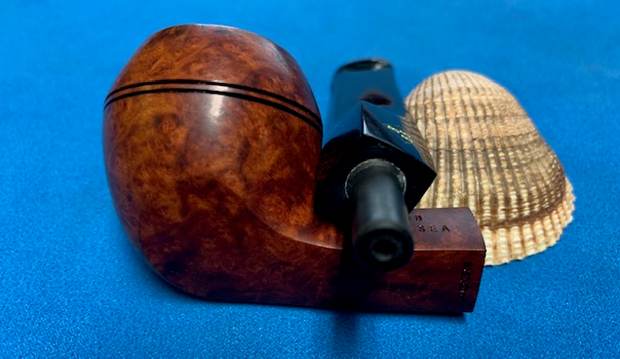
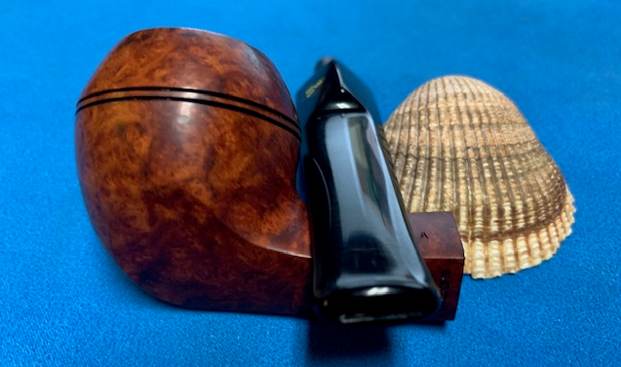
Restoring a Silver Banded BBB Own Make 722 Diplomat


Blog by Steve Laug

I thought with this blog that I would take a different tack in the write up and take you through my process of working on each pipe that we purchase. Jeff has set up a spread sheet to track where the pipe came from, the date of purchase and what we paid for it so that we know what we have invested in the pipe before we even work on it. This takes a lot of the guess work out of the process. This particular pipe was purchased on 01/26/2023 from Copenhagen, Denmark from a seller we buy a lot of pipes from. I also want you to understand why we take the photos we do. It is not accidental or chance as the photos have been taken to help me make an assessment of the pipe Jeff sees before he starts his clean up work. We do this to record the condition that the pipe was in when received it and to assess what kind of work will need to be done on. When I look at these photos this is what I see.

  1. The finish is dirty and there are nicks in the sides of the bowl from being dropped it looks like. There appeared to be some nice grain under the grime. The shank is fairly short with the factory silver band on the end.
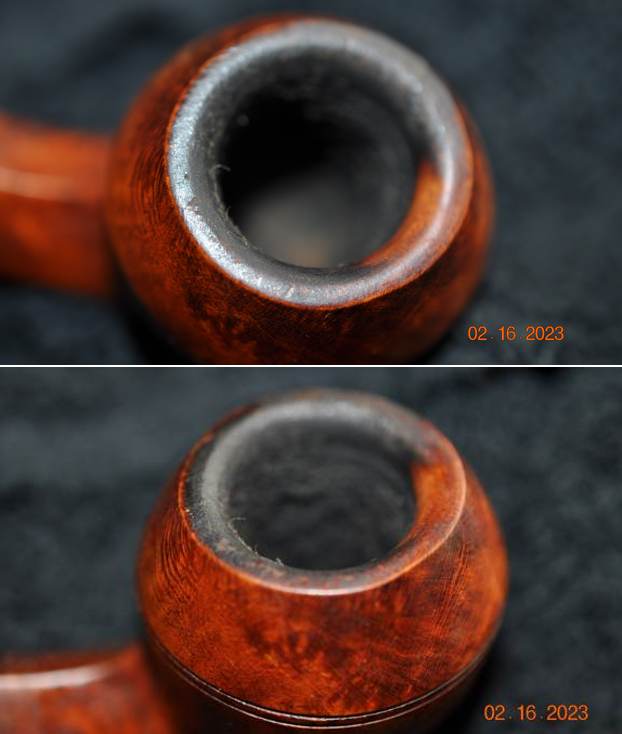
  2. The slightly crowned rim top had a thick lava overflow from the cake in the bowl. It was thicker on the back half of the rim top. There was also some darkening around the top and edges as well. The inner and outer edges of the bowl looked to be in good condition though covered with thick lava. Its overall appearance is very dirty looking.
  3. The bowl has a thick cake in it but the inner edge of the bowl actually looks to be undamaged from what I can see at this point. There does not appear to be any burning or reaming damage to the edges of the bowl. You would be surprised (though maybe not) in how many pipes we pick up that have major issues in this area.
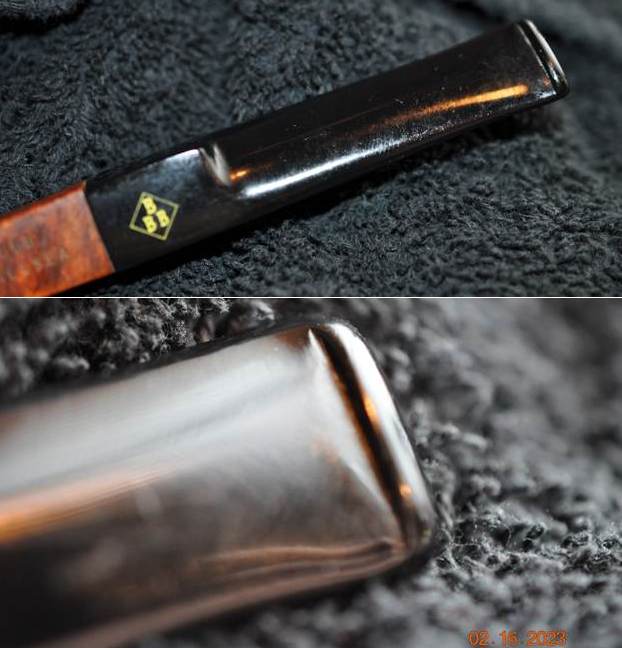
  4. The stem is an oddity to me. The first inch of the stem from the silver band back down the stem is lighter in colour than the rest of the stem. It appears to combine vulcanite and acrylic bound together somehow. I want to try to understand how the two materials are bound together.
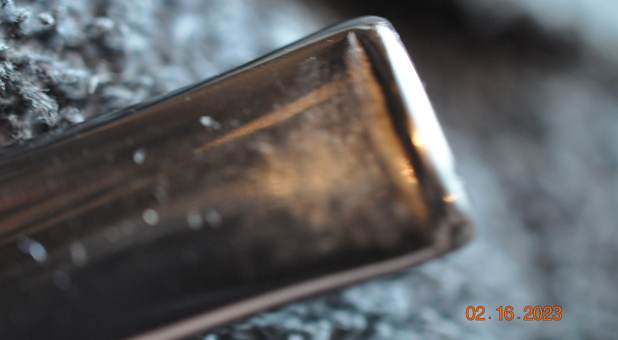
  5. The stem had some oxidation on the top portion around the logo. The acrylic portion was clean and there were no tooth marks and chatter visible in the photos below.

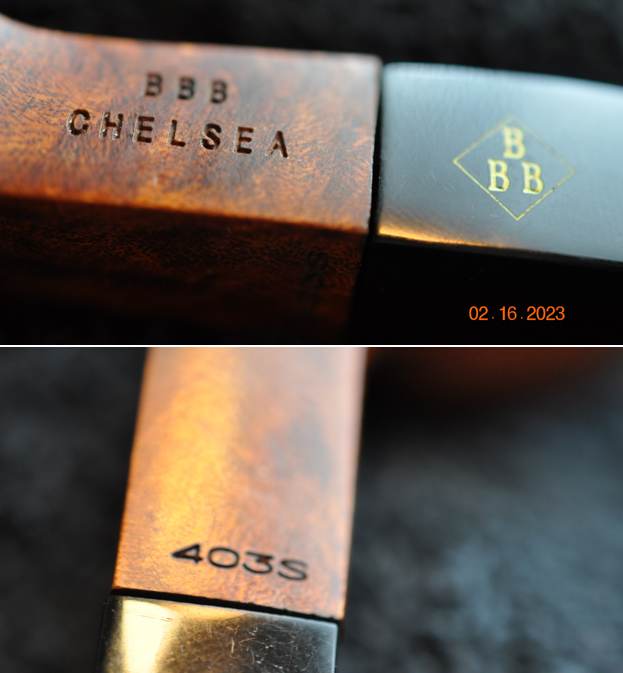
Overall my impressions of this pipe is that it is a beauty that once cleaned up will look pretty amazing. The cake does not seem to hide any burns or checking and the exterior of the bowl does not show any hot spots or darkening. The pipe is very English looking and is a classic Diplomat shape. It has a lot of BBB stylistic touches that I have come to expect as I have worked on a lot of them over the years. The photos below confirm the assessment above.Jeff took close up photos so that I could have a clearer picture of the condition of the bowl and rim edges and top. The rim top photos confirm my assessment above. The cake in the bowl is quite thick and the rim top has lava and debris on it. You can also see the condition of the inner and outer edges of the rim. This is what I look for when assessing a pipe. While there is lava and darkening there is no visible burn damage at this point and the previous reaming has not left damage either. The bowl is still fairly round. There are some scratches in the surface of the crowned rim top. His photos of the stem surface confirmed and heightened my assessment of the condition. You can see the oxidation (particularly around the top inch of the stem from the shank end back) and a different appearance to the second part of the stem. It really does appear that they are two separate materials – vulcanite around the brass logo and acrylic on the back two thirds. The stem is quite dirty but otherwise undamaged. I always ask Jeff to take photos of the sides and heel of the bowl. While this definitely shows the grain patterns around a bowl it also allows me to do a more thorough assessment of the condition of the briar and the finish. In this case I look at the nicks and scratches around the bowl sides to see if there are any cracks or splits radiating from the pits in the centre of each one. I also look for flaws in the grain as those can also hide cracks or damage. In this case the bowl exterior is sound and should clean up very well. I love the grain patterns and the way the play off the silver band on the shank end. I also ask him to take photos of the stamping so I can see if it is faint in any spots or double stamped or unclear. It often takes several photos to capture what I am looking for. The stamping on the underside of the shank is actually undecipherable for the most part. It appears to have a BBB diamond logo at the top of the photo (left side). Underneath that is seems to read Own Make (very faint) [over] Made in [over] London England [over] 722. There is also an odd symbol next to the shape number. Jeff also took photos of the stamping on the silver band and the brass inset logo on the top of the stem. The stamp on the band is hallmarked with three silver hallmarks – a rampant lion, a lion’s head and the letter C. The first one tells us that it is sterling silver. The second one tells us that it is a London assay mark. The third one – the C – is a date stamp. I will work on the date of the pipe once I have it in hand. The brass logo is slightly damaged on the lower side of the inset. I love working on background history of the pipes I restore as they add a depth to my ongoing understanding of the pipe. Being able to put it in a specific date on the pipe puts it in a time frame. I turned to a British Silver Makers Hallmarks site that I use all the time. I narrowed down my search to the London pipes. The first two marks as noted above – the rampant lion and the lion’s head were simple to decipher. The Rampant Lion is the symbol for Sterling silver. The The Lion’s Head is the symbol for London Silver makers. I turned to the dates list on the site. I have included it below (https://www.silvermakersmarks.co.uk/Dates/London.html).I clicked on the section that had a C stamp like the one on the band and it expanded to a size that I could easily read. I have included the link below as well as a screen capture of the section of the list (https://www.silvermakersmarks.co.uk/Dates/London/Cycle%201975-1999.html).

I knew that the pipe I had was made in London by BBB and the silver assay stamp dates the pipe as 1977 in terms of the shape of the C. The band I am working on does not have a Queen’s Stamp so it is a little different. But I am convinced that the pipe was made in 1977.

I am sure many of you skip my paragraph on the work Jeff has done before the pipe gets here but it is quite detailed in its brevity. I know some laugh at my opening line Jeff did a thorough cleaning of this pipe. However, I want you to know the details of the work. Back in 2020 Jeff wrote a blog about his cleaning process. I am including a link to that now so you can see what I mean about his process. Do not skip it! Give it a read (https://rebornpipes.com/2020/01/20/got-a-filthy-estate-pipe-that-you-need-to-clean/). Here is the introduction to that blog and it is very true even to this day.

Several have asked about Jeff’s cleaning regimen as I generally summarize it in the blogs that I post rather than give a detailed procedure. I have had the question asked enough that I asked Jeff to put together this blog so that you can get a clear picture of the process he uses. Like everything else in our hobby, people have different methods they swear by. Some may question the method and that is fine. But it works very well for us and has for many years. Some of his steps may surprise you but I know that when I get the pipes from him for my part of the restoration they are impeccably clean and sanitized. I have come to appreciate the thoroughness of the process he has developed because I really like working on clean pipe!

For the benefit of some of you who may be unfamiliar with some of the products he uses I have included photos of three of the items that Jeff mentions in his list. This will make it easier for recognition. These three are definitely North American Products so you will need to find suitable replacements or order these directly on Amazon. The makeup pads are fairly universal as we were able to pick some up in India when we were with Paresh and his family.

In the blog itself he breaks his process down into two parts – cleaning the stem and cleaning the bowl. Each one has a large number of steps that he methodically does every time. I know because I have watched him do the work and I have seen the pipes after his work on them. He followed this process step by step and when the pipe got to me it was spotlessly clean and ready for my work. The inside of the stem, shank and bowl were clean and to me that is an amazing gift as it means that my work on this end is with a clean pipe! I cannot tell you how much difference that makes for my work.

When the pipe arrives here in Vancouver I have a clean pipe and I go over it keeping in mind my assessment shared in the opening paragraph above. I am looking for any significant structural changes in the bowl and finish as I go over it.

  1. The finish is very clean and the grain stands out on the surface of the clean briar. The scratches in the briar swelled up a bit so that they were not as deep as originally assumed in the first photos. There are no cracks showing up in the grain lines or in the flaws under the leaf carvings. It is sound on the outside. I will need to polish the briar and buff it to bring back the shine.
  2. The slightly crowned rim top is clean of the lava but there is still some darkening on the top and edges of the bowl. The good news for me is that there are no cracks showing up in the rim top. The bowl was sound.
  3. The bowl was very clean and smelled clean. The clean walls did not show evidence of checking or cracking. There were no hot spots or damage on the walls or around the entrance of the airway into the bowl. It was clean and smooth which is great news for me. The inner edge of the bowl was undamaged and did not show any sign of burning or reaming damage to the edges of the bowl. Both the shank and the bowl were very clean showing no debris on a clean pipe clean run through them. I would need to give it a final cleaning with pipe cleaners and alcohol once I had finished with the external work to remove the debris that may have collected there in the process.
  4. The oddity I saw in the stem was even more evident now – the vulcanite stem end and the acrylic bit were bound together in a well done manner. It was going to be interesting to examine more closely and possibly remove some of the oxidation on the vulcanite portion.
  5. The oxidation was much less on the front portion of the stem after Jeff’s work on it. The acrylic portion did not show any tooth marks or chatter. It was in great condition.

Hopefully the steps above show you both what I look for when I go over the pipe when I bring it to the work table and also what I see when I look at the pipe in my hands. They also clearly spell out a restoration plan in short form. My work is clear and addressing it will be the next steps. I took photos of the whole pipe to give you a picture of what I see when I have it on the table. This is important to me in that it also shows that there was no damage done during the clean up work or the transit of the pipe from Idaho to here in Vancouver. I take some time to go over the bowl and rim top to get a sense of what is happening there. In this case has some darkening on the top and the inner edge of the bowl. It is clean but will need to be worked on to bring it back to normal. The edges are not damaged and neither is the top of the bowl. That is the good news. I also go over the stem carefully. There were no tooth marks or dents in the stem. The biggest mystery for me is the connection of the two materials on the stem. There is a visible difference in the photos below. I took photos of the rim top and stem sides to show as best as I can what I see when I look at them.I always check to make sure that the clean up work did not damage the stamping on the shank in any way. I was hoping that the clean up might have made the stamping more clear but that was not the case. It was as faint as before. You can see a bit of it in the last photo above. I also took a photo of the silver. I also removed the stem from the shank and took a photo to get a sense of what was in the mind of the pipe maker when he crafted the pipe. It is a beauty in flow and shape. The question at this point of where to begin the restoration work is always a matter of personal preference. If you read this blog much you will see that each of the restorers who post here all start at different points. I personally almost always start with the bowl because I truly do not like the tedious work of stem repairs and polishing. I always leave that until last even though I know that it needs to be done. So if you are restoring your pipes choose where you want to start and go from there. Just know that it all will need to be done by the end but for me the encouragement of seeing a rejuvenated bowl is the impetus I need to attack the stem work.

For me then I started working on this pipe by turning to the bowl. I chose to deal with the darkening to the rim edges and top. I used a folded piece of 220 grit sandpaper to reshape and remove the rim top and damage. It took a little work but I was able to remove all of the darkening. It is a beautiful piece of briar with some great grain.When I have to deal with scratch marks like those on the left side of the bowl I generally use a butter knife and a damp cloth to steam them out of the finish as much as possible. I know others use steam irons with great success but I generally use the butter knife and damp cloth to lift them as it allows me to pin point the tip of the knife on the marks. I was able to lift some of them nicely but some still remained when I finished. I used a small bit of CA glue to fill in the three marks that remained (it looks like more glue than it actually is – it is quite thin). I sanded the repairs smooth with 600 grit wet dry sandpaper. I started the polishing with micromesh sanding pads – working it over with 1500 grit pads.Once I have the repair sanded smooth I blend them into the surface of the briar. I polished the briar with micromesh sanding pads. I choose to dry sand the briar rather than wet sand it. Again it is a matter of personal preference. I prefer to use the pads dry and find they work very well on the briar. I sand with each pad (9 in total) and group them by threes for ease of reference. I also work over the plateau areas at the same time. I wipe the bowl down after each pad with a damp cloth to remove the sanding debris and check the briar. I love seeing the developing shine on the briar as I move through the pads which is why I include so many photos of this step. Once I have a bowl at this point in the process I go over it to see the coverage on the bowl. In this case the finish was very spotty. I chose to restain the bowl with a Light Brown aniline wash. I mixed some brown pigment with some isopropyl alcohol to mix a wash. I used a cotton dauber to  cover the surface of the briar with the stain wash. I lit the finish with a lighter and set the stain in the briar. I repeated the process a second time to make sure it was a smooth finish. I took a few photos of the stained bowl. It appears significantly darker than I expected but I knew that buffing it would lighten the finish and perhaps make it match. Buffing would tell the tale. When I stain a bowl like the one above I take it to the buffer after the stain has dried. I buffed it first with Red Tripoli to remove the “crust” of the new stain. The Tripoli took off the opacity of the stain on the bowl and gave me more of the colour I was hoping for under the stain coat. I buffed it a second time with Blue Diamond and was able to remove more. The bowl also began to take on a deep shine. I took photos of the bowl after buffing and have included them below. For the past few years now I have been using a product developed by Mark Hoover called Before & After Restoration Balm. It is a paste/balm that is rubbed into the surface of the briar and the plateau. The product works to deep clean the nooks and crannies of finish, enliven and protect the briar. I worked it into the briar with my finger tips and let it sit for 10 minutes to do its work. I wiped it off with a soft cloth then buffed it with a cotton cloth. The briar really began to have a deep shine in the briar and the grain shone through. The photos I took of the bowl at this point mark the progress in the restoration. It is a gorgeous pipe. Now it was time to address the part of the restoration I leave until last. I set the bowl aside and turned my attention to the stem. This one was a unique stem so I was not as slow to start because of damage to the stem it was more to try to put together why the stem has two materials and how they were joined. The junction was flawlessly done and the transition was very smooth. It made me wonder who had done this work and why. I have never seen any other BBB pipe with the compound material stem. Here are a couple of thoughts I have as I have been working on it. There are several possibilities.

The first is that this stem is kind of a Frankenpipe rebuild.

  1. Somewhere in the life of the pipe the original vulcanite stem was ruined from the button forward. The original owner wanted to keep the front portion next to the shank intact so that original brass logo would not have to be moved.
  2. A possibility is that the old stem was cut off and an acrylic end was made for it. They were joined together with a tenon and glue that bound the parts together seamlessly.
  3. The stem was then sanded to make the transition between the two materials seamless.

The second is that it originally came out that way as a means of protecting the stem from bite through. It may well have been a BBB innovation – just one that I have never seen or read about.

I suppose at one level I will never really know for sure but whatever the reason for the mixed material of the stem it is a beauty. Now it was time to work on it.

At this point in the process I chose to polish the stem and bring back a shine. I use micromesh sanding pads and water to wet sand the stem with 1500-12000 grit sanding pads. I wiped it down after each sanding pad with Obsidian Oil on a cotton rag after each sanding pad as I find it does two things – first it protects the vulcanite and second it give the sanding pads bite in the polishing process. After finishing with the micromesh pads I rub the stem down with Before & After Fine and Extra Fine stem polish as it seems to really remove the fine scratches in the vulcanite. I rub the Fine Polish on the stem and wipe it off with a paper towel and then repeat the process with the extra fine polish. I finish the polishing of the stem down with a final coat of Obsidian Oil and set the stem aside to let the oil absorb. This process gives the stem a shine and also a bit of protection from oxidizing quickly.The final steps in my process involve using the buffer. I first buff the stem and the briar with Blue Diamond on the buffing wheel. Blue Diamond is a plastic polish but I find that it works very well to polish out the light scratches in the vulcanite and the briar. I work the pipe over on the wheel with my finger or thumb in the bowl to keep it from becoming airborne. It works well and I am able to carefully move forward with the buffing. The briar and stem just shone! I finished with the Blue Diamond and moved on to buffing with carnauba wax. Once I have a good shine in the briar and vulcanite I always give the bowl and the stem multiple coats of carnauba wax. I have found that I can get a deeper shine if I following up the wax buff with a clean buffing pad. It works to raise the shine and then I follow that up with a hand buff with a microfiber cloth to deepen the shine. It is always fun for me to see what the polished bowl looks like with the polished vulcanite and acrylic combination stem. It really is a beautiful pipe. The smooth finish around the bowl sides and shank show the grain shining through the rich brown stains of this BBB Own Make 722 Diplomat. The finished pipe feels great in my hand. It is light and well balanced. Have a look at it with the photos below. The dimensions are Length: 5 ½ inches, Height: 1 ½ inches, Outside diameter of the bowl: 1 1/8 inches, Chamber diameter: 7/8 of an inch. The weight of the pipe is 1.59 ounces/44 grams. It is a beautiful pipe and one that I will be putting on the rebornpipes store in the British Pipe Maker section.
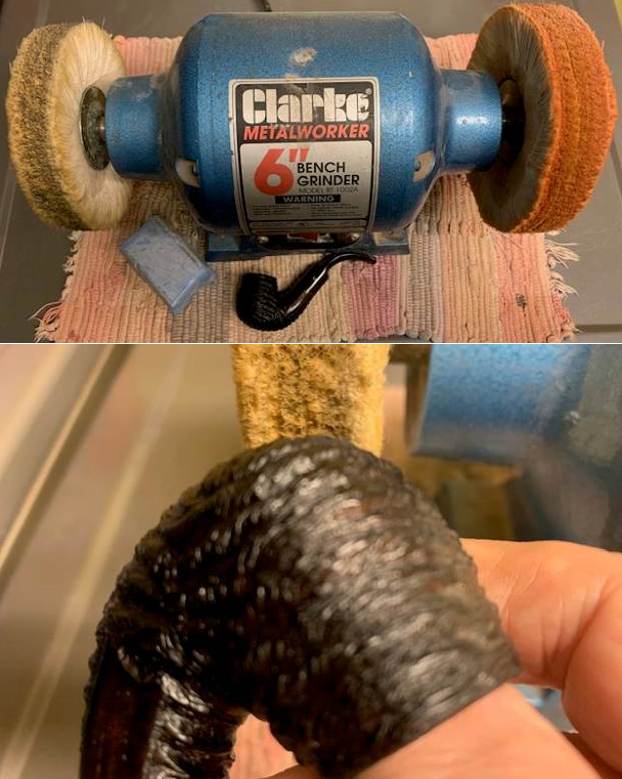
Hopefully this tack of writing this blog is helpful to you in some way. In it I show both what I am looking for and how I move forward in addressing what I see when work on a pipe has been helpful to you. It is probably the most straightforward detailed description of my work process. As always I encourage your questions and comments as you read the blog. Thanks to each of you who are reading this blog. Remember we are not pipe owners; we are pipemen and women who hold our pipes in trust until they pass on into the trust of those who follow us.
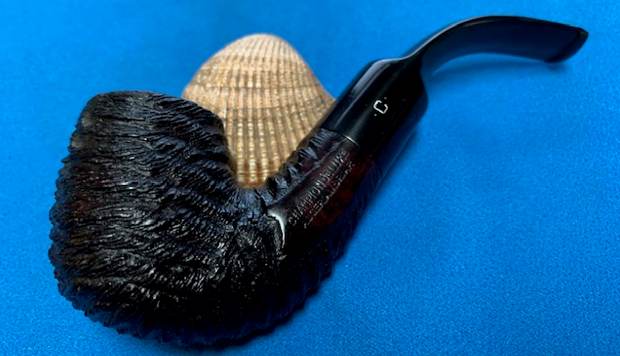
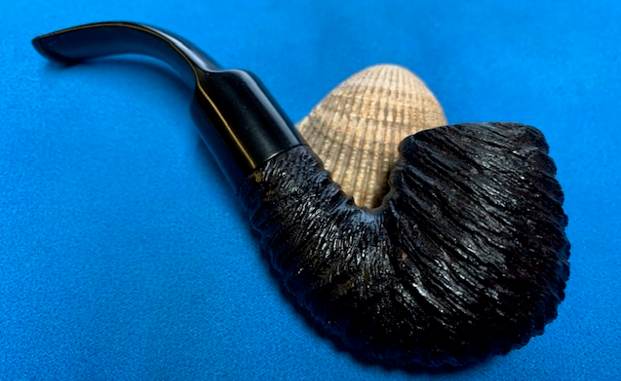
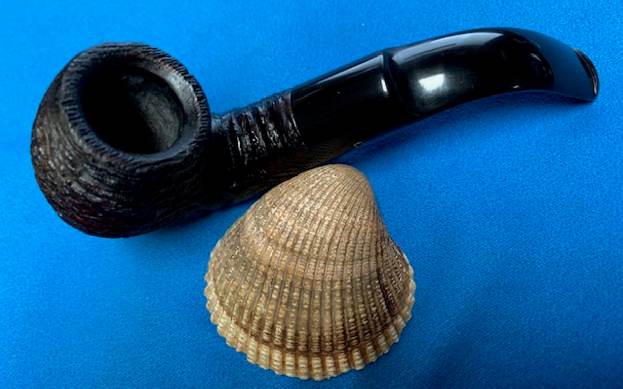
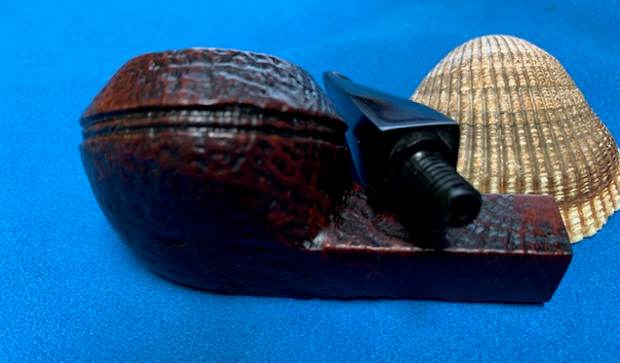
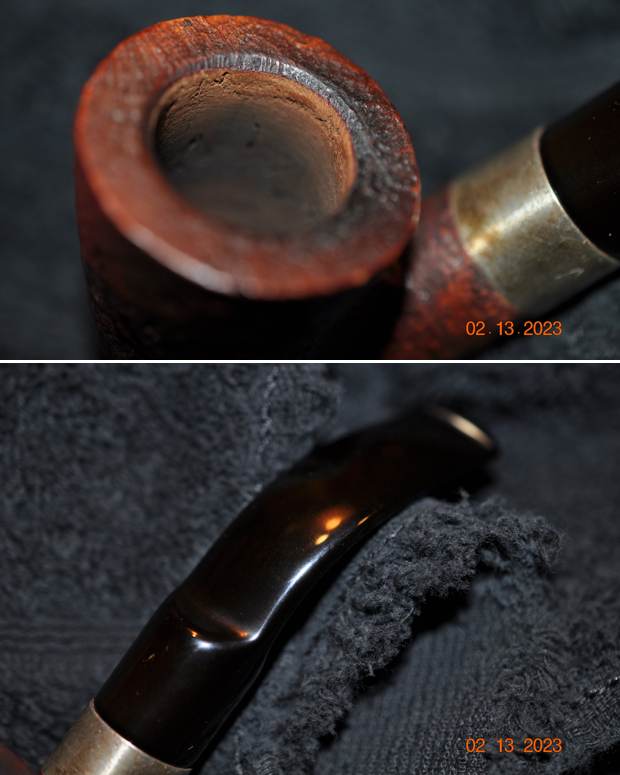
Cleaning up a nice looking Sandblast Jobey Shellmoor 020 Squat Bulldog


Blog by Steve Laug

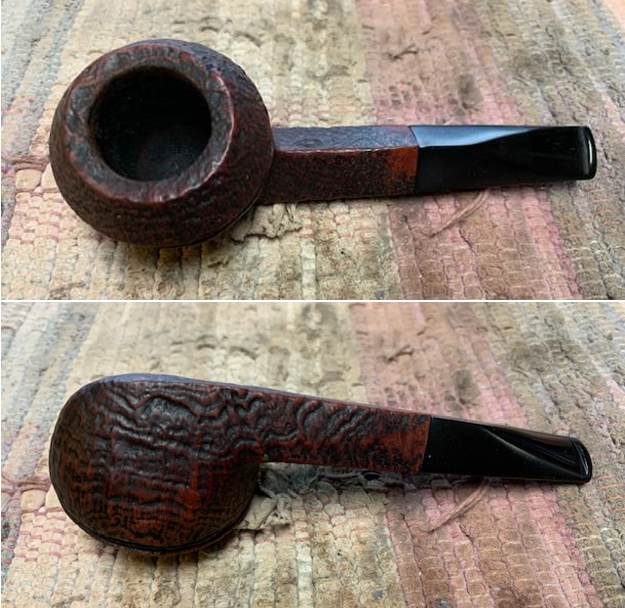
I am continuing with the same tack I have taken on the last few pipes I have worked on and take you through my process of working on each pipe that we purchase. Jeff has set up a spread sheet to track where the pipe came from, the date of purchase and what we paid for it so that we know what we have invested in the pipe before we even work on it. This takes a lot of the guess work out of the process. This particular pipe was purchased on 05/25/2022 from an antique store in Portland, Oregon, USA. I also want you to understand why we take the photos we do. It is not accidental or chance as the photos have been taken to help me make an assessment of the pipe Jeff sees before he starts his clean up work. We do this to record the condition that the pipe was in when received it and to assess what kind of work will need to be done on. When I look at these photos this is what I see.

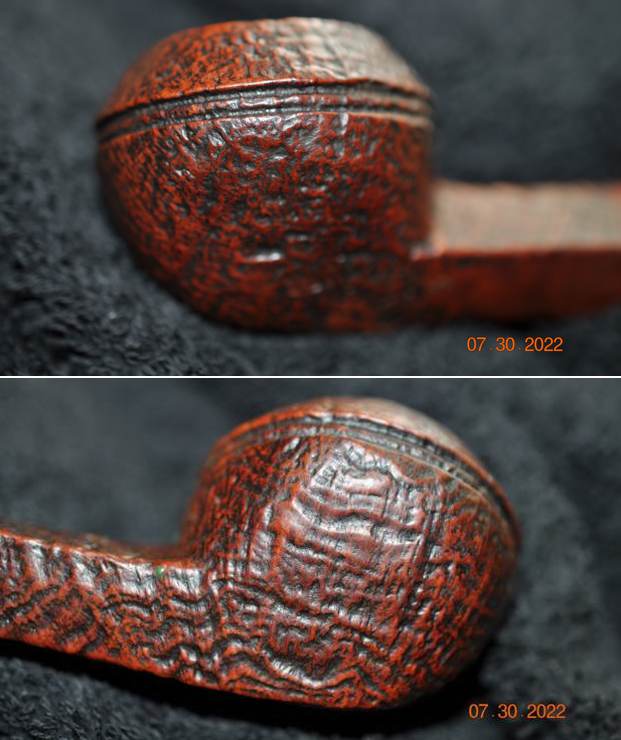
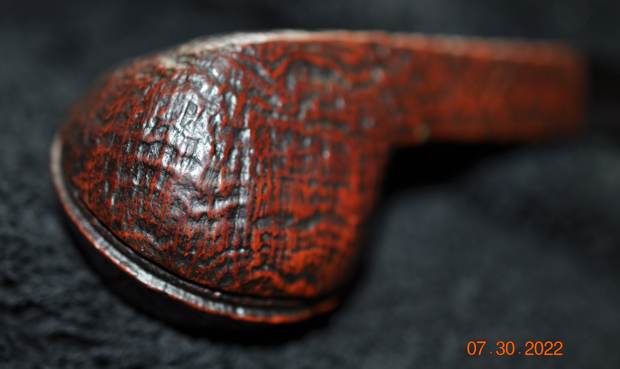
  1. The finish is dirty with debris and dust collecting in the twin rings on the bowl cap. The sandblast is quite nice but also very dirty. There appears to be a few nicks along the top of the twin rings around the cap.
  2. The rim top is dirty and there is a lava overflow from the cake in the bowl and some darkening on the rim top. The sandblast is filled in with lava on some of the rim top and well need to be cleaned out.
  3. The bowl has a thick cake in it but the inner bevel and outer edge of the bowl actually look to be undamaged other thank the scratches and darkening. There does not appear to be any burning or reaming damage to the edges of the bowl.
  4. The diamond shaped stem is vulcanite and there is no logo in the surface.
  5. The vulcanite stem has some light oxidation ahead of the softee bit but was dirty. The softee bit on the stem end kept the stem from having any tooth marks or damage. Interestingly it is also a Jobey Link System stem. There is also some rounding on the shoulder of the stem at the shank junction.

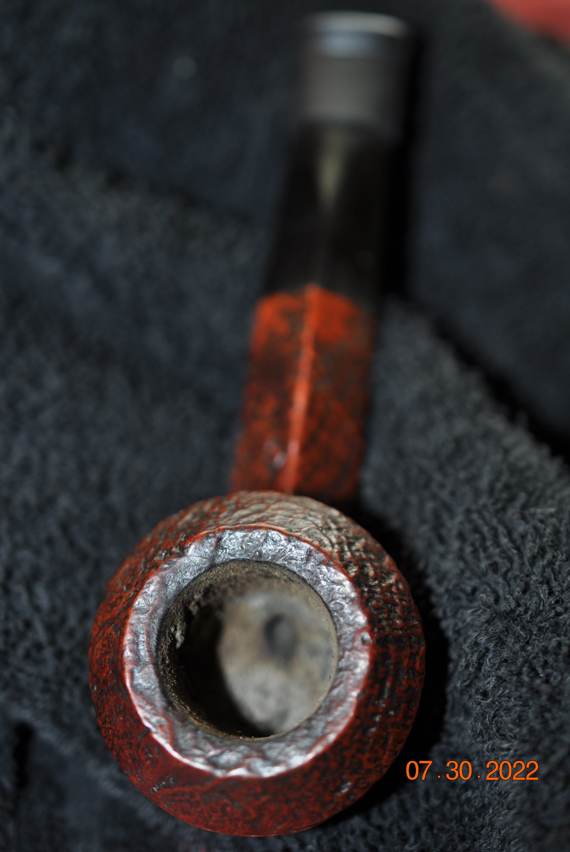
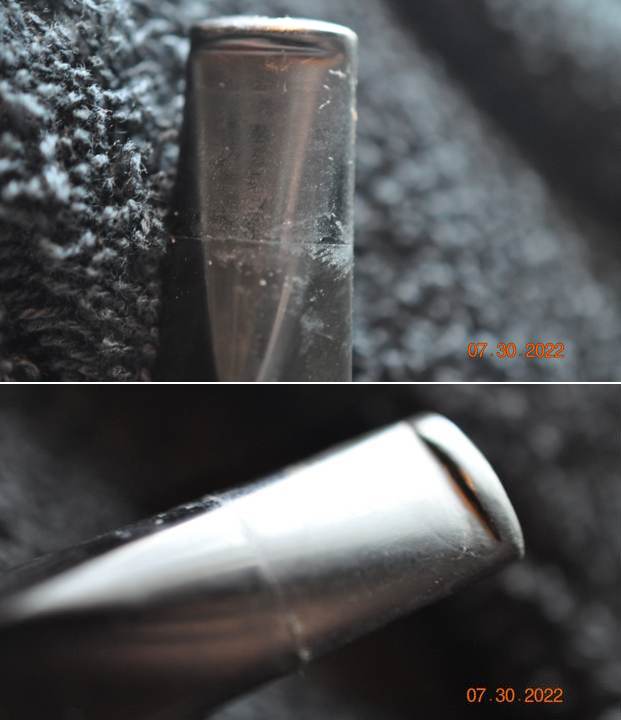
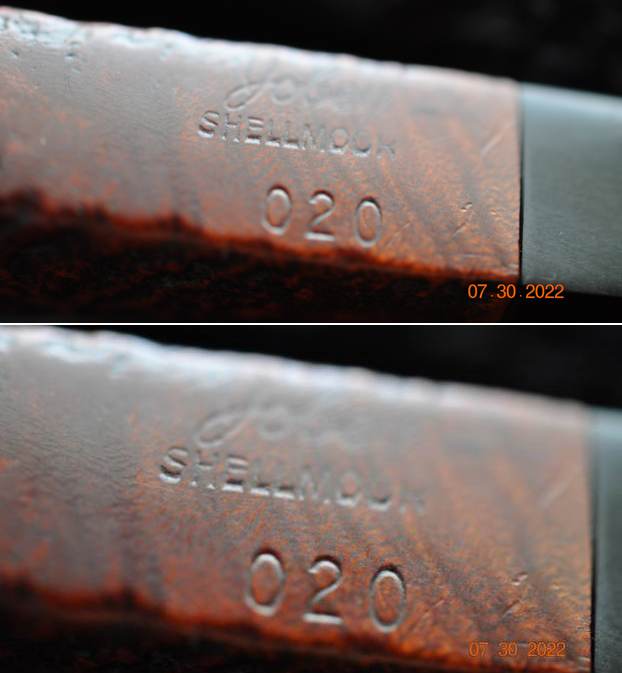
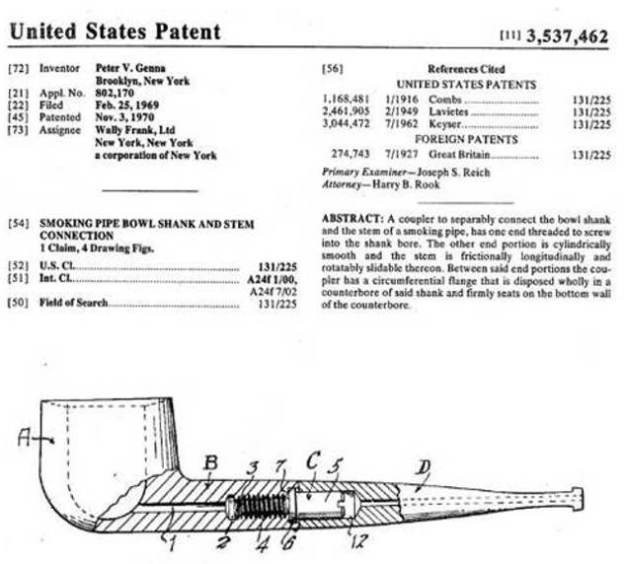
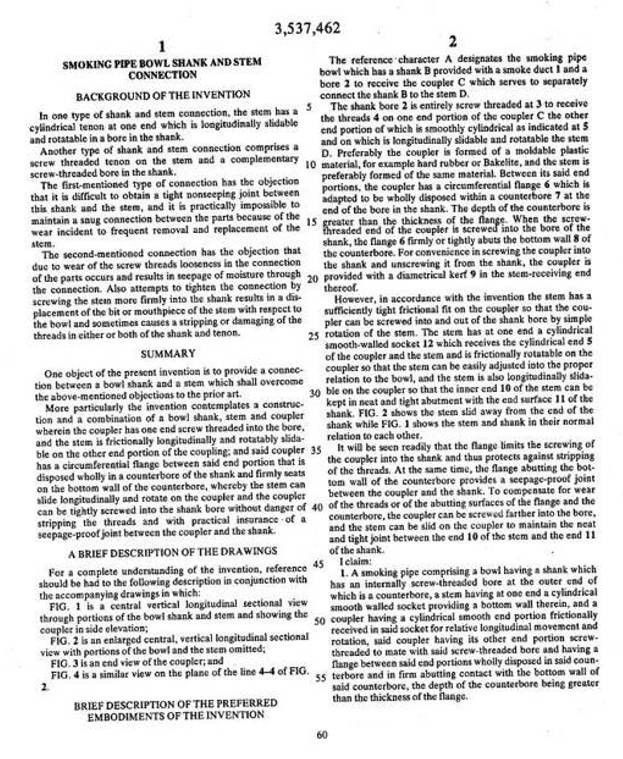
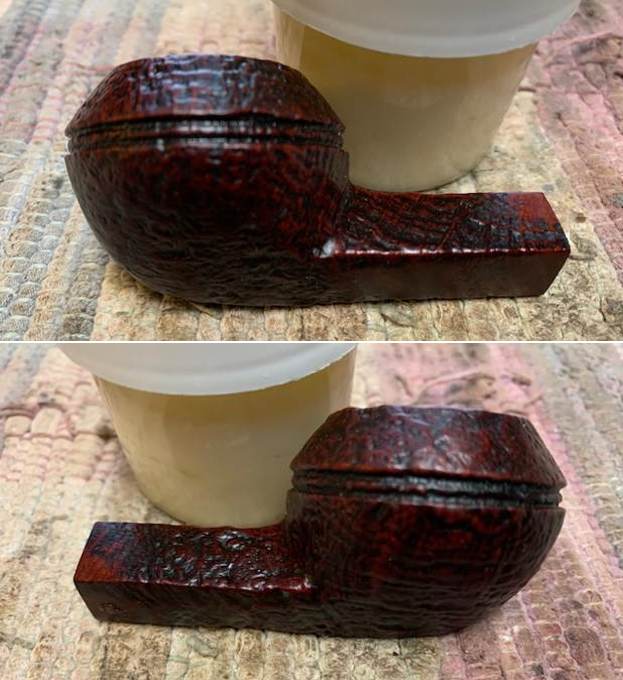
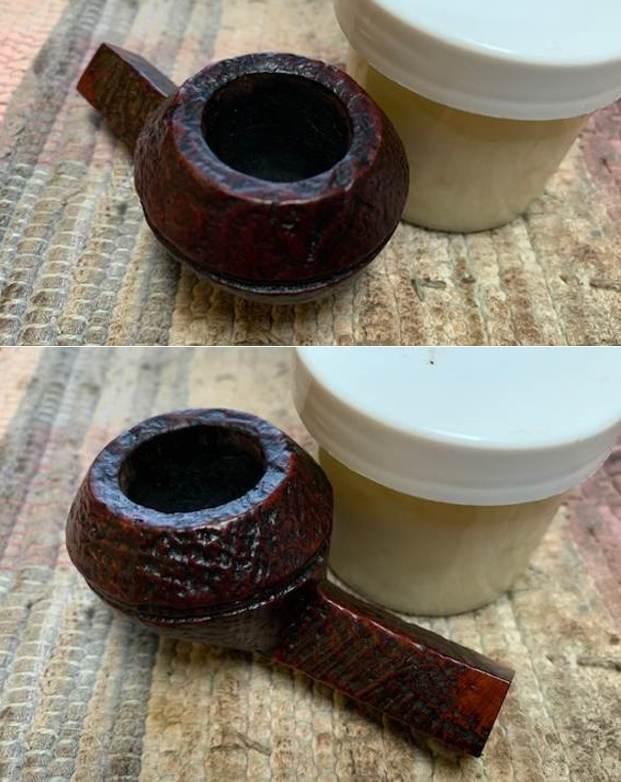
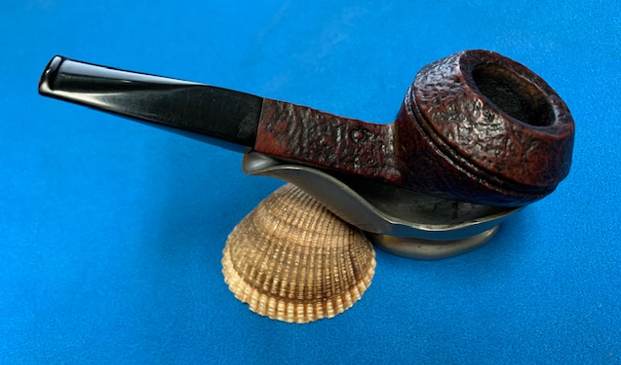
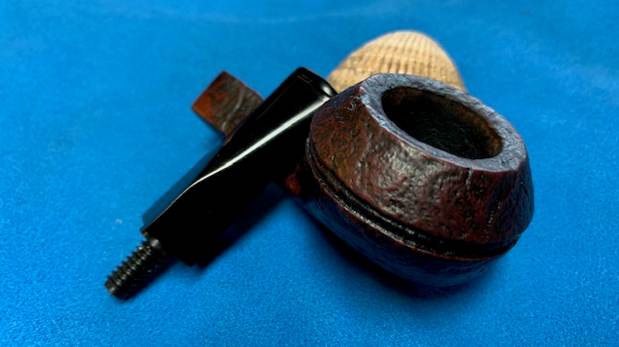
Overall my impressions of this stubby, squat Bulldog was that it was in solid shape some light damage to the twins rings but nothing terrible. The cake does not seem to hide any burns or checking but I will know more once it is cleaned and reamed. The exterior of the bowl does not show any hot spots but with the grime in the sandblast it is very hard to know with certainty. It is a good looking pipe in spite of the poor care it has had. The photos below confirm the assessment above. Hopefully as you have learned from the last few blogs we always include close up photos of key areas on the pipe we buy. We do this so that I can have a clearer picture of the condition of the bowl and rim edges and top since Jeff does the clean up and we live quite far apart. The rim top photos confirm my assessment above. The cake in the bowl is quite thick and the rim top has some lava and debris in the grooves of the sandblast. You can also see the condition of the inner and outer edges of the rim. You can see that there does not appear to be any over reaming or burn damage to the edges. This is what I look for when assessing a pipe. His photos of the stem surface confirmed and heightened my assessment of the condition. You can see the light oxidation on the stem surface ahead of the softee bit. You can see the rubber softee bit protected the stem from tooth marks and chatter. Jeff removed the softee bit to confirm the assessment of the conditon of the stem. Remember that we include photos of the sides and heel of the bowl for me to do a more thorough assessment of the condition of the briar and the finish before I have it in hand. The finish is dirty but the mixed grain shows through the sandblast nicely and cleaning should remove that. There were no cracks or splits following the grain or coming down from the rim edges. There were no cracks in the shank. In this case the bowl exterior is sound and should clean up very well. We take photos of the stamping so I can see if it is faint in any spots or double stamped or unclear. It often takes several photos to capture what I am looking for. The stamping on the left underside of the shank is clear and readable in the pictures below. It reads Jobey [over] Shellmoor [over] the shape number 020. The Jobey stamp is faint but still readable as is the second half of the Shellmoor stamp. The shape number is very clear.For me researching the brand and the maker are an important part of the restoration process. It gives me the background on the philosophy of the pipemakers as well as an understanding of their perspective in making a pipe. That is why I generally include it in my restoration write ups. It is important for me and it is important in educating us on those who have left behind a rich heritage. A unique feature of this pipe is the Jobey Link feature. I did some digging into the patent for the Link. To get the background information I turned to the US Patent search site and entered the numbers. I was able to find both a description of the invention and a diagram that was submitted with the Patent application. The patent is for the Jobey Link that connects the stem and shank on the pipe. Here is the link to the site and a screen capture of the information found there. https://pdfpiw.uspto.gov/.piw?docid=03537462&SectionNum=1&IDKey=6F776849C285&HomeUrl=http://patft.uspto.gov/netacgi/nph-Parser?Sect1=PTO1%2526Sect2=HITOFF%2526d=PALL%2526p=1%2526u=%25252Fnetahtml%25252FPTO%25252Fsrchnum.htm%2526r=1%2526f=G%2526l=50%2526s1=3537462.PN.%2526OS=PN/3537462%2526RS=PN/3537462 While I am sure that some of you will skip the next section of this blog I encourage you to read the process that we use to clean our pipes. It is an important part of the our work of restoration. Jeff wrote a detailed blog about his cleaning process. I am including a link to that now so you can see what I mean about his process. Do not skip it! Give it a read (https://rebornpipes.com/2020/01/20/got-a-filthy-estate-pipe-that-you-need-to-clean/). Here is the introduction to that blog and it is very true even to this day.

Several have asked about Jeff’s cleaning regimen as I generally summarize it in the blogs that I post rather than give a detailed procedure. I have had the question asked enough that I asked Jeff to put together this blog so that you can get a clear picture of the process he uses. Like everything else in our hobby, people have different methods they swear by. Some may question the method and that is fine. But it works very well for us and has for many years. Some of his steps may surprise you but I know that when I get the pipes from him for my part of the restoration they are impeccably clean and sanitized. I have come to appreciate the thoroughness of the process he has developed because I really like working on clean pipe!

For the benefit of some of you who may be unfamiliar with some of the products he uses I have included photos of three of the items that Jeff mentions in his list. This will make it easier for recognition. These three are definitely North American Products so you will need to find suitable replacements or order these directly on Amazon. The makeup pads are fairly universal as we were able to pick some up in India when we were with Paresh and his family.

In the blog itself he breaks his process down into two parts – cleaning the stem and cleaning the bowl. Each one has a large number of steps that he methodically does every time. I know because I have watched him do the work and I have seen the pipes after his work on them. He followed this process step by step and when the pipe got to me it was spotlessly clean and ready for my work. The inside of the stem, shank and bowl were clean and to me that is an amazing gift as it means that my work on this end is with a clean pipe! I cannot tell you how much difference that makes for my work.

When the pipe arrives here in Vancouver I have a clean pipe and I go over it keeping in mind my assessment shared in the opening paragraph above. I am looking for any significant structural changes in the bowl and finish as I go over it.

  1. The finish cleaned up really well and the oils and grime ground into the briar have been removed. The twin rings around the bowl cap are very clean and there was no grime in the grooves. With all the grime removed it was a great looking pipe.
  2. The rim top cleaned up well and the lava was gone. The inner and outer edges of the bowl looked very good.
  3. The bowl was very clean and the top and inner edge of the bowl. The bowl walls are also very clean and smooth with no checking or burn marks on the inside or out of the bowl. The walls were undamaged.
  4. The diamond shaped stem is vulcanite and there is no logo in the surface but it cleaned up very well.
  5. The vulcanite stem clearly shows the effectiveness of the rubber softee bit in protection the stem from tooth marks. It definitely has some rounding on the stem shoulders at the shank joint. It is bothersome but there is not much that can be done with it. I will try to minimize it but for the most part this is one part of the stem restoration that cannot be undone when done poorly

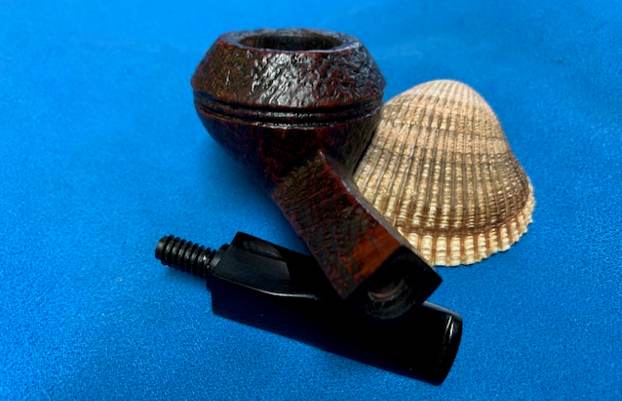
Hopefully the steps above show you both what I look for when I go over the pipe when I bring it to the work table and also what I see when I look at the pipe in my hands. They also clearly spell out a restoration plan in short form. My work is clear and addressing it will be the next steps. I took photos of the whole pipe to give you a picture of what I see when I have it on the table. This is important to me in that it also shows that there was no damage done during the clean up work or the transit of the pipe from Idaho to here in Vancouver. Also things stand out that I did not see in the photos. For example I had no idea I was working with an orific button rather than a slot but it works with the pipe. I suppose it could be a replacement stem but it appears original other than the lack of a Jobey logo. I spent some time going over the bowl and rim top to get a sense of what is happening there. The bowl looked very good and the walls were smooth. There was no damage internally. The rim top was clean and I could clearly see the sandblast around the rim top. It was clean and clear. The inner and outer edge looked very good. I also went over the stem carefully. I examined the stem and the button edge and was happy to see that they were in great condition. I took photos of the rim top and stem sides to show as best as I can what I see when I look at them.As usual I checked the stamping to make sure that the clean up work did not damage the stamping on the shank in any way. I know Jeff is cognizant of this but I do it anyway and take a photo to show what I see when I examine it. In this case it seems more readable than before the clean up. It is clear and distinct. I removed the stem from the shank and checked the tenon. You can see the Jobey Link System Tenon. It is threaded and screw into the shank. The other end is smooth and fits by friction in the stem. I lay the parts of the pipe out to get a sense of the proportion that was in the mind of the pipe maker when he crafted the pipe. It is a beauty in flow and shape.This is one of my unusual restorations – I did not need to do work on the rim top or edges and the shank was clean. When I get a bowl that is this clean I use Before & After Restoration Balm. It is a paste/balm that is rubbed into the surface of the briar. The product works to deep clean the finish, enliven and protect the briar. I worked it into the briar with my finger tips to make sure that it covers every square inch of the pipe. I used a horsehair shoe brush to get into the twin rings around the cap. I set it aside for 10 minutes to let it do its work. Once the time has passed I wiped it off with a soft cloth then buffed it with a cotton cloth. The briar really began to have a deep shine. The photos I took of the bowl at this point mark the progress in the restoration. You see the shine that the briar has taken on and the depth that the sandblast finish has. It is a gorgeous pipe. Now it was time to address the part of the restoration I leave until last. It is one of the rare cases where it was not a big deal so I could easily have started with it but old habits die hard! I set the bowl aside and turned my attention to the stem. Fortunately it took very little work as there were no tooth marks. It was the time now to polish the stem and bring back a shine. Over the years I have developed my own process for this. It is all preparation for the buffing that will come last. I use micromesh sanding pads and water to wet sand the stem with 1500-12000 grit sanding pads. I wiped it down after each sanding pad with Obsidian Oil on a cotton rag after each sanding pad as I find it does two things – first it protects the vulcanite and second it give the sanding pads some bite in the polishing process. I sought with the sanding pads to square up the sides to reduce the rounded shoulders on the stem sides and while it helped it was still not perfect. After finishing with the micromesh pads I always rub the stem down with Before & After Fine and Extra Fine stem polish as it seems to really remove the fine scratches in the vulcanite. I rub the Fine Polish on the stem and wipe it off with a paper towel and then repeat the process with the Extra Fine polish. I finish the polishing of the stem by wiping it down with a final coat of Obsidian Oil and set the stem aside to let the oil absorb. This process gives the stem a shine and also a bit of protection from oxidizing quickly.The final steps in my process involve using the buffer. I first buff the stem and the briar with Blue Diamond on the buffing wheel. Blue Diamond is a plastic polish but I find that it works very well to polish out the light scratches in the vulcanite and the briar. I work the pipe over on the wheel with my finger or thumb in the bowl to keep it from becoming airborne. It works well and I am able to carefully move forward with the buffing. I lightly buff sandblast bowl and shank making sure to keep the product from building up in the grooves of the finish. I finished with the Blue Diamond and moved on to buffing with carnauba wax. Once I have a good shine in the briar and vulcanite I always give the bowl and the stem multiple coats of carnauba wax. I have found that I can get a deeper shine if I following up the wax buff with a clean buffing pad. It works to raise the shine and then I follow that up with a hand buff with a microfiber cloth to deepen the shine. It is always fun for me to see what the polished bowl looks like with the polished vulcanite stem. This Jobey really is a beautiful pipe. The sandblast finish around the bowl sides and shank highlights the mix of grain shining through the rich brown stains of this Jobey Shellmoor 020 Squat Bulldog. The finished pipe feels great in my hand. It is light and well balanced. Have a look at it with the photos below. The dimensions are Length: 5 inches, Height: 1 ½ inches, Outside diameter of the bowl: 1 ¼ inches, Chamber diameter: 7/8 of an inch. The weight of the pipe is 1.16 ounces/33 grams. It is a beautiful pipe and one that I will be putting on the rebornpipes store in the American (US) Pipe Maker section.

Hopefully this tack of writing this blog is helpful to you in some way. In it I show both what I am looking for and how I move forward in addressing what I see when I work on a pipe has been helpful to you. It is probably the most straightforward detailed description of my work process. As always I encourage your questions and comments as you read the blog. Thanks to each of you who are reading this blog. Remember we are not pipe owners; we are pipemen and women who hold our pipes in trust until they pass on into the trust of those who follow us.

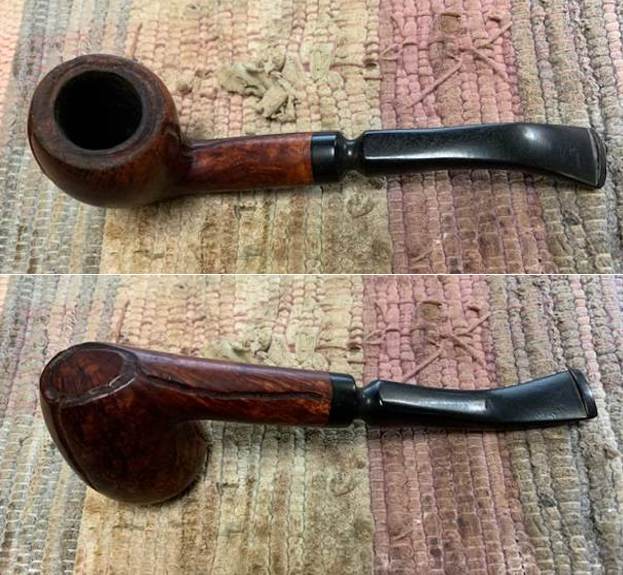
Restoring an Anderson S&R Hand Carved Acorn with a Fancy turned stem


Blog by Steve Laug

I am continuing with the same tack I have taken on the last five pipes I have worked on and take you through my process of working on each pipe that we purchase. Jeff has set up a spread sheet to track where the pipe came from, the date of purchase and what we paid for it so that we know what we have invested in the pipe before we even work on it. This takes a lot of the guess work out of the process. This particular pipe was purchased on 01/23/2023 in a group of pipes from a lady in Cincinnati, Ohio, USA. I also want you to understand why we take the photos we do. It is not accidental or chance as the photos have been taken to help me make an assessment of the pipe Jeff sees before he starts his clean up work. We do this to record the condition that the pipe was in when received it and to assess what kind of work will need to be done on. When I look at these photos this is what I see.

  1. The finish is dirty with oils darkening the bowl sides and shank. The worm trails carved around the bowl are dirty with dust and oils. This kind of darkening happens as the oils from our hands are absorbed by the briar and over time it grows dark.
  2. The rim top is dirty and there is a lava overflow from the cake in the bowl and some darkening on the rim top. The rim top also shows damage from being knocked against some hard.
  3. The bowl has a thick cake in it but the inner bevel and outer edge of the bowl actually look to be undamaged other thank the scratches and darkening. There does not appear to be any burning or reaming damage to the edges of the bowl.
  4. The fancy turned stem is vulcanite and there is no logo in the surface.
  5. The vulcanite stem has some light oxidation but was dirty. There were tooth marks and chatter ahead of the button that are visible in the photos below. Nothing to deep but nonetheless present.

Overall my impressions of this unique hand made artisan pipe was that it was in solid shape with a lot of damage on the rim top and edges – nothing horrible but knocked hard against a hard surface throughout its trust with the last person who smoked it. The cake does not seem to hide any burns or checking but I will know more once it is cleaned and reamed. The exterior of the bowl does not show any hot spots but with the darkening by hand oils it is very hard to know with certainty. It is a good looking pipe in spite of the poor care it has had. The photos below confirm the assessment above. Hopefully as you have learned from the last few blogs we always include close up photos of key areas on the pipe we buy. We do this so that I can have a clearer picture of the condition of the bowl and rim edges and top since Jeff does the clean up and we live quite far apart. The rim top photos confirm my assessment above. The cake in the bowl is quite thick and the rim top has some lava and debris in the grooves that will need to come off. You can also see the condition of the inner and outer edges of the rim. While it is beat up and nicked you can also see that there does not appear to be any over reaming or burn damage to the edges. This is what I look for when assessing a pipe. Even with all of the abuse the bowl is still round. His photos of the stem surface confirmed and heightened my assessment of the condition. You can see the light oxidation on the stem surface. You can see the appearance of the tooth marks on the stem surface ahead of the button on both sides. Remember that we include photos of the sides and heel of the bowl for me to do a more thorough assessment of the condition of the briar and the finish before I have it in hand. The darkening on the finish is definitely oils as the grain shows through clearly and cleaning should remove that. There were no cracks or splits following the grain or coming down from the rim edges. There were no cracks in the shank. I also look for flaws in what I call the worm trail carvings as they can be used to hide flaws in the briar. In this case the bowl exterior is sound and should clean up very well. We take photos of the stamping so I can see if it is faint in any spots or double stamped or unclear. It often takes several photos to capture what I am looking for. The stamping on the left side of the shank is clear and readable in the pictures below. This stamp often fools folks and they cannot identify the maker. It is simply an “S” incorporating a stylized pipe curving toward the shank end and it is crossed by an “R” utilizing the shank and stem of the “S” pipe to form the back leg of the “R”. Hopefully that helps you to identify the stamp clearly. For me researching the brand and the maker are an important part of the restoration process. It gives me the background on the philosophy of the pipemakers as well as an understanding of their perspective in making a pipe. That is why I generally include it in my restoration write ups. It is important for me and it is important in educating us on those who have left behind a rich heritage. Here is what I have found on this brand and how I carry on the hunt for data. I turned to Pipedia and read the article that was included there (https://pipedia.org/wiki/S%26R_Pipes). I quote in full below:

Stephen and Roswitha Anderson of S&R Pipes, also known as S&R Woodcrafters, have become pipe makers renowned throughout the world as talented carvers of high-grade briar pipes. They have been featured in several trade publications and magazines such as Pipes and Tobaccos and PipeSmoker, and have several pieces on display in museums in Europe and the United States.

They are the first American pipe carvers honored with induction into the Conferee of Pipe Makers of St. Claude, France; the very place where the carving of briar pipes became a world-wide industry. Sadly, Steve passed away in March of 2009. Roswitha is still carving S&R pipes and carrying on with the shop with help from her “guys” David, Marty, and Tony.

Steve and Roswitha began carving pipes in the 1960’s. They travelled to pipe shows and arts and crafts shows throughout the country and Europe selling their pipes and built up quite an extensive loyal customer base. Eventually, it became time to offer their pipes to the retail fraternity of pipe smokers.

Pipes & Pleasures had its grand opening in a distinct red brick house on Main Street in Columbus, Ohio in 1977. The front section of the house was converted into a traditional tobacco shop selling pipe tobacco, cigars, and pipes manufactured by well known companies such as Dunhill, Charatan, and Savinelli as well as the high-grade S&R pipes that Steve and Roswitha carved. A workshop was set up in the back section of the house.

When the cigar boom hit in the ’90’s, the shop was expanded by building a large computer controlled walk-in humidor. It’s no secret throughout the country that Pipes & Pleasures has the best maintained cigars in the Columbus area as well as the best selection of premium cigars available in the area including the much sought-after Davidoff line.

Soon after the boom began, Steve and Roswitha moved their pipe making workshop to their farm and converted that space into a large smoking lounge for their many customers. The lounge features comfortable easy chairs, a television set, a stereo, a library of books and magazines about every aspect of tobacciana, a chess table, and a couple of card tables. The lounge is populated daily with long-time loyal customers and newcomers to the enjoyment and relaxation of cigar and pipe smoking. It’s also the room where several cigar tastings and samplings are held every year by representatives from cigar companies such as Davidoff and La Flor Dominicana.

I captured a photo of the shop from the Pipedia article to include below. It is a great looking shop.

The Pipes & Pleasures shop, home of S&R Woodcrafters.

From there I turned to the website for Pipes & Pleasures and copied the “About Us” section. Here is the link to the site (https://www.pipesandpleasures.biz/maintenance). I quote in part.

Pipes & Pleasures proprietors Stephen and Roswitha Anderson have become pipe makers renowned throughout the world as talented carvers of high-grade briar pipes. They have been featured in several trade publications and magazines such as Pipes and Tobaccos and PipeSmoker, and have several pieces on display in museums in Europe and the United States. They are the first American pipe carvers honored with induction into the Conferee of Pipe Makers of St. Claude, France; the very place where the carving of briar pipes became a world-wide industry.

Steve and Roswitha began carving pipes in the 1960’s. They travelled to pipe shows and arts and crafts shows throughout the country and Europe selling their pipes and built up quite an extensive loyal customer base. Eventually, it became time to offer their pipes to the retail fraternity of pipe smokers…

…Sadly, Steve passed away in March of 2009. Roswitha is still carving S&R pipes and carrying on with the shop with help from her “guys” David, Marty, and Tony, who welcome you to this website.

While I am sure that some of you will skip the next section of this blog I encourage you to read the process that we use to clean our pipes. It is an important part of the our work of restoration. Jeff wrote a detailed blog about his cleaning process. I am including a link to that now so you can see what I mean about his process. Do not skip it! Give it a read (https://rebornpipes.com/2020/01/20/got-a-filthy-estate-pipe-that-you-need-to-clean/). Here is the introduction to that blog and it is very true even to this day.

Several have asked about Jeff’s cleaning regimen as I generally summarize it in the blogs that I post rather than give a detailed procedure. I have had the question asked enough that I asked Jeff to put together this blog so that you can get a clear picture of the process he uses. Like everything else in our hobby, people have different methods they swear by. Some may question the method and that is fine. But it works very well for us and has for many years. Some of his steps may surprise you but I know that when I get the pipes from him for my part of the restoration they are impeccably clean and sanitized. I have come to appreciate the thoroughness of the process he has developed because I really like working on clean pipe!

For the benefit of some of you who may be unfamiliar with some of the products he uses I have included photos of three of the items that Jeff mentions in his list. This will make it easier for recognition. These three are definitely North American Products so you will need to find suitable replacements or order these directly on Amazon. The makeup pads are fairly universal as we were able to pick some up in India when we were with Paresh and his family.

In the blog itself he breaks his process down into two parts – cleaning the stem and cleaning the bowl. Each one has a large number of steps that he methodically does every time. I know because I have watched him do the work and I have seen the pipes after his work on them. He followed this process step by step and when the pipe got to me it was spotlessly clean and ready for my work. The inside of the stem, shank and bowl were clean and to me that is an amazing gift as it means that my work on this end is with a clean pipe! I cannot tell you how much difference that makes for my work.

When the pipe arrives here in Vancouver I have a clean pipe and I go over it keeping in mind my assessment shared in the opening paragraph above. I am looking for any significant structural changes in the bowl and finish as I go over it.

  1. The finish cleaned up really well and the oils and grime ground into the briar have been removed. The grooves in the finish (worm trails) are also clean revealing the carving marks in the. The was very clean and looked much better. With all the grime removed there was some excellent grain coming through.
  2. The carved rim top cleaned up well, though was still some darkening on the briar and some damage on the right front inner edge showed up in the clean up. Some of the nicks in the briar lifted during the clean up as well and it looks better.
  3. The bowl was very clean and the top and inner edge of the bowl show some damage is noted in number 2 above. The bowl walls are also very clean and smooth with no checking or burn marks on the inside or out of the bowl. The walls were undamaged.
  4. The fancy turned vulcanite saddle stem looks good’
  5. The vulcanite stem clearly shows the tooth marks and chatter ahead of the button that that will need to be addressed.

Hopefully the steps above show you both what I look for when I go over the pipe when I bring it to the work table and also what I see when I look at the pipe in my hands. They also clearly spell out a restoration plan in short form. My work is clear and addressing it will be the next steps. I took photos of the whole pipe to give you a picture of what I see when I have it on the table. This is important to me in that it also shows that there was no damage done during the clean up work or the transit of the pipe from Idaho to here in Vancouver. Also things stand out that I did not see in the photos. For instance I did not note the flat bottom on the bowl. It appears to have been made into a sitter however with the stem in place it did not sit. Minus the stem it sat upright on its own.

I then spent some time going over the bowl and rim top to get a sense of what is happening there. The bowl looked very good and the walls were smooth. There was no damage internally. The rim top was clean and I could clearly see the worm trail carving around the rim top. It was clean and clear. There as some damage on the rim top and inner and outer edge particularly at the front of the bowl that would need to be dealt. There were also nick on the top of the shank. I also went over the stem carefully. There were dents in the stem that are visible in the photos. But the good news is that the tooth marks were not deep and did not seem to puncture the airway. They would clean up well. I examined the button edge and was happy to see that the marks there were not too bad and should be able to be sanded out. I took photos of the rim top and stem sides to show as best as I can what I see when I look at them.As usual I checked the stamping to make sure that the clean up work did not damage the stamping on the shank in any way. I know Jeff is cognizant of this but I do it anyway and take a photo to show what I see when I examine it. In this case it has not changed at all from the pictures I included above. It is clear and distinct. I removed the stem from the shank and checked the tenon and lay the parts of the pipe out to get a sense of the proportion that was in the mind of the pipe maker when he crafted the pipe. It is a beauty in flow and shape.Remember the question of where to begin the restoration work is a matter of personal preference. If you read rebornpipes much you will see that each of the restorers who post here all start at different points. Kenneth always starts with the stems, others as well do that. I personally like to start with the bowl because it gives me hope that this pipe is really a beauty. I think that is why I always leave the stem until last even though I know that it needs to be done. So if you are restoring your pipes choose where you want to start and go from there. Just know that it all will need to be done by the end but for me the encouragement of seeing a rejuvenated bowl is the impetus I need to attack the stem work.

Knowing that about me you can guess that I started working on this pipe by turning to the bowl. The bowl was in great condition over all but the rim top needed attention. I decided to clean up the rim top. I worked on the damage edges and top with a folded piece of 220 grit sandpaper. I used the sandpaper to bring the bowl back into round.I finished the rim top and edge clean up and wiped the bowl down with acetone on a cotton pad to remove more of the oils in the finish that still darkened the briar. I then polished the briar with micromesh sanding pads. I chose to dry sand the briar rather than wet sand it. Again it is a matter of personal preference. I prefer to use the pads dry and find they work very well on the briar. I sand with each pad (9 in total) and group them by threes for ease of reference. I wipe the bowl down with a damp cloth after each pad to remove the sanding debris and check the briar. I love seeing the developing shine on the briar as I move through the pads. I include the many photos of various angles of the bowl so you can see the change. Pay attention to the changes in the briar in these photos as you work through them. As usual for me when I get the bowl to this point in the process I use Before & After Restoration Balm. It is a paste/balm that is rubbed into the surface of the briar. The product works to deep clean the finish, enliven and protect the briar. I worked it into the briar with my finger tips to make sure that it covers every square inch of the pipe. I set it aside for 10 minutes to let it do its work. Once the time has passed I wiped it off with a soft cloth then buffed it with a cotton cloth. The briar really began to have a deep shine. The photos I took of the bowl at this point mark the progress in the restoration. You see the shine that the briar has taken on, the removal of the deep oils on the sides of the bowl and the way the grain just pops. It is a gorgeous pipe. Now it was time to address the part of the restoration I leave until last. I set the bowl aside and turned my attention to the stem. I wanted to repair the tooth damage on the stem surface and on the surface of the button. Before doing any repairs to a stem surface I always try to lift the marks as much as possible. To do that I use a Bic lighter to heat the tooth marks and dents in the stem surface. I describe that as “painting” the surface. What I mean by that is that I hold the stem stationary and quickly move the flame of the lighter across the dents repeatedly. Typically I am able to lift the dents significantly and sometimes in totality with the heat. It utilizes the “memory” vulcanite and the heat raises the marks.In this case I lifted all quite a bit but the heat did not raise them all the way. To take care of that I filled in the tooth marks that remained with clear CA glue and let it cure. Once it was hardened I flattened the repairs with a small file to blend them into the stem surface. I finished smoothing out the repairs on the stem with 220 grit sandpaper and started polishing it with 600 grit wet dry sandpaper to remove the scratches. This process makes the repairs almost invisible when polished and also takes care of scratching in the surface of the vulcanite.It was the time now to polish the stem and bring back a shine. Over the years I have developed my own process for this. It is all preparation for the buffing that will come last. I use micromesh sanding pads and water to wet sand the stem with 1500-12000 grit sanding pads. I wiped it down after each sanding pad with Obsidian Oil on a cotton rag after each sanding pad as I find it does two things – first it protects the vulcanite and second it give the sanding pads some bite in the polishing process. After finishing with the micromesh pads I always rub the stem down with Before & After Fine and Extra Fine stem polish as it seems to really remove the fine scratches in the vulcanite. I rub the Fine Polish on the stem and wipe it off with a paper towel and then repeat the process with the Extra Fine polish. I finish the polishing of the stem by wiping it down with a final coat of Obsidian Oil and set the stem aside to let the oil absorb. This process gives the stem a shine and also a bit of protection from oxidizing quickly.The final steps in my process involve using the buffer. I first buff the stem and the briar with Blue Diamond on the buffing wheel. Blue Diamond is a plastic polish but I find that it works very well to polish out the light scratches in the vulcanite and the briar. I work the pipe over on the wheel with my finger or thumb in the bowl to keep it from becoming airborne. It works well and I am able to carefully move forward with the buffing. I lightly buff the plateau on the rim top and shank end at the same time making sure to keep the product from building up in the grooves of the finish. I finished with the Blue Diamond and moved on to buffing with carnauba wax. Once I have a good shine in the briar and vulcanite I always give the bowl and the stem multiple coats of carnauba wax. I have found that I can get a deeper shine if I following up the wax buff with a clean buffing pad. It works to raise the shine and then I follow that up with a hand buff with a microfiber cloth to deepen the shine. It is always fun for me to see what the polished bowl looks like with the polished vulcanite stem. It really is a beautiful pipe. The smooth finish around the bowl sides and shank show the grain shining through the rich brown stains of this S&R Freehand Acorn and the polished vulcanite stem. There are still some remaining marks from the long story of the pipe that to me add a sense of time that is an interesting part of the story. The finished pipe feels great in my hand. It is light and well balanced. Have a look at it with the photos below. The dimensions are Length: 6 inches, Height: 1 ¾ inches, Outside diameter of the bowl: 1 ¼ inches, Chamber diameter: ¾ of an inch. The weight of the pipe is 1.52 ounces/44 grams. It is a beautiful pipe and one that I will be putting on the rebornpipes store in the American (US) Pipe Maker section.

Hopefully this tack of writing this blog is helpful to you in some way. In it I show both what I am looking for and how I move forward in addressing what I see when work on a pipe has been helpful to you. It is probably the most straightforward detailed description of my work process. As always I encourage your questions and comments as you read the blog. Thanks to each of you who are reading this blog. Remember we are not pipe owners; we are pipemen and women who hold our pipes in trust until they pass on into the trust of those who follow us.

Renewing a Parker Super Bark Sandblast 132 Canadian


Blog by Steve Laug

I thought I would continue with the same tack I took on the three pipes and take you through my process of working on each pipe that we purchase. Jeff has set up a spread sheet to track where the pipe came from, the date of purchase and what we paid for it so that we know what we have invested in the pipe before we even work on it. This takes a lot of the guess work out of the process. This particular pipe was purchased on 01/26/2023 in a group of pipes from a fellow in Copenhagen, Denmark. I also want you to understand why we take the photos we do. It is not accidental or chance as the photos have been taken to help me make an assessment of the pipe Jeff sees before he starts his clean up work. We do this to record the condition that the pipe was in when received it and to assess what kind of work will need to be done on. When I look at these photos this is what I see.

  1. The finish is dirty with dust grooves and valleys of the sandblast bowl and shank. There are some tars and lava flowing down the edges of the rim cap. Underneath there appears to be some excellent grain.
  2. The sandblast rim top is dirty. There is some lava overflow from the cake in the bowl and some darkening on the rim top.
  3. The bowl has a thick cake in it but the inner and outer edge of the bowl actually look to be undamaged from what I can see at this point. There does not appear to be any burning or reaming damage to the edges of the bowl.
  4. The stem is vulcanite and has the Parker P logo in Diamond stamped into the top of the thin oval stem. The stamp is devoid of colour but it still readable.
  5. The vulcanite stem has some light oxidation but was dirty. There were tooth marks and chatter ahead of the button that are visible in the photos below. Nothing to deep but nonetheless present.

Overall my impressions of this dainty Parker Super Bark Canadian was that it was in solid shape with no significant damage to the briar on the bowl sides and rim. The cake does not seem to hide any burns or checking but I will know more once it is cleaned and reamed. The exterior of the bowl does not show any hot spots or darkening. The photos below confirm the assessment above. Jeff always takes close up photos of key areas on the pipe we buy. These are done so that I can have a clearer picture of the condition of the bowl and rim edges and top. The rim top photos confirm my assessment above. The cake in the bowl is quite thick and the rim top has heavy lava and debris on it that will need to come off. You can also see the lava in the sandblast finish on the rim. You can also see the condition of the inner and outer edges of the rim. This is what I look for when assessing a pipe. While there is lava and darkening there is no visible burn damage at this point and the previous reamings has not left damage either. The bowl is still round. His photos of the stem surface confirmed and heightened my assessment of the condition. You can see the oxidation on the stem surface. You can see the faded out stamp on the top of the stem. Note also the tooth marks on the stem surface ahead of the button on both sides. I always ask Jeff to take photos of the sides and heel of the bowl. While this definitely shows the sandblast patterns around the bowl it also allows me to do a more thorough assessment of the condition of the briar and the finish. The stain on the bowl highlights the grain. There was some grime on the surface but the cleaning will easily remove that. There were no cracks or splits following the grain or coming down from the rim edges. There were no cracks in the shank. I also look for flaws in the grain as those can also hide cracks or damage. In this case the bowl exterior is sound and should clean up very well. I love the sandblast patterns that appear to have a mix of grain underneath it. I also ask him to take photos of the stamping so I can see if it is faint in any spots or double stamped or unclear. It often takes several photos to capture what I am looking for. The stamping on the underside of the shank are clear and readable in the pictures below. There is some faint spots in the stamp but it can still be read. On the heel of the bowl the stamping reads Parker [over] Super in a flattened diamond [over] Briar Bark. The stamping wraps over and under the diamond stamp. That followed by Made In London [over] England followed by the number 3 in a circle which is the size of the pipe according to Dunhill’s size numbers making it a Group 3 size. The last stamp on the shank near the shank/stem joint it bears the shape number 132 which is the shape number for a Canadian. Jeff also included a photo of the stamped stem logo – Parker “P” in a Diamond. I did not take time to do work on the brand as it is a well known brand. There is no date stamp on the shank so I cannot link it to any specific time period. If you would like to do some reading on it you can check both Pipephil’s site and Pipedia for a great write up on the history of the brand. I decided instead to just get to work on the pipe.

I am sure many of you skip my paragraph on the work Jeff has done before the pipe gets here in my many blogs but it is quite detailed in its brevity. I know some laugh at my opening line Jeff did a thorough cleaning of this pipe. However, I want you to know the details of the work. Back in 2020 Jeff wrote a blog about his cleaning process. I am including a link to that now so you can see what I mean about his process. Do not skip it! Give it a read (https://rebornpipes.com/2020/01/20/got-a-filthy-estate-pipe-that-you-need-to-clean/). Here is the introduction to that blog and it is very true even to this day.

Several have asked about Jeff’s cleaning regimen as I generally summarize it in the blogs that I post rather than give a detailed procedure. I have had the question asked enough that I asked Jeff to put together this blog so that you can get a clear picture of the process he uses. Like everything else in our hobby, people have different methods they swear by. Some may question the method and that is fine. But it works very well for us and has for many years. Some of his steps may surprise you but I know that when I get the pipes from him for my part of the restoration they are impeccably clean and sanitized. I have come to appreciate the thoroughness of the process he has developed because I really like working on clean pipe!

For the benefit of some of you who may be unfamiliar with some of the products he uses I have included photos of three of the items that Jeff mentions in his list. This will make it easier for recognition. These three are definitely North American Products so you will need to find suitable replacements or order these directly on Amazon. The makeup pads are fairly universal as we were able to pick some up in India when we were with Paresh and his family.

In the blog itself he breaks his process down into two parts – cleaning the stem and cleaning the bowl. Each one has a large number of steps that he methodically does every time. I know because I have watched him do the work and I have seen the pipes after his work on them. He followed this process step by step and when the pipe got to me it was spotlessly clean and ready for my work. The inside of the stem, shank and bowl were clean and to me that is an amazing gift as it means that my work on this end is with a clean pipe! I cannot tell you how much difference that makes for my work.

When the pipe arrives here in Vancouver I have a clean pipe and I go over it keeping in mind my assessment shared in the opening paragraph above. I am looking for any significant structural changes in the bowl and finish as I go over it.

  1. The finish cleaned up really well and the dust and grime in the sandblast grooves and crevices was gone. It was very clean and was undamaged. The rim top and the beveled inner edge looked very good. With all the grime removed there was some excellent grain coming through the blast.
  2. The sandblast rim top cleaned up very well, though was still some darkening on the briar. It looked to be in decent condition.
  3. The bowl was very clean and the top and inner edge of the bowl show no damage. The bowl walls are also very clean and smooth with no checking or burn marks on the inside or out of the bowl. The walls were undamaged.
  4. The vulcanite taper stem with the Parker “P” Diamond logo stamped into the topside looks good but there is nothing remaining in the stamp. It appears to be deep enough to reapply the colour to the top.
  5. The vulcanite stems still showed some oxidation that would need to be addressed. There were light tooth marks and chatter ahead of the button that are barely visible in the photos below. Nothing to deep but nonetheless present.

Hopefully the steps above show you both what I look for when I go over the pipe when I bring it to the work table and also what I see when I look at the pipe in my hands. They also clearly spell out a restoration plan in short form. My work is clear and addressing it will be the next steps. I took photos of the whole pipe to give you a picture of what I see when I have it on the table. This is important to me in that it also shows that there was no damage done during the clean up work or the transit of the pipe from Idaho to here in Vancouver. I then spent some time going over the bowl and rim top to get a sense of what is happening there. The bowl looked very good and the walls were smooth. There was no damage internally. The rim top was clean but there seemed to be some darkening still remaining in the grooves. I also went over the stem carefully. There were dents in the stem that are visible in the photos. But the good news is that the tooth marks were not deep and did not seem to puncture the airway. They would clean up well. I examined the button edge and was happy to see that the marks there were not too bad and should be able to be sanded out. I took photos of the rim top and stem sides to show as best as I can what I see when I look at them.I always check to make sure that the clean up work did not damage the stamping on the shank in any way. I know Jeff is cognizant of this but I do it anyway and take a photo to show what I see when I examine it. In this case it has not changed at all from the pictures I included above. I took a photo of the Diamond P stamp on the stem as well. You can see it is deep enough to hold some colour once I repair it. I removed the stem from the shank and checked the tenon and lay the parts of the pipe out to get a sense of the proportion that was in the mind of the pipe maker when he crafted the pipe. It is a beauty in flow and shape.As I pointed out in a previous blog, the question of where to begin the restoration work is always a matter of personal preference. If you read this blog much you will see that each of the restorers who post here all start at different points. Kenneth always starts with the stems, others as well do that. I personally like to start with the bowl because it gives me hope that this pipe is really a beauty. I said previously that I truly do not like the tedious work of stem repairs and stem polishing. I have been thinking about that and I think it is more it takes longer for slower results. I think that is why I always leave that until last even though I know that it needs to be done. So if you are restoring your pipes choose where you want to start and go from there. Just know that it all will need to be done by the end but for me the encouragement of seeing a rejuvenated bowl is the impetus I need to attack the stem work.

Knowing that about me you can guess that I started working on this pipe by turning to the bowl. The bowl was in great condition over all with a bit of darkening still in the sandblast on the rim top. I decided to clean up the rim top. I use a brass bristle wire brush to work it over and clean up the remaining debris in the sandblast. The bowl was ready for the next stem in the process. I use a product developed by Mark Hoover called Before & After Restoration Balm. It is a paste/balm that is rubbed into the surface of the briar. The product works to deep clean the finish, enliven and protect the briar. I worked it into the briar with my finger tips and a shoe brush to make sure that it covers every square inch of the pipe. I set it aside for 10 minutes to let it do its work. Once the time has passed I wiped it off with a soft cloth then buffed it with a cotton cloth. The briar really began to have a deep shine and show some contrast in the sandblast finish. The photos I took of the bowl at this point mark the progress in the restoration. You see the shine that the briar has taken on and the way the grain just pops. It is a gorgeous pipe. Now it was time to address the part of the restoration I leave until last. I set the bowl aside and turned my attention to the stem. The stem was in quite good shape. Jeff had been able to remove much of the oxidation so that when it came it looked pretty good. I needed to deal with the remaining oxidation and to address the tooth marks at the same time. I sanded the stem surface with 220 grit sandpaper and start polishing it with 600 grit wet dry sandpaper to remove the oxidation. This process removes the oxidation and the marks. Here are photos of the stem after the sandpaper work.I then took some time to touch up the Diamond “P” Parker logo on the topside of the stem with white acrylic fingernail polish. I worked it into the stamp on the stem with a tooth pick to ensure that it went deep into the stamp. Once it cured I scraped off the excess and the stamp looked very good. It was the time now to polish the stem and remove the scratching and bring back a shine. Over the years I have developed my own process for this. It is all preparation for the buffing that will come last. I use micromesh sanding pads and water to wet sand the stem with 1500-12000 grit sanding pads. I wiped it down after each sanding pad with Obsidian Oil on a cotton rag after each sanding pad as I find it does two things – first it protects the vulcanite and second it give the sanding pads bite in the polishing process.After finishing with the micromesh pads I always rub the stem down with Before & After Fine and Extra Fine stem polish as it seems to really remove the fine scratches in the vulcanite. I rub the Fine Polish on the stem and wipe it off with a paper towel and then repeat the process with the Extra Fine polish. I finish the polishing of the stem by wiping it down with a final coat of Obsidian Oil and set the stem aside to let the oil absorb. This process gives the stem a shine and also a bit of protection from oxidizing quickly.The final steps in my process involve using the buffer. I buff the stem and the briar with Blue Diamond on the buffing wheel. Blue Diamond is a plastic polish but I find that it works very well to polish out the light scratches in the vulcanite and the briar. I work the pipe over on the wheel with my finger or thumb in the bowl to keep it from becoming airborne. It works well and I am able to carefully move forward with the buffing. I lightly buff the plateau on the rim top and shank end at the same time making sure to keep the product from building up in the grooves of the finish. I finished with the Blue Diamond and moved on to buffing with carnauba wax. Once I have a good shine in the briar and vulcanite I always give the bowl and the stem multiple coats of carnauba wax. I have found that I can get a deeper shine if I following up the wax buff with a clean buffing pad. It works to raise the shine and then I follow that up with a hand buff with a microfiber cloth to deepen the shine. It is always fun for me to see what the polished bowl looks like with the polished vulcanite stem. It really is a beautiful pipe. The smooth finish around the bowl sides and shank show the grain shining through the rich brown stains of this Parker Super Bark Sandblast 132 Canadian and the polished vulcanite stem is a great addition. The finished pipe feels great in my hand. It is light and well balanced. Have a look at it with the photos below. The dimensions are Length: 5 ½ inches, Height: 1 ½ inches, Outside diameter of the bowl: 1 1/8 inches, Chamber diameter: ¾ of an inch. The weight of the pipe is .92 ounces/25 grams. It is a beautiful pipe and one that I will be putting on the rebornpipes store in the British Pipe Maker section.

Hopefully this tack of writing this blog is helpful to you in some way. In it I show both what I am looking for and how I move forward in addressing what I see when work on a pipe has been helpful to you. It is probably the most straightforward detailed description of my work process. As always I encourage your questions and comments as you read the blog. Thanks to each of you who are reading this blog. Remember we are not pipe owners; we are pipemen and women who hold our pipes in trust until they pass on into the trust of those who follow us.

Refreshing a Newer BBB Chelsea 403S Bulldog


Blog by Steve Laug

I thought I would continue with the same tack I took on the Wenhall and Comoy’s Christmas 1990  pipes and take you through my process of working on each pipe that we purchase. Jeff has set up a spread sheet to track where the pipe came from, the date of purchase and what we paid for it so that we know what we have invested in the pipe before we even work on it. This takes a lot of the guess work out of the process. This particular pipe was purchased on 01/26/2023 in a group of pipes from a fellow in Copenhagen, Denmark. I also want you to understand why we take the photos we do. It is not accidental or chance as the photos have been taken to help me make an assessment of the pipe Jeff sees before he starts his clean up work. We do this to record the condition that the pipe was in when received it and to assess what kind of work will need to be done on. When I look at these photos this is what I see.

  1. The finish is dirty with dust in the twin rings around the bowl. There are some tars and lava flowing down the edges of the rim cap. Underneath there appears to be some excellent grain. The finish is also dull and quite lifeless looking.
  2. The beveled rim top is dirty. There is some lava overflow from the cake in the bowl and some darkening on the inwardly beveled rim top.
  3. The bowl has a thick cake in it but the inner edge of the bowl actually looks to be undamaged from what I can see at this point. There does not appear to be any burning or reaming damage to the edges of the bowl.
  4. The stem is acrylic and has a BBB in a Diamond logo stamped into the acrylic on the left side of the saddle portion. It has been painted with a white coloured paint that fills in the stamp.
  5. The acrylic stem had no oxidation but was dirty. There were tooth marks and chatter ahead of the button that are visible in the photos below. Nothing to deep but nonetheless present.

Overall my impressions of this pretty little Bulldog was that it was in solid shape with no significant damage to the briar on the bowl sides and rim. The cake does not seem to hide any burns or checking and the exterior of the bowl does not show any hot spots or darkening. There appears to be a slight flare to the shank, widening at the end where it joins the stem. The photos below confirm the assessment above. Jeff took close up photos so that I could have a clearer picture of the condition of the bowl and rim edges and top. The rim top photos confirm my assessment above. The cake in the bowl is quite thick and the rim top has heavy lava and debris on it that will need to come off. You can also see the lava on the inner bevel of the rim. You can also see the condition of the inner and outer edges of the rim and down the outside of the bowl. This is what I look for when assessing a pipe. While there is lava and darkening there is no visible burn damage at this point and the previous reamings has not left damage either. The bowl is still round. His photos of the stem surface confirmed and heightened my assessment of the condition. You can see the scratches in the middle top of the stem surface. Note also the tooth marks on the stem surface ahead of the button on both sides. From the photos of the stamp on the saddle portion of the stem have the appearance of a decal but I am hoping that I am wrong and that it is stamped and painted. I always ask Jeff to take photos of the sides and heel of the bowl. While this definitely shows the grain patterns around a bowl it also allows me to do a more thorough assessment of the condition of the briar and the finish. I look at the finish around the twin rings to make sure there are no nicks and damage to the rings. The stain on the bowl highlights the grain. There was some dark grime on the surface but the cleaning easily remove that. There were no cracks or splits following the grain or coming down from the rim edges. There were no cracks in the shank. I also look for flaws in the grain as those can also hide cracks or damage. In this case the bowl exterior is sound and should clean up very well. I love the grain patterns that appear to have birdseye on the sides and cross grain on the front and back of the bowl. I also ask him to take photos of the stamping so I can see if it is faint in any spots or double stamped or unclear. It often takes several photos to capture what I am looking for. The stamping on the left and underside of the shank are clear and readable in the pictures below. On the left it reads BBB [over] Chelsea. The stamping on the underside reads 403S which is the shape number for a Bulldog. Jeff also included a photo of the stamped stem logo – BBB in a Diamond. I was concerned that the logo on the stem may have been a decal rather than a stamp but it appears to be a stamp in the first photo below.I did not take time to do work on the brand as it is a well known brand. If you would like to do some reading on it you can check both Pipephil’s site and Pipedia for a great write up on the history of the brand. I decided instead to just get to work on the pipe.

I am sure many of you skip my paragraph on the work Jeff has done before the pipe gets here in my many blogs but it is quite detailed in its brevity. I know some laugh at my opening line Jeff did a thorough cleaning of this pipe. However, I want you to know the details of the work. Back in 2020 Jeff wrote a blog about his cleaning process. I am including a link to that now so you can see what I mean about his process. Do not skip it! Give it a read (https://rebornpipes.com/2020/01/20/got-a-filthy-estate-pipe-that-you-need-to-clean/). Here is the introduction to that blog and it is very true even to this day.

Several have asked about Jeff’s cleaning regimen as I generally summarize it in the blogs that I post rather than give a detailed procedure. I have had the question asked enough that I asked Jeff to put together this blog so that you can get a clear picture of the process he uses. Like everything else in our hobby, people have different methods they swear by. Some may question the method and that is fine. But it works very well for us and has for many years. Some of his steps may surprise you but I know that when I get the pipes from him for my part of the restoration they are impeccably clean and sanitized. I have come to appreciate the thoroughness of the process he has developed because I really like working on clean pipe!

For the benefit of some of you who may be unfamiliar with some of the products he uses I have included photos of three of the items that Jeff mentions in his list. This will make it easier for recognition. These three are definitely North American Products so you will need to find suitable replacements or order these directly on Amazon. The makeup pads are fairly universal as we were able to pick some up in India when we were with Paresh and his family.

In the blog itself he breaks his process down into two parts – cleaning the stem and cleaning the bowl. Each one has a large number of steps that he methodically does every time. I know because I have watched him do the work and I have seen the pipes after his work on them. He followed this process step by step and when the pipe got to me it was spotlessly clean and ready for my work. The inside of the stem, shank and bowl were clean and to me that is an amazing gift as it means that my work on this end is with a clean pipe! I cannot tell you how much difference that makes for my work.

When the pipe arrives here in Vancouver I have a clean pipe and I go over it keeping in mind my assessment shared in the opening paragraph above. I am looking for any significant structural changes in the bowl and finish as I go over it.

  1. The finish cleaned up really well and the dust and grime in the finish and the twin rings around the bowl were gone. It was very clean and was undamaged. The rim top and the beveled inner edge looked very good. With all the grime removed there was some excellent grain. The finish is also dull but should polish up nicely.
  2. The beveled edge and the rim top is very clean and there was no damage or darkening.
  3. The bowl was very clean and the top and inner edge of the bowl show no damage. The bowl walls are also very clean and smooth with no checking or burn marks on the inside or out of the bowl. The walls were undamaged.
  4. The acrylic stem with the BBB in a Diamond logo stamped into the acrylic on the left side of the saddle portion looks much better. I wonder if it is gold instead of white. It is definitely stamped and is clean and undamaged.
  5. The acrylic stem had a rich shine. There were tooth marks and chatter ahead of the button that are visible in the photos below. Nothing to deep but nonetheless present.

Hopefully the steps above show you both what I look for when I go over the pipe when I bring it to the work table and also what I see when I look at the pipe in my hands. They also clearly spell out a restoration plan in short form. My work is clear and addressing it will be the next steps. I took photos of the whole pipe to give you a picture of what I see when I have it on the table. This is important to me in that it also shows that there was no damage done during the clean up work or the transit of the pipe from Idaho to here in Vancouver. I then spent some time going over the bowl and rim top to get a sense of what is happening there. The bowl looked very good and the walls were smooth. There was no damage internally. The rim top was clean. There is some scratching that I noted earlier that is present but hard to see on rim top. I also went over the stem carefully. There were dents in the stem that are visible in the photos. But the good news is that the tooth marks were not deep and did not seem to puncture the airway. They would clean up well. I examined the button edge and was happy to see that the marks there were not too bad and should be able to be sanded out. I took photos of the rim top and stem sides to show as best as I can what I see when I look at them.I always check to make sure that the clean up work did not damage the stamping on the shank in any way. I know Jeff is cognizant of this but I do it anyway and take a photo to show what I see when I examine it. In this case it has not changed at all from the pictures I included above. I also remove the stem from the shank and check the tenon and lay the parts of the pipe out to get a sense of the proportion that was in the mind of the pipe maker when he crafted the pipe. It is a beauty in flow and shape.As I pointed out in a previous blog, the question of where to begin the restoration work is always a matter of personal preference. If you read this blog much you will see that each of the restorers who post here all start at different points. Kenneth always starts with the stems, others as well do that. I personally like to start with the bowl because it gives me hope that this pipe is really a beauty. I said previously that I truly do not like the tedious work of stem repairs and stem polishing. I have been thinking about that and I think it is more it takes longer for slower results. I think that is why I always leave that until last even though I know that it needs to be done. So if you are restoring your pipes choose where you want to start and go from there. Just know that it all will need to be done by the end but for me the encouragement of seeing a rejuvenated bowl is the impetus I need to attack the stem work.

Knowing that about me you can guess that I started working on this pipe by turning to the bowl. The bowl was in great condition I decided to move immediately to polishing the briar with micromesh sanding pads. I chose to dry sand the briar rather than wet sand it. Again it is a matter of personal preference. I prefer to use the pads dry and find they work very well on the briar. I sand with each pad (9 in total) and group them by threes for ease of reference. I wipe the bowl down with a damp cloth after each pad to remove the sanding debris and check the briar. I love seeing the developing shine on the briar as I move through the pads. I include the many photos of various angles of the bowl so you can see the change. Pay attention to the changes in the briar in these photos as you work through them. When I get the bowl to this point in the process I use a product developed by Mark Hoover called Before & After Restoration Balm. It is a paste/balm that is rubbed into the surface of the briar. The product works to deep clean the finish, enliven and protect the briar. I worked it into the briar with my finger tips to make sure that it covers every square inch of the pipe. I set it aside for 10 minutes to let it do its work. Once the time has passed I wiped it off with a soft cloth then buffed it with a cotton cloth. The briar really began to have a deep shine. The photos I took of the bowl at this point mark the progress in the restoration. You see the shine that the briar has taken on and the way the grain just pops. It is a gorgeous pipe. Now it was time to address the part of the restoration I leave until last. I set the bowl aside and turned my attention to the stem. The stem was in quite good shape. Jeff had been able to remove the oxidation so that when it came it looked pretty good. It was time to address the tooth marks. When the damage is quite shallow and not imposing I flatten it out with 220 grit sandpaper and start polishing it with 600 grit wet dry sandpaper to remove the scratches. This process makes the repairs almost invisible when polished and also takes care of scratching in the surface of the acrylic. That is what I did in this case and it worked well. This stem was quite painless so I guess I could have started with it but ah well old habits are hard to change. Here are photos of the stem after the sandpaper work.It was the time now to polish the stem and bring back a shine. Over the years I have developed my own process for this. It is all preparation for the buffing that will come last. I use micromesh sanding pads and water to wet sand the stem with 1500-12000 grit sanding pads. I wiped it down after each sanding pad with Obsidian Oil on a cotton rag after each sanding pad as I find it does two things – first it protects the stem (even though it is acrylic it still helps preserve it from the grime) and second it give the sanding pads bite in the polishing process. After finishing with the micromesh pads I always rub the stem down with Before & After Fine and Extra Fine stem polish as it seems to really remove the fine scratches in the acrylic. I rub the Fine Polish on the stem and wipe it off with a paper towel and then repeat the process with the Extra Fine polish. I finish the polishing of the stem by wiping it down with a final coat of Obsidian Oil and set the stem aside to let the oil absorb. This process gives the stem a shine and also a bit of protection from oxidizing quickly. The final steps in my process involve using the buffer. I first buff the stem and the briar with Blue Diamond on the buffing wheel. Blue Diamond is a plastic polish but I find that it works very well to polish out the light scratches in the acrylic and the briar. I work the pipe over on the wheel with my finger or thumb in the bowl to keep it from becoming airborne. It works well and I am able to carefully move forward with the buffing. I finished with the Blue Diamond and moved on to buffing with carnauba wax. Once I have a good shine in the briar and vulcanite I always give the bowl and the stem multiple coats of carnauba wax. I have found that I can get a deeper shine if I following up the wax buff with a clean buffing pad. It works to raise the shine and then I follow that up with a hand buff with a microfiber cloth to deepen the shine. It is always fun for me to see what the polished bowl looks like with the polished vulcanite stem. It really is a beautiful pipe. The smooth finish around the bowl sides and shank show the grain shining through the rich brown stains of this BBB Chelsea 403S Straight Bulldog and the polished acrylic stem is a great addition. The finished pipe feels great in my hand. It is light and well balanced. Have a look at it with the photos below. The dimensions are Length: 5 ½ inches, Height: 1 ¾ inches, Outside diameter of the bowl: 1 ¼ inches, Chamber diameter: ¾ of an inch. The weight of the pipe is 1.52 ounces/43 grams. It is a beautiful pipe and one that I will be putting on the rebornpipes store in the British Pipe Maker section.

Hopefully this tack of writing this blog is helpful to you in some way. In it I show both what I am looking for and how I move forward in addressing what I see when work on a pipe has been helpful to you. It is probably the most straightforward detailed description of my work process. As always I encourage your questions and comments as you read the blog. Thanks to each of you who are reading this blog. Remember we are not pipe owners; we are pipemen and women who hold our pipes in trust until they pass on into the trust of those who follow us.
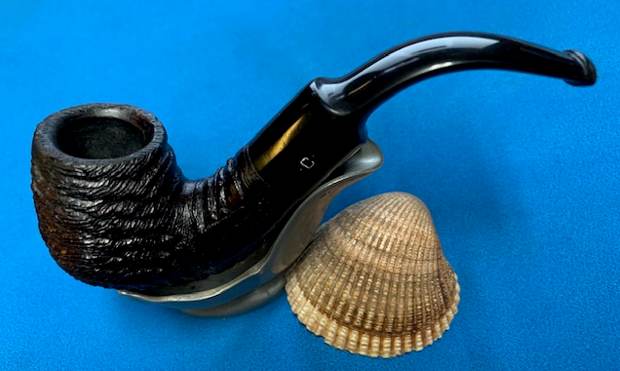
Restoring a newer Comoy’s Christmas 1990 Bent Calabash


Blog by Steve Laug

I thought I would continue with the same tack I took on the Wenhall and take you through my process of working on each pipe that we purchase. Jeff has set up a spread sheet to track where the pipe came from, the date of purchase and what we paid for it so that we know what we have invested in the pipe before we even work on it. This takes a lot of the guess work out of the process. This particular pipe was purchased on 01/23/2023 from a seller in Cincinnati, Ohio, USA. I also want you to understand why we take the photos we do. It is not accidental or chance as the photos have been taken to help me make an assessment of the pipe Jeff sees before he starts his clean up work. We do this to record the condition that the pipe was in when received it and to assess what kind of work will need to be done on. When I look at these photos this is what I see.

  1. The finish is dirty with dark streaks around the bowl and shank. I am not sure if they are stain or just grim. Underneath there appears to be some excellent grain. The finish is also dull and quite lifeless looking.
  2. The rim top is crowned and dirty. There is some lava overflow from the cake in the bowl on the top as well as some of the dark streaks. There also appears to be some scratching on the right top of the rim.
  3. The bowl has a thick cake in it but the inner edge of the bowl actually looks to be undamaged from what I can see at this point. There does not appear to be any burning or reaming damage to the edges of the bowl.
  4. The stem is vulcanite and has a single piece C inserted logo on the left side of the saddle portion.
  5. The stem had some oxidation and tooth marks and chatter that are visible in the photos below. Nothing to deep but nonetheless present.

Overall my impressions of this Calabash shaped pipe is that it is a beauty that once cleaned up will look pretty amazing. The cake does not seem to hide any burns or checking and the exterior of the bowl does not show any hot spots or darkening. The fact that it is a Christmas pipe from Comoy’s with a date in the stamp is a plus. The photos below confirm the assessment above.Jeff took close up photos so that I could have a clearer picture of the condition of the bowl and rim edges and top. The rim top photos confirm my assessment above. The cake in the bowl is quite thick and the rim top has light lava and debris on it as well as some kind of film that will need to come off. You can also see the condition of the inner and outer edges of the rim. This is what I look for when assessing a pipe. While there is lava and darkening there is no visible burn damage at this point and the previous reaming has not left damage either. The bowl is still fairly round. There are some scratches in the surface of the crowned rim top. His photos of the stem surface confirmed and heightened my assessment of the condition. You can see the oxidation and scratches in the middle top of the stem surface. Note also the tooth marks on the edge of the button on both sides. I always ask Jeff to take photos of the sides and heel of the bowl. While this definitely shows the grain patterns around a bowl it also allows me to do a more thorough assessment of the condition of the briar and the finish. In this case I look at the finish around the dark streaks around the bowl sides to confirm it was not just the stain on the bowl to highlight grain. It seems to be dark grime on the surface but the cleaning would further clarify what I was seeing. There were no cracks or splits following the grain or coming down from the rim edges. I also look for flaws in the grain as those can also hide cracks or damage. In this case the bowl exterior is sound and should clean up very well. I love the grain patterns that appear to have birdseye on the sides and cross grain on the front and back of the bowl. I also ask him to take photos of the stamping so I can see if it is faint in any spots or double stamped or unclear. It often takes several photos to capture what I am looking for. The stamping on the left and right sides of the shank are relatively clear in the pictures below. On the left it reads COMOY’S [over] CHRISTMAS 1990. The stamping on the right side shows the COM (Country of Manufacture). It is a circular stamp with Made in London on the top and bottom side with “IN” placed in the centre. Underneath it is stamped London. There is no shape number on the pipe. The stamping on both side is readable and clear. It is slightly fainter next to the stem/shank joint. Jeff also included a photo of the inset stem logo – C. It is one piece C rather than the older 3 piece one which fits the date of the pipe. I was concerned that the C logo on the stem may have been a decal rather than an inlay but it appears to be inlaid.I did not take time to do work on the brand as it is a well known brand and the Christmas 1990 dates the pipe and the logo and stamping match that time period. If you would like to do some reading on it you can check both Pipephil’s site and Pipedia for a great write up on the history of the brand. I decided instead to just get to work on the pipe.

I am sure many of you skip my paragraph on the work Jeff has done before the pipe gets here in my many blogs but it is quite detailed in its brevity. I know some laugh at my opening line Jeff did a thorough cleaning of this pipe. However, I want you to know the details of the work. Back in 2020 Jeff wrote a blog about his cleaning process. I am including a link to that now so you can see what I mean about his process. Do not skip it! Give it a read (https://rebornpipes.com/2020/01/20/got-a-filthy-estate-pipe-that-you-need-to-clean/). Here is the introduction to that blog and it is very true even to this day.

Several have asked about Jeff’s cleaning regimen as I generally summarize it in the blogs that I post rather than give a detailed procedure. I have had the question asked enough that I asked Jeff to put together this blog so that you can get a clear picture of the process he uses. Like everything else in our hobby, people have different methods they swear by. Some may question the method and that is fine. But it works very well for us and has for many years. Some of his steps may surprise you but I know that when I get the pipes from him for my part of the restoration they are impeccably clean and sanitized. I have come to appreciate the thoroughness of the process he has developed because I really like working on clean pipe!

For the benefit of some of you who may be unfamiliar with some of the products he uses I have included photos of three of the items that Jeff mentions in his list. This will make it easier for recognition. These three are definitely North American Products so you will need to find suitable replacements or order these directly on Amazon. The makeup pads are fairly universal as we were able to pick some up in India when we were with Paresh and his family.

In the blog itself he breaks his process down into two parts – cleaning the stem and cleaning the bowl. Each one has a large number of steps that he methodically does every time. I know because I have watched him do the work and I have seen the pipes after his work on them. He followed this process step by step and when the pipe got to me it was spotlessly clean and ready for my work. The inside of the stem, shank and bowl were clean and to me that is an amazing gift as it means that my work on this end is with a clean pipe! I cannot tell you how much difference that makes for my work.

When the pipe arrives here in Vancouver I have a clean pipe and I go over it keeping in mind my assessment shared in the opening paragraph above. I am looking for any significant structural changes in the bowl and finish as I go over it.

  1. The dark streaks around the bowl and shank seemed to have been removed by Jeff’s scrubbing of the bowl and shank. He did not remove the dark stain that highlights the grain around the bowl but the clean finish is much better in displaying the grain. Polishing it will take care of the dullness and bring the briar back to life.
  2. The crowned rim top is clean and looks much better. Jeff was able to remove both the lava and dark streaks on the surface. There are some scratches on the right top of the rim toward the front of the bowl.
  3. The bowl was very clean and smelled clean. The clean walls did not show evidence of checking or cracking. There were no hot spots or damage on the walls or around the entrance of the airway into the bowl. It was clean and smooth which is great news for me. The inner edge of the bowl was undamaged and did not show any sign of burning or reaming damage to the edges of the bowl. Both the shank and the bowl were very clean showing no debris on a clean pipe clean run through them. I would need to give it a final cleaning with pipe cleaners and alcohol once I had finished with the external work to remove the debris that may have collected there in the process.
  4. The stem is vulcanite and has a single piece C inserted logo on the left side of the saddle portion. It is clearly inset in the stem not a decal.
  5. The oxidation was gone from the stem after Jeff’s work on it. The tooth marks and chatter will need to be dealt with once I finish the bowl.

Hopefully the steps above show you both what I look for when I go over the pipe when I bring it to the work table and also what I see when I look at the pipe in my hands. They also clearly spell out a restoration plan in short form. My work is clear and addressing it will be the next steps. I took photos of the whole pipe to give you a picture of what I see when I have it on the table. This is important to me in that it also shows that there was no damage done during the clean up work or the transit of the pipe from Idaho to here in Vancouver. I then spent some time going over the bowl and rim top to get a sense of what is happening there. The bowl looked very good and the walls were smooth. There was no damage internally. The rim top was clean but there was darkening on the inner edge – particularly the right front. It looks to be burned but is not. There is also some scratching that I noted earlier that is also very visible on the entire right side. I also went over the stem carefully. There were dents in the stem that are visible in the photos. But the good news is that the tooth marks were not deep and did not seem to puncture the airway. They would clean up well. I examined the button edge and was happy to see that the marks there were not too bad and should be able to be sanded out. I took photos of the rim top and stem sides to show as best as I can what I see when I look at them.I always check to make sure that the clean up work did not damage the stamping on the shank in any way. I know Jeff is cognizant of this but I do it anyway and take a photo to show what I see when I examine it. In this case it has not changed at all from the pictures I included above. I also remove the stem from the shank and check the tenon and lay the parts of the pipe out to get a sense of the proportion that was in the mind of the pipe maker when he crafted the pipe. It is a beauty in flow and shape. As I pointed out in a previous blog, the question of where to begin the restoration work is always a matter of personal preference. If you read this blog much you will see that each of the restorers who post here all start at different points. Kenneth always starts with the stems, others as well do that. I personally like to start with the bowl because it gives me hope that this pipe is really a beauty. I said previously that I truly do not like the tedious work of stem repairs and stem polishing. I have been thinking about that and I think it is more it takes longer for slower results. I think that is why I always leave that until last even though I know that it needs to be done. So if you are restoring your pipes choose where you want to start and go from there. Just know that it all will need to be done by the end but for me the encouragement of seeing a rejuvenated bowl is the impetus I need to attack the stem work.

Knowing that about me you can guess that I started working on this pipe by turning to the bowl. I chose to deal with the damage to the rim top and inner edge of the bowl. For this work I use a folded piece of 220 grit sandpaper to attack the inner edge and slight bevel. I work on it until it looks better and as much of the darkening and damage are removed as much as can be done without changing the profile of the crowned rim top. Remember to work all the way around the inner edge or you will cause the bowl to be out of round. You can see from the photos that the rim edges and top look better already. Polishing the briar will come next and that will smooth out these areas further.With the rim top looking better I turned to polishing the briar with micromesh sanding pads. I choose to dry sand the briar rather than wet sand it. Again it is a matter of personal preference. I prefer to use the pads dry and find they work very well on the briar. I sand with each pad (9 in total) and group them by threes for ease of reference. I wipe the bowl down with a damp cloth after each pad to remove the sanding debris and check the briar. I love seeing the developing shine on the briar as I move through the pads. I include the many photos of various angles of the bowl so you can see the change. Pay attention to the changes in the briar in these photos as you work through them. When I get the bowl to this point in the process I use a product developed by Mark Hoover called Before & After Restoration Balm. It is a paste/balm that is rubbed into the surface of the briar. The product works to deep clean the finish, enliven and protect the briar. I worked it into the briar with my finger tips to make sure that it covers every square inch of the pipe. I set it aside for 10 minutes to let it do its work. Once the time has passed I wiped it off with a soft cloth then buffed it with a cotton cloth. The briar really began to have a deep shine. The photos I took of the bowl at this point mark the progress in the restoration. You see the shine that the briar has taken on and the way the grain just pops. It is a gorgeous pipe. Now it was time to address the part of the restoration I leave until last. I set the bowl aside and turned my attention to the stem. The stem was in quite good shape. Jeff had been able to remove the oxidation so that when it came it looked pretty good. It was time to address the tooth marks. When the damage is quite shallow and not imposing I flatten it out with 220 grit sandpaper and start polishing it with 600 grit wet dry sandpaper to remove the scratches. This process makes the repairs almost invisible when polished and also takes care of scratching in the surface of the vulcanite. That is what I did in this case and it worked well. This stem was quite painless so I guess I could have started with it but ah well old habits are hard to change. Here are photos of the stem after the sandpaper work.It was the time now to polish the stem and bring back a shine. Over the years I have developed my own process for this. It is all preparation for the buffing that will come last. I use micromesh sanding pads and water to wet sand the stem with 1500-12000 grit sanding pads. I wiped it down after each sanding pad with Obsidian Oil on a cotton rag after each sanding pad as I find it does two things – first it protects the vulcanite and second it give the sanding pads bite in the polishing process. After finishing with the micromesh pads I always rub the stem down with Before & After Fine and Extra Fine stem polish as it seems to really remove the fine scratches in the vulcanite. I rub the Fine Polish on the stem and wipe it off with a paper towel and then repeat the process with the Extra Fine polish. I finish the polishing of the stem by wiping it down with a final coat of Obsidian Oil and set the stem aside to let the oil absorb. This process gives the stem a shine and also a bit of protection from oxidizing quickly.The final steps in my process involve using the buffer. I first buff the stem and the briar with Blue Diamond on the buffing wheel. Blue Diamond is a plastic polish but I find that it works very well to polish out the light scratches in the vulcanite and the briar. I work the pipe over on the wheel with my finger or thumb in the bowl to keep it from becoming airborne. It works well and I am able to carefully move forward with the buffing. I lightly buff the plateau on the rim top and shank end at the same time making sure to keep the product from building up in the grooves of the finish. I finished with the Blue Diamond and moved on to buffing with carnauba wax. Once I have a good shine in the briar and vulcanite I always give the bowl and the stem multiple coats of carnauba wax. I have found that I can get a deeper shine if I following up the wax buff with a clean buffing pad. It works to raise the shine and then I follow that up with a hand buff with a microfiber cloth to deepen the shine. It is always fun for me to see what the polished bowl looks like with the polished vulcanite stem. It really is a beautiful pipe. The smooth finish around the bowl sides and shank show the grain shining through the rich brown stains of this Comoy’s Christmas 1990 Bent Calabash and the polished vulcanite stem is a great addition. The finished pipe feels great in my hand. It is light and well balanced. Have a look at it with the photos below. The dimensions are Length: 6 inches, Height: 2 ¼ inches, Outside diameter of the bowl: 1 ½ inches, Chamber diameter: 7/8 of an inch. The weight of the pipe is 1.83 ounces/52 grams. It is a beautiful pipe and one that I will be putting on the rebornpipes store in the British Pipe Maker section.

Hopefully this tack of writing this blog is helpful to you in some way. In it I show both what I am looking for and how I move forward in addressing what I see when work on a pipe has been helpful to you. It is probably the most straightforward detailed description of my work process. As always I encourage your questions and comments as you read the blog. Thanks to each of you who are reading this blog. Remember we are not pipe owners; we are pipemen and women who hold our pipes in trust until they pass on into the trust of those who follow us.

Life for a Karl Erik Carved Wenhall Langelinie Made In Denmark 1 Freehand


Blog by Steve Laug

I thought with this blog that I would take a different tack in the write up and take you through my process of working on each pipe that we purchase. Jeff has set up a spread sheet to track where the pipe came from, the date of purchase and what we paid for it so that we know what we have invested in the pipe before we even work on it. This takes a lot of the guess work out of the process. This particular pipe was purchased on 04/09/2022 from Cleveland, Ohio, USA from a seller we bought quite a few pipes from. I also want you to understand why we take the photos we do. It is not accidental or chance as the photos have been taken to help me make an assessment of the pipe Jeff sees before he starts his clean up work. We do this to record the condition that the pipe was in when received it and to assess what kind of work will need to be done on. When I look at these photos this is what I see.

  1. The finish is dirty and flat but underneath there is some excellent grain. There are also some leaves carved on the left side of the bowl and around the heel. These were typically done to obscure flaws in the briar.
  2. The plateau rim top and shank end are dirty. In the rim top plateau there is a lot of lava overflow from the cake in the bowl. Along with that there is dust and debris in both the plateau on the rim top and shank end. Its overall appearance is very dirty looking.
  3. The bowl has a thick cake in it but the inner edge of the bowl actually looks to be undamaged from what I can see at this point. There does not appear to be any burning or reaming damage to the edges of the bowl. You would be surprised (though maybe not) in how many pipes we pick up that have major issues in this area.
  4. The stem is vulcanite and has straightened out from heat and sitting and will need to be rebent to match the flow of the shank and bowl.
  5. The stem had some oxidation and tooth marks and chatter that are visible in the photos below. Nothing to deep but nonetheless present.

Overall my impressions of this pipe is that it is a beauty that once cleaned up will look pretty amazing. The cake does not seem to hide any burns or checking and the exterior of the bowl does not show any hot spots or darkening. When I look it I immediately think of the carver Karl Erik. It has a lot of his stylistic touches that I have come to expect as I have worked on a lot of his pipes over the years. The photos below confirm the assessment above. Jeff took close up photos so that I could have a clearer picture of the condition of the bowl and rim edges and top. The rim top photos confirm my assessment above. The cake in the bowl is quite thick and the plateau on the rim top is almost filled in with lava and debris. You can also see the condition of the inner and outer edges of the rim. This is what I look for when assessing a pipe. While there is lava and darkening there is no visible burn damage at this point and the previous reaming has not left damage either. The bowl is still fairly round. The plateau on the shank end is very dusty and dirty as can be seen in the fourth photo below. His photos of the stem surface confirmed and heightened my assessment of the condition. You can see the oxidation (particularly around the turned area and the speckled surface of the button area) and what appears to be a gummy substance on the stem surface. Note also the tooth marks on the edge of the button on both sides. It is actually more damaged than the surface of the stem. I always ask Jeff to take photos of the sides and heel of the bowl. While this definitely shows the grain patterns around a bowl it also allows me to do a more thorough assessment of the condition of the briar and the finish. In this case I look at the finish around the carved portions to see if there are any cracks or splits radiating from the pits in the centre of each one. I also look for flaws in the grain as those can also hide cracks or damage. In this case the bowl exterior is sound and should clean up very well. I love the grain patterns and even the odd leaf carvings do not detract too much from that for me. I also ask him to take photos of the stamping so I can see if it is faint in any spots or double stamped or unclear. It often takes several photos to capture what I am looking for. The stamping on the underside of the shank is relatively clear in the picture below. It reads Wenhall [over] Langelinie [over] Freehand [over] Made In Denmark [over] 1. The Wenhall stamp is faint at the top of the stamp but still readable. You can also see that part of the Langelinie is double stamped. The rest of the stamp is clear and readable.Before I start working on any pipe in my hands I want to confirm its provenance. I want to know for certain who made it rather than just counting on my memory. In this case in the back of my mind I remembered a connection between Wenhall and Karl Erik pipes. I could not remember the details of the connection but I remembered there was one. I have several sites that I turn to for this work. First I turned to Pipephil’s – Pipes, Logos and Stampings website and found that there was no information on the brand there.

Then I turned to Pipedia and looked up Wenhall in the Pipe Makers list that is included there. I found the link there I was looking for (https://pipedia.org/wiki/Wenhall). It was a short article but it made a lot of connections to names that I was familiar with from working on pipes. I include the majority of the article because of the pertinent information that it provides and for ease of reference in the future.

Wenhall Pipes Ltd. was a distribution company out of New York City.

By the end of the 1970’s Wenhall approached Michael Kabik and Glen Hedelson, at that time operating from a farm house in Glen Rock, Maryland to create a line of freehands called Wenhall. The situation was favorable, because Kabik & Hedelson had ended their cooperation with Mel Baker of Tobak Ltd. to produce the famed Sven-Lar freehands shortly before.

Upon Wenhall’s offer the partners got a bank loan and set up a studio of 2000 square feet in a fairly new industrial park in Bel Air, Maryland and took on the name Vajra Briar Works. Wenhall initially wanted 500 pipes a week! But Kabik & Hedelson doubted that they could move that much product and told them they would produce 250 pipes per week. Happily, some of the old crew from Sven-Lar joined them at Vajra Briar Works, and thus they rather quickly met the production demands.

Furthermore during this time, Wenhall requested to create a line of pipes consisting of 12 different shapes. The line was called The Presidential and, while they repeated the same 12 shapes for this series, each one was freehand cut. Although they came up with interesting designs, mainly developed by Hedelson, especially Kabik was never really happy with the line or the concept, but, by this time, they had nine people on full-time payroll.

The stint with Wenhall lasted a couple of years, at which time they asked them to join Wenhall in a move to Miami, Florida. But by this time Kabik and Hedelson felt very uncomfortable with the owners of Wenhall and decided that they’d rather close the shop than make the move. Time proved that decision very wise, as Wenhall folded shortly after the move. All the same they had to close Vajra, but scaled down to the two of them and moved the operation to the farm house Glen was currently living in.

Presumably for a shorter period only Wenhall had pipes made in Denmark by Karl Erik. (BTW K.E. Ottendahl ceased all sales to the USA in 1987.)

The last sentence in red above gave me the confirmation I was seeking. I knew that the pipe I had was made in Denmark and thus by Karl Erik. I also knew that it was made before he ceased all sales in the US so that it was made before 1987. That is when his time with Wenhall ended. I always love being able to pin down a time frame for the pipe I am working on and knowing that this one was made prior to 1987 meant this was an older pipe. Now on to the work.

I am sure many of you skip my paragraph on the work Jeff has done before the pipe gets here but it is quite detailed in its brevity. I know some laugh at my opening line Jeff did a thorough cleaning of this pipe. However, I want you to know the details of the work. Back in 2020 Jeff wrote a blog about his cleaning process. I am including a link to that now so you can see what I mean about his process. Do not skip it! Give it a read (https://rebornpipes.com/2020/01/20/got-a-filthy-estate-pipe-that-you-need-to-clean/). Here is the introduction to that blog and it is very true even to this day.

Several have asked about Jeff’s cleaning regimen as I generally summarize it in the blogs that I post rather than give a detailed procedure. I have had the question asked enough that I asked Jeff to put together this blog so that you can get a clear picture of the process he uses. Like everything else in our hobby, people have different methods they swear by. Some may question the method and that is fine. But it works very well for us and has for many years. Some of his steps may surprise you but I know that when I get the pipes from him for my part of the restoration they are impeccably clean and sanitized. I have come to appreciate the thoroughness of the process he has developed because I really like working on clean pipe!

For the benefit of some of you who may be unfamiliar with some of the products he uses I have included photos of three of the items that Jeff mentions in his list. This will make it easier for recognition. These three are definitely North American Products so you will need to find suitable replacements or order these directly on Amazon. The makeup pads are fairly universal as we were able to pick some up in India when we were with Paresh and his family.

In the blog itself he breaks his process down into two parts – cleaning the stem and cleaning the bowl. Each one has a large number of steps that he methodically does every time. I know because I have watched him do the work and I have seen the pipes after his work on them. He followed this process step by step and when the pipe got to me it was spotlessly clean and ready for my work. The inside of the stem, shank and bowl were clean and to me that is an amazing gift as it means that my work on this end is with a clean pipe! I cannot tell you how much difference that makes for my work.

When the pipe arrives here in Vancouver I have a clean pipe and I go over it keeping in mind my assessment shared in the opening paragraph above. I am looking for any significant structural changes in the bowl and finish as I go over it.

  1. The finish is very clean and the grain stands out on the surface of the clean briar. The carved leaves looked good as well and appeared to have some dark stain tracing the lines in them and helping them stand out. There are no cracks showing up in the grain lines or in the flaws under the leaf carvings. It is sound on the outside. I will need to polish the briar and buff it to bring back the shine.
  2. The plateau rim top and shank end are clean and have some faded spots due to the cleaning and removing of the tars and oils that were scrubbed off. This will mean that in need to restain them with black and buff them with wax to bring them back to what they looked like when sent to the US originally. The good news for me is that there are no cracks showing up in the rim top plateau or in the shank end plateau. Those two areas are also sound.
  3. The bowl was very clean and smelled clean. The clean walls did not show evidence of checking or cracking. There were no hot spots or damage on the walls or around the entrance of the airway into the bowl. It was clean and smooth which is great news for me. The inner edge of the bowl was undamaged and did not show any sign of burning or reaming damage to the edges of the bowl. Both the shank and the bowl were very clean showing no debris on a clean pipe clean run through them. I would need to give it a final cleaning with pipe cleaners and alcohol once I had finished with the external work to remove the debris that may have collected there in the process.
  4. The vulcanite stem has clearly straightened over the years and that can be seen in the angle of the stem to the top of the bowl. I will need to heat it and bend the end to match the angle of the rim top. I always aim to get a basic straight line from the rim top to the curve of the stem when it is sitting in my mouth.
  5. The oxidation was gone from the stem after Jeff’s work on it. The tooth marks and chatter will need to be dealt with once I finish the bowl.

Hopefully the steps above show you both what I look for when I go over the pipe when I bring it to the work table and also what I see when I look at the pipe in my hands. They also clearly spell out a restoration plan in short form. My work is clear and addressing it will be the next steps. I took photos of the whole pipe to give you a picture of what I see when I have it on the table. This is important to me in that it also shows that there was no damage done during the clean up work or the transit of the pipe from Idaho to here in Vancouver. I then spend some time going over the bowl and rim top to get a sense of what is happening there. Remember that with plateau tops there can be dips in the plateau that extend into the bowl edge and are not damage but rather a natural feature. You can see the fading to the black of the plateau on the bowl top and the shank end. It is clean but will need to be restained to match what it was when made. I also went over the stem carefully. There were dents in the stem that are visible in the photos. But the good news is that the tooth marks were not deep and did not seem to puncture the airway. They would clean up well. I examined the button edge as it was damaged with tooth marks as well but I was happy to see that there were no cracks in the button surface. I took photos of the rim top and stem sides to show as best as I can what I see when I look at them.I always check to make sure that the clean up work did not damage the stamping on the shank in any way. I know Jeff is cognizant of this but I do it anyway and take a photo to show what I see when I examine it. In this case it has not changed at all from the pictures I included above. I also remove the stem from the shank and check the tenon and lay the parts of the pipe out to get a sense of the proportion that was in the mind of the pipe maker when he crafted the pipe. It is a beauty in flow and shape.The question at this point of where to begin the restoration work is always a matter of personal preference. If you read this blog much you will see that each of the restorers who post here all start at different points. I personally almost always start with the bowl because I truly do not like the tedious work of stem repairs and polishing. I always leave that until last even though I know that it needs to be done. So if you are restoring your pipes choose where you want to start and go from there. Just know that it all will need to be done by the end but for me the encouragement of seeing a rejuvenated bowl is the impetus I need to attack the stem work.

For me then I started working on this pipe by turning to the bowl. I chose to deal with the faded plateau on the rim and shank first because I would be polishing the briar and always like to go over the rim top and shank end plateau at the same time. I find that polishing those areas with micromesh differentiates the high points of the plateau from the valleys. I used a black stain pen to restain both areas. Remember this is only the first step in rim top staining. Polishing the briar will come next and that will change these areas as well.From here I turned to polishing the briar with micromesh sanding pads. I choose to dry sand the briar rather than wet sand it. Again it is a matter of personal preference. I prefer to use the pads dry and find they work very well on the briar. I sand with each pad (9 in total) and group them by threes for ease of reference. I also work over the plateau areas at the same time. I wipe the bowl down after each pad with a damp cloth to remove the sanding debris and check the briar. I love seeing the developing shine on the briar as I move through the pads which is why I include so many photos of this step. Pay attention to the changes in the briar and the plateau top in these photos as you work through them. To further sharpen the curves and grooves of the plateau on the shank and rim top I used a brass bristle wire brush. It is soft enough metal to clean up edges but not hard enough to scratch the surface of the briar.For the past few years now I have been using a product developed by Mark Hoover called Before & After Restoration Balm. I find that it is remarkable in its ability to really give the bowl deepened sense of colour and grain. It is a paste/balm that is rubbed into the surface of the briar and the plateau. The product works to deep clean the nooks and crannies of finish, enliven and protect the briar. I worked it into the briar with my finger tips and a horsehair shoe brush to get it into the grooves of the plateau. I let it sit for 10 minutes to let it do its work. I wiped it off with a soft cloth then buffed it with a cotton cloth. The briar and the plateau really began to have a deep shine in the briar. The photos I took of the bowl at this point mark the progress in the restoration. You see the shine that the briar has taken on and the contrast finish on the plateau areas is very beautiful. It is a gorgeous pipe. Now it was time to address the part of the restoration I leave until last. I set the bowl aside and turned my attention to the stem. I wanted to repair the tooth damage on the stem surface and on the surface of the button. Before doing any repairs to a stem surface I try to lift the marks as much as possible. To do that I use a Bic lighter to heat the tooth marks and dents in the stem surface. I describe that as “painting” the surface. What I mean by that is that I hold the stem stationary and quickly move the flame of the lighter across the dents repeatedly. Typically I am able to lift the dents significantly and sometimes in totality with the heat. It utilizes the “memory” vulcanite and the heat raises the marks.In this case I lifted all but two – one on each side. The heat did not have any effect on the tooth damage on the edge of the button. To take care of that I filled the edge in with clear CA glue and let it cure. Once it was hardened I recut the button edge with a small file to clean up the damage. I finished the reworking of the button and stem with 220 grit sandpaper and started polishing it with 600 grit wet dry sandpaper to remove the scratches. This process makes the repairs almost invisible when polished and also takes care of scratching in the surface of the vulcanite.I usually heat a stem to be bent with my heat gun until it is pliable then set it with running water. Today however I ran into a problem. My heat gun is no where to be found. I evidently either loaned to someone who still has it or it is somewhere in the house where I have overlooked it in the hunt. So I had to resort to an older way of heating the stem that is a bit more tricky. I “painted” the underside of the stem at the bend that was present with the flame of a Bic lighter as described above. When it became soft and pliable enough to bend to the angle I wanted I set the bend with cold water and dried it off. I checked the angle of the bend with the shank repeatedly until I was happy with the new look. I took some photos of the stem and of the stem in place in the shank and have included them below. It is possible to bend a stem with minimal tools. With the bend in the stem finished I needed to polish the stem and bring back a shine. I use micromesh sanding pads and water to wet sand the stem with 1500-12000 grit sanding pads. I wiped it down after each sanding pad with Obsidian Oil on a cotton rag after each sanding pad as I find it does two things – first it protects the vulcanite and second it give the sanding pads bite in the polishing process. After finishing with the micromesh pads I rub the stem down with Before & After Fine and Extra Fine stem polish as it seems to really remove the fine scratches in the vulcanite. I rub the Fine Polish on the stem and wipe it off with a paper towel and then repeat the process with the extra fine polish. I finish the polishing of the stem down with a final coat of Obsidian Oil and set the stem aside to let the oil absorb. This process gives the stem a shine and also a bit of protection from oxidizing quickly.The final steps in my process involve using the buffer. I first buff the stem and the briar with Blue Diamond on the buffing wheel. Blue Diamond is a plastic polish but I find that it works very well to polish out the light scratches in the vulcanite and the briar. I work the pipe over on the wheel with my finger or thumb in the bowl to keep it from becoming airborne. It works well and I am able to carefully move forward with the buffing. I lightly buff the plateau on the rim top and shank end at the same time making sure to keep the product from building up in the grooves of the finish. I finished with the Blue Diamond and moved on to buffing with carnauba wax. Once I have a good shine in the briar and vulcanite I always give the bowl and the stem multiple coats of carnauba wax. I have found that I can get a deeper shine if I following up the wax buff with a clean buffing pad. It works to raise the shine and then I follow that up with a hand buff with a microfiber cloth to deepen the shine. It is always fun for me to see what the polished bowl looks like with the polished vulcanite stem. It really is a beautiful pipe. The smooth finish around the bowl sides and shank show the grain shining through the rich brown stains of this Karl Erik Wenhall Langelinie Freehand. The black plateau on the shank end and rim top looked very good with some of the high points showing through in brown. The contrast in the combination looks very good.  The finished pipe feels great in my hand. It is light and well balanced. Have a look at it with the photos below. The dimensions are Length: 6 inches, Height: 2 ½ inches, Outside diameter of the bowl: 1 ½ inches, Chamber diameter: 7/8 of an inch. The weight of the pipe is 1.90 ounces/54 grams. It is a beautiful pipe and one that I will be putting on the rebornpipes store in the Danish Pipe Maker section.

Hopefully this tack of writing this blog is helpful to you in some way. In it I show both what I am looking for and how I move forward in addressing what I see when work on a pipe has been helpful to you. It is probably the most straightforward detailed description of my work process. As always I encourage your questions and comments as you read the blog. Thanks to each of you who are reading this blog. Remember we are not pipe owners; we are pipemen and women who hold our pipes in trust until they pass on into the trust of those who follow us.
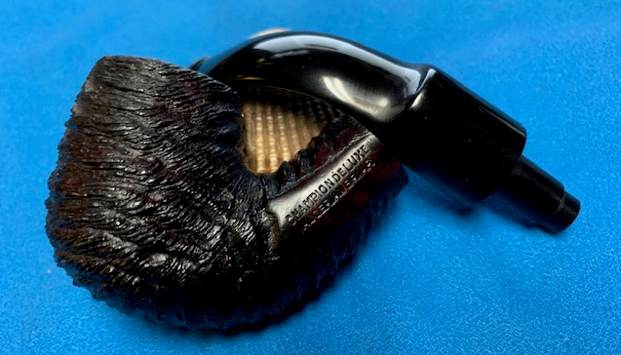
Cleaning Up a Nice Looking Savinelli Silver 621 Bent Dublin with an acrylic 9MM Filter Stem


Blog by Steve Laug

The silver came as a trade from Japan on 01/12/23… Bret Gross

The next pipe I chose to work on was a newer one in my box of pipes to restore. We took it in on a trade for some pipes we had to sell. It is a great sandblast that really shows the grain around the sides and shank. It is stamped Savinelli [over] Silver on a smooth panel on the underside of the shank. That is followed by a Savinelli S shield followed by the shape number 621 [over] Italy. There was a Sterling Silver band on the shank that was stamped with a flattened triangle reading 925 [over] Savinelli. On the right side of the band it is stamped Sterling Mounted. The bowl had been cleaned and reamed by the fellow we received it from. The rim top looked very good with some slight darkening on the back and on the beveled inner edge of the bowl. The acrylic saddle stem was made to hold a 9MM filter and was in great condition. The stem was free of tooth marks or chatter both sides and the button. Jeff took some photos of the pipe before he did his clean up work. He took some photos of the bowl and the rim top to show the remnants of the cake left behind when it was reamed and the darkening on the rim top and beveled edge on the back of the bowl. The stem photos show the condition of the stem surface and confirm the description given above. It was in excellent condition. There was a slight trough along the underside edge of the button that showed up in the photos he took that will need to be dealt with. He took photos of the sides and heel of the bowl to show the patterns in the sandblast on the briar. It really shows the grain through the finish. He took photos of the stamping on the smooth panel on the underside of the shank to capture what was stamped there. It is clear and readable as noted above. He also took  a photos of the stamping on the silver band. Jeff had done a great clean up of the pipe. He had cleaned up the reaming with a PipNet reamer and took the remaining cake back to bare briar. He cleaned up the remnants with a Savinelli Fitsall Pipe Knife. He scrubbed internals of the shank and stem with alcohol, cotton swabs and pipe cleaners. He cleaned the exterior of the pipe with undiluted Murphy’s Oil Soap and a tooth brush was able to remove the darkening on the rim top and beveled edge. He scrubbed the stem with Soft Scrub to remove the debris that had accumulated on it. The stem was soaked in Briarville’s Pipe Stem Deoxidizer and then rinsed clean. The pipe looked clean and ready for the next step in the process. Here are some photos of it when I brought it to the table. I took photos of the rim top and the top and underside of the stem. You can see the clean bowl and rim top. The stem looks very good.The next photo shows the stamping on a smooth panel on the underside of the shank. It is clear and readable as noted above. You can also see the stamping on the silver band.I removed the stem from the shank and took a photo of the parts to give a sense of the overall look of the pipe. It is really a nicely looking pipe that will look great once it is cleaned up. (Note the 9MM filter tenon in the photo below.)The bowl was in great condition so started my work by rubbing it down with Before & After Restoration Balm to deep clean the nooks and crannies of the sandblast finish, enliven and protect the briar. I hand rubbed it with my fingers and into the finish with a horsehair shoe brush. I let it sit for 10 minutes to let it do its work. I wiped it off with a soft cloth. I buffed the bowl with a cotton cloth. It really began to have a deep shine in the briar. I took some photos of the bowl at this point to mark the progress in the restoration. I set the bowl aside and turned my attention to the stem. I worked on the slight dip in the acrylic ahead of the button on the underside of the stem with 220 grit sandpaper to smooth it out and level it. Once it was smooth I polished it with 600 grit wet dry sandpaper.I polished the stem on both sides using micromesh sanding pads. I dry sanded the stem with the 1500-12000 grit pads, then wiped it down with a cloth impregnated with Obsidian Oil. I finished polishing it with Before & After stem polish – both Fine and Extra Fine. I gave it a final coat of Obsidian Oil and set it aside to dry. I fit a new charcoal 9MM filter in the tenon of the stem and took photos.This is another pipe I am excited to finish. It is a Savinelli Silver 6211 Bent Filter Stem Dublin. I put the pipe back together and buffed it lightly with Blue Diamond on the buffing wheel. I gave the bowl and the stem multiple coats of carnauba wax. I buffed the pipe with a clean buffing pad to raise the shine and hand buffed it with microfiber cloth to deepen the shine. It is fun to see what the polished bowl looks like with the polished acrylic stem. It really was a beautiful pipe. The sandblast finish surface show the grain shining through the rich browns/black stain on smooth portions of the finish of this Savinelli Silver Bent Dublin. It is nice looking and the pipe feels great in my hand. It is light and well balanced. Have a look at it with the photos below. The dimensions are Length: 5 inches, Height: 2 ¾ inches, Outside diameter of the bowl: 1 ¼ inches, Chamber diameter: 7/8 of an inch. The weight of the pipe is 1.27 ounces/37 grams. It is a beautiful pipe and one that I will be putting on the rebornpipes store in the Italian Pipe Maker section. Thanks to each of you who are reading this blog. Remember we are not pipe owners; we are pipemen and women who hold our pipes in trust until they pass on into the trust of those who follow us.