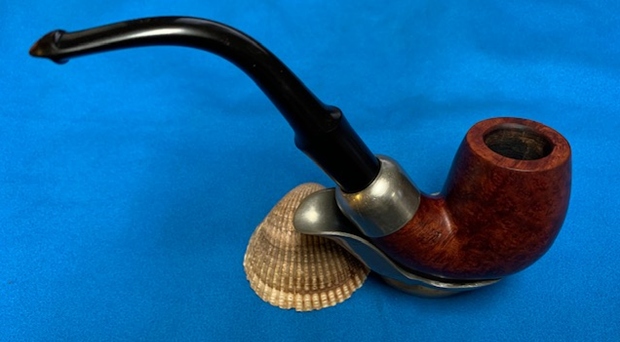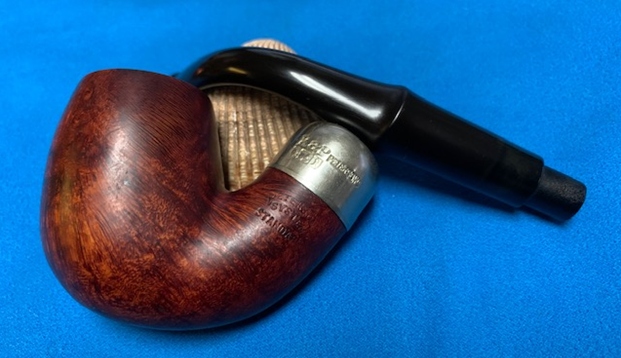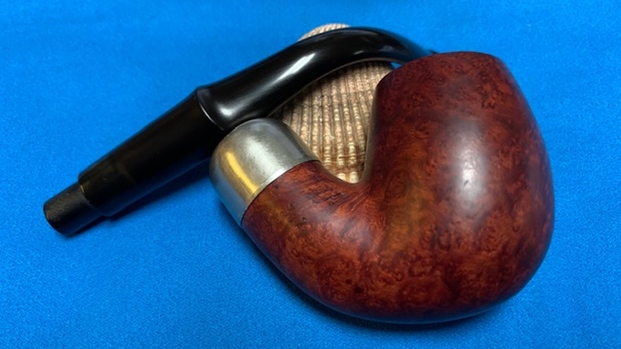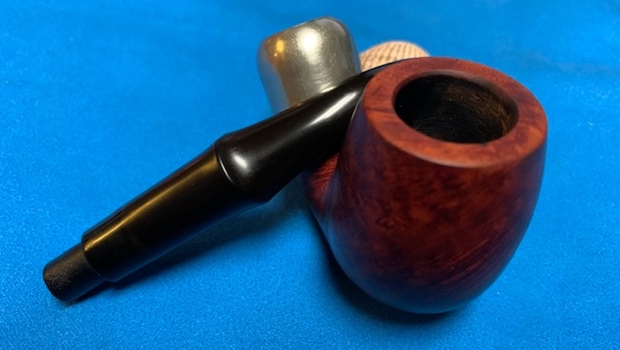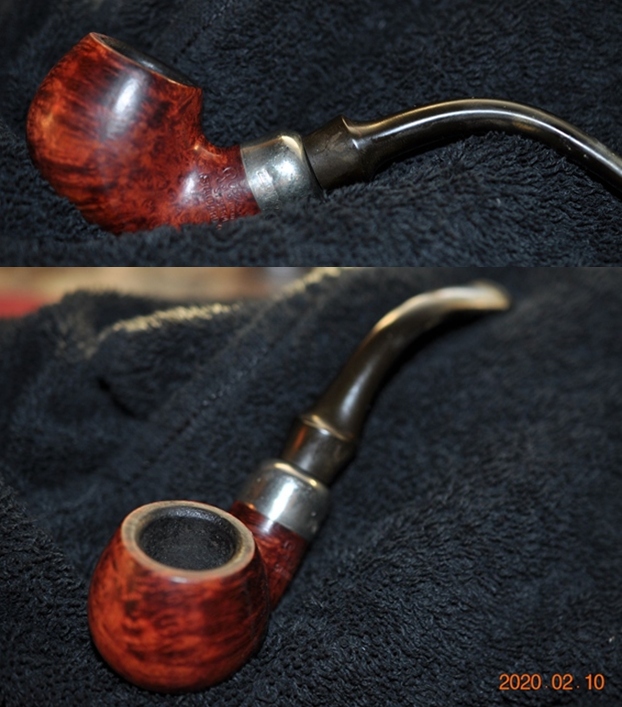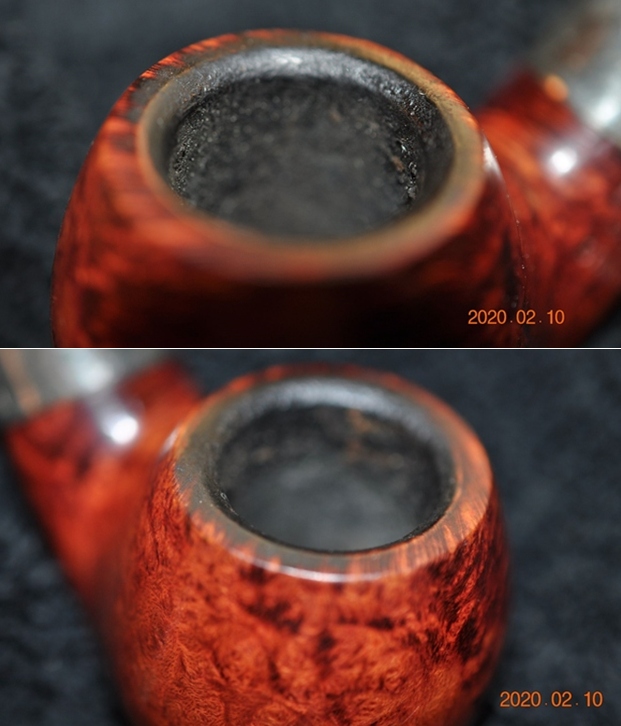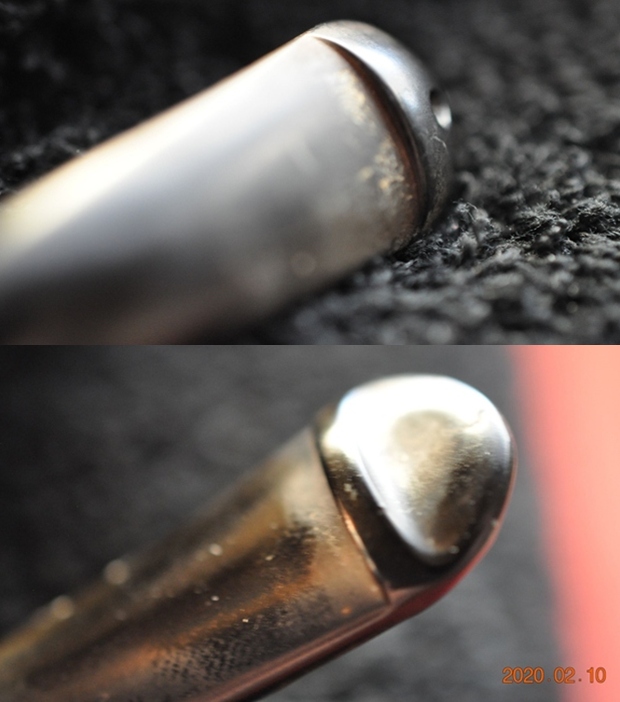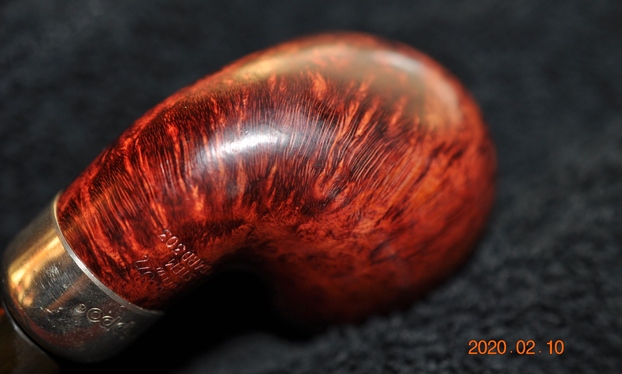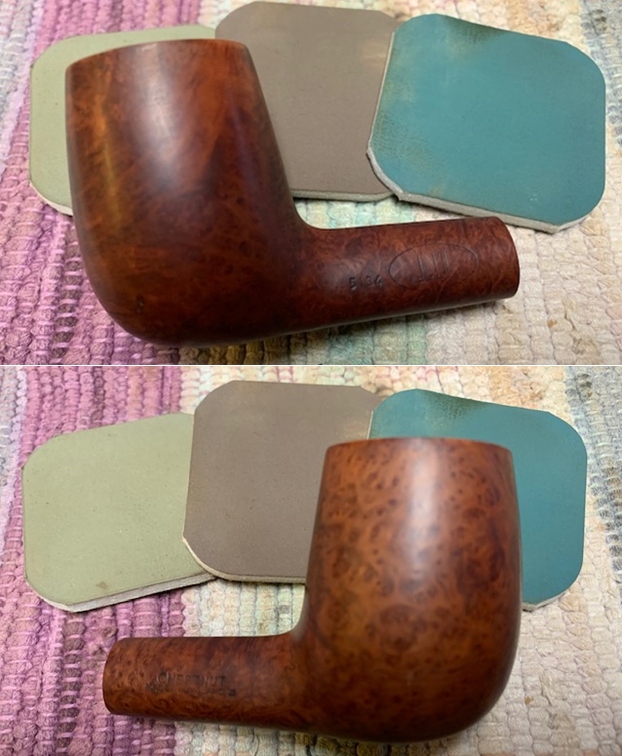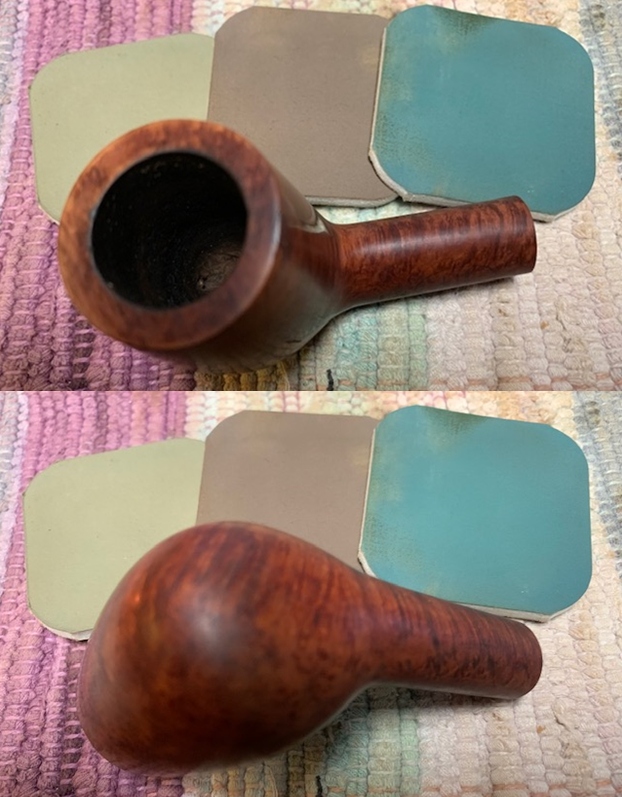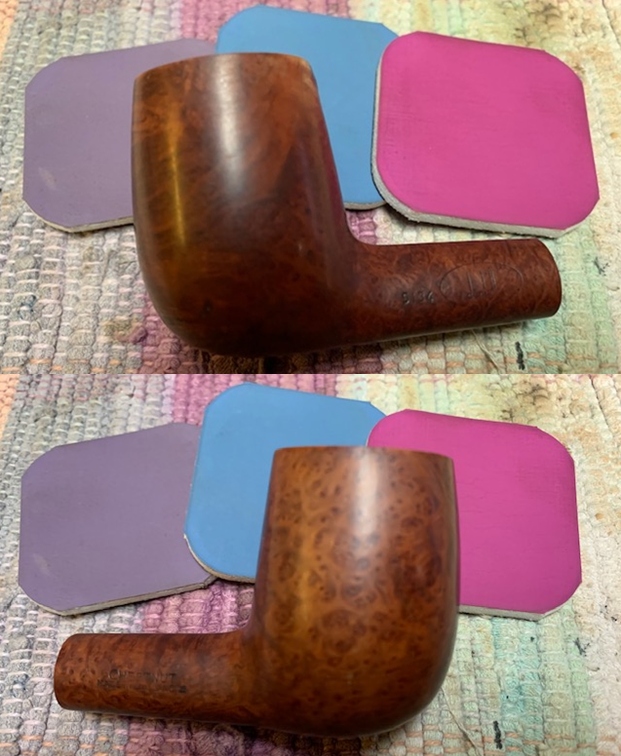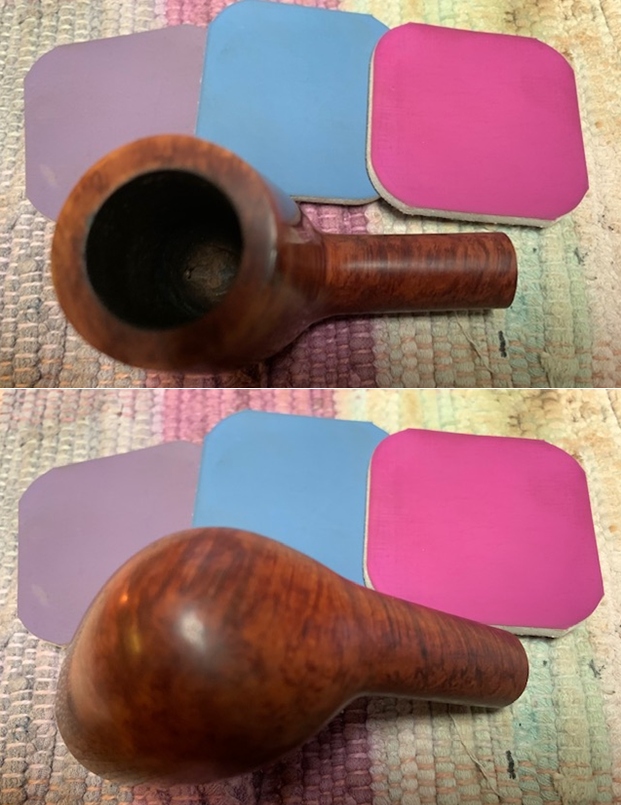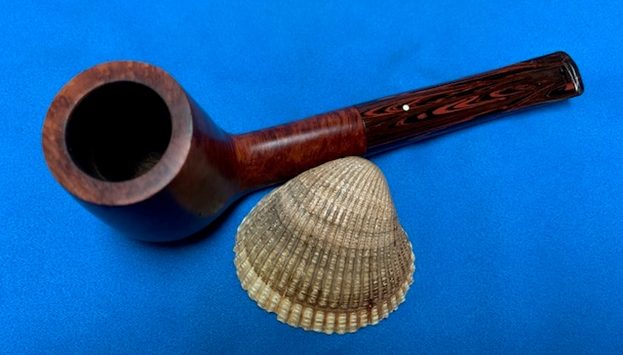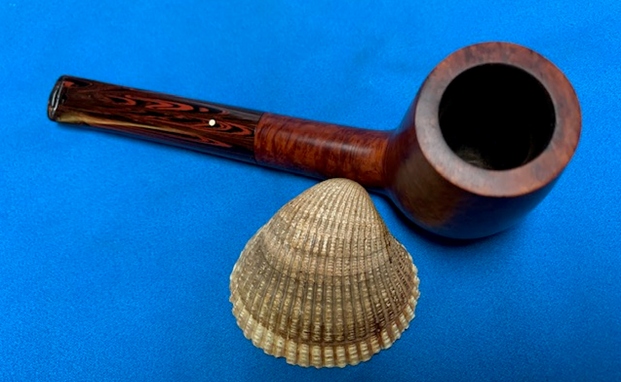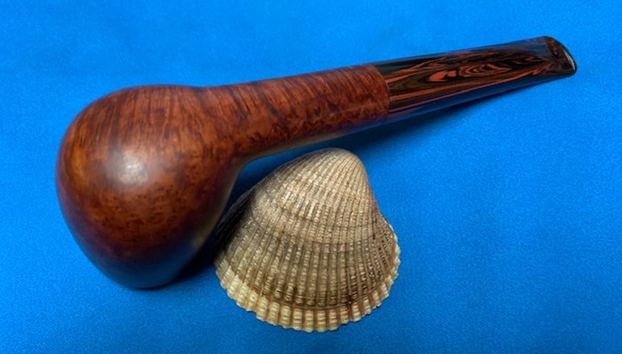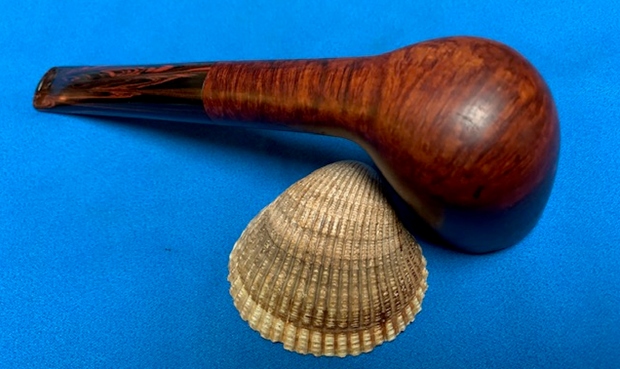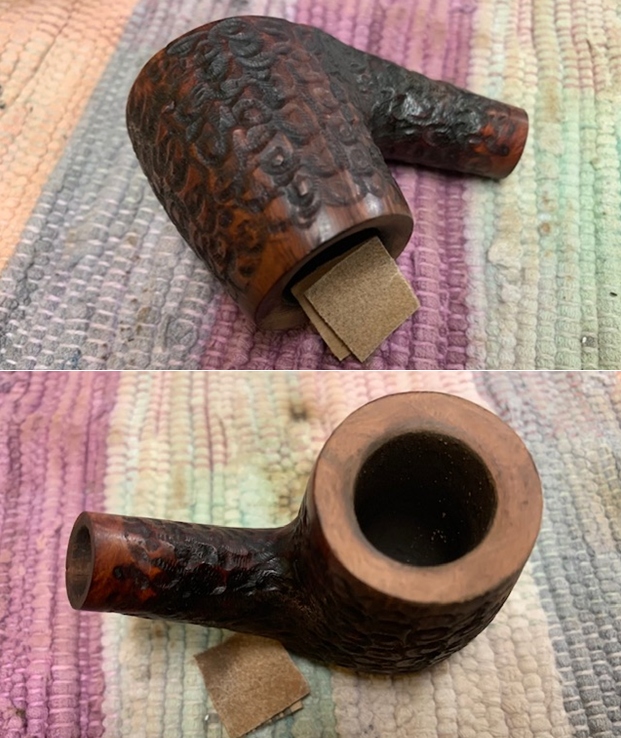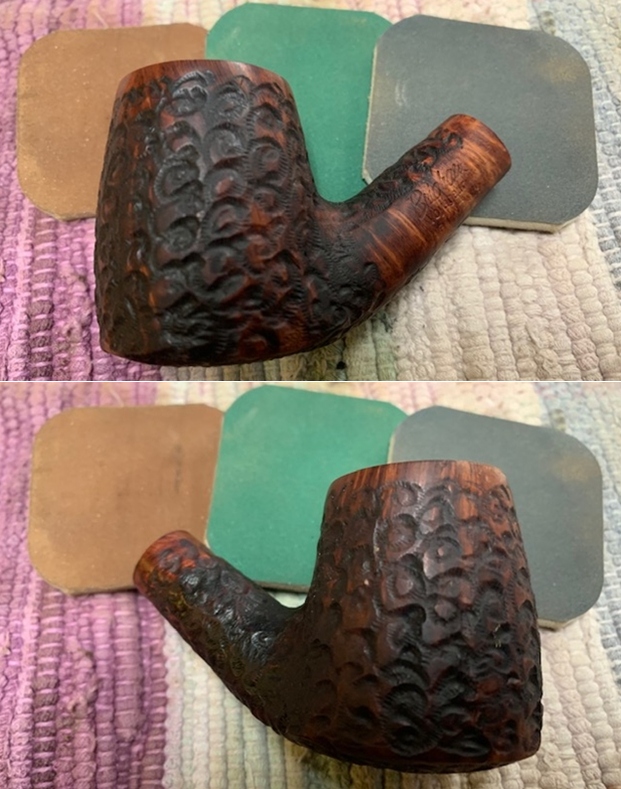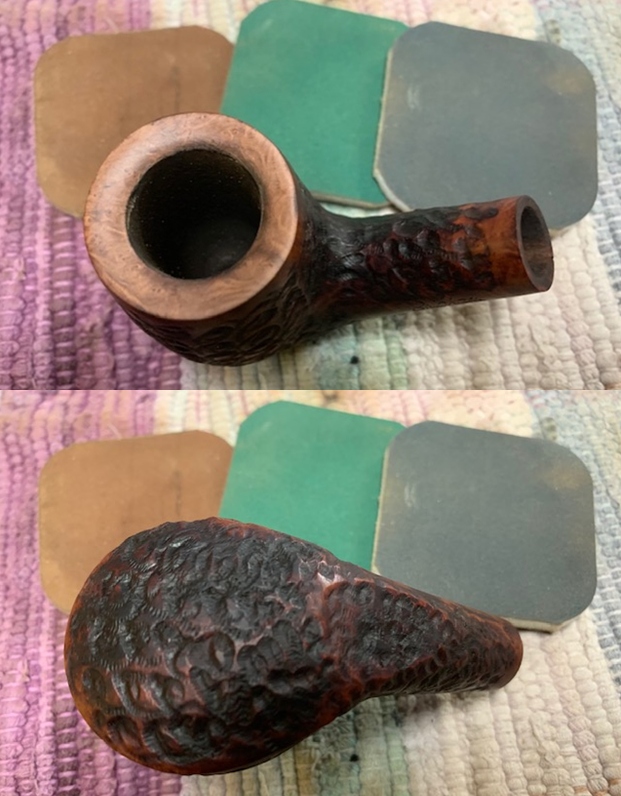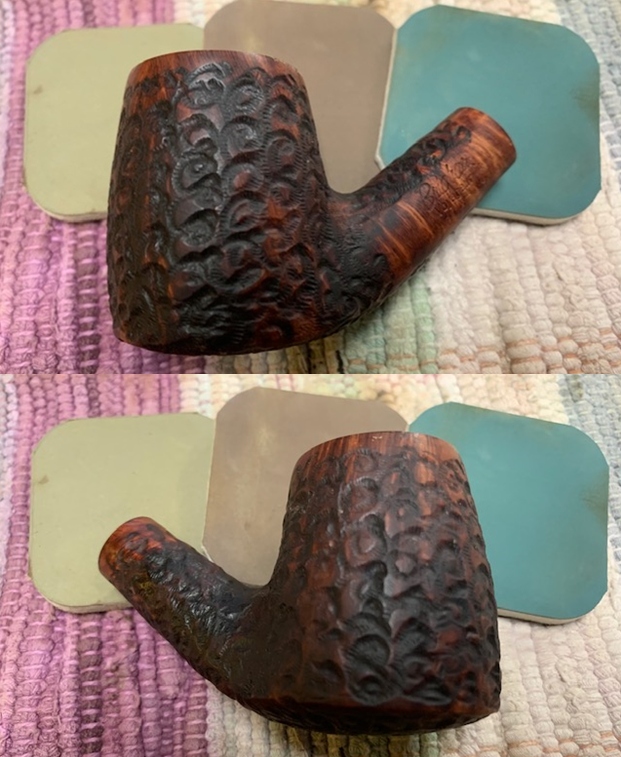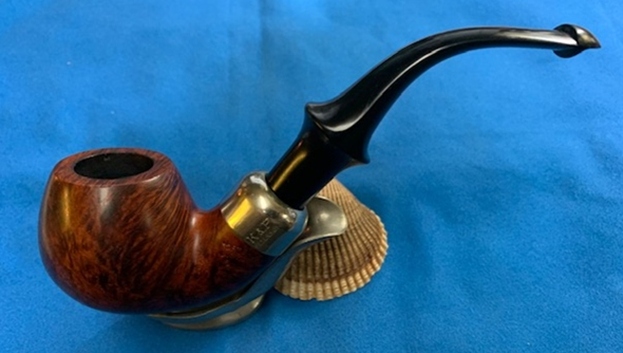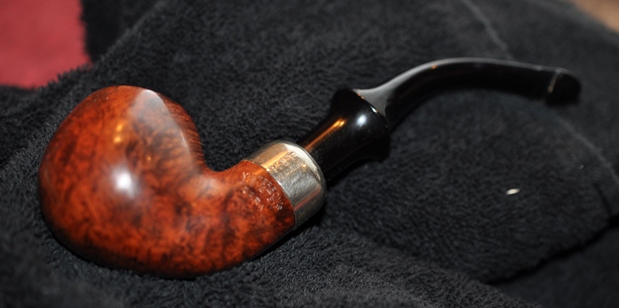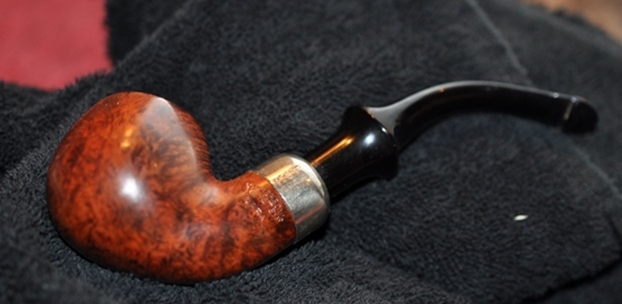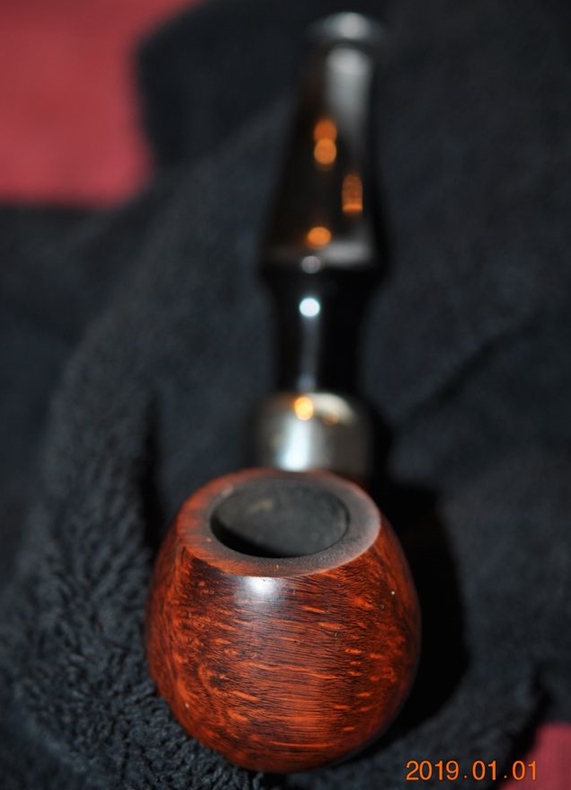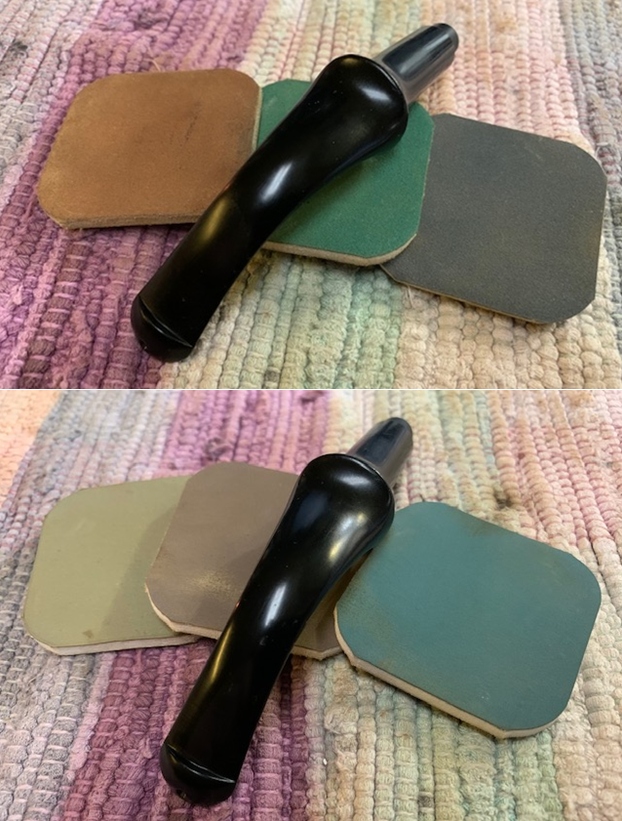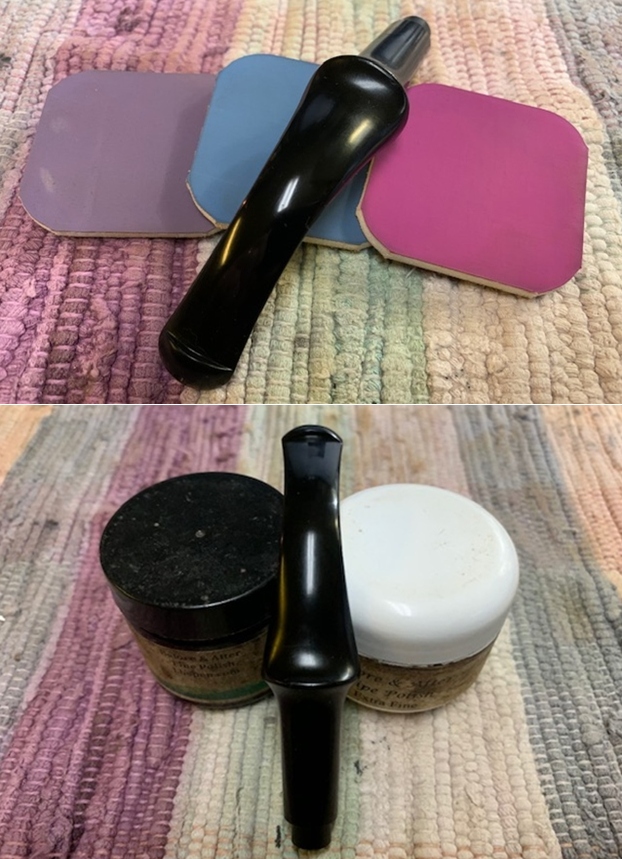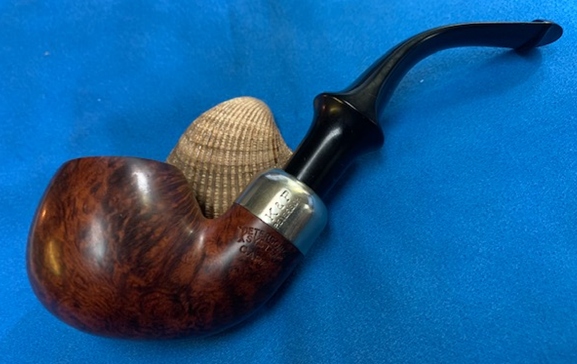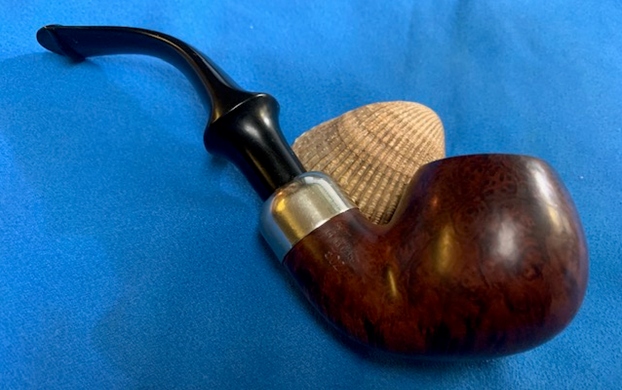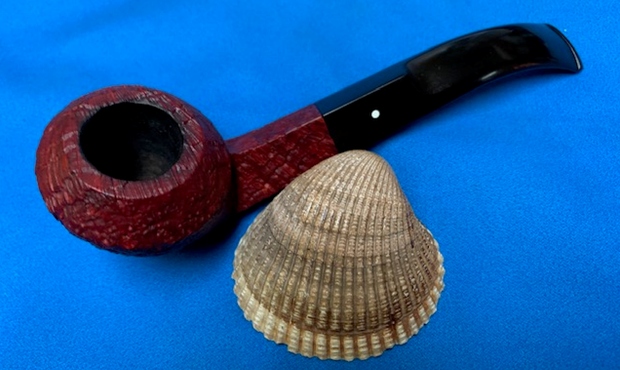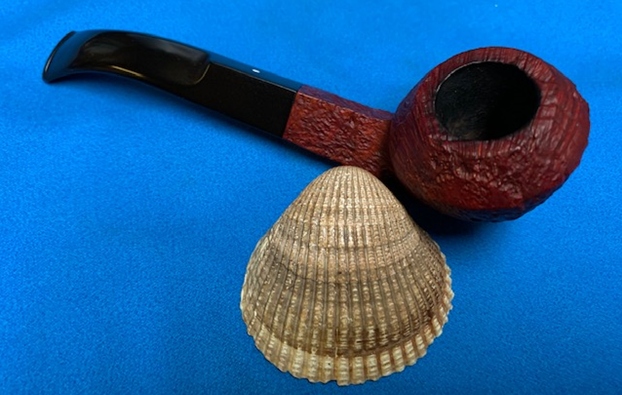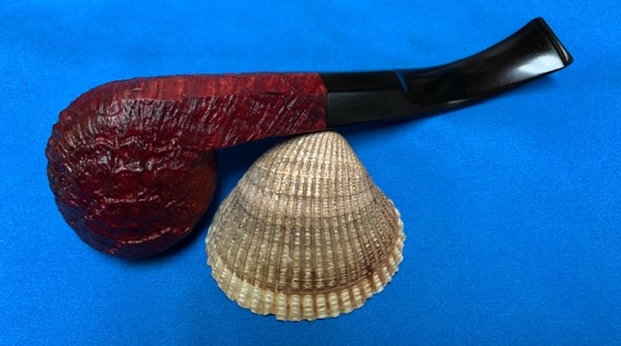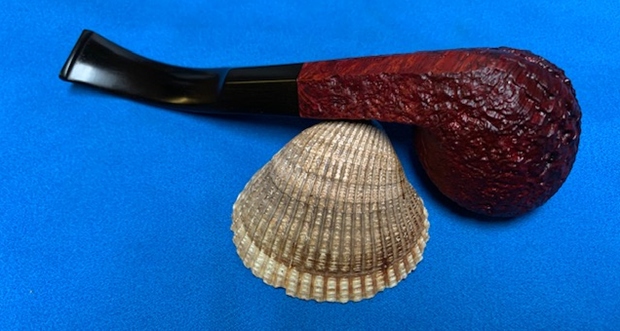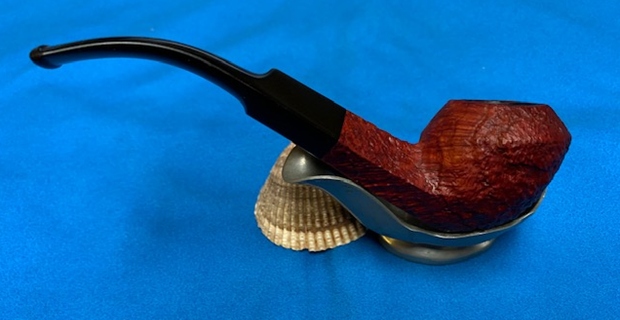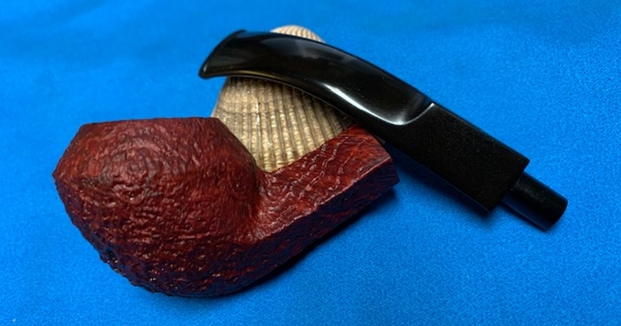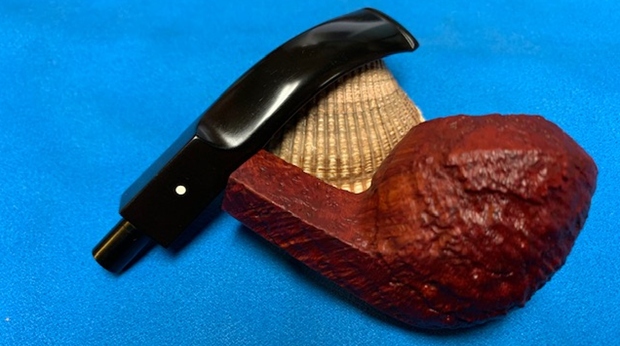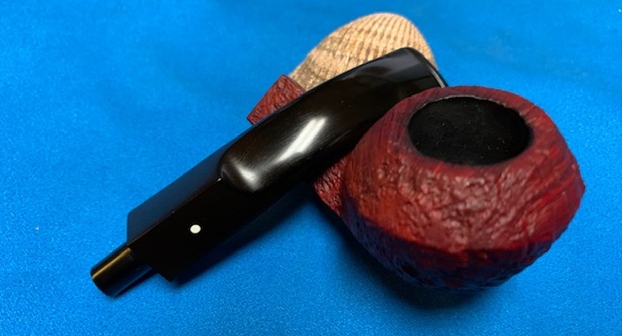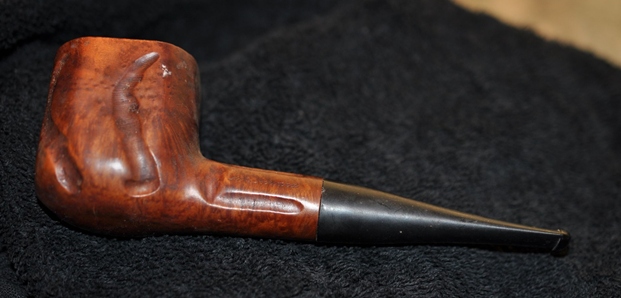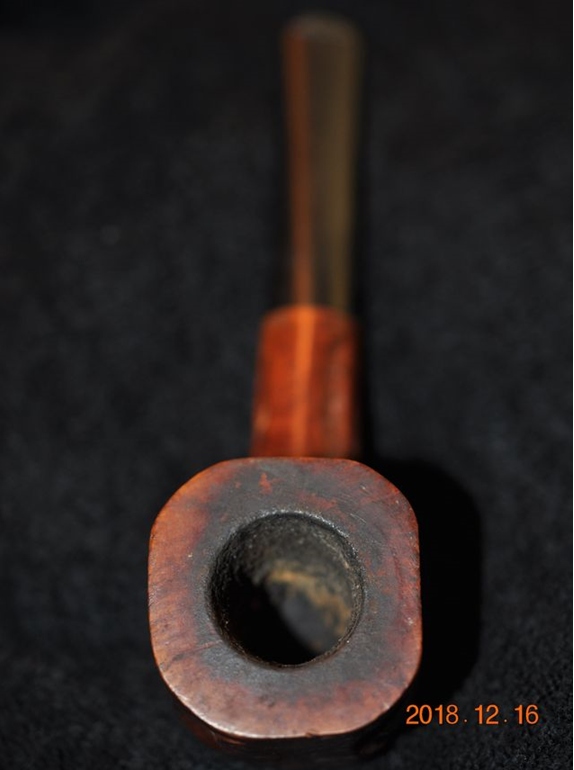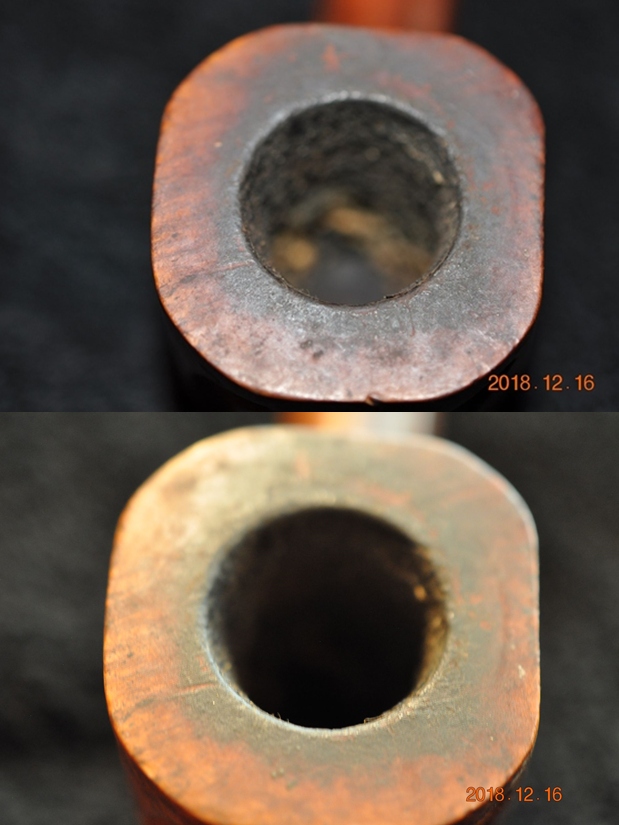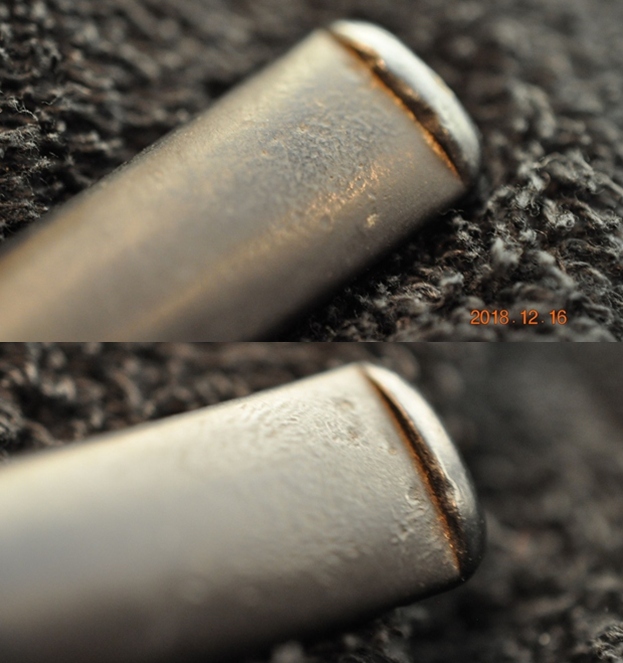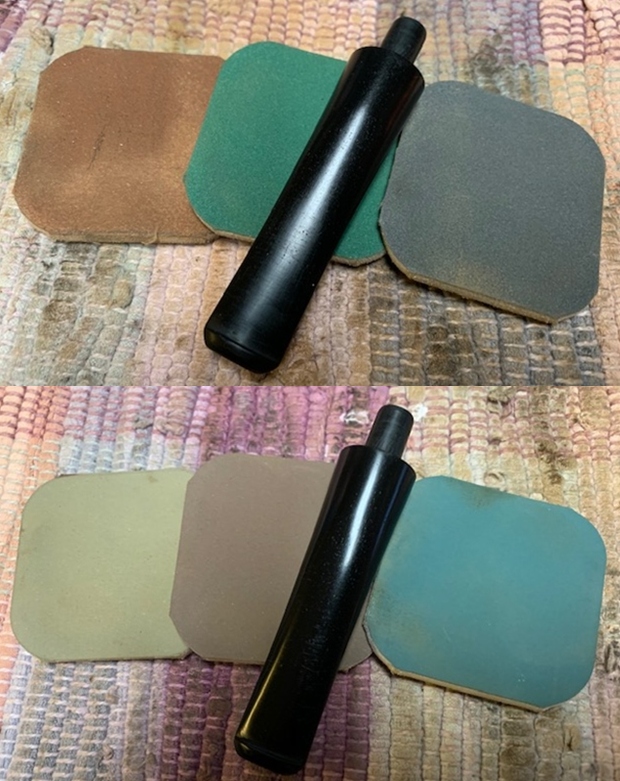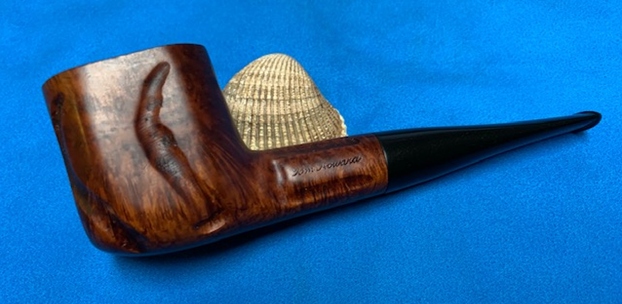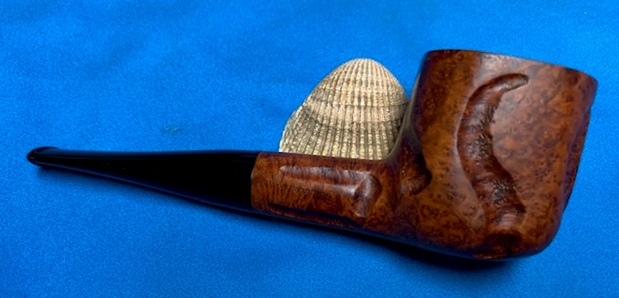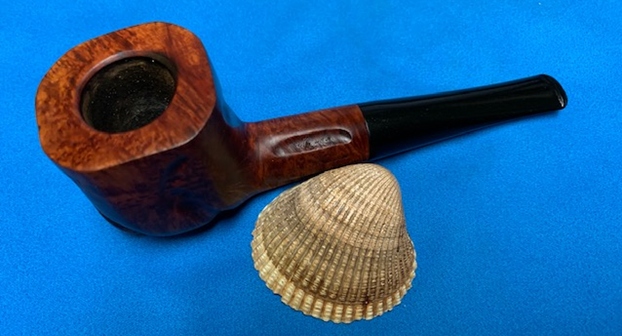
Tag Archives: sanding a stem

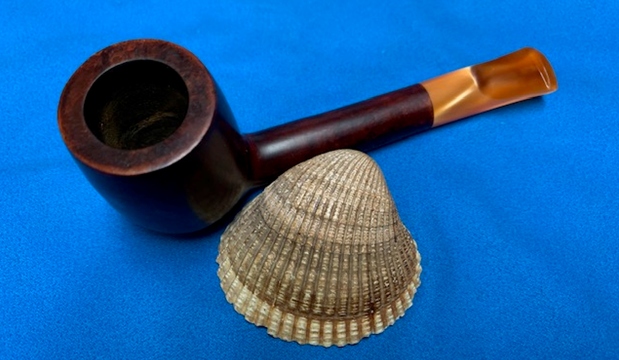
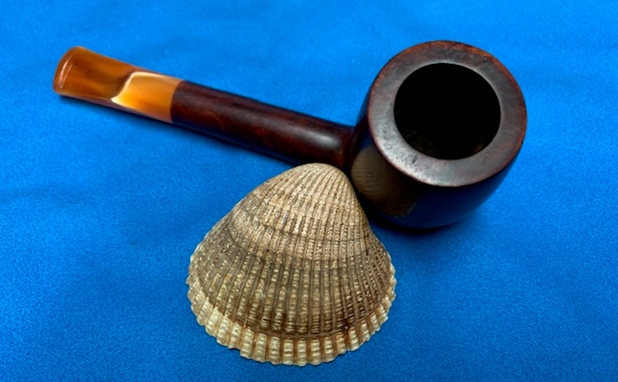
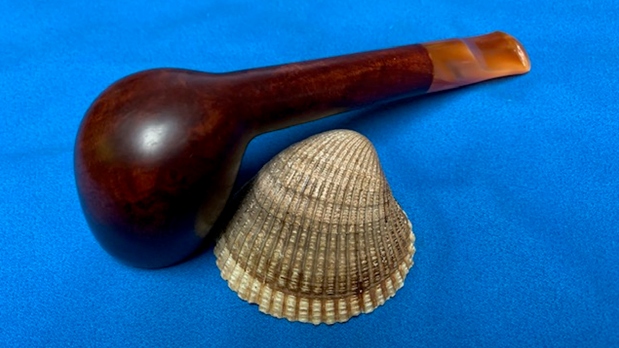
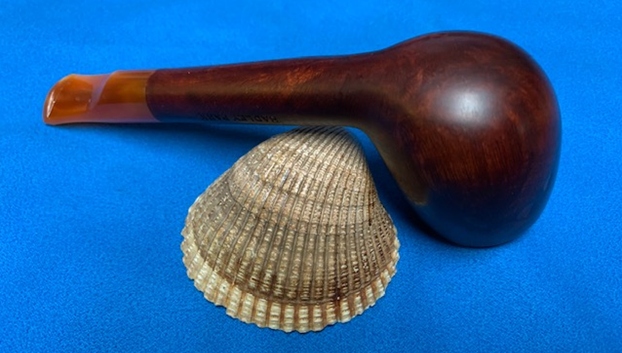
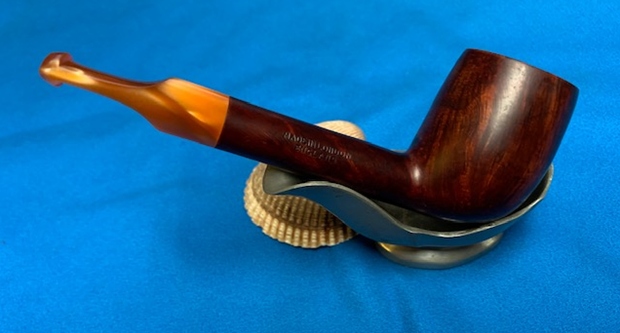
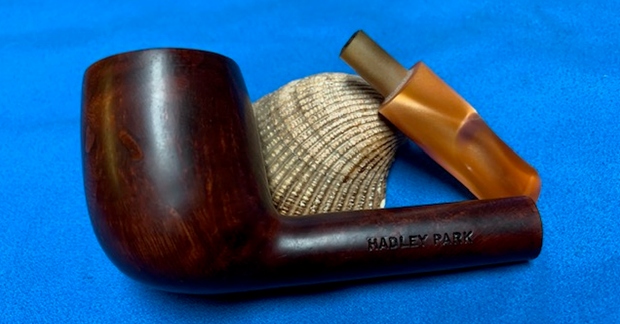
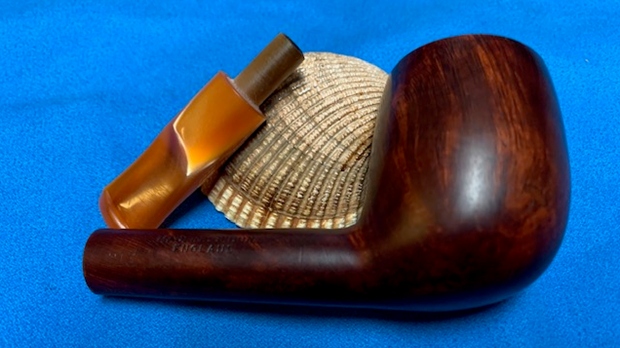
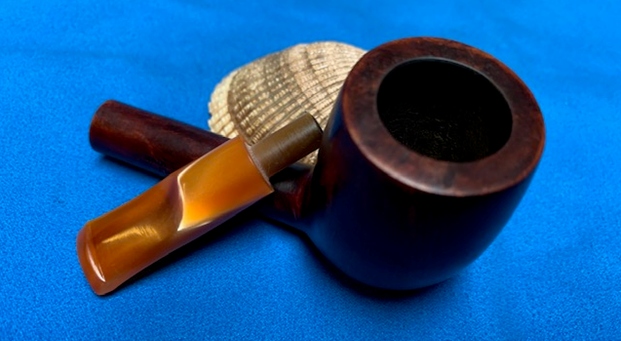
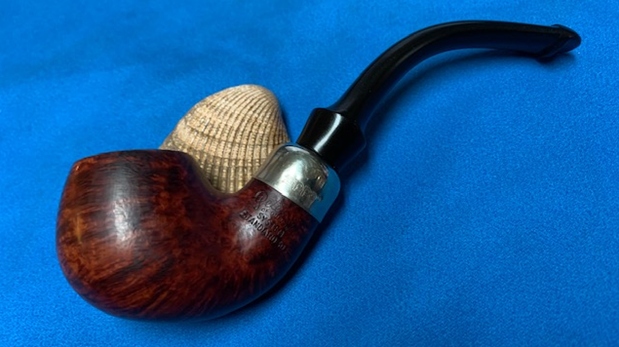
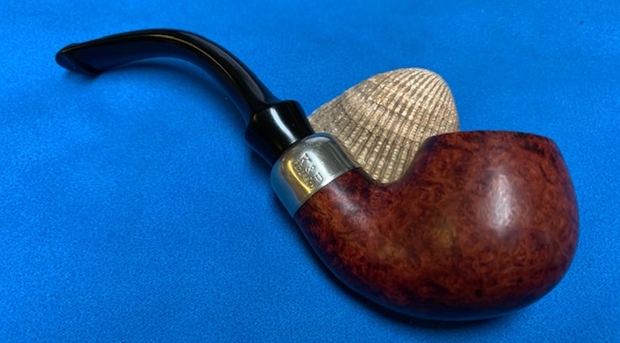
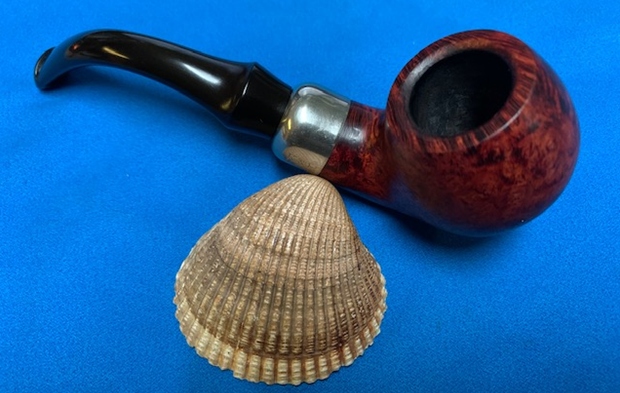
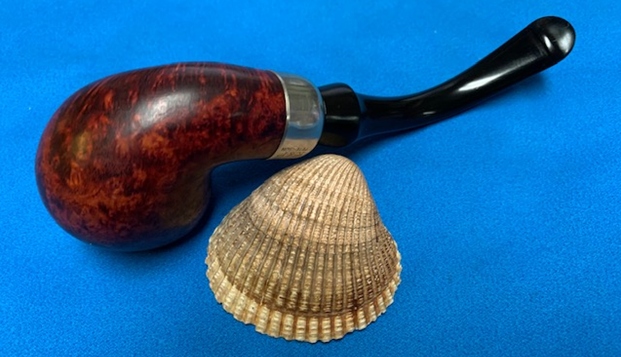
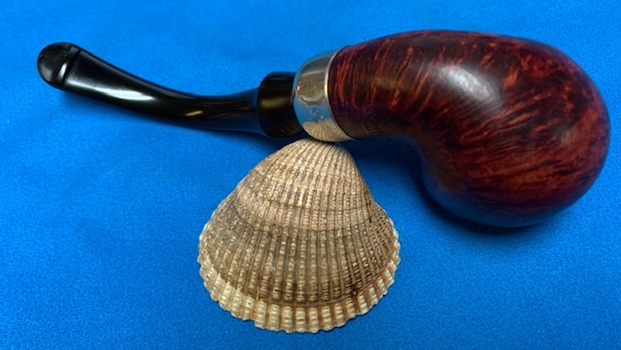
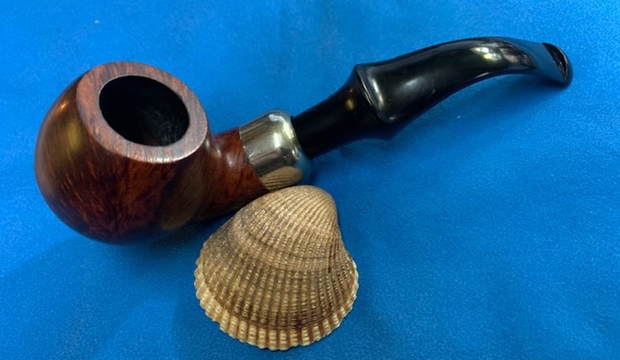
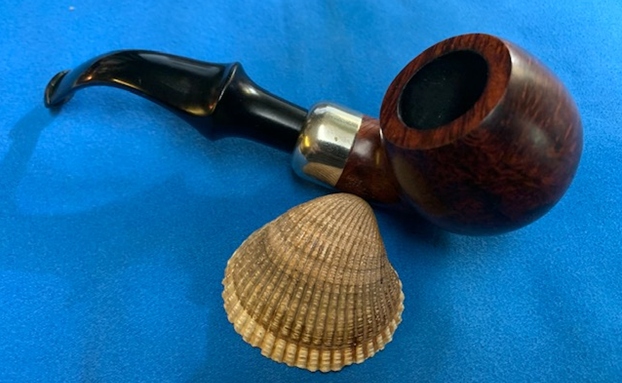
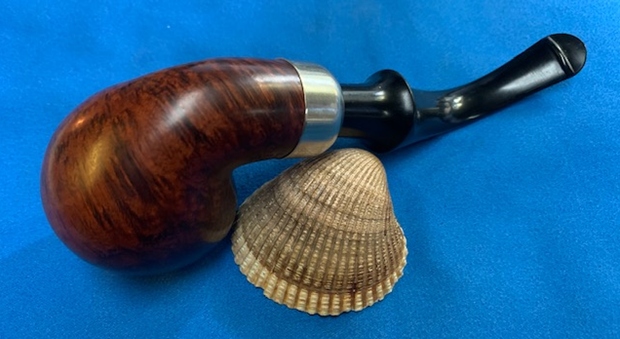
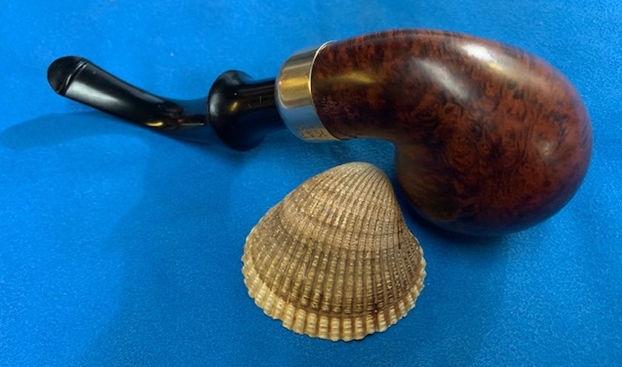
Restoring an English Made Hadley Park 213 Lovat


Blog by Steve Laug

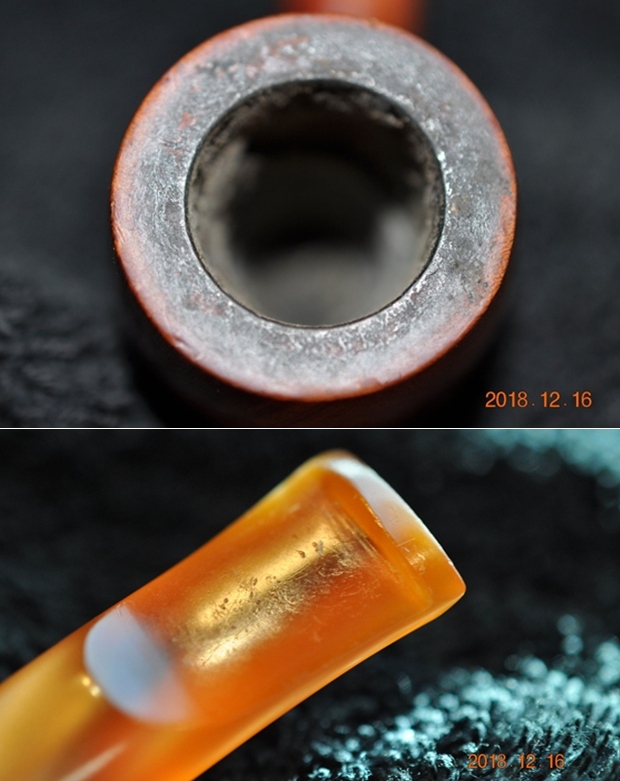
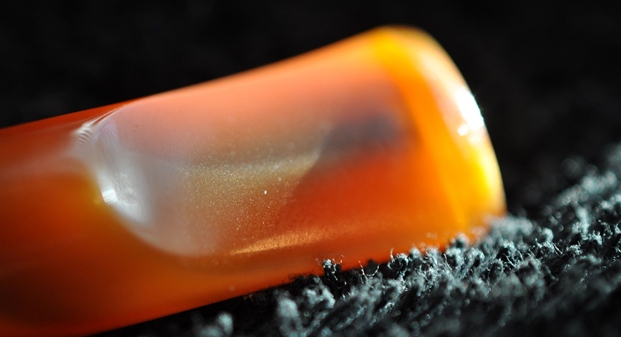
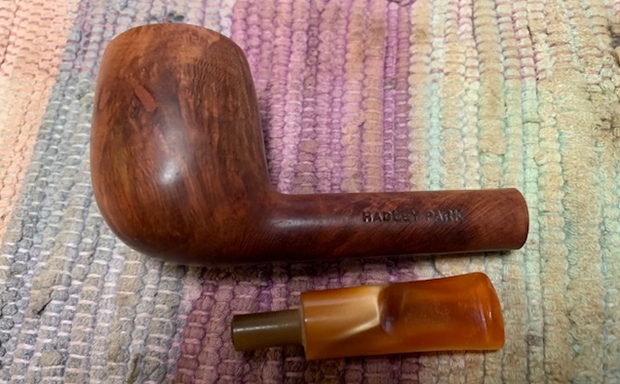
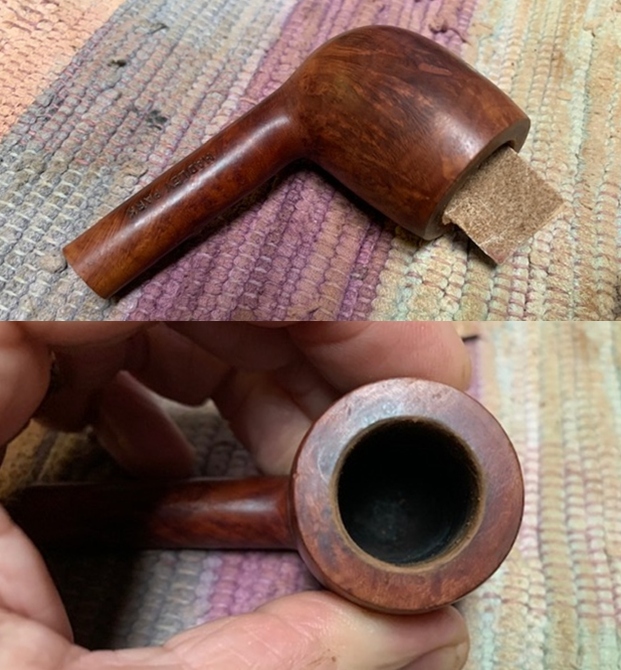
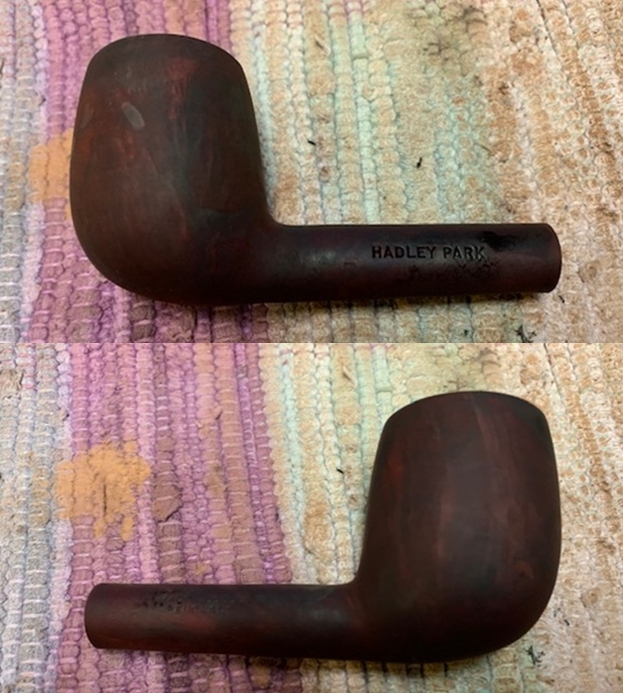
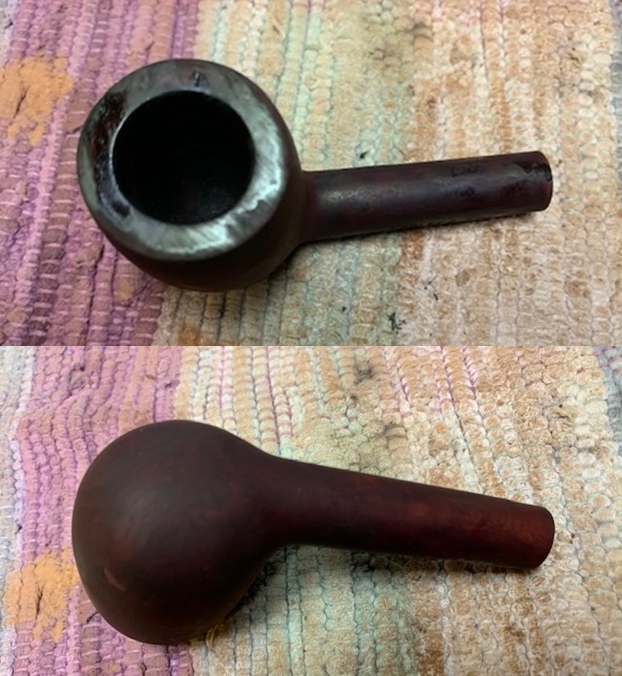
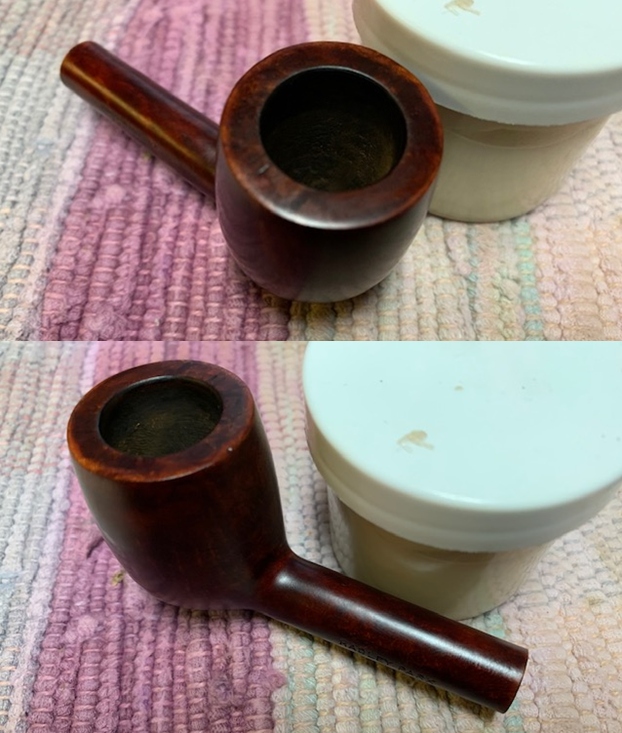
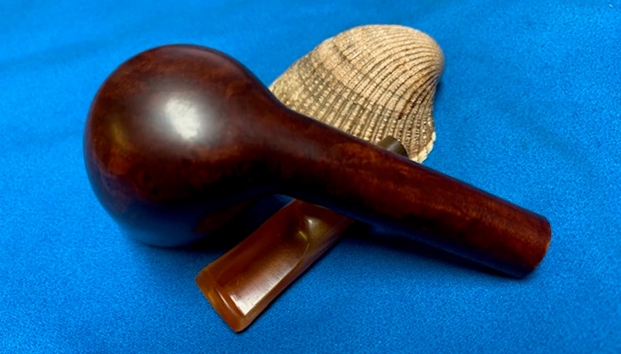
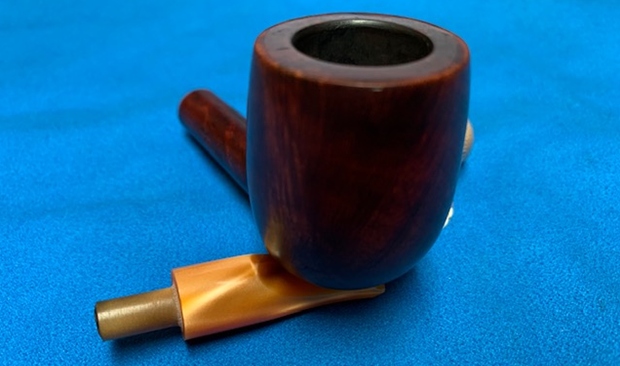
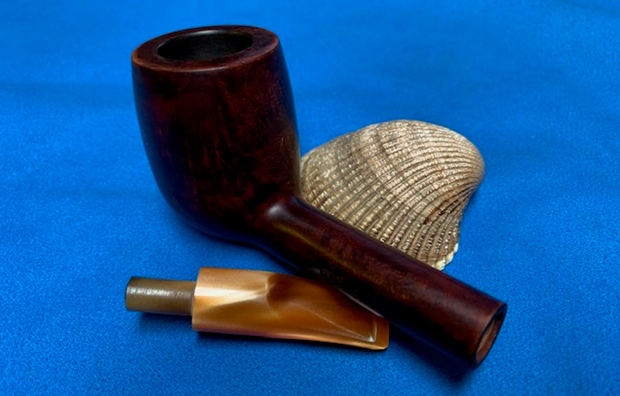
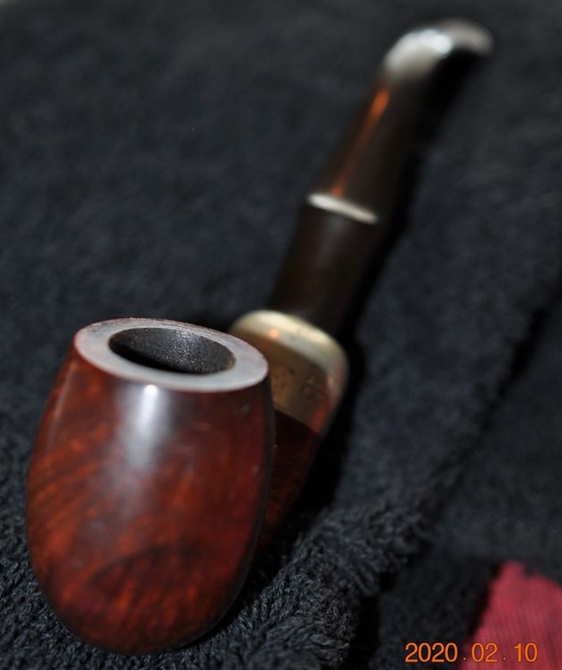
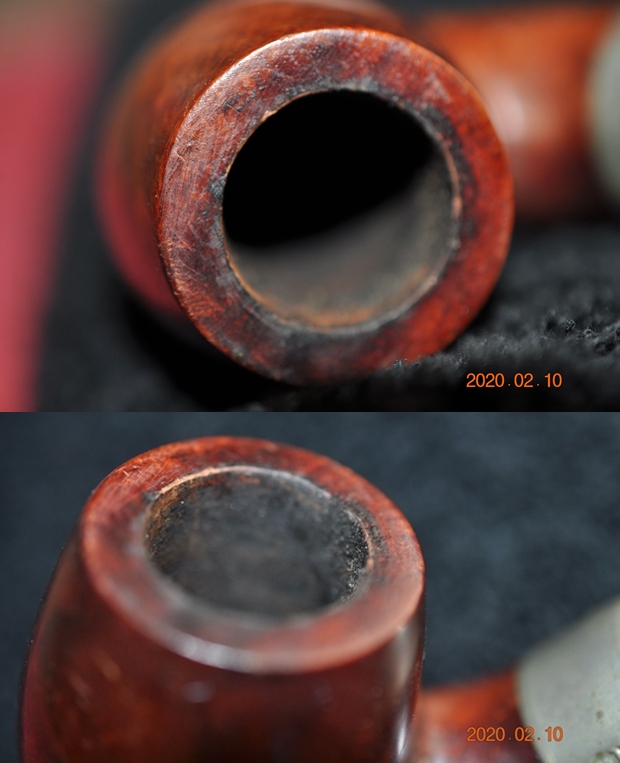
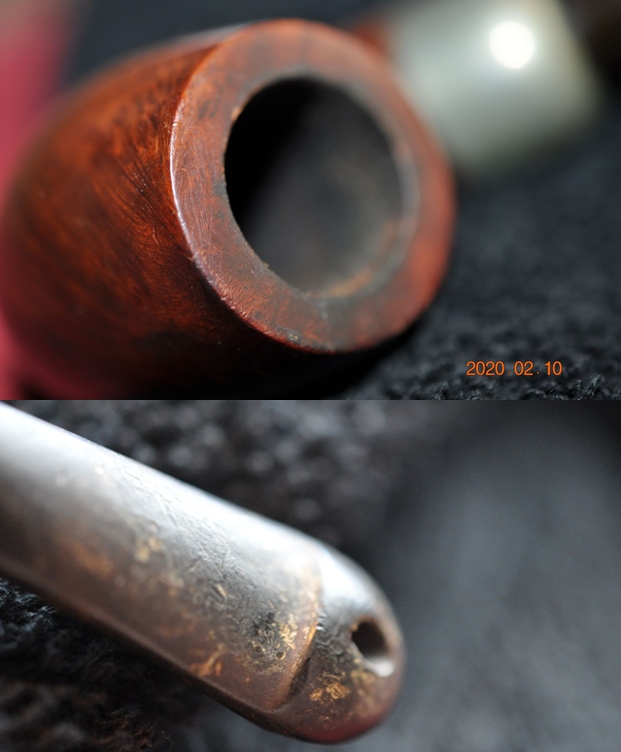
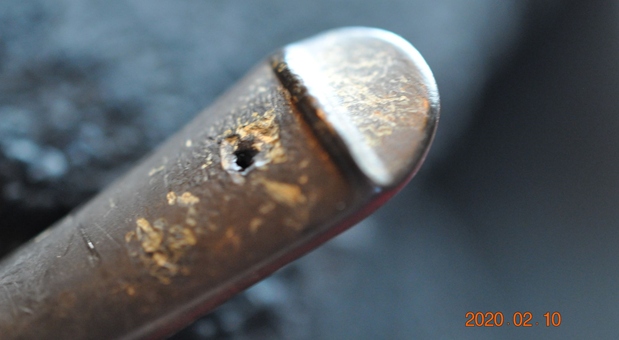
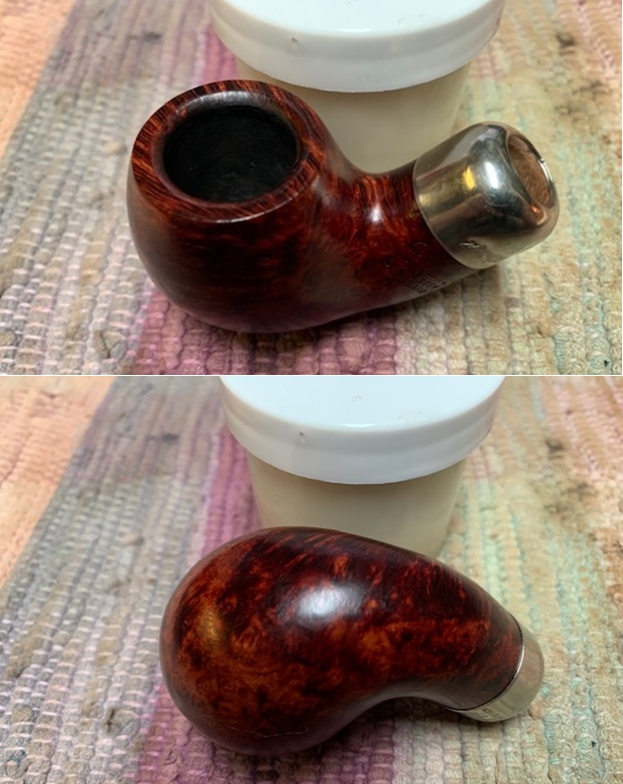
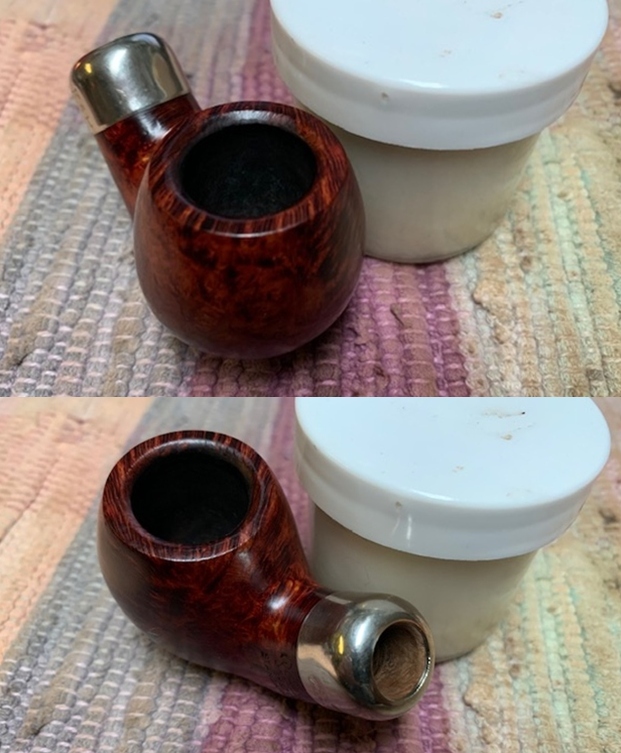
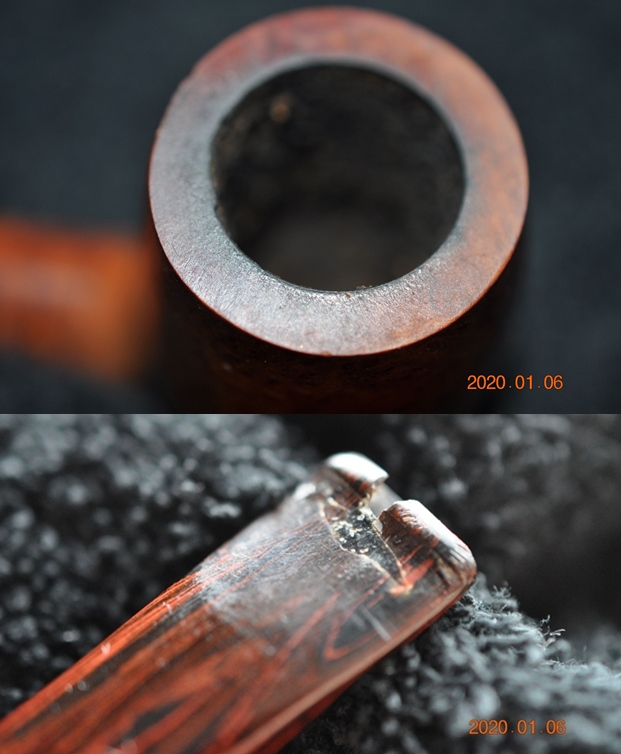
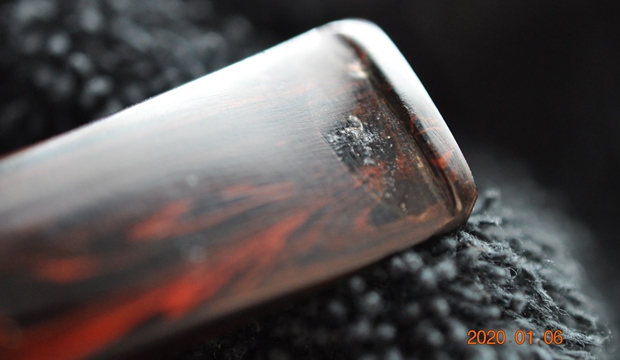
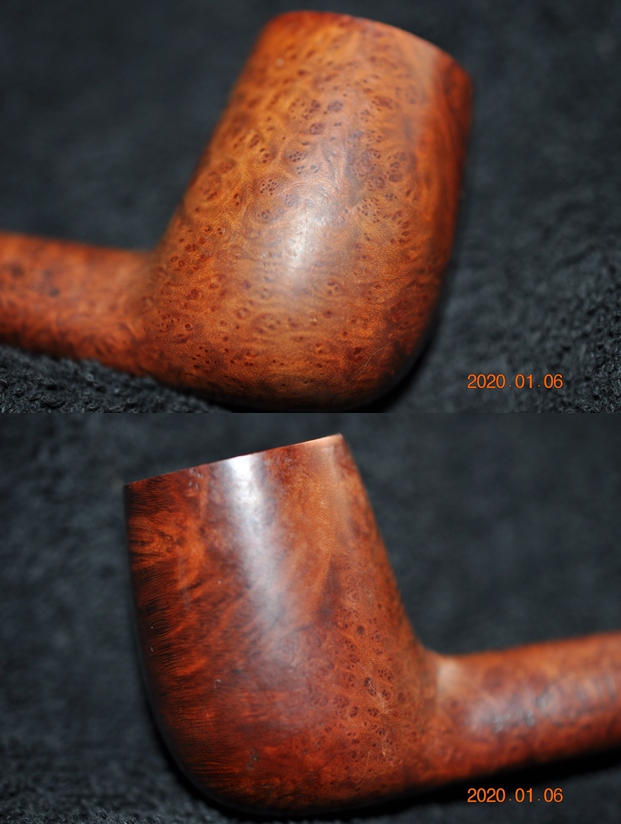
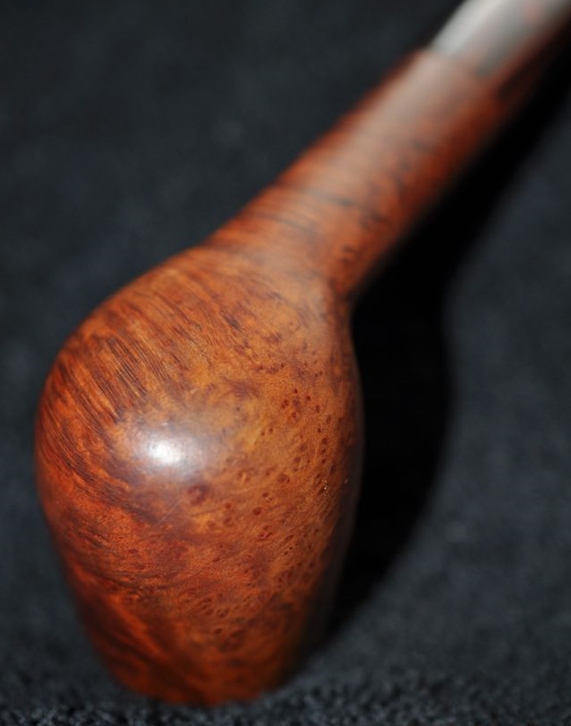
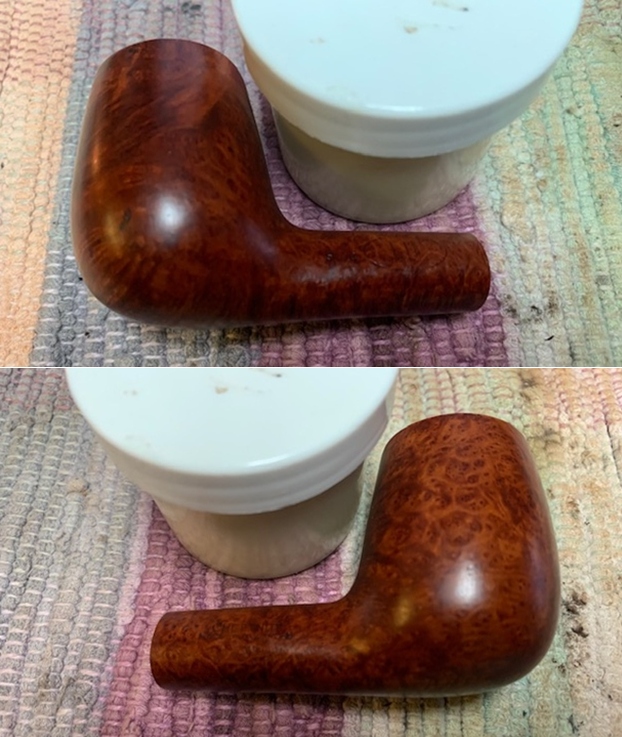
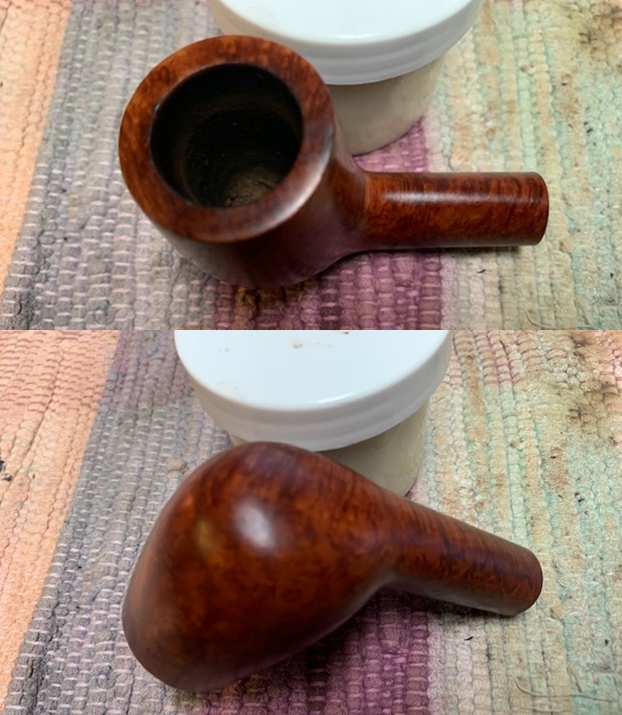
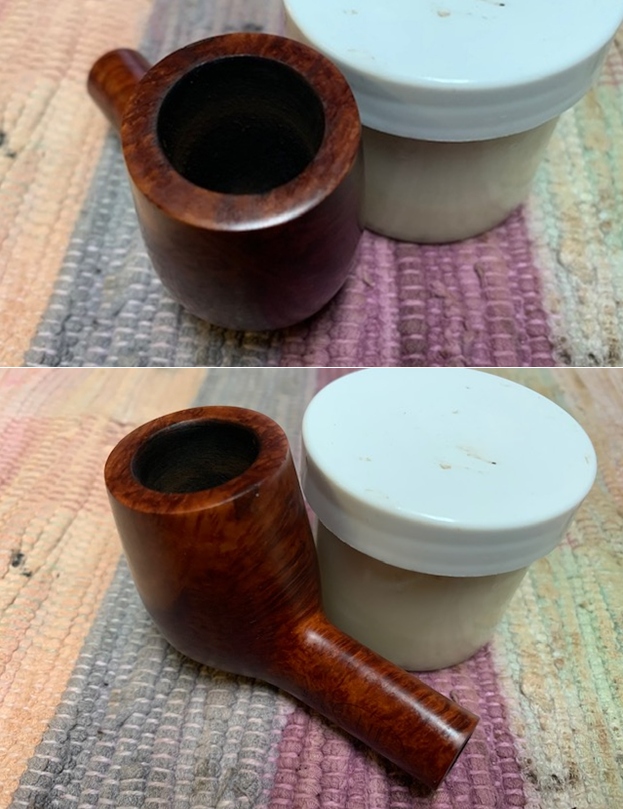
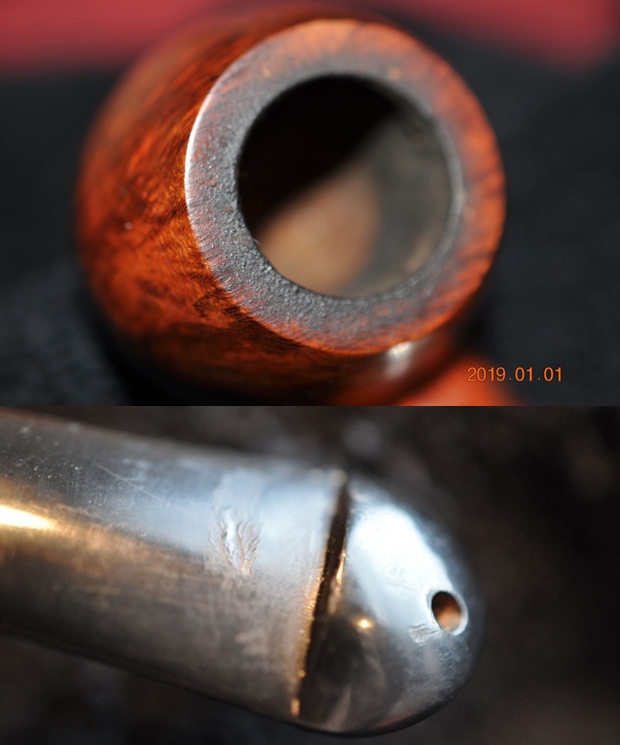
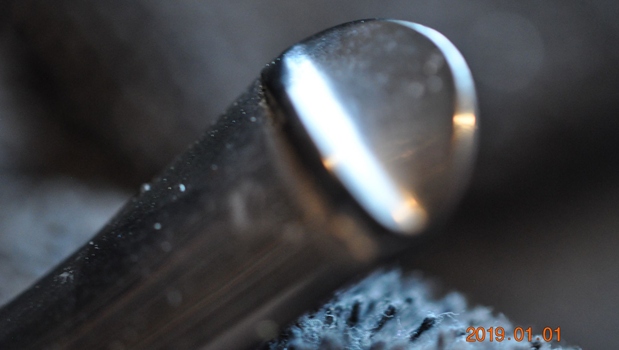
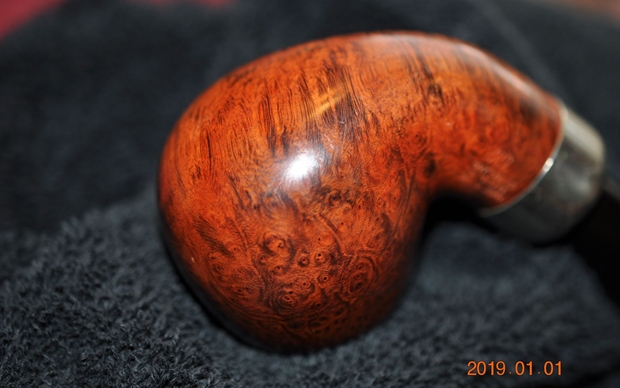
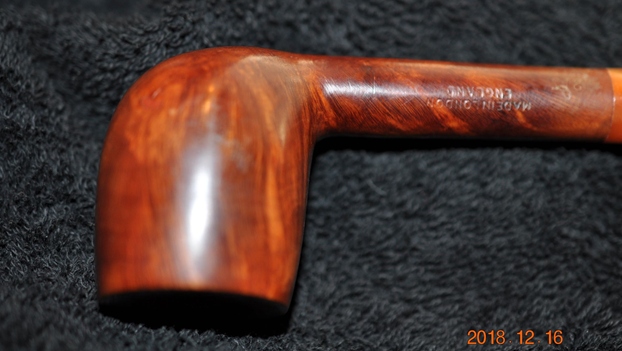
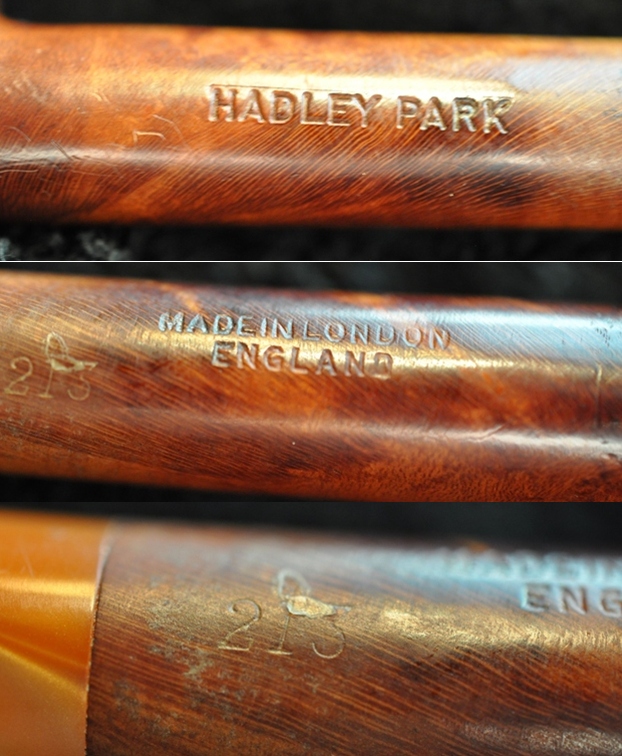
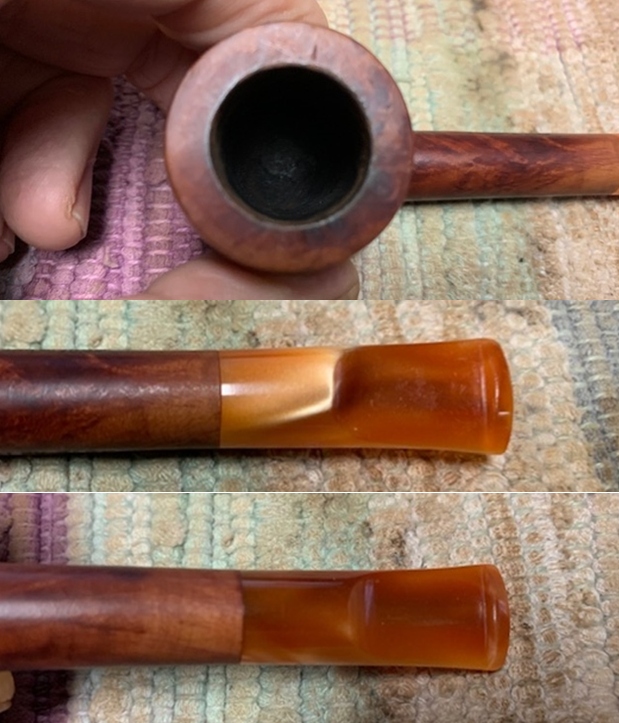
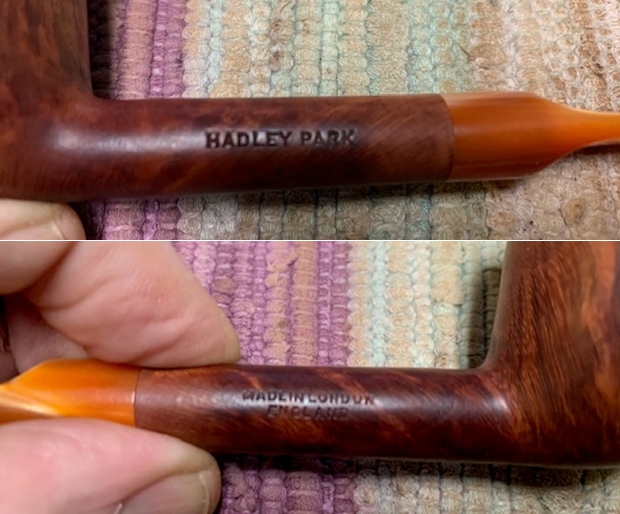
The next pipe on the work table came to us from one of Jeff’s pipe hunts a few years ago and to be honest we don’t remember where we got it. This morning as I was going through my box of what I have to work on this one caught my eye. It is a nicely grained small Lovat with an acrylic stem that is almost butterscotch coloured. The stem reminds me of butterscotch candies that I used to have as a kid. The pipe is stamped on the left side of the shank and reads Hadley Park. On the right side it is stamped Made in London England and to the left of that, near the stem is the shape number 213. The finish had a lot of grime ground into the smooth finish on the bowl and some darkening around the sides of the bowl. The bowl was heavily caked and there was a lava coat and darkening on the rim top and inner edge. The edges looked okay but we would know more after the cleanup. There were a few fills that had shrunken around the sides of the bowl. The stem was dirty and had tooth chatter and marks on the top and underside near the button. There were not markings or a logo on the saddle stem. The pipe showed promise but it was very dirty. Jeff took photos of the pipe before he started his cleanup work. He took a photo of the rim top and bowl to give a clear picture of the thickness of the cake and the condition of the rim top and edges. He also took photos of the top and underside of the stem to show the chatter and tooth marks.    Jeff took a photo of the side and heel of the bowl to give a picture of what the briar around the pipe looked like. There is some great grain under the grime.     He took photos of the stamping on the shank. It reads as noted above and is clear and readable.   I could not find any information on the brand. I thought the shape number might point the way but it did not give the clues I was hoping. The Made in London England stamp is similar to those used by a variety of English pipemakers so that is not definitive either. So I am left not knowing who made the pipe. Now it was time to work on this pipe.
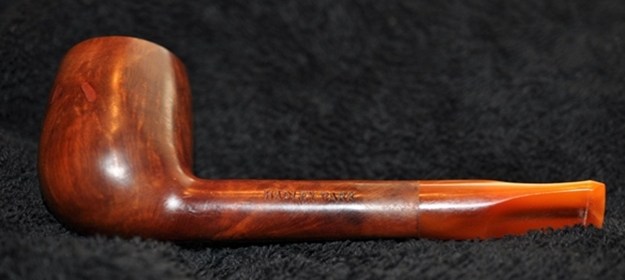
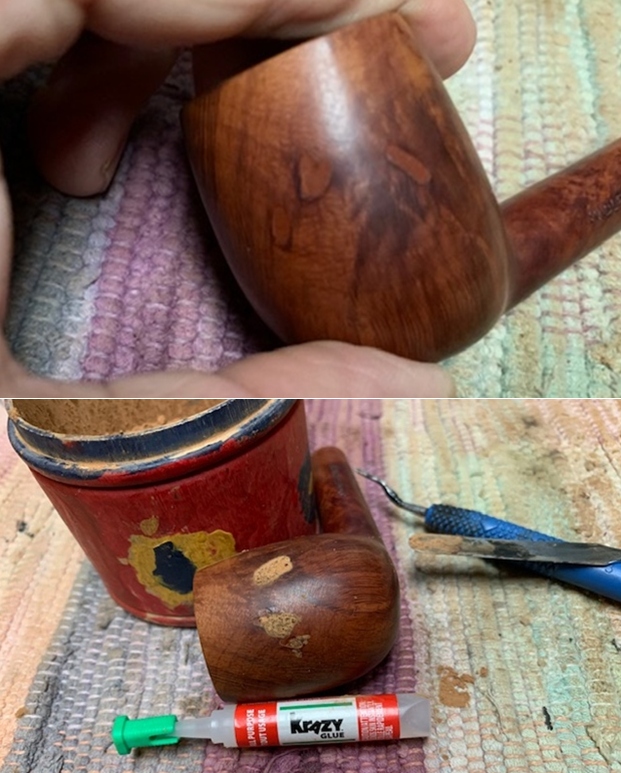
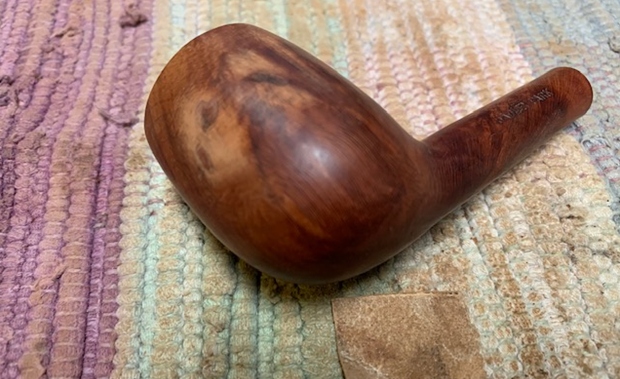
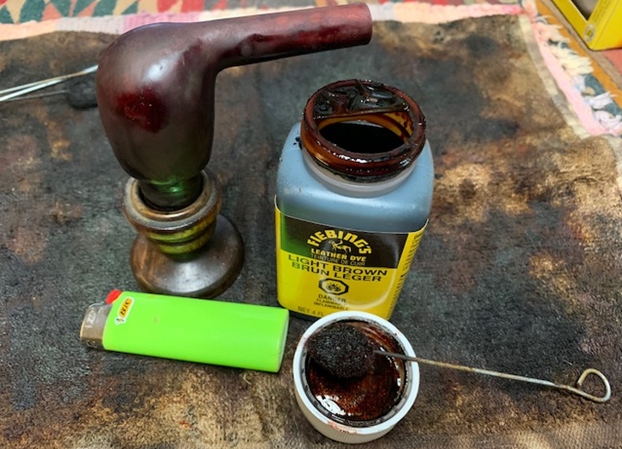
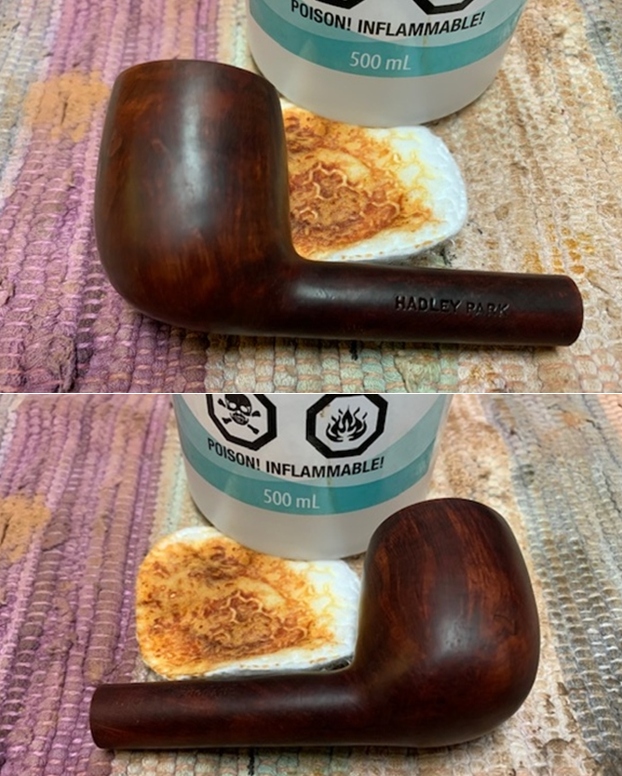
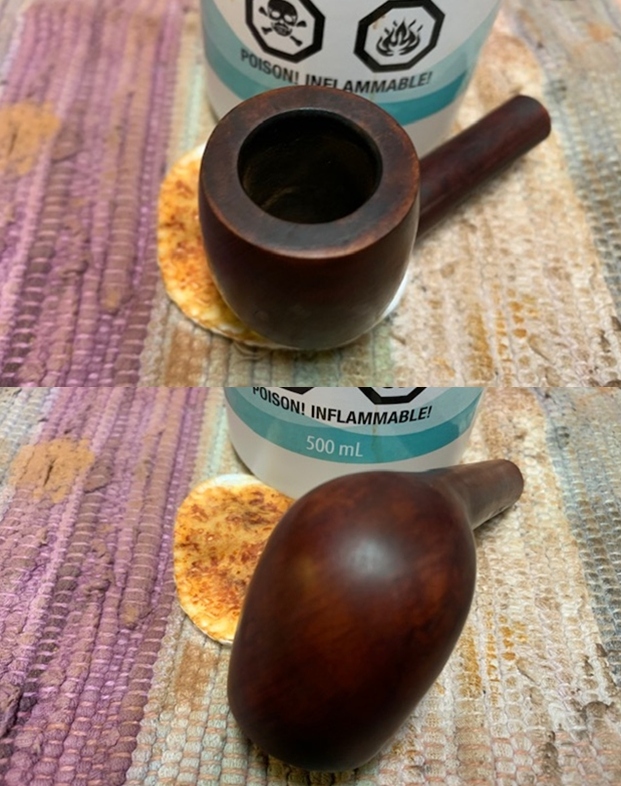
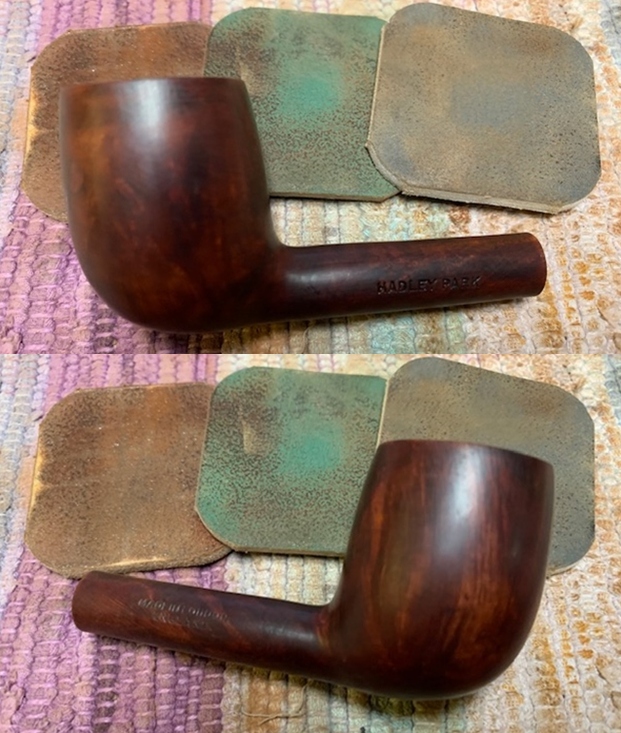
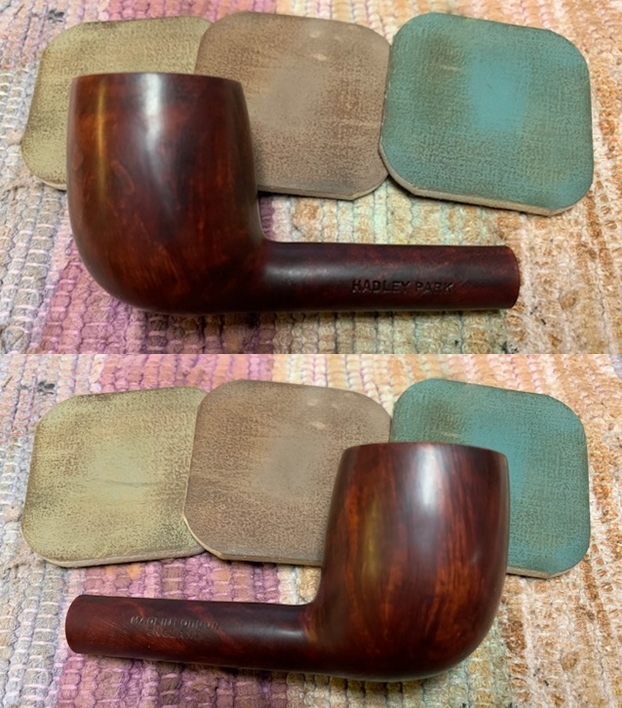
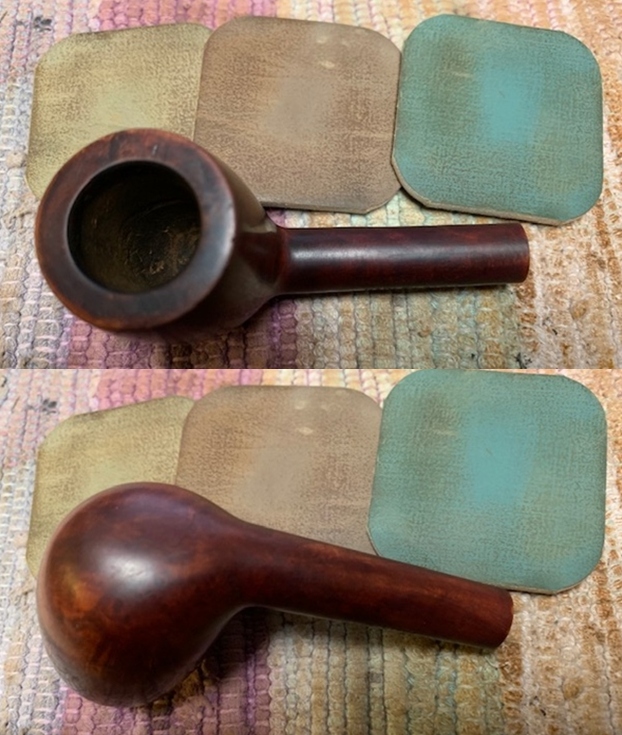
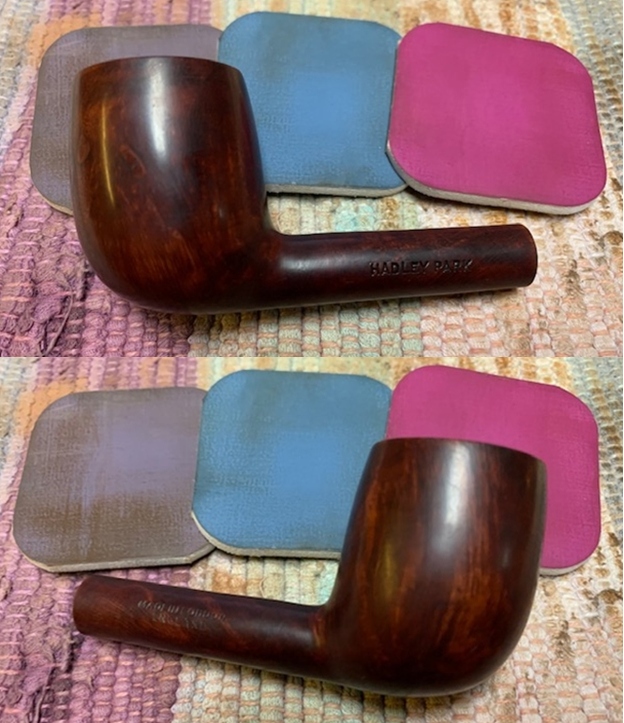
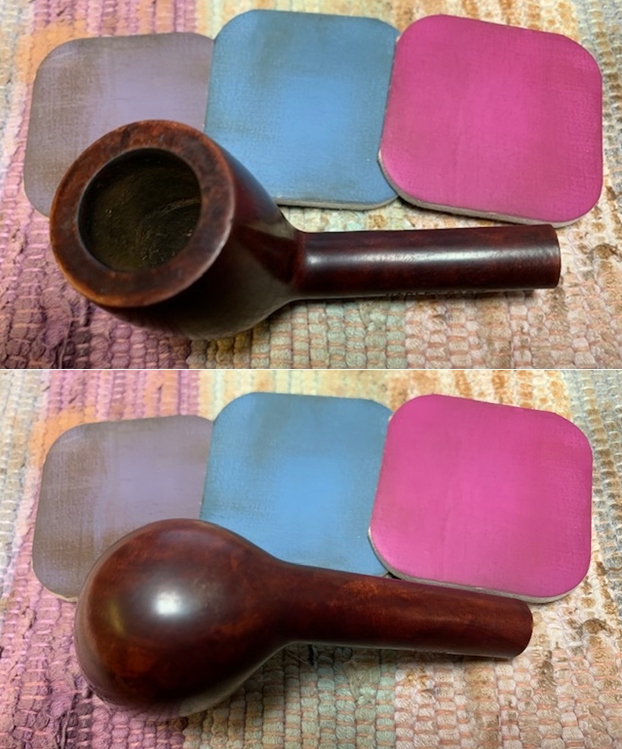
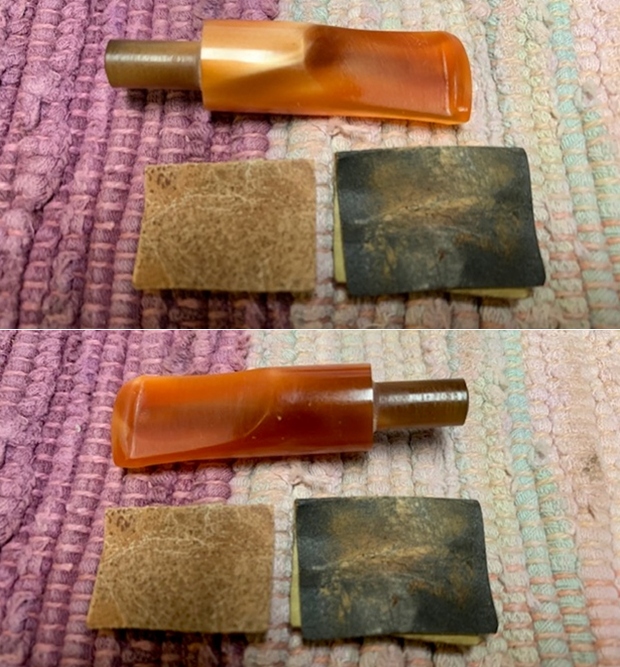
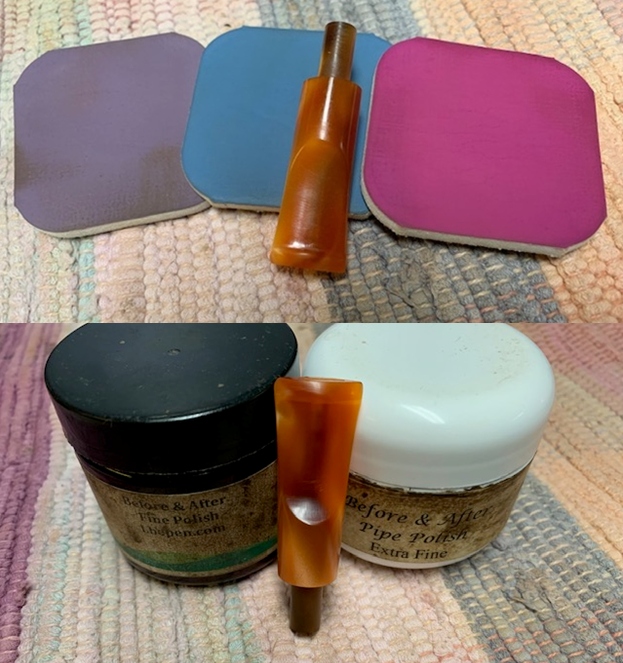
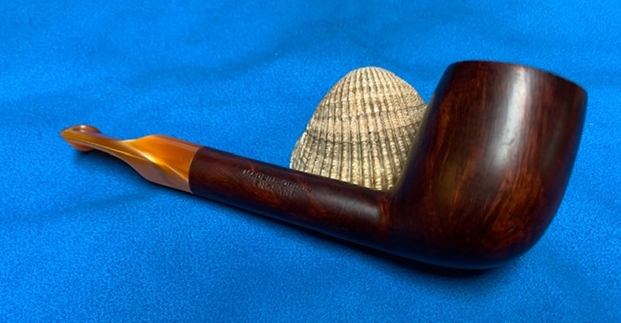
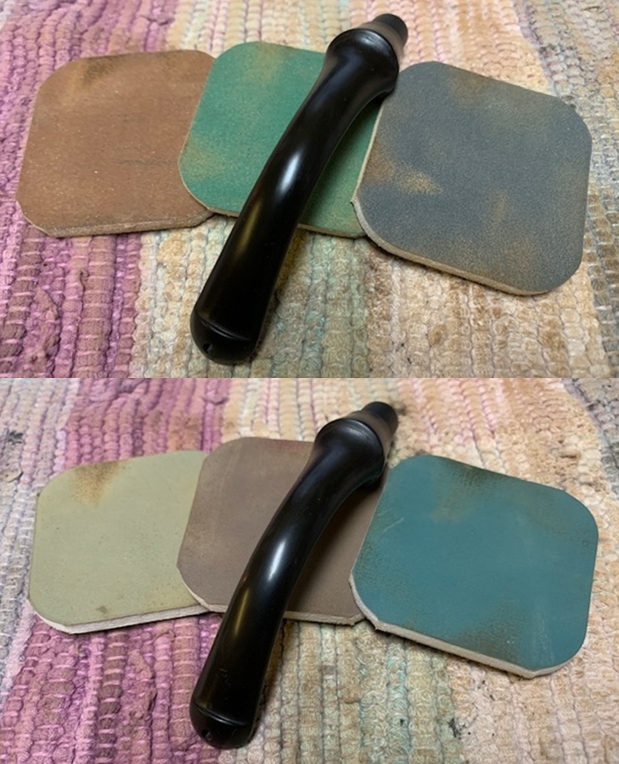
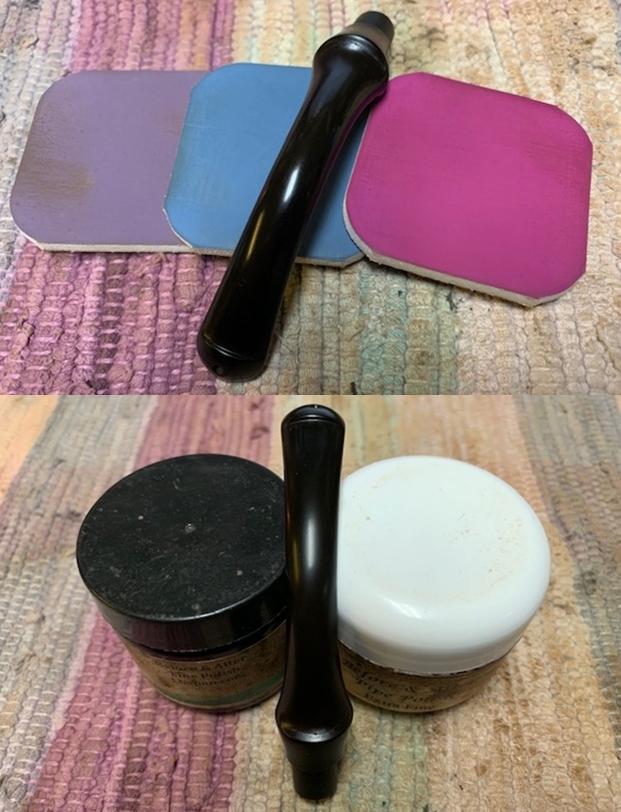
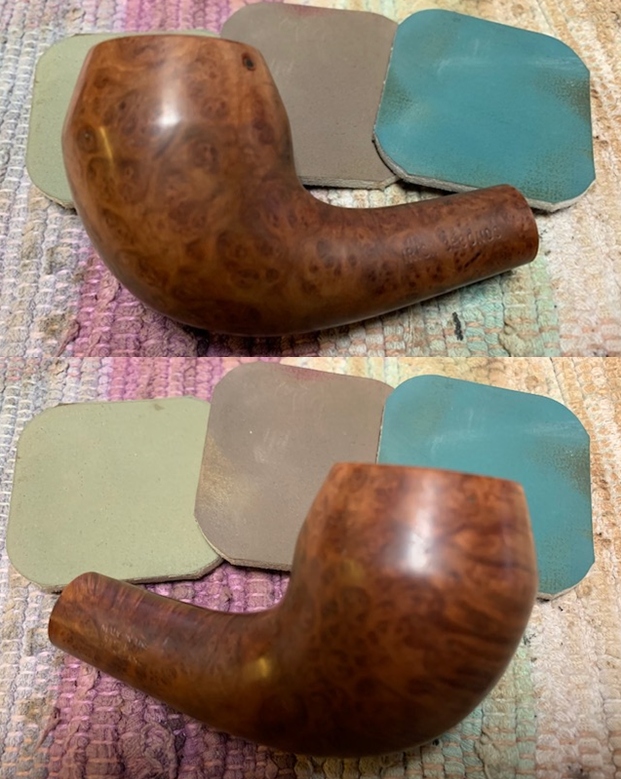
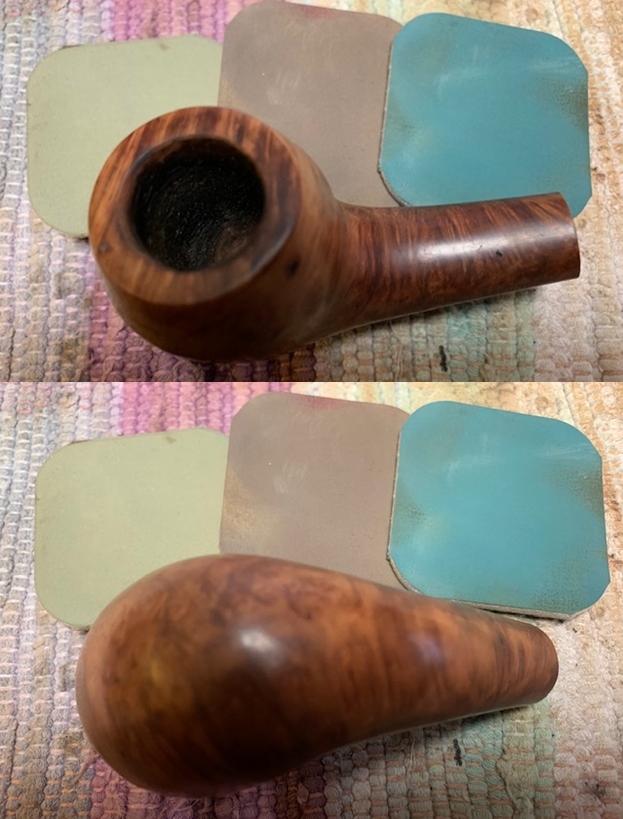
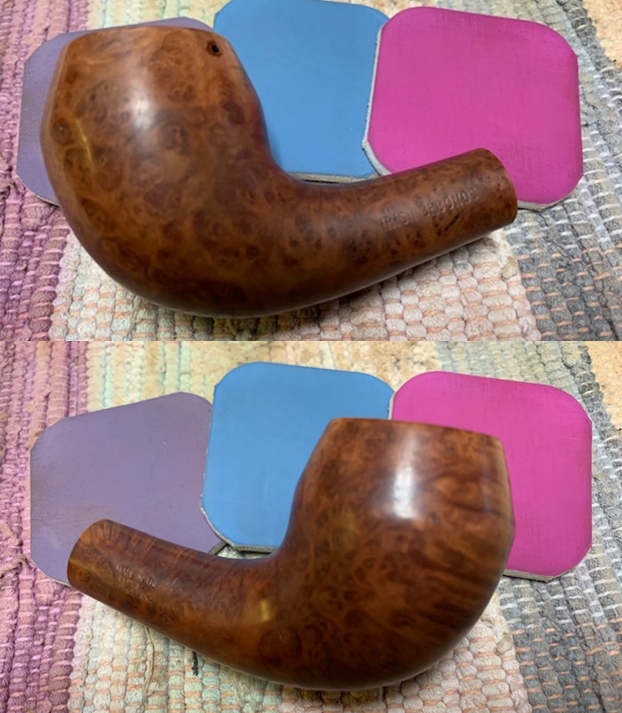
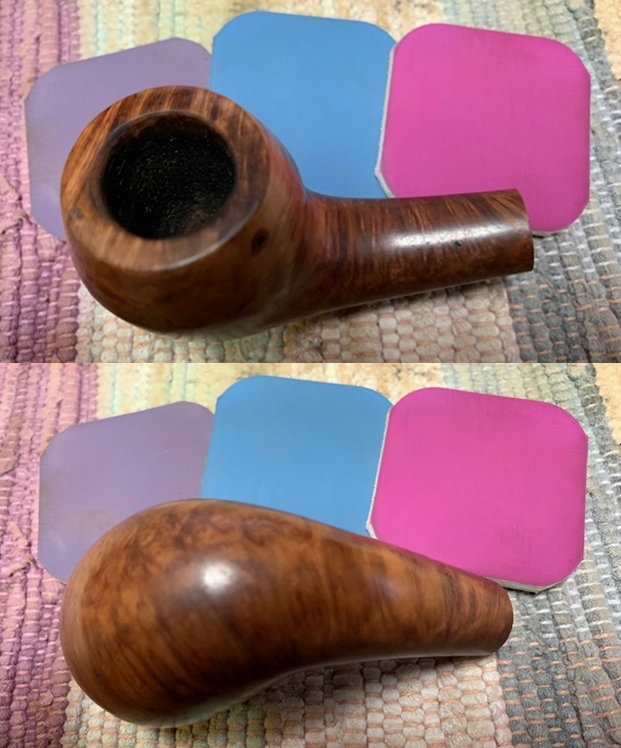
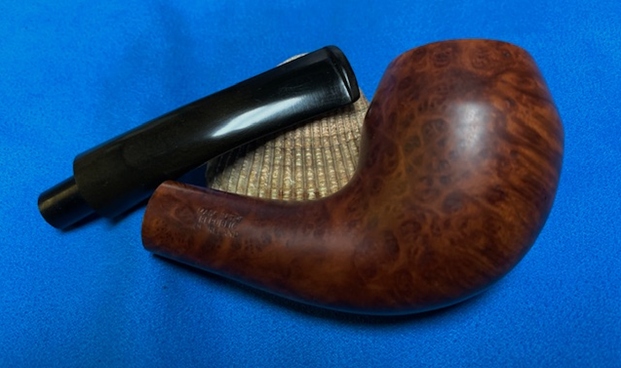
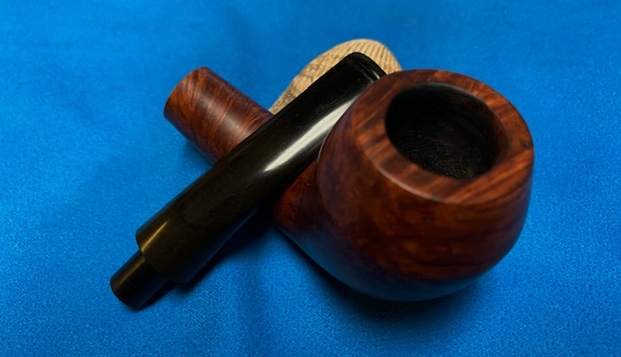
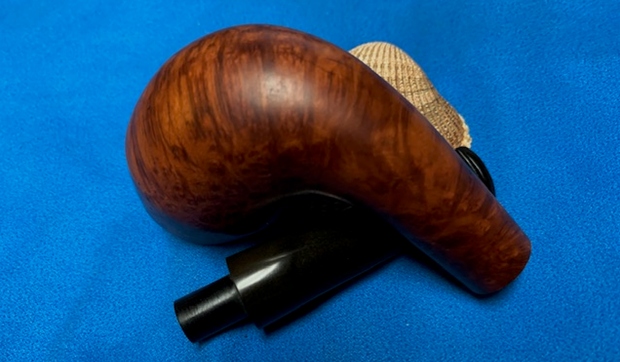
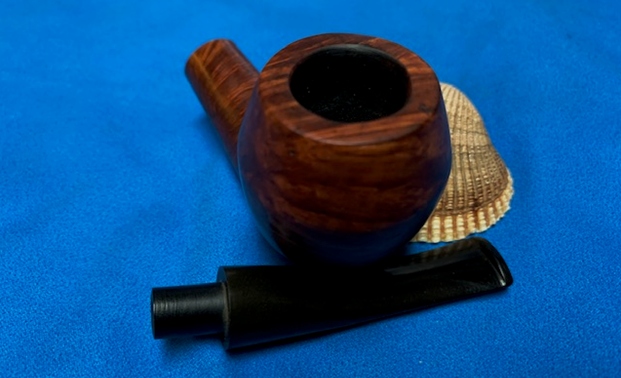
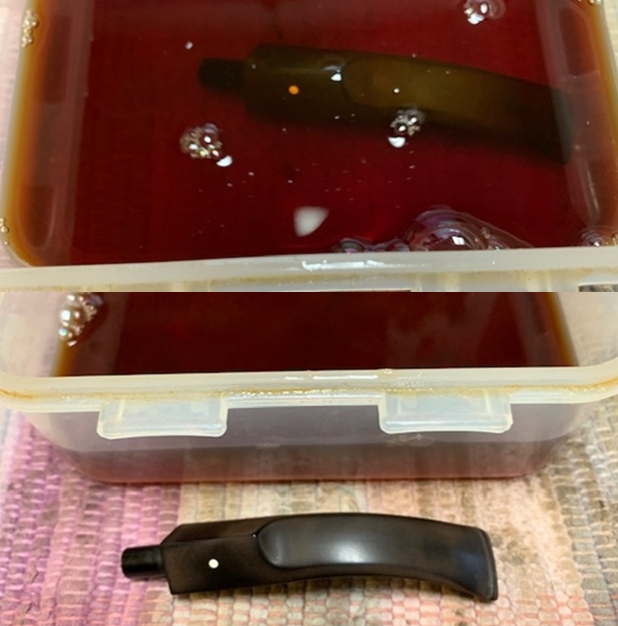
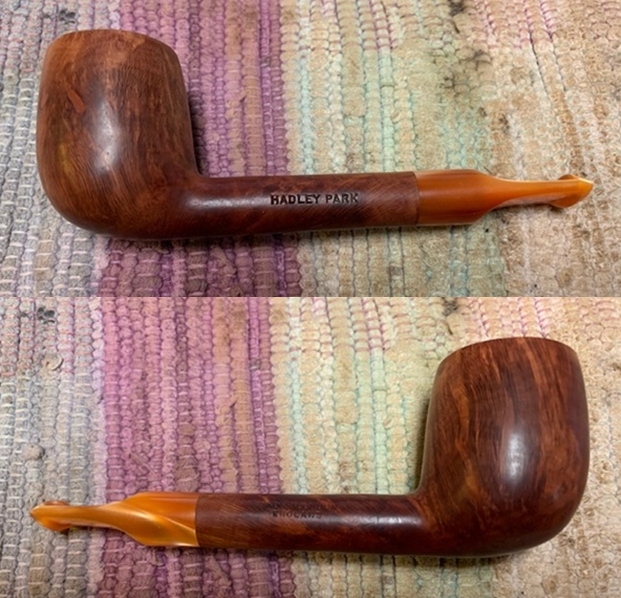
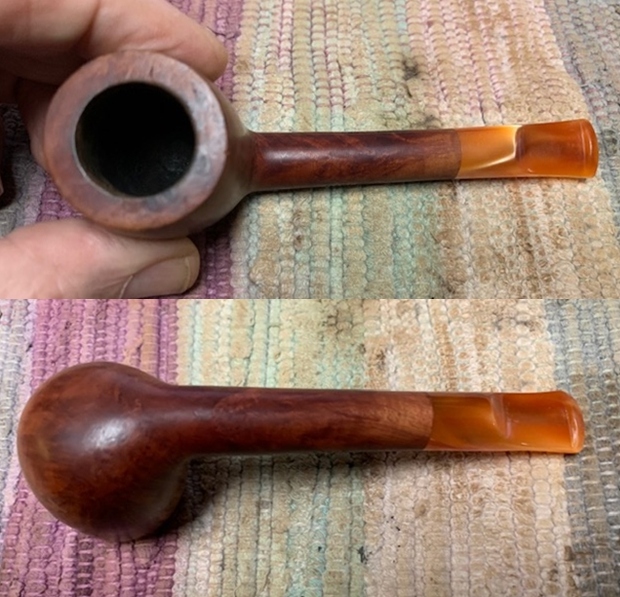
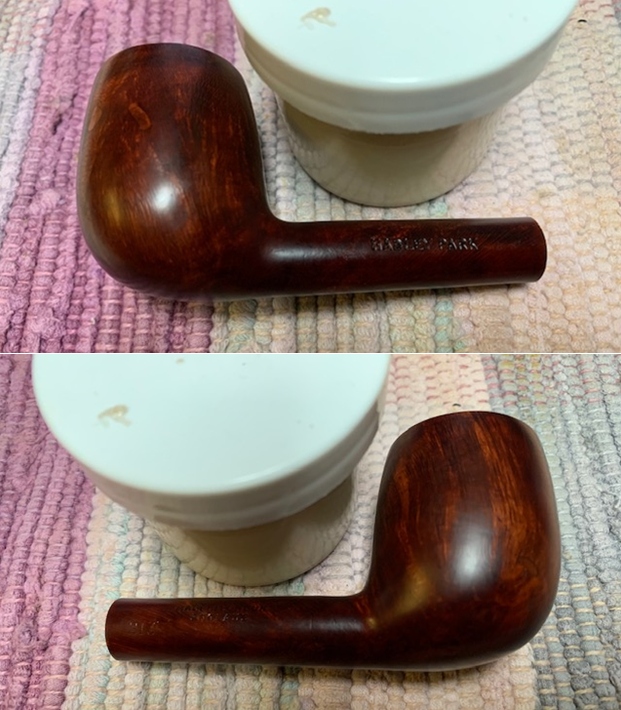
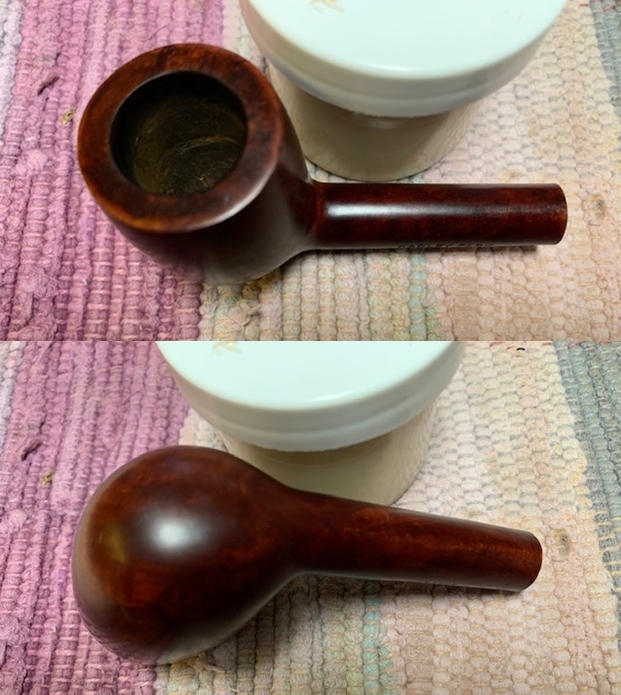
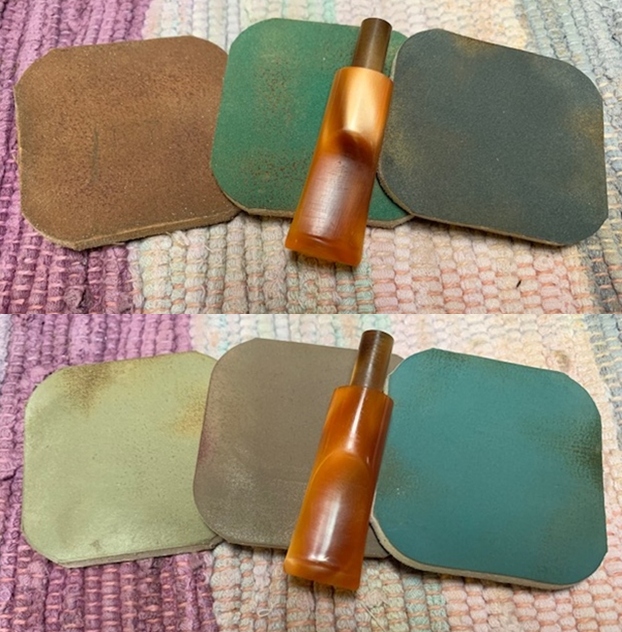
Jeff had cleaned up the pipe with his usual penchant for thoroughness. He reamed the pipe with a PipNet Pipe Reamer and cleaned up the remnants with a Savinelli Fitsall Pipe Knife.  He scrubbed the bowl with undiluted Murphy’s Oil Soap with a tooth brush. He rinsed it under running warm water to remove the soap and grime. He cleaned out the inside of the shank and the airway in the stem with alcohol, cotton swabs and pipe cleaners. He soaked the stem in Before & After Deoxidizer and rinsed it off with warm water. I took photos of the pipe once I received it. The rim top and inner edge of the rim showed some damage. The inner edge of the bowl was roughened and showed some darkening. The rim top also showed some damage. The stem surface looked good with some remaining oxidation and tooth marks and chatter on both sides near the button.    I took a photo of the stamping on the shank. It is clear and readable as noted above. I removed the stem and took a photo of the pipe to give a sense of the whole. The stem is a short acrylic saddle.   I decided to start my work on the pipe by cleaning up the damaged inner edge of the bowl. I reworked the edge with a folded piece of 220 grit sand paper. Once I finished the rim and edge looked much better.    I moved next to repairing the damaged fills on the front left of the bowl. I filled them in with clear super glue and briar dust. Once it cured I sanded them smooth and blended them into the surrounding briar.   With the repaired fills being lighter than the surrounding briar I decided to restain the bowl with a light brown aniline stain. I applied the stain and flamed it with a lighter to set it in the grain. I repeated the process until I was happy with the coverage on the bowl. Once the stain had cured I removed it from the cork and took photos of the new look before I buffed or polished it at all.  I buffed the bowl with red Tripoli and then wiped it down with a cotton pad and isopropyl alcohol to make the stain a bit more transparent and show the grain around the bowl sides. I polished it with micromesh sanding pads – wet sanding with 1500-12000 grit pads and wiping it down after each pad with a damp cloth.      I rubbed the bowl and shank down with Before & After Restoration Balm. I worked it into the surface of the bowl sides and shank with my fingertips to clean, enliven and protect the briar. I let the balm sit for 15 minutes and then buffed with a cotton cloth to raise the shine.  I set the bowl aside and turned to work on the stem. I sanded out the tooth chatter and marks with 220 grit sandpaper and started polishing the stem with 400 grit wet dry sandpaper.I polished the acrylic stem with micromesh sanding pads – 1500-12000 grit pads. I wiped it down with a damp cloth after each sanding pad. I used Before & After Pipe Polish – both Fine and Extra Fine to further polish the stem.    This Hadley Park 213 Lovat with an orange/butterscotch acrylic stem is a great looking pipe now that it has been restored. There is some great grain around the bowl and shank. I put the stem back on the bowl and carefully buffed the pipe with Blue Diamond on the buffing wheel using a light touch on the briar. I gave the bowl and the stem multiple coats of carnauba wax on the buffing wheel and followed that by buffing the entire pipe with a clean buffing pad. I hand buffed the pipe with a microfiber cloth to deepen the shine. The finished Hadley Park Lovat is petite but fits nicely in the hand and feels great. Give the finished pipe a look in the photos below. The dimensions of the pipe are Length: 5 inches, Height: 1 ¾ inches, Outside diameter of the bowl: 1 ¼ inches, Chamber diameter: ¾ of an inch. The weight of the pipe is 34gr/1.23oz. If you are interested in adding this pipe to your collection send me a message or an email. Thanks for reading this blog and my reflections on the pipe while I worked on it. There are many more to come!

Restoring a Peterson’s Republic Era System Standard 312 Bent Billiard


Blog by Steve Laug

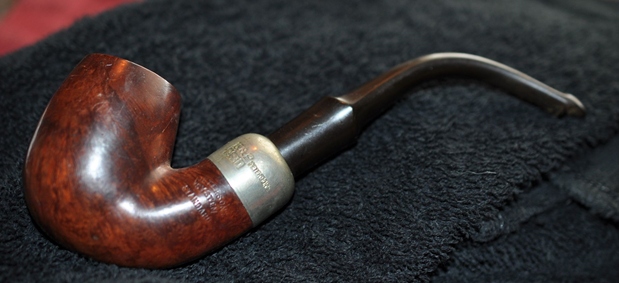
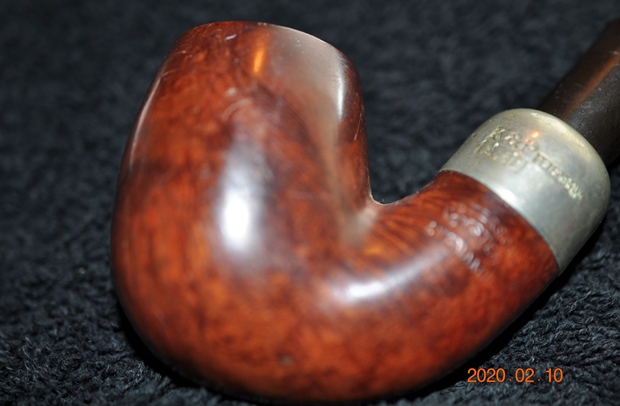
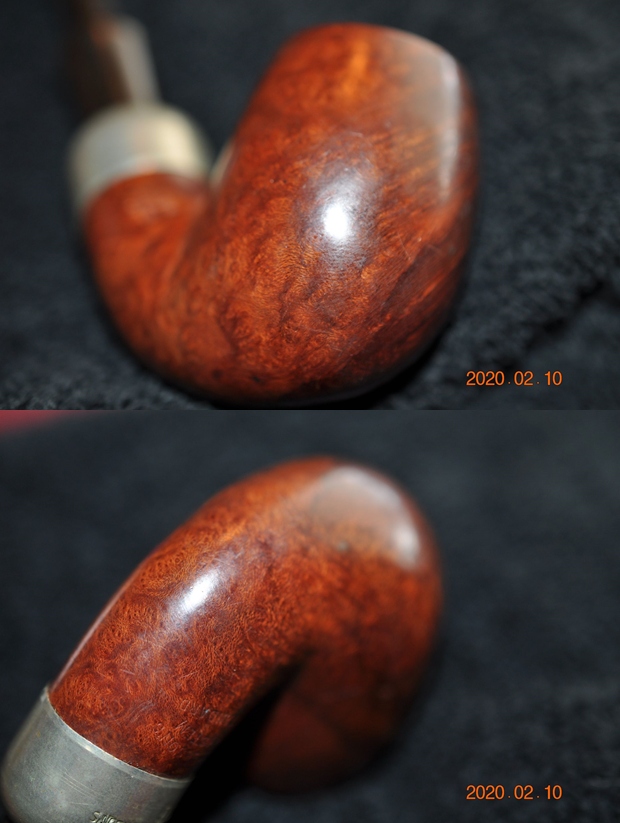
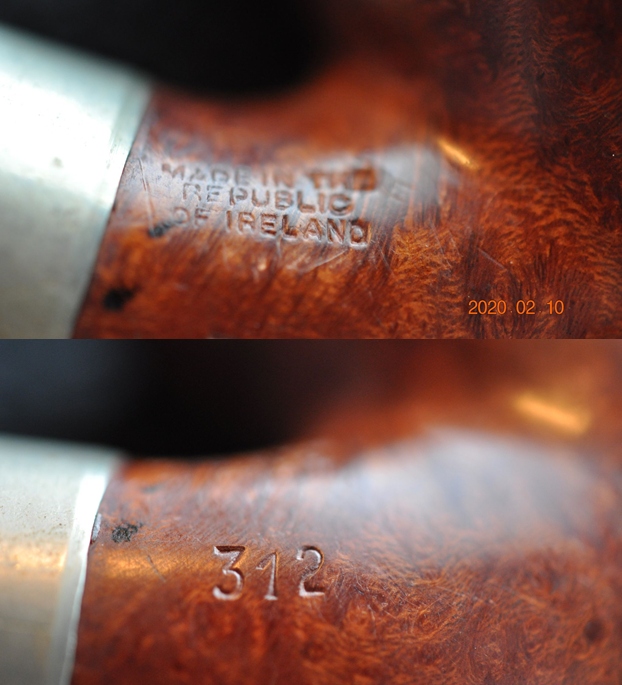
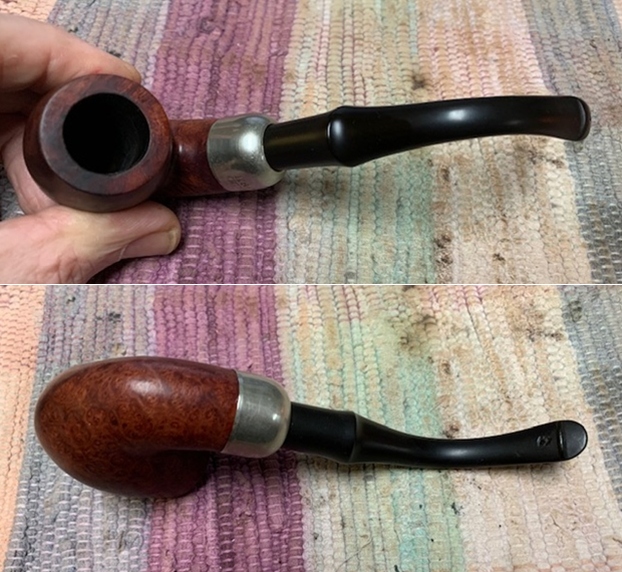
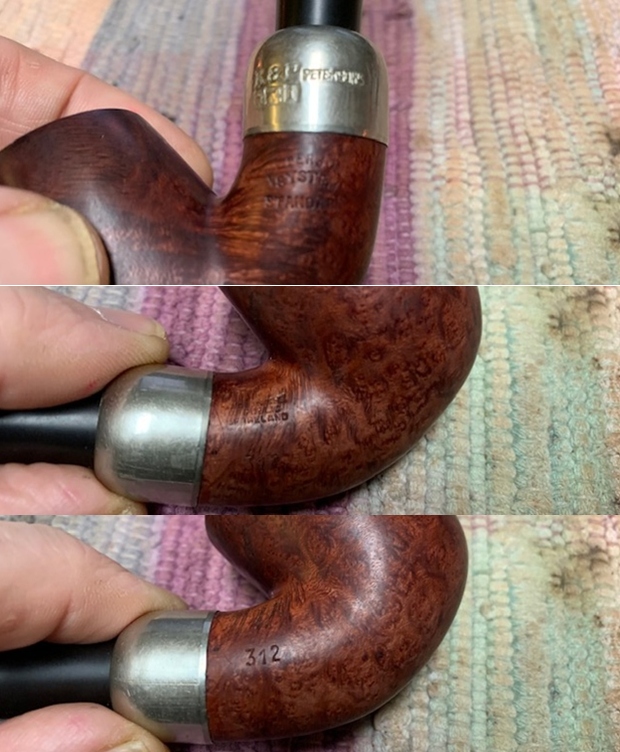
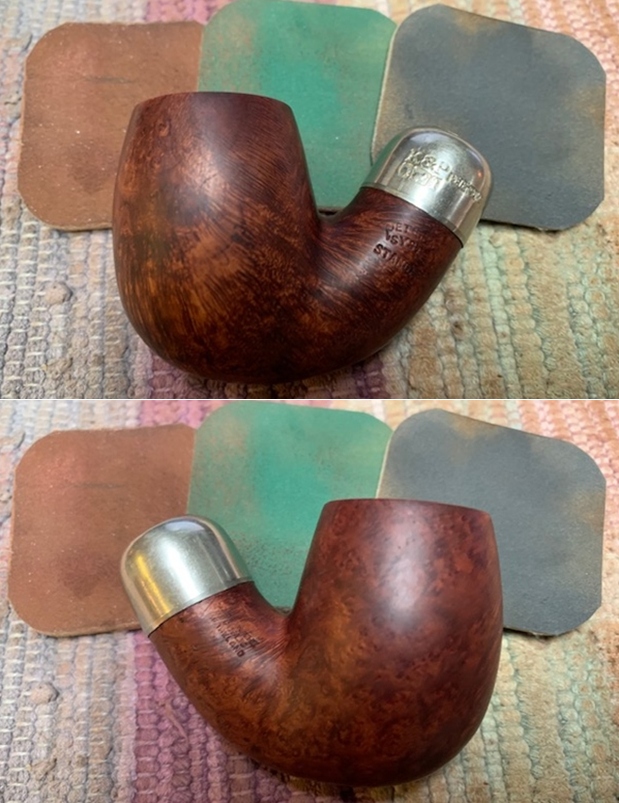
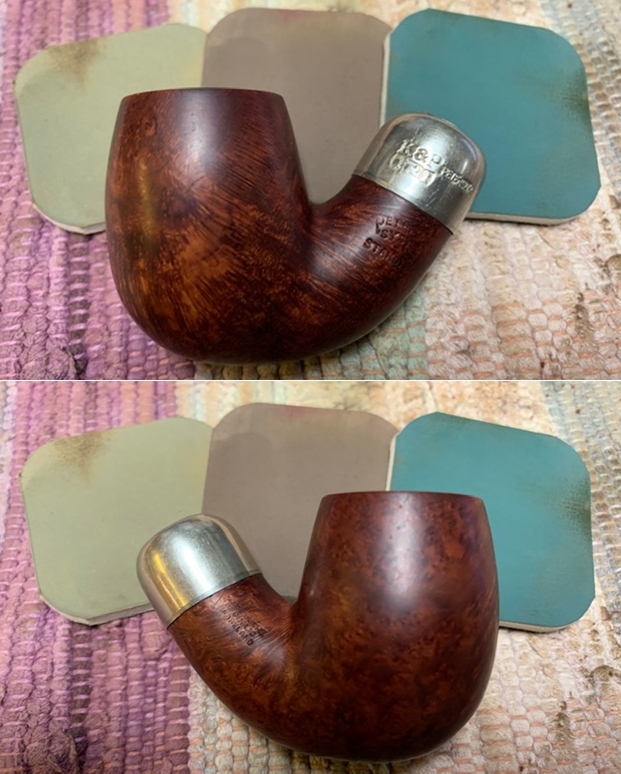
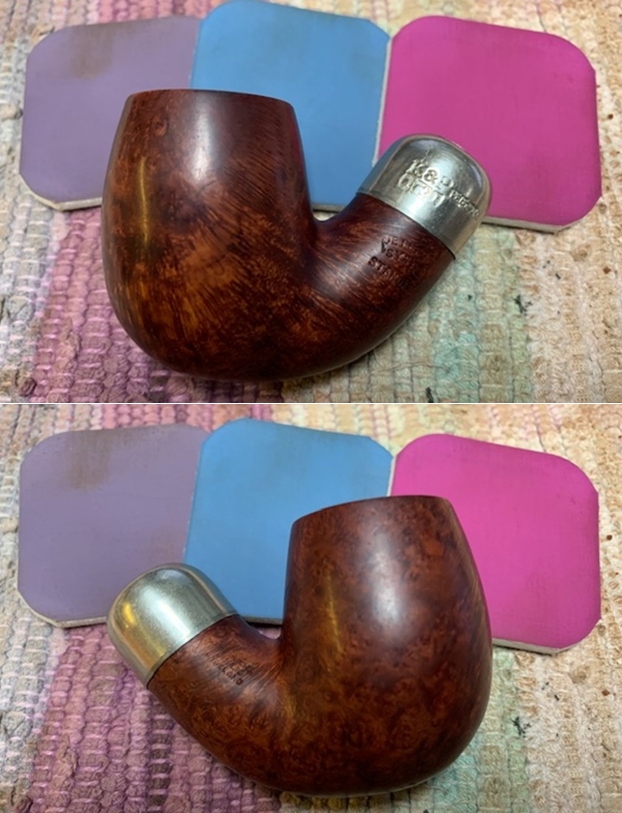
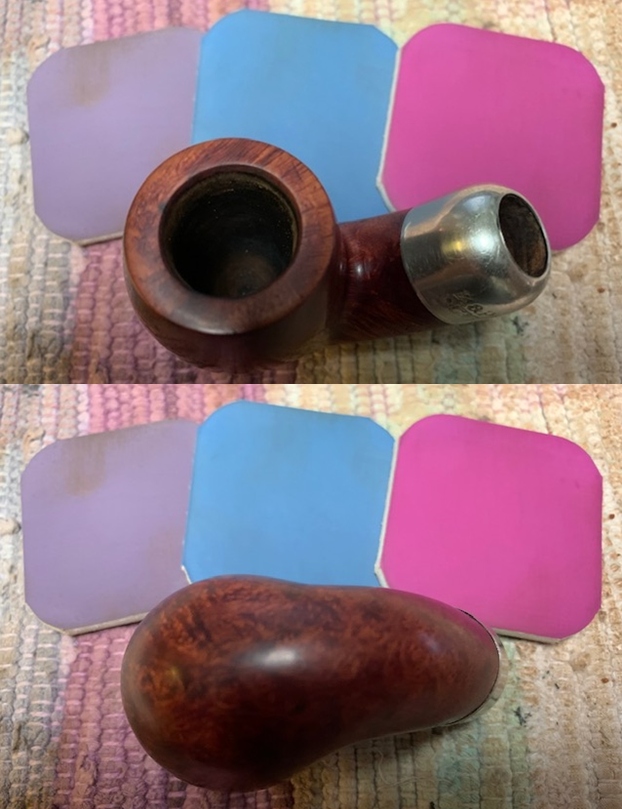
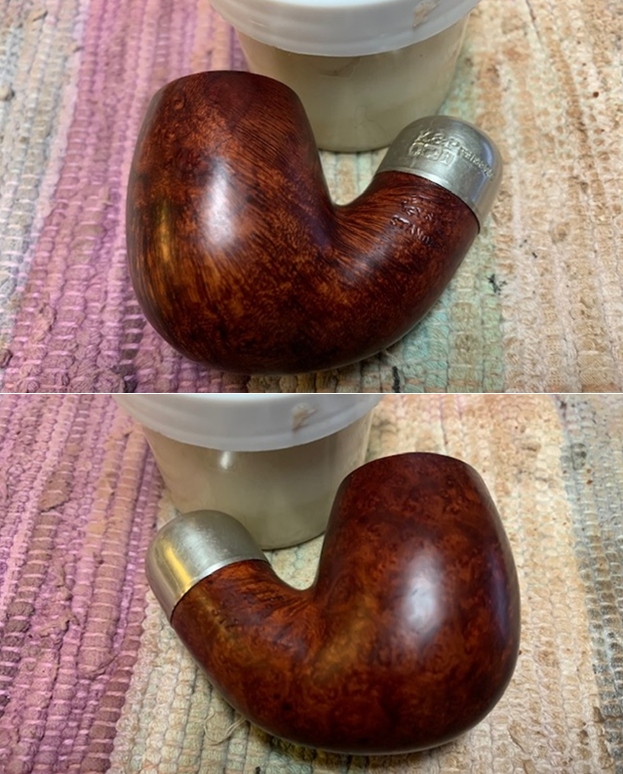
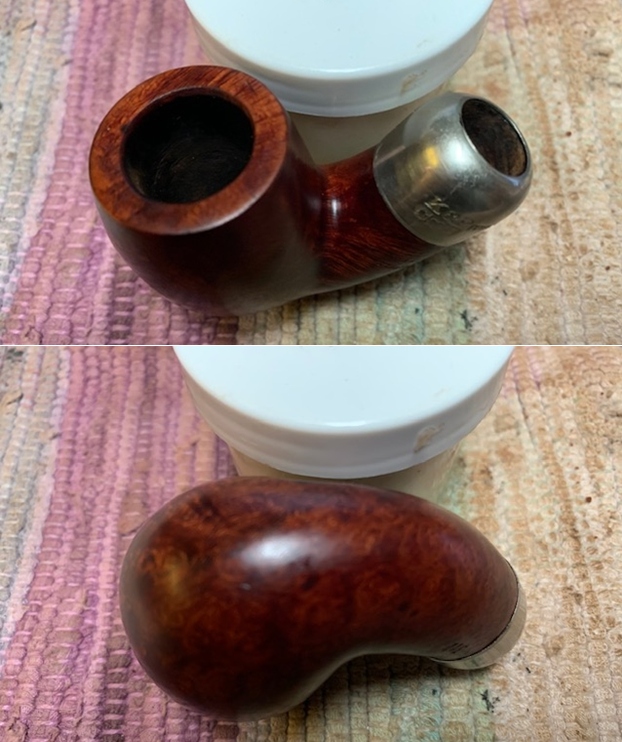
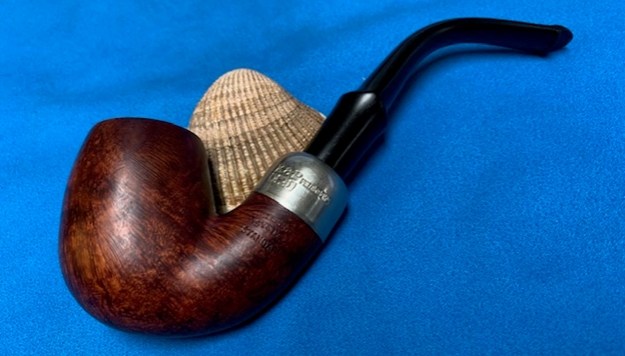
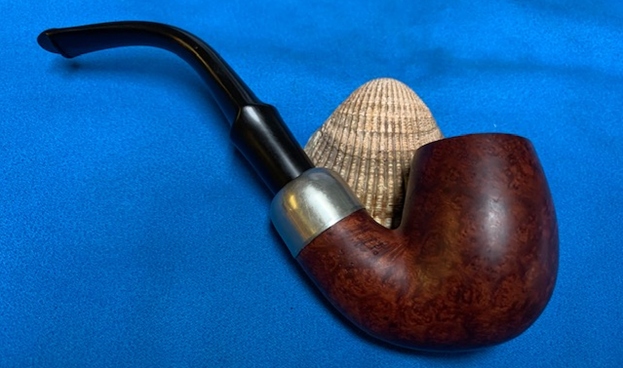
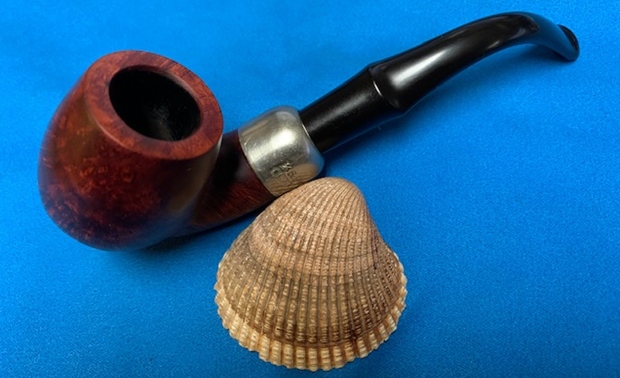
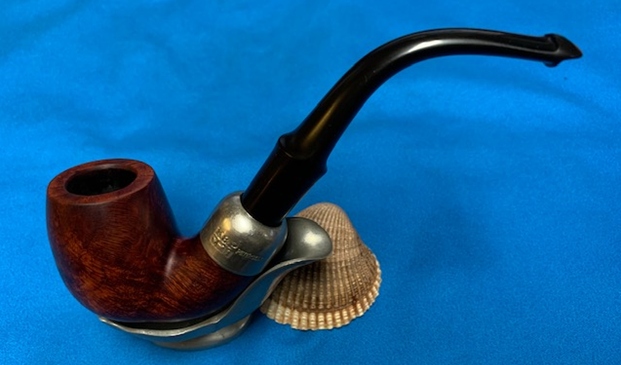
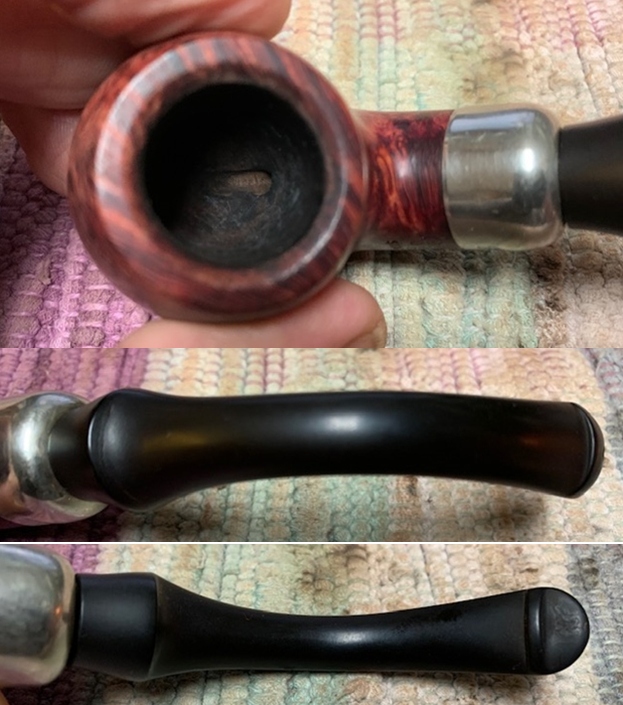
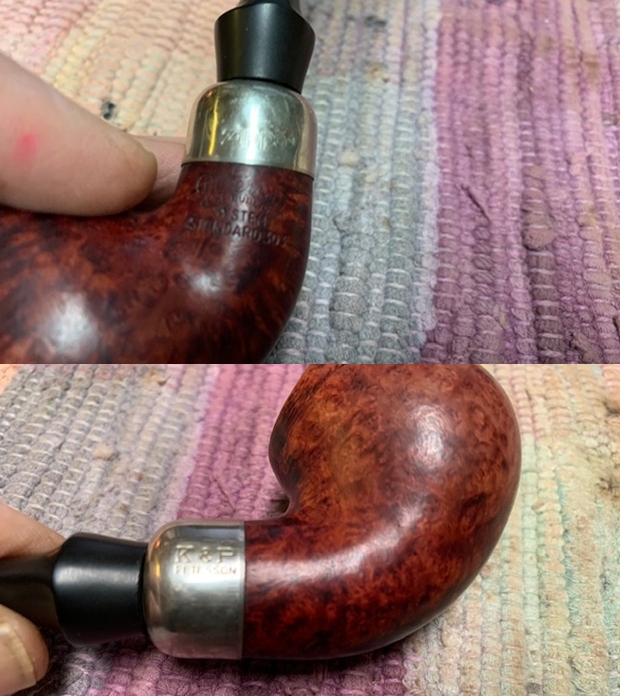
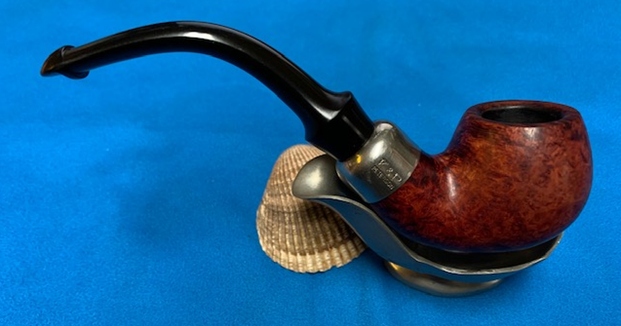
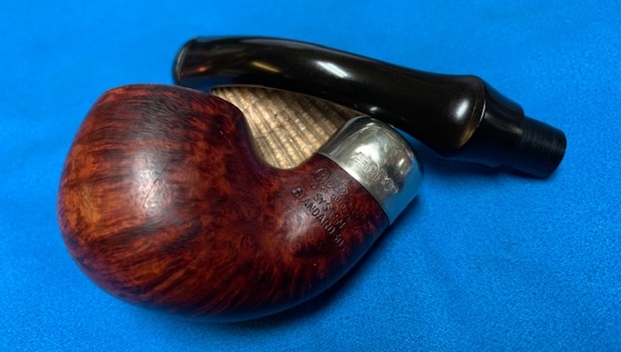
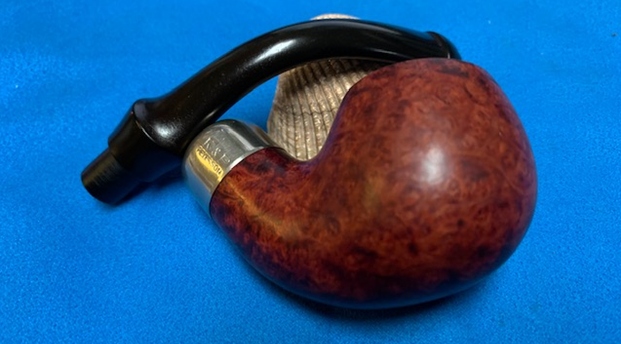
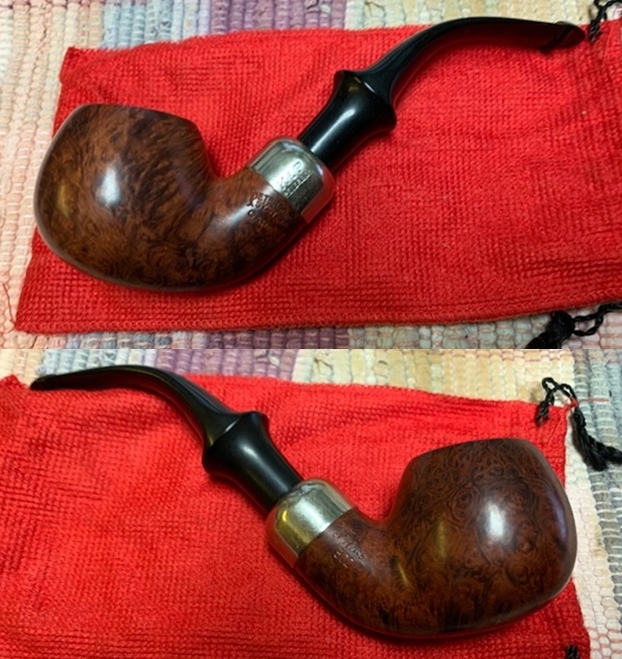
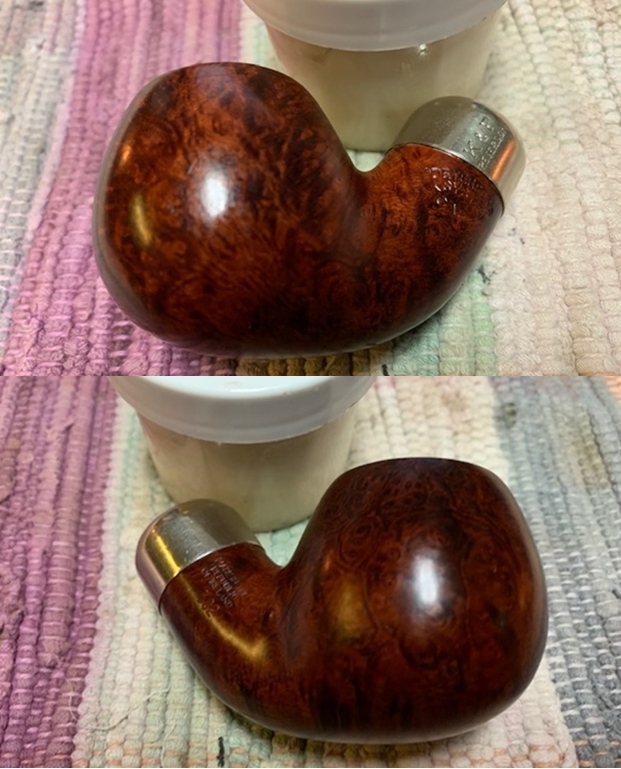
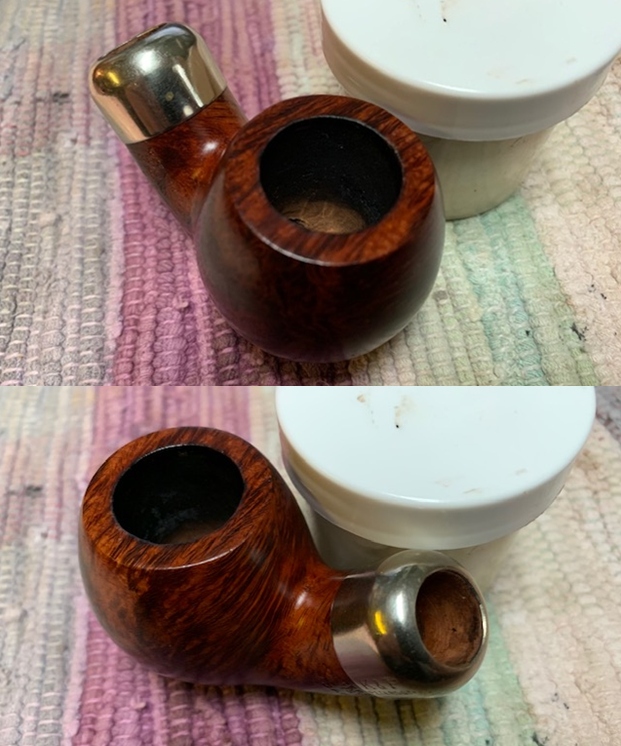
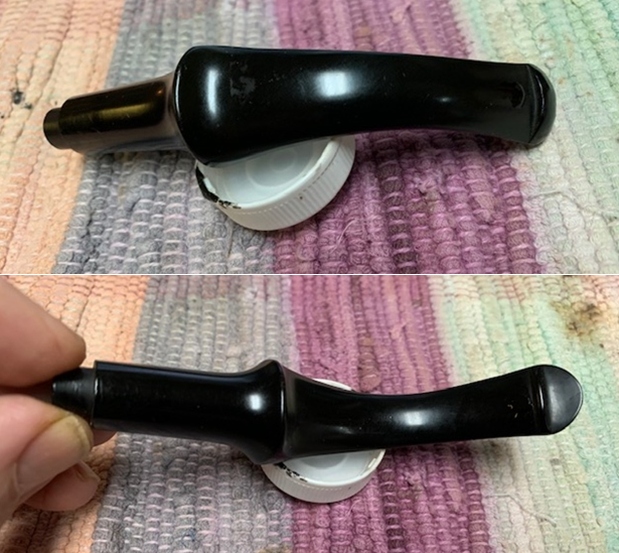
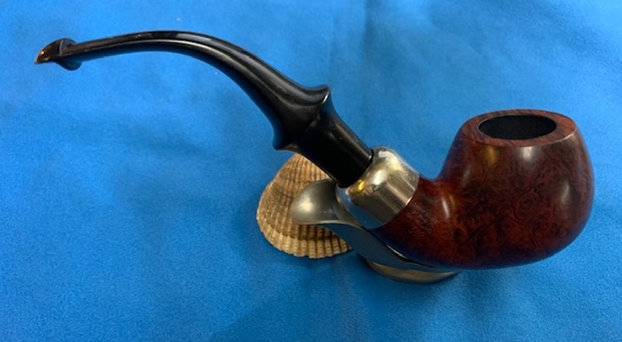
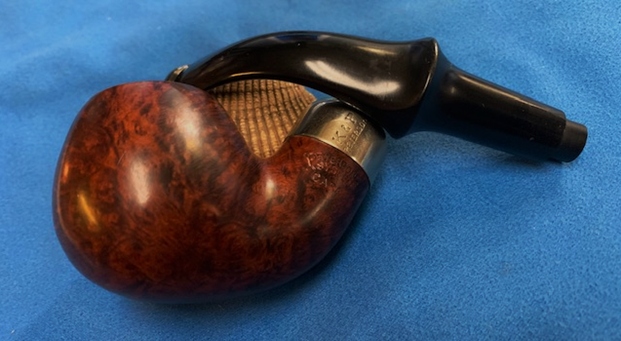
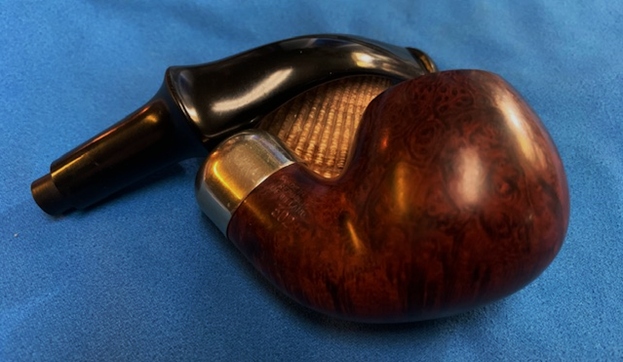
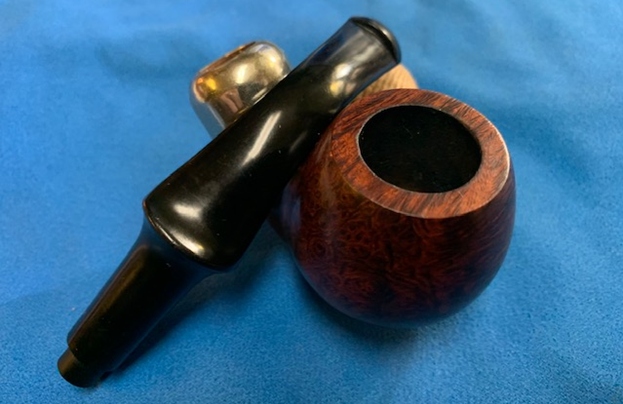
The next pipe on the work table came to us from an online auction from Front Royal, Virginia, USA. It is a smooth Peterson’s System pipe with a saddle vulcanite stem. The pipe is stamped on the left side of the shank and reads Peterson’s [over] System [over] Standard. On the right side it is stamped Made in the Republic of Ireland and underneath that is the shape number 312. The nickel ferrule is stamped K & P Peterson with three hallmarks underneath. The finish had a lot of grime ground into it and it was very dirty. The bowl was moderately caked and there was a light lava coat on the flat rim top and the inner edge of the rim. The inner edge had some nicks and damage and the rim top had a lot of scratches that looked like the rim top had been scraped with a knife. The stem was oxidized, calcified and had tooth chatter and marks on the top and underside near the P-lip style button. It also had a bite through on the underside of the stem just ahead of the button. The pipe showed promise but it was very dirty. Jeff took photos of the pipe before he started his cleanup work.   He took photos of the rim top and bowl to give a clear picture of the thickness of the cake and the condition of the rim top and edges. He also took photos of the top and underside of the stem to show the oxidation, calcification and chatter and tooth marks. The photo of the underside of the stem you can see the bite through that is present.  Jeff took a photo of the side and heel of the bowl to give a picture of what the briar around the pipe looked like.     He took photos of the stamping on the shank and the nickel ferrule. It reads as noted above and is clear and readable.   I am including the information from Pipedia’s article on Peterson pipes. It is a great read in terms of the history of the brand (https://pipedia.org/wiki/Peterson). I have included a bit of the pertinent history here.
1950 – 1989 The Republic Era – From 1950 to the present time, the stamp for this era is “Made in the Republic of Ireland” in a block format generally in three lines but two lines have been used with or without Republic being abbreviated.

I knew that I was dealing with a Republic Era pipe made between 1950-1989. It was a smooth Peterson’s System Standard 312 Billiard with nice grain. The finish was stained with a combination of brown stains. Now it was time to work on the pipe.

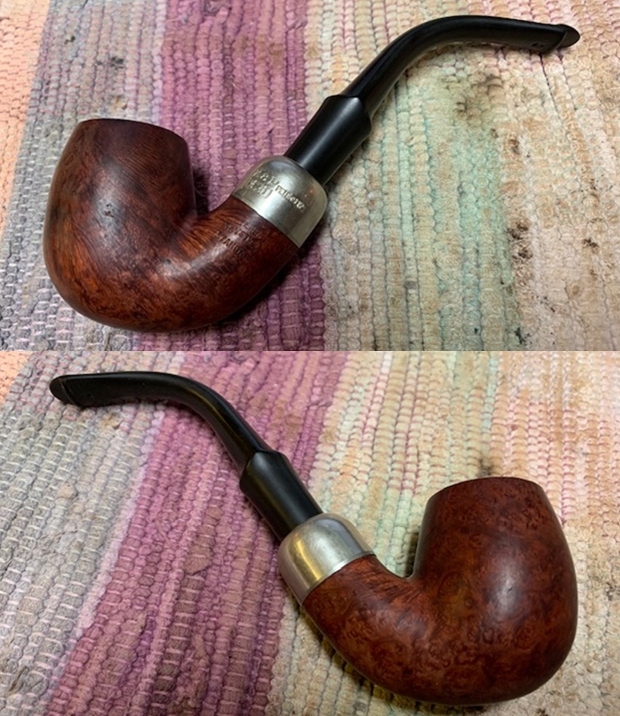
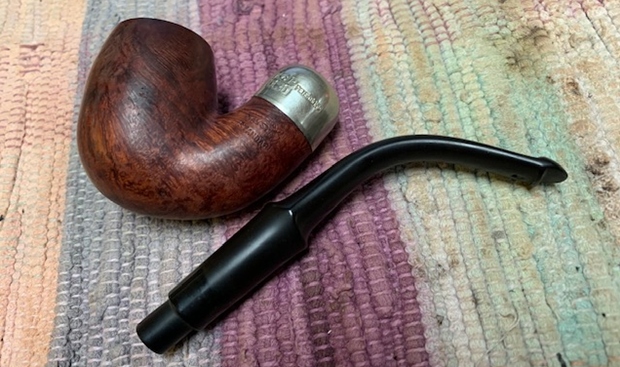
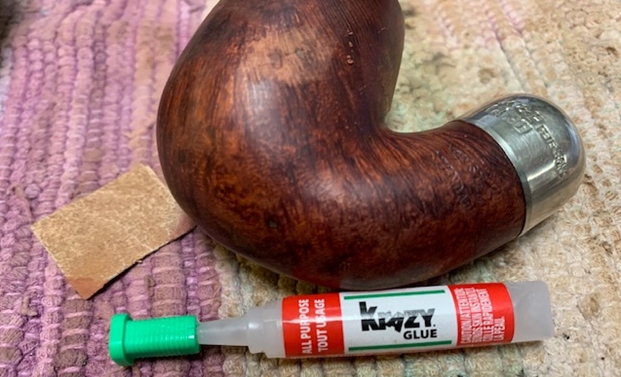
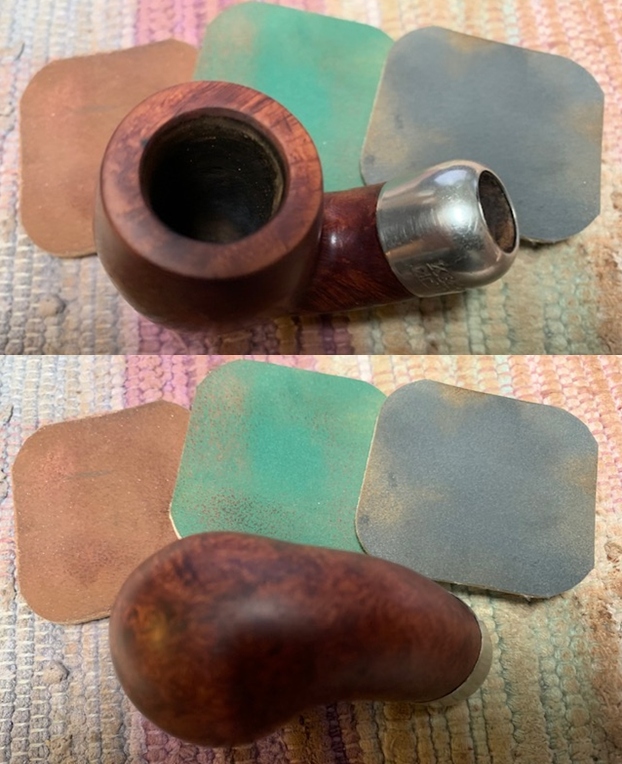
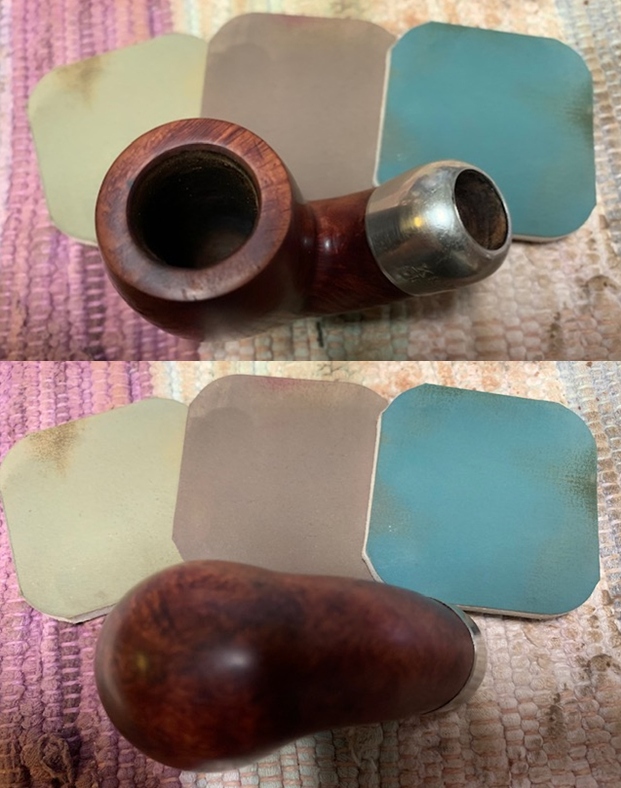
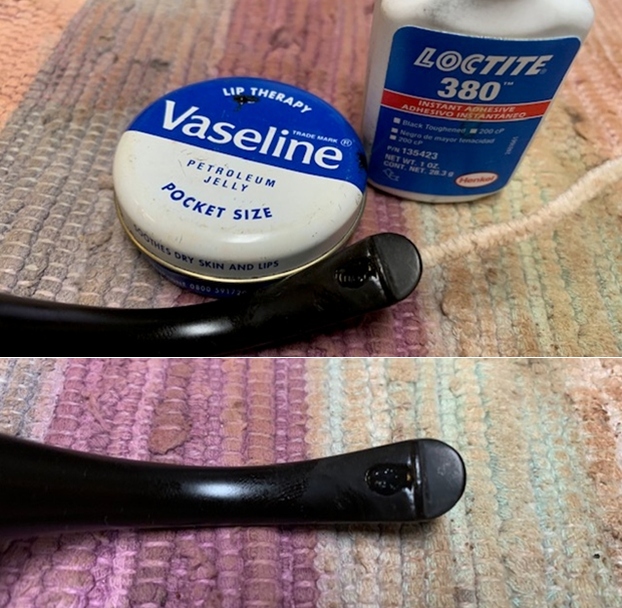
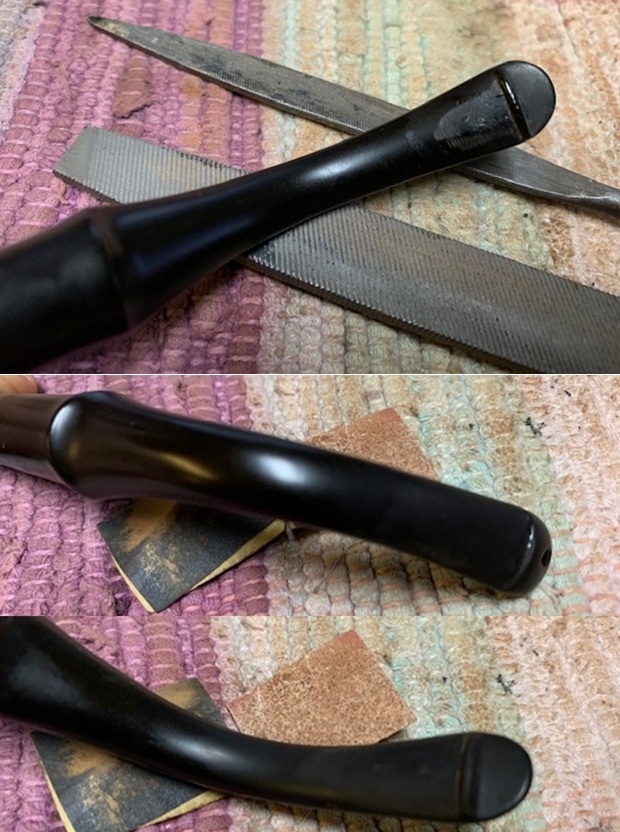
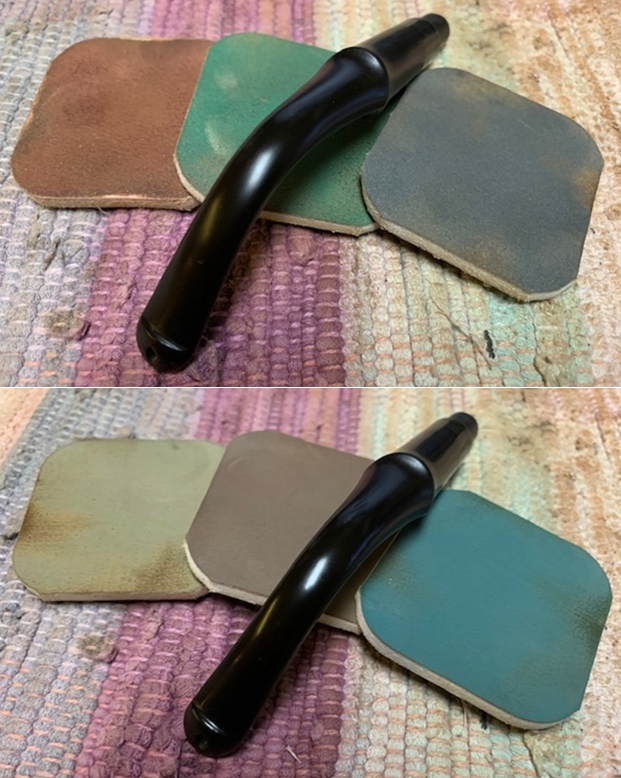
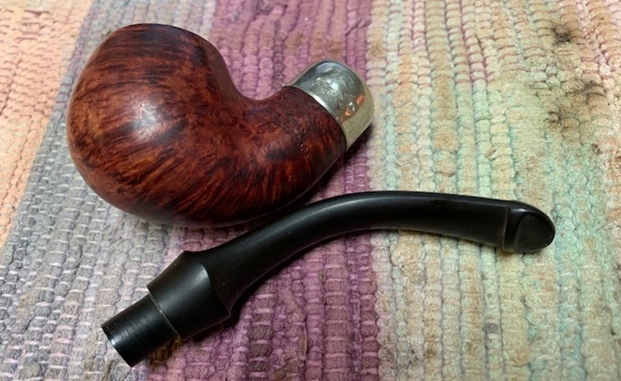
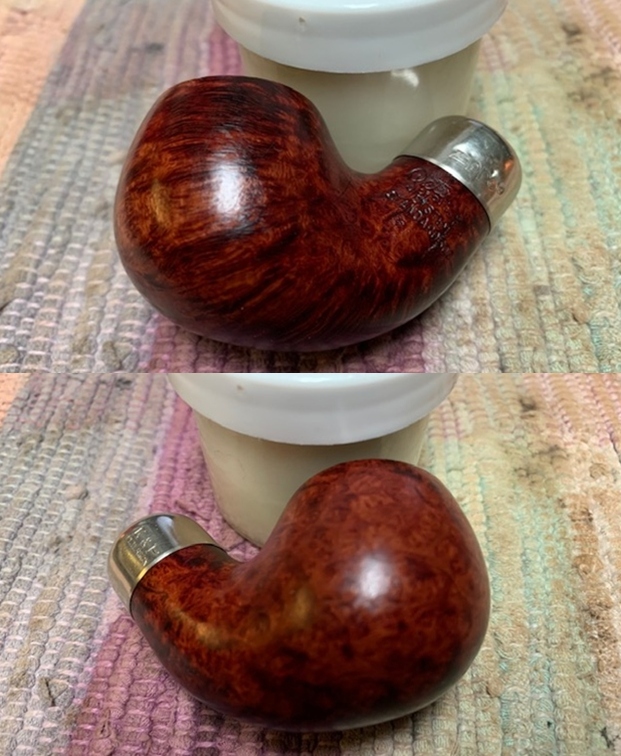
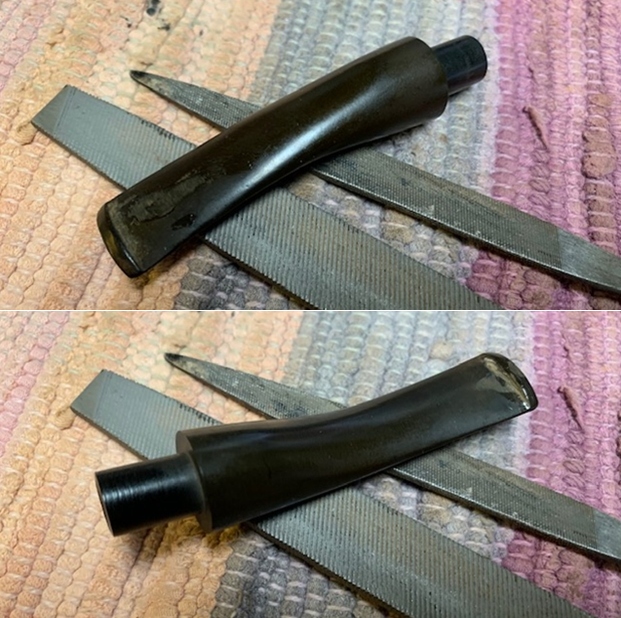
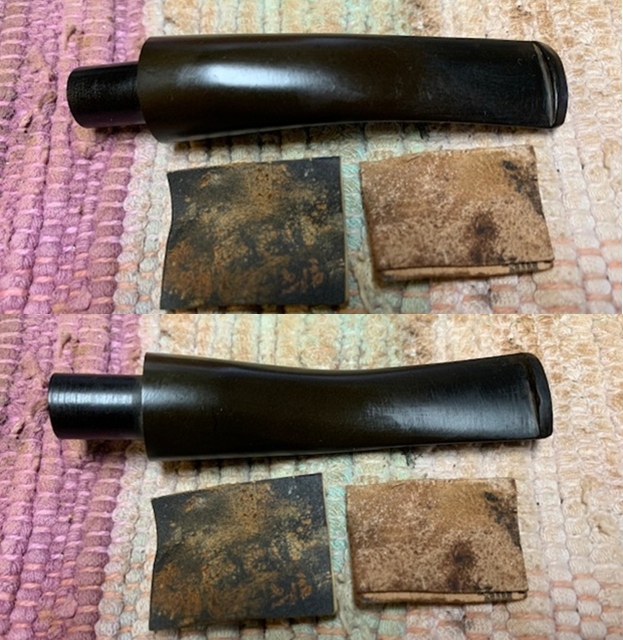
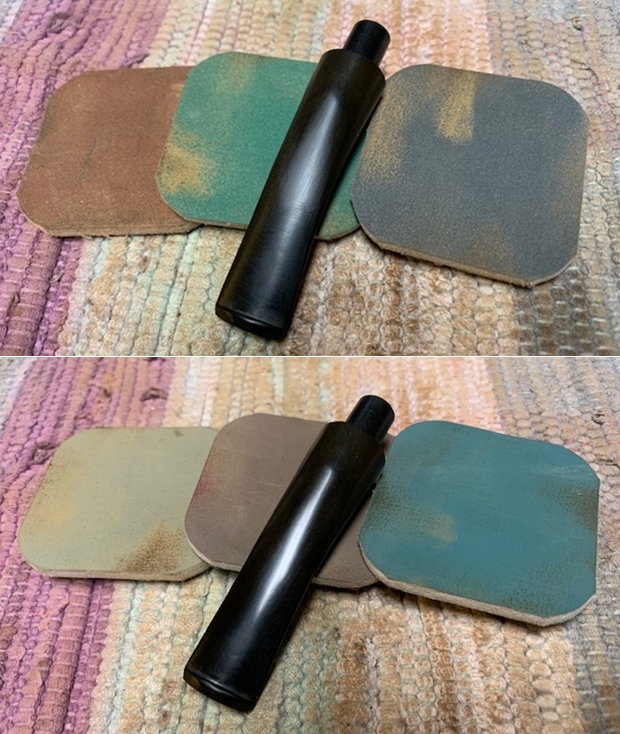
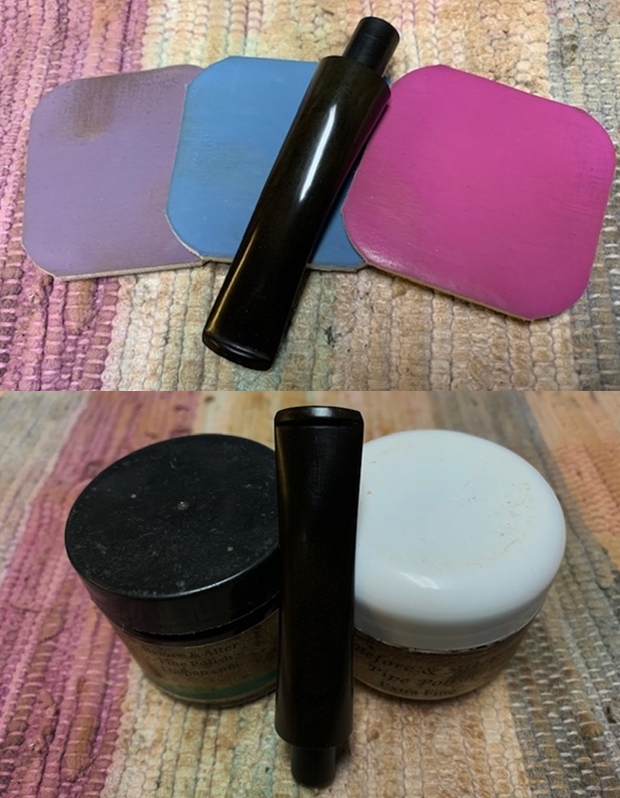
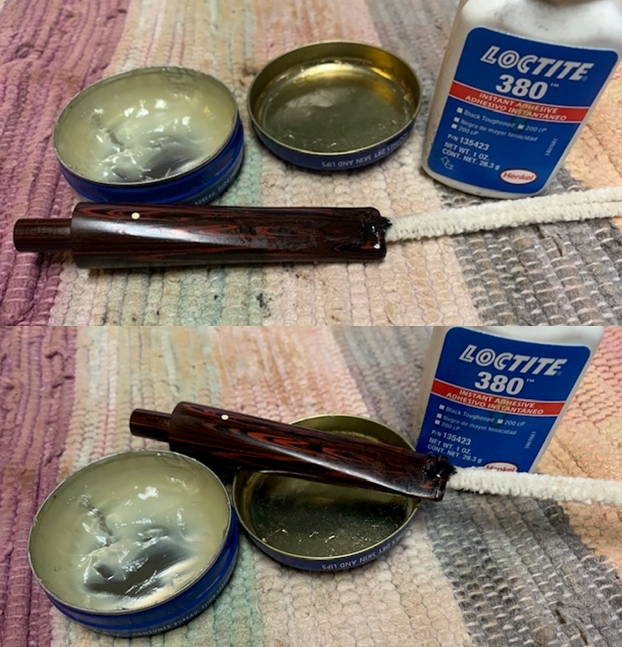
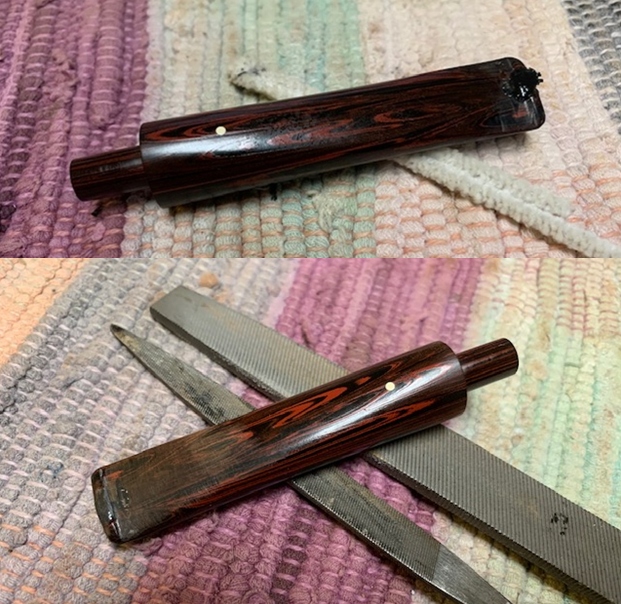
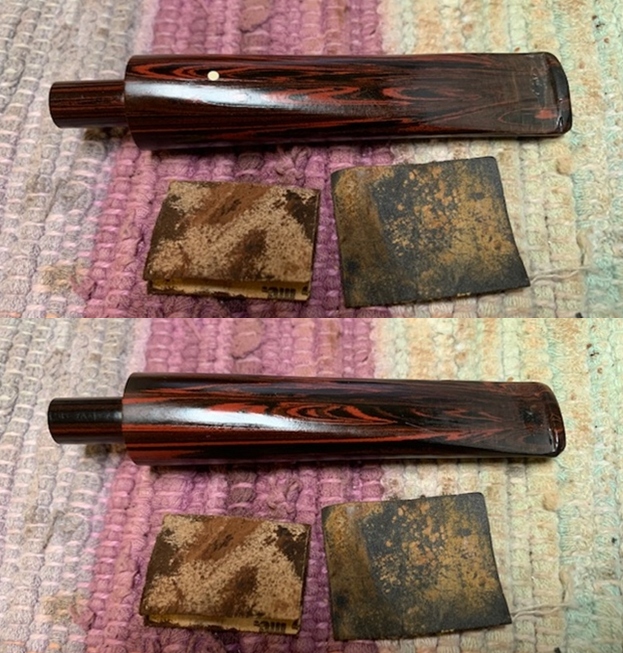
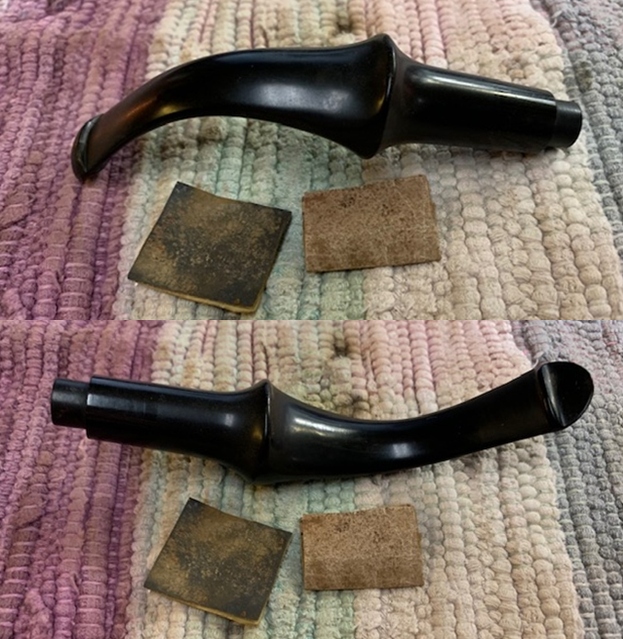
Jeff had cleaned up the pipe with his usual penchant for thoroughness. He reamed the pipe with a PipNet Pipe Reamer and cleaned up the remnants with a Savinelli Fitsall Pipe Knife.  He scrubbed the bowl with undiluted Murphy’s Oil Soap with a tooth brush. He rinsed it under running warm water to remove the soap and grime. He cleaned out the inside of the shank and the airway in the stem with alcohol, cotton swabs and pipe cleaners. He soaked the stem in Before & After Deoxidizer and rinsed it off with warm water. I took photos of the pipe once I received it. The rim top and inner edge of the rim looked very good with a bit of damage on the inner edge and on the rim surface. The stem surface looked very good with some tooth marks and chatter on both sides near the button.  The bite through on the underside of the stem is not huge but it is very present.  I took a photo of the stamping on the shank. It is clear and readable as noted above.    I removed the stem and took a photo of the pipe to give a sense of the whole. The stem is a typical Peterson’s System stem.I started my work on the pipe by working over the rim top and the inner edge of the bowl to clean up the damage. Once finished the rim top and edge looked much better.  I repaired the deep gouges on the left side of the bowl by filling them in with clear super glue. Once it cured I sanded it smooth to blend it into the surrounding briar.I polished the briar with micomesh sanding pads – wet sanding with 1500-12000 grit pads. I wiped the bowl down after each pad with a damp cloth. I rubbed the bowl down with Before & After Restoration Balm. I worked it into the surface of the bowl sides and shank with my fingertips. The product works to clean, enliven and protect the briar. I let the balm sit for a little while and then buffed with a cotton cloth to raise the shine. I set the bowl aside and turned to work on the stem. I coated a pipe cleaner with Vaseline and inserted it in the airway in the stem. I filled in the bite through with black Loctite 380 CA Glue. I set it aside to let the repair cure then smooth it out with a file and rasp. I smoothed out the file marks with 220 grit sandpaper and started polishing it with 400 grit wet dry sandpaper.   I polished the vulcanite stem with micromesh sanding pads – 1500-12000 grit pads. I wiped it down with a damp cloth after each sanding pad. I used Before & After Pipe Polish – both Fine and Extra Fine to further polish the stem.    This Peterson’s System Standard 312 Bent Billiard with a vulcanite stem is a great looking pipe now that it has been restored. The beautiful grain that shines through the polished finish is stunning. As the pipe is smoked the patina should develop and look even better. I put the stem back on the bowl and carefully buffed the pipe with Blue Diamond on the buffing wheel. I gave the bowl and the stem multiple coats of carnauba wax on the buffing wheel and followed that by buffing the entire pipe with a clean buffing pad. I hand buffed the pipe with a microfiber cloth to deepen the shine. The finished Peterson’s System Standard 312 fits nicely in the hand and feels great. Give the finished pipe a look in the photos below. The dimensions of the pipe are Length: 6 inches, Height: 2 inches, Outside diameter of the bowl: 1 ¼ inches, Chamber diameter: ¾ of an inch. The weight of the pipe is 50gr/1.76oz. If you are interested in adding this pipe to your collection send me a message or an email. Thanks for reading this blog and my reflections on the pipe while I worked on it. There are many more to come!

Restoring a Peterson’s of Dublin System Standard 303 from a Zippo gift set.


Blog by Steve Laug

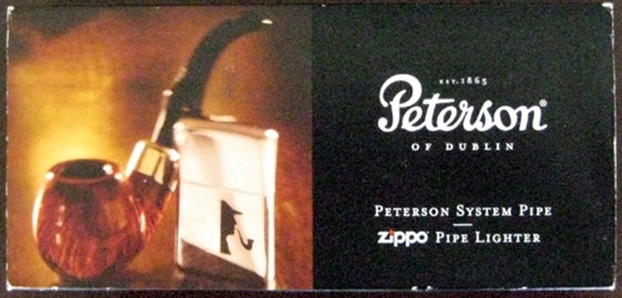
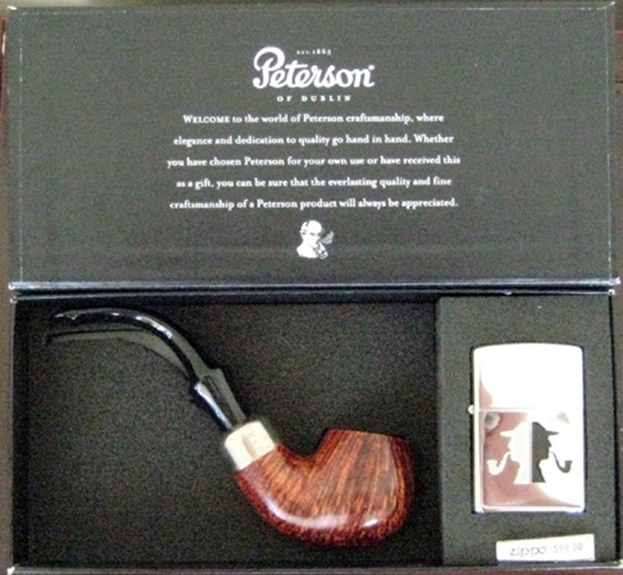
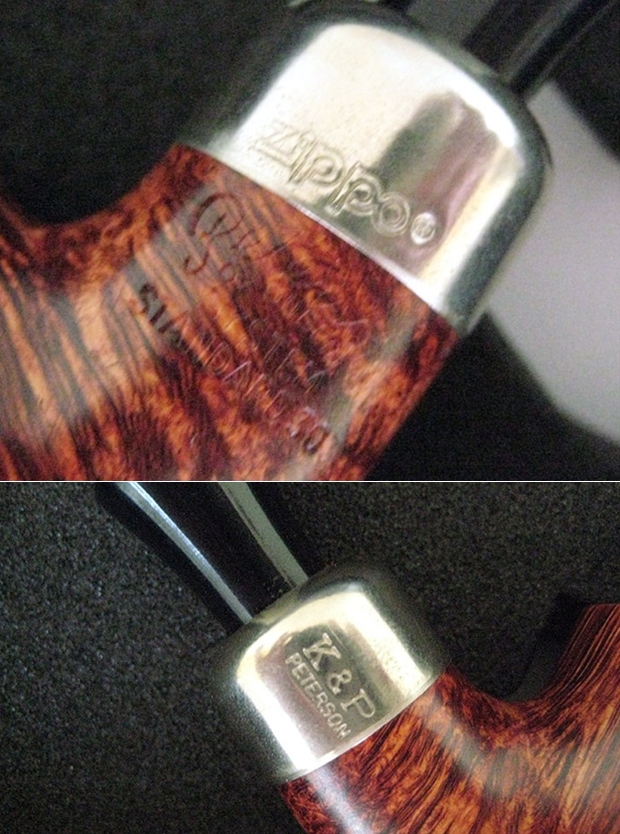
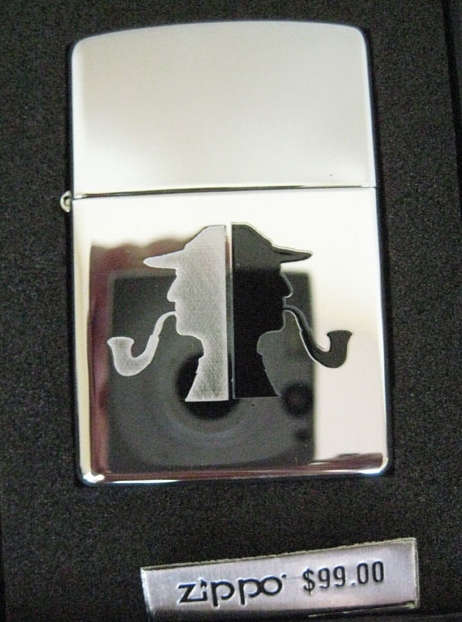
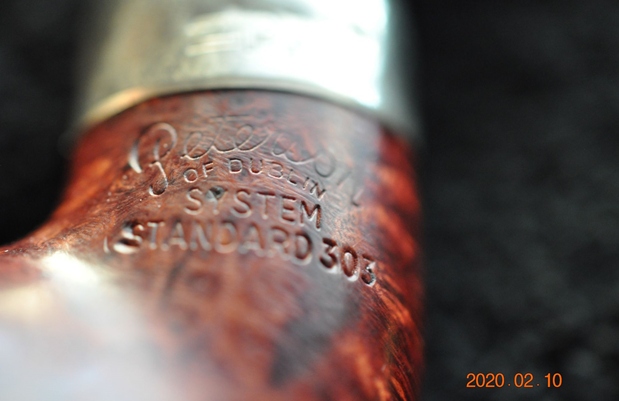
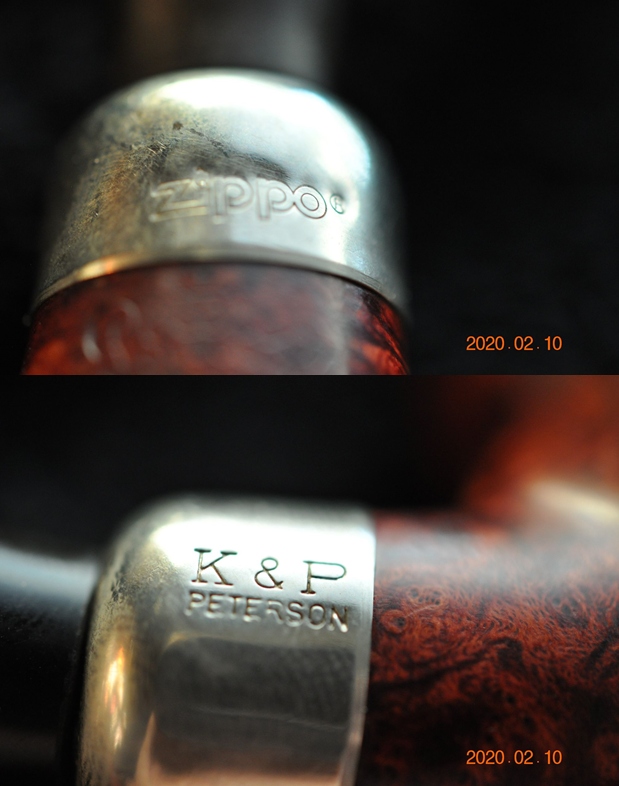
The next pipe on the work table came to us from an antique store on one of Jeff’s pipe hunts in Utah, USA. It is a smooth Peterson’s Apple shaped System pipe with a saddle vulcanite stem. The pipe is stamped on the left side of the shank and reads Peterson’s [over] of Dublin [over] System [over] Standard followed by the shape number 303. The nickel ferrule is stamped on the left side and reads ZIPPO and on the right side it reads K & P Peterson. That was interesting information so I did a bit of hunting on the web and found photos of a gift set that was issued by Peterson and Zippo together. I wrote them and asked about when it was first issued. In the mean time I also found a link on Pipesmagazine.com where the gift set was discussed and some photos shared of the original (https://pipesmagazine.com/forums/threads/peterson-zippo-combo.1499/). I have included the photos below as they provide a context for the pipe I am working on. I only wish I had the Zippo lighter that it came with originally! It appears from the photos that the set sold for at least $99.00US.

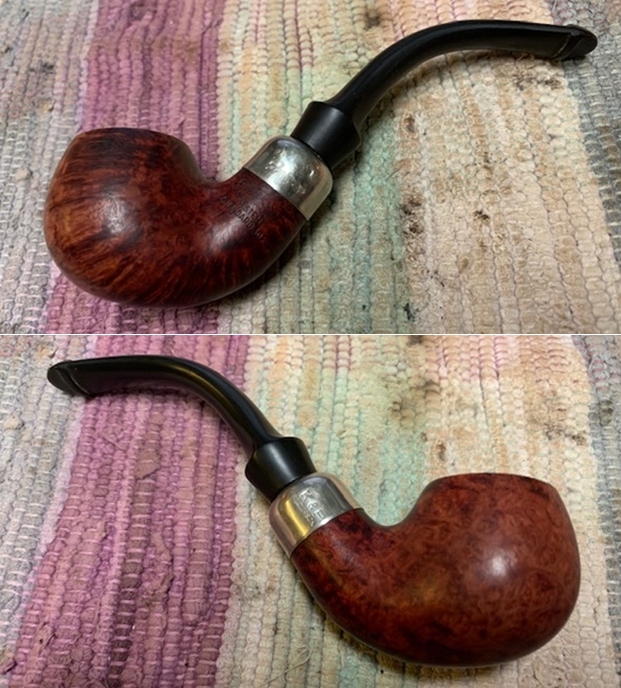
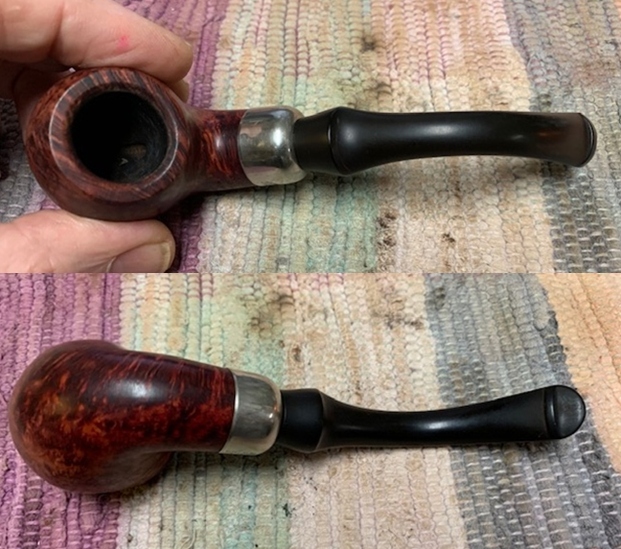
The pipe on the desk before me now was similar to the one in the above photos. It had different grain but the shape and stamping was identical. The finish had a lot of grime ground into it and it was very dirty. The bowl was moderately caked and there was a lava coat on the flat rim top and the beveled inner edge of the rim. The edges looked okay but we would know more after the cleanup.. The nickel ferrule was undamaged and did not have dents of nicks in the surface. It was oxidized a bit but would clean up very well. It is stamped K&P [over] Peterson on the right side of the ferrule and had the ZIPPO logo on the left side of the ferrule. The stem was oxidized, calcified and had tooth chatter and marks on the top and underside near the P-lip style button. It also had a unique style stem in terms of fitting to the ferrule. The pipe seems petite to me but I do not have another 303 to compare it to so it is only a feeling. The pipe showed promise but it was very dirty. Jeff took photos of the pipe before he started his cleanup work.   He took photos of the rim top and bowl to give a clear picture of the thickness of the cake and the condition of the rim top and edges. He also took photos of the top and underside of the stem to show the oxidation, calcification and chatter and tooth marks.    Jeff took a photo of the side and heel of the bowl to give a picture of what the briar around the pipe looked like.   He took photos of the stamping on the shank and the nickel ferrule. It reads as noted above and is clear and readable.   Jeff had cleaned up the pipe with his usual penchant for thoroughness. He reamed the pipe with a PipNet Pipe Reamer and cleaned up the remnants with a Savinelli Fitsall Pipe Knife.  He scrubbed the bowl with undiluted Murphy’s Oil Soap with a tooth brush. He rinsed it under running warm water to remove the soap and grime. He cleaned out the inside of the shank and the airway in the stem with alcohol, cotton swabs and pipe cleaners. He soaked the stem in Before & After Deoxidizer and rinsed it off with warm water. I took photos of the pipe once I received it. The rim top and inner edge of the rim looked very good with a bit of damage on the inner bevel of the rim surface. The stem surface looked very good with some tooth marks and chatter on both sides near the button. I took a photo of the stamping on the shank. It is clear and readable as noted above.    I removed the stem and took a photo of the pipe to give a sense of the whole. The stem is a fancy saddle version. The pipe was in such good condition that I started by rubbing it down with Before & After Restoration Balm. I worked it into the surface of the bowl sides and shank with my fingertips. The product works to clean, enliven and protect the briar. I let the balm sit for a little while and then buffed with a cotton cloth to raise the shine.     I set the bowl aside and turned to work on the stem. I sanded the tooth chatter and marks with 220 grit sandpaper to smooth them out and blend them into the surface. I started polishing the stem with 400 grit wet dry sandpaper.   I polished the vulcanite stem with micromesh sanding pads – 1500-12000 grit pads. I wiped it down with a damp cloth after each sanding pad. I used Before & After Pipe Polish – both Fine and Extra Fine to further polish the stem.    This Peterson’s of Dublin System Standard 303 Bent Apple originally made in partnership with Zippo with a vulcanite saddle stem is a great looking pipe now that it has been restored. The beautiful grain that shines through the polished finish is stunning. As the pipe is smoked the patina should develop and look even better. I put the stem back on the bowl and carefully buffed the pipe with Blue Diamond on the buffing wheel. I gave the bowl and the stem multiple coats of carnauba wax on the buffing wheel and followed that by buffing the entire pipe with a clean buffing pad. I hand buffed the pipe with a microfiber cloth to deepen the shine. The finished Peterson’s System Standard 303 fits nicely in the hand and feels great. Give the finished pipe a look in the photos below. The dimensions of the pipe are Length: 5 ½ inches, Height: 1 ½ inches, Outside diameter of the bowl: 1 ¼ inches, Chamber diameter: ¾ of an inch. The weight of the pipe is 47gr/1.66oz. If you are interested in adding this pipe to your collection send me a message or an email. Thanks for reading this blog and my reflections on the pipe while I worked on it. There are many more to come!

Cleaning up a Peterson’s Made Republic Era Irish Second Rhodesian


Blog by Steve Laug

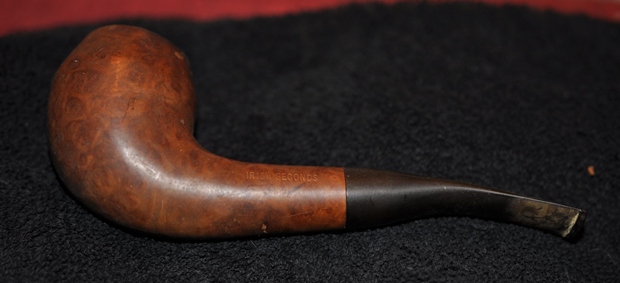
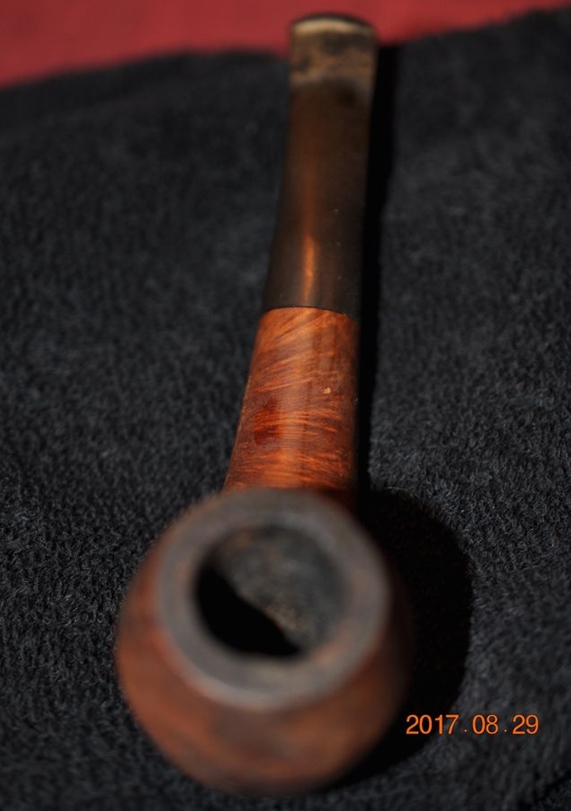
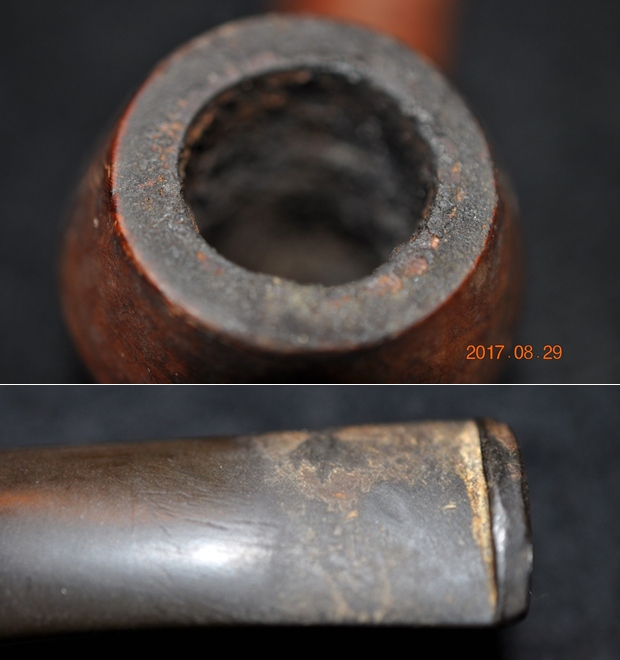
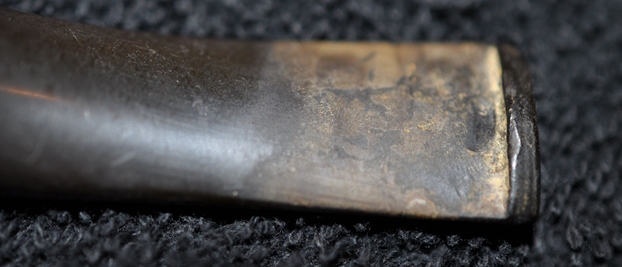
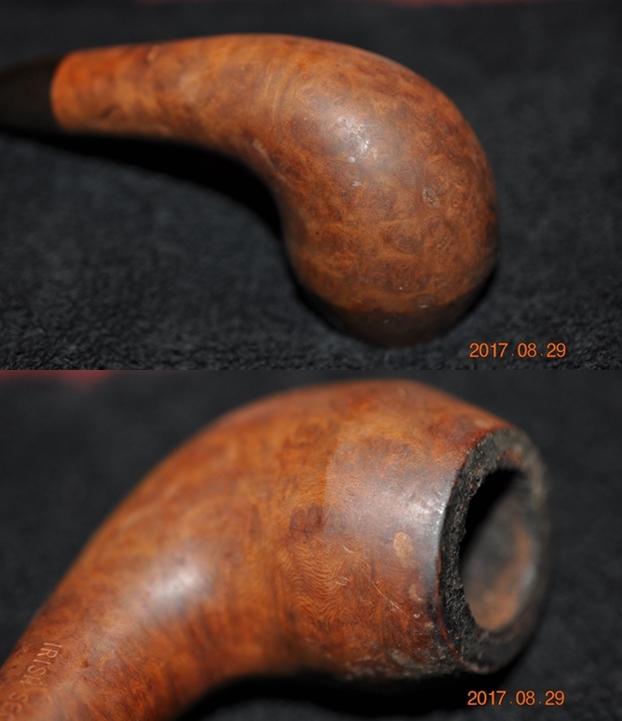
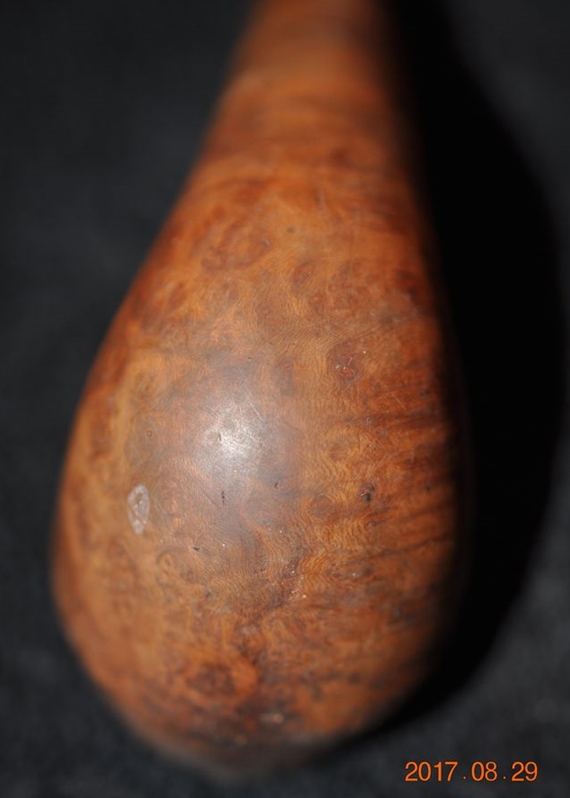
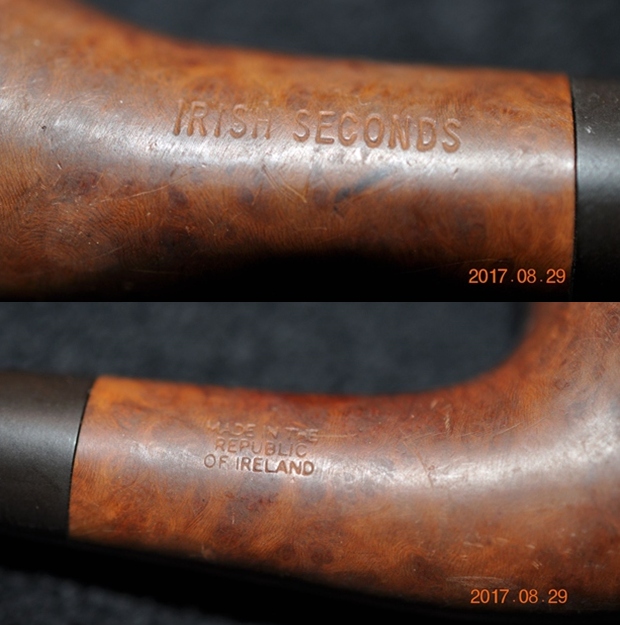
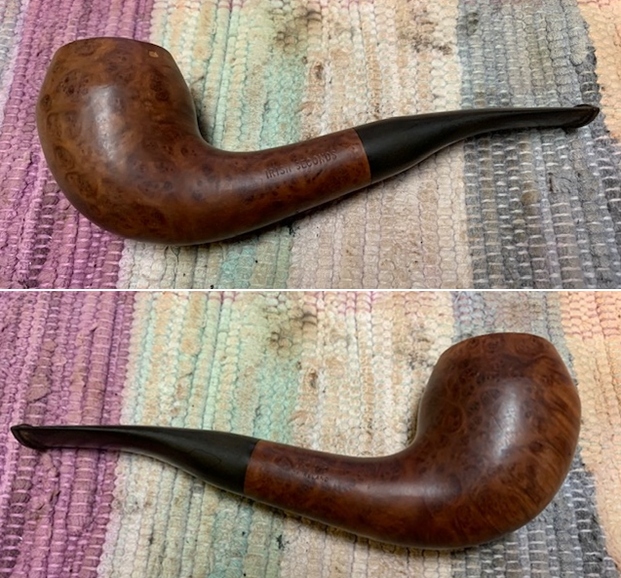
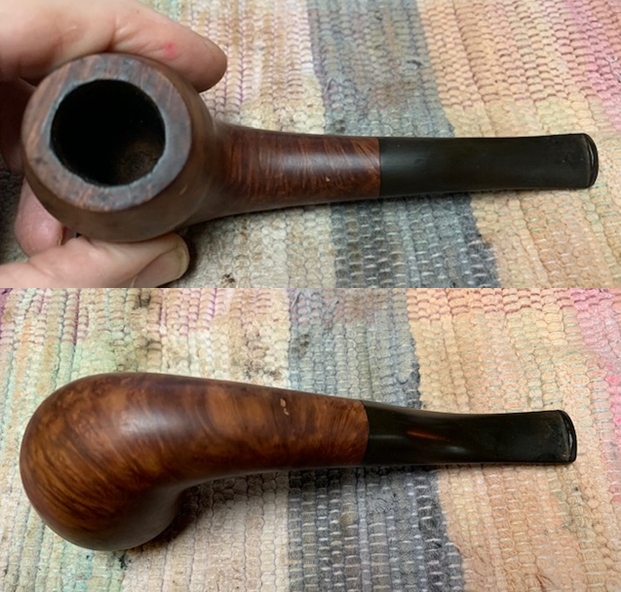
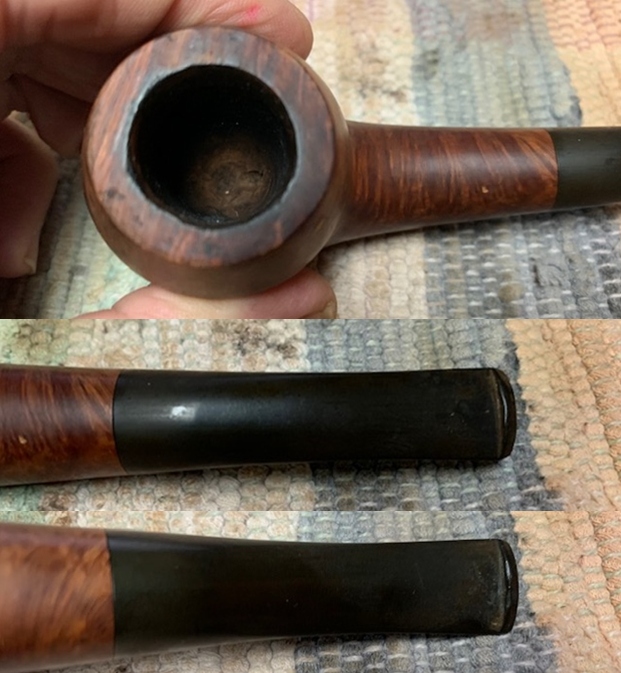
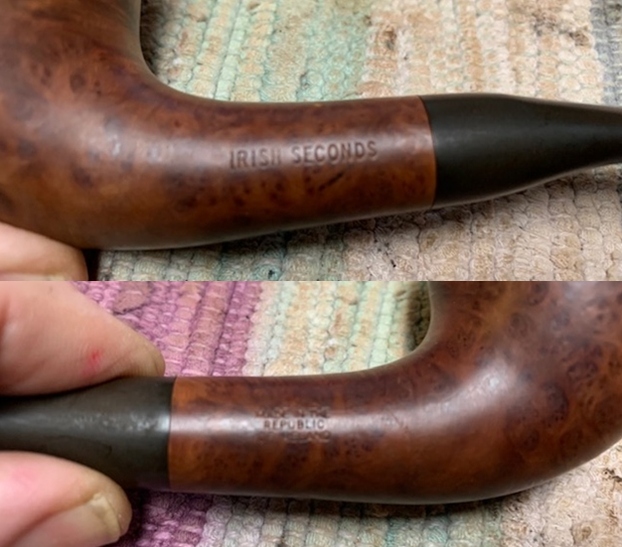
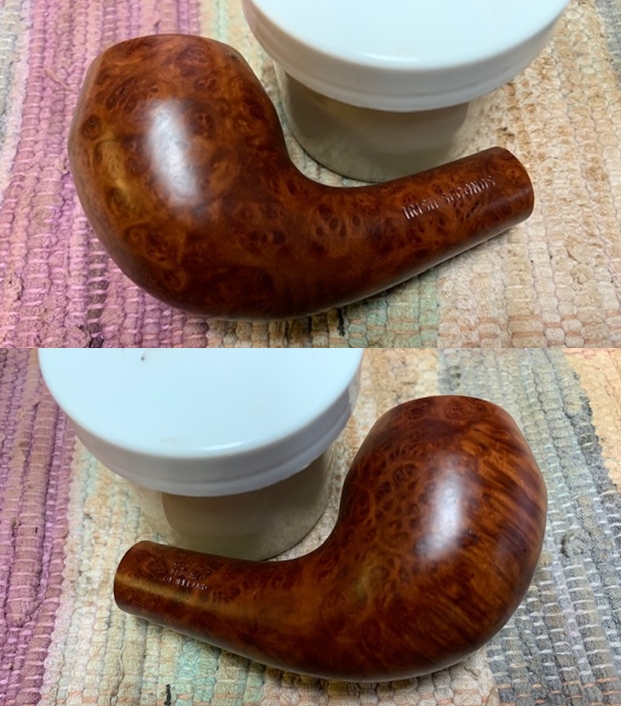
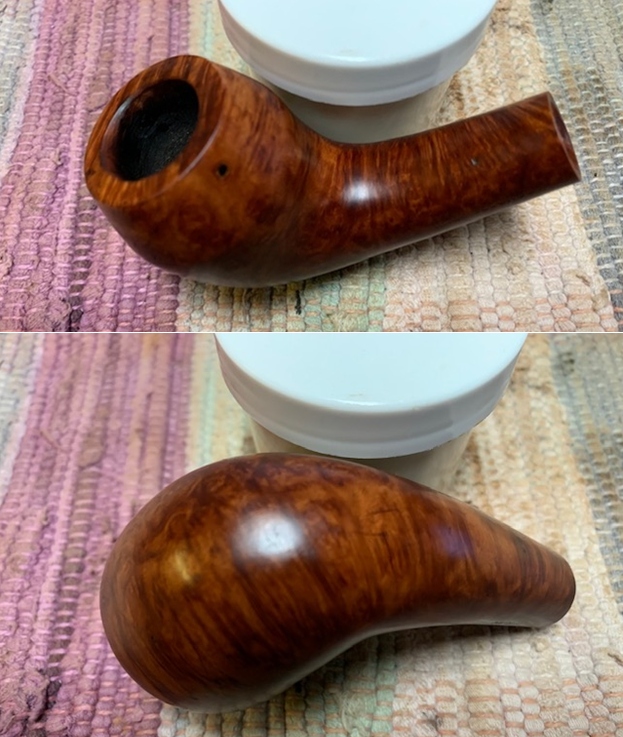
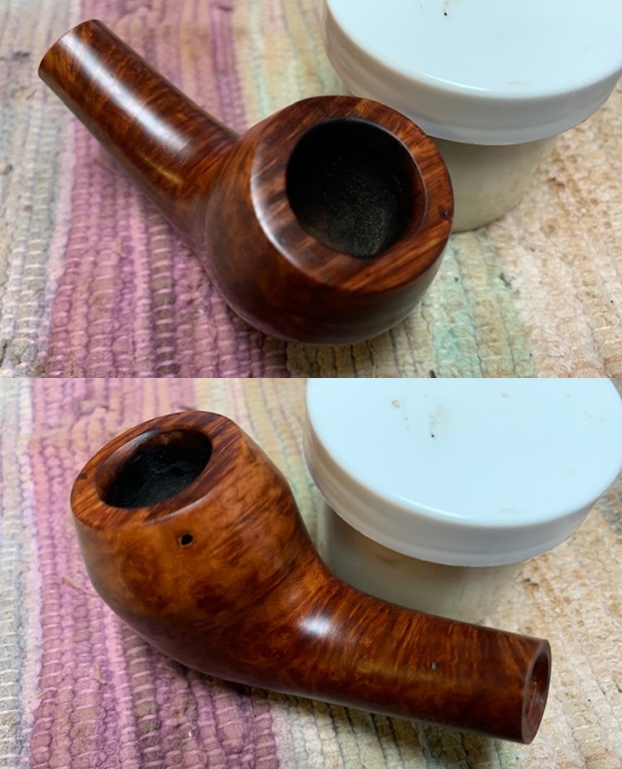
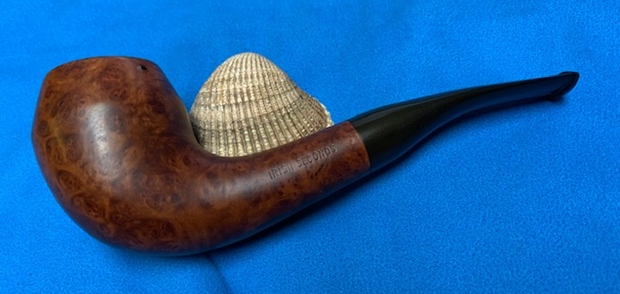
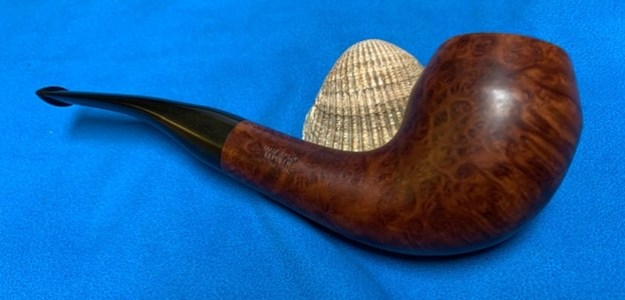
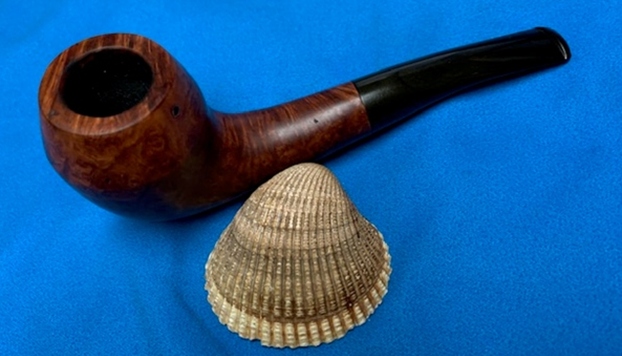
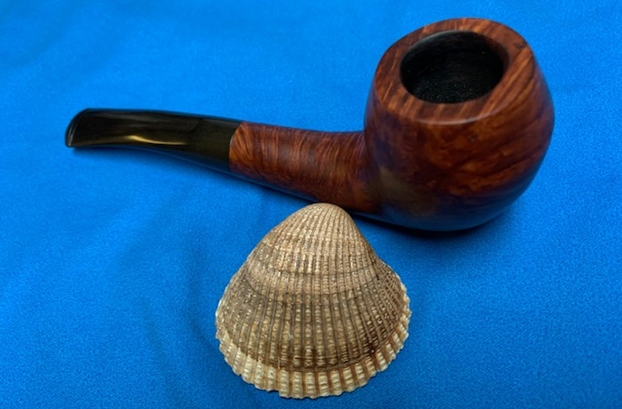
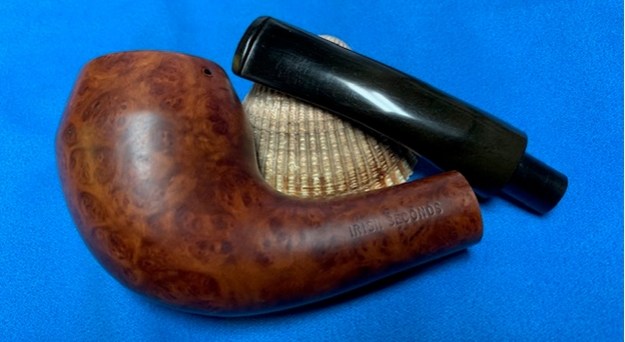
The next pipe on the work table came to us from Ebay 2017 and it has been sitting here for a long time. It is a nicely grained Irish Second Rhodesian with a tapered vulcanite stem. The pipe is stamped on the left side of the shank and reads IRISH SECONDS. On the right side it is stamped Made in the Republic of Ireland. Irish Seconds were a Peterson’s second line that usually did not make the grade because of flaws in the briar or sandpits. This is another nicer piece of briar than I have seen on some of the firsts I have worked on. The finish had a lot of grime ground into the smooth finish on the bowl and some darkening around the sides of the bowl. The bowl was heavily caked in the lower half of the bowl and thinner toward the top. There was a light lava coat and darkening on the inner edge of the rim. The edges looked okay but we would know more after the cleanup. There were a few sandpits and nicks around the sides of the bowl. The stem was oxidized, calcified and had tooth chatter and marks on the top and underside near the button. There were not markings or a logo on the taper stem. The pipe showed promise but it was very dirty. Jeff took photos of the pipe before he started his cleanup work. He took photos of the rim top and bowl to give a clear picture of the thickness of the cake and the condition of the rim top and edges. He also took photos of the top and underside of the stem to show the oxidation, calcification and chatter and tooth marks. Jeff took photos of the sides and heel of the bowl to give a picture of what the briar around the pipe looked like. There is some great grain under the grime. He took photos of the stamping on the shank. It reads as noted above and is clear and readable. I am including the information from Pipedia’s article on Peterson pipes. It is a great read in terms of the history of the brand (https://pipedia.org/wiki/Peterson). I have included a bit of the pertinent history here.
1950 – 1989 The Republic Era – From 1950 to the present time, the stamp for this era is “Made in the Republic of Ireland” in a block format generally in three lines but two lines have been used with or without Republic being abbreviated.

I knew that I was dealing with a Republic Era pipe made between 1950-1989. It was a smooth bent Rhodesian with nice grain. The finish was stained with a combination of brown stains. Now it was time to work on the pipe.

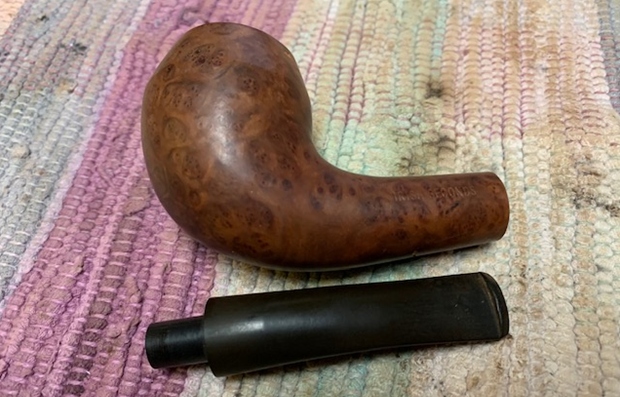
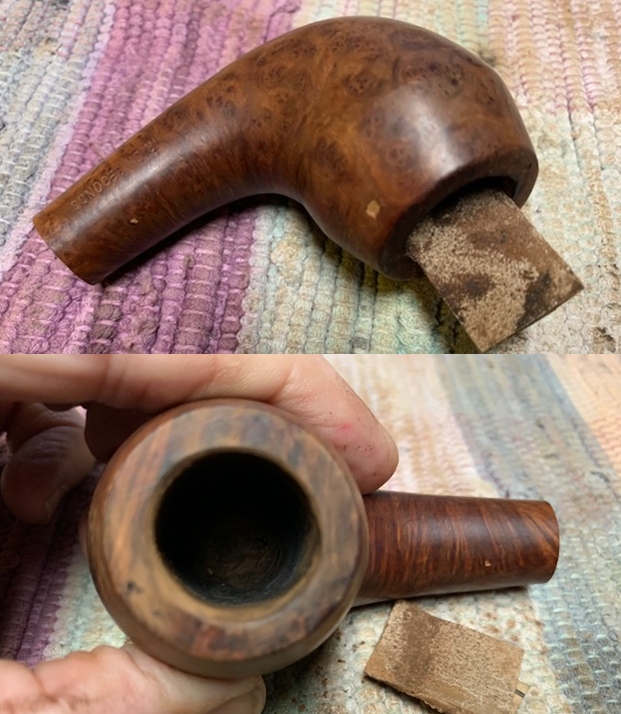
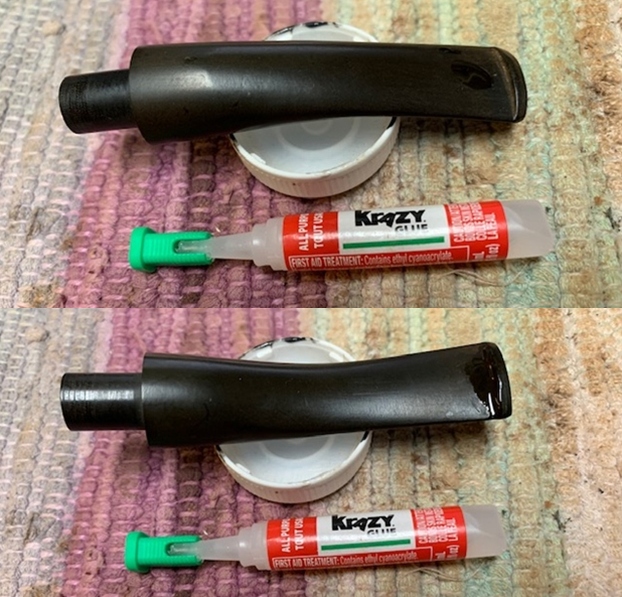
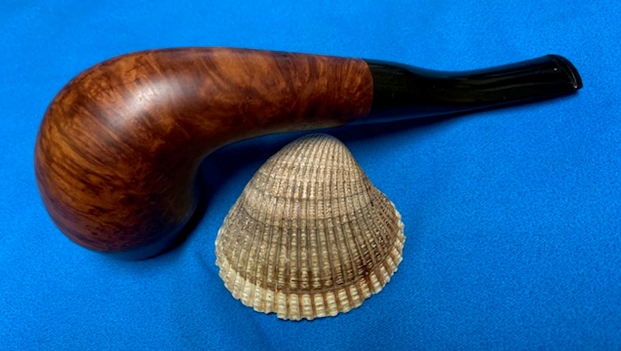
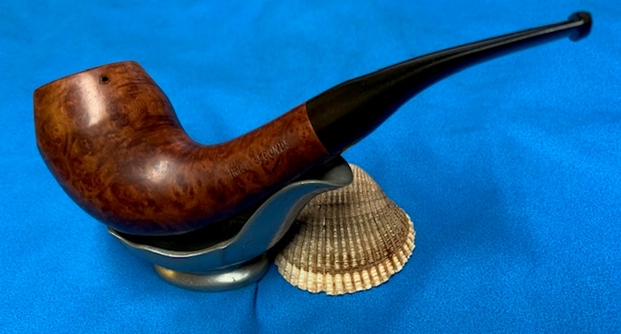
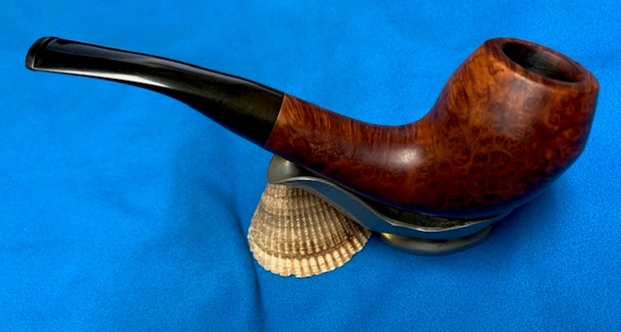
Jeff had cleaned up the pipe with his usual penchant for thoroughness. He reamed the pipe with a PipNet Pipe Reamer and cleaned up the remnants with a Savinelli Fitsall Pipe Knife.  He scrubbed the bowl with undiluted Murphy’s Oil Soap with a tooth brush. He rinsed it under running warm water to remove the soap and grime. He cleaned out the inside of the shank and the airway in the stem with alcohol, cotton swabs and pipe cleaners. He soaked the stem in Before & After Deoxidizer and rinsed it off with warm water. I took photos of the pipe once I received it. The rim top and inner edge of the rim showed some damage. The inner edge of the bowl was roughened and showed some darkening. The rim top also showed some damage. The stem surface looked good with some remaining oxidation and tooth marks and chatter on both sides near the button.     I took a photo of the stamping on the shank. It is clear and readable as noted above.    I removed the stem and took a photo of the pipe to give a sense of the whole. The stem is short and tapered. I decided to start my work on the pipe by cleaning up the damaged rim top and inner edge. I reworked the edge and top with a folded piece of 220 grit sand paper. Once I finished the rim and edges looked much better.I moved next to repairing the damaged fills on the underside of the shank and the back side of the rim cap. I filled them in with clear super glue and briar dust. Once it cured I sanded them smooth and blended them into the surrounding briar.    I polished the bowl and the rim top, sides and shank with micromesh sanding pads – wet sanding with 1500-12000 grit pads and wiping it down after each pad with a damp cloth.  I rubbed the bowl and shank down with Before & After Restoration Balm. I worked it into the surface of the bowl sides and shank with my fingertips to clean, enliven and protect the briar. I let the balm sit for a little while and then buffed with a cotton cloth to raise the shine.    I set the bowl aside and turned to work on the stem. I filled in tooth marks in the stem surface with clear super glue. Once the repairs cured I used a rasp and a file to recut the button edge and flatten out the repairs. I sanded out the file marks and smoothed out the rest of the repair with 220 grit sandpaper and started polishing the stem with 400 grit wet dry sandpaper.     I polished the vulcanite stem with micromesh sanding pads – 1500-12000 grit pads. I wiped it down with a damp cloth after each sanding pad. I used Before & After Pipe Polish – both Fine and Extra Fine to further polish the stem.  This Peterson’s made Irish Second Rhodesian with a vulcanite taper stem is a great looking pipe now that it has been restored. There is some great grain around the bowl and shank. I put the stem back on the bowl and carefully buffed the pipe with Blue Diamond on the buffing wheel using a light touch on the briar. I gave the bowl and the stem multiple coats of carnauba wax on the buffing wheel and followed that by buffing the entire pipe with a clean buffing pad. I hand buffed the pipe with a microfiber cloth to deepen the shine. The finished Irish Second Rhodesian fits nicely in the hand and feels great. Give the finished pipe a look in the photos below. The dimensions of the pipe are Length: 5 ¾ inches, Height: 2 inches, Outside diameter of the bowl: 1 ¾ inches, Chamber diameter: ¾ of an inch. The weight of the pipe is 56gr/1.94oz. If you are interested in adding this pipe to your collection send me a message or an email. Thanks for reading this blog and my reflections on the pipe while I worked on it. There are many more to come!
New Life for a 1999 Dunhill Chestnut 5134 Group 5 Brandy


Blog by Steve Laug

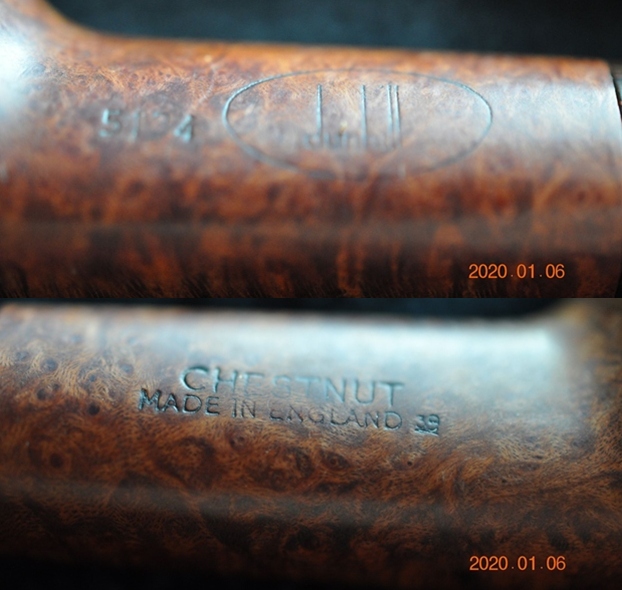
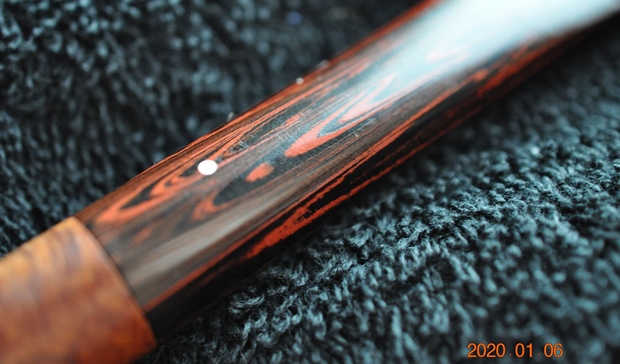
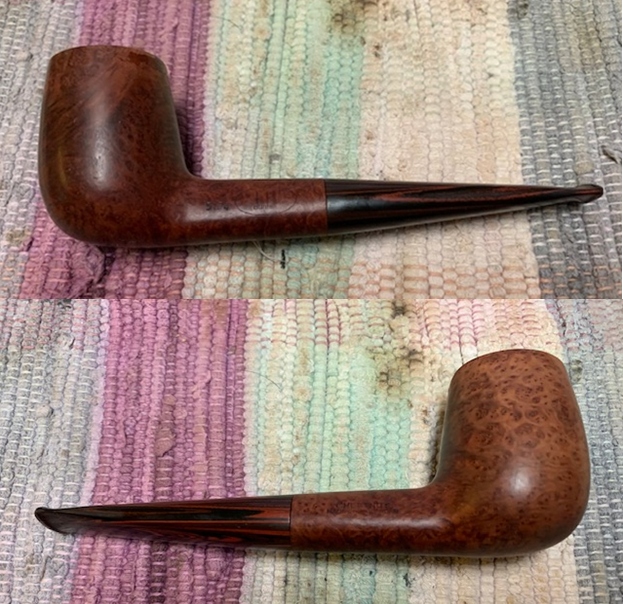
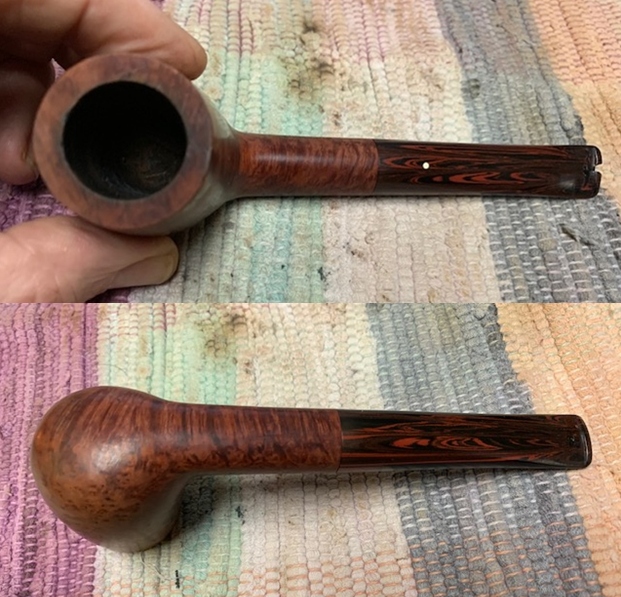
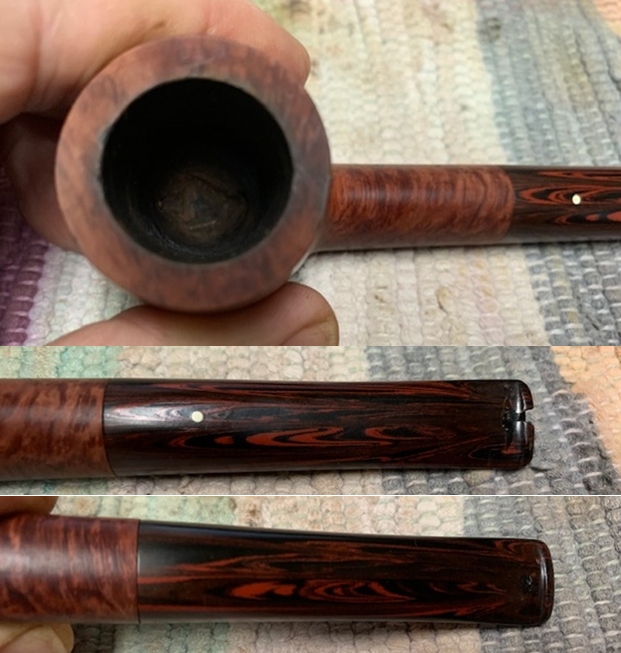
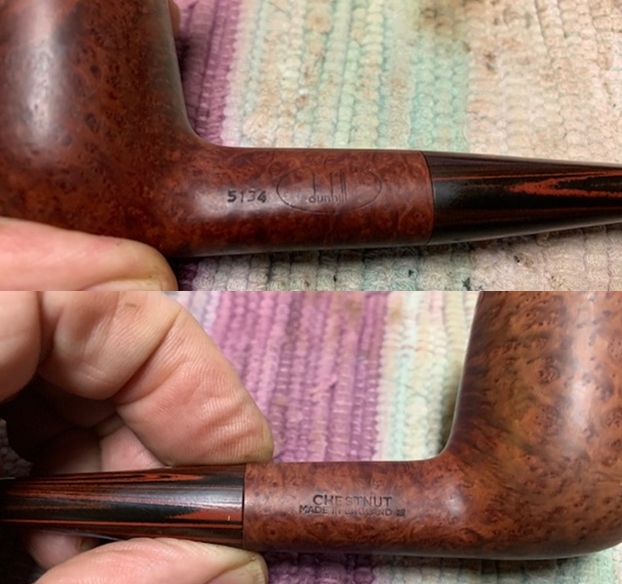
The next pipe on the table came to us in a group of pipes that we purchased from a fellow in Los Angeles, California, USA. It is a Dunhill Chestnut Straight Brandy that was very dirty. It is stamped both sides of the shank. On the left side it is stamped with the shape number 5134 followed by Dunhill in an oval. On the right side it is stamped Chestnut [over] Made in England followed by the number 39. Interpreting that stamp it is as follows: The 5134 is the shape for a straight Brandy with a triangular shaped shank. The Dunhill Chestnut is the finish noted on the shank. The 39 following the D of England gives the date the pipe was made and identifies it as 1999. The stamping is clear and readable. The age of the pipe and the oils in the finish has given the pipe a rich reddish brown finish. There is also some amazing grain that the shape follows well. The finish was dirty with dust ground into the surface of the bowl and shank. There also appeared to a repair on top outer edge at the back of the bowl. There was a thick cake in the bowl and tobacco debris stuck to the walls of the bowl. The rim top showed darkening and some lava in on the surface and inner edge of the bowl. The Cumberland taper stem was oxidized and calcified. It had damage to the button surface on the top side where it was missing a chunk. There were also some repair marks ahead of the button on both sides where the repair person had used black CA to patch the tooth marks.  Jeff took photos of the pipe to show what it looked like before he started working on it.He took photos of the bowl and rim top to show the thickness of the cake and the darkening and lava overflow on the rim top. The photos of the stem show the oxidation, calcification and the repairs to both sides of the stem. You can also see the large chunk missing from the topside of the button edge. The stem had been previously repaired rather poorly using large rough black super glue patches.  The photos of the sides and heel of the bowl show the great grain on the pipe. It is a beauty under the grime and dust.   The stamping on the sides of the shank is shown in the photos below. It looks very good and readable. It reads as noted and explained above. The third photo shows the white spot on the stem.     I turned to Pipedia’s section on Dunhill Root Briar Pipes to get a bit of background on the Dunhill finishes (https://pipedia.org/wiki/Dunhill#Root_Briar). I quote:

Chestnut – A rich, deep walnut colour complemented by the Cumberland mouthpiece – it was introduced in 1983 to commemorate the closing of the Cumberland Road warehouse. The same stain and stem material as used on the Cumberland, but on a smooth bowl. Like the Bruyere, the finish is smooth to the feel and will lighten in time to show off the grain, which is usually cross-grain top and bottom with birds-eye on the sides of the bowl. Irrespective of shape, size or finish, all Dunhill pipes are of one quality only – the finest.

Note: Always had the Cumberland mouthpieces fitted. Sometimes, a black mouthpiece it is possible, however, that this was a special request or that it was a replacement mouthpiece…

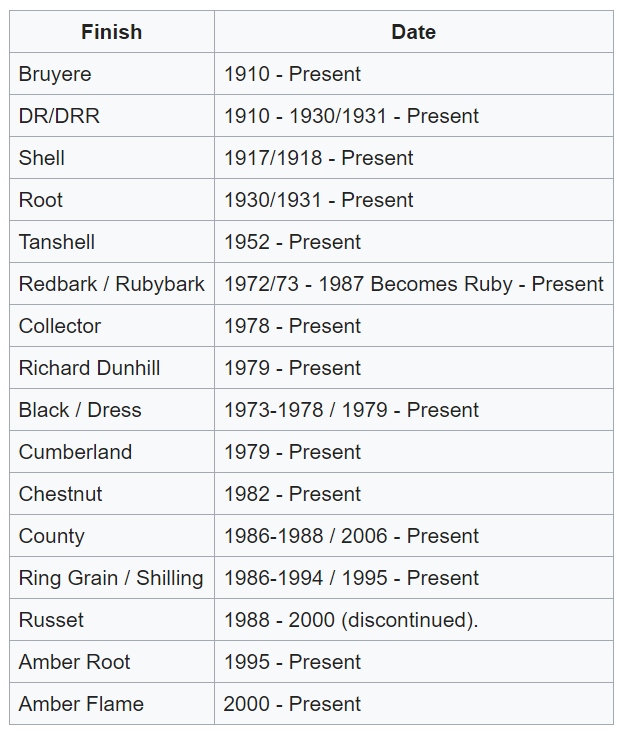
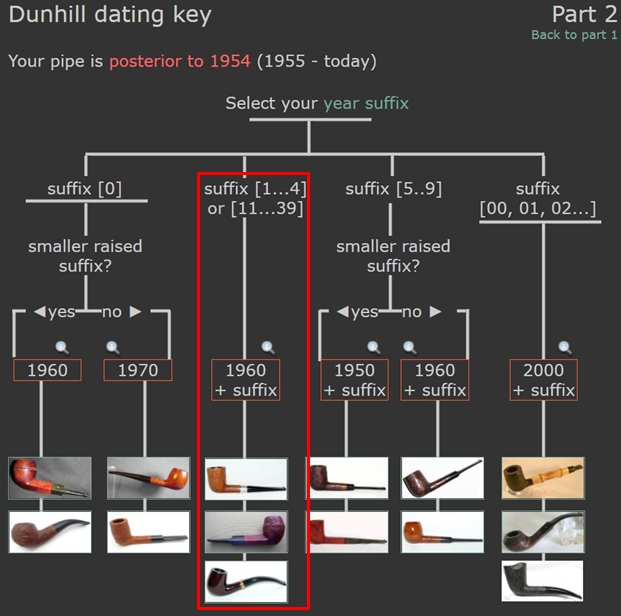
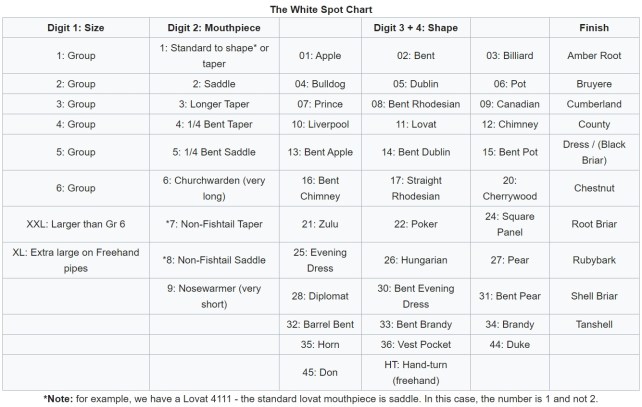
The shape chart below delineates the finish and the date that it was introduced on the market and how long it was made. The Chestnut came out in 1982 and continues to be made until the present.I turned to Pipephil’s dating guide to show how I arrived at the date of manufacture for this pipe (http://www.pipephil.eu/logos/en/dunhill/cledat-en1a.html). I am including the chart that is provided there for the dating a pipe. I have drawn a red box around the section. Since the pipe I am working on has a 2 it points to the 1960+ suffix line on the chart below.I turned to Pipedia where there was a shape chart that could be used to interpret the 4 digit shape numbers like the one on this particular pipe. https://pipedia.org/wiki/Dunhill_Shape_Chart#:~:text=The%20White%20Spot%20Chart%20%20%20Digit%201%3A,%2012%3A%20Chimney%20%208%20more%20rows%20). I have included the chart below.I now knew that I was working on a Chestnut that came out in 1999. The shape number is 5134. The first number (5) was the size of the pipe which in this case is a Group 5. The second digit (1) is the mouthpiece shape which in this case was a Standard or taper shaped stem. The third (3) and fourth (4) number identify the shape of the pipe. This is 34 which is the number for a Brandy shaped pipe.

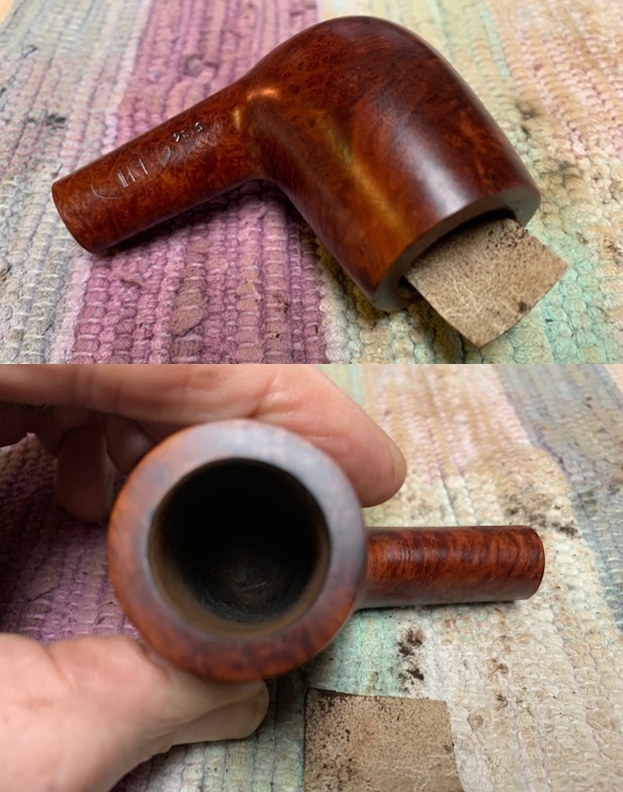
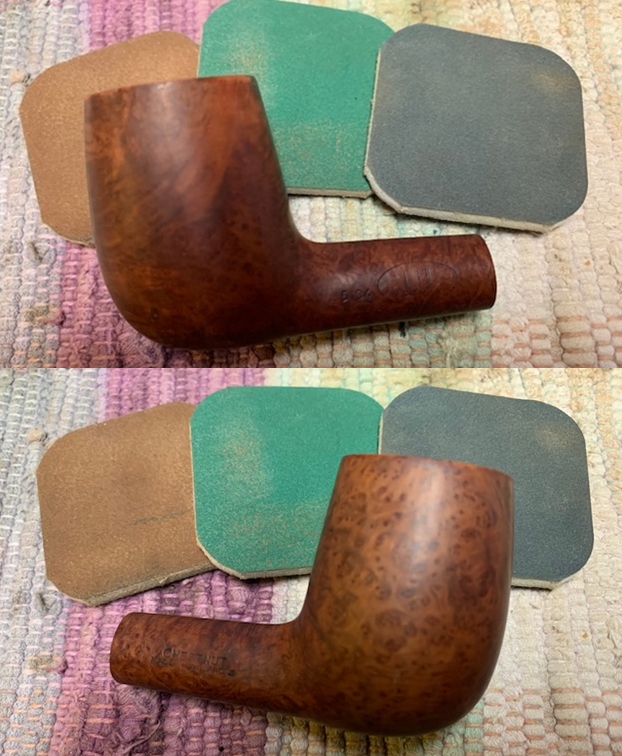
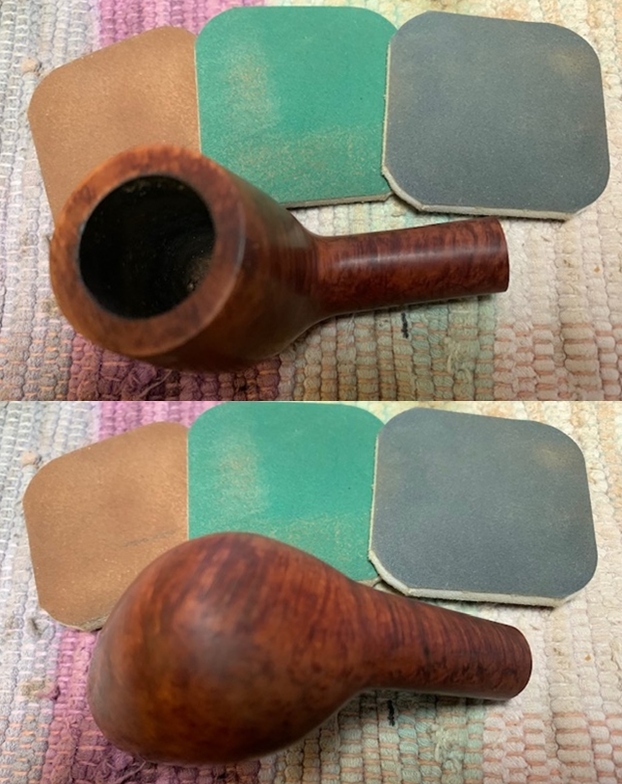
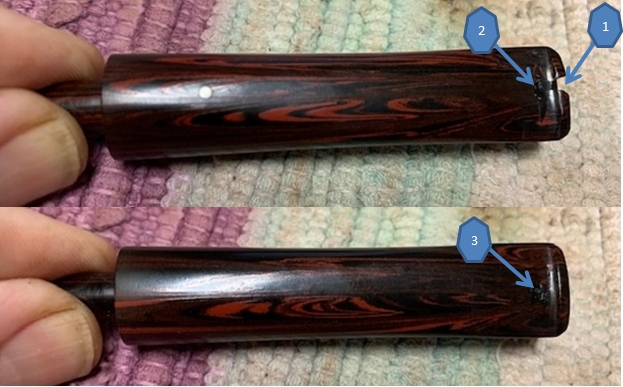
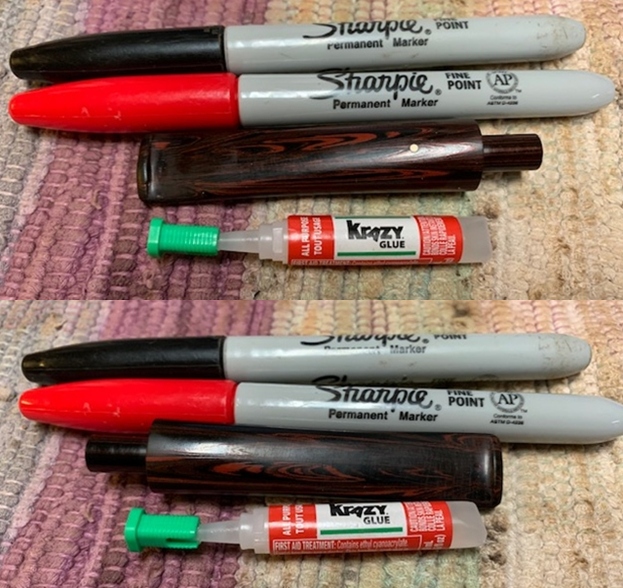
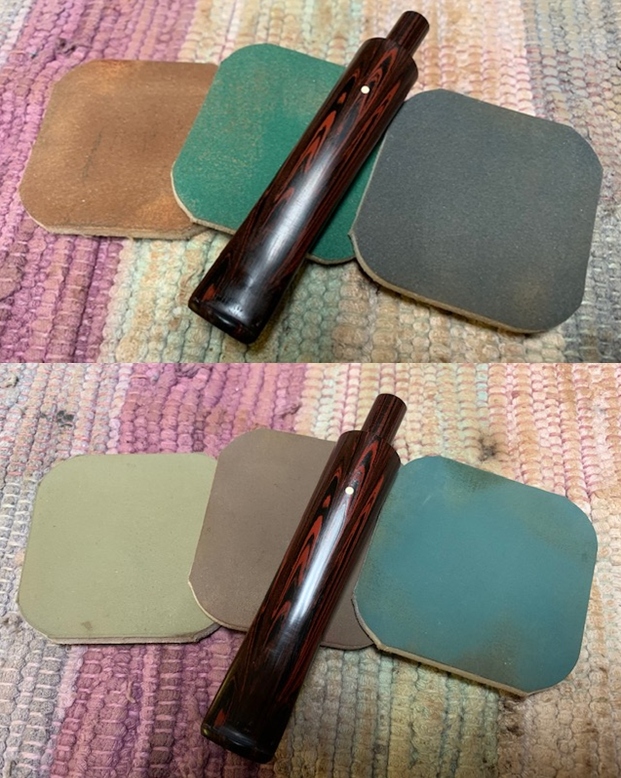
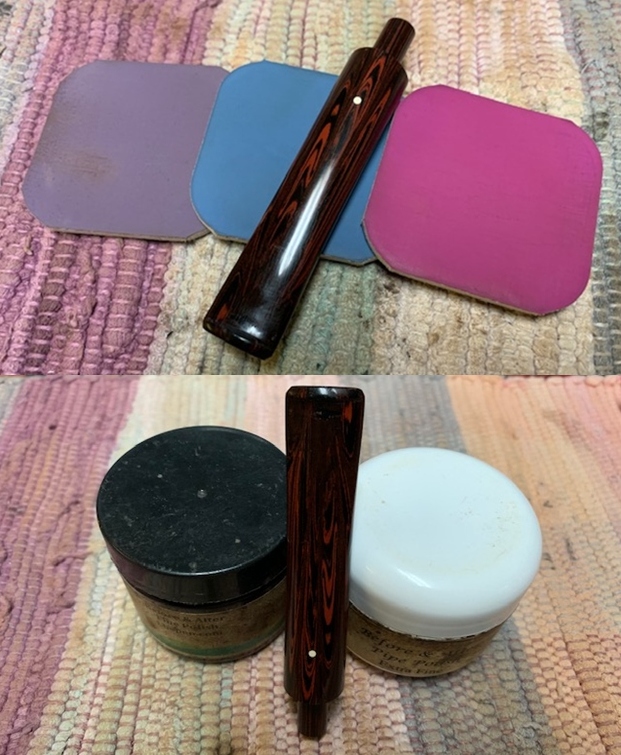
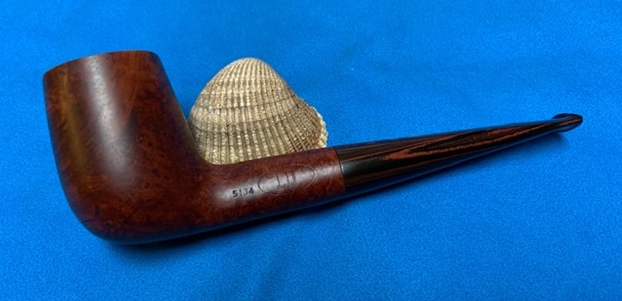
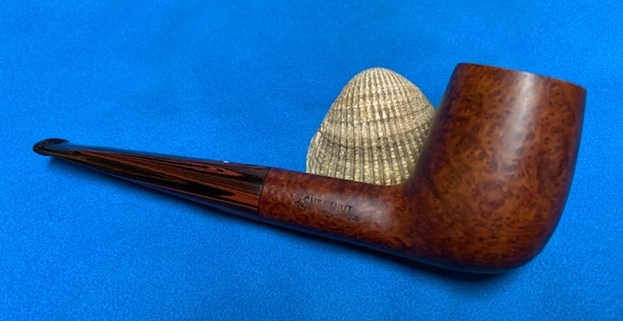
I turned to work on the pipe itself. Jeff had carried out his usual thorough cleanup of the pipe. He had reamed it with a PipNet reamer to remove the cake and cleaned the reaming up with a Savinelli Fitsall Pipe Knife. He scrubbed the internals of the bowl and stem with alcohol, cotton swabs and pipe cleaners. He scrubbed the externals with undiluted Murphy’s Oil Soap and rinsed the bowl off with running water. He soaked the stem in Before & After Deoxidizer and once it had soaked rinsed it off with warm water to remove the residual solution. He dried it off and rubbed it down to remove any oxidation that was still on the stem. The pipe looked very clean when I received it. I took a photo of the rim top to show the condition. You can see the darkening on the rim top on the back of the bowl. It is roughened and chipped on the front and back side of the rim. The taper stem came out looking quite good other than the damage on the button and the black CA repairs on the top and underside of the stem.   I took photos of the sides of the shank to show the stamping. It is clear and readable as noted above.    I removed the stem from the shank and took a photo of the pipe parts to show what I was working with. It is a nice looking pipe.I decided to start the restoration on this one by working on the damage on the inner edge of the bowl. It had darkening and some damage to the edge. There were burn and knife marks on the edge from a previous pipeman. I worked it over with a folded piece of 220 grit sandpaper to give the edge a light bevel and remove and minimize the damage on the edge. When I finished with it, the bowl and the rim top looked much better.   I polished the rim top and bowl with micromesh sanding pads – dry sanding with 1500-12000 grit sanding pads. I sanded and smoothed out the repair that had been done to the top outer edge of the rim on the back of the bowl at the same time. I wiped the bowl down with a damp cloth after each sanding pad. The briar began to take on a shine.  I rubbed the briar down with Before & After Restoration Balm. I worked it into the briar with my fingertips. The product works to clean, enliven and preserve the briar. I let it sit for 15 minutes while I worked on the stem. After the time passed I buffed it with a cotton cloth to deepen the shine. The briar really comes alive with the balm.   With the bowl finished and cleaned up it was time to tackle the stem mess. I want to see if I could minimize the repair marks from the previous repair and also rebuild the button. Since it was Cumberland this was going to be a bit tricky.  I took photos of the stem before I started and marked the issues on it with blue arrows. The #1 is the chip out of the top edge of the button. The #2 and #3 are the tooth marks fills that were done with a large amount of black super glue. I would have used a clear CA glue to repair these and let the underlying Cumberland colours show through. However now I had to figure out a way to minimize them.  I greased a pipe cleaner with Vaseline and inserted it in the airway. I rebuilt the button area with black Loctite 380. It is black but it is a small spot so I am hoping to be able to blend it in well with the rest of the Cumberland.  I removed the pipe cleaner once the repair had set and took a photo of the stem at this point. I used a rasp and small file to shape the button and cut the inner edge. I also flattened out the area of the previous repair to reduce it. There was also a dip in the mouthpiece on that side near that button that was a shallow trough so I cleaned up the taper to smooth out the transition with the files. I smoothed out the file marks and repairs and reshaped the button edge with 220 grit sandpaper. I started the polishing with 400 grit wet dry sandpaper. Still lots of work to do but the shape is correct and the repair is not too bad. I still need to rework the tooth mark repairs on the top and underside some more.   I cleaned up the repair areas and used a black and a red Sharpie Pen to match the striations of the Cumberland. I let that cure and then put a light coat of clean CA glue on top of the areas to keep the blend in place. Once that cured I lightly sanded it with a 1500 grit micromesh pad. The result can be seen in the photos below.   Now it was time to polish the repairs. I polished the Cumberland with micromesh sanding pads – 1500-12000 grit pads. I wiped it down with Obsidian Oil after each sanding pad. I used Before & After Pipe Polish – both Fine and Extra Fine to further polish the stem.     This Dunhill Chestnut 5134 Brandy from 1999 is a beautiful looking piece of briar that has a shape that follows grain. It is a great looking pipe that came out looking even better after the cleanup. The Chestnut is a Dunhill that utilized a Walnut stain and a Cumberland taper stem. The finish on the pipe is in excellent condition following the restoration. The brown stain on the bowl works well to highlight the grain. The polished Cumberland taper stem adds to the mix. With the dust gone from the finish and the bowl it was a beauty and is eye-catching. I put the repaired stem back on the bowl and buffed the pipe with Blue Diamond on the buffing wheel being careful to not buff the stamping. I gave the bowl and the stem multiple coats of carnauba wax on the buffing wheel and followed that by buffing it with a clean buffing pad. I hand buffed the pipe with a microfiber cloth to deepen the shine. The finished Chestnut 5134 Brandy is quite nice and feels great in the hand. Give the finished pipe a look in the photos below. I can only tell you that like the other pipes I am working that it is much prettier in person than the photos capture. The dimensions of the pipe are Length: 5 ¾ inches, Height: 2 inches, Outside diameter of the bowl: 1 ¼ inches, Chamber diameter: ¾ of an inch. The weight of the pipe is 47grams/1.66oz. Thanks for walking through the restoration with me as I worked over another beautiful pipe. Remember we are not pipe owners; we are pipemen and women who hold our pipes in trust until they pass on into the trust of the next generation.

Restoring a newer Italian Made Brigham Voyageur 184 One Dot


Blog by Steve Laug

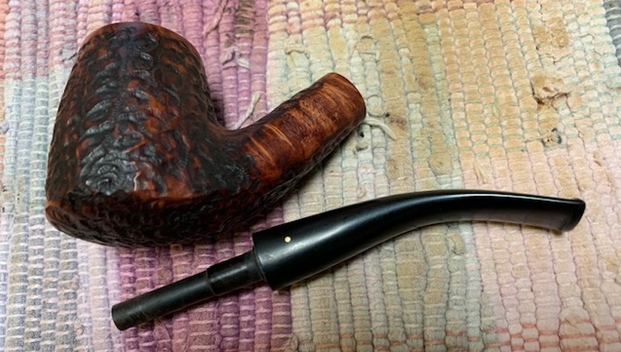
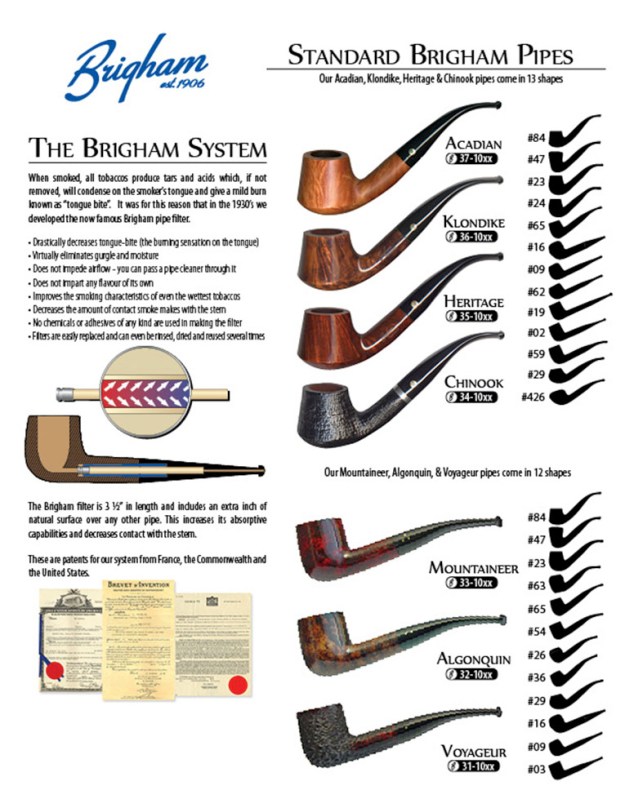
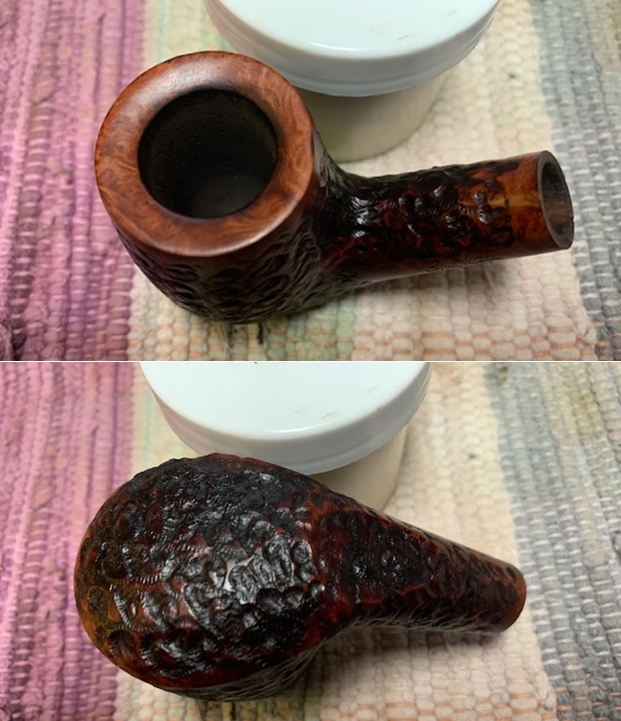
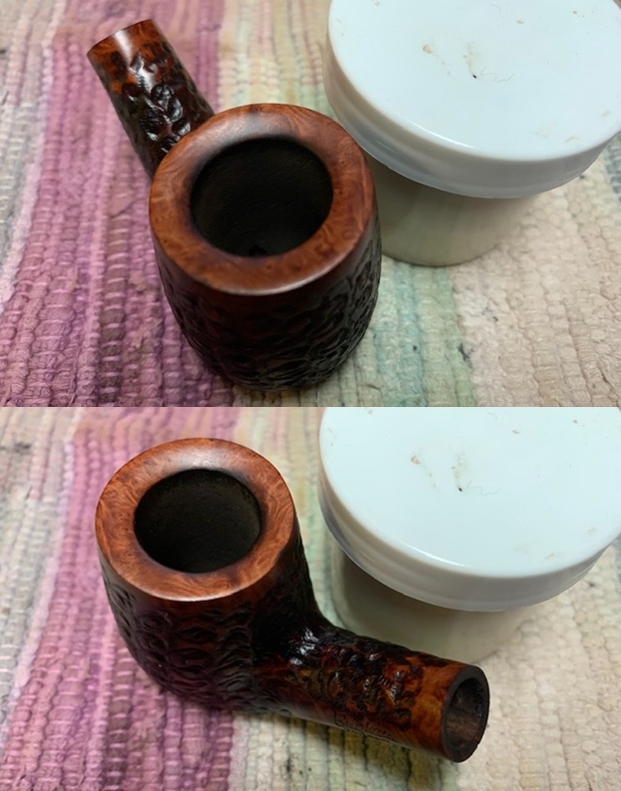
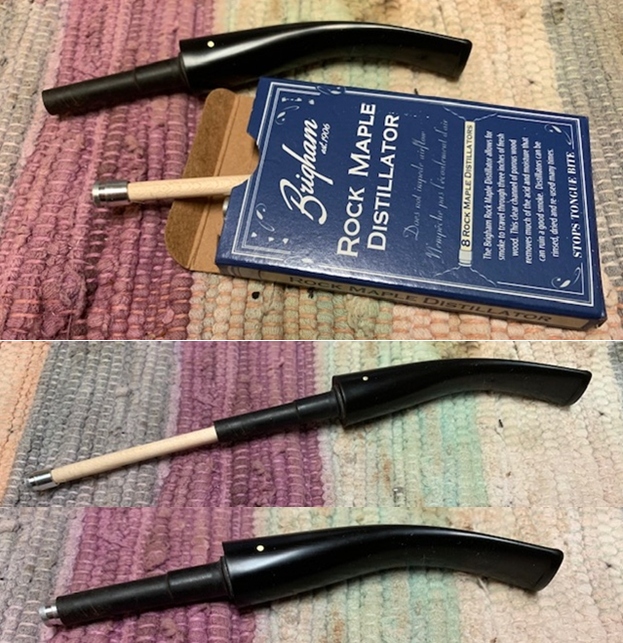
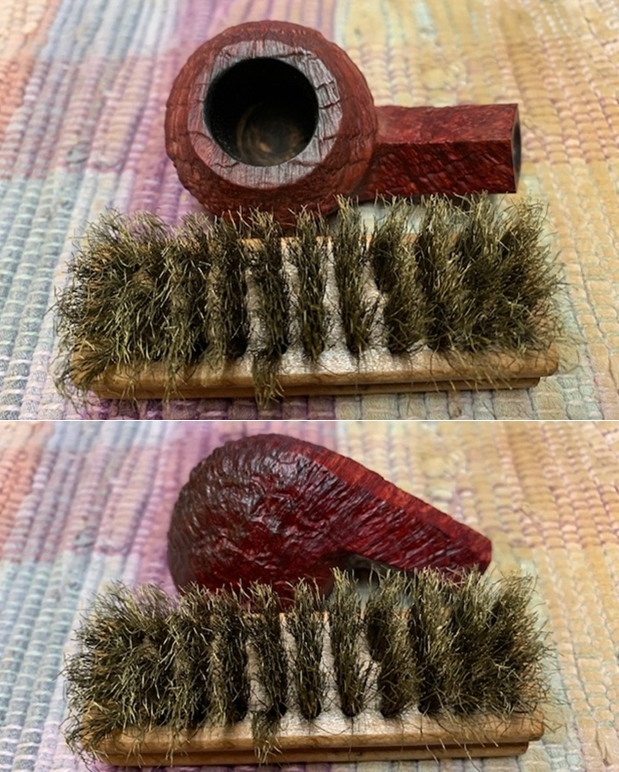
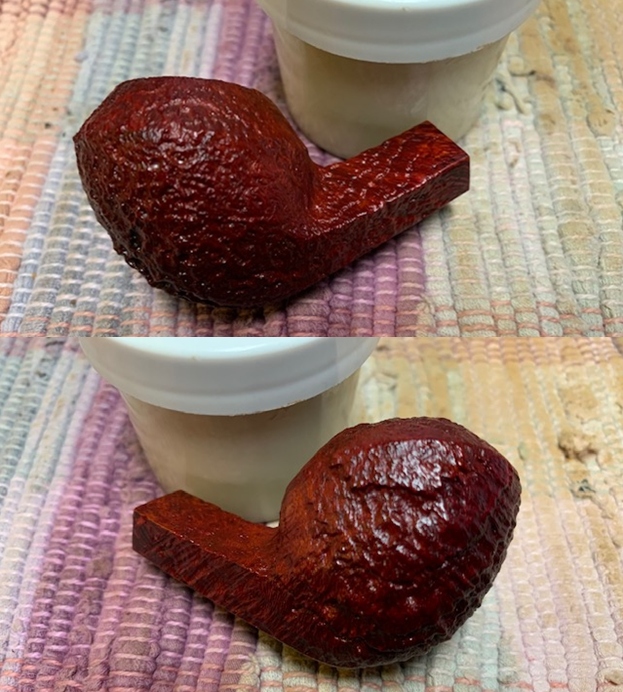
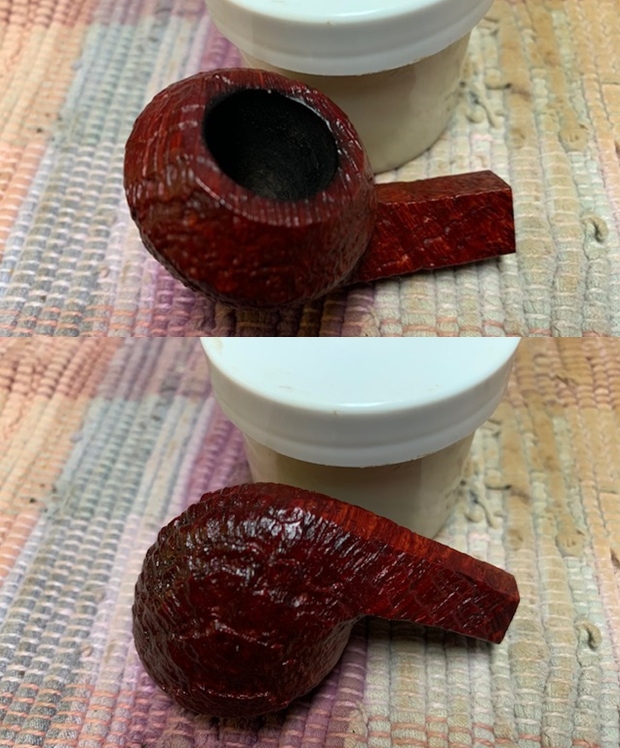
The next pipe I have chosen is one that neither Jeff nor I remember picking up. It could have come to us through a trade for work on a pipe or it could have come from one of my earlier pipe hunts. It is a Brigham in a shape I would call a bent volcano. It had an unusual pattern of rustication on the bowl with a smooth rim top and panel on the shank as well as a smooth ring around the shank end. I like the older style Brigham rustication pattern far better than this one. The mix of brown stains gave depth to the texture of the pipe under the grime on the finish. It was stamped on the left side of the shank. The stamping was readable. It read Brigham [over] Voyageur [over] the shape number 184 Italy. It also had a single brass dot on the left side of the taper stem. The Italy stamp told me it was a newer Brigham made after the manufacture of the pipes left Canada and moved to Italy. It was in decent condition when I brought it to the table. The finish was dirty with grime ground into the briar sides and rim. There was a thick cake in the bowl and an overflow of lava on the inwardly beveled rim top and the inner edge of the bowl. The stem was dirty but otherwise in good condition. There were light tooth marks and chatter on the top and underside on and near the button. The Maple Distillator was missing and the extended tenon which was aluminum on the Canadian made pipe had been replaced with nylon or Delrin. I took photos of the pipe before my cleanup work. They tell the story and give a glimpse of the promise that we see in this pipe. I took a photo of the rim top to show the interior the bowl and the rim top and inner edge. It is heavily caked with a thick lava overflow on the back part of the top. I am also unsure of the condition of the inner edge as it appears to have some darkening. I will know more once I remove the lava coat. The stem is in decent condition with light tooth marks on the top and underside near the button.   I took a photo of the left side of the shank to show the stamping. The stamping is readable in the photos below and is as noted above. The stem has a single brass dot on the left side. I took the stem off the bowl and took a picture of the nylon/Delrin thin tube tenon with the Maple Distillator missing.  I will need to provide a Maple Distillator for the pipe when I have finished the cleanup.I turned to Pipedia and read through the article there (https://pipedia.org/wiki/Brigham_Pipes). It gives a good overview on the beginnings of the Canadian Brand and the different time periods. I have included the chart below from the site as it shows the Standard (1 Dot) pipes and includes the Voyageur. The shape number 84 is the shape of the pipe on the table now.The site referred me to an article by Charles Lemon (Dad’s Pipes) on the marking and dating of the pipes so that I could identify the time period when the brand moved its manufacture to Italy (https://pipedia.org/wiki/Brigham_Pipes_%E2%80%93_A_Closer_Look_at_Dots,_Dates_and_Markings). From there I was able to identify the move as happening in 2001. I quote the section of Charles’ article on that era that he calls the Transition Era.

The Transition Era (2001 – 2006). The biggest change to hit Brigham since the advent of the Rock Maple filter occurred in 2001 when Brigham moved production from Toronto to Italy. The product lineup was, not surprisingly, heavily impacted, with the most obvious change a sharp decrease in the number of pipe shapes available.

Daniel More, President of Brigham Enterprises Inc. explains the move to the EU: Admittedly the hardest decision we ever needed to make. With an aging skilled work force we were losing the skills required at an alarming rate. We made attempts to bring in new people but we were not effective in staving off the atrophy. We were fortunate though to be able to move by increments allowing us control and comfort throughout the process. For example, instead of turning our own bowls we began to purchase turned bowls; then we had stems added with sanding at 100-grit ; then sanding to finer degrees; then staining and so on. The last bit of control was grading.

I still visit the manufacturing facility in the EU at least once a year to discuss QC and pick shapes and designs. The shift [to the EU] resulted in fewer shapes. However, one of the biggest benefits was access to a wider variety of finishes. We had never been able to offer a sandblasted pipe and the access to accessories like rings and different colours, I think, allowed us to make the line more interesting

Another interesting point in the article was the section on the shift from the aluminum tenon/holder to the nylon/Delrin material used since the move. I have always wondered about this shift and the rationale behind it.

Coincidental with shifting production to the EU was the move from the original aluminum tenon/filter holder to one made of a composite material. Daniel More provides insight into the switch:

Principally there were two catalysts for the change. We were using a very specific OD for our Aluminum Tenons. In fact, we were one of only two companies in North America using this OD, the other being an aircraft manufacturer in California. When this aircraft company shifted to an alternative, it left us and us alone purchasing this specific size. To stay with Aluminum, our only alternative was to purchase an oversized OD and tool this down to our requirements results in significant expense due to the wasted material costs.

We had, for many years, experimented with a number of composite materials for both the tenons and Distillator Tips. The issue was always heat resistance. Technology having advanced as it did by the 1990’s presented us with a selection of alternatives. We tested 10 different compositions before landing on the formula we still use today.

Cost saving aside, the Composite Tenon virtually eliminated the breaking of shanks. That is, when a pipe shank would break due to leverage (think, in the pocket and sitting down), we could not repair this. The Composite Tenon would now break away rather than the shank allowing for an inexpensive repair versus having to throw out “an old friend”. Without a doubt, there were many cries about the inferior Composite Tenon breaking but with our offer to provide no cost tenon repairs we assuaged this concern. We still offer to this day no charge repairs for broken Composite Tenons – no questions asked.

During the Transition Era, the 100 – 300 series pipes looked very similar to Canadian-made pipes and continued to be recognized by their traditional brass pin patterns. These lower series pipes were offered in 9 shapes. The 400 series disappeared temporarily, while the 500 to 700 series pipes, available in only 8 shapes, lost their brass pins and were identified only by their 3-digit shape numbers.

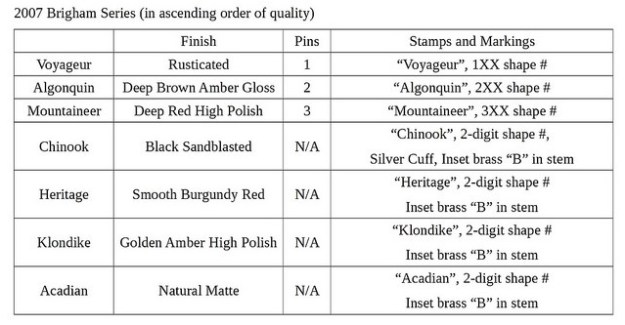
Later in the article Charles gave some excellent information on the 2007 series of pipes. The one dot pipes identify the pipe as part of the 100 series. Thus the pipe I am working on is a 100 series shape #84 = the shape number stamping of 184.

Modern Brigham Pipes

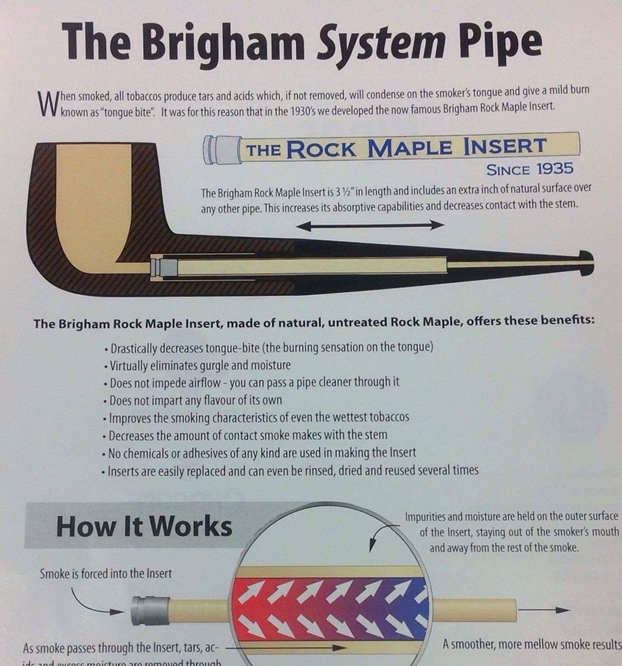
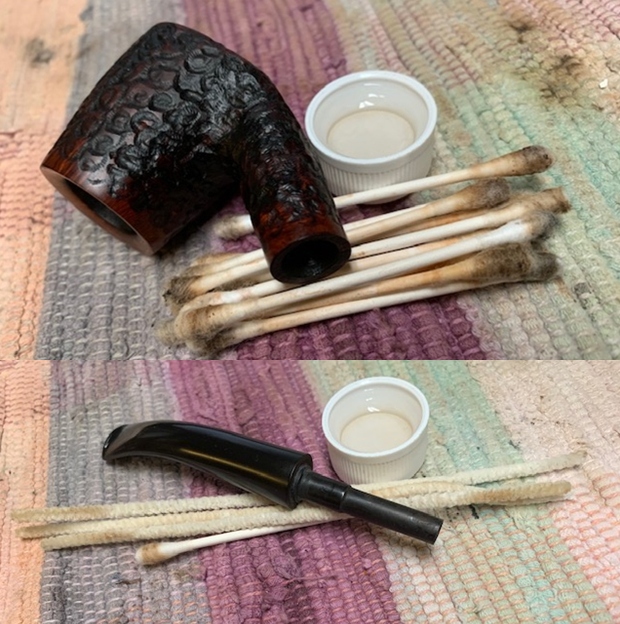
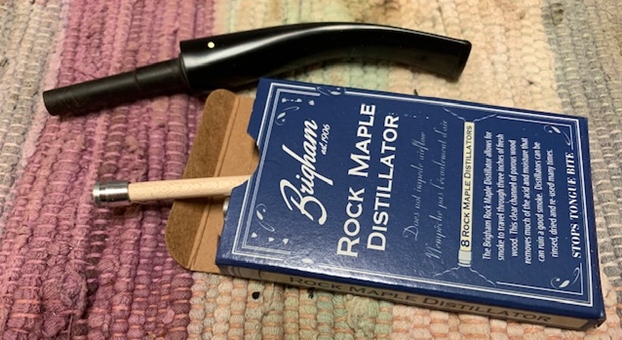
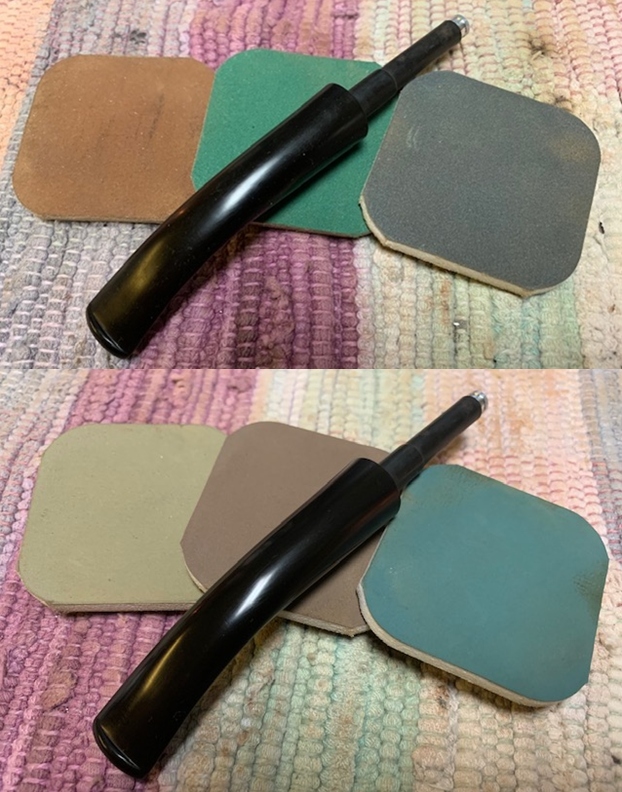
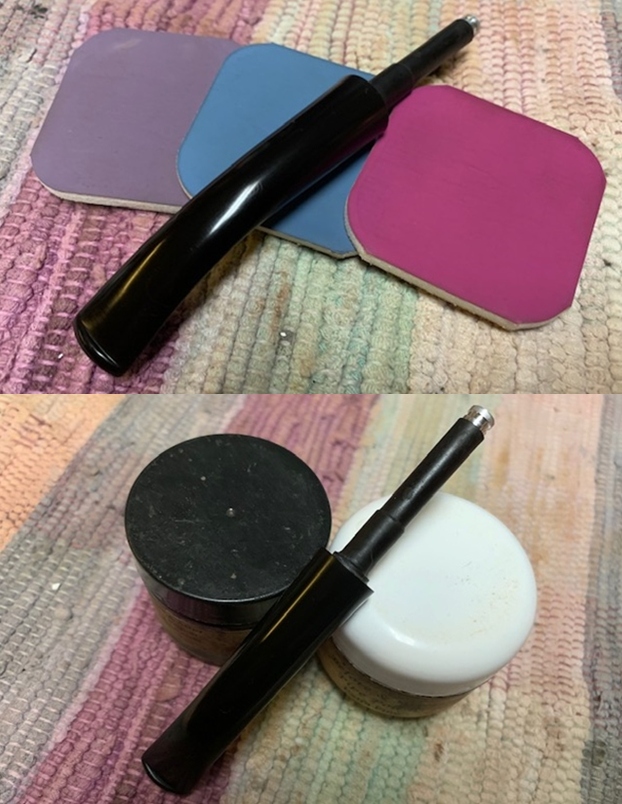
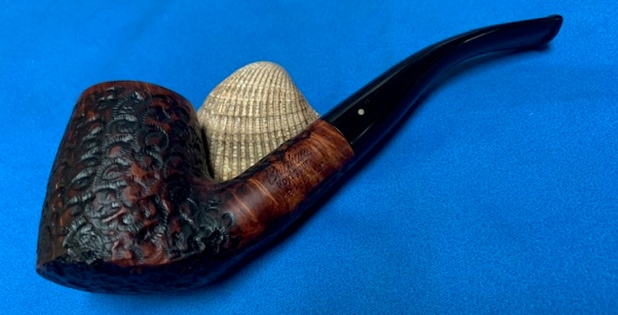
Except for the lowest three grades, pipes in the current (2007) Brigham series cannot be identified by brass pins or shape availability. All grades are available in 12 standard shapes, but are distinguished by their unique finishes and markings. As noted above, the Voyageur, Algonquin and Mountaineer pipes are made in Italy, while the remaining pipes in this series (Chinook, Heritage, Klondike and Acadian) are produced in France.Before I get into the restoration part of this pipe I decided to include a poster I picked up that shows the filtration system of the patented Brigham Distillator. Give the poster a read. It also helps to understand the internals of these older Canadian made pipes as well as the newer Italian and French made pipes.I reamed the pipe with a PipNet reamer and cut back the cake back to the bare briar. I cleaned up the walls with a Savinelli Fitsall Pipe Knife. The interior walls of the pipe looked free of burn or heat damage. To me that is always a relief.  I decided to address the damage to the rim top next in my restoration of this pipe. I used a folded piece of 220 grit sandpaper to clean off the rim top and the inner edge of the bevel. It took some time but I was able to bring it back to a pretty clean condition.  I polished the bowl and rim top with micromesh sanding pads – dry sanding it with 1500-12000 grit pads. After each pad I wiped the briar down with a damp cloth. This served a dual purpose of both removing the sanding debris and the dust that had accumulated in the rustication patterns around the bowl and shank.   I worked some Before & After Restoration Balm into the surface of the briar with my fingertips and a horsehair shoe brush to clean, enliven and protect the briar. I let the balm sit for 15 minutes and then buffed with a cotton cloth to raise the shine. The photos show the bowl at this point in the restoration process. It looks quite nice at this point. At this point it dawned on me that I had not cleaned the internals of the pipe. I am so used to having Jeff do the cleaning that I just skipped over it. Fortunately I remembered at this point! I cleaned out the shank and airway in the shank and stem with pipe cleaners, cotton swabs and alcohol. I was surprised that I also was removing some brown stain from the end of the shank.With that done the bowl was finished other than the final buffing. I set it aside and turned my attention to the stem. The stem was in great condition and I was certain I could remove the chatter and marks with micromesh pads. Before polishing stem I decided to fit it with the Rock Maple Distillator.   I polished the stem with micromesh sanding pads – wet sanding with 1500-12000 grit sanding pads. I wiped it down after each sanding pad with Obsidian Oil. I polished it with Before & After Pipe Stem Polish – both Fine and Extra Fine.   I am excited to finish this Brigham Voyageur Series 1 shape 84. I put the pipe back together and buffed it with Blue Diamond on the buffing wheel. I gave the bowl and the stem multiple coats of carnauba wax. I hand buffed the pipe with a clean buffing pad to raise the shine. It is fun to see what the polished bowl looks like with the grain popping through on the bowls sides and rim top. Added to that the polished black vulcanite stem with the shining brass pins was beautiful. This rusticated Brigham 1 Dot Voyageur 184 turned out to be a nice looking pipe that feels great in my hand. It is light and well balanced. Have a look at it with the photos below. The dimensions are Length: 6 inches, Height: 2 inches, Outside diameter of the bowl: 1 ¼ inches, Chamber diameter: ¾ of an inch. The weight of the pipe is 53grams/2.08oz. It is a beautiful pipe and one that will be on the rebornpipes store in the Canadian Pipe Makers section soon. If you are interested in adding it to your collection let me know. Thanks for walking through the restoration with me as I worked over this pipe. Thanks to each of you who are reading this blog. Remember we are not pipe owners; we are pipemen and women who hold our pipes in trust until they pass on into the trust of the next pipeman or woman. 

Restoring a Late Republic Era Peterson’s System Cara 302


Blog by Steve Laug

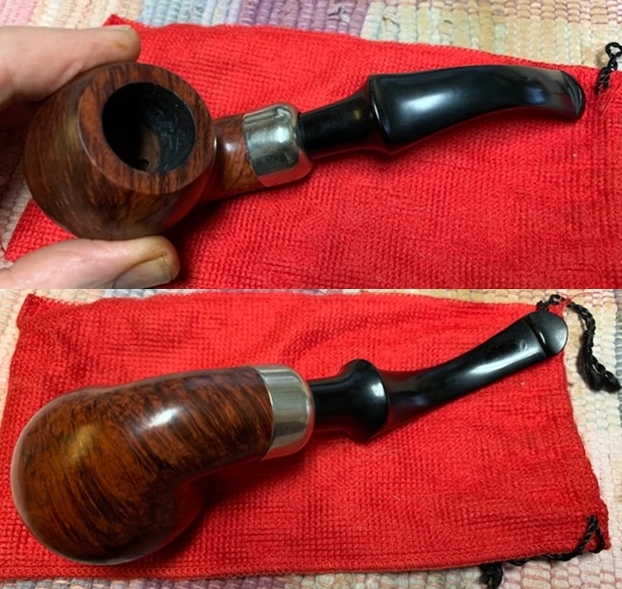
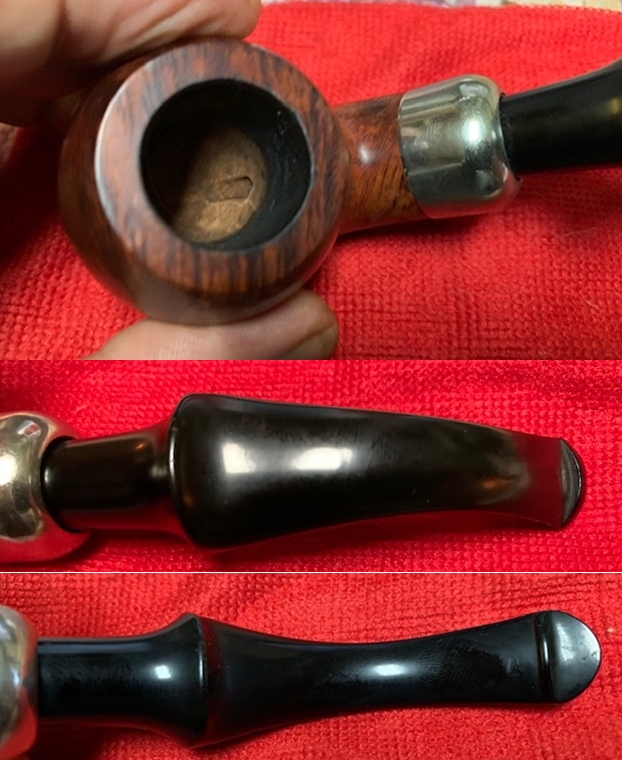
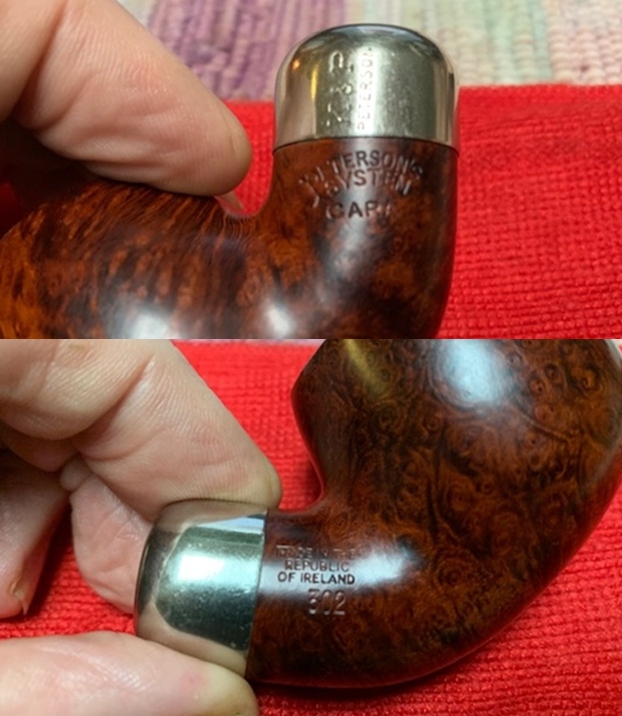
The next pipe on the work table came to us from an online auction from auction in 2018 from Wilkes Barre, Pennsylvania, USA. It is a smooth Peterson’s Apple shaped System pipe with a tapered vulcanite stem. The pipe is stamped on the left side of the shank and reads Peterson’s [over] System [over] Cara. On the right side of the shank it is stamped Made in the Republic of Ireland [over] the shape number 302. This is a nice piece of briar with interesting grain all the way around the bowl. The finish had a lot of grime ground into it. The bowl was moderately caked and there was a lava coat on the top and the inner edge of the rim. The edges looked okay but we would know more after the cleanup. The stem was oxidized, calcified and had tooth chatter and marks on the top and underside near the button. The nickel ferrule is stamped K&P [over] Peterson. The pipe showed promise but it was very dirty. Jeff took photos of the pipe before he started his cleanup work.   He took photos of the rim top and bowl to give a clear picture of the thickness of the cake and the condition of the rim top and edges. He also took photos of the top and underside of the stem to show the oxidation, calcification and chatter and tooth marks.   Jeff took a photo of the side and heel of the bowl to give a picture of what the briar around the pipe looked like.    He took photos of the stamping on the shank and the nickel ferrule. It reads as noted above and is clear and readable.   I am including the information from Pipedia’s article on Peterson pipes. It is a great read in terms of the history of the brand (https://pipedia.org/wiki/Peterson). I have included a bit of the pertinent history here.

1950 – 1989 The Republic Era – From 1950 to the present time, the stamp for this era is “Made in the Republic of Ireland” in a block format generally in three lines but two lines have been used with or without Republic being abbreviated.

I turned to Pipedia to see if I could find some specific information on the Cara line of System pipes (https://pipedia.org/wiki/Peterson#Peterson_Pipe_Collections). There was nothing specific on the Cara so I was left with little information on the line.

I knew that I was dealing with a Republic Era pipe made between 1950-and the present – a Late Republic pipe. It was a classic line 302 shaped apple with the System style drilling. Now it was time to work on the pipe.

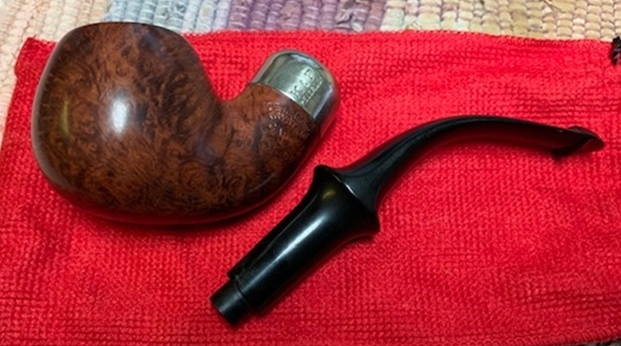
Jeff had cleaned up the pipe with his usual penchant for thoroughness. He reamed the pipe with a PipNet Pipe Reamer and cleaned up the remnants with a Savinelli Fitsall Pipe Knife.  He scrubbed the bowl with undiluted Murphy’s Oil Soap with a tooth brush. He rinsed it under running warm water to remove the soap and grime. He cleaned out the inside of the shank and the airway in the stem with alcohol, cotton swabs and pipe cleaners. He soaked the stem in Before & After Deoxidizer and rinsed it off with warm water. I took photos of the pipe once I received it. The rim top and inner edge of the rim looked very good with a bit of damage on the inner bevel of the rim surface. The stem surface looked very good with some tooth marks and chatter on both sides near the button.    I took a photo of the stamping on the shank. It is clear and readable as noted above.     I removed the stem and took a photo of the pipe to give a sense of the whole. The stem is a fancy saddle version. The pipe was in such good condition that started by rubbing it down with Before & After Restoration Balm. I worked it into the surface of the bowl sides and shank with my fingertips. The product works to clean, enliven and protect the briar. I let the balm sit for a little while and then buffed with a cotton cloth to raise the shine.     I set the bowl aside and turned to work on the stem. I filled in the tooth marks on both sides of the stem just ahead of the button with clear super glue. Once the repairs had cured I sanded them smooth with 220 grit sandpaper to smooth them out and blend them into the surface. I started polishing the stem with 400 grit wet dry sandpaper.   I polished the vulcanite stem with micromesh sanding pads – 1500-12000 grit pads. I wiped it down with a damp cloth after each sanding pad. I used Before & After Pipe Polish – both Fine and Extra Fine to further polish the stem.    This Peterson’s Republic Era Cara System 302 Bent Apple with a vulcanite saddle stem is a great looking pipe now that it has been restored. The beautiful grain that shines through the polished finish is stunning. As the pipe is smoked the patina should develop and look even better. I put the stem back on the bowl and carefully buffed the pipe with Blue Diamond on the buffing wheel. I gave the bowl and the stem multiple coats of carnauba wax on the buffing wheel and followed that by buffing the entire pipe with a clean buffing pad. I hand buffed the pipe with a microfiber cloth to deepen the shine. The finished Peterson’s Cara System 302 fits nicely in the hand and feels great. Give the finished pipe a look in the photos below. The dimensions of the pipe are Length: 6 inches, Height: 1 ¾ inches, Outside diameter of the bowl: 1 ½ inches, Chamber diameter: ¾ of an inch. The weight of the pipe is 70gr/2.47oz. If you are interested in adding this pipe to your collection send me a message or an email. Thanks for reading this blog and my reflections on the pipe while I worked on it. There are many more to come!
Bringing a Beautiful  Benaderet’s Smooth Poker/Cherrywood Back to Life


Blog by Steve Laug

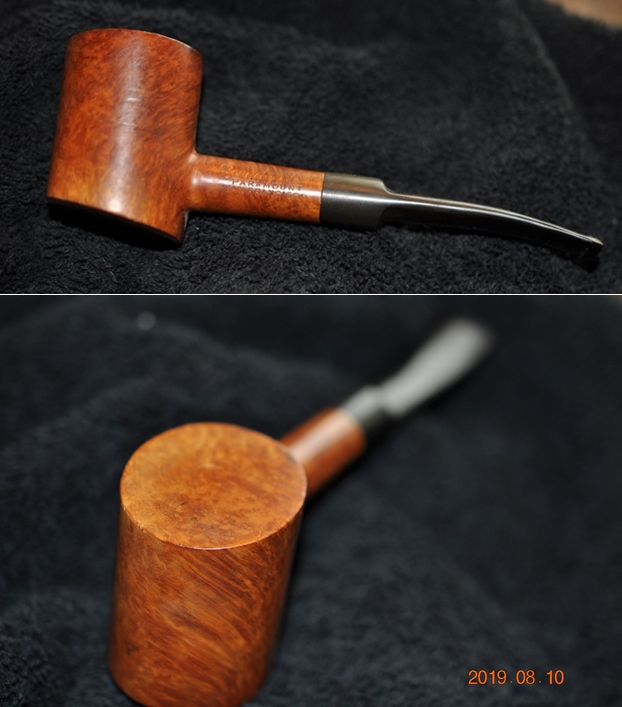
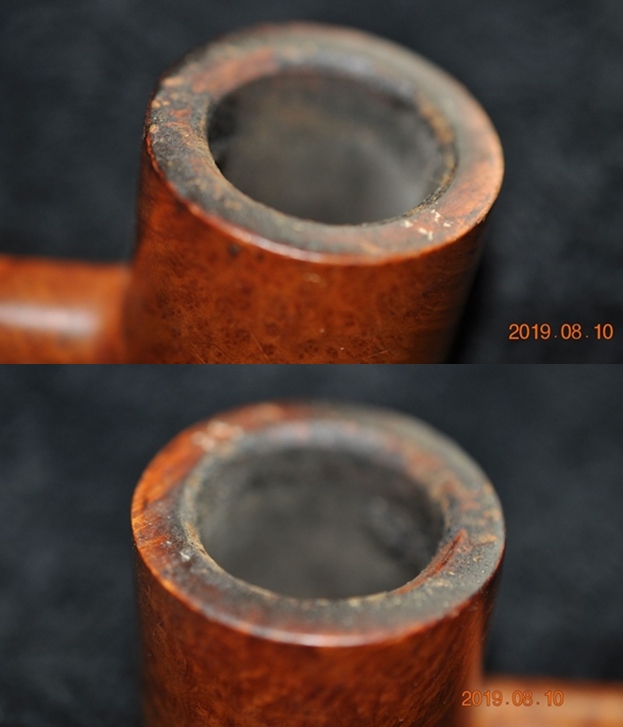
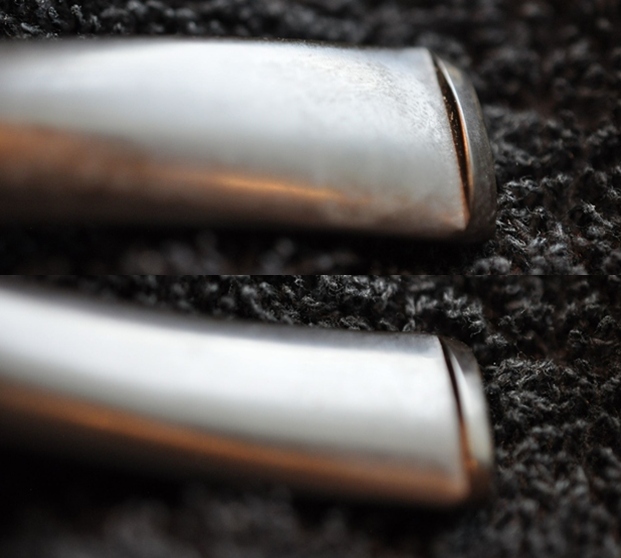
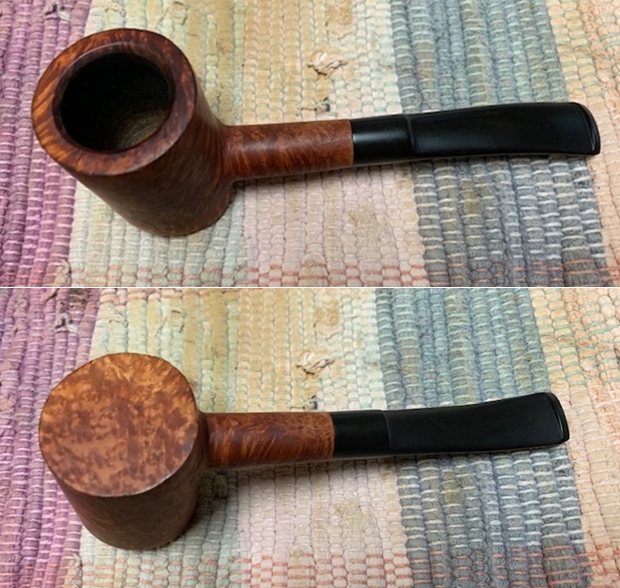
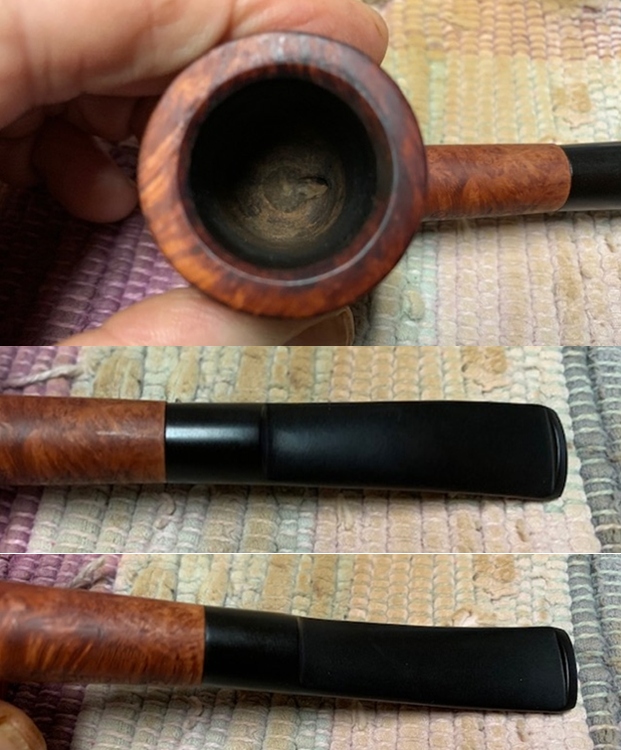
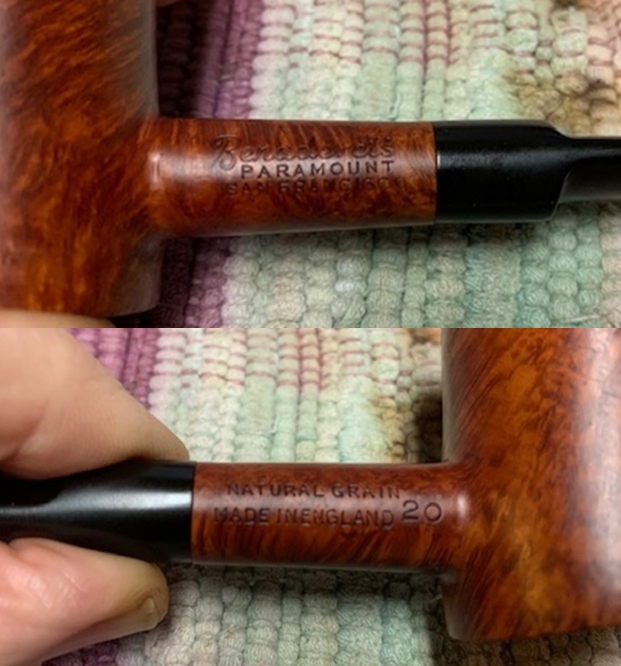
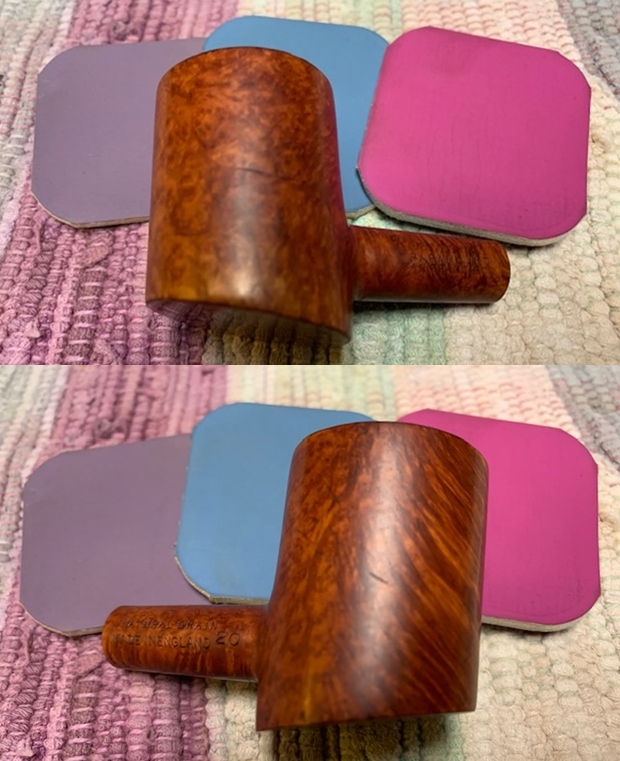
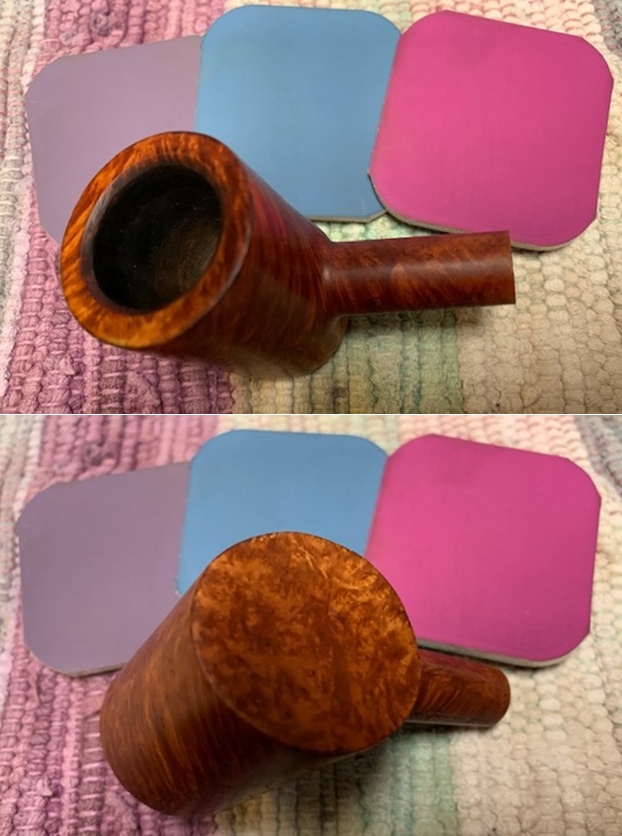
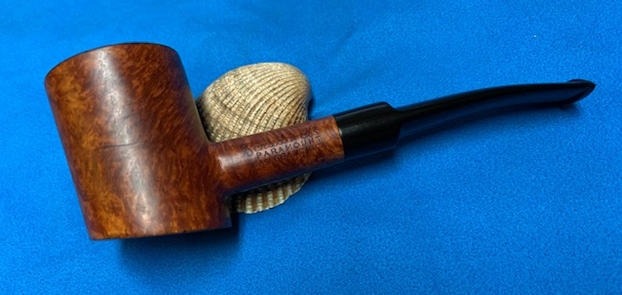
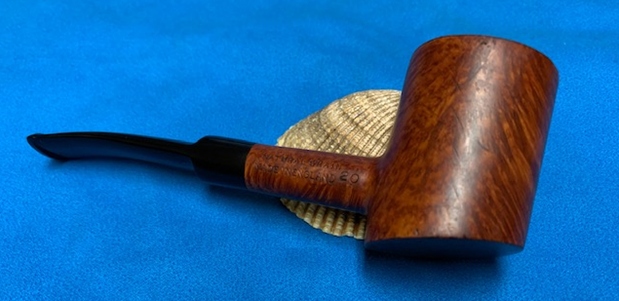
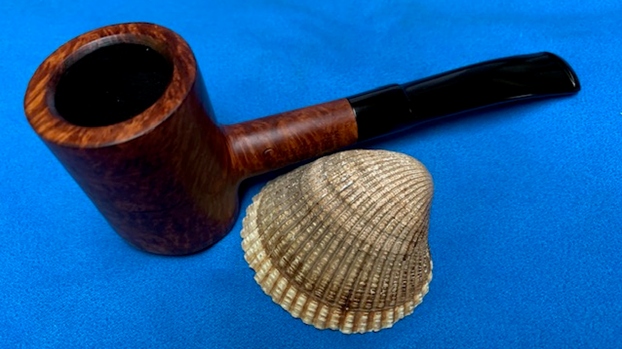
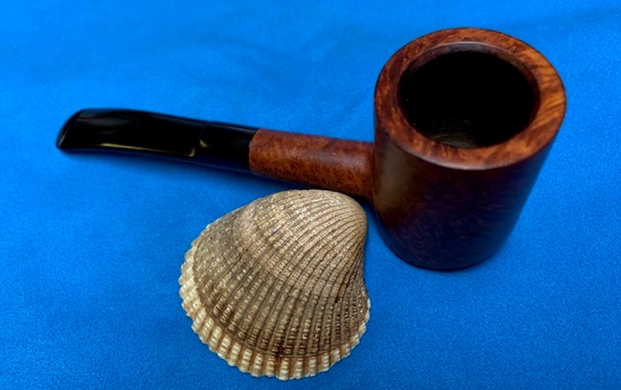
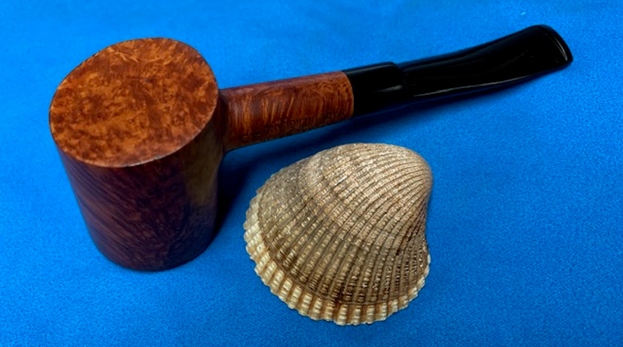
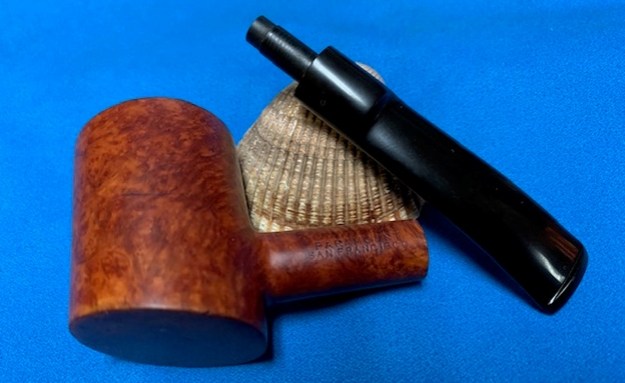
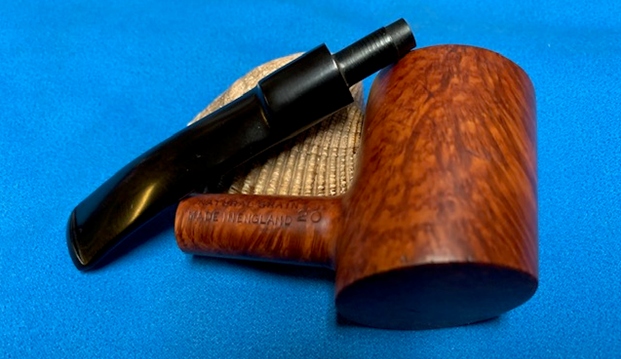
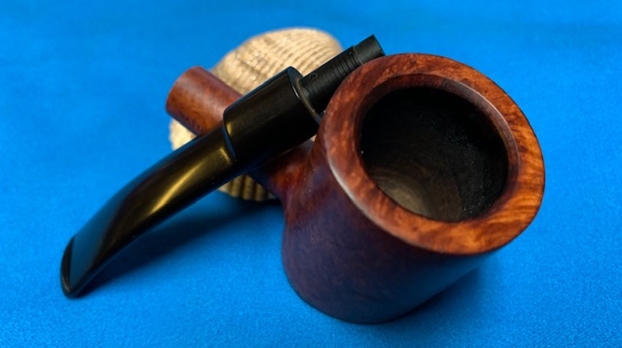
The next pipe on the table is a nice looking smooth finish Poker. We picked it up in 2018  from a fellow in Scottsdale, Arizona, USA. The pipe is a real mess with dust and grime ground into the finish on the bowl. There is a thick cake in the bowl and the rim top and beveled inner edge is covered in lava. The cake was so thick in parts of the bowl that it was hard to know for sure what the condition of the rim edge was under the lava. The finish appears to be a reddish brown or oxblood colour with dark highlights underneath. On the left side of the shank it is stamped Benaderet’s [over] Paramount [over] San Francisco. On the right side it is stamped Natural Grain [over] Made in England with the shank number 20 next to the shank bowl junction. The stem was oxidized, calcified and there were light tooth marks and chatter on both sides just ahead of the button. There was not any stamping on the stem so it did not have any identifying marks. Jeff took photos of the pipe before he started working on it. I include those below. Jeff took photos of the bowl and rim top to show the cake in the bowl and the lava build up on the rim top and dust and grime in the finish. It was thick and hard and heavier toward the front of the bowl. Hopefully it had protected the rim and edges from damage. The lava is thick and scattered across the top and there is a buildup on the inner edge of the bowl.  The stem shows scratching, oxidation, calcification and light tooth marks on the stem surface and button. Jeff took a photo of the sides and heel of the bowl to show the condition of the finish – the grime and grit all over the sides and bottom of the bowl. Jeff took photos of the stamping on the sides of the shank. It is very clear and readable as noted above.   From the Natural Grain stamping and the shape number on the shank I was pretty certain I was dealing with a Comoy’s pipe. The stamping Benaderet’s was a dead end and the shape number 20 seems to point to Comoy’s.

I did a quick google search for a Benaderet’s Pipe Shop and came on two good links. The first is from a post on reddit that included a quick bit of information on the shop being located in San Franscisco, California that closed in the 1970s. (https://www.reddit.com/r/PipeTobacco/comments/dzg3y8/any_info_on_a_benaderet_pipe_year_etc/ ). I quote:

Benaderet’s was a pipe shop in San Francisco that closed in the 70’s. Their house pipes were made by Comoys or Sasieni although smokingpipes had one made by GBD once. Good find.

The other link was to a blog (http://theothersideofthelizard.blogspot.com/2018/11/benaderets-pipe-shop.html). That blog gave the original address of the shop in San Francisco and the names of the owners of the shop.

Benaderet’s Cigarette, Pipe and Tobacco Shop
215 Sutter Street [Formerly at 566 California Street], San Francisco.
Owners: Robert and Edith Rashaw (Robert Rashaw: born 1916. Edith Edna Rashaw: born 1916.)

Store still extant in the late seventies. No longer there by the eighties. At one point, they had Egyptian cigarettes made for them. Their house pipes were usually by Comoys. There are also Benaderet Sasienis. More research required.

Quote: “Benaderet’s Inc. was California’s oldest pipe and tobacco store when it went out of business in 1980. Sam Benaderet was a tobacconist from New York City who came to San Francisco in 1915 to work at the Panama Pacific International Exposition. An immigrant to the United States from Turkey, Mr. Benaderet decided that he liked the West Coast’s Mediterranean like climate. After the Exposition closed, he stayed to open his own tobacco business. This new firm produced custom private-label cigarettes for men’s clubs. A lavish retail store was opened in the late 1920’s that quickly became a mecca for tobacco connoisseurs.”

So what I could find out about the pipe is that it is a pipe probably made by Comoys (The Natural Grain mark and the shape number points to this conclusion). It was made for Benaderet’s Cigarette, Pipe and Tobacco Shop in San Francisco, California. Since the shop went out of business in 1980 I now knew that the pipe was made before that time. Now it was time to work on the pipe.

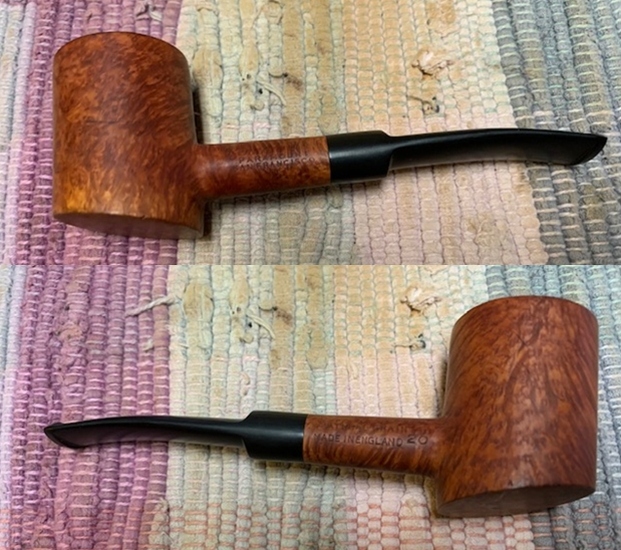
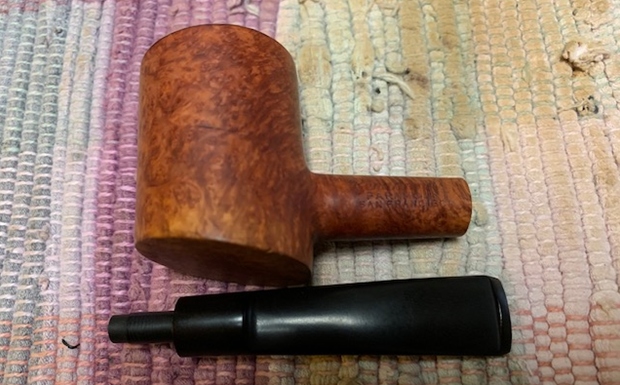
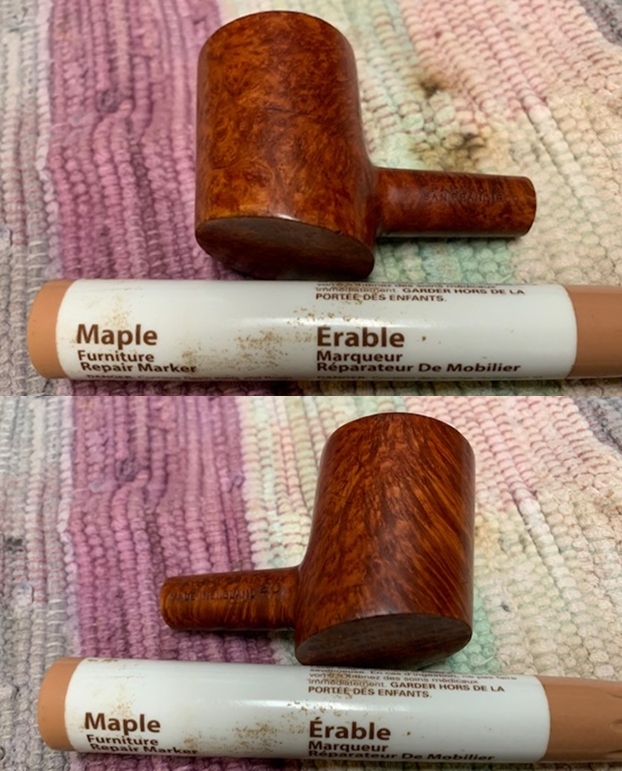
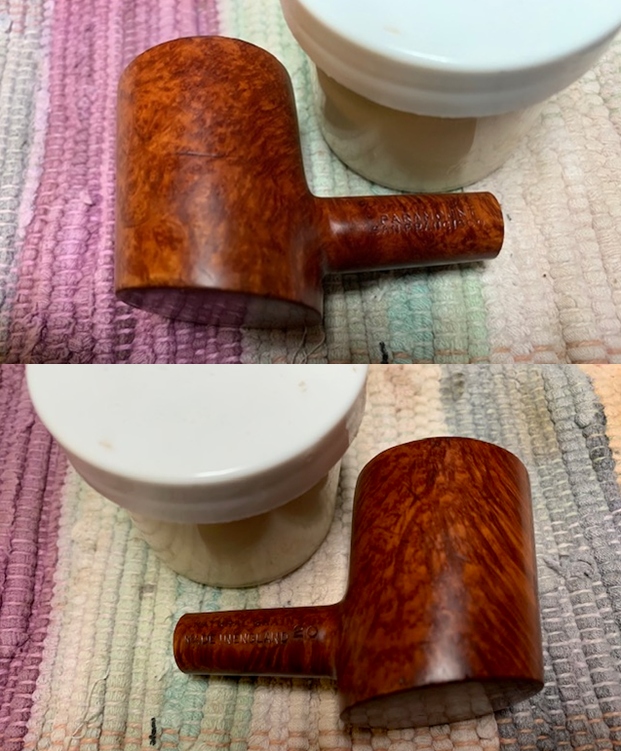
This pipe was a real mess like many of the pipes we work on. I was curious to see what it would look like when I unpacked it. I was surprised at how good it looked. Jeff reamed it with a PipNet pipe reamer and cleaned up the reaming with a Savinelli Fitsall Pipe Knife. He scrubbed out the internals with alcohol, pipe cleaners and cotton swabs until the pipe was clean. He scrubbed the exterior of the bowl with Murphy’s Oil Soap and a tooth brush to remove the grime and grit on the briar and the lava on the rim top. The finish on the bowl looked really good when I got it. The rim top looked much better and the inner and outer edges were looking good. He had cleaned the internals and scrubbed the exterior of the stem and soaked them in Before & After Deoxidizer bath to remove the oxidation. The stem looked very good other than the tooth marks and chatter in the surface. When the pipe arrived here in Vancouver for the second stop of its restoration tour it looked very good. I took photos of the pipe before I started my work on it.   I took photos of the condition of the rim top and stem before I started working. The rim top looks very good. The beveled inner edge of the rim is clean and look great. The bowl is spotless. The stem is clean and has light tooth marks and tooth chatter.     I took a photo of the stamping on the sides of the shank. It is clear and readable as noted above.I took the stem off the shank and took a photo of the pipe to show overall look of the parts. It is a nice looking piece of briar and the pipe will be a beauty.I polished the briar with micromesh sanding pads – dry sanding with 1500-12000 grit pads and wiped it down after each sanding pad. I decided to leave the few scratches in the briar and they would not steam out and they were minor enough to leave.  There were some light spots around the bowl and shank that I touched up with a Maple stain pen to blend into the surrounding briar. I worked some Before & After Restoration Balm into the finish of the bowl and shank with my fingertips to clean, enliven and protect it. I find that the balm really makes the briar come alive again. The contrasts in the layers of stain really made the grain stand out. I let the balm sit for 15 minutes then buffed with a cotton cloth to raise the shine. The bowl looks good at this point.     I set the bowl aside and turned my attention to the stem. It was in good condition and the light chatter and marks would be removed when I polished the stem with micromesh sanding pads. I dry sanded it with 1500-12000 grit pads. I wiped it down after each pad with Obsidian Oil. I polished it further with Before & After Pipe Stem Polish – both fine and extra fine.  Once again I am the part of the restoration that I always look forward to – the moment when all the pieces are put back together. I put the Benaderet’s Cherrywood/Poker Paramount 20 pipe back together and buffed the bowl and the stem with Blue Diamond on the buffing wheel. I gave the bowl and the stem multiple coats of carnauba wax. I buffed the pipe with a clean buffing pad to raise the shine. I hand buffed it with a microfiber cloth to deepen the shine. It is fun to see what the polished bowl looks like with the black vulcanite saddle stem contrasting with the colours of the bowl. The reddish brown stain on the Benaderet’s Paramount Cherrywood looks absolutely great. It is nice to know that it has a west coast tie to the San Francisco area and a long gone pipe shop. It must have been a fine smoking pipe judging from the condition it was when we received it. Have a look at it in the photos below. The dimensions are Length: 5 ¼ inches, Height: 1 ¾ inches, Outside diameter of the bowl: 1 ¼ inches, Chamber diameter: 7/8 of an inch. The weight of the pipe is 36 grams/1.27 oz. This is one that will go on the British Pipemakers section of the rebornpipes online store shortly. Thanks to each of you who are reading this blog. Remember we are not pipe owners; we are pipemen and women who hold our pipes in trust until they pass on into the trust of the next generation.
Breathing Life into a 1972 Dunhill Red Bark 6P F/T Group 4 Bulldog


Blog by Steve Laug

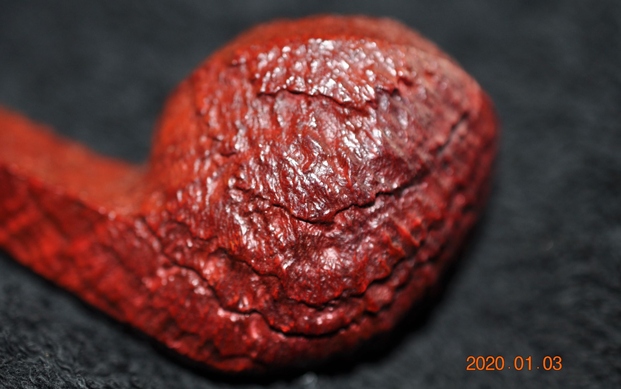
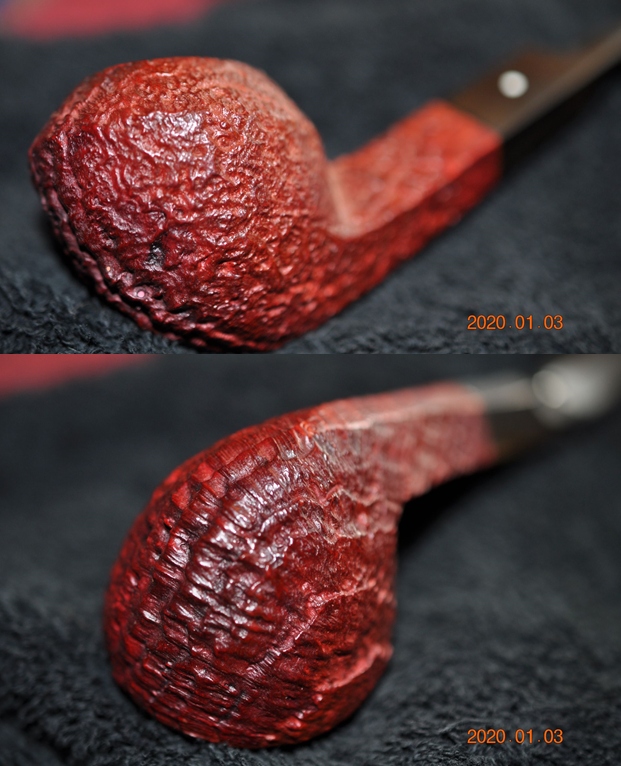
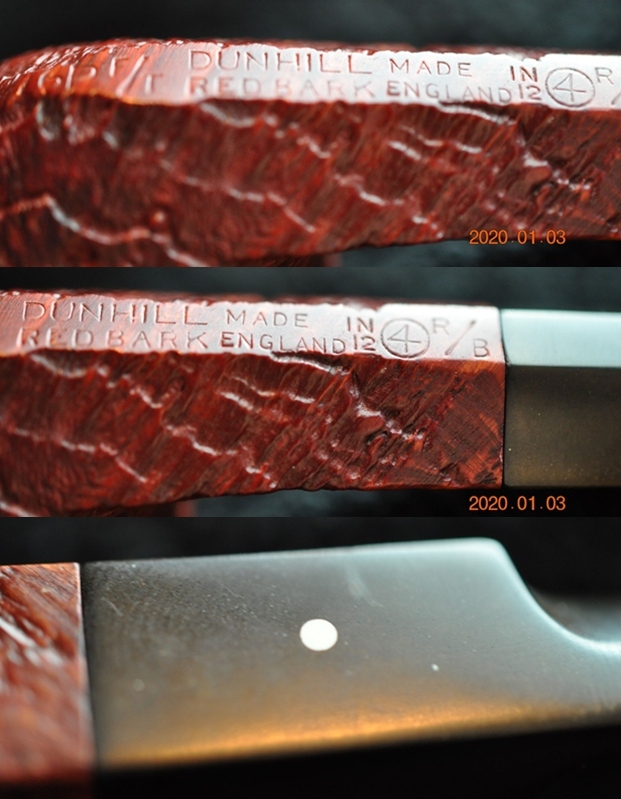
The next pipe on the table came to us in a group of pipes that we purchased from a fellow in Los Angeles, California, USA. It is a Dunhill Red Bark Bent Bulldog that is in good condition. It is stamped on a smooth panel on the underside of the shank. On the heel of the bowl it is stamped with the shape number 6P F/T followed by Dunhill [over] Red Bark followed by Made in England 12. That is followed by 4 in a circle followed by R/B for Red Bark. Interpreting that stamp it is as follows: The 6P is the shape for a bent saddle stem Bulldog and the F/T is the designation for the button shape – a Fish Tail. The Dunhill Red Bark is the finish which is corroborated the R/B at the end of the stamping. The 12 following the D of England gives the date the pipe was made and identifies it as 1972. The stamping is clear and readable. The age of the pipe and the oils in the sandblast finish has given the pipe a rich reddish brown finish. There is also some amazing grain that the shape follows well. The finish was dirty with dust around the nooks and crannies of the sandblast. There was a thick cake in the bowl and tobacco debris stuck to the walls of the bowl. The rim top showed darkening and some lava in the sandblast. The vulcanite saddle stem was oxidized, calcified and had light tooth marks and chatter ahead of the button.  Jeff took photos of the pipe to show what it looked like before he started working on it.  He took photos of the bowl and rim top to show the thickness of the cake and the darkening and light lava overflow on the rim top. The photos of the stem show the oxidation, calcification and tooth marks and chatter on the surface on both sides.  The photos of the sides and heel of the bowl show the deep sandblast grain on the pipe. It is a beauty under the grime and dust.    The stamping on the underside of the shank is shown in the photos below. It looks very good and readable. It reads as noted and explained above. The third photo shows the white spot on the stem.   I turned to Pipedia’s section on Dunhill Red Bark Pipes to get a bit of background on the Dunhill finishes (https://pipedia.org/wiki/Dunhill#Root_Briar). I quote:

Red Bark

Red Bark: Introduced in 1972, the Red Bark is a reddish stained sandblast, and is the most famous of Dunhill’s retired finishes. Originally, the stain was a medium red. A couple of years later the stain was changed to a brighter red, almost pinkish in colour. The almost pink colour caused pipe sales to plummet. In 1976, the stain was changed back to the original darker medium red finish. The Red Bark finish was officially retired in 1987. The County and Russet finishes have also been retired.

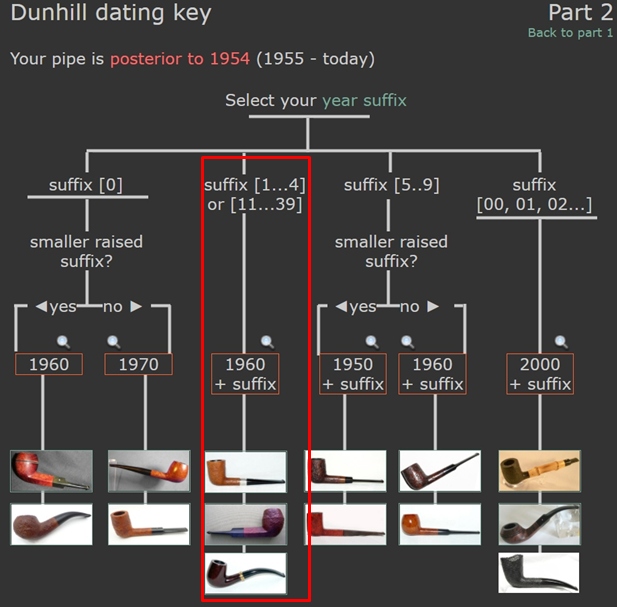
I turned to Pipephil’s dating guide to show how I arrived at the date of manufacture for this pipe (http://www.pipephil.eu/logos/en/dunhill/cledat-en1a.html). I am including the chart that is provided there for the dating a pipe. I have drawn a red box around the section. Since the pipe I am working on has a 12 it points to the 1960+ suffix line on the chart below.I now knew that I was working on a Red Bark that came out in 1972 which was the first year that the line was introduced. It was retired in 1987 and was one of the most famous of Dunhill’s retired finishes. It also had the medium red stain of the first pipes introduced from Dunhill in the Red Bark line.

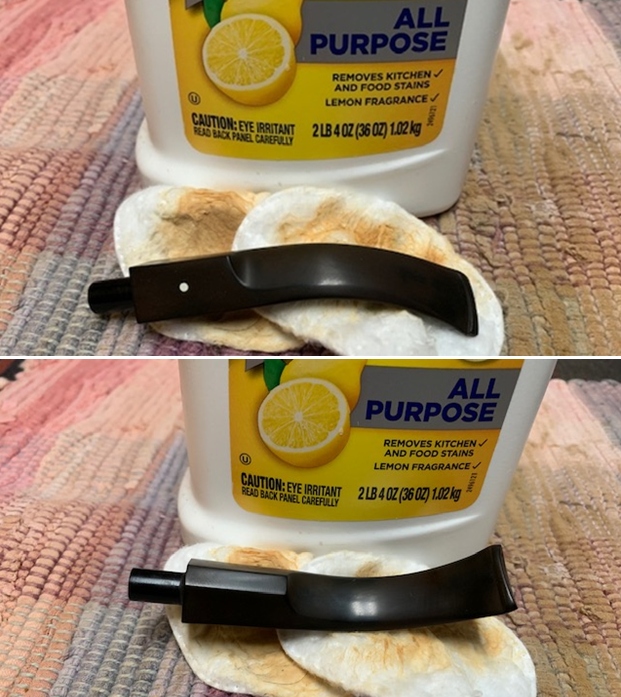
I turned to work on the pipe itself. Jeff had carried out his usual thorough cleanup of the pipe. He had reamed it with a PipNet reamer to remove the cake and cleaned the reaming up with a Savinelli Fitsall Pipe Knife. He scrubbed the internals of the bowl and stem with alcohol, cotton swabs and pipe cleaners. He scrubbed the externals with undiluted Murphy’s Oil Soap and rinsed the bowl off with running water. He soaked the stem in Before & After Deoxidizer and once it had soaked rinsed it off with warm water to remove the residual solution. He dried it off and rubbed it down to remove any oxidation that was still on the stem. The pipe looked very clean when I received it.  I took a photo of the rim top to show the condition. You can see the darkening on the rim top on the back right. It is roughened and chipped and out of round. The saddle stem came out looking quite good. There are light tooth marks and chatter on both sides near the button as well as some remaining oxidation.     I took a photo of the underside of the shank to show the stamping. It is clear and readable as noted above.I removed the stem from the shank and took a photo of the pipe parts to show what I was working with. It is a nice looking pipe.I decided to start the restoration on this one by working on darkening on the right rear of the rim top. I scrubbed it with a brass bristle wire brush to remove the darkening. I also scrubbed the front of the bowl where there was some darkening. After scrubbing it the bowl and the rim top looked much better.   With the repair completed I rubbed the briar down with Before & After Restoration Balm. I worked it into the briar with my fingertips and a horsehair shoe brush to work it into the nooks and crannies of the sandblast finish. The product works to clean, enliven and preserve the briar. I let it sit for 15 minutes while I worked on the stem. After the time passed I buffed it with a cotton cloth to deepen the shine. The briar really comes alive with the balm. I set the bowl aside and turned my attention to the stem. It turned out to be a 6mm filter stem. It had some underlying oxidation that needed to be dealt with. I put it in a bath of Briarville’s Pipe Stem Oxidation Remover and let it soak for half a day. I took it out of the bath, dried it off and scrubbed the remaining oxidation with Soft Scrub All Purpose Cleanser.    I polished the vulcanite with micromesh sanding pads – 1500-12000 grit pads. I wiped it down with Obsidian Oil after each sanding pad. I used Before & After Pipe Polish – both Fine and Extra Fine to further polish the stem.   This Dunhill Red Bark 6P F/T Bent Bulldog is a beautiful sandblast with the unique Sandblast finish made in 1972. It is a great looking pipe that came out looking very good. The Red Bark finish has a great rugged sandblast that Dunhill specialized in making. The finish on the pipe is in excellent condition. The oils off the smoker’s hands and the mahogany/medium red stain on the bowl works well to highlight the grain. The polished black vulcanite saddle stem adds to the mix. With the dust gone from the finish and the bowl it was a beauty and is eye-catching. I put the stem back on the bowl and buffed the pipe with Blue Diamond on the buffing wheel being careful to not buff the stamping. I gave the bowl multiple coats of Conservator’s Wax and the stem multiple coats of carnauba wax on the buffing wheel and followed that by buffing it with a clean buffing pad. I hand buffed the pipe with a microfiber cloth to deepen the shine. The finished 6P F/T Red Bark Bulldog is quite nice and feels great in the hand. Give the finished pipe a look in the photos below. I can only tell you that like the other pipes I am working that it is much prettier in person than the photos capture. The dimensions of the pipe are Length: 5 ½ inches, Height: 1 ½ inches, Outside diameter of the bowl: 1 ½ inches, Chamber diameter: ¾ of an inch. The weight of the pipe is 37grams/1.31oz. Thanks for walking through the restoration with me as I worked over another beautiful pipe. Remember we are not pipe owners; we are pipemen and women who hold our pipes in trust until they pass on into the trust of the next generation.
Restoring a Chunky, Rusticated Tom Howard Panel Billiard


Blog by Steve Laug

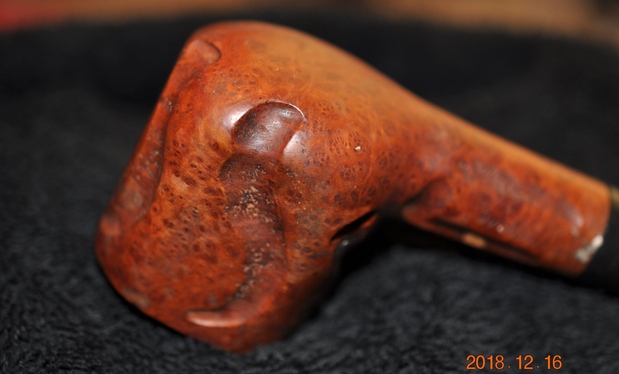
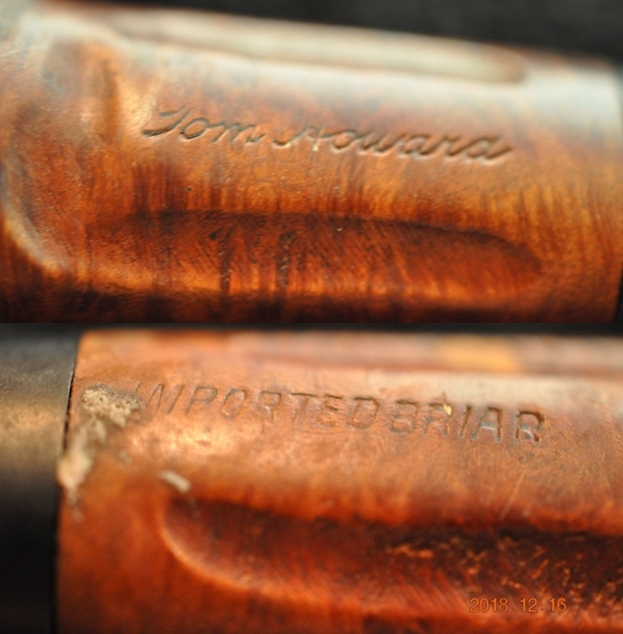
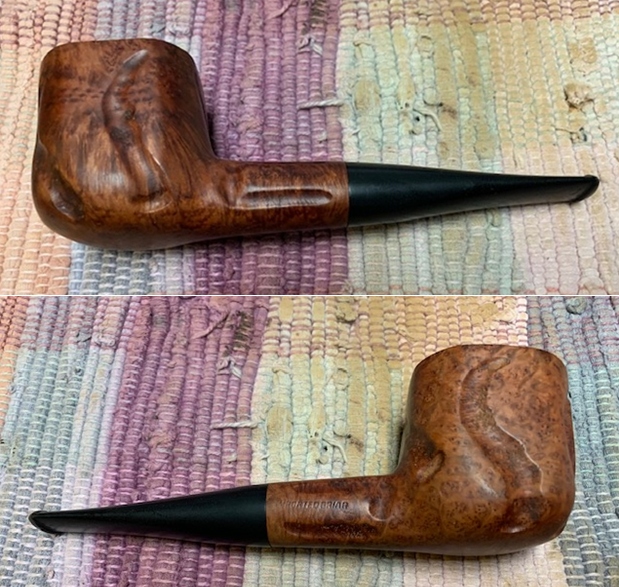
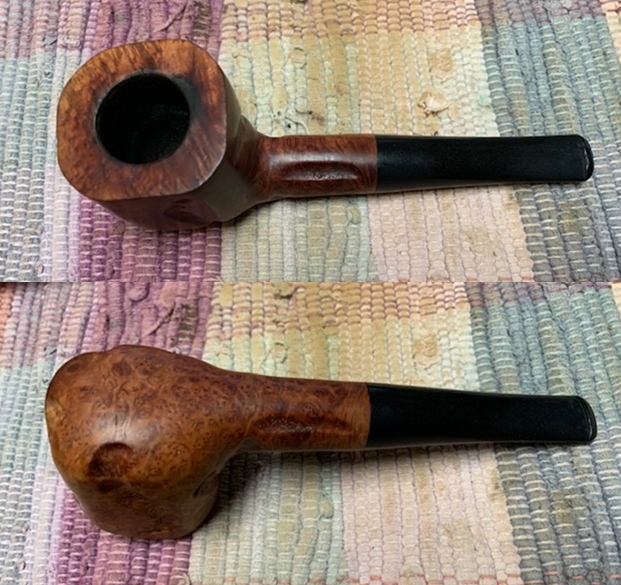
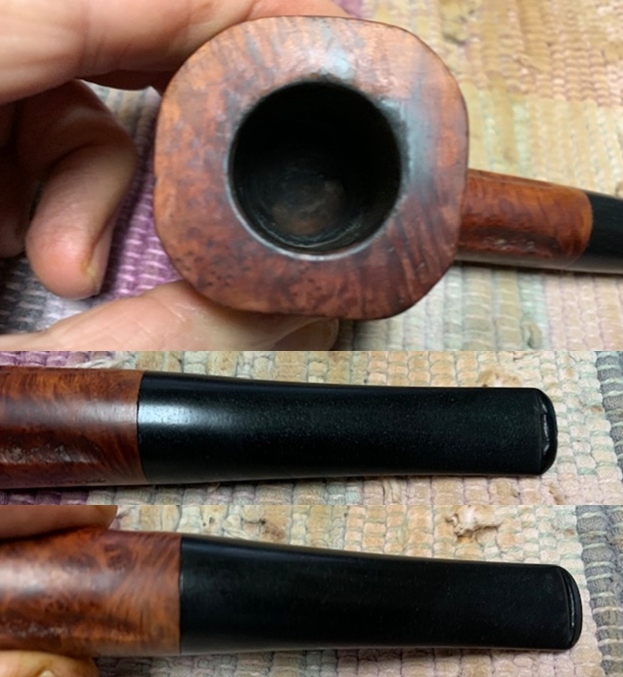
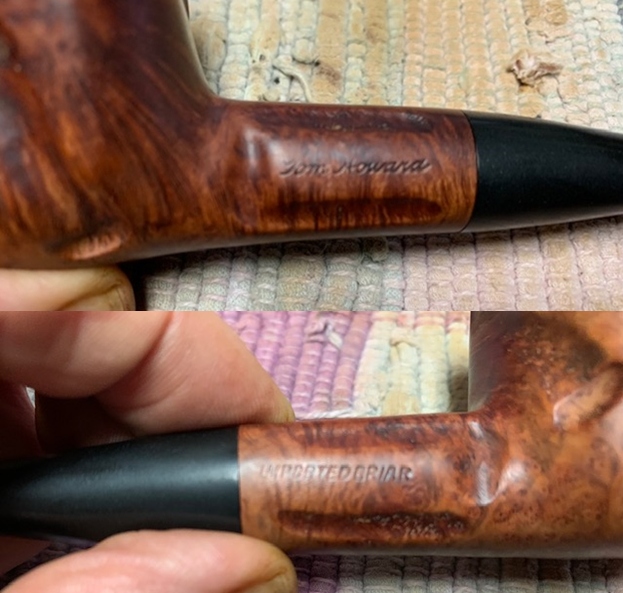
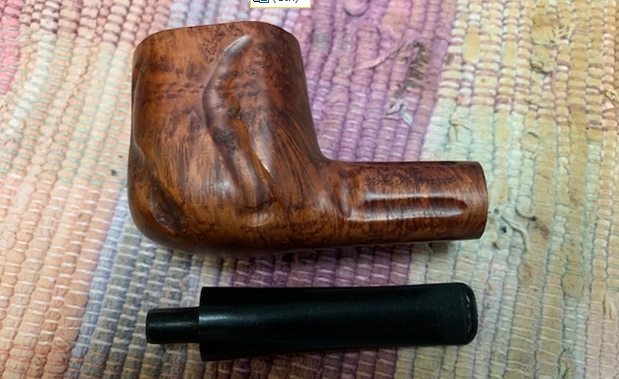
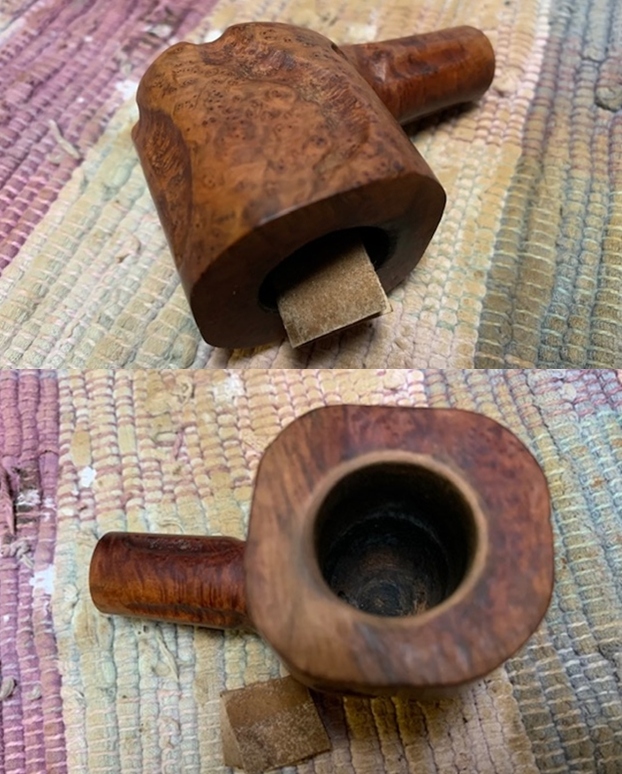
The next pipe on the table came to us in a group of pipes that we purchased from online auction on in 2018 from Dearborn Heights, Michigan, USA. It is a rusticated Panel Billiard that is in good condition. It is stamped on the sides of the shank. On the left side it is stamped Tom Howard. On the right side it is stamped Imported Briar. The stamping is clear and readable. I have worked on at least one Tom Howard pipe in the past and later in the blog will give a bit of the history. At this point I have to say that the pipe is well made but it is clunky looking and feeling. It does not have the rugged beauty or finesse of a Tracy Mincer Custom-Bilt in my opinion. It has its own charm, to be sure but it is not the same. The age of the pipe and the oils in the finish has given the pipe a rich reddish brown finish. There is also some nice grain that the shape follows well. The finish was dirty with dust around the nooks and crannies of the worm trail rustication. There was a thick cake in the bowl and the rim top showed darkening and some lava. The inner edge showed some potential damage that would only become clear once the pipe was cleaned. The vulcanite taper stem was oxidized, calcified and had tooth marks and chatter ahead of the button on both sides.  Jeff took photos of the pipe to show what it looked like before he started working on it. He took photos of the bowl and rim top to show the thickness of the cake and the darkening and lava overflow on the rim top. The photos of the stem show the oxidation, calcification and tooth marks and chatter on the surface on both sides.  The photo of the side and heel of the bowl shows the carved worm trail rustication and the grain on the pipe. It looks quite nice under the grime and dust.    The stamping on the sides of the shank is shown in the photos below. It looks very good and readable. It reads as noted and explained above. Before I started my work on the pipe I wanted to refresh my memory of the brand. I remembered that Tom Howard was a notable figure beyond pipe making. I also remembered that Dal Stanton had worked on one and done a great job ferreting out the history of the brand and the maker. I turned to his blog on the brand and read what he had written during his restoration of one of the Howard pipes (https://rebornpipes.com/2018/09/16/the-vintage-notoriety-of-tom-howard-and-his-jumbo-squat-rustified-tomato/). I have included the portion of the blog on the history below for ease of reference. (Thanks Dal!)

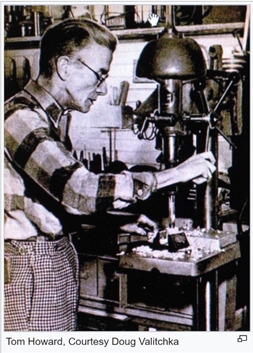
I had never heard of a Tom Howard stamp on a pipe and after I put the name in search tool on Pipedia I was surprised to find what I found.  Tom Howard was a vintage celebrity in America during the 1940s and 50s.  Here’s what Pipedia said about Tom Howard the man:

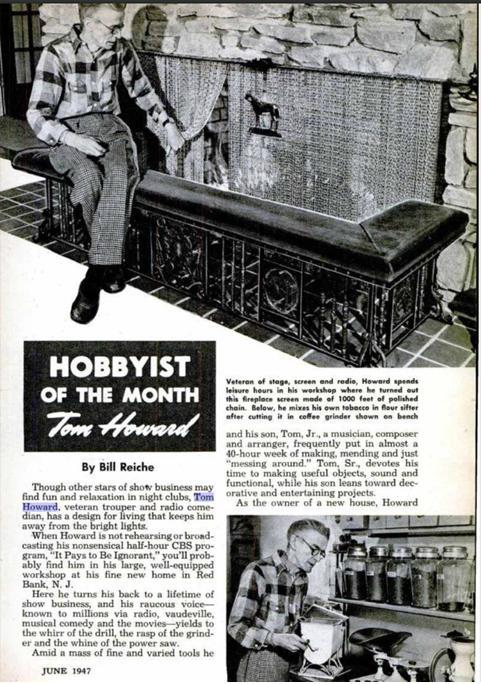
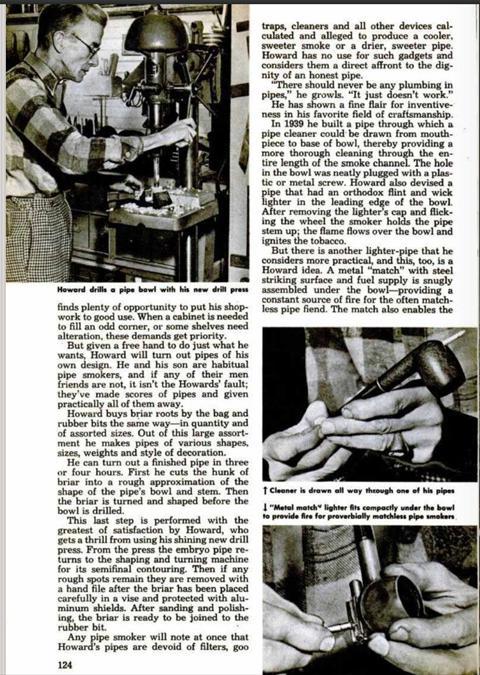
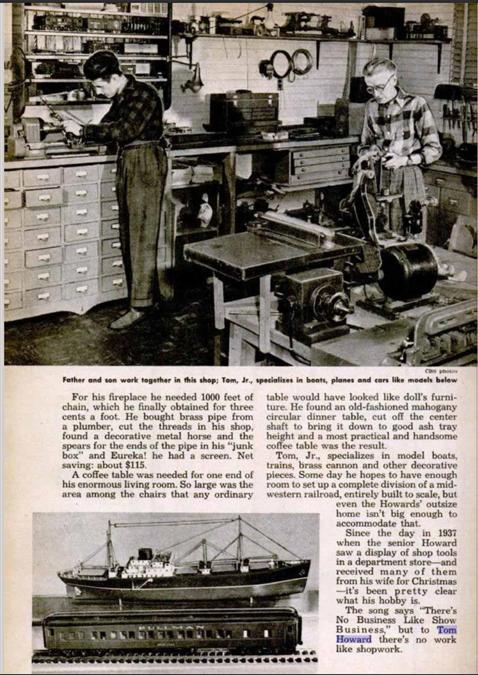
Tom Howard was a popular comedian and personality in the 1940s/50s, known for vaudeville stage and radio work. But he also was a skilled pipe maker. In a Popular Mechanic article from 1947 he is written up as the “Hobbyist of the Month, Tom Howard.” He made pipes in his workshop outside his home in Red Bank, NJ. Starting about 1939 and looks like into the late 1940’s or later. He purchased briar blocks by the bag as well as stem blanks, and in his well-equipped shop he handcrafted his pipes, in about three hours on average. He was a true craftsman, also specializing is intricate model boats, trains and brass canons, all built to scale.

I was intrigued – this vaudeville and stage comedian made pipes and this pipe came from his workshop made by his hands.  How cool is that?  Desiring to find out more about Tom Howard the man, I searched Wikipedia and found a fun and informative article about his professional life and how he hosted a I was intrigued – this vaudeville and stage comedian made pipes and this pipe came from his workshop made by his hands.  How cool is that?  Desiring to find out more about Tom Howard the man, I searched Wikipedia and found a fun and informative article about his professional life and how he hosted a zany Q&A game show that was spoofing the ‘serious’ Q&A game shows.  It was called “It Pays to Be Ignorant”.   Here is what the Wikipedia article said:

It Pays to Be Ignorant was a radio comedy show which maintained its popularity during a nine-year run on three networks for such sponsors as Philip Morris, Chrysler, and  DeSoto. The series was a spoof on the authoritative, academic discourse evident on such authoritative panel series as Quiz Kids and Information Please, while the beginning of the program parodied the popular quiz show, Doctor I.Q. With announcers Ken Roberts and Dick Stark, the program was broadcast on Mutual from June 25, 1942 to February 28, 1944, on CBS from February 25, 1944 to September 27, 1950 and finally on NBC from July 4, 1951 to September 26, 1951. The series typically aired as a summer replacement.

Snooping a bit more, I found an online site that had the July 5, 1951 episode of ‘It pays to Be Ignorant’ available for viewing.  I watched it and it was like I was in a time machine!  The video also included period advertising for cars and tobacco and Tom Howard in form, dawning a professorial gown and a gravelly 1950s vaudeville tin can voice.  It’s great! I clipped a picture of the episode.  If you want to see it yourself, here’s the link:  The Internet Archive.

The Pipedia article I included above, referenced one more source to learn a bit more about Tom Howard.  In a 1947 Popular Mechanics edition he was named ‘Hobbyist of the Month’ – but it didn’t say which month!  With a little bit of help from Google, I found Archive.org that housed old editions of many periodicals including Popular Mechanics.  I started in January and started searching – thankfully they had a search tool I utilized for each month.  Finally, I found the article in the Popular Mechanic 1947 June’s edition.   For the absolute nostalgia of it, and for the interesting information it adds about Tom Howard and especially his pipe production, I’m including the pages here for you to read – including the cover page!  I couldn’t pass it up!  Armed with the great information Dal had provided I turned to work on the pipe itself. Jeff had carried out his usual thorough cleanup of the pipe. He had reamed it with a PipNet reamer to remove the cake and cleaned the reaming up with a Savinelli Fitsall Pipe Knife. He scrubbed the internals of the bowl and stem with alcohol, cotton swabs and pipe cleaners. He scrubbed the externals with undiluted Murphy’s Oil Soap and rinsed the bowl off with running water. He soaked the stem in Before & After Deoxidizer and once it had soaked rinsed it off with warm water to remove the residual solution. He dried it off and rubbed it down to remove any oxidation that was still on the stem. The pipe looked much better when I received it.  I took a photo of the rim top to show the condition. You can see the darkening and the damage to the inner edge of the rim on the back right. It is roughened and chipped and out of round. The taper stem came out looking quite good. There are tooth marks and chatter on both sides near the button and some damage to the button surface itself.     I took photos of the sides of the shank to show the stamping. It is clear and readable as noted above.  I removed the stem from the shank and took a photo of the pipe parts to show what I was working with. It is a nice looking pipe.I decided to start the restoration on this one by working on the damage and darkening on the right rear of the rim top. I sanded the rim top with 220 grit sandpaper and gave the inner edge of the bowl a slight bevel to remove the damage and blend it into the rest of the rim edge. I polished the briar with micromesh sanding pads – wet sanding with 1500-12000 grit pads. I wiped the bowl down with a damp cloth after each sanding pad.  I touched up the sanded rim top and edge with a Maple stain pen to blend it into the surrounding briar. The match is perfect and once the bowl is buffed it will disappear.With the repair completed I rubbed the briar down with Before & After Restoration Balm. I worked it into the briar with my fingertips and a horsehair shoe brush to work it into the nooks and crannies of the rusticated finish. The product works to clean, enliven and preserve the briar. I let it sit for 15 minutes while I worked on the stem. After the time passed I buffed it with a cotton cloth to deepen the shine. The briar really comes alive with the balm. I set the bowl aside and turned my attention to the stem. I filled in the bite marks on both sides of the stem and button with clear super glue and set it aside for the repairs to cure. I reshaped the button with a file and then sanded it with 220 grit sandpaper to smooth it out. I started the polishing with a piece of 400 grit wet dry sandpaper. I polished the vulcanite with micromesh sanding pads – 1500-12000 grit pads. I wiped it down with Obsidian Oil after each sanding pad. I used Before & After Pipe Polish – both Fine and Extra Fine to further polish the stem.   This Tom Howard Panel Billiard turned out to be a nice looking pipe. The rusticated finish looks quite good while not obscuring the grain around the bowl. The stain used on the bowl served to highlight the grain on the bowl. The polished black vulcanite taper stem adds to the mix. With the dust gone from the finish and the bowl it was a beauty and is eye-catching. I put the stem back on the bowl and buffed the pipe with Blue Diamond on the buffing wheel being careful to not buff the stamping. I gave the bowl and the stem multiple coats of carnauba wax on the buffing wheel and followed that by buffing it with a clean buffing pad. I hand buffed the pipe with a microfiber cloth to deepen the shine. The finished Tom Howard Panel Billiard is a large pipe and feels great in the hand. Give the finished pipe a look in the photos below. I can only tell you that like the other pipes I am working that it is much prettier in person than the photos capture. The dimensions of the pipe are Length: 6 inches, Height: 2 inches, Outside diameter of the bowl: 1 ¾ inches, Chamber diameter: 7/8 of an inch. The weight of the pipe is 71grams/2.50oz. Thanks for walking through the restoration with me as I worked over another beautiful pipe. Remember we are not pipe owners; we are pipemen and women who hold our pipes in trust until they pass on into the trust of the next generation.