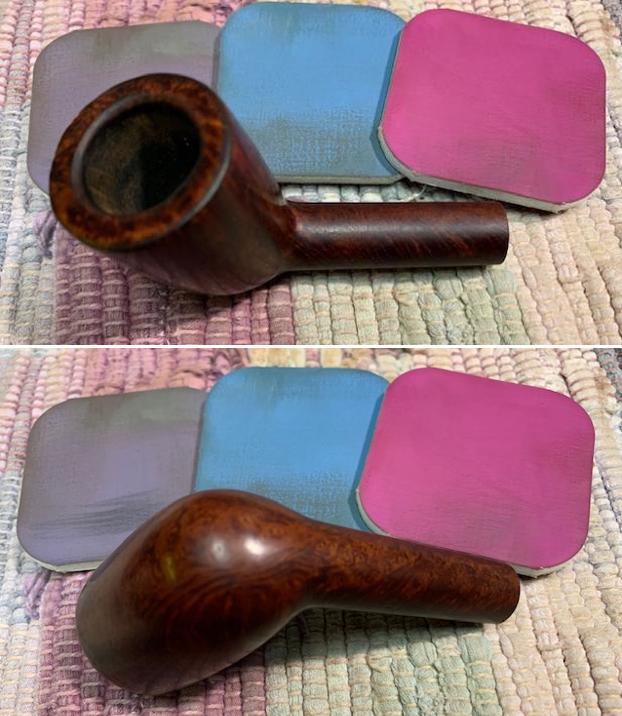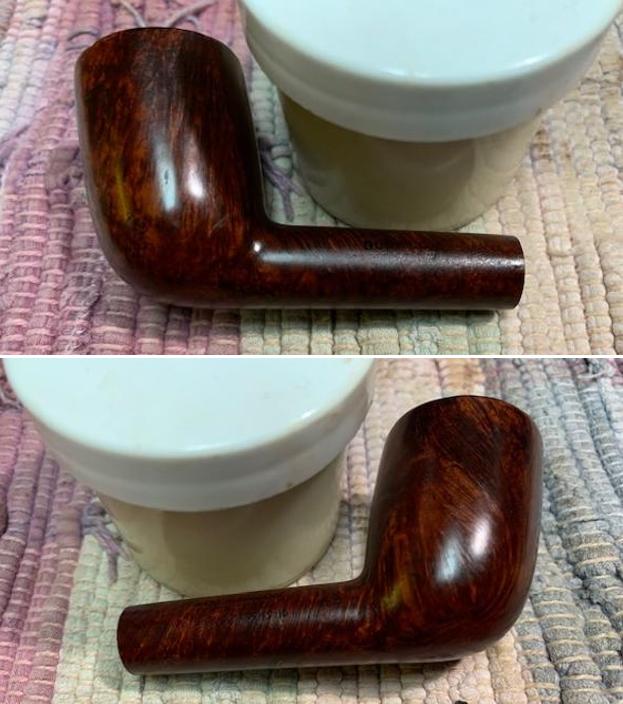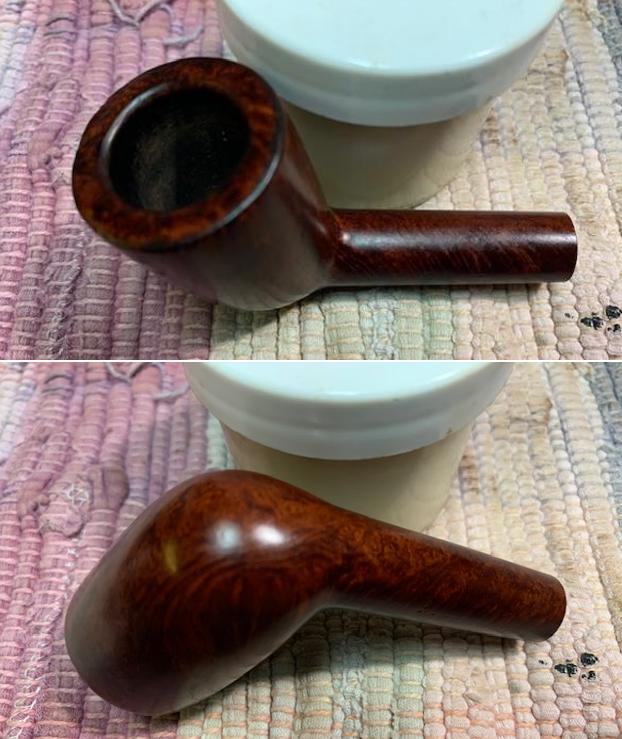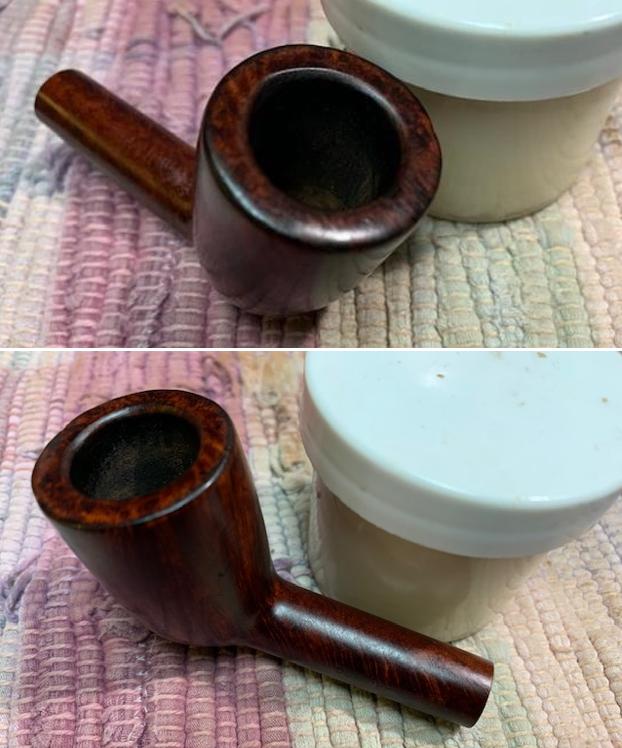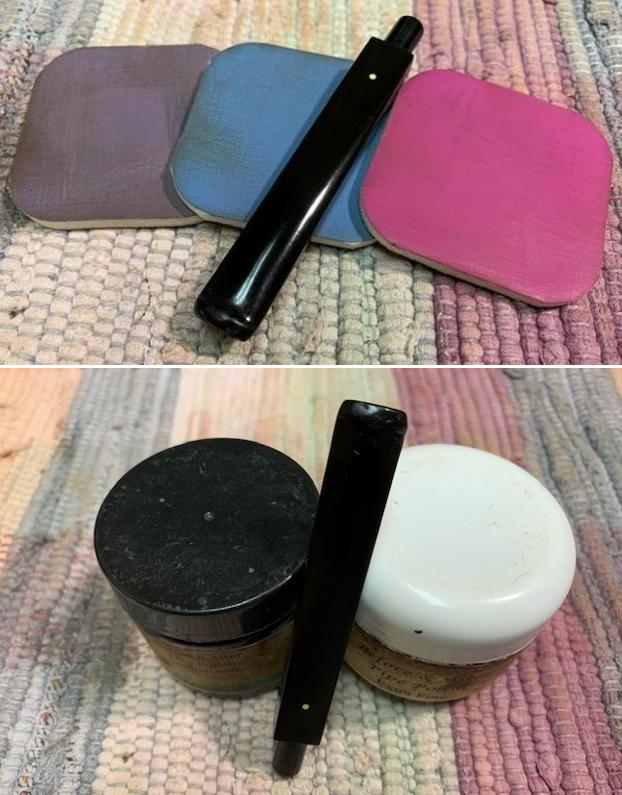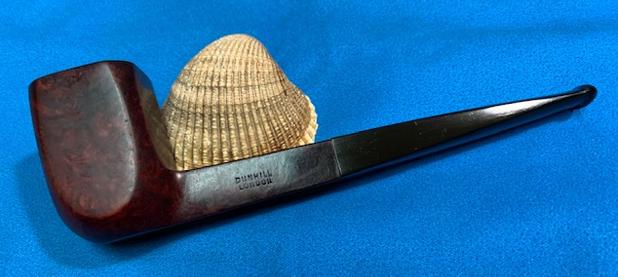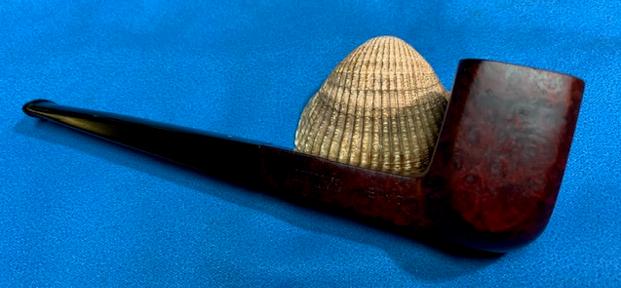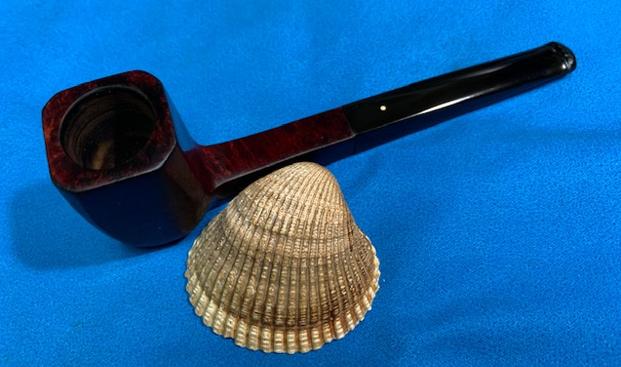
Tag Archives: sanding a stem

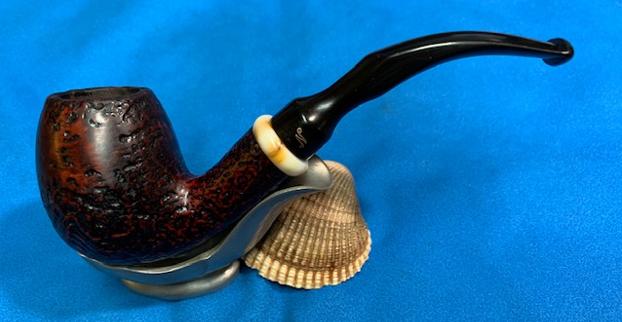
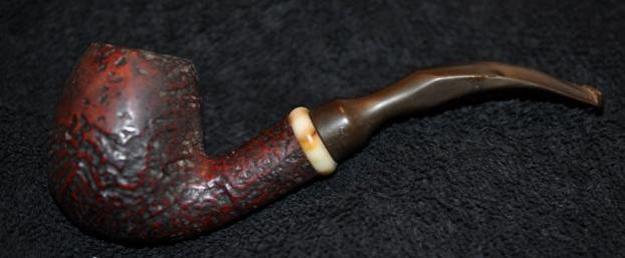
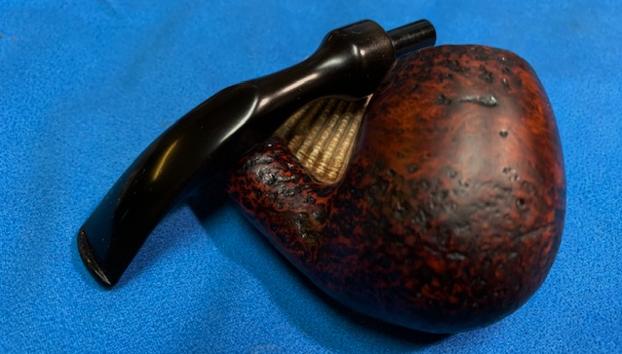
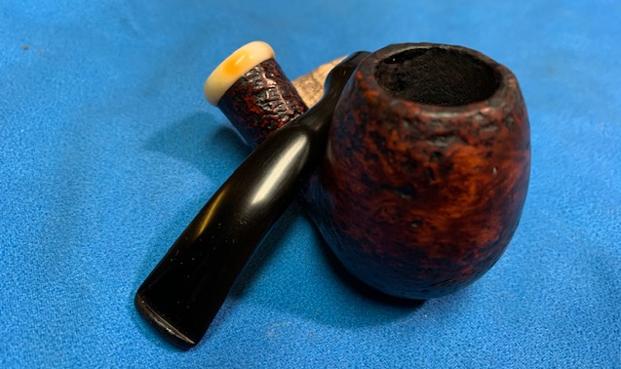
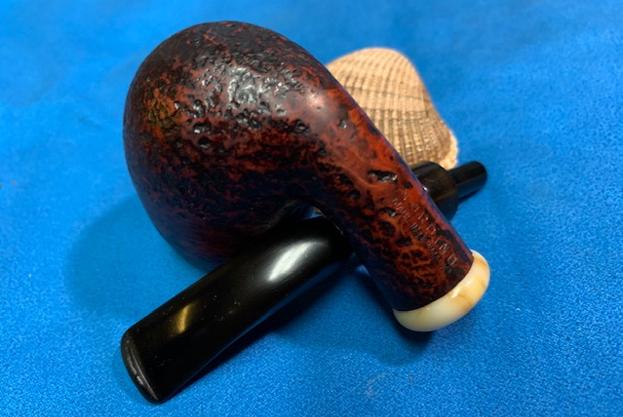
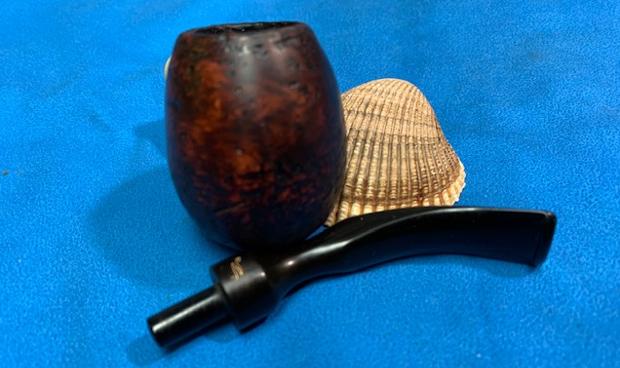
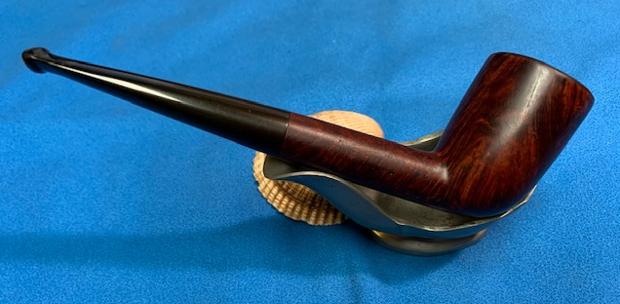
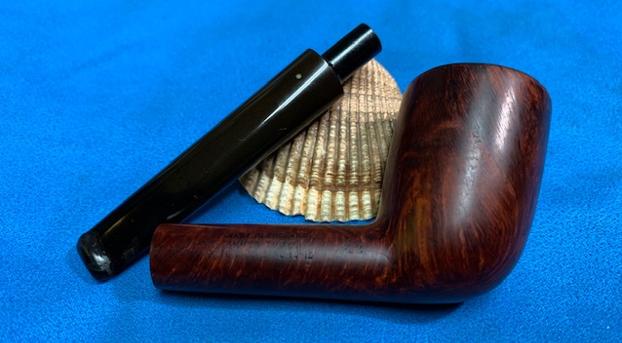
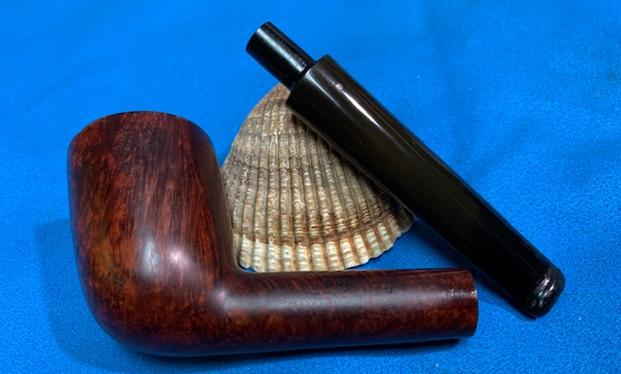
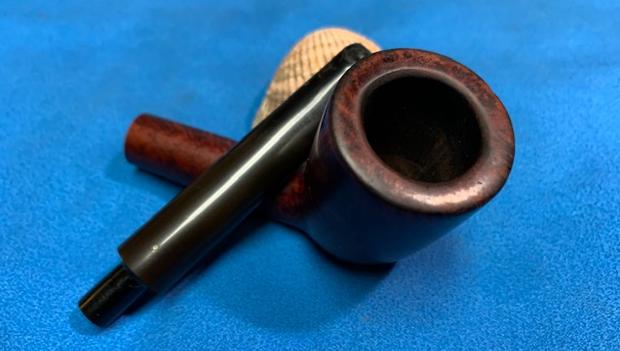
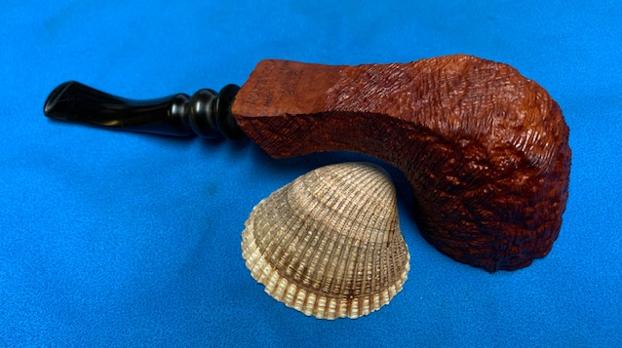
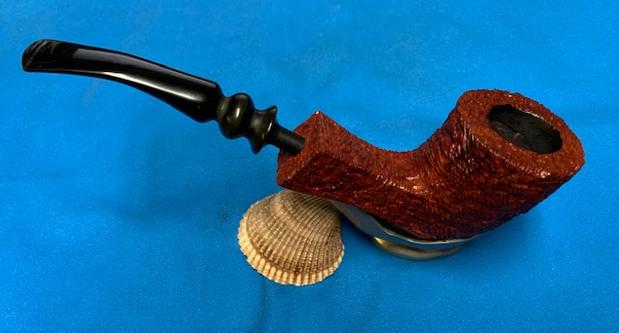
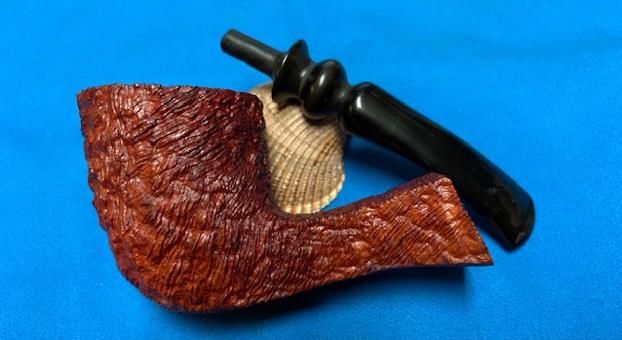
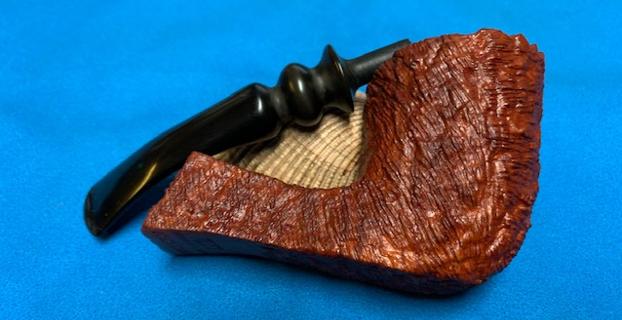
Cleaning up a Strange Mixed Finish Nording Bent Billiard


Blog by Steve Laug

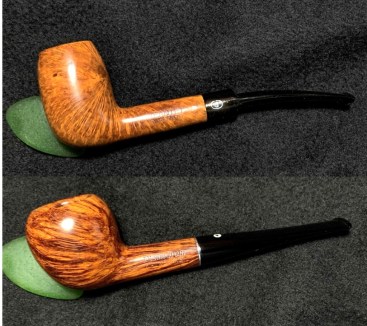
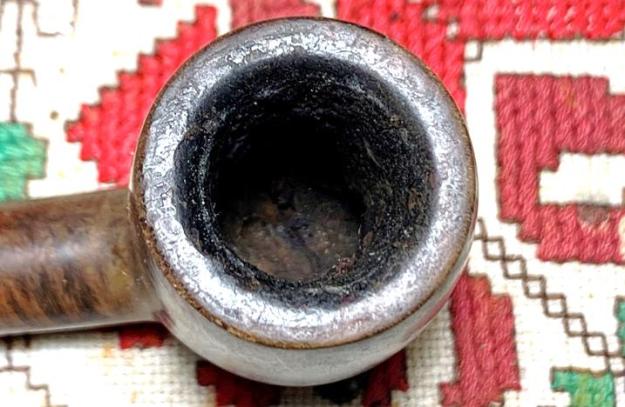
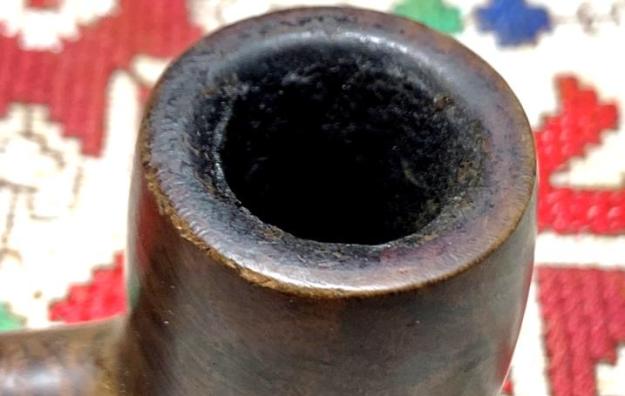
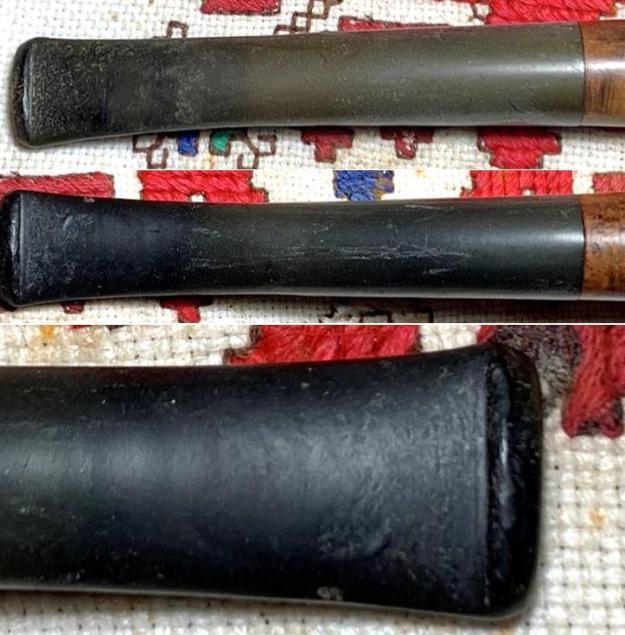
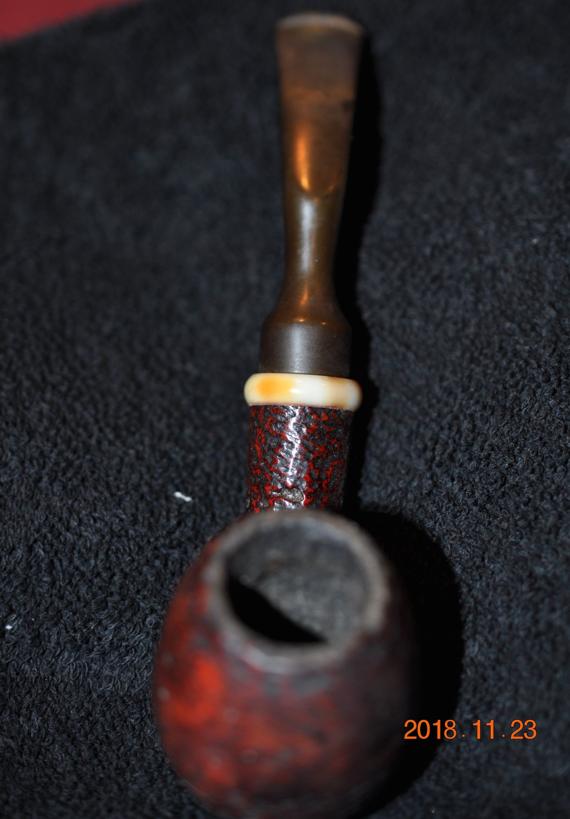
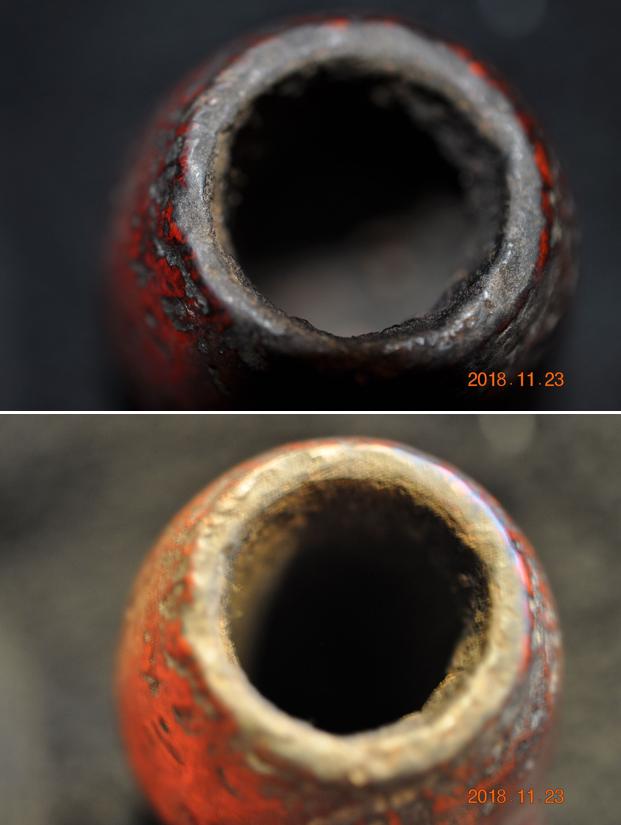
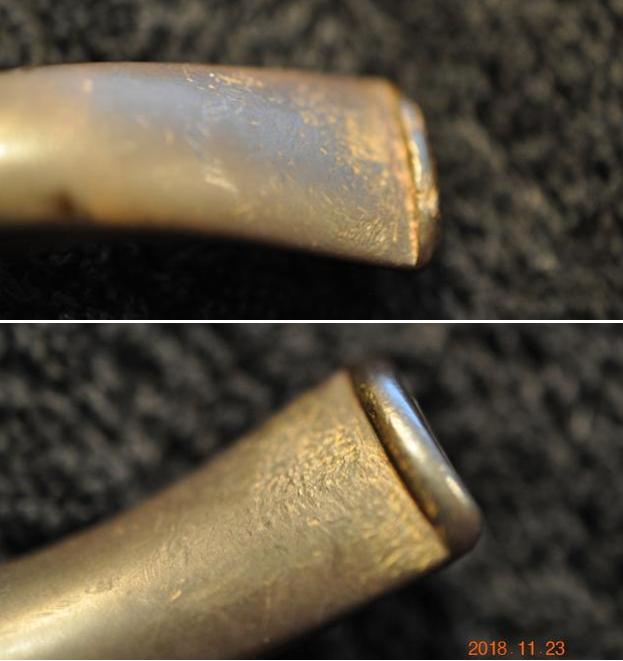
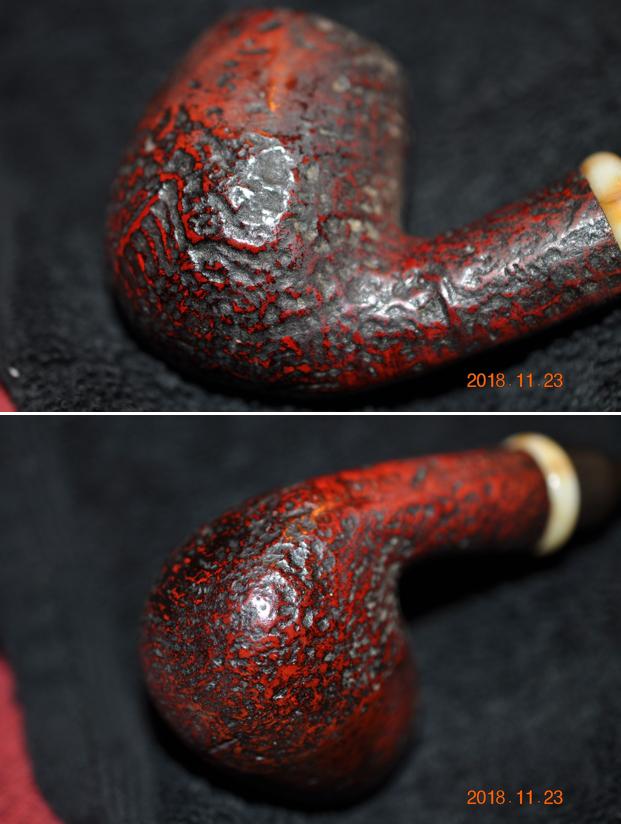
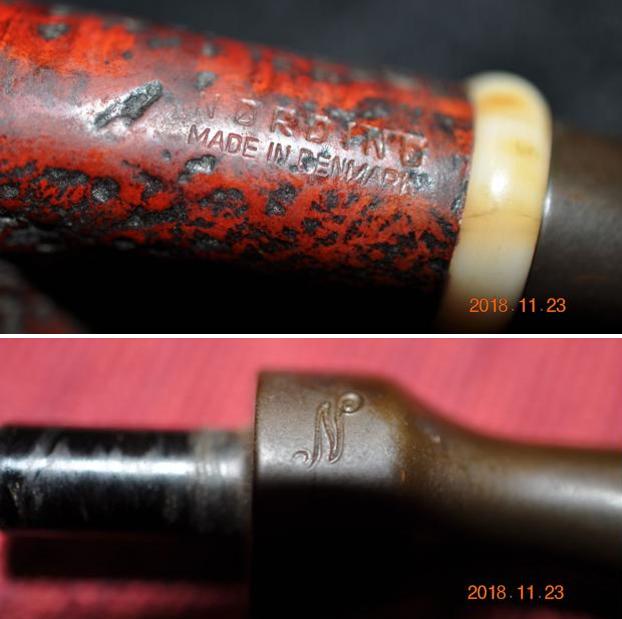
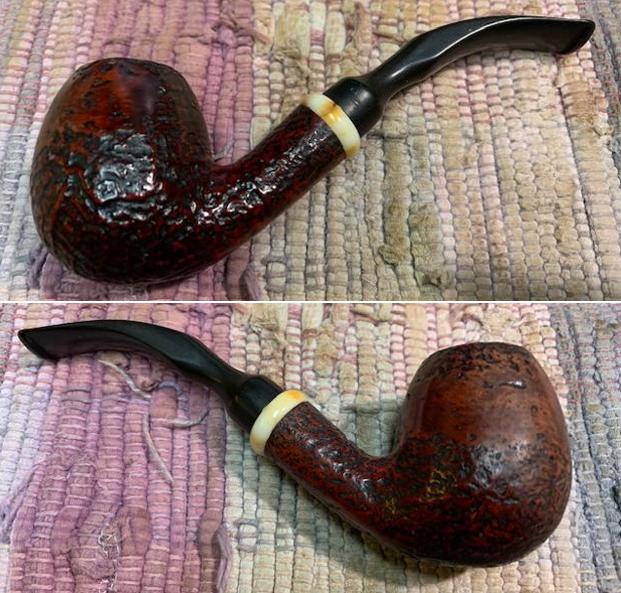
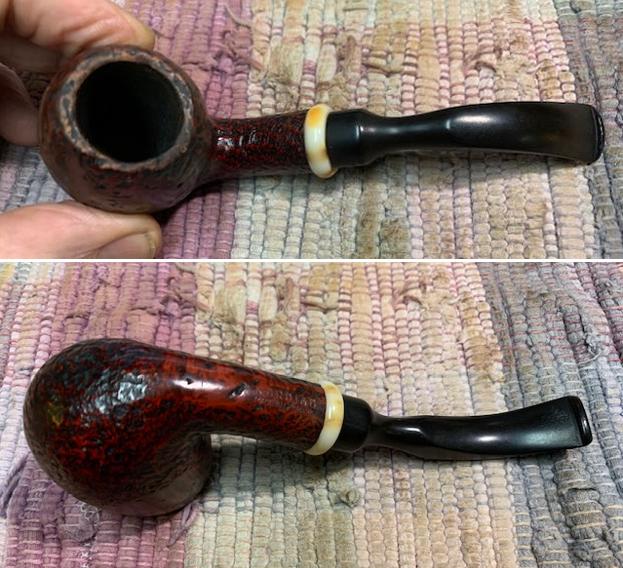
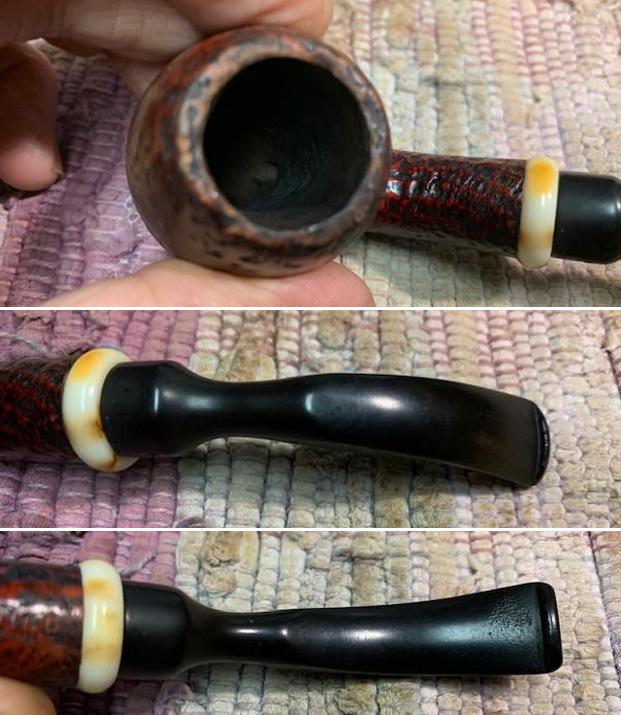
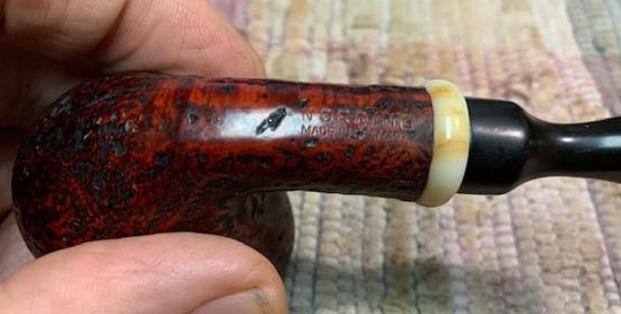
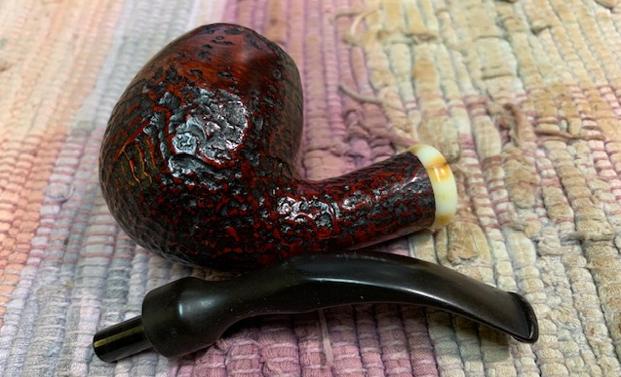
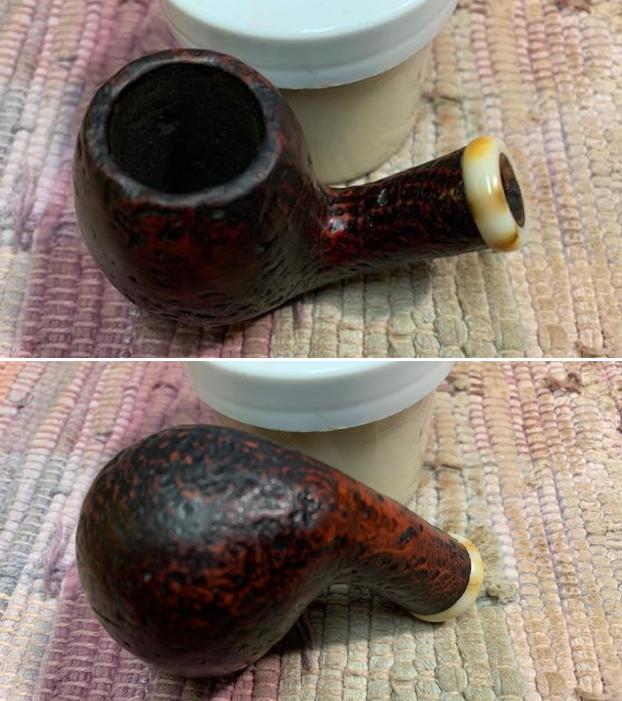
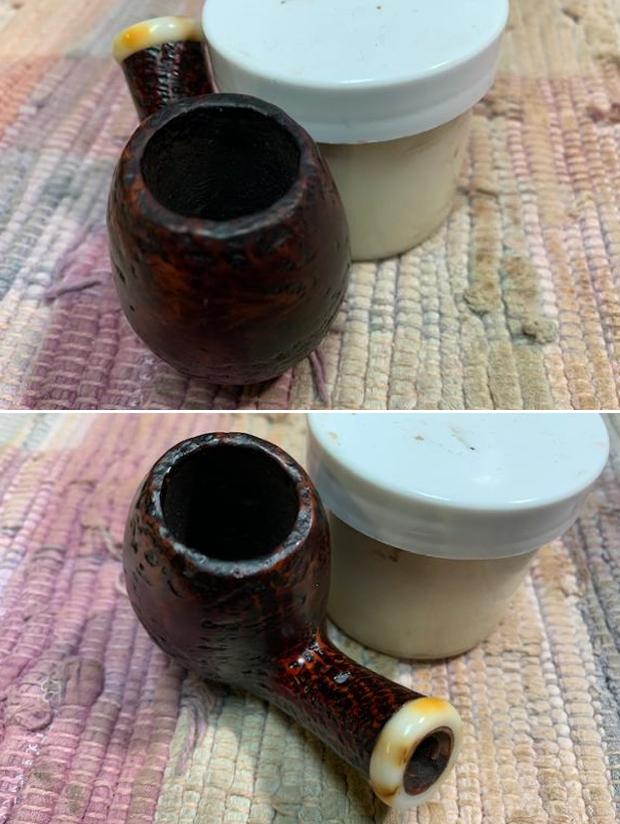
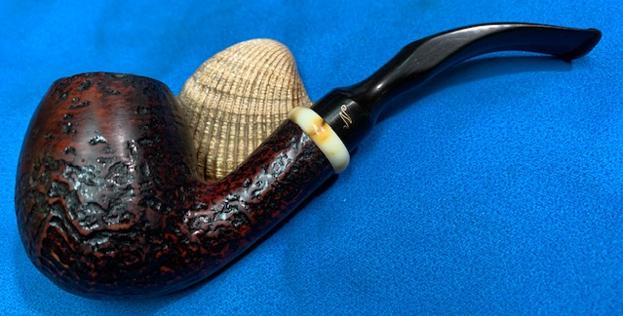
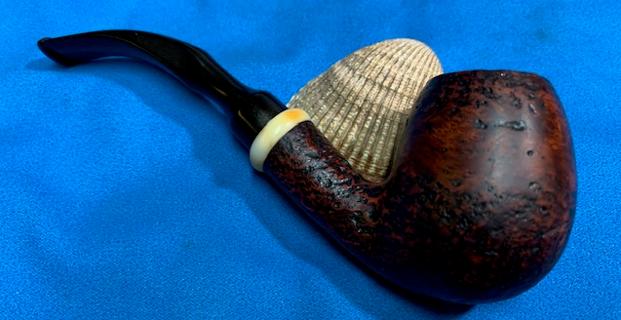
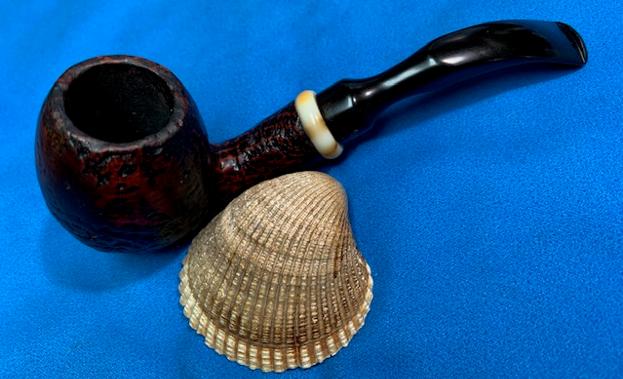
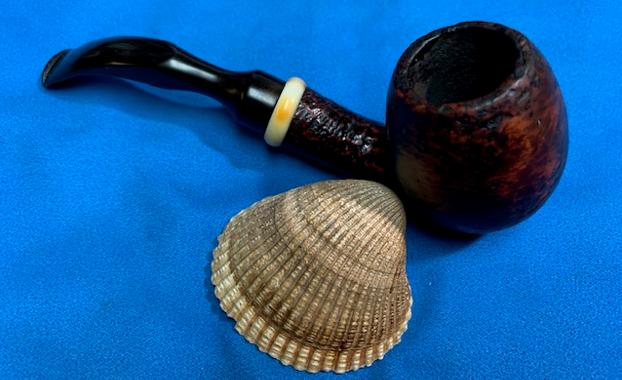
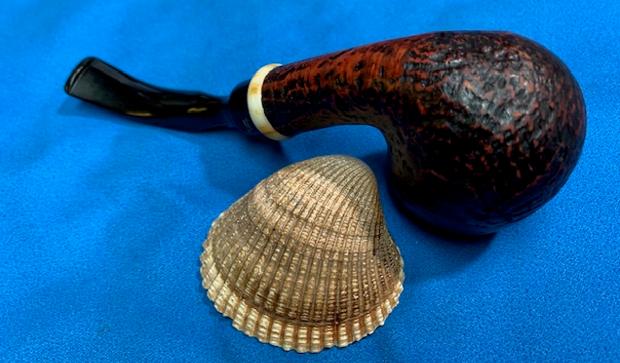
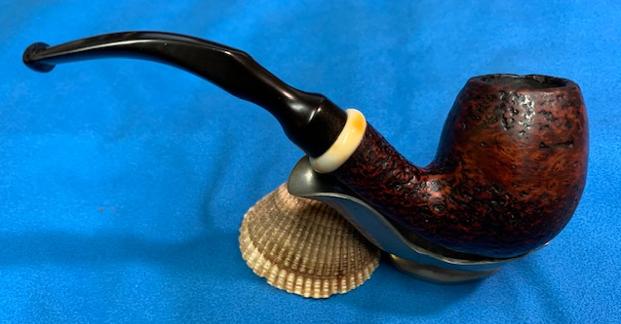
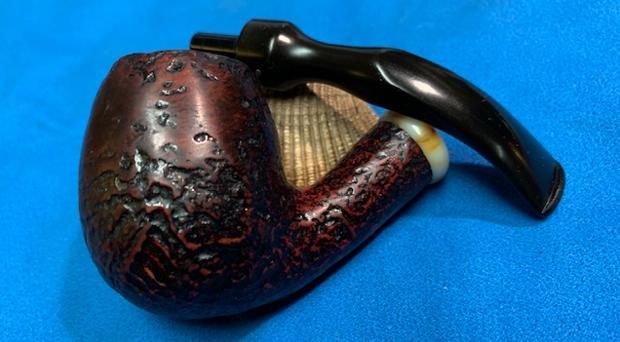
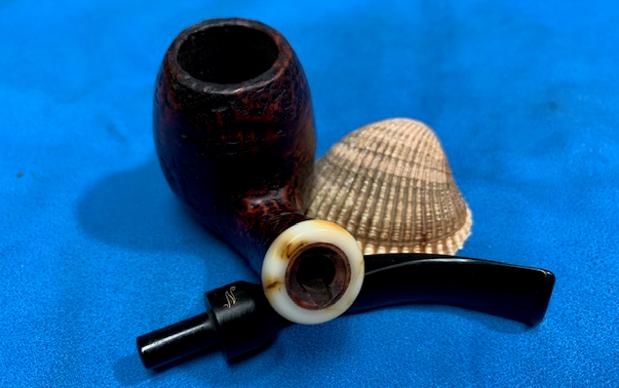
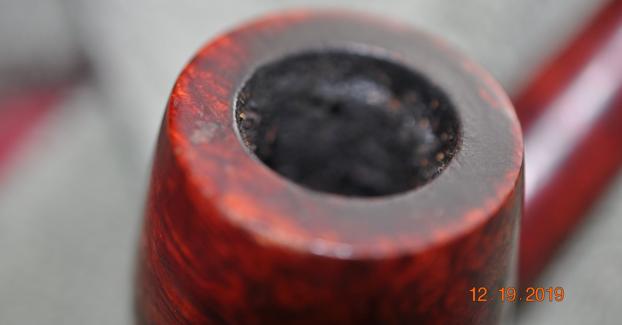
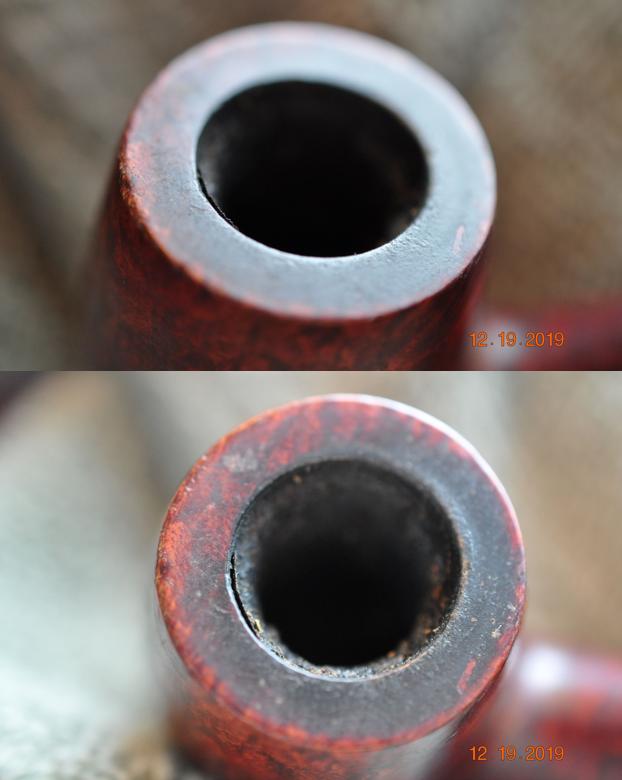
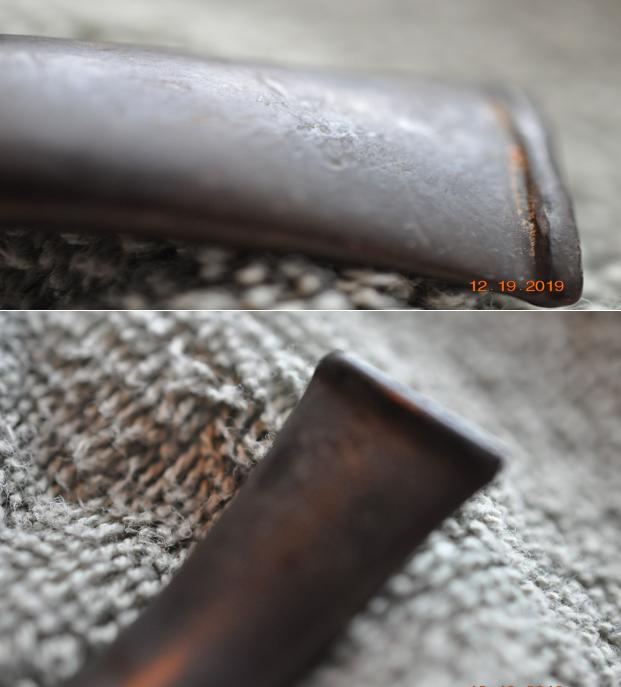
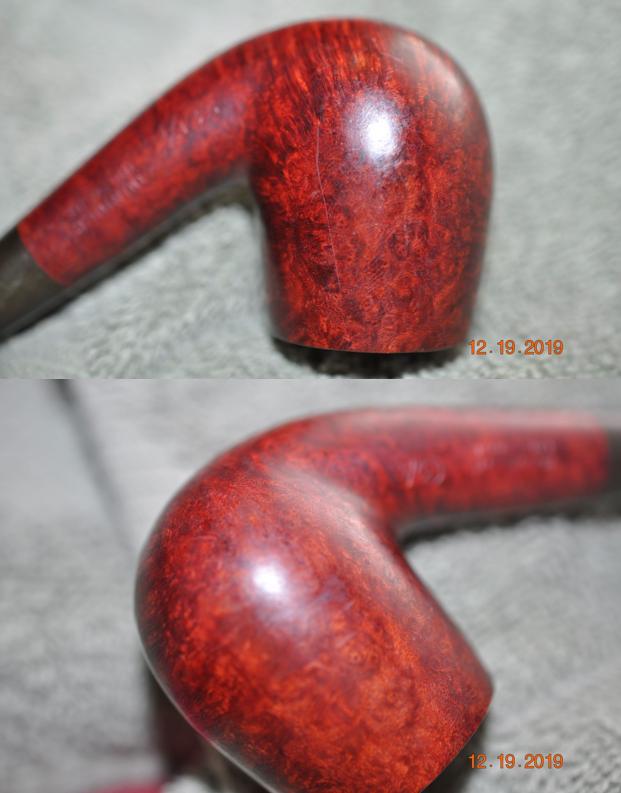
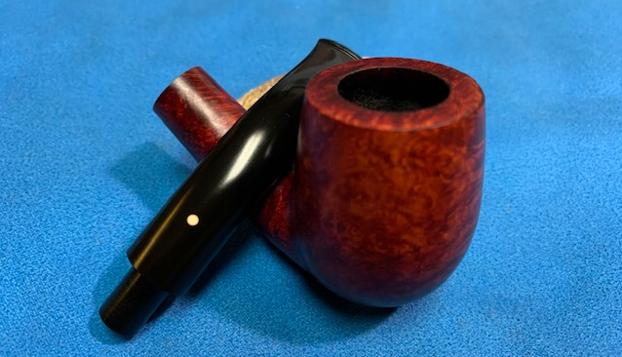
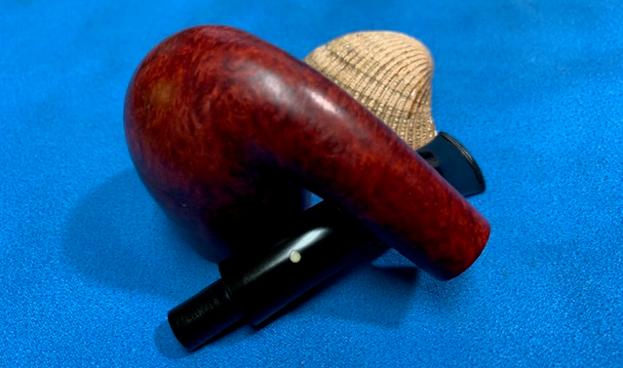
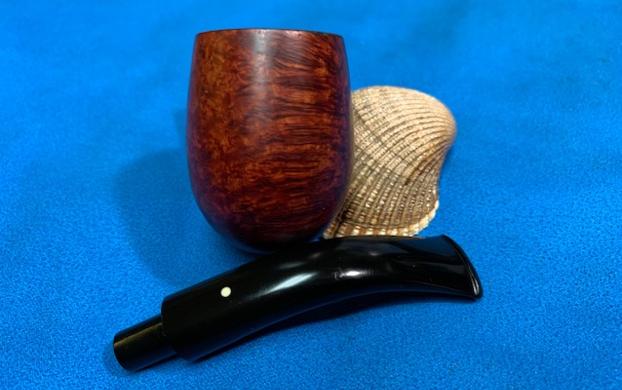
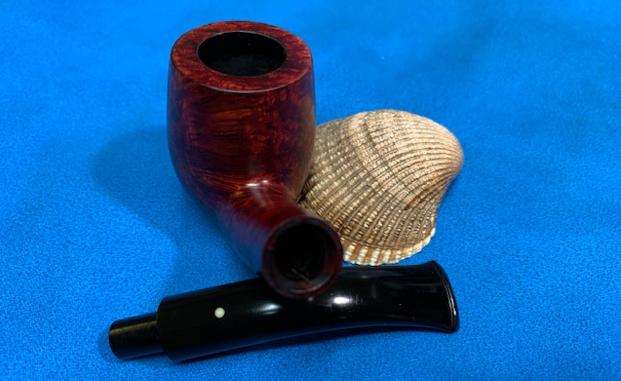
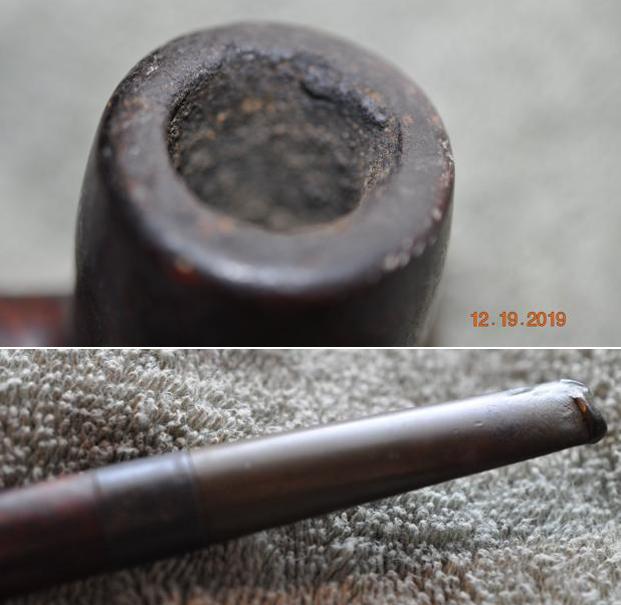
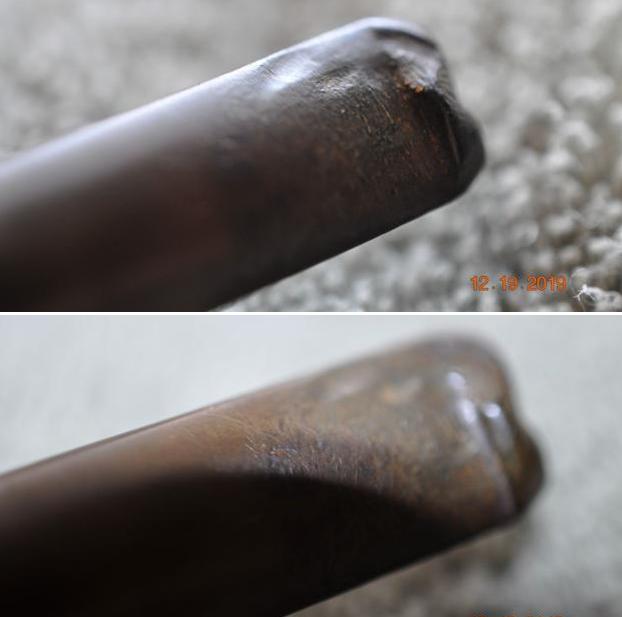
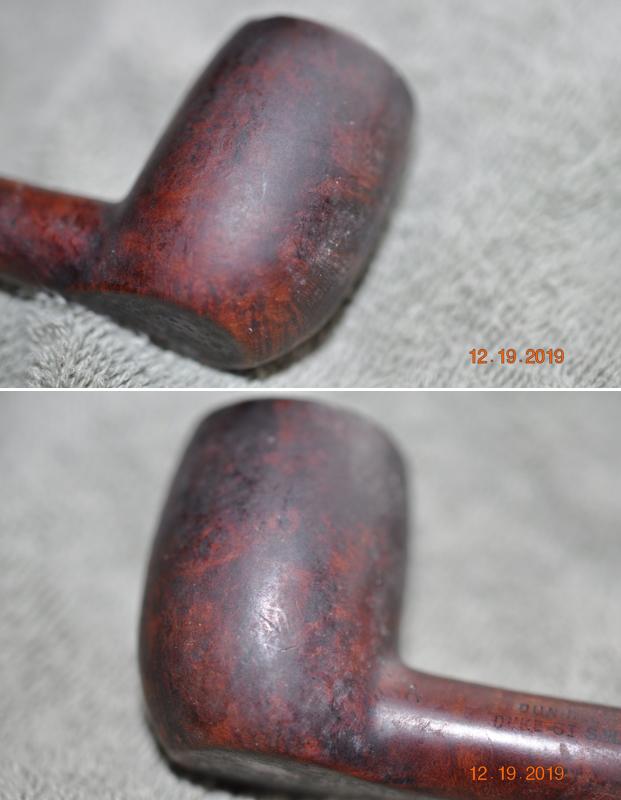
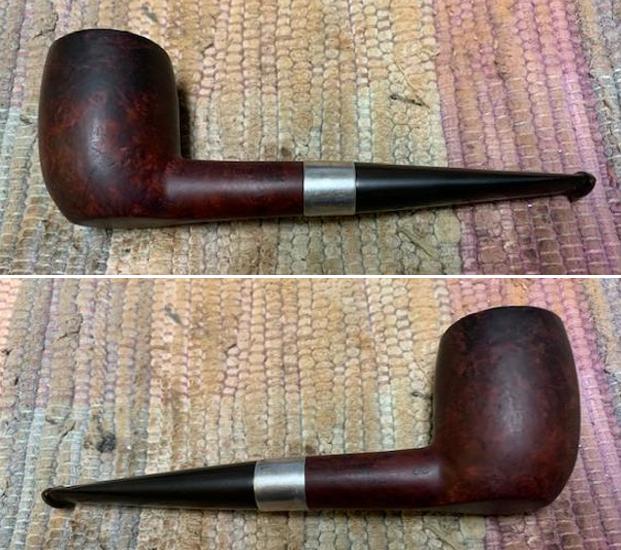
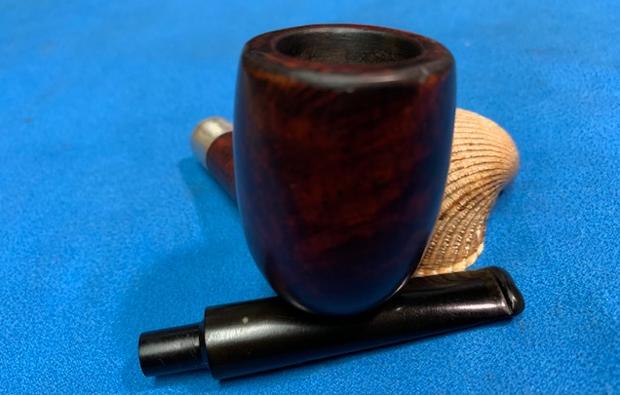
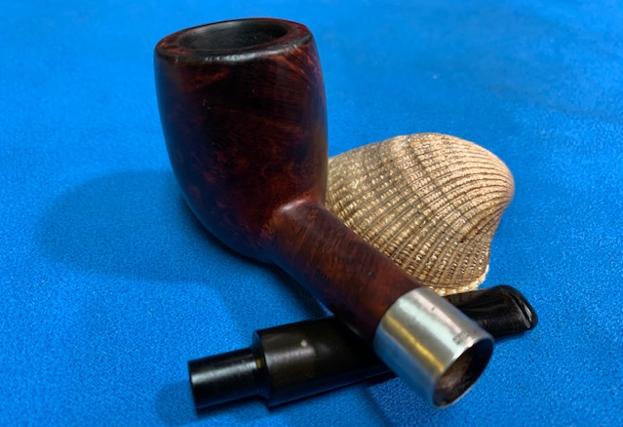
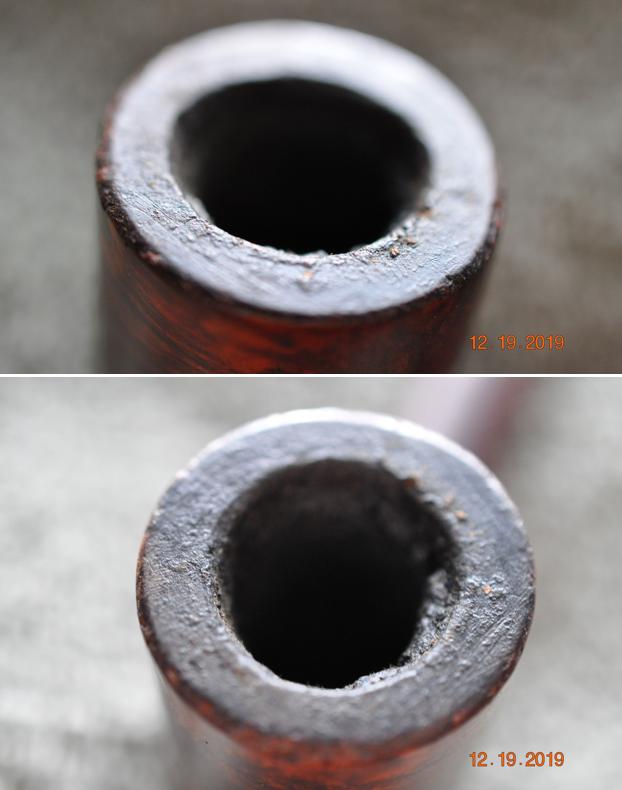
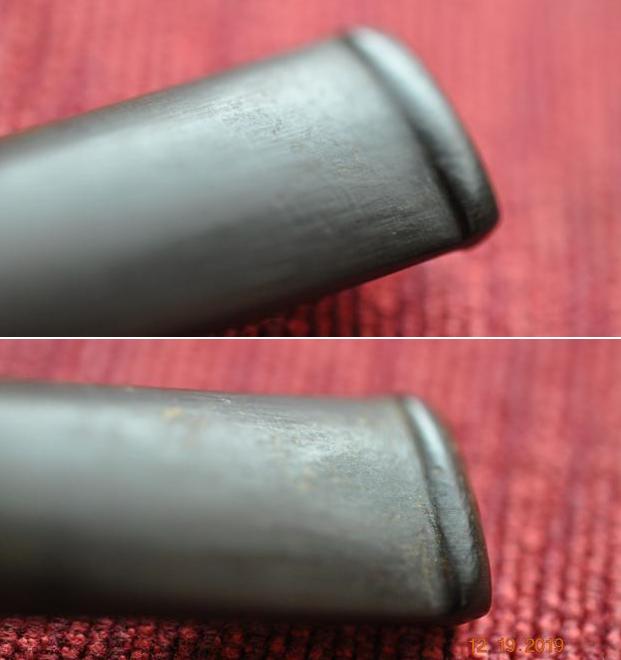
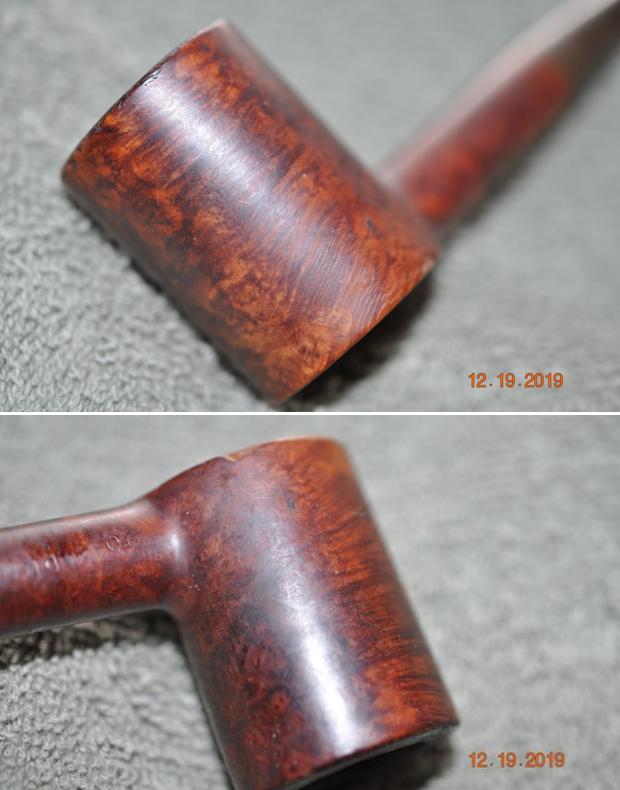
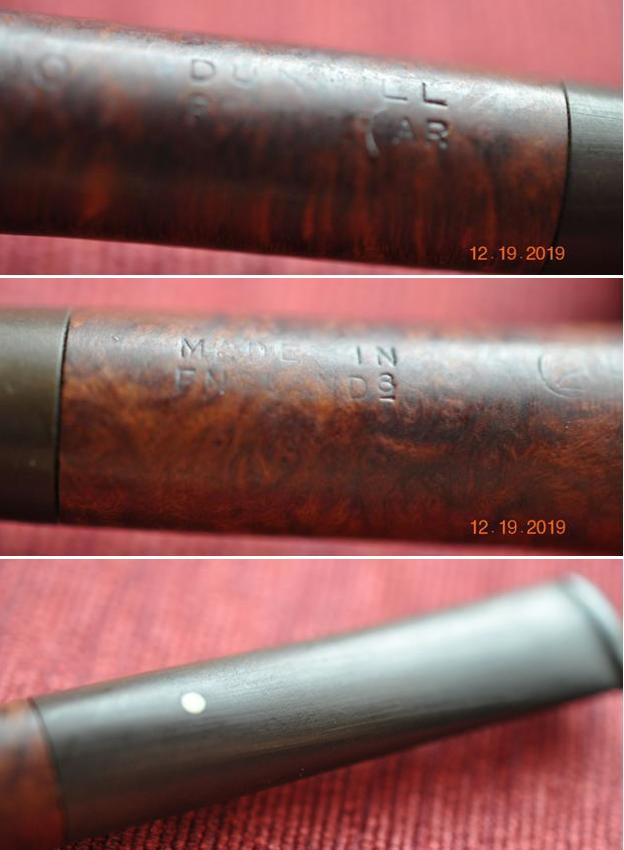
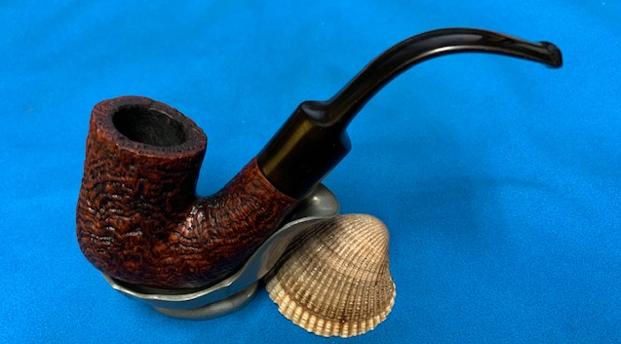
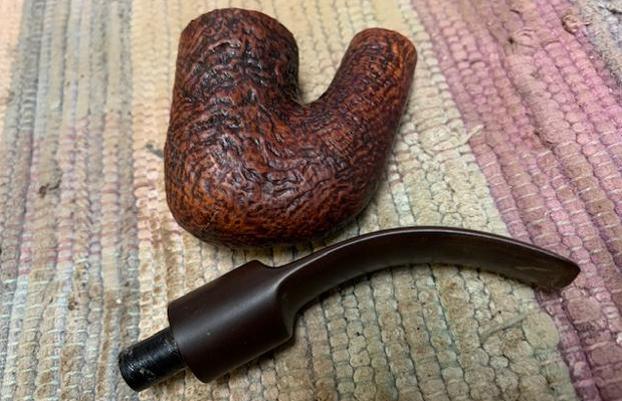
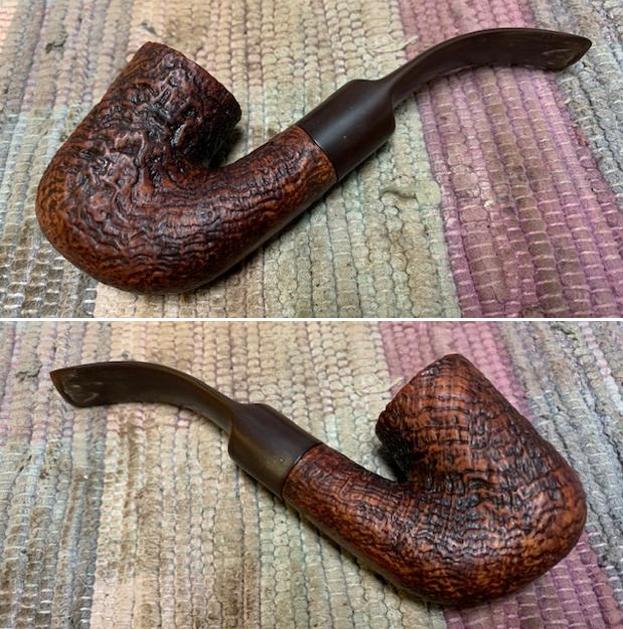
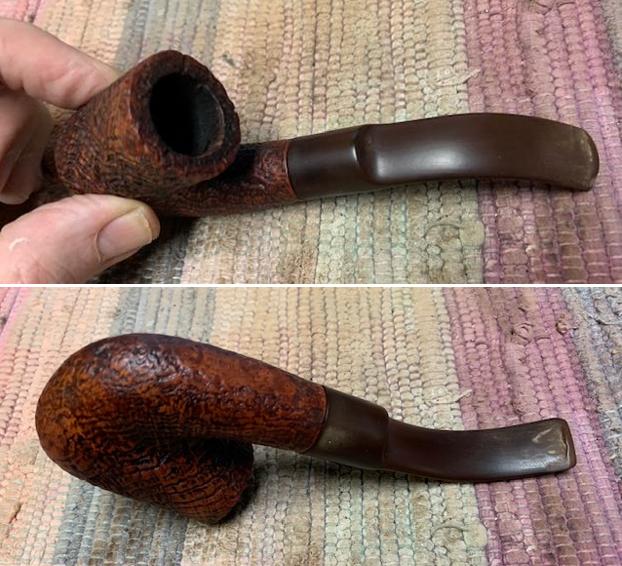
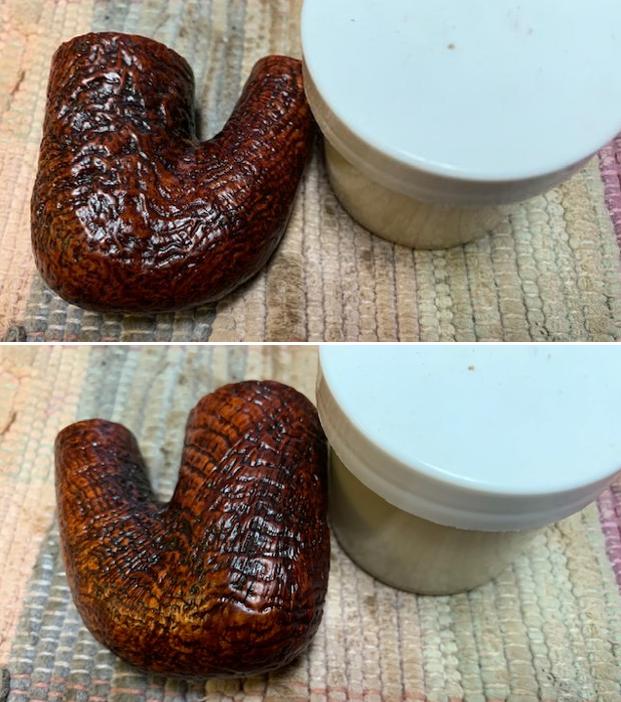
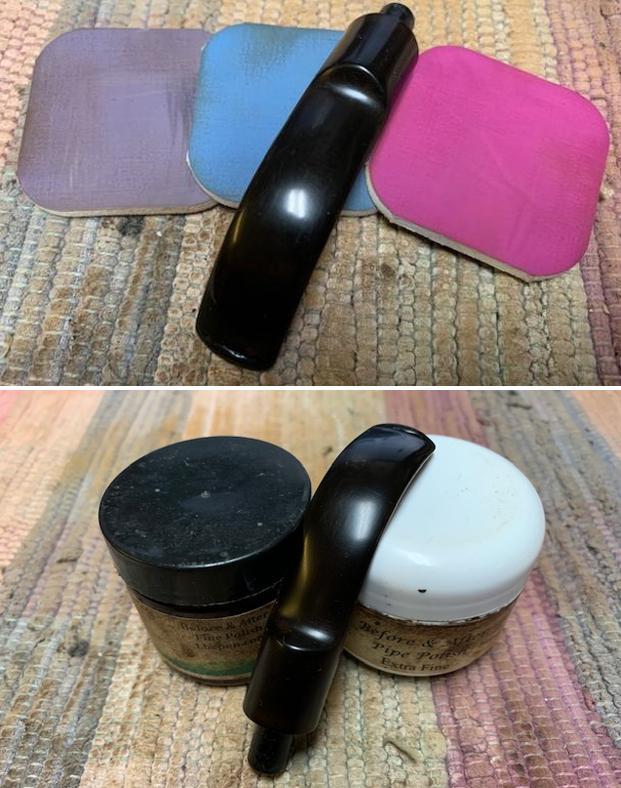
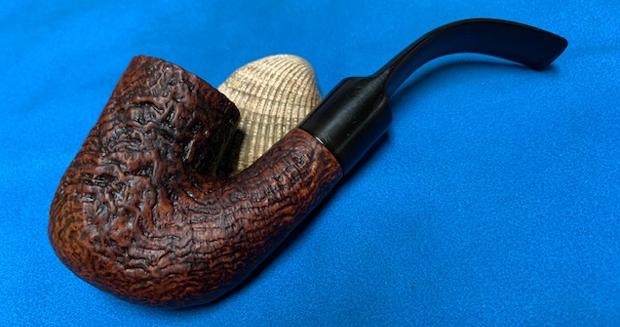
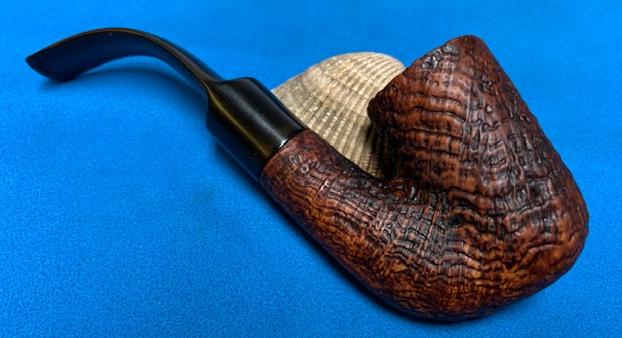
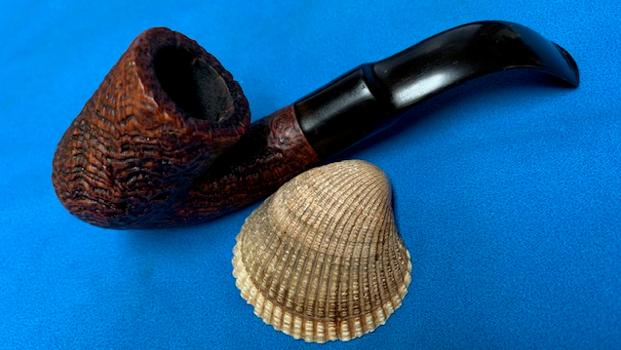
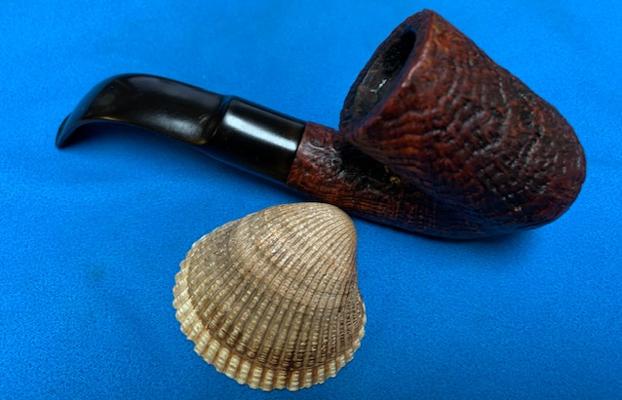
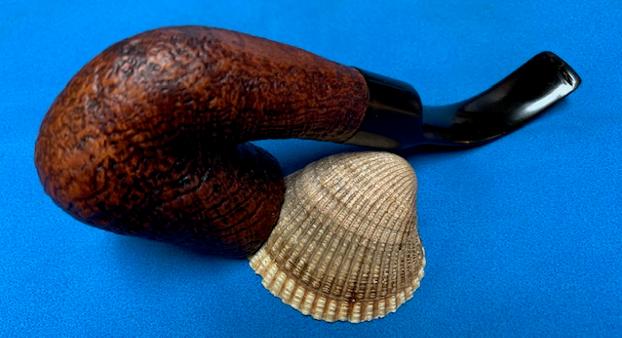
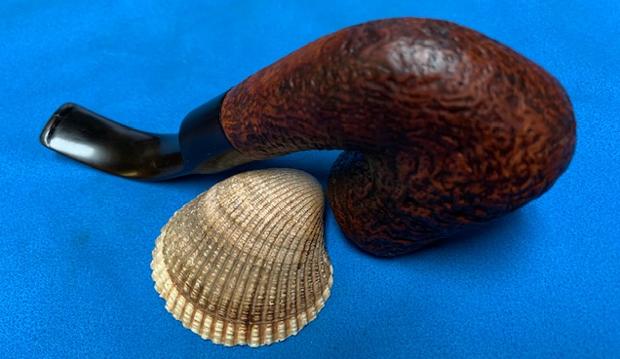
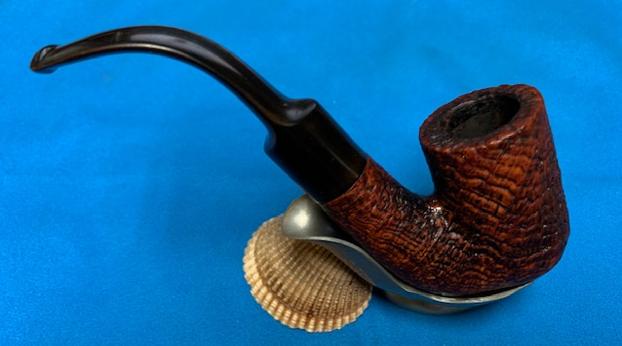
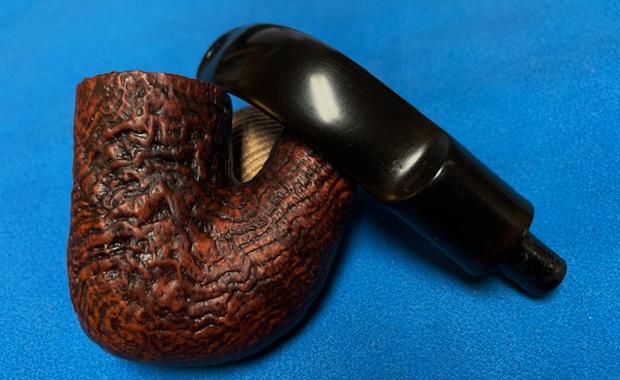
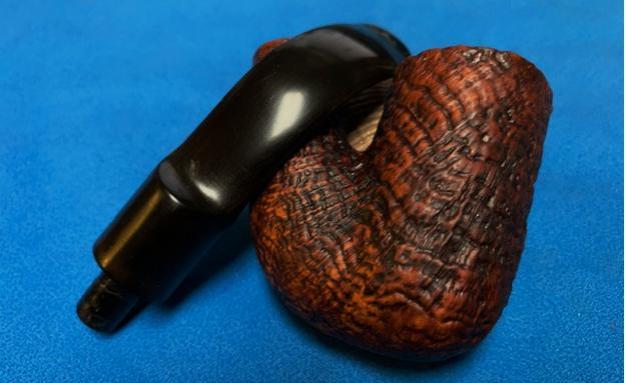
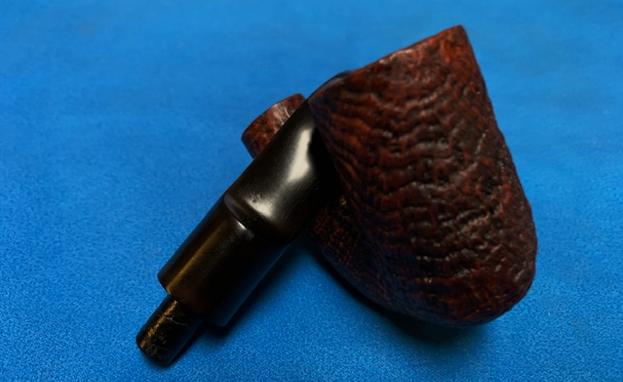
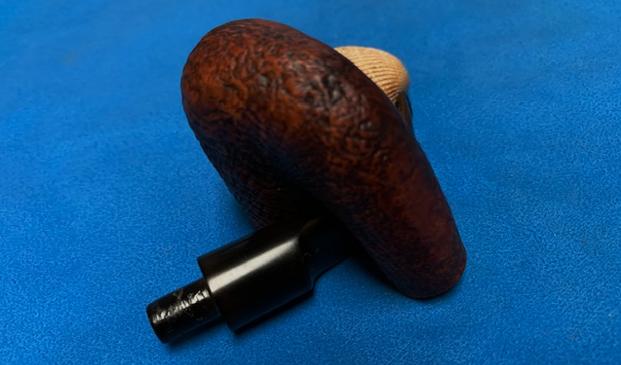
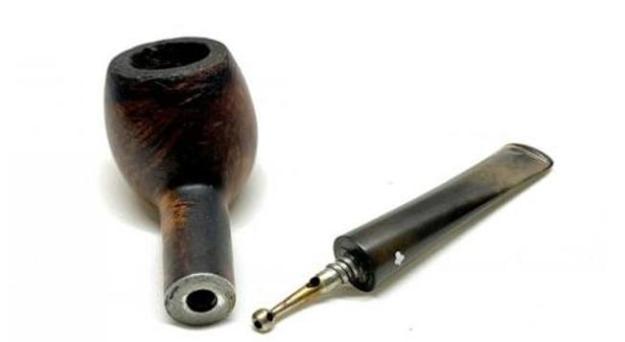
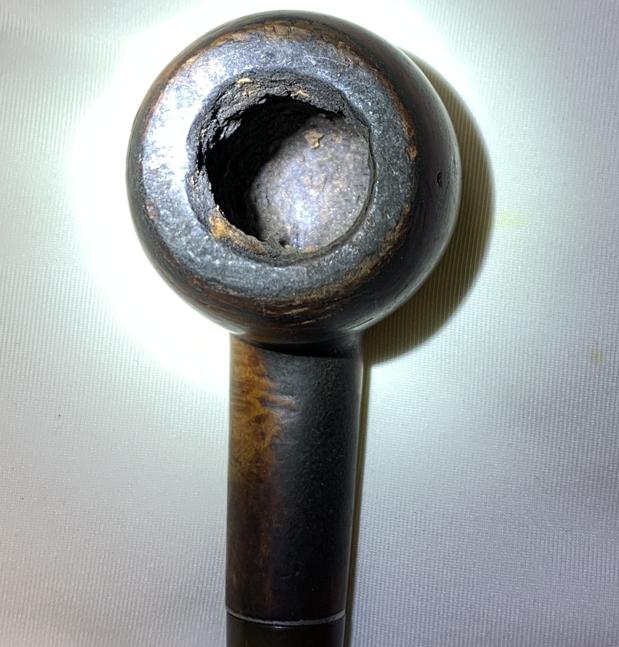
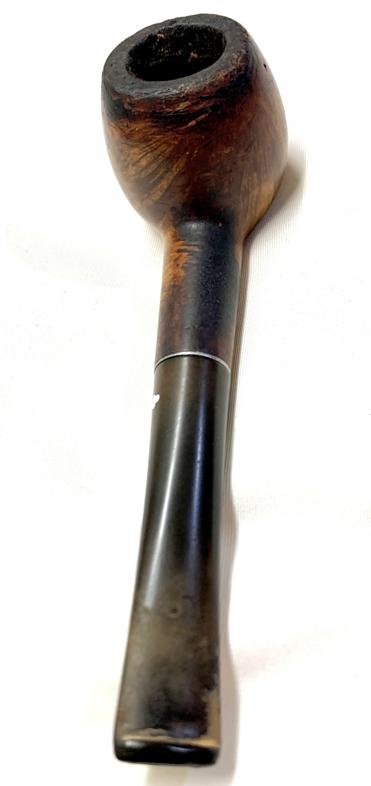
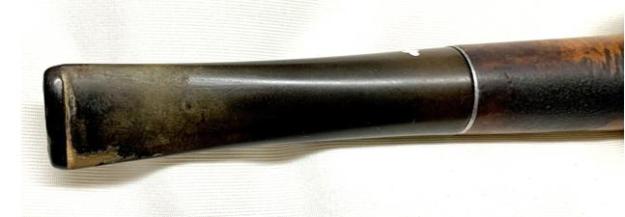
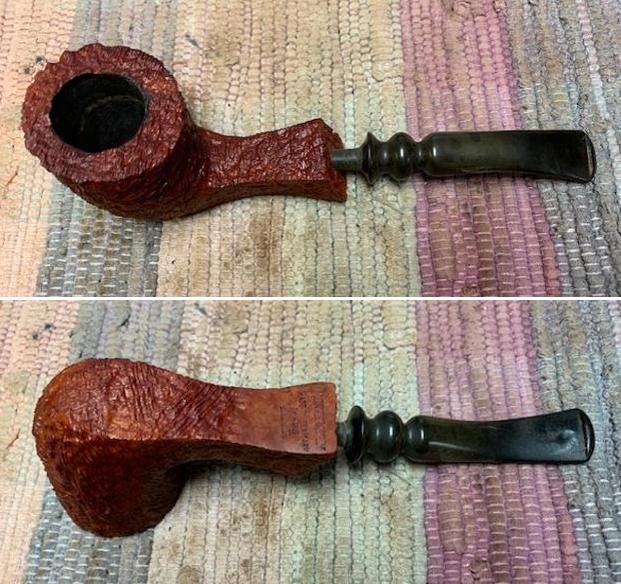
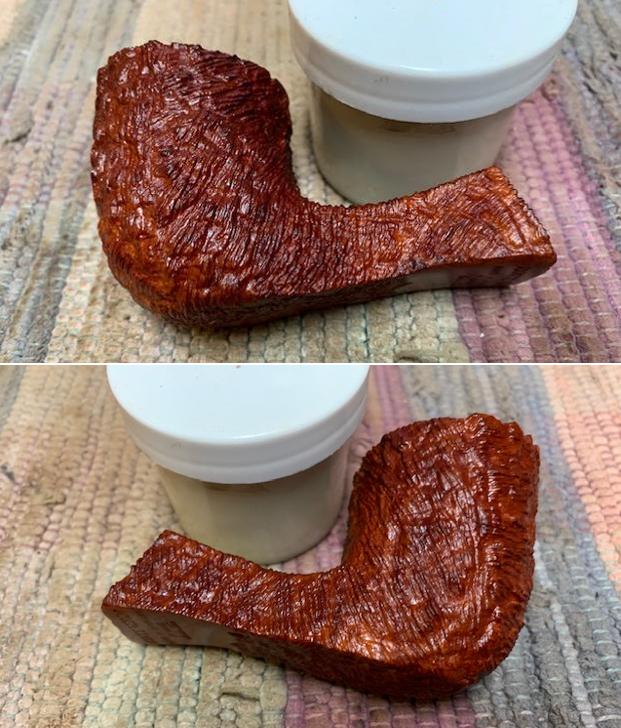
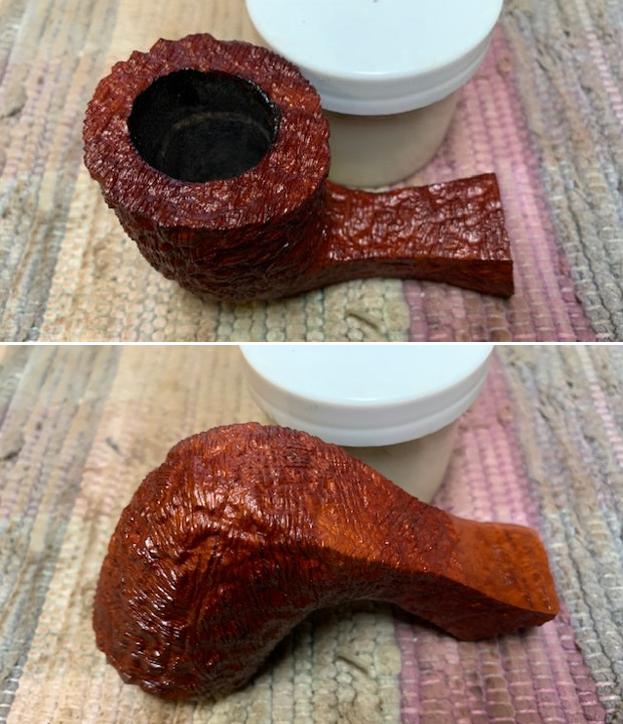
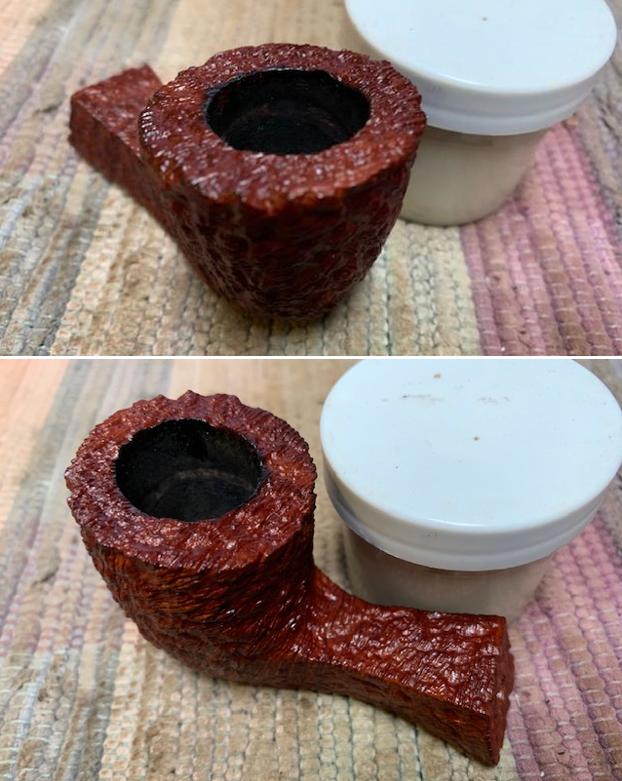
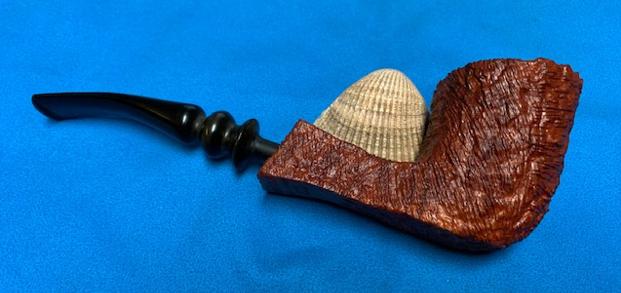
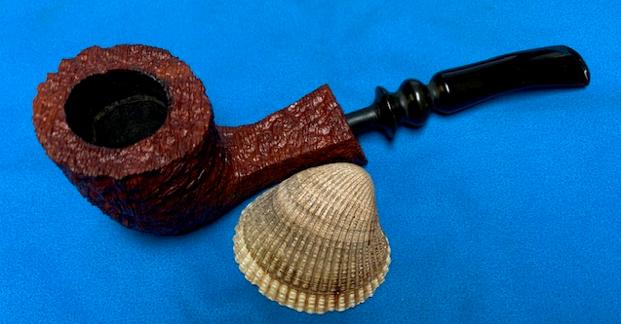
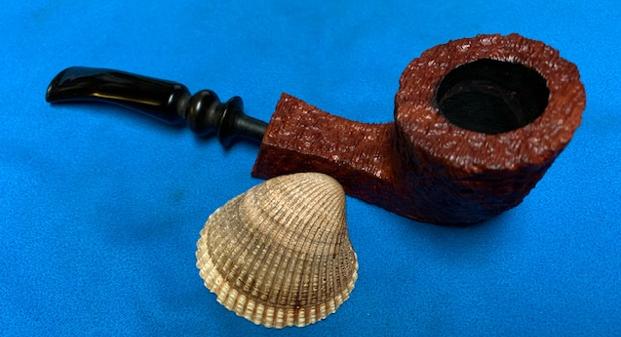
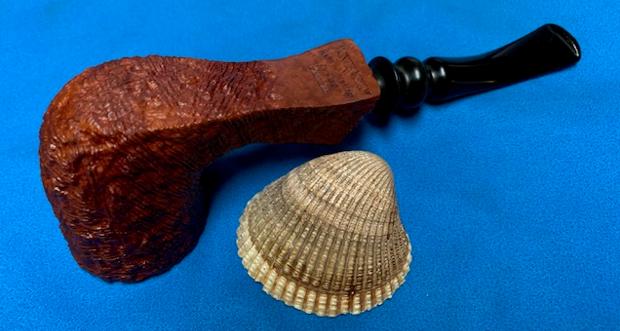
The next pipe on the table is one that Jeff picked up from an auction in Bridgton, Maine, USA in November of 2018 for so it has been sitting here for a long time. It is a very different looking bent Billiard with a faux horn shank ring. The stem is a fancy saddle that looks very good. The stamping on the underside of the shank read Nording [over] Made in Denmark. It was sandblasted on the lower half of the bowl and the entire shank. There is a smooth band around the top half of the bowl on the front and both sides. But it is not totally smooth as it appears that the sandblast was sanded in that area. It is unique for sure and oddly attractive. There was a lot of grime and grit ground into the finish of the bowl. There was a heavy cake in the bowl  and a heavy overflow of lava on the sandblast rim top. The fit of the stem in the shank was smooth and flawless. The faux horn shank ring was quite stunning. On the left side of the saddle the “N” logo had been stamped. It was clear and readable but did not have the white colour in it. The stem was vulcanite and it was oxidized, calcified and had some wear on both sides near the button.  Jeff took photos of the bowl and rim top to show the cake in the bowl. The sandblast rim top showed thick coat of lava that filled in the rim top and hopefully protected the edges from damage. He took photos of the top and underside of the stem showing the tooth chatter, scratching, oxidation and calcification on the stem surface and wear on the edges of the button. Jeff took photos of the sides and heel of the bowl to show the condition of the finish. You can see the well done shape and the interesting grain pattern under the sandblast. Even under the dirt and debris of the years it looked very good.The stamping is clear and readable as noted above. The honey coloured finish even looks good under the grime and the pipe really is a Grand Luxe!I turned first to Pipephil to get a quick review of the brand (http://pipephil.eu/logos/en/logo-n2.html). The pipe was carved by Erik Nording. Nording is a prolific carver who continues to make pipes and sell them globally. The  screen capture below shows a Nording with stamping like the one I am working on.I then turned to Pipedia to have a look at the history of the Nording brand and see if there were any pipes like the one in hand (https://pipedia.org/wiki/N%C3%B8rding). The history was worth a read, though there were no photos of the pipe that I had.

With the information I learned in the above articles I had the background on the pipe. Now it was time to work on it.

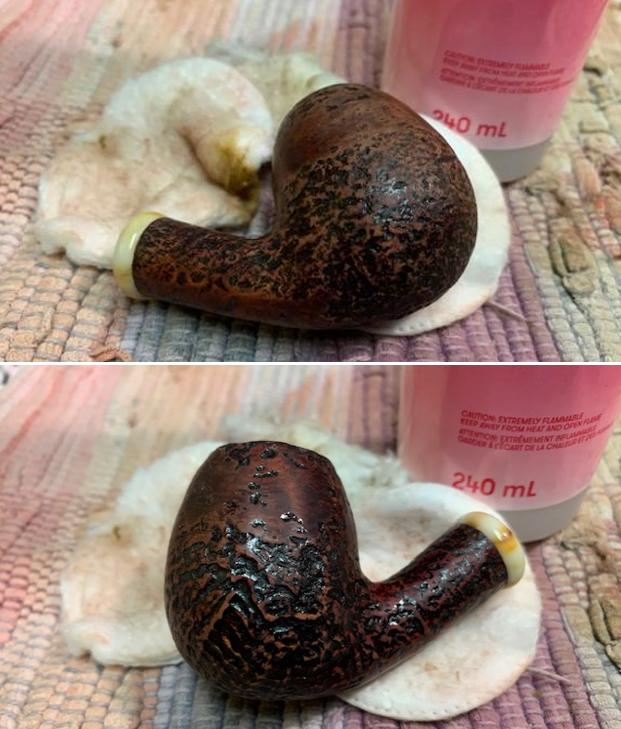
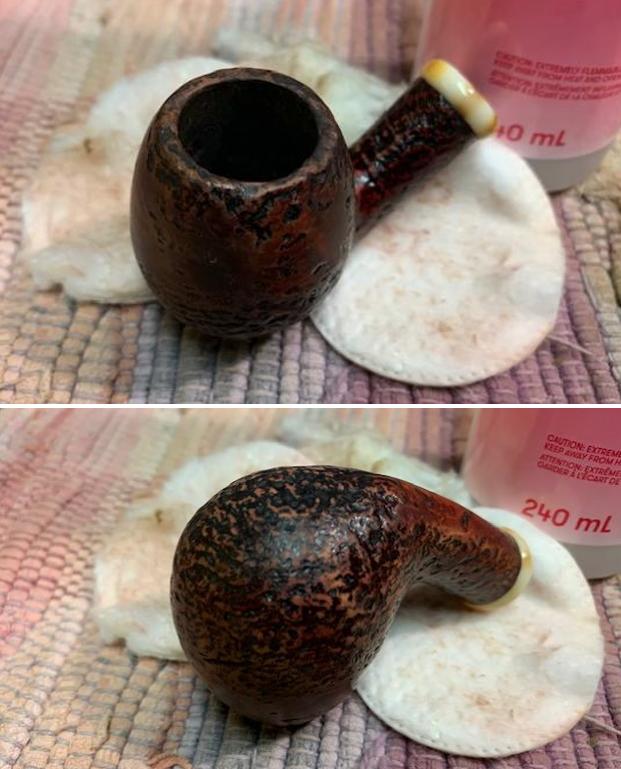
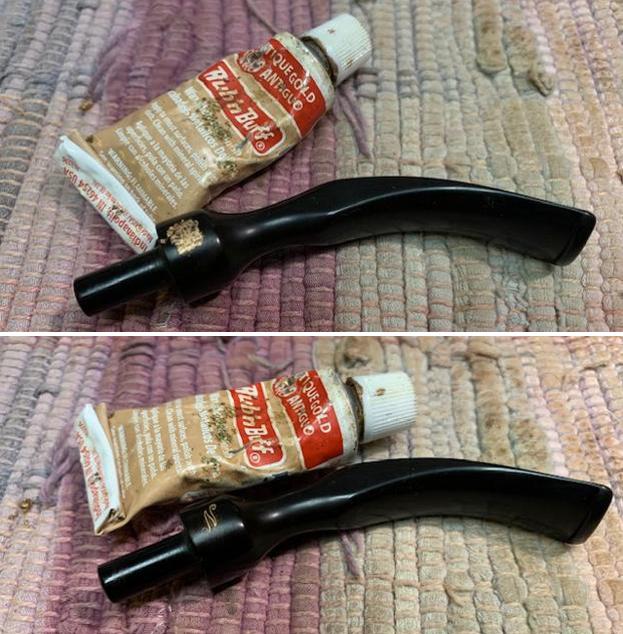
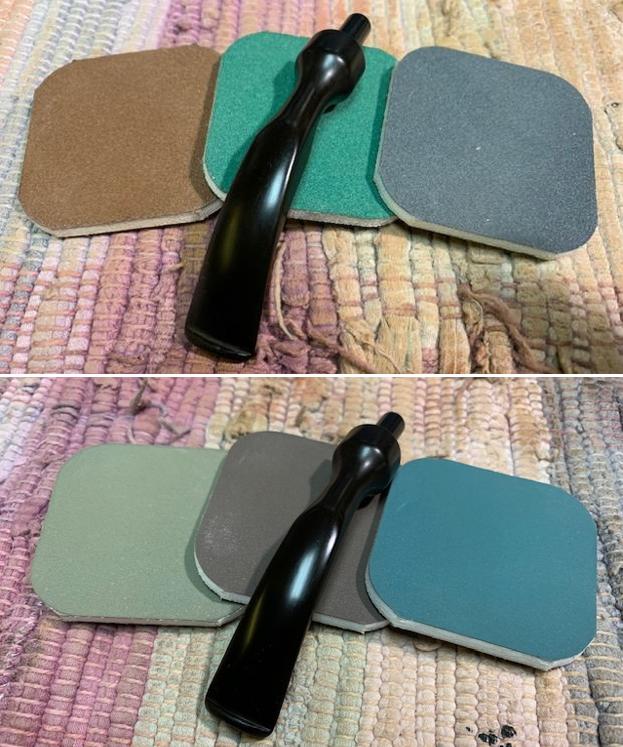
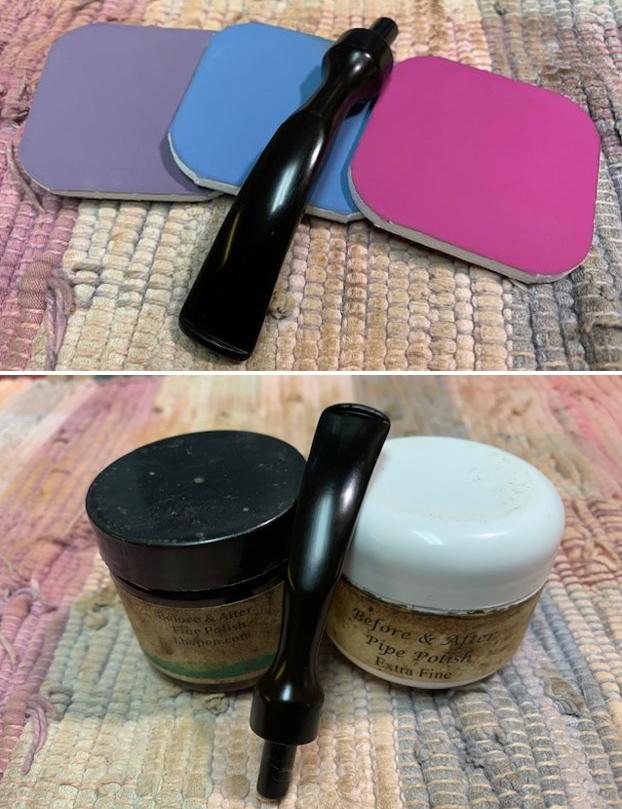
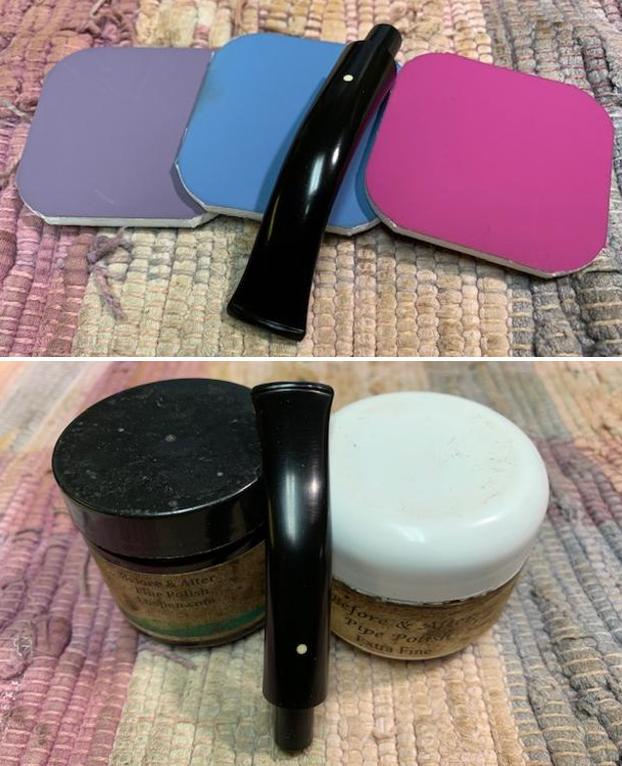
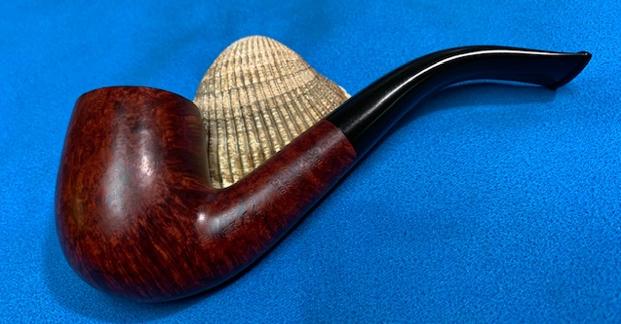
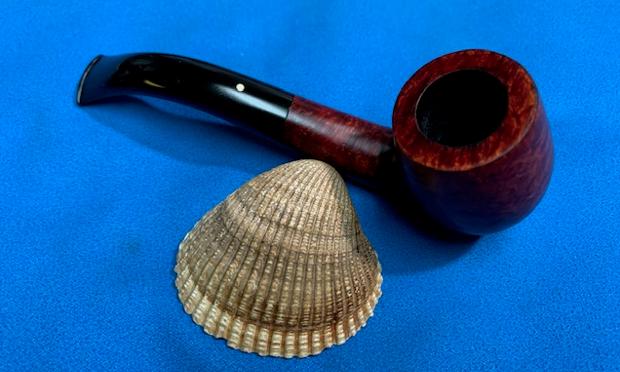
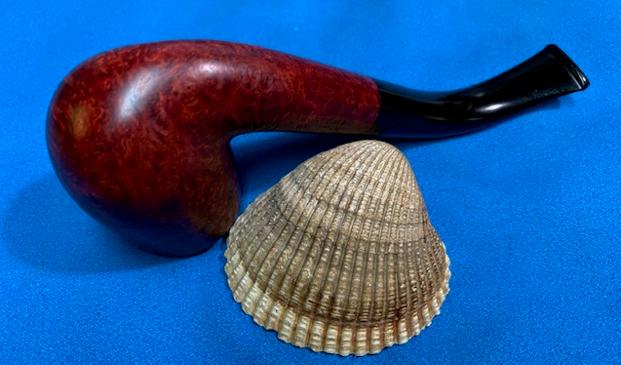
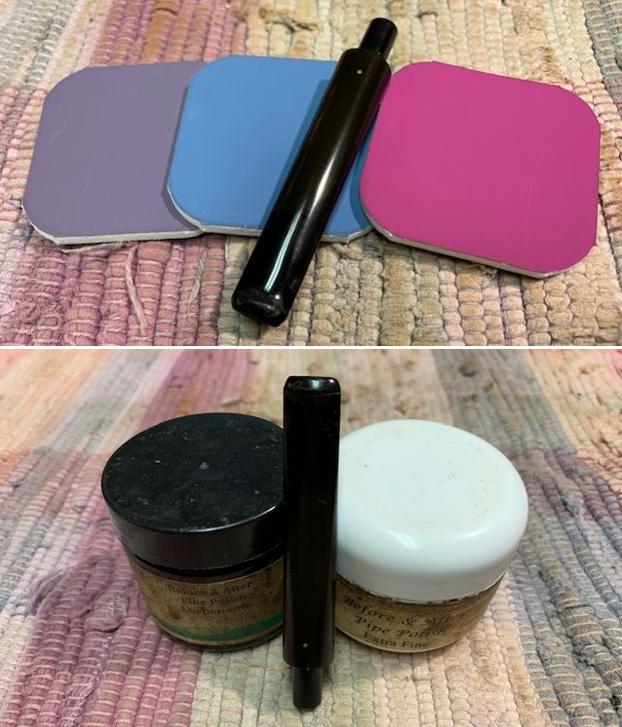
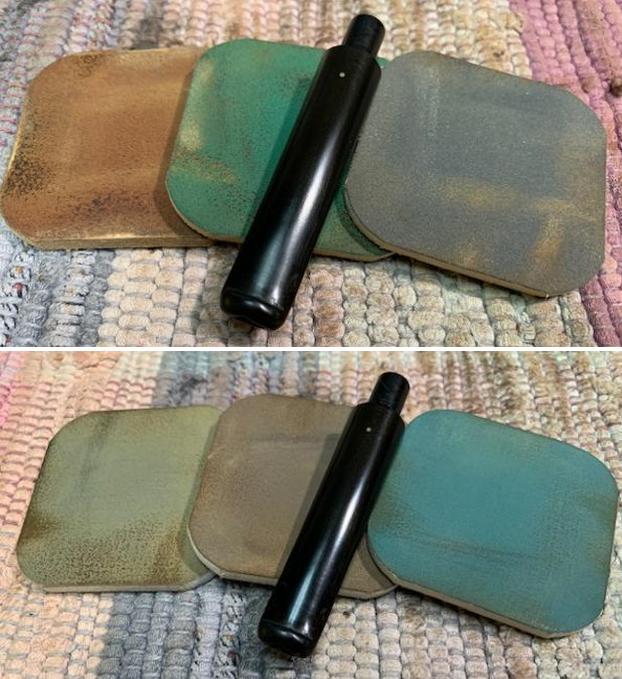
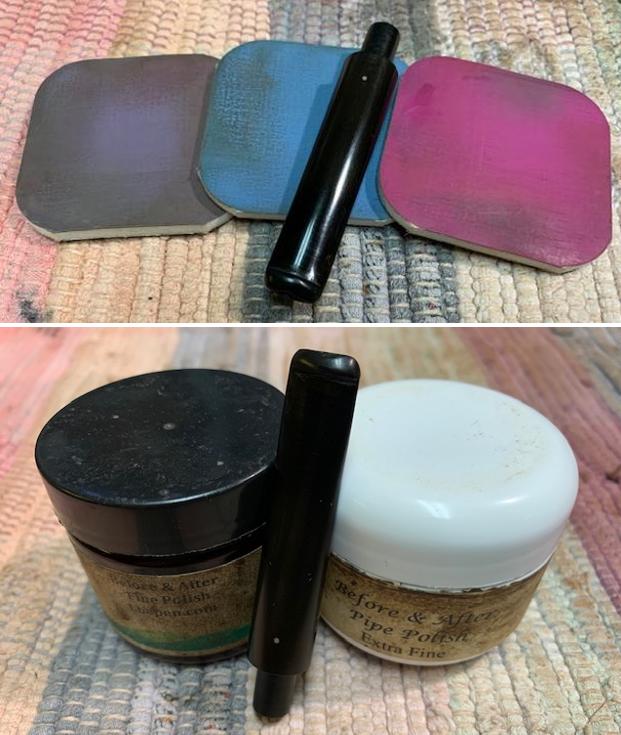
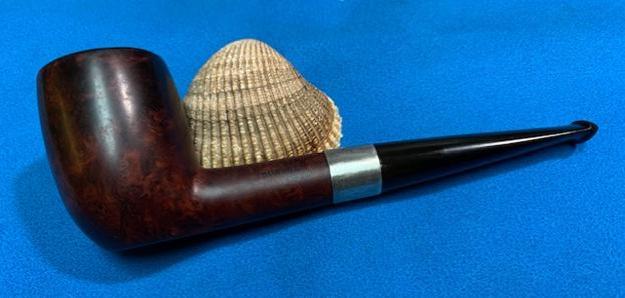
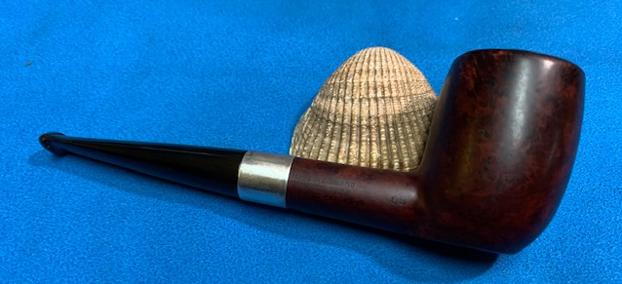
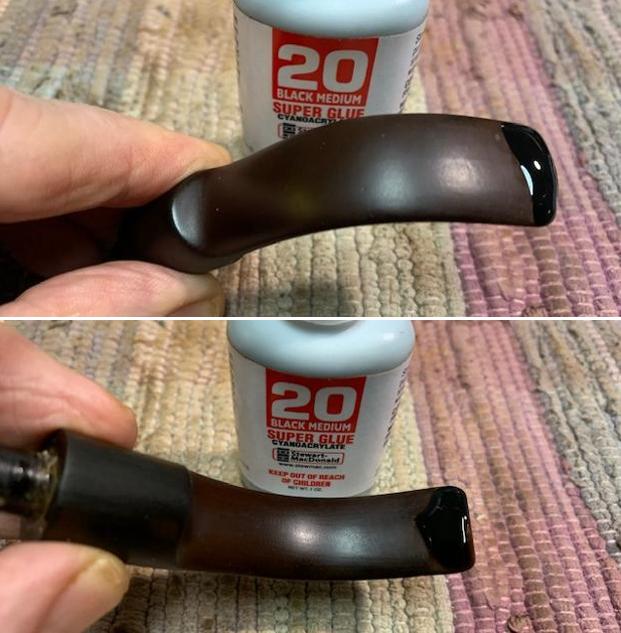
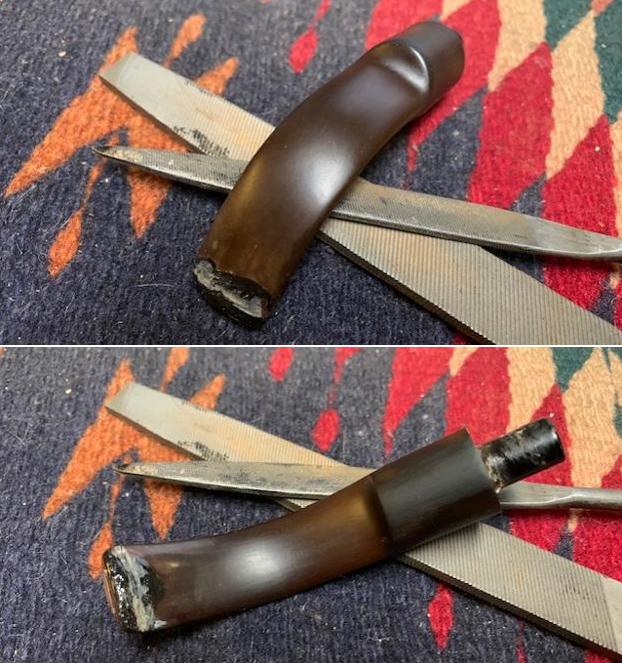
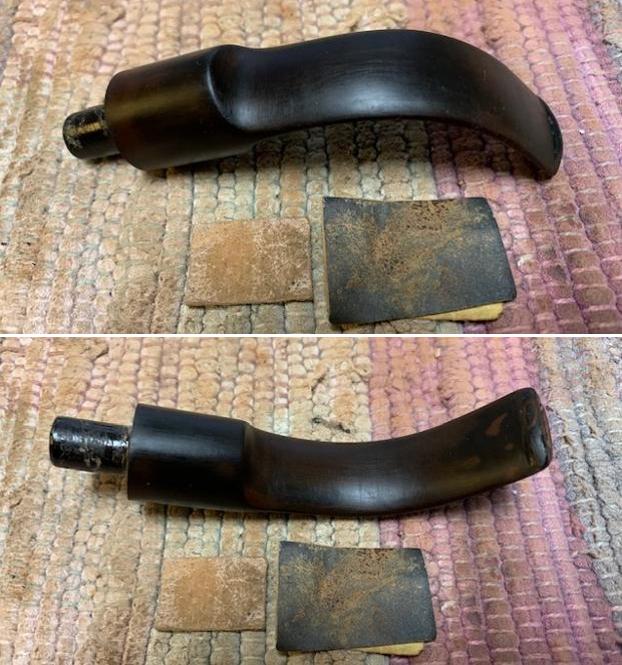
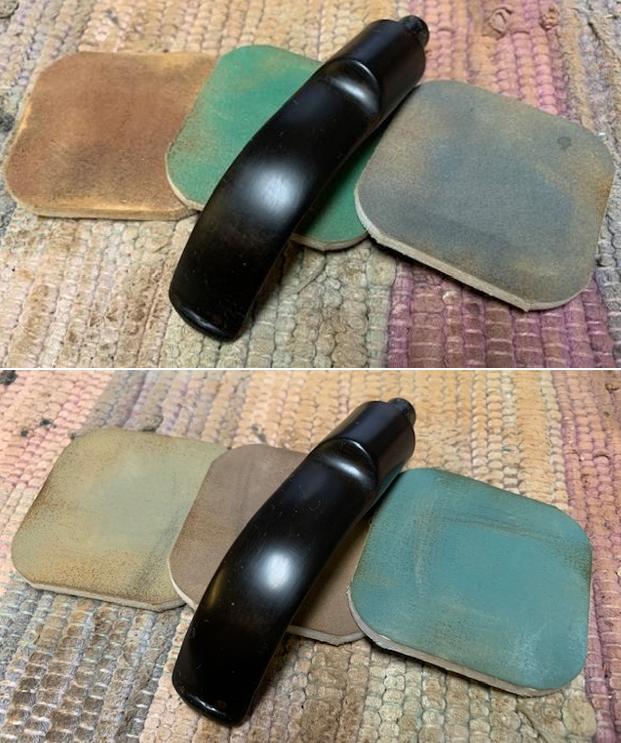
I am really happy to have Jeff’s help on cleaning up the pipes that we pick up along the way. He reamed the bowl with a PipNet pipe reamer and cleaned up the reaming with a Savinelli Fitsall Pipe Knife. He scrubbed out the internals with alcohol, pipe cleaners and cotton swabs until the pipe was clean. He scrubbed the exterior of the bowl with Murphy’s Oil Soap and a tooth brush to remove the grime and grit on the briar and the lava on the rim top. The finish looks much better and the rim top was actually very visible and it looked good. There were also remnants of varnish or shellac on the exterior of the bowl (more on the right than front and left side).  Jeff scrubbed the stem with Soft Scrub All Purpose Cleaner to remove the majority of the grime. When the pipe arrived here in Vancouver it looked very good. I took some close up photos of the rim top and the stem surface. The rim top looked very good and the sandblast on the finish was worn but clean. I took close up photos of the stem to show the condition of the surface and button. The stem was very clean with tooth chatter on both sides near the button. I took a photo of the stamping on the underside of the shank You can see that it is stamped as noted above. It is clear and readable.  I took the pipe apart and took a photo of the pipe. It is a good looking pipe and has some great grain on the bowl and shank. I decided to start my restoration work on this one by working to remove the varnish coat. I rubbed the bowl down with acetone on cotton pads to remove the finish. It did not work very well. So I sanded the finish lightly with 1500 grit micromesh sanding pads to break the shiny top coat on the briar. I then wiped it down again with acetone and was happy with the results. I worked some Before & After Restoration Balm into the surface of the briar with my fingertips and a horsehair shoe brush to clean, enliven and protect the briar. I let the balm sit for 15 minutes and then buffed with a cotton cloth to raise the shine. The photos show the bowl at this point in the restoration process.     With that done the bowl was finished other than the final buffing. I set it aside and turned my attention to the stem. I looked at the worn areas on the stem and decided to sand them out with 220 grit sandpaper and start polishing it with 400 grit wet dry sandpaper. I touched up the N stamp with Rub’n Buff Antique Gold. I rubbed it onto the surface and into the N with a toothpick. I buffed it off with a soft cloth and the look is very good.I polished the stem with 1500-12000 grit sanding pads. I wiped it down after each sanding pad with Obsidian Oil. I polished it with Before & After Pipe Stem Polish – both Fine and Extra Fine. It is fun to come to end of the restoration of the Nording Mixed Finish Danish Bent Billiard. It turned out to be a nice looking pipe. The finish came alive with the work I had done on it. I put the pipe back together and buffed it with Blue Diamond on the buffing wheel. I gave the bowl and the stem multiple coats of carnauba wax. I hand buffed the pipe with a clean buffing pad to raise the shine. It is fun to see what the polished bowl looks like with the polished shank ring and black vulcanite saddle stem. It really was beautiful. This Nording made Bent Billiard is nice looking and the pipe feels great in my hand. It is light and well balanced. Have a look at it with the photos below. The dimensions are Length: 5 ½ inches, Height: 2 inches, Outside diameter of the bowl: 1 inch, Chamber diameter: ¾ of an inch. The weight of the pipe is 52grams/1.83ounces. It is a beautiful pipe that I will soon put on the rebornpipes store in the Danish Pipe Makers section. If you are interested in adding it to your collection let me know. Thanks to each of you who are reading this blog. Remember we are not pipe owners; we are pipemen and women who hold our pipes in trust until they pass on into the trust of the next pipeman or woman.


Breathing Life into a 1958 Dunhill Bruyere 53F/T Group 3 Bent Billiard


Blog by Steve Laug

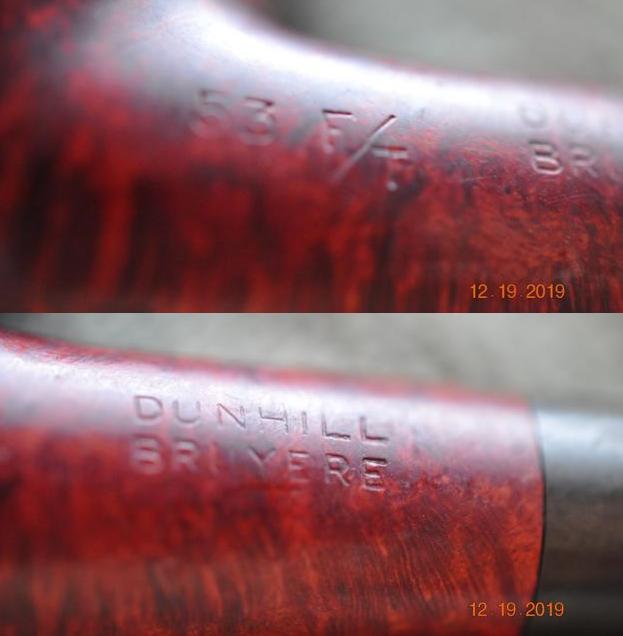
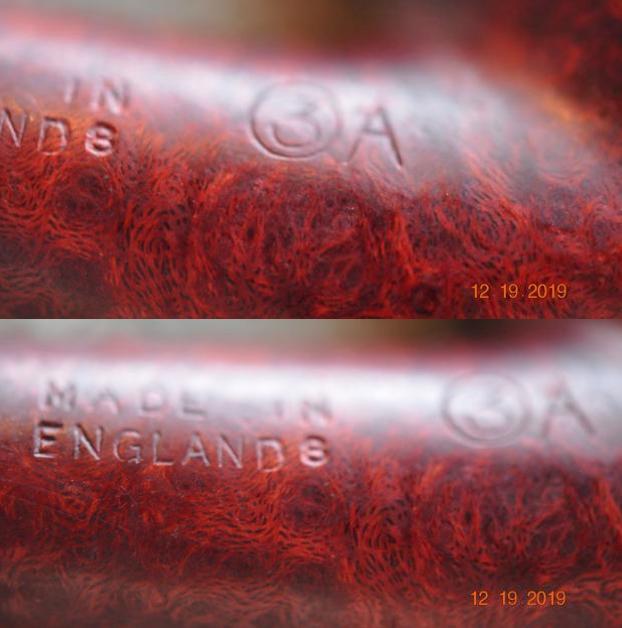
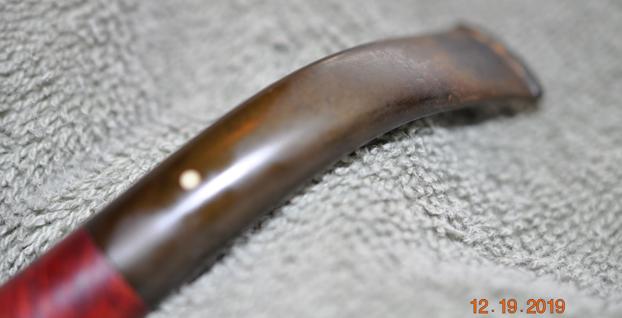
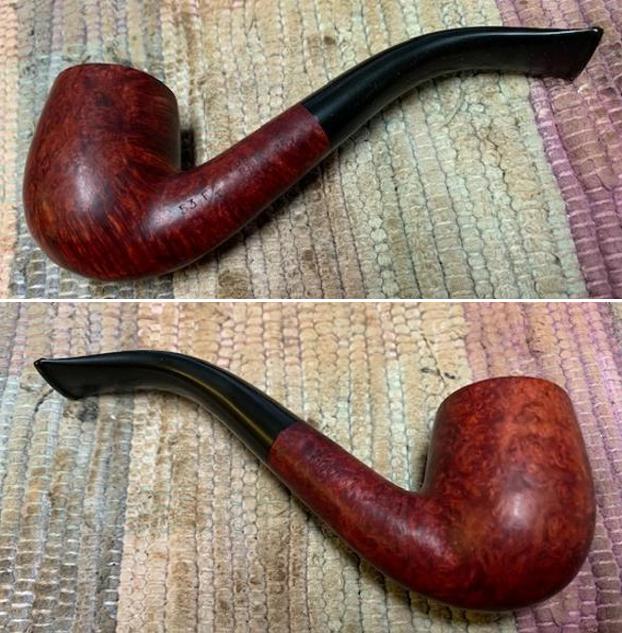
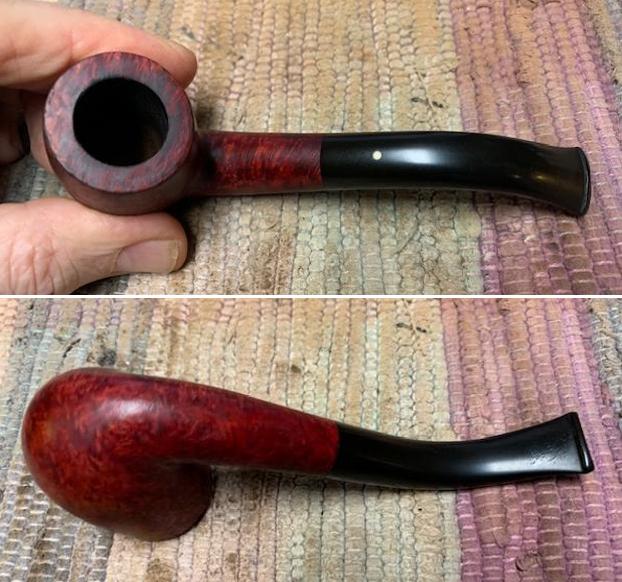
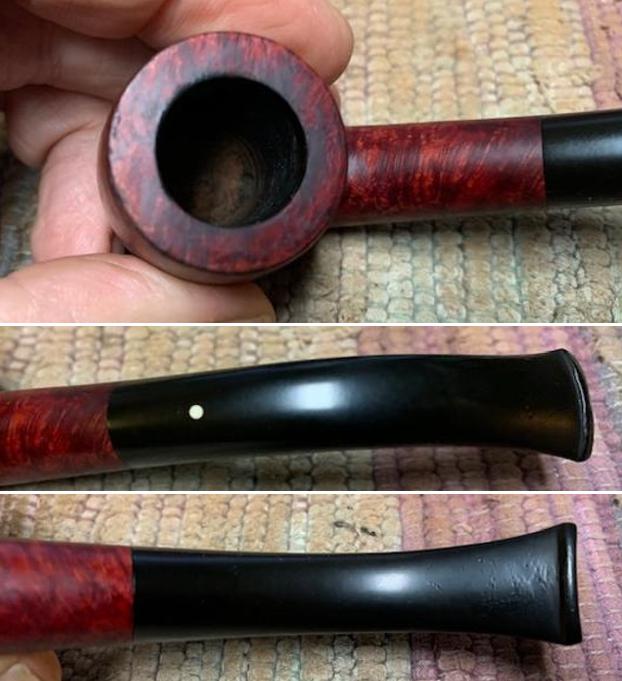
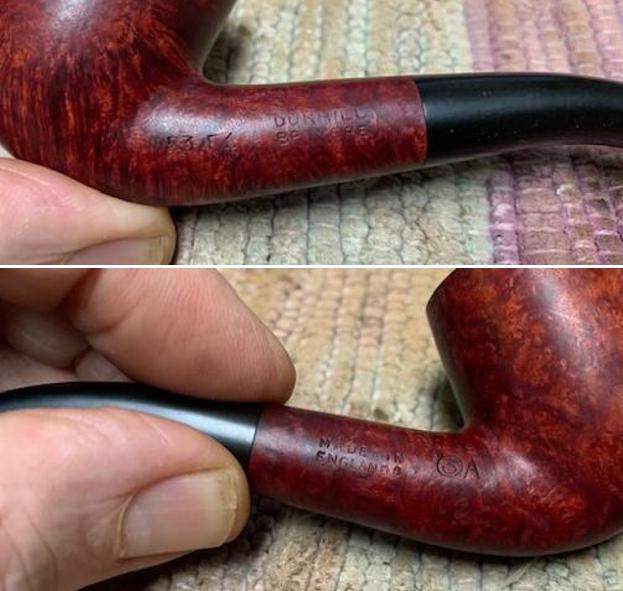
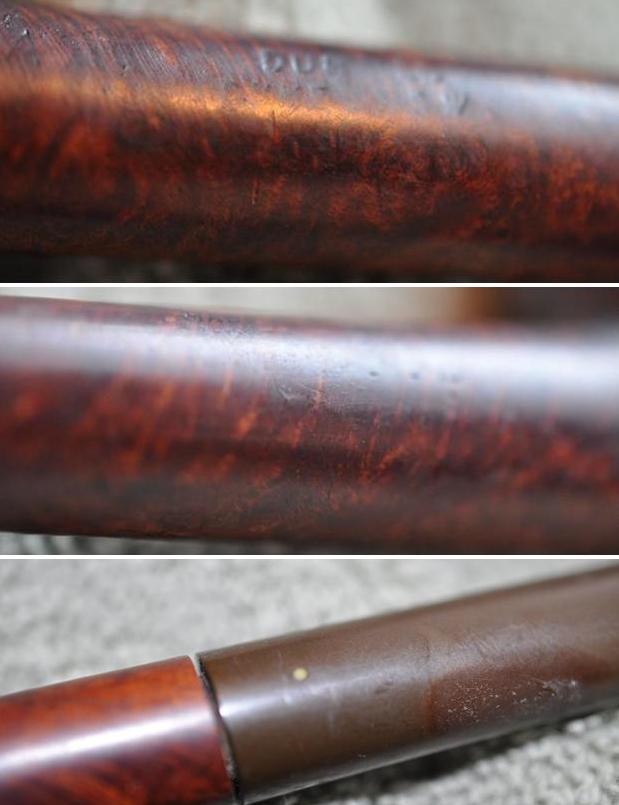
The next pipe on the table came to us in a group of pipes that we purchased from fellow in Los Angeles, California, USA. It is a Dunhill Bruyere Bent Billiard that is in good condition. It is stamped both sides of the shank. On the left side it is stamped with the shape number 53 F/T followed by Dunhill [over] Bruyere. On the right side it is stamped with 3 in a circle followed by A for Bruyere next to the bowl. That is followed by Made in [over] England8. Interpreting that stamp it is as follows: The 53 is the shape number for a bent billiard. The F/T signify a fish tail stem. The Dunhill Bruyere is the finish. The8 following the D of England gives the date the pipe was made and identifies it as 1958. The stamping is clear and readable. The age of the pipe and the oils in the finish has given the pipe a rich reddish brown finish. There is also some amazing grain that the shape follows well. The finish was dirty with dust ground into the surface of the bowl and shank. There was a thick cake in the bowl and tobacco debris stuck to the walls of the bowl. The rim top showed darkening and some lava on the surface. The vulcanite taper stem was oxidized, calcified and had light tooth marks and chatter ahead of the button on both sides.  Jeff took photos of the pipe to show what it looked like before he started working on it.  He took photos of the bowl and rim top to show the thickness of the cake and the darkening and lava overflow on the rim top. The photos of the stem show the oxidation, calcification and tooth marks and chatter on the surface on both sides. The photos of the sides and heel of the bowl show the great grain on the pipe. It is a beauty under the grime and dust.  The stamping on the underside of the shank is shown in the photos below. It looks very good and readable. It reads as noted and explained above. The fourth photo shows the white spot on the stem.  I turned to Pipedia’s section on Dunhill Root Briar Pipes to get a bit of background on the Dunhill finishes (https://pipedia.org/wiki/Dunhill#Root_Briar). I quote:

Bruyere

The original finish produced (usually made using Calabrian briar), and a big part of developing and marketing the brand. It was the only finish from 1910 until 1917. A dark reddish-brown stain. Before the 1950s, there were three possible finishes for Dunhill pipes. The Bruyere was a smooth finish with a deep red stain, obtained through two coats, a brown understain followed by a deep red.

There was a link on the above site to a section specifically written regarding the Bruyere finish (https://pipedia.org/wiki/Dunhill_Bruyere). I turned there and have included the information from that short article below.

Initially, made from over century-old briar burls, classified by a “B” (denoted highest quality pipe); “DR” (denoted straight-grained) and an “A” (denoted first quality), until early 1915. After that, they became a high-end subset to the Dunhill ‘Bruyere’. The DR and B pipes, a limited production, they should be distinguished as hand-cut in London from burls as opposed to the Bruyere line which was generally finished from French turned bowls until 1917, when the Calabrian briar started to be used, but not completely. Only in 1920 Dunhill took the final step in its pipe making operation and began sourcing and cutting all of its own bowls, proudly announcing thereafter that “no French briar was employed”.

Bruyere pipes were usually made using Calabrian briar, a very dense and hardy briar that has a modest grain but does very well with the deep red stain.

“Before the 1950s, there were three possible finishes for Dunhill pipes. The Bruyere was a smooth finish with a deep red stain, obtained through two coats, a brown understain followed by a deep red. The Shell finish was the original sandblast with a near-black stain (though the degree to which it is truly black has varied over the years). Lastly, the Root finish was smooth also but with a light brown finish. Early Dunhill used different briars with different stains, resulting in more distinct and identifiable creations… Over the years, to these traditional styles were added four new finishes: Cumberland, Dress, Chestnut and Amber Root, plus some now-defunct finishes, such as County, Russet and Red Bark.”

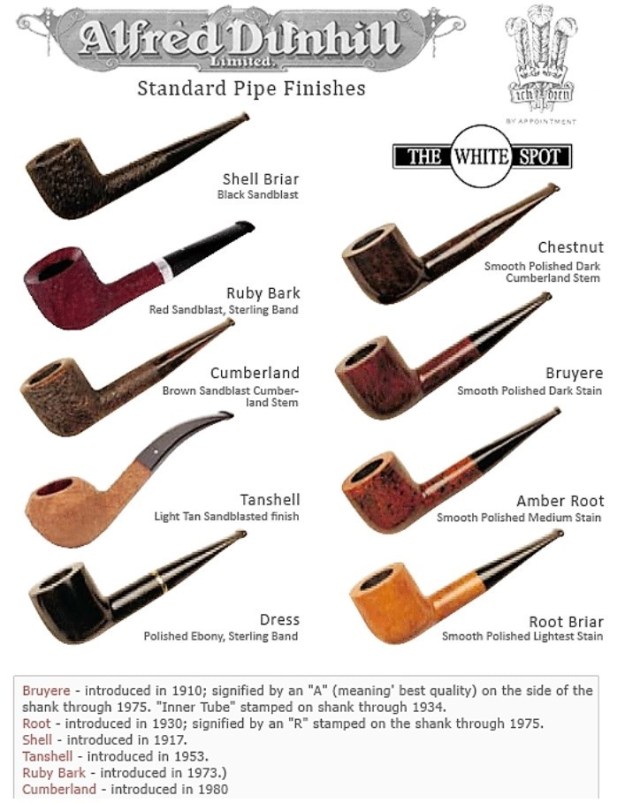
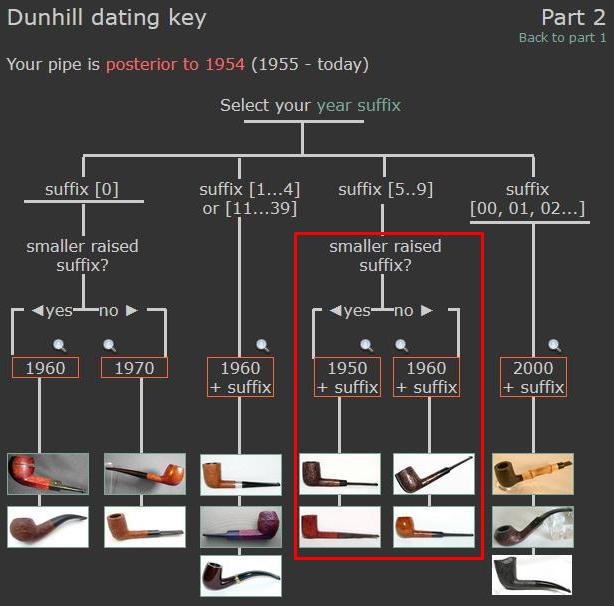
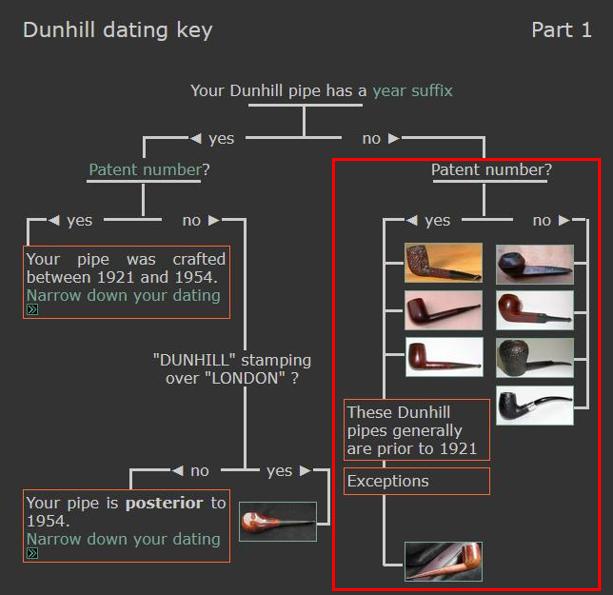
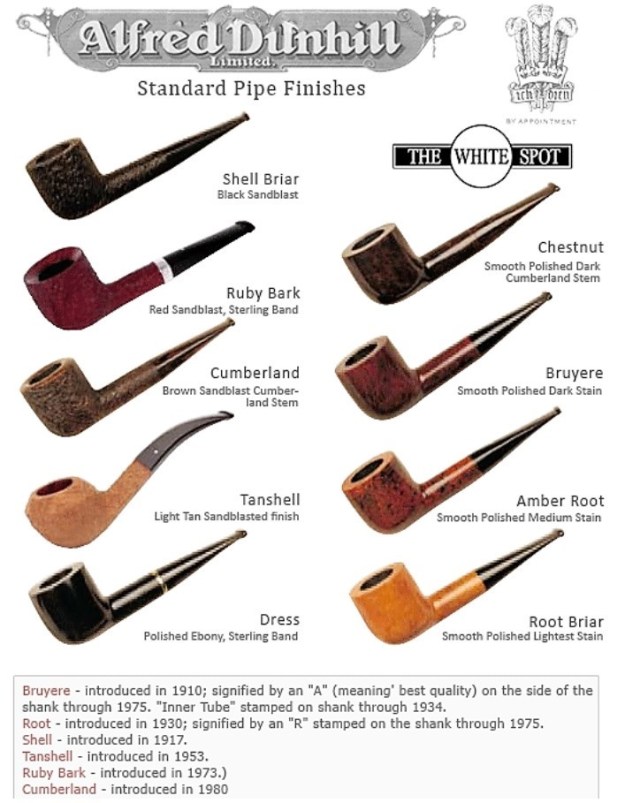
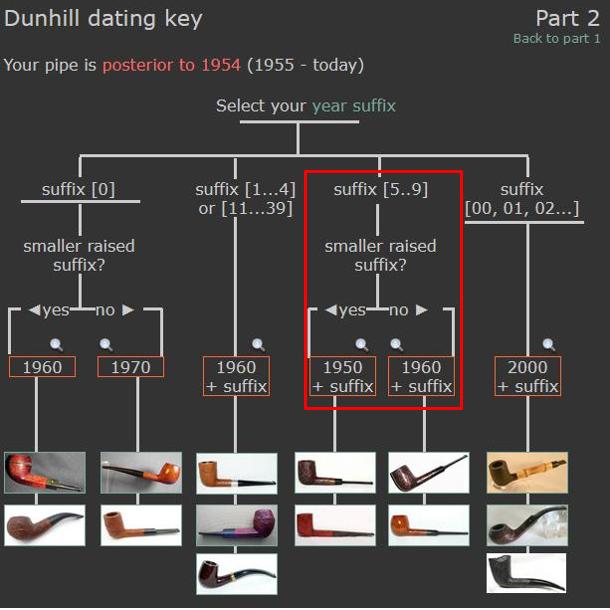
There was also a link to a catalogue page that gave examples and dates that the various finishes were introduced (https://pipedia.org/wiki/File:Dunnypipescatalog-1.png).I turned to Pipephil’s dating guide to show how I arrived at the date of manufacture for this pipe (http://www.pipephil.eu/logos/en/dunhill/cledat-en1a.html). I am including the chart that is provided there for the dating a pipe. I have drawn a red box around the section. Since the pipe I am working on has a suffix 8 that is raised superscript it points to the 1950+8 line on the chart below.I also turned to John Loring’s, The Dunhill Briar Pipe – The Patent Year and After, to work on understanding the stamping on this pipe. I found information on page 19 of the book. It read as follows:

The remaining single digit numbers (5-9) that do not date to the 1920s date it to the 1940s if there is a patent reference, to the 1950s if there is no patent reference and the date code number is raised and smaller than the “D” of England, and to the 1960s if there is no patent reference and the date code number is level with and the same size as the “D”.

I now knew that I was working on a Bruyere that came out in 1958. The shape of the pipe was a Bent Billiard that Dunhill with a #53 F/T shape number that denoted a Bent Billiard shape with a fish tail taper stem.

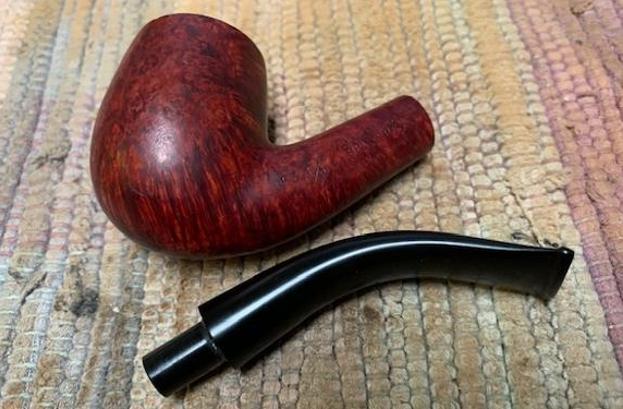
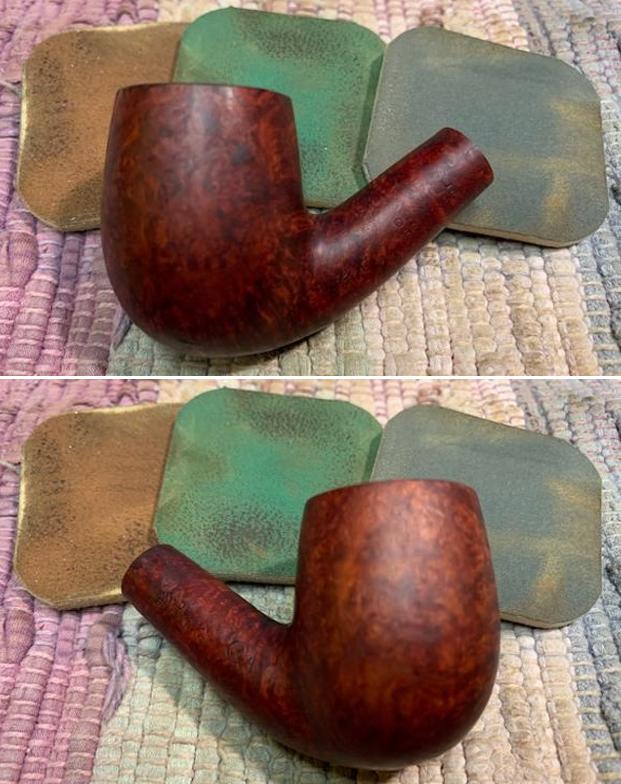
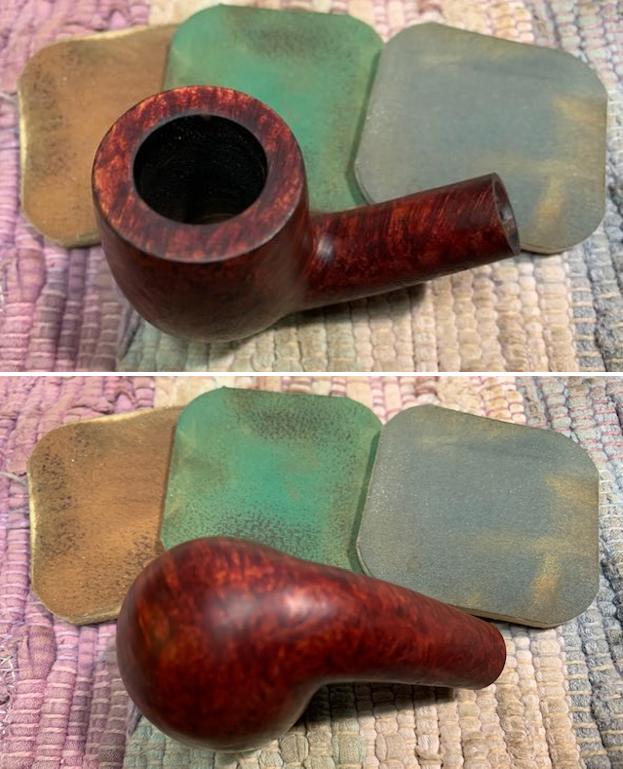
I turned to work on the pipe itself. Jeff had carried out his usual thorough cleanup of the pipe. He had reamed it with a PipNet reamer to remove the cake and cleaned the reaming up with a Savinelli Fitsall Pipe Knife. He scrubbed the internals of the bowl and stem with alcohol, cotton swabs and pipe cleaners. He scrubbed the externals with undiluted Murphy’s Oil Soap and rinsed the bowl off with running water. He soaked the stem in Before & After Deoxidizer and once it had soaked rinsed it off with warm water to remove the residual solution. He dried it off and scrubbed it down with Soft Scrub All-Purpose cleaner to remove any oxidation that was still on the stem. The pipe looked very clean when I received it. I took a photo of the rim top to show the condition. You can see that it looks very good after the clean up. The stem came out looking quite good. There are light tooth marks and chatter on both sides near the button but the oxidation was gone.I took photos of the sides of the shank to show the stamping. It is clear and readable as noted above. I removed the stem from the shank and took a photo of the pipe parts to show what I was working with. It is a nice looking pipe.I decided to start the restoration on this one because it was in such good condition by polishing the rim top and bowl with micromesh sanding pads – dry sanding with 1500-12000 grit sanding pads. I wiped the bowl down with a damp cloth after each sanding pad. The briar began to take on a shine.     With the polishing completed I rubbed the briar down with Before & After Restoration Balm. I worked it into the briar with my fingertips. The product works to clean, enliven and preserve the briar. I let it sit for 15 minutes while I worked on the stem. After the time passed I buffed it with a cotton cloth to deepen the shine. The briar really comes alive with the balm.   I set the bowl aside and turned my attention to the stem. I polished the vulcanite with micromesh sanding pads – 1500-12000 grit pads. I wiped it down with Obsidian Oil after each sanding pad. I used Before & After Pipe Polish – both Fine and Extra Fine to further polish the stem.   This Dunhill Bruyere 53E/T Group 3 Bent Billiard from 1958 is a beautiful looking piece of briar that has a shape that follows grain. It is a great looking pipe that came out looking even better after the cleanup. The finish on the pipe is in excellent condition. The red and brown stain on the bowl works well to highlight the grain. The polished black vulcanite taper fish tail stem adds to the mix. With the grime gone from the finish and the bowl it was a beauty and is eye-catching. I put the stem back on the bowl and buffed the pipe with Blue Diamond on the buffing wheel being careful to not buff the stamping. I gave the bowl and the stem multiple coats of carnauba wax on the buffing wheel and followed that by buffing it with a clean buffing pad. I hand buffed the pipe with a microfiber cloth to deepen the shine. The finished Bruyere 53 F/T Bent Billiard is quite nice and feels great in the hand. Give the finished pipe a look in the photos below. The dimensions of the pipe are Length: 5 inches, Height: 1 ¾ inches, Outside diameter of the bowl: 1 ¼ inches, Chamber diameter: 5/8 of an inch. The weight of the pipe is 36grams/ 1.23oz. It will soon be added to the British Pipe Makers section on the rebornpipes store. Thanks for walking through the restoration with me as I worked over another beautiful pipe. Remember we are not pipe owners; we are pipemen and women who hold our pipes in trust until they pass on into the trust of the next generation.

New Life for a Patent Era 1915-18 Dunhill A Bruyere 42 Dublin


Blog by Steve Laug

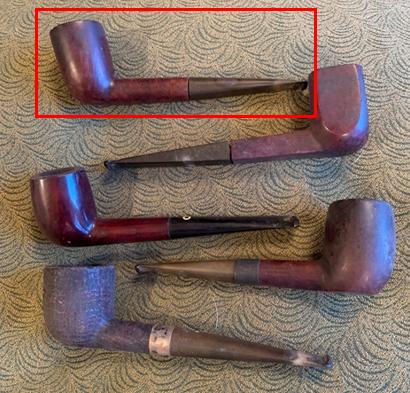
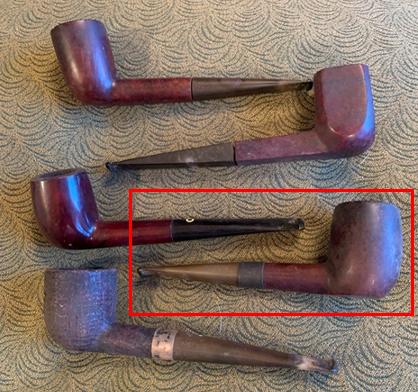
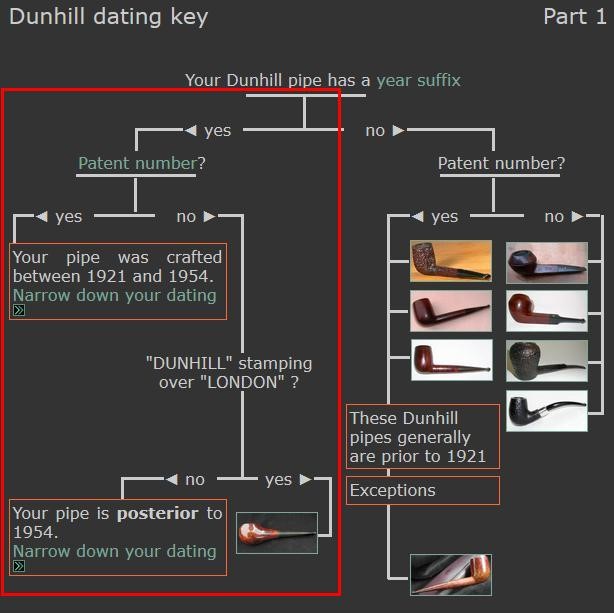
This Dunhill Standing Billiard is the last of five Dunhills that came to us in the same lot as the 1922 Dunhill Bruyere Reading Pipe, and included a cracked shank 1962 Dunhill Shell Briar Pot, a 1928 Dunhill Bruyere EK7 Panel Billiard, a 1915-18 Dunhill Bruyere 66 Standing Billiard, a 1936 Dunhill Bruyere 35 Billiard and the 1905 BBB Calabash Reading Pipe and 1911 BBB Glokar Poker. I have drawn a red box around the pipe in the picture to the left. It is an interesting canted Dublin. The pipe is stamped on the left side of the shank DUNHILL [over] Duke St. S.W. On the right side of the shank it was stamped MADE IN ENGLAND [over] “INNER TUBE” [over] PATENTED MARCH 9-15 that is followed by the shape number 42. Other than the shape number the pipe is stamped the same way as the Standing Billiard shape 66 that I finished recently.

It was another filthy pipe with a thick cake in the bowl and a heavy lava overflow on the rim top. The finish was tired and dirty with grime and debris stuck to the surface of the briar. The stem has a small white dot on top and the button on the topside had a deep tooth mark and damage. There was tooth chatter and marks on both sides ahead of the button. Jeff took photos of the pipe before he did his clean up work.He took photos of the bowl and rim to give a picture of the thickness of the cake and lava on the rim top. This must have been a favourite pipe to have that thick of a cake and lava buildup. The stem has tooth chatter and marks on both sides. The top is worse than the underside with deep marks in the top of the button. The pipe is old enough that it had an ivory white spot on the topside. Jeff took photos of the bowl from various angles to give a sense of the dirtiness of the finish but also the unique shape of the billiard sitter. It is going to be a real beauty!Jeff took photos of the stamping on the sides of the shank . The stamping is quite faint and could not be captured with a camera. There are some faint spots but over all it is readable as noted above. I turned to Pipedia’s section on Dunhill Root Briar Pipes to get a bit of background on the Dunhill finishes (https://pipedia.org/wiki/Dunhill#Root_Briar). I quote:

Bruyere

The original finish produced (usually made using Calabrian briar), and a big part of developing and marketing the brand. It was the only finish from 1910 until 1917. A dark reddish-brown stain. Before the 1950s, there were three possible finishes for Dunhill pipes. The Bruyere was a smooth finish with a deep red stain, obtained through two coats, a brown understain followed by a deep red.

There was a link on the above site to a section specifically written regarding the Bruyere finish (https://pipedia.org/wiki/Dunhill_Bruyere). I turned there and have included the information from that short article below.

Initially, made from over century-old briar burls, classified by a “B” (denoted highest quality pipe); “DR” (denoted straight-grained) and an “A” (denoted first quality), until early 1915. After that, they became a high-end subset to the Dunhill ‘Bruyere’. The DR and B pipes, a limited production, they should be distinguished as hand-cut in London from burls as opposed to the Bruyere line which was generally finished from French turned bowls until 1917, when the Calabrian briar started to be used, but not completely. Only in 1920 Dunhill took the final step in its pipe making operation and began sourcing and cutting all of its own bowls, proudly announcing thereafter that “no French briar was employed”.

Bruyere pipes were usually made using Calabrian briar, a very dense and hardy briar that has a modest grain but does very well with the deep red stain.

“Before the 1950s, there were three possible finishes for Dunhill pipes. The Bruyere was a smooth finish with a deep red stain, obtained through two coats, a brown understain followed by a deep red. The Shell finish was the original sandblast with a near-black stain (though the degree to which it is truly black has varied over the years). Lastly, the Root finish was smooth also but with a light brown finish. Early Dunhill used different briars with different stains, resulting in more distinct and identifiable creations… Over the years, to these traditional styles were added four new finishes: Cumberland, Dress, Chestnut and Amber Root, plus some now-defunct finishes, such as County, Russet and Red Bark.”

There was also a link to a catalogue page that gave examples and dates that the various finishes were introduced (https://pipedia.org/wiki/File:Dunnypipescatalog-1.png).I turned to Pipephil’s dating guide to show how I arrived at the date of manufacture for this pipe (http://www.pipephil.eu/logos/en/dunhill/cledat-en1.html). I am including a chart that is provided there for the dating of a pipe. I have drawn a red box around the pertinent section in the chart. Since the pipe I am working on has no clear patent number but says Patented March 9-15 I take that to clearly show that the pipe was made prior to 1921 and would have been included in the exceptions.I also turned to John Loring’s, The Dunhill Briar Pipe – The Patent Year and After, to work on understanding the DUNHILL [over]DUKE ST. S.W. I found information on page 5 of the book. It read as follows:

The Bruyere pipes were stamped DUNHILL over DUKE ST. S.W. on the shank with an “A” near the bowl to indicate first quality (the reverse side stamping in 1910 is presently unknown) and given shape numbers beginning with 31.

I read earlier sections of the book to do some checking on the Patent Stamping on this pipe. I found what I was looking for on page 58 where he spells out the Smooth Finish Patent Nomenclature Usage. In a very helpful chart he identifies PATENTED MARCH 9-15 that links the pipe to a US Patent for the years between 1915-23.On page 9 it reads:

…Dunhill applied for Canadian and American patents (granted in 1914 and 1915 respectively).

On page 12 it reads:

…From 1910 through October 1918 Dunhill branded its pipes with DUNHILL over DUKE ST. S.W….Inner tube patent numbers or references also serve to denote the earliest the pipe could have been manufactured., e.g. an English patent reference (PAT. No 5861/12) would not have been stamped prior to the 1913 grant, nor a Canadian patent reference (PATENTED 1914) prior to the 1914 grant nor a US patent reference (PATENTED MARCH.9-15 or PAT.AMERICA1915) prior to the 1915 grant.

I now knew that I was working on a Bruyere that came out in between 1915 and 1918 when the Duke St. SW stamp ceased to be used. The shape of the pipe was one of many Billiards that Dunhill put out and that the 66 was a normal Billiard Sitter shape with a taper stem.

I turned to work on the pipe itself. Jeff had carried out his usual thorough cleanup of the pipe. He had reamed it with a PipNet reamer to remove the cake and cleaned the reaming up with a Savinelli Fitsall Pipe Knife. He scrubbed the internals of the bowl and stem with alcohol, cotton swabs and pipe cleaners. He scrubbed the externals with undiluted Murphy’s Oil Soap and rinsed the bowl off with running water. He soaked the stem in Before & After Deoxidizer and once it had soaked rinsed it off with warm water to remove the residual solution. He dried it off and scrubbed it down with Soft Scrub All-Purpose cleaner to remove any oxidation that was still on the stem. The pipe looked very clean when I received it.  I took a photo of the rim top to show the condition. You can see the darkening on the rim top. It is roughened and slightly out of round with nicks on the inner edge. The stem had deep tooth marks and chatter on both sides near the button and on the button itself. The oxidation was gone.  The damage on the topside at the button can be seen in the second photo of the stem surface below.I took photos of the sides of the shank to show the stamping. It is faint but readable as noted above. I removed the stem from the shank and took a photo of the pipe parts to show what I was working with. It is another nice looking 100+ year old pipe.I decided to start the restoration on this one by working on the damage on the inner edge of the bowl. It had darkening and some damage to the edge. The pipe is over a 100 years old so it is not surprising that there was burn and reaming damage marks on the edge from a previous pipeman. I worked it over with a folded piece of 220 grit sandpaper to remove and minimize the damage. When I finished with it, the bowl and the rim top looked much better.I polished the rim top and bowl with micromesh sanding pads – dry sanding with 1500-12000 grit sanding pads. I wiped the bowl down with a damp cloth after each sanding pad. The grain on the pipe is quite beautiful. I rubbed the briar down with Before & After Restoration Balm. I worked it into the briar with my fingertips. The product works to clean, enliven and preserve the briar. I let it sit for 15 minutes while I worked on the stem. After the time passed I buffed it with a cotton cloth to deepen the shine. The briar really comes alive with the balm. I set the bowl aside and work on the stem. I filled in the tooth marks in the stem surface and the edge of the button on the top side. Once the repairs cured I recut the edges of the button with a file and smoothed out the repairs. I sanded them with 220 grit sandpaper to blend them into the surface. I started polishing the stem with 400 grit wet dry sandpaper.

I polished the vulcanite with micromesh sanding pads – 1500-12000 grit pads. I wiped it down with Obsidian Oil after each sanding pad. I used Before & After Pipe Polish – both Fine and Extra Fine to further polish the stem. This Dunhill A Bruyere 42 Patent Dublin from 1915-18 is a beautiful looking piece of briar that has a shape that follows grain. The Bruyere is an early finish that Dunhill specialized in making. The finish on the pipe is in excellent condition. The red and brown stain on the bowl works well to highlight the grain. The polished black vulcanite panel taper stem adds to the mix. I put the stem back on the bowl and buffed the pipe with Blue Diamond on the buffing wheel being careful to not buff the stamping. I gave the bowl and the stem multiple coats of carnauba wax on the buffing wheel and followed that by buffing it with a clean buffing pad. I hand buffed the pipe with a microfiber cloth to deepen the shine. The finished 1915-18 Dunhill A Bruyere 42 Patent Dublin is quite nice and feels great in the hand. Give the finished pipe a look in the photos below. I can only tell you that like the other pipes I am working that it is much prettier in person than the photos capture. The dimensions of the pipe are Length: 5 ½ inches, Height: 1 ¾ inches, Outside diameter of the bowl: 1 ¼ inches, Chamber diameter: ¾ of an inch. The weight of the pipe is 29grams/1.02oz. I am still working through what I am going to do with this old timer. I will keep it with me for a while until I decide. Thanks for walking through the restoration with me as I worked over another beautiful pipe. This pipe is classic reminder that we are not pipe owners; we are pipemen and women who hold our pipes in trust until they pass on into the trust of the next generation.


A Mobile Restoration at 10,804 Feet in the Colorado Mountains: A Butz-Choquin Régate, St. Claude 1275 Billiard


Blog by Dal Stanton

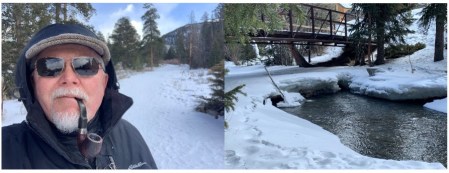
For those in the metric world, I am 3,293 meters above sea level here in skiing heaven, Keystone, Colorado.  One of the wonderful things about being based in Golden, Colorado, is that the Rocky Mountains are literally in our back yard!  With two of my children and their families along with us (that would total 5 grandchildren to dote on!), we’ve enjoyed God’s creation looking at mountain peaks, hiking through pristine countryside and enjoying family – the frosting on the cake.  I packed my mobile work desk, and The Pipe Steward is on the road again!

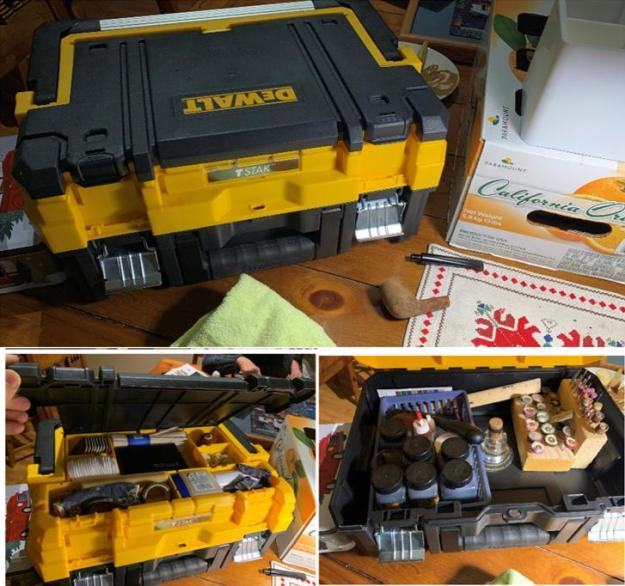
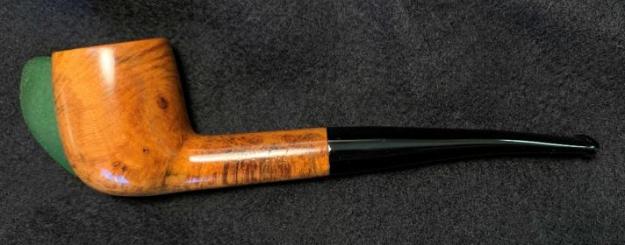
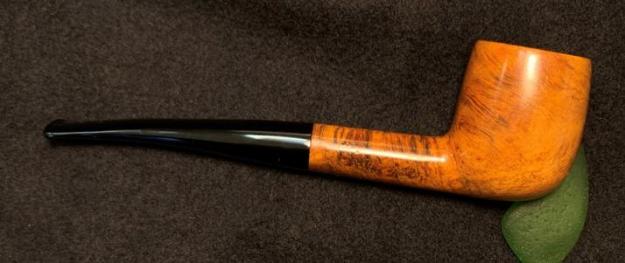
What does a ‘mobile’ restoration unit look like?  I have a smaller DeWalt TSTAK tool chest that opens on the top with an organizer section and a larger open compartment below.  I’ve ordered a deeper DeWalt TSTAK that will stack with the one I have and hold the taller bottles and baskets that are now in a plastic tub.  I take a few pictures to show my DeWalt mobile system.This Butz-Choquin now on the worktable is the last of 3 pipes that Skeet commissioned from The “Pipe Dreamers” Only! collection.  His first two commissions were truly in the spirit of the Pipe Dreamers mandate – to see in a pipe its potential even when it is in its unrestored rough state.  Here are pictures of the first 2 pipes, a French Jeantet Superior Chimney and an a venerable Kaywoodie Flame Grain Pear – both turned out exceedingly well.
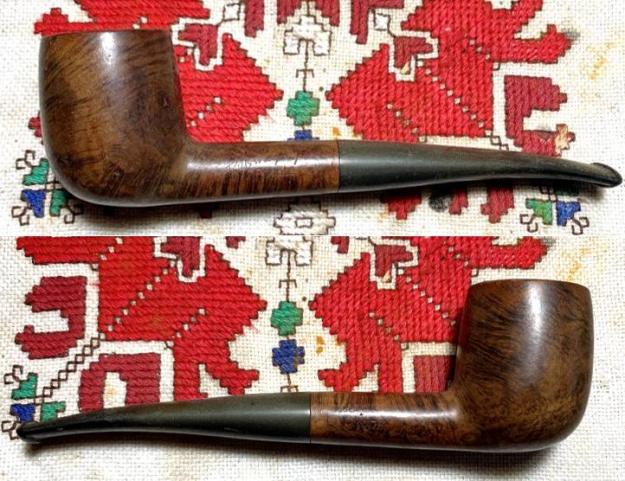
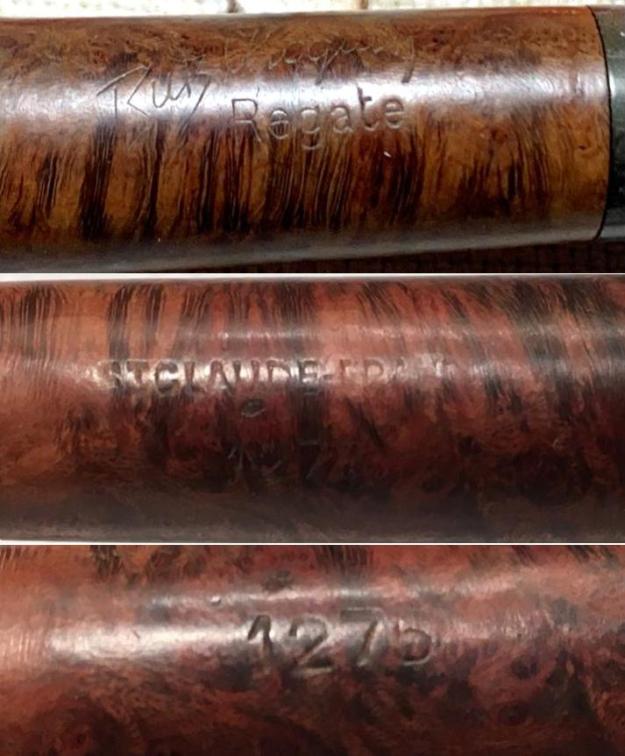
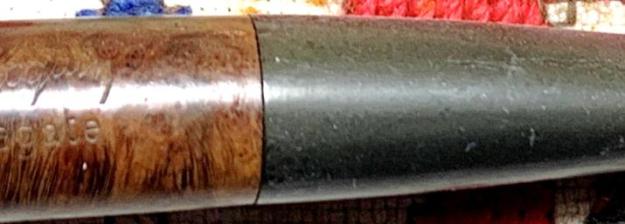
The final pipe is another product of St. Claude, France.  I acquired this Butz Choquin Régate from the ‘Lot of 66’ – the very first larger lot of pipes added to my online collection a few years ago benefiting the Daughters of Bulgaria.  Here are a few pictures to get a closer look.The nomenclature on the left of the shank is stamped in the chiseled diagonal cursive ‘Butz-Choquin’ [over] Régate.  The right side of the shank is stamped, but very thin, ST. CLAUDE-FRANCE [over] 1275, the shape number pointing to a BC Billiard. The stylish slightly bent stem has no ‘BC’ stamping that I can see.  The stem doesn’t appear to be a replacement stem so the expected ‘BC’ stamping on the side of the stem appears to have disappeared into historical oblivion.To provide a brief overview of the Butz-Choquin name, Pipephil.eu’s information is helpful.
The origin of the brand reaches back to 1858 when Jean-Baptiste Choquin in collaboration with his son-in-law Gustave Butz created their first pipe in Metz (France). Since 1951 Butz-Choquin  is a brand of the Berrod-Regad group (Saint-Claude, France). Jean Paul Berrod managed the company from 1969 to 2002 when he retired and sold the corporate to Mr Fabien Gichon. Denis Blanc, already owner of EWA, took over the S.A. Berrod-Regad in 2006.

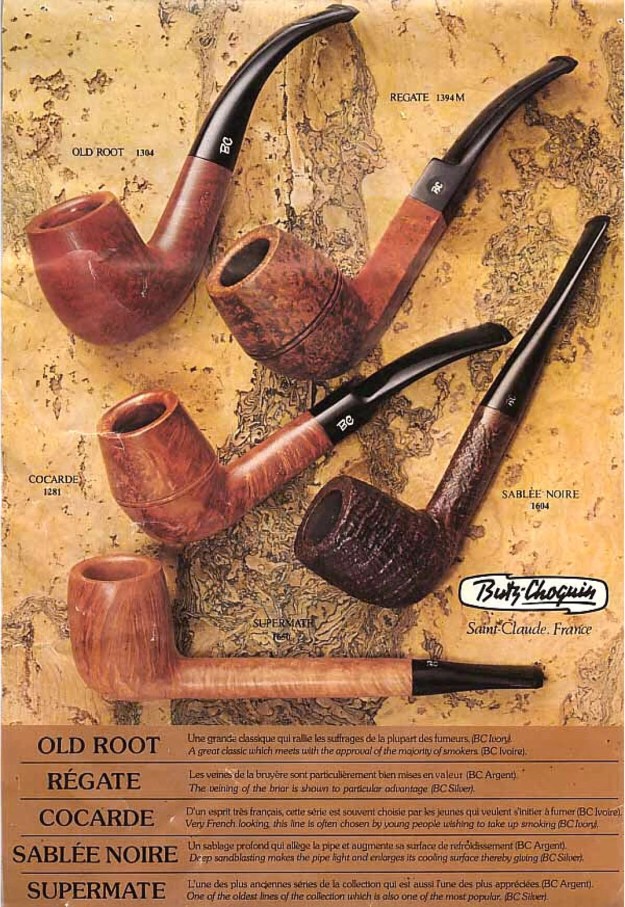
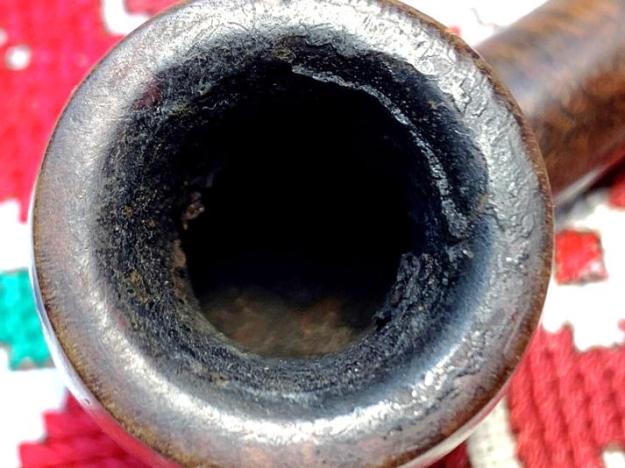
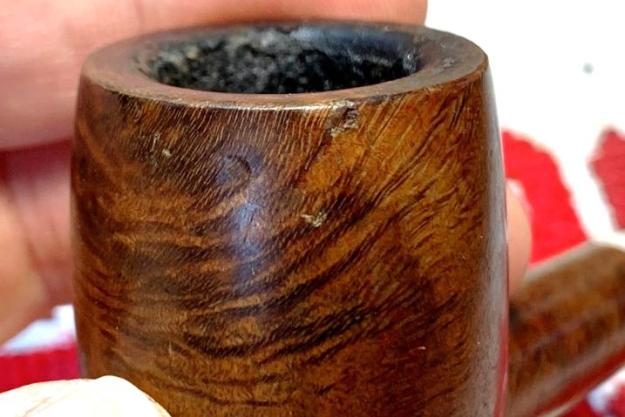
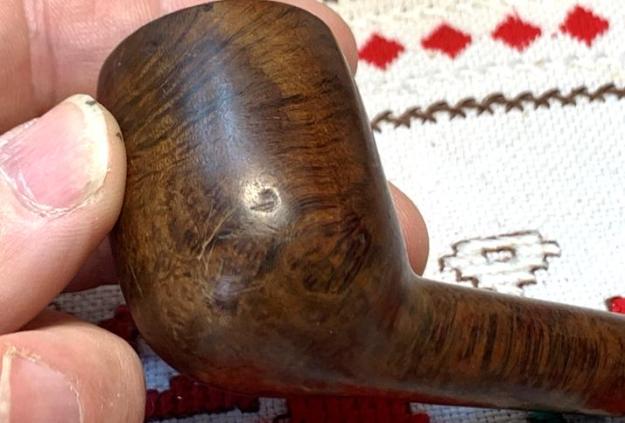
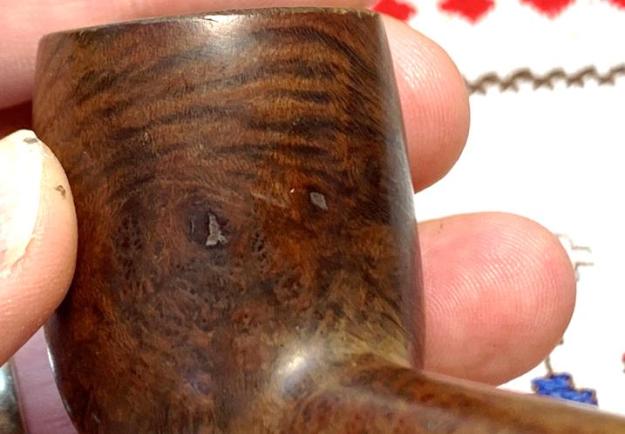
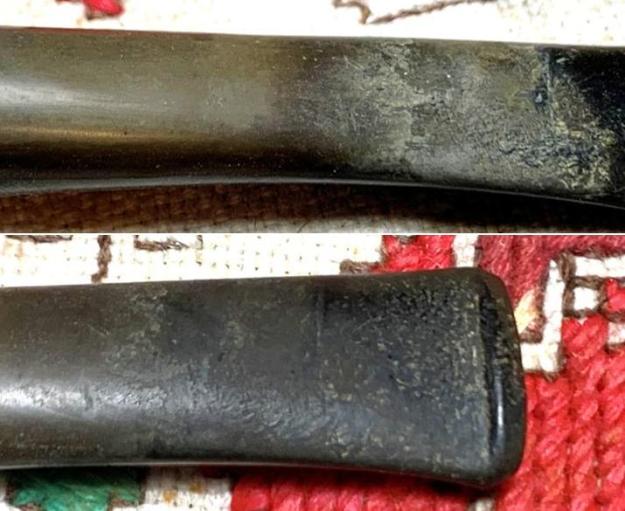
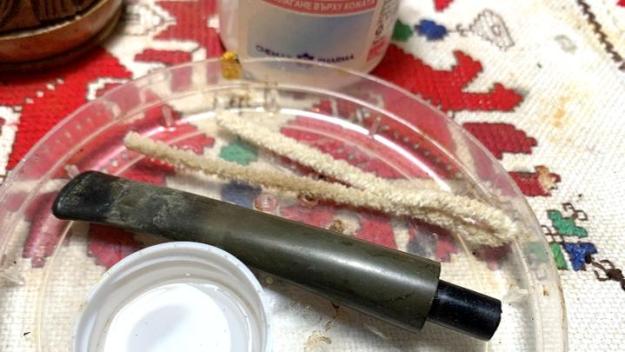
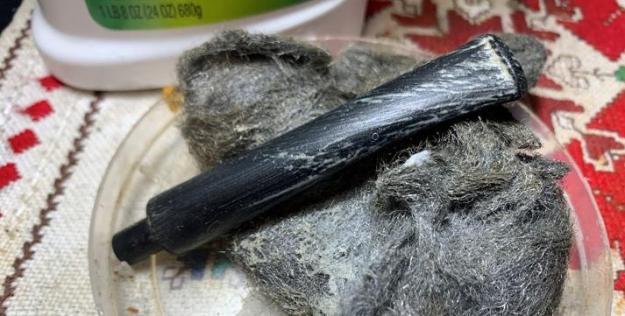
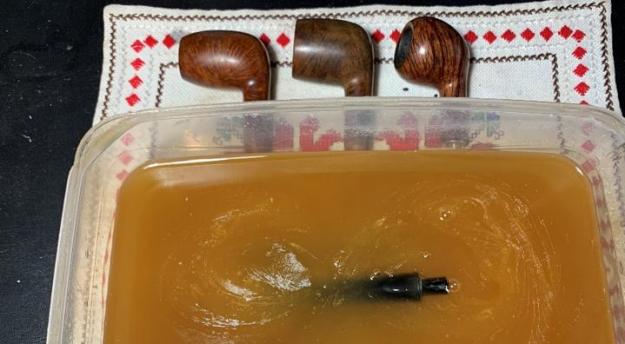
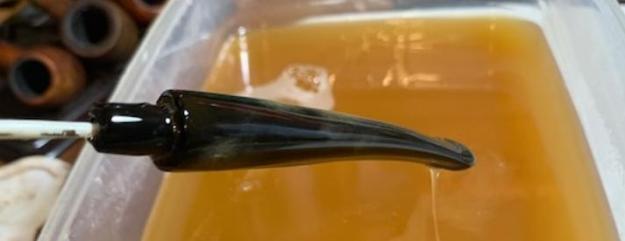
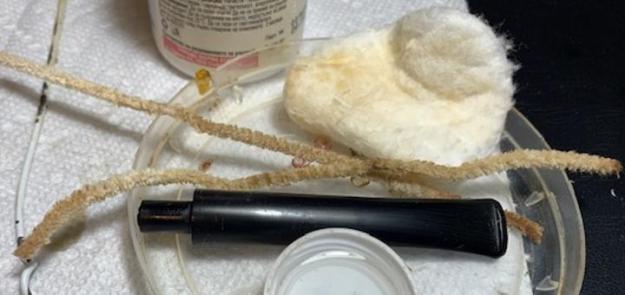
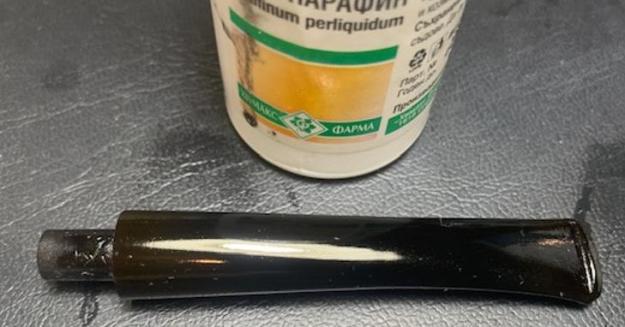
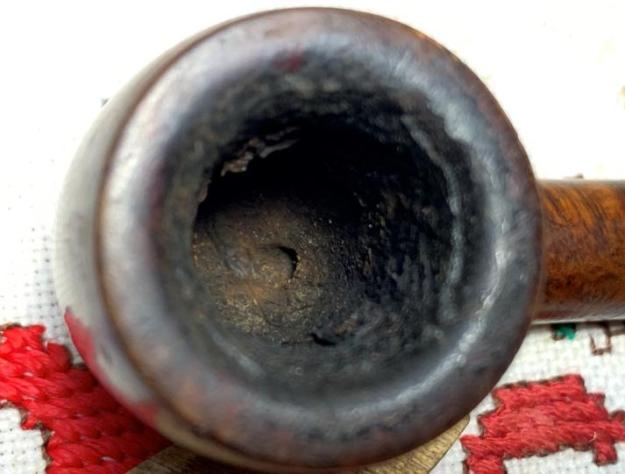
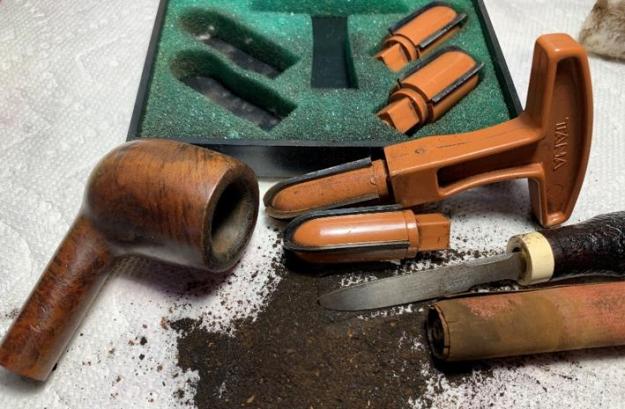
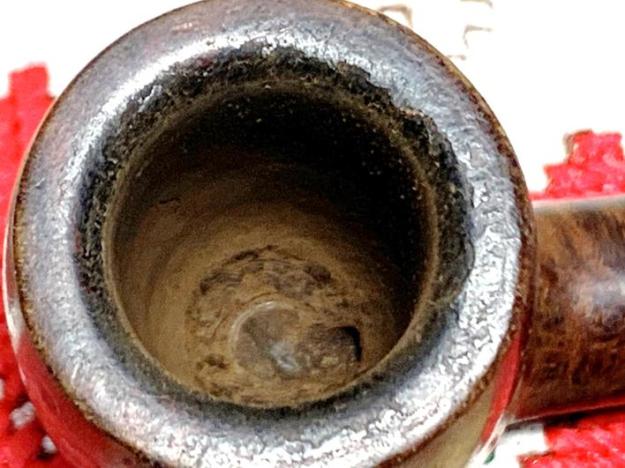
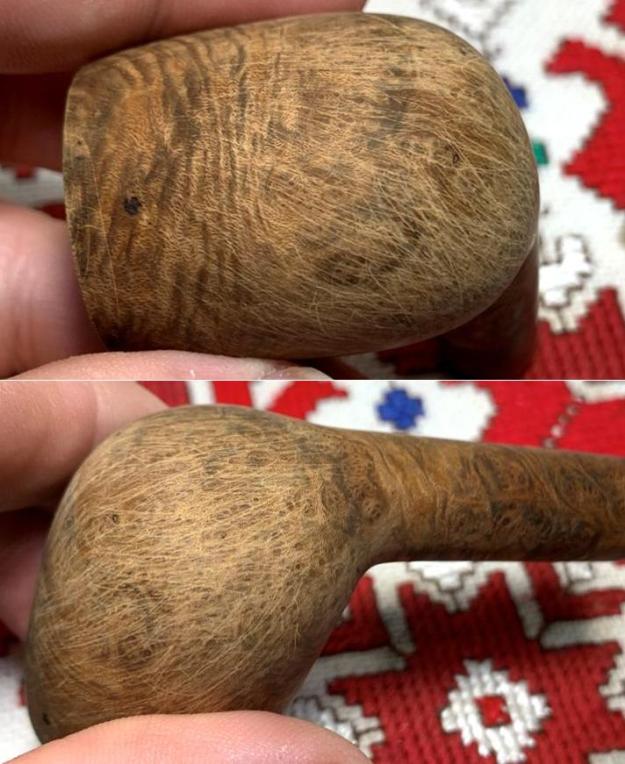
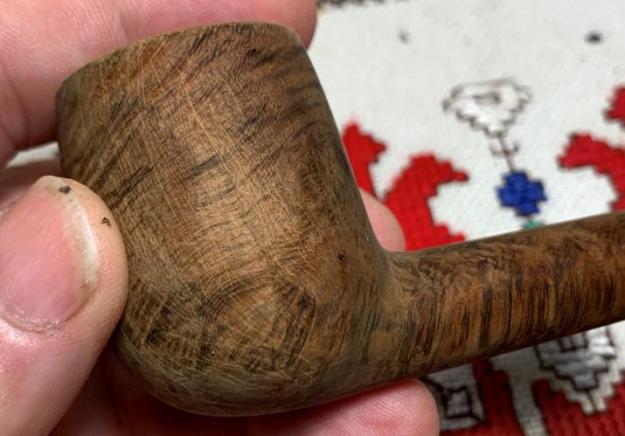
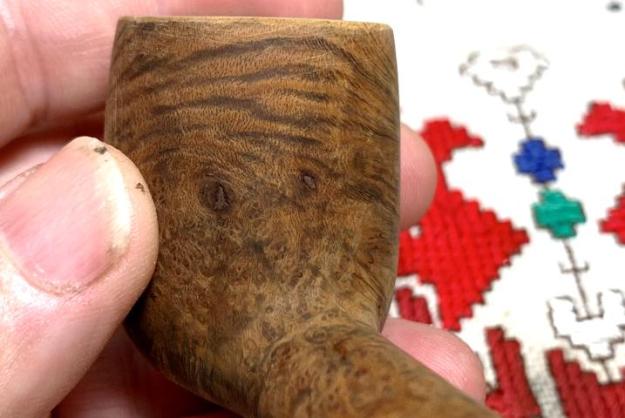
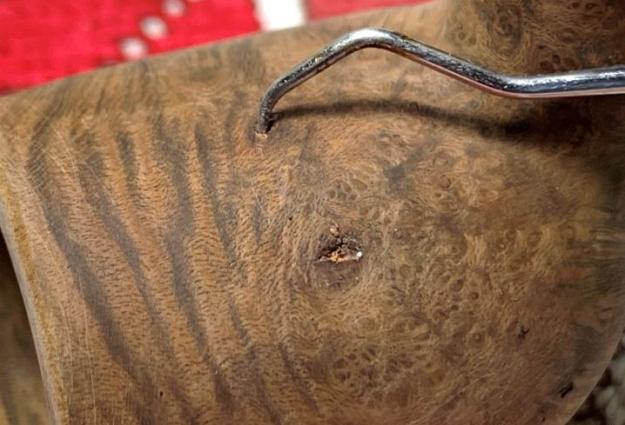
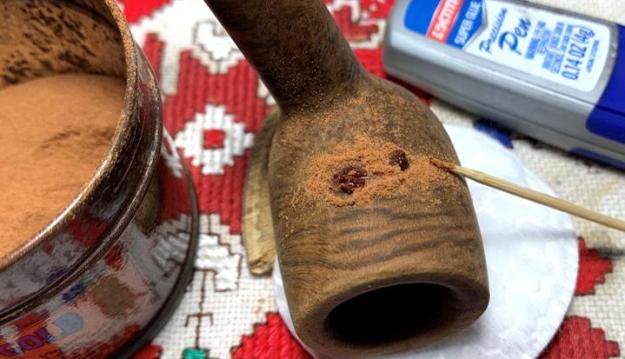
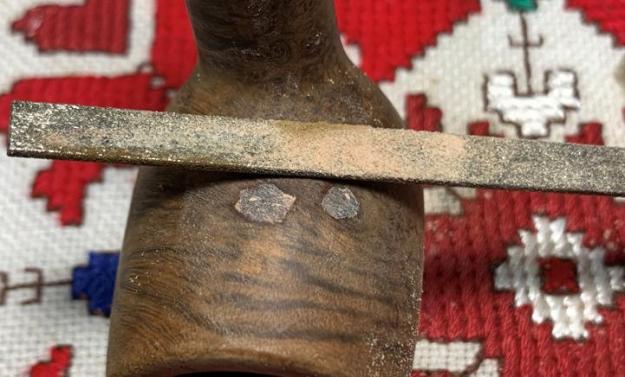
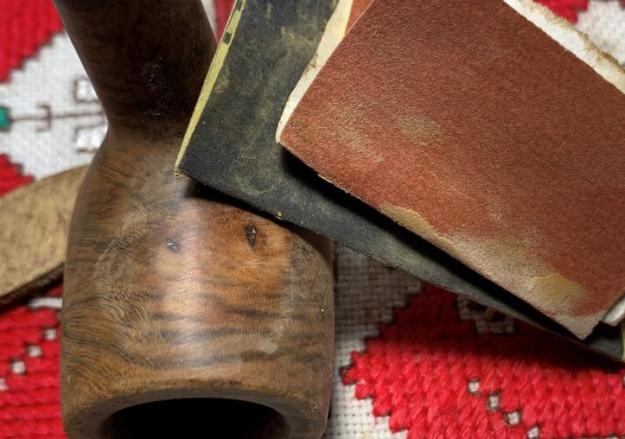
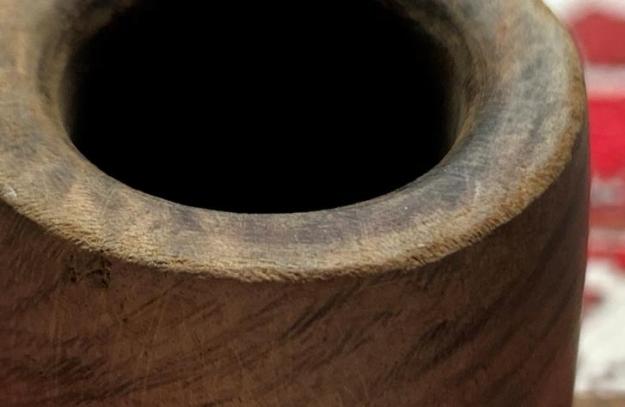
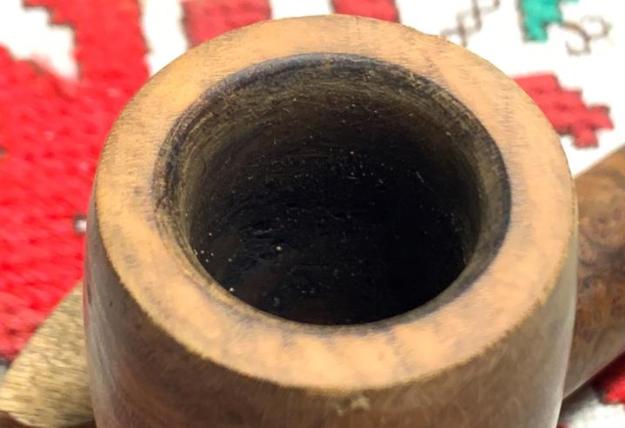
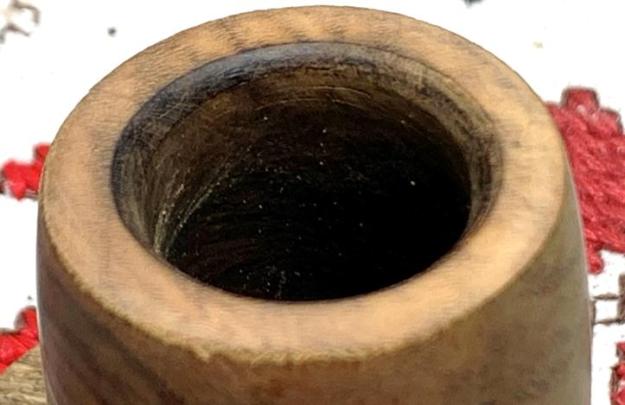
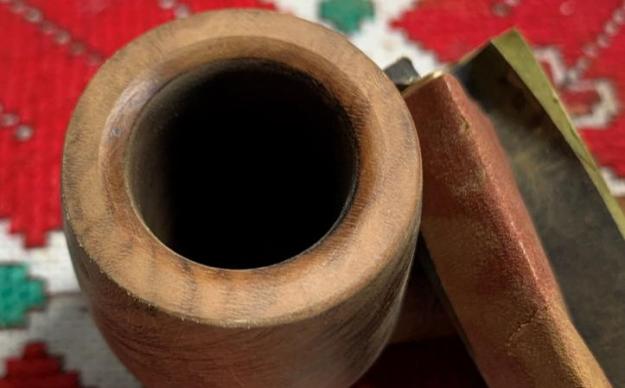
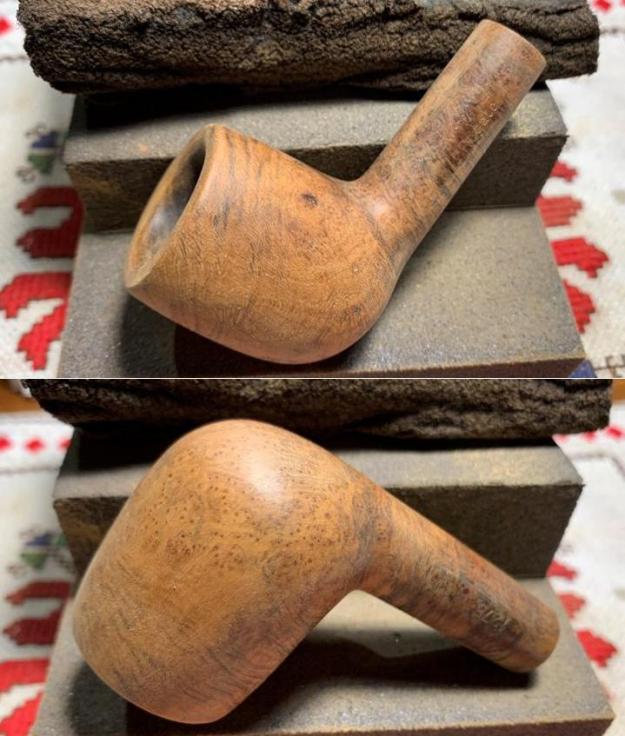
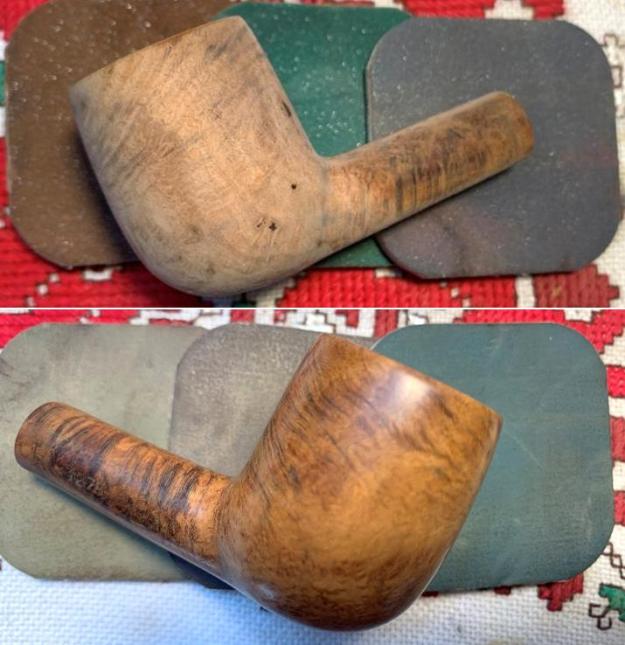
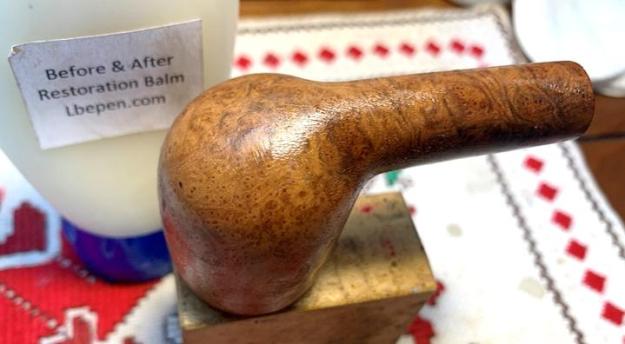
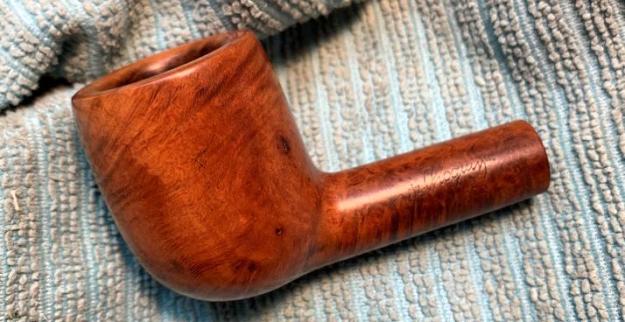
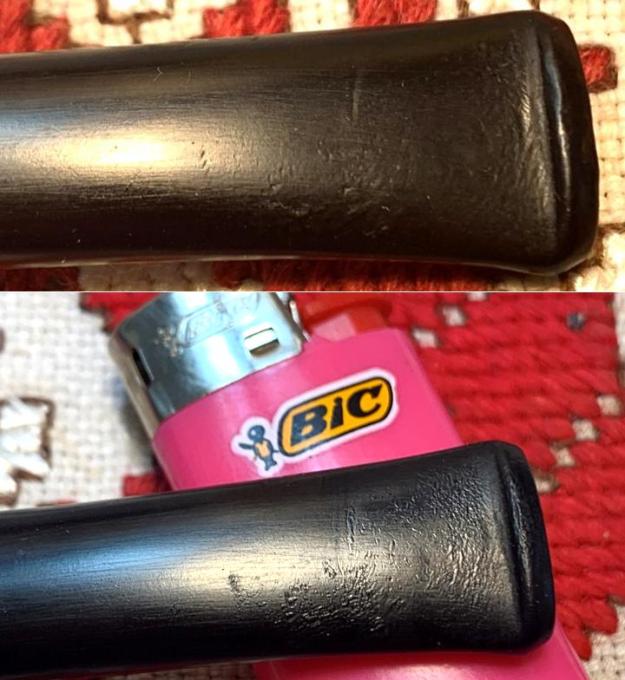
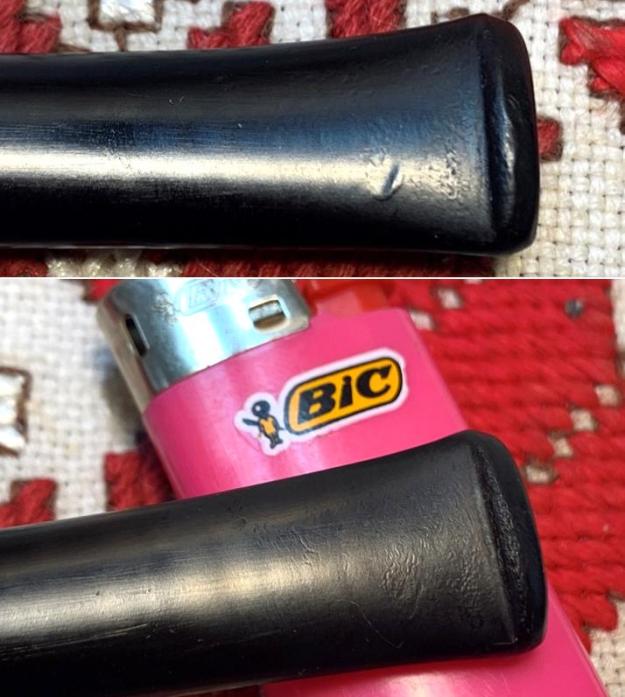
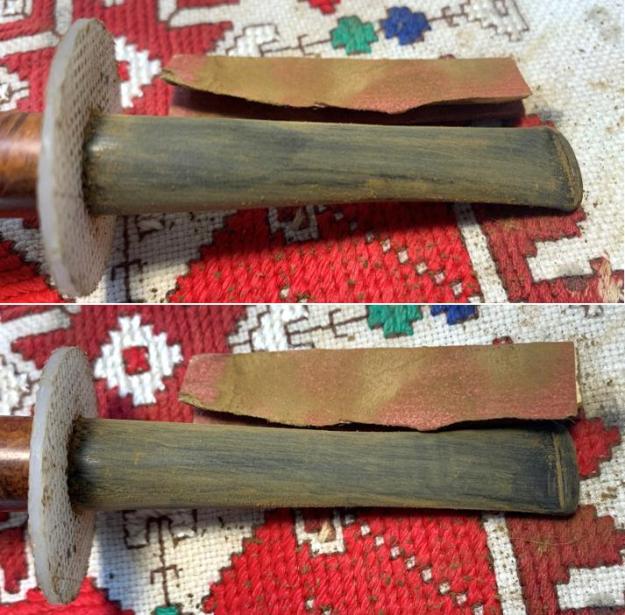
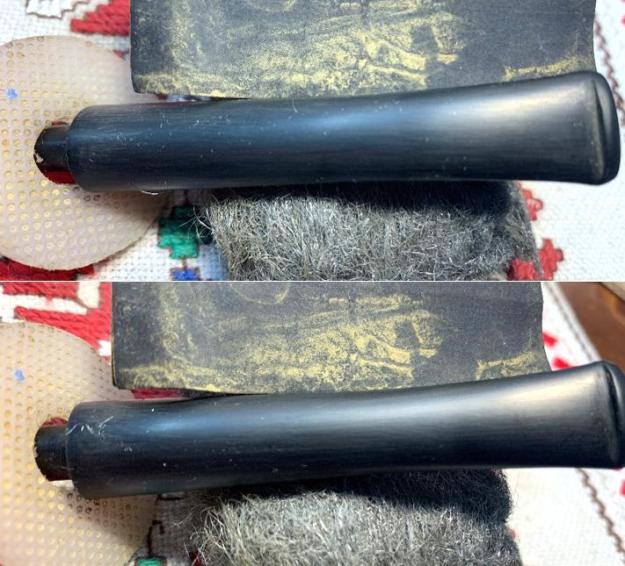
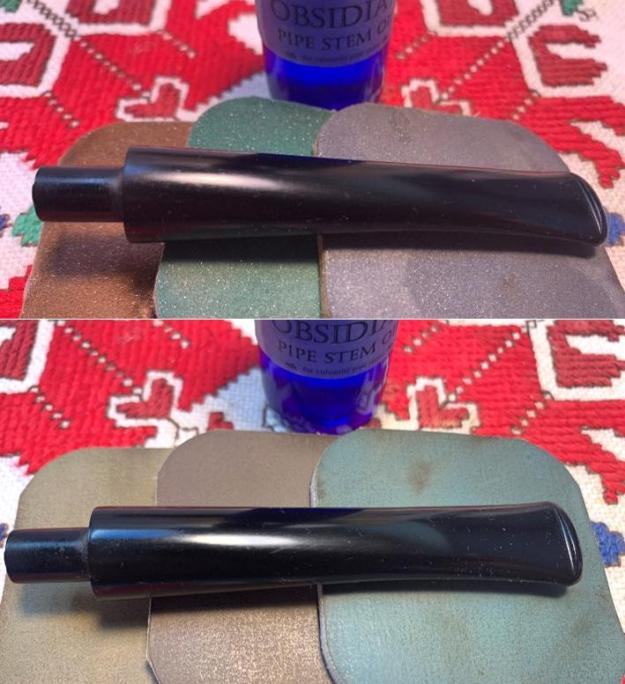
Pipedia’s Butz-Choquin article includes some BC catalog pages which unfortunately, have no dating included.  The BC Régate line is described in the catalog page below. A quick trip to Google Translate confirms that the English word is, ‘regatta’ which is essentially a boat race, usually including yachts.  The text description of the Régate below is: “The veining of the Briar is shown to particular advantage (BC Silver)”.  With the sales pitch emphasizing the beauty of the grain, I’m hopeful that the Régate on the worktable will live up to this expectation!Looking now at the BC Régate slightly bent Billiard on the table, the chamber is thick with carbon buildup.  This will be removed to allow fresh briar to emerge. The internally beveled rim has some lava flow and nicks and scratches around the rim edge.  Taking a survey of the bowl, it’s been through a bit of wear and tear with nicks, dents, and scratches.  The bowl is darkened with dirt and grime built up for some time.  There is nice looking grain beneath it all which will look nice.  The rim pictured above shows a patch of  dents and scratches.  A large dent is nestled amid several scratches on the lower left side of the bowl. There are 2 large pits that have been filled on the back side of the bowl. The lateral grain on the aft of the bowl looks good.  The heel shows scratches and scrapes but nice-looking bird’s-eye grain providing a promising backdrop. The stem has heavy oxidation and calcium buildup especially on the upper side. The bit has significant tooth chatter on the upper and lower sides. To begin the restoration of the Butz-Choquin Régate Billiard, the slightly bent tapered stem’s airway is cleaned with pipe cleaners wetted with 99% isopropyl.To get a jump on the deep oxidation in vulcanite stem and to work on the tooth chatter, 0000 steel wool is used with Soft Scrub cleanser.  Before starting with the steel wool, I take one more look at the side of the stem to confirm that there is no BC stem stamping.  Again, I see nothing even with a magnifying glass.  The stem scrubbing commences. After scrubbing with Soft Scrub and steel wool, the stem is rinsed with water.  The stem is then added to a soak of Before & After Deoxidizer along with the other pipes commissioned by Skeet which have been completed.After soaking in the Deoxidizer overnight, the stem is hooked using a stiff wire and the Deoxidizer fluid is drained.  I assist the draining by squeegeeing the fluid with my fingers.The airway is cleaned of the Deoxidizer using pipe cleaners and alcohol.  A cotton pad wetted with isopropyl 99% is also used to scrub the stem removing raised oxidation.  To help condition the stem, paraffin oil is applied to the vulcanite and set aside.With the stem on the sideline, I turn to the stummel.  To begin its restoration, the chamber is cleared of the thick carbon cake using the Pipnet Reaming Kit.  I take a fresh picture to mark the starting point.  The cake is thicker on the upper part of the chamber and opens as you go down.I use two smaller blade heads of the Pipnet Reaming Kit and transition after this to the Savinelli Fitsall Tool to scrape the chamber walls.  The clearing of carbon is completed with sanding the chamber wall using 240 grade paper wrapped around a Sharpie Pen to provide some pressure. After wiping the chamber with a cotton cloth to remove carbon dust, the chamber wall is inspected revealing healthy briar.With the carbon cake cleared from the chamber, the next step is to clean the externals of the stummel starting with the rim.  I take a few pictures of the stummel surface before beginning the cleaning to compare.Using undiluted Murphy’s Oil Soap and a cotton pad, the stummel is scrubbed. With the lava flow on the rim, I also employ a brass wired brush to scrub the rim. Brass brushes generally do not hurt the briar surface but help in the cleaning. The stummel is then taken to the sink to clean further.  Unfortunately, I discover that I had forgotten shank brushes which are usually used to scrub the internal mortise and airway.  Instead, with warmish to hot water using liquid anti-oil dishwashing soap, cotton buds are employed to clean the internal mortise and airway.  After scrubbing and rinsing the stummel thoroughly, it is brought back to the worktable.Continuing with the internal cleaning, only one cotton bud and pipe cleaner wetted with isopropyl 99%, were needed to finish cleaning this phase.  I move on!With the internals clean, I take some pictures to survey the condition of the stummel surface after the external cleaning.  The rim cleaned up nicely, though the wear and tear is still evident.The finish on the BC Régate was removed with the cleaning.  The raw briar surface shows a lot of very minuscule scratching on the front and heel of the stummel. On the aft of the stummel are two fills that I noticed earlier.  The fills have shrunk revealing gaps between the briar and filler material. The patches will need to be restored using briar putty – a mixture using briar dust and CA glue.  The old filler material is removed using a sharp dental probe.Since the two pits are small, I decide not to make the putty, but something much like it.  After cleaning the area with alcohol, CA glue is spot dropped into the pits and then sprinkled with briar dust.  A toothpick is used to mix the CA glue and briar dust so that the patch is blended. After the patches are cured, a flat needle file is used to file the excess patch material down to the briar surface.  The file stays on top of the patch so as to not impact the surrounding briar.After filing, 240 sanding paper and then 600 paper are used to further clean the excess patch material.  The patches will blend well as the sanding and polishing process continues.With the pits on the stummel refilled with fresh patch material, I turn next to the rim.  The rim has seen better days. The inner rim bevel remains darkened from charring.  The edge of the rim is skinned and worn down.Overall, the rim needs refreshing.  To do this the chopping board is used as a topping board.  I take a final ‘before’ picture to track the topping progress.The general rule of thumb is to take off only as much briar as needed to freshen the rim.  With 240 grade paper on the topping board, the stummel is inverted and rotated several times over the paper.The first look after the initial rotation shows the progress.  The rotation continues several more times and a second look.  Almost there.Finally, the rim is good to go.  I’ve reached the stopping point with the more abrasive 240 grade paper.Next, 600 paper replaces the 240 grade paper and the stummel is rotated several more times.  I’m satisfied with the progress of this phase of the rim refreshing.Next, the internal rim bevel needs refreshing as well.  This will sharpen the rim definition as well as remove the darkened, stained briar.  A few pictures show the old bevel.  In these pictures, I can still see some roughness on the outer rim edge.  I’m not concerned about this because additional sanding to clean the entire stummel will remove the rough briar on the edge of the rim. Using a hard surface against the back of the sandpaper to provide a firm cut and not a rounding effect, 240 paper is used followed by 600 grade.  This removes the darkened briar as well as provide the rim with fresh, distinct lines.Moving next to sanding the entire stummel to remove the plethora of small cuts, scratches, and dents, I first use a coarse sanding sponge on rough spots on the heel and near the rim, on the upper bowl.  I follow this with medium grade and light grade sanding sponges. I’m careful to avoid the Butz-Choquin nomenclature during the sanding.Next, continuing with sanding, the full regimen of micromesh pads is used.  This transitions from sanding to polishing starting with wet sanding with pads 1500 to 2400 and then dry sanding with pads 3200 to 4000 and 6000 to 12000.  The grain emerges nicely during the micromesh polishing phase.  One more step with the stummel before transitioning to finishing the stem.  I apply Before & After Restoration Balm to the stummel by placing some on my finger and then working it in to the briar surface.  This product by Mark Hoover does a great job coaxing out the subtle hues in the briar.  After working the Balm in thoroughly, I put the stummel aside for about 20 minutes for the Balm to be absorbed.After the time is complete, a microfiber cloth is used to wipe off the excess Balm.  Then, another microfiber cloth is used to buff up the stummel and fully removing the excess Restoration Balm.  As usual, the Balm does a good job bringing out the hues of the briar.  I like it.Turning now to the stem, fresh pictures are taken looking at the upper- and lower-bit area.  There is tooth chatter and some small tooth compressions.  The initial application of steel wool to break up oxidation was also helpful in removing some of the roughness on the bit.  To address the remaining tooth chatter, the heating method is used initially to reduce further the chatter to enable sanding to address the remaining roughness.  Using a Bic lighter, the flame paints the upper and lower bit.  The heat expands the vulcanite enabling it to reclaim its original condition, or closer to it.  The before and after pictures show the comparison.  The method did help, especially on the lower bit. Next, the entire stem is sanded with 240 grade paper.  I first reunite the BC stem and stummel with a sanding disk between them to guard against sanding the end of the stem creating a shouldering effect.Next, the stem is wet sanded with 600 grade paper followed by applying 0000 grade steel wool. Continuing the sanding/polishing process, next the full regimen of micromesh pads is applied.  Starting with wet sanding with pads 1500 to 2400 followed by dry sanding with pads 3200 to 4000 and 6000 to 12000.  Between each set of three pads Obsidian Oil is applied.  Obsidian Oil is used to further condition the vulcanite stem and to guard against oxidation. After trying to reunite the stem and stummel, as often happens, after the cleaning the briar in the mortise has expanded somewhat and the tenon/mortise fit it too tight.  It’s dangerous to force the tenon into the mortise because a cracked shank can be the result. To remedy the tightness, a piece of 240 paper is wrapped around the tenon and pinched to tighten it around the tenon.  I then, while holding the pinched paper stationary around the tenon, rotate the stem to create the abrasiveness to sand down the tenon.  I rotate several times and try the fit in the shank.  Eventually, the fit is snug, but not too tight.Now the home stretch.  With the stem and stummel reunited, a cotton cloth buffing wheel is mounted on the rotary tool and set at about 40% full power.  Blue Diamond compound is then applied to the entire pipe.  Blue Diamond compound is the last stage in using an abrasive for the sanding/polishing of the pipe.  After completing application of the Blue Diamond, a felt cloth is used to buff the pipe to remove the excess compound that collects on the surface.  I want to make sure compound dust is removed before applying wax.After mounting another cotton cloth wheel to the rotary tool maintaining the same speed, carnauba wax is applied to the pipe.  After completing the application of wax, the pipe is given a rigorous hand buffing to raise the shine and to disperse excess wax from the surface.This Butz-Choquin Régate of Saint Claude, France, turned out very well.  The grain is expressive and reminds one of tiger fur on the front and back of the bowl.  Bird’s eye outcroppings also can be seen.  The Billiard shape is a workhorse among pipes and this Billiard cradles nicely in the palm and will serve a new steward well.  The slightly bent stem adds a touch of class.  This is the final of 3 pipes that Skeet commissioned benefiting the Daughters of Bulgaria – helping women and girls who have been trafficked and sexually exploited.  As the commissioner, Skeet will have the first opportunity to claim the BC from The Pipe Steward Store.  Thanks for joining me! ono
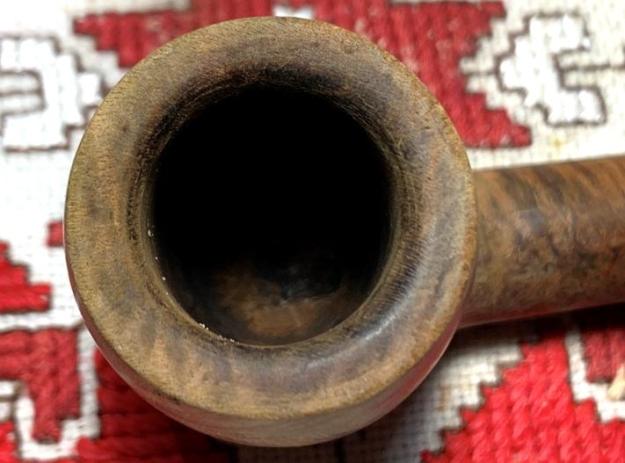
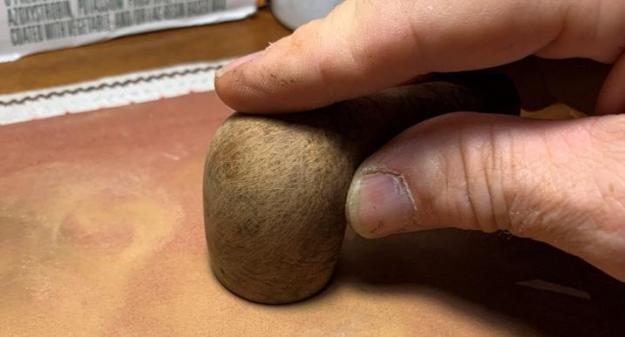
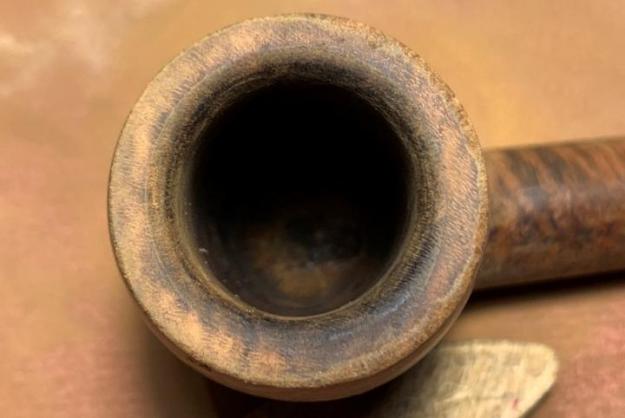
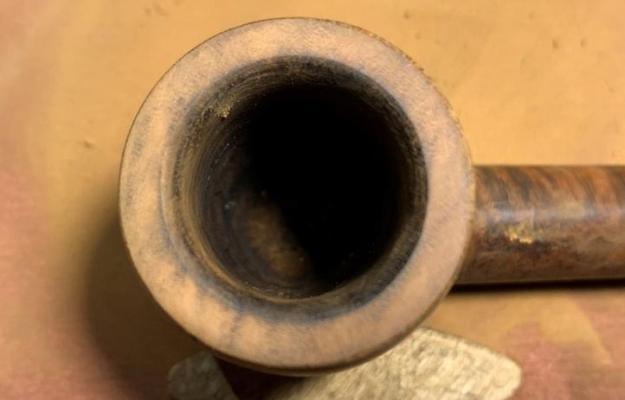
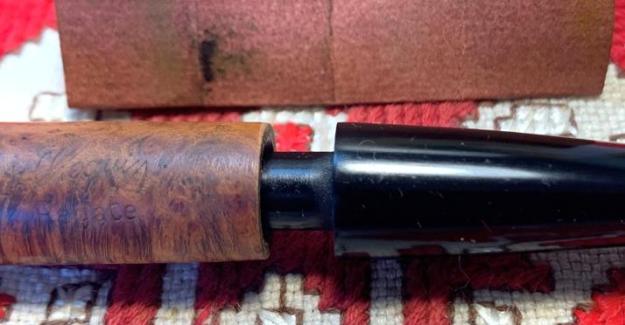
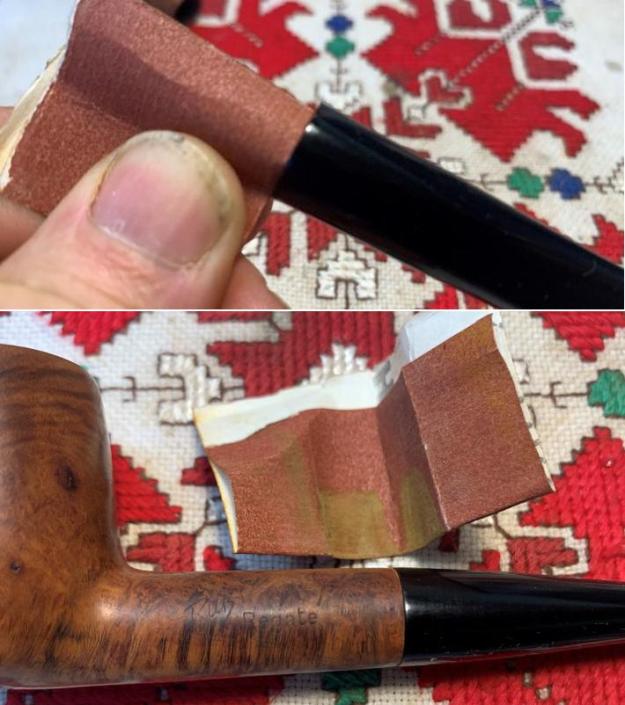
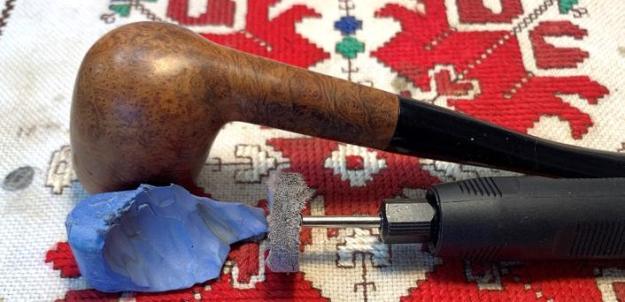
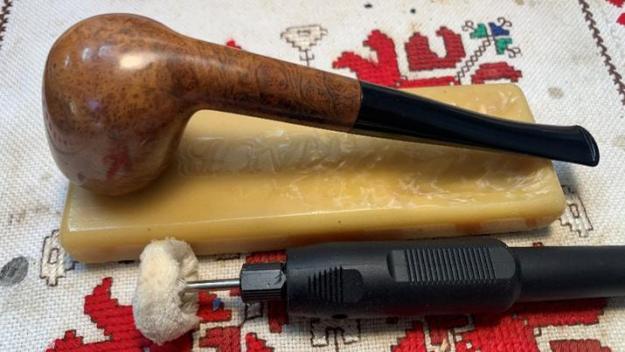
 

New Life for a Patent Era 1915-18 Dunhill A Bruyere 66 Standing Billiard


Blog by Steve Laug

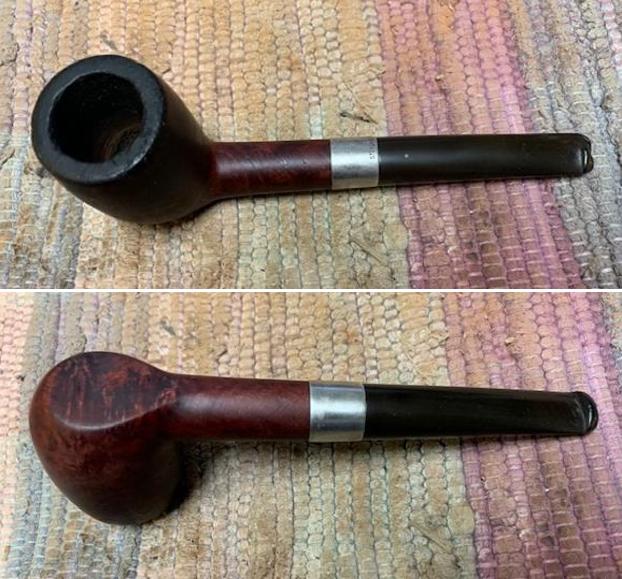
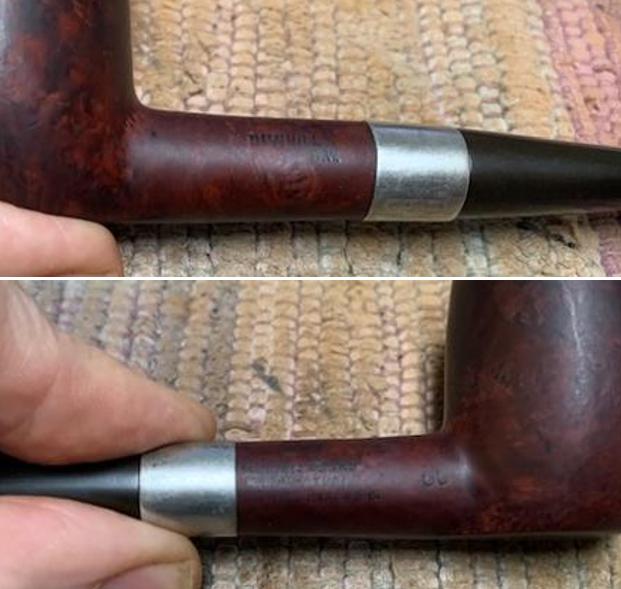
This Dunhill Standing Billiard was one of five Dunhills that came to us in the same lot as the 1922 Dunhill Bruyere Reading Pipe, a cracked shank 1962 Dunhill Shell Briar Pot, a 1928 Dunhill Bruyere EK7 Panel Billiard and the 1905 BBB Calabash Reading Pipe and 1911 BBB Glokar Poker. I have drawn a red box around the pipe in the picture to the left. It is an interesting flat bottom silver banded Standing Billiard. The pipe is stamped on the left side of the shank DUNHILL [over] Duke St. S.W. On the right side of the shank it was stamped MADE IN ENGLAND [over] “INNER TUBE” [over] PATENTED MARCH 9-15 that is followed by the shape number 66.

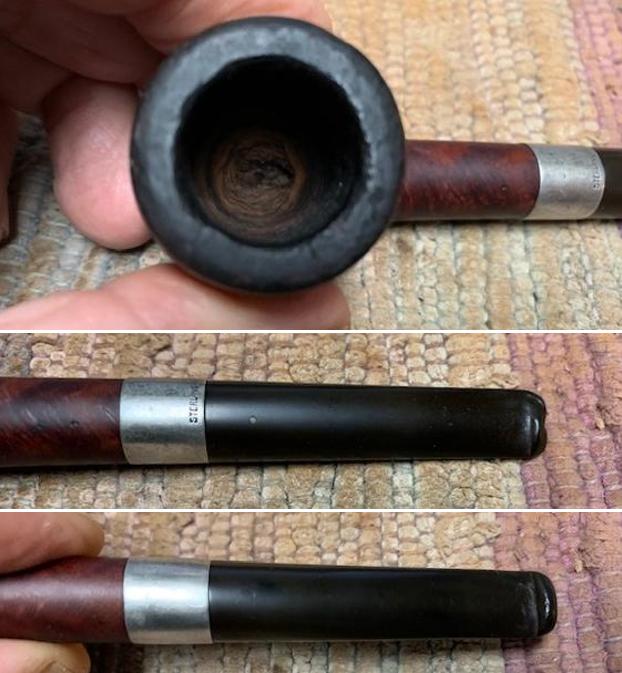
It was another filthy pipe with a thick cake in the bowl and a heavy lava overflow on the rim top. The finish was tired and dirty with grime and debris stuck to the surface of the briar. The stem has a small white dot on top and the button on the topside had a deep tooth mark and damage. There was tooth chatter and marks on both sides ahead of the button. Jeff took photos of the pipe before he did his clean up work. He took photos of the bowl and rim to give a picture of the thickness of the cake and lava on the rim top. This must have been a favourite pipe to have that thick of a cake and lava buildup. The stem has tooth chatter and marks on both sides. The top is worse than the underside with deep marks in the top of the button. The pipe is old enough that it had an ivory white spot on the topside. Jeff took photos of the bowl from various angles to give a sense of the dirtiness of the finish but also the unique shape of the billiard sitter. It is going to be a real beauty! Jeff took photos of the stamping on the left side of the shank . The stamping on the right side is quite faint and could not be captured with a camera. There are some faint spots but over all it is readable as noted above. The second photo shows the band on the shank stamped Sterling Silver.I turned to Pipedia’s section on Dunhill Root Briar Pipes to get a bit of background on the Dunhill finishes (https://pipedia.org/wiki/Dunhill#Root_Briar). I quote:

Bruyere

The original finish produced (usually made using Calabrian briar), and a big part of developing and marketing the brand. It was the only finish from 1910 until 1917. A dark reddish-brown stain. Before the 1950s, there were three possible finishes for Dunhill pipes. The Bruyere was a smooth finish with a deep red stain, obtained through two coats, a brown understain followed by a deep red.

There was a link on the above site to a section specifically written regarding the Bruyere finish (https://pipedia.org/wiki/Dunhill_Bruyere). I turned there and have included the information from that short article below.

Initially, made from over century-old briar burls, classified by a “B” (denoted highest quality pipe); “DR” (denoted straight-grained) and an “A” (denoted first quality), until early 1915. After that, they became a high-end subset to the Dunhill ‘Bruyere’. The DR and B pipes, a limited production, they should be distinguished as hand-cut in London from burls as opposed to the Bruyere line which was generally finished from French turned bowls until 1917, when the Calabrian briar started to be used, but not completely. Only in 1920 Dunhill took the final step in its pipe making operation and began sourcing and cutting all of its own bowls, proudly announcing thereafter that “no French briar was employed”.

Bruyere pipes were usually made using Calabrian briar, a very dense and hardy briar that has a modest grain but does very well with the deep red stain.

“Before the 1950s, there were three possible finishes for Dunhill pipes. The Bruyere was a smooth finish with a deep red stain, obtained through two coats, a brown understain followed by a deep red. The Shell finish was the original sandblast with a near-black stain (though the degree to which it is truly black has varied over the years). Lastly, the Root finish was smooth also but with a light brown finish. Early Dunhill used different briars with different stains, resulting in more distinct and identifiable creations… Over the years, to these traditional styles were added four new finishes: Cumberland, Dress, Chestnut and Amber Root, plus some now-defunct finishes, such as County, Russet and Red Bark.”

There was also a link to a catalogue page that gave examples and dates that the various finishes were introduced (https://pipedia.org/wiki/File:Dunnypipescatalog-1.png)I turned to Pipephil’s dating guide to show how I arrived at the date of manufacture for this pipe (http://www.pipephil.eu/logos/en/dunhill/cledat-en1.html). I am including a chart that is provided there for the dating of a pipe. I have drawn a red box around the pertinent section in the chart. Since the pipe I am working on has no clear patent number but says Patented March 9-15 I take that to clearly show that the pipe was made prior to 1921 and would have been included in the exceptions.I also turned to John Loring’s, The Dunhill Briar Pipe – The Patent Year and After, to work on understanding the DUNHILL [over]DUKE ST. S.W. I found information on page 5 of the book. It read as follows:

The Bruyere pipes were stamped DUNHILL over DUKE ST. S.W. on the shank with an “A” near the bowl to indicate first quality (the reverse side stamping in 1910 is presently unknown) and given shape numbers beginning with 31.

I read earlier sections of the book to do some checking on the Patent Stamping on this pipe. I found what I was looking for on page 58 where he spells out the Smooth Finish Patent Nomenclature Usage. In a very helpful chart he identifies PATENTED MARCH 9-15 that links the pipe to a US Patent for the years between 1915-23.On page 9 it reads:

…Dunhill applied for Canadian and American patents (granted in 1914 and 1915 respectively).

On page 12 it reads:

…From 1910 through October 1918 Dunhill branded its pipes with DUNHILL over DUKE ST. S.W….Inner tube patent numbers or references also serve to denote the earliest the pipe could have been manufactured., e.g. an English patent reference (PAT. No 5861/12) would not have been stamped prior to the 1913 grant, nor a Canadian patent reference (PATENTED 1914) prior to the 1914 grant nor a US patent reference (PATENTED MARCH.9-15 or PAT.AMERICA1915) prior to the 1915 grant.

I now knew that I was working on a Bruyere that came out in between 1915 and 1918 when the Duke St. SW stamp ceased to be used. The shape of the pipe was one of many Billiards that Dunhill put out and that the 66 was a normal Billiard Sitter shape with a taper stem.

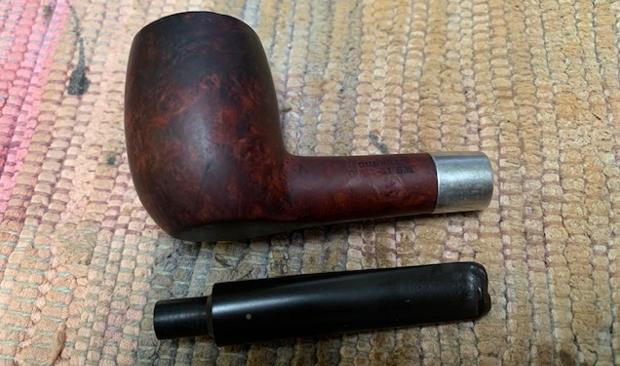
I turned to work on the pipe itself. Jeff had carried out his usual thorough cleanup of the pipe. He had reamed it with a PipNet reamer to remove the cake and cleaned the reaming up with a Savinelli Fitsall Pipe Knife. He scrubbed the internals of the bowl and stem with alcohol, cotton swabs and pipe cleaners. He scrubbed the externals with undiluted Murphy’s Oil Soap and rinsed the bowl off with running water. He soaked the stem in Before & After Deoxidizer and once it had soaked rinsed it off with warm water to remove the residual solution. He dried it off and scrubbed it down with Soft Scrub All-Purpose cleaner to remove any oxidation that was still on the stem. The pipe looked very clean when I received it. I took a photo of the rim top to show the condition. You can see the darkening on the rim top. It is roughened and slightly out of round with nicks on the inner edge. The stem had deep tooth marks and chatter on both sides near the button and on the button itself. The oxidation was gone.  The damage on the topside at the button can be seen in the second photo of the stem surface below.I took photos of the sides of the shank to show the stamping. It is faint but readable as noted above. I removed the stem from the shank and took a photo of the pipe parts to show what I was working with. It is a nice looking pipe.I decided to start the restoration on this one by working on the damage on the inner edge of the bowl. It had darkening and some damage to the edge. The pipe is almost 100 years old so it is not surprising that there was burn and reaming damage marks on the edge from a previous pipeman. I worked it over with a folded piece of 220 grit sandpaper to remove and minimize the damage. When I finished with it, the bowl and the rim top looked much better. I polished the rim top and bowl with micromesh sanding pads – dry sanding with 1500-12000 grit sanding pads. I wiped the bowl down with a damp cloth after each sanding pad. Even though there were small marks on the briar from the pipe’s journey it began to take on a shine.   I rubbed the briar down with Before & After Restoration Balm. I worked it into the briar with my fingertips. The product works to clean, enliven and preserve the briar. I let it sit for 15 minutes while I worked on the stem. After the time passed I buffed it with a cotton cloth to deepen the shine. The briar really comes alive with the balm. I set the bowl aside and work on the stem. I filled in the tooth marks in the stem surface and rebuilt the edge of the button on the top side. Once the repairs cured I recut the edges of the button with a file and smoothed out the repairs. I sanded them with 220 grit sandpaper to blend them into the surface. I started polishing the stem with 400 grit wet dry sandpaper. I polished the vulcanite with micromesh sanding pads – 1500-12000 grit pads. I wiped it down with Obsidian Oil after each sanding pad. I used Before & After Pipe Polish – both Fine and Extra Fine to further polish the stem.  This Dunhill A Bruyere 66 Patent Standing Billiard from 1915-18 is a beautiful looking piece of briar that has a shape that follows grain. The Bruyere is an early finish that Dunhill specialized in making. The finish on the pipe is in excellent condition. The red and brown stain on the bowl works well to highlight the grain. The Sterling Silver Band is a great break between the briar and the stem. The polished black vulcanite panel taper stem adds to the mix. I put the stem back on the bowl and buffed the pipe with Blue Diamond on the buffing wheel being careful to not buff the stamping. I gave the bowl and the stem multiple coats of carnauba wax on the buffing wheel and followed that by buffing it with a clean buffing pad. I hand buffed the pipe with a microfiber cloth to deepen the shine. The finished 1915-18 Dunhill A Bruyere 66 Patent Standing Billiard is quite nice and feels great in the hand. Give the finished pipe a look in the photos below. I can only tell you that like the other pipes I am working that it is much prettier in person than the photos capture. The dimensions of the pipe are Length: 5 inches, Height: 1 ¾ inches, Outside diameter of the bowl: 1  ¼ inches, Chamber diameter: ¾ of an inch. The weight of the pipe is 31grams/1.09oz. I am still working through what I am going to do with this old timer. I will keep it with me for a while until I decide. Thanks for walking through the restoration with me as I worked over another beautiful pipe. This pipe is classic reminder that we are not pipe owners; we are pipemen and women who hold our pipes in trust until they pass on into the trust of the next generation.

Breathing Life into a 1958 Dunhill Root Briar 90 Group 2R Poker


Blog by Steve Laug

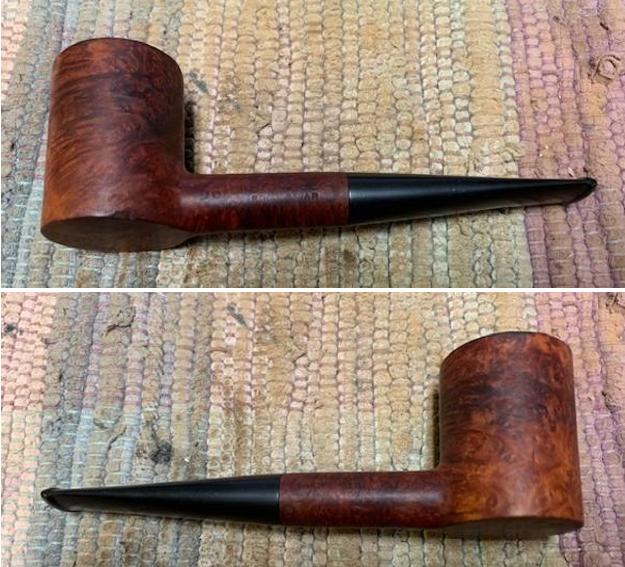
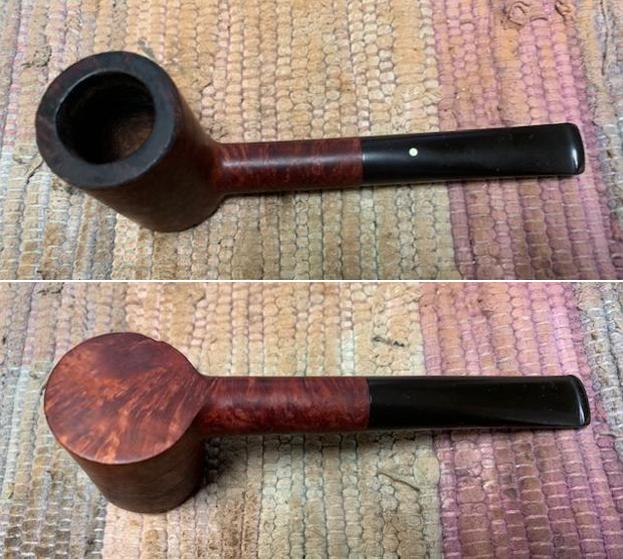
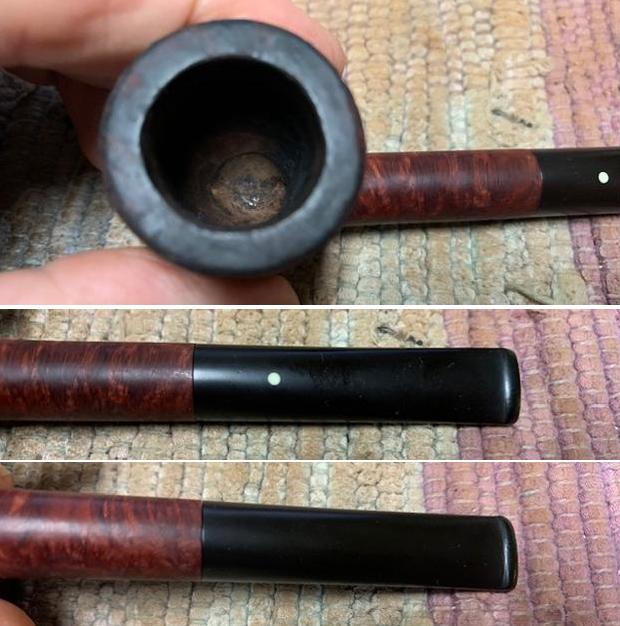
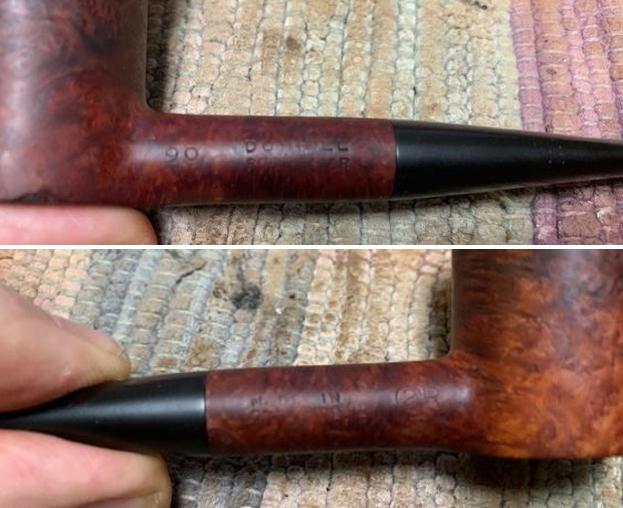
The next pipe on the table came to us in a group of pipes that we purchased from an Antique Mall on the Oregon Coast, Oregon, USA. It is a Dunhill Root Briar Poker/Sitter that is in good condition. It is stamped both sides of the shank. On the left side it is stamped with the shape number 90 followed by Dunhill [over] Root Briar. On the right side it is stamped with 2 in a circle followed by R for Root Briar next to the bowl. That is followed by Made in [over] England8. Interpreting that stamp it is as follows: The 90 is the shape for a Poker. The Dunhill Root Briar is the finish which is corroborated by the R at the end of the stamping. The 8 following the D of England gives the date the pipe was made and identifies it as 1958. The stamping is clear and readable. The age of the pipe and the oils in the finish has given the pipe a rich reddish brown finish. There is also some amazing grain that the shape follows well. The finish was dirty with dust ground into the surface of the bowl and shank. There was a thick cake in the bowl and tobacco debris stuck to the walls of the bowl. The rim top showed darkening and some lava on the surface. The vulcanite taper stem was oxidized, calcified and had light tooth marks and chatter ahead of the button on both sides.  Jeff took photos of the pipe to show what it looked like before he started working on it.  He took photos of the bowl and rim top to show the thickness of the cake and the darkening and lava overflow on the rim top. There were also nicks around the outer edge of the bowl. The photos of the stem show the oxidation, calcification and tooth marks and chatter on the surface on both sides.  The photos of the sides and heel of the bowl show the great grain on the pipe. It is a beauty under the grime and dust.    The stamping on the sides of the shank is shown in the photos below. It looks faint but is still readable. It reads as noted and explained above. The third photo shows the white spot on the stem.      I turned to Pipedia’s section on Dunhill Root Briar Pipes to get a bit of background on the Dunhill finishes (https://pipedia.org/wiki/Dunhill#Root_Briar). I quote:

Root Briar

Introduced in 1931 and highly prized because the grain is more pronounced in this finish (usually made using Corsican briar – was made exclusively from that briar into the 60s). The Root Briar finish requires a perfectly clean bowl with excellent graining. Therefore, it is the most expensive of the Dunhill pipes. Corsican briar was most often used for the Root finish since it was generally more finely grained. This is a rare finish, due to the scarcity of briar suitable to achieve it. These pipes are normally only available at Company stores, or at Principle Pipe Dealers. Straight grained pipes were formerly graded A through H, but are now only “Dr’s” and graded with one to six stars, with the letters G and H still used for the very finest pieces.

“Dunhill introduced its third major finish, the Root finish, in 1931. Corsican mountain briar is characteristically beautifully grained and the Root was made exclusively from that briar into the 1960s. The pipe was finished with a light natural stain to allow the beauty of the graining to show through. Although always available with a traditional black vulcanite bit, the Root was introduced in either 1930 or more likely 1931 and fitted with a marble brown dark and light grained vulcanite bit that has since become known as the ‘bowling ball’ bit because of the similarity in appearance between the bit’s finish and that of some bowling balls of the time. With the war, however, the bowling ball bit was dropped from production. Through 1954 (and after) the Root pipe nomenclature (including shape numbers) was identical to that of the Bruyere except that instead of the “A” of the Bruyere, the Root was stamped with an “R”. In 1952 when the finish rather then LONDON was placed under DUNHILL, ROOT BRIAR rather then BRUYERE was used for the Root.” Loring, J. C., The Dunhill Briar Pipe, The Patent Years and After (self-published, Chicago, 1998).

There was also a link to a catalogue page that gave examples and dates that the various finishes were introduced (https://pipedia.org/wiki/File:Dunnypipescatalog-1.png). I turned to Pipephil’s dating guide to show how I arrived at the date of manufacture for this pipe (http://www.pipephil.eu/logos/en/dunhill/cledat-en1a.html). I am including the chart that is provided there for the dating a pipe. I have drawn a red box around the section. Since the pipe I am working on has a suffix 8 that is raised, underlined superscript it points to the 1958 line on the chart below.I now knew that I was working on a Root Briar that came out in 1958. The shape of the pipe was a Poker/Sitter circle 2R in a shape 90 with a taper stem.

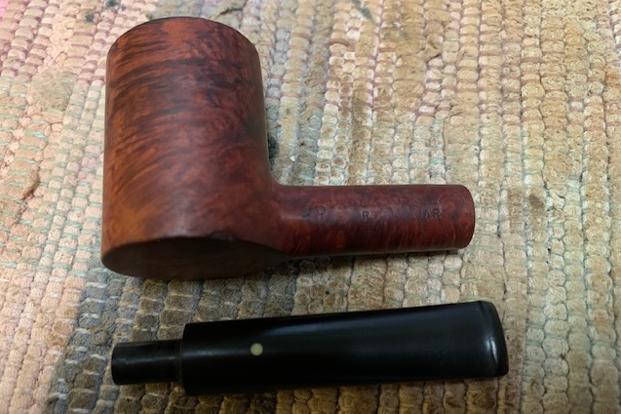
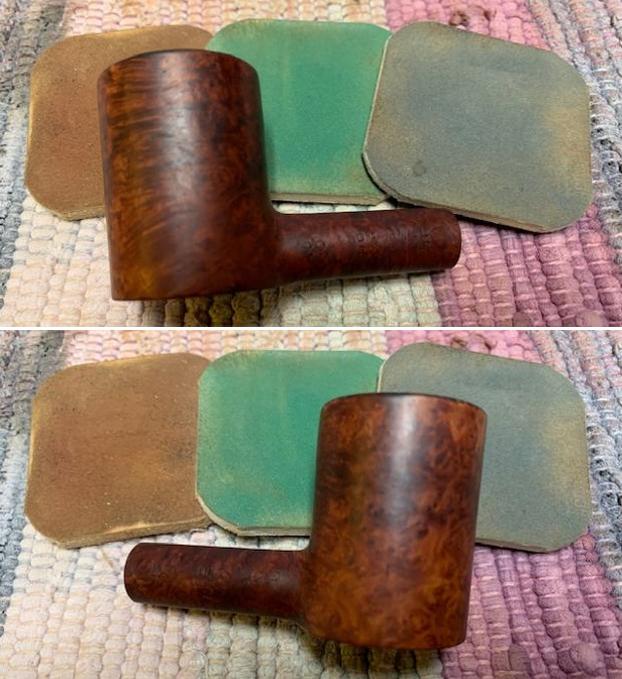
I turned to work on the pipe itself. Jeff had carried out his usual thorough cleanup of the pipe. He had reamed it with a PipNet reamer to remove the cake and cleaned the reaming up with a Savinelli Fitsall Pipe Knife. He scrubbed the internals of the bowl and stem with alcohol, cotton swabs and pipe cleaners. He scrubbed the externals with undiluted Murphy’s Oil Soap and rinsed the bowl off with running water. He soaked the stem in Before & After Deoxidizer and once it had soaked rinsed it off with warm water to remove the residual solution. He dried it off and scrubbed it down with Soft Scrub All-Purpose cleaner to remove any oxidation that was still on the stem. The pipe looked very clean when I received it.    I took a photo of the rim top to show the condition. You can see the darkening on the rim top. The bowl is roughened and slightly out of round. The stem came out looking quite good. There are light tooth marks and chatter on both sides near the button but the oxidation was gone.     I took photos of the sides of the shank to show the stamping. It is faint but readable as noted above.      I removed the stem from the shank and took a photo of the pipe parts to show what I was working with. It is a nice looking pipe. I decided to start the restoration on this one by working on the damage on the inner edge of the bowl. It had darkening and some damage to the edge. There were burn and reaming damage marks on the edge from a previous pipeman. I worked it over with a folded piece of 220 grit sandpaper to minimize the damage on the edge. When I finished with it, the bowl and the rim top looked much better.          I polished the rim top and bowl with micromesh sanding pads – dry sanding with 1500-12000 grit sanding pads. I wiped the bowl down with a damp cloth after each sanding pad. The briar began to take on a shine.     With the repair completed I rubbed the briar down with Before & After Restoration Balm. I worked it into the briar with my fingertips. The product works to clean, enliven and preserve the briar. I let it sit for 15 minutes while I worked on the stem. After the time passed I buffed it with a cotton cloth to deepen the shine. The briar really comes alive with the balm.     I set the bowl aside and turned my attention to the stem. I polished the vulcanite with micromesh sanding pads – 1500-12000 grit pads. I wiped it down with Obsidian Oil after each sanding pad. I used Before & After Pipe Polish – both Fine and Extra Fine to further polish the stem.   This Dunhill Root Briar 90 Group 2R Poker from 1958 is a beautiful looking piece of briar that has a shape that follows grain. It is a great looking pipe that came out looking even better after the cleanup. The Root Briar is an early finish that Dunhill specialized in making. The finish on the pipe is in excellent condition. The brown stains on the bowl works well to highlight the grain. The polished black vulcanite taper stem adds to the mix. With the grime gone from the finish and the bowl it was a beauty and is eye-catching. I put the stem back on the bowl and buffed the pipe with Blue Diamond on the buffing wheel being careful to not buff the stamping. I gave the bowl and the stem multiple coats of carnauba wax on the buffing wheel and followed that by buffing it with a clean buffing pad. I hand buffed the pipe with a microfiber cloth to deepen the shine. The finished 1958 Root Briar 90 Poker is quite nice and feels great in the hand. Give the finished pipe a look in the photos below. I can only tell you that like the other pipes I am working that it is much prettier in person than the photos capture. The dimensions of the pipe are Length: 4 ¾ inches, Height: 1 5/8 inches, Outside diameter of the bowl: 1 ¼ inches, Chamber diameter: ¾ of an inch. The weight of the pipe is 27grams/.95oz. It will soon be added to the British Pipe Makers section on the rebornpipes store. Thanks for walking through the restoration with me as I worked over another beautiful pipe. Remember we are not pipe owners; we are pipemen and women who hold our pipes in trust until they pass on into the trust of the next generation.

New Life for another Dunhill – A Patent Era 1928 Dunhill Bruyere EK7 Panel Billiard


Blog by Steve Laug

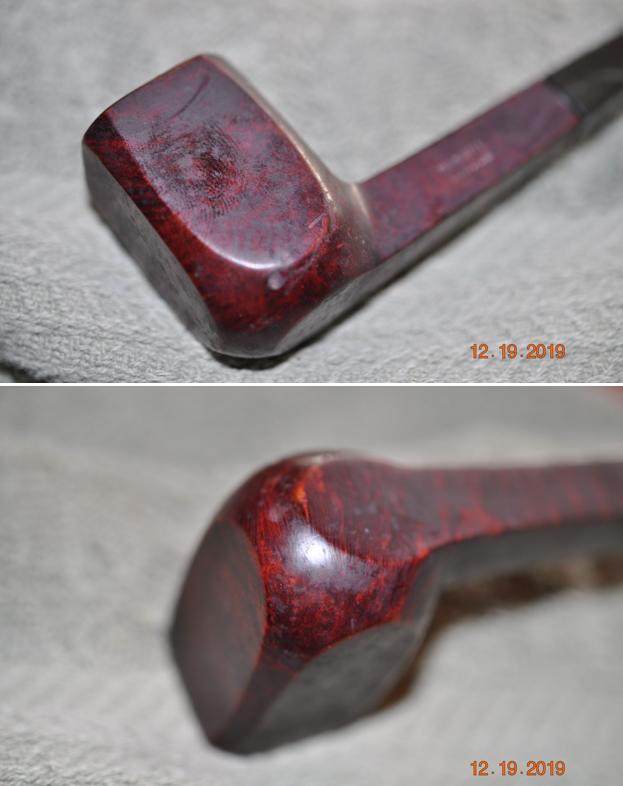
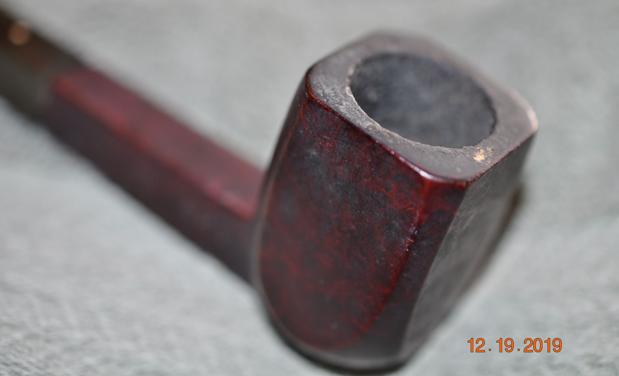
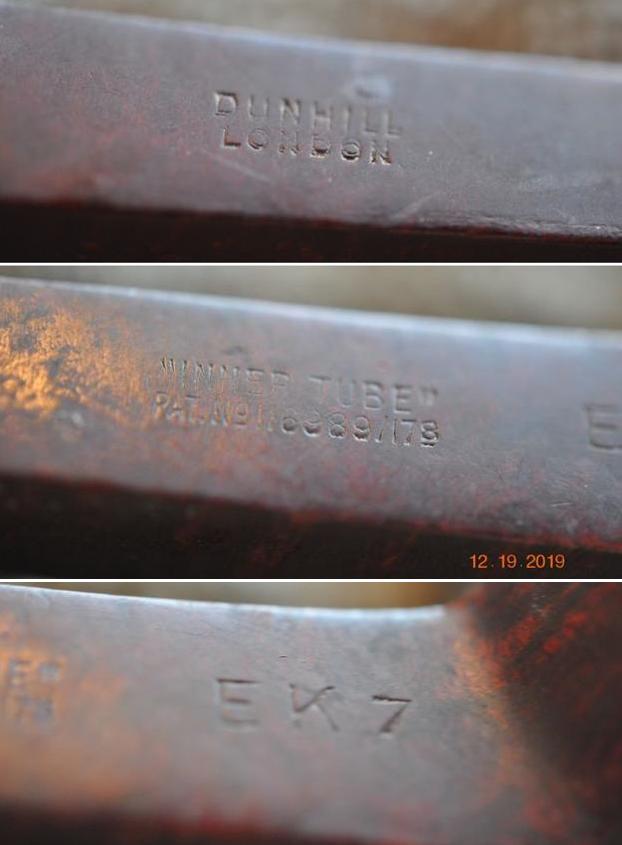
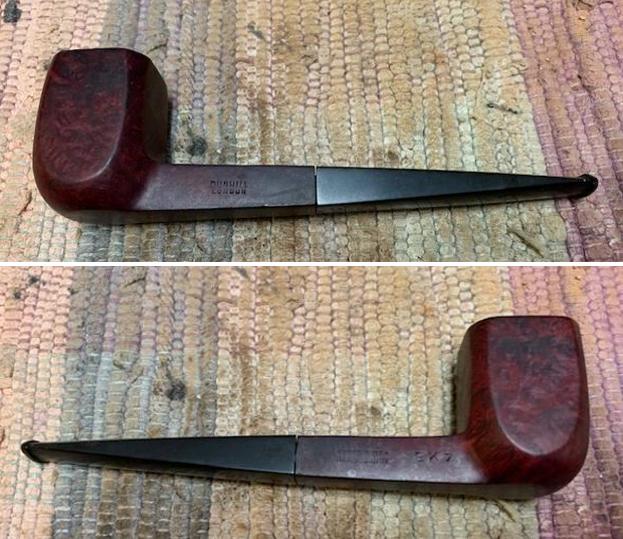
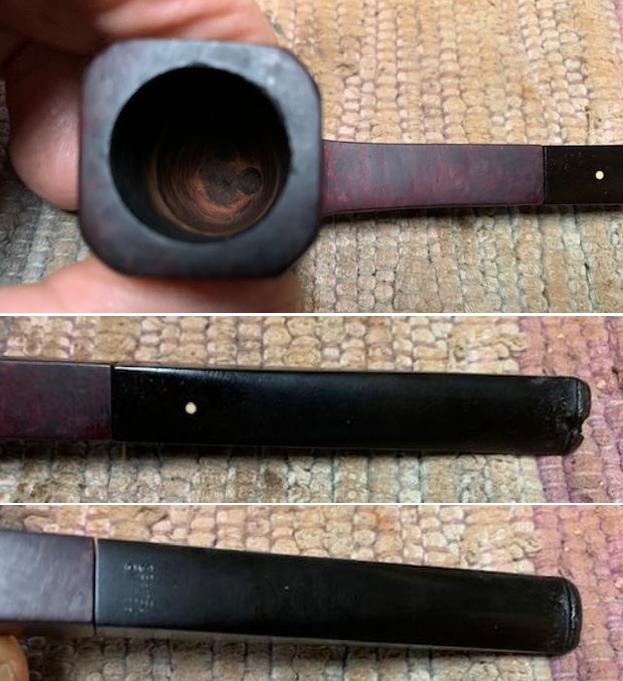
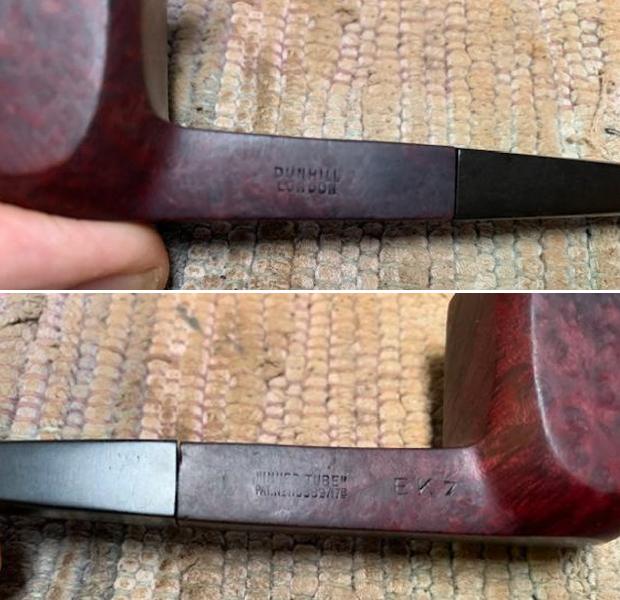
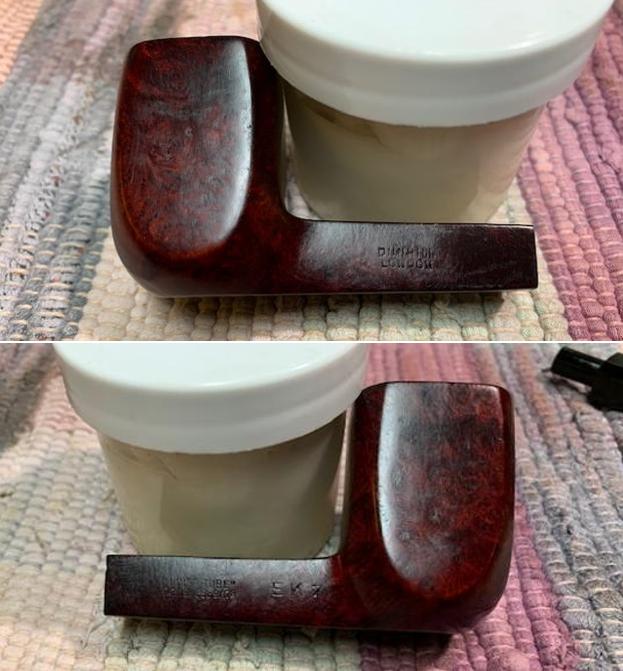
This Dunhill Panel Billiard was one of five other Billiards that came to us in the same lot as the 1922 Dunhill Bruyere Reading Pipe, a cracked shank 1962 Dunhill Shell Briar Pot and the 1905 BBB Calabash Reading Pipe and 1911 BBB Glokar Poker. I have drawn a red box around the pipe in the picture to the left. It is an interesting square shank Panel billiard. The pipe is stamped on the left side of the shank DUNHILL [over] LONDON. On the right side of the shank it was stamped “INNER TUBE [over] PAT. NO 116989/178 that is followed by the shape number EK7.

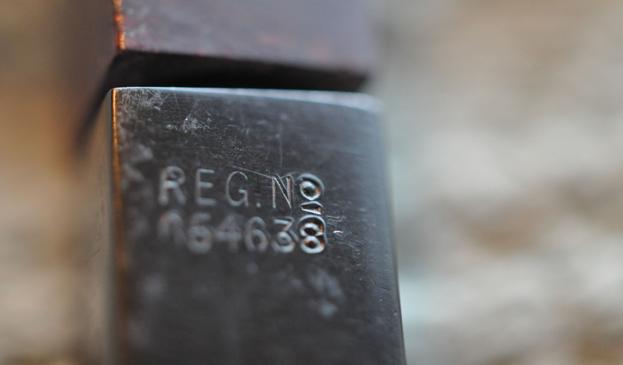
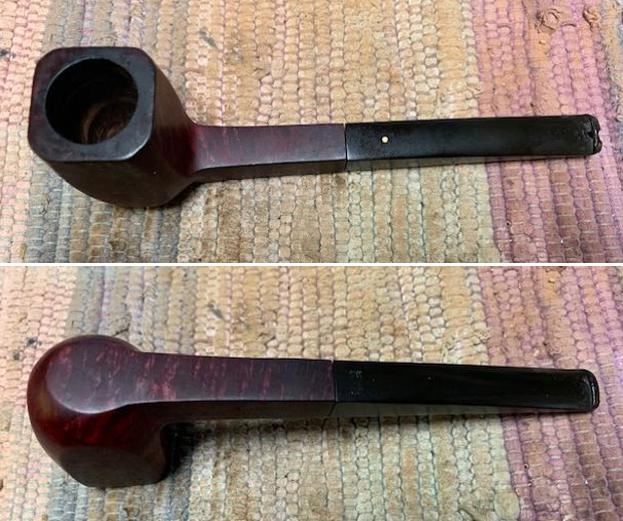
It was another filthy pipe with a thick cake in the bowl and a heavy lava overflow on the rim top. The finish was tired and dirty with grime and debris stuck to the surface of the briar. The stem has a small white dot on top and the button on the topside had a deep tooth mark and damage. There was tooth chatter and marks on both sides ahead of the button. Jeff took photos of the pipe before he did his clean up work.   He took photos of the bowl and rim to give a picture of the thickness of the cake and lava on the rim top. This must have been a favourite pipe to have that thick of a cake and lava buildup. The stem had a chip out of the button on the topside and tooth chatter and marks on both sides. It was a square stem that looked very good with the pipe. Jeff took photos of the bowl from various angles to give a sense of the dirtiness of the finish but also the unique shape of the panel billiard. It is going to be a real beauty! Jeff took photos of the stamping on the sides of the shank . There are some faint spots but over all it is readable as noted above.There was also a Reg. No. stamped on the stem that read REG.NO. [over] 654638. I looked up what the Reg. No. stamp meant in John Loring’s The Dunhill Briar Pipe – The Patent Year and After, pg. 42. I quote the pertinent section below.

Prior to the war the bottom of the Dunhill black vulcanite bit had a “REG. No 654638” stamped (without color) on thee underside of the bit near the meeting point with the shank. I have yet been able to determine what the number refers to but I am fairly certain it is not to the White Spot trade mark since the stamping has been consistently found on pipe bits dating back to the 1918 while the White Spot trademark stamp was not awarded until 1922.

I turned to Pipedia’s section on Dunhill Root Briar Pipes to get a bit of background on the Dunhill finishes (https://pipedia.org/wiki/Dunhill#Root_Briar). I quote:

Bruyere

The original finish produced (usually made using Calabrian briar), and a big part of developing and marketing the brand. It was the only finish from 1910 until 1917. A dark reddish-brown stain. Before the 1950s, there were three possible finishes for Dunhill pipes. The Bruyere was a smooth finish with a deep red stain, obtained through two coats, a brown understain followed by a deep red.

There was a link on the above site to a section specifically written regarding the Bruyere finish (https://pipedia.org/wiki/Dunhill_Bruyere). I turned there and have included the information from that short article below.

Initially, made from over century-old briar burls, classified by a “B” (denoted highest quality pipe); “DR” (denoted straight-grained) and an “A” (denoted first quality), until early 1915. After that, they became a high-end subset to the Dunhill ‘Bruyere’. The DR and B pipes, a limited production, they should be distinguished as hand-cut in London from burls as opposed to the Bruyere line which was generally finished from French turned bowls until 1917, when the Calabrian briar started to be used, but not completely. Only in 1920 Dunhill took the final step in its pipe making operation and began sourcing and cutting all of its own bowls, proudly announcing thereafter that “no French briar was employed”.

Bruyere pipes were usually made using Calabrian briar, a very dense and hardy briar that has a modest grain but does very well with the deep red stain.

“Before the 1950s, there were three possible finishes for Dunhill pipes. The Bruyere was a smooth finish with a deep red stain, obtained through two coats, a brown understain followed by a deep red. The Shell finish was the original sandblast with a near-black stain (though the degree to which it is truly black has varied over the years). Lastly, the Root finish was smooth also but with a light brown finish. Early Dunhill used different briars with different stains, resulting in more distinct and identifiable creations… Over the years, to these traditional styles were added four new finishes: Cumberland, Dress, Chestnut and Amber Root, plus some now-defunct finishes, such as County, Russet and Red Bark.”

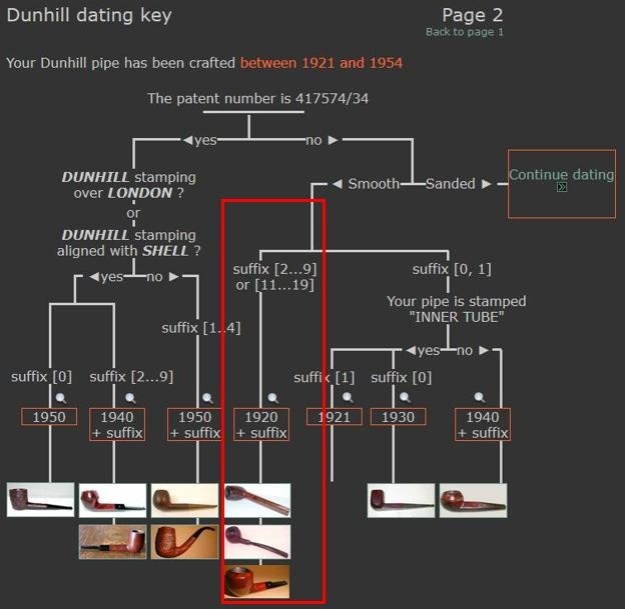
There was also a link to a catalogue page that gave examples and dates that the various finishes were introduced (https://pipedia.org/wiki/File:Dunnypipescatalog-1.png).I turned to Pipephil’s dating guide to show how I arrived at the date of manufacture for this pipe (http://www.pipephil.eu/logos/en/dunhill/cledat-en1.html). I am including two charts that are provided there for the dating a pipe. I have drawn a red box around the pertinent section in each chart. Since the pipe I am working on has a suffix 8 that is raised superscript it points to 1920+ 8 for a date of 1928 on the charts below. I also turned to John Loring’s, The Dunhill Briar Pipe – The Patent Year and After, to do some checking on the Patent number on this pipe. I found what I was looking for on page 58 where he spells out the Smooth Finish Patent Nomenclature Usage. In a very helpful chart he identifies the Pat No. 116989/17 as occurring between 1918? and 1934. The date stamp of 8 coincided with that identifying the year as 1928.

I now knew that I was working on a Bruyere that came out in 1928 because of the date stamp 8. The shape of the pipe was one of many Billiards that Dunhill put out and that the EK7 was a normal Panel Billiard shape with a taper stem. The Reg. No. on the underside of the stem also fits well within that date time.

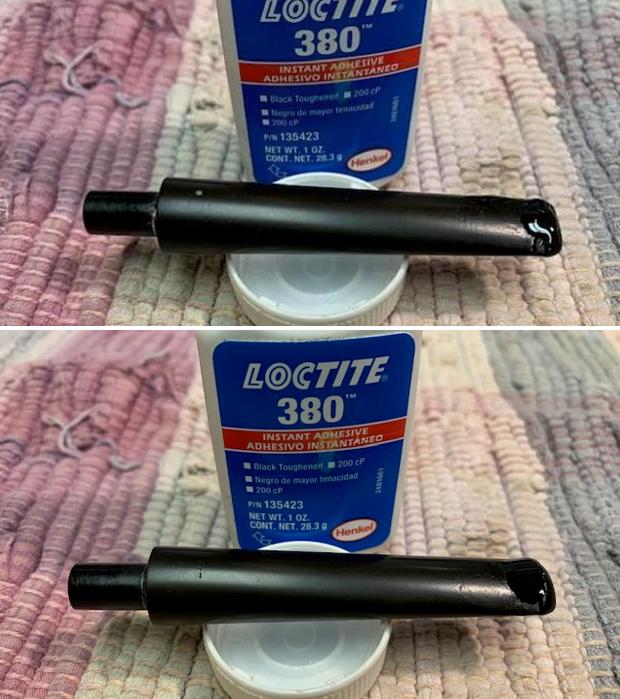
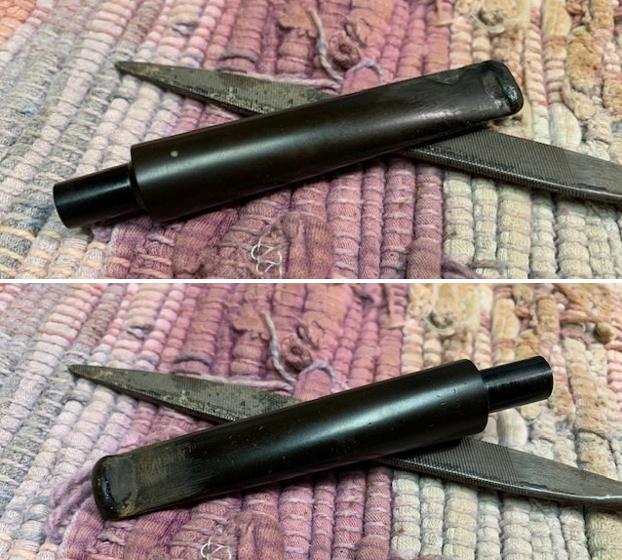
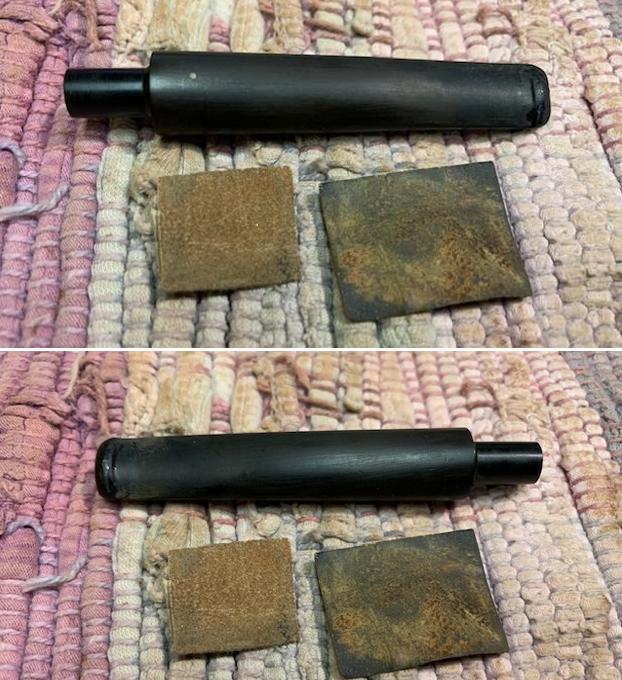
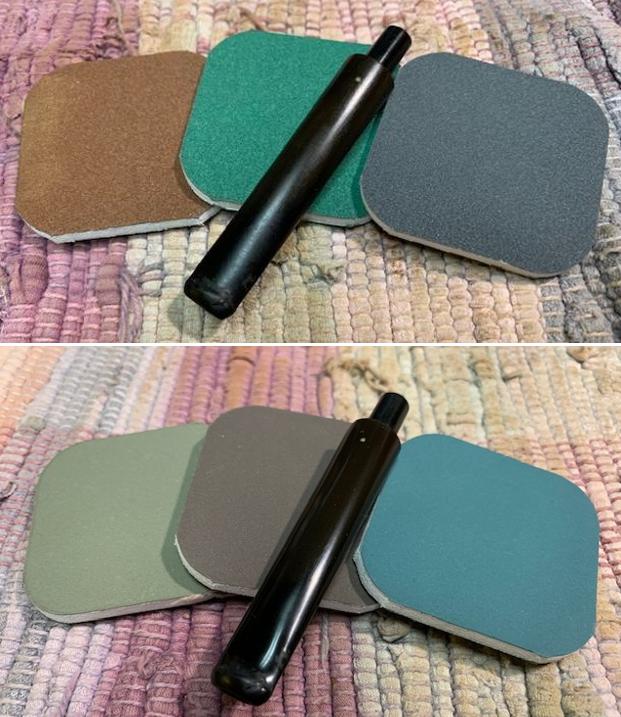
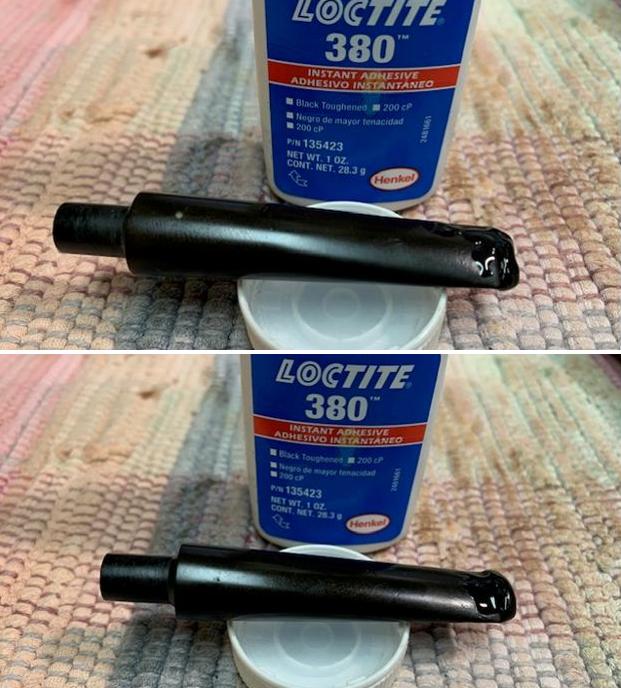
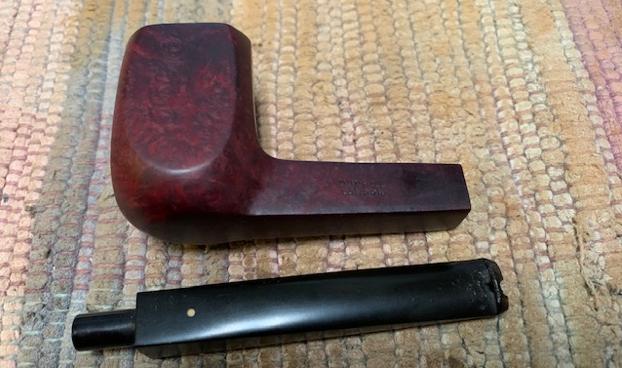
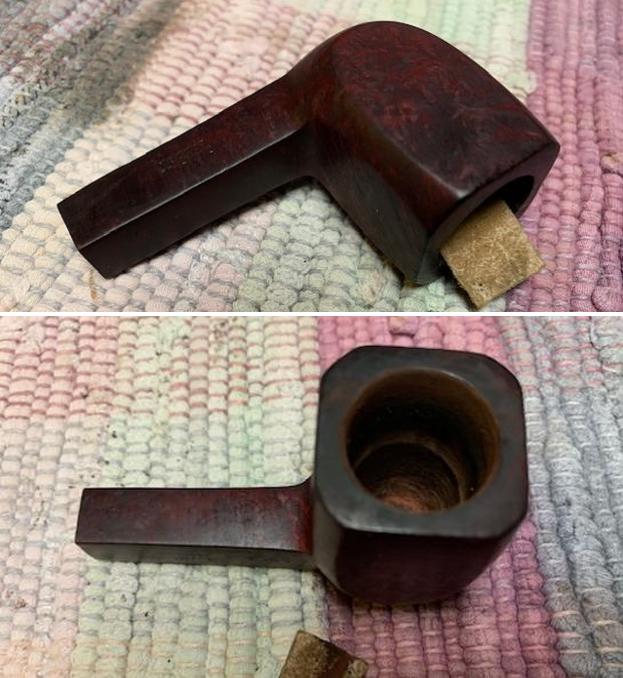
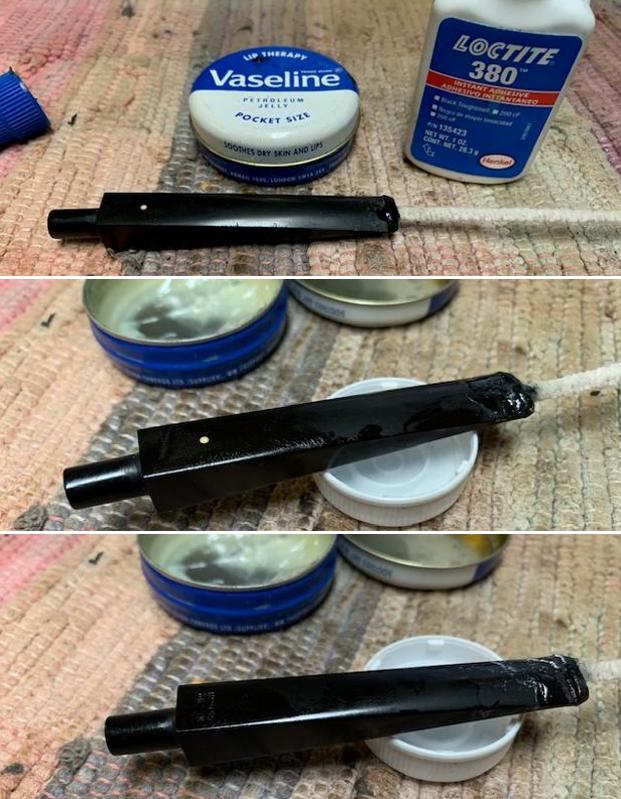
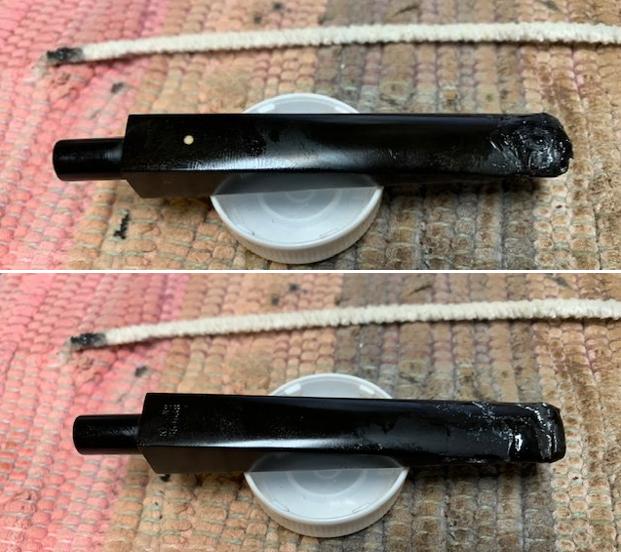
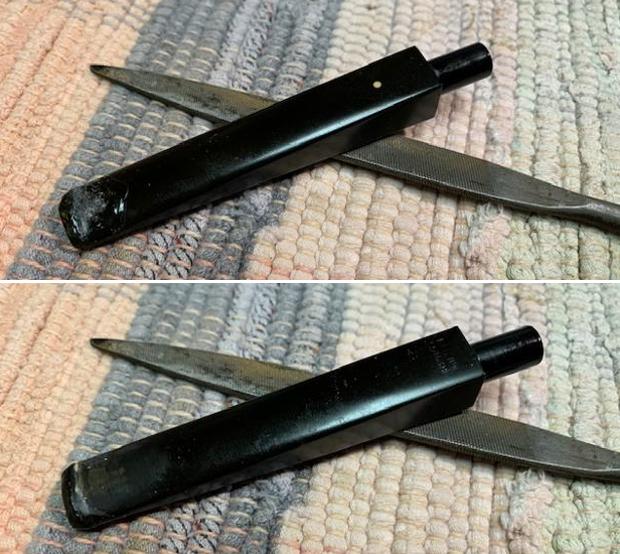
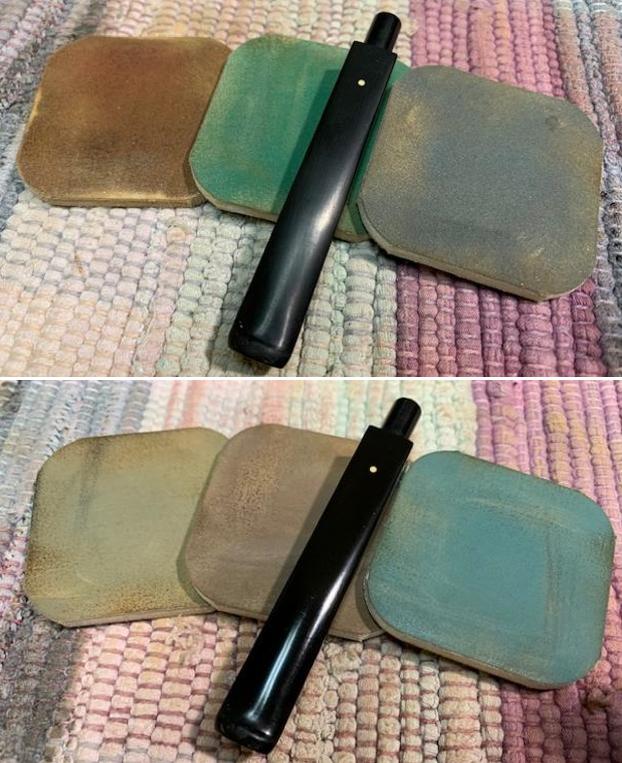
I turned to work on the pipe itself. Jeff had carried out his usual thorough cleanup of the pipe. He had reamed it with a PipNet reamer to remove the cake and cleaned the reaming up with a Savinelli Fitsall Pipe Knife. He scrubbed the internals of the bowl and stem with alcohol, cotton swabs and pipe cleaners. He scrubbed the externals with undiluted Murphy’s Oil Soap and rinsed the bowl off with running water. He soaked the stem in Before & After Deoxidizer and once it had soaked rinsed it off with warm water to remove the residual solution. He dried it off and scrubbed it down with Soft Scrub All-Purpose cleaner to remove any oxidation that was still on the stem. The pipe looked very clean when I received it.  I took a photo of the rim top to show the condition. You can see the darkening on the rim top. It is roughened and slightly out of round with nicks on the inner edge. The stem came out looking quite good. There are light tooth marks and chatter on both sides near the button but the oxidation was gone.  The damage on the topside at the button can be seen in the second photo of the stem surface below.I took photos of the sides of the shank to show the stamping. It is clear and readable as noted above. I removed the stem from the shank and took a photo of the pipe parts to show what I was working with. It is a nice looking pipe.I decided to start the restoration on this one by working on the damage on the inner edge of the bowl. It had darkening and some damage to the edge. The pipe is almost 100 years old so it is not surprising that there was burn and reaming damage marks on the edge from a previous pipeman. I worked it over with a folded piece of 220 grit sandpaper to remove and minimize the damage. When I finished with it, the bowl and the rim top looked much better.I polished the rim top and bowl with micromesh sanding pads – dry sanding with 1500-12000 grit sanding pads. I wiped the bowl down with a damp cloth after each sanding pad. Even though there were small marks on the briar from the pipe’s journey it began to take on a shine.     I rubbed the briar down with Before & After Restoration Balm. I worked it into the briar with my fingertips. The product works to clean, enliven and preserve the briar. I let it sit for 15 minutes while I worked on the stem. After the time passed I buffed it with a cotton cloth to deepen the shine. The briar really comes alive with the balm. I set the bowl aside and work on the stem. I greased a pipe cleaner with Vaseline and inserted it in the button and filled in the damaged areas with black rubberized Loctite 380 CA glue. I sprayed the repair with an accelerator and removed the pipe cleaner. I checked and the airway was wide open… Whew! Once it cured I used files to sharpen the edge of the button and smooth out the top and undersides. I sanded it with 220 grit sandpaper to blend it into the surrounding vulcanite. I started polishing it with 400 grit wet dry sandpaper. I polished the vulcanite with micromesh sanding pads – 1500-12000 grit pads. I wiped it down with Obsidian Oil after each sanding pad. I used Before & After Pipe Polish – both Fine and Extra Fine to further polish the stem. This Dunhill Bruyere EK7 Patent Panel Billiard from 1928 is a beautiful looking piece of briar that has a shape that follows grain. The Bruyere is an early finish that Dunhill specialized in making. The finish on the pipe is in excellent condition. The red and brown stain on the bowl works well to highlight the grain. The polished black vulcanite panel taper stem adds to the mix. I put the stem back on the bowl and buffed the pipe with Blue Diamond on the buffing wheel being careful to not buff the stamping. I gave the bowl and the stem multiple coats of carnauba wax on the buffing wheel and followed that by buffing it with a clean buffing pad. I hand buffed the pipe with a microfiber cloth to deepen the shine. The finished Bruyere EK7 Panel Billiard is quite nice and feels great in the hand. Give the finished pipe a look in the photos below. I can only tell you that like the other pipes I am working that it is much prettier in person than the photos capture. The dimensions of the pipe are Length: 5 ½ inches, Height: 1 ¾ inches, Outside diameter of the bowl: 1 inch, Chamber diameter: ¾ of an inch. The weight of the pipe is 29grams/1.02oz. I am still working through what I am going to do with this old timer. I will keep it with me for a while until I decide. Thanks for walking through the restoration with me as I worked over another beautiful pipe. This pipe is classic reminder that we are not pipe owners; we are pipemen and women who hold our pipes in trust until they pass on into the trust of the next generation.
Restemming and Restoring a Sasieni Windsor London Made Oom Paul 80


Blog by Steve Laug

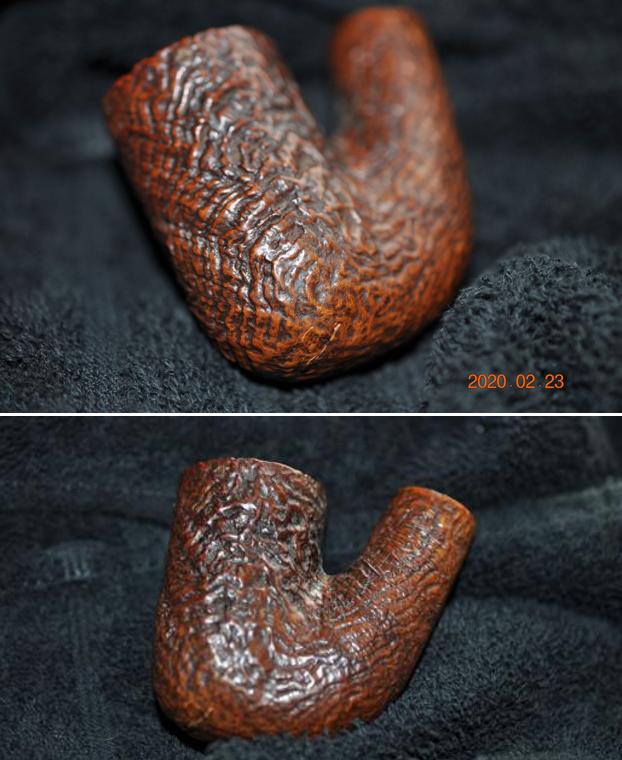
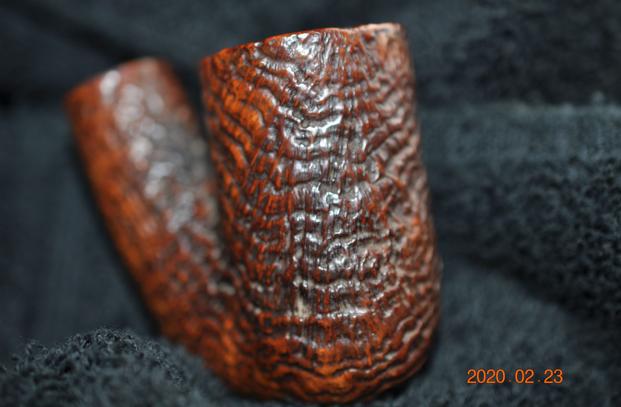
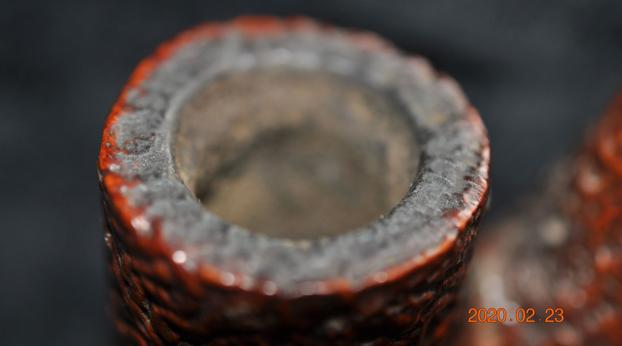
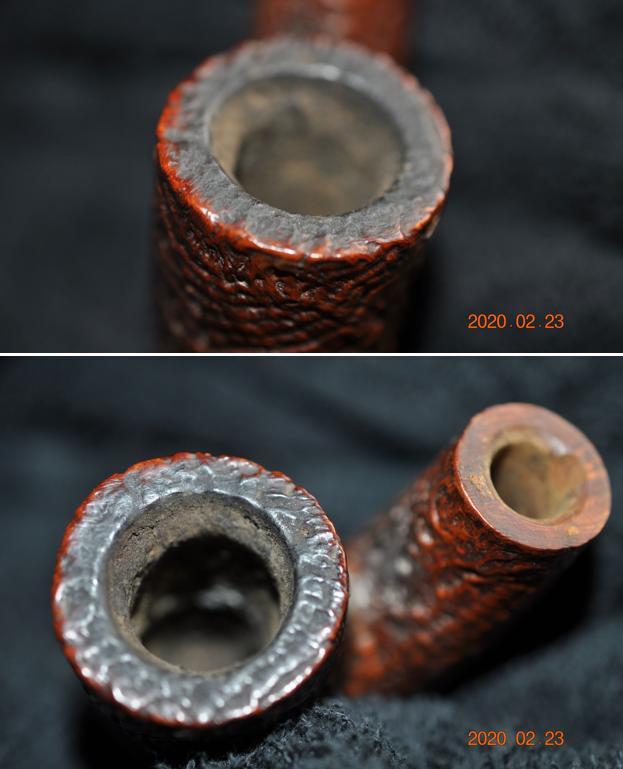
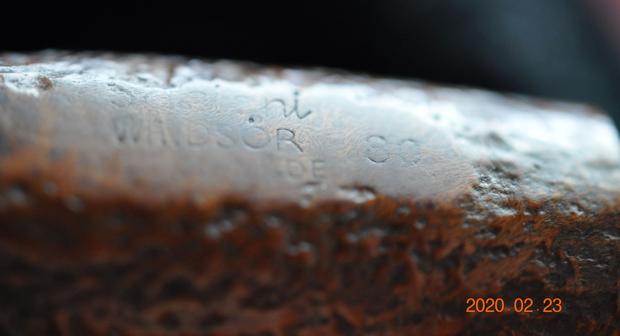
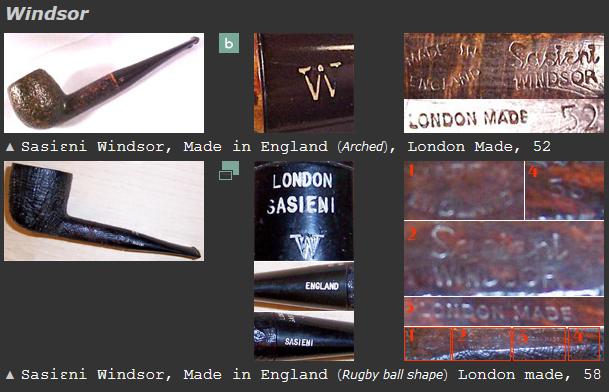
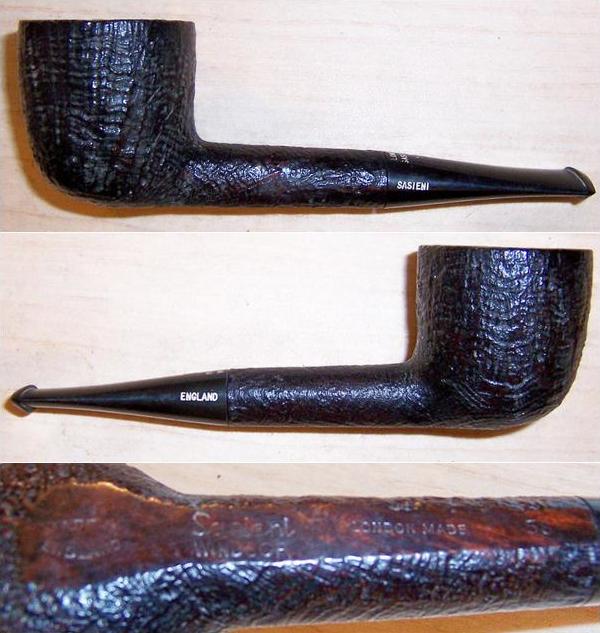
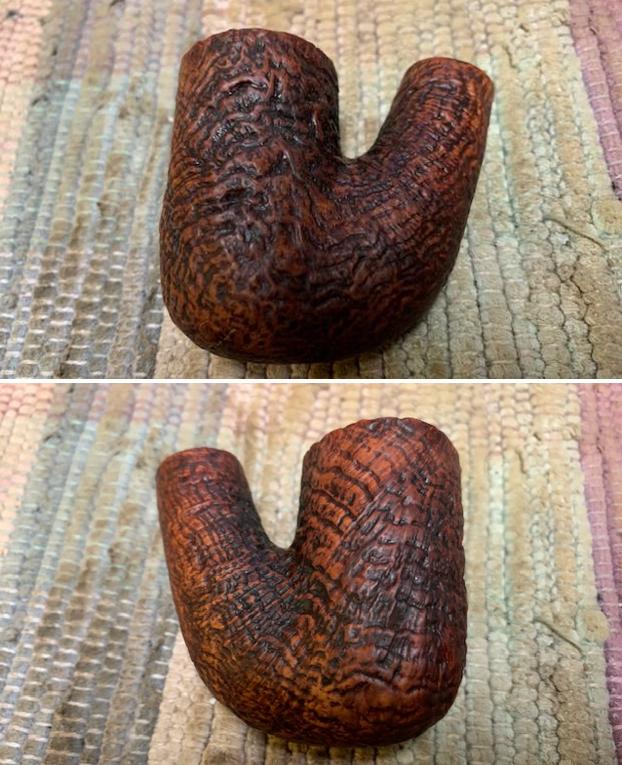
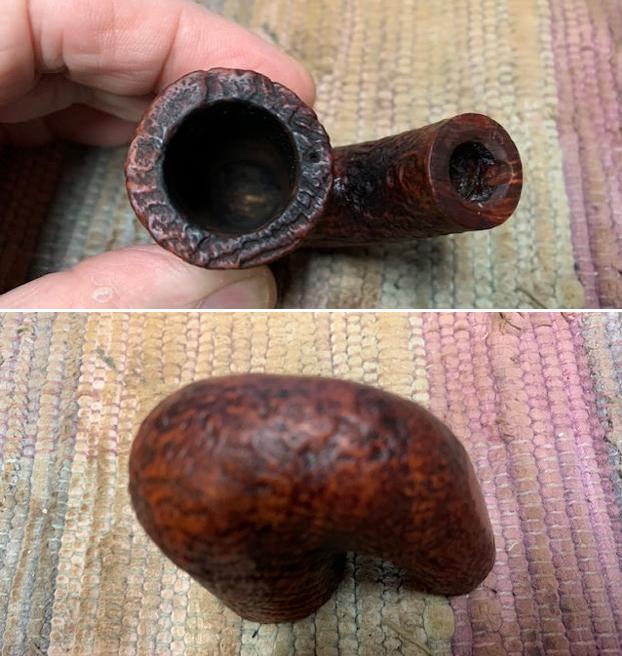
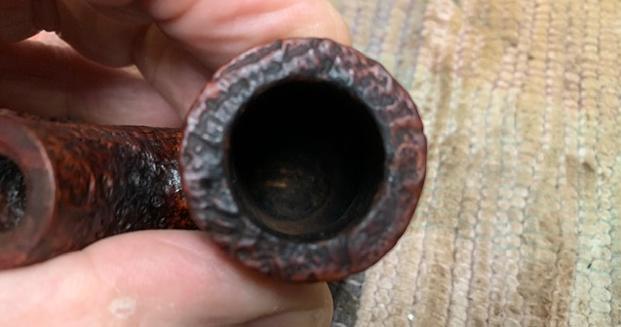
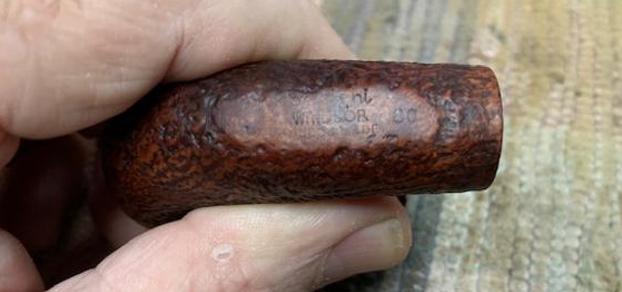
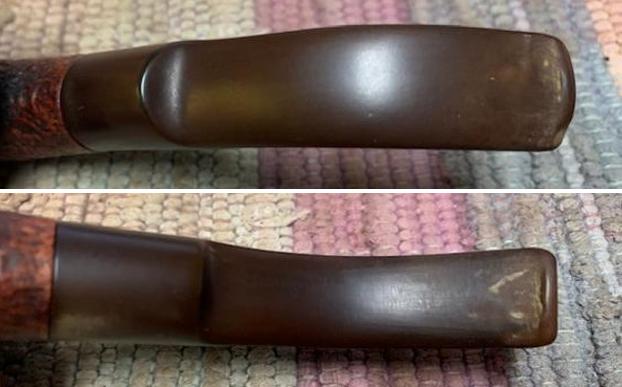
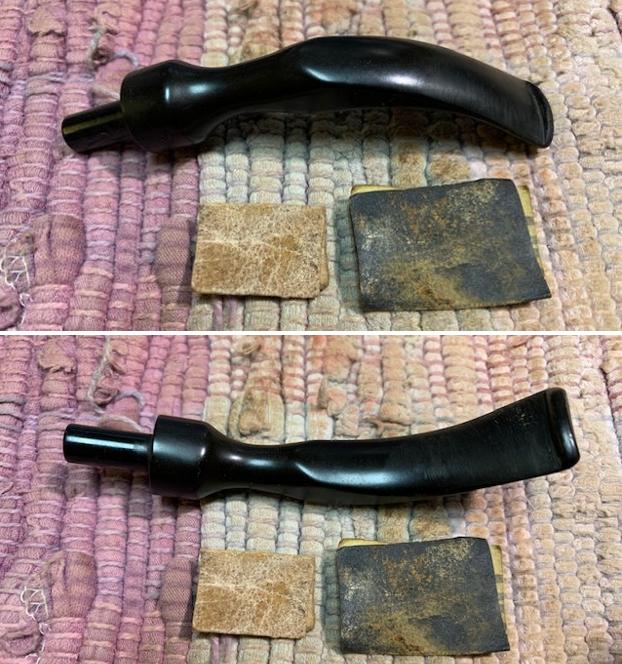
The next pipe I chose to work on was a Sasieni Windsor Sandblast |Bowl sans stem that was purchased from a shop in Oregon when Irene and I visited my brother on the coast there. It has been sitting in my box of bowls since that time. Jeff cleaned it up and mailed it to me. I have been postponing restemming any of the pipes for a while now but after restemming that little gourd calabash a couple of days ago I was ready to do a few more. I pulled this one out of the box and set aside to be the next pipe to work on. It has a very deep sandblast that is quite stunning on the full bent pipe. Overall it is a pretty pipe. The bowl had thick cake in the bowl and there was a coat of lava in the grooves of the rim top. The finish had a lot of dust and debris in the valleys of the blast. The stamping on the smooth panel on the underside of the shank was clear and readable. It was stamped Sasieni [over] Windsor [over] London Made. To the right of that it was stamped with the shape number 80. To the left of the Sasieni stamp on the heel of the bowl it is stamped Made in England in a rugby ball shaped stamp. Jeff took some photos of the bowl before he cleaned it up. The next three close up photos show the condition of the bowl and rim top. You can see the lava coat on the inner edge of the bowl and the debris in the rustication of the rim top. Jeff took a photo of the stamping on the underside of the shank. It read as noted above and is  faint and readable.I turned to Pipephil’s site to get a read on the Sasieni Windsor line to see if I could find out more about the stamping (http://pipephil.eu/logos/en/logo-sasieni2.html). The pipe was in the section on the site as a Sasieni seconds and sub-brands. The pipe in the second photo had very similar stamping to the bowl I was working on. I did a screen capture of the section on Pipephil. I have included it below.  There were also photos that were included on Pipephil of what the sandblast looked like on the Sasieni Windsor originally.The third photo of the underside of the shank shows a similar stamping to the pipe I am working on. The pipe originally had a saddle vulcanite stem. The stem was long gone when Jeff and I picked it up so I had some decisions to make about the stem I would use to restem it.I turned to work on the pipe itself. Jeff had carried out his usual thorough cleanup of the pipe. He had reamed it with a PipNet reamer to remove the cake and cleaned the reaming up with a Savinelli Fitsall Pipe Knife. He scrubbed the internals of the bowl and stem with alcohol, cotton swabs and pipe cleaners. He scrubbed the externals with undiluted Murphy’s Oil Soap and rinsed the bowl off with running water. The pipe looked very clean when I received it. The rim top cleaned up really well as can be seen in the close up photos below. I took a photo of the stamping on the underside of the shank. It really is faint but readable. I went through my can of stems and found turned freehand style vulcanite stem that would work well with the bowl and shank. The bend in it was a little too high and would need to be heated and bent for the Oom Paul shape. There were tooth marks in surface of the top and underside of the stem at the button that would need to be dealt with in the restoration.   I took a photo of the stem and bowl together to give a sense of the look of the pipe and the proportion of the stem. I put the stem in place on the shank and took photos of combination of the bowl and stem. It is going to look very good once it is cleaned up. I rubbed the briar down with Before & After Restoration Balm. I worked it into the briar with my fingertips and a horsehair shoe brush. The product works to clean, enliven and preserve the briar. I let it sit for 15 minutes while I worked on the stem. After the time passed I buffed it with a cotton cloth to deepen the shine. The briar really comes alive with the balm.   I set the bowl aside and turned my attention to the stem. I put a pipe cleaner in the stem and then heated the stem with my heat gun until the vulcanite was supple. I bent it to the angle that matched the bowl. I filled in the tooth marks and rebuilt the button top with black super glue and set it aside to cure. Once it had cured I used files to reshape the edge of the button and flatten the repairs on the stem surface. I blended the repairs into the surface of the vulcanite with 220 grit sandpaper. I started polishing the stem with 400 grit wet dry sandpaper. The stem was looking much better. I polished the vulcanite with micromesh sanding pads – 1500-12000 grit pads. I wiped it down with Obsidian Oil after each sanding pad. I used Before & After Pipe Polish – both Fine and Extra Fine to further polish the stem. This restemmed, sandblasted Sasieni Windsor 80 Oom Paul is a beautiful looking pipe. The brown stains on the bowl work well to highlight the finish. The polished black vulcanite saddle stem adds to the mix. I put the finished stem on the bowl and buffed it with Blue Diamond on the buffing wheel being careful to not buff the stamping. I gave the bowl multiple coats of Conservator’s Wax and the stem multiple coats of carnauba wax on the buffing wheel and followed that by buffing it with a clean buffing pad. I hand buffed the pipe with a microfiber cloth to deepen the shine. The finished Sasieni Windsor 80 is quite nice and feels great in the hand. Give the finished Oom Paul a look in the photos below. I can only tell you that it is much prettier in person than the photos capture. The dimensions of the pipe are Length: 5 ½ inches, Height: 2 inches, Outside diameter of the bowl: 1 ¼ inches, Chamber diameter: ¾ of an inch. The weight of the pipe is 46grams/1.62oz. It will soon be added to the British Pipe Makers section on the rebornpipes store. Thanks for walking through the restoration with me as I worked over another beautiful pipe. Remember we are not pipe owners; we are pipemen and women who hold our pipes in trust until they pass on into the trust of the next generation.


Restoring a Badly Burned Kaywoodie Super Grain 86B


Blog by Alex Heidenreich

Earlier this week I received and email with an attachment from Alex about a Kaywoodie pipe he had restored for a friend. He wanted my opinion on the restoration and on the piece he had written about it. I took time this weekend to read over the piece and study the photos and I have to say I was quite impressed with his work. I wrote him back with some questions and asked if I could post his piece on the blog. He said he was thrilled and honoured to be asked so without further ado I introduce you to Alex Heidenreich’s Kaywoodie Super Grain 86B restoration.

Introduction:

Kaywoodies are some of my favorite pipes. I love the history of the company and the amazing quality briar used in the older pipes. So, when I saw this poor Kaywoodie on eBay, I was quick to bid on it. When it arrived in the mail, I took a closer look at it. It was in even worse shape than the pictures had led me to believe. It was dented and dinged on the outside of the bowl. The rim was badly chewed up and then caked over with a thick coating of lava that had spilled all the way down onto the shank. The stem was badly oxidized, and I couldn’t get a pipe cleaner through the stem or the shank. This pipe looked like a lot of work. So, I ended up setting it aside for a while. Later, a friend of mine from our pipe group on PipeTobaccoDiscord said he was looking to add a Kaywoodie to his collection. I sent him some pictures of the ones in my restoration pile and despite the damage, he fell in love with this one, and thus the work began.
Acquisition Pictures: History:

As Steve has talked about many times, finding the exact date of a pipe can be difficult. Kaywoodie has a rich history, and a good amount of it is documented over on https://pipedia.org/wiki/Collector%27s_Guide_to_Kaywoodie_Pipes. The first thing I did was head over to their documentation on the shape numbers: https://pipedia.org/wiki/Kaywoodie_Shape_Numbers. This told me that the 86B shape number was a Large Apple with a flat top bowl and was produced from 1947-1971. For many shapes of Kaywoodies, the logo was printed on top of the stem until the late 1940s or early 1950s. Since this logo was on the side of the stem, I surmised it was probably a post-1955 model. Just after this time (somewhere in the mid-50s or 60s), Kaywoodie also moved from a 4-hole stinger to a 3-hole stinger. Since this pipe has the logo on the side, but still had a 4-hole stinger, it was likely made in that interim period from 1959-1965.

Picture from a 1955 Catalog showing the 86B (notice the logo is on the top of the stem)Picture from: https://pipedia.org/wiki/Collector%27s_Guide_to_Kaywoodie_Pipes courtesy ChrisKeene.com

Restoration:

I took the pipe apart to see how bad it was. It was extremely dirty, and the finish was badly damaged. There were burn marks and lava all over the rim and shank.

I started by reaming the pipe. The bowl is large. So, it took a lot of reaming to get clean. The outside was extremely dirty. So, I cleaned the pipe 4 or 5 times with Murphy’s Oil Soap. I really soaked the rim well to try to soften the lava. It took a ton of scrubbing and a little work with a knife, but I was able to get most of it off and remove a lot of the burn marks on the shank. Unfortunately, this revealed a great deal of damage to the rim. There were also multiple fills, and I even had to remove a protruding grain of sand from the briar. To repair the damage to the rim, I carefully sanded back the damaged areas on a topping board, careful not to change the shape of the rim. I put a dab of Vaseline on the logo to protect it, then soaked the stem in an oxyclean bath. This would help loosen up all the gunk inside and make it easier to clean the oxidation off the outside. I also filled the bowl with cotton balls, stuck pipe cleaners in the shank, and then used a syringe to fill the bowl with alcohol to help remove any ghosting in the pipe, as well as loosen up any remaining cake inside the bowl to make it easier to clean.   After I got the stem out of the oxy bath, it revealed a lot of oxidation that would need to be cleaned up. The internals of the stem were also gooped up, but I was able to now force a pipe cleaner through it. I cleaned much of the surface oxidation with a Magic Eraser, then moved on to the internals.I sanded the stem with 600, 800, 1000, then moved into micro mesh pads from 1200 – 12000. Once finished, I oiled the stem with Obsidian Stem Oil and let it soak in. I turned my attention back to the bowl and did my best to clean out the inside of the shank and bowl with Q Tips and Pipe Cleaners soaked in alcohol. Then I set it aside for day 1.
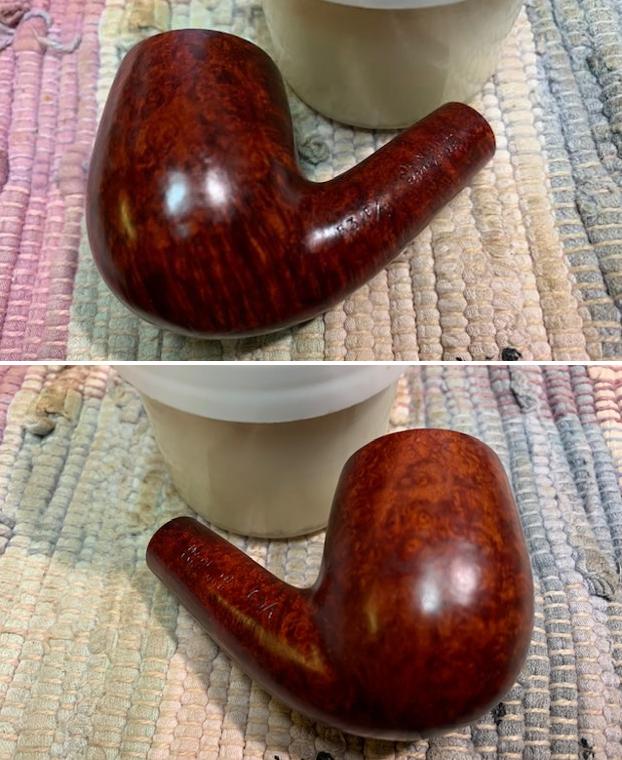
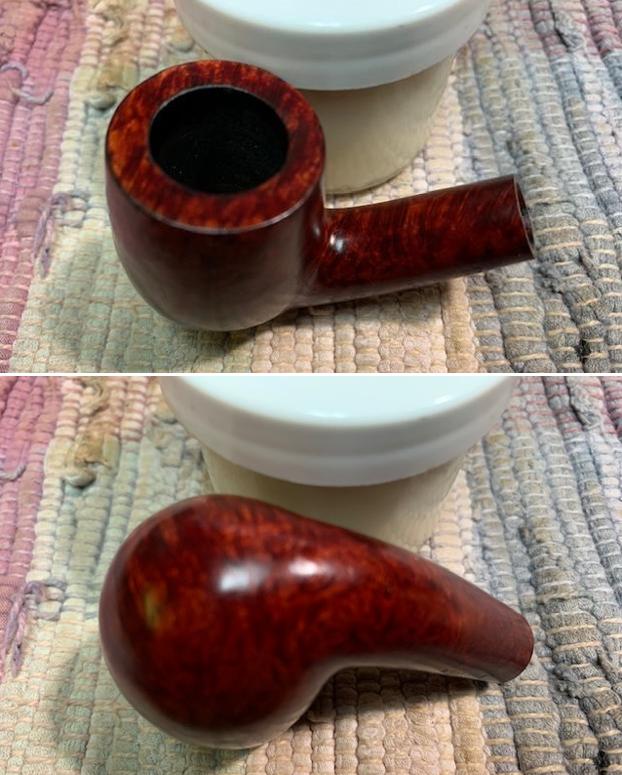
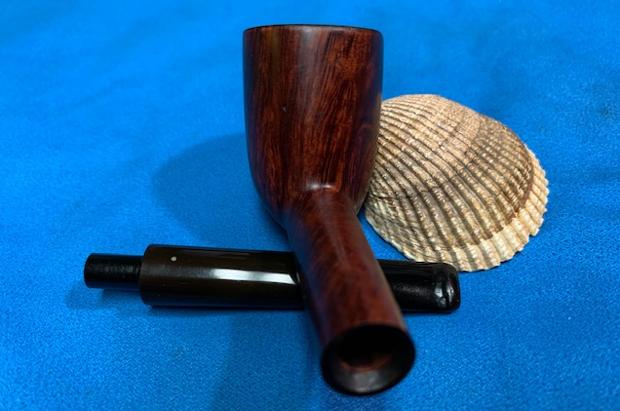
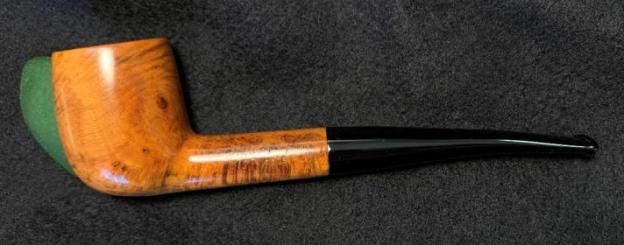
Cleaning the shank and the stem took A LOT of pipe cleaners and Q Tips… After letting the pipe dry over night, I was able to see more clearly the inside and outside of the pipe. No surprise with how burned the outside of the pipe was that there were also heat fissures inside the bowl. I inspected them carefully and gauged their depth with dental picks. They, luckily, were not too deep. I was also now able to see some of the fills, scratches, and sand pits better on the outside of the bowl. I used a wet rag and a hot iron to try to raise them a bit. Then I carefully cleaned them out with my dental picks. At this point, I got a little ahead of myself as I focused on cleaning out the pits. I moved on to filling the pits and scratches with CA glue before fully stripping the finish. After the glue cured, I sanded down the glue spots. Then I wiped the entire stummel down with high-proof alcohol followed by acetone to really remove the finish. Since I did my steps slightly out of order, the CA glue had softened in a couple of the fills. So, I picked it out and refilled it. I let the glue cure and then sanded the entire stummel. I had to be very careful over the stamping to preserve it. With the finish removed and the stummel sanded, I placed a wine cork in the bowl and coated it with dye.It’s hard to tell in the pictures, but the dye came out a little too dark, more similar to a Flame Grain. To keep it authentic with a Super Grain, I needed to lighten it back up a bit. I lightly sanded it with my sequence of micromesh pads which also brought the shine back. After the stummel was sanded, the color was nearly perfect. I then buffed it using Tripoli, followed by White Diamond, and finally Carnauba. Now that the outside was finished, I moved on to the inside. After really inspecting the fissures, some of them were deeper than I would like. If it was my pipe, I would have done a bowl coating and just kept an eye on them to address later, but since this pipe was for someone else, I wanted to address it now. This way they won’t have to deal with it down the road. I mixed up some JB Weld, which dries inert and can handle the heat. I carefully stuck it only into the fissures, using as little as possible so as not to coat the briar, since JB Weld won’t breathe like briar.After it cured, I sanded down the JB Weld to make the bowl smooth and flush, as well as to remove any that was not inside the fissures.Then I coated the bowl with activated charcoal in a great method I learned from Dad’s Pipes. (https://dadspipes.com/2015/08/12/a-simple-effective-bowl-coating/)After cleaning the charcoal off the rim, I noticed it had dulled a little bit. So, I threw the buffing wheel back on and gave it another coat of Carnauba. The pipe was now complete! I hope it will bring its new owner joy for many years!

Final Pictures:

Restemming and Restoring a Monte Verde Hand Made Freehand Bowl


Blog by Steve Laug

The next pipe I chose to work on was a Monte Verde bowl sans stem that was purchased from an online auction on 03/06/18 from Nampa, Idaho, USA. It has been sitting in my box of bowls since that time. Jeff cleaned it up and mailed it to me. I have been postponing restemming any of the pipes for a while now but after restemming that little gourd calabash a couple of days ago I was ready to do a few more. I pulled this one out of the box first and set aside to be the next pipe to work on. It has a very craggy rustication that is quite stunning and a square flared shank. Overall it is a pretty pipe. The bowl had thick cake in the bowl and the rim top had a coat of lava on the inner edge of the bowl and in the grooves of the rim top. The finish had a lot of dust and debris in the valleys of the rustication. The stamping on the smooth panel on the underside of the shank was clear and readable. It was stamped Monte Verdi [over] Made in Denmark [over] By Hand [over] Golden Tan in script. I knew that the Monte Verdi line was made by Preben Holm of Ben Wade and Preben Holm Freehand fame. Jeff took some photos of the bowl before he cleaned it up. The next two close up photos show the condition of the bowl and rim top. You can see the lava coat on the inner edge of the bowl and the debris in the rustication of the rim top. Jeff took a photo of the stamping on the underside of the shank. It read as noted above and is  clear and readable.I decided to confirm my thinking that the pipe was connected with Preben Holm/Ben Wade. I turned to Pipephil’s site to get a read on the brand (http://pipephil.eu/logos/en/logo-m6.html). Sure enough the Monte Verdi line was made by Preben Holm. The pipe in the photo had a very similar rustication to the Monte Verdi bowl I was working on. I did a screen capture of the section on Pipephil. I have included it below.  There were also photos that were included on Pipephil of what this particular pipe looked like when it had left Denmark. The rustication around the bowl and shank is very similar. The pipe I have does not have a shank extension but otherwise the finish is much the same.The pipe originally had a fancy turned vulcanite stem. The stem was long gone when Jeff picked it up so I had some decisions to make about the stem I would use to restem it.I turned to work on the pipe itself. Jeff had carried out his usual thorough cleanup of the pipe. He had reamed it with a PipNet reamer to remove the cake and cleaned the reaming up with a Savinelli Fitsall Pipe Knife. He scrubbed the internals of the bowl and stem with alcohol, cotton swabs and pipe cleaners. He scrubbed the externals with undiluted Murphy’s Oil Soap and rinsed the bowl off with running water. The pipe looked very clean when I received it. The rim top and shank end cleaned up really well as can be seen in the close up photos below.I took a photo of the stamping on the underside of the shank. It really is clear and readable.I went through my can of stems and found turned freehand style vulcanite stem that would work well with the bowl and shank. The bend in it was perfect. There were tooth marks in surface of the top and underside of the stem at the button that would need to be dealt with in the restoration. I took a photo of the stem and bowl together to give a sense of the look of the pipe and the proportion of the stem. I shortened the length of the tenon with my Dremel and sanding drum and smoothed out the tenon with 220 grit sandpaper and fit the stem in the shank and took pictures of the pipe and stem. I removed the stem and rubbed the briar down with Before & After Restoration Balm. I worked it into the briar with my fingertips and a horsehair shoe brush. The product works to clean, enliven and preserve the briar. I let it sit for 15 minutes while I worked on the stem. After the time passed I buffed it with a cotton cloth to deepen the shine. The briar really comes alive with the balm.   I set the bowl aside and turned my attention to the stem. I “painted” the tooth marks on both sides of the stem with the flame of a lighter to lift them as much as possible. I filled in the tooth marks that remaining with clear super glue and set it aside to cure. Once it had cured I used a flat file to reshape the edge of the button and flatten the repairs on the stem surface. I blended the repairs into the surface of the vulcanite with 220 grit sandpaper. I started polishing the stem with 400 grit wet dry sandpaper. The stem was looking much better. I polished the vulcanite with micromesh sanding pads – 1500-12000 grit pads. I wiped it down with Obsidian Oil after each sanding pad. I used Before & After Pipe Polish – both Fine and Extra Fine to further polish the stem. In speaking with Kenneth yesterday I remembered that I had used a product in the past called Meguiar’s Scratch X2.0 to polish the surface of the stem after all of the previous polishing I had done. I took photos of the stem after polishing with the compound and did give a rich shine.   This restemmed, rusticated Preben Holm Hand Made Monte Verdi Golden Tan Freehand is a beautiful looking pipe that combines a rusticated finish with a unique shaped. The brown stains on the bowl work well to highlight the finish. The polished turned fancy black vulcanite stem adds to the mix. I put the finished stem on the bowl and buffed it with Blue Diamond on the buffing wheel being careful to not buff the stamping. I gave the bowl multiple coats of Conservator’s Wax and the stem multiple coats of carnauba wax on the buffing wheel and followed that by buffing it with a clean buffing pad. I hand buffed the pipe with a microfiber cloth to deepen the shine. The finished pipe is quite nice and feels great in the hand. Give the finished pipe a look in the photos below. I can only tell you that like the other pipes I am working that it is much prettier in person than the photos capture. The dimensions of the pipe are Length: 7 inches, Height: 2 inches, Outside diameter of the bowl: 1 ¾ inches, Chamber diameter: 7/8 of an inch. The weight of the pipe is 63grams/2.22oz. It will soon be added to the Danish Pipe Makers section on the rebornpipes store. Thanks for walking through the restoration with me as I worked over another beautiful pipe. Remember we are not pipe owners; we are pipemen and women who hold our pipes in trust until they pass on into the trust of the next generation.