Tag Archives: restaining

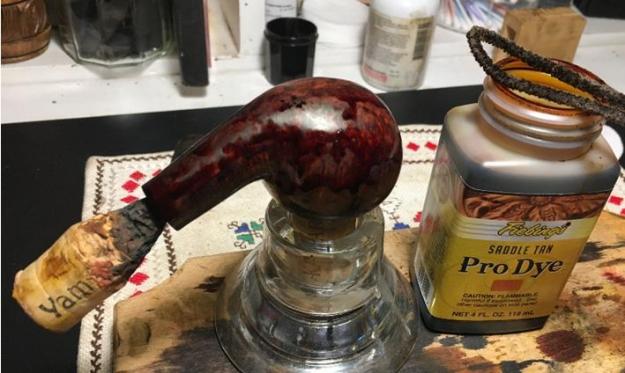
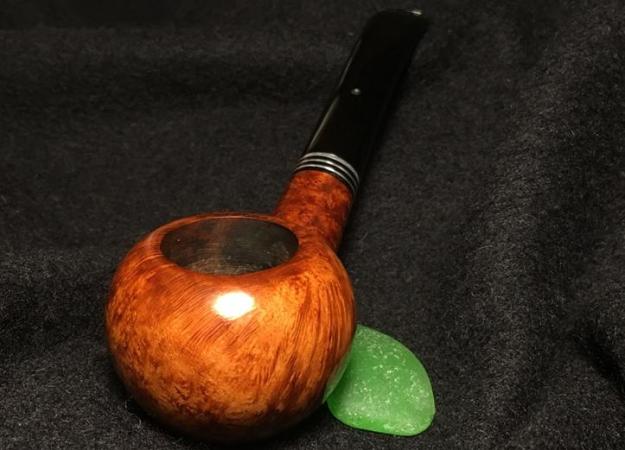
Renewing a Prince of Wales Hand Made Oom Paul


Blog by Steve Laug

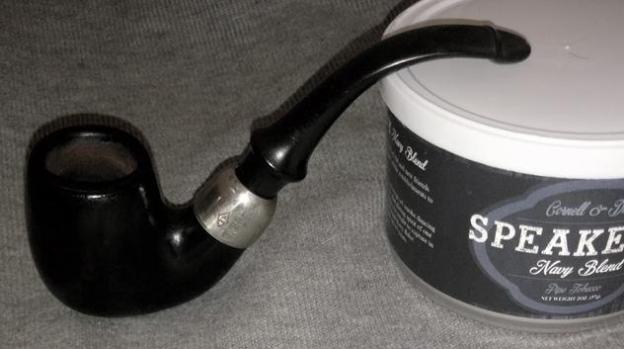
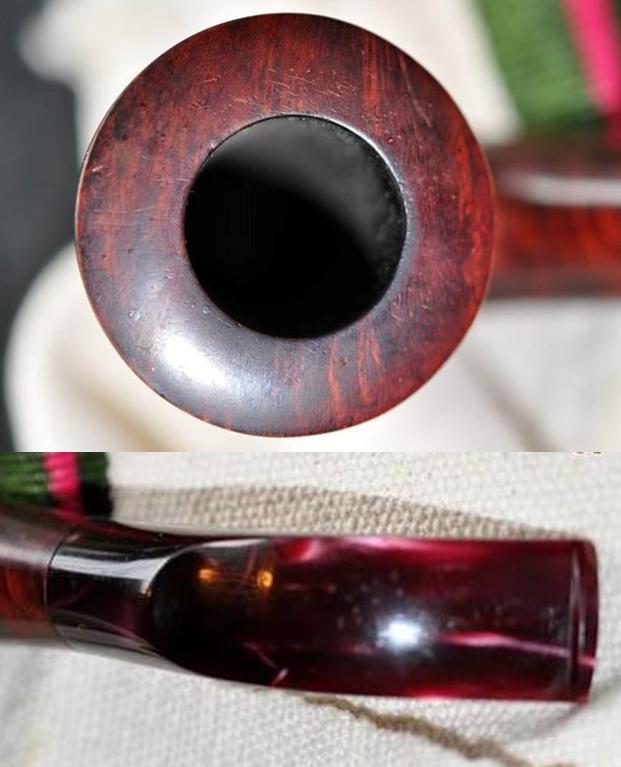
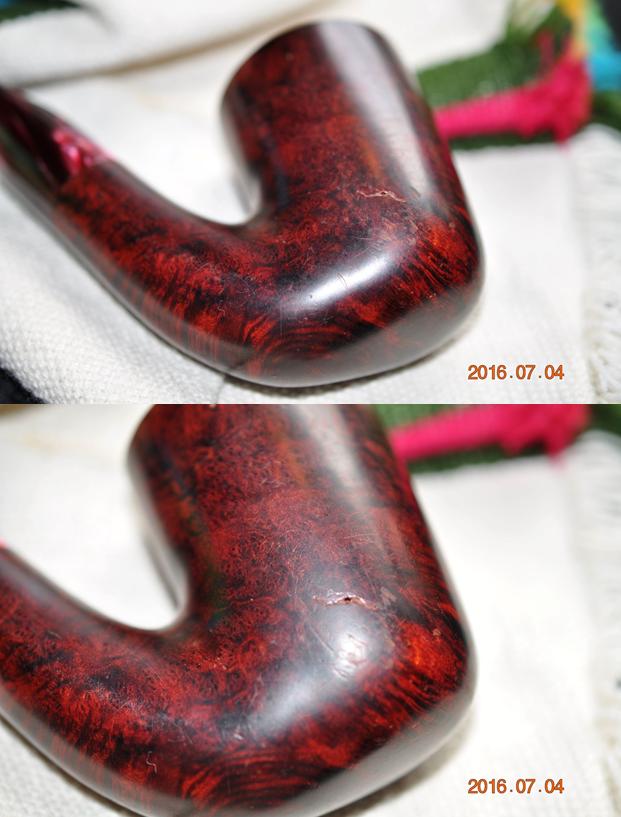
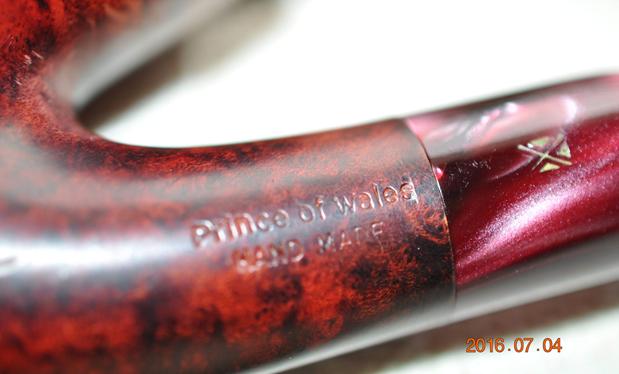
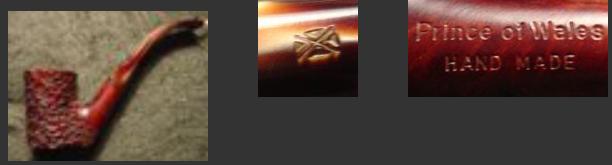
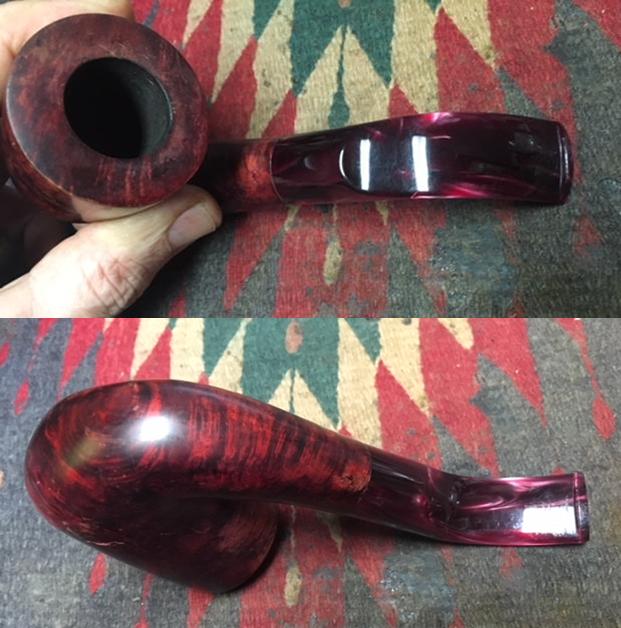
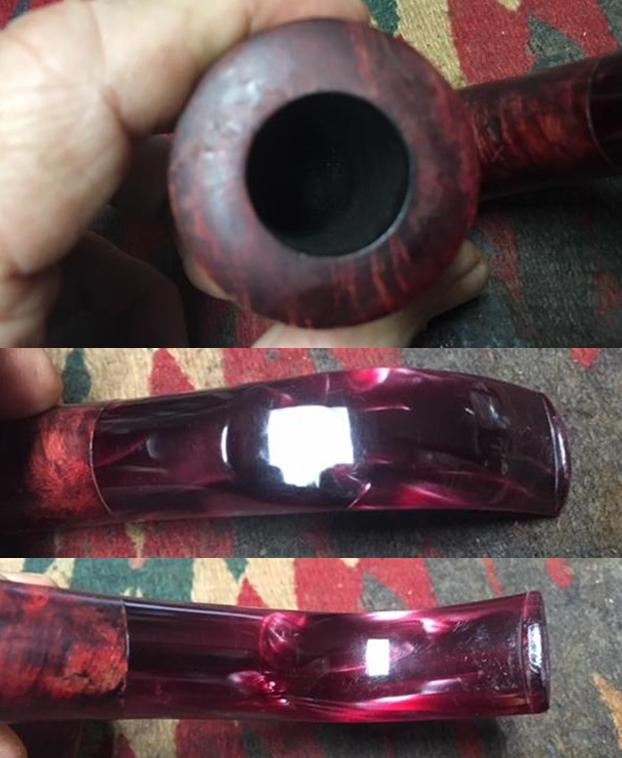
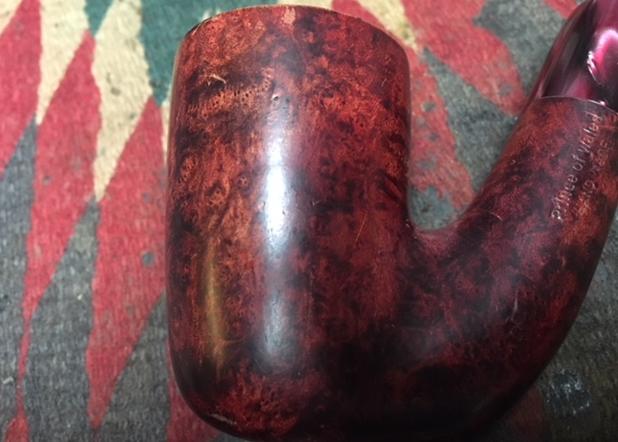
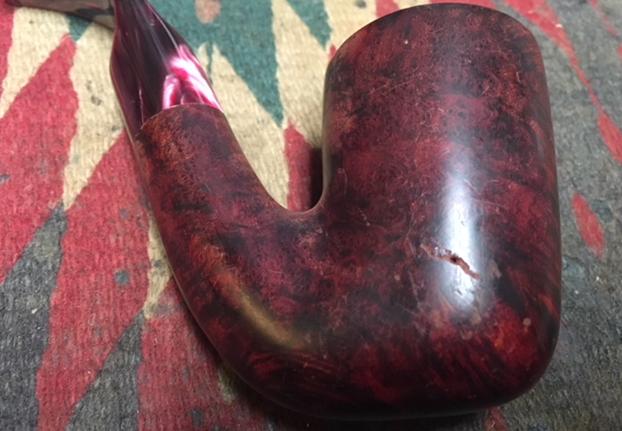
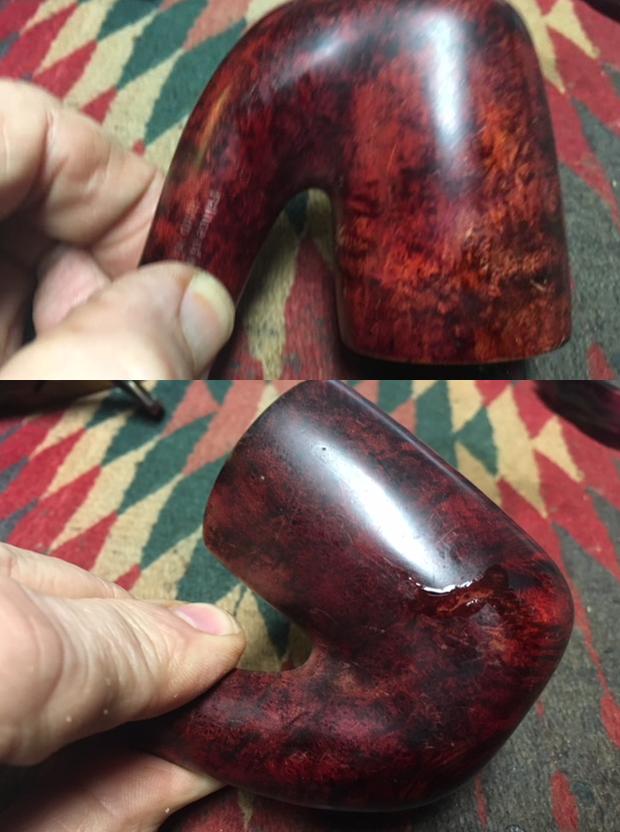
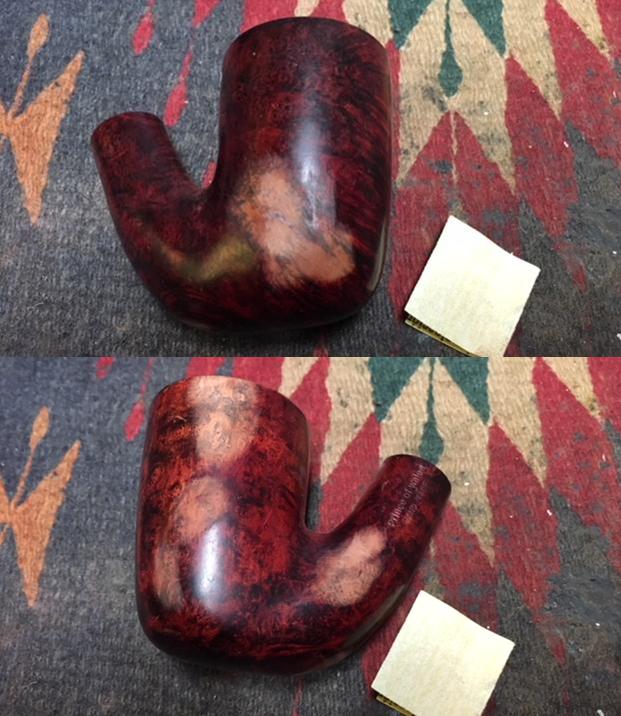
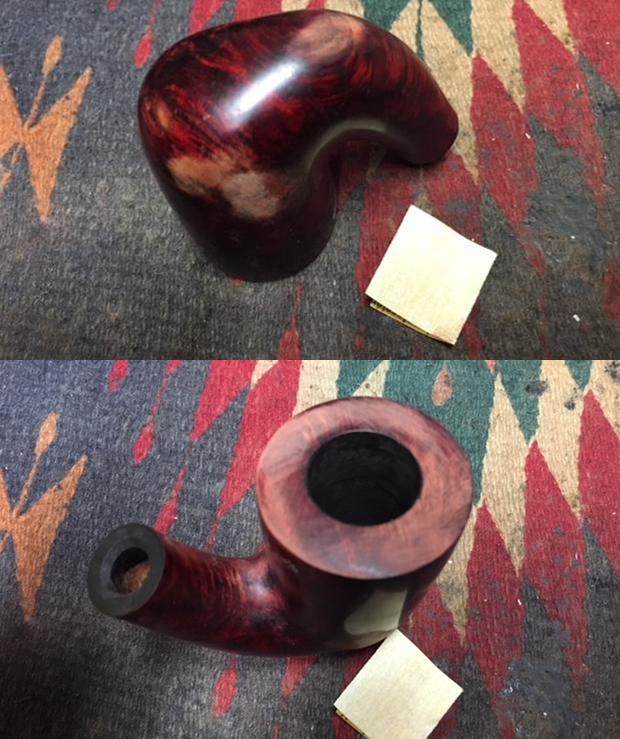
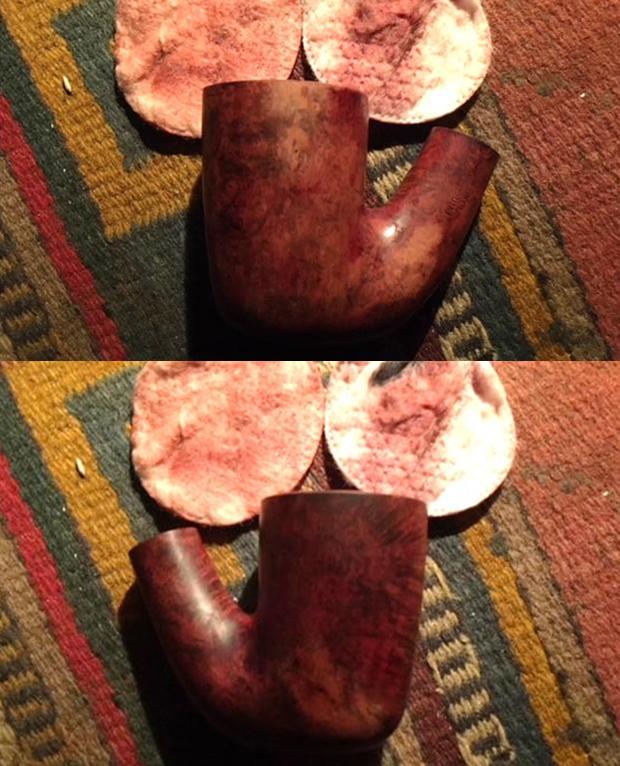
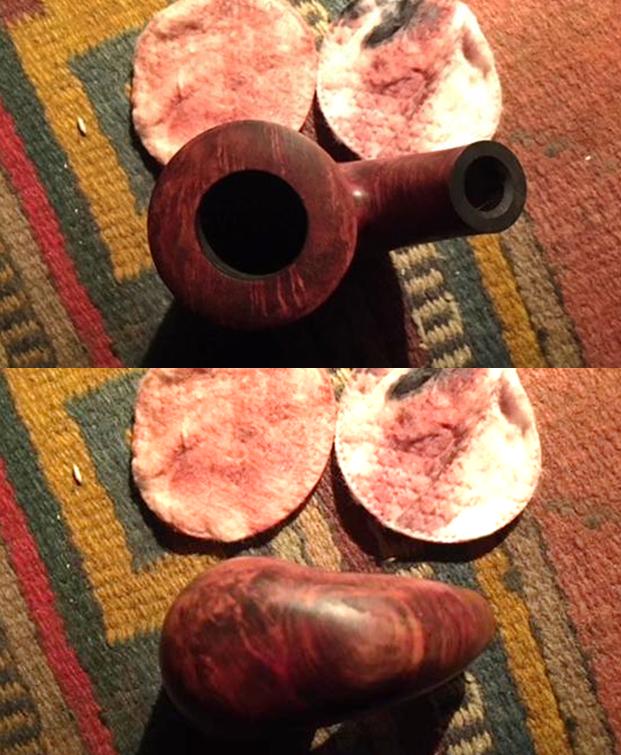
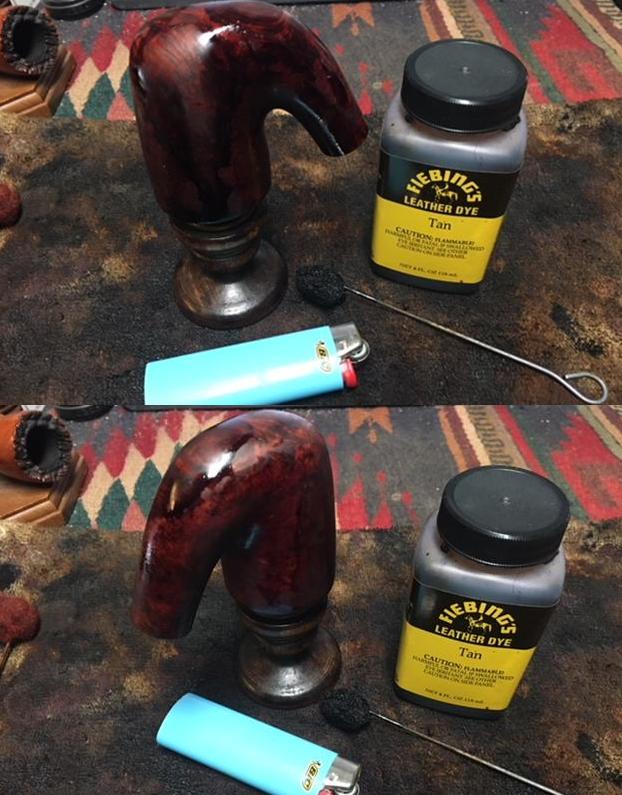
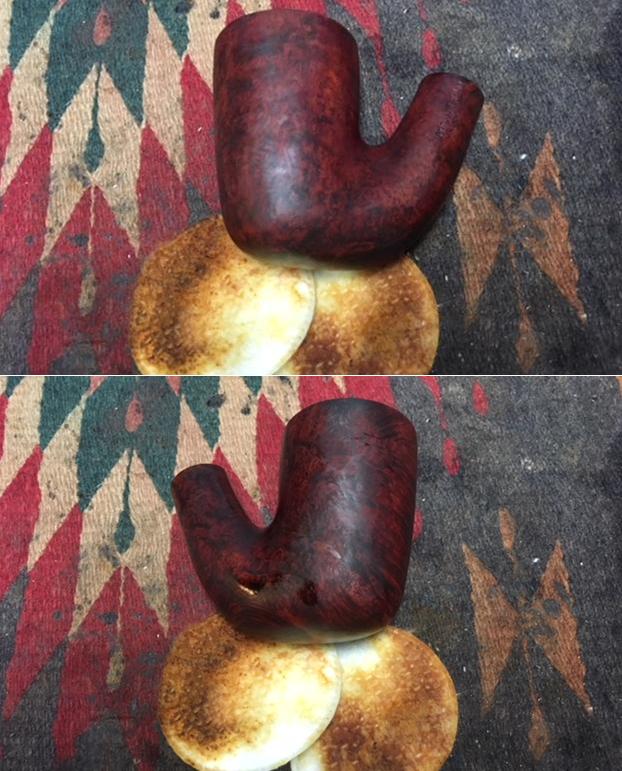
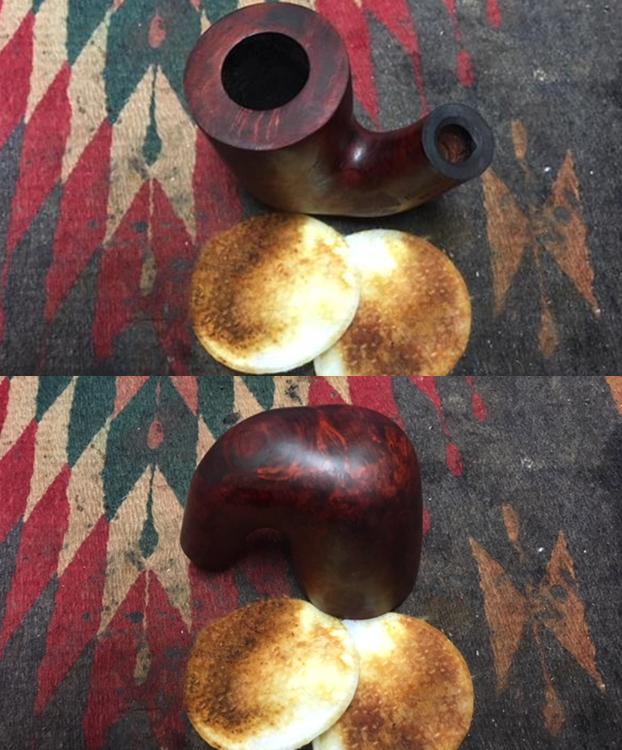
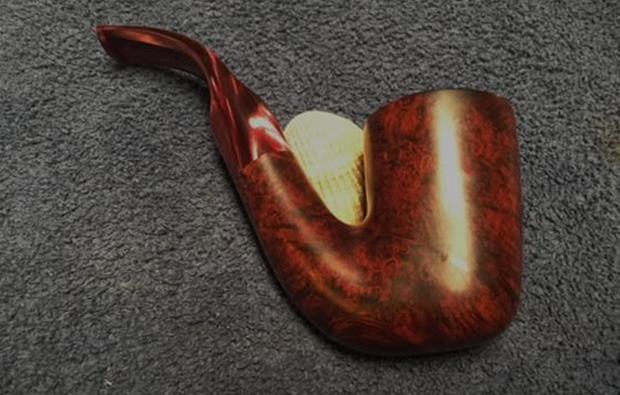
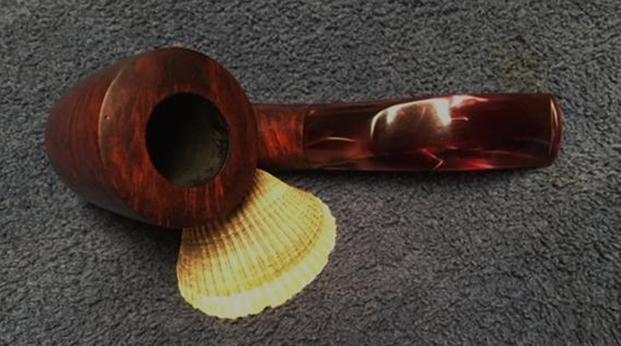
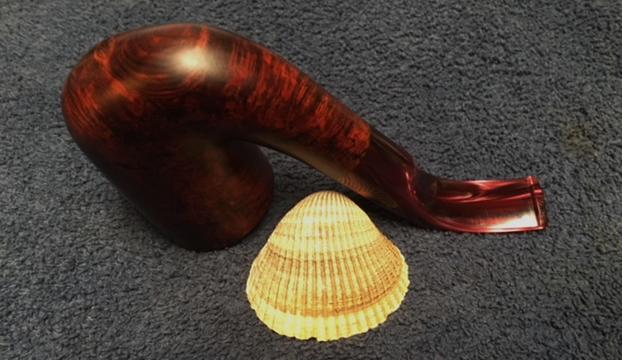
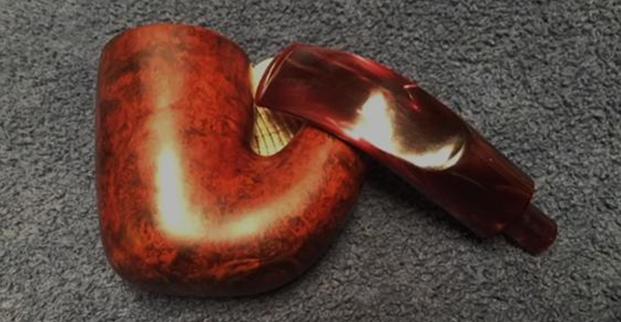
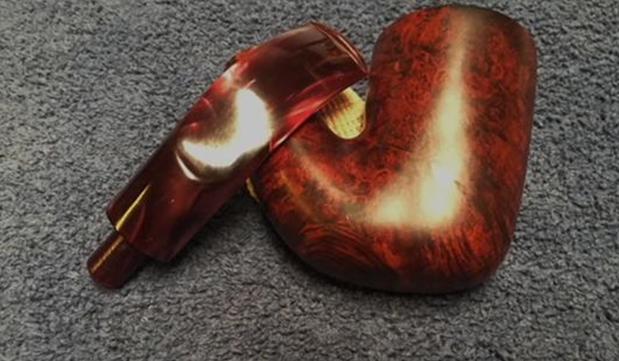
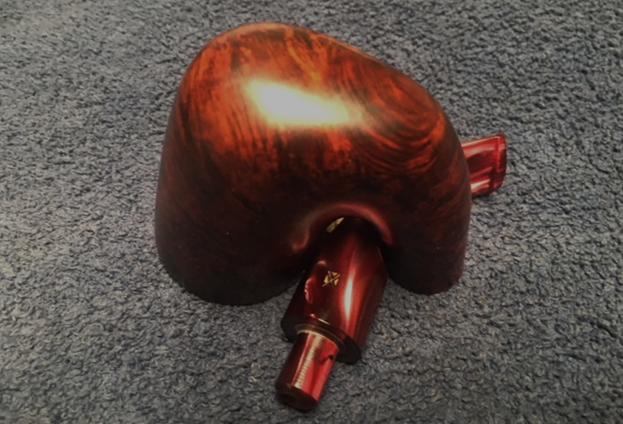
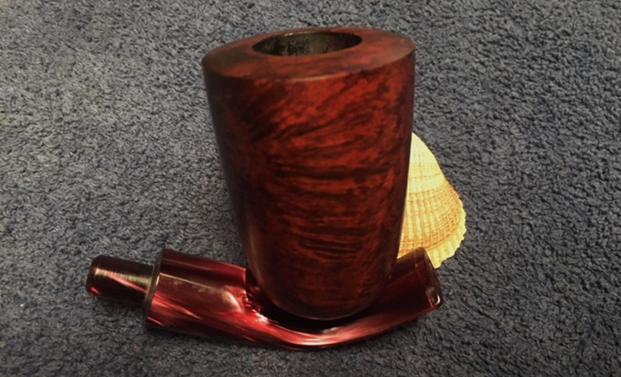
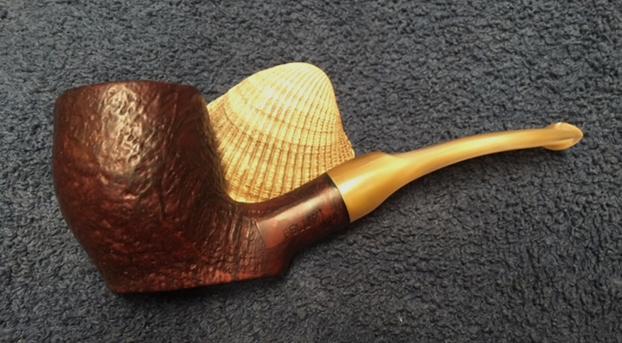
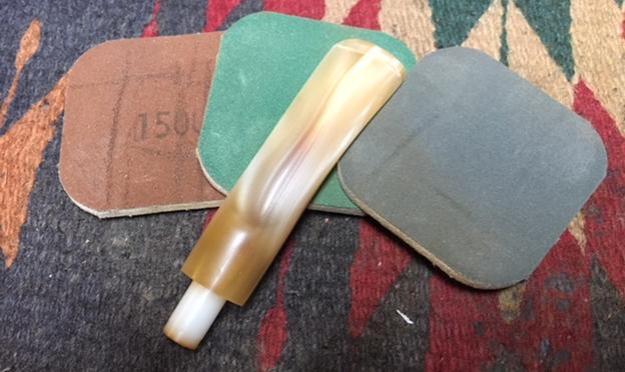
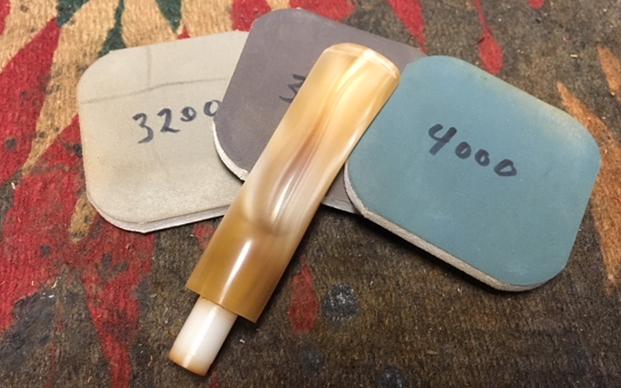
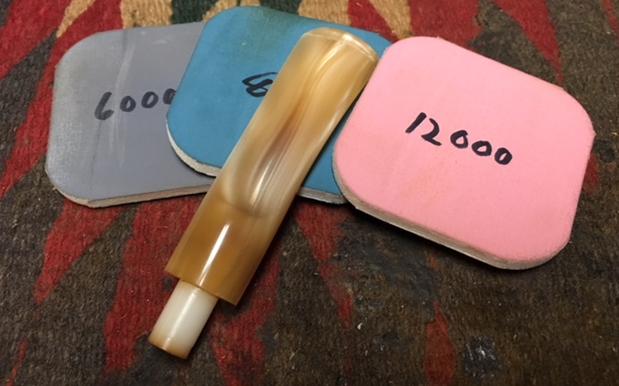
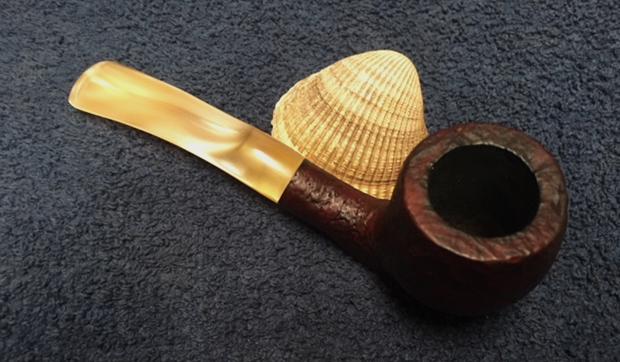
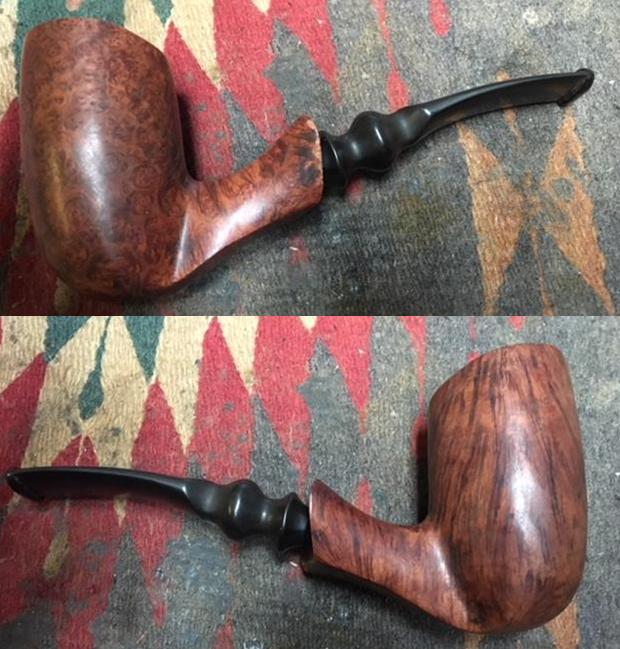
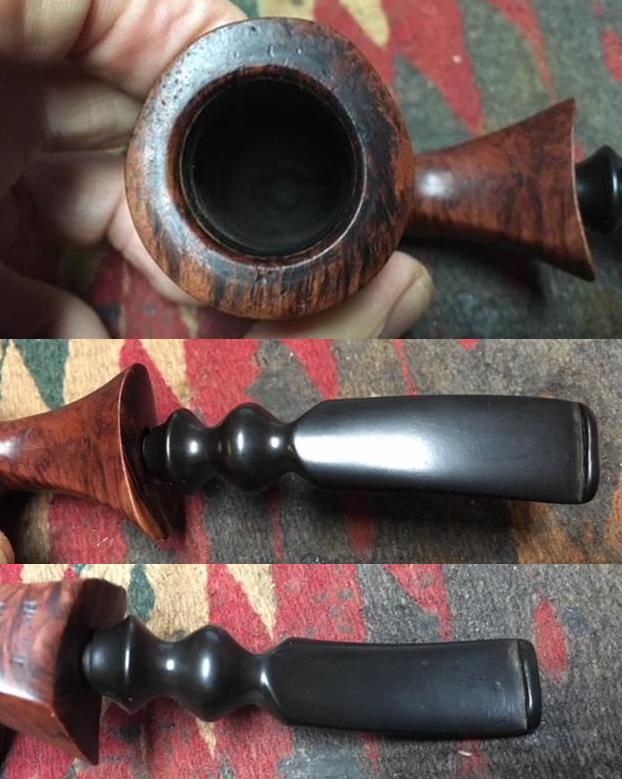
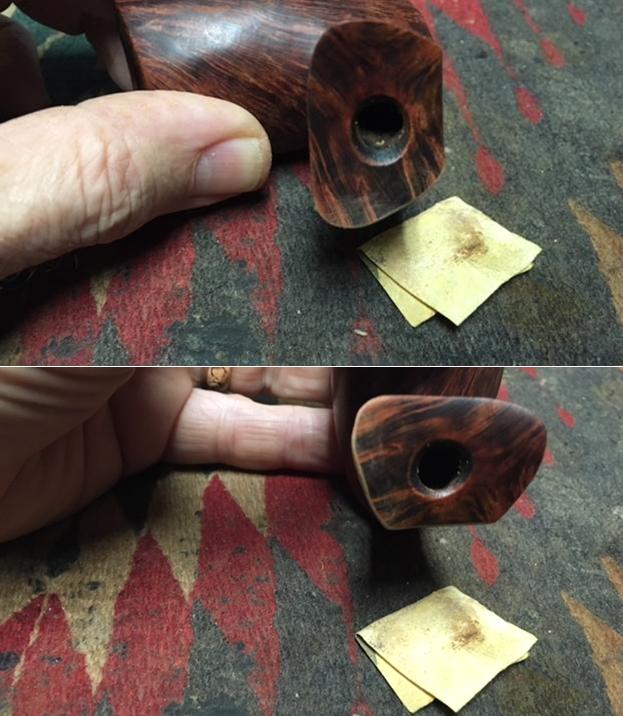
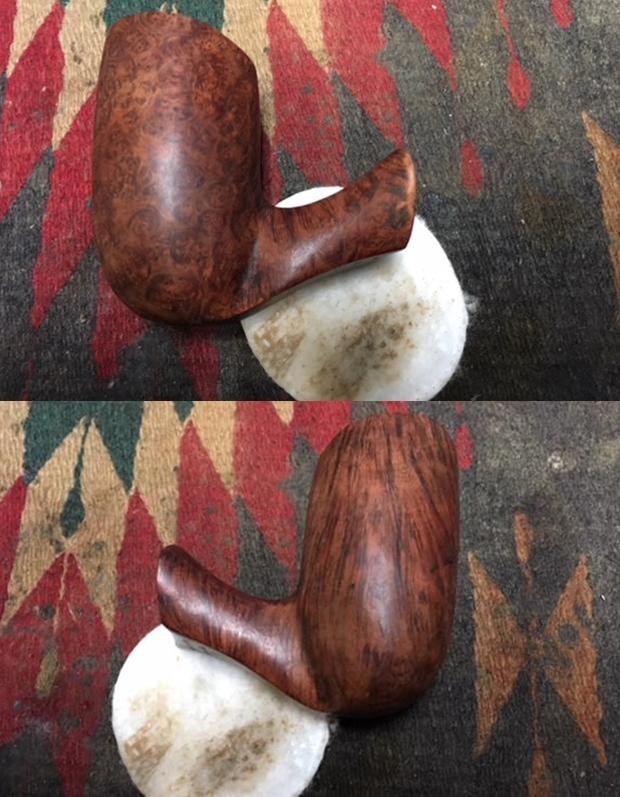
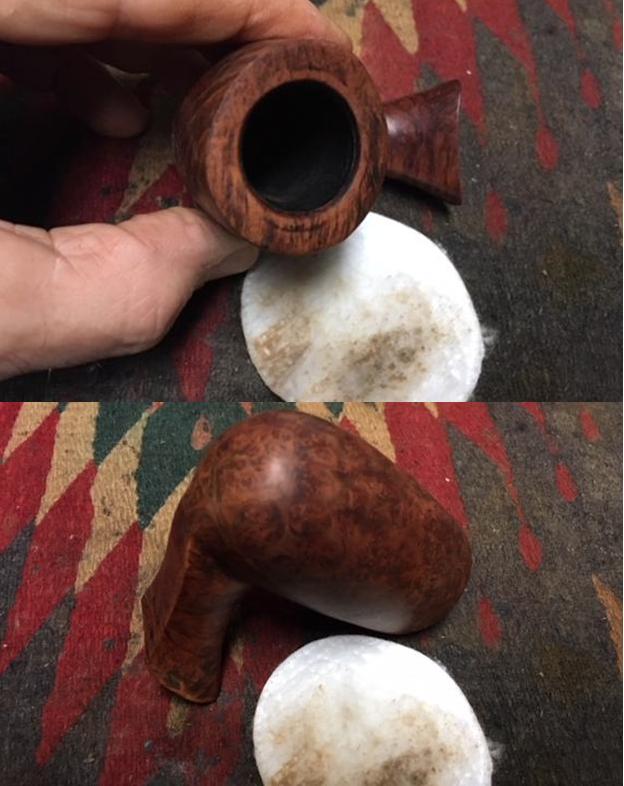
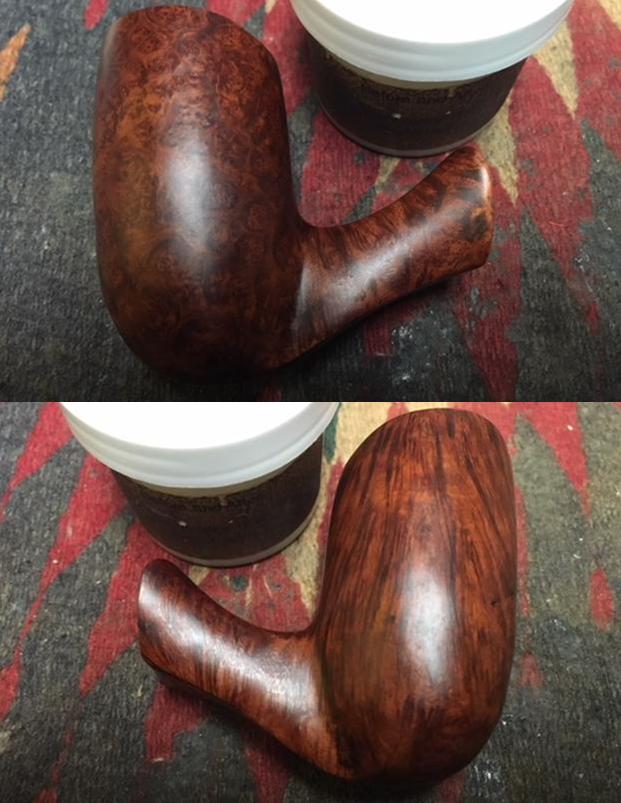
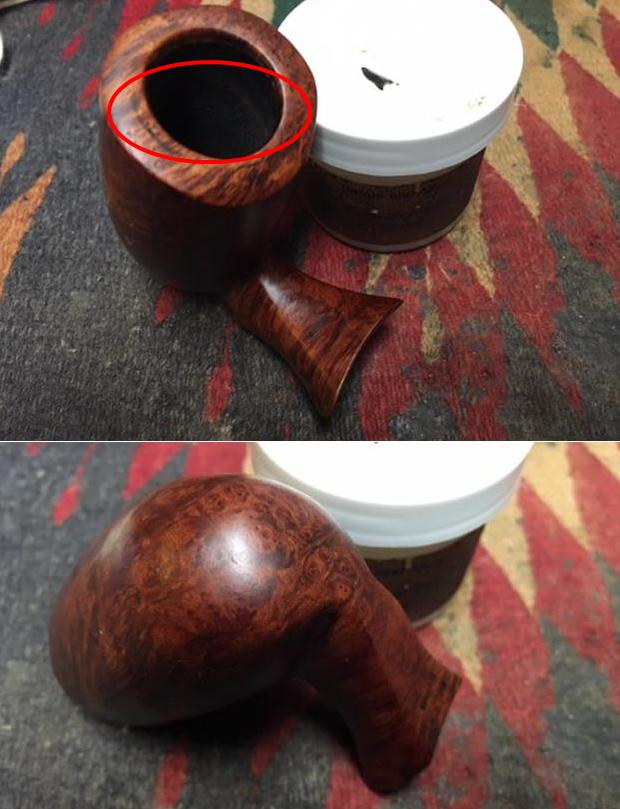
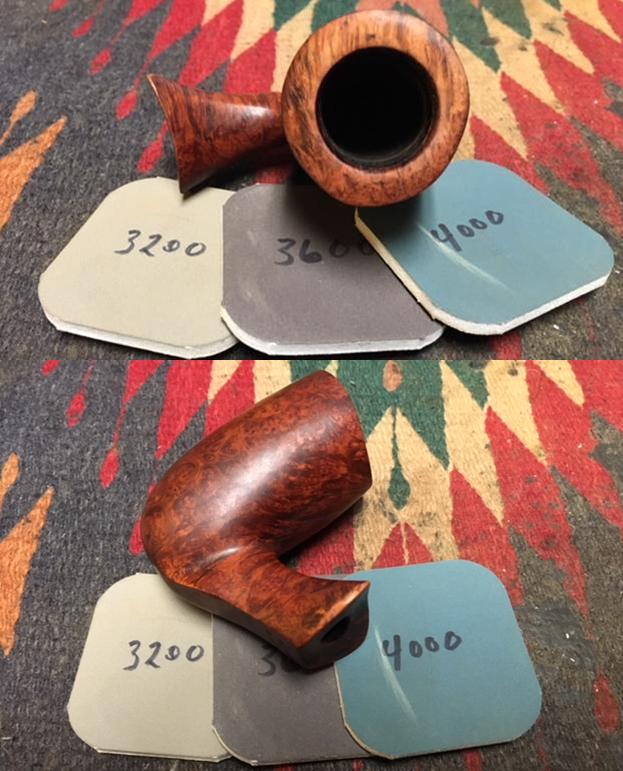
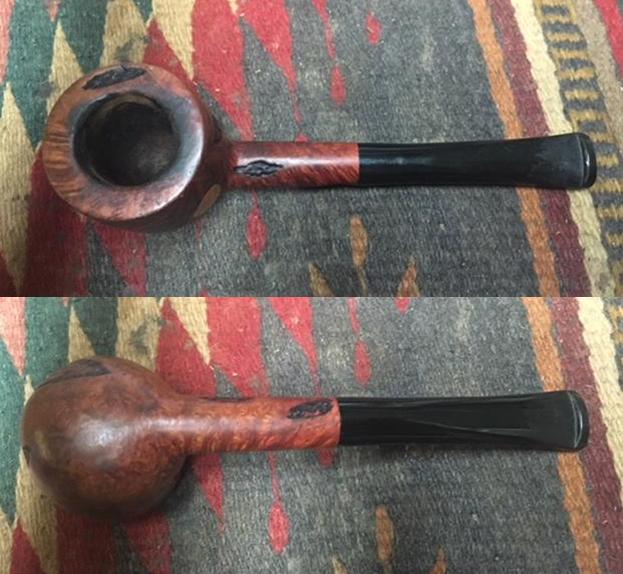
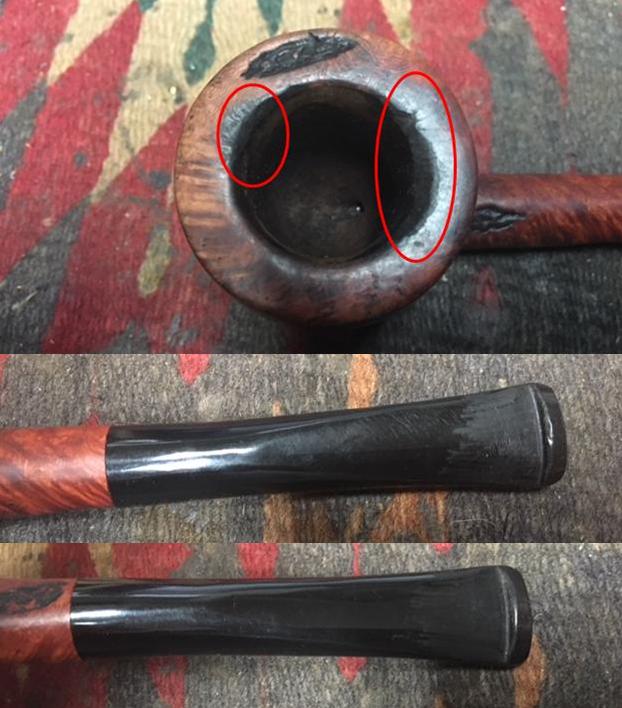
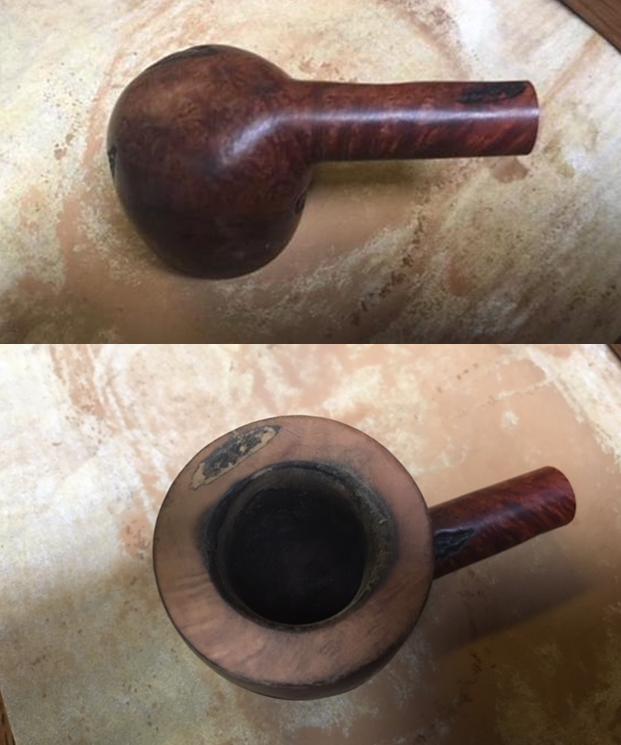
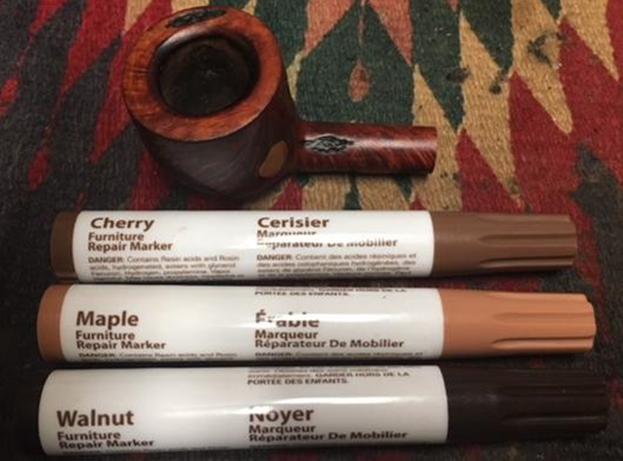
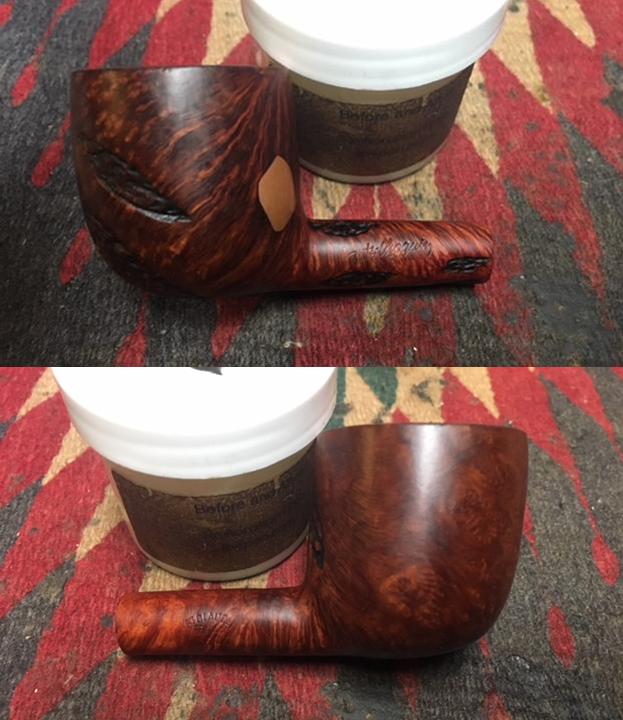
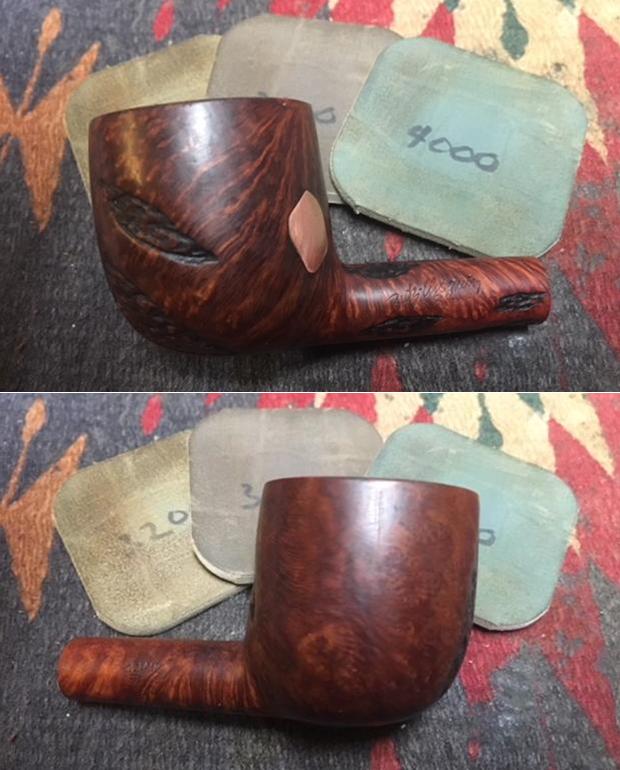
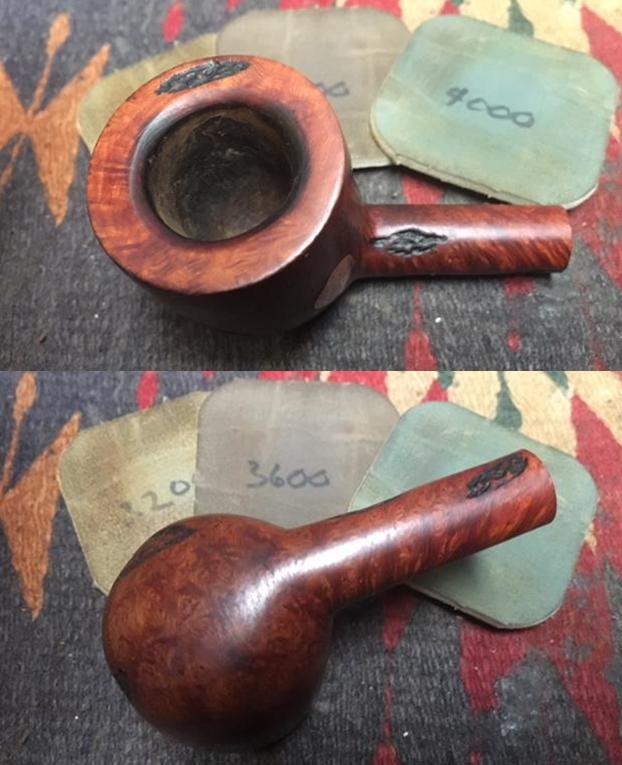
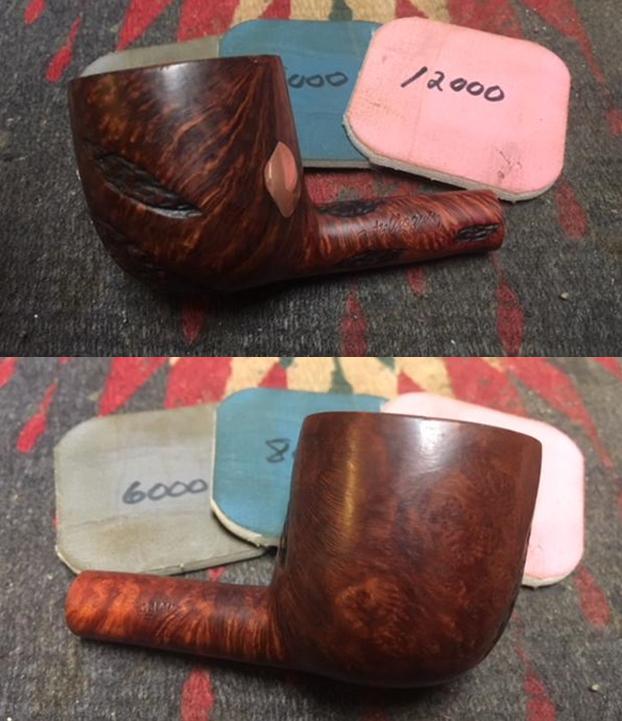
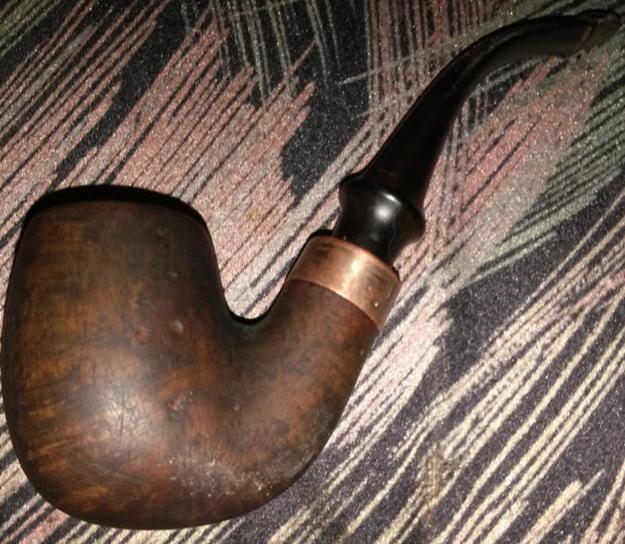
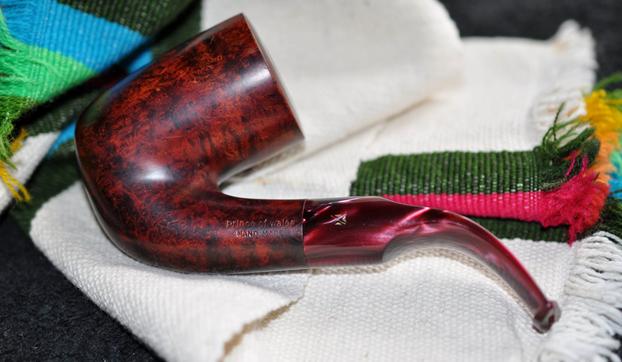
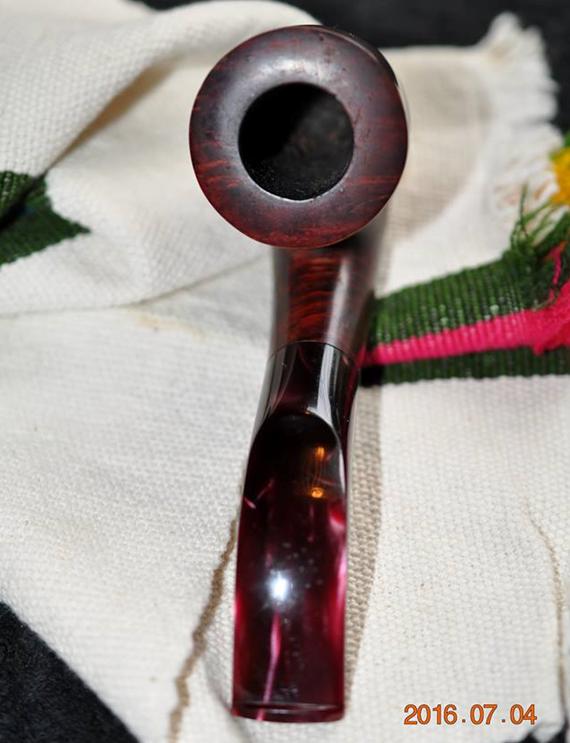
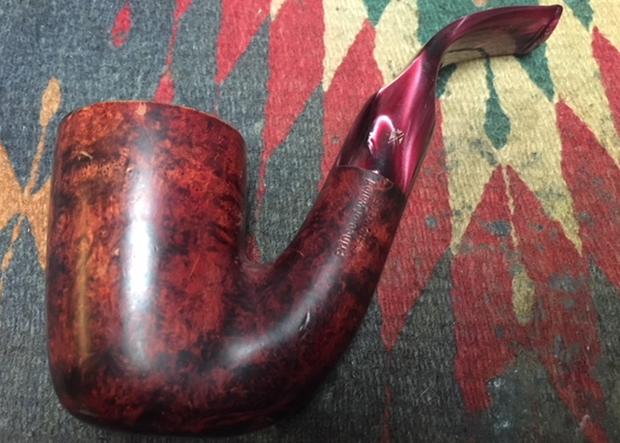
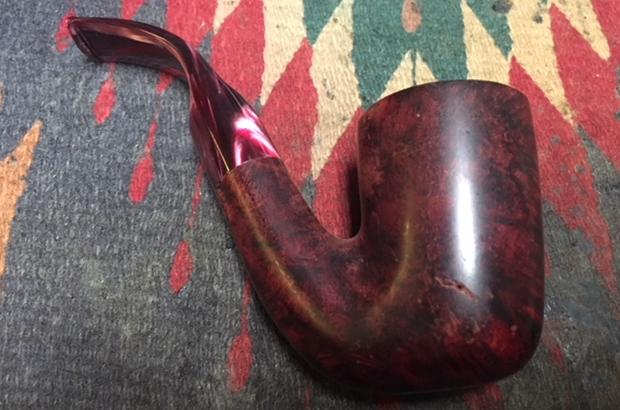
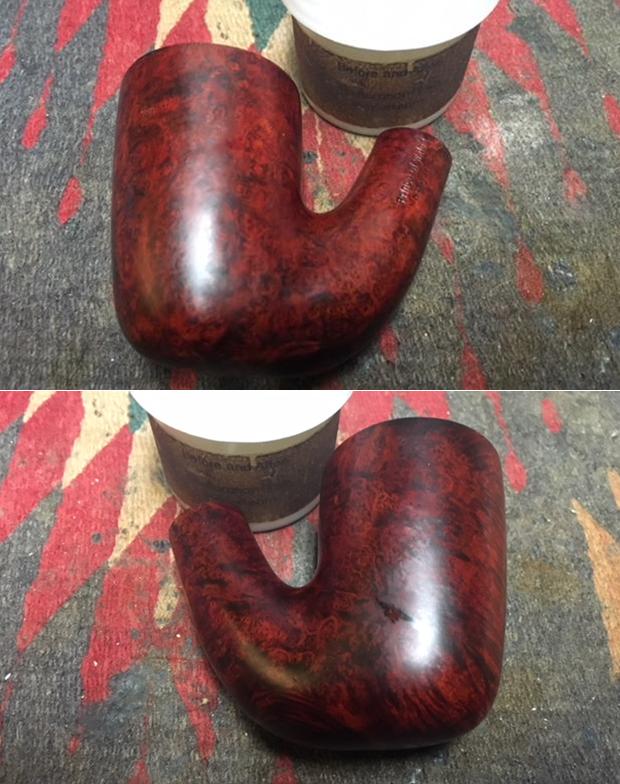
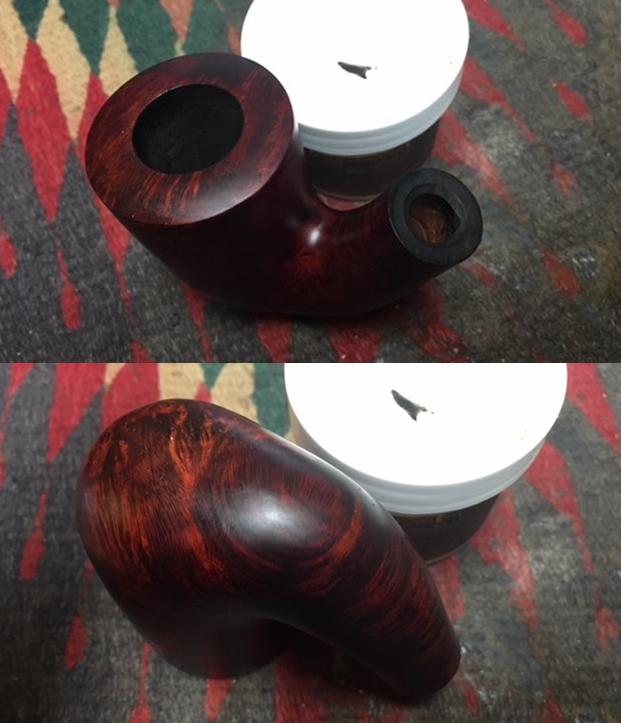
The next pipe on the table is the second of a pair of Oom Paul pipes that my brother Jeff picked up in from a guy in Texas. I wrote a blog about the cleanup of that one already. It is the pipe shown on the left side in the photo below. It was a Siena Artistica Oom Paul. The link to the previous blog is: (https://rebornpipes.com/2018/09/04/finally-a-simple-restoration-a-siena-artistica-oom-paul/). The second pipe is shown on the right side of the photo above. It is also a full bent Oom Paul but it has a smooth finish. The finish was in rough condition and was a Cordovan colour. There were a lot of nicks and damaged fills on the sides of the pipe. It has some great grain that shows through the grime on the bowl sides. Once it is cleaned and repaired that grain should show through nicely. The pipe is stamped on the left side of the shank Prince of Wales over Hand Made. There is no other stamping on the shank or bowl. The rim top was dirty and there were nicks and dents in the crowned surface. Fortunately there was no damage on the inner and outer edges of the bowl. The bowl had a light cake in it that would be easy to deal with. The stem was acrylic and variegated red. It had some tooth chatter and scratching on both sides near the button. Jeff took photos of the pipe before he started his cleanup up work. He took a closeup photo of the rim top showing that it was quite clean. The crowned surface was nicked and scratched. The edges of the bowl look very good. There is a light cake in the bowl. The stem was in good condition. There was some tooth chatter and scratches on the top and underside near the button.He took several photos of the finish to show the largest damaged fill on the right side of the bowl. The first photo gives an overview of the right side of the bowl and shank. You can see the wear and tear on the finish and the nicks and scratches. There is also a damaged fill mid bowl. The second photo shows the damaged fill clearly.The next photo shows the stamping on the shank and on the Scottish flag logo on the left side of the stem.I turned to the two websites that I regularly check for background on pipe brands. The first was Pipedia. I found the brand listed and the short description on the wiki that linked the brand to GBD pipes. It stated that it is a GBD sub-brand (https://pipedia.org/wiki/Prince_Of_Wales). It also included a link to the second site that I check, Pipephil. There it said that the brand was made in England. It bears the Scottish flag (X-shaped cross representing the cross of the Christian martyr Saint Andrew, the patron saint of Scotland) as logo. I did a screen capture of the stamping on the shank and stem that was included on the site. I include that below (http://www.pipephil.eu/logos/en/logo-p5.html). The stamping on shank read Prince of Wales over Hand Made like the screen capture above. It is very readable and clean. Jeff had scrubbed the exterior of the bowl with Murphy’s Oil soap and removed the dust and grime that had accumulated there. The finish was damaged but was worn and needed some repairs once it had been scrubbed. He reamed the bowl with a PipNet Pipe reamer and cleaned up the remnants of cake with a Savinelli Fitsall Pipe Knife. He cleaned the interior of the mortise and the airway in the shank and the stem with alcohol, cotton swabs and pipe cleaners. The pipe came to me clean and ready to do the restoration. I took some photos of the pipe to show the condition at this point in the process. I took a photo of the rim top and to show the condition of the surface of the rim. There is some darkening on the inner edge of the bowl and a lot of nicks and surface damage. I also took close up photos of the stem to show its condition. There is some light tooth chatter and tooth marks on both sides near the button but otherwise it is in good condition.I took some photos of the bowl sides to show the dents, nicks and faulty fills that would need to be addressed in the restoration. I repaired the damaged areas on the bowl sides with clear super glue to smooth out the damage. Once they cured I would sand them smooth to blend them into the bowl. Because there were so many damaged areas it would require restaining the bowl.It did not take too long for the repairs to cure. I sanded the repaired areas smooth with 220 grit sandpaper. I took photos of the bowl after the sanding to show the spotted, leprous look of the bowl after sanding. To further blend the repairs into the bowl surface I would need to stain it again. In preparation for restaining I wiped the bowl down with isopropyl alcohol to remove much of the previous stain. I restained the pipe with my Fiebing’s Tan stain – remember it is mislabeled and is actually a cordovan stain. I applied it and flamed it with a lighter to set it in the briar. I repeated the stain/flame process until the coverage around the bowl was even.I let the stain set over night and in the morning wiped the bowl down with isopropyl on cotton pads to unveil the newly stained pipe. The pipe looked better. The fills were visible if you looked for them but they looked far better than when I had started. I rubbed the bowl down with Before & After Restoration Balm to deep clean the briar bowl and the rim top as well as the briar shank. I also have found that it really helps to blend a restain on briar. The product works to clean, enliven and protect the briar. I hand rubbed it with my fingers, working it into the exterior of the pipe. After it had been sitting for a little while, I buffed it with a soft cloth to polish it. The pipe really began to have a rich shine. I took some photos of the bowl at this point to mark the progress in the restoration. I set the bowl aside and turned my attention to the stem. I used a folded piece of 220 grit sandpaper to sand out the tooth chatter and marks on both sides of the stem just ahead of the button. They were not deep so it did not take too much to remove them.I polished the stem with micromesh sanding pads – wet sanding with 1500-2400 grit pads and dry sanding with 3200-12000 grit pads. I wiped the stem down after each pad with a damp cloth to remove the sanding dust on the vulcanite. When I finished polishing and wiping it down I set it aside to dry. I polished stem and bowl with Blue Diamond to polish out the remaining small scratches. I gave the bowl and the stem multiple coats of carnauba wax. I buffed the pipe with a clean buffing pad to raise the shine. I hand buffed it with a microfiber cloth to deepen the shine. The pipe polished up pretty nicely. The dark undercoat and the cordovan combine to give the briar depth and a rich look. The polished variegated red and burgundy acrylic stem work together with the stained briar to give the pipe a rich look. The finished pipe is shown in the photos below. This is a beautiful smooth finish Oom Paul made by GBD. The pipe has already found a new home. The shape, finish and flow of the pipe and stem are very well done. The dimensions are Length: 6 inches, Height: 2 3/4 inches, Outside diameter of the bowl: 1 3/4 inches, Chamber diameter: 3/4 inches. This one will join the rusticated Oom Paul and soon be on its way to the southern US. Its new trustee is looking forward to firing up both of these pipes. Thanks for walking through the restoration with me as I worked over this unique Oom Paul. 

Dressing up a Dinner Pipe 1/4: The Trident Experiment


Blog by Robert M. Boughton

Copyright © Reborn Pipes and the Author except as cited
https://www.facebook.com/roadrunnerpipes/

“Ah,” she cried, “you look so cool.” 
— Daisy to Gatsby in The Great Gatsby (1925), Ch. 7, by F. Scott Fitzgerald

INTRODUCTION
The whole unlikely adventure started when one of my two housemates, Mike, who rents a room from the owner as I do, somehow got it in his head that he wanted me to make the perfectly nice Trident full bent billiard I sold him for next to nothing into a dress pipe.  As Mike is a complete novice when it comes to pipes, I didn’t even want to guess how he heard of the term many far more experienced smokers don’t know.  The Trident is fashioned in the classic style of a Peterson system pipe.

Trident original before
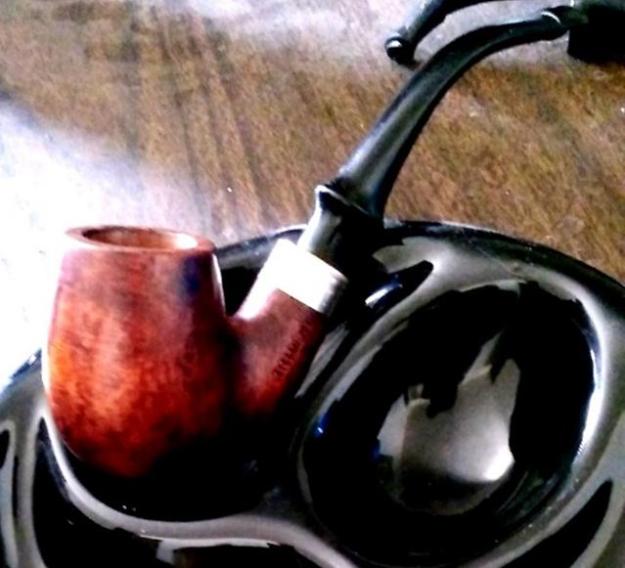
Trident original after
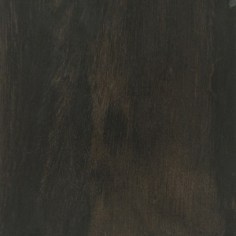
Gaboon ebony *

Dress pipes have also been called by other appropriate adjectives including dinner, evening and cocktail, and now are more often referred to as ebony.  That may be the worst name for this style, which renders the pipe with a jet black and shiny finish, as it refers to one of the rarest and most expensive (and now almost extinct) hardwoods from the tree of the same name.  Ebony heartwood tends toward dark black, but the extreme density – 3,080 lbf compared to 2,090 for briar on the Janka Scale – eats up cutting equipment like hors-d’oeuvres at a redneck bachelor party.  For that and other reasons, it is a poor choice for pipes.  But one thing is certain: a black dress pipe does look so cool.

Assuring Mike that I would look into the process and necessary supplies, soon afterward I told him I had a tentative list, and it wouldn’t be expensive. That’s when he dropped the indefensible bombshell on me about how he had thrown the Trident away because “it didn’t work out” and bought a corncob. Then he said he didn’t think I was serious about dressing up the Trident. Is that not the perfect example of waffling or am I missing something? By an amazing stroke of luck, the trash collectors had not come, and at my rather frantic suggestion Mike retrieved the pipe from the garbage. Here’s what it looked like after maybe a month of use by him.The velocity of the Trident’s trip from being restored to like-new condition to worse than when I first received it has to be some kind of record.  Needless to say, given the garbage incident and the horrendous wear and tear in such a short time, I was reluctant to turn it into a high maintenance item.  When Mike said I could have it, that ended that dilemma.  He later regretted the decision – but there’s the only preview of Part 2 of this series I’ll give here.
HISTORY AND THEORY OF THE DRESS PIPE
Dating a pipe, even to an approximation as close as a decade, can be impossible.  Determining the origins of names for some shapes, such as the Oom Paul, might be easier but is still murky.  [Stephanus Johannes Paulus Kruger, president of the South African Republic, the Transvaal, and a fierce military leader against the British in the Second Boer War (1899-1902), is said to have chain-smoked a pipe of an uncommon shape.  His nickname among the Afrikaans inhabitants was Oom, for uncle, Paul – hence, the Oom Paul, although the name is debated, as is most everything pipe-related.]  Of course, coming up with a theory for the beginning of a special style of pipe, such as the dress as a finishing method, is by the nature of the guesswork involved much easier.
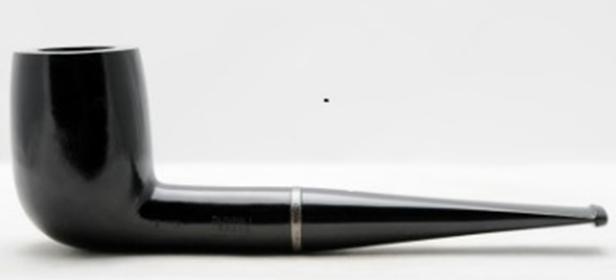
Dunhill 61032 Dress 1983 courtesy Paronelli Pipe

The basic premise of a dress pipe (or in the alternative again, evening, cocktail or ebony) is something that stands out and dazzles from across a room, and further, one that should only be used on special occasions because of its appearance and greater susceptibility to damage.  Andrew Wike wrote a thoughtful 2014 essay, in the Pipe Line section of Smokingpipes.com, titled “Dressed for the Occasion.”  In a space that could have amounted to no more than a single page from a word processor, Mr. Wike employs elegant concision pondering the important question of which one of his pipes he should take to a friend’s wedding – and he even provides illustrations, descriptions and the basic qualities of a handful he recommends for such formal situations.

Starting his personal debate process with a smooth, jet-black Dunhill billiard derived from the collection Mr. Wike writes started the term “dress pipe” (and similar to the one shown here), he notes the classic elegance of Dunhill’s line, including the traditional sterling silver band, and compares the beautiful work to a tuxedo.

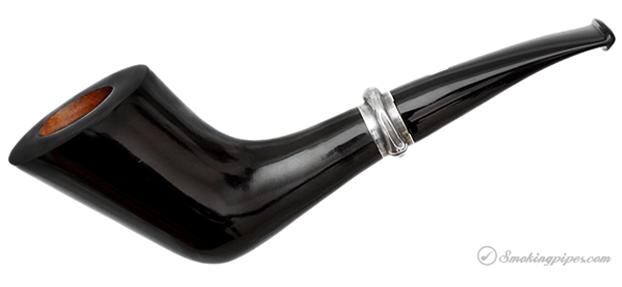
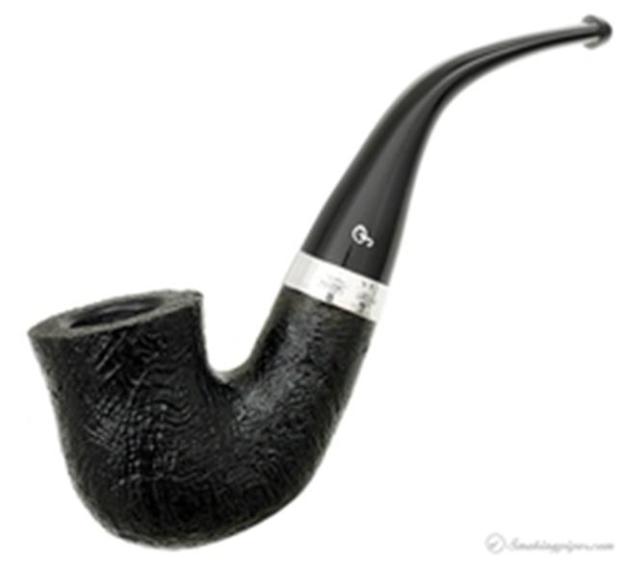
Mr. Wike moves on to Castello’s wonderful Perla Nera line and observes that these pipes vary from having no band or various ferules, as well as this Perla Nera Horn with a silver bamboo band below.Then Mr. Wike asks the perfect question, one that had been nagging me: “Who says your dress pipes have to be smooth finished?”  One excellent illustration is an unusual sandblasted Peterson Cara that SmokingPipes.com calls a bell style Dublin/Calabash hybrid.Skipping to the end of Mr. Wike’s list, I have to include his stunning example of a Tsuge dress pipe gone wild, the Urushi Sakura with its hand-painted floral design on the otherwise shimmering lacquer-coated black bowl, a black bamboo extension and brass fittings.Here’s my theory.  While the actual date of introduction of the black dress pipe is elusive, the likelihood of that flashy style of finish being conceived at all before the 20th century, much less as fashionable, is hard to imagine.
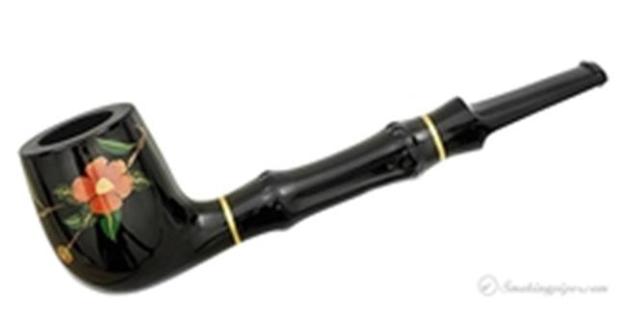
What better period of time and place for such a style than the Roaring ’20s in the U.S.?  Although I have not yet found an example from quite that far back, I can’t help the mental image that pops to mind of some of the wealthy revelers of that era, as recorded in The Great Gatsby and summed up with the simple quote opening this blog, trailing wisps of smoke from just such elegant, shiny black pipes with the ballroom lights in West Egg glinting off them.

Dunhill made its formal introduction of the Evening Dress Pipe in 1973, as shown below.
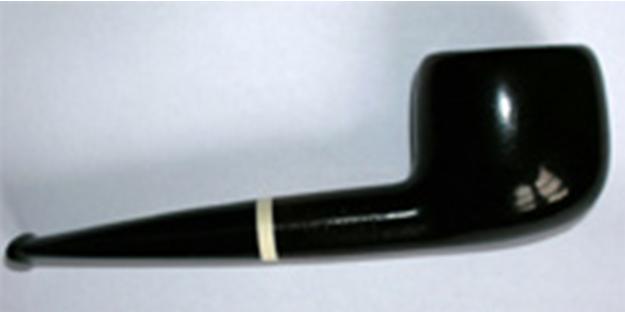
Dunhill Evening Dress Pipe courtesy Pipedia
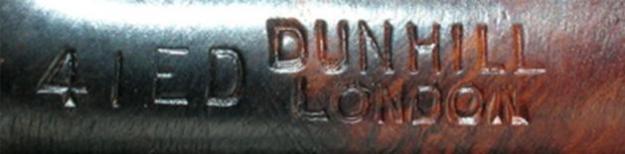
Nomenclature left side
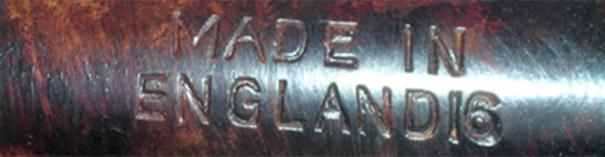
Nomenclature right side

However, several examples of Dunhill pipes associated with the word cocktail trace to the 1930s.  As well as the traditional black model shown below, green and red versions of Dunhill’s Lady’s Cocktail Pipe were made in 1934.
Dunhill Lady’s Cocktail Pipe, courtesy Pipephil

The following magazine ad from March of the same year is a hoot.  I couldn’t help letting out a healthy guffaw that startled one of my other housemates, the owner, when I took in the cloying sexism of a bygone era – in particular the idea of protecting the fingers of our precious little homemakers from being yellowed.

Courtesy Pipephil, from Modern Mechanix

If I didn’t know of too many occasions when Dunhill took credit for methods of making pipes that had already been used by different brands, I might have no doubt this was the first dress pipe.  But 1934 is too close to the 1920s for my comfort.  For now, it remains the earliest I can trace.

PREP WORK
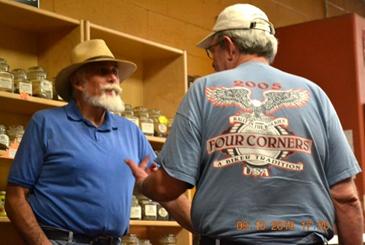
Go ahead and chalk it up to coincidence, if you like, but at the very next monthly meeting of my pipe club after I set my mind to dressing up my abused but still savable Trident, I tuned into an interesting conversation next to me.  Don Gillmore, a respected artisan whose business is known as Don Warren Pipes (dwpipes) in Albuquerque, was talking to another restorer about the use of shellac on many of his pipes.  I was shocked for several reasons, chief of which was that I’ve seen quite a few examples of Don’s masterful creations over the years and never had a clue that shellac might have been involved.  I also knew that shellac, like varnish and certain other finishes, can, in excess at any rate, affect a pipe’s ability to breathe and lead to damages.  Until that moment, I had only associated it with awful, cheap Chinese pipe abominations, with the one exception being dress pipes for which I deemed the substance a necessary evil.  Unable to join the conversation, I resolved to email Don for more information on the subject, in particular how I might go about dressing a pipe in black.
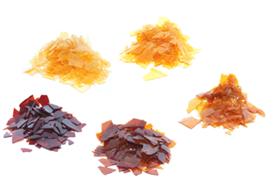
Flake shellac courtesy Wikipedia

First, I looked up shellac online.  I was surprised to learn that it is natural and converts to flake form from a resin secreted by the female lac bug on trees in India and Thailand.   Really, I’m not a bad raconteur, but I don’t have the gift of gab needed to spin that good of a yarn!  The finish has been in use for millennia and in various forms with artwork and wood finishing in general and furniture in particular for centuries, but not until the 1800s did it become preferred to oils and waxes for woods.

The following is a condensed version of the ensuing email exchange between Don and me.  Rather than the usual lacquer that seems to be the most common final coat used by the big pipe brands, Don repeated that he uses a thin coat of orange flake shellac on some of his pipes.  I asked if black shellac might be as good or better, and his answer was a firm but polite no.  He assured me the orange shellac would be clear by the time I reached that point.

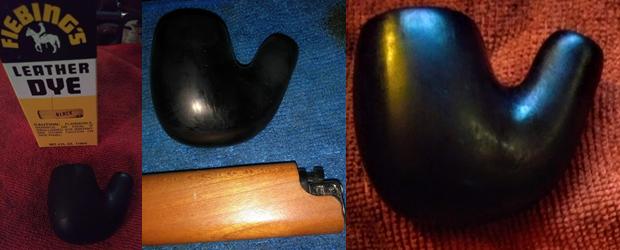
To reveal how clueless I was at the outset of my decision to try dressing up a pipe, I read numerous online references to the need for black aniline dye and even consulted the definition of aniline, which in every standard English dictionary published omits the most pertinent aspect.  Only after at least an hour of obsessive searching did I find a mind-numbing technical treatise on the subject that mentioned, somewhere in the blur of multiple-digit chemistry terms, the simple word alcohol.  Realizing my default leather stain was in fact an aniline dye, I was both relieved by the discovery and angered by the waste of time to which I was subjected.  Even when I posted a thread on an online smokers’ forum asking for help, everyone replied that black aniline dye was what I wanted!  But a few deep breaths later, I was back to my usual self again.

Don provided links to the site where he buys his orange flake shellac, a chart that shows the various mixtures of the flakes (aka buttons) with, ideally, 190-proof denatured alcohol dependent upon the desired thickness, and even detailed instructions for applying the shellac once it is rendered to pure liquid form.  All of this information can be found at obvious links in my sources, but you know I’ll describe the whole process soon enough.

LIQUEFYING FLAKE SHELLAC FOR IDIOTS
The Pound Cut Chart says it all – in fact, maybe more than you need to know for use with pipes – but the order is a bit whacked.  The main issue I have with it is how simple the process is compared to the way it’s described.  I had to consult Don for more than a few clarifications, which he was happy and gracious to supply.  That’s why I’m going to lay it out in this EZ synopsis.

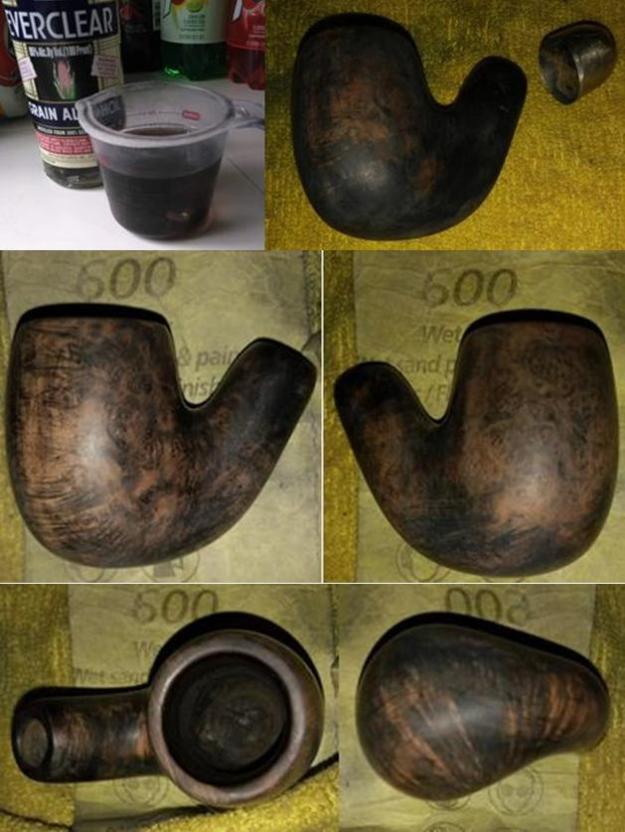
To be sure, the official instructions are spot-on about three points: 190-proof denatured alcohol as the ideal agent for liquefication, the need to crush the flakes to as fine a degree as possible and the mix of alcohol and ground flake for the thickness and amount desired as shown in the chart.  Whatever size mix is made should last three months (its effective shelf life), and Behlen Behkol Solvent is specifically mentioned, although I used Everclear.  For my first batch of liquid shellac, I did not crush the flakes quite as small as they should have been.  It worked out but took longer to dissolve.  Here’s how to do it.

    1. From the Pound Cut Chart, decide how much liquid shellac you want and the thickness. Unless you’re going to use it all the time, a little goes a long way. Don recommended one cup of shellac at the one-pound cut (minimum thickness).  His reasoning was that it’s easier to apply a second coat if needed than to remove one.  Note: I ended up needing to do two coats, so I later made more at the two-pound cut.
    2. Crush the flakes, again, as fine as possible. I suspect a mortar and pestle would be perfect, but this is Albuquerque where such things other than very small types proved impossible to locate except online. Instead, I improvised with a chopping block and the flat bottom of a ceramic plate.  Getting the hang of that method wasn’t easy because the ornery flakes liked to shoot all over the place until I used mind over matter to develop my own style.  I highly recommend investing in a mortar and pestle!  If you’re thinking you might try grinding the flakes in a blender, remember they’re derived from resin and think again.
    3. Use a glass or plastic – not metal – container larger than the liquid amount you want.  For purposes of this first installment for which I used the one-pound cut, I poured one ounce (eight fluid ounces) of Everclear into a large glass baking pan and then slowly stirred in one ounce of flake with a rubber batter mixer.  The official instructions suggest a little every 15-30 minutes and stirring or shaking, as the container allows, as well as “occasional agitation.”  I added more flakes at 15-minute intervals but found frequent scraping of the flakes was vital to fight the constant sticking to the bottom of the glass pan.
    4. The photo above shows the mix about an hour and a half after I finished stirring in the last of the flakes and continued frequent scraping and stirring.  As you might notice, my flakes weren’t as fine as they should have been, and some bits are still at the bottom.  Then again, maybe that’s just what happens.
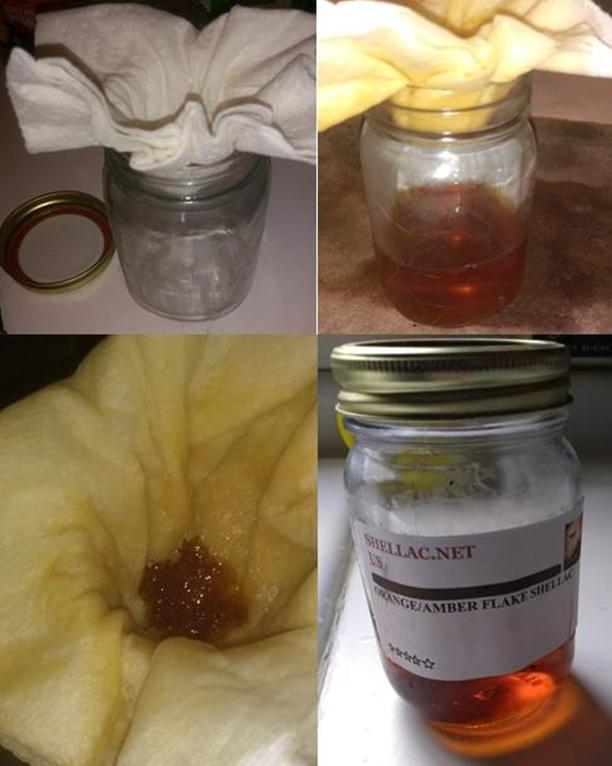
    5. Strain the shellac into a glass or plastic container that has a lid in order to remove any sediment or organic particles.  The official instructions give various methods and even combinations, but for the love of all that’s holy, it isn’t rocket science!  True, cheesecloth, a thin white cotton cloth or a paint strainer would have been just grand if I had any of them on-hand and going whole hog by “straining through a paint strainer first then through T-shirt or multiple layers of cheese-cloth” might have left me ecstatic.  But I used a few pieces of paper towels, and despite losing a little of the finished shellac to soaking all the way into the paper, I was overjoyed with the nice clear result.  I still have way more of it left than I can possibly use before it expires.
RESTORATION
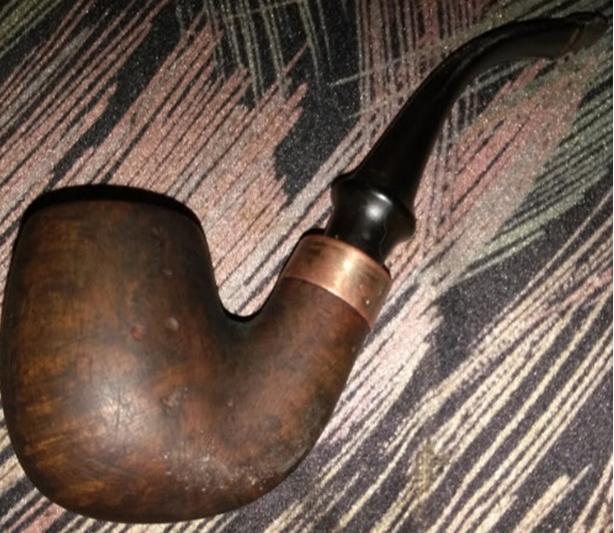
I’ll state for the record that the most egregious sign of the Trident’s abuse is the ghostly remnant of the name on the left shank shown up-close above.  Due to the necessary smoothing of the entire stummel, even the least abrasive measure obliterated it.

If ever an alcohol strip were called for, this was it.  I immersed the stummel in Everclear and let it sit for a couple of hours.  One positive result was the complete cleaning of the carbon and gunk buildup.
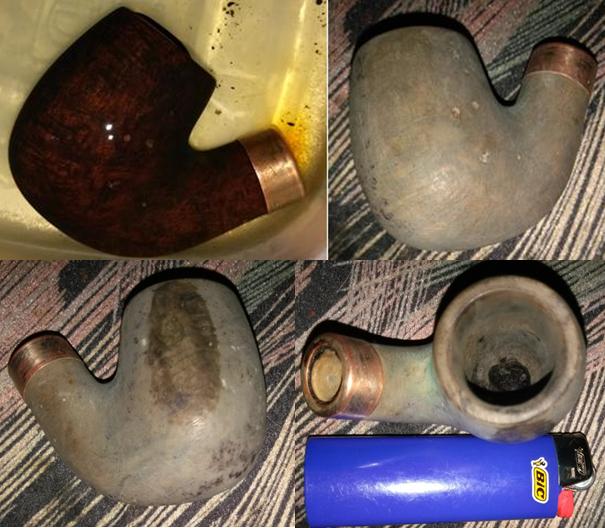
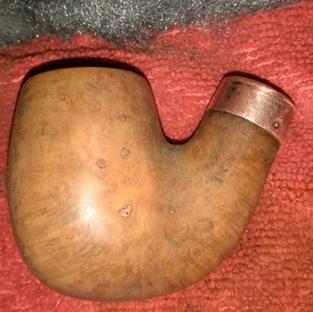
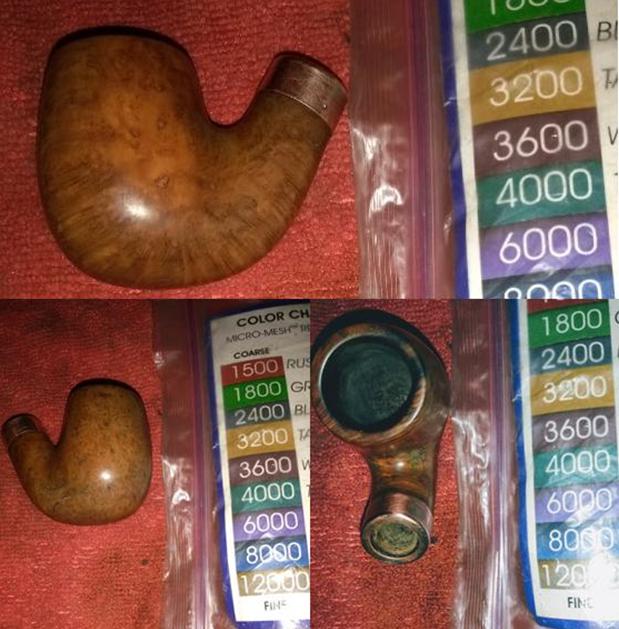
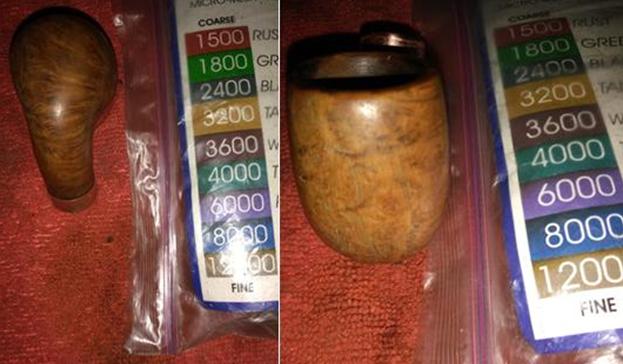
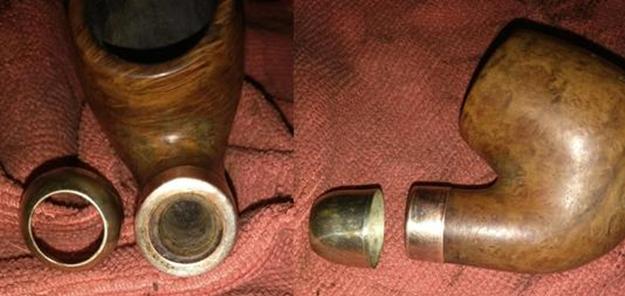
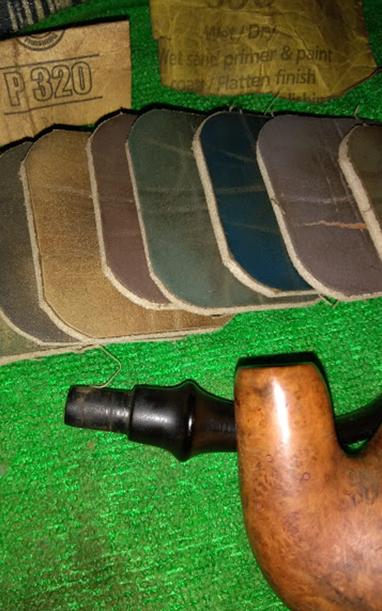
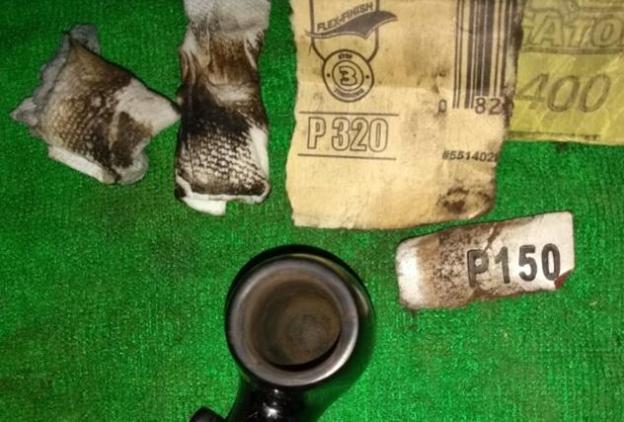
To clarify one point, the plethora of pits and other blemishes apparent in the above shots were not from fills that came out with the soak.  They were inflicted by Mike.  To remove them, I started with a double 150- and 180-sided sanding pad and 150-grit paper for the pernicious dings.  As a heads-up, it was a mistake.  Of course, that was then, and this is now. I could have saved considerable time and trouble with the subsequent sanding progression, but as I like to say, shoulda-coulda-woulda.  Now, for the beginning of what turned out to be a long, arduous smoothing process, starting with 220-, 320-, 400- and 600-grits followed by super fine “0000” steel wool, that even with the later fine-tuning was never altogether successful. The result so far is no doubt a great improvement from where it started and looks pretty good, but you know what they say about looks.  This project was the beginning of a learning process, after all, if I may be permitted a lame excuse.  Anyway, I followed up with a full micro mesh from 1500-12000.  The shine was beautiful, but there are still some small scratches, and that is not good with any restoration but in particular when dressing a pipe in black. Thanks to someone I had added as a Friend on Facebook’s Gentlemen’s Pipe Smoking Society forums just because he knew a couple hundred other people I do, I have a baggie of old bands, ferules and whatnot.  In the mix, I found a cool Peterson-style endcap I decided was more appropriate than the thin band on the pipe.  The third pic below is a tentative view of how it would look when I removed the old-worn-to-copper nickel band.  The biggest benefit of the endcap was that the stem, which was loose at first with the band, was able to stay in place well. The actual task of prying off that old band proved difficult, but as I’ve noted before, I’m tenacious.  I was quite aware of the dangers of damage including cracking the shank and with great and very slow care, I succeeded with a tiny pen knife.  I attacked the band somewhat like removing a flat tire, where my dad taught me to loosen the lug nuts a little at a time but not in order.  In plainer words, I went at one side of the band, then the opposite, and then the other two, before gently working the tip of the blade in between the four corners.  Again, I did this with no rush, and so it took about an hour before the narrow rim popped off.I cleared away the muck where the band had been with 220-, 320- and 600-grit paper, steel wool and all nine micro mesh pads, but the end cap still didn’t fit. A small piece of 150-grit paper and patient work to be sure I didn’t overdo it did the trick.  The open end of the shank was just narrow enough to place the end cap over it and push down slightly with a cotton cloth set on a table to make it snug.  Removing it again, I micro meshed after 320-grit paper. The big moment of staining and flaming the stummel had arrived, and I admit I was nervous.  The wood needs to be, for all intents and purposes, as smooth as a pipe maker would have it at this point of creation, and I am no pipe maker.  Restorations in general do not need to be as exacting.  Don had indicated 1000-grit paper is advisable, but I only had 600 and micro mesh.This was how it looked after hand-buffing without shellac.  As far as I’m concerned, the above results were unacceptable to proceed with the full dressing, but I figured I might as well get the chamber cleaning and smoothing out of the way with 150-, 320- and 400-grit papers.And then, for me, it was like the line from the traditional nursery rhyme: “Poor old Michael Finnegan, begin again.”  Back into an Everclear soak went the stummel, but this time only long enough to take the stain off to a point where I could smooth it more with 600-grit paper and micro mesh and try the stain again.  I’m missing the pics of the micro mesh work, but the next photos show the marked improvement. Once again, I stained and flamed it.Even before hand buffing with a special cloth for wood, the single shot above shows it was ready to shellac.  I used the small, soft brush for that part, taking care to move the brush in slow, even strokes from top to bottom around the stummel, including the shank.  I did the rim as closely as possible without overlapping to the sides.  After letting it dry for about six hours, I decided to repeat the shellac process and dry it again.  The shellac step, needless to say, was impossible to photograph
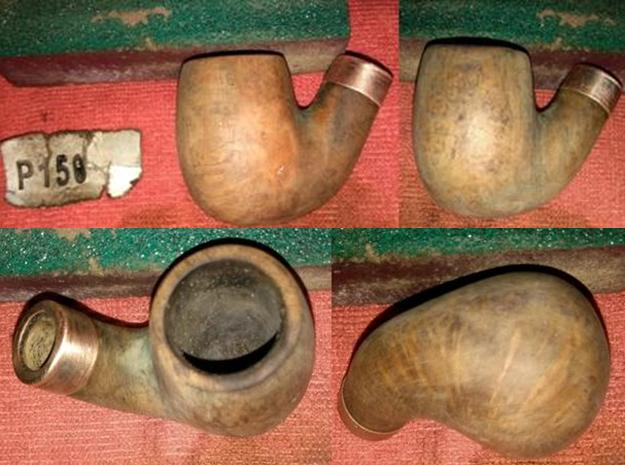
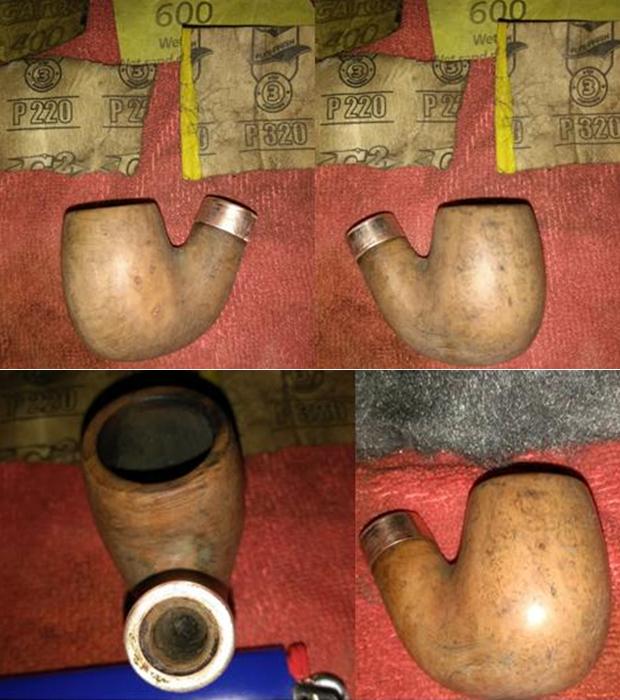
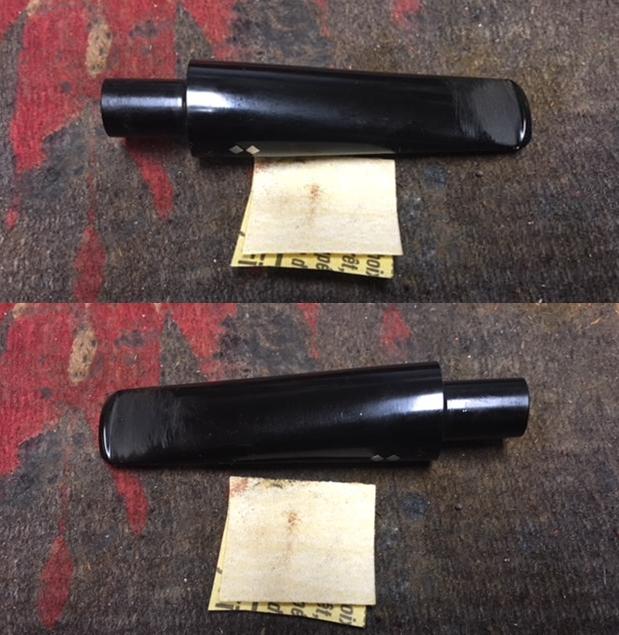
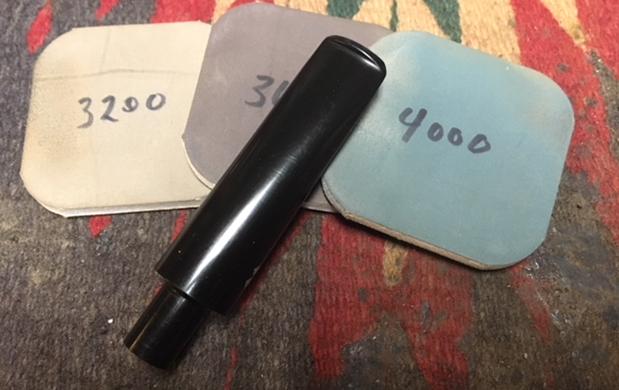
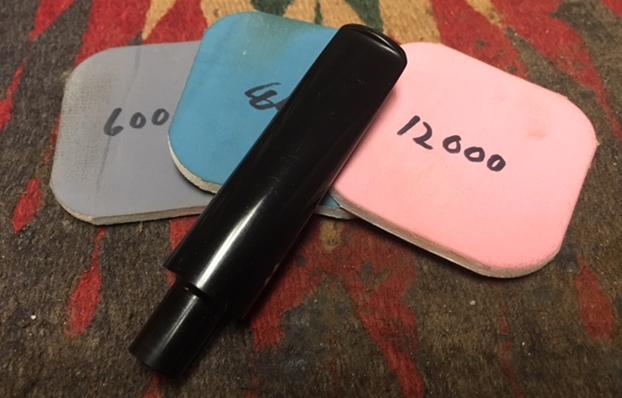
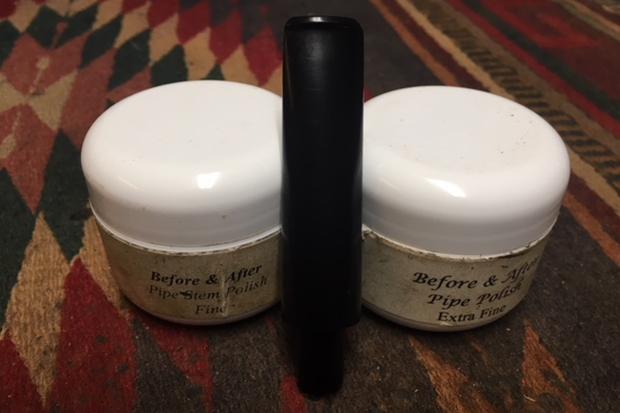
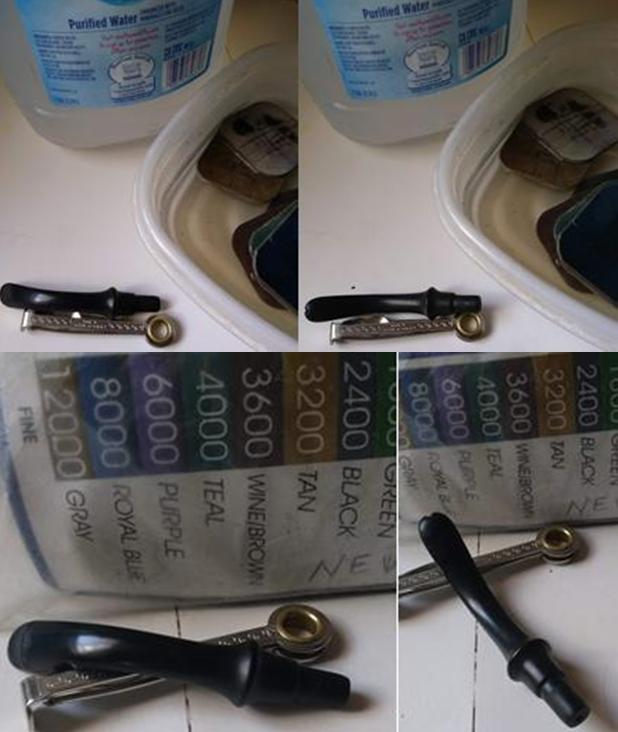
Now, for the stem, which was easy.  All I did was two full micro meshes, first with wet pads and then dry. I also buffed with red and white rouge and carnauba.  The endcap was snug as I mentioned before, but I added a couple dabs of Super Glue for good measure after a little polishing.
One more comment before the finished pipe pics.  Don had told me to “lightly buff” with the machine using white rouge between applications of shellac, but my electric buffer is a one-speed – fast – and I had severe doubts I could pull it off without removing patches of the shellac and stain.  In some of the installments of this series that follow, I gave it a shot, and with practice learned to hold the wood such that it almost didn’t even come in contact with the wheel buffer. CONCLUSION
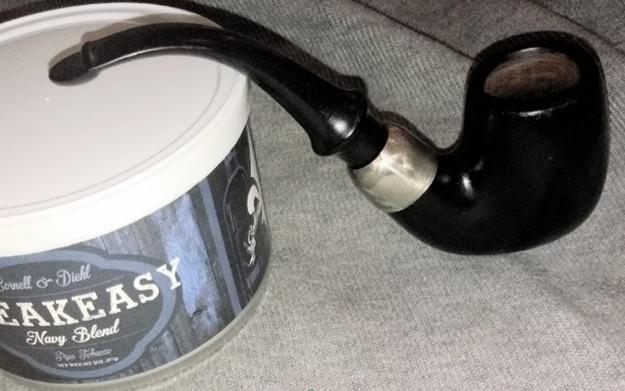
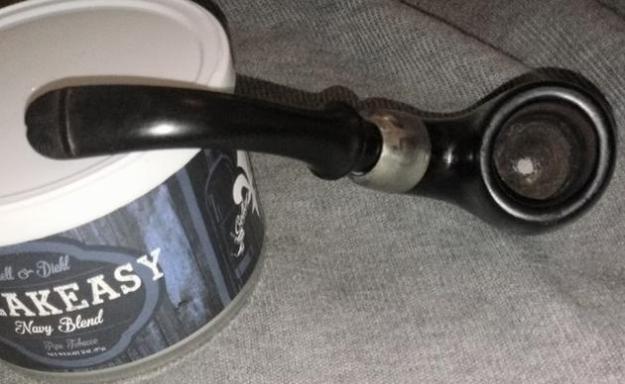
The flaws can be seen in the photos above but allowing it was my first try at dressing a pipe, I was happy.  Besides, I was keeping the Trident for myself, and I’m glad I did because it’s a great little smoker.

SOURCES
* Gaboon ebony photo courtesy Wood Database below
https://www.merriam-webster.com/dictionary/ebony
http://www.wood-database.com/gaboon-ebony/
http://oompaul.com/musings/2014/5/29/the-odyssey-of-the-oom-paul-a-hungarian-really-by-ben-rapaport
https://www.smokingpipes.com/smokingpipesblog/single.cfm/post/dressed-for-the-occasion
https://en.wikipedia.org/wiki/Shellac#History
http://www.pipephil.eu/logos/en/dunhill/others1.html#41
http://www.pipephil.eu/logos/en/dunhill/others2.html
http://www.pipephil.eu/logos/en/infos/dunhill-lady2.html
https://pipedia.org/wiki/Dunhill#Dress
https://www.alpascia.com/moments/en/detail/57/dunhill-pipes
https://www.shellac.net/Shellac_ordering_list.html
https://www.shellac.net/PoundCutChart.html
https://www.woodworkingshop.com/product/b6502816/
https://www.walmart.com/ip/Home-Basics-Mortar-and-Pestle-Bamboo/36699397
https://www.dwpipes.com/html/briar_pipes.html

New Life for a Chacom Prestige Chubby Billiard


Blog by Steve Laug

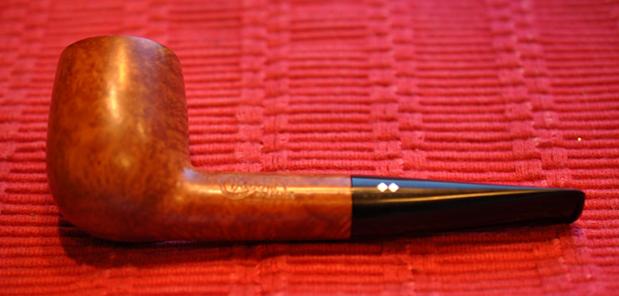
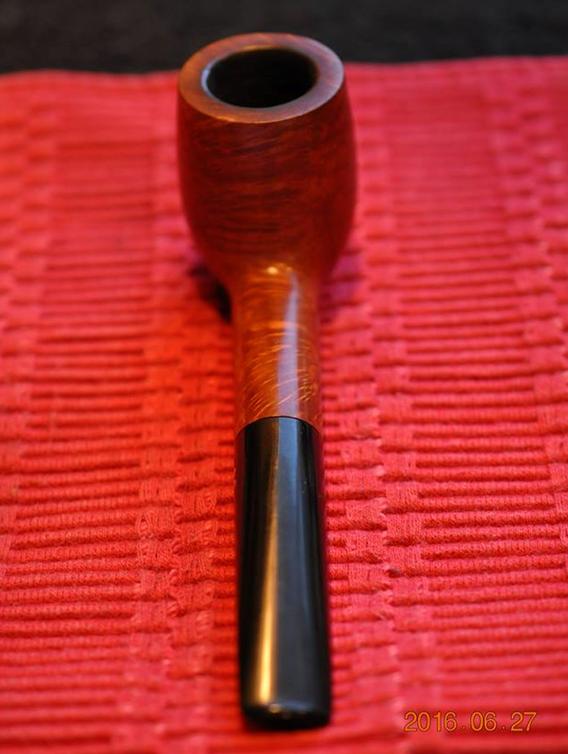
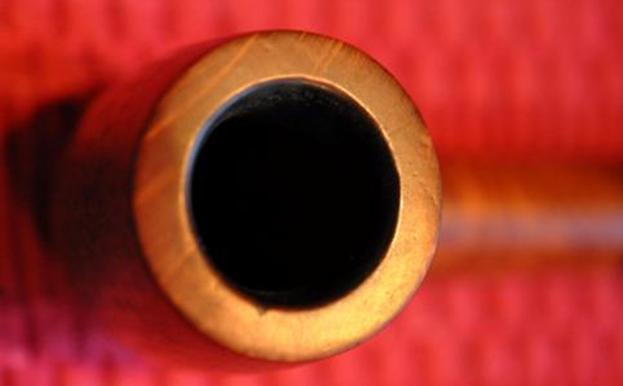
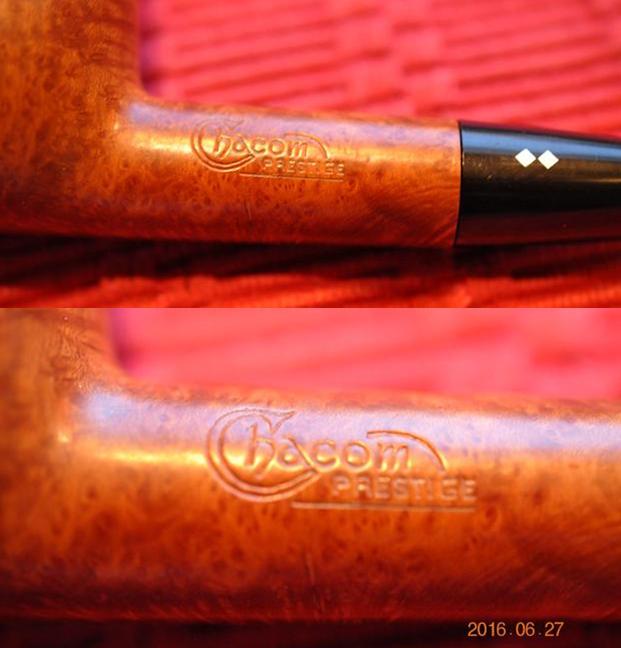
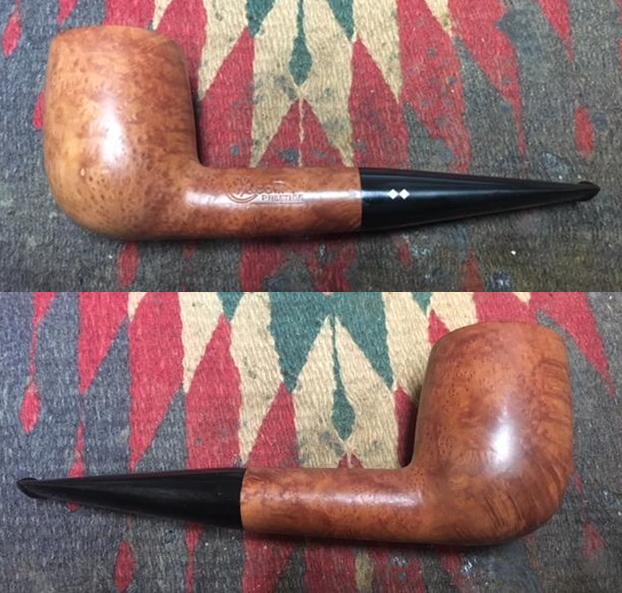
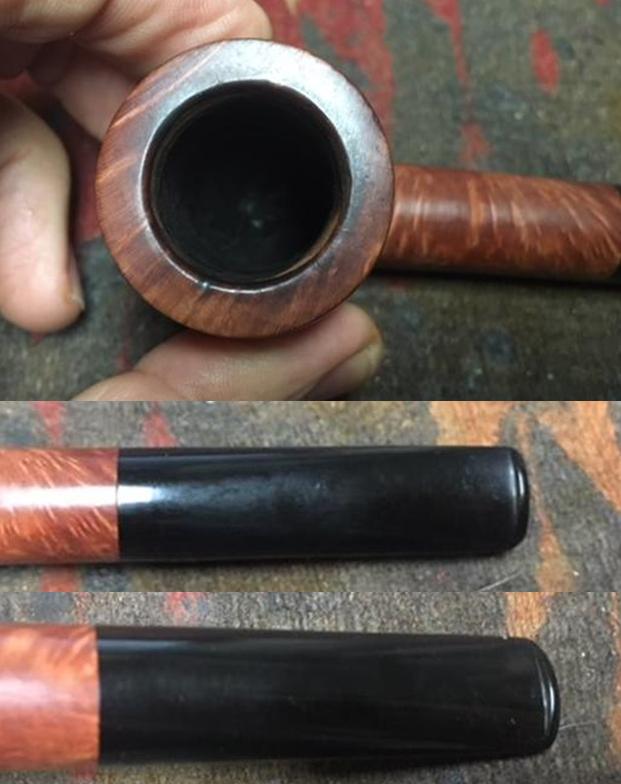
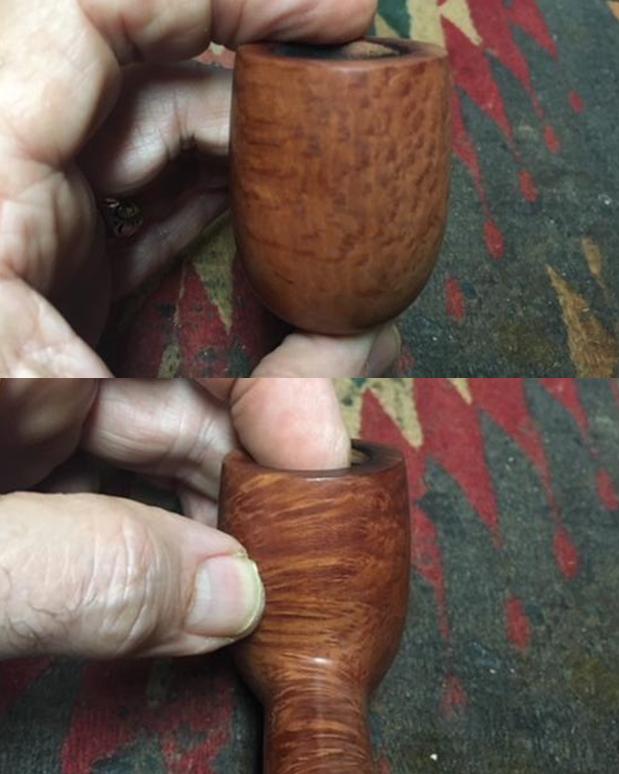
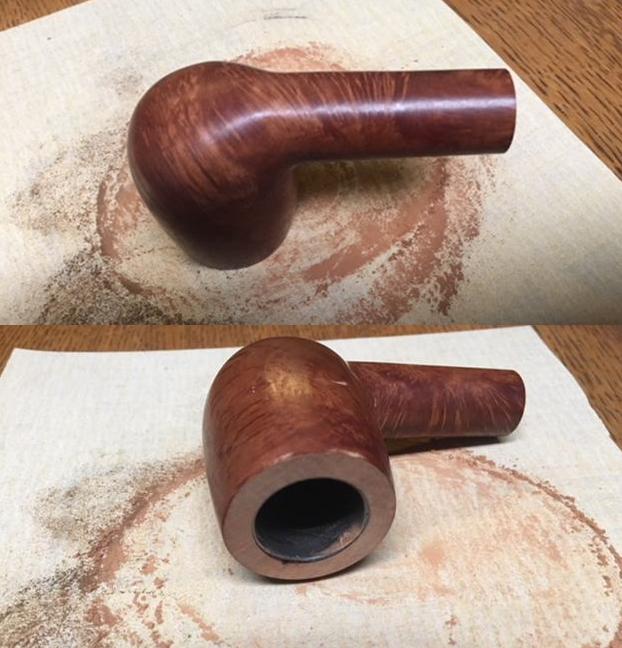
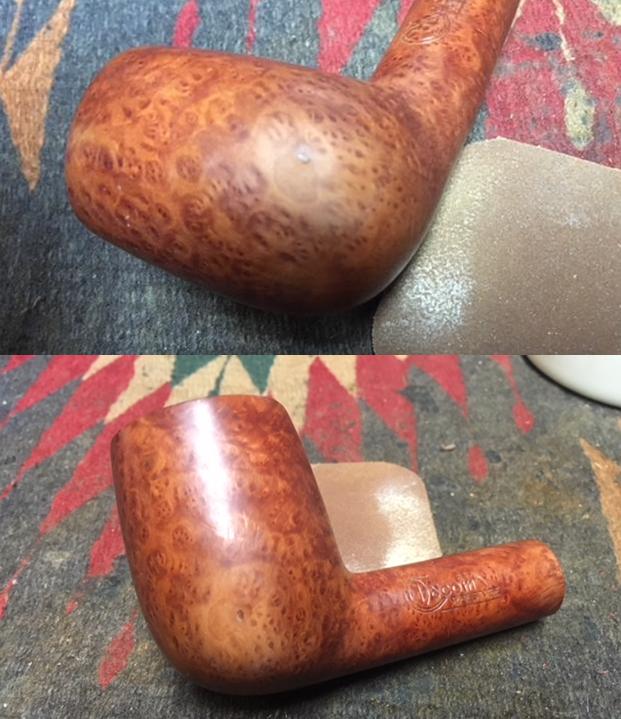
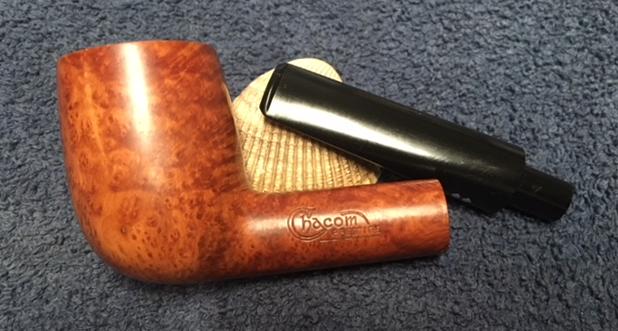
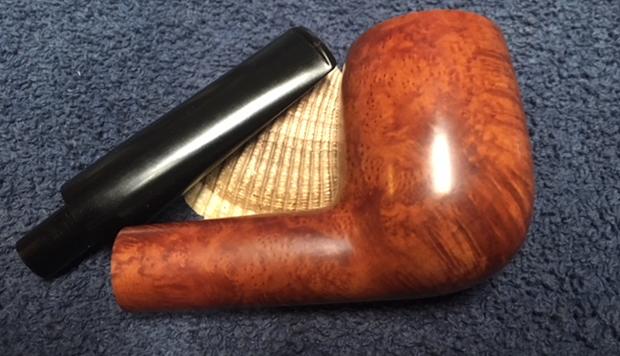
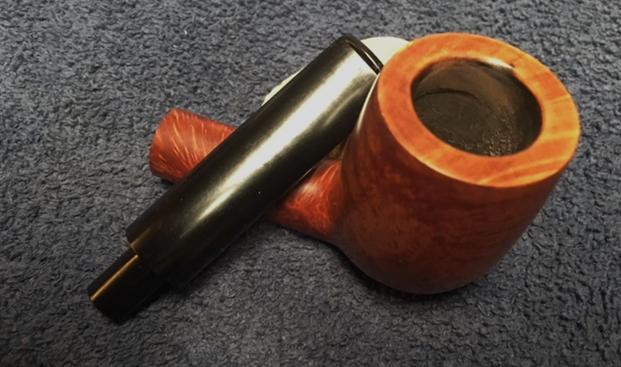
The next pipe on the table was one that my brother Jeff picked up somewhere along his travels through antique shops or online auctions. This one is a nice looking chubby billiard with a classic look and shape. It has some great birdseye grain around the sides of the bowl and shank and some cross grain off-center on the front, on the back and on the top and underside of the shank. It has a smooth natural finish to the bowl that highlights the grain. It is stamped on the left side of the shank Chacom over Prestige. There is no other stamping on the shank or bowl. The finish was dull and a little dirty but otherwise very good. The rim top was chipped and dented with a little damage to the inner edge of the bowl. The bowl had a light cake in it that would be easy to deal with.There was one fill on the left side of the bowl toward the bottom. The stem was vulcanite and had some tooth chatter and scratching on both sides near the button. The stem had a silver double Diamond inlay on the left side. Jeff took photos of the pipe before he started his cleanup up work. Jeff took a photo of the rim top and bowl. You can see that the cake is quite thin. The rim is slightly beveled inward and there are some nicks in the edge. The rim top has dents and nicks in it that are quite deep. The outer edge of the bowl looks good.Jeff took close up photos of the stamping on the left side of the shank. You can see that it is sharp and readable. The first photo shows the stamping and the double diamond logo on the stem. The second photo gives a closer look at the stamping on the shank.Jeff had scrubbed the exterior of the bowl with Murphy’s Oil soap and removed the dust and grime that had accumulated there. The finish looked very good once it had been scrubbed. He lightly reamed the bowl with a Savinelli Fitsall Pipe Knife. He cleaned the interior of the mortise and the airway in the shank and the stem with alcohol, cotton swabs and pipe cleaners. The pipe came to me clean and ready to do the restoration. I took some photos of the pipe to show the condition at this point in the process. I took some photos of the rim top and sides of the bowl to show the damage to the surface of the rim. The dark area on the inner edge at the bottom of the photo (left side of the bowl) is a nick and it has been lightly charred. There is also some darkening on the back edge of the bowl and some nicks and dents that need to be removed. I also took close up photos of the stem to show its condition. There is some light tooth chatter and tooth marks on both sides near the button but otherwise it is in good condition.I took some photos of the grain around the bowl. In the first photo you can see the only fill toward the bottom of the left side of the bowl. The grain on the pipe is quite stunning. I have worked on quite a few Chacom pipes over the years so I know most of the history or at least know where to turn to refresh my knowledge of the brand. Chacom tobacco pipes are made by the famous Chapuis-Comoy Company. The Chacom brand, a combination of the first three letters of each of the family names. It is the signature brand out of dozens produced by the nearly 200 year-old pipe-making family. Chacom tobacco pipes where the number one pipes in France, Belgium and The United States after World War II. The history of excellence in french pipe construction continues today ( https://www.tobaccopipes.com/chacom-history/). A good timeline on the brand can be found on Pipedia (https://pipedia.org/wiki/Chacom).
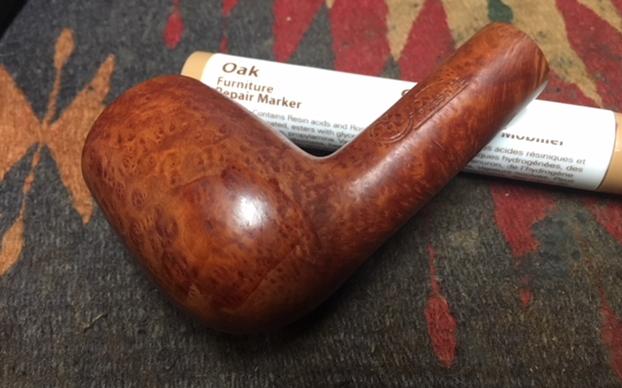
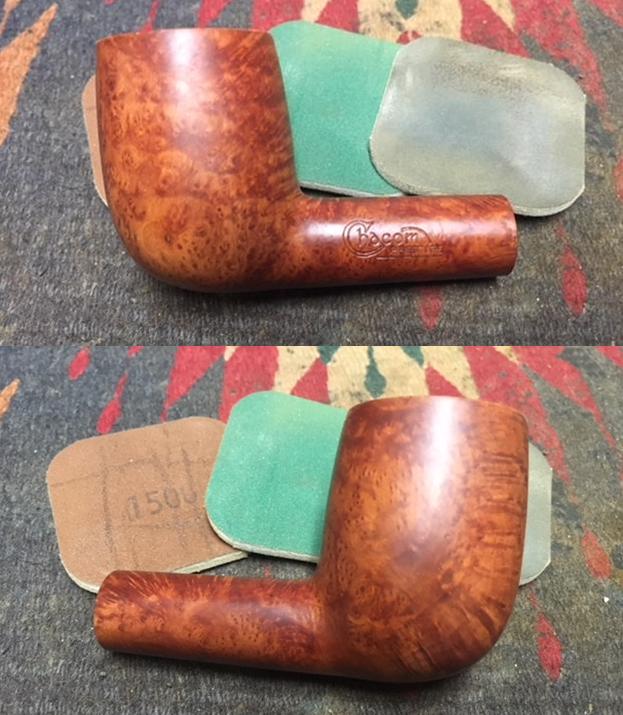
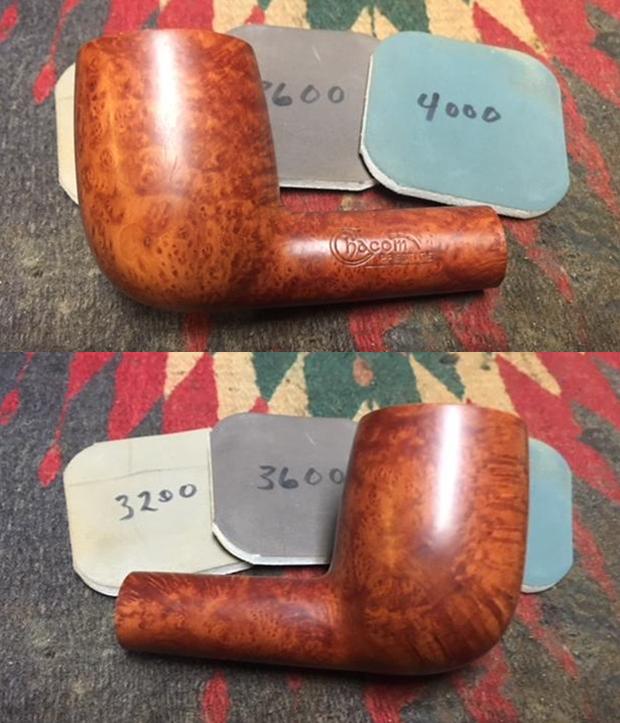
I started my restoration of the pipe by addressing the damage to the rim top. I topped the rim on a topping board using 220 grit sandpaper. I checked the progress repeatedly as I only wanted to remove the damage and not too much of the briar. The second photo shows the rim top with the damaged areas removed and the rim looking very good.I used an Oak stain pen to match the colour on the bowl. I took the photo below to show the quality of the match.I addressed the dented fill on the lower left side of the bowl next. I filled it in with a drop of clear super glue and set it aside to dry. When the glue dried I sanded it flat with a corner of 220 grit sandpaper and blended it into the briar with a 1500 grit micromesh sanding pad. I touched up the stain with an Oak stain pen. The colour was slightly off but once I buffed and polished the bowl it would blend in well.I polished the briar with 1500-2400 grit micromesh sanding pads to smooth the finish and blend in the restained portions of the bowl. Once I had that finished with the 2400 grit pad I checked the rim top and edges and was not happy with the dark spot on the inner edge of the right side. I used a folded piece of 220 grit sandpaper to bevel the edge a bit more to take care of that. I resanded the top with 1500-2400 grit micromesh sanding pads.I finished polishing the briar with micromesh sanding pads – dry sanding with 3200-12000 grit pads. The briar is shining and the repairs have all but disappeared. In some of the photos I notice a bit of carbon on the walls of the bowl so I wrapped a piece of dowel with some 220 grit sandpaper and sanded the walls of the bowl smooth.I rubbed the bowl down with Before & After Restoration Balm to deep clean the briar bowl and the rim top as well as the briar shank. The product works to clean, enliven and protect the briar. I hand rubbed it with my fingers, working it into the exterior of the pipe. After it had been sitting for a little while, I buffed it with a soft cloth to polish it. The pipe really began to have a rich shine. I took some photos of the bowl at this point to mark the progress in the restoration. I set the bowl aside and turned my attention to the stem. I used a folded piece of 220 grit sandpaper to sand out the tooth chatter and marks on both sides of the stem just ahead of the button. They were not deep so it did not take tooth much to remove them.I polished the stem with micromesh sanding pads – wet sanding with 1500-2400 grit pads and dry sanding with 3200-12000 grit pads. I wiped the stem down after each pad with a Obsidian Oil to remove the sanding dust on the vulcanite. I finished the polishing process with Before & After Pipe Stem Polish – both Fine and Extra Fine. When I finished polishing and wiping it down I set it aside to dry. I polished stem and bowl with Blue Diamond to polish out the remaining small scratches. I gave the bowl and the stem multiple coats of carnauba wax and buffed the pipe with a clean buffing pad to raise the shine. I hand buffed it with a microfiber cloth to deepen the shine. The pipe polished up pretty nicely. The contrasting light brown stain on the smooth briar with the polished, black vulcanite stem worked together to give the pipe a unique look. The finished pipe is shown in the photos below. This is a beautiful Chacom Prestige chubby billiard that needs a new home. The shape, finish and flow of the pipe and stem are very well done. The dimensions are Length: 5 3/4 inches, Height: 2 inches, Outside diameter of the bowl: 1 1/2 inches, Chamber diameter: 3/4 inches. This one will be added to the rebornpipes store soon. If you are interested in adding it to your collection send me an email to slaug@uniserve.com or send me a message on Facebook. Thanks for walking through the restoration with me as I worked over this beautiful billiard.

Restoring a Beautiful Sandblast Fellini of Italy Sitter


Blog by Steve Laug

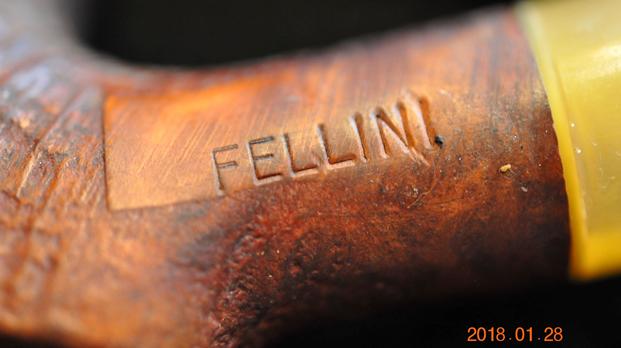
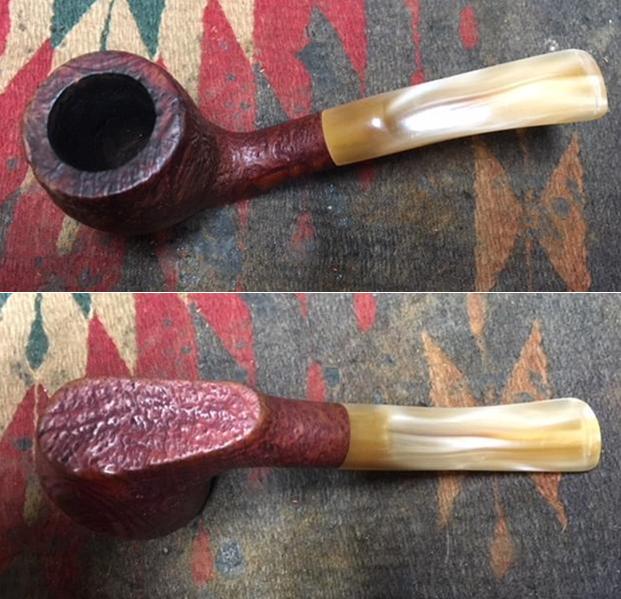
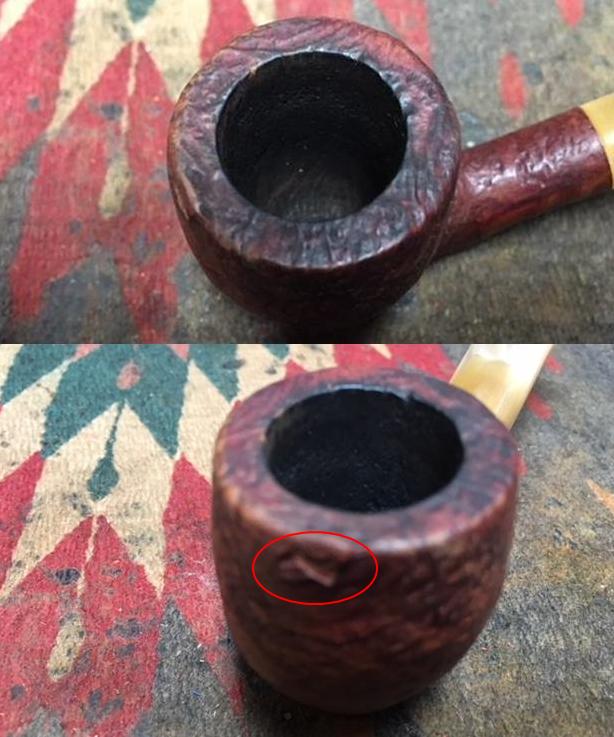
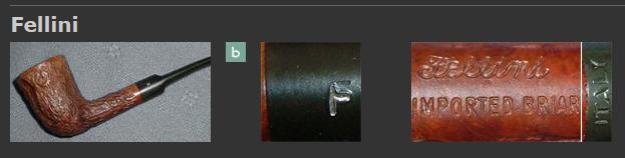
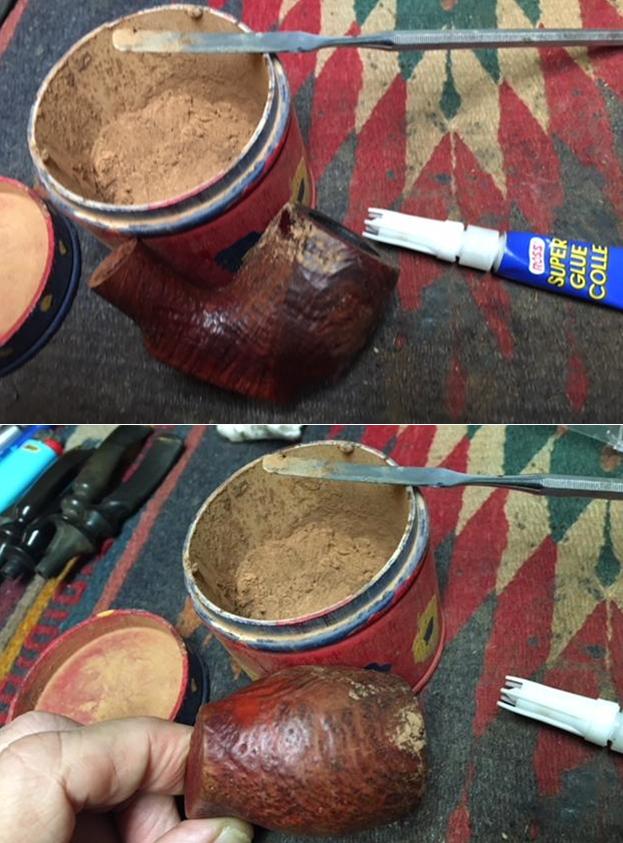
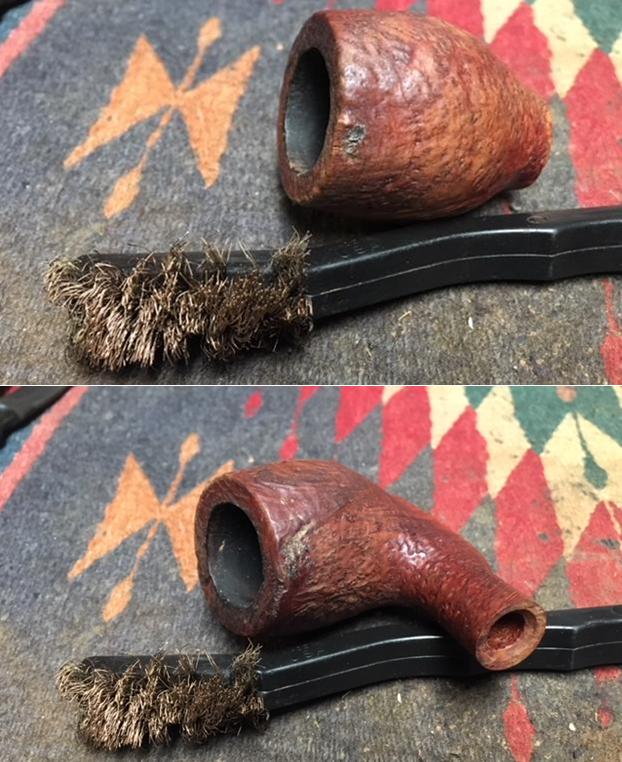
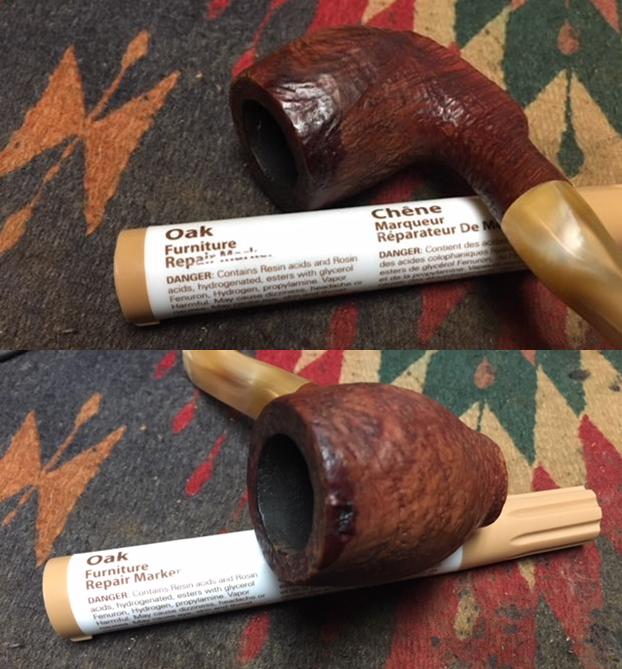
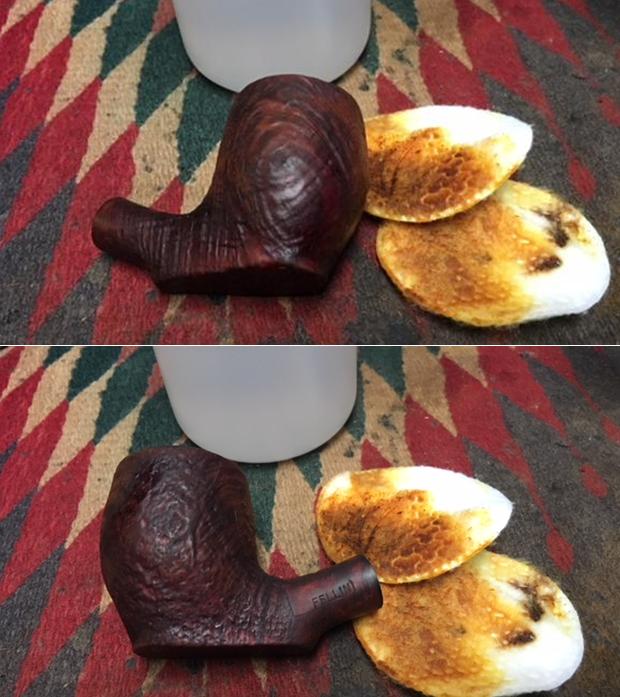
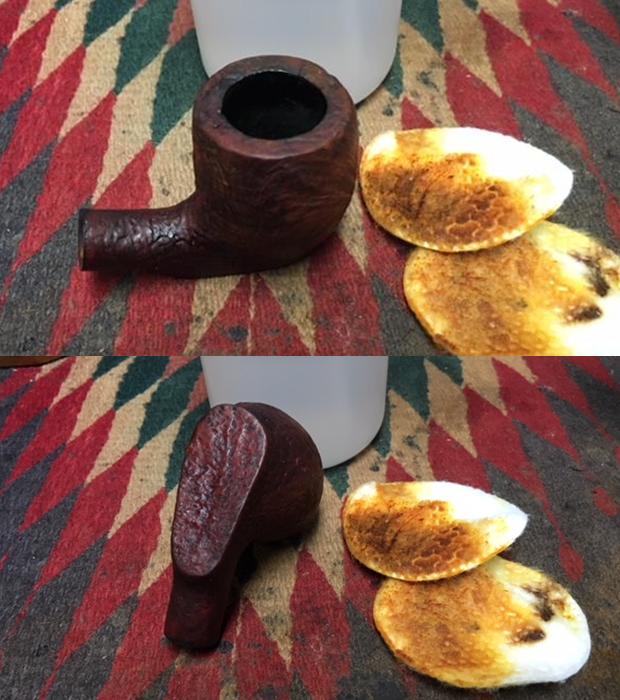
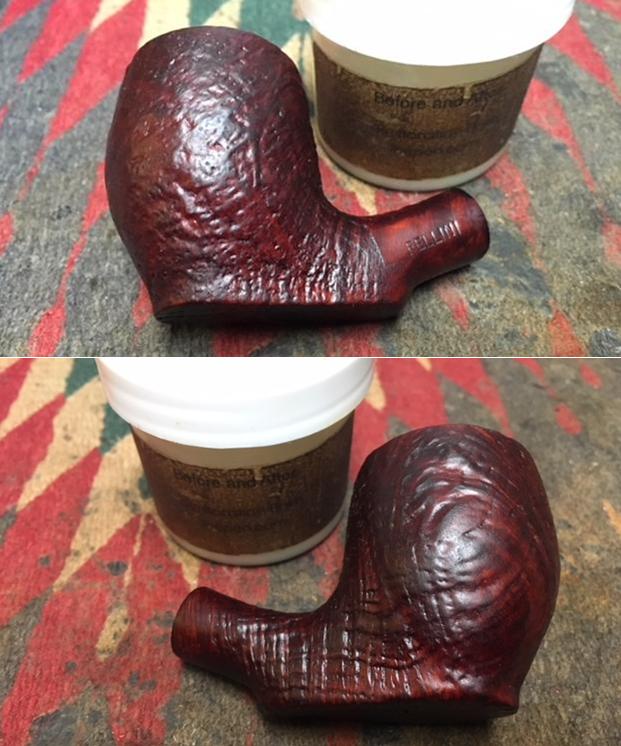
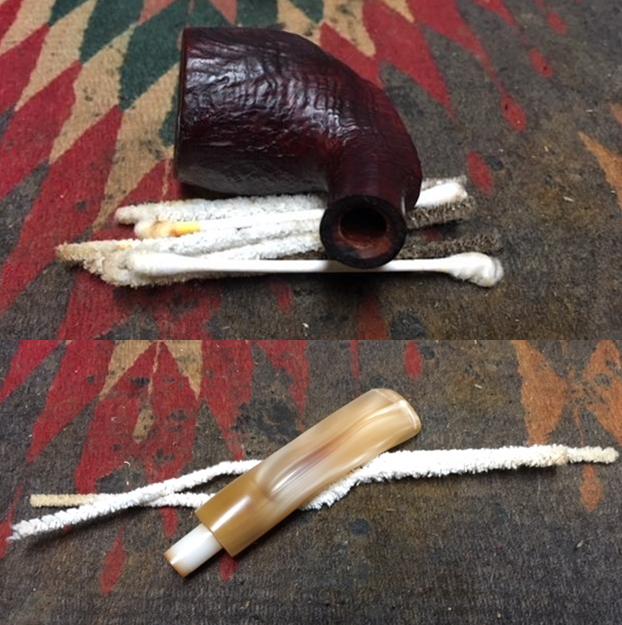
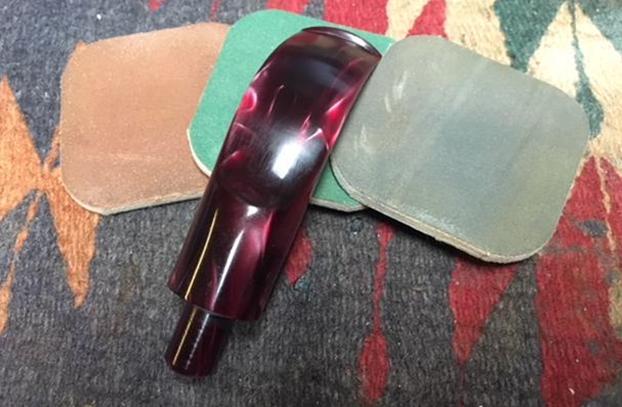
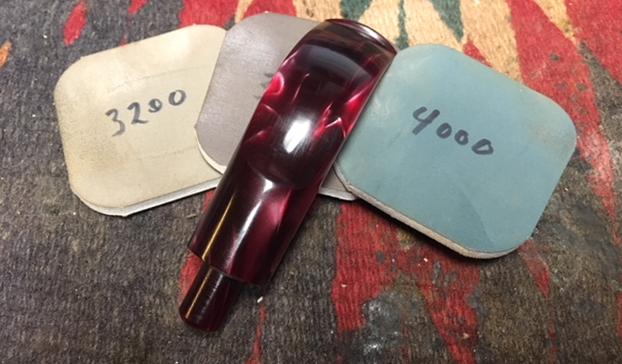
The next pipe on the table was one that my brother Jeff picked up from a seller in Texas. We have picked up quite a few pipes from him. It was in a box with the freehand pipes that I have been working my way through. Even though it is not properly a freehand I had put it in the box – go figure. It is more of a Billiard shape with a flat bottom making it a sitter. It has a slight bend in the shank and stem and the pipe is balanced to stand on its own. It has a sandblast finish to the bowl that reveals some swirling grain patterns. It is stamped on the left side of the shank in a smooth panel with the word FELLINI. It is also stamped at the stem shank junction ITALY. The pipe was very dirty when it arrived from the seller. There was dirt and grime in sandblast finish on the bowl. There was a thick cake in the bowl and an overflow of lava on the rim top. The inner and out edges of the bowl appeared to be undamaged under the grime. There were a few sand pits/fill areas that needed attention and the finish was spotty – dark and medium brown randomly around the bowl and shank. The stem was a striated tan and cream acrylic and has some tooth chatter on both sides near the button. The tenon had come loose from the stem and was stuck in the shank. Because of that the fit of the stem to the shank was off.  Jeff took photos of the pipe before he started his cleanup up work. Jeff took photos of the rim top and bowl. You can see the thick coat of lava and grime on the rim and the thick cake in the bowl. This was a dirty pipe. There is even the fuzz of dust all around the bowl from sitting unused for a long time.The next photos show the finish on the bowl from various angles. Though it is dirty it is an interesting looking sandblast. He took a close up photo of the stamping on the left side of the shank. You can see that it is sharp and readable. You can see the gap between the stem and shank end in the photo.The stem was actually in great condition. The tooth chatter was light and there were no deep tooth marks in the surface of the acrylic.Jeff had scrubbed the exterior of the bowl with Murphy’s Oil soap and removed the dust and grime that had accumulated there. The finish looked very good once it had been scrubbed. He lightly reamed the bowl with a PipNet reamer and cleaned it up with a Savinelli Fitsall Pipe Knife. He cleaned the interior of the mortise and the airway in the shank and the stem with alcohol, cotton swabs and pipe cleaners. The pipe came to me clean and ready to do the restoration. I took some photos of the pipe to show the condition at this point in the process. I took some photos of the rim top and sides of the bowl where there were sandpits or fills that needed attention. I have circled the damaged areas in red in the second and third photo below. Both of them will need to be repaired and restained. There is some darkening to the surface of the rim and some spottiness to the finish that a restain will take care of. I also took close up photos of the stem to show its condition. It was in good condition other than the loose tenon in the stem. I took the stem off the shank and you can see the tenon stuck in the shank. It has obviously been this way for a while as there is staining from tobacco on the end that sits in the stem. I used a pair of pliers to wiggle the tenon free from the shank so I could reglue it in the stem later.Once again I turned to the internet to see if I could find out any information on the brand. There was a lot of information on the Italian Film Director Frederico Fellini but very little other than pipes for sale on eBay that bore the name. Pipedia did not even mention the brand so that was unhelpful. I turned to the Pipephil site and found a listing for the brand. I have included a screen capture from that site (http://www.pipephil.eu/logos/en/logo-f1.html). You can see from the screen capture that even that information was very slim. Ah well, it will remain a mystery that hopefully one of you reading this can unravel for us.I started my restoration of the pipe armed with the little bit of information that I could find on the brand. I decided to reglue the tenon in the stem.  I used a needle file to roughen the surface of the Delrin/nylon tenon. I wanted to make it rough enough for the glue to have something to bite on when I glued. I coated the roughened end of the tenon with clear superglue gel and pressed it into the drilled hole in the stem. I wiped away the excess glue on the face of the stem. With that done I set the stem aside to let the glue cure.I turned to repairing the damaged fills or sandpits on the bowl sides (front and rear). I put a drop of clear super glue in the pit and filled it in with briar dust using a dental spatula. When the repair had dried (fairly quickly as it is warm here) I used a brass bristle wire brush to remove the excess repair. I find that the brush follows the pattern of the sandblast. I touched up the repaired fills with an Oak stain pen. I used it to stain the area around the new fill and deep in the crevices of the fill. I intended staining the pipe again in full but this would allow me to at least do a bit of the cosmetic work before the full stain. (Before I did that I put the stem on the shank to check the fit – it was flawless!)You might notice in the above photos that the briar has a definite red tint to it and the light oak stain had turned a red/brown colour. I decided to go with that and highlight the colour of the briar. I have a bottle of Fiebing’s Tan Stain that really is a light Cordovan colour so I used that to stain the briar. I heated the briar and applied the stain with a dauber. I flamed it with a lighter to set it in the wood and repeated the process.I wiped the bowl down with isopropyl alcohol on cotton pads to make the stain more transparent. I took photos of the bowl to show it. I rubbed the bowl down with Before & After Restoration Balm to deep clean the briar bowl and the rim top as well as the briar shank. The product works to clean, enliven and protect the briar. I hand rubbed it with my fingers, working it into the exterior of the pipe. I worked it into the blast with a horsehair shoe brush. After it had been sitting for a little while I buffed it with a soft cloth to polish it. The pipe really began to have a rich shine. I took some photos of the bowl at this point to mark the progress in the restoration. It dawned on me that Jeff may not have been able to get the shank cleaned with the tenon stuck in the mortise so I went back and quickly cleaned the mortise and the airway in the shank and stem with pipe cleaners, cotton swabs and alcohol. I was right he had not been able to get to the debris behind the stuck tenon.I polished the stem with micromesh sanding pads – wet sanding with 1500-2400 grit pads and dry sanding with 3200-12000 grit pads. I wiped the stem down after each pad with a damp cloth to remove the sanding dust on the acrylic. When I finished polishing and wiping it down I set it aside to dry. I polished stem and bowl with Blue Diamond to polish out the remaining small scratches. I gave the bowl multiple coats of Conservator’s Wax and the stem multiple coats of carnauba wax and buffed the pipe with a clean buffing pad to raise the shine. I hand buffed it with a microfiber cloth to deepen the shine. The pipe polished up pretty nicely. The contrasting brown stain on the sandblast and the polished, variegated swirls and striations of the acrylic stem worked together to give the pipe a unique look. The finished pipe is shown in the photos below. This is one of those interesting Italian Made pipes about which little information can be found. The shape, finish and flow of the pipe and stem are very well done. The dimensions are Length: 5 1/2 inches, Height: 2 inches, Outside diameter of the bowl: 1 3/8 inches, Chamber diameter: 3/4 inches. This one will be added to the rebornpipes store soon. If you are interested in adding it to your collection send me an email to slaug@uniserve.com or send me a message on Facebook. Thanks for walking through the restoration with me as I worked over this nice little Italian Made sitter.
Restoring a Mystery Freehand – a Hand Made in Denmark. Is it a Preben Holm?


Blog by Steve Laug

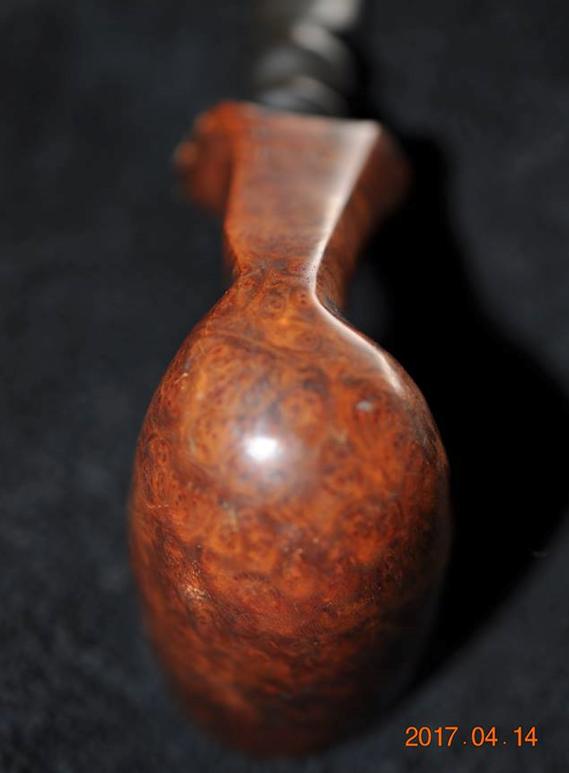
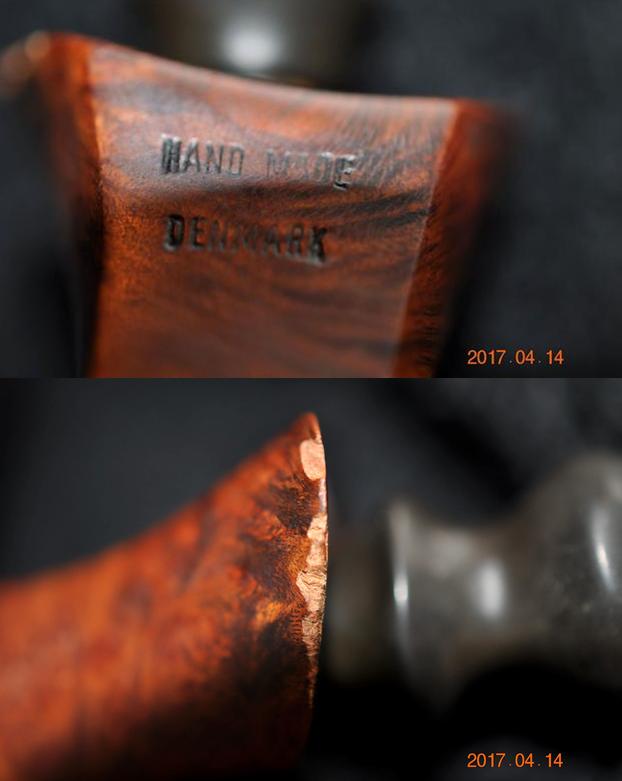
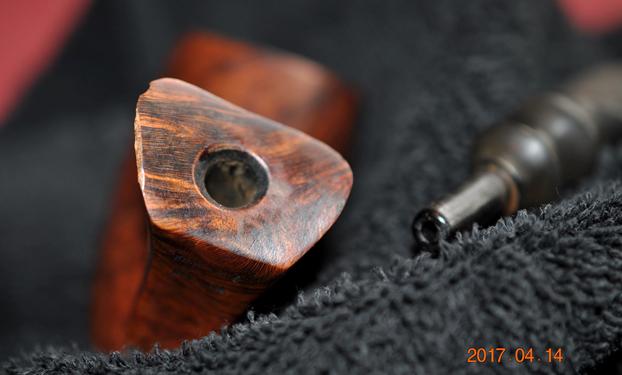
Jeff found this old pipe in an antique shop in Stevensville, Montana. He continues to show that he has an eye for old and unique pipes. This one is a tall, stack Freehand pipe with a large bowl and beautiful grain patterns around the sides of the bowl and shank. There is straight, flame and birdseye grain around the sides, top and bottom of the bowl. The rim cap is smooth and a mix of grain patterns. The finish was dirty but seemed to have a matte finish under the grime and grit. The rim top had an overflow of tars, oils – lava from the thick cake in the bowl. It was truly a mess but the buildup probably protected the inner and outer edges of the rim. It was stamped on the underside of the shank just ahead of where the stem is inserted. It is simply stamped Hand Made over In over Denmark. The stamping is identical to the stamping on Ben Wade Pipes that I have in my collection and something in my memory says I have read that somewhere. The stem has chair leg turnings that are similar to many freehand pipe stems. There is nothing stamped on the side or top of the stem. Jeff took photos of the pipe before he started his cleanup work. Jeff took some close up photos of the rim top to show the condition of the bowl and rim. There was some overflow of lava and dirt on the rim top and there was a pretty thick cake in the bowl. The pipe is quite tall and the cake went to the bottom of the bowl. The inner and outer edges looked to be in good condition.Jeff took photos of the bowl from various angles to show the condition of the finish. The beautiful grain is visible in the photos. The finish is dirty but looks good under the grime.   The stamping on the underside of the shank is clear and readable. It simply reads Hand Made with a faint stamp “In” below that followed by Denmark. The second and third photos below show the damage to the left edge of the shank. There were some chips and nicks in the finish. None were too deep in the briar so would need to rework that area of the shank. The stem was in decent condition. It was oxidized on both sides and there were some nicks and tooth marks and chatter on both sides near the button. There were no deep tooth marks which is really a relief.I reread the articles on Pipedia and Pipephil on both Preben Holm and Ben Wade pipes. I could not find the comment I was looking for on the Hand Made In Denmark stamp. So I would not have the luxury of knowing the history or who the carver was. Many things about the pipe made me still think it was a Ben Wade pipe but I may never know. I am hoping one of you who are reading this might have a clue for me.
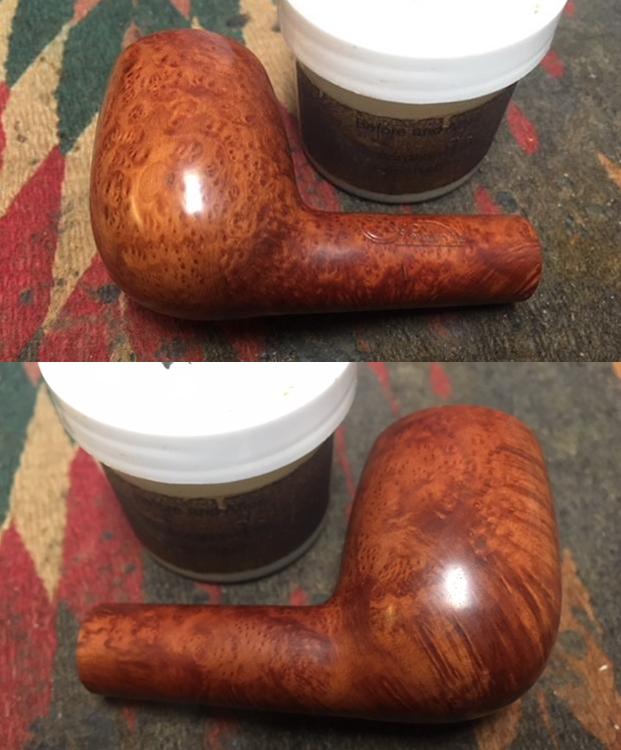
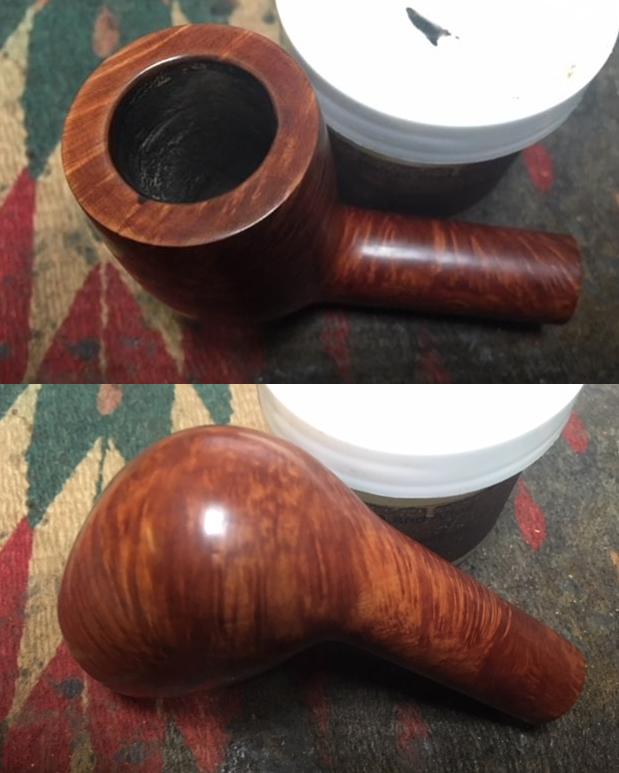
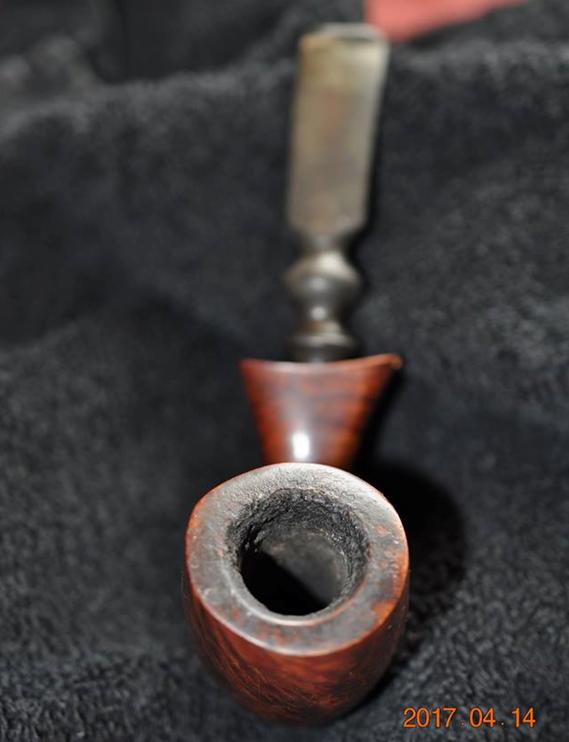
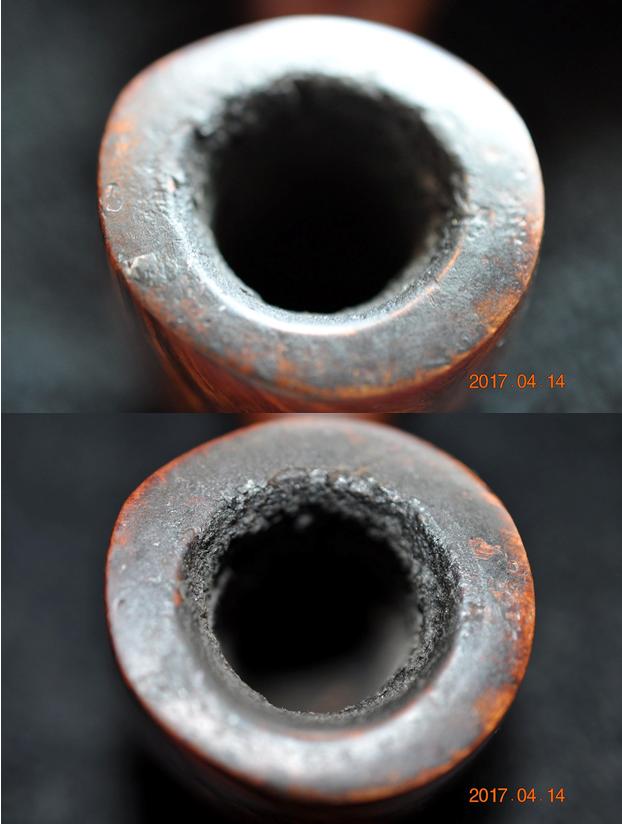
Jeff has become a magician in cleaning up pipes. When I get them they are clean to the point of looking almost new. It is nice to work on pipes that he has cleaned up once again. In this case he reamed it with a PipNet reamer and smoothed the walls of the bowl with a Savinelli Fitsall pipe knife. He scrubbed out the mortise and the airway in the shank and the stem with alcohol, cotton swabs and pipe cleaners. He scrubbed the exterior of the bowl, rim and shank with a tooth brush and Murphy’s Oil Soap to the oils and tars on the bowl, rim and shank. He rinsed it under running water. He dried it off with a soft cloth. He was able to remove all of the buildup on the rim top and the grime from the bowl. He soaked the stem in Before & After Deoxidizer and when it had done its work rinsed and cleaned the airway with pipe cleaners and alcohol. The tooth marks were clean but visible. I took photos of the pipe to show its condition before I started my work on it. I took some photos of the rim top to show what it looked like after Jeff had cleaned off the grime and tars. The briar was in good condition but there were some nicks and scratches in the flat top but none appeared too deep. The inner and outer edges of the bowl looked very good. The stem had cleaned up really well with the deoxidizer and need repair and polishing. It showed tooth marks on the underside and some chatter but it was otherwise in good condition. I decided to address the chips on the left side of the shank and reshape the shank end first. I sanded out the chips and reshaped the edge with a folded piece of 220 grit sandpaper. I shaped it to match the shape of the shank edge on the right side of the pipe. I worked on the end view as well. I wiped down the bowl with alcohol on cotton pads to remove the debris and dust from the clean up. I worked on the rim top as well to work on the darkening that was on different parts of the rim. I rubbed some Before & After Restoration Balm into the surface of the briar to enliven, clean and preserve it. I rubbed it in with my fingertips working it into the briar. I worked it into the edges of the shank and the bowl. I set it aside for a little while to let the balm do its work. I buffed it off with a cotton cloth. The photos below show the pipe at this point in the restoration process.The rim top still had some areas on the left side and back edge that would need to be worked on. You can see it as a line around the bowl. I have circled the area in red so that you can see what I am noting at this point.I worked on the rim top and the edge of the shank that I had reshaped with micromesh sanding pads. I wet sanded the rim top and the left side of the shank with 1500-2400 grit pads and was able to remove the circled damage on the rim and blend the edge of the shank. I polished it by dry sanding it with 3200-12000 grit sanding pads. I wiped the areas down after each pad with a damp cloth to remove the dust. I touched up the stain on the top of the rim and left edge of the shank to blend those areas into the colour on the rest of the pipe. I used a Maple and Cherry stain pen to approximate the colour of the pipe. I still need to buff the bowl and shank but the colour appears to be a perfect match. I buffed the bowl and shank with Blue Diamond on the buffing wheel and gave the bowl a coat of carnauba wax. I buffed it with a clean buffing pad to raise a shine and blend the stain into the rest of the finish. I took the following photos to show the bowl at this point in the process. I set aside the bowl and turned my attention to the stem. I wiped down the stem with alcohol and filled in the tooth marks on the top and underside with clear super glue. I set the stem aside to let the repairs cure.When the repairs cured I sanded them with 220 grit sandpaper to blend them into the surface of the vulcanite. I wiped it down with Obsidian Oil and took some photos of the stem at this point.I polished the stem using micromesh sanding pads – wet sanding with 1500-2400 grit pads and then buffing on the wheel with red Tripoli. I dry sanded the stem with 3200-12000 grit pads to further polish it. After each pad I wiped it down with Obsidian Oil to protect and enliven the stem. I polished it further with Before & After Pipe Polish – both Fine and Extra Fine. When I finished with the polish I gave it a final coat of oil and set it aside to dry. This smooth finished stack Freehand is an interesting and unusual piece. The Hand Made In Denmark stamp on the shank I think is one of Preben Holm’s marks but I cannot prove it. The shape of the pipe takes full advantage of the grain on the briar. The mix of grains – straight, flame and birdseye all work together to give this pipe a beautiful look from any direction it is viewed. The reddish brown of the bowl and the black of the vulcanite stem contrast well together. I buffed the bowl and the stem with Blue Diamond polish to raise the shine on the briar and the vulcanite. I was careful to not buff the stamping and damage it. I gave the bowl and the stem multiple coats of carnauba wax. I buffed the entire pipe with a clean buffing pad to raise the shine. I hand buffed it with a microfiber cloth to deepen the shine. The finished pipe is shown in the photos below. The dimensions of the pipe are: Length: 6 inches, Height: 2 3/4 inches, Outside Diameter: 1 1/2 inches, Diameter of the chamber: 7/8 of an inch. It is an interesting old pipe and should make a great collectible piece. Thanks for walking through the restoration with me.

Restoration of a deeply loved Chacom Rallye


Blog by Roberto Castiglioni

Over the past month I have corresponded with Rob about a variety of things about restoration processes and procedures. He is a great guy! When he sent me photos of his work on this pipe I wrote and asked him to write it up for rebornpipes. Without further words on my part his is Rob. Welcome to rebornpipes. — Steve

Bizarre hobbies like these prove that nothing is too arcane for humans. Fortunately, the insane have valiantly stepped up to plug that gap.

Seeing a dirty and damaged pipe come back to life makes me extremely happy. That happiness comes from fact that I am handling something that is old and has a long history. The more dirty they are more interested I am. Sometimes I ask to myself how the previous pipe smoker could smoke them. Sometimes I get a stem with double hole, a tobacco chamber with a very limited space. It is then that I remember when my father told me when I was younger that my great-grandparent’s pipe needed maintenance .

This is a very amazing hobby where I can practice applying all my knowledge of Mechanical Engineering. I can use even what I learned  high school about adjusting a piece of steel manually by means of files and other tools without using machine tools.

I am very thankful to those gents of rebornpipes for their willingness to post and teach others. They have shown how experience and manual work still has value in this modern society .

For a beginner, who most of the time is a dummy, reading all the posts in different forums to learn a general procedure how to do the work is extremely important. In rebornpipes I found a lot of information and suggestions on how to proceed.

With many thanks I have enclosed my first important restoration on Chacom Rallye …

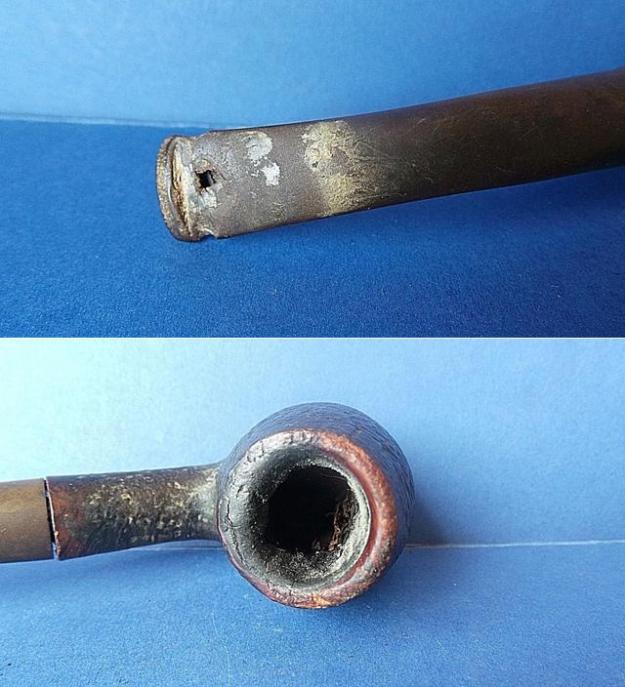
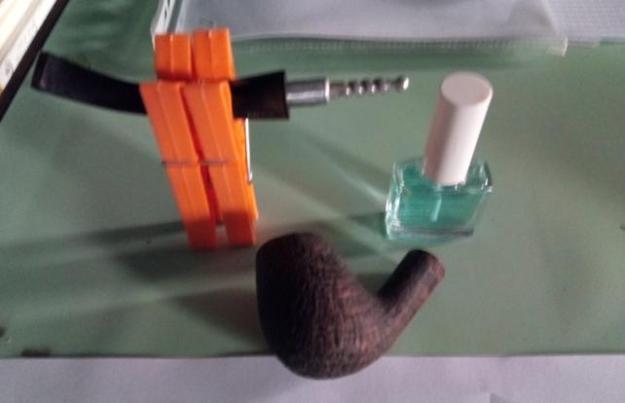
Here are the before photos of the pipe. The stem was very damaged with a bite through on the top side and much chewing around the edges of the stem. The fit of the stem in the shank is also not good. The bowl is very dirty with little room in the bowl – thick cake and lots of overflow on to the back side of the rim.I reamed the bowl with reamers. I sanded out the bowl to remove the remants of cake. I cleaned the mortise, and the airway in the shank and stem with pipe cleaners and alcohol. I patched the chewed through stem and cleaned and polished the stem.Once the pipe was clean the metal tenon was loose in the mortise so I painted it with a coat of clear fingernail polish and let it dry in my improvised clothespin vise. You can see what the bowl looks like now in the next two photos. It is quite a change. Here are some photos of the completed pipe. Thanks Rob from Italy.

Bringing a Butz Choquin Simour 1507 Back to Life


Blog by Steve Laug

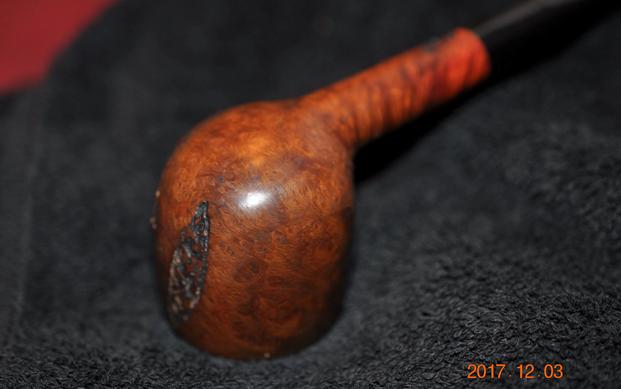
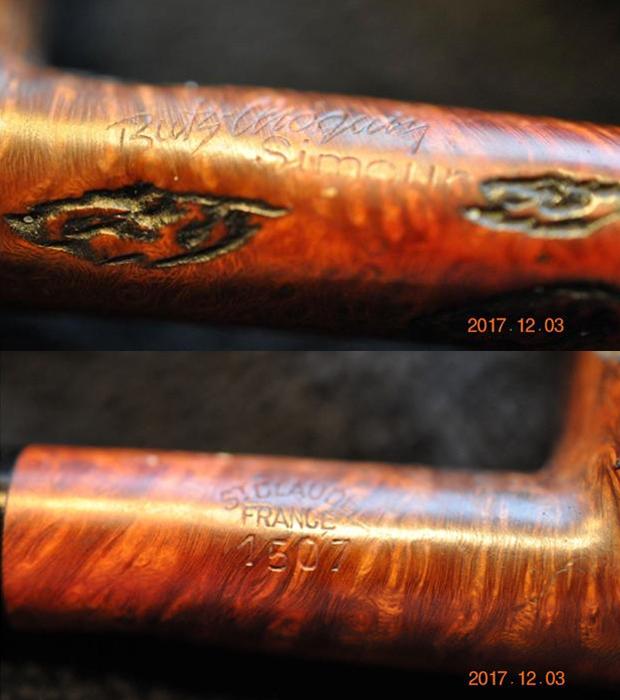
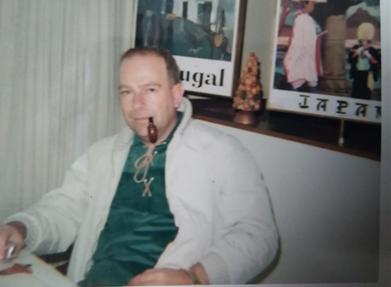
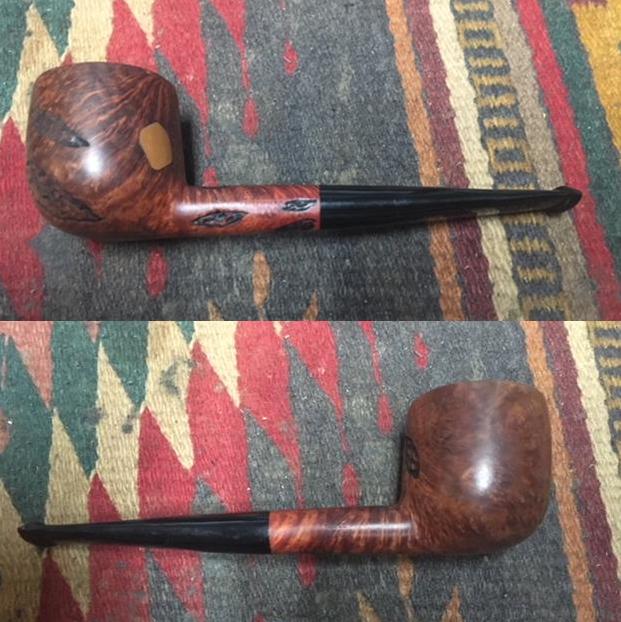
With this blog I worked on another of the pipes from Kathy’s Dad’s estate. This is the twelfth of the pipes from collection. For a reminder to myself and those of you who are reading this blog I will retell the story of the estate. Last fall I received a contact email on rebornpipes from Kathy asking if I would be interested in purchasing her late Father, George Koch’s estate pipes. He was a lover of “Malaga” pipes as well as others and she wanted to move them out as she cleaned up the estate. We emailed back and forth and I had my brother Jeff follow up with her as he also lives in the US and would make it simpler to carry out this transaction. The long and short of it is that we purchased her Dad’s pipes – Malagas and others. Included in the lot was this interesting Butz-Choquin Classic Pot shaped pipe with an inset of what looks like copper on the left side toward the rear of the bowl. The condition of all them varied from having almost pristine stems to gnawed and damaged stems that need to be replaced. These were some well used and obviously well-loved pipes. Cleaning and restoring them will be a tribute to this pipeman. Jeff took these photos of the Butz-Choquin before he cleaned it. Jeff took photos of the rim top and bowl to show the thick cake and what looked like potential damage to the inner edge of the rim at the right front and the middle at the back. He also took photos of the bowl from various angles to show the condition of the finish and the copper insert I spoke of above.  The stamping on the left side of the shank clearly reads Butz-Choquin and underneath it is a bit more faint but looks to read Simour. On the right side it is stamped St. Claude over France and a shape number 1507 beneath that.The stem was in better condition than most of the others in the collection. There was light tooth chatter on both sides near the button and the sharp edge of the button had some tooth damage. As I look at it I wonder if it is not an acrylic stem. We shall see.Those of you who have followed me for a while know how much I love getting to know about the pipeman who held the pipes in trust before me. That information always gives another dimension to the restoration work. This is certainly true with this lot of pipes. I can almost imagine George picking out each pipe in his collection at the Malaga shop in Michigan. Once again, I am including that information with this restoration so you can know a bit about the pipeman who held these pipes in trust before they are passed on to some of you. I include part of Kathy’s correspondence with my brother as well…. I may well be alone in this, but when I know about the person it is almost as if he is with me while I work on his pipes. In this case Kathy sent us not only information but also a photo of her Dad with a pipe in his mouth.

Jeff…Here is a little about my dad, George P. Koch…I am sending a picture of him with a pipe also in a separate email.

Dad was born in 1926 and lived almost all his life in Springfield, Illinois. He was the youngest son of German immigrants and started grade school knowing no English. His father was a coal miner who died when Dad was about seven and his sixteen year old brother quit school to go to work to support the family. There was not much money, but that doesn’t ruin a good childhood, and dad had a good one, working many odd jobs, as a newspaper carrier, at a dairy, and at the newspaper printing press among others. He learned to fly even before he got his automobile driver’s license and carried his love of flying with him through life, recertifying his license in retirement and getting his instrumental license in his seventies and flying until he was grounded by the FAA in his early eighties due to their strict health requirements. (He was never happy with them about that.) He was in the Army Air Corps during World War II, trained to be a bomber, but the war ended before he was sent overseas. He ended service with them as a photographer and then earned his engineering degree from University of Illinois. He worked for Allis Chalmers manufacturing in Springfield until the early sixties, when he took a job at Massey Ferguson in Detroit, Michigan. We lived in Livonia, and that’s where his love for Malaga pipes began. After a few years he returned to Allis Chalmers and we moved back to Springfield. I remember that when we went back to Michigan to visit friends, Dad had to go to the Malaga store and acquire a few new pipes. Many a year I wrote to Malaga and they picked out a pipe for me to purchase that I could give Dad for a Christmas or birthday present. He was always pleased. His favorites were the straight stemmed medium sized bowl pipes, but he liked them all.  He had some other pipes, but the Malagas were his favorites. I remember him smoking them sitting in his easy chair after work, with feet up on the ledge by the fire burning in the fireplace.  Growing up it was my job to clean them and he liked the inner bowl and stem coated with Watkins vanilla, leaving a little of that liquid in the bowl to soak in when I put them back on the rack. Dad quit smoking later in life and so they’ve sat on the racks for many years unattended, a part of his area by his easy chair and fireplace. Dad passed when he was 89 years old and it finally is time for the pipes to move on. I’m very happy they are being restored by you and your brother and hope they find homes who enjoy them as much as Dad did. Thank-you for your care and interest. — Kathy, the oldest daughter

Kathy, once again I thank you for providing this beautiful tribute to your Dad. We so appreciate your trust in allowing us to clean and restore these pipes. I am also trusting that those of you who are reading this might carry on the legacy of her Dad’s pipes as they will be added to the rebornpipes store once they are finished.

Jeff cleaned this one up before he sent it my way. He is really good at the cleanup work. He had reamed the bowl with a PipNet pipe reamer and followed up with a Savinelli Fitsall pipe knife to remove the cake. He scrubbed out the mortise and the airway in the shank and the stem with alcohol, cotton swabs and pipe cleaners. He scrubbed the exterior of the bowl, rim, shank and stem with a tooth brush and Murphy’s Oil Soap to remove the oils and tars on the bowl, plateau rim and shank. He rinsed it under running water. He dried it off with a soft cloth. The lava mess on the rim was thoroughly removed without harming the finish underneath it. It revealed the burned areas on the inside edge of the rim that I was wondering about. However, without the grime the finish looked really good.  The feather or leaf carvings in the briar of the bowl and shank look good and the inset of what I thought looked like copper was flat. The acrylic stem would need to be worked on but I really like the shape. I took photos of the pipe to show its condition before I started my work on it. I took some close up photos of the rim and bowl to show the damage to the rim top and edge. Jeff did a great job on the cleanup but boy did it reveal some damaged spots. I have circled the damaged areas in red in the first photo below. I have also included some photos of the stem to show the condition before I polished it.The pipe has some stunning grain and then it has this copper coloured insert in the side of the bowl (It may well be a piece of copper, I will know more once I polish it). I am still trying to figure this out. I wrote an email to Butz-Choquin to see if they can give me information on the line. We shall see. The next photo shows the inset.The next photo shows the leaf or feather carvings on the shank and the grain pattern. This is a pretty piece of briar.I had an interesting challenge ahead of me – to try to remove some of the damage to the rim edge without damaging the carved feather/leaf on the rim top. I needed to reduce the burned area on the rim top so that I could bevel the edge inward to hide the darkening in those spots. I progressed slowly on the topping board, checking every couple of rotations to make sure I was not making things worse.Once I had the burn damage removed I worked on the darkening on the top surface of the rim toward the front and at the back side of the bowl. I was able to minimize the damage on the top. I sanded those areas with a folded piece of 220 grit sandpaper to blend it in better. I beveled the rim inward with a folded piece of 180 and 220 grit sandpaper. I was happy with the finished look of the rim edge. A good blend of stains will blend in the edge even more.I stained the rim top with a Maple stain pen first to blend it into the rest of the bowl. I worked on the inner bevel with Cherry and Walnut stain pens to darken the edge of the rim. I feathered the stain toward the out edge of the rim top and buffed it by hand to smooth out the transitions between the pens.I rubbed down the briar with Before & After Restoration Balm. I worked it into the carved feather/leaf patterns around the bowl, rim and shank. I rubbed it into the smooth portions to clean, enliven and protect the briar. I worked it into the briar with my fingertips and the help of a horsehair shoe brush. I let the balm sit for a little wall and then buffed with a cotton cloth to raise the shine. Here is where things are after the balm. I polished the briar with micromesh sanding pads – dry sanding with 1500-12000 grit pads. As I polished the briar the inset metal began to stand out. I was pretty certain that it was a piece of copper. It really began to shine and flash on the side of the bowl. It was an interesting touch to add that kind of adornment to a pipe. I set the bowl aside at this point and turned to work on the stem. I used 220 grit sandpaper to sand out the tooth chatter on both sides of the stem at the button. I also worked on the edge of the button to reshape it at the same time.I polished the acrylic stem with micromesh sanding pads – wet sanding with 1500-2400 grit sanding pads and dry sanding it with 3200-12000 grit sanding pads. I wiped it down after each sanding pad with a damp cloth.


Restoring a Kriswill “Golden Clipper”


Blog by Paresh Deshpande

“………. and now make me handsome and desirable too!!!!!” This is what the sibling of the Kriswill “CHIEF”, the “GOLDEN CLIPPER” appeared to be demanding of me and who am I to refuse this lovely pipe. So here I am with all my enthusiasm to work on this beautiful pipe with mixed grains.

This was one of the pair of Kriswill pipes which was dug out by my younger daughter from the large pile of pipes, the other being Kriswill “CHIEF”. Both these beauties had an issue with their stems. The stem of the “CHIEF” did not sit flush with the shank and appeared smaller in diameter compared to the shank, while the stem of the “GOLDEN CLIPPER” sat flushed with the shank but was larger in diameter than the shank. I addressed this issue in an ingenious way and completed the restoration of the “CHIEF”. For those interested in knowing the issue of stem in detail, process to address it and the complete restoration, please follow the link https://rebornpipes.com/2018/08/04/breathing-new-life-into-a-kriswill-chief-20/. I am sure you will find it an interesting read.

My joys knew no bounds when the “CHIEF’S” stem fit perfectly like a glove in the shank of the “CLIPPER” (the time-consuming, cautious, accurate and nerve-wracking but enjoyable work of matching the stem and shank of the “CHIEF” still fresh in my mind!!!!!!). Here are the pictures of a perfectly matching stem and shank on the CLIPPER.This KRISWILL “GOLDEN CLIPPER” has a medium sized bowl with mixed grain. It is stamped “KRISWILL” over “GOLDEN CLIPPER” over “HANDMADE IN DENMARK” on the left side of the shank. At the bottom of the shank and close to the edge of the shank where it takes the stem, is stamped with number “54”.As I had determined the dating of this pipe, while searching information for the “CHIEF”, from 1970s (the snowflakes stamp on the stem and block letters on the shank were adopted post 1970), I proceeded to carry out a visual inspection of the condition of the pipe in my hand. This helps me map the road to restoring the pipe by identifying the issues involved and identify methods/ options to address the same.

INITIAL VISUAL INSPECTION

The bowl is covered in dust, oils, tars and grime of yesteryear. It is filled with a thick cake and the lava has overflowed on to the rim. I would still say that this bowl is not as heavily caked as I have gotten used to with my grand old man’s pipes. The cake has completely dried out.The rim surface is pock-marked with few minor dents and dings of being banged around. Exact extent of damage, there appears to be some, to the inner edge will be known after the bowl has been reamed down to its bare briar. The outer edge of the rim appears to be in decent condition.The interchanging of stem with the CHIEF ensured a perfect fit of the stem on this pipe and required no matching the fit to the shank end. The stem is, again comparatively to what I have dealt with before, lightly oxidized with light tooth chatter. The lip has been bitten off at one place and will need to be rebuilt and reshaped. There is some calcification seen around the lip on either surface. As I have come to expect, the airway in the stem is blocked and the mortise is clogged with gunk, debris and tars. I will need to clean both to ensure an open draw.The stummel needs to be cleaned. I will have to decide if I should retain the stain finish or polish it to its natural look and match it to its bigger sibling, the “CHIEF”.
THE PROCESS
Abha, my wife, dealt with the cake by reaming the chamber with a Kleen Reem pipe tool and a British Buttner pipe tool. Using the fabricated pipe knife, she further scraped the cake from the bottom of the bowl and also the walls of the chamber. She was especially very careful while reaming with the knife so as not to damage the inner edge of the rim. Once the solid briar was exposed, she further smoothed the walls and removed remaining cake by sanding with a 180 followed by 220 and 600 grit sand paper. Another advantage of this process is the elimination of traces of ghosting to a great extent. She gently scraped the rim top with the sharp edge of the knife and removed the accumulated overflow of lava. Abha followed this by scrubbing the chamber walls with cotton swab dipped in isopropyl alcohol. This removed the fine cake dust, leaving the chamber clean, fresh and smooth. As can be seen from the picture, after the cleaning, the dents and dings are more pronounced and will need to be addressed. Further, if observed closely, there is a small chip to the inner edge which can be seen on the right side in the 3 o’clock direction. I had the following two courses of action to choose from to address these issues:-
(a)        Create a slight bevel on the inner edge to eliminate the inner edge chip.
(b)        Topping the rim on a topping board.

Abha suggested proceeding with the second option since the “CHIEF” was without a bevel and as these were together, she wanted to maintain the similarities as far as possible. I concurred with her since topping will also address the minor dents and dings seen on the rim top. I gently topped the stummel on a 220 grit sand paper, frequently checking the progress.  This is very important since you do not want to lose too much briar and there is always a fear of distorting the proportions of the pipe due to excessive sanding. How much sanding is sufficient, is a question to which the answer can never be quantified. For me the mantra is, topping or sanding should be kept to the minimum and preserve maximum briar even at the cost of very minute dents/ chips being visible.

I topped the bowl just enough to address the dents and dings on the rim surface. The small nick to the inner edge of the rim has also been addressed to a great extent, but not completely. It is barely perceptible in person and acceptable to me. Hence, I left it at that!!I cleaned out the internals of the shank/ mortise and airway using pipe cleaners, cue tips and isopropyl alcohol. Thereafter using undiluted Murphy’s oil soap and tooth brush, I cleaned all the tars, oils, dust and grime from the bowl and washed it under running water. I wiped it down with paper towels and a soft cotton cloth.

Using a brown stain pen (Yes!!! I finally have them, thanks to my guru, Mr. Steve who had diligently packed them with the pipes that he had sent me after repairs, when he learnt that I was unable lay my hands on them), I stained the rim to match the rest of the bowl and set it aside to dry out. In my haste to finish the restoration, I forgot to click pictures of the above mentioned process and the look of the pipe at this stage.

While the stummel was kept aside for drying, I turned my attention to the stem. Starting with the use of Bic lighter, I painted the surface with its flame to raise the tooth chatter and bite marks as much as possible. I scrubbed the stem with a piece of moist Mr. Magic Clean sponge to clean the stem of the calcification. Minor tooth chatter was addressed to a great extent, however, some stubborn and deep bite marks and the bitten off lip stood out like sore thumb!!! Having learnt my lessons and working around the handicap of glue, I spot applied clear CA superglue with a tooth pick and set it aside to cure over night. The next morning, I applied another layer of the superglue and set it aside to cure. The reason I decided to adopt this technique is because the glue I have and available to me is of very thin consistency and hence the layering technique. After 24 hours, I checked the fills and proceeded to sand down the fills and reshape the edge of the button with a flat head needle file to match the surface of the stem. Using a 220 grit sand paper followed by wet 320 grit sand paper, I evened out the fill and removed oxidation from the stem surface. Thereafter, I used micromesh pads, wet sanding with 1500 to 2400 pads and dry sanding with 3200 to 12000 pads. I deeply rubbed a very small quantity of Extra Virgin Olive oil after every three pads. I am pleased with the way the stem has turned out. It is now smooth and shiny.Using normal and bristled pipe cleaners dipped in alcohol, I completely cleaned out the airway in the stem till the pipe cleaners came out nice and clean from the other end. However, when I checked the draw, I found it to be constricted and laborious. It was not a free flowing and open draw. I checked the alignment of the airway in the stem and shank and realized that the airway was not aligned. With a rounded needle file, I file down the tenon hole and the mortise opening in the shank to the point where there are perfectly aligned. Now the draw is full and open.

By this time, the stain on the rim top has dried out and I applied a small quantity of Before and After Restoration balm to the entire surface of the stummel, including the rim top. This product is absolutely fantastic as it freshens up the briar and makes the grain to pop out. Using a horse hair shoe brush, I buffed the bowl. Later, with a soft cotton cloth, I polished it to a nice shine. As a final touch, I rubbed a very small quantity of PARAGON wax on to the stem and the stummel. A few seconds later, using muscle power and a microfiber cloth, I polished the entire pipe to a lovely shine. Here are the pictures of the finished pipe. Hope you enjoyed reading the write up and yes, my apologies for the lack of pictures since I had to catch a flight late in the evening to rejoin my duty station, I forgot to take pictures at this stage as completing the restoration was priority task.

Resurrecting a Badly Damaged BBB ** Billiard


Blog by Victor C. Naddeo

I have been following the Pipe Club of Brasil Group on Facebook for quite a while now and have enjoyed the posted that Victor Naddeo has made about his restoration work. He is the administrator of the Facebook Group and we have chatted back and forth. When he posted this restoration I was intrigued by his solution to the crack in the bowl. He sent me photos on Messenger and we talked about the repair and BBB pipes in general. Seems we are both devotees to BBB pipes. I asked him to write up this repair on an old BBB ** that was in very rough shape before he started. He gladly did so. I am hoping this is just the first of many blogs on rebornpipes by Victor. Welcome to rebornpipes! Now in Victor’s own words.

A few years ago i had my first experience with restorations. As a young man just into adulthood, I had little money to invest in good pipes, and on one fateful day I met an old Bent Apple BBB ** for sale at an antique dealer. The pipe had a very rusty stem, there were beat marks all over the edge of the bowl, and a cake that looked more like the shell of a turtle. Already for some time I followed the blog rebornpipes and the work of Steve, and inspired by him I decided to get involved in this project. Two months later (and after many mistakes made) I finally managed to bring the old warrior back into action. On that day I gained two new passions: Restoration and old BBB’s. This restoration I will show you below began months ago when in an auction I bought this BBB billiard from a not very honest auctioneer who had not reported that the bowl was cracked. After some time waiting in a drawer, I finally decided to do something to bring another warrior to this army of BBBs, I hope you like it!

As you can see, looking from the side he was just an old billiard that needed a bit of polishing and cleaning. Good shapes, harmonious proportions, these are typical features of an old BBB and the main reasons that made me fall in love with the brand. What I did not expect was that his former owner somehow managed to create a large crack in the front of the bowl with about 3cm.The interior of the ducts was also completely clogged with a mass of tar residues derived from years of non-cleaning use. The cake was also quite thick, which led me to believe that the pipe had never been reamed, and if it was, that was many decades ago. To remove the cake, I had to use some chisels first, because as the passage was very narrow, it was impossible to insert my Senior Reamer into the chamber. It took me some time (and I also got some blisters on my hand). In the picture you can see the amount of carbonized material being removed from inside the bowl. After using the chisels and also the senior reamer, I also use a series of sandpaper inside the bowl, starting from grit 220 through 400, 600 and ending with 800, so that the inside of the bowl has a uniform surface.After a 30 minute bath in a solution of Oxyclean and water, I washed the inside of the stem using bristle pipe cleaners and running water. With a Dremel and felt disks, used blue polishing compound to polish the inner tube. I finished cleaning the inside of the stem using cotton pipe cleaner soaked in grain alcohol, removing what was left of residues and possible bacteria. The Oxyclean bath brings the oxidation back to the surface of the stem, which facilitates the polishing and removal of the oxidized material. Returning to the subject of the dreaded crack in the bowl. I decided to use a briar insert to cover it. To prevent cracking from increasing over time and to facilitate insertion of the insert, I used a cutting blade attached to the Dremel to cut the broken part and make a V shape instead of the crack. I used this same disk to also cut out a briar block, an insert of a similar size and I used sanding paper to leave it the perfect size to fit into space. To glue the insert, I used a mixture of briar dust, pigments and super glue. I settled the insert and held it for a few minutes until the glue dried. I waited a few hours to make sure that all the glue was dry and insert was firmly in place. I cut the burrs and used sandpaper to level the insert with the rest of the bowl. I also used brown and black dye to match the colors. I used 220, 400, 600, 800, 1000 and 1200 grit sanding sticks to remake the shapes of the bowl edge that were completely destroyed by the beat marks. As you can see, after reshaping the top of the bowl, you can already see the ancient times of glory of this pipe that once was the faithful companion of some gentlemen.

After dying, it was time for the first polish. I used two different compounds, red and brown, on denim disks and jeans disks, such as a high spin, to remove sediments and dirt that were stuck to the outside of the bowl and excess dyeing of the insert and the new bowl top . I used the same process on the stem to remove the oxidized material, but finalizing with flannel discs using the blue compound and white diamond to give a mirrored sheen.


Recommissioning a Monarch Pat. 1989069 – 1074H Bent Ball


Blog by Dal Stanton

This nice-looking Monarch Bent Ball shape came to me along with 65 pipes in an eBay acquisition which I’ve called the Lot of 66.  The Bowl shape has a very nice feel in the palm with the dimensions an adequate: Length: 6 1/4 inches, Height: 1 1/4 inches, Bowl width: 1 3/4 inches, Bowl depth: 1 3/8 inches, Chamber width: 15/16 inches.  This pipe got Andy’s attention in the special section on my blog site called “For ‘Pipe Dreamers’ Only!” where pipe men and women (and their significant others looking for special gifts!) can commission pipes.  Andy is from the state of Maryland in the US and he and his wife attend church where I used to be the pastor – in a former life many, many years ago!  Andy reached out to me via Facebook Messenger:

I really enjoy your posts with the restored pipes, and I’m wondering what might be available now and what the costs are. I really like the Oom Paul’s (and some of the other Peretti’s), and the Savinelli from May 29. Many years ago, I had a small collection which included a Comoy, and, if I recall correctly, a Peretti and a Savinelli. Sadly, they were lost somewhere along the way. Thanks for reigniting my interest (no pun intended). I looked at your website and found the answers I needed. What can you tell me about the Monarch Pat. 1989069 – 1074H Bent Ball shape on the Pipedreamer’s page? It looks very similar to one I had many years ago, and I might be interested in commissioning it if it’s still available. Thanks!

It’s amazing how pipes become so much a part of memories and associations in our lives!  Andy and I dialogued, and he commissioned the Monarch and will have the first opportunity to acquire the Bent Ball when it is restored and placed in The Pipe Steward Store, benefiting the Daughters of Bulgaria.  Here are the pictures that caught Andy’s attention. The stampings on the pipe are distinctive: on the left side of the shank is stamped ‘Monarch’ in cursive script with swirly tail, over ‘PAT. 1989069’.  The right side of the shank has ‘1074H’ stamped which I assume is a shape number.  The stem has a dot marked on the top which I notice actually appears to be a vent – the black center of the dot is not solid but a hole.  Interesting. A quick trip to Pipedia in search of ‘Monarch’ turns up useful information.

Monarch Pipe Co. was established in Hartford Con, most likely in the late 1930 by Fred Warnke, who obtained a patent on the system pipe on January 22 1935. The company moved to Tulsa Oklahoma at some point in the 1950s, after which Monarch Pipe Co was moved to Bristow, Oklahoma. The Monarch Pipe Co. also makes E.A.Carey Magic Inch and Duncan Hill Aerosphere Pipes.

So, the question in my mind was, are pipes still being produced by the Monarch Pipe Co. in Bristow, Oklahoma?  After searching the internet, I found an interesting newspaper article from the The Oklahoman, published January 15, 1995, entitled, ‘Bristow Manufacturer Lives on Pipe Dreams Pipe Fitting As Fragile as a Smoke Ring, The Art Still Burns in Bristow’ (LINK).   Excerpts from the article are enlightening and interesting:

Monarch has manufactured pipes in Bristow for 32 years. Once it employed 12 workers and produced 5,000 pipes a month; now the workforce is four, including Austin (a manager mentioned earlier).

Monarch was founded in 1929 in Connecticut. In 1962, a Tulsa businessman who ordered his pipes from Monarch discovered his source might close down, so he bought it. He and his partners moved it to Bristow…. Some 15 years ago, Carey bought the little enterprise.

This excerpt mentions Monarch’s parent company was the E.A. Carey of Ohio, company most well known for the ‘Carey Magic Inch’ pipes which boasts of a system that produces a drier, cooler smoke.  Still wondering if Monarch currently was producing pipes, I search again, “Monarch Pipe Co.” and found an old business link from Buzzfile.com that gave information and a ,mailing address – no email or website.  I plugged the Bristow, OK, mailing address in Google Maps and found this picture of the Monarch Pipe Co.  The date of the photograph from Google is July 2012 – now six years ago. Still desiring to know if Monarch pipes were being manufactured, I decided to try one more angle.  The 1995 Oklahoman Newspaper article above said that E. A. Carey bought out the small Monarch enterprise 15 years earlier, in 1980.  I searched for the Magic Inch E. A. Carey of Ohio name and found a website: http://www.eacarey.com.  As I’ve successfully done many times in the past, I went to the sites ‘Contact Us’ page and used the email provided to see if anyone there knew anything about the Monarch Pipe Company?  I received a reply from Danielle: 

Thank you for the email.  We are sorry, but the Monarch pipe company closed a few years ago.  The woman who ran it has retired.  We do still sell magic inch pipes, they can all be found on our website: www.eacarey.com   Any pipes she made for us, we no longer have.

In reply, I went out on a limb asking if they had a Monarch Shapes Chart…. We’ll see what happens! (Addendum: Danielle responded in a few days to say that they had no information on Monarch pipes.  Oh well!)

The closing lines in the 1995 Oklahoman article proved to be prophetic.  The former manager of Monarch Pipe Co., Francis Austin was quoted:

Still, he said, Carey “realizes the stability of the smoking industry” is as fragile as a smoke ring, and is diversifying into such areas as children’s safety toys and goose down products.

Someday, concedes Austin, who’s 60, his artful pipes will be collectors’ items.

This Monarch Bent Ball is now a collectible!  The other interesting aspect of the Monarch nomenclature is the patent number given: ‘PAT. 1989069’ which is for the system evident in the fittings of the Monarch ‘System’ pipe.  I took the patent number to the United States Patent and Trademark Office site searched the patent number.  I found that the patent was approved January 22, 1935 and a diagram that is also referenced by Pipedia, showing a cutout of a pipe with the system that remains in the Monarch on my worktable. I was also intrigued by reading the full patent document submitted by Fred L. Warnke in 1931.  I clipped the header from that document and placed it below.  The first several paragraphs describes how the system would provide the holy grail of pipe technology – a cooler and dryer smoke! One last interesting item to note which I referenced earlier.  The dot on the top of the stem is a hole or a vent air regulator which is labeled #25 in the Fig. 1 1931 patent diagram.  I found this caption that I clipped from the patent document interesting as it describes the purpose of the vent and how it contributes to a ‘dryer and cooler’ smoking experience as it regulates the introduction of fresh air to the to the smoke.  I really wish I could try out some of the pipes I restore to experience these inventions in practice!As I take a close look at the Monarch Bent Ball, the chamber has light cake buildup with some lava flow on the rim, but light.  The stummel looks to be in good shape. I see no fills and only the normal grime that builds on the surface.  I’m not quite sure how the internals of this system pipe work, I’ll have to experiment to see how to clean it.  The stem has mild oxidation and some tooth chatter.  So, with a better understanding of the provenance of this Monarch Bent Ball and the technology of the patent, I begin the restoration by cleaning the internal airway and air chamber of the stem with pipe cleaners and cotton buds then I add the Monarch stem to Before & After Deoxidizer along with five other pipes’ stems to address the oxidation.After some hours, I fish the stem out of the Deoxidizer and wipe off the Deoxidizer and oxidation with a cotton pad and light paraffin oil (mineral oil).  I also clear the airway of Deoxidizer using a pipe cleaner dipped in isopropyl 95%.  The Before & After Deoxidizer did a good job – the stem’s oxidation is removed.Turning to the stummel, I begin to clear the light cake using the Pipnet Reaming Kit.  I take a picture to mark the start and spread paper towel to minimize cleaning. I jump over the smallest blade head with this large chamber and use the next blade to the largest blade head.  I then use the Savinelli Fitsall Pipe Tool to fine tune the reaming by scraping the chamber walls where the blade heads missed.  To get down to fresher briar, I then sand the chamber by wrapping a piece of 240 grade paper around a Sharpie Pen.  Finally, to clean the chamber removing the carbon dust, I wet a cotton pad and wipe the chamber.  Looking at the chamber wall – I see no problems.  The pictures chronicle the progress. Turning to the external surface, I use undiluted Murphy’s Oil Soap to scrub with cotton pads and I also utilize a brass brush on the rim.  After cleaning I rinse the bowl under tap water.  The rim came out well with most of the lava removed.

I decide to explore the internals of the Monarch’s mortise.  I first clean the nickel mortise airway tube with pipe cleaners and shank brushes.  The tube was easily cleaned.  After looking at the patent diagram again, mainly at figure five which shows the mortise fitting, I decide to see if it will come out.  The base appears to be threaded.  Carefully, I clamp down on the flat sided flange shown as #26, and gently rotate the stummel holding the mortise fitting stationary.  It starts a bit sticky but then gradually loosens up until it is removed.  What I’m looking at looks close to the 1935 patent diagram.  I find that #15 is loose and comes off of the main threaded insert.  I read in the patent document that this hardware was designed to enable an exact adjustment to position the stem with the stummel.  We’ll see after I clean everything and reassemble how this works.  I wanted to see if there was a crud trap at the end of the tubing near the draft hole.  I am pleased to see that there wasn’t after plunging a few cotton buds down through the opened mortise.  After cleaning and reassembling the mortise insert, it did take a bit to figure out how to work the adjustment mechanism. It was a combination of rotating the threaded insert (#14) so that the flange (#15) was loosened and could rotate a degree or so and tightened to change the alignment of the stem that would then be screwed on….  After a few tightenings and loosenings, I was able to align the stem as it should be!  The new steward will have to figure this out!  I take a picture to show the alignment. To address the stem’s tooth chatter, I first use the heating method to expand the vulcanite, thus reducing the severity of the indentations.  I use a Bic lighter and paint both the upper and lower bit.  I follow that by using a flat needle file to re-shape the button lips, both upper and lower, then I sand using 240 grit paper to erase the file scratches and to sand out the tooth chatter.  Following the 240 grit paper, I use 600 grit paper to erase the scratches of the 240.  Then, over the entire stem, I sand/buff using 0000 grade steel wool.  The tooth chatter is removed, and the button’s new lines look good. The stem is ready for the micromesh process.  Using micromesh pads 1500 to 2400, I wet sand the stem.  Following this, I dry sand using pads 3200 to 4000 and 6000 to 12000.  After each set of 3 pads, I apply a coat of Obsidian Oil to rejuvenate the vulcanite.  The stem looks good – the glossy pop is what we aim for! The stem is waiting in the wings and I now look to the stummel.  To begin, I decide to do a very light topping using 600 grade paper on the chopping board to refresh the rim lines and to remove the remaining lava traces. Inverting the stummel onto the board I only go a few rotations and I’m satisfied with the results. To remove the minor cuts and nicks on the stummel from normal wear, I use micromesh pads 1500 to 2400 and wet sand the stummel.  Following this, I dry sand using pads 3200 to 4000 then 6000 to 12000.  Well, at the beginning of the second set of micromesh pads while sanding, I spied a blemish in the briar that I hadn’t seen before (second picture below).  It was a bit too large for me to be happy with the finished restoration, so I take a little detour.  I apply a drop of clear CA glue on the spot.  I spray it with an accelerator to instantly cure the patch.  I keep the drop as small as possible so not to impact the surrounding briar.  Surgically, I file and sand the patch down with a flat needle file, then use 240 and 600 grade papers and then play catchup with the spot with the first 3 micromesh pads.  Finally, I then complete the micromesh process with the final six pads.  The grain is looking good on this Monarch Bent Ball! At this point I decide to add a stain to darken the stummel, but to give it a nudge in a reddish direction. I decide to use Fiebing’s Saddle Tan Pro Dye to do this.  For the staining process, I remove the Monarch System insert in the mortise.  I then wipe the stummel with a cotton pad and alcohol to clean the surface.  Using a hot air gun, I warm the bowl causing the briar to expand.  This helps the grain be more receptive to the dye.  After the bowl is heated, I use a folded pipe cleaner to apply the Saddle Tan dye to the briar.  After I coat the stummel thoroughly, I flame the stain with a lit candle.  This causes the alcohol in the dye to combust and to set the pigment in the briar.  After a few minutes, I repeat the process of applying dye and flaming.  I set the stummel aside to rest through the night.  It’s a good idea, and I turn out the lights. The next morning has arrived and I’m anxious to ‘unwrap’ the flamed Saddle Tan crust encasing the stummel.  I mount a felt buffing wheel on the Dremel and set the speed at the slowest and I use Tripoli compound to remove the layer.  The felt wheel, coupled with the Tripoli, a coarser compound, removes the leftover stain as well as finely buffs the briar surface.  I work the Tripoli compound methodically ‘sweeping’ the briar surface revealing the grain beneath.  With my wife’s help, I include a picture of the process.  At the end of the application of Tripoli compound, I give the stummel a light wipe with a cotton cloth wetted with isopropyl 95% to blend the new stain. Next, I rejoin stem and stummel and I mount a cotton cloth buffing wheel on the Dremel, turn up the speed to about 40% and apply Blue Diamond compound, a less abrasive compound.  Completing this, I use a felt cloth and wipe the pipe removing the compound dust in preparation for applying wax.  I mount another cotton cloth wheel to the Dremel, maintain the 40% speed and apply a few applications of carnauba wax to both stem and stummel.  I complete the waxing with a rigorous hand buffing using a microfiber cloth.

My goodness!  The grain on this Monarch Bent Ball just stands up and shouts!  As one traces the patterns around the Ball’s bowl, there’s flame grain, some bird’s eye and a rippled stream of grain that reminds me tiger fur – a landscape of grain pleasing to the eye.  The Monarch Ball shape fits naturally in the palm.  Andy from Maryland commissioned this Monarch Bent Ball and he will have first dibs on it when it’s placed in The Pipe Steward Store.  This pipe benefits the Daughters of Bulgaria – helping women and girls who have been trafficked and sexually exploited.  Thanks for joining me!