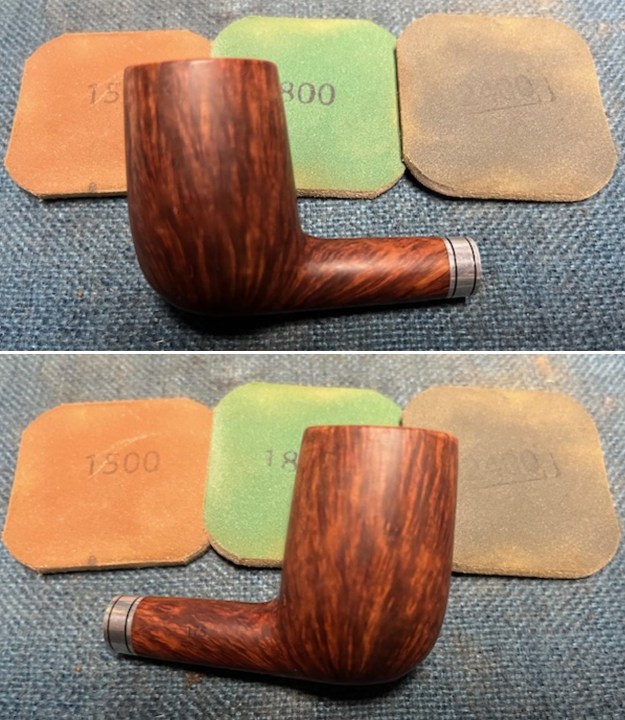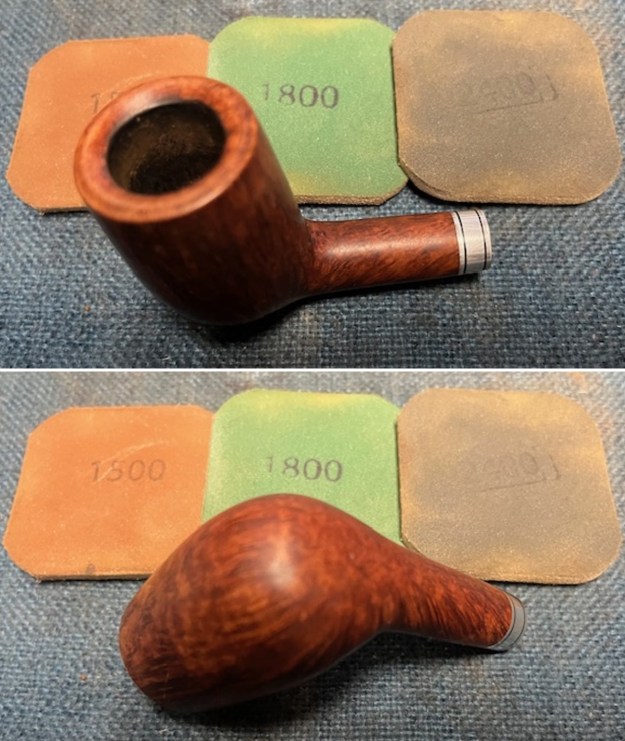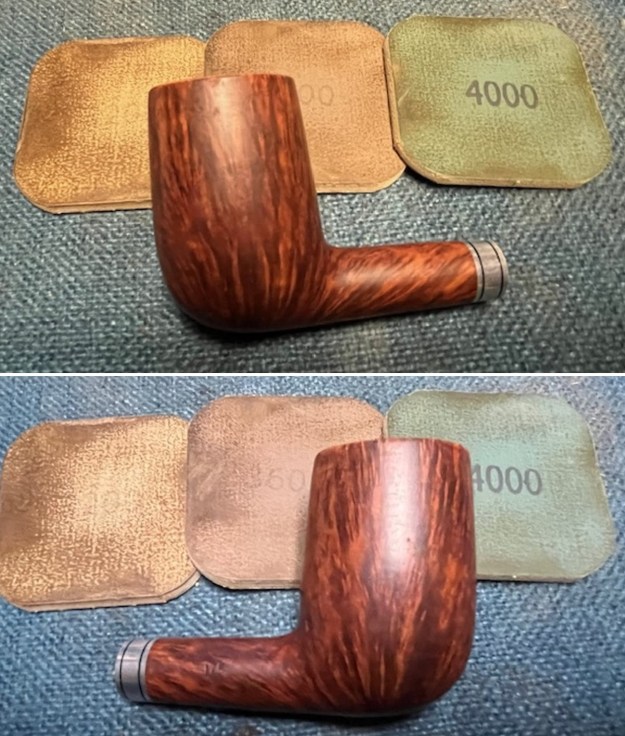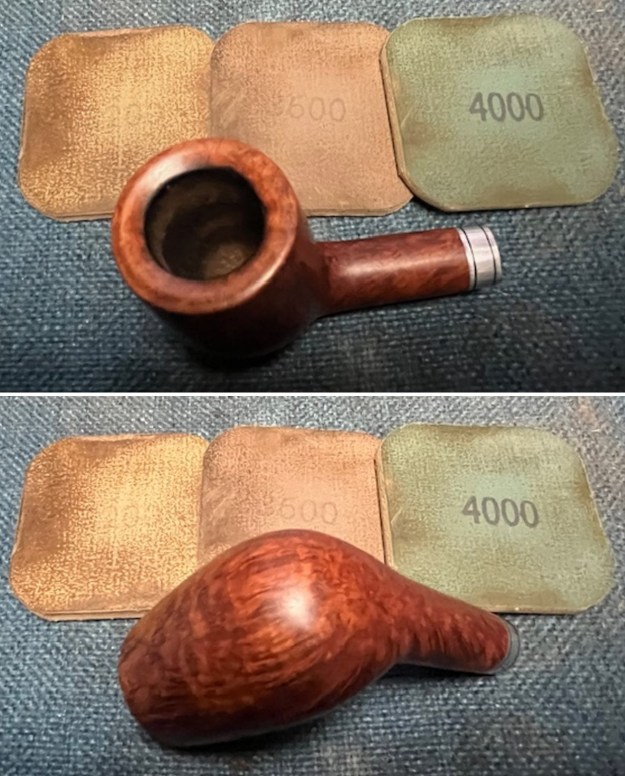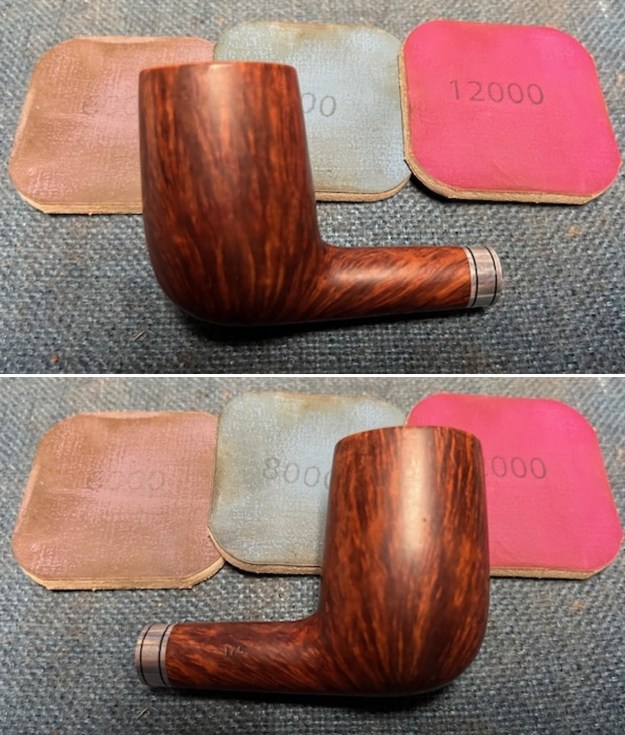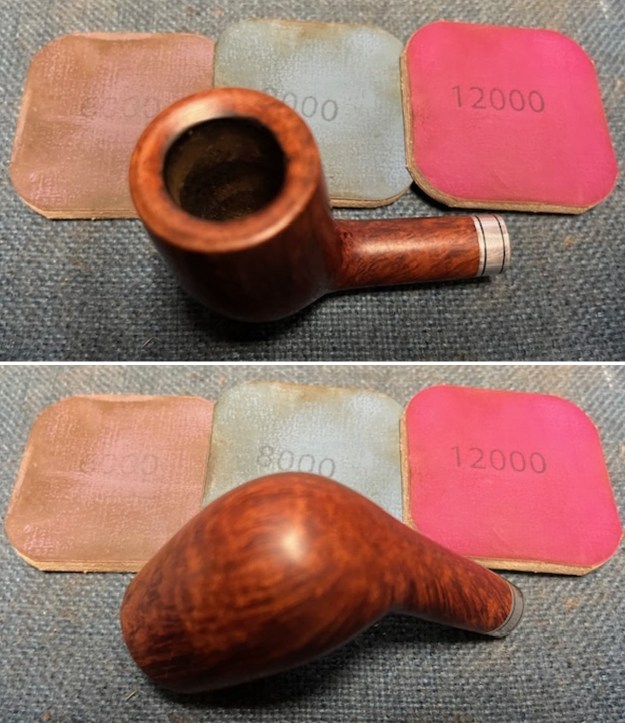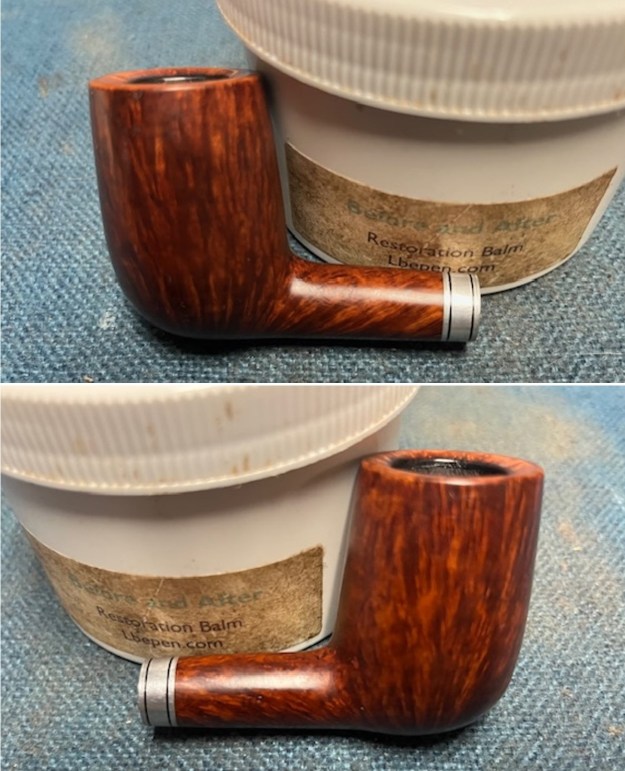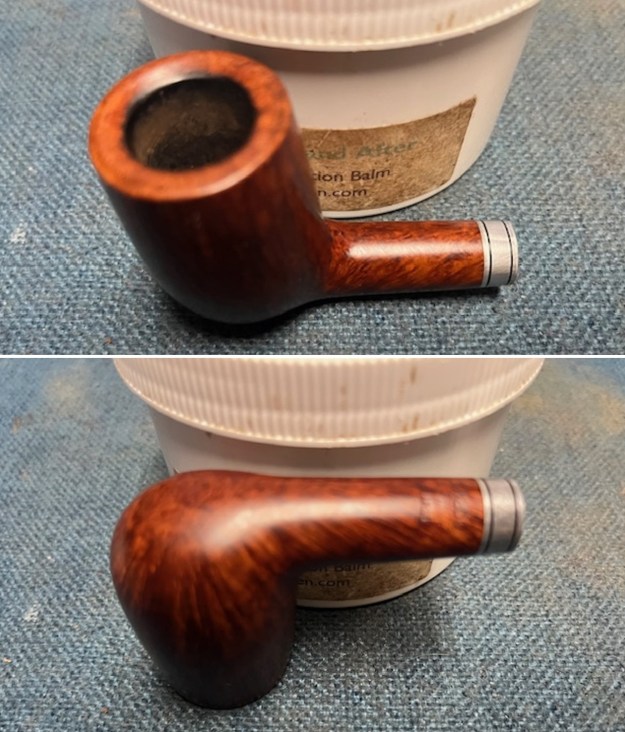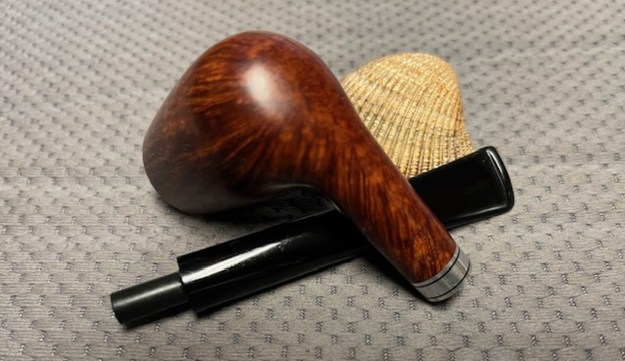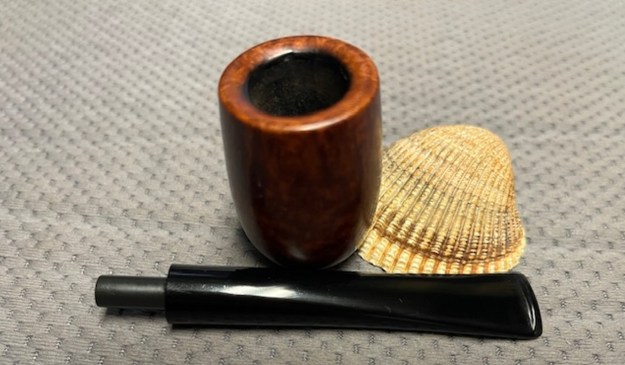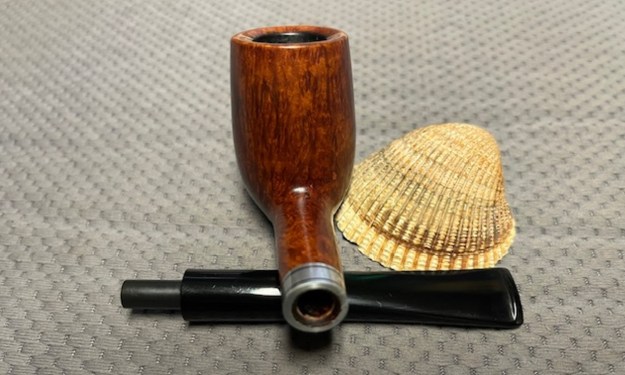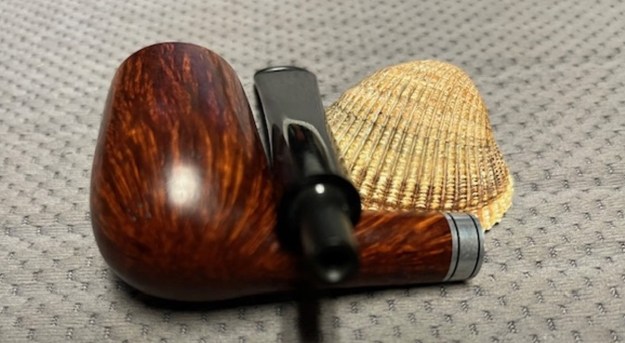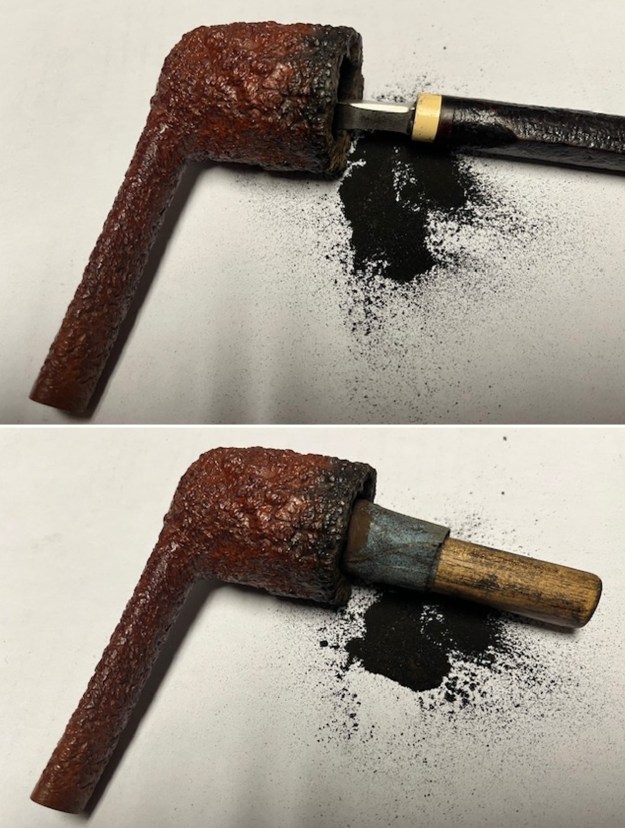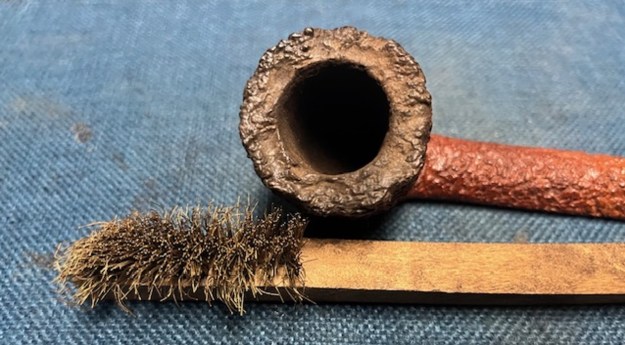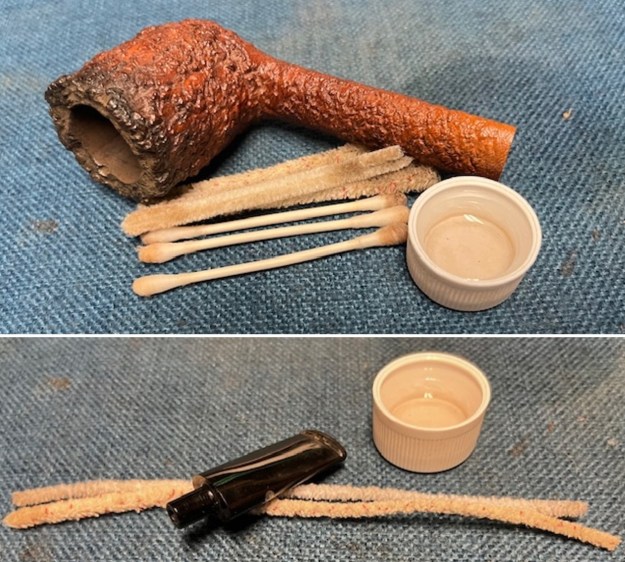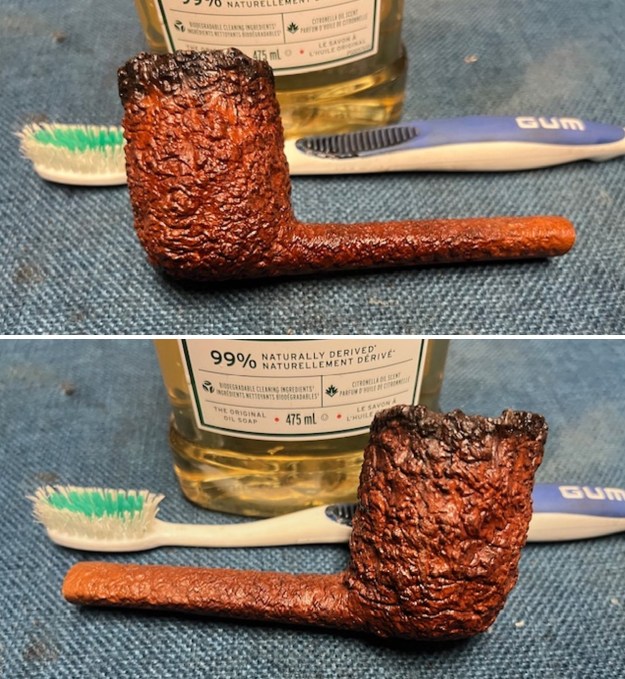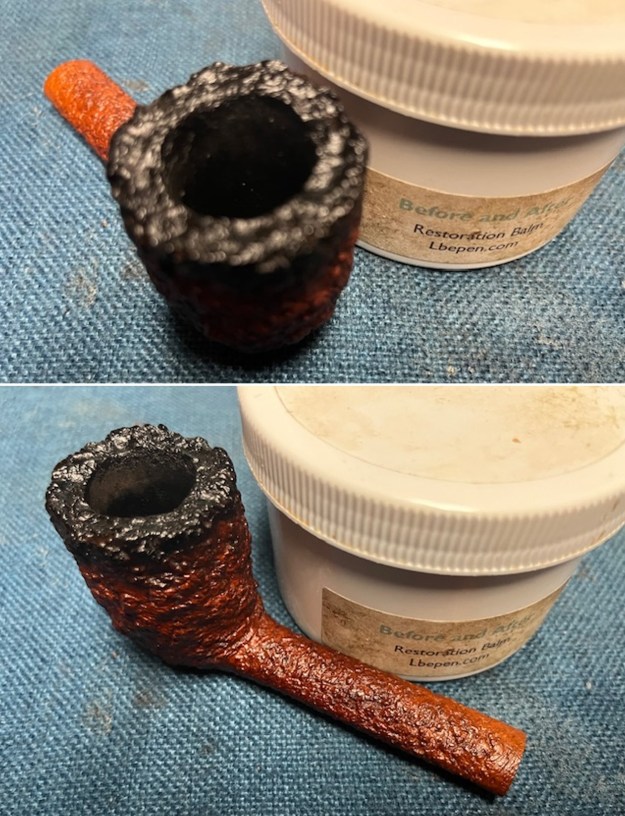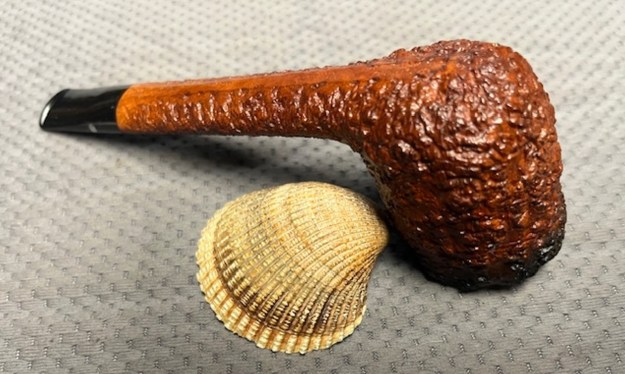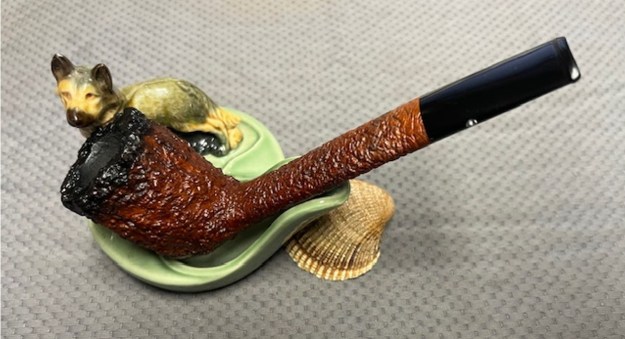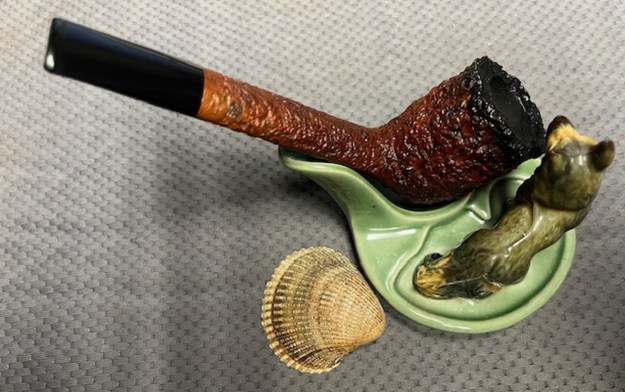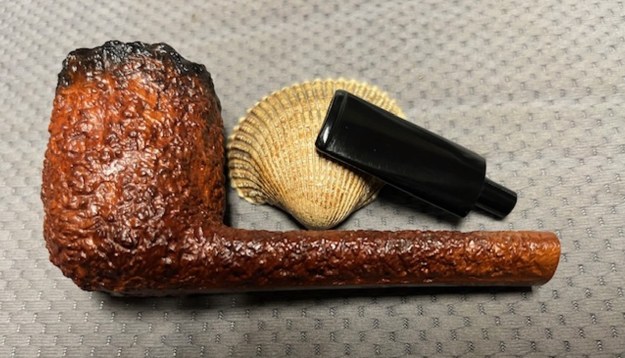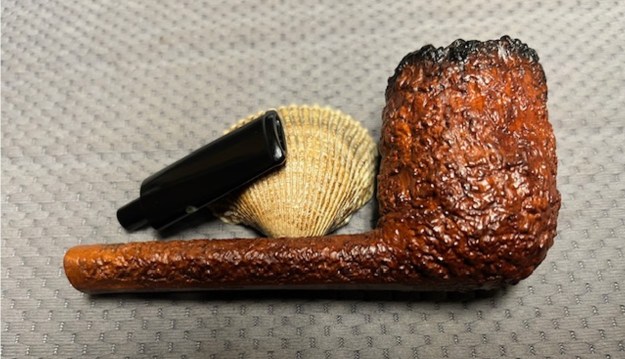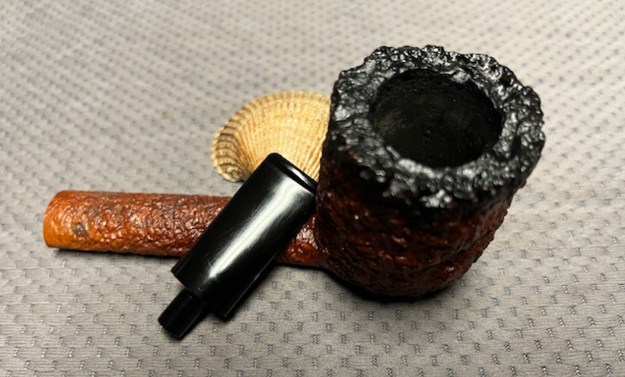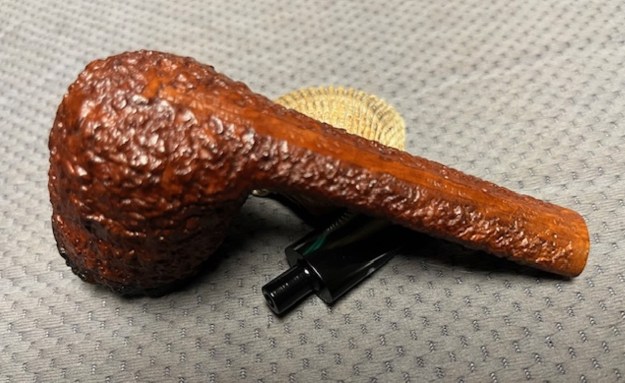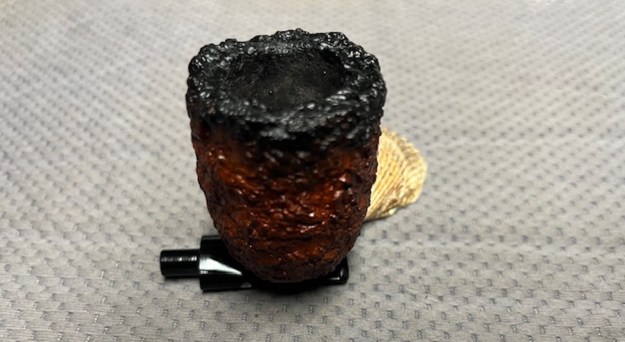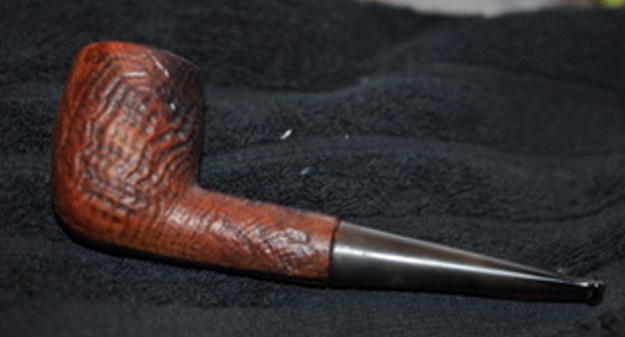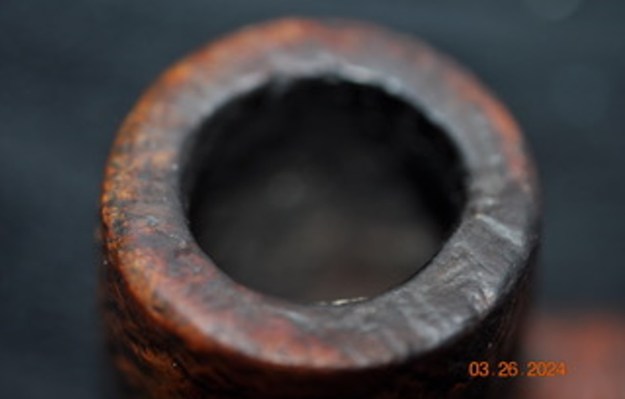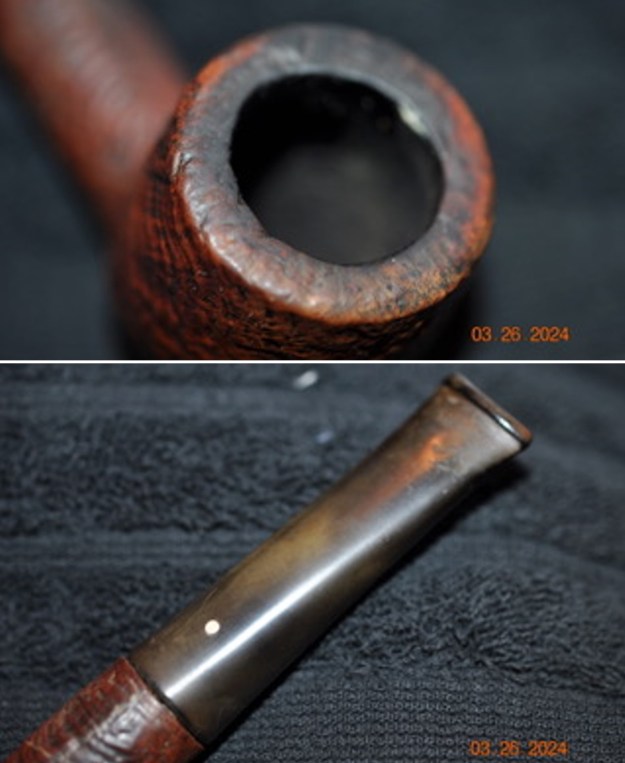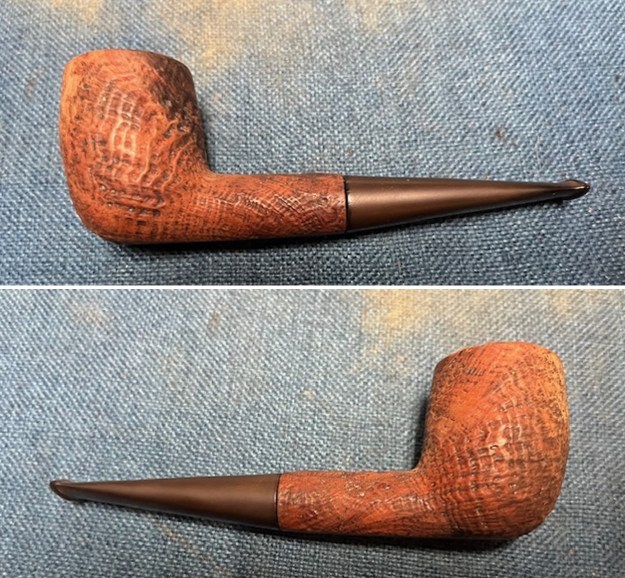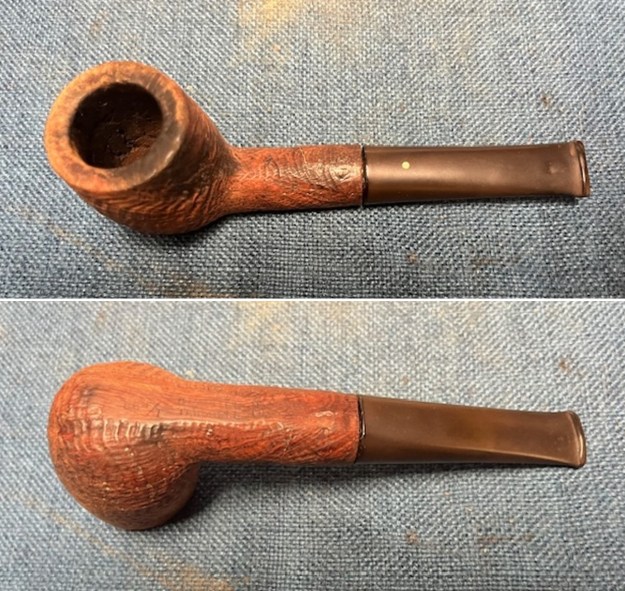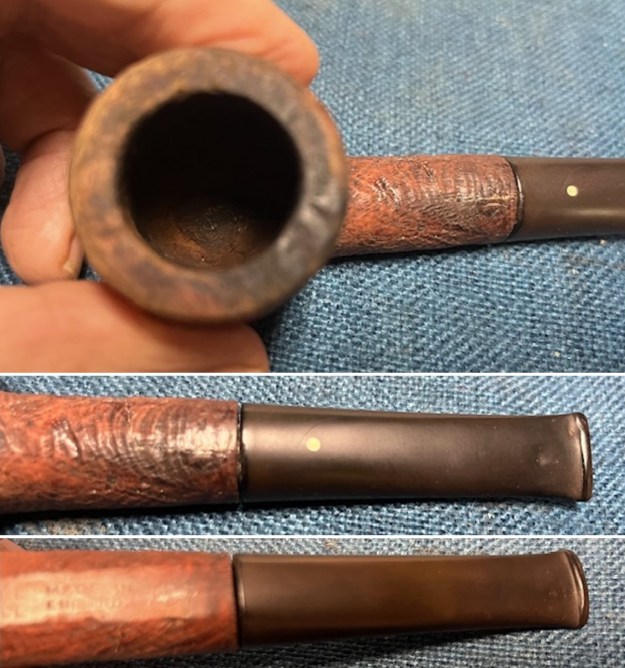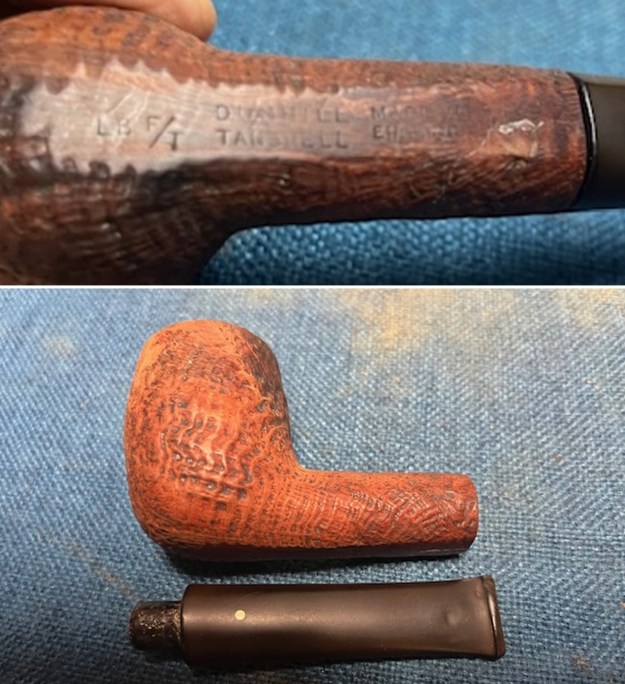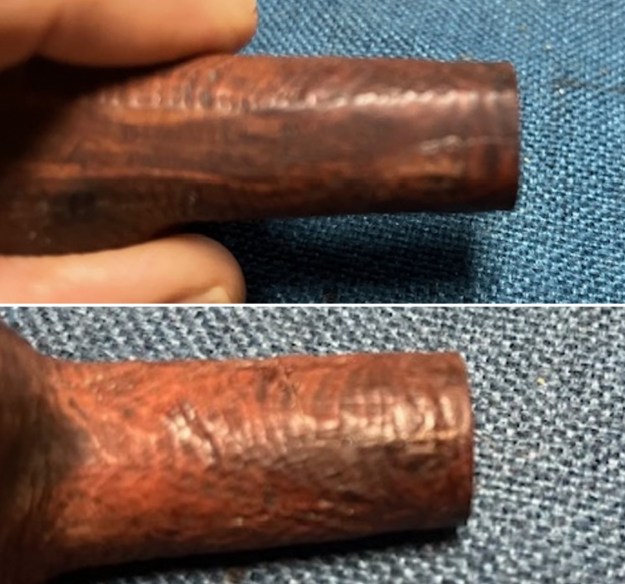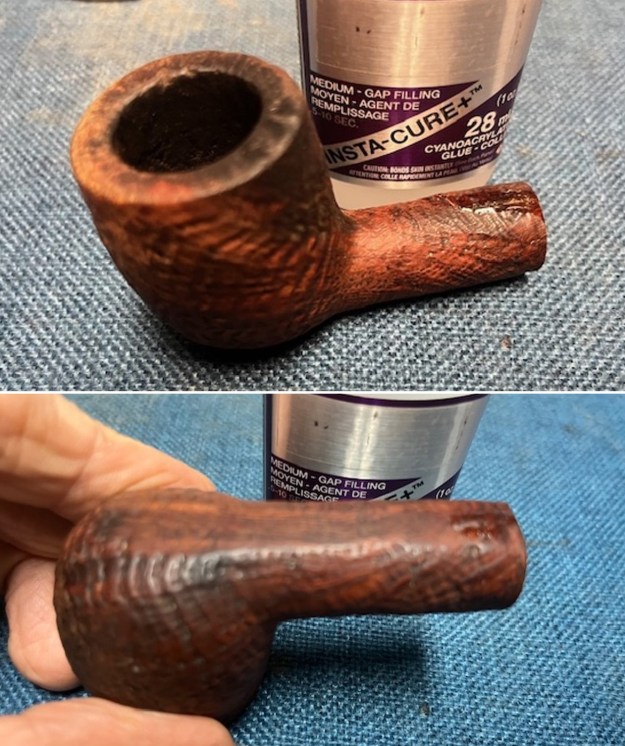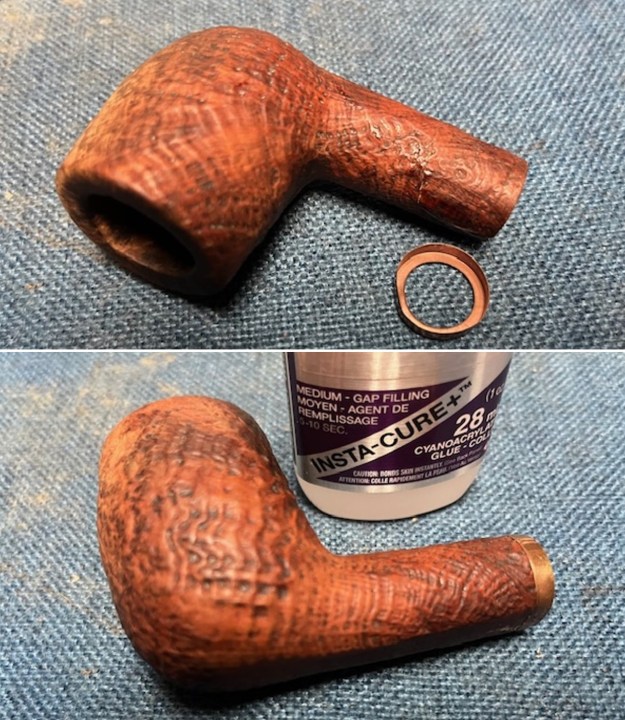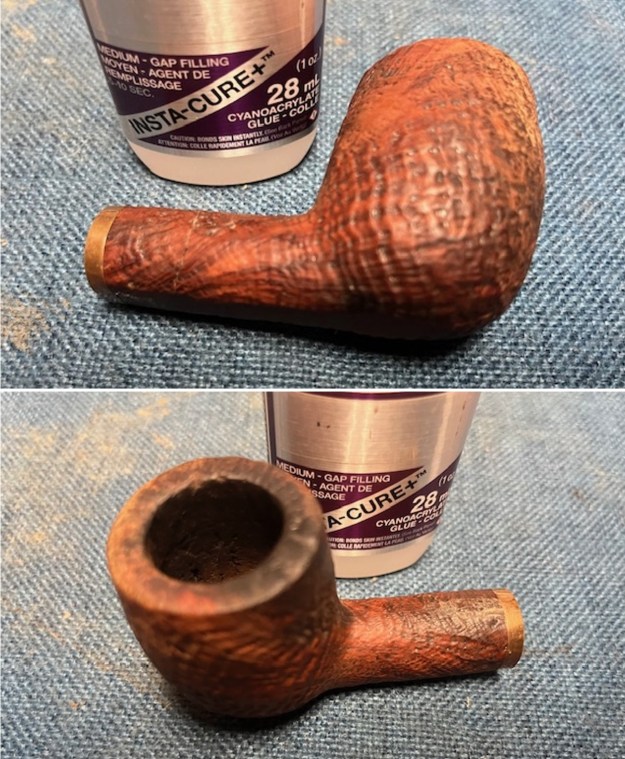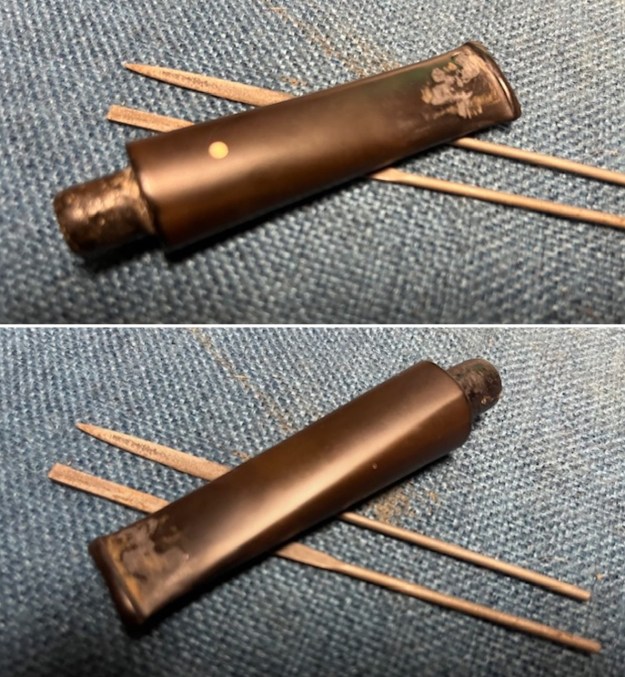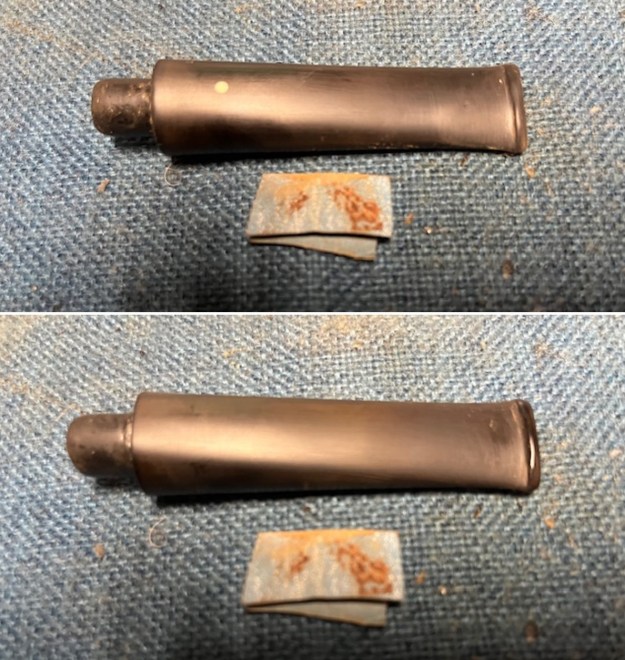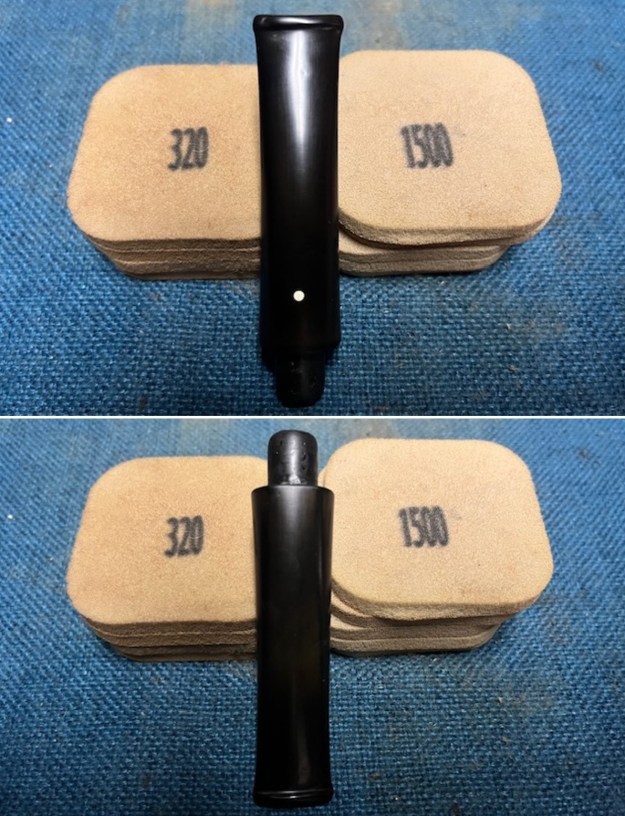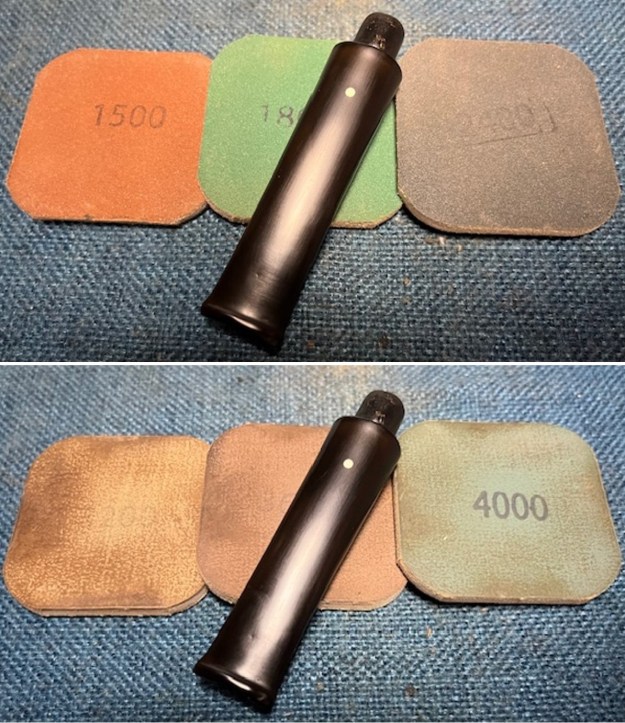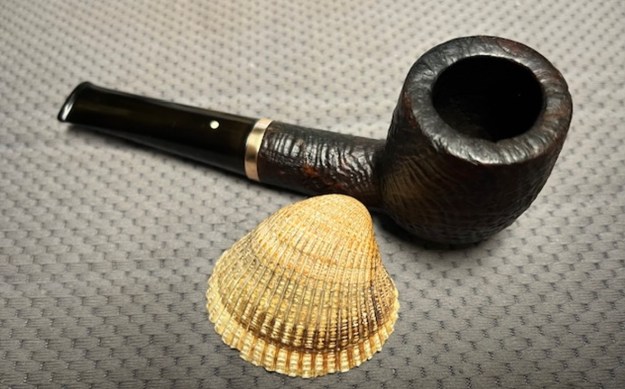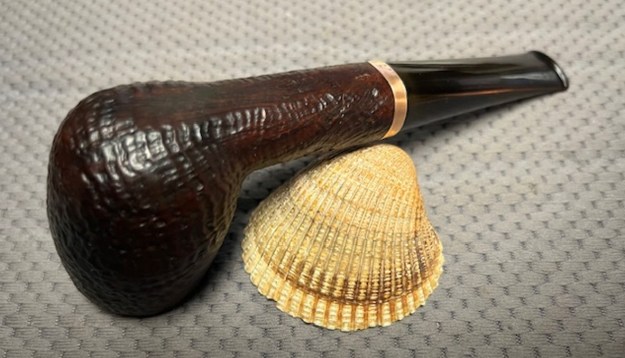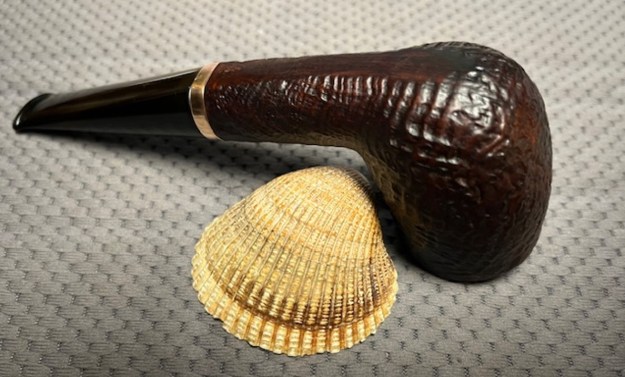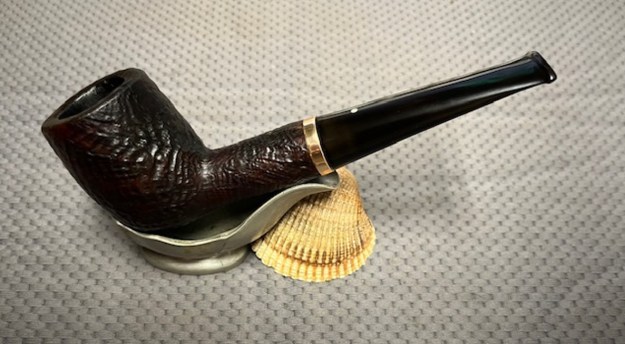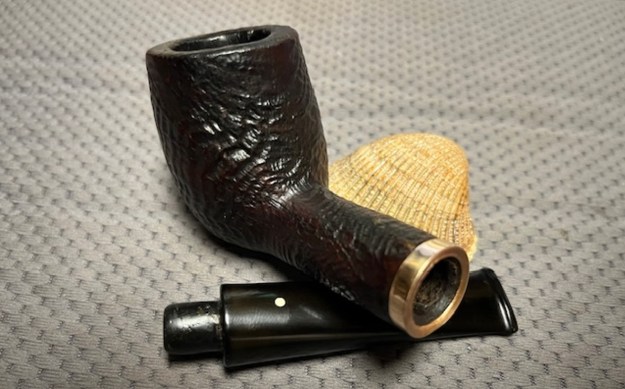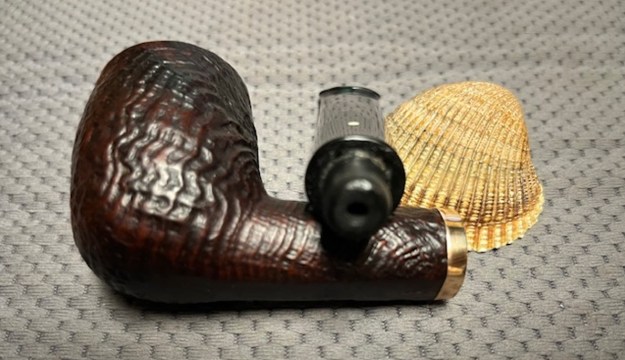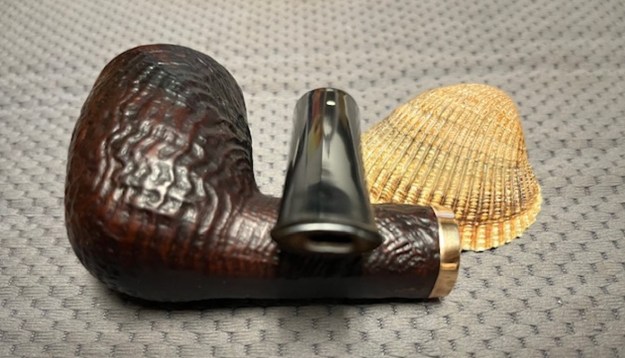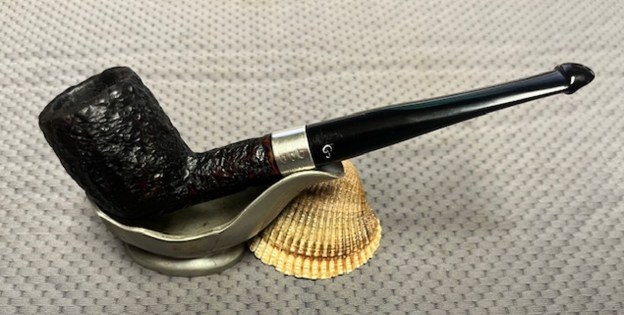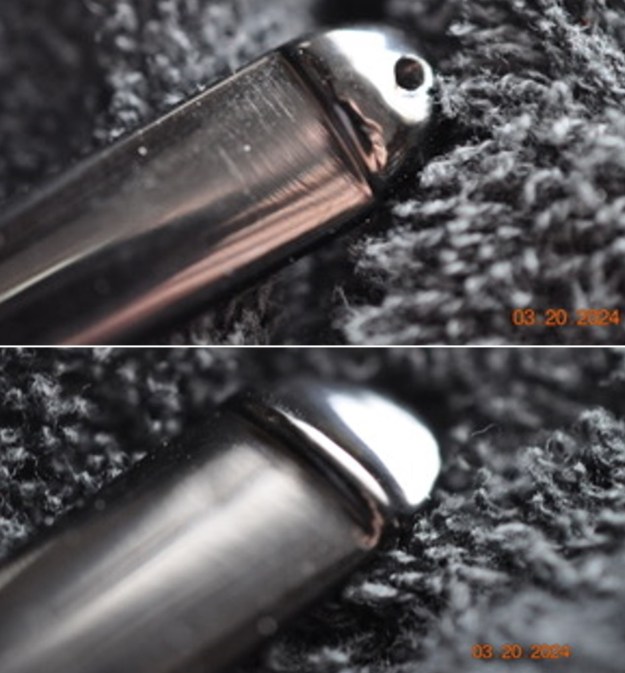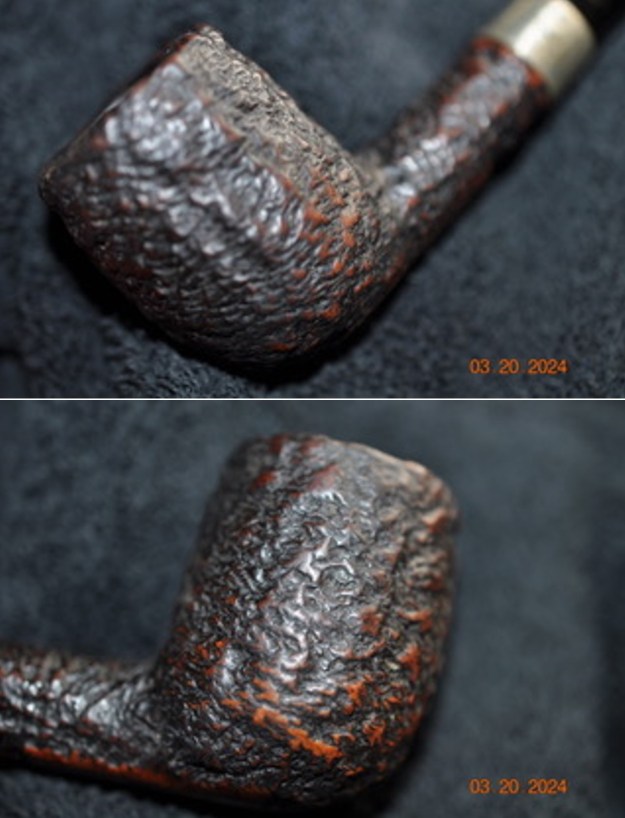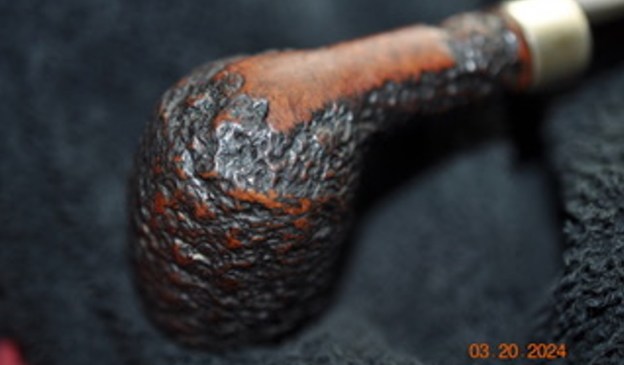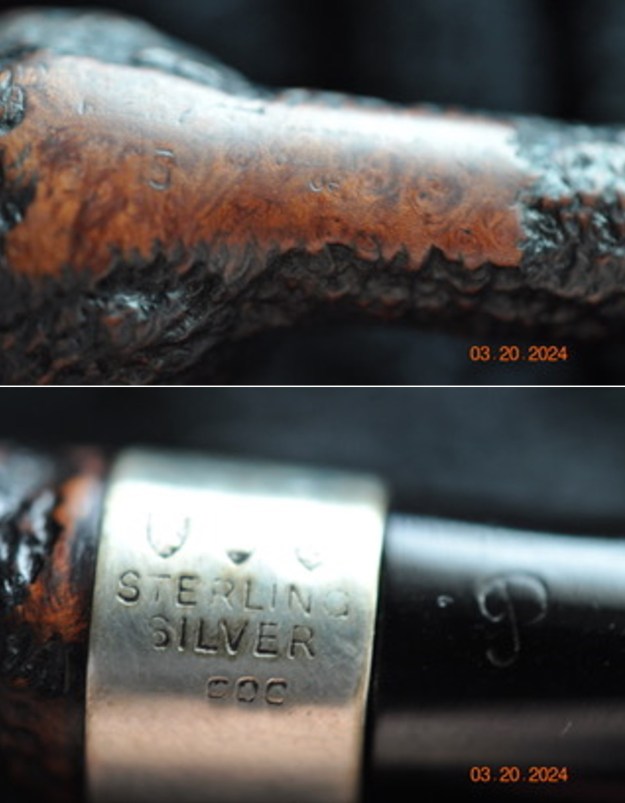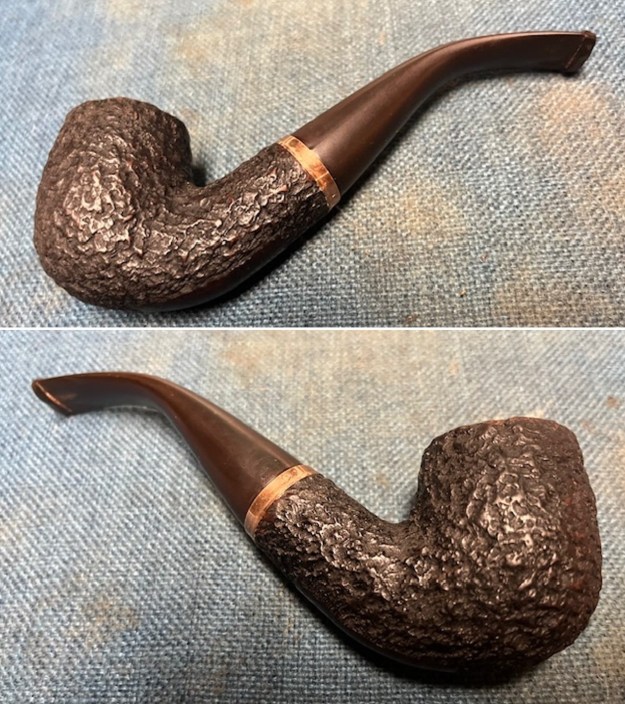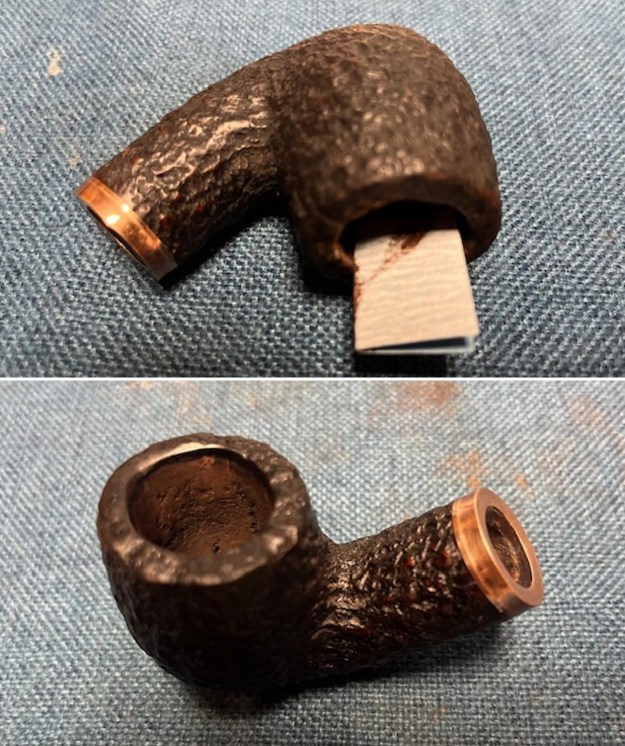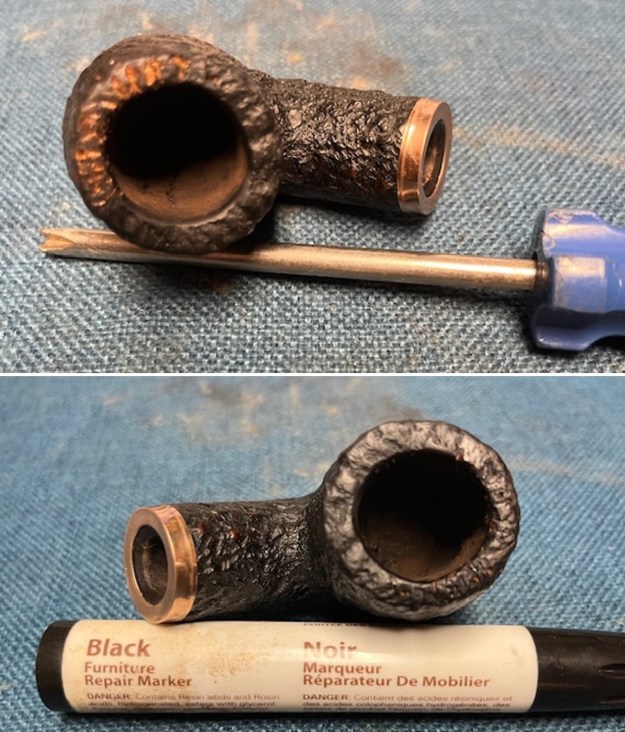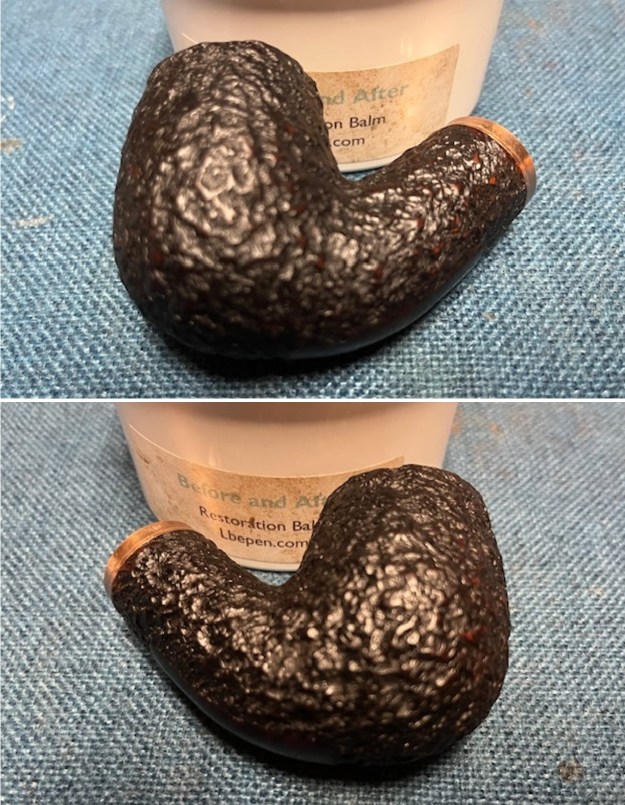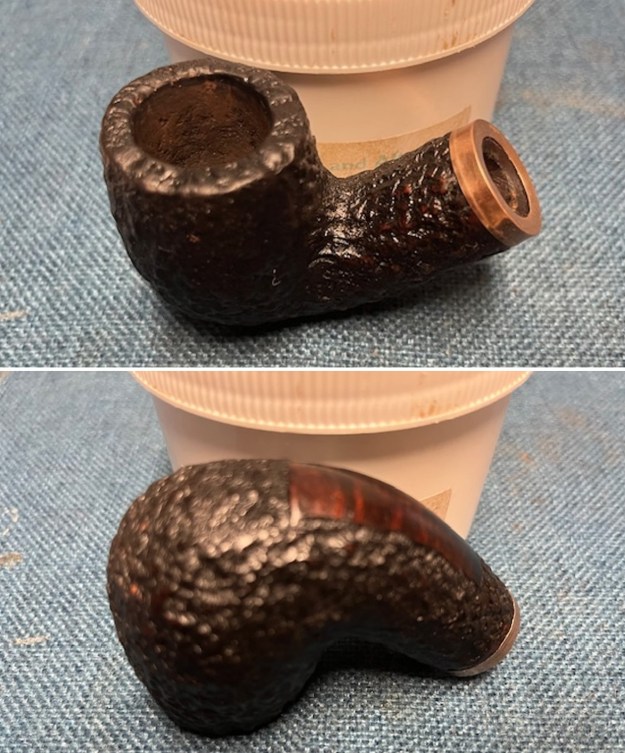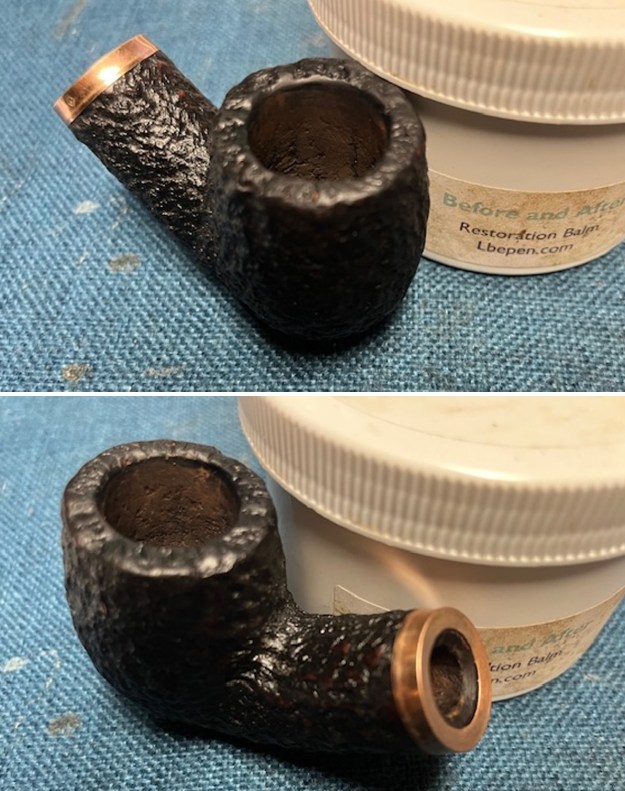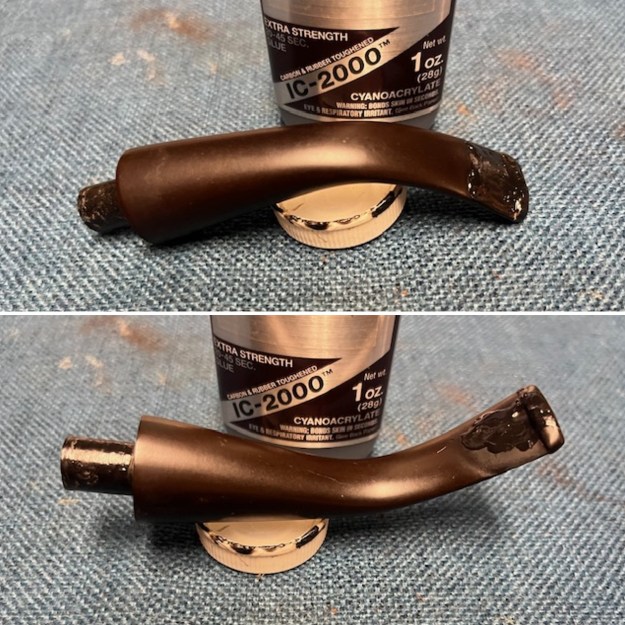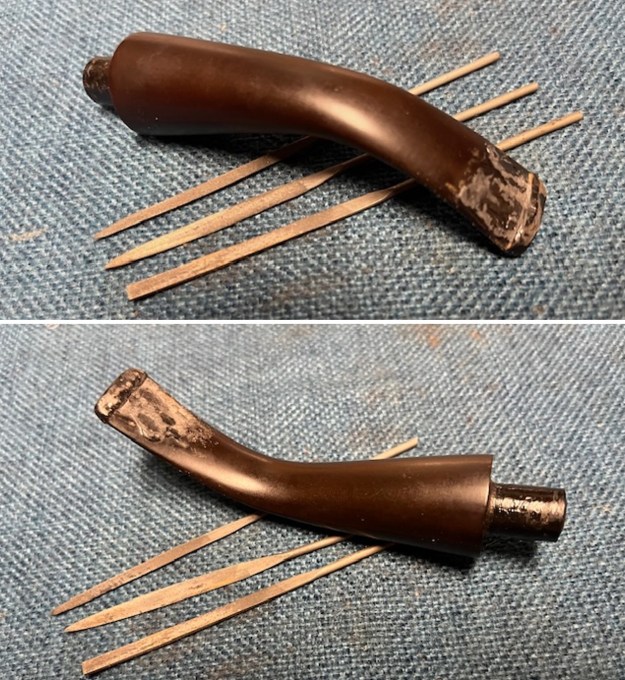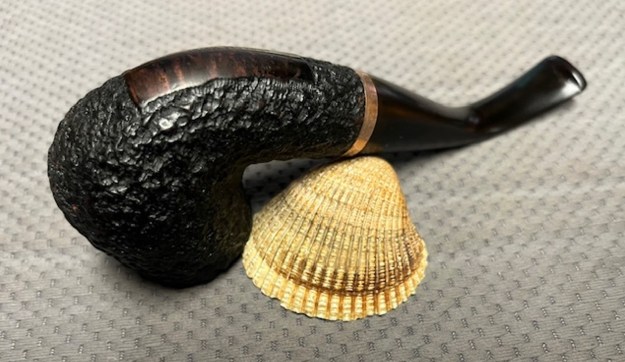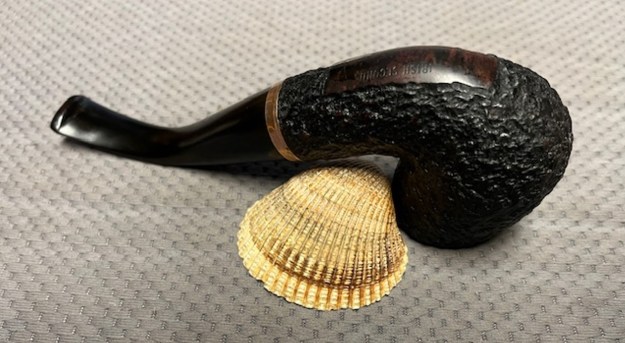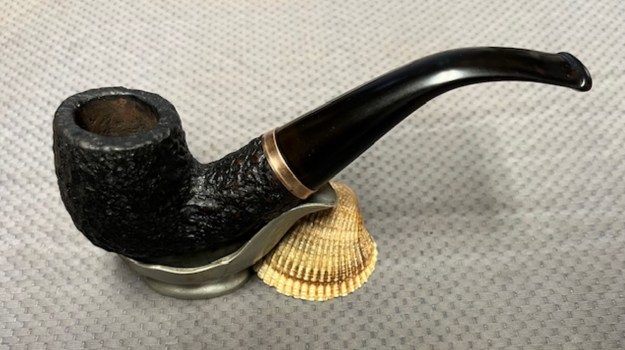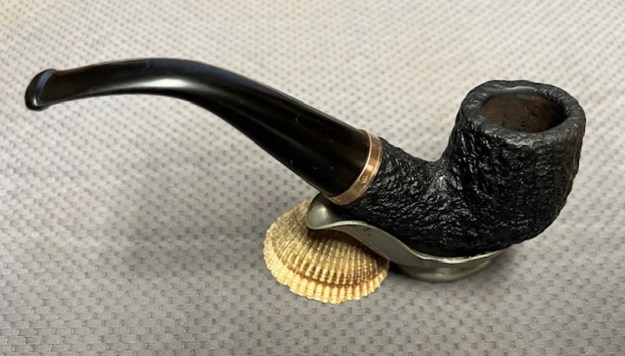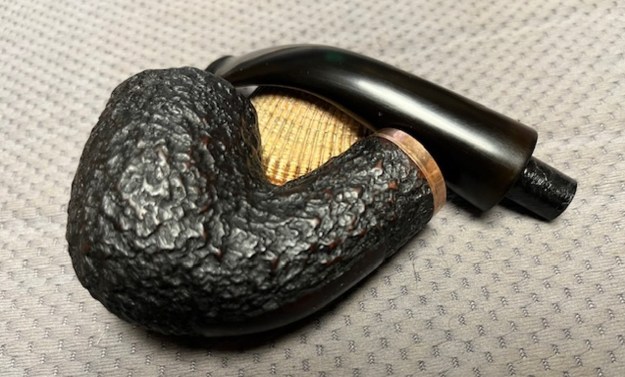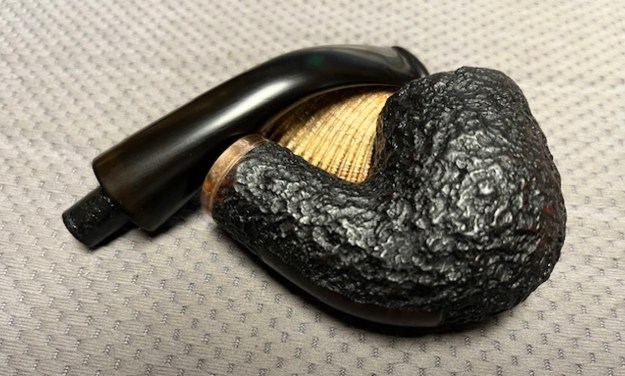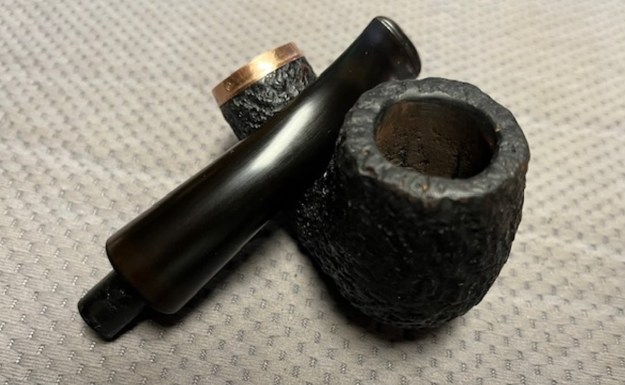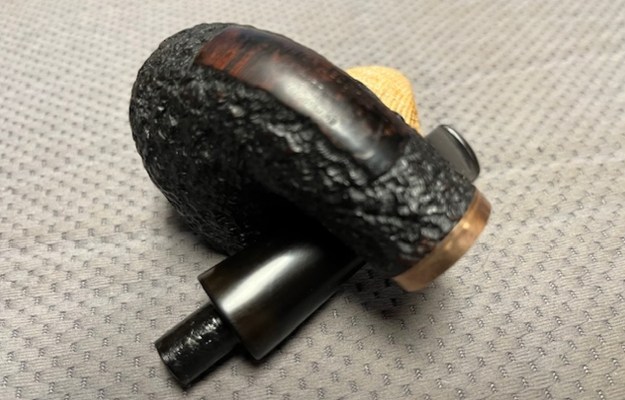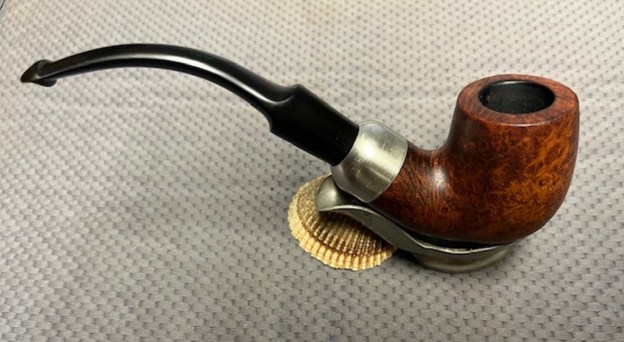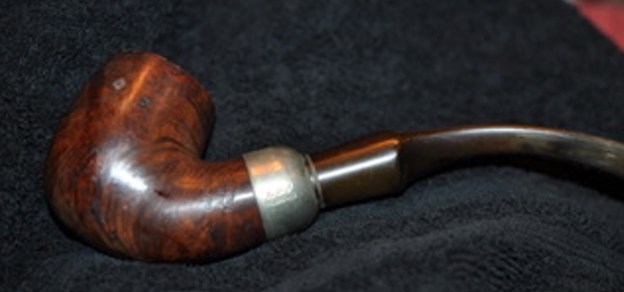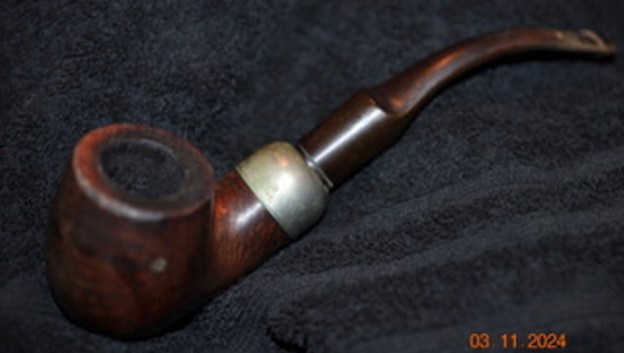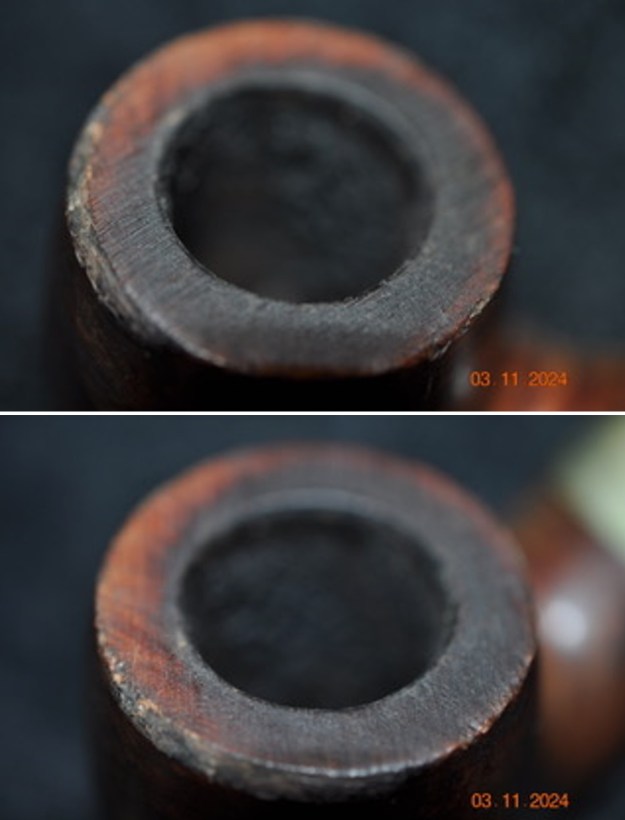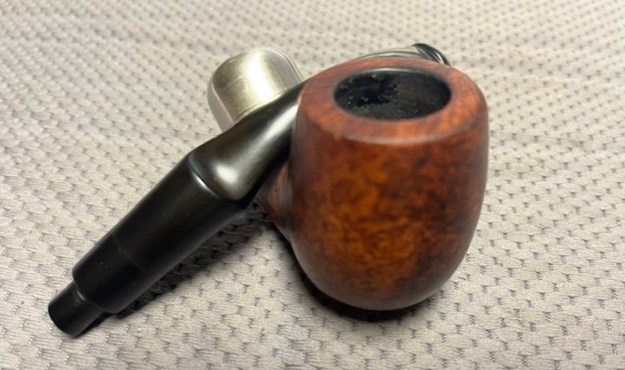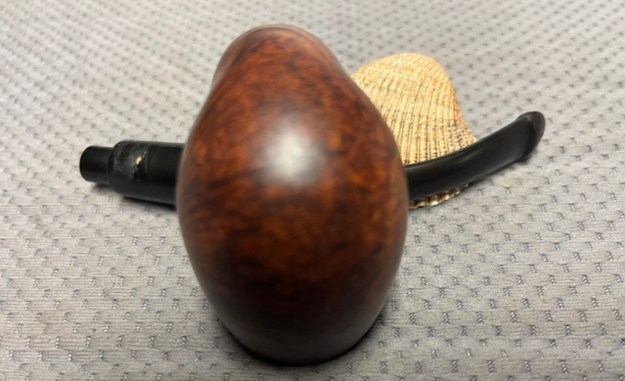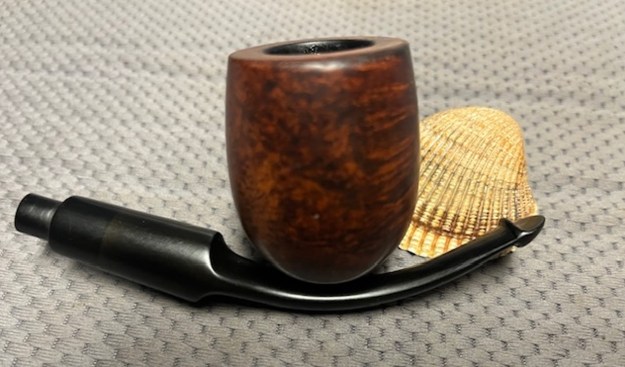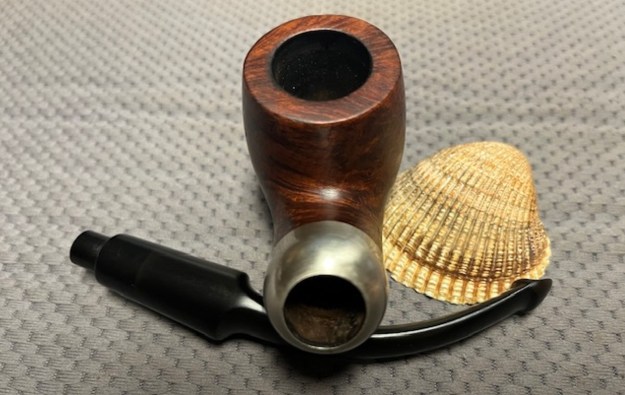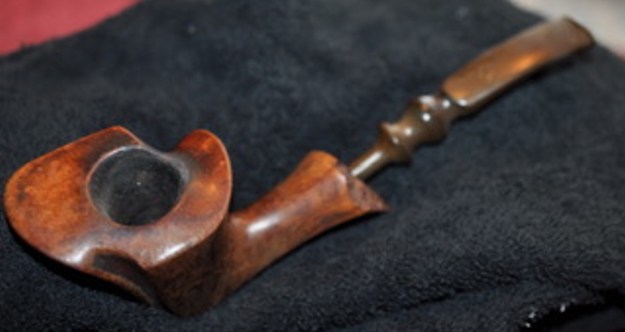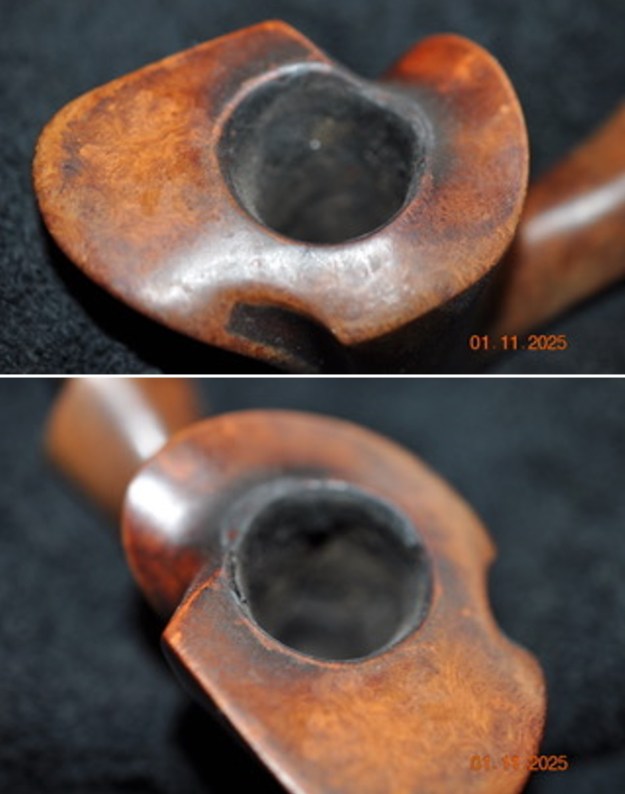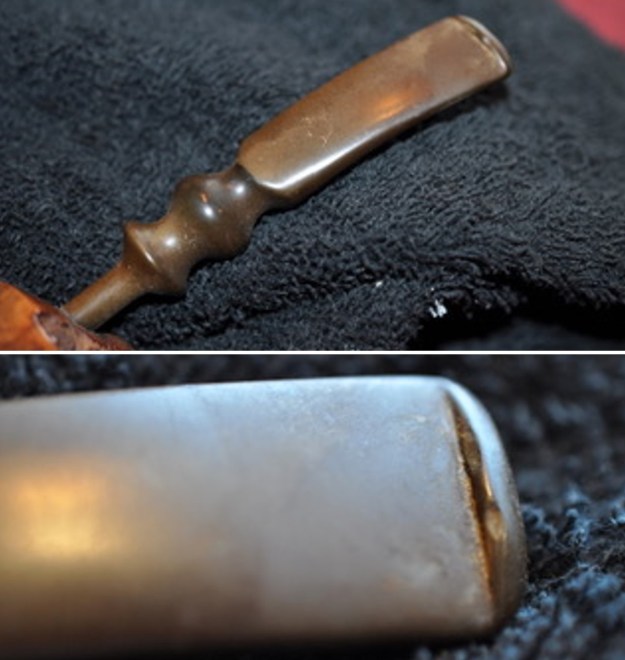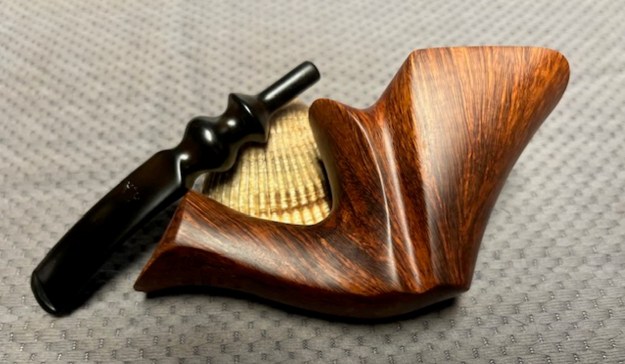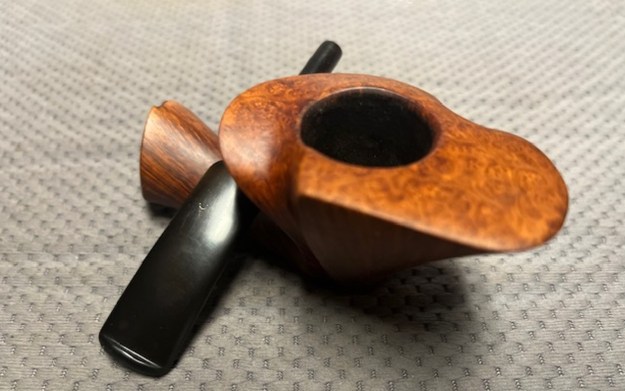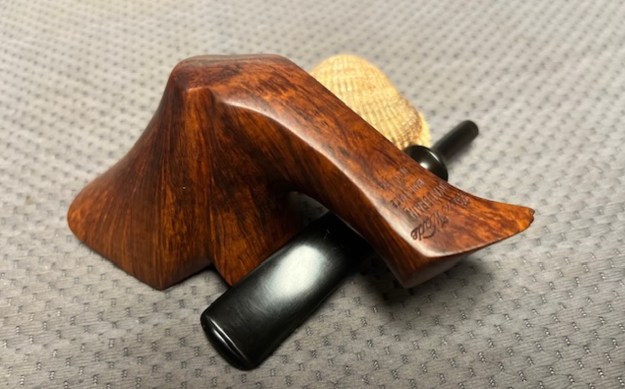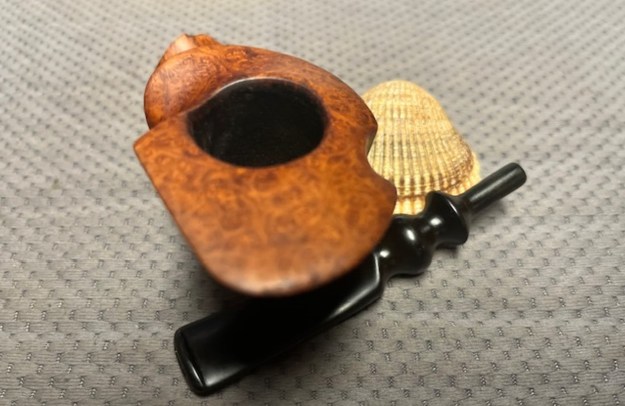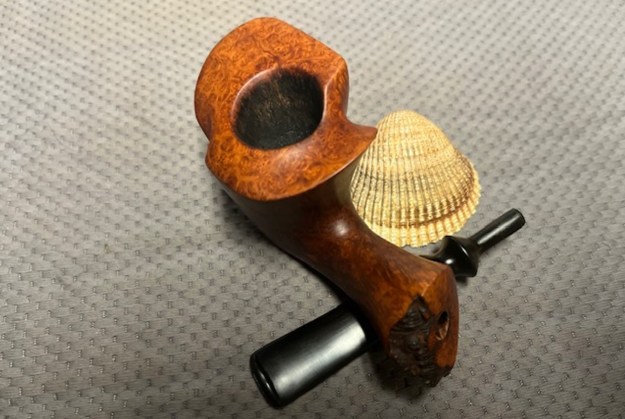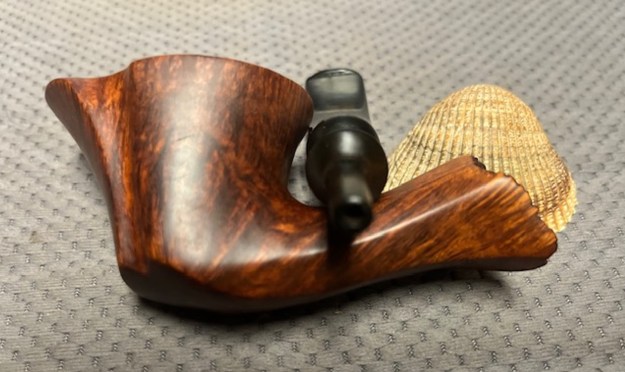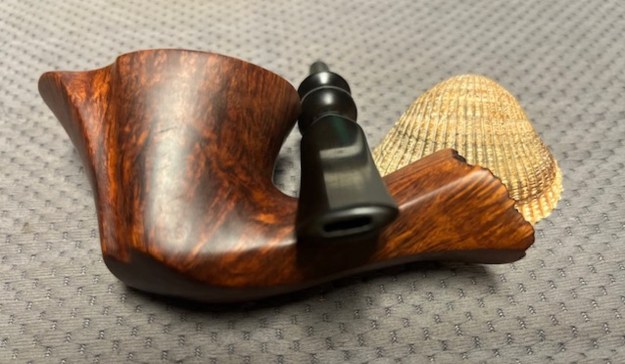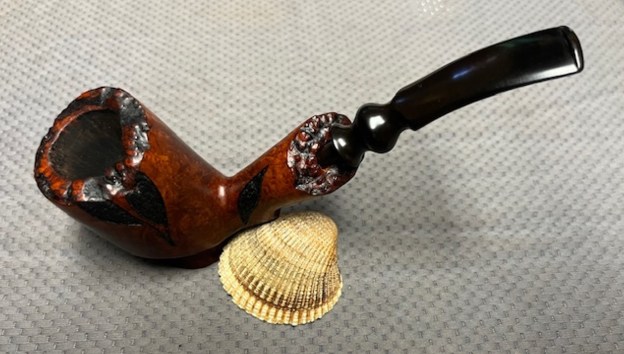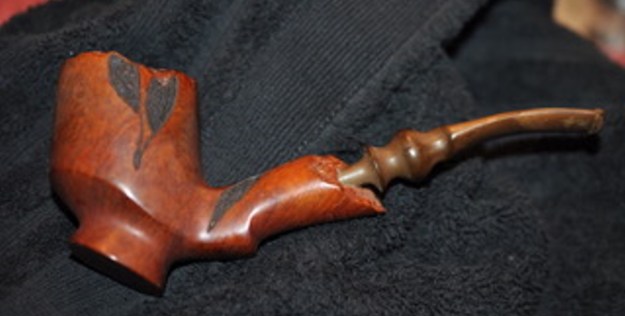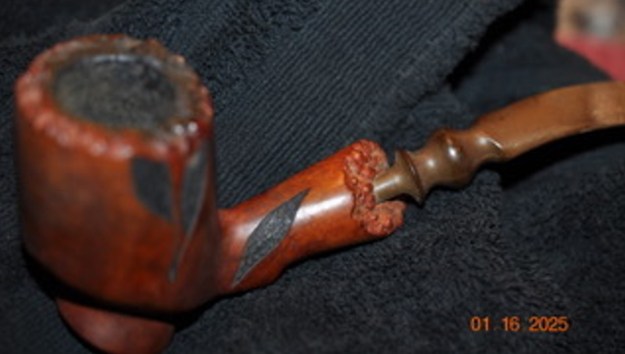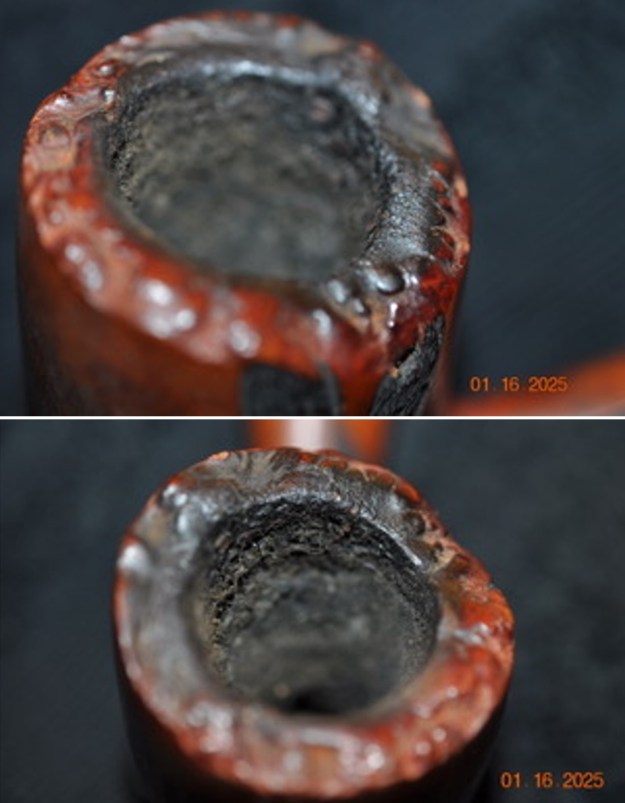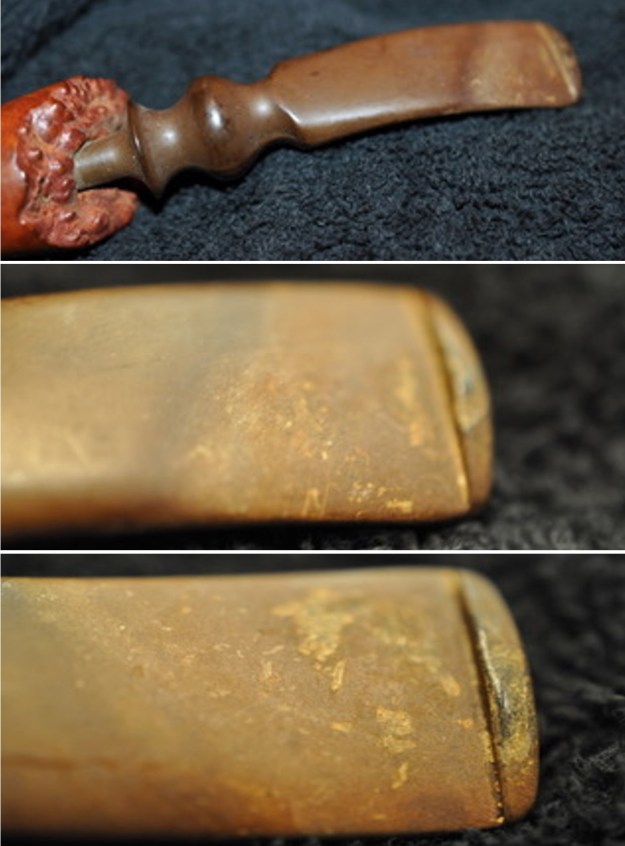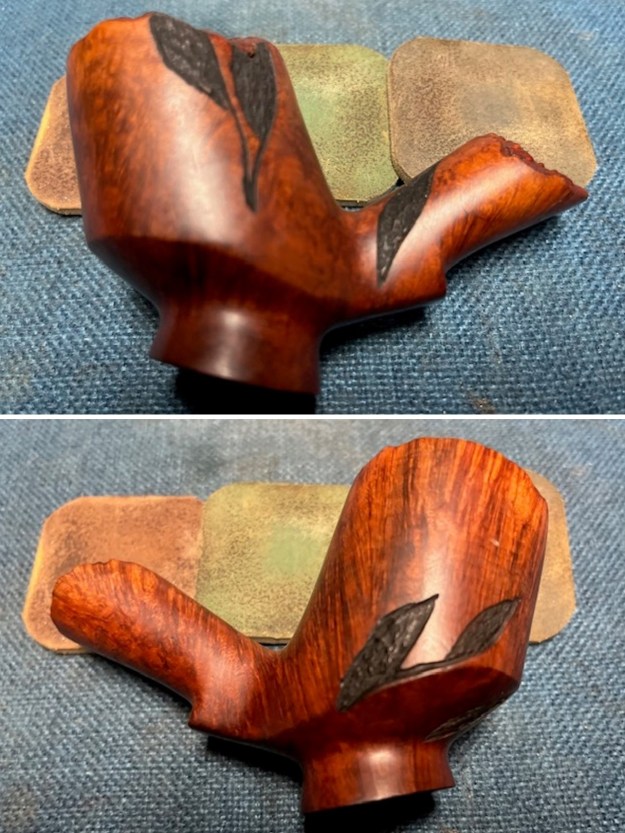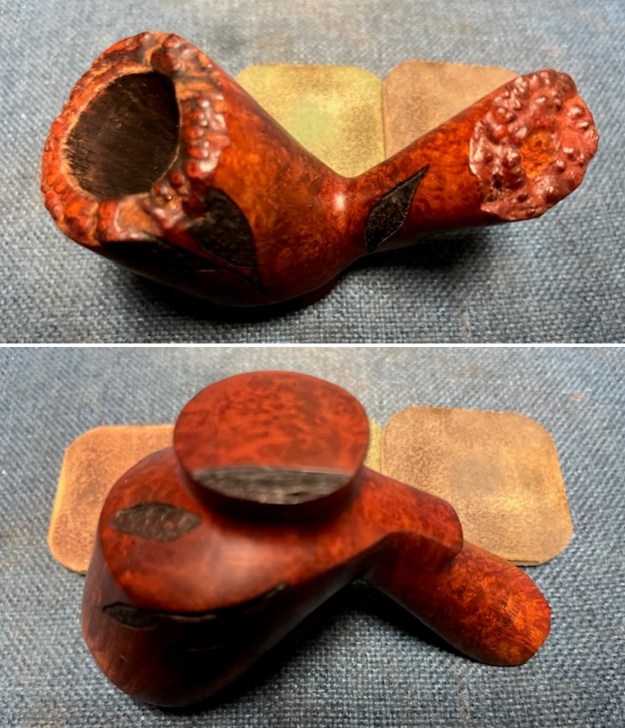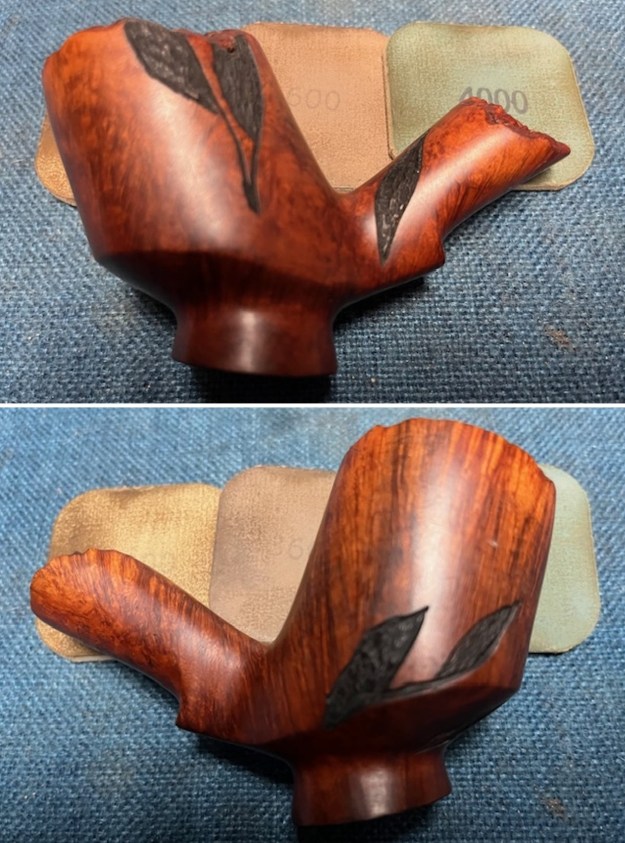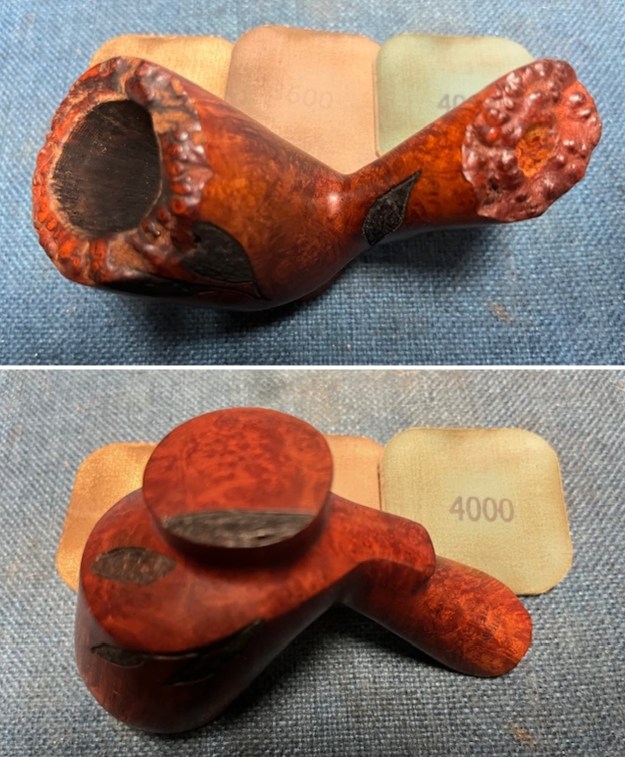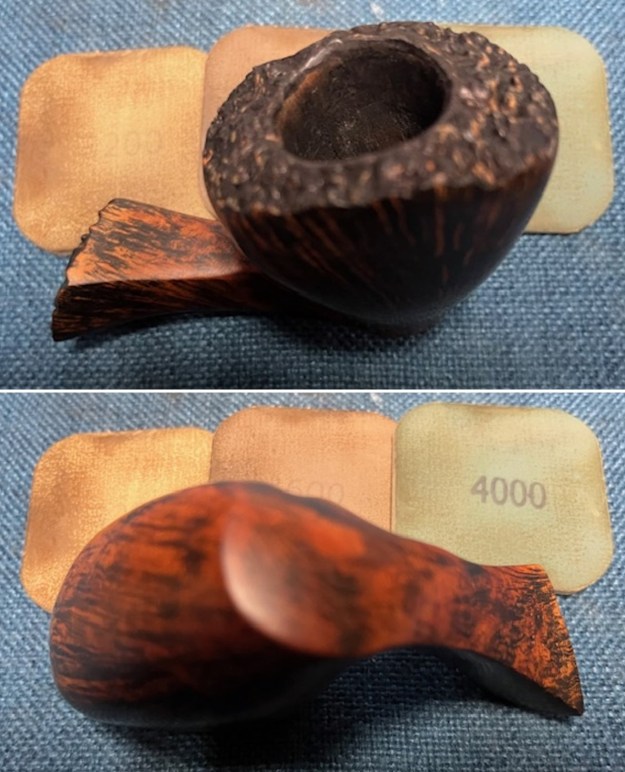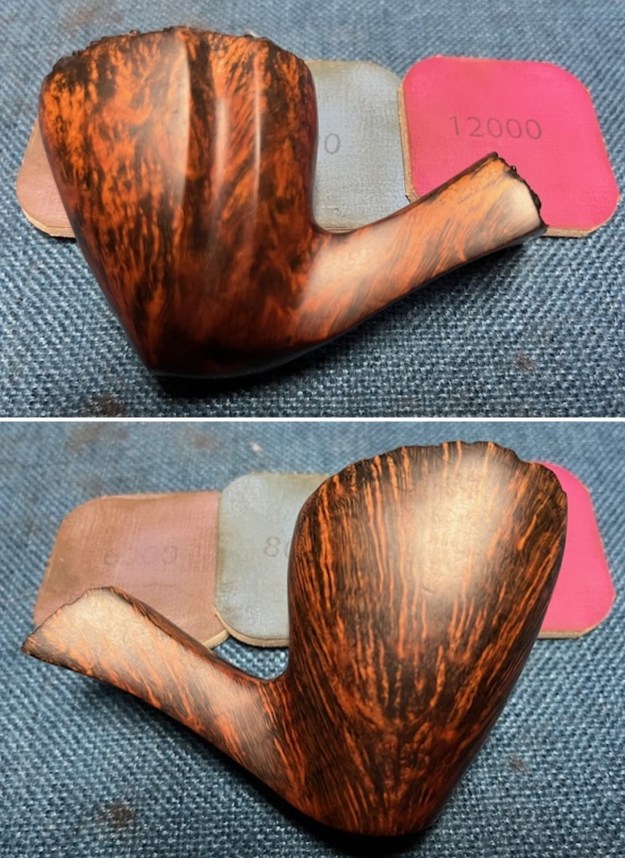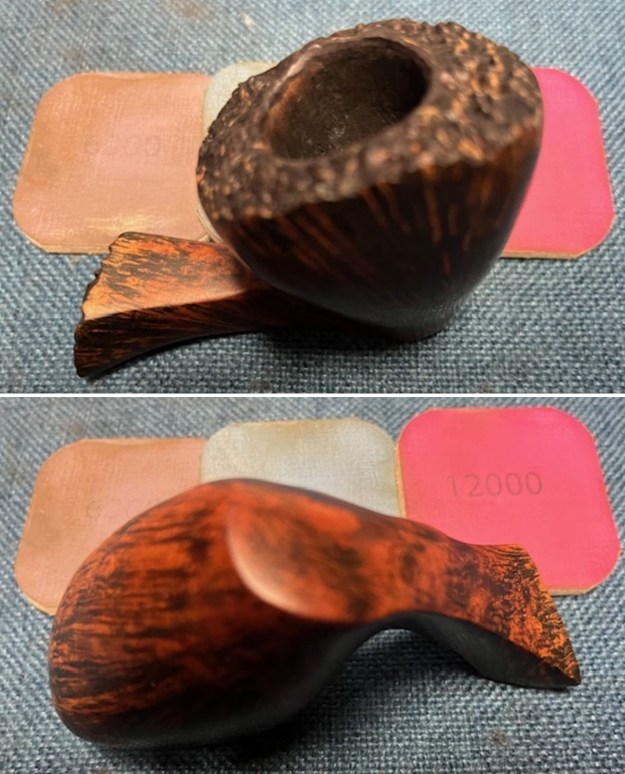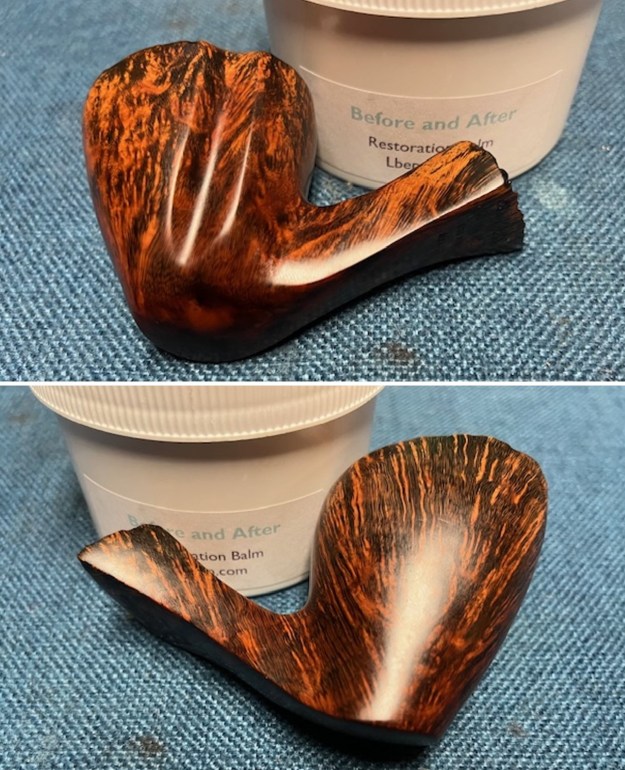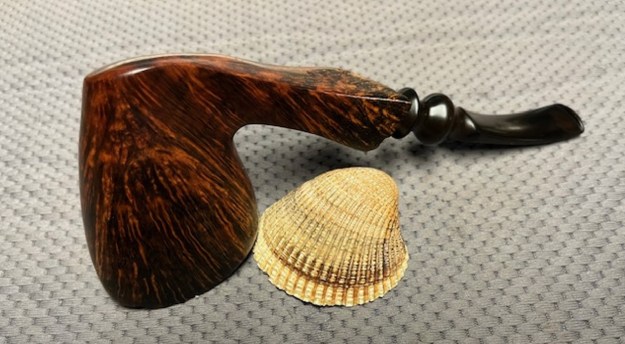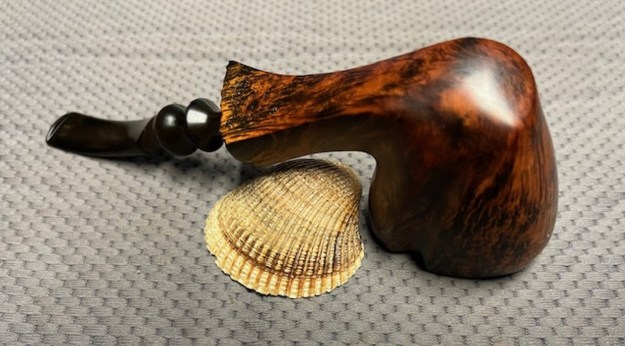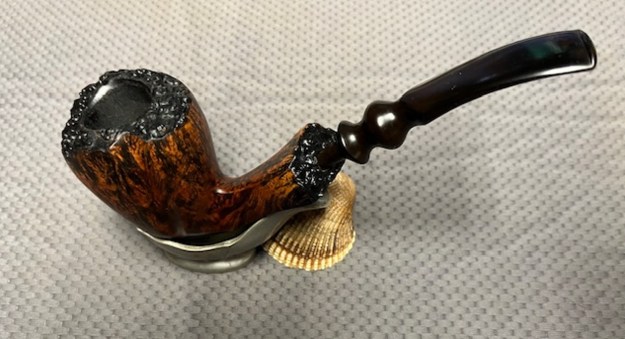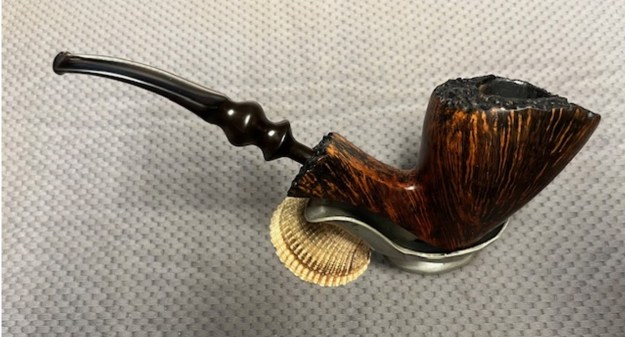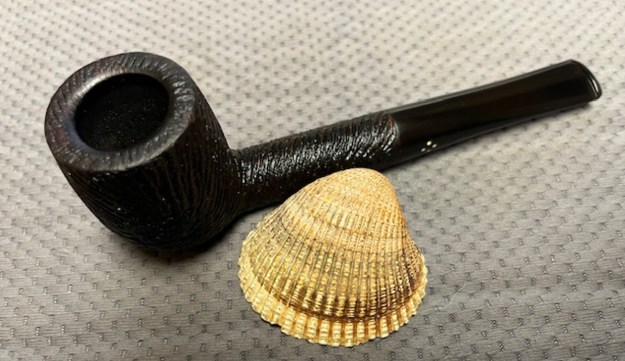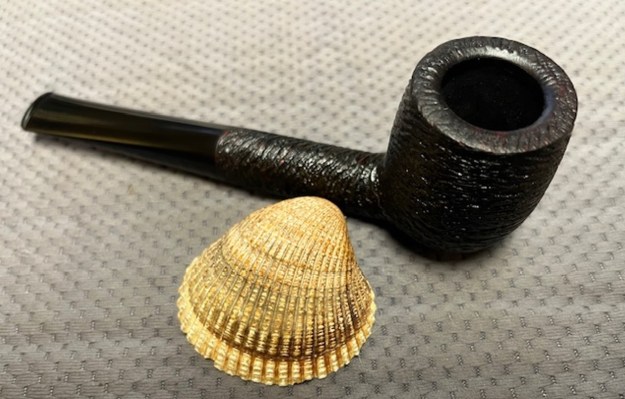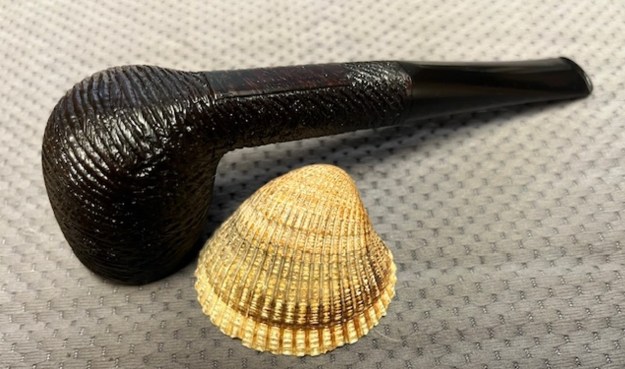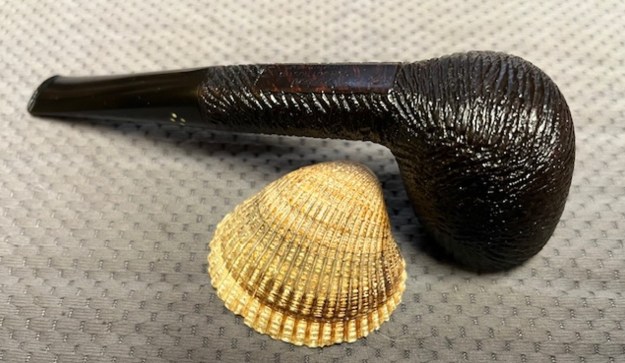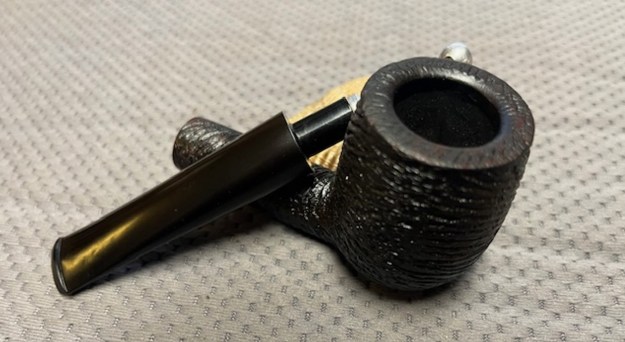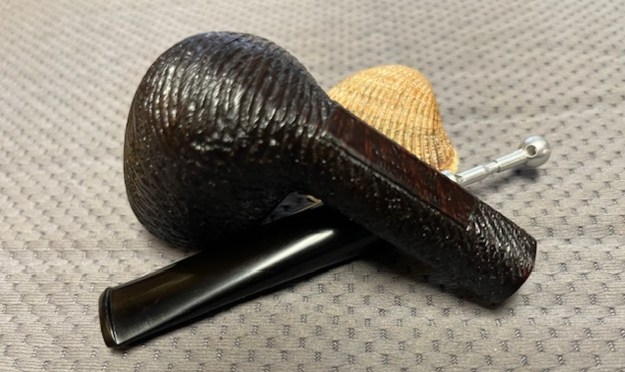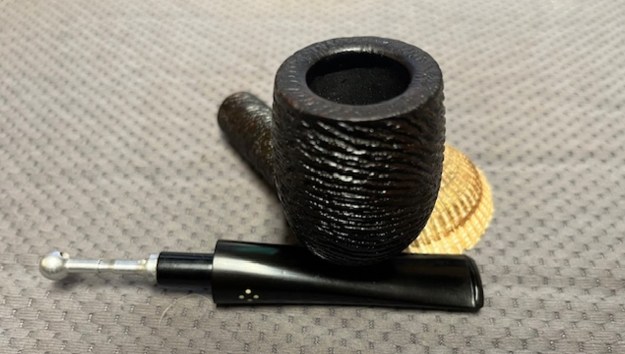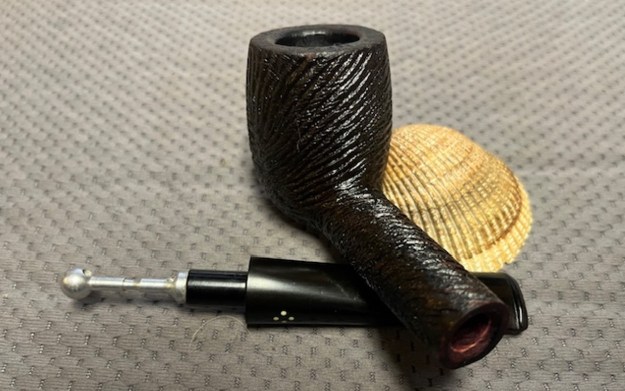
Tag Archives: restaining a bowl and rim

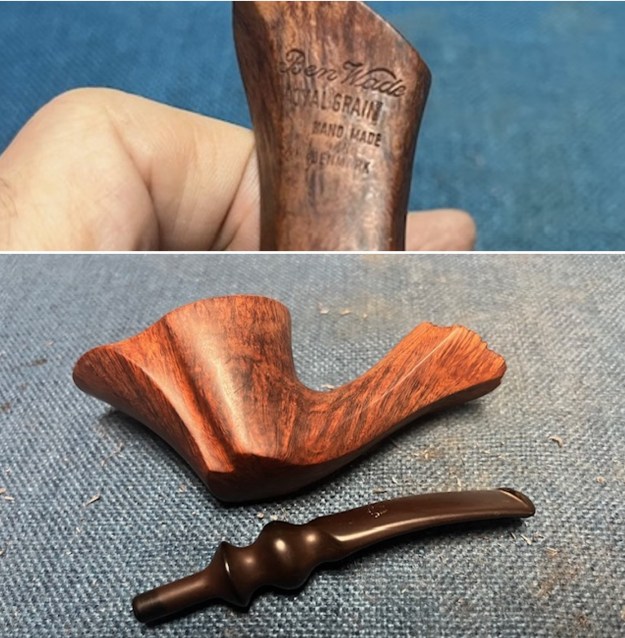
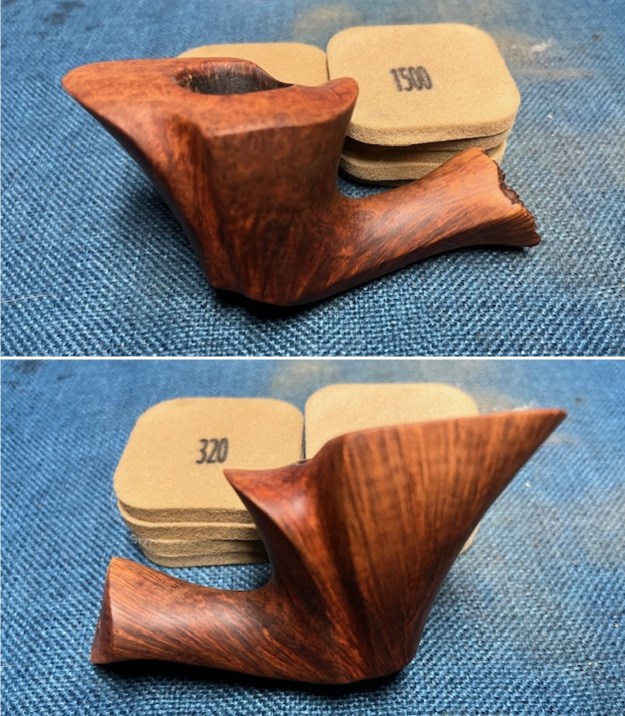
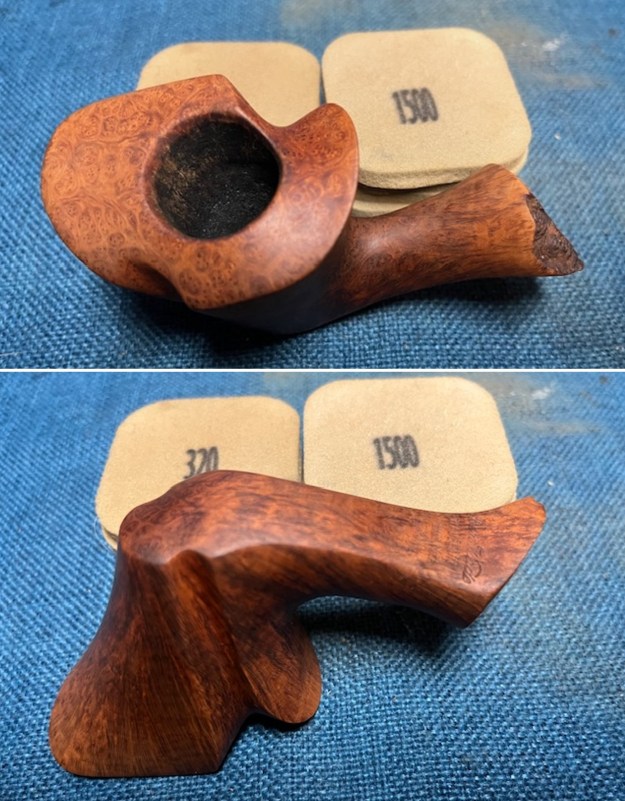
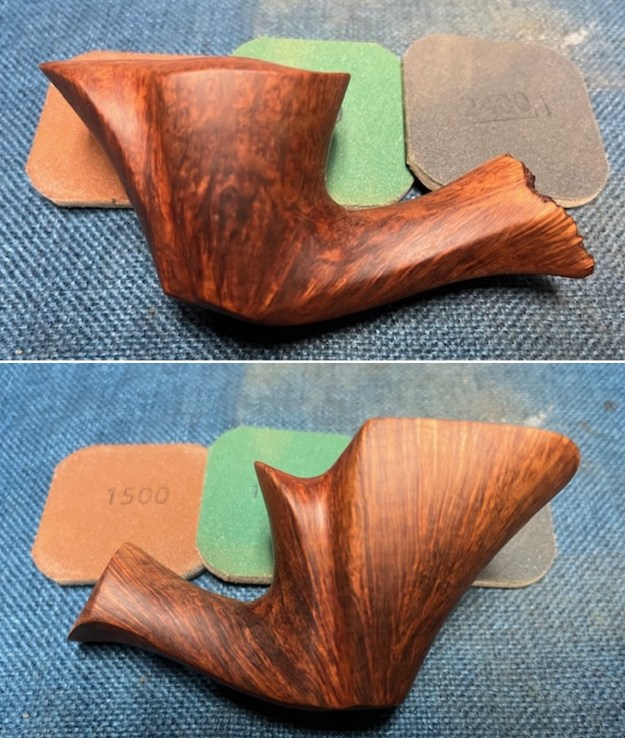
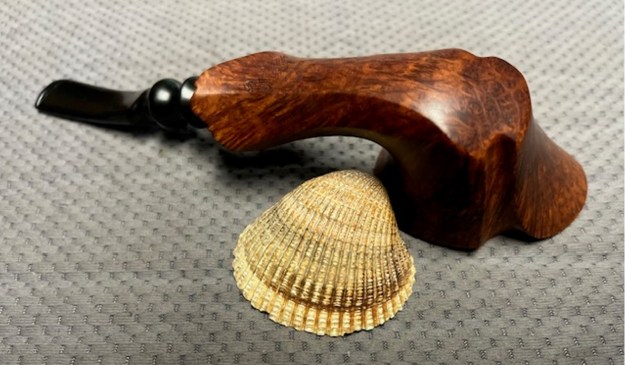
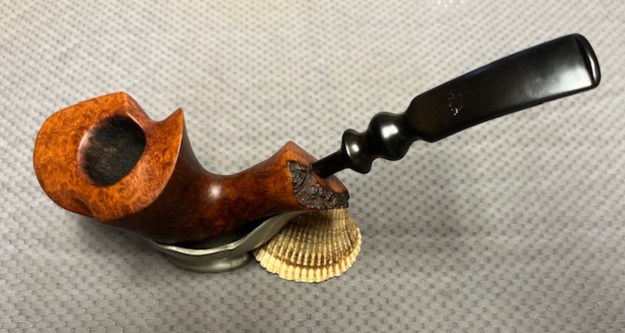
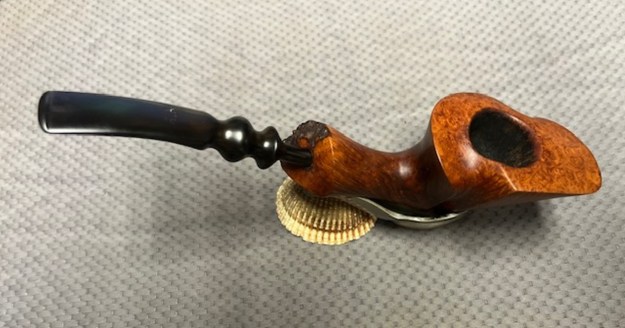
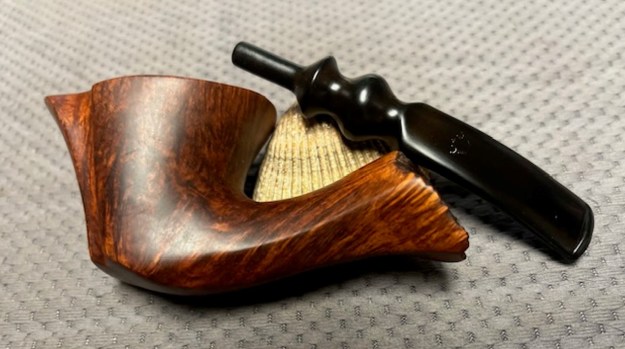
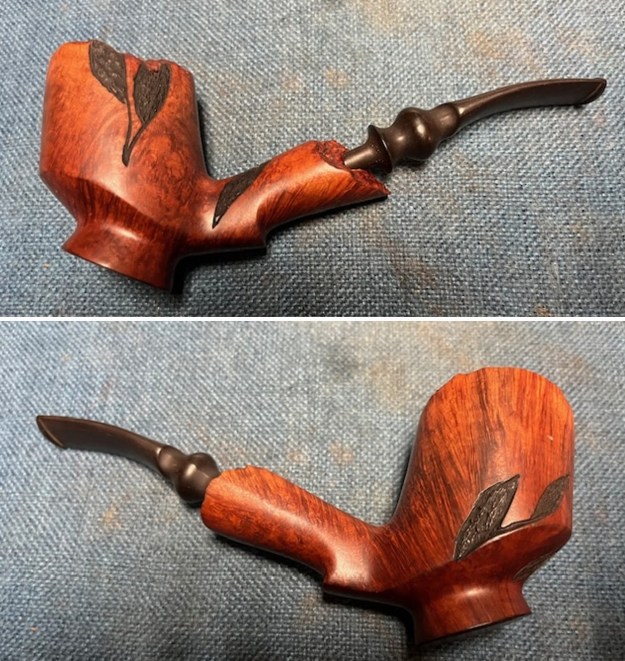
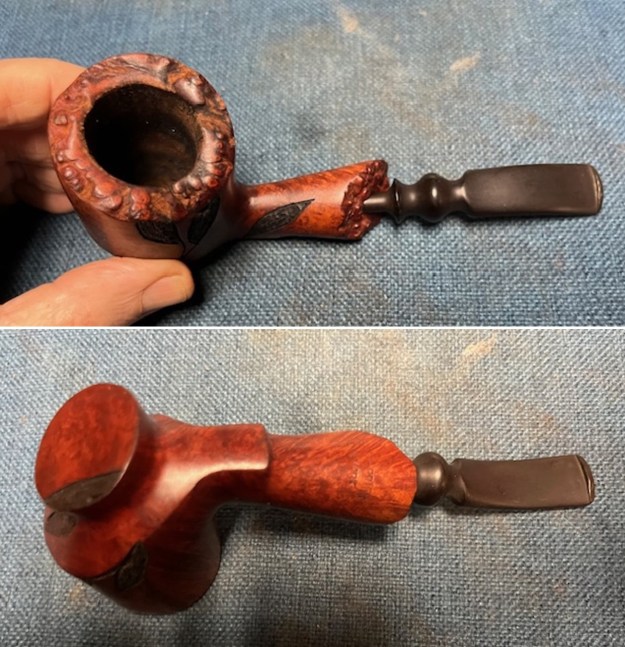
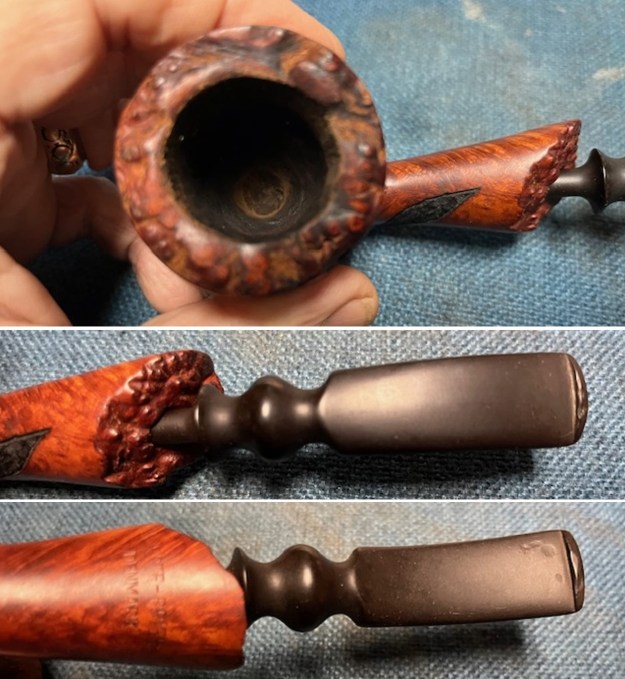
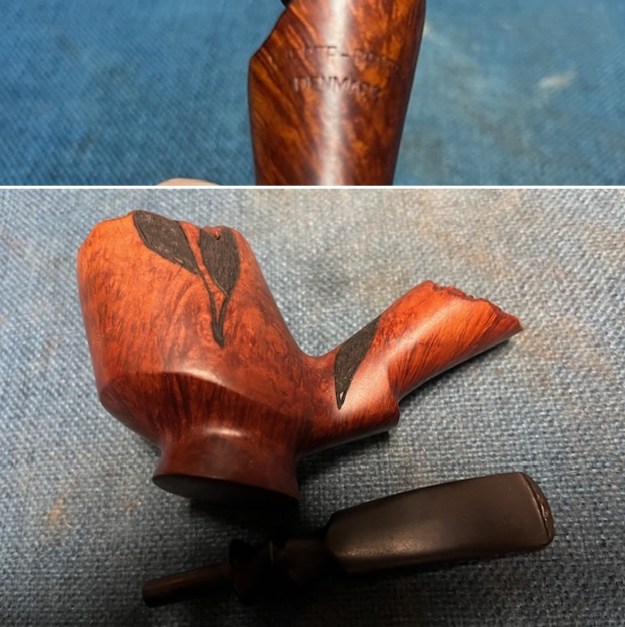
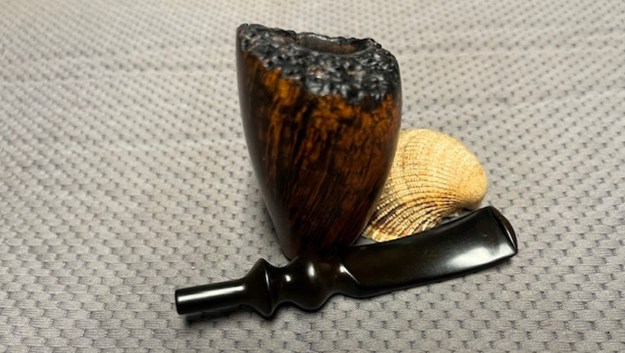
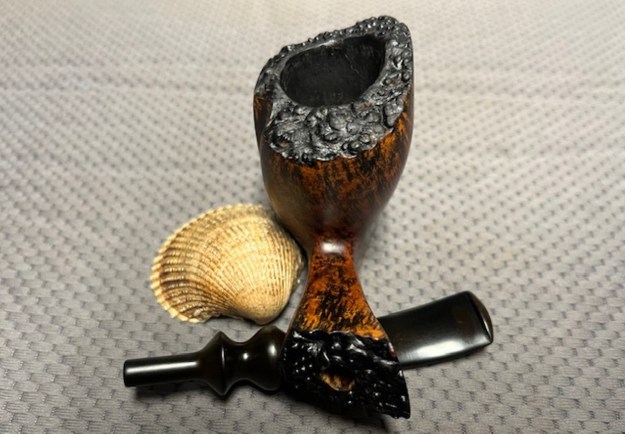
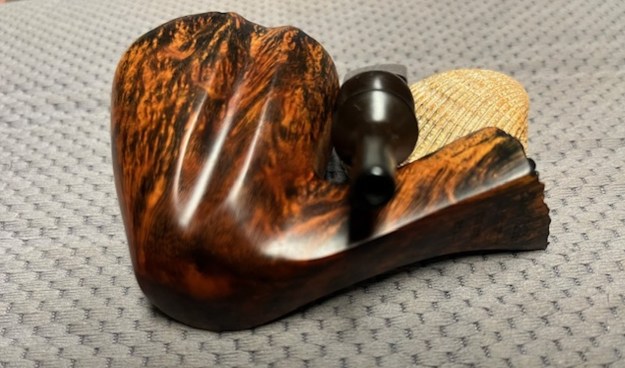
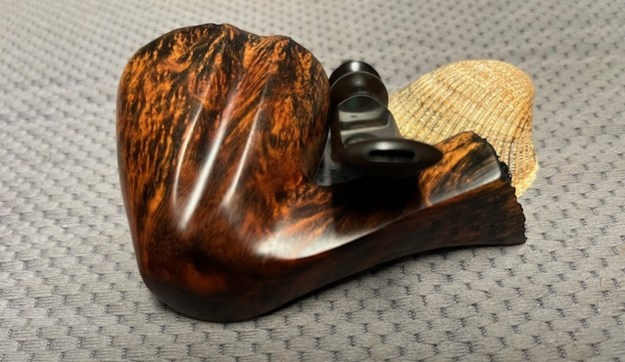
New Life for someone’s obvious favourite Jobey Dansk Handmade in Denmark 2 Freehand


by Steve Laug

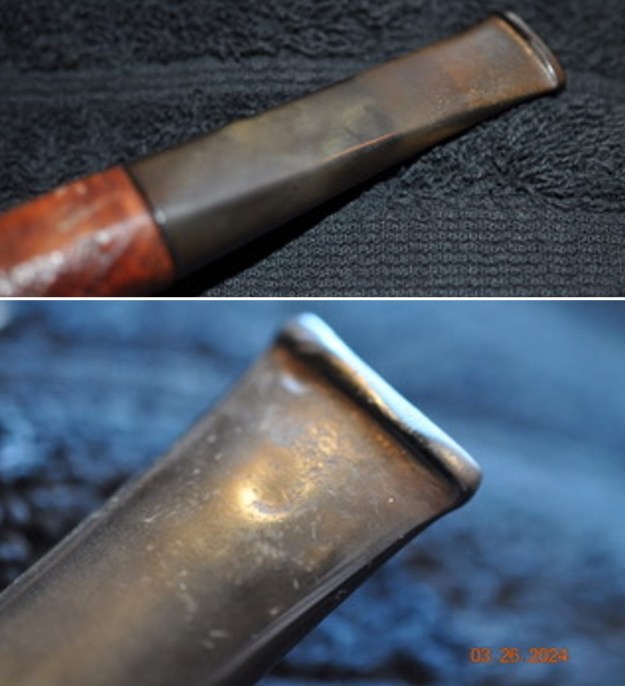
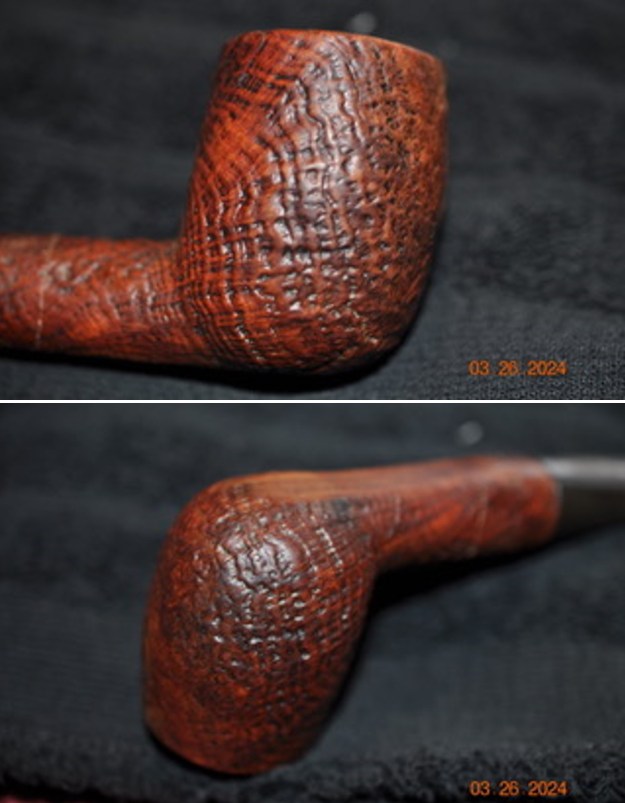
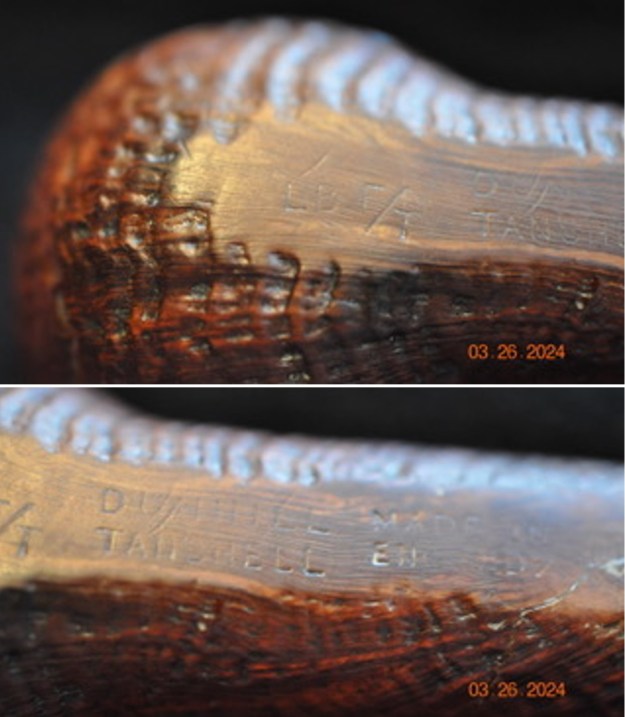
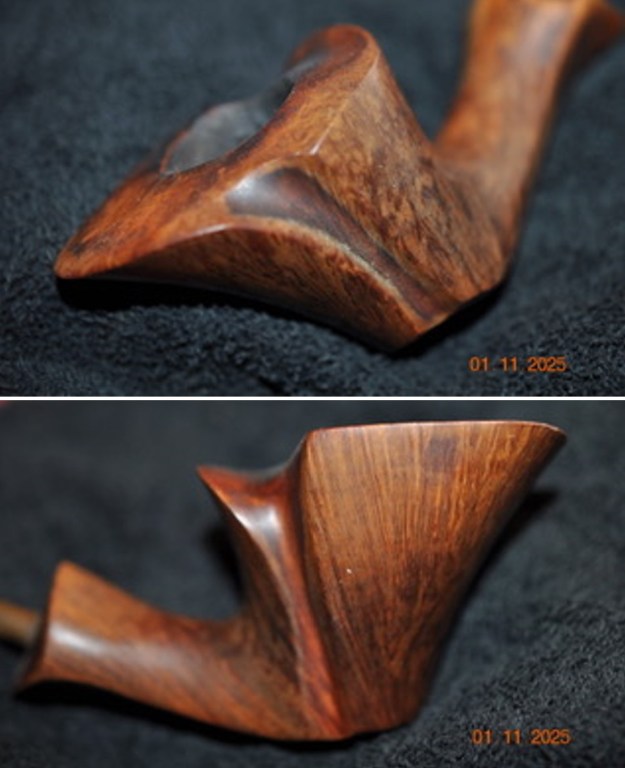
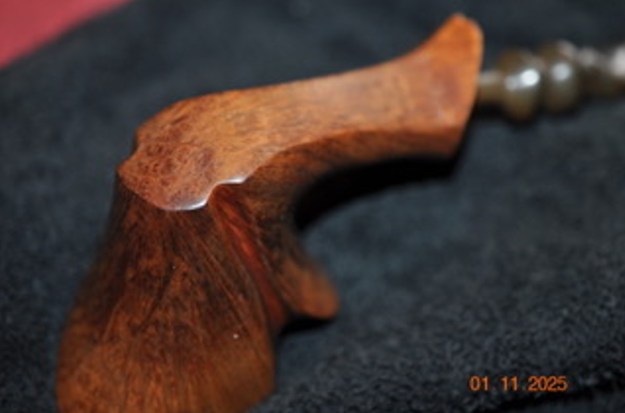
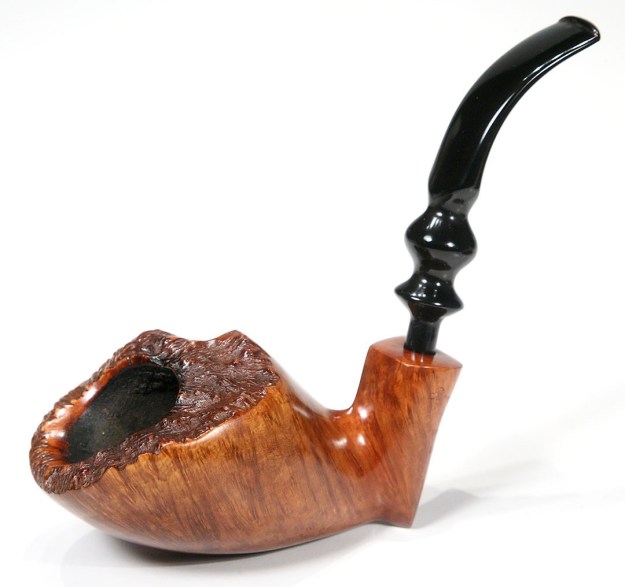
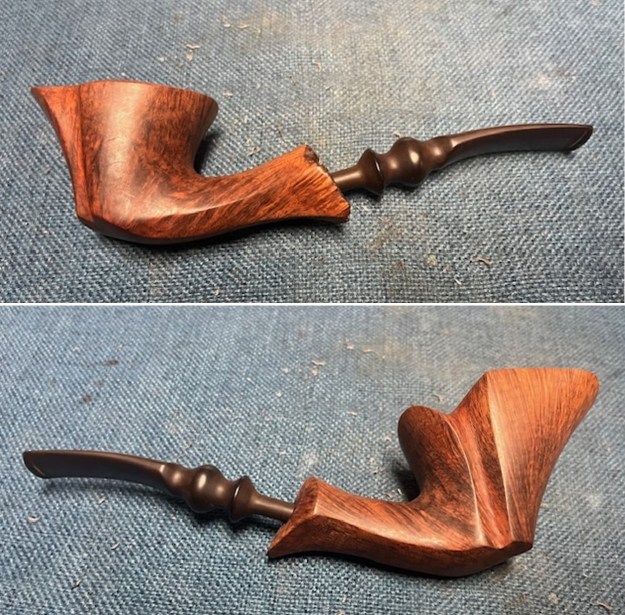
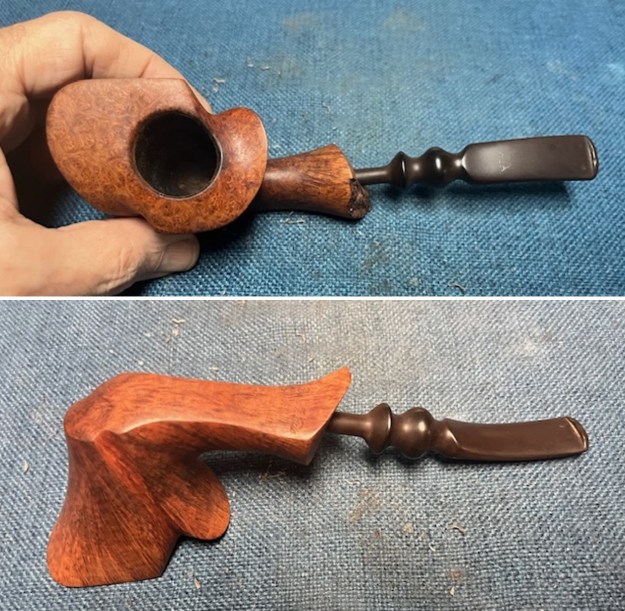
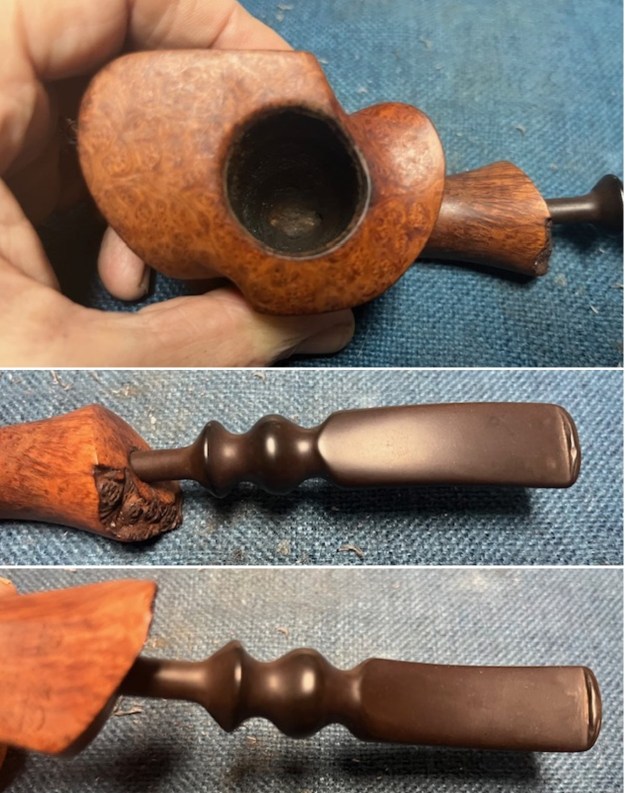
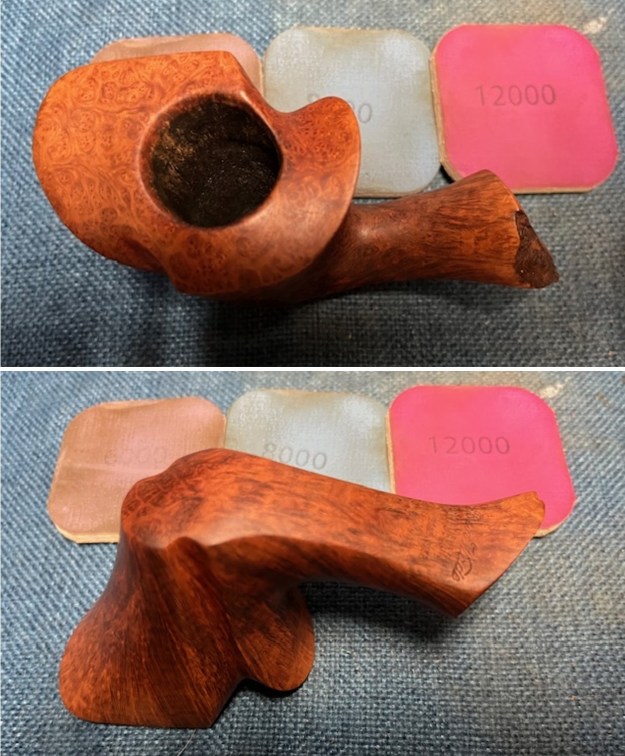
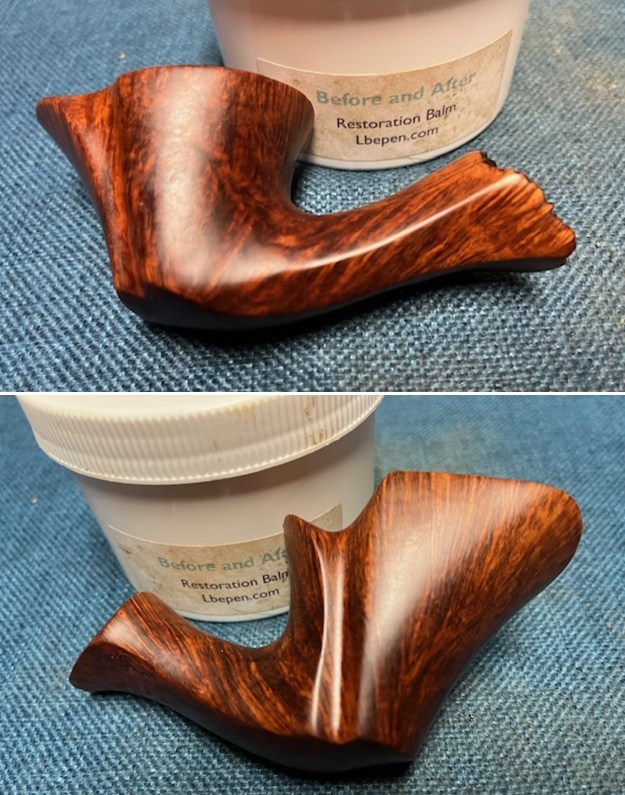
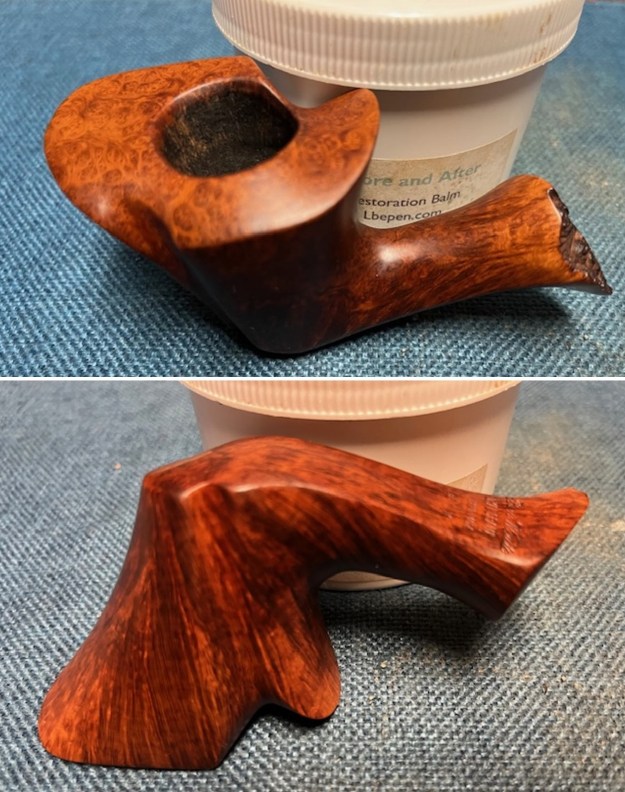
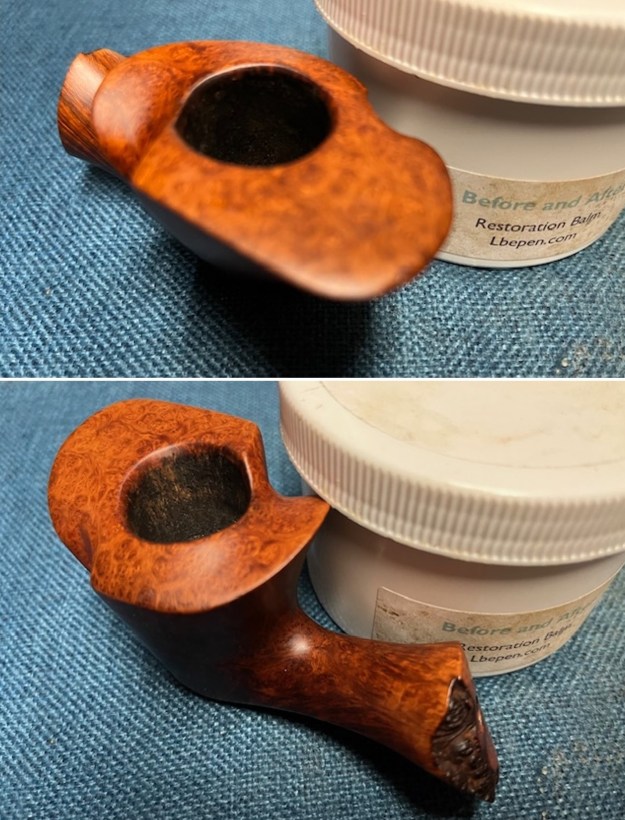
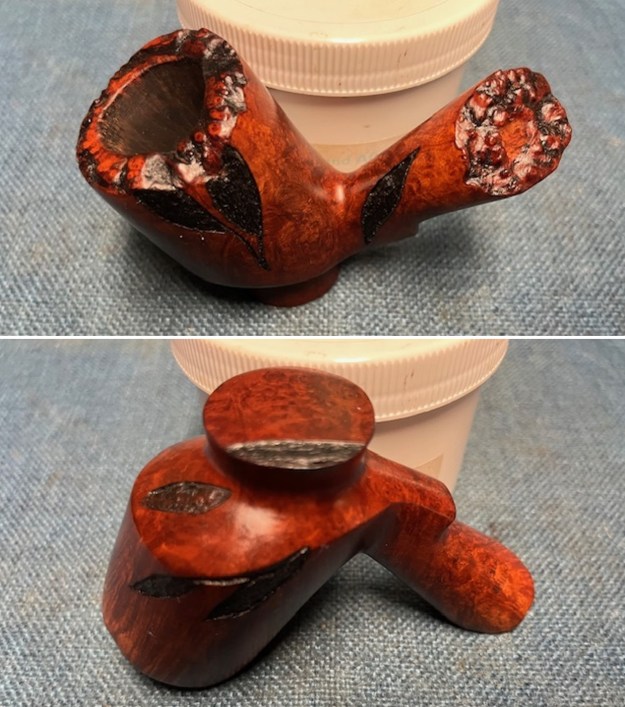
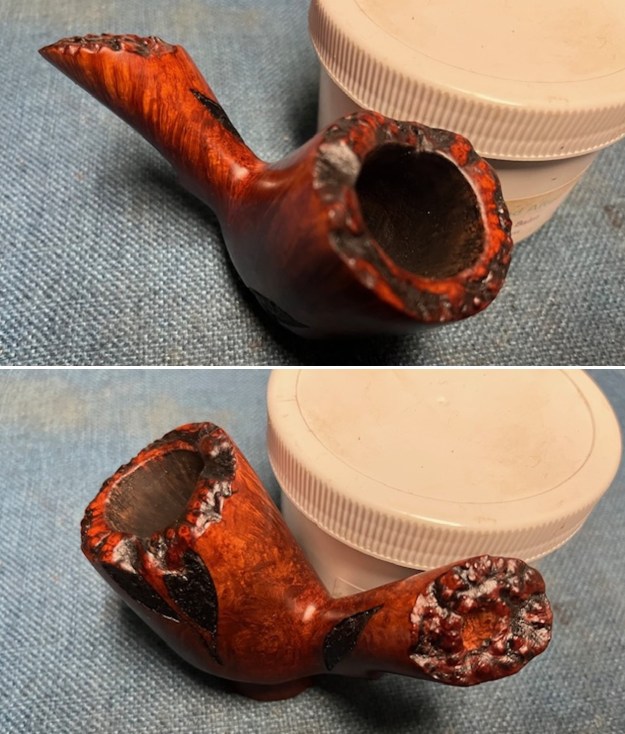
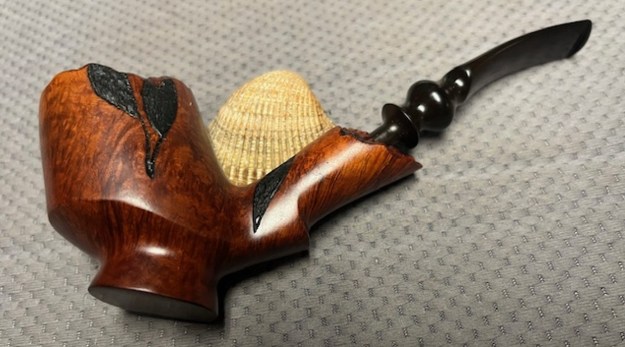
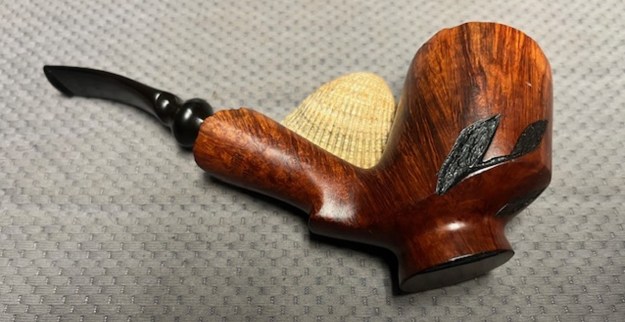
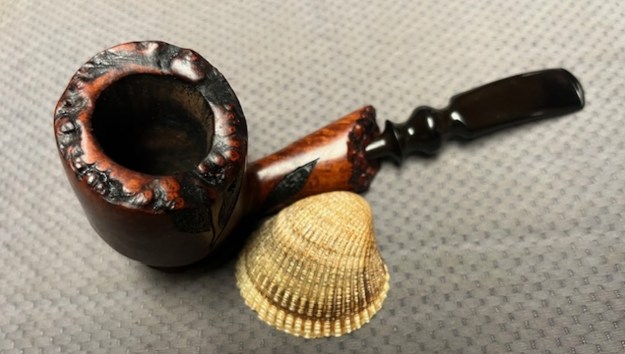
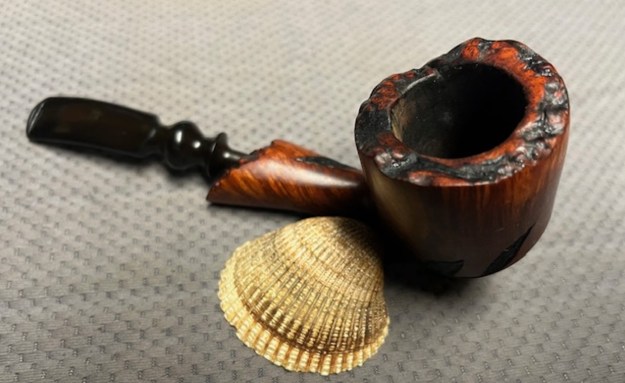
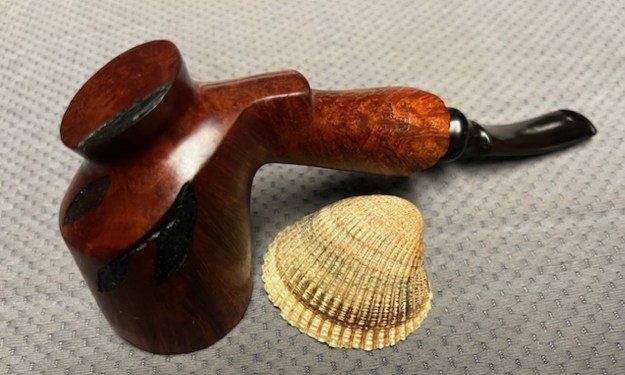
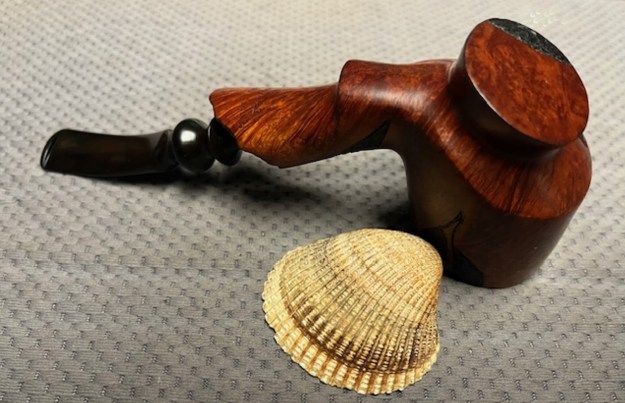
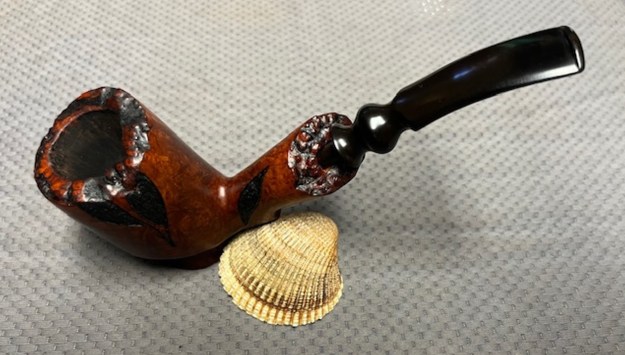
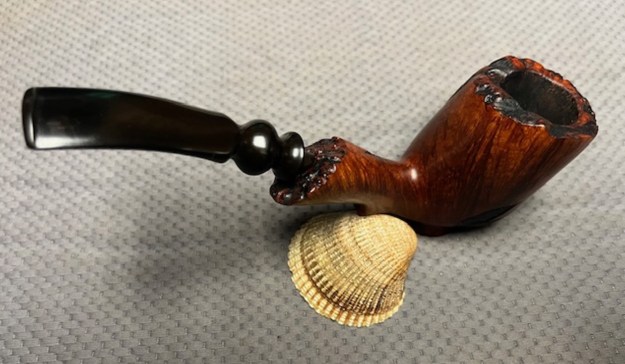
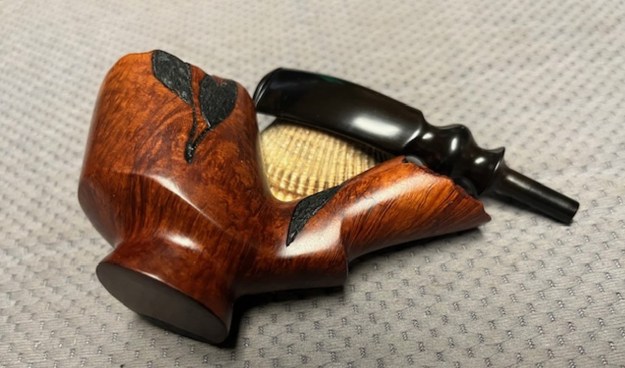
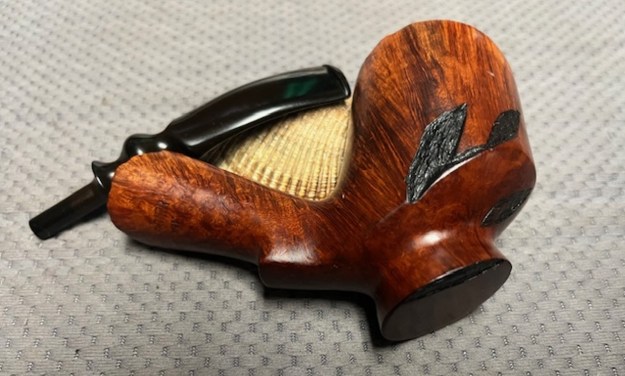
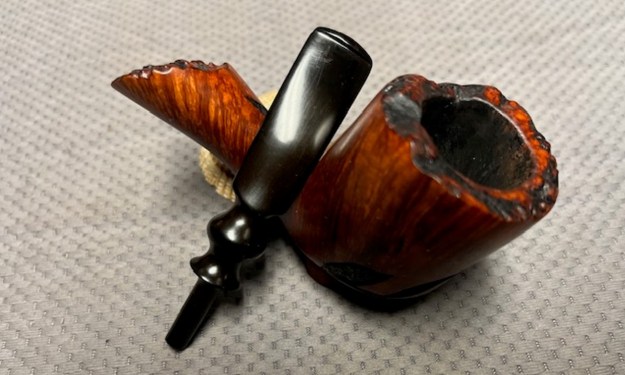
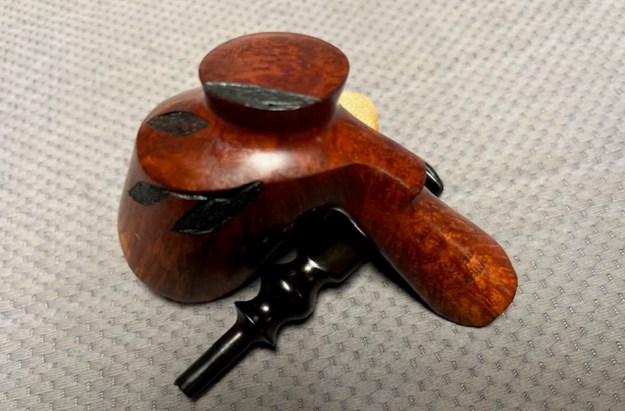
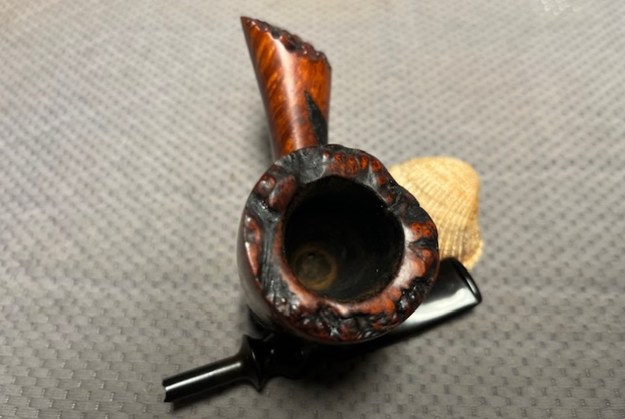
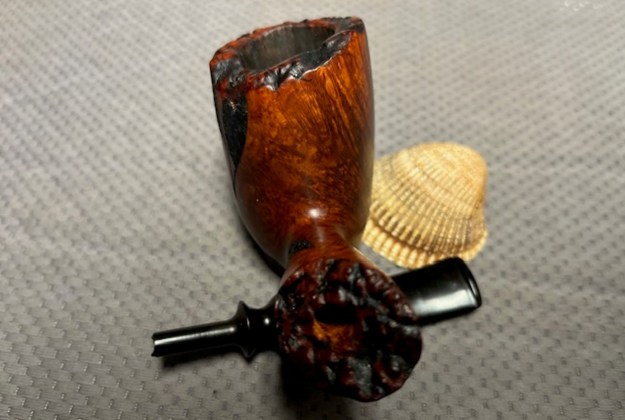
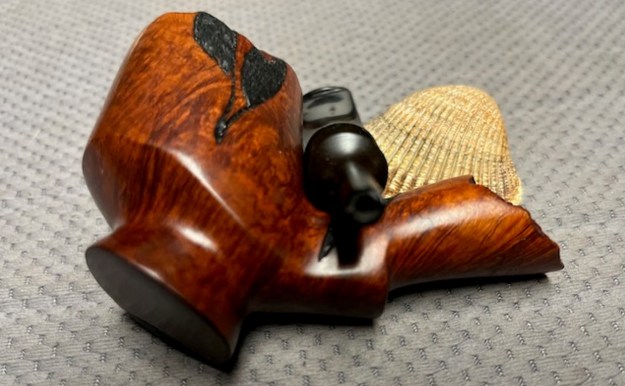
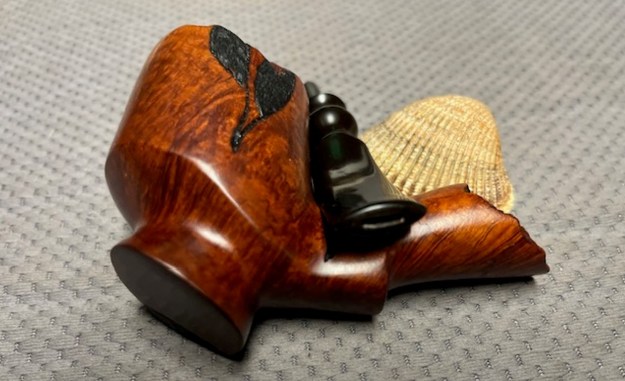
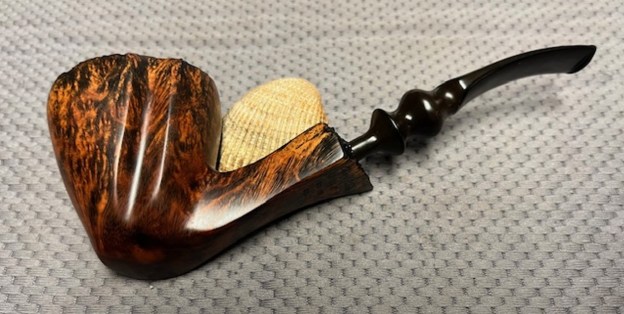
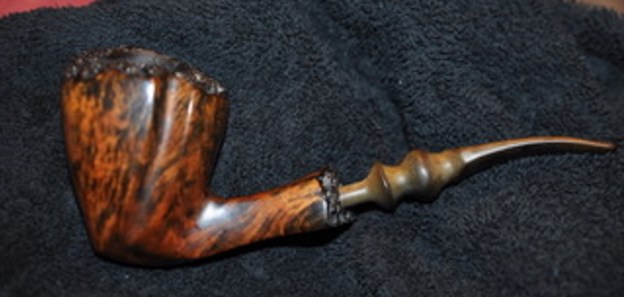
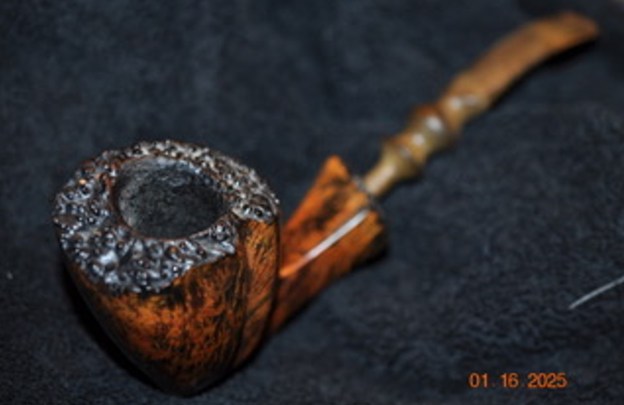
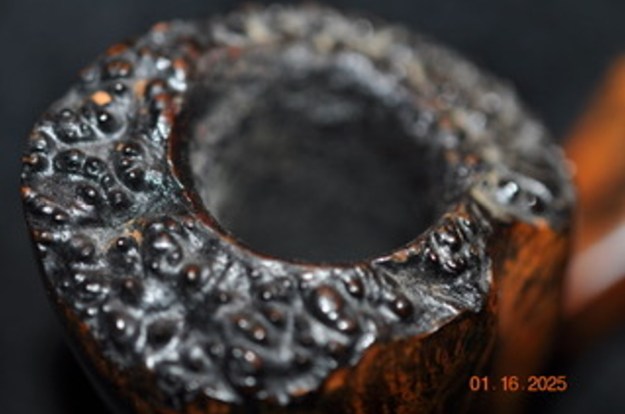
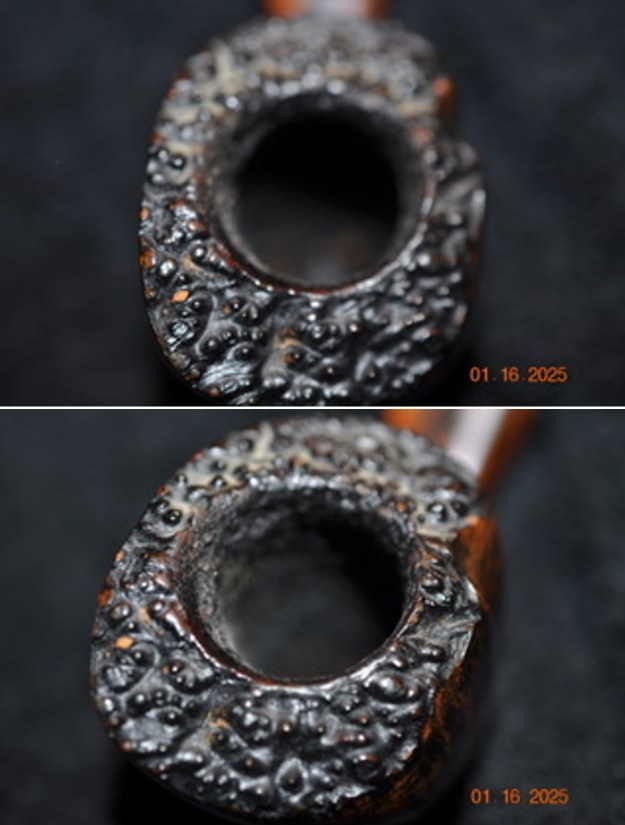
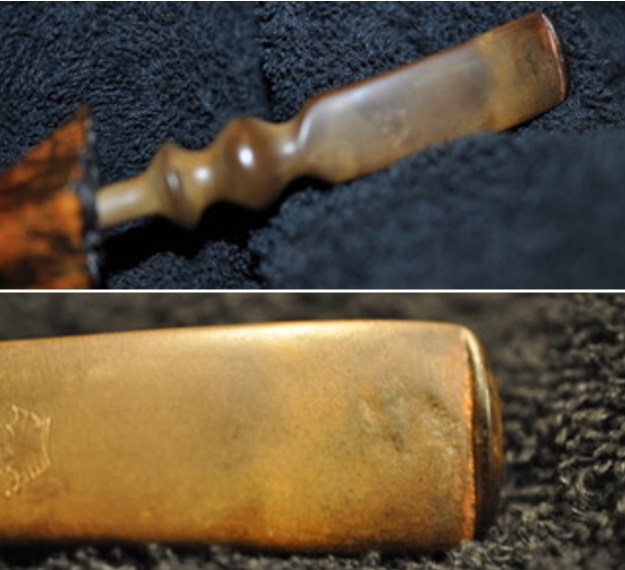
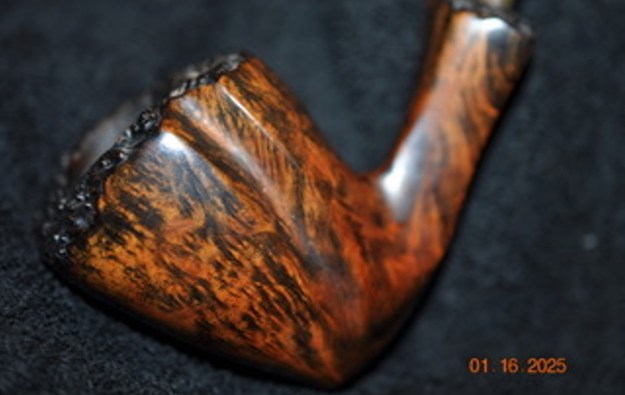
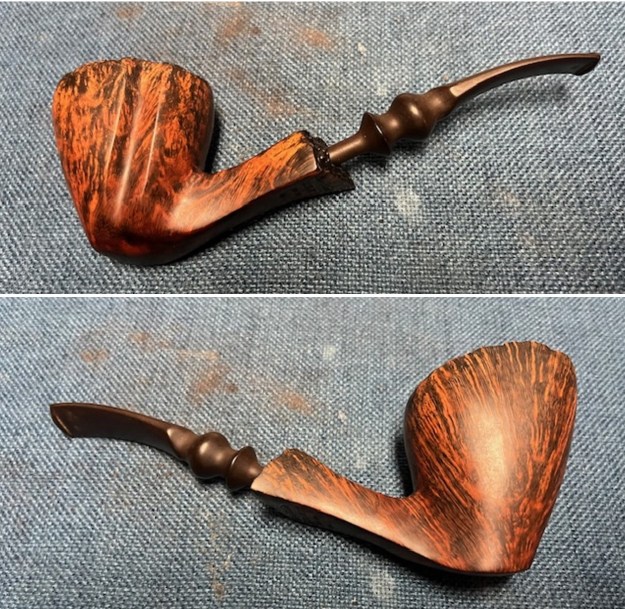
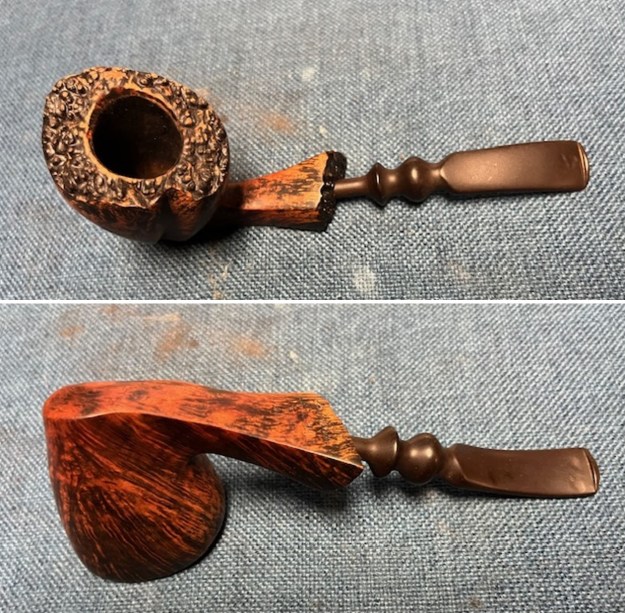
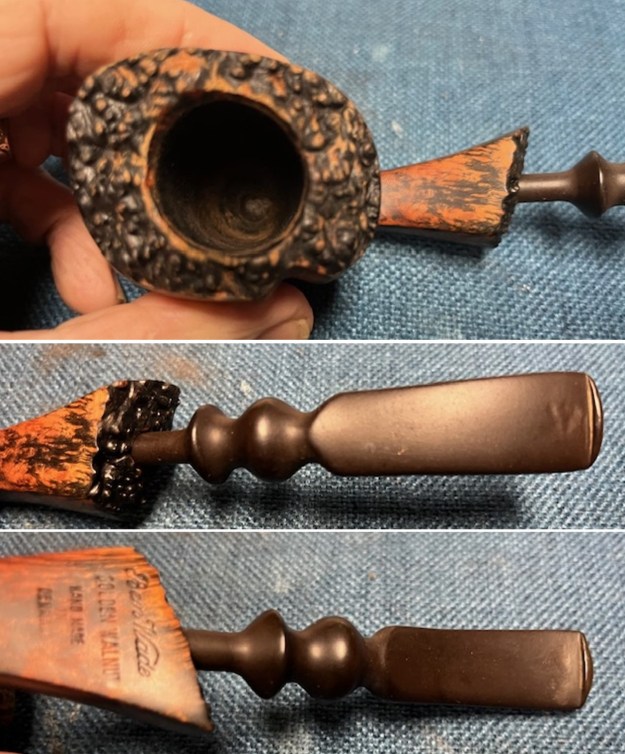
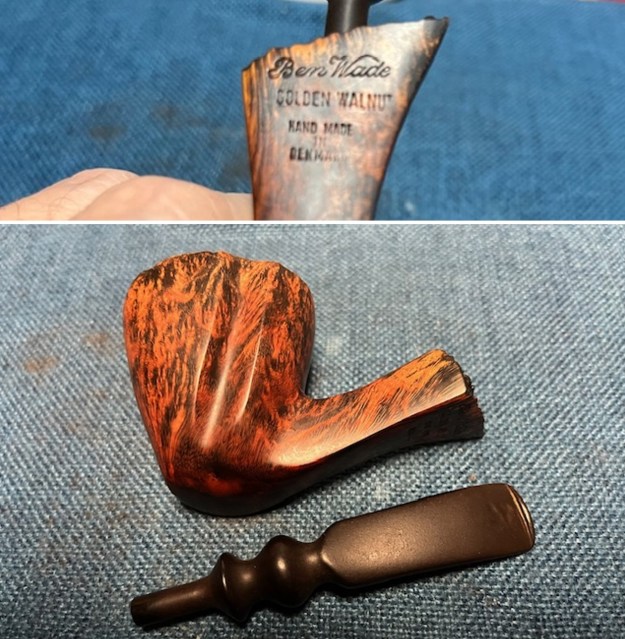
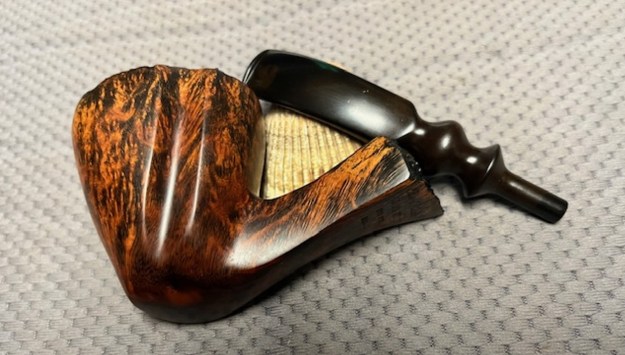
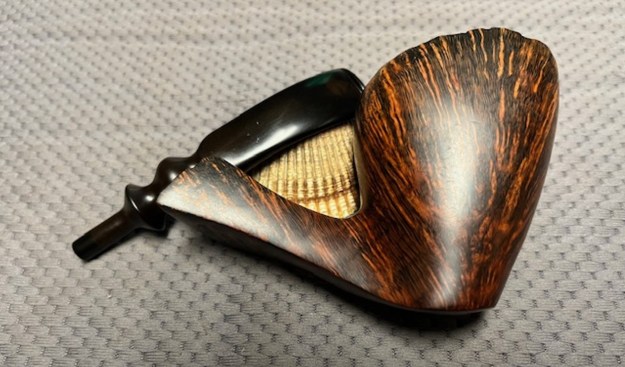
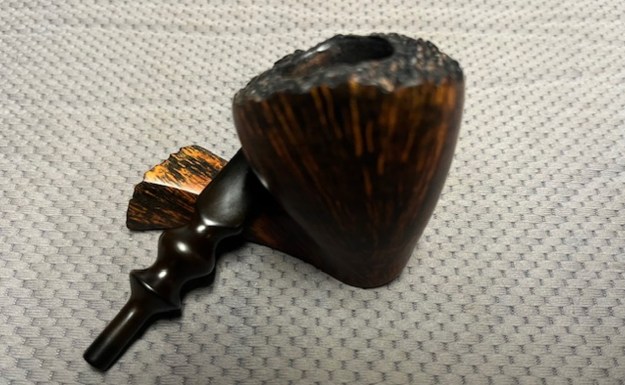
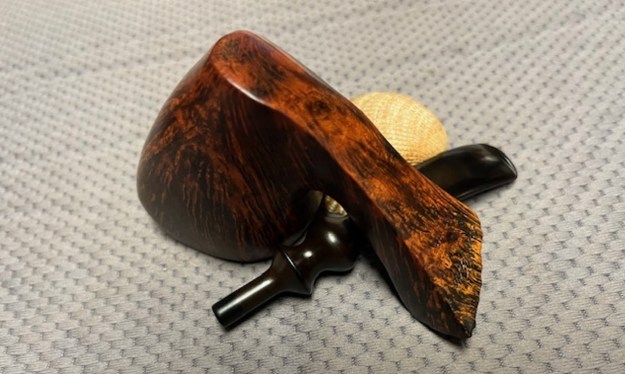
My brother Jeff picked up another Jobey Dansk 2 Freehand pipe on April 12, 2024 from a seller in Saint Cloud, Florida, USA. It had really unique shape and some nice grain with spot carvings around the bowl and shank. There was some plateau on the top of the rim and on the end of the shank. There was a rustication on the left side of the bowl and on the heel of the bowl. I have worked on enough of these to know that were Danish Freehand pipes were carved by Karl Erik Ottendahl. This one was stamped on the heel of the bowl and read Jobey in script [over] Dansk [over] Handmade in Denmark [over] 2. The finish on this pipe was very dirty with dust filing in the plateau top. There was some lava and darkening on the top as well. The bowl had a thick cake. There were oils and grime ground into the finish of the bowl and the shank. The fancy vulcanite stem fit the well. The stem was oxidized, calcified and there were light bite marks and chatter on both sides of the stem ahead of the button. Jeff took of the pipe to show the overall condition of the bowl and stem. He took close up photos of the bowl and rim top from different angles to show the condition of the bowl and the plateau finish. You can see the thick cake in the bowl and the darkening and lava build up on the plateau rim top and edges of the bowl. The next photos show the condition of the vulcanite stem which is oxidized and calcified. You can see the light chatter and tooth marks on the surface of both sides ahead of the button. He took photos of the sides and heel of the bowl to show the lay of the grain and the oils and dust in the finish around the pipe. It is a nice piece of briar with a unique shape and patches of rustication on the bottom left side of the bowl toward the heel and the heel itself. Jeff took a photo of the stamping on the underside of the shank to capture it. It was clear and read Jobey Dansk at the top. Under that it read Handmade in Denmark. Underneath that it is stamped with a number 2I have included the information that the pipes were carved by a Danish carver known as Karl Erik. I looked up the Jobey listing on Pipedia (https://pipedia.org/wiki/Jobey) and found the following information. I quote a portion of the article that is pertinent as follows.

English – American – Danish – French… Information about the brand Jobey are only to be found in form of smithereens…

Probably established in England around 1920(?) the brand hiked into the USA later. In the course of time owner, distributor and manufacturer changed repeatedly. As far as known:

George Yale Pipes & Tobacco, New York (1942)

Norwalk Pipe Co., New York (1949)

Arlington Briar Pipes Corp., Brooklyn (when?)

Hollco International, New York (1969).

Weber Pipe Co., Jersey City, NJ (1970’s)

The Tinder Box, (1970’s – 80’s).

Throughout decades Jobey pipes were mainly sold in the USA, Canada and England but remained almost unknown in continental Europe. The bulk of Jobeys was predominantly made according to classical patterns and mainly in the lower to middle price range. The predominant judgment of the pipe smokers reads: “A well-made pipe for the price.” So there is hardly anything very special or exciting about Jobey pipes although a flyer from ca. 1970 assures: “The briar root Jobey insists upon for its peer of pipes is left untouched to grow, harden and sweeten for 100 years. […]Jobey uses only the heart of this century old briar and only one out of 500 bowls turned measures up to the rigid Jobey specifications.” 99.80% of cull… that makes the layman marveling!

Yet then there are partially really exciting Freehands mainly in the seventies, that Jobey – Weber owned back then – bought from Danish pipe genius Karl Erik Ottendahl. These pipes were offered as Jobey Dansk – ’70’s pure! (BTW waning sales caused Ottendahl to discontinue exports to the United States in 1987.)

There was also an interesting Tinderbox catalogue page, provided courtesy of Doug Valitchka, that includes a note about the Jobey Dansk (https://pipedia.org/images/7/7a/Jobey1979.jpg).From that information I confirmed that the pipe that I was working on was carved by Karl Erik Ottendahl. There were some similarities to the Karl Erik pipes that I have worked on in the past. The dating of the pipe line in the 70s fits well with the pipe I have in hand.

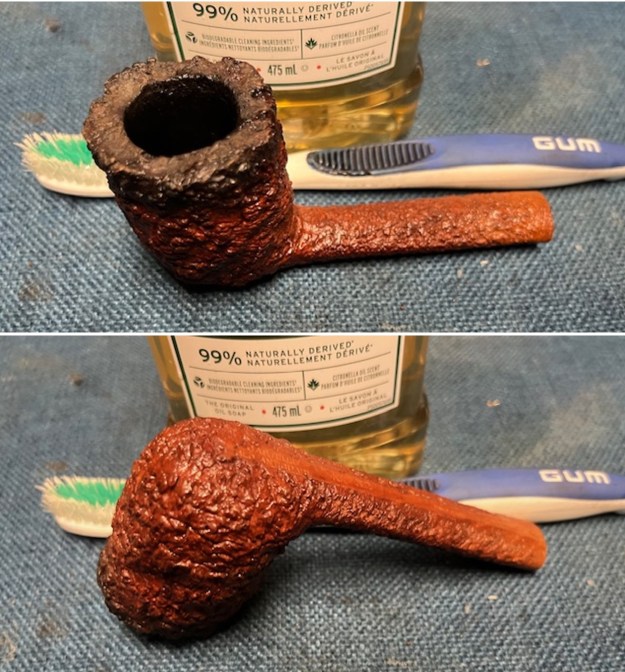
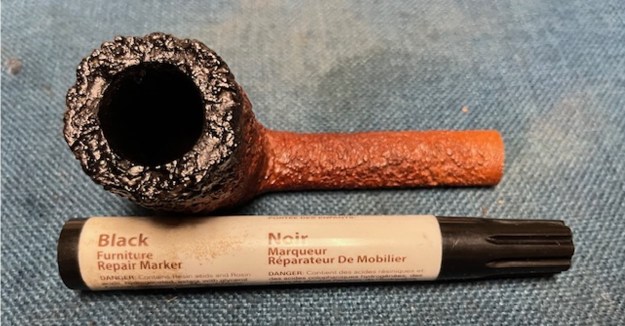
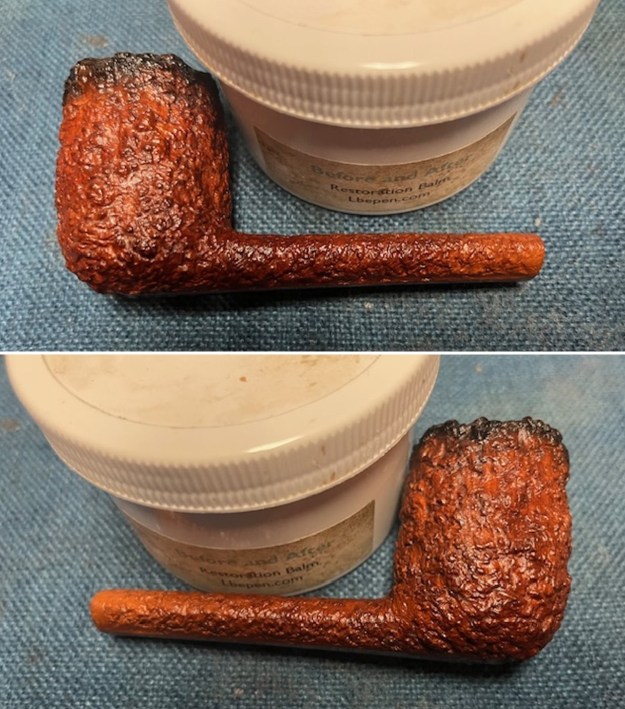
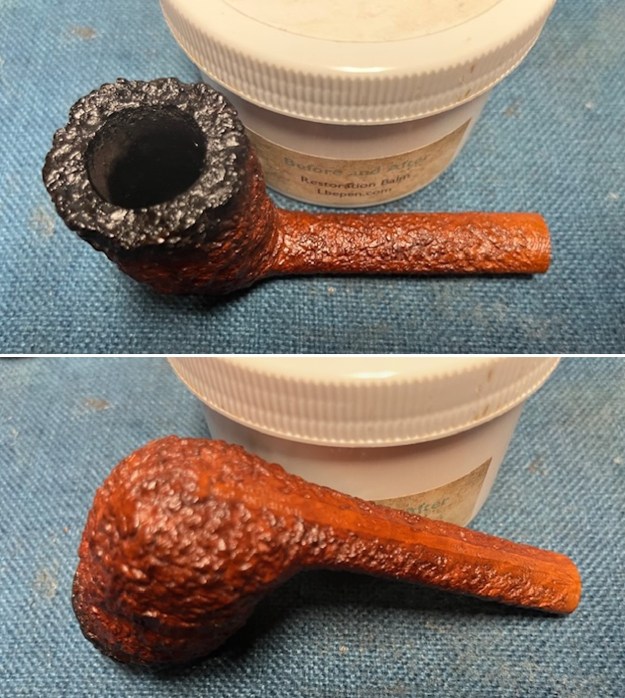
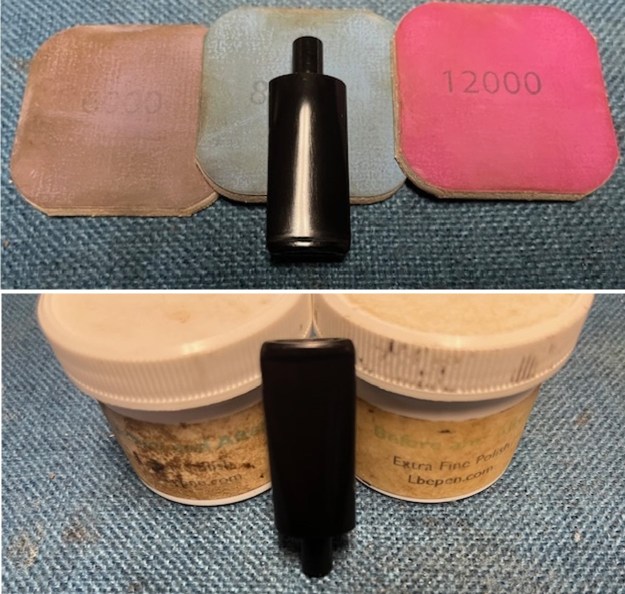
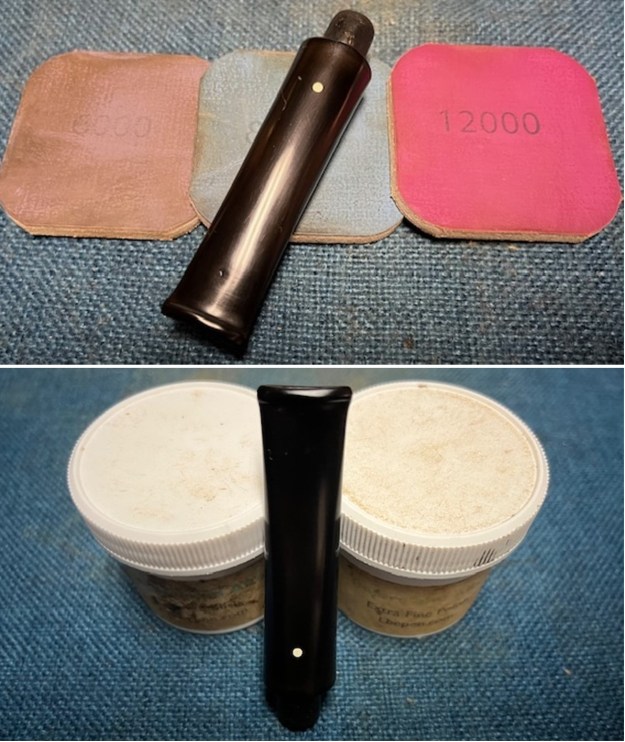
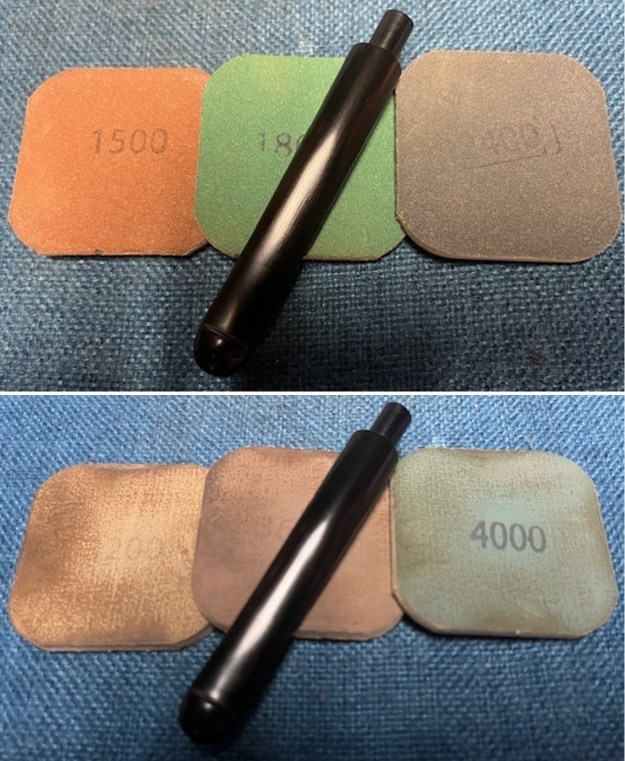
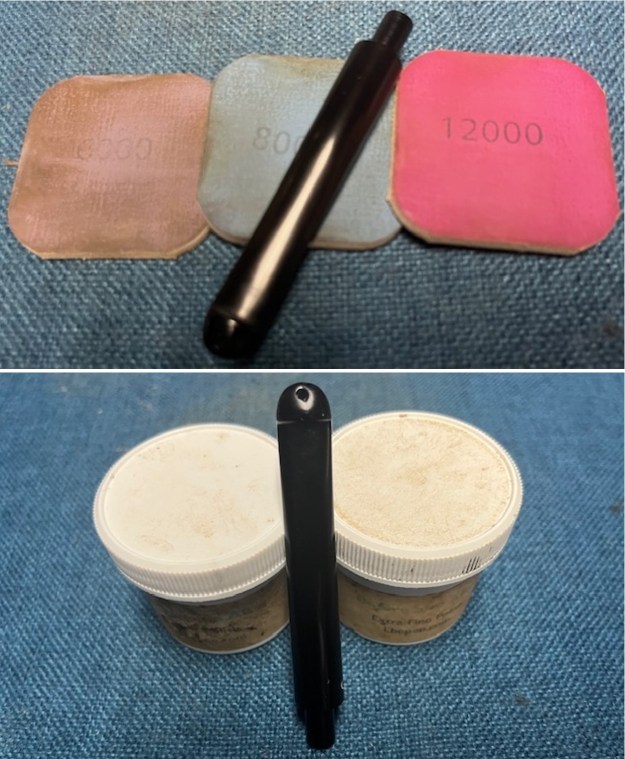
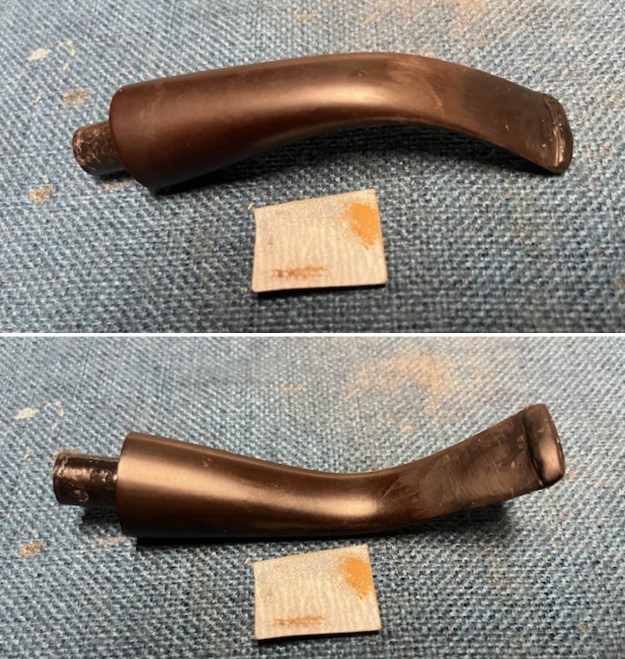
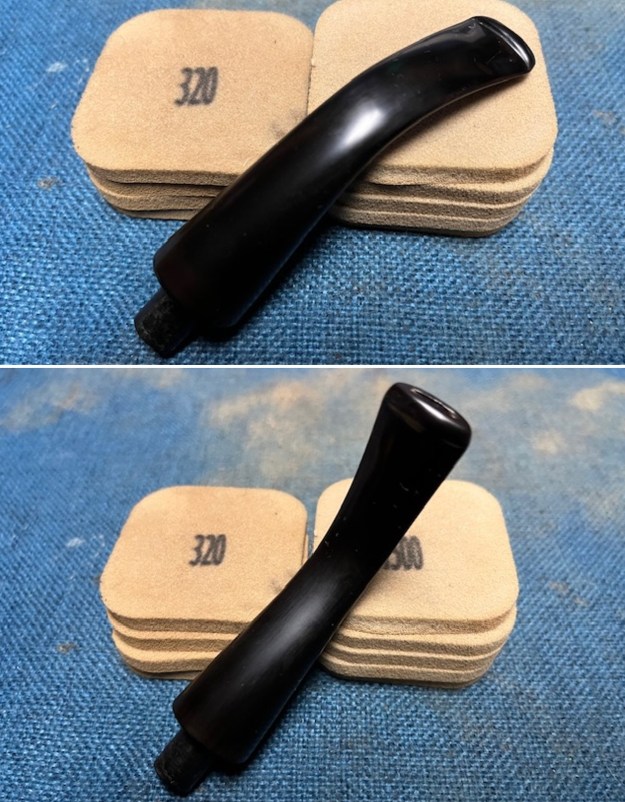
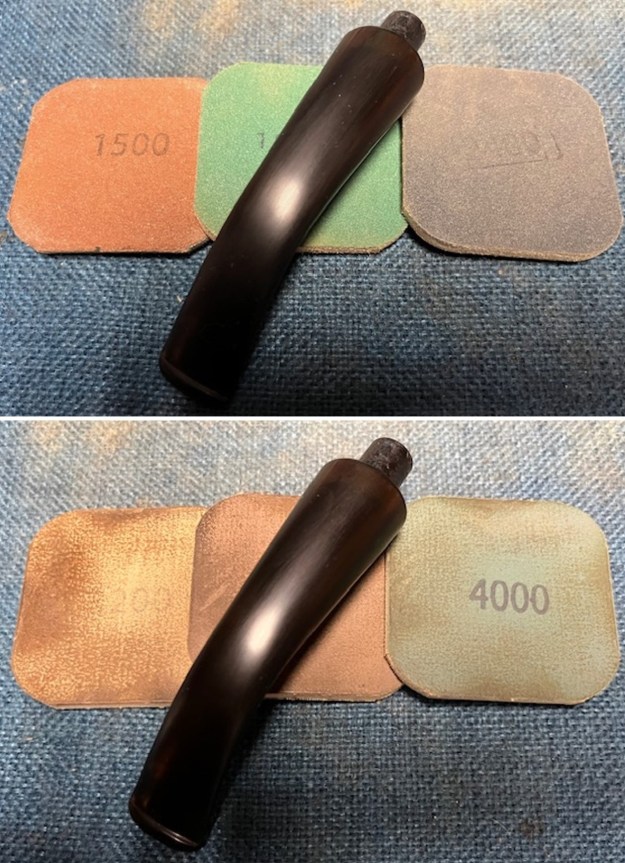
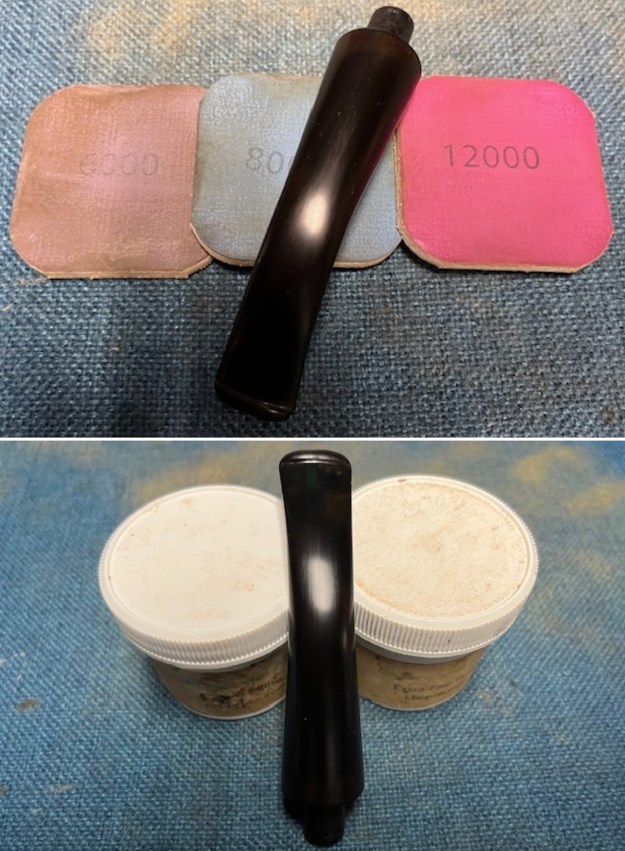
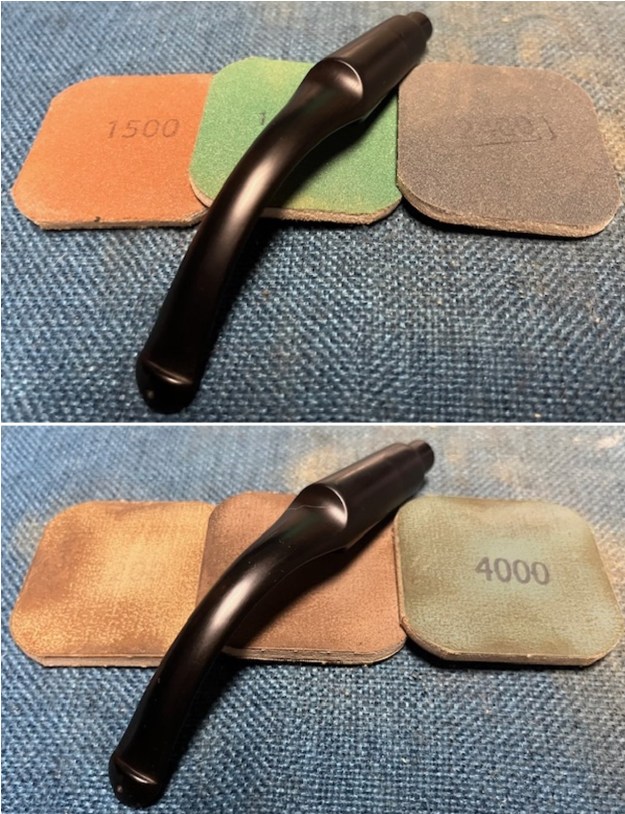
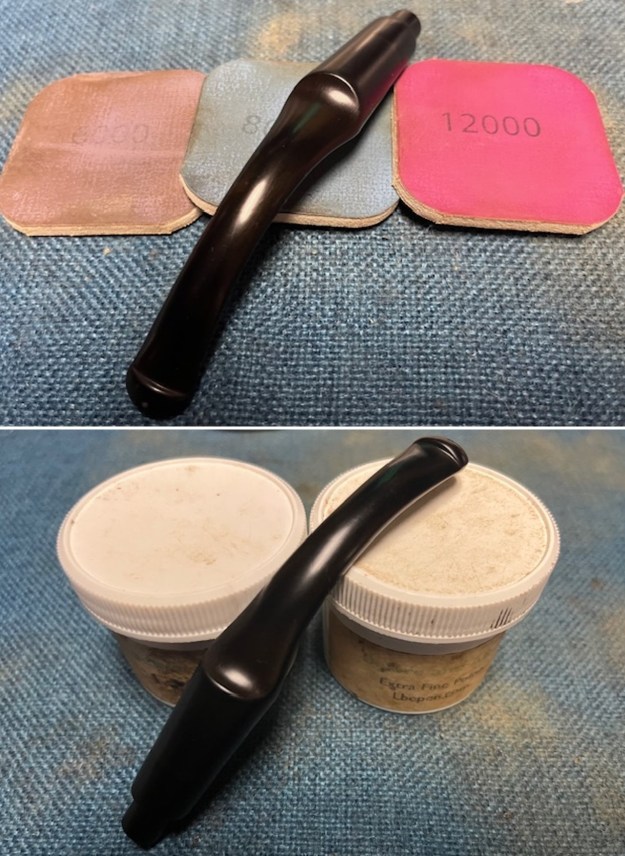
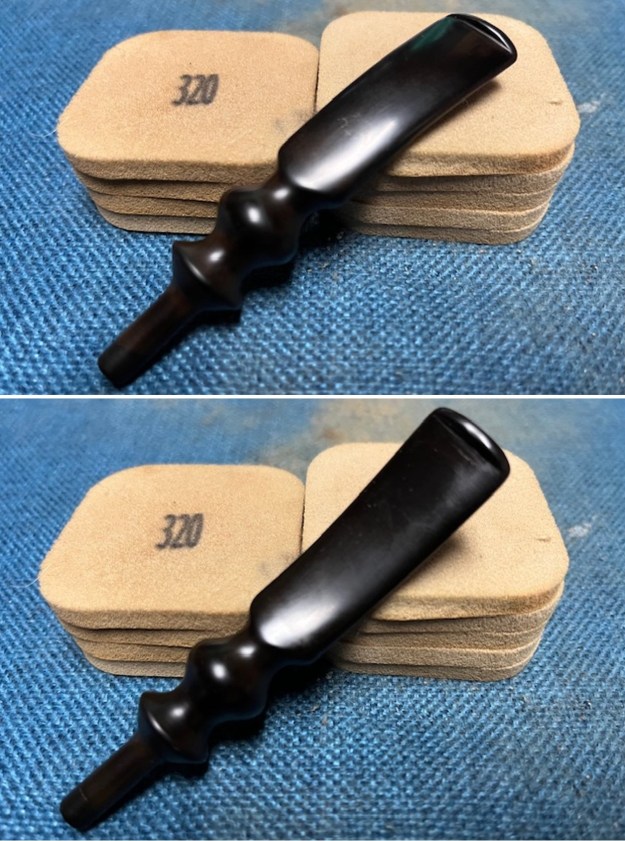
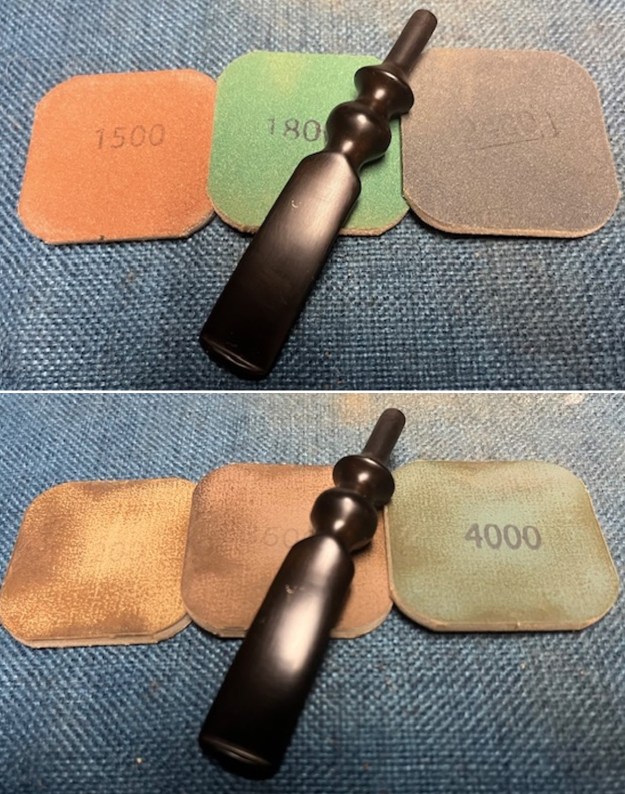
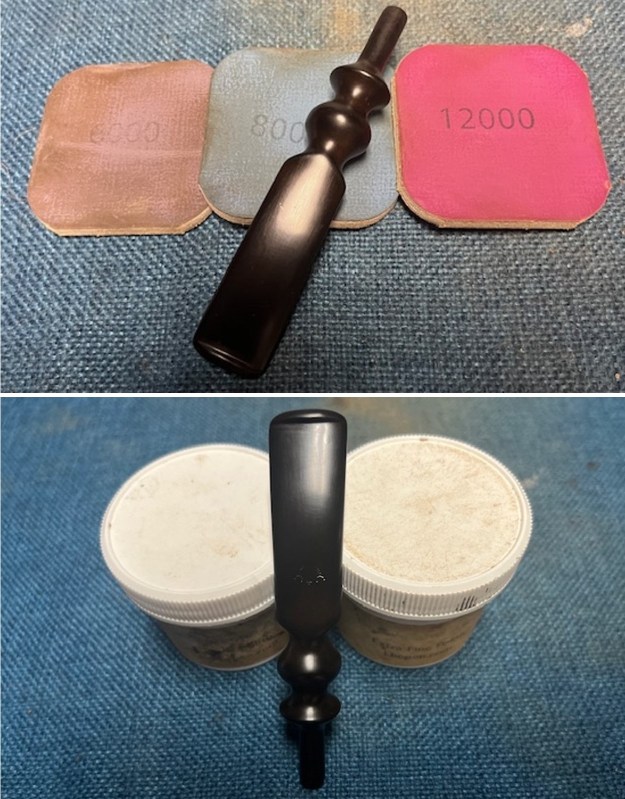
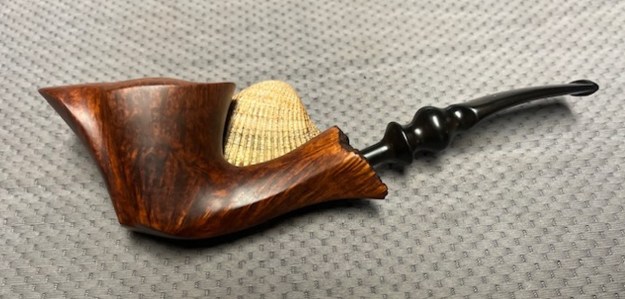
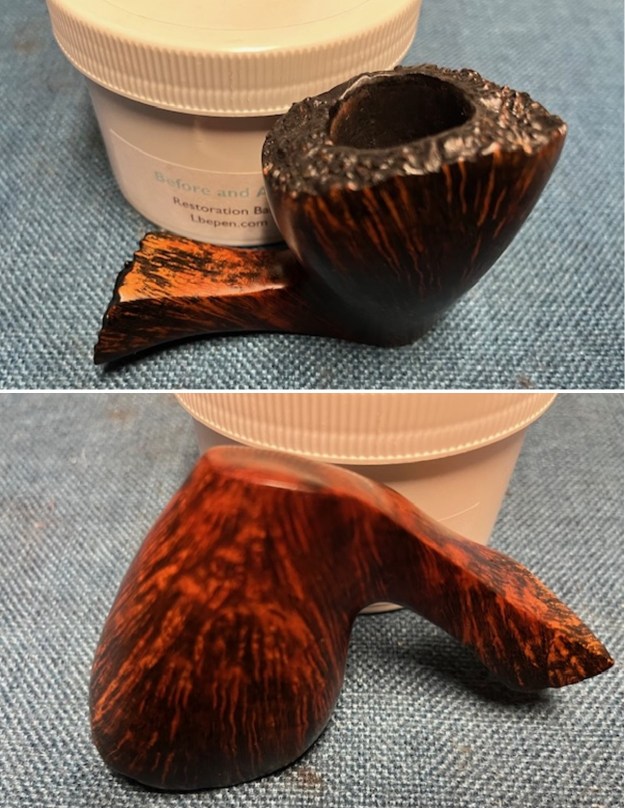
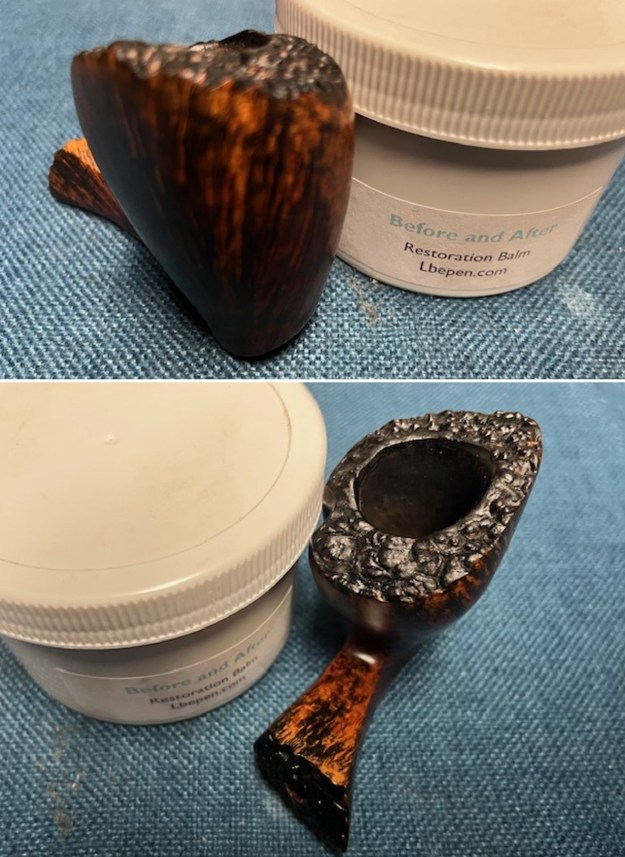
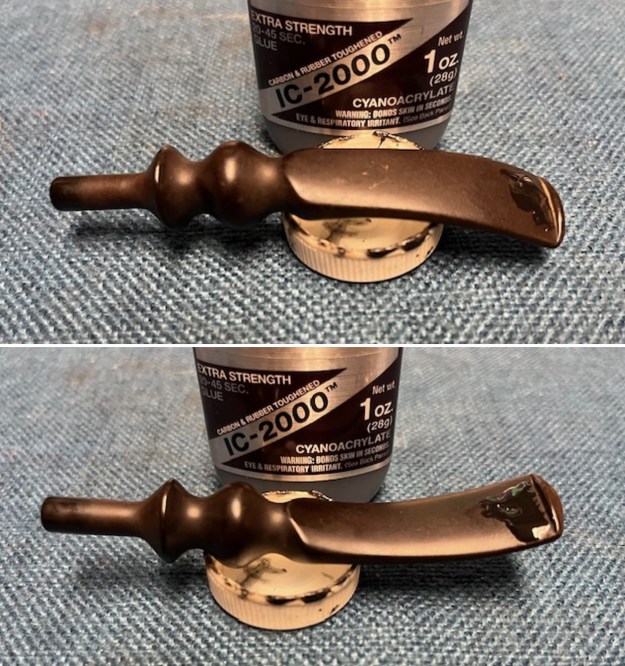
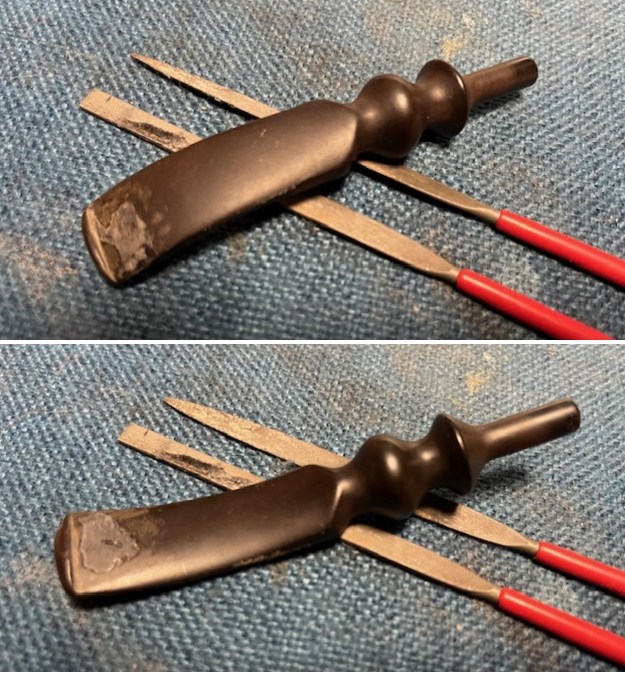
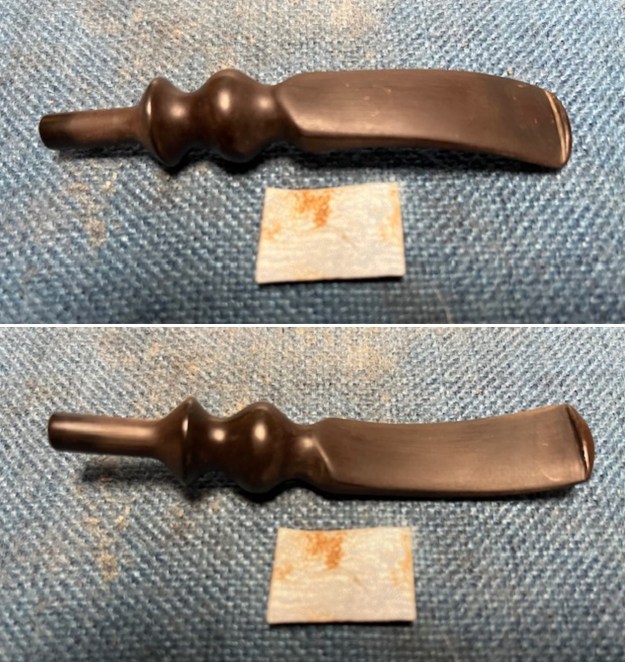
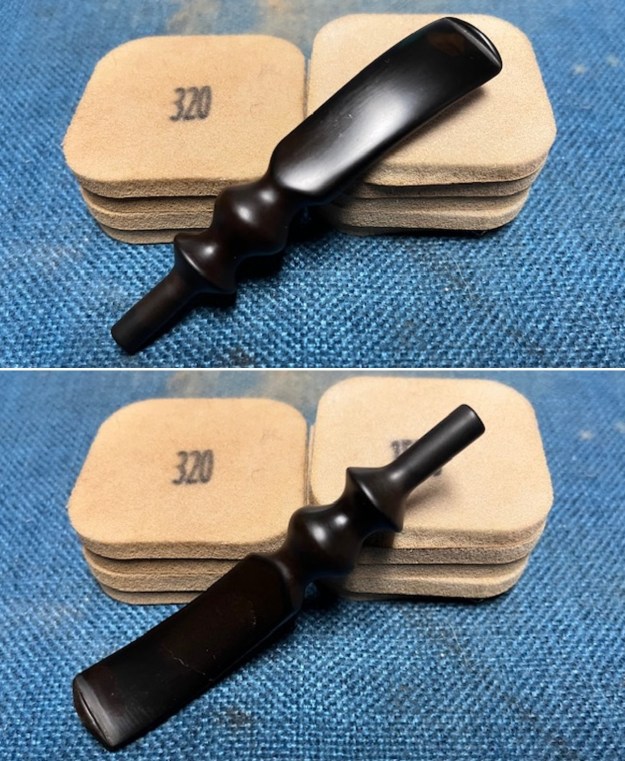
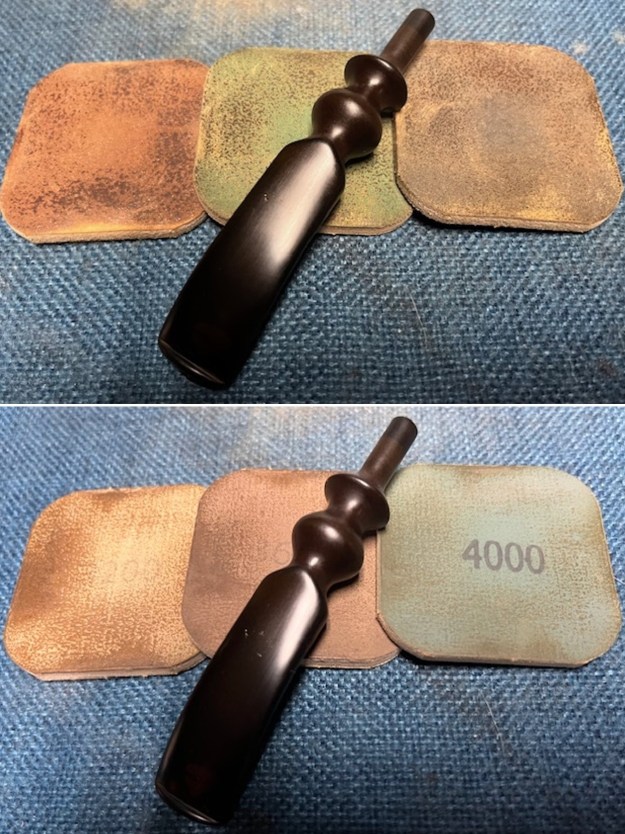
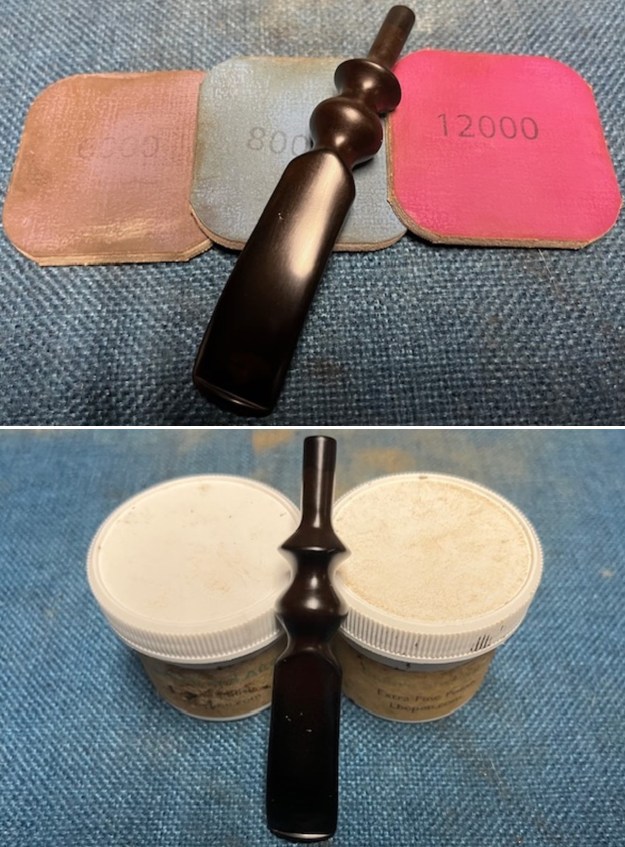
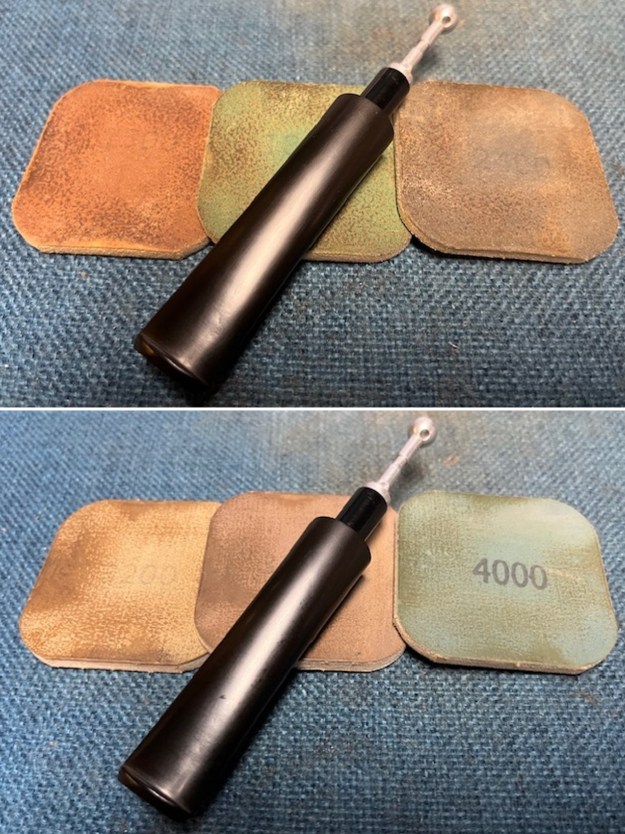
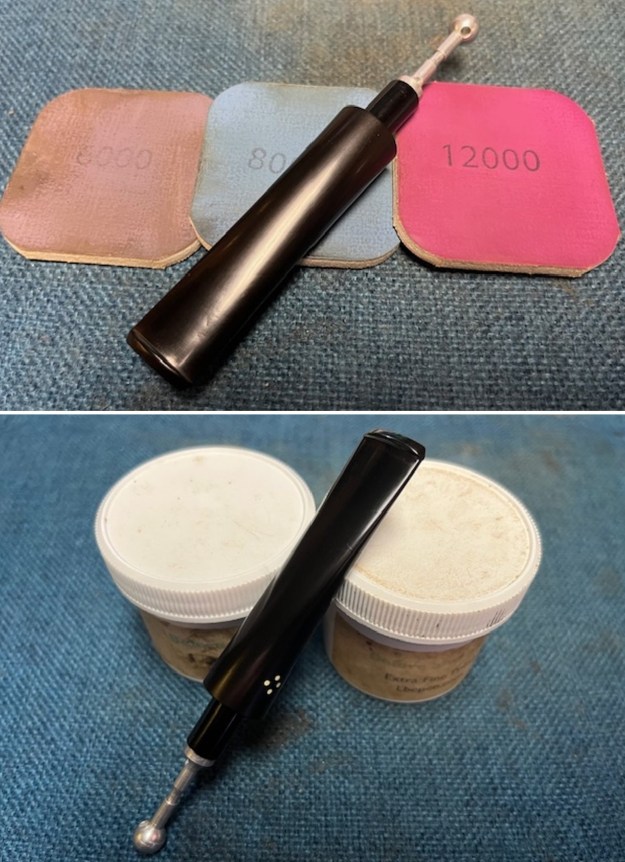
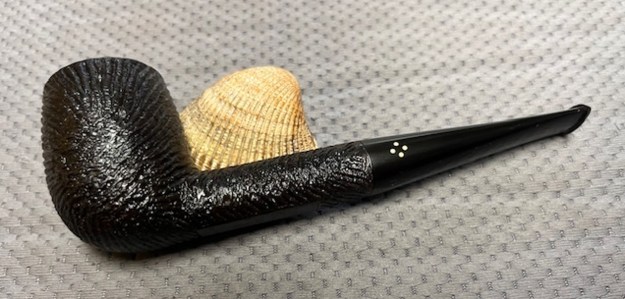
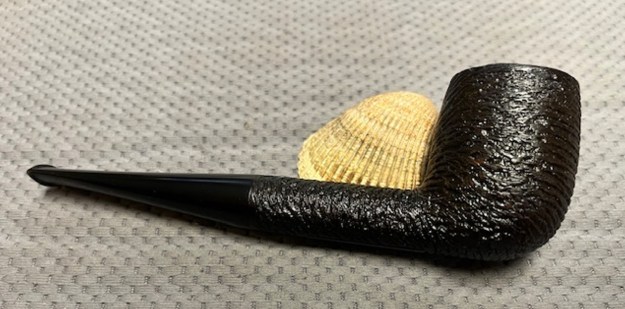
Now it was time to work on the pipe on my end. When I received it, Jeff had once again done an amazing job cleaning the pipe. He reamed it with a PipNet pipe reamer and got rid of the cake. He cleaned up the reaming with a Savinelli Fitsall Pipe Knife so that we could see the walls of the bowl and assess for damage. It was in good condition. He cleaned the internals of the shank and stem with cotton swabs, pipe cleaners, shank brushes and alcohol. He scrubbed the exterior with undiluted Murphy’s Oil Soap and a tooth brush. He rinsed the pipe under warm water. He dried it off with a cloth and then let it air dry. The stem was scrubbed with Soft Scrub and soaked in Briarville’s Stem Deoxidizer. It came out looking clean but the hole in the stem called for a replacement once again. The finish on the bowl and the rim top cleaned up nicely. I took pictures of the pipe to show how it looked when I brought it to the worktable. I took some photos of the rim top and stem to show the condition of them both when the pipe arrived. It looked very good. The stem had some light chatter and tooth marks ahead of the button on both sides. I took a photo of the stamping on the heel of the bowl. It is readable and in great condition.   I removed the stem from the shank and took a photo of the pipe to show the look of the pipe.I sanded the darkening on the smooth portions of the rim top and the bevelled inner edge of the bowl with a folded piece of 220 grit sandpaper to remove it. The process worked very well and the rim top looked much better.I touched up the valleys in the plateau with a black Sharpie pen to match the other valleys in the finish. It looked very good with the touch up.I polished the smooth portions of the bowl and the high points in the rustication and plateau with micromesh sanding pads – dry sanding with 1500-12000 grit pads. I wiped the briar down after each pad with a damp cloth. The bowl is starting to look very good. I worked some Before & After Restoration Balm into the surface of the briar with my fingertips and into the plateau rim top and shank end with a horsehair shoe brush to clean, enliven and protect it. I let the balm sit for a little while and then buffed with a cotton cloth to raise the shine. The photos show the bowl at this point in the restoration process. I set the bowl aside and turned my attention to the stem. I “painted” the stem with a lighter flame and then filled in the remaining tooth damage with black rubberized CA glue. I set it aside to let the repair cure. Once cured, I flattened out the repairs with a flat file and then sanded it with 220 grit sandpaper to blend it into the surface of the surrounding vulcanite. I sanded the stem with 320-3500 grit sanding pads. I wiped the stem down with an Obsidian Oil cloth after each sanding pad. Once I was finished it looked much better.I polished the stem with micromesh sanding pads – wet sanding with 1500-12000 grit sanding pads. I wiped it down after each sanding pad with some Obsidian Oil. I finished polishing it with Before & After Pipe Stem Polish – both Fine and Extra Fine and buffed it off with a cotton cloth. This is a beautiful Jobey Dansk 2 Handmade Freehand by Karl Erik with a fancy, turned, vulcanite stem. It has a great look and feel. The shape fits well in the hand with the curve of the bowl and shank junction a perfect fit for the thumb around the bowl when held. I polished stem and the bowl with Blue Diamond polish on the buffing wheel. I gave the plateau on the rim top and shank end multiple coats of Conservator’s Wax. I gave the bowl and the stem multiple coats of carnauba wax. I buffed the pipe with a clean buffing pad to raise the shine. I hand buffed it with a microfiber cloth to deepen the shine. The pipe polished up pretty nicely. The rich combination of browns and black in the smooth finishes and the plateau areas took on life with the buffing. The rich colour of the briar works well with the polished vulcanite stem. I like the grain and finished look of this Jobey Dansk 2 pipe. Have a look at it with the photos below. The shape, finish and flow of the pipe and stem are very well done. The dimensions are Length: 6  inches, Height: 2 ¼ inches, Outside diameter of the bowl: 1 ½ wide, Chamber diameter: 7/8  of an inch. The weight of the pipe is 43 grams/1.52 ounces. This Danish Freehand is a real beauty. Thanks for walking through the restoration with me as I worked over another beautiful pipe. This one will be going on the rebornpipes store in the Danish Pipe Making Section shortly if you would like to add it to your collection. Thanks for your time.

Restoring a Millville Unique Made by Hand in London City Acorn


by Steve Laug

The next pipe on the worktable is a beautiful cross grain Bent Acorn. We bought it from a friend in Barrington, Rhode Island, USA. It is a truly beautiful piece of briar that is stamped Millville [over] Unique on the left side of the shank and Made by Hand [over] in [over] London City on the right side. The City stamp is slightly different that the stamping on Made in London. I have had a few Millville pipes come across my table over the years but this one is stunning. The cross grain on it is beautiful. When Jeff received it the bowl had been reamed and the pipe was quite clean. The stem was lightly oxidized and there was some chatter and tooth marks on the top and bottom of the stem near the button. The fit of the stem is perfect to the shank and there is a very faint characteristic M that graces this brand of pipe. It is almost gone from over-buffing but I am hoping it will still show when we have finished cleaning up the pipe. Jeff took photos of the pipe before he started his work on it.Jeff took close up photos of the bowl and rim to capture the condition of the pipe before he started his cleanup work. The crowned rim top was very clean with a slight bit of darkening on the back inner edge. The outer edge looked to be in decent condition. The stem showed some oxidation and light tooth marks on both sides ahead of the button. He also took a photo of the side and bottom of the bowl and shank to show the beautiful grain around the bowl. The photos show the general condition of the bowl and it is quite clean and another beautiful pipe. Jeff took photos to capture the stamping on the sides of the shank and the stem. The photos show the stamping Millville [over] Unique on the left side and Made by Hand [over] in [over] London City on the right side. He also captured the M stamp on the stem side.I wanted to know more about the brand so I did a bit of searching on the web to see what I could find out about Millville pipes. I turned first to Pipephil’s site to see what he had for information (http://www.pipephil.eu/logos/en/logo-m5.html). I did a screen capture of the section on the brand and have included that below. I also included the sidebar information below the picture. The pipe I am working is stamped like the second one below and is a Unique.Artisans: Dennis and John Marshall (father and son). They formerly worked at Charatans factory.

I turned to Pipedia for more information (https://pipedia.org/wiki/Millville). I have summarized what I found below:

Dennis Marshall started the brand in 1980. He had worked for Barling and Charatan for many years. His son John now makes all of the Millville pipes as Dennis is retired. Their pipes still very closely follow the artistic, freeform designs and grading of the old Charatan lines. The pipes are sold almost exclusively in Piccadilly, London in a stall in the market in front of St. James’s Church. Though you can sometimes find them online at British pipe sellers such as Bond’s of London. According to Pipedia the prices of their pipes “start at about 20 £ – hardly the price of a cheapish Stanwell. These were made from pre-turned bowls. The better pipes, entirely hand-made freehands in the old Charatan style, are made from a stock of very old briar, as John stresses. They use several grades like “Unique” or “Executive”. A “Bamboo” can make it up to 500 £.”

Jeff cleaned up the reaming with a Savinelli Fitsall Pipe Knife. He scrubbed out the mortise and the airway in the shank and the stem with alcohol, cotton swabs, shank brushes and pipe cleaners. He scrubbed the exterior of the bowl, rim, shank and stem with a tooth brush and undiluted Murphy’s Oil Soap to remove the oils and tars on the rim and the grime on the finish of the bowl. He rinsed it under running water. He dried it off with a soft cloth. He was able to remove the on the back side of the inner edge. I took photos of the pipe to show its condition before I started my work on it. The stem also looked better. I took close up photos of the bowl and rim top as well as the stem. You can see the condition of the rim top and bowl in the first photo. Jeff was able to remove the darkening on the back inner edge of the bowl and any remaining grime. It looked very good. The stem looked very good. The oxidation was all removed and the light tooth marks and chatter on both sides near the button were less visible and would polish out.I took photos of the stamping on the shank to show their condition. They are clear and readable. The M stamp on the left side of the stem is faint but readable and I am hoping to be able to touch it up with white acrylic to make it stand out. I removed the stem from the shank to give a sense of the look of this Unique. I polished the rim top and the briar with micromesh sanding pads. I dry sanded the bowl with 1500-12000 grit sanding pads. I wiped the bowl down after each pad with a damp cloth to remove the sanding dust. I worked some Before & After Restoration Balm into the surface of the briar with my fingertips to clean, enliven and protect it. I let the balm sit for a little while and then buffed with a cotton cloth to raise the shine. The following photos show the bowl at this point in the restoration process. I am very happy with the results. I touched up the faint M stamp on the left side of the stamp with white acrylic fingernail polish. I worked it into the stamp and scraped it off with my nail. I cleaned up the excess with a 1500 grit micromesh sanding pad. It looked quite good though faint in spots.I polished the stem with micromesh sanding pads – dry sanding with 1500-12000 grit sanding pads. I wiped it down after each sanding pad Obsidian Oil. I finished by polishing it with Before & After Pipe Stem Polish both fine and extra Fine and then wiped it down with a final coat of Obsidian Oil. This is a beautiful Millville Unique Hand Made in London City Bent Acorn with a vulcanite tapered stem. It has a great look and feel. The shape of the bowl, the rim top and the cut of the briar work well to highlight the grain around the bowl sides. I polished stem and the bowl with Blue Diamond polish on the buffing wheel. I gave the bowl and the stem multiple coats of carnauba wax. I buffed the pipe with a clean buffing pad to raise the shine. I hand buffed it with a microfiber cloth to deepen the shine. The pipe polished up pretty nicely. The grain took on life with the buffing. The rich oil cured colour works well with the polished vulcanite stem. The finished Millville Unique Bent Acorn has a rich look that is quite catching. Have a look at it with the photos below. The shape, finish and flow of the pipe and stem are very well done. The dimensions are Length: 6 inches, Height: 1 ¾ inches, Outside diameter of the bowl: 1 ½ inches, Chamber diameter: ¾ of an inch. The weight of the pipe is 1.48 ounces/43 grams. It is a beautiful pipe. I will be putting it on the rebornpipes store shortly in the British Pipemakers Section if you are interested in adding it to your collection. Thanks for walking with me through the restoration.

Karl Erik Handmade in Denmark 225 Rusticated Poker


by Steve Laug

The next pipe on the table is one that we picked up from a seller in Ogden, Utah, USA on 12/21/2024. It is deep and uniquely rusticated Pot with a saddle stem. It is stamped on the underside of the shank and reads Karl Erik [over] Handmade in Denmark [over] the shape number 225. The stamping is clear and readable as noted above. The pipe has some grime and oils ground into the rustication around the bowl and shank. The bowl had a thick cake and there was thick lava in the deep rustication on the rim top and edges. The inner and outer edges appeared to be undamaged. Cleaning would make that clear. The vulcanite saddle stem was oxidized and dirty with deep tooth marks and chatter ahead of the button. Jeff took photos of the pipe to show what it looked like before he started working on it. Jeff took a photo of the bowl and rim top to show the cake in the bowl, lava overflow and the general condition of the pipe. The photos of the stem to show the condition of both sides of the stem as noted above. He took photos of the sides of the bowl and the heel to show the interestingly textured rustication around the bowl and shank. It really is a beautifully rusticated piece of briar. The finish is nice but it also dirty with dust ground into the deeper portions of the finish. Jeff took a photo of the stamping on the underside of the shank. It is clear and readable as noted above. If you have been following the blog for any length of time you have come to know that when I am working on interesting old pipes (even sometimes those not so interesting) I like to know a bit about the background of the brand. I like to “meet” the carver to get a feel for their work and style.
I turned to Pipephil’s site (http://pipephil.eu/logos/en/logo-k1.html) to see what I could find. I did a screen capture of the entry there and have included the side bar information below the photo. Brand created in 1965-66 by Karl Erik Ottendahl (1942 – 2004 †). In the best years he employed up to 15 craftsmen among which Bent Nielsen (see Benner) and Peder Christian Jeppesen. Former grading (ascending): from 4 to 1, and “Ekstravagant” (entirely hand made)

I turned to Pipedia (https://pipedia.org/wiki/Karl_Erik) and reread the history of the brand. Give the article a read.

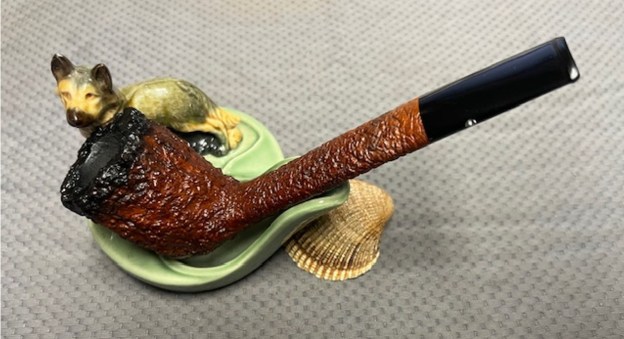
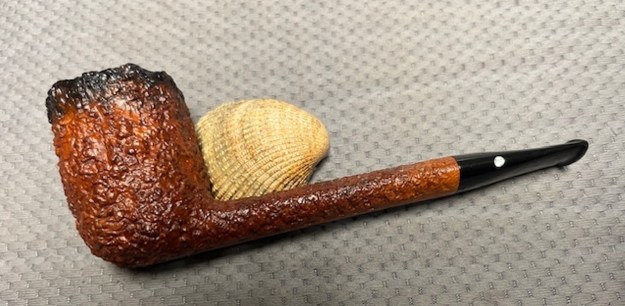
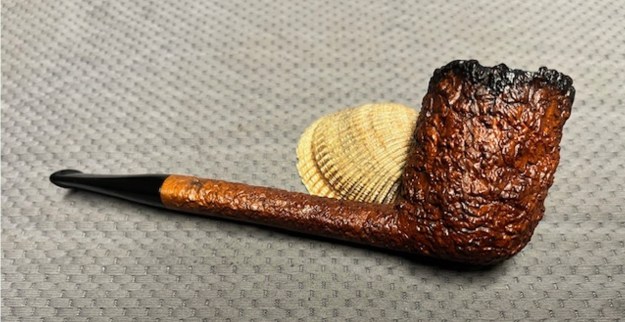
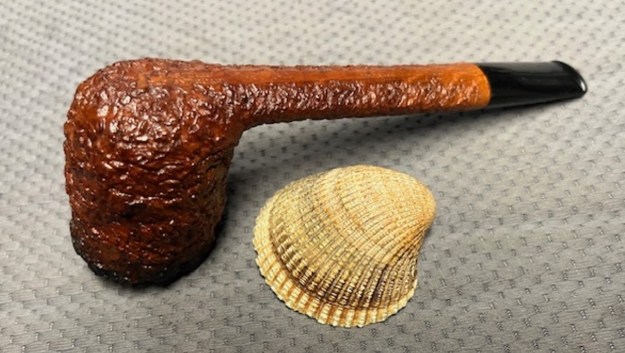
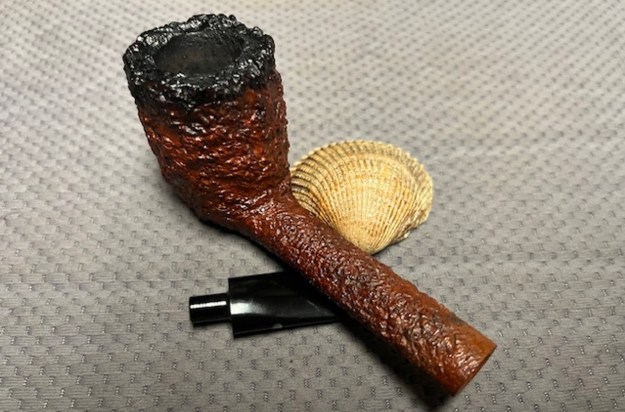
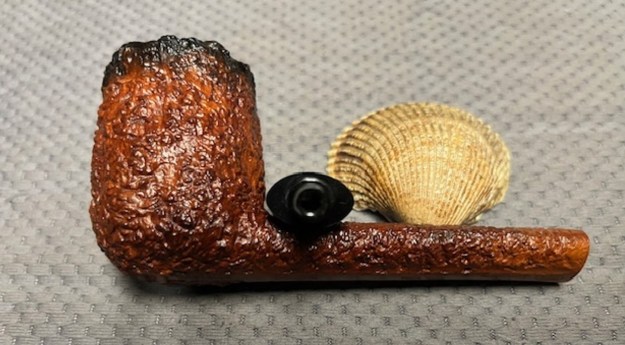
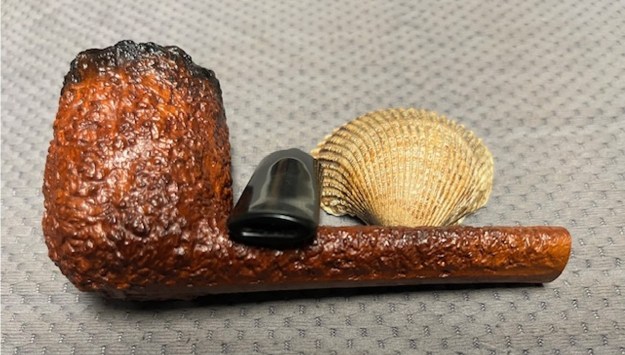
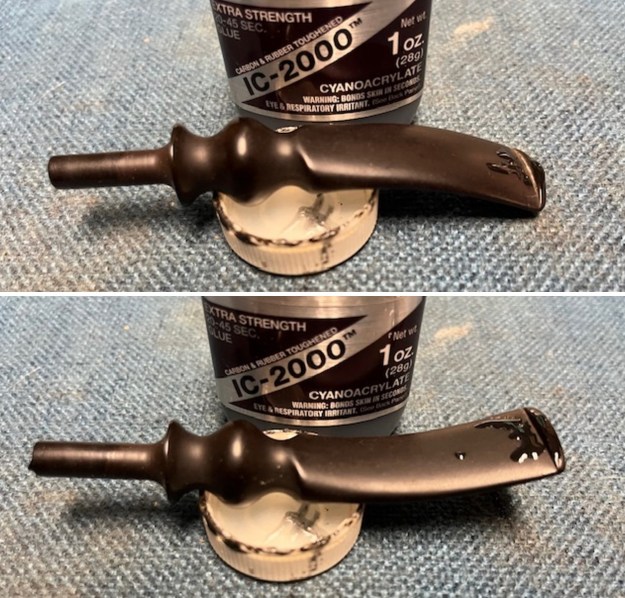
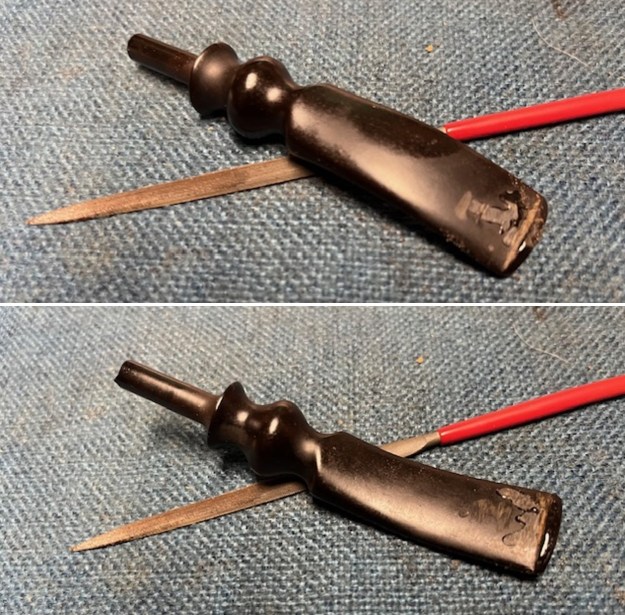
Armed with that information I turned to work on the pipe itself. Jeff had done a great job cleaning up the pipe as usual. He cleaned up the inside of the bowl with a PipNet reamer and a Savinelli Fitsall Pipe Knife. The bowl walls looked very good. He scrubbed the interior of the bowl and shank with pipe cleaners, shank brushes, cotton swabs and alcohol to remove the tars and oils. He scrubbed the exterior of the pipe with undiluted Murphy’s Oil Soap and a tooth brush to remove the grime from the finish. He worked on the rim top lava and darkening with the soap and tooth brush. He scrubbed the inside of the stem with alcohol and pipe cleaners. He scrubbed the exterior with Soft Scrub and then soaked it in Briarville’s Pipe Stem Deoxidizer. He washed it off with warm water to remove the deoxidizer. The pipe looked far better. I took photos of the pipe when I received it before I started working on it.    I took photos of the bowl and rim top to show how clean it was. The top and the inner edge of the rim look very good. There is a little darkening on the top that I will address and see if I can lessen. The stem looks clean of debris and grime. There is tooth chatter on the stem surface on both sides but otherwise it looks good.I took a photo of the stamping on the underside of the shank of the pipe. The stamping is clear and readable. I took a photo of the pipe with the stem removed to show the overall look of stem, tenon and profile of the pipe.I worked over the rusticated rim top with a brass bristle wire brush to clean out the remnants of the debris. It looked much better. The bowl was very clean so I worked some Before & After Restoration Balm into the briar with my finger tips and into the deep rustication with a shoe brush. I let it sit on the bowl for 10 minutes and then buffed it off with a paper towel and soft cloth. The product is a great addition to the restoration work. It enlivens, enriches and protects the briar while giving it a deep glow. It is a product I use on every pipe I restore. I set the bowl aside and turned my attention to the stem. I “painted” the surface of the stem with the flame of a lighter to lift the tooth marks and had mixed success. All of the marks on the topside were lifted. The one remaining on the back I filled in with some rubberized black CA glue. Once the repairs cured I used a flat file to blend them into the surface and followed that with some 220 grit sandpaper. It looked better. Polishing would finish the work. I continued the sanding process with 320-3500 grit sanding pads. After each pad I wiped the stem down with some Obsidian Oil to clearly show me the scratches and areas that still needed work. It was really looking good.I polished the stem with micromesh sanding pads – dry sanding with 1500-12000 grit pads. Once again, I wiped it down between each pad with Obsidian Oil. I further polished it with Before and After Stem Polish – both Fine and Extra Fine. I gave it another rub down with Obsidian Oil. It looked very good. I am really happy with the way that this Heavily Rusticated Karl Erik Bent Poker/ Cherrywood with a saddle stem turned out. It really is a beautiful looking pipe with a unique shape and deep rustication completed by a vulcanite saddle stem. The briar really came alive with the buffing. The rich brown stains of the finish gave the pipe a sense of depth with the polishing and waxing. I carefully buffed the pipe with Blue Diamond on the buffing wheel using a light touch on the briar. I gave the bowl multiple coats of Conservator’s Wax and the stem multiple coats of carnauba wax on the buffing wheel. I buffed the pipe with a clean buffing pad to raise the shine. I hand buffed the pipe with a microfiber cloth to deepen the shine. The finished Karl Erik Rusticated Cherrywood really is a beauty and feels great in the hand and looks very good. Give the finished pipe a look in the photos below. The dimensions of the pipe are Length: 6 inches, Height: 2 inches, Outside diameter of the bowl: 1 ½ inches, Chamber diameter: ¾ of an inch. The weight of the pipe is 52 grams/1.83 ounces. I will be putting the pipe on the rebornpipes store in the Danish Pipe Makers Section. If you would like to add it to your collection let me know. It should be a great smoking pipe.

As always, I encourage your questions and comments as you read the blog. Thanks to each of you who are reading this blog. Remember we are not pipe owners; we are pipe men and women who hold our pipes in trust until they pass on into the trust of those who come after us.

Restoring a Bjarne Handmade in Denmark War Club Billiard


by Steve Laug

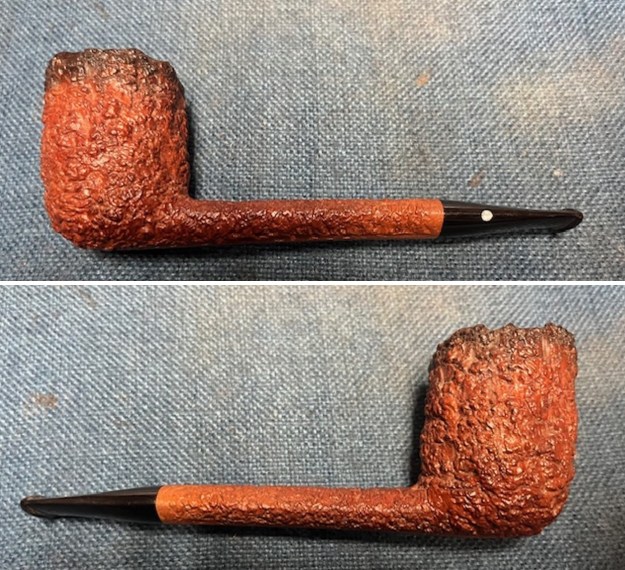
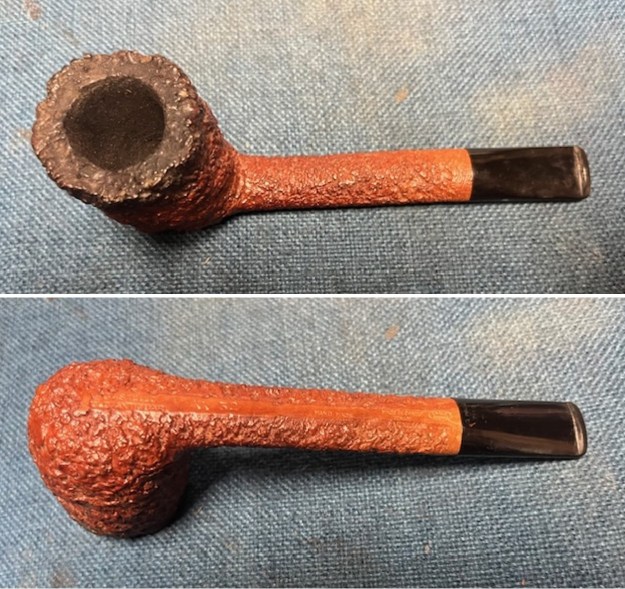
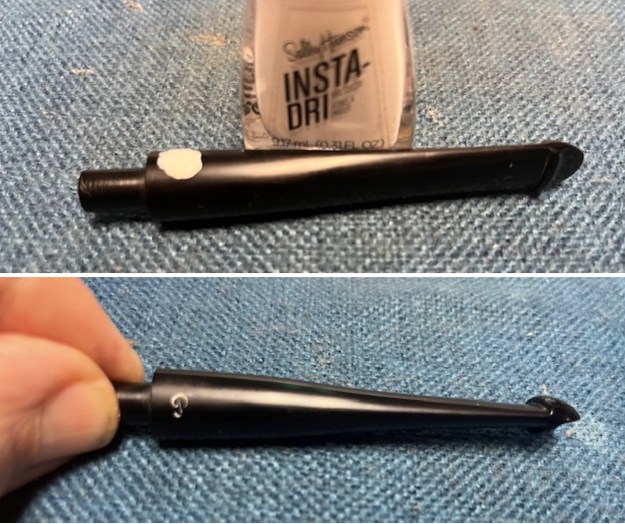
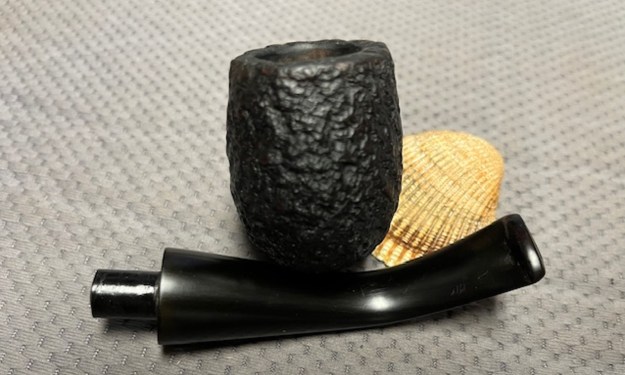
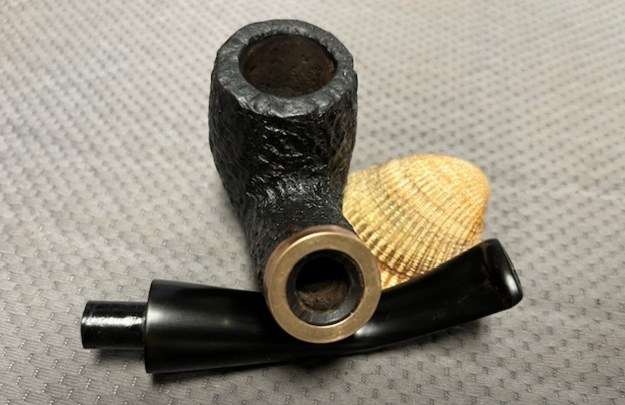
This large rusticated bowl, smooth rimtop briar pipe was purchased from an eBay seller on 08/27/2-24 from Memphis, Tennesse, USA. It is stamped on the underside of the shank and clearly reads Bjarne [over] Handmade [over] In Denmark. The bowl had a thick cake on the walls and a heavy overflow of lava onto the rim top and edges. The smooth rim top and inner edges also had burn damage leaving the bowl out of round. It obviously had been lit repeatedly with a torch lighter and the damage told the story. The rusticated finish is very tactile but dirty with debris and oils. The previous pipeman had cut a piece of wine cork to make a cork spacer on the stem. It still had the makers marks on the cork. His drilling to fit the tenon was off and not centred. It was not the same thickness from the outside to the center drilling. With it in place the tenon was quite short. The vulcanite taper stem has a bj stamped on the left side of the taper. The stem was lightly oxidized, calcified and had light tooth marks and chatter on both sides ahead of the button. I really like the rustication on the bowl and shank even through the grime in the finish. Jeff took photos of the pipe before he started cleaning it up. Have a look. Jeff took close up photos of the bowl and rim top to show the condition of the bowl and the rim top. You can also see the lava on the rim top, inner edge and the cake in the bowl. The burn damage on the top is very visible and has left the bowl is out of round. He also took close up photos of the stem to show its condition as mentioned above. He also took photos of the tooth marks and chatter on both sides of the stem. He took photos of the bowl sides and heel to show the details of the rustication around the bowl. The rustication is deep and has interesting characteristics that show up in the photos around the bowl and shank. He took a photo of the stamping on the underside of the shank. It is clear and readable as noted above. There is a bj logo on the left side of the stem that looks deeper enough to touch up. You can also see the wine cork and some of the writing on it in the second photo. It is also poorly cut. The next two photos show the look of the cork spacer on the stem. It is an obvious home made addition and one that I plan on removing. I have had many Bjarne pipes cross my work table over the years but all had been stamped only Bjarne or Bjarne Handmade. None of them had his full name stamped on it and none had a letter stamp which I assumed indicated the grade of the pipe. I did some research on Pipedia.com and found some helpful information on both the stamping of my pipe and the history of Bjarne Nielsen himself. I am including the link to the full article on Pipedia and also some pertinent sections of the article that I have edited for quick reference. https://pipedia.org/wiki/Bjarne

From the early 1990s Bjarne had seven pipemakers employed and the pipes were sold in no fewer than 32 countries. For more than six months each year, Bjarne traveled around the world to promote his pipes by meeting with dealers and customers. But sadly, it all ended in February 2008 when Bjarne, then 66 years old suffered a fatal heart attack. An unexpected blow first of all to his family, but also to the pipemakers who had been working for him, and to all lovers of his pipes from around the world. And as no one was willing to take over, the Bjarne pipe died together with its creator.

Among the pipemakers that worked for Bjarne were Johs (for the lower priced high volume pieces), and makers like Ph. Vigen, Ole Bandholm and Tonni Nielsen for high grade pieces. The cheaper line was stamped “Bjarne” while the highest grades were stamped “Bjarne Nielsen” (never with the pipemakers’ name) and graded, from highest to lowest, by the letters: AX, A, B, C, D, E, F, G, H, I, and J.

Now I knew that the pipe I had was made before 2008 and was one of his cheaper line stamped Bjarne.

Armed with the information above, I turned my attention to the pipe itself. Jeff had cleaned the pipe with his usual penchant for thoroughness that I really appreciate. He reamed it with a PipNet pipe reamer and cleaned up the reaming with a Savinelli Fitsall Pipe Knife. He scrubbed out the internals with alcohol, pipe cleaners, shank brushes and cotton swabs until the pipe was clean. He scrubbed the exterior of the bowl with Murphy’s Oil Soap and a tooth brush to remove the grime and grit on the briar and the lava on the rim top. The finish looks very good with good looking grain around the bowl and shank. Jeff soaked the stem in Before & After Deoxidizer to remove the oxidation on the rubber. When the pipe arrived here in Vancouver for the second stop of its restoration tour it looked very good. I took photos before I started my part of the work. While I appreciated and understood the idea behind the cork spacer it bothered me. I looked at the tenon and could see that the length was the same as the depth of the mortise in the shank. I also noticed that there was hard glue on the stem that formed a ridge that held the cork in place. I used a flat file and a folded piece of 220 grit sandpaper to get rid of the glue and smooth out the surface of the tenon. It still needed to be polished but I wanted to see if it would fit. I turned it into the mortise and took photos of the look of the pipe without the cork. It was back to what it must have looked like when it left the factory. I like it and would proceed sans cork space. Have a look at the pipe without the cork spacer. What do you think? I took close up photos of the bowl, rim top and stem to show how clean the pipe was. The bowl was clean and the rim top and the inner edge had significant burn damage and was slightly out of round. The stem was clean and showed light tooth marks and chatter.I took a photo of the stamping on the underside of the shank. It is readable and read as noted above. I also removed the stem from the shank and took photos of the pipe to show the look of the parts.The rim top and inner edge of the bowl was in rough condition. I flattened out the damaged rim top by lightly topping it on a topping board with a new piece of 220 grit sandpaper. Once it was flat again I used a wooded sphere and half sphere to work over the inner edge of the bowl and give it a slight bevel to try and bring the bowl back to round. (NOTE: the second photo is staged as I had already put a coat of stain on the polished rim top before realizing I forgot this photo.) The third photo shows the rim top and edges after the sanding process. The burn marks are gone and it looks well. I sanded the rim top with 320-3500 grit sanding pads. I wiped the top down with a damp cloth after each sanding pad and by the end the rim top had a shine and definitely looked better.I polished the rim top with micromesh sanding pads – dry sanding with 1500-12000 grit sanding pads. I wiped it down after each pad with the cloth. The bowl continued to develop a deeper shine. I restained the rim top with a Cherry and Mahogany stain pen to match the shank end and panel on the underside of the shank. It would matched well once waxed and buffed.I worked some Before & After Restoration Balm into the briar with my finger tips and a shoe brush to get into the nooks and crannies. I let it sit on the bowl for 10 minutes and then buffed it off with a paper towel and soft cloth. The product is a great addition to the restoration work. It enlivens, enriches and protects the briar while giving it a deep glow. It is a product I use on every pipe I restore. I set the bowl aside and turned my attention to the stem. I “painted” the surface of the stem with the flame of a lighter to lift the tooth marks and had success. I sanded the light marks that remained with 220 grit sandpaper. It looked better. Polishing would finish the work. I continued the sanding process with 320-3500 grit sanding pads. After each pad I wiped the stem down with some Obsidian Oil to clearly show me the scratches and areas that still needed work. It was really looking good.I touched up the bj logo on the left side of the taper stem with white acrylic nail polish. Once it cured I scraped off the excess and used a 1500 grit micromesh pad to clean it up further.I polished the stem with micromesh sanding pads – dry sanding with 1500-12000 grit pads. Once again, I wiped it down between each pad with Obsidian Oil. I further polished it with Before and After Stem Polish – both Fine and Extra Fine. I gave it a final coat of Obsidian Oil. It looked very good. I am really happy with the way that rim top and edge reworking turned out on this Bjarne Hand Made Large Rusticated Billiard turned out. It really is a beautiful looking pipe with a unique shape and combining a sandblast bowl with a smooth rim and shank end. The vulcanite taper stem is really nice. The briar really came alive with the buffing. The rich brown and black stains of the finish gave the pipe a sense of depth with the polishing and waxing. I carefully buffed the pipe with Blue Diamond on the buffing wheel using a light touch on the briar. I gave the bowl and the stem multiple coats of carnauba wax on the buffing wheel. I buffed the pipe with a clean buffing pad to raise the shine. I hand buffed the pipe with a microfiber cloth to deepen the shine. The finished Bjarne Rusticated War Club Billiard really is a beauty and feels great in the hand and looks very good. Give the finished pipe a look in the photos below. The dimensions of the pipe are Length: 7 inches, Height: 2 ½ inches, Outside diameter of the bowl: 2 inches, Chamber diameter: 1 inch. The weight of the pipe is 102 grams/3.63 ounces. The pipe will be going on the rebornpipes store in the Danish Pipe Makers Section if you would like to add it to your collection. Thanks for reading this blog and my reflections on the pipe while I worked on it. It was a fun one to work on!

New Life for a Damaged Julius Vesz Hand Made circle 6 Calabash 97


by Steve Laug

The next pipe on the table is one that we picked up in the lot from a good friend in Barrington, Rhode Island, USA on 08/22/2024. The smooth finish on this Canadian made pipe and the Julius Vesz stamping are what caught our eye. It is stamped on the left side of the shank and reads Circle 6 [over] 97 followed by Julius Vesz [over] Hand Made. It has a rich reddish, brown stain on the smooth finish that is a stark contrast to the well shaped Bent Vulcanite Stem. It is a great looking Bent Calabash shape. The bowl was clean and appears to have been recently reamed. It was a lightly smoked and well cared for pipe. The inner edge and the top look good and were clean. The stem is another issue. The shank appears to have been reshaped a bit and was rough in its fit to the shank. The left side was particularly rough. The stem itself has a poorly finished repair on a bite through on the underside ahead of the button. The white circle logo of Vesz pipes was on the left side of the stem and looks to be in good condition. Jeff took some photos of the pipe to show the general condition of the pipe before he started his clean up. He took a photo of the rim top and bowl to give me a clear picture of the condition of the rim top and bowl. It is quite clean and the inside of the bowl is very clean and shows that the pipe has been lightly smoked. He included photos that show the top and underside of the stem. It is as described above. The final photo below shows the repaired bite through in the underside of the stem ahead of the button. Jeff took some photos of the sides and heel of the bowl to show the condition of the finish on the pipe. The photos showed some great grain around the bowl and shank even with the grime in the finish. It is a great looking piece of briar. He took photos of the stamping on the sides of the shank. It was clear and readable as noted above. He also captured the white circle logo on the left side of the bent taper stem. Before I started working my part of the restoration I spent some time trying to place the hand cut line in the Vesz hierarchy. I turned to rebornpipes to have a look at some of the pieces I had written previously on the brand. The first was a catalogue I had picked up on Vesz pipes from a friend. It was an older catalogue from the time period that the brand was called Craft Pipes (https://rebornpipes.com/2016/09/13/an-older-julius-vesz-catalogue/). In going through the catalogue there was nothing that referred to the newer lines of the Vesz pipes that showed up in other places.

A piece I wrote on a Vesz Zulu gave a lot of historical background on the brand so I reread that (https://rebornpipes.com/2014/10/04/a-review-a-julius-vesz-shape-76-zulu/). I quoted a part of the article that applied to the pipe I was working on now.

My first Vesz is stamped on the left side of the shank Julius Vesz Hand Made Canada with a circle 4 stamp. I learned from correspondence with Julius’ son Rob that his dad’s Hand Made pipes were graded (in ascending order): 2 – 4 and this one is a grade 4 stamped pipe. It also bears a shape number of 76 which is the Zulu shape. The stem bears a white circle inlay that is common on his pipes.

The pipe I was working on was stamped Julius Vesz [over] Hand Made and had a circle 6 stamp. That appears to be the grade stamp though it is higher than the 2-4 listed above. It also bears the shape number of 97 which is a Calabash. The stem also has a white inlay circle on the stem.

In the previous blog about I quoted from Pipedia in the piece and have included that and the link below and the information on Vesz. The picture and the material is taken from this link http://pipedia.org/wiki/Vesz_Pipes

 “Born and raised in Hungary, Julius Vesz was first exposed to pipe making through his grandfather. Although his grandfather died when Julius was only 9 years old, he can still picture his grandfather making pipes. It made a lasting impression that matured years later.

After immigrating to Canada at age 23, Vesz worked as a mechanical draftsman, but ever since a child had wanted to do something on his own. Remembering his grandfather’s pipe making and repairing, he thought perhaps he should try his hand at that also. He sought out Charlie Dollack, who had a repair shop in downtown Toronto, but while Charlie encouraged the young Vesz, he did not offer any help or instruction.

Julius continued on his own, setting up a modest shop in his own home, and was soon fixing and making pipes for several department stores, as well as United Cigar, which later turned into his main source of work. He discovered he had a unique skill, which he practiced and nurtured on his own. Like his grandfather, Vesz is motivated by a desire to create pipes that approach perfection.”

Over the years I have followed Julius Vesz’ pipes and kept an eye out for one that caught my eye. Julius Vesz is a Canadian pipe maker who has been controversial in his claim to use dead root briar. Many have argued about his choice of terms regarding the briar that he uses. But regardless of your take on that issue he makes beautiful pipes that smoke exceptionally well. His unique raindrop shaped pipes may be how many people know him. He had a shop in the Royal York Hotel, 100 Front Street West in Toronto. He now has moved out of the shop and into his home…”

Now I knew that the Hand Made pipe I had was the top of the lower line of Vesz Pipes below the Hand Cut line. It was graded 6 which is close to the top of the line. It is a beauty and it is now time to work on it!

Armed with that information I turned to work on the pipe itself. Jeff had done a great job cleaning up the pipe as usual. He cleaned up the inside of the bowl with a Savinelli Fitsall Pipe Knife. The rim top and the inner edge of the bowl are in excellent condition. The bowl walls looked very good. He scrubbed the interior of the bowl and shank with shank brushes, pipe cleaners, cotton swabs and alcohol to remove the tars and oils. He scrubbed the exterior of the pipe with Murphy’s Oil Soap and a tooth brush to remove the grime from the finish. He scrubbed the inside of the stem with alcohol and pipe cleaners. He scrubbed the exterior with Soft Scrub and then soaked it in Briarville’s Pipe Stem Deoxidizer. He washed it off with warm water to remove the deoxidizer. The stem looked very good. I took photos of the pipe before I started working on it. I took close up photos of the bowl, rim top and stem to show how clean the pipe was. The bowl was clean and the rim top and the inner edge look beautiful. The stem was clean and had light tooth marks and chatter on both sides. You can also see the poor repair on the underside of the stem.I took a photo of the stamping on the left side of the shank. It is very clear and readable and read as noted above. I also removed the stem from the shank and took photos of the pipe to show the look of the parts. I started my work on the pipe by dealing with the roughness at the shank stem junction. I sanded it with 320-3500 grit sanding pads to smooth out the transition. It looked and felt much better. I touched up the sanded areas on the shank with a Walnut Stain Pen. The colour matched the bowl stain very well. I polished the bowl and shank with 1500-12000 grit micromesh sanding pad – dry sanding it with the pads. I wiped the bowl down with a damp cloth after each pad. It began to take on a deep shine. The shank reshape and reworking blended in very well and the colour is more and more rich with the polishing. The exterior of the bowl looks better after sanding. I worked some Before & After Restoration Balm into the briar with my finger tips. I let it sit on the bowl for 10 minutes and then buffed it off with a paper towel and soft cloth. The product is a great addition to the restoration work. It enlivens, enriches and protects the briar while giving it a deep glow. It is a product I use on every pipe I restore. It was ready for the next step. I used a folded piece of 220 grit sandpaper to sand out the poorly done repair on the underside of the stem. I flattened it out and cleaned off the surface of the stem. I filled in the area with black CA glue put in place with a tooth pick. I set it aside to cure.Once the repair cured I used a file to flatten out the repair and clean up the edge of the button. I sanded it further with a folded piece of 220 grit sandpaper to blend it into the surrounding vulcanite.I polished the sanding repairs on the shank end of the stem and the repair of the bite through by sanding it with micromesh sanding pads. I dry sanded them with 1500-12000 grit pads. I wiped the stem down after each sanding pad with Obsidian Oil to further protect the vulcanite surface. I finished the polishing with Before & After Pipe Stem Polish – Fine and Extra Fine. I wiped the stem down a final time with Obsidian Oil and a cloth. It really looks very good. It was great to finish the repairs and reshaping on this Julius Vesz Hand Made Circle 6 Calabash 97. I put the pipe back together and buffed it with Blue Diamond on the buffing wheel. I gave the bowl multiple coats of carnauba wax. I buffed the pipe with a clean buffing pad to raise the shine. I hand buffed the pipe with a microfiber cloth to deepen the shine. It is fun to see what the polished bowl looks like with deep sandblast all around it. Added to that the polished black, vulcanite, taper stem was beautiful. This Julius Vesz Hand Made 97 is great looking and the pipe feels great in my hand. It is light and well balanced. Have a look at it with the photos below. The dimensions are Length: 5 ½ inches, Height: 1 ¾ inches, Outside diameter of the bowl: 1 3/8 inches, Chamber diameter: ¾ of an inch. The weight of the pipe is 43 grams/1.48 ounces. It is a beautiful pipe and one that I will hold onto for awhile. I always have enjoyed Julius’ pipes and this one is a great shape.

As always, I encourage your questions and comments as you read the blog. Thanks to each of you who are reading this blog and following this restoration. Remember we are not pipe owners; we are pipe men and women who hold our pipes in trust until they pass on into the trust of those who follow us.
Restoring a beautifully grained Dunhill Bruyere 41041 Taper Stem Bulldog


by Steve Laug

The next pipe on the table is one that we picked up in the lot from our contact in Copenhagen, Denmark on 08/09/2024. The Bruyere finish and the Dunhill stamping is what caught our eye. It is stamped on the left side of the shank and reads 41041 next to the bowl/shank union followed by Dunhill [over] Bruyere. On the right side it is stamped Made in [over] England21. It has a classic Bruyere smooth finish that is a stark contrast to vulcanite, diamond taper stem. The finish has some scars that are a part of the pipe’s story particularly on the rim cap. The bowl appears to be moderately caked. The inner edge and the top show some lava overflow and what looks like knife damage from reaming on the inner edge. The stem is very oxidized and tooth marks and chatter on the top and underside ahead of the button and on the button surface itself. The classic white spot is on the left top side of the taper, diamond stem and looks to be in good condition. Jeff took some photos of the pipe to show the general condition of the pipe before he started his clean up. He took some photos of the rim top and bowl from various angles to give me a clear picture of the condition of the rim top and bowl. You can see the lava on the rim top and edges as well as part of the cake in the bowl. He included photos that show the top and underside of the stem. It is as described above. Jeff took some photos of the sides and heel of the bowl to show the condition of the finish on the pipe. The photos showed some great grain around the bowl and shank. It is a great looking piece of briar. He took some photos of the stamping on the sides of the bowl and shank. The stamping was clear and readable as noted above. As is my regular practice, before I started my work on the pipe, I turned to Pipedia’s section on Dunhill Bruyere Pipes to get a refresh the information I know regarding the Dunhill finishes (https://pipedia.org/wiki/Dunhill_Bruyere). I quote:

Initially, made from over century-old briar burls, classified by a “B” (denoted highest quality pipe); “DR” (denoted straight-grained) and an “A” (denoted first quality), until early 1915. After that, they became a high-end subset to the Dunhill ‘Bruyere’. The DR and B pipes, a limited production, they should be distinguished as hand-cut in London from burls as opposed to the Bruyere line which was generally finished from French turned bowls until 1917, when the Calabrian briar started to be used, but not completely. Only in 1920 Dunhill took the final step in its pipe making operation and began sourcing and cutting all of its own bowls, proudly announcing thereafter that “no French briar was employed”.

Bruyere pipes were usually made using Calabrian briar, a very dense and hardy briar that has a modest grain but does very well with the deep red stain.

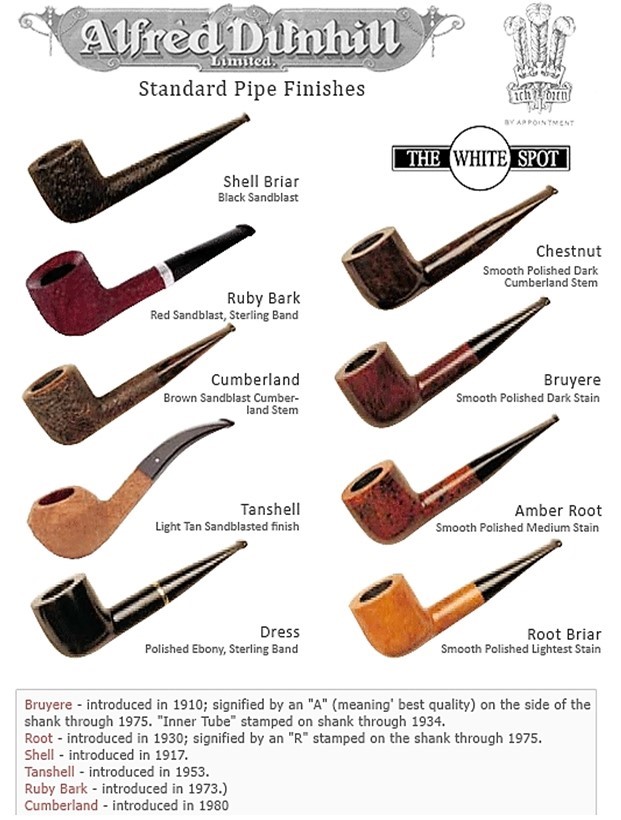
“Before the 1950s, there were three possible finishes for Dunhill pipes. The Bruyere was a smooth finish with a deep red stain, obtained through two coats, a brown understain followed by a deep red. The Shell finish was the original sandblast with a near-black stain (though the degree to which it is truly black has varied over the years). Lastly, the Root finish was smooth also but with a light brown finish. Early Dunhill used different briars with different stains, resulting in more distinct and identifiable creations… Over the years, to these traditional styles were added four new finishes: Cumberland, Dress, Chestnut and Amber Root, plus some now-defunct finishes, such as County, Russet and Red Bark.”[1]I turned to Pipephil’s dating guide to show how I arrived at the date of manufacture for this pipe (http://www.pipephil.eu/logos/en/dunhill/cledat-en1a.html). I am including the chart that is provided there for the dating a pipe. I have drawn a red box around the section. Since the pipe I am working on has a superscript suffix 21 after the D in England it points to the 1960 line on the chart below. To date it just add 1960 +21 for a date of 1981. I have drawn a red box around the pertinent section in the chart.I now knew that I was working on a Bruyere that came out in 1981. The shape of the pipe is called a smooth straight Bulldog with a 41041 Shape number on the left side of the shank/ bowl.

I turned to Pipephil’s shape list (http://www.pipephil.eu/logos/en/dunhill/shapes.html). At the bottom of the list of shapes (with the 04 being a Billiard) is a key for interpreting the digits in the stamp I have included that below.

Dunhill pipes are stamped with a four digit code.
Digit 1: (from 1 to 6) denotes the size of the pipe (the group).
Digit 2: denotes the style of the mouthpiece (0,1=tapered, 2=saddle)
Digit 3 and 4: denote the generic pipe shape (in yellow in the chart on top) 

Example: 5102
(5 = size | 1 = tappered stem | 02 = Bent)

When 5 digits occur, the meaning of the 4 first remain the same

The 41041 was thus a Group 4 size, with a taper mouthpiece, and in an 04 or straight Bulldog shape.

Armed with that information I turned to work on the pipe itself. Jeff had done a great job cleaning up the pipe as usual. He cleaned up the inside of the bowl with a PipNet reamer and a Savinelli Fitsall Pipe Knife. The rim top shows some damage on the top and the inner edge of the bowl. The bowl walls looked very good. He scrubbed the interior of the bowl and shank with pipe cleaners, cotton swabs and alcohol to remove the tars and oils. He scrubbed the exterior of the pipe with Murphy’s Oil Soap and a tooth brush to remove the grime from the finish. He worked on the rim top lava and darkening with the soap and tooth brush. He scrubbed the inside of the stem with alcohol and pipe cleaners. He scrubbed the exterior with Soft Scrub and then soaked it in Briarville’s Pipe Stem Deoxidizer. He washed it off with warm water to remove the deoxidizer. Now the damage to the stem was very clear. Overall, the pipe looked far better. I took photos of the pipe when I received it before I started working on it. I took close up photos of the bowl, rim top and stem to show how clean the pipe was. The bowl was clean and the damage to the rim top and the inner edge is very visible in the photo below. The stem was clean and the light tooth marks and chatter can be seen in the photos.I took a photo of the stamping on the sides of the shank. It is very clear and readable and read as noted above. I also removed the stem from the shank and took photos of the pipe to show the look of the parts. I started my work on the pipe by addressing the damage to the rim top. I used some 220 grit sandpaper and a round wooden sphere to clean up the bevel on the inner edge of the bowl. It looked much better once finished. I touched up the sanded inner edge and top with a cherry stain pen to match the surrounding briar. It is looking very good.I polished the Bruyere bowl and shank with 1500-12000 grit micromesh sanding pad – dry sanding it with the pads. I wiped the bowl down with a damp cloth after each pad. It began to take on a deep shine. The exterior of the bowl look better after sanding. I worked some Before & After Restoration Balm into the briar with my finger tips. I let it sit on the bowl for 10 minutes and then buffed it off with a paper towel and soft cloth. The product is a great addition to the restoration work. It enlivens, enriches and protects the briar while giving it a deep glow. It is a product I use on every pipe I restore. The stem surface looked good other than some deeper oxidation. It showed up in the bright lights of the photos. There were some deep tooth marks in the middle of the button surface on both sides of the stem. I filled them in with black CA glue and set it aside to cure. Once it had cured I recut the button edge and flattened it with a small file. I sanded it with a folded piece of 220 grit sandpaper. I continued the sanding process with 320-3500 grit sanding pads. The repairs began to disappear into the surface of the vulcanite and the stem began to take on a smooth new look. Progress for sure.It was ready for the next step. I polished it with micromesh sanding pads – dry sanding with 1500-12000 grit pads and wiping the surface down with Obsidian Oil after each sanding pad. It is really shining. I polished it further with Before & After Stem Polish – both Fine and Extra Fine. I gave it another coat of Obsidian Oil to finish this step. I am excited to be on the homestretch and look forward to seeing the 1981 Dunhill Bruyere 41041 Bulldog put back together, polished and waxed. I put the bowl and stem back together and lightly polished the bowl and stem with Blue Diamond to polish them. I gave the bowl and the stem multiple coats of carnauba wax. I buffed the pipe on the wheel with a clean buffing pad to raise the shine. I hand buffed it with a microfiber cloth to deepen the shine. The depths of the grain really pop with the wax and polish. The repaired and polished vulcanite stem is a beautiful contrast to the combination of stains on the bowl and shank. This Dunhill Bruyere 41041 Bulldog was a lot of work to bring back to life. The pipe is light weight, comfortable in the hand and should feel great as it is warmed up when smoking. The finished pipe is shown in the photos below. The dimensions of the pipe are Length: 5 ½ inches, Height: 1 ¾ inches, Outside diameter of the bowl: 1 ¼ inches, Chamber diameter: ¾ of an inch. The weight of the pipe is 1.34 ounces/38 grams. I will be putting this one on the rebornpipes store in the British Pipemakers Section soon. Let me know if you wish to add it to your collection.

As always, I encourage your questions and comments as you read the blog. Thanks to each of you who are reading this blog. Remember we are not pipe owners; we are pipe men and women who hold our pipes in trust until they pass on into the trust of those who follow us.
Resurrection of a Well-Loved, Tired Old Dunhill Shell 4106 Billiard


by Steve Laug

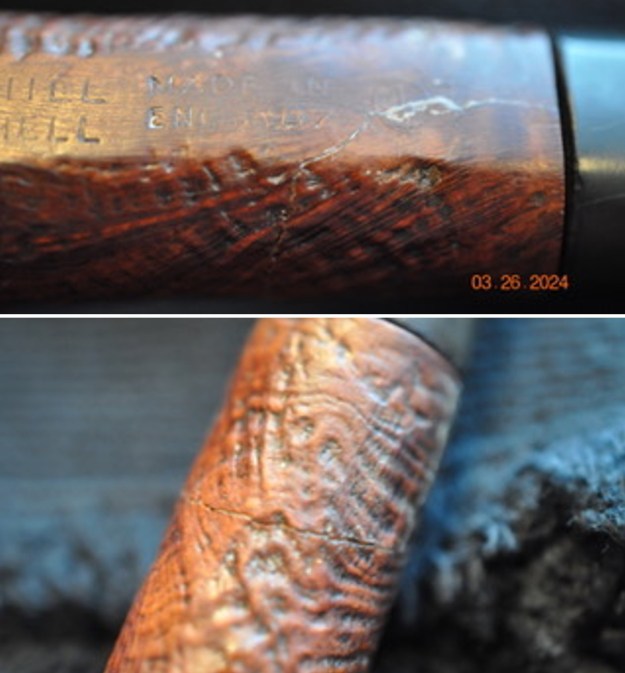
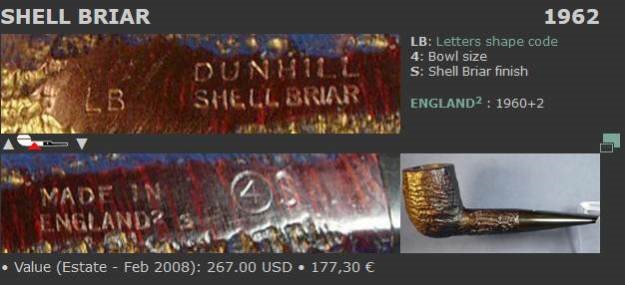
Sometimes when we get around to working on a pipe I am struck with asking why we picked this one up. That is the case with the next poor old Dunhill. It has been either well loved or abused depending on your perspective. We picked the pipe up from a seller in Ogden, Utah, USA on 12/12/2024. Probably the Shell finish and the Dunhill stamp is what caught our eye. It is stamped on the underside of the shank and reads 4106F on the heel of the bowl. That is followed by Dunhill Shell [over] Made in England25. It has a classic Shell briar dark brown/cordovan/black finish sandblast that is a stark contrast to the two silver coloured inlaid rings in the stem. From the side view it is a great looking sandblast pot. However, when you turn it over and examine it from the top down that can begin to see the abuse or love. The bowl appears to be moderately caked at first glance but it is actually quite thick at the bottom half of the bowl and hard as aged concrete. The inner edge and the top show lava overflow and it is hard to know if there is rim damage at this point because of the lava. And let’s talk about that stem. It is oxidized and calcified which is quite normal for what I see. However, the deep tooth marks and chomp marks on the stem surface and button edges are deeper than they first appear. You can picture the old pipe man (or maybe a young one though I doubt it) chomping down on the stem while concentrating on whatever his hands were doing in the shop. Cleaning it up will truly reveal the depth of the mess but first impressions are not good! There were two inlaid metal rings in the taper stem – sandwiching a piece of vulcanite. This is something I have not seen before on a Dunhill stem. The classic white spot is on the top of the stem and looks to be in good condition. Jeff took some photos of the pipe to show the general condition of the pipe before he started his clean up. What are your impressions? Would you have bought it or left it? He took some photos of the rim top and bowl from various angles to give me a clear picture of the condition of the rim top and bowl. You can see the lava on the rim top and edges as well as part of the cake in the bowl. It is thicker starting about half way down the bowl. The next photos show the top and underside of the stem. It is actually far worse than even the photos show. Jeff took some photos of the sides and heel of the bowl to show the condition of the finish on the pipe. The photos showed a great sandblast. It is a great looking piece of briar at least on the outside at this point! He took some photos of the stamping on the underside of the bowl and shank. The stamping was clear and readable as noted above. There was some faintness to the stamping of the shape number on the heel of the bowl but it was still readable.As is my regular practice, before I started my work on the pipe, I turned to Pipedia’s section on Dunhill Shell Pipes to get a refresh the information I know regarding the Dunhill finishes (https://pipedia.org/wiki/Dunhill#Root_Briar). I quote:

Shell

A deep craggy sandblast with a black stain finish (usually made using Algerian briar) – the color of the stain used has varied over the years. Although there is some doubt as to them being the first to sandblast pipes, Dunhill’s Shell pipes, and the sandblasting techniques developed to create them are considered one of Dunhill’s greatest and most lasting contributions to the art of pipe making.

The documented history of Dunhill’s inception of the Shell is largely limited to patent applications — there are no catalog pages or advertisements promoting blasted pipes at the time. The preliminary work on the English patent (No. 1484/17) was submitted on October 13, 1917. The patent submission was completed half a year later, on April 12, 1918, followed by the granting of the English patent on October 14, 1918. This was less than a month before the end of The Great War on November 11th.

In 1986 Dunhill released a line of premium Shell finish pipes – “RING GRAIN”. These are high-quality straight grain pipes which are sandblasted. Initially only Ring Grain, but now in two different finishes. In 1995 the “Shilling” was introduced with Cumberland finish – it is an extremely rare series. These pipes exhibit a deeper blast characteristic of that of the 1930’s – mid-1960’s (and the limited ‘deep blast’ pipes of the early 1980s) and show a fine graining pattern. These are considered the best new Dunhills by many enthusiasts today and are very rare. The finish is sometimes described as tasting like vanilla at first, with the taste becoming more normal or good as the pipe breaks in.

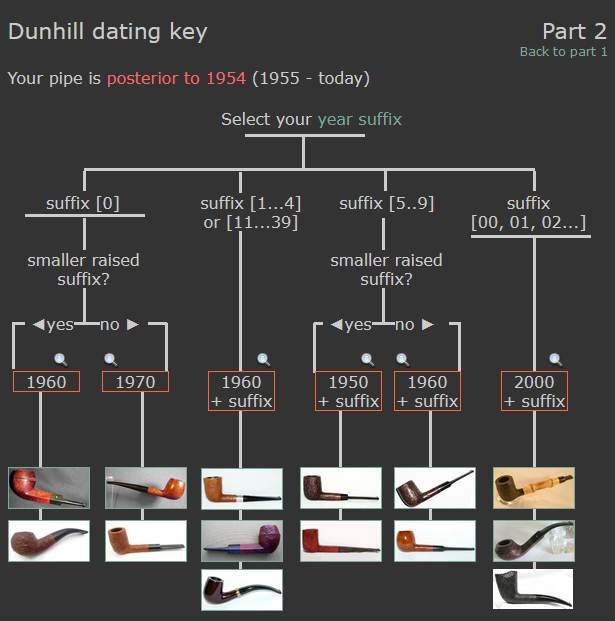
There was also a link to a catalogue page that gave examples and dates that the various finishes were introduced (https://pipedia.org/wiki/File:Dunnypipescatalog-1.png).I turned to Pipephil’s dating guide to show how I arrived at the date of manufacture for this pipe (http://www.pipephil.eu/logos/en/dunhill/cledat-en1a.html). I am including the chart that is provided there for the dating a pipe. I have drawn a red box around the section. Since the pipe I am working on has a superscript suffix 25 after the D in England it points to the 1960 line on the chart below. To date it just add 1960 +25 for a date of 1985. I have drawn a red box around the pertinent section in the chart.I now knew that I was working on a Shell that came out in 1985. The shape of the pipe is called a Pot with a 4106 Shape number on the heel of the bowl.

I turned to Pipephil’s shape list (http://www.pipephil.eu/logos/en/dunhill/shapes.html). At the bottom of the list of shapes (with the 06 being a pot) is a key for interpreting the digits in the stamp I have included that below.

Dunhill pipes are stamped with a four digit code.
Digit 1: (from 1 to 6) denotes the size of the pipe (the group).
Digit 2: denotes the style of the mouthpiece (0,1=tapered, 2=saddle)
Digit 3 and 4: denote the generic pipe shape (in yellow in the chart on top) 

Example: 5102
(5 = size | 1 = tappered stem | 02 = Bent)

When 5 digits occur, the meaning of the 4 first remain the same

The 4106 was thus a Group 4 size, with a taper mouthpiece, and in an 06 or Pot shape.

Armed with that information I turned to work on the pipe itself. Jeff had done a great job cleaning up the pipe as usual. He cleaned up the inside of the bowl with a PipNet reamer and a Savinelli Fitsall Pipe Knife. The bowl walls looked very good but there was a thick ring at the bottom of the bowl. The question was whether it was more cake or damage to the bowl bottom. The airway appears to be drilled at the bottom. This will take some more work. He scrubbed the interior of the bowl and shank with pipe cleaners, cotton swabs and alcohol to remove the tars and oils. He scrubbed the exterior of the pipe with Murphy’s Oil Soap and a tooth brush to remove the grime from the finish. He worked on the rim top lava and darkening with the soap and tooth brush. He scrubbed the inside of the stem with alcohol and pipe cleaners. He scrubbed the exterior with Soft Scrub and then soaked it in Briarville’s Pipe Stem Deoxidizer. He washed it off with warm water to remove the deoxidizer. Now the damage to the stem was very clear. Overall, the pipe looked far better. I took photos of the pipe when I received it before I started working on it. I took close up photos of the bowl, rim top and stem to show how clean the pipe was. The bowl was clean but if you look closely you can see the thick ring toward the bottom of the bowl. The stem was clean but the tooth damage is very visible on both sides of the stem and button. The pipe has potential but it will be a lot more work to bring it back.I took a photo of the stamping on the underside of the shank. It read as noted above. It is very clear and readable even though it is faint in spots. I also removed the stem from the shank and took photos of the pipe to show the look of the parts.It did not take long to decide where I would start with this pipe. I tried to raise the tooth marks as much as possible by “painting” the surface with a lighter flame. It did very little to lift the marks in the stem. I forgot a photo of this but you have seen them before. I filled in the deep marks by layering in the rubberized black CA glue. Once it had cured I flattened the repairs and recut the button with a small file. I reshaped the button top and edges and further flattened and blended in the repairs with a folded piece of 220 grit sandpaper. It was a big improvement but still more work to go! I continued the sanding process with 320-3500 grit sanding pads. The repairs began to disappear into the surface of the vulcanite and the stem began to take on a smooth new look. Progress for sure.It was ready for the next step. I polished it with micromesh sanding pads – dry sanding with 1500-12000 grit pads and wiping the surface down with Obsidian Oil after each sanding pad. It is really shining. I polished it further with Before & After Stem Polish – both Fine and Extra Fine. I gave it another coat of Obsidian Oil to finish this step. I fit the polished stem with a Vauen Dr. Perl Junior 6mm filter in the tenon. It fit perfectly and as normal the filter reduced the draught on the pipe. The pipe can easily be smoked without the filter.I set the stem aside and worked on the bowl. I worked on the thick “concrete” like build up at the bottom of the bowl. It was very hard and thick. I used a PipNet Reamer to work on it a bit and a lot came out of the bowl. I chipped away at it with a Savinelli Fitsall Pipe Knife to remove the build up until the bottom and walls were clean.I cleaned the shank and the bowl again with alcohol and pipe cleaners to remove the dust and debris from the work on the bowl bottom. The exterior of the bowl was in excellent condition. I did not need to sand or do anything in preparation on the pipe. I set the stem aside and worked some Before & After Restoration Balm into the briar with my finger tips and a horsehair shoe brush. I let it sit on the bowl for 10 minutes and then buffed it off with a paper towel and soft cloth. The product is a great addition to the restoration work. It enlivens, enriches and protects the briar while giving it a deep glow. It is a product I use on every pipe I restore. I am excited to be on the homestretch and look forward to finally seeing the 1985 Dunhill Shell 4106 Billiard put back together, polished and waxed. I put the bowl and stem back together and lightly polished the bowl and stem with Blue Diamond to polish them. I gave the bowl multiple coats of Conservator’s Wax and the stem multiple coats of carnauba wax. I buffed the pipe on the wheel with a clean buffing pad to raise the shine. I hand buffed it with a microfiber cloth to deepen the shine. The depths of the sandblast really pop with the wax and polish. The repaired and polished vulcanite stem is a beautiful contrast to the combination of Shell stains on the bowl and shank. This Dunhill Shell 4106 Billiard was a lot of work to bring back to life. The pipe is tactile in the hand and should feel great as it is warmed up when smoking. The finished pipe is shown in the photos below. The dimensions of the pipe are Length: 5 inches, Height: 1 ½ inches, Outside diameter of the bowl: 1 ½ inches, Chamber diameter: 7/8 of an inch. The weight of the pipe is 1.31 ounces/ 38 grams. I will be putting this one on the rebornpipes store in the British Pipemakers Section soon. Let me know if you wish to add it to your collection.

As always, I encourage your questions and comments as you read the blog. Thanks to each of you who are reading this blog. Remember we are not pipe owners; we are pipe men and women who hold our pipes in trust until they pass on into the trust of those who follow us.
Restoring a Sandblast Handmade in Denmark Freehand


by Steve Laug

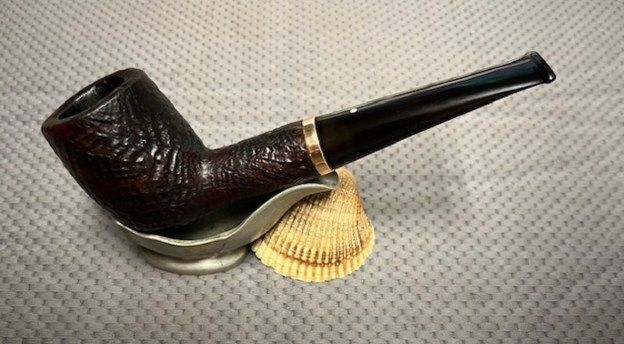
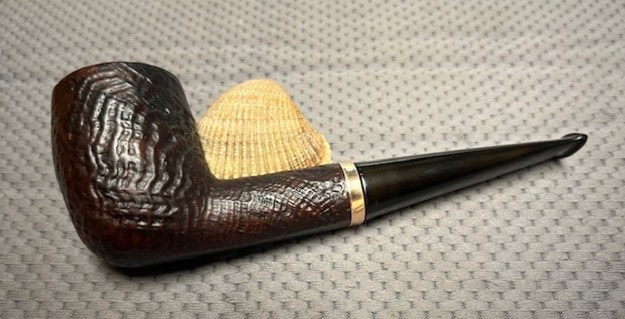
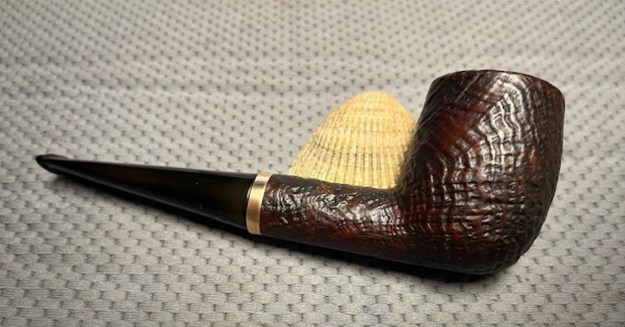
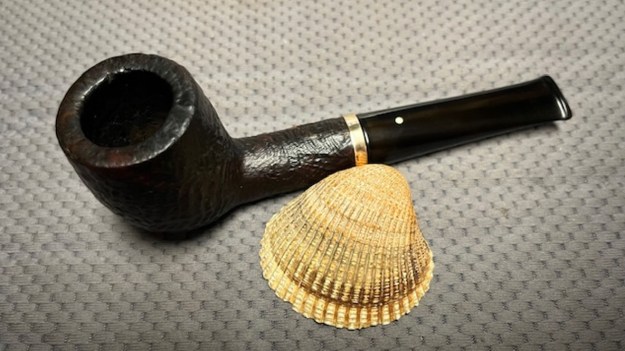
The next pipe on the table is one that came to us from the group of pipes that Jeff and I purchased from our connection in Copenhagen, Denmark on 10/17/2022. It is clearly a Danish Freehand style sandblast that is in good condition. It is stamped on a smooth panel on end of the shank and reads Handmade in Denmark stamped diagonally across the shank end. There is no other stamping on the pipe so it is unclear who made it. The rim top and shank end are plateau briar and quite rugged. Everything about the pipe suggests that it is a Preben Holm made pipe but of course I cannot prove that. The pipe has a mix of black and brown stains on a sandblast finish and some amazing grain that the shape follows well. The finish was dusty around the nooks and crannies of the sandblast but otherwise fairly clean. The rim top had a thick lava cake on the top in the plateau that was heavier on the left side. There was also lava on the inner edge flowing from thick cake in the bowl. The fancy saddle stem was oxidized, dirty and had light chatter ahead of the button. Jeff took photos of the pipe to show what it looked like before he started working on it. Jeff took photos of the bowl and rim top to show the condition. There is a thick cake in the bowl and a thick lava in the plateau on the rim. He captured the condition of the stem when it arrived. The stem has light chatter ahead of the button. He took photos of the sides of the bowl and the heel to show the beautiful grain in the sandblast around the bowl. It really is a beautiful piece of briar that has a shape that follows the grain. The finish is nice but it also dirty with dust ground into the finish. Jeff took photos of the stamping on the underside of the shank. It is clear and readable and reads as noted above.Once again it is on pipes like this that I really appreciate Jeff’s thorough cleaning process. It gives me real freedom in dealing with pipes when they arrive here. He reamed it with a PipNet pipe reamer and got rid of the cake. He cleaned up the reaming with a Savinelli Fitsall Pipe Knife so that we could see the walls of the bowl and assess for damage. He cleaned the internals of the shank and stem with alcohol, pipe cleaners and alcohol. He scrubbed the exterior of the bowl with undiluted Murphy’s Oil Soap and a tooth brush. He rinsed it under warm water. He dried it off with a cloth and then let it air dry. He soaked the vulcanite stem in Briarville’s Pipe Stem Deoxidizer and once finished rinsed off the remaining product when he removed it from the mixture. I took pictures of the pipe to show how it looked when I unpacked it. Look at the amazing sandblast grain on this beauty. I took photos of the bowl and rim top from a closer angle to show how good it looked. The darks stain on the rim stop is slightly washed out and will need to be restained. The stem photos show how good the stem looks and even the tooth chatter is gone. I took a photo of the pipe with the stem removed to show the look of the parts of the pipe to give a sense of size and perspective.I tried to capture the diagonal stamp on the underside of the shank. It is clear but I did not capture it well. It reads as noted above.I touched up the stain on the plateau on the rim top and shank end with a black stain pen. It looked much better after staining. I went over it with a brass bristle brush to knock off an loose pieces in the plateau.I worked some Before & After Restoration Balm into the surface of the briar with my finger tips and a shoe brush to get it into the nooks and crannies of the plateau and blast. I let it sit on the bowl for 10 minutes and then buffed it off with a paper towel and soft cloth. The product is a great addition to the restoration work. It enlivens, enriches and protects the wood while giving it a deep glow. It is a product I use on every pipe I restore. I set the bowl aside and turned to the vulcanite stem. I sanded the stem with 320-3500 grit sanding pads to remove the remnants of oxidation on the and finish blending in the chatter. It looked very good once finished.I polished it with micromesh sanding pads – dry sanding with 1500-12000 grit sanding pads. I wiped it down after each sanding pad with Obsidian Oil. I polished it with Before & After Pipe Stem Polish – both Fine and Extra Fine. I buffed the stem with a soft cloth to raise the shine. I gave it a final wipe down with Obsidian Oil to protect it. I don’t know what it is about finishing a restoration but I have to tell you that it is my favourite part of the process. It is the moment when everything that I have worked on comes together. I can compare it to where I started and there is always satisfaction that it looks better than when we picked it up. As always, I put this Handmade in Denmark Freehand back together and buffed it with Blue Diamond on the buffing wheel. I gave the bowl and the stem multiple coats of carnauba wax. I buffed the pipe with a clean buffing pad and hand buffed it to raise the shine. It is fun to see what the polished bowl looks like along with the polished fancy vulcanite saddle stem. This Handmade in Denmark Freehand is a great looking pipe and I am sure that it will be comfortable in hand when smoking as it is light and well balanced for a pipe of this size. Have a look at it with the photos below. The dimensions are Length: 6 inches, Height: 2 ½ inches, Outside diameter of the bowl: 1 ½ inches, Chamber diameter: 7/8 of an inch. The weight of the pipe is 2.26 ounces/65 grams. It is another beautiful pipe and one that will be on the rebornpipes store soon. You can find it in the section of Pipes by Danish Pipe Makers. If you are interested in adding it to your collection let me know. Thanks for walking through the restoration with me as I worked over this pipe. Thanks to each of you who are reading this blog.

As always, I encourage your questions and comments as you read the blog. Thanks to each of you who are reading this blog. Remember we are not pipe owners; we are pipe men and women who hold our pipes in trust until they pass on into the trust of those who follow us.
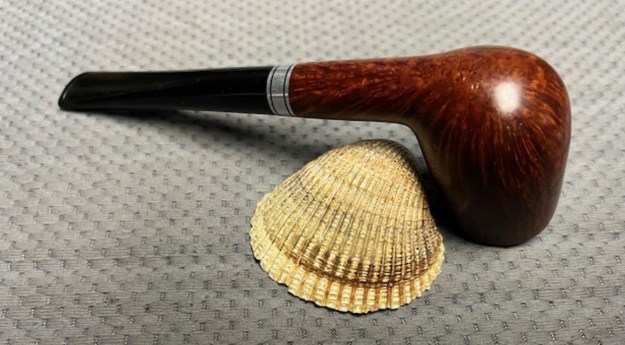
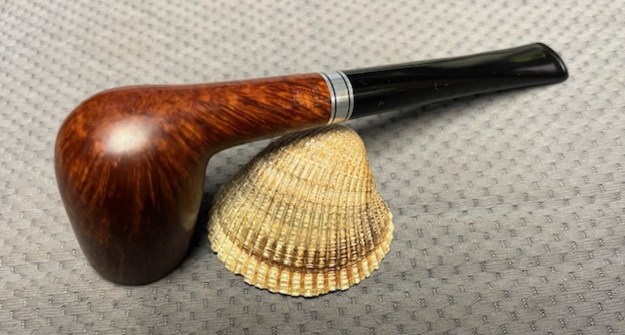
Restemming a Petite Apple with a vulcanite ferrule


by Steve Laug

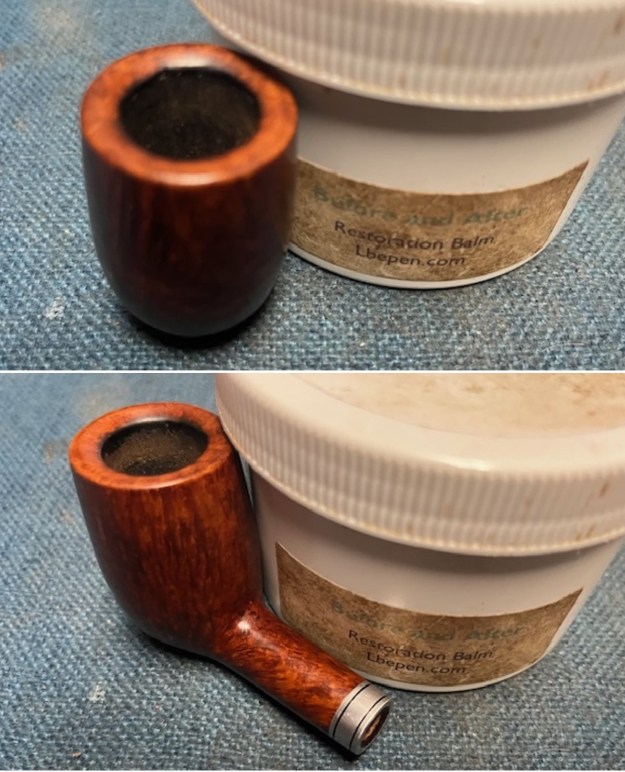
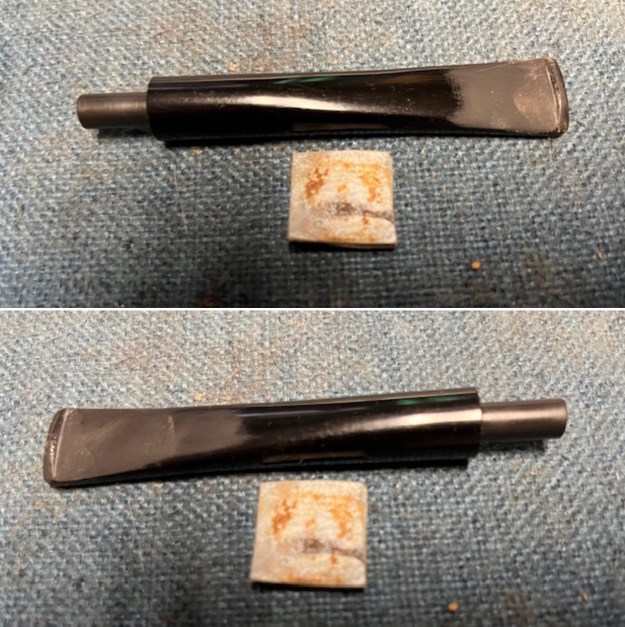
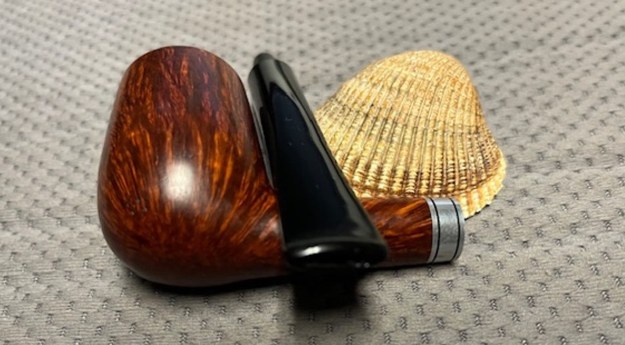
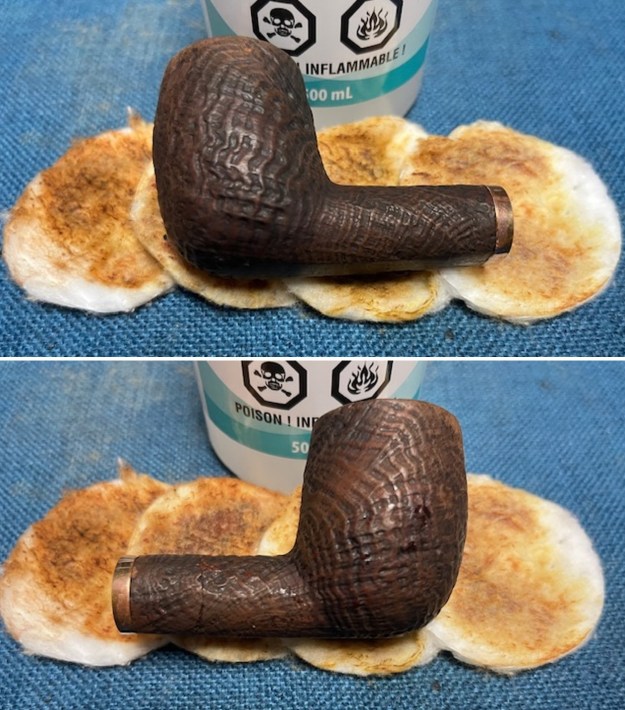
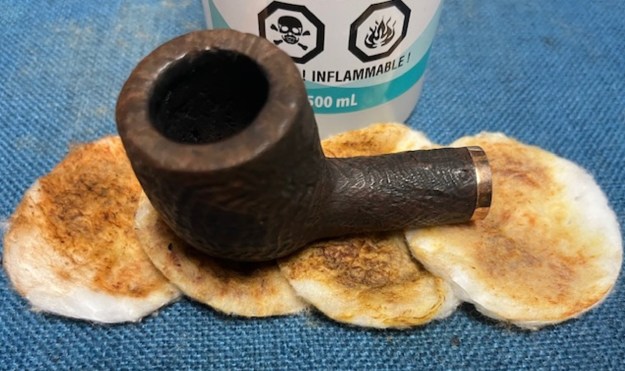
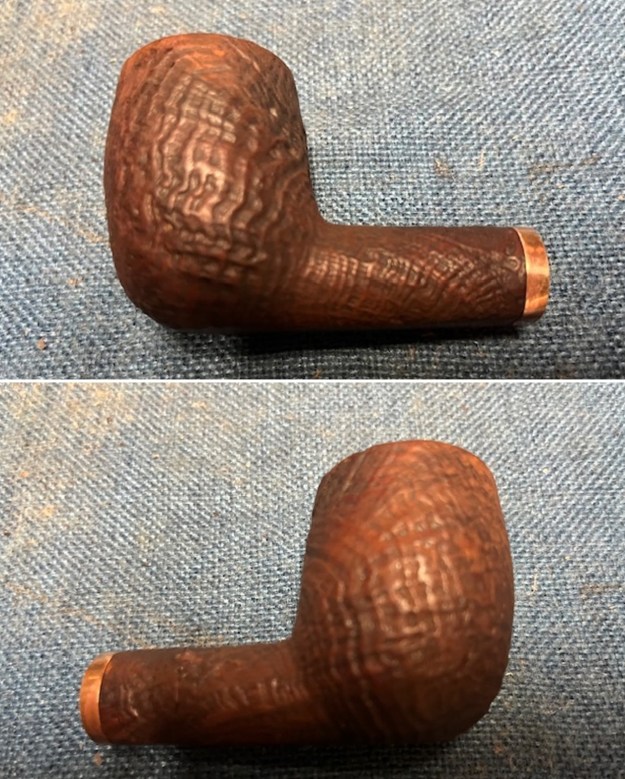
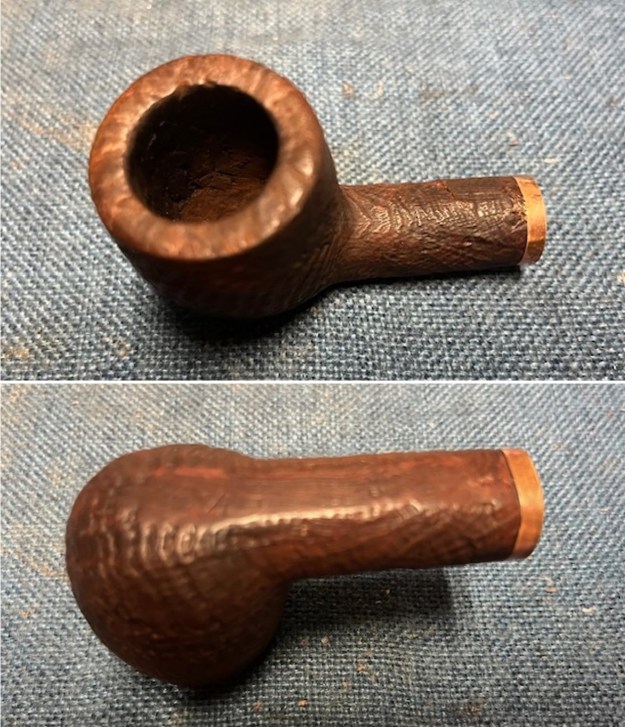
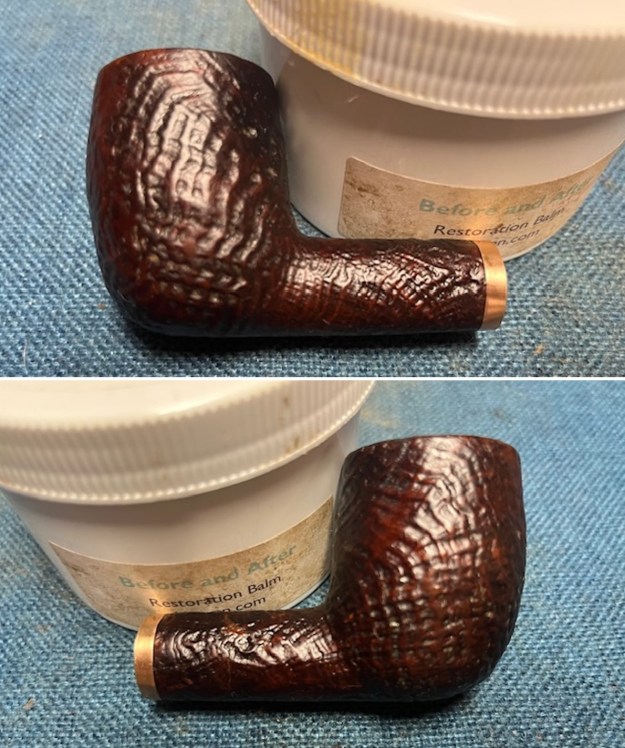
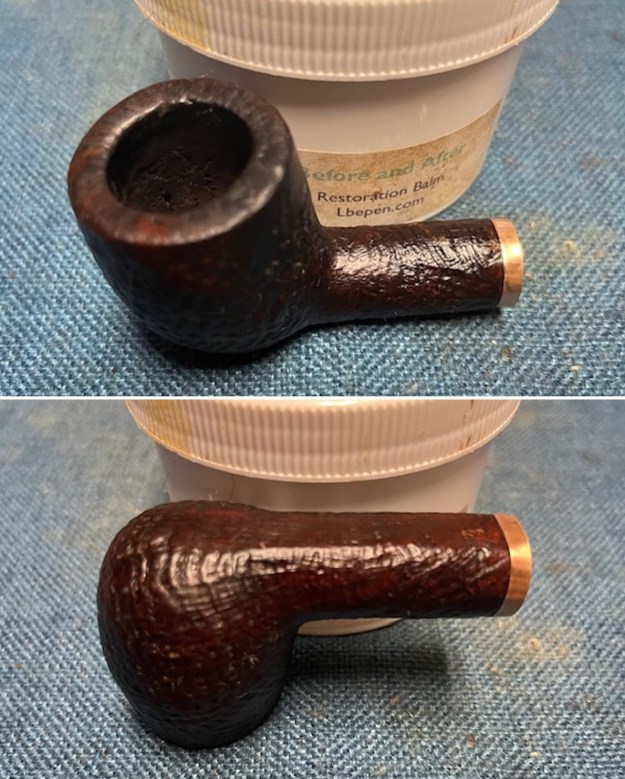
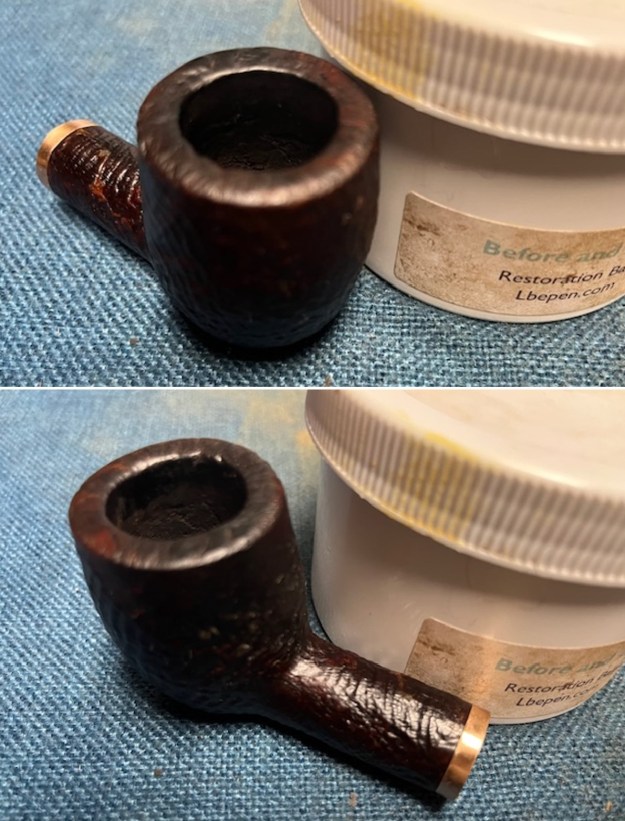
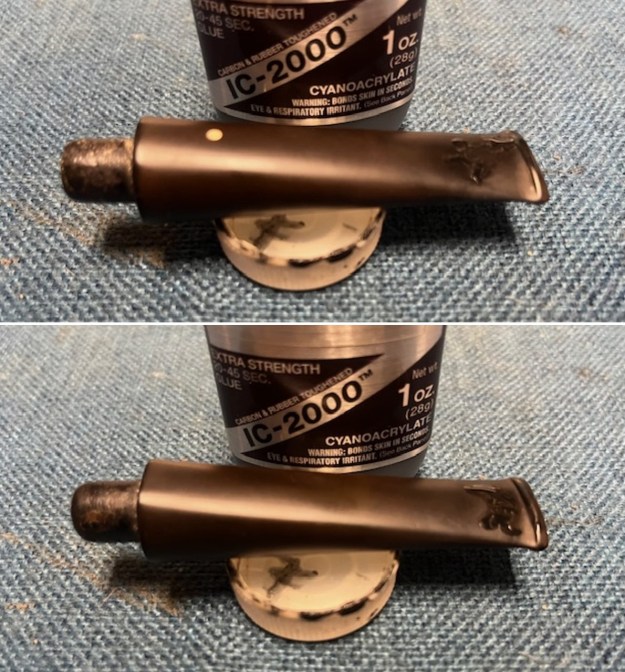
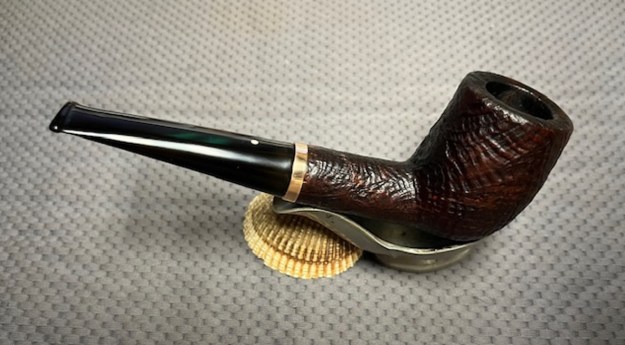
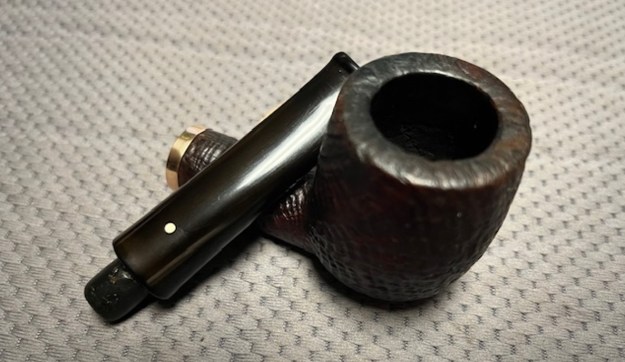
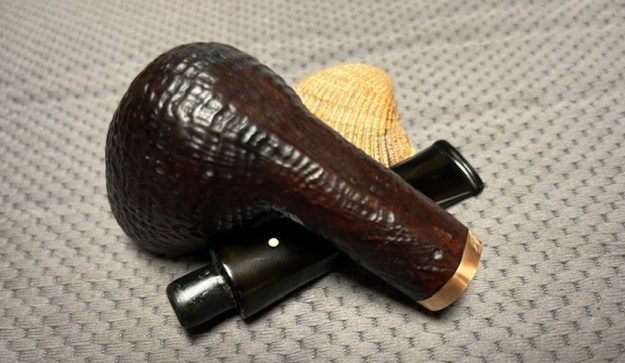
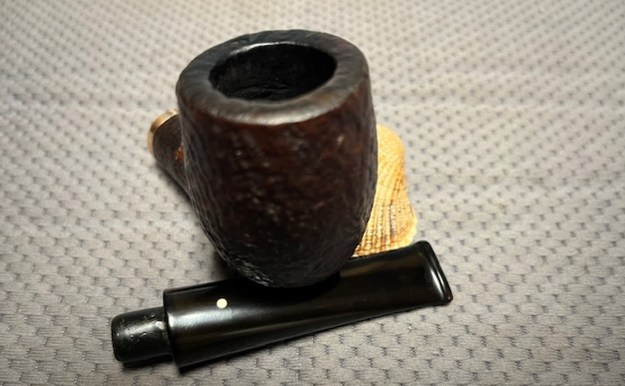
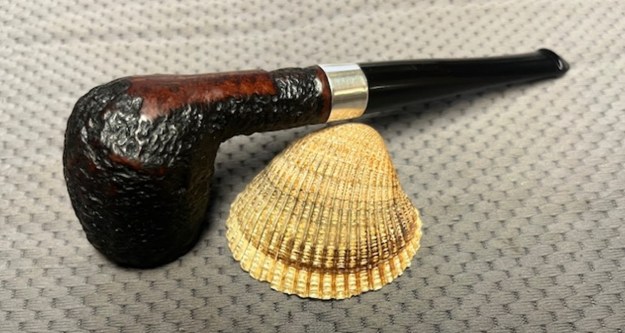
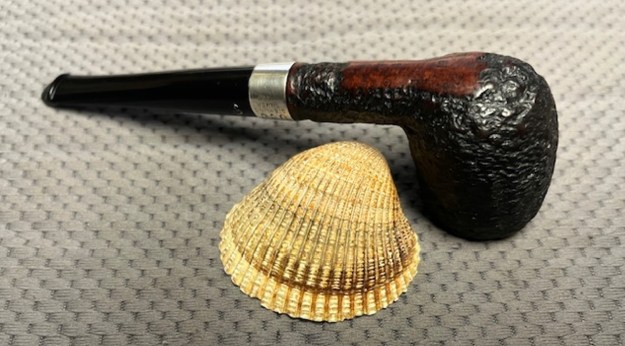
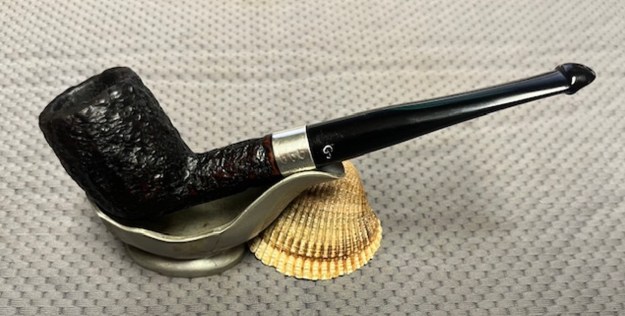
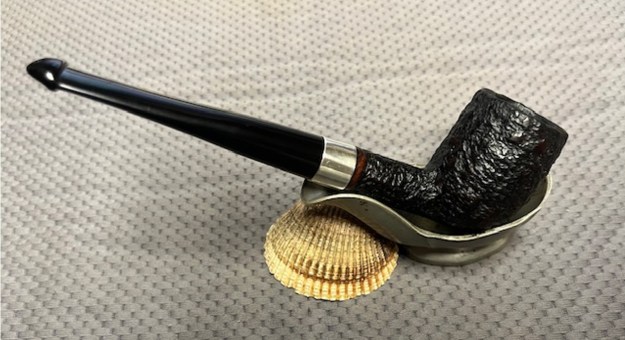
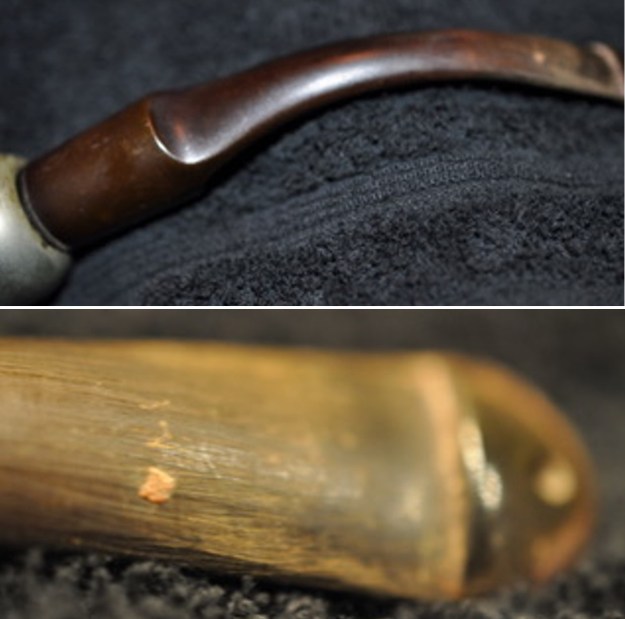
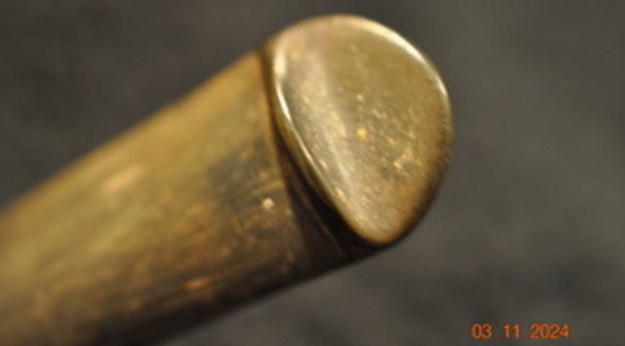
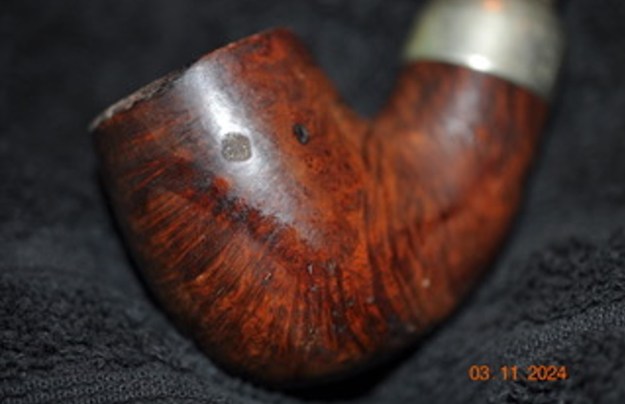
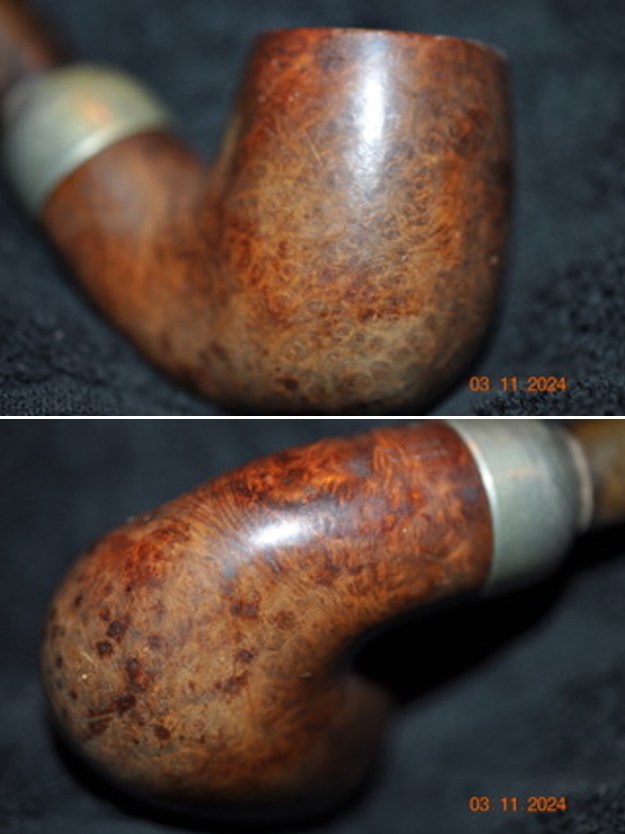
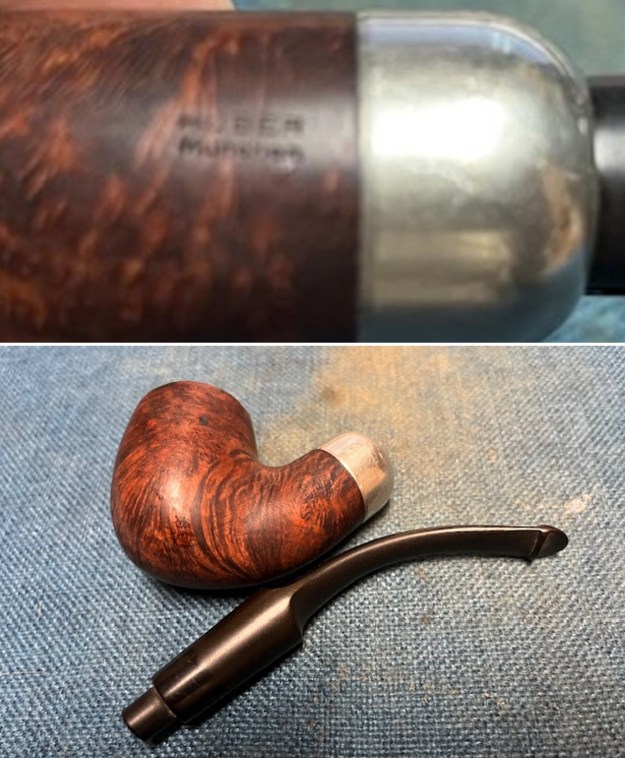
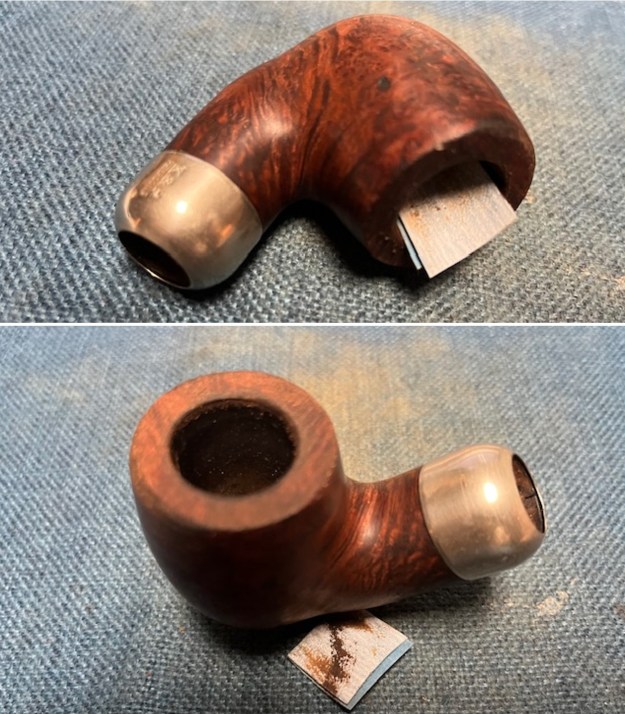
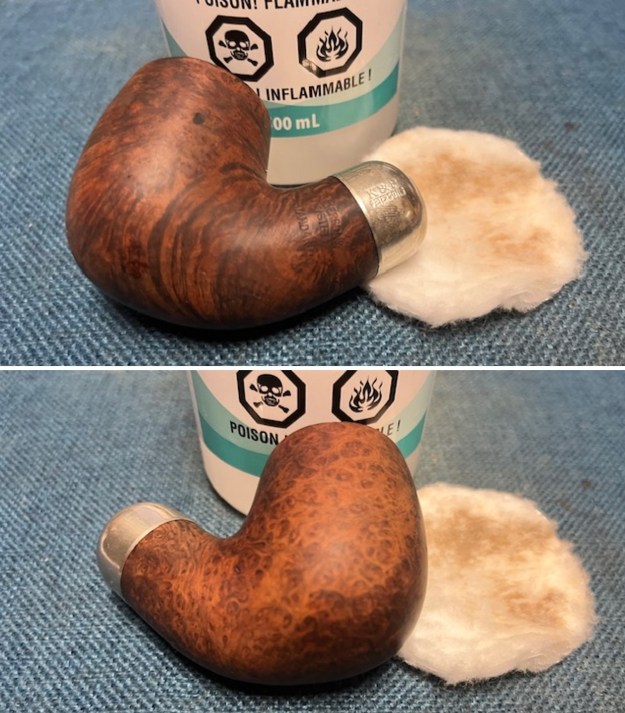
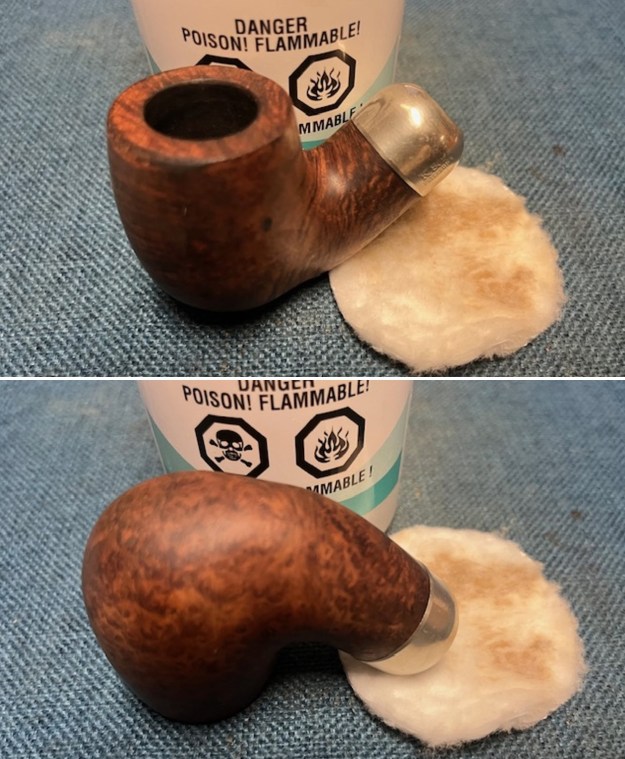
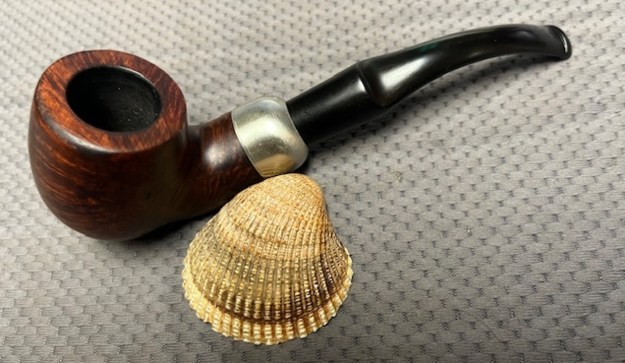
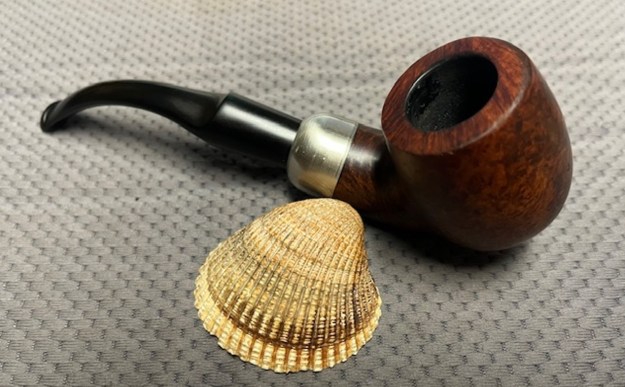
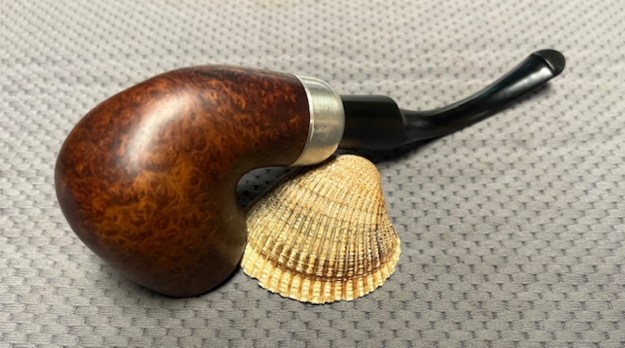
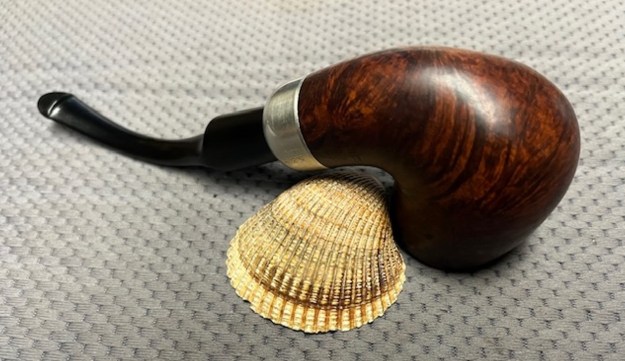
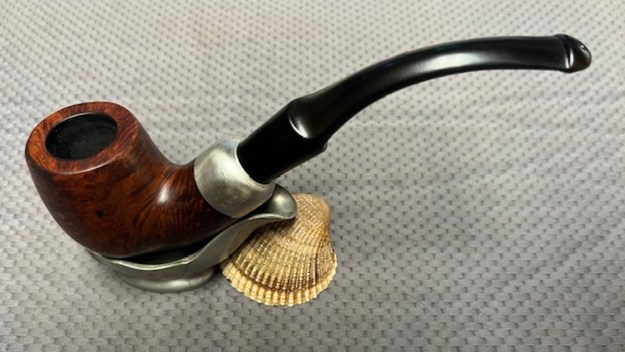
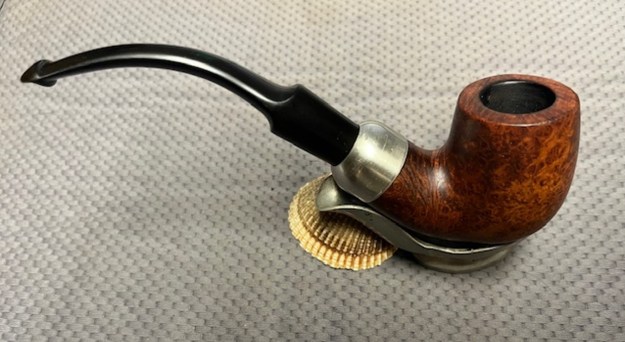
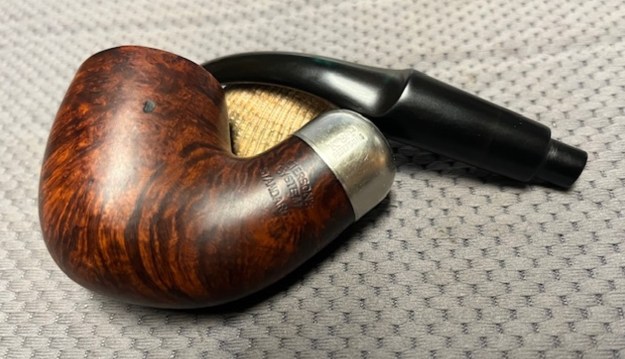
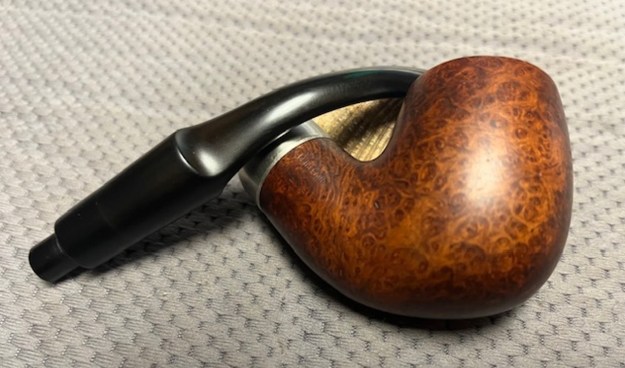
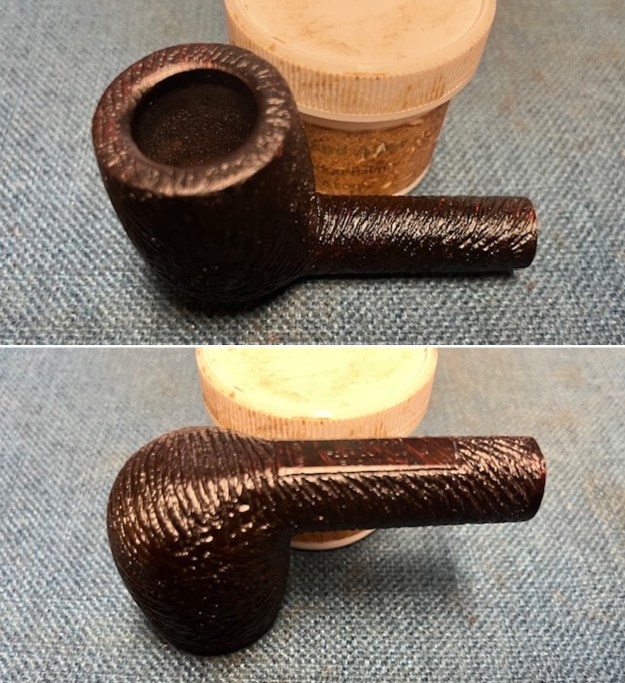
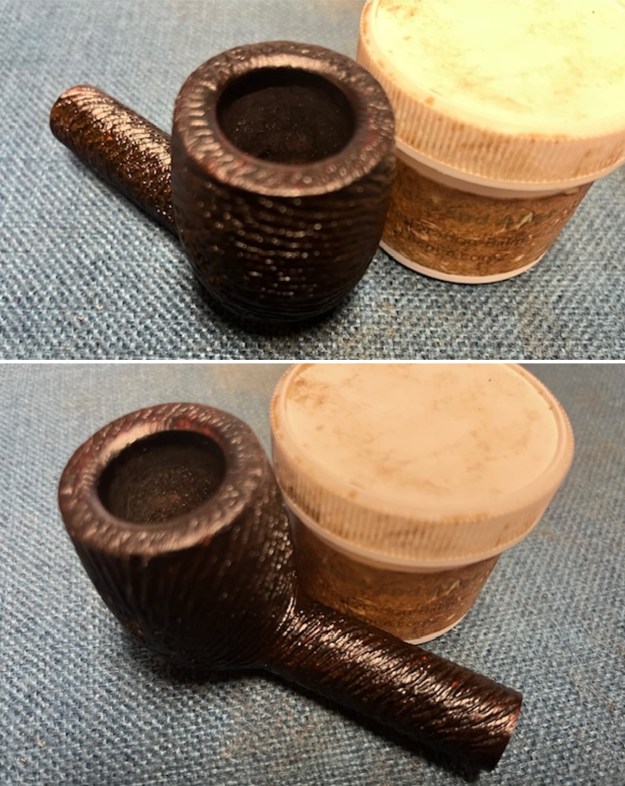
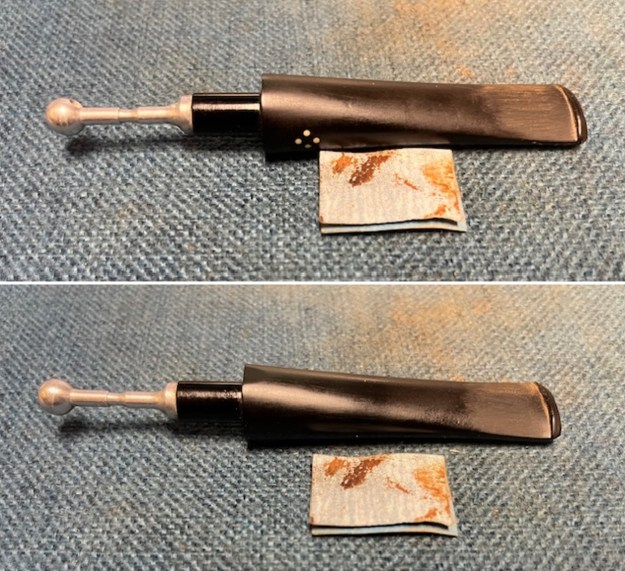
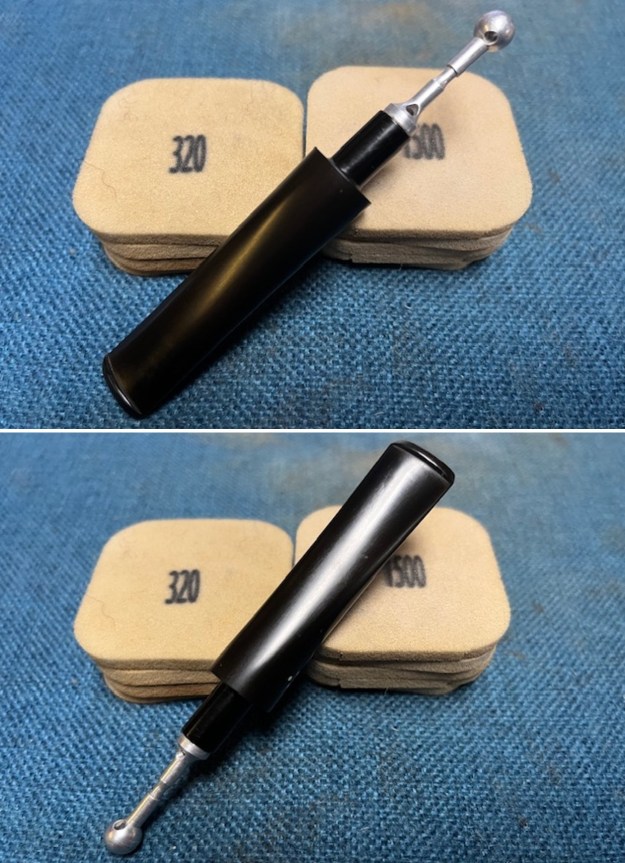
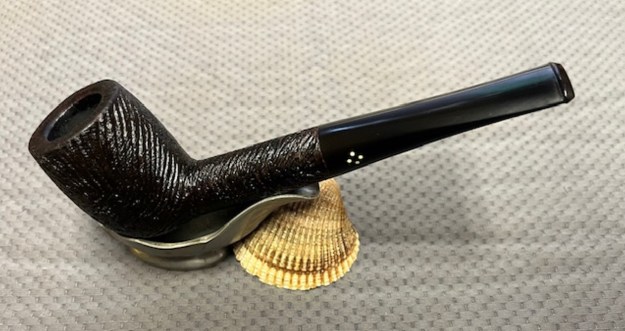
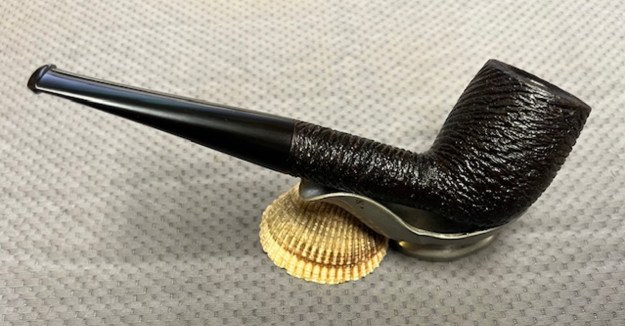
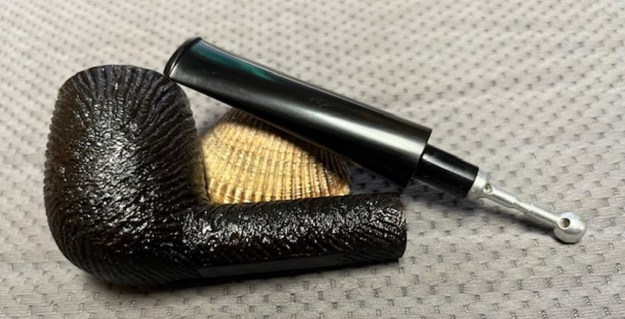
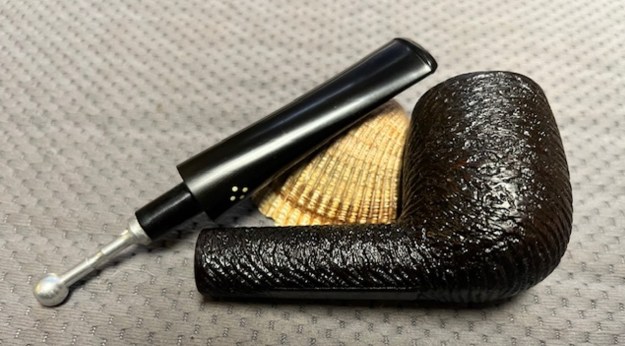
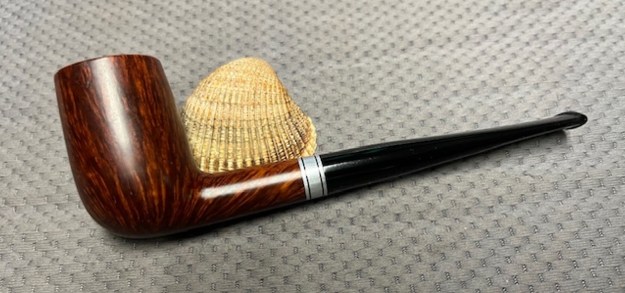
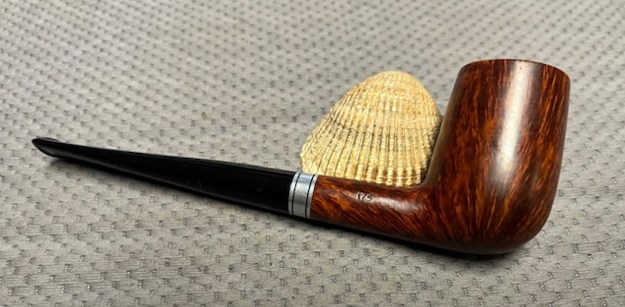
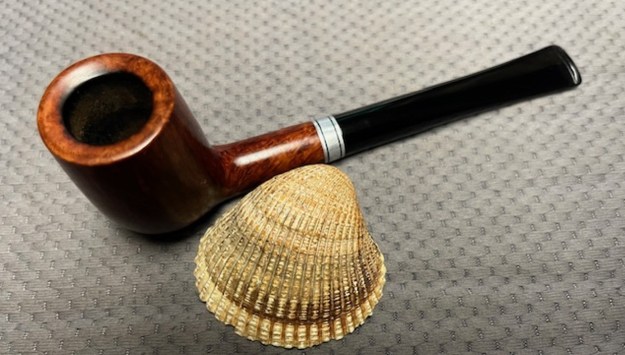
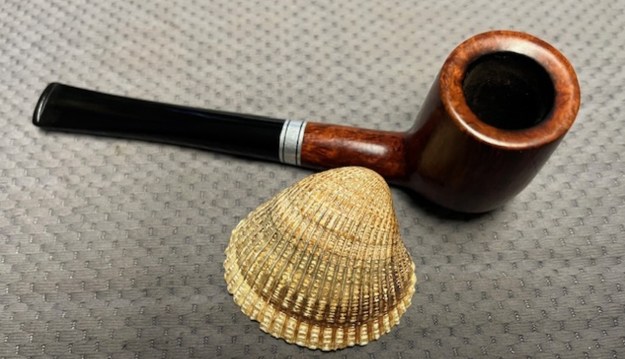
Before I move on to another of the pipes I have to work on from Jeff I decided to do a quick restem on a nice petite apple bowl with a vulcanite ferrule. It did not have a name on the bowl but the shank and the ferrule made for a beautiful little pipe. The bowl had been reamed and cleaned by Jeff somewhere along the journey. It had been sitting here in a box of bowls for a few years now. There was a fill on the front of the bowl that had fallen out and left a divot in the briar. Other than that the bowl was in excellent condition. I repaired the divot on the front of the bowl with some black CA glue and a little bit of briar dust. I flattened out the repair with 220 grit sandpaper to blend it into the surface of the briar.I wiped the bowl down with some isopropyl alcohol and cotton pads to remove the opacity of the stain and make it a bit more transparent. The grain began to stand through with a lot of clarity. I like the look of the grain around the bowl. The repair on the bowl was a bit lighter than the rest of the bowl and would need to be stained. I stained the repair on the front of the bowl with a Walnut stain pen. It blended into the surface of the bowl with the stain pen. The match was very good.I sanded the briar with 320-3500 grit sanding pads. I wiped the bowl down with a damp cloth after each sanding pad. I polished the bowl with micromesh sanding pads – dry sanding with 1500-12000 grits sanding pads. Once again, I wiped it down with a damp cloth following each pad. I rubbed the bowl down with Before & After Restoration Balm. It is a paste/balm that works to deep clean the finish, enliven and protect the briar. I worked it into the briar with my finger tips to make sure that it covered every square inch of the pipe. I set it aside for 10 minutes to let it do its work. I buffed it with a cotton cloth. The briar really began to have a deep shine. The photos I took of the bowl at this point mark the progress in the restoration. I went through my stems here and found a nice looking military bit stem that would look great with the pipe.It was clean and unused so I only need to polish it. I did that with micromesh sanding pads – dry sanding with 1500-12000 grit pads. I wiped the stem down after each pad with Obsidian Oil. I polished it with Before & After Pipe Stem Polish – both Fine and Extra Fine. I gave a final wipe down with Obsidian Oil. I put the No Name Apple pipe together and took it to the buffer. I buffed both the bowl and the stem with Blue Diamond on the wheel and then gave both multiple coats of Carnuaba Wax. I buffed it with a clean buffing pad to raise the shine. I further polished it with a microfiber cloth to deepen the shine. It is a beautiful petite pipe that should be a great smoker. The dimensions of the pipe are Length: 5 ½ inches, Height: 1 3/8 inches, Bowl diameter: 1 inch, Chamber diameter: ¾ of an inch. The weight of the pipe is .67 ounces/19 grams. If you wish to add it to your collection let me know. I will be putting it in the rebornpipes store shortly in the American Pipe Makers Section. Thanks for taking time to read this restoration and restem. As always I appreciate questions and comments.
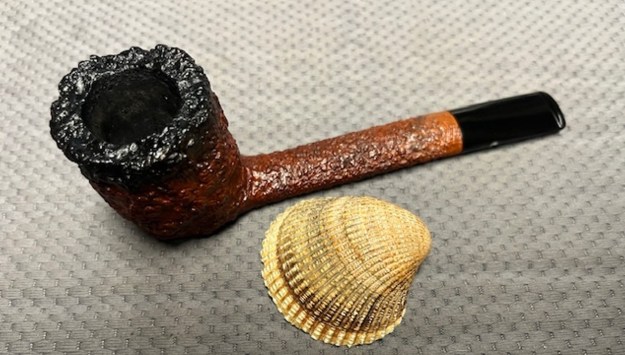
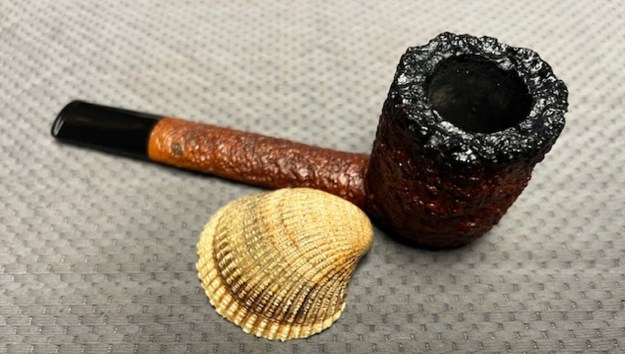
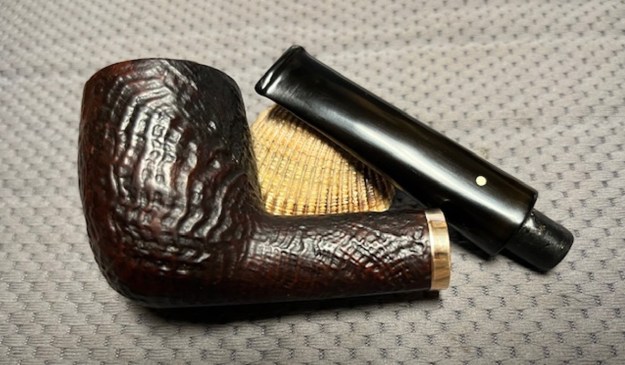
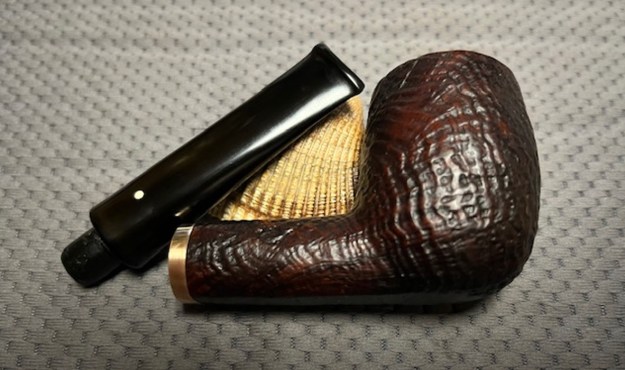
Restemming a Beautiful, Sandblast WDC Milano Ripple Briar Hesson Apple


by Steve Laug

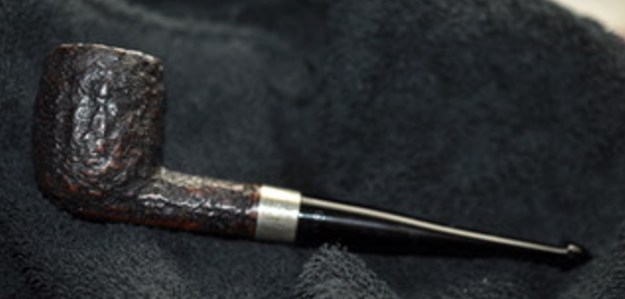
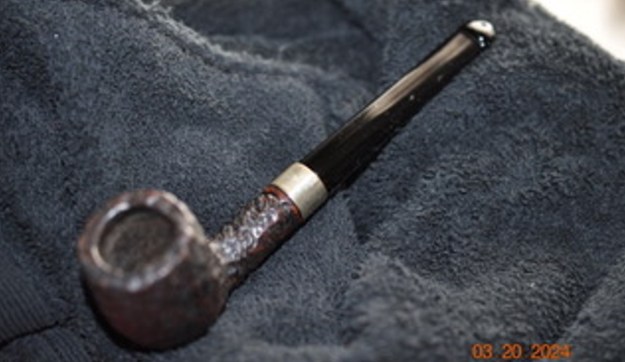
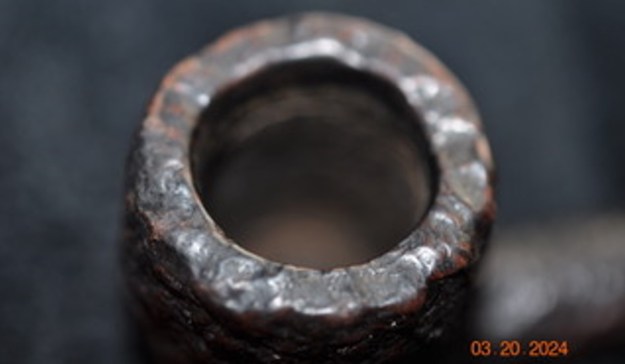
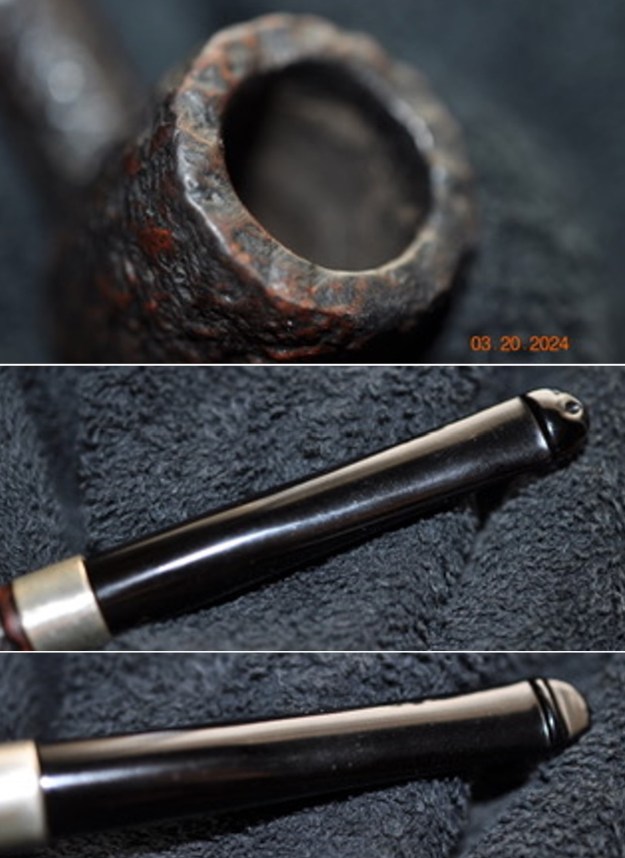
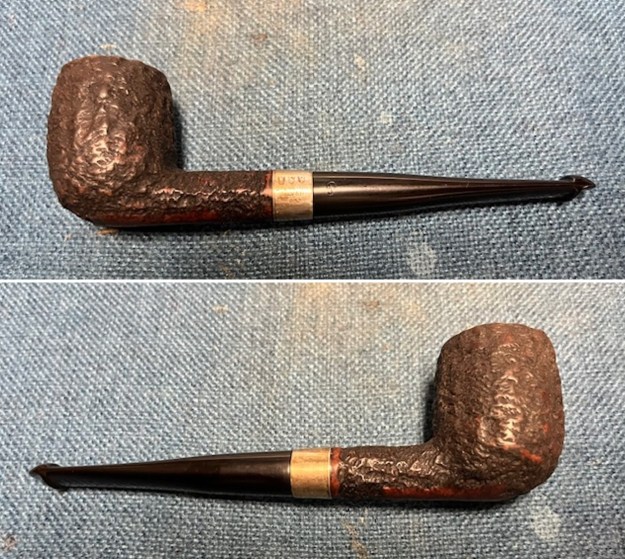
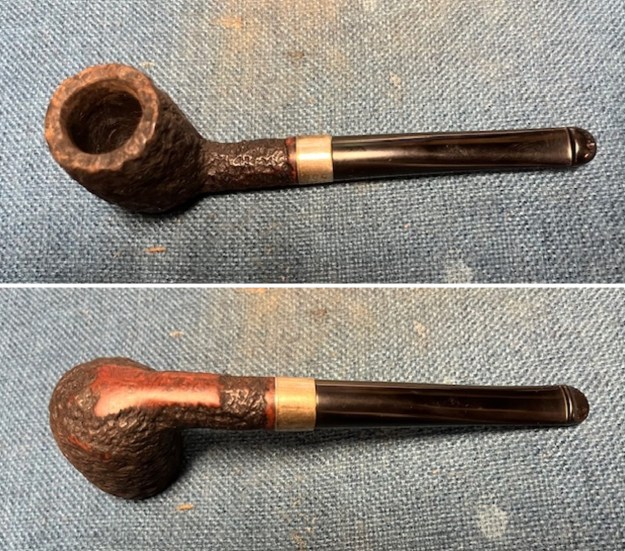
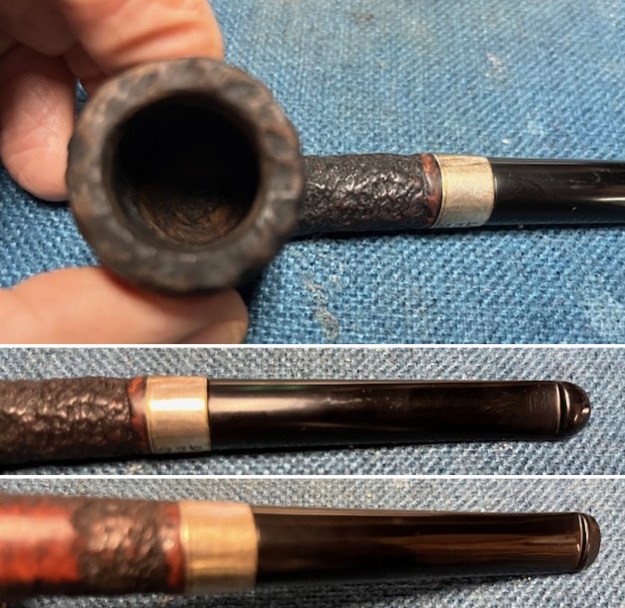
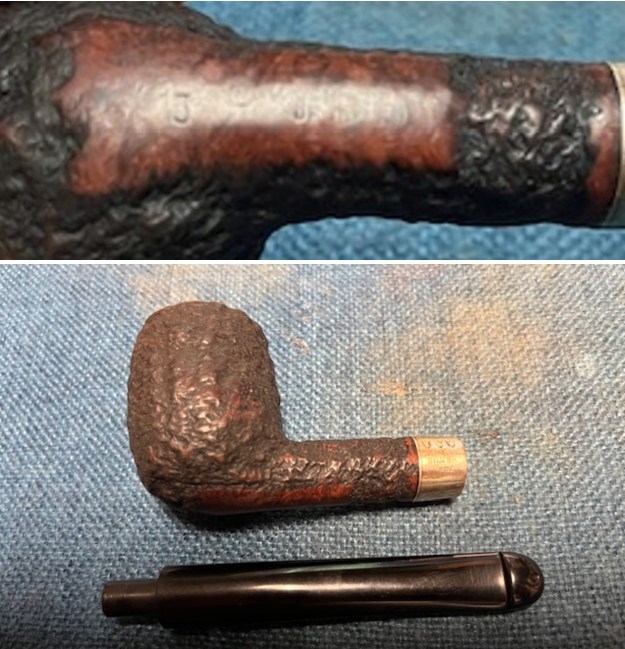
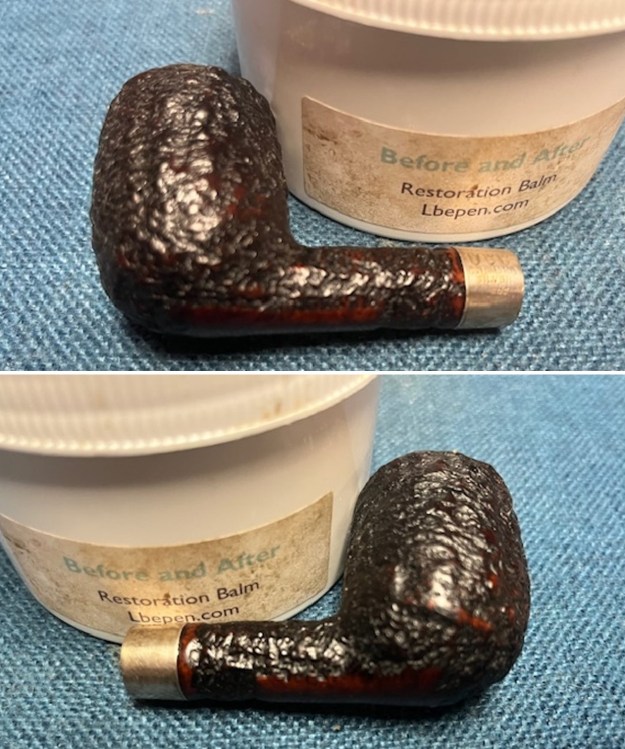
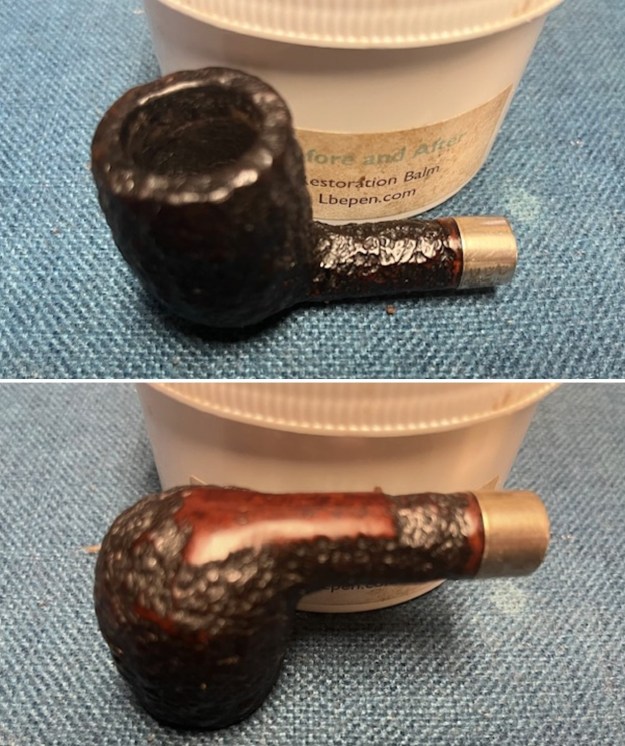
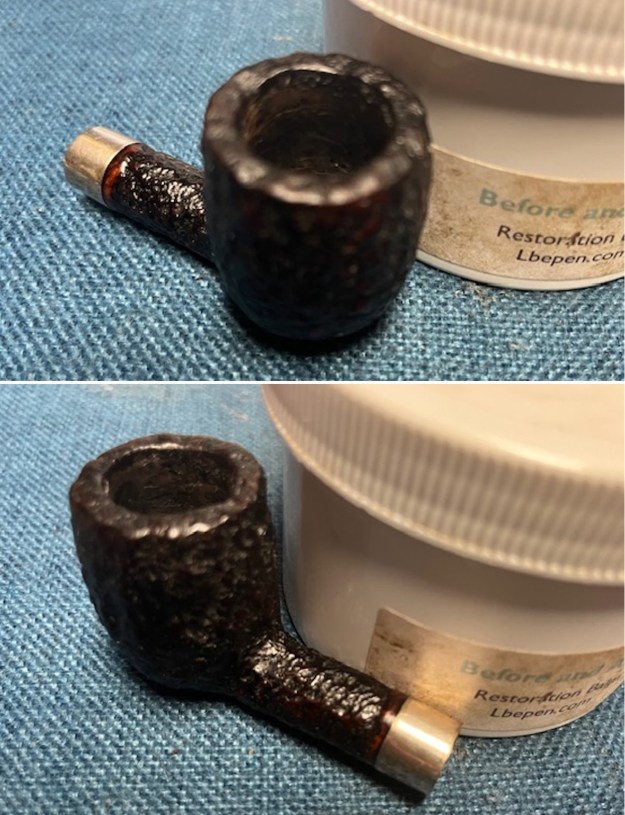
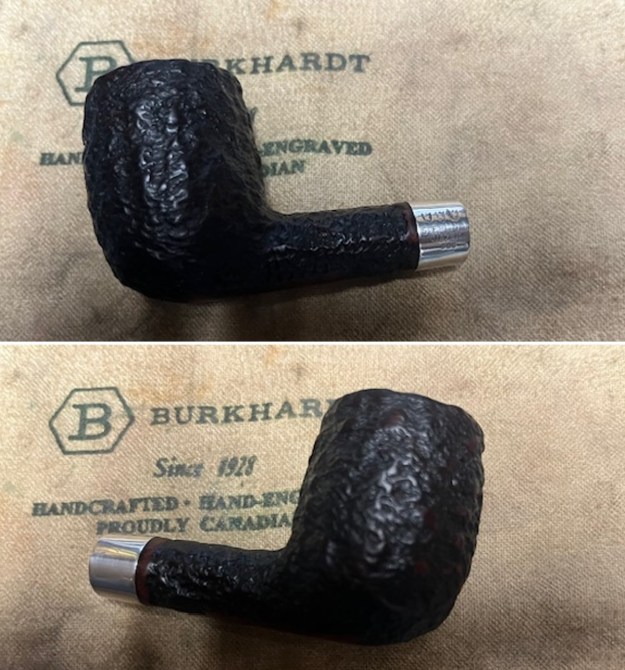
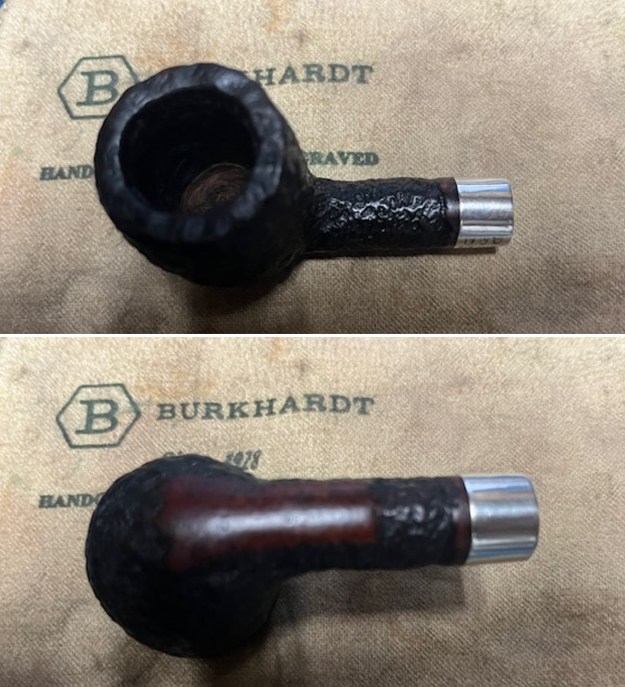
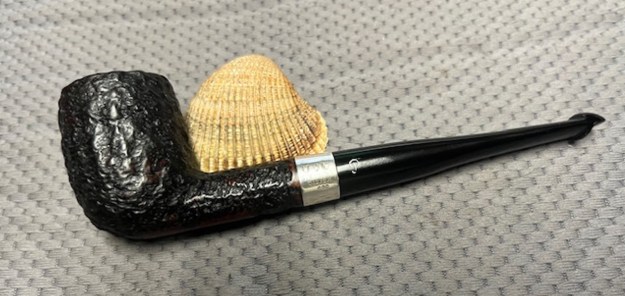
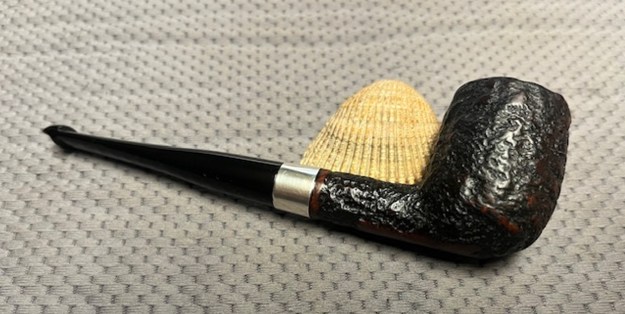
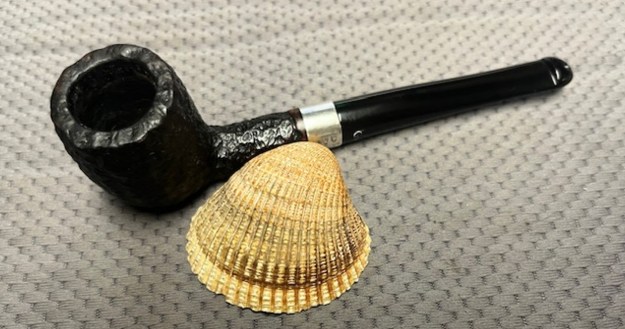
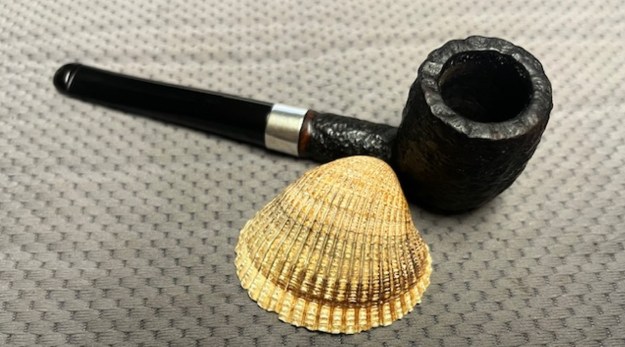
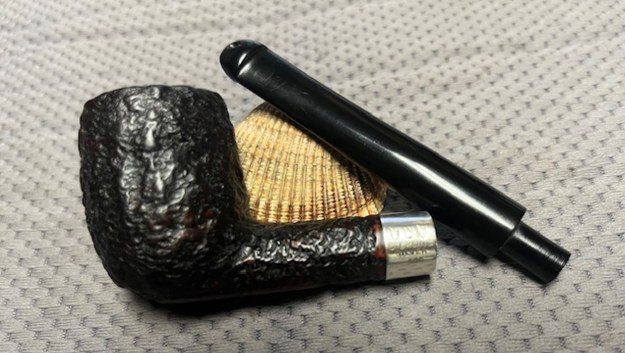
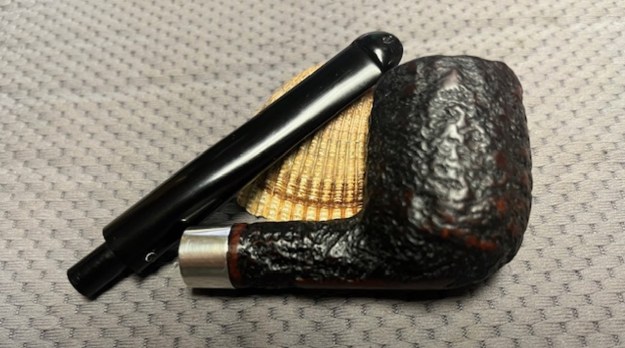
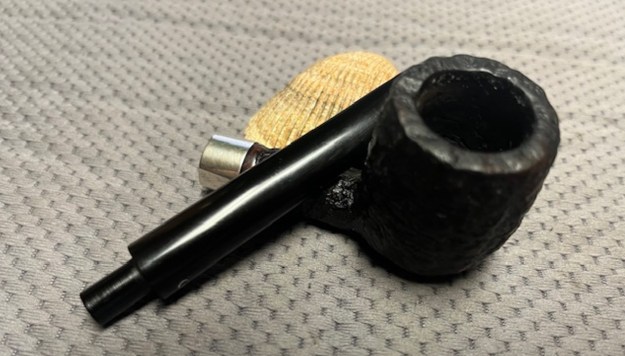
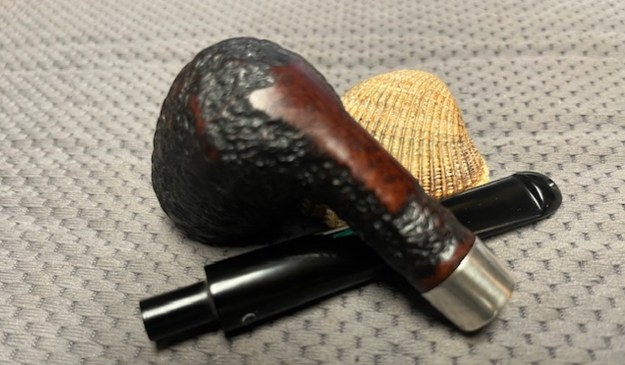
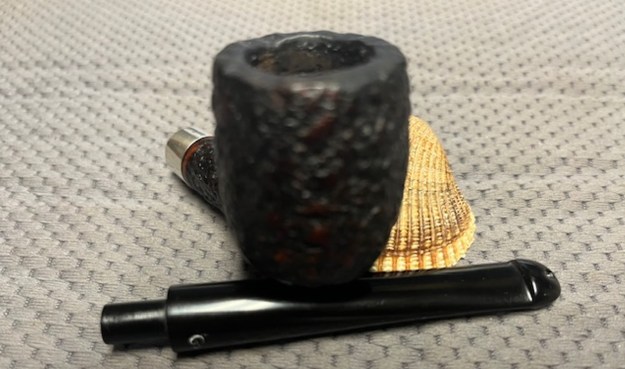
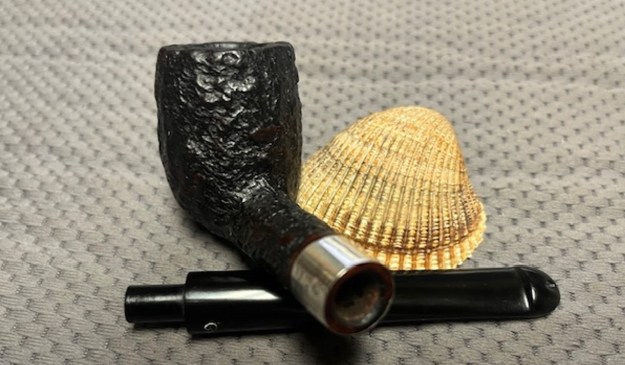
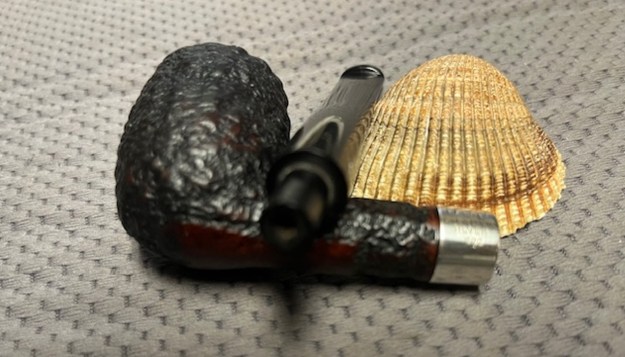
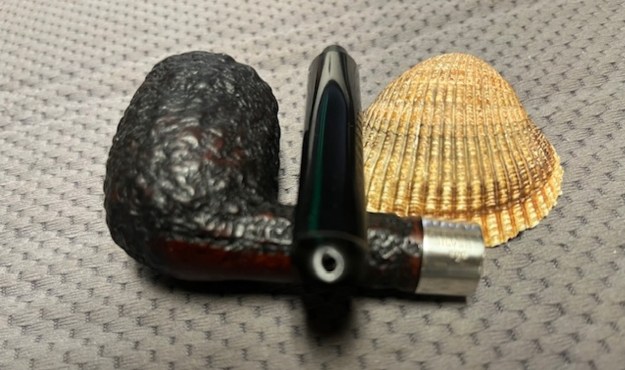
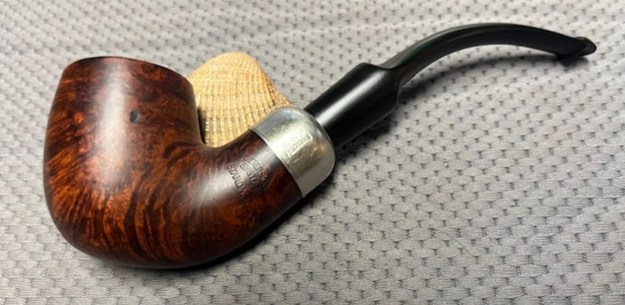
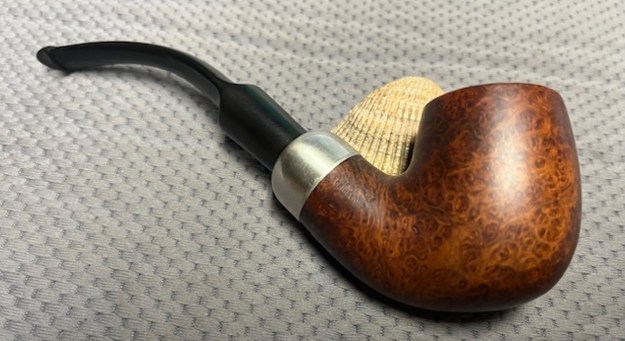
Time for another break from the repairs that I am working on for Rob. I had a couple of bowls in my box that needed to be restemmed. I chose to work on the first of them which is a beautifully sandblasted Apple bowl. The blast is very deep the rim top is thin and flows directly down the sides. The pipe was stamped on the underside of the shank and read WDC in a triangle followed by Milano [over] Ripple Briar [over] Hesson [over] Patd. Dec. 22, 192(6?). The last digit of the date is covered with a Sterling Silver band on the well repaired shank that is cracked on the left side. The bowl had been reamed and cleaned and was in great shape. There were a few worn spots on the top of the rim on the front and the right side. The shank on the left side had a long crack that had been repaired and banded with a sterling silver band. The band was clean with just a few scratches and the words Sterling curved on the topside. The shank was threaded but the threads were worn and it was missing a stem so I needed to find another one. I took photos of the bowl and have included them below. It shows the pipe before I started my work on it. I took a photo of the underside of the shank to show the stamping. It is quite clear and readable as noted above. I also tried to capture the Sterling Silver stamp o the band.I went through my stems and found one that was close to the right diameter to the shank and had a small diameter tenon. It would need some adjusting but it would fit very well. I took photos of it showing the look with the bowl.I started work on this pipe by polishing the bowl. The bowl was very clean and had little wear on it. The cracked shank had been banded and repaired somewhere in its journey. The silver band was very clean with some small scratches in the surface. It was in great condition so I started by staining the rim top faded and marks spots with a Walnut stain pen to blend them in and clean up the damage. It looked very good.After the touch up stain cured, I rubbed the bowl down with Before & After Restoration Balm. It is a paste/balm that works to deep clean the finish, enliven and protect the briar. I worked it into the briar with my finger tips to make sure that it covered every square inch of the pipe. I set it aside for 10 minutes to let it do its work. I buffed it with a cotton cloth. The briar really began to have a deep shine. The photos I took of the bowl at this point mark the progress in the restoration. I set the bowl aside and turned my attention to the stem I had chosen for the pipe. I cleaned up the tenon and shortened it slightly to fit the shank of the pipe. I sanded the diameter with a folded piece of 220 grit sandpaper to fully match the shank diameter. I sanded out the tooth marks and chatter on both sides of the stem.I put the stem on the shank and took photos of the fit of the stem to the bowl and the new look of this deeply sandblast pipe. I am liking the looks of the new stem. I removed the stem from the shank and sanded it further with 320-3500 grit sanding pads. I wiped the stem down after each pad with an Obsidian Oil impregnated cloth. By the time I finished with the 3500 grit pad the stem really looked good. I also sanded out the rough spot on the underside of the silver band to smooth it out.I polished the stem with 1500-12000 grit micromesh sanding pads – dry sanding with each pad. I wiped the stem down after each pad with an Obsidian Oil cloth. I polished it further with Before & After Pipe Stem Polish and wiped it down a final time with the oil cloth. The finished WDC Milano Ripple Briar Hession Apple looks great with its new stem. The taper stem brings out the contrast of the silver band and dark nooks and crannies of the sandblast. I buffed the pipe with a light coat of White Diamond on the buffing wheel and then gave the bowl multiple coats of Conservator’s Wax and the stem multiple coats of Carnauba Wax. I buffed the pipe with a clean buffing wheel and it is a real beauty. The dimensions of this WCD Milano Ripple Briar Apple are length: 5 ½ inches, height: 1 ½ inches, outside bowl diameter: 1 inch, chamber diameter: ¾ of an inch. The weight of the pipe is .67 ounces/19 grams. This is a beauty that will be going on the American Pipemakers Section of the rebornpipes store shortly. If you are interested in adding it to your collection let me know. Thanks for giving the blog a read.

As always, I encourage your questions and comments as you read the blog. Thanks to each of you who are reading this blog. Remember we are not pipe owners; we are pipe men and women who hold our pipes in trust until they pass on into the trust of those who follow us.