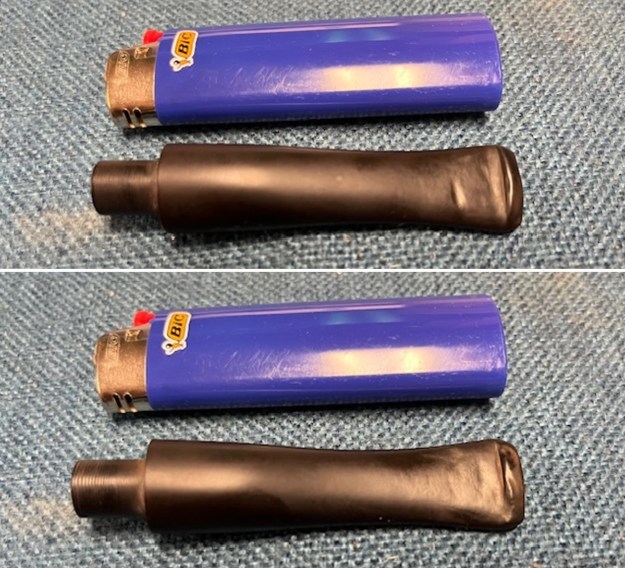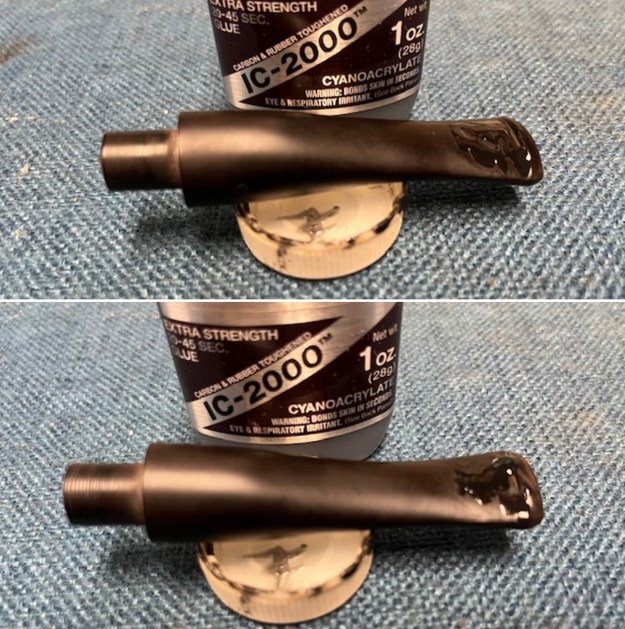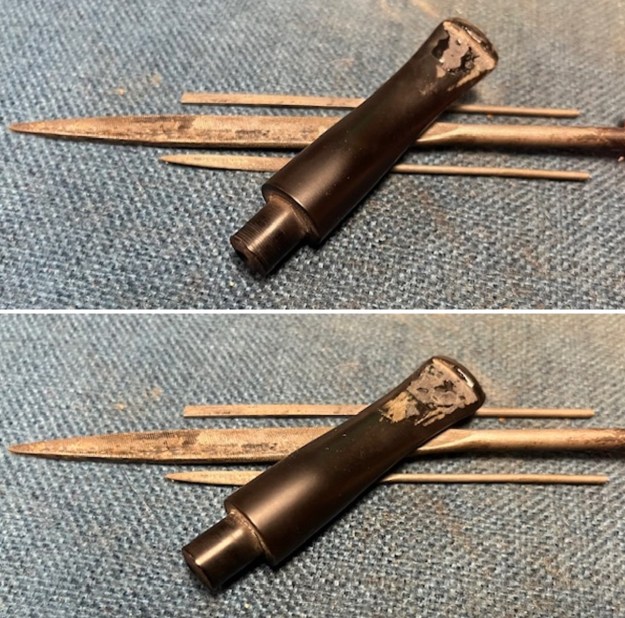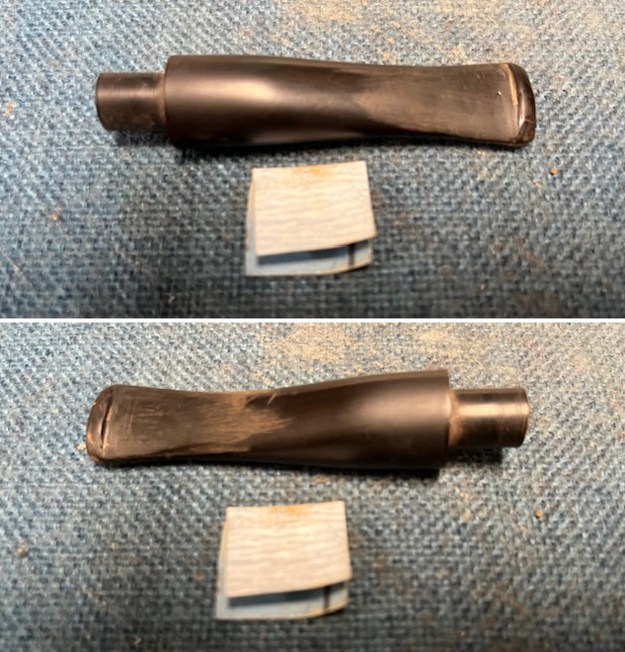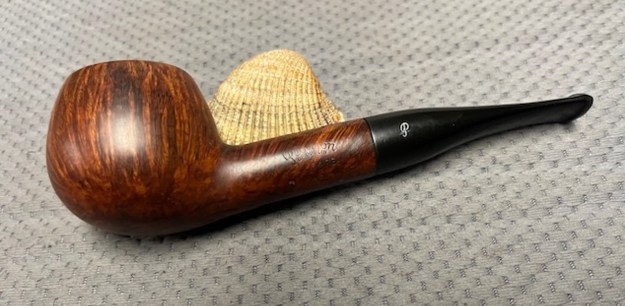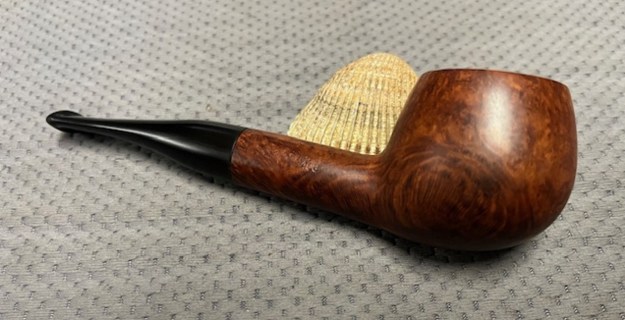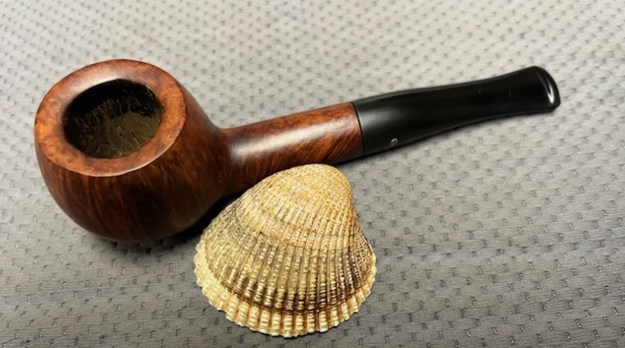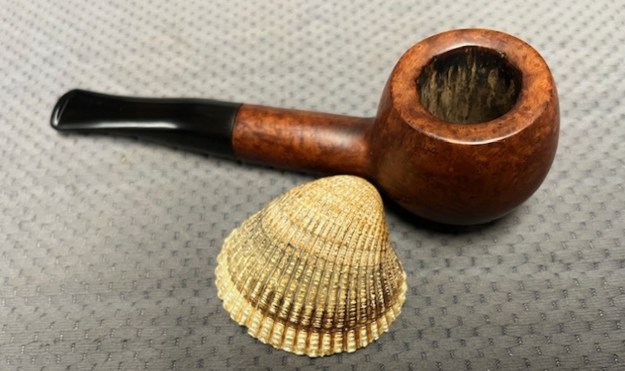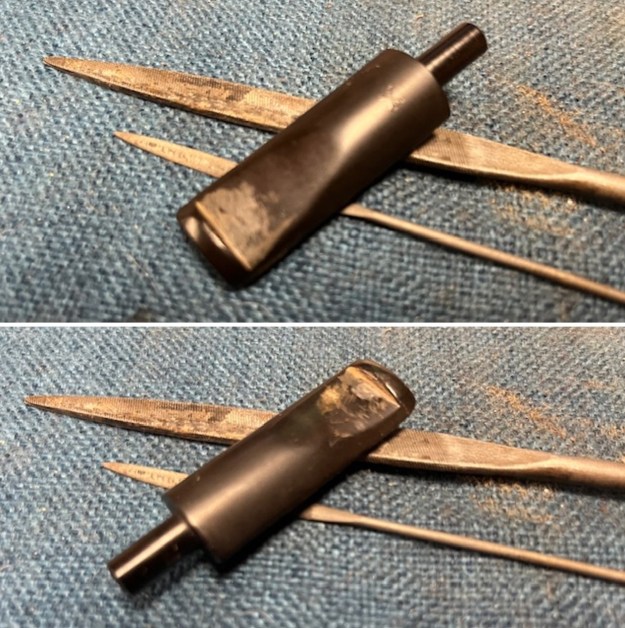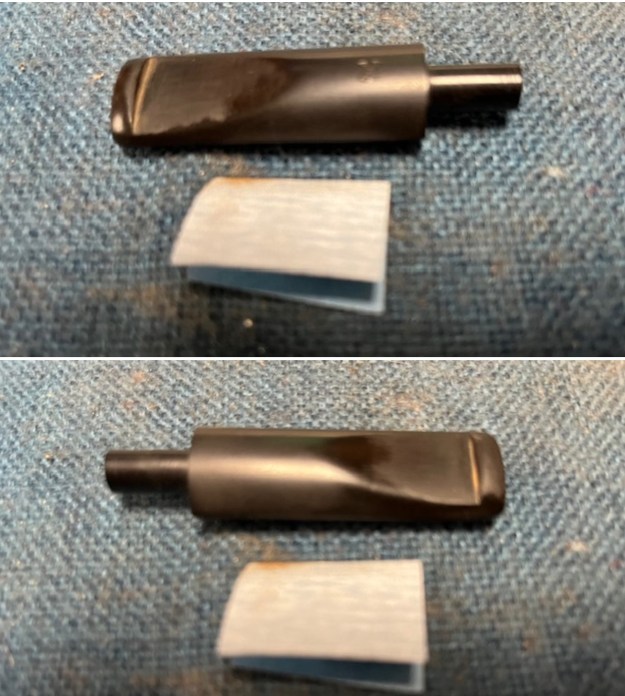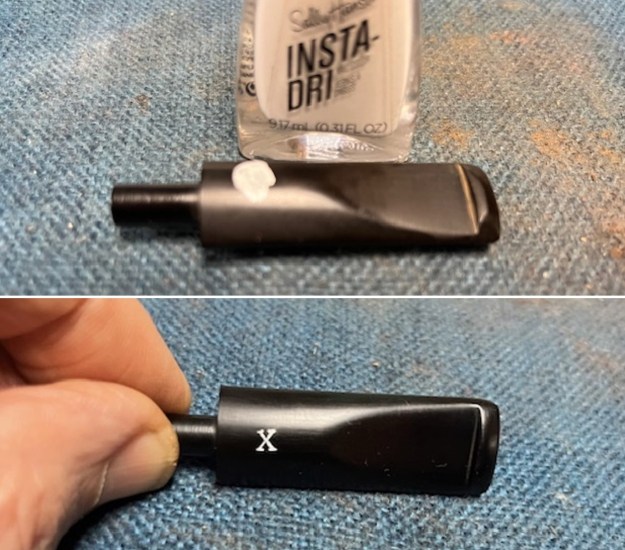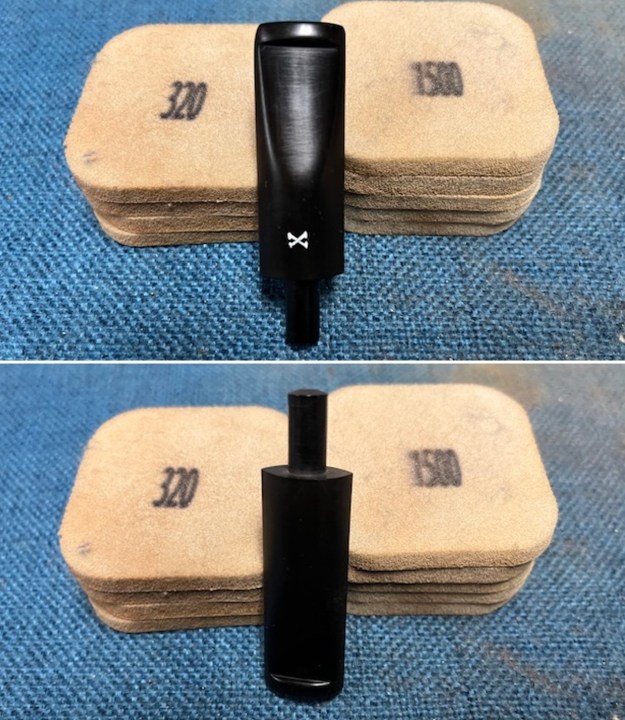

Tag Archives: repairing bite marks

Restoring a Dunhill Tanshell Briar 6475F/T Friendly Cherrywood


by Steve Laug

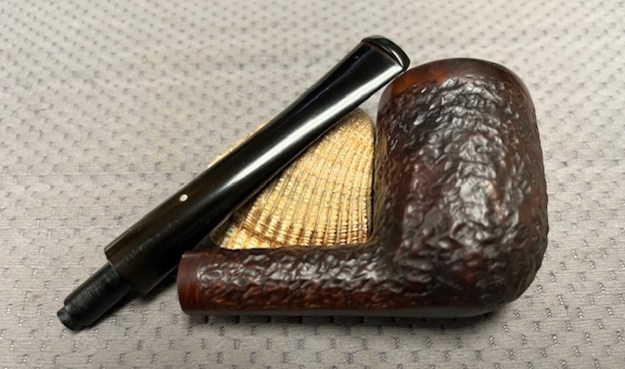
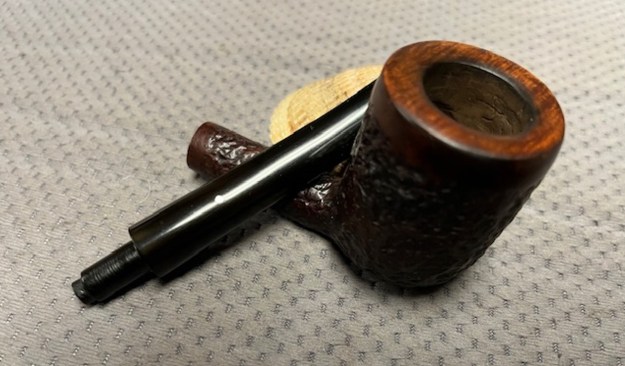
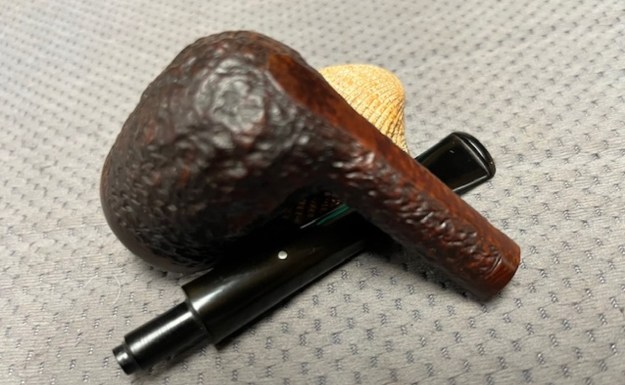
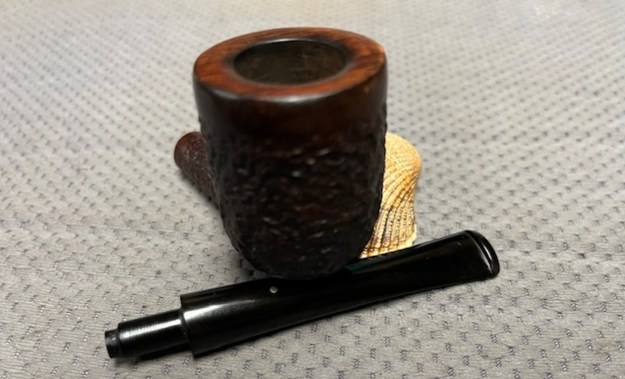
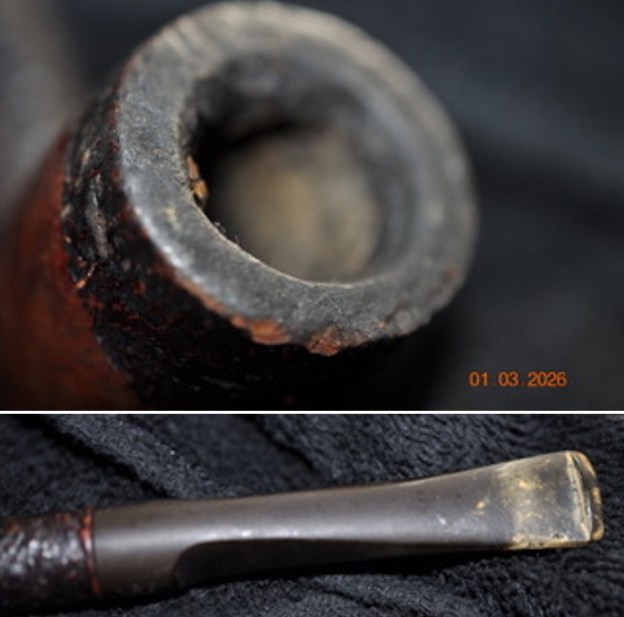
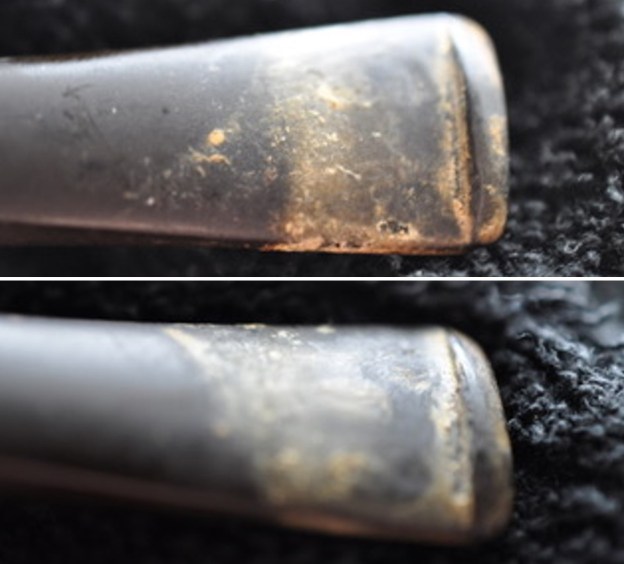
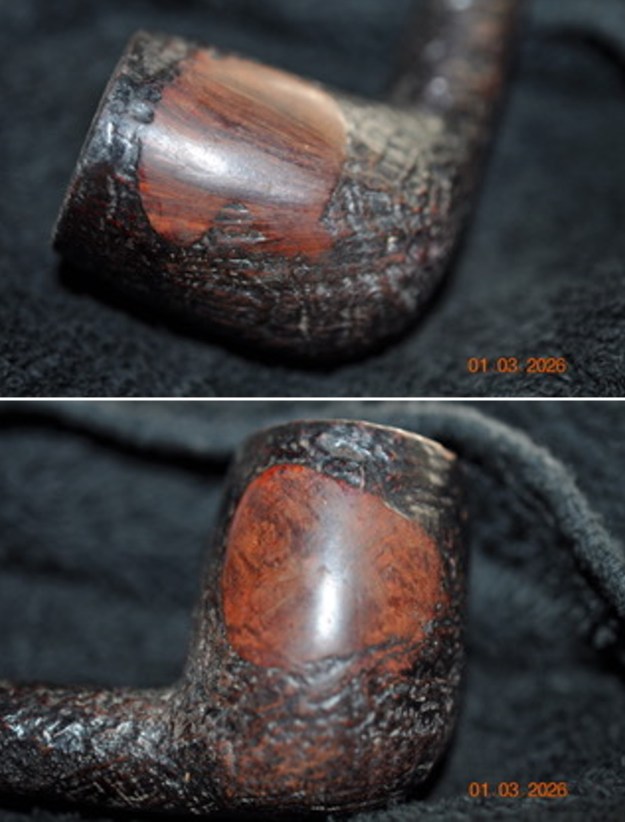
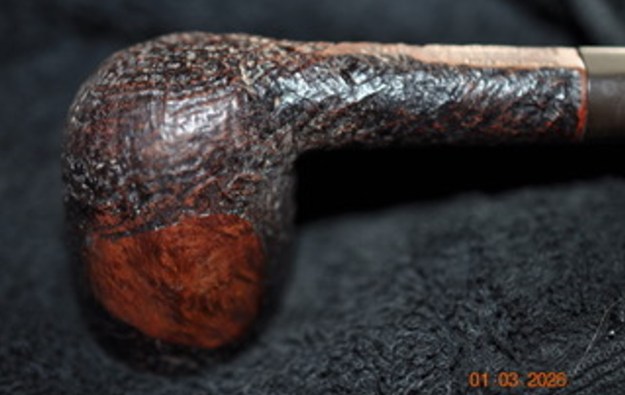
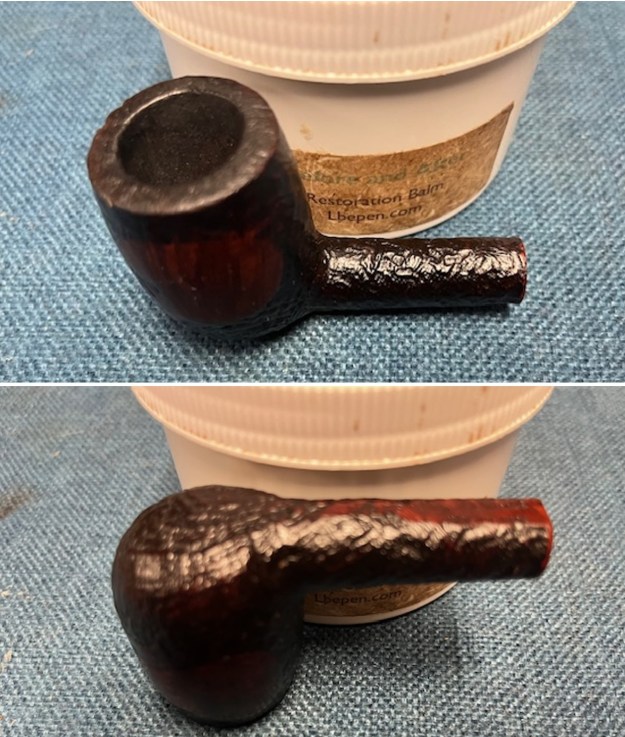
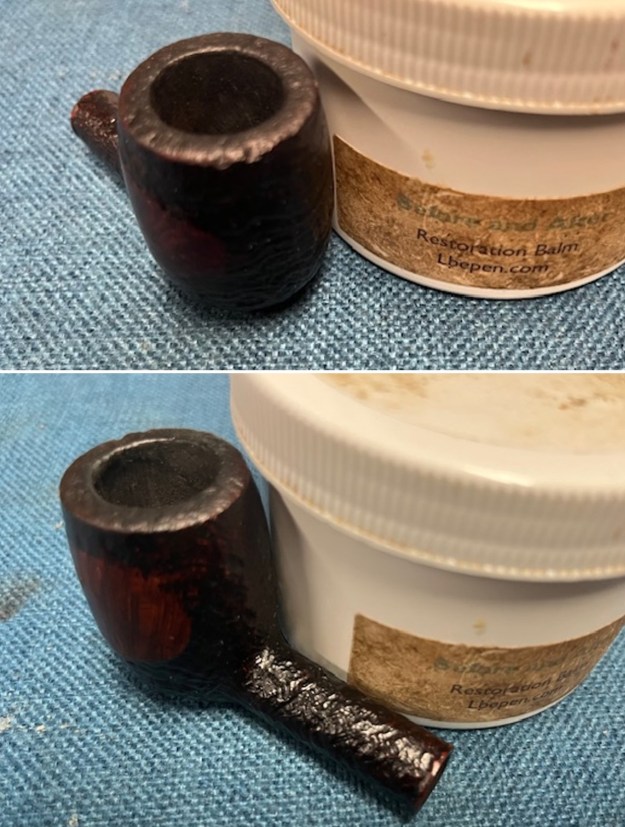
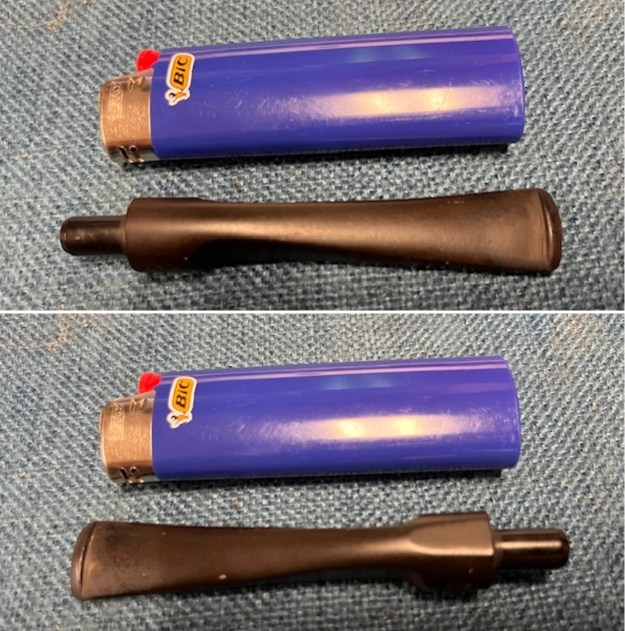
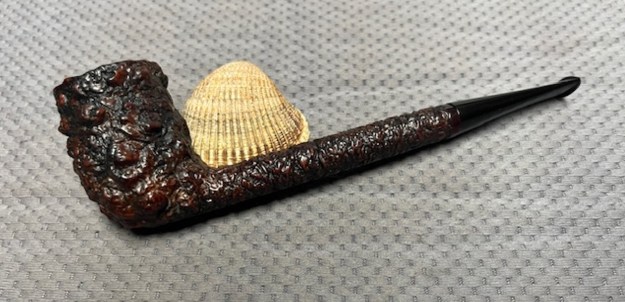
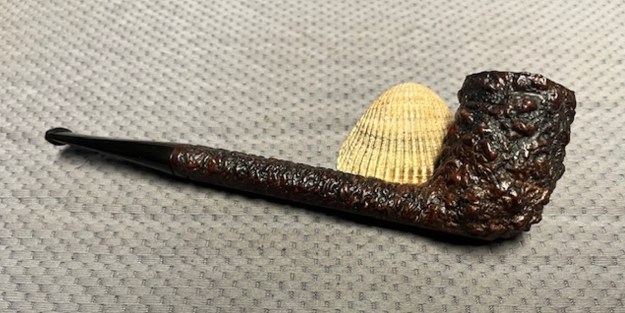
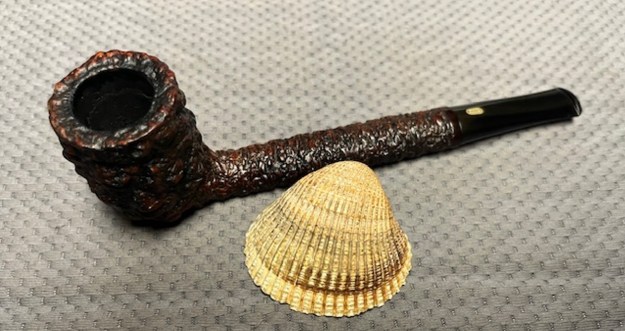
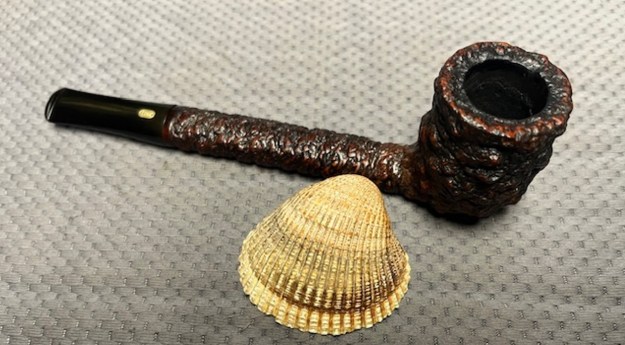
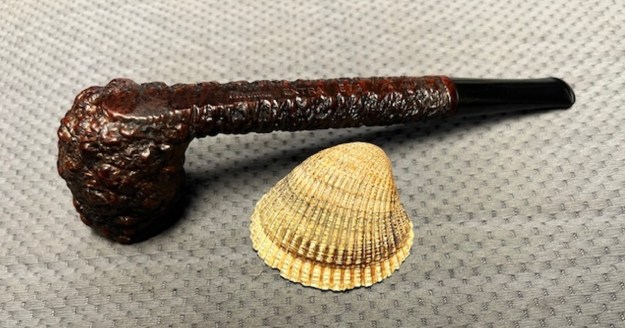
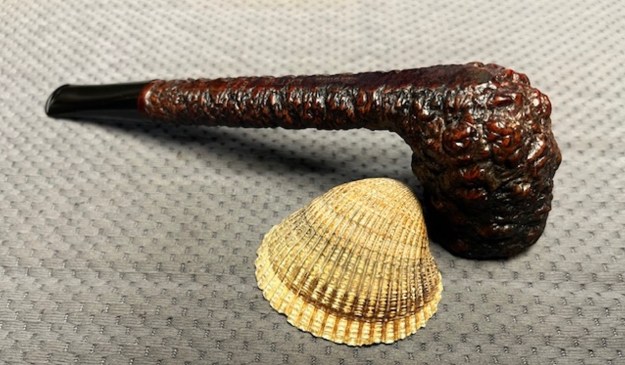
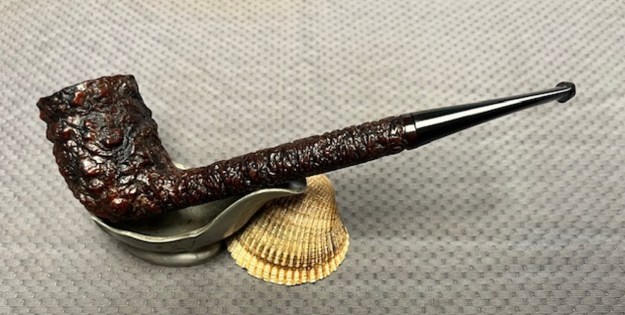
The next pipe on the table is another one that came to us from the seller in Caldwell, Idaho, USA on 07/12/2025. It is a Dunhill Tanshell Cherrywood with a vulcanite saddle stem. It is in good condition as can be seen in the photos below. It is stamped on a smooth heel of the bowl and reads 6475 F/T [over] Dunhill Tanshell [over] Made in England11 [over] circle 4T. The stamping is clear and readable. The pipe has rich Tan and Brown stains on a Shell sandblast finish and some amazing grain that the shape follows well. The finish was dusty and lightly dirty with grime in the nooks and crannies of the sandblast. The bowl had a moderate cake and there was tobacco debris in the bowl. The rim top had a thick lava coat on the smooth crowned rim top and edges. The original white spot saddle stem is dirty and oxidized. It had a white Delrin replacement tenon that seemed to be loose. I took photos of the pipe to show what it looked like before I started working on it. I took photos of the bowl and rim top to show the thickness of the cake and the lava coat on the rim top. There was some tobacco debris in the bottom of the bowl. The stem photos show the condition of the saddle stem ahead of the button. The stamping on the heel of the bowl is clear and readable as noted above. I took a photo of the pipe with the stem removed to give a sense of the proportions of the pipe. It is a real beauty.One of the first things I like to do is to unpack the stamping and understand each element in it. I turned to Pipephill helpful site (http://pipephil.eu/logos/en/dunhill/shell-briar1.html). The stamping is interpreted as follows: The F/T is the stamp for a fishtail type stem. The Dunhill Tanshell is the finish. Following the Made In England11 gives the year that the pipe was made. The four digit shape number is a bit of a mystery.

I turned to Pipedia’s shape charts on Dunhills (https://pipedia.org/wiki/Dunhill_Shape_Chart). I quote what was written there and have included the shape charts from the site.

The standard catalog currently encompasses thirty-five distinct shapes, each designated by a two-digit numerical code. From time to time, however, the inherent characteristics of a particular piece of briar lend themselves to the creation of a form that exists outside this established repertoire. These unique, non-standard shapes are collectively referred to by the term “Quaint”. The modern four-digit identification system has been successfully in place for more than three decades, serving Dunhill, its commercial partners, and its clientele with proven efficacy.From the above information I could see that I was working on a Cherrywood shaped pipe but the shape number above did not match that. The chart shows that the Cherrywood was a 20 but there is no 20 number on the pipe I am working on. From there I turned to the next chart on the site which gave a digit by digit breakdown of the shape number. I include the chart below and then underneath I give the break down on the number.

  • The shape number of the pipe is 6475F/T using the chart above here is what the numbers tell us.
  • The first digit 6 is the group size of the pipe making it a large Group6.
  • The second digit 4 is the mouth piece which in this case is a ¼ bent taper but the pipe I am working on is a ¼ bent saddle stem which should be a number 5.
  • The third + fourth digit 75 which does not match anything on the chart above. Even the shape number on the first chart above identifies a Cherrywood as a 20.

From there I turned to another link on Pipedia which gave shape numbers and names on the pipes (https://pipedia.org/wiki/Dunhill_Shapes_List). The site listed that the shape I have in hand is one know as a Group 6 size 475 which is known as a Friendly.

6475 Friendly (=475?) 4 5½” 1950, 1969

From there I wanted to pin down the date stamp 11. I have included the chart below for you to follow (http://www.pipephil.eu/logos/en/dunhill/cledat-en1a.html). The second column is where the 2-year suffix fits. To arrive at the date the suffix 11 is added to 1960 making the pipe a 1971 Tanshell Cherrywood with a saddle stem – a Dunhill Friendly.I also am including a link to a similar pipe in the shape number 475 on the blog that is very similar to the one I am working on.

https://rebornpipes.com/2018/11/09/restoring-an-amazing-1963-dunhill-tanshell-cherrywood-475/

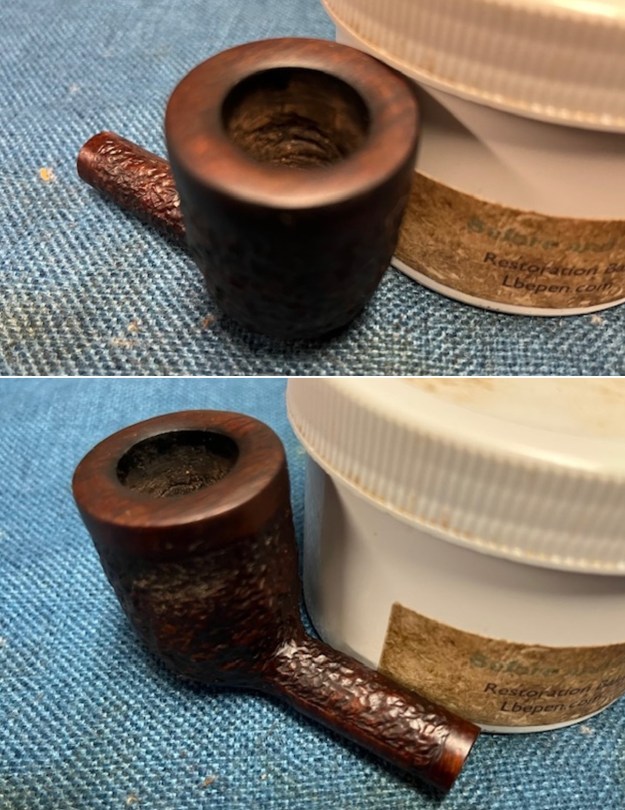
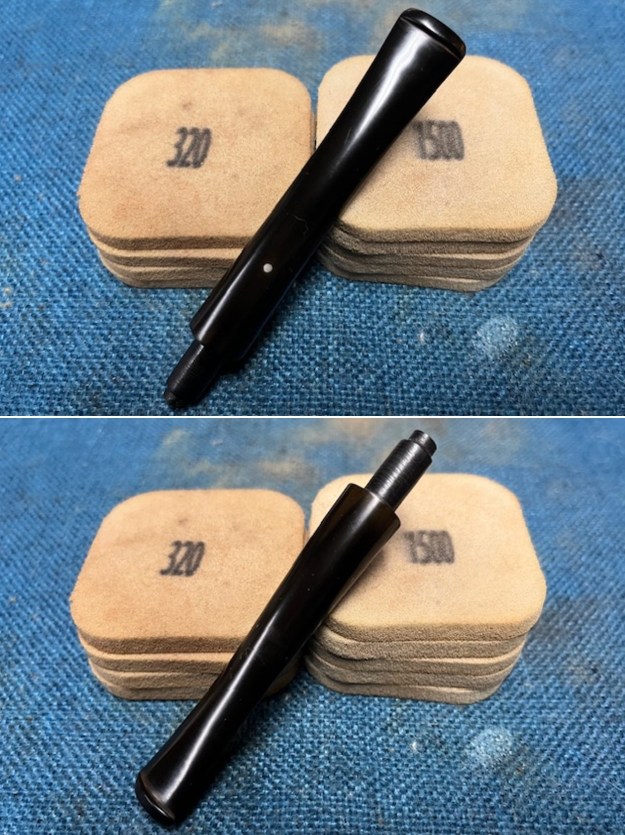
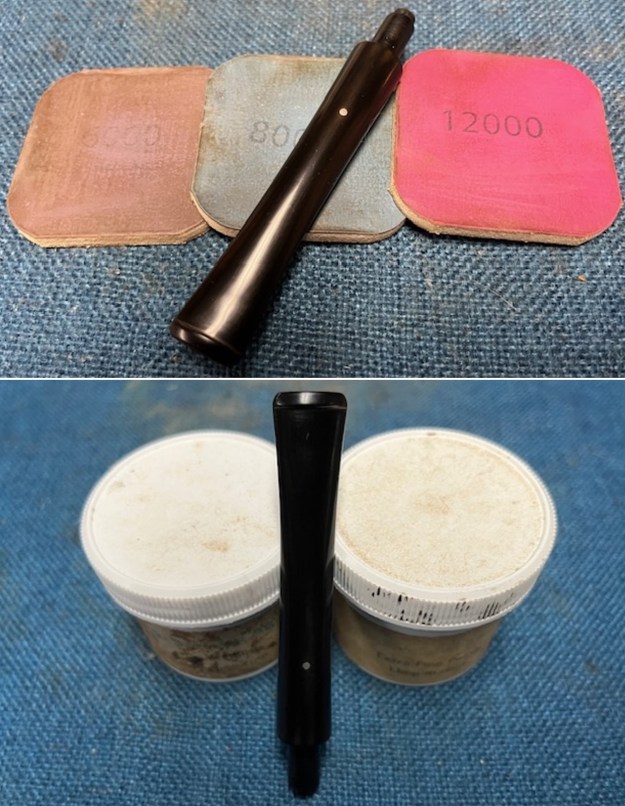
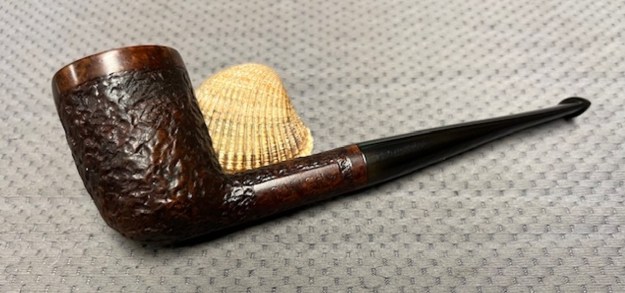
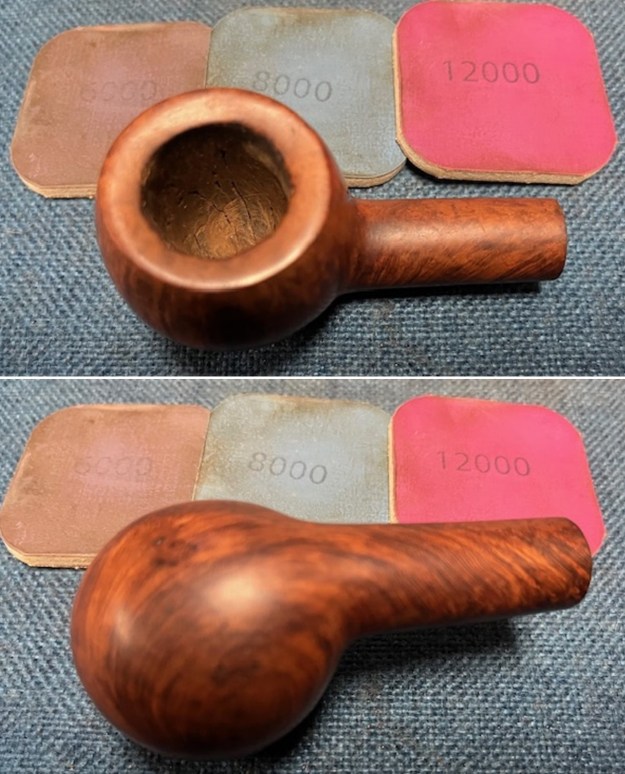
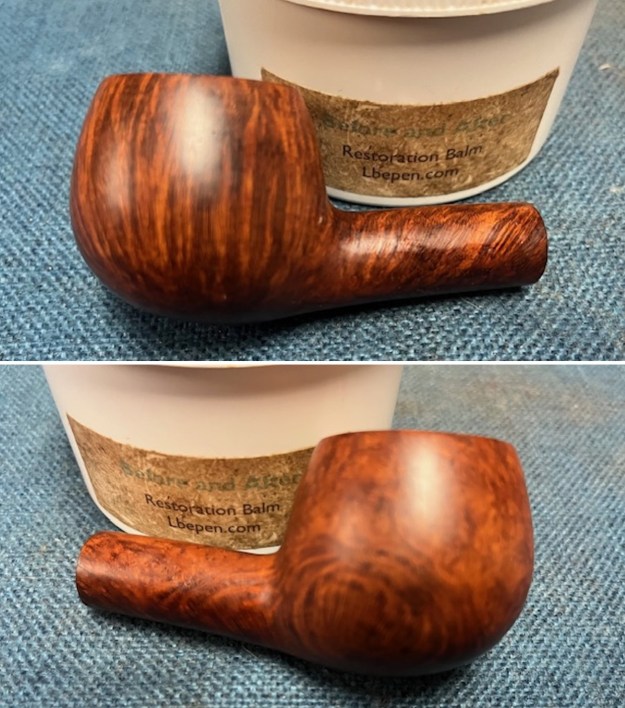
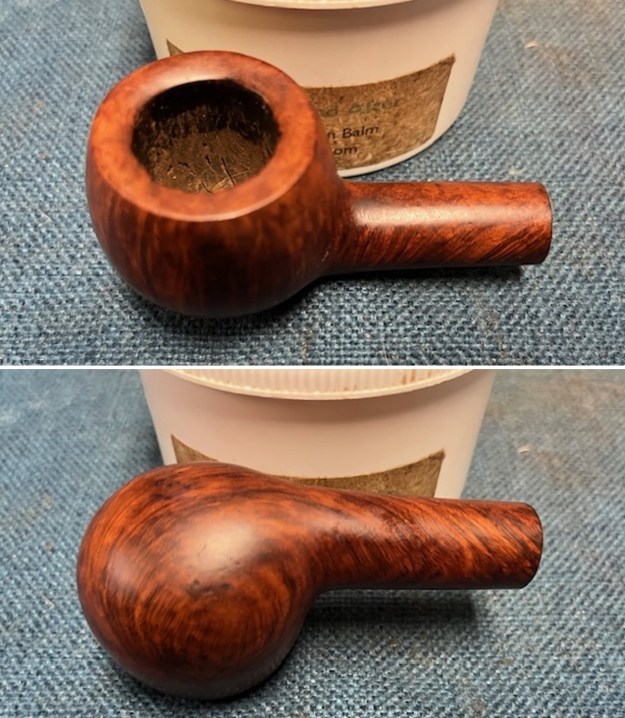
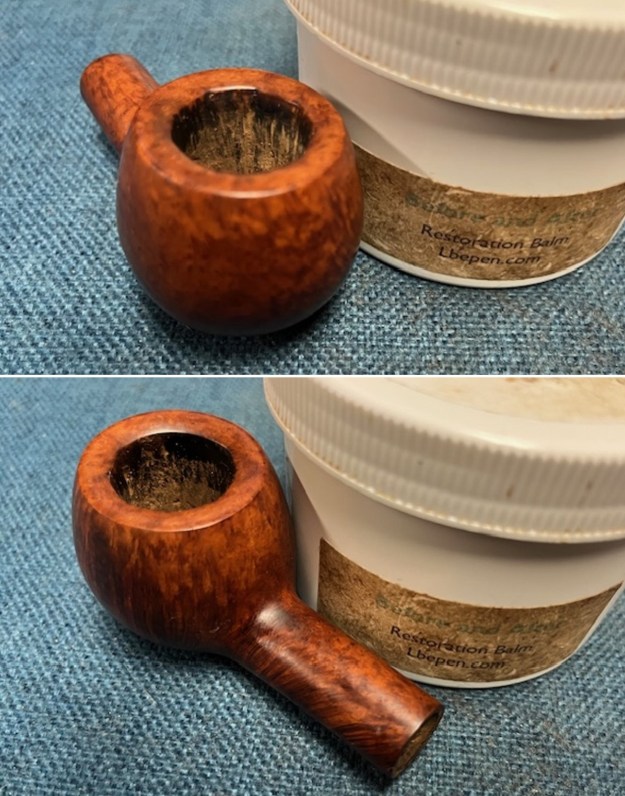
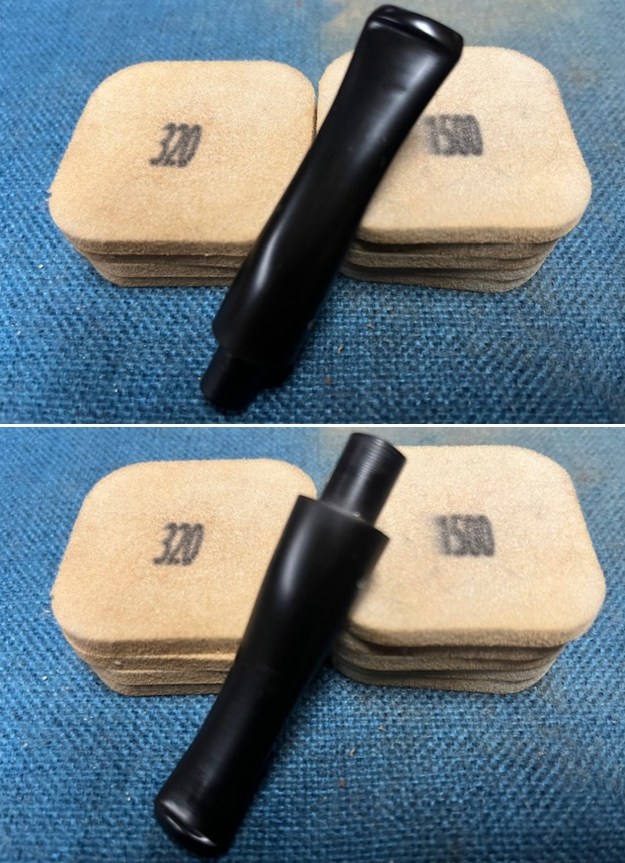
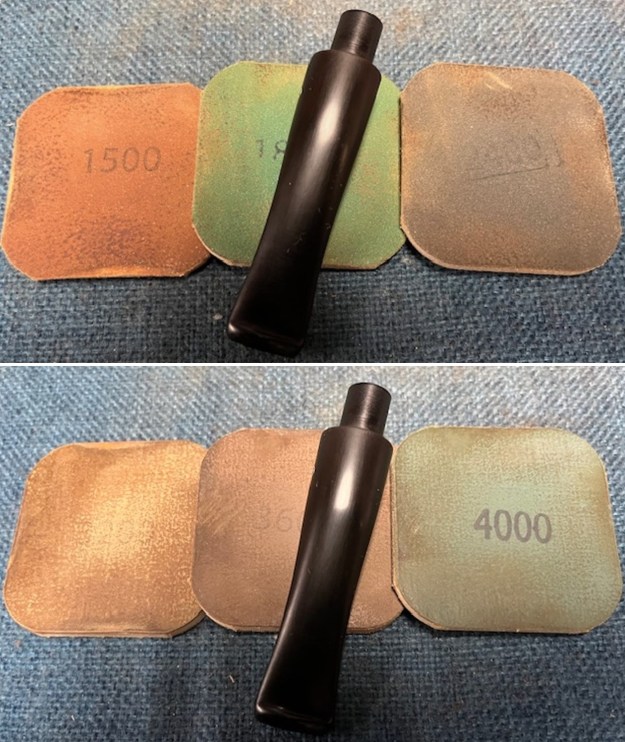
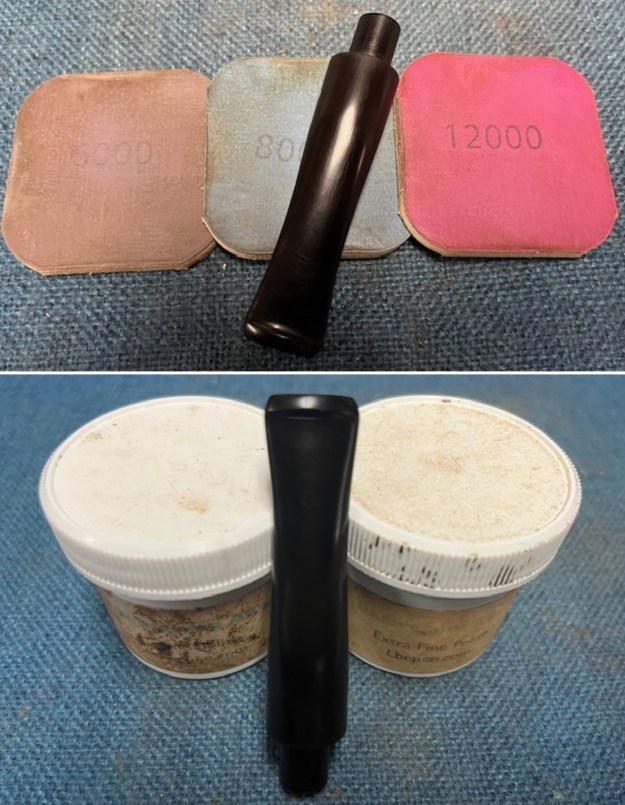
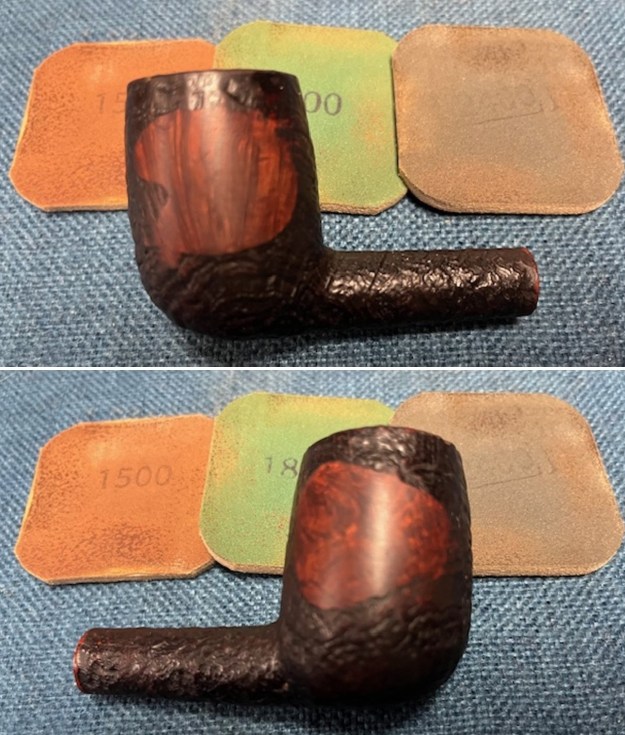
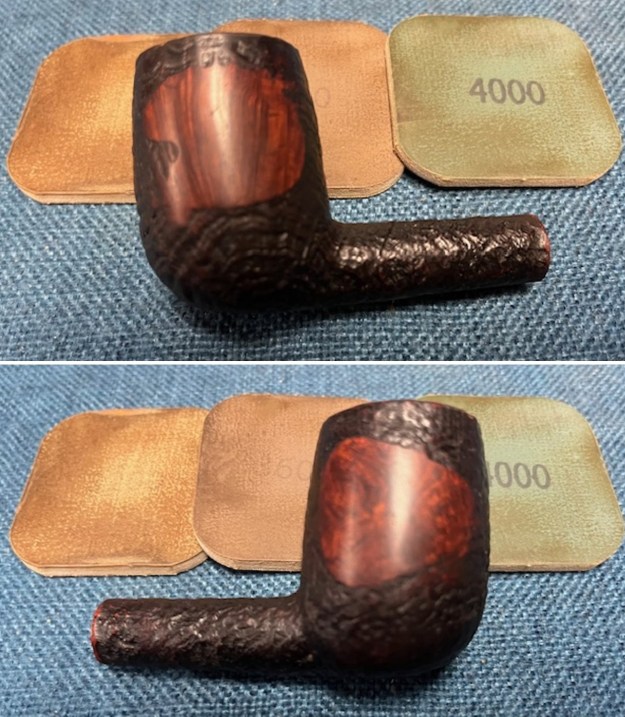
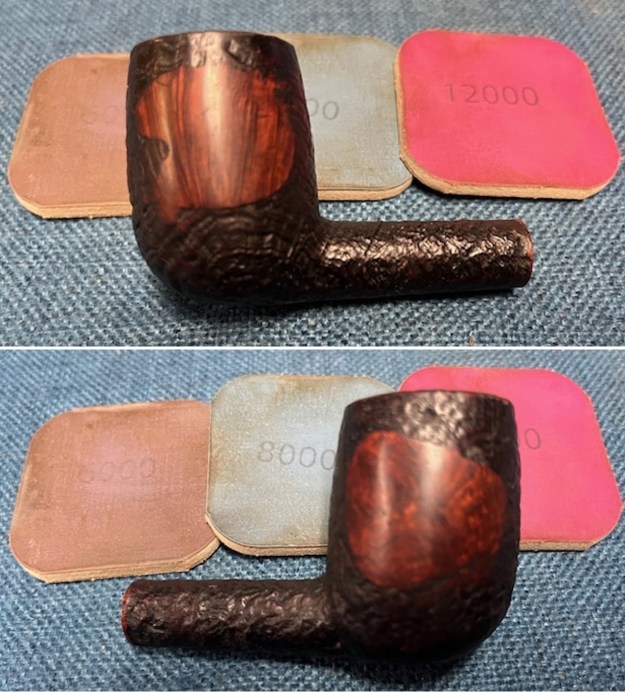
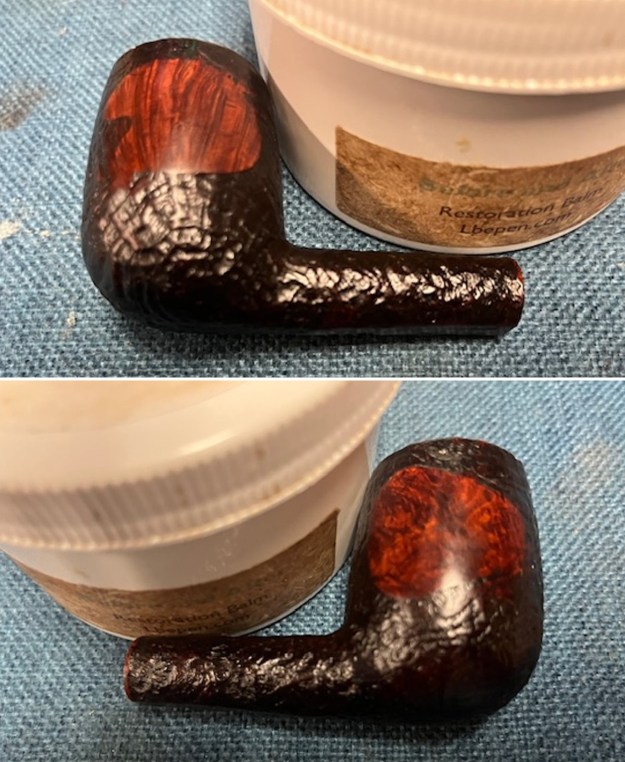
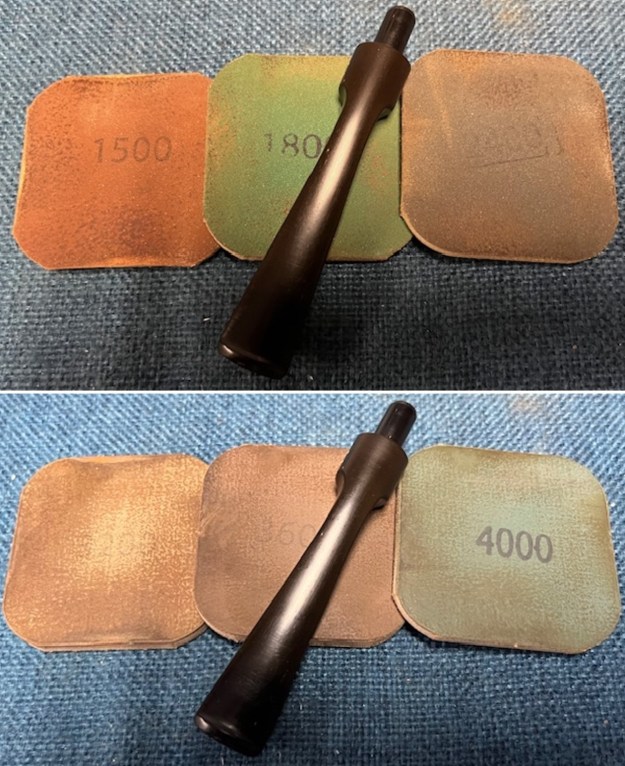
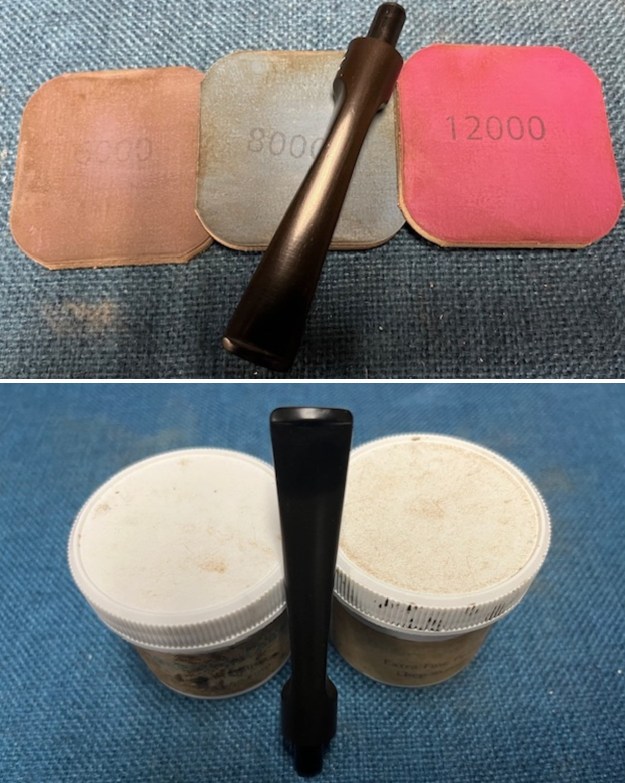
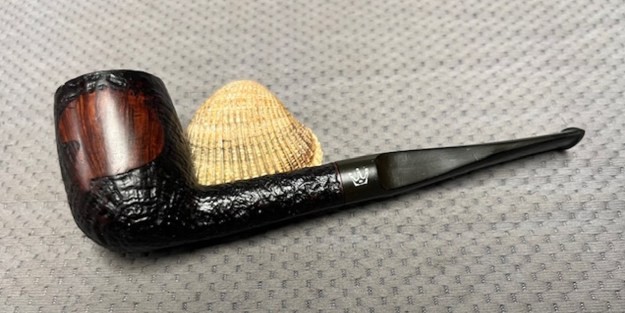
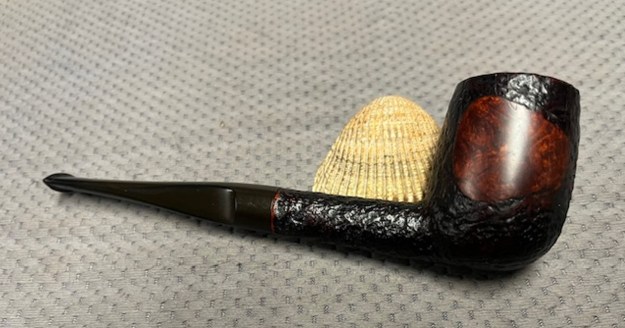
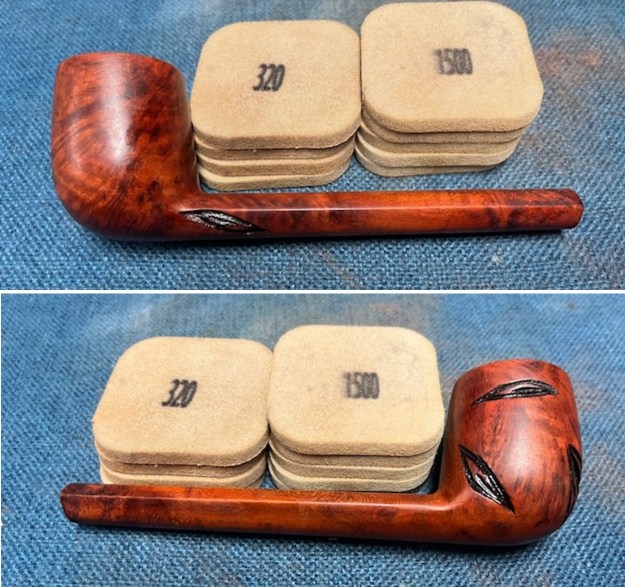
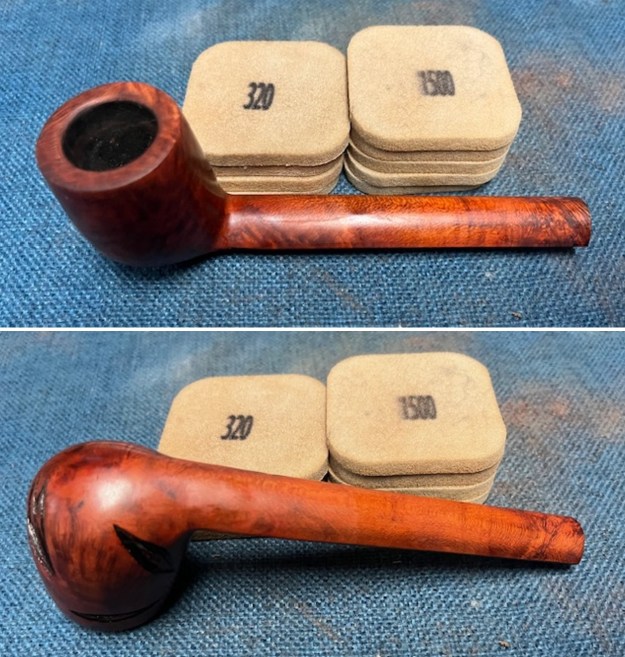
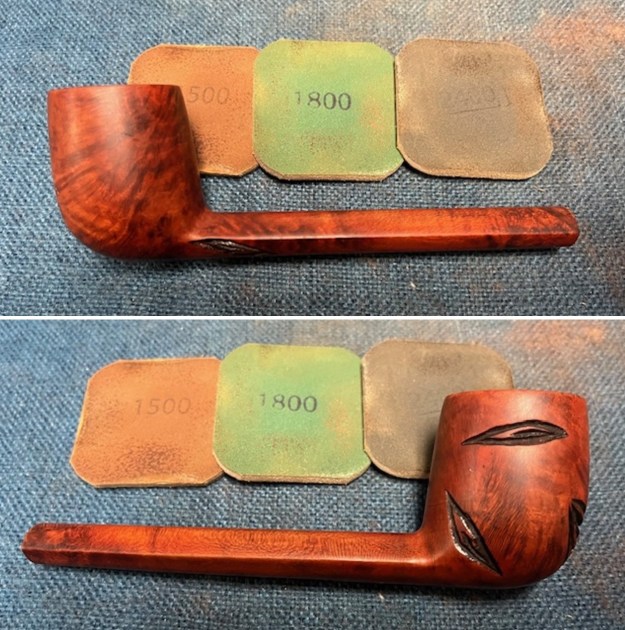
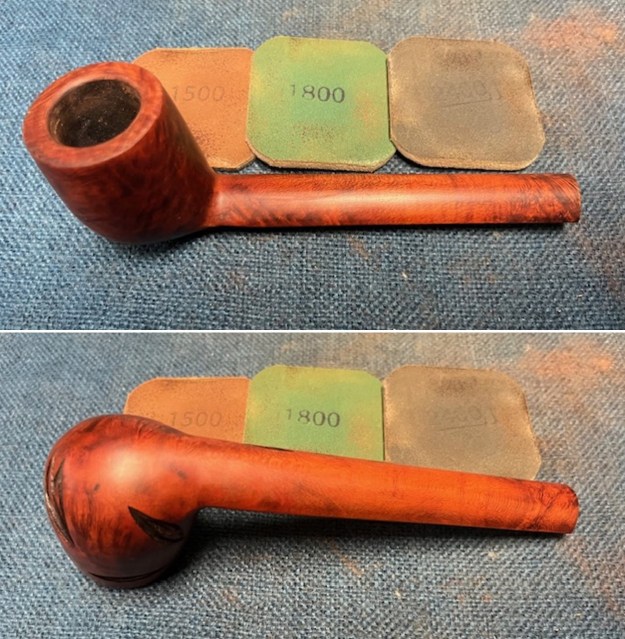
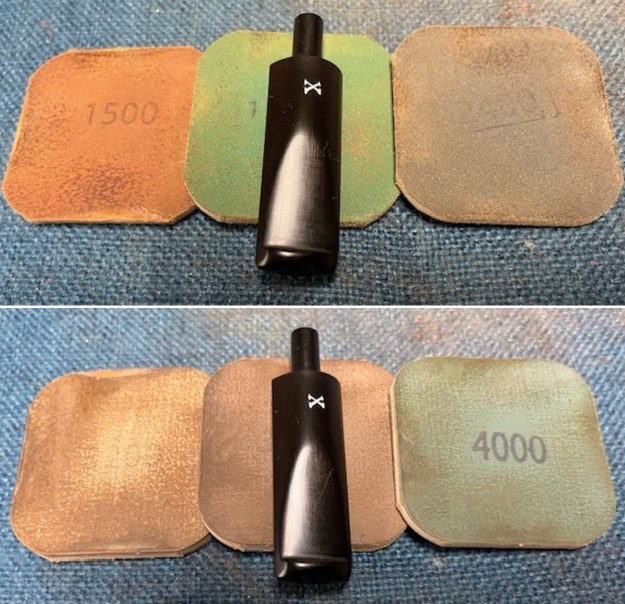
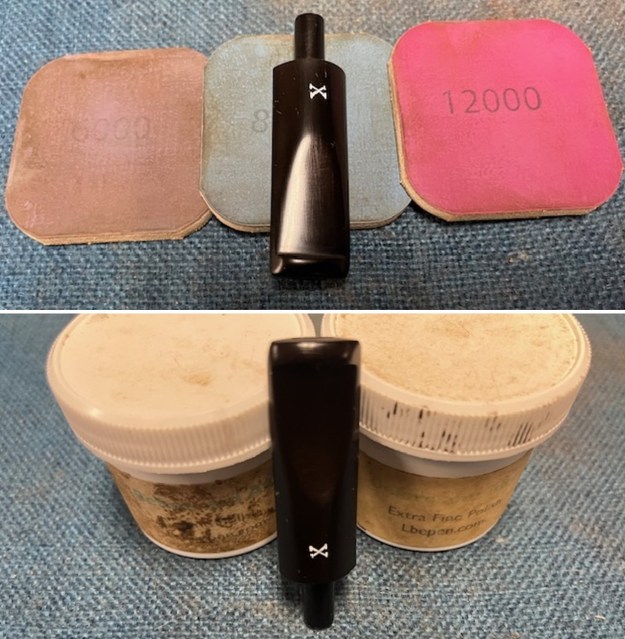
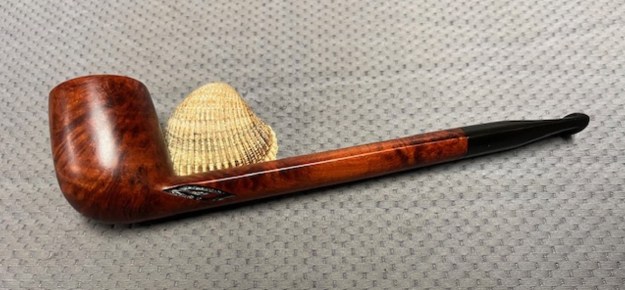
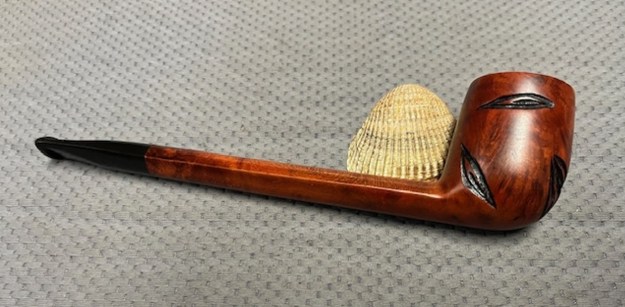
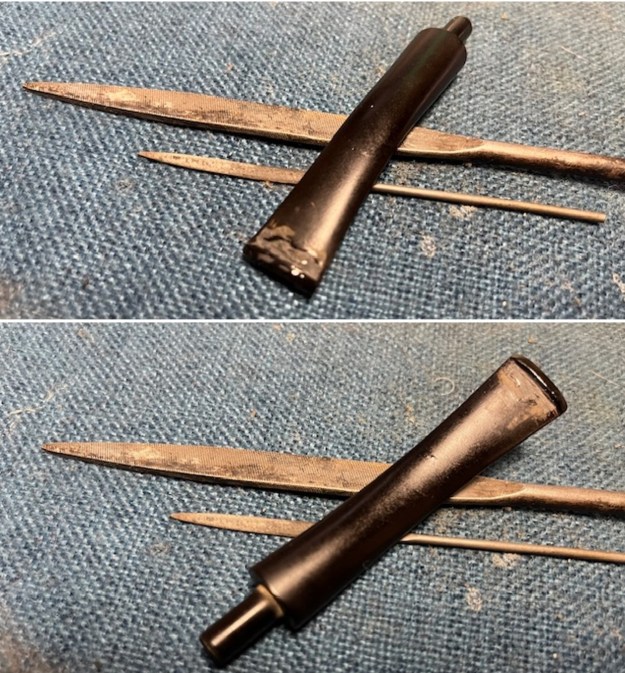
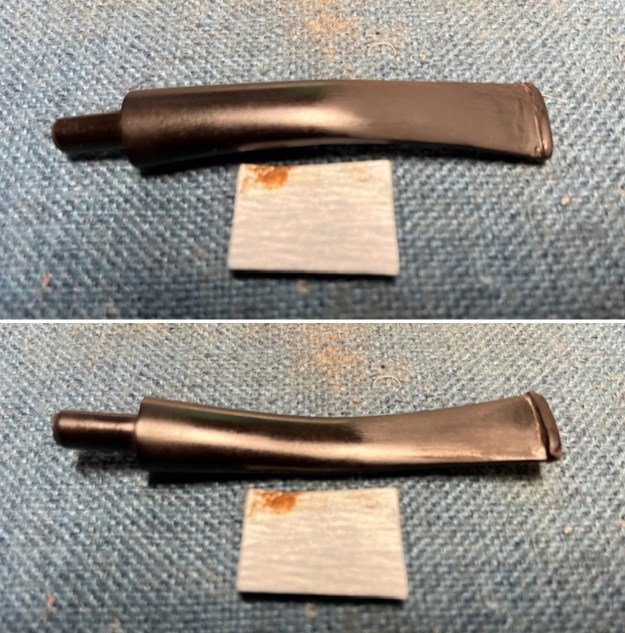
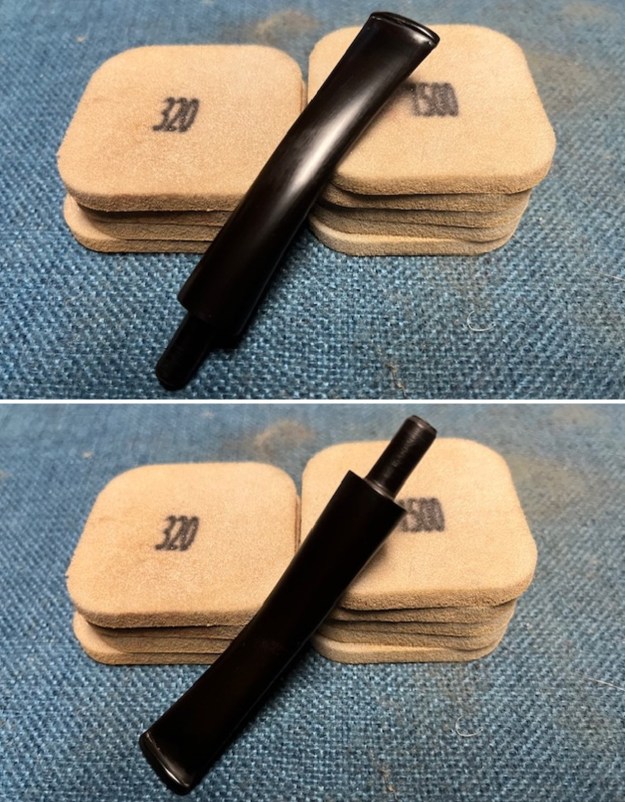
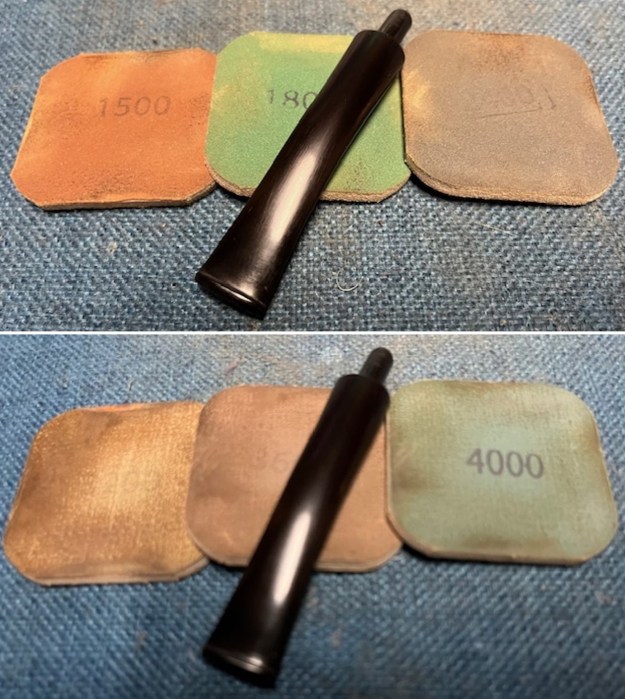
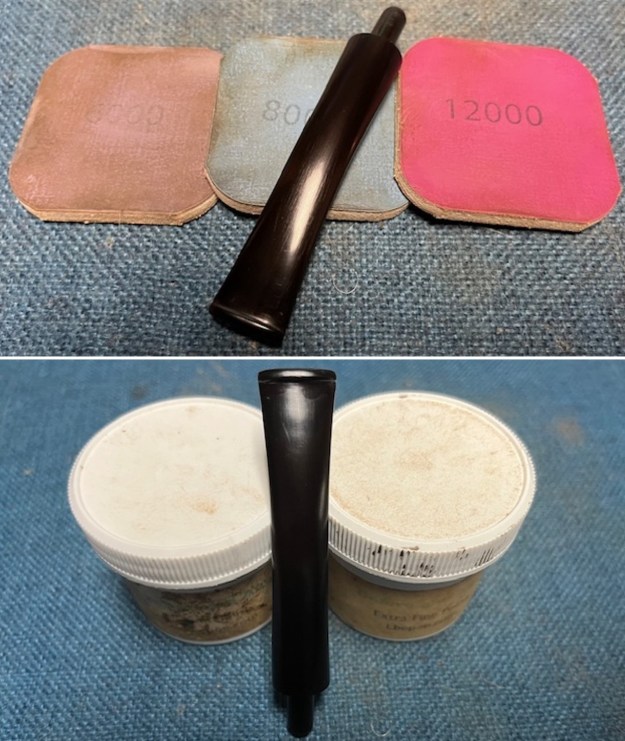
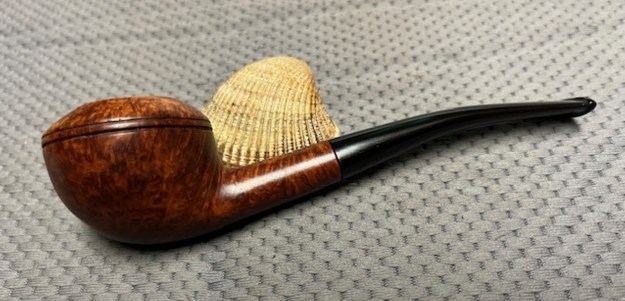
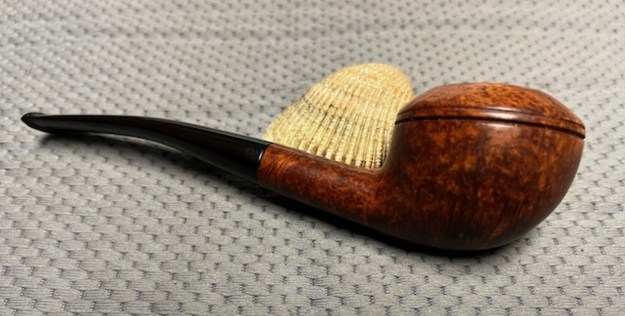
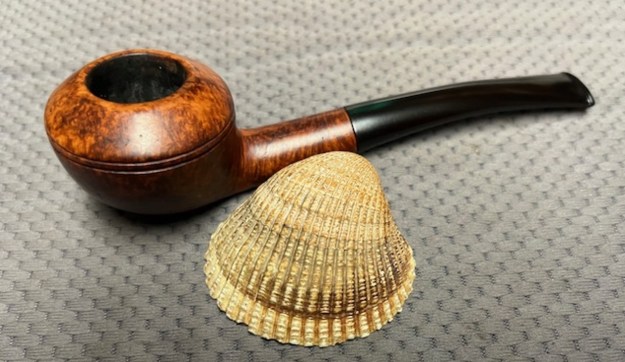
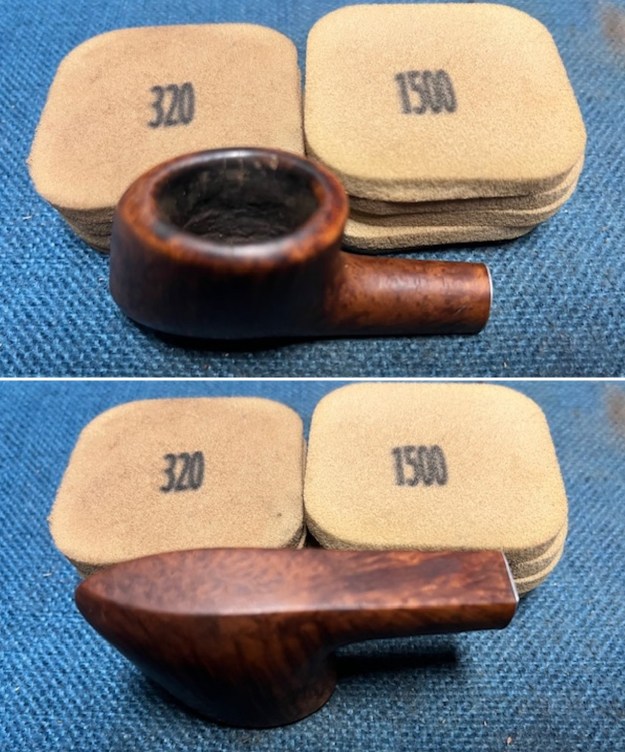
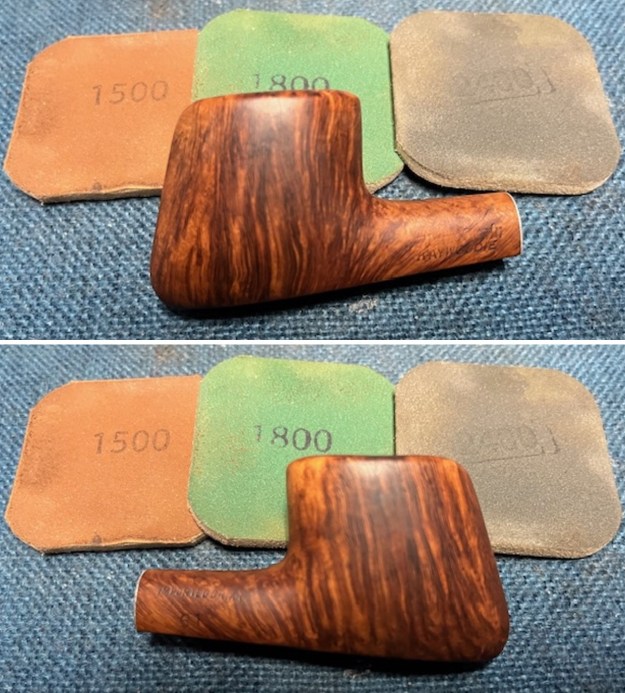
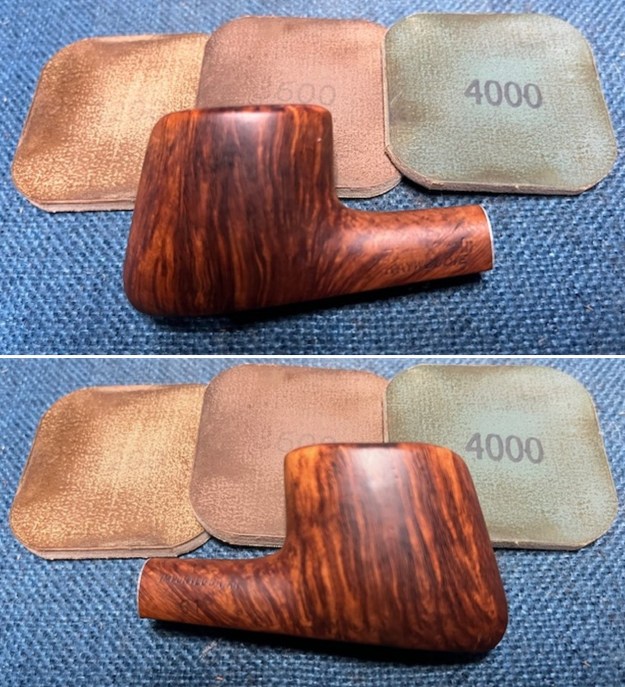
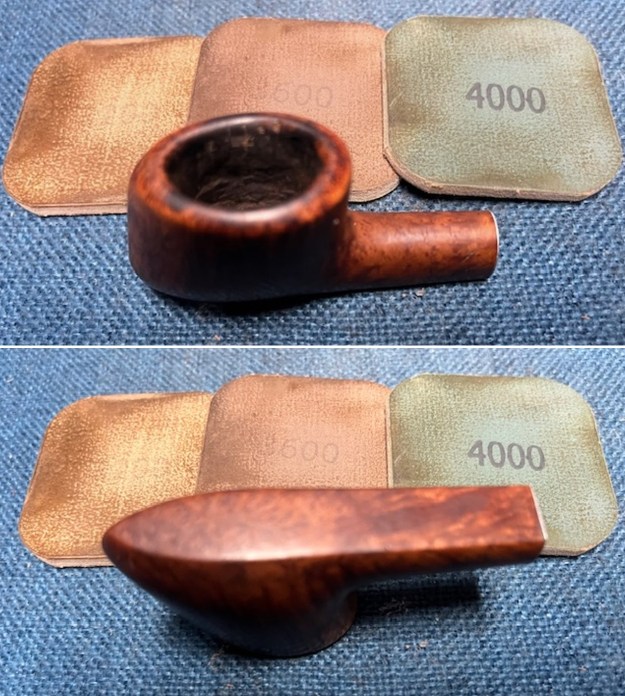
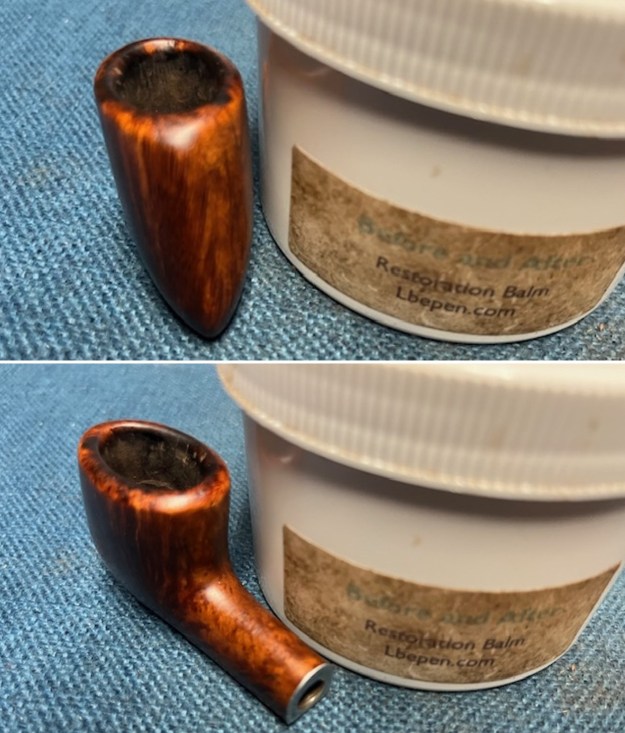
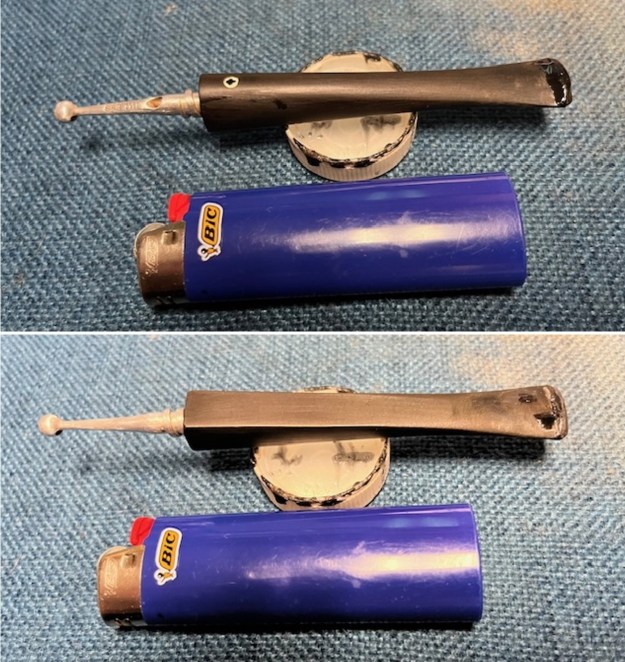
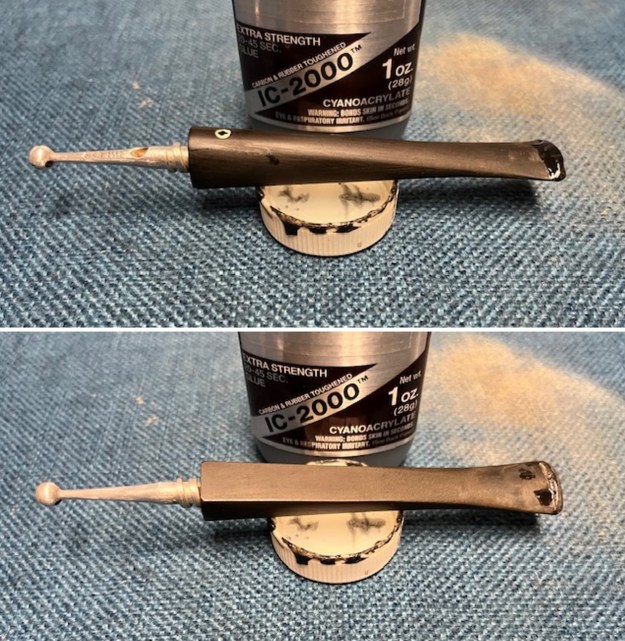
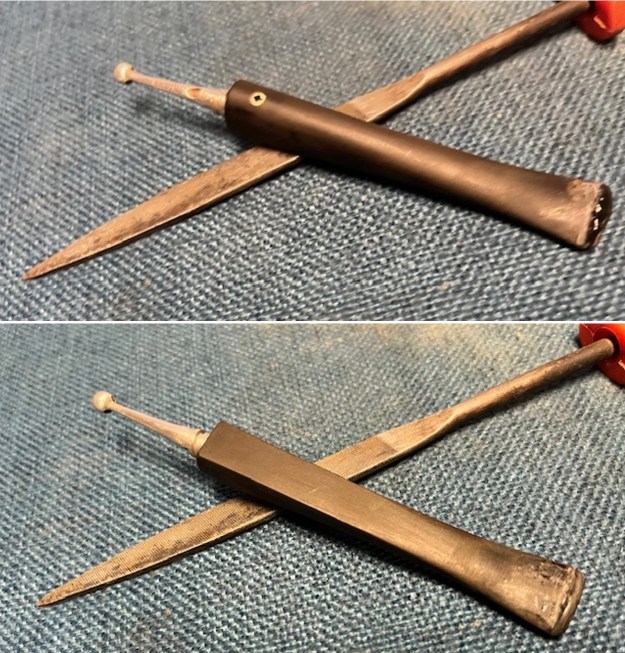
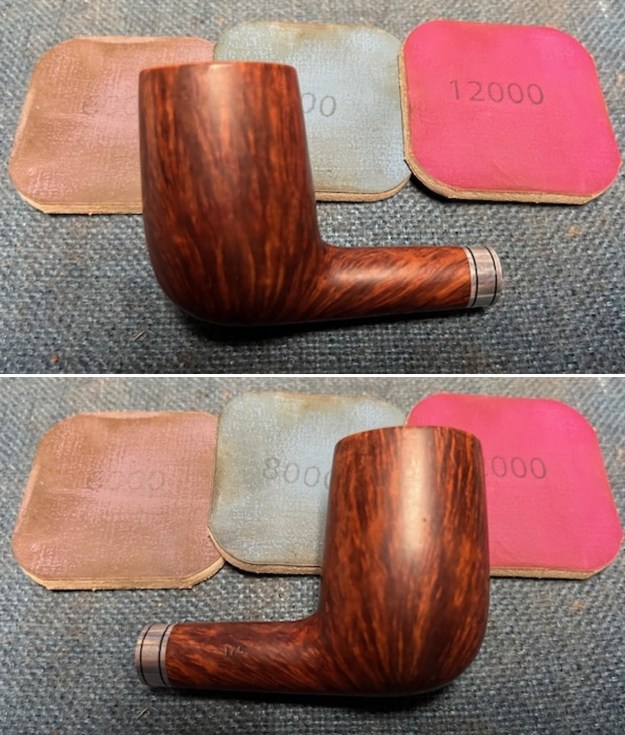
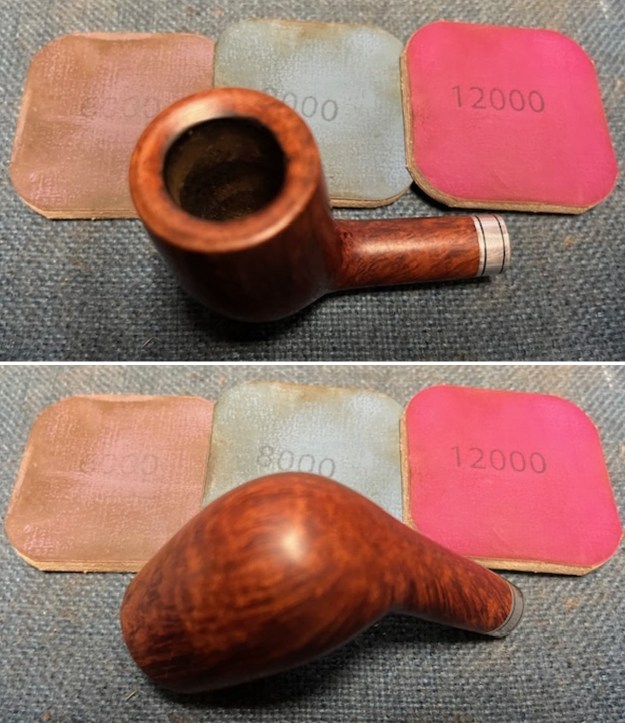
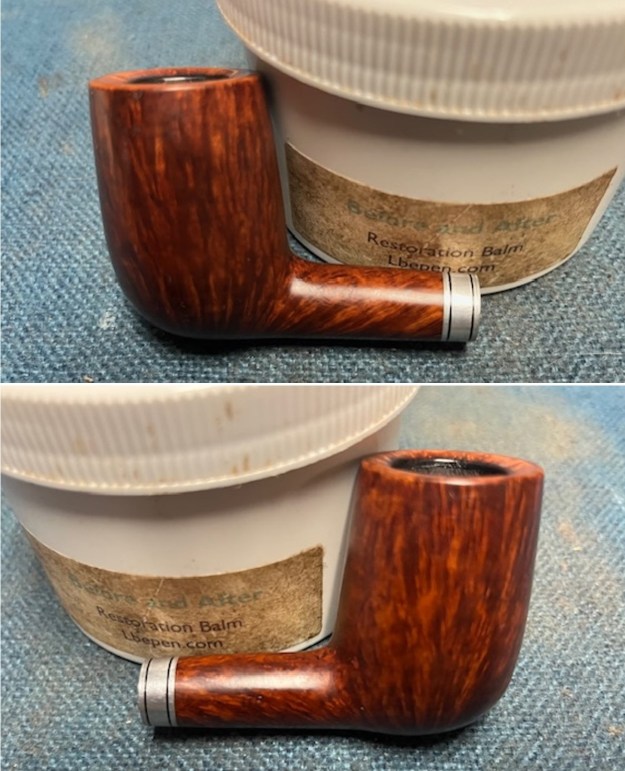
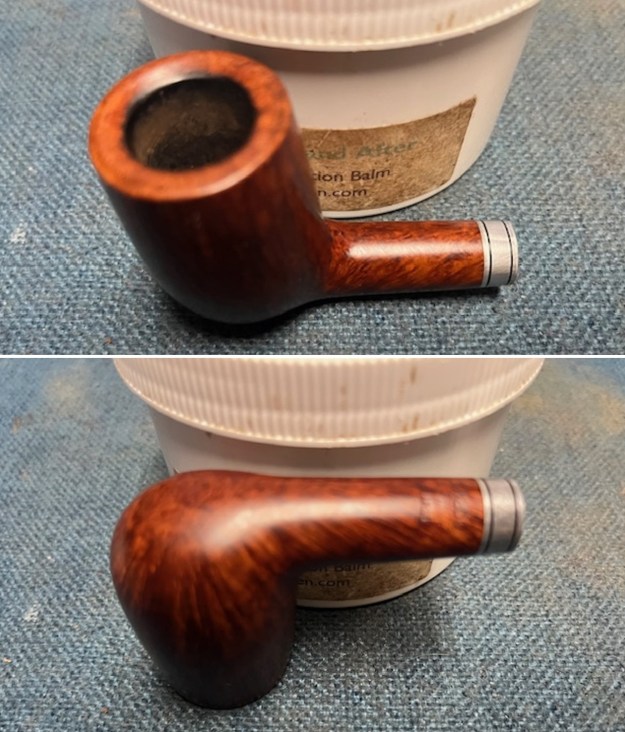
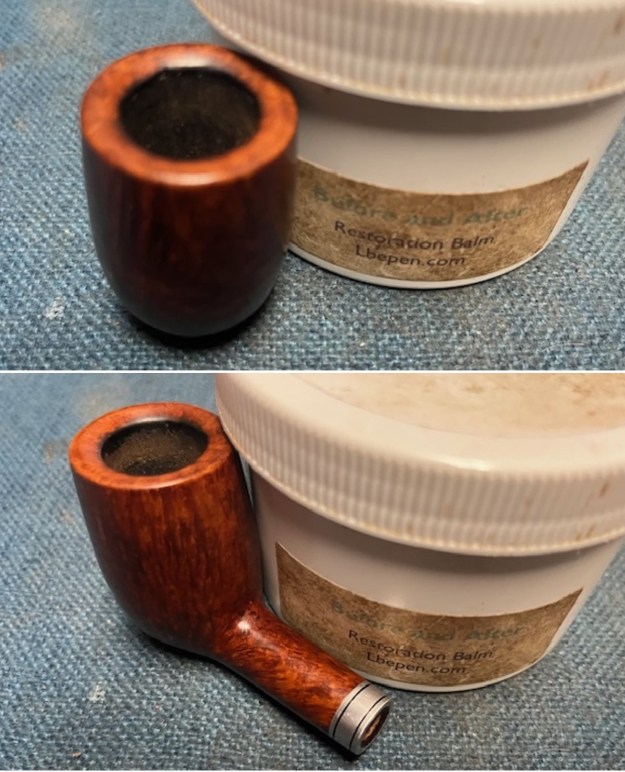
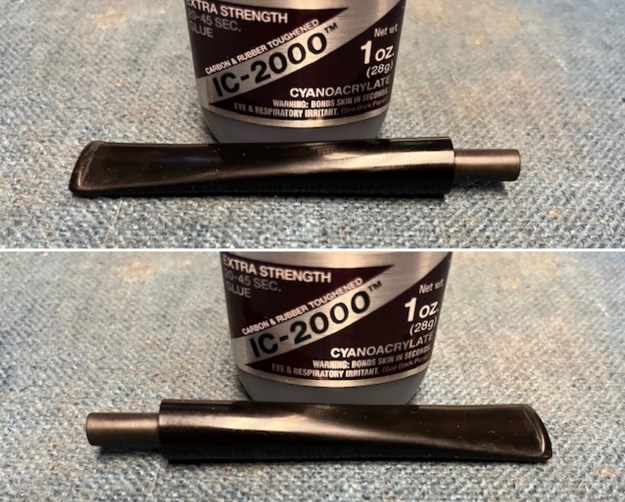
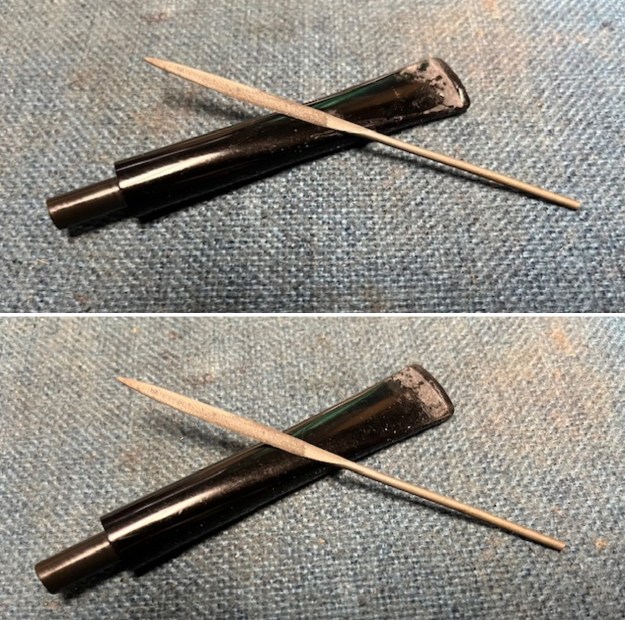
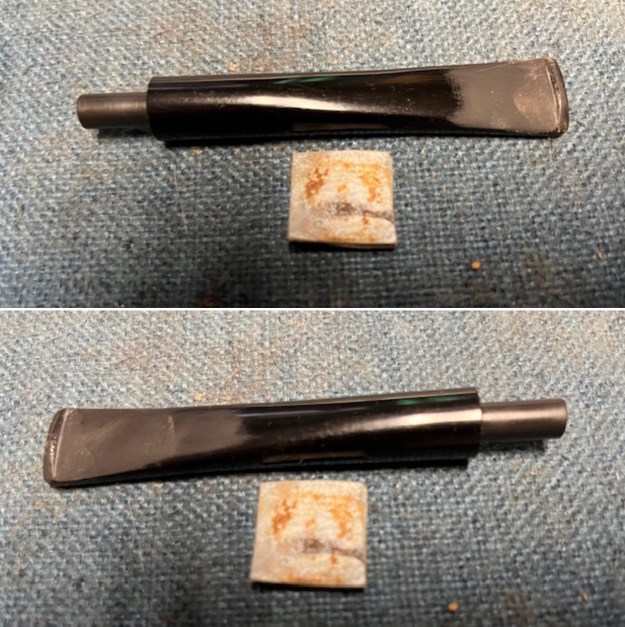
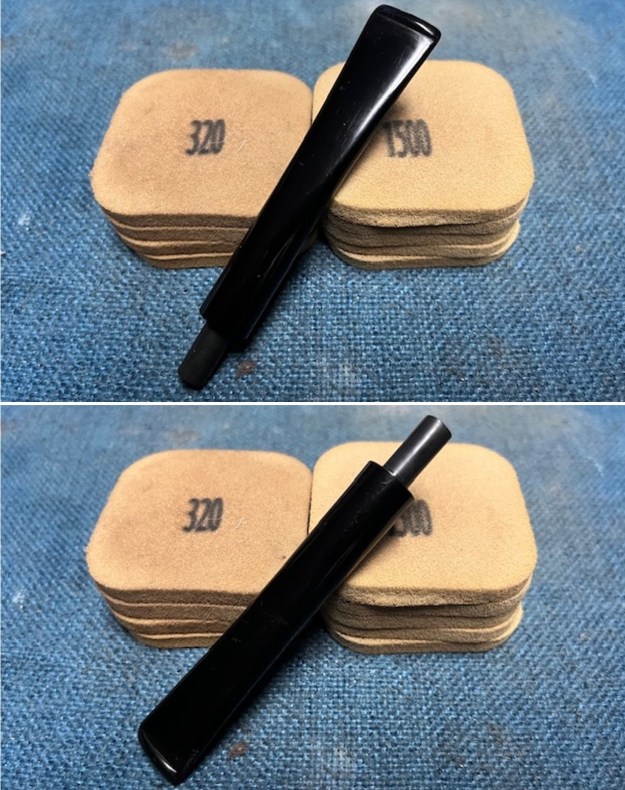
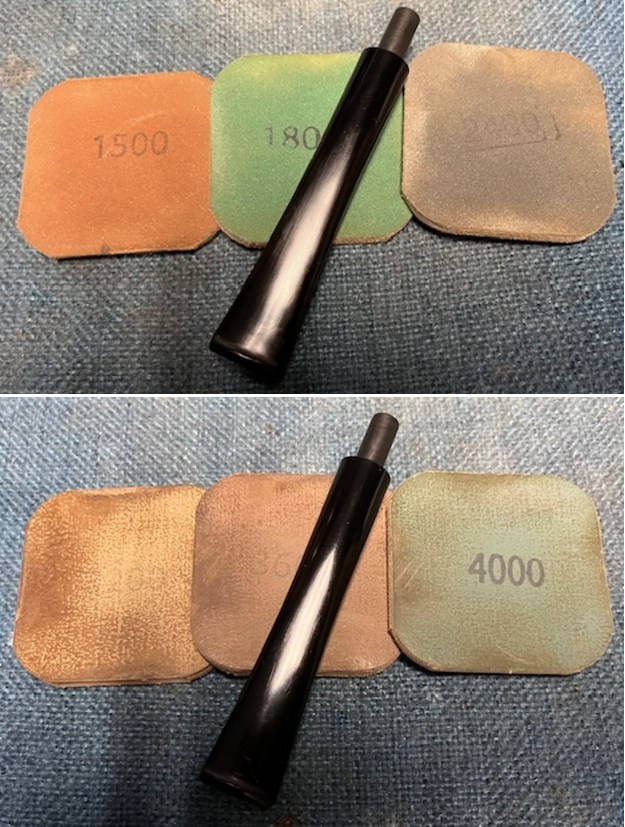
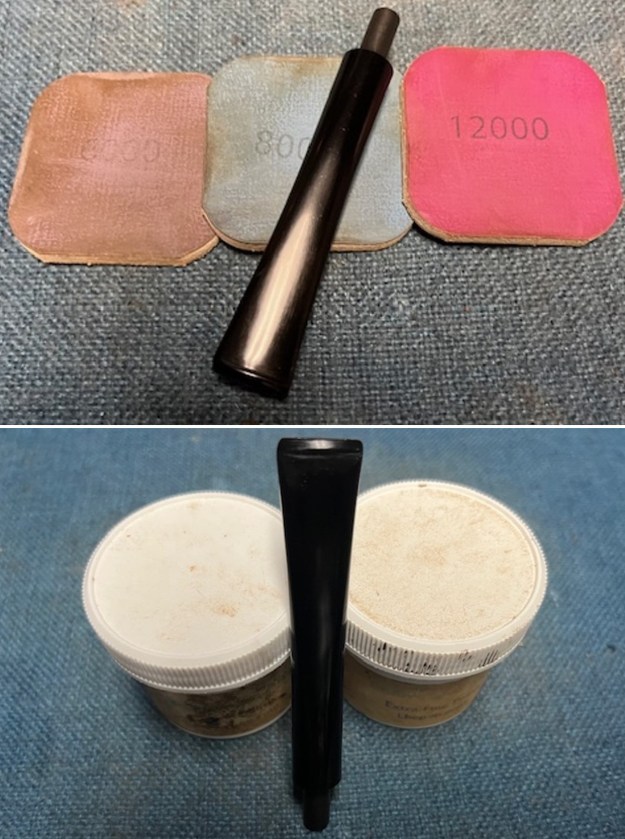
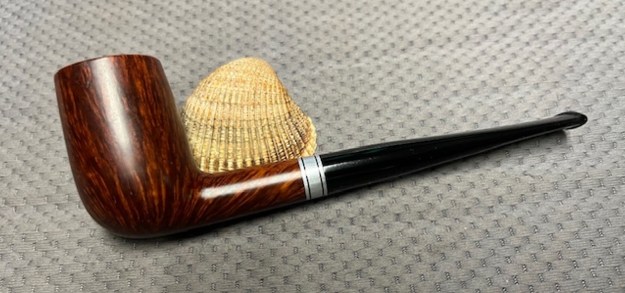
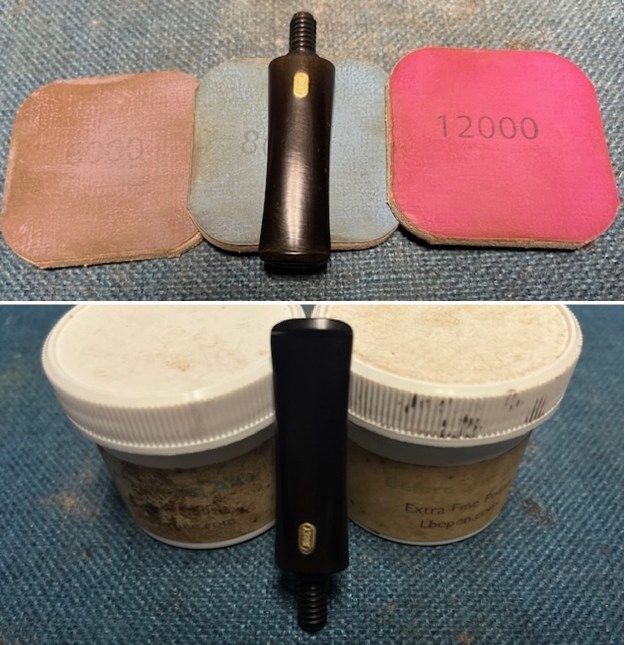
I turned to work on the pipe itself. I reamed the bowl with a PipNet pipe reamer using the cutting heads 2 and 3. I finished the reaming with a Savinelli Fitsall Pipe Knife. I sanded the walls of the bowl with 220 grit sandpaper wrapped around a piece of dowel. I scrubbed the bowl and shank with a tooth brush and some undiluted Murphy’s Oil Soap. I rinsed it off with warm water to remove the dust and soap from the finish. I dried it off with a soft cloth and it looked much better. I worked over the rim top with 320-3500 grit 2×2 inch sanding pads. I wiped the rim top down with a damp cloth after each sanding pad. The crowned smooth rim top looks good.I cleaned out the inside of the shank and the airway in the stem with alcohol, cotton swabs and both bristle and regular pipe cleaners.I rubbed the briar down with Before & After Restoration Balm. I worked it into the briar with my fingertips and a horsehair shoe brush to work it into the nooks and crannies of the sandblast finish. The product works to clean, enliven and preserve the briar. I let it sit for 10 minutes then I buffed it with a cotton cloth to deepen the shine. The briar really comes alive with the balm. I set the bowl aside and worked on the stem. I sanded the oxidation and the tooth marks and chatter with 220 grit sandpaper. I was able to remove all of the tooth damage on the stem and the majority of the oxidation.While I was working on the stem the white acrylic replacement tenon came out in my hand. It had not been glued in place in the stem so it easily slipped out. This was actually great because I wanted to replace it with a black tenon.  I went through my Delrin tenons and found one that was perfect and looked more like the original. I fit it in the shank and to make sure it all fit together correctly.I glued the new tenon in place in the stem with Black CA Glue. Once the glue set on the tenon I worked over the tenon surface with a flat file and 220 grit sandpaper to get a snug fit in the shank. I wiped down the stem and tenon with some Obsidian Oil and it began to look very good. I sanded the stem and tenon surface with 320-3500 grit 2×2 inch pads. I wiped the stem down with an Obsidian Oil cloth after each sanding pad.I polished the vulcanite with micromesh sanding pads – 1500-12000 grit pads. I wiped it down with Obsidian Oil after each sanding pad. I used Before & After Pipe Polish – both Fine and Extra Fine to further polish the stem. I the polished stem and the smooth portions of the Cherrywood bowl with Blue Diamond to polish out the remaining small scratches and raise the shine. I gave the stem several coats of carnauba wax and the bowl several coats of Conservator’s Wax then buffed the pipe with a clean buffing pad to raise the shine. I hand buffed it with a microfiber cloth to deepen the shine. The pipe polished up pretty nicely. This turned out to be a beautiful Dunhill Tanshell 6475F/T Cherrywood Friendly. The finished pipe is shown in the photos below. The dimensions are Length: 5 ½ inches, Height: 1 ¾ inches, Outside diameter of the bowl: 1 ½ inches, Chamber diameter: ¾ of an inch. The weight of the pipe is 1.48 ounces/42 grams. Thanks for walking through the restoration with me as I worked this beautiful little Dunhill sandblast. I will be putting it on the rebornpipes store in the British Pipe Maker Section soon. If you are interested in adding it to your collection let me know. Thanks for looking.

Rethinking the Repair of Damaged Stems


by Kenneth Lieblich

Welcome to another installment of my Pipe Incident Reports. The idea, in general, is to provide a brief write-up – focusing on a particular pipe-restoration-related issue – rather than an entire restoration story. I’ve been blessed by a precious few God-given talents in my life, but innovation is not among them. I’m not usually able to come up with groundbreaking ideas to do things differently. Having said that, I do try and improve my repair/restoration skills, techniques, and procedures wherever I can. One can call it kaizen or whatever, but I try to find better ways of restoring pipes.Today, I am attempting to improve the process of repairing stem bite-throughs by incorporating steel mesh. Now, you might be thinking, ‘That’s not a sentence I ever expected to read’, and you are justified in that thought.

Many pipe repairmen have used various methods for repairing bite-throughs (holes) in vulcanite. Normally, this involves mixing cyanoacrylate adhesive with activated charcoal or powdered vulcanite. Some fellows have also tried some sort of epoxy to bring the stem back to life. In fact, when I started doing pipe repairs, I used that mixture of cyanoacrylate adhesive and activated charcoal. Then I discovered a black-tinted cyanoacrylate adhesive that came pre-mixed with rubber and charcoal. I introduced this product to Steve and it’s what he and I have been using ever since. However, I have always wondered about the durability of these repairs – especially against the bite of a man’s jaw. I wondered, could there be a better way?

Maybe. Read on, but please note: what I am proposing is NOT a complete solution. This is an idea that I hope someone will take and turn into a workable method.

I decided to test a pipe-stem repair with the aforementioned adhesive built around a stainless-steel wire-mesh structure. My thinking is that this would enhance the strength and durability of said repairs. For any engineers or scientists reading this article, please know that I have no scientific background and I am not equipped to conduct accurate tests of compressive or tensile strength. I am merely running an idea up the proverbial flagpole and seeing who salutes it. I hope that someone reading this will take the idea and, either, discredit it or expand upon it. The experiment I describe below is just that: an experiment. It is, possibly, a proof of concept – but certainly not the final step.

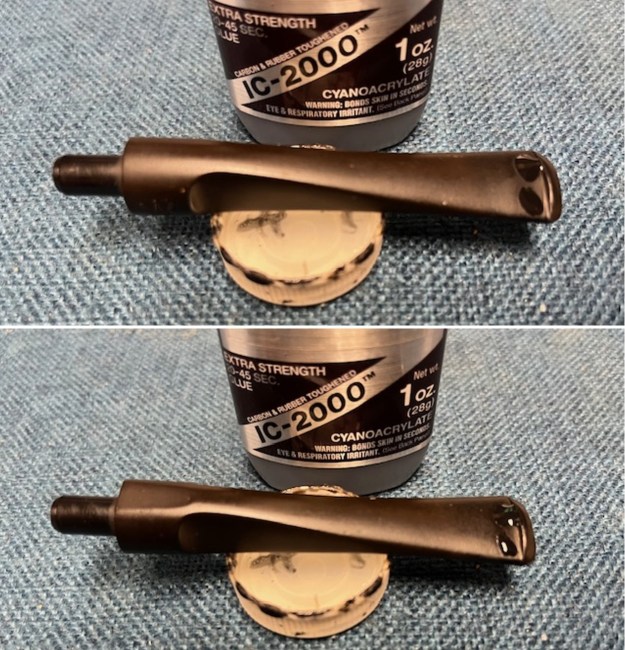
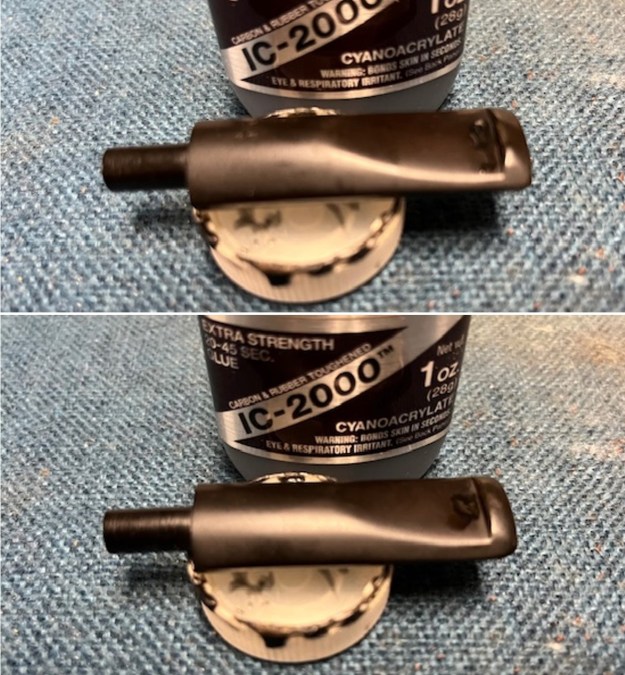
The idea came to me one day as I saw some sort of wire mesh being used in a concrete foundation. This mesh is used in construction to control cracking, to distribute stress, and add tensile strength. Perhaps it can be used, in like manner, where a large vulcanite repair is needed. My encounter with the concrete was providential because I had recently acquired a large lot of pipes, many of which had damaged stems. There was one stem in particular that stood out as a candidate for this experiment. Here it is: This is a stem that I would normally likely toss in the garbage, unless a customer specifically asked me to repair it. The damage is obviously serious. Ironically, this brutal damage actually makes this stem the perfect patient for this type of surgery.

Here is the stainless-steel woven wire mesh. For those of you who know such things, this mesh has a mesh number of 200. It can be acquired inexpensively and comes in various mesh numbers. The larger the number, the finer the holes in the mesh. To be frank, my selection of 200 was pure guesswork. I didn’t really have a sense of what would be best – other than to say that it needed to be fine enough to prevent the adhesive from pouring straight through.On with the work! I first needed to create a platform upon which the adhesive and mesh could rest. This was obviously essential in order to maintain the draught hole in the bit. In the first photo below, you’ll see that I used cardboard, but I immediately abandoned that idea (I’ll explain why momentarily). I am displaying this photo in order to demonstrate my use of a pencil to scribe the precise shape of the missing section of vulcanite.I quickly eliminated the cardboard idea because it just isn’t as useful a material for this purpose. Instead, I used several layers of duct tape as my substrate. I can still scribe a line on the duct tape, but – more importantly – cyanoacrylate adhesive doesn’t stick to it. In other words, once the work had fully cured, I could readily remove the duct tape without affecting the repair.

With my scribed line, I was able to transfer the pattern of the absent vulcanite on to the wire mesh and cut it to shape. Truth be told, it would probably be better to use welded wire mesh, but I have no idea where you acquire that in such a small mesh number. Anyway, before cutting the wire mesh, I took the critical steps of (1) gently sanding the mesh with sandpaper to provide a slightly rough surface to maximize the adhesive bond, and (2) cleaning the mesh thoroughly with acetone, to remove any sanding grit and any other substance that would inhibit a good adhesive bond.

And away we go! It is important to apply the cyanoacrylate adhesive in thin layers, rather than one thick blob. I chose to apply a layer, spray it with an accelerator, apply another layer, etc. – until I was satisfied. Once complete, I left it to sit overnight and came back the next day. I freely admit that I am still concerned about the brittleness of this repair, but I think this is definitely a step in the right direction. Naturally, shaping and sanding was the next step – and this took a while. I should emphasise at this point that I didn’t employ the same attention to detail on this stem, as I would on a stem for a customer. I just wanted to get this done and see if it would work. As I sanded with needle files and sanding pads, I shaped the button and melded the repair into the surrounding vulcanite. You can see the results below. It’s pretty good and I’m sure it would look even better if I was doing it for sale or for a customer.

Some final thoughts: I think there is a rudimentary idea here. I feel confident in saying that the repair itself is likely stronger and more resilient with the mesh than without. However, I am apprehensive about whether the brittleness of the cyanoacrylate adhesive is improved or not – and I’m not sure how to reasonably overcome that issue (other than trying epoxy). Another problem that still exists is that there is no direct connection between the mesh and the pre-existing vulcanite. This surely isn’t helpful. It is at the edges – where the adhesive meets the vulcanite – that the bond must be weakest. Next steps might include (1) embedding the wire mesh in an epoxy – this might be the best way of addressing brittleness; (2) overlaying the wire mesh on the original vulcanite to create a bridge structure (although this creates its own big problems); (3) developing a way of affixing the mesh to the vulcanite.

Now, over to you! What do you think of this idea? How would you improve it? What are the next steps? What colossal errors have I made? Please let me know what you think in the comments below. If you make use of the ideas from this experiment in your pipe work, please let me know how it goes. I hope you enjoyed reading this installment of my Pipe Incident Reports – I look forward to writing more. If you are interested in my work, please follow me here on Steve’s website or email me directly at kenneth@knightsofthepipe.com. Thank you very much for reading and, as always, I welcome and encourage your comments.

A Lovely Republic Era Peterson’s Sterling Filter 69 Stirling Bent Billiard


by Steve Laug

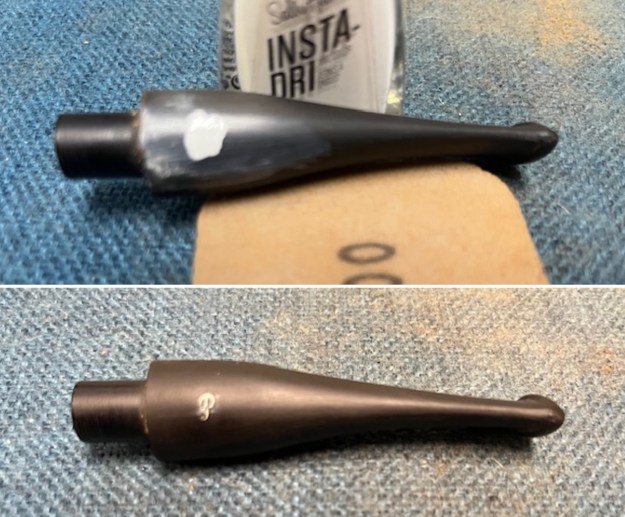
The next pipe I have chosen is smooth finished Peterson’s “Sterling Silver” pipe. The pipe came to us from our contact in Copenhagen, Denmark. This one is a Peterson’s Bent Billiard pipe with a taper fishtail stem. It has a rich brown coloured finish with interesting grain around the bowl sides and shank. It is very dirty. This Bent Billiard has a silver band on the shank that was oxidized. The grime on the finish was ground into the briar. The brown stains make the grain really pop. It was stamped on the left side of the shank and reads Peterson’s [over] “Sterling Filter”. On the right side it is stamped with the three line Made in the Republic of Ireland stamp followed by the shape number 69. The tarnished band is stamped with Peterson’s [over] Dublin followed by Sterling [over] Silver. To the right that it has three hallmarks – Hibernia seated arm on a harp (signifies country of manufacture), a crowned harp designating Sterling quality and finally a Date Letter mark – in this case an italic “I” (1976). It was in filthy condition when Jeff brought it to the table. There was a thick cake in the bowl and spots of lava on the rim top and inner edge of the bowl. The stem was oxidized, calcified and had light tooth marks and chatter on the top and underside near the button. Jeff took photos of the pipe before his cleanup work before he started on the pipe. Jeff took photos of the rim top and stem to show the general condition of the pipe. The bowl is lightly caked and the rim top and edges look very good. The stem is oxidized and has light tooth marks on the top and underside near the button. Jeff took some photos of the bowl sides and heel to show the grain that was around this bowl. It is a nice looking pipe. He took photos of the sides of the shank to show the stamping. The stamping is readable in the photos below and is as noted above. The stamping on the Sterling Silver band is also readable through the oxidation. I am including the information from Pipedia’s article on Peterson pipes. It is a great read in terms of the history of the brand (https://pipedia.org/wiki/Peterson).

I turned to “The Peterson Pipe” by Mark Irwin and Gary Malmberg to get some background on the Sterling Pipe. On page 314 it had the following information on the line.

Sterling (1949-c1957; 1978-) – Higher grade line with sterling band. Early example, 1949-57, with COM of Made in Ireland forming a circle, were offered to the US market through Rogers Imports and have no hallmark, although until recent years the line carried Peterson’s maker’s mark, the K&P is in separate shields. Models beginning in ’78 with hallmarked dates and a COM stamp of Made in [over] the Republic [over] of Ireland.

I knew that I was dealing with a pipe made between 1949-1957 as shown by the Made in the Republic of Ireland three-line format stamp. Now it was time to work on the pipe.

Jeff had done a great job cleaning up the pipe as usual. He reamed the pipe with a PipNet reamer and cut back the cake back to the bare briar. He cleaned up the walls with a Savinelli Fitsall Pipe Knife. He scrubbed the interior of the bowl and shank with pipe cleaners, shank brushes, cotton swabs and alcohol to remove the tars and oils. He scrubbed the exterior of the pipe with undiluted Murphy’s Oil Soap and a tooth brush to remove the grime from the finish. He worked on the rim top lava with the soap and tooth brush. He scrubbed the inside of the stem with alcohol, shank brushes and pipe cleaners. He scrubbed the exterior with Soft Scrub and then soaked it in Briarville’s Pipe Stem Deoxidizer. He washed it off with warm water to remove the deoxidizer. The pipe looked very good when it arrived here. I took some close-up photos of the rim top and also of the stem surface. The rim top and the inner edge looked very good. The silver cleaned up well on the band, though it needed more work. The stem was clean and the tooth marks and chatter were minimal.I took photos of the stamping on the top and underside of the shank. You can see that it is stamped as noted above. It is faint and readable. I took the pipe apart and took a photo of the pipe. It is a good looking pipe and has some nice looking grain around the bowl. I sanded the briar with 320-3500 grit 2×2 inch sanding pads to remove the scratches and marks in the finish. I wiped the bowl down with a damp cloth after each sanding pad to remove the sanding debris. It really looks much better. I polished the briar with 1500-12000 grit micromesh pads – dry sanding it with each pad and wiped down the bowl after each pad. I gave it a final wiped with a Briar Wipe cloth to polish the finish. The briar looked very good at this point. I began my work on it by working some Before & After Restoration Balm into the surface of the briar with my fingertips to clean, enliven and protect the briar. I let the balm sit for 15 minutes and then buffed with a cotton cloth to raise the shine. The photos show the bowl at this point in the restoration process. I polished the Sterling Silver band on the shank with a jeweller’s cloth to remove the tarnish and polish it. I set the bowl aside and turned my attention to the stem. I sanded the stem with 320-3500 grit 2×2 inch sanding pads and wiped it down with an Obsidian Oil cloth after each sanding pad. The stem began to take on a shine.I touched up the P stamp on the left side of the stem with white acrylic fingernail polish. I worked it into the P stamp with a tooth pick. Once it dried I scraped off the excess of the acrylic with my fingernail. I sanded the stem area with a worn 1500 grit micromesh sanding pad. It looked very good. I fit the stem with a Vauen Dr. Perl Junior 9mm filter in the filter tenon of the pipe. It is a great fit and that it fit very well.I polished the stem with micromesh sanding pads – wet sanding with 1500-12000 grit sanding pads. I wiped it down after each sanding pad with Obsidian Oil. I polished it with Before & After Pipe Stem Polish – both Fine and Extra Fine. I am excited to finish this smooth Peterson’s “Sterling Filter” 69 Bent Billiard. I put the pipe back together and lightly buffed it with Blue Diamond on the buffing wheel. I gave the bowl and the stem multiple coats of carnauba wax. I hand buffed the pipe with a clean buffing pad to raise the shine. It is fun to see what the polished bowl looks like with the depths of the sandblast taking on a rich glow. Added to that the polished Sterling Silver band and the black vulcanite taper P-lip stem was beautiful. This smooth Classic Peterson’s “Sterling Filter” 69 Bent Billiard is nice looking and the pipe feels great in my hand. It is light and well balanced. Have a look at it with the photos below. The dimensions are Length: 5 ½ inches, Height: 2 inches, Outside diameter of the bowl: 1 ¼ inches, Chamber diameter: ¾ of an inch. The weight of the pipe is 59 grams/2.08 ounces. It is a beautiful pipe and one that will be on the Irish Pipe Makers Section of the rebornpipes store soon. If you are interested in adding it to your collection let me know. Thanks for walking through the restoration with me as I worked over this pipe. Thanks to each of you who are reading this blog.

What a Lovely Republic Era Peterson’s “Sterling Silver” 68 Brandy


by Steve Laug

The next pipe I have chosen is smooth finished Peterson’s “Sterling Silver” pipe. The pipe came to us from a Facebook seller in Oregon City, Oregon, USA. This one is a Peterson’s Brandy shaped pipe with a taper P-lip stem. It has a rich brown coloured finish with interesting grain around the bowl sides and shank. It is very dirty. This Brandy has a silver band on the shank that was badly oxidized. The grime on the finish was ground into the finish on the bowl sides. The brown stains make the grain really pop. It was stamped on the left side of the shank and reads K&P in shields [over] “Sterling [over] Silver”. To the right of that it is stamped with the three line Made in the Republic of Ireland stamp followed by the shape number 68. The heavily tarnished band is stamped with K&P in shields [over] Sterling [over] Silver. To the right that it has three hallmarks – Hibernia seated arm on a harp (signifies country of manufacture), a crowned harp designating Sterling quality and finally a Date Letter mark – in this case an italic upper-case italic “I” (1994). It was in filthy condition when Jeff brought it to the table. There was a thick cake in the bowl and spots of lava on the rim top and inner edge of the bowl. The stem was oxidized, calcified and had light tooth marks and chatter on the top and underside near the button. Jeff took photos of the pipe before his cleanup work before he started on the pipe. Jeff took photos of the rim top and stem to show the general condition of the pipe. The bowl is lightly caked and the rim top and edges look very good. The stem is oxidized and has light tooth marks on the top and underside near the button. Jeff took some photos of the bowl sides and heel to show the grain that was around this bowl. It is a nice looking pipe. He took photos of the sides of the shank to show the stamping. The stamping is readable in the photos below and is as noted above. The stamping on the Sterling Silver band is also readable through the oxidation. I am including the information from Pipedia’s article on Peterson pipes. It is a great read in terms of the history of the brand (https://pipedia.org/wiki/Peterson).

I turned to “The Peterson Pipe” by Mark Irwin and Gary Malmberg to get some background on the Sterling Pipe. On page 314 it had the following information on the line.

Sterling (1949-c1957; 1978-) – Higher grade line with sterling band. Early example, 1949-57, with COM of Made in Ireland forming a circle, were offered to the US market through Rogers Imports and have no hallmark, although until recent years the line carried Peterson’s maker’s mark, the K&P is in separate shields. Models beginning in ’78 with hallmarked dates and a COM stamp of Made in [over] the Republic [over] of Ireland.

I knew that I was dealing with a pipe made between 1949-1957 as shown by the Made in the Republic of Ireland three-line format stamp. Now it was time to work on the pipe.

Jeff had done a great job cleaning up the pipe as usual. He reamed the pipe with a PipNet reamer and cut back the cake back to the bare briar. He cleaned up the walls with a Savinelli Fitsall Pipe Knife. He scrubbed the interior of the bowl and shank with pipe cleaners, shank brushes, cotton swabs and alcohol to remove the tars and oils. He scrubbed the exterior of the pipe with undiluted Murphy’s Oil Soap and a tooth brush to remove the grime from the finish. He worked on the rim top lava with the soap and tooth brush. He scrubbed the inside of the stem with alcohol, shank brushes and pipe cleaners. He scrubbed the exterior with Soft Scrub and then soaked it in Briarville’s Pipe Stem Deoxidizer. He washed it off with warm water to remove the deoxidizer. The pipe looked very good when it arrived here. I took some close-up photos of the rim top and also of the stem surface. The rim top and the inner edge looked very good. The silver cleaned up well on the band. The stem was clean and the tooth marks and chatter were minimal.I took photos of the stamping on the top and underside of the shank. You can see that it is stamped as noted above. It is faint and readable. I took the pipe apart and took a photo of the pipe. It is a good looking pipe and has some nice looking grain around the bowl. I sanded the briar with 320-3500 grit 2×2 inch sanding pads to remove the remainder of the varnish coat that the acetone did not remove. I wiped the bowl down with a damp cloth after each sanding pad to remove the sanding debris. It really looks much better. I polished the briar with 1500-12000 grit micromesh pads – dry sanding it with each pad and wiped down the bowl after each pad. I gave it a final wiped with a Briar Wipe cloth to polish the finish. The briar looked very good at this point. I began my work on it by working some Before & After Restoration Balm into the surface of the briar with my fingertips to clean, enliven and protect the briar. I let the balm sit for 15 minutes and then buffed with a cotton cloth to raise the shine. The photos show the bowl at this point in the restoration process. I polished the Sterling Silver band on the shank with a jeweller’s cloth to remove the tarnish and polish it. I scrubbed the oxidized stem surface with Soft Scrub cleanser on cotton pads. I was able to remove a major portion of the oxidation. It began to look much better.I set the bowl aside and turned my attention to the stem. I sanded the stem with 320-3500 grit 2×2 inch sanding pads and wiped it down with an Obsidian Oil cloth after each sanding pad. The stem began to take on a shine.I touched up the P stamp on the left side of the stem with white acrylic fingernail polish. I worked it into the P stamp with a tooth pick. Once it dried I scraped off the excess of the acrylic with my fingernail. I sanded the stem area with a worn 1500 grit micromesh sanding pad. It looked very good.I polished the stem with micromesh sanding pads – wet sanding with 1500-12000 grit sanding pads. I wiped it down after each sanding pad with Obsidian Oil. I polished it with Before & After Pipe Stem Polish – both Fine and Extra Fine. I am excited to finish this smooth Peterson’s “Sterling Silver” 68 Brandy. I put the pipe back together and lightly buffed it with Blue Diamond on the buffing wheel. I gave the bowl and the stem multiple coats of carnauba wax. I hand buffed the pipe with a clean buffing pad to raise the shine. It is fun to see what the polished bowl looks like with the depths of the sandblast taking on a rich glow. Added to that the polished Sterling Silver band and the black vulcanite taper P-lip stem was beautiful. This smooth Classic Peterson’s “Sterling Silver” 68 Brandy is nice looking and the pipe feels great in my hand. It is light and well balanced. Have a look at it with the photos below. The dimensions are Length: 5 ½ inches, Height: 2 inches, Outside diameter of the bowl: 1 ¼ inches, Chamber diameter: ¾ of an inch. The weight of the pipe is 59 grams/2.08 ounces. It is a beautiful pipe and one that will be on the Irish Pipe Makers Section of the rebornpipes store soon. If you are interested in adding it to your collection let me know. Thanks for walking through the restoration with me as I worked over this pipe. Thanks to each of you who are reading this blog.

Restoring and Irish Made Peterson’s Killarney Natural 381 Billiard


by Steve Laug

The next pipe on the work table is natural finished Peterson’s Straight Billiard that we purchased from and our connection in Copenhagen, Denmark on 12/09/2023. It was stamped Killarney in script on the left side of the shank. On the right it is stamped “A Peterson’s [over] Product” [over] Made in Ireland (in two lines). The shape number 381 is near the bowl/shank junction. It has a smooth, natural finish with great grain around the bowl and shank. There is some patchy varnish on the surface that is dirty with a lot of oils, debris and grime. The bowl had been recently reamed and there was a light cake. There light spots of lava on the rim top and edges. The top and edges of the rim looked very good. It appeared that there was a beautiful pipe underneath all of the buildup of years of use. The stem was a Peterson’s P-lip taper stem with a Peterson’s P logo on the left side. It was quite clean and did not seem to have a lot of oxidation or calcification. There was some light chatter on the stem and the button edges were quite clean. Jeff took photos of the pipe before he started his cleanup work on it. Jeff took photos of the bowl and rim top to show the look of the bowl and the rim top. There were small spots of lava on the top of the rim and the edges of the bowl. Jeff took photos of the top and underside of the stem showing the light tooth chatter and overall good condition of the stem surface. Jeff took photos of the sides and heel of the bowl to show the condition of the finish. You can see the grime around the sides of the bowl and shank. Even under the dirt and debris of the years it looked very good. Jeff took photos of the stamping on the sides of the shank. The stamping was readable as you can see from the photos. It read as noted above.I am including the information from Pipedia’s article on Peterson pipes. It is a great read in terms of the history of the brand (https://pipedia.org/wiki/Peterson).

I turned to “The Peterson Pipe” by Mark Irwin and Gary Malmberg to get some background on the Kilarney Pipe. On page 306 it had the following information on the pipe.

Kilarney (1949-) Entry line with smooth finish and P-Lip mouthpiece. May have either a K or P stamped on the mouthpiece; may have an aluminum stinger (not to be confused with the tenon extension tube found on straight System pipes). 1949-c.1957 examples made for the US market may have any of the following COM stamps: MADE IN IRELAND (forming a circle), “A PETERSON’S PRODUCT” over MADE IN IRELAND or LONDON MADE over ENGLAND. Some early specimens stamped KILLARNEY over NATURAL (a higher grade) have MADE IN IRELAND (forming a circle). Examples c. 1986-90 feature a nickel band, which was replaced in ’91 with a shank extension of nickel band with black acrylic inlay. Fishtail mouthpiece from ’86 although P-Lip is sometimes seen. For the current German market, the Killarney is stamped CONNEMARA

I knew that I was dealing with a pipe made 1949-c1957 due to the stamping on the shank and a natural finish. It has the “P” stamp on the stem side and a P-lip mouthpiece. Now it was time to work on the pipe.

Jeff had done a great job cleaning up the pipe as usual. He reamed the light cake in the bowl with a PipNet reamer and cut back the cake back to the bare briar. He cleaned up the walls with a Savinelli Fitsall Pipe Knife. He scrubbed the interior of the bowl and shank with pipe cleaners, cotton swabs, shank brushes and alcohol to remove the tars and oils. He scrubbed the exterior of the pipe with undiluted Murphy’s Oil Soap and a tooth brush to remove the grime from the finish. He worked on the rim top lava spots with the soap and tooth brush. He scrubbed the inside of the stem with alcohol and pipe cleaners. He scrubbed the exterior with Soft Scrub and then soaked it in Briarville’s Pipe Stem Deoxidizer. He washed it off with warm water to remove the Deoxidizer. The pipe looked far better when it arrived. I took some close up photos of the rim top and also of the stem surface. I wanted to show what an amazing job Jeff did in the cleanup of the rim top. The rim top and inner edge of the bowl looked very good. I also took close up photos of the stem to show the condition of the vulcanite. It was quite clean and there were light tooth marks ahead of the button.One of the things I appreciate about Jeff’s cleanup is that he works to protect and preserve the nomenclature on the shank of the pipes that he works on. He was able to preserve and maintain its condition in the process. I took some photos to show the clarity of the stamping. I have noticed that many restorers are not careful to protect the stamping in their cleaning process and often by the end of the restoration the nomenclature is almost destroyed. I would like to encourage all of us to be careful in our work to preserve this as it is a critical piece of pipe restoration! I took the stem off the shank and took a photo of the pipe. I wiped the bowl down with acetone and cotton pads to remove the remnants of the varnish coat on the bowl sides and shank. I sanded the briar with 320-3500 grit 2×2 inch sanding pads to remove the remainder of the varnish coat that the acetone did not remove. I wiped the bowl down with a damp cloth after each sanding pad to remove the sanding debris. It really looks much better. I polished the bowl with micromesh sanding pads – dry sanding it with 1500-12000 grit sanding pads. I wiped it down with a damp cloth after each sanding pad to remove the dust. The briar was really shining by the final pad. I rubbed the bowl and rim down with Before & After Restoration Balm. I worked it into the surface of the briar with my fingertips to clean, enliven and protect it. I let the balm sit for 10 minutes and then buffed with a cotton cloth to raise the shine. I really like watching the Balm do its magic and bring the briar alive. I touched up the “P” logo on the left side of the saddle stem with white acrylic fingernail polish. I let it dry then I polished off the excess with a worn 1500 grit micromesh sanding pad. Once the excess was removed the stamp looked much better. There were some weak spots on the leg and tail of the “P” stamp.I polished the stem with micromesh sanding pads – wet sanding with 1500-12000 grit pads. I wiped the stem down after each sanding pad with Obsidian Oil. I polished it with Before & After Pipe Stem Polish – both Fine and Extra Fine. I gave it a coat of Obsidian Pipe Stem Oil. It works to protect the stem from oxidizing. I set it aside to dry. Once again at this point in the restoration process I am excited to be on the homestretch. I look forward to the final look when the Made in Ireland “A Peterson’s Product” Killarney 381 Billiard with a taper stem is put back together, polished and waxed. I put the bowl and stem back together. I polished the bowl and stem with Blue Diamond to polish out the scratches in the briar and the vulcanite. I gave the bowl and the stem multiple coats of carnauba wax. I buffed the pipe with a clean buffing pad to raise the shine. I hand buffed it with a microfiber cloth to deepen the shine. The pipe polished up pretty nicely. The shiny black vulcanite stem is a beautiful contrast to the natural browns of the bowl and thick shank. This Irish Made Peterson’s Killarney 381 Billiard was another fun pipe to work on. It really is a quite stunning piece of briar whose shape follows the flow of the briar. The pipe feels great in the hand will be better when warmed up while smoking. The finished pipe is shown in the photos below. The dimensions of the pipe are Length:6 ½ inches, Height: 1 ¾ inches, Outside diameter of the bowl: 1 ¼ inches, Chamber diameter: ¾ of an inch. The weight of the pipe is 1.38 ounces/39 grams. I will be putting it on the rebornpipes store in the Irish Pipemakers Section if you would like to add it to your rack and carry on the previous pipeman’s legacy.

As always, I encourage your questions and comments as you read the blog. Thanks to each of you who are reading this blog. Remember we are not pipe owners; we are pipe men and women who hold our pipes in trust until they pass on into the trust of those who follow us.

Restoring a Republic Era Peterson’s “Sterling Silver” 606S Sandblast Pot


by Steve Laug

The next pipe I have chosen is smooth finished Peterson’s “Sterling Silver” pipe. The pipe came to us from our contact in Copenhagen, Denmark. This one is a classic Peterson’s Pot shaped pipe with a saddle P-lip stem. It has a dark brown coloured finish with amazing sandblast grain around the bowl sides and shank. It is very dirty. This Pot has a silver band on the shank that was badly oxidized. The grime on the finish was ground into the finish on the bowl sides. The contrast of the brown stains make the sandblast really pop. It was stamped on the underside of the shank and reads 606S the shape number on the heel of the bowl followed by the three line Made in the Republic of Ireland followed by Peterson’s [over] “Sterling Silver”. The heavily tarnished band is stamped with K&P in shields [over] Sterling [over] Silver. To the right that it has three hallmarks – Hibernia seated arm on a harp (signifies country of manufacture), a crowned harp designating Sterling quality and finally a Date Letter mark – in this case it is a lower case “s” (1983). It was in filthy condition when Jeff brought it to the table. There was a thin cake in the bowl and a spattering of lava in the sandblast of the rim top but a clean inner edge of the bowl. The stem was oxidized and had light tooth marks and chatter on the top and a deeper on on the underside near the button. Jeff took photos of the pipe before his cleanup work before he started on the pipe.  Jeff took photos of the rim top and stem to show the general condition of the pipe. The bowl is lightly caked and the rim top and edges look very good. The stem is oxidized and has light tooth marks on the top and underside near the button. Jeff took some photos of the bowl sides and heel to show the grain that was around this bowl. It is a nice looking pipe. He took photos of the sides of the shank to show the stamping. The stamping is readable in the photos below and is as noted above. The stamping on the Sterling Silver band is also readable through the oxidation. I am including the information from Pipedia’s article on Peterson pipes. It is a great read in terms of the history of the brand (https://pipedia.org/wiki/Peterson).

I turned to “The Peterson Pipe” by Mark Irwin and Gary Malmberg to get some background on the Sterling Pipe. On page 314 it had the following information on the line.

Sterling (1949-c1957; 1978-) – Higher grade line with sterling band. Early example, 1949-57, with COM of Made in Ireland forming a circle, were offered to the US market through Rogers Imports and have no hallmark, although until recent years the line carried Peterson’s maker’s mark, the K&P is in separate shields. Models beginning in ’78 with hallmarked dates and a COM stamp of Made in [over] the Republic [over] of Ireland.

I knew that I was dealing with a pipe made between 1949-1957 as shown by the Made in the Republic of Ireland three line format stamp. Now it was time to work on the pipe.

Jeff had done a great job cleaning up the pipe as usual. He reamed the pipe with a PipNet reamer and cut back the cake back to the bare briar. He cleaned up the walls with a Savinelli Fitsall Pipe Knife. He scrubbed the interior of the bowl and shank with pipe cleaners, shank brushes, cotton swabs and alcohol to remove the tars and oils. He scrubbed the exterior of the pipe with undiluted Murphy’s Oil Soap and a tooth brush to remove the grime from the finish. He worked on the rim top lava with the soap and tooth brush. He scrubbed the inside of the stem with alcohol, shank brushes and pipe cleaners. He scrubbed the exterior with Soft Scrub and then soaked it in Briarville’s Pipe Stem Deoxidizer. He washed it off with warm water to remove the deoxidizer. The pipe looked very good when it arrived here. I took some close up photos of the rim top and also of the stem surface. The rim top had some darkening on the back top and the inner edge. It also had some nicks and scratch on the rim top at the back and on the right. The silver cleaned up well on the band. The stem was clean and the tooth marks and chatter were minimal.I took photos of the stamping on the top and underside of the shank. You can see that it is stamped as noted above. It is faint and readable. I took the pipe apart and took a photo of the pipe. It is a good looking pipe and has some nice looking grain around the bowl. The briar looked very good at this point. I began my work on it by working some Before & After Restoration Balm into the surface of the briar with my fingertips to clean, enliven and protect the briar. I let the balm sit for 15 minutes and then buffed with a cotton cloth to raise the shine. The photos show the bowl at this point in the restoration process. I polished the Sterling Silver band on the shank with a jeweller’s cloth to remove the tarnish and polish it. I set the bowl aside and turned my attention to the stem. I filled in the deep tooth mark on the underside of the stem with black rubberized CA glue. Once the repair cured, I sanded the stem with a folded piece of 220 grit sandpaper to remove the remnants of oxidation and the repair on underside of the stem ahead of the button.I sanded the stem with 320-3500 grit 2×2 inch sanding pads and wiped it down with an Obsidian Oil cloth after each sanding pad. The stem began to take on a shine.I touch up the P stamp on the left side of the saddle stem with some white acrylic fingernail polish. I pressed it into the stamp with a toothpick and scraped off the excess with the pick and then lightly sanded it with a worn 1200 grit sanding pad. I polished the stem with micromesh sanding pads – wet sanding with 1500-12000 grit sanding pads. I wiped it down after each sanding pad with Obsidian Oil. I polished it with Before & After Pipe Stem Polish – both Fine and Extra Fine. I am excited to finish this Sandblast Peterson’s “Sterling Silver” 606S Pot. I put the pipe back together and lightly buffed it with Blue Diamond on the buffing wheel. I gave the bowl and the stem multiple coats of carnauba wax. I hand buffed the pipe with a clean buffing pad to raise the shine. It is fun to see what the polished bowl looks like with the depths of the sandblast taking on a rich glow. Added to that the polished Sterling Silver band and the black vulcanite saddle stem was beautiful. This smooth Classic Peterson’s “Sterling Silver” 606S Pot is nice looking and the pipe feels great in my hand. It is light and well balanced. Have a look at it with the photos below. The dimensions are Length: 5 ½ inches, Height: 1 ½ inches, Outside diameter of the bowl: 1 ½ inches, Chamber diameter: ¾ of an inch. The weight of the pipe is 40grams/1.41 ounces. It is a beautiful pipe and one that will be on the Irish Pipe Makers Section of the rebornpipes store soon. If you are interested in adding it to your collection let me know. Thanks for walking through the restoration with me as I worked over this pipe. Thanks to each of you who are reading this blog.

Restoring a Osman Tall Meerschaum Billiard with a Bakelite Stem


by Steve Laug

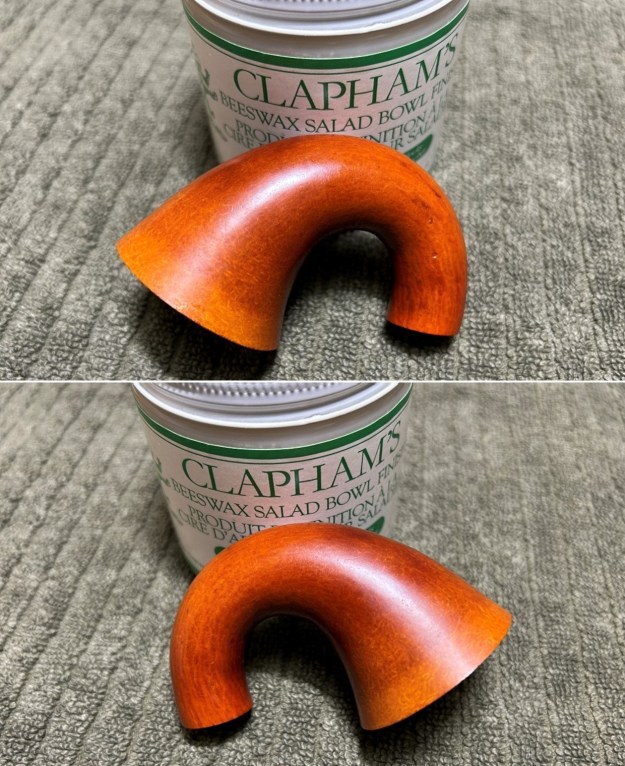
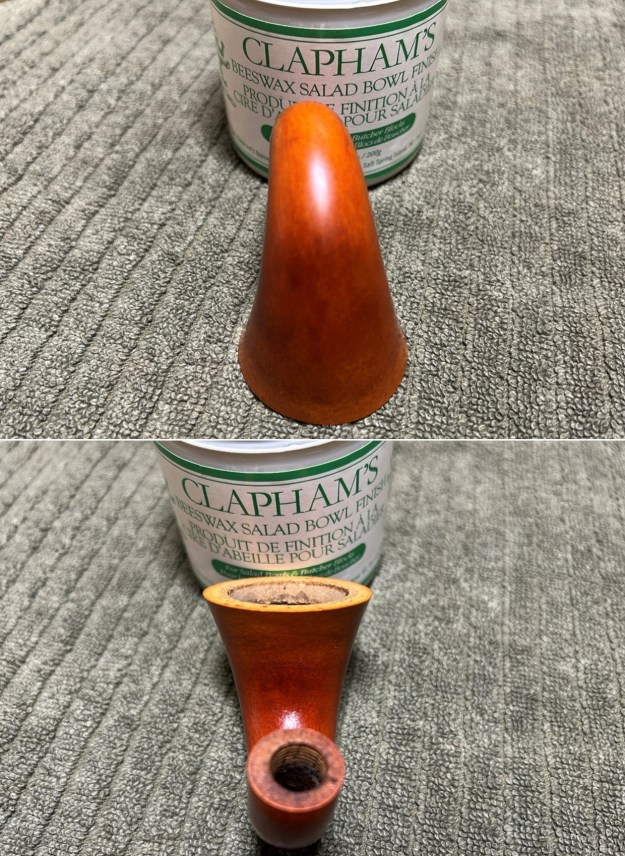
Last evening but for quitting for the night I decided to work on another pipe that I no longer know where or when we purchased it. It is another pipe from a large box of Meerschaum pipes that is sitting in my storage that I need to clean up and restore. I have honestly avoided them for years but now was the time to start my work on some of them. The one I chose was a Tall Billiard or almost a stack. It is a smooth meerschaum with what appears to be a Bakelite stem. It is a beautifully shaped meer with nicks and scratches from its journey and some nice patina developing around the shank and sides. The meer is very dirty from use with a thick cake in the bowl and an overflow of lava on the inner edge and rim top. The stem fit well against the shank end and had a threaded tenon in the shank that aligned with properly with the stem in place. The tenon was a Kaywoodie type threaded one that had been clipped. The stem was stamped OSMOND on the left side and the shank band has the marks of a repair band. On the underside of the name F. Wright was scratched into the surface but it was almost worn away. I took photos of the pipe before I started my clean up work on it. I took photos of the rim top and the stem to show the condition of the pipe when I brought it to the worktable. You can see the cake in the bowl and the build up of lava and debris on the edge and top of the rim top. It is another dirty pipe but still a charmer. The orifice button Bakelite taper stem has light chatter and deep tooth marks on both sides near the button. I took a photo of the stamping on the left side of the taper stem. It is clear and readable as noted above. I removed the stem from the shank and took a photo of the parts.I started my work on the bowl by reaming the thick cake out of the bowl. I started with a PipNet reamer and the 2nd and 3rd cutting heads to take back the cake to the walls of the bowl. I cleaned up the reaming with a Savinelli Fitsall Pipe Knife and scraped the rim top at the same time. I sanded the bowl walls with a piece of dowel wrapped with 220 grit sandpaper. Once finished it looked much better. I scrubbed the bowl and shank with undiluted Murphy’s Oil Soap and a tooth brush. I rinsed off the soap and debris with warm water and repeated the process until the pipe was clean. I dried it off with a soft towel. It really began to look better. I cleaned out the airway in the shank and mortise as well as in the stem with pipe cleaners (both bristle and regular). I used a brass bristle wire brush to further clean up the metal tenon. It was much better.I polished the meerschaum with micromesh sanding pads – dry sanding with 1500-12000 grit pads. I wiped the bowl down after each pad with a damp cotton cloth. The bowl took on a shine by the last pads. I gave the bowl multiple coats of Clapham’s Wax that blends both carnauba and beeswax in a soft wax. I rubbed the wax on the bowl sides and the shank end with my fingers and set it aside to dry. Once the wax cured I buffed the bowl with a clean buffing pad and then with a soft microfibre cloth. The bowl has a rich glow. I polished the polished nickel band with a jeweller’s cloth to clean and protect the finish and to remove the remaining oxidation and dullness. I set the bowl aside and turned my attention to the stem. I filled in the tooth marks with some clear CA glue. When it cured I flattened the repairs with a small flat file to blend them into the surface of the stem. I then sanded it with 220 grit sandpaper to smooth it out. I continued sanding the stem surface with 320-3500 grit 2×2 inch sanding pads. I wiped the stem down after each pad with a damp pad to remove the debris. By the end it was quite shiny and ready for polishing.I polished the stem with micromesh sanding pads – wet sanding it 1500-12000 pads. I wiped it down with a damp cloth after each pad to protect it and preserve it. I polished it with Before After Pipe Polish – both Fine and Extra Fine. I am really happy with the way that this Osman Meerschaum Tall Billiard with a Bakelite Stem turned out. It really is a beautiful looking pipe with a unique shape and smooth meerschaum bowl. The taper stem is really nice. The rich patina on the meerschaum came alive with waxing and buffing. I put the stem back on the bowl and carefully buffed the pipe with Blue Diamond on the buffing wheel. I gave the bowl and the stem multiple coats of beeswax/carnauba wax and buffed the pipe with a clean buffing pad to raise the shine. I hand buffed the pipe with a microfiber cloth to deepen the shine. The finished Osman Meerschaum Tall Billiard really is a beauty and feels great in the hand and looks very good. Give the finished pipe a look in the photos below. The dimensions of the pipe are Length: 6 ¼ inches, Height: 2 ¼ inches, Outside diameter of the bowl: 1 ½ inches, Chamber diameter: 1 inch. The weight of the pipe is 51 grams/1.80 ounces. The pipe will be going on the rebornpipes store soon. It will be in the Ceramic and Meerschaum Pipes Section if you would like to add it to your collection. Thanks for reading this blog and my reflections on the pipe while I worked on it. It was a fun one to work on!
New Life for a Malaga Second Diamond Shank bent billiard with a saddle stem


by Steve Laug

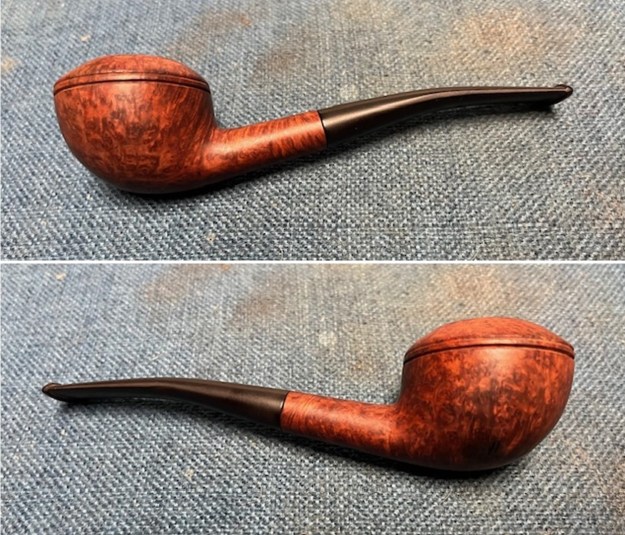
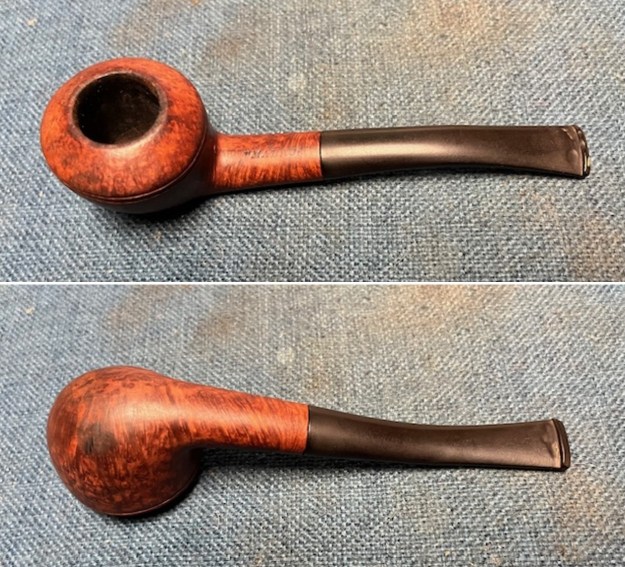
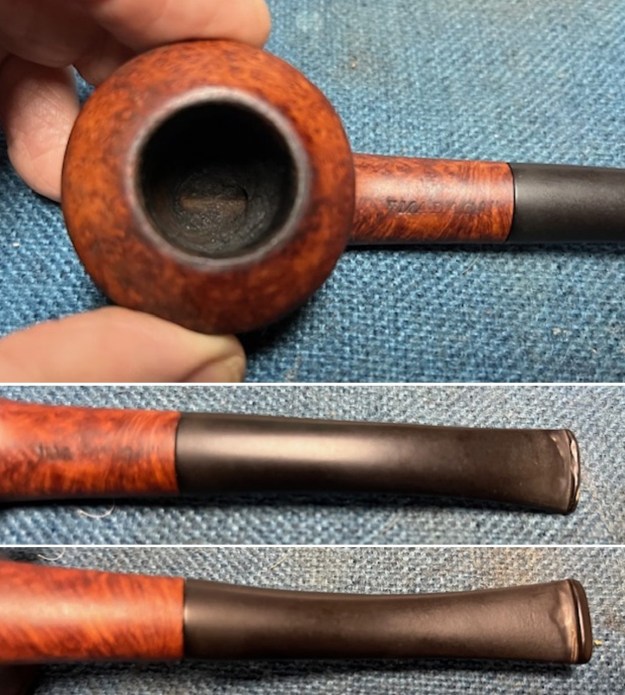
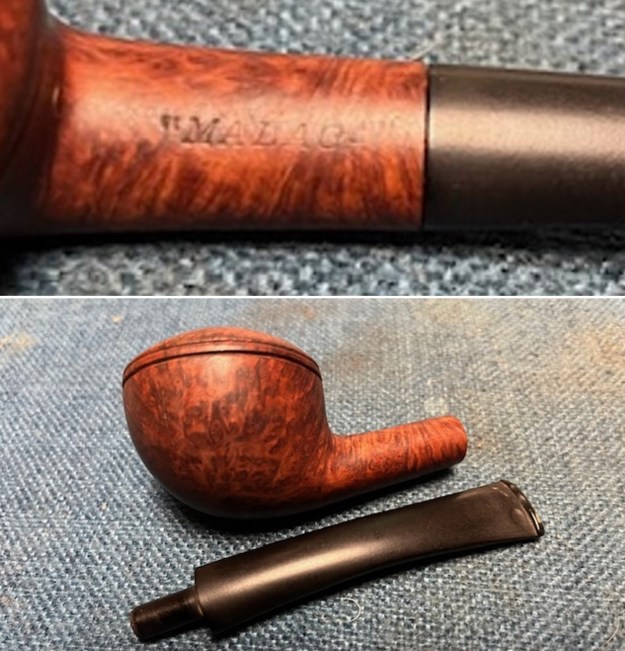
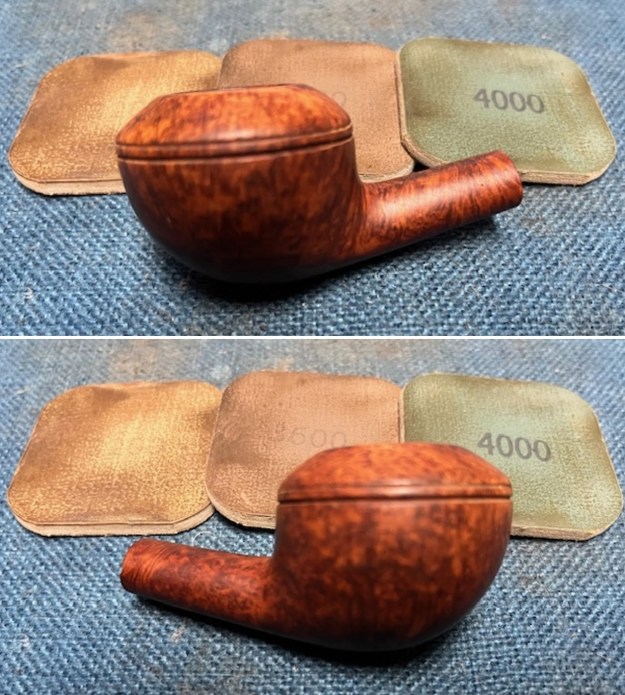
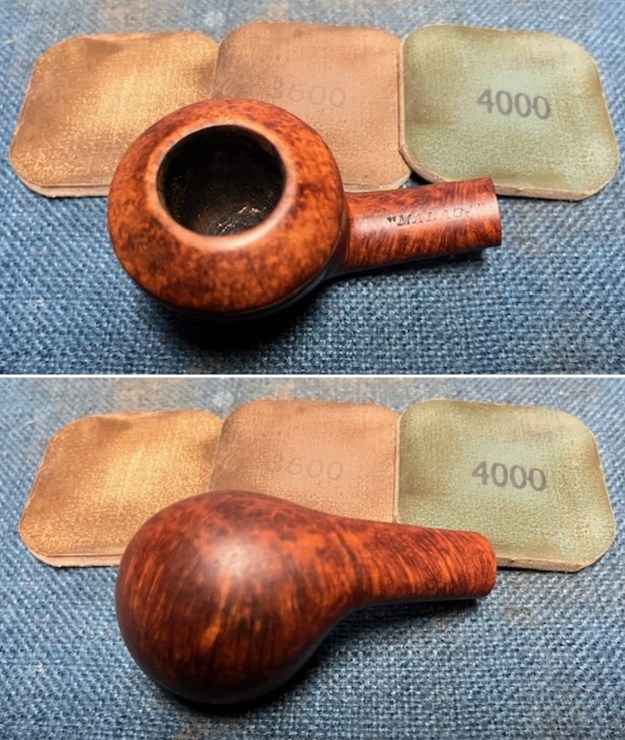
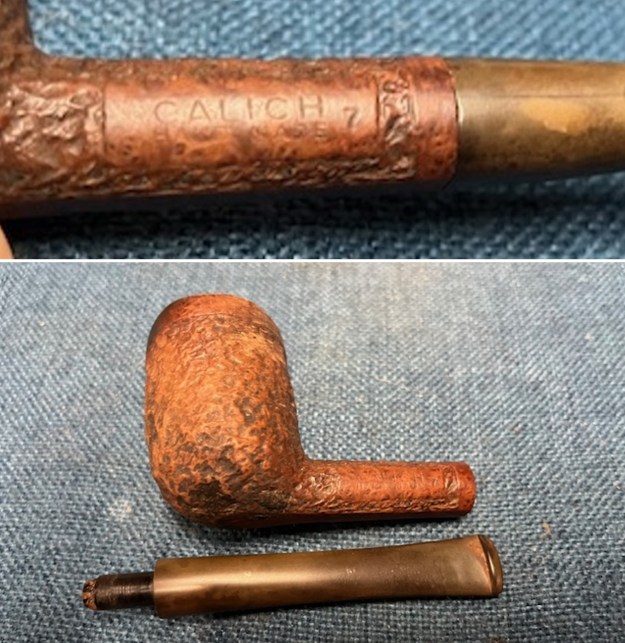
The next pipe on the table is a “Malaga” Second pipe that Jeff picked up from eBay early on 08/22/2024 from a seller in Harrison Township, Michigan, USA. It is an interesting looking octagonal Panel Billiard with a square shank.  It has the classic Malaga oil cured finish and some great looking grain around the bowl and shank. There are some sand pits on the sides of the bowl which are the only flaws I can see. The pipe is stamped on left side of the shank and reads MALAGA [over] Second. The carver did a great job of carving the pipe to capture the grain around the bowl and the diamond shank. The bowl had a heavy cake with an overflow of lava on the crowned rim top. The sides of the bowl and shank are very dirty with grime and oils ground into the finish from prolonged use. The vulcanite saddle stem was heavily oxidized and calcified. It had tooth dents and chatter on the top and the underside of the stem. Jeff took photos of the pipe before he started the cleanup work. With some work it will be a real beauty. I looked forward to seeing it in person.   Jeff took a close up photo of the bowl and rim to capture the condition of the pipe before he started the cleanup work. The bowl has a thick cake and the uneven overflow of lava on the rim top is quite thick all the way around. The inside edge of the rim could be damaged but it quite hidden under the lava coat. The stem is deeply oxidized, calcified and dirty and there is tooth chatter and marks on both sides of the stem ahead of the button. Jeff took photos of the sides and heel of the bowl to give a picture of what the briar looked like. There is some nice grain around the sides. You can also see the damage to the rim edges and the heel of the bowl in the photos below. He took a photo of the stamping on the left side of the diamond shank. It read as noted above. It is clear and readable.I am including the link to a blog that I wrote that gives some of the history of the Malaga brand and the Malaga Pipe Shop in Royal Oak, Michigan in the USA. I have written an earlier blog to give a little history of the Malaga Brand and the pipemaker, George Khoubesser. Here is the link – https://rebornpipes.com/tag/malaga-pipes/.That blog also includes links to a catalogue and the history of the pipemaker George Khoubesser. Follow the link to get a feel for the brand and the pipemaker.

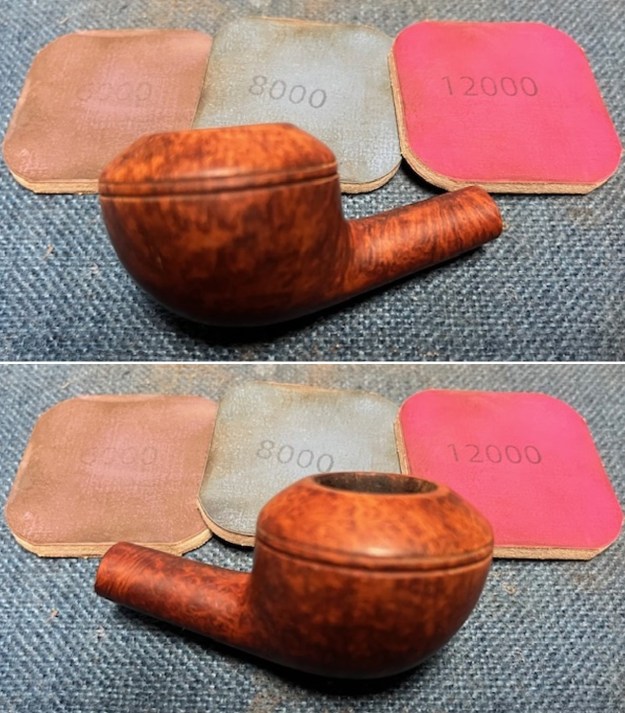
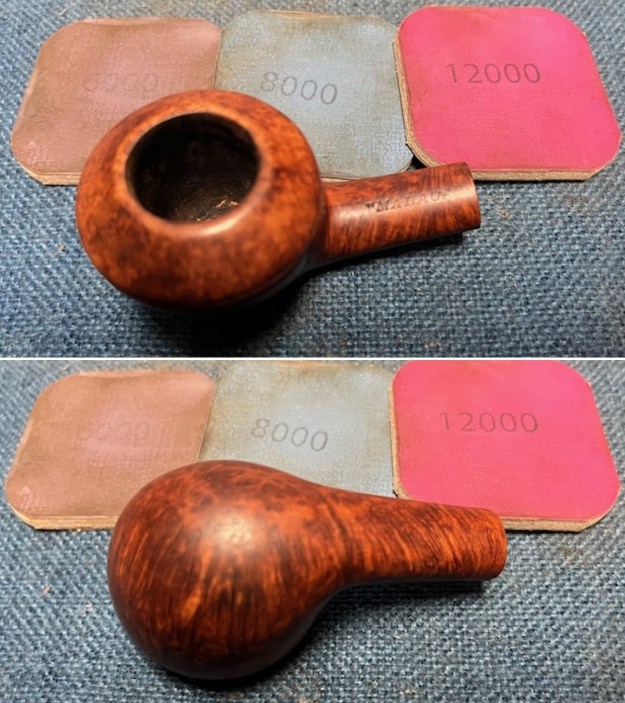
Jeff had cleaned up the pipe with his usual penchant for thoroughness. He reamed the pipe with a PipNet pipe reamer and removed the rest of it with a Savinelli Fitsall Pipe Knife.  He scrubbed the bowl with undiluted Murphy’s Oil Soap with a tooth brush. He rinsed it under running warm water to remove the soap and grime. He cleaned out the inside of the shank and the airway in the stem with alcohol, cotton swabs, shank brushes and pipe cleaners. He soaked the stem in Briarvilles Pipe Stem Deoxidizer and rinsed it off with warm water. I took photos of the pipe once I received it.  The rim top cleaned up really well. The rim top and outer edge of the bowl show some darkening over most of the surface. There is damage to the inner edge of the bowl and bowl is out of round. The stem surface looked very good with tooth marks and chatter on the top side and the underside near the button.The stamping on the top left side of the diamond shank is clear and readable. It reads as noted above. I removed the saddle stem and took a photo of the pipe to give a sense of the whole. I heated the stem with the flame of a lighter and gave a more dramatic bend to follow the flow of the curves of the briar.I sanded the bowl sides and rim top with 320-3500 grit 2×2 inch sanding pads. I wiped the bowl down with a damp cloth after each sanding pad. It began to look very good. I polished the briar with micromesh sanding pads – wet sanding with 1500-12000 grit pads and wiping it down after each pad with a damp cloth. I rubbed the bowl and shank down with Before & After Restoration Balm. I worked it into the surface of the bowl sides and shank with my fingertips to clean, enliven and protect the briar. I let the balm sit for 10-15 minutes and then buffed with a cotton cloth to raise the shine. The grain came alive and the finish looked rich. I set aside the bowl and turned my attention to the stem. I “painted” the surface of the stem with the flame of a Bic lighter to lift them as much as possible. I did the lifting of the marks at the same time I heated the stem to bend it. I filled in the remaining tooth dents and marks with rubberized Black CA Glue and set it aside for the repairs to cure. Once they cured I flattened them with small files. I cleaned up the repaired areas with 220 sandpaper to blend the repairs into the surface of the stem. I sanded the stem with 320-3500 grit 2 x 2 inch sanding pads and wiped it down with a damp cloth after each pad to remove the sanding debris. The stem began to take on a rich shine.I polished the vulcanite stem with micromesh sanding pads – 1500-12000 grit pads. I wiped it down with Obsidian Oil after each sanding pad. I used Before & After Pipe Polish – both Fine and Extra Fine to further polish the stem. This Malaga Second Diamond Shank Bent Billiard with a vulcanite saddle stem turned out to be a real beauty. The carver really maximized the grain with the shape of the pipe. I polished stem and the bowl with Blue Diamond polish on the buffing wheel and the finish just popped and came alive. I gave the bowl and the stem multiple coats of carnauba wax. I buffed the pipe with a clean buffing pad to raise the shine. I hand buffed it with a microfiber cloth to deepen the shine. The pipe polished up pretty nicely. The pipe took on life with the buffing. The rich oil cured colour works well with the polished black vulcanite stem. The finished Malaga Second Bent Billiard has a rich look that is quite catching. Have a look at it with the photos below. The shape, finish and flow of the pipe and stem are very well done. The dimensions are Length: 5 inches, Height: 1 ¾ inches, Outside diameter of the bowl: 1 ¼ inches, Chamber diameter: ¾ of an inch. The weight of the pipe was 44 grams/1.48 ounces. I will be putting it on the rebornpipes store shortly. Thanks for reading this blog and my reflections on the pipe while I worked on it. There are many more to come!

New Life for a Beautiful Ben Wade Royal Grain Freehand Hand Made in Denmark


by Steve Laug

The next pipe on the table is another pipe that was a beautiful freehand briar pipe. It came to us on 05/08/2024 from a seller in Santa Cruz, California, USA. The briar is a piece of smooth briar with a spot of plateau on the shank end. The rim top is smooth and the shank end included both smooth and plateau on the end of the shank. The pipe was stamped on the underside of the shank and read Ben Wade in script [over] Royal Grain [over] Hand Made [over] in [over] Denmark. The smooth finish was very dirty and had oils and grime ground into the briar. There was a thick cake in the bowl and lava on the rim top and inner edge of the bowl. The stem was oxidized and had deep teeth marks on the top and the bottom of the stem near the button edge. Jeff took photos to below show what the pipe looked like when he received it. Jeff took photos of the bowl, rim top and the stem to show the condition of the pipe when we received it. You can see the cake in the bowl and the lava on the rim top and inner edge of the bowl. The stem was dirty and had chatter and tooth marks on both sides near the button. He took photos of the sides of the bowl and the heel to give an idea of the shape and the condition of the briar around the bowl. It really is a nicely shaped pipe that has the classic look of a Freehand carved by Preben Holm. The next photo Jeff took shows the stamping on the underside of the shank. The stamping is clear and readable as noted above.I turned to PipePhil’s site and went through the listings under Preben Holm and Ben Wade. There was nothing in either section that had information on the Royal Grain stamping. So the mystery remained. I turned to Pipedia to see if there was anything listed with the Royal Grain stamp (https://pipedia.org/wiki/Ben_Wade#Ben_Wade_turns_Danish). There was nothing listed on the stamping in the text of the article. However, I did find a photo of the shank stamp and one of a freehand pipe with that stamping. It is a beautiful smooth freehand and like the one I am working on. Now it was time to work on the pipe. Jeff had cleaned up the pipe following his normal cleaning process. In short, he reamed the bowl with a PipNet pipe reamer and then cleaned up the reaming with a Savinelli Fitsall Pipe Knife. He scrubbed the exterior of the bowl with undiluted Murphy’s Oil Soap with a tooth brush. He worked over the lava and debris on the plateau rim top and shank end and was able to remove it. He rinsed it under running warm water to remove the soap and grime. He cleaned out the inside of the shank and the airway in the stem with alcohol, cotton swabs, shank brushes and pipe cleaners. He scrubbed the stem with Soft Scrub and cotton pads to remove the debris and oils on the stem. He soaked it in Briarville’s Pipe Stem Deoxidizer to remove the remaining oxidation. He rinsed it with warm water and dried it off. I took photos of the pipe once I received it. It looked much better at this point. I took close up photos of the stem and the rim top to show both how clean they were and what needed to be addressed with both. The rim top and bowl look good. The stem looked better and the tooth marks and chatter were still present. I would need to remove those to bring the stem back.I took a photo of the stamping on the underside of the shank. It is clear and readable as noted above. I removed the stem from the bowl and took a photo of the parts to give a sense of the beauty of the pipe. I started my work on the pipe by sanding the bowl and shank with 320-3500 grit 2 x2 inch sanding pad. I wiped the bowl down after each sanding pad with a damp cloth. The grain began to show through the finish. I polished the bowl and shank with 1500-12000 grit micromesh sanding pads. I wiped the bowl down after each sanding pad with a damp cloth. The pipe is beginning to look very good. I worked some Before & After Restoration Balm into the surface of the briar with my finger tips and a horse hair shoe brush to get into the crevices of the plateau portions. The product is incredible and the way it brings the grain to the fore is unique. It works to clean, protect and invigorate the wood. I worked some Before & After Restoration Balm into the surface of the briar with my finger tips and a horse hair shoe brush to get into the crevices of the plateau portions. The product is incredible and the way it brings the grain to the fore is unique. It works to clean, protect and invigorate the wood. I set the bowl aside and started working on the stem. I “painted” the tooth marks with the flame of a lighter to lift them. It worked well and what was left I filled in with black, rubberized CA glue. Once it cured, I used some small flat files to flatten out the repairs. I cleaned up the flattened spots with a folded piece of 220 grit sandpaper to finish blending it into the surface of the stem. I sanded the stem with 320-3500 grit 2×2-inch sanding pads. I wiped the stem down after each sanding pad with an Obsidian Oil cloth. I polished the stem with micromesh sanding pads – dry sanding it 1500-12000 pads. I wiped it down with Obsidian after each pad to remove the dust and polishing debris. I polished it with Before After Pipe Polish – both Fine and Extra Fine. I gave it another coat of Obsidian Oil. I am happy with the way that this Preben Holm made Ben Wade Royal Grain Hand Made Freehand turned out. It really is a beautiful looking pipe with a great shape and mix of smooth and plateau on the rim top and shank end. The rugged plateau on the rim top and shank end are beautiful. The fancy original vulcanite saddle stem works well with the black and brown of the stained mystery wood. The pipe really came alive with the buffing. The rich stains of the finish gave the pipe a sense of depth with the polishing and waxing. I put the stem back on the bowl and carefully buffed the pipe with Blue Diamond on the buffing wheel using a light touch on the briar. I gave the bowl and the stem multiple coats of carnauba wax on the buffing wheel. I buffed the pipe with a clean buffing pad to raise the shine. I hand buffed the pipe with a microfiber cloth to deepen the shine. The finished Ben Wade Royal Grain Hand Made in Denmark Freehand really is a beauty and feels great in the hand and looks very good. Give the finished pipe a look in the photos below. The dimensions of the pipe are Length: 7 ½ inches, Height: 2 inches, Outside diameter of the bowl: 2 inches wide x 2 ½ inches long, Chamber diameter: 1 inch. The weight of the pipe is 67 grams/2.33 ounces. The pipe will be going on the rebornpipes store in the Danish Pipe Makers Section if you would like to add it to your collection. Thanks for reading this blog and my reflections on the pipe while I worked on it. It was a fun one to work on!
Restoring a Mystery Made in Denmark Freehand


by Steve Laug

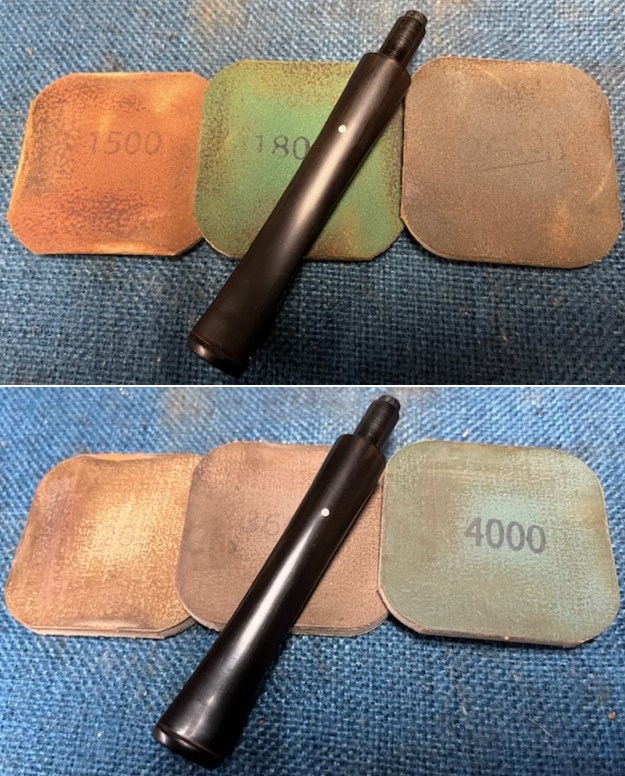
This particular smooth Freehand pipe was purchased on 05/01/2022 from an antique store in Bozeman, Montana, USA. It is a bit of a mystery Freehand that combines a plateau rim top and shank end with a smooth bowl and shank. It is stamped on the left side of the shank and reads Made in Denmark. That is the first part of the mystery – Made in Denmark by who? The second part is the wood of the pipe. It does not feel like briar and is very light and oddly grained. I am truly unclear as to the wood. The dark finish is dirty and spotty with shiny varnish on the plateau on the shank end and rim top. The pipe had a thick cake in the bowl and a lava overflow in the plateau rim top and inner edge of the bowl. There was grime ground into the smooth finish and dust and debris in the plateau valleys on the top and the shank end. The fancy vulcanite saddle stem was heavily oxidized, calcified and had some deep tooth marks and chatter on both sides ahead of the button. The pipe must have been a great smoker judging from the condition it came it. Jeff took photos of the pipe before he started his work on it. Jeff took photos of the bowl, rim top and the stem to show the condition of the pipe when we received it. You can see the cake in the bowl and the lava on the plateau rim top and inner edge of the bowl. The stem was dirty and had chatter and tooth marks on both sides near the button. He took photos of the sides of the bowl and the heel to give an idea of the shape and condition of the wood around the bowl. As you look at it do you have any ideas on what the wood is? Please let me know. It really is a nicely shaped pipe that has the classic look of a Danish Freehand. The next photo Jeff took shows the stamping on the left side of the shank. The stamping is faint in places but still readable as noted above. Jeff had cleaned up the pipe following his normal cleaning process. In short, he reamed the bowl with a PipNet pipe reamer and then cleaned up the reaming with a Savinelli Fitsall Pipe Knife. He scrubbed the exterior of the bowl with undiluted Murphy’s Oil Soap with a tooth brush. He worked over the lava and debris on the plateau rim top and shank end and was able to remove it. He rinsed it under running warm water to remove the soap and grime. He cleaned out the inside of the shank and the airway in the stem with alcohol, cotton swabs, shank brushes and pipe cleaners. He scrubbed the stem with Soft Scrub and cotton pads to remove the debris and oils on the stem. He soaked it in Briarville’s Pipe Stem Deoxidizer to remove the remaining oxidation. He rinsed it with warm water and dried it off. I took photos of the pipe once I received it. It looked much better at this point. I took close up photos of the stem and the rim top to show both how clean they were and what needed to be addressed with both. The rim top and bowl look good. The stem looked better and the tooth marks and chatter were still present. I would need to remove those to bring the stem back.I took a photo of the stamping on the left side of the shank. You can see from the photo that it is faint but readable. It is clearer on the top half of the stamp than the lower but it is still readable. I removed the stem from the bowl and took a photo of the parts to give a sense of the beauty of the pipe. I also took a photo of the plateau on the rim top and shank end. I started my work on the pipe by wiping down the bowl and shank with acetone on a cotton pad to remove the heavy dark stain and release the grain through the more transparent stain on the finish. I sanded the bowl and shank with 320-3500 grit 2 x2 inch sanding pad. I wiped the bowl down after each sanding pad with a damp cloth. The grain began to show through the finish. I polished the bowl and shank with 1500-12000 grit micromesh sanding pads. I wiped the bowl down after each sanding pad with a damp cloth. The pipe is beginning to look very good. I worked some Before & After Restoration Balm into the surface of the briar with my finger tips and a horse hair shoe brush to get into the crevices of the plateau portions. The product is incredible and the way it brings the grain to the fore is unique. It works to clean, protect and invigorate the wood. I set the bowl aside and started working on the stem. I filled in the tooth and chatter marks with black, rubberized CA glue. Once it cured, I used some small flat files to flatten out the repairs. I cleaned up the flattened spots with a folded piece of 220 grit sandpaper to finish blending it into the surface of the stem. I sanded the stem with 320-3500 grit 2×2-inch sanding pads. I wiped the stem down after each sanding pad with an Obsidian Oil cloth. I polished the stem with micromesh sanding pads – dry sanding it 1500-12000 pads. I wiped it down with Obsidian after each pad to remove the dust and polishing debris. I polished it with Before After Pipe Polish – both Fine and Extra Fine. I gave it another coat of Obsidian Oil. I am happy with the way that this unique wood Made in Denmark Freehand turned out. It really is a beautiful looking pipe with a great shape and mix of smooth and plateau on the rim top and shank end. The rugged plateau on the rim top and shank end are beautiful. The fancy original vulcanite saddle stem works well with the black and brown of the stained mystery wood. The pipe really came alive with the buffing. The rich stains of the finish gave the pipe a sense of depth with the polishing and waxing. I put the stem back on the bowl and carefully buffed the pipe with Blue Diamond on the buffing wheel using a light touch on the briar. I gave the bowl and the stem multiple coats of carnauba wax on the buffing wheel. I buffed the pipe with a clean buffing pad to raise the shine. I hand buffed the pipe with a microfiber cloth to deepen the shine. The finished Made in Denmark Freehand really is a beauty and feels great in the hand and looks very good. Give the finished pipe a look in the photos below. The dimensions of the pipe are Length: 7 ¾ inches, Height: 2 ½ inches, Outside diameter of the bowl: 1 ½ inches wide x 2 ¼ inches long, Chamber diameter: 7/8 of an inch. The weight of the pipe is 65 grams/2.26 ounces. The pipe will be going on the rebornpipes store in the Danish Pipe Makers Section if you would like to add it to your collection. Thanks for reading this blog and my reflections on the pipe while I worked on it. It was a fun one to work on!