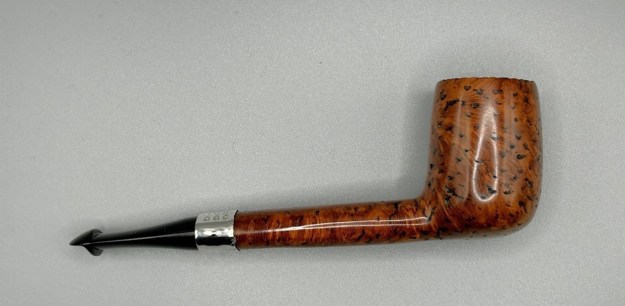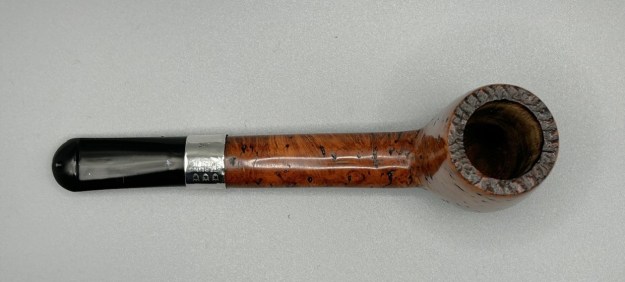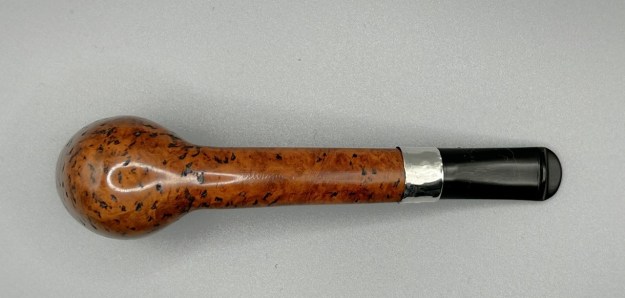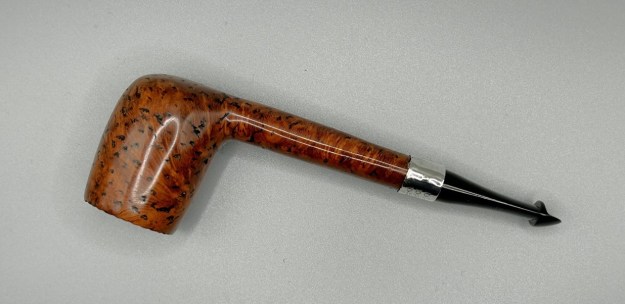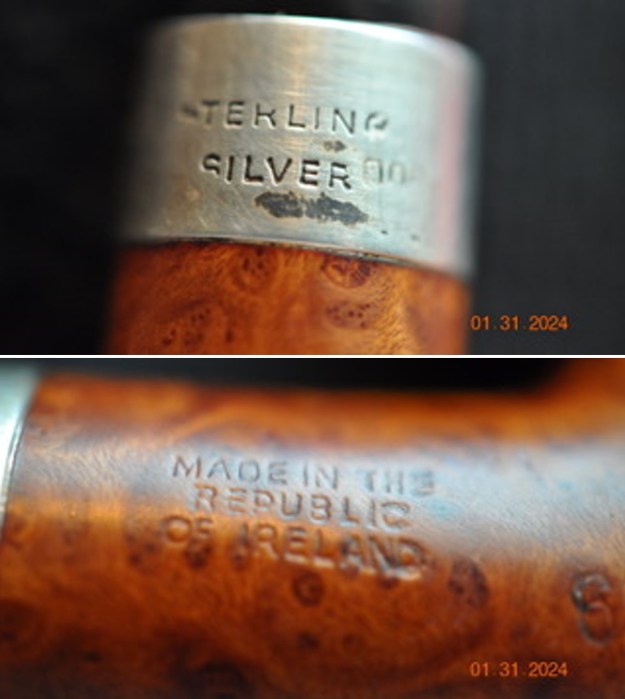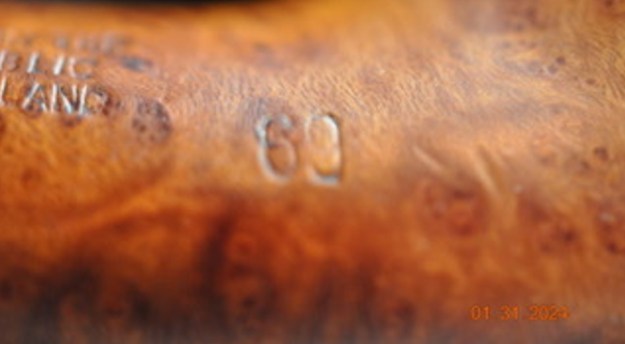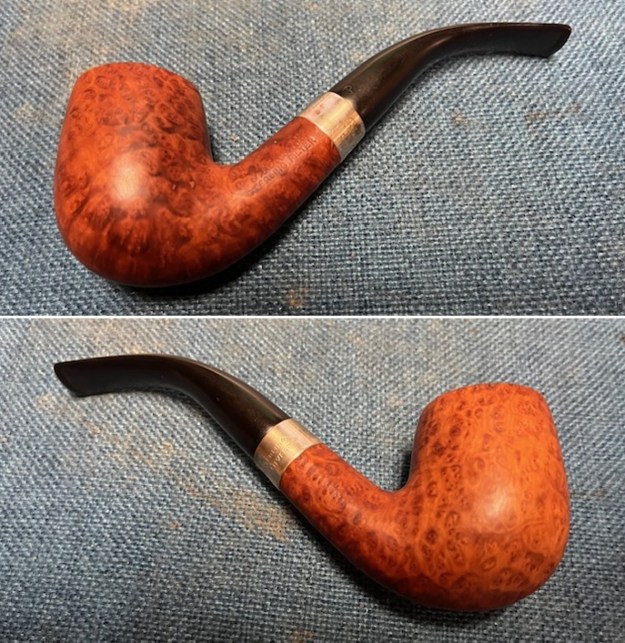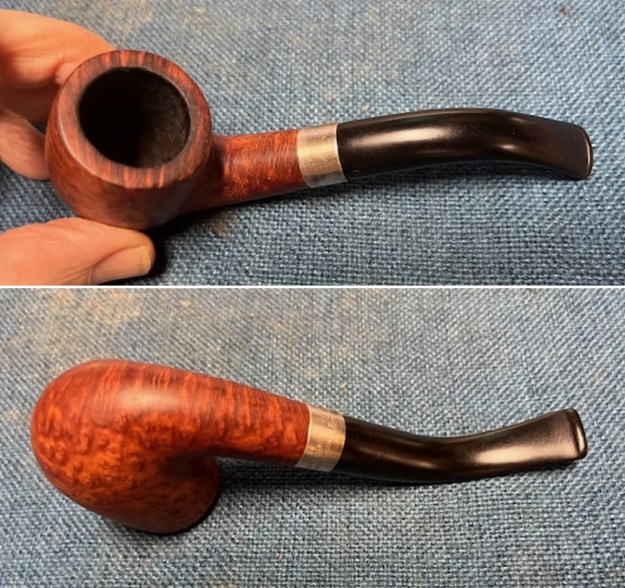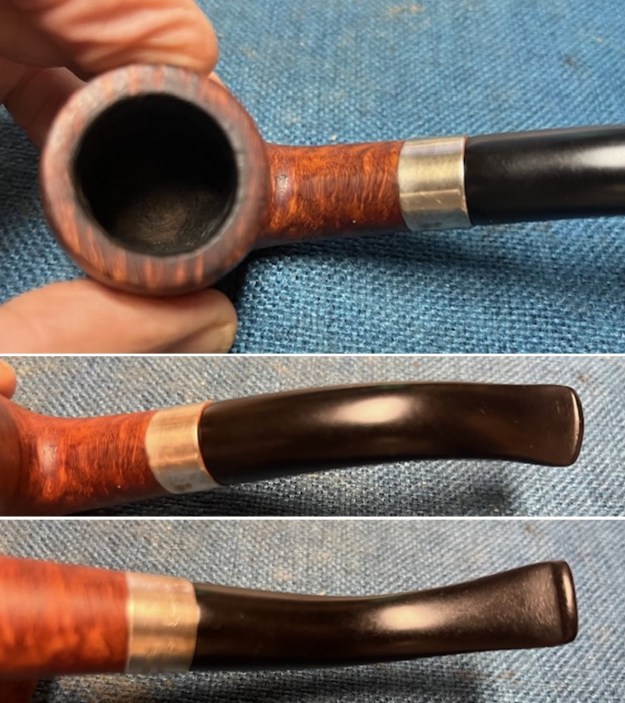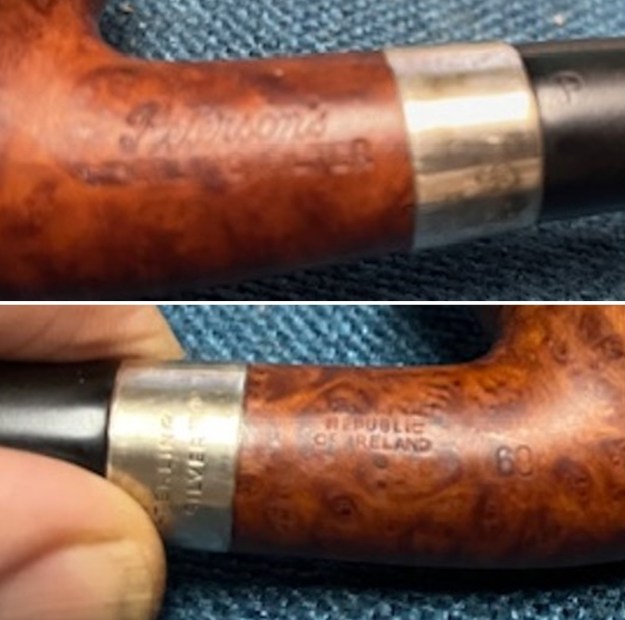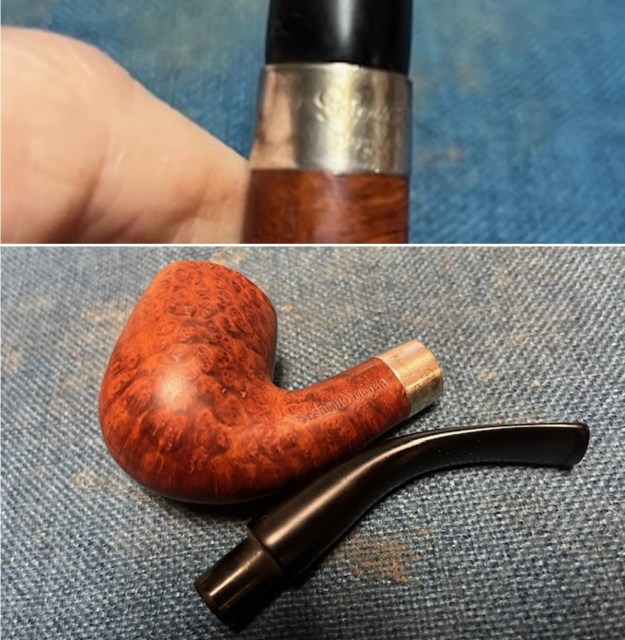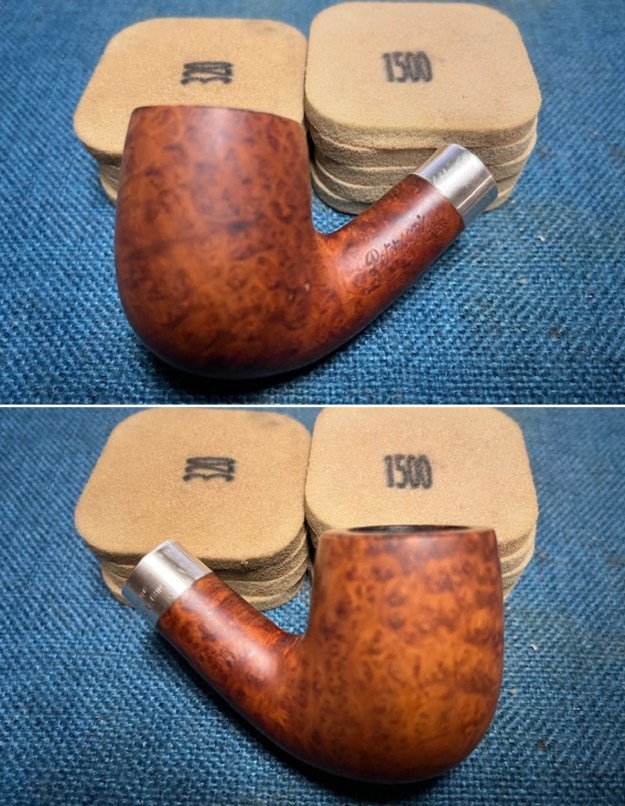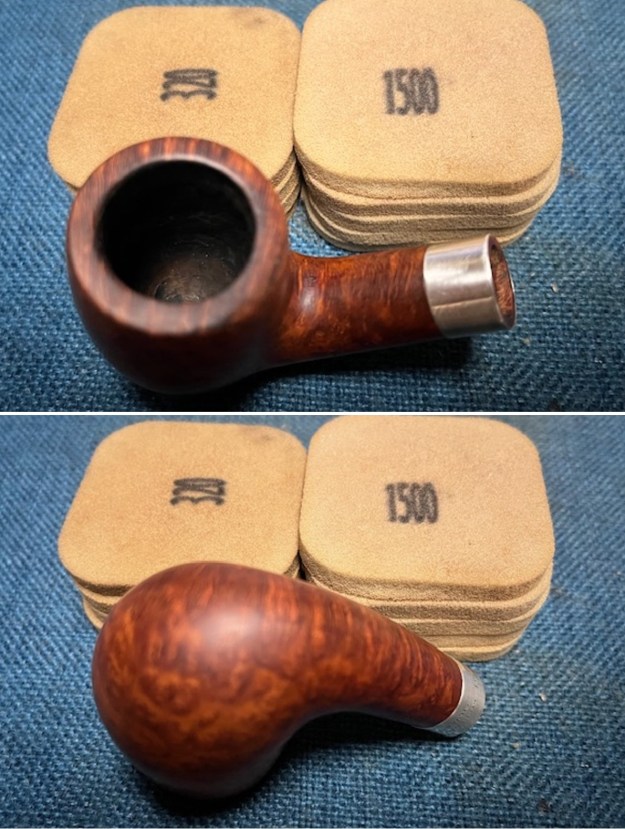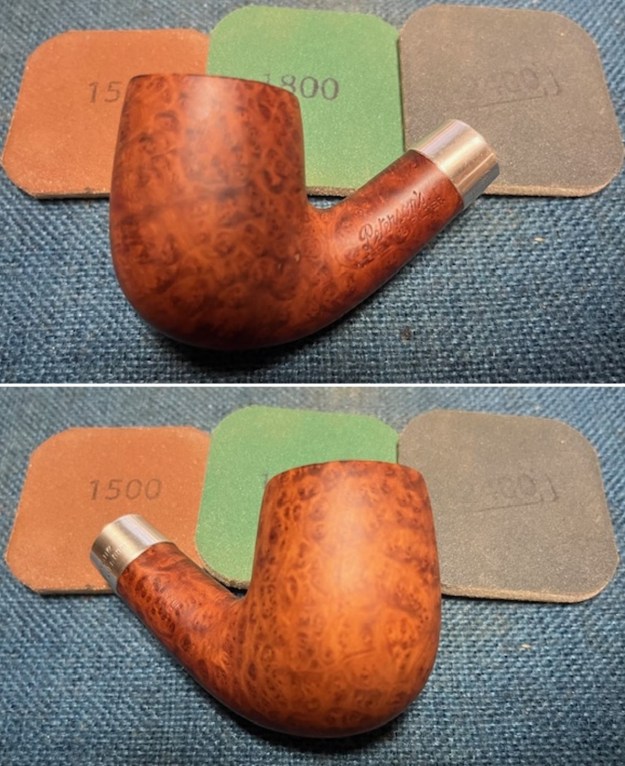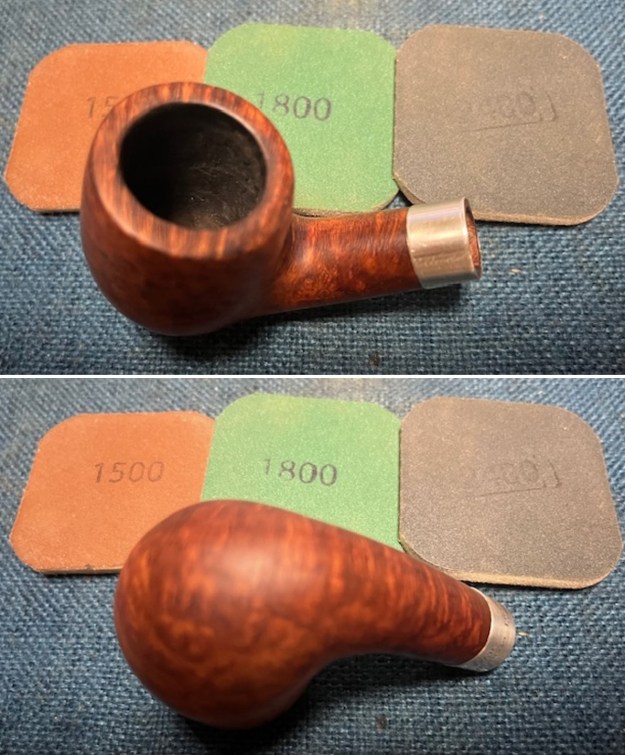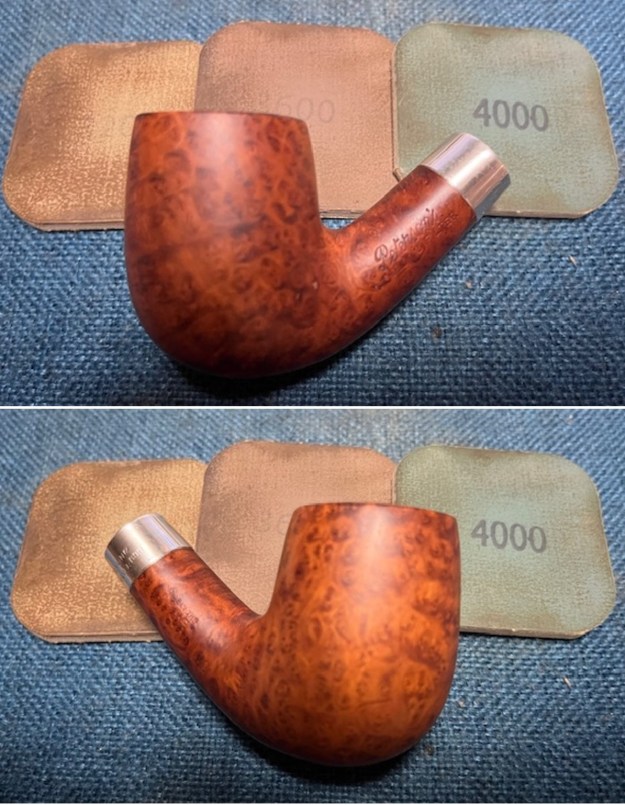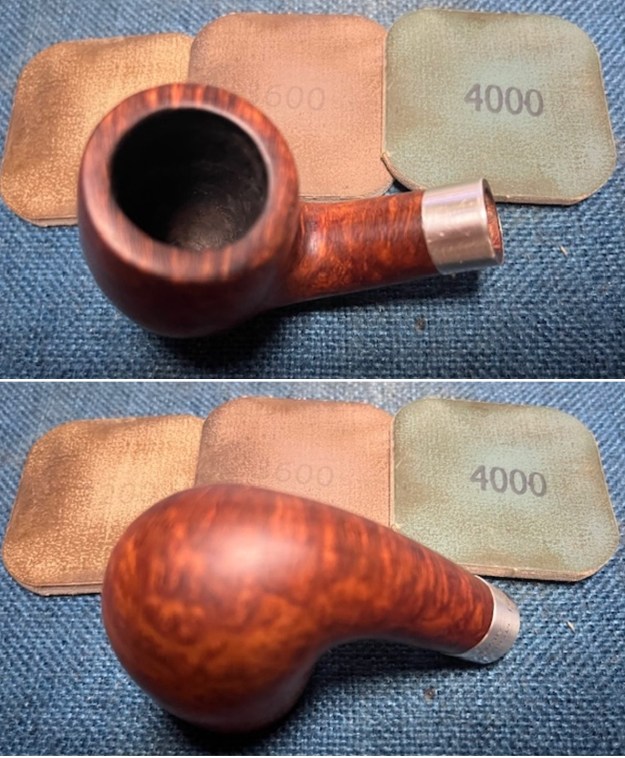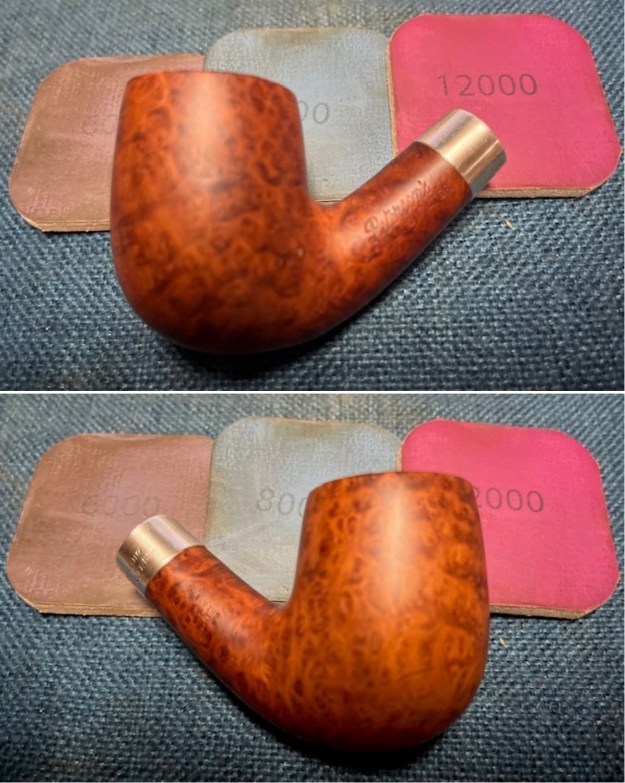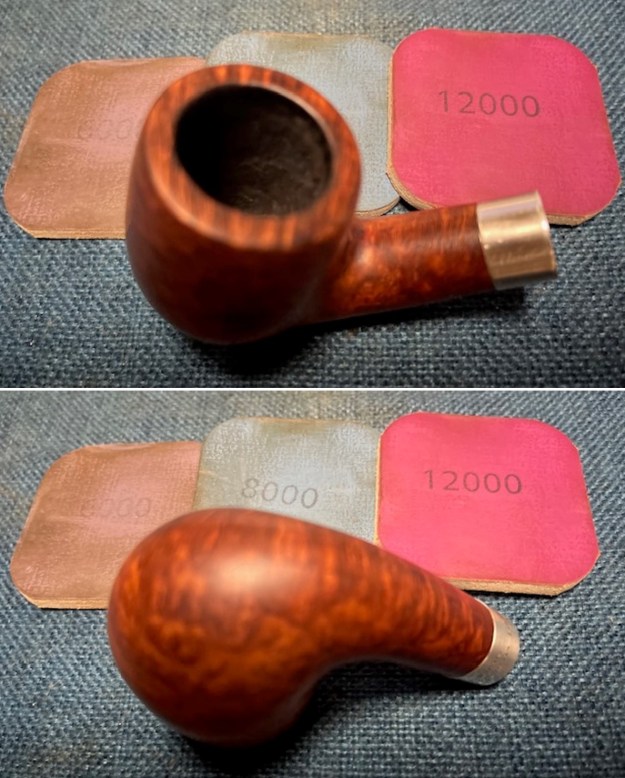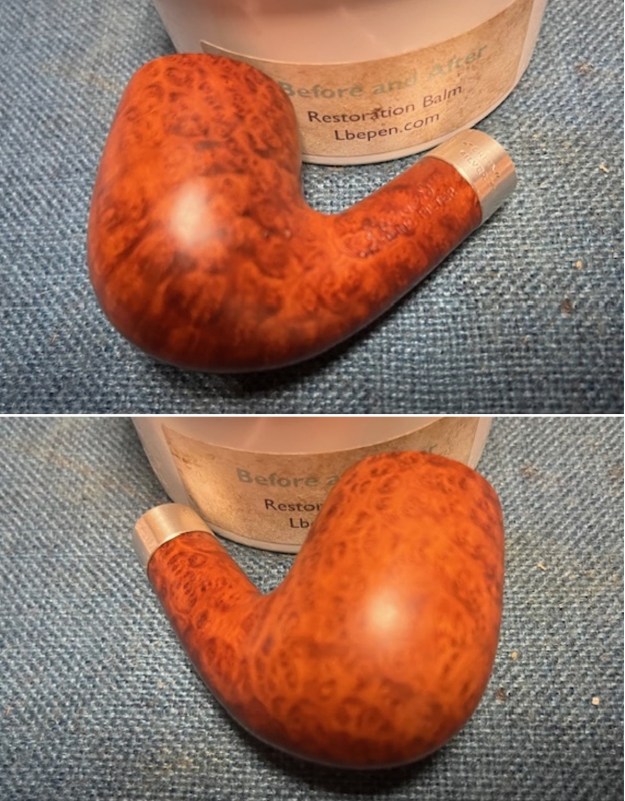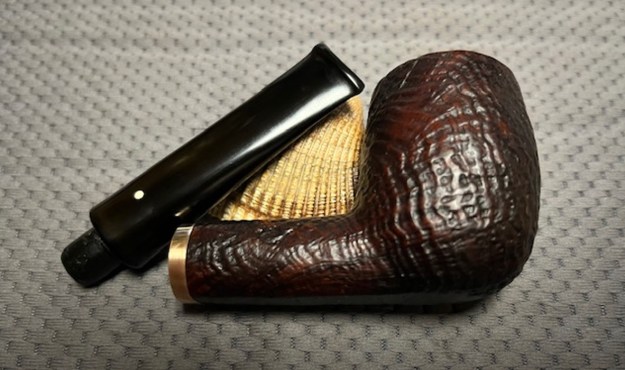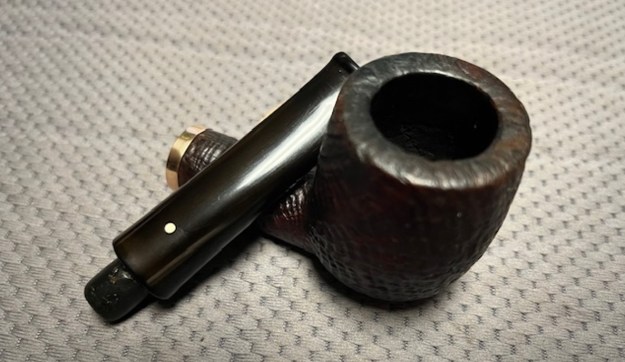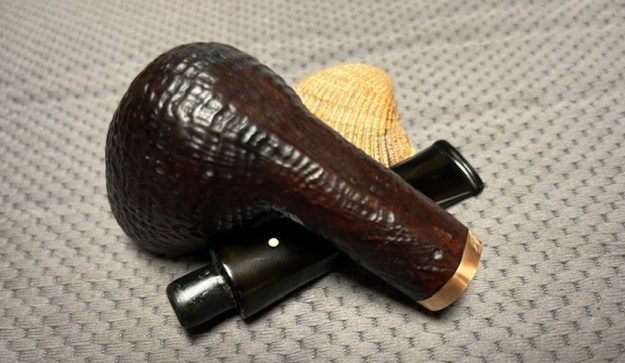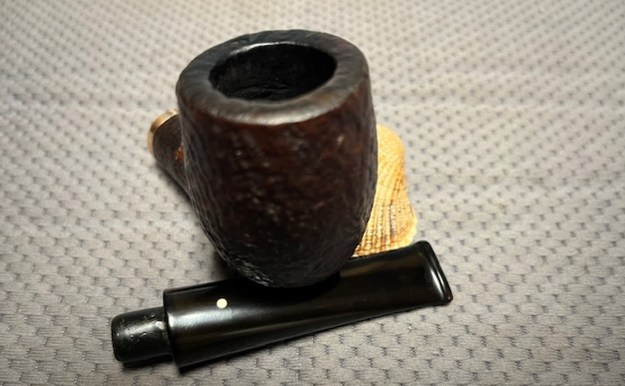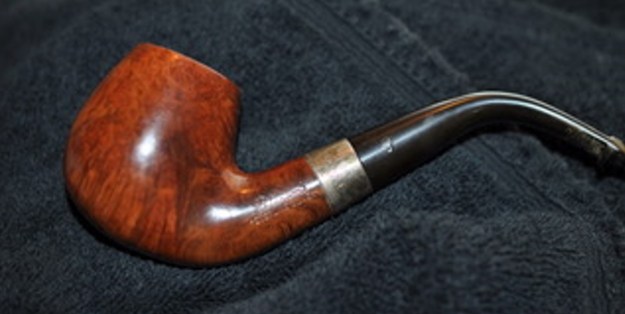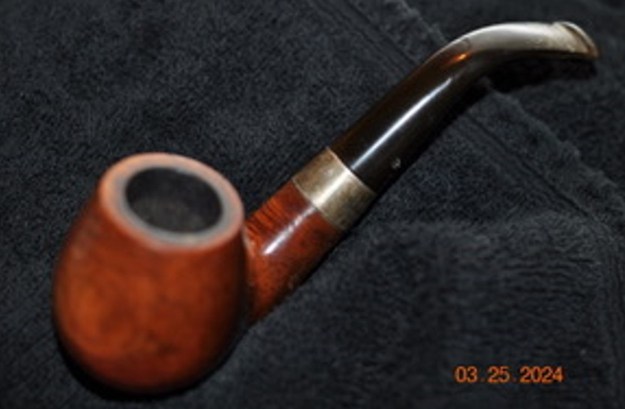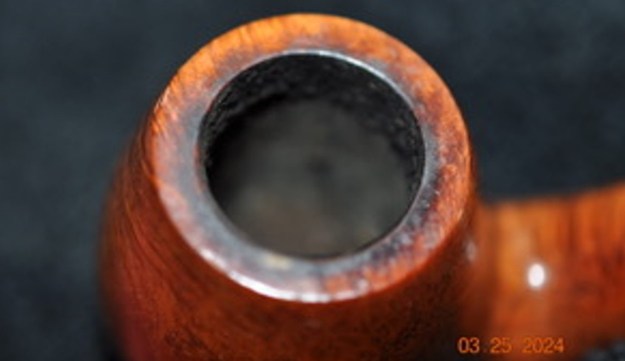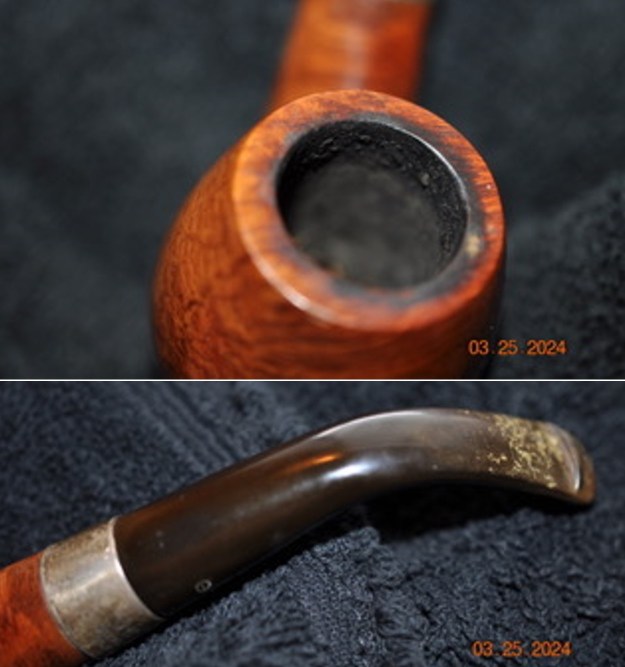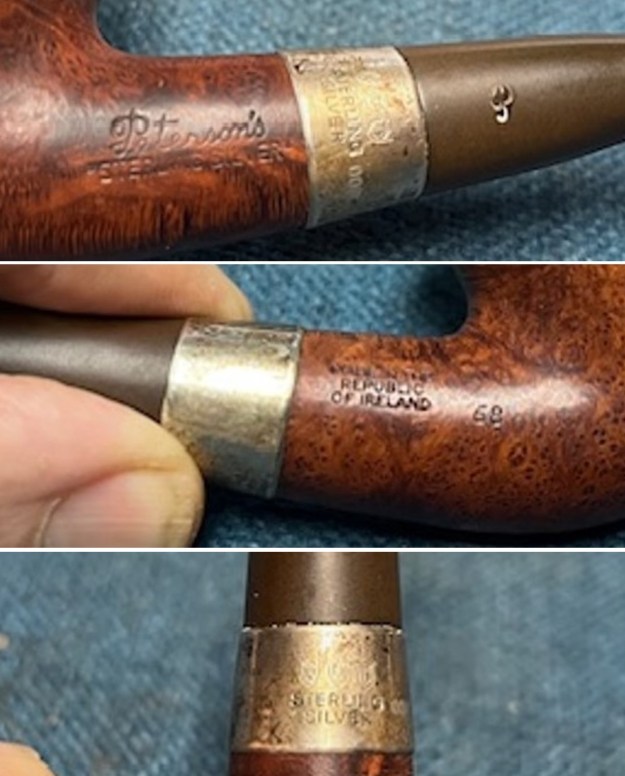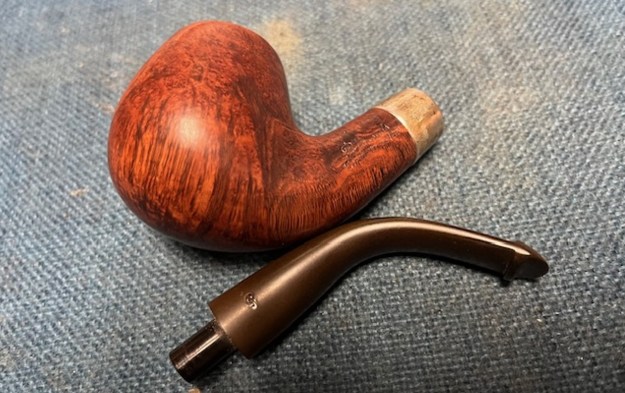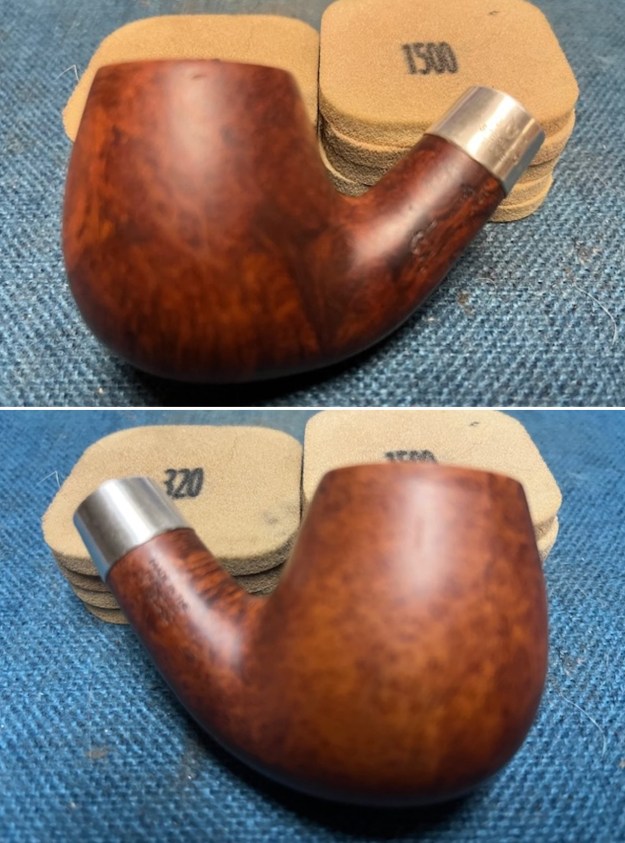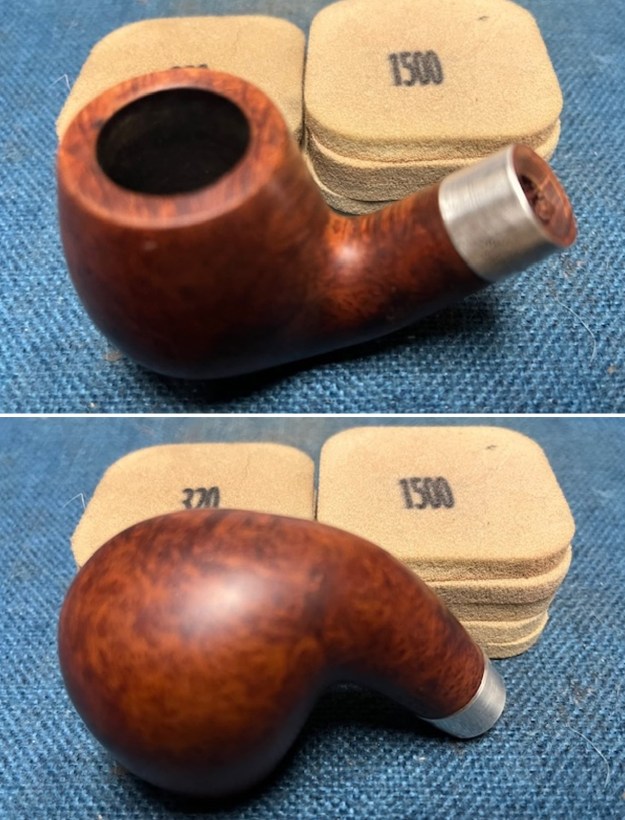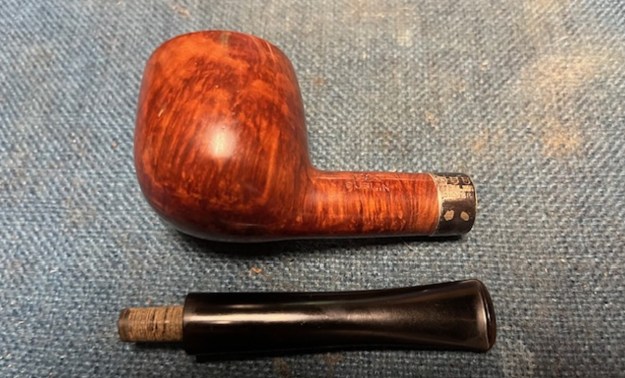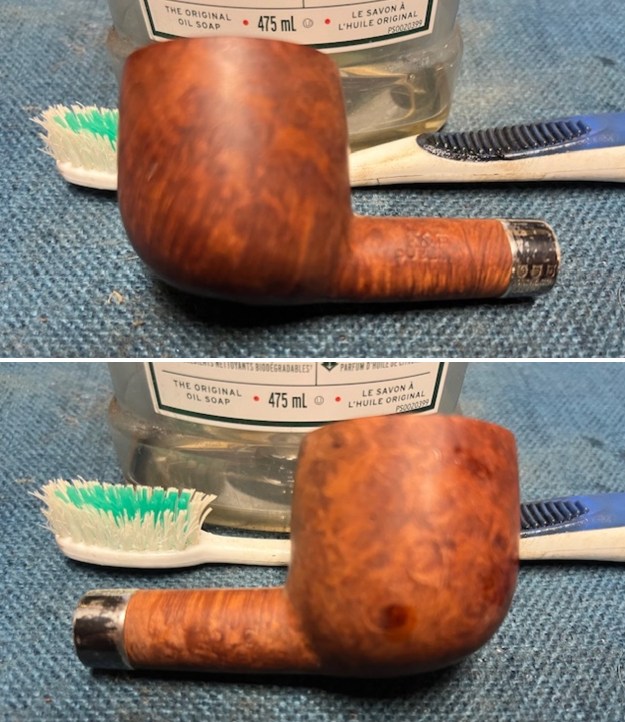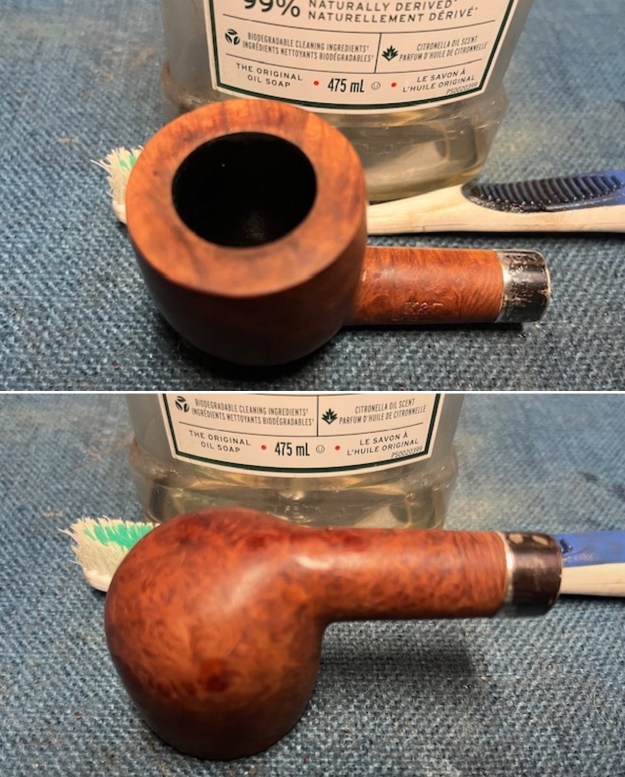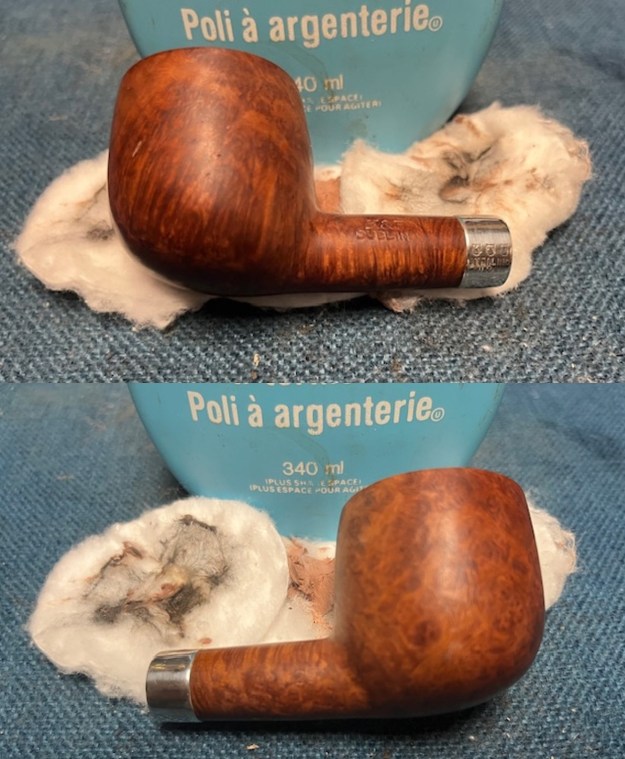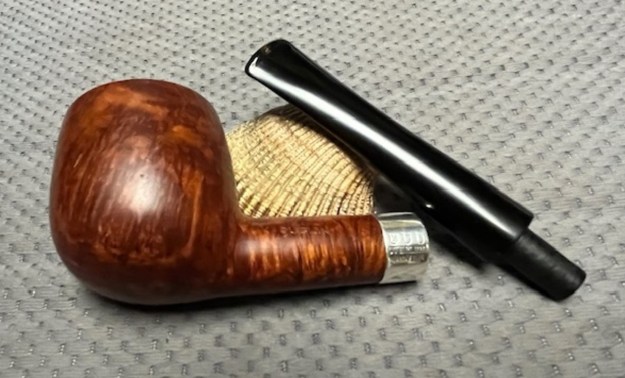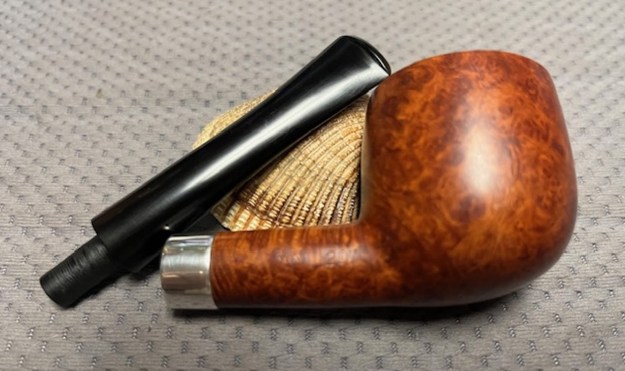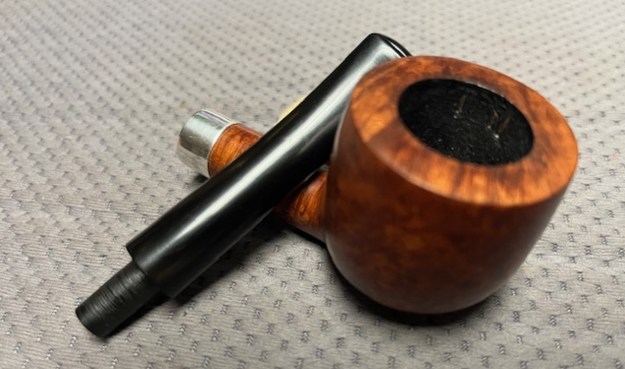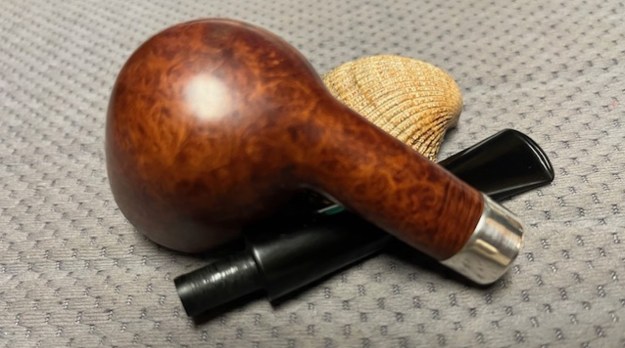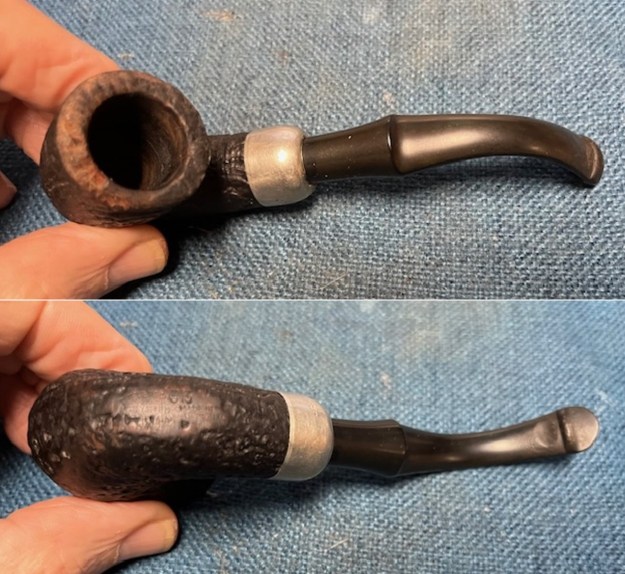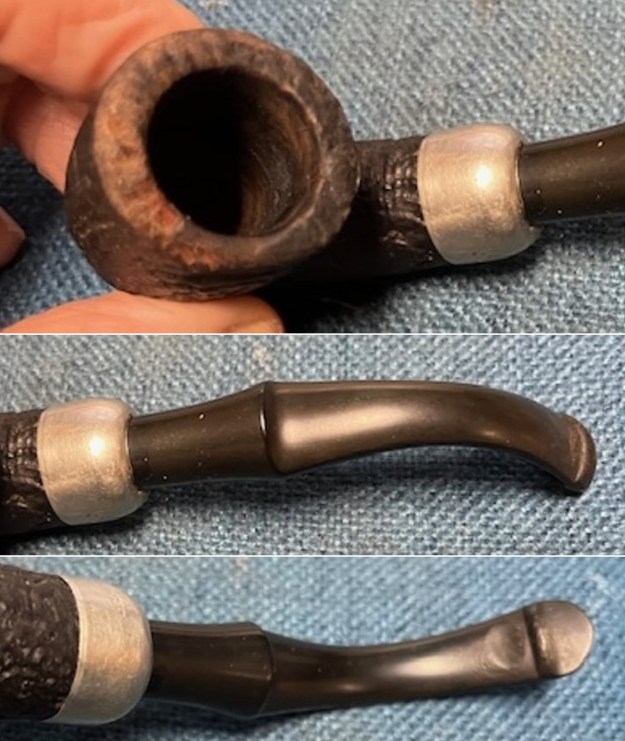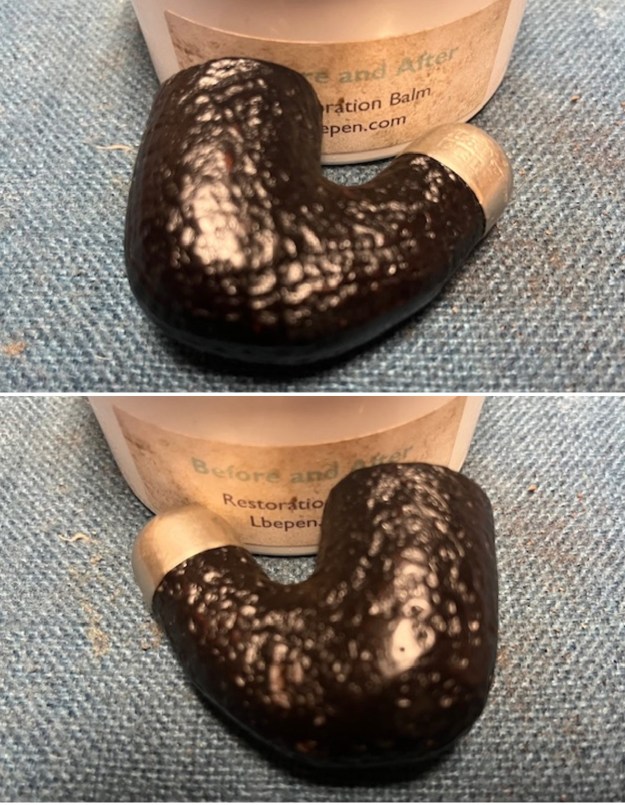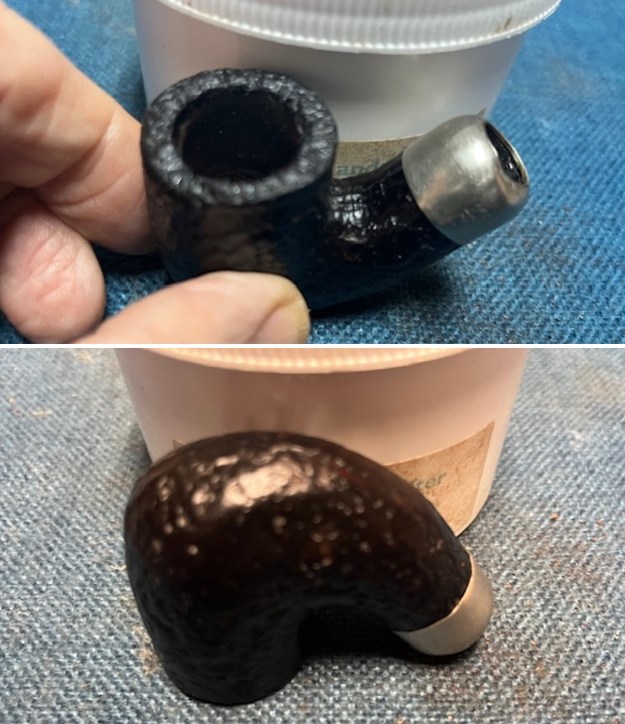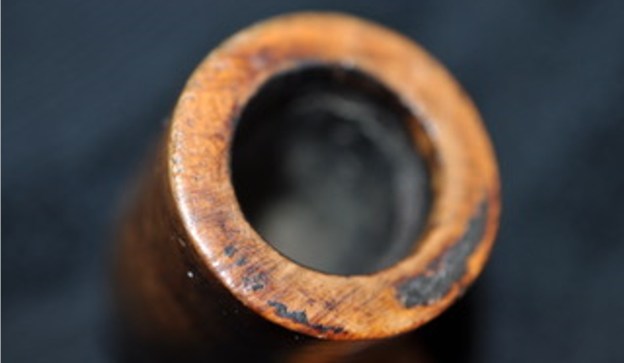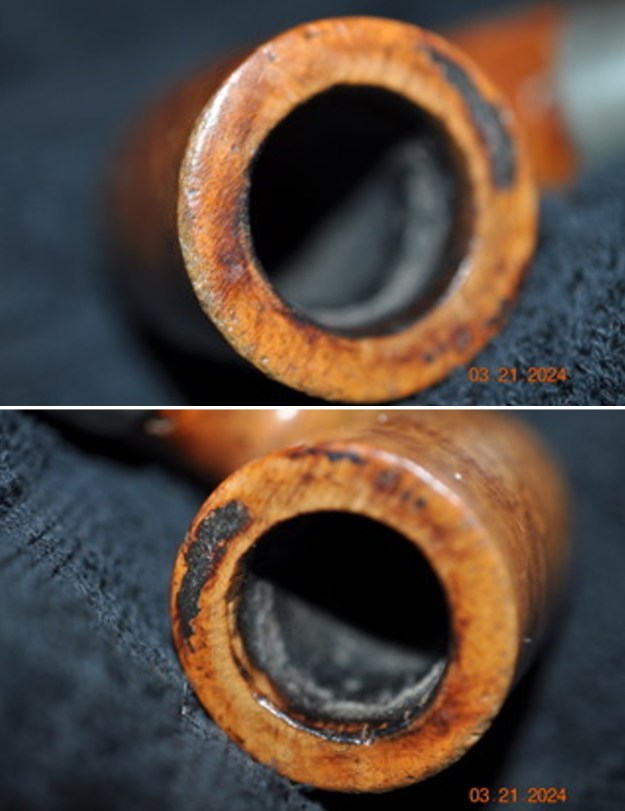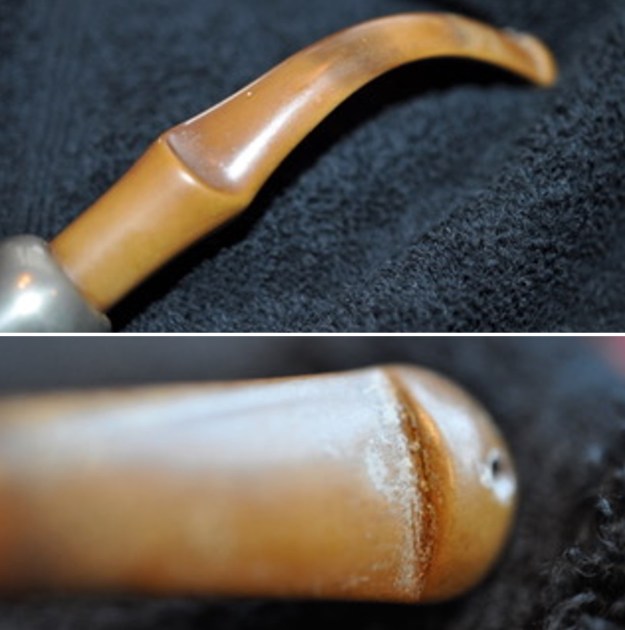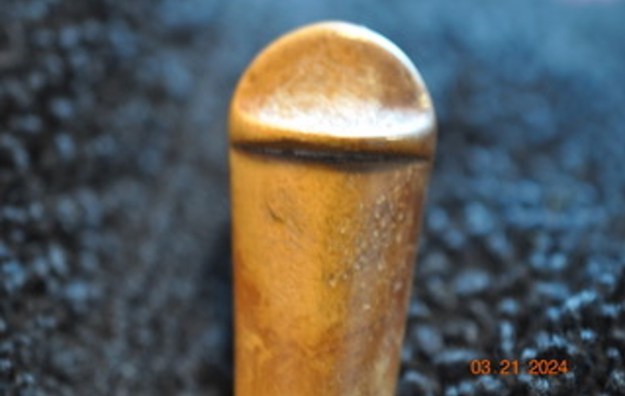
Tag Archives: removing oxidation

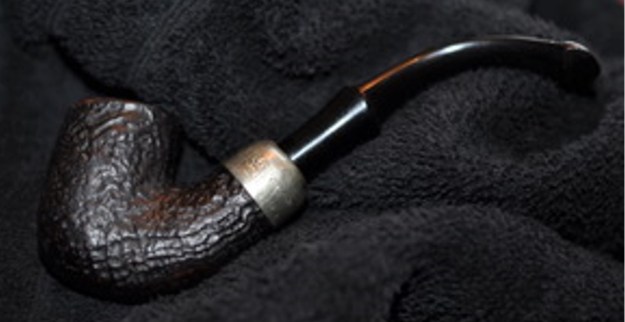
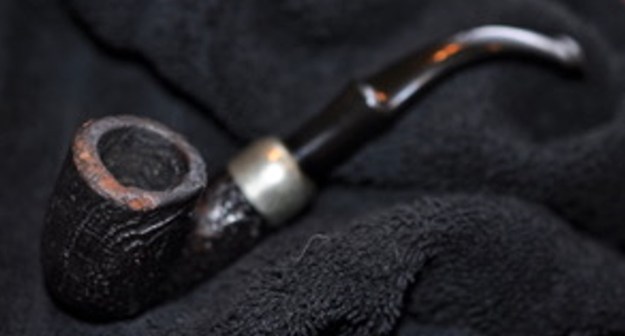
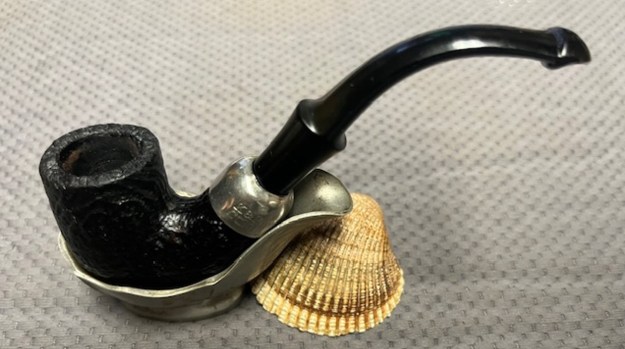
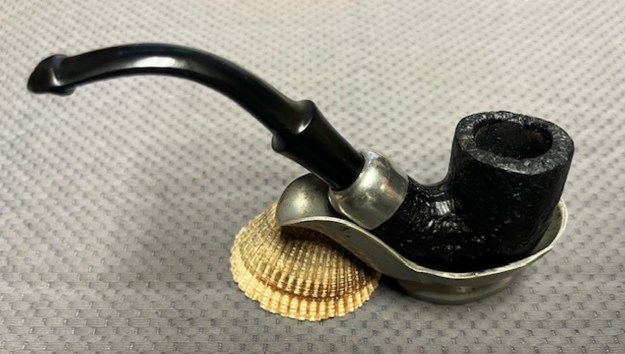
This Dunhill Tanshell 0543 Oval Shank Billiard Turned Out to Be A Lot Of Work


by Steve Laug

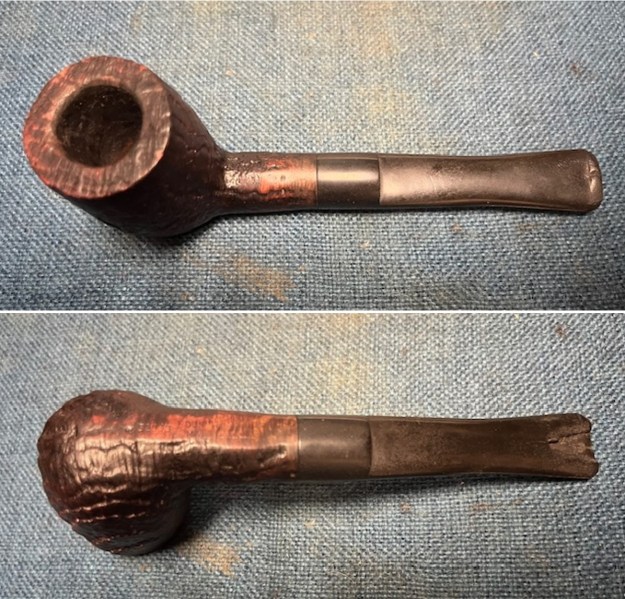
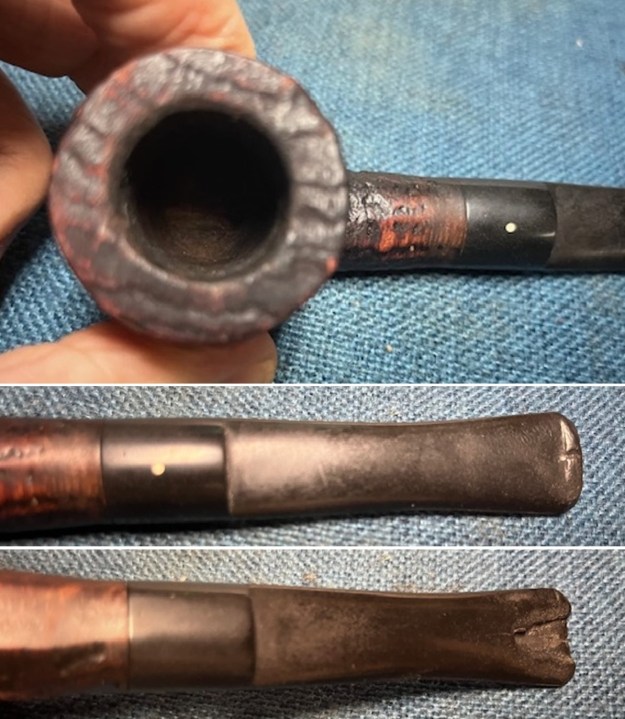
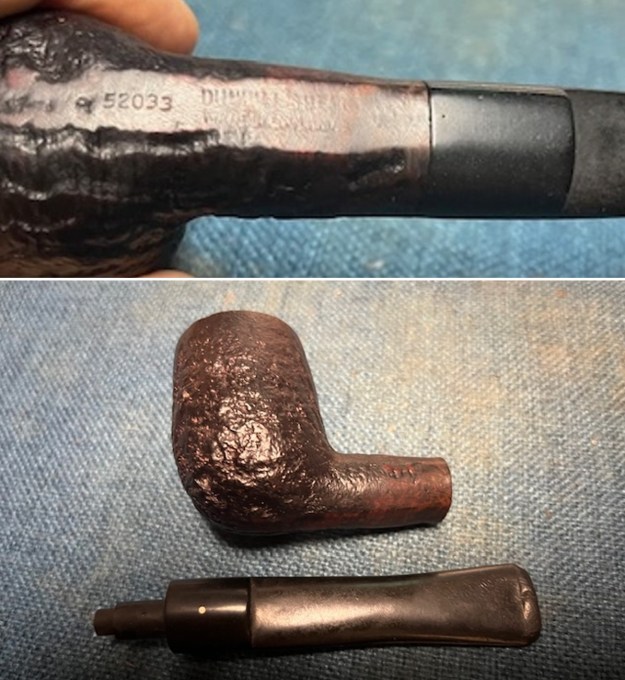
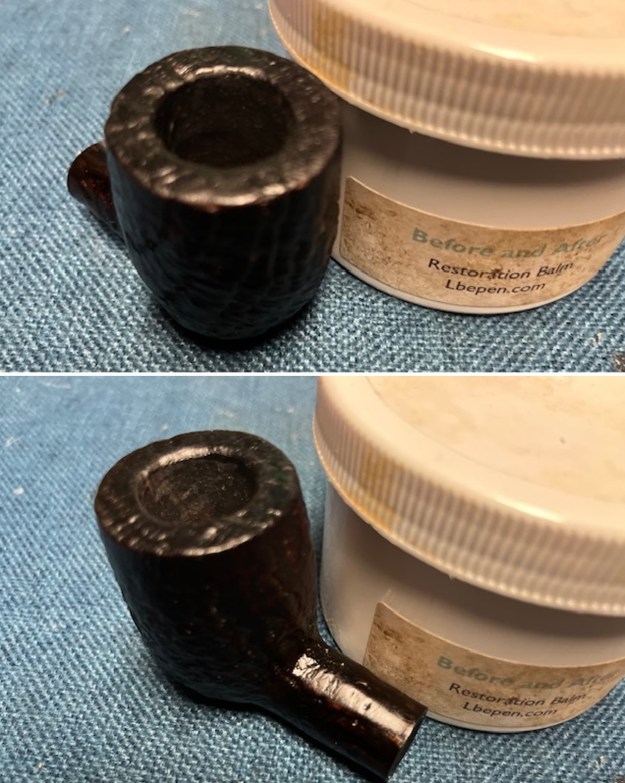
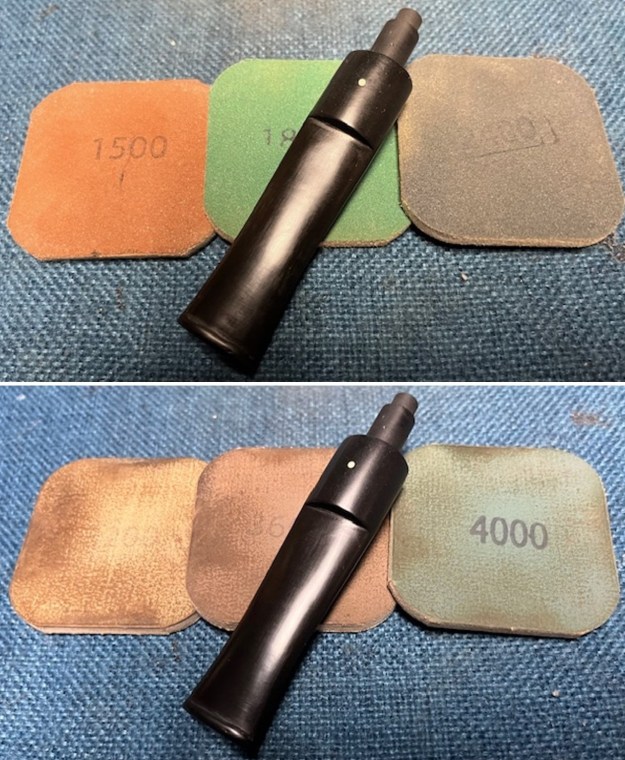
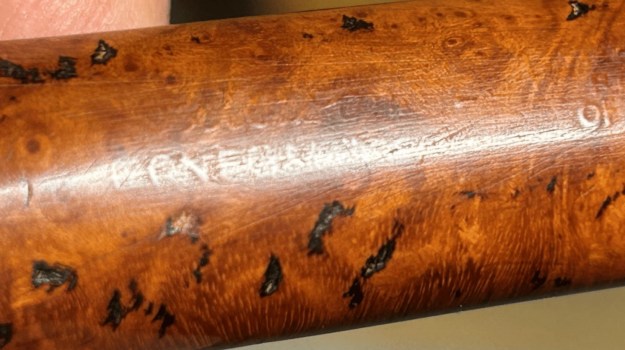
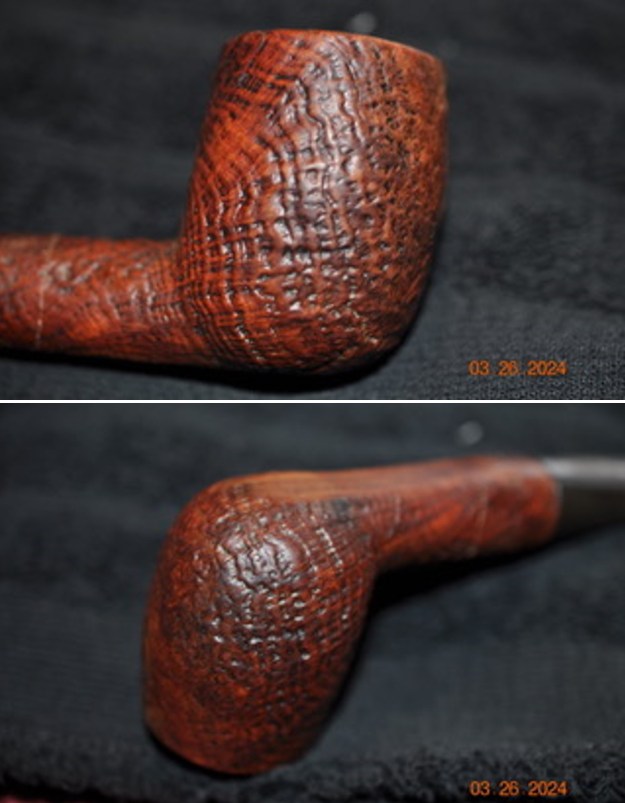
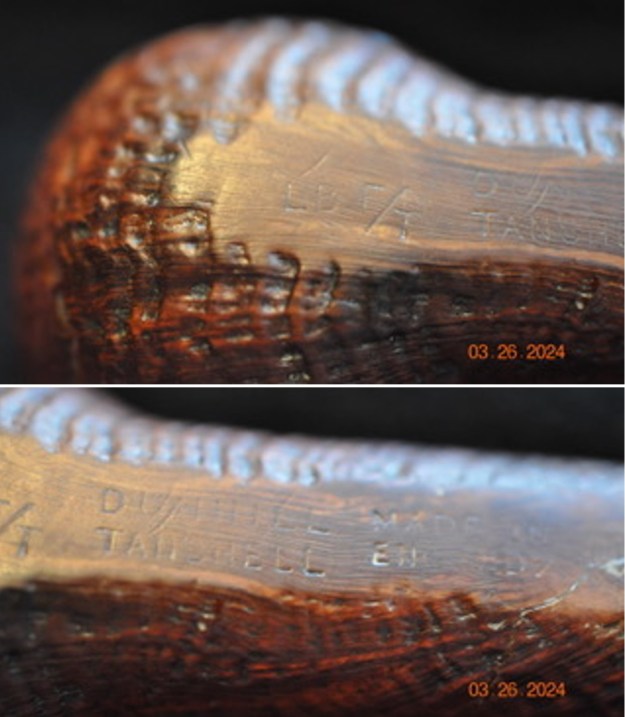
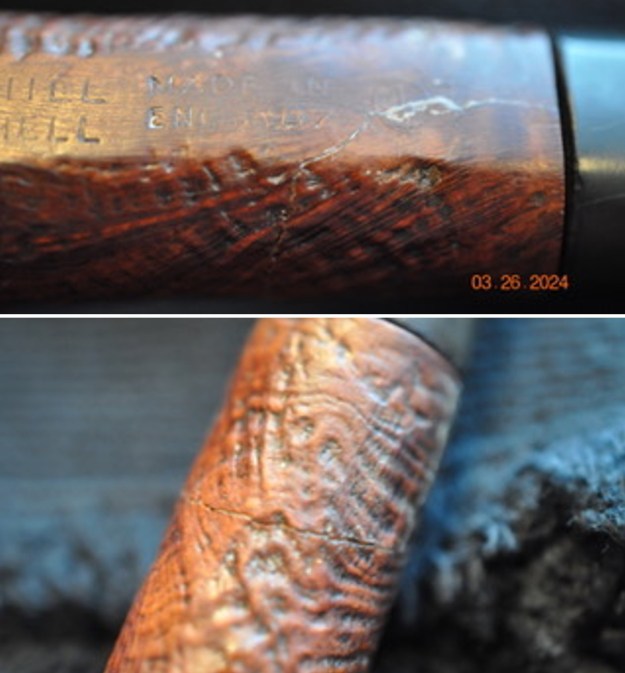
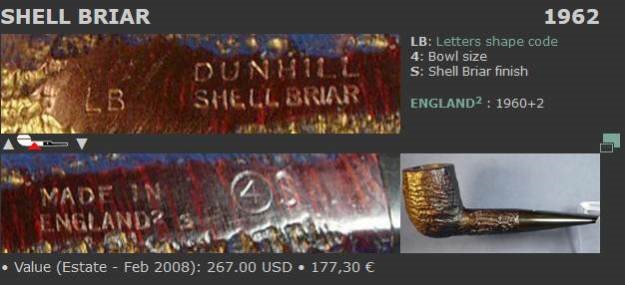
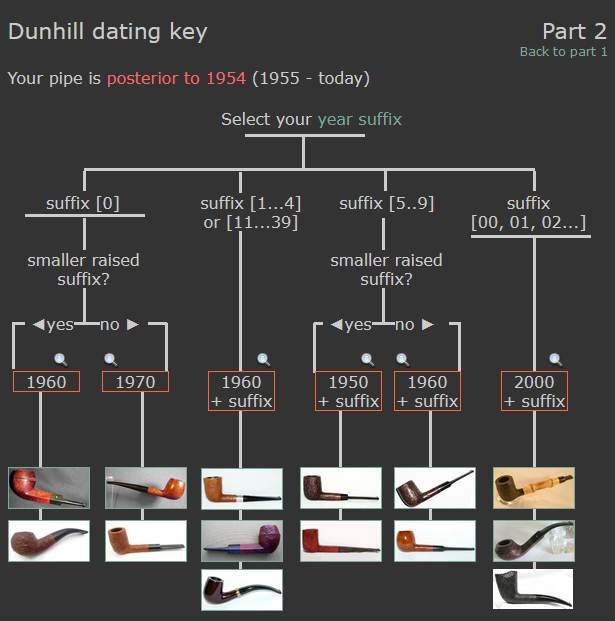
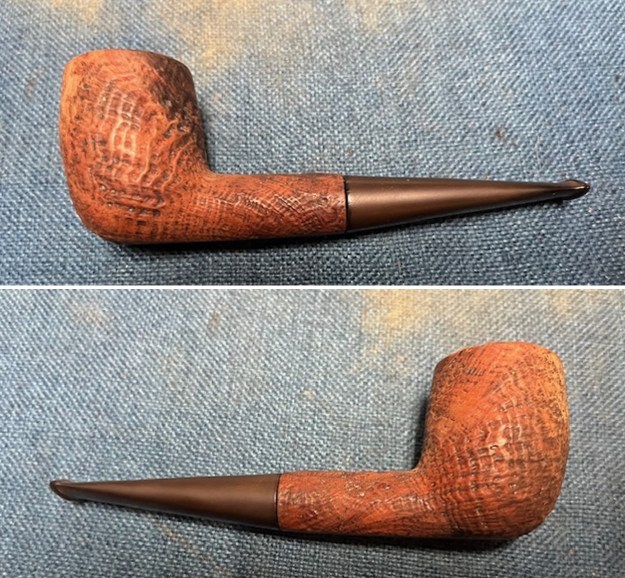
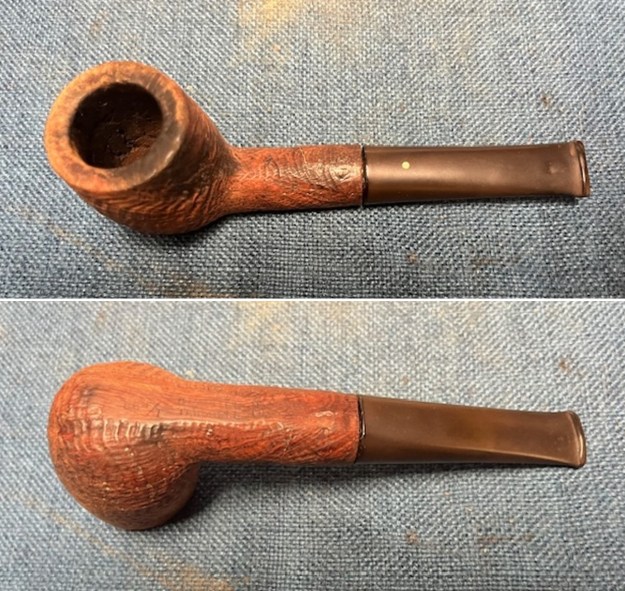
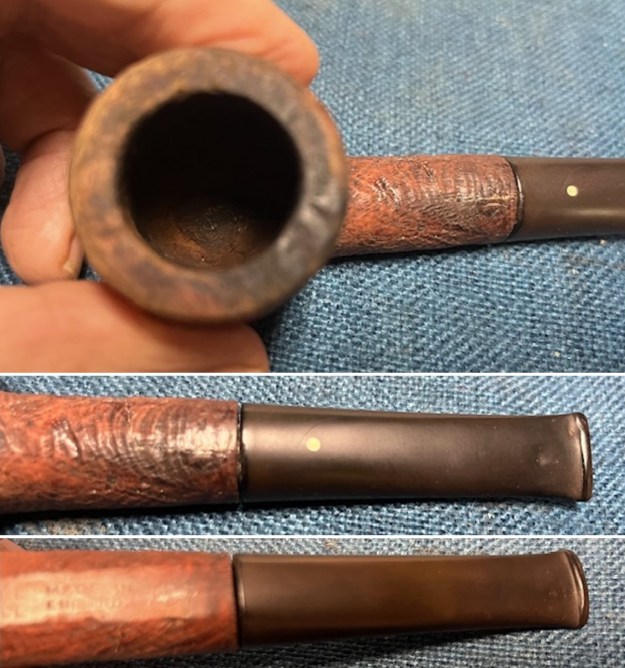
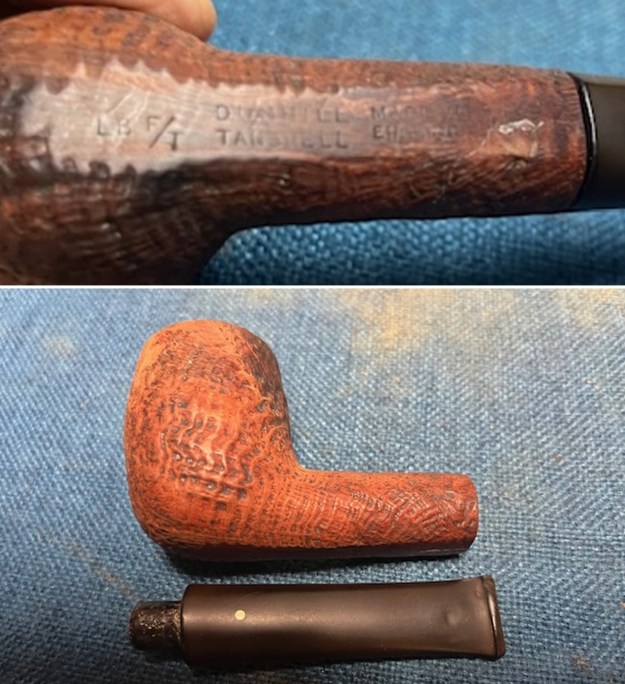
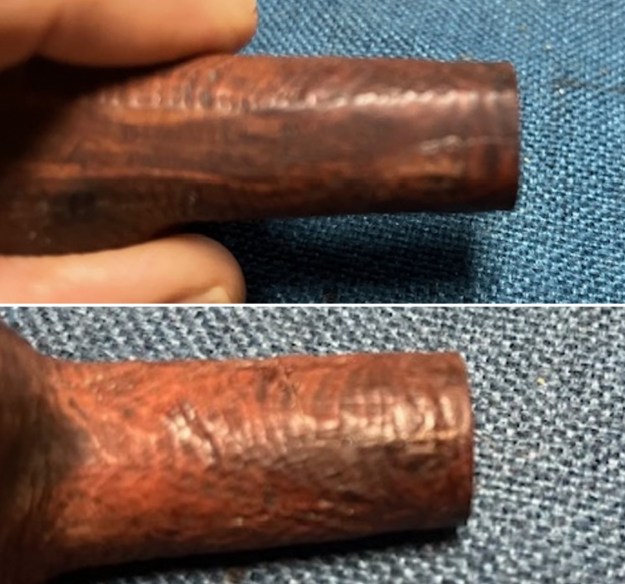
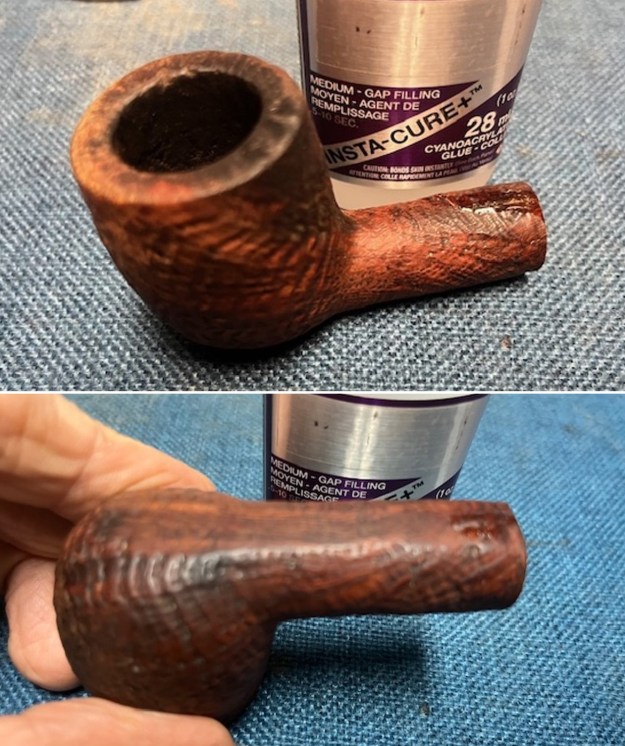
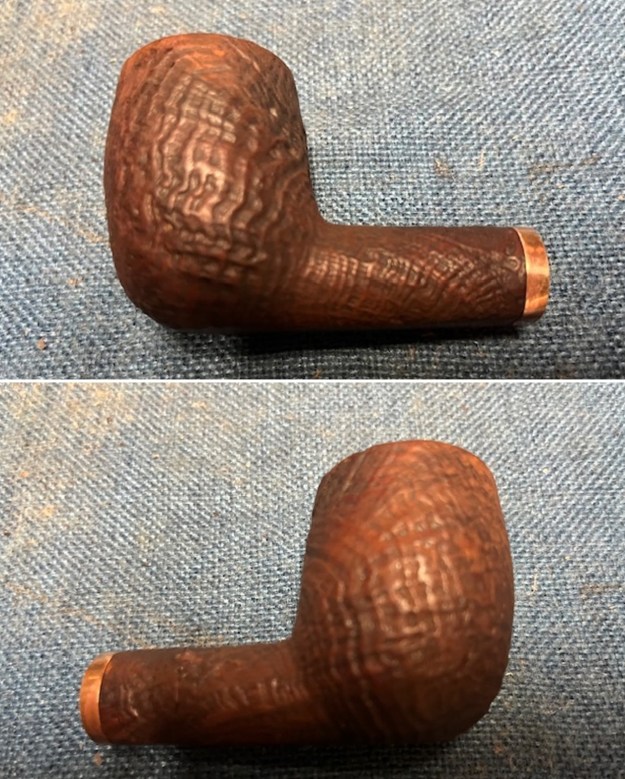
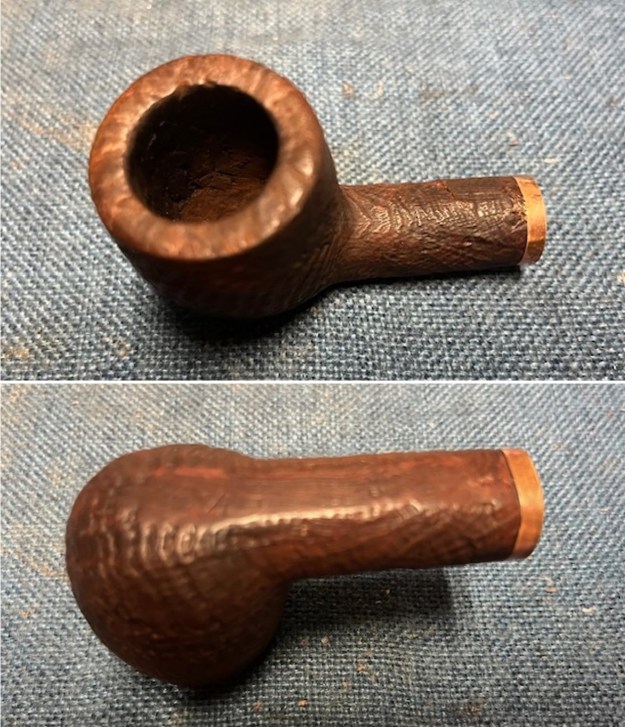
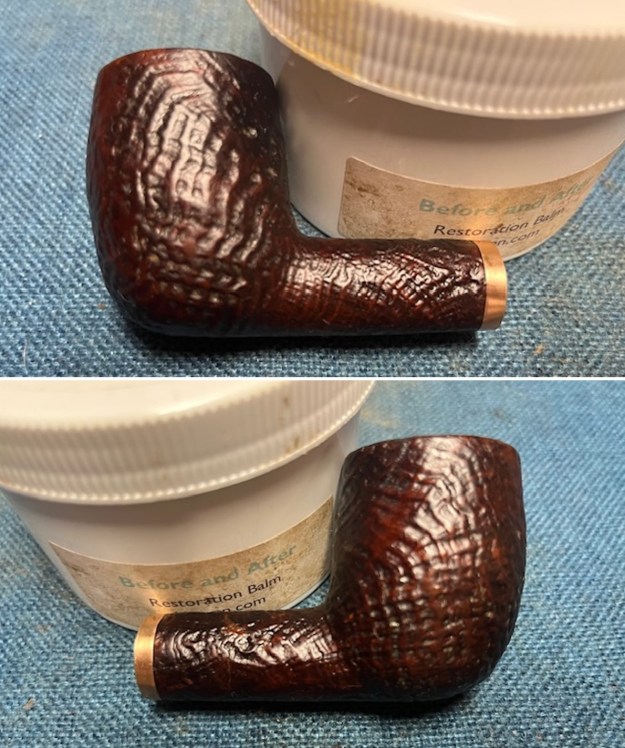
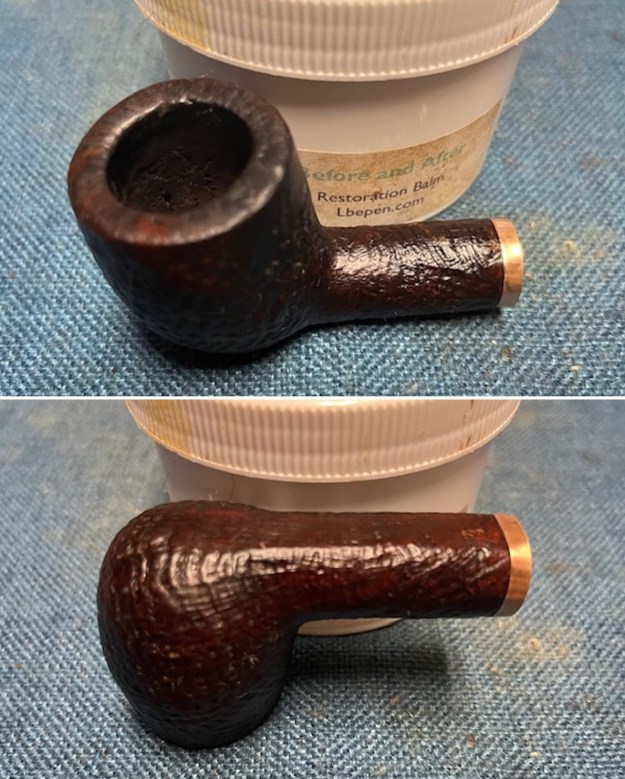
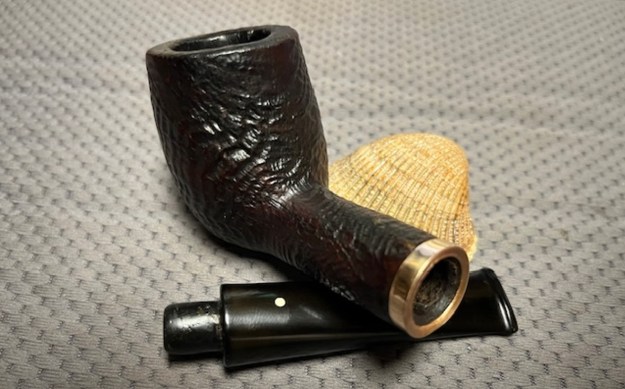
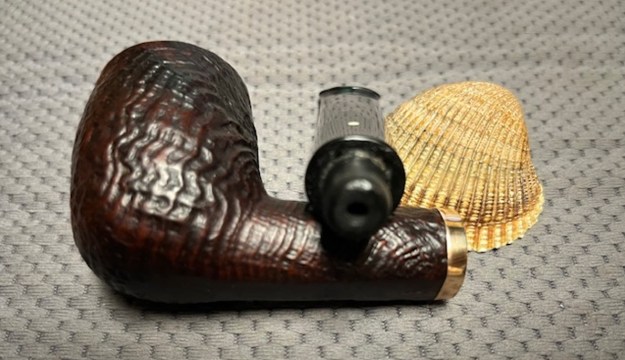
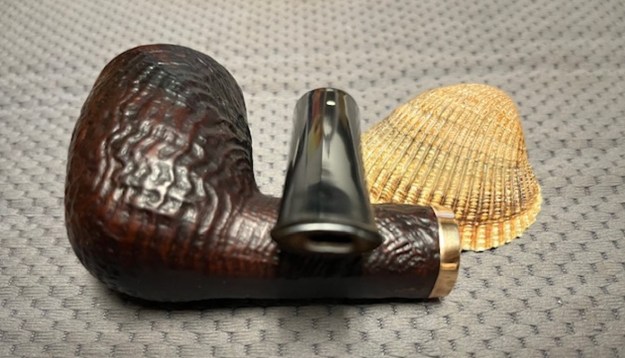
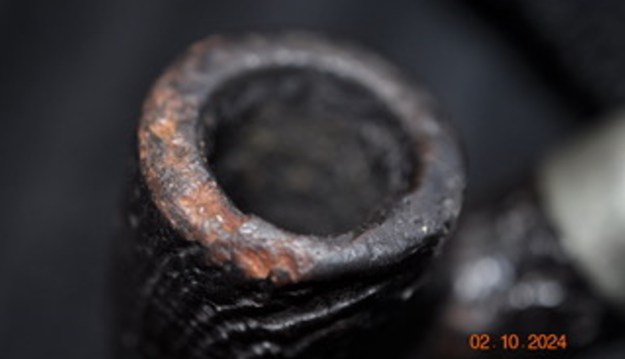
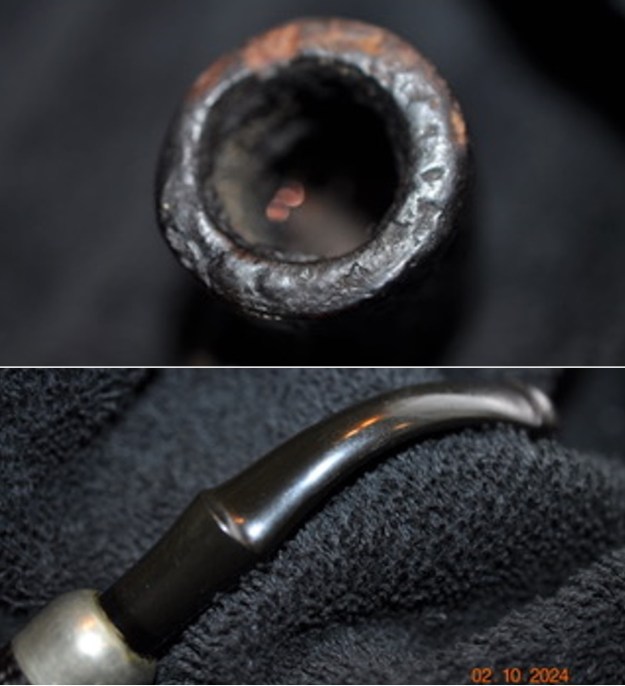
This pipe came to us from a seller in Memphis, Tennessee, USA on 08/27/2024. It was a Dunhill sandblast Billiard with and oval shank. The pipe was stamped with the shape number 0543 on the heel of the bowl [followed by] Dunhill Tanshell [over] Made in England16. It was quite clear and readable but there was not any size stamp or circle T as would be expected as it may have been buffed off. There was a thick cake in the bowl and a heavy coat of lava overflow on the rim top. It looked like it may have some burn damage on the inner edge and rim top. The sandblast finish was dirty and dusty looking. The oval taper stem is vulcanite and is oxidized. There are tooth marks and chatter on both sides of the stem ahead of the button. Once I received the pipe I would find a lot more issues with the pipe but what is mentioned above is a good summary. Jeff took some photos of the pipe when he received it to show the general condition. Here is a close up of the bowl and rim top. You can see the heavy cake and the heavy, thick lava coat. The inner edge of the rim appears to have damage from burns on the front and back edge. It really looks to be in bad condition with some heavy damage but once it is cleaned I will know for certain. The photos of the stem show the oxidation, tooth marks and chatter in the stem on both sides ahead of the button. Jeff took photos of the sides of the bowl to show the interesting grain in the sandblast. The swirls and depths of the sandblast are intricate and quite beautiful. The stamping on the underside of the shank is shown in the photo below. It looks very good and readable. There are a few faint spots but overall it looks very good. It reads as noted and explained above. One of the first things I like to do is to unpack the stamping and understand each element in it. I turned to Pipephil helpful site (http://pipephil.eu/logos/en/dunhill/tanshell1.html). The stamping is interpreted as follows: The number 0543 is the shape number for a Billiard. The Tanshell stamp refers to the finish. The 16 following the D of England gives the date the pipe.Pipephil also has some helpful dating keys on the site that are basically flow charts that you can walk through to date your pipe (http://pipephil.eu/logos/en/dunhill/cledat-en1.html). I turned to Part 1 of the Dating Key and followed the chart. This pipe has a 16 following the D in England. It is the same size as the D so that took me to the section on the chart below (column one) which instructed me that the pipe could be dated as being made posterior to 1954. I followed the link following the “Your pipe is posterior to 1954. Narrow down your dating”. That took me to Page 2 of the dating key (http://pipephil.eu/logos/en/dunhill/cledat-en1a.html).  The second column (suffix 11…39) led me to the section with a 16 after the D in England. There was a directive for dating the pipe spelled out as follows: 1960 + suffix which gives the pipe a date of 1976. I then turned to Pipedia’s section on Dunhill Root Briar to get a bit of background on the Dunhill finishes (https://pipedia.org/wiki/Dunhill#Root_Briar). I quote:

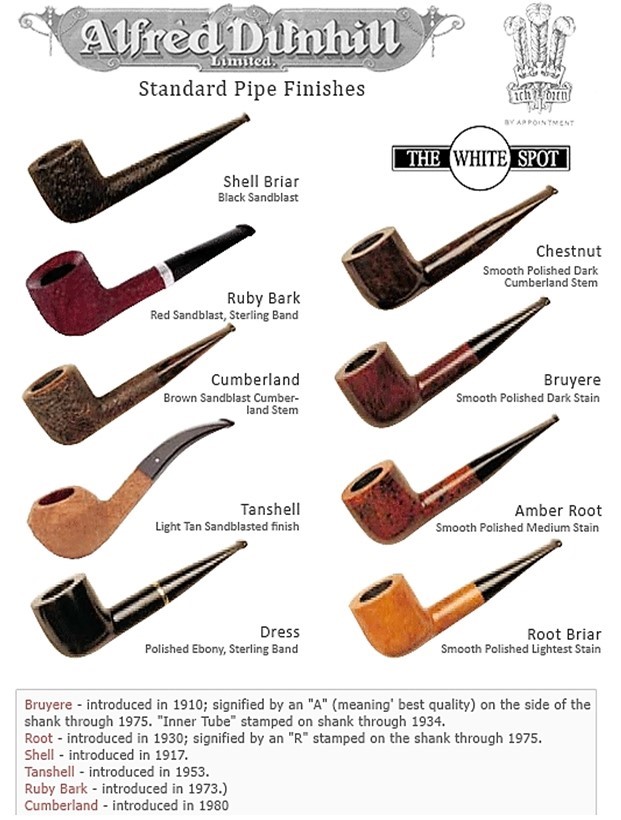
Tanshell

The first lot was distributed in 1952 (usually made using Sardinian briar). The prototype was called “Root Shell “, produced in 1951. The Tanshell is a light tan sandblast. Sardinian briar was used for this sandblast. There is a distinct contrast in the sandblasts using Sardinian as opposed to Algerian briar. The Sardinian is much denser and much harder. The resulting pattern, when blasted, is far more even and regular both in terms of the surface texture and the finish.

The Tanshell was Dunhill’s fourth finish and its first major post-war line addition. Introduced in 1951/1952 the Tanshell was a naturally stained sandblasted pipe made exclusively from Sardinian briar through the 1960s. The Tanshell apparently was not simply a light stained Shell but rather was also the product of “certain processes [unrevealed] not previously employed.” Initially, it appears that the pipe was to be named the Root Shell and a stamp to that effect was ordered and received by Dunhill in May 1951. Ultimately, however, the name Tanshell was settled upon but the stamp for the Tanshell name was not received by Dunhill until the beginning of December. Thus while the Tanshell was in production in 1951 it appears that most if not all Tanshells made in that year did not enter into retail distribution until 1952 and were given a 1952 date code. Loring, J. C., The Dunhill Briar Pipe, The Patent Years and After (self-published, Chicago, 1998).

I have also included a chart from the site from Dunhill spelling out the Standard Pipe Finishes and giving short information and a timeline

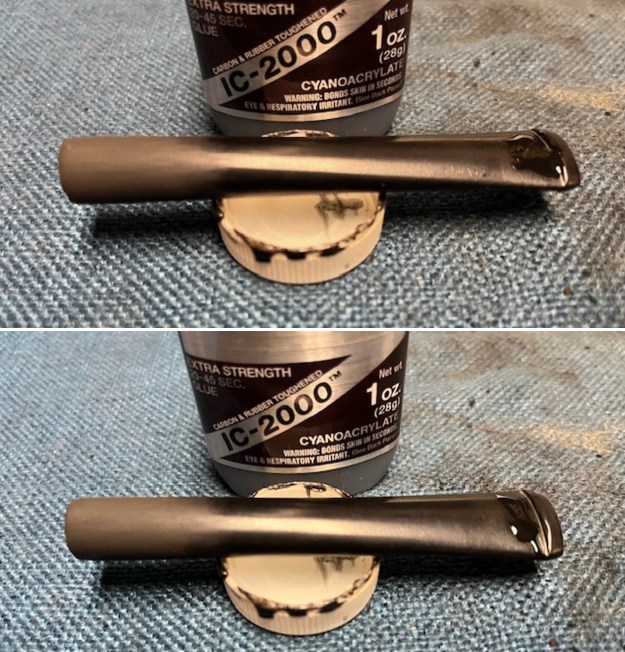
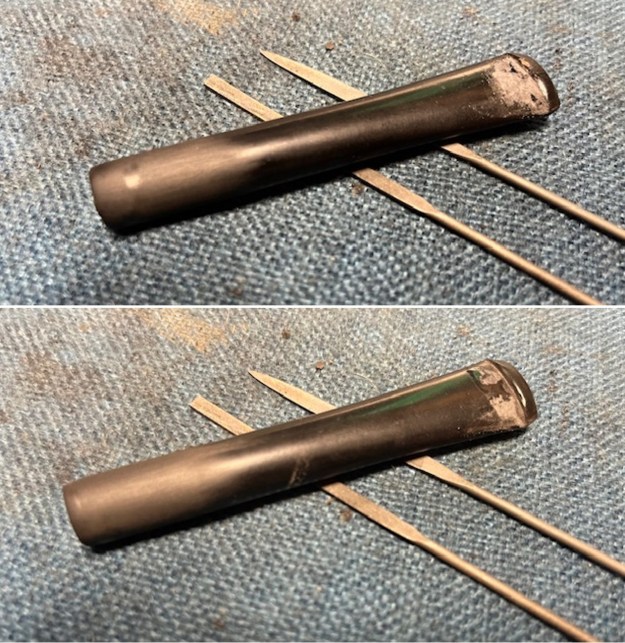
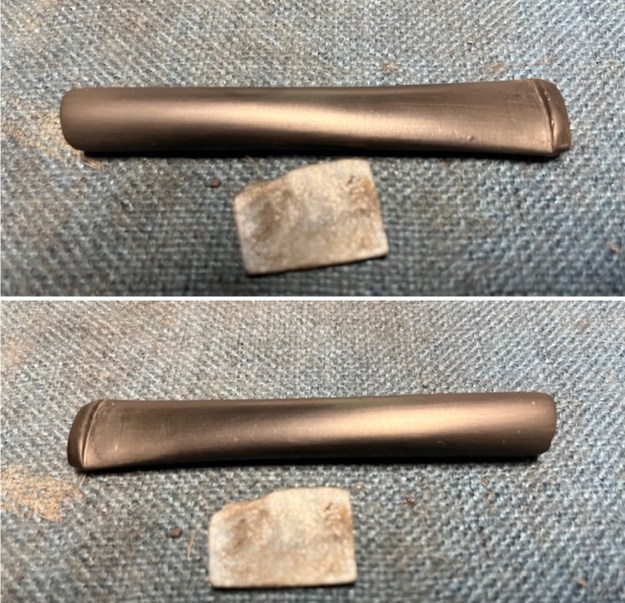
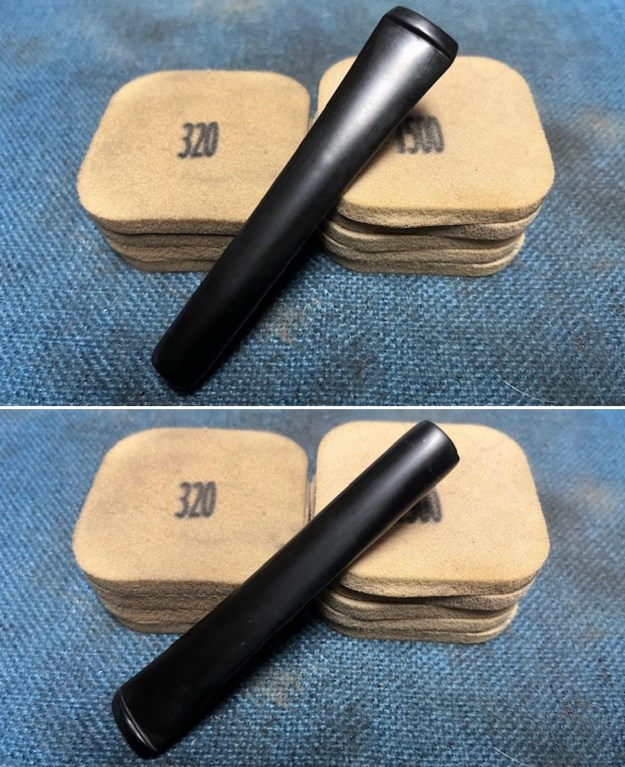
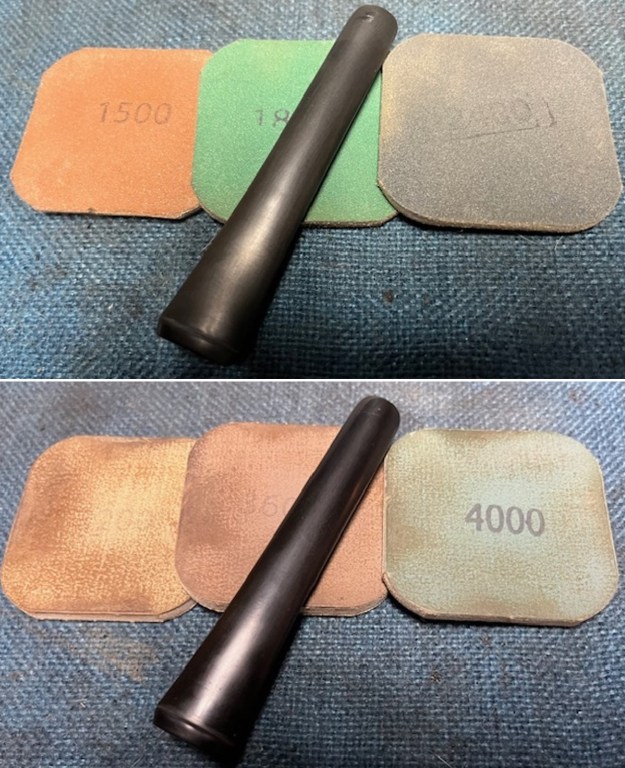
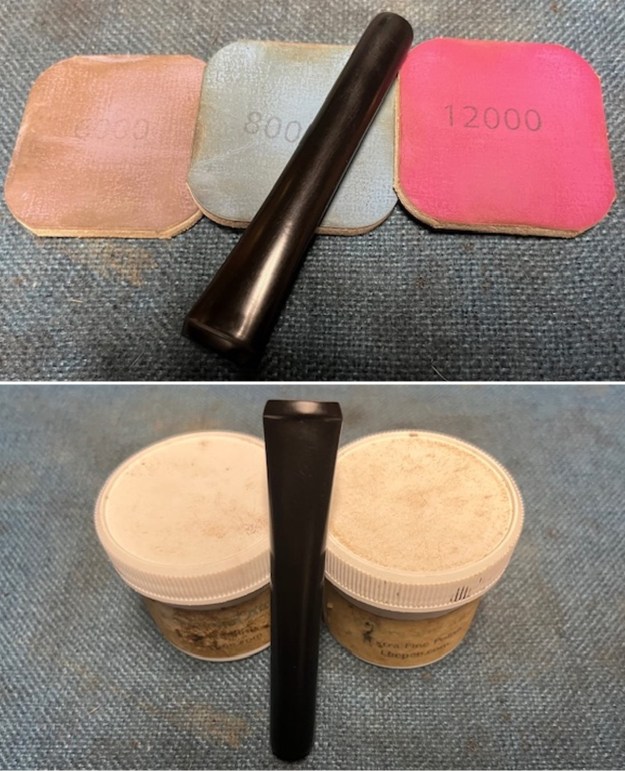
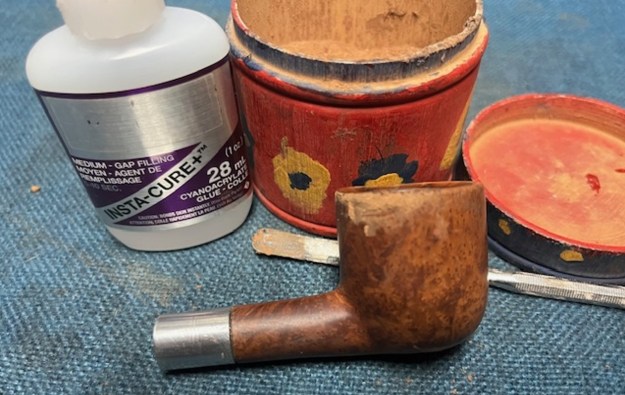
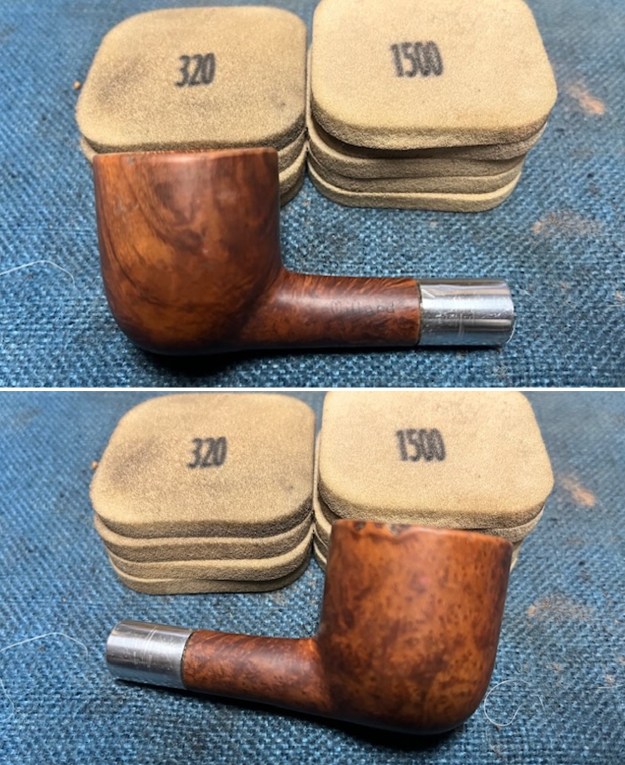
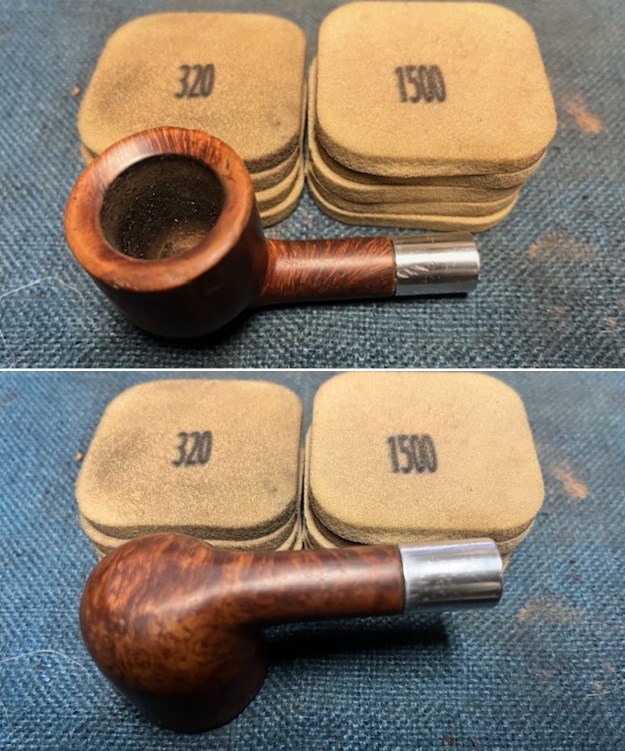
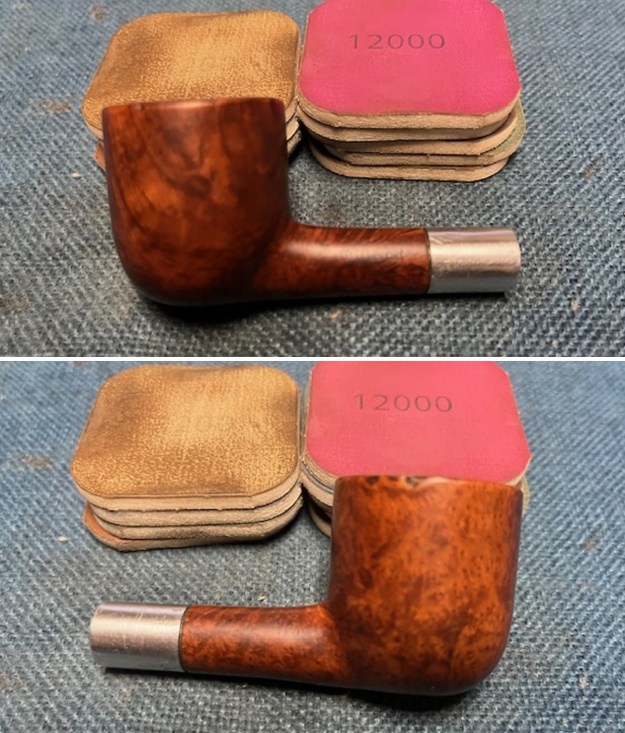
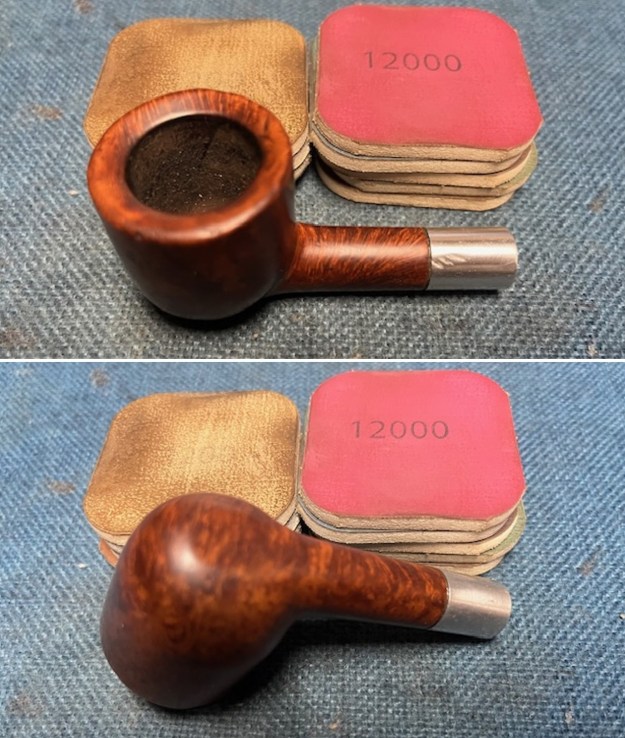
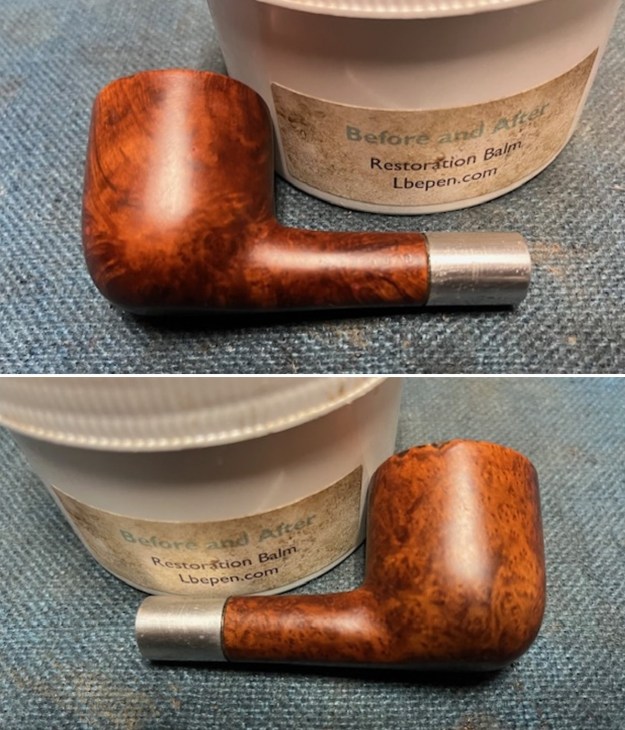
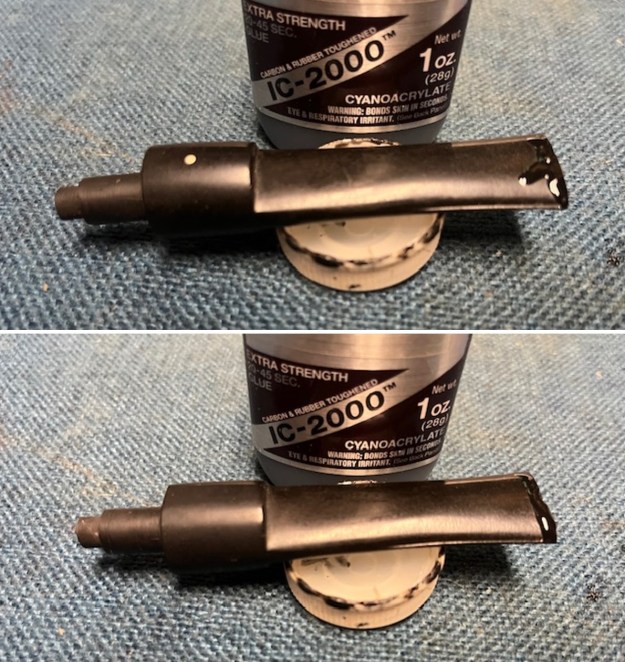
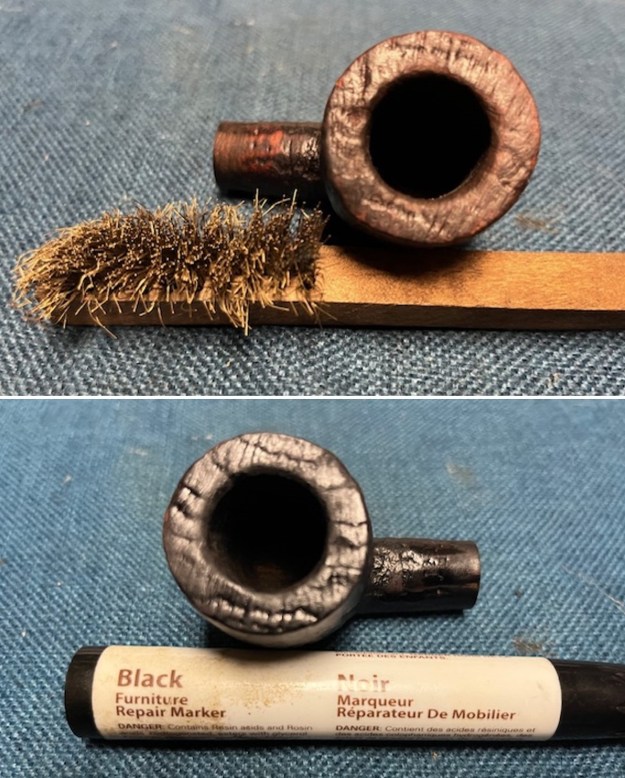
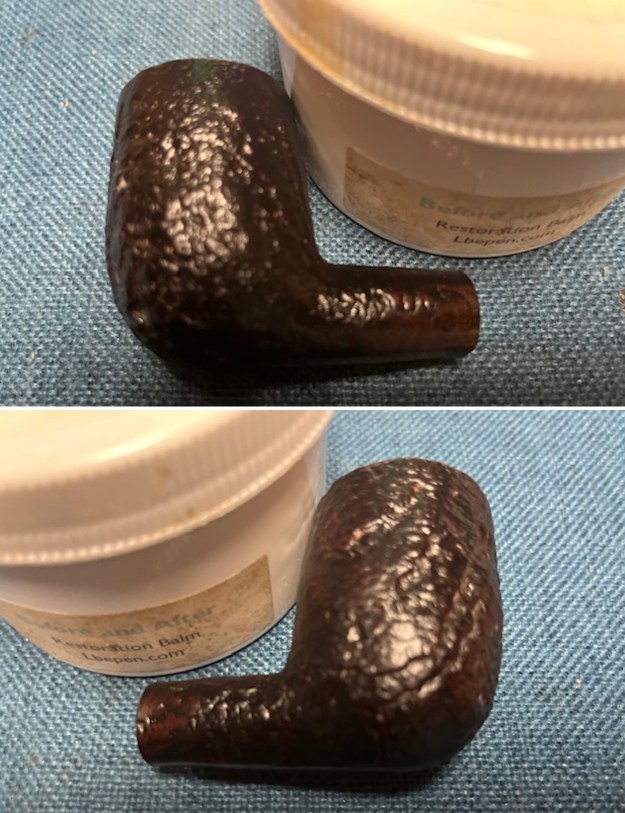
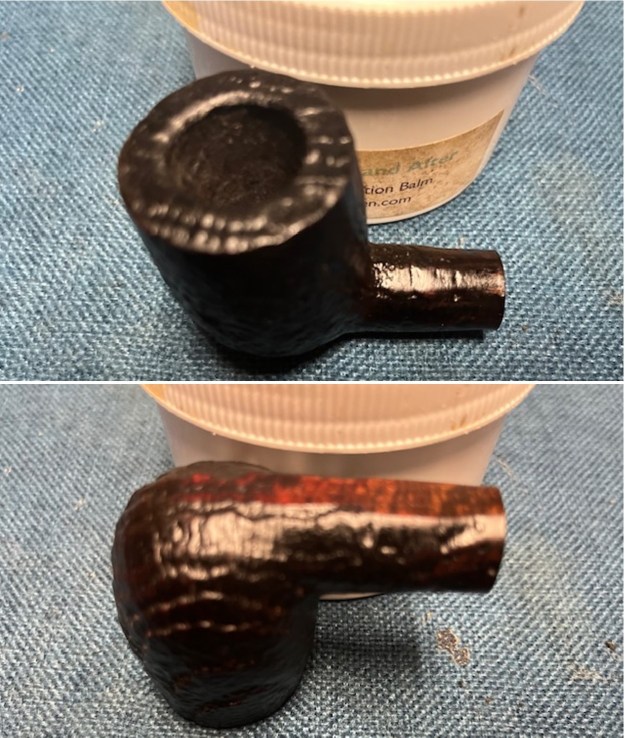
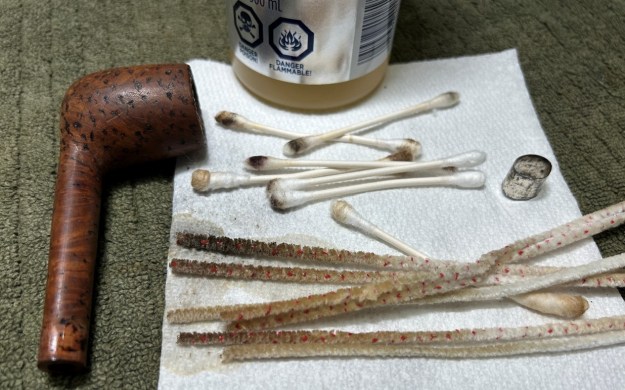
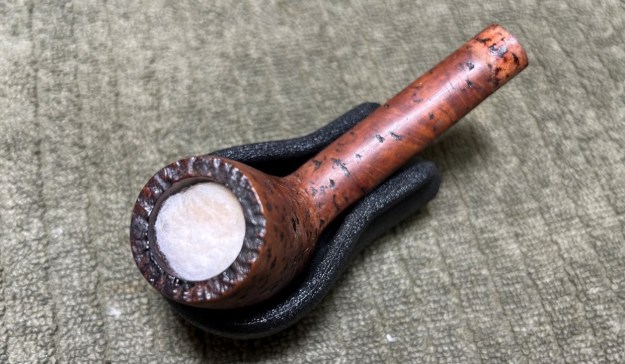
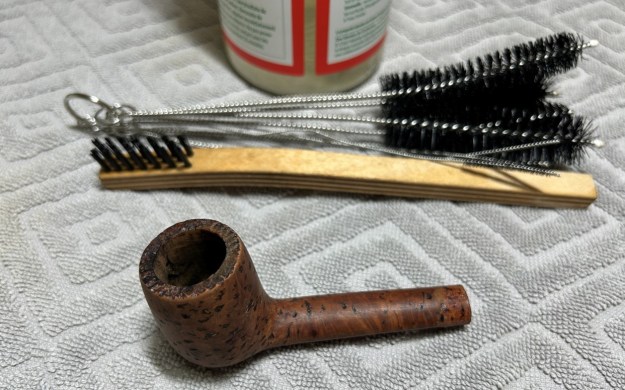
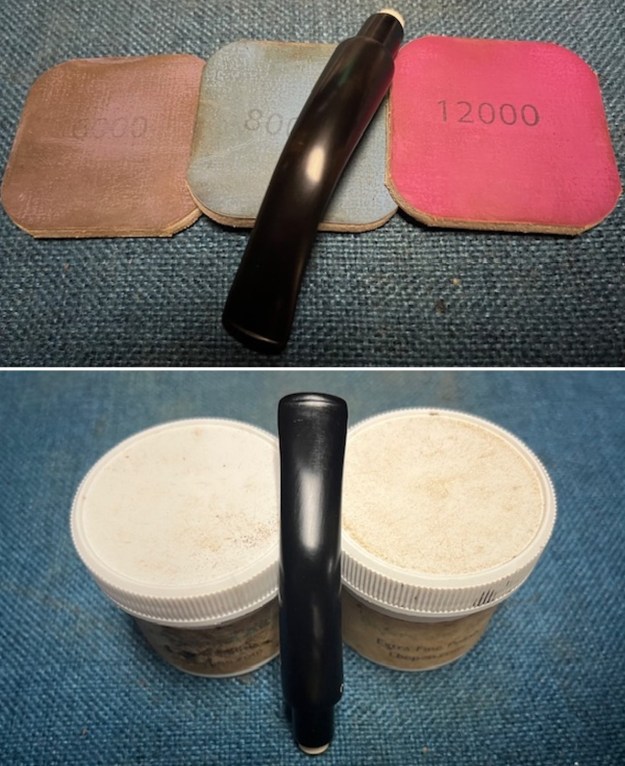
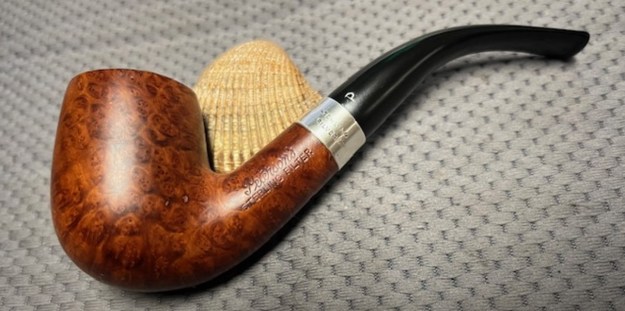
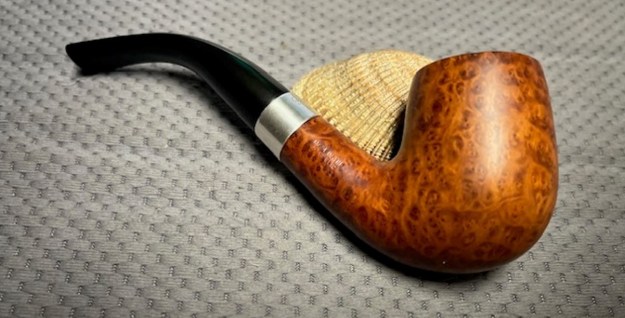
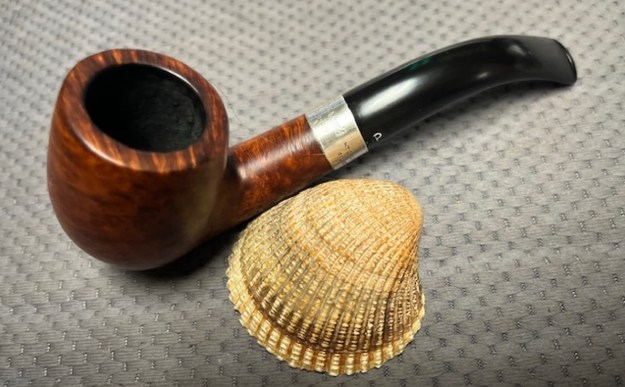
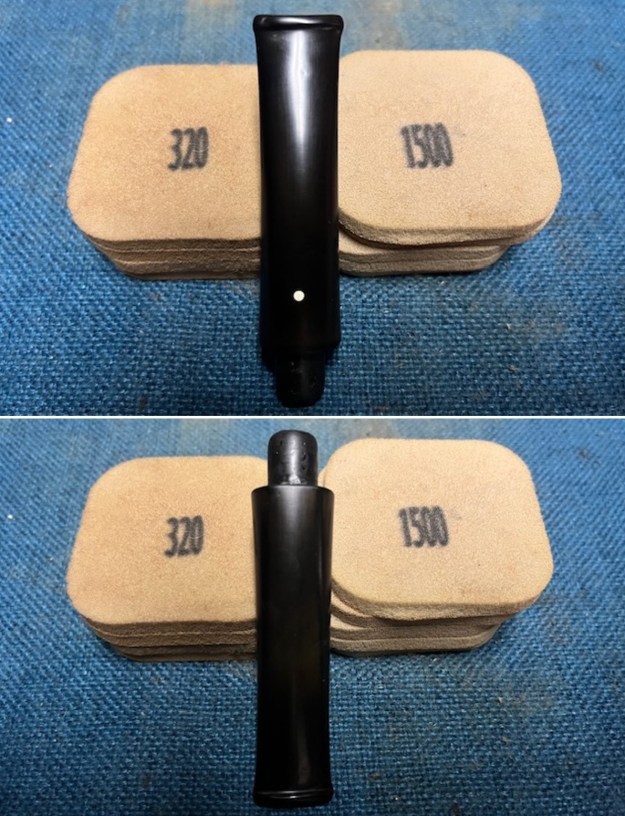
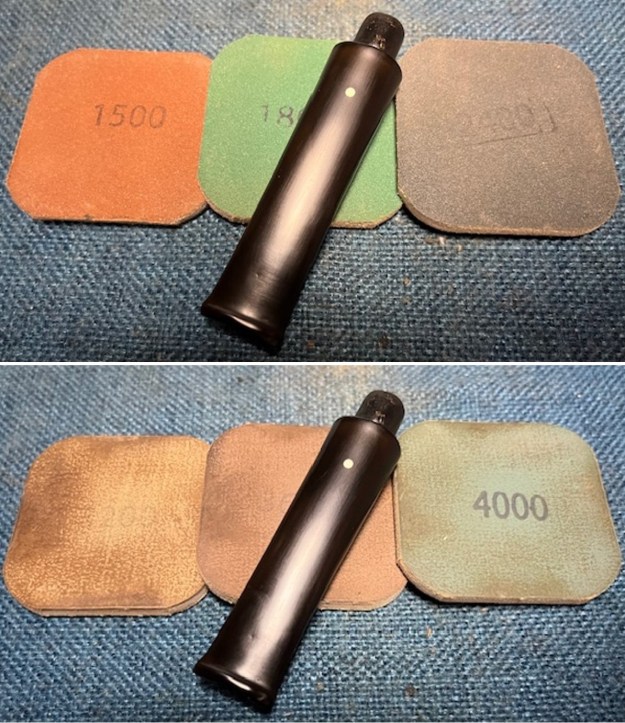
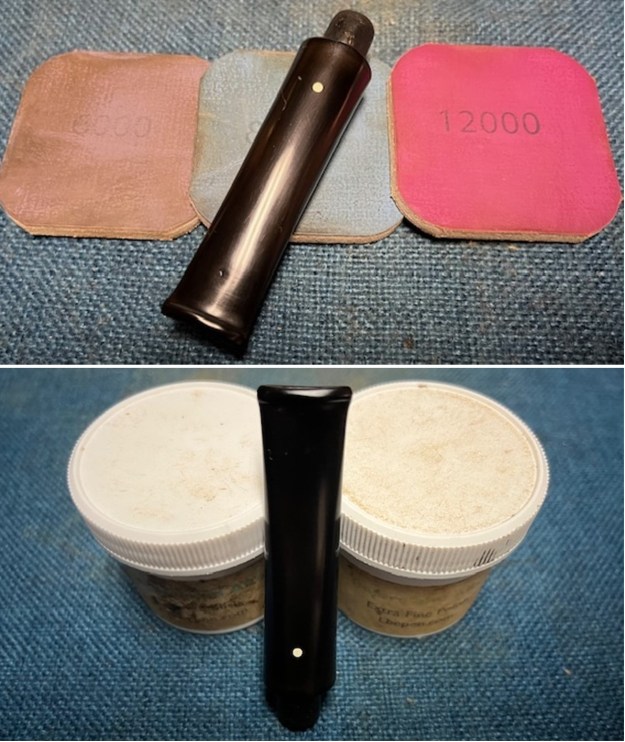
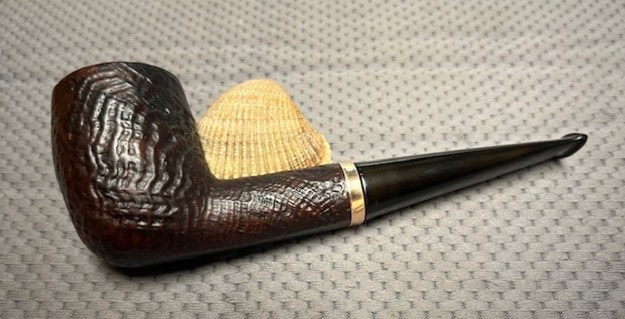
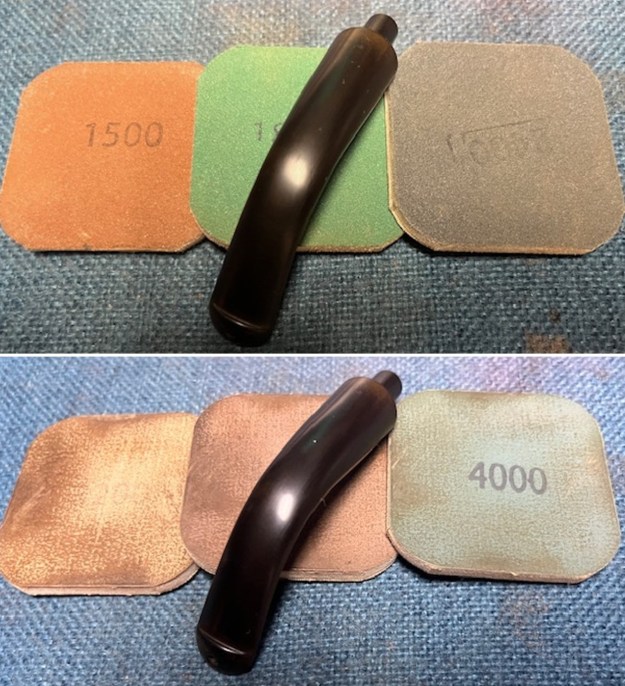
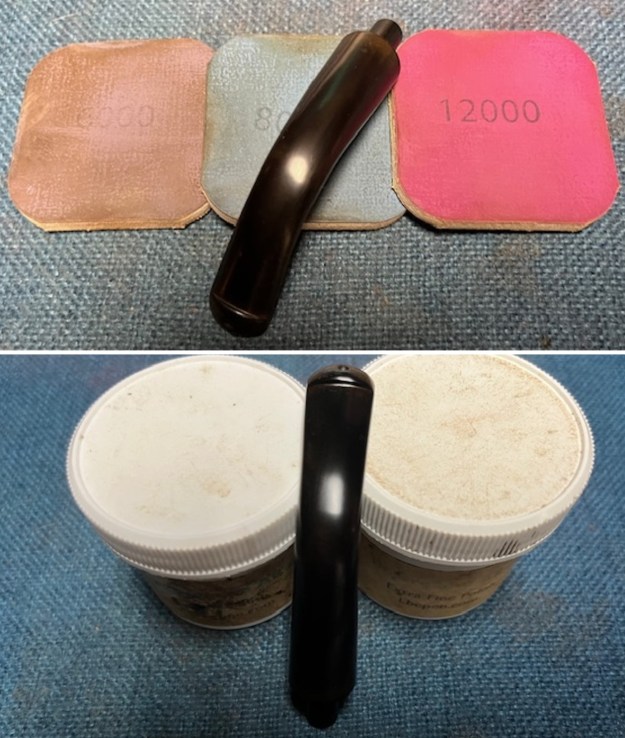
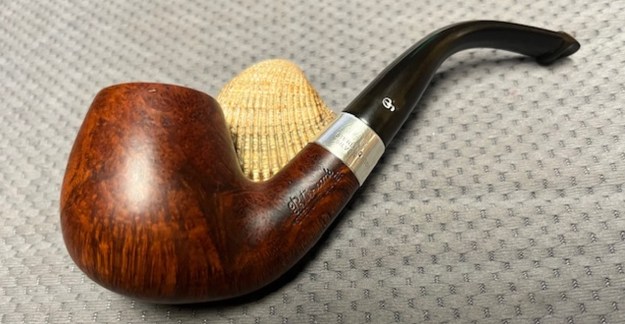
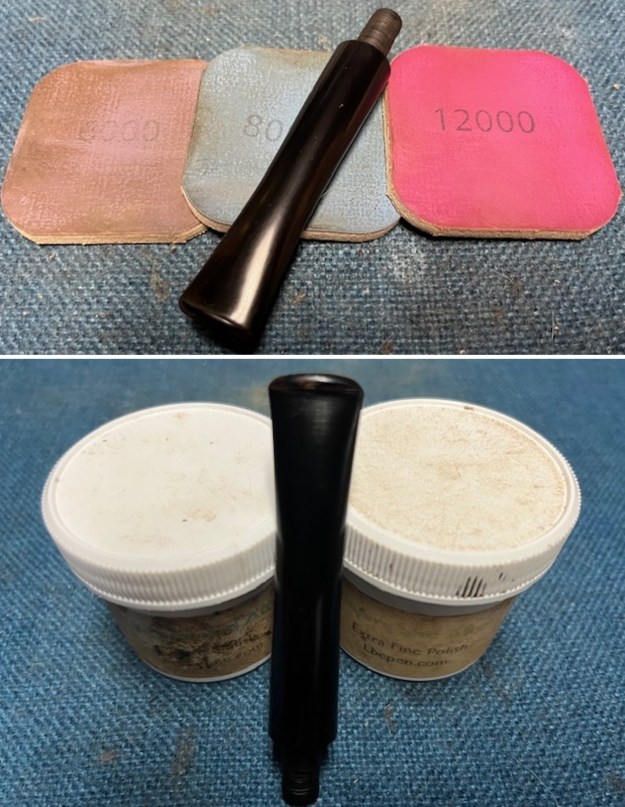
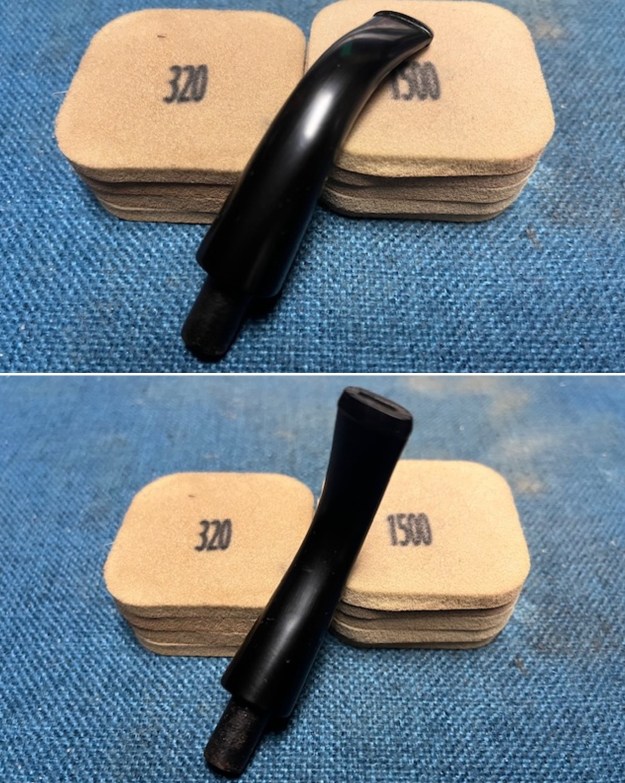
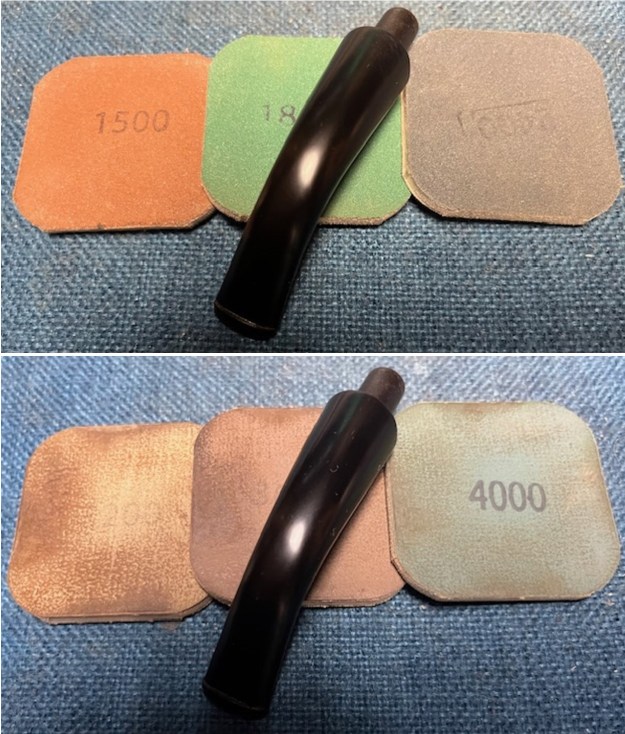
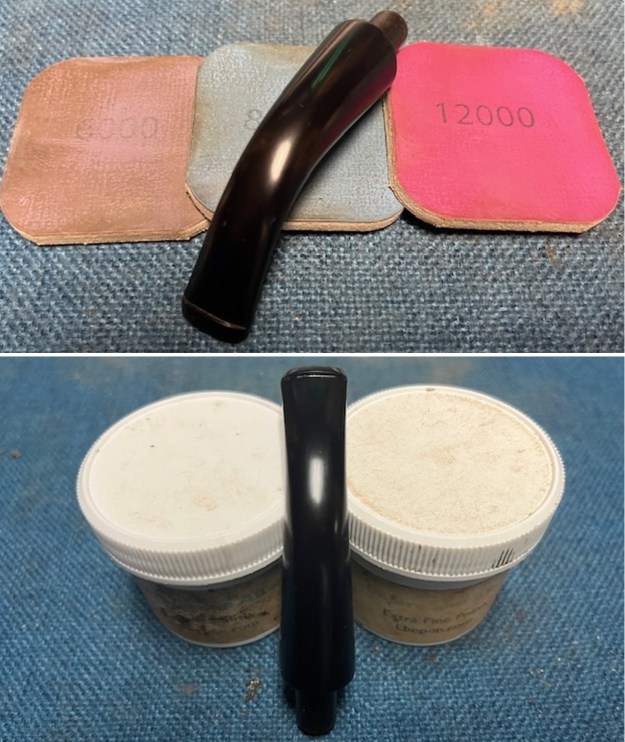
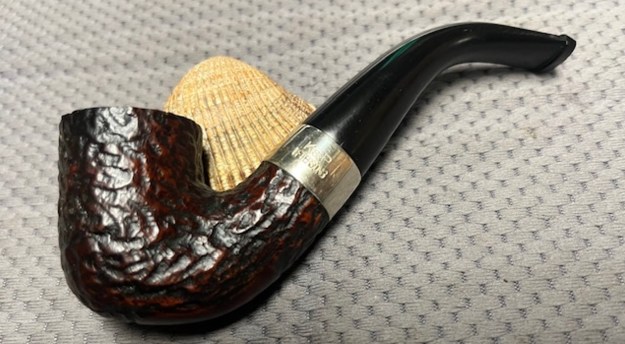
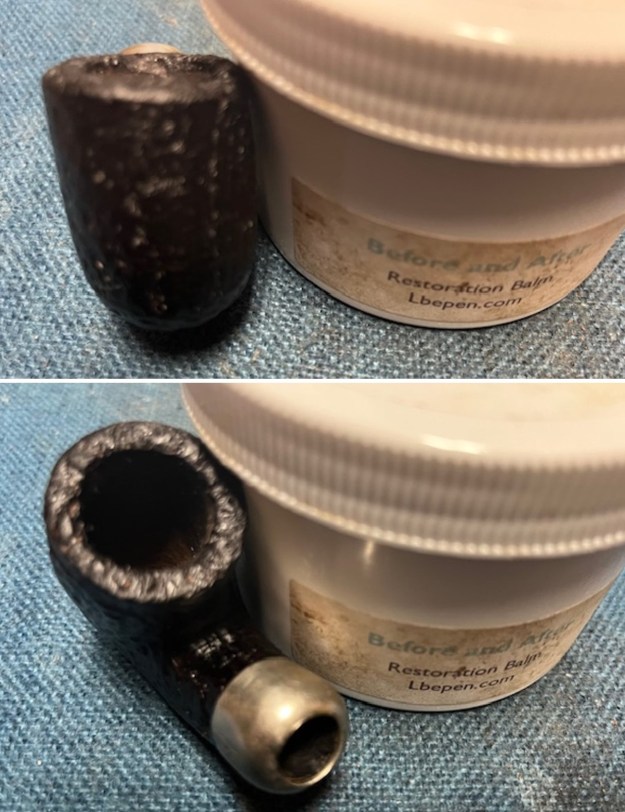
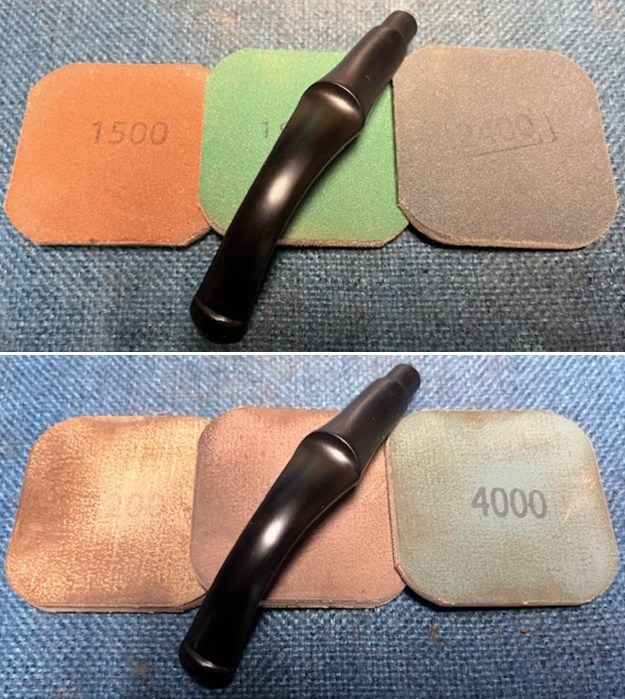
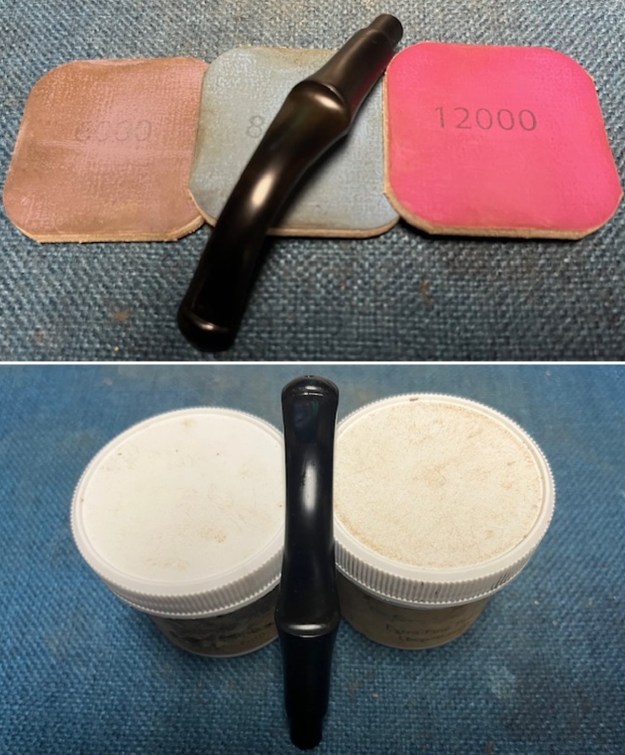
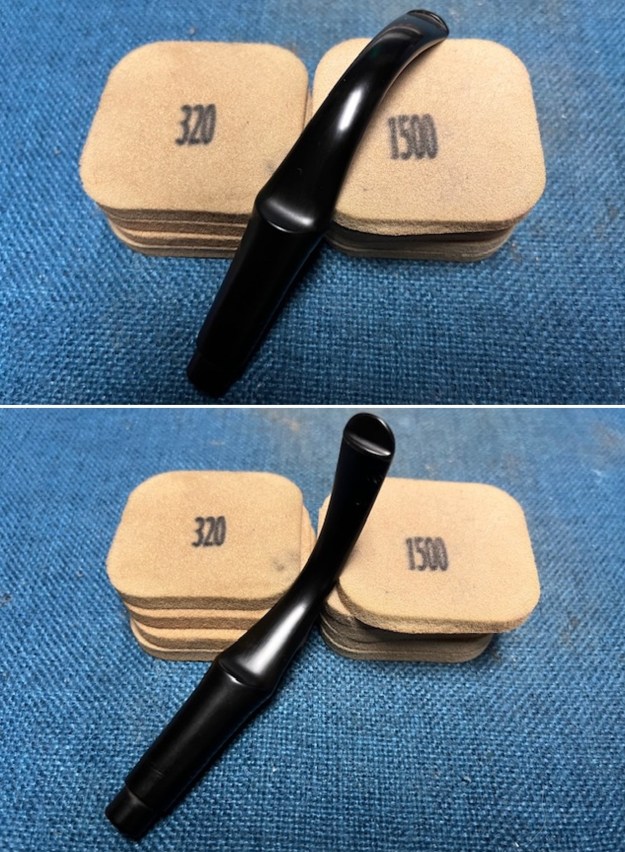
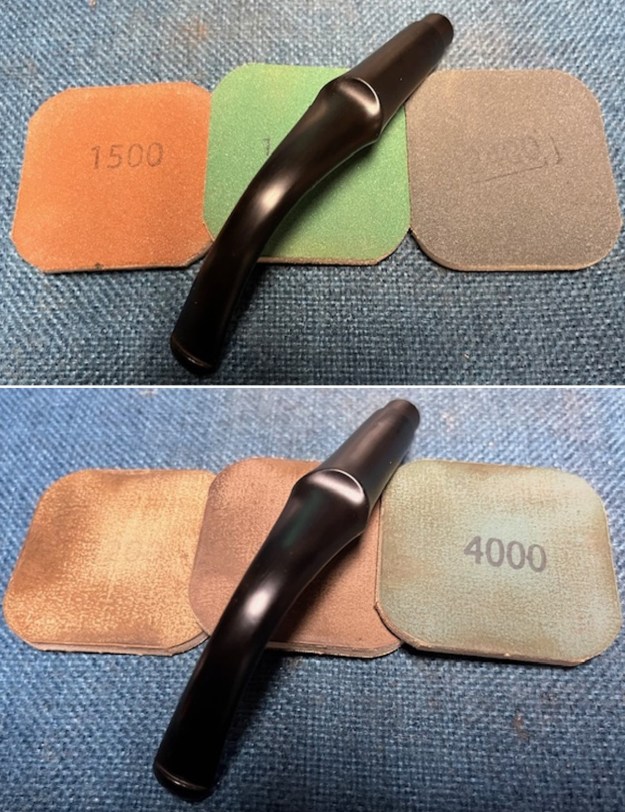
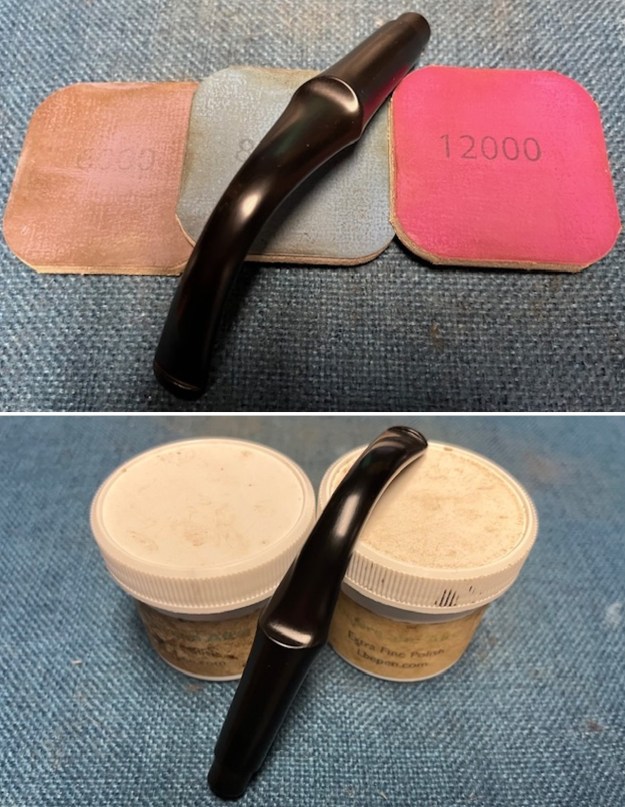
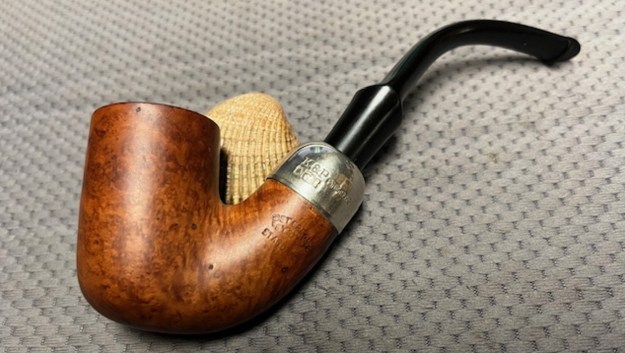
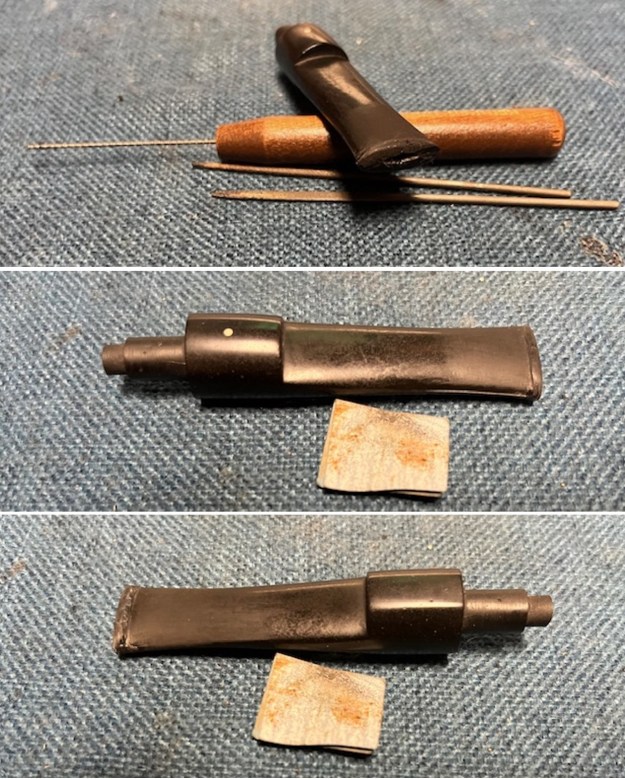
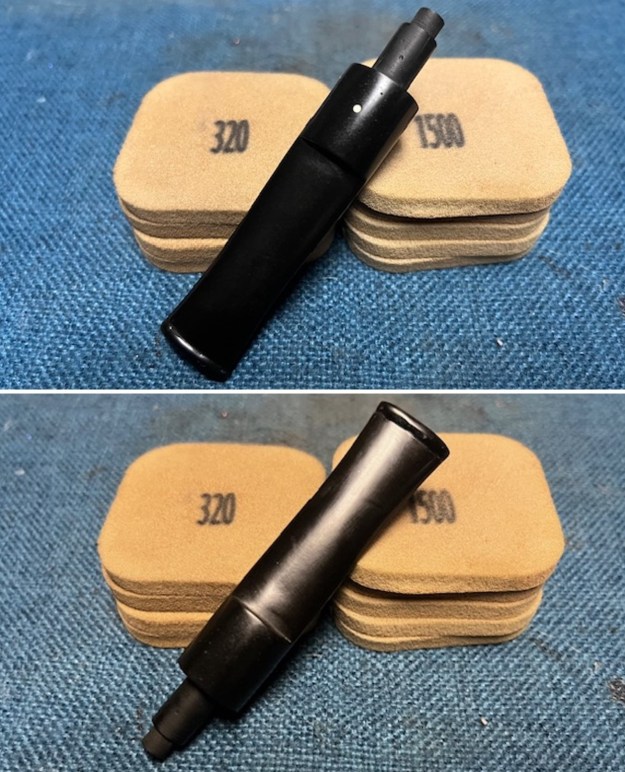
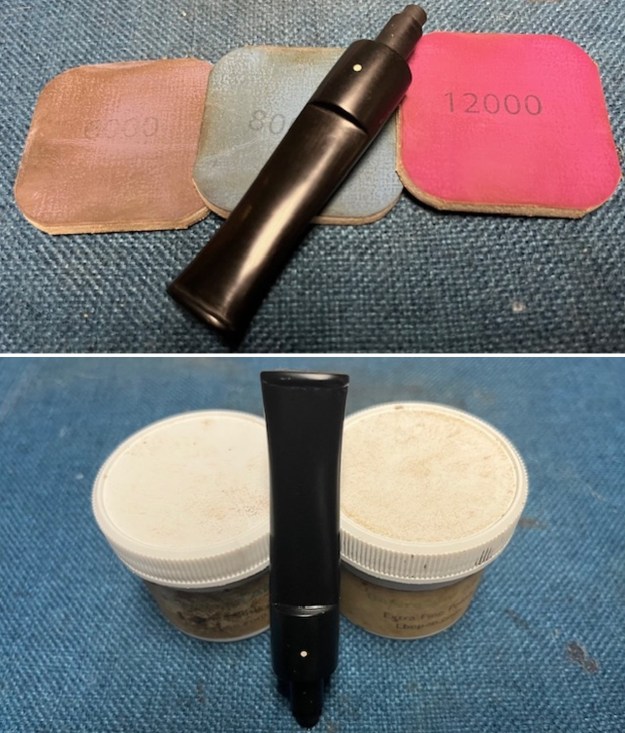
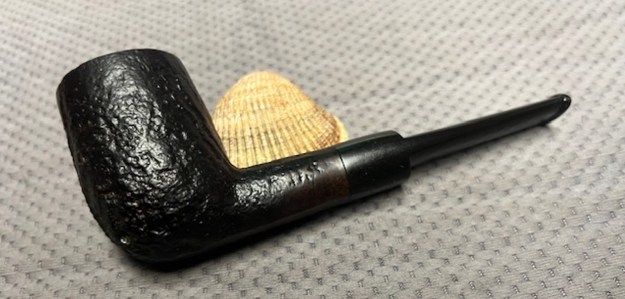
I turned to work on the pipe itself. Jeff had done an amazing cleanup of the pipe. He reamed the light cake with a PipNet reamer and cleaned up that with a Savinelli Fitsall Pipe Knife. He scrubbed the internals of the bowl and stem with alcohol, cotton swabs and pipe cleaners. He scrubbed the externals with undiluted Murphy’s Oil Soap and rinsed the bowl off with running water. He soaked the stem in Briarville’s Pipe stem Deoxidizer and once it had soaked rinsed it off with warm water to remove the residual solution. He dried it off and rubbed it down to remove any oxidation that was still on the stem. At first glance the pipe looked good when I received it. I took a photo of the rim top to show the damage to top and inner edge. It is burned on the front inner edge and back inner edge of the bowl and the rim top. The top is not flat but there is a dip on the front and back in the burn. There also appears to be some cracks on the surface of the rim extending down the back side of the bowl. I will need to examine it further. I ran a finger on the inside of the bowl and the wall was damaged exactly under the cracks on the exterior. There was some significant damage that would need to be addressed. The stem looks quite clean with some light marks on both sides.I took a photo try to capture the stamping on the heel of the bowl and shank. It is clear in spots but also shows some fading. I took a photo with the stem off the shank to give a sense of what the pipe looks like.Now it was time to tackle all the damage on the rim top and edges and then the cracks in the bowl and the burn damage happening on the inside behind the cracks. It really was a mess that I was not expecting when I pulled the pipe out of the box to work on. I used a brass bristle brush to knock off the damage and clean off the remaining charred briar on the rim top. I needed to clean it so I could see the cracks. It was better but the cracks are not visible in the photo below. The first is in the middle of the rim top at the back in the photo below. The second one is not far from it on the right side. I have drawn arrows to point them out in the photo below. To further prepare the top for the repairs to the cracks across the rim and down the back of the bowl I decided to further remove the damage on the surface and inner edge. I used a wooden half sphere and some 220 grit sandpaper to flatten the top and clean up the inner edge. I then topped the bowl with 220 grit sandpaper on a topping board to take care of the dips in the rim top that made it uneven. I wiped the bowl and rim down with a damp cloth to remove the sanding dust and then used some clear CA glue to fill in the crack. I used a dental pick to trace it through the cracks on the bowl side and the rim top. I pressed some briar dust into the repaired areas to fill in the opening of the hairline crack. I pressed it into the glue with a dental spatula. I used a wire brush to knock of the high spots of the repair. I then used my Dremel and a burr to follow the patterns of the surrounding sandblast to blend the repairs on the surface into the surrounding briar. I used the same burr to clean up the repairs on the rim top and to approximate a sandblast style finish that I had removed to do the repairs. It came out looking quite good. I used a Maple and a Cherry Stain Pen to match the colour on the surrounding briar on the back side of the bowl and the rim top. The colour matched very well.With the external cracks repaired, I mixed up a batch of JB Weld to address the damaged area on the inside of the bowl behind the exterior cracks. I spread it over the damaged area with a dental spatula until the area was covered and the wall repair was smooth with no dips or divots in the surface. I set the bowl aside to let the repair cure. Once it cured I sanded the bowl walls smooth with 220 grit sandpaper wrapped around a piece of dowel. Once the repair on the inside had hardened to touch I gave the bowl a coat of Before & After Restoration Balm. I worked it into the surface of the briar with my finger tips and a shoe brush to get it into the depths of the sandblast. I let it sit on the briar for 20 minutes then buffed it off with a soft cloth. It looked quite amazing. I set the bowl aside and turned my attention to the stem. I “painted” the stem surface with the flame of a lighter to lift the marks. I was able to lift some of them a lot and the those that remained I filled in with some rubberized Black CA glue. I set it aside to cure. Once it had cured I used a small file to flatten it into the surface. I sanded the repaired areas with a folded piece of 220 grit sandpaper. It looked much better. I further sanded it with 320-3500 grit 2×2 inch sanding pads. I wiped the stem down after each sanding pad with a damp cloth. It began to look much better at this point.I polished the vulcanite with micromesh sanding pads – 1500-12000 grit pads. I wiped it down with Obsidian Oil after each sanding pad. I used Before & After Pipe Polish – both Fine and Extra Fine to further polish the stem. This 1976 Dunhill Tanshell 0543 Oval Shank Billiard with a taper fishtail stem has a beautiful, unique Dunhill Sandblast finish that is very deep and craggy. The repairs to the rim top and back of the bowl look very good. The inside is once smooth again. The reddish-brown finish highlights some great grain around the bowl and shank. It has some great rugged sandblast that Dunhill specialized in making. The polished black vulcanite taper stem adds to the mix. I put the stem back on the bowl and buffed the pipe with Blue Diamond on the buffing wheel being careful to not buff the stamping. I gave the bowl multiple coats of Conservator’s Wax and the stem multiple coats of carnauba wax on the buffing wheel and followed that by buffing it with a clean buffing pad. I hand buffed the pipe with a microfiber cloth to deepen the shine. The finished Dunhill Tanshell 0543 Oval Shank Billiard is quite nice and feels great in the hand. Give the finished pipe a look in the photos below. The dimensions of the pipe are Length: 5 ½ inches, Height: 1 ¾ inches, Outside diameter of the bowl: 1 ¼ inch, Chamber diameter: ¾ of an inch. The weight of the pipe is 1.23 ounces/34 grams. Thanks for walking through the restoration with me as I worked over another beautiful pipe. If you are interested in adding it to your collection I will be adding it to the British Pipe Makers Section of the rebornpipes store. Thanks for your time.

Cleaning Up a Charatan’s Make London England Deluxe 502 Prince


by Steve Laug

The next pipe on the work table is a classic Prince shaped pipe with a vulcanite taper stem. We picked the pipe up from a seller in Ogden, Utah, USA on 12/12/2024. It is stamped on the left side of the shank and reads Charatan’s Make [over] London, England [over] De Luxe. That stamping is followed by the shape number stamp, 502. The finish is smooth and has some great straight grain around the bowl sides and birdseye on the rim top and heel of the bowl. It was quite dirty but still had a charm about it. The bowl was caked and there was a light lava coat and spots on the top and the inner edge of the rim. The stem was vulcanite and was a tapered. There were light tooth marks and chatter on both sides of the stem. The was a Charatan CP interlocked logo on the left side of the stem. Jeff took some photos of the pipe to show the general condition of the pipe before he started his clean up.He took some photos of the rim top and bowl from various angles to give me a clear picture of the condition of the rim top and bowl. You can see the cake in the bowl and the darkening and lava coat on the rim top. It is hard to tell if there was any damage to the inner edge at this point. The next photos show the top and underside of the stem. It is dirty and has oxidation and calcification on both sides at the button. There is also some tooth chatter and light tooth marks. Jeff took some photos of the sides of the bowl to show the condition of the finish on the pipe. The photos showed beautiful grain around the bowl sides. Under the oils and grime, it is a nice looking bowl. He took a photo of the stamping on the left side of the shank. The stamping was clear and readable. He also captured a photo of the Charatan logo on the left side of the stem.I looked up an article on determining dates of manufacture of Charatan’s Make pipes (https://pipedia.org/wiki/Dating_of_Charatans). That article helped me date this pipe with some level of certainty to the Rueben Era Charatan made between the years 1910-1960. I quote from the portion of the article that gave the identifying characteristics of that era. I quote in full.

Identification of a second era pipe (Rueben’s era, 1910-1960)

Pipes belonging to this period are rare, however is it possible to come across one. They can be distinguished from a pipe of the first era mainly because their larger size. Their characteristics are similar to the ones of the previous era.

1) Pipes can be larger, up to the dimension of a Dunhill group 5

2) The mouthpiece is tapered or saddle.

3) No double comfort

4) the CP logo is engraved so that the C enters the P

5) Absence of £ on the pipe shank (note that from 1955 all the pipe imported in the USA by Lane has it, however that stamping is not synonymous of the Lane era).

6) Absence of the letter X on the shape code engraved on the shank (for ex. 2502 and not 2502X)

7) Absence of letters DC after the shape number (for ex. 2502 and not 2505DC)

8) Absence of the engraving “MADE BY HAND” on the shank (introduced for the first time in 1958)

9) Presence of the writing “CHARATAN’S MAKE LONDON ENGLAND” on 2 lines

10) The CP logo is finer than in following eras

All ten of the items in the above list apply to the pipe in hand. From the stamping on the stem where the C enters the P to the missing L which places it as pre-1955 to the lack of a double comfort bit all help to place this pipe in this time period.

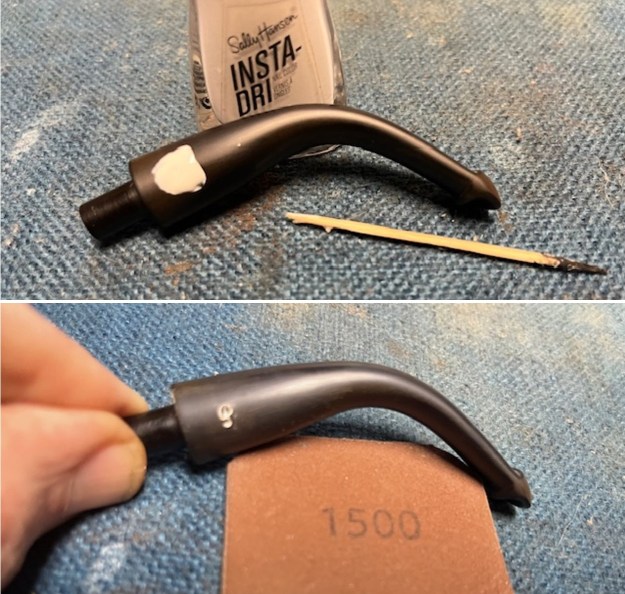
Armed with that information I turned to work on the pipe itself. Jeff had done a great job cleaning up the pipe as usual. He cleaned up the inside of the bowl with a Savinelli Fitsall Pipe Knife. The rim top and the inner edge of the bowl are in excellent condition. The bowl walls looked very good. He scrubbed the interior of the bowl and shank with shank brushes, pipe cleaners, cotton swabs and alcohol to remove the tars and oils. He scrubbed the exterior of the pipe with Murphy’s Oil Soap and a tooth brush to remove the grime from the finish. He scrubbed the inside of the stem with alcohol and pipe cleaners. He scrubbed the exterior with Soft Scrub and then soaked it in Briarville’s Pipe Stem Deoxidizer. He washed it off with warm water to remove the deoxidizer. The stem looked very good. I took photos of the pipe before I started working on it. I took close up photos of the bowl, rim top and stem to show how clean the pipe was. The bowl was clean and the rim top and the inner edge look beautiful. The stem was clean and did not show either tooth marks or chatter.I took a photo of the stamping on the side of the shank. It is very clear and readable and read as noted above. I also removed the stem from the shank and took photos of the pipe to show the look of the parts. I started my work on the pipe by addressing the damage on the inner edge of the rim. I used a folded piece of 220 grit sandpaper to clean up the darkening and the damage on the inner edge of the bowl.I sanded the bowl with 320-3500 grit sanding pads to smooth out sanding on the rim top and also to blend in the scratches on the bowl sides and heel. I polished the bowl and shank with 1500-12000 grit micromesh sanding pad – dry sanding it with the pads. I wiped the bowl down with a damp cloth after each pad. It began to take on a deep shine. The exterior of the bowl look better after sanding. I worked some Before & After Restoration Balm into the briar with my finger tips. I let it sit on the bowl for 10 minutes and then buffed it off with a paper towel and soft cloth. The product is a great addition to the restoration work. It enlivens, enriches and protects the briar while giving it a deep glow. It is a product I use on every pipe I restore. I set the bowl aside and turned my attention to the stem. I sanded it with 320-3500 grit sanding pads to remove the light tooth marks and chatter. It did not take much for them to be gone. I wiped the stem down with Obsidian Oil after each sanding pad to remove the debris and dust of the sanding. By the last pad the stem looks very good.I touched up the Charatan logo stamp on the left side of the stem with white acrylic fingernail polish. I worked it into the stamping with a tooth pick. I scraped off the excess and used a worn 1500 grit micromesh sanding pad to finish removing the excess. It was ready for the next step. I polished it with micromesh sanding pads – dry sanding with 1500-12000 grit pads and wiping the surface down with Obsidian Oil after each sanding pad. It is really shining. I polished it further with Before & After Stem Polish – both Fine and Extra Fine. I gave it another coat of Obsidian Oil to finish this step. It was great to finish this Charatan’s Make London, England De Luxe 502 Prince. I put the pipe back together and buffed it with Blue Diamond on the buffing wheel. I gave the bowl multiple coats of carnauba wax. I buffed the pipe with a clean buffing pad to raise the shine. I hand buffed the pipe with a microfiber cloth to deepen the shine. It is fun to see what the polished bowl looks like with deep sandblast all around it. Added to that the polished black, vulcanite, saddle stem was beautiful. This Charatan’s Make De Luxe Prince is great looking and the pipe feels great in my hand. It is light and well balanced. Have a look at it with the photos below. The dimensions are Length: 6 ½ inches, Height: 1 ¼ inches, Outside diameter of the bowl: 1 ¼ inches, Chamber diameter: ¾ of an inch. The weight of the pipe is 35 grams/1.20 ounces. It is a beautiful pipe and one that will soon be on the rebornpipes store in the British Pipe Makers Section of the store. If you want to add it to your collection let me know. Thanks for walking through the restoration with me as I worked over this pipe.

As always, I encourage your questions and comments as you read the blog. Thanks to each of you who are reading this blog. Remember we are not pipe owners; we are pipe men and women who hold our pipes in trust until they pass on into the trust of those who follow us.

Restoring a Sandblast, Lane Era Charatan’s Make London England 90X Dublin


by Steve Laug

The next pipe on the table is one that we picked up in the lot from a seller in Barrington, Rhode Island, USA on 08/22/2024. The classic Charatan Dublin shape caught our eye and we bought it along with some other pipes. It is stamped on the underside of the shank and reads C (cursive in a circle) [followed by] Charatan’s Make [over] London, England [followed by] the shape number 90X. It has a Dark Tan to Medium Brown stain on the sandblast finish that is a stark contrast to the vulcanite saddle stem with the CP stamp on the left side of the saddle. The bowl had been recently reamed and cleaned. The seller told us that he had cleaned it before selling it to us. The inner edge and the top look good. The stem is oxidized. It shows some light tooth marks or chatter on the top and underside ahead of the button and damage on the button edge on both sides. Jeff took some photos of the pipe to show the general condition of the pipe before he started his clean up. He took some photos of the rim top and bowl from various angles to give me a clear picture of the condition of the rim top and bowl. The outside of the bowl and rim is quite clean and the inside of the bowl is very clean. He included photos that show the top and underside of the stem. It is as described above. Jeff took some photos of the sides and heel of the bowl to show the condition of the finish on the pipe. The photos showed some great grain showing through the deep sandblast around the bowl and shank. It is a great looking piece of briar. He took photos of the stamping on the underside of the shank. The stamping was clear and readable as noted above. An added part of pipe restoration for me is to try to gather as much background on a brand and maker as I can find. With Charatan that is an enjoyable web to untangle. There is a lot of information and it can lead to understanding what era a pipe was made in. To try to figure out the era of the Charatan’s pipe I was working on I turned to the Pipephil website, Logos and Stampings (http://www.pipephil.eu/logos/en/logo-charatan.html). There is some really helpful information on each of the lines of Charatan’s Make pipes that entered the market. There was not a sandblast stamped like the one in hand. The site did give a short history of the brand. I quote the portion that is most pertinent.The brand was founded in 1863 by Frederik Charatan. When his father retired in 1910, Reuben Charatan took over the family business. All the pipes were handmade until 1973. The brand name has been overtaken by Dunhill in 1978 and sold in 1988 to James B. Russell Inc.(NJ, USA). During the period 1988-2002 Charatans were crafted by Butz Choquin in St Claude (France). Dunhill re-purchased Charatan brand name in 2002 and Colin Fromm (Invicta Briars, Castleford) followed up on freehand production.

Next, I turned to Pipedia to see if I could find more information on the brand and possibly a link to a sandblast finished Dublin (https://pipedia.org/wiki/Charatan) but once again in the general article it was not listed. It did give a little more historical information. I quote the pertinent parts that give information on this particular pipe. In 1950 Herman G. Lane, striving to expand his business in Great Britain, made contacts with the Charatan family. Apparently, Lane got a certain influence soon, but it was not until 1955 that Lane Ltd. became the sole distributor for Charatan’s in the United States superseding Wally Frank. This can be documented in a “biography” written for Herman G. Lane titled “Leaves from a Tobaccoman’s Log”.

Thanks to Herman G. Lane’s dedicated labor Charatan became hugely popular in the States. As reported by Ken Barnes in an interview with Rick Newcombe, Reuben Charatan passed away in 1962, and his widow sold the firm to Herman Lane 1 or 2 years after his death.[1] In the early 1960s Charatan pipes were the first to overstep the $100 Dollar line in US pipe sales. In 1978 Lane’s heirs sold the Charatan company to Dunhill. The Prescot Street factory was closed in March 1982. Thereafter the fame and quality of the make declined.

The pre-Lane period (prior to 1955) and the Lane era pipes (1955 to until sometime between 1979 – 1984) are of primary interest the collector. The Lane era is often quoted as beginning about 1950.

Charatan records are almost non-existent before Lane due to a factory fire, making it difficult to date pre-Lane pipes. Charatan used 4 basic grades prior to 1950: Supreme, Selected, Executive, and Belvedere. After 1950 Herman Lane’s influence began, and the grades started to expand. In 1955 Lane took over sole distributorship of Charatan in the US. In 1957 he introduced the Supreme S. Most of his other introductions were from the 1960s and early 1970s.

From this I am fairly certain I am dealing with a Lane pipe made after 1955. There is also a circle L script mark that is a Lane stampings on the pipe which also supports this.

I continued digging further into the dating of the pipe, but what I had found above was a good start for me. If some of you would like to try your hand at dating it more accurately as to the time period it came out you might want to check out the article on Pipedia on Dating Charatans (https://pipedia.org/wiki/Dating_of_Charatans).

I also reread the article on Pipedia by the Italian fellow who contributed some really helpful information on the brand (https://pipedia.org/wiki/Charatan_-_Milan_2014). I quote the section on the Second period: Reuben Charatan 1910 – c. 1962. I have highlighted a portion of the section on the shank in red to point out some more helpful dating information.

– In 1962 Herman Lane took over the business from the Charatan family, although he had already influenced production from the 1950s.

– The pipes were mostly larger than the previous ones and corresponded in size to Dunhill group 5. These are slightly less rare, but still difficult to find.

– Stem: Usually in ebonite, saddle shaped or tapered, bearing a fine “CP” stamp, underbore system (see below) used when necessary.

– Shank: The shape code is stamped on it together with the nomenclature “CHARATAN’S MAKE LONDON ENGLAND” arranged in two lines. From 1955 onward on the models marketed for the USA there is also a serif and circled capital “L” (but not all models bear this) which resembles the pound sterling symbol. The “L” is for Lane, the importer.

From 1958, Lane changed the nomenclature for models marketed for the US to clarify the message: “MADE BY HAND”.  In this period the underbore was introduced. Its manufacturing period ranged between 1920 and c.1930. This model was equipped with a duralumin plunger trap fitted in the stem, which served to clean the residue more easily. This particular model bore a special stamp on the stem, and also had its own catalogue…

QUALITY GRADES…The stem did not only display the stamps mentioned above. Another stamp that can help dating is the one referring to the quality of the pipe. Until Herman Lane arrived on the scene there were four quality grades. Starting with the lowest: Belvedere, Executive, Selected, and Supreme. Lane went on to add higher grades from time to time: Supreme S, Supreme S100, S150, S200, S250, S300, Coronation, Royal Achievement, Crown Achievement, and Summa Cum Laude; these last three are extremely rare and almost impossible to find. He also invented other, different grades, even changing the previous pipe classification standards. We will not go into detail here, but it means that if we find an S100 or Coronation the pipe was manufactured following Herman Lane’s acquisition. In particular, the FH mark, or Freehand pipe was commissioned to the famous Danish craftsman, Preben Holm.

Nomenclature – The Lane Trademark serif and circled L indicates the pipe is from the “Lane Era” (approx. 1955 to 1979 -1984?), however it appears that both the English factory or Lane themselves sometimes, or perhaps even often forget to stamp the L on a pipe. The Charatan factory was known for inconsistencies, especially in stampings. Therefore, although an L on the pipe definitely defines it as a Lane Era pipe, the lack of it could simply mean the pipe missed receiving the stamp from the factory. The lack of the trademark could also mean the pipe was destined for the European market.

Charatan pipes were not well distributed prior to the Lane Era, so very few pre-Lane pipes exist today. Herman Lane greatly grew the brand in the U.S., which caused corresponding growth in Europe.

Generally, when the pipe is stamped with the BLOCK letters “MADE BY HAND” it means the pipe was probably made between 1958 and 1965”

Generally, block letters “MADE BY HAND” and some of the other nomenclature in script (i.e. City of London or Extra Large next to the MADE BY HAND) means the pipe was made sometime between 1965 and the mid 1970s. The total script nomenclature “Made by Hand in City of London” evolved over this period of time, so many pipes had variants, such as Made By Hand in block letters and City of London in script, or some other variation of the terms or stampings.

It is believed the FH was used on Charatan pipes between 1957 and 1967-68. Three different sizes were used. The Charatan Logo (CP) on the pipe bit was changed over the year

Now I knew I was working on Lane pipe which actually means it was between 1955 and 1988 as shown by the stamping.

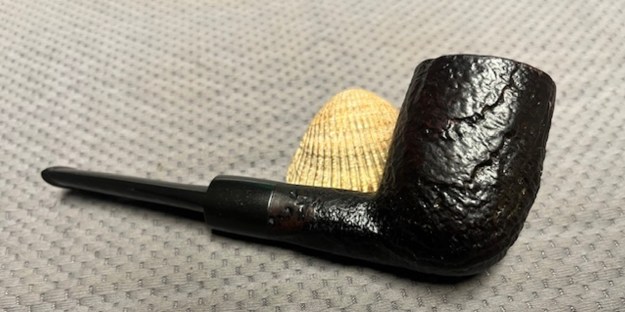
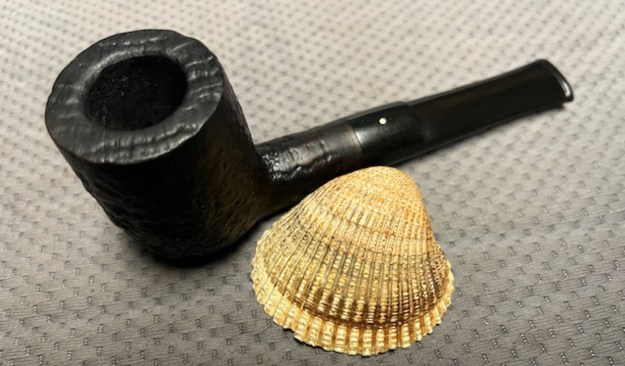
Armed with that information I turned to work on the pipe itself. Jeff had done a great job cleaning up the pipe as usual. He cleaned up the inside of the bowl with a Savinelli Fitsall Pipe Knife. The rim top and the inner edge of the bowl are in excellent condition. The bowl walls looked very good. He scrubbed the interior of the bowl and shank with shank brushes, pipe cleaners, cotton swabs and alcohol to remove the tars and oils. He scrubbed the exterior of the pipe with Murphy’s Oil Soap and a tooth brush to remove the grime from the finish. He scrubbed the inside of the stem with alcohol and pipe cleaners. He scrubbed the exterior with Soft Scrub and then soaked it in Briarville’s Pipe Stem Deoxidizer. He washed it off with warm water to remove the deoxidizer. The stem looked very good. I took photos of the pipe before I started working on it. I took close up photos of the bowl, rim top and stem to show how clean the pipe was. The bowl was clean and the rim top and the inner edge look beautiful. The stem was clean and showed light tooth marks or chatter.I took a photo of the stamping on the side of the shank. It is very clear and readable and read as noted above. I also removed the stem from the shank and took photos of the pipe to show the look of the parts. I worked some Before & After Restoration Balm into the briar with my finger tips and a shoe brush to get in the nooks and crannies of the sandblast. I let it sit on the bowl for 10 minutes and then buffed it off with a paper towel and soft cloth. The product is a great addition to the restoration work. It enlivens, enriches and protects the briar while giving it a deep glow. It is a product I use on every pipe I restore. I set the bowl aside and turned my attention to the stem. I touched up the Charatan logo CP stamp on the left side of the saddle stem with white acrylic fingernail polish. I scraped the excess when it had cured. I removed more of the excess with a worn 1500 grit micromesh sanding pad. It looked very good.It was ready for the next step. I polished it with micromesh sanding pads – dry sanding with 1500-12000 grit pads and wiping the surface down with Obsidian Oil after each sanding pad. It is really shining. I polished it further with Before & After Stem Polish – both Fine and Extra Fine. I gave it another coat of Obsidian Oil to finish this step. It was great to finish this Charatan’s Make 90X Saddle Stem Dublin. I put the pipe back together and buffed it with Blue Diamond on the buffing wheel. I gave the bowl multiple coats of carnauba wax. I buffed the pipe with a clean buffing pad to raise the shine. I hand buffed the pipe with a microfiber cloth to deepen the shine. It is fun to see what the polished bowl looks like with deep sandblast all around it. Added to that the polished black, vulcanite, saddle stem was beautiful. This Charatan’s Make 90X Dublin is great looking and the pipe feels great in my hand. It is light and well balanced. Have a look at it with the photos below. The dimensions are Length: 5 ½ inches, Height: 2 inches, Outside diameter of the bowl: 1 ½ inches, Chamber diameter: ¾ of an inch. The weight of the pipe is 42 grams/1.48 ounces. It is a beautiful pipe and one that will soon be on the rebornpipes store in the British Pipe Makers Section. If you want to add it to your collection let me know. Thanks for walking through the restoration with me as I worked over this pipe.

As always, I encourage your questions and comments as you read the blog. Thanks to each of you who are reading this blog. Remember we are not pipe owners; we are pipe men and women who hold our pipes in trust until they pass on into the trust of those who follow us.

A. Curtz Hand Carved Apple – is it a sandblast or rustication made to look like a blast?


by Steve Laug

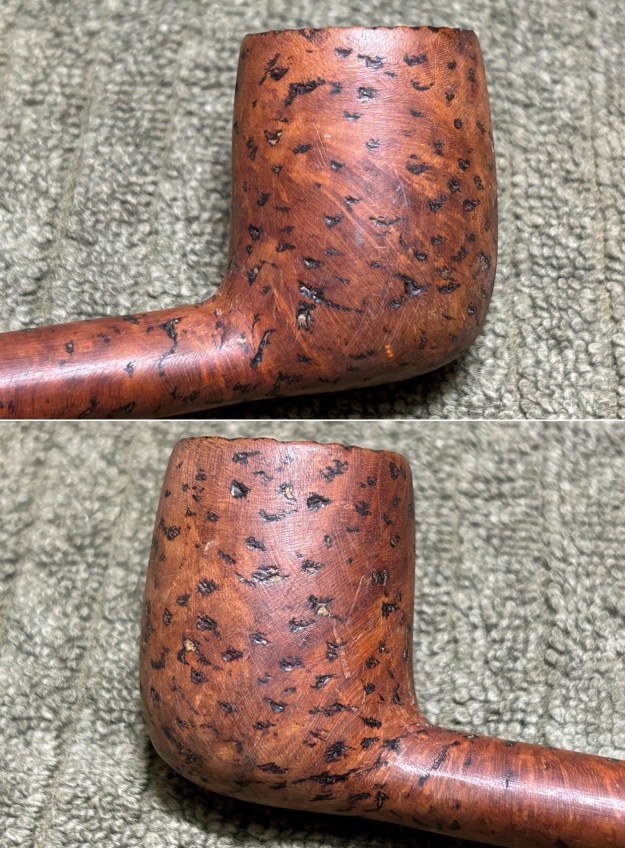
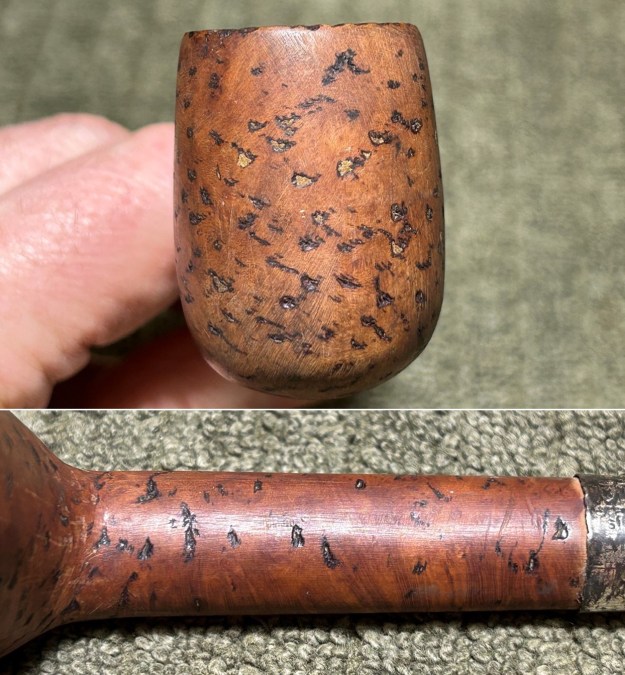
The next pipe on the work table is an Apple shaped pipe with a vulcanite taper stem. We picked the pipe up from a seller in Ogden, Utah, USA on 12/12/2024. It is stamped on the underside of the shank and reads A. Curtz. I knew the name in connection with Jeanie’s Smoke Shop in Salt Lake City when I worked on the brand in the past. The finish looks sand blasted but the more I look at it the more I think it is a rustication made to look like a blast. It has some great grain showing through the finish. It was quite dirty but still had a charm about it. The bowl was caked and there was a light lava coat and spots on the top and the inner edge of the rim. The stem was vulcanite and was a tapered. There were light tooth marks and chatter on both sides of the stem. There was a mother of pearl inlaid on the topside of the taper that showed the reflective nature of the material. Jeff took some photos of the pipe to show the general condition of the pipe before he started his clean up.He took some photos of the rim top and bowl from various angles to give me a clear picture of the condition of the rim top and bowl. You can see the cake in the bowl and the darkening and lava coat in the rustication on the rim top. It is hard to tell if there was any damage to the inner edge at this point. The next photos show the top and underside of the stem. It is dirty and has oxidation and calcification on both sides at the button. There is also some tooth chatter and some light tooth marks. Jeff took some photos of the sides of the bowl to show the condition of the finish on the pipe. The photos showed what to me looked like a unique rustication mimicking a sandblast around the bowl sides. Under the oils and grime, it was a nice looking bowl. He took a photo of the stamping on the underside of the shank. The stamping was on a smooth panel and it was clear and readable.To learn a bit more about the brand I turned to Pipephil to see what I could find out (http://www.pipephil.eu/logos/en/logo-c8.html). It turns out the pipe was made by an artisan named Arley Curtz who was from Utah. I did a screen capture of the photo and have included that below. I also included the side bar information below the photo.Artisan: “Arley” Curtz, Utah (USA). The stems of the A. Curtz pipes are also marked with 2 dots (a red and a white).

I then turned to Pipedia to find out some more details (https://pipedia.org/wiki/Curtz). The information was brief but helpful. I have included that article below.

Arley G. Curtz retired the director of the Bountiful Davis Art Center (Bountiful, Utah) and is now a pipe repairman and pipe maker. He was formerly the pipe repairman at Jeanie’s Smoke Shop, and has been making pipes ever since.

He makes about 70 pipes a year using Greek and Italian briar. His pipes are available at Edward’s Pipe & Tobacco Shop in Denver, CO, at the Tinderbox in Salt Lake City, on the web at The Pipe and Pint, and at Curtz Handmade Pipes and Pipe Repair in Salt Lake City, Utah.

I did a bit more searching to learn more about the repairman/pipe maker. I came across a 2018 article on a site called Utahstories (https://utahstories.com/2018/05/arley-curtz-pipe-making-and-memory-collecting/). The article included a photo of Arley Curtz that I have inserted below. I am also including a short section of the article that makes me want to meet this gentleman.

For Arley Curtz, a pipe is more than just a way to smoke tobacco. It summons up a time when pipe smoking was both acceptable and part of a gentler civility in our culture.

Curtz is a pipe maker and collector of smoking pipes. He has over 300, ranging from simple corn cobs to handmade antiques. Each one has a story. As the smoke from a pipe curls upwards, it allows Curtz a time to pause and reflect. “A pipe,” he says, “is a keeper of memories.”

Just as a pipe cannot be smoked in haste, a handmade pipe requires patience to craft. Curtz forms his pipes from briarwood, which grows in countries bordering the Mediterranean Sea.

I only wish I had found this earlier before I met my brother in Salt Lake City and visited Jeanie’s Smoke Shop. I would have certainly made a point to visit Arley at his own shop and gotten to meet him. Until my next trip to Idaho to visit my Dad and brother I will leave this on my wish list. Now to get on with working on his pipe.

Jeff did his usual thorough job cleaning the pipe which I really appreciate because of the freedom it gives me in dealing with pipes. He reamed it with a PipNet pipe reamer and got rid of the cake. He cleaned up the reaming with a Savinelli Fitsall Pipe Knife so that we could see the walls of the bowl and assess for damage. He cleaned the internals of the shank and stem with alcohol, pipe cleaners and alcohol. He scrubbed the exterior with undiluted Murphy’s Oil Soap and a tooth brush. He rinsed the pipe under warm water. He dried it off with a cloth and then let it air dry. The stem was scrubbed with Soft Scrub and had a soak in Briarville Pipe Stem Deoxidizer to remove the oxidation. Once it was rinsed off, it came out looking very good. The finish on the bowl and the rim top cleaned up nicely. I took pictures of the pipe to show how it looked when I unpacked it. I took a close up photo of the rim top to show how clean it was. The bevelled inner edge looked very good. The stem looked good just some light tooth chatter and marks near the button. Overall the pipe is a beautiful looking piece.I took a photo of the stamping on the underside of the shank. It read as noted above. It is very clear and readable. I took a photo of the bowl with the stem removed to give a sense of the sized of the pipe.The finish on the bowl was very clean and looked good. I worked some Before & After Restoration Balm into the briar with my finger tips and a horsehair shoe brush. I let it sit on the bowl for 10 minutes and then buffed it off with a paper towel and soft cloth. The product is a great addition to the restoration work. It enlivens, enriches and protects the briar while giving it a deep glow. It is a product I use on every pipe I restore. I set the bowl aside and worked on the stem. The shank end of the stem had rounded shoulders that interrupted the flow of the straight line of the stem and shank junction. I sanded the stem surface with 220 grit sandpaper to flatten the edge. Once finished it looked flatter and the rounded shoulders were gone on all but the top side and it was lessened. I sanded out the sanding on the shank end and the light tooth marks and chatter toward the button with 320-3500 grit sanding pads. I wiped the stem down with an Obsidian Oil cloth after each sanding pad. The stem looked better at this point. I polished the stem with micromesh sanding pads – wet sanding with 1500-12000 grit sanding pads. I wiped it down after each sanding pad with Obsidian Oil. I polished it with Before & After Pipe Stem Polish – both Fine and Extra Fine. I buffed the stem with a soft cloth to raise the shine. I gave it a final wipe down with Obsidian Oil to protect the stem from UV and slow down future oxidation. I don’t know what it is about finishing a restoration but I have to tell you that it is a favourite part of the process. It is the moment when everything that I have worked on comes together. I can compare the pipe to where I started and there is always satisfaction that it does indeed look better than when we picked it up. I put the A. Curtz Rusticated Apple back together and buffed it with Blue Diamond on the buffing wheel. I gave the bowl multiple coats of Conservator’s Wax and the stem multiple coats of carnauba wax. I buffed the pipe with a clean buffing pad and hand buffed it to raise the shine. It is fun to see what the polished bowl looks like along with the polished vulcanite taper stem. This Arley Curtz Rusticated Apple is a great looking pipe and I am sure that it will be comfortable in hand when smoking as it is light and well balanced. Have a look at it with the photos below. The dimensions are Length: 5 ½ inches, Height: 1 ¾ inches, Outside diameter of the bowl: 1 ½ inches, Chamber diameter: 7/8 of an inch. The weight of the pipe is 1.76 ounces/51 grams. It will be on the rebornpipes store in the American Pipe Makers Section. If you are interested in adding it to your collection let me know. Thanks for walking through the restoration with me as I worked over this pipe.

As always, I encourage your questions and comments as you read the blog. Thanks to each of you who are reading this blog. Remember we are not pipe owners; we are pipe men and women who hold our pipes in trust until they pass on into the trust of those who follow us.

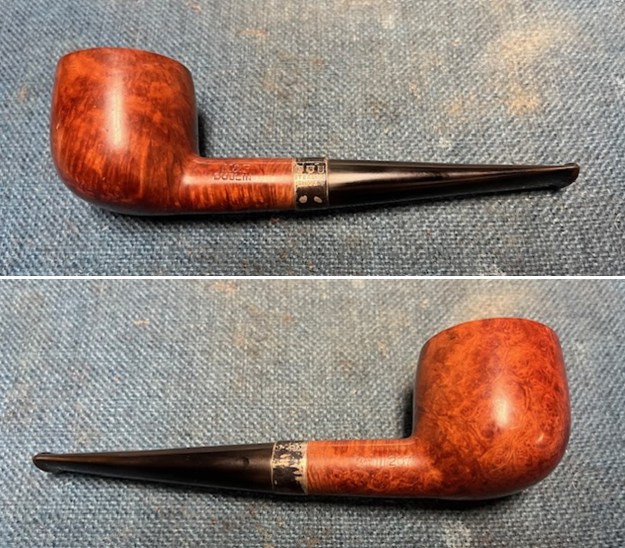
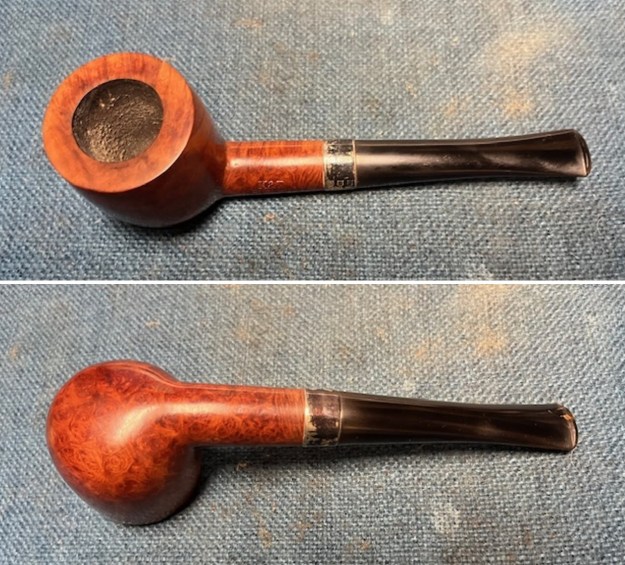
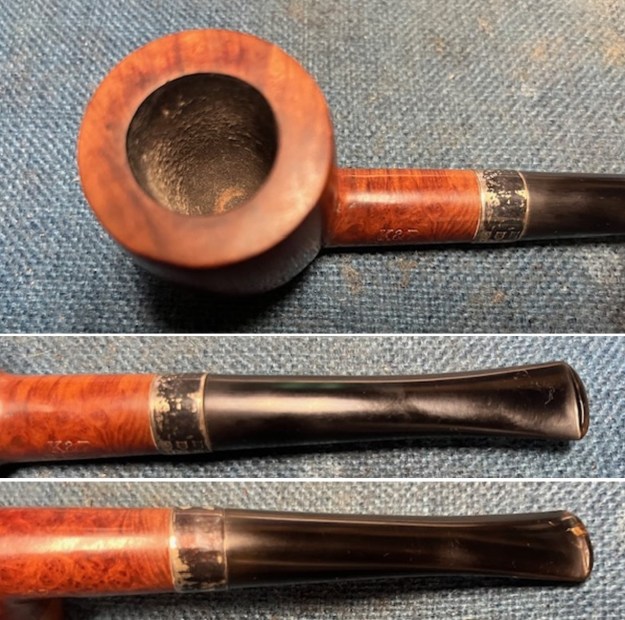
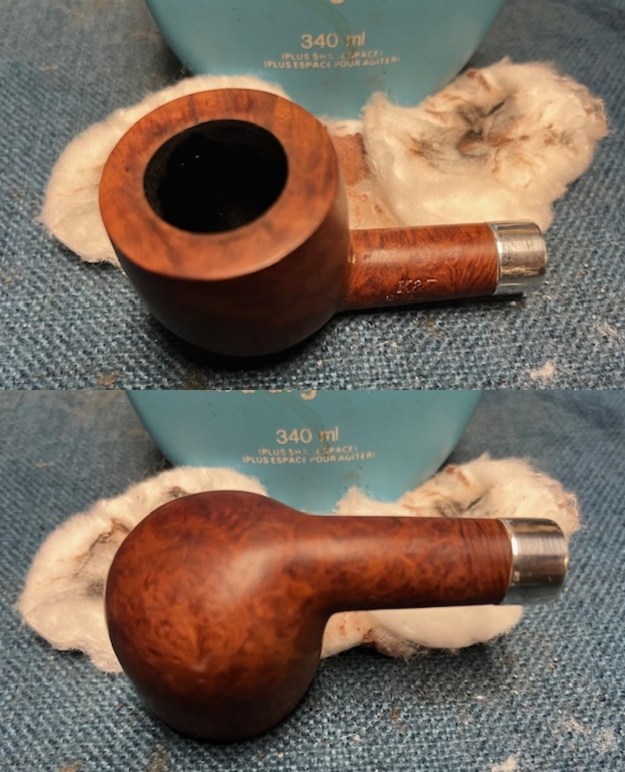
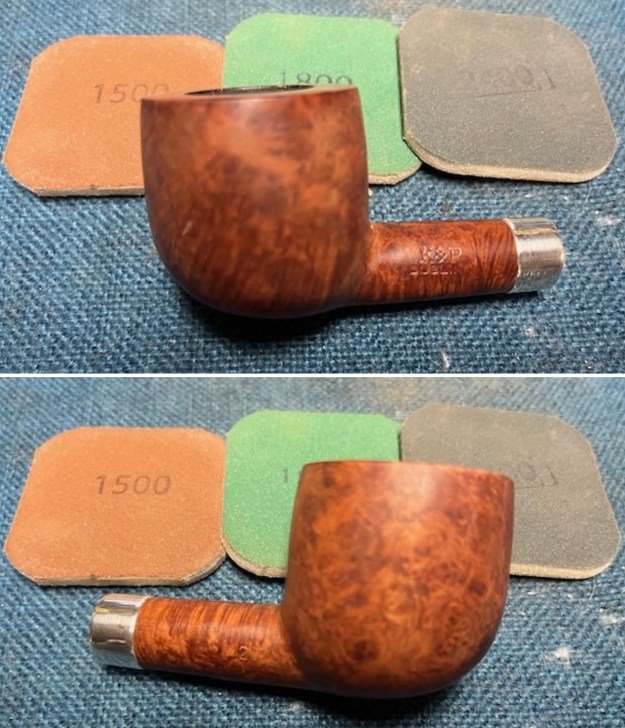
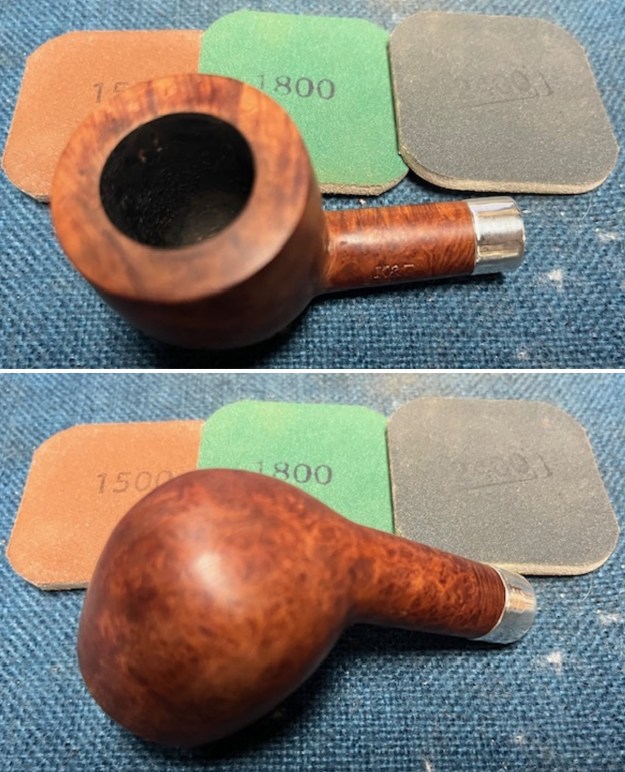
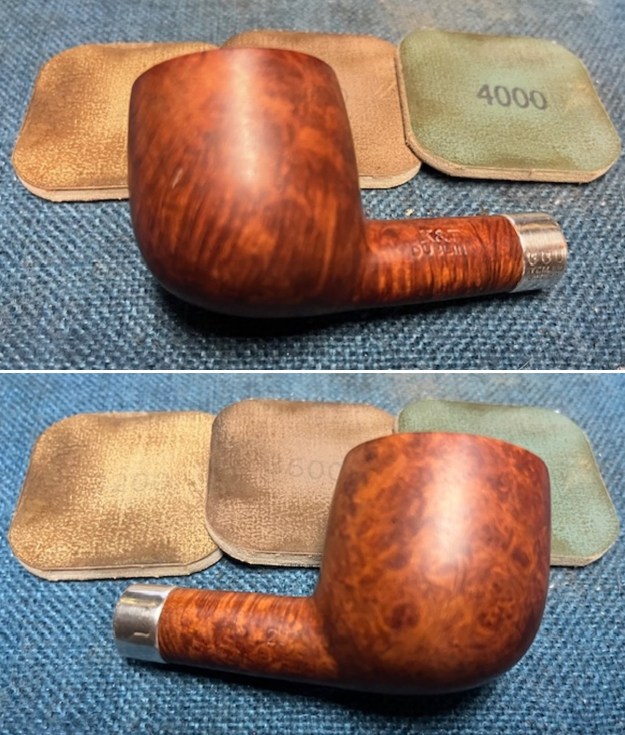
You Got to Love these Peterson’s Republic Era K&P Irish Made 101 Billiards


by Steve Laug

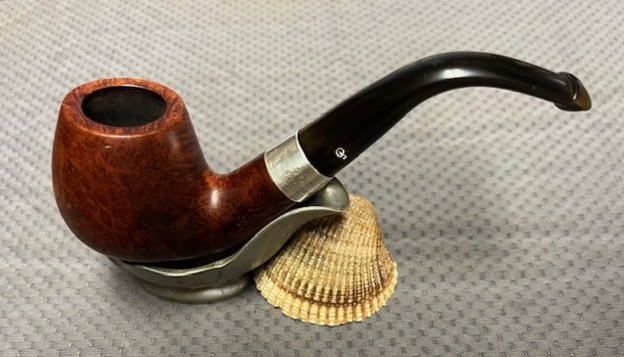
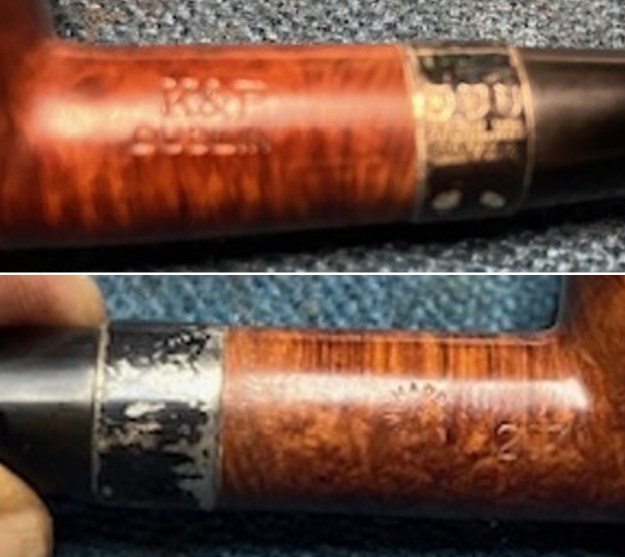
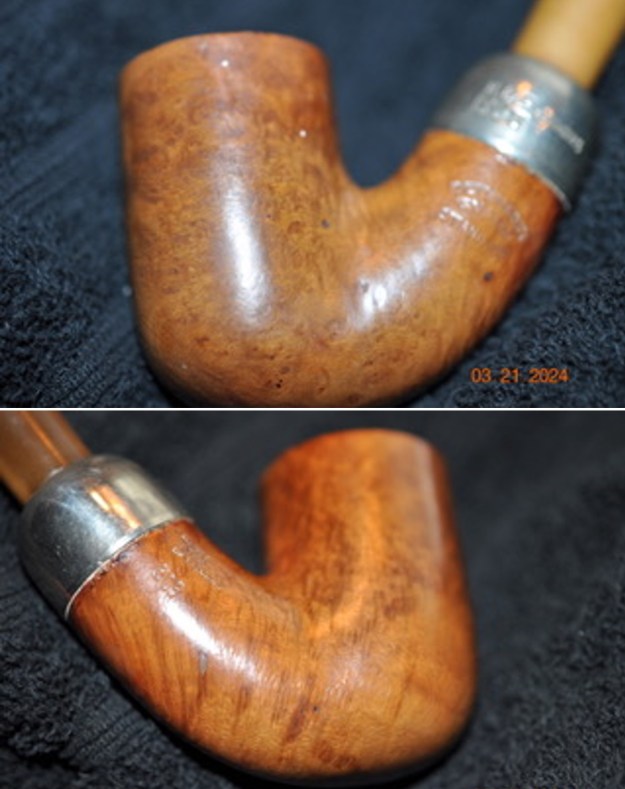
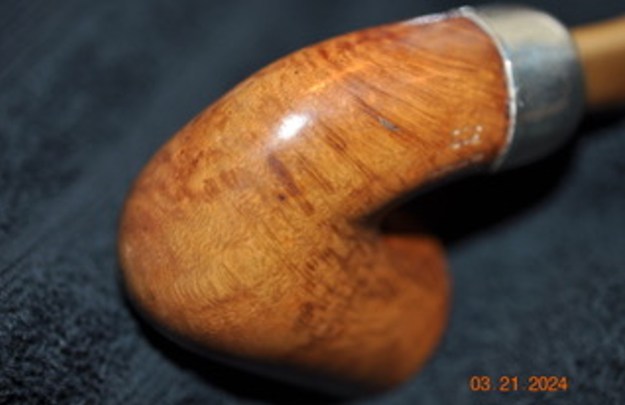
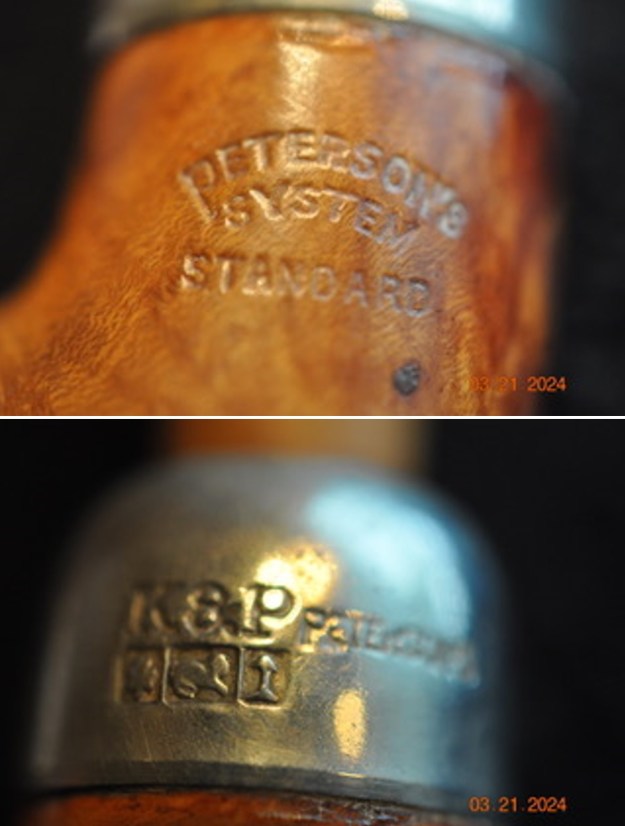
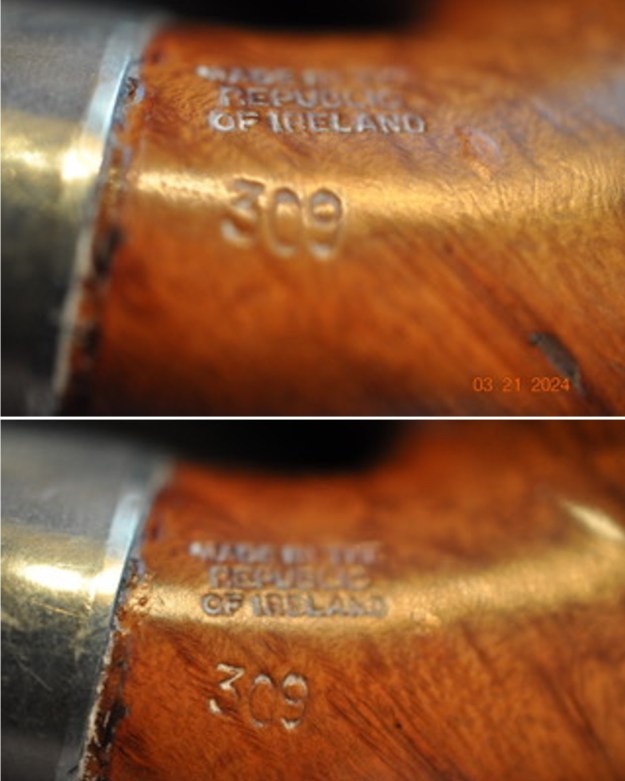
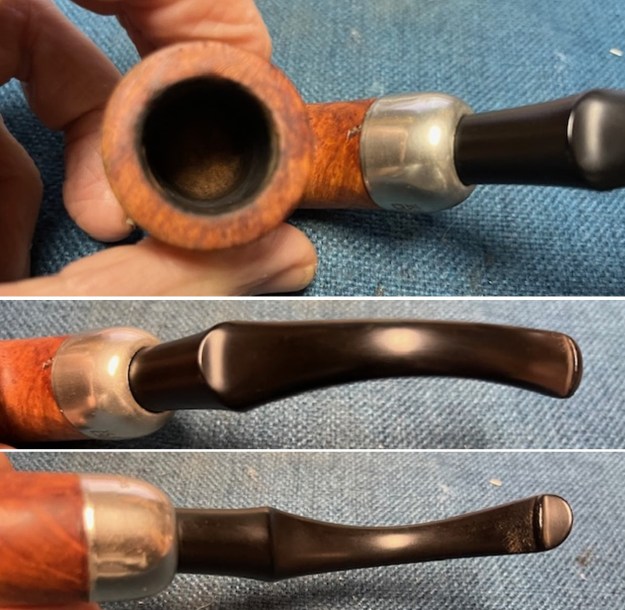
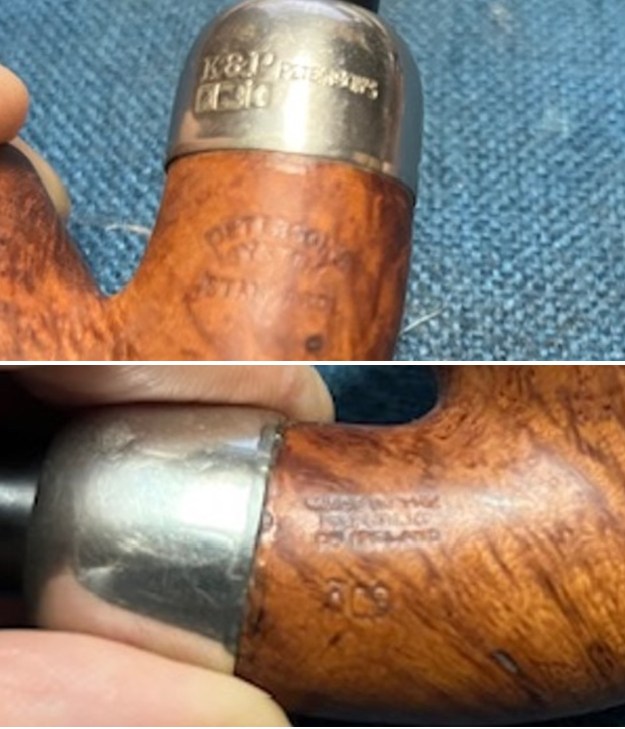
This great looking Billiard pipe was purchased on 04/11/2024 from our contact in Copenhagen, Denmark. It is stamped on the left side of the shank and clearly reads K&P [over] Irish Made. On the right side it is stamped Made in the Republic of Ireland [three lines]. The shape number 101 is stamped to the right of that next to the bowl/shank junction. The nickel ferrule is stamped K&P [over] Petersons. The bowl had a cake on the walls and fortunately little overflow of lava onto the rim top and edges. The inner edge had some damage and darkening. The smooth finish is dirty with debris and oils. The vulcanite taper, fishtail stem has no stamp or logo on it. It was lightly oxidized and had tooth marks and chatter on both sides near the button. It was a beautiful looking pipe even through the grime in the finish. Jeff took photos of the pipe before he started cleaning it up. Have a look.Jeff took close up photos of the bowl and rim top to show the condition of the bowl and the rim top. In the close up you can see the light lava on the rim top, inner edge and the cake in the bowl. The damage on the rim top and the inner edge is also visible. He also took close up photos of the stem to show its condition as mentioned above. He also took photos of the tooth marks and chatter on both sides of the stem. He took photos of the bowl sides and heel to show the grain around the bowl. The grain is quite nice even through the grime. He took photos of the stamping on the sides of the shank. The stamping is clear and readable as noted above. The stamping on the nickel ferrule is also clear.I did not have a lot of back story on the Irish Made pipes so I turned to Peterson’s website to see what I could find out about the line specifically(https://www.peterson.ie/pipes/classic/irish-made-army/moreinfo.cfm?pd_product_id=991). Turns out the Irish Made Army pipes were a series of pipes. The information was quite helpful and I have included it below.

About The Series

Since the 19th century, we’ve made army mounted pipes, defined by their inclusion of a sturdy mount reinforcing the shank and a push-style tenon that can be removed easily from the shank, without risking damage to the pipe. Our entry-level, Irish Made Army line is one of our oldest and most popular within that style, featuring nickel army mounts and reserved walnut finishes. Merging utilitarian design with practical grace, it’s available in a variety of classic, non-System shapes, including straight designs.

From there I turned to Mark Irwin’s Petersonpipenotes blog to see if he had specifically worked on or noted this line (https://petersonpipenotes.org/tag/peterson-kp-irish-army/). He had and I quote a short section below from the site.

The “K&P” in “K&P over IRISH MADE” is actually part of the line’s name, which most people don’t know, and understandably so. The non-System army-mount Peterson dates from the 1906 catalog and has been issued in several line names. It is currently enjoying a huge vogue, with Peterson releasing two or three new army-mount lines every season.

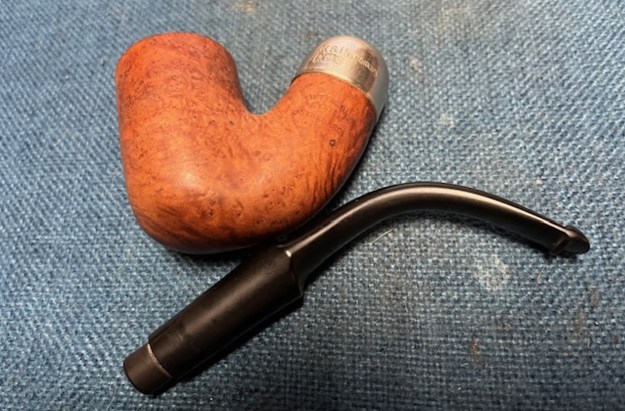
Armed with the information above, I turned my attention to the pipe itself. Jeff had cleaned the pipe with his usual penchant for thoroughness that I really appreciate. He reamed it with a PipNet pipe reamer and cleaned up the reaming with a Savinelli Fitsall Pipe Knife. He scrubbed out the internals with alcohol, pipe cleaners, shank brushes and cotton swabs until the pipe was clean. He scrubbed the exterior of the bowl with Murphy’s Oil Soap and a tooth brush to remove the grime and grit on the briar and the lava on the rim top. The finish looks very good with good looking grain around the bowl and shank. Jeff soaked the stem in Before & After Deoxidizer to remove the oxidation on the rubber. When the pipe arrived here in Vancouver for the second stop of its restoration tour it looked very good. I took photos before I started my part of the work. I took close up photos of the bowl, rim top and stem to show how clean the pipe was. The bowl was clean and the rim top and the inner edge clearly show the damage. The stem was clean and showed the light tooth marks and chatter.I took photos of the stamping on the sides of the shank. It is very clear and readable and read as noted above. I also removed the stem from the shank and took photos of the pipe to show the look of the parts. I started working on the damaged rim top and burn damaged areas on the inner edge of the rim first. I used 220 grit sandpaper and a wooden sphere to clean up the edge. It looked significantly better. I will sand it with sanding pads when I work on the bowl and shank.I sanded the bowl and shank with 320-3550 grit 2×2 inch sanding pads to smooth out the scratches on the rim top and sides of the bowl. I wiped the bowl down after each sanding pad with a damp cloth to remove the sanding debris. I sanded the exterior of the bowl with 1500-12000 grit micromesh sanding pads. I dry sanded it with each pad and wiped the briar down with a damp cloth to remove the sanding debris. I worked some Before & After Restoration Balm into the briar with my finger tips. I let it sit on the bowl and shank for 10 minutes and then buffed it off with a paper towel and soft cloth. The product is a great addition to the restoration work. It enlivens, enriches and protects the briar while giving it a deep glow. It is a product I use on every pipe I restore. I sanded out the tooth marks and chatter with 220 grit sandpaper and was able to remove all of them.I continued sanding the stem 320-3500 grit sanding pads – dry sanding with 2×2 inch sanding pads. I wiped the stem down with Obsidian Oil after each sanding pad. It began to take on a rich shine by the final pad. I polished the stem with micromesh sanding pads – dry sanding with 1500-12000 grit pads. Once again, I wiped it down between each pad with Obsidian Oil. I further polished it with Before and After Stem Polish – both Fine and Extra Fine. It looked very good. I am excited to finish this beautifully grained, Peterson’s Irish Made army 101 Billiard. I put the pipe back together and buffed it with Blue Diamond on the buffing wheel. I gave the bowl and the stem multiple coats of carnauba wax. I hand buffed the pipe with a clean buffing pad to raise the shine. It is fun to see what the polished bowl looks like with beautiful mixed grain all around it. The straight Pot looks great with the black vulcanite saddle stem. This smooth Classic Peterson’s Irish Made Army Billiard is great looking and the pipe feels great in my hand. It is light and well balanced. Have a look at it with the photos below. The dimensions are Length: 5 ¾ inches, Height: 1 ¾ inches, Outside diameter of the bowl: 1 ¼ inches, Chamber diameter: ¾ of an inch. The weight of the pipe is 39 grams/1.41 ounces. It turned out to be a beautiful pipe. I will be putting on the rebornpipes store in the Irish Pipe Makers Section. If you would like to add it to your collection let me know. It is a real beauty. Thanks for walking through the restoration as I brought the pipe back to life.

New Life for a Republic Era Peterson’s Kapet 606S Pot with a Saddle Stem


by Steve Laug

This beautifully grained briar pipe was purchased on 08/27/2024 from an auction on eBay from a seller in Memphis, Tennessee, USA. It is stamped on the left side of the shank and clearly reads Peterson’s [over] Kapet. On the right side it is stamped Made in the Republic of Ireland [three lines]. The shape number 606S is stamped to the right of that next to the bowl/shank junction. I believe the 606 is the shape number for a Pot and the S is for the saddle stem. The bowl had a thick cake on the walls and fortunately little overflow of lava onto the rim top and edges. The smooth finish is dirty with debris and oils. The vulcanite saddle stem has a “P” stamped on the left side of the saddle. It was oxidized, calcified and has tooth marks and chatter on both sides near the button. It was a beautiful looking pipe even through the grime in the finish. Jeff took photos of the pipe before he started cleaning it up. Have a look. Jeff took close up photos of the bowl and rim top to show the condition of the bowl and the rim top. You can also see the light lava on the rim top, inner edge and the cake in the bowl. He also took close up photos of the stem to show its condition as mentioned above. He also took photos of the tooth marks and chatter on both sides of the stem. He took photos of the bowl sides and heel to show the grain around the bowl. The grain is birdseye and mixed. Jeff also took photos of the stamping on the sides of the shank. It is faint in spots but readable as noted above. He also captured the condition of the P stamp on the stem side. I am including the link to the Pipedia’s article on Peterson pipes. It is a great read in terms of the history of the brand (https://pipedia.org/wiki/Peterson). There was a short note toward the bottom of the page about the series. It is definitely referring to the newer line that came out later. I quote:

I turned to Pipedia (https://pipedia.org/wiki/Peterson) to first pin down a date that the pipe was made. I knew that the Made in Ireland stamp would give me that. I quote:

As usual when trying to get accurate facts in regard to Peterson history, something will jump up and get in the way. They are missing many of their records. The following is the best that we can do for a guide to the myriad markings during the period 1922 – 1949. Prior to 1920 it was rare for a country of origin to be stamped on the pipe, just Peterson’s Dublin on the band. After 1921/22, if it is stamped “MADE IN IRELAND” and the “Made in” is stacked over “Ireland” or “MADE IN EIRE” or several other forms, it was made between 1922 and 1938. A considerable number of Peterson pipes were stamped “Irish Free State”. From about 1930 to 1949, most of the pipes (those which were stamped) were stamped “Made in Ireland”.” If the stamp reads “MADE IN IRELAND” in a circle, the pipe was made between 1939 and 1948. These are all “Pre-Republic” pipes. I can tell you that the mark “Irish Free State” was adopted in 1922; and replaced by “Eire” in 1937 and then by “Republic of Ireland” in 1949.

That gave me a date for the pipe – it was made after 1949 as can be proved by the Made in the Republic of Ireland stamp on the right side of the shank.

I turned to “The Peterson Pipe” by Mark Irwin and Gary Malmberg to get some background on the Peterson’s Kapet Line. On page 305 it had the following information.

Kapet (1925-87) Line first described in 1925 brochure and featured in occasional catalogs through 1987. Early specimens will be stamped IRISH over FREE STATE. Described in 1937 catalog as available in dark plum or natural finish. Featured an aluminum “inner tube” or stinger until 1945.  Mid-century specimens may be stamped Made In over Ireland. Specimens from 1970 on may have mounts with hallmarks.

Judging from the Made in the Republic of Ireland stamp, the pipe I am working on is probably made after 1945 when the stinger or inner tube was removed. Those dates work also for the Kapet information above. The stem has the original P stamp on the saddle side and no stinger.

Armed with the information above, I turned my attention to the pipe itself. Jeff had cleaned the pipe with his usual penchant for thoroughness that I really appreciate. He reamed it with a PipNet pipe reamer and cleaned up the reaming with a Savinelli Fitsall Pipe Knife. He scrubbed out the internals with alcohol, pipe cleaners, shank brushes and cotton swabs until the pipe was clean. He scrubbed the exterior of the bowl with Murphy’s Oil Soap and a tooth brush to remove the grime and grit on the briar and the lava on the rim top. The finish looks very good with good looking grain around the bowl and shank. Jeff soaked the stem in Before & After Deoxidizer to remove the oxidation on the rubber. When the pipe arrived here in Vancouver for the second stop of its restoration tour it looked very good. I took photos before I started my part of the work. I took close up photos of the bowl, rim top and stem to show how clean the pipe was. The bowl was clean and the rim top and the inner edge look beautiful. The stem was clean and did not show either tooth marks or chatter.I took photos of the stamping on the sides of the shank. It is very clear and readable and read as noted above. I also removed the stem from the shank and took photos of the pipe to show the look of the parts. I started working on the damaged rim top and burn damaged areas on the inner edge of the rim first. I used 220 grit sandpaper and a wooden sphere to clean up the edge. It looked significantly better. I will sand it with sanding pads when I work on the bowl and shank.I sanded the bowl and shank with 320-3550 grit 2×2 inch sanding pads to smooth out the scratches on the rim top and sides of the bowl. I wiped the bowl down after each sanding pad with a damp cloth to remove the sanding debris. I sanded the exterior of the bowl with 1500-12000 grit micromesh sanding pads. I dry sanded it with each pad and wiped the briar down with a damp cloth to remove the sanding- debris. I worked some Before & After Restoration Balm into the briar with my finger tips. I let it sit on the bowl and shank for 10 minutes and then buffed it off with a paper towel and soft cloth. The product is a great addition to the restoration work. It enlivens, enriches and protects the briar while giving it a deep glow. It is a product I use on every pipe I restore. I set the bowl aside and turned my attention to the stem. I “painted” the surface with the flame of a lighter to try and lift the tooth marks. I was able to lift some of them but those that remained I filled in with black, rubberized CA glue. Once the repairs cured I used a small file to flatten them and start blending them into the surface. I finished the cleanup with 220 grit sandpaper. It looked smooth. I touched up the “P” stamp on the left side of the saddle with some white acrylic nail polish. I let it cure then scraped off the excess and sanded the remnant off with a 1500 grit sanding pad.I polished the stem with micromesh sanding pads – dry sanding with 1500-12000 grit pads. Once again, I wiped it down between each pad with Obsidian Oil. I further polished it with Before and After Stem Polish – both Fine and Extra Fine. It looked very good. I am excited to finish this beautifully grained, Peterson’s Kapet 606S Saddle Stem Pot. I put the pipe back together and buffed it with Blue Diamond on the buffing wheel. I gave the bowl and the stem multiple coats of carnauba wax. I hand buffed the pipe with a clean buffing pad to raise the shine. It is fun to see what the polished bowl looks like with beautiful mixed grain all around it. The straight Pot looks great with the black vulcanite saddle stem. This smooth Classic Peterson’s Kapet 606S Pot is great looking and the pipe feels great in my hand. It is light and well balanced. Have a look at it with the photos below. The dimensions are Length: 5 ½ inches, Height: 1 ½ inches, Outside diameter of the bowl: 1 ½ inches, Chamber diameter: ¾ of an inch. The weight of the pipe is 39 grams/1.34 ounces. It turned out to be a beautiful pipe. I will be putting on the rebornpipes store in the Irish Pipe Makers Section. If you would like to add it to your collection let me know. It is a real beauty. Thanks for walking through the restoration as I brought the pipe back to life.`

Restoring a I. Bekler Meerschaum Banded Billiard with a Cumberland Taper Stem


by Steve Laug

This afternoon I decided to work on another pipe that I no longer know where or when we purchased it. I have a large box of Meerschaum pipes that is sitting in my storage that I need to clean up and restore. I have honestly avoided them for years but now was the time to start my work on some of them. Today I chose another of the uncased meers. This one is a Billiard shape with a Cumberland Taper Stem and a Softee Bit on the end. My guess is that the Softee protected the stem for tooth marks. I will know for sure once I remove it. It is a beautifully shaped Billiard Meer that is filthy and covered with scratches from its journey. The bowl and shank have some nice patina particularly on the shank. There is also a signature stamp on the left side of the shank that reads I. Bekler. It is dirty from use with a thick cake in the bowl and a heavy overflow of lava on the inner edge and thin rim top, heavier on the back side. The shank has a silver band on the end that is quite oxidized. The Cumberland stem had a push tenon and the shank was fitted with a receiver mortise. It fit well against the shank end and was slightly dirty and had a dirty and well chewed Softee Bit on the end protecting the stem surface and button. I took photos of the pipe before I started my clean up work on it. I took photos of the rim top and the stem to show the condition of the pipe when I brought it to the worktable. You can see the cake in the bowl and the heavy build up of lava and debris on the edge and top of the rim. It is another dirty pipe but still a charmer. There is a silver band on the shank end that is very oxidized and almost black. The Cumberland Taper stem has a rubber Softee Bit on both sides near the button.I took a photo of the I. Bekler signature stamp on the left side of the Cumberland taper stem. It is clear and readable. I removed the stem from the shank and took a photo of the parts. I used a small knife to pry off the Softee Bit on the stem end. I took photos of the stem. There was some sludge on the stem where the bit had ended but there were not any tooth marks or chatter on the stem surface ahead of the button. The Softee Bit had done its job and the stem looked great.I wanted more background on the brand and on the carver Ismet Bekler. I turned first to Pipephil’s site (http://www.pipephil.eu/logos/en/logo-c2.html) and found a link between CAO meerschaum and Ismet Bekler. I have included a screen capture of the section on the brand and the connection between Ismet Bekler and CAO.The CAO company was founded in 1968 by Cano Ozgener. Scandinavian Tobacco Group acquired the corporate in 2010. Current President of CAO (2010): Tim Ozgener (son of Cano). CAO was the US distributor for Europeans pipe brands like Preben Holm (from 1985) or Joura (Karl Heinz)
I then visited pipedia.org and did a search for more information on the American Meerschaum pipe company, CAO and Ismet Bekler(https://pipedia.org/wiki/CAO).

It was revealed that Ismet Bekler was a pipe carver who had carved many meerschaum pipes for CAO. I have reproduced certain relevant snippets of information from that article on pipedia.org.

C.A.O International, Inc. is the producer of one of the country’s top lines of premium cigars, cigar accessories, Meerschaum pipes, and pipe tobaccos. CAO’s Meerschaum pipes are smoked by presidents, senators, actors and other dignitaries. CAO was founded in 1964 by Cano A. Ozgener. Using his initials as the company logo.

Cano Ozgener’s interest in tobacco began on the banks of the Bosporus. Born on January 19, 1937, Ozgener was raised in his birthplace of Istanbul, Turkey, by his Armenian parents. His father was a jeweller, his mother a homemaker. He studied at a Jesuit French grammar school before being accepted into the American-run Roberts College in Istanbul, from which he received a bachelor’s degree in mechanical engineering in 1960.

As a student in Turkey, Ozgener enjoyed smoking pipes, especially those made from meerschaum.

Graduating from Columbia in 1964 with a professional engineering degree, Ozgener was recruited by DuPont to work in the firm’s Kinston, North Carolina, plant. It was during his stint in the textile division at the age of 27 that he came across some imperfect Turkish meerschaum pipes. In his spare time, he decided to use his engineering abilities to improve the pipes.

As Cano and the tobacconists were not happy with the quality of Turkish meerschaum, he decided to take the meerschaums and change the stems, make modifications and work with the carvers to improve them,” One day a tobacconist from Wilmington, Delaware, asked him where had he found the meerschaum, that he had never seen such quality. Cano told him that he had modified them. The tobacconist then ordered a dozen or two. That was just the beginning.

Ozgener kept his engineering job as he built his company. He worked constantly; his vacations from DuPont were spent attending tobacco conventions, which left little time to relax with his wife and two young children. Finally, in 1977, he left his engineering position to devote more attention to his growing business and to spend more time with his family.

The preceding article is reprinted here with the permission (forth coming) of Bennington Tobacconist

Ismet Bekler carved many meerschaum pipes, which were signed by him and sold by CAO, beginning in 1977. CAO actually trademarked his last name for use in 2001. Other carvers also provided pipes to CAO, and at least one other, Kural, also signed pipes made for CAO.

I surfed the net to know more about the pipe carver Ismet Bekler. I chanced upon a website that had some beautiful pipes on sale and most prominently, had many un-smoked meerschaum pipes carved by Ismet Bekler. Here is the link to the website. I have also noted some information about Ismet Bekler which is given in the introduction on this website. https://www.therightpipe.com/meerschaum-pipes/ismet-bekler-c382.html

Ismet Bekler was a prolific and popular carver. He began carving in the early 1970’s. Bekler is known as one of the best carvers in the history of Turkish Meerschaum. Master carver Bekler passed away in 2018 at the age of 84.

In 1980, the CAO Meerschaum Company contracted with Bekler to sell all of his carvings to them. CAO wanted to make Bekler a more well-known carver in the US and it was at this time he began signing his pipes.

Thus, from the above, my guess would be that this pipe is from the period post 1980 but could be pre-2018 since it is signed with the first initial, I. and the last name. However the lack of CAO in brass logo on the stem makes matters murky. Any inputs on this would definitely help me and other readers to know more about this pipe maker whose demise has left a void in the pipe carver’s community.

I started my work on the bowl by reaming the thick cake out of the bowl. I started with a PipNet reamer and the 2nd and 3rd cutting heads to take back the cake to the walls of the bowl. I cleaned up the reaming with a Savinelli Fitsall Pipe Knife. I sanded the bowl walls with a piece of dowel wrapped with 220 grit sandpaper. Once finished it looked very good.I scraped off some of the lava coat on the rim top. I used a topping board and some worn 220 grit sandpaper to smooth out the damage on the rim top and remove the rest of the darkening on the meer. It looked much better once I finished.I used a sharp knife blade to clean out the build up in the shank end around the nylon/Delrin insert in the shank for a push tenon that was in the stem. The inset in the stem was also very dirty so I cleaned it up at the same time using the knife. Once clean it looked much better.I cleaned out the airway in the shank and mortise as well as in the new stem with pipe cleaners (both bristle and regular) and alcohol. It was much better.I scrubbed the bowl surface with a tooth brush and undiluted Murphy’s Oil Soap. I rinsed the bowl with warm running water to wash off the dirt and the soap. It looked much better at this point. I sanded the bowl to smooth out the scratches in the bowl sides and rim top with 320-2500 grit 2×2 inch sanding pads. I wiped the bowl down after each sanding pad to remove the debris. It seemed to minimize the scratches and bring out the beauty of the patina developing in the meer. I polished the meerschaum with micromesh sanding pads – dry sanding with 1500-12000 grit pads. I wiped the bowl down after each pad with a damp cotton cloth. The bowl took on a shine by the last pad. I gave the bowl multiple coats of Clapham’s Beeswax Polish which is a soft wax. I rubbed the wax on the bowl sides and the shank end with my finger tips and set it aside to dry. Once the wax cured I buffed the bowl with a clean buffing pad and then with a soft microfibre cloth. The bowl has a rich glow. I set the bowl aside and turned my attention to the stem. I sanded the stem surface with 320-3500 grit 2×2 inch sanding pads. I wiped the stem down after each pad with a damp pad to remove the debris. By the end it was quite shiny and ready for polishing.I polished the stem with micromesh sanding pads – wet sanding it 1500-12000 pads. I wiped it down with a damp cloth after each pad to protect it and preserve it. it with Before After Pipe Polish – both Fine and Extra Fine. I polished the stem on the buffer with Blue Diamond. I took photos of the finished I. Bekler Billiard with a Cumberland Taper Stem to show the shine and the patina around the bowl. The polished Cumberland stem looks very good with the deepening colour on the shank and the bottom of the bowl. With time the contrast will grow richer and deeper to a thing of beauty. The finished Bekler Billiard fits nicely in the hand and I think it will feel great as it heats up with a good tobacco. Give the finished pipe a look in the photos below. The dimensions of the pipe are Length: 6 inches, Height: 2 inches, Outside diameter of the bowl: 1 ¼ inches, Chamber diameter: ¾ of an inch. The weight of the pipe is 1.69 ounces/49 grams. If you are interested in carrying on the legacy of this pipe it will be going on the rebornpipes store shortly. It is listed in the Ceramic and Meerschaum Section. You can send me a message or an email to let know you are interested. Thanks for reading this blog and my reflections on the pipe while I worked on it. This is an interesting estate to bring back to life.

A Charming NOS Chinrester from France


by Kenneth Lieblich

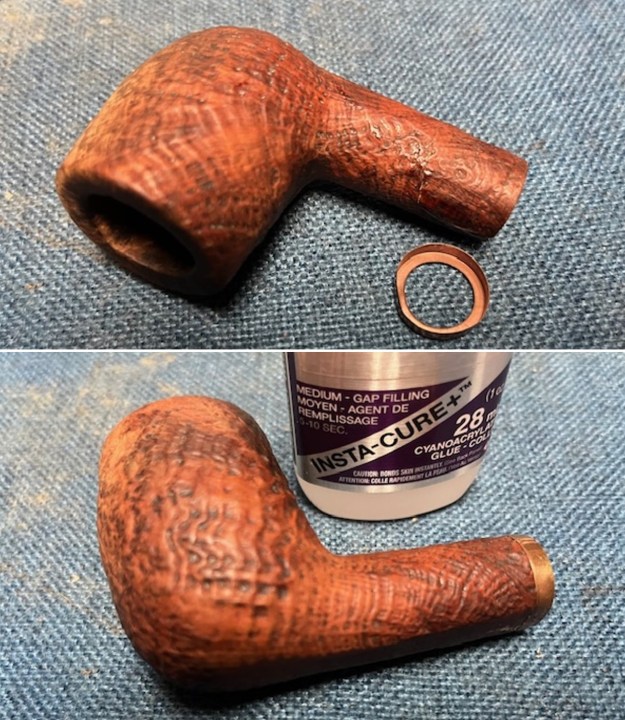
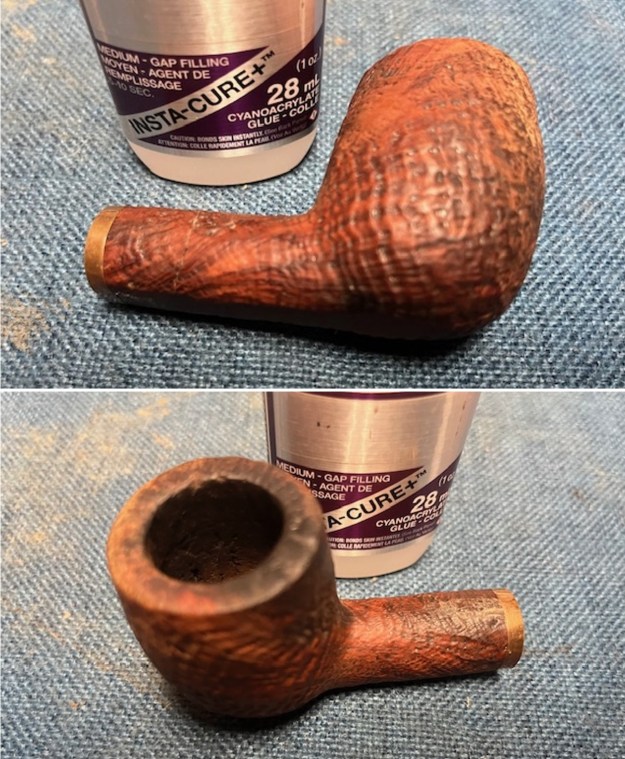
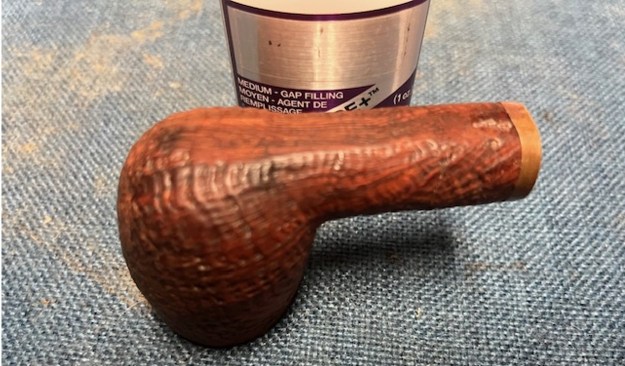
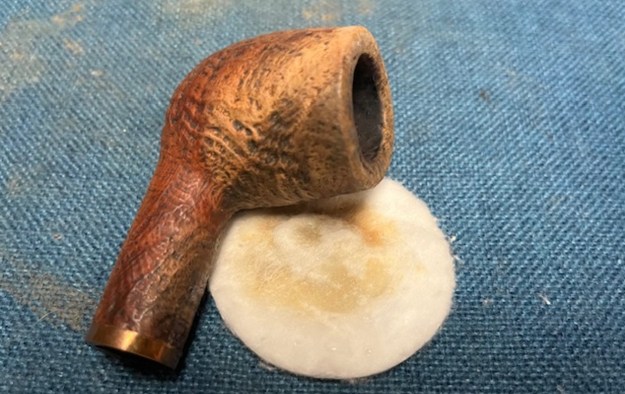
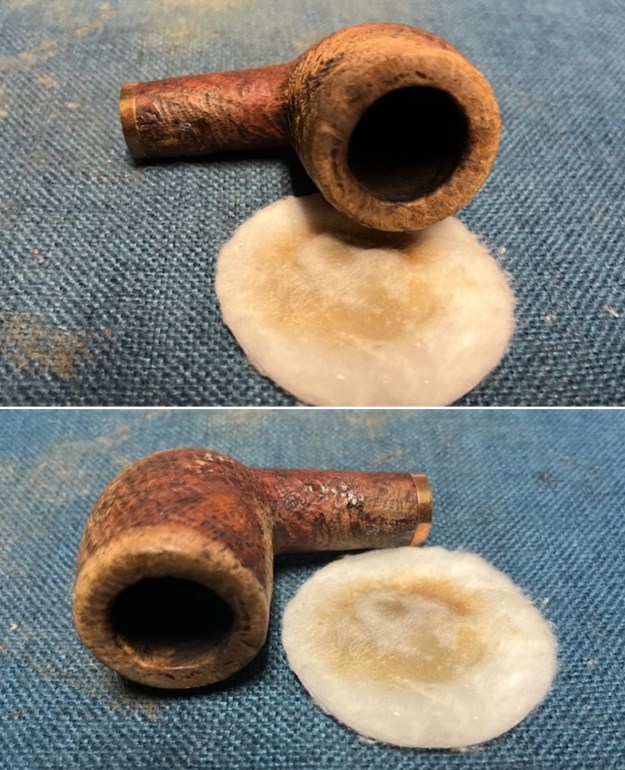
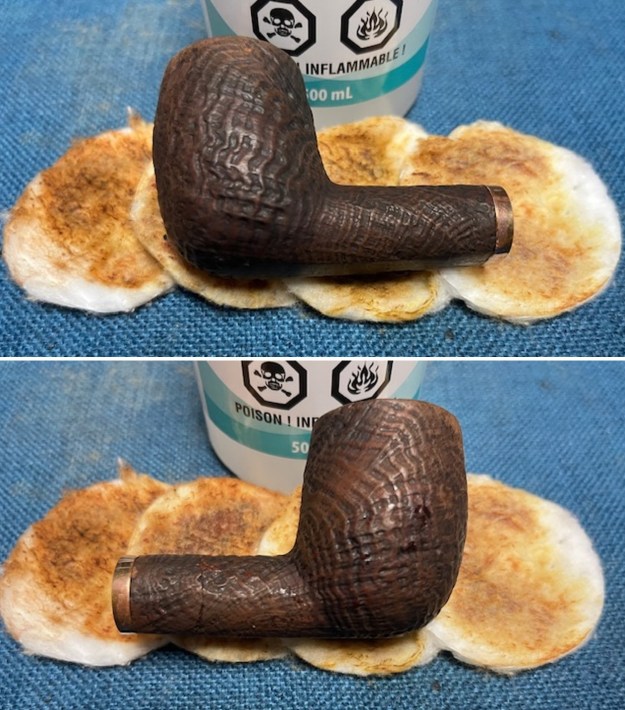
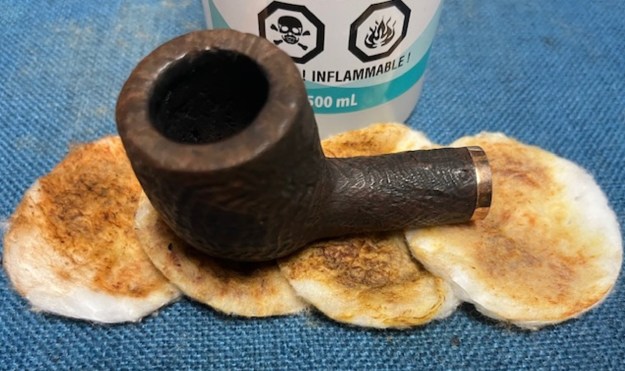
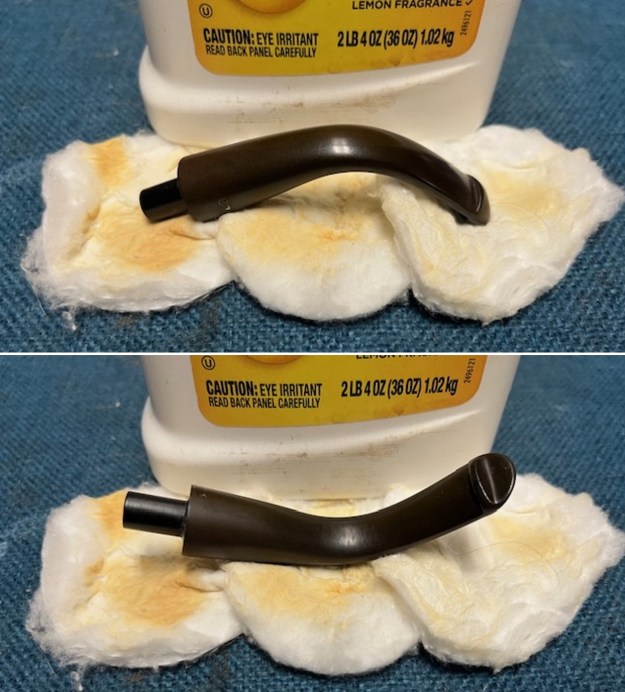
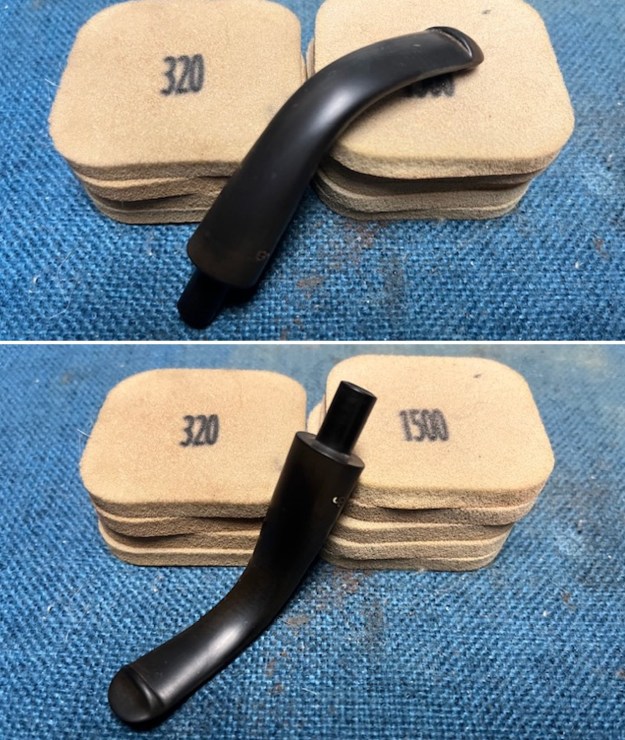
I have a very appealing pipe that came my way recently and I am happy to offer it to you for sale. No major restoration story on this one – just a remarkable pipe! I gave it a quick and thorough once-over (and a quick polishing) and now it’s time to turn it over to you. This chinrester has never been smoked and has some real old-world charm. It’s a handsome billiard with a vulcanite taper stem that has been angled into an S-shape. Take a closer look at the photos below. This one is marked with the words Tout Repos. This literally means ‘all rest’, but I think a more likely translation in this context is ‘rest easy’, as it’s a chinrester. The words also have a more negative connotation in French too, but that seems highly unlikely.I could find no mention anywhere of Tout Repos in connection with pipes. I must say, this pipe reminded both Steve and me of the chinresters of yesteryear by Kaywoodie. Could this pipe have been produced by Kaywoodie in France? No idea and I have no information to suggest that it was. The only (tenuous) connection I have is that a small number of Kaywoodie lines were produced in France (La Roche, Samuel Pepys, etc.). Have a look at this snippet I took from a 1964-65 Kaywoodie catalogue that I have, as they are quite similar.Even though the pipe is new, old stock, the stem had oxidized over the years, so I had to clean that up. I used isopropyl alcohol on a few cotton rounds and wiped down the stem to provide an initial cleaning before moving on to the next steps.Even though the pipe is new, old stock, the stem had oxidized over the years, so I had to clean that up. I used isopropyl alcohol on a few cotton rounds and wiped down the stem to provide an initial cleaning before moving on to the next steps.The goal of the next step is the removal (or minimization) of oxidation. Going to my sink, I used cream cleanser, cotton rounds, and a toothbrush, and scoured the stem to remove as much surface oxidation as possible. As the photos show, the result was a hideous, brownish mess – but better off the stem than on it.Once the stem was reasonably clean, I soaked it overnight in some Briarville Stem Oxidation Remover. This solution works to draw oxidation in the stem to the surface of the vulcanite. This is a major aid and an important step in ensuring a clean stem. The following day, I drew out the stem from its bath and scrubbed the lingering fluid with a toothbrush.The penultimate step for the stem is sanding. I used the last five or six micromesh sanding pads to sand out flaws, even out the vulcanite, and provide gentle polishing of the finished surface. I also applied pipe-stem oil while using the last five micromesh pads. There was a wonderful, deep black shine to the stem when I was done.As the stem was (nearly) complete, I moved on to the stummel. It was a decent piece of briar – there were a couple of fills (as you can see), but quite nice overall. As it was brand new, I simply cleaned up the dust from decades ago, and repaired a small fill on the inside of the bowl. To fill a gap like this, I used an epoxy adhesive that is extremely hard, resistant to high temperatures, and completely inert when cured. It worked superbly. I rubbed some LBE Before & After Restoration Balm into the briar and let it sit for 30 minutes or so. The balm moisturizes the wood and gives a beautiful depth to the briar. I then buffed the stummel with a microfibre cloth. For the final step, I took the pipe to my bench polisher and carefully buffed it – first with a blue diamond compound, then with three coats of carnauba wax. This procedure makes the pipe look its best – the stummel sings and the stem glows.This Tout Repos Chinrester is a lovely, elegant pipe. I am pleased to announce that this pipe is for sale! If you are interested in acquiring it for your collection, please have a look in the ‘French’ pipe section of the store here on Steve’s website. You can also email me directly at kenneth@knightsofthepipe.com. The approximate dimensions of the pipe are as follows: length 5¼ in. (133 mm); height 2 in. (51 mm); bowl diameter 1¼ in. (32 mm); chamber diameter ⅔ in. (18 mm). The weight of the pipe is 1 oz. (31 g). I hope you enjoyed reading the story of this pipe’s restoration as much as I did restoring it. If you are interested in more of my work, please follow me here on Steve’s website or send me an email. Thank you very much for reading and, as always, I welcome and encourage your comments.

A Well Smoked  Pioneer Black Block Meerschaum Bent Billiard


by Steve Laug

The next pipe on the table to refresh and refurbish is an interesting looking Bent Billiard that turns out to be rusticated black meerschaum. It has an acrylic shank extension that has the Pioneer “P” stamp on the left side. On the right side of the shank it is stamped Block [over] Meerschaum. I have no memory of when we bought it or who we purchased it from. It has been here a long time. The bowl has a light cake on the sides and some lava build up in the rustication of the rim top. The finish on the bowl and shank are very dusty with a lot of debris and dirt in the rusticated valleys of the pipe. The shank extension is black acrylic with the clear P stamp on the left side as noted above. The pipe smells dirty and musty from sitting. The fancy turned vulcanite stem is oxidized and there is light tooth chatter or marks on both sides ahead of the button. I took photos of the pipe before I started my refurbishing work. I took some photos of the rim top and bowl. You can see the lava and debris on the rim top and the tobacco debris and cake in the bowl. The stem photos show the oxidation in the vulcanite and light tooth marks and chatter.I took photos of the stamping on the shank and the extension. The left side of the extension has a clear “P” stamp that is the log for Pioneer Pipes. The right side of the shank is stamped Block Meerschaum. I took the stem off the shank and took a photo of the pipe. It really is a nice looking pipe. To me the pipe looked a lot like many of the black or dark meerschaum pipes that I have worked on from the Isle of Man made by Manxman or Laxley Pipe Company. Yet the stamping was clearly a Pioneer Pipes Co. pipe with the stylized “P” logo on the shank extension. I wanted to see if there was a connection between the two companies so I turned to my normal two sources to see what I could learn. I went first to Pipephil (http://pipephil.eu/logos/en/logo-p3.html). I have included a screen capture of the information there as well as further info from the sidebar.Probably a brand of Pioneer Pipes Co., a Meerschaum and Meerschaum lined pipes manufacturer and distributor. Address (about 1960): 1817 Putnam Avenue, Brooklyn 27, N.Y. Pioneer also used to import meerschaum pipes from the MANXMAN PIPES Ltd factory (Isle of Man, UK) as shown by the markings of this pipe. (See “Man“). Wilczak & Colwell, op. cit. mention pipes with this label from Duncan Briars Ltd, Oppenheimer Pipes or Delacour Brothers.
There was the link I was looking for – Pioneer Pipes Co. used to import Manxman Pipes from the Isle of Man. My eye had not failed me and I am sure this is one of those imported pipes.
I turned then to Pipedia (https://pipedia.org/wiki/Pioneer) to see what else I could find out about the brand. Unfortunately, the site did not have very much information. I quote below what was on the site.
Pioneer Pipe Company was owned by Wally Frank, who trademarked the name Pioneer in 1940. At the time of the application the name was alleged to have been used in commerce in 1925. The company listed its location at 1817 Putnam Avenue, Brooklyn, New York. Pioneer sold Turkish and later African meerschaum through the Wally Frank, Ltd. Catalogs and elsewhere.

There were also and example of one of their meerschaum pipe and a page of a pamphlet shown on the site. Both of these come to Pipedia by the courtesy Doug Valitchka. Now I knew what I was working on with this pipe. It was an imported Manxman pipe probably distributed by Wally Frank through their catalogue sales. It was likely African block meerschaum from Tanganyika or nearby that had been fashioned by the Isle of Man company for Pioneer. Now it was time to work on the pipe.
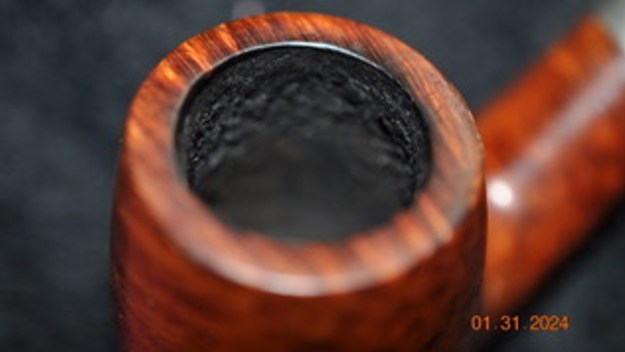
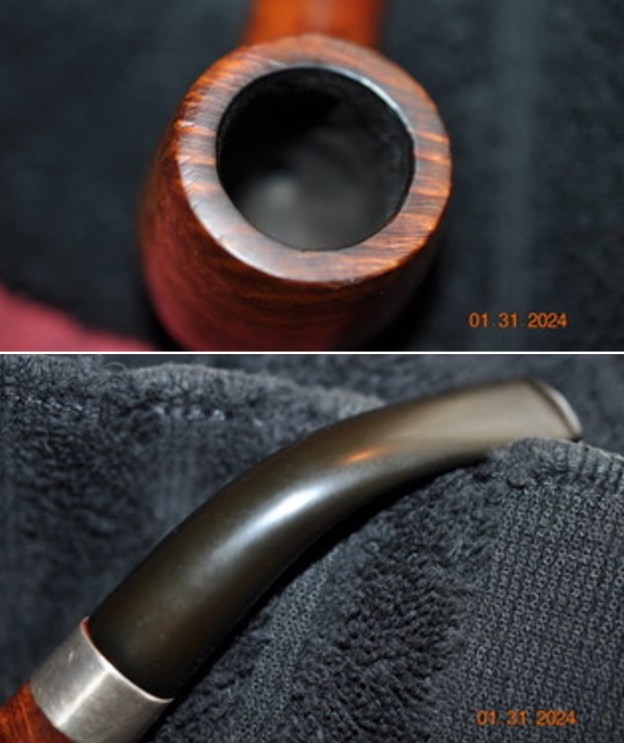
I started my work on the bowl by reaming the thick cake out of the bowl. I started with a PipNet reamer and the 2nd and 3rd cutting heads to take back the cake to the walls of the bowl. I cleaned up the reaming with a Savinelli Fitsall Pipe Knife. I sanded the bowl walls with a piece of dowel wrapped with 220 grit sandpaper. Once finished it looked very good. I cleaned out the airway in the shank and mortise as well as in the new stem with pipe cleaners (both bristle and regular). It was much better.I scrubbed the meerschaum with undiluted Murphy’s Oil Soap and a tooth brush to remove the grime from the finish of the bowl and shank. I rinsed it with warm water to remove the soap and the grime in the finish. I touched up the areas on the rim top where the stain was worn and damaged. I used a Black Stain Pen to restain them and blend them into the surrounding surface of the rustication.I worked some Before & After Restoration Balm into the rusticated meerschaum with my fingertips and a horsehair shoe brush to clean, enliven and protect it. I find that the balm really makes the bowl come alive again. The contrasts in the rusticated surface give the pipe a sense of depth. I let the balm sit for 10 minutes and then buffed with a cotton cloth to raise the shine. The bowl really looks good at this point. I set the bowl aside and turned my attention to the stem. I scrubbed it down with cotton pads and Soft Scrub Cleanser and was able to remove the oxidation. It looked better once I finished with the cleanser. I sanded it with 220 grit sandpaper to break up the oxidation. I wiped the stem down with an Obsidian Oil Cloth. I continued sanding the stem surface with 320-3500 grit 2×2 inch sanding pads. I wiped the stem down after each pad with a damp pad to remove the debris. By the end it was quite shiny and ready for polishing.I polished the stem with micromesh sanding pads – wet sanding it with 1500-12000 grit pads. I wiped the stem down after each pad with a cloth impregnated with Obsidian Oil. I polished it further with Before & After Pipe Stem Polish – both fine and extra fine. I gave it a final coat of Obsidian Oil and set it aside to dry. With a refurbishing the final moment when all the pieces come back together is the tell all! I put the pipe back together and buffed the meerschaum bowl with a shoe brush and the stem with Blue Diamond on the buffing wheel. I gave the meerschaum several coats of Conservator’s Wax and the stem multiple coats of carnauba wax. I buffed those parts with a clean buffing pad to raise the shine. I hand buffed it with a microfiber cloth to deepen the shine. It is fun to see what the polished bowl looks like with the black fancy vulcanite stem. This Rusticated Pioneer Black Meerschaum Bent Billiard is light weight and it is ready for you to load up a tobacco of preference and enjoy breaking it in for yourself. Have a look at it in the photos below. The dimensions are Length: 6 inches, Height: 1 ¾ inches, Outside diameter of the bowl: 1 ¼ inches, Chamber diameter: ¾ of an inch. The weight of the pipe is 51 grams/1.83 ounces. This is one that will go on the Ceramic and Meerschaum Pipes Section of the rebornpipes online store shortly. Thanks to each of you who are reading this blog. Remember we are not pipe owners; we are pipemen and women who hold our pipes in trust until they pass on into the trust of the next generation.

Restemming and Restoring a Meerschaum Apple


by Steve Laug

This afternoon I decided to work on the pipe that I no longer know where or when we purchase it. I have a large box of Meerschaum pipes that is sitting in my storage that I need to clean up and restore. I have honestly avoided them for years but now was the time to start my work on some of them. The first one I chose was definitely an older ball or apple shaped smooth meerschaum with a red acrylic shank extension. It is a beautifully shaped meer with scratches from its journey and some nice patina around the shank and sides. The meer is dirty from use with a thick cake in the bowl and a light overflow of lava on the inner edge and thin rim top. The acrylic shank extension was loose and would need to be cleaned. The stem fit well against the shank end however it was a Preben Holm vulcanite stem and it was too long. It would need to be replaced with a more fitting stem for the size of the pipe. There were no identifying logos on the bowl or shank. I took photos of the pipe before I started my clean up work on it. I took photos of the rim top and the stem to show the condition of the pipe when I brought it to the worktable. You can see the cake in the bowl and the build up of lava and debris on the edge and top of the thin rim top. It is another dirty pipe but still a charmer. The vulcanite stem has chatter and deep tooth marks on both sides near the button. It also has a Preben Holm crown on the top of the stem. It will be replaced so fortunately I will not need to deal with it.I removed the stem from the shank and took a photo of the parts. To me proportionally the stem is too long for this pipe. I went through my stems and found a stem that would work well. In the photos it looks the same length or longer but it is about an inch shorter and the blade is also wider and looks good. I took a photo of the pipe with the new stem. I shortened the tenon a bit to bring it closer to the shank extension. The second photo of the stem in the shank shows the new look. I reamed the thick cake out of the bowl. I started with a PipNet reamer and the 2nd and 3rd cutting heads to take back the cake to the walls of the bowl. I cleaned up the reaming with a Savinelli Fitsall Pipe Knife. I sanded the bowl walls with a piece of dowel wrapped with 220 grit sandpaper. Once finished it looked very good. I cleaned out the airway in the shank and mortise as well as in the new stem with pipe cleaners (both bristle and regular). It was much better.I cleaned up the rim top and edges of the bowl with a 320 grit sanding pad. I removed the darkening and damage and it looked better.The shank extension was held to the shank with a white Delrin tenon. The shank on the pipe was thread and the smooth end fit partially into the extension. When screwed into the shank it was a snug fit. I chose not to glue it but leave it unglued and removable.Now it was time to work on the bowl itself. I started my work by sanding with 320-3500 grit 2×2 inch sanding pads. It smoothed out the scratches and revealed more and more of the patina around the bowl and shank. It is a beautiful looking pipe. I polished the meerschaum with micromesh sanding pads – dry sanding with 1500-12000 grit pads. I wiped the bowl down after each pad with a damp cotton cloth. The bowl took on a shine by the last pads. I gave the bowl multiple coats of Clapham’s Wax that blends both carnauba and beeswax in a soft wax. I rubbed the wax on the bowl sides and the shank end with my fingers and set it aside to dry. Once the wax cured I buffed the bowl with a clean buffing pad and then with a soft microfibre cloth. The bowl has a rich glow. I set the bowl aside and turned my attention to the stem. I “painted” the surface of the stem with the flame of a lighter to lift the tooth marks on the surface. It lifted many of them. I filled in those that remained with some black, rubberized CA glue. When it cured I flattened out the repair with a small flat file and then sanded it with 220 grit sandpaper to smooth it out. I continued sanding the stem surface with 320-3500 grit 2×2 inch sanding pads. I wiped the stem down after each pad with a damp pad to remove the debris. By the end it was quite shiny and ready for polishing.I polished the stem with micromesh sanding pads – dry sanding it 1500-12000 pads. I wiped it down with a damp cloth after each pad to protect it and preserve it. I polished it with Before After Pipe Polish – both Fine and Extra Fine. I am really happy with the way that this Meerschaum Freehand Style Apple turned out. It really is a beautiful looking pipe with a unique shape and smooth meerschaum bowl. The acrylic shank extension and the fancy vulcanite saddle stem are really nice. The patina on the meerschaum came alive with waxing and buffing. The rich patina on the finish gave the pipe a sense of depth with the polishing and waxing. I put the stem back on the bowl and carefully buffed the pipe with Blue Diamond on the buffing wheel. I gave the bowl and the stem multiple coats of beeswax/carnauba wax and buffed the pipe with a clean buffing pad to raise the shine. I hand buffed the pipe with a microfiber cloth to deepen the shine. The finished Meerschaum style Freehand really is a beauty and feels great in the hand and looks very good. Give the finished pipe a look in the photos below. The dimensions of the pipe are Length: 6 inches, Height: 2 inches, Outside diameter of the bowl: 1 ¼ inches, Chamber diameter: 1 inch. The weight of the pipe is 66 grams/2.33 ounces. The pipe will be going on the rebornpipes store soon. It will be in the Ceramic and Meerschaum Pipes Section if you would like to add it to your collection. Thanks for reading this blog and my reflections on the pipe while I worked on it. It was a fun one to work on!