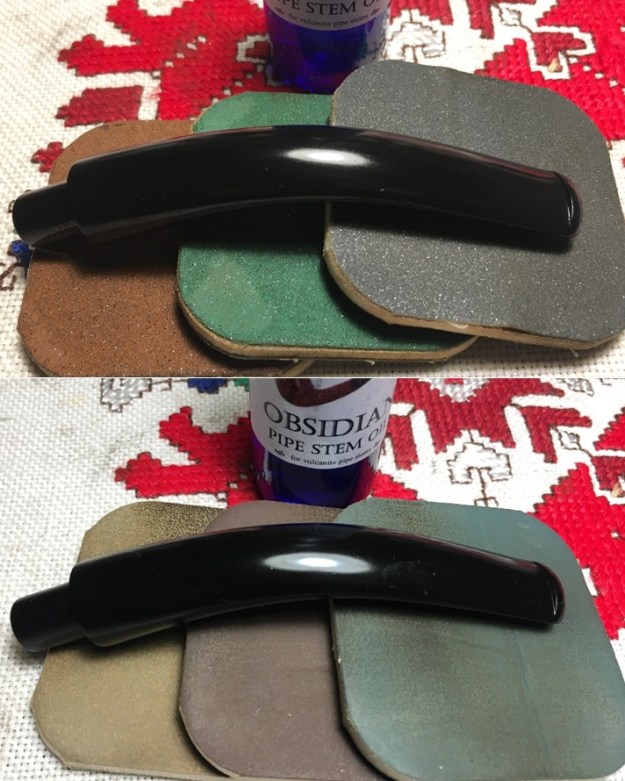
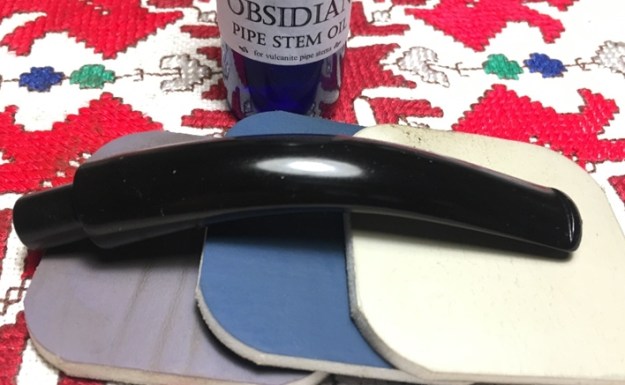
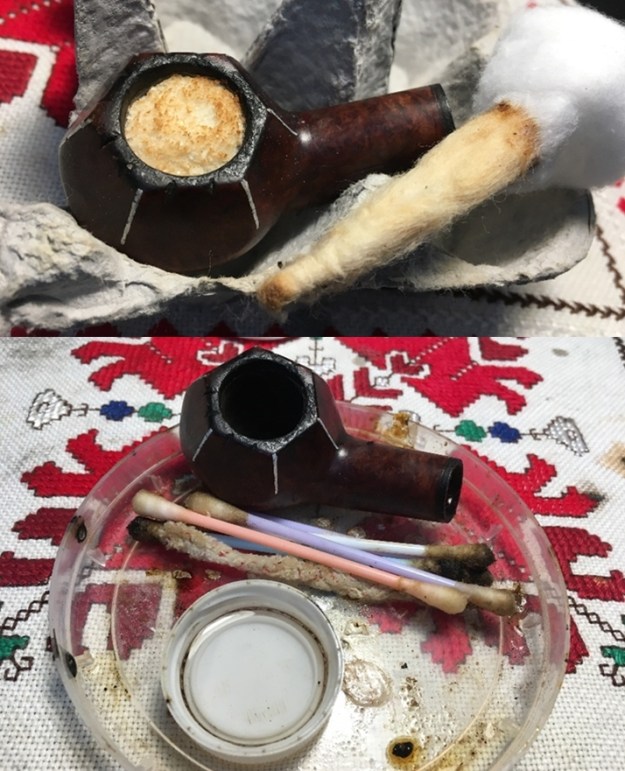
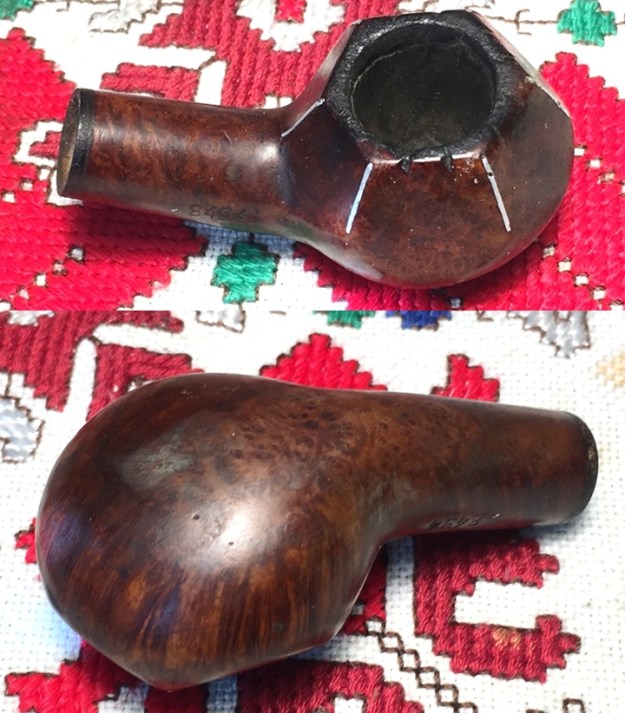
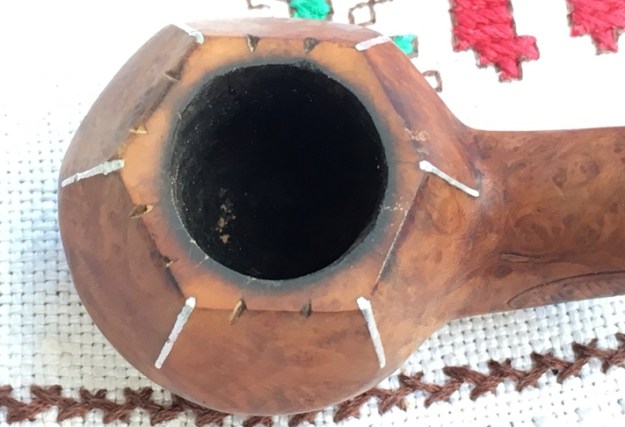
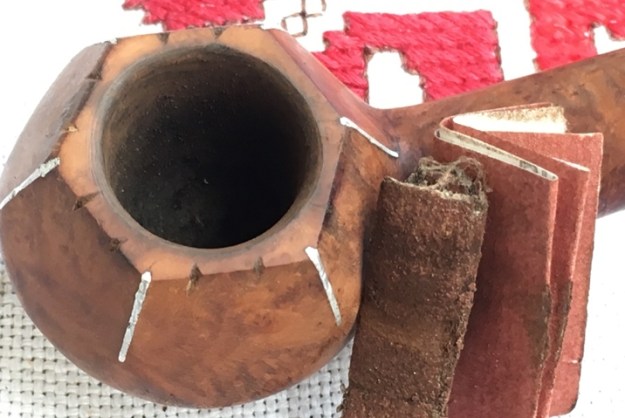
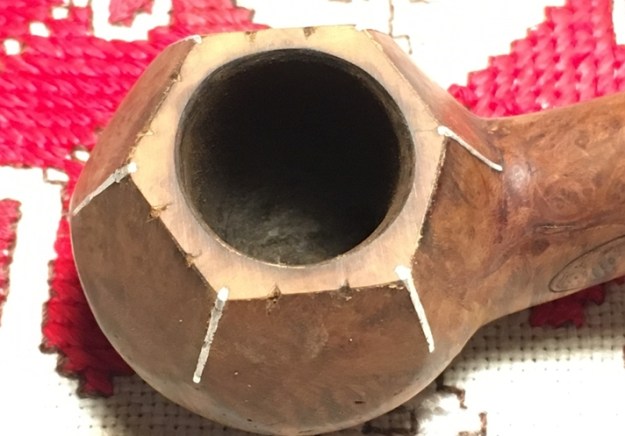
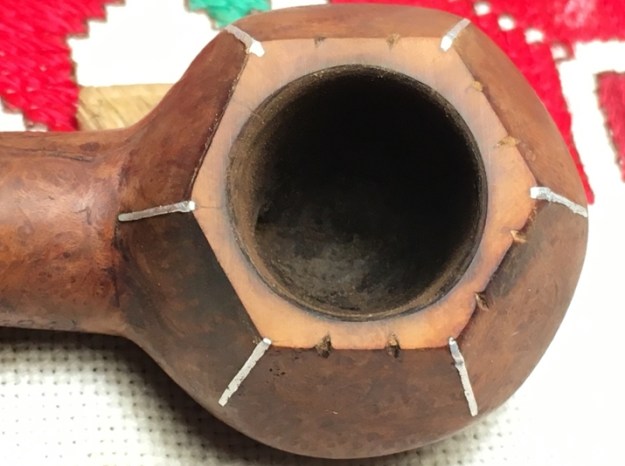
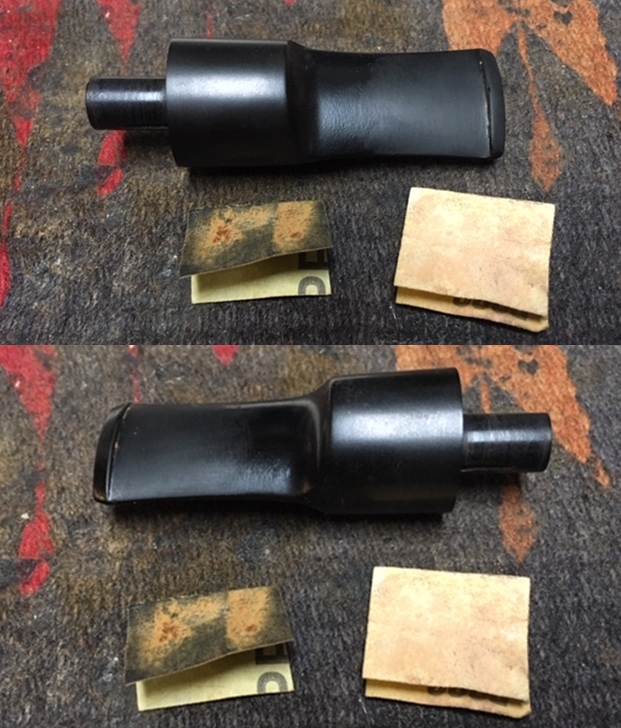
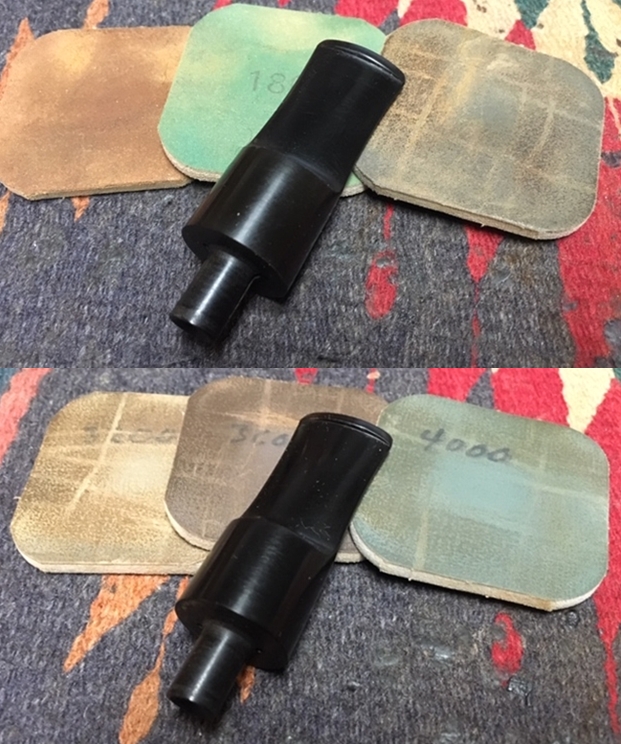
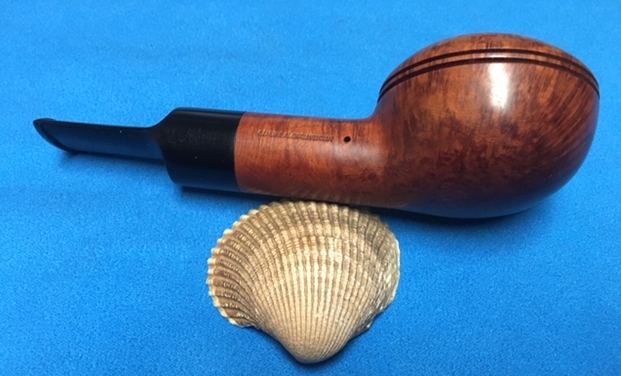
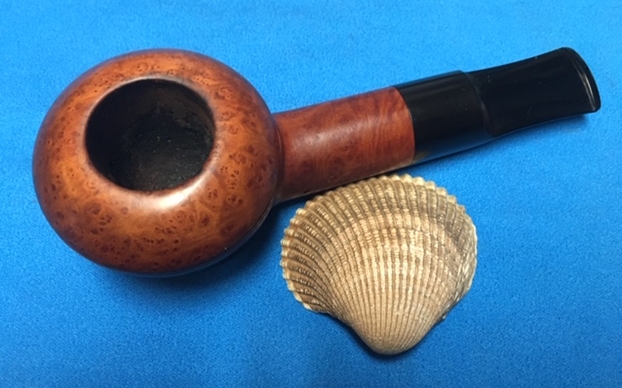
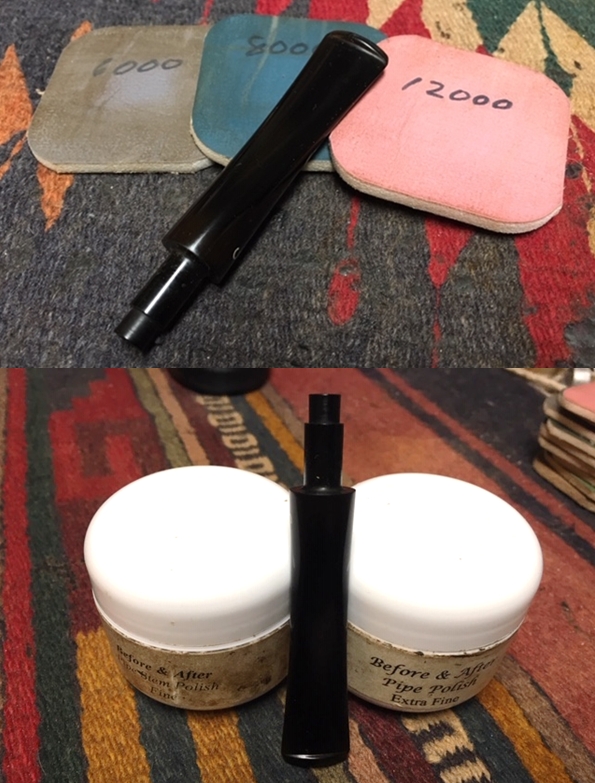
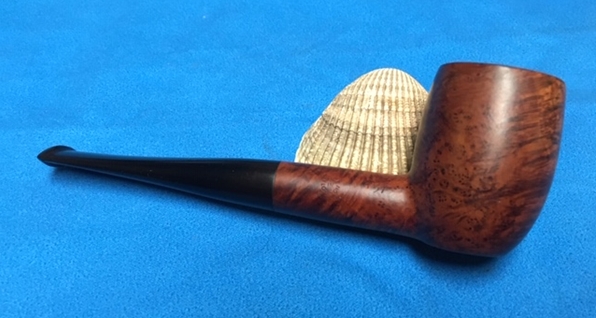
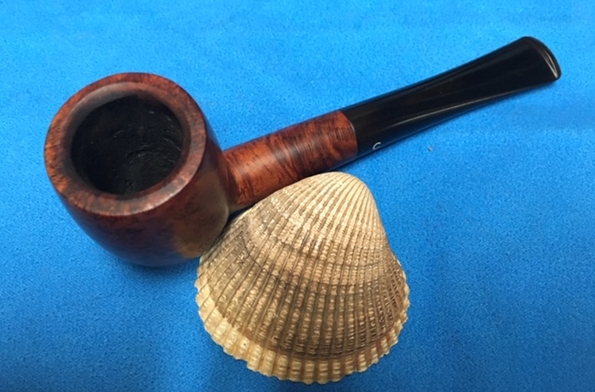
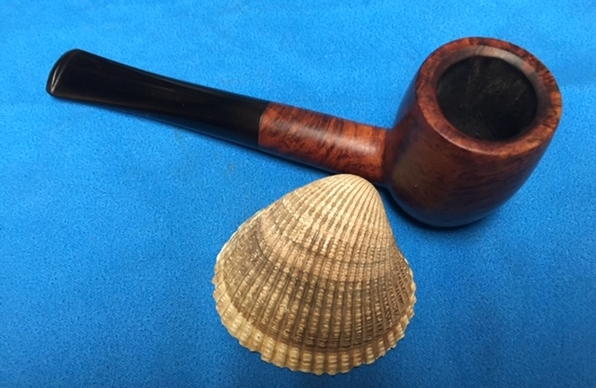
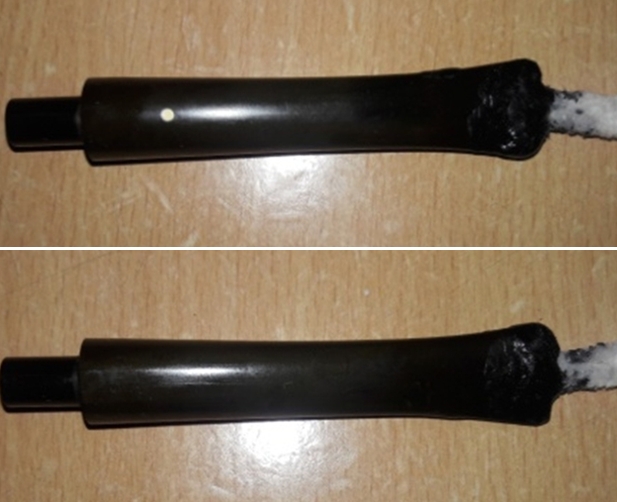
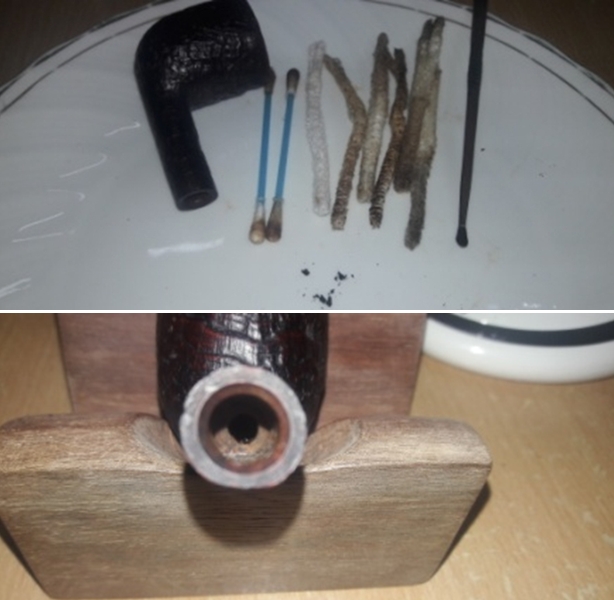
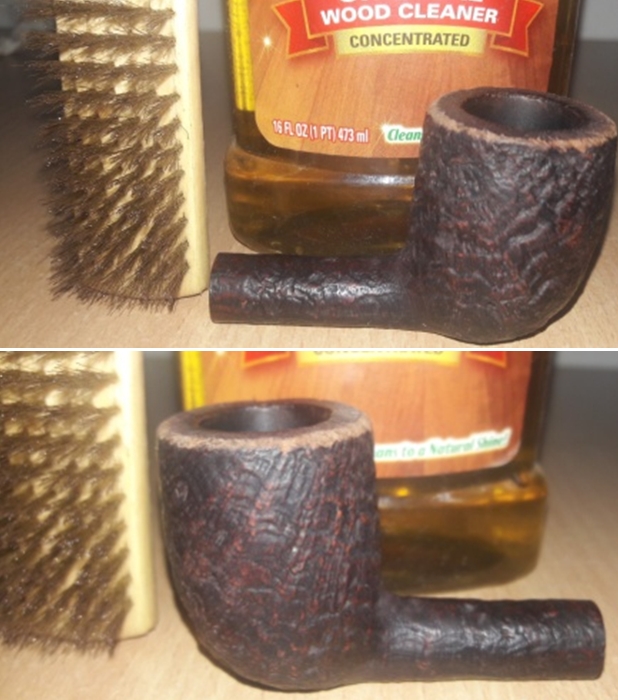
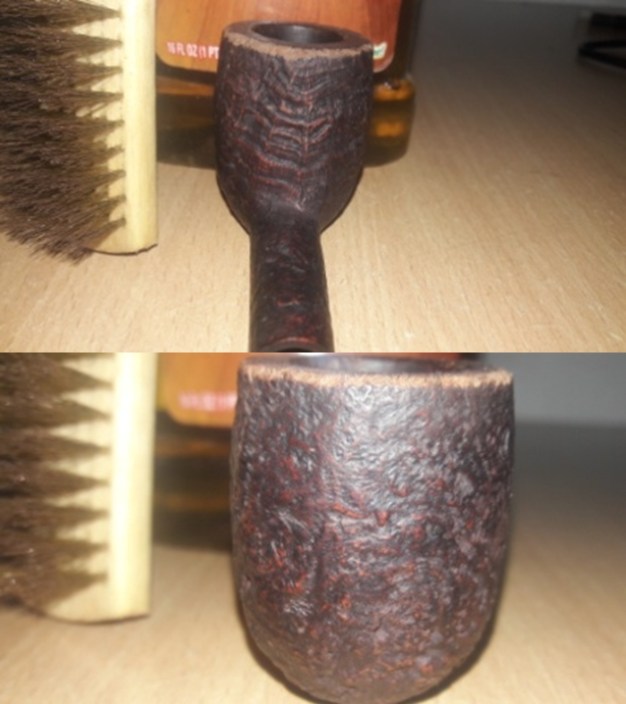
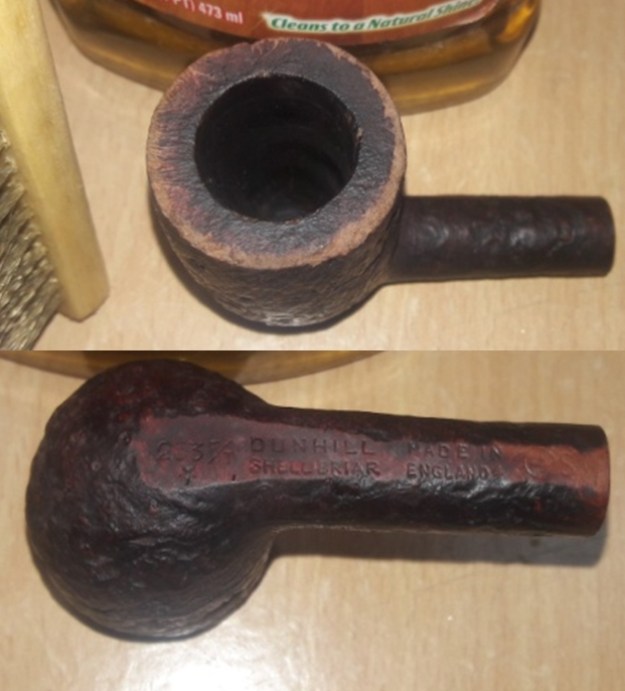
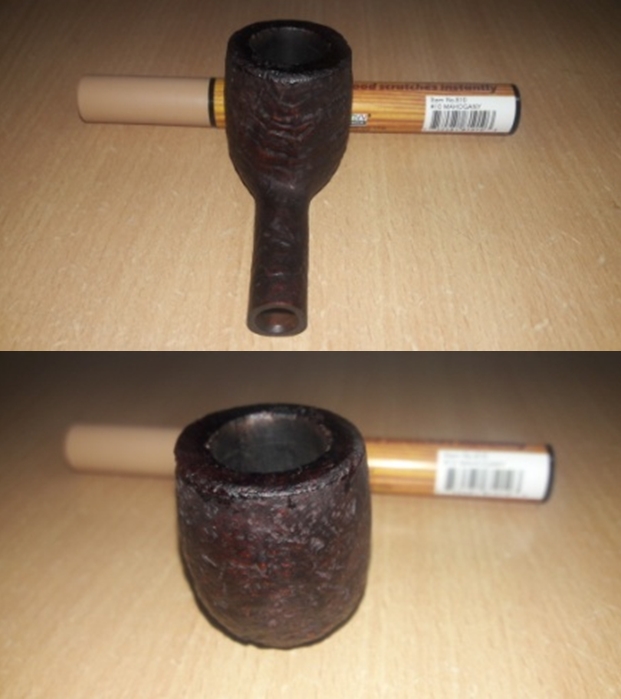
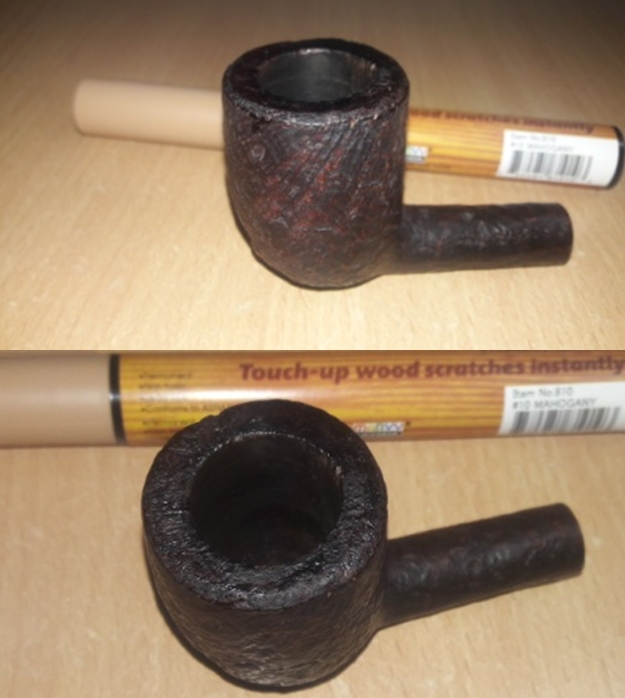
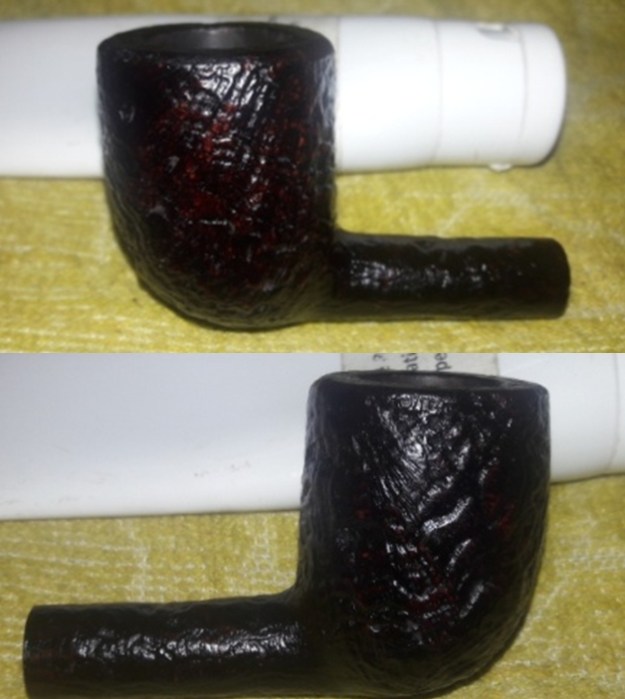
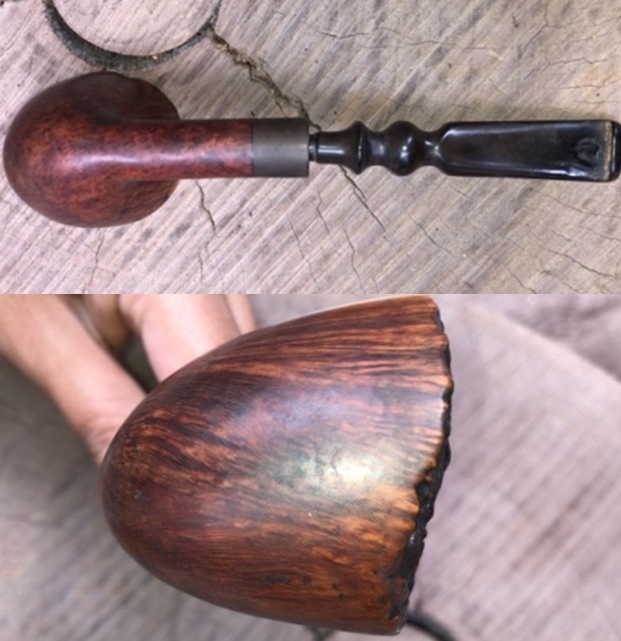
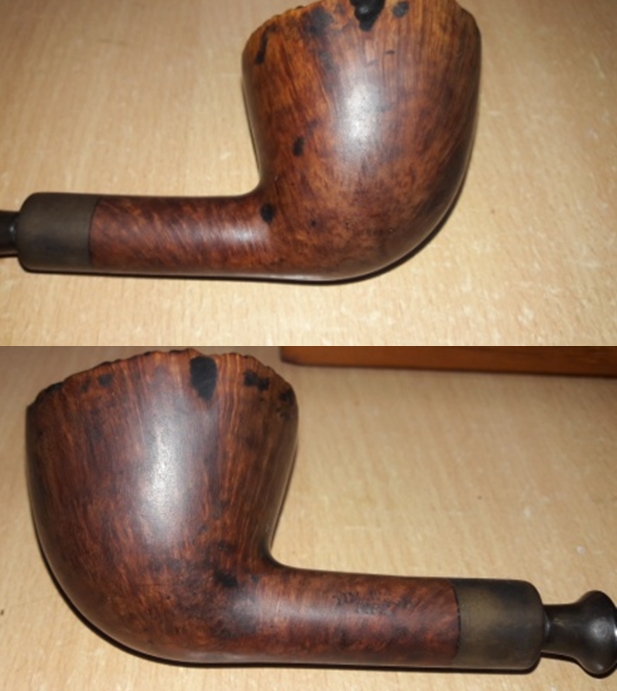
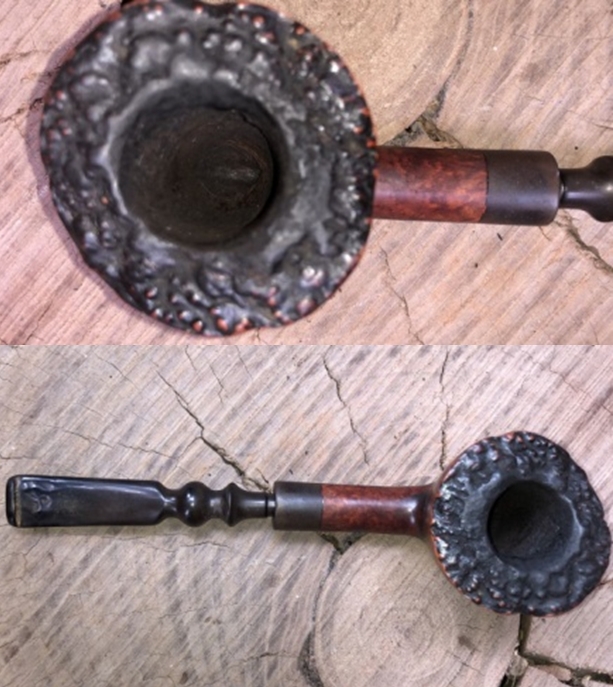
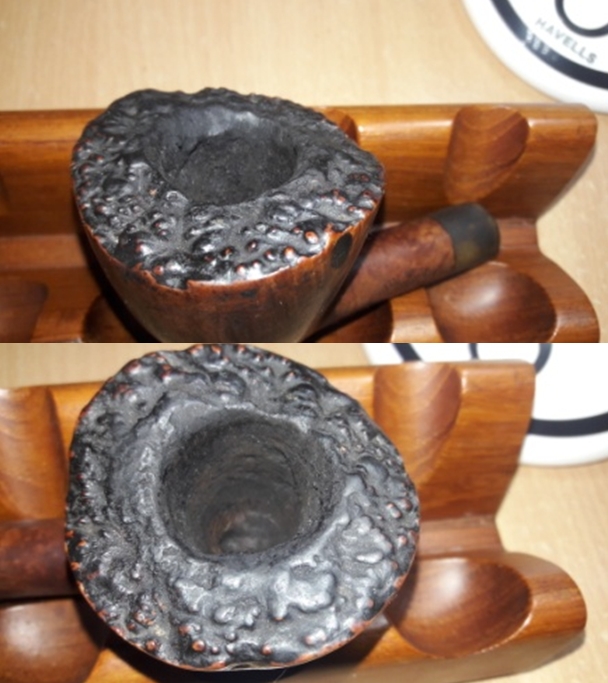
Tag Archives: polishing stems

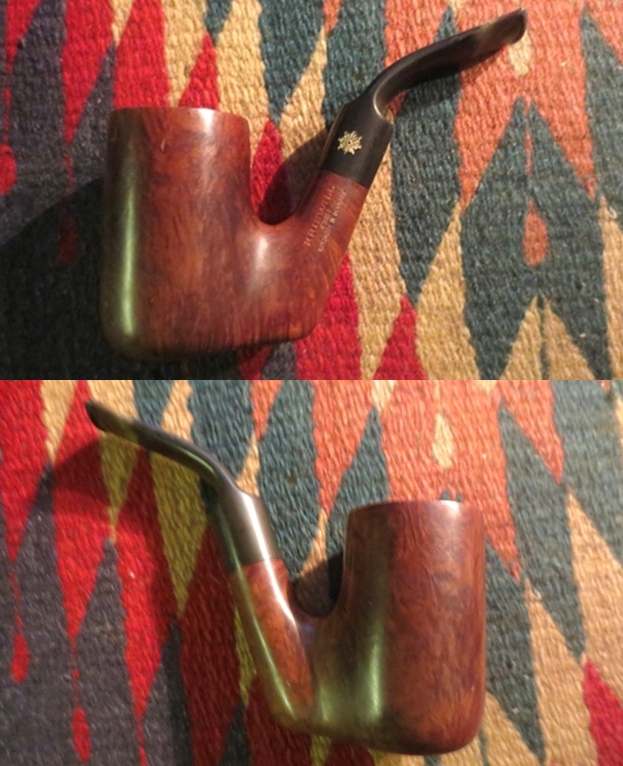
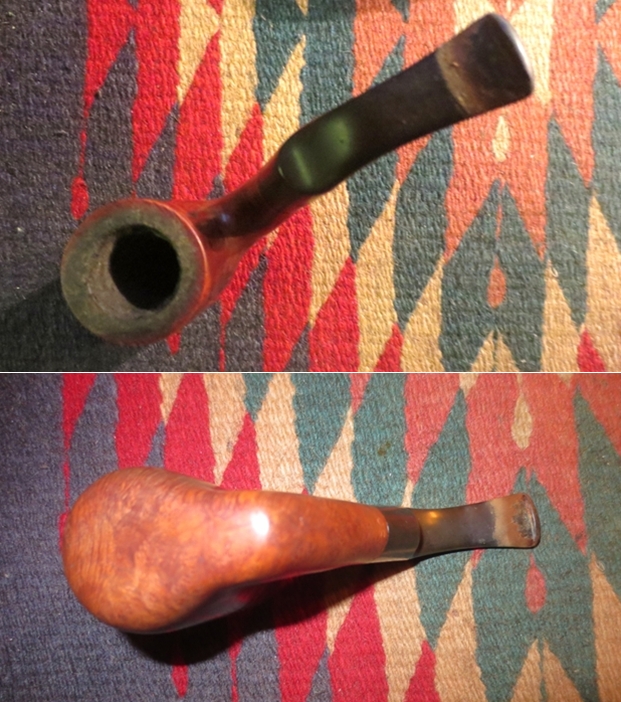
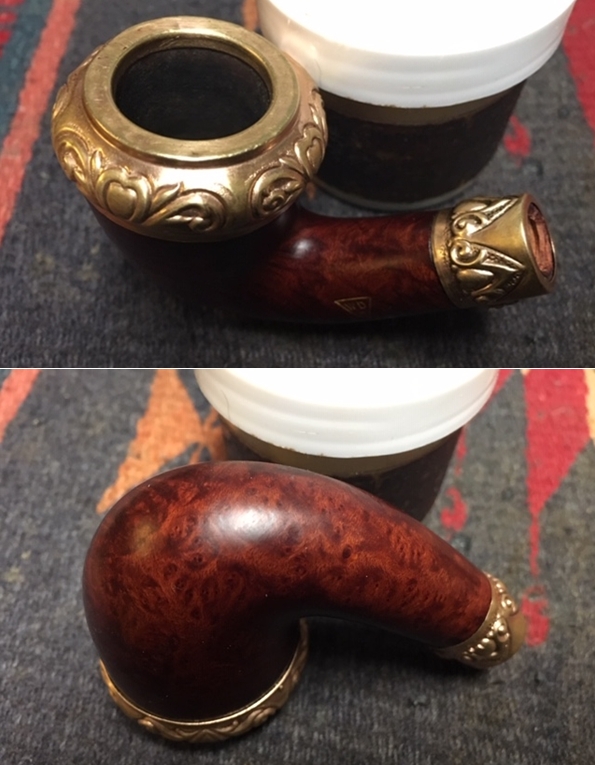
The Decline of Restoring Old Pipes, Part 2/4: An Antique CPF Meerschaum Five Years Finishing


Blog by Robert M. Boughton
https://www.roadrunnerpipes2k.com/
https://www.facebook.com/roadrunnerpipes/

Copyright © Reborn Pipes and the author except as noted

Then I thought, boy, isn’t that just typical?  You wait and wait for something, and then when it happens, you feel sad.
— Sharon Creech, U.S. children’s writer, in Absolutely Normal Chaos (1990)

RECAP
In Part 1, I hypothesized that the discontinued manufacture or illegality of certain materials, as well as the dwindling availability and in some cases complete lack of pre-fashioned parts used in antique and other very old pipes, will lead to a serious crisis in restoring these great but often damaged old friends to their original conditions.  Without hashing over the details, which I already described in great although still incomplete specificity, I will add that I left out the obvious: none of the materials I discussed is irreplaceable in the sense that an old pipe with a broken amber stem or bone tenon can always be mended with Lucite or Delrin, for example.  To emphasize my way of thinking, which I know is shared by many other far more experienced and better practitioners of the art of pipe restoring than I, the thought of needing to resort to such practices except in the most severe cases is unthinkable, or to use a more descriptive word, an anathema to me.

At any rate, having no idea what I was getting into when I began writing the first installment, in the order in which various materials popped into my head, I soon reached a point where more and more endangered items presented.  For the sake of not breaking my train of thought any more than necessary on the one I happened to be trying to complete at the moment, I got into the habit of adding new section headings as I proceeded, as a sort of minimal outline.  The research alone led me in still newer directions, and so the sections grew in number – not to mention the research, which became so out of hand I almost lost control and never did get all of my sources in good order.  In the end, for those reading this who caught Part 1, believe it or not, I cut entire pages from the text and many of the sources that, due to the months spent composing my list of the most endangered materials either no longer applied or were redundant.  And still my sources alone took up at least two whole pages of the 24 I submitted to Steve.

Needless to say, as sad as I was to have to face the music, my little list had reached proportions prohibitive of an illustrative restoration to accompany it.  This installment will begin the phase describing the first of three projects that demonstrate the growing difficulty of restoring very old pipes to their natural beauty and even one relatively new but vintage example, despite my intentions, as if it were an antique.

INTRODUCTION
Five years ago, Chuck Richards presented the old and wounded but still spirited meerschaum to our Friday night pipe get-together.  The group of devoted Albuquerque area pipers being in its heyday at the time, the little tobacconist’s shop where we still meet in lesser numbers was filled beyond fire code capacity.  Folding chairs extended the normal smoker’s lounge all the way to the front glass counter, and still they were not enough.

I would regret to point out the business from cigar aficionados we pipe revelers cost the shop’s owner that memorable night, other than the few who were understanding or dogged enough to wend their ways through our standing-room-only mob.  But the sales in pipes and tobacco tins, and everything else that goes with them, more than made up for the loss on those evenings that are among my best memories.  Time has a way of changing all things, not just the antique meerschaum beauty Chuck passed around for all of us to ogle.

With the innate cunning and flair for dramatic understatement possessed by traveling carny operators of old, Chuck had the entire room enthralled – and yes, I was in the front row, center aisle, agog, right where he wanted me.  The panache of Chuck’s delivery was not in what he said of the pipe, however, but the way he appeared to satisfy the rest of the audience with an atypical dearth of anything better than teases, what Deep Throat called leads, at least as far as my hungry ears and eyes could discern.  Had I still been a news reporter with orders from my editor to get a good quote, I might have been out of a job.

That old reporter in me was accustomed to listening for diversions, avoidances and spins – every attempt “to deceive, inveigle and obfuscate,” as Special Agent Fox Mulder says in one of his most memorable lines from The X-Files (S4:E3).  That good habit must have kicked in to help me pick up on the mesmerizing but fugacious choreography of the show, designed only for the moment and then to be forgotten.     All I heard was “an old, now defunct pipe maker or distributor, probably in the U.S., called CPF,” “Best Make.” “still in its original case,” “with amber bit, gold band and broken bone tenon.”  But what did he omit and why?  During the intervening years, I’ve asked a few of those who were there that night about the occasion, and all of them indeed recollected some small part of the details, but little of substance, that are imprinted into my memory.

And then the act of mass hypnosis was over, the tiny space hot and stuffy, the crush of pipe enthusiasts swelling to the distant and narrow entrance somewhere in the background that was clogged with people coming and going beyond the usual capacity and hours of the shop’s operation, and which sole entry and exit, at any rate, lay beyond several treacherous eddies and straits still out of sight or reach.  I was not in my element and wanted to bail but needed to talk to Chuck.  With a distinct surreality, his bead bobbed nearby, like a life buoy in a foggy ocean.  We smiled at each other in what I felt was a meeting of the minds

I called out to him – shouted as loud as I could – as close to screaming as I ever have.  Imagine, not a vacuum such as space, but the opposite: chaotic babble and expansion.  Everything else drowned in the roiled sea foam of voices.

“Don’t you know anything more about CPF?”

We were face to face at last, but Chuck didn’t hear a word.  Neither did I, for that matter.  He even cupped a hand to an ear and gave up, communicating better with a single raised finger that he would come back.  When he did so, the crowd thinned out enough for us to hear each other.  He said, “I want you to take this home with you and do some research.  See what you can find out about CPF on your computer.”

Close your eyes if it helps and imagine the words above being cast upon you by Chuck in his always rich but then suddenly dulcet, soothing, fluid and entrancing tone

While Chuck projected these words to me, I tried my best to focus on his face, but my attention kept straying to the one-hundred-some-odd-year-old meerschaum pipe in its original tan case that looked so secure in his able custody but became more and more fragile and vulnerable as it was passed to mine. Much more was spoken between us that night before I began to understand that the dirty, damaged but reparable and, to me, priceless piece of art and history was not a loaner for research purposes as Chuck had suggested. Some blurry time later I realized he only said that so I would accept the gift from his hand. He knew I never would have touched it otherwise. About then the full truth struck me like a Mack truck with no brakes on a downslope of the Grapevine, a treacherous strip of I-5 in California with the Tejon Pass in its middle: Chuck expected me to restore it.

“But I’m not the right man for the job!” I went off like a maxed-out Jake break.

Chuck grinned at me a way only he can and then tried to calm the panic rising in me.

“When you’re ready,” I recall him saying. The rest is hazy.

As soon as I returned home that night, I began my computer research into “CPF tobacco pipes” as Chuck prescribed, and it became apparent that my friend indeed knew more than he let on. As Chuck suggested to the weekly pipe get-together almost six years ago in his circumspect description of the company, CPF was indeed a U.S. venture, in New York. I came across all sorts of conjecture as to the meaning of the three letters, with most agreeing the PF stood for Pipe Factory.

The C, on the other hand, was debated with unusual ferocity even for the very opinionated pipe world. The guesses included Consolidated, Chesterfield and Colossal, among others. There was even one complete rewrite of the truth suggested in a note at the bottom of the Pipedia link below, positing the amazing coincidence of a C.P. Fenner (one of two brothers who made cigarettes) as a viable candidate.

After hours of determined hunting, I was able to conclude with certainty that CPF stood for Colossus Pipe Factory, which enjoyed a relatively brief but glorious run from 1851-c. 1920. Steve later pinpointed the end of the road for CPF as 1915. In that short span of time, CPF, almost certainly employing the Old World skills of European immigrant crafters, made some of the most beautiful meerschaum and briar pipes available at the time. And it was a great time for pipes.

There were three absolute forms of proof that the Colossus Pipe Factory existed, and I later forwarded them to Steve: an antique bill of sale I no longer have, made out to a French company; a letter I found in a long scan of The Jeweler’s Circular issues (August 23, 1899) asking for the name of the pipe company doing business as CPF and receiving the above reply from the editors, confirming the Kaufman Brothers & Bondy connection, and an ad strengthening the tie between CPF and KB&B. Most sources agree KB&B assumed ownership of CPF in 1883. Here are the specific page from the jeweler’s magazine, another ad mentioning CPF, KB&B and Bakelite all in one, and an example of such a pipe.

For the most complete history of CPF, see Steve’s definitive piece in the link in my sources below. Steve’s hard work pulls together all of the available information on CPF along with very nice illustrations from his own vast portfolio of restorations.

1881: THE YEAR IN HISTORY
Until this very moment, as I edit my blog, I had put a conservative estimate of the Best Make’s date of manufacture as 1898. Now, revisiting the evidence, I notice that every ad or other official mention of CPF after KB&B took control mentions KB&B and its address at the time. Pinpoint dating being impossible, I now have good cause to revise the pipe’s manufacture to pre-1883, given the worn old case that makes no mention of KB&B despite the room to do so. Therefore, my new conservative estimate is 1881, making it 138 this year. As it turns out, 1881 was an interesting year, like every other year in my opinion, but I’ll just cite a few highlights.

January 1, 1881, Dr. John H. Watson was introduced to Mr. Sherlock Holmes.
February 24, work began on the Panama Canal.
March 4, James A. Garfield was inaugurated as the 20th U.S. president.
March 16, the Barnum & Bailey Circus debuted.
April 28, Henry McCarty, originally of New York City, escaped from the Lincoln County Jail in Mesilla, New Mexico. Best known as Billy the Kid and widely but erroneously believed to have been born William H. Bonney, McCarty had three other aliases. I had to mention this particular historical tidbit because I live in the natural born killer’s old stomping grounds.
May 21, Clara Barton founded the American Red Cross.
July 1, the first international telephone conversation occurred, Calais, Maine to St Stephen, New Brunswick
July 2, President Garfield was shot by a delusional speech writer who fancied himself responsible for Garfield’s victory. Being denied an ambassadorship was the last straw.
September 19, President Garfield died from an infection caused by the gunshot.
December 4, the first edition of the Los Angeles Times was published.

The Wright Brothers’ first flight at Kitty Hawk, NC was not for another 22 years. The 19th Amendment to the U.S. Constitution granting women the right to vote, ratified August 18, 1920, was still 39 years from reality. The 25th Amendment to the U.S. Constitution defining presidential disability and the line of succession was not ratified until February 10, 1967 – 85 years after Garfield’s vice president, Chester A. Arthur, was sworn in as the 21st U.S. president.

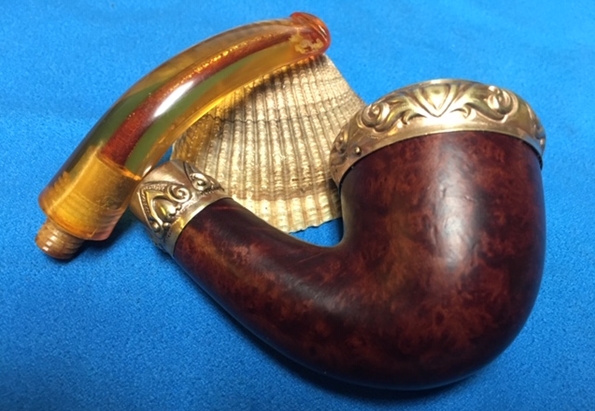
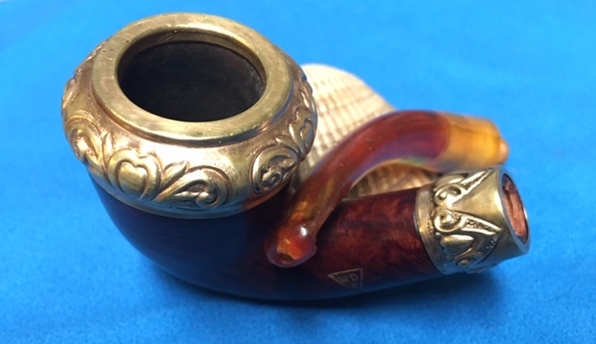
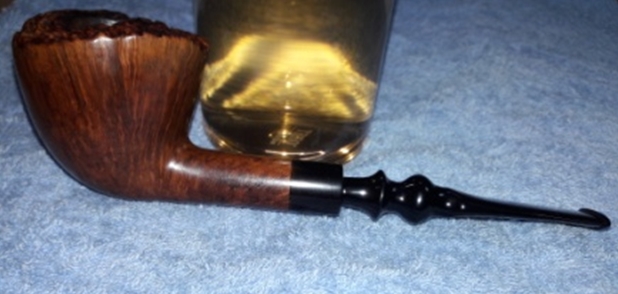
The year 1881 was also 19 years before the revolutionary scientific and technological century that forever and exponentially robbed people of the little daily pleasures that were perhaps our greatest inclinations, for taking time to read and write and contemplate life. And toward those goals, some Old World meerschaum carver had the idea to create a pipe with a bowl turned just enough to allow smokers to see the pages of the books, newspapers or literary magazines they enjoyed reading during moments of the day when they could escape the rat race. Few such clever pipes can be found today. The photo below shows another pipe with a design that nevertheless has an amazing similarity to my CPF Best Make and could very well be its brother.


RESTORATION
I should make one final point clear now: the reason this part of the blog is short on the actual restoration steps and includes relatively few photos is that most of the work involved – meaning everything other than reconnecting the stem – turned out not to be anywhere nearly as difficult as I had at first projected. That’s easy to say now, after having restored other meerschaums and removed an unknown number of broken tenons from shanks. Also, knowing the final key to this restore was finding a suitable bone tenon and getting it to fit snugly and securely in the shank afforded me time to, well, take my time.

All of that said, the most important factor in terms of my readiness to finish my part of this project is all of the experience I have had working out problems with other pipes during the five years this process wound up taking due to the one vital step. Most of those times, my impulse, and often my first step, were to seek the help of someone who had more experience than I. That left plenty of options. Although the friends I’ve pestered most for advice may not realize it, I began to research possible solutions steadily more often. Above all, I exercised the part of my brain that allows me, when I use it, to think my own way out of corners. That habit proved to be of particular benefit to this restoration, as I will soon explain. For the first year, I sat on the pipe, in the figurative sense, other than taking it out of the case now and then to admire its regal elegance. That time was in no way wasted or idle. I accomplished considerable online homework on various approaches to restorations of antique meerschaums. I had a fair number of successful meerschaum restorations under my belt, but I’d never even touched an antique pipe before, and they are a whole different ball of wax, so to speak. Here are the problems I anticipated:

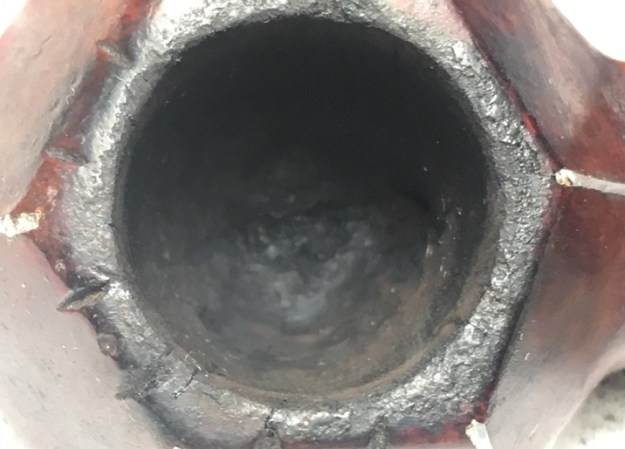
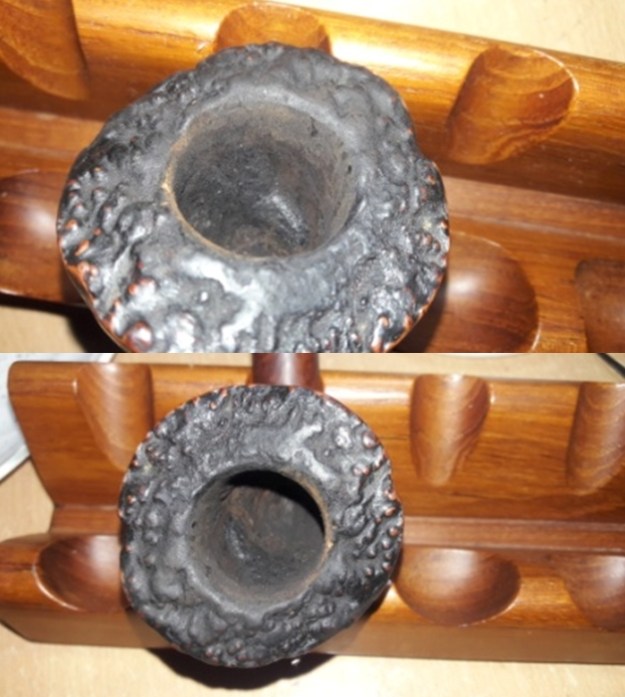
1. The rim char was transformed by the power of time – which may heal all wounds but is more apt to cause them, and thus allow us to grow – from the more or less expected norm of bad to full crystallization around the top of the chamber.
2. The entire surface of the pipe was filthy, whether from improper handling or about a century in storage or both, but the deep, even gold of the patina indicated it had been well-loved and tended. Cleaning meerschaum should not be approached without caution as the first try can limit later options or, worse, show places where the pipe was handled with bare hands from the ghosts of ingrained skin oil and dirt, sometimes as permanent blotches..
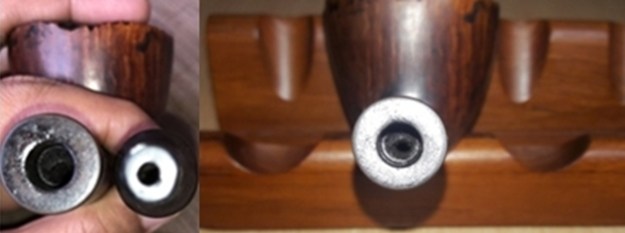
3. The original bone tenon was broken, half jammed deep inside the draught hole and the other half in the amber stem. Removing it from both narrow, fragile holes would be problematic, to use a gross euphemism. Replacing it would be a challenge – but a pleasant one, I imagined in my determination to honor my personal pledge to restore this great pipe to its original glory.
4. The shank looked as if it would need to be re-threaded. Wonderful.
5. I have also never worked with amber but knew enough to realize it is brittle stuff, in particular the 133-year-old (at the time I took possession of the pipe) variety. There would be no thought of subjecting this precious bit to the perils of an electric buffer or even sandpaper.

That’s it. Nothing serious, just a mine field. But after long, intense consideration, I concluded the integrity of the wonderful patina must be preserved at all costs and opted for a traditional basic cleaning rather than one of the experimental processes of which I had read. That was in 2014.

Recalling the one dragon Harry Potter had to face in his quest to survive the Goblet of Fire competition, I decided to be done with one of several I saw swooping my way. I began the slow extraction of the original bone tenon broken off and entrenched by time in the stem and shank. .In this kinder, gentler age of Vulcanite/Ebonite/Lucite/ Delrin tenon removal, by and large, the material being non-organic makes it less vulnerable to easy damage. My situation presented a triad of evils with the bone tenon packed into meerschaum and amber.

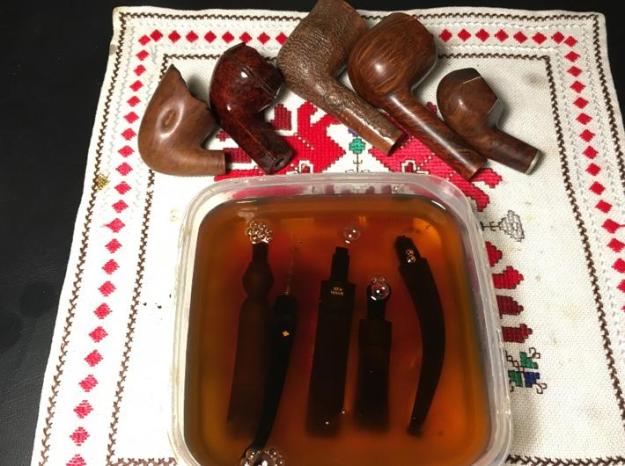
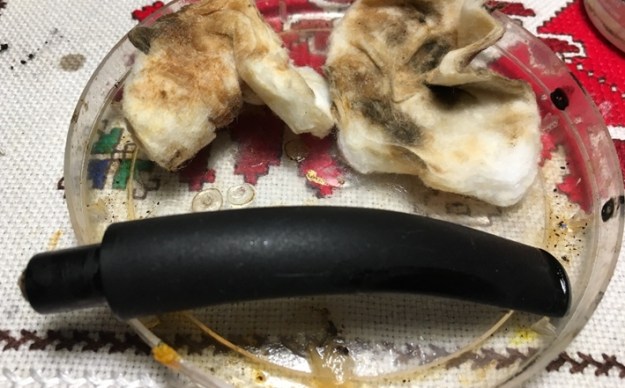
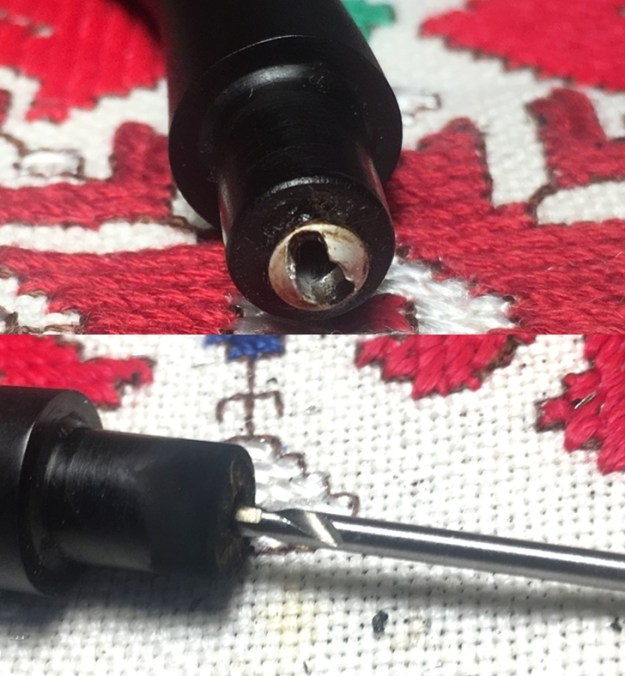
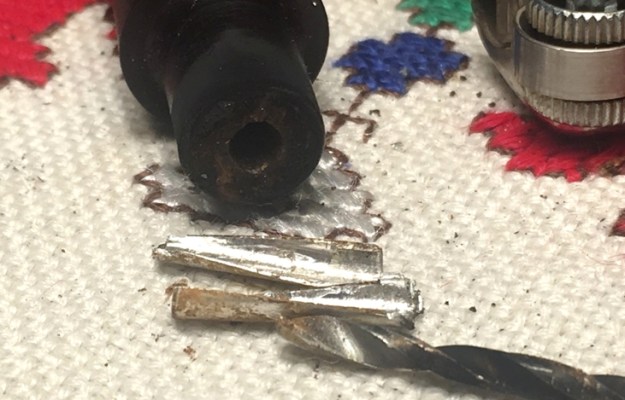
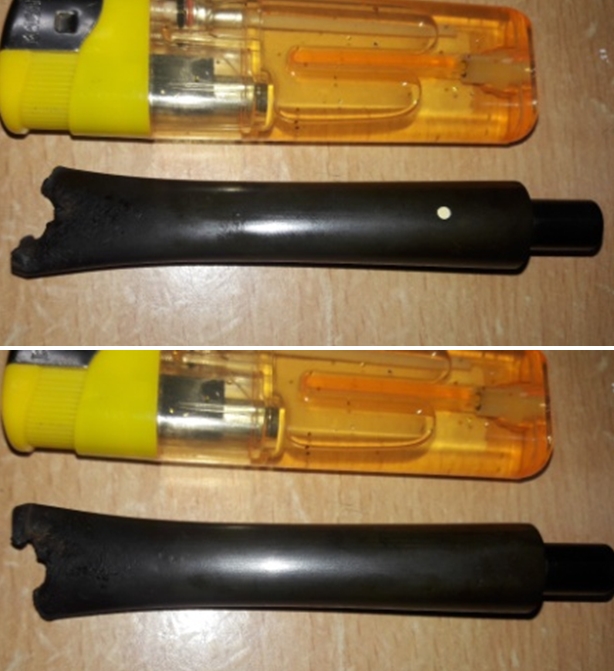
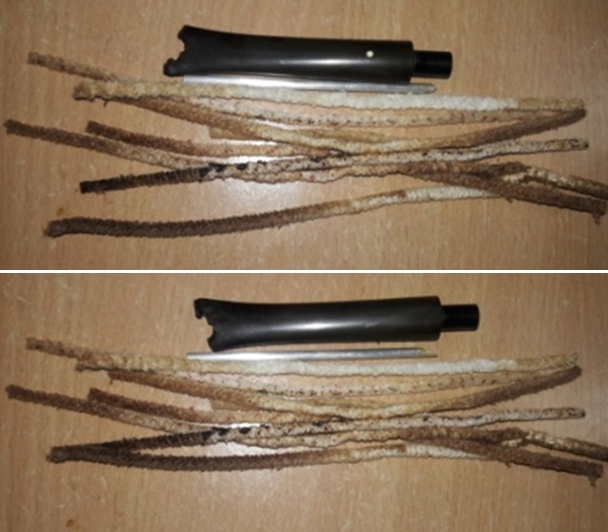
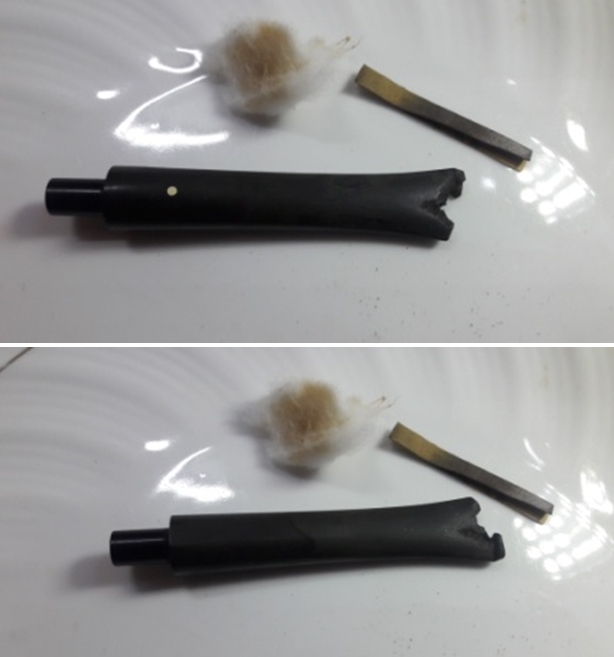
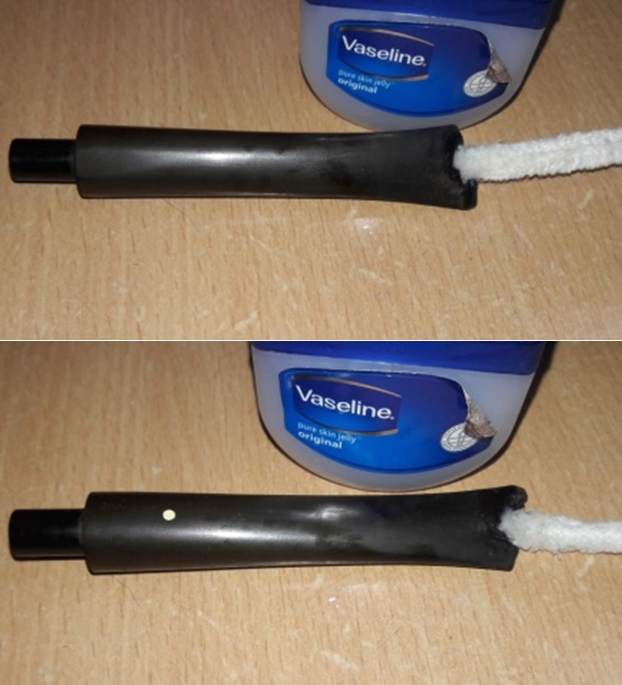
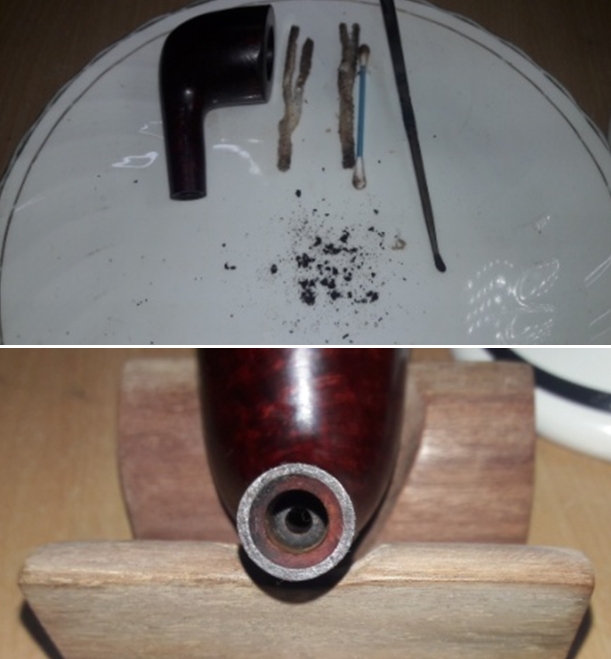
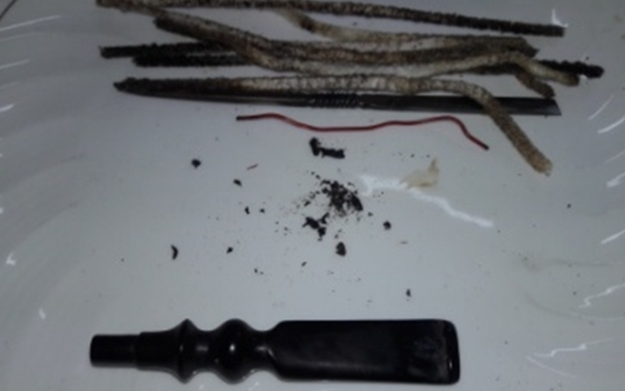
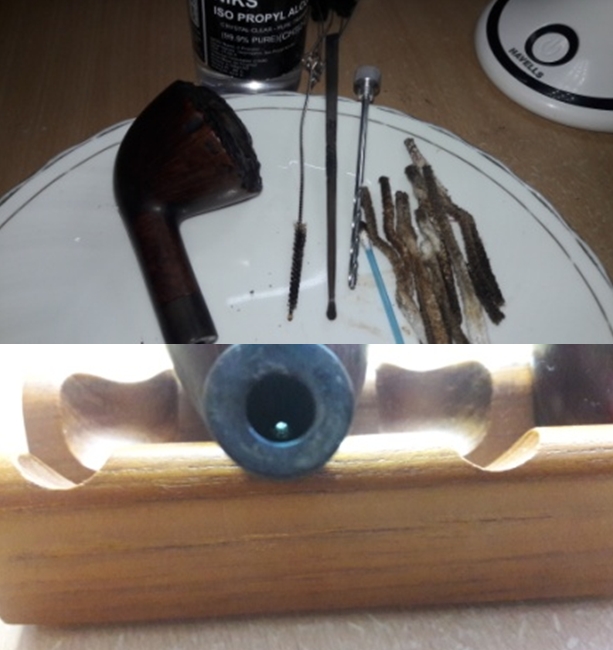
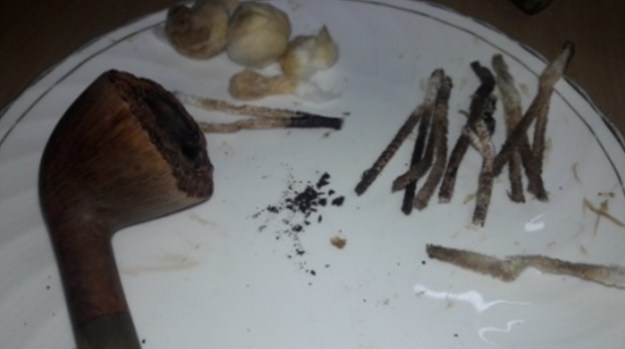
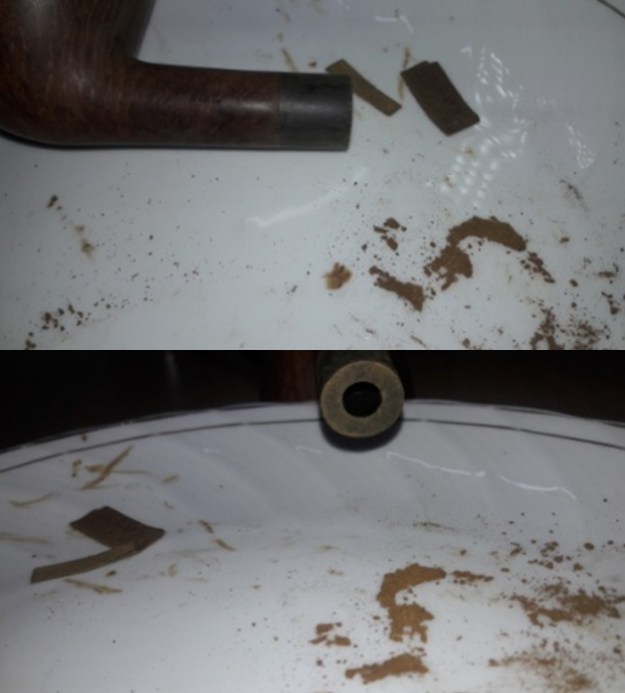
In most cases, not to postpone a fight but to confront the problems in a more systematic order, I would have started elsewhere. This time I went straight for the mother dragon protecting its young. The bone tenon screw piece in the stem is difficult to see, but trust me, it’s there in the first pic. Against the odds, it was easier to extract, or I was just lucky, but it popped out in one piece. In contrast, the shank took a couple of hours of on-edge, sweaty browed finagling with alternating and bizarre tools such as a jeweler’s screwdriver, the extended end of a large paper clip and the shank reamer of a three-piece pipe tool, to name a few. Breaking away a layer at a time, eight pieces later I reached the end of the blockage. The photo of the pieces is worthless. Confronted with the need for careful removal of the char and crystallization spreading from the upper chamber onto the lion’s mane and left ear, I admit I’ve never read of super fine “0000” steel wool being appropriate for meerschaum or even wood pipes, but I’ve found that when milder approaches don’t remove all of the char (which they almost never do), in almost all cases the steel wool does the job without damage.  What’s more, it even leaves a nice polish on the regular meerschaum rims that have some real width to them, which the CPF’s does not.  Some readers have told me they like the steel wool approach also. For the chamber I started with 200-grit paper and finished with 320, which also is discouraged unless great care is taken as I did, and then gave the outside of the stummel a vigorous but only preliminary cleaning with small cotton pads soaked with purified water. For all of the dirt apparent on the cotton pads, note how much was still left.

I waited – another year and a half.  During that time I continued the grueling online search for bone tenons with the idea of finishing the work myself and asked friends at my local pipe club and internet sites for pipe enthusiasts for help, to no avail.  The intensified hunt was infused with a sense that the time was fast approaching the now or never point, and even found a site that seemed to have every size available.  However, after going back and forth with the owner several times and never hearing from him again, I began to despair.  That was in 2016.

Then, almost exactly one year ago, at the end of February last year, I thought, what the heck, why not try again?  So I posted an identical thread on Smokers Forums UK, but in a different category.  The first response included a link to Norwoods Pipe Repair in Clifton, Tennessee.  Not wanting to get my hopes up, I checked it out and found that the father and son team of Floyd and Kenneth Norwood seemed to have all the right stuff for my lion’s head pipe and a second, antique briar that needed a still rarer stem that had to be replaced with the bone tenon.  All about that in part 3.

I had to wait until early in April, after employing the skilled services of Kenneth Norwood in March to repair the briar pipe first because it belonged to a customer who wanted it back for good reason, to send the CPF via USPS Priority 2-Day delivery.  I can tell you, the Separation Anxiety I experienced was acute, not having been away from the pipe or failed to look in on it at least once a day for the previous five years and being fully aware of the ability of the Postal Service to lose packages or deliver them to the wrong person who then keeps them.  I paid to insure the package for $500, which could never replace the irrecoverable, and waited.

From the almost immediate turn-around time I had with the briar pipe, but fearing that may have been a fluke, I knew it would not be too long but was nevertheless surprised when it arrived again at my door less than a week after I mailed it.

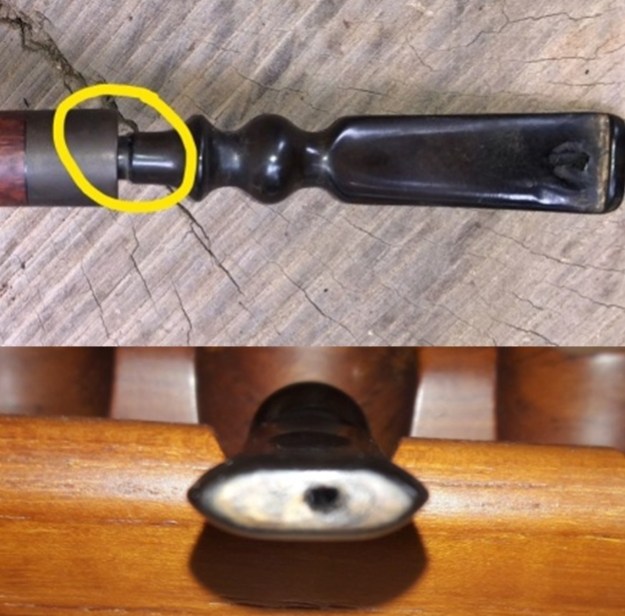
I took a picture showing the masterful work completed by Kenneth, who had done better than re-thread the shank, but what with the wonders of the new and improved Windows 10 that have required so many full system restores of my computers that I’ve lost count, that photo and who knows how many others have gone missing.  I’m sure they’re floating around somewhere because we all know Microsoft never lets us really and truly delete anything, but heaven knows where it is.

By the way, Kenneth mentioned that he would need the stem to be straight for his work aligning it to the new tenon, and so I put the amber stem with a pipe cleaner through the air hole on a small sheet of aluminum foil in the over pre-heated to 150° F. About 15 minutes later, I removed the sheet and stem.  Amber is the easiest material to bend or straighten, I suppose because of its resinous nature that makes it heat quickly to the point where it is so malleable it will literally bend in half from its own weight if picked up by one end when removed from the oven.

Knowing this from an experiment I did almost a year and a half ago, I took hold of both ends of the cleaner and still saw the middle sag a little as I rushed the stem that straightened in the oven on its own to the tap to fix with cold water.  I can’t emphasize enough the importance of speed in this process.  If you’re bending the amber, it tends to straighten out again fast, and if you’re straightening the stem, it’s easy to bend it even by a tiny degree before fixing.

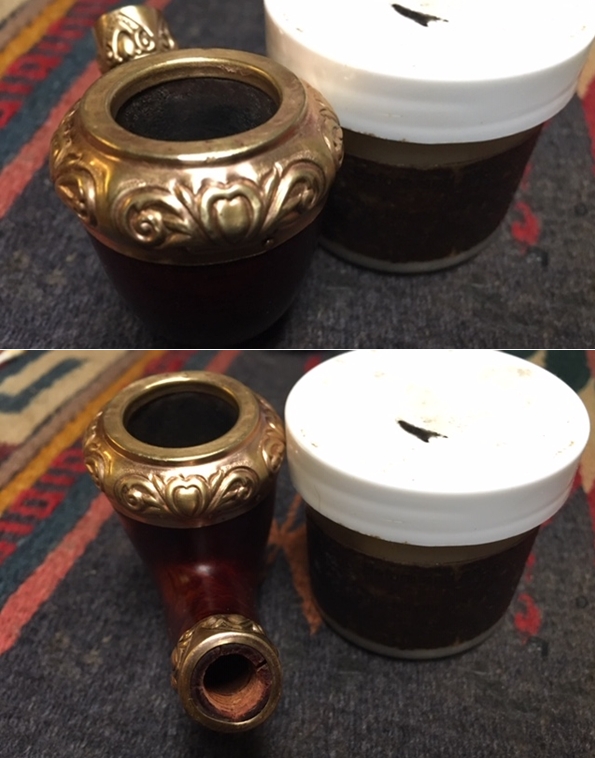
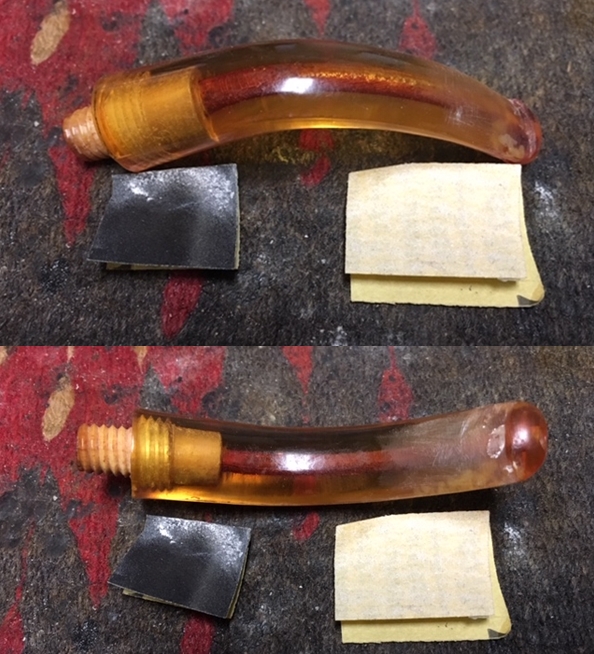
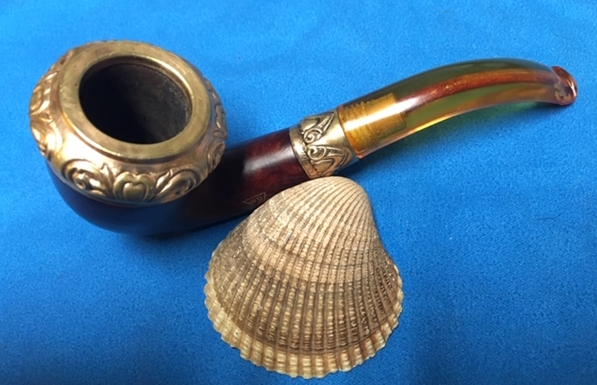
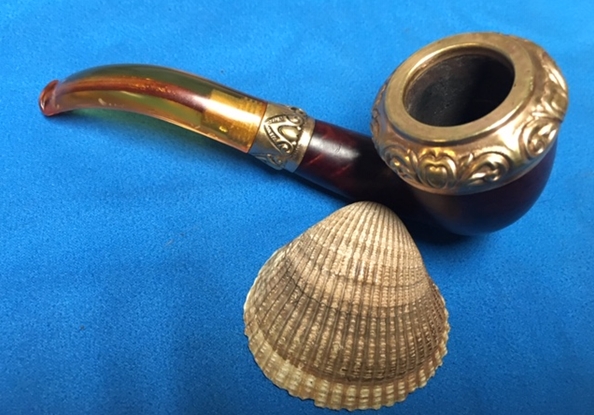
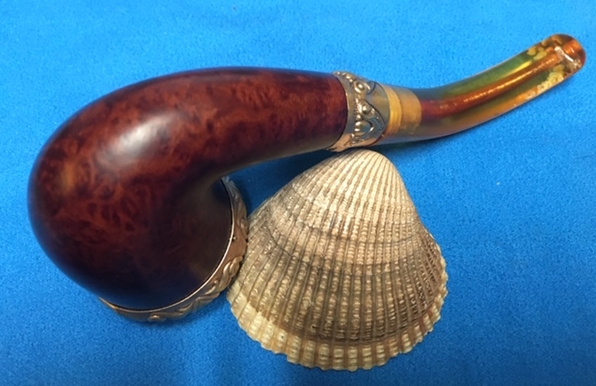
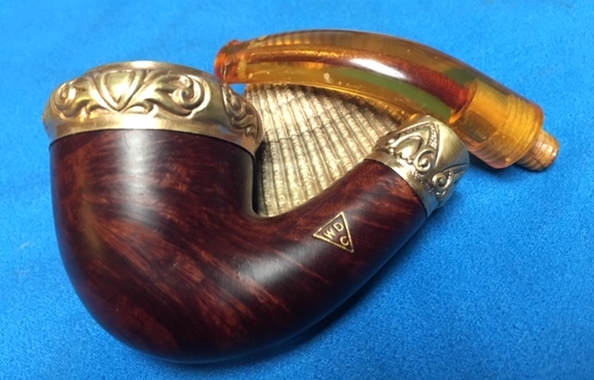
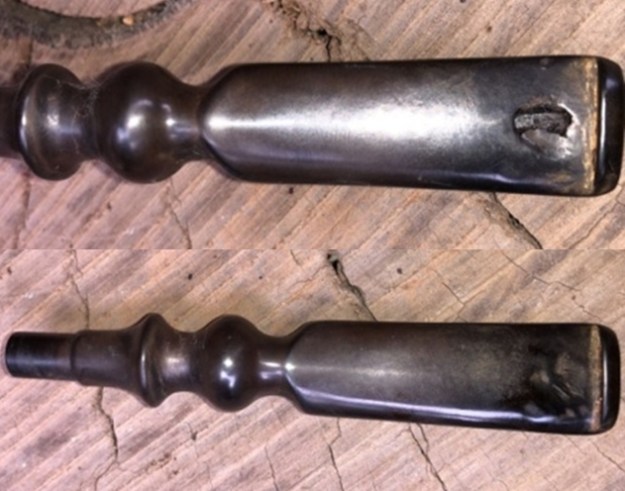
With that said, the next shots  start with the pipe as it was returned to me, with the stem still straight before re-bending, and after thinking to use a toothbrush and purified water to scrub every intricate detail of the amazingly realistic lion’s head.  This was quite a job, as the hand-carved details I noted are minute and almost as breathtaking as a real life, face-to-face encounter with the real thing: the ears alert and mane flowing backward, glaring eyes almost hidden beneath big brows, huge nose with fur and whiskers on either side, and that mouth with a hungry tongue and sharp teeth!  And that’s just the face.  The lion’s mouth is wide open, by the way, as if roaring or growling, and at times I had the idea it didn’t really care for my attentions – at least not until the task was done.  I have a bit of an imagination, you see, and another result was a flash to the story of Androcles pulling the thorn from the lion’s paw.Here are two shots of the work Kenneth did.And the rest.Now, the original real, cherry red amber stem was in remarkable condition for one that was used for a couple of years with loving attention, but the fact that it is well more than a century old makes its physical integrity achieve the level of astounding.  There were no dings or pits, and the scratches, if they could be called that, were so minor some people might have let them be.

I’m a far cry from perfect and always will be, but I’m not some people.  Here it is from every angle before I did anything to freshen it up.

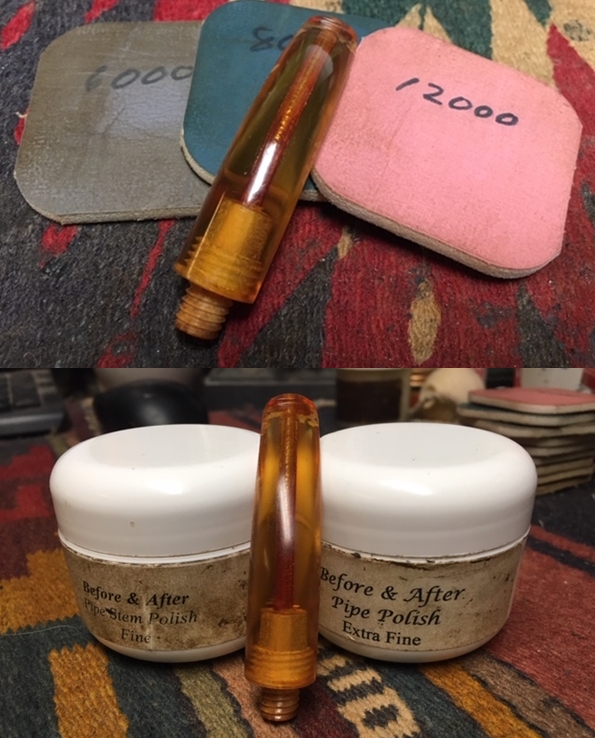
I gave it a wet micro mesh from 1500-12000.And I did a dry micro mesh the same way.Thinking a little more about it, I was still bent, as it were, on not putting the wonderful piece of expertly carved, polished, polymerized and  fossilized prehistoric pine tree resin – an organic material neither gem nor stone – anywhere near an electric buffer. After all, accidents can happen.  For such a catastrophe to occur to a piece of amber, even brand new, would be the end of it.  Amber’s biggest problems are its extreme softness, a 2 on the Moh’s Scale of 1-10, just a full step above talc, and its natural brittleness that begins to worsen the instant it is exposed to sunlight.  In other words, the exceptional suppleness of this antique stem makes it museum quality.  Whoever owned it kept it in a nice, safe place away from natural light, and when he died it must have stayed in its case in an attic or some other dark place.

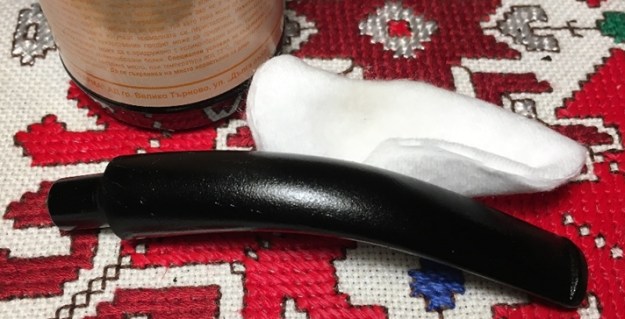
At any rate, thinking on the idea of how to give it a little polish without the wheel, the obvious occurred to me.  I took out my little jar of Decatur’s Pipe Shield that I decided to give a try as opposed to the standard Halcyon II Wax, both of which are generally reserved for hand application to rusticated or sandblasted wooden stummels before rubbing into the wood with a soft rag.  As far as I know, it couldn’t hurt, and in fact gave the unique stem a higher sheen that at least I see in the final shots.

Finished with all of the visible cleaning, I remembered the pipe still needed sanitizing, meaning the shank, but a retort was impossible for reasons that should be obvious, yet every now and then we hear of some poor fellow – because any woman who might practice pipe cleaning or restoration would never make such a mistake – boiling alcohol through the insides of a meerschaum or even using the cold alcohol/kosher salt method and ending up heartbroken from the ruinous results.

On the other hand, a little alcohol mixed with water can go far to clean and sanitize a meerschaum shank.  Fred Bass, one of the leading meerschaum collectors and authorities, writes in an essay cited below that his traditional inside-out cleaning method for meerschaums includes careful application of straight alcohol to the dirty outer areas of the pipe  with a cotton pad or cloth  – and he suggests Everclear, which as most folks know is almost as strong as it gets at 95% grain alcohol, or 190-proof.  Residual alcohol should be tamped dry.   For the shank, he recommends a pipe cleaner or more if necessary dipped in Everclear followed by a dry cleaner.

Well, I’m sure that works since Fred (we don’t know each other, but I don’t think he’d mind the familiarity) has been restoring meerschaums for quite a while now.  But I just did not have the heart or nerve or courage or whatever you want to call it to make my first such try on my beloved CPF.  Also, I think Fred would agree that building up to the Everclear cleaning approach is always a good idea, and my initial cotton pads followed by a toothbrush, both with purified water, got all of the dirt off this beauty.  My compromise for the chamber sanitizing was to add a cap-full of Everclear to about a quarter-cup of water.

Here is the finished pipe, hand-buffed with a special heavy micro-fiber cloth. CONCLUSION
With the longest restoration job I’ve ever performed complete, I was almost said – with an emphasis on almost.  The relief and satisfaction with a job well done, if I say so myself and even though I did not do the shank work myself, were more than enough to compensate for any post-project blues.  That turns out to be the perfect word to segue to my final comments.

For anyone who noticed the damage to the CPF’s leather-covered wood case between the first and last picture in this blog, I can, with complete honesty and justification, blame it on the dog, Blu.  I kid you not.

She has admirable spirit, but a little too much of a good thing.  The problem with the pipe is that Blu will snatch, run outside and devour anything left out and unattended if it smells tasty or even different – cooked or raw food, ice cream, soda cans or bottles, coffee mugs, Vaseline, OTC meds in their bottles and, as I found out the hard way one morning, a mysterious little object that simply looked too good to pass up.

My heart stopped when I returned to the living from my bedroom and noticed the tan case that had been in the center of the coffee table missing.  I knew who stole it without a moment’s thought and almost saw red as vivid images and plans of canicide filled my mind.  You see, the CPF Best Make turned lion’s head meerschaum with a gold band and cherry red amber stem c. 1881 was in the box.

Had I not found the mauled case in the back yard dirt patch where Blu so loves to play and eat her ill-gotten food stuff, and the CPF miraculously safe and intact inside it, I can’t say what I would have done to the dog.  Sweetness only goes so far.  A man’s pipes are not to be messed with.

I’m sure everyone can appreciate my immediate overwhelming relief and forgiveness of Blu despite her terrible lapse in judgment.

PREVIEW
Part 3 of this series will describe the two years it took me to return an antique KB&B Blueline Bakelite billiard c. 1911 entrusted to me for a quick cleaning and restoration, and the unfortunate reasons for the…er, delay.

Part 4, taking a lesson from this restore, will go a touch further with my full restoration of an old First Quality meerschaum billiard with a wrecked inner shank, and the replacement of its tenon and stem.

 SOURCES

http://pipephil.eu/logos/en/logo-c1.html

https://pipedia.org/wiki/Colossus_Pipe_Factory

https://www.invaluable.com/auction-lot/colossus-pipe-factory-african-calabash-sterling-109-c-13648cbbb7

https://rebornpipes.com/2013/04/14/some-reflection-on-the-historical-background-on-cpf-pipes/

https://www.onthisday.com/events/date/1881

https://norwoodspiperepair.com/index.html

https://rebornpipes.com/2017/09/14/on-bending-and-straightening-amber-stone-stems/


A Special Gift for Her Grandfather in the People’s Republic of China – A Sculpted Rose Billiard of Italy


Blog by Dal Stanton

You need to first hear the story then the restoration of the pipe will come. Let me first tell you about the granddaughter.

Chrystal, age 30, came to Bulgaria for two weeks from the People’s Republic of China.  My wife and I hosted her in our home.  She has a master’s degree and teaches in an English language department in a university near Beijing.  Her keen interest in the well-being of people was the catalyst in becoming aware of the issues of human trafficking and the devaluation and exploitation of women.  Through foreign acquaintances she has in her role as a teacher, she heard about Daughters of Bulgaria – the work here in Bulgaria seeking to help trafficked and sexually exploited women.

Cross cultural adventure – our Bulgarian friend Ellie, translating Bulgarian menu using English for Chrystal, so that Chrystal can call ordering Chinese in Mandarin, with the hope of surprising the Chinese restaurant worker who speaks Bulgarian and Chinese! It worked!

Chrystal’s aspirations to know and understand more about this issue both intrigued her and struck a chord in her own core experience that prompted her to throw caution to the wind and reach out to the Daughters of Bulgaria staff via email about coming to Bulgaria and to learn about the issue and what tangible things are being done to help women coming off streets and out of brothels.   Her email was received with surprise and question – someone from China desires to come to Bulgaria to learn from us!  In the communications with Chrystal that followed, her deep and sincere concern for people in general and in her home, China, was very evident.  She came to Bulgaria during her annual January break from teaching at the university.  We were amazed at how quickly her visa to enter Bulgaria was approved!

During her visit, we had the privilege of learning about the path of her life in China.  As Westerners, we were anxious to learn about Chinese culture and customs and we were also interested in her personal story.

She, like most Chinese women while growing up, personally experienced the effects of the enduring custom of valuing sons over daughters.  With China’s strict one child per family law to control population which recently changed to allowing two children, Chinese families were faced with pressures to have a son – which is the greater honor for the family in a culture where honor is profoundly important.

During the one child per family period, Chrystal’s

Serenaded at a restaurant in Sophia, Bulgarian style!

parents had a baby and it was a girl – the opposite of honor became Chrystal’s experience as she grew up with this subtle sense of shame.  She recounted remembering the acute feeling of self-guilt that she wasn’t a boy and her presence brought dishonor to her family – she wasn’t what her parents wanted.  Growing up, she understood that her parents had to settle for a girl.

To counteract this sense of having lesser value, Chrystal’s smile was pained while looking down recounting how she sought to excel in everything she did as she emerged from childhood into womanhood – trying especially to earn her father’s love and acceptance.  Her passion to excel did have its benefits. It propelled her growing up, in her studies and eventual appointment as a teacher in the university, being observed and appreciated by her supervisor in the professional and academic university environment.  Yet, Chrystal has discovered that even this accomplishment was not enough to reverse the underlying, unspoken sense that she did not measure up – that she would always be the daughter for which her parents had reluctantly settled.  Chrystal confided that this perhaps, is why she was so drawn to learn more about the Daughters of Bulgaria and the profound effects of devaluing of women resulting in human trafficking – it so resonated in her heart and to some extent, in her experience of feeling the impact of not being valued by others – even by those closest to you.

Even though this part of her story is ongoing and unfolding, Chrystal’s concern for others and her simple joy in living (she always seemed to be laughing and smiling!) confirmed to me that she had found a good place in her life – at her core.  The serendipitous trip to Bulgaria, of all things, revealed to me that she’s taking life as it comes and living to the fullest as she is able – growing as a person and seeking to help others in need.  How will she use what she is learning in Bulgaria in China?  She confessed with a smile, she doesn’t know exactly but she believes it will be used in some way that will be evident in time – like a seed planted in soil.

Chrystal with her Grandfather and cousin. Can you guess?

When Chrystal started asking us questions about our life in Bulgaria, she found out that I do something she had never heard of before – restore pipes!  She was fascinated.  And when she heard that I sell restored pipes worldwide to benefit the Daughters, she decided to do her part in helping the Daughters as well.  The first thing she did was post some pictures and information about The Pipe Steward to her friends in China on social media available there.  For the next several days, the stats for www.ThePipeSteward.com launched because of ‘hits’ coming from China – yes, I can see the countries of those looking at the website!

Secondly, and most important in helping the Daughters, was to choose a pipe as a special gift for her grandfather.  I asked her why the gift for her grandfather?  I found out that February is Chinese New Year and it is customary to give gifts or money to family.  I asked her why a pipe?  She said that as a farmer – a common man, her grandfather is considered near the bottom of the social strata and her thoughts of him are of his life as a farmer and that he liked to smoke.  She described him smoking thick cigarettes with strong tobacco and said that he also had an old, long metal pipe that he liked, but she said there was nothing special about it.  (The answer posed in the picture to the right is on the ‘Left’ 😊)

After she methodically explored many ‘Help Me!’ baskets and scrutinizing MANY pipes, she found the special one (or, did it find her? 😊) she would give to her grandfather.  I asked her, out of all the pipes she had studied, why she had chosen the pipe she did?  She smiled as she looked down thoughtfully.  She described the ‘rose’ carving in the briar and said that it reminded her of the rose that forms the logo for the Daughters of Bulgaria – the rose is beautiful but also, fragile and strong.  The ‘rose’ sculpted in the pipe also formed a hope that revealed to me the depth of love that resides in Chrystal despite everything.  She said that when her grandfather smoked this pipe that she hoped that it would remind him fondly of her – that she would be carved in his heart like the rose on the pipe.

With Chrystal’s return to China coming soon, I quickly went to work on the chosen pipe she planned to give her grandfather after returning to China.  Just before her departure from Bulgaria, my wife loaded Chrystal with gifts from Bulgaria for her and her family (but a special jigsaw puzzle for Chrystal!).  I also presented her the restored ‘Rose Pipe’ ready for her grandfather. Her first reaction to seeing it and holding it in her hands was how it had changed!  The second was some concern that her grandfather may not appreciate its value.  She struggled a bit considering keeping it for herself because now it meant so much to her, not to smoke, but to cherish as a reminder of her time in Bulgaria.  It was gratifying to pass this pipe on which I had purchased from a seller in the US New England state of New Hampshire in 2016, brought to Bulgaria and was patiently waiting for Chrystal to come to Bulgaria so it could choose Chrystal and make its way to its new steward, a common man – a farmer in China, Chrystal’s grandfather.

When Crystal left Bulgaria on her trek back to China (on Aeroflot via Moscow and Peking!) she knew that I was writing her story in this write up of the restoration of her grandfather’s pipe.  I agreed to wait to publish this blog after Chrystal promised to send me pictures of her with her grandfather and after she presented the Rose Pipe to him.  True to her word, the pictures arrived less than a week after her departure with these words:

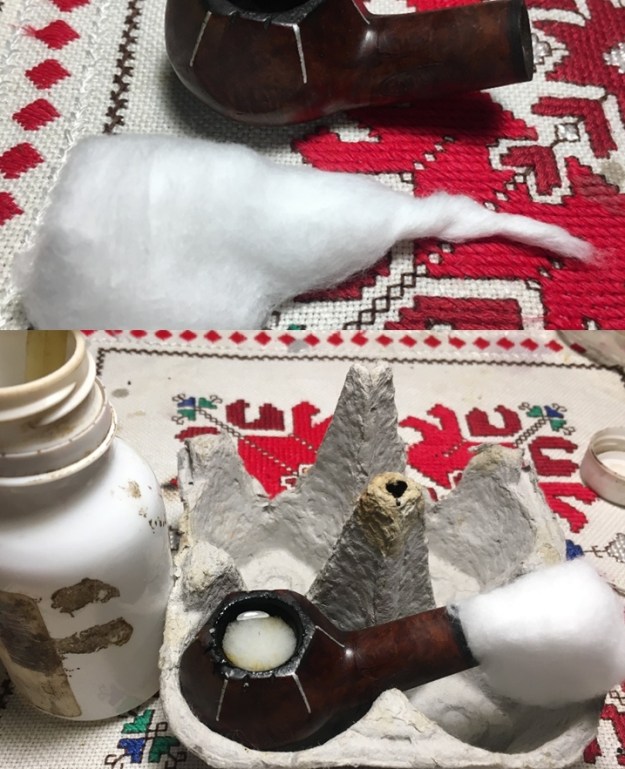
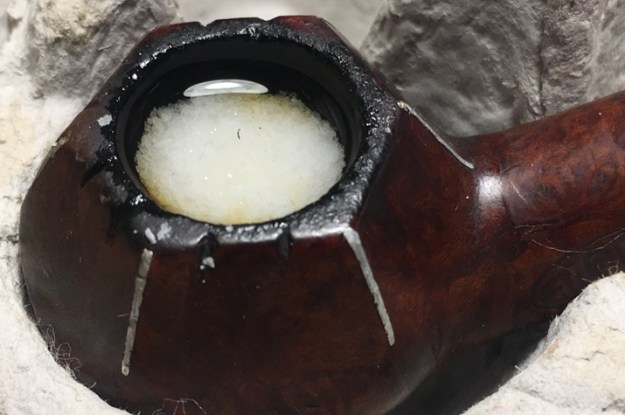
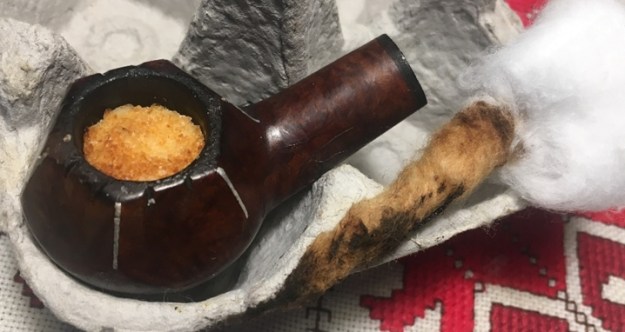
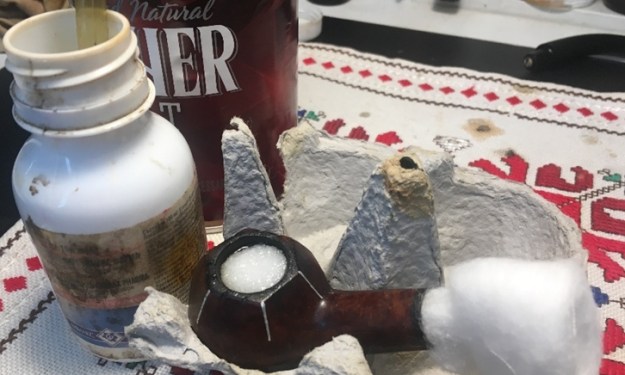
My grandpa really likes your pipe!!! My dad said it is so special and valuable. My mom said it is like an art. Yes, they are happy. My dad even didn’t know my grandpa likes pipe. But it turns out that my grandpa does like it!!  So, my dad is happy. I look forward to your writing [blog write up]. I feel so blessed and so loved to know you!!  By the way, what kind of wood is the pipe made of?With a deepened appreciation for the granddaughter and her love for her grandfather, and for the pipe man in China who has become the new steward of the Rose Pipe, I now tell the story of the restoration of the Sculpted Rose Billiard that was on my worktable but now in China.   First, to answer Chrystal’s question: Briar 😊. The only marking on the pipe is the COM, ITALY, on the underside of the shank.  The pipe has been well loved and used much by examining the chamber and rim.  The chamber shows very thick cake and the rim is gummed up with lava.  Both need to be addressed through reaming and cleaning.  The bowl itself is dark from oils and grime.  The reddish or Oxblood hue is dull and tired.  There are small dents on the surface from normal bumps and at least one small fill that I see that needs checking.  The vertical fire grain beneath the finish is very attractive – showing much, much potential, which I like.  The shank is slightly bent with a nice-looking saddle stem which shows some oxidation but hardly any tooth chatter.  I think this gift for Chrystal’s grandfather will turn out very nicely!  I take a few close-ups to show these issues. To begin the restoration of this special gift for Chrystal’s grandfather, I clean the stem’s airway with a pipe cleaner dipped in isopropyl 95% then I drop it in an OxiClean bath to soak to loosen and raise the oxidation.  After it soaks through the night, I take it out (and realize that I forget to take a picture of it!) and take the stem to the sink and wet sand using 600 grade paper.  This does very well in removing the oxidation.  To hydrate the vulcanite, I then apply paraffin oil (a mineral oil) to the stem and put the stem aside to absorb.  The pictures show these steps. Next, I tackle the thick cake in the chamber.  I take a starting point picture and then employ the Pipnet Reaming Kit blade heads to cut through the cake to give the chamber a fresh start.  I use 3 of the 4 blades available.  I then fine tune the reaming using the Savinelli Fitsall Tool. I follow this by sanding the chamber using 240 grit paper wrapped around a Sharpie Pen.  This gives me leverage to apply pressure and to reach down into the chamber.  I finish by wiping the chamber with a cotton pad wetted with isopropyl 95% to clean the carbon dust. After an inspection of the chamber showing no problems, I move on. I clean the externals of the stummel with undiluted Murphy’s Oil using a cotton pad.  I also use a bristled tooth brush on the sculpting.  I’m anxious to see how this Oxblood hue cleans up.  I also utilize a brass brush on the rim.  Brass brushes do not harm the surface.  The cleaning did a good job on the rounded rim as well as the stummel surface.  The old finish is thin and raw briar is left on the rim. I decide to check the condition of the two small fills on the left upper side of the stummel.  Using a sharp dental probe testing showed that the fills weren’t solid, so I dig out the old fill with the probe.  I see no other fills needing attention, so I decide to address these now. I wipe the area with alcohol to clean it and then I mix a small about of briar dust putty using thick CA glue.  Using an index card, I shovel some briar dust in a small mound.  I then drop some CA glue close to the mound.  Using a toothpick, I then pull briar dust into the CA glue mixing as I go.  As the two mix, it thickens.  When it reaches the thickness of molasses, I apply the mixture to the pits with a small mound of excess to be sanded after it the putty cures.After the briar dust patch sets up, I clean the internals of the mortise and airway using pipe cleaners and cotton buds. I also use a dental spatula to scrape the tars and oils from the mortise wall.  After some effort, the internals are cleaning up and the cotton buds are coming out clean.Turning back to the stummel, the patch has cured and using a flat needle file I file down the briar dust patch to almost flush with the briar surface.  I then use 240 and 600 grit paper to sand it down further to the briar surface and blending the patch.  Amazingly, a face appears for a while as captured in the second picture! I then wipe the entire stummel with alcohol to remove the thin finish and to clean the stummel.  Taking a very close look at the condition of the surface.  I see a lot of nicks, cuts and very small pitting.  The surface is in rough shape. I decide to employ sanding sponges to work on the rough briar surface as well as the rounded rim that has seen better days.  I start with the coarse sanding sponge sanding the smooth surface – I pass over the sculpted areas.  I then graduate from the coarse sponge to the medium grade sponge, then to the fine sanding sponge.  These pictures chronical the progression – starting with the coarsest sponge: Medium sponge: Fine sponge: Moving from sanding sponges, I fine tune further using the micromesh pads.  First, I wet sand using pads 1500 to 2400, then dry sand using pads 3200 to 4000 and 6000 to 12000.  The pictures show the progression. Well, it’s been a productive day!  To finish my ‘pipe work’ day, I’ll continue the internal cleaning of the stummel by allowing it to clean stealthily in a kosher salt and alcohol soak.  To do this I twist and pull a cotton ball to form a wick that I insert and push through the mortise and into the airway.  I then fill the bowl with kosher salt (you can use any kind of non-iodized salt – iodized salt leaves an aftertaste) and give the bowl a shake to settle the salt.  After I place it in an egg crate for stability, I use a large eyedropper and fill the bowl with isopropyl 95%.  After a few minutes, the alcohol is absorbed, and I top off the alcohol once more.  Putting it aside, I shut off the lights. The next morning, the salt and wick have both darkened from drawing out the oils and tars from the internal briar.  I toss the expended salt and wipe the chamber with paper towel making sure to remove left over salt crystals.  To make sure all is clean I run one pipe cleaner and cotton bud wetted with alcohol. Internals are clean!  Moving on. As I’ve reflected on the original reddish, Oxblood hue of the pipe, I think this was partly why Chrystal was drawn to the pipe – with its sculpted rose.  I will apply a dye to the stummel combining Fiebing’s Dark Leather Dye and Oxblood Leather Dye.  I’m envisioning a subtler Oxblood embedded in the darker brown, but leaning more toward the brown than red.  I will mix the two dyes in equal parts and see what happens!  I assemble all the desktop components of my staining process.  I first wipe the stummel with a cotton pad wetted with alcohol to clean it. I insert a shaped cork into the mortise to act as a handle.  After mixing the Dark Brown and Oxblood in a shot glass, I then warm the stummel using a hot air gun.  This expands the briar grain allowing it to absorb the dye more effectively.  After the stummel has been warmed, I apply the dye mixture to the briar surface with a folded over pipe cleaner.  After thoroughly covering the surface, I ‘fire’ the surface using a lit candle.  The alcohol in the aniline dyes immediately combusts when lit and sets the dye pigment in the briar grain.  I repeat this process a few minutes later and set the newly stained bowl aside to rest through the night. With the newly stained stummel resting, I return to the stem waiting in the wings. There are minor tooth chatter and bites on the button. I first freshen the button lips using a flat needle file.  Using 240 grit paper I quickly sand out file scratches and chatter. I then use 600 grit paper on the bit area, erasing the coarser paper scratches and follow by using 0000 steel wool on the entire stem.Moving next to the micromesh phase, I wet sand using micromesh pads 1500 to 2400, then dry sand using pads 3200 to 4000 and 6000 to 12000.  After each set of 3 pads I apply Obsidian Oil to the stem to revitalize the vulcanite.  The stem looks good. I love this part of the restoration process – unwrapping the fired stummel.  After making the decision to dye, often the grain makes its own decisions regarding how the dye is received – I’m never sure how dye mixtures will look in the end.  To unwrap the flamed stummel shell, I mount a felt cloth buffing wheel into the Dremel and set the speed at the slowest RPMs and apply Tripoli compound.  After completing the cycle with Tripoli, to further blend the dye I wipe the stummel lightly with a cotton pad wetted with alcohol.  Before moving to the application of Blue Diamond compound, I use a fine point Sharpie Pen and give a little highlighting to freshen the sculpting on the stummel.  Next, I rejoin stem and stummel and mount a cotton cloth wheel to the Dremel, increase the speed to about 40% full power and apply Blue Diamond compound to the stummel.  Blue Diamond is less abrasive and continues to tease out the natural sanded gloss of the briar.  The briar grain is responding with a smile on its face – oh my! After wiping the pipe down with a felt cloth to clean off the compound dust left by the Blue Diamond, I mount another cotton cloth buffing wheel onto the Dremel, maintain speed at 40% full power and apply a few coats of carnauba wax to stem and stummel.  When completed, I give the entire pipe a hand buffing using a microfiber cloth to raise the brilliant shine and finish up the restoration of Chrystal’s gift for her grandfather.

In Bulgaria, the rose is special.  Even though is a beautiful flower, here in Bulgaria it is not primarily known as a beautiful flower, but as a rugged producer of fine oils and perfumes known and exported world-wide.  This is one of the reasons why the rose became the logo of the Daughters of Bulgaria – but not only a logo, but a symbol of profound value, strength and beauty.  Women who have been trafficked and sexually exploited are treated as valueless property to be used and then discarded.  All people are endowed with intrinsic value – even those that are not treated as Daughters, but are daughters, with identities, stories and value.  When Chrystal chose this ‘Rose’ pipe, she wanted it to be a special gift to her grandfather for the Chinese New Year – a gift that would remind her grandfather of her – not a rose carved in wood, but that she would be carved in his heart.

Chrystal could see the beautiful value and potential of this pipe when she chose it from among many to be her special gift.  She is truly a special young lady – truly a rose.  Thanks for joining me!    


The Final Pipe of the Foursome… a JR Hand Made Apple


Blog by Steve Laug

My brother Jeff picked up four pipes in classic shapes at an auction in Nampa, Idaho. All four pipes are stamped JR Handmade. Beside the Bulldog there were two Canadians and an Apple. All were stamped the same on the shank JR over Handmade and the opposite side Algerian Briar. I have been researching the brand on the web. I came across a potential pipemaker with the JR initials on Pipedia named J. Rinaldi but from what I can see he did not make classic shaped pipes. He pipes are very well made and have more of a freehand/freeform shape with shank adornments so it makes me wonder if these are his. I enlarged each photo on the Pipedia article but I was unable to see the stamping on his pipes for comparison sake. This leaves me with a lot of questions about the brand. The foursome came from the Boise, Idaho area like the House of Robertson pipes that I worked on last year. Those came from a pipe shop in Boise, Idaho and I wonder if it is not possible that the JR Handmade brand was also a pipe shop brand from a small shop in that area or even somehow connected with the House of Robertson brand. I heard back from a House of Robertson Collector in Boise about a possibility on the JR brand. Thayne Robertson, the carver of the House of Robertson brand and the shop owner had a son named John. He said John also carved pipes. Perhaps these are some of John’s pipes. But I will probably never know for certain… if any of you readers have any idea about the brand your help would be greatly appreciated.The above photo shows the foursome after Jeff had cleaned them. But before he cleaned each of them he took photos of the pipes as they came to him. I already wrote about the restoration of the Bulldog (https://rebornpipes.com/2019/01/28/the-first-of-a-foursome-a-jr-handmade-bulldog/) and the first Canadian (https://rebornpipes.com/2019/01/30/the-second-of-a-foursome-a-jr-handmade-canadian/) and the second Canadian (https://rebornpipes.com/2019/02/01/the-third-pipe-of-a-foursome-a-2nd-jr-handmade-canadian/). The next pipe is the second pipe down on the right side of the above photo – a classic Apple shaped with a saddle stem. I have included the photos of the Apple before cleanup. The pipe is very well made and follows the classic shape of an Apple perfectly. The bowl was stained with a medium brown top coat over a black undercoat. It is a well-shaped pipe that captures the mixture of flame and straight and birdseye grain around the bowl sides and shank. The top of the bowl had some damage and burn marks on the top and inner edge. The bowl had a very thick cake in the bowl. There was a light overflow of lava onto the rim top. The stamping on the top side of the oval shank read JR over HAND MADE. The black vulcanite stem had light tooth dents and chatter on the top and the underside of the stem. Otherwise it was in very good condition. It was lightly oxidized. He also took a photo of the bottom of the bowl and shank to show the various grains on the pipe. The photo shows the finish of the bowl and though it is very dirty but this is another beautiful pipe.Jeff took a photo to capture the stamping on the topside of the oval shank. The photo shows stamping JR over HAND MADE. The next two photos show the stem surface. There was tooth chatter on both sides near the button. There is also some wear on the sharp edge and top of the button. There is a thick oxidation and coat of calcification.As mentioned before, Jeff and I have developed a pattern of working on the pipes that has become habit to both Jeff and me. I include it here so you have a sense of that pattern. Jeff reamed the bowl with a PipNet pipe reamer and followed up with a Savinelli Fitsall pipe knife to remove the cake. He scrubbed out the mortise and the airway in the shank and the stem with alcohol, cotton swabs and pipe cleaners. He scrubbed the exterior of the bowl, rim, shank and stem with a tooth brush and Murphy’s Oil Soap to remove the oils and tars on the rim and the grime on the finish of the bowl. He rinsed it under running water. He dried it off with a soft cloth. He was able to remove the lava build up on the rim top and the rim top damage and the damage around the edges – both inner and outer is quite extensive. I took photos of the pipe to show its condition before I started my work on it. I took close up photos of the bowl and rim top as well as the stem. You can see the condition of the rim top and bowl in the first photo. Though the photo is a bit dark you can see that Jeff was able to remove all of the tar and oils. You can see the burn damage to the front inner edge of the bowl and some general darkening of the rim top. The vulcanite stem had light tooth chatter and some tooth marks on the top and underside of the stem near and on the button surface.I took a photo of the stamping on the left side of the shank. You can see that the stamping was clear and readable. I wiped down the bowl with a damp cotton pad to clean off the debris; then addressed the damage to the rim top and inner edge. I removed the damage to the top and the edges of the rim top. I was also able to reduce the burn damage to the front inner edge of the rim. I wiped down the rim after sanding with a dampened cloth and I am pleased with the results.I polished the rim top, the edge and exterior of the bowl and shank with micromesh sanding pads – wet sanding with 1500-2400 grit pads and dry sanding with 3200-12000 grit pads. I wiped the rim off after each sanding pad to remove the dust. The damage on the rim edges was virtually gone and the top looked really good after polishing. I worked some Before & After Restoration Balm into the smooth surface of the briar with my fingertips to clean, enliven and protect it. I let the balm sit for a little wall and then buffed with a cotton cloth to raise the shine. The following photos show the bowl at this point in the restoration process. The reworked rim top looks really good and matches the colour of the rest of the pipe. I set the bowl aside and worked on the stem. There were some tooth marks on the top and underside at the button that needed to be addressed. I also needed to do some work on the surface of the button on both sides. I also sanded away some of the surface oxidation.I polished the stem with Denicare Mouthpiece Polish to remove the hard to get spots on the saddle and the button edges. I scrubbed it into the surface with a soft cotton pad and then buffed it off with another pad. I polished the stem with micromesh sanding pads – wet sanding with 1500-2400 grit sanding pads and dry sanding it with 3200-12000 grit sanding pads. I wiped it down after each sanding pad with Obsidian Oil. I polished it with Before & After Pipe Stem Polish and wiped it down with a last coat of Obsidian Oil. With this fourth JR Hand Made pipes from the Nampa, Idaho auction I am even more certain that there is some connection to the House of Robertson Pipe Shop in Boise, Idaho. Since the completion of the third pipe I received an email from a House of Robertson (HOR) collector who lives in Boise, Idaho area. He used to frequent the House of Robertson Pipe Shop in Boise and knew the owner and carver of the HOR pipes, Thayne Robertson. He thought that there may well be a connection. He wondered if the JR Hand Made pipes could possibly been carved by the son of the House of Robertson pipe carver and shop owner. His name was John so it could well be John Robertson pipes. I may not be able to get definitive proof of this but even the hint of it is quite exciting.

The four JR Hand Made pipes that I have restored are really well made and shaped. The stain job was done to highlight the mix of grain on the bowl. I polished stem and the bowl with Blue Diamond polish on the buffing wheel. I gave the bowl and the stem multiple coats of carnauba wax. I buffed the pipe with a clean buffing pad to raise the shine. I hand buffed it with a microfiber cloth to deepen the shine. The pipe polished up pretty nicely. The contrasting grain really began to stand out; it seemed to take on life with the buffing. The rich contrasting brown and black colour works well with the polished black vulcanite stem. This finished pipe has a rich look just like the Bulldog and the two Canadians and it is also quite catching. Have a look at it in the photos below. It is a well-shaped apple. The shape, finish and flow of the pipe and stem are very well done. The dimensions are Length: 5 3/4 inches, Height: 1 3/4 inches, Outside diameter of the bowl: 1 1/4 inches, Chamber diameter: 3/4 of an inch. I will be putting this newly finished JR Hand Made Canadian on the rebornpipes store shortly if you are interested in adding it to your collection. Thanks for walking through the restoration with me as I worked over the final pipe of the foursome from JR Hand Made pipes.

New Life for Farida’s Dad’s Final Pipe – a Dunhill 5203 Shell Billiard


Blog by Steve Laug

I have had the last Dunhill from Farida’s Dad’s estate sitting on a cupboard behind my desk and every time I sit down I look at it and think that I need to finish it up. I sold the rest of the estate and purchased this one myself so that I could have some time to work on it. Yes you are right, read between the lines – I wanted to put off working on it. Well, this morning I sat down at the desk and posted a couple of blogs and then turned and there it was looking at me. I decided then and there to pick it up and do the work to finish this estate.

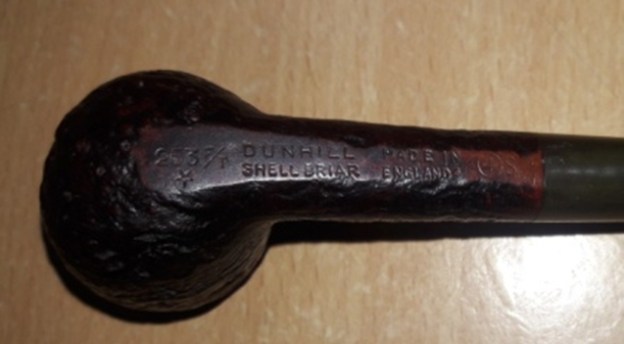
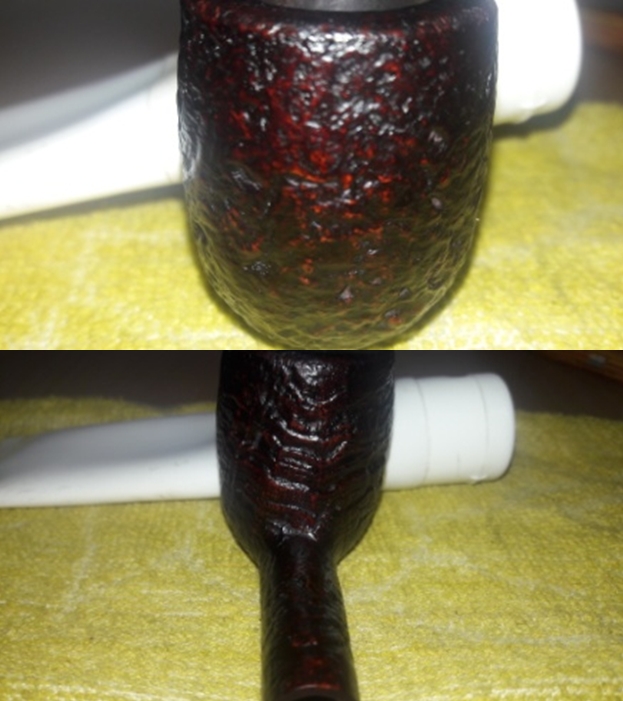
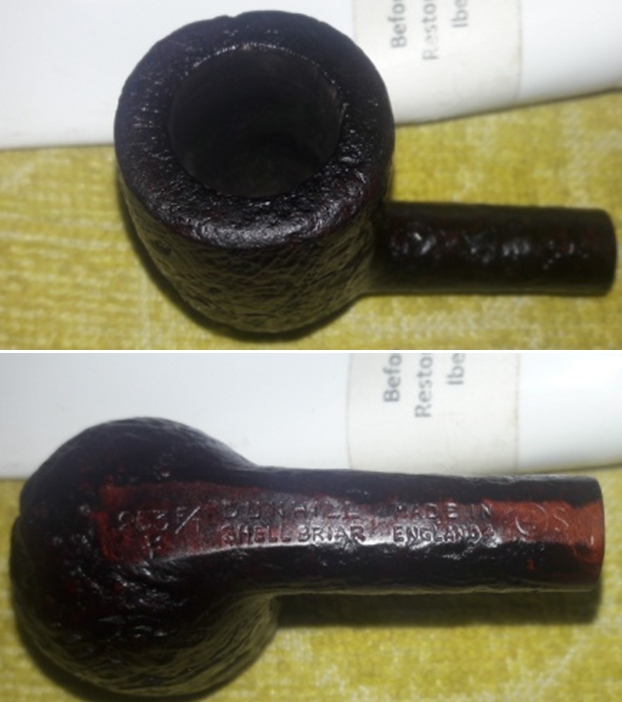
The pipe came from the estate of an elderly gentleman here in Vancouver. I met with his daughter Farida over a year ago and we looked at his pipes and talked about them then. Over the Christmas 2017 holiday she brought them by for me to work on, restore and then sell for her. There are 10 pipes in all – 7 Dunhills (one of them, a Shell Bulldog, has a burned out bowl), 2 Charatan Makes, and a Savinelli Autograph. This is the last of the lot – a lone Dunhill Billiard with a saddle stem. His pipes are worn and dirty and for some folks they have a lot of damage and wear that reduce their value. To me each one tells a story. I only wish they could speak and talk about the travels they have had with Farida’s Dad. The first photo shows the underside of the shank and its virtual illegibility under the tars and filth on the finish.You can see from the above photo the challenge that the pipe I am working on today will be. The stamping identifies it as a Dunhill Shell Billiard with a saddle stem. It is stamped on the underside of the heel and shank on a smooth flat area. On the heel is the shape number, a 4 digit number – 5203. I looked on Pipephil to get the lowdown on the shape number (http://www.pipephil.eu/logos/en/dunhill/shapes.html). I quote that below:

Dunhill pipes are stamped with a four digit code.

Digit 1: (from 1 to 6) denotes the size of the pipe (the group).

Digit 2: denotes the style of the mouthpiece (0,1=tapered, 2=saddle)

Digit 3 and 4: denote the generic pipe shape (in yellow in the chart on top)

Example: 5102 — (5 = size | 1 = tapered stem | 02 = Bent)

When 5 digits occur, the meaning of the 4 first remain the same

The one I am working on, 5203, is thus a SIZE 5 (Group 5), saddle stem (2) billiard (03) shaped pipe. The rest of the stamping is DUNHILL SHELL over MADE IN ENGLAND with the underlined superscript 34 after the D in ENGLAND. The number 34 tells me the date the pipe was made 1994.

My work on each of these pipes has already caused a lot of discussion on the Facebook Tobacco Pipe Restorers Group. The ongoing debate of Restoration vs. Preservation has filled a lot of ongoing airtime on the group. I do not care to relive or recount that as I am only following the directives of the daughter of the original deceased pipeman. She wanted them restored to usable condition so others can carry on her father’s love of these pipes. She is quite happy with the finished results and others of his pipes are now all over the world being enjoyed by the next generation of pipemen.

When first looked at the pipe here is what I saw. The bowl was thickly caked and the cake had flowed over onto the sandblast finish on the rim top forming hard lava that made the top uneven. There was a serious burn mark on the front edge of the bowl causing the rim to have a dip in the surface. It was hard to know if there was damage to the inner edge of the rim and I would not know until I removed some of the grime. The outer edge looked far very good all around the bowl except for the front. The finish was invisible under the thick coat of oils and grime that covered the bowl and shank. In fact at this point I had no idea what the stamping looked like because it was covered. I have wondered as I cleaned the other pipes in this lot if the oily build up was just a part of the life lived in the Antarctic. The stem was oxidized and very dirty. There was a thick sticky, oily substance on the surface of the stem and a calcification that I could scrape with my fingernail. There were tooth marks and chatter on both sides in front of the button as well as damage to the edges of the button. I took photos of the rest of the pipe to show what it looked like before I started the cleanup work. I took close up photos of the bowl and rim top as well as the stem. You can see the condition of the rim top and bowl in the first two photos. The damage to the rim top and the front outer edge is very visible even under the grime and lava. The inner edge looks like it has some damage on the backside. I won’t really know the full story until I remove the thick lava overflow on the surface. The stem had tooth chatter and some deep bite marks on the top and the underside of the stem just ahead of the button. The button itself also showed wear and damage. It has been a while since I have worked on the pipes that belonged to Farida’s Dad. I thought it might be helpful to remind us all of the background story of these pipes. Here is the material that I quoted in previous blogs. I have included both the written material and the photo that Farida included of her Dad. Here is what she wrote:

My dad, John Barber, loved his pipes. He was a huge fan of Dunhill and his favourite smoke was St. Bruno. No one ever complained of the smell of St. Bruno, we all loved it. I see the bowls and they’re large because he had big hands. When he was finished with his couple of puffs, he would grasp the bowl in the palm of his hand, holding the warmth as the embers faded. The rough bowled pipes were for daytime and especially if he was fixing something. The smooth bowled pipes were for an evening with a glass of brandy and a good movie. In his 20s, he was an adventurer travelling the world on ships as their radio operator. He spent a year in the Antarctic, a year in the Arctic and stopped in most ports in all the other continents. He immigrated to Canada in the mid-fifties, working on the BC Ferries earning money to pay for his education. He graduated from UBC as an engineer and spent the rest of his working life as a consultant, mostly to the mining companies. Whatever he was doing though, his pipe was always close by.

She sent this photo of him with his sled dogs in the Antarctic sometime in 1953-1954. It is a fascinating photo showing him with a pipe in his mouth. He is happily rough housing with his dogs. A true pipeman, he seems oblivious to the cold. Thank Farida for sending the photo and the story of your Dad. I find that it explains a lot about their condition and gives me a sense of your Dad. If your Dad was rarely without a pipe I can certainly tell which pipes were his favourites. In fact the condition of the billiard I am working on now makes me wonder if it is not the one in his mouth in the photo below.As I looked back over all of her Dad’s pipes that I have restored each of them had rim damage and some had deeply burned gouges in the rim tops. The bowls seemed to have been reamed not too long ago because they did not show the amount of cake I would have expected. The stems were all covered with deep tooth marks and chatter and were oxidized and dirty. The internals of the mortise, the airway in the shank and stem were filled with tars and oils. These were nice looking pipes when her Dad bought them and they would be nice looking once more when I finished.

Here are the links to the previous seven blogs that I wrote on the rest of the finished pipes. The first was a Dunhill Shell oval shank pot (https://rebornpipes.com/2018/02/04/restoring-a-1983-dunhill-shell-41009-oval-shank-pot/). The second was a Dunhill Classic Series Shell Billiard (https://rebornpipes.com/2018/02/08/faridas-dads-pipes-2-restoring-a-1990-lbs-classic-series-dunhill-shell-billiard/). The third pipe was a Savinelli Autograph (https://rebornpipes.com/2018/02/15/faridas-dads-pipes-3-restoring-a-savinelli-autograph-4/).The fourth pipe was a Dunhill Red Bark Pot that was in rough shape (https://rebornpipes.com/2018/03/10/faridas-dads-pipes-4-restoring-a-dunhill-red-bark-pot-43061/). The fifth pipe was a Dunhill Root Briar Bent Billiard (https://rebornpipes.com/2018/07/07/faridas-dads-pipes-5-restoring-a-dunhill-root-briar-56-bent-billiard/). The sixth pipe was a Charatan’s Make Distinction https://rebornpipes.com/2018/08/22/faridas-dads-pipes-6-restoring-a-charatan-make-distinction/. The seventh pipe was a Charatan’s Make Belvedere https://rebornpipes.com/2018/12/05/faridas-dads-pipes-7-restoring-a-charatans-make-belvedere-48dc-pot/.

Like most work the refurbisher does, this walks a fine line between restoration and preservation. The deciding feature for me regarding this pipe was the wishes of the family. They wanted the pipe to be cleaned and smoked by someone who could carry on the pipe man’s legacy of their Dad. None of them was interested in the pipes for themselves. They had no desire to keep them and memorialize their Dad and Grandad in that manner. I understand that to work on this pipe the way they wanted meant changing the current state of the pipe to bring it back closer to the way it was when their Dad bought it.

I decided to change things up a bit in the routine on this one. Holding it in my hand to ream and clean was a dirty prospect so I decided to scrub the thick grime off the exterior of the bowl and shank. The grit was deep in the sandblast finish rendering the pipe almost smooth. I scrubbed it with a tooth brush, a brass bristle wire brush and Murphy’s Oil Soap. I worked hard to get the grime out the grooves and crevices of the blast. I also worked on the rim top to remove the tars and oils that had formed a hard lava coat on the rim top. I worked on the burn damage as well on the front top and edge of the bowl. I rinsed the bowl under running water to remove the debris from the scrubbing. I reamed the bowl with a PipNet reamer. I used two of the four cutting heads to clean out the cake. The bowl was thickly caked I started with the smaller of the two and worked my way up to the second which was about the same size as the bowl. I cleaned the remnants with a Savinelli Fitsall Pipe Knife and scraped it back to bare briar. I finished by sanding the inside of the bowl with a dowel wrapped in sandpaper. I scraped the top of the rim with the edge of the Savinelli Fitsall Pipe Knife to remove the lava. I decided to start with the rebuilding of the rim top the bowl. I wiped the rim top down with isopropyl alcohol on a cotton pad to clean off the damaged areas on the front edge and on the rear inner edge. On the damaged front edge I started by laying down a coat of clear super glue on the gouged out burned area. On top of that I layered some briar dust with a dental spatula. I repeated the process of layer until the damaged area was level with the rest of the rim top. I used the brass bristle wire brush to texture the surface of the rim top over the repaired area to match the rest of the rim. I did the same layering process on the inner edge at the back of the bowl. When I had finished the rebuild I textured that area with the wire brush as well. The photos tell the story of the process. I worked over the inner edge of the rim with a folded piece of sandpaper to smooth it out and bring the damaged edges into round. The rim top was beginning to look normal. It would take a bit more texturing but it was looking a lot better.With the externals clean it was time to clean out the mortise and shank and airway into the bowl and the airway in the stem with alcohol, cotton swabs and pipe cleaners. I scraped the mortise with a dental spatula and a pen knife to loosen the tars before cleaning. I worked on the bowl and stem until the insides were clean.I used a needle file to sharpen the edges of the button on both sides of the stem. I sanded the “crud” off the stem and the tooth marks out of the topside of the stem. The underside would take a bit more work so I spent a lot more time cleaning out the large tooth mark on the stem near the button with sandpaper and alcohol and cotton swabs.It took some work to clean out the damaged area on the underside of the stem. Once I had it clear of debris I wiped it down with alcohol. I  filled in the deep tooth mark on the underside and the small tooth mark and rebuilt the button on the topside using clear super glue. I set the stem aside to let the repairs cure.I decided to stain the bowl with a dark brown stain. It would go over the black stain that was in the grooves of the sandblast. Once it had set I would wipe off the excess stain and buff the bowl and rim to get the finish I wanted. The photos tell the story. I applied the stain and flamed it with a lighter to set it in the grain. I repeated the process until I was happy with the coverage. Once the stain had cured I wiped the bowl down with isopropyl alcohol on cotton pads to make it more transparent. I wanted to be able to see the contrast between the dark brown and the black in the crevices of the finish. I rubbed down the briar with Before & After Restoration Balm. I worked it into the nooks and crannies of the sandblast finish to clean, enliven and protect the new finish. It also evened out the stain coat and gave the stain a dimensional feel. I let the balm sit for a little wall and then buffed it with a horsehair shoe brush. I buffed the bowl with a cotton cloth to raise the shine. I set the bowl aside and turned my attention to the stem. I sanded out the repairs on the stem surface on both sides with 220 grit sandpaper to blend them into the surface of the vulcanite.I polished the stem with micromesh sanding pads – wet sanding with 1500-2400 grit micromesh sanding pads and dry sanding it with 3200-12000 grit pads. I rubbed the stem down with Obsidian Oil after each pad. I polished it with Before & After Pipe Polish – both Fine and Extra Fine and buffed it into the vulcanite with a cotton pad. When I finished I gave it a final rub down with the oil and set it aside to dry.  With the stem polished I put it back on the pipe and lightly buffed the bowl with Blue Diamond. I did not want to get the buffing compound in the sandblast finish. I buffed the stem with a more aggressive buff of Blue Diamond. I hand rubbed the bowl several coats of Conservator’s Wax and the stem several coats of carnauba wax and buffed the pipe with a clean buffing pad to raise the shine. I hand buffed it with a microfiber cloth to deepen the shine. The pipe polished up pretty nicely. The finished pipe is shown in the photos below. This is the last of Farida’s Dad’s pipes that I am restoring from his collection. I am looking forward to hearing what Farida thinks once she sees the finished pipe on the blog. This Dunhill Shell 5203 Billiard will soon be on the rebornpipes store if you want to add it to your rack. The dimensions are Length: 6 inches, Height: 1 7/8 inches, Outside diameter of the bowl: 1 1/4 inches, Chamber diameter: 3/4 inches. Thanks for walking through the restoration with me as I worked over the last of her Dad’s pipes. With the completion of this one I have finished this estate. Thanks for walking through the restoration and reclamation of this lot of pipes. It has been an interesting journey for me and a continuance of my education. Cheers

The Gauntlet Thrown: Restoring a ‘New’, Never Smoked RJ ERGI Grand Luxe Horn Stem Billiard


Blog by Dal Stanton

When this pipe came onto my worktable my assumption was that it was French made.  This assumption was formed by it being part of the ‘French Lot of 50’ which I acquired off the French eBay auction block.  Many of the pipes in this Lot bore horn stems which seemed to be the ‘French’ characteristic that formed my assumption that it too, was manufactured in France.  But on my worktable, the only marks stamped onto the Billiard were the ERGI [over] Grand Luxe on the left flank of the shank and an encircled ‘RJ’ stamped on the stem.  Here are the initial pictures of this attractive RJ Billiard with a horn stem and the nomenclature stampings: Intrigued by the question of this pipe’s COM and ‘RJ’ and ‘ERGI’, I went to all my usual places – Pipedia and Pipephil both came up totally empty.  I broadened the search to other blog threads and then to a wide-open Google search campaign.  Nothing.  I posted pictures of the nomenclature on Facebook groups, Gentlemen’s Pipe Smoking Society and Tobacco Pipe Restorers, and received only one response from Mike on GPSS who had this anecdotal information:

Mike: This pipe was made in Paris

Dal: Mike, Thanks. Do you know what RJ is? Company?? Thanks!

Mike: I know that the company closed down in 1998. As for the ERGI I believe it was an abbreviation for where the briar itself was harvested I picked one up years ago while in Paris.  I also remember paying the equivalent of 120 US dollars for it back about 20 years ago.  A really nice smoker. Dense briar.

Armed with Mike’s information about the Paris connection and encouraged by his experience, I Googled more (and a lot!) and also switched over to use Google of France hoping to get different responses.  This did help and I found one other piece of information about another RJ of Paris pipe – formerly on the Worthpoint auction block a Torpedo shape with this scant information.

WONDERFUL VINTAGE TORPEDO PIPE BY RJ PARIS WITH THE MAZE MORTONS PATENT DAMPER

This auction is for a super pipe in a torpedo shape made by RJ Paris (marked to the briar with name) and to the end is a mechanism that allows the damper to open and close – which is marked The Maze Morton’s Patent – a very good and interesting pipe.

An interesting pipe!  Again, a horn stem.  The French must like horn stems or at least ‘RJ’ did.  This confirmed that there was at least one other RJ of Paris pipe out there, but it was also advertised with the “Maze Mortons Patent Damper’.  I then searched again adding this to the search parameters and came up with no additional information – bah!  I’ll keep researching while I work on the pipe and I’m open to anyone reading this write-up to send me a note with more information to add to the scant information I have!

Todd saw this pipe along with two others in the For “Pipe Dreamers” Only! collection – a Ben Wade Hand Model and a very nice GBD Pot with uber grain potential!  Todd is a regular commenter on Rebornpipes and different Facebook pipe groups.  In the past he had offered encouraging words for restorations I had published, so it was great dialoging with him while he chose pipes to commission!  As he whittled his Dreamers list down from 5 pipes to the 3, we discovered we both have 2 grown children living in Denver, a parent living in Florida and connections in the Atlanta area – a small world sometimes in the pipedom community!  Most interesting to me was to discover that Todd is a lawyer and fluent in Mandarin Chinese and who practices both commercial law for corporations and also political asylum cases for individuals.  ‘Political asylum’ cases got my attention and appreciation, especially given our work here in Bulgaria among trafficked women.  Todd’s final three Dreamer’s choices: a Ben Wade, GBD Pot and the RJ on the worktable.With the limited information about the pipe before me and an appreciation for the pipe man who commissioned it, I now look closer at the pipe’s condition.  The interesting thing about this pipe is that it appears to be unsmoked and newish.  The metal tenon appears to be threaded and I’m assuming will take a 5mm filter if one chooses.  The chamber is virgin even though the external briar has some nicks and miniscule pits at places.  The pipe is very attractive, but what strikes me is that the grain of the smooth briar is subdued, even for an unsmoked pipe!  The rim is not marred, but the appearance is sharp and chopped.  Softening the rim presentation would help. The horn stem is in pristine condition and simply needs to be polished.  This ‘restoration’ is primarily a freshening, but my challenge is to show that generally (notice, qualifier!) a good restoration of a ‘new’ pipe will turn out better results than a factory manufactured new pipe.  This is the gauntlet that I’m laying down for myself, and we’ll see! Even though the pipe is unsmoked, I use undiluted Murphy’s Oil Soap and clean the stummel using a cotton pad. Afterwards, I rinse the stummel with cool tap water.  Doing this not only cleans the briar, but I also watch to see how the finish reacts.  As you can see from the results below, the cotton pad picks up some grime.Next, to soften the rim’s ‘cut off’, block look, I introduce both an internal bevel and a gentle external bevel.  At the end, these bevels will soften and will appear simply to be rounded edges, not distinct bevels.  To do the initial shaping, I pinch a tightly rolled piece of 120 grit paper between my thumb and the rim edge and rotate around the circumference.  I follow the 120 with rolled pieces of 240 and 600 grit papers.  In the same way, I introduce a lesser bevel on the external rim edge.  There are some wandering scratches on the rim top that micromesh should erase.Next, to clean up the minor surface imperfections and to tease out the grain, using micromesh pads 1500 to 2400 I wet sand the stummel. I follow by dry sanding using pads 3200 to 4000 and 6000 to 12000.  The grains emerge more distinctly during the micromesh process and I study the patterns.  The block was cut with a primary horizontal cross grain orientation that emerges on the front right and back left bowl quadrants.  On the opposite quadrants, front left and back right – the cross section of the grain emerges in tight bird’s eye patterns.  Very nice – I love the grain!  Decision time.  As I proceeded through the micromesh process, the question I was mulling over in my mind was whether to leave the finish as it is and move on to the compounds and waxing?  Or, to apply a dye and employ the felt buffing wheel technique that will result in heightened grain contrast?  After conferring with my stylistically superior, my wife, I decide to go in the latter direction.  I use Fiebing’s Saddle Tan Pro Dye to do this – an aniline dye.  My aim is not to darken the overall stummel appearance, but to create more contrast in the grains.  I first wipe the bowl with a cotton pad wetted with alcohol to clean it. Then I heat the stummel using the hot air gun which helps expand the briar allowing the grain to be more receptive to the dye.  After heated, using a folded over pipe cleaner, I apply the Saddle Tan dye to the stummel and then fire it with a lit candle.  The alcohol in the dye combusts and sets the pigment in the briar.  After a few minutes, I repeat the process of applying and firing the dye.  I then put the stummel aside to rest for several hours. With the stummel on the resting allowing the dye to fully set, I study the horn stem.  It’s a beautiful piece of horn and the only thing I can do is simply spruce it up.  In the past, I benefited greatly by Steve’s essay on horn stem repair working on my first horn stem, A First Horn Stem on a Throw Away Pipe.  The key thing in repairing horn is to fill the gaps to keep the horn from drying and splintering as horn is very porous.  This stem needs no repairs, but looking closely, I do see normal miniscule porous texture.  The tighter or smoother the horn surface is, helps to guard against the decay of the horn.  I take a few closeups to show this. I treat the horn stem like a vulcanite stem but with greater gentleness 😊.  I run the stem through the micromesh regimen, and I will apply compounds afterward.  I wet sand with micromesh pads 1500 to 2400 and follow by dry sanding with pads 3200 to 4000 and 6000 to 12000.  After each set of three pads, I apply Obsidian Oil to the horn and the horn drinks it up! I’m pleased with the results – even more gloss! While working on the stem, I kept seeing the nickel tenon and thinking that I needed to work on that a bit.  I clean it initially with 0000 steel wool.  After a bit of shining, that’s more like it! The newly stained and fired stummel has been resting for several hours and it’s time to unwrap the fired crust.  I mount a felt cloth buffing wheel to the Dremel and set the speed to the slowest possible, so I don’t scorch the wood with too much friction.  I then apply Tripoli compound to the briar surface which takes quite a bit of time. As the wheel ‘plows’ the crusted dye it loads up quickly requiring me to purge the wheel often.  When finished with Tripoli compound, I wipe the stummel with a cotton pad wetted with isopropyl 95%. I do this to lighten the aniline dye as well as to blend it.  Following this, I mount a cotton cloth buffing wheel to the Dremel, and increase the speed to about 40% full power.  After rejoining the stem and stummel, I apply Blue Diamond compound to both the horn stem and stummel.  When finished, I then wipe the pipe down with a felt cloth to clean it of compound dust before the application of the wax.  The pictures show the process. Before moving to the waxing of the pipe, I apply a mixture of activated charcoal and yogurt (sour cream works too) to form a protective layer for the chamber.  This mixture hardens in the chamber and provides a good starter layer for a cake to develop which protects the briar.  First, I put some natural yogurt in a small dish and then while mixing, I add activated charcoal.  As I add charcoal it thickens.  I want it thick enough, so it doesn’t run after applied to the chamber and I don’t want it so thick that it clumps.  When it looks good, after inserting a pipe cleaner through the draft hole to keep the airway open, I use a cotton bud and paint the chamber wall with the mixture.  With this done, it is late, and I turn out the lights allowing the charcoal/yogurt mixture to cure through the night. The next morning, the chamber coating has cured and I’m ready now to apply the final wax. One more thing to do before applying wax.  I have not seen any other RJ branded pipes that would provide a model informing me about the stem stamp.  The oval-encircled ‘RJ’ appears to have had some color in it, but it’s not clear which.  I decide to dress it up by applying Rub’n Buff European Gold to the stamp.  I apply some over the stamping with a toothpick and after a few minutes, simply scrape most of the excess off using the hard side of a tooth pick and then finish it up by wiping it clean of excess with a cotton pad.  It works exceptionally well and the subtle gold stamping blends well with the horn stem brown and tan hues.  Wow!  I’m liking this. I mount the Dremel with another cotton cloth wheel, maintain 40% full power speed, and apply several coats of carnauba wax to the stummel and horn stem.  After this, I give the entire pipe a good hand buffing with a microfiber cloth to raise the shine.
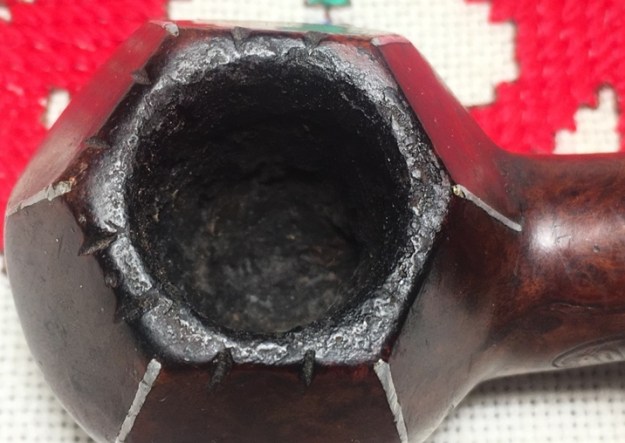
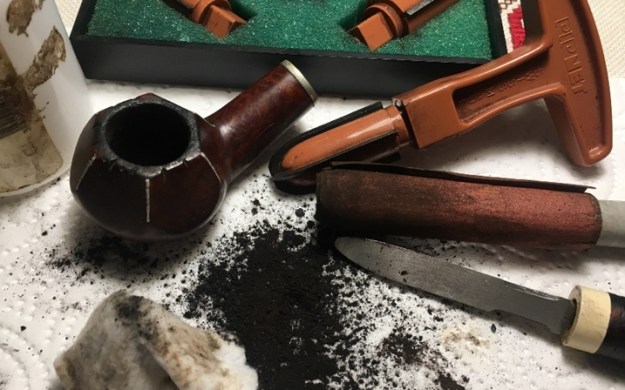
Earlier, I threw down the gauntlet and made the statement that a well-done restoration has better results than most new, manufactured pipes.  I’ll let you make your own judgement below as I begin with a ‘Before & After’ picture.  John, my fellow GPSC Facebook group member, observed that the RJ pipe he acquired in Paris some years ago had dense briar.  I would say that this ERGI Grand Luxe, if it too is Parisian, displays a grain that could be described the same way.  The bird’s eye is beautiful, tightly wound, and gratuitously showcased throughout the briar landscape – very appealing.  Complementing this beautiful display of briar is the rustic, earthy horn stem with its softly woven brown and tan hues.  I also like the gold embossing of the RJ stamp – it fits well this striking straight Billiard.  This is the first of 3 pipes that Todd commissioned and he will have the first opportunity to acquire it from The Pipe Steward Store.  This pipe benefits our work here in Bulgaria, with the Daughters of Bulgaria – helping women and girls who have been trafficked and sexually exploited.  Thanks for joining me!  Now, ‘Before & After’.  What do you think?


Cleaning up a Savinelli Bordeaux 626 Bent Apple


Blog by Steve Laug

My brother has a good connection in New York who keeps an eye open for good pipes that might interest us. He came across this beautiful little Savinelli Bordeaux 625 Bent Apple. It is a classic Savinelli shape that occurs across the various lines of the brand. The pipe has a silver oval shield on the left side of the shank. It is engraved Savinelli in the raised oval in the centre in an arch over 1876, the year of the birth of the brand. On the underside of the shank it is stamped Savinelli over Bordeaux. On the right side it bears the Savinelli shield S logo and the shape number 626 over Italy. The finish was dirty but underneath there was some beautiful birdseye and cross grain around the bowl. The rim top had some tars and lava overflow toward the back side and there appeared to be burn marks on the back inner edge and on the front right rim top and inner edge. The stem is acrylic and had slight tooth chatter at the button on both sides. It has the Savinelli shield S logo on the top of the bent tapered stem. Upon removing the stem it became clear that it was a filter pipe made specifically for a triangular Balsa wood filter to be inserted in the tenon and extending part way into the shank. Jeff took photos of the pipe before he began his cleanup work. Jeff took two close-up photos of the bowl and rim from different angles to capture the condition of the pipe pre-cleanup work. The rim top had some lava overflow and a lot of damage to the inner and outer edges of the bowl. The pipe is dirty with thick cake and damage around the rim.He also took photos of the right side and the bottom of the bowl and shank to show the various grains on the pipe. The photos show the finish of the bowl and the amazing grain underneath the grime. The finish is very dirty but this is another beautiful pipe. Jeff took photos of the sides of the shank to capture the stamping on the sides and underside of the shank. The photo shows the silver oval Savinelli 1876 on the left side of the shank. The stamping is very clear and readable. The next photo shows the Savinelli shield S logo on the top side of the stem. The next two photos show the stem surface. There is tooth chatter on both sides near the button. There is also some wear on the button. Because it is an acrylic stem there is not any oxidation on the stem surface.Jeff followed our normal regimen of working on the pipes that has become habit to both of us. I include it here so you have a sense of that pattern. Jeff reamed the bowl with a PipNet pipe reamer and followed up with a Savinelli Fitsall pipe knife to remove the cake. He scrubbed out the mortise and the airway in the shank and the stem with alcohol, cotton swabs and pipe cleaners. He scrubbed the exterior of the bowl, rim, shank and stem with a tooth brush and Murphy’s Oil Soap to remove the oils and tars on the rim and the grime on the finish of the bowl. He rinsed it under running water. He dried it off with a soft cloth. He was able to remove the lava build up on the rim top and the rim top damage and the damage around the edges – both inner and outer is quite extensive. I took photos of the pipe to show its condition before I started my work on it.  I took close up photos of the bowl and rim top as well as the stem. You can see the condition of the rim top and bowl in the first photo. Jeff was able to remove all of the tar and oils but you can now see the burn damage to the right front and the back inner edge of the bowl. The acrylic stem had light tooth chatter on the top and underside of the stem near and on the button surface.I decided to address the rim top damage first. I worked on the top and inner edges of the rim with 220 grit sandpaper to remove the damage to the top and edges of the rim top. I was also able to remove the damage to the edges of the rim.I polished the rim top, the edge and exterior of the bowl and shank with micromesh sanding pads – wet sanding with 1500-2400 grit pads and dry sanding with 3200-12000 grit pads. I wiped the rim off after each sanding pad to remove the dust. The damage on the rim edges and top looked really good after polishing.  I worked some Before & After Restoration Balm into the smooth surface of the briar with my fingertips to clean, enliven and protect it. I let the balm sit for a little wall and then buffed with a cotton cloth to raise the shine. The following photos show the bowl at this point in the restoration process. The reworked rim top looks really good and matches the colour of the rest of the pipe. I set the bowl aside and worked on the stem. There was some tooth chatter on the top and underside at the button. I cleaned up the chatter and reshaped the edge of the button with 220 grit sandpaper.I polished the stem with micromesh sanding pads – wet sanding with 1500-2400 grit sanding pads and dry sanding it with 3200-12000 grit sanding pads. I wiped it down after each sanding pad with a damp cloth. I polished it with Before & After Pipe Stem Polish and buffed it with a cotton pad. (Note the casting marks on the tenon. It does not appear to be damaged as these seem to be in the cast of the acrylic.) I have a tin here in which I keep a variety of filters for pipes that I repair that need them. I went through it and found what I was looking for – a Savinelli Balsa System filter. It is a triangular piece of Balsa wood that is inserted into the tenon. The end extends slightly into the shank of the pipe filling in the gap between the end of the tenon and the end of the mortise. The fit in the stem was perfect so I was pretty certain this was the correct filter for this Bordeaux pipe. The photos below show the filter below and inside of the stem.I put the stem back in place in the shank and polished stem and the bowl with Blue Diamond polish on the buffing wheel (I carefully avoided buffing the silver oval on the left side of the shank). I gave the bowl and the stem multiple coats of carnauba wax. I buffed the pipe with a clean buffing pad to raise the shine. I hand buffed it with a microfiber cloth to deepen the shine. The pipe polished up pretty nicely. The birdseye and cross grain around the bowl and shank really stood out. It came alive with the buffing. The rich contrasting brown colour works well with the polished black acrylic stem. This is a beautiful example of Savinelli craftsmanship. Have a look at it in the photos below. The shape, finish and flow of the pipe and stem are very well done. The dimensions are Length: 5 1/4 inches, Height: 1 3/4 inches, Outside diameter of the bowl: 1 1/4 inches, Chamber diameter: 3/4 of an inch. I will be putting this newly finished Savinelli Bordeaux 626 Bent Apple on the rebornpipes store shortly if you are interested in adding it to your collection. Working over this one was a pleasure. Thanks for taking time to read the blog post.

The Third Pipe of a Foursome – A 2nd JR Handmade Canadian


Blog by Steve Laug

My brother Jeff picked up four pipes in classic shapes at an auction in Nampa, Idaho. All four pipes are stamped JR Handmade. Beside the Bulldog there were two Canadians and an Apple. All were stamped the same on the shank JR over Handmade and the opposite side Algerian Briar. I have been researching the brand on the web. I came across a potential pipemaker with the JR initials on Pipedia named J. Rinaldi but from what I can see he did not make classic shaped pipes. He pipes are very well made and have more of a freehand/freeform shape with shank adornments so it makes me wonder if these are his. I enlarged each photo on the Pipedia article but I was unable to see the stamping on his pipes for comparison sake. This leaves me with a lot of questions about the brand. The foursome came from the Boise, Idaho area like the House of Robertson pipes that I worked on last year. Those came from a pipe shop in Boise, Idaho and I wonder if it is not possible that the JR Handmade brand was also a pipe shop brand from a small shop in that area or even somehow connected with the House of Robertson brand. Perhaps I will never know… if any of you readers have any idea about the brand your help would be greatly appreciated.The above photo shows the foursome after Jeff had cleaned them. But before he cleaned each of them he took photos of the pipes as they came to him. I already wrote about the restoration of the Bulldog (https://rebornpipes.com/2019/01/28/the-first-of-a-foursome-a-jr-handmade-bulldog/) and the first Canadian (https://rebornpipes.com/2019/01/30/the-second-of-a-foursome-a-jr-handmade-canadian/). The next pipe is the second pipe down on the left side of the above photo – a classic Canadian with a flat rim top. It is longer than the previous Canadian and also has a longer stem. I have included the photos of the Canadian before cleanup. The pipe is very well made and follows the classic shape of an oval shank Canadian perfectly. The bowl was stained with a slightly different looking finish to the other pipes in the lot. It was more of a medium brown with no black undercoat. Because of that the grain showed up differently on this one. It is a well-shaped pipe that captures the mixture of flame and cross and birdseye grain around the bowl sides and shank. The top of the bowl had some damage on the top and inner edge. The inner edge had some knife marks on the right side at the top that left damage. The bowl had a very thick cake in the bowl. There was a light overflow of lava onto the rim top. The stamping on the top side of the oval shank read JR over HAND MADE. The stamping on the underside read Algerian Briar. The black vulcanite stem had light tooth dents and chatter on the top and the underside of the stem. Otherwise it was in very good condition. It was the most oxidized of the foursome and also had some calcification. Jeff took a close-up photo of the bowl and rim to capture the condition of the pipe pre-cleanup work. The rim top had some lava overflow and a lot of damage to the inner and outer edges of the bowl. The pipe is dirty with thick cake and damage around the rim.He also took a photo of the bottom of the bowl and shank to show the various grains on the pipe. Even though the photo is a bit blurry it show the finish of the bowl and that it is lighter in colour than the other pipes in the foursome. The finish is very dirty but this is another beautiful pipe.

The bowl also has a few fills on the back side of bow and lower right side.Jeff took a photo to capture the stamping on the topside of the oval shank. The photo shows stamping JR over HAND MADE. On the underside it reads Algerian Briar.  The next two photos show the stem surface. There are tooth marks and chatter on both sides near the button. There is also some wear on the sharp edge of the button. There is a thick oxidation and accost of calcification.As mentioned before, Jeff and I have developed a pattern of working on the pipes that has become habit to both Jeff and me. I include it here so you have a sense of that pattern. Jeff reamed the bowl with a PipNet pipe reamer and followed up with a Savinelli Fitsall pipe knife to remove the cake. He scrubbed out the mortise and the airway in the shank and the stem with alcohol, cotton swabs and pipe cleaners. He scrubbed the exterior of the bowl, rim, shank and stem with a tooth brush and Murphy’s Oil Soap to remove the oils and tars on the rim and the grime on the finish of the bowl. He rinsed it under running water. He dried it off with a soft cloth. He was able to remove the lava build up on the rim top and the rim top damage and the damage around the edges – both inner and outer is quite extensive. I took photos of the pipe to show its condition before I started my work on it.   I took close up photos of the bowl and rim top as well as the stem. You can see the condition of the rim top and bowl in the first photo. Jeff was able to remove all of the tar and oils but you can now see the burn damage to the back inner edge of the bowl. The vulcanite stem had light tooth chatter and some tooth marks on the top and underside of the stem near and on the button surface.I took photos of the stamping on both sides of the oval shank. You can see that the stamping on both sides was light toward the front of the pipe. It was still readable but faint nonetheless.I decided to address the rim top damage first. I topped the bowl with 220 grit sandpaper on a topping board to remove the damage to the top and the outer edges of the rim top. I was also able to reduce the damage to the back inner edge of the rim.I also needed to take care of the inner edge so I used a folded piece of 220 grit sandpaper to smooth out the burn marks and darkening around the edge. I gave the edge a very slight bevel to minimize the damage. The pink putty fills bugged me! I used a dental pick to remove them as much as possible and wiped the briar down with alcohol on a cotton pad to remove the dust and debris. I filled in the holes with clear super glue and briar dust to repair the fills.When the repairs had cured I sanded them smooth with 220 grit sandpaper to blend the into the surface of the briar.I sanded the repairs smooth and blended them into the rest of the bowl. It took a bit of work but soon they were blended in. I would need to stain the bowl repairs but first I want to polish the sanding marks out. I polished the rim top, the edge and exterior of the bowl and shank with micromesh sanding pads – wet sanding with 1500-2400 grit pads and dry sanding with 3200-12000 grit pads. I wiped the rim off after each sanding pad to remove the dust. The damage on the rim edges and top looked really good after polishing. I decided to stain the entire pipe with a tan stain. I heated the briar, applied the stain and flamed it to set it in the grain. I repeated the process until I was satisfied with the coverage of the stain.I set the bowl aside overnight to let the stain cure and set in the briar.I buffed the bowl the next evening after work with red Tripoli and Blue Diamond to remove the crust coat of the stain and bring the briar to life. I wiped the bowl down with alcohol on a cotton pad to make it more transparent. Once I finished the cleanup of the stain I worked some Before & After Restoration Balm into the smooth surface of the briar with my fingertips to clean, enliven and protect it. I let the balm sit for a little wall and then buffed with a cotton cloth to raise the shine. The following photos show the bowl at this point in the restoration process. The reworked rim top looks really good and matches the colour of the rest of the pipe. I set the bowl aside and worked on the stem. There were some tooth marks on the top and underside at the button that needed to be addressed. I also needed to do some work on the surface of the button on both sides. I also sanded away some of the surface oxidation.I polished the stem with micromesh sanding pads – wet sanding with 1500-2400 grit sanding pads and dry sanding it with 3200-12000 grit sanding pads. I wiped it down after each sanding pad with Obsidian Oil. I polished it with Before & After Pipe Stem Polish and wiped it down with a last coat of Obsidian Oil. With this third JR Hand Made pipes from the Nampa, Idaho auction I am even more certain that there is some connection to the House of Robertson Pipe Shop in Boise, Idaho. I wonder if it is a seconds line for House of Robertson. Even with the fills and the repairs to the pipe this is another nice pipe. The three of the four JR Hand Made pipes that I have to restore are really well made and shaped. The stain job was done to highlight the mix of grain on the bowl. I polished stem and the bowl with Blue Diamond polish on the buffing wheel. I gave the bowl and the stem multiple coats of carnauba wax. I buffed the pipe with a clean buffing pad to raise the shine. I hand buffed it with a microfiber cloth to deepen the shine. The pipe polished up pretty nicely. The contrasting grain really began to stand out; it seemed to take on life with the buffing. The rich contrasting brown colour works well with the polished black vulcanite stem. This finished pipe has a rich look just like the Bulldog and the other Canadian and it is also quite catching. Have a look at it in the photos below. It is a longer and slimmer looking pipe. The shape, finish and flow of the pipe and stem are very well done. The dimensions are Length: 6 1/2 inches, Height: 2 inches, Outside diameter of the bowl: 1 1/4 inches, Chamber diameter: 3/4 of an inch. I will be putting this newly finished JR Hand Made Canadian on the rebornpipes store shortly if you are interested in adding it to your collection. Thanks for walking through the restoration with me as I worked over the third of the foursome from JR Hand Made pipes.

The Second of a Foursome – A JR Handmade Canadian


Blog by Steve Laug

My brother Jeff picked up four pipes in classic shapes at an auction in Nampa, Idaho. All four pipes are stamped JR Handmade. Beside the Bulldog there were two Canadians and an Apple. All were stamped the same on the left side of the shank JR over Handmade and on the right side Algerian Briar. I have been researching the brand on the web. I came across a potential pipemaker with the JR initials on Pipedia named J. Rinaldi but from what I can see he did not make classic shaped pipes. He pipes are very well made and have more of a freehand/freeform shape with shank adornments so it makes me wonder if these are his. I enlarged each photo on the Pipedia article but I was unable to see the stamping on his pipes for comparison sake. This leaves me with a lot of questions about the brand. The foursome came from the Boise, Idaho area like the House of Robertson pipes that I worked on last year. Those came from a pipe shop in Boise, Idaho and I wonder if it is not possible that the JR Handmade brand was also a pipe shop brand from a small shop in that area or even somehow connected with the House of Robertson brand. Perhaps I will never know… if any of you readers have any idea about the brand your help would be greatly appreciated.The above photo shows the foursome after Jeff had cleaned them. But before he cleaned each of them he took photos of the pipes as they came to him. I already wrote about the restoration of the Bulldog (https://rebornpipes.com/2019/01/28/the-first-of-a-foursome-a-jr-handmade-bulldog/). The next pipe is the first pipe on the right side of the above photo – a classic Canadian with a beveled rim top. I have included the photos of the Canadian before cleanup. The pipe is very well made and follows the classic shape of an oval shank Canadian perfectly. The bowl was stained with a dark brown/black and a medium brown stain over it. It is a well-shaped pipe that captures the mixture of flame and straight grain around the bowl sides and shank. The top of the bowl had some damage on the top and inner and outer edge. There were some chips from the briar on the outer edge on the right and the left side. There was a little darkening at the front outer edge. The inner edge had some knife marks on the right side at the top that left damage. The bowl had a very thick cake in the bowl. There was an overflow of lava onto the rim top. The stamping on the top side of the oval shank read JR over HAND MADE. The stamping on the underside read Imported Briar. The black vulcanite stem had light tooth dents and chatter on the top and the underside of the stem. Otherwise it was in very good condition. It was also lightly oxidized. Jeff took two close-up photos of the bowl and rim with different lighting to capture the condition of the pipe pre-cleanup work. The rim top had some lava overflow and a lot of damage to the inner and outer edges of the bowl. The pipe is dirty with thick cake and damage around the beveled rim.He also took photos of the sides of the bowl and shank to show the various grains on the bowl and shank. The first photo shows the large chip out of the top edge of the bowl. It was quite large and deep. Even though there is damage to this pipe the photos also show the rich colour of the stain that makes the grain just pop. The finish is very dirty but this is another beautiful pipe. Jeff took a photo to capture the stamping on the topside of the oval shank. The photo shows stamping JR over HAND MADE. On the underside it reads Imported Briar.  The next two photos show the stem surface. There are tooth marks and chatter on both sides near the button. There is also some wear on the sharp edge of the button. As mentioned before, Jeff and I have developed a pattern of working on the pipes that has become habit to both Jeff and me. I include it here so you have a sense of that pattern. Jeff reamed the bowl with a PipNet pipe reamer and followed up with a Savinelli Fitsall pipe knife to remove the cake. He scrubbed out the mortise and the airway in the shank and the stem with alcohol, cotton swabs and pipe cleaners. He scrubbed the exterior of the bowl, rim, shank and stem with a tooth brush and Murphy’s Oil Soap to remove the oils and tars on the rim and the grime on the finish of the bowl. He rinsed it under running water. He dried it off with a soft cloth. He was able to remove the lava build up on the rim top and the rim top damage and the damage around the edges – both inner and outer is quite extensive. I took photos of the pipe to show its condition before I started my work on it.   I took close up photos of the bowl and rim top as well as the stem. You can see the condition of the rim top and bowl in the first photo. Jeff was able to remove all of the tar and oils but you can now see the damage to the inner edge of the bowl. The vulcanite stem had tooth chatter and some tooth marks on the top and underside of the stem near and on the button surface.I took photos of the stamping on both sides of the oval shank. You can see that the stamping on both sides was light toward the front of the pipe. It was still readable but faint nonetheless.I decided to address the damage to the rim edges first. I wiped down the outside of the bowl with an alcohol dampened pad and filled in the chipped areas around the edge with clear super glue and briar dust to build up the chips to match the bowl sides.I decided to leave the side repairs for a bit to harden and turned to the rim top. I had to handle the rim repairs a bit differently on this pipe since it had a rim top that was beveled inward. I topped the bowl with 220 grit sandpaper on a topping board to remove the damage to the outer edges of the rim top. I worked the beveled edge to match the outer edge of the bowl and smooth out the transition. I also needed to take care of the inner edge so I used a folded piece of 220 grit sandpaper to smooth out the knife marks there and minimize the damage.   I sanded the repairs smooth and blended them into the rest of the bowl. It took a bit of work but soon they were blended in. I would need to stain the bowl repairs but first I want to polish the sanding marks out. I polished the rim top, the edge and exterior of the bowl with micromesh sanding pads – wet sanding with 1500-2400 grit pads and dry sanding with 3200-12000 grit pads. I wiped the rim off after each sanding pad to remove the dust. The damage on the rim edges and top looked really good after polishing. I stained the rim top and bowl sides with a Cherry stain pen. I gave the sanded edges and repairs several coats of stain and let it cure.I worked some Before & After Restoration Balm into the smooth surface of the briar with my fingertips to clean, enliven and protect it. I let the balm sit for a little wall and then buffed with a cotton cloth to raise the shine. The following photos show the bowl at this point in the restoration process. The reworked rim top looks really good and matches the colour of the rest of the pipe. I set the bowl aside and worked on the stem. There were some tooth marks on the top and underside at the button that needed to be addressed. I sanded the tooth marks and chatter out of the surface of the stem and shaped the button with 220 grit sandpaper.I polished the stem with micromesh sanding pads – wet sanding with 1500-2400 grit sanding pads and dry sanding it with 3200-12000 grit sanding pads. I wiped it down after each sanding pad with Obsidian Oil. I polished it with Before & After Pipe Stem Polish and wiped it down with a last coat of Obsidian Oil. With this second JR Hand Made pipes from the Nampa, Idaho auction I am even more certain that there is some connection to the House of Robertson Pipe Shop in Boise, Idaho. Even with the fills and the repairs to the pipe this is another nice pipe. The two of the four JR Hand Made pipes that I have to restore are really well made and shaped. The stain job was done to highlight the mix of grain on the bowl. I polished stem and the bowl with Blue Diamond polish on the buffing wheel. I gave the bowl and the stem multiple coats of carnauba wax. I buffed the pipe with a clean buffing pad to raise the shine. I hand buffed it with a microfiber cloth to deepen the shine. The pipe polished up pretty nicely. The contrasting grain really began to stand out; it seemed to take on life with the buffing. The rich contrasting brown colour works well with the polished black vulcanite stem. This finished pipe has a rich look just like the Bulldog and it is also quite catching. Have a look at it in the photos below. The shape, finish and flow of the pipe and stem are very well done. The dimensions are Length: 6 inches, Height: 1 7/8 inches, Outside diameter of the bowl: 1 3/8 inches, Chamber diameter: 3/4 of an inch. I will be putting this newly finished JR Hand Made Canadian on the rebornpipes store shortly if you are interested in adding it to your collection. Thanks for walking through the restoration with me as I worked over the second of the foursome from JR Hand Made pipes.

Refreshing an unsmoked 1910-1915 CPF Chesterfield Billiard


Blog by Steve Laug

Not too long ago I was chatting with a friend in New York and he showed me an old unsmoked CPF pipe. He had picked it up and intended to clean it up for resale so I asked him how much he wanted for it and struck a deal. I love older CPF pipes and I really am a sucker for them as I have a small collection of them. This one rang all the bells for me with the unsmoked bowl, the gold stamp on the shank, the brass band and the P-lip style stem. He was pretty sure from his work that the pipe was from the time period of the 1910s and before 1920, which also made it attractive to me. He sent me the following three photos that really sealed the deal for me. He said from his research that the pipe came from the 1910s period before 1920. He picked it up from a fellow who said that it (along with other pipes) came from a clean out of an old retail building that used to be a pipe store in the 1940s. He packed the pipe and put it in the mail to me. It did not take too long for it too arrive on the other side of the continent. And when I opened the box and removed the pipe this is what I saw (it did not disappoint). It was a bit shop worn from sitting – nicks and grime on the finish and a loose band but very clean. The stem was not oxidized but the vulcanite had some small nicks in the surface. The stamping on the left side of the shank read Chesterfield in an arch over the CPF in an oval logo. The band had the CPF logo and some faux hallmarks. The stem read Chesterfield over the CPF oval logo on the topside of the taper. I took photos of the pipe when I received it. The bowl was raw briar and totally looked new and unused. You have to admit this is a beauty – I guess that is subjective but it is to me! I took close up photos of the bowl, rim top and stem to show the overall condition of the pipe. The bowl was pristine as noted above. The rim top had some small scratches and very shallow nicks. The shank ahead of the band was discoloured from the brass band and the band had turned to the left from its original centered location on the top. The stem looked really good – no oxidation. There were a lot of minute scratches in the surface on both sides and a little rounding of the shoulders at the stem/shank junction. The gold stamping on the stem top was faint but still present.The next photos show the stamping on the shank, band and stem. You can see that they are all quite clear.I wrote a piece on the background to the CPF brand earlier on the blog and include the link to that here (https://rebornpipes.com/2013/04/14/some-reflection-on-the-historical-background-on-cpf-pipes/). I quote a pertinent part of the blog below:

From my reading and research it seems to me that CPF brand was discontinued sometime in the 1910-1920 range. Again, turning to Bill Feuerbach I found that he notes the following, which pins down the time frame of the discontinuation of the brand more specifically, “I have a CPF Chesterfield in our office display that has a nametag from way before my time that says 1900 CPF Chesterfield. It looks like most other Chesterfields you’ve seen, including the military type push stem, except this stem is horn and not vulcanite. As far as I have gathered the CPF brand was phased out sometime around 1915.” Interestingly, he noted that the Chesterfield name and style was later introduced in the KB&B, Kaywoodie and Yello-Bole lines. He says that the 1924 KB&B catalog shows KB&B Chesterfields…

From my research I believe that we can definitively assert that the CPF logo stands for Colossus Pipe Factory. The brand was purchased by KB&B sometime between 1884 and 1898 and that it continued until 1915. That time frame gives help in dating some of the older CPF pipes you or I might find. It can be said that prior to the dual stamping it is fairly certain that the pipe is pre-1884 to 1898. After the dual stamping it can be placed post 1898 until the closure of the brand line in 1915. CPF made beautiful pipes.

From that information I could see why my friend in New York put the date where he did. I would further refine his 1910s period to a time between 1910-1915. At any rate it is an old pipe to remain unsmoked for this long. That fact that it was found in a building that originally housed a pipe store that closed in the 1940s gives a bit of a clue as to how it remained unsmoked at least until that time period. From the closure of the store to 2019 the fact that it is still unsmoked is a bit of a mystery to me.

As I examined the pipe closely I could see a lot of pink putty fills. I took photos of the fills to show their number and placement on the bowl. These tend to irritate me and while some purists may question why I removed them I planned to do so. They were placed in such a way that they were directly in my line of site when I held the pipe in my mouth. They really needed to go. I took the stem off the bowl and the band on the shank came off very easily. I turned it to align it and then decided to take it off to clean up the shank end before I reglued it. I wiped off the old glue and sanded the shank end lightly with a 1500 grit micromesh pad to remove the glue debris. I would need to do a bit more work on it before regluing it but it definitely looked better. I also took photos of the mortise chamber to show what it looked like. It is almost a reverse calabash before those were spoken of, however the tenon filled the chamber completely and negated that function. One of the nice features of working on a NOS pipe is that the internals are very clean. I ran a pipe cleaner through the airway in the stem and shank just to remove dust. I did the same in the mortise with a cotton swab and the internals were finished. I directed my attention to the obnoxious pink putty fills. I picked them out with a dental pick to remove as much of the dried and shrunken putty as possible. It takes some careful work so as not to create more issues than I was trying to cure but it did not take long to remove the offending putty. (Note the band on the shank at this point – to be honest I am not sure why I put it back on. Perhaps to protect the shank end while I was working on the fills?)I wiped down the fills with an alcohol dampened cotton pad to remove the debris and filled them in with clear super glue. I used a dental spatula to apply fine briar dust on top of the glue and to press it into the fill area. When the repairs cured I sanded the patches down with 220 grit sandpaper to blend them into the surface of the briar. I sanded the spots smooth and they were already looking better than the pink putty they had replaced. I used a black sharpie pen to touch up the centres of the fills knowing that as I polished and stained the bowl they would blend in quite well. (Note to self: find a dark brown Sharpie pen.)I polished the repaired areas and the rest of the bowl with micromesh sanding pads – wet sanding with 1500-2400 grit pads and dry sanding with 3200-12000 grit pads. I wiped the bowl down after each pad with a damp cloth to remove the dust. I removed the band again after the first three pads and repeated the sanding on the shank with the first three pads. I decided to combine a Maple and Cherry stain pens to match the colour of the original bowl as much as possible. I colour with the lighter stain and then colour over it with the darker stain. I rubbed the bowl and shank down with a coat of Before & After Restoration Balm. I worked it into the surface of the briar to clean, enliven and protect the briar. The old briar was dry and it drank up the balm. I also found that it allows me to blend the stain coats together and give an even finish to the bowl. I buffed the bowl with a soft cloth to raise a shine. I am liking how the pipe looks as this point in the process. I set the bowl aside and started working on the stem. The nicks and scratches in the stem were very surface so I decided to polish the stem with micromesh sanding pads – wet sanding it with 1500-2400 grit pads and dry sanding it with 3200-12000 grit pads. I wiped it down with Obsidian Oil after each sanding pad. I finished the polishing with Before & After Pipe Polish – both Fine and Extra Fine. I gave it a final coat of Obsidian Oil and set it aside to dry. I love these old CPF pipes. There is some serious thought that they were carved by European trained craftsman who were skilled pipemakers. They were brought to the US by the CPF Company to make pipes. Many of the shapes, bands and stems have the kind of workmanship involved that I really think there is truth to this story. This is little chubby billiard with a classic shape that reminds me of some of the BBB Ultima pipes that I have restored. The stem is a pre-Peterson style P-lip with the airway at the end of the stem rather than on the topside. It had a lot of fills that I have repaired and blended into the bowl for the most part. There are a few fills that still show but they are smooth and not pink. I polished stem and the bowl with Blue Diamond polish on the buffing wheel carefully avoiding the stamping on the shank. I gave the bowl and the stem multiple coats of carnauba wax. I buffed the pipe with a clean buffing pad to raise the shine. I hand buffed it with a microfiber cloth to deepen the shine. The pipe polished up pretty nicely. The contrasting grain really began to stand out; it seemed to take on life with the buffing. The rich contrasting brown colour works well with the polished black vulcanite stem. The finished pipe has a rich look that is quite catching. Have a look at it with the photos below. The shape, finish and flow of the pipe and stem are very well done. The dimensions are Length: 5 inches, Height: 1 5/8 inches, Outside diameter of the bowl: 1 1/4 inches, Chamber diameter: 3/4 of an inch. This one will be joining my collection as it fits in the CPF niche group that I have been building. The shape and feel in the hand is perfect. Now I have to make a hard decision – do I leave it unsmoked or do I load it up with some aged Virginia and break it in. Thanks for walking through the restoration with me as I restored and reworked this old billiard from 1910-1915. It is always a treat for me to work on a piece of pipe history especially when I have learned a bit of the story behind it.
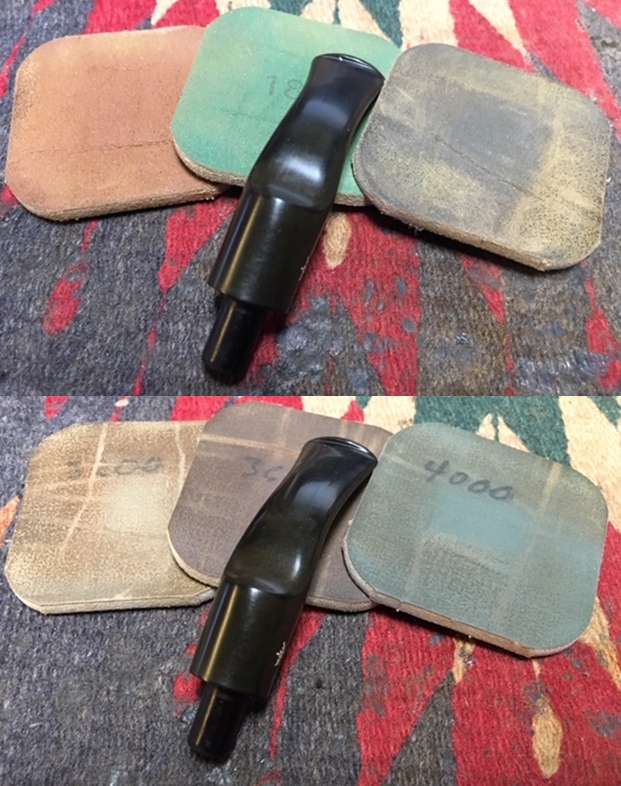
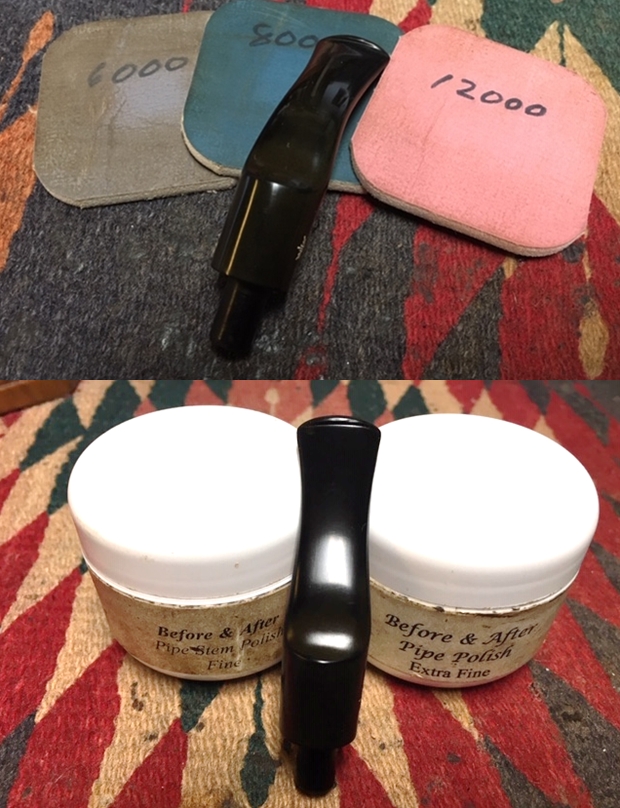
The First of a Foursome – A JR Hand Made Bulldog


Blog by Steve Laug

My brother Jeff picked up four pipes in classic shapes at an auction in Nampa, Idaho. All four pipes are stamped JR Handmade. Beside the Bulldog there were two Canadians and an Apple. All were stamped the same on the left side of the shank JR over Handmade and on the right side Algerian Briar. I have been researching the brand on the web. I came across a potential pipemaker with the JR initials on Pipedia named J. Rinaldi but from what I can see he did not make classic shaped pipes. He pipes are very well made and have more of a freehand/freeform shape with shank adornments so it makes me wonder if these are his. I enlarged each photo on the Pipedia article but I was unable to see the stamping on his pipes for comparison sake. This leaves me with a lot of questions about the brand. The foursome came from the Boise, Idaho area like the House of Robertson pipes that I worked on last year. Those came from a pipe shop in Boise, Idaho and I wonder if it is not possible that the JR Handmade brand was also a pipe shop brand from a small shop in that area. Perhaps I will never know… if any of you readers have any idea about the brand your help would be greatly appreciated.The above photo shows the foursome after Jeff had cleaned them. But before he cleaned each of them he took photos of the pipes as they came to him. I have included the photos of the Bulldog before cleanup. The JR Handmade straight Bulldog with a vulcanite stem is next on the table. The pipe is very well made and follows the classic shape of the straight bulldog perfectly. The bowl was stained with a dark brown/black and a medium brown stain over it. The pipe has twin rings around the cap on the bowl. It is a well-shaped pipe that captures the mixture of swirling grain around the bowl sides and shank. The top of the bowl had some damage on the top and inner edge. The bowl had a very thick cake and cobwebs in the bowl. There was an overflow of lava onto the rim top. The stamping on the left side of the diamond shank read JR over HAND MADE. The stamping on the right side read Algerian Briar. The black vulcanite stem had tooth dents and chatter on the top and the underside of the stem. There was some damage to the top and bottom edges of the button. It was also oxidized and had some calcification on the top and underside near the button. Jeff took two close-up photos of the bowl and rim with different lighting to capture the condition of the pipe pre-cleanup work. The rim top had a thick lava overflow. There appeared to be some rim damage on the inner edge at different points around the bowl but it was hard to know for certain with the lava coat. The pipe is dirty with thick cake and cobwebs in the bowl. He also took photos of the sides and bottom of the bowl and shank to show the various grains on the bowl and shank. The photos also show the rich colour of the stain that make the grain just pop. The finish is very dirty but this is another beautiful pipe.Jeff took a photo to capture the stamping on the top left side of the diamond shank. The photo shows stamping JR over HAND MADE on the left shank and ALGERIAN BRIAR on the right shank. The next two photos show the stem surface. There are tooth marks and chatter on both sides near the button. There is also some wear on the sharp edge of the button.Over the past years Jeff and I have developed pattern of working on the pipes that has become habit to both Jeff and I. I include it here so you have a sense of that pattern. Jeff reamed the bowl with a PipNet pipe reamer and followed up with a Savinelli Fitsall pipe knife to remove the cake. He scrubbed out the mortise and the airway in the shank and the stem with alcohol, cotton swabs and pipe cleaners. He scrubbed the exterior of the bowl, rim, shank and stem with a tooth brush and Murphy’s Oil Soap to remove the oils and tars on the rim and the grime on the finish of the bowl. He rinsed it under running water. He dried it off with a soft cloth. He was able to remove the lava build up on the rim top and you could see the damage to the flat surface of the rim and the inner edge on the right side and toward the front of the bowl. I took photos of the pipe to show its condition before I started my work on it. I took close up photos of the bowl and rim top as well as the stem. You can see the condition of the rim top and bowl in the first photo. Jeff was able to remove all of the tar and oils but you can now see the damage to the inner edge of the bowl. The vulcanite stem had tooth chatter and some tooth marks on the top and underside of the stem near and on the button surface. I decided to address the damage to the rim top first. I topped the bowl with 220 grit sandpaper on a topping board to remove the damage to the flat surface of the rim top and also to try to minimize the damage to the inner edge of the rim.I worked over the inner edge of the rim with a folded piece of 220 grit sandpaper to smooth out the damage. I gave it a slight bevel to hide the damage on the inner edge of the rim. The photos tell the story. The damage to the rim top is gone and the inner edge looks far better with the light bevel. The damage to the front edge is quite hidden.I polished the rim top, the edge and exterior of the bowl with micromesh sanding pads – wet sanding with 1500-2400 grit pads and dry sanding with 3200-12000 grit pads. I wiped the rim off after each sanding pad to remove the dust. The damage on the rim is pretty much invisible after polishing and the rim top really looked good. I worked some Before & After Restoration Balm into the smooth surface of the briar with my fingertips to clean, enliven and protect it. I let the balm sit for a little wall and then buffed with a cotton cloth to raise the shine. The following photos show the bowl at this point in the restoration process. The reworked rim top looks really good and matches the colour of the rest of the pipe. I set the bowl aside and worked on the stem. There were some tooth marks on the top and underside at the button that needed to be addressed. I also needed to do some work on the surface of the button on both sides. I filled the damaged areas in and build up the surface with clear super glue and set the stem aside until the repairs cured.I sanded both sides smooth with 220 grit sandpaper and 400 grit sandpaper to blend the tooth chatter and the repair into the surface of the stem. As I sanded and reshaped the button and stem surface the repaired areas and the tooth chatter disappeared.I polished the stem with micromesh sanding pads – wet sanding with 1500-2400 grit sanding pads and dry sanding it with 3200-12000 grit sanding pads. I wiped it down after each sanding pad with Obsidian Oil. I polished it with Before & After Pipe Stem Polish and wiped it down with a last coat of Obsidian Oil. The more I work on the JR Hand Made pipes from the Nampa, Idaho auction the more I wonder if there is some connection to the House of Robertson Pipe Shop in Boise, Idaho. This is the nicest one of the four JR Hand Made pipes that I have to restore. It does not have any fills in the briar and the stain job was done to highlight the swirling grain. I polished stem and the bowl with Blue Diamond polish on the buffing wheel. I gave the bowl and the stem multiple coats of carnauba wax. I buffed the pipe with a clean buffing pad to raise the shine. I hand buffed it with a microfiber cloth to deepen the shine. The pipe polished up pretty nicely. The contrasting grain really began to stand out; it seemed to take on life with the buffing. The rich contrasting brown colour works well with the polished black vulcanite stem. The finished pipe has a rich look that is quite catching. Have a look at it with the photos below. The shape, finish and flow of the pipe and stem are very well done. The dimensions are Length: 5 1/2 inches, Height: 1 7/8 inches, Outside diameter of the bowl: 1 1/4 inches, Chamber diameter: 3/4 of an inch. I will be putting this newly finished JR Hand Made Bulldog on the rebornpipes store shortly if you are interested in adding it to your collection. Thanks for walking through the restoration with me as I worked over the first of the foursome from JR Hand Made pipes.