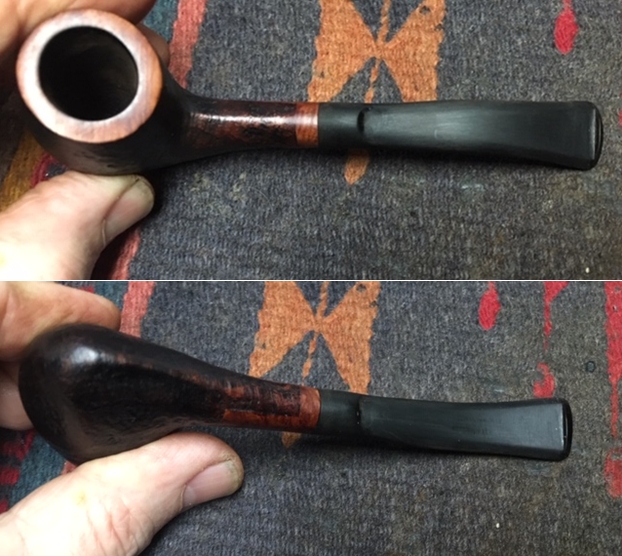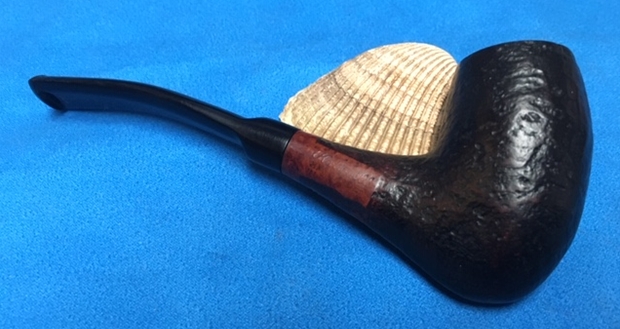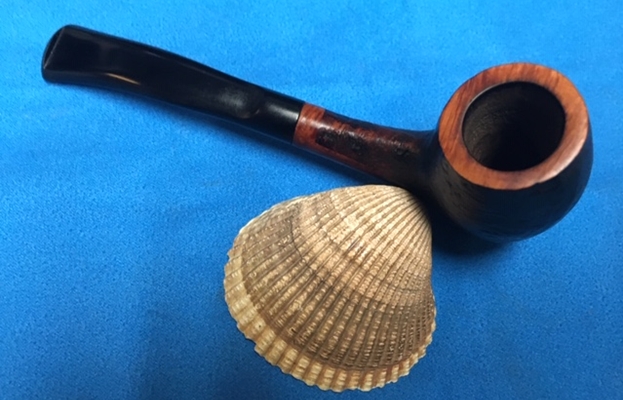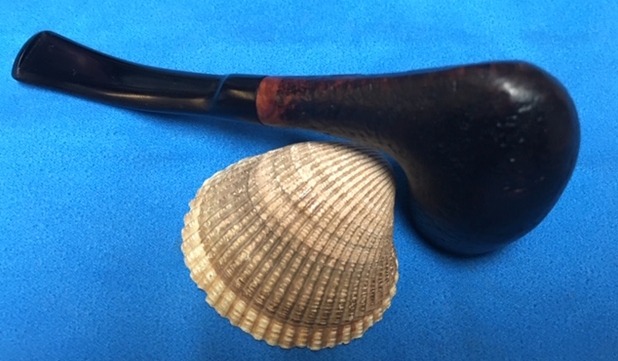
Tag Archives: pipe restemming

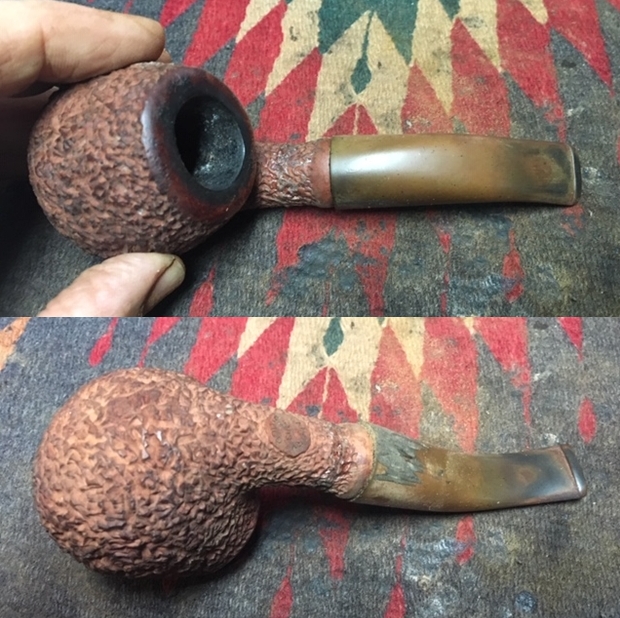
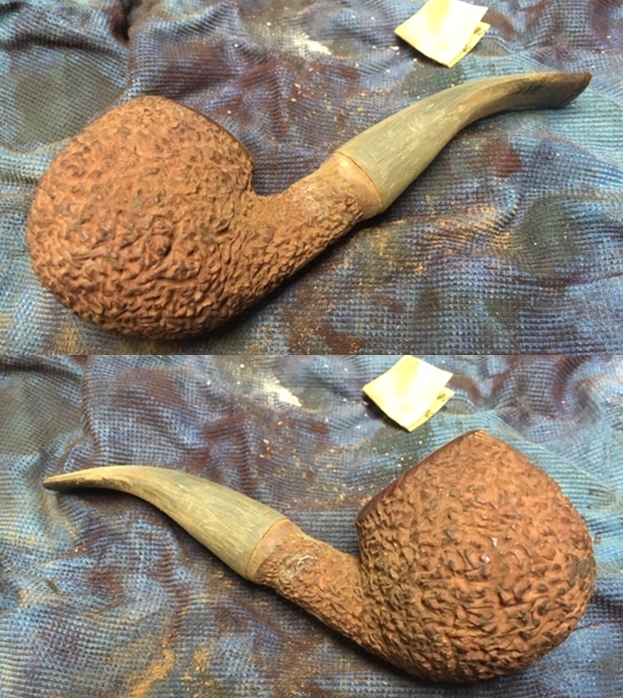
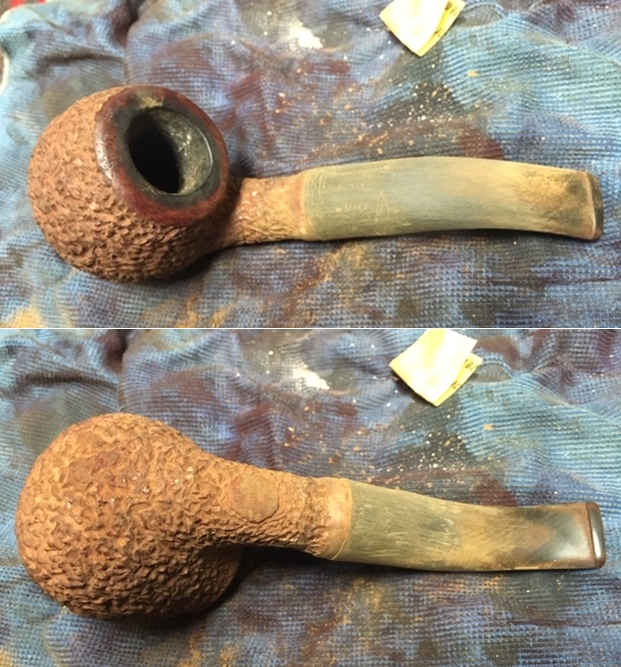
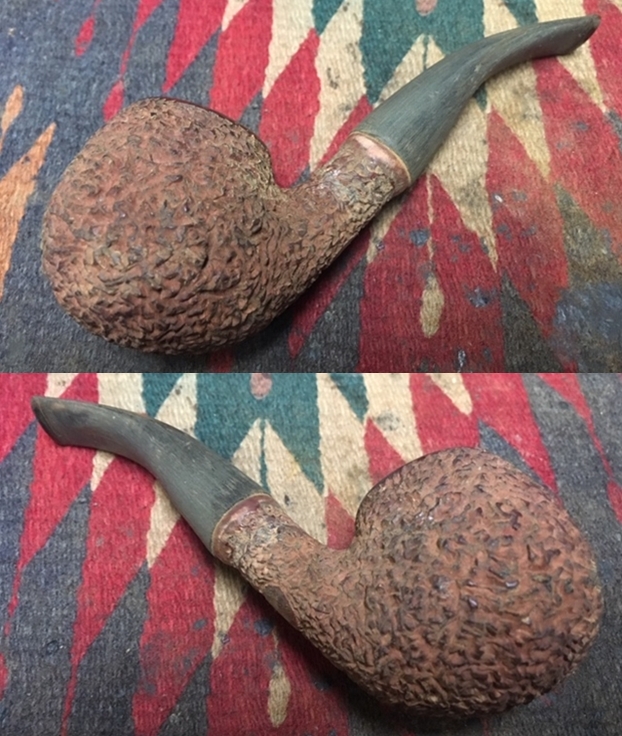
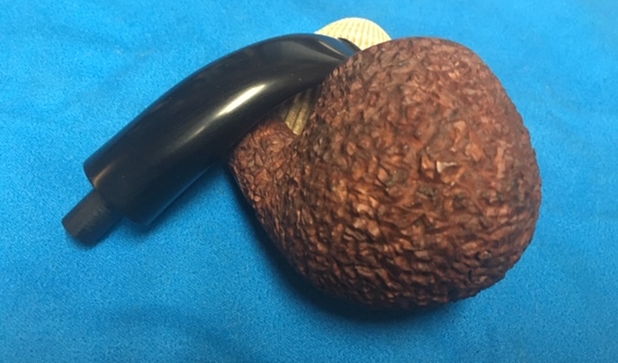
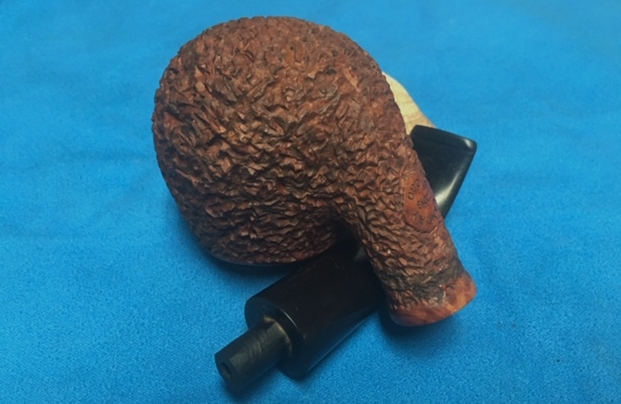
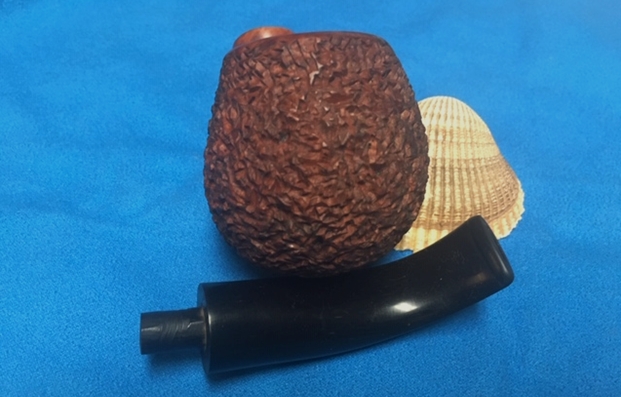
New Life for a Sad, Old Kriswill Bent Egg


Blog by Steve Laug

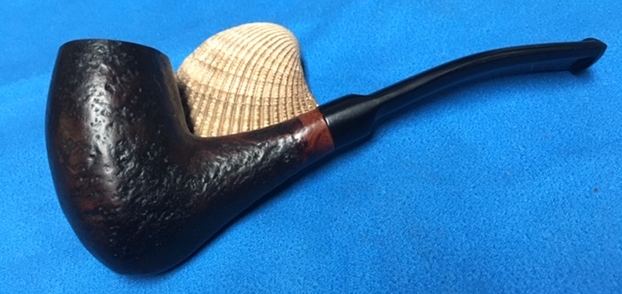
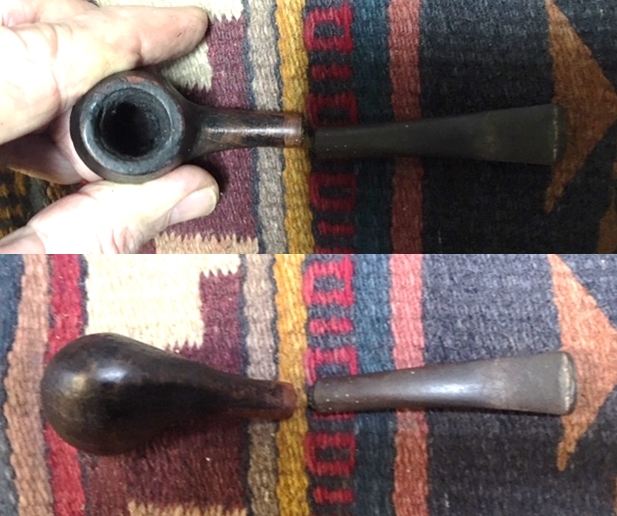
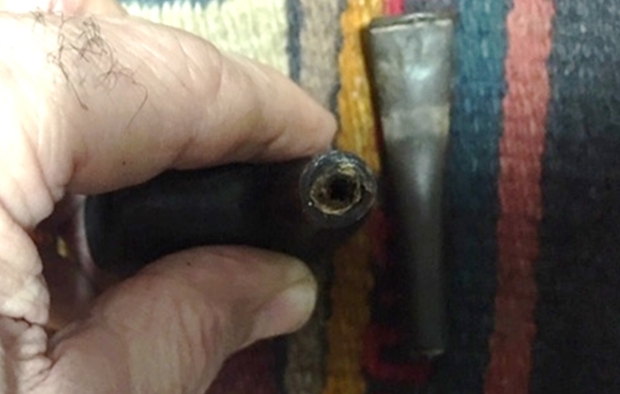
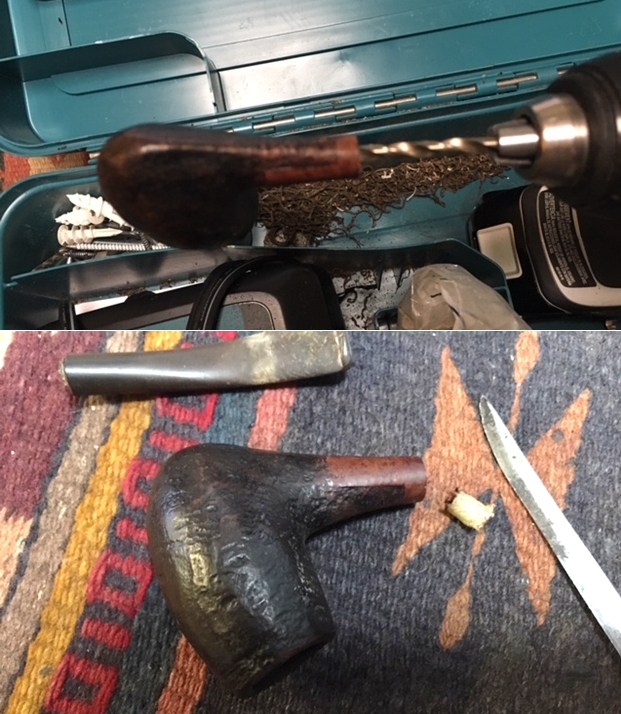
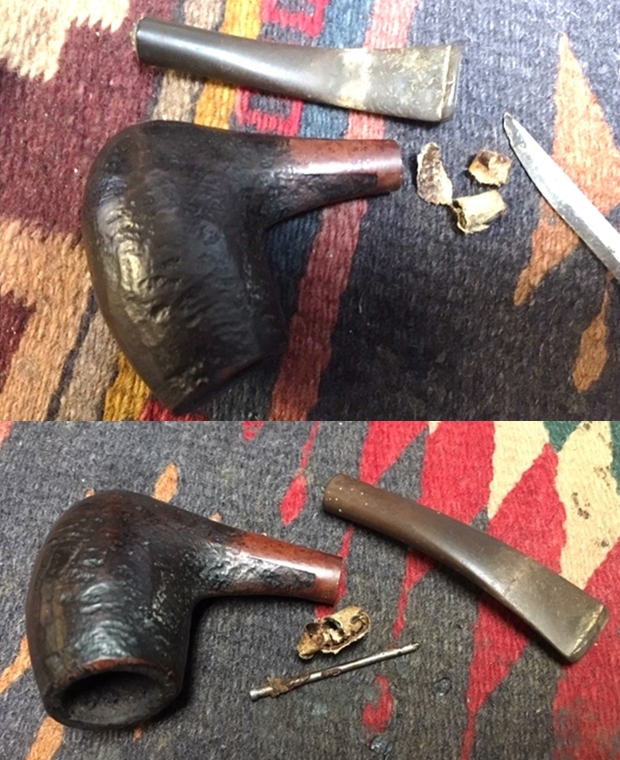
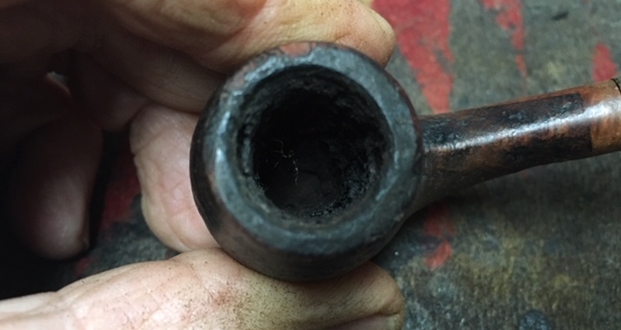
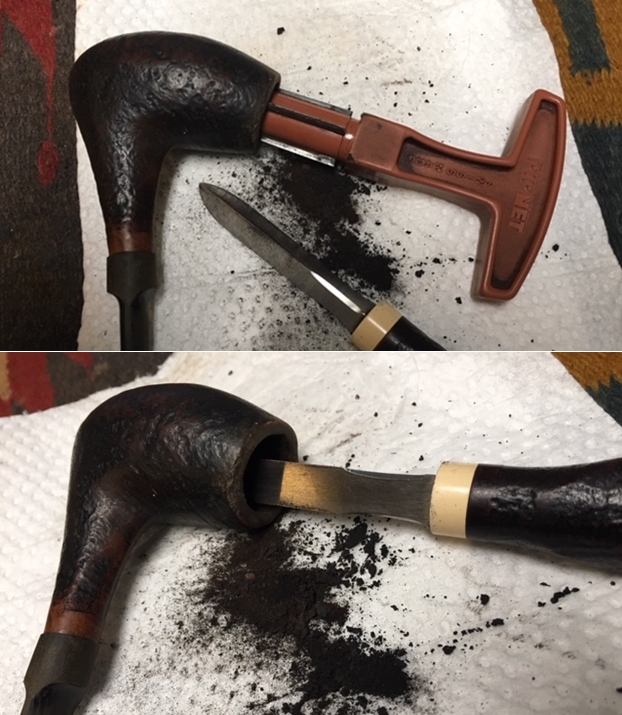
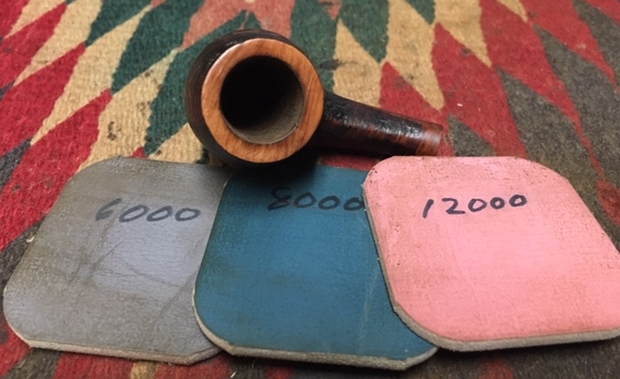
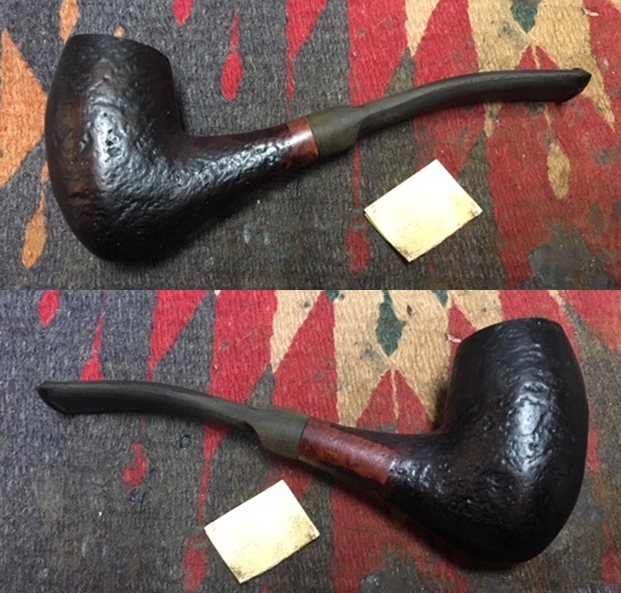
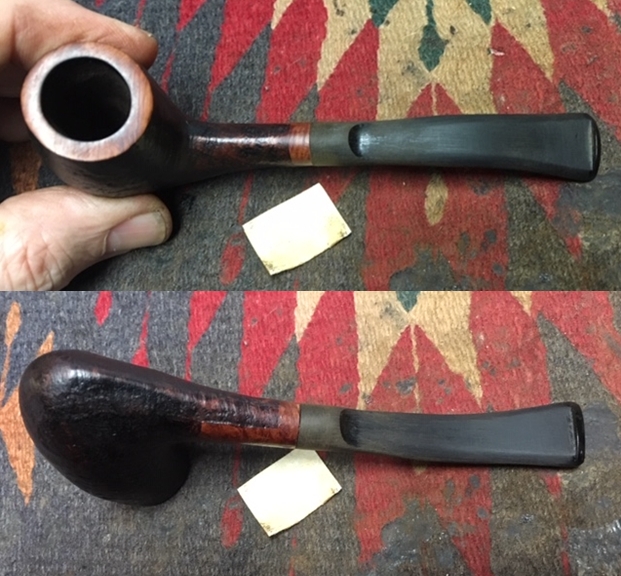
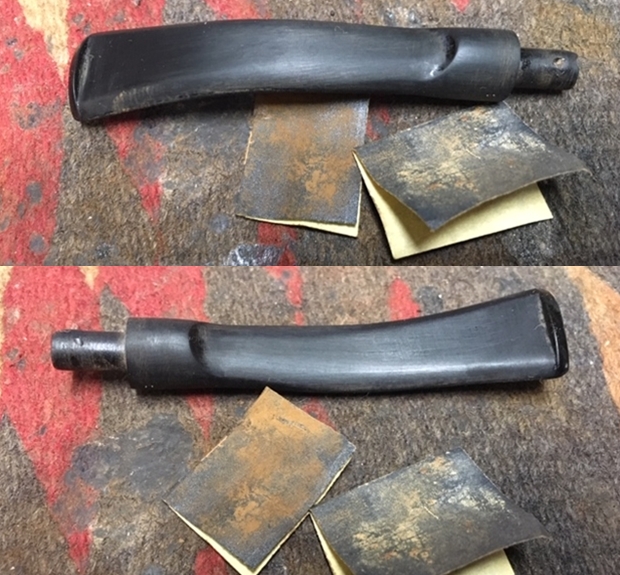
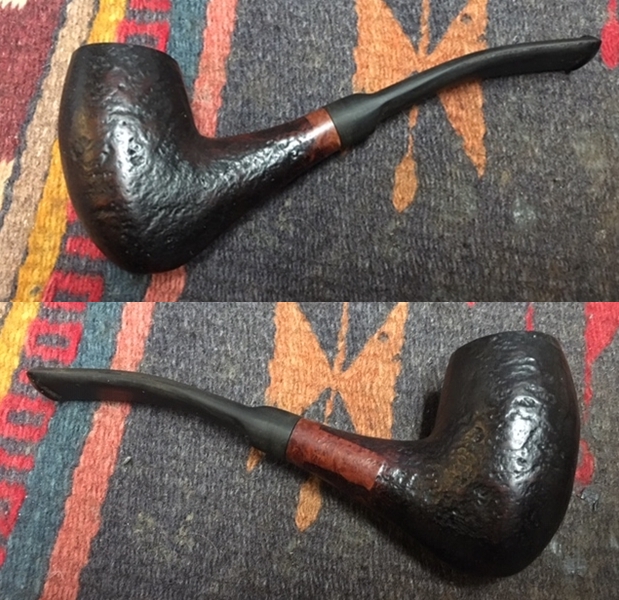
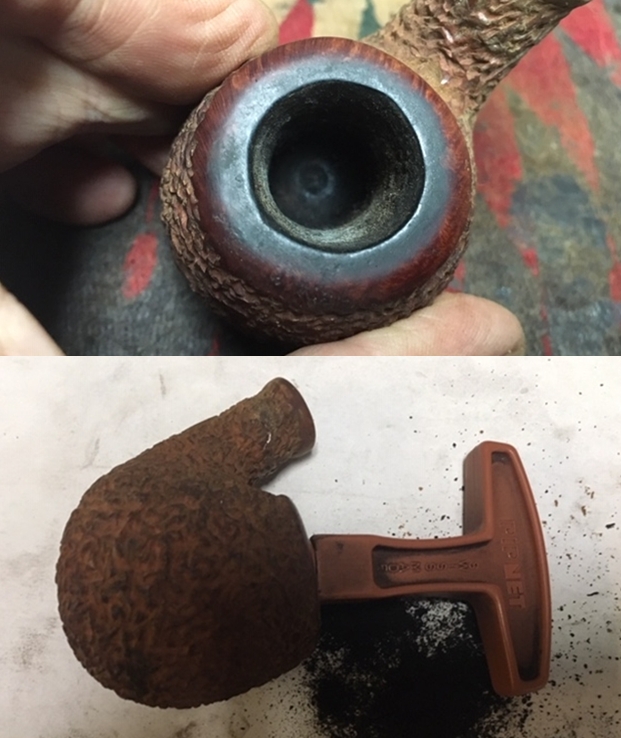
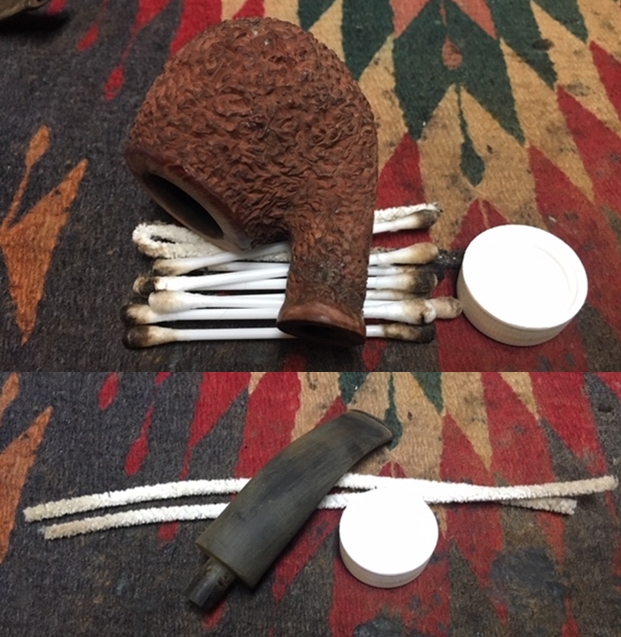
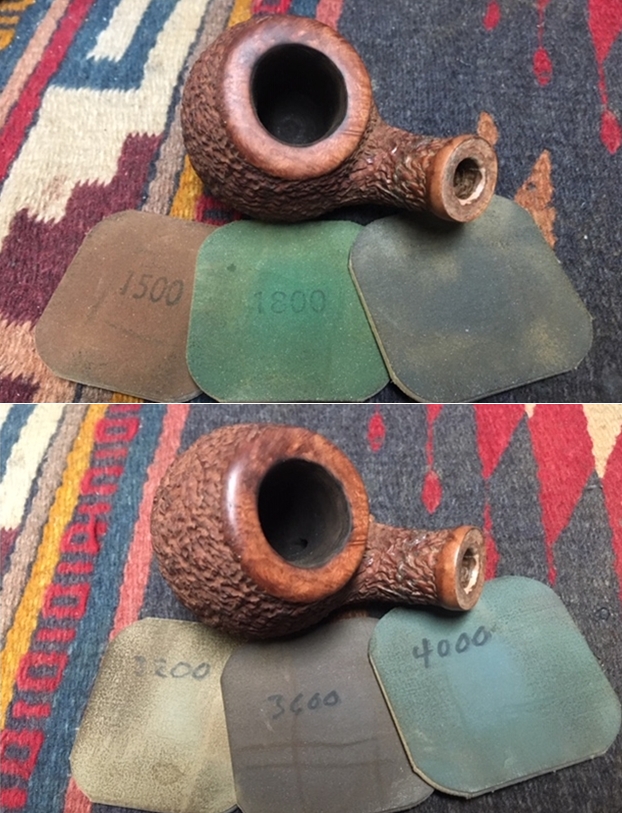
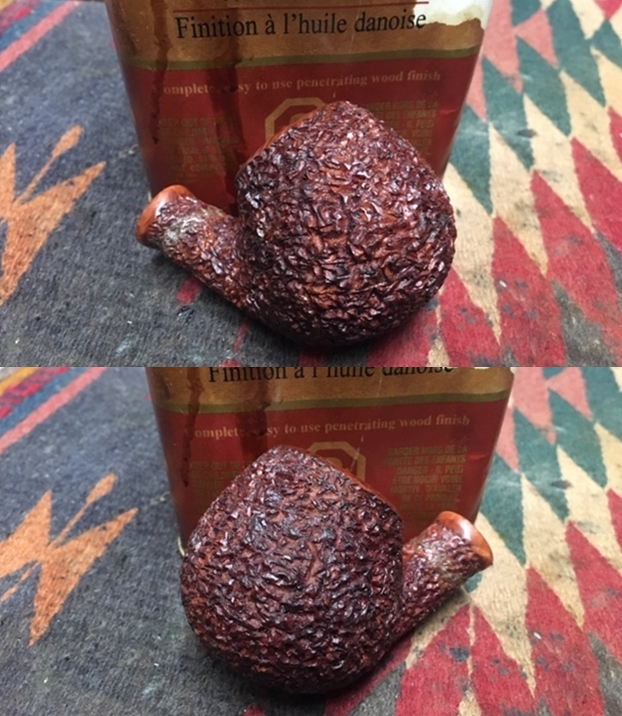
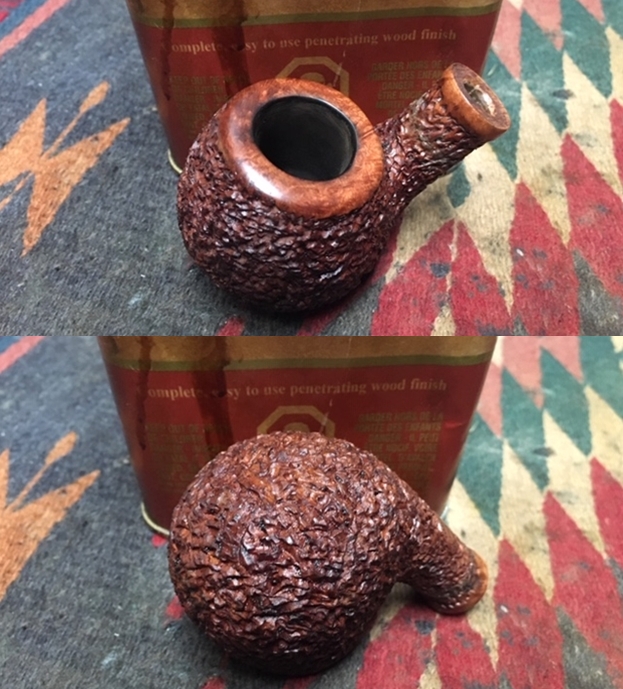
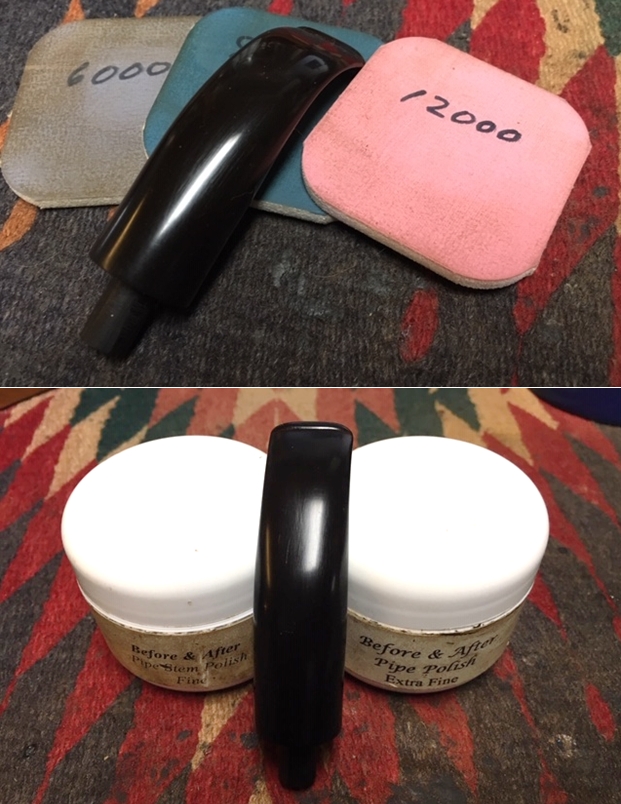
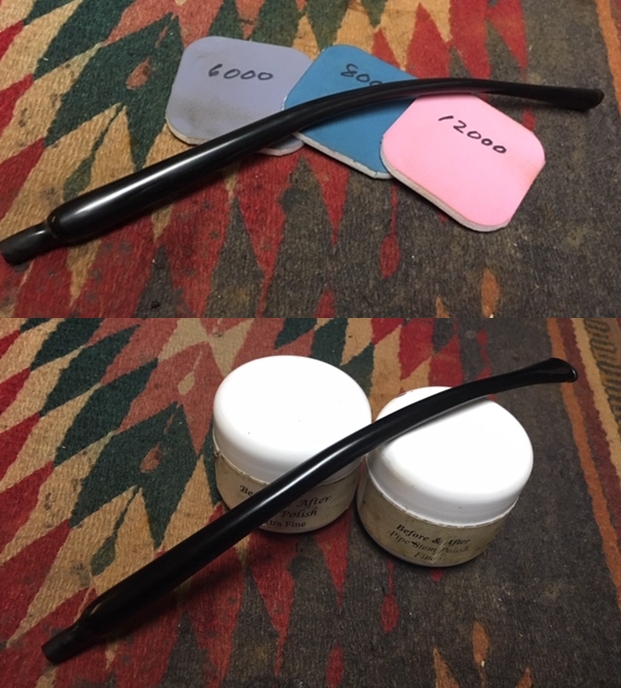
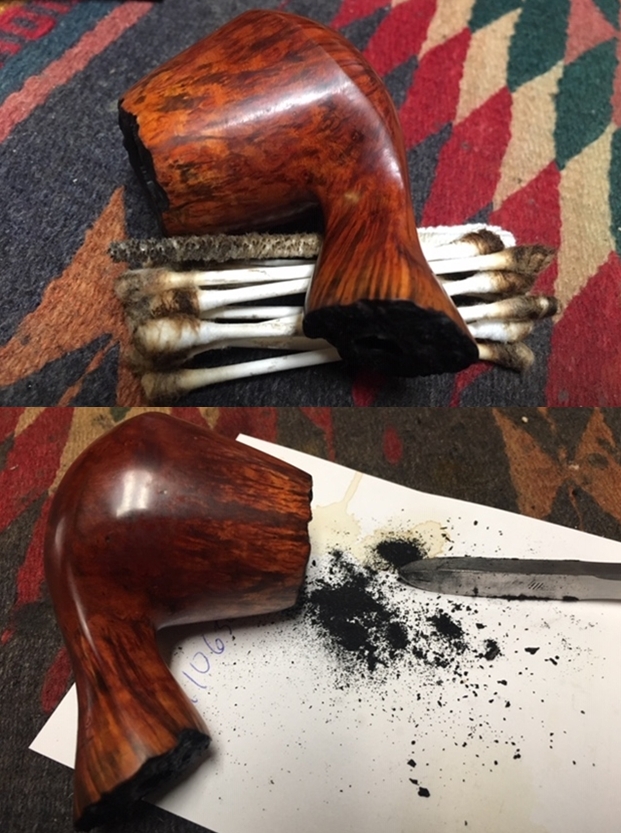
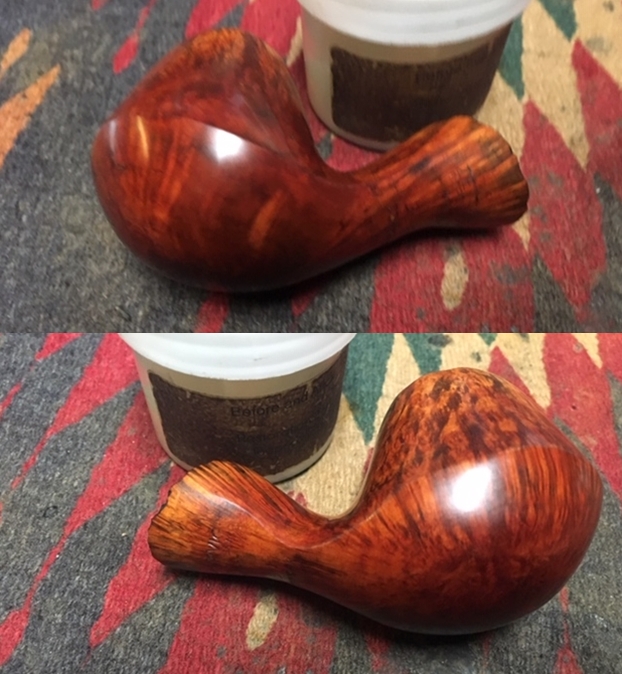
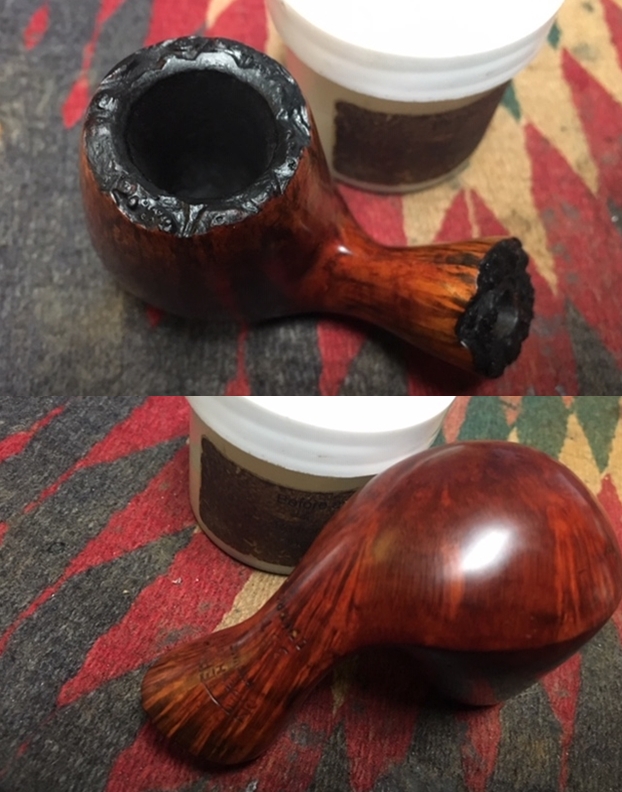
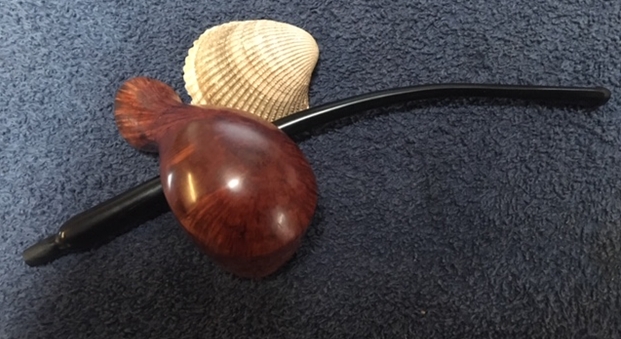
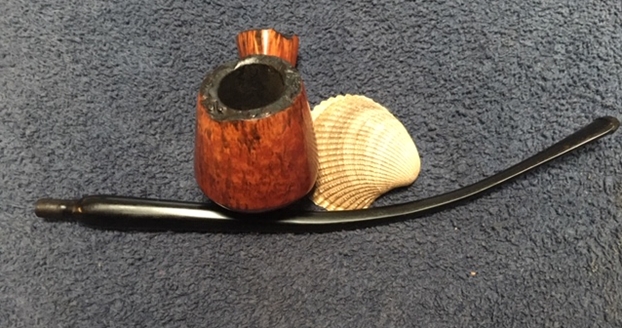
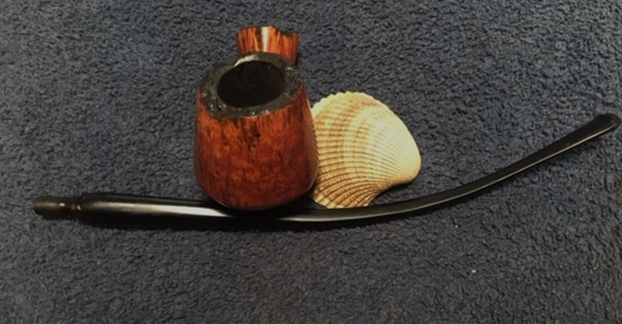
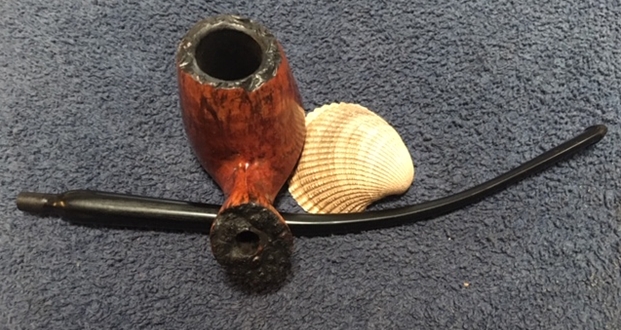
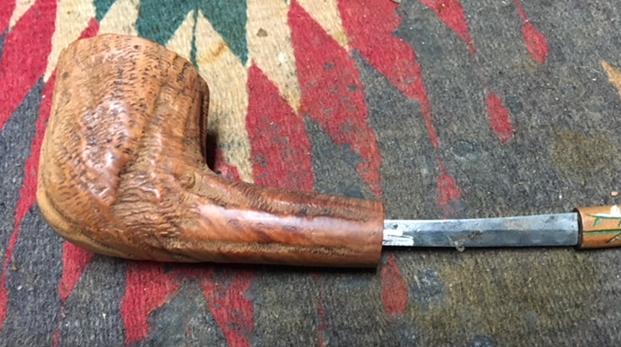
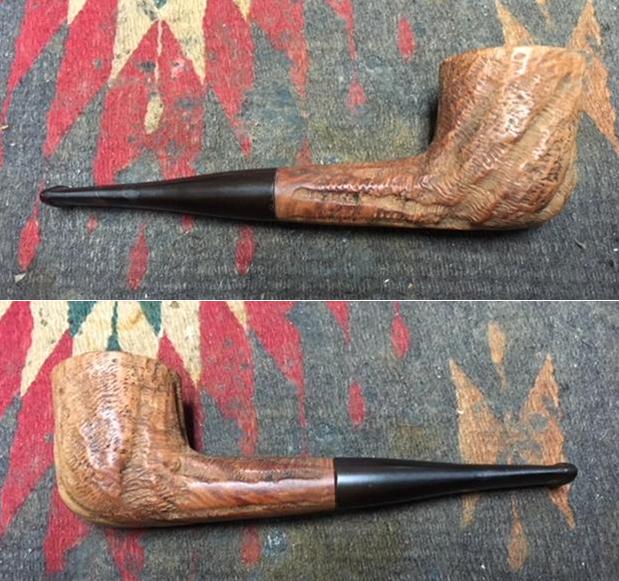
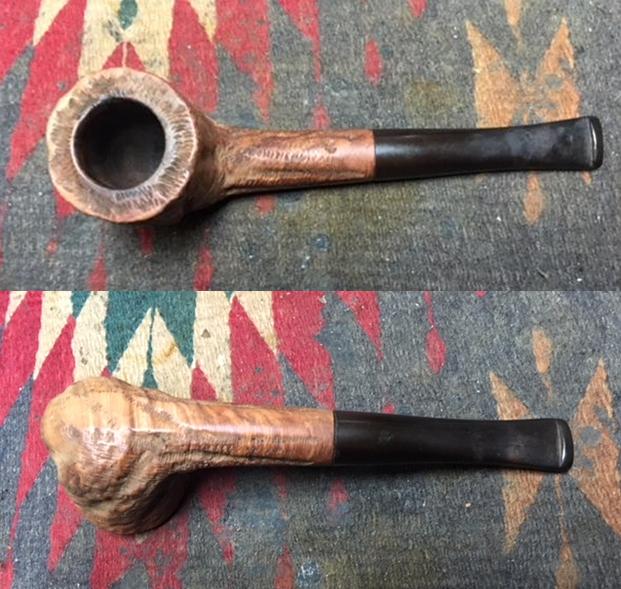
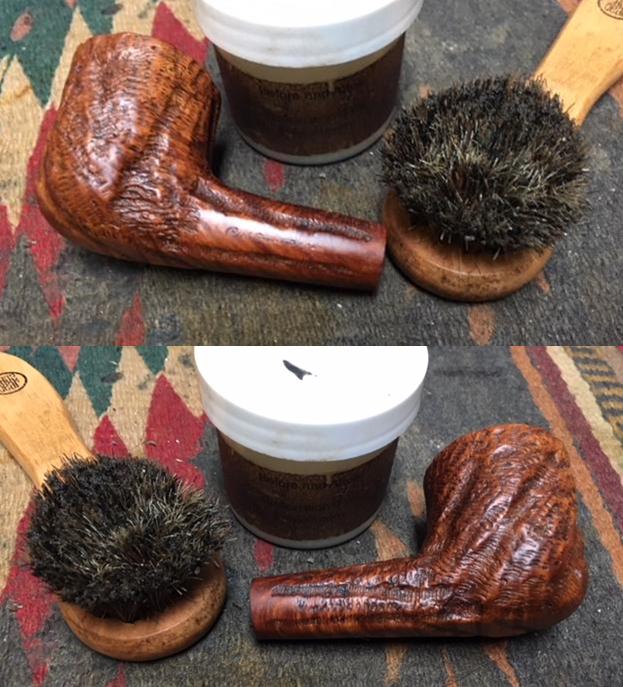
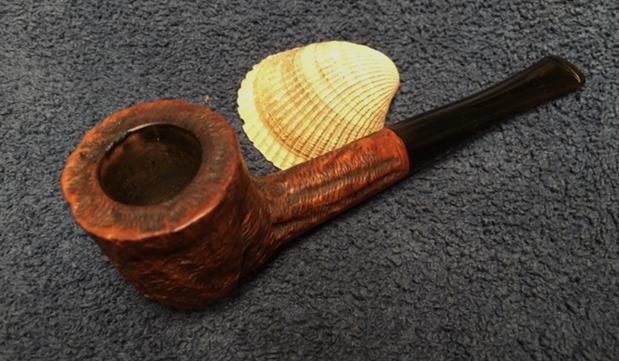
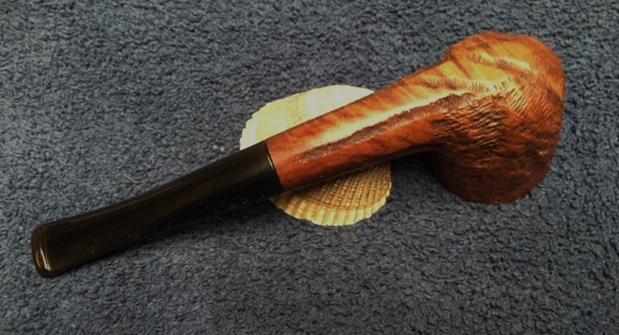
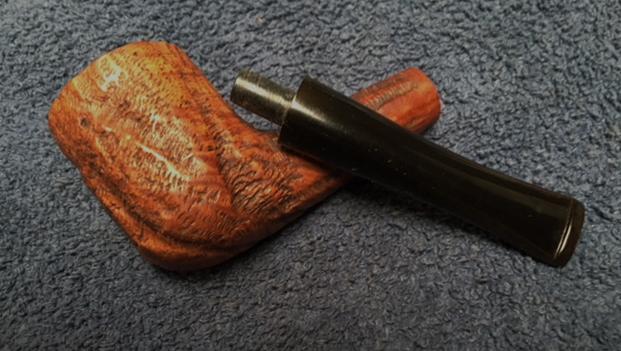
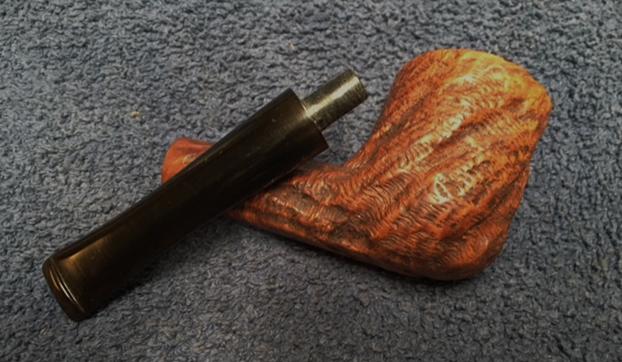
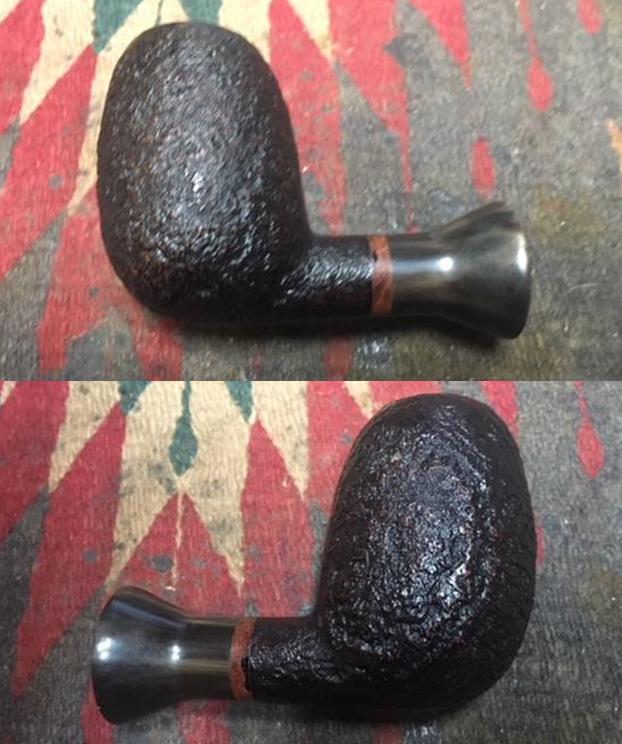
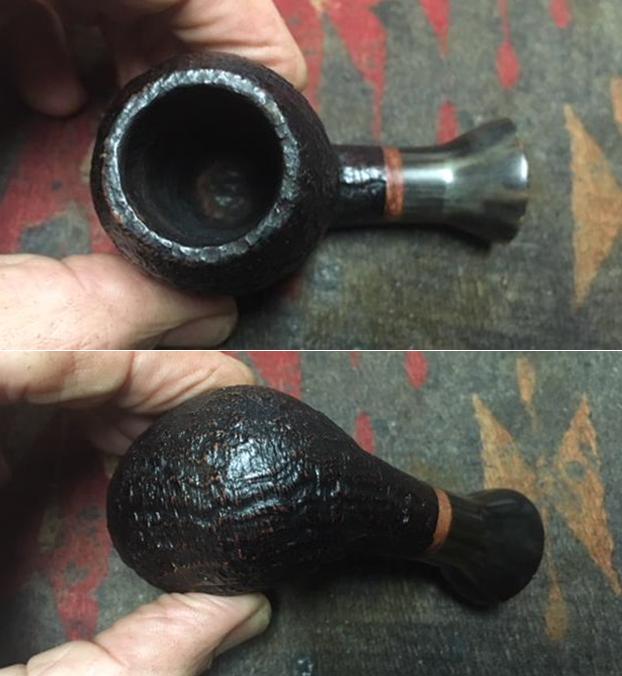
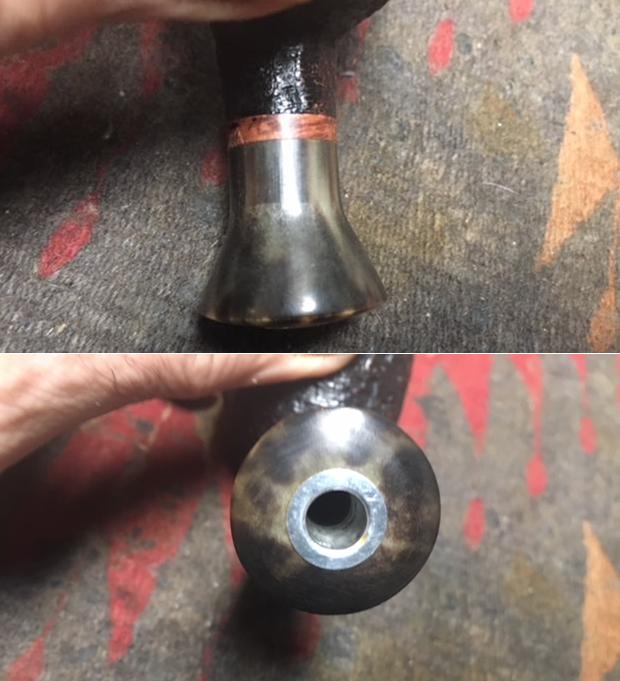
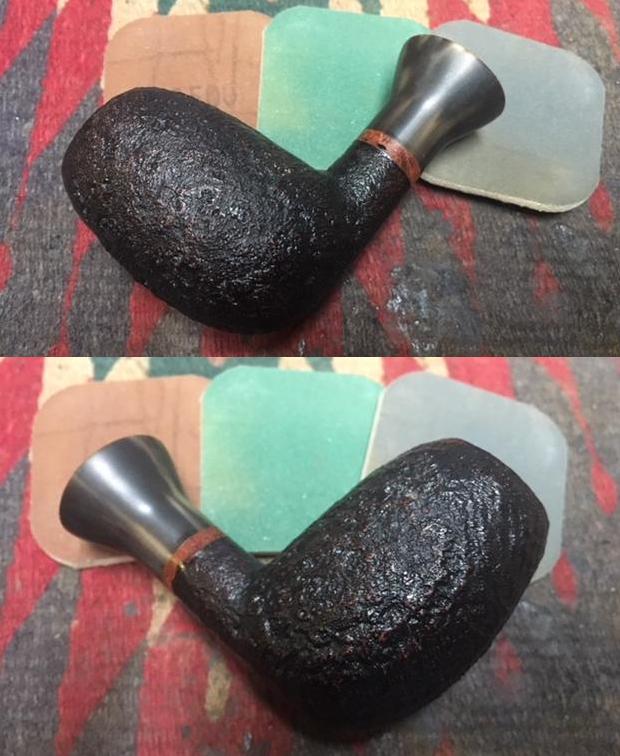
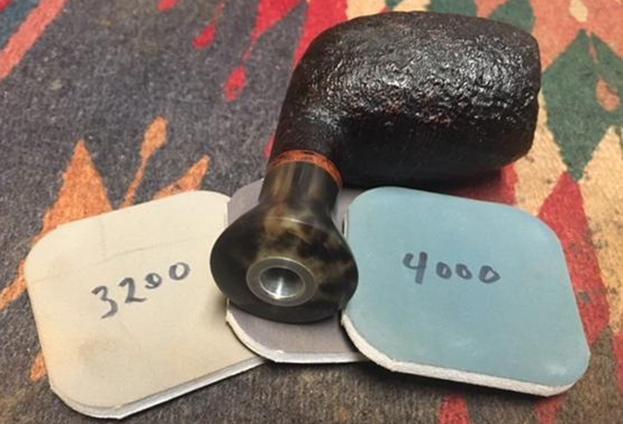
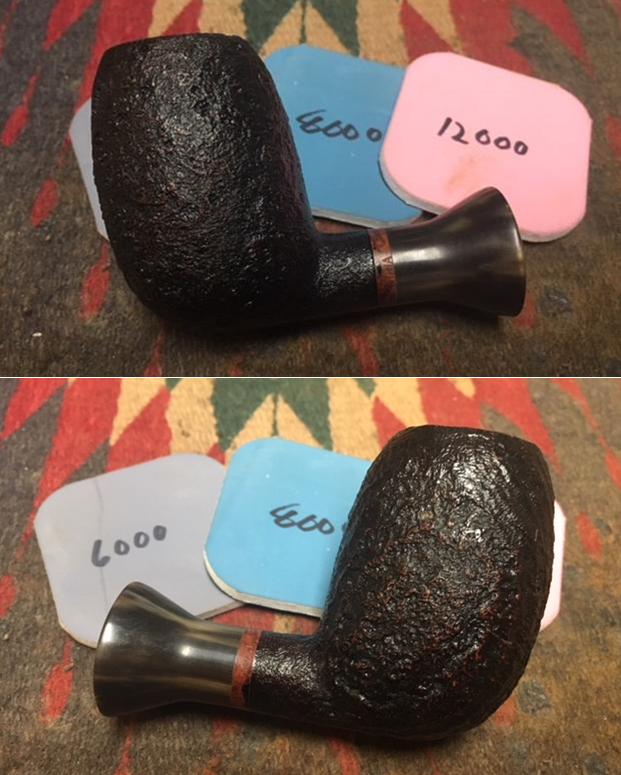
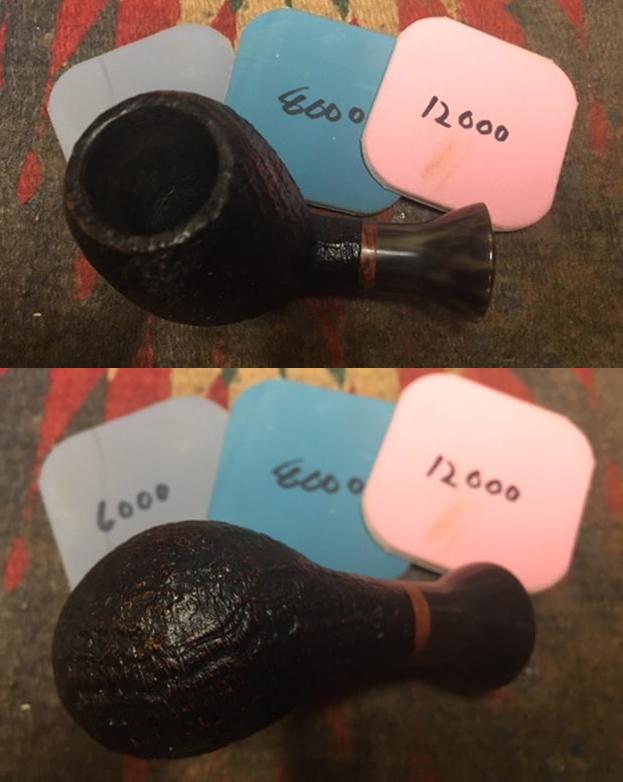
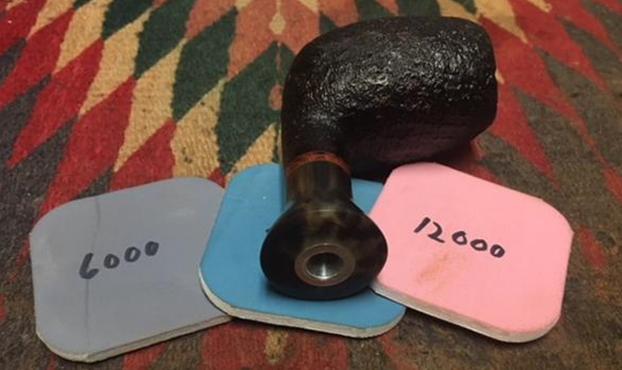
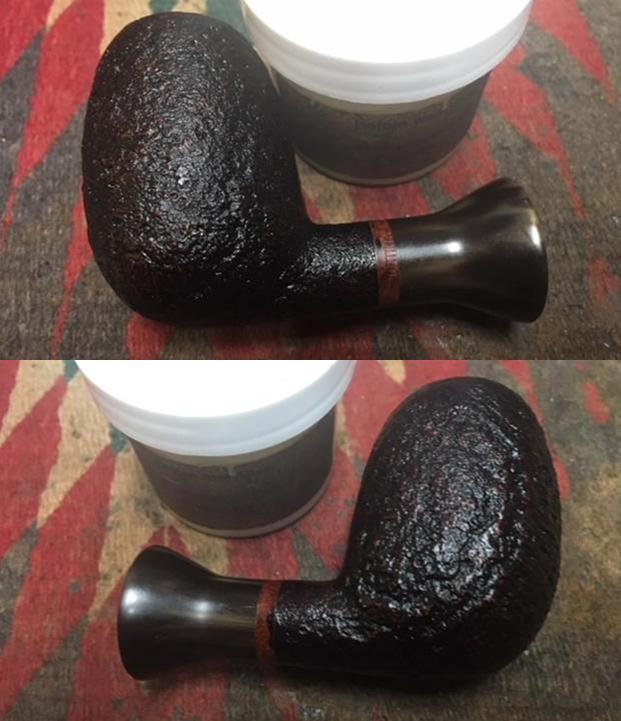
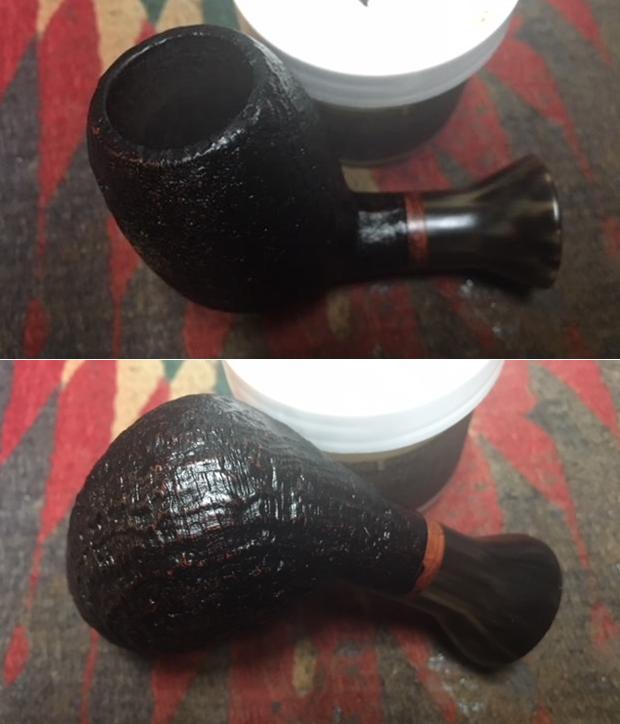
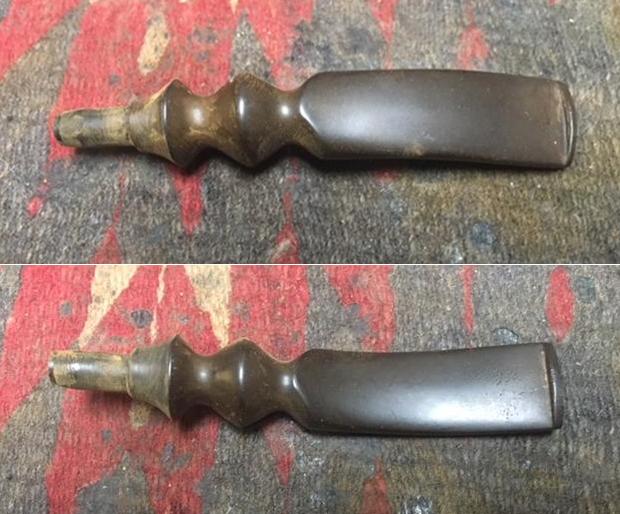
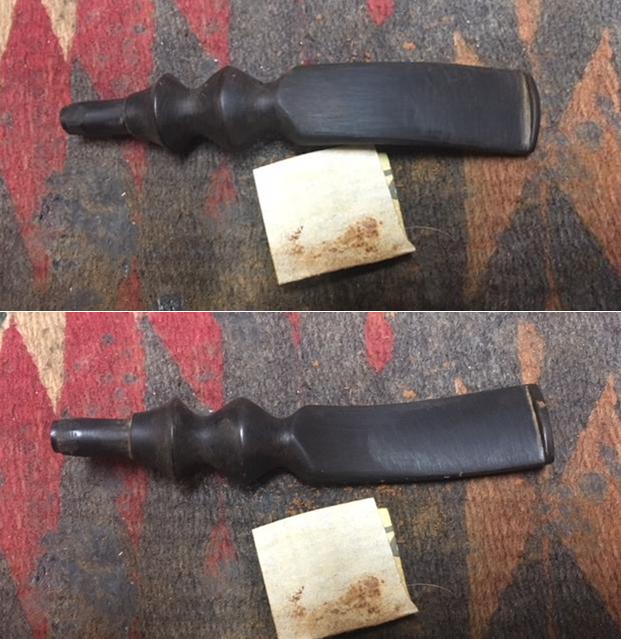
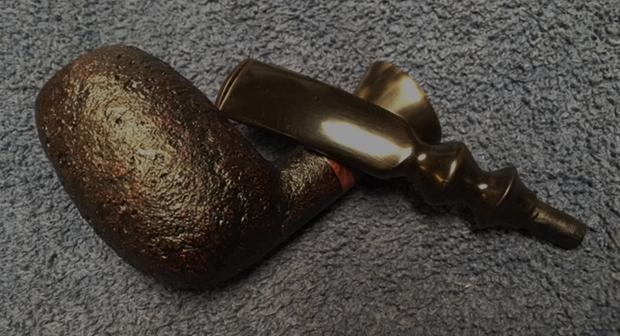
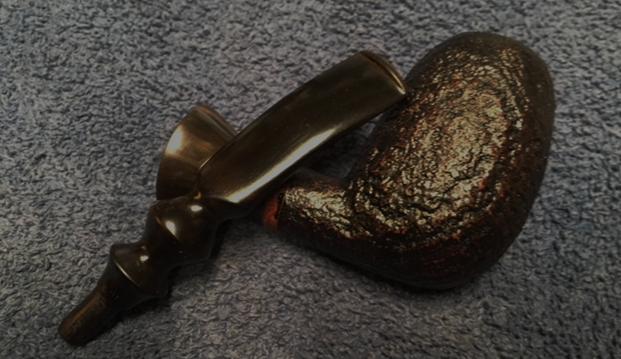
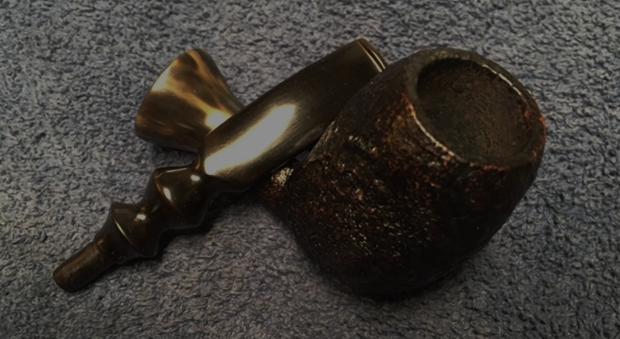
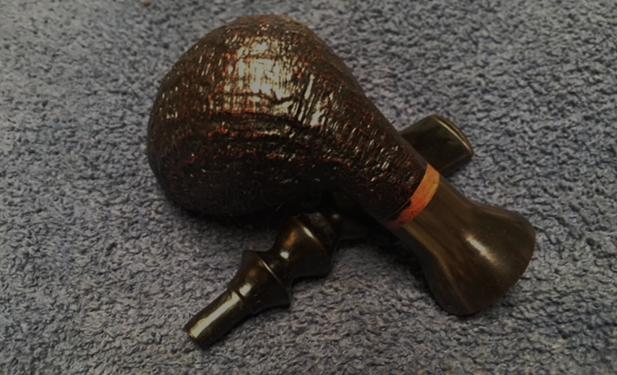
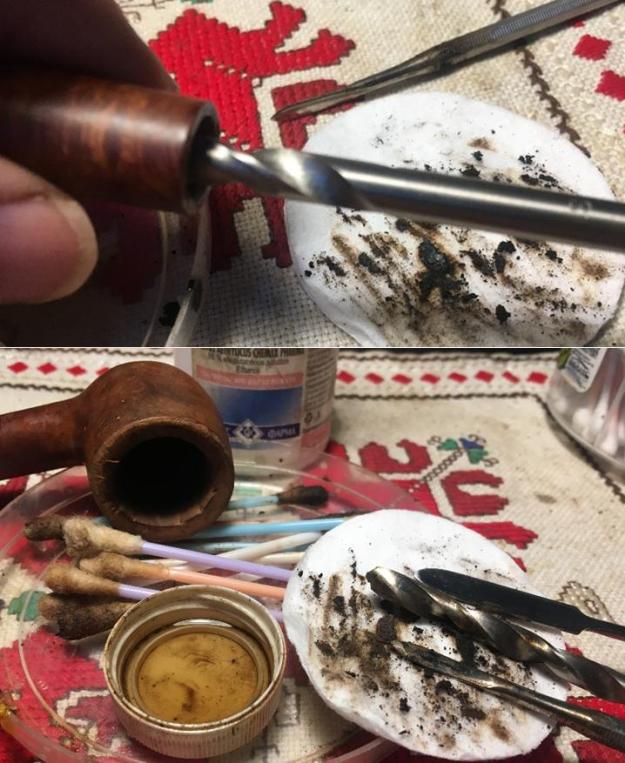
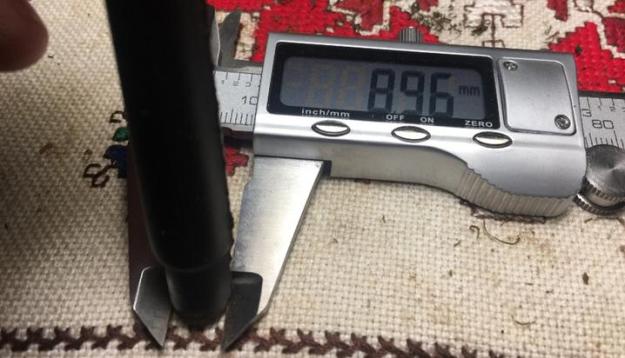
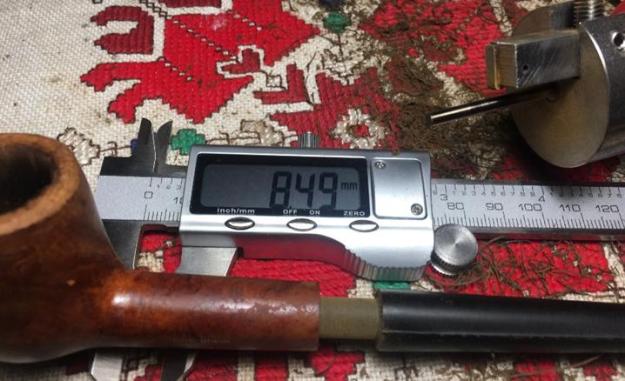
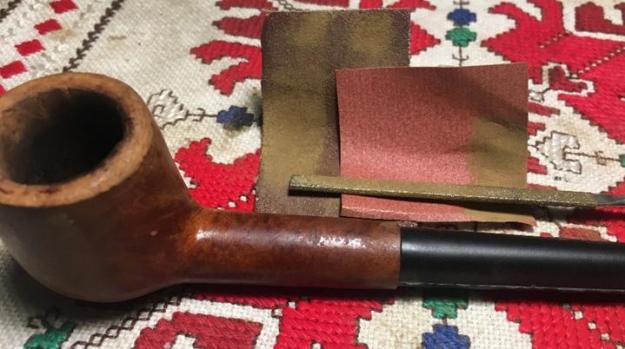
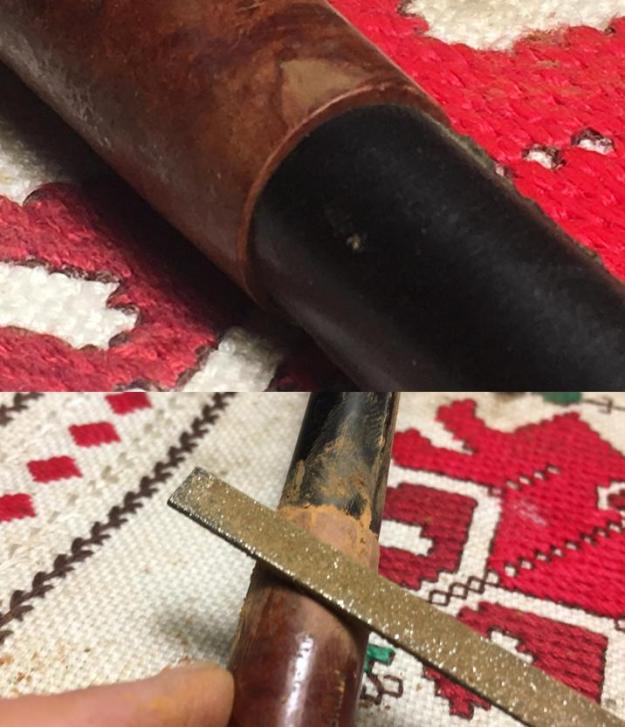
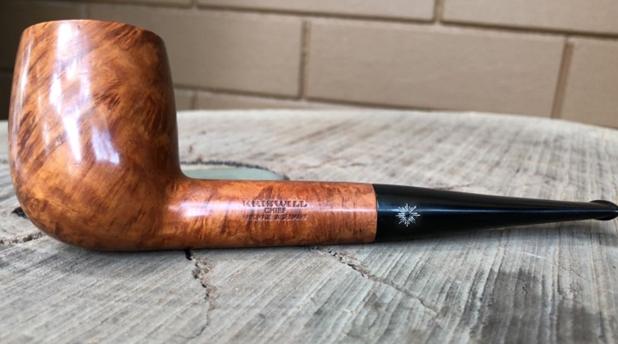
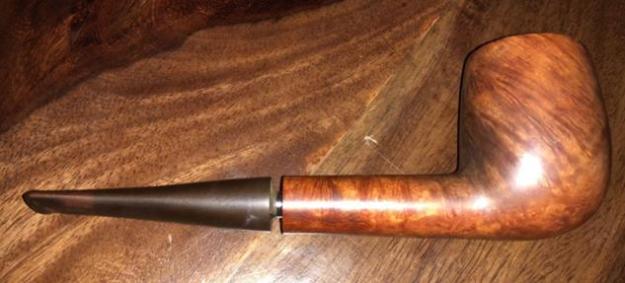
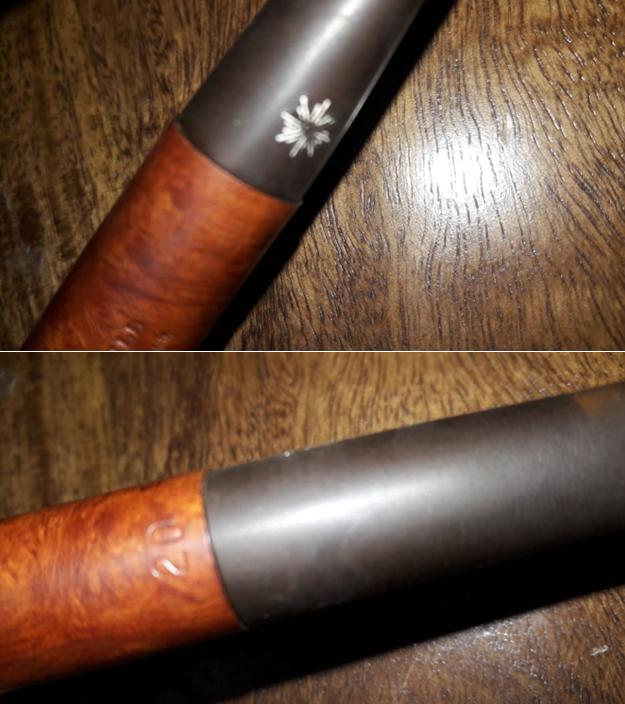
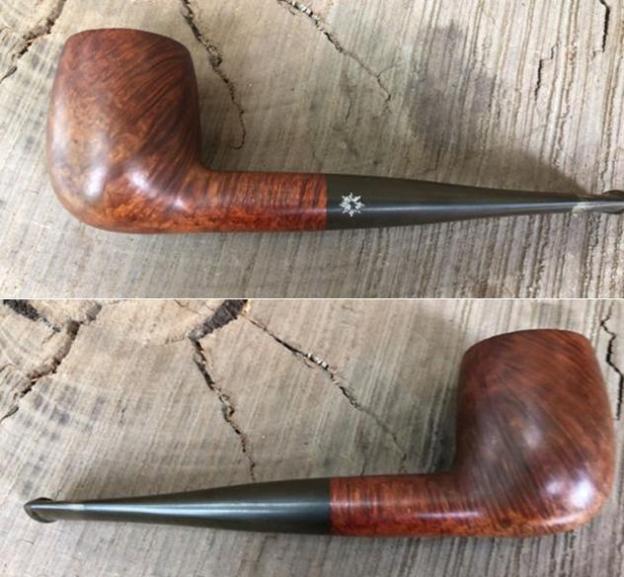
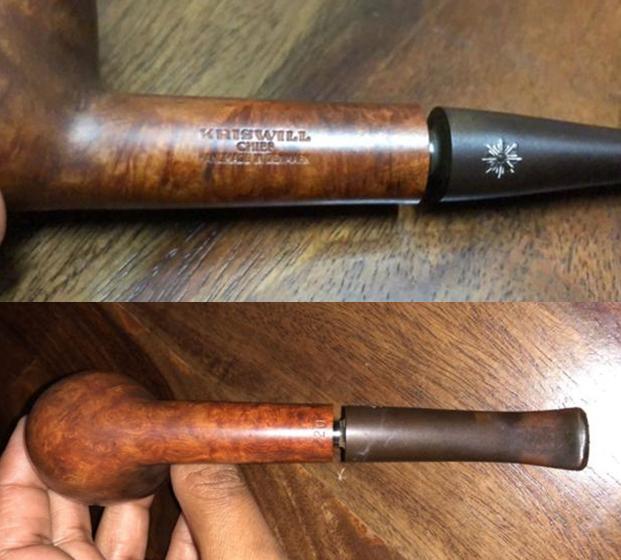
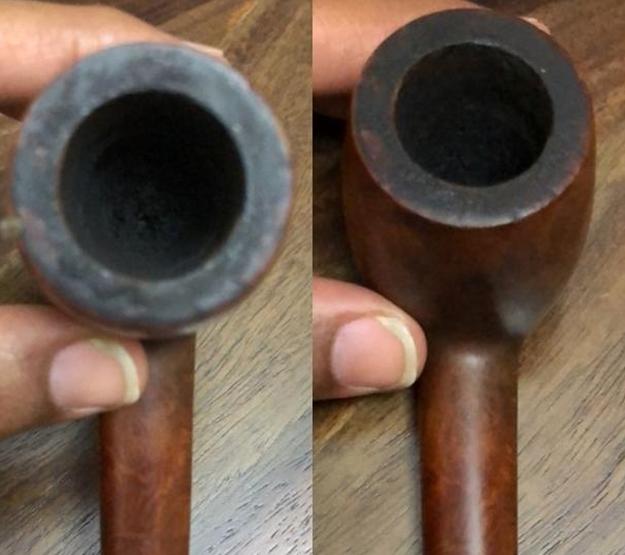
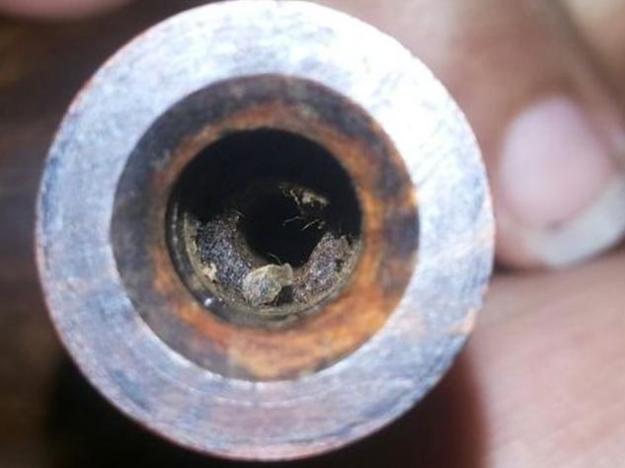
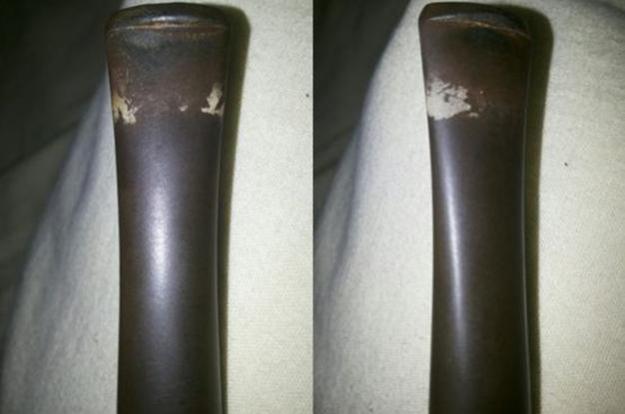
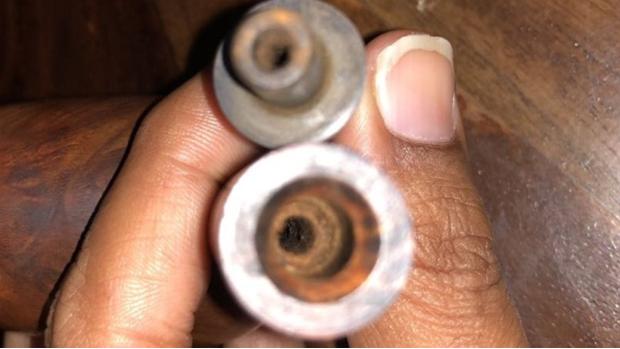
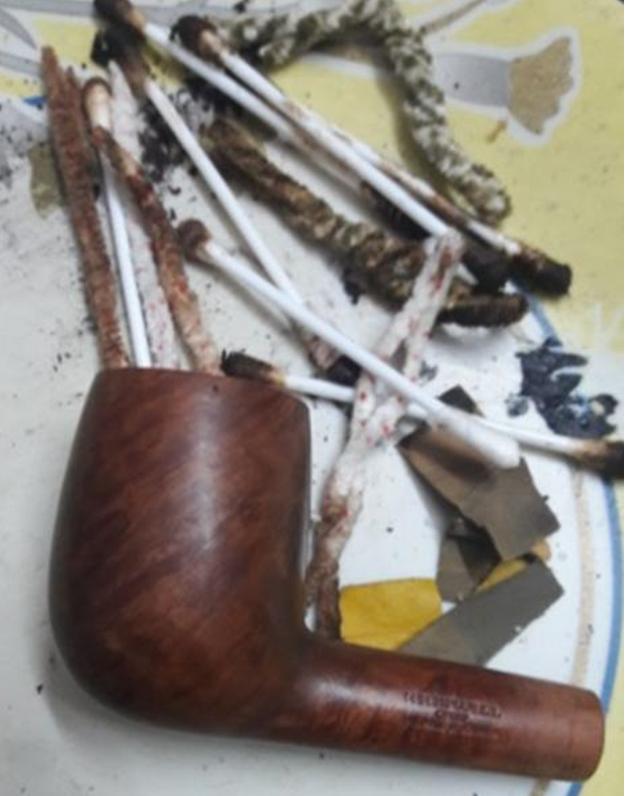
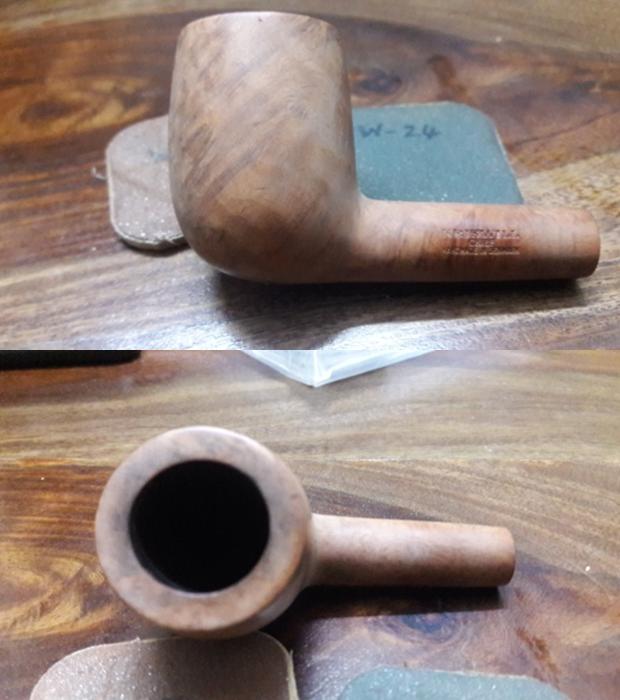
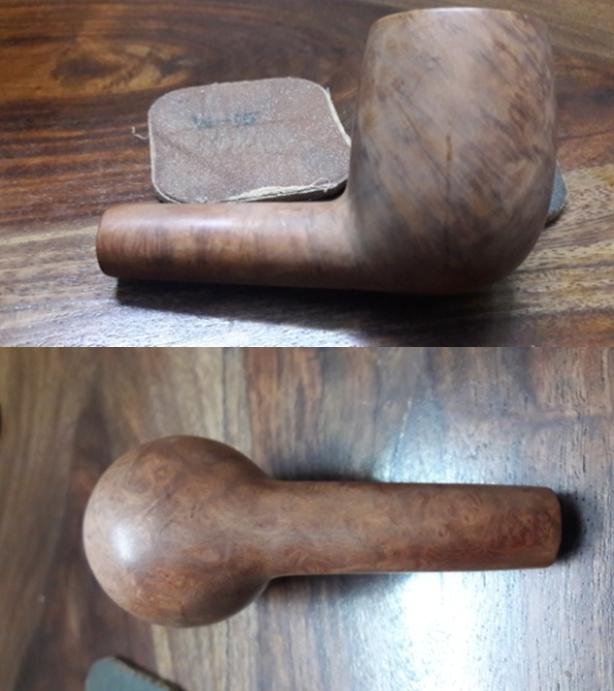
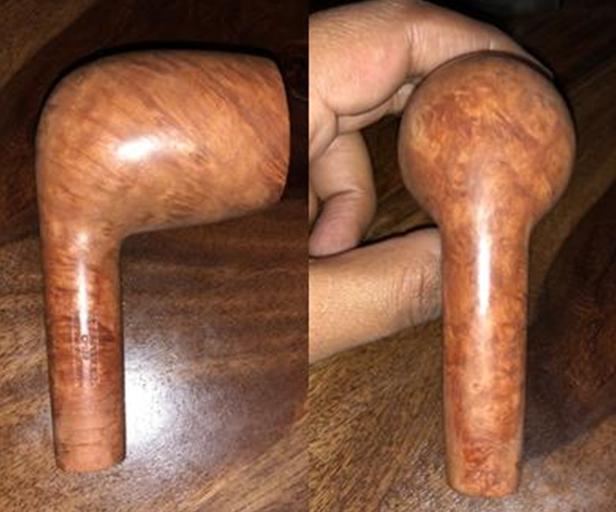
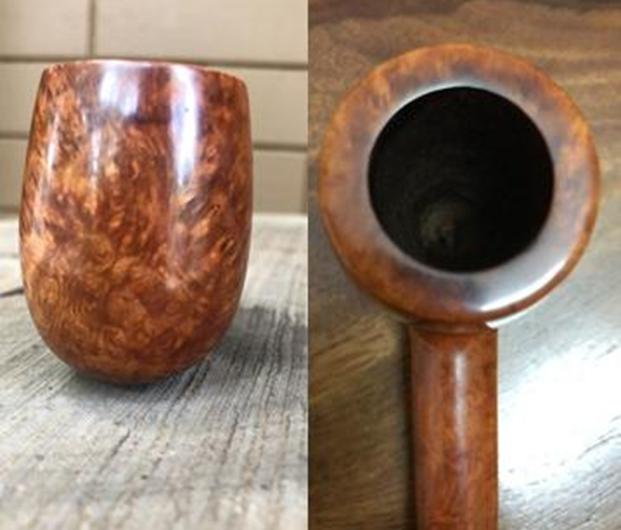
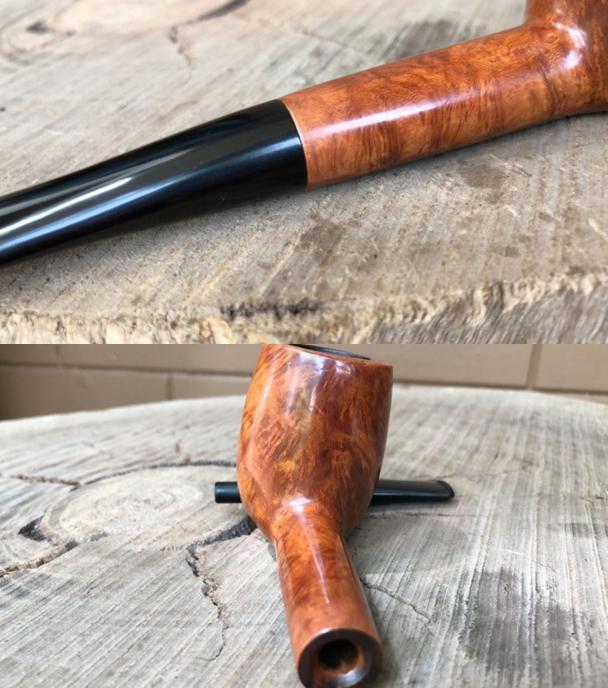
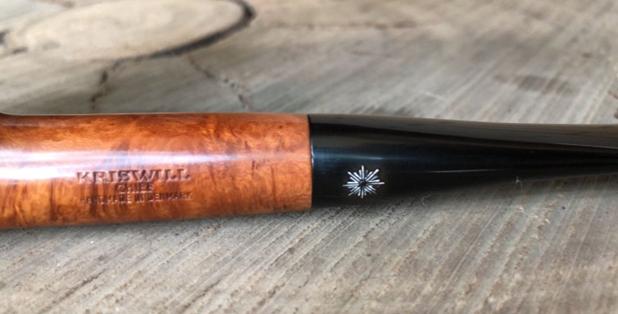
The next pipe in the queue is from a group of pipes that Paresh purchased from a rag picker in Mumbai, India. The fellow had found a large number of pipes as he was going through rubbish bins and contacted Paresh. This is a tired and worn looking Kriswill. I knew looking at it even before the stamping was checked that this was a Kriswill because there is something distinctive about the shapes. The pipe is stamped (though it is faint now from wear) Kriswill Hand Made in Denmark. The pipe was filthy and unusable. I think it was from the generation who smoked a pipe to death and then pitched it. The finish on the pipe is very dirty and the sandblast is almost worn smooth. There is a thick cake in the bowl and a lava overflow on the rim top. I can see some damage to the inner edge of the rim but because of the cake and tars it is hard to know what the inner edge looks like. The stem was broken at the tenon and there was a very strange set up keeping the pieces together. I took photos of the pipe before cleaning it. The photos give a pretty clear picture of the shape of the pipe and its general condition when I received it. At first glance I thought that the tenon was broken off in the shank but as I examined it I came to believe it was even worse. It looked like someone had glued something in the shank and Gerry-rigged a connection to the stem. The photo below shows what I saw. What is not clear in the photo was a piece of metal in the centre of the mortise area. It looked like a tube but when I tried to push air through the shank it was absolutely plugged.I was going to have to try to drill out the shank but before I did that I examined the shank and stem more closely. The stem had been hacked pretty seriously so that the diameter was not even close to the diameter of the shank. In the centre of the mortise the metal tube turned out to be a 2 inch long finishing nail. It appears that the nail was used to keep the stem in place in the shank. For what? I don’t have an answer for that as it was utterly unsmokable. Once I removed the nail with a pair of needle nose pliers I was able to blow air through the shank. It was at least clear. I used a drill bit slightly larger than the mess in the shank and carefully drilled the shank. It did not work to clear out the shank! However, it was clear what was there – it was a tube made of masking or painters tape! I took a pen knife and twisted it into the mortise and was able to pull the tube free of the shank. The last photo shows everything that had been in the shank to hold the stem in place on the shank. I could surmise from the length of the stem what I would need for a replacement stem. I went through my can of stems and found one that had the right sized tenon and was the same length and width as the broken stem. It was a saddle stem instead of a taper but I liked the look of it on the pipe. I pushed it in place and took the following photos. I would need to reduce the diameter of the saddle, bend the stem and do a general cleanup, but it was a keeper. I took a photo of the stamping on the shank to show that it reads Kriswill. Underneath it says Hand Made in Denmark but that stamping is faint and only readable in a bright light or with a lens.With the stem chosen I set it aside to work on the bowl. I really hate working on dirty pipes! I can’t say enough how much I appreciate my brother Jeff doing the lion’s share of the reaming and cleaning before I even work on pipes… It is these few that I have to clean up that make me thankful and realize how much work he does before I get them here to restore. Thanks Jeff. The bowl had a thick cake and a heavy overflow of lava. It was obviously someone’s favourite pipe.I reamed the bowl with a PipNet pipe reamer using the smallest cutting head. The bowl on these old Kriswill pipes is conical so the PipNet only goes so far down the inside. I reamed out the bowl as far as the reamer would reach and then used Savinelli Fitsall pipe knife to finish the project. I scraped the rim top with the pipe knife to remove the majority of the lava and could see that the rim edges and top were damaged with burn marks.To remove the damage to the top of the rim I topped it on a topping board with 220 grit sandpaper. I worked on it to remove the burned areas and the damage to the inner edge of the rim as much as possible. I am happy with how it turned out.I lightly beveled the inner edge of the rim with a folded piece of 220 grit sandpaper to give it a cleaner look. The look of the bowl at this point is far better than when I started the rim clean up. I will still need to polish the rim and match the stain to the shank end smooth portion. Fortunately for me this old Kriswill originally had a smooth rim top so it will look like new.I polished the topped bowl rim with 3200-12000 grit micromesh sanding pads. With each successive grit of micromesh the grain stood out more and gave a good finished look to the pipe. I liked what I saw when I looked at it. There was a little variation in stain colour between the rim top and the shank end so I decided to stain both to get a good blend. I used an Oak stain pen to match the colour of the shank and smooth spot where the stamping was. Once the stain had cured for that time I moved on to the next step in the process.It dawned on me at this point that I had been so intent on getting the plug out of the shank and topping the bowl that I forgot to clean out the shank! I normally do that right after reaming the bowl but forgot. It goes to show you that if you vary an habitual pattern even a bit you will leave steps out. I stopped the process and went back and cleaned out the shank and airway to the bowl with pipe cleaners, cotton swabs and isopropyl alcohol until the pipe was clean and smelled fresh.With the rim top and bowl polished and the shank and airway CLEAN, I worked some Before & After Restoration Balm into the surface of the briar with my fingertips to clean, enliven and protect it. I let the balm sit for a little while and then buffed with a cotton cloth to raise the shine. The following photos show the bowl at this point in the restoration process. The bowl and the rim top look really good and the darkening and lava are gone. The finish looks very good with the contrast between the rich, dark brown and the Oak stain on the rim and shank end. I am very happy with the results. With the bowl finished I set it aside and turned my attention to the stem. I used a file and a folded piece of 220 grit sandpaper to shape the diameter of the saddle portion of the stem to fit the diameter of the shank. It took a lot of filing and sanding to get it to this point but there is a lot of fine tuning work to do. The shank is not round but it is more of a vertical oval in shape so the stem will need to match it to have a seamless fit. It is a lot of hand shaping work to get the two to match. I sanded the scratches and the tooth marks on the stem with 220 grit sandpaper to bring the shank and saddle portion into line. I further sanded and shape it with 400 grit sandpaper to remove the scratches. This is the beginning of the polishing process on the stem. I wiped the stem down with Obsidian Oil and put it back in the shank to take progress photos. I polished the stem with micromesh sanding pads – wet sanding it with 1500-2400 grit pads and dry sanding it with 3200-12000 grit pads. I wiped the stem down with Obsidian Oil after each pad. I further polished it with Before & After Pipe Polish – both Fine and Extra Fine. I gave it a final coat of Obsidian Oil and set it aside to dry. This pipe has had quite a journey to this point in time and space. It somehow traveled from Denmark where it was made to Mumbai, India. There is was found abandoned, binned and found by a rag picker who then sold it to Paresh in another region of India. From Paresh it traveled to me in Vancouver, Canada. In April it will travel to Nepal with me and back Paresh in India. I only wish that it could tell its story. All I know is that I have extended its life of usefulness and given its purpose back as it was intended.

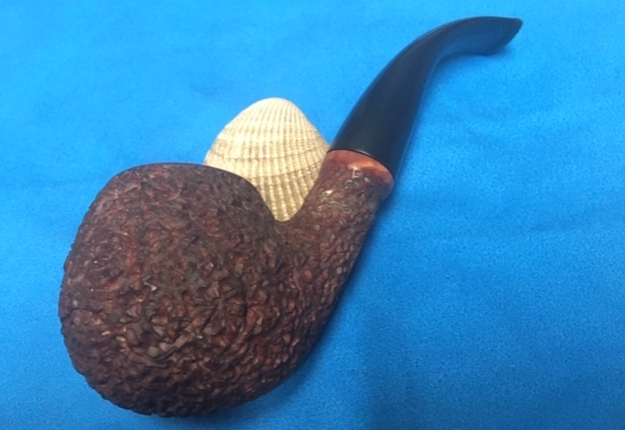
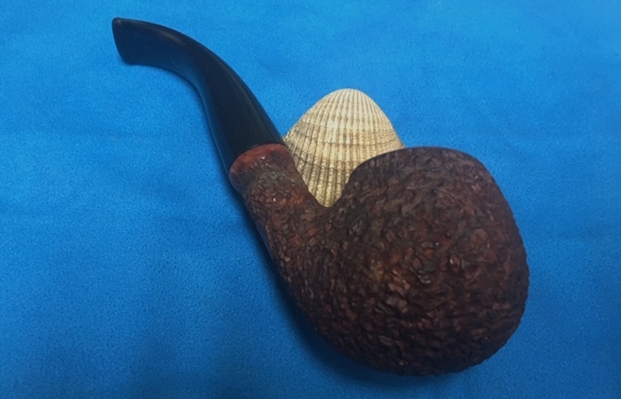
I polished stem with Blue Diamond polish on the buffing wheel. I gave the bowl multiple coats of Conservator’s Wax and the stem multiple coats of carnauba wax. I buffed the pipe with a clean buffing pad to raise the shine. I hand buffed it with a microfiber cloth to deepen the shine. The pipe polished up pretty nicely. The contrasting grain came alive with the buffing. The rich contrasting browns and black colouring works well with the new, polished black vulcanite stem. The finished pipe is a beauty and feels great in the hand. Have a look at it with the photos below. The dimensions are Length: 5 ½ inches, Height: 2 inches, Outside diameter of the bowl: 1 inches, Chamber diameter: 5/8 of an inch. I will be taking this pipe with me to India soon and giving it back to Paresh. Thanks for walking through the restoration with me on this battered and weary Kriswill.

The Decline of Restoring Old Pipes, Part 2/4: An Antique CPF Meerschaum Five Years Finishing


Blog by Robert M. Boughton
https://www.roadrunnerpipes2k.com/
https://www.facebook.com/roadrunnerpipes/

Copyright © Reborn Pipes and the author except as noted

Then I thought, boy, isn’t that just typical?  You wait and wait for something, and then when it happens, you feel sad.
— Sharon Creech, U.S. children’s writer, in Absolutely Normal Chaos (1990)

RECAP
In Part 1, I hypothesized that the discontinued manufacture or illegality of certain materials, as well as the dwindling availability and in some cases complete lack of pre-fashioned parts used in antique and other very old pipes, will lead to a serious crisis in restoring these great but often damaged old friends to their original conditions.  Without hashing over the details, which I already described in great although still incomplete specificity, I will add that I left out the obvious: none of the materials I discussed is irreplaceable in the sense that an old pipe with a broken amber stem or bone tenon can always be mended with Lucite or Delrin, for example.  To emphasize my way of thinking, which I know is shared by many other far more experienced and better practitioners of the art of pipe restoring than I, the thought of needing to resort to such practices except in the most severe cases is unthinkable, or to use a more descriptive word, an anathema to me.

At any rate, having no idea what I was getting into when I began writing the first installment, in the order in which various materials popped into my head, I soon reached a point where more and more endangered items presented.  For the sake of not breaking my train of thought any more than necessary on the one I happened to be trying to complete at the moment, I got into the habit of adding new section headings as I proceeded, as a sort of minimal outline.  The research alone led me in still newer directions, and so the sections grew in number – not to mention the research, which became so out of hand I almost lost control and never did get all of my sources in good order.  In the end, for those reading this who caught Part 1, believe it or not, I cut entire pages from the text and many of the sources that, due to the months spent composing my list of the most endangered materials either no longer applied or were redundant.  And still my sources alone took up at least two whole pages of the 24 I submitted to Steve.

Needless to say, as sad as I was to have to face the music, my little list had reached proportions prohibitive of an illustrative restoration to accompany it.  This installment will begin the phase describing the first of three projects that demonstrate the growing difficulty of restoring very old pipes to their natural beauty and even one relatively new but vintage example, despite my intentions, as if it were an antique.

INTRODUCTION
Five years ago, Chuck Richards presented the old and wounded but still spirited meerschaum to our Friday night pipe get-together.  The group of devoted Albuquerque area pipers being in its heyday at the time, the little tobacconist’s shop where we still meet in lesser numbers was filled beyond fire code capacity.  Folding chairs extended the normal smoker’s lounge all the way to the front glass counter, and still they were not enough.

I would regret to point out the business from cigar aficionados we pipe revelers cost the shop’s owner that memorable night, other than the few who were understanding or dogged enough to wend their ways through our standing-room-only mob.  But the sales in pipes and tobacco tins, and everything else that goes with them, more than made up for the loss on those evenings that are among my best memories.  Time has a way of changing all things, not just the antique meerschaum beauty Chuck passed around for all of us to ogle.

With the innate cunning and flair for dramatic understatement possessed by traveling carny operators of old, Chuck had the entire room enthralled – and yes, I was in the front row, center aisle, agog, right where he wanted me.  The panache of Chuck’s delivery was not in what he said of the pipe, however, but the way he appeared to satisfy the rest of the audience with an atypical dearth of anything better than teases, what Deep Throat called leads, at least as far as my hungry ears and eyes could discern.  Had I still been a news reporter with orders from my editor to get a good quote, I might have been out of a job.

That old reporter in me was accustomed to listening for diversions, avoidances and spins – every attempt “to deceive, inveigle and obfuscate,” as Special Agent Fox Mulder says in one of his most memorable lines from The X-Files (S4:E3).  That good habit must have kicked in to help me pick up on the mesmerizing but fugacious choreography of the show, designed only for the moment and then to be forgotten.     All I heard was “an old, now defunct pipe maker or distributor, probably in the U.S., called CPF,” “Best Make.” “still in its original case,” “with amber bit, gold band and broken bone tenon.”  But what did he omit and why?  During the intervening years, I’ve asked a few of those who were there that night about the occasion, and all of them indeed recollected some small part of the details, but little of substance, that are imprinted into my memory.

And then the act of mass hypnosis was over, the tiny space hot and stuffy, the crush of pipe enthusiasts swelling to the distant and narrow entrance somewhere in the background that was clogged with people coming and going beyond the usual capacity and hours of the shop’s operation, and which sole entry and exit, at any rate, lay beyond several treacherous eddies and straits still out of sight or reach.  I was not in my element and wanted to bail but needed to talk to Chuck.  With a distinct surreality, his bead bobbed nearby, like a life buoy in a foggy ocean.  We smiled at each other in what I felt was a meeting of the minds

I called out to him – shouted as loud as I could – as close to screaming as I ever have.  Imagine, not a vacuum such as space, but the opposite: chaotic babble and expansion.  Everything else drowned in the roiled sea foam of voices.

“Don’t you know anything more about CPF?”

We were face to face at last, but Chuck didn’t hear a word.  Neither did I, for that matter.  He even cupped a hand to an ear and gave up, communicating better with a single raised finger that he would come back.  When he did so, the crowd thinned out enough for us to hear each other.  He said, “I want you to take this home with you and do some research.  See what you can find out about CPF on your computer.”

Close your eyes if it helps and imagine the words above being cast upon you by Chuck in his always rich but then suddenly dulcet, soothing, fluid and entrancing tone

While Chuck projected these words to me, I tried my best to focus on his face, but my attention kept straying to the one-hundred-some-odd-year-old meerschaum pipe in its original tan case that looked so secure in his able custody but became more and more fragile and vulnerable as it was passed to mine. Much more was spoken between us that night before I began to understand that the dirty, damaged but reparable and, to me, priceless piece of art and history was not a loaner for research purposes as Chuck had suggested. Some blurry time later I realized he only said that so I would accept the gift from his hand. He knew I never would have touched it otherwise. About then the full truth struck me like a Mack truck with no brakes on a downslope of the Grapevine, a treacherous strip of I-5 in California with the Tejon Pass in its middle: Chuck expected me to restore it.

“But I’m not the right man for the job!” I went off like a maxed-out Jake break.

Chuck grinned at me a way only he can and then tried to calm the panic rising in me.

“When you’re ready,” I recall him saying. The rest is hazy.

As soon as I returned home that night, I began my computer research into “CPF tobacco pipes” as Chuck prescribed, and it became apparent that my friend indeed knew more than he let on. As Chuck suggested to the weekly pipe get-together almost six years ago in his circumspect description of the company, CPF was indeed a U.S. venture, in New York. I came across all sorts of conjecture as to the meaning of the three letters, with most agreeing the PF stood for Pipe Factory.

The C, on the other hand, was debated with unusual ferocity even for the very opinionated pipe world. The guesses included Consolidated, Chesterfield and Colossal, among others. There was even one complete rewrite of the truth suggested in a note at the bottom of the Pipedia link below, positing the amazing coincidence of a C.P. Fenner (one of two brothers who made cigarettes) as a viable candidate.

After hours of determined hunting, I was able to conclude with certainty that CPF stood for Colossus Pipe Factory, which enjoyed a relatively brief but glorious run from 1851-c. 1920. Steve later pinpointed the end of the road for CPF as 1915. In that short span of time, CPF, almost certainly employing the Old World skills of European immigrant crafters, made some of the most beautiful meerschaum and briar pipes available at the time. And it was a great time for pipes.

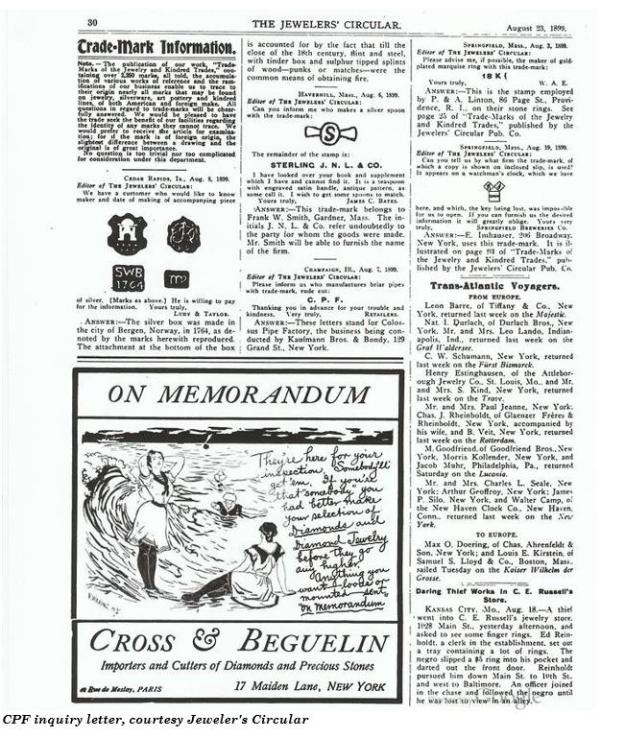
There were three absolute forms of proof that the Colossus Pipe Factory existed, and I later forwarded them to Steve: an antique bill of sale I no longer have, made out to a French company; a letter I found in a long scan of The Jeweler’s Circular issues (August 23, 1899) asking for the name of the pipe company doing business as CPF and receiving the above reply from the editors, confirming the Kaufman Brothers & Bondy connection, and an ad strengthening the tie between CPF and KB&B. Most sources agree KB&B assumed ownership of CPF in 1883. Here are the specific page from the jeweler’s magazine, another ad mentioning CPF, KB&B and Bakelite all in one, and an example of such a pipe.
For the most complete history of CPF, see Steve’s definitive piece in the link in my sources below. Steve’s hard work pulls together all of the available information on CPF along with very nice illustrations from his own vast portfolio of restorations.

1881: THE YEAR IN HISTORY
Until this very moment, as I edit my blog, I had put a conservative estimate of the Best Make’s date of manufacture as 1898. Now, revisiting the evidence, I notice that every ad or other official mention of CPF after KB&B took control mentions KB&B and its address at the time. Pinpoint dating being impossible, I now have good cause to revise the pipe’s manufacture to pre-1883, given the worn old case that makes no mention of KB&B despite the room to do so. Therefore, my new conservative estimate is 1881, making it 138 this year. As it turns out, 1881 was an interesting year, like every other year in my opinion, but I’ll just cite a few highlights.

January 1, 1881, Dr. John H. Watson was introduced to Mr. Sherlock Holmes.
February 24, work began on the Panama Canal.
March 4, James A. Garfield was inaugurated as the 20th U.S. president.
March 16, the Barnum & Bailey Circus debuted.
April 28, Henry McCarty, originally of New York City, escaped from the Lincoln County Jail in Mesilla, New Mexico. Best known as Billy the Kid and widely but erroneously believed to have been born William H. Bonney, McCarty had three other aliases. I had to mention this particular historical tidbit because I live in the natural born killer’s old stomping grounds.
May 21, Clara Barton founded the American Red Cross.
July 1, the first international telephone conversation occurred, Calais, Maine to St Stephen, New Brunswick
July 2, President Garfield was shot by a delusional speech writer who fancied himself responsible for Garfield’s victory. Being denied an ambassadorship was the last straw.
September 19, President Garfield died from an infection caused by the gunshot.
December 4, the first edition of the Los Angeles Times was published.

The Wright Brothers’ first flight at Kitty Hawk, NC was not for another 22 years. The 19th Amendment to the U.S. Constitution granting women the right to vote, ratified August 18, 1920, was still 39 years from reality. The 25th Amendment to the U.S. Constitution defining presidential disability and the line of succession was not ratified until February 10, 1967 – 85 years after Garfield’s vice president, Chester A. Arthur, was sworn in as the 21st U.S. president.

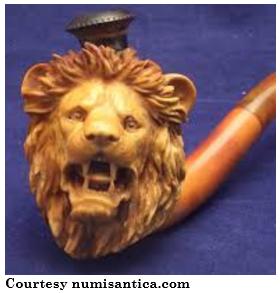
The year 1881 was also 19 years before the revolutionary scientific and technological century that forever and exponentially robbed people of the little daily pleasures that were perhaps our greatest inclinations, for taking time to read and write and contemplate life. And toward those goals, some Old World meerschaum carver had the idea to create a pipe with a bowl turned just enough to allow smokers to see the pages of the books, newspapers or literary magazines they enjoyed reading during moments of the day when they could escape the rat race. Few such clever pipes can be found today. The photo below shows another pipe with a design that nevertheless has an amazing similarity to my CPF Best Make and could very well be its brother.

RESTORATION
I should make one final point clear now: the reason this part of the blog is short on the actual restoration steps and includes relatively few photos is that most of the work involved – meaning everything other than reconnecting the stem – turned out not to be anywhere nearly as difficult as I had at first projected. That’s easy to say now, after having restored other meerschaums and removed an unknown number of broken tenons from shanks. Also, knowing the final key to this restore was finding a suitable bone tenon and getting it to fit snugly and securely in the shank afforded me time to, well, take my time.

All of that said, the most important factor in terms of my readiness to finish my part of this project is all of the experience I have had working out problems with other pipes during the five years this process wound up taking due to the one vital step. Most of those times, my impulse, and often my first step, were to seek the help of someone who had more experience than I. That left plenty of options. Although the friends I’ve pestered most for advice may not realize it, I began to research possible solutions steadily more often. Above all, I exercised the part of my brain that allows me, when I use it, to think my own way out of corners. That habit proved to be of particular benefit to this restoration, as I will soon explain. For the first year, I sat on the pipe, in the figurative sense, other than taking it out of the case now and then to admire its regal elegance. That time was in no way wasted or idle. I accomplished considerable online homework on various approaches to restorations of antique meerschaums. I had a fair number of successful meerschaum restorations under my belt, but I’d never even touched an antique pipe before, and they are a whole different ball of wax, so to speak. Here are the problems I anticipated:
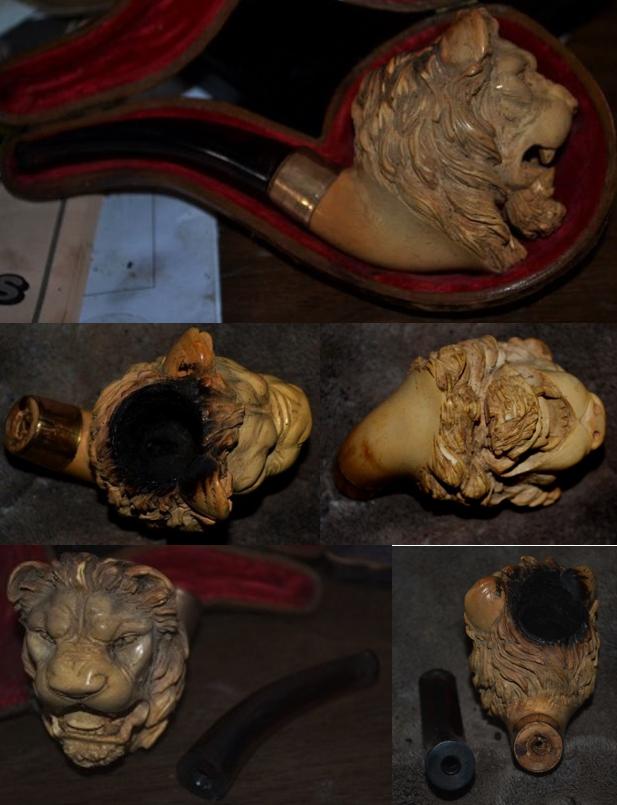
1. The rim char was transformed by the power of time – which may heal all wounds but is more apt to cause them, and thus allow us to grow – from the more or less expected norm of bad to full crystallization around the top of the chamber.
2. The entire surface of the pipe was filthy, whether from improper handling or about a century in storage or both, but the deep, even gold of the patina indicated it had been well-loved and tended. Cleaning meerschaum should not be approached without caution as the first try can limit later options or, worse, show places where the pipe was handled with bare hands from the ghosts of ingrained skin oil and dirt, sometimes as permanent blotches..
3. The original bone tenon was broken, half jammed deep inside the draught hole and the other half in the amber stem. Removing it from both narrow, fragile holes would be problematic, to use a gross euphemism. Replacing it would be a challenge – but a pleasant one, I imagined in my determination to honor my personal pledge to restore this great pipe to its original glory.
4. The shank looked as if it would need to be re-threaded. Wonderful.
5. I have also never worked with amber but knew enough to realize it is brittle stuff, in particular the 133-year-old (at the time I took possession of the pipe) variety. There would be no thought of subjecting this precious bit to the perils of an electric buffer or even sandpaper.

That’s it. Nothing serious, just a mine field. But after long, intense consideration, I concluded the integrity of the wonderful patina must be preserved at all costs and opted for a traditional basic cleaning rather than one of the experimental processes of which I had read. That was in 2014.

Recalling the one dragon Harry Potter had to face in his quest to survive the Goblet of Fire competition, I decided to be done with one of several I saw swooping my way. I began the slow extraction of the original bone tenon broken off and entrenched by time in the stem and shank. .In this kinder, gentler age of Vulcanite/Ebonite/Lucite/ Delrin tenon removal, by and large, the material being non-organic makes it less vulnerable to easy damage. My situation presented a triad of evils with the bone tenon packed into meerschaum and amber.

In most cases, not to postpone a fight but to confront the problems in a more systematic order, I would have started elsewhere. This time I went straight for the mother dragon protecting its young. The bone tenon screw piece in the stem is difficult to see, but trust me, it’s there in the first pic. Against the odds, it was easier to extract, or I was just lucky, but it popped out in one piece. In contrast, the shank took a couple of hours of on-edge, sweaty browed finagling with alternating and bizarre tools such as a jeweler’s screwdriver, the extended end of a large paper clip and the shank reamer of a three-piece pipe tool, to name a few. Breaking away a layer at a time, eight pieces later I reached the end of the blockage. The photo of the pieces is worthless. Confronted with the need for careful removal of the char and crystallization spreading from the upper chamber onto the lion’s mane and left ear, I admit I’ve never read of super fine “0000” steel wool being appropriate for meerschaum or even wood pipes, but I’ve found that when milder approaches don’t remove all of the char (which they almost never do), in almost all cases the steel wool does the job without damage.  What’s more, it even leaves a nice polish on the regular meerschaum rims that have some real width to them, which the CPF’s does not.  Some readers have told me they like the steel wool approach also. For the chamber I started with 200-grit paper and finished with 320, which also is discouraged unless great care is taken as I did, and then gave the outside of the stummel a vigorous but only preliminary cleaning with small cotton pads soaked with purified water. For all of the dirt apparent on the cotton pads, note how much was still left.
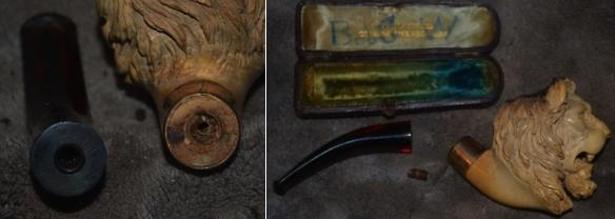
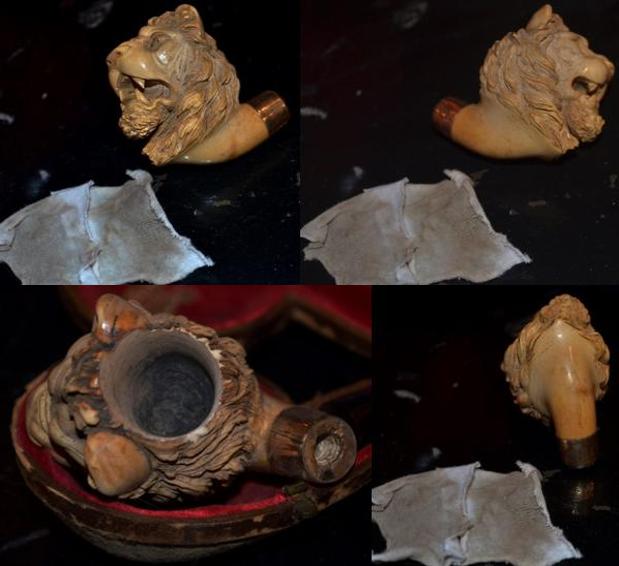
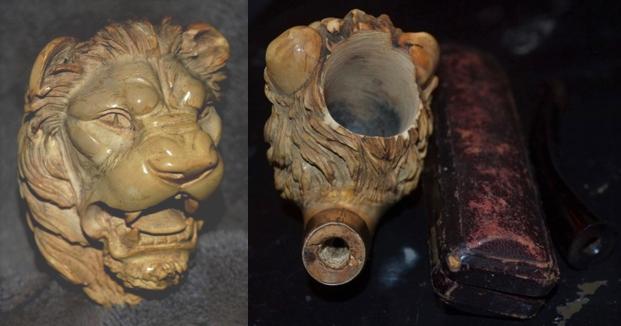
I waited – another year and a half.  During that time I continued the grueling online search for bone tenons with the idea of finishing the work myself and asked friends at my local pipe club and internet sites for pipe enthusiasts for help, to no avail.  The intensified hunt was infused with a sense that the time was fast approaching the now or never point, and even found a site that seemed to have every size available.  However, after going back and forth with the owner several times and never hearing from him again, I began to despair.  That was in 2016.

Then, almost exactly one year ago, at the end of February last year, I thought, what the heck, why not try again?  So I posted an identical thread on Smokers Forums UK, but in a different category.  The first response included a link to Norwoods Pipe Repair in Clifton, Tennessee.  Not wanting to get my hopes up, I checked it out and found that the father and son team of Floyd and Kenneth Norwood seemed to have all the right stuff for my lion’s head pipe and a second, antique briar that needed a still rarer stem that had to be replaced with the bone tenon.  All about that in part 3.

I had to wait until early in April, after employing the skilled services of Kenneth Norwood in March to repair the briar pipe first because it belonged to a customer who wanted it back for good reason, to send the CPF via USPS Priority 2-Day delivery.  I can tell you, the Separation Anxiety I experienced was acute, not having been away from the pipe or failed to look in on it at least once a day for the previous five years and being fully aware of the ability of the Postal Service to lose packages or deliver them to the wrong person who then keeps them.  I paid to insure the package for $500, which could never replace the irrecoverable, and waited.

From the almost immediate turn-around time I had with the briar pipe, but fearing that may have been a fluke, I knew it would not be too long but was nevertheless surprised when it arrived again at my door less than a week after I mailed it.

I took a picture showing the masterful work completed by Kenneth, who had done better than re-thread the shank, but what with the wonders of the new and improved Windows 10 that have required so many full system restores of my computers that I’ve lost count, that photo and who knows how many others have gone missing.  I’m sure they’re floating around somewhere because we all know Microsoft never lets us really and truly delete anything, but heaven knows where it is.

By the way, Kenneth mentioned that he would need the stem to be straight for his work aligning it to the new tenon, and so I put the amber stem with a pipe cleaner through the air hole on a small sheet of aluminum foil in the over pre-heated to 150° F. About 15 minutes later, I removed the sheet and stem.  Amber is the easiest material to bend or straighten, I suppose because of its resinous nature that makes it heat quickly to the point where it is so malleable it will literally bend in half from its own weight if picked up by one end when removed from the oven.

Knowing this from an experiment I did almost a year and a half ago, I took hold of both ends of the cleaner and still saw the middle sag a little as I rushed the stem that straightened in the oven on its own to the tap to fix with cold water.  I can’t emphasize enough the importance of speed in this process.  If you’re bending the amber, it tends to straighten out again fast, and if you’re straightening the stem, it’s easy to bend it even by a tiny degree before fixing.

With that said, the next shots  start with the pipe as it was returned to me, with the stem still straight before re-bending, and after thinking to use a toothbrush and purified water to scrub every intricate detail of the amazingly realistic lion’s head.  This was quite a job, as the hand-carved details I noted are minute and almost as breathtaking as a real life, face-to-face encounter with the real thing: the ears alert and mane flowing backward, glaring eyes almost hidden beneath big brows, huge nose with fur and whiskers on either side, and that mouth with a hungry tongue and sharp teeth!  And that’s just the face.  The lion’s mouth is wide open, by the way, as if roaring or growling, and at times I had the idea it didn’t really care for my attentions – at least not until the task was done.  I have a bit of an imagination, you see, and another result was a flash to the story of Androcles pulling the thorn from the lion’s paw.Here are two shots of the work Kenneth did.And the rest.Now, the original real, cherry red amber stem was in remarkable condition for one that was used for a couple of years with loving attention, but the fact that it is well more than a century old makes its physical integrity achieve the level of astounding.  There were no dings or pits, and the scratches, if they could be called that, were so minor some people might have let them be.

I’m a far cry from perfect and always will be, but I’m not some people.  Here it is from every angle before I did anything to freshen it up.

I gave it a wet micro mesh from 1500-12000.And I did a dry micro mesh the same way.Thinking a little more about it, I was still bent, as it were, on not putting the wonderful piece of expertly carved, polished, polymerized and  fossilized prehistoric pine tree resin – an organic material neither gem nor stone – anywhere near an electric buffer. After all, accidents can happen.  For such a catastrophe to occur to a piece of amber, even brand new, would be the end of it.  Amber’s biggest problems are its extreme softness, a 2 on the Moh’s Scale of 1-10, just a full step above talc, and its natural brittleness that begins to worsen the instant it is exposed to sunlight.  In other words, the exceptional suppleness of this antique stem makes it museum quality.  Whoever owned it kept it in a nice, safe place away from natural light, and when he died it must have stayed in its case in an attic or some other dark place.
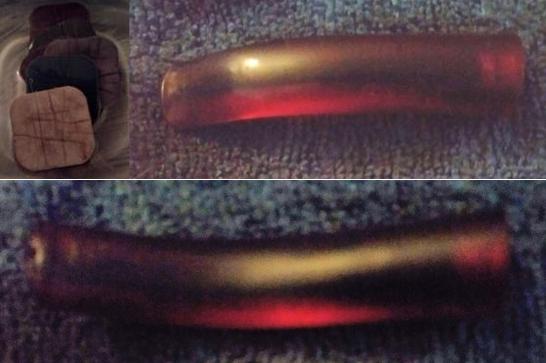
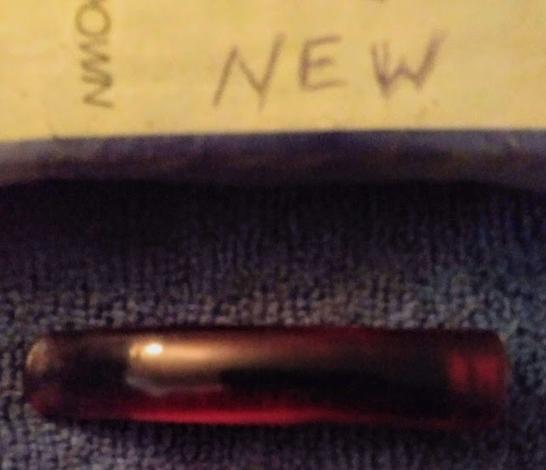
At any rate, thinking on the idea of how to give it a little polish without the wheel, the obvious occurred to me.  I took out my little jar of Decatur’s Pipe Shield that I decided to give a try as opposed to the standard Halcyon II Wax, both of which are generally reserved for hand application to rusticated or sandblasted wooden stummels before rubbing into the wood with a soft rag.  As far as I know, it couldn’t hurt, and in fact gave the unique stem a higher sheen that at least I see in the final shots.

Finished with all of the visible cleaning, I remembered the pipe still needed sanitizing, meaning the shank, but a retort was impossible for reasons that should be obvious, yet every now and then we hear of some poor fellow – because any woman who might practice pipe cleaning or restoration would never make such a mistake – boiling alcohol through the insides of a meerschaum or even using the cold alcohol/kosher salt method and ending up heartbroken from the ruinous results.

On the other hand, a little alcohol mixed with water can go far to clean and sanitize a meerschaum shank.  Fred Bass, one of the leading meerschaum collectors and authorities, writes in an essay cited below that his traditional inside-out cleaning method for meerschaums includes careful application of straight alcohol to the dirty outer areas of the pipe  with a cotton pad or cloth  – and he suggests Everclear, which as most folks know is almost as strong as it gets at 95% grain alcohol, or 190-proof.  Residual alcohol should be tamped dry.   For the shank, he recommends a pipe cleaner or more if necessary dipped in Everclear followed by a dry cleaner.

Well, I’m sure that works since Fred (we don’t know each other, but I don’t think he’d mind the familiarity) has been restoring meerschaums for quite a while now.  But I just did not have the heart or nerve or courage or whatever you want to call it to make my first such try on my beloved CPF.  Also, I think Fred would agree that building up to the Everclear cleaning approach is always a good idea, and my initial cotton pads followed by a toothbrush, both with purified water, got all of the dirt off this beauty.  My compromise for the chamber sanitizing was to add a cap-full of Everclear to about a quarter-cup of water.

Here is the finished pipe, hand-buffed with a special heavy micro-fiber cloth. CONCLUSION
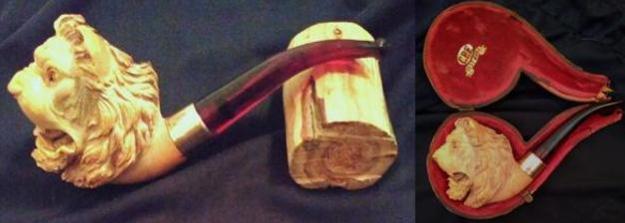
With the longest restoration job I’ve ever performed complete, I was almost said – with an emphasis on almost.  The relief and satisfaction with a job well done, if I say so myself and even though I did not do the shank work myself, were more than enough to compensate for any post-project blues.  That turns out to be the perfect word to segue to my final comments.

For anyone who noticed the damage to the CPF’s leather-covered wood case between the first and last picture in this blog, I can, with complete honesty and justification, blame it on the dog, Blu.  I kid you not.

She has admirable spirit, but a little too much of a good thing.  The problem with the pipe is that Blu will snatch, run outside and devour anything left out and unattended if it smells tasty or even different – cooked or raw food, ice cream, soda cans or bottles, coffee mugs, Vaseline, OTC meds in their bottles and, as I found out the hard way one morning, a mysterious little object that simply looked too good to pass up.

My heart stopped when I returned to the living from my bedroom and noticed the tan case that had been in the center of the coffee table missing.  I knew who stole it without a moment’s thought and almost saw red as vivid images and plans of canicide filled my mind.  You see, the CPF Best Make turned lion’s head meerschaum with a gold band and cherry red amber stem c. 1881 was in the box.

Had I not found the mauled case in the back yard dirt patch where Blu so loves to play and eat her ill-gotten food stuff, and the CPF miraculously safe and intact inside it, I can’t say what I would have done to the dog.  Sweetness only goes so far.  A man’s pipes are not to be messed with.

I’m sure everyone can appreciate my immediate overwhelming relief and forgiveness of Blu despite her terrible lapse in judgment.

PREVIEW
Part 3 of this series will describe the two years it took me to return an antique KB&B Blueline Bakelite billiard c. 1911 entrusted to me for a quick cleaning and restoration, and the unfortunate reasons for the…er, delay.

Part 4, taking a lesson from this restore, will go a touch further with my full restoration of an old First Quality meerschaum billiard with a wrecked inner shank, and the replacement of its tenon and stem.

 SOURCES

http://pipephil.eu/logos/en/logo-c1.html

https://pipedia.org/wiki/Colossus_Pipe_Factory

https://www.invaluable.com/auction-lot/colossus-pipe-factory-african-calabash-sterling-109-c-13648cbbb7

https://rebornpipes.com/2013/04/14/some-reflection-on-the-historical-background-on-cpf-pipes/

https://www.onthisday.com/events/date/1881

https://norwoodspiperepair.com/index.html

https://rebornpipes.com/2017/09/14/on-bending-and-straightening-amber-stone-stems/


Restemming and Rebirthing a Landry 2013 Bent Ball


Blog by Steve Laug

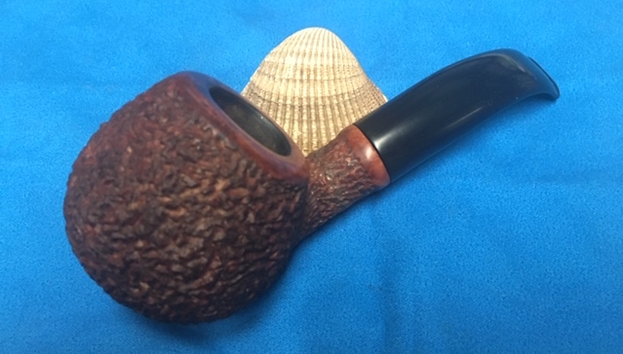
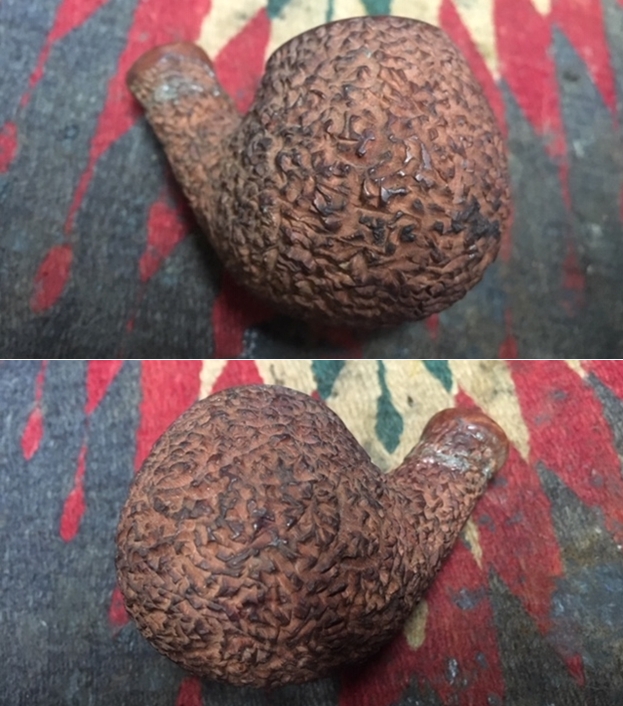
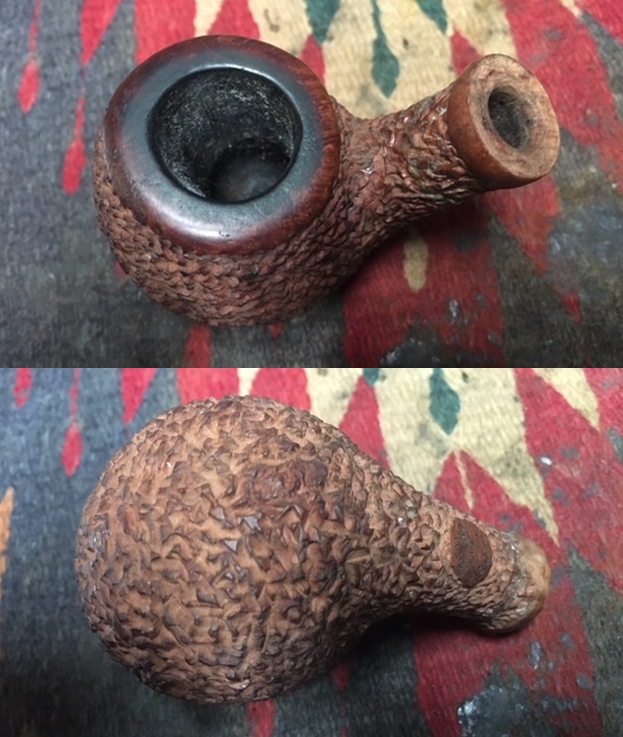
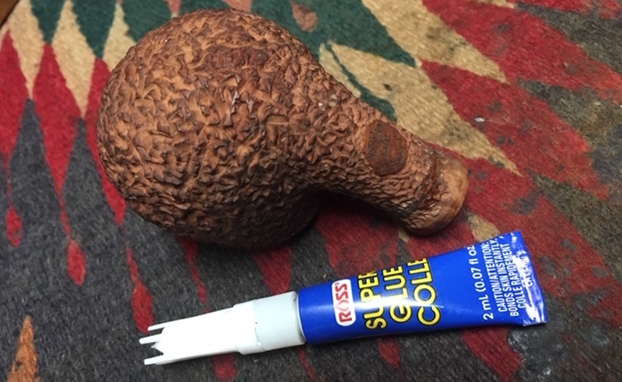
Last evening I had a fellow drop by the house with three pipes for repair. Two of them were not worth repairing – broken shanks and Chinese knockoff pipes. Neither was made of briar and one had the beginning of a large burn out on the back of the bowl. I discouraged the fellow from fixing either of those two as the cost of repair would be more than he paid when he purchased them. However the third one was interesting to me. It was a bent ball bowl without a stem. It was a real mess. He had broken the stem in half and lost it. The shank had also been broken but he was a bit of a wood worker and had clamped and glued it. He had done a decent job and the repair was solid. The bowl had a cake that was thick and soft – made from the heavily case aromatic that he smoked. The airway in the shank was clogged with tars and oils and I could not even blow through it. The rusticated finish was rugged and sharp with a smooth rim and shank band. The bowl and rim were very dirty and the briar looked lifeless. The shank flared at the stem/shank junction.

When I examined the pipe while he was there I found that it had a makers stamp on an oval smooth patch on the underside of the shank. It was clearly stamped LANDRY arched at the top of the oval. The year it was made, 2013 was in the middle of the oval and the letters U.I.O.G.D were arched at the bottom of the oval. When I asked the owner of the pipe what those letters were he said that I was some Latin phrase. When I examined it with a loupe I found that there were periods between the letters and that probably I was dealing with an acronym of some kind. I went with his notion of it being Latin, Googled the acronym and found that it stood for the five words making up the Benedictine motto: Ut In Omnibus Glorificetur Dei (translated from Latin it means: So that in all things God may be glorified). That made sense as he had been given the pipe by a Benedictine Priest a while ago when he had first started smoking a pipe and he had broken it after smoking it quite heavily.

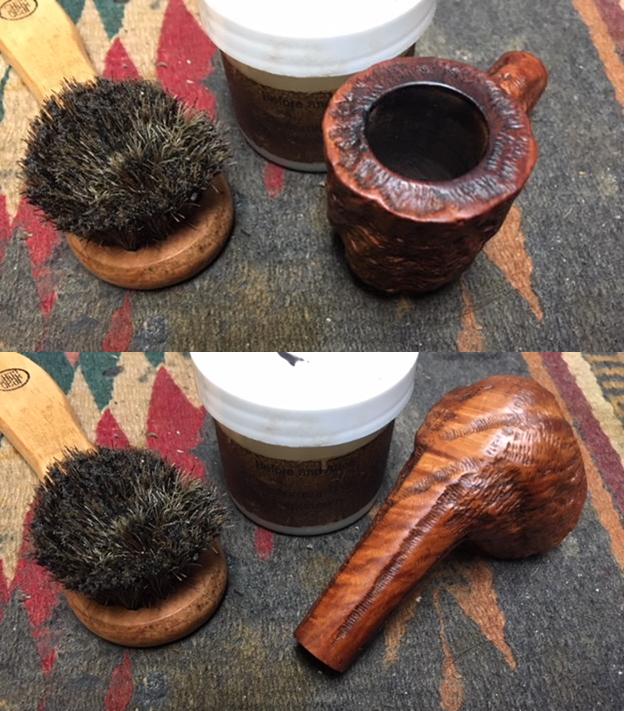
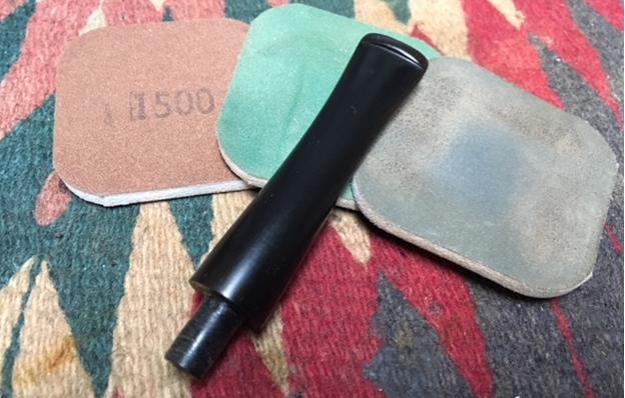
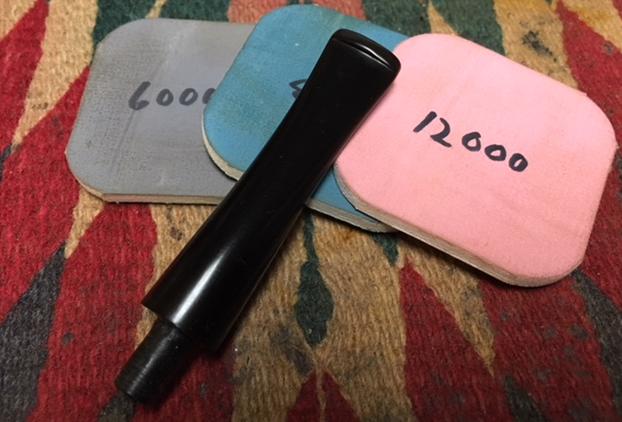
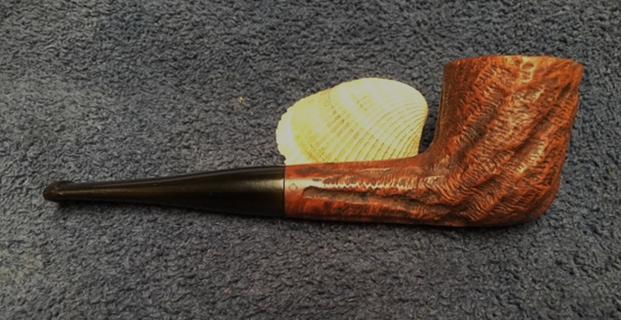
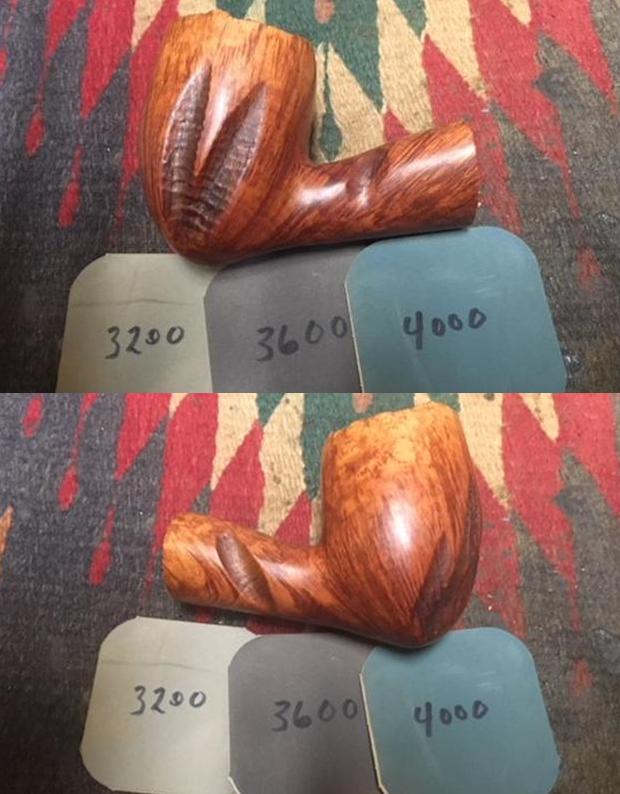
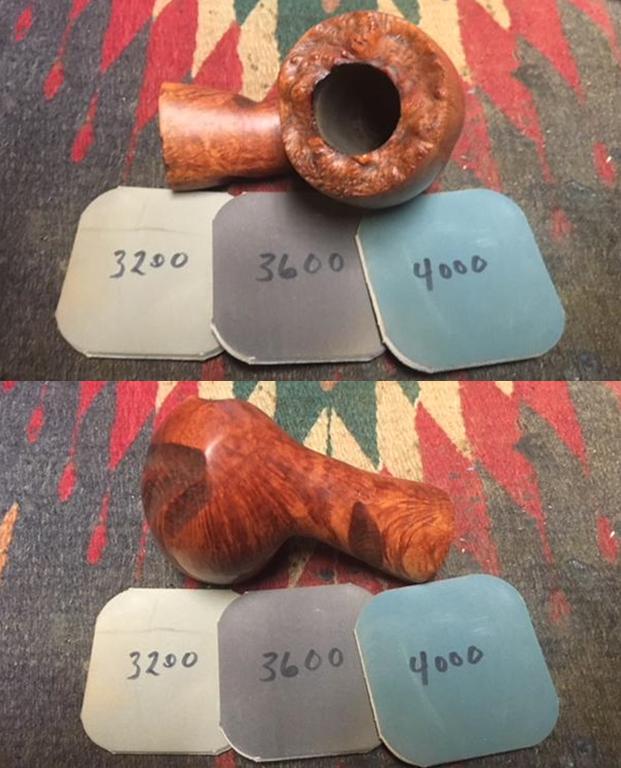
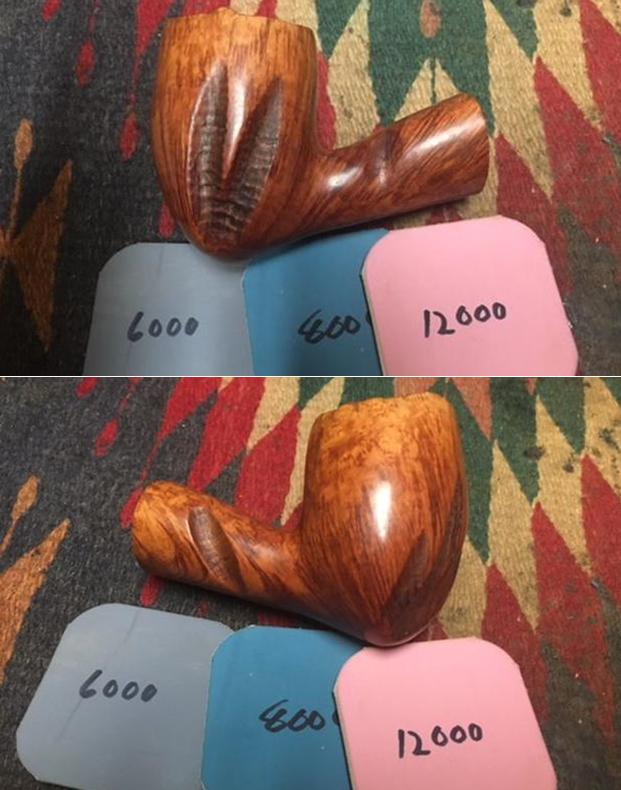
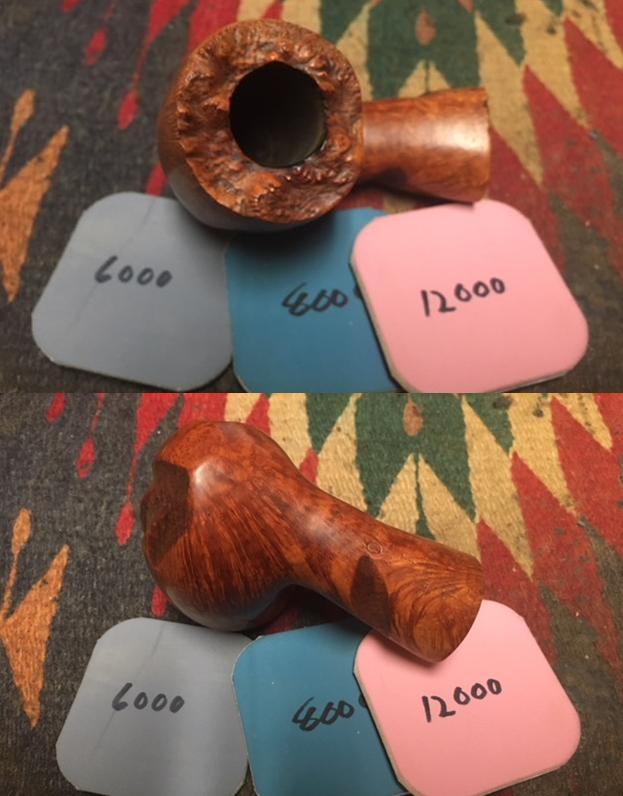
I took photos of the bowl before I started to work on it. You can see the repair on the shank. The rustication is very dirty and the rim top is coated with an overflow of lava from the bowl. The entire pipe reeked of a sweet cherry aromatic. The shank was heavily gummed up and I could not blow air through the shank into the bowl. It was clogged. The bowl also appeared to be drilled at an angle and from a quick glance seemed to be drilled crooked. The pipe was a mess! I took a photo of the oval and the stamping on the shank. You can also see the glue repair on the shank. It was a solid repair but a bit sloppy.There were some gaps in the glue around the circumference of the shank so I used a wire brush to clean up excess glue from the repair. I wanted to remove all of the excess glue so that it would look cleaner once I finished. I then filled in the gaps in the repair with clear super glue and filled in those areas with briar dust to build up the area ahead of the smooth band at the shank end.Restemming this old bowl would be a bit tricky. The shank actually flared to a smooth hip at the end where the stem sat. It was wider in diameter than the rusticated shank just below it. It was obvious from the way the shank end and mortise were made that it required a flush fit stem and not a freehand style stem. I would need to find a stem that had a wide enough diameter for me to work with and give the pipe the kind of look that it must have had originally. I went through my can of old stems and found one that was going to work. The tenon was almost perfect. I sanded it lightly with the sanding drum on the Dremel and cleaned it up with a file and the fit was just right. I would need to reduce the diameter of the stem slightly to match the shank but I think it was going to work for me. I took photos of the fit of the “new” stem to show you what I saw. Bear with me for the moment. It was quite ugly and my brother said it looked like a muffin top of a tight belt (or something like that). But I thought it had potential… time will tell. I trimmed the excess diameter of the stem with a sanding drum on my Dremel. I worked on it until the diameter was very close to the right size. I brought it back to the work table and sanded it smooth with a folded piece of 220 grit sandpaper to remove the scratches from the Dremel. I took photos of the stem and shank at this point. I wiped down the stem with Obsidian Oil to clean off the dust and get a sense of how it was looking. I sanded the band around the shank a bit too as it had some glue on it from the repair that had been done. I took photos of the pipe at this point in the process. I decided it was time to set the stem aside for a bit and work on the bowl. I took a photo of the bowl and rim to show what it looked like when I started. The bowl is thickly caked and there was damage to the inner edge of the rim. The lava overflow was quite thick on the rim top as well. I reamed the bowl with a PipNet pipe reamer. You can see the angle of the bowl from the way that the reamer is sitting in the second photo below. I cleaned up the reaming with a Savinelli Fitsall pipe knife and then sanded the walls of the bowl with sandpaper wrapped around a piece of dowel. With the bowl reamed I turned my attention to the dirty exterior of the bowl. I scrubbed it with a tooth brush and undiluted Murphy’s Oil Soap. I worked over the rim top with the tooth brush and a piece of sandpaper to remove the tars and lava there. I rinsed it off with running water to remove the soap and debris in the finish. Now it was time to address the thick tars and oils in the shank and open the airway into the bowl. I worked on the mortise and the airway in the shank with a paper clip, pipe cleaners, cotton swabs and alcohol. Once I had opened the airway I scrubbed it until it was clean. I also cleaned out the airway in the new stem with alcohol and pipe cleaners. It was not nearly as dirty as the shank.I polished the rim top and the smooth shank end with micromesh sanding pads – wet sanding with 1500-2400 grit pads and dry sanding with 3200-12000 grit pads. I wiped the polished areas with a damp cloth after each sanding pad. The rim and shank end began to really look good. I decided to stain the bowl and shank with some Medium Walnut Danish Oil. It has the translucence I wanted to let the natural colour of the briar shine through while allowing me to hide the repairs to the shank. I applied the stain with a cotton pad and daubed it deep into the grooves of the rustication. I kept applying it until the coverage was good. I waxed the bowl with several coats of  Conservator’s Wax and buffed it out with a horsehair shoe brush. The bowl and rim looked really good. I really liked the look of the bowl at this point in the process. The shine and the finish looked very good. I set the bowl aside and turned my attention to the new stem. I sanded it with 220 grit sandpaper to remove the oxidation and the scratch marks from fitting the stem. I wiped the stem down with Obsidian Oil to remove the sanding dust and get a feel for the scratching. I polished the stem with Denicare Mouthpiece Polish. I applied it with my finger and rubbed it in and then off with a cotton pad. I find that it is gritty enough to remove the residual oxidation after sanding (besides I have about three tins of the stuff to get through so I use it on each pipe).I polished the stem with micromesh sanding pads – wet sanding with 1500-2400 grit pads and dry sanding with 3200-12000 grit pads. I wiped the stem down with Obsidian Oil after each sanding pad. I finished polishing the stem with Before & After Pipe Polish – Fine and Extra Fine. I gave it a final coat of Obsidian Oil and set it aside to dry. I bent the stem with a heat gun to get it to follow the lines of the top of the bowl so that it can hang in the mouth with the bowl top straight. I polished the stem with Blue Diamond on the buffing wheel and gave it multiple coats of carnauba wax. I put it back on the shank and buffed the entire pipe with a clean buffing pad to raise the shine on the bowl. The heavy rustication works well with the stain I chose to use on it and the combination looks really good with the polished vulcanite stem. The flared shank end and the thick stem work well together to my mind to create an interesting pipe. The finished pipe is shown in the photos below. Its dimensions are – Length: 6 inches, Height: 2 inches, Outer diameter of the bowl: 1 ½ inches, Chamber diameter: 7/8 of an inch. I will give it another coat of Conservator’s Wax and then call the fellow who dropped it off for repair. I am hoping he likes the look of his pipe. Thanks for reading this blog.

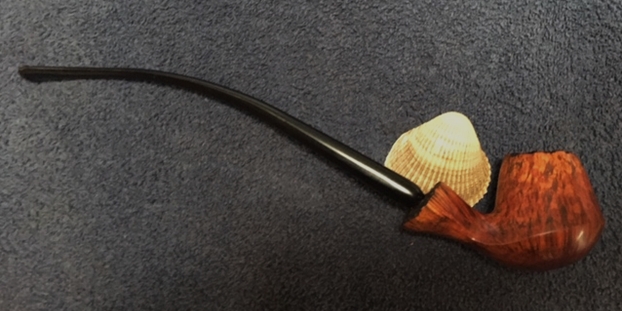
Converting a Zettervig Freehand into a Churchwarden


Blog by Steve Laug

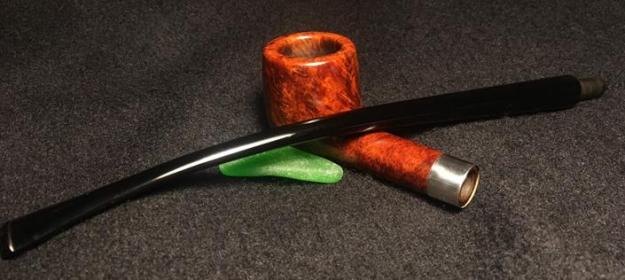
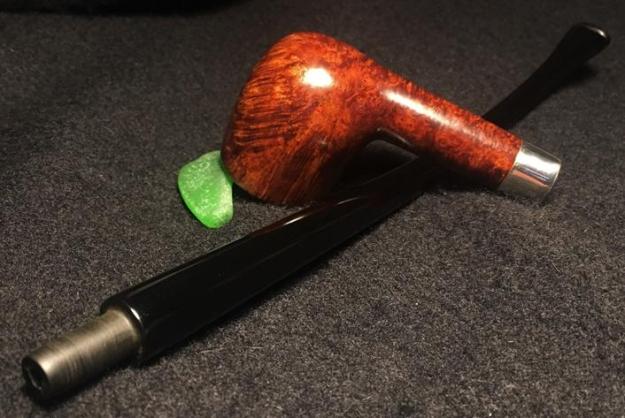
Sometime pipes come back to you. I had restored and restemmed this pipe for a fellow here in Vancouver not too long ago and made a freehand stem for it. I had also worked on converting a broken shanked Brigham into a churchwarden. The other night he dropped by and we sat and chatted for a bit. He pulled four pipes out of his bag for me to look at. One was a new find from a junk store. The other three were pipes that I had already done for him. The first two were churchwardens and he decided that they just were not for him. He also took the freehand stem out of the Zettervig and put it in the Brigham and said that he had been smoking it that way and really liked it a lot. We talked about options – restemming all three, using the stem from the Zettervig on the Brigham, restemming the churchwardens with shorter stems or just selling the pipes. The one churchwarden would be just a cleanup. The other was a little more involved. It meant fitting the existing churchwarden stem on the Zettervig pipe and seeing if that would move it. We chose the last option selling the two pipes as churchwardens to someone who really wanted them.

Here are some pictures of the Zettervig as it was when I sent it home with him. I thought they would give us a base for the change. The pictures give a clear picture of the beauty of the pipe. The stamping on the pipe is on the underside of the shank and reads Zettervig over Copenhagen over Handmade. Under that it is stamped with the shape number 351 followed by Denmark. As a reminder I quote from the blog on the Zettervig to summarize the history of the brand for you all. Here is the link to the blog: https://rebornpipes.com/2018/07/28/restoring-and-restemming-a-zettervig-handmade-351-freehand/

In the 1960’s and into the early 1970’s Ole Zettervig had a shop in Copenhagen, Denmark where he was carving high quality pipes equal to Stanwell, Larsen, Anne Julie, Thurmann, Bang and others. These early pipes were marked “Copenhagen” and are very collectible. He sold his shop at some point in the 70’s and moved to Kolding and continued to produce pipes as a hobby, but the quality of briar and workmanship is said to not equal the early production. The later pipes he now marked as Kobenhaven rather than Copenhagen, and these were sold by Ole at flea markets throughout Europe.

http://www.pipephil.eu/logos/en/logo-z.html

I took the churchwarden stem from the Brigham and reworked it for the Zettervig. I needed to trim the tenon down slightly and reshape the shank end of the stem. I worked on it until the fit was perfect in the shank. I rounded the area above the tenon to fit into the angled plateau on the end of the shank. I used 220 grit sandpaper to shape the tenon and stem. Unfortunately I was on a roll and forgot to take pictures of that part of the process.

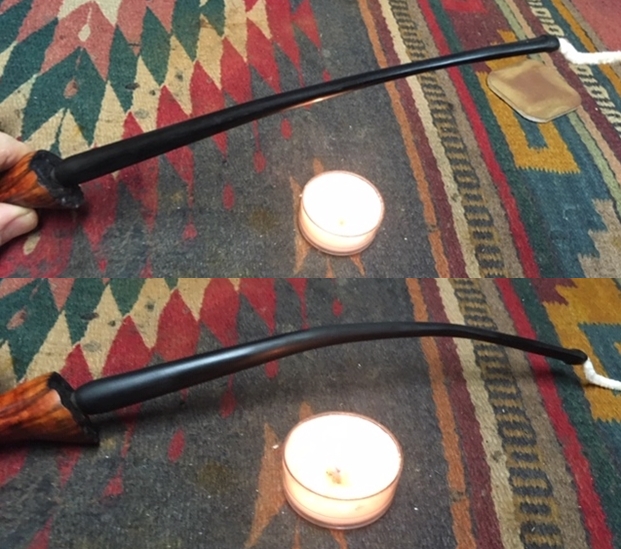
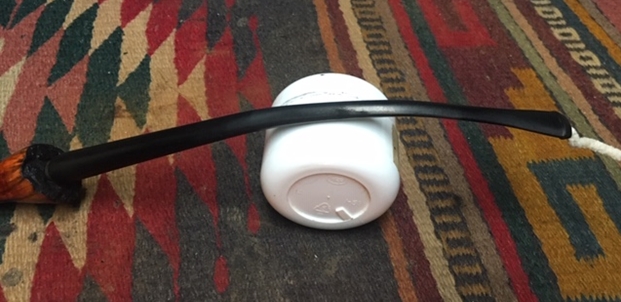
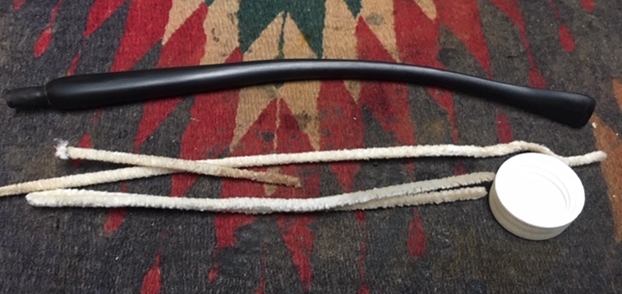
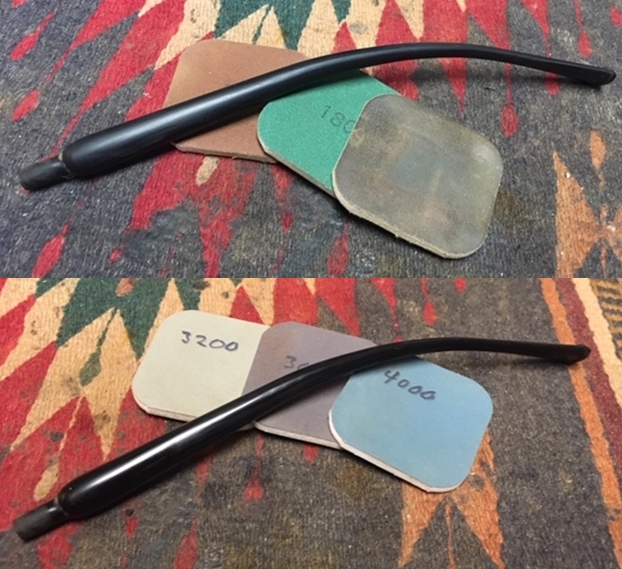
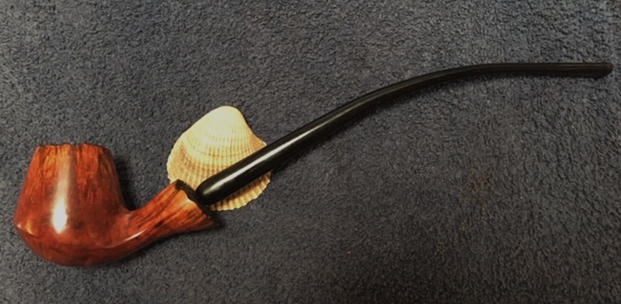
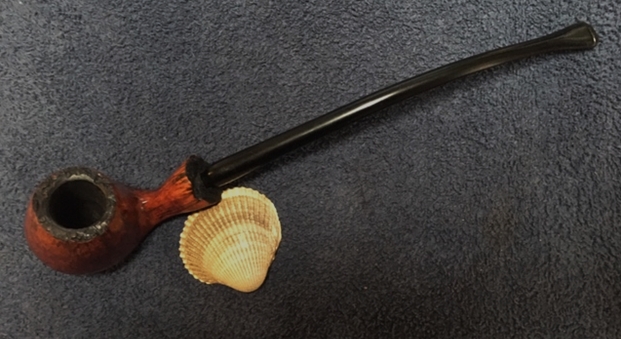
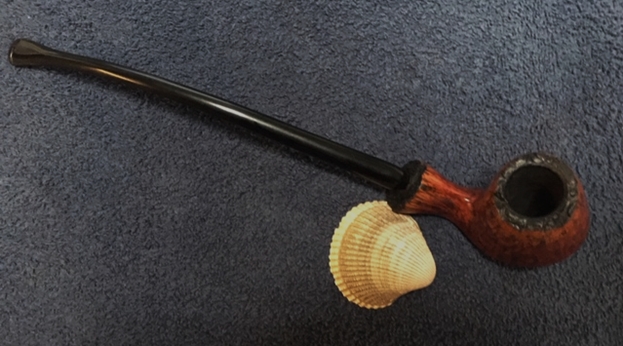
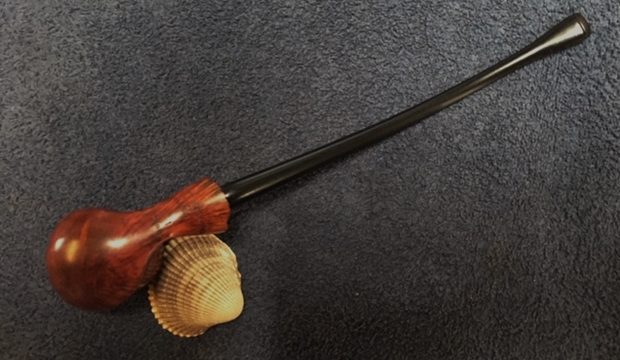
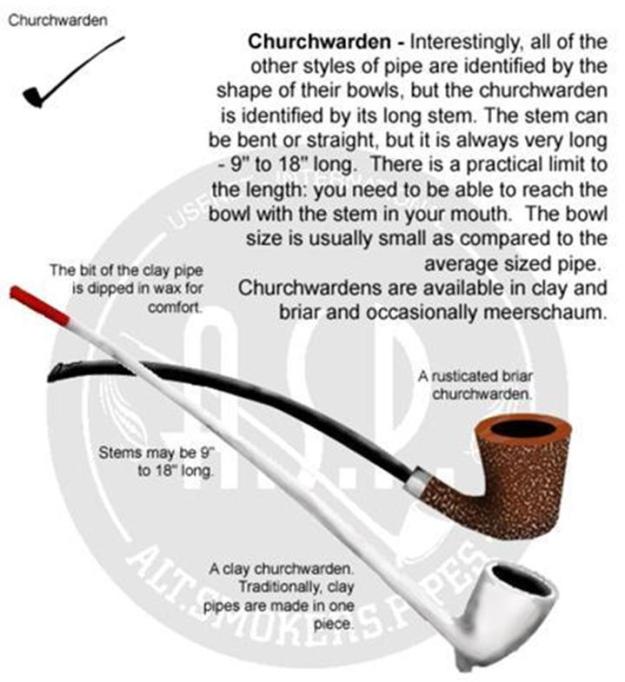
I lit a votive candle and used it to heat the stem. I inserted a long pipe cleaner in the stem and turned it over and over until the vulcanite was pliable. I checked the pliability repeatedly and when it was finally bendable I bent it over a round jar to give it an even bend that matched the flow of the bowl and shank. I held it in place until the bend was set. The stem was used by the Vancouver fellow so I needed to remove the light tooth chatter on the top and underside near the button and also clean it to remove the light tars. I cleaned the stem with alcohol and long pipe cleaners. Once the cleaners came out clean that part was finished.I polished the vulcanite with micromesh sanding pads – wet sanding with 1500-2400 grit pads and dry sanding with 3200-12000 grit pads. I wiped down the stem with Obsidian Oil after each pad to protect and polish it. I gave it a final polish with Before & After Pipe Stem Polish – both Fine and Extra Fine. I gave it a final coat of Obsidian Oil and set it aside to dry. The Zettervig bowl had been smoked more than the churchwarden stem from the Brigham. It was dirt in the shank and airway. It also had a light buildup of carbon in the bowl and it was dirty. The finish was also dull so that would need to be address. I cleaned out the shank and airway with pipe cleaners, cotton swabs and alcohol until they were clean. I cleaned out the carbon on the bowl walls with a Savinelli Fitsall Pipe Knife to smooth out the interior of the bowl. I rubbed down the smooth briar with Before & After Restoration Balm. I worked it into the smooth surface of the briar on the sides and the bottom of the bowl and shank with my fingertips. I worked it into the plateau on the rim top and shank end with my finger tips and worked it in with a horsehair shoe brush. I wanted to make sure that the balm got deep into the briar to do its work. The balm works to clean, enliven and protect the briar. I let it sit for a little while and then buffed with a cotton cloth to raise the shine. The following photos show the bowl at this point in the restoration process. The rim looks much better than when I started but still needs to be polished and buffed to raise a shine on it. I the buffed stem and the bowl with Blue Diamond on the buffing wheel to polish out the remaining small scratches and raise the shine. I carefully avoided the stamping on the underside of the shank. I gave both the bowl and the stem multiple coats of carnauba wax and buffed the pipe with a clean buffing pad to raise the shine. I hand buffed it with a microfiber cloth to deepen the shine. The pipe polished up pretty nicely. This turned out to be a beautiful pipe in terms of shape and finish. The combination of the Danish Zettervig bowl and the vulcanite churchwarden stem looks very good. The finished pipe is shown in the photos below. The dimensions are Length: 11 inches, Height: 2 inches, Outside diameter of the bowl: 1 3/8 inches, Chamber diameter: ¾ of an inch. Thanks for walking through the conversion of this bowl to a churchwarden with me.

Finishing the Restoration and Restemming a Custom-Bilt Billiard


Blog by Steve Laug

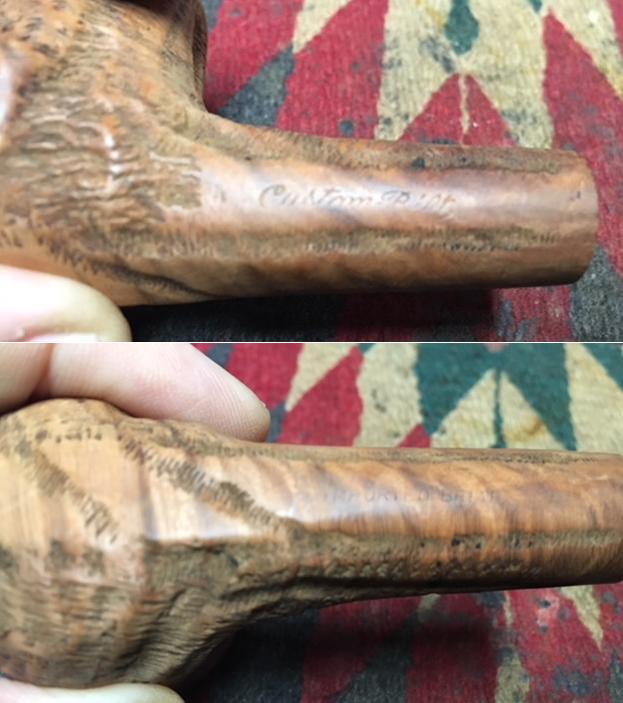
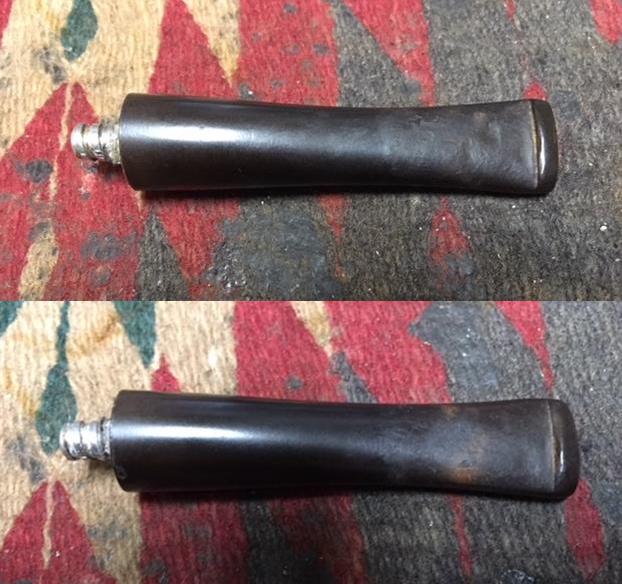
Not long ago I was speaking with Paresh and Abha on Facetime and they showed me a second pipe that they wanted me to finish for them. This one was a Custom-Bilt billiard that had come to him from the estate of his Grandfather. It had a threaded tenon stem and a shank that had no threads. I have never seen a Custom-Bilt with a threaded mortise and tenon so it was a fair assumption that the stem was not original. It had been wrapped with glue and tape to make it fit in the shank and the fit was awful. Paresh wanted me to fit a new stem on the pipe for him. Abha had done a magnificent job cleaning the pipe so it was really a simple restoration for me – just fit a stem and finish the bowl. The briar was clean and lifeless so it would need some attention to breathe life into it again. He wanted me to pick up where he had left off and finish the pipe for him. The pipe was stamped on the left side of the shank Custom-Bilt and on the underside it was stamped Imported Briar. It would be interesting to see what I could do with it. When the pipe arrived this is what it looked like. You can see the remnants of wrapping and glue on the metal threaded tenon. There were tooth marks in the surface of the vulcanite stem on both the top and underside near the button. The first photo below shows the rim top and the inside of the bowl. Both were very clean and the rustication was in great condition as were the inner and outer edges of the bowl. The second photo shows the end of the shank with the glue on the inside of the mortise and the lack of threads that would be present if the tenon that was on the stem would work with this pipe.I took some photos of the stamping on the left and underside of the shank. The left side reads Custom-Bilt and the underside reads Imported Briar.I took close up photos of the stem. You can see the metal tenon on the end of the stem. There is some oxidation and there are the tooth marks on the stem top and underside.I wanted to refresh my memory on the history of the brand. I knew that his one was one of Tracy Mincer’s pipes because of the hyphenated name stamp. I looked on Pipedia and read Richard Esserman’s write up on Bill Unger’s Book. He gives a great summary of the history there. I quote a section of it below. (https://pipedia.org/wiki/Custom-Bilt(Rich Esserman))Tracy Mincer started the original Custom-Bilt pipes it appears in 1934. Bill meticulously details the start of the Company, how it was financed, the changes in the original ownership, how the company distributed its product, the manufacturing process, certain patented items, and other interesting stuff.

Mentioned briefly in this chapter was the fact that Custom-Bilt was producing big, carved pipes using Algerian briar for production up to WW II. One important employee, Hetzer Hartsock, stated: I can tell you something about that rough texture that Custom-Bilt had. One reason rough textured was used was not only for looks but it could hide flaws in the briar. [The process gave] A very uncontrolled cut. Then he [Tracy] would buff it out. [page 25]

Custom-Bilt pipes retailed between $5.00 and $15.00 in the 1940s. According to an ad, standard Dunhill pipes were selling for $12.00 and $13.50, Parker pipes $7.50, GBD for $6.00 and Comoy’s $7.50. Not mentioned was that special Dunhills could retail up to $100 and certain Comoy’s up to $25.

In 1946, the name was changed to Custombilt after Mincer began an association with Eugene J. Rich, Inc. There were some big changes in advertising and distribution. The slogan “AS INDIVIDUAL AS A THUMBPRINT” began at this time as well.

In the early 1950’s, Tracy Mincer developed severe financial problems that caused him to stop making the Custombilt, and he lost the name. In 1953, Leonard Rodgers bought the company and emphasized tobacco pouches and butane lighters. (However, it appears Mincer was working on his new pipe, the Doodler.) In 1968, Rodgers sold the Company to Consolidated Cigars. In the early 1970s, Wally Frank Co. bought the Custombilt trademark and began to produce their version of the pipe in 1974 or 1975. Hollco Rohr owned the Weber pipe factory, located in New Jersey, and produced the Custombilt pipes there. In 1987, the pipes were made out of the Butz-Choquin factory (France) and then Mexico until the late 1990s. Currently, the Custombilt name is owned by Tobacalera of Spain.

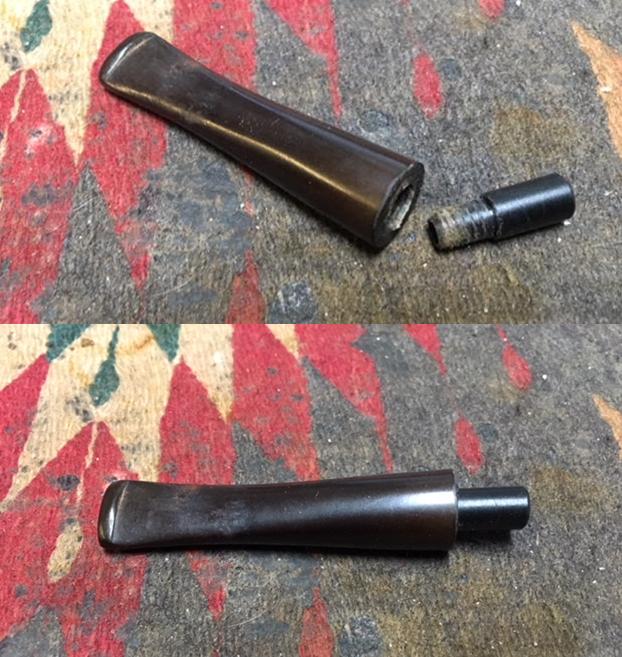
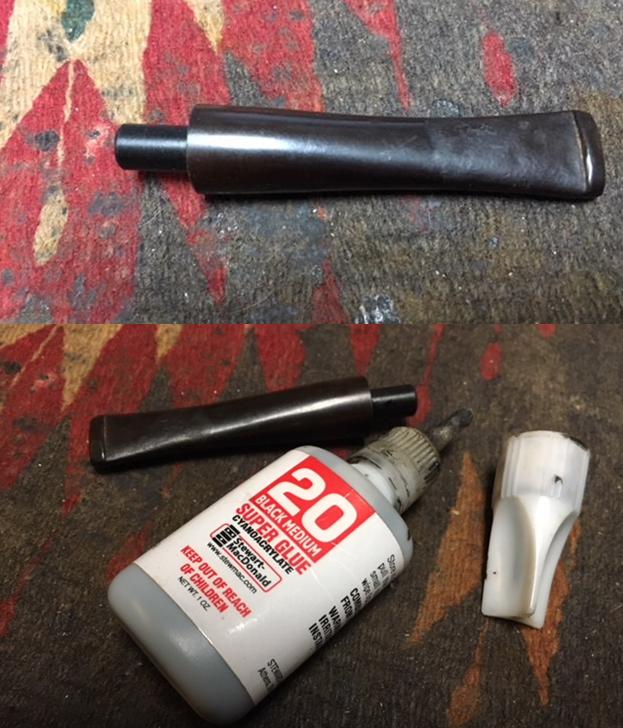
I set the bowl aside and decided to work on the stem. The diameter of the stem was perfect for the pipe so I needed to remove the metal threaded tenon and replace it with a Delrin tenon. I heated and scraped away all of the glue and tape on the threads of the tenon and those that bound it to the stem. I held it tight with vise grip pliers and turned the stem. It would not come out no matter how I turned or pulled on it. I decided I would have to use more drastic measures. Using the vise grip pliers as a vise I set up my cordless drill to drill out the tenon. I started with a bit slightly larger than the airway in the tenon and drilled it. I was hoping it would catch and pull the tenon out. First bit was a failure. I worked my way up to a bit slightly smaller than the diameter of the tenon and worked on it. The extended portion of the tenon broke off and I was left with the piece in the stem. I drilled it out with a bit and the bit grabbed the piece and it all came out.Once the metal was removed from the stem I cleaned out the hole in the stem with alcohol, cotton swabs and pipe cleaners to remove the debris. I smoothed out the threads to leave grooves in the tenon insert. Once I had it smoothed out enough I tried it in the stem. The fit was perfect. I cut deeper grooves in the tenon with a file and coated it with black super glue. I pressed it into the stem and lined it up so the fit was straight.  I set it aside to let the glue cure. While the glue cured I worked on the bowl. I scraped the glue out of the inside of the mortise using a pen knife. The glue had hardened so it took repeated scraping to get rid of it and bring the mortise back to bare wood.When the glue cured I tried the fit of the stem in the mortise. The stem fit well on the shank. I put it in place on the shank and took photos of the pipe at this point in the process. I rubbed down the briar with Before & After Restoration Balm. I worked it into the smooth surface of the briar with my fingertips and into the rustication patterns with a horsehair shoe brush to clean, enliven and protect it. I let the balm sit for a little while and then buffed the bowl with a cotton cloth to raise the shine. The following photos show the bowl at this point in the restoration process. The grain is really starting to stand out. I polished the stem with micromesh sanding pads – wet sanding with 1500-2400 grit pads and dry sanding with 3200-12000 grit pads. I wiped the stem down after each pad with Obsidian Oil to remove the sanding dust on the vulcanite. I wiped it down with a final coat of Obsidian Oil and set it aside to dry. I polished stem and bowl with Blue Diamond to polish out the remaining small scratches. I gave the bowl and the stem multiple coats of carnauba wax. I buffed the pipe with a clean buffing pad to raise the shine. I hand buffed it with a microfiber cloth to deepen the shine. The pipe polished up pretty nicely. The natural oil finish works well when polished to really highlight the variety of grains around the bowl and shank. The polished black vulcanite stem works together with the beautiful grain and worm trail rustication in the briar to give the pipe a rich look. The finished pipe is shown in the photos below. The shape, finish and flow of the pipe and stem are very well done. The dimensions are Length: 5 3/4 inches, Height: 1 3/4 inches, Outside diameter of the bowl: 1 1/2 inches, Chamber diameter: 3/4 inches. I will be sending the pipe back with the others that belong to Paresh. I have one pipe left to finish for him. Thanks for walking through the restoration with me as I worked over this well-made Tracy Mincer Custom-Bilt. 

Ben Wade’s in the House, Part 1


Blog by Joe Gibson

Not Ben Wade the U.S. politician or Ben Wade the baseball player and scout, but Ben Wade pipes. Specifically, a Ben Wade Martinique and a Ben Wade Royal Grain produced by Preben Holm in Denmark.

I first saw the Martinique and the bowl for the Royal Grain at Penny’s Little Flea Market just outside of Marion, MS two weeks ago. They were tempting targets, but I passed on them for a Preben Holm Delight. I kept thinking about the Ben Wades. Finally, the wife told me to call and see if I could buy them. They arrived two days later.

Pre-cleaning Preparation

Honestly, my first thought was, “What did I get into here?” The bowls were covered in dirt and grime.

Before Cleaning. (left) Royal Grain, (right) Martinique

The bowls had scratches and I couldn’t tell how deep they were. The good news? No heavy cake and funky, sour smells. Still, I decided that best course was a 24-hour soak in isopropyl alcohol.

The Perspex stem on the Martinique had very minor tooth chatter near the bit and was dirty. It was also stuck and took a few minutes to loosen enough to pull out. Since I planned on doing an alcohol bath, I dipped the pipe and stem in the alcohol for a few minutes and allowed me to separate the two.

The Royal Grain had its own issue which I didn’t remember seeing. The mortise still had the broken tenon of a vulcanite stem still stuck in it. I resolved this issue by twisting a drill bit into the airway BY HAND. The bit dug just enough into the vulcanite that I was able to pull the tenon out. My guess is the pipe was dropped and the stem broke off because the tenon really came out easy. Finding a new stem would be a later problem.

Both pipes have some of the plateau around the rim. The Royal Grain looked like more worn down of the two, almost like the previous owner hammered the rim on his ashtray.

As I decided earlier, I dropped both pipes into containers of isopropyl alcohol and left them alone for 24 hours.

Bowl and Airway Cleaning

After the soak, I cleaned the airway and draught hole first.  My reasoning behind working on the airway, draught hole and bowl first is simple. The cake and any residue is still saturated and soft. I think this makes any reaming I have to do easier.

Using bristle pipe cleaner dipped in the same alcohol, made relatively quick work of removing cake and residue from the airway. It also opened up the draught hole. Ten pipe cleaners later and I was satisfied with the cleanliness of the airway.

Tip #1:  I use bristle pipe cleaners for deep cleaning. Be careful on Perspex or acrylic stems as the bristles can cause some scratching in the stem airway.

After sanding with 300 and 600 Grit SandpaperFor the bowl I started with my homemade pipe knife. The biggest mistake some beginning home restorers/pipe smokers make is using a pocket knife to ream the bowl. You risk damaging the briar by using a sharp knife.  In my case, I made a pipe knife from a small folding pocket knife with about a 2-inch blade. Using my bench grinder, I rounded off the point and ground down the edge until it was almost as flat as the spine. It won’t cut paper or butter.

I should point out that I don’t ream down to bare wood but ream until the cake is thin and even all the way around. I generally finish the bowl work with 320 grit sandpaper wrapped around my index finger. This smooths out the cake even more and removes even more of the cake without damage to the briar.

Pipe Surface and Finish

One of the reasons I decided on the alcohol bath was what looked like white paint specks on the Martinique. I was hoping the alcohol would dissolve the white specks. It didn’t.  After the pipes had air dried for a couple of hours, I started working over them with 320-grit dry sandpaper.

Tip #2: Protect the stamping on the briar with painter’s masking tape before starting the sanding process.

The Martinique (top) and the Royal Grain (bottom). The Royal Grain is coated with Butcher Block Conditioner

It took a little longer on the Martinique because of the white specks and the curved areas. After wiping off the sanding residue with an alcohol wipe, a second sanding of the Martinique removed all the specks and the surface scratches.  The Royal Grain, being a more smooth, flatter surface was easier to sand.

After the initial dry sanding, I started wet sanding with 600-grit sandpaper. Let me point out something here. I make the decision to wet or dry sand a pipe based on how I see the pipe at the time. Sometimes my first step is wet sanding, sometimes I don’t wet sand until I get into the finer grits of finishing sandpaper or micro-mesh pad. The theory behind the wet sanding is that it provides a smoother, glossier finish to the wood. Whether others will agree with me or not, it works for me.

By the time I worked my way up to the 12,000 grit micro-mesh pad, I had a semi-glossy appearance and both pipes felt as smooth as glass. Normally, this is where I apply caranuba wax and buff. I went one step further and applied Howard Butcher Block Conditioner to the Royal Grain. The condition contains a food grade mineral oil, beeswax and caranuba wax. Instructions were to apply with a soft cloth and let dry for 15 minutes before wiping off the excess. I used a cotton ball for the application and let it set for probably 20 minutes. I really like the color and the way the grain popped out. I resisted the temptation to do the same to the Martinique.

Next: Which Stem for Which Pipe?

© J. Gibson Creative Services. September 5, 2018


Crafting a New Stem for a Cortina Factory Denmark 22 Freehand Stack


Blog by Steve Laug

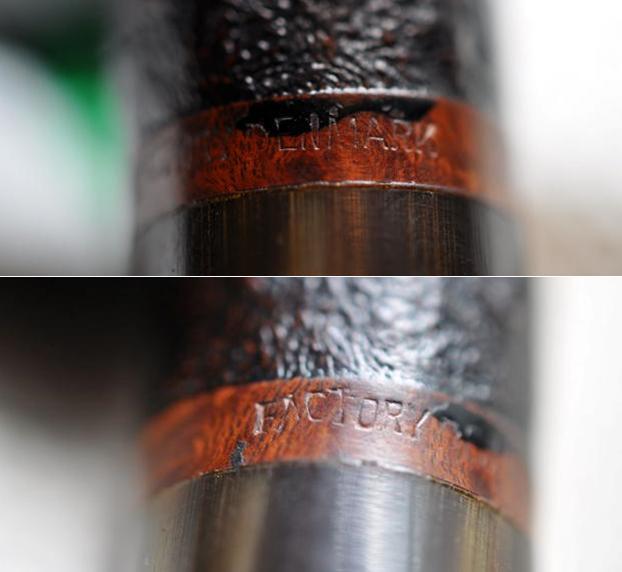
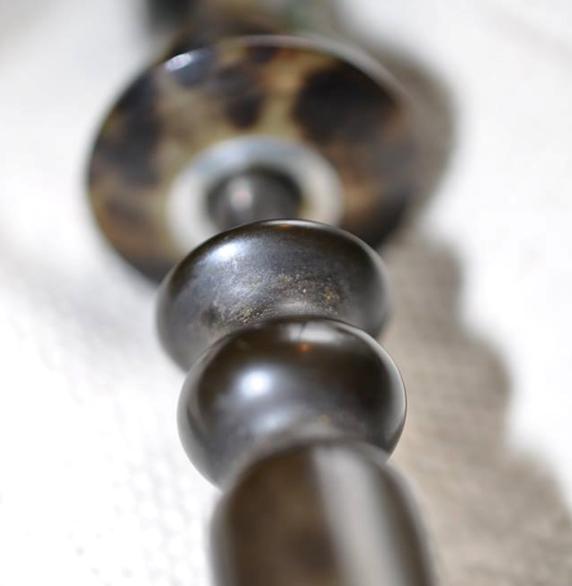
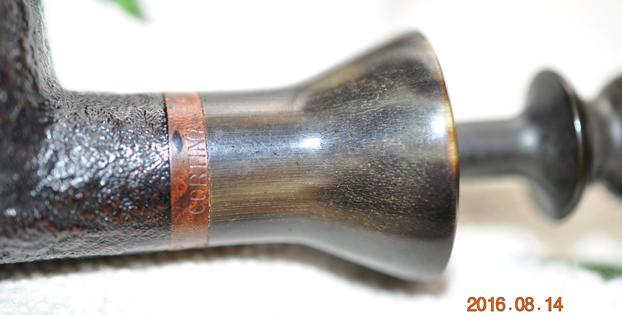
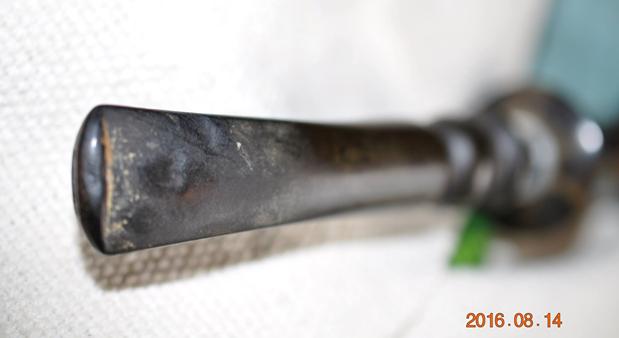
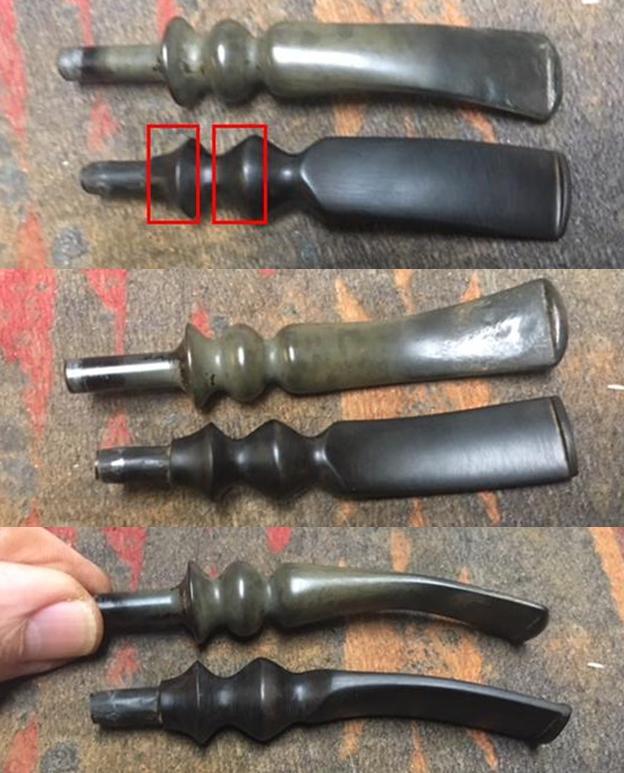
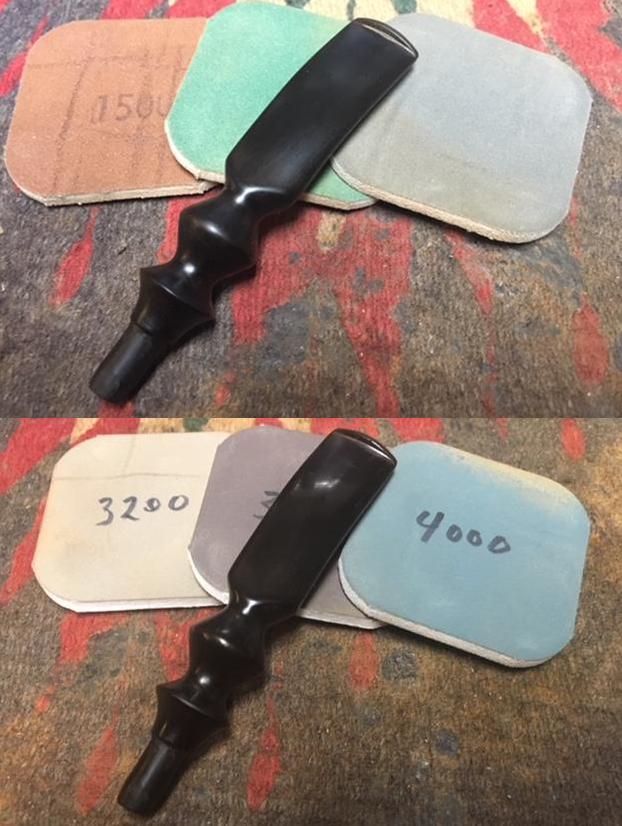
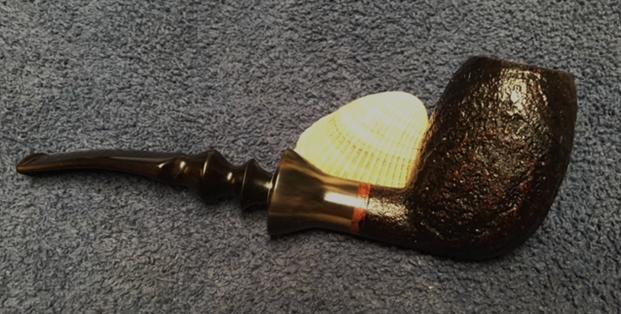
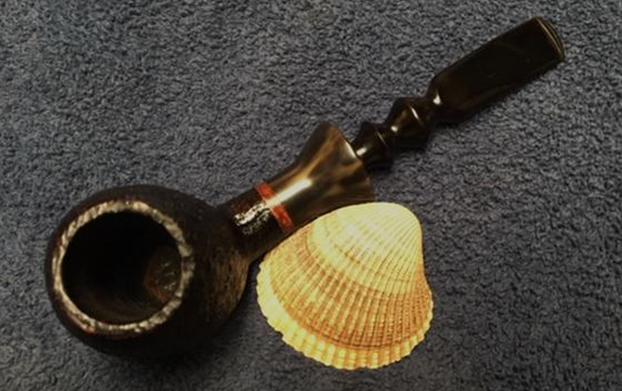
The next pipe on the table was one that my brother Jeff picked up on an eBay auction from a seller in Franklin Tennessee almost two years ago. I know it seems like a long time ago and I suppose it is but I have boxes of pipes to refurbish here and this one came up today! It was in a box with the freehand pipes that I have been working my way through. It is an interestingly shaped sandblast pipe that is a stack. When I first looked at it I did not see any stamping on the shank. As I examined it today I found stamping on the thin band of smooth briar between the horn shank extension and the bowl. It stamped around the band and reads CORTINA FACTORY DENMARK with the shape number 22. The pipe looked pretty good when he got it from the seller. There was dirt and grime in sandblast finish on the bowl. The horn shank extension was oxidized and tired looking. There was a metal mortise inset in the horn to protect it from splitting. There was a light cake in the bowl and the inner and out edges of the bowl were in good shape. The contrast brown finish on the pipe was in excellent condition. I am not sure if the stem on the pipe was the original as the tenon was very long and the fit in the shank was snug but not deep. It was lightly oxidized but in decent condition. I think a stem with a shorter tenon and snug fit to the shank would work well. I would also see if I could shape one to follow the shape of the horn extension. I would have to see what I could find in the can of stems. Jeff took photos of the pipe before he started his cleanup up work. Jeff took photos of the stamping on the pipe. The first photo shows the shape number 22 on the smooth band. The second shows the CORTINA stamp on the smooth band. The third and fourth photos show the stamping Denmark Factory. The next photo shows the shank end – a mottled horn with the metal mortise insert. The stem is in place but you can see that the diameter of the tenon is smaller in diameter than the insert. The second photo below shows the striations in the horn shank extension. The stem was dented and worn. I wanted to replace it with a different stem than the replacement that came in it so I was not too concerned with the stem condition.Jeff had scrubbed the exterior of the bowl with Murphy’s Oil soap and removed the dust and grime that had accumulated there. The finish looked very good once it had been scrubbed. He lightly reamed the bowl with a PipNet reamer and cleaned it up with a Savinelli Fitsall Pipe Knife. He cleaned the interior of the mortise and the airway in the shank and the stem with alcohol, cotton swabs and pipe cleaners. The pipe came to me clean and ready to do the restoration and restemming. I took some photos of the bowl to show the condition at this point in the process. I took some photos of the horn shank extension. At first I thought it was acrylic but as I worked on it I was sure that it was real horn. It was a unique and pretty piece of polished horn. It need to be polished but it was unsplit and in good condition.As has become my practice when working on restoring pipes I did some research on the Cortina Factory Denmark brand name. Pipedia noted the brand but had no information to give in terms of the company or a time frame. I also looked on Pipephil’s site and found a listing for the brand. I have included a screen capture from that site (http://www.pipephil.eu/logos/en/logo-c7.html). The first pipe in the photo shows the Cortina brand and stamp that is the same as on the pipe I am working on. The second one is attached to the Georg Jensen brand and the stamping is actually very similar. It makes me wonder if the Cortina was not a line of pipes made by Georg Jensen. I have no proof of that other than the connection shown in the screen capture below.I started my restoration of the pipe armed with the little bit of information that I could find on the brand. I polished the horn shank extension with micromesh sanding pads – wet sanding with 1500-2400 grit pads and dry sanding with 3200-12000 grit pads. I wiped the bowl down with a damp cloth after each sanding pad to remove the sanding dust. Once I had finished with the last pad I wiped it down with Obsidian Oil to enliven the horn and preserve it. I turned from the horn shank extension to work on the sandblast briar of the bowl. I rubbed the bowl down with Before & After Restoration Balm to deep clean the briar bowl and the rim top as well as the briar shank. The product works to clean, enliven and protect the briar. I hand rubbed it with my fingers, working it into the exterior of the pipe. I worked it into the blast with a horsehair shoe brush. After it had been sitting for a little while I buffed it with a soft cloth to polish it. The pipe really began to have a rich shine. I took some photos of the bowl at this point to mark the progress in the restoration. I had a stem in my can of stems that had turned portions that as the shape of the shank extension on the pipe. Once the stem is cleaned up I will point out the shapes more clearly. I sanded the stem with 220 grit sandpaper to shape the tenon to fit in the mortise. I sanded the oxidation to remove it from the rest of the stem. I took a photo of the new stem next to the one that had come with the bowl. You can see the variation in the shape of the stem. The top one has a very long tenon that fit into the shank up to the spot where the oxidation begins. It is longer than the new stem and the shape is not quite right. On the new stem I have boxed in the shapes in red that parallel the shape of the shank extension.I polished the stem with micromesh sanding pads – wet sanding with 1500-2400 grit pads and dry sanding with 3200-12000 grit pads. I wiped the stem down after each pad with a damp cloth to remove the sanding dust on the acrylic. I polished the stem with Before & After Pipe Stem Polish – both Fine and Extra Fine and I set it aside to dry. I polished stem and bowl with Blue Diamond to polish out the remaining small scratches. I gave the bowl multiple coats of Conservator’s Wax and the stem multiple coats of carnauba wax and buffed the pipe with a clean buffing pad to raise the shine. I hand buffed it with a microfiber cloth to deepen the shine. The pipe polished up pretty nicely. The contrasting brown stain on the sandblast, the variegated swirls in the horn shank extension and the polished vulcanite stem worked together to give the pipe a unique look. The finished pipe is shown in the photos below. This is one of those interesting unknown Danish Pipes that I think could possibly lead back to Georg Jensen but we will probably never know for sure. The shape, finish and flow of the pipe and stem are very well done. The dimensions are Length: 6 1/2 inches, Height: 2 1/4 inches, Outside diameter of the bowl: 1 1/4 inches, Chamber diameter: 3/4 inches. This one will be added to the rebornpipes store soon. If you are interested in adding it to your collection send me an email to slaug@uniserve.com or send me a message on Facebook. Thanks for walking through the restoration with me as I worked over this piece of Danish pipe making history.

New Life for an Unusual Freehand pipe – a Granhill Signature 1 50


Blog by Steve Laug

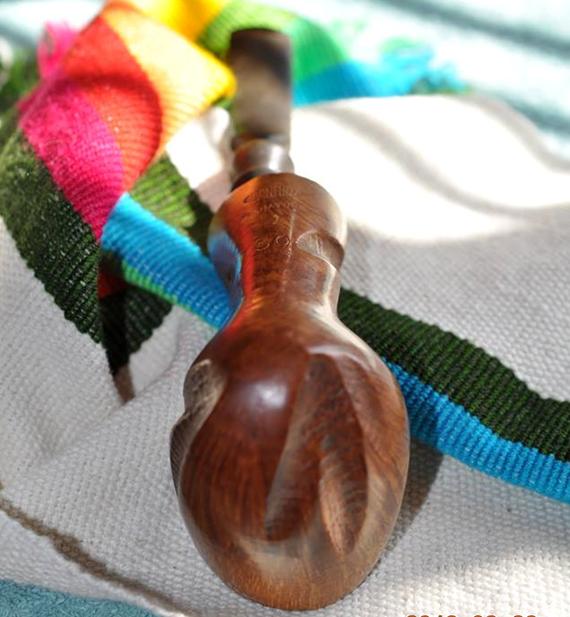
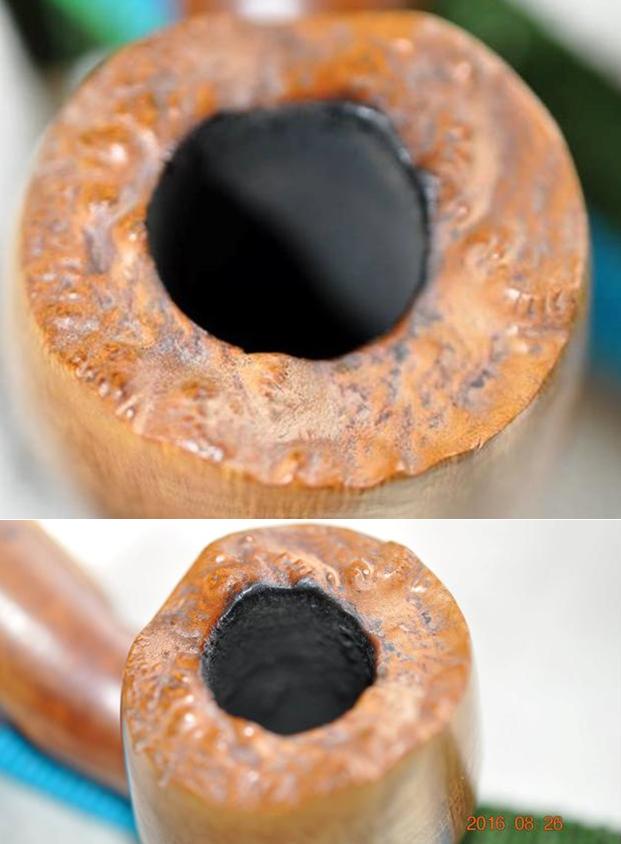
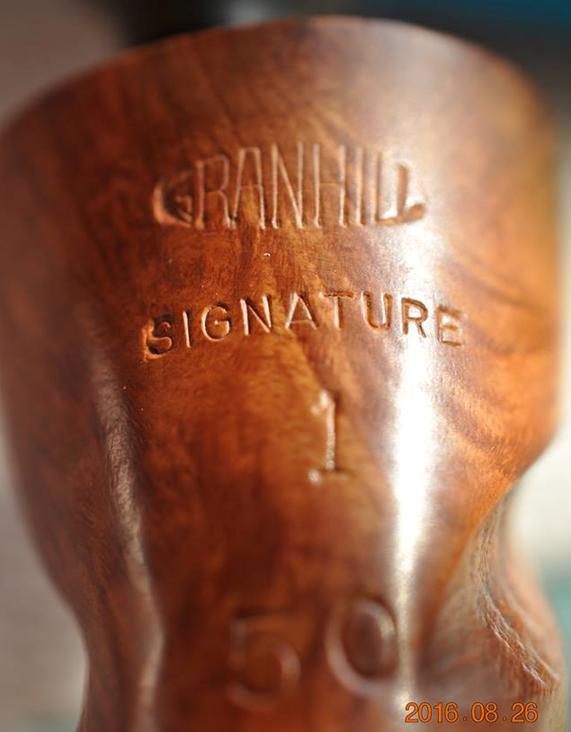
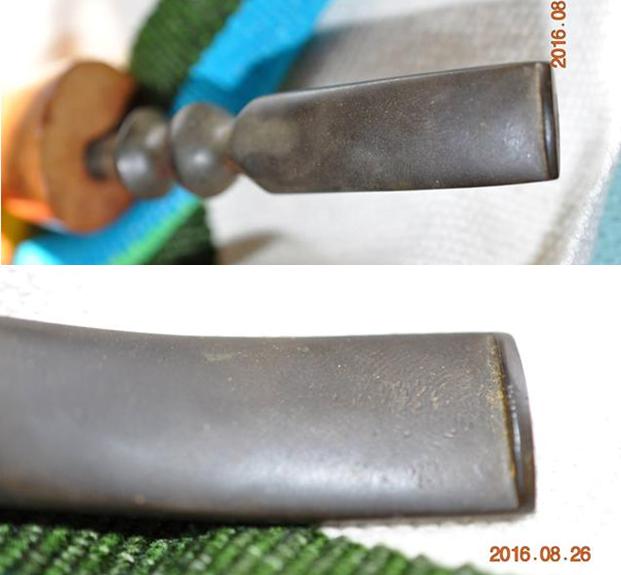
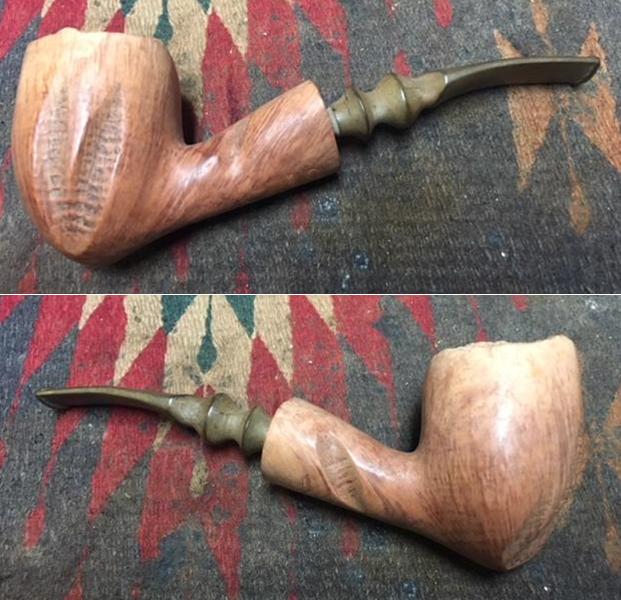
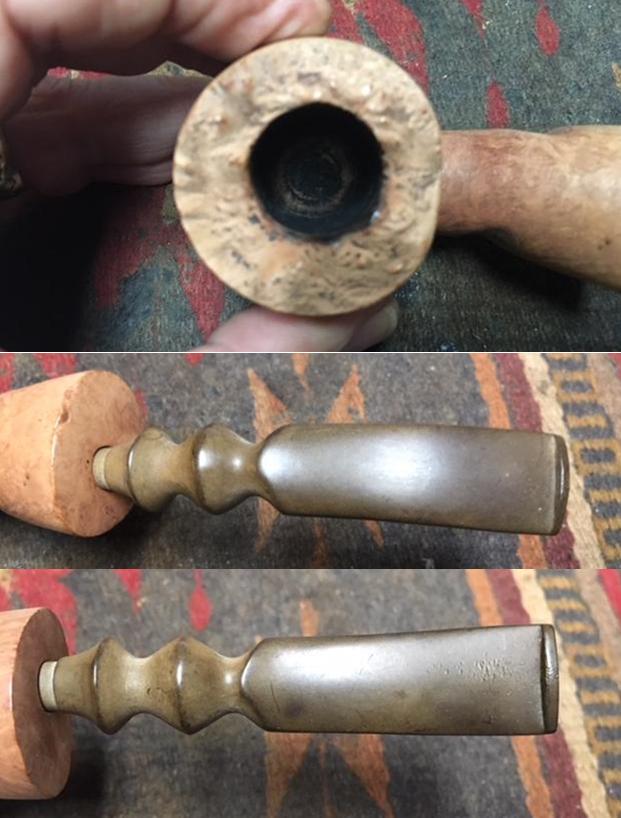
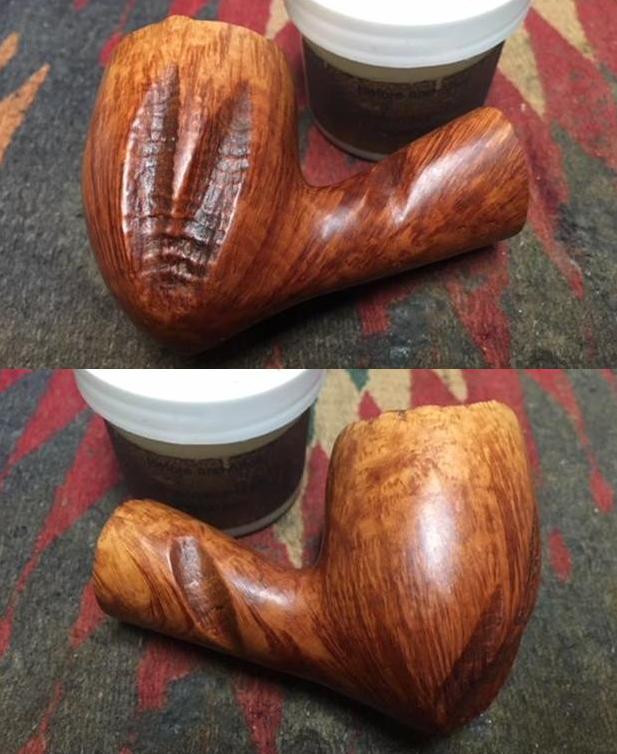
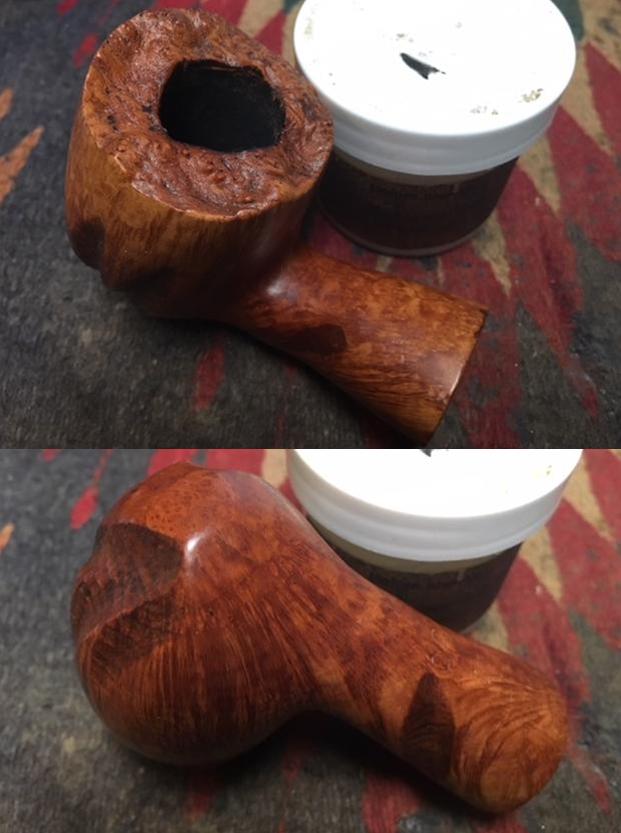
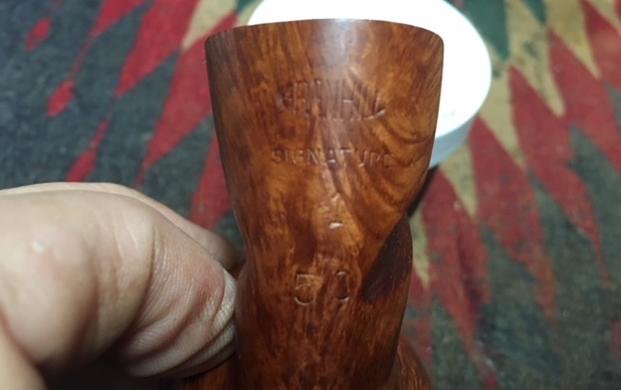
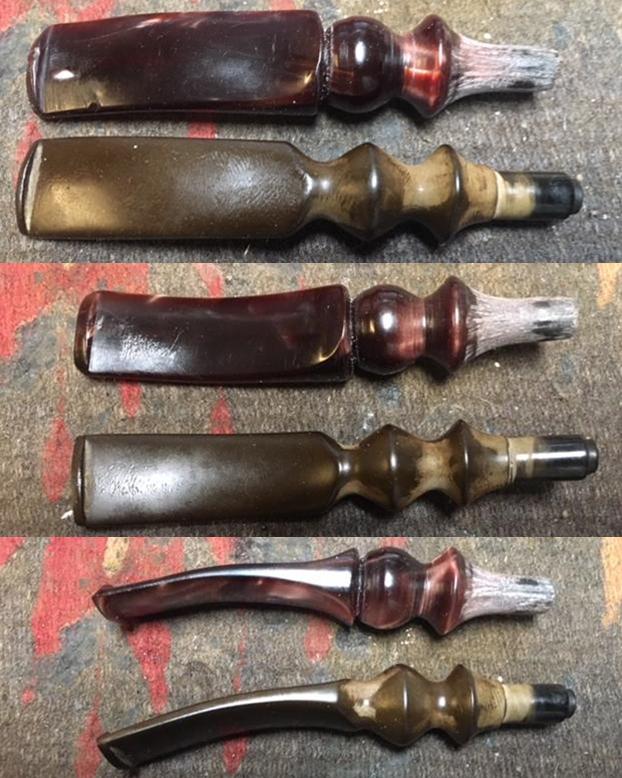
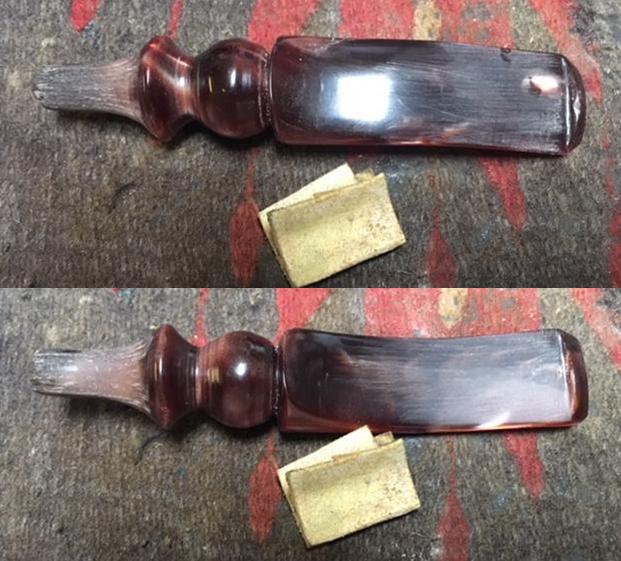
I have been working my way through some freehand pipes that my brother Jeff picked up recently. There are some amazing freehand pipes among them. The one on the work table now is another Granhill Freehand. I have already restored a beautiful large freehand Granhill earlier this summer (https://rebornpipes.com/2018/06/09/another-large-and-unique-freehand-pipe-a-granhill-signature-1-100/). It was a Granhill Signature 1 100 where this new one is a Granhill Signature 1 50. The pipe looked pretty good when he got it. There was dirt and grime in the plateau on the rim top. The edges were clean and undamaged. The bowl had a pretty thick cake inside. The finish on the pipe was an oil finish on natural briar. There were some carved trails up the sides of the bowl and the shank that had been lightly sandblasted and had an interesting texture. The stem was a replacement stem of cast vulcanite. It was oxidized but in decent condition. The acrylic stem on the other Granhill made me want to put the same kind of stem on this one as well. We would have to see. Jeff took photos of the pipe before he started his cleanup up work. Jeff took photos of the rim top to show the grime and dirt in the crevices of the rim top. There was also some darkening around the inner edge of the rim top and some lava build up that was overflowing onto the inner edge.He also took a photo of the stamping on the shank. The stamping is very clear and readable.The stem was in decent condition. The surface of the vulcanite was pitted and oxidized. There was some light tooth chatter on both sides of the stem near the thin button.Jeff had cleaned the rim top and removed the debris in the plateau. He had scrubbed the exterior with Murphy’s Oil soap and removed the dust and grime that had accumulated there. The oil finish disappeared and there was natural unfinished briar and once it was scrubbed it was clean and unstained briar. He lightly reamed the bowl with a PipNet reamer and cleaned it up with a Savinelli Fitsall Pipe Knife. He cleaned the interior of the mortise and the airway in the shank and the stem with alcohol, cotton swabs and pipe cleaners. The pipe came to me clean and ready to do some light touch ups and polishing. The stem was cleaned but had tooth chatter on the top and underside near the button and on the surface of the button itself. I took close up photos of the rim top to show the condition of the plateau. It was very clean and there was no damage to the inner or outer edge of the rim. Jeff had been able to remove all of the tars and oils and lava coat on the edge of the bowl. The photos of the stem to give a clear picture of what it looked like before I cleaned it up. They also show the smooth shank end on this particular pipe. There was a slight bit of plateau on the top of the shank end in the second photo.In my earlier blog on the other Granhill I had done research on Pipedia to find information. I found two potential makers of the brand though they separated the name into two parts Gran Hill. The first possible maker was Michael V. Kabik with some of them stamped Made in Denmark. The spelling of the name was noted to come in other versions: Granhill, Gran-Hill. The second possibility comes from Lopes book where he states that the brand also was used by a Fargo Tobacconist, Lonnie Fay, who made freehands bearing this stamp in the 1970s. To me the similarity of the pipe to other Kabik pipes that I have worked on made me go with him as the maker of this pipe as well.

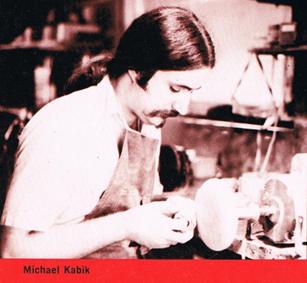
I went back to Pipedia and spent time reading about Michael Kabik (https://pipedia.org/wiki/Kabik). Here is a summary of what I found.

Michael Victor Kabik or Michael J. Kabik, now retired artisan and pipe repairman, was born in Annapolis, Maryland in 1950. As a student he was fascinated by science, but finally turned to the arts. In the early 1970s he started working as an artisan and designer for Hollyday Pipes Ltd., and when the company closed he set up in his own right.

Kabik writes as follows:

…In the 1960s, I had helped Jay build Jay’s Smoke Shop and was his first employee. Since that time, he had set up one of the very first freehand pipe-making operations in the U.S. along with his partner, Chuck Holiday, called CHP-X Pipes. The staff consisted of four full-timers actually making the pipes and perhaps another four in sales and office work. Chuck, who did the actual design and carving, had long since had serious disagreements with Jay and split. Chuck’s replacement from the staff was quitting, and Jay was in a bind. Jay offered me the job, and I gladly accepted. The fellow quitting was supposed to train me for two months but left after two weeks, leaving me with an awesome responsibility. I felt as though the future employment of all these people depended on me as the designer and cutter…and it did.

…Sadly, CHP-X closed its doors two years after my arrival, due primarily to distribution, sales force problems, and other issues to which I was not privy…In love with a medium that satisfied my creative impulses while, pretty much, paying the bills, I bought up the essential equipment and produced pipes on my own. I did this from a farm house my wife and I rented in Phoenix, Maryland. I produced pipes under the name KANE, Gran Hill and others I can’t remember as well as a private label line for a store in, I believe, South Dakota.

…In 1973, I was approached by Mel Baker, the owner of a chain in Virginia Beach called Tobak Ltd. Mel was interested in producing a freehand pipe line and was alerted to my product by Al Saxon, one of his managers and a former CHP-X employee. Mel wanted to relocate me to Virginia Beach, give me carte blanche, and recreate the CHP-X studio with, of course, a new name for the product. I’m sure my answer came very quickly.

…We decided on the name Sven-Lar. Why? Well, when I bought out CHP-X, I also got a small drawer full of metal stamps that were created for private-label work. The Sven-Lar name was conceived but never realized. Aside from having the stamp already made, there were other reasons we chose Sven-Lar. First, we were making a line of pipes in the Danish freehand tradition and also, sadly, we knew the difficulty American pipe makers had breaking the foreign market mystique barrier. The latter certainly played a big part in the demise of CHP-X.

After rereading the previous blog I was pretty certain that the pipe I was working on was another one made by Kabik. I turned my attention to restoring the pipe. I started with the clean bowl, I rubbed the bowl down with Before & After Restoration Balm to deep clean the briar bowl and the rim top as well as the briar shank. The product works to clean, enliven and protect the briar. I hand rubbed it with my fingers, working it into the exterior of the pipe. I worked it into the plateau top with a horsehair shoe brush. I wiped it off and buffed it with a soft cloth to polish it. The pipe really began to have a rich shine. I took some photos of the bowl at this point to mark the progress in the restoration. I wrapped a piece of dowel with 220 grit sandpaper and sanded out the inside of the bowl to smooth the walls. I removed all of the remaining cake on the walls of the bowl.I set the bowl aside and turned my attention to the stem. I looked over the replacement stem and decided to not use it. I went through my stem collection and found a nice brown swirled acrylic stem that I thought would look good with the pipe bowl.  It was very similar to the stem on the other Granhill I worked on so I decided to use it instead. I took photos of the two stems side by side for comparison.I sanded the tenon end with a Dremel and sanding drum and smoothed it out with 220 grit sandpaper to adjust the tenon to the same diameter as the tenon on the replacement stem. It did not take too much work to adjust the fit to the shank.I sanded out the tooth marks out of both sides of the stem with 220 grit sandpaper. I worked over the surface with sandpaper to remove the tooth chatter, marks and to smooth out the surface. There were tooth deeper tooth marks on the top side of the stem that I would need to fill in and work on. I filled in the dents with clear super glue. Once the glue cured I sanded them smooth with 220 grit sandpaper to blend them into the surface of the acrylic. I polished the stem with micromesh sanding pads – wet sanding with 1500-2400 grit pads and dry sanding with 3200-12000 grit pads. I wiped the stem down after each pad with a damp cloth to remove the sanding dust on the acrylic. I polished the stem with Before & After Pipe Stem Polish – both Fine and Extra Fine and I set it aside to dry. I polished the briar with micromesh sanding pads – wet sanding with 1500-2400 grit pads and dry sanding with 3200-12000 grit pads. I wiped the bowl down with a damp cloth after each sanding pad to remove the sanding dust. Once I had finished with the last pad I wiped it down with a light coat of olive oil to collect the dust and to give some depth to the finish. I polished stem and bowl with Blue Diamond to polish out the remaining small scratches. I gave the bowl and the stem multiple coats of carnauba wax and buffed the pipe with a clean buffing pad to raise the shine. I hand buffed it with a microfiber cloth to deepen the shine. The pipe polished up pretty nicely. The plateau on the rim top and the smooth natural oiled finish work very well with the swirled brown acrylic stem. The finished pipe is shown in the photos below. While I have worked on other Michael Kabik pipes (a CHIP-X) this is the second Granhill pipe of his that I have restored. It is well crafted and is very similar to the CHIP-X that I worked on in the past. The shape, finish and flow of the pipe and stem are very well done. The dimensions are Length: 6 1/2 inches, Height: 2 1/4 inches, Outside diameter of the bowl: 1 3/4 inches, Chamber diameter: 3/4 inches. This one will be added to the rebornpipes store soon. If you are interested in adding it to your collection send me an email to slaug@uniserve.com or send me a message on Facebook. Thanks for walking through the restoration with me as I worked over this Granhill freehand.


Fashioning a Churchwarden from a Forlorn, Throw away Billiard – a story of the Phoenix


Blog by Dal Stanton

The Greek mythological Phoenix is a long-lived bird that cyclically regenerates or is otherwise born again, according to Wikipedia.  It is regenerated out of its own demise, from its own ashes.  The images that come to mind are Harry Potter-esque – the Phoenix’s name is Fawkes and “as stated by Dumbledore, they are extremely loyal creatures, and are capable of arriving to the aid of beings who share a similar devotion. This was how Fawkes arrived to assist Harry in slaying the Basilisk in the Chamber of Secrets during his second year at Hogwarts” (LINK).  The tear of the Phoenix could also bring healing and recovery from near death.

What does the Phoenix have to do with pipes and Billiards?  True confession: I enjoy immensely working on vintage pipes with well-known and sought names like Dunhill, Savinelli, Comoy’s, Stanwell, GBD, Jeantet and BBB.  But truth be known, I LOVE taking the throwaways, the discarded, the ‘only good for the waste heap’ pipes – that make most people cringe and reach for latex gloves – to take these pipes and see what I can do to help.  There is a satisfaction at the end of such projects that translates into, ‘Wow! Who could have imagined…!”  The discovery of hidden beauty that was always there, but no one took the time to help it emerge.   I guess, at the core of it is the sense that sometimes people are treated in such a way or may view themselves in such a way that does not reflect the often hidden value that people intrinsically have.  Helping is seeking to bring new life out of the ashes of the past.

I want you to meet my forlorn Billiard stummel.  I’m sure that one past day he enjoyed the attention of a steward.  He proudly was settled on the rack with other proud pipes of The Rotation.  One day something happened, and he lost that favored position, and everything changed.  I found him in a bag of a second-hand/antique vendor in Sofia, Bulgaria’s ‘Antique Market’ in the city-center.  The bag was full of broken and discarded stems, stummels and other things unrecognizable.  He had no stem.  I plucked him out of the bag along with a few other pieces, paid the vendor a very small sum for what had no value to the vendor or to anyone else.  The small Billiard stummel was marked with the most generic of all markings, ‘Real Briar’.  Absolutely nothing special.  Here are pictures of the redeemed Billiard on my worktable. I just completed the restoration of a Monarch Pat. 1989069 – 1074H Bent Ball  for Andy, a pipe man living in Maryland, who attends the church where I was formerly the pastor on the Eastern Shore – the peninsula created by the Chesapeake Bay and Atlantic Ocean east of Washington DC.  Andy commissioned the Monarch from the ‘For Pipe Dreamers Only!’ section on my blog.  He told me he was also hoping to land a Peretti Oom Paul and a Churchwarden someday.  He had seen several of the Peretti Lot of Oom Pauls that I had already restored and recommissioned for new stewards and was hopeful.  I had no more Perettis to share, but I proposed that I could fashion a Churchwarden from repurposed stummels.  I also had one 8-inch Warden stem left in my stores.  Not long ago, I completed a fun restoration I called ‘A Tale of 3 Church Wardens’ – where I fashioned 3 Churchwardens that all found new stewards in Germany.  I directed Andy to check out the post to decide what he wanted to do.  It didn’t take long and he decided to add a Churchwarden to his Monarch Bent Ball – each of these pipes benefit the work we do here in Bulgaria with the Daughters of Bulgaria – helping women and girls who have been trafficked and sexually exploited to find a new life and hope.  The next question for Andy was what stummel would mast the Warden stem and rise from the ashes like the Phoenix?  Here were the options I sent to Andy with a warning not to be distracted by the color or condition – to look only at the shape.  Here’s what he saw.From the top, his choices were a Rhodesian, a Panel, a carved Apple and the forlorn Billiard.  Andy chose the classic Billiard shape, influenced mainly by the longer shank which will add a bit of flow to the Churchwarden he would become when transformed.  The interesting factoid that I reported before, in my writeup of the 3 Churchwardens, was from Bill Burney’s Pipedia Pipe Chart. It provides the framework for forlorn bowls to rise as the Phoenixes.  What brings this power?  A Churchwarden stem:As you would expect, our Billiard that Andy chose has many challenges.  The worst of his obvious problems is the rim which has been chewed and gnarled! It has a large divot on the internal lip over the shank.  Also, on the shank side, the rim slopes away having endured a ‘skinned knee’ experience.   The old finish is totally old and the stummel has some small fills that need checking.  Yet, underneath the grime and tired finish – where there is finish, is briar grain with potential.  I begin the story of this Billiard hoping to rise as a Phoenix by doing the basic cleaning of the stummel before fashioning the precast Churchwarden stem.  To mark the beginning of the restoration, I take a picture of the Billiard stummel with the Warden stem – the place where Pipe Dreamers begin!I take a picture of the chamber and see that there is very little cake build up, but I also see that it appears someone took a pocket knife to the chamber in the past – with little care.  I take the Savinelli Fitsall Tool and I ream the bowl of residue carbon.  Following this, I sand the chamber with 240 grit paper by wrapping the paper around a Sharpie Pen seeking to clean it but also to smooth the top of the chamber where knife marks were.  I then clean the chamber with a cotton pad wetted with isopropyl to rid it of carbon dust.  The chamber wall seems to be in good shape – no cracks or heat fissures are visible, but I will need to do a bit more sanding – I’ll wait to do this along with the rim repair. Now I turn to internal cleaning of the stummel.  Using cotton buds dipped in isopropyl 95%, I realize very quickly that the grunge in this mortise and airway was thick.  I put the cotton buds down for a time and start scraping the mortise walls with dental spatulas.  I also insert a drill bit the size of the airway and hand turn it to excavate the tar and oil buildup.  In time the cotton buds started coming out less soiled.  I plan to give the stummel a kosher salt and alcohol soak through the night to clean the internals further and freshen the stummel for the new steward.  The pictures show the grunge warfare!With the stummel cleaned, I now turn to the precast Churchwarden stem.  I begin by pulling out my new electronic caliper that I acquired when I fashioned the 3 Churchwarden stems before.  I take an internal measurement of the Billiard’s mortise, which is the target.  The reading is 8.13 mm.  For a conservative target in shaping the new tenon on the precast Warden stem, I add .40 mm to the 8.13 which gives me a conservative target of 8.53 mm.  I now mount the drill bit to drill the tenon’s airway enlarging it to receive the guide pin for the Pimo Tenon Turning Tool, which I also just added to my tools.  I mount the Pimp Tenon Turning Tool into the drill chuck and cut a conservative practice cut on the tenon to get an initial measurement.  The practice cut measurement is 8.96 mm which means I need to remove around .43 mm to arrive at the conservative target of 8.53 mm.  The purpose of the conservative target is to get close to the exact size of the mortise, but not quite.  This leaves room to sand the tenon to fashion the custom size because every mortise is different.  The fit between the newly fashioned tenon and the mortise must be snug but not too tight. I crank down the blade on the Tenon Turning Tool a bit and make another practice cut and remeasure.  Now, I have a perfect example of why doing practice cuts is a good idea!  The next measurement was 8.23 – only .10 mm off the actual mortise size – too close for comfort.  I don’t want to risk taking off too much.  I back the blade off a little and recut.  I come to an 8.49 mm which is good.  Using a flat needle file, 120 and 240 grit papers I gradually bring the size of the tenon down.  After MANY filings/sanding and testing the fit in the mortise, I can seat the tenon snugly into the mortise.  The shank is slightly larger than the diameter of the stem when the stem is inserted into the mortise.  The picture below shows how the briar is extending at this point, but as I look around the shank, the amount of overhand is not the same.  I use the flat needle file to start bringing the briar overhang flush with the Warden stem. The picture below shows the shank having that ‘stuff pants look’ as the taper of the shank to the stem is not gradual.  To address this, I file and sand around the shank to create a more gradual tapering from the bowl through the shank to the Warden stem.  Most of the briar bulging was on the shank sides not on the upper and lower areas which look pretty good. After a lot of sanding with a flat needle file, 120 and 240 papers, I arrive at a nicer tapering from shank to stem.  I sacrificed the ‘Real Briar’ stamping on the left side of the shank for the more balanced look on both sides of the shank.  I thought about it for a few minutes, and sanded away in favor of a reborn Phoenix!  The shank overhang has been sanded out and the shank/stem junction is flush.  I like the flow from bowl, through the shank, and into the stem.  Before bending the stem, while still in the same customized position, I also file and sand down the sides of the precast stem to remove the seams created by the casting halves.  I aim for rounding the stem. With the Billiard’s straight shank, the bend will be very small and subtle.  Last time I fashioned Churchwarden stems I found that I was consistently overbending the stem and then I would need to back off the bend for the best look.  I place pipe cleaners in the stem at both ends to maintain the integrity of the airway during the heating and bending process.  I use a hot air gun and warm the vulcanite in the area where I make the bend.  As it warms, the vulcanite, a rubber compound, becomes supple and is fashioned easily.  After making the bend, by simply eyeballing it, I take the heated stem to the sink and cool it with tap water to set the bend.  I remount the bent stem and I like it.  It has a gentle bend, not too much.  The Phoenix is coming to life!Looking now to the stummel, I use a sharp dental probe to test the very small fills on the stummel.  They seem to be solid.  I then look at the gnarly rim.  The next step is to remove the damage by utilizing the topping board.  Using a chopping block, I place a sheet of 240 grade paper on it.  After inverting the stummel on the board, I begin to rotate the stummel over the paper.  I’m thankful for the fact that Churchwardens typically have smaller bowls.  That’s good news because I’m taking a bit of briar off the top.  After a while, there is still a divot on the inside of the rim over the shank which I will address by creating a bevel.  After the 240 grade rotation, I then use 600 for a bit and finish the topping. Using 120 grit paper, I start carving a bevel on the inside lip of the rim.  I follow by moving to the outside edge of the rim.  I create the bevel by pinching the rolled piece of sanding paper under my thumb and then methodically move it around the rim putting pressure on the paper.  The continuous movement is what keeps the bevel consistent.  I then follow with 240 paper for both the inside and outside edges of the rim.  I think it looks good – what an improvement!To address the stummel surface to remove the top surface and scratches and old finish, I start by using a coarse sanding sponge on the entire stummel.  I follow the coarse sponge with medium and then light sanding sponges.I decide now to continue working on the stem.  Using a flat needle file and 240 grit sanding paper I continue smoothing and shaping the stem.  I work on the rough button with the file to shape it with the file.  I sand the entire stem with 240 grit because, even though the stem is new, the vulcanite contains ripples and ribs from the casting process.  I work the stem with sand paper so that it’s smooth and the stem is rounded.  From filing and 240 grit, I sand the entire stem with 600 grade paper.  I finish this sanding phase by sanding/buffing the stem with 0000 grade steel wool.  The pictures show the progress. My day is ending and I finish at the worktable with a kosher salt and alcohol soak to further clean and refresh the stummel.  I create a wick from a cotton ball by stretching and twisting the cotton.  I then insert/stuff the wick in the mortise and airway.  I then put the stummel in an egg crate to stabilize it and fill the bowl with kosher salt which leaves no after taste as does iodized salt.  I then use a large eye dropper to fill the bowl with alcohol until it surfaces over the salt.  After a few minutes I top off the alcohol.  I set the stummel aside and turn out the lights.The next morning the kosher salt and alcohol soak did the job – the salt and wick are soiled by drawing out more tars and oils from the mortise and airway.  After dumping the expended salt, I wipe the chamber with paper towel to remove the old salt.  I blow through the stummel as well to clear out the left overs. To make sure all is clean, I run a few more cotton buds dipped in isopropyl 95% through mortise.  Moving on.Time to micromesh the Churchwarden stem.  Using pads 1500 to 2400 I wet sand the stem.  Following this, I dry sand using pads 3200 to 4000 and then, 6000 to 12000.  After each set of 3 pads, I apply Obsidian Oil to the stem to enrich the new precast Warden stem.  I take only one picture at the end because it’s difficult enough to see the detail of black vulcanite with regular sized stems, with the Churchwarden stem, the picture is from orbit!With the stem drying, it’s time to begin the micromesh sanding of the stummel.  Using micromesh pads 1500 to 2400 I wet sand the stummel.  As has happened on previous restorations, the wetting of the stummel during the wet sanding process spelled the end of the once solid fills that I saw before.  The fill material must be made of a water-soluble material – not sure what it is, but it isn’t anymore! The fills fully disintegrated.The detour means that I need to apply patches to the pits – I mix briar dust and thick CA glue to form a putty that I apply to the holes.  I first use a sharp dental probe to make sure the pits are free of debris.  I use an index card to do the mixing by placing some dust in a pile. I then place some of the CA glue next to the briar dust.  Using a toothpick, I gradually draw a bit of the dust into the glue while mixing it with the toothpick.  I continue to do this until the putty reaches a molasses-like consistency. I then apply the putty to the places needed – there are a few. After applying the briar dust putty, I spray the patches with an accelerator to cure the patches more rapidly.  Then, using a flat needle file, I begin filing down the patches to near the briar surface.  Then I use 240 grit paper to remove the remaining excess patch material bringing the fill flush with the briar surface.  Following the 240 paper, I use 600 grit paper on each of the patch areas.  Finally, I return to the initial micromesh pads and sand the patches with 1500 to 2400 grade pads.  The detour is complete, back on track.  The pictures show the patch repairs.  These patches will blend very well. I pick up again by dry sanding using pads 3200 to 4000 and then 6000 to 12000.  The pictures show the finished result.  I enjoy so much watching the grain emerge during the micromesh process.  This lonely stummel just may be a Phoenix after all!At this point, aiming for the color preferences Andy described when he commissioned the Billiard, I will stain the stummel using the base as Fiebing’s Saddle Tan Pro Dye but add to it just a bit of Fiebing’s Dark Brown Leather Dye to darken it a bit.  I believe this will add more depth to the grain contrast – or I hope!  After mixing the dyes in a shot glass, and inserting a cork into the shank to act as a handle, I then warm the stummel using a hot air gun.  This expands the briar making the wood more receptive to the dye.  After warmed I apply the stain using a folded pipe cleaner.  After the stummel is completely covered, I flame the aniline stain using a candle.  The alcohol in the dye immediately combusts leaving the dye set in the grain.  After a few minutes, I repeat the same regimen including flaming.  I then set the stummel aside to rest and settle through the night.  The next morning, after an early 5AM trip to the Sofia Airport to drop off a summer intern who was returning to the US, I returned to the worktable ready to ‘unwrap’ the Billiard that had been dyed the night before.  I enjoy this a lot!  I mount a felt wheel on the Dremel, set to the lowest speed, and begin removing the flamed crust encasing the stummel.  I use the coarser Tripoli compound to do this.  As I work the buffing wheel methodically over the surface, I avoid applying too much downward pressure but allow the felt wheel, speed and compound to do the work. During the process, I purge the wheel often to clean it and keep it soft. After finishing with the felt wheel, I switch to a cotton cloth wheel and apply Tripoli to the crook between shank and stummel which the felt wheel is unable to reach.  After the Tripoli, I wet a cotton pad with alcohol and wipe down the stummel to blend the new stain and to lighten it a bit.In the same manner as the Tripoli compound, I apply Blue Diamond, a finer compound.  I mount another cotton cloth wheel on the Dremel, increase the speed to about 40% of full power.  I apply the compound to both stem and stummel.  After I finish, I wipe down both stem and stummel with a felt cloth to remove compound dust in preparation for applying the carnauba wax.  Before applying the wax, I want to add a special touch to this reborn Phoenix Billiard Churchwarden.  I decide to band the shank – always a nice touch.  I pull out my collection nickel bands and find one that fits over the shank but leaves about a 1/4 inch slack between the end of the shank and the end of the band.  To slide the band safely up the shank I heat the band with a hot air gun while on the shank at the tension point.  As the band heats, it will expand microscopically.  After a time of heating, I turn the shank downward and gently but firmly press down against a thick cloth on the hard wood surface.  This pressure moves the band up the shank a few millimeters and the cloth cushions the end of the band so it doesn’t bend with the pressure.  If one presses too hard and tries to expand the band too quickly, the nickel can rip – that is not good.  I got through the heating and pressing cycle a few times and the band is seated well.  I remount the stem and eyeball the band placement.  It looks good and I think the new steward will like this touch of class a lot for this Phoenix Billiard Churchwarden. Before I wax the pipe, I mount a cotton cloth buffing wheel on the Dremel that I use exclusively on nickel.  I want to shine the band up before applying wax.  I set the speed at 40% and apply White Diamond compound to the band.  I’m careful not to run the buffing wheel over the band to the briar as it can discolor the wood. I learned this the hard way in the past.  I’m not sure what the chemical process is, but when polished at high speed, a dark residue is produced.  You can see it on the White Diamond bar as well as on the wheel.  This is another reason why each compound and use have a dedicated wheel.  After finishing with the White Diamond buffing, I buff the band with a microfiber cloth and, oh my!  How it shines!Now, the home stretch.  Time to wax the pipe.  Again, I change to another cotton cloth wheel dedicated to carnauba, maintain a 40% speed on the Dremel, and apply a few applications of the wax to the stem and stummel.  I finish the polishing by hand buffing the Churchwarden with a microfiber cloth to raise the shine.

Few words describe the transformation of this lonely Billiard into a Phoenix.  Again, I’m amazed at the beauty in what God has created, even that which we often pass by with the shrug of the shoulders.  The gain revealed in the Billiard is beautiful.  The rim, gnarled as it was, looks great and is not diminished by the briar I was forced to take off.  As I look at it, the slightly squatter bowl works very well as the mast of the long, flowing Churchwarden stem.  The band mounted on the shank simply rocks, what can I say.  Andy commissioned this Billiard now Phoenix Churchwarden and he will have the first opportunity to acquire it in The Pipe Steward Store.  This pipe benefits the Daughters of Bulgaria – women and girls trafficked and sexually exploited.  Thank you for joining me in the telling of the story of the Phoenix!
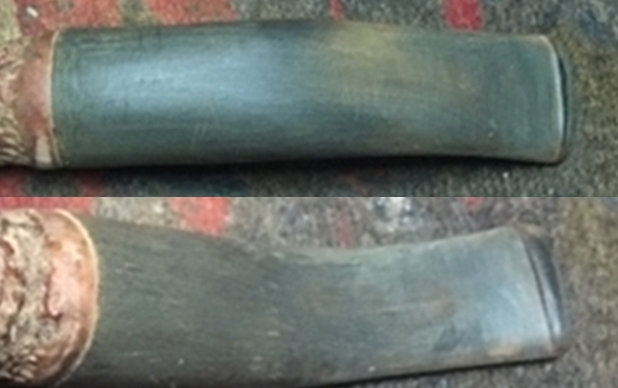
Breathing New Life into a Kriswill “Chief” # 20


Blog by Paresh Deshpande

I had completed the refurbishing of LANE ERA CHARATAN’S MAKE “SPECIAL” and thoroughly enjoyed the process. Apart from preserving memories, the thing that I enjoy the most while refurbishing/ restoring my inherited (and some purchased) pipe collection, is the transformation of the pipe that unfolds before your eyes as you progress. It is something akin to a flower bud that gradually blooms and opens itself in all its beauty for you to feast your eyes upon. This is what I love when I work on a pipe.
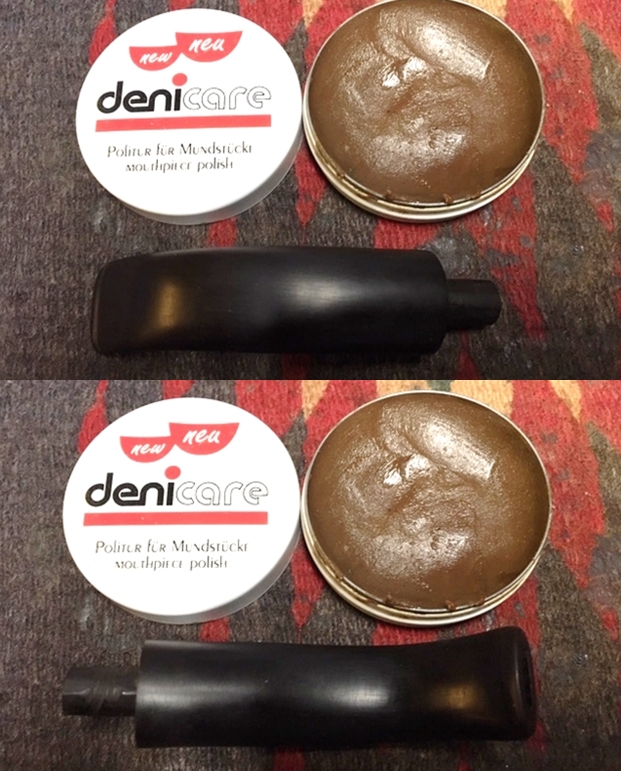
While rummaging through the large box with an equally large number of my inherited pipes with my younger 10 year old daughter, she laid her hands on a pair of pipes with “SHINING SUN”, as she liked to call it, on its stem. With the selection of next two projects decided by her, I had a closer look at these pipes. These were a pair of KRISWILLS, one stamped as “CHIEF” and the other as “GOLDEN CLIPPER”. The first thing that struck me was that there was something amiss with the way the stems sat into the shank of each pipe. The “CHIEF” did not have its stem sitting flush with the shank. Also, the shank’s outer diameter appeared larger than that of the stem. The “GOLDEN CLIPPER” had its stem flush with the shank; however the diameter of the stem was larger than that of the shank. The following picture will clarify what exactly I was faced with……

CLIPPER

CHIEF

As I was wondering what could be done to address this issue and surfing the net for buying new/ used original stems for these pipes, Abha, my wife who was having a closer look at both these pipes simply interchanged the stems and surprise of all surprises, the stem that was on the “CHIEF”, sat flushed and perfectly matching with the shank of the “CLIPPER”. However after considerable effort, though the stem that was on the “CLIPPER” sat flushed with the shank of the “CHIEF”, the diameter of the shank was larger than that of the stem. So now what we have is a KRISWILL “GOLDEN CLIPPER” with a perfectly matching and fitting original stem and a KRISWILL “CHIEF” with a fitting, but mismatched stem diameter.

KRISWILL “CHIEF”

KRISWILL “GOLDEN CLIPPER”

I discussed with Abha and it was decided that since the “CLIPPER” has a perfect stem match, I would work on the “CHIEF” and make the shank match the stem. With this decision made, I kept the CLIPPER aside and took the “CHIEF” into my hands.

The CHIEF has a nice, deep bowl and nicely fills the hand. The size, weight and heft of the pipe is just beautiful. Beautiful cross grains adorn the sides and the back of the bowl while the front of the bowl boasts lovely mixed grains of swirls, flame and Birdseye. It is stamped “KRISWILL” over “CHIEF” over “HANDMADE IN DENMARK”. At the bottom of the shank where it meets the stem, is the numeral “20” and yes…. this positioning of the number did cause me a great deal of grief during the process of sanding!!! All the stamps are crisp and clear.I was curious to know about the history, geography and carvers for Kriswill while attempting to date this pipe. While referring to “Pipephil” I came across this information which I have reproduced below verbatim (http://www.pipephil.eu/logos/en/logo-k3.html)

“Kriswill is a brand of Kriswork Briar Trading, in Kolding (Denmark) established about 1955. Some of Kriswill pipes were designed by Sigvard Bernadotte, Swedish prince and brother to the late Queen Ingrid of Denmark. He collaborated with his Danish partner Acton Bjørn. When the company went bankrupt in the late 1970s it was on a level with Stanwell. Dan Pipe Cigar & Company (Hafenstrasse 30 D-21481 Lauenburg/Elbe, Ge) bought the rights to use the name and it is Holmer Knudsen and/or Poul Winsløw who make the Kriswill line. Nørding, on its side, bought the plant and introduced a Kriswell line”.

Prior to 1970 the stampings are in script letters on the shank and on the mouthpiece. The star on the stem and block letters on the shank were introduced from that date on.

While researching for more information on Kriswill pipes on “Pipedia”, I came across this additional information which is reproduced below:

Kriswill was one of the large pipe manufacturers in Denmark during the 1960s and 1970s, and I believe closed around 20 years ago. Their catalog cover read “By Appointment to the Royal Danish Court, KRISWILL, Kriswork Briar Trading, Briar Pipes Hand Made in Denmark.”

Thus, from the above information, it is safe to assume that this pipe is post 1970.

INITIAL VISUAL INSPECTION
As with all other pipes, the CHIEF, too is covered in dust, oils and grime of all past years, though comparatively to a lesser extent. The chamber is heavily caked with lava overflowing on to the top of the rim. A few small dents and dings, though minor, are visible on the outer edge of the bowl. The condition of the inner edge and that of the inner surface of the chamber will be ascertained once the bowl has been reamed and the lava removed from the rim top.The airway in the shank is blocked and air does not flow through the shank. Close observation of the shank revealed presence of debris in the mortise. This needs to be cleared and cleaned. Maybe this will also help in a smooth and snug fit of the stem into the mortise.The stem shows calcification near the button and deep oxidation all along the stem. There are bite marks near the button and some deep tooth chatter. The button has been bitten and will need to be reconstructed.THE PROCESS
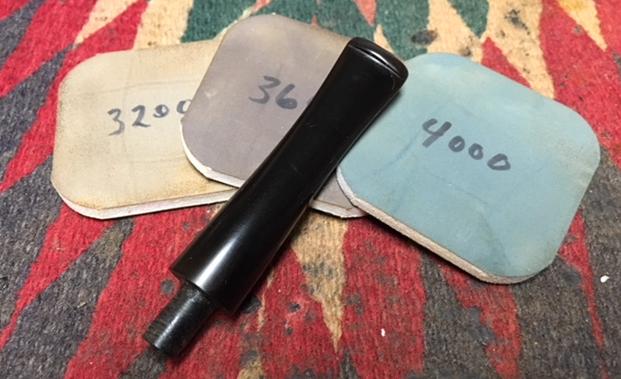
Since this would be the first time I would be attempting to undertake the process of adjusting the fit of the tenon and matching the diameter of the shank with that of the stem, I Face timed with Mr. Steve who advised me to, firstly, be very careful during the sanding of the shank so as not to lose too much briar making the shank diameter too small, secondly, he told me to ensure that the entire shank should be sanded such that the taper at the shank end is not abrupt and blends well into the overall shape of the pipe. Thirdly, it is most important to exercise a lot of patience and diligence while working and check very frequently the fit, finish and shape of the shank and the stem.

I started with cleaning the shank of all debris using a dental spatula, pipe cleaners, cue tips and isopropyl alcohol. I was surprised to see the amount of gunk that was removed from the shank. I tried to fit the stem on to the shank. Though the tenon has inched further in to the mortise, a prominent gap is clearly visible between the shank end and the stem.Using a 220 grit sand paper, I very carefully began the process of sanding down the tenon, checking ever so frequently for the fit of the tenon into the mortise. Finally I was able to achieve a perfect fit of the stem and the shank with all the right noises!!!!Now that the issue of fit of the stem into the shank has been addressed, I turned my attention to match the size of the diameter of the shank with that of the stem by sanding down the shank. I started this sanding using a 220 grit sand paper. This process was made difficult and uneven at the bottom of the shank due to the stamped number “20” being very close to the shank end.I took care so as not to sand off the stampings on the shank and stem by masking them. Once I was satisfied with the results of sanding with 220 grit paper, I switched to sanding with a 440 grit sand paper to further blend the shank and stem. Mr. Steve’s advice of being very diligent and frequent checking was always ringing in my ears as I progressed towards the goal of matching the shank with that of the stem. A word of caution for first timers like!!!!!!!! During the process of sanding you may notice a considerable dip at the shank end.This signifies that the sanding of the shank end is excessive and thus sanding needs to be done from further up the shank and a bit over the stem too. This will ensure a seamless joint between the shank and the stem.

Using a 220 grit sand paper, I sanded the shank to match the dip at the shank end and also a little of the stem end, all through taking care of the stampings on the shank and stem. I further evened out the shank and the joint with 600 and 800 grit sand paper. Once I was satisfied with the seamlessness of the joint, I showed it to Abha, my wife and she too approved of the job done. Thereafter, I further blended and merged the entire shank and the stem through the joint using micromesh pads, wet sanding with 1500 to 2400 pads and dry sanding with 3200 through to 12000 pads. I wiped the sanded area with alcohol after each pad to remove the sanding dust. Boy!! Was I pleased with the results, hell YEAH!!!! I shared pictures of the end result with Mr. Steve on What’sApp and he too approved of the seamless joint. Next I turned my attention to the stem and painted the surface of the stem with the flame of a Bic lighter to raise the tooth chatter and minor bite marks. The deeper tooth bites with a mixture of activated charcoal and clear CA superglue and let it cure for 24 hours. Using a flat head file needle, these fills were blended into the surface of the stem. For a better blending of the fill, I further sanded the entire stem with 220 followed by 400 and 800 grit sand paper. This helps to reduce the sanding marks left behind by the more abrasive 220 grit paper. To bring a deep shine to the vulcanite stem, I went through the complete set of micromesh pads, wet sanding with 1500 to 2400 grit pads and dry sanding with 3200 to 12000 grit pads. I wiped the stem with alcohol after each pad and rubbed it down with Extra Virgin Olive oil. The internals of the stem was cleaned out using alcohol and pipe cleaners. The finished stem is shown below.With the stem taken care of, I once again turned my attention to the stummel. The sanded shank was lighter hued as compared to the rest of the stummel. Since I was still awaiting my stain pens, which have been held back in custom clearance for the last 50 odd days and also since I have not yet graduated to use of aniline stains/ dyes, I was contemplating what could be done to blend the finish of the shank with that of the stummel. Being the intelligent of the two, Abha suggested that the bowl could be sanded using micromesh pads to match the finish of the shank.  That decided, Abha reamed the chamber using Kleen Reem pipe tool and with the fabricated pipe, she removed the remaining cake from the chamber.With the same knife, she gently removed all the overflow of lava, oils and tars from the rim surface. She further sanded the interiors of the chamber with a 220 grit sand paper to get rid of the last traces of the remaining cake. She also topped the rim on 220 grit sand paper and evened out all the remaining lava and minor dings and dents that were revealed after the lava was removed.  Using isopropyl alcohol, hard bristle and normal pipe cleaners, she completely cleaned out the internals of the shank.I cleaned the external surface of the bowl with undiluted Murphy’s Oil soap and tooth brush to remove all the grime and dirt and rinsed it under running water. I took care that no water enters the chamber and the shank. Using paper napkins and soft cotton cloth, I completely dried the surface. Thereafter began the entire process of sanding down with micromesh pads as enumerated while working on the shank. I also worked on the rim top to match it with the rest of the bowl. The bowl has some interesting grains and patterns.   I rubbed in some Before and After Restoration balm in to the briar to bring out the shine and enliven the briar. After a few minutes, I rubbed and polished the bowl with a soft cloth. Finally, I finished the pipe by rubbing a small quantity of Paragon wax and polishing it using raw and undiluted muscle power and a microfiber cloth. I am very pleased and happy with the way the complete project has turned out. It was an exhilarating experience to be able to appreciate the transformation and a sense of accomplishment that accompanied it. I must thank Abha and Mr. Steve for walking with me through this project. Here are the pictures of the finished pipe.