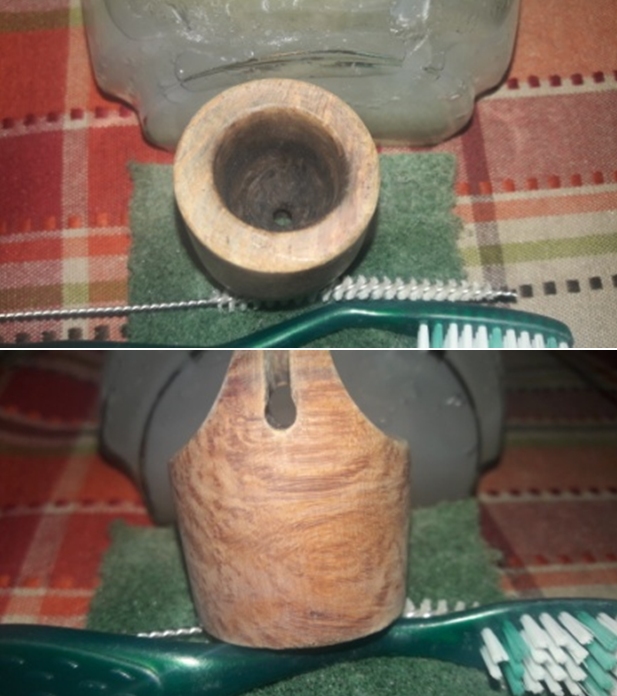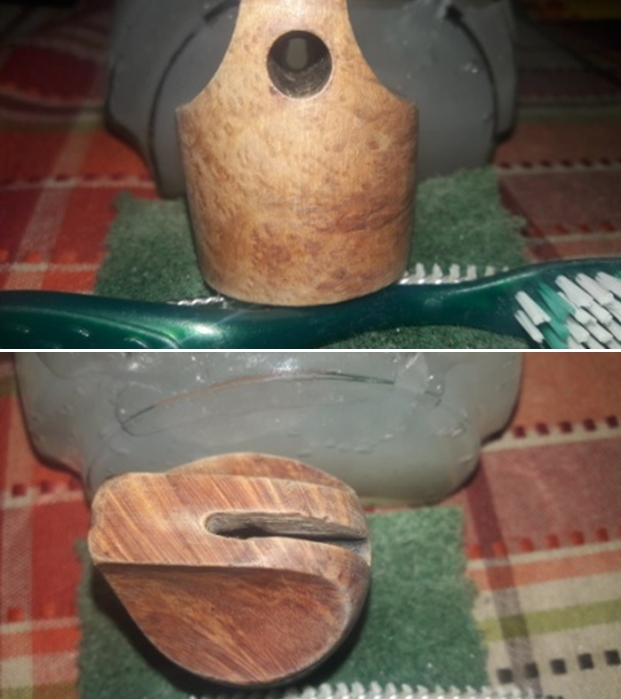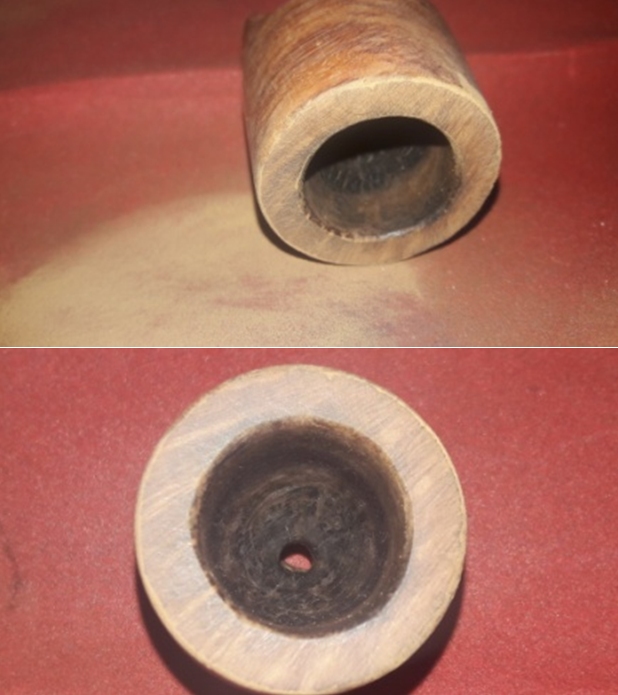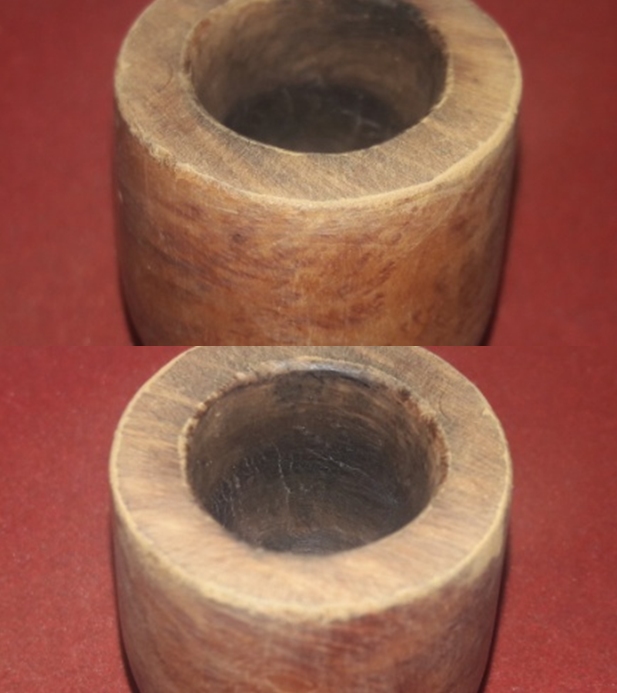
Tag Archives: Paresh Deshpande article

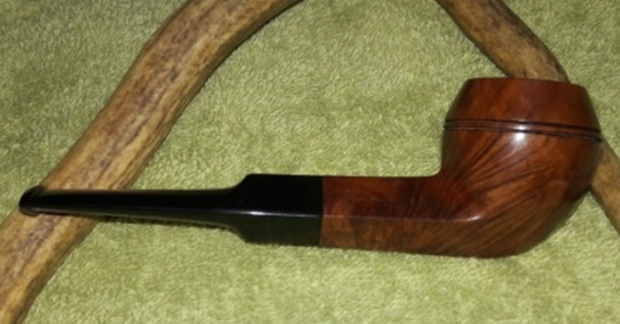
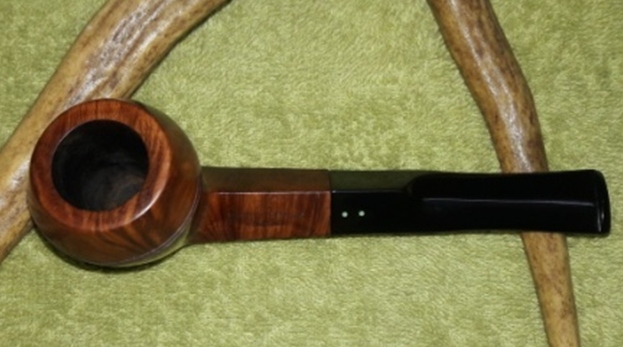
Refurbishing a Bertram Lovat # 25 Pipe From a Lot of 13 Bertrams


Blog by Paresh Deshpande

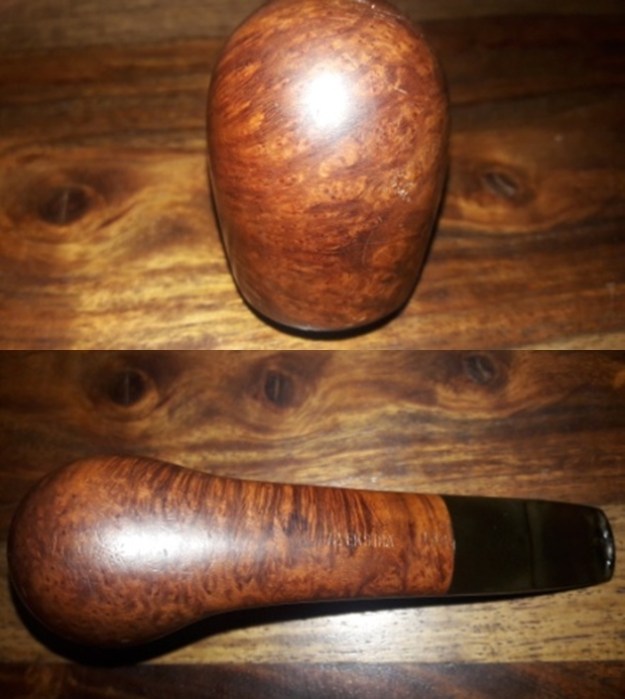
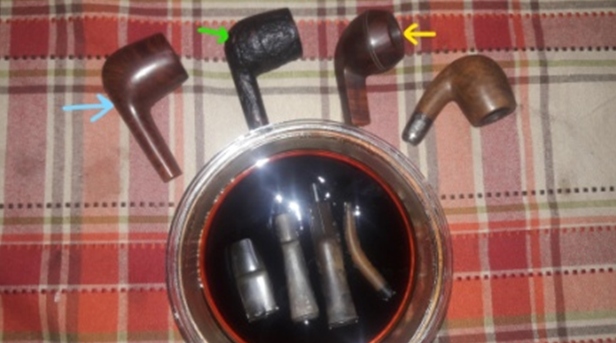
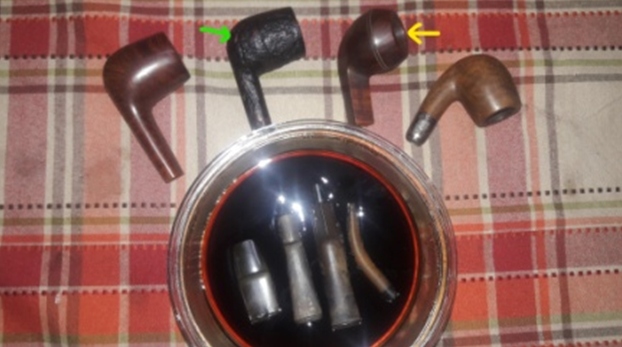
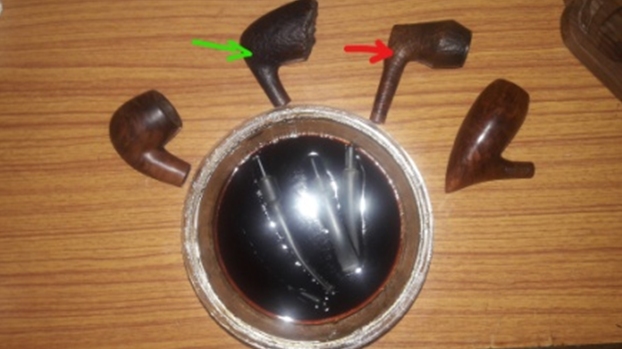
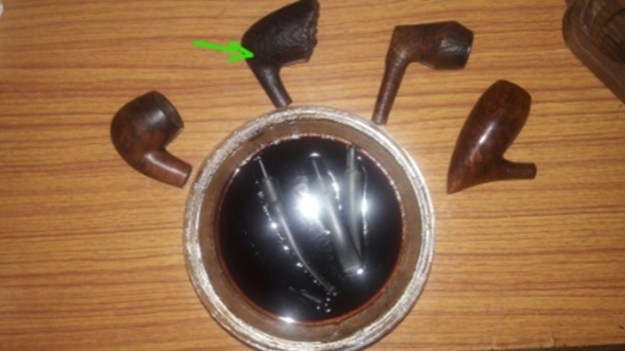
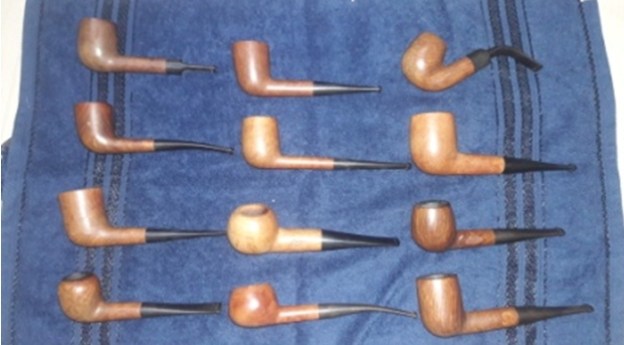
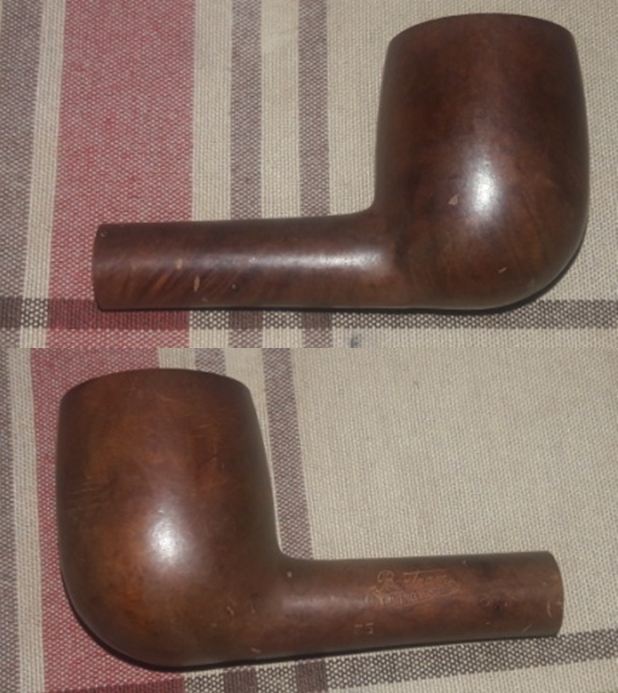
Last year while on a Face Time chat with my Guru, Mentor and friend, Steve Laug, we got talking about the Bertram lot that he had been working on at that point in time. He spoke about how overwhelming it was just to look at the large lot of about 200 plus pipes that he and Jeff had acquired. Never to miss an opportunity to add to my meager pipe lot that was available for me to work on, I suggested that if it was okay with him I would be more than willing to take a few of them off his hands. We worked out the details and soon a job lot of 12 pipes traveled all the way from US to Canada and then on to India!!! That was one long journey undertaken by this lot of Bertram pipes. Here is the lot of Bertram pipes that I received. This lot contained a variety of nicely shaped and grained pipes which I had been looking forward to work on. Here is the picture of the Bertram lot as it came to me.The first pipe that I decided to work on from this lot is a classic Lovat, marked in yellow arrow, with beautiful loosely packed bird’s eyes to the sides of the stummel and cross grains to the front, back and over the shank surfaces. This pipe is stamped on the left shank surface as “Bertram” in running hand over “WASHINGTON D.C” in block capital letters, font size reducing from left to right. The grade code “25” is stamped below the letter W. The stampings are all crisp and deep. The short vulcanite saddle stem is sans any stampings. The size and feel of the pipe is solid in hand. This pipe has been well researched and chronicled by Steve when he worked on many of the Bertram pipes in his possession and thus, shall not waste time in proverbial “reinventing the wheel”. Interested readers may like to follow the link given below to get to know the brand better (https://rebornpipes.com/2019/04/10/the-4th-of-a-collection-of-bertrams-a-bertram-dublin-70s/).
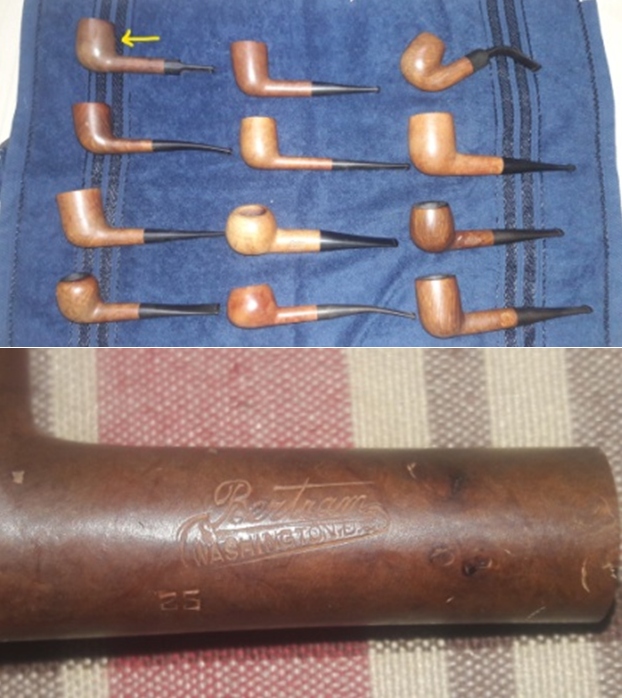
Initial Visual Inspection
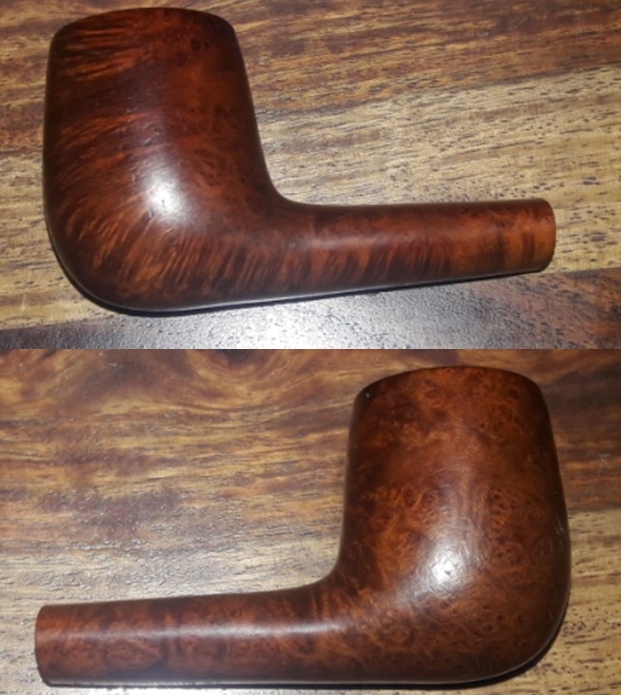
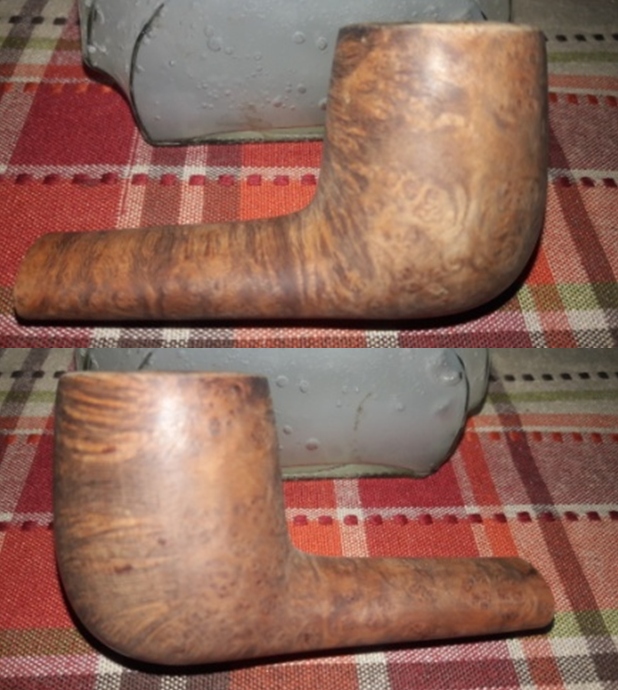
This pipe has a decent medium bowl size with a longish round shank and short saddle stem rendering it a classic Lovat shape. The stummel boasts of some beautiful cross grains to the front and back of the bowl and all around the shank. The stummel is covered in dirt and grime of the overflowed lava. The entire stummel is peppered with a number of fills, both large and small. There is a thick layer of cake in the chamber and some damage is likely to the back of the rim top surface. The stem is lightly oxidized with no bite marks to the button edge or tooth chatter in the bite zone. The pipe appears as it sits on my work table presents an encouraging picture. Detailed Inspection Of The Pipe And Observations
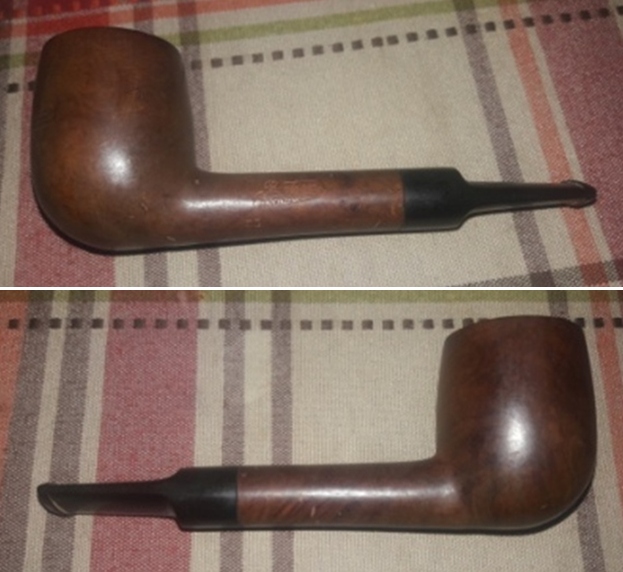
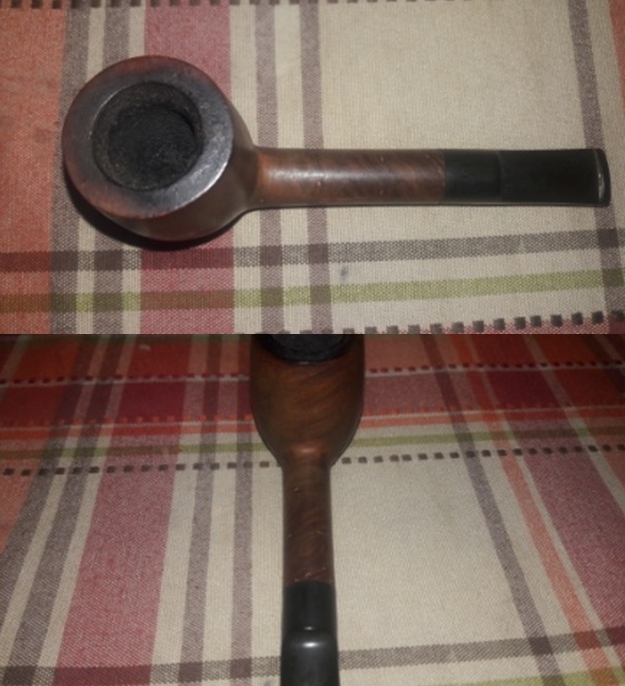
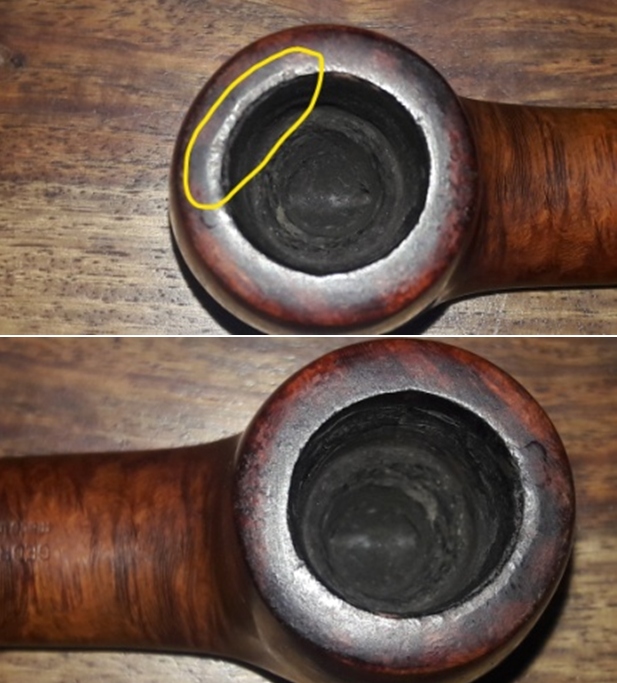
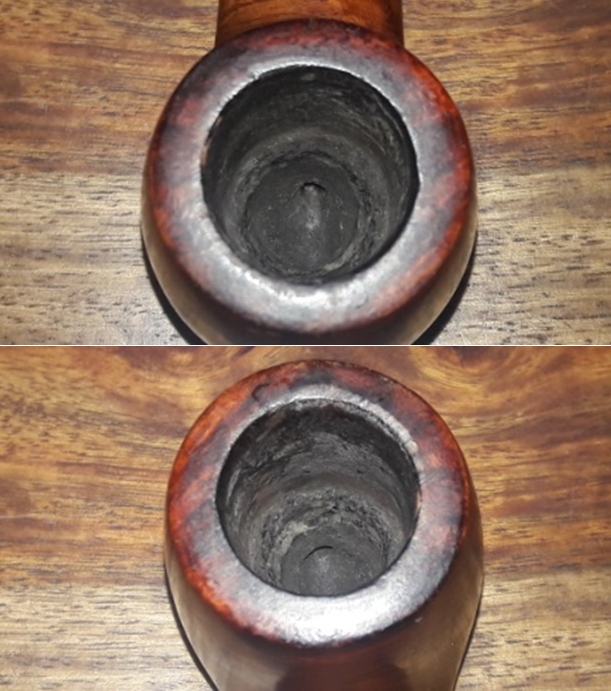
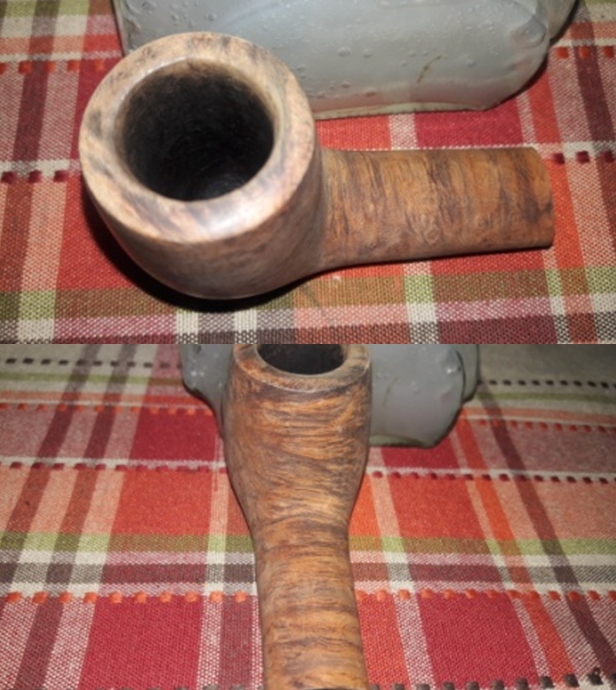
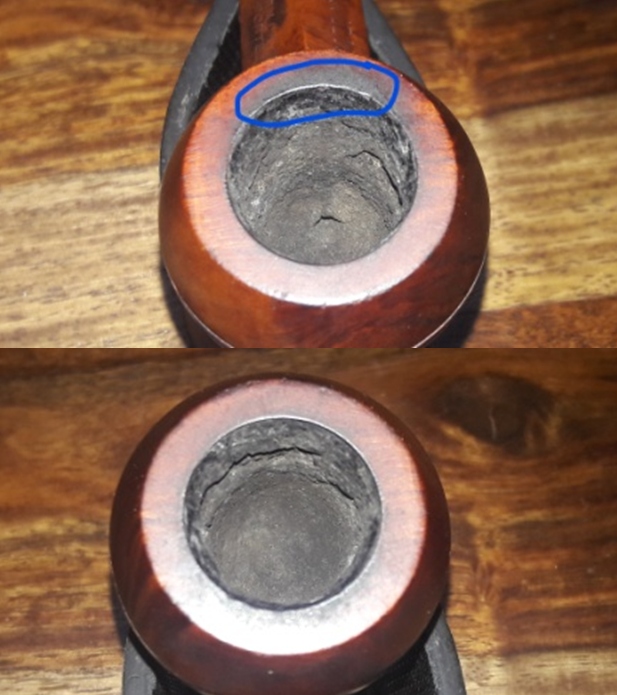
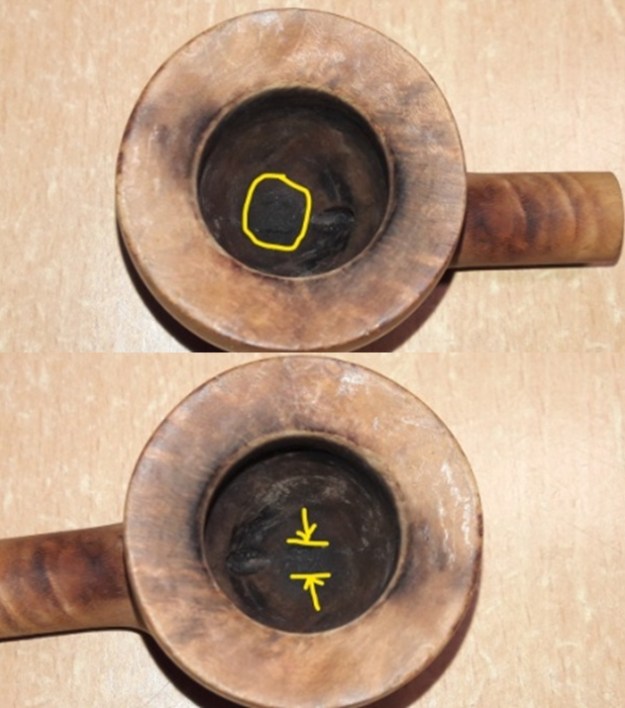
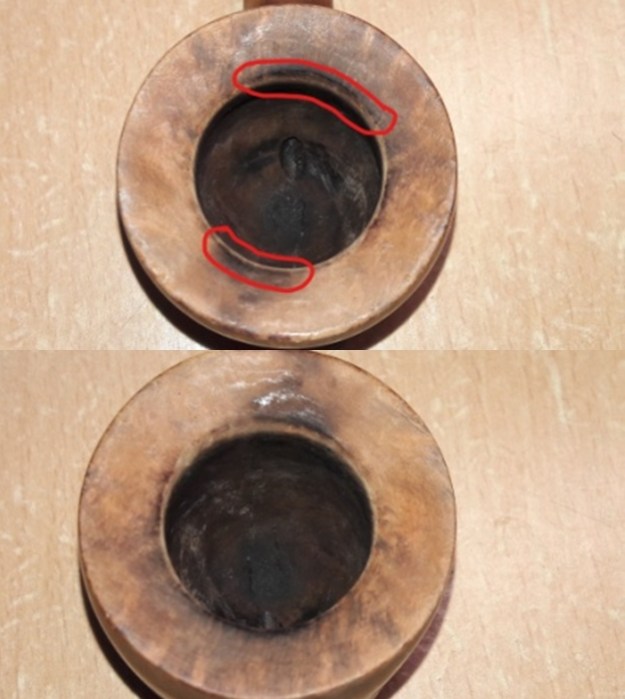
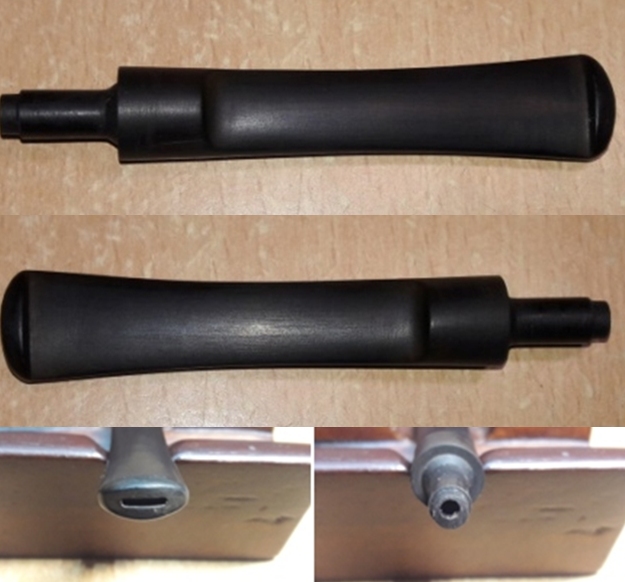
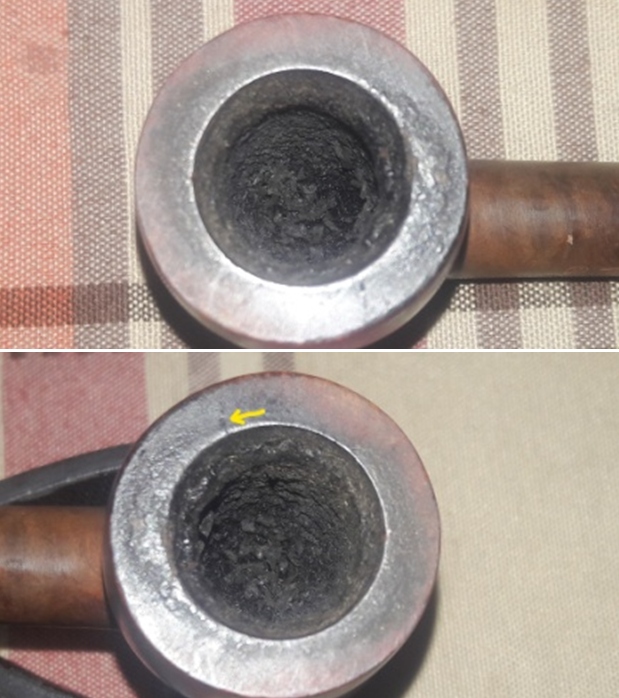
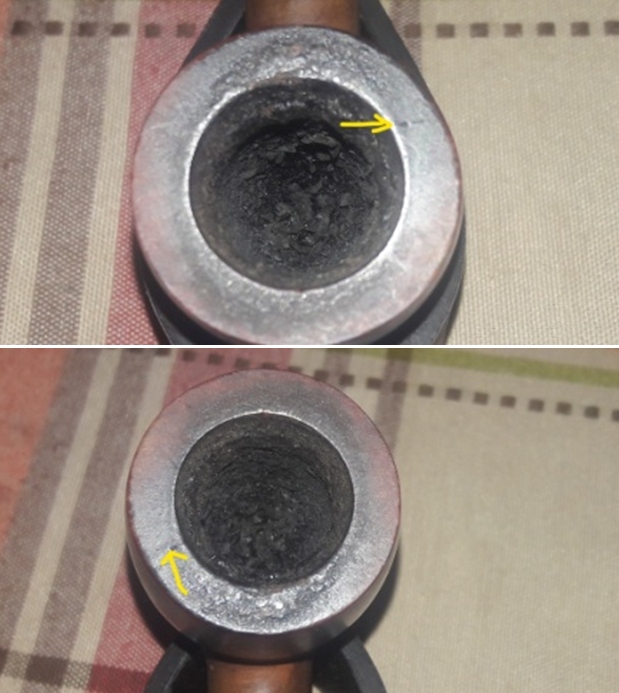
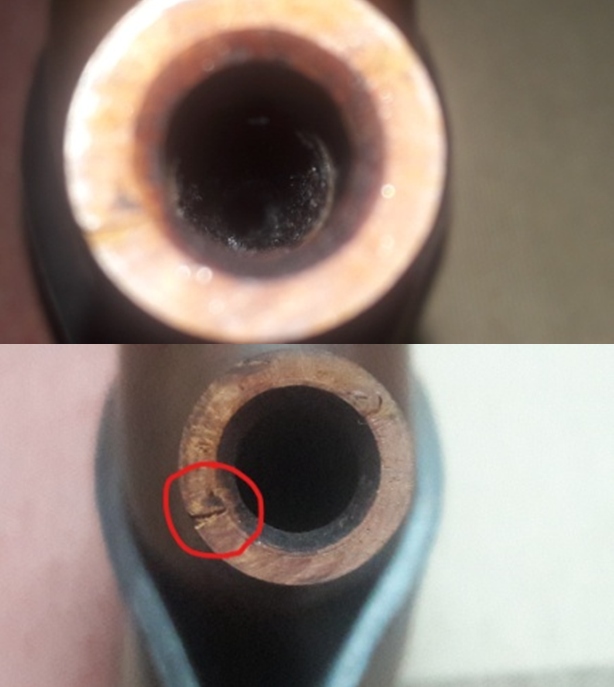
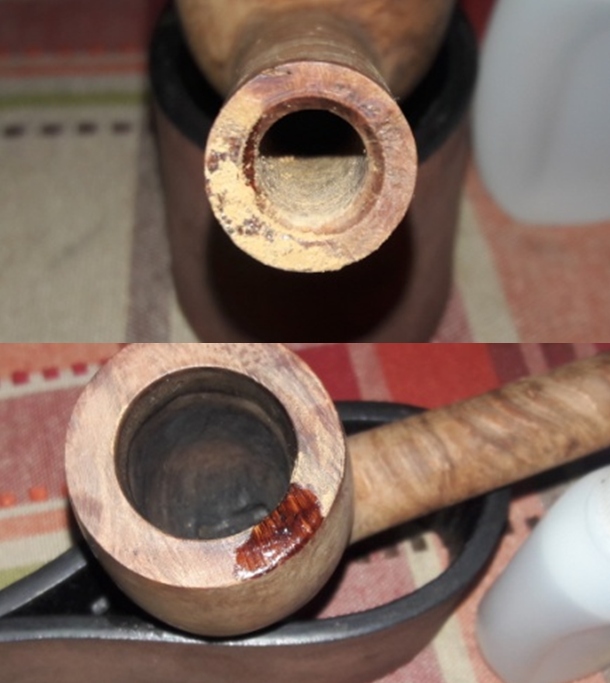
The bowl appears round with a wide rim and a depth of about 2 ¼ inches. The draught hole is in the center and at the bottom of the chamber. The chamber has an even layer of thick hard cake with remnants of un-burnt tobacco seen at the heel of the chamber. A fill (?) can be seen to the left in the 8 o’clock direction (indicated with a yellow arrow) over the smooth rim top surface. The rim surface is covered with lava overflow and has max accumulation in the 6 o’clock direction. Through this layer of lava, a few dings can be seen over the rim top surface. The inner rim edge in the 6 o’clock direction appears dark and worn out. The outer rim edge is sans any damage. The condition of the inner walls of the chamber can be commented upon after the cake has been taken down to the bare briar. There is a sweet smell in the chamber which is not very strong.  The suspected fill over the rim top surface appears just that…. A fill! However, once the lava overflow from the rim top is removed that can I say, with any certainty, if it is a crack or otherwise. The stummel appears solid to the touch all around and hence I do not foresee any serious damage to the walls in the form of burnout/ deep heat fissures/ lines or pits. The dark inner rim edge, in the 6 o’clock direction, may be charred further than anticipated and the same will be confirmed after the surface has been thoroughly cleaned. I need to resort to topping the rim top in order to address the damage to the surface. The ghost smells should reduce once the cake from the chamber is removed and the shank has been cleaned. The smooth stummel surface is covered in dust and grime through which one can make out the beautiful cross grains to the front and back of the bowl and shank. The stummel surface is peppered with numerous small fills. These fills stand out like flesh wounds against the briar surface. The briar is looking lifeless and bone dry. Once the stummel has been thoroughly cleaned, these fills will be more apparent. I intend to refresh only those fills which have loosened out with a fresh fill of briar dust and superglue. Thorough cleaning and rising of the stummel under warm water should loosen old fills while also serving to highlight the grain patterns. Micromesh polishing will help in blending these fills while imparting a nice shine to the briar.   The mortise shows accumulation of oils, tars and gunk and the air flow is not full and smooth. The shank end rim surface has a chipped edge which is encircled in red. Along with the rim top fill/ chipped surface, I shall fill this gouge with briar dust and superglue mix. The high quality vulcanite saddle stem is lightly oxidized. Some minor tooth chatter and calcified deposit is seen on both the upper and lower stem surfaces in the bite zone and at the bottom of the button edge respectively. The tenon has accumulated ash and oils/ tars that have dried out on the inside as well as on the outside. The horizontal slot has scratch marks which will have to be addressed. The tooth chatter and the calcified deposits will be removed by sanding with a piece of 220 grit sand paper.     The Process
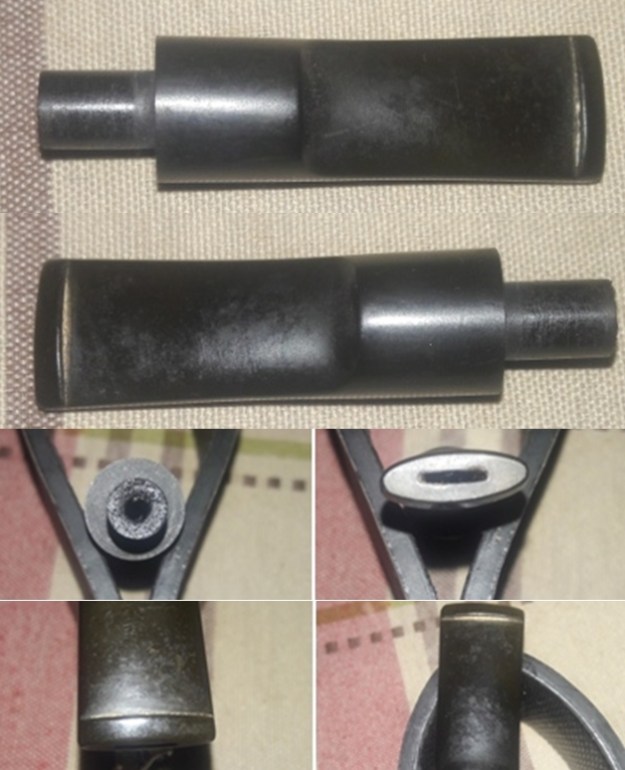
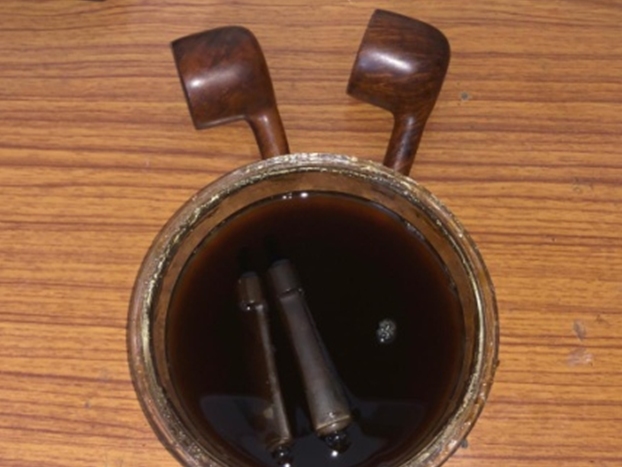
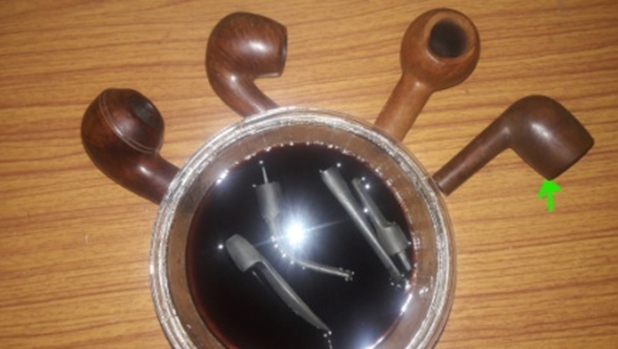
I started the restoration of this pipe by first cleaning the internals of the stem with bristled pipe cleaners and 99.9% pure isopropyl alcohol. I scraped out the dried oils and tars from the tenon end with my fabricated knife and also removed the dried oils and tars from the slot end. I followed it up by sanding the entire stem with a folded piece of 220 grit sand paper to remove the surface oxidation. It has been our (Abha, my wife and self) experience that sanding a stem before dunking it in to the deoxidizer solution helps in bringing the deep seated oxidation to the surface which in turn make further cleaning a breeze with fantastic result.I dropped the stem in to “Before and After Deoxidizer” solution developed by my friend Mark Hoover. The solution helps to draw out heavy oxidation to the surface, making its further removal a breeze, while the minor oxidation is eliminated to a very great extent. The initial sanding helps to draw out the complete oxidation as the sanding opens up the stem surface that has been initially covered with oxidation. I usually dunk stems of 4-5 pipes that are in-line for restoration and this pipe is marked in green arrow. I generally allow the stems to soak in this solution overnight to do its work.While the stem was soaking in the deoxidizer solution, I worked on the stummel by first reaming the chamber with size 2 followed by size 3 Castleford reamer head. I further scraped the chamber walls with my fabricated knife to remove the remaining carbon deposits where the reamer head could not reach. I scraped out the lava overflow from the rim top surface, especially from the area in the 6 ‘O’ clock direction. Once the cake was reamed back to the bare briar, I used a 150 grit sand paper followed by 220 grit sand paper to remove all the traces of remaining cake and also to smooth out the inner walls of the chamber surface. Finally, to remove the residual carbon dust, I wiped the chamber with a cotton pad wetted with 99.9% pure isopropyl alcohol. The chamber walls are pristine without any damage. Thankfully the inner rim was not charred under the lava overflow. The ghost smells are negligible and should further reduce after the shank/ mortise are thoroughly cleaned. The scraping of lava from the rim top has confirmed that the damage on the left side is indeed a fill and it would need to be refreshed. I followed up the reaming with cleaning the mortise using cue tips, pipe cleaners and shank brush dipped in isopropyl alcohol. I scraped the walls of the mortise with my fabricated knife to remove the dried oils and tars. The ghost smells are history and the chamber now smells clean.   With the bowl internals clean, I move to clean the exterior of the stummel. I used a hard bristled tooth brush and Briar Cleaner, a product that has been developed by Mark Hoover, to scrub the stummel and rim top. I set the stummel aside for 10 minutes for the product to draw out all the grime from the briar surface. After 10 minutes, I washed the stummel under running warm water with anti oil dish washing detergent till the stummel surface was clean and dried it using paper towels and soft cotton cloth. I simultaneously cleaned the shank internals with the detergent and hard bristled shank brush and set the stummel aside to dry out naturally. The stummel surface has cleaned up nicely and the beautiful grain patterns are now on full display. The fills, even the smallest ones, are now clearly discernible. I probed each fill with a sharp dental tool to check for solidity and thankfully, each fill was nice and solid without any give. While the stummel was drying, the next morning, Abha removed the stem that had been soaking in the deoxidizer solution overnight. She cleaned the stem under running warm water and scrubbed the raised oxidation from the stem surface using a scotch brite pad and cleaned the airway with a thin shank brush. She further removed the oxidation by scrubbing the stem with 0000 grade steel wool and applied a little EVO to rehydrate the stem. I need to further sand the stem to completely remove the oxidation.    My significant half, Abha, used a 220 grit sand paper to sand the stem and remove all the oxidation that was raised to the surface. This step further reduced the tooth chatter and bite marks present on the stem. She wiped the stem with Murphy’s Oil soap on a cotton swab. This helps in cleaning the stem surface while removing the loosened oxidation. As is the norm, whenever she works on a pipe, taking pictures NEVER EVER crosses her otherwise sharp mind!! No exceptions here…
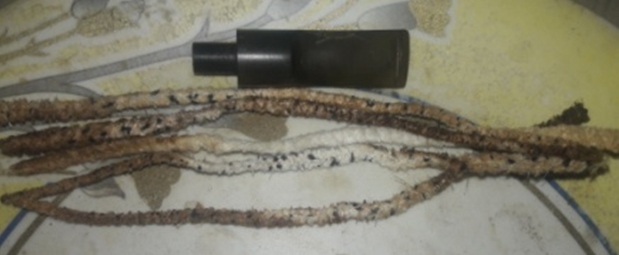
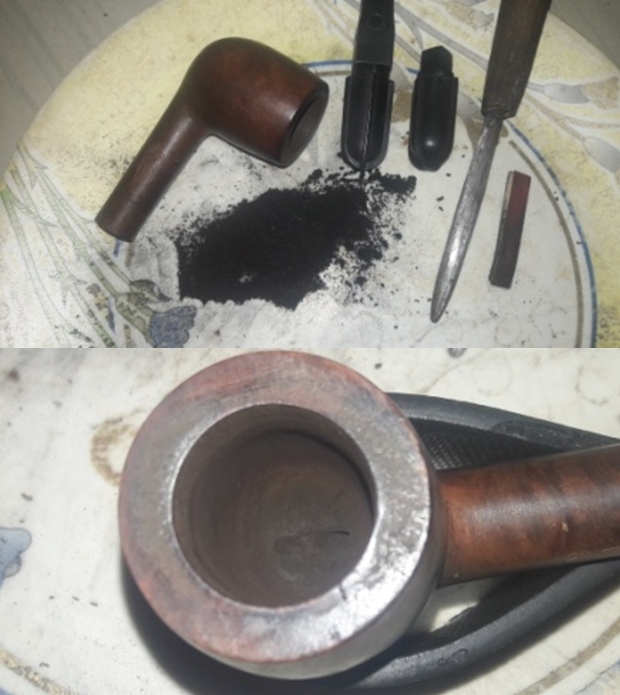
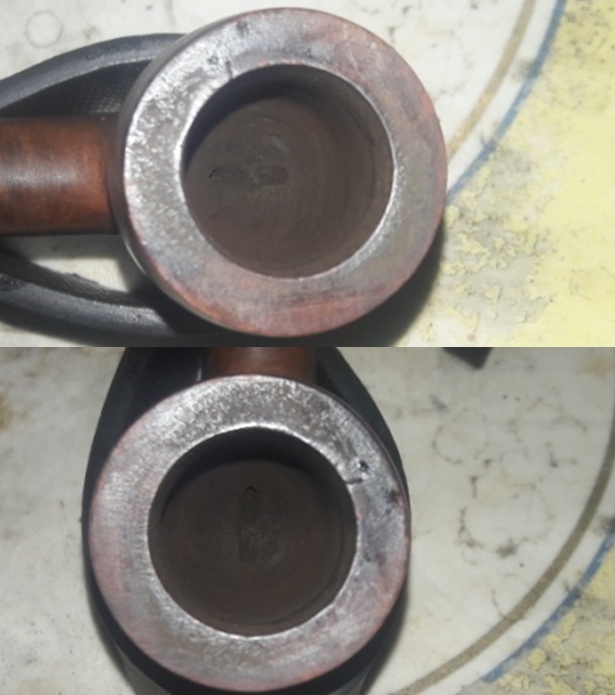
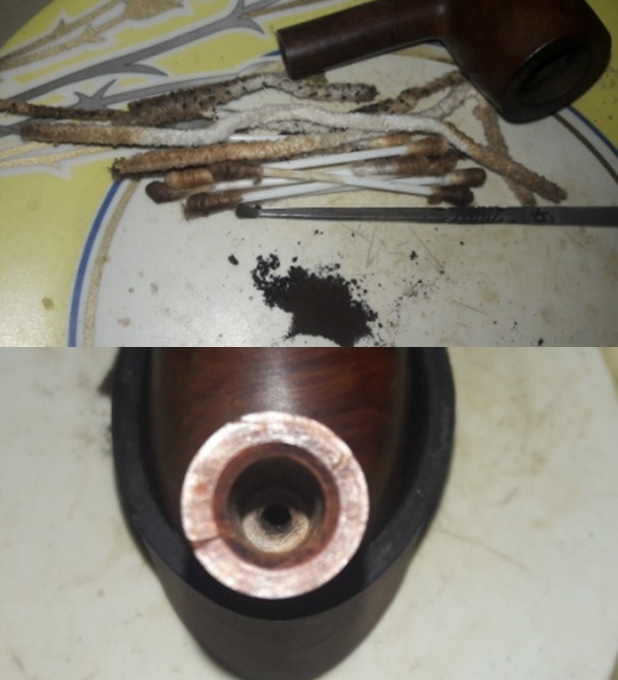
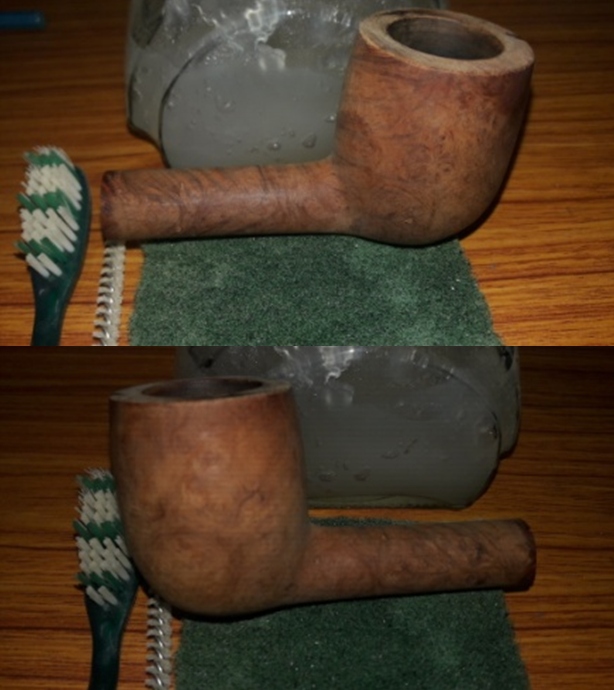
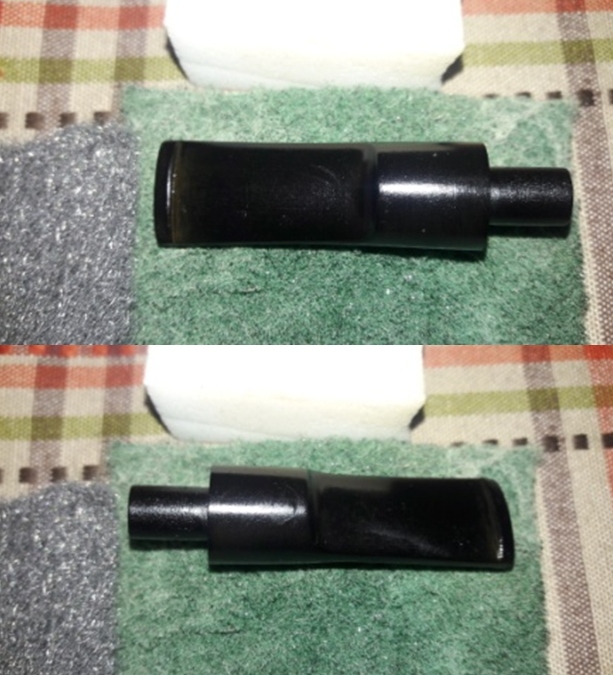
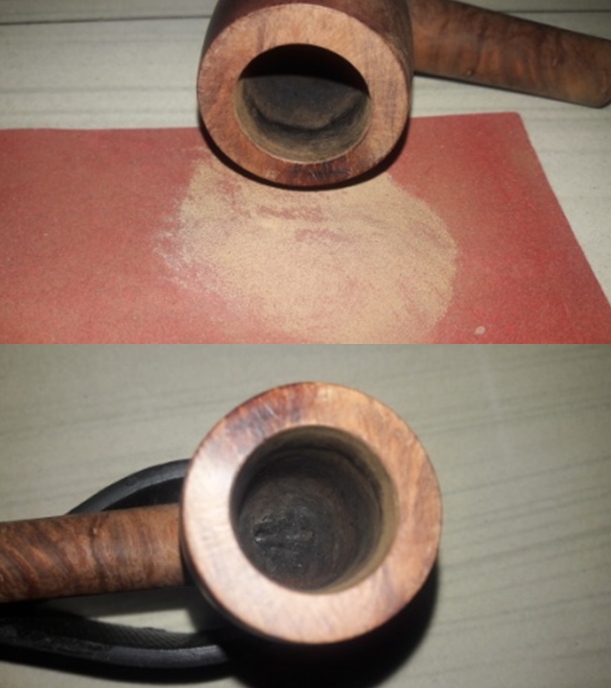
While Abha was working on the stem, I worked on the stummel. It was time to address the fill over the rim top and the gouge over the shank end surface. I filled both these gouges with a mix of briar dust and superglue. I always use the layering method for such repairs (layer of glue is first applied over the target area and briar dust is pressed over the layer of glue). I repeated the process till the desired coverage and thickness was achieved. I set the stummel aside for the fills to cure. I shall have to be extremely careful while sanding the shank end surface as any uneveness will cause an uneven seating of the stem in to the mortise.Once the fills had cured, I topped the rim top over a piece of 220 grit sand paper till I had a smooth and even surface. With a folded piece of worn out 180 grit sand paper pinched between my thumb and forefinger, I carefully sand the shank end fill. With the same grit sand paper, I cleaned the bevel to the inner edge of the shank end of all the dripped mix of briar dust and glue. The reason I did not top the shank end was that any loss of briar from the shank end would result in shortening of the shank and a gap would be seen between the stem and shank end. The rim top surface and the edges look very neat at this stage. I followed it by wet sanding the stummel with 1500 to 2000 wet & dry sand paper and further with 3200 to 12000 grit micromesh pads, wiping frequently with a moist cloth to check the progress. I really like the looks of the stummel at this point in restoration. The grains and the clean lines of this piece of briar are worthy of appreciation.   Next, I rubbed a small quantity of “Before and After Restoration Balm” deep in to the briar with my finger tips and let it rest for a few minutes. The balm almost immediately works its magic and the briar now has a nice vibrant appearance with the beautiful grain patterns displayed in their complete splendor. I further buffed it with a horse hair brush. The dark browns of the bird’s eye and cross grains spread across the stummel makes for a visual treat. It really is a nice piece of briar.  With the stummel rejuvenation almost complete, save for the final wax polish, I worked the stem. To bring a deep shine to the vulcanite stem, I polished the stem, wet sanding with 1500 to 2000 grit sandpapers followed by further wet sanding with 3200 to 12000 grit pads. I wiped the stem with moist cloth after each pad and rubbed it down with Extra Virgin Olive oil to rejuvenate the vulcanite. The finished stem is shown below.  I mount a cotton cloth buffing wheel on to my hand held rotary tool and polished the stummel and stem with Blue Diamond compound. This compound helps to remove the minor scratch marks that remain from the sanding. I mount another cotton buffing wheel that I have earmarked for carnauba wax and applied several coats of the wax. I finished the restoration by giving the entire pipe a rigorous hand buffing using a microfiber cloth to raise the shine further. The finished pipe looks amazingly beautiful and coupled with the size, heft and the hand feel, makes it quite a desirable pipe. If you feel that this pipe calls out your name, please let Steve know and we shall make arrangements for it to reach you. P.S. In one of my previous write up, a question “Why do I enjoy bringing these old battered and discarded pipes back to life?” had popped up in my mind. I had given one reason in my last write up and in all my subsequent write ups I intend to share with the readers my reasons as to why I really love this hobby.
The second reason is that this pipe that is now discarded by the piper as being SPENT and has fallen out of favor, actually still has (mostly do!) potential to provide many more years of smoking pleasures to any piper. Just because it has fouled up or does not smoke as good as when it was new or has been damaged, does not mean that the piece of briar is at fault. It is just that it was not well looked after by the piper and it is he and he alone who is responsible. It provides me with immense pleasure and joy to work on such out of favor and discarded pipes and bringing them back to their real beauty and full functional potential for years ahead. I consider it my honor to work on such pipes that find their way on to my work table.

I wish to thank each one for sparing their valuable time to read through this write up and each one is my prayers. Stay home…stay safe!!


Ready For a Second Inning – Georg Jensen 72 Ekstra # 130 Compact Lumberman


Blog by Paresh Deshpande

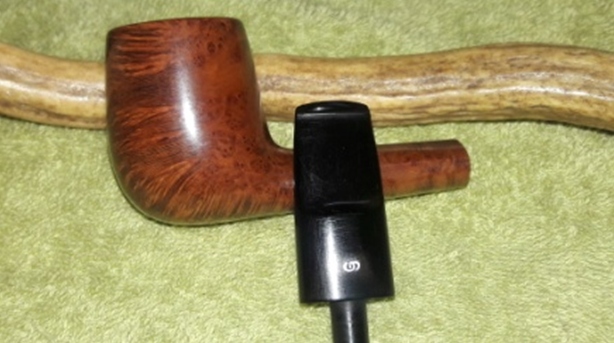
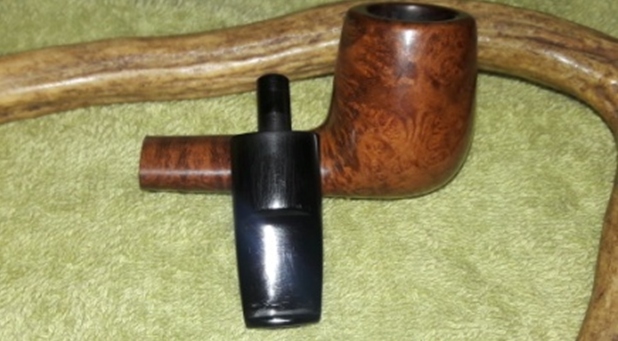
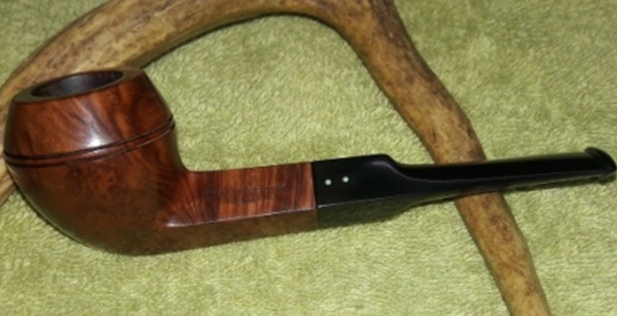
I had randomly selected four pipes to work on since I prefer to put a few pipe stems together in the “Before And After” Deoxidizer solution that has been developed by Mark Hoover. I have completed the restoration of two of these pipes, a Wally Frank “BLACKTHORNE” sandblast billiard and another also a Wally Frank stamped Natural Unvarnished Bulldog with two dots.

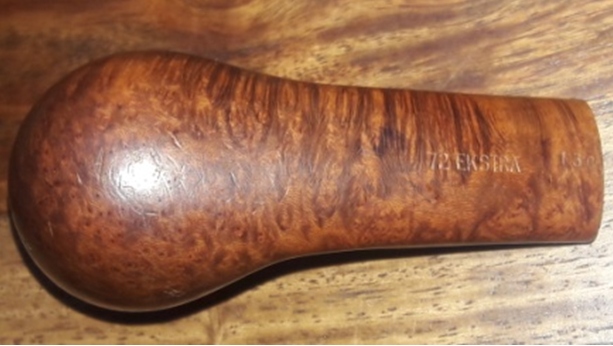
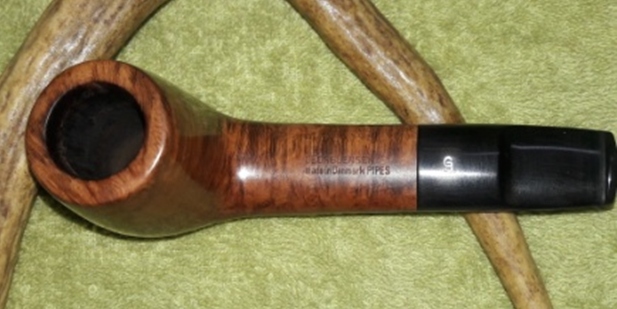
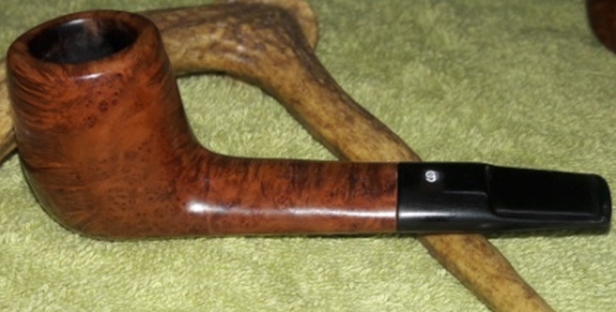
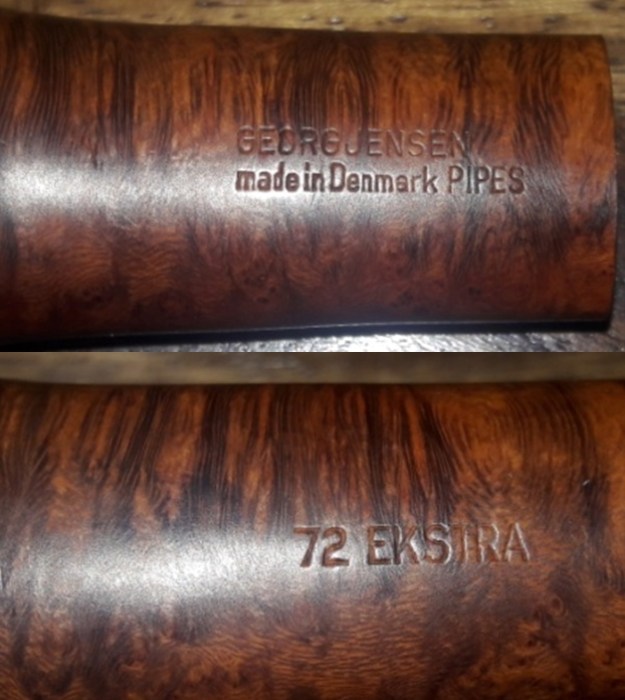
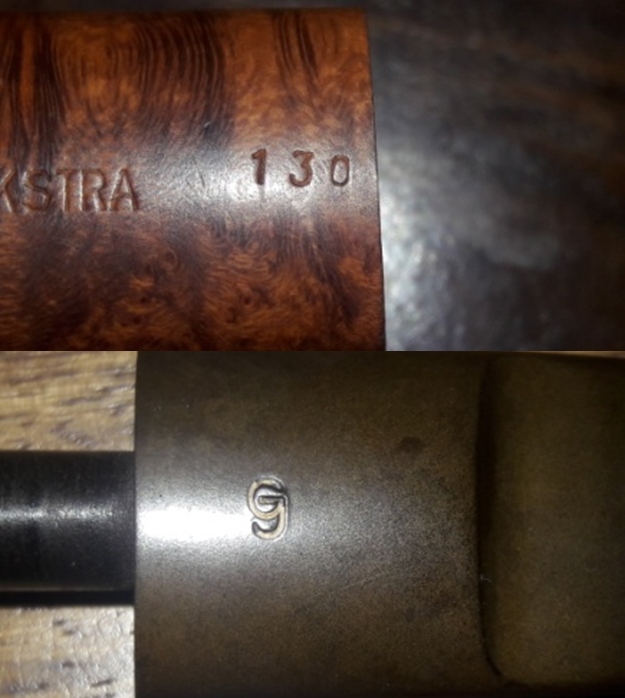
The third pipe that I decided to work on is not a classic Lovat or its variants, a Lumberman or a Canadian, but I would prefer to call it short compact Lumberman. This pipe is stamped on the upper smooth oval shank surface as “GEORG JENSEN” over “made in Denmark PIPES” and on the bottom of the shank surface as “72 EKSTRA” followed by shape code “130” towards the shank end. The stampings are all crisp and deep. The high quality vulcanite diamond saddle stem bears the logo of interlinked letters “GJ”. The smooth briar, shape and quality of the stem all oozed high quality. This would be the first Georg Jensen pipe that I have worked on and thus my curiosity was piqued as I have worked on and handled pipes from Denmark made by carvers like Preben Holms, Nording, Soren etc, but never a Georg Jensen pipe. I first searched rebornpipes and came across a catalogue uploaded by Jacek A. Rochacki. However, the pipe on my work table finds no mention of it in the brochure. The article has an interesting snippet of information that is reproduced below.

* “our” Georg Jensen – the pipe maker is not this famous Georg Jensen – Danish designer, silversmith and sculptor.

Here is the link to the article

https://rebornpipes.com/2014/04/13/georg-jensen-pipe-brochure-jacek-a-rochacki/

Having hit a wall here, I turned my attention to pipedia.org to gather background information about the carver and his work. Here is the link to the write up on Georg Jensen and a brief of the carver that I have reproduced from the site.

https://pipedia.org/wiki/Georg_Jensen

The Georg Jensen pipe factory was founded by Per Georg Jensen and his wife in 1954, in Kopenhagen, Denmark. Since the 80s the company is under the management of his daughter Lis, and his son with the same name, Per Georg Jensen. The company manufactured around 2,000 factory pipes per year. Among the top of the line pipes are hand carved special editions and free hands.

Top of the Line models of Georg Jensen have vulcanite or ebonite stems, factory pipes usually have acrylic stems.

Factory pipes (in increasing quality) were marked:

Danish Sand Achat / Amber Red Flame / Red Skin Sunrise / Orange extra / Starline Contrast / Bicolour / Harmon Excellent / Masterpiece

Pipes were commonly marked (in increasing quality) with: MODEL + MODEL NUMBER + “Made in Denmark”, GJ stamp in red on the stem. MODEL NUMBER + “Georg Jensen” in italic or fancy font.

Extremely rare and collectible freehands were marked with:

“Straight Grain” and a number that discerns the grading from 1 (lowest) to 13 (highest).

Special edition pipes were marked with: MODEL + MODEL NUMBER + “Handmade in Denmark” + GJ stamp in white on the stem.

The factory closed down in 2001 when Per Georg Jensen (jr) became “Tobacco Professor” for MacBaren Tobacco house.

Well, again there are no matching grades for the factory pipes or similarity in commonly marked pipes and it definitely is not a freehand pipe!!

I surf the net and visited Smokingpipes.com which has been some excellent source of information on pipe brands and found an exact same pipe as that is currently on my work table with the shape and stampings matching to the T. However, the details that were available were similar to that I had read on pipedia.org. Given below is the link to the site.

https://www.smokingpipes.com/pipes/estate/denmark/moreinfo.cfm?product_id=284941

I have not been able to accurately pinpoint the period that this pipe was made in or the grading of this pipe in Georg Jensen line up, so any assistance in this regard is welcome and highly appreciated.

Initial Visual Inspection
This pipe has a compact size with an oval shank and short saddle stem akin to a Lumberman. However the compact size of the pipe with a shorter shank length compels me to designate this shape as a short Lumberman. The stummel boasts of some beautiful cross grains to the front and back of the bowl and shank. The stummel is covered in dirt and grime of the overflowed lava. There is not a single fill in the briar which speaks of high quality selection of the briar. There is a decent layer of cake in the chamber and some damage is seen to the rim top surface. The stem is heavily oxidized with a few deep bite marks to the button edge in the bite zone. Here is how the pipe appears as it sits on my work table. Detailed Inspection Of The Pipe And Observations
The bowl is slightly off round with a decently wide rim and a depth of about 1 7/8 inches. The draught hole is in the center and at the bottom of the chamber. The chamber has an uneven layer of thick crumbly cake. The smooth outward sloping rim top surface is severely damaged with dents/ dings and covered in lava overflow, dirt and grime. The inner front rim edge has suffered a few blows on a hard surface resulting in a dented and chipped edge surfaces to the between 12 o’clock and 2 o’clock direction and the same in enclosed in a yellow circle. The outer rim edge too has some minor dents in the 6 o’clock direction. The condition of the inner walls of the chamber can be commented upon after the cake has been taken down to the bare briar. There is a sweet smell in the chamber which is not very strong. The stummel appears solid to the touch all around and hence I do not foresee any serious damage to the walls in the form of burnout/ deep heat fissures/ lines or pits. The darkened inner rim edge may be charred further than anticipated and the same will be confirmed after the surface has been thoroughly cleaned. I need to resort to topping the rim top in order to address the damage to the surface. The ghost smells should reduce once the cake from the chamber is removed and the shank has been cleaned. The smooth stummel surface is covered in dust and grime through which one can make out the beautiful cross grains to the front and back of the bowl and shank. The stummel surface is peppered with scratches, dents and dings on the either sides of the stummel, over the foot and to the front and back of the stummel, probably due to likely falls during its time with the previous piper. However, there is not a single fill in the entire stummel, signifying very high quality of briar used in carving this pipe. The briar is looking lifeless and bone dry. I shall need to sand the stummel surface with sand papers to remove and minimize the scratches, dents and dings. Once the stummel has been thoroughly cleaned, these damages will be more apparent. Thorough cleaning and rising under warm water of the stummel surface should highlight the grain patterns. Micromesh polishing will further help minimize these dents and scratches to some extent. The mortise shows accumulation of oils, tars and gunk and the air flow is not full and smooth.The high quality vulcanite saddle stem is so heavily oxidized that it appears brownish green in color! Some minor tooth chatter and light tooth marks over the button edge is seen on the upper surface of the stem. There are a couple of very deep bite marks on the lower stem surface that have completely damaged the button edge. These issues are nothing serious to address. The lip edge on both sides is damaged and would necessitate a rebuild followed by reshaping. The tenon has accumulated ash and oils/ tars that have dried out on the inside as well as on the outside. The horizontal slot has scratch marks which will have to be addressed. The bite marks will be raised to the surface by heating to the extent possible and further will be filled using charcoal and CA superglue mix.   The Process
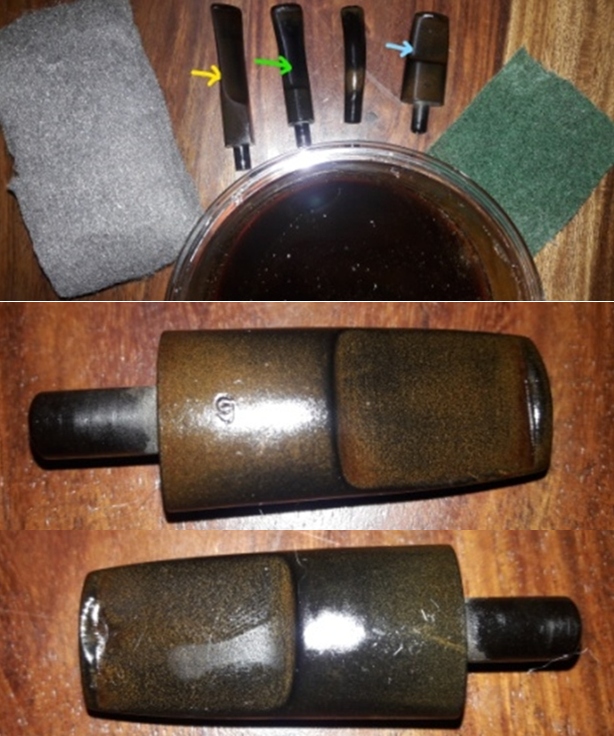
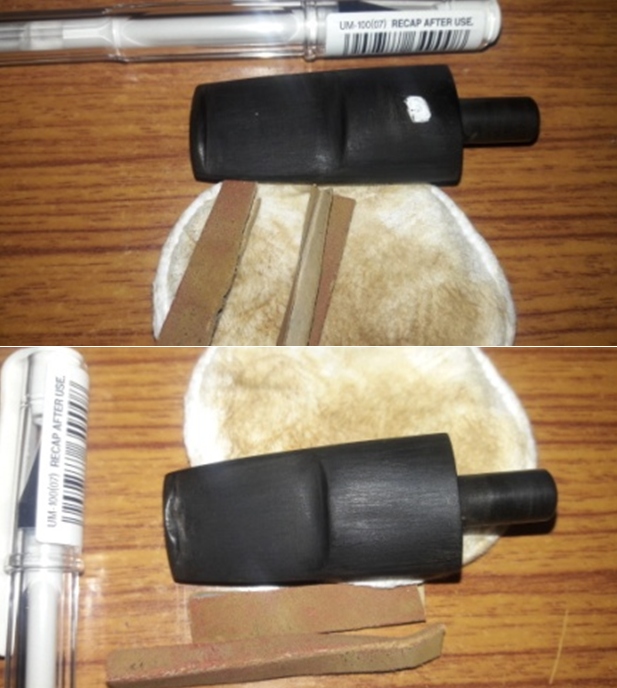
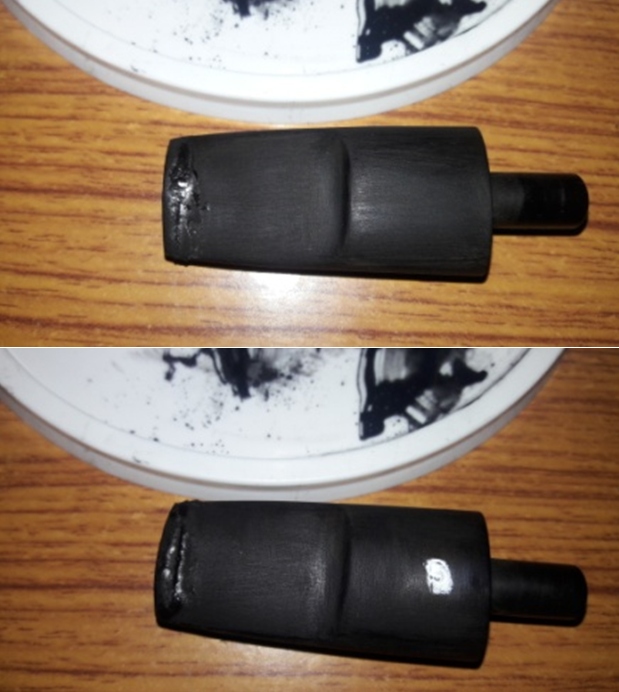
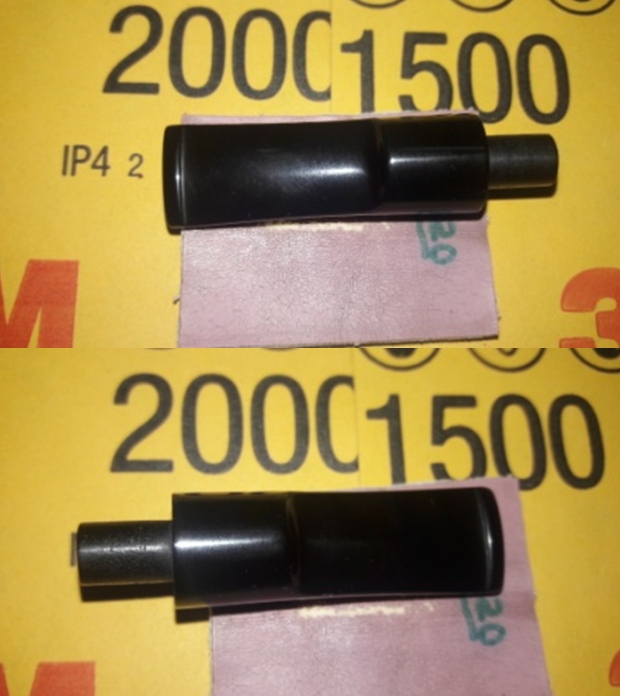
I started the restoration of this pipe by first cleaning the internals of the stem with bristled pipe cleaners and 99.9% pure isopropyl alcohol. I scraped out the dried oils and tars from the tenon end with my fabricated knife and also removed the dried oils and tars from the slot end. I followed it up by sanding the entire stem with a folded piece of 220 grit sand paper to remove the surface oxidation. It has been our (Abha, my wife and self) experience that sanding a stem before dunking it in to the deoxidizer solution helps in bringing the deep seated oxidation to the surface which in turn make further cleaning a breeze with fantastic result.    I dropped the stem in to “Before and After Deoxidizer” solution developed by my friend Mark Hoover. The solution helps to draw out heavy oxidation to the surface, making its further removal a breeze, while the minor oxidation is eliminated to a very great extent. The initial sanding helps to draw out the complete oxidation as the sanding opens up the stem surface that has been initially covered with oxidation. I usually dunk stems of 4-5 pipes that are in-line for restoration and this pipe is marked in pastel blue arrow. I generally allow the stems to soak in this solution overnight to do its work.While the stem was soaking in the deoxidizer solution, I worked on the stummel by first reaming the chamber with size 3 Castleford reamer head. I further scraped the chamber walls with my fabricated knife to remove the remaining carbon deposits where the reamer head could not reach. I scraped out the lava overflow from the rim top surface, especially from the area in the 12 o’clock direction. Once the cake was reamed back to the bare briar, I used a 150 grit sand paper followed by 220 grit sand paper to remove all the traces of remaining cake and also to smooth out the inner walls of the chamber surface. Finally, to remove the residual carbon dust, I wiped the chamber with a cotton pad wetted with 99.9% pure isopropyl alcohol. The chamber walls are sans any damage. The inner rim edge has a number of nicks which were revealed after the lava overflow was removed from the rim top. Thankfully the inner rim was not charred under the lava overflow. The ghost smells are negligible and may further reduce after the shank/ mortise are thoroughly cleaned.  With the bowl internals clean, I move to clean the exterior of the stummel. I used a hard bristled tooth brush and Briar Cleaner, a product that has been developed by Mark Hoover, to scrub the stummel and rim top. I set the stummel aside for 10 minutes for the product to draw out all the grime from the briar surface. After 10 minutes, I washed the stummel under running warm water with anti oil dish washing detergent till the stummel surface was clean and dried it using paper towels and soft cotton cloth. I simultaneously cleaned the shank internals with the detergent and hard bristled shank brush and set the stummel aside to dry out naturally. The stummel surface has cleaned up nicely with the beautiful grain patterns on full display.  While the stummel was drying, the next morning, Abha removed the stems (stem indicated with pastel bue arrow is the one being worked on) that had been soaking in the deoxidizer solution overnight. She cleaned the stem and the stem airway under running warm water and scrubbed the raised oxidation from the stem surface using a scotch brite pad and the airway with a thin shank brush. She further removed the oxidation by scrubbing the stem with 0000 grade steel wool and applied a little EVO to rehydrate the stem. This now gives a clearer picture of the extent of depth of the bite marks as can be seen in the pictures below. These will definitely require a fill. The oxidation is deep and stubborn and can be seen over the stem surface and in the concave of the saddle, as dirty brown coloration. I need to further sand the stem to completely remove the oxidation.I used a 220 grit sand paper to sand the stem and remove all the oxidation that was raised to the surface. This step further reduced the tooth chatter and bite marks present on the stem. I wiped the stem with Murphy’s Oil soap on a cotton swab. This helps in cleaning the stem surface while removing the loosened oxidation. Using a lighter, I flamed the surface of the stem. This helped in raising some of the tooth chatter and bite marks to the surface as vulcanite has a property to regain its original shape on heating. I used a white correction pen to highlight the stem logo. I smeared the correction ink over the logo and once dried, I shall gently wipe out the excess ink. The remaining tooth chatter and bite marks would be addressed subsequently by filling it with a charcoal and superglue mix.I addressed the deeper tooth chatter and bite marks by filling them up with a mix of activated charcoal and CA superglue. Once I had applied the mix, I set it aside to cure overnight. Once the fill has hardened, I shall file and sand the fills to match the surface of the stem and sharpen the button edges on either surface.  With the fills in the stem set aside to cure, I turned my attention back to the stummel. It was time to address the nicks, dents/ dings over the rim top and uneven inner rim edge. I decided to top the rim top surface, a process for which I have an aversion. However, it is a necessary evil if the rim top and rim edges are heavily damaged. I top the rim on a square piece of 220 grit sand paper, frequently checking for the progress. Once I was satisfied that the rim top is evenly smooth and also the damage to the inner (in 12 o’clock and 2 o’clock direction) and outer (dents in the 6 o’clock direction) rim edge has been reduced, I stopped the process of topping. Here is how the rim top surface appears at this point in restoration. The process of topping has flattened the rim top which originally had a slight OUTWARD slant from the inner rim edge. A few minor nicks to the inner and dings to the outer edge are still visible. I shall address these issues by hand sanding the edges to create a slight bevel to both the inner and outer edges.With a folded piece of worn out 180 grit sand paper pinched between my thumb and forefinger, I create a very slight bevel to the inner edge. This helped to remove the remaining nicks from the inner edge. With the same grit sand paper, I created a bevel to the outer edge while at the same time with outward movement of the sand paper, gave a slight outward slope from the inner edge. The rim top surface and the edges look very neat at this stage. Next I addressed the numerous scratches and dings to the stummel surface. I sand the stummel surface with a piece of 220 grit sand paper to remove/ minimize the scratches over the stummel surface. Though 95% of the scratches and dings have been eliminated, there still remains few very minor dings that are remnants of the deeper ones. I accept these dings as part of this pipe’s journey till date.  I followed it by wet sanding the stummel with 1500 to 12000 grit micromesh pads, wiping frequently with a moist cloth to check the progress. I really like the looks of the stummel at this point in restoration. The grains and the clean lines of this piece of briar is really appreciable. Next, I rubbed a small quantity of “Before and After Restoration Balm” deep in to the briar with my finger tips and let it rest for a few minutes. The balm almost immediately works its magic and the briar now has a nice vibrant appearance with the beautiful grain patterns displayed in their complete splendor. I further buffed it with a horse hair brush. The contrast of the dark browns of the flame and cross grains with the natural finish of the rest of the stummel adds an interesting dimension to the appearance of the stummel which may be insufficiently described in words and be rather seen in person.  With the stummel rejuvenation almost complete, save for the final wax polish, I worked the stem. The fill had hardened and with a flat head needle file, I worked on the filling till I had achieved a rough match with the surrounding surface and had sufficiently sharpened the button edges. For a better blending, I further sand the entire stem with 220 followed by 400, 600 and 800 grit sand paper. This helps to reduce the scratch marks left behind by the more abrasive 220 grit paper. To bring a deep shine to the vulcanite stem, I polished the stem, wet sanding with 1500 to 2000 grit sandpapers followed by further wet sanding with 3200 to 12000 grit pads. I wiped the stem with moist cloth after each pad and rubbed it down with Extra Virgin Olive oil to rejuvenate the vulcanite. The finished stem is shown below. The oxidation on this stem was the deepest and the most difficult to remove of all the pipes that I have worked on till date and I have worked on quite a few disastrous stems!! At one point in time, I had to resort to a 150 grit sand paper, the most abrasive one that I have in my inventory. The scratch marks left behind by the sand paper are still visible in the pictures but not noticeable in person (if that’s any consolation…) I have now reached the homestretch in this restoration project. To complete the restoration, I mount a cotton cloth buffing wheel on to my hand held rotary tool and polished the stummel and stem with Blue Diamond compound. This compound helps to remove the minor scratch marks that remain from the sanding. I mount another cotton buffing wheel that I have earmarked for carnauba wax and applied several coats of the wax. I finished the restoration by giving the entire pipe a rigorous hand buffing using a microfiber cloth to raise the shine further. The finished pipe looks amazingly beautiful. The finished pipe is as shown below. P.S. In my last write up a question “Why do I enjoy bringing these old battered and discarded pipes back to life?” had popped up in my mind.
Well, the first and foremost reason that I enjoy this hobby is because I enjoy smoking a pipe and it being an instrument of joy for me, is of utmost importance. Thus, bringing these instruments of enjoyment back to life from obscurity to function as it was intended to be gives me immense pleasures. I am sure the readers will understand this reasoning.

I wish to thank each one for sparing their valuable time to read through this write up and each one is my prayers. Stay home…stay safe!!
An Inherited Pipe Thought To Be Sasieni, Turned Out To Be A Wally Frank “Natural Unvarnished” Bulldog.


Blog by Paresh Deshpande

I had randomly selected four pipes to work on since I prefer to put a few pipe stems together in the “Before And After” Deoxidizer solution that has been developed by Mark Hoover. I have completed the restoration of one of these pipes, a Wally Frank “BLACKTHORNE” sandblast billiard.

The moment I had picked up this pipe, as had happened with the BLACKTHORNE, I thought this pipe to be a Family era Sasieni what with the two dots that peered back at me and the classic Bulldog shape. However, when I saw the stampings, again for the second time on the trot it turned out to be a US brand. The smooth briar, shape and quality of the stem all oozed high quality.

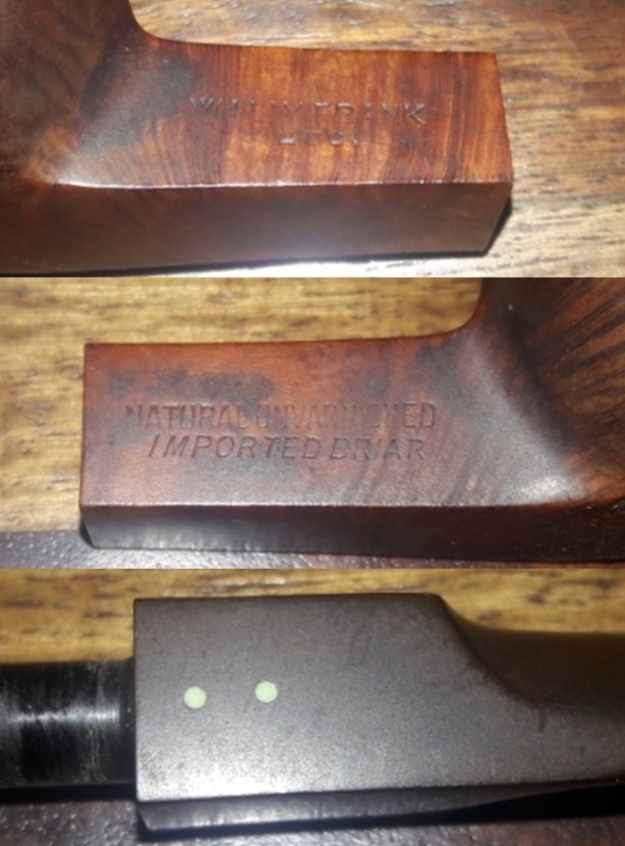
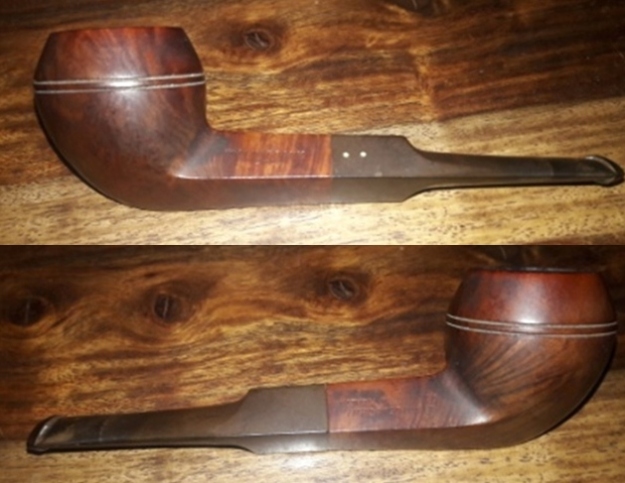
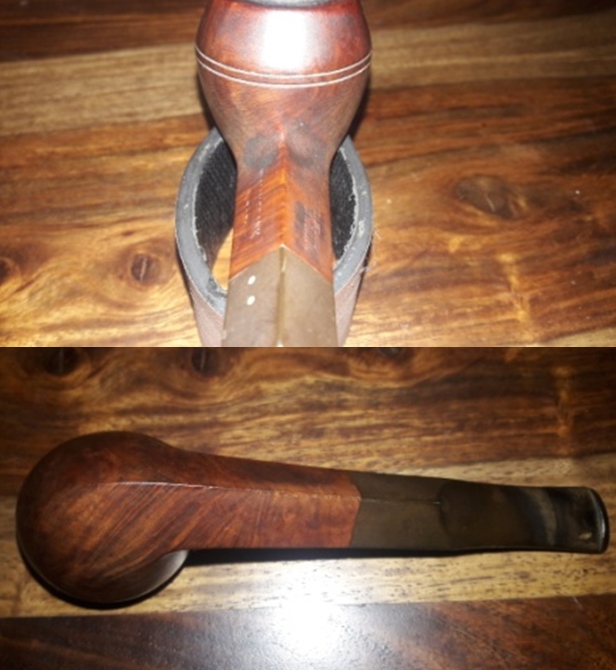
The pipe is a Bulldog with a diamond shank and a straight diamond saddle stem. It is a medium sized pipe with a nice hand feel and the light weight makes it easy for clenching. This pipe is stamped on the upper left smooth surface of the shank as “WALLY FRANK” over “LTD” and on the upper right shank surface as “NATURAL UNVARNISHED” over “IMPORTED BRIAR”, all in block capital letters. The stampings appear faint due to accumulation of dirt and grime over the surface. The high quality vulcanite diamond saddle stem has two Blue Dots. I had read about Wally Frank, while researching a Wally Frank Blackthorne, as being an old Tobacconist from around New York City in US who also sold English made pipes under his name since 1930s. The NATURAL UNVARNISHED was one of the lines/styles of pipes that was offered by Wally Frank. For the readers who wish to acquaint themselves with the Tobacconist and the brand, given below is the link to the write up on pipedia.org.

https://pipedia.org/wiki/Wally_Frank

To unravel the mystery of the two dots, I searched the internet and came across a forum Pipe Smokers Dens where there was thread on Wally Frank. Here is the link to the discussion;

https://pipesmokersdens.com/threads/show-us-your-wally-franks.3139/page-2

I reproduce the relevant part of the discussion which references the TWO DOTs seen on my pipe that makes for an interesting read.

Deadfrog said:

No, it’s just a standard push tenon. It’s a “Wally Frank Limited” & “Made in England”. I never delved too deep into who in England made pipes for them, but if I recall correctly, Sasieni and Charatan supplied them with pipes over the years. Regardless, this was a good buy. Some beautiful grain without a single fill. It’s a nice, classically shaped pipe.

Piffyr Replied

Comoy was their primary British supplier. If the pipe has a shape number, it likely matches the Comoy chart. They also bought pipes from Charatan and (maybe/likely) GBD. Also, a few smaller manufacturers in England that are mostly forgotten today. I think the Sasieni thing started because of the pale blue dots used on the Natural Unvarnished stems coupled with some wishful thinking, but it doesn’t hold up. The pipes aren’t COM stamped and the shapes don’t match. Sometimes, a pale blue dot is just a pale blue dot.

I have not been able to accurately pinpoint the period that this pipe was made in, so any assistance in this regard is welcome and highly appreciated.

Initial Visual Inspection
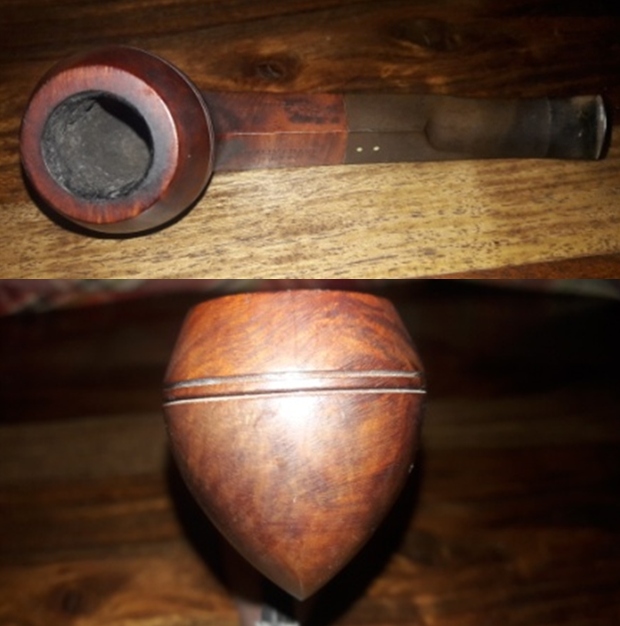
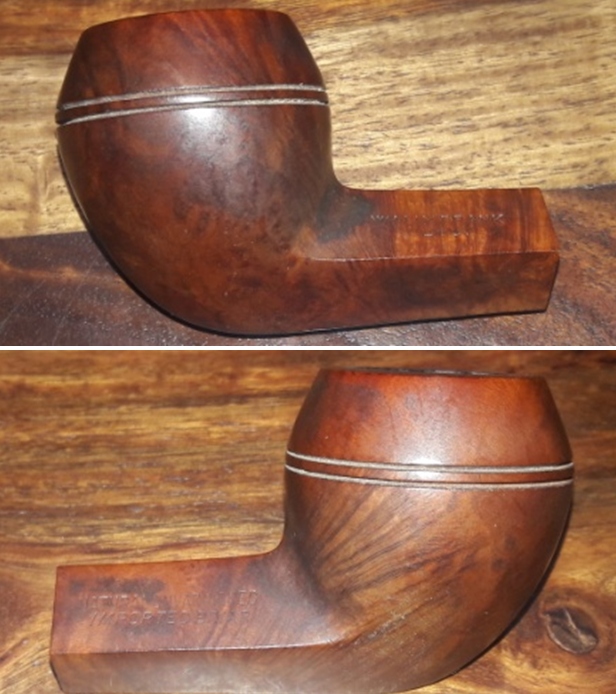
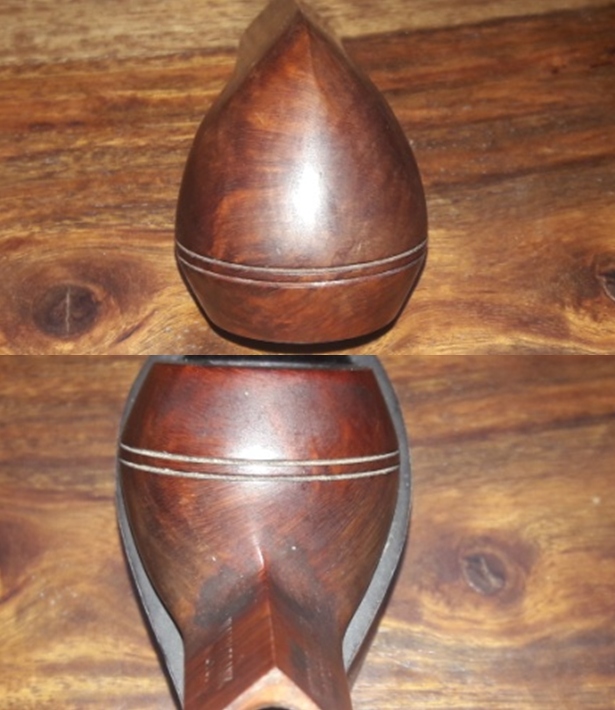
This pipe has the classic Bulldog shape with the rim cap separated from the rest of the stummel by two rings. The stummel boasts of some beautiful flame and cross grains all over the bowl and shank and is covered in dirt and grime of the overflowed lava. There is not a single fill in the briar which speaks of high quality selection of the briar. There is a decent layer of cake in the chamber. The stem is heavily oxidized with a few deep bite marks in the bite zone. Here is how the pipe appears as it sits on my work table. Detailed Inspection Of The Pipe And Observations
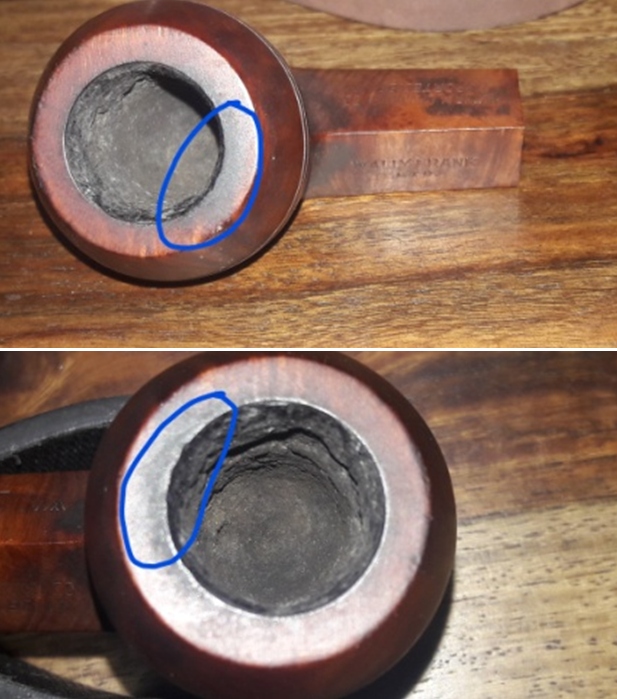
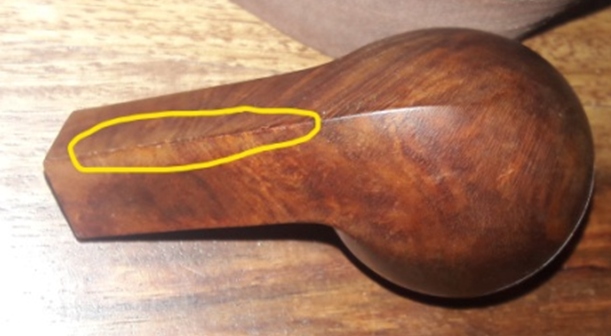
The bowl is in perfect round with a decently wide rim and a depth of about 1 7/8 inches. The chamber has an uneven layer of thick cake. The smooth rim top surface is covered in lava overflow and dirt and grime from previous usage and subsequent storage. The maximum deposition of lava is seen in the 6 o’clock direction (enclosed in blue circle). The inner rim appears to be in pristine condition and the outer rim has suffered a few blows on a hard surface resulting in a few minor chipped edge surfaces. The condition of the inner walls of the chamber can be commented upon after the cake has been taken down to the bare briar. The draught hole is dead center and at the bottom of the chamber and that makes me believe that it should great smoke and the thick cake in the chamber lends credence to this observation. The stummel appears solid to the touch all around and hence I do not foresee any serious damage to the walls in the form of burnout/ deep heat fissures/ lines or pits. The darkened inner rim edge may present a surprise in the form of charred rim edge making the chamber out of round. The smooth stummel surface has taken on a layer of aged patina, through which one can make out the beautiful flame grains all around interspersed with tightly packed cross grains. There are a few minor dents and dings on the lower edge of the diamond shank, probably due to likely falls and or rubbing against other pipes while being stored for more than 40 years. However, there is not a single fill in the entire stummel, signifying very high quality of briar used in carving this pipe. The two rings demarcating the rim cap is intact and the grooves are filled with grime and dust. The briar is looking lifeless and bone dry and has taken on dirty grey hues. I need to be careful while cleaning the paneled shank surfaces to preserve the stampings on this pipe. Thorough cleaning and rising under warm water of the stummel surface should highlight the grain patterns while preserving the patina. In all probability, I shall let these minor dents and dings to the lower edge of the shank remain and avoid the process of sanding the stummel with sand paper in order to preserve the beautiful patina. Maybe, micromesh polishing will address a few of these dents and scratches to some extent. The mortise shows accumulation of oils, tars and gunk and the air flow is not full and smooth. The high quality vulcanite diamond saddle stem is so heavily oxidized that it appears brownish green in color! It is evident that the pipe was used with a softie rubber bite as can be seen from the difference between the area covered by the rubber bite and rest of the stem surface. Some minor tooth chatter and one deep gouge mark is seen on the lower surface of the stem. There are a couple of not very deep bite marks on the upper stem surface. This issue should not be a major headache to address. The lip edge on both sides is in good shape requiring nothing more than minor reshaping. The tenon has accumulated ash and oils/ tars that have dried out on the inside as well as on the outside. The horizontal slot has grime deposits which will have to be cleaned. The tooth chatter and the bite marks will be raised to the surface by heating and the deeper tooth indentations will be filled using charcoal and CA superglue mix. The Process
I started the restoration of this pipe by first cleaning the internals of the stem with bristled pipe cleaners and 99.9% pure isopropyl alcohol. I scraped out the dried oils and tars from the tenon end with my fabricated knife and also removed the dried oils and tars from the slot end. I followed it up by sanding the entire stem with a folded piece of 220 grit sand paper to remove the surface oxidation. It has been our (Abha, my wife and self) experience that sanding a stem before dunking it in to the deoxidizer solution helps in bringing the deep seated oxidation to the surface which in turn make further cleaning a breeze with fantastic result. I dropped the stem in to “Before and After Deoxidizer” solution developed by my friend Mark Hoover. The solution helps to draw out heavy oxidation to the surface, making its further removal a breeze, while the minor oxidation is eliminated to a very great extent. The initial sanding helps to draw out the complete oxidation as the sanding opens up the stem surface that has been initially covered with oxidation. I usually dunk stems of 4-5 pipes that are in-line for restoration and this pipe is marked in yellow arrow. I generally allow the stems to soak in this solution overnight to do its work.While the stem was soaking in the deoxidizer solution, I worked on the stummel by first reaming the chamber with size 1 and 2 Castleford reamer heads. I further scraped the chamber walls with my fabricated knife to remove the remaining carbon deposits. I scraped out the lava overflow from the rim top surface, especially from the area in the 6 o’clock direction. Once the cake was reamed back to the bare briar, I used a 150 grit sand paper followed by 220 grit sand paper to remove all the traces of remaining cake and also to smooth out the inner walls of the chamber surface. Finally, to remove the residual carbon dust, I wiped the chamber with a cotton pad wetted with 99.9% pure isopropyl alcohol. The chamber walls are sans any damage. There are a couple of minor chips to the inner edge of the inner rim which revealed themselves after the lava overflow was removed from the rim top in 7 o’clock direction. Thankfully the inner rim was not charred under the lava overflow. The ghost smells are negligible and may further reduce after the shank/ mortise are thoroughly cleaned. This was followed by cleaning the mortise with q-tips, pipe cleaners and shank brush dipped in isopropyl alcohol. I scraped the walls of the mortise with my fabricated knife to remove the dried oils and tars. I was surprised to find the shank a bit cleaner than I had anticipated from my detailed inspection. The ghost smells are history and the chamber now smells clean.With the bowl internals clean, I move to clean the exterior of the stummel. I used a hard bristled tooth brush and Murphy’s Oil soap to scrub the stummel and rim top. For this stummel cleaning, l I used Murphy’s Oil soap as I wanted to preserve the old patina that had developed on the stummel and was not sure how the Briar cleaner product would affect it. After the scrub with oil soap, I washed the stummel under running warm water with anti oil dish washing detergent till the stummel surface was clean and dried it using paper towels and soft cotton cloth. I simultaneously cleaned the shank internals with the detergent and hard bristled shank brush and set the stummel aside to dry out naturally. The stummel surface has cleaned up nicely with the beautiful grain patterns on full display. While the stummel was drying, the next morning, Abha removed the stems (stem indicated with yellow arrow is the one being worked on) that had been soaking in the deoxidizer solution overnight. She cleaned the stem and the stem airway under running warm water and scrubbed the raised oxidation from the stem surface using a Scotch Brite pad and the airway with a thin shank brush. She further removed the oxidation by scrubbing the stem with 0000 grade steel wool and applied a little EVO to rehydrate the stem. This now gives a clearer picture of the extent of depth of the bite marks as can be seen in the pictures below. These will definitely require a fill. The oxidation is deep and stubborn and can be seen over the stem surface and in the concave of the diamond shape, as dirty green coloration. I need to further sand the stem to completely remove the oxidation.I used a 220 grit sand paper to sand the stem and remove all the oxidation that was raised to the surface. This step further reduced the tooth chatter and bite marks present on the stem. I wiped the stem with Murphy’s Oil soap on a cotton swab. This helps in cleaning the stem surface while removing the loosened oxidation. Using a lighter, I flamed the surface of the stem. This helped in raising some of the tooth chatter and bite marks to the surface as vulcanite has a property to regain its original shape on heating. The remaining tooth chatter and bite marks would be addressed subsequently.I addressed the deeper tooth chatter and bite marks by filling them up with a mix of activated charcoal and CA superglue. Once I had applied the mix, I set it aside to cure overnight. Once the fill has hardened, I shall file and sand the fills to match the surface of the stem and sharpen the button edges on either surface.With the fills in the stem set aside to cure, I turned my attention back to the stummel. The minor dents to the lower edge of the diamond shank was bothering me as I wanted it to be as pristine as was possible. I decided to sand it down with a higher grade sandpaper. With a folded piece of 600 grit sandpaper I sand dents along the either sides of the shank edge till the dents are not easily discernible. I followed it by wet sanding the stummel with 1500 to 12000 grit micromesh pads, wiping frequently with a moist cloth to check the progress. I really like the looks of the stummel at this point in restoration. The grains and the clean lines of this piece of briar is really appreciable.  Next, I rubbed a small quantity of “Before and After Restoration Balm” deep in to the briar with my finger tips and let it rest for a few minutes. The balm almost immediately works its magic and the briar now has a nice vibrant appearance with the beautiful grain patterns displayed in their complete splendor. I further buffed it with a horse hair brush. The contrast of the dark browns of the flame and cross grains with the natural unvarnished finish of the rest of the stummel adds an interesting dimension to the appearance of the stummel which may be insufficiently described in words and be rather seen in person. With the stummel rejuvenation almost complete, save for the final wax polish, I worked the stem. The fill had cured and with a flat head needle file, I worked on the filling till I had achieved a rough match with the surrounding surface and had sufficiently sharpened the button edges. For a better blending, I further sand the entire stem with 220 followed by 400, 600 and 800 grit sand paper. This helps to reduce the scratch marks left behind by the more abrasive 220 grit paper. To bring a deep shine to the vulcanite stem, I went through the complete set of micromesh pads, wet sanding with 1500 to 2000 grit sandpapers followed by further wet sanding with 3200 to 12000 grit pads. I wiped the stem with moist cloth after each pad and rubbed it down with Extra Virgin Olive oil to rejuvenate the vulcanite. The finished stem is shown below. I have now reached the homestretch in this restoration project. To complete the restoration, I mount a cotton cloth buffing wheel on to my hand held rotary tool and polished the stummel and stem with Blue Diamond compound. This compound helps to remove the minor scratch marks that remain from the sanding. I mounted another cotton buffing wheel that I have earmarked for carnauba wax and applied several coats of the wax. I finished the restoration by giving the entire pipe a rigorous hand buffing using a microfiber cloth to raise the shine further. The finished pipe looks amazingly beautiful and is ready to join my collection. I only wish it could share with me its life story of the past years while I enjoy smoking my favorite Virginia blend in it or maybe an English blend or maybe just keep admiring it!! The finished pipe is as shown below. P.S. As I was working this pipe, a fleeting question “Why do I enjoy bringing these old battered and discarded pipes back to life?” crossed my mind…

I wish to thank each one for sparing their valuable time to read through this write up and each one is my prayers. Stay home…stay safe!!
A Difficult To Identify But Simple Restoration Of “Ornsby” Pipe


Blog by Paresh Deshpande

I had recently completed a challenging restoration of an ORLIK MEERSCHAUM LINED pipe that had broken meerschaum lining. I considered it to be a challenging project because I had never undertaken repairs of a meerschaum as a material and trespassing in to uncharted territories is always challenging. However, thanks to all the detailed and informative write ups on the subject that is available on rebornpipes.com, I was successful in restoring the pipe and making it smoke worthy!!

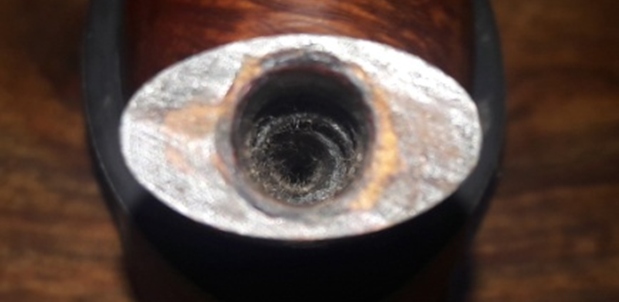
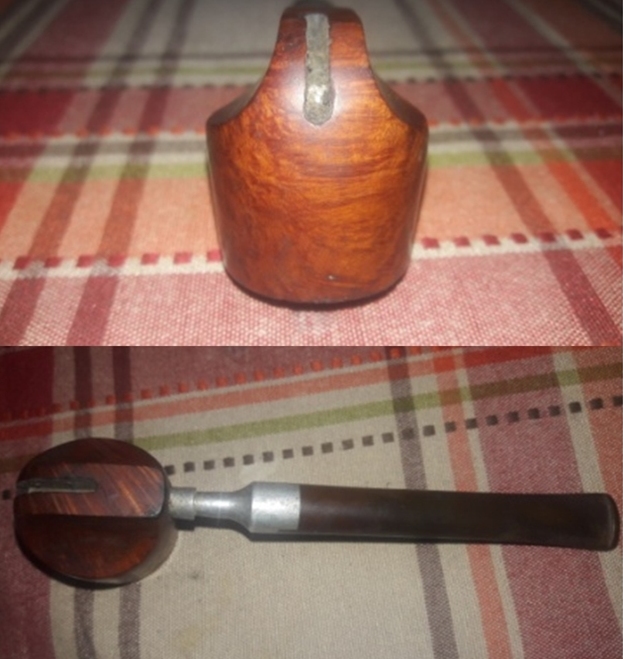
For my next project, I wanted something simple to work on and after rummaging through the huge pile of pipes awaiting restoration; I selected this interesting but different looking pipe that was in my grandfather’s collection. I say it is different since this pipe does not have a shank but the stem directly fits in to the bowl beneath the vertically placed draught hole on the heel. In addition to the vintage classic pipes, there are quite a few such different looking and unique pipes that I have been fortunate to inherit.

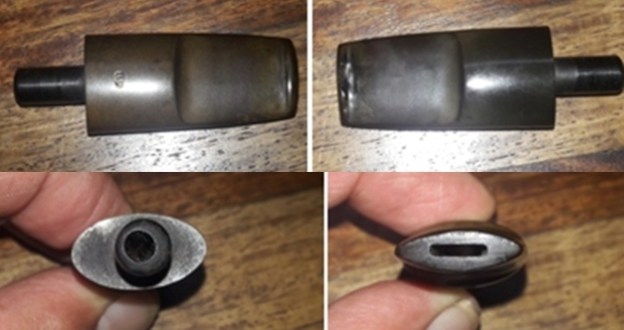
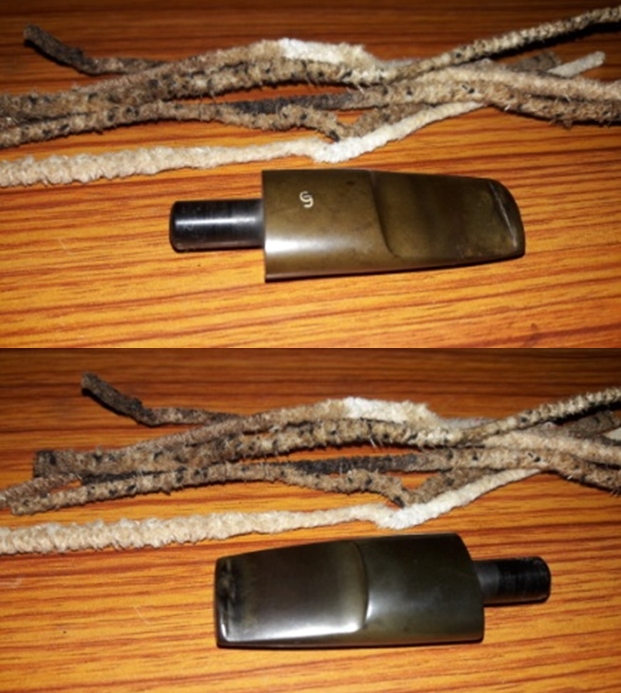
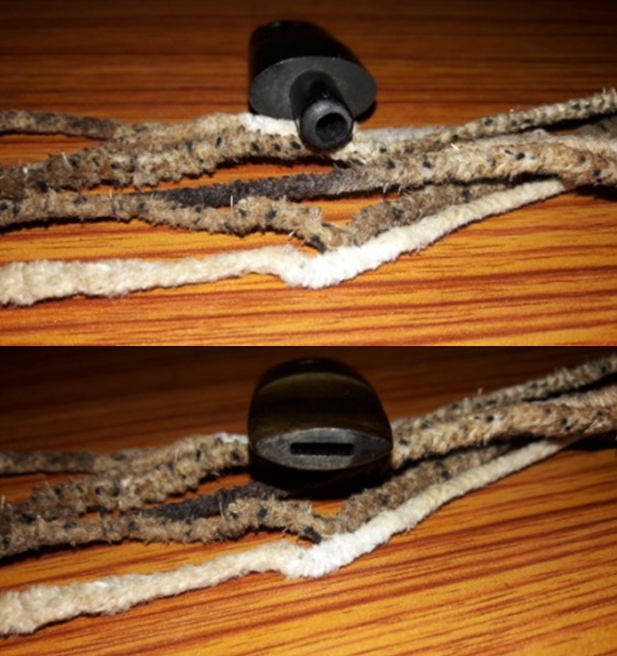
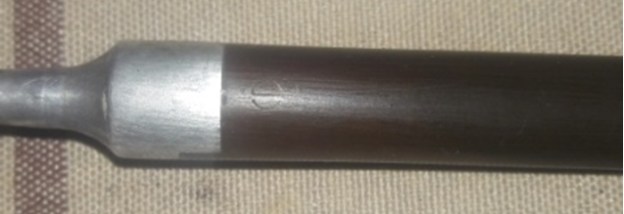
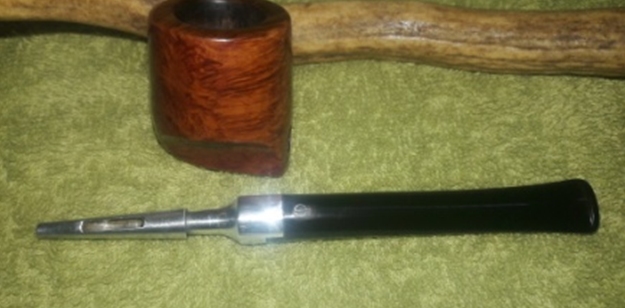
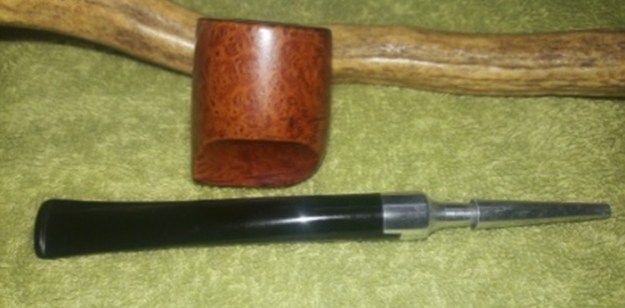
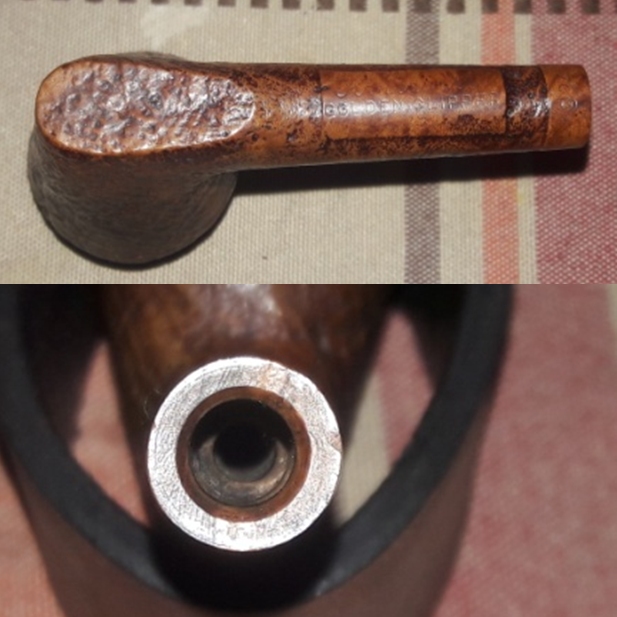
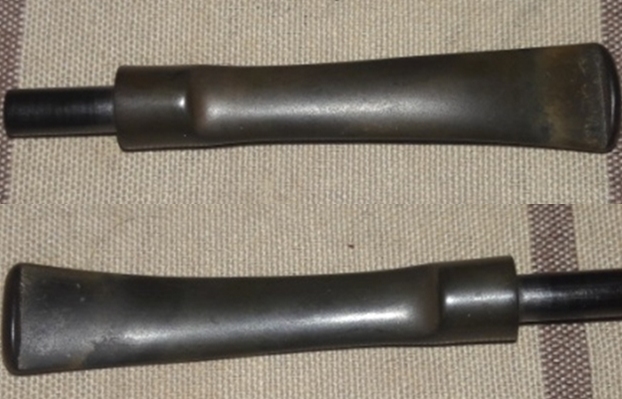
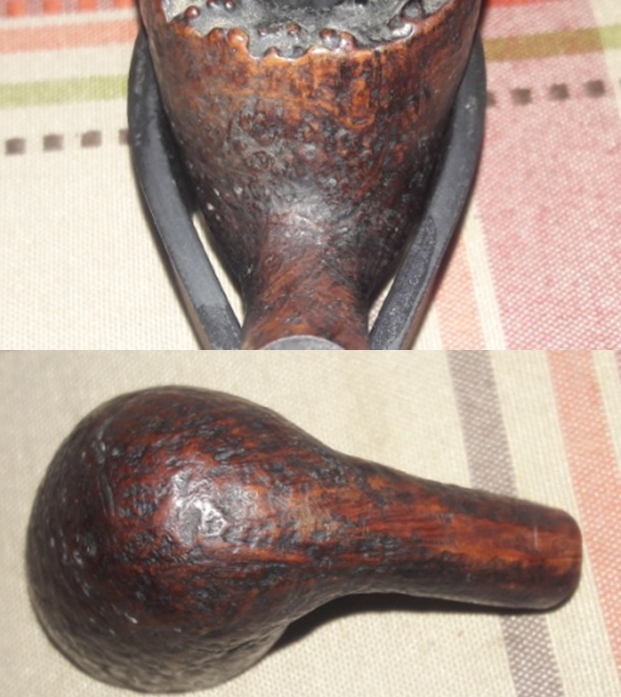
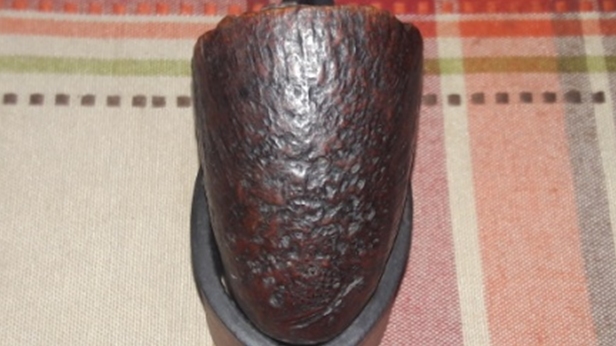
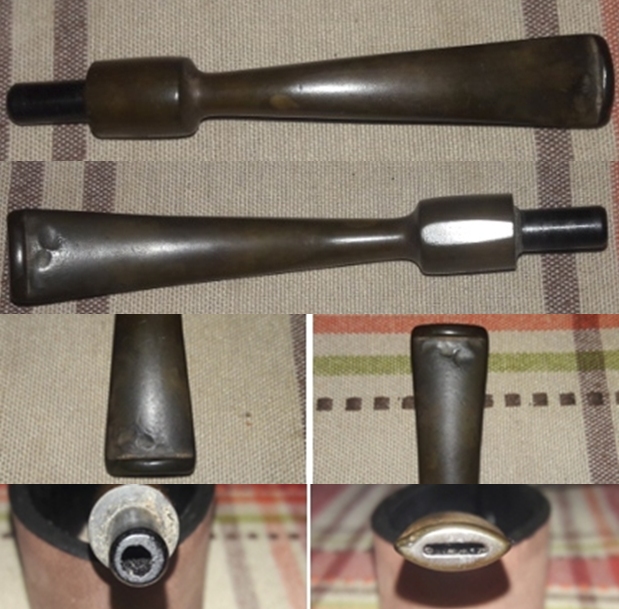
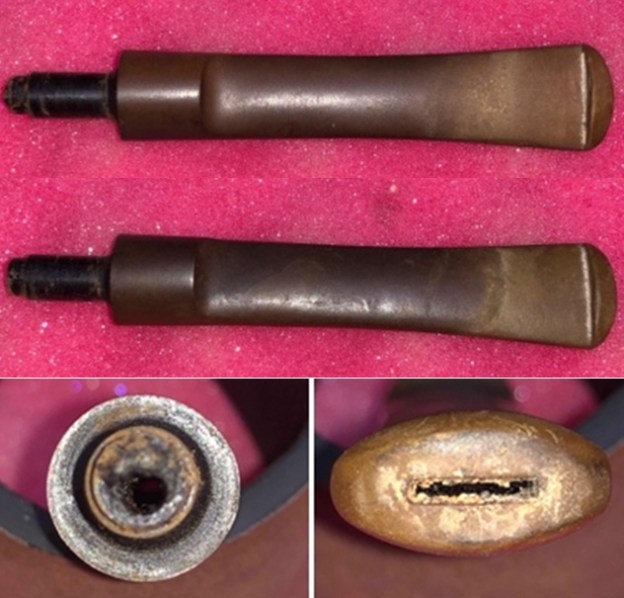
Beneath all the dust and grime, beautiful Bird’s eye grains to the sides and bold cross grains to front and back that extends to nearly half the width of the bowl on the left side can be seen over the stummel. Once the stummel has been cleaned and polished these grains will pop out and look more beautiful. The stummel is sans any stampings while the vulcanite stem with a conical aluminum tenon end has a symbol that is hard to describe. It’s an interlocked OP with a straight line from the base of the letter P. The lack of any Maker’s stamp and COM stamp makes the identification of this pipe very difficult.Lack of Maker’s stampings and COM stamp made research of this pipe very difficult. There was no point visiting rebornpipes.com as I did not have any name to search for. Similarly, visiting pipedia.org would not help as I did not have COM stamp to follow. Finally I turned to pipephil.eu and searched the Logos with a geometrical pattern and Logos with miscellaneous symbols sections. Again I came up with nothing matching the stem logo on the pipe in front of me. As a last resort, I just typed “pictures of unusual tobacco pipes” in to the Google search bar and there before me were a plethora of pictures. As I was scrolling through these images, after a couple of hours, I finally found a picture that was an exact replica of the pipe on my work table. A click on to this image took me to the site smokingmetals.co.uk. Here is the link to the web page; http://www.smokingmetal.co.uk/pipe.php?page=106

From the read I understood that this design was a part of the piper’s eternal quest for a cool and dry smoke. I reproduce a part of the information that should provide the readers with an insight in to the designer of the pipe and the Company that manufactured these pipes.

Invented by Chief Marine Officer, William Edward Ornsby in an attempt to create a cooler smoke and a dry bowl. Marketed by the Ornsby Pipe Company Ltd, Pennywell, Sunderland, Tyne & Wear, England, predominately in the North of England, this pipe is virtually a stem direct to bowl.
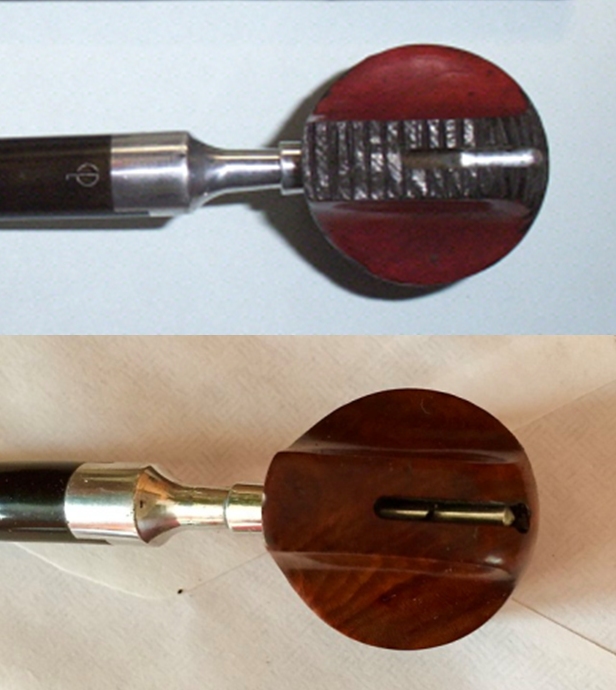
The push fit stem/bit can be rotated to clear any shreds of tobacco that may be blocking the airway. A half turn of the stem will cut any trapped leaf in the airway and a quick blow will eject the offending particle. As the centre photo shows, the metal part of the stem goes right through the bowl. The packaging was also unusual in that it was a tube.
The pipe came with two choices of stem, straight or curved and there was a choice of six bowls: Natural, Brown Sandblast, Black Sandblast, Smooth Mahogany Finish, Deep Cut Horizontal Carved or the Deep Cut Vertical Carved.
Overall length 5 3/4 inches (146 m/m)

My thanks to Richard Adamek for the following:
“ORNSBY PIPE COMPANY LIMITED At an Extraordinary General Meeting of the Members of the above-named Company, duly convened, and held at 7 Benton Terrace, Sandyford Road, Newcastle-upon-Tyne, on 27th October 1980, the following Extraordinary Resolution was duly passed:
“That it has been proved to the satisfaction of this Meeting that the Company cannot, by reason of its liabilities, continue its business, and that it is advisable to wind up the same, and accordingly that the Company be wound up voluntarily and that Brian Leslie Wilson, of Wilson Johnson, 7 Benton Terrace, Sandyford Road, Newcastle-upon-Tyne, be and he is hereby nominated Liquidator for the purposes of the winding-up.”
(803) Brian Dobinson, Director”
Richard also found the patent number… US patent 242261 of 1976

Thus from the above, it is now established that the pipe that I am dealing with is an ORNSBY with a Natural smooth finish and a straight vulcanite stem. The pipe was awarded a US Patent in 1976 and the company was liquidated in 1980. This places the pipe in between the period from 1970s to 1980 making it 40 plus years old!!

Initial Visual Inspection
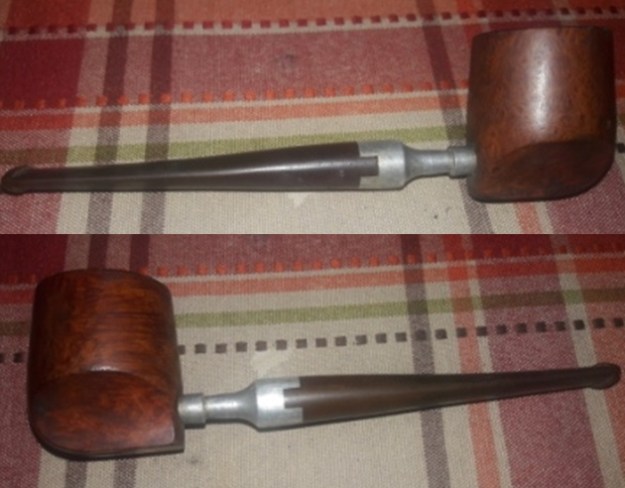
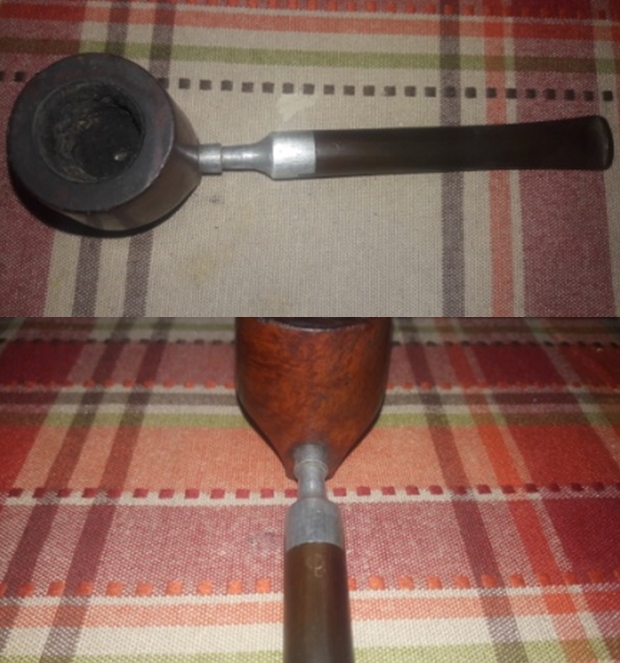
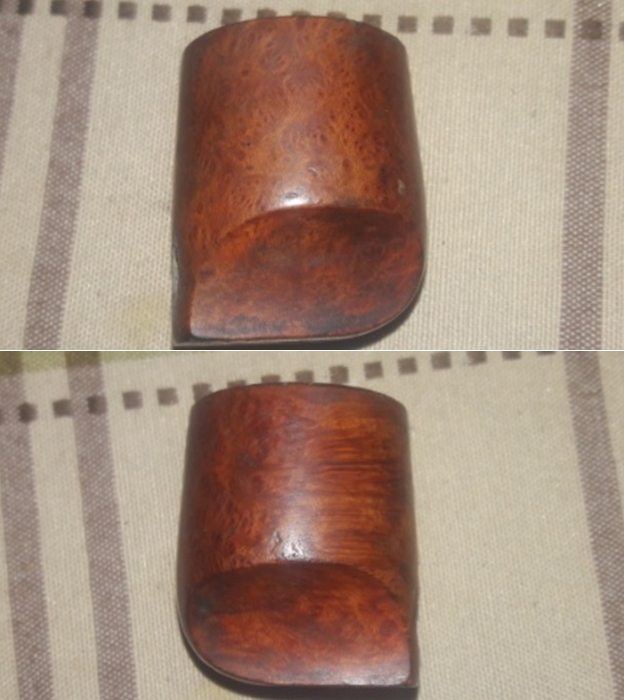
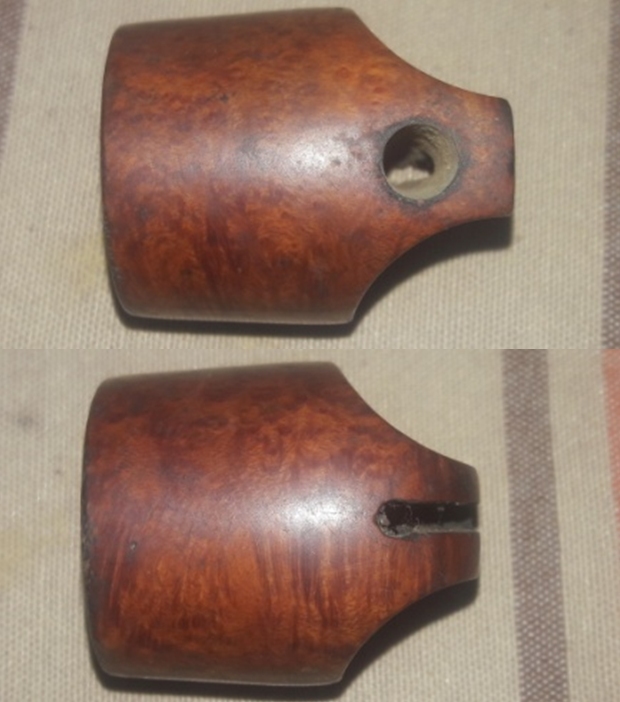
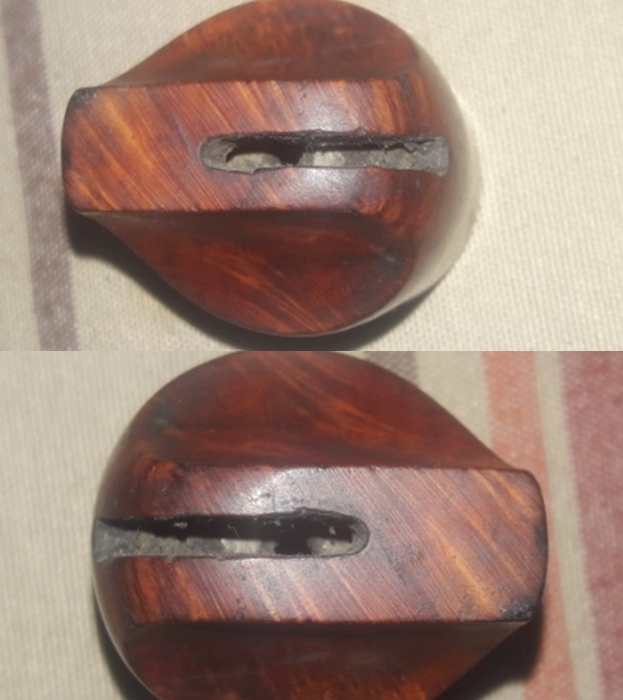
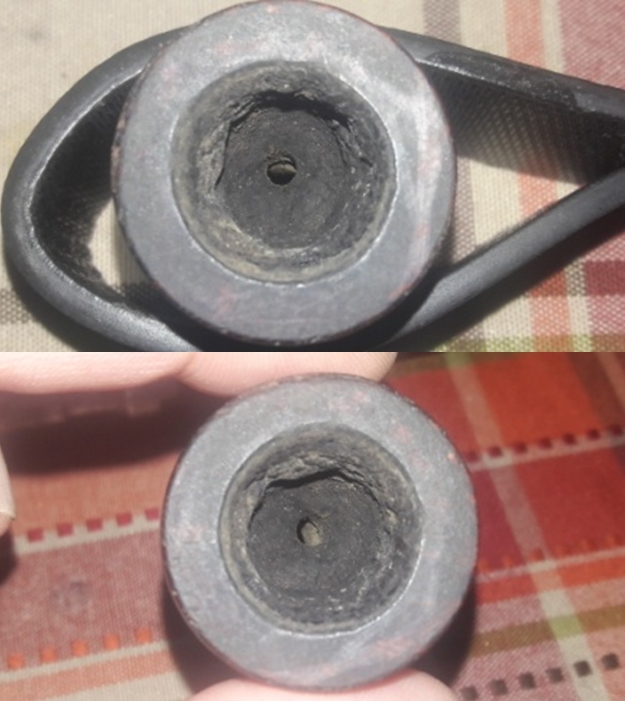
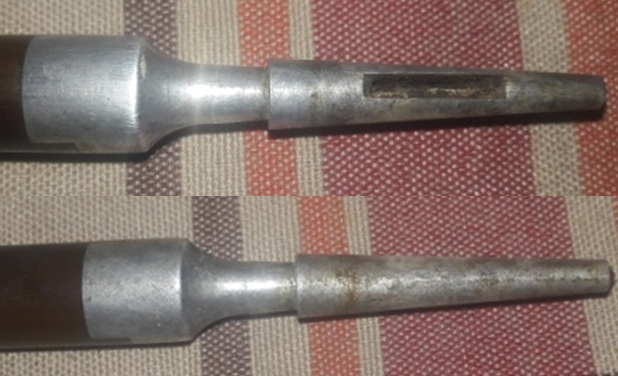
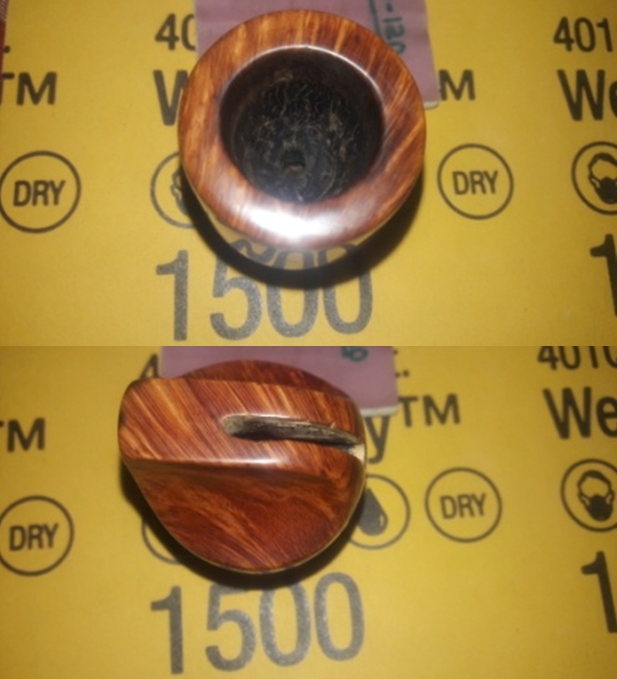
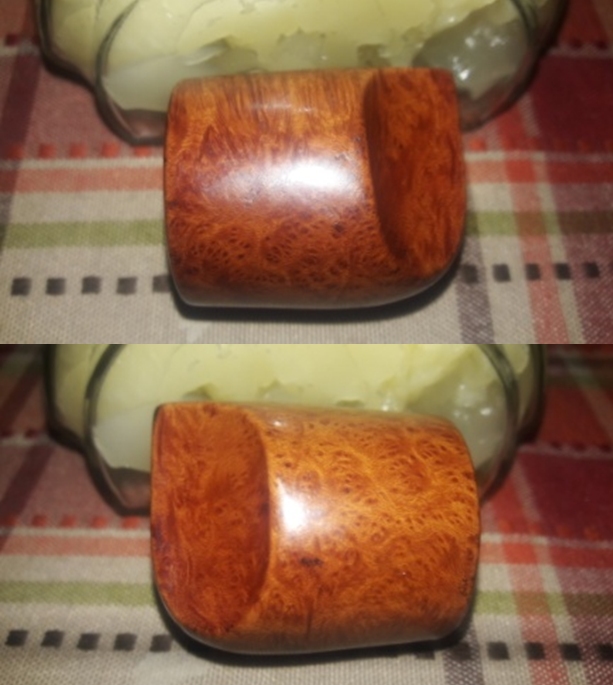
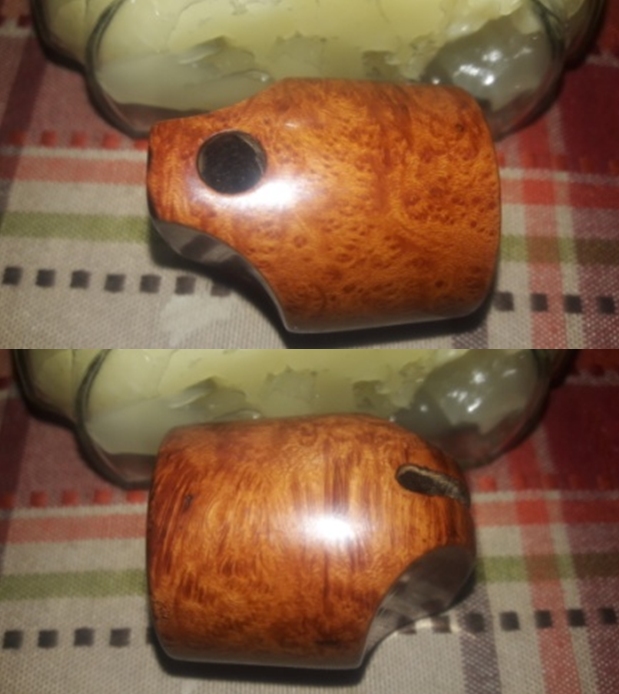
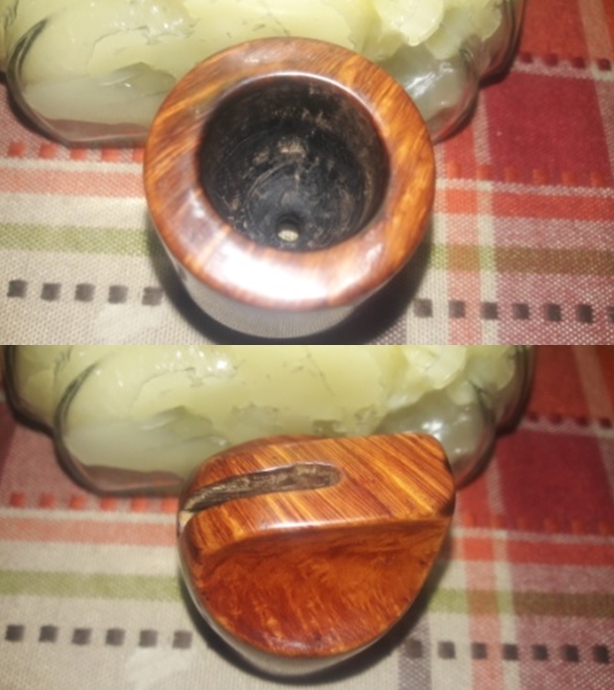
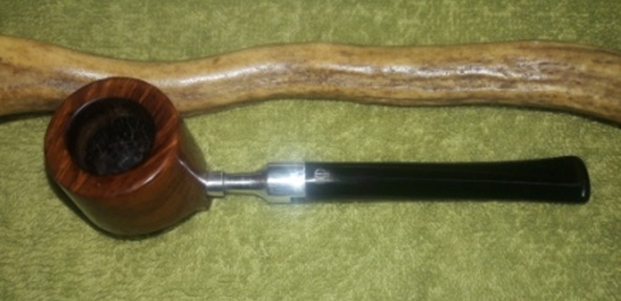
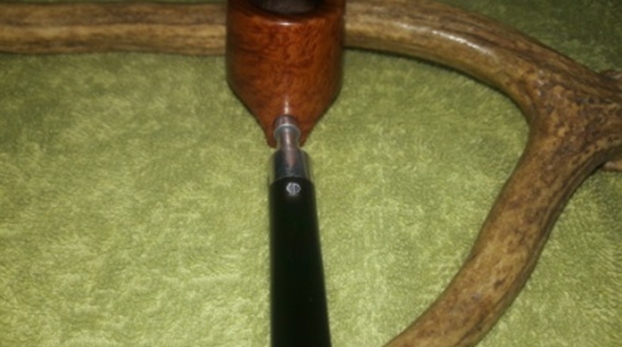
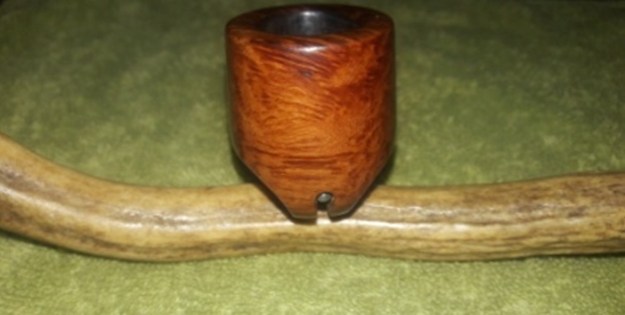
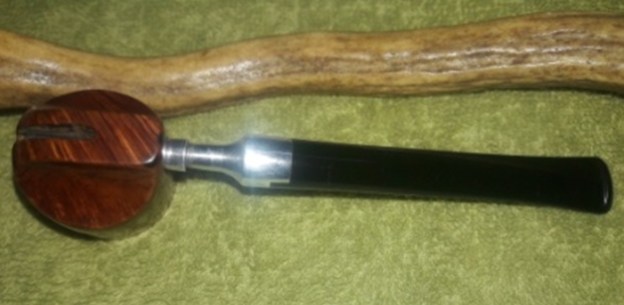
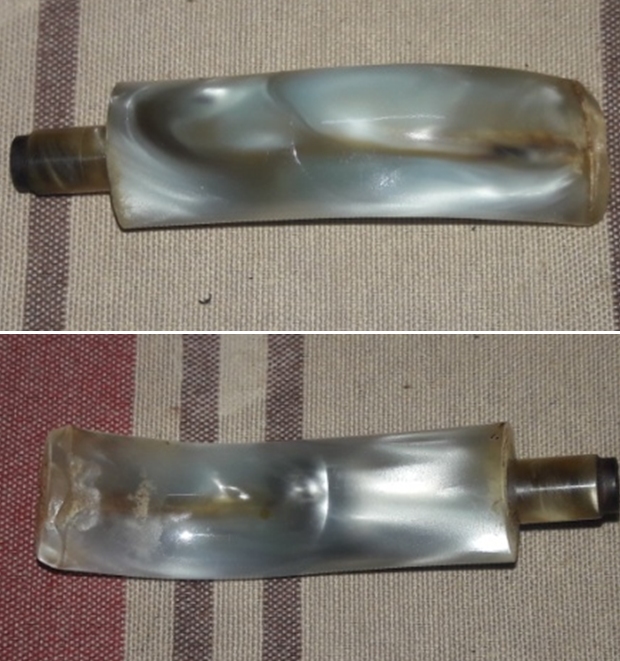
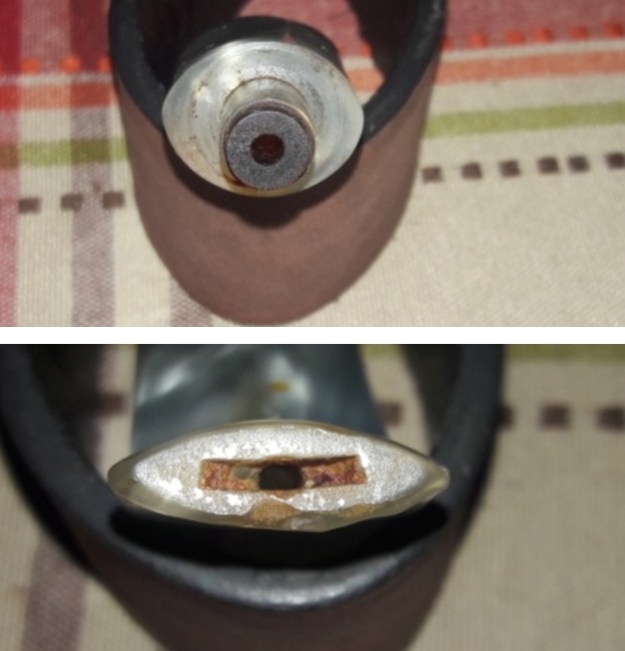
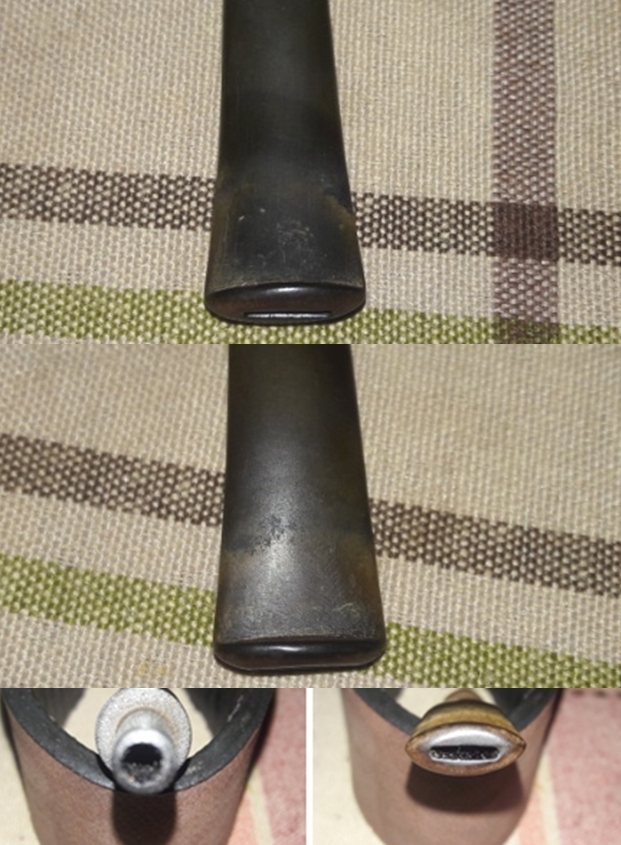
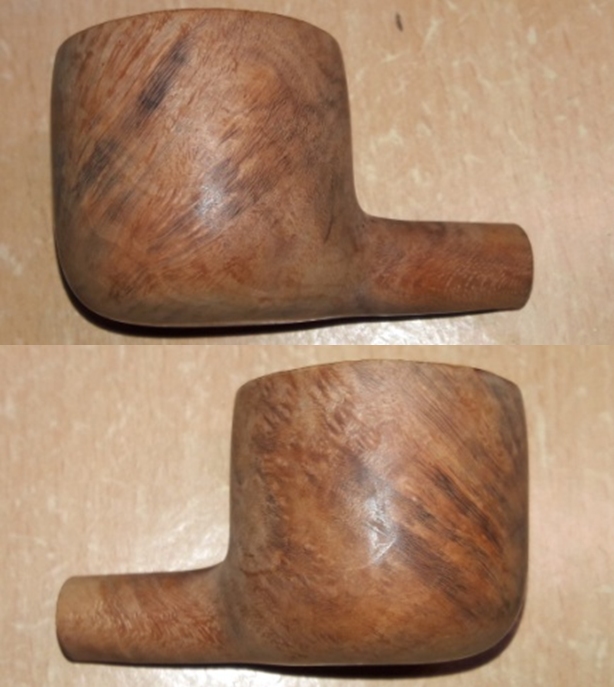
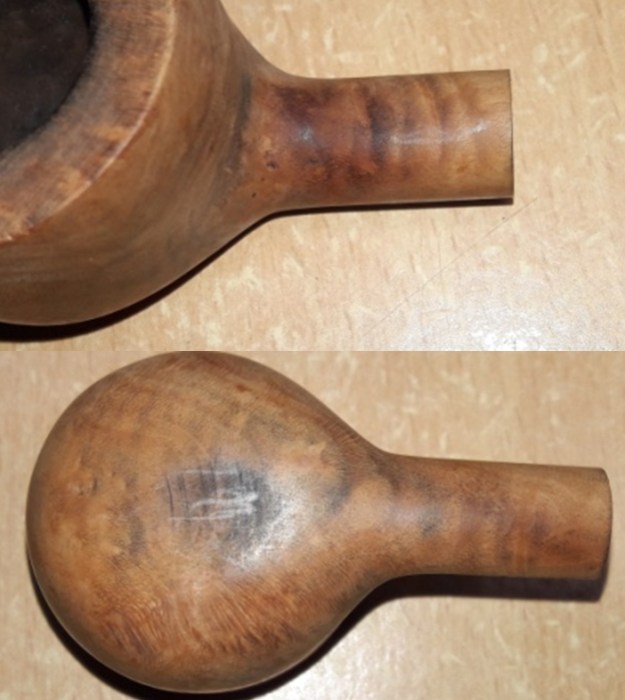
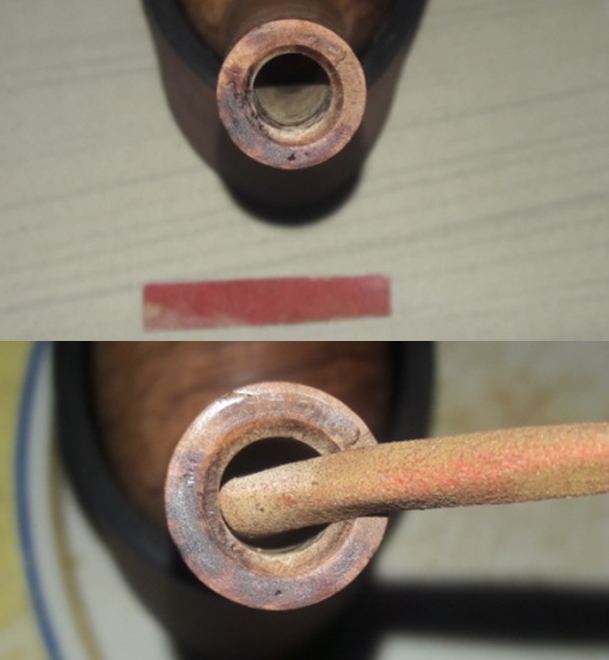
The pipe has beautiful Bird’s eye and cross grain across the stummel that can be seen through all the dirt and grime from years of use and uncared for storage. The chamber has a thick layer of cake with lava overflow over the rim top surface. The vulcanite stem is heavily oxidized and the aluminum tenon contraption appears to be dull and lackluster. The bite zone is peppered with minor tooth chatter. I think this should be an easy refurbishing project. Here is how the pipe appears as it sits on my work table. The smooth stummel has some beautiful Bird’s eye grain on the sides with cross grains on the front and back of the stummel. At the bottom on either side of the stummel, is a sharply contoured cut that merges and forms a gap between the either sides of the stummel that houses the aluminum tenon end of the stem. The stummel surface is covered in dirt and grime giving the stummel a dull and lackluster appearance. There is not a single fill in the briar and the stummel just oozes out high quality. There are a few dents and dings on either side of the stummel. The gap at the foot of the stummel that houses the aluminum tenon is covered in oils, tars and grime from years of usage and storage. The housing for the tenon needs to be cleaned. The minor dents and dings will be addressed once the stummel is sanded down with a sand paper. A nice cleaning and polishing should highlight the beautiful grain on the briar. A thick layer of cake is seen in the chamber. The rim top surface has a few dings and is covered in thick overflow of lava, dirt, dust and grime. The condition of the inner walls of the chamber and rim top surface will be known once the cake has been taken down to the bare briar. The inner rim condition appears to be good with no burn/ charred surfaces. However, the outer rim edge is damaged most probably due to striking against a hard surface. In spite of the thick cake, the chamber odor is surprisingly not strong and should be addressed once the cake has been taken down to the bare briar and the shank internals have been thoroughly cleaned. The draught hole is in the dead center of the heel of the chamber and is constricted due to accumulation of the thick cake. Only once the stummel has been thoroughly cleaned that I can be sure of my initial appreciation. The dings over the rim surface will be addressed by topping while the damage to the outer rim edge will be taken care of by sanding or, if need be, by creating a bevel. The draught hole needs to be thoroughly cleaned for a full and smooth draw. The tapered vulcanite stem is unique and nothing like I had seen before. The tenon end is a conical aluminum extension and has a horizontal slot that is closed at the bottom, cut across the mid section which opens in to the stem airway. This slot is aligned with the draught hole. For a better understanding of the construction and functioning, shown below are a few pictures which shows the complete set up. The stem is heavily oxidized with minor tooth chatter in the bite zone. The aluminum tenon is stained with dried oils and tars and has a lackluster appearance. Deposits/ accumulation of gunk is seen in the horizontal slot in the conical tenon, clogging the air way. Apart from slight calcium deposition at the edge of the both the buttons, there is no damage to the button per se on either surface and no deep bite marks in the bite zone. I shall clean the stem internals and get rid of the surface oxidation. This internal cleaning will improve the air flow and external cleaning will help in aesthetics of the stem. The minor tooth chatter in the bite zone will be addressed by sanding the area. The Process
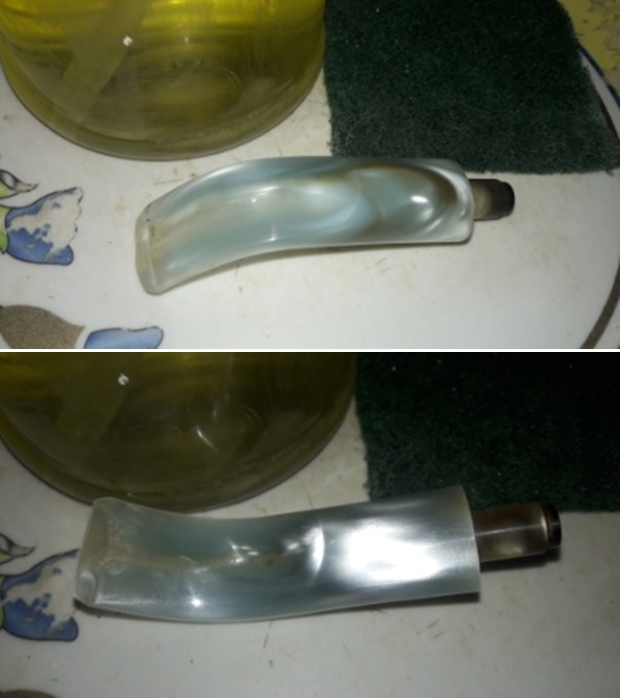
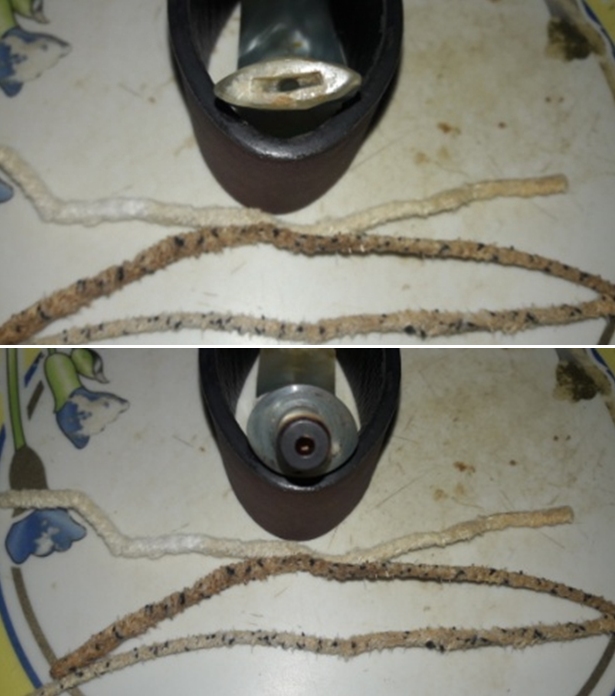
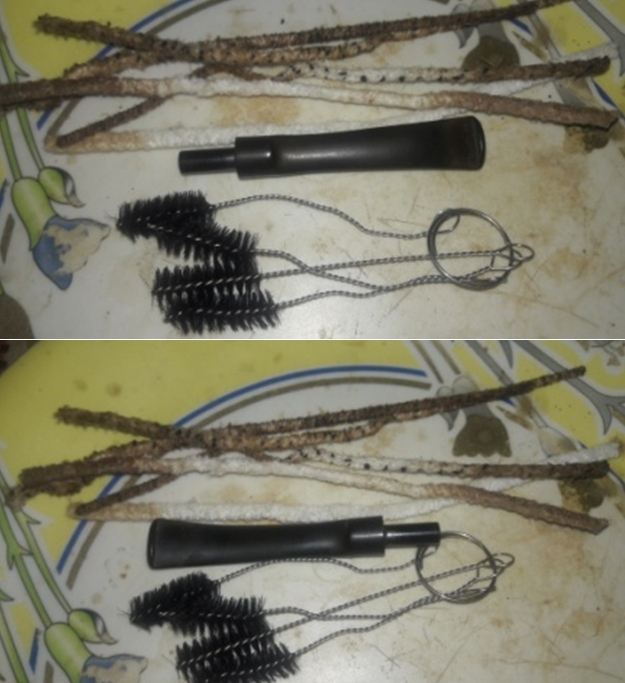
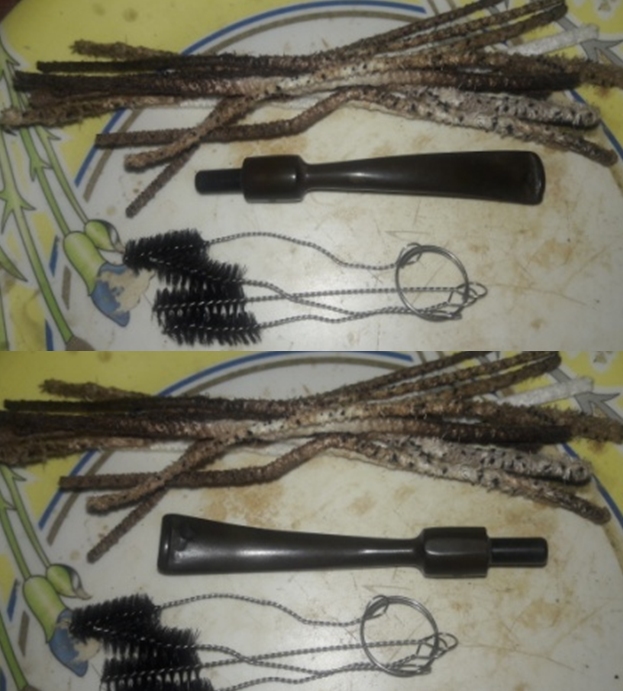
I decided to address the stem first for this restoration. There is no fixed routine that I follow during any restoration and I prefer to address first that part which requires maximum repairs or that what requires maximum time. I cleaned the internals of the stem with thin shank brush dipped in liquid dish washing soap and further cleaned it with regular and bristled pipe cleaners and 99.9% isopropyl alcohol. It has been my experience that initial cleaning with shank brush greatly reduces the subsequent requirement of pipe cleaners.Next, I reamed the chamber with size 2 followed by size 3 head of the Castleford reamer. I further sand the walls with a folded piece of 220 grit sand paper and took the cake down to the bare briar. I wiped the chamber with a cotton swab and isopropyl alcohol. It was a great relief to find a solid chamber with no heat fissures/ lines/ pits. The lava overflow from the rim top surface was gently scrapped off with my fabricated knife. I cleared the draught hole of all the obstructing cake and gunk with hard bristled pipe cleaners and alcohol. The gap at the foot of the stummel that houses the tenon was cleaned using shank brush, pipe cleaners and alcohol. The rim top surface needs to be scrubbed clean. This cleaning has revealed an uneven inner rim with chips to the edge, especially one in 12 o’clock direction. The damaged areas of the inner rim edge are marked in yellow circles. Further external cleaning of the stummel will present a clearer picture of the extent of damage. The chamber now smells fresh and clean.    The time that I was working on cleaning up of the stummel, Abha my wife worked on the stem. Since there was no requirement of any repairs to the stem, she volunteered to clean it up. With a folded piece of 180 grit sandpaper she rid the stem of the deep seated oxidation. She followed the 180 grit sandpaper with sanding the stem with progressively finer grit sandpapers of 220, 400, 600 and 1000 grit. The use of progressively finer grit sandpapers helps in removing complete oxidation from the stem surface while eliminating the sanding marks left behind by the coarser grit sandpapers. She cleaned up to the aluminum tenon end and the stem with 0000 grit steel wool and Murphy’s Oil soap and rubbed a little EVO deep in to the vulcanite. What fantastic results she has produced! The stem already looks polished and yet micromesh cycle is yet to be completed. Here is how the stem appears at this stage.With the internals of the stummel now clean, I cleaned the external surface of the stummel. I applied “Briar Cleaner”, a product that has been developed by my friend Mark Hoover, to the external surface of the bowl. It works similar to Murphy’s oil soap and needs to be applied to the stummel surface and set aside for 5- 10 minutes. The product pulls out all the dirt and grime to the surface making further cleaning easy. I am quite happy with this product. I used a hard bristled tooth brush to scrub the stummel with the gel like product, wiped it clean with a moist cloth and dried it using paper towels and soft cotton cloth. I deliberately cleaned the rim and the shank end by inverting the stummel and rotating it on a piece of Scotch Brite. I cleaned the gap that houses the conical aluminum tenon with a shank brush and dish washing soap to remove what little crud remained in the gap. I set the stummel aside to dry out naturally. The stummel is now nice and clean with the grains showing a lot of promise. The rim top surface has many dents and dings while the outer rim edge has many small divots carved, probably as a result of knocking against a hard surface to remove the dottle. The inner rim too has few dings and chipped edge. I shall resort to topping and creating a bevel over the edges to address these issues. Now that the stummel was clean, I could make out the exact extent of damage to the rim top surface and also to both inner and outer rim edges. I topped the bowl on a piece of 220 grit sand paper, checking ever so frequently the progress being made. One of the things that I prefer to avoid is topping a bowl as it compromises the shape of the bowl while also loosing briar estate. In case it is unavoidable, I prefer to keep it to the minimum. In this case, a few rotations later, I am at that point where the rim top surface damage has been addressed while the inner and outer rim edge damage has been addressed to a great extent. I need to create a slight bevel over both the edges to fully address the damage to the rim edges. To address the remaining dents and chips to the inner and outer rim edges, with a folded piece of 220 grit sand paper pinched between my forefinger and thumb, I created a slight bevel over both these edges. I am quite pleased with the way the rim top and the edges appear at this stage in restoration.    I subjected the stummel to a complete cycle of micromesh polish, wet sanding with 1500 to 12000 grit pads, the only variation being that since 1500 and 2400 grit micromesh pads have completely worn out and due to lockdown couldn’t order on line, I wet sand using 1500 and 2000 grit sand papers. I wiped the stummel with a moist cloth after every three grit pads to remove the sanding dust left behind by the pads. This also helps in monitoring the progress being made and ensures early corrective action. I am happy with the progress being made till now.    Next, I rub a small quantity of “Before and After Restoration Balm” in to the briar and the rim top surface with my finger tips and worked it deep in to the surface and let it rest for a few minutes. The balm almost immediately works its magic and the briar now has a nice vibrant appearance with the beautiful grain patterns on full display. The contrast of the dark browns of the grain with the light hues of the rest of the stummel adds an interesting dimension to the appearance of the stummel. I further buffed it with a horse hair brush to further deepen the shine. Simultaneously as I was carrying out repairs and polishing of the stummel, Abha was busy silently polishing the stem. She wet sanded the stem with 1500 and 2000 grit sand papers and followed it up with wet sanding using remaining micromesh grit pads 2400 to 12000. She even polished the conical aluminum tenon to a pristine smooth shining finish. Readers who have been following my write ups for some time now are aware of Abha’s penchant for not taking any pictures……and she has stayed true to this habit of hers. Sincere apologies as there are no pictures for this stage!!

To complete the restoration, I mount a cotton cloth buffing wheel on to my hand held rotary tool and apply a coat of Blue Diamond to the stummel and the stem to polish out the minor scratches. With a cotton buffing wheel that I use for carnauba wax, I apply a coat of carnauba wax and continue to work on it till the complete coat of wax had been polished out. I mount a clean cotton cloth buffing wheel and give the entire pipe a once over buff. I finished the restoration by giving the entire pipe a rigorous hand buffing using a microfiber cloth to raise the shine further. The finished pipe looks amazingly beautiful and is now ready for its long second innings with me. I only wish it could share with me its life story of the past years while I enjoy smoking my favorite Virginia blend in it or maybe an English blend!! P.S. This pipe was an interesting project, the most difficult part being the research on the maker and brand of this pipe. This task was made difficult due to lack of any stampings on the stummel. However, once the provenance of this pipe was established, it was a simple straight forward restoration project.

This pipe too shall be joining the few pipes in my collection that are a milestone in pipe smoker’s eternal quest for a cool and dry smoke.

A big thank you to all the readers who have thus far walked with me on this journey…

Praying for safety and well being of all readers of rebornpipes.com. Stay home, stay safe.

A Second Inning For A Meerschaum Lined Orlik Bent Brandy


Blog by Paresh Deshpande

I had recently worked on a long Albatross wing bone stemmed Corn Cob which was both rustic and delicate from an estate lot of 40 pipes that I had acquired about six months ago. This was the second pipe from the lot that I had refurbished, the first being a huge Real Cherry wood pipe. Here is the link to both the write ups which will provide background information as to how I came to acquire this lot and the condition of the pipes that I had received;

https://rebornpipes.com/2020/03/08/refurbishing-a-real-cherry-foreign-pipe-from-estate-lot-of-40/

https://rebornpipes.com/2020/05/10/refurbishing-a-vintage-corn-cob-pipe-with-an-albatross-wing-bone/

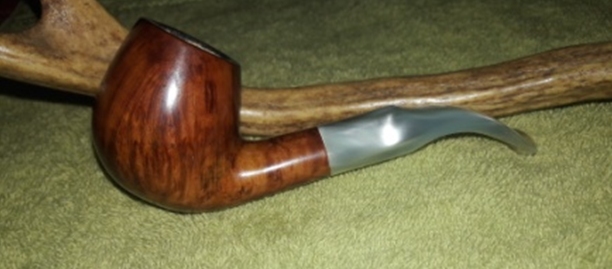
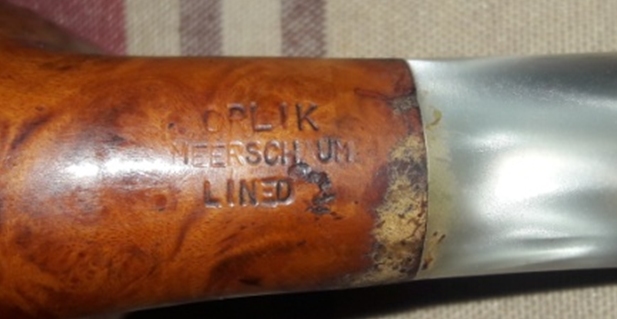
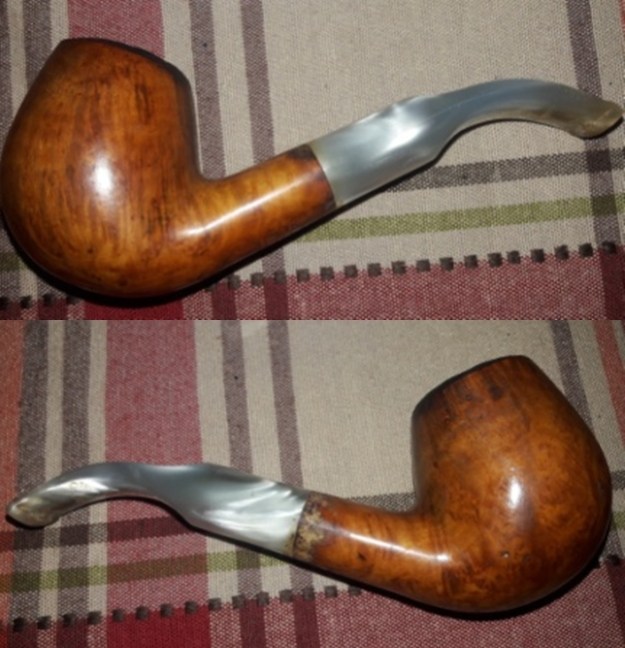
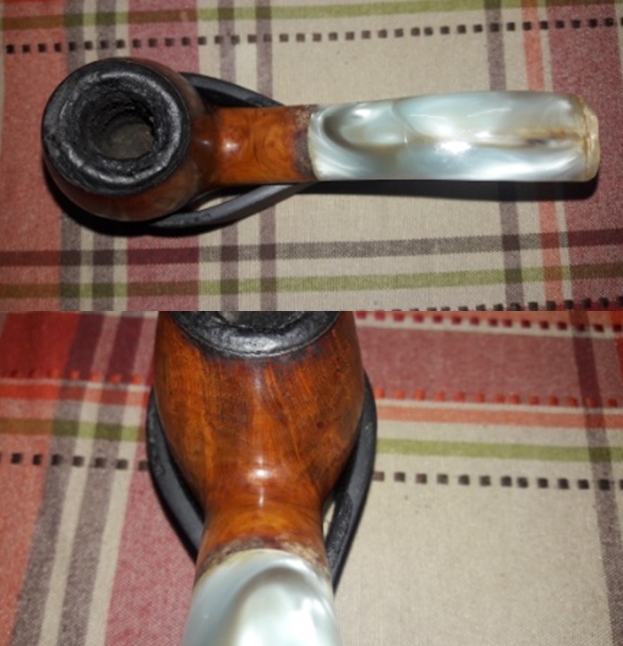
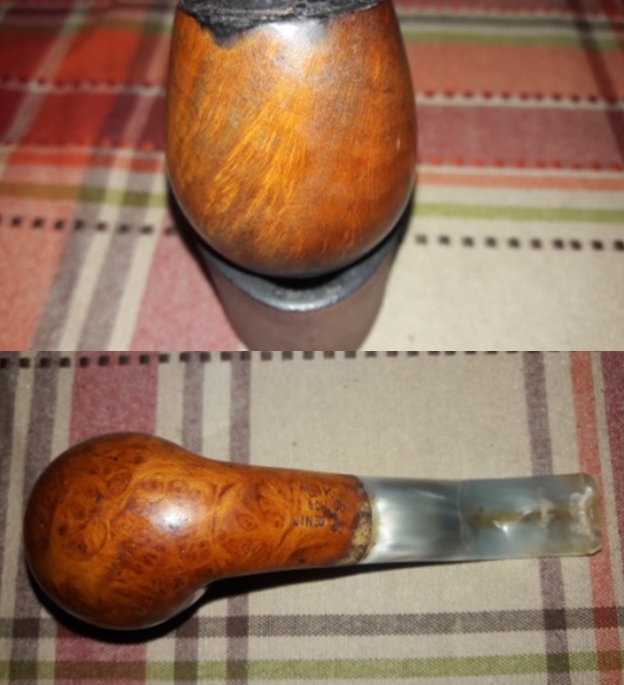
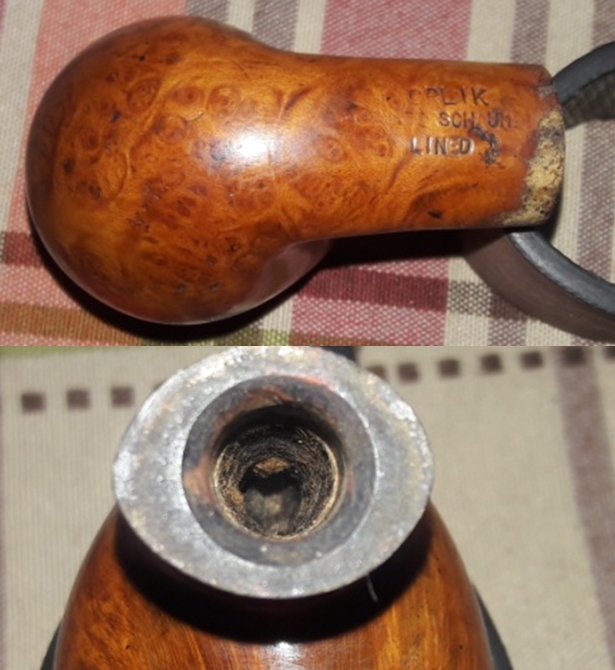
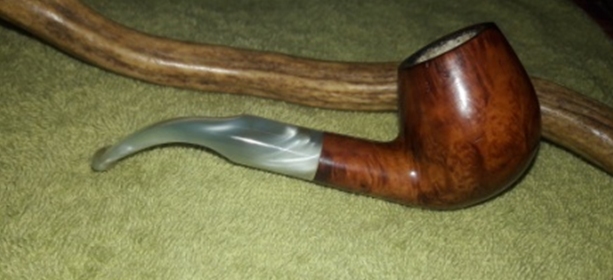
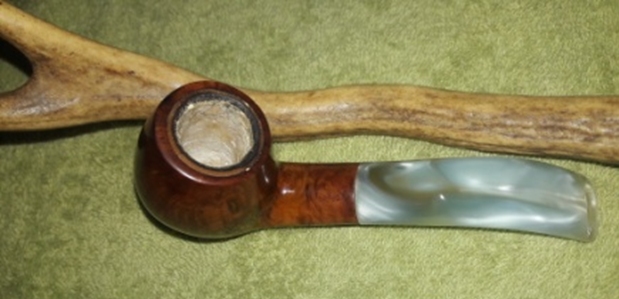
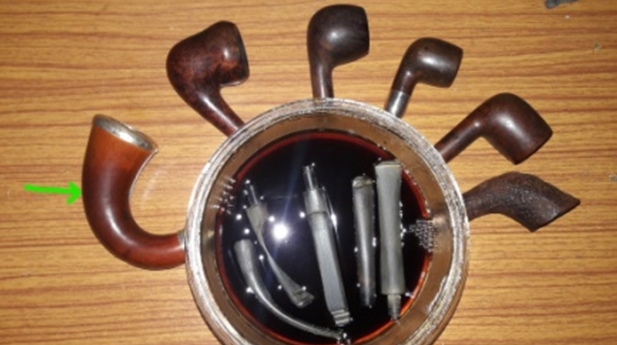
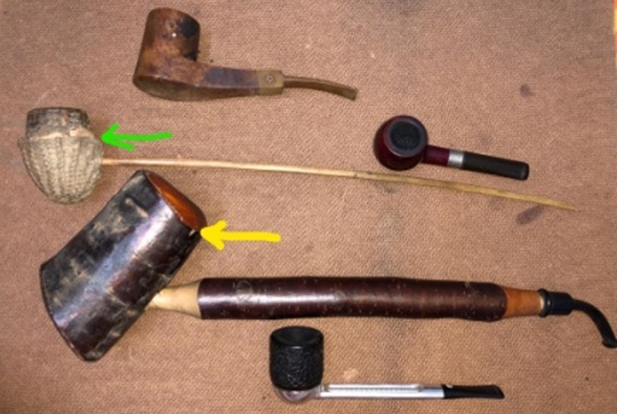
The third pipe from this lot and currently on my work table is beautiful Bent Brandy with a pearly variegated stem with swirls of light browns and grays. The first two pipes that I had worked on are marked with yellow and green arrows while the third pipe that is currently on my work table is shown in the second picture marked in indigo colored arrow. The pipe feels heavy and solid in hand. It is stamped on the bottom surface towards the shank end as “ORLIK” over “MEERSCHAUM” over “LINED”. There is no shape code or COM stamp on the stummel. The acrylic stem too is devoid of any stamping.I referred to pipedia.org for information on the firm ORLIK, my interest being piqued since I remember having seen a few Orlik pipes in my inherited pipe collection (unfortunately, I have never gotten around to work on any of them as yet!!). From what I have learned, the company was started in 1899 by Louis Orlik in London, Bond Street to produce HIGH QUALITY pipes for a RELATIVELY LOW PRICE. In 1980 the company was acquired by Cadogan. Like many of London’s other pipe manufacturers they moved to a new built factory in Southend-on-Sea. As all current brands in the Cadogan group, Orlik was being produced in those factories. In the same article, at the end is an onsite link to Dating Orlik Pipes by Michael Lankton, which makes for an interesting read. I reproduce the relevant portion which points to the pipe currently on my table;

  • Virgin(Series Letter:Without letters)
  • Old Bond Street(Series Letter:A)
  • Old Bond Street Sandblast(Series Letter:AX)
  • Supreme(Series Letter:T)
  • Supreme Sandblast(Series Letter:TX)
  • Meerschaum Lined(Series Letter:M)
  • Corona(Series Letter:C)
  • Old Root(Series Letter:R)

Here is the pipedia link to the article on Orlik pipes;

https://pipedia.org/wiki/Orlik

Since the pipe currently on my table is sans the series letter M and also the stem is neither Hand cut nor molded vulcanite but variegated acrylic stem, I assume that it is a Post Cadogan era pipe that is Post 1980s.

Initial Visual Inspection
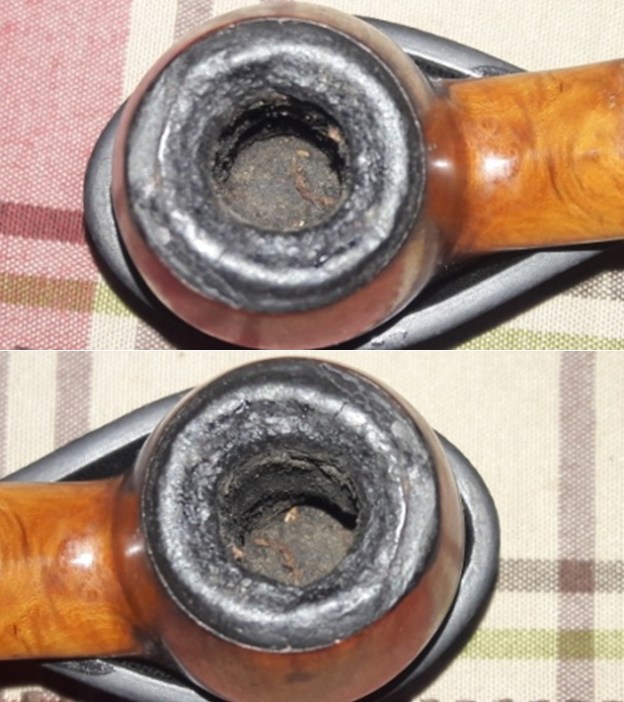
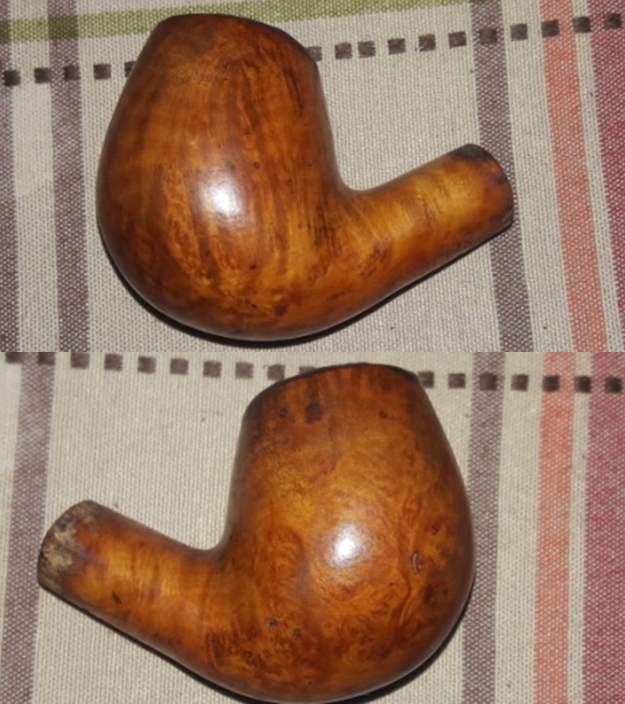
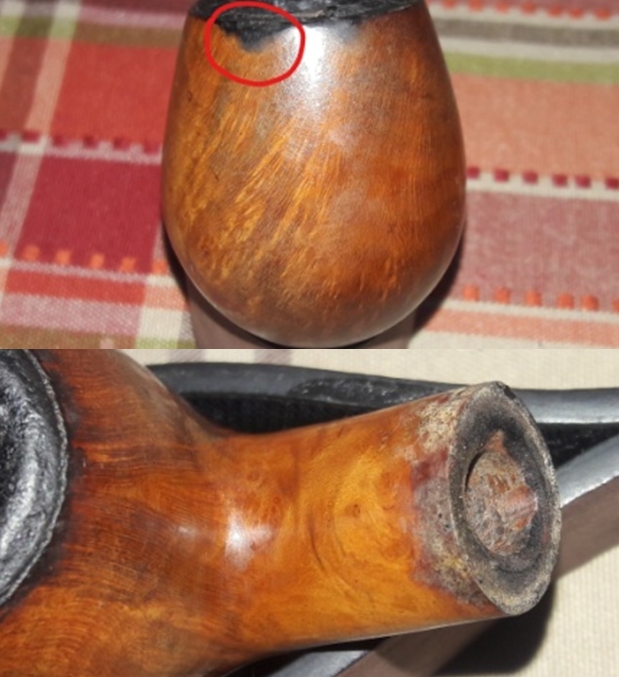
The pipe, as it appears, is shown in the pictures below. There is thick layer of cake in the chamber with equally heavy overflow of lava over the rim top surface. The stummel is dirty with a number of dents/ dings and minute fills that are visible. The stem is filthy with heavy tooth chatter and deep bite marks in the bite zone and button edges on either surface. All in all, this was a very well loved pipe that has the classic signs of poor care and rough use. The chamber has a thick even layer of hard cake. There are copious amounts of old oils, tars and grime that have overflown the rim top surface and further down the stummel surface. The thick cake and heavy lava overflow over the rim top masks the condition of the chamber walls and the rim surface. The condition of these surfaces will be determined only once the cake and lava overflow has been cleaned up. The rim top surface is highly uneven as evinced by the uneven accumulation of lava overflow, again, this is just speculation as what surprises are hidden beneath will be revealed only once the overflow has been removed.  There are signs of charring along the outer rim edge and one prominent charred portion is at 1 o’clock direction to the front of the bowl. The smells from the chamber are very strong (very strong is actually an understatement) and all pervading. This issue of old smells will have to be addressed. I shall top the rim to make it perfectly even and also address the charred outer rim edges. It has been my experience that such thick layer of cake invariably hides some kind of wall damage, either heat fissures or beginnings of a burnout. Being meerschaum lined, I just don’t want a broken/ cracked meerschaum surface. The golden walnut stained stummel with dark brown stained grains makes for an alluring visual display. The surface is fraught with numerous minor dents, dings and is covered in dust, dirt and grime of the overflowed lava. A charred spot is seen to the front of the bowl in 1 o’clock direction (encircled in red). The shank end has patches all around, akin to water marks and my guess, looking at the condition of the chamber and stummel, is that the oils and tars from the mortise had leaked from the tenon- mortise junction and dried over the surface. The heavily clogged mortise is an indication of the oils and tars having nowhere to go but escape from the stem shank junction. I intend to sand the stummel surface to remove as much of the dents and dings as is possible while making the stummel surface smooth. I need to be careful while sanding the shank end to remove the patches so as not to shoulder the shank end. Major dents and fills that are revealed, if any, will be filled with clear superglue as briar dust and glue would leave ugly dark spots. The pearly variegated stem with swirls of light browns and grays is filthy to say the least. The stem surface is covered in grime and dirt with heavy tooth indentations over the button edges on either surface. The bite zone is peppered with deep tooth chatter. The tenon end, horizontal slot and the air way is covered and clogged with gunk. Air way over the surface appears darkened and flow through the stem is laborious and heavy. The stem surface and internal first needs to be cleaned. The tooth chatter will be sanded out with 220 grit sandpaper and if need be, will be filled with glue. The button edges on either surface needs re-building using clear CA superglue. The Process
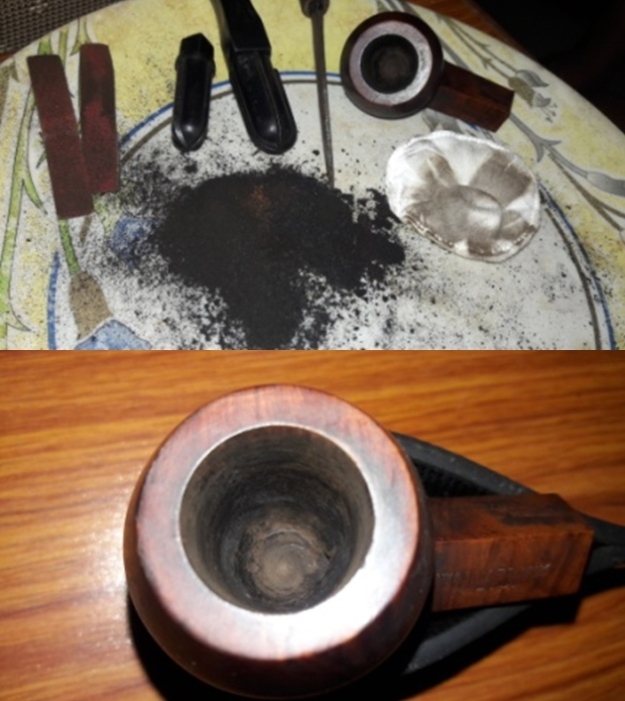
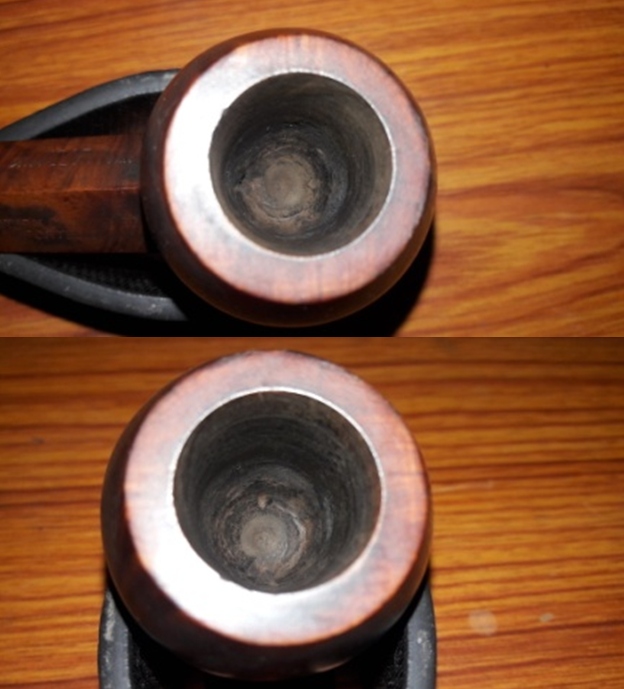
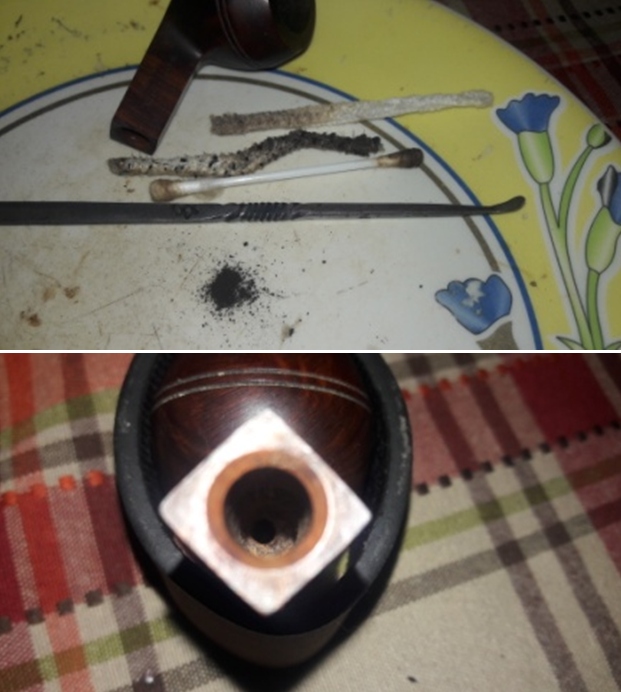
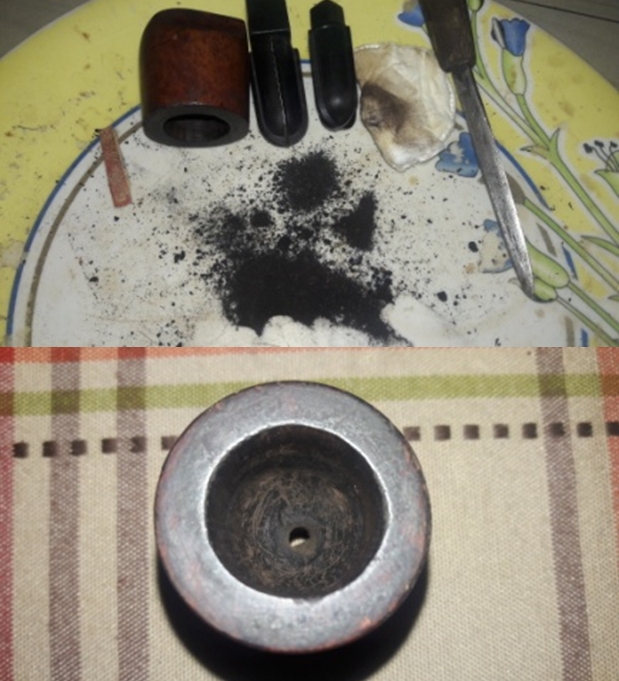
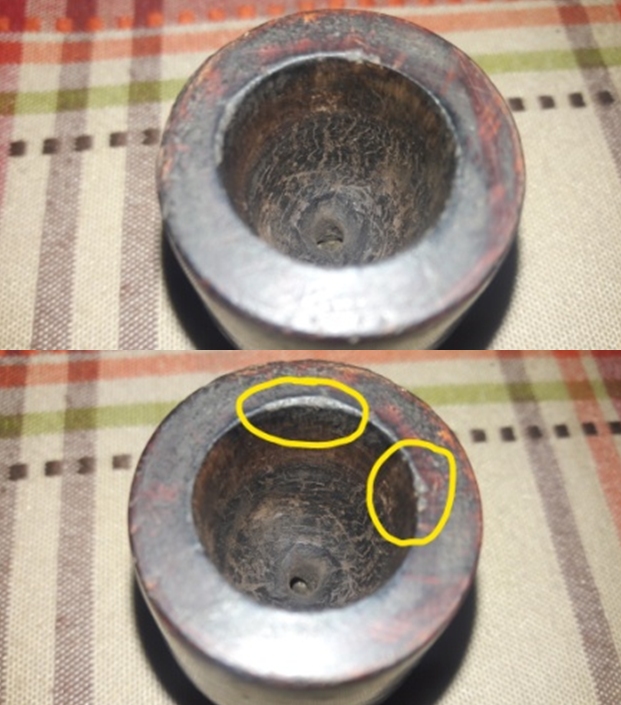
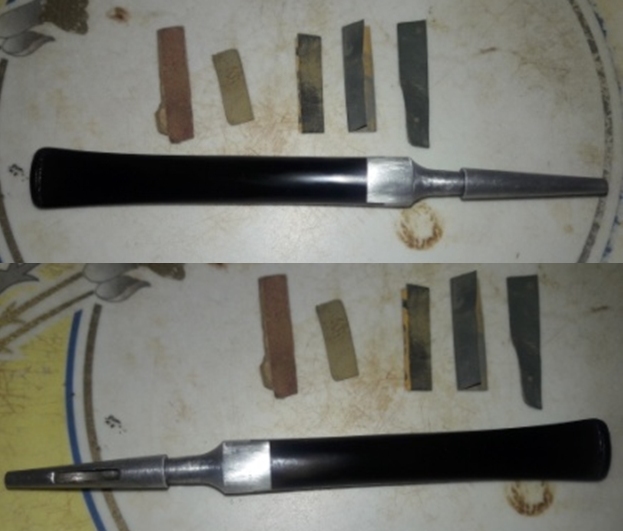
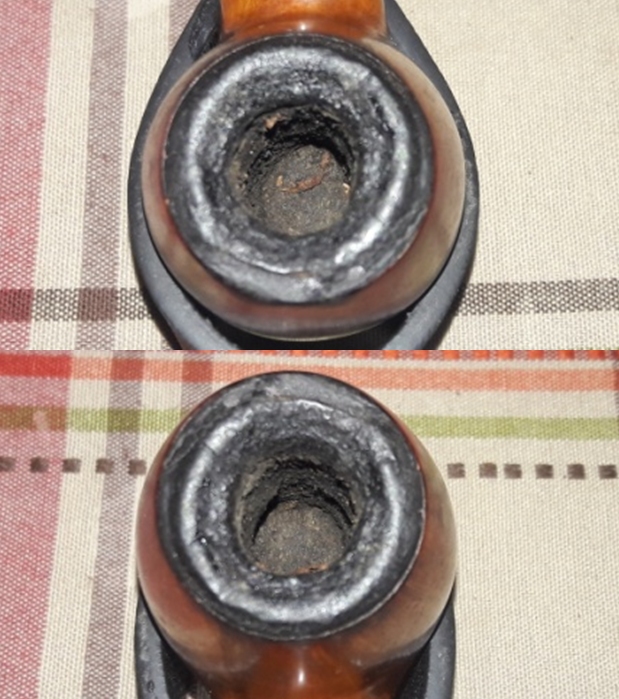
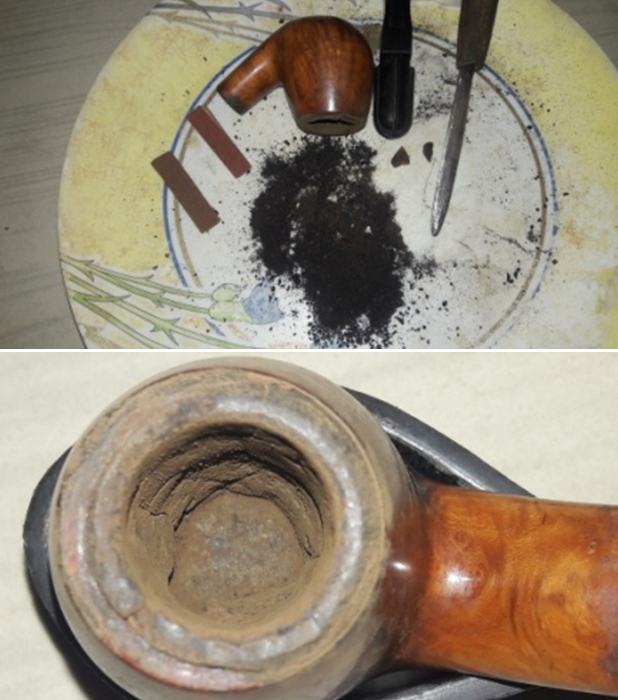
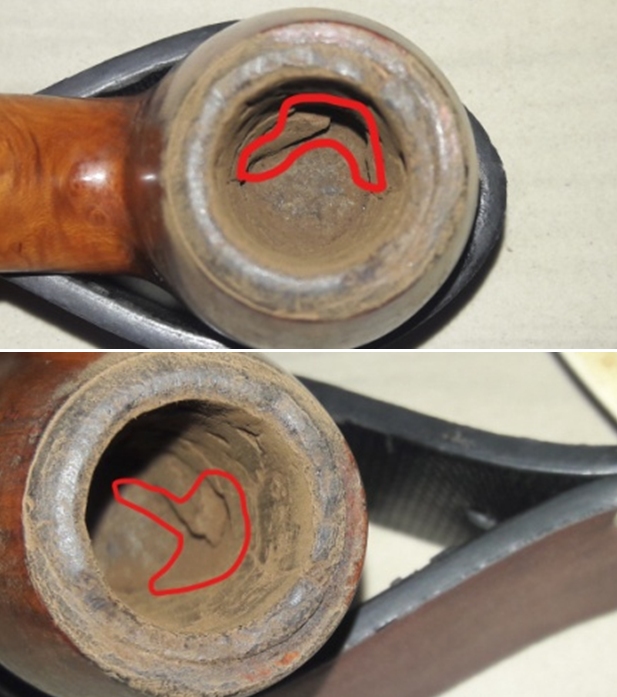
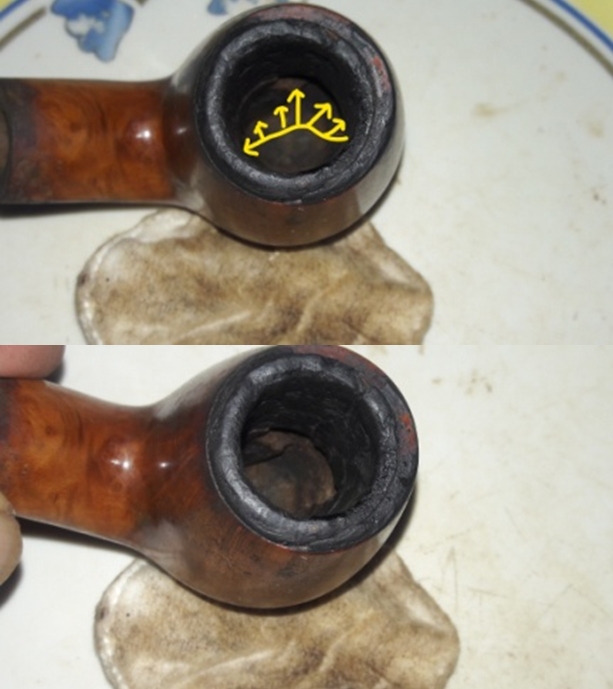
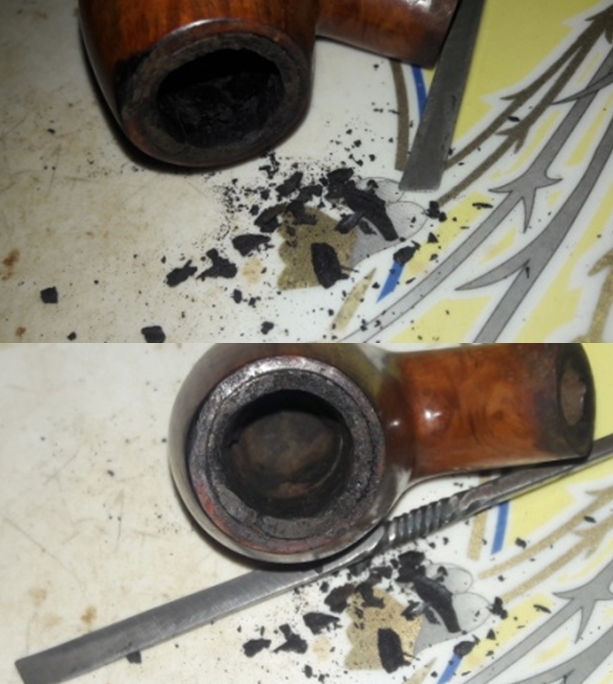
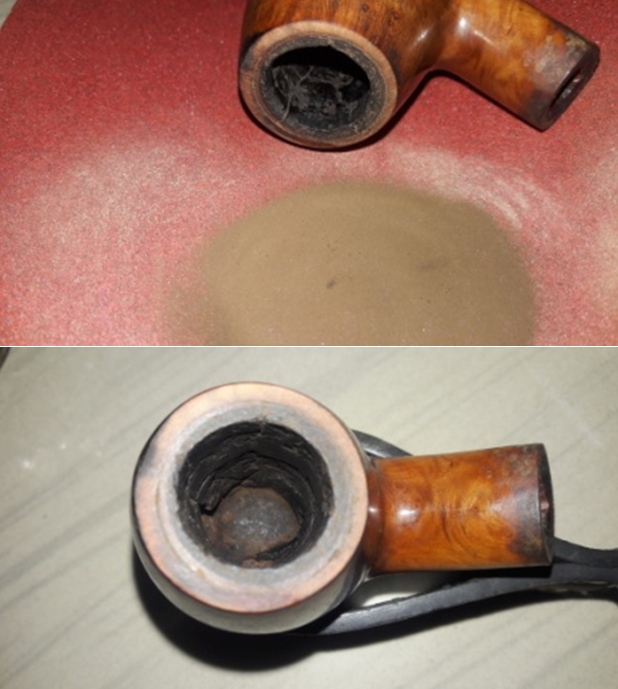
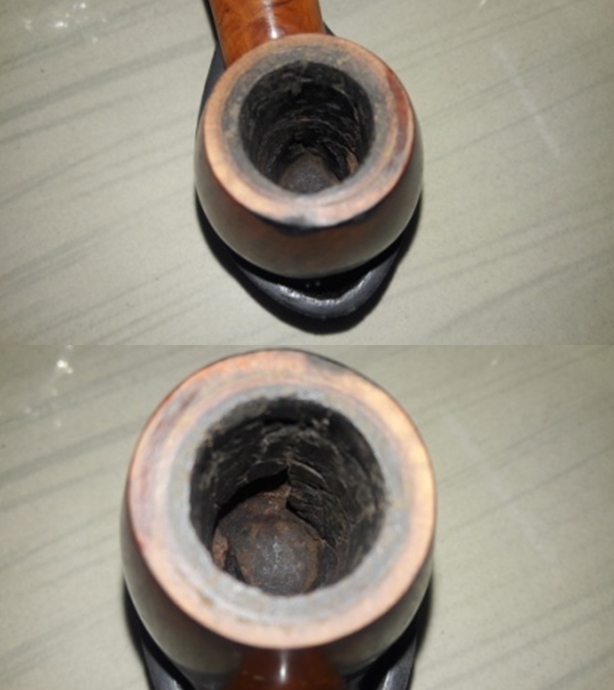
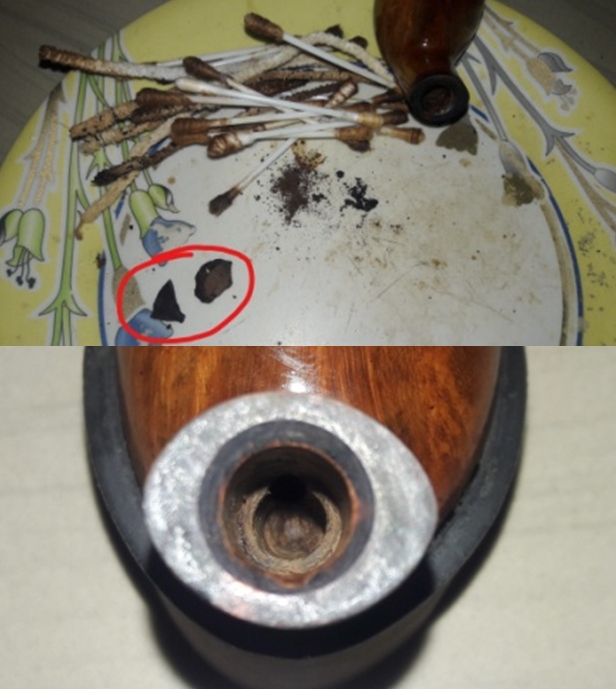
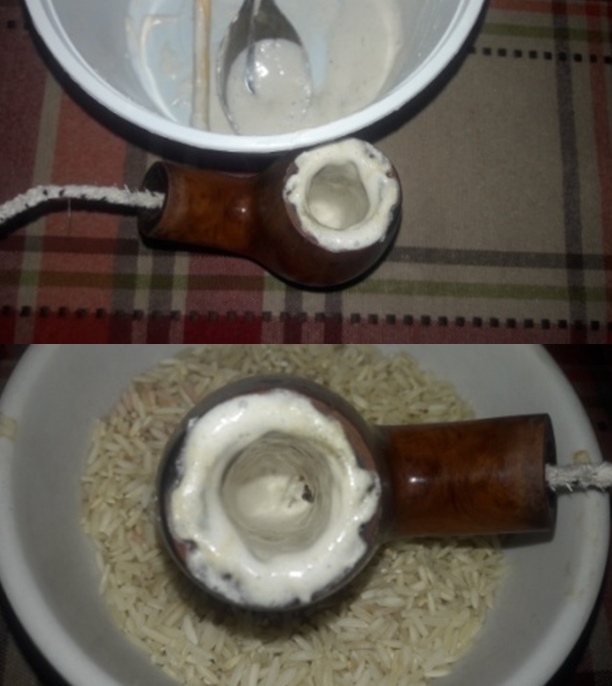
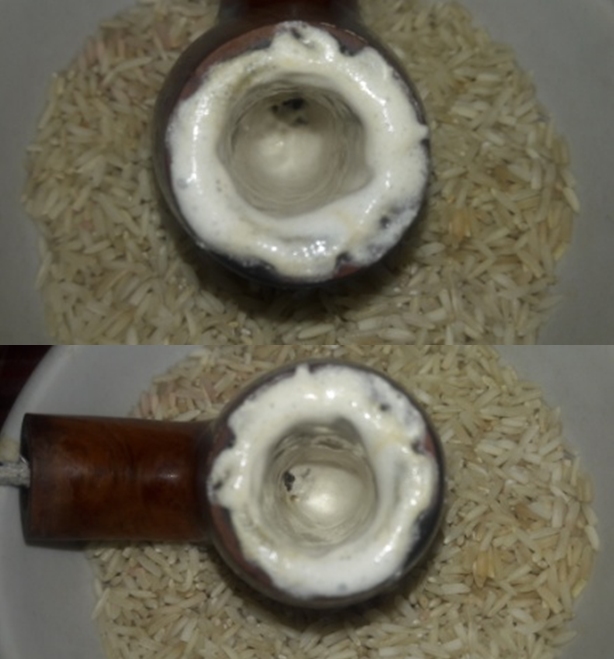
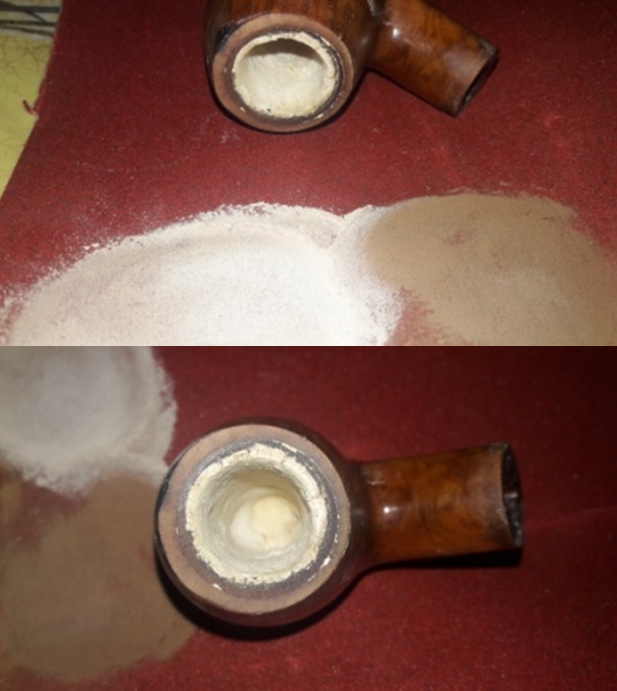
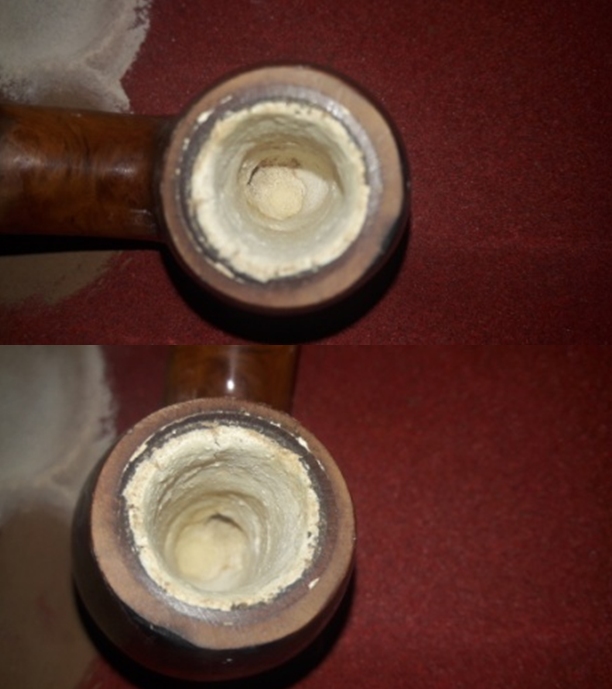
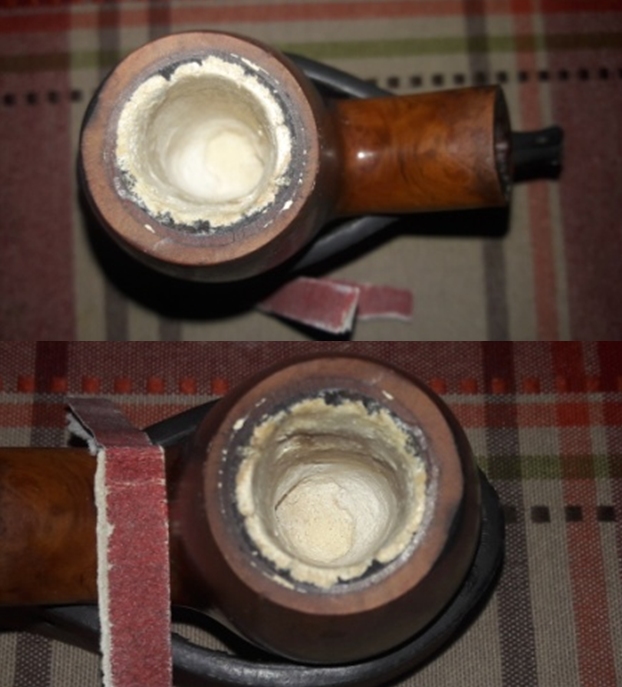
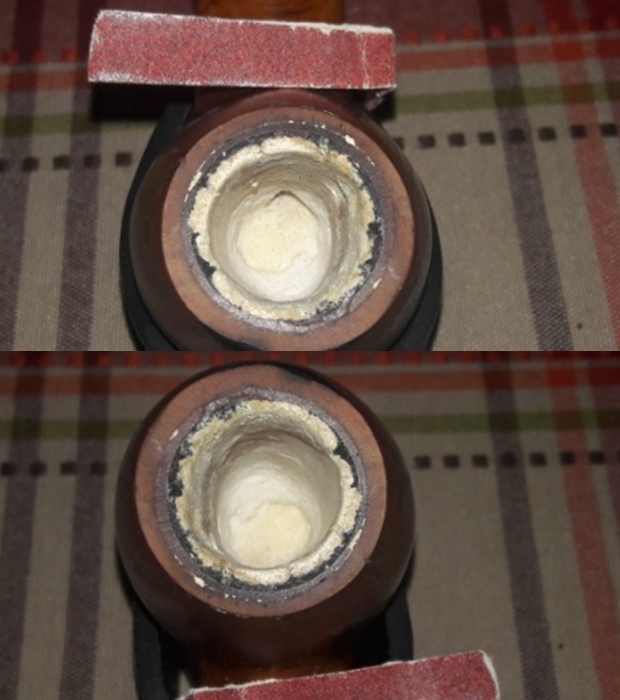
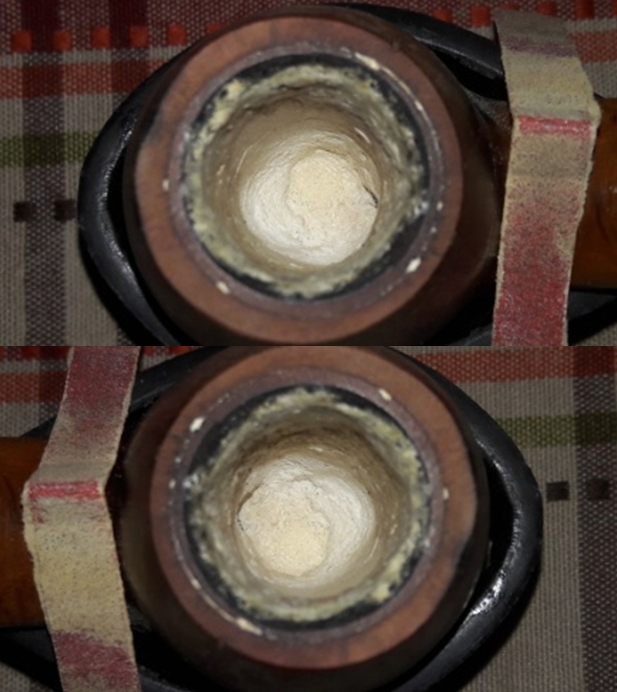
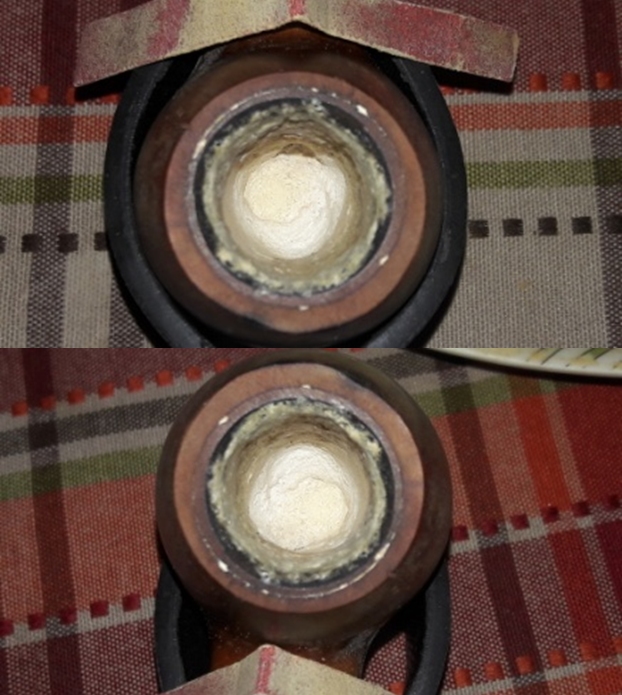
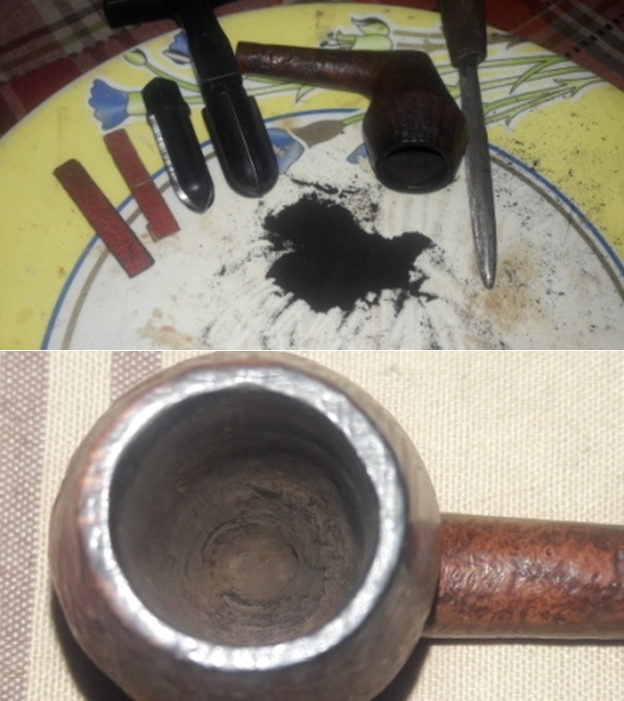
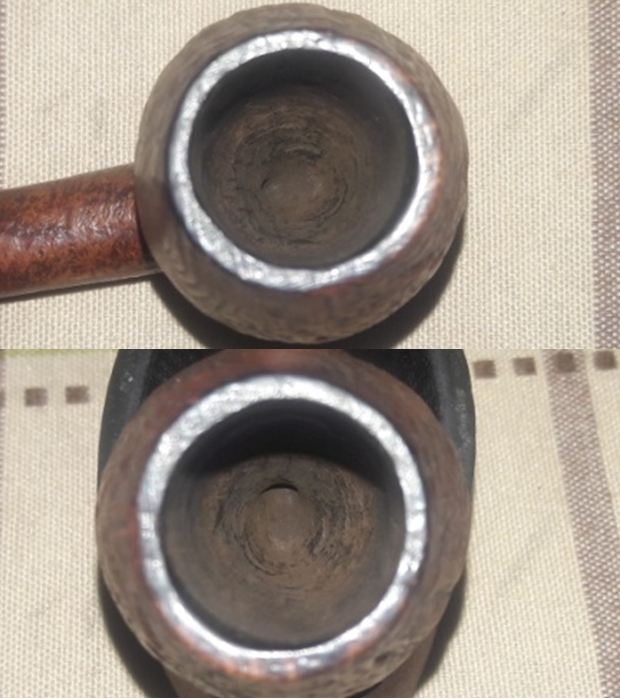
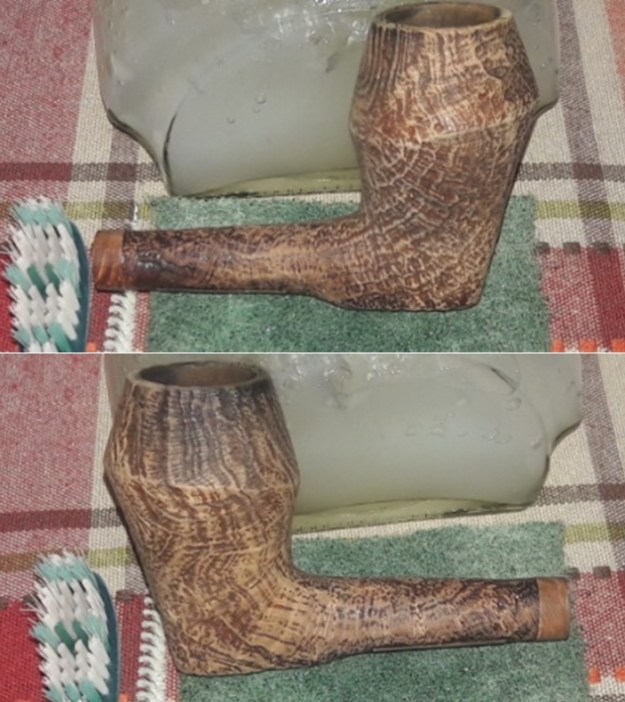
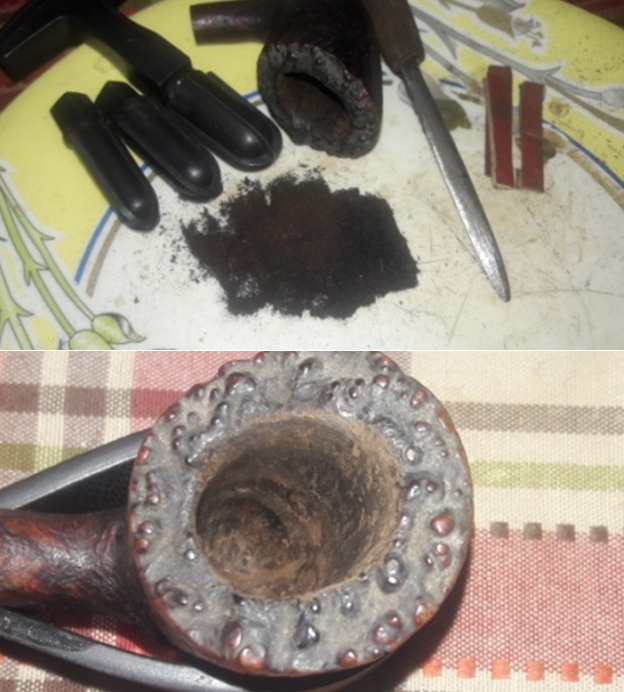
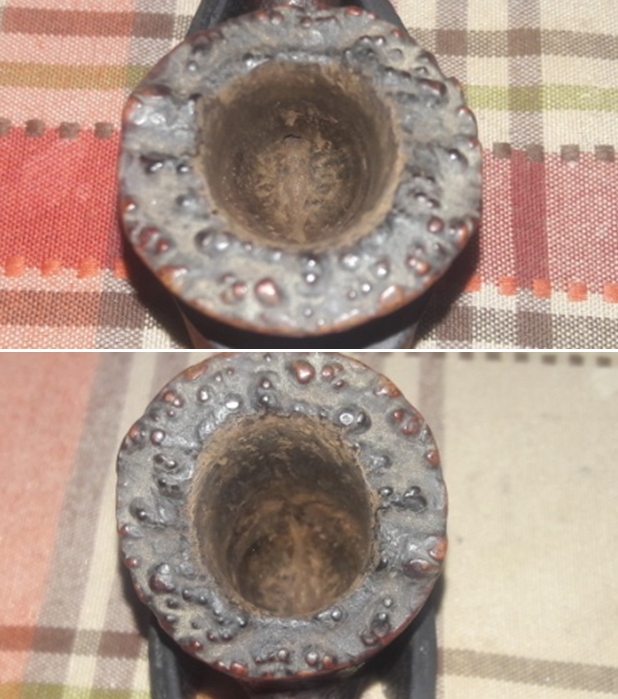
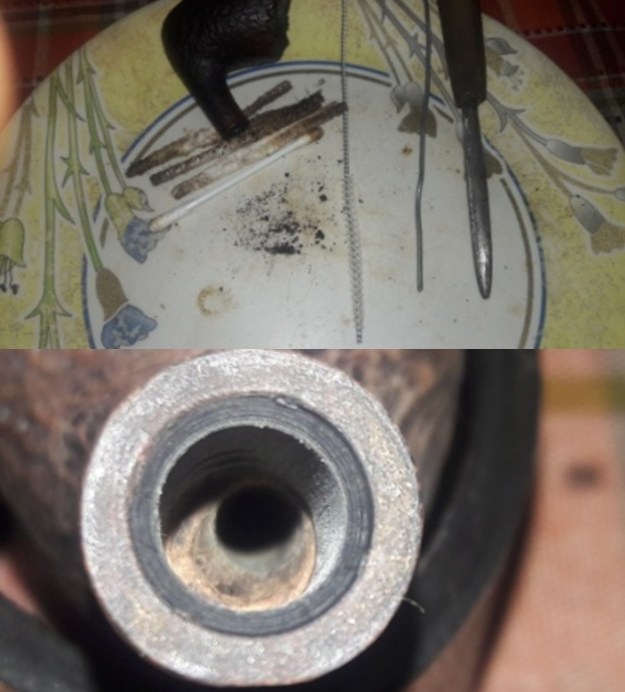
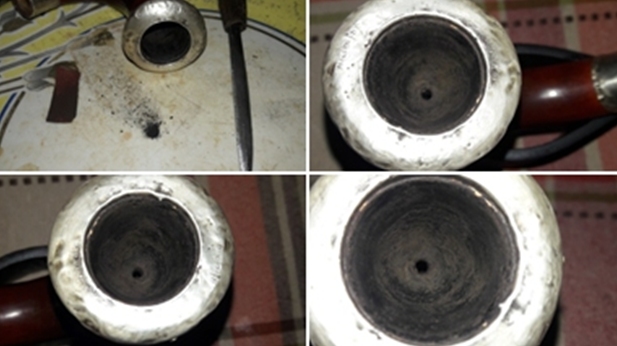
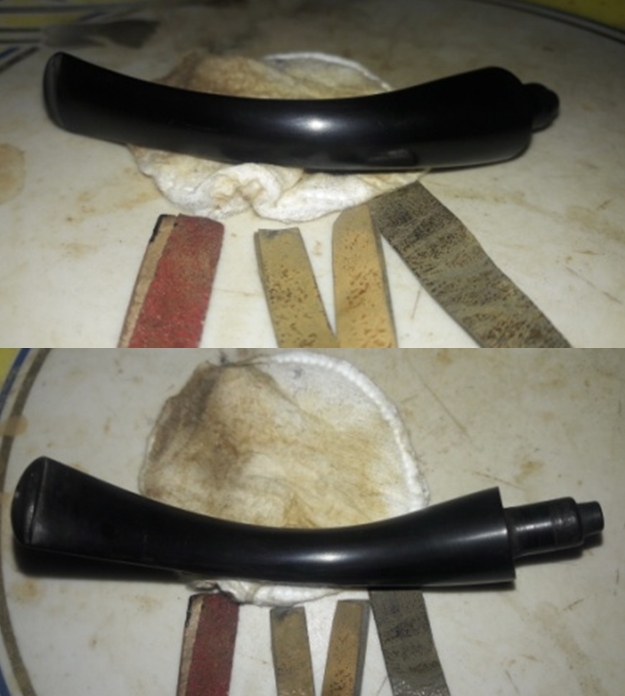
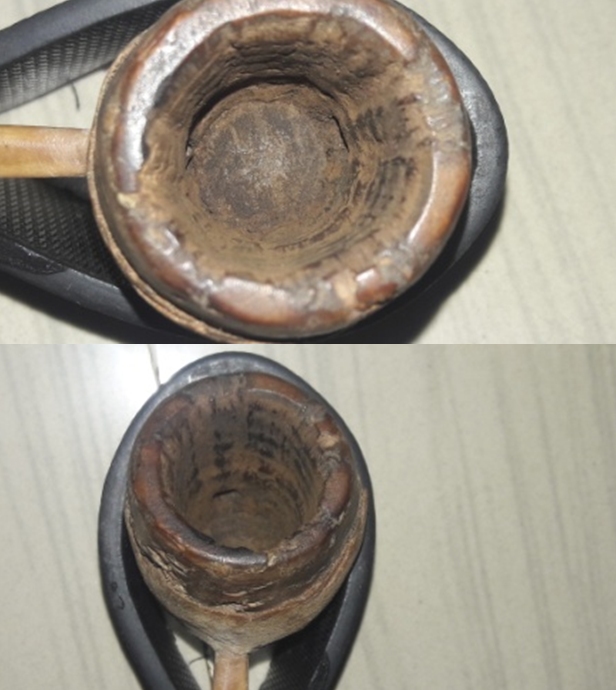
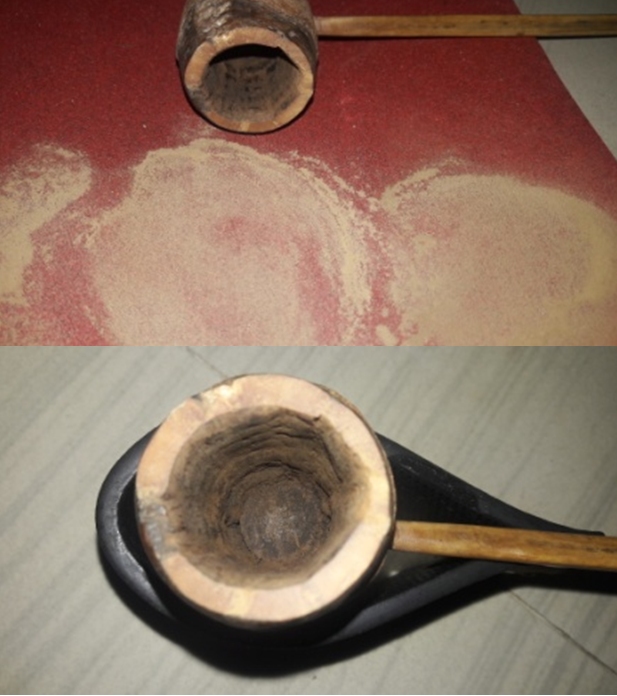
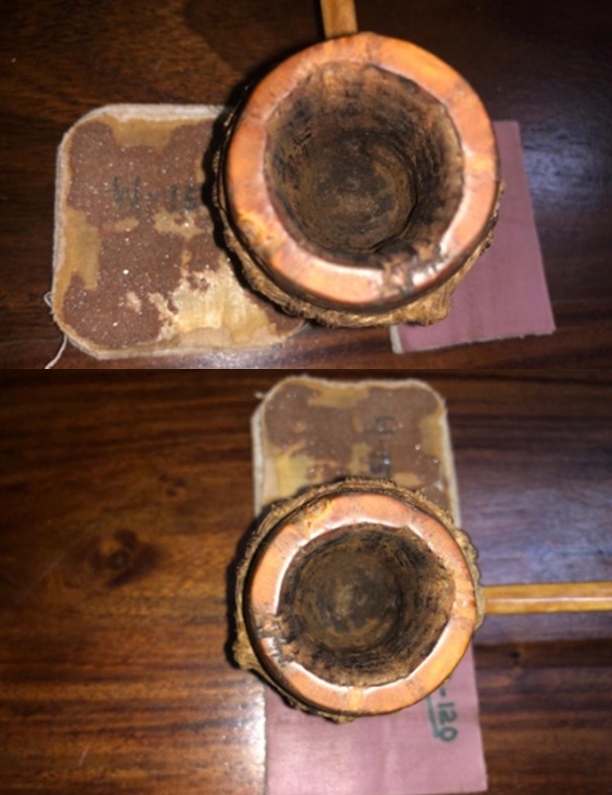
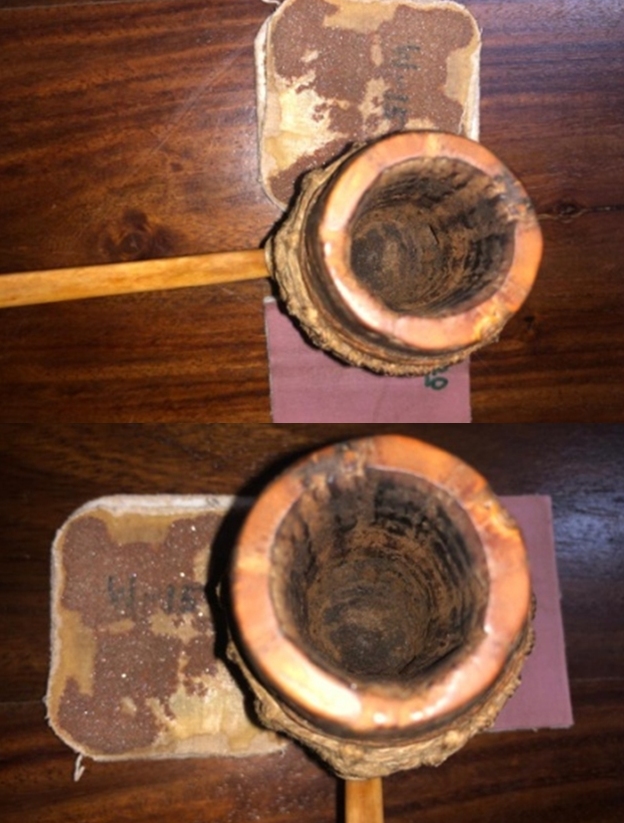
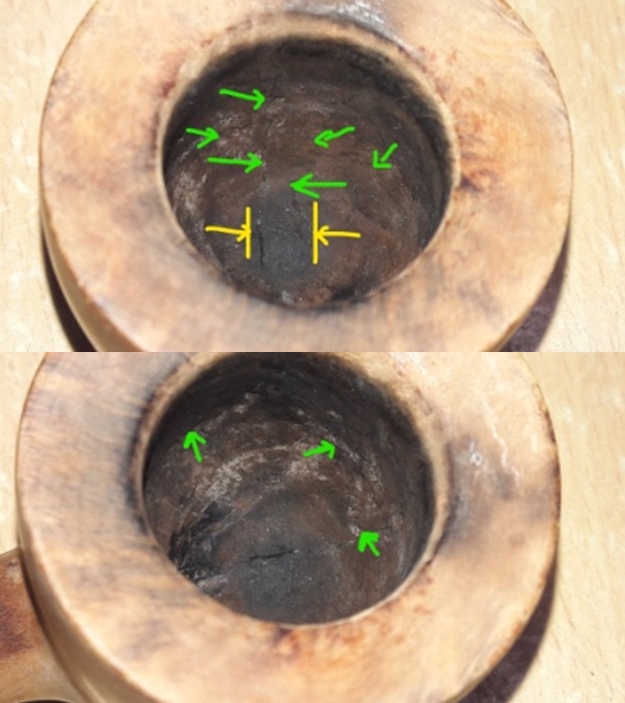
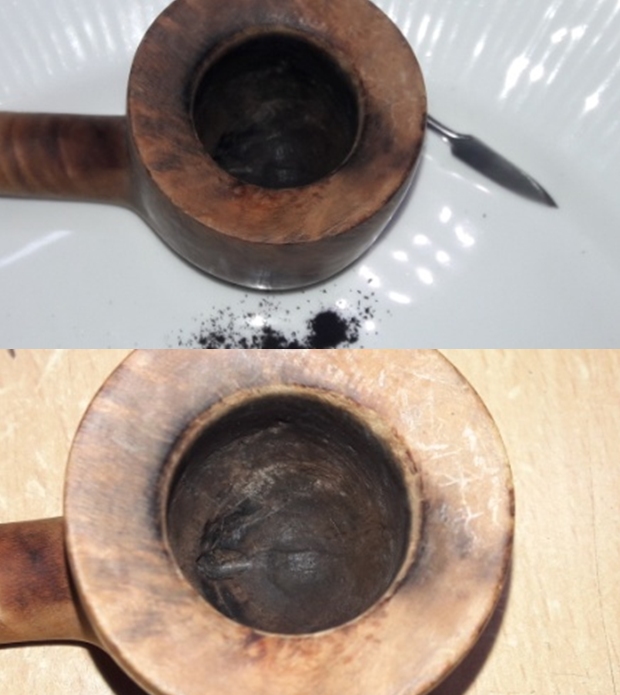
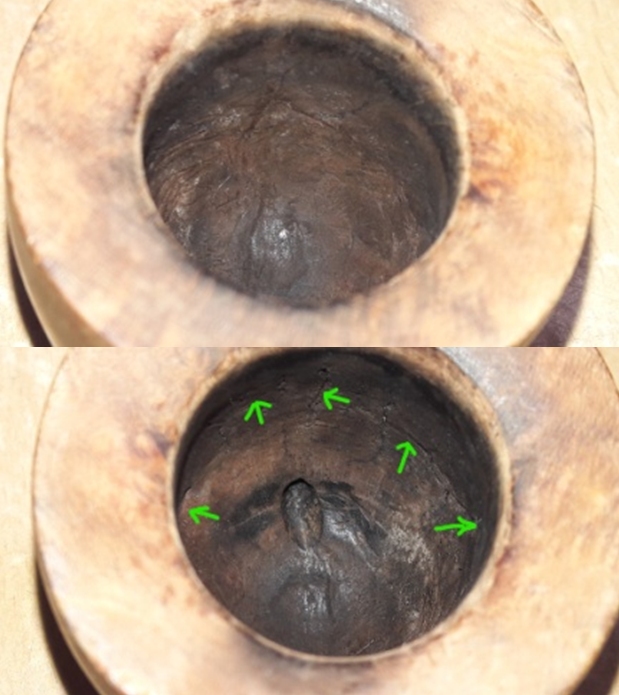
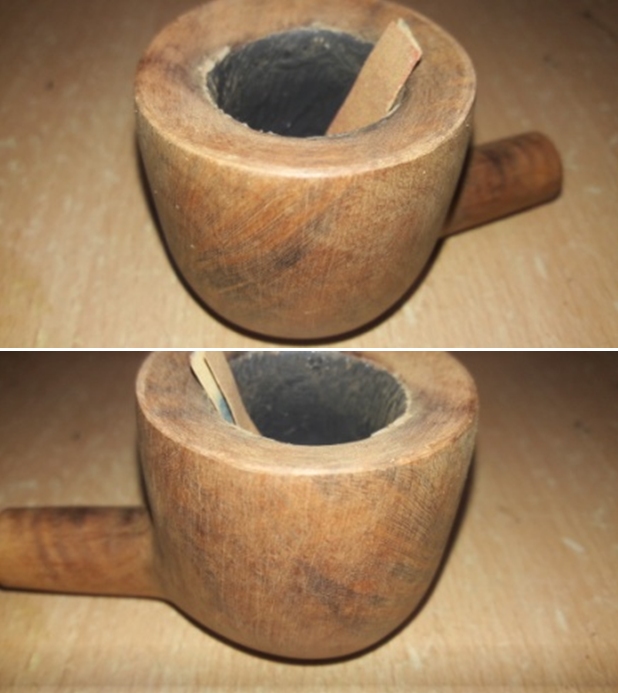
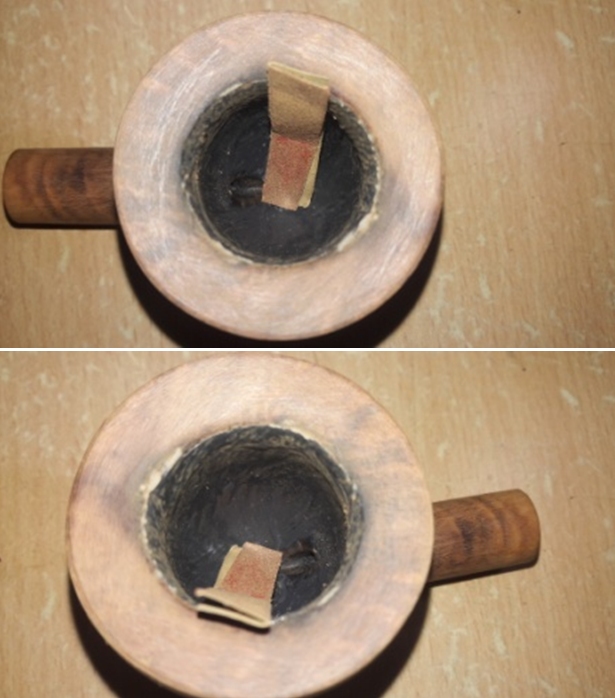
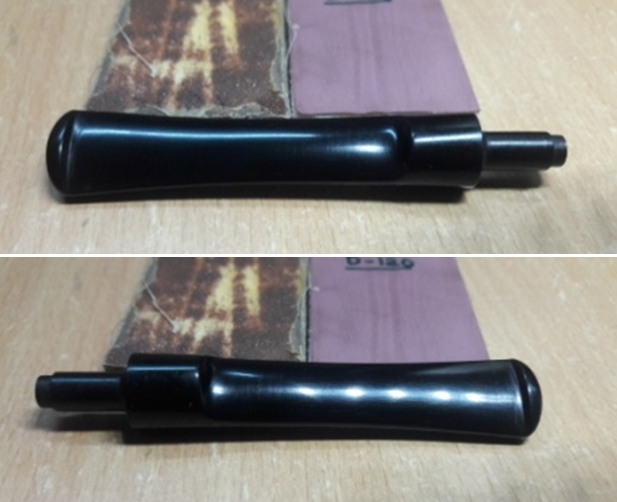
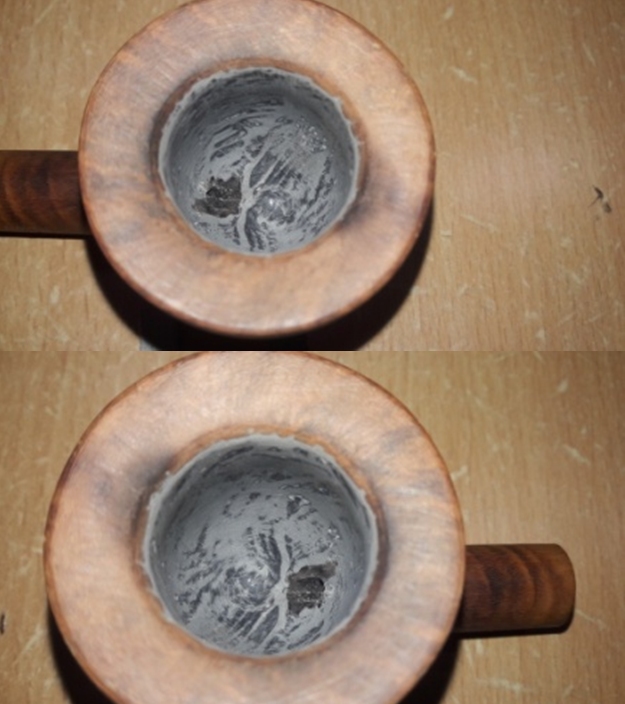
I began the process of refurbishing this pipe first by working on the stem. I cleaned the external surface of the stem with a Scotch Brite gauze and liquid dish washing soap. Once the external surfaces were clean, I cleaned the stem internals with a small shank brush and liquid dish soap. I have realized that using small shank brush and liquid soap reduces consumption of pipe cleaners by about 75%. This is considerable savings considering that I pay thrice the cost of pipe cleaners on cost of shipping!! Next, I ran a couple of dry pipe cleaners through the stem to clean and dry it out. I avoid using isopropyl alcohol in cleaning stem air way just to guard it against crazing (call it my paranoia to use alcohol on an acrylic or Perspex stem!!). The tenon end, slot and the air way is now clean. I sand the bite zone with a folded piece of 220 grit sand paper to address the tooth chatter. Though the tooth chatter has been addressed to a great extent, the button edges are yet to be addressed. I wiped the stem with a moist cloth to remove the sanding dust. Thereafter, I applied clear CA superglue over the button edges and filled the deep tooth indentations and the minor tooth chatter in the bite zone. I set the stem aside for the fill to cure.I reamed the chamber with a Castleford reamer tool, using the smallest (size one) head of the tool. Reaming a meerschaum lined bowl is fraught with challenges, most notably being exerting of excess pressure with the reamer heads on the thin meerschaum wall lining causing the lining to break in chunks. I was very gentle and careful while using the reamer head. Thereafter I moved on to using my fabricated knife to further take the cake down to the meerschaum lining. Truth be told, the use of the knife was restricted only to scraping the surface in an attempt to dislodge the cake. With a 150 grit sand paper, the walls of the chamber were rid of all the remnants of the cake and it was at this stage that the first large chunk of meerschaum lining came loose. Subsequently a few smaller bits loosened out and came apart from the meerschaum lining. The area of damaged meerschaum lining can be seen in the enclosed red area. It seemed that the thick layer of cake was holding the meerschaum lining together. The rim top is not even and the lava overflow has hardened considerably over the surface to form a mound all along the rim top surface. To get a better understanding of the condition of the meerschaum lining, I wiped the walls of the chamber with isopropyl alcohol on a cotton swab. Now the extent of repairs required is amply evident. The entire lower meerschaum lining on the left half of the chamber has broken down in a jagged manner and the same is marked with yellow arrows. The fourth picture gives out a very clear idea of the break in the lining and the thickness of the lining that needs to be repaired. Also the hardened lava overflow over the rim top is clearly discernible. This issue needs to be addressed first. With my fabricated sharp edged knife, I gently scrapped and dislodged the complete mound of overflowed lava from all around the rim top surface. After the lava overflow has been removed, the damage to the rim top is now clearly visible. The meerschaum lining is uneven and has been completely blackened due to absorbing all the oils and tars from such heavy usage.I topped the rim on a piece of 220 grit sand paper, frequently (every couple of turns) checking for the progress being made and was careful with topping as I had no desire to break the meerschaum lining from the rim top area. Though the rim top, after topping was smooth and even, the distinct white meerschaum lining edge is still a dirty dark color and is, in fact, darker than the rest of the briar surface. A closer look inside the chamber revealed a highly uneven and heavily gouged looking chamber walls. The ghost smells are still very strong and not even reduced with all the cleaning and removal of the cake. Since the meerschaum lining along the chamber walls are broken and gouged out, salt and alcohol treatment to get rid of the smell is NOT RECOMMENDED. I need to figure a way out. This is how the rim top and the chamber walls appear at this stage. I was so caught up with the condition of the chamber, I completely forgot to clean the mortise and shank air way. Maybe with this cleaning the ghost smells may greatly reduce and or miraculously disappear altogether. I cleaned the mortise and the airway using regular/ bristled pipe cleaners and q-tips dipped in 99.9% pure isopropyl alcohol. I also scraped out the entire gunk from the shank with my fabricated knife. While I was cleaning the air way, two more chunks of the meerschaum linings came loose from around the draught hole. As expected, the mortise was filthy and clogged with oils, tars and gunk and the number of pipe cleaners and q-tips that were used to get the mortise and shank cleaned up is an indication enough. I applied “Briar Cleaner”, a product that has been developed by my friend Mark Hoover, to the external surface of the bowl. It works similar to Murphy’s oil soap and needs to be applied to the stummel surface and set aside for 5- 10 minutes. The product pulls out all the dirt and grime to the surface making further cleaning easy. I am quite happy with this product. I used a hard bristled tooth brush to scrub the stummel with the gel like product, wiped it clean with a moist cloth and dried it using paper towels and soft cotton cloth. I deliberately cleaned the rim and the shank end by inverting the stummel and rotating it on a piece of Scotch Brite. I set the stummel aside to dry out naturally.    With the external cleaning, the stummel looks clean with the beautiful Bird’s eye grains at the foot now clearly visible. This scrubbing and cleaning also removed the thin layer of lacquer in patches on the stummel (layer of lacquer had missed my notice before). A few minor dot-like fills were also now visible. I first need to remove the entire lacquer coat from the stummel to further revel any other imperfections in the briar surface of the stummel.To remove the coat of lacquer from the stummel, I wiped the entire surface with pure Acetone on a cotton swab. I was relieved that the lacquer coat did not hide any more flaws in the briar than what was noted after the external cleaning. I must admit that the tiny spots of fills are something which needs no refilling and should be further reduced once the stummel has been sanded and polished. With the external cleaning of the stummel surface complete, I turned my attention to the most challenging part of this restoration, the repairs to the meerschaum lining along the walls of the chamber! I have never attempted this repair though I had earlier read about the process of repairing meerschaum lining on rebornpipes.com using egg whites and finely powdered chalk. However, attempting it for the first time is always a challenging prospect.

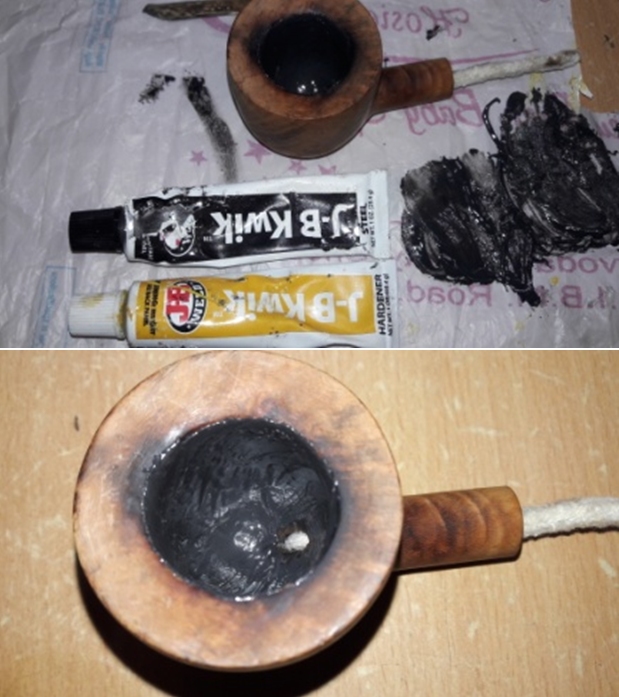
I had been gifted a Meerschaum lined gargantuan Kilimanjaro Made in Tanganyika bent billiard by my good friend Dal Stanton, aka The Pipe Steward that had several complications, the most significant being repairing meerschaum lining. Dal has the gift of penning down thoughts and actions in to words on paper and his essays are very detailed and descriptive. I went through his write up, understood the process, followed the useful links in his blog and formulated my own strategy to execute the repairs on the meerschaum lining on the pipe in front of me. Here is the link to the write up that Dal has posted on rebornpipes.com.

https://rebornpipes.com/2019/07/12/a-meer-lining-and-crack-repair-to-rescue-a-doomed-gargantuan-kilimanjaro-made-in-tanganyika-bent-billiard/

In his write up, Dal had referenced another article on rebornpipes.com which he had followed in his restoration of the Kilimanjaro pipe. I read through the article which was indeed a very useful step by step guide to build up the repairs to the meer lining using the mixture. Here is the link to the write up.

https://baccypipes.wordpress.com/2017/06/10/old-time-meer-lining-repair-method-on-a-1930s-kaywoodie-shellcraft-5651/

With my ideas crystallized as regards tackling this repairs, I first made a chalk powder using a mortar and pestle. I strained this powder through a very fine mesh sieve and obtained sufficient quantities of very fine chalk powder. I separated egg white from one egg. Next, I made a thin mix of egg white and chalk powder and with a flat bamboo frond; inserted a folded pipe cleaner to keep the draught hole open and applied a layer all along the walls of the chamber and over the meerschaum lining. No sooner had I applied the mixture, it ran down the sides and accumulated at the heel of the stummel forming a dark dirty yellow puddle. Apparently the mix was too thin. I cleaned this puddle using absorbent kitchen napkins. The unexpected benefit of this failed first layer was that the old oils and tars were pulled out from the walls of the chamber by this mixture. I wiped the chamber with a cotton swab and isopropyl alcohol. Once the chamber walls had dried out, I made a slightly more thick mix of the old timers mix and applied a layer. I kept the stummel left side down as I wanted the mix to fill and harden over the damaged meer lining over the left side. I kept the stummel aside to dry out naturally. While the meerschaum repairs were set aside to cure, I worked the stem. The stem fills had cured nicely. Using a flat head needle file, I sand the fills to achieve a rough match with the rest of the stem surface and also reshaped the buttons on both the surfaces. I further fine tuned the match with a folded piece of 220 grit sand paper.Staying with the stem restoration, I polished the stem surface with micromesh pads, wet sanding with 1500 to 12000 pads. I wiped the surface with a soft cloth at the end of the micromesh cycle. The rim top surface looks nice with a deep shine. I applied a little Extra Virgin Olive oil to the stem, though it does not help much, and set it aside. Though I am not a big fan of acrylic stems, I am happy with the way the stem appears at this stage.  The layer of egg white and chalk powder mix had hardened considerably after an overnight curing time. I made a slightly thicker mix and applied another layer and set it aside to cure. I continued to apply a gradually thicker layer of the mix till I was satisfied that the broken meer lining was completely covered. I set the stummel aside for the mix to harden. The mix appears to be too thick, but the same can be sanded down subsequently to the desired thickness.  Once the mix had completely cured, I topped the rim top to even out the excess of the mix from the rim. I expected to find a perfect white ring of the mixture within the briar rim surface. However, that was not to be!! Though not perfect ring, it’s a lot better than before. One maxim that I follow during restoration is “LESS IS MORE” and thus, I did not further repeat the process of adding a layer of the mix and topping it again once the mix had cured. It’s not perfect but it is definitely functional. I followed the topping by sanding the walls with a folded piece of 180 grit sand paper. If observed closely, the left side lining is thicker than the rest of the chamber giving the chamber an out of round appearance. I need to sand the left side layer more to achieve the desired symmetry.   I further sand the chamber walls with a 220 grit sand paper to even out the thickness of the left side wall and also reduce the thickness from the bottom half of the chamber. Again the uneven appearance of the white mixture was an eye sore but I resisted the temptation of rebuilding it all over again. But that’s for now…..never know maybe a couple of months down the line, as I look at it again, maybe I would attempt the rebuild! However, for now the chamber is nice round and the repairs appear solid and the pipe is definitely ready for a smoke. The ghost smells are also completely eliminated and the chamber is now odorless. I am quite happy with the progress till now. With the meerschaum lining repairs sorted out for now, I turned my attention to the external surface of the stummel. I sand the entire stummel with a piece of 220 grit sand paper. This served four purposes; firstly the coating of lacquer was completely rid off, secondly, the minor dents and dings and fills were evened out to a great extent and thirdly the water marks at the shank end were completely eliminated. The fourth issue that was addressed was the charred spot on the rim outer edge in 1 o’clock direction. The stummel is now ready for a nice polish.   Now it was time to polish and impart a nice shine to the stummel. I wet sand the stummel with a 1500 and 2000 grit sand paper followed by wet sanding with 2400 to 12000 grit micromesh pads. Even though the tiny fills are clearly seen in the following pictures, in person, they merely appear as tiny dots and not easily discernible. I really liked that the mixed grains on the sides and Bird’s eye grain on the foot are now visibly resplendent in all their glory. I rubbed a small quantity of “Before and After Restoration Balm” in to the stummel to enliven and protect it. I rubbed this balm deep in to the briar of the stummel and smooth rim top with my fingers and let it rest for a few minutes. The balm almost immediately works its magic and the stummel now has a nice vibrant appearance. I further buff it with a horse hair shoe brush.  To apply the finishing touches, I mount a cotton cloth buffing wheel on to my hand held rotary tool and apply a coat of Blue Diamond to the stummel and the stem to polish out the minor scratches. With a cotton buffing wheel that I use for carnauba wax, I apply a coat of carnauba wax to the stummel and stem and continued to work on it till the complete coat of wax had been polished out. I mount a clean cotton cloth buffing wheel and gave the entire pipe a once over buff. I finished the restoration by giving the entire pipe a rigorous hand buffing using a microfiber cloth to deepen the shine further. The finished pipe is shown below. The pearly variegated stem with swirls of light browns and grays contrasts beautifully with the dark brown hues of the stummel and is very appealing to the eye. The repairs and transformation of this pipe to its present functionality and beauty was indeed worth the efforts that were put in. P.S. This pipe, when it came to my work table, presented a daunting task to restore. It was surely greatly loved by someone in the past as was evident from the thick cake, overflowing lava over the rim top and the stem damage, but I say in the same breath that it was also the most abused pipe. The broken meerschaum lining added to my agony while presenting me with an opportunity to put in to practice what I had read and learned about meerschaum repairs on Reborn Pipes.

A big THANK YOU to my good friend, Dal Stanton aka The Pipe Steward for the detailed and graphic description of the technique to repair Meerschaum and also to my Guru, Steve, for creating and regularly updating rebornpipes.com, a one stop site for everything that one wants to know and learn about pipe restoration!!

Appreciate all the efforts of readers who have had the patience to read this write up thus far!

Praying for the safety and well being of all the readers and their loved ones in these troubled times…


Restoring a Kriswill “Golden Clipper” Freehand Chimney


Blog by Paresh Deshpande

The next pipe selected for refurbishing is a uniquely shaped Danish pipe. I say unique because it has a tall chamber, rounded shank with a rim cap, a slight bent to the stem and is a sitter! It’s a shape that I had never come across and was unable to classify its shape. I shared pictures of the pipe with my Guru, Steve and he opined that it could be called a Rhodesian, stack, sitter or Bulldog as it has characteristics of all these shapes but looks like neither. Thus, we concurred that it’s most appropriate to call this pipe a freehand!!!! The bowl shape reminds me of the chimney of early steam locomotive engines with their bellowing huge plumes of smoke as they rush forward.This pipe has shallow sandblast and a natural finish (I guess) that has darkened over a period of time. For a pipe with a length of 5 ½ inches and bowl height of 2 inches and chamber depth of 1 ¾ inches, it’s pretty much ultra light weight, making it a perfect smoker to clench. The vulcanite saddle stem is thin and delicate. The shallow sandblast form the asymmetric patterns look interesting. The foot of the stummel is flat and elongated, making it a perfect sitter. A smooth briar band at the shank end breaks the monotony of the blasted surface and also provides a surface for stamping the model number. The pipe is stamped on the bottom smooth surface of the shank as “Kriswill” in script hand over “GOLDEN CLIPPER”. Further to the right towards the shank end on the smooth briar band is stamped the shape (?) code “1894”. Truth be told, the shape code stamping of the numeral 8 appears smudged. Having worked earlier on Kriswill pipes, I realized that the stamp “HAND MADE IN DENMARK” is conspicuous by its absence. The thin delicate vulcanite saddle stem is devoid of any stampings.A couple of years back I had worked on a Kriswill Golden Clipper and on a Chief. Here is the link for the Kriswill Chief write up…

https://rebornpipes.com/2018/08/04/breathing-new-life-into-a-kriswill-chief-20/. I am sure you will find it an interesting read.

I had researched the brand at that time and all that was now needed was to refresh the memory. I went through the above write up and also through the material that was available on pipedia.org and pipephil.eu. There are two facts which I wish to highlight, firstly, Prior to 1970 the stampings are in script letters on the shank and on the mouthpiece. The star on the stem and block letters on the shank were introduced from that date on”

Second, is deciphering the four digit model coding system adopted by Kriswill. The last two numerals are the model numbers for smooth finish and all sandblasted have numeral 18 preceding the model number. Thus the pipe currently on my table is a model #94 and since it is a sandblast variant, the number is 1894.

Thus from the above, the pipe that I am now working on dates to pre 1970s since the stamping is in script and the stem is sans the star.

With the provenance of the pipe satisfactorily established, I proceeded to carry out a visual inspection of the condition of the pipe in my hand. This helps me map the road to restoring the pipe by identifying the issues involved and identify methods/ options to address the same beforehand.

Initial Visual Inspection
The chamber is so filled with cake that I am unable to reach the bottom of the bowl with my little finger. The build-up of the cake is heavier on the bottom half of the bowl, but overall well maintained. The condition of the inner walls of the chamber can be commented upon after the cake has been taken down to the bare briar. The rim top is thin and has the same shallow sandblast surface as the rest of the stummel, has darkened and is covered with dust, lava and grime. I don’t think that there is any charring to either of the rim edges and they appear to be in pristine condition. The chamber odors are not very strong and should be completely eliminated once the cake has been removed and the shank has been thoroughly cleaned.The stummel surface appears dull and lackluster due to the accumulated dirt, dust and grime of years of usage and subsequent uncared for storage. There are no fills or chips or nicks over the stummel surface. There are no other stummel issues that I have to deal with on this pipe. The mortise is relatively clean with small amount of oils and tars accumulated on the walls of the mortise. This should be an easy clean up job. The delicate vulcanite saddle stem is heavily oxidized. The lip has some minor bite marks on both surfaces and will need to be rebuilt and reshaped. There is some calcification seen around the lip on both the surfaces. The airway in the stem is blocked and the draw is restricted. I will need to clean it to ensure a full and open draw. The tenon and the horizontal slot show accumulation of dried oils, tars and gunk on the inside as well as on the outside, this will have to be cleaned. The Process
The process of refurbishing this pipe started with the cleaning of the stem. Abha, my wife, cleaned the stem air way with regular and bristled pipe cleaners dipped in 99.9% pure isopropyl alcohol. She further cleaned the stem internals with thin shank brushes and dish soap to remove the stubborn and thick gunk from within the airway. The heap of pipe cleaners and their appearance tells a sordid story. With a sharp fabricated knife, she scraped off all the dried tars and gunk from the tenon end.The stem surface was sanded down with a worn out piece of 180 grit sand paper. I have realized that following this step prior to immersion into the “Before and After Stem Deoxidizer” solution has two advantages, firstly, the stem surface oxidation gets loosened and the solution works deeper and more efficiently in pulling the deep seated oxidation from the stem surface. Secondly, the minor tooth chatter and calcium depositions are taken care of prior to the immersion. I immersed it in “Before and After Deoxidizer” solution along with the stem of other pipes in line for restoration. This solution has been developed by Mark Hoover and works to draw out all the deep seated oxidation from the surface making its subsequent cleaning and polishing a breeze. I would definitely recommend this product as it saves on to time and efforts. The pipe has been marked with a red arrow for easy identification.Abha, my wife, dealt with the cake by reaming the chamber with a Castleford pipe tool using size 1 followed by size 2 head of the reamer. Using the fabricated knife, she further scraped the cake from the bottom of the bowl and also the walls of the chamber. She was especially very careful while reaming with the knife so as not to damage the inner edge of the rim. Once the solid briar was exposed, she further smoothed the walls and removed remaining cake by sanding with a 180 followed by 220 grit sand paper. Another advantage of this process is the elimination of traces of ghosting to a great extent. She wiped the chamber with a cotton swab wetted with 99.9% isopropyl alcohol. The chamber walls are pristine and solid with no heat fissures or pits. Simultaneously I cleaned out the internals of the shank/ mortise and airway using q- tips, pipe cleaners and isopropyl alcohol. I scraped the walls of the mortise with my fabricated knife till the accumulated gunk was removed. Further cleaning of the shank internals will ensue during the external cleaning of the stummel.Thereafter, I generously rubbed “Briar Cleaner”, a product that has been developed by my friend Mark Hoover, into the external surface of the bowl and the rim top surface. It works similar to Murphy’s oil soap and needs to be applied to the stummel surface and set aside for 5- 10 minutes. The product pulls out all the dirt and grime to the surface making further cleaning easy. I am quite happy with this product. I used a hard bristled tooth brush to scrub the stummel and rim top with the solution. After the scrub with Briar cleaner solution, I washed the stummel under running warm water with anti oil dish washing detergent till clean and dried it using paper towels and soft cotton cloth. I simultaneously cleaned the shank internals with the detergent and hard bristled shank brush. The stummel surface has cleaned up nicely with the intricate sandblast patterns on full display. The stummel now looks and smells fresh and the old smells are all gone. I set the stummel aside to dry out naturally. The next morning, Abha removed the stems that had been soaking in the deoxidizer solution overnight. She cleaned the stem and the stem airway under running warm water and scrubbed the raised oxidation from the stem surface using a Scotch Brite pad and the airway with thin shank brush. She further removed the oxidation by scrubbing the stem with 0000 grade steel wool and applied a little olive oil to rehydrate the stem.I further sanded the stem surface with a folded piece of 220 and 320 grit sand papers to further remove the traces of oxidation and reduce the sanding marks and followed it with wet sanding the entire stem with 1500 to 12000 grade micromesh pads (1500 to 2400 grit micromesh pads have completely worn out and unable to order a set due to lock down and so had used 1500 and 2000 grit wet or dry sand paper). I wiped the stem with a moist cloth to remove the dust and monitored the progress being made after every three grit pads. The stem polished up nicely and had a rich deep black shine to it. I applied a little Extra Virgin Olive oil to rehydrate the vulcanite and set the stem aside.Next, I rubbed a small quantity of “Before and After Restoration Balm” in to the briar with my finger tips, working it deep in to the sandblasts and let it rest for a few minutes. The balm almost immediately works its magic and the briar now has a nice vibrant appearance with the beautiful sandblast patterns displayed in their complete splendor. The contrast of the light brown of the raised sandblast portion with the dark brown of the rest of the stummel adds an interesting dimension to the appearance of the stummel. I further buffed it with a horse hair brush. On to the home stretch!! I mounted a cotton cloth buffing wheel on to my hand held rotary tool and applied several coats of carnauba wax. I finished the restoration by giving the entire pipe a rigorous hand buffing using a microfiber cloth to raise the shine further and remove any residual wax from in between the sandblasts. The finished pipe looks amazingly beautiful and is now ready for its long second innings with me. P.S. I am not really pleased with the restoration projects that I can choose due to paucity of equipment and materials that are required. Today I realized that I have run out of the medium superglue I use and that the spare one has mysteriously hardened within the tube. With my country under lock down to arrest the spread of the COVID- 19 virus, no delivery can take place. So I am being forced to improvise and that I shall continue to do!!

The next project that I have earmarked is interesting in that it is the very first time that I shall be undertaking repairs of this nature. Be sure to read that write up and help me improve my skill sets.

I wish to thank each one for sparing their valuable time to read through this write up and praying for the health and safety of entire mankind. Stay home…stay safe!!
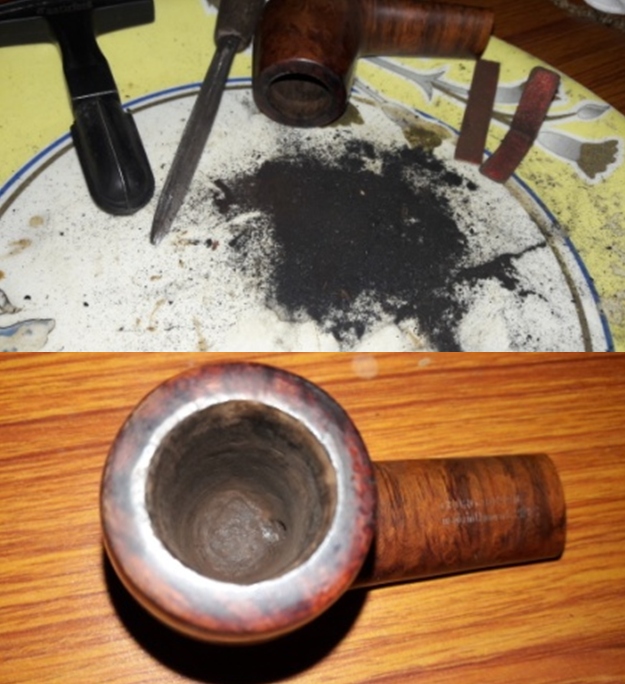
Back To Working On My Inheritance; A Stanwell # 62 Freehand


Blog by Paresh Deshpande

Being on leave that has been compulsorily extended by 40 days due to the virus pandemic being rampant and the country under a lock down was a blessing in disguise. I have enough time to spend with my daughters, catch up on some reading and most importantly, get working on some pipes!! The only downside to the last activity was that I have left behind at my place of work, most of my tools and paraphernalia that I use for restoring pipes. This greatly restricts the types of repairs that I can undertake at the moment. With these limitations, I rummaged through the pile and chose this inherited Stanwell as my next project on the premise that it would be a simple ‘refurbishing only’ task.

This large sandblasted freehand pipe with plateau rim top is stamped on the smooth underside of the shank from the foot towards the shank end as “HAND MADE” over “MADE IN DENMARK” in block capital letters followed by “STANWELL” in an inverted arch. Towards the shank end is the shape code/ model number “62”. The silver “Crowned S” adorns the left side of the vulcanite stem. The stampings on the stummel have worn off in the first half from the foot towards the shank end and can be seen in bright light and under magnification.There is adequately detailed and informative material available on both pipedia.org and pipephil.eu on the brand; however, I was keener to know the exact dating and correlate the pipe details with the shape code. Basil Stevens is considered an authority on all things Stanwell and on surfing the net, I came across this site which gives out pointers to dating a Stanwell pipe; here is the link https://www.scribd.com/document/45022903/Stanwell-Dating-Pricing-Information-by-Basil-D-Stevens.

I reproduce the relevant pointers which help in dating the Stanwell on my work table:-

Dating Information:

  1. Block letter stamp “Silver S” used until late 1960s and then changed to script.
  2. Up until the early 1960s only the top pipes, e.g. “Hand Cut” had the stem/mouth pieces stamped with the Stanwell logo of a crown over “S”.

The last bit of curiosity in my mind was to link the model number on my Stanwell to the description of the shape and designer, if possible. Again pipedia.org has a section on “Stanwell Shape Numbers and Designers” and sure enough, 62 finds a mention, here is the link

(https://pipedia.org/wiki/Stanwell_Shape_Numbers_and_Designers).

I quote and reproduce the relevant information:-

  • Two versions of this shape number
  1. a) Liverpool, medium size.
  2. b) Freehand, Plateau top, saddle mouthpiece, by Sixten Ivarsson.

Thus from the above, it is amply evident that the pipe now on my work table is a Freehand pipe from the late 1960s designed by Sixten Ivarsson!!

Now on to restoring this Stanwell Freehand pipe with a delicate vulcanite saddle stem……..

Initial Visual Inspection
This medium sized sandblasted freehand pipe has a good heft and nicely fills the hand. Like most of the pipes from my inheritance; this too has a thick layer of cake in the chamber with overflow of lava on the plateau rim top. The cake is dry and hard. The inner rim edge appears sans any damage and this would only be confirmed once the chamber has been reamed. The condition of the walls of the chamber can be commented upon once the cake has been taken down to the bare briar. However, the external surface of the stummel feels and looks solid and hence I do not foresee any major issues surprising me later in the course of restoration. The ghost smells are very strong in the chamber. As is commonly seen on sandblasted pipes with some age on them, the crevices are always filled with dust, dirt, oils, tars and grime from all the years of smoking and storage. This one is no exception to this observation. The grooves of the sandblast are filled with dust and grime. The fact that the textured patterns of the rustications are dusty and filled with dirt is accentuated more due to the contrast of dark and medium brown stains on the stummel and the shank. The briar looks lifeless and bone dry and has taken on black dull hues. The mortise is full of oils, tars and gunk and the air flow is restricted. Through all the dirt, dust and grime, beautiful sandblast patterns can be seen and appreciated. The delicate vulcanite saddle stem is beautifully contoured to match the flow of the pipe with a smooth surface at the bottom of the saddle contiguous with that of the shank. The stem is heavily oxidized with a couple of deep tooth indentations on both the upper and lower stem surface in the bite zone. The lip edge on either surface has bite marks. These repairs should be easy. The tenon and horizontal slot is covered in dried oils, tars and gunk. The stem air way too appears to be clogged as the air flow through the stem is laborious to say the least. The stem logo of the letter ‘S’ with a crown on top is crisp and deep.The Process
The process of refurbishing this pipe started with the cleaning of the stem. Abha, my wife, cleaned the stem air way with regular and bristled pipe cleaners dipped in 99.9% pure isopropyl alcohol. She further cleaned the stem internals with thin shank brushes and dish soap to remove the stubborn and thick gunk from within the airway. The heap of pipe cleaners and their appearance tells a sordid story. With my sharp fabricated knife, she scraped off all the dried tars and gunk from the tenon end.Once the stem internals had been cleaned, I gently sand the stem surface with a used piece of 220 grit sand paper and immersed it in “Before and After Deoxidizer” solution along with the stem of other pipes in line for restoration. This solution has been developed by Mark Hoover and works to draw out all the deep seated oxidation from the surface making it’s subsequent cleaning and polishing a breeze. I would definitely recommend this product as it saves on to time and efforts. It has been our experience that before immersing the stem in to the stem deoxidizer, light sanding of the stem with a folded piece of 220 grits sand paper loosens the oxidation a bit and helps get fantastic end results. The pipe has been marked with a green arrow for easy identification.Simultaneously, while Abha was working on the stem, I reamed the bowl with a Castleford pipe reamer using the first three head sizes. Using my fabricated knife, I cleaned the cake from areas which could not be reached by the reamer heads. I used a 220 grit sand paper, pinched between my thumb and forefinger, to sand the inner walls of the chamber. Once I had reached the bare walls, I wiped the chamber with a cotton pad dipped in isopropyl alcohol. This removed all the residual carbon dust and also allowed a clear inspection of the walls. The walls of the chamber are nice and solid with no signs of heat fissures or cracks. The inner rim edge shows no charring or chipping. The ghost smells are still strong and all pervading. Hopefully these smells will be exorcised once the shank and mortise are thoroughly cleaned! I cleaned the mortise and shank walls using q-tips, shank brush, regular and hard bristled pipe cleaners dipped in isopropyl alcohol. I scraped the walls with a dental tool and removed the entire accumulated gunk. I shall further clean it with a shank brush and liquid dish soap once I clean the stummel surface. The strong smells still persist though the mortise is nice and clean as can be seen in pictures.With the bowl internals clean, I move to clean the exterior of the stummel. I generously applied “Briar Cleaner”, a product that has been developed by my friend Mark Hoover, to the external surface of the bowl and the plateau rim top surface. It works similar to Murphy’s oil soap and needs to be applied to the stummel surface and set aside for 5- 10 minutes. The product pulls out all the dirt and grime to the surface making further cleaning easy. I am quite happy with this product. I used a hard bristled tooth brush to scrub the stummel and rim top with the solution. After the scrub with Briar cleaner solution, I washed the stummel under running warm water with anti oil dish washing detergent till clean and dried it using paper towels and soft cotton cloth. I deliberately cleaned the plateau rim top with Scotch Brite pad and set the stummel aside to dry out naturally. I simultaneously cleaned the shank internals with the detergent and hard bristled shank brush. The stummel surface has cleaned up nicely with the intricate sandblast patterns on full display. The ghost smells in the chamber were still quite strong and hence I decided to address this issue. To eliminate the ghost smells from the pipe, I decided to treat it with salt and alcohol. I do not use Kosher salt as it is not readily available here and if available, it’s very expensive. I use a cotton ball which is an at par substitute as I have realized over the last year or so. I draw out a wick from the cotton and along with a folded regular pipe cleaner; insert it into the mortise and through the draught hole into the chamber. Thereafter, I pack the chamber with cotton balls to about quarter of an inch below the rim’s inner edge. I soak the cotton balls with isopropyl alcohol up to the brim. About half an hour later, the level of alcohol goes down, having been absorbed by the cotton. I top it up once again and set it aside overnight. By next morning, the cotton and alcohol has drawn out all the remaining oils and tars from the chamber and mortise, fulfilling its intended task. I removed the cotton ball and ran pipe cleaners through the mortise to clean out all the loosened tars and gunk. The chamber now smells clean and fresh. I set the stummel to dry out naturally.The next morning, Abha removed the stems that had been soaking in the deoxidizer solution overnight. She cleaned the stem and the stem airway under running warm water and scrubbed the raised oxidation from the stem surface using a Scotch Brite pad and the airway with thin shank brush. She further removed the oxidation by scrubbing the stem with 0000 grade steel wool and applied a little olive oil to rehydrate the stem.The deep tooth indentations are now clearly visible. Since I did not have a lighter to heat and raise these indentations to the surface (my preference to use it for this purpose), I used a lit match stick instead. I have experimented with a lit candle also and the results of both these alternatives are equally good; however, one has to be doubly careful as the heat from a candle flame is more intense as compared to a match stick or a lighter. These tooth indentations were raised to the surface to some extent due to the heating; however, it would require a fill to complete the repairs.I prepared a mix of CA superglue and activated charcoal and carefully applied it over the damaged bite zone on both surfaces and lip and set it aside for curing overnight. I had applied this mix in sufficient thickness which would help during the filing and sanding to match the fills with the stem surface.While the stem was set aside for the fills to cure, I decided to polish the raised portions of the plateau rim top surface. The polished lightened and shining raised portion should be a nice contrast to the surrounding rim surface. I dry sand the raised portions with 1500 and 2000 grit sand papers (1500 to 2400 grit pads have worn out) followed by dry polishing with 3200 to 12000 grit micromesh pads. I like the appearance of the rim top at this stage. Next, I rubbed a small quantity of “Before and After Restoration Balm” in to the briar with my fingertips, working it deep in to the sandblasts and let it rest for a few minutes. I generously rubbed the balm in to the plateau rim top surface. The balm almost immediately works it’s magic and the briar now has a nice vibrant appearance with the beautiful sandblast patterns displayed in their complete splendor. The contrast of the dark browns of the raised sandblast with the dark black of the rest of the stummel added an interesting dimension to the appearance of the stummel. The most interesting aspect was the appearance of the plateau rim top which may be insufficiently described in words and be rather seen in person. I further buffed it with a horse hair brush. I set the stummel aside and worked on the stem. The stem fills had cured nicely and using a flat head needle file, I sanded the fill to achieve a rough match with the surrounding stem surface. I further sanded the stem surface with a folded piece of 220 and 320 grit sand papers to further blend in the repairs and followed it with wet sanding the entire stem with 1500 to 12000 grade micromesh pads. I wiped the stem with a moist cloth to remove the dust and monitored the progress being made after every three grit pads. The stem polished up nicely and had a rich deep black shine to it. I applied a little Extra Virgin Olive oil to rehydrate the vulcanite and set the stem aside. I refreshed the stem stamping with a white correction pen. The end result shows a perfectly refreshed stem logo.To complete the restoration, I mounted a cotton cloth buffing wheel on to my hand held rotary tool and applied several coats of carnauba wax. I finished the restoration by giving the entire pipe a rigorous hand buffing using a microfiber cloth to raise the shine further and remove any residual wax from in between the sandblasts. The finished pipe looks amazingly beautiful and is now ready for its long second innings with me. I only wish it could share with me it’s life story of the past years while I enjoy smoking my favorite Virginia blend in it or maybe an English blend or maybe just keep admiring it!! P.S. This and the subsequent restoration that I have lined up are all simple and straight forward projects, however, I would assure the readers that each one is unique and each project is interesting.

In these troubled times when at one point in time the world wide call was for mankind to come closer, it is now necessary to maintain and observe social distancing. I wish that we maintain physical distance to prevent the spread of the virus but let’s bond together mentally, emotionally and spiritually.

I wish to thank each one for sparing their valuable time to read through this write up and praying for the health and safety of entire mankind. Stay home…stay safe!!
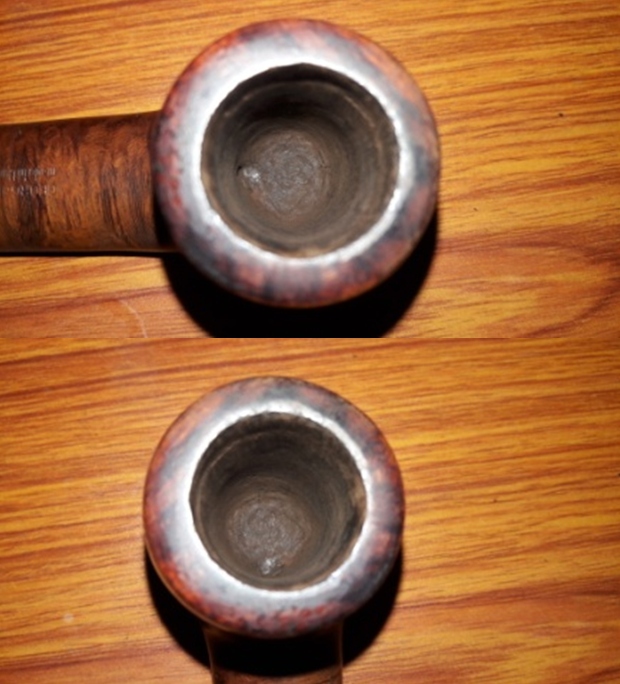
Back To Inherited Pipes And Restoring A 1912 W H Gourd Calabash


Blog by Paresh Deshpande

It’s been a while since I have worked on one of my inherited pipes as I have been busy with pipes from the estate pipe lots that have reached me from various sellers. Though these pipes had been fun to work on, I, at times, have a desire to work on inherited pipes.

The next pipe that has caught my attention is a gourd calabash and the only one to date, which was in one of the three very large boxes of pipes that I have inherited. Working on these old pipes is what I love the most because of the intrinsic connection I have with these pipes and the fact that once I pass away, these will be passed on to my kids as remembrance that their father had worked on restoring each of these vintage and priceless collection of pipes.

This gourd calabash is not very large in size, but big enough to have a great feel in the hand. The gourd has colored beautifully and has taken on a nice deep reddish brown color. The bowl sits flush with the gourd top and is covered in a Sterling Silver cap that is stamped as “W. H.” in a semi-circle followed by three sterling hallmarks, each in a cartouche. There is an anchor, a lion, and the lower case letter “n”. The anchor identifies the city of the manufacture of the silver to be Birmingham, England. The lion is the mark for 0.925 Sterling Silver and the letter “n” is the date stamp. A similar set of stampings are also seen on the sterling silver band at the shank end. The stampings are all crisp and prominent.The hallmarked sterling silver band and cap helps in the dating with great accuracy and the first site that I visit is www.silvercollection.it

I browsed through the alphabetical listing of maker’s mark for W.H. in a semi circle and narrowed it down to William Harrison Active in London: various Harrison’s marks in Chester Assay Office were registered by Imperial Tobacco Co between 1907 and 1916. It is also known a fact that his marks are registered with the Birmingham Assay Office.Next I followed the link to the dating guide of the Birmingham Assay Office to date this pipe. I have included a hallmark chart for dating the pipe. I put a red rectangle around the letter for 1912. It is the same style of “n” and the cartouche that holds the letter stamp, matches the photo as well.Another source of information on William Harrison is reproduced below from the site  https://www.silvermakersmarks.co.uk/Makers/Chester-WD-WH.html#WH

Thus, from the above, the pipe that I am now dealing with is from the tobacconist/ pipe maker/ pipe mounter William Harrison and dates to 1912!! This pipe is nearly 108 years old. With the provenance of the pipe now established, I move ahead with initial inspection of this old pipe.
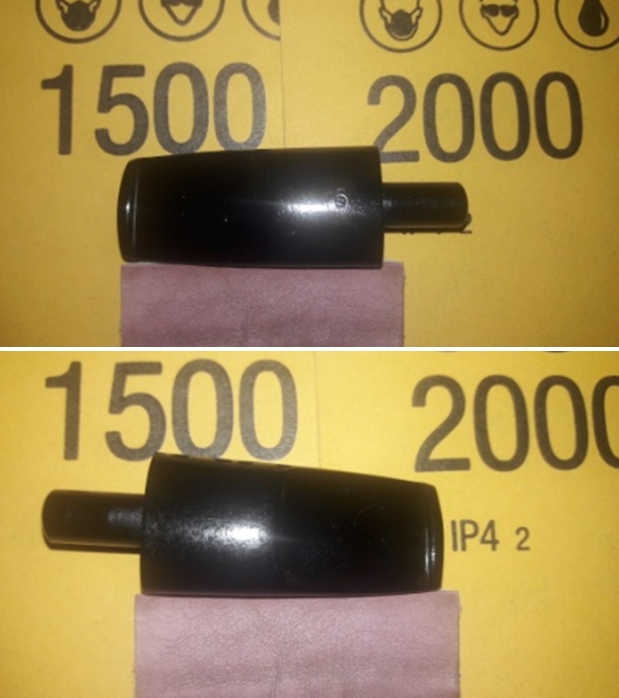
Initial Visual Inspection
The pipe, as it sits on my work table, presents itself as a simple and straight forward refurbishing project. The gourd has developed a nice patina and taken on a deep red brown golden color. There is no damage to the gourd. This pipe should polish up nicely. The sterling silver rim cap and shank band have numerous dents and dings. A straight split to the silver shank band is seen on the right side. This split can be welded by my silversmith, but that can happen only after the lockdown and social distancing norms have relaxed somewhat. The vulcanite stem does not seat completely into the shank. This issue should be addressed once the mortise has been thoroughly cleaned. Here is how the pipe appears at this stage. The bowl on this calabash is flush with the gourd rim top. Native South African calabashes imported to the UK had bowl linings of gypsum pressed into the gourd. Since the rims of a gypsum bowls were somewhat inelegant, retailers fit them with sterling rim covers– a practice they continued even after they began to employ meerschaum for the bowl linings. Given the vintage of this pipe, the bowl could either be clay or gypsum or even a meerschaum. There is a decent layer of dried and crusted cake in the chamber. The draught hole is at the bottom, dead center and somewhat constricted by the cake. The bowl is held in place by a Sterling Silver rim cap that is riveted in to the gourd and unmovable without damaging the gourd. The sterling rim cap is tarnished and has numerous dents and dings and a light overflow of lava over the surface. The stampings on the rim cap are crisp and easily readable but with the beginnings of wearing off at the ends. I need to be careful with my polishing of the sterling cap. The gourd surface has beautiful color and it will be my endeavor to preserve the patina that has developed on the surface due to smoking. The surface is covered in old oils, tars, grime and dirt from all these years. There is no damage to the gourd surface and that’s a big relief. This piece of gourd will look stunningly beautiful and rich once it has been cleaned and polished. The bowl is fixed to the gourd with sterling rim cap and is riveted in place. These rivets have a little play but still have many years of careful use ahead. The mortise and the gourd internals are filthy to say the least and no surprises here. Heavy accumulation of oils, tars and grime are seen within the mortise and also within the gourd. This is adversely affecting the seating of the stem in to the mortise. Cleaning the internals of a calabash is always challenging and this one more so, as the bowl is permanently fixed to the gourd.The tapered vulcanite stem is heavily oxidized. Deep tooth indentations are seen in the bite zone on either surfaces of the stem. The round orifice is correct for the vintage of this pipe and shows accumulated oils and tars. The button edges need to be sharpened. The tenon is also covered in oils, tars and grime. The air way is clogged and will need to be cleaned. The Process
The process of refurbishing this pipe started with the cleaning of the stem. Abha, my wife, cleaned the stem air way with regular and bristled pipe cleaners dipped in 99.9% pure isopropyl alcohol. She further cleaned the stem internals with thin shank brushes and dish soap to remove the stubborn and thick gunk from within the airway. The heap of pipe cleaners and their appearance tells a sordid story. With my sharp fabricated knife, she scraped off all the dried tars and gunk from the tenon end.Once the stem internals had been cleaned, I gently sand the stem surface with a used piece of 220 grit sand paper and immersed it in “Before and After Deoxidizer” solution along with the stem of other pipes in line for restoration. It has been our experience that before immersing the stem in to the stem deoxidizer, light sanding of the stem with a folded piece of 220 grit sand paper loosens the oxidation a bit and helps get fantastic end results.Simultaneously while Abha was working on the stem, I reamed the bowl with my fabricated knife to clean up the chamber. I used a 220 grit sand paper, pinched between my thumb and forefinger, to sand the inner walls of the chamber of the pipe. Once I had reached the bare walls, I wiped the chamber with a cotton pad dipped in isopropyl alcohol. This removed all the residual carbon dust and also rid the chamber of all ghost smells. The walls of the chamber are nice and solid with no signs of heat fissures or cracks. I ran a couple of hard bristled pipe cleaners dipped in isopropyl alcohol through the draught hole and thoroughly cleaned it.The next morning, Abha removed the stems that had been soaking in the deoxidizer solution overnight. She cleaned the stem under running warm water and scrubbed the raised oxidation from the stem surface using a Scotch Brite pad. She further removed the oxidation by scrubbing the stem with 0000 grade steel wool and applied a little olive oil to rehydrate the stem.The deep tooth indentations are now clearly visible and I decided to address these issues at this stage. Since I did not have a lighter (I generally prefer to use it for this purpose), I used a lit candle instead. The result is equally good; however, one has to be doubly careful as the heat from a candle flame is more intense as compared to a lighter. These tooth indentations were raised to the surface to some extent due to the heating; however, it would require a fill to complete the repairs.I prepared a mix of CA superglue and activated charcoal and carefully applied it over the damaged bite zone on both surfaces and lip and set it aside for curing over night. I had applied this mix in sufficient thickness which would help during the filing and sanding to match the fills with the stem surface and shaping the button.Using a flat head needle file, I reshaped the button and followed it up by sanding the stem with a folded piece of 220 grit sand papers. I followed it up by further sanding the stem with 320, 600 and 800 grit sand papers. Once I was satisfied that the fills had perfectly matched with the rest of the stem surface, using micromesh pads, I completed the polishing cycle by wet sanding the surface with 1500 and 2000 grit sand papers and further dry sanding with 3200 to 12000 grit pads. The stem looks great with the fills nicely matched with the rest of the surface. I rub a little quantity of Extra Virgin Olive oil into the stem surface. While I was working on the stem repairs and subsequent polishing, Abha cleaned out the mortise and gourd internals using pipe cleaners, q-tips and alcohol. She scraped out the accumulated dried oils, tars and gunk from the mortise using fabricated tool. The mortise was finally declared clean by Abha after a few hours and lots of elbow grease, the pile of pipe cleaners and the chunks of grime removed from the mortise are a standing testimony to the filth in the pipe. The pipe now smells clean and fresh. At this point in time, the internal cleaning of the stem, mortise and gourd is completed. The stem repairs and polishing is also completed. Next I decided to clean and polish the gourd. I cleaned the external surface of the gourd with Murphy’s Oil soap on cotton swabs. I wiped the surface with a moist cloth and set the gourd aside to dry out completely. After the gourd had dried out, I polished the gourd surface with micromesh pads. There was a small twist though! The 1500 to 2400 grit micromesh pads in the set that were left behind at home (remember that my home and work place are at different corners of the country!) have completely worn down. Since most of my material and equipment that I use for pipe restoration is at my work place, I substituted the 1500 to 2400 grit pads with 1500 and 2000 grit wet or dry sand paper. I find that these work just fine. I wanted to preserve the patina and deep coloration that has developed on the gourd surface, I dry sand the stummel surface with 1500 (sand paper) to 12000 grit micromesh pads. This is starting to look really nice. With Colgate tooth powder, I cleaned the sterling silver rim cap and shank band to a nice shine and yes, I avoided rubbing the powder over the stampings and hallmarks to prevent them from wearing down.Next, I rub a small quantity of “Before and After Restoration Balm” in to the gourd with my finger tips and let it rest for a few minutes. The balm almost immediately works its magic and the gourd now has a nice vibrant appearance with the beautiful darkened colors on full display. I further buff it with a horse hair shoe brush. To apply the finishing touches, I mount a cotton cloth buffing wheel on to my hand held rotary tool and apply a coat of Blue Diamond to the stummel and the stem to polish out the minor scratches. With a cotton buffing wheel that I use for carnauba wax, I apply a coat of carnauba wax and continue to work on it till the complete coat of wax had been polished out. I mount a clean cotton cloth buffing wheel and give the entire pipe a once over buff. I finish the restoration by giving the entire pipe a rigorous hand buffing using a microfiber cloth to raise the shine further. The finished pipe looks beautiful and is ready to be added to my restored pipe collection. When, or if at all I will, smoke this pipe only time will tell!! Here are the pictures of the refurbished pipe.
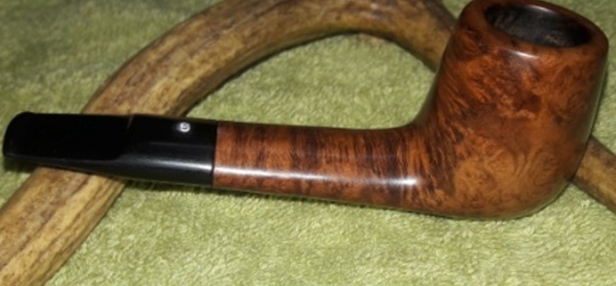
Refurbishing A Vintage Corn Cob Pipe With An Albatross Wing Bone


Blog by Paresh Deshpande

I had recently worked on one large, humongous sized pipe which definitely did not qualify as beautiful but surely can be termed as ruggedly handsome, from an estate lot of 40 pipes that I had acquired about six months ago. Here is the link to that write up which will provide a background to this lot and the condition of the pipes that I had received  (https://rebornpipes.com/2020/03/08/refurbishing-a-real-cherry-foreign-pipe-from-estate-lot-of-40/).

The second pipe from this lot currently on my work table, is again a very long pipe that is both ruggedly beautiful and delicate at the same time. It’s a Corn Cob (ruggedly beautiful aspect) with a 15 inch long thin bone stem (the delicate aspect). This pipe is marked with a green arrow in the picture below and readers will also get a general idea about the size and delicate beauty of this pipe.Holding this pipe in hand really makes me wonder as to how anyone could let go off such an exquisite pipe. Well, someone’s loss is my gain!! I have never come across anything like this pipe till date. It’s a Corn Cob in Acorn shape with a long (15 inches) thin single piece bone stem. The cob is covered in a tightly crocheted jute bag which extends from the bottom and up to two third height of the stummel. The bone stem is attached to the stummel and cannot be removed. There is no stamping visible over the entire pipe. Here is how the pipe looks as it sits on my work table. I absolutely had no clue or thread to follow to know the vintage or maker of such pipes as the pipe is devoid of any stampings. To know more about the provenance of this pipe, I posted pictures of this pipe on one of the active pipe restorers group on Face Book. However, apart from a few likes, there was no information that was forthcoming from the viewers. I reached out to my friend, mentor and guru, Steve Laug. He suggested that this pipe is “most probably a homemade job what with the crocheted cap, the whole thing”. As regards the stem, he thought that it could be reed stem. When I confirmed it to be a bone stem and my appreciation that given the lightness, length and size, it could be an Albatross wing bone, he concurred that “odds definitely are very good for it to be an Albatross wing bone as they have that kind of wing span”.
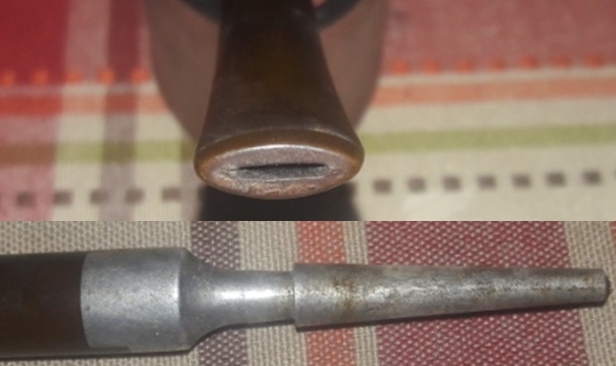
He further suggested the pipe to be from the period 1920s to 1930s. According to him, with the crochet cap and the delicate nature of this pipe, it could well be a woman’s’ pipe and shared pictures of old grannies smoking such pipes.Well, I would go with the input provided with Steve and given the historical documented proof that Albatross feather hunting was banned in 1922, this homemade corn cob ladies pipe could be broadly dated to have been made in the 1920s.

Any clarification/confirmed input on this pipe are requested from all the learned readers of this write up!!

Initial Visual Inspection
The chamber has a decent and uneven layer of dry and hard cake. It seems that the chamber walls themselves are uneven, the condition of which can be ascertained only after the cake has been removed to expose the walls. The rim top surface is highly uneven with the indentations of the chaff being clearly visible and intermingled with chipped surface areas. However, there are no signs of charring to the rim edges. I shall decide if I would top the rim to try and make it perfectly even. The stummel is partially covered in thick brown paper under a crocheted cap made out of jute. This is covered in dust and grime. The brown paper has either torn away from the top half or possibly was meant to cover the bottom half of the stummel. The rustic and unrefined finish that presents itself makes commenting on it with any degree of certainty, well neigh a difficult task. The old cob has aged well and feels rugged in its patchy and scaly texture of the chaff and dark color. The stummel has no shank and the long, delicate and slender Albatross wing bone stem is permanently attached to the stummel itself.  The Albatross wing bone is covered in dust and dirt from the outside while the insides show few dark areas signifying accumulated old oils and tars in the air way. However, the bone has colored well with age, I say. It will be a challenge to clean the stem internals as I do not have such long pipe cleaners and with the stem fixed in to the stummel, makes cleaning impossible from the other end. The stem end is uneven but I didn’t feel any jagged edges, so I think I shall let it be just to maintain that rustic homemade look and feel of this pipe.The Process
I began the process of refurbishing this pipe first by working on the stummel. The crocheted jute cap initially had some give to it and very carefully and delicately, I separated the cap from the stummel. The thick brown paper that covered the bottom half of the cob was intact. It’s my guess that the purpose of this paper was to provide some insulation for the hands from the heat of the burning tobacco. I washed the crocheted jute cap using a detergent and toothbrush to clean the surface of all the dirt, dust and grime of yesteryears. I set it out to dry naturally without wringing it as I feared that the weave may unravel. I reamed the chamber with a Castleford reamer tool, using the size four head of the tool. Using my fabricated knife; I further took the cake down to the bare wood. With a 150 grit sand paper, the walls of the chamber were rid of all the remnants of the cake, revealing solid chamber walls. I further wiped the chamber with a cotton swab wetted with isopropyl alcohol to completely remove the sanding dust. The uneven chamber wall appears to be natural and akin to the slots where the cob kernels are attached (chaff). The rim surface was too uneven. Again the rim top appears uneven due to the chaff slots and this brings me to the question whether I should attempt to top it and get the rim surface as even as possible or let it remain as is…natural look! I discussed it with Abha, my wife, and it was decided that the rim should be topped just sufficient to make it even but not too much that the natural chaff slots are all but lost. Truth be told, I did not understand what exactly was needed other than the fact that topping was essential. I topped it on a 180 grit sand paper, frequently showing it to Abha and continued till she liked the looks of the rim top. That I too liked it goes without saying!! Here is how the rim appears at this stage. Next, I cleaned up the stem air way with liquid detergent, pipe cleaners and cotton swabs. The stem internals cleaned up nicely with a smooth and full draw. I followed up the internal cleaning with cleaning the external surface of the albatross wing bone stem. I cleaned the wing bone surface with dish washing detergent and Scotch Brite and followed it up with a piece of 0000 grade steel wool. The Albatross wing bone stem is now nice and clean. With the cleaning of the wing bone stem complete, I polished the stem with micromesh pads, wet sanding with 1500 through 12000 grit pads. The off white residue that was seen during the polishing further confirmed the stem material to be bone. The length of the stem, diameter of the hole and lightness has left no doubts in my mind that this has to be an Albatross wing bone.I applied “Briar Cleaner”, a product that has been developed by my friend Mark Hoover, to the external surface of the bowl. It works similar to Murphy’s oil soap and needs to be applied to the stummel surface and set aside for 5-10 minutes. The product pulls out all the dirt and grime to the surface making further cleaning easy. I am quite happy with this product. I used a hard bristled tooth brush to scrub the stummel with the solution, wiped it clean with a moist cloth and dried it using paper towels and soft cotton cloth. I deliberately cleaned the rim and set the stummel aside to dry out naturally. Staying with the stummel restoration, I polished the rim top surface with micromesh pads, wet sanding with 1500 to 12000 pads. I wiped the surface with a soft cloth at the end of the micromesh cycle. The rim top surface looks nice with a deep shine. I rubbed a small quantity of “Before and After Restoration Balm” in to the cob stummel to enliven and protect it. I rubbed this balm deep in to the patchy/ scaly surfaces of the stummel and smooth rim top with my fingers and let it rest for a few minutes. The balm almost immediately works its magic and the cob now has a nice vibrant appearance. I further buff it with a horse hair shoe brush. At this stage in restoration, I reattached the crocheted jute cap with the stummel. To complete the refurbishing, I gave a vigorous hand buff to the cob stummel with a microfibre cloth to deepen the dark colouration and shine on the cob. Needless to say, I was careful with the jute cap least I unravel the stitches. This rustic finish, unrefined and most likely home made pipe has a charm that can only be felt while holding it and will definitely find a place of pride in my modest collection. Whether or not I shall smoke it, I cannot say at this point in time, but in case the pipe calls out to me and shares its life story, I shall love to smoke it while listening to it. Here are some pictures of the refurbished pipe. P.S. This is in no way a beautiful well crafted pipe, but a rustic and delicate looking one with such solid construction that it feels capable of lasting for ages!! The pictures of the old ladies sitting around with their grandchildren in many ways remind me of my grand old man!! Thanks for sharing these pictures, Steve!

I should also mention here that this pipe has, by far, been the most difficult pipe to capture on camera for its length, beauty and appeal. Appreciate your patience in reading thus far and looking forward to input on the write up and any information/additional snippets/ clarifications on this pipe. Cheers…

Praying for the safety and well being of all the readers and their loved ones in these troubled times…

A New Lease On Life For A No-Name English Make Large Pot


Blog by Paresh Deshpande

I had purchased this pipe lot of two unmarked beautiful looking pots on eBay with the intention of either selling or gifting. The price was very low and from the pictures, the pipes screamed quality and appeared solid. Here are a couple of pictures of this pair that were posted by the seller. Once the pipes were delivered home (my work place is away from where my family resides), Abha my wife, checked them out and informed me of the following;

(a) Both pipes are similar with only difference being in the size, one is large Pot while the other is a medium.

(b) The only stamping seen is on the right side of the shank and reads “MADE IN” over “LONDON, ENGLAND”. The stem is devoid of any stampings. The overall feel of the pipe is that of high quality.

(c) Both pipes have a darkened spot each, the larger one has it on the heel and the other on the bottom left side of the stummel.

The last piece of information was something that troubled me. I had seen a dark spot on the heel of one pipe, but it appeared to be a smear of grime and dirt. Here are the pictures of the spots that Abha had sent me. It definitely appeared to be the beginnings of a burn out!!Truth is, after the initial surprise of being misinformed by the seller on eBay had subsided, I did not find these damages very alarming and I felt that these two beauties still had many years of smoke left in them with some minor repairs. The matter rested till I received about 40 pipes that Abha had sent me duly cleaned for my part of refurbishing. Both these pipes were part of that parcel that I had received.

I decided to work on the larger pot first. The pipe has a beautiful mix of swirls and cross grains. In fact, the USP of the stummel lies in the solid hand feel and robustness of the build. The quality of briar is top notch and without any fills at all on this piece. It is stamped on the right side of the shank as “MADE IN” over “LONDON, ENGLAND”. The high quality vulcanite saddle stem is sans any stampings.There are not very many clues that can point me towards the provenance of this pipe. The only fact that can be established is that this is a London made pipe. The build quality, the shape and stem type reminds me a lot of Charatan’s pipe, most notably their Belvedere line. In fact, I do have a Charatan’s Make BELVEDERE pot shaped pipe that I had received as part of my Mumbai Bonanza and the similarities are striking. Also, while surfing the net, I came across a MOUNTBATTEN pot which again resembled the pipe on my work table. Here are pictures of both these pipes, the first two are of the Mountbatten and the next two are that of Belvedere pot. With Mountbatten being a Charatan’s second and observing the similarities between these three pipes, it may be surmised that there is a possibility that the pipe presently on my work table is made by Charatan’s for some pipe shop, which was not uncommon in the past. Any confirmed input to either support or refute my assumption is most welcome.

Initial Visual Inspection
The chamber has a thick even layer of cake with heavy lava overflow over the inward sloping rim top surface. The deposition of heavy lava overflow is predominantly seen on the backside of the rim surface in 6 ‘O’ clock direction. A number of dents and dings are seen on both outer and inner rim edges. I suspect charring to the inner rim edge in 1 ‘O’ clock and likely in the 6 ‘O’ clock direction. The extent of the charring and the condition of the walls of the chamber can be ascertained only once the cake has been taken down to the bare briar. The foot of the stummel did show the sign of beginnings of a burn out that was considerably darker towards the draught hole (encircled in green) and extending outwards away from the draught hole half way across the foot. The damage to the heel and the resulting severity of the burn out will be confirmed after reaming. There are some very strong ghost smells to the chamber which will need to be addressed. The stummel is covered in oils, dust and grime giving it a dull and lackluster appearance. The stummel feels solid and well carved and nice mixed grains can be observed all over the surface through all the grime. There is not a single fill anywhere on the bowl. Other than the charring observed at the foot of the stummel, the stummel has a robust and solid feel. The mortise is cleaned and clogged with the accumulation of old and dried oils, tars and gunk. This will need to be cleaned. The vulcanite saddle stem is heavily oxidized with signs of calcification on either surface of the stem about an inch from the button edges. There is no serious tooth chatter or indentation or button damage to the stem. The tenon end and horizontal slot shows signs of accumulation of old oils, tars and gunk. The high quality vulcanite stem should clean up nicely.Initial Cleaning By Abha…
The initial cleaning on this pipe was done by Abha, my wife (she has cleaned up around 40-50 pipes and these have now reached me for further restoration). She reamed out the complete cake and further smoothed out the chamber walls with a folded piece of 220 grit sand paper. She further cleaned out the internals of the shank with pipe cleaners and alcohol and cotton buds. She followed the internal cleaning of the shank with external cleaning of the stummel using Murphy’s Oil soap and hard bristled tooth brush and dried it with paper napkins and cotton cloth.

Next she cleaned out the internals of the stem air way and immersed it in “Before and After Deoxidizer” solution along with the stem of the other pot in line for restoration. Once the stem had soaked overnight, she cleaned the stem under running warm water and scrubbed the raised oxidation from the stem surface using Scotch Brite pad. She further removed the oxidation by scrubbing the stem with 0000 grade steel wool and applied a little olive oil to rehydrate the stem.Once The Pipe Is On My Work Table…
Now that the cleaned pipe is on my work table, I proceed to carry out my appreciation of the work that needs to be done on this pipe to restore it. The cleaned up pipe presented a clearer picture about the actual condition and the work required on this pipe. Here is how the pipe reached me. The stummel was clean and free of any accumulated grime. As observed earlier, there is not a single fill anywhere on the stummel. The only cause of concern is the darkened spot over the foot of the stummel. I felt the spot for softness with my nail and it appeared sufficiently solid, thus confirming that it’s not an all out burned heel. Rest of the stummel feels solid and robust to the touch. This piece of briar should polish up nicely. I was eager to understand the extent of burn out in the heel of the bowl. True enough, I could make out a dark patch just in front of the draught hole approximately at the center of the heel (marked in yellow). The chamber shows a few vertical minor heat lines all along the front of the walls emanating from the dark patch and further branching out horizontally to either side. The entire heel of the bowl appears dark and when seen in conjunction with the foot darkening, this issue needs to be investigated and addressed. The inward sloping rim top surface is in decent condition with the inner rim edge showing slight deformation and darkening in 6 o’clock and 1 o’clock direction (circled in red). The outer rim edge show few dents and dings. Thus, I would need to address issues of the darkened heel, inner rim edge and dents and dings to the outer rim edge. The mortise and shank is nice and clean. The ghost smells are history and reflects the thoroughness with which Abha cleans the internal and external of the pipe.The stem had cleaned up nicely and is in pristine condition. Whatever, little oxidation remains, will need to be removed by sanding with a folded piece of 220 grit sand paper and follow it up with polishing with micromesh pads. The Process
The first issue on the agenda that I decided to tackle was to address the dark patch to the heel observed just in front of the draught hole and correspondingly to the foot of the stummel. The black patch is bounded by the yellow arrows and the alignment of the web of these minor heat fissures is indicated by the green arrows. With a pointed dental tool, I scraped the black patch in the heel of the chamber and completely removed the dead charred briar from the surface till I reached solid intact briar. Thereafter, I removed the charred briar from the heat fissures till I had reached solid briar. Once the dead and charred briar was removed, there was a need to give a protective coat over the surface to avoid direct contact of the briar with the burning tobacco as the thickness from these damaged areas were slightly reduced. I would achieve this by coating the walls of the chamber with J B Weld mix. I preceded the stummel repairs first by coating the walls of the chamber with a slightly thick layer of J B Weld. J B Weld is a two-part epoxy Cold Weld in two tubes; hardener and steel which are mixed in two equal parts (ratio of 1:1) with hardening time of 5-6 minutes and complete curing time of 6-8 hours. I poured the contents of the two tubes and mixed it well. I inserted a petroleum jelly coated regular pipe cleaner through the draught hole to prevent it from getting blocked due to the J B Weld mix. I applied this mix, as evenly as possible, over the entire chamber wall surface. I worked fast to ensure an even coat over the chamber walls before the weld could harden. I set the stummel aside for the application to harden and cure overnight.While the J B Weld coat was curing, I worked the stem by first sanding it down with a folded piece of 220 grit sand paper. This step addresses the twin issues of removing residual stubborn oxidation and also smooth out the minor tooth chatter from the bite zone. I wiped the stem with Murphy’s Oil soap and cotton swab to remove the resulting sanding dust. I rubbed in a small quantity of EVO in to the stem and set it aside to rehydrate.Turning my attention back to the stummel, I sand the entire stummel surface with a folded piece of 220 grit sand paper to remove the minor dents and dings from the surface. This also helped to lighten the darkened spot from the foot of the stummel. Staying with the stummel repairs, the next issue I addressed was that of the damage to the rim top surface. The rim top surface is sloping inwards, making topping impossible without compromising the profile integrity. To address the issue of darkened rim surface, I sand it with a folded piece of 220 grit sand paper pinched between my thumb and fore finger, moving along in the direction of the surface profile. Simultaneously, I addressed the issue of charred inner rim edge and the dings and chips to the outer edge, by creating a slight bevel to both the rim edges. I am happy with the appearance of the stummel at this stage. I switch back to the stem and further sand it with 400, 600 and 800 grit sand paper. I wiped the stem with cotton pad dipped in alcohol to remove the resultant dust. I rubbed some extra virgin olive oil into the stem and set it aside to be absorbed. I polished the stem with micromesh pads, wet sanding with 1500 to 12000 grit pads. I rubbed a little extra virgin olive oil in to the stem at the end of all the micromesh pads. I finished the polishing of the stem by rubbing a small quantity of Paragon wax and giving it a final polish with a soft cotton cloth. The stem is now nice, smooth and shiny. With the stem polishing completed, I moved ahead with completing the stummel repairs. The J B Weld coat had hardened considerably by this time. I mount a sanding drum on to my hand held rotary tool and setting the speed to half of the full RPM, I sanded the excess coat from the chamber walls. To further fine tuned and keep the coat to a minimum thickness, I further sanded the coat with a 150 grit sand paper till I had a coat of a thickness that was just sufficient to protect the briar underneath. Here is how the chamber appeared at this stage. I polished the stummel with micromesh pads, wet sanding with 1500 to 12000 pads. I wiped the surface with a soft cloth at the end of the micromesh cycle. The stummel looks amazing with a deep shine and beautiful grains popping over the stummel surface. However, the dark rim surfaces in 1 o’clock direction and the dark spot at the foot of the stummel do not present a visually appealing picture. I had the option of either masking them under a darker stain or to let them be. I shall decide after I am done with polishing with Blue Diamond, hoping that this would further lighten these spots. I followed up the polishing by applying “Before and After Restoration” balm. This balm protects and enriches the briar surface and is highly recommended for use in any restoration of briar pipe. I rubbed it deep in to the stummel surface and set it aside to be absorbed for 20 minutes. I was pleased by the appearance of the stummel, less the dark spots on the rim edge and on the foot of the stummel. I mounted a cotton cloth buffing wheel on to my hand held rotary tool and applied a coat of Blue Diamond to the stummel, hoping to see a slight change in the appearance of the dark spots. However, these spots are still prominent and will need to be masked. Here are the pics of the pipe at this stage. I decided to stain the stummel with a Cordovan stain in the hope that it would help in a nice blending of the dark spots with the rest of the stummel. I heated the stummel surface with my heat gun to open up the pores on the stummel so that the stain is well set. I dipped a folded pipe cleaner in Fiebing’s Cordovan leather dye and liberally applied it over the heated surface, flaming it with the flame of a lighter as I went ahead to different self designated zones of the surface. This helps in even application and in the setting of the stain in the grain of the briar. I set the stummel aside for the stain to set into the briar. The next afternoon, I mounted a felt cloth buffing wheel on to my hand held rotary tool and using Red Tripoli proceeded, as my dear friend Dal Stanton likes to say “unwrap the coat of stain to reveal the grain” from the stummel surface. I set the tool at its slowest speed, again my recent experience while working on Steve’s pipe came in handy and the damage that can be caused due to heating while using the felt buffing wheel still fresh in my memory; I began to peel off the stain from the stummel surface first. The stain peeled out gradually. This was followed with wiping the stummel with a cotton swab and alcohol to lighten the stain a little as it was too dark for my liking. This also helped in cleaning the surface of all the residual stain and highlighting the grains. I set the stain by again heating the stummel surface with the heat gun. This is an essential step as, if missed, there is a possibility of the stain running down the hands of the smoker who decides to carry forward the trust in this pipe. To apply the finishing touches, I mounted a cotton cloth buffing wheel on to my hand held rotary tool and applied a coat of Blue Diamond to the stummel and the stem to polish out the minor scratches. Next, I mounted a cotton cloth buffing wheel and setting the speed to ¼ of the full power, I applied a thick coat of carnauba wax over the stummel and the stem. I worked the complete pipe till the time all the wax was absorbed by the briar. The pipe now boasted of a beautiful and lustrous shine. I vigorously rubbed the pipe with a microfiber cloth to deepen the shine and also to clean away any residual wax that had been left behind. I am very happy with the way this beauty has turned out. P.S. There was only one more issue that needed to be addressed and one that could not be ignored, being a functional issue. After I had protected the heel of the stummel and the walls of the chamber with a coat of J B Weld, it was necessary to prevent this coat from coming in to contact with the burning tobacco. I addressed this by mixing activated charcoal and plain yogurt to a thicker consistency, just enough that it would spread easily and applied it evenly all along the chamber walls after inserting a folded pipe cleaner through the draught hole to keep it open. Once dry and set, this will not only protect the walls but also aid in faster buildup of cake.I wish to thank all readers for sparing their valuable time to read through this write up.